The results of the capture of Chapoo, and of the total defeat
of the best troops the Chinese had yet brought against
us, were very remarkable. On the one hand, the people
more than ever dreaded our power, while they also wondered
at our forbearance; and, on the other hand, the tone of the
government began evidently to change, and overtures were
now made (probably with a view to gain time) to induce our
military and naval commanders-in-chief to suspend hostilities.
Advances of a similar kind had been made at Chinhae,
but did not appear to be founded upon sufficient authority to
permit them to be entertained. They were renewed at
Chapoo, but in an equally unsatisfactory manner, and the
agent of the Chinese on both occasions, and also on subsequent
ones, was a mandarin of low degree, the very sending
of whom was sufficient to point out that their object was merely
to sound our disposition, and blind our credulity.
At Hang-chow-foo the people were so much alarmed that
they openly expressed their dissatisfaction to the High Imperial
Commissioner Yih-king, who was also generalissimo of
the forces, a member of the imperial cabinet, and a relation
of the Emperor. But above all, the generous treatment of
the Chinese prisoners by the orders of Sir Hugh Gough, the
attention shewn to their wounded, and their being at last all
given up before our forces left Chapoo, each of them receiving
a present of money, (about three dollars for each man,) all
these humane proceedings together produced a most powerful
impression upon all classes of the Chinese.
When the Chinese prisoners were sent back from Chapoo,
a letter was at the same time addressed to Elepoo,[63] in reply
to the overtures which had been made. It was to the effect,
"that hostilities could not be suspended until the Chinese
government were disposed to negotiate on the terms offered
by the British government, through the medium of her
majesty's plenipotentiary, who was then daily expected at
Chusan."
Elepoo was determined not to be outdone in courtesy, and
before our fleet entered the Yangtze river, he sent a very
important and remarkable letter, addressed to our commanders-in-chief,
styling them the "Honourable General and Admiral."
He talked a great deal about good faith and sincerity, and
thanked them for sending back the prisoners, and for the
attention and kindness shewn to the wounded. He proceeded
to inform them, that he had in return sent back all our prisoners
to Chapoo, who had been previously kept at Hang-chow-foo;
but that on their arrival there, it was found that
the fleet had already sailed, in consequence of which they
were obliged to be taken back. He further added, "that he
was desirous to negotiate and make arrangements, in order to
protect the lives of the people of both countries."
Neither the prisoners nor the letter were, however, received
for some time afterwards. By Elepoo's orders, thirty dollars
were afterwards paid to every white man, and fifteen dollars
to every native of India, or, as they call them, to every "black
man;" thereby marking their sense of the distinction between
them. Altogether, there were sixteen prisoners restored by
the Chinese, two of whom belonged to the Nemesis, one being
an English seaman, the other a negro lad, who had been a
slave at Macao, but had escaped and came on board the
Nemesis, where he turned out a very smart, useful lad. They
had been kidnapped at Chusan, and thence carried over to the
mainland.
After having been brought back to Hang-chow-foo, from
Chapoo, the prisoners remained there five days, and were well
fed and taken care of. They were then put into sedan chairs,
and carried through the whole Chinese army encamped to the
southward of that city. The camp appeared to be of immense
extent, and full of soldiers, who crowded round the sedan
chairs with eager curiosity, but without attempting to offer
any violence. They appeared particularly amused at the
appearance of the black men. It was remarked, that about
one in ten of the soldiers was armed with a matchlock, the
rest having only spears, swords, and bows and arrows, the
latter of which they seemed to be most proud of. The
danger they ran of having their clothes set on fire by the
match, particularly when wounded, or by the ignition of the
powder, always made them more or less afraid of arming themselves
with the matchlock.
After travelling for several days, partly in sedans and partly
along canals, during which they passed a large town, called
Chow-king, apparently as large as the capital itself, the prisoners
arrived at Yuyow, on the 11th of June, whence they
were conveyed to Ningpo, and after a very short halt, proceeded
down the river to Chinhai, where they were most joyfully
received on board H.M. brig Pelican, by Capt. Napier.
Communications subsequently took place between Elepoo
and our military and naval commanders-in-chief. In one of
these Elepoo says, that he is surprised to learn that the fleet
of our "honourable country had sailed up the Woosung river,
firing guns and stirring up a quarrel; and then expresses his
regret that the war had already lasted so long, and that many
lives had been lost, and unspeakable misery produced. Is it
not far better to enjoy the blessings of peace than to fight for
successive years, and to fill the land with the bodies of the
slain?" This, however, was merely an attempt to lull the
activity of our commanders, and to delay their measures by
pretence of negotiation.
The reply of Sir Hugh Gough and Sir William Parker was
characteristic—namely, "that they were thankful to Elepoo
for having sent back the British subjects who were prisoners,
and begged to assure him that they gladly recognised in this act
the good feeling which should always subsist between civilized
nations. In respect to the other letter they added, that
with the utmost desire to lessen the calamities of war, it was
their duty to proceed with hostilities until they were assured
that a functionary, duly authorized by his Imperial Majesty,
should be prepared to negotiate a peace, and to meet those
just demands which had been repeatedly submitted to his
Imperial Majesty. With every respect for his exalted position
and acknowledged probity, the high British officers must
remind his excellency, that they have not yet been apprized
that he is authorized to treat, on the conditions promulgated
by the British government."
The high tone of these letters must have rather surprised
both the veteran Elepoo and the imperial cabinet. They had
been so long accustomed to communicate with foreigners only
through inferior agents, that they could hardly bring themselves
on a sudden to adopt the practice of conducting negotiations
upon a footing of perfect equality. The ingenious
expedient was therefore resorted to of sending to Canton to
order up some of the Hong merchants to act as mediators.
The aged Howqua excused himself on account of his infirmities,
but sent his only surviving son in his place, accompanied
by Samqua, another Hong merchant of repute, and
two linguists.
The journey from Canton to the province of Che-keang, or
rather to that part of it in which their services might be
required, Hang-chow-foo, or Soo-chow-foo, a distance of
upwards of six hundred geographical miles, was no pleasing
task in the middle of summer, particularly in a country where
the only mode of travelling is in sedan chairs. However, they
were compelled to go, but were speedily sent back again without
having been permitted to hold any communication whatever
with any of our high officers. Indeed, Sir Henry Pottinger
had long before so positively refused to receive both
the Hong merchants and the Prefect of Canton, that it is surprising
how any further expectation could have been formed
that their services would be required.
While speaking of the Hong merchants, it is worth mentioning,
that about this time notice was sent by the aged
Howqua to the foreign residents at Canton, that there was
reason to believe that some of the wells had been poisoned,
and that there were vendors of poisoned provisions about the
streets. If this report was true, the diabolical purpose was
thus frustrated, and no bad results followed.
We must now return to the operations of our forces, subsequently
to the capture of Chapoo. Fortunately the health of
the troops had been good during their ten days' stay on shore,
so that nearly the whole force was in a condition to take part
in the projected operations in the Yangtze river. Lieutenant-Colonel
Tomlinson, whose death was so much lamented by all
his brother officers, was buried at sea soon after Chapoo was
taken, being carried out in the Phlegethon, as it was feared
that if a grave were dug for him on shore, his remains might
be taken up by the Chinese, and a great boast made of their
having killed one of the high English officers.
On the 27th May, a great part of the troops were embarked
on board the different transports, and the remainder on the
following morning, when the whole fleet got under weigh.
On the 29th, they anchored in a safe and extensive sound,
which had been discovered by Captains Kellett and Collinson,
at the Rugged Islands, about forty miles to the eastward of
Chapoo. Some days were spent at this anchorage, in order
that a proper channel into the Yangtze river for large vessels
might be carefully examined. During this interval, the Admiral
took an opportunity of revisiting Chusan, in the H.C.
steamer Pluto, which had just arrived from England, together
with the small iron steamer Ariadne, from Bombay.
On the 5th June, the whole fleet stood up towards the
entrance of the river, but their progress was much delayed by
the great strength of the tides, and also by fogs, so that they
did not reach the appointed rendezvous off the Amherst
rocks, (a little to the eastward of the mouth of the river,)
until the 8th, having always been obliged to anchor at night.
A further delay now occurred, while the Modeste, with the
Nemesis and Pluto steamers, were detached to intercept the
communications up the river, and to reconnoitre the defences
of Woosung. A large fleet of trading junks was soon espied
near the latter place, and the Nemesis was ordered to give
chase, and bring them to. She very soon got ahead of them,
and cut them off, obliging them to anchor immediately. Some,
however, persisted in holding their course, until several shots
had been fired across their bows. The junkmen appeared
terribly frightened, although Mr. Gutzlaff, who was on board
the Nemesis, assured them that they would receive no injury,
and would be allowed to depart again, as soon as their cargoes
had been examined.
A great number of junks were found laden with the most
beautiful fish, very carefully packed in ice, probably destined
for Nankin, and for places along the imperial canal; but it is
remarkable that none of these cargoes were fallen in with
afterwards, higher up the river; which tended to prove that
there were innumerable canals by which they could convey
their produce into the interior, without proceeding up the
main river beyond a certain point, thereby avoiding the delays
occasioned by the currents, and the dangers of the navigation.
This excellent opportunity of getting well supplied with fish
and ice was not allowed to pass unheeded, but none of the
junks were detained beyond a few hours. One junk, however,
was always kept back, until another made its appearance; but,
as it was impossible for strangers to distinguish at a distance
the kind of junks which were loaded with such a welcome
cargo, every captain was made to understand that he would
have to supply fish and ice for the use of the steamer, until
he could point out another junk coming up the river with a
similar cargo, which was then to take his place, and he was to
be liberated. In this way, one continued to succeed the
other. This hint was quite sufficient to put the fellows in
excellent humour. It was curious to observe what a sharp
look-out they kept, frequently climbing up to the mast-head
to see if their longed-for substitute was approaching. The
one who last arrived soon reconciled himself to this fate very
good-naturedly, when informed by his predecessor that no
great harm would be done to him. They all, however, seemed
very glad to get away, the moment permission was given to
them, and refused all kind of payment when offered. Fresh
fish of the best quality, and plenty of ice to cool the wine and
beer, were unexpected luxuries.
At Woosung, Captain Watson, with the Modeste, which was
anchored just out of range of the batteries, was occupied for
several days in sounding the channel, and was assisted in this
duty by the Pluto, under Lieutenant Tudor. They were
ordered to reconnoitre the mouth of the Woosung river,
(which empties itself into the Yangtze, about twenty-five miles
up its southern branch,) preparatory to the grand attack upon
the batteries.
The night of the 11th of June was particularly dark and
rainy, and the opportunity appeared singularly favourable for
making a close reconnoissance of the batteries. The Modeste
lay some way off shore, and the tide was running so strong
that it was impossible for Captain Hall, who had anchored
the Nemesis much nearer in, to communicate with his senior
officer, Captain Watson, concerning the plan which he proposed
for reconnoitring the batteries. About two hours before
midnight, the cutter of the Nemesis was ordered away,
manned and armed, to make a close examination of the batteries,
and of the channel leading into the Woosung river,
which the former were principally designed to protect.
Having carefully sounded the channel, Captain Hall boldly
pushed in as quietly as possible, towards the front of the
batteries; and being favoured by the boisterous weather, he
landed on the beach without being discovered. He could now
distinguish the Chinese sentry quite near him; and on looking
through one of the embrasures he could see one of the military
mandarins on duty, going his rounds along the battery,
attended by two armed soldiers, one of whom carried a large
paper lantern before him, which threw a strong light in his
face, and prevented him of course from seeing objects, even at
a very short distance from him. It was evident, therefore,
that the Chinese were upon the alert; though it would have
been very easy, with the help of the boat's crew, to have made
prisoners both of the mandarin and two soldiers, before the
alarm could have been given.
After three hours' examination, and a heavy pull against the
rapid current which prevails there, the boat of the Nemesis
got back to the vessel; and on the following day she rejoined
the Admiral off the Amherst rocks. It was about this time
that the little Ariadne steamer, having been sent to ascertain
the exact position of a rock lying off the mouth of the Yangtze,
unfortunately ran directly upon it, and was bilged. A sail
was immediately passed under her bottom, to cover the leak,
and she was towed by the Sesostris into Chusan harbour,
where, owing to some unforeseen accident, she afterwards went
down in deep water, and all attempts to get her up again failed.
On the 13th, Sir William Parker, in the Cornwallis, accompanied
by the Blonde, Columbine, Jupiter troop-ship, and the
Phlegethon, Tenasserim, and Medusa steamers, together with
twelve transports, got under weigh from the anchorage off
Amherst rocks, and succeeded in reaching the mouth of the
Woosung river, without any accident whatever. The Clio,
Bentinck, (since called Plover,) Starling, and two transports,
had been stationed as beacon-vessels, to mark the proper
channel, which, however, was so shallow, that for a part of the
distance there was little more water (only a few feet) than the
actual draught of the Cornwallis.
On the following day, the Admiral and the General proceeded
in the Medusa steamer, the smallest which was under
his command since the loss of the Ariadne, and jocularly
christened the Pilot Fish, to make a close reconnoissance of
the whole line of defences extending along both sides of the
Woosung river.
It is here necessary to bear in mind the relative position of
the Woosung river in respect to the Yangtze, in order to avoid
confusion in reading the account of the operations. The
former empties itself into the latter on its right bank, and the
village or small town of Woosung, which contains nearly five
hundred houses, stands at its mouth. This place was visited
by Mr. Medhurst, during his missionary tour up the coast of
China in 1835, and the people were there found to be remarkably
civil and well disposed.
The breadth of the river at its entrance may be about a mile,
but the channel for vessels of moderate burden is somewhat
intricate, and scarcely more than three hundred yards wide.
The course of the river runs nearly north and south, and,
as it joins the great Yangtze, its banks gradually widen
out, until they are soon lost in the banks of the larger river.
The principal line of defence was situated along its western
bank, running from the upper end of the village of Woosung
for a distance of full three miles along the river's mouth, and
curving gradually round towards the banks of Yangtze river.
The town of Paoushan is situated nearly two miles in the
rear of the batteries at that end. This long line of embrasures
mounted not less than one hundred and thirty-four guns; but
they were generally a great deal too wide, and the battery was
constructed of earth, very much like the works already described
at Chusan. Stakes were driven in along the front to
protect it from the sudden landing of troops, and probably to
secure the banks from the effects of inundations.
Just above the village of Woosung, and skirting it on its
southern side, was a large creek or canal, communicating with
the river, and protected by a strong semicircular stone battery,
regularly built, and mounting ten brass 24-pounder guns.
From its position it served to defend the river itself, for it
commanded the whole reach, as well as the mouth of the
creek.
On the eastern side of the river, opposite Woosung, stood a
strong fort, principally built of brick, nearly of a circular form,
and from its elevation calculated to have a long range. It was
flanked by a line of embankments, with embrasures not yet
completed, but mounting altogether twenty-one guns. There
were one hundred and seventy-five guns mounted for the defence
of Woosung. But it was not the number of guns which
constituted the strength of its defences. The choicest Tartar
troops had been collected at this point, who were prepared to
defend it obstinately. They worked their guns with great
spirit, and kept up a better sustained fire than they had done
on any previous occasion; and when their principal line of
battery was turned by the movement of a body of seamen and
marines upon their flank, they defended themselves with remarkable
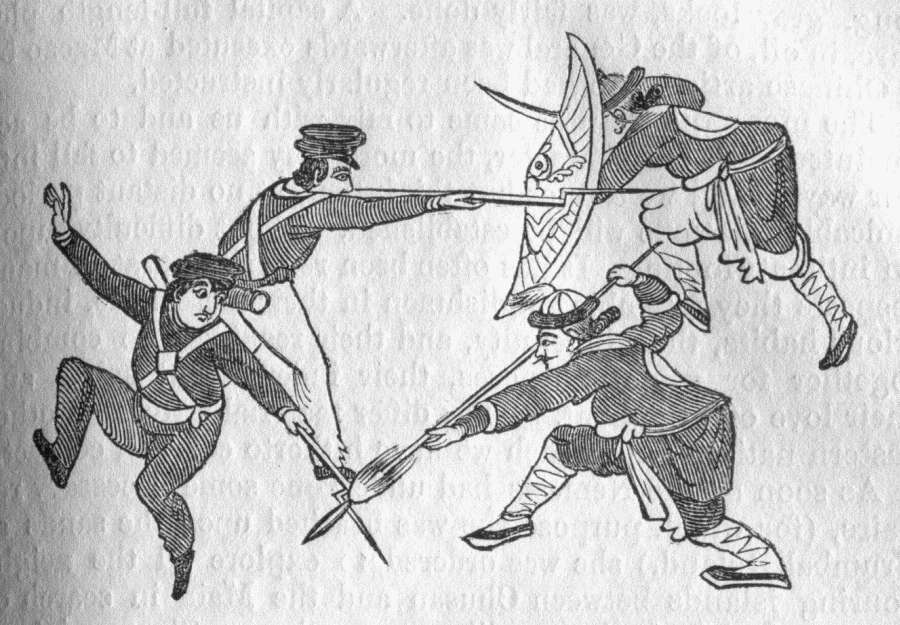
obstinacy and courage, and did not hesitate to
measure the sword with the cutlass, or to cross the spear with
the bayonet.
There was some difficulty in finding a spot where troops
could be disembarked with a view to turn the position, for the
water shoaled to three feet, within two hundred yards of the
banks, and the disembarkation could only be effected under
cover of the guns of our ships.
On the morning of the 16th, both the tide and the state of
the weather being favourable, the Admiral determined that the
attack should be made without further delay, and ordered that
the ships should be towed into action by the steamers, so that
they would be enabled to take up the precise positions allotted
to them. There were five steamers ready for the service,
besides the little Medusa, which was reserved to meet any unforeseen
contingency. It was the first action in which the
ships of war were all towed into their appointed stations. The
little Algerine was the only exception, as she was directed to
get in as near as possible under sail. Even the North
Star, Captain Sir E. Home, which only came in sight just
as the action had already commenced, was towed in by the
Tenasserim, which, after placing the Blonde in her proper
position, was sent out on purpose to fetch her.
The Cornwallis and Blonde, being the two heaviest ships,
were to take up their positions in front of the batteries, just
below the village of Woosung, and the light squadron was
then to pass them and proceed up the river to attack the
village, and the battery at the mouth of the creek above it, and
also the circular battery on the opposite or east side of the
river. The light squadron consisted of the Modeste, Columbine,
and Clio, towed respectively by the Nemesis, Phlegethon,
and Pluto.
The channel had been buoyed off the previous night, and
two junks had been moored so as to mark the entrance, on the
eastern side of which there ran out a long sand-bank.
At the dawn of day on the 16th all the ships of war got
under weigh, and by six o'clock they were in tow of their
respective steamers. In this instance, and indeed throughout
all the operations in the north of China, under Sir William
Parker, the steamers were always lashed alongside the vessels
they had to tow, instead of going ahead. This plan was found to
answer remarkably well in the intricate navigation of the
Yangtze river, as the movements of both vessels were more
easily managed. The Blonde, towed by the Tenasserim, led
in towards the batteries; the Cornwallis followed, bearing the
Admiral's flag, and lashed alongside of the Sesostris. This
post of honour was assigned to the Blonde, because, as soon as
the light squadron had passed up the Woosung, she would
have been nearer at hand to support them, if necessary.
The Blonde and Cornwallis received the fire of the Chinese,
which was opened with great spirit, without returning a shot,
until they had anchored by the stern in excellent positions.
The light squadron then passed them, except the little
Algerine, which could not follow the rest under sail, and
therefore brought up a little astern of the Admiral's ship.
The Modeste, under Captain Watson, who commanded the
light squadron, was towed by the Nemesis up the river in
gallant style, boldly dashing in towards the creek above the
village of Woosung, and receiving a severe and well-directed
fire from the whole line of batteries, but more particularly from
the battery of ten brass guns situated at the corner of the
creek, the approach to which, as before described, it commanded.
Both of these vessels suffered a good deal in executing
this bold manœuvre; and in order to shelter the men,
they were all ordered by Captain Hall to lie down at quarters,
on board the Nemesis, until the Modeste had been placed in
a good position. The fire of the Chinese was severe and well
directed, and the Nemesis suffered a good deed as well as the
Modeste.
Some way further up the river, fourteen war-junks were in
sight, and also five large newly-built wheel-boats, each moved
by four wooden paddle-wheels. These vessels also opened
fire, but at such a distance that their shot fell short. The
Columbine, towed by the Phlegethon, and the Clio by the Pluto,
followed their gallant leader up the river towards the creek.
In the meantime, the North Star was observed just coming
up towards the mouth of the river, and the Tenasserim steamer,
which had just cast off the Blonde, was now sent out to tow
her into action, and she was placed just ahead of the Blonde.
The Nemesis cast off the Modeste as soon as she had carried
her up to the mouth of the creek, and within musket-shot
of the ten gun-battery, and then opened fire with her
foremost gun upon the war-junks, and with her after-gun
upon the battery itself. The junks returned the fire as the
Nemesis advanced towards them, but the moment she came
within range of grape and canister, the Chinese Commodore,
or Admiral, set the example of running away, which all the
rest were glad enough to follow. They now made for the
shore the best way they could, each trying which could reach it
the quickest, but the wheel-boats had a decided advantage, and
were moved through the water at the rate of about three and a
half knots an hour. Grape and canister were now poured into
them as fast as the guns could be loaded. The confusion
among the Chinese sailors was great: some took to their
boats or sampans, others jumped overboard, and tried to swim
ashore, and a few of these must have been drowned.
The wheel-boats were, as a matter of curiosity, the first
boarded, and it was afterwards ascertained that they were each
commanded by a mandarin of high rank: which marks the
importance they gave to them. These wheel-junks were fitted
with two paddle-wheels on either side, strongly constructed of
wood. The shaft, which was also of wood, had a number of
strong wooden cogs upon it, and was turned by means of a
capstan, fitted also with cogs, and worked round by men.
The machinery was all below, between decks, so that the men
were under cover. They were all quite newly-built, and
carried some two, some three, newly-cast brass guns, besides
a number of large ginjals. A quantity of matchlocks, spears,
swords, &c., were also found on board.
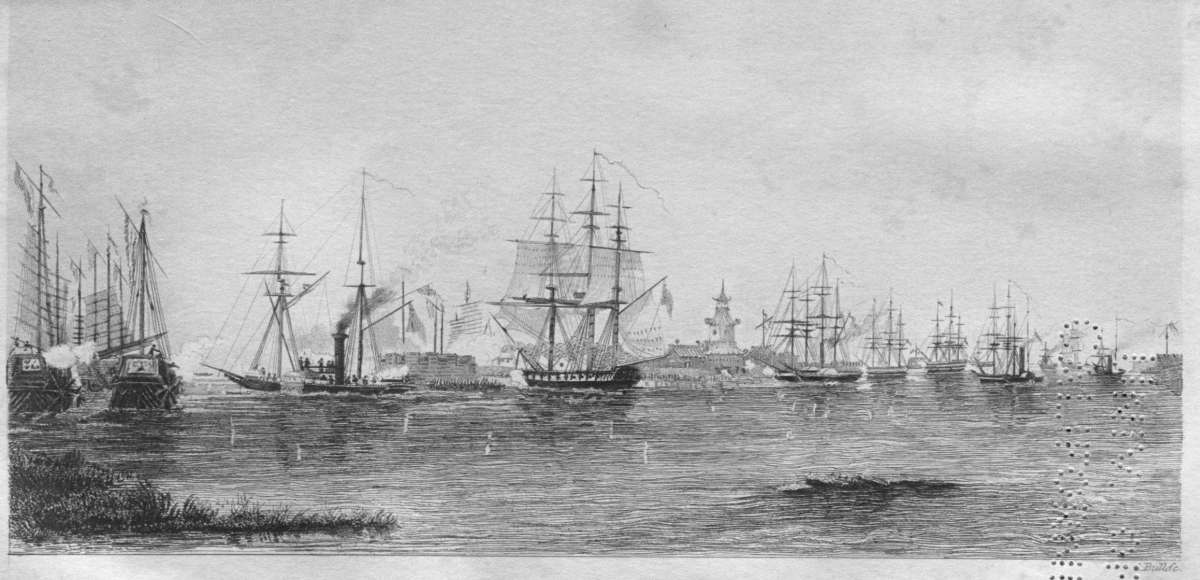
Battle of Woosung.
From an Original Drawing by Capt. Watson. R.N. C.B.
London, Henry Colburn, 1845.
In pursuing two of the largest junks too close in shore, the
Nemesis took the ground when the tide was falling. The
Phlegethon came up at this time, and tried to tow her off,
but without success, and she, therefore, stuck fast for some
hours. But the boats were sent away manned and armed
under Mr. Galbraith, with orders to capture and destroy the
rest of the junks which were floating about the river, deserted
by their crews. Other boats were sent to destroy those which
had been run ashore, but it was seen from the mast-head that
the Chinese were lying in wait to cut them off among the
scattered trees and buildings by the river side; and they
were, therefore, ordered not to go out of gun-shot from the
steamer.
The Phlegethon, under Lieutenant M'Cleverty, took part
in the destruction of the junks, and out of the whole fleet only
two war-junks escaped. Three wheel-boats and one junk
were afterwards towed down the river to the fleet, but the rest
were set on fire and destroyed.
To return to the advanced squadron. As soon as the
Modeste was cast off from the Nemesis, sail was made, and
she was carried alongside a wharf or small jetty within the
creek, close to the village of Woosung. The ten-gun battery
opposite kept up its fire upon her, but, under cover of a
broadside, the Modeste was made fast to the jetty. In this
position she soon silenced the fort with her larboard-guns and
small arms, and received little damage from the fire of the
enemy, because they could not depress their guns enough to
bear upon her with effect, so close was she.
The pinnace was now sent ashore, manned and armed, to
take possession of the fort, and there was some skirmishing
with the rear-guard of the Chinese who were retreating. Mr.
Birch, with a party of seamen, was at the same time ordered
to spike the guns; and at this moment the Columbine, followed
by the Pluto steamer, came up, and poured in a well-directed
fire upon the column of the retreating enemy.
During all this time, the Cornwallis, Blonde, and North
Star were hotly engaged with the batteries, abreast of which
they were anchored, and soon made the Chinese slacken their
fire. Perceiving this, Captain Watson boldly determined to
land, with the marines and small-arm men of the Modeste,
Columbine, and Clio, within the creek, in the hope of being
able to turn the enemy's flank next the village, and also cut
off their retreat. A body of the Chinese were observed lying
down under cover of the embankment, apparently in readiness
to meet their enemy. Captain Watson now formed his men,
and gallantly dashed on towards the Chinese, but had to cross
a deep canal, over which there were several small wooden
bridges, in the rear of the works.
The Chinese received them with a heavy fire of matchlocks
and ginjals, but gradually retreated as Captain Watson advanced,
and fell back upon their main body, who now shewed
a most determined front, and deliberately planted their ginjals
directly in the only path by which they could be approached.
Captain Watson had already ten of his men wounded; and,
finding his party getting a little straggled, he drew them outside
of the line of embankment, in order to form them again.
The Chinese now came boldly out, brandishing their spears
in defiance; and threw a volley of hand grenades, which went
over their heads.
At this moment, Captain Bourchier, seeing Captain Watson's
party hotly engaged with the Chinese, who were much
their superiors in numbers, dashed on shore from the Blonde,
directly in front of the battery; and at the same moment
Captain Watson's party made a rush at the enemy, who stood
their ground so firmly, that for the second time the spear and
the bayonet were crossed, and no one who witnessed the
obstinacy and determination with which the Chinese defended
themselves could refuse them full credit for personal bravery.
They were now driven back under cover of some houses,
where they rallied.
By this time the marines and seamen of the Blonde and
Cornwallis were landed nearly opposite those vessels, under
Captain Bourchier, Captain Peter Richards, and Sir Everard
Home, and joined Captain Watson. Sir William Parker also
landed; and, as soon as the men were all formed, they succeeded
in driving the enemy out of the whole line of batteries.
A small party from the Algerine, under Lieutenant Maitland,
boldly landed before they could be well supported, and were a
little cut up.
The Sesostris in the meantime had been closely engaged
with the strong fort on the eastern side of the entrance of the
river, where she took the ground in such a position that she
was able to bring her guns to bear, so as soon to silence the
enemy, when Captain Ormsby landed at the head of a body of
small-arm men from the Sesostris and Tenasserim, and took
possession of the fort.
The troops were not landed in time to take any part in the
engagement, for most of the steamers had taken the ground,
and it was not until past twelve o'clock that there were any
means of putting the troops ashore. Sir Hugh Gough then
landed just opposite the Cornwallis, and determined to advance
immediately upon the town of Paoushan in the rear, towards
which it was understood a large body of the Chinese had
fled, together with the governor of the provinces. Major-General
Schoedde was now ordered to move forward, so as to
get in the rear of the town, in hopes of cutting off the enemy
who might be retreating in that direction; while Sir Hugh
Gough, with the rest of the force, reinforced by the naval
brigade, moved along the river batteries.
On reaching Paoushan, it was found already in the possession
of Major-General Schoedde's brigade, which had entered
it without opposition; the soldiers and a great part of the
inhabitants flying out of it in great consternation. The walls
of the town were not found to be in very good repair, but they
mounted about fifty guns, of which seventeen were brass.
The main body of the Chinese were ascertained to have fled
in the direction of Soo-chow-foo.
The number of killed and wounded, on the Chinese side,
was less than might have been expected, probably not exceeding
altogether a couple of hundred; but among them was the
commander-in-chief of the Chinese troops. On our side, one
officer (Lieutenant Hewitt, R.M.) and one seaman, were
killed; and among the wounded were Mr. Purvis, midshipman
of the Blonde; Mr. A. J. Smith, mate, and Mr. Roberts,
master of the Sesostris; together with fifteen seamen, one
corporal, and five royal marines, and one Bombay artilleryman,
most of them severely, and several dangerously.
Many large and well-made guns were captured, particularly
some newly-cast brass guns, of great length. Some of the
best and heaviest guns were mounted upon the ten-gun fort,
at the point of the creek where the Modeste was so hotly
engaged. But the greater part of the guns were of small
calibre, and about one-half of the whole number captured were
6-pounders, or under. The largest were 24-pounders, and
there were a good many varying from 10 to 18-pounders.
About two hundred and fifty guns were captured altogether,
including those taken at Paoushan; of these, forty-two were
brass.
There was one very curious iron gun, of a peculiar shape,
being very small at the muzzle, and very large from the middle
to the breach. It was of Chinese casting, and had an inscription
on it, which shewed that it was upwards of three hundred
years old. There was also another curious old gun, with the
arms of Spain upon it. Besides the above, a number of large
ginjals and matchlocks, together with military stores of all
kinds, were discovered and destroyed; and to these must also
be added the guns destroyed in the war-junks.[64]
The Chinese were not prepared to expect the complete
defeat they sustained at Woosung. The great extent of their
preparations for defence, the determined resistance they offered,
and the improvements they had adopted in the form and
casting of their guns, and in the construction of their junks,
sufficiently indicate the importance which they attached to
the defence of this position. Precisely in proportion to their
previous expectations were the disappointment and panic produced
by their defeat.
Information was obtained, through Mr. Gutzlaff, that the
Chinese were removing their property and families from the
important commercial town of Shanghai, situated about fourteen
miles up the Woosung river; from which place it was
known that there was very extensive water-communication with
some of the most important districts and cities of China.
No time was to be lost in taking advantage of the prevailing
panic; and, accordingly, on the day after the capture of Woosung,
the Nemesis and Medusa steamers were sent up, with
Captain Kellett on board, for the purpose of sounding the
channel, and to ascertain what defences the Chinese had constructed
higher up. The deepest channel was found to run
along the left bank for about two miles, and then to cross
over towards the right bank, by keeping which on board there
was water enough for a frigate at half-flood.
About seven miles up, they came in sight of two forts, one
on either side of the river. One of these fired off all its guns
at the two steamers, but the shot fell far short. Soon afterwards
a blaze was seen to burst out in each of the forts, and,
on inquiry, it was found that the Chinese had set the buildings
on fire, and then abandoned the works. Being ordered not
to proceed further than this point, the two steamers rejoined
the Admiral, in order to report the result of the reconnoissance.
The same afternoon, the Modeste, Columbine, and Clio,
towed as before by the Nemesis, Phlegethon, and Pluto, were
sent up the river, under the command of Captain Watson, with
orders to place them near the two batteries, but out of their
range, and then to land and destroy the guns, if the Chinese
were found to have abandoned them.
On the morning of the 18th, these orders were skilfully
executed; but the Clio unfortunately grounded, and, as the
tide was falling, could not be towed off. Captain Watson
landed with the marines and small-arm men of the Modeste
and Columbine, and took possession of the forts which had
been abandoned. In the larger fort on the right bank were
found forty-one guns, eight of which were brass, and, in the
opposite fort, fourteen guns, of which likewise eight were
brass, or, more properly speaking, of copper. Many of these
were found dismounted, and the carriages taken away. The
tents and buildings had been already destroyed. Higher up
the river eight war-junks were discovered, which were set on
fire and destroyed, except one, in which the copper guns,
captured in the forts, were put on board and sent down the
river.
Reinforcements had now arrived to join both arms of the
expedition, but were just too late to take part in the action at
Woosung. H.M.S. Dido, Honourable Captain Keppell,
arrived the very evening after the engagement; and, on the
next day, the 2nd regiment Madras Native Infantry, and
detachments of Artillery, with Sappers and Miners, also joined
the forces under Sir Hugh Gough.
The 19th was the day fixed for the capture of Shanghai, for
which purpose one column of our troops was to march by land,
under Lieutenant-Colonel Montgomerie, M.A., consisting of
about one thousand men, including the 18th and 49th
regiments, with detachments of the Madras horse artillery
and the royal artillery, with Sappers and Miners. The rest
of the troops were embarked in the Tenasserim, Nemesis,
Phlegethon, and Pluto steamers, which took in tow respectively
the North Star, Modeste, Columbine, and Clio.
The marines of the squadron were also taken up in the little
Medusa; and Sir William Parker and Sir Hugh Gough, with
their staff, accompanied by Captains Bourchier, Richards,
Keppel, and other officers, proceeded up the river in that vessel.
They passed the deserted batteries, and met with no opposition
until they came within sight of the city, where a long,
well-constructed battery, situated below the town on the same
or the left bank of the river, opened fire on the North Star
and the other vessels, as they approached, but at such a distance
as to do no damage. A couple of broadsides from the
North Star and Modeste, with a few shot from the Tenasserim
and Nemesis, sufficed to drive the Chinese out of the works.
Captain Bourchier, with the seamen and marines, immediately
landed and took possession of the battery, upon which no less
than forty-nine guns were found mounted, seventeen of which
were of copper.
The steamers conveying the troops soon reached the city of
Shanghai, where the 55th regiment was landed from the
Nemesis, upon a small jetty, without the necessity of using
boats; another instance of the great utility of flat-bottomed,
iron steamers. The city had been already taken possession of
by the column under Colonel Montgomerie, without resistance,
and many of the respectable inhabitants were hurrying off in
great consternation, while the low rabble had, as usual, commenced
their work of robbery and destruction the moment the
authorities left the place.
Colonel Montgomerie's column had met with no opposition
during its advance, and but little difficulty, except occasionally
in crossing the guns over the narrow water-courses. They
passed close in the rear of the fort which had opened on the
ships, without seeing it; but, upon hearing the firing, they
hastened on to the city, in the belief that the sound of the
firing came from that direction. A large body of the Chinese
however, was observed in full retreat, and a few rockets were
thrown among them to hasten their flight; but, owing to the
many water-courses, and the swampy nature of the rice
grounds, it was impossible to come to close quarters with them.
On reaching the north-gate of the city, there appeared to be
no preparations made for resistance, and the only two guns
which could be seen mounted at the gateway looked harmless
enough. In fact, there was no one at the gate; and two or
three of our men, having contrived to get over the wall, soon
opened the gate, and admitted the rest. It was now discovered
that the place had been abandoned by the authorities the previous
evening. The people generally shewed no ill feeling
towards the foreigners, but rather an inclination to conciliate
their good offices.
The city, which, though wealthy, and of more agreeable
aspect than most other Chinese towns which had been visited,
was not given up to plunder; indeed, Sir Hugh Gough used
every means in his power to prevent the commission of any
excesses whatever. Very little plunder, or, as it was called,
"loot," was obtained, and was almost entirely limited to
curiosities. There was no wanton aggression. Many of the
houses were found deserted, and these were the only ones
which suffered, except where downright robbery was committed
by the gangs of Chinese plunderers.
Every effort was made to put a stop to these abominable
proceedings, and some of the most respectable inhabitants
were called upon to take charge of a few of the large deserted
establishments, particularly the pawnbrokers' shops, which, in
all Chinese towns, are establishments of enormous extent.[65]
As soon as the city was taken possession of, and guards
placed at the gates, the Columbine and Medusa were sent a
little way up the river, to endeavour to check the depopulation
of the city, for the inhabitants at that time were hastening
away in crowds, so that the river was actually covered with
boats of all descriptions, laden with furniture and goods.
The Nemesis was also sent up in search of war-junks, and to
reconnoitre the country. No further hostile preparations,
however, were discovered. Quiet was maintained within the
city, and the vessels of war and steamers were all anchored
directly opposite the town.
The vast number of large trading-junks, which were lying
there, surprised every one. Many of these were laden with
valuable cargoes; both banks of the river were completely
lined with them; and there were also numerous large stone
warehouses, filled with merchandize, some of which contained
large quantities of sugar, salt, and provisions; there were also
extensive timber-yards, and several large junks upon the
stocks.[66]
Shanghai must be a place of immense commercial importance,
not only as regards the internal traffic of the
country, but also in respect to its foreign commerce, or at
least its trade with the remoter parts of China, and even with
Siam and Cochin-China. It is said to rank second only to
Canton in commercial importance, particularly as the junks
belonging to the southern provinces are prohibited from
trading further north than this city, which therefore, in a
certain degree, enjoys a monopoly. During Mr. Medhurst's
visit to it, he reckoned that there were a thousand large junks
in the river; and on visiting it, not long after it was taken,
and when the trade was almost entirely stopped, I was myself
much struck with the large size of the junks, which crowded
both sides of the river.
Mr. Gutzlaff states that the imports of Shanghai already
far exceed the exports; and, therefore, the difficulty again
arises as to the mode of payment for the additional imports,
which will soon find their way to Shanghai since the opening
of the port. The Americans look forward to getting a large
supply of green tea at Shanghai in exchange for their cotton,
green tea being in extensive use among them.
Shanghai has immense internal communication with all the
central parts of China; it is situated in the richest and most
productive part of the country, and the adjacent district has
been called the Chinese Arcadia. The country is one fertile
flat, occasionally subject to ravages by inundations, but generally
drained and cultivated with great care. In some parts,
the land, lying below the level of the rivers, is only maintained
by strong and extensive embankments. The whole country
is covered with hamlets and villages, and cotton is cultivated
in great quantities.
The inhabitants of Shanghai have, on all occasions, shewn
a friendly disposition towards foreigners; and where the latter
have been treated with rudeness, it has been solely by the
orders of the mandarins, or at their instigation. Both Mr.
Medhurst and Mr. Gutzlaff bear testimony to this fact, during
their early visits; on which occasions the people eagerly asked
to receive books, of which several thousand copies were distributed.
So important is the trade of this place, that the
appointments in the public service are anxiously sought for,
and the office of superintendent of customs is considered
extremely lucrative.
Mr. Gutzlaff's testimony respecting this place is curious.
Speaking of his visit, in 1832, he says, "the mandarins never
directly interfered with my distributing books or conversing
with the people; and after issuing the severest edicts against
us, they gave us full permission to do what we liked. They
afterwards praised our conduct, but gave the people their
paternal advice to have nothing to do with us. An imperial
edict arrived, ordering us to be treated with compassion, but
not to be supplied with rice or water. But they sent us quantities
of live stock and flour, upon the sole condition that we
would not pay for them." It is, in fact, a curious thing to observe
how easily the Chinese evade all regulations when their
interest leads them to do so, and how readily they adopt every
subterfuge.
I chanced to pay a visit to Shanghai the very day after the
conclusion of peace was first made known in the town. We
landed from our boat, at a little stone jetty in front of a deserted
temple, before which there was an open paved court, or
square, crowded with people. Nothing could surpass the good
order which prevailed; not a noise or groan was heard, or
inconvenience of any kind experienced. Curiosity seemed to
be the sole absorbing feeling, and one could hardly imagine
that this was only the first week of peace, and that a hostile
force had a short time before occupied the city. A Chinese
crowd is the most orderly in the world; and, if we may judge
of civilization by the quiet, sober, deferential bearing of a
large body of people crowded together in narrow streets, certainly
the Chinese deserve to bear the palm. A few soldiers
were appointed to attend us through the town, who, instead of
arms, carried a fan-case, tied round their waist, and a whip in
their hand, with which they cleared the way with apparent
good will, as we proceeded along the streets of the suburbs.
It was a curious sight to look down the long, narrow, paved
street, on each side of which were crowds of shaved heads,
each trying to raise itself an inch or two higher, to catch a
glimpse of the passing strangers. The steps and doorways
were crowded, and also a few of the windows; but most of the
shops being shut, and the houses having generally only one
story, there were none of those groups of figures, men, women,
and children, rising in stages, one above the other, such as
are seen in Europe from the bottom of the house to the top,
when anything remarkable is to be seen.
The greatest contrast, next to the immense collection of
bald heads, and brown, roundish, ugly-looking features, consisted
in the total absence of women, which, in any part of
Europe, would have formed perhaps the most numerous and
noisy part of the assemblage. There was no appearance whatever
of rudeness or hostility; and when the people were
warned out of the way, or pushed aside, and reminded, by a
gentle touch of the whip, that they must move out of the way,
they did so in apparent good humour.
The inner town appeared to be only separated from the
suburb by the actual wall, there being little difference in the
houses on one side or the other. Two or three additional
soldiers turned out of the guard-house as we passed, and joined
our escort, certainly a shabby-looking set.
Much was said of the so-called tea-gardens of Shanghai;
but, on reaching them, great was our astonishment to find
that they ought rather to be called tea-ponds. According to
our notions, land and grass, and plants and flowers, are supposed
to belong to gardens—even to tea-gardens; but, at
Shanghai, it is quite the reverse, for water predominates.
Ornamental gardening in China, properly so called, is extremely
uncommon. At Canton there is a very good garden
belonging to a Hong merchant; but, generally speaking, the
land is too precious, for the purpose of producing food, to
permit the Chinese to devote much space even to fruits.
At the entrance to the tea-gardens our approach was greeted
by the plaintive voice of an old woman, who professed to sing
songs to the accompaniment of an instrument of a peculiar
kind, covered with snakeskin. It had three strings fastened
to a long handle, with a small drum at the end of it, and was
played with a bow.
The gardens were more remarkable from their novelty than
their beauty. The place consisted in reality of a sheet of
nearly stagnant water, with paths or platforms, or little islands,
intersecting it in various directions, upon which were built
summer-houses, or pavilions of various shapes, in Chinese
style, in which the good citizens of Shanghai assemble to
drink tea (at any hour of the day), and smoke the pipe, which
is a Chinaman's invariable companion, for recreation. There
were also a few walks among heaps of stones, called artificial
rocks, with seats scattered here and there; but in most respects
the whole place greatly disappointed our expectations.
Among the most remarkable objects at Shanghai were the
enormous ice-houses, both within and without the city, in
which ice is stored for public use. This was a perfect luxury
to our soldiers and sailors when the place was taken.
We spent the night in a deserted joss-house, close to the
landing-place; and, during the evening and the following day,
crowds of curious visitors came to look at us, and made themselves
agreeable as well as they could. They seemed to be
particularly pleased with the Company's new rupees with the
queen's head upon them, and willingly gave half a dollar each
for them;—being rather more than their value. Glass bottles
were in great request, and the brandy was pronounced excellent.
One of the principal mandarins came down to pay us a
visit, preceded by criers and runners; then came whippers-in,
and a couple of executioners, with chains in their hands, as a
sign of their calling; then came the great man, seated in a
very gay sedan-chair; next followed a couple of dirty-looking
fellows with gigantic fans; and two or three men mounted on
ponies closed the procession. The people stood on either
side the street, and gazed in silence. They had little curiosity
about the movements of the great man, but a vast deal concerning
every step or look of the strange-looking foreigners.
The mandarin was extremely courteous and well-bred towards
us, and we observed that he was treated with great deference,
and no one except ourselves dared to sit in his presence.
An interesting incident occurred at Shanghai, not long after
the peace. Sir Henry Pottinger, on his return from Nankin,
went up in a steamer to Shanghai, to make arrangements
about the future place of residence for our consul, and also to
settle about the ransom-money of the city. One morning, a
boat came alongside the steamer, having on board a very respectable-looking
man, in Chinese costume, who sent up his
card as "M. l'Evêque de Nankin," at the same time requesting
an interview with the plenipotentiary.[67] This was readily acceded
to. It now appeared that this gentleman was the head
of the Roman-catholic missionaries of the province or district
of Nankin; that he had been many years in China, suffering
great tribulation, and in continual danger of his life; that the
missionaries had suffered great hardships, and many of them
had lost their lives. For a great length of time he had not
been able to hold any communication with his fellow-labourers
in any other part of China, and had been deprived of all
tidings from any other country. He had lived in fear and
trembling, but had personally escaped persecution by leading
a very retired and unobtrusive life, and particularly by avoiding
all interference in public matters. He had been afraid to
make himself known, or to have any communication with
Europeans, as long as the war lasted, as it would probably
have caused him trouble. His flock was numerous, but scattered.
He had supported himself entirely by his missionary
labours, and had now joyfully seized the opportunity to request
that letters might be conveyed for him to Macao. He
had removed from Nankin, on the approach of our forces;
and altogether there was much interest attached to his history.
There is a great abundance of game to be found in the
neighbourhood of Shanghai, principally pheasants, and various
kinds of wild fowl. But it greatly astonishes the Chinese that
any man should take the trouble to shoot birds, or find any
amusement in the sport, when he could easily get people to
shoot them for him upon very slight payment.
The sum agreed to be paid for the ransom of Shanghai was
said to be three hundred thousand dollars, which was considered
in the light of a contribution, similar to the ransom-money
of Canton. Whatever the amount may have been, it
was reckoned as part of the money stipulated for by the treaty
of Nankin.
A quantity of guns, arms, and military stores, were, as usual,
found in the arsenal within the city, and also large stores of
rice. Sixty-eight guns (exclusive of those in the batteries
below the town) were captured at Shanghai. Seventeen of
these were of copper, newly-cast, and very heavy, and, consequently,
valuable for the prize fund. In a battery facing the
river, fifty-six guns were found, of which seventeen were brass
6-pounders. Altogether at Shanghai one hundred and seventy-one
guns were captured. But, reckoning the whole number
of guns taken in these operations, both at Woosung and
at Shanghai, and in the various batteries on the river's banks,
they will be found to amount to the amazing number of three
hundred and sixty pieces, exclusive of those destroyed in the
junks. Of these seventy-six were of copper, some of them of
great length and weight of metal, but of proportionably small
bore. They looked very well outside, but the casting of many
of them was defective, and not a few were made with a coating,
or rather tube, of iron, about one and a half to two inches thick,
along the bore, over which the copper was cast. At Shanghai
also full nine tons of gunpowder were found, contained in three
hundred and thirty tubs and jars. All the military stores
were destroyed.
It was evident that great preparations had been made for
the hoped-for defence of this important place; but, when the
hour of trial came, and the news of the action at Woosung
reached the city, the principal mandarins quitted it in despair,
and all hope of defence was given up.
On the morning of the 20th (the day after the city was
taken), Captain Bourchier and Commander Kellett were
ordered to proceed in the Phlegethon, accompanied by the
Medusa, together with the barge of the Cornwallis, carrying a
few marines, and also a boat from the Columbine, to reconnoitre
the river for a distance of thirty miles above the town.
Two small field-works of five guns each were discovered upon
the right bank of the river, and a considerable body of soldiers
were discovered at some distance in the rear. Lieutenant
Wise was sent, with the boats and marines of the Cornwallis,
for the purpose of destroying the works, which was effected
without any resistance.
The report of what had been seen and done this day was
considered so important and interesting, that Sir William
Parker determined to continue the examination in person next
day, still further up the river. About fifty marines and seamen
were embarked in the Nemesis, and the Admiral hoisted
his flag in her, accompanied by Captain Bourchier, Honourable
Captain Keppel, Captain Lock, and other officers; and
about noon, on the 21st, they proceeded up the river, followed
by the Phlegethon and Medusa.
The river gradually became narrower, but still carried from
four to six fathoms water, and appeared to have an immense
number of canals and water-courses connected with it. Many
of these led directly towards the towns and villages, some of
which could be just seen at a distance, others not far from the
banks. The country looked rich, and was carefully laid out
in rice-grounds, and otherwise well cultivated. It was not so
picturesque as about Ningpo, but there was all the appearance
of a thriving and industrious population. A heavy
storm of thunder and lightning came on in the afternoon, and
the three steamers were brought to anchor for the night a
little above the two forts destroyed the day before.
On the following morning they again pursued their course
up the river, and soon found that it divided itself into two
branches of equal size, one flowing down from the eastward,
and the other coming from the westward. They followed the
latter, which gradually took a more northerly direction, but
the water shoaled as they proceeded, until, at the distance of a
few miles from where they started, there was only one fathom;
and, as the Nemesis and Phlegethon could not safely ascend
higher, the Admiral, with the other officers, removed on board
the Medusa, which being smaller, drew a foot to eighteen
inches less water. But they were not able to go up more than
eight or nine miles further; for they were stopped by the
increasing shallowness of the water at the entrance of a large
lagoon. It was ascertained, however, from some boatmen,
who stated that they had left Soo-chow-foo only the previous
day, that there was a direct communication by water with that
city, which could not be a great many miles distant. It could
not be doubted, therefore, that this important city was easily
accessible to our forces, should it be thought advisable to
advance upon it.
Several large boats were coming down the river, laden with
coal, said to be brought from the neighbourhood of Soo-chow-foo,
where iron also is believed to abound. Indeed, coal of
very fair quality is found in many parts of this province, and
the Nemesis was using it for steam purposes at that very
time.
The whole distance ascended above Shanghai was about
forty-five miles, and it was matter of regret that time could
not be spared to explore the other, or eastern branch of the
river. Several large pagodas were seen at a distance, one in
particular to the northward, probably pointing out the neighbourhood
of a large town.
The same evening the three iron steamers returned to
Shanghai, and anchored abreast of the town, where his Excellency,
Sir Henry Pottinger, had just arrived from Hong-Kong,
having touched at Amoy and at Chusan on his way up. It
was also announced that strong reinforcements had arrived at
Chusan, and might be expected to join our forces in the
Yangtze-Kiang in a few days. The names of ships and
regiments will be given together, in the order in which they
moved up the river leading to Nankin. It will be sufficient
here to mention, that no less than seventy-three vessels of
war and transports set sail from Woosung together; besides
which two others were left at that anchorage, in order to
blockade the river leading to Shanghai. Several other vessels
joined the expedition on its way up to Nankin, and afterwards.