Narrative of the surveying voyages of His Majesty’s Ships Adventure and Beagle, (Vol 2 of 3)
Whole book · 39 sections
TRANSCRIBER’S NOTE
Footnote anchors are denoted by [number],
and the footnotes have been placed at the end of each chapter.
Numbering is unique only within each chapter.
New original cover art included with this eBook is
granted to the public domain.
Some minor changes to the text are noted at the end of the book.These are indicated by a dashed blue underline.
Published according to Act of Parliament by Henry Colburn 1839.
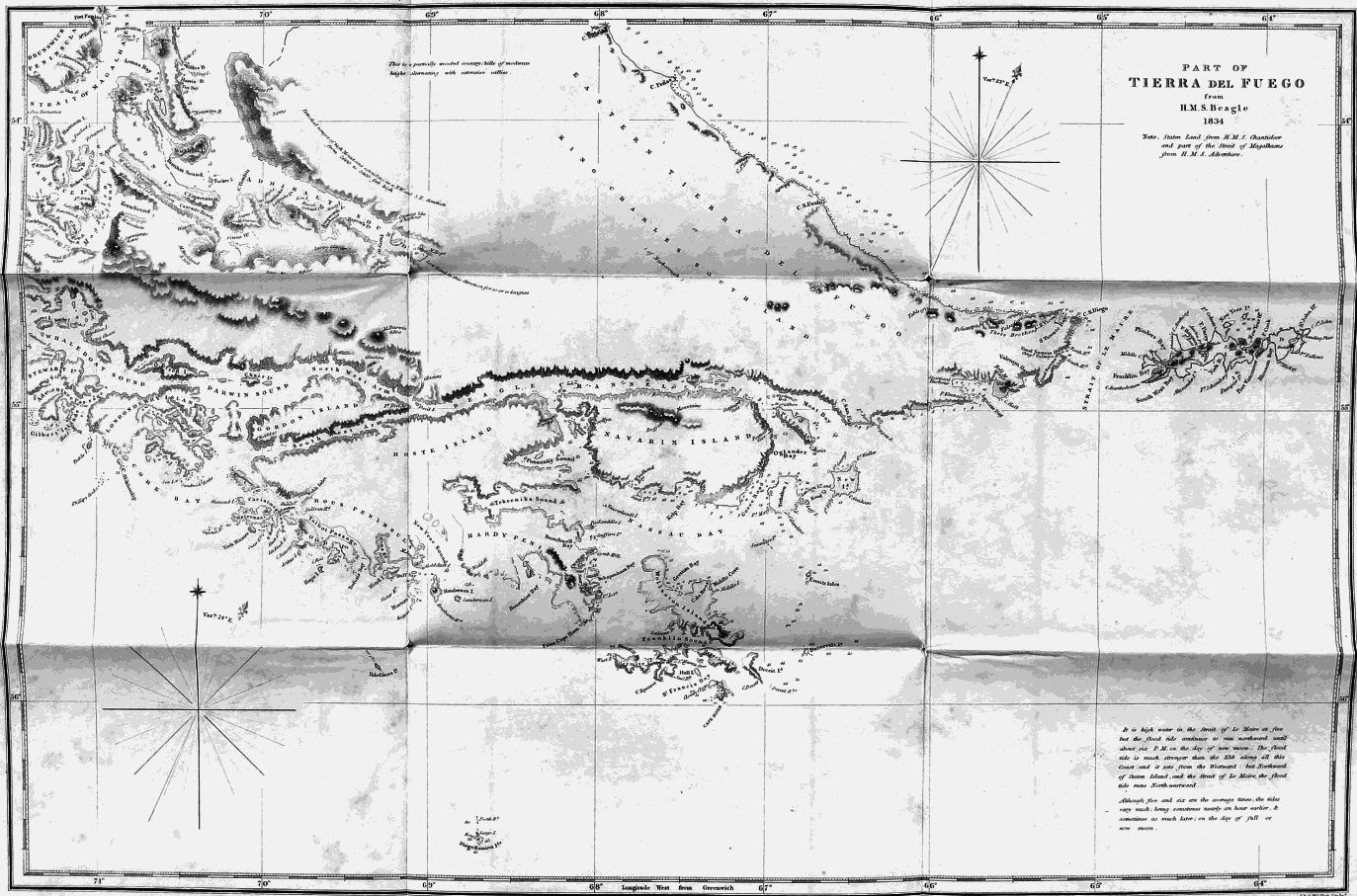
PART OF
TIERRA DEL FUEGO
from
H.M.S. Beagle
1834
Note. Staton Land from H.M.S. Chanticleer
and part of Strait of Magalhaens
from H.M.S. Adventure.
It is high water in the Strait of Le Maire at five but the flood tide
continues to run northward until about six P.M. on the day of new moon.
The flood tide is much stronger than the Ebb along all this coast and
it sets from the Westward, but Northward of Staton Island and the
Strait of Le Maire the flood tide runs North-westward.
Although five and six are the average times the tides vary much being
sometimes nearly an hour earlier & sometimes as much later on the day
of full or new moon.
Published according to Act of Parliament by Henry Colburn 1839.
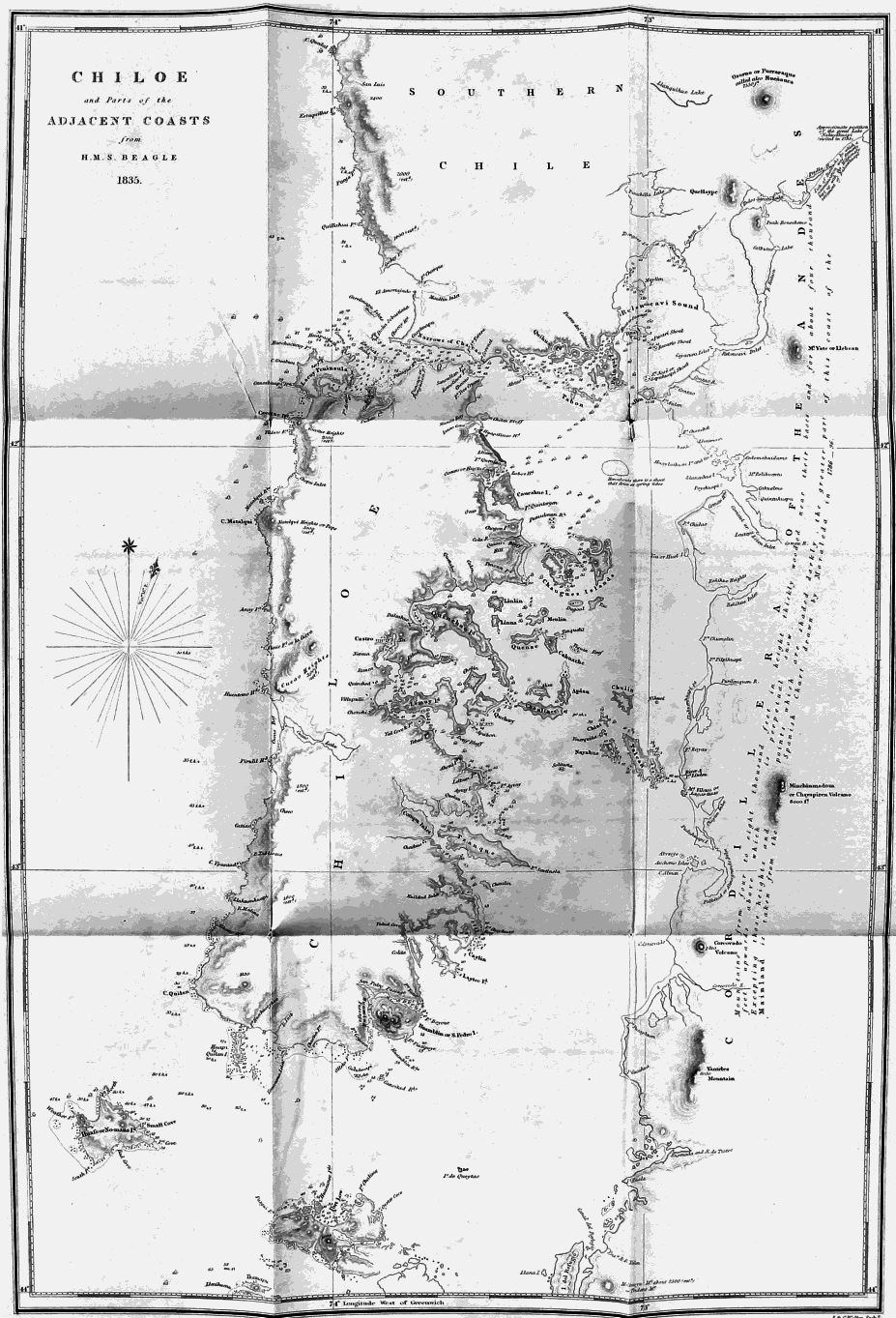
CHILOE and Parts of the
ADJACENT COASTS from
H.M.S. BEAGLE
1835.
VOYAGES
OF THE
ADVENTURE AND BEAGLE.
VOLUME II.
Published by Henry Colburn, Great Marlborough Street, 1838. C. Martens. T. Landseer.
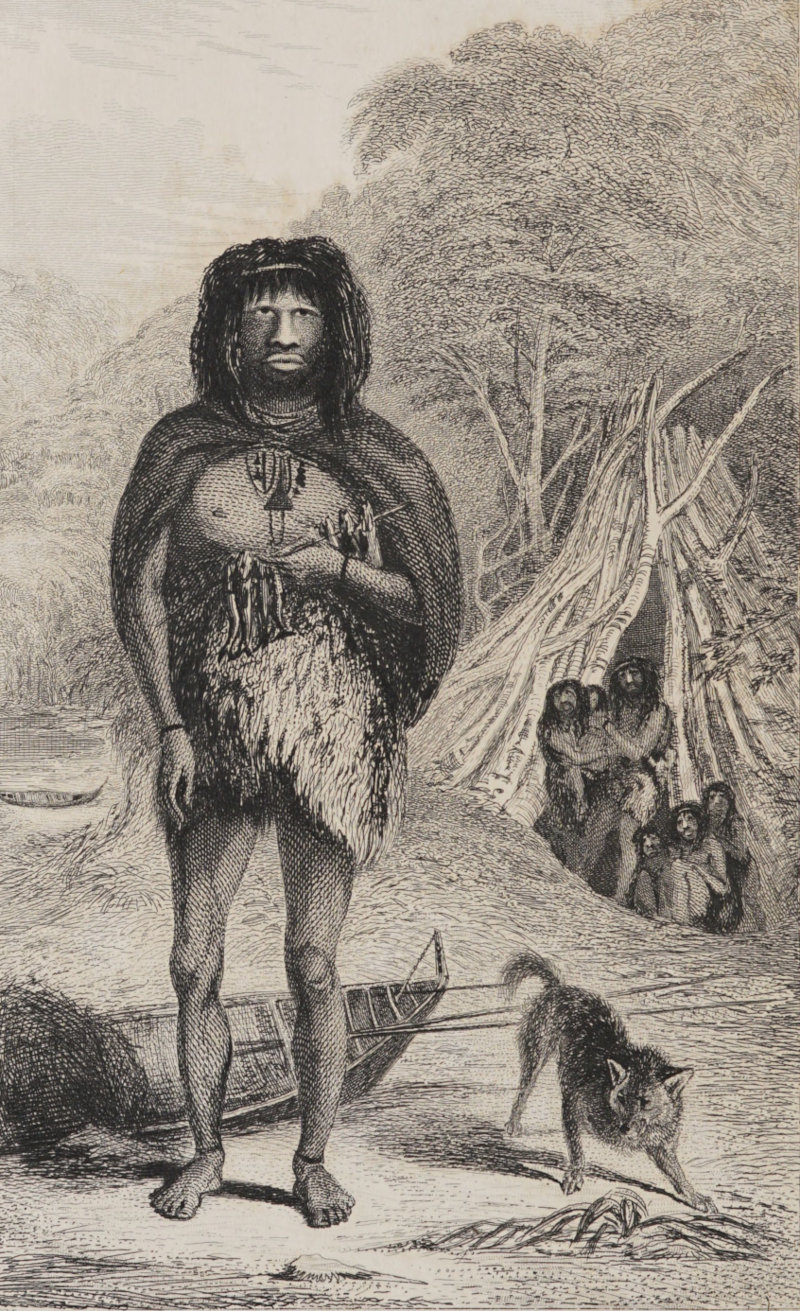
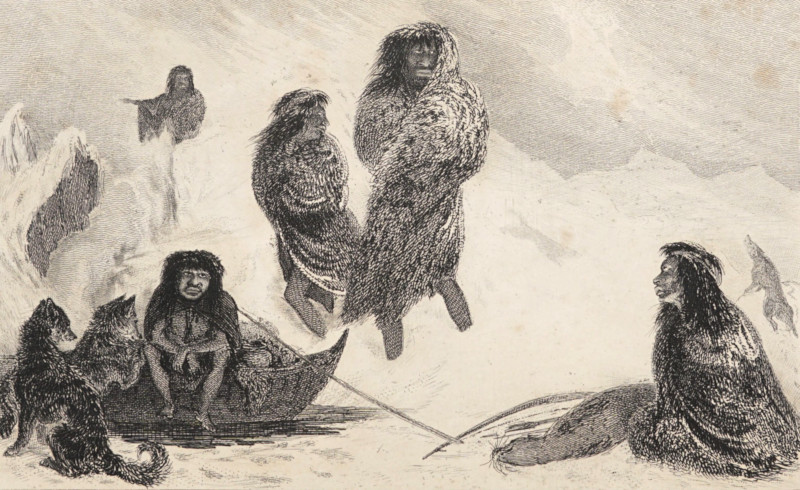
FUEGIAN.
(YAPOO TEKEENICA) AT PORTRAIT COVE
NARRATIVE OF THE SURVEYING VOYAGES OF HIS MAJESTY’S SHIPS ADVENTURE AND BEAGLE,
BETWEEN THE YEARS 1826 AND 1836, DESCRIBING THEIR EXAMINATION OF THE SOUTHERN SHORES OF SOUTH AMERICA, AND THE BEAGLE’S CIRCUMNAVIGATION OF THE GLOBE.
IN THREE VOLUMES. VOL. II.
LONDON:
HENRY COLBURN, GREAT MARLBOROUGH STREET.
1839.
LONDON:
Printed by J. L. Cox and Sons, 75, Great Queen Street,
Lincoln’s-Inn Fields.
VOLUME II.
PROCEEDINGS OF THE SECOND EXPEDITION, 1831—1836, UNDER THE COMMAND OF CAPTAIN ROBERT FITZ-ROY, R.N.
Explanation—Natives of Tierra del Fuego, or Fuegians—Passages
across the Equator (Atlantic)—Letters—Small-pox—Hospital—Boat—Memory—Fuegians
in London—At Walthamstow—At St.
James’s—Beagle recommissioned—Correspondence with Mr. Wilson—Fuegians re-embark
Hydrographer’s Opinion—Continuation of Survey—Chain of Meridian
Distances—Efficient Arrangements—Repair and raise
Deck—Outfit—Boats—Lightning-Conductors—Rudder—Stove—Windlass—Chronometers—Mr. Darwin—Persons
on board—Changes—List of those who returned—Supplies—Admiralty
Instructions—Memorandum—Hydrographer’s Memorandum
Ready for sea—Detained—Sail from England—Well provided—Bay of
Biscay—Compasses—Local attraction—Eight Stones—Madeira—Deception—Squall—Teneriffe—Santa
Cruz—Quarantine—Squalls—Cape Verde Islands—Port Praya—
Produce—Archilla—Bad
season—St. Paul Rocks—Cross Equator—Fernando de Noronha—Bahia—Slavery—Abrolhos—Cape Frio
Loss of the Thetis—Causes of her wreck—Approach to Rio de Janeiro—Owen Glendower—Disturbance
in Rio Harbour—Observations—Chronometers—Return to Bahia—Deaths—Macacu—Malaria—Return
to Rio de Janeiro—Meridian Distances—Regatta—Fuegians—Lightning—Leave Rio—Equipment—Santa
Martha—Weather—Santa Catharina—Santos—River Plata—Pamperoes—Gales off Buenos Ayres—Monte
Video—Point Piedras—Cape San Antonio—River Plata—Currents—Tides—Barometer—Absence of Trees—Cattle
Eastern Pampa Coast—Point Medanos—Mar-chiquito—Ranges of Hills—Direction
of Inlets, Shoals, and Rivers—Cape Corrientes—Tosca
Coast—Blanco Bay—Mount Hermoso—Port Belgrano—Mr. Harris—Ventana
Mountain—View—Argentine—Commandant—Major—Situation—Toriano—Indians—Fossils—Animals—Fish—Climate—Pumice—Ashes—Conway—Deliberations—Consequent
Decision—Responsibility incurred—Paz—Liebre—Gale—Hunger—Fossils at Hermoso—Fossils
at Point Alta—Express sent to Buenos Ayres—Suspicions and absurd alarm—Rodriguez
Beagle sails with Paz and Liebre—Part company—Beagle visits
Buenos Ayres—Nautical remarks on the Plata—Sail from Monte Video
for San Blas—Lieut. Wickham and tenders—Butterflies—Sail for
Tierra del Fuego—White water—Icebergs—Rocks—Cape San
Sebastian—Oens men—Cape San Diego—Good Success Bay—Natives—Guanacoes—Cape
Horn—St. Martin Cove—Gales—Heavy Seas—Nassau
Bay—Goree Road—Prepare to land Matthews and the Fuegians
Horse Indians of Patagonia:—Head—Physiognomy—Stature—Wanderings—Clothing—Armour—Arms—Food—Chase—Property—Huts—Wizards—Marriage—Children—Health—Illness—Death—Burial—War
—Horsemanship—Gambling—Caciques—Superstitions—Warfare—Morality—Disposition—Chups—Zapallos
Features—Form—Paint—Disposition—Food—Doctor—Religious
ideas—Superstitions—Marriage—Death—Burial—Cannibalism—Weapons—Women’s occupation—Training—Obtaining
food—Fire—Language—Sagacity and local knowledge—Battles—Ceremony—Natives in
Trinidad Gulf—Obstruction Sound—Potatoes—Dogs
Set out to land Matthews and the Fuegians—Their meeting with
Natives—Supposed Volcano—Dream—Oens-men—Scene—Arrival at
Woollȳa—Encampment—Concourse of Natives—Jemmy’s
Family—Wigwams—Gardens—Distrust—Experiment—Westward Exploration—Remove
Matthews—Revisit Woollȳa—Gale—Sail for the Falkland Islands
First Appearance of Falklands—Tides—Currents—Winds—Seasons—Temperature—Rain—Health—Dangers—Cautions—View—Settlement—Animals—Foxes—Varieties—Seal—Whales—Fish
and Fishery—Birds—Brushwood—Peat—Pasture—Potash—Orchilla—Grazing—Corn—Fruit—Vegetables—Trees—Plants—Land—Situation
of principal Settlement—Prospective advantages—Suggestions—Vernet’s Establishment—Reflections
Anchor in Berkeley Sound—Le Magellan—British flag hoisted—Ruined
Settlement—Mr. Hellyer drowned—Burial—French Whalers—Unicorn—Adventure—Squall—Flashes—Fossils—Killing
Wild Cattle—Sail from Falklands—River Negro—Maldonado—Constitucion—Heave down,
copper, and refit Adventure—Signs of weather—Sound banks—Los
Cesares—Settle with Harris, and part company—Blanco Bay—Return
to Maldonado—Monte Video
Paz and Liebre begin work—Chronometers—Fish—Animals—San Blas—Wrecks—River
Negro—Del Carmen—Inhabitants—Indians—Trade—Williams drowned—Port
Desire—Gale—Salinas—Lightning—Bones in Tomb—Trees—Dangers—New Bay—Cattle—Seal—Soil—River
Chupat—Drift Timber—Fertility—Wild Cattle—Valdes Creek—Imminent
danger—Tide Races—Bar of the Negro—Hunting—Attack of Indians—Villarino—Falkner
Beagle and Adventure sail from Monte Video—Port Desire—Bellaco
Rock—Refraction—Port San Julian—Viedma—Drake—Magalhaens—Patagonians—Port
Famine—San Sebastian Bay—Woollȳa—Jemmy—Story—Treachery—Oens
men—Improvement—Gratitude—Falklands—Events—Capt. Seymour—Search for
Murderers—Lieut. Smith—Brisbane—Wreck—Sufferings—Lieutenant
Clive—Sail from Falklands
Soundings—Anchor in Santa Cruz—Lay Beagle ashore for repair—Prepare to
ascend river—Set out—View of surrounding country—Rapid
stream—Cold—Ostriches—Guanacoes—Indians—Fish—Cliffs—Firewood—Lava
Cliffs—Difficulties—Chalia—See Andes—Farthest West—View round—Return—Danger—Guanaco
hunters—Puma—Cat—Tides—Sail from Santa Cruz
Beagle and Adventure sail from Port Famine through Magdalen and
Cockburn Channel—Enter Pacific—Death of Mr. Rowlett—Chilóe—Chile—Government—Adventure
sold—Consequent changes—Plans—Mr. Low—Chonos—Lieut. Sulivan’s
party—Moraleda—Ladrilleros—De Vea—Sharp—San Andres—Vallenar—Mr. Stokes—San Estevan—Distressed
sailors—Anna Pink Bay—Port Low—Potatoes—Indian
names—Huafo—Volcano—Chilotes—Aborigines—Militia—Freebooters—Climate—Docks—Tides—Witchcraft—Alerse—Calbucanos—Cesares—Search
for men—Meteors
Leave Chilóe—Valdivia—Earthquake—Aborigines—Traditions—Words—Convicts—Tolten—Boroa—Imperial—Mocha—Shocks
of Earthquake—Anchor off Talcahuano—Ruins—Account of a great Earthquake,
which destroyed the city of Concepcion; and was felt from Chilóe
to Copiapó; from Juan Fernandes to Mendoza
Mocha—Movement of Land—Penco—Ulloa—Shells—Coal—Maule—Topocalma—Aconcagua—Valparaiso—Horcon—Papudo—Pichidanque—Conchali—Herradura—Coquimbo—Wreck—Challenger—Blonde—Ride—Estate—Colcura—Villagran—Arauco—Former
caciques—Colocolo—Caupolican—Scenery—Quiapo—Night travelling—Leübu—Tucapel—Valdivia—Lautaro—Challenger
Challenger sails—Sounds off Mocha—Wrecked on the mainland—Crew
saved—Stores landed—Camp formed—Great exertions, and excellent
conduct—Mr. Consul Rouse—Leübu—Plague of mice—Curious rats—Return to Blonde—Ulpu—Araucanian
dress—Arauco—‘Boroanos’—Tubul—Bar rivers—Apples—Ferry—Blonde sails—Seek for the
Leübu—Schooner Carmen—Errors and delay—Embark Challenger’s crew—Rescue the
Carmen—Talcahuano—New Concepcion—Valparaiso—Coquimbo—Challenger’s sail in Conway—Reflections
Andes—Aconcagua—Villarica—Islay—Powder—Callao—Rejoin
Beagle—Constitucion—Plans—Wilson—Carrasco—‘Galāpagos’—Iguanas—Lava
Rocks—Land-tortoises—Craters—Turtle—Shells—Dye—Volcanoes—Settlement—Albemarle
Island—Cyclopian Scene—Tagus Cove—Tide
Ripples—Settlers—Climate—Salt—Dampier—Birds—Transportation
of Tortoises—Currents—Temperature of Water
Dangerous Archipelago of the Low Islands—Krusenstern—Squalls—Discoveries—Otaheite—Matavai—Natives—Houses—Point
Venus—Theft—Singing—Pomare—Sugar—Papiete—Church—Mr. Pritchard—Thierry—Shells—Mr. Nott—Bible—Paamuto
Natives—Falkner—‘Ua’—Papawa—Relics—Divine
Service—Hitote—Henry—Audience—Queen—Missionaries—Roman Catholics—Forming
head—Meeting at Papiete—Dress—Behaviour—Eloquence of natives—Honourable
feelings—Interesting discussion—Venilia
Continuation of the Meeting at Papiete—Questions—Explanation—Meeting ends—Pilotage—Mr. Wilson—Queen’s
Visit—Fireworks—School—Intelligence—Letters—Inhabitants—Dress—Conduct—Abolition
of Spirits—Defect in Character—Domestic Scene—Aura Island—Newton at Bow
Island—Pearl Oyster Shells—Divers—Steering—Queen’s Letter—Collection—Sail from
Otaheite—Whylootacke—Flight of Birds—Navigators—Friendly—Feejee
Islands—English Chief—Precautions—La Pérouse
New Zealand—Bay of Islands—Kororareka—Fences—Flag—Paihia—Natives—Features—Tattow—Population—Colour—Manner—War-Canoes
—Prospects—Mackintosh—Fern—Church—Resident—Vines—Villages—Houses—Planks—Cooking—Church—Marae—First
Mission—Settlers—Pomare—Marion—Cawa-Cawa—Meeting—Chiefs—Rats—Spirits—Wine—Nets—Burial—Divine
Service—Singing—Causes of Disturbances—Reflections and Suggestions—Polynesian Interests—Resources for
Ships in the Pacific
Waimate—Cultivation—Flax—Apteryx—Gardens—Missionaries—Farm—Barn—Mill—Grave of Shunghi—Horses—Kauri
Pine—Keri-keri—Children—Waripoaka—La Favorite—Political condition—Relics—Images, or
Amulets—Mats—Leave New Zealand—Remarks—Intercourse—Convicts—Effects of Missionary exertion—Irregular
Settlements—Trade—Residents and Consuls—Missionary Embarrassments—Society’s
Lands—Discontent of Settlers—Purchase of Land—Influence of
Missionaries—Their sphere of action
North Cape of New Zealand—Superstitions—Cook’s great Lizard—Traditions—Currents—Thermometer—Sydney—Dr.
Darwin—Drought—Aqueduct—Position—Disadvantages—Ill-acquired wealth of
Convicts, or Emancipists—Hobart Town—Advantages of Van Diemen’s
Land—King George Sound—Natives—Dance—Keeling Islands—Tides—Soundings—Coral
formations—Malays—Fish—Weather—Mauritius—Cape of Good Hope—St. Helena—Ascension—Bahia—Pernambuco—Cape
Verde Islands—Azores—Arrive in England
Note.—The loose Plates are to be folded into pockets in the covers of
the volumes.
CHAPTER I. — FOOTNOTES:
SURVEYING VOYAGES OF THE BEAGLE. 1831—1836.
Explanation—Natives of Tierra del Fuego, or Fuegians—Passages
across the Equator (Atlantic)—Letters—Small-pox—Hospital—Boat—Memory—Fuegians
in London—At Walthamstow—At St.
James’s—Beagle recommissioned—Correspondence with Mr. Wilson—Fuegians re-embark.
As the following narrative of the Beagle’s second voyage to
South America is a sequel to the “Surveying Voyages of the
Adventure and the Beagle,” which are related in the preceding
volume, it may be advisable that this chapter should contain
a sketch of some few incidents intimately connected with the
origin and plan of the second Expedition.
Captain King has already mentioned that the two ships
under his orders sailed from Rio de Janeiro, on their homeward
passage, early in August 1830.
During the time which elapsed before we reached England,
I had time to see much of my Fuegian companions; and daily
became more interested about them as I attained a further
acquaintance with their abilities and natural inclinations. Far,
very far indeed, were three of the number from deserving to
be called savages—even at this early period of their residence
among civilized people—though the other, named York
Minster, was certainly a displeasing specimen of uncivilized
human nature.
The acts of cannibalism occasionally committed by their
countrymen, were explained to me in such terms, and with such
signs, that I could not possibly misunderstand them; and a still
more revolting account was given, though in a less explicit
manner, respecting the horrible fate of the eldest women of
their own tribes, when there is an unusual scarcity of food.
This half-understood story I did not then notice much, for
I could not believe it; but as, since that time, a familiarity
with our language has enabled the Fuegians to tell other persons,
as well as myself, of this strange and diabolical atrocity:
and as Mr. Low (of whom mention will often be made in the
following pages) was satisfied of the fact, from the concurrent
testimony of other Fuegians who had, at different times, passed
months on board his vessel, I no longer hesitate to state my
firm belief in the most debasing trait of their character which
will be found in these pages.
At the sea-ports which the Beagle visited in her way from
Tierra del Fuego to England, animals, ships, and boats seemed
to engage the notice of our copper-coloured friends far more
than human beings or houses. When any thing excited their
attention particularly, they would appear, at the time, almost
stupid and unobservant; but that they were not so in reality
was shown by their eager chattering to one another at the very
first subsequent opportunity, and by the sensible remarks
made by them a long time afterwards, when we fancied they
had altogether forgotten unimportant occurrences which took
place during the first few months of their sojourn among us.
A large ox, with unusually long horns, excited their wonder
remarkably; but in no instance was outward emotion
noticed, to any great degree, excepting when they saw a steam-vessel
going into Falmouth Harbour. What extraordinary
monster it was, they could not imagine. Whether it was a
huge fish, a land animal, or the devil (of whom they have a
notion in their country), they could not decide; neither could
they understand the attempted explanations of our sailors,
who tried to make them comprehend its nature: but, indeed,
I think that no one who remembers standing, for the first time,
near a railway, and witnessing the rapid approach of a steam-engine,
with its attached train of carriages, as it dashed along,
smoking and snorting, will be surprised at the effect which a
large steam-ship, passing at full speed near the Beagle, in a
dark night, must have had on these ignorant, though rather
intelligent barbarians.
Before relating occurrences subsequent to our arrival in
England, I must ask permission to make the first of a few
nautical remarks that will be found in this volume, some of
which, I hope, may be useful to young sailors.
Our passage across the Atlantic, from Rio de Janeiro to
Falmouth, was unusually long. In order to sail within sight
of the Cape Verd Islands, for a particular purpose, we steered
eastward from the coast of Brazil, and crossed the equator far
east. This course, unavoidable in our case, carried us into that
tract of ocean, between the trade-winds, which in August and
September is subject to westerly winds—sometimes extremely
strong—and we encountered a very heavy gale, although so
near the equator. Afterwards, when close to our own shores, we
were unfortunate enough to be delayed by what seamen call a
hard-hearted easterly wind; and not until the middle of October
were we moored in a British port.
As a remarkable contrast, a Falmouth packet, which sailed
from Rio de Janeiro some time after our departure, steered
northward, as soon as she had cleared the coast of Brazil,
crossed the line far to the west, and arrived in England a fortnight
before us.
My own humble opinion, with respect to crossing the equator,
is, that an outward-bound ship ought to cross near twenty-five—and
that one homeward-bound may go even beyond
thirty degrees of west longitude—but should not attempt to
pass eastward of twenty-five. Ships crossing the line between
twenty-five and thirty degrees west, are, I believe, far less
subject to detention—taking the year through—than those
which adopt easterly courses.
Cape St. Roque, St. Paul Rocks, Fernando Noronha, and
the Roccas, ought not to be thought of too lightly; but in
avoiding them, and the lee current near St. Roque, many ships
have encountered the tedious calms, extremely hot weather,
frequent torrents of rain, and violent squalls, which are more
or less prevalent between the longitudes of twenty and ten
degrees west.
To return to the Fuegians. While on our passage home
I addressed the following letter to my commanding officer and
kind friend, Captain King.
Beagle, at sea, Sept. 12, 1830.
“Sir,
“I have the honour of reporting to you that there are now
on board of his Majesty’s sloop, under my command, four
natives of Tierra del Fuego.
“Their names and estimated ages are,
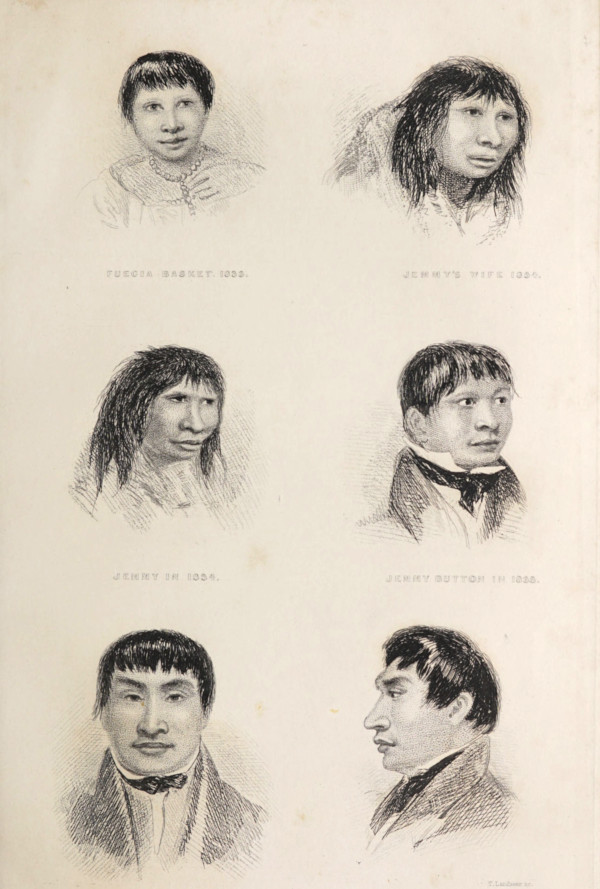
York Minster
26
Boat Memory
20
James Button
14
Fuegia Basket (a girl)
9
“I have maintained them entirely at my own expense, and
hold myself responsible for their comfort while away from,
and for their safe return to their own country: and I have
now to request that, as senior officer of the Expedition, you
will consider of the possibility of some public advantage being
derived from this circumstance; and of the propriety of offering
them, with that view, to his Majesty’s Government.
“If you think it proper to make the offer, I will keep them
in readiness to be removed according to your directions.
“I am now to account for my having these Fuegians on
board, and to explain my future views with respect to them.
“In February last, the Beagle being moored in ‘Townshend
Harbour,’ on the south-west coast of Tierra del Fuego,
I sent Mr. Matthew Murray (master), with six men, in a
whale-boat, to Cape Desolation; the projecting part of a small,
but high and rugged island, detached from the main land, and
twelve miles distant from Townshend Harbour.
“Mr. Murray reached the place, and secured his party and
the boat in a cove near the cape: but during a very dark
night, some Fuegians, whose vicinity was not at all suspected,
approached with the dexterous cunning peculiar to savages
and stole the boat.
“Thus deprived of the means of returning to the Beagle,
and unable to make their situation known, Mr. Murray and his
party formed a sort of canoe, or rather basket, with the
branches of trees and part of their canvas tent, and in this
machine three men made their way back to the Beagle, by his
directions: yet, although favoured by the only fine day that
occurred during the three weeks which the Beagle passed in
Townshend Harbour, this basket was twenty hours on its
passage.
“Assistance was immediately given to the master and the
other men, and a chase for our lost boat was begun, which
lasted many days, but was unsuccessful in its object, although
much of the lost boat’s gear was found, and the women and
children of the families from whom it was recovered, were
brought on board as hostages. The men, excepting one of
them, escaped from us, or were absent in our missing boat.
“At the end of February the Beagle anchored in Christmas
Sound; but before this time all our prisoners had escaped, except
three little girls, two of whom we restored to their own tribe,
near ‘Whale-boat Sound,’ and the other is now on board.
“From the first canoe seen in Christmas Sound, one man
was taken as a hostage for the recovery of our boat, and to
become an interpreter and guide. He came to us with little
reluctance, and appeared unconcerned.
“A few days afterwards, traces of our boat were found at
some wigwams on an island in Christmas Sound, and from the
families inhabiting those wigwams I took another young man,
for the same purpose as that above-mentioned. No useful
information respecting our lost boat was, however, gained from
them, before we were obliged to leave that coast, and she
remained the prize of their companions.
“Afterwards, when in Nassau Bay, our captives informed
us that the natives of that part of the coast, and all to the
eastward, were their enemies, and that they spoke a different
language. This intelligence was extremely disappointing, and
made me anxious to persuade one of this eastern tribe to come
on board and stay with us; but I had then no hopes of doing
so, and gave up the idea: however, some time afterwards,
accidentally meeting three canoes, when away in my boat exploring
the Beagle Channel, I prevailed on their occupants to
put one of the party, a stout boy, into my boat, and in return
I gave them beads, buttons, and other trifles. Whether they
intended that he should remain with us permanently, I do not
know; but they seemed contented with the singular bargain,
and paddled again towards the cove from which they had
approached my boat. We pulled on along shore, attended by
other canoes, which had been endeavouring to barter with us
whenever we stopped; but at dusk they ceased following us
and went ashore.
“When about to depart from the Fuegian coast, I decided
to keep these four natives on board, for they appeared to be
quite cheerful and contented with their situation; and I thought
that many good effects might be the consequence of their living
a short time in England. They have lived, and have been
clothed like the seamen, and are now, and have been always,
in excellent health and very happy. They understand why
they were taken, and look forward with pleasure to seeing our
country, as well as to returning to their own.
“Should not his Majesty’s Government direct otherwise, I
shall procure for these people a suitable education, and, after
two or three years, shall send or take them back to their country,
with as large a stock as I can collect of those articles most
useful to them, and most likely to improve the condition of
their countrymen, who are now scarcely superior to the brute
creation.
“I have, &c. Robert Fitz-Roy,
Commander.”
“Phillip Parker King, Esq.
Commander H.M.S. Adventure,
Senior officer of the Expedition.”
This letter was forwarded to the Admiralty by Captain
King, as soon as he arrived in England; and a few days afterwards
the following answer was received.
Admiralty Office, 19th Oct. 1830.
“Sir,
“Having laid before my Lords Commissioners of the Admiralty
your letter and its enclosure from Commander Fitz-Roy,
of the Beagle, relative to the four Indians whom he has
brought from Tierra del Fuego under the circumstances
therein stated; I am commanded to acquaint you that their
Lordships will not interfere with Commander Fitz-Roy’s personal
superintendence of, or benevolent intentions towards
these four people, but they will afford him any facilities
towards maintaining and educating them in England, and will
give them a passage home again.
“I am, &c.
(Signed) John Barrow.”
“To Commander King,
H.M.S.V. Adventure.”
I was, of course, anxious to protect the Fuegians, as far as
possible, from the contagion of any of those disorders, sometimes
prevalent, and which unhappily have so often proved
fatal to the aboriginal natives of distant countries when brought
to Europe; and, immediately after our arrival in England,
they landed with me, after dark, and were taken to comfortable,
airy lodgings, where, next day, they were vaccinated, for
the second time.
Two days afterwards they were carried a few miles into
the country, to a quiet farm-house, where I hoped they would
enjoy more freedom and fresh air, and, at the same time,
incur less risk of contagion than in a populous sea-port town,
where curiosity would be excited.
Meanwhile, the Beagle was stripped and cleared out; and
the Adventure went to Woolwich for a similar purpose, preparatory
to being paid off. On the 27th of October, the Beagle’s
pendant was hauled down; and on the 15th of November, the
Adventure was put out of commission.
Both vessels’ crews were dispersed, as usual, unfortunately;
and of those who had passed so many rough hours together,
but few were likely to meet again. I much regretted the separation
from my tried and esteemed shipmates, and from our
excellent little vessel.
Soon afterwards, Captain King and Lieutenant Skyring
were promoted: a gratifying proof of the good opinion of their
exertions and conduct, which was entertained by the Lords
Commissioners of the Admiralty.
Early in November I received the sad intelligence that the
young man, called Boat Memory, was taken ill; and that the
symptoms of his disorder were like those of the small-pox.
Dr. Armstrong, of the Royal Hospital at Plymouth, whose
advice I solicited, suggested that he and the other three Fuegians
should be received immediately into the hospital, with
the view of preventing further infection, and ensuring the best
treatment for the poor sufferer. Dr. Armstrong applied to
the physician, Dr. Dickson (now Sir David Dickson), as well
as Sir James Gordon, the superintendent, and by their advice
and permission the Fuegians were removed into the hospital
without delay; and an application was made to the Admiralty,
of which the following is a copy.
“Devonport, 7th Nov. 1830.
“Sir,
“I have the honour of addressing you to request that the
four Fuegians, whom I brought to England in the Beagle,
may be received into the Royal Naval Hospital.
“The Lords Commissioners of the Admiralty have stated
in a letter to Commander King, dated 19th Oct. 1830, that
‘their Lordships will not interfere with Commander Fitz-Roy’s
personal superintendance of, or benevolent intentions towards
these four people, but they will afford him any assistance in
maintaining and educating them in England, and will give
them a passage home again.’
“In consequence of this assurance, I now beg that you will
draw their Lordships’ attention to the circumstance of an eruption
having broken out upon one of the Fuegian men, since he
was vaccinated, which is supposed, by the medical officers of
the hospital, to be the small-pox.
“As the other three individuals have been always in company
with him, it is to be feared that they also are affected;
and as the vaccination has not yet taken a proper effect, it is
the opinion of the medical officers that it would be safer to
receive them into the hospital, until the present critical period
is passed, than to allow them to remain in private care.
“I have further to request, that my late coxswain, James
Bennett, may be permitted to accompany, and remain with the
Fuegians, in order to attend upon them, in the event of their
Lordships allowing them to be admitted into the hospital; and
I hope, Sir, that the peculiar nature of the case may be thought
to justify this application.
“I have, &c. Robert Fitz-Roy, Commander.”
“The Secretary
of the Admiralty.
Admiralty-Office, 10th Nov. 1830.
“Sir,
“I am commanded by my Lords Commissioners of the
Admiralty to acquaint you, in answer to your letter of this
day’s date, that directions have been given for the admission of
the four Fuegians therein alluded to, into the Naval Hospital
at Plymouth, and that James Bennett be allowed to attend
them, agreeably with your request.
“I am, Sir, &c.
(Signed) “John Barrow.”
“Commander Fitz-Roy.
The Admiralty having thus sanctioned the admission of the
Fuegians into one of the best hospitals, and assured that
they could not be under better treatment than that of the
well-known gentlemen whom I have mentioned, I felt less
anxiety in leaving them for a time, as I was obliged to do, in
order to attend to duties connected with the survey; but I
had hardly reached London, when a letter from Dr. Dickson
informed me of the untimely fate of Boat Memory. He had
been vaccinated four different times; but the three first operations
had failed, and the last had just taken effect, when the
disease showed itself. It was thought that the fatal contagion
must have attacked him previously.
This poor fellow was a very great favourite with all who
knew him, as well as with myself. He had a good disposition,
very good abilities, and though born a savage, had a pleasing,
intelligent appearance. He was quite an exception to
the general character of the Fuegians, having good features
and a well-proportioned frame. It may readily be supposed
that this was a severe blow to me, for I was deeply sensible of
the responsibility which had been incurred; and, however unintentionally,
could not but feel how much I was implicated in
shortening his existence. Neither of the others were attacked,
the last vaccination having taken full effect; but they were
allowed to remain in the hospital for some time longer, until I
could make satisfactory arrangements for them. While they
were under Dr. Dickson’s care, in the hospital, his own children
had the measles; and thinking that it would be a good
opportunity to carry the little Fuegian girl through that illness,
he prepared her for it, and then took her into his house,
among his own children; where she had a very favourable
attack, and recovered thoroughly.
Of course, I was anxious that no time should be lost in
arranging a plan for their education and maintenance; and
deeming the Church Missionary Society to be in some measure
interested about the project I had in view, I applied to their
secretary, through whose kindness I became acquainted with
the Rev. Joseph Wigram; to whom I am under great obligations
for the friendly interest taken at that time in my wishes
with respect to the Fuegians, and for introducing them and myself
to the notice of the Rev. William Wilson, of Walthamstow.
Mr. Wilson at once relieved my mind from a load of uncertainty
and anxiety, by saying that they should be received
into his parish, and that he would talk to the master of the
Infant School about taking them into his house, as boarders
and pupils. In a short time, it was arranged that the schoolmaster
should receive, and take entire charge of them, while
they remained in England, and should be paid by me for their
board and lodging, for his own trouble, and for all contingent
expenses.
Mr. Wilson proposed to keep a watchful eye over them
himself, and give advice from time to time to their guardian
and instructor. Mr. Wigram also lived at Walthamstow, and
as he would have frequent opportunities of offering a useful
caution, in case that the numerous calls upon Mr. Wilson’s
attention should at any time render additional thoughts for the
Fuegians an unfair or unpleasant trouble to him—I did
indeed think that no plan could be devised offering a better
prospect; and immediately made arrangements for conveying
them to London.
The inside of a stage-coach was taken, and under the
guidance of Mr. Murray (the Beagle’s late master), attended
by James Bennett, they arrived in Piccadilly, and were immediately
carried to Walthamstow, without attracting any notice.
Mr. Murray told me that they seemed to enjoy their journey
in the coach, and were very much struck by the repeated
changing of horses.
I took them myself from the coach-office to Walthamstow;
they were glad to see me, but seemed bewildered by the multitude
of new objects. Passing Charing Cross, there was a
start and exclamation of astonishment from York. ‘Look!’
he said, fixing his eyes on the lion upon Northumberland
House, which he certainly thought alive, and walking there.
I never saw him show such sudden emotion at any other time.
They were much pleased with the rooms prepared for them
at Walthamstow; and the schoolmaster and his wife were
equally pleased to find the future inmates of their house very
well disposed, quiet, and cleanly people; instead of fierce and
dirty savages.
At Walthamstow they remained from December 1830 till
October 1831; and during all that time were treated with the
utmost kindness by the benevolent men whose names I have
mentioned; by their families, and by many others in the
neighbourhood, as well as casual visitors, who became much
interested in their welfare, and from time to time gave them
several valuable presents.
The attention of their instructor was directed to teaching
them English, and the plainer truths of Christianity, as the
first object; and the use of common tools, a slight acquaintance
with husbandry, gardening, and mechanism, as the
second. Considerable progress was made by the boy and girl;
but the man was hard to teach, except mechanically. He took
interest in smith’s or carpenter’s work, and paid attention to
what he saw and heard about animals; but he reluctantly
assisted in garden work, and had a great dislike to learning to
read. By degrees, a good many words of their own languages
were collected (the boy’s differed from that of the man and the
girl), and some interesting information was acquired, respecting
their own native habits and ideas. They gave no particular
trouble; were very healthy; and the two younger ones
became great favourites wherever they were known. Sometimes
I took them with me to see a friend or relation of my own,
who was anxious to question them, and contribute something
to the increasing; stock of serviceable articles which I was
collecting for their use, when they should return to Tierra del
Fuego. My sister was a frequent benefactress; and they often
talked, both then and afterwards, of going to see ‘Cappen
Sisser.’
During the summer of 1831, his late Majesty expressed to
Colonel Wood a wish to see the Fuegians, and they were
taken to St. James’s. His Majesty asked a great deal about
their country, as well as themselves; and I hope I may be
permitted to remark that, during an equal space of time, no
person ever asked me so many sensible and thoroughly pertinent
questions respecting the Fuegians and their country also
relating to the survey in which I had myself been engaged, as
did his Majesty. Her Majesty Queen Adelaide also honoured
the Fuegians by her presence, and by acts of genuine kindness
which they could appreciate, and never forgot. She left the
room, in which they were, for a minute, and returned with one
of her own bonnets, which she put upon the girl’s head. Her
Majesty then put one of her rings upon the girl’s finger,
and gave her a sum of money to buy an outfit of clothes when
she should leave England to return to her own country.
I must now revert to matters more immediately connected
with the Beagle’s second voyage.
My own official duties, relating to the survey, were completed
in March 1831; when my late commanding officer,
Captain King, addressed a letter to the Lords Commissioners
of the Admiralty expressive of his approbation of the part I
had taken, under his direction, and recommending me to their
Lordships.[1]
From various conversations which I had with Captain King,
during the earlier period of my service under him, I had been
led to suppose that the survey of the southern coasts of South
America would be continued; and to some ship, ordered upon
such a service, I had looked for an opportunity of restoring
the Fuegians to their native land.
Finding, however, to my great disappointment, that an
entire change had taken place in the views of the Lords of
the Admiralty, and that there was no intention to prosecute
the survey, I naturally became anxious about the Fuegians;
and, in June, having no hopes of a man-of-war being sent to
Tierra del Fuego, and feeling too much bound to these
natives to trust them in any other kind of vessel, unless with
myself—because of the risk that would attend their being
landed anywhere, excepting on the territories of their own
tribes—I made an agreement[2] with the owner of a small
merchant-vessel, the John of London, to carry me and five
other persons to such places in South America as I wished to
visit, and eventually to land me at Valparaiso.
My arrangements were all made, and James Bennett, who
was to accompany me, had already purchased a number of
goats, with which I purposed stocking some of the islands of
Tierra del Fuego—when a kind uncle, to whom I mentioned
my plan, went to the Admiralty, and soon afterwards told me
that I should be appointed to the command of the Chanticleer,
to go to Tierra del Fuego.
My agreement with the owner of the John was, however,
in full force, and I could not alter it without paying a large
proportion of the whole sum agreed on for the voyage.
The Chanticleer was not, upon examination, found quite
fit for service; and, instead of her, I was again appointed to
my well-tried little vessel, the Beagle. My commission was
dated the 27th of June, and on the same day two of my most
esteemed friends, Lieutenants Wickham and Sulivan, were
also appointed.
While the Beagle was fitting out at Devonport, I received
the following letter from Mr. Wilson.
Walthamstow, 5th Aug. 1831.
“Sir,
“I am informed that the Fuegians who have been lately
resident in this place are shortly to return to their native
country under your care. Will you permit me to ask whether,
if two individuals should volunteer to accompany and remain
with them, in order to attempt to teach them such useful arts as
may be thought suited to their gradual civilization, you will
give them a passage in the Beagle? and whether, upon your
arrival on the coast of Tierra del Fuego, you will be able to
give them some assistance in establishing a friendly intercourse
with, and settlement amongst the natives of that country?
Would these individuals be required to pay you for their passage,
and maintenance on board? or would his Majesty’s
Government allow them to be maintained on board at the
public expense? Do you think that you would be able to visit
them, after their first settlement, supposing so desirable an
object should be attained, in order to give them some encouragement,
and perhaps assistance; or to remove them if they
should find it impracticable to continue their residence among
the natives?
“A subscription has been set on foot by gentlemen who are
extremely desirous that this opportunity of extending the
benefits of civilization should not be lost; and, in consequence
of their united wishes, I now take the liberty of asking these
questions.
“I am, &c.
(Signed) “William Wilson.”
“To Captain Fitz-Roy, R.N.”
After reading this communication, I wrote to the Secretary
of the Admiralty, and enclosed a copy of Mr. Wilson’s letter.
The answer is subjoined.
Admiralty Office, 10th Aug. 1831.
“Sir,
“Having laid before my Lords Commissioners of the Admiralty
your letter of yesterday’s date, with the letter which
accompanied it, from the Rev. William Wilson, respecting the
natives of Tierra del Fuego who were brought to England in
his Majesty’s ship Beagle; I am commanded to acquaint you
that their Lordships will give the necessary orders for the passage
of these individuals, and of the two persons who are to
accompany them; and that your request to be allowed to visit
these people, after their arrival, will be taken into consideration
in preparing your instructions.
“I am, &c.
(Signed) “John Barrow.”
“To Commander Fitz-Roy,
“H.M.S. Beagle.”
In consequence of this reply, it was wished that two persons
should accompany the Fuegians, and endeavour to pass
some time in their country: but it was not easy to find individuals
sufficiently qualified, and in whom confidence could
be placed, who would willingly undertake such an enterprise.
One young man was selected by Mr. Wilson, but a
companion for him could not be found in time to embark on
board the Beagle.
In October the party from Walthamstow arrived, in a
steam-vessel, at Plymouth, and not a few boats were required
to transport to our ship the large cargo of clothes, tools,
crockery-ware, books, and various things which the families
at Walthamstow and other kind-hearted persons had given.
In the small hold of the Beagle, it was not easy to find places
for the stowage of so many extra stores; and when dividing the
contents of large chests, in order to pack them differently,
some very fair jokes were enjoyed by the seamen, at the expense
of those who had ordered complete sets of crockery-ware,
without desiring that any selection of articles should be
made.
Instructions were given, by the Secretary of the Church
Missionary Society, to the young man who wished to accompany
the Fuegians, which will be found in the Appendix;
and although he was rather too young, and less experienced
than might have been wished, his character and conduct had
been such as to give very fair grounds for anticipating that
he would, at least, sincerely endeavour to do his utmost in
a situation so difficult and trying as that for which he volunteered.
Hydrographer’s Opinion—Continuation of Survey—Chain of Meridian
Distances—Efficient Arrangements—Repair and raise
Deck—Outfit—Boats—Lightning-Conductors—Rudder—Stove—Windlass—Chronometers—Mr. Darwin—Persons
on board—Changes—List of those who returned—Supplies—Admiralty
Instructions—Memorandum—Hydrographer’s Memorandum.
When it was decided that a small vessel should be sent to
Tierra del Fuego, the Hydrographer of the Admiralty was
referred to for his opinion, as to what addition she might make
to the yet incomplete surveys of that country, and other places
which she might visit.
Captain Beaufort embraced the opportunity of expressing
his anxiety for the continuance of the South American Surveys,
and mentioning such objects, attainable by the Beagle, as he
thought most desirable: and it was soon after intimated to me
that the voyage might occupy several years. Desirous of adding
as much as possible to a work in which I had a strong
interest, and entertaining the hope that a chain of meridian distances
might be carried round the world if we returned to
England across the Pacific, and by the Cape of Good Hope;
I resolved to spare neither expense nor trouble in making our
little Expedition as complete, with respect to material and
preparation, as my means and exertions would allow, when
supported by the considerate and satisfactory arrangements of
the Admiralty: which were carried into effect (at that time)
by the Navy Board, the Victualling Board, and the Dock-yard
officers at Devonport.
The Beagle was commissioned on the 4th of July 1831,
and was immediately taken into dock to be thoroughly examined,
and prepared for a long period of foreign service. As
she required a new deck, and a good deal of repair about the
upper works, I obtained permission to have the upper-deck
raised considerably,[1] which afterwards proved to be of the
greatest advantage to her as a sea boat, besides adding so materially
to the comfort of all on board. While in dock, a sheathing
of two-inch fir plank was nailed on the vessel’s bottom, over
which was a coating of felt, and then new copper. This sheathing
added about fifteen tons to her displacement, and nearly
seven to her actual measurement. Therefore, instead of 235
tons, she might be considered about 242 tons burthen. The rudder
was fitted according to the plan of Captain Lihou: a patent
windlass supplied the place of a capstan: one of Frazer’s
stoves, with an oven attached, was taken instead of a common
‘galley’ fire-place; and the lightning-conductors, invented by
Mr. Harris, were fixed in all the masts, the bowsprit, and even
in the flying jib-boom. The arrangements made in the fittings,
both inside and outside, by the officers of the Dock-yard, left
nothing to be desired. Our ropes, sails, and spars, were the
best that could be procured; and to complete our excellent
outfit, six superior boats[2] (two of them private property)
were built expressly for us, and so contrived and stowed that
they could all be carried in any weather.
Considering the limited disposable space in so very small a
ship, we contrived to carry more instruments and books than
one would readily suppose could be stowed away in dry and
secure places; and in a part of my own cabin twenty-two
chronometers were carefully placed.
Anxious that no opportunity of collecting useful information,
during the voyage, should be lost; I proposed to the
Hydrographer that some well-educated and scientific person
should be sought for who would willingly share such accommodations
as I had to offer, in order to profit by the opportunity
of visiting distant countries yet little known. Captain
Beaufort approved of the suggestion, and wrote to Professor
Peacock, of Cambridge, who consulted with a friend, Professor
Henslow, and he named Mr. Charles Darwin, grandson
of Dr. Darwin the poet, as a young man of promising ability,
extremely fond of geology, and indeed all branches of natural
history. In consequence an offer was made to Mr. Darwin to
be my guest on board, which he accepted conditionally; permission
was obtained for his embarkation, and an order given
by the Admiralty that he should be borne on the ship’s books
for provisions. The conditions asked by Mr. Darwin were, that
he should be at liberty to leave the Beagle and retire from the
Expedition when he thought proper, and that he should pay a
fair share of the expenses of my table.
Knowing well that no one actively engaged in the surveying
duties on which we were going to be employed, would have
time—even if he had ability—to make much use of the pencil,
I engaged an artist, Mr. Augustus Earle, to go out in a private
capacity; though not without the sanction of the Admiralty,
who authorized him also to be victualled. And in order to
secure the constant, yet to a certain degree mechanical attendance
required by a large number of chronometers, and to be
enabled to repair our instruments and keep them in order, I engaged
the services of Mr. George James Stebbing, eldest son of
the mathematical instrument-maker at Portsmouth, as a private
assistant.
The established complement of officers and men (including
marines and boys) was sixty-five: but, with the supernumeraries
I have mentioned, we had on board, when the Beagle
sailed from England, seventy-four persons, namely:—
Robert Fitz-Roy
Commander and Surveyor.
John Clements Wickham
Lieutenant.
Bartholomew James Sulivan
Lieutenant.
Edward Main Chaffers
Master.
Robert Mac-Cormick
Surgeon.
George Rowlett
Purser.
Alexander Derbishire
Mate.
Peter Benson Stewart
Mate.
John Lort Stokes
Mate and Assistant Surveyor.
Benjamin Bynoe
Assistant Surgeon.
Arthur Mellersh
Midshipman.
Philip Gidley King
Midshipman.
Alexander Burns Usborne
Master’s Assistant.
Charles Musters
Volunteer 1st Class.
Jonathan May
Carpenter.
Edward H. Hellyer
Clerk.
Acting boatswain: sergeant of marines and seven privates:
thirty-four seamen and six boys.
On the List of supernumeraries were—
Charles Darwin
Naturalist.
Augustus Earle
Draughtsman.
George James Stebbing
Instrument Maker.
Richard Matthews and three Fuegians: my own steward: and Mr. Darwin’s servant.
Some changes occurred in the course of the five years’ voyage,
which it may be well to mention in this place.
In April 1832, Mr. Mac-Cormick and Mr. Derbishire
returned to England. Mr. Bynoe was appointed to act as
Surgeon. Mr. Mellersh received a Mate’s warrant; and Mr.
Johnson joined the Beagle as Midshipman. In May Mr.
Musters fell a victim to fever, caught in the harbour of Rio
de Janeiro:—Mr. Forsyth took his place.
Mr. Earle suffered so much from continual ill health, that
he could not remain on board the Beagle after August 1832;
but he lived at Monte Video several months previously to his
return to England. The disappointment caused by losing his
services was diminished by meeting Mr. Martens at Monte
Video, and engaging him to embark with me as my draughtsman.
In March 1833, Mr. Hellyer was drowned at the Falkland
Islands, in attempting to get a bird he had shot. In September
1833, Mr. Kent joined as Assistant Surgeon. In June 1834,
Mr. Rowlett died, at sea, of a complaint under which he had
laboured for years: and the vacancy caused by his lamented
decease was filled by Mr. Dring.
Mr. Martens left me,
at Valparaiso, in 1834; and Mr.
King remained with his father, at Sydney, in Australia, in
February 1836. After these changes, and at our return to
England in October 1836, the list stood thus—
Robert Fitz-Roy
Captain and Surveyor.
John Clements Wickham
Lieutenant.
Bartholomew James Sulivan
Lieutenant.
Edward Main Chaffers
Master.
Benjamin Bynoe
Surgeon (Acting.)
John Edward Dring
Purser (Acting.)
Peter Benson Stewart
Mate.
John Lort Stokes
Mate and Assistant Surveyor.
Arthur Mellersh
Mate.
Charles Richardson Johnson
Mate.
William Kent
Assistant Surgeon.
Charles Forsyth
Midshipman.
Alexander Burns Usborne
Master’s Assistant.
Thomas Sorrell
Boatswain (Acting.)
Jonathan May
Carpenter.
And on the List of supernumeraries were Mr. Darwin: George
J. Stebbing: my steward: and Mr. Darwin’s servant.
Our complement of seamen, marines, and boys was complete
at our return, and generally during the voyage; because,
although many changes happened, we had always a choice
of volunteers to fill vacant places.
Many of the crew had sailed with me in the previous voyage
of the Beagle; and there were a few officers, as well as
some marines and seamen, who had served in the Beagle, or
Adventure, during the whole of the former voyage. These
determined admirers of Tierra del Fuego were, Lieutenant
Wickham, Mr. Bynoe, Mr. Stokes, Mr. Mellersh, and Mr.
King; the boatswain, carpenter, and sergeant; four private
marines, my coxswain, and some seamen.
I must not omit to mention that among our provisions were
various antiscorbutics—such as pickles, dried apples, and
lemon juice—of the best quality, and in as great abundance
as we could stow away; we had also on board a very large
quantity of Kilner and Moorsom’s preserved meat, vegetables,
and soup: and from the Medical Department we received an
ample supply of antiseptics, and articles useful for preserving
specimens of natural history.
Not only the heads of departments exerted themselves for
the sake of our health and safety, but the officers subordinate
to them appeared to take a personal interest in the Beagle; for
which I and those with me felt, and must always feel, most
grateful.
Perhaps no vessel ever quitted her own country with a
better or more ample supply (in proportion to her probable
necessities) of every kind of useful provision and stores than
the little ship of whose wanderings I am now about to give a
brief and very imperfect narrative; and, therefore, if she
succeeded in effecting any of the objects of her mission, with
comparative ease and expedition, let the complete manner in
which she was prepared for her voyage, by the Dock-yard at
Devonport, be fully remembered.
On the 15th of November I received my instructions from
the Lords Commissioners of the Admiralty.
INSTRUCTIONS
By the Commissioners for executing the office of Lord
High Admiral of the United Kingdom of Great Britain
and Ireland, &c.
“You are hereby required and directed to put to sea, in the
vessel you command, so soon as she shall be in every respect
ready, and to proceed in her, with all convenient expedition,
successively to Madeira or Teneriffe; the Cape de Verde
Islands; Fernando Noronha; and the South American station;
to perform the operations, and execute the surveys,
pointed out in the accompanying memorandum, which has
been drawn up under our direction by the Hydrographer of
this office; observing and following, in the prosecution of the
said surveys, and in your other operations, the directions and
suggestions contained in the said memorandum.
“You are to consider yourself under the command of Rear-Admiral
Sir Thomas Baker, Commander-in-chief of his
Majesty’s ships on the South American station, whilst you are
within the limits of that station, in execution of the services
above-mentioned; and in addition to the directions conveyed to
you in the memorandum, on the subject of your supplies of
provisions, we have signified to the Rear-Admiral our desire
that, whenever the occasion offers, you should receive from
him and the officers of his squadron, any assistance, in stores
and provisions, of which you may stand in need.
“But during the whole time of your continuing on the
above duties, you are (notwithstanding the 16th article of the
4th section of the 6th chapter, page 78, of the General Printed
Instructions) to send reports, by every opportunity, to our
Secretary, of your proceedings, and of the progress you make.
“Having completed the surveys which you are directed to
execute on the South American station, you are to proceed to
perform the several further operations set forth in the Hydrographer’s
memorandum, in the course therein pointed out; and
having so done, you are to return, in the vessel you command,
to Spithead, and report your arrival to our Secretary, for our
information and further directions.
“In the event of any unfortunate accident happening to
yourself, the officer on whom the command of the Beagle
may in consequence devolve, is hereby required and directed
to complete, as far as in him lies, that part of the survey on
which the vessel may be then engaged, but not to proceed to a
new step in the voyage; as, for instance, if at that time carrying
on the coast survey on the western side of South America,
he is not to cross the Pacific, but to return to England by
Rio de Janeiro and the Atlantic.
“Given under our hands, the 11th of November 1831. (Signed) “T. M. Hardy, “G. Barrington.”
“To Robert Fitz-Roy, Esq.,
Commander of his Majesty’s surveying vessel
‘Beagle,’ at Plymouth.”
“By command of their Lordships,
(Signed) “Geo. Elliot.”
Admiralty Office, 11th November 1831.
“Sir;
“With reference to the order which my Lords Commissioners
of the Admiralty have this day addressed to you, I am
commanded by their lordships to transmit to you a memorandum,
to be shown by you to any senior officer who may fall in
with you, while you are employed on the duties pointed out in
the above order.
“Admiralty Office, 11th November 1831. “Memorandum.
“My Lords Commissioners of the Admiralty having ordered
Commander Fitz-Roy, of his Majesty’s surveying vessel the
‘Beagle,’ to make surveys of various parts of the South American
station, it is their lordships’ direction that no senior
officer who may fall in with Commander Fitz-Roy, while he
is employed in the above important duties, do divert him
therefrom, or in any way interfere with him, or take from him,
on any account, any of his instruments or chronometers.
(Signed) “Geo. Elliot.”
“Memorandum.
“A considerable difference still exists in the longitude of
Rio de Janeiro, as determined by Captains King, Beechey,
and Foster, on the one hand, and Captain W. F. Owen, Baron
Roussin, and the Portuguese astronomers, on the other; and
as all our meridian distances in South America are measured
from thence, it becomes a matter of importance to decide between
these conflicting authorities. Few vessels will have ever
left this country with a better set of chronometers, both public
and private, than the Beagle; and if her voyage be made in
short stages, in order to detect the changes which take place
in all chronometers during a continuous increase of temperature,
it will probably enable us to reduce that difference within
limits too small to be of much import in our future conclusions.
“With this view, the run to Rio de Janeiro may be conveniently
divided into four parts:—
“1st. Touching at Madeira, the exact position of which
has been admitted by all parties. Having obtained a four days’
rate there, or, if the weather and the exposed anchorage will
not permit, at Teneriffe, the Beagle should, 2dly, proceed with
the least possible delay to Port Praya, in the Cape de Verde
Islands, not only to establish a fresh four days’ rate; but that
point being the pivot on which all Captain Owen’s longitudes
turn, no pains should be spared in verifying the position he
has assumed for it. From thence, 3dly, she should make the
best of her way across the Line to Fernando Noronha. This
island, indeed, lies somewhat to the westward of her track, and
may retard her progress a little; yet a series of chronometric
observations there is essential to the object in view, because it
forms the third nearly equal division of the whole run, and
because it was the point of junction of Commander Foster’s
double line of longitudes. If two or three days’ delay at either
of these two last stations will enable him to obtain satisfactory
occultations, and moon culminating observations, which are
likely to be seen in this country, the increased certainty of the
results will well atone for that loss of time. The Commander
will, of course, be careful to adopt, in all those stations, the
precise spot of the former observations, with which his are to
be compared. The Governor of Fernando Noronha was peculiarly
obliging to Commander Foster, and gave up part of his
own house for the pendulum experiments. There will be no
occasion now for trespassing so heavily on his kindness; but
the difference of longitude between that station and Commander
Fitz-Roy’s must be well measured.
“However desirable it may be that the Beagle should reach
Rio de Janeiro as soon as possible, yet the great importance of
knowing the true position of the Abrolhos Banks, and the
certainty that they extend much further out than the limits
assigned to them by Baron Roussin, will warrant the sacrifice
of a few days, if other circumstances should enable her to
beat down about the meridian of 36° W. from the latitude of
16° S. The deep sea-line should be kept in motion; and if
soundings be obtained, the bank should be pursued both ways,
out to the edge, and in to that part already known.
“Its actual extent to the eastward, and its connection with
the shoals being thus ascertained, its further investigation may
be left to more convenient opportunities.
“At Rio de Janeiro, the time necessary for watering, &c.
will, no doubt, be employed by the commander in every species
of observation that can assist in deciding the longitude of Villegagnon
Island.
“It is understood that a French Expedition is now engaged
in the examination of the coast between St. Catherine’s and
the Rio de la Plata; it would therefore be a waste of means
to interfere with that interval; and Commander Fitz-Roy
should be directed to proceed to Monte Video, and to rate
his chronometers in the same situation occupied by Captain
King.
“To the southward of the Rio de la Plata, the real work of
the survey will begin. Of that great extent of coast which
reaches from Cape St. Antonio to St. George’s bay, we only
know that it is inaccurately placed, and that it contains some
large rivers, which rise at the other side of the continent, and
some good harbours, which are undoubtedly worth a minute
examination. Much of it, however, from the casual accounts
of the Spaniards, seems to offer but little interest either to
navigation or commerce, and will scarcely require more than
to have its direction laid down correctly, and its prominent
points fixed. It should nevertheless be borne in mind there,
and in other places, that the more hopeless and forbidding any
long line of coast may be, the more precious becomes the
discovery of a port which affords safe anchorage and wholesome
refreshments.
“The portions of the coast which seem to require particular
examination are—
“1st. From Monte Hermoso to the Rio Colorado, including
the large inlet of Bahia Blanco, of which there are three manuscripts
in this office that differ in every thing but in name.
“2dly. The gulf of Todos los Santos, which is studded in
the Spanish charts with innumerable islands and shoals. It is
said to have an excellent harbour on its southern side, which
should be verified; but a minute survey of such an Archipelago
would be a useless consumption of time, and it will therefore
be found sufficient to give the outer line of the dangers, and to
connect that line with the regular soundings in the offing.
“3dly. The Rio Negro is stated to be a river of large
capacity, with settlements fifty miles from its mouth, and
ought to be partially reconnoitred as far as it is navigable.
“4thly. The gulf of San Matias should be examined, especially
its two harbours, San Antonio and San José, and a narrow
inlet on the eastern side of the peninsula, which, if easy
of access, appears to be admirably situated: and—
“5thly. From the Bahia Nueva to Cape Blanco, including
the Gulf of St. George, the coast is of various degrees of
interest, and will accordingly require to have more or less
time bestowed on its different parts. The position of Cape
Blanco should be determined, as there appears to be an error
of some miles in its latitude, as well as much doubt about the
places of two shoals which are marked near it in the Spanish
charts.
“From Cape Blanco to the Strait of Magalhaens, the coast
has been partially corrected by Captain King; and Port
Desire, having been carefully placed by him, will afford a good
place for rating the chronometers, and an opportunity for exploring
the river.
“Port San Julian, with its bar and wide river, should be
surveyed, as well as any parts of that interval which were not
visited in the last expedition.
“The above are the principal points of research between
the Rio de la Plata and the Strait. They have been consecutively
mentioned in order to bring them into one point of
view; but that part of this service would perhaps be advantageously
postponed till after the Beagle’s first return from
the southward; and, generally speaking, it would be unwise
to lay down here a specific route from which no deviation
would be permitted. Where so many unforeseen circumstances
may disturb the best-concerted arrangements, and where so
much depends on climates and seasons with which we are not
yet intimately acquainted, the most that can be safely done is
to state the various objects of the voyage, and to rely on the
Commander’s known zeal and prudence to effect them in the
most convenient order.
“Applying this principle to what is yet to be done in the
Strait, and in the intricate group of islands which forms the
Tierra del Fuego, the following list will show our chief desiderata.
“Captain King, in his directions, alludes to a reef of half a
mile in length, off Cape Virgins, and in his chart he makes a
seven fathoms’ channel outside that reef; and still further out,
five fathoms with overfalls. Sarmiento places fifty fathoms at
ten miles E.S.E. from that Cape; thirteen fathoms at nineteen
miles; and, at twenty-one miles in the same direction, only
four fathoms, besides a very extensive bank projecting from
Tierra del Fuego, between which and the above shoals Malaspina
passed in thirteen fathoms. In short, there is conclusive
evidence of there being more banks than one that obstruct the
entrance to the Strait, and undoubtedly their thorough examination
ought to be one of the most important objects of the
Expedition; inasmuch, as a safe approach to either straits or
harbours is of more consequence to determine than the details
inside.
“None of the above authors describe the nature of these
shoals, whether rock or sand; it will be interesting to note
with accuracy the slope, or regularity, of the depths, in their
different faces, the quality of their various materials, and the
disposition of the coarse or fine parts, as well as of what species
of rock in the neighbourhood they seem to be the detritus;
for it is probable that the place of their deposition is connected
with the very singular tides which seem to circulate in the
eastern end of the Strait.
“Beginning at Cape Orange, the whole north-eastern coast
of Tierra del Fuego as far as Cape San Diego should be surveyed,
including the outer edge of the extensive shoals that
project from its northern extreme, and setting at rest the
question of the Sebastian Channel.
“On the southern side of this great collection of islands,
the Beagle Channel and Whale-boat Sound should be finished,
and any other places which the Commander’s local knowledge
may point out as being requisite to complete his former survey,
and sufficiently interesting in themselves to warrant the time
they will cost; such as some apparently useful ports to the
westward of Cape False, and the north side of Wakefield
Channel, all of which are said to be frequented by the sealers.
“In the north-western part it is possible that other breaks
may be found interrupting the continuity of Sta. Ines Island,
and communicating from the Southern Ocean with the Strait;
these should be fully or cursorily examined, according to their
appearance and promise; and though it would be a very useless
waste of time to pursue in detail the infinite number of bays,
openings, and roads, that teem on the western side of that
island, yet no good harbour should be omitted. It cannot
be repeated too often that the more inhospitable the region, the
more valuable is a known port of refuge.
“In the western division of the Strait, from Cape Pillar
to Cape Froward, there are a few openings which may perhaps
be further explored, on the chance of their leading out to sea;
a few positions which may require to be reviewed; and a few
ports which were only slightly looked into during Captain
King’s laborious and excellent survey, and which may now be
completed, if likely to augment the resources of ships occupied
in those dreary regions.
“In the eastern division of the Strait there is rather more
work to be done, as the Fuegian shore from Admiralty Sound
to Cape Orange has not been touched. Along with this part
of the service, the Islands of Saints Martha and Magdalena,
and the channel to the eastward of Elizabeth Island, will come
in for examination; and there is no part of the Strait which
requires to be more accurately laid down and distinctly described,
from the narrowness of the channels and the transverse
direction of the tides. Sweepstakes Foreland may prove
to be an Island; if so, there may be found an useful outlet to
the long lee-shore that extends from Cape Monmouth; and if
not, perhaps some safe ports might be discovered in that interval
for vessels caught there in strong westerly gales.
“It is not likely that, for the purposes of either war or
commerce, a much more detailed account will be necessary of
those two singular inland seas, Otway and Skyring Waters,
unless they should be found to communicate with one of the
sounds on the western coast, or with the western part of the
Strait. The general opinion in the former Expedition was certainly
against such a communication, and the phenomena of the
tides is also against it; still the thing is possible, and it becomes
an interesting geographical question, which a detached boat in
fine weather will readily solve.
“These several operations may probably be completed in
the summer of 1833-34, including two trips to Monte Video
for refreshments; but before we finally quit the eastern coast
of South America, it is necessary to advert to our present ignorance
of the Falkland Islands, however often they have been
visited. The time that would be occupied by a rigorous survey
of this group of islands would be very disproportionate to its
value; but as they are the frequent resort of whalers, and as
it is of immense consequence to a vessel that has lost her masts,
anchors, or a large part of her crew, to have a precise knowledge
of the port to which she is obliged to fly, it would well
deserve some sacrifice of time to have the most advantageous
harbours and their approaches well laid down, and connected
by a general sketch or running survey. Clear directions for
recognizing and entering these ports should accompany these
plans; and as most contradictory statements have been made
of the refreshments to be obtained at the east and west great
islands, an authentic report on that subject by the Commander
will be of real utility.
“There is reason to believe that deep soundings may be
traced from these islands to the main, and if regular they would
be of great service in rectifying a ship’s place.
“Having now stated all that is most urgent to be done on
this side of the South American Continent as well as in the
circuit of Tierra del Fuego, the next step of the voyage will be
Concepçion, or Valparaiso, to one of which places the Beagle
will have to proceed for provisions, and where Captain King
satisfactorily determined the meridian distances.
“The interval of coast between Valparaiso and the western
entrance of the Strait has been partly surveyed, as well as
most of the deep and narrow channels formed by the islands of
Hanover, Wellington, and Madre de Dios; but of the sea
face of that great chain of islands which stretches from Queen
Adelaide Archipelago to Campana Island, little has yet been
done. It presents a most uninviting appearance, can probably
afford but little benefit to the navigator, and the chief object
in urging its partial examination, is to remove a blank from
this great survey, which was undertaken by Great Britain from
such disinterested motives, and which was executed by Captains
King and Fitz-Roy with so much skill and zeal.
“The experience gained by the latter in that climate will
enable him to accomplish all that is now required in much less
time than it would have occupied in the beginning of the
former expedition.
“At the Gulf of Peñas the last survey terminated. Of the
peninsula de Tres Montes, and of the islands between that and
Chilóe, a Spanish manuscript has been procured from Don
Felipe Bauzá, which may greatly abridge the examination of
that interval.
“From thence to Valdivia, Concepçion, and Valparaiso, the
shore is straight, and nearly in the direction of the meridian,
so that it will require no great expenditure of time to correct
the outline, and to fix the positions of all the salient points.
Mocha Island is supposed to be erroneously placed: and the
depth, breadth, and safety of its channel are not known.
“To the south of Valparaiso the port of Topocalmo and the
large shoal in the offing on which an American ship was
wrecked, require special examination; and according to Captain
Burgess, of the Alert, the coast and islands near Coquimbo
are very imperfectly laid down. Indeed of the whole of this
coast, the only general knowledge we have is from the Spanish
charts, which seem, with the exception of certain ports, to
have been merely the result of a running view of the shore.
Of this kind of half-knowledge we have had too much: the
present state of science, which affords such ample means, seems
to demand that whatever is now done should be finally done;
and that coasts, which are constantly visited by English vessels,
should no longer have the motley appearance of alternate
error and accuracy. If, therefore, the local Governments make
no objections, the survey should be continued to Coquimbo,
and indefinitely to the northward, till that period arrives when
the Commander must determine on quitting the shores of South
America altogether. That period will depend on the time that
has been already consumed, and on the previous management
of his resources, reserving sufficient to ensure his obtaining a
series of well-selected meridian distances in traversing the Pacific
Ocean.
“The track he should pursue in executing this important
duty cannot well be prescribed here, without foreseeing to
what part of the coast he may have pushed the survey, and
at what place he may find it convenient to take in his last
supplies. If he should reach Guayaquil, or even Callao, it
would be desirable he should run for the Galapagos, and, if
the season permits, survey that knot of islands. Felix Island,
the London bank seen by the brig Cannon, in 1827, in 27° 6′
S. 92° 16′ W., even with the water’s edge, and half a mile in
length; some coral islands, supposed to be 5° or 6° south of
Pitcairn Island, and other spots, which have crept into the
charts on doubtful authority, would all be useful objects of
research if the Beagle’s route should fall in their vicinity. But
whatever route may be adopted, it should conduct her to
Tahiti, in order to verify the chronometers at Point Venus, a
point which may be considered as indisputably fixed by Captain
Cook’s and by many concurrent observations. Except in
this case, she ought to avoid as much as possible the ground
examined by Captain Beechey.
“From Tahiti the Beagle should proceed to Port Jackson
touching at some of the intervening islands, in order to divide
the run into judicious chronometer stages; for the observatory
at Paramatta (Port Jackson) being absolutely determined in
longitude, all those intervening islands will become standard
points to which future casual voyagers will be able to refer
their discoveries or correct their chronometers.
“From Port Jackson her course will depend on the time of
the year. If it be made by the southward, she might touch at
Hobart Town, King George Sound, and Swan River, to
determine the difference of longitude from thence to the Mauritius,
avoiding the hurricane months; to Table or Simon’s
Bay, according to the season; to St. Helena, Ascension, and
home.
“If she should have to quit Port Jackson about the middle
of the year, her passage must be made through Torres Strait.
In her way thither, if the in-shore route be adopted, there
are several places whose positions it will be advantageous to
determine:—Moreton Bay, Port Bowen, Cape Flinders, and
one of the Prince of Wales Islands; and in pursuing her way
towards the Indian Ocean, unless the wind should hang to the
southward, Cape Valsche or the south-west extreme of New
Guinea, one of the Serwatty Chain, Coupang, or the extreme
of Timor, Rotte Island, and one of the extremes of Sandalwood
Island, may be easily determined without much loss of
time. And, perhaps, in crossing the ocean, if circumstances are
favourable, she might look at the Keeling Islands, and settle
their position.
“Having now enumerated the principal places at which the
Beagle should be directed to touch in her circuit of the globe,
and described the leading operations which it would be desirable
to effect, it remains to make some general remarks on the
conduct of the whole survey.
“In such multiplied employments as must fall to the share
of each officer, there will be no time to waste on elaborate drawings.
Plain, distinct roughs, every where accompanied by
explanatory notes, and on a sufficiently large scale to show the
minutiæ of whatever knowledge has been acquired, will be
documents of far greater value in this office, to be reduced or
referred to, than highly finished plans, where accuracy is often
sacrificed to beauty.
“This applies particularly to the hills, which in general cost
so much labour, and are so often put in from fancy or from
memory after the lapse of months, if not of years, instead of
being projected while fresh in the mind, or while any inconsistencies
or errors may be rectified on the spot. A few strokes
of a pen will denote the extent and direction of the several
slopes much more distinctly than the brush, and if not worked
up to make a picture, will really cost as little or less time. The
in-shore sides of the hills, which cannot be seen from any of
the stations, must always be mere guess-work, and should not
be shown at all.
“It should be considered an essential branch of a nautical
survey, to give the perpendicular height of all remarkable hills
and headlands. It requires but a single angle at each station,
adds much to our geographical knowledge, materially assists
the draftsman, and by tables which are now printing it will
afford to the seaman a ready and exact means of knowing his
distance.
“All charts and plans should be accompanied by views of the
land; those which are to be attached to the former should be
taken at such a distance as will enable a stranger to recognize
the land, or to steer for a certain point; and those best suited
for the plan of a port should show the marks for avoiding dangers,
for taking a leading course, or choosing an advantageous
berth. In all cases the angular distances and the angular
altitudes of the principal objects should be inserted in degrees
and minutes on each of the views, by which means they can be
projected by scale, so as to correct any want of precision in the
eye of the draftsman. Such views cannot be too numerous;
they cost but a few moments, and are extremely satisfactory to
all navigators.
“Trifling as it may appear, the love of giving a multiplicity
of new and unmeaning names tends to confuse our geographical
knowledge. The name stamped upon a place by the
first discoverer should be held sacred by the common consent
of all nations; and in new discoveries it would be far more
beneficial to make the name convey some idea of the nature of
the place; or if it be inhabited, to adopt the native appellation,
than to exhaust the catalogue of public characters or private
friends at home. The officers and crews, indeed, have some
claim on such distinction, which, slight as it is, helps to excite
an interest in the voyage.
“Constant observations on the tides, including their set,
force, and duration, the distance to which they carry salt
water up the rivers, their rise at the different periods of the
lunation, and the extent to which they are influenced by the
periodic winds, by the sea currents, or by the river freshes,
form so prominent a part of every surveyor’s duty, that
no specific directions on this subject can be necessary. Nor
is there any occasion to insist here on the equally important
subject of currents; for it is only by a great accumulation
of data that we can ever hope to reduce them to regular
systems, or that we can detect the mode in which they are
affected by change of seasons, or influenced by distant winds.
“The periods and limits of the monsoons and trade-winds
will naturally be a continual object of the Commander’s observation
and study. It is true that he can only witness what
occurs during his voyage; but besides collecting facts on this
and the last subject, on which others can hereafter reason, it will
be of immense advantage that he should endeavour to digest
them with the remarks of former voyagers when on the spot.
“On the western coast of South America, for instance, some
skill is required in making passages at different periods, and
much scattered experience has been gained by seamen who
have been long occupied there; but this information has not
yet been presented to the public in an intelligible form; and
it seems to be the peculiar province of an officer expressly employed
on a scientific mission like this, to combine that information
with his own, and to render it accessible to every navigator.
“The local attraction of the Beagle will of course have
been ascertained before she leaves England; but when favourable
opportunities occur, it will be satisfactory to swing her
again in different latitudes, and under large differences of
variation.
“No day should pass at sea without a series of azimuths,
and no port should be quitted without having ascertained not
only the magnetic angle, but the dip, intensity, and diurnal
variation. If these observations should have been well made
in the same places before, we shall at once obtain the annual
change; and by multiplying them in new places, we shall have
the means of inferring the magnetic curves.
“The Commander has been so accustomed to the management
of chronometers, that there is no doubt, with proper precautions
and with proper formulæ for determining their rates,
that he will succeed in obtaining good results in reasonably
short intervals of time and in gradual changes of temperature;
but after long periods, and sudden changes of heat and cold,
it will be absolutely necessary to check them by astronomical
means.
“Eclipses, occultations, lunar distances, and moon-culminating
stars, will furnish those means in abundance: of all
these, the last can be obtained with the greatest regularity and
certainty; they have become part of the current business at
the establishments of the Cape of Good Hope, Paramatta, and
St. Helena, in the southern hemisphere; probably at Madras,
and in many of the European observatories, and it will therefore
be scarcely possible that there should not be corresponding
observations for all such as he may have made.
“The eclipses of Jupiter’s third and fourth satellites should
also be sedulously observed whenever both immersion and
emersion can be seen, as the different powers of the telescopes
employed by the observers do not in that case affect the
results.
“There are also some remarkable phenomena, which will be
announced in the Nautical Almanacks, and which will occur
during the Beagle’s voyage. Some of these will be highly
interesting to astronomers, and if it would not much derange
her operations, she should be taken to some convenient anchorage
for the purpose of landing the instruments.
“If a comet should be discovered while the Beagle is in
port, its position should be determined every night by observing
its transit over the meridian, always accompanied by the
transits of the nearest known stars, and by circum-meridional
altitudes, or by measuring its angular distance from three well-situated
stars by a sextant. This latter process can be
effected even at sea, and the mean of several observations may
give very near approximations to its real position.
“Meteorological Registers may be of use in a variety of
ways; but then they must be steadily and accurately kept.
The barometer should be read off to the third place of decimals,
and recorded at regular periods of the day; nine o’clock and
four o’clock may be recommended as the best, as being the
usual hours of its maximum and minimum. The temperature
should be marked at the same time, and the extremes of the
self-registering thermometer should be daily recorded; care
being taken that no reflected heat should act on any of these
instruments. The temperature of the sea at the surface ought
to be frequently observed and compared with that of the air.
An officer cruizing on the east coast of South America, between
the parallels of 20° and 35°, was enabled by these means
to predict with singular precision the direction and strength of
the current.
“In this register the state of the wind and weather will, of
course, be inserted; but some intelligible scale should be
assumed, to indicate the force of the former, instead of the
ambiguous terms ‘fresh,’ ‘moderate,’ &c., in using which no
two people agree; and some concise method should also be
employed for expressing the state of the weather. The suggestions
contained in the annexed printed paper are recommended
for the above purposes, and if adopted, a copy should be pasted
on the first page of every volume of the log-book; and the
officer of the watch should be directed to use the same terms in
the columns of the log-board.
“The circularly-formed Coral Islands in the Pacific occasionally
afford excellent land-locked harbours, with a sufficient
entrance, and would be well adapted to any nice astronomical
observations which might require to be carried on in undisturbed
tranquillity. While these are quietly proceeding, and
the chronometers rating, a very interesting inquiry might be
instituted respecting the formation of these coral reefs.
“An exact geological map of the whole island should be
constructed, showing its form, the greatest height to which the
solid coral has risen, as well as that to which the fragments
appear to have been forced. The slope of its sides should be
carefully measured in different places, and particularly on the
external face, by a series of soundings, at very short distances
from each other, and carried out to the greatest possible depths,
at times when no tide or current can affect the perpendicularity
of the line. A modern and very plausible theory has been put
forward, that these wonderful formations, instead of ascending
from the bottom of the sea, have been raised from the summits
of extinct volcanoes; and therefore the nature of the
bottom at each of these soundings should be noted, and every
means exerted that ingenuity can devise of discovering at what
depth the coral formation begins, and of what materials the
substratum on which it rests is composed. The shape, slope,
and elevation of the coral knolls in the lagoon would also help
the investigation; and no circumstances should be neglected
which can render an account of the general structure clear and
perspicuous.
“A set of observations connected with the theory of the
tides might likewise be carried on with peculiar propriety in
one of these coral basins, provided the openings should be
sufficiently wide and deep to admit the flux and reflux without
material impediment. The island selected for such a purpose
should be nearly midway in the ocean, and not very far from
the equator. There the tidal wave, uninfluenced by the interrupting
barrier of one continent, and equally far from the
reaction of the other, might be measured with very beneficial
results. Delicate tide-gauges should be prepared beforehand,
and immediately fixed in some snug nook, where the undulation
of the sea could not reach. The rise and fall of the tide
should be registered every hour, during the stay of the Beagle,
as well as the moments (stated whether in apparent or mean
time) of high and low water, as nearly as they can be obtained;
and the periods at which the sea and land breezes spring up
and fail should likewise be noted, with their effects on the tide,
if they can be detected. A boat should be detached, on each
tide, to some distance from the island, in order to ascertain the
strength and direction of the stream; and all these operations
should be continued, if possible, through a whole lunation.
“Compiling general and particular instructions, for the
navigation of all the places which he may visit, will of course
be an essential part of the Commander’s duty; but he will also
have innumerable opportunities of collecting a variety of
auxiliary information, which, when judiciously combined with
the above instructions, of a purely nautical character, will
much enhance their utility to all classes of vessels. Such as the
general resources on which ships may depend in different
places: the chief productions that can be obtained, and the
objects most anxiously desired in return: the effect of seasons,
of climate, and of peculiar articles of food on the health of the
crew, and many others which will readily occur to his mind,
and which become of great value to a stranger.
“On all the subjects touched on in these memoranda, Commander
Fitz-Roy should be directed to draw up specific reports,
and to transmit them from time to time, through their Lordship’s
Secretary, to the Hydrographic Office, so that if any
disaster should happen to the Beagle, the fruits of the expedition
may not be altogether lost. Besides such reports, and with
the same object in view, he should keep up a detailed correspondence
by every opportunity with the Hydrographer.
“The narrative of every voyage in the Pacific Ocean abounds
with proofs of the necessity of being unremittingly on guard
against the petty treacheries or more daring attacks of the
natives. It should be recollected that they are no longer the
timid and unarmed creatures of former times, but that many of
them now possess fire-arms and ammunition, and are skilful
in the use of them. Temper and vigilance will be the best
preservatives against trivial offences and misunderstandings,
which too often end in fatal quarrels; and true firmness will
abandon objects of small importance, where perseverance must
entail the necessity of violence; for it would be a subject of
deep regret that an expedition devoted to the noblest purpose,
the acquisition of knowledge, should be stained by a single act
of hostility.
(Signed) “F. Beaufort.”
“Hydrographical Office, 11th November 1831.”
FIGURES
TO DENOTE THE FORCE OF THE WIND.
0
Calm.
1
Light Air
Or just sufficient to give steerage way.
2
Light Breeze
}
Or that in which
{
1 to 2 knots.
}
a man-of-war,
{
3
Gentle Breeze
}
with all sail set,
{
3 to 4 knots.
}
and clean full, would go
{
4
Moderate Breeze
}
in smooth water from
{
5 to 6 knots.
5
Fresh Breeze
}
{
Royals, &c.
}
{
6
Strong Breeze
}
Or that to which a well-
{
Single-reefed topsails
}
conditioned man-of-war
{
and top-gall. sails.
7
Moderate Gale
}
could just carry
{
Double-reefed topsails,
}
in chase, full and by
{
jib, &c.
8
Fresh Gale
}
{
Treble-reefed topsails,
}
{
&c.
9
Strong Gale
}
{
Close-reefed topsails
}
{
and courses.
10
Whole Gale
Or that with which she could scarcely bear
close-reefed main-topsail and reefed foresail.
11
Storm
Or that which would reduce her to storm staysails.
12
Hurricane
Or that which no canvass could withstand.
LETTERS
TO DENOTE THE STATE OF THE WEATHER.
b
Blue Sky; (whether clear, or hazy, atmosphere).
c
Clouds; (detached passing clouds).
d
Drizzling Rain.
f
Foggy——f Thick fog.
g
Gloomy (dark weather).
h
Hail.
l
Lightning.
m
Misty (hazy atmosphere).
o
Overcast (or the whole sky covered with thick clouds).
p
Passing (temporary showers).
q
Squally.
r
Rain (continued rain).
s
Snow.
t
Thunder.
u
Ugly (threatening appearances).
v
Visible (clear atmosphere).
w
Wet Dew.
.
Under any letter, indicates an extraordinary degree.
By the combination of these letters, all the ordinary phenomena
of the weather may be expressed with facility and brevity.
Examples:—Bcm, Blue sky, with passing clouds, and a hazy
atmosphere.
Gv, Gloomy dark weather, but distant objects remarkably visible.
Qpdlt, Very hard squalls, with passing showers of drizzle, and
accompanied by lightning with very heavy thunder.
Ready for sea—Detained—Sail from England—Well provided—Bay of
Biscay—Compasses—Local attraction—Eight Stones—Madeira—Deception—Squall—Teneriffe—Santa
Cruz—Quarantine—Squalls—Cape Verde Islands—Port Praya—Produce—Archilla—Bad
season—St. Paul Rocks—Cross Equator—Fernando de Noronha—Bahia—Slavery—Abrolhos—Cape Frio.
In November, the Beagle was ready for sea, but a succession
of hard gales from the westward prevented her leaving
England until the end of December. Twice she sailed, and
went a few leagues; yet was obliged to return in order to
avoid the risk of being damaged, or losing a boat, at the very
beginning of her voyage. At last the westerly gales seemed
exhausted, a dead calm succeeded, and, warned by the appearances
so peculiar to easterly winds, we unmoored at daylight
on the 27th, and, as soon as the tide would allow, for
there was still no breeze, we warped from our sheltered and
picturesque retreat in Barn-pool, under that beautiful place
Mount Edgecumbe.
Vessels in the offing, and distant land ‘looming’ much; a
few mottled, hard-edged clouds appearing in the east; streaks
(mare’s tails) across the sky, spreading from the same quarter;
a high barometer (30.3); and the smoke from chimneys rising
high into the air, and then going westward; were the signs
which assured us of a favourable wind. A light ‘cat’s paw’
rippled the water, we made all sail, the breeze increased, and
at noon our little vessel was outside the Breakwater, with a
fresh easterly wind.
Of the bitter feelings experienced by most of us when every
sail was trimmed, and the land sinking fast from our view, I
will say nothing: yet there were enlivening hopes, and all were
glad to be freed from the tiresome uncertainty of the past
month, all were anxious to enter upon a voyage which, though
likely to be very long, promised much that would interest,
and excite, and perhaps reward.
To the executive officers of a ship it is always a most satisfactory
feeling, independent of other thoughts, to be fairly
at sea, and away from the scenes of irregularity which so often
take place in ports. Those scenes, however, are now much less
offensive, and the sailor is far less heedless than he was formerly,
if we may take Fielding’s description as authority. That
humorous sensible author says, in one of the most entertaining
accounts of a voyage ever written, “To say the truth, from
what I observed in the behaviour of the sailors in this voyage,
and comparing it with what I have formerly seen of them, at
sea, and on shore, I am convinced that on land there is nothing
more idle and dissolute; but, in their own element, there
are no persons, near the level of their degree, who live in the
constant practice of half so many good qualities.”
Never, I believe, did a vessel leave England better provided,
or fitted for the service she was destined to perform,
and for the health and comfort of her crew, than the Beagle.
If we did want any thing which could have been carried, it
was our own fault; for all that was asked for, from the Dock-yard,
Victualling Department, Navy Board, or Admiralty,
was granted.
To mention the names of those to whom my shipmates and
myself felt most grateful for attention to requests, and for a
kind foresight of our future wants, may be unnecessary, some
may think improper; yet, at the risk of offending, I must try
to express the gratitude that I, and those who sailed with me
in the Beagle, owe to Sir James Graham, Sir Thomas Hardy,
Captain Beaufort, Commissioner (now Admiral) Ross, Sir
Robert Seppings, Sir James Gordon, the late Sir Manley
Dixon, and Sir William Burnett: less I cannot say, more
might be displeasing.
The wind increased, and drove us onwards into the Atlantic
as fast as a heavily laden small vessel, with her ‘scuppers’
in the water, could be forced. We steered as southerly a course
as was safe, in hopes of keeping the east wind longer, and the
result proved that we were right; for although the Beagle had
a fair wind all the way to the Canary Islands, vessels which
sailed from England only one day after her, and steered more
westerly, lost the east wind very soon, and were retarded by
another succession of strong and contrary gales, similar to
those which had detained us a whole month.
Individual misconduct, arising out of harbour irregularities,
obliged me to have recourse to harsh measures before we had
been two days at sea; but every naval officer knows the absolute
necessity of a certain degree of what inexperienced persons
might think unnecessary coercion, when a ship is recently
commissioned. Hating, abhorring corporal punishment, I am
nevertheless fully aware that there are too many coarse natures
which cannot be restrained without it, (to the degree required
on board a ship,) not to have a thorough conviction that it
could only be dispensed with, by sacrificing a great deal of
discipline and consequent efficiency. “Certainty of punishment,
without severity,” was a maxim of the humane and wise
Beccaria; which, with our own adage about a timely ‘stitch,’
is extremely applicable to the conduct of affairs on board a
ship, where so much often depends upon immediate decision,
upon instant and implicit obedience.
We crossed the Bay of Biscay without a gale; though the
heavy rolling of a vessel so deep in the water, running before
a strong wind, was almost as disagreeable as the effects of one
would have been. After witnessing high seas and storms in
various parts of the world, I can call to mind only two or
three that exceeded what I have myself experienced, or what
I have heard described, as having been sometimes encountered
in this famed bay.
Why should the sea be higher, or more dangerous, in the
bay of Biscay, than it is in the middle of the Atlantic, or
elsewhere?—Is it really so?—are questions often asked.
I believe that there is a shorter, higher, and consequently
worse sea, in and near the Bay of Biscay, than is often
found in other places, and attribute it to the effect of immense
Atlantic waves, rolling into a deep bight, or bay, where
they close upon each other and receive vibratory undulations
from each shore; augmented perhaps by the peculiar formation
of the bottom of that bay, the variation in depth, and the
effects of currents, which, when running over uneven ground,
or against the wind, alone cause a heavy swell; a striking
exemplification of which may be seen on the bank of Lagullas,
near the Cape of Good Hope.
Though so deep in the water, our little vessel’s movements
were uncommonly easy, and all our best timekeepers being
hung in particularly good jimbals, I had no fear of their rates
being altered, except by the effect of a change of temperature.
This was a point about which I was especially anxious, as
so much would depend upon the going of our chronometers,
and I did not then think that the motions of a ship affected
those instruments so little: as I have since proved to be the
case by trying them frequently in boats, or small craft of
only a few tons burthen. In her previous voyage the Beagle
was as easy a sea-boat as could be desired; but, having raised
her upper deck, altered her stowage and trim, loaded her
more heavily, and sheathed her with two-inch plank, preparatory
to this second expedition, I had abundant cause to feel
anxious until the practical effects of such material changes
were ascertained.
A little alteration was required near the compasses, for
owing to some ill-placed iron-work they did not quite agree;
but, after this change was made, we were gratified by finding
four first-rate compasses, three fixed for steering, and one for
bearings, agree precisely. Another source of satisfaction,
connected with the compasses, was the knowledge that they
were not affected, unless in a very trifling degree, by local
attraction: for while lying in Barn-pool we swung the vessel
in order to ascertain its quantity, but were agreeably surprised
to find that none could be detected amounting even to one
degree. This was attributed to her having only brass guns;
and to some very large iron davits for the quarter boats,
which were placed rather closely abaft and above the compasses,
and perhaps counteracted the effect of iron in the hold,
which was so much more distant.
On the 3d of January we were occupied in looking for
the “Eight Stones;” but nothing was seen to indicate either
rocks, or shoals, or even shallow water. The sun was shining
brightly on a deep blue sea, of one uniform colour: no soundings
could be obtained; and had there been a shoal or rock
within seven miles of us at any hour of that day, it could not
have been passed unnoticed. So many vessels have searched,
in vain, for this alleged group of rocks, that their existence
can now hardly be thought possible.
At day-light, on the 4th, the rocky high islet of Porto
Santo was seen looming through haze and clouds which hung
around it. We steered between Porto Santo and the Desertas,
intending to anchor in Funchal Roads; but the wind drew
round to south-west, with such strong squalls, that I abandoned
my intention, and at once steered for Teneriffe. The roadstead
I have just mentioned is well known to be unsafe in south-west
gales; and there can be no doubt that the most prudent
plan is to keep at sea while they last: but I have been told by
old traders to Madeira, that ships sometimes remain at anchor,
about half a mile from the Loo rock, and ride out south-west
gales without difficulty: the ‘under-tow’ being so considerable
that their cables are little strained.
In fine weather, and it is fine at Madeira nine months in the
year, the view of this steep and lofty island,[1] covered with bright
verdure, and enlivened by numerous scattered houses, as white
as snow, is very striking to a stranger who arrives from the low,
and tame-looking shores of the south coast of England.
Seamen are often deceived, when about to anchor in Funchal
Roads, in consequence of the sudden transition which they
have probably made from a low shelving coast to an abrupt
and high mountain-side: for the bottom of the anchorage slopes
away as suddenly as the heights overlooking it, and the anchor
must indeed be let go upon the side of a mountain. Hence
ships seldom go close enough, unless guided by a person who
knows the place; and many a chain cable ran out to the clinch,
when chains were first used, owing to an incorrect estimate of
the vessel’s distance from the shore, and not taking time to
sound accurately.
Closing the land quickly after passing some time at sea—approaching
high cliffs, or hilly shores, after being, for a time,
accustomed to low coasts—or nearing a flat shore, after the eye
has been used to precipices and mountains—almost always is a
cause of error in estimating distance, however experienced a
seaman may be.
Published by Henry Colburn, Great Marlborough Street, 1838. I.G.S.S. Bull.
R.N. Hamond.
Ilheo Fort or Loo Rock Angustias
PANORAMIC VIEW OF MADEIRA.
While passing at a few leagues from the land, a violent
squall came from the west, which was near doing damage:
after one puff there was a short calm, with heavy rain, and
then a sudden blast struck the ship so violently that we were
obliged to take in all sail and run before it during the few
minutes it lasted. This squall was one of very many which
have reminded me of the old doggrel lines—
When rain comes before the wind,
Halyards, sheets, and braces mind:
But if wind comes before rain,
Set and trim your sails again.
At daylight the next morning we saw the Salvages, and at sunset
thought we could distinguish the Peak of Teneriffe.
Early on the 6th we saw part of the island, and soon afterwards
the upper clouds dispersed, and we enjoyed a magnificent
view of the monarch of the Atlantic: the snow-covered
peak glittering in the rays of the morning sun. Yet as our
ideas are very dependent upon comparison, I suppose that
persons who have seen the Himalaya Mountains, or the Andes,
in all their grandeur, would not dwell much upon the view
of Teneriffe, had it not become classical by its historical associations,
and by the descriptions of Humboldt and many distinguished
travellers.
Although some geographers adopted the Peak of Teneriffe
as a zero point from which to reckon longitude, I am free to
say, that a less satisfactory one could hardly have been selected;
because there are no means of connecting the position of the
peak with that of the observer, whether on the shore of the
island, or on board a ship in the offing, except by a trigonometrical
process, always open to errors. Indeed the summit of
the peak is not visible from the east, on account of intervening
land, until the observer is at some distance from the shore.
Hence all meridian distances measured from Teneriffe must
depend upon the degree of accuracy with which the position of
the actual starting-point, with respect to the Peak, was determined.
How many errors have been caused in ascertaining the longitudes
of distant places, by a mistake in the longitude of the
position from which a ship, or an observer, actually departed!
How many discrepancies between the measurements of different
nations would vanish, if the precise points from which each
observer set out were known; and if the positions of those
points, with respect to one another, were accurately verified!
About noon we approached the sun-burned, uninviting town
of Santa Cruz. Lying upon a level, arid space, at the foot of
hills, that rise slowly to a considerable height, so as to shut
out the more elevated part of the island; hardly a tree to be
seen, and no appearance of cultivation; guarded by a rocky
shore, on which there is always a disagreeable—often a dangerous
surf; it offers indeed little to tempt delay. But notwithstanding
this unpromising exterior, and a port so exposed that
Spanish ships of war were ordered by their Government to
moor there with four anchors, there is much to be found in
the higher and interior parts of Teneriffe which amply repays
the labour of ascending to and exploring those regions. In one
of the churches in Santa Cruz is still hanging the remains of a
flag, taken from the English, or left behind, when Nelson lost
his arm.
Our anchor had just touched the ground, when a boat from
the Health Office approached nearly alongside, conveying the
British vice-consul and some quarantine officers, who told us,
after hearing whence we came, that it would be impossible to
grant permission for any person to land; and that until we
should have performed a strict quarantine of twelve days’ duration,
no personal communication could be expected. This
regulation was adopted on account of the reports which had
reached them respecting the cholera in England.
Observations on shore being indispensable for our purpose,
and finding, after some discussion, that there was no chance of
attaining our object in a manner that would at all compensate
for the delay caused by anchoring and performing quarantine,
we weighed without further loss of time, and made sail for the
Cape Verd Islands.
This was a great disappointment to Mr. Darwin, who had
cherished a hope of visiting the Peak. To see it—to anchor
and be on the point of landing, yet be obliged to turn away
without the slightest prospect of beholding Teneriffe again—was
indeed to him a real calamity.
During the whole of the 7th, the Peak was visible; but on
the following day no land was in sight, and we made rapid
progress. A very long swell from the north-west, which we
felt until the 10th, was probably caused by a gale in the northern
Atlantic; and, judging from its size and velocity, I
should think that it could not have subsided before traversing
many, perhaps ten more, degrees of latitude; which would be
to about 10° north. It is interesting to notice how far the
undulatory movement of water reaches: in this case it extended
through at least ten degrees of latitude where the wind
was from different quarters, and probably much farther.
An unusual appearance was observed on the 12th. A cloud
like a dense fog-bank approached; and as it drew near, the
lower and darker part became arched, and rose rapidly, while
under it was a white glare, which looked very suspicious.
Sail was immediately reduced—we expected a violent squall;
but the cloud dispersed suddenly, and only a common fresh
breeze came from the foreboding quarter. Neither the sympiesometer
nor the barometer had altered at all; but the cloud
was so threatening that I put no trust in their indications, not
being then so firm a believer in their prophetic movements as
I am at present. Nevertheless, I would by no means advocate
the neglect of any precaution suggested by appearances of the
weather, although no change should be foretold by the glasses.
A mistake may be made by the observer, or a variation in the
height of the column may have passed unheeded; while it is
seldom that a practised eye can be deceived by the visible
signs of an approaching squall or gale of wind.
Undoubtedly the worst wind, next to a hurricane, which a
vessel can encounter, is a violent ‘white squall,’ so called
because it is accompanied by no cloud or peculiar appearance
in the sky, and because of its tearing up the surface of the sea,
and sweeping it along so as to make a wide sheet of foam. By
squalls of this description, frequent in the West-Indies, and
occasionally felt in other parts of the world, no notice will be
given much above the horizon; but by consulting a good
barometer or sympiesometer, and frequently watching the
surface of the sea itself, even a white squall may be guarded
against in sufficient time.
Squalls accompanied by clouds are so common, and at sea
every one is so much accustomed to look out for them, that I
may cause a smile by these notices; yet as there is often much
doubt in a young officer’s mind, whether an approaching cloud
will be accompanied by wind or rain, or by both, and
many persons are unable to distinguish, by the mere appearance
of a cloud, what is likely to come with or from it, I will
venture to mention that when they look hard, or hard-edged
(like Indian ink rubbed upon an oily plate), they
indicate wind, and perhaps rain; but before the rain falls,
those clouds will assume a softer appearance. When they are
undefined, and look soft, rain will follow, but probably not
much wind.
Dark clouds, hard mixed with soft, and inky fragments
in rapid motion beneath them, accompanied perhaps by lightning
and distant thunder, are the fore-runners of a heavy
squall. Soft, shapeless clouds, in which it is impossible to
point out a definite edge, usually bring rain, but not wind:
and, generally speaking, the more distinctly defined the edges
of clouds are, the more wind they foretell. A little attention
to these simple observations,
so familiar to persons who have
been some time at sea, may save young officers unnecessary
anxiety in one case, and prompt them to shorten sail at a
proper time in the other.[2]
In again trying for soundings with three hundred fathoms
of line, near the Island of St. Jago, we became fully convinced
of the utility of a reel, which Captain Beaufort had
advised me to procure, and of which Captain Vidal had
spoken to him in very favourable terms. Two men were
able to take in the deep sea line, by this machine, without
interfering with any part of the deck, except the place near
the stern, where the reel was firmly secured. Throughout
our voyage this simple contrivance answered its object extremely
well, and saved the crew a great deal of harassing
work.
15th. In consequence of a thick haze, very prevalent about
the Cape Verd Islands, land was not distinctly seen until we
were within three miles of it, and we then found ourselves
rather too far westward, owing to a current setting towards
the west, at the rate of two knots an hour; this was close to
the north point of St. Jago. Next day we anchored in Port
Praya.
The wind being always from the north or east during this
season of the year (from December to June), a ship can
moor as close to the weather shore as may be convenient;
but during July, August, September and October, no vessel
should deem the bay secure, or anchor near the shore, because
southerly gales sometimes blow with much strength, and the
rollers, or heavy swell sent in by them, are dangerous to
ships which have bad ground tackle, or are lying near the
land. As I have myself experienced the force of these gales
in the vicinity of the Cape Verd Islands, and witnessed the sea
raised by them, I can confidently warn those who are inclined
to be incredulous about a gale of wind being found in fifteen
degrees of north latitude, beyond the limits of the hurricane
regions.
Strong gusts come over the land into the bay during the
fine season, when the breeze is fresh; therefore a ship entering,
with intent to anchor, ought to have a reef in her topsails, and
be ready to clew up the top-gallant sails at a moment’s warning.
The vicinity of Port Praya offers little that is agreeable to
the eye of an ordinary visitor, though interesting enough to
a geologist. A desolate and hilly country, sun-burned and
stony, with but few trees even in the vallies, and those only the
withering, spectre-like trunks of old palms, surrounds the harbour.
The distant and higher parts of the island, however, present
a striking outline; and in the interior there is more to be
seen, as the following extract from a few notes made by Mr.
Rowlett will show.
“We procured some indifferent horses and rode to Ribeira
Grande, the remains of an old town, about nine miles west of
Port Praya, which was formerly the residence of the Portuguese
governor of the Cape Verd Islands; but in consequence
of the anchorage becoming blocked up,[3] the seat of government
was shifted to the small straggling town, or rather
village, which stands upon a height overlooking the port of
Praya. We passed through the fertile and beautiful vallies
of Achao and San Martin, and enjoyed drinking some of
the finest water we had ever tasted. On a commanding
height stood the ruins of a very large fortress, and within the
limits of the old town were remains of a cathedral, a bishop’s
palace, and a college; besides a modern church, in tolerable
repair, an inhabited convent, and a hospital supported by
charity. In the convent we saw some good paintings
from scriptural subjects; and there were some curious old
tombs, on one of which, said to be that of a bishop, was the
date 1571, and on another we thought the almost obliterated
figures were 1497.
“No person who has only visited the port of Praya can
form the slightest idea of the beauty of the interior country;
it exceeded any thing I had seen, either in Brazil or in
the West Indies.
“Fruit was abundant; there were oranges, grapes, plantains,
bananas, sour-sops, mammee apples, pomegranates, guavas,
quinces, sapodillas, papaw apples, pines, citrons, medlars,
figs, and occasionally apples.”
Notwithstanding its unfavourable exterior, its small and
dirty town, and its black or brown population, I am inclined
to think Port Praya of more consequence to shipping than is
usually supposed. Water may be procured by rafting the
casks, placing a pump in the well, and hiring a few of the
natives to do the more laborious work of filling and rolling.
The local authorities are attentive and obliging: it is indeed
their interest to be so, because much of their trade, and even
many of the necessaries of life, depend upon the visits of shipping.
Fowls, turkeys, and pigs, are very plentiful, but it is
better to procure them by barter than with money. Clothes,
new or old, are eagerly sought for, and their full value may be
obtained in the produce of the island.
The population is said to be about thirty thousand, a few of
whom are Portuguese by birth, and many are descended from
Portuguese parents, but the greater number are negroes.
I could hear no decided account of any earthquake having
happened; but being so near Fogo, now an active volcano,
one may suppose that St. Jago is not exempted from an occasional
shock.
The exports of the Cape Verd Islands are small quantities of
sugar, cotton, and coffee. Hides of small bullocks, sheep and
goat-skins, are likewise exported; and horses, mules, and asses,
of an inferior description, are sometimes sent to the West-Indies.
The Archilla weed, so much used in dyeing, is
however the staple commodity, and, under proper management,
might be made highly profitable. At the time of our
visit, the yearly revenue arising out of the government monopoly
of this article amounted to fifty thousand dollars; and
in some years it has been as much as three hundred thousand
dollars. This weed grows like a kind of moss upon
the cliff’s, and is collected by men who climb up or are let
down by ropes, like the samphire gatherers.
The natural dye is blue, approaching to purple; but by
using metallic and other solutions, it may be turned to purple,
crimson, or scarlet.
Money having been slowly remitted of late years from
the mother-country, a great part of the archilla has been
applied to the payment of the authorities, the clergy, and the
troops (such as they are). A story is told of the last governor
having caused a sham mutiny, in order that he might have a
good reason for selling the archilla gathered that year, and with
the produce paying the troops—and himself. He was brought
out with a rope round his neck into the street, and there
obliged to promise that he would sell the archilla, then in the
government store-house, to the best bidder.
A kind of castor-oil plant is found, from which a small
quantity of oil is obtained, and a sort of soap. Yams are very
scarce, being grown only at one part of the island. Mandioca
is common, but it degenerates rapidly, and will not produce
even a second crop. Vegetables of various kinds are abundant
in their seasons.
From August to October is the rainy and sickly season. In
September, a south-west gale is usually experienced; but from
five to ten hours before its commencement, a dark bank of
clouds is seen in the southern horizon, which is a sure
forerunner of the gale. Should a vessel be at anchor in the
port at such a time, she ought to weigh and put to sea, until
the storm has ceased and the swell subsided. In the month
of September preceding our visit, an American merchant-brig
and a Portuguese slaver were at anchor in Port Praya. A
bank of clouds was seen during the day in the S.W., and the
American went to sea; but the slaver remained at anchor.
A storm arose at night, drove the slave-vessel ashore, and
dashed her to pieces in less than half an hour, yet did the
American no damage whatever, and the next day she anchored
again in the port.
In a valley near the town is a very remarkable tree,
of the Baobab kind, supposed to be more than a thousand
years old; but I am not aware of the grounds upon which this
assertion is made. Wild guinea-fowls are found in flocks,
and there are wild-cats in the unfrequented parts of the
island; but if induced to take a gun in pursuit of the guinea-fowls,
I would advise a stranger not to overheat himself, or
sleep on shore at night; for fatal fevers have been contracted
by Europeans, who were unguarded as to their health, while
passing a few days in this hot climate, after being for some
time accustomed to the cold weather of a high northern latitude.
Except during the rainy season, the wind is always north-easterly,
and then the sky is clear and the sun very powerful;
but a dry haze hangs over the island in a peculiar manner,
and a quantity of fine dust, quite an impalpable powder, frequently
settles on every exposed surface, even on the sails
and rigging of a vessel, when passing near the islands.
On the 8th of February our instruments were re-embarked,
and, after swinging the ship to ascertain the amount of local
attraction, we weighed anchor and sailed. By the compass
fixed upon a stanchion in front of the poop, not twenty minutes
difference of bearing could be detected, in any position of the
vessel: the object observed being the highest point of a sharp
peak, distant eleven miles.
On the 10th we spoke the Lyra packet, going from England
to Rio de Janeiro, and received a box from her, containing
six of Massey’s sounding-leads, those excellent contrivances
which we frequently found so useful. These machines, as
formerly made, did not answer for a much greater depth than
one hundred fathoms; because their hollow cylinder yielded
to the pressure of the water: but Mr. Massey has since
remedied that defect in their construction.
On the 13th a very confused swell seemed to presage a
change of weather. Hitherto the wind had been steady from
the north-east, and the sky clear; but on this day large soft
clouds, light variable breezes, rain, and sometimes a short
calm, showed us that we had passed the limits of the north-east
trade wind. 14th. Similar weather, with a good deal of
rain, but still breeze enough to keep us moving on our course.
On the 15th, the wind was steady from east south-east,
and the sky free from heavy threatening clouds. We had then
entered the south-east trade wind, without having had two
hours calm.
St. Paul Rocks, or Peñedo de San Pedro, were seen on the
horizon at sunset of the 15th. They appeared extremely small,
being about eight miles distant; and had we not been looking
out for them, I doubt whether they would have attracted
attention. Excepting “Las Hormigas,” on the coast of Peru, I
never saw such mere rocks at so great a distance from any land.
At daylight next morning, two boats were sent to land
upon, and examine them; while the Beagle sailed round this
“sunk mountain top,” sounding, and taking angles. Good
observations were made during the day, as the sky was clear,
and the water smooth.
When our party had effected a landing through the surf,
and had a moment’s leisure to look about them, they were
astonished at the multitudes of birds which covered the rocks,
and absolutely darkened the sky. Mr. Darwin afterwards said,
that till then he had never believed the stories of men knocking
down birds with sticks; but there they might be kicked,
before they would move out of the way.
The first impulse of our invaders of this bird-covered
rock, was to lay about them like schoolboys; even the geological
hammer at last became a missile. “Lend me the hammer?”
asked one. “No, no,” replied the owner, “you’ll break
the handle;” but hardly had he said so, when, overcome by the
novelty of the scene, and the example of those around him,
away went the hammer, with all the force of his own right-arm.
While our party were scrambling over the rock, a determined
struggle was going on in the water, between the boats’
crews and sharks. Numbers of fine fish, like the groupars (or
garoupas) of the Bermuda Islands, bit eagerly at baited hooks
put overboard by the men; but as soon as a fish was caught,
a rush of voracious sharks was made at him, and notwithstanding
blows of oars and boat hooks, the ravenous monsters
could not be deterred from seizing and taking away more than
half the fish that were hooked.
Published by Henry Colburn, Great Marlborough Street, 1838. A. Earle. T. Landseer.
CROSSING THE LINE.
At short intervals the men beat the water with their oars
all round the boats, in order to drive away the sharks; and
for a few minutes afterwards the groupars swarmed about the
baited hooks, and were caught as fast as the lines could be
hauled up—then another rush of sharks drove them away—those
just caught were snatched off the hooks; and again the
men were obliged to beat the water. When the boats returned
they were deeply laden with birds and fish, both welcome to
those who had been living on salt provisions.
From the highest point of the rock,[4] no discoloured water,
nor any breaking of the sea, could be discerned, apart from
the place itself; and from the soundings taken in the boats,
as well as on board the ship, I conclude that it is unconnected
with any shoal, being merely the summit of a steep-sided
mountain rising from the bottom of the ocean.
There was a slight current setting to the westward, not
amounting to a mile an hour.
At sunset that day we were out of sight of St. Paul (or St.
Peter), and soon after dark were hailed by the gruff voice of
a pseudo-Neptune. A few credulous novices ran upon the
forecastle to see Neptune and his car, and were received with
the watery honours which it is customary to bestow, on such
occasions.
Next morning we crossed the Equator, and the usual ceremonies
were performed.
Deep was the bath, to wash away all ill;
Notched was the razor—of bitter taste the pill.
Most ruffianly the barber looked—his comb was trebly nailed—
And water, dashed from every side, the neophyte assailed.
The disagreeable practice alluded to has been permitted in
most ships, because sanctioned by time; and though many condemn
it as an absurd and dangerous piece of folly, it has also
many advocates. Perhaps it is one of those amusements, of
which the omission might be regretted. Its effects on the minds
of those engaged in preparing for its mummeries, who enjoy it
at the time, and talk of it long afterwards, cannot easily be
judged of without being an eye-witness.
During the early ages of navigation, before the invention of
the compass, somewhat similar, though really ceremonious
rites were observed in Spanish, Portuguese, and Italian vessels,
when they passed the more remarkable promontories then
known. A modern voyager, Kotzebue, notices this subject in a
manner which appears to me so sensible, that I shall quote his
words without affecting to add another remark.
“On the 11th of October we crossed the Equator, at twenty-five
degrees west longitude, reckoning from Greenwich. Having
saluted the southern hemisphere by the firing of guns, our
crew proceeded to enact the usual ceremonies. A sailor, who
took pride in having frequently passed the line, directed the
performance with much solemnity and decorum. He appeared
as Neptune, attired in a manner that was meant to be terribly
imposing, accompanied by his consort, seated on a gun-carriage
instead of a shell, drawn by negroes, as substitutes for
tritons. In the evening the sailors represented, amidst general
applause, a comedy of their own composition.
“These sports, while they serve to keep up the spirits of the
men, and make them forget the difficulties they have to go
through, produce also the most beneficial influence upon their
health; a cheerful man being much more capable of resisting
a fit of sickness than a melancholy one. It is the duty of commanders
to use every innocent means of maintaining this temper
in their crews; for, in long voyages, when they are several
months together wandering on an element not destined by nature
for the residence of man, without enjoying even occasionally the
recreations of the land, the mind naturally tends to melancholy,
which of itself lays the foundation of many diseases, and sometimes
even of insanity. Diversion is often the best medicine, and
used as a preservative, seldom fails of its effect.”—(Kotzebue’s
Voyage, 1823-26.)
Before sunset on the 19th we saw the island of Fernando
Noronha, with its singular peak towering aloft, and at midnight
anchored in the roadstead.
Next morning I landed with difficulty for observations, the
surf being so high that any common boat would have been
swamped. By taking great care, our broad and well-built whale-boats
landed the instruments and a small party, and re-embarked
them afterwards, without accident.
We landed in a small bay under the (so-called) citadel, but
there is a safer and in every way preferable landing-place about
a mile to the northward. My object being chiefly to take
sights of the sun, for time, and compare the chronometers used
on shore as soon as possible with those on board, I preferred
landing as near as I could to the place where the lamented
Captain Foster observed:—but it was difficult to ascertain
the house in which his pendulum observations were made. Not
even the governor could tell me, for he had arrived since Captain
Foster’s departure; and most of the inhabitants of the
island had changed their dwellings frequently, being all exiles
from Brazil.
The governor was a major in the Brazilian service, born at
Pernambuco, and under his command were two hundred black
troops, and about eight hundred human beings, only thirty
of whom were women, and a very few children.
We obtained some fire-wood from one of the islets northward
of the principal island; but it was full of centipedes and
other noxious insects, from which it was not easy to free it
even by charring and washing. Water we did not try to get,
because of the heavy surf, but there is no scarcity of it on
the island. Neither live-stock nor vegetables could be procured
from the apathetic inhabitants.
This place is rather picturesque; and the lofty barren peak,
already mentioned, is conspicuous from every point of view.
Near the summit is a station from which a look-out is kept,
not only over all the island, but over many leagues of the surrounding
sea; so that neither ship nor boat can approach
or depart, during daylight, without being noticed.
No boats are allowed to be kept on the island, and no
intercourse is held with shipping without permission and the
strictest inspection.
We sailed from Fernando Noronha the same evening, passed
round the north-east extremity of the island, and steered for
Bahia de Todos Santos. Having remained only one day at
anchor, in consequence of information that no better landing
could be expected for many days; and wishing to ascertain the
rates of the chronometers, as well as to procure a supply of
water, I decided to go to Bahia, as the nearest port convenient
for both purposes. From the 23d to the 27th we found a current
setting us southward, between twenty and thirty miles
each day. This was quite unexpected by me, for I thought
that we should have been set westward. At daylight on the
28th we made the land about Bahia, and before noon were at
anchor in the port.
As we sailed in rapidly from the monotonous sea, and
passed close along the steep but luxuriantly wooded north
shore, we were much struck by the pleasing view. After the
light-house was passed, those by whom the scene was unexpected
were agreeably surprised by a mass of wood, clinging
to a steep bank, which rose abruptly from the dark-blue sea,
showing every tint of green, enlivened by bright sunshine,
and contrasted by deep shadow: and the general charm was
heightened by turretted churches and convents, whose white
walls appeared above the waving palm trees; by numerous
shipping at anchor or under sail; by the delicate airy sails of
innumerable canoes; and by the city itself, rising like an
amphitheatre from the water-side to the crest of the heights.
We found ourselves in the middle of the rainy season, and
although favoured by a fine day at arriving, cloudy weather
and frequent rain succeeded it, and during the short stay we
made, much embarrassed our observations.
Bahia has declined ever since its separation from Portugal:
unsettled, weak governments, occupied too constantly
by party strife to be able to attend to the real improvement
of their country, have successively misruled it. Revolutions,
and risings of the negro population, interrupting trade, have
repeatedly harassed that rich and beautiful country, and are
still impending.
Were property secure, and industry encouraged, the trade
from Bahia might be very extensive, particularly in sugar and
cotton: but who will embark much capital upon so insecure a
foundation as is there offered?
The immense extent and increase of the slave population is
an evil long foreseen and now severely felt. Humanely as the
Brazilians in general treat their slaves, no one can suppose
that any benevolence will eradicate feelings excited by the
situation of those human beings. Hitherto the obstacles to
combinations and general revolt among the negroes, have been
ignorance, mutual distrust, and the fact of their being natives
of various countries, speaking different languages, and in many
cases hostile to each other, to a degree that hardly their hatred
of white men can cause them to conquer, even for their immediate
advantage.
The slave trade has already entailed some of its lamentable
consequences upon the Brazilians, in demoralizing them by extreme
indolence, and its sure accompaniment, gross sensuality;
but there are in store afflictions hitherto unfelt, occasioned by
the growing hordes of enemies who are yearly causing more
perplexity and dread in the territories of Brazil.
Could the Brazilians see clearly their own position, unanimously
condemn and prevent the selfish conduct of individuals,
emancipate the slaves now in their country, and decidedly
prevent the introduction of more, Brazil would commence a
career of prosperity, and her population would increase in an
unlimited degree. In that immense and most fertile country,
distress cannot be caused by numerous inhabitants; food is
abundant, and the slight clothing required in so warm a climate
is easily procured.
The chief, if not the only cause of the slave trade in Brazil,
is want of population—want of an industrious population,
able as well as willing to clear away primeval forests, and
render the soil fit for culture—able to work in the open
fields under a hot sun, to cultivate the sugar cane, cotton
plants, mandioca, and other productions of tropical climates.
While this extensive and most powerful cause exists, selfish,
unprincipled owners of immense territories in Brazil, and elsewhere,
will not refrain from importing hundreds, even thousands
of unhappy wretches, who, once landed, become the
helpless instruments of immense gain to their owners: neither
can any reasonable number of shipping efficiently blockade
the coasts of two great continents.
If I am right in these assertions, it appears that there is
no method by which the slave trade can be totally suppressed,
except by destroying the cause of so abominable a traffic: and
that, to this end, a native population should be encouraged in
hot climates, who, being gradually inured to work on their
native soil, for remuneration from their employers, and a prospect
of future comfort for themselves and their offspring, would
totally supersede the demand for constrained labour. Of course,
the only way by which such a result could be obtained—I
should say, perhaps, the first step towards so satisfactory a
result, would be, that the government of a slave-importing
country should declare that trade piratical: and proclaim
every human being free; bound to no man, free to do any
thing not contrary to religion, or law, from the moment he or
she embarked on board a vessel belonging to that country, or
placed a foot upon its soil; which might then indeed be termed,
in common with our happy land, a sacred soil. By such a
plan as this, individuals would suffer for a time, but the mass
of society would be gainers incalculably.
Well-known authors have already said so much of Bahia, its
spacious harbour, and delightful environs, that it would be
impertinent in the writer of a mere narrative to add his hasty
remarks to the calmly considered information which their works
contain. But I will venture to notice that however pleased
a stranger to Bahia may be at the sensations conveyed through
his eyes, previous to landing, he will be miserably disappointed
when he finds himself in the dirty, narrow, crowded,
and hot ‘lower town;’ and that the sooner he gets into a
sedan[5] chair, and desires the almost naked bearers to make the
best of their way to the ‘upper town,’ where he will enjoy
fresh air, a pleasing view, and freedom from annoyances, the
less his organs will be offended, and his temper tried.
Published by Henry Colburn, Great Marlborough Street, 1838. A. Earle. T. A. Prior.
SAN SALVADOR, BAHIA.
We sailed from Bahia on the 18th. The bank which projects
from the light-house point had been minutely examined
by us, during the Beagle’s stay in port; on one day, indeed,
she went out and anchored at the outer end of the shoal, in
order to determine its extent, and assist the boats in sounding;
therefore I did not hesitate to stand across it; but there is not
water enough over the shallower parts for any ship drawing
more than fourteen feet, especially if there is a swell. The
shoalest spot is near the outer end; ships of any size may pass
between the inner extremity and the point of land adjacent
to it.
There are rocks and dangerous shallows southward of the
port, which it is extremely necessary to guard against in
approaching it from sea, because the current generally sets
towards the south, and ships have got ashore on those shoals
in consequence. The land northward of Bahia should be
made, and some white sandy patches, looking like linen hung
out to dry, should be seen before a ship steers more southerly.
After losing sight of the land, our course was shaped to the
south-east, towards the eastern limit of the great bank of
soundings which extends so far to seaward of the Abrolhos
islets. Having reached the parallel of the islands, and being to
the eastward of the easternmost soundings laid down in any
chart, without finding any ground with three hundred fathoms
of line, I began to steer westward—sounding continually, and
keeping a sharp look-out at the mast-head. At two in the
afternoon of the 26th, we had no bottom, with three hundred
fathoms of line; and at the next cast, about an hour afterwards,
found only thirty fathoms, without there being the slightest
change in the colour of the water, or in its temperature, or any
other indication of so sudden a change in the depth. We hauled
to the wind directly, worked to the eastward in order to ascertain
the precise limit of the bank, and lost soundings as suddenly
as we had previously struck them. A grapnel was then
put overboard, with two hundred fathoms of line, and we
again steered westward, till a heavy pull upon the line, and
a sudden jerk, showed that we had hooked the bank.
The ship was hove-to, and the necessary observations made
on the spot. The grapnel, when hauled up, was found to be
straightened, a proof, in addition to that afforded by the lead,
that the bottom was rocky. Our soundings at this time were
thirty-eight fathoms, and thence to the Abrolhos islets we
carried a line of soundings, no where exceeding that depth,
but extremely irregular, between thirty-six and four fathoms.
As far as we had time to examine, the chart of these islands,
by the Baron Roussin, appeared to be satisfactory; but the
soundings are so very irregular in the vicinity of the Abrolhos,
that little dependence could be placed on the lead. More than
once we had four or five fathoms under one side of the vessel,
and from fifteen to twenty under the other. These sudden and
startling changes, called by the French, ‘Sauts de sonde,’ are
very unpleasant and perplexing.
The tide, or rather current, which we found when lying at
anchor near the islets, set continually to the southward, varying
in strength from half a mile to a mile and a half an hour;
but we had only three days’ experience.
I had imagined, from what I had heard, that the rock of
which these islets were chiefly composed was coral; but was surprized
to find only coralline growing upon gneiss or sandstone.
While sounding near the Abrolhos we made a great number
of experiments with Massey’s lead, in order to verify its
qualities; and found it agree remarkably well with the common
lead, while in less than forty fathoms, but differ from
it frequently when the depth of water exceeded seventy
fathoms; and wholly fail when used in upwards of one hundred
and twenty fathoms. The failure, in great depths, was in
consequence of the small hollow cylinder, to which the vanes
were attached, bursting, or rather, being compressed by the
weight of water. Some more remarks upon this instrument
will be found in the Appendix.
We anchored near the islets, at dusk, on the 28th, after
being in frequent anxiety, owing to sudden changes in the
depth of water; and next morning, moved to a better berth
at the west side, very near them. They are rather low, but
covered with grass, and there is a little scattered brushwood.
The highest point rises to about a hundred feet above the
sea. Their geological formation, Mr. Darwin told me, is of
gneiss and sandstone, in horizontal strata. When our boats
landed, immense flights of birds rose simultaneously, and
darkened the air. It was the breeding and moulting season;
nests full of eggs, or young unfledged birds, absolutely covered
the ground, and in a very short time our boats were laden with
their contents.
A large black bird, with a pouch like that of a pelican, but
of a bright red colour, was very remarkable, as it hovered, or
darted among the bright verdure, and at a distance looked
handsome; but when seen close, it at once descended to the
level of a carrion-eating cormorant or buzzard.
Turtle are to be found at times: we observed the shell and
skeleton of an extremely large one lying on a sandy spot at
the north side of the northern islet. Some very fine fish, of the
cod kind, were caught; one was so large, that, until hauled
on board, it was supposed to be a shark. The anchorage is
good, and easy of access: all swell is stopped by the shallow
places, and by the islets themselves. There is no fresh
water.
If a general reader should honour these pages by his
perusal, and find such details about wood, water, fish, birds,
&c., at places about which few know, and still fewer care—extremely
tiresome, he will of course pass them over; but,
in my own exculpation, I must beg to be permitted to remind
him that the Beagle was employed by Government, to obtain
practical information likely to be useful to shipping; and that
I might neglect my duty by omitting to mention such matters,
when speaking of places which are seldom visited, and hitherto
but slightly known.
By those employed in the coasting trade, the Abrolhos
are said to be particularly subject to squalls. If this be true,
what is the reason? Have the extensive shallows in their
vicinity any connection with the fact? Thinking myself that
they have, I would beg the reader to bear this idea in mind,
when, at another part of this narrative, the squalls so frequent
in the dangerous archipelago of the low islands are
mentioned.[6]
March 30th. We sailed and sounded in various directions,
but such irregular depths I never found elsewhere. Sudden
jumps, from thirty to ten, sometimes even to four fathoms,
in successive casts of the hand-lead, gave us frequent alarm;
but by keeping a boat a-head, and two leads going briskly, we
avoided danger, and giving up exploring, regained before dark
the safe channel which runs north and south between the
Abrolhos and the main land, and steered to pass near Cape
San Tomè, or St. Thomas. Next day we were off that cape,
but saw none of the breakers which have been so frequently
reported to lie at a dangerous distance from the neighbouring
shore; although we looked out for them, and steered so as to
pass the places where I was informed they would be seen.
On the 3d of April, we passed Cape Frio. I wished to
visit the cove in which the Lightning and Algerine lay, while
recovering the treasure sunk in the unfortunate Thetis, but
circumstances were unfavourable.
[5] An arm-chair, with a high back, a foot-board, and curtains to draw
round, hung to a pole which rests on the shoulders of two men.
[6] The Bermuda Islands (“still vexed Bermoothes”) may also be
thought of, as being similarly circumstanced.
CHAPTER IV. — FOOTNOTES:
Loss of the Thetis—Causes of her wreck—Approach to Rio de Janeiro—Owen Glendower—Disturbance
in Rio Harbour—Observations—Chronometers—Return to Bahia—Deaths—Macacu—Malaria—Return
to Rio de Janeiro—Meridian Distances—Regatta—Fuegians—Lightning—Leave Rio—Equipment—Santa
Martha—Weather—Santa Catharina—Santos—River Plata—Pamperoes—Gales off Buenos Ayres—Monte
Video—Point Piedras—Cape San Antonio—River Plata—Currents—Tides—Barometer—Absence of Trees—Cattle.
Among the shipwrecks which have taken place during late
years, perhaps none excited so much astonishment, or caused
so much trouble and discussion, as the loss of that fine frigate
the Thetis.
Had any seaman been asked, on what frequented shore there
was least probability of a wreck, I almost think he would
have answered on that of Cape Frio. Yet, against the high
cliffs of that bold and well-known coast did she run ‘stem
on,’ going nine knots. One may conceive the shock and
general consternation as she crashed against the rocky cliff,
and all her masts fell inboard.
As some who turn over these pages may not have read the
proceedings of the Court-martial held after the return of her
officers to England, I will insert a short account, derived
chiefly from those of old friends and shipmates, who were on
board her at the awful time of her wreck.
The Thetis sailed from Rio de Janeiro on the 4th of December
1830, and worked to the southward all day, against a
southerly wind and thick foggy weather. At 1h. 30m. A.M.
on the 5th, she saw Raza Island for the last time, bearing N.W.
by W., and distant eight or nine miles. The weather was
still hazy, indeed at times very thick, and the wind south-east.
She stood off on the larboard tack until seven A.M.,
and then the wind having increased, and a cross sea getting
up, she wore to the eastward. Soon afterwards the wind
drew to SS.E., and the ship was kept by the wind on the
starboard tack until 1h. 30m. P.M., when it was considered
that Cape Frio bore about N. 40° E., distant thirty-eight
miles. The position at noon, by dead reckoning, gave the
Cape bearing N. 43. E., distant forty-one miles; all the calculations
giving results between that and N. 51. E., fifty-three
miles; but by dead reckoning only, as neither sun, moon, or
stars had been seen. At 1h. 30m. the wind being scant, the
ship was steered E. by N., and at two, a cross sea checking her
way through the water, the course was altered to E.N.E. At
two, when the course was thus changed, she had run nineteen
miles since noon, and at four, twenty more miles had been
made on the E.N.E. course; at which time, four P.M. (under
the idea that she was almost a-breast of Cape Frio, supposed to
be then distant about twenty-four miles), seeing a large ship,
‘courses down,’ in-shore of her, steering west or W. by N.,
with all sail set; and the weather clearing, for an interval,
without any land being seen; it was concluded that the Thetis
was still further from the shore than had been estimated, and
her course was altered to N.E. by E. At five, the crew was
mustered at quarters, after which the reefs were mended, and
the fore top-gallant sail, jibs, spanker, and reefed fore top-mast
studding-sail were set. From four o’clock to six she ran,
by log, twenty-one miles; after six the weather became very
thick and rainy: and when the look-out men were relieved at
eight o’clock, it was so dark, and rained so fast, that nothing
could be distinguished half a ship’s length distant. Soon after
eight one of the look-out men, named Robinson, said to another
man on the forecastle,[1] “Look how fast that squall is
coming” (this was the cliff looming indistinctly through the
rain and darkness), and next moment, “Land a-head,” “Hard
a-port,” rung in the ears of the startled crew, and were echoed
terribly by the crashing bowsprit, and thundering fall of the
ponderous masts.
The hull did not then strike the rocks, having answered
the helm so fast as to be turning off shore when the bowsprit
broke; but the lee yard-arm irons (boom-irons) actually struck
fire from the rocky precipice as they grated harshly against it,
the boom ends snapping off like icicles.
All three masts fell aft and inward, strewing the deck with
killed and wounded men. An immense black barrier impended
horribly, against which heavy breakers were dashing with an
ominous sound; but the ship’s hull was still uninjured. Sentries
were placed over the spirit-room; a sail was hoisted upon
the stump of the main-mast; the winches were manned; guns
fired; rockets sent up, and blue-lights burned; the quarter-boats
were cleared away to be ready for lowering; and an
anchor was let go; but the water was so deep, that before she
brought up, her stern drifted upon a more shelving part of the
rock. Several men then tried to land; but, in jumping ashore,
many slipped, and were drowned in the surf, or crushed
against the rocks. The stern and lee quarter boats were dashed
to pieces, as the surf hove the ship against the cliff, and no
boat was then available; for the others were either stove, or so
covered with wreck, that they could not be used. Finding that
the anchor, which had been let go, did no good, but seemed
to keep her tailing upon the rocks, the cable was slipped, after
which her head fell off to the westward. It was then found
that the water was gaining, and the winches were worked.
Successive waves threw her starboard quarter upon the rocks;
and the effects of repeatedly striking were soon but too apparent,
as the water burst open the spirit-room hatches.
At this moment a small opening appeared, into which the
ship providentially drove. It was at first thought that this
was the opening into Cape Frio Harbour; but it proved to be
only a very small cove, or indentation of the rocky cliffs. While
drifting close along the rocks into this cove, a hawser was
passed ashore, by which afterwards several persons landed.
The ship struck heavily in the cove, gave some tremendous
yawns, and sunk. As she then lay upon the rocky bottom,
each succeeding wave broke over and just covered her. By a
violent surge, the rock to which the hawser above-mentioned
had been made fast, was torn away; and, for a short time, all
hope of further communication with the land was suspended.
Every effort that could be made to convey a rope to the shore
was attempted in vain, until Mr. Geach, the boatswain, went
out on the stump of the bowsprit, and by the help of two
belaying-pins, succeeded in throwing the end of a small rope
to the rocks, by which a large one was immediately hauled
ashore, and then kept as much stretched as the strength of the
men who had landed would allow. On this larger rope each
man was slung, in his turn, and hauled by the small one
through the surf to a rough craggy rock. Mr. Geach and
John Langley, the captain of the forecastle, were among the
last to leave the ship, having almost exhausted themselves in
slinging their shipmates.
As day-light broke, the last man was hauled ashore. Many
were terribly bruised and lacerated by the fall of the masts, or
during these struggles for life, and twenty-five persons perished.
Some of the officers made their way to a small village near
Cape Frio, and obtained horses, and a guide who conducted
them to Rio de Janeiro, where the melancholy news was communicated
to the commander-in-chief. The captain, the other
officers, and the crew, remained near the place of the wreck,
waiting for assistance.
An adequate cause for so great an error in the reckoning of
only nineteen hours as that which occasioned the loss of this
fine ship and twenty-five souls, besides the personal property of
those on board, and a large freight of treasure, is not difficult
to find, even without supposing the compasses to have been in
error, or affected by local attraction, which, by the way, would
in this case have operated in the ship’s favour.
The vicinity of Cape Frio, one of the most salient promontories
on the coast of Brazil, cannot be supposed exempt from
currents; set in motion either by temporary causes, such as
strong or lasting winds; or by the varying pressure of the
atmosphere upon different portions of the ocean:—or from
tidal streams, more or less strong.
Presuming that the Thetis was carried out of her supposed
position, by the former cause, about twenty-four miles; surely
rather more than a mile an hour is no surprising current during
nineteen hours. But if a stream of tide also affected her, in
that time she would have had one whole tide either in her
favour or against her.
There was no reason to suspect the existence of much current
near Cape Frio, when the Thetis was lost, except on such
general grounds as those just mentioned, because no pilot, as
far as I know, was aware of such a fact. With strong southerly
winds ships of large size do not often leave Rio de Janeiro—coasting
vessels never—therefore few persons could have experienced
its effect when sailing from the port; and when
approaching Rio in similar weather, vessels sail before a fair
wind, steer by sight of the land, and take little notice of the
log: besides which, they then employ but three or four hours
in passing through that space of sea where the Thetis was
detained nineteen.
In all probability, such a current as that which drove the
Thetis on the rocks is only to be found during southerly winds,
and in the summer season of that climate, when the general set
of the current is along the coast, towards the south and west.
If a man-of-war is accidentally lost, a degree of astonishment
is expressed at the unexpected fate of a fine ship,
well found, well manned, and well officered; and blame is
imputed to some one: but before admitting a hastily-formed
opinion as fact, much inquiry is necessary. As in the case
of the Thetis, an English man-of-war may incur risk in consequence
of a praiseworthy zeal to avoid delaying in port,
as a merchant-ship would probably be obliged to do, from her
being unable to beat out against an adverse wind, and, like
that frigate, may be the first to prove the existence of an
unsuspected danger.
Those who never run any risk; who sail only when the wind
is fair; who heave to when approaching land, though perhaps
a day’s sail distant; and who even delay the performance of
urgent duties until they can be done easily and quite safely; are,
doubtless, extremely prudent persons:—but rather unlike
those officers whose names will never be forgotten while England
has a navy.
Of the measures taken for recovering the treasure sunk in
the Thetis, much has appeared in print; therefore I will not
add a word to that subject of controversy.
Weather such as that which caused the loss of the Thetis,
is only at times met with off Cape Frio; a clear sky, with a
hot sun, and but little wind, is more usual; and as my first
approach to Rio de Janeiro, on board H.M.S. Owen Glendower,
in 1819, made much impression upon me, I will endeavour
to describe its circumstances.
High blue mountains were seen in the west, just after the
sun had set, and with a fair wind we approached the land
rapidly. The sea was quite smooth, but a freshening breeze
upon our quarter carried us on, nearly thirteen knots an hour.
Though dark as any cloudy tropical night, when neither
moon nor star relieves the intense blackness—astern of us
was a long and perfectly straight line of sparkling light,
caused by the ship’s rapid way through the water; and around
the bows, as far forward as the bowsprit end, was dazzling
foam, by whose light I read a page of common print. Sheet
lightning played incessantly near the western horizon: and
sometimes the whole surface of the sea seemed to be illuminated.
As the moon rose, and the breeze decreased, the contrasts of
light and darkness, of swift change of place and apparent tranquillity,
lost their effect. Next morning we had a dead calm:
high land towered over the fog-banks, which were slowly
drawn upwards and dispersed by the heat of a powerful sun;
and the sea was smooth as a lake. Numbers of that beautiful
fish, the dorado, often called a dolphin, were caught; and the
vivid, various colours displayed, as they lay upon our deck,
exceeded description. Well I remember too the trouble we
middies had with the sun at noon on that day; not with the sun
above our heads, but with its image reflected by our quadrants.
As he was almost vertical over us, we were dispersed round the
ship, each thinking he had brought the reflected image down
to the proper point of the horizon, until, startled by hearing
‘twelve o’clock,’ reported by the master, we found too late, and
much to our annoyance, that it would have been wiser to have
looked at the compass before observing the altitude.
Soon after mid-day black curling ripples stole along the
hitherto glassy surface; sail was made, the sea-breeze freshened,
and we steered towards the entrance of that magnificent
harbour, Rio de Janeiro.
Often as it has been visited and described, I cannot expect
any one to require another sketch, but will merely remark
that I know no port equal to it in situation, security, capacity,
convenience, and abundant supply of every necessary, as well
as in picturesque beauty. A day or two after the Owen Glendower
anchored, a party of her midshipmen were allowed to
take a boat and enjoy a day’s excursion in the beautiful harbour,
or rather gulf. We landed on an island, which seemed
to me like an immense hot-bed, so luxuriant and aromatic
were the shrubs, and so exotical the appearance of every tree
and flower. Years since elapsed have not in the least diminished
my recollection of the novelty and charm of that first
view of tropical vegetation.
To return to the Beagle. On the 3d we were near Raza
Island, but detained by calms. The light-house lately erected
there showed a bright revolving, or rather intermitting light.
On the following day, when the sea-breeze set in, we steered
for the harbour. The sun shone brightly, and there were
enough passing clouds to throw frequent shadows over the
wooded heights and across vallies, where, at other times, the
brightest tints of varied green were conspicuous: yet I did
not think the place half so beautiful as formerly. The charm
of novelty being gone, and having anticipated too much, were
perhaps the causes; and it is possible that so much wood has
been cleared away in late years, as to have diminished sensibly
the rich and picturesque appearance which it certainly once
possessed.
As we shortened sail under the stern of our flag-ship, I was
surprised by finding Sir Thomas Baker, the Commander-in-chief,
giving directions for the positions to be taken forthwith
by the ships of his squadron then present, and orders for the
boats to be prepared for landing marines. This was in consequence
of one of those disturbances almost usual in South
America, especially in Brazil. Some outrages had been committed
in the town, and a mutiny had broken out among the
troops. Under old and established governments, revolt and
mutiny are events which so seldom occur that their shock is
not only felt at the time, but transmits vibrations through succeeding
ages. In these unsettled states, however, they recur so
frequently, that even on the spot they cause little sensation, and
excepting by those personally concerned, are scarcely remembered
afterwards.
Few strangers visit the metropolis of Brazil without being
disappointed, if not disgusted. Numbers of almost naked
negroes, hastening along narrow streets—offensive sights and
smells, an uncivil and ill-looking native population—indispose
one to be pleased, even with novelty; but impressions
such as these soon wear off. In the environs of the city are
many good houses, in beautiful situations; and while enjoying
delightful rides amidst the richest and most varied scenery, or
resting in the shade of a veranda, refreshed by the sea-breeze,
and overlooking a prospect hardly to be surpassed in the world,
the annoyances and the nuisances of the town are forgotten.
With respect to astronomical observations, I was extremely
unfortunate at Rio de Janeiro, except in those simple ones for
time and latitude, which depend upon sextants and artificial
horizons. Being the rainy season, but few nights were favourable
for observing the transits of stars with the moon, and
those few were too near the full moon to be available. But had
the weather been otherwise, I doubt whether I should have
obtained satisfactory results, because the transit instrument
employed was of an inferior construction, and still more,
because I was unaccustomed to its use. So much time was
employed, to the prejudice of other duties, in adjusting and
re-adjusting this imperfect instrument, and ineffectually watching
for intervals of clear sky, that I resolved to set up the transit
no more, until I had an interval of leisure, and a prospect of
some cloudless nights.
Having so many good chronometers on board; being practised
in observations such as they require; and placing great
confidence in their results; I felt inclined to give attention
and time to them rather than to perplex myself, and cause
much delay in moving from place to place, by attempting
series of observations which would give occupation to an astronomer,
and could not be undertaken by me, while actively
engaged in coast-survey, without interfering with other duties.
In the Appendix it may be seen how far results obtained by
the chronometers agree with those of a higher class, especially
with the recent ones of Captain Beechey, to whose determinations,
resulting from moon-culminating observations, I conclude
that a high value will be attached, because he is a well-practised
and able observer.
As I found that a difference, exceeding four miles of
longitude, existed between the meridian distance from Bahia
to Rio, determined by the French expedition under Baron
Roussin, and that measured by the Beagle; yet was unable
to detect any mistake or oversight on my part; I resolved to
return to Bahia, and ascertain whether the Beagle’s measurement
was incorrect. Such a step was not warranted by my
instructions; but I trusted to the Hydrographer for appreciating
my motives, and explaining them to the Lords of the
Admiralty. In a letter to Captain Beaufort, I said, “I have not
the least doubt of our measurement from Bahia; but do not think
that any other person would rely on this one measure only,
differing widely, as it does, from that of a high authority—the
Baron Roussin. By repeating it, if it should be verified, more
weight will be given to other measures made by the same
instruments and observers.”
We sailed with the ebb-tide and sea-breeze, cleared the port
before the land-wind rose, and when it sprung up steered along
the coast towards Cape Frio. Most persons prefer sailing from
Rio early in the morning, with the land-wind; but to any
well-manned vessel, there is no difficulty whatever in working
out of the port during a fresh sea-breeze, unless the flood-tide
should be running in strongly.
On this passage one of our seamen died of a fever, contracted
when absent from the Beagle with several of her officers, on an
excursion to the interior part of the extensive harbour of
Rio de Janeiro. One of the ship’s boys, who was in the same
party, lay dangerously ill, and young Musters seemed destined
to be another victim to this deadly fever.
It was while the interior of the Beagle was being painted,
and no duty going on except at the little observatory on Villegagnon
Island, that those officers who could be spared made
this excursion to various parts of the harbour. Among other
places they were in the river Macacu, and passed a night there.
No effect was visible at the time; the party returned in apparent
health, and in high spirits; but two days had not elapsed when
the seaman, named Morgan, complained of headach and fever.
The boy Jones and Mr. Musters were taken ill, soon afterwards,
in a similar manner; but no serious consequences were
then apprehended, and it was thought that a change of air
would restore them to health. Vain idea! they gradually became
worse; the boy died the day after our arrival in Bahia;
and, on the 19th of May, my poor little friend Charles Musters,
who had been entrusted by his father to my care, and was a
favourite with every one, ended his short career.
My chief object in now mentioning these melancholy facts is
to warn the few who are not more experienced than I was at that
time, how very dangerous the vicinity of rivers may be in hot
climates. Upon making more inquiry respecting those streams
which run into the great basin of Rio de Janeiro, I found
that the Macacu was notorious among the natives as being
often the site of pestilential malaria, fatal even to themselves.
How the rest of our party escaped, I know not; for they were
eleven or twelve in number, and occupied a day and night in
the river. When they left the ship it was not intended that
they should go up any river; the object of their excursion
being to visit some of the beautiful islets which stud the harbour.
None of us were aware, however, that there was so
dangerous a place as the fatal Macacu within reach. I questioned
every one of the party, especially the second lieutenant
and master, as to what the three who perished had done different
from the rest; and discovered that it was believed they
had bathed during the heat of the day, against positive orders,
and unseen by their companions; and that Morgan had slept
in the open air, outside the tent, the night they passed
on the bank of the Macacu.
As far as I am aware, the risk, in cases such as these, is
chiefly encountered by sleeping on shore, exposed to the air on
or near the low banks of rivers, in woody or marshy places
subject to great solar heat. Those who sleep in boats, or under
tents, suffer less than persons sleeping on shore and exposed;
but they are not always exempt, as the murderous mortalities
on the coast of Africa prove. Whether the cause of disease is
a vapour, or gas, formed at night in such situations, or only a
check to perspiration when the body is peculiarly affected by
the heat of the climate, are questions not easy to answer, if I
may judge from the difficulty I have found in obtaining any
satisfactory information on the subject. One or two remarks
may be made here, perhaps.—The danger appears to be incurred
while sleeping; or when over-heated; not while awake and
moderately cool; therefore we may infer that a check to the
perspiration which takes place at those times is to be guarded
against, rather than the breathing of any peculiar gas, or air,
rising from the rivers or hanging over the land, which might
have as much effect upon a person awake, as upon a sleeper.
Also, to prevent being chilled by night damp, and cold, as
well as to purify the air, if vapour or gas should indeed be the
cause of fever, it is advisable to keep a large fire burning while
the sun is below the horizon. But the subject of malaria has
been so fully discussed by medical men, that even this short
digression is unnecessary.
To return to the narrative. Mr. Bynoe consulted with the
best medical advisers at Bahia, and afterwards at Rio de Janeiro,
and he and I had the melancholy satisfaction of knowing that
the best had been done for his patients.
The affectionate kindness of Mr. Bynoe on this, and indeed
every occasion where his skill and attention were required,
will never be forgotten by any of his shipmates.
In our passage from Rio de Janeiro to Bahia, we passed between
the Abrolhos Islands and the main land, having a fresh
southerly wind, and cloudy weather, with frequent rain. Of
course there was some anxiety until we saw the islands, and it
was necessary to keep the lead constantly going; but we got
into no difficulty, and, assisted by Massey’s log, as well as
Massey’s lead, we made a short passage, without an hour’s delay
or scant wind. This was favourable for the chronometer measurement,
and I was deeply gratified by finding, soon after our
arrival, that the measure from Rio to Bahia confirmed that
previously made, even to a second of time.
On the 23d of May, we sailed the second time from
Bahia, and steered to pass as near as possible to the eastern
side of the Abrolhos; but, owing to unfavourable winds,
could not approach nearer to them than in fourteen fathoms
water.
When examining many of the cases of preserved meat[2] with
which the Admiralty had ordered us to be provided, we found
that several had burst and caused a most disagreeable smell.
This was not the fault of the tin cases, but an unavoidable
accident consequent upon their being stowed where salt water
had occasional access, and corroded the tin. In so small and
so crammed a hold as ours, it was not easy to make stowage
for every thing that ought to be kept dry, particularly with
a hatch-deck, while rolling about in the Bay of Biscay; but
being warned by this first appearance of decay, our internal
arrangement was partly changed, and some of the hatches on
the lower deck temporarily caulked down.
Delayed by southerly winds and a long heavy swell from
the southward, we made rather a tedious passage back to Rio,
and did not anchor until the night of the 3d of June.
Next day (4th) the usual sets of equal altitudes were
observed; and after the chronometer rates were ascertained, I
had the satisfaction of finding that this third meridian distance
agreed exactly with the first and second. Upon further examination,
it was seen that the Abrolhos Islands were laid down
correctly in the French chart, with respect to Bahia; but that
the meridian distance between those islands and Rio de Janeiro
differed more than four miles from that resulting from three
measures made by our twenty chronometers.
A few weeks afterwards all the data and results of these
measurements were given to the French Commander-in-chief on
the station, who promised to forward them to the Baron Roussin;
but I have heard nothing of their having been received.
Even those who are disposed to place little reliance on the
performance of chronometers, and who doubt the accuracy of
distances measured by the transport of time, might be interested
by a glance at the particulars of these meridian distances, which
are given in the Appendix. They much increased my own
confidence in that simple method of ascertaining differences of
longitude, and tended to determine my dependence upon a
connected chain of meridian distances, in preference to any
other mode of finding the precise longitude.
While watering, and rating the chronometers, a few comparatively
leisure days afforded a seasonable opportunity for trying
the qualities of boats, and exciting fair emulation among
their crews. With the Commander-in-chief’s permission, and
the encouragement of the officers of his squadron, then in the
port, some good boat-races were arranged; and knowing how
much might afterwards depend upon the qualities of the Beagle’s
boats, it was very gratifying to find them excellent. Four of
the set were built by Mr. Johns, the well-known boat-builder
in Plymouth Dock-yard, and the other two by Mr. May, our
carpenter. Captain Talbot, of the Warspite, and Captain
Waldegrave, of the Seringapatam, tried their best boats and
best men on two successive days, to the encouragement of the
boats’ crews and boat-sailers of the squadron, and much to the
surprise of the Brazilians, who had never witnessed any thing
like a regatta.
From our first arrival at Rio de Janeiro, until we were
ready to leave, finally, in July, little Fuegia was staying on
shore, at the house of an Englishwoman, near Botafogo bay;
and it is worth noticing, that while there, she was supposed by
strangers to be one of the aboriginal natives of Brazil: and
that I went with York and Jemmy to see a person (who
had been many years resident in the interior of Brazil) who
remarked, directly he saw them, “they are extremely like the
Brazilian aborigines!”
At this time of year (July) the climate of Rio is comparatively
cool and pleasant. Cloudy skies, southerly winds, and
rain, are frequent; but there is less thunder and lightning than
in summer, when not only thunder-storms occur often, but
every night there is a continual flashing or reflection of lightning
over the distant Organ mountains.
Many ships and buildings have been struck, during late
years, still there are but a very few protected by lightning
conductors. I was a lieutenant on board the Thetis, when her
foremast was shattered by lightning, in Rio Harbour, and
shall not easily forget the sensation. Some of the officers were
sitting in the gun-room, one very dark evening, while the heavens
were absolutely black, and the air hot and close, to an
oppressive degree, but not a drop of rain falling, when a
rattling crash shook the ship. Some thought several guns had
been fired together—others, that an explosion of powder had
taken place; but one said—“The ship is struck by lightning!”
and that was the case. The top-gallant masts were not aloft;
but the fore-topmast was shivered into a mere collection of
splinters; the hoops on the foremast were burst, and the interior,
as well as outside of the mast, irreparably injured. From
the foremast the electric fluid seemed to have escaped by some
conductor, without doing further damage; yet it filled the
fore part of the ship with a sulphureous smell, and the men
who were there thought something full of gunpowder was
blown up.
No person received injury: the foremast was taken out
afterwards, and replaced by another, purchased from the Brazilian
government at a great expense, and made by the carpenters
of the Thetis. I should say that the electric fluid shook
rather than shattered the fore-topmast, for it did not fall, but
resembled a bundle of long splinters, almost like reeds. It
twisted round the head of the foremast, instead of descending
by the shortest line, went into the centre of the spar, and then out
again to the hoops, every one of which, above the deck, was burst
asunder. The Thetis was to have sailed in a few days, but
was detained by this accident almost two months. She had no
conductor in use.
Only two or three flashes of lightning were seen afterwards;
they were accompanied by loud peals of thunder, and then
heavy rain poured down. Just before the rain began, St. Elmo’s
fire was seen at each yard-arm, and at the mast-head. Those
who have not seen this light, always a favourite with sailors,
because they say it only appears when the worst part of the
storm is over, may excuse my saying that it resembles the
light of a piece of phosphorus—not being so bright, or so small,
as that of a glow-worm, nor yet so large as the flame of a
small candle. I was curious enough to go out to a yard-arm
and put my hand on a luminous spot; but, of course, could
feel nothing, and when I moved my hand the spot reappeared.
About the same time of the year in which this
happened, the Heron corvette was struck by lightning, and
damaged, while lying at anchor off Buenos Ayres, in the river
Plata, a locality extremely subject to vivid lightning, yet
different in every respect from that of Rio de Janeiro: one
being a flat, open country, near a fresh water river, and in
latitude 34°; the other a mountainous and woody region,
near the sea, and within the tropic of Capricorn.
On the 5th of July we sailed from Rio de Janeiro, honoured
by a salute, not of guns, but of hearty cheers from H.M.S.
Warspite. Strict etiquette might have been offended at such
a compliment to a little ten-gun brig, or, indeed, to any
vessel unless she were going out to meet an enemy, or were
returning into port victorious: but although not about to
encounter a foe, our lonely vessel was going to undertake a
task laborious, and often dangerous, to the zealous execution
of which the encouragement of our brother-seamen was no
trifling inducement.
While in harbour, a few alterations had been made in the
disposition of our guns and stores, as well as some slight
changes in the sails and rigging; and as the Beagle’s equipment
afterwards remained unaltered, I will here briefly describe it.
She was rigged as a bark; her masts were strongly supported
by squarer cross-trees and tops, and by larger rigging than
usual in vessels of her tonnage.[3] Chains were used where
found to answer, and in no place was a block or a sheave
allowed which did not admit the proper rope or chain freely.
There were large trysails between the masts, made of stout
canvas, with several reefs, and very useful we found them. On
the forecastle was a six-pound boat-carronade: before the ches-tree
were two brass six-pound guns: close to the bulwark on
each side of the waist were the ‘booms;’ and amidships two
boats, on the diagonal principle, one stowed inside the other,
and as close to the deck as possible; being secured by iron cranks,
or supports. Abaft the main-mast were four brass guns, two
nine-pound, and two six-pound: the skylights were large; there
was no capstan; over the wheel the poop-deck projected,
and under it were cabins, extremely small, certainly, though
filled in inverse proportion to their size. Below the upper
deck her accommodations were similar to, though rather better
than those of vessels of her class. Over the quarter-deck,
upon skids, two whale-boats, eight-and-twenty feet long,
were carried; upon each quarter was a whale-boat twenty-five
feet in length, and astern was a dinghy.
A few leagues southward of the port is a good situation
for enjoying a general view of the picturesque mountains in its
vicinity. When near the shore one only sees those of an inferior
order; and it is not until an offing is gained that the bold and
varied outlines of the distant Organ Mountains,[4] the sharp
peak of the Corcovado, and the singular heights over Tijuca,
can be seen at once. Whimsical allusion has been made to the
first Lord Hood in the name by which one of these heights
is called by English sailors; and in their general outline is a
fancied resemblance to a huge giant lying on his back.
Off Santa Martha, a sort of Cape Spartivento, near which
one rarely passes without having a change of wind, if not a
storm, we were detained by strong southerly gales, which
raised a high sea. This extreme movement and delay I regretted
much at the time, on account of the chronometers; but the
sequel shewed that such motion did not affect them materially,
and that alterations of their rates were caused chiefly, if not
entirely, by changes of temperature.
Gales in the latitude of Santa Martha generally commence
with north-westerly winds, thick cloudy weather, rain, and
lightning. When at their height, the barometer begins to rise
(having previously fallen considerably), soon after which the
wind flies round, by the west, to south-west, and from that
quarter usually blows very hard for several hours. But these,
which are the ordinary gales, blow from, or along the land, and
do not often raise such a sea as is sometimes found off this
coast during a south-east storm.
After a tiresome continuance of south-west winds, I became
anxious to make Santa Catharina, but before we could reach
it the wind changed, and enabled us to steer along the coast
towards the south. Having mentioned Santa Catharina, I
may as well add a few words to the many lavished in its praise
by voyagers of all nations; for it is, excepting Rio de Janeiro,
and perhaps Bahia, the best trading port on the east coast
of South America; and, considering its situation, capabilities,
and productions, is a place in which seamen must
always have an interest. It enjoys the advantages of a temperate
climate; an extensive and accessible harbour; a most
fertile country, abounding in the necessaries of life; and a mercantile
position of much importance. The people are more
inclined to exert themselves than those in northern Brazil; a
difference arising partly, no doubt, from effect of climate;
but chiefly from their having descended from active and enterprising,
though lawless settlers, who were ejected from other
places; and from a few respectable colonists induced to emigrate
from the Azores. Before I quit the neighbourhood of
frequented ports on this coast, one possessing peculiar interest,
Santos, ought to be mentioned; to remind seamen that they
may there also obtain any refreshments, and secure their ships
in a sheltered creek, quite easy of access. For several leagues
round Santos there is an extensive flat, covered with thick
woods, but intersected by rivers and salt water inlets, whose
banks are lined with thickets of mangrove trees. Inland a
mountain range abruptly rises to the height of two or three
thousand feet, every where clothed with almost impenetrable
forests. The climate is, however, unhealthy in December,
January, and February; and during the whole year there is
a great deal of rain.
Returning to the coast southward of Santa Catharina, I may
mention that Cape Santa Martha, and the shores extending
northward of it, are high and woody, like the greater part of
the coast of Brazil; but that on the south side of the promontory
there is a complete change of character: lofty ranges of
mountains sinking into low treeless shores, whose outline is as
tame and unvarying as that of the former is bold and picturesque.
While sailing along the level uninteresting coast just mentioned,
with a fresh breeze off the land, we found it bitterly
cold, though the thermometer never was below 40° Faht.: so
much does our perception of heat or cold depend upon comparison.
Some of our exaggerated opinions as to the coldness
of the southern hemisphere may have arisen from the circumstances
under which voyagers usually visit high southern latitudes,
immediately after enduring the heat of the tropics, and
without staying long enough to ascertain the real average temperature
during a whole year.
On the 22d of July we were near the river Plata, and as the
weather, after sunset, became very dark, with thunder and
lightning, though with but little wind, we anchored in the
vicinity of Cape Sta Maria to avoid being drifted about by irregular
currents. For upwards of an hour St. Elmo fires were
seen at each mast-head, and at some of the yard-arms: the
mast-head vane also, fixed horizontally, and framed with copper,
had an illuminated border round it. Heavy rain, much
thunder, and a fresh southerly wind followed; but as we were
prepared for bad weather, and the sea did not rise much, we
maintained our position till daylight next morning, notwithstanding
an officer of the watch startling me by reporting that
we must be very near the land, because he heard bullocks
bellowing.[5]
On the 23d we entered the great estuary of this shallow
though wide river, a hundred and twenty miles across at this
part, yet averaging less than ten fathoms in depth; and above
fifty miles wide between Monte Video and the opposite point,
called Piedras, where the average depth is not more than three
fathoms. Very great care is required by vessels navigating
the Plata, because of its exceedingly dangerous shoals, its
strong and irregular currents, and the sudden tempests to which
it is subject. The shoals and currents may be guarded against
by a very careful attention to the lead, and a ground-log; but
the fury of a violent pampero[6] must be endured. The land on
each side of the Plata is so low, and those extraordinary plains
called pampas, hundreds of miles in extent, are so perfectly
free from a single obstacle which might offer any check to the
storm, that a pampero sweeps over land and water with the
weight of a rushing hurricane. Captain King has already described
one, by which the Beagle suffered severely, in 1829;[7]
but having, to my sorrow, been more immediately concerned,
I will endeavour to give a brief account of that disastrous
affair, as a warning to others.
On the 30th of January 1829, the Beagle was standing in,
from sea, towards the harbour of Maldonado. Before mid-day
the breeze was fresh from N.N.W., but after noon it became
moderate, and there was a gloominess, and a close sultry feeling,
which seemed to presage thunder and rain. I should mention
that during three preceding nights banks of clouds had
been noticed near the south-west horizon, over which there was
a frequent reflection of very distant lightning.
The barometer had been falling since the 25th, slowly, but
steadily, and on the 30th, at noon, it was at 29.4, and the thermometer
78°. I, and those with me, thought little about the
fall of the mercury, and still less about the threatening aspect
of the south-west horizon. “Heavy rain,” I thought, “at night,
will not signify when we are moored in Maldonado:” and there
was then every prospect of our reaching that port before
night.
Having been often in the river Plata, and once for eight
months successively, I had acquired a familiarity with the
place, and a disregard for pamperoes, which was not surprising
in a young man who had witnessed many, but certainly, as it
happened, not one of so serious a nature as to cause any particular
impression on his mind. I had not then learned never
to despise an enemy.
At about three o’clock the wind was light, and veering about
from north-west to north-east. There was a heavy bank of
clouds in the south-west, and occasionally lightning was visible
even in daylight. Myriads of insects, such as butterflies,
dragon-flies, and moths, came off from the land; driven, as it
appeared, by gusts of heated wind. At four the breeze freshened
up from N.N.W., and obliged us to take in all light
sails. Maldonado Tower then bore west, and Lobos Island
(centre) S.W.b.S. The weather became more unsettled and
threatening, though still we had no expectation of any material
change before night: but soon after five it became so dark
towards the south-west, and the lightning increased so much,
that we shortened sail to the reefed topsails and foresail; still
hoping to reach our destination before the pampero began.
Shortly before six the upper clouds in the south-west quarter
assumed a singularly hard, and rolled or tufted appearance,
like great bales of black cotton, and altered their forms so
rapidly, that I ordered sail to be shortened, and the topsails to
be furled, leaving set only a small new foresail. The water was
smooth, and, not being deep, there was none of that agitated
swell usually noticed before a storm in the great ocean.
Gusts of hot wind came off the nearest land, at intervals of
about a minute. The fore-topsail was just furled, and the
men down from aloft, the main-topsail in the gaskets, but the
men still on the yard, when a furious blast from the north-west
struck the ship. The helm was put up, and she paid off fast;
yet the wind changed still more quickly, and blew so heavily
from south-west, that the foresail split to ribands, and the
ship was thrown almost on her beam-ends, and no longer
answered her helm. The main-topsail was instantly blown
loose out of the men’s hands, whose lives were in imminent
danger; the fore-topsail blew adrift out of the gaskets; the
mainsail blew away out of the gear; the lee hammock-netting
was under water; and the vessel apparently capsizing, when
topmasts and jib-boom went, close to the caps, and she
righted considerably. Both anchors were cut away (for the
land was under our lee), and a cable veered upon each, which
brought her head to wind, and upright. The heaviest rush of
wind had then passed, but it was still blowing a hard gale,
and the Beagle was pitching her forecastle into the short high
waves which had risen. As the depth of water was small, and
the ground tenacious clay, both anchors held firmly, and our
utmost exertions were immediately directed towards clearing
the wreck, and saving the remains of our broken spars and
tattered sails. Had we suffered in no other way, I should have
felt joy at having escaped so well, instead of the deep regret
occasioned by the loss of two seamen, whose lives, it seemed,
might have been spared to this day had I anchored and struck
topmasts, instead of keeping under sail in hopes of entering
Maldonado before the pampero began.
When the main-topsail blew away from the men, who struggled
hard to keep it fast, they could scarcely hold on, or get
off the yard, and one young man fell from the lee yard-arm
into the sea. Poor fellow, he swam well, but in vain: the
ship was unmanageable, almost overset, the weather quarter
boat stove, and the lee one under water: a grating was thrown
to him, and the life-buoy let go, but he was seen no more.
Another man was supposed to have been carried overboard
with the main-topmast, as he was last seen on the cap.
The starboard quarter boat was stove by the force of the
wind; and the other was washed away: and so loud was the
sound of the tempest, that I did not hear the masts break,
though standing, or rather holding, by the mizen rigging.
Never before or since that time have I witnessed such strength,
or, I may say, weight of wind: thunder, lightning, hail, and
rain, came with it, but they were hardly noticed in the presence
of so formidable an accompaniment.
After seven the clouds had almost all passed away; the
wind settled into a steady south-west gale, with a clear sky;
the barometer rose to 29.8, and the thermometer fell to 46°.
Lobos Island was set S.E., bearing distant two miles.
In this pampero the masts of a vessel, at anchor off Monte
Video, were carried away; and the upper cabin bulkhead of a
Brazilian corvette was blown in while lying at anchor, head to
wind, with her masts struck. But Maldonado seemed to feel
its utmost violence; and there it certainly commenced like
a whirlwind. A small boat, belonging to a poor man who
carried fruit and vegetables to ships in the bay, was hauled
ashore, just above high-water mark, and fastened, by a strong
rope, to a large stone. After the storm it was found far from
the beach, shattered to pieces, but still fast to the stone,
which it had dragged along. Not many days after our disaster,
while lying in Maldonado bay, repairing damages, another
pampero assailed the Beagle; but though it did her no injury,
it blew the boat, stove by its predecessor, away from the place
on shore where she was being repaired, and left no trace of her
behind.
Singular fluctuations occur in the river Plata before and after
these pamperoes.[8] For some days previously the river rises,
and it is always higher than usual when the south-west wind
begins: but, after a few hours, the water falls rapidly, and vessels
are left aground: indeed instances have been known of the
upper parts of the river, near Buenos Ayres, being so much
emptied by strong south-westerly, or westerly winds, that men
have rode several miles into its bed, to places where ships
usually anchor. I have myself known the water fall, in the
outer road, off Buenos Ayres, from six to two fathoms, in less
than twelve hours, in a place where the usual depth was four
fathoms. Such a change as this would not be thought remarkable
where tides usually rise several fathoms; but in the river
Plata, where there is very little, if any, tide, where the width of
the channel is so great in proportion to its depth, and the confining
boundaries are so low, and in many places easily overflowed,
a variation of four fathoms cannot take place without causing
great difficulties and destruction. In this particular instance,[9]
a heavy gale from the eastward dammed up the river for
some days; and then changing, by the south, to the westward,
emptied it again proportionably. Small craft were
left literally scattered about the low country bordering on the
river near Buenos Ayres, and many vessels never floated again.
By that gale, which blew directly up the river, and raised a
heavy sea, every vessel was driven ashore from the inner road
of Buenos Ayres, except a schooner. Fourteen English merchant
vessels lay high and dry upon the shore next day, most
of them totally lost. The Owen Glendower, bearing the broad
pendant of Sir Thomas Hardy, the Icarus brig, and two or
three merchant vessels, anchored in the outer road, weathered
it out with topmasts struck; but all drove considerably, except
the frigate, and she brought both anchors ahead, backed by
stream anchors with half a cable on each, and riding with a
whole cable on each bower, in four fathoms water, over very
soft tenacious ground. Part of her forecastle netting was
washed away by the sea, though she was an excellent roadster,
and at that time drawing a foot less water than usual. She also
lost a boat in a manner so likely to be of future occurrence,
that I will yet digress, in hopes of being useful, by relating
the incident.
Her barge, ably managed by an experienced seaman,[10] had
tried to beat off from the town to the ship, during the commencement
of the gale, but could get no farther than the
leewardmost merchantman in the outer road. Astern of that
vessel she was made fast by a strong hawser, and there rode
out the gale admirably until the current began to set out of
the river: when the boat was carried against the vessel, and
knocked to pieces before any thing could be done to save
her, as the sea was running high, and the wind still blowing
a gale. The Druid frigate, when lying there,[11] would have
lost a boat in the same way, had it not been one of those
excellent diagonal boats, built by Mr. Johns; for it was
taken, by the strong weather current, under the ship’s bottom,
and kept striking there long enough to have broken
any ordinary boat into a thousand pieces; but nevertheless
she appeared again with only her gunwales injured, the bottom
being still perfectly sound.
The Plata has been called by the Spaniards ‘El Infierno de
los marineros;’ sufficient stress has not however been laid on
the redeeming qualities which it possesses in having anchoring
ground every where, and in soundings, whose nature tells
whether you are approaching danger; as on and near the
banks the bottom is hard; while in the deeper water it is very
soft.
I have remarked that before a continuance of southerly
winds the water rises considerably in this river; and I may
add, that the reverse takes place under opposite circumstances.
Some persons attribute this change of level to the horizontal
action of wind; but I am inclined to think it occasioned chiefly
by vertical pressure of the atmosphere, increased, doubtless,
during strong winds by their driving force.
Before a pampero, the barometer continues to fall during
several days, and invariably the water then rises. The gale
commences, the barometer ceases falling and begins to rise, and
very soon afterwards the level of the river is found to be sinking.
For many following days the glass remains high, but the
water continues to fall, and, generally speaking, the river is
low while the mercury is steady and above the average height,
which I should consider to be 29·9 inches. In the Plata I
never saw the barometer higher than 30·3, nor lower than
29·4.[12] I will not delay here to speak of corresponding elevations
or depressions of the ocean at other parts of the South
American coast, and attempt to trace out the effects of gales in
high latitudes, the space through which those winds extend,
and whether they reach or affect places in a low or even middle
latitude; but leaving such inquiries for another place, take a
few more glances at the vicinity of the Plata, and then continue
the narrative.
Having already noticed the width and average shallowness
of this immense river, and the lowness of its adjacent shores, I
need only add, that on the northern side there is a sprinkling
of hills, of a granitic structure, scattered amidst extensive
plains, while on the south, or right bank, there is neither a
hill, a rock, or even a stone.[13] So low is the land between
Point Piedras and Cape San Antonio, that around the great
bay, called Sanborombon, it is extremely difficult to say where
the water ends, or the coast-line begins. Each difference, of
even a foot, in the height of the water, makes a change of
cables’ lengths, if not of miles, in the position of the limiting line
between water and land. In consequence it is very dangerous
for ships to approach that shore; and, although the bottom is
in many places soft, often extremely deep mud, there are other
spaces in which hard lumps of tosca[14] are found, almost as
injurious to a ship’s bottom as actual rock. I am not aware
that there is any granite on the south side of the river Plata,
near the shore; and although the name ‘Piedras’ would incline
one to suppose there are rocks or stones near it, I could only
find tosca. But towards the northern shore rocks are found,
and the dangerous shoal called ‘Banco Yngles,’ is said to have
a granitic foundation. The ridge, of which the English Bank
is the north-west extremity, extends eastward, inclining to the
south, considerably beyond a line drawn from Cape Santa
Maria to Cape San Antonio, and less than ten fathoms water
may be found upon it out of sight of land. Northward of the
ridge the depth of water varies from ten to thirty fathoms over
a very soft bottom of bluish mud; and to the southward of it
there are from twelve to three fathoms (diminishing as you
approach San Antonio) over a softish bottom of brown or
yellow muddy sand.[15] When it is considered that three very
large rivers, besides a host of smaller streams, enter the ocean
by the estuary whose more remarkable features we are noticing,
that two of those rivers are flooded periodically by tropical
rains,[16] and that very heavy gales assist in emptying or filling
the shallow wide gulf, in which floods of fresh water contend
against the volume of a powerful ocean; not only will frequent
variations in depth be expected, as a natural consequence, but
also strong and varying currents. Little or no tide has been
hitherto noticed with any degree of accuracy in the estuary of
the Plata; but this anomaly may be more apparent than real:
for where the depth of water is so fluctuating, and the currents
are so variable, it is difficult to distinguish the precise effects
of tides, except by a series of observations far longer than has
yet been made.
To say much of Maldonado village, the town of Monte
Video, or the city of Buenos Ayres, would be to repeat an
‘oft-told tale.’ The views attached to this volume will give a
tolerably clear idea of a few striking peculiarities which are
immediately noticed by the eye of a stranger; and of the inhabitants
themselves I will only venture to say, upon my slight
acquaintance with them, that although prejudiced by their
erroneous ideas of freedom, and deficient in high principles,
they are courteous and agreeable as mere acquaintances, kind
to strangers, and extremely hospitable.
It is well known that there are very few trees[17] on either bank
of the Plata near its mouth, or on those immense plains, called
pampas, excepting here and there an ‘ombu,’[18] or some which
have been planted near houses; or a few copses of small trees
(mostly peach) planted for fuel: but I have not heard any
sufficient reason given for this scarcity of wood, in a country
covered with a great depth of alluvial soil, and adjoining districts
in which trees are abundant. The only second causes
for such a peculiarity, which I can imagine, are the following:
the nature of the soil, which may be unsuited to most trees,
although very productive of grass and gigantic thistles: the
furious storms which sweep along the level expanse, and would
demolish tender, unprotected young trees: the general want of
water, which in some years is so great as to become a severe
drought: and the numerous herds of wild cattle which range
over the plains, and eat up every leaf which retains any moisture
during the dry heats of summer. Before there were herds
of cattle, guanacoes ranged over the country, in great numbers,
as they now do to the southward of the river Negro,
where I have seen them grazing in large companies, like flocks
of sheep. During the droughts above-mentioned vast numbers
of cattle die for want of water, and perhaps this may be
the principal reason why so few trees grow there naturally; but
it cannot be the only one, because they grow where planted,
and partially sheltered, though not watered.
Most people are aware of the scale upon which the cattle
farms of the ‘Banda Oriental’ and ‘Republica Argentina’ were
carried on: but the civil wars which have succeeded the steady
government of Spain have broken up and ruined many of the
largest establishments, where from one hundred to two hundred
thousand head of cattle were owned by one man—where
the annual increase was about thirty per cent—and where the
animals were, generally speaking, slaughtered for their hides
alone. What must be the natural fertility of a country, which,
without the slightest assistance from man, can nourish such
enormous multitudes of cattle, besides immense droves of
horses and flocks of sheep, and yet, except near its few towns,
appear almost destitute of inhabitants.
To return to our little vessel—entering the Plata in 1832.
Unfavourable winds, and currents setting out of the river,
delayed our progress, and obliged us to anchor frequently.
We arrived at Monte Video on the 26th, and lost no time
in making observations for our chronometers, and preparing
for surveying the coasts southward of Cape San Antonio: but
as I found that it would be advisable to visit Buenos Ayres,
in order to communicate with the Government, and obtain
information, we sailed from Monte Video on the 31st, and two
days afterwards anchored off Buenos Ayres. There, however,
we did not remain an hour; for the misconduct of a Buenos
Ayrean officer on board a vessel under their colours, and a
vexatious regulation with respect to quarantine, decided my
returning forthwith to Monte Video; and commissioning a
capable person to procure for me copies of some original charts,
which I thought would be exceedingly useful, and which
could only be obtained from the remains of hydrographical information,
collected by Spain, but kept in the archives of
Buenos Ayres. The Beagle anchored again off Monte Video,
on the 3d of August, and as soon as the circumstances which
occasioned her return were made known to Captain G. W.
Hamilton, commanding the Druid frigate, that ship sailed for
Buenos Ayres.
Scarcely had the Druid disappeared beneath the horizon,
when the chief of the Monte Video police and the captain of
the port came on board the Beagle to request assistance in
preserving order in the town, and in preventing the aggressions
of some mutinous negro soldiers. I was also requested
by the Consul-general to afford the British residents any protection
in my power; and understanding that their lives, as
well as property, were endangered by the turbulent mutineers,
who were more than a match for the few well-disposed soldiers
left in the town, I landed with fifty well-armed men, and
remained on shore, garrisoning the principal fort, and thus
holding the mutineers in check, until more troops were brought
in from the neighbouring country, by whom they were surrounded
and reduced to subordination. The Beagle’s crew
were not on shore more than twenty-four hours, and were not
called upon to act in any way; but I was told by the principal
persons whose lives and property were threatened, that the
presence of those seamen certainly prevented bloodshed.
Some days after this little interruption to our usual avocations,
we sailed across the river to Point Piedras, anchored
there for some hours to determine its position, then went to
Cape San Antonio, and from that point (rather than cape)
began our survey of the outer coast. To relate many details of
so slow and monotonous an occupation as examining any shore
of which the more interesting features have long been known,
could answer no good purpose, and would be very tiresome to
a general reader; therefore I shall hasten from one place to
another, dwelling only, in my way, upon the few incidents, or
reflections, which may have interest enough to warrant their
being noticed in this abridged narrative, or are absolutely
necessary for carrying on the thread of the story.
[1] Borsworthick. Both these men afterwards sailed with me in the
Beagle.
[8] Although generally considered by strangers to refer solely to a squall,
or storm, the term pampero is applied by the natives of the country to
every south-westerly wind, whether moderate or a hurricane.
[12] In estimating weather, or force of wind, by the height of the mercurial
column, due regard should be had to the goodness of the
instrument, as some barometers, used in ships, differ from others even
tenths of an inch.
[13] Which has not been carried there by man, or by running water.
[14] Tosca is a kind of hardened earth, rather than soft stone, about the
consistence of slightly baked clay: it is of a dark brown colour, and
varies in hardness from that which is almost stony, to the texture of a
sound old cheese.
[15] Near Cape San Antonio and Point Tuyu there is very soft mud.
[16] The Paraguay rises so far northward, that (excepting a portage of
three miles) a canoe may go from Monte Video to the mouth of the
Amazon.
[17] The exceptions are so few, that one might almost say there are no
trees which have not been planted.
Eastern Pampa Coast—Point Medanos—Mar-chiquito—Ranges of Hills—Direction
of Inlets, Shoals, and Rivers—Cape Corrientes—Tosca
Coast—Blanco Bay—Mount Hermoso—Port Belgrano—Mr. Harris—Ventana
Mountain—View—Argentine—Commandant—Major—Situation—Toriano—Indians—Fossils—Animals—Fish—Climate—Pumice—Ashes—Conway—Deliberations—Consequent
Decision—Responsibility incurred—Paz—Liebre—Gale—Hunger—Fossils at Hermoso—Fossils
at Point Alta—Express sent to Buenos Ayres—Suspicions and absurd alarm—Rodriguez.
Aug. 22. From Cape San Antonio (which, though so called,
is only a low point) to rather more than half-way towards Cape
Corrientes, the sea-coast is sandy and low. Behind the beach
are sand-hills, and farther inshore are thickets affording shelter
to numbers of jaguars. In sailing along, even with both
leads going, we were, for a few minutes, in imminent danger
of grounding upon a bank, or ledge, which extends six miles
E.S.E. from Point Medanos. The water shoaled so suddenly,
and so irregularly, that I could not tell which way to steer;
and as we had been running directly before the wind, it was
impossible to retreat by the safest track (that which we had
made in approaching): however, by persevering in pushing
eastward, away from the land, steering one way or another as
the water deepened, we at last got clear. We then stood out to
gain an offing, rounded the bank, and hauled close inshore
again nearly opposite to a large salt lagoon, called Mar-chiquito,
which approaches the sea so closely as to have occasioned
an idea that, by cutting through the narrow strip of
land which separates them, a fine port might be formed.
Some persons assert that there is always a communication
between the lagoon and the sea; that cattle cannot pass along
the isthmus on account of that opening; and that a boat might
swim from one to the other. If this is the case, we were much
deceived on board the Beagle; for when she passed so near the
spot that the lagoon was overlooked by the officers at her mast-heads,
nothing like an opening could be detected, though the
beach was scrutinized with good glasses, as well from the deck
as by those who looked down upon it from aloft as we sailed
by. I suspect that there has been some confusion of ideas
respecting the little river San Pablo, and a supposed entrance
to the lagoon: but, be this as it may, very great difficulty
would be found in attempting to form a large and permanent
communication at a spot so exposed to heavy south-east gales.
At Port Valdez (in latitude 42° S.) the entrance is sometimes
completely blocked up by shingle and sand, during and
after a strong south-east gale; and I think it probable that
such an effect would be caused here, at times, whether there
were a natural or an artificial opening; and as there is no
great rise and fall of tide, I much doubt whether the opening
would be again cleared, as at Port Valdez, by the mere ebb
and flow of water.
In the vicinity of Mar-chiquito, the country (campo) is very
fertile, and well watered. Sheltered to the south by a range
of down-like hills, whence numerous small brooks originate, it
gives abundant pasturage to many thousands of cattle, and
is considered by the Buenos Ayreans to be the finest district
of their territory. This range of hills extends in a west north-west
direction for more than fifty leagues, and varies in name
at different places. That part next to Cape Corrientes is called
Sierra Vuūlcan;[1] twenty leagues inland is the ridge named
Tandil, and at the western extreme is a height called Cayru.
Between Tandil and Cayru there are many hills known by
particular names, but they are all part of the range above-mentioned;
and it is a remarkable fact, that not only this
range, that nearer to Buenos Ayres called Cerrillada, and
that of which the Sierra Ventana forms a part, extend nearly
in an east-south-east and west-north-west direction; but that
most of the ranges of high land, most of the rivers, and the
greater number of inlets, between the Plata and Cape Horn,
have a similar direction, not varying from it above one point,
or at most two points of the compass. After we became aware
of this peculiarity, it was far easier to avoid shoals, as they all
lay in a similar direction.
On a round-topped hill, near Mar-chiquito, we saw an immense
herd of cattle, collected together in one dark-coloured
mass, which covered many acres of ground. A few men, on
horseback, were watching them, who, seeing us anchor, drove
the whole multitude away at a gallop, and in a few minutes
not one was left behind. Probably they suspected us of marauding
inclinations.
Cape Corrientes is a bold, cliffy promontory; off which,
notwithstanding the name, I could not distinguish any remarkable
current. It is said to be hazardous for a boat to go along-shore,
near the high cliffs of that cape, because there are rocks
under water which sometimes cause sudden and extremely
dangerous ‘blind breakers.’ More than one boat’s crew has
been lost there, in pursuit of seals, which are numerous among
the rocks and caves at the foot of those cliffs. Hence to Bahia
Blanco is a long and dreary line of coast, without an opening
fit to receive the smallest sailing vessel, without a remarkable
feature, and without a river whose mouth is not fordable. Even
the plan of it, on paper, has such a regular figure, that an
eye accustomed to charts may doubt its accuracy; so rarely
does the outline of an exposed sea-coast extend so far without
a break. A heavy swell always sets upon it; there is no safe
anchorage near the shore; and, as if to complete its uninviting
qualities, in the interior, but verging on this shore, is a desert
tract, avoided even by the Indians, and called, in their language,
Huecuvu-mapu (country of the Devil). In exploring
this exposed coast, southerly winds sometimes obliged us to
struggle for an offing; and we lost several anchors in consequence
of letting them go upon ground which we thought was
hard sand lying over clay, but which turned out to be tosca,
slightly covered with sand, and full of holes. The lead indicated
a sandy, though hard bottom; but we found it every
where so perforated and so tough, that, drop an anchor where
we might, it was sure to hook a rock-like lump of tosca, which
sometimes was torn away, but at others broke the anchor.
Finding this to be the case, I had a stout hawser ‘bent’ to the
‘crown’ of the anchor, and after shortening in cable, tripped
the anchor by the hawser, and then weighed it, uninjured,
without much difficulty.
Along this extent of sea-coast, half way between the currents
in the vicinity of the Plata, and those occasioned by strong
tides near Blanco Bay and the river Negro, we found no current.
Whether there was a rise of tide it was not easy to ascertain
by the lead-line, when at anchor, from the bottom being
so uneven; and to land was impossible, on account of a furious
surf.
Several kinds of fish were caught at our temporary anchorages,
and noticed carefully by Mr. Darwin. Anchorage is not
a word I should use in this case (where the anchor was only let
go for a short time while the ship’s position could be fixed
with accuracy, and our triangulation carried on in a satisfactory
manner), as it might deceive a stranger to the coast: stopping-place
would be better.
While examining the positions nearest to Blanco Bay, we
had occasional alarms—such as the wind shifting and blowing
strong directly towards the land; our soundings shoaling suddenly
to three, or less than three fathoms; or thick weather
coming on while a boat was away sounding;—but these are
every-day events in a surveying vessel actively employed.
Near Blanco Bay we found the water greatly discoloured,
and the soundings were not such as to tempt us onwards; however,
it was necessary to proceed. We steered towards a little
hill, which I fancied must be Mount Hermoso,[2] and soon
after sunset, on the 5th, anchored in what we afterwards found
to be the roadstead near that hillock, at the head of Blanco
Bay, close to the entrance of Port Belgrano, but divided from
it by a bank.
As the bad apologies for charts of this place, which we possessed
at our first visit, left us as much at a loss as if we had
none, I set out with the boats next morning to seek for a passage
into Port Belgrano.[3]
Our boats were soon stopped by shoal water, and I found,
to my vexation, that the Beagle was anchored at the head of
an inlet, between the shore and a large bank extending far
towards the south-east, and that before going farther west she
must retreat eastward, and look for another passage. This
was an unexpected dilemma; but our prospect was improved
by the appearance of a small schooner running towards us,
from Port Belgrano, with a Buenos Ayrean (or Argentine) flag
flying.
Very soon she came near enough for our boat to reach her,
and an Englishman came on board, who offered to pilot the
Beagle to a safe anchorage within the port. This was Mr.
Harris, owner of the little schooner in which he sailed, (a resident
at Del Carmen, on the river Negro, and trading thence
along the coast), with whom we had much satisfactory intercourse
during the next twelvemonth.
By his advice we weighed anchor, stood across the great
north bank, in very little more water than we drew, until we
got into a channel where there was water enough for any ship,
and a soft muddy bottom: there we hauled up west-north-west,[4]
by his direction, and with a fresh wind sailed rapidly into the
extensive and excellent, though then little known harbour,
called Port Belgrano; and at dusk anchored near the wells
under Anchorstock Hill (or Point Johnson).
To give an idea of the general appearance, or almost disappearance,
of the very low land around this spacious port, I will
mention, that when the Beagle had crossed the north bank,
and hauled up in the fair way, Mount Hermoso was nearly
beneath the horizon; some bushes on the flat land southward
of us (Zuraita Island) could be just distinguished; and ahead
in the north-west quarter, no land could be made out, except
the distant Ventana mountain, which we saw for the first time
on that day.
In consequence of this extent of water being intersected by
banks, and having so few marks, it is very difficult of access;
and no place can offer less that is agreeable to the eye, especially
when the tide is out, and much of the banks shows above
water. A more disagreeable place to survey, or one that
would occupy more time, we were not likely to find, I thought,
as I looked around from the mast-head; but upon questioning
Mr. Harris, I learned that a succession of similar inlets indented
a half-drowned coast, extending hence almost to the Negro;
and that, although the dangers were numerous, tides strong,
banks muddy, and the shores every where low, the intervening
ports were so safe, and so likely to be useful, that it was absolutely
necessary to examine them.
Sept. 7. Messrs. Darwin, Rowlett, and Harris set out with
me to visit the Buenos Ayrean settlement, called Argentina.
Mr. Harris undertook to be our guide, but after two hours’
sailing and pulling we found ourselves near the head of a
creek, between two soft mud banks, where we could neither
row nor turn the boat. We could not land because the mud
was too soft to bear our weight, so there we staid till the tide
flowed. About two hours after this stoppage there was water
enough for us to cross a large bank, and gain the right channel,
from which we had deviated, and then, with a flowing tide, we
made rapid progress, until the ‘Guardia’ was announced to us.
This was a small hut near the water side, but to reach it we
had to wind along a tortuous canal, between banks of soft mud:
and when we arrived at the landing-place seven hours had been
passed among rushy mud banks, surrounded by which we were
often prevented from seeing any solid land. The water was
every where salt, the tide running strongly, and the boat often
aground.
Waiting to meet us was an assemblage of grotesque figures,
which I shall not easily forget—a painter would have been
charmed with them. A dark visaged Quixotic character, partly
in uniform, mounted on a large lean horse, and attended by
several wild looking, but gaily dressed gauchos,[5] was nearest
to us. Behind him, a little on one side, were a few irregular
soldiers, variously armed, and no two dressed alike, but well
mounted, and desperate-looking fellows; while on the other
side, a group of almost naked Indian prisoners sat devouring
the remains of a half roasted horse; and as they scowled at us
savagely, still holding the large bones they had been gnawing,
with their rough hair and scanty substitutes for clothing blown
about by the wind, I thought I had never beheld a more singular
group.
The tall man in uniform was the Commandant of the settlement,
or fortress, called Argentina: he and his soldiers had
arrived to welcome us, supposing that we were bringing supplies
from Buenos Ayres for the needy colony. The Indian
prisoners had been brought to work, and assist in carrying
the supplies which were expected. Finding that we were
neither Buenos Ayreans, nor traders from any other place, it
was supposed that we must be spies sent to reconnoitre the
place previous to a hostile attack. Neither the explanations
nor assertions of Mr. Harris had any weight, for as he was
our countryman, they naturally concluded he was in league
with us; yet, as the commandant had some idea that we might,
by possibility, be what we maintained we were, he disregarded
the whispers and suggestions of his people, and offered to carry
us to the settlement for a night’s lodging.
Leaving the boat’s crew to bivouac, as usual, I accepted
a horse offered to me, and took the purser up behind; Mr.
Darwin and Harris being also mounted behind two gaucho
soldiers, away we went across a flat plain to the settlement.
Mr. Darwin was carried off before the rest of the party, to be
cross-questioned by an old major, who seemed to be considered
the wisest man of the detachment, and he, poor old soul,
thought we were very suspicious characters, especially Mr.
Darwin, whose objects seemed most mysterious.
In consequence, we were watched, though otherwise most
hospitably treated; and when I proposed to return, next
morning, to the boat, trifling excuses were made about the
want of horses and fear of Indians arriving, by which I saw
that the commandant wished to detain us, but was unwilling
to do so forcibly; telling him, therefore, I should walk back, and
setting out to do so, I elicited an order for horses, maugre the
fears and advice of his major, who gave him all sorts of warnings
about us. However, he sent an escort with us, and a troop
of gaucho soldiers were that very morning posted upon the
rising grounds nearest to the Beagle, to keep a watch on our
movements.
We afterwards heard, that the old major’s suspicions had
been very much increased by Harris’s explanation of Mr.
Darwin’s occupation. ‘Un naturalista’ was a term unheard of
by any person in the settlement, and being unluckily explained
by Harris as meaning ‘a man that knows every thing,’ any
further attempt to quiet anxiety was useless.
As this small settlement has seldom been visited by strangers,
I will describe its primitive state. In the midst of a level
country, watered by several brooks, and much of it thickly
covered with a kind of trefoil, stands a mud-walled erection,
dignified with the sounding appellation of ‘La fortaleza protectora
Argentina.’ It is a polygon, 282 yards in diameter,
having about twenty-four sides, and surrounded by a narrow
ditch. In some places the walls are almost twenty feet high,
but in others I was reminded of the brothers’ quarrel at the
building of ancient Rome, for there is a mere ditch, over
which a man could jump. It is, however, said by the gauchos,
that a ditch six feet wide will stop a mounted Indian, and that
their houses require no further defence from attacks of the
aborigines. How, or why it is that such excellent horsemen
do not teach their horses to leap, I cannot understand.
Within, and outside the fort, were huts (ranchos) and a few
small houses:—more were not required for the inhabitants,
who, including the garrison, only amounted to four hundred
souls. Some half-dozen brass guns were in a serviceable condition;
and two or three other pieces occupied old carriages,
but did not seem to be trustworthy.
The fort was commenced in April 1828, by a French
engineer, named Parchappe. The first commandant was Estomba:
his successor, Morel, was killed, with ninety followers,
by a party of Indians under Chenil, in 1829. Valle and Rojas
succeeded, and the latter was followed by Rodriguez. Placed
in the first instance as an advanced post, at which to watch
and check the Indians, rather than as a colony likely to increase
rapidly, Argentina has scarcely made any progress since its
establishment, though it is the beginning of what may hereafter
be a considerable place. Situated favourably for communicating
with Concepcion—by way of the pass through the
Cordillera, near Tucapel—it is also the only port, between
25° S. and Cape Horn, capable of receiving in security any
number of the largest ships.
There is pasture for cattle near the streams which descend
from the ‘Sierra Ventana:’ large salinas (spaces covered with
salt) lie within an easy distance of the settlement: of brushwood
for fuel there is plenty, though there are no large trees:
and report says that there are valuable minerals, including coal
and iron,[6] in the Ventana[7] mountain.
The most serious objection to the locality, as an agricultural,
or even as a mere grazing district, is the want of rain.
Two or three years sometimes pass without more than a slight
shower; and during summer the heat is great. In winter,
there are sharp frosts, sometimes snow; but neither ice nor
snow ever lasts through the day.
Good fresh water may be generally obtained, independent
of the few running streams, by digging wells between four and
ten feet deep: and in this way we found no difficulty in obtaining
an ample supply.
Three months before our visit to Argentina, a number of
Indians had been surprised and taken prisoners by Rodriguez;
and among them was the famous old cacique, Toriano, whose
mere name was a terror to the frontier settlers. The commandant
attacked their ‘tolderia’ (encampment) just before sunrise—when
the young men were absent on an expedition—and made
prisoners of the old men, women, and children. Toriano was shot
in cold blood; with another cacique, and several Indians of inferior
note: and his head was afterwards cut off, and preserved for
some time at the fort, in order to convince his adherents of his
death. Toriano was a noble Araucanian, upwards of seventy
years old when surprised asleep and taken prisoner by his merciless
enemies. So high was his acknowledged character as a
warrior, that his followers supposed him invincible; and until
convinced by the melancholy spectacle seen by their spies,
they would not believe him gone.
Perhaps it is not generally known, that many of the most
desperate incursions upon the Buenos Ayrean colonists have
been made by flying troops, or hordes of Indians, whose head-quarters
are in the Cordillera of the Andes, or even on the
west coast, between Concepcion and Valdivia. Mounted upon
excellent horses, and acquainted with every mile of the country,
they think lightly of a predatory or hostile excursion
against a place many hundred miles distant.
We returned to the Beagle without another delay among
the mud-banks, and found the rising grounds (heights they
could not be called), nearest the ship, occupied by the troop
of gaucho soldiers. As they did not interfere with us, our
surveying operations were begun, and carried on as usual. Mr.
Darwin, and those who could be spared from duties afloat,
roamed about the country; and a brisk trade was opened with
the soldiers for ostriches and their eggs, for deer, cavies, and
armadilloes.
My friend’s attention was soon attracted to some low cliffs
near Point Alta, where he found some of those huge fossil
bones, described in his work; and notwithstanding our smiles
at the cargoes of apparent rubbish which he frequently
brought on board, he and his servant used their pick-axes in
earnest, and brought away what have since proved to be most
interesting and valuable remains of extinct animals.
The soldiers appointed to watch our movements soon relaxed
so far as to spend nearly all their time in hunting animals for
us. Besides those already mentioned, they one day brought a
fine living puma, in hopes I should offer a good price, and
embark it alive; but having no wish for so troublesome a
companion in our crowded little vessel, I only bargained for
its skin. The soldiers made a hearty meal of the flesh, and
asserted that it was good, though inferior to that of a horse,
which I had seen them eating a day or two previously.
Four kinds of armadilloes were described to us by these
men, of which we saw but two: the quiriquincha, with nine
bands; the mataca-bola, which rolls up into a ball; the peludo,
which is large and hairy; and the molito, of which I heard
only the name. Mr. Rowlett saw a black fox, and he was
told that there are wolves in the neighbourhood. Two small burrowing
animals are also found: the zorillo, or skunk; and the
tucu-tucu. While speaking of animals, I should say that the
commandant (Rodriguez) told me, that he had once seen, in
Paraguay, a ‘gran bestia,’ not many months old, but which
then stood about four feet high. It was very fierce, and secured
by a chain. Its shape resembled that of a hog, but it had
talons on its feet instead of hoofs; the snout was like a hog’s,
but much longer. When half-grown, he was told that it would
be capable of seizing and carrying away a horse or a bullock.
I concluded that he must have seen a tapir or anta; yet as he
persisted in asserting that the animal he saw was a beast of
prey,[8] and that it was extremely rare,[8] I here repeat what he
said. (See extract from Falkner.—Appendix—No. 11.)
Abundance—I may well say shoals of fish were caught by
our men, whenever we hauled the nets at a proper time (the
beginning of the flood-tide); and as they were chiefly unknown
to naturalists, Mr. Earle made careful drawings of
them, and Mr. Darwin preserved many in spirits. We procured
plenty of good fresh water from wells near the beach,
and small wood for fuel in their immediate neighbourhood.
The climate is delightful, and healthy to the utmost degree,
notwithstanding such extensive flats, half-covered with water,
and so many large mud-banks. Perhaps the tides, which rise
from eight to twelve feet, and run two or three knots an hour,
tend to purify the air; indeed, as the whole inlet is of salt
water, there may be no cause for such effects as would be
expected in similar situations near fresh water.
In our rambles over the country, near Port Belgrano, we
every where found small pieces of pumice-stone; and till Mr.
Darwin examined the Ventana, supposed they had been thrown
thence: he has, however, ascertained that it is not volcanic;
and, I believe, concludes that these fragments came from the
Cordillera of the Andes.—(See Vol. III. by Mr. Darwin.)
Falkner, in whose accounts of what he himself saw I have
full faith, has a curious passage illustrative of this supposition;
and it is not impossible—nor even, I think, improbable—that
some of the pumice we saw fell at the time mentioned in the
following extract:—“Being in the Vuūlcan, below Cape St.
Anthony, I was witness to a vast cloud of ashes being carried
by the winds, and darkening the whole sky. It spread over
great part of the jurisdiction of Buenos Ayres, passed the
river of Plata, and scattered its contents on both sides of the
river, insomuch that the grass was covered with ashes. This
was caused by the eruption of a volcano near Mendoza, the
winds carrying the light ashes to the incredible distance of
three hundred leagues or more.”—Falkner, p. 51.
As an indisputable, and very recent instance of the distance
to which volcanic substances are sometimes carried, I might
mention the fact of H.M.S. Conway having passed through
quantities of pumice-stone and ashes, in latitude 7° north, and
longitude 105° west, being more than seven hundred miles from
the nearest land, and eleven hundred from the volcano near
Realejo, whence it is supposed that they proceeded; but as it is
possible that those substances might have been thrown out of a
volcano in the Galapagos Islands, and drifted on the surface
of the sea by currents, which near there run from twenty to
eighty miles in twenty-four hours, towards the north-west, one
cannot, with certainty, rely upon that fact as evidence of a
distance to which pumice has been carried by wind.
Captain Eden informed me, that the Conway was surrounded
by ashes and pumice-stone for a day and a half (on
the 5th and 6th of May 1835), and that they were supposed
to have been ejected from a volcano near Realejo, at the time
of the great earthquake; and an eruption which darkened the
air during three days.
The aborigines of these regions attach considerable importance
to the Ventana,[9] chiefly on account of its use as a land-mark;
for, rising abruptly to the height of 3,340 feet in a flat
country, where there is not another hill of consequence, it is
of no small use to them in their wanderings. I was told by
Mr. Darwin, that he found it to be chiefly of quartz formation;
but I need not risk causing a mistake, by repeating here
the information which he gave me, when it is given fully in
his own words in the accompanying volume.
After a few days’ examination of Port Belgrano, and
making inquiries of Harris, as well as those persons at
Argentina who knew something of the neighbouring waters
and shores, I was convinced that the Beagle alone could not
explore them, so far as to make her survey of any real use,
unless she were to sacrifice a great deal more time than would
be admissible, considering the other objects of her expedition.
What then was to be done? Open boats could not explore
the seaward limits of those numerous shoals which lie between
Blanco Bay and the river Negro, because there are dangerous
‘races,’[10] and often heavy seas. The Beagle herself, no
doubt, could do so, and her boats might explore the inlets;
but, the time that such a proceeding would occupy was
alarming to contemplate. I might run along the outer line of
danger in the Beagle, and connect it with the soundings in
the offing; but how could an English ship surveying a frequented
coast overlook six large ports,[11] only because their
examination required time, and was dangerous? At last, after
much anxious deliberation, I decided to hire two small schooners—or
rather decked boats, schooner-rigged—from Mr. Harris,
and employ them in assisting the Beagle and her boats. Mr.
Harris was to be in the larger, as pilot to Lieutenant Wickham—and
his friend Mr. Roberts, also settled at Del Carmen,
on the river Negro, was to be Mr. Stokes’s pilot in the smaller
vessel. These small craft, of fifteen and nine tons respectively,
guided by their owners, who had for years frequented
this complication of banks, harbours, and tides, seemed to me
capable of fulfilling the desired object—under command of
such steady and able heads as the officers mentioned—with
this great advantage; that, while the Beagle might be procuring
supplies at Monte Video, going with the Fuegians on her
first trip to the southward, and visiting the Falkland islands,
the survey of all those intricacies between Blanco Bay and
San Blas might be carried on steadily during the finest time
of year. One serious difficulty, that of my not being authorized
to hire or purchase assistance on account of the Government,
I did not then dwell upon, for I was anxious and
eager, and, it has proved, too sanguine. I made an agreement
with Mr. Harris,[12] on my own individual responsibility,
for such payment as seemed to be fair compensation for his
stipulated services, and I did hope that if the results of these
arrangements should turn out well, I should stand excused
for having presumed to act so freely, and should be reimbursed
for the sum laid out, which I could so ill spare. However,
I foresaw and was willing to run the risk, and now console
myself for this, and other subsequent mortifications, by the
reflection that the service entrusted to me did not suffer.
The formal agreement with Mr. Harris being duly signed,
I despatched him forthwith to the river Negro, in search of
his vessels, and sent the purser with him to ascertain the state
of things at Del Carmen, especially with a view to future
supplies.
They went in a small coasting vessel, belonging to another
Englishman (H. Elsegood), settled at Del Carmen; for the
schooner, from which Mr. Harris came to us near to Mount
Hermoso, did not delay, but continued her course towards
the river Negro.
Our boats were constantly employed while these arrangements
were pending, and directly they were finished, the Beagle
got under sail to examine the entrance and outer parts of
the port. For several days she was thus engaged, anchoring
always at night. In a week the schooners arrived, bringing
our purser and their owners. The Paz, of about fifteen tons
burthen, was as ugly and ill-built a craft as I ever saw, covered
with dirt, and soaked with rancid oil. The Liebre, of
about nine tons burthen, was a frigate’s barge,[13] raised and
decked—oily like the other; but as both had done their owners
good service in procuring seal and sea-elephant oil, I saw no
reason to doubt our being able to make them answer our purpose.
Yet the prospect for those who had so handsomely
volunteered to go in any thing, with or without a deck, could
not be otherwise than extremely unpleasant; for they did not
then foresee how soon a thorough cleansing and complete
outfit would be given to both vessels, and how different they
would afterwards appear.
Lieutenant Wickham, with the sailmaker, armourer, cooper,
and a small party, were immediately established under tents,
on the banks of a small creek (Arroyo Pareja). The little
schooners were hauled ashore for examination and a thorough
refit; and then, having left them the stores and other necessaries
which they would require, I went with the Beagle
towards Blanco Bay; completed the examination of a
narrow though deep channel, by which any ship may
enter Port Belgrano, passed round the great north bank, and
again anchored under Mount Hermoso. While some officers
and men were on shore there, building a sea-mark on the mount,
and otherwise employed for the survey, a gale of wind came on
from S.E., which soon sent so heavy a sea into the roadstead
near the mount, that the Beagle was obliged to strike
topmasts and veer a long scope of cable upon two anchors,
besides having another under foot. Unluckily, our party
on shore had only one day’s provisions, so while the gale
lasted their situation was sufficiently disagreeable; the keen
air and hard exercise sharpening their appetites, while they
had nothing to eat after the first day; and having no guns,
they had no prospect of procuring anything. Mr. Darwin
was also on shore, having been searching for fossils, and
he found this trial of hunger quite long enough to satisfy
even his love of adventure. Directly it was possible to put
a boat on the water, one was sent, with provisions secured
in a cask which was thrown overboard at the back of the surf,
and soon drifted ashore to the famishing party. This gale
lasted several days, and proved to us not only how heavy a
sea is thrown into this bight (rincon, Sp.), by a south-east
gale; but also, that the holding-ground is sufficiently good
to enable a ship to withstand its effects.
One of our party on shore (who is not likely to forget
building a mark on Mount Hermoso) discovered many curious
fossils in some low cliffs under the mount; and judging from
what Mr. Darwin then found, future collectors may reap a rich
harvest there, as well as at Point Alta.
We next returned to the Wells, and while some assisted the
outfit of Lieutenant Wickham’s little vessels, others explored
the upper parts of the port, quite to its end, and Mr. Darwin
took advantage of the opportunity to make some of those
interesting excursions which he describes in his volume. At
this time there were no soldiers to watch us, neither was there
any longer a suspicion of our character; for it appeared that
an express had been sent off to Buenos Ayres, at our first
arrival, giving an exaggerated and rather ludicrous account of
our officers, instruments and guns—to which an answer had
been immediately returned, desiring the commandant to afford
us every facility in his power, and checking the old major
rather sharply for his officious and unnecessary caution. Had
we not been hastily treated in the roads of Buenos Ayres,
when I went there to communicate with the Government, and
obtain information, I should doubtless have carried with me
orders, or a letter, to this commandant, which would have
prevented a moment’s suspicion: but, as it happened, no real
delay was occasioned, and no person was much disturbed
except the major, who fancied that our brass guns were disguised
field-pieces, our instruments lately invented engines of
extraordinary power, our numerous boats intended expressly
for disembarking troops; and an assertion of mine, that any
number of line-of-battle ships might enter the port, a sure
indication that the Beagle was sent to find a passage for large
ships: which would soon appear, and take possession of the
country. Such was the substance of his communication to the
Government at Buenos Ayres, and as he acted as secretary—(Rodriguez
being a man of action rather than words)—he had
free scope for his disturbed imagination. I shall not easily
forget his countenance, when I first told him—thinking he
would be glad to hear it—that there was a deep channel leading
from Blanco Bay to the Guardia near Argentina, and that a
line-of-battle ship could approach within gunshot of the place
where I first met the commandant. He certainly thought
himself almost taken prisoner; and I really believe that if he
had been commanding officer, we should have been sent
in chains to Buenos Ayres, or perhaps still worse treated.
Fortunately, Rodriguez the commandant, being a brave man,
and a gentleman, contemplated no such measures.
[1] An Indian word, which means ‘opening,’ or ‘having openings.’
[2] Mount Hermoso is but 140 feet above the sea; yet, on this low coast,
it is somewhat remarkable, as being the only peaked hill close to the
water; and having under it a low cliffy point, the only one thereabouts.
[3] Often erroneously called Bahia Blanco; a name originally given to
the outer bay, in compliment to General Blanco.
[4] So constantly did Mr. Harris give this course, on subsequent occasions,
that it became quite a joke; but it is nevertheless a strong corroboration
of what I stated respecting the general direction of the inlets,
and ridges, or ranges of hills.
[5] Countrymen, employed in keeping and killing cattle, breeding
and training horses, hunting, war, &c.
[6] I believe there is no good foundation for this report. Mr. Darwin’s
opinion is against the supposition.
[7] The name ‘Ventana’ was given because of an opening, at the south
side, resembling a window.
[13] She had been the barge of the Brazilian frigate Piranga.
CHAPTER VI. — FOOTNOTES:
Beagle sails with Paz and Liebre—Part company—Beagle visits
Buenos Ayres—Nautical remarks on the Plata—Sail from Monte Video
for San Blas—Lieut. Wickham and tenders—Butterflies—Sail for
Tierra del Fuego—White water—Icebergs—Rocks—Cape San
Sebastian—Oens men—Cape San Diego—Good Success Bay—Natives—Guanacoes—Cape
Horn—St. Martin Cove—Gales—Heavy Seas—Nassau
Bay—Goree Road—Prepare to land Matthews and the Fuegians.
18th October. No person who had only seen the Paz and
Liebre in their former wretched condition, would easily have
recognised them after being refitted, and having indeed almost a
new equipment. Spars altered, and improved rigging, well-cut
sails, fresh paint,[1] and thorough cleanliness, had transformed
the dirty sealing craft into smart little cock-boats: and as they
sailed out of Port Belgrano with the Beagle, their appearance
and behaviour were by no means discouraging.
At dusk, Lieutenant Wickham and his small party of venturous
associates separated from us, and steered into False
Bay.[2] The Beagle anchored for the night, and next day pursued
her route towards Monte Video, where she arrived on the
26th.
Desirous of communicating with the Government at Buenos
Ayres, and measuring the difference of meridians between that
city and Monte Video, we weighed anchor on the 31st, proceeded
up the river, and remained in the outer roadstead, off
Buenos Ayres, until the 10th of November. We then employed
three days in verifying the positions of some banks,[3]
as laid down in Heywood’s and other charts, and returned to
Monte Video on the 14th.
It is not prudent for any vessel drawing more than ten feet
water to remain under sail in this part of the river, while it is
dark, unless a good pilot is on board; and even the best practical
experience is not always a sure guide, so uncertain and
fluctuating are the currents and depths of water. There are
a few simple precautions, useful in such circumstances, of
which I may be excused for reminding young sailors. A
ground-log ought to be hove frequently, and compared with a
common log; there should be a leadsman in each chains, one,
at least, of whom should sound constantly: the deep-sea lead[4]
ought to be used now and then, even in shallow water, as a
check upon the hand-lead: from the vessel’s draught of water
to two fathoms more than that depth, the hand-line should be
marked to feet, by alternate marks of dark-coloured hair and
small line: strong lanterns should be suspended under the
chain-wales, near the water, but close to the ship’s side; while
a careful person ought to superintend the leadsman, and occasionally
take a line into his own hand, so that by ‘plumbing’
the bottom himself he may ascertain how far reliance is to be
placed upon the leadsman’s opinion.
In the Plata, as well as in many other pilot-waters, to
feel the ground thus is often more useful than knowing the
precise depth of water, or even the colour, or nature, of the
bottom.
27th Nov. Our arrangements and observations being satisfactorily
completed, a sufficient quantity of provision on board
to last eight months, at full allowance, and an extra supply
of iron and coals for the forge, in case of any serious
accident, the Beagle sailed from Monte Video; and, after
filling water near Cape Jesu Maria,[5] hastened to look after her
little assistants, left near Bahia Blanco.
In this trip we benefitted by the assistance of Mr. Robert
N. Hamond, an early and much esteemed friend of mine,
who was lent to the Beagle from H.M.S. Druid, of which he
was then a mate.
December 3d. Soon after daylight we saw the very low
islands, just to the northward of San Blas. I wished to have
made Point Rubia, but was set twenty miles northward, during
the night, by the flood tide. We stood directly towards the
shore, but when eight miles from it found a wide breadth of
discoloured water, and the depth shoaled suddenly from ten
to three fathoms in a few casts of the lead. Hauling off, we
steered southward, with the ebb tide. There was no ripple on
the banks, but the water was quite yellow, and at the time we
altered our course, in consequence of such shallow water, the
nearest land was, at least, eight miles distant.
While tracing the outer edge of this bank we descried our
cock-boats coming out to meet us, and soon afterwards
Mr. Wickham came on board. He gave us gratifying news
with little drawback; but had he been half-roasted his own
appearance could hardly have been more changed. Notwithstanding
the protection of a huge beard, every part of his face
was so scorched and blistered by the sun that he could hardly
speak, much less join in the irresistible laugh at his own
expense. His companions were similarly sun-burned, though
not to such a degree. They had been much occupied in
sounding extensive banks and harbours, under a hot sun, and
while a fresh wind kept them constantly wet with spray.
But this inconvenience was trifling; one of more importance
was excessive sea-sickness, in consequence of the short and
violent movements of such small craft under sail among the
tide-races and eddies so numerous on that coast.
In other respects all had prospered so well, that I determined
to give Mr. Wickham fresh orders,[6] enlarging considerably
his share of surveying operations. He was desired to
continue exploring the coast, even as far as Port Desire, until
the Beagle’s return from her visit to Tierra del Fuego and
the Falkland Islands.
As the weather promised well, an anchor was dropped where we
were, outside the banks, but the schooners sought shelter in the
harbour of San Blas. Next day they came out and anchored
close to us, in order to receive stores and various supplies
which we had brought for them from Buenos Ayres and Monte
Video. I was a little uneasy when I saw that the pilot of the
Liebre, Mr. Roberts, was one of the largest of men, and that
his little vessel looked, by comparison, no bigger than a coffin;
but Mr. Wickham allayed my doubts by assuring me that
his moveable weight answered admirably in trimming the
craft; and that, when she got aground, Mr. Roberts stepped
overboard, and heaved her afloat. “Certainly,” said Mr. Wickham,
“he did harm on one day, by going up to look-out, and
breaking the mast.”
In the afternoon of this day (4th) we weighed anchor and
parted company from the Paz and Liebre. They returned
to San Blas, and the Beagle steered southward. Secure and
capacious as is the port just mentioned, it is one of the most
difficult and dangerous to enter on this coast. The best,
indeed only approach to it, is called by those sealers and sea-elephant
fishers who have hitherto frequented it,—‘Hell-gate.’
At about four the weather was very hot, the sky cloudless,
and varying flaws of wind drove quantities of gossamer, and
numbers of insects off from the land. The horizon was
strangely distorted by refraction, and I anticipated some violent
change. Suddenly myriads of white butterflies surrounded
the ship, in such multitudes, that the men exclaimed, “it is
snowing butterflies.” They were driven before a gust from the
north-west, which soon increased to a double-reefed topsail
breeze, and were as numerous as flakes of snow in the thickest
shower. The space they occupied could not have been less
than two hundred yards in height, a mile in width, and several
miles in length.
Our next object was to visit Tierra del Fuego, examine
some portions of that country—yet unexplored—and restore
the Fuegians to their native places; but in our passage, strong
southerly winds, severe squalls, and cold weather, though it was
near midsummer in that hemisphere, caused delay and discomfort,
as they must always in a small and deeply-laden vessel,
where little can be done except in fine weather.
We passed through a space of sea,[7] many miles in extent,
where the water was of a very much lighter colour than usual;
not of a light-green or muddy hue, such as one sees near land,
but of a milky white tint. Being in soundings, one naturally
attributed such a change of colour to some peculiarity in the
ground; but I have since thought differently, and am now
inclined to believe that the light-coloured water came from a
distance, in one of those great, though slow-moving currents,
which sweep past the Falkland Islands, and thence northwards:
but to what cause its unusual whiteness is to be attributed, I
know not. The dissolution of a huge iceberg, or of many icebergs,
might alter the colour, and certainly would change the
temperature of a considerable body of water; but in this case,
a thermometer immersed in the sea did not indicate a degree
lower than that of the previous or following day. During the
three days, our soundings varied only from fifty to sixty
fathoms. The lead certainly brought up fine grey sand while
the water was light-coloured, and dark sand at other times;
but I can hardly think that so decided a change—different from
any I noticed elsewhere—could have been caused in fifty fathoms
water by so small an alteration in the quality of the bottom.
Icebergs have been seen in latitude 40° S., and near the longitude
of 50° W.; perhaps they are sometimes carried nearer
the coast, in which case they would ground, and melt away.
I suspect that some of the rocks, so often, yet so fruitlessly,
sought for—and instead of which many persons have supposed
dead whales, wrecks, or large trees, were seen—may have been
icebergs, against and upon which sea-weed, drift-wood, or other
substances, may have lodged temporarily, causing a rock-like
appearance. In this way, perhaps, arose the report of a rock
said to have been seen by Lieutenant Burdwood; of the Aigle
and Ariel rocks—and even of those islets sought for ineffectually
by Weddell, a few degrees eastward of the Falkland
Islands.[8]
In the first volume some notice was taken of the supposed
Ariel Rocks, and I will avail myself of this opportunity to say
that at various times the Beagle passed over and near their
asserted position; and that she likewise searched for the
reported Aigle shoal or rock, without ever finding the slightest
indication of either.
On the 15th, we saw the land off Tierra del Fuego, near
Cape San Sebastian, and next day closed the shore about Cape
Sunday, ran along it past Cape Peñas, and anchored off Santa
Inez. A group of Indians was collected near Cape Peñas,
who watched our motions attentively. They were too far off
for us to make out more than that they were tall men, on foot,
nearly naked, and accompanied by several large dogs. To
those who had never seen man in his savage state—one of the
most painfully interesting sights to his civilized brother—even
this distant glimpse of the aborigines was deeply engaging;
but York Minster and Jemmy Button asked me to fire at
them, saying that they were “Oens-men—very bad men.”
Our Fuegian companions seemed to be much elated at the
certainty of being so near their own country; and the boy was
never tired of telling us how excellent his land was—how glad
his friends would be to see him—and how well they would treat
us in return for our kindness to him.
We remained but a few hours at anchor under Cape Santa
Inez, for so heavy a swell set in, directly towards the shore,
caused probably by a northerly gale at a distance, that our
situation was dangerous as well as disagreeable. Our only
chance of saving the anchor and chain was by weighing immediately;
yet if we did so, there would be a risk of drifting
ashore: however, we did weigh, and drifted some distance, rolling
our nettings in; but a breeze sprung up, freshened rapidly,
and soon carried us out of danger. This happened at three in
the morning, so my hopes of observations and angles were frustrated,
and I had no choice but to run for the strait of Le
Maire.
At noon, very high breakers were reported by the mast-head
man, off Cape San Diego; at that time the flood-tide was setting
strongly against a northerly wind and high swell; but
when the tide was slack, at one, the breakers disappeared; and
when we passed close to the cape, at two, the water was comparatively
smooth.
There is a ledge extending from Cape San Diego, over which
the flood-tide, coming from the southward, sometimes breaks
with such violence, that a small vessel might be swamped by
the ‘bore’ which it occasions.
As we sailed into Good Success Bay, a Fuegian yell echoed
among the woody heights, and shout after shout succeeded
from a party of natives, posted on a projecting woody eminence,
at the north head of the bay, who were seen waving
skins, and beckoning to us with extreme eagerness. Finding
that we did not notice them, they lighted a fire, which instantly
sent up a volume of thick white smoke. I have often been
astonished at the rapidity with which the Fuegians produce
this effect (meant by them as a signal) in their wet climate,
where I have been, at times, more than two hours attempting
to kindle a fire.
Scarcely was our ship secured, when the wind shifted to
south-west, and blew strongly, bringing much rain with it; and
we had indeed reason to rejoice at having attained so secure
an anchorage. During the night, heavy squalls (williwaws)
disturbed our rest very often, but did no injury, the water
being quite smooth.
18th. Mr. Darwin, Mr. Hamond and others, went with me
to the natives who had so vociferously greeted our arrival;
and deeply indeed was I interested by witnessing the effect
caused in their minds by this first meeting with man in such a
totally savage state.
There were five or six stout men, half-clothed in guanaco-skins,
almost like the Patagonians in aspect and stature, being
near six feet high, and confident in demeanour. They scarcely
bore resemblance to the Fuegians, except in colour and class of
features. I can never forget Mr. Hamond’s earnest expression,
“What a pity such fine fellows should be left in such a barbarous
state!” It told me that a desire to benefit these ignorant,
though by no means contemptible human beings, was a
natural emotion, and not the effect of individual caprice or erroneous
enthusiasm; and that his feelings were exactly in unison
with those I had experienced on former occasions, which had
led to my undertaking the heavy charge of those Fuegians
whom I brought to England.
Disagreeable, indeed painful, as is even the mental contemplation
of a savage, and unwilling as we may be to consider
ourselves even remotely descended from human beings in such
a state, the reflection that Cæsar found the Britons painted
and clothed in skins, like these Fuegians, cannot fail to augment
an interest excited by their childish ignorance of matters
familiar to civilized man, and by their healthy, independent
state of existence. One of these men was just six feet high,
and stout in proportion; the others were rather shorter: their
legs were straight and well formed, not cramped and misshapen,
like those of the natives who go about in canoes; and
their bodies were rounded and smooth. They expressed satisfaction
or good will by rubbing or patting their own, and then
our bodies; and were highly pleased by the antics of a man
belonging to the boat’s crew, who danced well and was a good
mimic. One of the Fuegians was so like York Minster, that
he might well have passed for his brother. He asked eagerly
for “cuchillo.” About his eyes were circles of white paint, and
his upper lip was daubed with red ochre and oil. Another man
was rubbed over with black. They were (apparently) very
good-humoured, talked and played with the younger ones of
our party, danced, stood up back to back with our tallest men
to compare heights, and began to try their strength in wrestling—but
this I stopped. It was amusing and interesting to
see their meeting with York and Jemmy, who would not
acknowledge them as countrymen, but laughed at and mocked
them. It was evident that both of our Fuegians understood
much of the language in which the others talked; but they
would not try to interpret, alleging that they did not know
enough. York betrayed this by bursting into an immoderate
fit of laughter at something the oldest man told him, which
he could not resist telling us was, that the old man said he was
dirty, and ought to pull out his beard. Now, if their language
differed much from that of York Minster, or was indeed other
than a dialect of the same original, it is not probable that
York could have understood the old man’s meaning so readily
when he spoke quietly, without signs.
Richard Matthews was with us, but did not appear to be at
all discouraged by a close inspection of these natives. He
remarked to me, that “they were no worse than he had supposed
them to be.”
20th. Soon after day-light this morning, some very large
guanacoes were seen near the top of Banks Hill.[9] They
walked slowly and heavily, and their tails hung down to their
hocks. To me their size seemed double that of the guanacoes
about Port Desire. Mr. Darwin and a party set off to ascend
the heights, anxious to get a shot at the guanacoes and obtain
an extended view, besides making observations. They reached
the summit, and saw several large animals, whose long woolly
coats and tails added to their real bulk, and gave them an
appearance quite distinct from that of the Patagonian animal;
but they could not succeed in shooting one.
21st. Sailed from Good Success Bay. On the 22d we saw
Cape Horn, and being favoured with northerly winds, passed
close to the southward of it before three o’clock. The wind then
shifted to north-west, and began to blow strong. Squalls came
over the heights of Hermite Island, and a very violent one,
with thick weather, decided my standing out to sea for the
night under close-reefed topsails. The weather continued bad
and very cold during that night and next day.
On the morning of the 24th, being off Cape Spencer, with
threatening weather, a high sea, the barometer low, and great
heavy-looking white clouds rising in the south-west, indicative
of a gale from that quarter, I determined to seek for an anchorage,
and stood into (the so-called[10]) St. Francis Bay. In
passing Cape Spencer we were assailed by such a furious hail-squall,
that for many minutes it was quite impossible to look to
windward, or even to see what was a-head of us. We could not
venture to wear round, or even heave to, for fear of getting so
far to leeward as to lose our chance of obtaining an anchorage;
however, we stood on at hazard, and the squall passed away
soon enough to admit of our anchoring in seventeen-fathoms
water, quite close to a steep promontory at the south side of
St. Martin Cove.
After being for some time accustomed to the low barren
shores and shallow harbours of the Pampa and Patagonian
coasts, our position almost under this black precipice was singularly
striking. The decided contrast of abrupt, high, and
woody mountains, rising from deep water, had been much
remarked in Good Success Bay; but here it was so great that
I could hardly persuade myself that the ship was in security—sufficiently
far from the cliff.[11]
25th. Notwithstanding violent squalls, and cold damp
weather, we kept our Christmas merrily; certainly, not the
less so, in consequence of feeling that we were in a secure position,
instead of being exposed to the effects of a high sea and
heavy gale.
At sunset, there was a reddish appearance all over the sky—clouds
shot over the summits of the mountains in ragged
detached masses—and there was a lurid haze around, which
showed a coming storm as surely as a fall of the barometer.
The gale increased, and at midnight such furious squalls
came down from the heights, that the water was swept up, and
clouds of foam were driven along the sea. Although we were
close to a weather shore, with our top-gallant masts down and
yards braced sharp up, we hardly thought ourselves in security
with three anchors down and plenty of chain cable out.[12]
Dec. 31. Tired and impatient at the delay caused by bad
weather, we put to sea again the first day there was a hope of
not being driven eastward; and during a fortnight we tried hard
to work our way towards Christmas Sound. My purpose was
to land York Minster and Fuegia Basket among their own
people, near March Harbour, and return eastward through
the Beagle Channel, landing Jemmy Button also with his
tribe, the Tekeenica. Part of Whale-boat Sound and the western
arms of the Beagle Channel were to be surveyed: and by
this scheme I proposed to combine both objects.
Jan. 2d. We were rather too near the Diego Ramirez
Islands, during a fresh gale of wind, with much sea; but by
carrying a heavy press of sail, our good little ship weathered
them cleverly, going from seven and a half to eight knots an
hour, under close-reefed topsails and double-reefed courses—the
top-gallant-masts being on deck.
On the 5th, the same islands were again under our lee—a
sufficient evidence that we did not make westing. In fact, no
sooner did we get a few reefs out, than we began taking them
in again; and although every change of wind was turned to
account, as far as possible, but little ground was gained.
On the 11th we saw that wild-looking height, called York
Minster, ‘looming’ among driving clouds, and I flattered myself
we should reach an anchorage; but after tearing through
heavy seas, under all the sail we could carry, darkness and a
succession of violent squalls, accompanied by hail and rain,
obliged me to stand to seaward, after being within a mile of
our port. All the next day we were lying-to in a heavy gale—wearing
occasionally.
At three in the morning of the 13th, the vessel lurched so
deeply, and the main-mast bent and quivered so much, that I
reluctantly took in the main-topsail (small as it was when close-reefed),
leaving set only the storm-trysails (close-reefed) and
fore-staysail.[13] At ten, there was so continued and heavy a
rush of wind, that even the diminutive trysails oppressed the
vessel too much, and they were still farther reduced. Soon after
one, the sea had risen to a great height, and I was anxiously
watching the successive waves, when three huge rollers approached,
whose size and steepness at once told me that our
sea-boat, good as she was, would be sorely tried. Having
steerage way, the vessel met and rose over the first unharmed,
but, of course, her way was checked; the second deadened her
way completely, throwing her off the wind; and the third
great sea, taking her right a-beam, turned her so far over, that
all the lee bulwark, from the cat-head to the stern davit, was
two or three feet under water.
For a moment, our position was critical; but, like a cask,
she rolled back again, though with some feet of water over the
whole deck. Had another sea then struck her, the little ship
might have been numbered among the many of her class which
have disappeared: but the crisis was past—she shook the sea
off her through the ports, and was none the worse—excepting
the loss of a lee-quarter boat, which, although carried three feet
higher than in the former voyage (1826-1830), was dipped
under water, and torn away.[14]
From that time the wind abated, and the sea became less
high.[15] The main-topsail was again set, though with difficulty,
and at four o’clock the fore-topsail and double-reefed foresail
were helping us towards False Cape Horn, my intention being
to anchor in Nassau Bay. When the quarter-boat was torn
away, we were between the Ildefonsos and Diego Ramirez:
the wind varying from W.S.W. to S.W.
This gale was severely felt on all parts of the coast, south
of 48°, as I afterwards ascertained from sealing vessels: and at
the Falkland Islands, a French whaler, called Le Magellan,
was driven from her anchors and totally wrecked in that land-locked
and excellent port, Berkeley Sound.
Some persons are disposed to form a very premature opinion
of the wind or weather to be met with in particular regions,
judging only from what they may themselves have experienced.
Happily, extreme cases are not often met with; but
one cannot help regretting the haste with which some men
(who have sailed round Cape Horn with royals set) incline to
cavil at and doubt the description of Anson and other navigators,
who were not only far less fortunate as to weather, but
had to deal with crazy ships, inefficient crews, and unknown
shores; besides hunger, thirst, and disease.
Before midnight we anchored under shelter of the land
near False Cape Horn; and next morning (14th) crossed Nassau
Bay in search of a convenient harbour near the Beagle
Channel. Having found so much difficulty in getting to the
westward by the open sea, I decided to employ boats in the
interior passages, and leave the Beagle at a secure anchorage.
Furious squalls prevented our effecting this purpose; and we
anchored for the night in Windhond Bay.[16] The following day
(15th) we again tried to get to the head or north-west corner of
Nassau Bay, but ineffectually, for repeated squalls opposed us,
and at last obliged me to bear up for Goree Road; one of the
most spacious, accessible, and safe anchorages in these regions.
Here, to my surprise, York Minster told me that he would
rather live with Jemmy Button in the Tekeenica country than
go to his own people. This was a complete change in his ideas,
and I was very glad of it; because it might be far better that
the three, York, Jemmy, and Fuegia, should settle together. I
little thought how deep a scheme master York had in contemplation.
18th. Having moored the Beagle in security, and made
arrangements for the occupation of those who were to remain
on board, I set out with four boats (yawl and three whale-boats),
carrying Matthews and the Fuegians, with all the stock
of useful things which had been given to them in England.[17]
A temporary deck having been put upon the yawl, she carried
a large cargo, and was towed by the other boats when the
wind was adverse. Matthews showed no sign of hesitation or
reluctance; on the contrary, he was eager to begin the trial to
which he had been so long looking forward. Messrs. Darwin,
Bynoe, Hamond, Stewart, and Johnson, with twenty-four
seamen and marines, completed the party.
My intention was to go round the north-east part of Navarin
Island, along the eastern arm of the Beagle Channel, through
Murray Narrow, to the spot which Jemmy called his country:
there establish the Fuegians, with Matthews:—leave them
for a time, while I continued my route westward to explore
the western arms of the channel, and part of Whale-boat
Sound: and at my return thence decide whether Matthews
should be left among the natives for a longer period, or
return with me to the Beagle.
But before I briefly relate this attempt to form a temporary
settlement among the Fuegians, it may be advisable to give a
general sketch of the aborigines who thinly people the southernmost
regions of South America: including not only the
various tribes of Fuegians (as far as we know them), but the
Patagonians, and those natives of Western Patagonia who
are supposed to be a remnant of the tribe called Chonos.
[1] Or rather red-ochre, coal-tar, and white-wash.
[2] See orders to Lieut. Wickham, in the Appendix.
[8] On this subject there are a few more remarks, under the head—Currents
of the ocean,—in the last chapter but one.
[9] So named in remembrance of Sir Joseph Banks’s excursion.
[10] In the first volume doubts are expressed (in a note to page 199)
respecting the place named by D’Arquistade, St. Francis Bay; or rather,
I said, that “I do not think the bay adjacent to Cape Horn is that which
was named by D’Arquistade, ‘St. Francis,’ and, if my supposition is
correct, Port Maxwell is not the place which was called ‘St. Bernard’s
Cove.’”
If the modern chart be compared with that issued by the Admiralty a
few years ago, published by Faden in 1818, it will be seen that the particular
plan of St. Francis Bay, given in Faden’s chart, agrees much better
with the west side of Nassau Bay than with any other place; and that the
“remarkable island, like a castle,” noticed in the plan, is evidently
“Packsaddle Island,” of the modern chart. The rough sketch of land
towards the north and east, as far as Cape Horn, on that plan, I take to
be the random outline of land seen at a distance by the person who drew
the plan, and the name “Cape Horn,” affixed to the southernmost land
then in sight; which must have been Cape Spencer. But it is now too
late to remedy the mistake, which is indeed of no consequence.
[11] As the shores of Tierra del Fuego are so much spoken of in other
places, I say no more of them here.
[12] During such sudden, and at times tremendous squalls as these, it is
absolutely necessary to have a long scope of cable out, although the vessel
may be in smooth water, in order that the first fury of the blast may be
over before the cable is strained tight; for otherwise, the chain or anchor
might snap. When the violence of the squall is past, the weight of a
chain cable sinking down, draws the ship a-head, so far as to admit of her
recoiling again at the next williwaw; thus, a kind of elasticity may be
given to a chain, in some degree equivalent to that always possessed by a
hemp cable.
[13] I have always succeeded in carrying a close-reefed main-topsail (five
reefs) in the Beagle, excepting on this and two other occasions; but were
I again under similar circumstances, I think I should try to carry it—even
then—for some time longer.
[14] It was well that all our hatchways were thoroughly secured, and that
nothing heavy could break adrift. But little water found its way to the
lower deck, though Mr. Darwin’s collections, in the poop and forecastle
cabins on deck, were much injured. Next to keeping a sharp look-out
upon the sky, the water, and the barometer, we were always anxious to
batten down our hatches in time—especially at night, during a gale, or
in very squally weather.
[15] The roller which hove us almost on our beam ends, was the highest
and most hollow that I have seen, excepting one in the Bay of Biscay,
and one in the Southern Atlantic; yet so easy was our little vessel that
nothing was injured besides the boat, the netting (washed away), and one
chronometer.
[16] So named by the Dutch in 1624, after one of their ships, the Windhond.
[17] By far the larger part of their property, including Matthews’s outfit,
was sent by Mr. Coates, Secretary of the Church Missionary Society.
CHAPTER VII. SOUTHERN ABORIGINES OF SOUTH AMERICA. — FOOTNOTES:
Of the tribes which scantily people Patagonia and Tierra
del Fuego, far less is yet known than might generally be
expected. Although frequently seen by white men, and often
holding intercourse with them, probably no person even moderately
educated, excepting Falkner, has staid among them
long enough to become acquainted with, and describe their
peculiarities.
His description of the aboriginal natives who, in his time
(1740-80), roamed over the fertile ‘Pampas’ of Buenos Ayres,
or the sterile plains of Patagonia; of the western mountaineers;
and of those unconquerable tribes which repulsed the Peruvian
Yncas, opposed Spanish conquerors, and are still independent,
is so decidedly corroborated by Molina, by many Spanish
authors, and by modern testimony, that in attempting to describe
the Patagonians, I shall try to unite his account (bearing
in mind the time elapsed, and consequent changes) to the
information which has been obtained during late years.
Of the Fuegians, a few notices are to be found in narratives
of various voyagers; but the imperfect description here given
is principally derived from the natives who went to England in
the Beagle; and from Mr. Low, who has seen more of them
in their own country than any other person.
About the middle of the last century, the aboriginal inhabitants
of that portion of South America which lies between the
parallels of thirty and forty, formed two principal divisions,
more or less separated by the only real barrier existing in that
extent of country, the Cordillera of the Andes. Those who
lived eastward of the Andes were called ‘Puel-che,’ signifying
east people; and those on the other side were known by the
term ‘Molu-che,’ which signifies war people, or warriors: and
these terms are still in habitual use.
Numerous subdivisions have perplexed all whose attention
has been attracted to the aboriginal population of Southern
America. Falkner’s account is the least confused, in every
way the most probable, and agrees the best with what is now
found to be the condition of that portion of uncivilized man.
For our present purpose, I believe, it will be sufficient to
remark, that the Puel-che and Molu-che called the tribes
who lived towards the south, ‘Tehuel-het’[1] and ‘Huilli-che,’
both of which terms signify people of the south. The Huilli-che
were again divided into Pichi Huilli-che and Vuta Huilli-che;
‘pichi,’ meaning little; and ‘vuta,’ great. Both the
Tehuel-het and the Vuta Huilli-che lived to the southward of
forty degrees of latitude. A branch or tribe of the Tehuel-het
who lived farthest towards the south, on the eastern side,
had no horses, and that tribe was called ‘Yacana-kunny,’[2] (foot
people). Westward of those people, separated from them by a
ridge of mountains, was a tribe called Key-uhue, Key-yus, or
Key-es; and northward, the Sehuau-kunny[3].
Falkner, in his account, rather confuses the habits of the
Yacana-kunny with those of the Key-uhue, which is not to
be wondered at, as he described those tribes solely from the
accounts of others. The Key-uhue have neither ‘bowls,’ or
balls (bolas), nor ‘ostriches,’ (see Falkner, p. 111), in their
rugged tempestuous islands: neither do the Yacana-kunny
‘live chiefly on fish.’ The former live on fish, while the
latter kill guanacoes, birds, and seals.
Between the Key-uhue and the Chonos tribe were the Poy-yus,
or Pey-es, living on the sea-coast. The Chonos inhabited
the Archipelago so called, and part of Chilóe.
These three last-mentioned tribes—Key-uhue, Poy-yus, and
Chonos—were called ‘Vuta Huilli-che.’
Rather than occupy time in attempting to give an account
of the past state of these ever-varying tribes,—whose numbers
have been so much altered, and whose locations may be now
changed,—I will endeavour to give some idea of the present
condition, distribution, and probable numbers of the people
called Patagonians; of the natives of Tierra del Fuego, or
Fuegians, and of the western tribe called Chonos. By those
who have frequented the Strait of Magalhaens or its vicinity,
the latter are often called ‘Canoe Indians;’ and the Patagonians,
‘Horse Indians.’
The Patagonians (Tehuel-het) travel on horseback over the
country between the River Negro and the Strait of Magalhaens;
from the Atlantic to the Cordillera of the Andes. They have no
boats or canoes of any kind; and their disposition, habits, and
language are very different from those of the Fuegians (Yacana-kunny,
Key-uhue, and Poy-yus). Those who live in the
north-eastern part of Tierra del Fuego have neither canoes nor
horses. The natives of the southern and western islands, and
of the shores of Otway and Skyring waters, also the people
who live upon the western islands and coast of Patagonia, have
canoes, but no horses.
The Patagonians are now divided into four parties, each of
which has a separate though ill-defined territory. Each of these
parties has a leader, or cacique; but they speak one language,
and are evidently subdivisions of one tribe. When mutually
convenient, they all assemble in one place: but if food becomes
scarce, or quarrels happen, each party withdraws to its
own territory. At such times one body will encroach upon the
hunting grounds of another, and a battle is the consequence.
About four hundred adults, and a rather large proportion of
children, are in each of these parties: the number of women
being to that of the men as three to one. Near the Strait of Magalhaens
about fourteen hundred Patagonians have been lately
seen encamped together for a short time; but usually there is
only one horde, of about four hundred grown people, in that
neighbourhood.
Less is known of the Yacana-kunny than of any other tribe,
or portion of a tribe. It may consist of about six hundred
men and women, besides children.
Beyond a range of high mountains to the southward of the
Yacana, is the tribe formerly called Key-uhue, now probably
the Tekeenica. These are the smallest, and apparently the most
wretched of the Fuegians. They inhabit the shores and neighbourhood
of the Beagle Channel. The number of adults in this
tribe may be about five hundred. (Note 1.)
To the westward, between the western part of the Beagle
Channel and the Strait of Magalhaens, is a tribe now called
Alikhoolip (which may be the Poy-yus), whose numbers
amount perhaps to four hundred.
About the central parts of Magalhaens Strait is a small and
very miserable horde, whose name I do not know. Their usual
exclamation is ‘Pecheray!’ ‘Pecheray!’ whence Bougainville
and others called them the Pecherais. For want of a more
correct term I shall here use the same word. The number of
adults among them is about two hundred.
Near Otway and Skyring waters is a tribe, or fraction of
a tribe, whose name I could not learn; for the present I
shall call them ‘Huemul’—because they have many skins of a
kind of roebuck, which is said to be the animal described by
Molina as the ‘Huemul’[4]. Their number may be one hundred,
or thereabouts. I am inclined to think that these Huemul
Indians are a branch of the Yacana people, whom Falkner
describes as living on both sides of the Strait.
On the western coast of Patagonia, between the Strait of Magalhaens
and the Chonos Archipelago, there is now but one
tribe, in which there are not above four hundred grown people.
Each of the tribes here specified speaks a language differing
from that of any other, though, as I believe, not radically different
from the aboriginal Chilian. Some words are common to
two or more tribes; as may be seen by reference to the fragment
of a vocabulary in the Appendix; and differences must
increase because neighbouring tribes are seldom at peace.
The numbers above stated are mere estimations. The difficulty
of obtaining either language or information from the
Fuegians can only be well appreciated by those who have had
intercourse with them, or with the New Hollanders; whose
mimickry of what one says is as perplexing as the same trick
is when speaking to the Fuegians.
Allowing that the Tehuel-het or Patagonians amount to
1,600
Yacana
600
Tekeenica
500
Alikhoolip
400
Pecheray
200
Huemul
100, and
Chonos
400
——
the total will be
3,800,
which I do not think is five hundred in error: and I should say, in
round numbers, that there are about four thousand adults
south of the latitude of forty degrees, exclusive of Chilóe.
By Patagonia is meant that part of South America which
lies between the River Negro and the Strait of Magalhaens.
Eastern Patagonia is the portion of this district which lies
eastward of the Cordillera; and Western Patagonia, the part
lying between the summits of the Andes and the Pacific Ocean.
Tierra del Fuego takes in all the islands southward of the
Strait of Magalhaens (including Staten Land), as far as the
Diego Ramirez islets.
Before entering into a more detailed account of these aborigines,
I will try to give a slight general idea of their personal
appearance; of their horses and canoes; of their houses and
country; in short, an outline sketch of that which is observed
at the first glance of a stranger’s eye. The minuter details,
which will follow, may be tedious to many readers.
Magalhaens first gave the name of Patagones to the natives
whom he saw at Port San Julian in 1520. They were of very
large (gigantic) stature, and their feet, being wrapped in rough
guanaco skin, by way of shoes, were remarked particularly.
Probably their footsteps in the sand were noticed, and excited
some such exclamation as ‘que patagones!’ (what great feet!)
patagon meaning a very large foot.—(See note 3.)
Tierra del Fuego was also named by Magalhaens, because
many fires were seen, in the night, upon that land.
The aboriginal natives of Eastern Patagonia are a tall and
extremely stout race of men. Their bodies are bulky, their
heads and features large, yet their hands and feet are comparatively
small. Their limbs are neither so muscular nor so
large boned as their height and apparent bulk would induce
one to suppose: they are also rounder and smoother than those
of white men. Their colour is a rich reddish-brown, between
that of rusty iron and clean copper, rather darker than copper,
yet not so dark as good old mahogany.[5] But every shade of
colour between that just mentioned and the lighter hue of a
copper kettle, may be seen among individuals of various ages.
Excepting among old or sickly people, I did not notice a
tinge of yellow: some of the women are lighter coloured—about
the tint of pale copper—but none are fair, according to
our ideas.
Nothing is worn upon the head except their rough, lank, and
coarse black hair, which is tied above the temples with a fillet
of platted or twisted sinews. A large mantle, made of skins
sewed together, loosely gathered about them, hanging from the
shoulders to their ankles, adds so much to the bulkiness of their
appearance, that one ought not to wonder at their having been
called ‘gigantic.’ I am not aware that a Patagonian has
appeared, during late years, exceeding in height six feet and
some inches; but I see no reason to disbelieve Falkner’s account
of the Cacique Cangapol, whose height, he says, was seven feet
and some inches. When Falkner stood on tiptoe he could not
reach the top of Cangapol’s head. It is rather curious, that
Byron could only just touch the top of the tallest man’s head
whom he saw. Ever restless and wandering, as were the
Tehuel-het, of which tribes that cacique was chief, might
not Byron have measured Cangapol?[6] Who disbelieves that
the Roman Emperor, Maximinus, by birth a Thracian, was
more than eight feet in height? yet who, in consequence,
expects all Thracians to be giants? At present, among two
or three hundred natives of Patagonia, scarcely half-a-dozen
men are seen whose height is under five feet nine or ten; and
the women are tall in proportion.
I have nowhere met an assemblage of men and women
whose average height and apparent bulk approached to that of
the Patagonians. Tall and athletic as are many of the natives
of Otaheite, and other islands in the Pacific Ocean, there are
also many among them who are slight, and of low stature.
The Patagonians seem high-shouldered—owing perhaps to
the habit of folding their arms in their mantles across the
chest, and thus increasing their apparent height and bulk,
as the mantles hang loosely, and almost touch the ground.
Until actually measured, I could not believe that they were not
much taller than was found to be the fact.
But little hair shews itself on their faces or bodies. From
the former it is studiously removed by two shells, or some
kind of pincers. Although they do not augment the coarseness
of their features by piercing either nose or lips, they disfigure
themselves not a little by red,[7] black,[8]
or white[9] paint,
with which they make grotesque ornaments, such as circles
around their eyes, or great daubs across their faces. Upon
particular occasions, all the upper part of their body, from the
waist upwards, is strangely decorated (or disfigured) by paint,
awkwardly laid on with very little design. On their feet and
legs are boots made out of the skins of horses’ legs. Wooden
spurs, if they cannot get iron; sets of balls (bolas), and a long
tapering lance of bamboo, pointed with iron, complete their
equipment. These lances are seldom seen near the Strait of
Magalhaens, but the natives are not always without them.
The women are dressed and booted like the men, with the
addition of a half petticoat, made of skins, if they cannot procure
foreign coarse cloth. They clean their hair, and divide
it into two tails, which are platted, and hang down, one on each
side. Ornaments of beads, bits of brass, or silver, or any
similar trifles, are much prized, and worn in necklaces, or as
bracelets; sometimes also as ear-rings, or round their ankles.
Mounted upon horses of an inferior size, averaging only about
fourteen hands and a half in height, though rather well-bred,
the Patagonians seem to be carried no better than the full-accoutred
dragoons, who rode eighteen stone upon horses equal
to twelve; yet those horses, so slight in comparison with their
masters, carry them at full speed in chase of ostriches or guanacoes;
and we all know what our dragoon horses have done under
their heavily-weighted, but determined riders. With bridles of
hide tied to the lower jaw, when there is not a Spanish bit, and
a light saddle of wood, covered with some skins and placed
upon others, a Patagonian rides hard when there is occasion—but
frequently changes his horse. Many large dogs, of a
rough, lurcher-like breed, assist them in hunting, and keep an
excellent watch at night. (Note at end of Chapter VIII.)
The toldos (huts) of these wanderers are in shape not unlike
gipsy tents. Poles are stuck in the ground, to which others
are fastened, and skins of animals, sewed together, form the
covering, so that an irregular tilt-shaped hut is thus made.
Three sides and the top are covered; but the front, turned
towards the east, is open. These toldos are about seven feet
high, and ten or twelve feet square; they are lower at the
back, or western side, than in front, by several feet. These
are their ordinary dwellings; of other rather larger constructions
a description will be given hereafter.
The country inhabited by these Patagonians is open and,
generally speaking, rather level, but with occasional hills and
some extensive ranges of level-topped heights (steppes). There
are very few trees, and water is scarce. The eye wanders over
an apparently boundless extent of parched, yellow-looking
semi-desert, where rain[10] seldom falls, and the sky is almost
always clear. The heats of summer are very great; but in
winter, though the days are not cold, the frosts at night are
severe; and at all times of the year, in the day-time, strong
winds sweep over the plains.
Published by Henry Colburn, Great Marlborough Street, 1838. C. Martens. T. Landseer.
PATAGONIANS. (AT GREGORY BAY)
The Yacana-kunny, natives of the north-eastern part of
Tierra del Fuego, resemble the Patagonians in colour, stature,
and clothing.[11] They seem to be now much in the condition in
which the Patagonians must have been before they had horses.[12]
With their dogs, with bows and arrows, balls (bolas), slings,
lances, and clubs, they kill guanacoes, ostriches, birds, and seals.
The north-eastern portion of Tierra del Fuego is a better
country than Patagonia. The woody mountains of the south-western
islands are succeeded, towards this north-east district,
by hills of moderate height, partially wooded; northward of
which are level expanses, almost free from wood, but covered
with herbage adapted to the pasturage of cattle.
The climate is a mean between the extremes of wetness and
drought, which are so much felt by the neighbouring regions;
and when a settlement is made, at some future day, in that
part of the world, San Sebastian Bay, in the Yacana country,
called by Narborough, King Charles South Land, would be
an advantageous position for its site.[13]
The Tekeenica, natives of the south-eastern portion of
Tierra del Fuego, are low in stature, ill-looking, and badly
proportioned. Their colour is that of very old mahogany,
or rather between dark copper, and bronze. The trunk of
the body is large, in proportion to their cramped and rather
crooked limbs. Their rough, coarse, and extremely dirty black
hair half hides yet heightens a villanous expression of the
worst description of savage features.
Passing so much time in low wigwams, or cramped in small
canoes, injures the shape and size of their legs, and causes
them to move about in a stooping manner, with the knees
much bent; yet they are very nimble, and rather strong.
They suffer very little hair to grow, excepting on their
heads. Even their eyebrows are almost eradicated—two muscle-shells
serving for pincers. This aversion to the smaller tufts of
hair does not extend to the thatch-like covering of their ugly
heads, which is lank, covered with dirt, hanging about their ears,
and almost over their faces. Just above their eyes it is jagged
away by a broken shell, if they have not a piece of iron hoop
for a knife, the pieces cut off being scrupulously burned. In
height varying from four feet ten to five feet six, yet in the
size of their bodies equalling men of six feet, of course they
look clumsy and ill-proportioned; but their hands and feet are
rather small with respect to the size of their bodies, though not
so in proportion to their limbs and joints, which, excepting the
knees, are small. Their knees are all strained, and their legs
injured in shape, by the habit of squatting upon their heels.
Awkward and difficult as such a posture appears to us, it is to
them a position of easy rest.
Sometimes these satires upon mankind wear a part of the
skin of a guanaco or a seal-skin upon their backs, and perhaps
the skin of a penguin or a bit of hide hangs in front; but often
there is nothing, either to hide their nakedness or to preserve
warmth, excepting a scrap of hide, which is tied to the side
or back of the body, by a string round the waist. Even this
is only for a pocket, in which they may carry stones for their
slings, and hide what they pick up or pilfer. A man always
carries his sling around his neck or waist, wherever he goes.
Women wear rather more clothing, that is, they have nearly
a whole skin of a guanaco, or seal, wrapped about them, and
usually a diminutive apron. The upper part of the wrapper,
above a string which is tied around the waist, serves to carry
an infant. Neither men nor women have any substitute for shoes.
No ornaments are worn in the nose, ears, or lips, nor on the
fingers; but of necklaces, and bracelets, such as they are, the
women are very fond. With small shells, or pieces of the bones
of birds, strung upon lines made of sinews, these necklaces and
bracelets are made, when nothing preferable is to be found;
but beads, buttons, pieces of broken glass, or bits of fractured
crockery-ware are most highly esteemed.
The hair of the women is longer, less coarse, and certainly
cleaner than that of the men. It is combed with the jaw of a
porpoise, but neither platted nor tied; and none is cut away,
excepting from over their eyes. They are short, with bodies
largely out of proportion to their height; their features,
especially those of the old, are scarcely less disagreeable than
the repulsive ones of the men. About four feet and some
inches is the stature of these she-Fuegians—by courtesy called
women. They never walk upright: a stooping posture, and
awkward movement, is their natural gait. They may be fit
mates for such uncouth men; but to civilized people their appearance
is disgusting. Very few exceptions were noticed.
The colour of the women is similar to that of the men. As
they are just as much exposed, and do harder work, this is a
natural consequence: besides, while children, they run about
quite naked, picking up shell-fish, carrying wood, or bringing
water. In the colour of the older people there is a tinge of
yellow, which is not noticed in the middle-aged or young.
Both sexes oil themselves, or rub their bodies with grease;
and daub their faces and bodies with red, black, or white.
A fillet is often worn round the head, which upon ordinary
occasions is simply a string, made of sinews; but if going to
war, or dressed for show, the fillet is ornamented with white
down, white feathers, or pieces of cloth, if they have obtained
any from shipping. Small lances, headed with wood; others,
pointed with bone; bows, and arrows headed with obsidian,
agate, or jasper; clubs; and slings; are the weapons used by
the Tekeenica.
The smoke of wood fires, confined in small wigwams,
hurts their eyes so much, that they are red and watery; the
effects of their oiling, or greasing themselves, and then rubbing
ochre, clay, or charcoal, over their bodies; of their often
feeding upon the most offensive substances, sometimes in a
state of putridity; and of other vile habits, may readily be
imagined.
As a Tekeenica is seldom out of sight of his canoe or a wigwam,
a slight idea of these—his only constructions—should
be given with this sketch.
The canoe is made of several large pieces of bark, sewed
together; its shape is nearly that which would be taken by the
strong bark of the trunk of a tree (twelve to twenty feet in
length, and a foot, or two feet, in diameter), separated from
the solid wood, in one piece. If this piece of bark were drawn
together at the ends, and kept open by sticks in the middle,
it would look rather like a Fuegian canoe.
A Tekeenica wigwam is of a conical form, made of a
number of large poles, or young trees, placed touching one
another in a circle, with the small ends meeting. Sometimes,
bunches of grass or pieces of bark are thrown upon the side
which is exposed to the prevailing winds. No Fuegians, except
the Tekeenica, make their huts in this manner.
The country of this people may be briefly described by saying
that deep but narrow arms of the sea intersect high mountainous
islands, many of whose summits are covered with snow,
while the lee or eastern sides of their steep and rocky shores are
more than partially covered with evergreen woods.
Between projecting rocky points are sandy or stony beaches,
fronting very small spaces of level land, on which the huts of
the natives are generally placed. Almost throughout the year,
cloudy weather, rain, and much wind prevail; indeed, really
fine days are very rare. Being so near the level of that great
climate agent, the ocean, frost and snow are far less frequent
than might be expected in a high latitude, among snow-covered
mountains, of which the sight alone inclines one to shiver.
The men of the Alikhoolip tribe are the stoutest and hardiest,
and the women the least ill-looking of the Fuegians.
Though not very dissimilar, they are superior to the Tekeenica;
but they are inferior to the Yacana, and far below the natives of
Patagonia. Their canoes are rather better than those of the
Tekeenica, made, however, in the same manner.
Published by Henry Colburn, Great Marlborough Street, 1838. R. Fitz-Roy.T. Landseer.
ZAPALLO MAN.
HUEMUL WOMAN.
HUEMUL BOY.
YAPOO MAN.
YACANA MAN.
PECHERAY MAN.
FUEGIANS.
The wigwams of the Alikhoolip, and indeed of all the
Fuegians, except the Tekeenica (and perhaps some of the
Yacana, whom we have not seen), are shaped like bee-hives.
Their height is not above four or five feet above the ground;
but an excavation is usually made within, which gives another
foot, making about five feet and a-half of height, inside,
and they are two, three, or four yards in diameter. Branches
of trees stuck in the ground, bent together towards the top,
form the structure, upon which skins, pieces of bark, and
bunches of coarse grass are roughly fastened. Of course,
neither these nor the Tekeenica wigwams are wind or water
tight, neither does the smoke need a chimney.
The country and climate of the Alikhoolip are similar to
the Tekeenica, though wetter, more windy, and more disagreeable.
Both men and women are better covered with seal
or otter skins than the Tekeenica and Pecheray tribes. When
surprised, or sure that they would not be plundered, the women
of this tribe were always seen wrapped in large otter or seal
skins.
The natives of the central parts of Magalhaens Strait appear
to be almost as miserable a race as the Tekeenica. As in nothing
but language, and the construction of their wigwams, is there
any difference which has yet been found out (though probably
existing), I shall say no more of them in this place.
Their climate is nearly the same as that of the Alikhoolip;
and the country is similar, though more wooded in many
places, because more sheltered.
Those whom I have hitherto called Huemul, who live near
the Otway and Skyring Waters, seem to be a mixed breed,
rather resembling the Yacana, of which tribe they are probably
a branch. In habits, as well as in appearance, they partake of
some of the peculiarities of Patagonians as well as Fuegians.
Their country is like the Yacana—Tierra del Fuego blending
or sinking into Patagonia, sharing the qualities of each region,
and therefore preferable to either. They have very few canoes;
and no horses: but large dogs are used by them in hunting
the huemul and guanaco.
The tribe mentioned in a following page, which was met
by Mr. Low at the north side of Fitz-Roy Passage, must
have been chiefly composed of slaves (zapallos). The Huemul
tribe is not numerous, and having plenty of land, with abundance
of food, would hardly quit their own territory to submit
to a Patagonian Cacique. These natives are neither inclined
to serve a master, nor to learn new habits: besides, being
separated from the Horse Indians by a little channel, they
could not easily be caught, and obliged to remain with the
Patagonians, as some persons have supposed.
The Chonos, who live on the western shores and islands of
Patagonia, are rather like the Alikhoolip, but not quite so stout
or so daring. In general they are less savage than the Fuegians;
and though their habits of life are similar, traces are visible
of former intercourse with the Spaniards, which doubtless
has tended to improve their character.
Prior to the Spanish conquest, the Chonos Indians inhabited
Chilóe and the Chonos Archipelago; but that now they are
all south of Cape Tres Montes, there is good reason to suppose,
though certainly no positive proof. The canoes of these
Chonos Indians are made of planks, sewed together; and they
are rowed with oars. Generally there is a cross at one end of
the canoe, or rather boat. Their wigwams are like those
already mentioned of the bee-hive form.
The climate of Western Patagonia is so disagreeable that the
country is almost uninhabitable. Clouds, wind, and rain are
continual in their annoyance. Perhaps there are not ten days
in the year on which rain does not fall; and not thirty on
which the wind does not blow strongly; yet the air is mild,
and the temperature surprisingly uniform throughout the year.
The country is like the worst part of Tierra del Fuego—a
range of mountains, half sunk in ocean; barren to seaward,
impenetrably wooded towards the mainland, and always
drenched with the waters of frequent rain, which are never dried
up by evaporation before fresh showers fall.
Having thus endeavoured to give a slight general idea of the
more obvious peculiarities of these, the most southern aborigines
on the globe, I will enter into rather more detail, even at
the risk of being prolix. As there is much similarity in the
habits of all the tribes above-mentioned who use canoes, and we
know little of the Yacana, I shall speak of the Horse Indians,
generally, in the first place; and of the Canoe Indians, as
one body, in the second.
Note 1.—There is so much difficulty in deciding upon the orthography
of words whose sounds are variously given by individuals even of the
same tribe, and which, caught by ears of varying acuteness, are written
down according to the pronunciation of different languages, that one may
trace some connexion between the names Key-es, Key-yus; Keyuhues,
or Key-uhue; Kekenica, or Tekeenica, and Kenneka. This last term
is taken from Van Noort. (Burney, vol. ii. p. 215.) Perhaps the country
there called ‘Coin’ may be that inhabited by Jemmy Button’s Oens-men.
2. Molina’s description of the Huemul is said by naturalists to be unsatisfactory
and inconclusive; therefore, whether it is an animal hitherto
unnoticed (except by him), or the ‘kind of roebuck,’ mentioned in page
132, remains to be decided. See Molina, vol. i. p. 364.
3. Pennant, in his ‘Literary Life,’ quotes Cavendish’s as well as Brouwer’s
measurement of footsteps eighteen inches long! As Pennant was
personally acquainted with Falkner, and collected much information
respecting the Patagonians from other sources likewise, I have inserted
a short extract from his work in the Appendix to this volume. The
original book is now becoming scarce, and some of the notices contained
in it are very interesting in connexion with this subject.
While I was revising my manuscript journal, Sir Woodbine Parish
had the kindness to lend me ‘Viedma’s Diary,’ with permission to make
use of it: and, finding some interesting notices of the Patagonians which
were quite new to me, I have added to the appendix of this volume a
verbatim extract from Viedma, which I think will repay the curious
reader, especially where their ideas of the transmigration of souls are
mentioned.
[5] The colour of these aborigines is extremely like that of the Devonshire
breed of cattle. From the window of a room in which I am sitting,
I see some oxen of that breed passing through the outskirts of a wood, and
the partial glimpses caught of them remind me strongly of the South
American red men.
[12] See Magalhaens’ first interview. Burney, vol. i. p. 34.
[13] Falkner says (p. 93, speaking of this country), “It is evident that this
place has the conveniences of wood, water, and soil; and, if there could
be found a tolerable harbour, it would be much more convenient for a
colony, and have a better command of the passage to the South Sea than
Falkland’s Islands.”
CHAPTER VIII. HORSE INDIANS OF PATAGONIA. — FOOTNOTES:
Horse Indians of Patagonia:—Head—Physiognomy—Stature—Wanderings—Clothing—Armour—Arms—Food—Chase—Property—Huts—Wizards—Marriage—Children—Health—Illness—Death—Burial—War
—Horsemanship—Gambling—Caciques—Superstitions—Warfare—Morality—Disposition—Chups—Zapallos.
The head of a Patagonian is rather broad, but not high;
and, except in a few instances, the forehead is small and low.
His hair hangs loosely: it is black, coarse, and very dirty. A
fillet which is worn around the top of the head may be intended
as an ornament, for it is certainly of no use. The brow is
prominent: the eyes are rather small, black, and ever restless.
Deficiency of eyebrow adds to the peculiar expression of their
eyes; and a mixture of simplicity and shrewdness, daring
and timidity, with that singular wild look which is never seen
in civilized man, is very conspicuous in the Patagonians. Its
immediate effect is to remind one of the necessity of being
always on guard while within reach: yet of all savage nations,
perhaps the Patagonians are least inclined to attack or deceive
strangers.
In general, the women’s stature, physiognomy, and dress, so
much resemble those of the men, that, except by their hair, it
is difficult for a stranger to distinguish them.
By nature they have but little hair on either face or body,
and that little they try to eradicate. Their faces are roundish,
and the width or projection of the cheek-bones makes them
look unusually wide. The nose is a little depressed, narrow
between the eyes, but broad and fleshy about the nostrils,
which are rather large. The mouth is large and coarsely
formed, with thick lips. Their teeth are often very good,
though rather large; and those in front have the peculiarity,
which will be discussed when speaking of the Fuegians, of being
flattened, solid, and shewing an inner substance. The chin is
usually broad and prominent: all the features, indeed, are
large, excepting the eyes. The expression of their countenances
is open and honest (compared with other savages), and their
intrepid, contented look is rather prepossessing. The unhesitating
manner in which, unarmed, they trust themselves among
strangers whom they never before saw, or venture on board
ship, even under sail in the offing (if they can obtain a passage
in the boat), and go voluntarily from place to place with
their white acquaintances, is very remarkable.
Of the stature and bulk of these Indians I have already
spoken. It appears to me that those who now live on the
northern side of Magalhaens’ Strait are descendants of the Patagonians
whose size excited so much surprise and discussion;
and that, occasionally, individuals have exceeded the common
height. Speaking of Cangapol, whose chief resort was the
vicinity of the river Negro, though he and his tribe were restless
wanderers, Falkner says—“This chief, who was called by
the Spaniards the ‘Cacique bravo,’ was very tall and well proportioned.
He must have been seven feet and some inches in
height, because, on tiptoe, I could not reach to the top of his
head. I was very well acquainted with him, and went some
journeys in his company. I do not recollect ever to have seen
an Indian that was above an inch or two taller than Cangapol.
His brother, Sausimian, was but about six feet high. The
Patagonians are a large-bodied people; but I never heard of
that gigantic race which others have mentioned, though I have
seen persons of all the different tribes of southern Indians.” In
another place he says, “there is not a part of all this extremity
of the continent that some of these wandering nations do not
travel over frequently.” Of their wanderings, many persons
besides myself and those with me can bear witness. Patagonians,
who were personally known by officers of the Beagle,
were seen by them at the Spanish (now the Buenos Ayrean)
settlement, Del Carmen, near the mouth of the river Negro, in
September 1832; and by Mr. Low, at their usual abode, near
the Strait of Magalhaens, in February 1833. The individual
who was then most noticed, a half-breed Indian woman, named
Maria,[1] once persuaded some of her companions to go with her
to the Falkland islands, in a vessel commanded by Mr. Matthew
Brisbane. They went, staid there some weeks, and returned in
the same vessel, highly delighted by all the novelties, excepting
sea-sickness. The chief wizard of the tribe was one of the
party. Maria was then a person of much consequence, being
almost their only interpreter, and the wife of a principal person.
Her own history must be curious: she was born at Asuncion,
in Paraguay; and has a son who is a cacique.
The mantles are curiously painted, usually on one side only,
but some have had the hair rubbed off and are painted on
both sides. They are very neatly sewed together with thread
made out of the split sinews of ostriches, which is the strongest
and most durable material they can procure. Making mantles
is one of the occupations of the women. The paint used is
found on the hills: it is an earthy substance, of various colours.
Moistened with water, and made into the shape of crayons,
pieces of this substance are dried in the sun; and when used,
one end of the crayon is dipped in water and rubbed on the
part to be coloured. These mantles are tied about the neck,
and usually round the middle, by sinew cords. Often the upper
part is dropped, and the body left quite exposed above the
waist, and while in active exercise on horseback, this is usually
the case, if the mantle is not then entirely discarded. This
substantial substitute for clothing is made with skins of the
animals of their country: and among those of guanaco, puma,
fox, skunk (a kind of weasel or polecat), cavy, dog, otter, seal,
and colt, the most esteemed are the small grey fox skins.
A kind of ‘maro’ is sometimes worn by the men; and their
boots, I have already said, are made out of the hock part of
the skins of mares’ and colts’ legs. After being cleaned from
fat, or membranous substances, dried, and then made pliable
with grease, these ready-shaped boots require neither sewing
nor soles. Wooden substitutes for spurs are worn, if iron cannot
be procured.
For warlike purposes the men clothe themselves in three of
their thickest mantles: the two outer ones have no hair, but
are gaily painted: all three are worn like ponchos. On their
heads they then wear conical caps, made of hide; and surmounted
by a tuft of ostrich feathers. Another kind of armour,
worn by those who can get it, is a broad-brimmed hat, or helmet,
made of a doubled bull’s hide: and a tunic, or frock, with a
high collar, and short sleeves, made of several hides sewed together;
sometimes of anta skins, but always of the thickest and
most solid they can procure. It is very heavy, strong enough
to resist arrows or lances, and to deaden the blow of a stone
ball (bola perdida); but it will not turn the bullet fired from
a musket. Some say that it will do so, but that which I saw
had been pierced through, in the thickest part, by the musket-ball
which killed the wearer. When obliged to fight on foot,
they use a shield made of hides sewed together (clypeus septemplex).
Their arms are balls (bolas), lances, bows and arrows, clubs,
and swords when they can get them. But in hasty, unforeseen
skirmishes, they engage in as light order as the more
northern Indians, without head-cover or mantle, stripped to
their spurs, and armed only with lances and balls; which latter
they are never without.
The balls, bowls, or bolas, called by themselves ‘sōmai,’ are
two or three round stones, lumps of earth hardened, iron or
copper ore, or lead. If made of earth or clay, the material is
enclosed in small bags of green (fresh) hide, which, placed in the
sun, contract so much, that they become like stones in hardness;
but these clay balls are not used by the Patagonians so much
as by the Pampa Indians, in whose country stones or metals
are so scarce that there probably the last-mentioned balls were
invented. Two balls, connected by a thong of hide, two, three,
or four yards in length, are called ‘sōmai.’ Three such balls,
connected by thongs, equal to one another in length, with their
inner ends united, are called ‘achico.’ Taking one ball in the
right hand, the other two are whirled around several times,
and the whole then thrown at the object to be entangled.
There are also balls of less weight and size, made of marble,
lead, or metallic ore, with shorter cords or thongs, which are
for small animals.
Sometimes two small balls, each of which has a cord about
a yard in length, are fastened to the thong of the larger set.
This is to entangle the victim more effectually. They do not
try to strike objects with these balls, but endeavour to throw
them so that the thong shall hit a prominent part; and then,
of course, the balls swing around in different directions, and
the thongs become so ‘laid up’ (or twisted), that struggling
only makes the captive more secure. They can throw them so
dexterously, as to fasten a man to his horse, or catch a horse
without bruising him. If an animal is to be caught without
being thrown down suddenly—an inevitable consequence of
these balls swinging round his legs while at full speed—a
sōmai is thrown at his neck. The two balls hang down, and
perplex him so much by dangling about his fore-legs, that his
speed is much checked; and another set of balls, or a lasso,
may be used, to secure, without throwing him down. The
lasso is not much used, so adroit are they with the balls. A
formidable missile weapon is the single ball, called by the
Spaniards ‘bola perdida.’ This is similar to the other in size
and substance, but attached to a slighter rope, about a yard
long. Whirling this ball, about a pound in weight, with the
utmost swiftness around their heads, they dash it at their adversary
with almost the force of a shot. At close quarters, it is
used, with a shorter scope of cord, as an efficient head-breaker.
Several of these original, and not trifling offensive weapons,
are kept in readiness by each individual; and many a Spaniard,
armed with steel and gunpowder, has acknowledged their
effect.
The lance (chuza) is a long bamboo cane, from twelve to
twenty-four feet long, headed with iron or steel. The great
length and tapering slightness of these spears makes them formidable
to any adversaries, but often fatal to those who are
unskilful or timorous, because their vibration, artfully increased
to the utmost by the holders, makes it extremely difficult to
parry the advance of their point; but, once parried they are
useless—perhaps become encumbrances to their owners, who,
if they do not turn and dash off at full speed, have recourse to
their balls or to swords. Some have swords obtained from
white men; others fasten long blades (knife-blades, perhaps, or
pieces of iron hoop, straightened and sharpened) to handles three
or four feet in length. Their bows are three or four feet long;
and the arrows, about two feet in length, are headed with
small triangular pieces of agate, jasper, obsidian, or even
bone. But bows, arrows, shields, clubs, and heavy armour are
daily less used; and may we not infer, that arms and armour,
suited to foot encounters—such as arrows, heavy clubs or
maces, shields, and many-fold tunics—have been laid aside by
degrees, as horses have multiplied in the country? Fighting
on foot is now seldom practised, except in personal quarrels.
Falkner says, they used to envenom the points of their arrows
with a species of poison, which destroyed so slowly, that the
wounded person lingered for two or three months, till, reduced
to a skeleton, he at last expired; but I have not heard of
such a practice among the southern aborigines in these days.
Those Indians who have felt the effects of fire-arms, and
own abundance of horses, the men of Araucania, who are the
terror of the Pampa tribes, have long abolished armour and
the arms of former wars—wars so well sung by Ercilla, in
which they gained unfading honour in maintaining the freedom
of their country. Naked on their horses, armed with
lances, swords, and balls, those men now rush like the whirlwind—destroy—and
are gone!
The women of Patagonia wear nothing on their heads; their
hair, parted before and behind, is gathered into two large
tresses, one on each side. Ear-ornaments, necklaces, bracelets,
and anklets, made of beads, pieces of brass, silver, or gold,
are much esteemed. Their mantles are similar to those of the
men; but they are pinned across the breast by a wooden
skewer, or a metal pin, and are gathered about the waist,
hanging loosely almost to their ankles. A short apron, or
half-petticoat, made with skins of small animals, or coarse cloth,
is tied about their waist, under the mantle. It only covers
them in front, and reaches to the knee. Boots, similar to those
of the men, and additional clothes, are worn when they ride
distances; sitting astride, upon a heap of skins, which serve
at night for bedding.
The principal subsistence of these Indians is the flesh of
mares, ostriches, cavies, or guanacoes; but though they are
not particular, and eat almost anything that they catch, the
flesh of young mares is preferred to any other. They broil their
meat, and eat it with a lump of fat, and salt. The fat of mares
and that of ostriches are boiled together and put into bladders;
but the fat of guanacoes is eaten raw, being preferred in that
state. There are two roots which they eat, one called tus, the
other chālăs. The tus is a bulbous root, growing wild, which
when cleaned and baked, or rather roasted, becomes mealy,
like a yam. They use it sometimes with their meat, but not
often. The chālăs is a long, white root, about the size of a
goose-quill. It is either roasted in the embers or put into
broth, which they make for women and sick people. When
on the sea-coast, limpets and muscles are gathered by the
women and children; but fish or seals are seldom obtained.
Dogs are not eaten, neither are horses, unless disabled by an
accident.
Cattle are yet scarce in the southern regions, because pasture-land
is rather deficient; but about the lately-discovered river,
Chupat, (lat. 43.21. S.) which, though small, is supposed to
cross the continent, they are rather numerous, but their flesh
is not thought equal to that of mares.
The only prepared drink which they use, besides the decoction
of chālăs, is the juice of barberries, mixed with water, and
drank in its natural state. They have no fermented liquor.
Hunting is both amusing and necessary to the men. They
go out to the chase in parties, more or less numerous, according
to the strength of the tribe, the scarcity of food, and the
supply of horses. An extent of country is enclosed by the
horsemen; then drawing together, they drive before them all
the animals; till, when tolerably collected together, the cacique,
or leading man of the party rides at an animal and throws it
down with his balls. All then set to work, and ball away in
every direction. They do not stop because one animal falls,
since not one in a hundred escapes by his own exertions when
once entangled; but another and another become the victims
of a good hunter, before the collection escapes out of his reach.
All their sets of balls being employed, and the game dispersed,
they begin to kill and divide. Each animal is knocked on the
head with a ball, skinned, and cut into pieces, where it fell,
and the pieces are then carried on horseback to their huts.
After reaching their settlement, the produce of the chase is
brought together, and divided among the different families, in
proportion to their respective numbers. If one family has
eaten its share sooner than others, some one of that hungry
house goes to any party which has meat left, and cuts off what
is wanted, without a question.
A number of large dogs assist in the hunt: whether they
scent the game I know not, but probably they run by eye, as
so many animals are a-foot at once. Each regular hunter has
a spare horse at hand; the best horses being carefully reserved
for war and the chase. Upon others they travel, place the
women and children, and their property.
The method of hunting above-mentioned is that employed
on set occasions; but if only a few men are together, they
surprise and chase, as they can. Sometimes they ride together,
and chase whatever they see, whether ostrich, skunk, guanaco,
fox, or puma.
The wealth of these Indians consists chiefly in horses and
dogs, the richer individuals having forty or fifty horses, and a
large number of dogs; the poorer, only one or two horses, and
but one dog.
The tents or huts called by themselves ‘cow,’ and by the
Spaniards and their descendants, toldos (tolderia is the place
of toldos, or Indian village, in Spanish), have already been
partly described. Made of skins, sewed together and supported
by poles, a tilt-like construction, open towards the east, is their
hastily-formed dwelling. The top slopes towards the west
side, which is not above two feet in height. The front is about
six or seven feet high; and the inside space about twelve
feet by nine. Both poles and skins are carried with them when
they migrate from place to place. Water does not lodge on the
hide covering, neither does wind penetrate; and as east winds
are very rare in Patagonia, a temporary screen, such as a few
skins, suffices for protection against them.
Two or three families sleep in one hut, unless it is the dwelling
of a cacique, or person who has many wives. Poor people
have but one wife. Those who are rich, and able to maintain
them, have several wives—three, four, five, or even more.
In places where some of the tribe stay constantly, and which
are considered the head-quarters, or central rendezvous of a
tribe, there are larger huts, almost deserving the name of houses.
Some of these are for the cacique and his wives; others are for
the wizards, who, in their three-fold capacity of priests, magicians
and doctors, have great influence over the superstitious
minds of their countrymen. These larger dwellings are made
with poles and skins, put together so as to form an oblong shed,
with a sloping roof, shaped like a small cottage. The substitutes
for walls are about five feet in height, and the roof is in
the middle about eight feet from the ground. Some of these
houses are four or five yards in width, and eight, ten, or twelve
in length. I have never seen one myself; but those who gave
me other information, which I found true, said that there were
such houses in the interior, and described them minutely to me.
At night, skins are spread upon the ground to sleep on; two
or three rolled up, along the length of the back part of the
tent or hut, form a pillow for the whole party, on which each
family has its place, and the dogs lie at their feet.
The children have a little square place to themselves, in one
corner. Infants in the cradle (a piece of hide with a thong
fast to its four corners, by which it is suspended from the roof
of the dwelling), are placed near their mother.
Marriages are made by sale more frequently than by mutual
agreement. Instead of receiving a dowry with his wife, a man
pays a large price to her nearest relations. Sometimes girls are
betrothed while very young, and a part of the stipulated price
paid to the relations. Mutual inclination may sometimes
determine the choice; but payment must in every case be
made, in proportion to the supposed value of the damsel, and
the property of her purchaser. If a girl dislikes a match made
for her, she resists, and although dragged forcibly to the hut of
her lawful owner, plagues him so much by her contumacy,
that he at last turns her away, or sells her to the person on
whom she has fixed her affections; but he seldom beats her, or
treats her ill. Perhaps she does not wait to be so disposed of,
but elopes and takes her choice of a protector; who, if more
powerful than the husband, obliges him to submit to the double
loss, unless a cacique, or a powerful friend of the losing party,
forces the gallant to restore her, or compromise the matter,
and these affairs are in general easy to settle. It has been
already mentioned that each man who possesses any property
has usually more than one wife; and that some few men, who
have forty or fifty horses, and other riches in proportion,
maintain four or five wives.
“Women who have accepted their husbands with good-will
are in general very faithful and laborious,” says Falkner;
“their lives are but one continued scene of labour; for, besides
nursing and bringing up children, they are obliged to do much
drudgery.” Except hunting, providing food, and fighting, all
work is done by the women. Indeed they sometimes aid in
battle. Some families have slaves who do household work;
but if they should have no slaves, not even the wives of a
cacique are exempt from every-day labour.
Men do not marry before they are about twenty years of
age. Girls are married earlier: from fourteen or fifteen they
are considered to be marketable commodities. Falkner says,
“When once the parties are agreed, and have children, they
seldom forsake each other, even in extreme old age. The husband
protects his wife from all injuries, and always takes her
part, even if she is in the wrong, which occasions frequent
quarrels and bloodshed; but this partiality does not prevent
him from reprimanding her, in private, for engaging him in
these disputes.
“He very seldom beats her; if she is found unfaithful he
lays blame on the gallant, and, if able, punishes him severely;
unless the delinquent atones by some valuable gift. Sometimes,
at the command of a wizard, a man orders his wife to go
to an appointed place, usually a wood, and abandon herself to
the first person she meets. Yet there are women who refuse to
comply with such orders.”
When it does happen that a man and his wife quarrel, the
woman is sometimes punished by having her two tails rather
savagely pulled. I have been told that the husband scarcely
ever beats her, except in the height of passion.
Children are left to take care of themselves soon after
they can walk. With sets of little balls (bolas) they annoy the
dogs not a little, practising their future occupation. While very
young they climb upon old, or quiet, horses’ backs. If a young
guanaco is caught and tamed, or a bird with its wings
clipped hops about the tolderia, the little ones have fine sport.
While infants are suckling, the mothers use frames or cradles
in which their charges are carried about: they are made of
flat pieces of wood, with a few semi-circular guards of lath, or
thin branches, whose ends are fixed into holes in the wood. In
such frames, between pieces of guanaco skin, the babies are
placed; and while travelling, these cradles are hung at the
mothers’ saddle-bows. The children are much indulged.
Falkner says, “The old people frequently change their habitations
to humour the caprices of their children. If an
Indian, even a cacique, wish to change his abode, and the
tribe with whom he is living do not choose to part with him, it
is customary to take one of his children, and pretend such a
fondness for it, that they cannot part with the little favourite.
The father, fond of his child, and pleased that it is so much
liked, is induced to remain.”
Yet with all this apparent goodness of disposition, in moments
of passion, these Indians have been seen to be like other
savages, disgraced by the worst barbarity. Neither man,
woman, wife, nor even a smiling innocent child, is safe from
that tiger in human shape—a savage in a rage. “Nunca,
nunca fiarse de los Indios,” is a Spanish maxim, as well founded
as it is common.
Education, and the beneficial effects of the opinions of others,
an influence fully felt only in civilized society, have so tamed
and diminished the naturally strong passion of anger, with its
sequel, immediate violence, or hatred and revenge, that imagination
must be called to the assistance of those who, happily,
have never seen a furious savage.
Who can read that instance of child murder, related so well
by Byron, in his narrative of the Wager’s wreck, without a
shudder? yet the man who, in a moment of passion, dashed
his own child against the rocks, would, at any other time,
have been the most daring, the most enduring, and the most
self-devoted in its support and defence! (Appendix No. 14.)
Generally speaking, the Patagonians are extremely healthy.
Their constitutions are so good that wounds heal rapidly: but
they are not ignorant of the healing properties of some herbs;
nor of the purgative qualities of others. They know the effect
of bleeding, and can adroitly open a vein with a sharp piece
of shell or flinty stone.
When sick, the chālăs root, pounded and mixed with water,
is a favourite specific. Should this, or the few other remedies
which they think they know, fail, the wizard (who is also
doctor) performs some absurd ceremonies, and then rattles together
two pieces of dry bladder, in which are some loose stones,
in order to frighten away the ‘Valichu,’ or evil spirits, who are
opposing their art, and tormenting the unlucky patient. The
diabolical noise caused by rattling these dried bladders, is continued
until the disease takes a favourable turn, or the sufferer
dies. If death ends the scene, the body is wrapped in the best
mantle of the deceased, placed on his favourite horse, and carried
to the burying-place of the tribe. The wizard rattles,
and the other people howl over the corpse as it is carried to the
sepulchre. In a square pit, about six feet deep, and two or
three feet wide, where many others have been deposited,
the corpse is placed in a sitting posture, adorned with mantles,
plumes of feathers, and beads. The spurs, sword, balls, and
other such property belonging to the deceased, are laid
beside him; and the pit is then covered over with branches of
trees, upon which earth is laid. His favourite horse is afterwards
killed. It is held at the grave while a man knocks it on
the head with one of the balls of the deceased. When dead, it
is skinned and stuffed, then, supported by sticks (or set up)
upon its legs, with the head propped up, as if looking at the
grave. Sometimes more horses than one are killed. At the
funeral of a cacique four horses are sacrificed, and one is set up
at each corner of the burial place. The clothes and other
effects belonging to the deceased are burned: and to finish
all, a feast is made of the horses’ flesh.
But there are also other modes of disposing of dead bodies:
and as I am certain that at least two of them are practised by
the Patagonians of the present day, and we are assured by
Falkner that other methods, one of which was carrying them
into the desert by the sea-coast, were customary in his time, I
shall here repeat what he says on the subject (p. 118).
“The burial of the dead and the superstitious reverence
paid to their memory, are attended with great ceremony. When
an Indian dies, one of the most distinguished women among
them is immediately chosen to make a skeleton of his body;
which is done by cutting out the entrails, which they burn to
ashes, dissecting the flesh from the bones as clean as possible,
and then burying them under ground till the remaining flesh
is entirely rotted off, or till they are removed (which must be
within a year after the interment, but is sometimes within two
months) to the proper burial-place of their ancestors.
“This custom is strictly observed by the Molu-che, Taluhet,
and Diuihet,[2] but the Chechehet and Tehuelhet, or Patagonians,
place the bones on high, upon canes or twigs woven
together, to dry and whiten with the sun and rain.
“During the time that the ceremony of making the skeleton
lasts, the Indians, covered with long mantles of skins, and
their faces blackened with soot, walk round the tent, with long
poles or lances in their hands, singing in a mournful tone of
voice, and striking the ground, to frighten away the Valichus,
or evil spirits. Some go to visit and console the widow, or
widows, and other relations of the dead, that is, if there is any
thing to be got; for nothing is done but with a view of interest.
During this visit of condolence they cry, howl, and sing in the
most dismal manner; straining out tears, and pricking their
arms and thighs with sharp thorns, to make them bleed. For
this shew of grief they are paid with glass beads, brass cascabels
and such like baubles, which are in high estimation among
them. The horses of the dead are also immediately killed,
that he may have wherewithal to ride upon in the ‘alhue
mapu,’ or country of the dead, reserving only a few to grace
the last funeral pomp, and to carry the relics to their proper
sepulchres.
“When they remove the bones of their dead, they pack
them up together in a hide, and place them upon one of the
deceased’s favourite horses, kept alive for that purpose, which
they adorn after their best fashion, with mantles, feathers, &c.,
and travel in this manner, though it be to the distance of three
hundred leagues, till they arrive at the proper burial-place,
where they perform the last ceremony.
“The Molu-che, Taluhet, and Diuihet, bury their dead in
large square pits, about a fathom deep. The bones are put
together, and secured by tying each in its proper place, then
clothed with all the best robes they can get, adorned with beads,
plumes, &c., all of which they cleanse or change once a year.
They are placed in a row, sitting, with the sword, lance, bow
and arrows, bowls, and whatever else the deceased had while
alive. These pits are covered over with trees, canes, or branches
woven together, upon which they put earth. An old matron
is chosen out of each tribe, to take care of these graves, and
on account of her employment is held in great veneration.
Her office is to open every year these dreary habitations,
and to clothe and clean the skeletons. Besides all this they
every year pour upon these graves some bowls of their first
made chicha, and drink some of it themselves to the good
health of the dead. (N. B. Not the Tehuelhet.)
“These burying places are, in general, not far distant from
their ordinary habitations; and they place, all around, the
bodies of their dead horses, raised upon their feet and supported
with sticks.
“The Tehuelhet, or more southern Patagonians, differ in
some respects from the other Indians. After having dried the
bones of their dead, they carry them to a great distance from
their habitations, into the desert by the sea-coast; and after
placing them in their proper form, and adorning them in the
manner before described, they set them in order above ground,
under a hut or tent erected for that purpose, with the skeletons
of their dead horses placed around them.
“In the expedition of the year 1746, some Spanish soldiers,
with one of the missionaries, travelling about thirty leagues
within land, to the west of Port San Julian, found one of these
Indian sepulchres, containing three skeletons, and having as
many dead horses propped up around it.”
In the expeditions of the Adventure and Beagle, between
1826 and 1834, a few burial places of another kind were examined.
These were piles of stones, upon the summits of the
highest hills, on the eastern sea-coast. Some had been thrown
down and ransacked; probably by the crews of sealing vessels:
others there was no opportunity of visiting: only one untouched
pile was found: and that one was examined by Lieutenant
Wickham. It was on a height, near Cape Dos Bahias, in latitude
forty-five south. Only bones were found, in a much decayed
state, under a pile of stones about four feet high; and from
the remains of the bones Mr. Bynoe ascertained that they had
belonged to a woman of the ordinary stature. A pile of stones
on a neighbouring height had been pulled down by the crew
of a sealing vessel: under it were fragments of decayed bones,
which were thought too much injured by time and weather to
be worth removing; indeed they crumbled to the touch.
Under similar heaps of stones the ‘gigantic skeletons’ which
some voyagers have described, were said to have been found.
Doubtless these several methods of disposing of the dead
are not those of one horde only, but of various tribes. But
I prefer mentioning all that is yet known of the subject, as
far as I am aware,[3] and leaving it for better-informed persons
to decide upon the particular habits of each subdivision. Would
any one tribe bury each of the five following persons in a similar
manner, and in the same place? A powerful cacique—a
wizard—a woman—an ordinary man—a child?
“The widow or widows of the dead are obliged to mourn
and fast for a whole year after the death of their husband.
This consists in keeping themselves close shut up in their huts,
without having communication with any one, or stirring out,
except for the common necessaries of life; in not washing their
faces or hands, but being blackened with soot, and having their
garments of a mournful appearance; in abstaining from horse’s
and cow’s flesh, and, within land where they are plenty, from
the flesh of ostriches and guanacoes; but they may eat any
thing else. During the year of mourning, they are forbidden
to marry, and if, within this time, a widow is discovered to
have had any communication with a man, the relations of her
dead husband will kill them both, unless it appears that there
has been violence. But I did not discover that the men were
obliged to any such kind of mourning on the death of their
wives.” (Falkner, p. 119.)
Manslaughter is not infrequent. When quarrels arise, the
parties draw their knives, or take such weapons as are at
hand, and fight, if not parted, till one is killed. War often
occurs between the smaller tribes, but does not last long.
When the small tribes unite against another nation, such
as the Molu-che, or the Puel-che of the north, their preparations
are more serious, and their hostilities of far longer
duration.
When at war, or expecting an attack, the Patagonians exercise
on horseback, in their armour, every other evening. Frequently
the occasion of hostility is an encroachment upon the
territories of a neighbouring tribe, either for hunting or plunder.
War is, in such case, instantly declared by the insulted
party. In armour, and upon their best horses, they sally forth
to meet the intruders. Having met, they ask why their land
has been invaded, and desire the strangers to return to the
place whence they came. The non-compliance of the intruders
is a signal for action; they close—fight—and one party, being
vanquished, loses all its property. The manner of fighting has
already been mentioned.
The horsemanship of the Patagonians is not equal to that of
the northern Indians: yet it is not indifferent. From their
weight, and the openness of their country, they do not habitually
ride so hard, or practise so many manœuvres as the
Araucanian,[4] who can hang at the side of his horse while at
speed, directing him by voice and rein; or even while going
through a wood can cling quite beneath his belly for a short
time, still urging on and directing him; but such feats, performed
by naked men, who are almost centaurs, surpass the
powers, or rather the dexterity, of the bulky, well-fed, and
heavily-clothed Patagonian.
The Patagonians are very fond of racing. At almost every
leisure hour either horses or play engage their attention, for
they are also great gamblers. Race-courses are regularly
marked out, but they are very short, not a quarter of a mile in
length. These short bursts at the utmost speed seem absurd,
till one considers that in hunting wild animals, attacking or
escaping from the sudden attack of an adversary, such short
starts are of the utmost importance. They bet upon the horses,
and sometimes stake even their wives and their children.
Payment is faithfully made, even to the uttermost. The
cards with which they play are pieces of skin, with figures
painted upon them: perhaps rough imitations of the cards
used by the Spaniards; but this may be doubted.
According to Falkner, the native of Patagonia is a superstitious
polytheist. I cannot add to, nor have I reason to
doubt his account; and shall therefore repeat what he says on
this subject, abridging it slightly.
“The Indians imagine that there is a multiplicity of deities,
some good, others evil. At the head of the good deities is
Guayara-kunny, or the lord of the dead. The chief evil agent
is called Atskannakanatz, or Valichu. This latter name is
applied to every evil demon.[5]
“They think that the good deities have habitations in vast
caverns under the earth, and that when an Indian dies his soul
goes to live with the deity who presides over his particular
family.
“They believe that their good deities made the world, and
that they first created the Indians in the subterranean caverns
above mentioned; gave them the lance, the bow and arrows,
and the balls, to fight and hunt with, and then turned them out
to shift for themselves. They imagine that the deities of the
Spaniards created them in a similar manner, but that, instead
of lances, bows, &c., they gave them guns and swords. They
say that when the beasts, birds, and lesser animals were
created, those of the more nimble kind came immediately out
of the caverns; but that the bulls and cows being the last, the
Indians were so frightened at the sight of their horns, that they
stopped the entrances of their caves with great stones. This
is the grave reason they give why they had no black cattle in
their country, till the Spaniards brought them over; who,
more wisely, had let them out of their caves.
“Some say that the stars are old Indians; that the milky
way is the field where the old Indians hunt ostriches, and that
the Magellan clouds are the feathers of the ostriches which
they kill. They have an opinion that the creation is not yet
exhausted; nor all of it yet come out to the daylight of this
upper world. The wizards, beating their drums, and rattling
their hide-bags full of shells, or stones, pretend to see into
other regions under the earth. Each wizard is supposed to
have familiar spirits in attendance, who give supernatural information,
and execute the conjuror’s will. They believe that
the souls of their wizards, after death, are of the number of
these demons, called Valichu, to whom every evil, or unpleasant
event is attributed.
“Their religious worship is entirely directed to the powers
of evil; except in some particular ceremonies made use of in
reverence to the dead.
“To perform their worship they assemble together in the
tent of the wizard, who is shut up from the sight of the rest
in a corner. In this seclusion he has a small drum, one or two
round calabashes or bags of dry hide, with small sea shells in
them, and some square bags of painted hide in which he keeps
his spells. He begins the ceremony by making a strange noise
with his drum and rattle-bags; after which he feigns a fit, or
struggle with the evil spirit, who it is then supposed has
entered into him; keeps his eyes turned up, distorts his face,
foams at the mouth, screws up his joints, and, after many violent
and distorting motions, remains stiff and motionless, resembling
a man seized with an epilepsy. After some time he
comes to himself, as having overcome the demon’s influence;
next he feigns, behind his screen, a faint, shrill, mournful
voice, as of the evil spirit, who, by this dismal cry, is supposed
to acknowledge himself subdued; and then the wizard,
from a kind of tripod, answers all questions that are put to him.
“Whether his answers are true or false, is of very little
consequence; because, if his intelligence should prove false, it
is the fault of the demon, or Valichu. On all these occasions
the wizard is well paid.
“The profession of the wizards is very dangerous, notwithstanding
the respect that is sometimes paid to them; for it
often happens, when an Indian chief dies, that some of the
wizards are killed; especially if they had any dispute with
the deceased just before his death; the Indians, in this case,
attributing the loss of their cacique to the wizards and their
demons. In cases also of pestilence and epidemic disorders,
when great numbers are carried off, the wizards often suffer.
“On account of the small-pox, which almost destroyed the
Chechehet tribe, Cangapol ordered all the wizards to be killed,
to see, if by such means, the distemper would cease.
“There are wizards and witches. The former are obliged
to dress in female apparel, and are not allowed to marry. The
latter are not restricted. Wizards are generally chosen when
children; and a preference is always shewn to those who, at
that time of life, discover an effeminate disposition. They are
clothed very early in female attire, and presented with the drum
and rattles belonging to the profession which they are to follow.
Those who are seized with fits of the falling sickness, or
the ‘Chorea Sancti Viti’ (St. Vitus’s dance), are immediately
chosen for this employment, as selected by the demons themselves;
whom they suppose to possess them, and to cause all
those convulsions and distortions common in epileptic paroxysms.”
The Patagonians, and indeed all the South-American
aborigines, have faith in witchcraft. They all believe that
the wizards or witches can injure whom they choose, even to
deprivation of life, if they can possess themselves of some part
of their intended victim’s body, or that which has proceeded
thence—such as hair, pieces of nails, &c.; and this superstition
is the more curious from its exact accordance with that so prevalent
in Polynesia.
The tribe, or subdivision of the Tehuelhet who generally live
near Magalhaens’ Strait, have learned to pay a sort of homage
(perhaps it may be termed worship) to an image of wood, cut
into the figure of a man’s head and body, and called Cristo;
this image they rarely produce to strangers, or even amongst
themselves, except at deaths, or on very particular occasions.
This attempt at an outward demonstration of faith in customs
of the Romish church, appears to have been caused by a Captain
Pelippa, who visited the Strait of Magalhaens some time
before the Adventure and Beagle. Who or what he was, I
could not discover.
There is a particular kind of tree, which is esteemed sacred,
and never burned. It is like a thorn; a resinous gum issues
from the knotty, close-grained stem, which has a pleasant
aromatic smell, if put into the fire.
Regular government, or any forms and rules approaching to
what may be called a civil constitution, no one would expect
to find among tribes of wandering savages; but amongst the
Araucanian tribes of Molu-che, who do not wander, and have
advanced towards civilization, there are regular laws, supporting
a settled form of government; and their ideas have been
communicated to the southern tribes, and have slightly influenced
them. Thus, in many cases, offenders are tried by an
assembly of the older people, and their sentence pronounced,
after mature deliberation, instead of being at once dealt with
as the cacique may, at first thought, deem expedient.
The caciques or chiefs are hereditary. Those who possess
much property and have many followers are highly respected;
but their authority, though absolute in some instances, is little
exerted in the common occurrences of life. When meetings
are held for the purpose of deciding upon any question, the
cacique presides—that is, he is considered the principal person
present; certainly he looks the most solemn, and is the least
active. He gives orders to hunting parties, or to those who
exercise for war: and if men quarrel, he sometimes causes them
to be parted. In time of war he leads his tribe, and in proportion
to his enterprise and success is his actual authority
while the war lasts. Each person has a particular name, implying
a quality or some peculiarity; sometimes a particular
place.
“All the sons of a cacique,” says Falkner, “have a right to
assume the dignity, if they can get any persons to follow them;
but, on account of the small utility of the rank of cacique, it is
often resigned.”
Falkner’s account of the caciques ought to be, and is, no
doubt, one of the best; it is as follows:—
“The cacique has the power of protecting as many as apply
to him; of composing or silencing any difference; or delivering
over the offending party to be punished with death, without
being accountable for it. In these respects, his will is the law.
He is generally too apt to take bribes, delivering up his vassals,
and even his relations, when well paid for it. According
to his orders, the Indians encamp, march, or travel from one
place to another, to hunt or make war. He frequently summons
them to his tent, and harangues them upon their behaviour;
the exigencies of the time; the injuries they have
received; the measures to be taken, &c. In these harangues,
he always extols his own prowess and personal merit. When
eloquent, he is greatly esteemed; and when a cacique is not
endowed with that accomplishment, he generally has an orator,
who supplies his place” (as in Polynesia).
“In cases of importance he calls a council of the principal
Indians and wizards, with whom he consults about the measures
to be taken, to defend himself or attack his enemies. In
a general war, when many nations unite against a common
enemy, as in the great alliances against the Spaniards, they
choose a commander-in-chief, called Apo (or Toqui), from
among the oldest or most celebrated caciques; but this honour
though properly elective, has for many years been hereditary
in the family of Cangapol. (Written in 1780.)
“The caciques have not the power to raise taxes, or to
take away any thing from their vassals; nor can they oblige
them to serve in the least employment, without paying them.
They are obliged to treat their vassals with great humanity
and mildness, and oftentimes to relieve their wants, or they
will seek the protection of some other chief. For this reason,
many of those who are born caciques refuse to have any vassals,
as they cost them dear, and yield but little profit. No
Indian, or body of Indians, can live without the protection of
some cacique, according to their law of nations; and if any of
them attempted to do so, they would undoubtedly be killed,
or carried away as slaves, as soon as they were discovered.
“In case of any injury, notwithstanding the authority of
the cacique, the party aggrieved often endeavours to do himself
justice to the best of his power. They know of no punishment
or satisfaction, but that of paying or redeeming the injury
or damage done with something of value. If the offence is not
very great, and the offender is poor, the injured party perhaps
beats him with his balls on the back and ribs; but, in general,
they do not chastise, except by death. When the offender is
too powerful, they let him alone; unless the cacique interferes,
and obliges him to make satisfaction.”
A curious plant is found in Patagonia (and at the Falkland
Islands), somewhat like a very large and very solid cauliflower.
It is greenish, or yellowish-green, tough, and very
abundant. It grows upon and close to the ground, forming a
lump like a large ant-hill overgrown with moss and grass.
From the succulent stalks of this plant a balsamic juice or sap
exudes, which is particularly good for healing wounds.
Battles between tribes are carried on similarly to their wars
against a nation; but, of course, on a smaller scale. The attacking
party halts at a great distance from the enemy, and sends
out scouts to reconnoitre. These emissaries hide during the
day, but at night examine every detail most minutely, and
return to the camp with a full account of their opponent’s
strength and position. When the moon is near, or a little past
the full, showing good light for their work, they advance to
the attack. A few hours after midnight they make the assault,
kill all the men who resist, and carry away the women and
children for slaves.
Sometimes the Indian women follow their husbands, and
share in the booty. Laden with plunder, they all retreat as
hastily as possible, resting neither night nor day, till they are
at a great distance, and out of the reach of their enemies.
Sometimes they ride more than a hundred leagues from the
place of attack before stopping to rest, and divide the booty.
On such occasions, if fearful of pursuit, or hard pressed by
pursuers, they stop very little by the way—light no fire—eat
but little food, and that raw—and some are even able to change
horses without checking their speed, or touching the ground.
A troop of loose horses is always driven along before the party:
and when an Indian, at such a time, wants to change, he rides
alongside of a loose horse, jumps on his back, bridle in hand,
and in an instant, the bit is transferred from one to the other.
Saddle they care not for, when thus pressed.
In guiding and managing their horses, the Indians use the
voice with very good effect. The best of those animals are
exceedingly well trained: and the owners are as reluctant to
part with them as Arabs are to sell their steeds.
The natives of Patagonia breed their own horses as well as
dogs: but their constant practice of killing the horses of men
who die tends to prevent their being numerous. Upon such
occasions, all, excepting the few which had been assigned to
his children (generally one or two to each child at its birth),
are killed. Dogs have a similar fate. With such laws, a man
need not fear being put out of the way for the sake of his property;
nor, while the women are enjoined to go through such
a mourning ordeal, is it likely they would enter into or favour
any combination made against their husbands, however harshly
they might be treated by them.
Excepting that of the caciques, I believe there is no superiority
of one person over another among the Patagonians.
Those who have more property than others, or who are related
to the chief, have influence over the rest, but are not considered
by them to be their superiors.
The moral restraints of these people seem to be very slight.
Each man is at liberty to do very much as he feels inclined;
and, if he does not injure or offend his neighbour, is not interfered
with by others. Their social habits are those handed
down by their ancestors, and adapted to the life they are compelled
to lead. Ideas of improvement do not trouble them.
Contented with their fine climate—plenty of wholesome food,
and an extensive range of country—they rather pity white
people, who seem to them always in want of provisions, and
tossed about at sea. These natives have a great dislike to
the motion of a ship; yet, for novelty, they will go afloat when
opportunity offers.
In landing at Gregory Bay, Mr. Low has had much trouble
in preventing the natives from crowding into his boat, all
being anxious to see the vessel. Once, when many strange
Indians (of another tribe) were present, he was obliged to
affect to quarrel with them; and afterwards they behaved
better and were quite civil, but he never allowed his boat to
be grounded. Having left a Dutchman as boat-keeper, the
natives teased him into a quarrel, and then dragged him out of
the water, boat and all, with their lassoes, leaving him among
the bushes, frightened and spluttering, while they galloped
off, laughing heartily. The Dutchman hastened to Mr. Low;
but while he was gone, the boat was put into the water by the
authors of the trick, who then dashed off at full speed, highly
amused at their feat. Mr. Low gave one of the women a gay
gown: it was the first she had seen; and wishing to suckle
her infant, she put it under the skirt of the gown, and, with
some difficulty, forced the little thing upwards to her breast.
When the Patagonians meet white men, their inclinations
are almost always friendly; but if they find themselves able to
dictate to the strangers, a tribute of tobacco, bread, muskets,
powder, ball, or such articles as they see and fancy, is often
imposed.
A trading schooner called at Gregory Bay (in the Strait of
Magalhaens) in 1834. Her mate landed, and was asked for
various things which he could not or did not wish to give. The
natives detained him as a prisoner; sent his boat away; and
kept him till his ransom (tobacco and bread) was sent ashore.
Considerable traffic for knives, swords, muskets, ammunition,
tobacco, bread, and, latterly, spirits, has been kept up between
the southern Patagonians and the vessels which have touched
on their shores (especially at Gregory Bay) in going through
the Strait. Their returns have been mantles, skins, and fresh
guanaco meat.
During late years, several persons, run-away seamen and
others, have passed many months—some, indeed, have passed
years—in their company,—living as they live.
In 1833-34, one of the most influential individuals among
them was a Chilian, named San Leon, who had been carried
to Patagonia by Mr. Brisbane, for the purpose of trading with
the Indians for horses. He ran away from the vessel (1830-32),
and has since lived with the tribe who are generally found
near Gregory Bay. His wife is the daughter of an old native
who possesses much property (according to their ideas); she
speaks a little Spanish, and interprets for strangers better than
her husband, whose knowledge of the Indian language is very
slight. Bred in Chile, San Leon is a good horseman, and
considered by the Indians to be an excellent hunter.
Mr. Low thinks that the natives would encourage and be
friendly to a settlement of white people, made in Patagonia.
They profess to like white men, and to wish some to live with
them: when old Maria (the woman previously mentioned) was
at the Falkland Islands, Mr. Low told her that he intended
to build a house at Gregory Bay, and carry white people with
him to live there, at which she and her party (including the
wizard) seemed to be much pleased.
Mr. Low considers that those natives who live eastward and
northward of the First Narrow are not of the same tribe as
those who are generally about Gregory Bay, with whom, he
says, they are frequently at war. He also thinks that those
who live farther westward, near Otway and Skyring Waters,
form another subdivision. The following notices, written from
his dictation, will show that what I have already stated respecting
these minor tribes, considered as subdivisions of one large
body or nation, cannot be very far wrong:—
During the stay of the Unicorn (Mr. Low’s vessel) in
the channel between Otway and Skyring Waters, a fire was
made, as a signal to the Indians. They soon began to arrive
in small detached parties, some of whom were known to Mr.
Low, whose acquaintance with them had been formed at Gregory
Bay. They travelled in small parties, therefore were not,
in all probability, on bad terms with their neighbours at that
time.
Those who first arrived were invited on board; but declined
going, because their chief was expected: and with the last
party came a boy, about nine years’ old, fantastically decked
with ornaments of copper and brass, with beads, and with a new
mantle. A tall, fine-looking man, of the Gregory Bay tribe,
accompanied this young cacique, and made him known to Mr.
Low, by the name of ‘Capitan Chups.’
These natives have adopted the word ‘capitan,’ and now
always use it when addressing white men who they suppose
have authority. When some Patagonians of the Gregory Bay
party came on board the Beagle, in 1834, seeing a larger
number of officers than is usual in small vessels, one of the first
questions asked, in broken Spanish, was, “Quanto capitanes
abordo?”
Little Capitan Chups seemed to have no small idea of his
own consequence, and tried to affect much dignity. He willingly
went on board the Unicorn; but not a native would
enter the boat until the young chief was seated, when there
was a most inconsistent scramble, which nearly swamped it.
However, after pushing out a few of the intruders, the party
reached the vessel in safety. On board her was a Patagonian
boy, who had been four months with Mr. Low, and had been
clothed at Monte Video. He had recognized Capitan Chups
at a distance, said who he was, and showed by his manner that
he considered him a person of high distinction. The little
cacique called this boy, asked him many questions, and
examined every part of his dress. Afterwards the boy joined
some of his own family, who were present. He had before
refused to go to the party at Gregory Bay, while there in the
vessel, alleging that they were not his people.
Mr. Low said, that the tribe on the banks of this channel
were mixed, being partly horse and partly canoe Indians. They
were entirely under the dominion of the Gregory Bay party,
who appointed their chiefs. Maria’s son, called ‘Capitan Chico,’
was their ruler, until the arrival of Capitan Chups.
Published by Henry Colburn, Great Marlborough Street, 1838. R. Fitz-Roy. T. Landseer.
FUEGIANS GOING TO TRADE IN ZAPALLOS WITH THE PATAGONIANS.
Yet Mr. Low did not think that the little capitan belonged
to any of the families residing near Gregory Bay, but to
some part of the same tribe who live far inland. Maria’s son,
Chico, was subsequently cacique, or acting as cacique of the
Gregory Bay party. Had this western tribe been under the
dominion of the Gregory Bay party, would the successor to
Chico have been taken from a tribe who live far inland?
The apparent mixture of horse and canoe Indians appears
to me to have been an accidental consequence of the fire made
as a signal, which called to the spot horsemen from the north
and canoes from the south. The novelty of a vessel anchoring
in a place never before disturbed by such a visitor, might well
suspend hostilities between neighbouring tribes, even had they
been at war; but there is every reason to conclude that the
canoe men of the south side of those waters have frequent and
even amicable intercourse with the horsemen of Patagonia.
A part though of that amicable intercourse consists in selling
their children to the Patagonians for slaves. The following
incident led to the discovery of this slave trade: Mr. Low
heard Maria talking of ‘zapallos,’[6] and asked her if she could
get some for him—and how many? He thought she meant
pumpkins (for which zapallos is Spanish): Maria replied,
“two boat loads,” and to show of what, pointed to a young
slave, lately purchased from the Fuegians. When there are
more zapallos among them than are wanted for slaves, or than
suits their convenience, what becomes of them? While young,
they may be more useful than when they grow old: and a
wandering people, subsisting by hunting, would not in all
probability take the trouble of providing for useless slaves, who
might maintain themselves. The Patagonians are not so barbarous
as to kill them; then what becomes of those zapallos?
If they are not sent to the borders of the Skyring and Otway
Waters, there to shift for themselves, with perhaps a few old
horses, and even some young men who help them to hunt, the
employment of their later years is unexplained.
The canoe Indians are in reality despised by the Patagonians;
but, for the sake of trade, are generally kept upon half-friendly
terms. For dogs, old horses, guanaco meat, and old
mantles, the former give pieces of iron pyrites (used for striking
fire), their captives, or their children.
Patagonians have a great antipathy to negroes. As soon as
they see a black man, they shout, hoot, hiss, and make faces
at him.
No signs of hieroglyphics or writing have been noticed among
the Patagonians. They can reckon as far as thousands. Time is
counted by years and moons, days and nights. There are particular
words denoting the various phases of the moon, the seasons
of the year, and the times of day and night. In counting,
the fingers and toes are used, as well as words expressing numbers,
especially when trying to make their meaning clear to
strangers. Once, when Mr. Low was leaving Gregory Bay, he
gave Maria to understand that he would return again in four
moons, and asked her to have some guanaco meat ready for
him when he should arrive. He returned a fortnight before
his time. No meat was ready. Maria said he was too soon,
explaining herself by holding three fingers up, and the fourth
bent half down. The few words of their language which have
been collected by me are mentioned in the Appendix.
The Patagonians pay respect to old people, taking great
care of them; they seldom move about on ordinary occasions,
but remain near the tolderia (village or encampment) with the
herds of mares.
It has been mentioned that the Patagonians have lately
taken a liking to spirits. When intoxicated, they are very
noisy, but not quarrelsome. They are very fond of tobacco;
and use some sort of pipe, frequently ornamented with brass
and tassels: it is passed round from one to the other. They
neither work, nor use any metal but what is obtained from
white men. There is no kind of pottery made by them:
wooden vessels, or bladders, being used for containing water.
Many of them now have iron kettles, in which meat is sometimes
boiled, but their usual mode of cookery is roasting; a
piece of meat being put upon a wooden skewer, which is stuck
into the ground near their fire.
The conduct of the women does not correspond to their character
drawn by Falkner; but their ideas of propriety may
have been altered by the visits of licentious strangers. Both at
Gregory Bay (on the north shore of Magalhaens Strait), and
at the River Negro, the Patagonian women are now thought to
be unfaithful to their husbands, and to care little about chastity.
The men appear to give themselves no anxiety on the
subject. Spirits, provisions, and (to them) valuable articles of
hardware, or clothing which they receive, occupy much more
of their attention.
These Indians do not appear very sensible of heat or cold,
if one may judge from their habits of life, and from their clothing;
in the latter, the only difference made during the coldest
part of winter is wearing horse-hide boots more constantly. In
summer, their feet and legs are generally naked. Both men
and women wash themselves occasionally, neither regularly
nor often; but the women are rather less uncleanly than the
men. I have elsewhere mentioned that they comb their hair
with the jawbone of a porpoise (obtained from the zapallos).
They have also a small brush, made of coarse grass, twigs,
or rushes, with which their toilet is assisted.
When Mr. Low was returning from Monte Video, with the
boy on board who has been spoken of as recognizing Capitan
Chups, some natives were seen on Elizabeth Island (Strait
of Magalhaens). A boat was sent, with the boy in her, to trade
with them for skins. When near enough to distinguish persons,
he seemed extremely frightened—clung to the thwarts
of the boat—and begged not to be landed. These were canoe
Indians, but of what tribe was not ascertained: he said they
would certainly kill him. Some time after this boy had
rejoined his family, Mr. Low was informed, by the Gregory
Bay people, that he had collected seal-skins for ‘Capitan Low,’
which he would not part with to any other person, as he knew
they were the object of his friend’s trading voyages. This
instance of gratitude for kind treatment speaks well for both
parties: but, indeed, every white man who has passed any time
among the Patagonian Indians agrees in giving a favourable
account of the treatment experienced. The ‘Basket-maker,’
however, would fare better than the ‘Scholar,’ I fancy, with
these, as well as with most other tribes of savages, until ideas
could be communicated clearly.[7]
The dogs now found in the southern part of Patagonia have
a wolfish appearance—their size, colour, hair, ears, nose, tail,
and form being in general much like those of a wolf; though
some black or spotted dogs are also seen. The roof of the mouth
is black: the ears are always erect, and the nose sharp-pointed.
I should say that their usual height is about that of a large fox-hound.
Generally the coat is harsh or wiry, and rather short;
but there are some dogs among them which have thick woolly
coats, like those of Newfoundland or large shepherd’s dogs,
which some resemble; others being more like lurchers; but all
have a wild wolf-like look, not at all prepossessing. I had a
fine dog of this kind, rather like a Newfoundland, except in
physiognomy, but his habits were so savage that he came to
an untimely end. These dogs hunt by sight, without giving
tongue; but they growl or bark loudly at the approach of
strangers. As to attachment to their masters, the dogs we had
could hardly give fair testimony, having been taken (bought)
from them; but to strangers they were always snappish.
[1] Frequently mentioned by Captain King in vol. i.
[2] The Taluhet, Chechehet, and Diuihet, were tribes of Puel-che.
[3] Except about the tomb which is described by Captain King in the
first volume.
[4] The Araucanian hangs at one side of his horse to shelter himself
from the lances, balls, or shot of his adversaries, or to avoid trees. At
a distance, a troop of these Indians advancing irregularly, might seem
to an inexperienced eye merely loose horses, of which so many are seen
in the Pampas; but to another Indian, or to a trained gaucho, the
attempt to conceal themselves would avail them nothing, because the
horses’ action, and manner of going, would, at a glance, show him that
they were guided by riders.
[5] The Patagonians call the good deity the Creator of all things, but
consider him as one who afterwards has no concern about them. He is
styled by some Soucha, or chief in the land of strong drink; by others,
Guayara-kunny, or lord of the dead. The evil principle is called Huecovoe,
or the wanderer without. Other spirits are supposed to take care
of particular people—protect their own and injure others: they are called
Valichu.—Pennant, p. 61.
[7] With reference to what has been already mentioned about their
migratory inclinations, I will here annex an omitted date:—Maria and
her companions were at Gregory Bay in November 1831: at the River
Negro in September 1832: and again at Gregory Bay, in the Strait of
Magalhaens, in March 1833.
CHAPTER IX. — FOOTNOTES:
Features—Form—Paint—Disposition—Food—Doctor—Religious
ideas—Superstitions—Marriage—Death—Burial—Cannibalism—Weapons—Women’s occupation—Training—Obtaining
food—Fire—Language—Sagacity and local knowledge—Battles—Ceremony—Natives in
Trinidad Gulf—Obstruction Sound—Potatoes—Dogs.
The most remarkable traits in the countenance of a Fuegian
are his extremely small, low forehead; his prominent
brow; small eyes (suffering from smoke); wide cheek-bones;
wide and open nostrils; large mouth, and thick lips. Their
eyes are small, sunken, black, and as restless as those of savages
in general. Their eyelids are made red and watery by the
wood smoke in their wigwams. The chin varies much; that
of a Tekeenica is smaller and less prominent than that of an
Alikhoolip, in whom it is large and rather projecting, but there
is much variety. The nose is always narrow between the eyes,
and, except in a few curious instances, is hollow, in profile outline,
or almost flat. The mouth is coarsely formed (I speak
of them in their savage state, and not of those who were in
England, whose features were much improved by altered habits,
and by education); their teeth are very peculiar: no canine,
or eye-teeth, project beyond the rest, or appear more pointed
than those; the front teeth are solid, and often flat-topped like
those of a horse eight years old, and enamelled only at the sides:
the interior substance of each tooth is then seen as plainly, in
proportion to its size, as in that of a horse. Their hair is black,
coarse, and lank, excepting the few instances mentioned in the
next page. It grows by single hairs, not by piles, or by little
bunches like very small camel-hair pencils. It does not fall
off, nor does it turn gray until they are very old. Little, if
any, hair is seen on the eyebrow. They would have a straggling
beard, but scrupulously pull out every hair with tweezers
made of muscle-shells.
As exceptions to the general appearance of these people, it
ought to be said that, among the Fuegians, I have seen several
individuals, both men and women, with curly or frizzled hair
(like that of some of the Polynesians or Malays), with rather
high foreheads, straight or aquiline noses; and in other features
allied to the natives of New Zealand rather than to their
countrymen of Tierra del Fuego. I was much struck by those
exceptions, and, at the time, conjectured that they might be
descendants of the Spanish colonists at Port Famine: but since
then, having seen the Polynesians, I have been led to think
otherwise; as will be mentioned in a future page relating to
New Zealand.
Phrenological remarks on the forms of their heads are added
in the Appendix: some were made on the spot by Mr. Wilson,
the former surgeon of the Beagle, and others by a person in
London. Mr. Wilson’s paper also contains anatomical remarks
and measurements. In this place it will be sufficient to remark
that their heads are remarkably low, but wide; and full from
the ears backward. The neck of a Fuegian is short and
strong. His shoulders are square, but high; his chest and
body are very large. The trunk is long, compared to the limbs
and head. His arms and legs are rounder, and less sinewy,
than those of Europeans; his joints are smaller, and his extremities
are likewise comparatively less. The hands are shaped
like those of Europeans, but the feet, from always going bare-footed,
are square at the toes, and would, by some persons, be
considered of the Papua form. Most of them are rather bow-legged,
and they turn their feet a little inwards in walking.
The knee is strained by the custom of sitting so long on their
heels, so that, when straightened, there are considerable folds
or wrinkles of loose skin above and below the joint. The muscles
of their thighs are large, but those of the legs, small. Little
children are nearly of the same hue as their parents’ skin is
when cleaned; but infants are, for a few days, rather lighter
coloured.
As I have already said, a small fillet is all that is worn
around the head. Usually this is a mere string, made of the
sinews of birds or animals; but, to make a show, they sometimes
stick feathers, bits of cloth, or any trash given to them,
into these head-bands. White feathers, or white down, on the
fillet, is a sign of hostility, or of being prepared for war. Red is
the favourite colour, denoting peace, or friendly intentions, and
much admired as ornamental. Red paint, made with ochre, is
profusely used. Their white[1] paint is added to the red when
preparing for war; but the marks made are mere daubs, of
the rudest, if of any design. Black is the mourning colour.
After the death of a friend, or near relation, they blacken
themselves with charcoal, and oil or grease. Any sort of clay
is used, if their paint is scarce, to preserve warmth rather than
as an improvement to their appearance.
When discovered by strangers, the instant impulse of a
Fuegian family is to run off into the wood with their children,
and such things as they can carry with them. After a short
time, if nothing hostile is attempted by the intruders, and if
they are not too numerous, the men return cautiously, making
friendly signs, waving pieces of skins, rubbing and patting their
bellies, and shouting. If all goes on quietly, the women frequently
return, bringing with them the children; but they
always leave the most valuable skins hidden in the bushes. This
hasty concealment of seal or otter skins is the result of visits
from sealers, who frequently robbed Fuegian families of every
skin in their possession, before the natives understood the motives
of their expeditions in boats into the interior waters of
Tierra del Fuego. Sometimes nothing will induce a single individual
of the family to appear; men, women, and children
hide in the thick woods, where it would be almost impossible
to find them, and do not show themselves again until the
strangers are gone: but during the whole time of their concealment
a watchful look-out is kept by them upon the motions of
their unwelcome visitors.
Scarcity of food, and the facility with which they move from
one place to another in their canoes, are, no doubt, the reasons
why the Fuegians are always so dispersed among the islands
in small family parties, why they never remain long in one
place, and why a large number are not seen many days in
society. They never attempt to make use of the soil by any
kind of culture; seals, birds, fish, and particularly shell-fish,
being their principal subsistence; any one place, therefore, soon
ceases to supply the wants of even one family; hence they are
always migratory.
In a few places, where the meeting of tides causes a constant
supply of fish, especially porpoises, and where the land is
broken into multitudes of irregular islets and rocks, whose
shores afford an almost inexhaustible quantity of shell-fish, a
few families may be found at one time, numbering altogether
among them from twenty to forty souls; but even those
approaches towards association are rare, and those very families
are so migratory by nature, that they do not remain many
months in such a spot, however productive it may be, but go
wandering away among the numerous secluded inlets or sounds
of their country, or repair to the outer sea-coast in search
of seals, a dead whale, or fragments of some wrecked ship.
During the summer they prefer the coast, as they then obtain
a great quantity of eggs and young birds, besides seal, which
come ashore to breed at that season; and in the winter they
retire more into the interior waters in search of shell-fish, and
the small but numerous and excellent fish which they catch
among the sea-weed (kelp).
The substitutes for clothing, the arms, canoes, and dwellings
of the Fuegians have been so often described already,
that I will not tire the reader by a repetition. Some of their
customs, hitherto not related, may be more interesting.
There is no superiority of one over another, among the
Fuegians, except that acquired gradually by age, sagacity,
and daring conduct; but the ‘doctor-wizard’ of each party has
much influence over his companions. Being one of the most cunning,
as well as the most deceitful of his tribe, it was not surprising
that we should always have found the ‘doctor’ concerned
in all mischief and every trouble arising out of our intercourse
with these natives. It became a saying among us, that such
a person was as troublesome as a Fuegian doctor.
In each family the word of an old man is accepted as law
by the young people; they never dispute his authority. Warfare,
though nearly continual, is so desultory, and on so small
a scale among them, that the restraint and direction of their
elders, advised as they are by the doctors, is sufficient.
Ideas of a spiritual existence—of beneficent and evil powers—they
certainly have; but I never witnessed or heard of any act
of a decidedly religious nature, neither could I satisfy myself
of their having any idea of the immortality of the soul. The
fact of their believing that the evil spirit torments them in this
world, if they do wrong, by storms, hail, snow, &c., is one reason
why I am inclined to think that they have no thought of a
future retribution. The only act I have heard of which could
be supposed devotional, is the following. When Matthews
was left alone with them for several days, he sometimes heard
a great howling, or lamentation, about sunrise in the morning;
and upon asking Jemmy Button what occasioned this
outcry, he could obtain no satisfactory answer; the boy only
saying, “people very sad, cry very much.” Upon one occasion,
when some canoes were alongside the Beagle, at a
subsequent visit to the Beagle Channel (in 1834), a sudden
howl from one of the Fuegians aroused several others who
were near, and at the opposite side of the vessel, when a general
howl of lamentation took place, which was ended by a
low growling noise. By this, as well as by pulling their hair,
and beating their breasts, while tears streamed down their
faces, they evinced their sorrow for the fate of some friends who
had perished, some days before the Beagle’s arrival, by the
upsetting of a loaded canoe.[2] There was no regular weeping,
nor any thing at all like the downright cry of a civilized being;
it was a noise which seemed to be peculiar to a savage. This
howling was mostly among the men, only one young woman
was similarly affected. Now whether the noises heard by
Matthews were occasioned by similar feelings, or by those of a
devotional nature, I cannot pretend to say.
The natives whom I carried to England often amused us by
their superstitious ideas, which showed, nevertheless, that their
ideas were not limited by the visible world. If any thing was
said or done that was wrong, in their opinion it was certain to
cause bad weather. Even shooting young birds, before they
were able to fly, was thought a heinous offence. I remember
York Minster saying one day to Mr. Bynoe, when he had shot
some young ducks with the old bird—“Oh, Mr. Bynoe, very
bad to shoot little duck—come wind—come rain—blow—very
much blow.”
A great black man is supposed to be always wandering about
the woods and mountains, who is certain of knowing every word
and every action; who cannot be escaped, and who influences
the weather according to men’s conduct. York related a curious
story of his own brother, who had committed a murder.
“In woods of my country,” said he, “some men go about
alone; very wild men—have no belly (meaning probably that
they were very thin), live by stealing from other men.” He
then went on to say, that his brother had been getting birds
out of a cliff, and, on coming down, hid them among some long
rushes, and went away. Soon afterwards he returned, and, seeing
feathers blown away by the wind from the spot, suspected
what was going on; so taking a large stone in his hand, he
crept stealthily towards the place, and there saw one of these
wild men plucking a bird which he had got out of the cliff.
Without saying a word, he dashed the stone at the wild man’s
head, and killed him on the spot. Afterwards York’s brother
was very sorry for what he had done, particularly when
it began to blow very hard. York said, in telling the story,
“rain come down—snow come down—hail come down—wind
blow—blow—very much blow. Very bad to kill man. Big man
in woods no like it, he very angry.” At the word ‘blow,’
York imitated the sound of a strong wind; and he told the
whole story in a very low tone of voice, and with a mysterious
manner; considering it an extremely serious affair.
Jemmy Button was also very superstitious, and a great
believer in omens and dreams. He would not talk of a dead
person, saying, with a grave shake of the head, “no good, no
good talk; my country never talk of dead man.” While at sea,
on board the Beagle, about the middle of the year 1832, he
said one morning to Mr. Bynoe, that in the night some man
came to the side of his hammock, and whispered in his ear
that his father was dead. Mr. Bynoe tried to laugh him out
of the idea, but ineffectually. He fully believed that such was
the case, and maintained his opinion up to the time of finding
his relations in the Beagle Channel, when, I regret to say, he
found that his father had died some months previously. He
did not forget to remind Mr. Bynoe (his most confidential
friend) of their former conversation, and, with a significant
shake of the head said, it was “bad—very bad.” Yet those
simple words, as Mr. Bynoe remarked, seemed to express the
extent of his sorrow, for after that time he said no more about
his father. This subsequent silence, however, might have been
caused by the habit already noticed, of never mentioning the
dead.
When a person dies, his family wrap the body in skins, and
carry it a long way into the woods; there they place it upon
broken boughs, or pieces of solid wood, and then pile a great
quantity of branches over the corpse. This is the case among
the Tekeenica and Alikhoolip tribes, as well as the Pecheray;
but how the others dispose of their dead, I know not, excepting
that, on the west coast, some large caves have been found, in
which were many human bodies in a dried state. One of these
caves is mentioned in Byron’s narrative of the wreck of the
Wager: and another was seen by Mr. Low, which will be
spoken of in describing the natives of the western coast of
Patagonia (the Chonos Indians), who from their intercourse
with the Spaniards may be supposed to have acquired ideas
somewhat more enlarged than those of the southernmost regions—the
Alikhoolip and Tekeenica. I prefer relating all that I
know of these tribes, in consequence of the intercourse carried
on with them by the Beagle’s officers and myself, and the visit
of York, Jemmy, and Fuegia to England, before any of Mr.
Low’s account is given; because, as his intercourse was chiefly
with the Chonos tribe, and was quite unconnected with the
Beagle’s visit, it will be more satisfactory to the reader to be
enabled to compare accounts from different sources, which in
some points are so strikingly similar, that their agreement gives
great weight to the whole.
The Fuegians marry young. As soon as a youth is able to
maintain a wife, by his exertions in fishing or bird-catching,
he obtains the consent of her relations, and does some piece of
work, such as helping to make a canoe, or prepare seal-skins,
&c. for her parents. Having built or stolen a canoe for himself,
he watches for an opportunity, and carries off his bride. If
she is unwilling, she hides herself in the woods until her admirer
is heartily tired of looking for her, and gives up the pursuit;
but this seldom happens. Although this is undoubtedly
the custom among many of them, we had some reason to
think there were parties who lived in a promiscuous manner—a
few women being with many men. It is, however, hardly fair to
judge from what we saw during our short visit, when the ordinary
habits of their life were certainly much altered. We
observed, while at Woollya, a disproportionately small number
of females; but it ought to be remembered, that the people
whom we then saw came to look at us from a distance, and
that the greater part of their women and children were probably
left in security at various places, as were the women and
children of those who stole our boat in the former voyage
(vol. i. p. 394) whom we found in a retired nook, far out of
ordinary observation.
Jemmy Button often talked of his father, mother, brothers,
and sisters, also of uncles[3] and aunts, after he knew enough
of our language to understand distinctly the relationship. Now
this could not have been the case had not his father and mother
lived together permanently as man and wife, according to the
clear account which he himself always gave of their custom in
this respect.
From the concurring testimony of the three Fuegians above-mentioned,
obtained from them at various times and by many
different persons, it is proved that they eat human flesh upon
particular occasions, namely, when excited by revenge or
extremely pressed by hunger. Almost always at war with
adjoining tribes, they seldom meet but a hostile encounter is
the result; and then those who are vanquished and taken, if
not already dead, are killed and eaten by the conquerors. The
arms and breast are eaten by the women; the men eat the legs;
and the trunk is thrown into the sea. During a severe winter,
when hard frost and deep snow prevent their obtaining food
as usual, and famine is staring them in the face, extreme hunger
impels them to lay violent hands on the oldest woman of
their party, hold her head over a thick smoke, made by burning
green wood, and pinching her throat, choke her. They
then devour every particle of the flesh, not excepting the trunk,
as in the former case. Jemmy Button, in telling this horrible
story as a great secret, seemed to be much ashamed of his countrymen,
and said, he never would do so—he would rather eat
his own hands. When asked why the dogs were not eaten, he
said “Dog catch iappo” (iappo means otter). York told me
that they always eat enemies whom they killed in battle; and
I have no doubt that he told me the truth.
When the Dutch fleet were in Nassau Bay (1624), a boat’s
crew were attacked by the natives, murdered and partly eaten.
But previous to this (in 1599), Oliver Van Noort had attacked
some Fuegians in a cave near a cape, then called Nassau, where
he killed several men, and took four boys and two girls prisoners.
Jemmy Button told me that there are two tribes of Tekeenica,
differing only in situation, who go to war sometimes
with one another, though usually at peace; they live east
and west, respectively, of some islets in the Beagle Channel, a
short distance north-eastward of Woollya. With these two
tribes or subdivisions of the Tekeenica there is constant war
made by the Yacana, called by Jemmy ‘Oens-men;’ but they
(the Tekeenica) are sometimes at peace with the Alikhoolip.
The food of the Fuegians has been mentioned so often in
the preceding pages of this or the former volume, that I will
only add here a few remarks which have not hitherto been
made. When there is time, the natives roast their shell-fish,
and half-roast any other food that is of a solid nature; but
when in haste, they eat fish, as well as meat, in a raw state. A
seal is considered to be a grand prize; for, besides the flesh,
they feast on the oil; and a porpoise is much valued, for a
similar reason. Seal are often killed on the rocks, by striking
them on the nose with a club, or large stick: and rather than let
a seal go, which has been intercepted by getting between it and
the water, they will risk having a severe bite by attacking it
with a stone in hand. Both seal and porpoises are speared by
them from their canoes. When struck, the fish usually run
into the kelp, with the spear floating on the water, being
attached by a short line to a moveable barb: and there the
men follow with their canoe, seize the spear, and tow by it till
the fish is dead. To them, the taking of a seal or porpoise is a
matter of as much consequence as the capture of a whale is to
our countrymen. On moonlight nights, birds are caught when
roosting, not only by the men but by their dogs, which are
sent out to seize them while asleep upon the rocks or beach;
and so well are these dogs trained, that they bring all they
catch safely to their masters, without making any noise, and
then return for another mouthful. Birds are also frequently
killed with arrows,[4] or by stones slung at them with unerring
aim. Eggs are eagerly sought for by the natives; indeed, I
may say that they eat any thing and every thing that is eatable,
without being particular as to its state of freshness, or as to
its having been near the fire. Penguins are much prized; the
otter is also valued, excepting the body part, which they seldom
eat unless hard pressed by hunger. Sometimes they spear fine
fish, like cod-fish—fifteen or twenty pounds in weight. Small
fish are caught in abundance by the method formerly described,[5]
and they are the staple article of food among the
Tekeenica. The fins of a dead whale are esteemed; but if
other food is to be had, they do not eat the blubber.
In the Tekeenica country, near the Beagle Channel, there are
many small animals, about the size of a cat, which they sometimes
take and eat. These, I think, are nutria; for, on one
occasion, a fresh nutria skin was obtained from them, the only
sign I ever found of a small animal in that neighbourhood.
Of vegetable food they have very little: a few berries, cranberries,
and those which grow on the arbutus, and a kind of
fungus, which is found on the birch-tree, being the only sorts
used. This fungus is very plentiful in some places: it grows
upon the birch-tree much as the oak-apple upon an oak-tree.
Mr. Darwin describes it fully in his journal (vol. iii). There
is also another much larger kind of fungus, which is sometimes
eaten. On what tree it grows, I know not, but it was mentioned
to me as being about two feet in circumference. The Fuegians
drink only pure water, but often, and in large quantities. The
women or children fetch it in small buckets, made of birch-bark;
and two or three times in the course of a night they
wake to eat and drink. In the day-time also they eat and
drink very frequently.
The men procure food of the larger kind, such as seal, otter,
porpoises, &c.; they break or cut wood and bark for fuel, as
well as for building the wigwams and canoes. They go out at
night to get birds; they train the dogs, and of course undertake
all hunting or warlike excursions.
The women nurse their children, attend the fire (feeding it
with dead wood, rather than green, on account of the smoke),
make baskets and water-buckets, fishing-lines and necklaces,[6]
go out to catch small fish in their canoes, gather shell-fish,
dive for sea-eggs, take care of the canoes, upon ordinary occasions
paddle their masters about while they sit idle;—and do
any other drudgery.
Swimming is a favourite amusement of the Fuegians during
summer; but the unfortunate women are obliged to go out
into rather deep water, and dive for sea-eggs in the depth of winter
as often as in summer. Men, women, and children are excellent
swimmers; but they all swim like dogs. Directly they come
out of the water they run to the fire, and rub their bodies all
over with oil or grease and ochreous earth, to keep out the cold.
Swinging between branches of trees, as our children do, is
also a favourite pastime, the ropes being made of strips of seal-skin.
Frequently the men are lowered down by such ropes
over the faces of high cliffs in search of eggs and young birds,
or to attack the seal which herd in caves washed by the surf,
and inaccessible to man from seaward.
When ill, however seriously, they know of no remedies but
rubbing the body with oil, drinking cold water, and causing
perspiration by lying near the fire, wrapped up in skins.
Both men and women are remarkably fond of the little children,
and were always much pleased at any notice taken of
them by our parties, when they felt sufficient confidence in us
to bring the children forward. Much respect is said to be
paid to age; yet we never saw either man or woman who
appeared to be very old—certainly no one was decrepit.
It is rather curious that usually each of these natives is
trained to a particular pursuit: thus, one becomes an adept
with the spear; another with the sling; another with a bow
and arrows; but this excellence in one line does not hinder
their attaining a considerable proficiency in all the others.[7]
Hostilities are usually carried on with slings and stones rather
than by close encounters; yet occasional surprises happen,
especially when the Oens-men make an attack, and then there is
savage work with clubs, stones in the hand, and spears.
In the winter, when snow lies deep on the ground, the
Tekeenica people assemble to hunt the guanaco, which then
comes down from the high lands to seek for pasture near the
sea. The long legs of the animal stick deeply into the snow
and soft boggy ground, disabling him from escape, while the
Fuegians and their dogs hem him in on every side, and
quickly make him their prey.
Jemmy Button’s division of the Tekeenica, living westward
of Murray Narrow, never obtain guanacoes; but the other
division, who live eastward of that small passage, often kill
them in winter; and at other times of the year they sometimes
get them by lying in wait, and shooting them with arrows, or
by getting into a tree near their track, and spearing them as
they pass beneath the branches. An arrow was shewn to Low,
which was marked with blood two-thirds of its length in
wounding a guanaco, afterwards caught by dogs. Low held out
his jacket, making signs that the arrow would not penetrate it:
upon which the native pointed to his eye.
Some of the families of this eastern division of the Tekeenica
have no canoes, living entirely at a distance from the shore, and
subsisting upon berries, birch-fungus, guanacoes, and birds.
The bows and arrows of those men are longer and better, and
they have some very fine dogs, which are trained to search for
and bring home food. These dogs often surprise the larger
birds, while feeding on the ground, as well as when they are
at roost, so quietly do they steal upon their prey. Byron mentions
that the Chonos Indians send their dogs away to fish,
and that they assist their owners in fishing, by swimming about,
and driving the fish into a corner. This I have not witnessed
or heard of among the Fuegians; but their dogs assist in a
similar manner when in pursuit of an otter, by swimming and
diving after it with the utmost eagerness.
Fire, that essential necessary to man in every state and every
climate, is always kept alive by these savages wherever they
go, either in their canoes, in their wigwams, or even in their
hand, by a piece of burning wood; but they are at no loss
to rekindle it, should any accident happen. With two stones
(usually iron pyrites) they procure a spark, which received
among tinder, and then whisked round in the air, soon kindles
into a flame. The tinder used is the inner down of birds,
well dried; very fine dry moss; or a dry kind of fungus found
on the under side of half-rotten trees. Where the pyrites is
usually obtained, I do not know; but it cannot be plentiful in
the Tekeenica country, since every woman keeps small pieces
by her, in the basket which holds their paint and ornaments,
and will not easily be prevailed upon to part with them. Some
of the sealers have fancied these pieces of pyrites were silver or
gold ore, and have eagerly sought for the mines whence they
came. One person finding a large quantity in a rock somewhere
near the Gulf of Trinidad, employed his crew and himself
for many days in loading his ship with it, being quite sure
it was gold.
Of the Fuegian language we know but little, although
three of the natives were so many months with us. I found
great difficulty in obtaining words, excepting names for things
which could be shown to them, and which they had in their
own country; however, the few which I have collected are
given in the Appendix to this volume, and I can assure the
reader that the utmost pains were taken to spell each word so
as to ensure having the correct sound when pronounced by
other persons; and to place the marks of accent, as well as
quantity, with precision. All the Fuegian sounds are imitable
by using our letters, excepting one, a curious sort of ‘cluck,’
meaning ‘no.’ Many of their words are exceedingly guttural
in their pronunciation, yet I have twice heard their women
sing, and not disagreeably. Weddell, in his narrative (p. 173),
gives some Fuegian words, and endeavours to trace a similarity
to the Hebrew language. Molina also, in his vocabulary
of the Araucanian language, which appears to be related to
the Fuegian, traces some singular correspondences.
Mr. Low, who has had more intercourse with the Fuegians
than perhaps any other individual, gave me much information
about them. He says that, generally speaking, they appear to
be friendly when meeting strangers, but that their subsequent
conduct depends entirely upon their relative numbers. They
ought never to be trusted, however, as they have hasty tempers,
and are extremely revengeful. They show much hardiness and
daring, being always ready to defend their own property, or
resent any ill treatment; and they are enterprising thieves.
When the intentions of the natives are hostile, the women and
children are kept out of the way; the men are quite naked,
their bodies painted more than usual, and the leader of the
party has a band of white feathers around his head.
Mr. Low had a Fuegian boy on board the Adeona, who
learned to speak English very tolerably, during eighteen months
that he staid on board as a pilot and interpreter. This boy,
whose name, among the sealers, was Bob, was one of the Chonos
tribe, and had never been south of Magalhaens Strait before
he embarked with Mr. Low. He said, that in cases of extreme
distress, caused by hunger, human flesh was eaten, and that
when they had recourse to such food, the oldest women invariably
suffered. The poor creatures escaped to the woods, if
possible, at such a time, but were soon found and brought
back by force. They were killed by suffocation, their heads
being held over the thick smoke of a fire made of green wood,
and their throats squeezed by the merciless hands of their
own relations. This boy imitated the piercing cries of the
miserable victims whom he had seen sacrificed. He also mentioned
that the breasts, belly, hands, and feet, were most liked.
When first questioned on this subject, he showed no reluctance
in answering any questions about it; but after a time, perceiving
how much shocked his English companions were at the
story, and how much disgust it excited among the crew of the
vessel, he refused to talk of it again.
The different tribes of canoe Indians are generally upon
hostile terms with each other, as well as with the horse Indians.
This may be more particularly noticed about the western
entrance of Magalhaens Strait, where the tribes which inhabit
opposite sides[8] are particularly inveterate in their hostility.
On the west coast of Patagonia, from the Strait of Magalhaens
to Cape Tres Montes, Mr. Low found that the natives
seemed to be of one tribe, and upon friendly terms with one
another. A man, whose native name was Niqueaccas, was
taken on board Mr. Low’s vessel, near Cape Victory, as a pilot,
and he afterwards proved to be acquainted with all the natives
met with along the coast as far north as the parallel of 47°. He
was always glad to see the various parties of Indians whom
they met, and was invariably well received by them. Perfectly
acquainted with every part of the coast, he was able
to point out excellent harbours, as well as the best seal ‘rookeries.’
Niqueaccas and the boy Bob were of the same tribe;
but whenever he was spoken to about eating people, he became
sullen, and not a word could be obtained from him. He spoke
English very fairly before leaving the vessel in his own country,
after being with Mr. Low fourteen months.
The people of this tribe[9] are by no means without ideas
of a superior Being. They have great faith in a good spirit,
whom they call Yerri Yuppon, and consider to be the author
of all good: him they invoke in time of distress or danger.
They also believe in an evil spirit, called Yaccy-ma, who
they think is able to do all kinds of mischief, cause bad
weather, famine, illness, &c.: he is supposed to be like an
immense black man. After being hard pressed for food, and
then obtaining a good quantity, much form is observed in distributing
the first supplies. Mr. Low witnessed a ceremony of
this kind, during which the greatest order prevailed. The
whole tribe was seated round a fire, and the oldest man gave
each individual a share, repeatedly muttering a short prayer,
and looking upwards. Not one of the party, although nearly
starved, attempted to touch the food, a large seal, until this
ceremony was ended: one share was offered to Mr. Low. At
another time, on Madre de Dios Island, after having been
detained in port upwards of three months, owing to very bad
weather, during which time the natives were almost famished,
being unable to reach the outer rocks in quest of food, Mr.
Low went with his boats and procured a few seals, taking an
Indian in each boat. At his return the carcasses of the seals
were sent ashore, but not one of the natives, ravenous as they
were, attempted to touch a morsel until all was landed, till the
ceremony above-mentioned had been duly performed, and till
the natives who had been in the boats had chosen what they
pleased for their share.
This tribe appears to have regular places for depositing their
dead; as on a small outlying island, a little southward of Madre
de Dios, Mr. Low found a cave which had been used for such a
purpose: it was strewed with human bones, and the body of a
native child was found in a state of putrefaction. The bodies
seemed to have been placed in shallow graves, about a foot
deep, which had been dug along the sides of the cave, and
covered with twigs and leaves. Slips of a peculiar plant,
resembling box, had been carefully planted along the outer
sides of each grave, and those near the mouth of the cave had
taken root and were growing, but all those in the interior had
decayed.
One evening, while at sea, Mr. Low called the boy to him,
and said, “Bob, look at the sun; it is going to be drowned.”
The boy shook his head, saying, “No, no drown; to-morrow
morning get up again. Sun go round earth; come again to-morrow.”
The natives of this tribe[10] suppose that all white people
originally came from the moon; they call them “cubba;” and
often make use of an expression with reference to them which
means “White men of the Moon.” These Indians, in common
with those of the other southern tribes, are exceedingly
superstitious, implicitly believing omens, signs, and dreams, as
well as the ‘wise men’ among them, who are thought infallible
as prophets, doctors, and magicians. Once, when Mr.
Low was detained about three weeks by contrary winds and
bad weather, his crew became discontented, and attributed
their ill-luck to a native who was detained on board against his
will. To pacify those who were, in this instance, every bit as
superstitious as the aborigines themselves, a fire was made on
shore, to invite the Indians to approach; and when they came
he delivered their countryman to them, explaining at the same
time that he would depart as soon as the wind became fair.
An old Indian, then, in a very ceremonious and mysterious
manner, gave Low what he understood to be a charm, with
strict injunctions not to look at it until next morning; when,
at sunrise, there would be a fair wind, and the vessel might
sail. Notwithstanding the old man’s orders, he was no sooner
out of sight than Low opened the mysterious packet, which
appeared to contain human hair, mixed with the scrapings of
the shaft of an arrow.
Next morning, however, at sunrise, a fair (easterly) wind
sprung up, and the vessel sailed. How the old man foreknew
the change—whether he judged by the sky, the tides, or other
indications, did not transpire; but this was by no means a
singular instance of extraordinary accuracy shown by the
natives in foretelling changes of weather.
The sagacity and extensive local knowledge of these people
is very surprising; Niqueaccas was so well acquainted with
all the coast between 47° and the Strait of Magalhaens, that,
upon being taken to a high hill, immediately after landing from
a cruise, in which they had been far out of sight of land, he
pointed out the best harbours and places for seal then visible;
and in one direction, a long way off (pointing towards Eyre
Sound, then far out of sight), he said there were great numbers
of fur seals. The boy Bob also described that same place, when he
was with Mr. Low at the Galapagos Islands. On a calm day,
while there was nothing going on, he made a chart with chalk
upon the vessel’s deck, reaching from the windlass to the taff-rail,
and Mr. Low has since felt quite certain that the boy
meant Eyre Sound, though at that time these interior waters on
the west coast of Patagonia had not been explored by any
white man.
Niqueaccas was always anxious and timid about taking the
Adeona through a passage where he knew danger existed, and
proportionably pleased when the dangers were safely passed,
and the vessel anchored in a safe position.
The boy Bob, when only ten years old, was on board the
Adeona at sea. As the vessel approached land, Low asked
him where a harbour could be found? As soon as he understood
what was meant, which was an affair of some difficulty,
for he then could speak but very little English, he got up on
the vessel’s bulwark, and looked anxiously around. After
some hesitation, he pointed to a place where the ship might
go, and then went to the lead-line, and made signs to Mr. Low
that he must sound as he approached the land. The cove was
found to have a shoal and narrow entrance, but was safe and
sufficiently spacious within. Such knowledge at so early an age
is an extraordinary proof of the degree in which the perceptive
and retentive faculties are enjoyed by these savages. Whenever
the advice of Niqueaccas or any of his tribe was rejected, much
sullenness and displeasure were shown. Upon one occasion his
services were refused, and a harbour tried against his advice,
which proved to be a bad one; it was left to seek for that
which he had previously recommended, and his sullenness
suddenly changed into delight; but when his harbour was
pronounced excellent, and he was duly praised, his joy knew
no bounds.
Generally speaking, both Niqueaccas and the boy Bob were
well-behaved and good-tempered; but the boy was sometimes
inclined to be mischievous, and would hide the people’s clothes,
or put salt into their mouths while asleep. When much annoyed,
he would use both teeth and nails, and attack any one, however
superior to himself in size and strength.
Battles between parties of the same tribe seem to occur
occasionally, as this boy showed Mr. Low two spots where
quarrels had been decided. Both were open spaces, clear of
trees, and near them were the remains of wigwams. One of
those battles occurred in consequence of one party wishing
to take some seal-skins away from the other; but it did not
distinctly appear from the boy’s account whether these encounters
were between parties of his tribe, or whether an encroachment
upon their territory, with a view to plunder, had been
made by some other tribe. That parties occasionally cross
overland from Skyring Water to Obstruction Sound is evident
from Mr. Bynoe’s account (page 198), and that people of the
tribe to which Niqueaccas belonged either make excursions
themselves southward of the Strait of Magalhaens, or that the
Alikhoolip invade their territory and take away canoes, is
evident from the fact of plank canoes[11] having been seen in and
about the Barbara Channel. The arms used are similar to those
of the Alikhoolip already described.
A method of declaring war, ascertained by the following circumstance,
is rather curious. The boy Bob had been taken
on board the Adeona, in consequence of some dispute with the
natives, who had stolen things from the vessel. Mr. Low
intended to keep him as a hostage until the missing property
should be restored; but the tribe decamped, and as
Low was obliged to sail, he carried the boy away with him.
At the return of the vessel, about eight months afterwards,
the boy saw something on shore, at the entrance of the harbour,
which he looked at for some time very earnestly, and then
gave Mr. Low to understand that the natives had declared war
against him and his ship, and intended to attack her at her
return. No natives being visible, Low went ashore with the
boy, to see what it was that had attracted his attention, and
found a number of spears, arrows, and clubs, roughly cut out
of wood, painted red, and stuck into the ground, across a point
of the island, and having in the middle a large block of wood,
roughly carved into a strange figure (said by the boy to be
that of their evil spirit) curiously painted, with long red teeth,
and having a short halter of hide (seal-skin) round the part
intended to represent a neck. Notwithstanding this outward
demonstration of anger and intent to revenge, not a native was
seen in the neighbourhood during the many months which
Low passed there, and in consequence he had no opportunity
of restoring the boy to his own tribe; but he was afterwards
kindly received, and treated as Low’s son, among the Patagonians
of Gregory Bay.
The natives of Niqueaccas’ tribe (Chonos) are less dishonest
and deceitful than those of the southernmost islands. Mr. Low
has sometimes left his vessel, while he was away sealing, with
only two men on board; and although in one instance, at Madre
de Dios, there were about a hundred and fifty natives assembled,
no hostile or predatory attempt whatever was made by
them in his absence: indeed so careful were they to prevent any
cause for misunderstanding, that in no instance did more than
two of their party go on board the vessel during the absence
of the boats; though, after their return with Low, they went
to her as usual in great numbers. This tribe was in extreme
distress for want of food; the whole party looked thin and
miserable. Continual gales had prevented the rocks from being
uncovered at low water, and no canoe could be launched on
account of the surf, therefore they could get neither shell-fish
nor seal. A small party were observed going away, as if on an
excursion, and the others who remained explained to Low, by
signs, that in four sleeps they would return with food. On the
fifth day they were met by Low, returning, but almost dead
with fatigue, each man having two or three great pieces of
whale-blubber, shaped like a poncho with a hole in the middle,
on his shoulders. The blubber was half putrid, and looked as if
it had been buried under ground. When they entered the
largest wigwam, an old man cut very thin slices off one piece,
broiled each successively, and distributed to the party in rotation;
but before doing so, he muttered a few words over each
piece in a mysterious manner, while strict silence was kept by
the by-standers. One slice was offered to Low. The boy Bob
once noticed marks where a whale had been cast ashore; taking
a sharp stick, he probed the sand in several places, and found
many large pieces of blubber, which were taken on board and
boiled down for oil. One of the men of this tribe, seeing two
long powder-horns on board the Adeona, placed them to his
head and made a noise like the bellowing of cattle; but he and
his tribe were much frightened by sheep and pigs. They would
not land on a small island where some pigs were turned loose,
and when talking of them, made signs that they had very big
noses which alarmed them. When a pig was killed by the crew
and part of it cooked, the natives refused even to taste the
meat. One day several of these people had gone on board the
Adeona with some old axes and pieces of iron, which they
wished to have ground at her grindstone (a favour which had
often been granted); but in consequence of something having
gone wrong in the vessel, which had ruffled Low’s temper, he
rather roughly refused to let them stay on board. They went
away quietly, but left their axes, &c. behind; and while
returning were met by the mate of the vessel, who asked if
they had ground them; they replied negatively, and gave the
mate to understand that the captain’s face was too long, but
that they would come again when it was shorter. This occurred
before either Niqueaccas or the boy had been taken on board
the Adeona.
Mr. Low remarked to me that the conduct of these Indians
on this occasion of his harshly refusing to comply with a
slight request, was quite different from that which the Fuegians
would have shown under similar circumstances: they would
have been angry, and in all probability have returned his
ill-temper with a display of their own, evinced by a shower of
stones. Once, when Low was in the Magdalen Channel, he
desired some Fuegians who were on board to leave the vessel
while his men were below at dinner. They refused to comply,
and offered resistance; but being obliged to go, went in their
canoes to a short distance a-head, and there remained slinging
large stones on board, which broke several windows. To drive
them away muskets were used, though without injuring any
of their party. Next day the hardy fellows came alongside
again, as unconcernedly as ever.
When the Fuegians are inclined to attack an enemy with
stones, they generally try to raise a breastwork of boughs or
logs; but no such preparation was ever noticed among the
natives of the western coast of Patagonia.
While the Adelaide tender was examining the inner passages
and sounds of the western shores of Patagonia, under
Lieutenant Skyring, some interesting remarks were made by
Mr. Bynoe, which do not appear in the narrative of that
cruise given in the preceding volume. I shall here insert them
in his own words:—
“We entered the Gulf of Trinidad, and while surveying
thereabouts met two large canoes, which were thought to be
whale-boats when first seen at a distance; but as we concluded
that some sealing vessel was in the neighbourhood, and that these
were her boats, little notice was taken of them until they had
approached very near, when, to our astonishment they proved
to be large plank canoes, pulled with oars, and full of fine
stout Indians. Just within hail they stopped, lay on their
oars, halloed to us most vociferously, and waved skins above
their heads. One man was very conspicuous, having on his
head a tall leathern cap, tapering to a point, which was ornamented
with feathers of various gaudy colours; and around
the brim of this high conical hat there was also a fringe of
feathers. This singular character was painted black all over
from head to foot, except a circle of white round each eye, and
a few white dots upon his cheeks. By signs we succeeded in
tempting them to come alongside the schooner, and were then
still more struck by their appearance: they were far superior
to any Fuegians I had seen, being a taller race, more upright,
and better proportioned; their limbs were better formed, more
muscular, rounder, and fuller than those of any canoe Indians
of the Strait of Magalhaens or Barbara Channel; and their
skins were cleaner as well as clearer, which was probably the
reason why we thought them lighter coloured than the others
whom we had seen. The length of back, so remarkable in a
Fuegian, was not very discernible in these people, neither were
they by any means so ugly as the former; indeed a rather
pleasing smile was sometimes noticed on the younger faces.
None among them were much smoke-dried, nor did their eyes
look red and watery. There did not appear to be one of the
party above a middle age, and most of them were young. Three
of the men had lost each an upper incisor tooth, and one had
a long though not deep scar upon the breast. We all pronounced
these people to belong to a finer race than we had
seen on the water, and the size of their canoes was quite
beyond anything hitherto noticed: they were near thirty feet in
length and seven feet broad, with proportionate depth, being
made of planks sewn together with strips of twisted bark and
rushes: the bow and stern were flat, and nearly upright. Six
round pieces of wood formed the thwarts, which were fastened
to the gunwale by ropes of twisted rushes; and there were
six short oars on each side. These oars were about seven feet
long, the blade being a flat piece of wood about sixteen inches
in length, fastened to the handle by rush rope passed through
two holes in the blade. Of such burthen were these boats
(rather than canoes), that two men standing on one gunwale
did not bring it down to the water. Each was steered by an
old woman, who sat silently abaft with a paddle. All the
party were quite naked excepting the old women.
“From one of the old women a small bag was obtained,
in exchange for a shirt and some woollen stuff, which proved to
contain white dust, feathers, parrots’ heads, hawks’ feet, white
earth, and red ochre. One of the men had an old hatchet, and
made signs that he wanted to sharpen it at our grindstone: of
course we complied with his request, and allowed a man and a
young lad to come on board for that purpose. The lad turned
the stone, while the man held the axe; and extremely well it
was sharpened. The spears and slings were similar to those
seen in other places.
“Although these natives seemed to be remarkably well disposed,
it was not quite pleasant to see thirty of them looking
over the schooner’s bulwark, while our boats were away and
only five or six men left on board: however, they made no
attempt to do any thing improper, and before sunset left us
peaceably, striking up a song as they paddled away.”
Mr. Bynoe remarked, that in the neighbourhood of Easter
Bay (Obstruction Sound), the country had much the appearance
of English park scenery; large clumps of trees growing
straight and tall, with intervening spaces of clear ground covered
with long grass. In this place he found great numbers
of wigwams and deserted canoes. Some of the former were of
large dimensions, and various shapes: two were like inverted
whale-boats, each of which might hold forty or fifty people;
and in the long ones (six feet high), Mr. Bynoe could walk
upright. All of them were built of slight materials, such as
branches of trees covered with long grass. Five or six large
wigwams stood together in each place; and near them canoes
had evidently been built, for many trees had been felled and
barked close by. The traces of fire were visible, which had
been trained around the roots of the trees; and many large
pieces of bark were lying about, partly sewed together. Four
good canoes were found in one place, one of the four being
quite new: and there were many old or broken ones. They also
saw on nearly every sandy point a neatly-constructed small
wigwam, about two feet high, at the entrance of which was a
platted rush noose, intended as a snare to catch swans probably,
which were numerous about the adjoining grounds, and
generally roost on those sandy points. Many deer, like a kind
of roebuck, were seen by Mr. Bynoe, but he did not succeed
in shooting one. Horse tracks were seen near the upper part of
Obstruction Sound; showing that the eastern Patagonians
occasionally visit this part of the western coast. Mr. Bynoe
suggested the possibility of the natives of Skyring Water travelling
overland, building canoes, and then going northward
along the west coast; but I do not myself think it so likely as
that the Chonos Indians should select such a spot, abounding
in food, to pass their winter in, or to stay at for a considerable
time while building canoes. Probably, when Mr. Bynoe was
there (being summer-time) the tribe, whose winter quarters it
had been, were dispersed along the sea-coast in search of
seal, eggs, and young birds. In support of his idea Mr. Bynoe
says, “I only met one canoe, and that of the bark kind,
in the Mesier Channel: whence could that one have come?
None of the bark canoes have been seen by us on the west
coast, excepting in that instance, and in Obstruction Sound.
The distance from Skyring Water to the head of Obstruction
Sound is small, though sufficiently difficult to traverse to
prevent transporting canoes, because of low prickly brushwood.
How can we account for the numerous canoes stranded in Obstruction
Sound, excepting by a supposition that the natives,
after using them in a north-westerly excursion, left them
behind at their return, as they may have left others on the
shores of Skyring Water? These canoes were all of bark,
and rather smaller than those usually made by the southern
Fuegians.” Should this be the case, there can no longer be
any doubt of the non-existence of a direct passage between
Skyring Water and the Smyth Channel (leading northwards
from Magalhaens Strait). Perhaps the horse Indians sometimes
stay in the neighbourhood of Obstruction Sound, and oblige
their slaves (zapallos) to build canoes and swan-traps, to fish
for them, and even make excursions for seal.
Mr. Bynoe saw many nutria among the islands of Western
Patagonia, and a great number of otters. Brant-geese, swans,
ducks, and rock-geese were also plentiful in particular places,
but not generally. Besides the wild potato, found on the
Guaianaco islands (mentioned in the first volume), Mr. Bynoe
noticed, in the Gulf of Peñas, an abundance of the plant
called ‘pangue,’ which grows also in Chilóe, and is so much
liked by the Chilotes.
Mr. Low said that natives whom he met in the Gulf of Trinidad
relished potatoes which he gave them, and asked for
more. They pointed towards the north and used the word
‘aquinas,’ which he recognized as being the term used for
potatoes by the aborigines at the south of Chilóe.
A native who was on board the Adeona in one of her excursions
among the western islands of Patagonia induced Low to
take long walks in search of potatoes, which never were found;
and afterwards, in the Mesier Channel, he persuaded him to go
about in quest of seals, until an opportunity offered for escaping
to a small party of his own tribe whom he met there. When
taxed by the crew with deceiving Mr. Low about the potatoes,
he fell into (or affected) a violent passion, and sprung at the
nearest man, grappling him in a most determined and malicious
manner.
Having now mentioned all that I know respecting the Canoe
Indians (excepting some facts related by Capt. King in vol. i.),
I will add a few words about their constant and faithful companion,
the dog: and then continue the narrative.
The dog of a Fuegian or Chonos Indian is small, active, and
wiry, like a terrier with a cross of fox. His hair is usually
rough, and dusky, or dark-coloured; but there are many dogs
among the Fuegians almost white, or prettily spotted, some of
which have fine smooth hair. All that were examined had
the roof of their mouth black, the ears erect, large, and pointed;
the nose sharp, like that of a fox; the tail drooping, and
rather inclined to be bushy. They are exceedingly vigilant
and faithful. Their sagacity is shown in many ways, some of
which I have already noticed; and not least, in their providing
for themselves, each low-water, by cunningly detaching limpets
from the rocks, or by breaking muscle and other shells, and
then eating the fish.
These dogs bark at strangers with much fury: and they
give tongue eagerly when hunting the otter.[12]
Note to page 185.—The Fuegian necklaces show some ingenuity in
those who make them, being composed of small shells, perforated very
neatly, and fastened together on strings of sinews or gut, so finely divided
and platted, that one is, at first, inclined to doubt their being the manufacture
of such uncouth savages.
[1] Aluminous earth, indurated pipe clay, or decomposed feldspar.
[2] The bottom of a Fuegian canoe is full of mud, or clay, for the fire-place.
[3] It was an uncle who gave him to me for some buttons.
[4] These arrows are of hard wood, well polished, and quite straight.
They are about two feet in length, and in a notch at the point have a
sharp triangular piece of agate, obsidian, or broken glass; which is not
permanently fixed, and therefore remains in a wound, though the shaft
may be drawn out. The bow is from three to four feet long, quite plain,
with a string made of twisted sinews.
[11] Plank canoes are used on the west coast. See page 142.
[12] Byron says they do so likewise when driving fish into corners.
CHAPTER X. — FOOTNOTES:
Set out to land Matthews and the Fuegians—Their meeting with
Natives—Supposed Volcano—Dream—Oens-men—Scene—Arrival at
Woollȳa—Encampment—Concourse of Natives—Jemmy’s
Family—Wigwams—Gardens—Distrust—Experiment—Westward Exploration—Remove
Matthews—Revisit Woollȳa—Gale—Sail for the Falkland Islands.
At the end of Chapter VI., I described our preparations
for landing the Fuegians, who had been in England, among
their own countrymen; and now, having attempted to give a
fuller idea of those people, the narrative of our proceedings
shall be continued.
Jan. 19, 1833. The yawl, being heavily laden, was towed
by the other three boats, and, while her sails were set, went
almost as fast as they did; but after passing Cape Rees, and
altering our course to the westward, we were obliged to drag
her along by strength of arm against wind and current. The
first day no natives were seen, though we passed along thirty
miles of coast, and reached Cutfinger Cove. (This name was
given because one of our party, Robinson by name, almost
deprived himself of two fingers by an axe slipping with which
he was cutting wood.) At this place, or rather from a hill
above it, the view was striking. Close to us was a mass of
very lofty heights, shutting out the cold southerly winds, and
collecting a few rays of sunshine which contrived to struggle
through the frequent clouds of Tierra del Fuego. Opposite,
beyond a deep arm of the sea, five miles wide, appeared an
extensive range of mountains, whose extremes the eye could not
trace; and to the westward we saw an immense canal, looking
like a work of gigantic art, extending between parallel ranges
of mountains, of which the summits were capped with snow,
though their sides were covered by endless forests. This singular
canal-like passage is almost straight and of nearly an
uniform width (overlooking minute details) for one hundred
and twenty miles.
20th. We passed the clay cliffs, spoken of in the former
volume, first visited by Mr. Murray. They narrow the channel
to less than a mile, but, being low, were beneath the horizon
of our eye at Cutfinger Cove:—westward of them the channel
widens again to its usual breadth of two miles. Several
natives were seen in this day’s pull; but as Jemmy told us they
were not his friends, and often made war upon his people, we
held very little intercourse with them. York laughed heartily
at the first we saw, calling them large monkeys; and Jemmy
assured us they were not at all like his people, who were very
good and very clean. Fuegia was shocked and ashamed; she
hid herself, and would not look at them a second time. It was
interesting to observe the change which three years only had
made in their ideas, and to notice how completely they had
forgotten the appearance and habits of their former associates;
for it turned out that Jemmy’s own tribe was as inferior in
every way as the worst of those whom he and York called
“monkeys—dirty—fools—not men.”
We gave these ‘Yapoos,’ as York called them, some presents,
and crossed over to the north side of the channel to be
free from their importunities; but they followed us speedily,
and obliged us to go on further westward than was at all
agreeable, considering the labour required to make way against
a breeze and a tide of a mile an hour. When we at last landed
to pass the night, we found that the forests on the sides of the
mountains had been burned for many leagues; and as we were
not far from the place where a volcano was supposed to exist,
in consequence of flames having been seen by a ship passing
Cape Horn, it occurred to me that some conflagration, like
that of which we found the signs, might have caused appearances
resembling the eruption of a distant volcano: and I have
since been confirmed in this idea, from having witnessed a
volcano in eruption; and, not long afterwards, a conflagration,
devouring many miles of mountain forest; both of which, at a
distance, shewed lines of fire, fitful flashes, and sudden gleams.
Persons who have witnessed a forest burning on the side of a
mountain, will easily perceive how, when seen from a distance,
it may resemble the eruption of a volcano; but to those who
have not seen fire on such a scale, I may remark that each gust
of wind, or temporary calm; each thick wood, or comparatively
barren space; augments or deadens the flames so suddenly, as
the fire sweeps along the mountain side, that, at a distance of
fifty miles or more, the deception may be complete.
22d. Favoured by beautiful weather, we passed along a tract
of country where no natives were seen. Jemmy told us it was
“land between bad people and his friends;” (neutral-ground
probably). This evening we reached a cove near the Murray
Narrow; and from a small party of Tekeenica natives, Jemmy’s
friends, whom we found there, he heard of his mother and
brothers, but found that his father was dead. Poor Jemmy
looked very grave and mysterious at the news, but showed no
other symptom of sorrow. He reminded Bennett[1] of the dream
(related in the previous chapter), and then went for some green
branches, which he burned, watching them with a solemn look:
after which he talked and laughed as usual, never once, of his
own accord, recurring to the subject of his father’s decease.
The language of this small party, who were the first of Jemmy’s
own tribe whom we met, seemed softer and less guttural than
those of the “bad men” whom we had passed near the clay
cliffs; and the people themselves seemed much better disposed,
though as abject and degraded in outward appearance as any
Fuegians I had ever seen. There were three men and two
women: when first we were seen they all ran away, but upon
two of our party landing and advancing quietly, the men
returned and were soon at their ease. Jemmy and York then
tried to speak to them; but to our surprise, and much to my
sorrow, we found that Jemmy had almost forgotten his native
language, and that, of the two, York, although belonging to
another tribe, was rather the best interpreter. In a few minutes
the natives comprehended that we should do them no harm;
and they then called back their women, who were hiding in the
woods, and established themselves, very confidently, in a wigwam
within a hundred yards of our tents. During this and
the preceding day, we found the weather, by comparison, so
mild, even warm, that several of our party bathed; yet the thermometer
ranged only to 53° in the shade, and at night fell to
40°. The temperature of the sea was 48°.
Being within a few hours’ pull (row) of Jemmy’s ‘own land,’
which he called Woollȳa, we all felt eager, though anxious,
and I was much gratified by seeing that Matthews still looked
at his hazardous undertaking as steadily as ever, betraying
no symptom of hesitation. The attentions which York paid to
his intended wife, Fuegia, afforded much amusement to our
party. He had long shewn himself attached to her, and had
gradually become excessively jealous of her good-will. If any
one spoke to her, he watched every word; if he was not sitting
by her side, he grumbled sulkily; but if he was accidentally
separated, and obliged to go in a different boat, his behaviour
became sullen and morose. This evening he was quizzed so
much about her that he became seriously angry, and I was
obliged to interpose to prevent a quarrel between him and one
of his steadiest friends.
On this and previous evenings, as we sat round the blazing
piles, which our men seemed to think could never be large
enough, we heard many long stories from Jemmy about the
Oens, or Coin men, who live beyond the mountains at the north
side of the Beagle Channel, and almost every year make desperate
inroads upon the Tekeenica tribe, carrying off women
and children, dogs, arrows, spears, and canoes; and killing
the men whom they succeed in making prisoners. He told us
that these Oens-men made their annual excursions at the time of
‘red leaf;’ that is in April or May, when the leaves of deciduous
trees are changing colour and beginning to fall; just
the time of year also when the mountains are least difficult to
pass.
At that period these invaders sometimes come down to the
shores of the Beagle Channel in parties of from fifty to a hundred;
seize upon canoes belonging to the Yapoo division of
the Tekeenica tribe, cross over to Navarin Island, and thence
sometimes to others, driving the smaller and much inferior
Tekeenica people before them in every direction. By Jemmy’s
own account, however, there are hard battles sometimes, and
the Oens tribe lose men; but as they always contrive to carry
away their dead, it seems that the advantage of strength is on
their side.
These periodical invasions of a tribe whose abode is in the
north-eastern quarter of Tierra del Fuego are not to be confounded
with the frequent disputes and skirmishes which take
place between the two Tekeenica tribes; and it is interesting
to compare what we thus heard with the account obtained by
Oliver Van Noort in 1589: who learnt that the people lived in
caves dug in the earth,[2] and that there were five tribes—four
of ordinary stature and one of gigantic size. These giants,
called Tiremenen, lived in ‘Coin.’ The other tribes were called
Enoo, Kemenites, Karaike, and Kenneka.
23d. While embarking our tents and cooking utensils, several
natives came running over the hills towards us, breathless
with haste, perspiring violently, and bleeding at the nose.
Startled at their appearance, we thought they had been fighting;
but it appeared in a few moments, that having heard of
our arrival, they lost not a moment in hurrying across the
hills from a place near Woollȳa, and that the bloody noses
which had surprised us were caused by the exertion of running.
This effect has been noticed among the New Hollanders, I
believe the islanders of the Pacific Ocean, as well as the
Esquimaux, and probably others; but to our party it was
then a novelty, and rather alarming.
Scarcely had we stowed the boats and embarked, before canoes
began to appear in every direction, in each of which was a
stentor hailing us at the top of his voice. Faint sounds of
deep voices were heard in the distance, and around us echoes
to the shouts of our nearer friends began to reverberate, and
warned me to hasten away before our movements should become
impeded by the number of canoes which I knew would
soon throng around us. Although now among natives who
seemed to be friendly, and to whom Jemmy and York contrived
to explain the motives of our visit, it was still highly
necessary to be on our guard. Of those men and boys who ran
over the hills to us, all were of Jemmy’s tribe excepting one
man, whom he called an Oens-man; but it was evident, from
his own description, that the man belonged to the Yapoo, or
eastern Tekeenica tribe, and was living in safety among his
usual enemies, as a hostage for the security of a man belonging
to Jemmy’s tribe who was staying among the eastern people.
As we steered out of the cove in which our boats had been
sheltered, a striking scene opened: beyond a lake-like expanse
of deep blue water, mountains rose abruptly to a great height,
and on their icy summits the sun’s early rays glittered as if
on a mirror. Immediately round us were mountainous eminences,
and dark cliffy precipices which cast a very deep
shadow over the still water beneath them. In the distant
west, an opening appeared where no land could be seen; and
to the south was a cheerful sunny woodland, sloping gradually
down to the Murray Narrow, at that moment almost undistinguishable.
As our boats became visible to the natives, who
were eagerly paddling towards the cove from every direction,
hoarse shouts arose, and, echoed about by the cliffs, seemed
to be a continual cheer. In a very short time there were
thirty or forty canoes in our train, each full of natives, each
with a column of blue smoke rising from the fire amidships,
and almost all the men in them shouting at the full power of
their deep sonorous voices. As we pursued a winding course
around the bases of high rocks or between islets covered with
wood, continual additions were made to our attendants; and
the day being very fine, without a breeze to ruffle the water,
it was a scene which carried one’s thoughts to the South Sea
Islands, but in Tierra del Fuego almost appeared like a dream.
After a few hours (pulling hard to keep a-head of our train)
we reached Woollȳa, and selected a clear space favourably
situated for our encampment, landed, marked a boundary-line,
placed sentries, and made the various arrangements necessary
for receiving the anticipated visits of some hundred natives.
We had time to do all this quietly, as our boats had distanced
their pursuers several miles, while running from the Murray
Narrow before a favourable breeze which sprung up, and, to
our joy, filled every sail.
We were much pleased by the situation of Woollȳa, and
Jemmy was very proud of the praises bestowed upon his land.
Rising gently from the water-side, there are considerable
spaces of clear pasture land, well watered by brooks, and
backed by hills of moderate height, where we afterwards found
woods of the finest timber trees in the country. Rich grass
and some beautiful flowers, which none of us had ever seen,
pleased us when we landed, and augured well for the growth
of our garden seeds.
At our first approach, only a few natives appeared, who
were not of Jemmy’s family. The women ran away and hid
themselves, but Jemmy and York contrived (with difficulty)
to make the men comprehend the reason of our visit; and their
awkward explanation, helped by a few presents, gradually put
them at ease. They soon understood our meaning when we
pointed to the boundary-line which they were not to pass.
This line was on the shore between our tents and the grass-land;
immediately behind the tents was a good landing-place,
always sheltered, where our boats were kept in readiness in
case of any sudden necessity.
Soon after our arrangements were made, the canoes which
had been following us began to arrive; but, much to my satisfaction,
the natives landed in coves at some distance from us,
where the women remained with the canoes while the men
and boys came overland to our little camp. This was very
favourable for us, because it divided their numbers and left
our boats undisturbed. We had only to guard our front,
instead of being obliged to look out all round, as I had
expected; and really it would have been no trifling affair to
watch the pilfering hands and feet of some hundred natives,
while many of our own party (altogether only thirty in number)
were occupied at a distance, cutting wood, digging
ground for a garden, or making wigwams for Matthews,
York, and Jemmy.
Published by Henry Colburn, Great Marlborough Street, 1838. R. Fitz-Roy. T. Landseer.
WOOLLYA.
As the natives thronged to our boundary-line (a mere mark
made with a spade on the ground), it was at first difficult to
keep them back without using force; but by good temper on
the part of our men, by distributing several presents, and by
the broken Fuegian explanations of our dark-coloured shipmates,
we succeeded in getting the natives squatted on their
hams around the line, and obtaining influence enough over
them to prevent their encroaching.
Canoes continued to arrive; their owners hauled them ashore
on the beach, sent the women and children to old wigwams at
a little distance, and hastened themselves to see the strangers.
While I was engaged in watching the proceedings at our
encampment, and poor Jemmy was getting out of temper at
the quizzing he had to endure on account of his countrymen,
whom he had extolled so highly until in sight, a deep voice
was heard shouting from a canoe more than a mile distant:
up started Jemmy from a bag full of nails and tools which he
was distributing, leaving them to be scrambled for by those
nearest, and, upon a repetition of the shout, exclaimed “My
brother!” He then told me that it was his eldest brother’s voice,
and perched himself on a large stone to watch the canoe, which
approached slowly, being small and loaded with several people.
When it arrived, instead of an eager meeting, there was a
cautious circumspection which astonished us. Jemmy walked
slowly to meet the party, consisting of his mother, two sisters,
and four brothers. The old woman hardly looked at him
before she hastened away to secure her canoe and hide her
property, all she possessed—a basket containing tinder, fire-stone,
paint, &c., and a bundle of fish. The girls ran off
with her without even looking at Jemmy; and the brothers
(a man and three boys) stood still, stared, walked up to Jemmy,
and all round him, without uttering a word. Animals when
they meet show far more animation and anxiety than was
displayed at this meeting. Jemmy was evidently much mortified,
and to add to his confusion and disappointment, as well
as my own, he was unable to talk to his brothers, except by
broken sentences, in which English predominated. After a
few minutes had elapsed, his elder brother began to talk to
him; but although Jemmy understood what was said, he could
not reply. York and Fuegia were able to understand some
words, but could not or did not choose to speak.
This first evening of our stay at Woollȳa was rather an
anxious one; for although the natives seemed inclined to be
quite friendly, and they all left us at sunset, according to their
invariable practice, it was hard to say what mischief might
not be planned by so numerous a party, fancying, as they
probably would, that we were inferior to them in strength,
because so few in number. Jemmy passed the evening with
his mother and brothers, in their wigwam, but returned to us
to sleep. York, also, and Fuegia were going about among the
natives at their wigwams, and the good effect of their intercourse
and explanations, such as they were, was visible next
day (24th) in the confident, familiar manner of the throng
which surrounded us while we began to dig ground for gardens,
as well as cut wood for large wigwams, in which Matthews
and his party were to be established. Canoes still
arrived, but their owners seemed as well-disposed as the rest
of the natives, many of whom assisted us in carrying wood,
and bringing bundles of grass or rushes to thatch the wigwams
which they saw we were making, in a pleasant sheltered
spot, near a brook of excellent water. One wigwam was
for Matthews, another for Jemmy, and a third for York and
Fuegia. York told me that Jemmy’s brother was “very
much friend,” that the country was “very good land,” and
that he wished to stay with Jemmy and Matthews.
A small plot of ground was selected near the wigwams, and,
during our stay, dug, planted and sowed with potatoes, carrots,
turnips, beans, peas, lettuce, onions, leeks, and cabbages.
Jemmy soon clothed his mother and brothers, by the assistance
of his friends. For a garment which I sent the old woman
she returned me a large quantity of fish, all she had to offer;
and when she was dressed, Jemmy brought her to see me. His
brothers speedily became rich in old clothes, nails and tools,
and the eldest were soon known among the seamen as Tommy
Button and Harry Button, but the younger ones usually staid
at their wigwams, which were about a quarter of a mile distant.
So quietly did affairs proceed, that the following day (25th) a
few of our people went on the hills in search of guanacoes:
many were seen, but they were too wild to approach. An old
man arrived, who was said to be Jemmy’s uncle, his father’s brother;
and many strangers came, who seemed to belong to the
Yapoo Tekeenica tribe. Jemmy did not like their visit; he
said they were bad people, ‘no friends.’
26th. While some of my party were washing in a stream,
stripped to the waist, several natives collected round, and were
much amused at the white skins, as well as at the act of
washing, so new probably to them. One of them ran to the
nearest wigwams, and a troop of curious gazers collected,
whose hands, however, were soon so actively employed in
abstracting the handkerchiefs, shoes, &c., which had been laid
on the bank, that a stop was put to the ablutions.
We discovered that Jemmy’s eldest brother was a ‘doctor,’
and though young for his occupation of conjuring and pretending
to cure illness, he was held in high estimation among
his own tribe. I never could distinctly ascertain whether the
eldest man, or the doctor of a tribe had the most influence; but
from what little I could learn, it appeared to me that the
elder of a family or tribe had a sort of executive authority,
while the doctor gave advice, not only in domestic affairs, but
with respect to most transactions. In all savage nations, I believe
there is a person of this description—a pretended prophet—conjuror—and,
to a certain degree,—doctor.
This evening our party were employed for a short time in
firing at a mark, with the three-fold object of keeping our arms
in order—exercising the men—and aweing, without frightening,
the natives. While this was going on, the Fuegians sat about on
their hams, watching our proceedings, and often eagerly talking
to each other, as successful shots were made at the target,
which was intentionally placed so that they could see the effect
of the balls. At sunset they went away as usual, but looking
very grave, and talking earnestly. About an hour after dark,
the sentry saw something moving along the ground near our
tents, within the boundary line, which he thought was a
wild animal, and had just levelled his musket to fire at it,
when he discovered it was a man, who instantly darted off, and
was lost in the darkness. Some native had doubtless stolen to
the tents, to see what we were doing; perhaps with a view to
surprise us, if asleep, perhaps only to steal.
27th. While a few of our party were completing the thatch
of the last wigwam, and others were digging in the garden
which was made, I was much surprised to see that all the
natives were preparing to depart; and very soon afterwards
every canoe was set in motion,—not half a dozen natives
remaining. Even Jemmy’s own family, his mother and brothers,
left us; and as he could give no explanation of this
sudden departure, I was in much doubt as to the cause.
Whether an attack was meditated, and they were removing
the women and children, previous to a general assembly of the
men, or whether they had been frightened by our display on
the preceding evening, and feared that we intended to attack
them, I could not ascertain; but deeming the latter by far the
most probable, I decided to take the opportunity of their
departure to give Matthews his first trial of passing a night at
the new wigwams.
Some among us thought that the natives intended to make
a secret attack, on account of the great temptation our property
offered; and in consequence of serious offence which had
been taken by two or three old men, who tried to force themselves
into our encampment, while I was at a little distance;
one of whom, when resisted by the sentry, spit in his face; and
went off in a violent passion, muttering to himself, and every
now and then turning round to make faces and angry gestures
at the man who had very quietly, though firmly, prevented
his encroachment.
In consequence of this incident, and other symptoms of a
disposition to try their strength, having more than three hundred
men, while we were but thirty, I had thought it advisable,
as I mentioned, to give them some idea of the weapons
we had at command, if obliged to use them, by firing
at a mark. Probably two-thirds of the natives around us at
that time had never seen a gun fired, being strangers, coming
from the Beagle Channel and its neighbourhood, where no vessel
had been; and although our exercise might have frightened
them more than I wished, so much, indeed, as to have induced
them to leave the place, it is not improbable that, without some
such demonstration, they might have obliged us to fire at them
instead of the target. So many strangers had arrived during
the few days we remained, I mean strangers to Jemmy’s family—men
of the eastern tribe, which he called Yapoo—that his
brothers and mother had no longer any influence over the
majority, who cared for them as little as they did for us, and
were intent only upon plunder. Finding this the case, I conclude
that Jemmy’s friends thought it wise to retreat to a
neighbouring island before any attack commenced; but why
they did not tell Jemmy their reasons for going, I know not,
neither could he tell me more than that they said they were
going to fish, and would return at night. This, however, they
did not do.
In the evening, Matthews and his party—Jemmy, York,
and Fuegia—went to their abode in the three new wigwams.
In that made for Matthews, Jemmy also took up his quarters
at first: it was high and roomy for such a construction; the
space overhead was divided by a floor of boards, brought from
the ship, and there most of Matthews’ stores were placed; but
the most valuable articles were deposited in a box, which was
hid in the ground underneath the wigwam, where fire could
not reach.
Matthews was steady, and as willing as ever; neither York
nor Jemmy had the slightest doubt of their being all well treated;
so trusting that Matthews, in his honest intention
to do good, would obtain that assistance in which he confided,
I decided to leave him for a few days. The absence of the
natives, every one of whom had decamped at this time, gave a
good opportunity for landing the larger tools belonging to
Matthews and our Fuegians, and placing them within or
beneath his wigwam, unseen by any one except ourselves; and
at dusk, all that we could do for them being completed, we
left the place and sailed some miles to the southward.
During the four days in which we had so many natives about
us, of course some thefts were committed, but nothing of
consequence was stolen. I saw one man talking to Jemmy
Button, while another picked his pocket of a knife, and even
the wary York lost something, but from Fuegia they did not
take a single article; on the contrary, their kindness to her
was remarkable, and among the women she was quite a pet.
Our people lost a few trifles, in consequence of their own
carelessness. Had they themselves been left among gold and
diamonds, would they all have refrained from indulging their
acquisitive inclinations?
Notwithstanding the decision into which I had reasoned
myself respecting the natives, I could not help being exceedingly
anxious about Matthews, and early next morning our
boats were again steered towards Woollȳa. My own anxiety
was increased by hearing the remarks made from time to time
by the rest of the party, some of whom thought we should not
again see him alive; and it was with no slight joy that I
caught sight of him, as my boat rounded a point of land, carrying
a kettle to the fire near his wigwam. We landed and
ascertained that nothing had occurred to damp his spirits, or
in any way check his inclination to make a fair trial. Some
natives had returned to the place, among them one of Jemmy’s
brothers; but so far were they from showing the slightest ill-will,
that nothing could be more friendly than their behaviour.
Jemmy told us that these people, who arrived at daylight
that morning were his friends, that his own family would come
in the course of the day, and that the ‘bad men,’ the strangers,
were all gone away to their own country.
A further trial was now determined upon. The yawl, with
one whale-boat, was sent back to the Beagle, and I set out on
a westward excursion, accompanied by Messrs. Darwin and
Hamond, in the other two boats: my intention being to complete
the exploration of Whale-boat Sound, and the north-west
arm of the Beagle Channel; then re-visit Woollȳa, either leave
or remove Matthews, as might appear advisable, and repair to
our ship in Goree Road. With a fair and fresh wind my boat
and Mr. Hamond’s passed the Murray Narrow, and sailed far
along the channel towards the west, favoured, unusually, by
an easterly breeze. Just as we had landed, and set up our tent
for the night, some canoes were seen approaching; so rather
than be obliged to watch their movements all night, we at once
embarked our tent and half-cooked supper, and pulled along
the shore some miles further, knowing that they would not
willingly follow us in the dark. About midnight we landed
and slept undisturbed. Next day we made little progress,
the wind having changed, and landed, earlier than usual,
on the north side of the channel, at Shingle Point. Some
natives soon appeared, and though few in number, were inclined
to give trouble. It was evident they did not know
the effect of fire-arms; for if a musket were pointed at them,
and threatening gestures used, they only made faces at us, and
mocked whatever we did. Finding them more and more insolent
and troublesome, I preferred leaving them to risking a
struggle, in which it might become necessary to fire, at the
hazard of destroying life. Twelve armed men, therefore,
gave way to six unarmed, naked savages, and went on to another
cove, where these annoying, because ignorant natives
could not see us.
On the 29th we reached Devil Island, and found the large
wigwam still standing, which in 1830 my boat’s crew called
the ‘Parliament House.’ Never, in any part of Tierra del
Fuego, have I noticed the remains of a wigwam which seemed
to have been burned or pulled down; probably there is some
feeling on the subject, and in consequence the natives allow
them to decay naturally, but never wilfully destroy them. We
enjoyed a grand view of the lofty mountain, now called Darwin,
with its immense glaciers extending far and wide. Whether
this mountain is equal to Sarmiento in height, I am not certain,
as the measurements obtained did not rest upon satisfactory
data; but the result of those measures gave 6,800 feet for its
elevation above the sea. This, as an abstract height, is small,
but taking into consideration that it rises abruptly from the
sea, which washes its base, and that only a short space intervenes
between the salt water and the lofty frozen summit, the effect
upon an observer’s eye is extremely grand, and equal, probably,
to that of far higher mountains which are situated at a distance
inland, and generally rise from an elevated district.
We stopped to cook and eat our hasty meal upon a low
point of land, immediately in front of a noble precipice of solid
ice; the cliffy face of a huge glacier, which seemed to cover the
side of a mountain, and completely filled a valley several
leagues in extent.
Wherever these enormous glaciers were seen, we remarked
the most beautiful light blue or sea green tints in portions of
the solid ice, caused by varied transmission, or reflection of
light. Blue was the prevailing colour, and the contrast which
its extremely delicate hue, with the dazzling white of other
ice, afforded to the dark green foliage, the almost black precipices,
and the deep, indigo blue water, was very remarkable.
Miniature icebergs surrounded us; fragments of the cliff,
which from time to time fall into a deep and gloomy basin
beneath the precipice, and are floated out into the channel by
a slow tidal stream. In the first volume the frequent falling
of these masses of ice is noticed by Captain King in the Strait
of Magalhaens, and in the narrative of my first exploring visit
to this arm of the Beagle Channel; therefore I will add no further
remark upon the subject.
Our boats were hauled up out of the water upon the sandy
point, and we were sitting round a fire about two hundred
yards from them, when a thundering crash shook us—down
came the whole front of the icy cliff—and the sea surged up in
a vast heap of foam. Reverberating echoes sounded in every
direction, from the lofty mountains which hemmed us in; but
our whole attention was immediately called to great rolling waves
which came so rapidly that there was scarcely time for the most
active of our party to run and seize the boats before they were
tossed along the beach like empty calabashes. By the exertions
of those who grappled them or seized their ropes, they
were hauled up again out of reach of a second and third roller;
and indeed we had good reason to rejoice that they were just
saved in time; for had not Mr. Darwin, and two or three of
the men, run to them instantly, they would have been swept
away from us irrecoverably. Wind and tide would soon have
drifted them beyond the distance a man could swim; and then,
what prizes they would have been for the Fuegians, even if we
had escaped by possessing ourselves of canoes. At the extremity
of the sandy point on which we stood, there were many
large blocks of stone, which seemed to have been transported
from the adjacent mountains, either upon masses of ice, or by
the force of waves such as those which we witnessed. Had our
boats struck those blocks, instead of soft sand, our dilemma
would not have been much less than if they had been at once
swept away.
Embarking, we proceeded along a narrow passage, more like
a river than an arm of the sea, till the setting sun warned us to
seek a resting-place for the night; when, selecting a beach
very far from any glacier, we again hauled our boats on shore.
Long after the sun had disappeared from our view, his setting
rays shone so brightly upon the gilded icy sides of the summits
above us, that twilight lasted an unusual time, and a fine clear
evening enabled us to watch every varying tint till even the
highest peak became like a dark shadow, whose outline only
could be distinguished. No doubt such scenes are familiar to
many, but to us, surrounded even as we so often were by their
materials, they were rare; because clouds continually hang
over the heights, or obscure the little sunshine which falls to
the lot of Tierra del Fuego.
The following day (30th) we passed into a large expanse of
water, which I named Darwin Sound—after my messmate,
who so willingly encountered the discomfort and risk of a long
cruise in a small loaded boat. Desirous of finding an opening
northwards, I traced the northern shore of this sound, mile
by mile, leaving all islands to the southward until we entered
Whale-boat Sound, and I recognized Cape Desolation in the
distance, as well as a number of minor points which had
become familiar to me during the search after our lost boat in
the former voyage (1830).
Feb. 2. Having done what was necessary and attainable for
the purposes of the survey, we traversed Whale-boat Sound,
and stopped for a time at an old bivouac, used by me twice
before, on an islet near the east extremity of the largest Stewart
Island. While the boat’s crew were occupied in preparing
our meal, I went to Stewart Island, and from a small eminence
saw Mount Sarmiento quite distinctly. We next steered eastward,
along the north side of the Londonderry Islands, and
passed the night in a narrow passage. On the 3d we got to the
open sea at the south side of Darwin Sound, and entered the
south-west arm of the Beagle Channel rather too late, for it
had become so dark we could distinguish no place fit to receive
us; however, after much scrutiny and anxious sounding, to
ascertain if our boats could approach without danger of being
stove, we were guided by the sound of a cascade to a sheltered
cove, where the beach was smooth. Excepting for the
novelty and excitement of exploring unknown places, however
uninteresting they may be, there was little in this trip worthy
of general notice, considering how much has already been said
of these unprofitable regions. Even to a professed naturalist,
there was scarcely anything to repay the time and trouble, as it
was impossible to delay long enough in any one place to give
time for more than a most cursory examination.
I need hardly say that the survey of such places as were
visited in this hasty manner is little more than an eye-sketch,
corrected by frequent bearings, occasional latitudes by sun,
moon, or stars, and meridian distances, measured by two chronometers,
which were always kept in a large box and treated
very carefully. To have attempted more, to have hoped for
such an accurate delineation of these shores, at present almost
useless to civilized man, as is absolutely necessary where shipping
may resort, would have been wrong, while so many other
objects demanded immediate attention.
4th. We sailed along the passage very rapidly, a fresh
wind and strong tide favouring us. The flood-tide stream set
two or three knots an hour through this south-west arm of the
Beagle Channel, but the ebb was scarcely noticed: certainly
its strength did not, even in the narrowest places, exceed one
knot an hour. A few Alikhoolip Fuegians were seen in a cove
on the south shore, ten miles west of Point Divide; the only
natives, except a very small party in Darwin Sound, that had
been met in the excursion since we left the Tekeenica people.
Near Point Divide we saw a large fire, and approached the
spot guardedly, supposing that a number of Fuegians must be
there. No one appeared; but still the fire burned brightly,
and we began to think there might be an ambush, or that the
natives who had been there had fled, but were still in the
neighbourhood. Approaching nearer, we found that the fire
was in a large tree, whose trunk it had almost consumed.
Judging from the slow rate at which the tree burned while we
were present, I should say it had been on fire two or three
days, and that the frequent heavy rain had prevented the
flames from making head. Had the weather been some time
dry, the adjoining woodland would have blazed, and, as the
mountain side is steep and covered with trees, the conflagration
would have been immense. At Point Divide the slate rock
seemed to be of excellent quality, fit for roofing; but when
will roofing slates be required in Tierra del Fuego? Perhaps
though sooner than we suppose; for the accidental discovery of
a valuable mine might effect great changes.
On the south shore, nearly opposite to Shingle Point, we met
a large party of natives, among whom those who disturbed us at
that place as we passed westward were recognized. All of them
appeared in full dress, being bedaubed with red and white
paint, and ornamented, after their fashion, with feathers and
the down of geese. One of their women was noticed by several
among us as being far from ill-looking: her features were
regular, and, excepting a deficiency of hair on the eyebrow,
and rather thick lips, the contour of her face was sufficiently
good to have been mistaken for that of a handsome gipsy.
What her figure might be, a loose linen garment, evidently
one that had belonged to Fuegia Basket, prevented our
noticing. The sight of this piece of linen, several bits of
ribbon, and some scraps of red cloth, apparently quite recently
obtained, made me feel very anxious about Matthews and his
party: there was also an air of almost defiance among these
people, which looked as if they knew that harm had been done,
and that they were ready to stand on the defensive if any such
attack as they expected were put into execution. Passing
therefore hastily on, we went as far as the light admitted, and
at daybreak next morning (6th) were again hastening towards
Woollȳa. As we shot through the Murray Narrow several
parties of natives were seen, who were ornamented with strips
of tartan cloth or white linen, which we well knew were obtained
from our poor friends. No questions were asked; we
thought our progress slow, though wind and tide favoured us:
but, hurrying on, at noon reached Woollȳa. Several canoes
were on the beach, and as many natives seemed to be assembled
as were there two days before we left the place. All were
much painted, and ornamented with rags of English clothing,
which we concluded to be the last remnants of our friends’
stock. Our boats touched the shore; the natives came hallooing
and jumping about us, and then, to my extreme relief,
Matthews appeared, dressed and looking as usual. After him
came Jemmy and York, also dressed and looking well: Fuegia,
they said, was in a wigwam.
Taking Matthews into my boat, we pushed out a short
distance to be free from interruption, and remained till I had
heard the principal parts of his story: the other boat took
Jemmy on board, and York waited on the beach. Nearly all
the Fuegians squatted down on their hams to watch our proceedings,
reminding me of a pack of hounds waiting for a fox
to be unearthed.
Matthews gave a bad account of the prospect which he
saw before him, and told me, that he did not think himself
safe among such a set of utter savages as he found them to be,
notwithstanding Jemmy’s assurances to the contrary. No
violence had been committed beyond holding down his head
by force, as if in contempt of his strength; but he had been
harshly threatened by several men, and from the signs used by
them, he felt convinced they would take his life. During the
last few days, his time had been altogether occupied in watching
his property. At first there were only a few quiet natives
about him, who were inoffensive; but three days after our
departure several canoes full of strangers to Jemmy’s family
arrived, and from that time Matthews had had no peace by
day, and very little rest at night. Some of them were always
on the look-out for an opportunity to snatch up and run off
with some tool or article of clothing, and others spent the
greater part of each day in his wigwam, asking for every thing
they saw, and often threatening him when he refused to comply
with their wishes. More than one man went out in a rage, and
returned immediately with a large stone in his hand, making
signs that he would kill Matthews if he did not give him what
was demanded. Sometimes a party of them gathered round
Matthews, and, if he had nothing to give them, teased him
by pulling the hair of his face, pushing him about, and making
mouths at him. His only partizans were the women; now
and then he left Jemmy to guard the hut, and went to the
natives’ wigwams, where the women always received him kindly,
making room for him by their fire, and giving him a share of
whatever food they had, without asking for any thing in return.
The men never took the trouble of going with him on these
visits (which, however, ceased when so many strangers arrived),
their attention being engrossed by the tools, clothes,
and crockery-ware at our shipmate’s quarters. Fortunately,
the most valuable part of Matthews’ own things were underground,
in a cave unsuspected by the natives, and other large
tools were hidden overhead in the roof of his hut. York and
Fuegia fared very well; they lost nothing; but Jemmy was
sadly plundered, even by his own family. Our garden, upon
which much labour had been bestowed, had been trampled
over repeatedly, although Jemmy had done his best to explain
its object and prevent people from walking there. When
questioned about it, he looked very sorrowful, and, with a slow
shake of the head, said, “My people very bad; great fool;
know nothing at all; very great fool.” It was soon decided
that Matthews should not remain. I considered that he had
already undergone a severe trial, and ought not to be again
exposed to such savages, however willing he might be to try
them farther if I thought it right. The next difficulty was how
to get Matthews’ chest and the remainder of his property safely
into our boats, in the face of a hundred Fuegians, who would of
course understand our object, and be much more than a match
for us on land; but the less hesitation shown, the less time
they would have to think of what we were about; so, dividing
our party, and spreading about a little to create confidence—at a
favourable moment the wigwam was quickly cleared, the cave
emptied, and the contents safely placed in our boats. As I
stood watching the proceedings, a few anxious moments passed,
for any kind of skirmish would have been so detrimental to
the three who were still to remain. When the last man was
embarked, I distributed several useful articles, such as axes,
saws, gimblets, knives and nails, among the natives, then
bade Jemmy and York farewell, promising to see them again
in a few days, and departed from the wondering throng assembled
on the beach.
When fairly out of sight of Woollȳa, sailing with a fair
wind towards the Beagle, Matthews must have felt almost like
a man reprieved, excepting that he enjoyed the feelings always
sure to reward those who try to do their duty, in addition to
those excited by a sudden certainty of his life being out of
jeopardy. We slept that night in a cove under Webley Head;
sailed early the following morning (7th) along the north side
of Nassau Bay, and about an hour after dark reached the
Beagle—found all well, the surveying work about Goree Road
done, the ship refitted, and quite ready for her next trip.
A day or two was required for observations and arrangements,
after which (10th) we beat to windward across Nassau
Bay, and on the 11th anchored in Scotchwell Bay. A rough
night was passed under sail between Wollaston and Navarin
Islands, in which we pretty well proved the clearness of that
passage, as it blew fresh and we made a great many boards.
Next day I set out to examine the western part of Ponsonby
Sound and re-visit Woollȳa. In my absence one party was to
go westward, overland, to look at the outer coast between
False Cape and Cape Weddell, and another was to examine
and make a plan of the bay or harbour in which the Beagle
lay. In 1830, Mr. Stokes had laid down its shores with
accuracy on a small scale, but there was not then time to take
many soundings; and as I conceived that Orange Bay and
this harbour were likely to be useful ports, it was worth
making a particular plan of each.
12th. With one boat I crossed Tekeenica Sound, and explored
the western part of Ponsonby Sound. Natives were seen
here and there, but we had little intercourse with them. Some
curious effects of volcanic action
were observed, besides masses
of conglomerate, such as I had not noticed in any other part
of Tierra del Fuego. On one islet I was placed in an awkward
predicament for half an hour; it was a very steep, precipitous
hill, which I had ascended by climbing or creeping through
ravines and among trees; but, wishing to return to the boat’s
crew, after taking a few angles and bearings from its summit,
I could find no place by which it appeared possible to
descend. The ravine up which I crawled was hidden by
wood, and night was at hand. I went to and fro, like a dog
on a wall, unable to descend, till one of the boat’s crew who
was wandering about heard me call, and, ascending at the
only accessible place, showed me where to plunge into the
wood with a prospect of emerging again in a proper direction.
This night we had dry beautiful weather, the leaves and sticks
on the ground crackling under our feet as we walked, while
at the ship, only sixty miles distant, rain poured down incessantly.
The night of the 13th was passed on Button Island. This
also was quite fine, without a drop of rain, while at the ship,
in Packsaddle Bay, it rained frequently. I mention these
instances to show how different the climate may be even in
places so near one another as Packsaddle Bay and Woollȳa.
14th. With considerable anxiety I crossed over from Button
Island to Woollȳa. Several canoes were out fishing, women
only being in them, who did not cease their occupation as we
passed: this augured well; and in a few minutes after we saw
Jemmy, York, and Fuegia, in their usual dress. But few
natives were about them, and those few seemed quiet and well
disposed. Jemmy complained that the people had stolen many
of his things, but York and Fuegia had contrived to take
better care of theirs. I went to their wigwams and found very
little change. Fuegia looked clean and tidily dressed, and by
her wigwam was a canoe, which York was building out of
planks left for him by our party. The garden was uninjured,
and some of the vegetables already sprouting.
Jemmy told us that strangers had been there, with whom
he and his people had ‘very much jaw,’ that they fought,
threw ‘great many stone,’ and stole two women (in exchange
for whom Jemmy’s party stole one), but were obliged to retreat.
Jemmy’s mother came down to the boat to see us; she was
decently clothed, by her son’s care. He said that his brothers
were all friendly, and that he should get on very well now that
the ‘strange men’ were driven away. I advised Jemmy to take
his mother and younger brother to his own wigwam, which
he promised to do, and then, finding that they were all quite
contented and apparently very happy, I left the place, with
rather sanguine hopes of their effecting among their countrymen
some change for the better. Jemmy’s occupation was
hollowing out the trunk of a large tree, in order to make such
a canoe as he had seen at Rio de Janeiro.
I hoped that through their means our motives in taking them
to England would become understood and appreciated among
their associates, and that a future visit might find them so
favourably disposed towards us, that Matthews might then
undertake, with a far better prospect of success, that enterprise
which circumstances had obliged him to defer, though not
to abandon altogether.
Having completed our work in Packsaddle Bay on the 18th,
the Beagle went to the inlet originally called Windhond Bay,
a deep place full of islets: thence, on the 19th, she moved to
Gretton Bay, on the north side of Wollaston Island, and to
Middle Cove. On the 20th, it was blowing a gale of wind
from the south-west, but we pushed across before it to Goree
Road, knowing that we should there find secure anchorage,
and be unmolested by the furious williwaws which whirled over
the high peaks of Wollaston Island.
We weighed from Goree Road on the 21st, and ran under
close-reefed topsails to Good Success Bay, where our anchors
were dropped in the evening. The night of the 22d was one
of the most stormy I ever witnessed. Although close to a
weather shore in a snug cove, upon good holding ground, with
masts struck and yards braced as sharp as possible, the wind
was so furious that both bowers were brought a-head with a
cable on each, and the sheet anchor (having been let go early)
had half a cable on it, the depth of water being only ten
fathoms. During some of the blasts, our fore-yard bent so
much that I watched it with anxiety, thinking it would be
sprung. The storm being from the westward, threw no sea into
the cove, but I several times expected to be driven out of our
place of refuge, if not shelter. During part of the time we
waited in Good Success Bay for an interval of tolerable weather,
in which we might cross to the Falkland Islands without
being molested by a gale, there was so much surf on the shore
that our boats could not land, even while the wind was moderate
in the bay.
While we were prisoners on board, some fish were caught,
among which was a skate, four feet in length and three feet
wide. Several fine cod-fish, of the same kind as those off Cape
Fairweather, were also hooked, and much relished.
On the 26th we sailed, passed through a most disagreeable
swell off Cape San Diego, and ran before a fresh gale towards
the Falkland Islands. Towards evening we rounded to for
soundings, but the sea was so high and short, that a man[3] at
the jib-boom-end was pitched more than a fathom under water.
He held on manfully, both to the boom and the lead-line, and
as he rose above the wave, blowing and dripping, hove the lead
forward as steadily as ever.[4] My own feelings at seeing him
disappear may be imagined:—it was some time before we
sounded again. This heavy though short sea seemed to be
caused by the flood tide, coming from the southward, and
meeting waves raised by strong north-west winds. The stream
of tide set us a mile each hour north-eastward.
At eight the wind and sea were too much for us to run with;
therefore, watching an opportunity, we rounded to[5] under
close-reefed main-topsail, trysails, and fore-staysail. Next
morning (27th) we bore up, though the sea was still heavy, and
steered to pass south of the Falklands. Our observations at
noon showed that since leaving Good Success Bay we had been
set more than thirty miles to the north-east. This effect, whether
caused by the flood tide-stream, or by a current independent
of the tide, would be dangerous to ships endeavouring to
pass westward of the Falklands during bad weather, and in all
probability caused the embayment of H.M.S. Eden, Captain
W. F. W. Owen, when she was saved by his skill: also of a
French storeship, the Durance; and of several other vessels. At
noon, on the 28th, we found that the current or stream of tide
had set us more towards the east than to the northward, during
the preceding twenty-four hours, while we were at the south
side of the islands.
At daylight on the 1st of March (having passed the preceding
night standing off and on under easy sail), we made
Cape Pembroke, at the eastern extremity of the Falklands.
The weather was very cold and raw, with frequent hail-squalls,
although in the month corresponding to September of our
hemisphere; and while working to windward into Berkeley
Sound, the gusts of wind were sometimes strong enough to
oblige us to shorten all sail. I did not then know of Port
William—so close to us, and so easy of access.
The aspect of the Falklands rather surprised me: instead of
a low, level, barren country, like Patagonia, or a high woody
region, like Tierra del Fuego, we saw ridges of rocky hills,
about a thousand feet in height, traversing extensive tracts of
sombre-looking moorland, unenlivened by a tree. A black,
low, and rocky coast, on which the surf raged violently, and
the strong wind against which we were contending, did not
tend to improve our first impressions of those unfortunate
islands—scene of feud and assassination, and the cause of angry
discussion among nations.
In a cove (called Johnson Harbour) at the north side of
Berkeley Sound, was a wrecked ship, with her masts standing,
and in other places were the remains of two more wrecks. We
anchored near the beach on which Freycinet ran the Uranie,
after she struck on a rock off Volunteer Point, at the entrance
of Berkeley Sound; and from a French boat which came
alongside learned that the Magellan, French whaler, had been
driven from her anchors during the tremendous storm of
January 12-13; that her crew were living on shore under
tents, having saved every thing; that there were only a few
colonists left at the almost ruined settlement of Port Louis;
and that the British flag had been re-hoisted on the islands by
H.M.S. Tyne and Clio.
[4] Two men in the staysail netting were also dipped under water, at a
second plunge, from which White escaped.
[5] The barometer was below 29 inches. See Meteorological Journal in
Appendix.
CHAPTER XI. HISTORICAL SKETCH OF THE FALKLAND ISLANDS. — FOOTNOTES:
The Falkland Islands, lying between the parallels of 51°
and 53° S., and extending from near 57° almost to 62° W., are
in number about two hundred, but only two are of considerable
size. Between these latter, called East, and West Falkland,
is the channel to which our countryman, Strong, gave the
name of Falkland Sound, he himself calling the adjacent
country Hawkins’ Land.
Plausible assertions have been made by parties anxious to
disprove the claim of Great Britain to these islands, and so few
persons, excepting those immediately concerned, have inclination
to refer to original documents, that I may be pardoned for
recalling to the recollection of those to whom the subject is
still interesting, a few well-known facts, which, if fairly considered,
place the question above dispute.
It has been asserted, that Americus Vespucius saw these
islands in 1502,[1] but if the account of Americus himself is
authentic,[2] he could not have explored farther south than the
right bank of La Plata. In 1501-2 Americus Vespucius, then
employed by the King of Portugal, sailed 600 leagues south
and 150 leagues west from Cape San Agostinho (lat. 8° 20′ S.)
along the coast of a country then named Terra Sancte Crucis.[3]
His account of longitude may be very erroneous, but how
could his latitude have erred thirteen degrees in this his
southernmost voyage?
The south shore of the Plata is low, and appears to be
woody, though it is not; the depth of water off it is moderate,
and the currents are strong—all which peculiarities have been
remarked on the northern coasts of the Falklands; therefore
the ‘description’ alluded to by De Bougainville would apply
equally well to the right bank of the Plata. The late Mr.
Dalrymple published an extract from a chart printed at Rome,
in 1508, in which it is said, that ships of Portugal discovered
a continuation of land as far south as fifty degrees,[4]
which did not there terminate. In that chart the name America
is not to be found. Brazil is there called Terra[5] Sancte
Crucis.
If the Portuguese or any other people actually traced or
even discovered portions of coast south of the Plata before
1512, it appears strange that so remarkable an estuary, one
hundred and twenty miles across, should have been overlooked;
especially as soundings extend two hundred miles seaward of
its entrance:—and that the world should have no clear record of
its having been discovered prior to the voyage of Juan de Solis,
in 1512. Vespucius has already robbed Columbus and his
predecessor, Cabot, of the great honour of affixing their names
to the New World—shall he also be tacitly permitted to claim
even the trifling distinction of discovering the Falklands, when
it is evident that he could not have seen them?[6]
On the 14th of August 1592, John Davis, who sailed with
Cavendish on his second voyage, but separated from him in May
1592, discovered the islands now called Falkland. In Mr. John
Jane’s relation of Davis’s voyage (Hakluyt, vol. iii. p. 846),
there is the following simple, but distinct account of this discovery:
“Aug. 14, 1792. We were driven in among certain
isles, never before discovered by any known relation, lying
fifty leagues or better from the shore, east and northerly from
the Strait” (of Magalhaens).
At this time Davis was striving to enter the Strait of Magalhaens,
but had been long at sea, and driven far by tempests.
His bearing is correct, though the distance (by estimation
only) is too small.
In 1683-4, Dampier and Cowley saw three islands in lat. 51°
to 51° 20′ S., which they (correctly) supposed to be those seen
and named by Sebald de Weert. However, the editor of Cowley’s
narrative, one William Hack, published a different latitude
for the land they saw, and called it Pepys Island, in compliment
to the then Secretary of the Admiralty, intending that
it should be supposed a new discovery. The false latitude given
by Hack was 47° S.: in his drawing of the island he did not
omit the insertion of an Admiralty Bay and a Secretary Point.
Hawkins sailed along the northern shores of these islands in
1594, and he, ignorant of Davis’s discovery, named them Hawkins’s
Maiden Land. His account appearing first, and prominently,
before the public, procured for them the name by which
they were known until Strong, in 1690, sailed through and
anchored in the channel which he named Falkland Sound.
The Welfare’s journal, written by Strong, is in the British
Museum, together with Observations made during a South
Sea Voyage, written by Richard Simson, who sailed in the
same ship; but a few sentences in each are so relevant to the
present subject, that I shall quote them verbatim:—“1690.
Monday 27th January. We saw the land; when within three
or four leagues, we had thirty-six fathoms. It is a large land,
and lieth east and west nearest. There are several quays that lie
among the shore. We sent our boat to one, and she brought on
board abundance of penguins, and other fowls, and seals. We
steered along shore E. by N., and at eight at night we saw the
land run eastward as far as we could discern. Lat. 51° 3′ S.
“Tuesday 28th. This morning at four o’clock we saw a
rock that lieth from the main island four or five leagues. It
maketh like a sail.[7] At six, we stood into a sound that lies
about twenty leagues from the westernmost land we had seen.
The sound lieth south and north nearest. There is twenty-four
fathoms depth at the entrance, which is four leagues
wide. We came to an anchor six or seven leagues within, in
fourteen fathoms water. Here are many good harbours. We
found fresh water in plenty, and killed abundance of geese and
ducks. As for wood, there is none.
“On the 31st we weighed from this harbour, with the wind at
W.S.W. We sent our long-boat a-head of the ship, to sound
before us. At eight o’clock in the evening, we anchored in nine
fathoms. The next morning we weighed, and sent our boat
before us. At ten, we were clear out of the sound. At twelve,
we set the west cape bearing N.N.E., which we named Cape
Farewell. This sound, Falkland Sound as I named it, is about
seventeen leagues long; the first entrance lies S. by E., and
afterwards S. by W.”
How it happened that the name Falkland, originally given
to the sound alone, obliterated Hawkins, and has never yielded
to Davis, is now a matter of very trifling importance.
I may be permitted to remark particularly, that Hawkins
and Strong not only saw both East and West Falkland, but
that in 1690 Strong anchored repeatedly between them, and
landed: and I do so, because stress has been laid upon the fact
of Beauchesne Goüin having anchored in 1700 on their eastern
coast.
In the year 1600, the islands now called Jasons, Salvages,
or Sebaldines, at the north-west extremity of the Falklands,
were seen and named by Sebald de Weert; and during the
next two centuries many other navigators, sailing to or from
the Pacific, saw the Falklands; but it does not appear that any
further landing was effected, or even that any vessel anchored
there, after Beauchesne, except the Saint Louis, of St. Malo,
until M. de Bougainville landed to form his settlement, in
February 1764.
Several ships of St. Malo passed near the Eastern Falklands
between the years 1706 and 1714, from whose accounts M.
Frezier compiled his chart, published in 1717; and in compliment
to the owners of one of them (the Saint Louis), her
commander, M. Fouquet, named the cluster of islets near
which he anchored, the Anican Isles.
In consequence of the visits of these ships of St. Malo, the
French named the islands Les Malouines; but this was not
till after 1716, when Frezier compiled the chart in which he
called them ‘Isles Nouvelles,’ although in his own narrative
(p. 512, Amsterdam edition, 1717), he says, “Ces îsles sont
sans doute les mêmes que celles que le Chevalier Richard
Hawkins découvrit en 1593.”
The Spaniards adopted the French name, slightly altered,
by changing Malouines into Malvinas: even now the term
‘Maloon,’ a corruption of Malouine,[8] is sometimes used by
English or Americans instead of island, in writing as well as
in speaking.
During the early part of the last century, France maintained
a lucrative commerce with Chile and Peru, by way of Cape
Horn, and the advantages which might be derived from a port
of refuge and supply at the eastern extremity of the Falklands
did not escape her active discernment.
De Bougainville says, “Cependant leur position heureuse
pour servir de relâche aux vaisseaux qui vont dans la mer du
sud, et d’échelle pour la découverte des terres Australes, avoit
frappé les navigateurs de toutes les nations. Au commencement
de l’année 1763, la cour de France résolut de former un
établissement dans ces îles. Je proposai au ministere de le commencer
à mes frais, et secondé par MM. de Nerville et d’Arboulin,
l’un mon cousin-germain et l’autre mon oncle, je fis
sur le champ construire et armer à Saint Malo, par les soins de
M. Duclos Guyot, aujourd’hui mon second, l’Aigle de vingt
canons, et le Sphinx de douze, que je munis de tout ce qui
étoit propre pour une pareille expédition. J’embarquai plusieurs
familles Acadiennes, espèce d’hommes laborieuse, intelligente,
et qui doit être chère à la France par l’inviolable attachement
que lui out prouvé ces honnêtes et infortunés citoyens.
“A Monte Video nous prîmes beaucoup de chevaux, et de
bêtes à corne,—nous atterrâmes sur les îles Sébaldes le 31
Janvier 1764.
“La même illusion qui avoit fait croire à Hawkins, à
Woodes Rogers, et aux autres, que ces îles étoient couvertes de
bois, agit aussi sur mes compagnons de voyage, et sur moi.
Nous vîmes avec surprise, en débarquant, que ce que nous
avions pris pour du bois en cinglant le long de la côte, n’étoit
autre chose que des touffes de jonc fort élevées et fort rapprochées
les unes des autres. Leur pied, en se desséchant reçoit
la couleur d’herbe morte jusqu’à une toise environ de hauteur;
et de là sort une touffe de joncs[9] d’un beau verd qui couronne
ce pied; de sorte que, dans l’éloignement, les tiges réunies
présentent l’aspect d’un bois de médiocre hauteur. Ces joncs
ne croissent qu’au bord de la mer, et sur les petites îles; les
montagnes de la grande terre sont, dans quelques endroits,
couvertes entièrement de bruyères, qu’on prend aisément de
loin pour du taillis.”—(Voyage autour du Monde, 1766-69,
séconde édition, 1772, tom. i. p. 66-69.)
On the 17th of March De Bougainville decided to place his
establishment on the spot where the present settlement stands,
and forthwith disembarked to commence the laborious undertaking
of founding a colony.
In the year 1764, a squadron was sent to the South Seas by
George III., in whose instructions, dated June 17th, 1764,
it is said, “And whereas his Majesty’s islands, called Pepys
Island and Falkland Islands, lying within the said track,”
(the track between the Cape of Good Hope and the Strait of
Magalhaens), “notwithstanding their having been first discovered
and visited by British navigators, have never yet been
so sufficiently surveyed, as that an accurate judgment may be
formed of their coasts and product, his Majesty, taking the
premises into consideration, and conceiving no junction so proper
for enterprises of this nature as a time of profound peace,
which his kingdoms at present happily enjoy, has thought fit
that it should now be undertaken.”
On the 23d January 1765, Commodore Byron went on
shore at these islands, with the captains and principal officers
of his squadron, “when the Union Jack being erected on a
high staff, and spread, the commodore took possession of the
harbour and all the neighbouring islands for his Majesty King
George III., his heirs, and successors, by the name of Falkland
Islands. When the colours were spread, a salute was fired from
the ship.”
In consequence of Byron’s favourable report, Captain Macbride
was sent out in H.M.S. Jason to begun their colonization.
He arrived in January 1766.
Spain, hearing of the French settlement, immediately laid
claim to the islands, as forming a part of her American possessions;
and France, influenced by various considerations, agreed
to deliver up to Spain her newly-formed colony, upon condition
that the projectors and colonists should be indemnified for
their losses: an agreement honourably fulfilled by Spain.
On the 1st of April 1767, De Bougainville gave up possession
to the Spanish officer appointed to take charge: the standard
of Spain was hoisted, and royal salutes fired by the vessels
present. Some of the French colonists remained, but the
greater part preferred returning to France, and passages were
given to them on board Spanish ships.
In 1770, a Spanish armament attacked the British colony
at Port Egmont, and obliged its small garrison to surrender
to an overpowering force, and quit the place. England, indignant
at the insult, armed for war, and demanded satisfaction
from Spain for the injury inflicted. At first Spain argued and
temporized; but finding that Great Britain continued firm,
and that the English people were even more disposed for action
than their Government, she relinquished her views—disavowed
the act of her officer—and restored Port Egmont. England
was satisfied—or rather, the court party professed to be satisfied;
but the opposers of government angrily declared that
Spain had not done enough; and that, though compelled to
make restitution, her insult was unatoned for.
In 1774, finding the establishment at the Falklands expensive,
and almost useless,[10] England quietly withdrew it; but
the marks and signals of possession and property were left
upon the islands, and when the governor departed, the British
flag remained flying, and various formalities were observed,
intended to indicate the right of possession, as well as to show
that the occupation of them might be resumed.
The reports made by officers employed at Port Egmont
were of such a discouraging tendency, that no person at that
time entertained the least wish to have any further concern
with the islands—and for years they were unnoticed—though
not forgotten by England. Spain, however, jealous of interference
with her colonial possessions, and regarding the
Falklands as a vantage-ground, from which those in the south
might be suddenly or secretly invaded, maintained a small
garrison at the eastern extremity of the Archipelago, where
her ships occasionally touched, and from time to time reconnoitred
the adjacent, ports, in order to ascertain whether any
visitors were there. At what precise time the Spaniards withdrew
this small garrison, and left the Falkland archipelago
uninhabited by man, I am not certain; but it must have
been early in this century, because from 1810 to 1820 there
was no person upon those islands who claimed even a shadow
of authority over any of them.
In 1820, a ship of war was sent from Buenos Ayres to Port
Louis; her captain, Jewitt, hoisted the Argentine flag, and
saluted it with twenty-one guns; notifying, at the same time,
to the sealing and whaling vessels present, that he was “commissioned
by the Supreme Government of the United Provinces
of South America to take possession of these islands in the
name of the country to which they naturally appertain.”—(Weddell,
p. 103.) This act of the Buenos Ayrean Government
was scarcely known in Europe for many years; and not
until 1829 was it noticed formally by Great Britain.
After reading this short statement of facts, one may pause
to consider what nation is at this moment the legitimate owner
of the Falklands. Do the discovery, prior occupation, and
settlement of new and uninhabited countries give a right to
possession? If so, Great Britain is the legal owner of those
islands. Davis first discovered them; Hawkins first named
them; Strong first landed on them; and (excepting the
French), Byron first took formal possession of them; and
(again excepting the French), Macbride first colonized them.
Respecting the French claim, depending only upon first settlement,
not discovering, naming, or landing; whatever validity
any one may be disposed to allow it, that value must be
destroyed, when it is remembered that Spain asserted her
superior claim, and that France actually admitted it, resigning
for ever her pretensions to those islands. Whatever France
might have been induced to do for political reasons, of which
the most apparent now is the continuance of the trade she then
carried on with Chile and Peru, England never admitted
that the Spanish claim was valid: and France having withdrawn,
the question is solely between Spain and Great Britain.
Spaniards neither discovered, landed upon, nor settled in the
Falklands before Englishmen; and their only claim rests upon
the unstable foundation of a papal bull, by virtue of which
Spain might just as well claim Otaheite, the Sandwich Islands,
or New Zealand.
As to the pretensions of Buenos Ayres, I shall only remark,
that in a paper transmitted by her government to Mr.
Baylies, chargé-d’affaires of the United States of North America,
on the 14th August 1832, the advocate of her claims
asserts, that “it is a political absurdity to pretend that a
colony which emancipates itself, inherits the other territories
which the metropolis may possess. If that singular doctrine
were to be found in the code of nations, the Low Countries,
for example, on their independence being acknowledged, in
1648, would have succeeded to Spain in her rights to America;
and in the same manner, the United States would have appropriated
to themselves the British possessions in the East-Indies.
Inheritance, indeed! the United States did not inherit the
rights of England in Newfoundland, notwithstanding its contiguity:
and are they to inherit those which she may have to
the Malvinas, at the southern extremity of the continent, and
in the opposite hemisphere.”[11]
The writer of the preceding sentences, in his haste to attack
the United States of America for an assertion made by one of
their journalists, to the effect that the United States inherited
from Great Britain a claim to fish around the Falklands, must
have overlooked the simple fact, that his arguments were even
more applicable to Buenos Ayres than they were to the United
States of North America.
When Captain Jewitt arrived at the Falklands, he found
more than thirty sail of vessels engaged there in the seal fishery,
besides others which were recruiting the health of their crews
after whaling or sealing voyages in the antarctic regions. By
the crews of these ships numbers of cattle and pigs were killed,
as well as horses, the wild descendants of those taken there
by Bougainville and his successors.
In 1823, the Buenos Ayrean Government took another step,
in the appointment of a ‘comandante de las Malvinas;’ and in
the same year, Lewis Vernet, by birth a German, in concert
with his friends at Buenos Ayres, “solicited and obtained from
the Government the use of the fishery and of the cattle on the
Eastern Malvina, and likewise tracts of land thereon, in order
to provide for the subsistence of the settlement.[12] This undertaking
did not prosper; but the next year Mr. Vernet prepared
a second expedition, in which he himself sailed. His
own words (translated) are:[13] “After many sacrifices, I was
enabled to surmount
great obstacles; but still that which we
expected to effect in one year was not realized before the expiration
of five. My partners lost all hope, and sold me their
shares. I bought successively three vessels, and lost them;
I chartered five, one of which was lost. Each blow produced
dismay in the colonists, who several times resolved to leave
that ungrateful region, but were restrained by their affection
for me, which I had known how to win, and by the example
of constancy and patience which my family and myself held
out to them.”
In 1828, the Government of Buenos Ayres granted to Mr.
Vernet (with certain exceptions) the right of property in the
Falkland Islands—and in Staten Land! “It also conceded
to the colony exemption from taxation for twenty years, and
for the same period the exclusive right to the fishery in all the
Malvinas, and on the coast of the continent to the southward
of the Rio Negro, under the condition that within three years
I (Vernet) should have established the colony.”[14]
About this time merchant-vessels of all nations visited the
Falkland Islands, both in their outward voyage and when
returning from the Pacific; but advantageous as their visits
were, those of numerous sealers had a very different effect: for,
instead of frequenting the settlement, their crews killed the
seal indiscriminately at all seasons, and slaughtered great
numbers of wild cattle. “For this reason,” says Vernet, “I
requested the Government to furnish me with a vessel of war,
to enable me to cause the rights of the colony to be respected.
The Government was aware of the necessity of the measure;
but not being then able to place a vessel at my disposal, it
resolved to invest me with a public and official character, and
for that purpose issued the two decrees of the 10th of June:
the one re-establishing the governorship of the Malvinas and
Tierra del Fuego; and the other nominating me to fulfil that
office.”[15]
In 1829, Vernet warned off some North American sealers:
and in 1831, upon their repeating the sealing excursion of
which he had complained, he detained them by force. This
act, and various circumstances arising out of it, drew upon him
and his unfortunate colony the hasty indignation of Captain
Silas Duncan, of the United States corvette Lexington, who,
on his own responsibility, without waiting to communicate with
his Government, sailed from the Plata to the Falkland Islands,
surprised, assaulted, and made prisoners of many unoffending
people, and unwarrantably destroyed both property and buildings.
Mr. Brisbane and several others were put into confinement,
and carried away, on board the Lexington, to Buenos
Ayres, where they were delivered up to the Buenos Ayrean
Government, in February 1832. The United States supported
their officer, and immediately despatched a chargé-d’affaires to
Buenos Ayres, with instructions to demand compensation for
the injury done to North American trade, and full reparation
to all North American citizens for personal wrongs.
While the United States and Buenos Ayres were discussing
the questions at issue, Great Britain, following up the solemn
warnings she had given Buenos Ayres (especially in the protest
addressed to that Government by Mr. Parish, in November
1829), issued orders to her Commander-in-chief on the South
American station, to send a vessel of war to re-hoist the British
flag upon the Falkland Islands: to assert her right of sovereignty,
and to cause every thing belonging to the Buenos
Ayrean Government to be embarked and sent away.
On the 2d of January 1833, H.M.S. Clio anchored in Berkeley
Sound, to carry these orders into effect: H.M.S. Tyne,
about the same time, anchoring in Port Egmont. In each
place the British colours were hoisted and saluted: the small
Buenos Ayrean garrison at Port Louis quietly withdrew, and
sailed for the Plata in an armed schooner, belonging to Buenos
Ayres: and from that time those unhappy islands have been
more ostensibly British, though but little has yet been done
to draw forth the resources, and demonstrate the advantages
which they unquestionably possess. When the Tyne and Clio
sailed, after a very short stay at the islands, no authority was
left there, but the colours were entrusted to an Irishman, who
had been Mr. Vernet’s storekeeper.[16]
In 1834, a lieutenant in the navy, with a boat’s crew,
was sent to reside at Port Louis, and since that time various
small ships of war have succeeded each other in visiting and
exploring the numerous islands and harbours of that archipelago.
Those who may wish for more historical information on this
subject—for further details of former negociations between
Spain and England, or of the late discussions between North
America and Buenos Ayres—should refer to Dr. Johnson’s
“Thoughts respecting the Falkland Islands” (Johnson’s
Works, vol. viii. p. 96, Murphy’s Edition, 1816): to Junius’s
42d Letter; and to papers published at Buenos Ayres in 1832;
in addition to general history.
[1]Il me paroît qu’on en peut attribuer la première découverte au célèbre
Améric Vespuce, qui, dans son troisième voyage pour la découverte de
l’Amérique, en parcourut la côte du nord au mois d’Avril 1502. Il
ignoroit à la vérité si elle appartenoit à une île, ou si elle faisoit partie
du continent; mais il est facile de conclure de la route qu’il avoit suivie,
de la latitude à laquelle il étoit arrivé, de la description même qu’il donne
de cette côte, que c’étoit celle des Malouines. J’assurerais, avec non
moins de fondement, que Beauchesne Goüin, revenant de la mer du
Sud en 1700, a mouillé dans la partie orientale des Malouines, croyant
être aux Sebaldes.—Voyage de Bougainville, 2d édit. 1772, tom. i. p. 63.
[2] Letters of Americus Vespucius, in Ramusio’s Collection, vol. i.
fol. 128.
[3] The name America was not given before the year 1507. (Herrera,
Dec. 1, 7, 5.)
[4] The Falklands are beyond fifty-one degrees of south latitude.
[5] In 1507 (the admiral Christopher Columbus being dead), Americus
Vespucius was taken into the service of the King of Spain, with the title
of ‘Pilote mayor,’ and was employed in making charts of the new discoveries,
which gave him an opportunity to affix his own name to the land of
South America. (Herrera, Dec. 1, 7, 5.)
[6] Could the constructor of the chart, published at Rome in 1508, have
been misinformed, owing to a mistake of 5 for 3 (50 for 30)? Such errors
occur frequently in modern compilations.
[7] This rock was seen by Hawkins, and named by him ‘White Conduit.’
Now it is called Eddystone.
[8] “Fortunately, it is on this maloon, or island, that bullocks and
horses are found running wild.”—(Weddell, p. 97.)
[9] Now called Tussac by the sealers and colonists.
[10] The fact was, it was injudiciously situated, and therefore seldom
visited, except by a few fishermen.
[11] Papers relative to the origin and present state of the questions pending
with the United States of America on the subject of the Malvinas
(Falkland Islands). Translated and printed at Buenos Ayres in 1832.
[16] Not long before the Clio arrived, there had been a mutiny in the garrison,
and the Buenos Ayrean commanding officer had been barbarously
murdered. In the early part of 1834, Mr. Brisbane fell a victim to
treachery. These fatal occurrences will be mentioned again in the course
of my narrative.
CHAPTER XII. — FOOTNOTES:
First Appearance of Falklands—Tides—Currents—Winds—Seasons—Temperature—Rain—Health—Dangers—Cautions—View—Settlement—Animals—Foxes—Varieties—Seal—Whales—Fish
and Fishery—Birds—Brushwood—Peat—Pasture—Potash—Orchilla—Grazing—Corn—Fruit—Vegetables—Trees—Plants—Land—Situation
of principal Settlement—Prospective advantages—Suggestions—Vernet’s Establishment—Reflections.
In the appearance of the Falkland Islands, there is very
little either remarkable or interesting. About the greater part
of the archipelago, barren hills, sloping towards low and
broken ground, or rocky surf-beat shores, are the only objects
which meet the eye. On the West Falkland, and some small
islands near it, there are high precipitous cliffs in a few
parts exposed to the western seas; but other places, and
especially the southern portions of East Falkland, are so low
that they cannot be seen from the deck of a vessel five miles
distant. The average height of the western island is greater
than that of the eastern, although the highest hills seem to be
in the latter, where they rise to about thirteen hundred feet
above the sea level.
Around the islands, especially toward the south-eastern and
north-western extremes, there are numerous islets and rocks,
whose distance from shores, where tides run strongly and winds
are violent as well as sudden, makes them exceedingly dangerous:
more particularly near the north-west extremity of the
group: and as seamen require information on these matters
before entering a port, I will notice the tides, winds, and climate
previous to other subjects.
The tides differ much as to strength and direction in different
parts of the archipelago, but the
times of syzygial high water only vary from five to eight o’clock; and the rise of tide
is almost similar every where, about four feet at neap, and eight
feet at spring tides. The principal swell of the ocean, which
causes the tidal streams about these islands, comes from the
south-east. Scarcely any stream is perceptible on the south-east
coast of East Falkland; but along the north, south, and west
shores it increases in strength, until among the Jason Islands it
runs six miles an hour, causing heavy and dangerous races. Off
Berkeley Sound, across the entrance, and near Cape Carysfort,
the tide runs about two knots, at its greatest strength; and
thence westward it increases gradually. Into Falkland Sound
the tide flows from both openings, and meets near the Swan
Islands; shewing, I apprehend, that the principal wave or
swell impinges upon the coast considerably eastward of south.
The tidal currents are stronger along the northern shores of
the archipelago than they are along the south coasts; and the
stream of flood is stronger than the ebb. At Port William, the
easternmost harbour, the time of high water at full moon is
five; and thence westward, the times increase gradually to
half-past eight, at New Island, which is nearly the westernmost
of the group.
Generally speaking, the sea is much deeper near the southern
and western shores than it is near those of the north; and
to those local differences I attribute the varying velocity of the
minor tide-streams.
Besides these movements of the surrounding waters, there is
a current setting past the islands from south-west to north-east:
a current which continually brings drift-wood to their
southern coasts, and has brought Fuegian canoes. On all parts
of the southern shores that are open to the south-west, the
beaches or rocks are covered with trees, which have drifted from
Staten Land or Tierra del Fuego. Great quantities of this
driftwood may be found between Cape Orford and Cape Meredith;
upon the Arch, Speedwell, George, and Barren Islands:
indeed, there are few places between Cape Orford and Choiseul
Bay where a vessel may not find a good supply of fuel. On
Long Island, and in the bay behind the Sea-Lion Islands,
portions of Fuegian canoes have often been found; one consisted
of an entire side (pieces of bark sewed together), which
could not have been made many years. At sea, when north-eastward
of the Falklands, great quantities of drift kelp[1] are
seen, besides water-worn trunks and branches of trees, near
which there are generally fish, and numbers of birds. These
sure indications of a current from the south-west have been met
with upwards of two hundred miles to the northward of Berkeley
Sound. There is not, however, reason to think that this
current ever runs more than two knots an hour, under any circumstances,
and in all probability its usual set is even less than
one knot.
Wind is the principal evil at the Falklands: a region more
exposed to storms, both in summer and winter, it would be
difficult to mention.
The winds are variable; seldom at rest, while the sun is
above the horizon, and very violent at times; during the summer
a calm day is an extraordinary event. Generally speaking, the
nights are less windy than the days, but neither by night nor by
day, nor at any season of the year, are these islands exempt
from sudden and very severe squalls; or from gales which blow
heavily, though they do not usually last many hours.
It has been stated by Bougainville and others that in summer
the wind generally freshens as the sun rises, and dies away
about sunset: also, that the nights are clear and starlight.
The information I have received, with what I have myself witnessed,
induces me to agree to the first of these statements in
its most general sense, and to a certain degree I can admit the
second; but, at the same time, it is true that there are many
cloudy and very many windy nights in the course of each year,
I might almost say month. The Magellan was driven from
her anchors, though close to a weather shore in the narrowest
part of Berkeley Sound, and totally wrecked in Johnson Harbour
about midnight of the 12th of January[2] 1833.
The prevalent direction of the wind is westerly. Gales, in
general, commence in the north-west, and draw or fly round
to the south-west; and it may be remarked, that when rain
accompanies a north-west wind it soon shifts into the south-west
quarter, and blows hard.
Northerly winds bring cloudy weather; and when very light,
they are often accompanied by a thick fog: it is also worth
notice that they almost always occur about the full and change
of the moon.
North-east and northerly winds bring gloomy overcast
weather, with much rain: sometimes they blow hard and hang
in the N.N.E., but it is more common for them to draw round
to the westward. South-easterly winds also bring much rain,
they are not frequent, but they blow hard, and as the gale
increases it hauls southward. During winter the winds are
chiefly from the north-west, and in summer they are more
frequently south-west. Though fogs occur with light easterly
or northerly winds, they do not often last through the day.
Gales of wind, as well as squalls, are more sudden, and blow
more furiously from the southern quarter, between south-west
and south-east, than from other directions.
Wind from the east is rarely lasting, or strong; it generally
brings fine weather, and may be expected in April, May, June,
and July, rather than at other times, but intervals of fine
weather (short indeed), with light breezes from E.S.E. to
E.N.E., occur occasionally throughout the year.
Neither lightning nor thunder are at all common, but when
the former occurs easterly wind is expected to follow. If
lightning should be seen in the south-east while the barometer
is low,[3] a hard gale from that quarter may be expected. South-east
and southerly gales last longer than those from the westward,
and they throw a very heavy sea upon the southern
shores. In the winter there is not, generally, so much wind as
in the summer, and in the former season the weather, though
colder, is more settled, and considerably drier.
In different years seasons vary so much, that those who have
been longest about the islands hardly venture to predict what
weather will be found during any particular month. All they
say is, that January, February, and March, though warmest,
are the windiest months, and that May, June, and July, though
cold, are much less stormy.[4]
I must here add one word in favour of the barometer, or
sympiesometer. Every material change in the weather is foretold
by these invaluable instruments, if their movements are
tolerably understood by those who consult them, and if they
are frequently observed. Mr. Low said to me, “The barometer
is worth any thing in these countries” (alluding to
Tierra del Fuego, as well as the Falklands); “some say they
dislike it because it is always so low, and foretelling bad
weather; but how often do we have any other?” They must,
somehow, think the barometer ominous, and overlook the use of
the omen.
The temperature may be considered equable; it is never
hot, neither is it ever very cold: but the average is low, and
in consequence of frequent rain and wind, a really moderate
degree of cold is much more noticed than would probably be
the case if the weather were dry and serene.
Since 1825 Fahrenheit’s thermometer has only once been
observed so low as 22° in the shade, at mid-day, and it has been
but once above 80° in the shade. Its ordinary range is between
30° and 50° in the winter, and from 40° to 65° in the summer.
Ice has not been known to exceed an inch in thickness; snow
seldom lies upon the low lands, or at any period exceeds two
inches in depth. Although rain is so frequent, it does not
continue falling for any considerable time; and as evaporation
is rapid, in consequence of so much wind, there are no unwholesome
exhalations; indeed, the climate is exceedingly
healthy, and no disease whatever has been hitherto contracted,
in consequence of its influence, excepting ordinary colds and
coughs, or rheumatic affections, brought on by unusual exposure
to weather. It is said by those who have had the most
experience there, that the climate of West Falkland is milder
than that of the Eastern large island. Probably the west winds
are chilled in passing over the heights, and upon reaching
Port Louis are several degrees colder than when they first
strike upon the western islands. In Tierra del Fuego, and
many other places, the case is similar, the western regions
having a milder climate than is found about the central or
eastern districts. Excellent harbours, easy of access, affording
good shelter, with the very best holding ground, abound among
these islands, and, with due care, offer ample protection from
the frequent gales.
In approaching the land, and especially while entering a
harbour, a careful look-out should be kept for ‘fixed kelp,’
the sea-weed growing on every rock in those places, which is
covered by the sea, and not very far beneath its surface. Lying
upon the water, the upper leaves and stalks show, almost as
well as a buoy, where there is a possibility of hidden danger.
Long stems, with leaves, lying regularly along the surface of
the sea, are generally attached to rocky places, or else to
large stones. Occasionally a few straggling stalks of kelp are
seen in deep water, even in thirty fathoms: many of which
are attached to stones, and so firmly, that their long stems
will sometimes weigh the stone adhering to their roots. Such
scattered plants as these need not be minded by a ship; but in
passing to windward of patches or beds of kelp, or rather in
passing on that side from which the stems stream away with
the current, care should be taken to give the place a wide
berth, because the only part which shows, when the tide is
strong, lies on one side of, not over the rocks. Where the
stream of tide is very strong this kelp is quite ‘run under,’ or
kept down out of sight, and can no longer be depended on as a
warning. When a clear spot is seen in the middle of a thick
patch of fixed kelp, one may expect to find there the least
water.
Drift kelp, or that which is floating on the surface of the
sea, unattached to any rock or stone, of course need not be
avoided: it may be known at a glance, by the irregular huddled
look which it has. Off the south-east shores of the Falklands
there are several rocky shallows, on which the sea breaks
heavily during south-east gales, though not at other times: all
those shallows are marked by kelp, and in one place, thus
indicated, not more suspicious in appearance than others, a
rock was found, almost ‘a-wash’ at low water.
Many wrecks have occurred, even on the land-locked shores
of harbours themselves, and in 1833-4, some of their remains
served as a warning to strangers to moor their ships securely:
but with good ground tackle, properly disposed, and the usual
precautions, a vessel will lie in absolute safety, as the holding-ground
is excellent: indeed, in many places so tenacious, that
it is exceedingly difficult to weigh an anchor which has been
some time down. Particular directions for making the land,
approaching and entering harbours, and taking advantageous
berths, will be found in another place: generally speaking,
the local pilotage is very simple.
The country is remarkably easy of access to persons on foot;
but half-concealed rivulets and numerous bogs, oblige a
mounted traveller to be very cautious. There are no trees any
where, but a small bush is plentiful in many vallies. Scarcely
any view can be more dismal than that from the heights: moorland
and black bog extend as far as eye can discern, intersected
by innumerable streams, and pools of yellowish brown water.
But this appearance is deceptive: much of what seems to be a
barren moor, is solid sandy clay soil, covered by a thin layer
of vegetable mould, on which grow shrubby bushes and a
coarse grass, affording ample nourishment to cattle; besides
which, one does not see into many of the vallies where there
is good soil and pasture. Some tracts of land, especially those
at the south of East Falkland, differ in character, being low,
level, and abundantly productive of excellent herbage.
Mr. Darwin’s volume will doubtless afford information as to
the geological formation of the Eastern Falkland. He did not
visit the western island, but obtained many notices of it from
those who were there. The more elevated parts of East Falkland
are quartz rock; clay-slate prevails in the intermediate
districts. Sandstone, in which are beautifully perfect impressions
of shells, occurs in beds within the slate formation: and
upon the slate is a layer of clay, fit for making bricks. Near
the surface, where this clay is of a lighter quality, and mixed
with vegetable remains, it is good soil, fit for cultivation. In
some places, a great extent of clay is covered by a layer of
very solid peat, varying in depth from two to ten feet. The
solidity of this peat is surprising; it burns well, and is an
excellent substitute for other fuel. To the clay and to the
solid peat may be attributed the numerous bogs and pools of
water, rather than to the total amount of rain. Is the peat
now growing, or was the whole mass formed ages ago?
The settlement, now consisting only of a few huts, some cottages,
and a ruinous house or two, occupies the place originally
selected by Bougainville, close to Port Louis, at the head of
Berkeley Sound. Standing in an exposed situation, scattered
over half a mile of rising ground, without a tree or even a
shrub near it, the unfortunate village has a bleak and desolate
appearance, ominous of its sad history. Previous, however, to
entering upon the affairs of the settlement, I will continue my
sketch of the islands and their present produce, independent
of the settlers now there.
Published by Henry Colburn, Great Marlborough Street, 1838. C. Martens. J. W. Cook.
ENTRANCE TO BERKELEY SOUND.
SETTLEMENT AT PORT LOUIS.
BERKELEY SOUND FALKLAND ISLANDS.
By the French, and afterwards by the Spanish colonists, a
number of black cattle, horses, pigs, and rabbits, were turned
loose upon East Falkland; and, by considerate persons, engaged
in whale or seal-fishery, both goats and pigs have been
left upon smaller islands near West Falkland. These animals
have multiplied exceedingly; and, although they have been
killed indiscriminately by the crews of vessels, as well as by
the settlers, there are still many thousand head of cattle, and
some thousand horses, besides droves of pigs, perfectly wild,
upon the eastern large island: while upon Carcass Island,
Saunders Island, and others, there are numbers of goats and
pigs. In 1834, the smallest estimate exceeded twelve thousand
cattle, and four thousand horses; but there were no
means of ascertaining their number, except by comparing the
accounts of the gaucho colonists, who were accustomed to
pursue them, not only for ordinary food or for their hides, but
even for their tongues alone, not taking the trouble to carry
off more of the animal so wantonly slaughtered.[5] The wild
cattle are very large and very fat, and the bulls are really formidable
animals, perhaps among the largest and most savage
of their race. At Buenos Ayres, the ordinary weight of a
bull’s hide is less than fifty pounds, but the weight of such
hides in the East Falkland has exceeded eighty pounds. The
horses look well while galloping about wild, but the gauchos
say they are not of a good breed, and will not bear the fatigue
of an ordinary day’s work, such as a horse at Buenos Ayres
will go through without difficulty. Perhaps their ‘softness,’ as
it is there called, may be owing to the food they get, as well
as to the breed. The wild pigs on East Falkland are of a long-legged,
ugly kind: but some of those on Saunders Island and
other places about West Falkland are derived from short-legged
Chinese pigs. The only quadruped apparently indigenous
is a large fox, and as about this animal there has been
much discussion among naturalists, and the specimens now in the
British Museum were deposited there by me, I am induced to
make a few remarks upon it.
It has been said, that there are two varieties of this ‘wolf-fox,’
as it has been called,[6] one being rather the smaller, and of
a redder brown; but the fact is, that no other difference exists
between the two apparent varieties, and as the darker coloured
larger animal is found on the East Falkland, while the other
is confined to the western island, the darker colour and rather
thicker furry coat may be attributed to the influence of a somewhat
colder climate. The fox of West Falkland approaches
nearer the large fox of Patagonia, both in colour and size,
than its companion of East Falkland does; but allowing that
there is one shade of difference between the foxes of East
and West Falkland, there are but two, or at most three shades
between the animal of West Falkland and the large fox of
Port Famine. In Strong’s voyage (1690), Simson describes
these foxes as being twice as large as an English fox, but he
does not say upon which island.[7]
All who have seen these animals alive have been struck
by their eager ferocity and disregard of man’s power. Byron
says, “Four creatures of great fierceness, resembling wolves,
ran up to their bellies in the water to attack the boat!” also,
“When any of these creatures got sight of our people, though
at ever so great a distance, they ran directly at them.”—“They
were always called wolves by the ship’s company; but except
in their size and the shape of the tail, I think they bore a
greater resemblance to a fox. They are as big as a middle-sized
mastiff, and their fangs are remarkably long and sharp.”
“They burrow in the ground, like a fox.” The Beagle’s officers,
when employed in surveying the Falklands, were often
annoyed, as well as amused, by the intrusion of these fearless
animals. In size, the larger ones are about twice as bulky as
an English fox, and they stand nearly twice as high upon
their legs.[8] Their heads are coarser, and their fur is not only
thicker as well as longer, but it is of a woolly nature.
Referring again to a resemblance between the Falkland and
Patagonian foxes, I may remark, that there is as much difference
in size, in coat, and in tail, between the guanaco of Port Desire
and that of Navarin Island (near Cape Horn), as there is between
the fox of West Falkland and that of Port Famine.
What the Patagonian animal is which the Blanco Bay people
called ‘wolf,’[9] or to which Pigafetta alluded in his vocabulary
of words used by the Patagonians at Port San Julian, as equivalent
to ‘ani,’[10] I cannot say: I was inclined to suspect an
equivoque arising out of the word ‘lobo,’ which means seal as
well as wolf; but Lieut. Wickham says he saw a wolf near the
Colorado River.[11] The Falkland foxes feed upon birds, rabbits,
rats and mice, eggs, seals, &c., and to their habits of
attacking king-penguins, if not seal, while alive, I presume that
a part of their unhesitating approach to man may be traced.
Naturalists say that these foxes are peculiar to this archipelago,
and they find difficulty in accounting for their presence
in that quarter only.[12] That they are now peculiar cannot be
doubted; but how long they have been so is a very different
question. As I know that three hairy sheep, brought to England
from Sierra Leone in Africa, became woolly in a few
years, and that woolly sheep soon become hairy in a hot country
(besides that their outward form alters considerably after
a few generations); and as I have both seen and heard of wild
cats, known to have been born in a domestic state, whose size
surpassed that of their parents so much as to be remarkable;
whose coats had become long and rough; and whose physiognomies
were quite different from those of their race who
were still domestic; I can see nothing extraordinary in foxes
carried from Tierra del Fuego to Falkland Island becoming
longer-legged, more bulky, and differently coated. But how
were they carried there? In this manner:—In page 242, the
current was mentioned which always sets from Staten Land
towards the southern shores of the Falklands—icebergs or trees
drifted by that current and westerly winds afford the means
of transport; and I appeal to the quotations already made
from Forster’s and Bougainville’s works for proof that animals
may be so carried.
Because we do not know that there are foxes at this time
upon Staten Land, it does not follow that there are none, or
that they have never been there; and as guanacoes, pumas, and
foxes are now found on Eastern Tierra del Fuego, why might
not foxes have been carried to Staten Land and thence to the
Falklands, or, which is still more probable, drifted from Eastern
Tierra del Fuego direct. I have heard somewhere, though
I cannot recollect the authority, that a man in North America
hauled a large old tree to the bank of a river in which it was
floating towards the sea, and proceeded to secure it on the
bank, when to his astonishment, out of a hole in the tree
jumped a fine fox. Clusters of trees are often found floating,
which have fallen off a cliff, or have been carried out of a
river; and once in the ocean, they are drifted along partly by
currents and partly by wind acting upon their branches or
exposed surfaces.
Rats and mice were probably taken to the Falklands by the
earlier navigators who landed there, whose ships were often
plagued with their numbers.[13] That they have varied from the
original stock in sharpness of nose, length of tail, colour, or
size, is to be expected, because we find that every animal varies
more or less in outward form and appearance, in consequence
of altered climate, food, or habits; and that when a certain
change, whatever it may be, is once effected, the race no longer
varies while under similar circumstances; but to fancy that
every kind of mouse which differs externally from the mouse of
another country is a distinct species, is to me as difficult to
believe as that every variety of dog and every variety of the
human race constitute a distinct species. I think that naturalists
who assert the contrary are bound to examine the comparative
anatomy of all these varieties more fully, and to tell us how far
they differ. My own opinion is, judging from what I have
gathered on the subject from various sources, that their anatomical
arrangement is as uniformly similar as that of the
dogs and of the varieties of man.
On East Falkland there are numbers of rabbits, whose stock
is derived from those carried there by Bougainville or the Spaniards.
Among them were some black ones (when I was there),
which had been pronounced indigenous, or, at all events, not
brought from Europe. A specimen of these pseudo-indigenous
animals has been carefully examined by those to whom a new
species is a treasure, but it turns out to be a common rabbit.
Sea-elephant and seal (both hair and fur-seal) were abundant
along the shores of the archipelago in former years, and by
management they might soon be encouraged to frequent them
again;[14] but now they are annually becoming scarcer, and if
means are not taken to prevent indiscriminate slaughter, at any
time of year, one of the most profitable sources of revenue at
the Falklands will be destroyed.
Whales frequent the surrounding waters at particular seasons,
and they are still to be found along the coasts of Patagonia
and Tierra del Fuego (within easy reach from the Falklands),
though their numbers are very much diminished by
the annual attacks of so many whale-ships, both large and
small, which have made the Falklands their head-quarters during
the last twenty years.
A valuable source of daily supply, and by salting, of foreign
export, is the inexhaustible quantity of fish which swarm in
every harbour during the summer. The description which
most abounds is a kind of bass, from two to three feet long,
and six inches in depth: it takes salt well, and has been exported
by cargoes to the river Plata[15] and to Rio de Janeiro;
and there are delicious small fish in such shoals, that our boats’
crews were sometimes obliged to let a large portion escape from
the net before they could haul it ashore without tearing.[16]
Mr. Vernet said, “We have a great abundance of fish in all
the bays, where they come at the beginning of spring to spawn.
In the winter season they retire. They enter regularly twice
in the twenty-four hours, at about half-flood. They are caught
in such numbers, that ten or twelve men salted about sixty
tons in less than a month. Generally, they are caught with a
net, but they will also take the hook; they are of a species between
the mullet and the salmon, and become very fat towards
the end of the summer. They are very good eating, and when
salted, some prefer them to the cod-fish.”—Vernet, MS. 1831.
In the fresh-water ponds, so numerous on the large islands,
there is a very delicate fish, somewhat resembling a trout, which
may be caught by angling. The shell-fish are chiefly muscles
and clams, both of which are very abundant, and easily gathered
at low water.
It may here be remarked that the cod-fishery off Patagonia
and Tierra del Fuego might be turned to very good account
by settlers at the Falklands.
Of the feathered tribe there are numbers, but not much
variety has been found—a natural consequence of the absence
of trees. Three or four kinds of geese,[17] two kinds of snipe,
several varieties of the duck, occasionally wild swans of two
kinds, a sort of quail (like that of Tierra del Fuego), carrion-hawks
or vultures, albatrosses, gulls, petrel, penguins, sea-hens,
shags, rooks, curlew, sandpipers, rock-hoppers, and a
very few land-birds, are found about most of the islands.[18]
Although there are no trees, a useful kind of brushwood
grows abundantly in vallies, to the height of three or four feet,
and thickly set together. Over level plains it is but thinly
scattered. The settlers use this brushwood for lighting their
peat-fires. There are three kinds of bushes: one grows straight,
from two to five feet high, with a stem from half an inch to
an inch and half in diameter: this kind is found abundantly
in most of the vallies. Another is common about the southern
parts of the islands, and has a crooked trunk, as thick as a man’s
arm, growing to about three feet in height. The third is
smaller still, being little better than heather; it grows almost
every where, though scantily.
Peat is inexhaustible; and, if properly managed, answers
every common purpose of fuel, not only as a substitute, but
pleasantly.[19] It will not, however, in its natural state, answer
for a forge; but if dried and subjected to heavy pressure for
some time before use, a much greater heat might be derived
from it.
There is but little difference in the quality of the grass,
either on high or low land; but in sheltered valleys it is longer,
softer, and greener, than elsewhere. The whole face of the
country is covered with it; and in some places, especially over
a peaty soil, its growth becomes hard and rank. In the
southern half of East Falkland, where, as I mentioned, the
soil is good, there is abundance of long, but brownish grass
over all the country, and at the roots of it there are sweet
tender shoots, sheltered from the wind, much liked by cattle.
In that district there are several varieties of grass growing on
fine dark-coloured earth, mixed with light white sand; and,
although, from never being cut, it has a rugged and brown
appearance, its nutritive properties must be considerable, as
the finest cattle are found feeding there. Mr. Bynoe remarked
to me, that wherever the surface of the ground had been broken
by cattle, he found a very dark-coloured earth mixed with
sand or clay, or else clay mixed with gravel and sand. That
the clay is good for bricks has been mentioned; but I have
not said that there is stone of two or three kinds suitable for
building, and that any quantity of lime may be obtained by
burning fossil shells brought from the coast of Patagonia,
where the cliffs are full of them, or by collecting the shells
scattered upon the Falkland shores. Another natural production,
of more value than it has hitherto been considered, is the
common sea-weed or kelp;[20] and I am told by Sir Woodbine
Parish that the archil or orchilla weed was obtained there by
the Spaniards.
It is to be remarked, that the soil of East Falkland has been
very much improved in the neighbourhood of the settlement,
as well as around the estancia, or farm, where the tame cattle
are kept, in consequence of the treading and manuring it has
received. The grass is there as short and as sweet as horses
could desire; and does not this show, that by folding, on a
large scale, any extent of pasture land might, by degrees, be
brought to a similar condition? Why sheep have not been
carried there in greater numbers I am not aware, but judging
from the climate, and the fur of the foxes, I should suppose
that the long-woolled sheep would do well, and perhaps improve
the staple of its wool, as the merino sheep has done in an opposite
manner—by transportation to Australia. Pigs have increased
in great numbers on the small islands, where their
young are safer from the foxes, and where there is abundance of
the sedgy grass called tussac, the roots and stalks of which
are much liked by them.
The size and fatness of the wild cattle is a clear proof that
the country is adapted for grazing. Of twenty wild bulls
which were killed during one excursion of the settlers, shortly
before the Beagle’s arrival, the average weight of each hide was
above seventy, and a few weighed eighty pounds. Some of
these animals are so fat and heavy, that the gauchos say they
cannot drive them across the marshy grounds which are passed
by the other cattle, as well as by men on horseback. It has
been also ascertained that meat takes salt remarkably well in
that climate; and as salt of excellent quality, as well as salt-petre,
abounds on the coast of Patagonia, there is no reason
why large quantities of salt meat and salt fish should not be
prepared there, and exported to the Brazils, to the East, to
Chile, and Peru, besides supplying a number of the ships which
would touch there.
But there are alleged disadvantages to contend against,
which must not be overlooked for a moment. It is very
doubtful whether corn will ripen. Fruit, which requires much
sun, certainly will not, and culinary vegetables have been
said to run to stalk and become watery. Nevertheless, Mr.
Brisbane assured me that wheat had been tried in Vernet’s
garden, and that there it grew well, producing a full ear and
large grain. The garden was small, slightly manured, and
defended from wind by high turf fences. Potatoes, he said,
grew large, though watery; but it was easy to see that justice
had not been done to them, whole potatoes having been put
into holes and left to take their chance, upon a soil by no
means so suitable for them as might have been found. Planted
even in this rough way, Mr. Bynoe collected three pounds
weight of potatoes from one root. By proper management, I
think that they, as well as turnips, carrots, cabbage, lettuce,
and other esculent plants, might be brought to great perfection,
particularly on sheltered banks sloping towards the
north-east. The turnips which I saw and tasted were large
and well-flavoured: the largest seen there weighed eight
pounds and a-half. Flax has been tried in a garden, and succeeded.
Mr. Bynoe saw some of it. Hemp has never yet been
tried. Currant bushes (ribes antartica) have been transported
from Tierra del Fuego, and tried near the settlement, but
their fruit did not ripen properly. It ought, however, to be
remembered that those currants are wild, a bad sort of black
currant, and that when ripe in Tierra del Fuego they are
scarcely eatable.
We read in Bougainville and Wallis, that thousands of
young trees were taken up by the roots in the Strait of
Magalhaens, and carried to the Falkland Islands; but no
traces of them are now visible either at Port Egmont or Port
Louis. Perhaps they were taken out of their native soil at an
improper period, exposed to frost or salt water, while their
roots were uncovered, and afterwards planted by men who
knew more of the main brace than of gardening. Bougainville,
however, had industrious ‘familles Acadiennes’ with him,
under whose care the young trees ought to have fared better
than under the charge of Wallis’s boatswain. Mr. Brisbane
told me that he had brought over some young trees from
Tierra del Fuego for Mr. Vernet; that some had died, but
others (which he showed me) were growing well in his garden.
From the opinions I have collected on the subject, and from
what has been effected on waste lands, downs, and exposed
hills in England and Scotland, by planting thousands at once
instead of tens, I have no doubt whatever that trees may be
grown upon either Falkland, and that the more are planted the
better they would grow—assisting and sheltering each other.
At first, young plants or trees should have banks of earth raised
near them, to break the fury of south-west storms, and the most
sheltered situations, with a north-east aspect, should be chosen
for a beginning.
Anti-scorbutic plants are plentiful in a wild state, such as
celery, scurvy-grass, sorrel, &c.; there are also cranberries,[21]
and what the settlers call strawberries, a small red fruit, growing
like the strawberry, but in appearance and taste more like a
half-ripe blackberry. I must not omit the ‘tea-plant,’ made
from which I have drank many cups of good tea,[22] and the
settlers use it frequently. It has a peculiar effect at first upon
some people, which is of no consequence, and soon goes off.[23]
This little plant grows like a heath in many parts of the Falklands
as well as in Tierra del Fuego, and has long been known
and used by sealers.[24] The large round gum plant (Hydrocelice
gummifere), common in Patagonia and Tierra del Fuego, is
abundantly found, and, when dried, is useful for kindling
fires, being extremely combustible. The gum which exudes
from its stalks when cut or broken, is called by the settlers
‘balsam,’ and they use it quite fresh for wounds; at the least
it answers the purpose of sticking-plaister. In summer it may
be collected in considerable quantities, without injuring the
plants, as it then oozes out spontaneously: even while green,
the whole plant is very inflammable. The gauchos, when in
the interior of the islands, tear it asunder, set it on fire, and
roast their beef before it. Within the stems of the tall sedgy
grass, called tussac, is a white sweetish substance, something
like the kernel of an unripe nut; this is often eaten by the settlers,
and is so much relished by cattle, horses, and pigs, that
the plant itself is greatly diminished in quantity, and now can
only be found in its former luxuriance upon islands where
cattle or hogs have not access. These flags or rushes are more
than six feet high; they make good thatch and a soft bed.
There is a shrub, or rather creeper, of which the French made
a kind of beer, thought to be wholesome and anti-scorbutic;
and there are other vegetable productions which are of little
consequence, perhaps, except to botanists,[25] and as most of
them were long ago well described by Bougainville, I may
beg the reader to refer to his fourth chapter (Détails sur l’histoire
naturelle des Iles Malouines) for a very faithful and well-written
account, to every statement in which, as far as my
own knowledge goes, I can bear testimony.
Having mentioned the principal productions, it remains to
say what more may be effected and what improvements may be
made by an industrious colony. Land, which is now in a state
of nature, might be surprisingly improved by ploughing and
manuring with burned peat or with kelp, which is so abundant
on every part of the shore. Walls, or rather mounds of turf,
a few feet in height, would assist the slopes of the ground in
sheltering cultivated soil from south-west winds, and where
stones, as well as turf, are so plentiful, it would be worth while
to make a number of small enclosures for fields as well as gardens,
taking care always to select the sides of hills, or rather
sloping grounds which incline towards the north-east. Fresh
water being abundant every where, and the islands being so
much cut into by the sea, that water carriage could be obtained
to within a very few miles of any place, there can be no great
preference for one locality rather than another, with a view to
agriculture alone; but of course the principal settlement must
be near the eastern extremity of the archipelago, because that
part is most accessible to shipping, and even now frequently
visited. A colony planted near Port William, or at Port
Louis, with a small establishment to supply the wants of shipping
at Port William, could not fail to prosper, if a free port
were offered there to ships of all nations. Homeward-bound
ships from our rapidly growing colonies in Australia, as well
as those from Mexico, Peru, and Chile, are often in want of a
port to which they can resort about the middle of their voyage.
The River Plata is out of the way and dangerous; Santa
Catharina is almost as much out of reach, and deficient in
many articles of supply; Rio de Janeiro and Bahia are also
out of the line and very expensive, though they are often
resorted to; St. Helena is too far east, scantily supplied, and
more expensive than the Brazils. But almost every one of
those ships ‘sight’ the eastern end of the Falklands as they pass
by, to correct or verify their longitude, and how very little
delay then would they experience, if the course were shaped
so as to pass a little nearer Port William, and there heave to
under the lee of the land, or let go an anchor, as might be most
suitable. Water and fresh provisions might be speedily procured,
at a price now moderate, and if a colony were once well
organized, in a short time as low as in any part of the world.
A few small vessels should be attached to the colony, and two
small men-of-war, one of which should be always about the
chief harbour, and the other visiting the various ports of the
archipelago. I have alluded more than once to the fact of
excellent fresh water being plentiful every where, and I may
here add, that if a sailing tank-vessel were kept at Port William
in readiness to supply ships without delay, that one convenience
only, when generally known, would ensure the visits
of almost every Australian and Mexican trader, besides many
others. No one making a long voyage hesitates to take in an
additional supply of good water during his passage, if he can do
so without delay (of consequence) and without danger. It is
the natural unwillingness to get in with the land—to be delayed
in port—to pay heavy port dues, and to risk losing men—that
generally induces seamen in command of vessels to avoid every
port excepting that to which they are bound; but if you could
ensure to a ship loading at Sydney a safe ‘half-way house’ at
the Falklands, she would hardly prefer carrying a quantity of
water, no longer necessary, to the proportion of cargo that
might be stowed in its place.
Local circumstances, such as the relative position of the
land, the set of the tides and currents, the prevailing winds,
and the accessibility of Port William or Berkeley Sound, contribute
to make the easternmost part of the Falklands safer
and more easy to approach than almost any place that I am
acquainted with.
With the supply of shipping, and the establishment of a frequented
free port in view, as the first source of prosperity, colonists
should augment the number of animals, birds, and vegetables,
which they see thrive so well there, and take little thought
about corn, except for home consumption (unless indeed oats
should be found to grow well). They should assiduously
increase their stock of cattle, sheep, pigs, and poultry, make
butter and cheese, rear calves, and breed horses; they should
salt meat and fish; bring wood and lime from Tierra del Fuego
and Patagonia, and turn their thoughts to supplying ships with
water, fuel (perhaps dried peat), and provisions, in the quickest
and cheapest manner. Hides, pig-skins, goat-skins, sheep-skins,
wool, foxes’ fur, rabbit-skins, bird-skins and down, horns,
salt meat, salt butter, cheese, potash, orchilla weed, potatoes,
salt-fish, seal-skins, seal-oil, whale-oil, and whale-bone, would
form no indifferent return cargo for vessels carrying there
implements of husbandry, stores of various kinds, flour and
biscuit, clothing, lumber, furniture, crockery-ware, glass, cutlery,
and household utensils. North American vessels, laden
with flour or lumber, might make very profitable voyages.
I have always thought the Falklands an admirable place for
a penal establishment, a thorough convict colony. A healthy,
temperate climate, far removed from civilized countries, and
(if used for such a purpose only) incapable of being injured
by the presence of bad characters, as our mixed settlements
have been—fully supplied with necessaries, yet without any
luxuries—sufficiently extensive to maintain a large population,
though small enough to be kept under the strictest martial
law, and inspected every where, by water as well as by land—it
seems to me the very best situation for locating those bad
characters who are unfit to remain at home. But to whomsoever
it may happen to colonize these islands, there can be no
doubt that industry will be well rewarded, that health, safety,
and a frequent communication with the mother country, will
be as certain as in any other colony, and that the only drawbacks
to be anticipated are those likely to be caused by wind
and deficiency of solar heat.
Animals increase rapidly, and the quality of their hides or
fur improves. Cows give a large quantity of excellent milk,
from which good butter and cheese may be made. Not long
since, a letter was received from the Hon. George Grey, Captain
of H.M.S. Cleopatra, in which he said that the milk and
butter at Howick was not superior to that which he tasted at
the Falklands. In the event of steamers engaging in the navigation
of those seas,[26] a port of supply and repair, in short, a
maritime depôt would be required, in or near Tierra del
Fuego; but no such establishment could easily be formed there
without a military force, and occasional hostilities with the
natives, whereas, at the Falklands, the only native opponents
would be foxes, horses, and bulls.[27] This immense advantage
over most habitable and fertile countries—the having no aboriginal
population—should be duly considered by those who
may contemplate planting a colony there. Weddell says, “A
settlement at this point of the South Atlantic would evidently
afford great facilities to navigation. The extensive tracts of
ground, well clothed with grass, and the quantity of fine
cattle running wild on the island, are sufficient proofs of its
being a country that might be settled to advantage. The winters
are mild, the temperature being seldom so low as the
freezing point. Several of my crew, indeed, went without
stockings during the greater part of the winters we spent
there. The south wind, however, is cold and stormy, but it is
not frequent; the prevailing winds are between S.W. and
N.W., which, blowing from the coast of Patagonia, are comfortably
temperate. This climate appears to be in general
much more temperate now than it was forty years ago, the
cause of which may probably be, that immense bodies of ice
were then annually found in the latitude of 50°; this ice,
between the Falkland Islands and South Georgia, would
necessarily lower the temperature of both air and water, and
consequently an unfavourable opinion of the climate was produced.”—Weddell’s
Voyage, pages 94-95.
For much of the produce of the islands, such as salt-meat
and fish, potatoes, oil, butter, cheese, tallow, &c. a ready
market would always be found on the coasts of South America,
while other articles, previously mentioned, would have a
free sale in Europe and North America. Should any accident
happen to a vessel in doubling Cape Horn, obliging her to
make for the nearest port at which she can obtain supplies,
where can she now go? To the River Plata on one side, or to
Chilóe on the other—either of which is twelve hundred miles
from Cape Horn!
A great temptation to shipping would be, the certainty of
supplies, and freedom from harbour dues as well as pilotage.
Twenty years after the first establishment of a colony would
be quite soon enough to think of any port charges, and till
that time, every encouragement ought to be given to vessels,
by piloting them gratis, and charging for nothing but the supplies
which they may choose to purchase, and for those, upon
the lowest possible terms. As to pilotage, indeed, I may say
that none is required, if a stranger has the chart now published
by the Admiralty, for there is no danger in any of the Falkland
harbours that is not distinctly buoyed by kelp. A few rocks
in the offing are indeed to be guarded against, such as the
Uranie Rock, and those near the Jason Isles; but a ship must
have passed all those before a pilot could board her, under
ordinary circumstances, and afterwards there would be no
danger, if a vigilant look-out and common skill were exercised.
Berkeley Sound (besides many other ports) would contain a
large fleet in security, while around it are coves and basins in
which any repairs might be carried on.
Probably some intercourse might be opened with the Patagonians,
and, by them, with other roving tribes on the continent,
who would exchange guanacoes, horses, cattle, poultry,
hides, horns, tallow, and hair, for hardware, clothing, cutlery,
ornaments, saddles, spurs, bridles, &c.; and as the guanaco is
so warmly clothed in the high southern latitudes, and is capable
of being domesticated,[28] it might be found a valuable animal to
encourage among sheep and cattle at the Falklands. Mr. Brisbane
told me, that some wool, sent by Mr. Vernet from East
Falkland to Liverpool, sold for nearly double the price of
Buenos Ayres wool; and this was the produce of sheep which
had only been a few years on the island, of the Buenos Ayrean
stock, unmixed with any superior breed. To show how well
the little colony, established by Mr. Vernet, was succeeding,
prior to its harsh and unnecessary ruin by Captain Silas Duncan,
I will give an extract of a letter received from a brother
officer who visited Port Louis.
“The settlement is situated half round a small cove, which
has a narrow entrance from the sound; this entrance, in the
time of the Spaniards, was commanded by two forts, both now
lying in ruins, the only use made of one being to confine the
wild cattle in its circular wall when newly brought in from
the interior. The governor, Louis Vernet, received me with
cordiality. He possesses much information, and speaks several
languages. His house is long and low, of one story, with very
thick walls of stone. I found in it a good library, of Spanish,
German, and English works. A lively conversation passed at
dinner, the party consisting of Mr. Vernet and his wife, Mr.
Brisbane, and others; in the evening we had music and
dancing. In the room was a grand piano-forte; Mrs. Vernet,
a Buenos Ayrean lady, gave us some excellent singing, which
sounded not a little strange at the Falkland Isles, where we
expected to find only a few sealers.
“Mr. Vernet’s establishment consisted of about fifteen slaves,
bought by him from the Buenos Ayrean Government, on the
condition of teaching them some useful employment, and having
their services for a certain number of years, after which they
were to be freed. They seemed generally to be from fifteen to
twenty years of age, and appeared contented and happy.
“The total number of persons on the island consisted of
about one hundred, including twenty-five gauchos and five
Indians. There were two Dutch families (the women of which
milked the cows and made butter); two or three Englishmen;
a German family; and the remainder were Spaniards and Portuguese,
pretending to follow some trade, but doing little or
nothing. The gauchos were chiefly Buenos Ayreans; but
their capataz or leader was a Frenchman.”
Such was the state of Vernet’s settlement a few months
before the Lexington’s visit; and there was then every reason
for the settlers to anticipate success, as they, poor deluded
people, never dreamed of having no business there without
having obtained the permission of the British Government.
They thought, naturally enough, that the Buenos Ayrean
Government could not have sold the islands to Mr. Vernet,
unless the state of La Plata had a right to them; they believed
that the purchase-money had been paid;[29] but they were not
aware that the British Government had protested formally
against the pretended claim of Buenos Ayres, so quiet was
that fact kept by the Argentine Government, although the
solemn protest was made by Mr. Parish, the British consul-general,
in November 1829.
However unjustifiably Mr. Vernet may, in fact, have behaved
towards vessels belonging to the United States of North
America, it must be remembered that he had a commission
from the Buenos Ayrean Government, empowering him to act
as civil and military governor of the Falklands; that he
believed the Buenos Ayrean authority valid; and had no
doubt in his own mind that he was doing right. Mr. Vernet,
therefore, was no robber—no pirate—as he was termed by Captain
Duncan, because he tried to uphold his situation, and prevent
his settlement being robbed by people who had no claim
whatever upon any of the islands. However wrong Vernet’s
actions may have been, he was responsible to his Government
for them; and those who acted under his order, he having a
legal commission, certainly did not deserve to be seized as
pirates, put into irons, and so carried to the Plata! Neither
was it just (setting mercy quite aside) to destroy the infant
colony, break open or tear down doors and windows, search
houses, drawers, and chests, trample over gardens, break
through fences, and ill-use the helpless, unarmed settlers to
such a degree, that for many months afterwards whenever a
man-of-war was seen approaching, the frightened inhabitants
at once fled to the interior, not knowing how they might be
treated. Poor Brisbane (of whom frequent mention has already
been made, and of whom I have yet to speak), was taken, with
others, in irons to Monte Video, where the British consul
obtained his release; he had joined Vernet in a contract to take
seal upon the Falklands, and was left in charge of the settlement
at the period of Captain Duncan’s hostility. At that time
Vernet himself was absent, having gone with his family to
Buenos Ayres, in order that he might attend at the ensuing trial
of those sealing vessels which had been detained by him for
repeatedly taking seal upon the Falkland Islands, after he
had duly warned them off.
I have heard much of Mr. Vernet and his proceedings,
from various quarters—from enemies as well as friends—and
although I never met him, and therefore cannot be partial from
friendship, I do sincerely pity his misfortunes; and it is my
belief that he has been much misrepresented.
[1] Sea-weed detached from the rocks and drifting with the current.
[2] The month which, in that hemisphere, corresponds to July in ours.
[3] A seaman may naturally ask here, and at other passages where reference
is made to the barometer, “What is considered low for that place?”
and as a reply may be obtained more satisfactorily by consulting the
Meteorological Journal, in the appendix, than by receiving an answer
in figures (barometers and direction of wind varying so much), I will
beg him to look at that Journal.
[4] Mr. Low scarcely ever found two succeeding years alike, as to wind
and weather, during the corresponding seasons.
[5] “The settlers, when they abandoned the eastern island, left behind
them several horses and horned cattle, which have increased so much,
that, on going a few miles into the country, droves of both animals may
be seen. I have taken several of the bullocks by shooting them. They
are generally ferocious, and will attack a single person; and thus, those
who hunt them are enabled to get within pistol-shot of them by the following
stratagem. Four or five men advance in a line upon the animal,
and, by appearing only as one person, it stands ready to attack, till within
one hundred yards, when the hunters spread themselves, and fire, endeavouring
to shoot the bullock either in the head or in the fore-shoulder.
The horses will also attack a single person, and their mode of doing so
is by forming a circle round him, and prancing upon him; but by means
of a musquet they may be readily dispersed.”—Weddell’s Voyage, pp.
102, 103.
[6]“Le loup-renard, ainsi nommé parce qu’il se creuse un terrier, et que
sa queue est plus longue et plus fournie de poil que celle du loup,
habite dans les dunes sur le bord de la mer. Il suit le gibier et se fait
des routes avec intelligence, toujours par le plus court chemin d’une baie
à l’autre; à notre première descente à terre, nous ne doutâmes point que
ce ne fussent des sentiers d’habitans. Il y a apparence que cet animal
jeûne une partie de l’année, tant il est maigre et rare. Il est de la taille
d’un chien ordinaire dont il a aussi l’aboiement, mais foible. Comment
a-t-il été transporté sur les îles?”—Voyage de Bougainville, seconde
édition, tome i. p. 113.
[7] “They saw foxes on this land, which, Simson says, ‘were twice as big as
those in England. Having brought greyhounds with us, we caught
a young fox alive, which we kept on board some months, but on the first
firing our great guns in the South Sea, he was frighted overboard, as
were also some St. Jago monkies. As to the antiquity of these foxes, as
they cannot fly, and it is not likely they should swim so far as from
America, nor again is it probable that any would be at the pains of
bringing a breed of foxes so far as Hawkins’ Island is from any other
land, it will follow that there have either been two distinct creations, or
that America and this land have been formerly the same continent.’
There are means more within the common course of nature than those
which occurred to Simson, by which foxes may have become inhabitants
of this land. Islands of ice are met at sea in much lower southern latitudes,
many of which, no doubt, are formed in the bays and rivers of the
continent. Seals and sea-birds repose on the edge of the shore, whether
it is ice or land, and foxes, or other animals, in search of prey, will frequently
be carried away on the large pieces of ice which break off and
are driven out to sea.”—Burney, vol. iv. pp. 331-332.
[8] The country they range over being open, without trees, does not
require them to steal along under branches, like the foxes of a woody
country.
[12] Forster, as an exception, saw no difficulty in accounting for their
involuntary migration. “M. Forster, Anglais, de la Société Royale, qui
a fait à cet ouvrage l’honneur de le traduire, a accompagné sa traduction
de plusieurs notes.”—“Je dois dire que toutes ses notes ne sont pas également
justes: par exemple, dans le chapitre de l’Histoire Naturelle des
Iles Malouines, il est surpris de ce que je le suis d’avoir trouvé sur ces
îles un animal quadrupède, et de mon embarras sur la manière dont il a
été transporté. Il ajoute qu’ayant passé comme je l’ai fait plusieurs
années en Canada, j’aurois dû savoir que des quadrupèdes terrestres se
trouvant sur de grandes glaces au moment où elles sont détachées des
terres, sont emportées à la haute mer, et abordent à des côtes fort éloignées
de leur pays natal, sur lesquelles ces masses de glace viennent
échouer. Je sais ce fait; mais M. Forster ne sait pas que jamais les
voyageurs n’ont rencontré de glaces flottantes dans les environs des îles
Malouines, et que dans ces contrées il ne s’y en peut pas former, n’y ayant
ni grand fleuve ni même aucune rivière un peu considérable.”—Voyage
de Bougainville, seconde edition, tom. i. pp. xiv. et xv. (note).
[13] In Viedma’s Diary of an Expedition to Port San Julian in 1780, he
says, “El Bergantin San Francisco de Paula entrò en el riachuelo para
descargarlo y dar humazo a las ratas.” (The brig San Francisco de
Paulo went into the creek to be unloaded and smoked, to kill the rats (or
mice, ratas signifying either)). In Magalhaens’ voyage (1520) “Juan (a
Patagonian) seeing the Spaniards throwing mice into the sea, desired he
might have them for food; and those that were afterwards taken being
given to him, he carried them on shore.”—Burney, vol. i. p. 34. Perhaps
some of those mice reached land alive, as the ships lay close to the
shore. Many other vessels, however, afterwards staid some time in Port
San Julian, particularly those of Drake.
[14] On the little island ‘Lobos,’ in the river Plata, passed and therefore
to a certain degree disturbed daily by shipping, seals are numerous;
being preserved like game, and destroyed only at intervals.
[15] Where fish, though plentiful, does not take salt well.
[17] One kind of goose, that which has erroneously been called a bustard,
arrives in a tame condition, about April or May, with easterly winds.
Perhaps these birds come from Sandwich Land, or even Enderby Land.
Their tameness may be a consequence of being ignorant of man, or of
the half-tired state in which they arrive.
[18] Birds’ eggs are so numerous at the proper season, that “eight men
gathered at one place alone, in four or five days, upwards of sixty thousand
eggs, and might have collected twice that number had they remained
a few days longer.”—Vernet, MS. 1831.
[19] “The want of wood on these islands would be a great inconvenience,
were it not that good peat is very abundant. I have burned many tons, and
found it an excellent substitute for coal. In order to get it dry, it is
necessary to pull it from the sides of the pit, not very deep; and as there
are several peat-holes, by working them alternately, the material may be
procured in a state fit for use.”—Weddell’s Voyage, p. 88.
[20] The manner of extracting potash from sea-weed is as follows:—When
a sufficient quantity of kelp has been collected, it is spread out in
a place where it will be dried by the sun and wind, and when dry enough
to burn, a hollow is dug in the ground three or four feet wide; round its
margin are laid stones, on which the weed is placed and set on fire.
Quantities of this fuel being continually heaped upon the circle, there is
in the centre a constant flame, from which a liquid substance, like melted
metal, drops into the hollow beneath. This substance is worked, or
stirred, with iron rakes, and brought to an uniform consistence while in
a state of fusion; and when cool, it consolidates into a heavy, dark-coloured
alkaline substance, which undergoes in the glass-houses a second
vitrification, and then assumes a perfect transparency.
[21] One reason for the arrival of flights of geese during April and May
may be, that the cranberries are then ripe, of which they are very fond.
[22] At my own table I have seen it drank by the officers without their
detecting the difference: yet the only tea I used at other times was the
best that could be obtained at Rio de Janeiro.
[24] It produces a small berry, of very pleasant taste, which when ripe
is eaten as fruit.
[25] “On a spot, twelve feet square, chosen indiscriminately on the rising
grounds in the interior, twenty-seven different plants were counted.”—(Vernet,
MS.)
[26] From Concepcion (37° S.) to Elizabeth Island, near the eastern
entrance of Magalhaens Strait, there is every where abundance of wood
fuel for steamers.
[27] It is very dangerous for persons on foot to approach the wild horses
or cattle, especially the bulls, unless they are armed with rifles or balls
(bolas); and even then, no one ought to venture alone.
[28] “Magalhaens, in his voyage, saw Patagonians who had with them four
young guanacoes, led about with a kind of halter.”—Burney, vol. i. p. 34,
anno 1520.—And others on which they placed their wives. Pennant.
At Mocha the natives had tame guanacoes, or alpacoes, in 1598. In Peru,
the llama has been a domestic animal as long as we have any record.
[29] It is said that officers in the Buenos Ayrean army, relations of Mrs.
Vernet, had claims upon their Government, which they agreed should be
liquidated by receiving certain sums of money from Mr. Vernet; in consideration
of which the Government made over to him their pretended
right of property in the Falklands and Staten Land.
CHAPTER XIII. — FOOTNOTES:
Anchor in Berkeley Sound—Le Magellan—British flag hoisted—Ruined
Settlement—Mr. Hellyer drowned—Burial—French Whalers—Unicorn—Adventure—Squall—Flashes—Fossils—Killing
Wild Cattle—Sail from Falklands—River Negro—Maldonado—Constitucion—Heave down,
copper, and refit Adventure—Signs of weather—Sound banks—Los
Cesares—Settle with Harris, and part company—Blanco Bay—Return
to Maldonado—Monte Video.
March 1. The Beagle anchored at the south side of Berkeley
Sound (near the beach where Freycinet was obliged to run
l’Uranie ashore, in 1820, after striking on the detached rock
off Volunteer Point), and remained there till I had ascertained
the state of affairs on shore: for seeing a French flag flying
near some tents behind Johnson Cove or harbour, and knowing
that, in 1831, the flag of Buenos Ayres was hoisted at a
settlement in the sound, it was evident a change of some kind
had occurred. Directly our anchor had dropped, a whale-boat
belonging to the wrecked whale-ship, ‘Le Magellan,’ came
alongside; and from her chief mate (who was also whaling-master),
we learned that his ship had parted from her anchors
during a tremendous squall on the night of the 12th of
January, and was totally wrecked. He then informed me
that the British colours had been hoisted on these islands by
H.M.S. Clio; and that H.M.S. Tyne had since visited the
port and saluted the flag; that the white flag was hoisted at
the French tents only as a signal to us; and that he was sent
by M. le Dilly, his captain, to entreat us to render them assistance.
Two of our boats were forthwith manned; one was sent
to the settlement at Port Louis, and in the other I went to the
Frenchmen at Johnson Cove. I found them very comfortably
established in large tents made from the sails of their lost ship;
but they manifested extreme impatience to get away from the
islands, even at the risk of abandoning the vessel and cargo.
After due inquiry, I promised to carry as many of them as I
could to Monte Video, and to interest myself in procuring a
passage for the rest.
Their ship was lying upon a sandy beach, one bilge stove in,
and her hold full of sand and water; but as there was no surf,
and at high spring-tide the sea rose only to her deck, all the
stores and provisions, if not the ship herself, might have been
saved by energetic application of proper means soon after she
was stranded. When I saw her it was not too late, but I had too
many urgent duties to fulfil to admit of my helping those who
would not help themselves. Returning on board, I met Mr.
Chaffers, who had been to Port Louis, and heard that there
was no constituted authority whatever resident on the islands,
but that the British flag had been left by Captain Onslow in
charge of an Irishman, who had been Mr. Vernet’s storekeeper.
This man at first declined answering Mr. Chaffers’s questions,
because his uniform buttons were (as he thought) different from
those of the Tyne’s officers; however, being a simple character,
he soon became more loquacious than was wished. He told Mr.
Chaffers that he was ordered to ‘hoist the flag up and down’
when vessels arrived, and every Sunday: that there was
‘plenty of beef,’ and as for rabbits and geese, only the ‘poor
people eat them.’
2d. Weighed and shifted our berth to Johnson Cove. 3d. We
got on board all the new rope, bread, salt meat, and small
stores, which the Frenchmen had saved and wished us to embark
for the benefit of their owners. Meanwhile, surveying
operations were begun, and an officer despatched to the settlement,
who informed me of the arrival of a merchant schooner
(Rapid), fourteen days from Buenos Ayres, with Mr. Brisbane
on board (as Vernet’s agent as well as partner), who was delighted
to meet our officer, finding in him one of those who
helped to save his life when wrecked in the Saxe Cobourg in
1827.
No sooner had Mr. Brisbane landed than the master and
crew of the Rapid hastened to make themselves drunk, as an
indemnification for the fatigues of their exceedingly long and
hazardous voyage: and in that state they were found by the
Beagle’s officer. Next morning Brisbane came on board with his
papers, and I was quite satisfied with their tenor, and the explanation
which he gave me of his business. Some misapprehension
having since arisen about his being authorized by Vernet
to act in his stead, I may here mention again (though no
longer of any material consequence), that Brisbane’s instructions
from Vernet authorized him to act as his private agent
only, to look after the remains of his private property, and
that they had not the slightest reference to civil or military
authority. This settled, I went to Port Louis, but was indeed
disappointed. Instead of the cheerful little village I once anticipated
finding—a few half-ruined stone cottages; some straggling
huts built of turf; two or three stove boats; some broken
ground where gardens had been, and where a few cabbages or
potatoes still grew; some sheep and goats; a few long-legged
pigs; some horses and cows; with here and there a miserable-looking
human being,—were scattered over the fore-ground of
a view which had dark clouds, ragged-topped hills, and a wild
waste of moorland to fill up the distance.
“How is this?” said I, in astonishment, to Mr. Brisbane;
“I thought Mr. Vernet’s colony was a thriving and happy settlement.
Where are the inhabitants? the place seems deserted
as well as ruined.” “Indeed, Sir, it was flourishing,” said he,
“but the Lexington ruined it: Captain Duncan’s men did
such harm to the houses and gardens. I was myself treated as a
pirate—rowed stern foremost on board the Lexington—abused
on her quarter-deck most violently by Captain Duncan—treated
by him more like a wild beast than a human being—and
from that time guarded as a felon, until I was released by
order of Commodore Rogers.” “But,” I said, “where are
the rest of the settlers? I see but half a dozen, of whom two
are old black women; where are the gauchos who kill the
cattle?” “Sir, they are all in the country. They have been
so much alarmed by what has occurred, and they dread the
appearance of a ship of war so much, that they keep out of the
way till they know what she is going to do.” I afterwards
interrogated an old German, while Brisbane was out of sight,
and after him a young native of Buenos Ayres, who both corroborated
Brisbane’s account.[1]
At my return on board, I was shocked by the sad information
that Mr. Hellyer was drowned. He had walked about a
mile along the shore of a creek near the ship, with one of the
Frenchmen, who then left him[2] (having recollected that he
would be wanted for a particular purpose). Mr. Hellyer,
anxious to shoot some ducks of a kind he had not before seen,
walked on with his gun, saying he would return in half an hour.
About an hour after this, the capataz of the gauchos, Jean
Simon by name, riding towards the French tents to learn the
news, saw clothes, a gun, and a watch, lying by the water side;
but, as no person was in sight, he thought they must have belonged
to some one in the boats which were surveying, so rode
on quietly; and not until another hour had elapsed, did he even
casually mention to the Frenchmen what he had seen. They,
of course, were instantly alarmed and hastened to the spot, with
those of our party who were within reach. Some rode or ran
along the shore, while others pulled in whale-boats to the fatal
spot, and there, after much searching, the body was discovered
under water, but so entangled by kelp that it could not be
extricated without cutting away the weed. Mr. Bynoe was one
of those who found it, and every means that he and the French
surgeon could devise for restoring animation was tried in vain.
A duck was found dead in the kelp not far from the body, and
his gun was lying on the beach, discharged, with which the
bird had been shot.
To me this was as severe a blow as to his own messmates;
for Mr. Hellyer had been much with me, both as my clerk and
because I liked his company, being a gentlemanly, sensible
young man. I also felt that the motive which urged him to
strip and swim after the bird he had shot, was probably a
desire to get it for my collection. Being alone and finding the
water cold, he may have become alarmed, then accidentally
entangling his legs in the sea-weed, lost his presence of mind,
and by struggling hastily was only more confused. The
rising tide must have considerably augmented his distress, and
hastened the fatal result.
5th. This day we buried the body of our lamented young
friend, on a rising ground near Johnson Cove, in sight of our
ship. All the French attended the melancholy ceremony, as
well as all our own party, excepting the very few who were
obliged to stay on board.
6th. An agreement was brought about, and witnessed by me,
between M. le Dilly and the master of the Rapid schooner, by
which the latter bound himself to convey to Monte Video those
of the Magellan’s crew whom the Beagle could not carry: and
next day another French whaler arrived (the fourth we had
lately seen), belonging to the owners of the Magellan, so there
was no longer any want of help for M. le Dilly.
A few days afterwards a sealing schooner, the Unicorn,
arrived, Mr. William Low being sealing master and part owner;
and, although considered to be the most enterprizing and intelligent
sealer on those shores, perhaps anywhere, the weather had
been so much against him that he returned from his six months’
cruise a ruined man, with an empty ship. All his means had
been employed to forward the purchase and outfit of the fine
vessel in which he sailed; but having had, as he assured me, a
continued succession of gales during sixty-seven days, and, taking
it altogether, the worst season he had known during twenty
years’ experience, he had been prevented from taking seal, and
was ruined. Passengers with him were the master and crew of
a North American sealing schooner, the Transport, which had
been wrecked on the south-west coast of Tierra del Fuego,
in Hope Harbour; and he told me of two other wrecks, all
occasioned by the gale of January 12-13th.
At this time I had become more fully convinced than ever
that the Beagle could not execute her allotted task before she,
and those in her, would be so much in need of repair and rest,
that the most interesting part of her voyage—the carrying a
chain of meridian distances around the globe—must eventually
be sacrificed to the tedious, although not less useful, details of
coast surveying.
Our working ground lay so far from ports at which supplies
could be obtained, that we were obliged to occupy whole
months in making passages merely to get provisions, and then
overload our little vessel to a most inconvenient degree, as may
be supposed, when I say that eight months’ provisions was our
usual stock at starting, and that we sailed twice with ten
months’ supply on board.[3]
I had often anxiously longed for a consort, adapted for carrying
cargoes, rigged so as to be easily worked with few hands,
and able to keep company with the Beagle; but when I saw
the Unicorn, and heard how well she had behaved as a sea-boat,
my wish to purchase her was unconquerable. A fitter
vessel I could hardly have met with, one hundred and seventy
tons burthen, oak built, and copper fastened throughout, very
roomy, a good sailer, extremely handy, and a first-rate sea-boat;
her only deficiencies were such as I could supply,
namely, a few sheets of copper, and an outfit of canvas and
rope. A few days elapsed, in which she was surveyed very
carefully by Mr. May, and my mind fully made up, before I
decided to buy her, and I then agreed to give six thousand
dollars (nearly £1,300) for immediate possession. Being part
owner, and authorized by the other owners to do as he thought
best with the vessel in case of failure, Mr. Low sold her to me,
payment to be made into his partners’ hands at Monte Video.
Some of his crew being ‘upon the lay,’ that is, having agreed
to be paid for their work by a small proportion of the cargo
obtained, preferred remaining at the Falklands to seek for
employment in other vessels, others procured a passage in the
Rapid, and a few were engaged by me to serve in their own
vessel which, to keep up old associations, I named ‘Adventure.’
Mr. Chaffers and others immediately volunteered to go
in her temporarily (for I intended to place Mr. Wickham in
her if he should be willing to undertake the responsibility),
and no time was lost in cleaning her out thoroughly, loading
her with stores purchased by me from M. le Dilly and from
Mr. Bray (lately master of the Transport), and despatching
her to Maldonado, to be prepared for her future employment.
This schooner was built at Rochester as a yacht for Mr.
Perkins, and, as I have reason to believe, cost at least six
thousand pounds in building and first outfit. Soon afterwards,
she was armed and used by Lord Cochrane in the Mediterranean;
then she was fitted out by a merchant to break the
blockade of Buenos Ayres; but, taken by a Brazilian man-of-war,
and carried into Monte Video, she was condemned as a
prize and sold to Mr. Hood, the British Consul, who went to
England and back again in her with his family; after which,
she was fitted out for the sealing expedition I have mentioned.
At the time of my purchase she was in want of a thorough
refit, and her internal arrangements required alteration; but it
happened that Mr. Bray and M. le Dilly had each saved enough
from their respective vessels to enable me to load the Adventure
on the spot with all that she would require; from the
former I bought anchors, cables, and other stores, amounting
to £216: and from M. le Dilly rope, canvas, and small spars,
for which £187 were paid. Those who were conversant in
such matters, the master, boatswain, and carpenter of the
Beagle, as well as others, assured me that these articles were
thus obtained for less than a third of their market prices in
frequented ports.
While the Beagle lay in Johnson Cove, we witnessed a
memorable instance of the strength with which squalls sometimes
sweep across the Falklands. Our ship was moored with
a cable each way in a land-locked cove, not a mile across, and
to the south-westward of her, three cables’ length distant, was
a point of land which, under ordinary circumstances, would
have protected her from sea, if not from wind. Our largest
boat, the yawl, was moored near our eastern anchor, with a
long scope of small chain. At six in the evening of a stormy
day (10th March), the wind increased suddenly from the
strength of a fresh gale to that of a hurricane, and in a few
minutes the Beagle brought both anchors ahead, and was pitching
her forecastle into the sea. Top-gallant-masts were on deck,
and yards braced sharp up all day; but we were obliged to
let go a third anchor, and even then had some anxiety for the
result. Till this squall came, the water had been smooth,
though of course covered with white crests (‘horses’); but it
was then changed into a short sea, such as I should have been
slow to believe wind could have raised in that confined cove.
The yawl, an excellent sea-boat, and quite light, was swamped
at her moorings; but I think that the chief cause of her filling
was a quantity of kelp which drifted athwart hawse and hindered
her rising easily to the sea.
During the month we remained in Berkeley Sound, I had
much trouble with the crews of whaling or small sealing vessels,
as well as with the settlers, who all seemed to fancy that
because the British flag was re-hoisted on the Falklands, they
were at liberty to do what they pleased with Mr. Vernet’s private
property, as well as with the wild cattle and horses. The
gauchos wished to leave the place, and return to the Plata, but
as they were the only useful labourers on the islands, in fact,
the only people on whom any dependance could be placed for
a regular supply of fresh beef, I interested myself as much as
possible to induce them to remain, and with partial success, for
seven staid out of twelve.
While walking the deck after dark, I sometimes saw flashes
of light on the distant hills, which it was difficult to account
for as ‘ignes fatui,’ because they were seen only on the
heights, and momentarily, long intervals intervening between
each faint flash. I once remarked similar instantaneous
glimpses of feeble light, like the flashing of a distant pistol,
near Pecket Harbour, in Magalhaens Strait, during a rainy
night, but on the hills, at the south side of Berkeley Sound,
I witnessed such lights repeatedly. They were never bright or
lasting—merely a faint sudden glimmer—exactly as I have
said, like the flash of a pistol, fired at a great distance. It has
since occurred to me, that the phosphoric light spoken of by
Bougainville in the following passage may be of a nature similar
to that which I saw, and that those momentary flashes
might have been caused by the occasional fall of stones among
ravines, near the summits of hills. “Des voyages entrepris
jusqu’ au sommet des montagnes (pour chercher des calcaires),
n’en (de pierre) ont fait voir que d’une nature de quartz et de
grès non friable, produisant des étincelles, et même une
lumière phosphorique, accompagnée d’une odeur sulphureuse.”—(Bougainville,
Voyage autour du Monde, 1766-69, tome I.,
p. 100).
The shattered state of most summits of mountains in these
regions[4] has often struck me, many of them being mere heaps
of rocks and stones, over which it is extremely difficult to
climb. Mount Skyring may be cited as one remarkable
instance; there, the stones gave out a very sulphureous smell
when struck together, and were strongly magnetic.[5] Lightning,
electricity, and magnetism being intimately related, one
is led to think that, if the above conjecture is incorrect, there
may be some connexion between these sudden glimpses of faint
light and the transmission of the electric fluid. This much I
am certain of, that they were not lights made by man, and
that they were different from the will-o’-the-wisp, or ignis fatuus.
My own employment obliged me to remain near the ship,
but some of the officers made excursions into the interior, and
to them and Mr. Brisbane I am indebted for most of the following
notices of these islands.
Some very large bones were seen a long way from the sea-shore,
and some hundred feet above the level of high water,
near St. Salvador Bay. How they got there had often puzzled
Mr. Vernet, and Brisbane also, who had examined them
with attention; Brisbane told me they were whale’s bones.[6]
The rocky summits of all the hills are amazingly broken up,
like those of far higher elevations in Tierra del Fuego, and
the fragments—some very large—have rolled down the nearest
ravines, so that they look like the beds of dried-up torrents.
The sand-stone, which is abundant, offers beautifully
perfect impressions of shells, many of which were brought to
England. In these fossils the minutest portions of delicate
shells are preserved, as in a plaster of Paris cast, though the
stone is now very hard. There are fine stalactites in some large
caverns, but they are known only to a few sealers. The large
muscles produce pearls of considerable size, though inferior
quality, perhaps; Mr. Brisbane had a small bottle full. In
one of the cottages I saw a heap of good whale-bone, and was
informed that some hundred pounds worth had been picked up
on the coasts, and sold to whalers for a tenth part of its European
value, in exchange for clothes, spirits, ammunition, and
biscuit. On West Falkland there are beautiful pebbles, and
on the heights fine crystals have been found.
Although the climate is so much colder than that of Buenos
Ayres, the gauchos sleep in the open air, when in the interior,
under their saddles, just as they do in the latitude of
35°. While idling at the settlement they gamble, quarrel,
and fight with long knives, giving each other severe wounds.
With their loose ponchos, slouched hats, long hair, dark complexions,
and Indian eyes, they are characters fitter for the
pencil of an artist than for the quiet hearth of an industrious
settler. Besides these gauchos, we saw five Indians (p. 267),
who had been taken by the Buenos Ayrean troops, or their
allies, and allowed to leave prison on condition of going
with Mr. Vernet to the Falklands. Including the crews of
some thirty whale-ships, hovering about or at anchor among
the islands; the men of several American vessels, all armed
with rifles; the English sealers with their clubs, if not also
provided with rifles; these cut-throat looking gauchos; the
discontented, downcast Indian prisoners, and the crews of
several French whalers—who could not or would not see why
they had not as good a right to the islands as Englishmen—there
was no lack of the elements of discord; and it was with a
heavy heart and gloomy forebodings that I looked forward to
the months which might elapse without the presence of a man-of-war,
or the semblance of any regular authority.
Our tender, the Adventure, sailed on the 4th of April,
under the charge of Mr. Chaffers, who was desired to call off
the River Negro, and thence go to Maldonado, moor his vessel
close to Gorriti Island, land every thing, and commence her
thorough refit.
About this time one of the officers went to see some wild
cattle taken. After riding far beyond the hills seen from Port
Louis, a black speck was discerned in the distance—instantly
the three gauchos stopped, adjusted their saddle-gear, lassoes,
and balls, and then cantered off in different directions. While
stopping, my shipmate saw that the black spot moved and
doubled its size. Directly afterwards, he perceived five other
black things, and taking it for granted they were cattle, asked no
questions of his taciturn, though eager, companions, but watched
their movements and galloped on with the capataz (Jean Simon),
the other two making a détour round some hills. Having got
down wind of the herd, Simon slackened his pace, and, lying
along his horse’s back, gradually ascended a slight eminence,
beyond which the cattle were feeding. For a moment he stopped
to look round:—there was a monstrous bull within a hundred
yards of him; three hundred yards further, were about
twenty cows; and in a valley beyond, was a large herd of
wild cattle. Just then the heads of the other two men were seen
a quarter of a mile on one side, also to leeward of the cattle,
which were still feeding unsuspiciously. With a sudden dash
onwards, such as those horses are trained to make, Simon was
within twenty yards of the overgrown, but far from unwieldy
brute, before he could ‘get way on.’ Whirling the balls around
his head, Simon hurled them so truly at the bull’s fore-legs,
that down he came, with a blow that made the earth tremble,
and rolled over and over. Away went Simon at full gallop
after a fine cow; and at the same time, each of the other men
were in full chase of their animals. The herd galloped off almost
as fast as horses; but in a few moments, another bull was bellowing
in impotent rage, and two cows were held tightly by
lassoes—one being caught by Simon alone, and the other by
his two companions. One of the men jumped off, and fastened
his cow’s legs together so securely, that she could only limp
along a few inches at a time; his horse meanwhile keeping the
second lasso tight, as effectually as if his master had been on
his back. Both lassoes were then shaken off, and one thrown
over Simon’s cow, which had been trying in all kinds of ways
to escape from or gore her active enemy, who—go which way
she would—always kept the lasso tight; and often, by checking
her suddenly, half overset and thoroughly frightened her.
Leaving his horse as soon as the cow was secure, Simon hamstrung
the bulls, and left them where they fell, roaring with
pain and rage. He then remounted, and all four cantered
back towards the ‘estancia’ (or farm), where the tame cattle
are kept. Simon was asked to kill the poor brutes before he
left them; but he shook his head, with a sneer, and remarked, that
their hides would come off easier next day! At daybreak, the
following morning, half-a-dozen tame cattle were driven out to
the place of slaughter, and with them the frightened and
already half-tamed cows (which had been left tied in a place
where they had nothing to eat), were easily driven in to the
farm. The two bulls were at last killed, skinned, cut up, and
the best parts of their carcases carried to the settlement. The
hides of those two animals weighed seventy-three and eighty-one
pounds.
Speaking to Simon myself one day about the indiscriminate
slaughter of cattle which I had heard took place occasionally,
he told me that the gauchos used sometimes to kill them for
their tongues only, and, perhaps, a steak or two, for ‘asado’
(meat roasted on a stick), without taking the trouble to skin
them; being too great epicures in their way to feast twice
upon the same animal.
In 1834, while surveying the sea-coast of these islands, in
the Adventure, Lieutenant Wickham, Mr. Low, and Mr.
Johnson had many a bull hunt; but though there was as
much or more risk in their encounters, being on foot, with
rifles, assisted only by a good dog, their adventures were individually
rather than generally interesting. They used to land
in unfrequented harbours, very near herds of wild cattle or
horses, creep quietly along behind tussac or bushes, till they
got within rifle-shot, take good aim at the fattest, and after
firing, do their best to kill the animal, in general only wounded
by a first shot. They had an excellent dog, who always seized
the creatures by the lower lip, and diverted their attention from
Mr. Johnson or Low, who otherwise might have lost their
lives, on more than two occasions.
The report of a gun usually alarmed the whole herd of cows,
and off they went at a gallop; but the lordly bulls were not
to be hurried, they would stand and face their enemies, often
charge them; when a precipitate retreat behind a rock, or to the
boat, or across a boggy place, which the bull would not try,
was the only resource, if their hardy dog was not by, to seize
the angry animal, and give time for a well-directed shot. In
those excursions, also, while ashore at night in small tents,
the foxes used to plague them continually, poking their unpleasant
heads into the opening of the tent (while the man on
watch was by the fire), stealing their provisions, and breaking
their rest, after a fatiguing day’s work. What with the foxes,
the wild bulls, and the wild horses, it is thoroughly unsafe
for a person to walk alone about the unfrequented parts
of the Falkland Islands—even with the best weapons for
self-defence against either man or beast. Several unfortunate
people have been missed there, who wandered away from their
parties.
April 6.—Having embarked M. le Dilly, with some of his
officers and crew, and lumbered our little ship with the spars
and stores purchased from him, we sailed from the Falklands.
Our passage to within sight of the river Negro was short,
though stormy, a south-east gale driving us before it, under a
close-reefed fore-topsail. As the sea ran high, it might have
been more prudent to have ‘hove-to;’ but time was precious,
and our vessel’s qualities as a sea-boat, scudding as well as ‘by
the wind,’ were well known.
Early on the 12th, we were off the river Negro; but baffling
winds and a heavy swell (raised by the late gale), prevented
our anchoring near the bar, or sending in a boat.
Soon after noon on the 14th, while standing off and on, waiting
for the swell to go down, and allow of a boat crossing the
bar, a sail seen in the horizon was made out to be the Adventure.
We steered for and spoke her, found all well, sent her on
to Maldonado, and again stood towards the bar. Our tender,
as I mentioned, sailed from Berkeley Sound on the 4th; but
was obliged to heave-to during the gale in which we were
able to scud.
Next day (15th), a decked boat, like the Paz, with some
difficulty crossed the bar, and brought me letters from Lieutenant
Wickham, by which I learned that he and his party
had sailed from the river, intending to visit the Gulf of San
Matias, only a few days before we arrived, having previously
examined all the coast, from Port Desire to Valdes Creek.[7]
I was sorry to hear that Corporal Williams, a very worthy
man, in every sense of the words, had been drowned in the
river Negro. Williams had been in two polar voyages, and
under Captain King, in H.M.S. Adventure, from 1825 to
1830. The rest of the party were well, and making rapid progress
with their task. Wind favouring, we made all sail for
the Bay of San José, hoping to meet the little vessels under
Lieutenant Wickham, but could not find them;[8] so concluding
that they had run further south than was intended at their
departure from the Negro, we steered out of the Gulf of San
Matias, and made sail for the Plata.
At daylight on the 26th, land was seen near Maldonado,
and at two, we anchored off Monte Video. In a few hours the
French passengers were landed; next day our anchor was
again weighed, and at noon on the 28th we moored the Beagle
in Maldonado Bay, close to the little island of Gorriti. Our
tender, the Adventure, had arrived on the 23d. My thoughts
were at this time occupied by arrangements connected with
her, besides the usual routine observations. I was extremely
anxious to fit the schooner properly, and to set her to work,
but at the same time to keep all our other operations in active
progress. A decked boat was lying in Maldonado, just built,
which her owner, Don Francisco Aguilar, offered to lend me
for two months, if I would rig her for him, and this proposal
exactly suited my views, as it would enable me to send for
Lieutenant Wickham, and supply his place by Mr. Usborne,
leaving Mr. Stokes to continue the survey about San Blas and
the Colorado. Accordingly, the Constitucion, as this little
craft was named by her owner, was hauled alongside, and Mr.
Usborne with a party, set to work in preparing her for a trip
to the River Negro. On the 1st May Mr. Usborne sailed,
having with him Mr. Forsyth and five men; he was to go
to the River Negro, join and assist Mr. Stokes, and inform
Lieutenant Wickham that he was wanted at Maldonado, to
take charge of the Adventure. The Constitucion was about
the size of the Liebre, a craft I should hardly have thought
fit for such a voyage had I not heard so much from Mr. Harris
and his companion, Roberts, of the capital weather those
decked boats make in a gale. With their hatches secured, tiller
unshipped, a storm try-sail—or no sail at all set, and nobody
on deck, they tumble about like hollow casks, without caring
for wind or sea.
Next day (2d) the Beagle returned to Monte Video, to
procure carpenters, plank, and copper for the Adventure. I
found that she was so fine a vessel, and so sound, that it
was well worth while to copper her entirely afresh, with a
view to her future operations among islands in the Pacific,
where worms would soon eat through places on a vessel’s bottom
from which sheets of copper had been torn away. At this
time the Adventure’s copper was complete, but thin, and as
the carpenters said it would not last above two years more with
certainty, I determined to copper her forthwith, and make one
substantial refit do for all. Here, to my great regret, Mr.
Hamond decided to return to England,[9] and we consequently
lost a valuable member of our small society.
On the 17th, having engaged men and purchased plank,
copper, provisions and other necessaries, we sailed from Monte
Video, and next morning anchored in Maldonado. As soon as
a part of our cargo was landed—all that was then wanted by
the working party on Gorriti, under Mr. Chaffers—we proceeded
up the river to fill water, anchored again off Monte
Video for a short time, and returned to our future consort
at Gorriti (24th). Preparations were then commenced for
heaving the schooner down to copper her. We hauled her
alongside, and on the 28th hove her ‘keel out,’ for a few hours,
and righted her again at dark. While standing on her keel,
examining the state of her copper and planking, I saw a sail in
the offing, which was soon made out to be the Constitucion, and
just after we righted the schooner Lieut. Wickham came alongside.
He brought good tidings—without drawback—and those
who know what it is to feel anxiety for the safety of friends
whose lives are risked by their willingness to follow up the
plans of their commanding officer—however critical those plans
may be—will understand my sensations that night. The Constitucion
anchored off the Negro on the 11th, entered it next
day, found the Paz and Liebre there, and on the 17th sailed
again. Six knots and a-half an hour was the most she could
accomplish under any circumstances, yet her passages were
very good, considering the distance. During June we remained
in Maldonado, employed about the Adventure, and
refitting as well as painting our own ship. Meanwhile Mr.
Darwin was living on shore, sometimes at the village of Maldonado,
sometimes making excursions into the country to
a considerable distance; and my own time was fully occupied
by calculations and chart-work, while the officers attended
to heaving down the Adventure. This process, in a place
partly exposed to south-west winds, was extremely tedious,
and had it not been for the great advantages Maldonado
and Gorriti offered in other respects, the situation might
have been deemed exceedingly ill-chosen for such a purpose.
Only when there was no swell could we haul her alongside and
heave her down (an operation under any circumstances difficult,
as she was one hundred and seventy tons in burthen, and we
were but two hundred and thirty-five) and many days sometimes
intervened on which no progress could be made. Every
morning, at dawn of day, Lieut. Sulivan and I used to watch
the sky most anxiously, in order to know whether it would be
worth while unmooring, and warping the vessels together, and
as the indications we looked for never deceived us, I will here
mention them. Though familiar to all who lead a country or seafaring
life, and often rise before the sun, they may be of use to
others, whose attention has not been drawn to ‘weather wisdom.’
When the first streak of light appeared close to the horizon,
and the sun’s rising was preceded by a glow of faint red, not
extending far, a fine day succeeded, whether the sky were then
overcast or clear; but if the first gleam of light appeared high
above the horizon, behind clouds, and there was much red,
not only near the sun, but visible on clouds even near the
zenith, wind, if not rain, was sure to follow. Between the
extremes of course there may be many varieties of appearance
as well as of succeeding weather; but as I have found such
signs followed by similar weather, in most parts of the world,
and as I have often profited by them, with reference to making
or shortening sail, &c.; I do not like to pass over this
occasion for a hint to the inexperienced. I have always found
that a high dawn (explained above) and a very red sky, foretold
wind—usually a gale: that a low dawn and pale sunrise
indicated fine weather; that the sun setting behind a bank of
clouds, with a yellow look, was a sign of wind, if not rain, and
that the sun setting in a clear horizon, glowing with red, was
an unfailing indication of a coming fine day. I have already
said (page 50), that hard-edged, oily-looking clouds, foretell,
if they do not accompany wind, and that soft clouds—clouds
which have a watery rather than an oily look—are signs of
rain; and if ragged, or streaky, of wind also. Light foggy
clouds, rising early, often called the ‘pride of the morning,’
are certain fore-runners of a fine day.
On the 8th of July the Beagle sailed from Maldonado, and
anchored off Monte Video for a few days, waiting for the
arrival of a packet from England. Directly the letters were
received she returned to Maldonado.
On the 18th, my survey work being finished, and our help
no longer required at Gorriti, we sailed to sound eastward in
the latitude of the English Bank, and then returned to make
a few arrangements with Lieutenant Wickham, and obtain observations
for the chronometers, previous to making an excursion
towards the south.
On the 24th we sailed to Cape San Antonio, and thence
along the coast, close by Cape Corrientes, and skirting the
San Blas banks, till we anchored off the river Negro. There
we found the Paz and Liebre just returned from their examination
of those intricacies which surround the ports between
Blanco Bay and San Blas. The Liebre came out to meet us
with a satisfactory report of progress, as well as health; and,
at her return, Mr. Darwin took the opportunity of going into
the river, with the view of crossing overland to Buenos Ayres,
by way of Argentina: after which, he proposed to make a
long excursion from Buenos Ayres into the interior, while the
Beagle would be employed in surveying operations along sea-coasts
uninteresting to him. We then got under sail and began
our next employment, which was sounding about the outer
banks off San Blas and Union Bays, and examining those parts
of Ports San Antonio and San José which the Paz and Liebre
had been prevented doing by wind and sea; besides which, I
wished to see them myself, for many reasons, more closely
than hitherto. The accumulation of banks about San Blas,
and near, though southward of the river Colorado, is an object
of interest when viewed in connection with the present position
of the mouth of that long, though not large, river, which traverses
the continent from near Mendoza, and which may have
contributed to their formation; at least, so think geologists.
Be this as it may, there is now a mass of banks extending far
to seaward, which make the coast from Blanco Bay to San
Blas extremely dangerous; more particularly, as the adjoining
shore is almost a dead flat, and so low, that in many parts it
can only be seen when the observer is among, or upon, the
shoals. The space between Union Bay and San Blas was very
appropriately named by the Spaniards Bahia Anegada (dried
up bay), because it is so shallow, and the inner parts are rather
drowned land than actual water, being only covered at half
tide. Falkner says (p. 77), that a Spanish vessel was lost in
this bay, the crew of which “saved themselves in one of the
boats, and sailing up the river arrived at Mendoza.” Whether
this ship was called ‘Los Cesares’ I am not aware, but as
there is an islet in the ‘Bahia Anegada’ named in the old
Spanish charts, ‘Isla de los Cesares,’ I suspect that such was
the fact, and incline to connect this story with the many
rumours of a settlement, ‘de los Cesares,’ somewhere in the
interior of Patagonia. Falkner says, that “the crew saved
themselves in one of the boats;”[10] but there were few Spanish
vessels about that coast in the early part of the eighteenth
century whose whole crew could have been saved in one of
their boats.[11] If the remainder had formed even a temporary
encampment about San Blas, or near the river Negro, it would
have been described, with much exaggeration, by Indians of
the west, as well as by those of the East country. A few men
might have been admitted into a tribe of Indians who improved
their habits and dwellings, so far as to have given rise to the
curious reports so much circulated in South America, during
the last century and even in this—of a colony of white people,
with houses and gardens, in the interior of the continent, somewhere
about the latitude of forty degrees; according to some
between two ranges of the Cordillera; others said it was in the
plains; but all appeared to think there was no doubt of the
existence of such a settlement.
In Villarino’s Diary of his Exploration of Anegada Bay,
I find that he was much assisted by horses and mules, which
he carried on board his vessels, and landed as often as he had
occasion to make a journey by land. At the river Negro I
heard that some of these animals became so tame, and accustomed
to landing and embarkation, that they would leap quietly
into or out of the boats, when required.[12]
On the 19th of August, we anchored near the bar of the
Negro, to meet the Paz and Liebre, take our officers and men
on board, and pay Mr. Harris the money to which he was
entitled, not only by contract, but by the uniform attention,
activity, and thorough kindness, which he and his partner
had shown to their temporary companions; by their knowledge
as pilots, and by the useful information which they had
readily given, to the full extent of their abilities. The complete
success of that enterprize was greatly owing to the conduct of
those two worthy men. Before dark all was settled, our party
was safely on board; we quitted Harris and Roberts, with
their useful little craft, mutually satisfied; and made sail for
Blanco Bay, where there was still work to be done; intending
to add to our already numerous soundings, while following the
seaward edges of the banks.
On the 24th, we moored off the Wells, in Port Belgrano.
Next day, Lieutenant Sulivan went with a party to explore
the furthest extreme of the inlet, while others were occupied, as
usual, in the various duties always necessary on board a ship,
in addition to those of a survey.
Mr. Darwin was at Argentina, and hearing of our arrival,
rode to the Wells. He had met General Rosas on the Colorado,
who treated him very kindly; and he was enjoying his
shore-roving without any annoyance, the old major being no
longer afraid of a ‘naturalista.’
On the 7th of September, we finally left Blanco Bay;[13] but
again sounded along the dangerous banks of Anegada Bay,
determined to do our utmost to prevent vessels from getting
ashore there in future, as many have done already, especially
during the blockade of Buenos Ayres, when several prizes,
which had been taken from the Brazilians, were wrecked and
totally lost.
In these surveying trips along-shore we always anchored
when we could, in order to preserve our station and connect
triangles; but, of course, we were often obliged to weigh again
at short notice, during the night; therefore every preparation
was made for any change of wind or weather, and a careful
look-out always kept upon the deep-sea lead (invariably
attended throughout the night), as well as upon the sympiesometer,
the sky, and the water. I mention the deep-sea lead
particularly, because however shallow the water may be, mistakes
are often made with the hand-lead, especially at night,
when a tide or current is running, in consequence of the lead
being drifted by the action of the water upon it and the line,
and deceiving even a moderate leadsman; who sometimes
thinks the water much deeper than it really is—sometimes the
reverse; and never can tell exactly, under such circumstances,
how a ship is moving over the ground, or whether she is dragging
her anchors.
Off Starve Island we were obliged to weigh in a hurry, one
night, owing to a gale coming on from the south-east, and
during the 10th and 11th, we carried a press of sail, to get
off the land; the wind then drew round by the south, and a
succession of baffling weather ensued, which prevented our
doing any thing on the coast, and also hindered our reaching
the Plata until the 16th, on which day we ran up to Monte
Video, and anchored.
On the 18th we weighed, hearing that H.M.S. Snake had
brought stores and letters for us, and was at Maldonado, but
had hardly lost sight of the town, when the Snake hove in
sight. Knowing her to be one of the new build, I altered
course, to sail a few miles with her, and see how much she
would beat us; but, to my surprize, she gained on us but
little while running free with a fresh breeze, just carrying top-mast
studding-sails; and I was afterwards told by her officers,
that though she sailed uncommonly well on a wind, and worked
to windward wonderfully, she did nothing remarkable with a
flowing sheet. I did not like her upper works; they ‘tumbled
home’ too much (like some old French corvettes); narrowing her
upper deck, giving less spread to the rigging, and offering a
bad form to the stroke of a heavy sea, whether when plunging
her bow into it, or receiving it a-beam. However good such a
form may be for large ships, which carry two or three tier of
guns, I cannot think it advantageous for flush-decked vessels
or small frigates, and am quite certain that it is bad for boats.
I here allude particularly to that ‘tumbling home’ of the upper
works, which some persons approved of a few years ago. This
is not the place, however, for a discussion upon naval architecture
(even if I were qualified to deal with the subject, which
assuredly I am not); but I cannot pass over an opportunity
of adding my mite of praise to the genius and moral courage
of Sir William Symonds and Captain Hayes, who, undeterred
by opposition, and difficulties of every description, have succeeded
in infusing (if the metaphor may be allowed) so large
a portion of Arab blood into the somewhat heavy, though stalwart
coursers of our native breed. Amidst the natural contention
of eager candidates for an honourable position, to which
they have been accustomed to aspire, and for which some are
doubtless admirably qualified, it is not surprising that due
credit has not always been given to that originality and justifiable
daring, of which the merits are attested by the Vanguard
and Inconstant. Neither has it always been recollected, however
men may have differed in their opinions of this or that
individual, as a naval architect, that the two best ships built
of late years were constructed by naval officers, self-educated
chiefly during the practice of their profession. I am quite
aware, that some of those eminent architects who have constructed
good ships since 1810—Sir Robert Seppings, Professor
Inman, Mr. Roberts, and Mr. Fincham, were very much
restricted as to dimensions allowed with respect to guns to be
carried; and that, therefore, no one can pretend to say what
degree of excellence the ships might have attained, had their
architects been unshackled; but taking things as they are—not
as they might have been—to Symonds and Hayes (if
not chiefly to the former) belongs the merit of having improved
our navy materially. We are so apt to forget, during the heat
of controversy, that even an approach to perfection is unattainable,
and the utmost any one can hope for is to have fewer
faults than his rivals—that we should not hastily condemn, in
any case, only because we can detect deficiencies or errors.
Many persons have remarked, that notwithstanding all the
competition, all the trials of sailing, and all the reported
improvements, which have taken place since the peace, our
fastest ships have not excelled some of those built by France,
England, or other countries, during the war. My own knowledge
of those ships is only derived from the descriptions of
persons who sailed in or chased them: but the conclusion I am
led to draw from their accounts is that, with few exceptions,[14]
those ships were very slightly built, often of unseasoned timber,
and that their rapid rate of sailing only lasted so long as their
frames would yield to the fluid, and were not water-sodden.
Recently launched, light, and elastic, confined by few beams,
knees, or riders, held together by trunnions more than by
metal, and intended only to sail swiftly—for a short existence—those
greyhound vessels were as different in their construction
from the solid, heavy, durable ships of this day, as a light,
active youth is from a well-set man trained to labour.
A man-of-war requires strength, solidity, capacity; great
buoyancy for supporting her heavy metal, durability, and tenacity;
besides easiness as a sea-boat, and superiority of sailing.
Vessels may easily be built to excel in any of these qualifications;
but to excel in all is the climax, only to be obtained by
genius, aided by extraordinary study and experience.
After running a few miles with the Snake, and finding that
she steered towards Buenos Ayres, we altered our course to resume
our easterly route, and early next morning were anchored
alongside the Adventure.
As it was evident that another month must elapse before the
schooner would be ready for her work, notwithstanding the zealous
exertions of Lieut. Wickham and his crew, I decided to
finish myself the survey, which I had intended he should begin
with, namely, of the south shore of the Plata and a reported
bank off Cape Corrientes—and defer the second visit to Tierra
del Fuego until December or January. Accordingly, the Beagle
sailed on the 23d, and after a close examination of Cape San
Antonio and the great mud-bank, called Tuyu, which lies
within it, we went to the neighbourhood of Cape Corrientes,
and there looked about and sounded in every direction, but
could find no shoal. We then returned to the river, and sounded
Sanborombon Bay, laying its shores down on the chart as accurately
as we could, considering that the water was every where
so shoal, that even a boat could not get within half a mile of
the land, except at particular times, for which we could not
wait. The distance at which the Beagle was obliged to keep,
varied from four miles to three (seldom less), and then she was
sailing in about a foot more water than she drew.[15]
On the 6th of October we returned to Maldonado; to prepare
for a long excursion southward, and to hasten the equipment
of the Adventure. By the 19th she was almost ready, so
we weighed in company, ran up the river to water, and on the
21st moored off Monte Video, to take in our final supplies previous
to quitting the River Plata for the last time. Here, to
my surprise, I found people talking about the English having
taken possession of the island of Gorriti, and built houses
upon it. This, I knew, must in some way have arisen out of
the temporary encampment of the Adventure’s crew; and enquiring
further, I found that columns of the Monte Video
newspapers had been filled with discussions on the subject.[16] The
local authorities at Maldonado having been told (incorrectly)
that the English had hoisted British colours upon the island—had
repaired several old buildings—and had erected a house
with glass windows, for the commanding officer’s residence—became
alarmed; and as stories seldom lose by repetition, the
good people of Monte Video were soon in commotion. However,
the affair was easily explained; but not without many
a laugh at the absurdity of my little observatory (made of
ninety small pieces of wood, so as to be stowed in a boat), having
‘loomed’ so large. Had our colours ever been displayed
on shore, there might have been some foundation for their
alarm; but it so happened that the only flag that was on the
island, at any time while our party was there, was an old Monte
Video (Banda Oriental) ensign, which belonged to the schooner
when I bought her from Mr. Low. This incident, trifling as it
is, may be worth notice, as showing how necessary it is to
be more circumspect and explanatory in every dealing with a
small State, than in similar transactions with the Authorities of
old established governments.
The month of November was passed at Monte Video: laying
down chart-work, computing observations, and writing;
procuring and stowing provisions; painting the vessels outside
and blacking their rigging; and occasionally giving the crews
leave to go ashore. Mr. Darwin returned at the end of the
month; and the first week in December both vessels sailed
from the river: but before I go on with them to Tierra del
Fuego and the Falklands, some pages shall be devoted to the
proceedings of our enterprizing and hard-working labourers,
who were employed so zealously during twelve months without
intermission, in the little vessels Paz and Liebre.
[1] The German told me, among other things, that he had collected
rabbit-skins at his leisure hours, and had made, at different times, above
two hundred dollars by them.
[2] It was a positive order on board the Beagle, that no one should
make any excursion, in such places, alone.
[3] Excepting water, of which we only carried six weeks.
[6] Bougainville says, “D’autres ossemens enormes, placés bien avant
dans les terres, et que la fureur des flots n’a jamais été capable de porter
si loin, prouvent que la mer a baissé, ou que les terres se sont elevées.”—Vol.
I., pp. 112-113.
[7] Or port, as it has been called, though improperly, because it is at
times almost blocked up by a bar.
[9] Provided that the Commander-in-Chief approved of his doing so—a
sanction which I had no doubt of his receiving.
[10] “In the year 1734, or thereabouts (within how many years after or
before that time?), the masts and part of the hulk were seen,” (Falkner,
p. 77.) The so-called ‘Isla de los Cesares’ is closely attached to, if not a
part of the main land at the west side of Anegada Bay.
[11] Reports of the Cesares began to be circulated in the early part of
the eighteenth century.
[12] Viedma and other Spaniards were similarly assisted in their expeditions.
[13] Mr. Darwin had previously departed on his road to Buenos Ayres.
[14] The Malta (Guillaume Tell), Norge, and a few others, were splendid
exceptions, but even in the construction of those ships far less iron and
copper were used than is now customary in vessels of their class. By
substituting so much metal in place of wood, for knees, braces, and bolts,
solidity, strength, and capacity are acquired in modern ships at the expense,
in most instances, of elasticity, and swift sailing.
[15] The Beagle’s draught of water was eleven feet and a half forward,
and thirteen feet aft, when in ordinary loaded trim.
“El infrascripto Ministro Secretario de Estado en el departamento de
Relaciones Exteriores, tiene órden del Gobierno para dirigirse al Sr.
Cónsul General de S.M.B. y manifestarle, que á consecuencia de varios
sucesos que han tenido lugar en la Isla de Gorriti, donde se halla la tripulacion
de la Escuna de S.M. Adventure, los cuales constan de los
documentos que en copia autorizada se acompañan; y deseoso el Gobierno
de satisfacer la ansiedad publica que han producido aquellos sucesos,
y quitar todo pretexto de interpretaciones, espera que el Sr. Cónsul tendrá
á bien manifestarle los motivos que dieron mérito á que los individuos
pertenecientes á aquel Buque pasasen á la Isla, como igualmente las causales
de su permanencia en ella.
“El Ministro que subscribe reitera al Sr. Cónsul General de S.M.B. los
sentimientos de su mayor consideracion y aprecio.
(Firmado) “Francisco Llambi.”
“Monte Video, Octubre 28 de 1803.
“El abajo firmado Cónsul General de S.M.B. cerca de la República
Oriental del Uruguay ha tenido el honor de transmitir al Sr. Fitz-Roy,
comandante de la barca descubridora de S.M.B. Beagle, la comunicacion
y copias inclusas que S. E. el Sr. D. Francisco Llambi, Ministro Secretario
de Negocios Extrangeros le hizó el honor de dirigirle en 22 del
corriente; y el infrascripto se halla autorizado para decir que ni el 3 de
Octubre, de 1833, ni otro dia alguno del presente año se ha enarbolado
o desplegado en la Isla de Gorriti la Bandera de la nacion Britanica. El
3 de Octubre de 1833, y muchos días anteriores, la de este Estado fuè
izada como un señal para D. Francisco Aguilar, avisándole que se iva á
embiar un bote en busca de carne y comestibles. La casa de madera con
vidriera que se dice ser habitada por el comandante, es un observatorio
portatil hecho en Inglaterra, que ahora se halla en la Isla de Ratas de
este Puerto; y ninguno de los edificios de la Isla de Gorriti, ha sido reparado
por persona alguna bajo las órdenes del Comandante Fitz-Roy: lo
que el abajo firmado comunica á S. E. saludándole con su particular consideracion
y aprecio.
(Firmado) “Tomas Samuel Hood.”
CHAPTER XIV. — FOOTNOTES:
Paz and Liebre begin work—Chronometers—Fish—Animals—San Blas—Wrecks—River
Negro—Del Carmen—Inhabitants—Indians—Trade—Williams drowned—Port
Desire—Gale—Salinas—Lightning—Bones in Tomb—Trees—Dangers—New Bay—Cattle—Seal—Soil—River
Chupat—Drift Timber—Fertility—Wild Cattle—Valdes Creek—Imminent
danger—Tide Races—Bar of the Negro—Hunting—Attack of Indians—Villarino—Falkner.
The Paz and Liebre parted company with the Beagle on
the 18th of October 1832, and commenced their undertaking
by a cursory examination of the entrance to False Bay, Green
Bay, and Brightman Inlet. Lieut. Wickham and Mr. King,
with Roberts and four men, were in the Liebre.[1] Messrs.
Stokes, Mellersh, and Forsyth, with Harris and five men, were
on board the Paz.[2] While they were northward of the Colorado,
true bearings of the Ventana Mountain, and observed
latitudes, made them independent of their five chronometers;
but it was soon found that the rates of those useful machines
were not injured even by the continual as well as sudden motions
of so small a vessel. They were bedded in sawdust, wool,
and sand,[3] within a large tub, which was secured to the deck
under the cabin table of the Paz, not far from the centre of
least motion.
In Brightman Inlet great quantities of fish were caught,
by stopping up the mouths of small creeks with a net at high
water, and when the tide ebbed many more were left ashore
than were wanted. On Green Island they found good water by
digging wells seven or eight feet deep. The island itself was
overrun by deer and cavies: and on the main land the wild
pig of the country (javali) was seen. On the 23d they entered
the river Colorado, but had much trouble in warping to a
safe berth, on account of the water being very shoal at the
entrance which they had chosen. The principal mouth was a
quarter of it mile further south, the stream being there “broad
and rapid,” with two fathoms water when the tide was out; but
beset, to seaward, by sand-banks, which shift with every south-east
gale. Quantities of drift-wood, a kind of willow (sauci),
lay about every where, indicating that the river sometimes
overflowed its banks to a great distance, and brought down
these trees from the interior country, as none grow within
three leagues of the mouth. The river hereabouts is divided
into many streams, forming a great number of small islands,
which are nearly all of clay covered with rushes. From one of
these streams or channels, the Cañada, there are creeks communicating
at high-water with Union Bay. Here Lieut. Wickham’s
party saw a wolf.
On the 27th they met a whale-boat (at Creek Island in Anegada
Bay) from the River Negro, in search of sea-elephants.
Next day they reached a snug creek in San Blas Bay, where
they heard that the Indians had lately driven off all the cattle
from the San Blas Estancia, had destroyed the houses, dismounted
the guns, and broken the carriages. They were
accompanied by a number of desperate criminals who had
fled from justice at Buenos Ayres, and idle gauchos, who
preferred robbery to work, and were unquestionably the most
savage of the troop. On the 29th the Liebre was hauled ashore,
to extract a piece of sauci wood that had run through her bottom:
and a party was afterwards employed in erecting a conspicuous
mark upon Hog Island; a very difficult task, because the
loose sand, of which that island wholly consists, flies in clouds
at every gust, and nowhere affords a solid foundation. By the
help of casks filled with it, and spare anchors, they at length succeeded
in securing an old spar upright, which was large enough
to be seen ten miles round, in that low half-drowned country.
Deer were very numerous on Javali Island; but on the place
called Deer Island, there was not one, though they were so
plentiful there a few years before. Some dogs had been left
there by a whale-ship, which have increased very much in
numbers and are very savage: these dogs have exterminated
the deer.
Any quantity of fresh water may be obtained in San Blas
Bay, by digging wells six or eight feet deep; and fish are
abundant: but it is no place for a ship to enter unless under
favourable circumstances of weather, wind, and tide; and decidedly
dangerous with a south-easter, because there is then a
sea on the banks outside which confuses the pilot’s eye, and
prevents his distinguishing the proper channel; besides which,
thick weather, if not rain, is the general accompaniment to that
wind.
On the 3d of December the Beagle anchored off San Blas
(as formerly mentioned). Both schooners went out to her, and
in returning at night into San Blas Bay, working to windward
with a strong flood tide, they passed close to an unknown rock
which would have made an end of their cruise had they touched
it. The least water they had, however, was eight feet;[4] but
both vessels were close to it, while the tide was running four
or five knots. This rock is in the middle of the entrance to
San Blas Bay. At midnight they reached their anchorage,
without a dry article in either vessel.
On the 6th, Lieutenant Wickham remarked, while at anchor
between San Blas and the River Negro, off Point Rasa, that
the stream of tide began to set northward at half flood, and
continued to run in that direction until half ebb, by the shore.
“It is not at all uncommon on this coast,” he says, “to see
wrecks of vessels above high-water mark, and spars strewed
along the beach where the sea does not touch them.” These
wrecks took place during south-east gales, when the sea was
raised above its usual level in fine weather: and were the
vessels spoken of in the previous chapter, as having been
entrusted to ignorant or careless prize-masters, who ran for San
Blas or the River Negro, not then knowing that so fine a
port as Blanco Bay existed. Strong tides, shoals, a low coast,
and bad weather would have perplexed professed seamen;
but those difficulties were insurmountable to such unpractised
craftsmen as those who were in charge of them, and most of
the prizes were lost. One large ship of four or five hundred
tons was taken, by a wiser master, to Port Melo, and there
her cargo was discharged into small craft, which landed it
safely in the River Negro. Many of these ill-fated vessels were
never afterwards heard of; but from the numerous wrecks seen
along the coast between the Colorado and the Negro, it may
be inferred that they and their unfortunate crews perished in
the surf occasioned by south-east gales, or were capsized by
sudden pamperoes.
Running up the River Negro (on the 7th December), Lieut.
Wickham found the ‘freshes’[5] strongly against him. The
banks of the river afforded a pleasing contrast, by their verdure,
to the arid desert around Anegada Bay. Most part of
these banks was cultivated, and great quantities of fine corn
was seen growing. Here and there were country houses (quintas)
surrounded by gardens, in which apple, fig, walnut,
cherry, quince, and peach trees, vines, and vegetables of most
kinds were abundantly plentiful.
Although the banks of the river are so fit for cultivation,
it is only in consequence of floods, which take place twice
a-year—once during the rainy season of the interior, and once
at the time when the snow melts on the Cordillera. These
floods swell the river several feet above its banks, bringing a
deposit of mud and decayed vegetable matter, which enriches
the soil and keeps it moist even during the long droughts of
that climate.
The plough used there is wooden, and generally worked by
oxen, but it does not cut deeply. Manure is never used, the
soil being so fattened by alluvial deposits.
The town of Nuestra Señora del Carmen, is about six leagues
up the river, on its northern bank, upon a slightly-rising ground
about forty feet above the water. It is irregularly built: the
houses are small, one only having two stories; and glass windows
are seldom seen: each house has a large oven. A square
enclosure of some extent, formed by walls of unbaked bricks
(adobes), is called the fort, and within it are the church, the
governor’s house, lodgings for the officers, and public stores.
This fort commands the neighbourhood, as well as the houses
(or cottages) surrounding it; and of the hundred buildings
which compose the town of Carmen, exclusive of about thirty
huts on the south bank of the river, the fort is the oldest.
It was built about 1763. Some houses, forty years old, are as
fresh in outward appearance, as if built only a few years ago.
In a population of 1,400, there are about 500 negroes. Altogether
there may be in the town about two thousand inhabitants,
but many of the poorer families and negroes live in
caves, which were dug out of cliffs on the river’s bank by the
first Spanish settlers. It is said that they served the Spaniards
as a secure refuge from the Indians, who could only approach
them by one path, easily secured. These caves, dug out of
earthy clay, are not despicable dwellings, while there is a fire
in them to expel damp.
About a league from the entrance of the river are the ruins
of a large house, which was the “Estancia del Rey.” In
former days 100,000 head of cattle were attached to that establishment,
now there is not even a calf.
Some of the first settlers were living at Carmen in 1833,
staunch royalists, every one looking back with regret to former
times. One of them belonged to the crew of the Spanish launch
that first entered the river. He said, that the Indians were then
living in detached tribes along both banks of the river, and were
very friendly to the Spaniards. This same old man afterwards
made one of the exploring party, under Villarino, in 1786,
when the natives were not only inoffensive, but gave them
assistance. How different from the present day! when if a
Christian is seen by the natives, he is immediately hunted, and
his safety depends upon the fleetness of his horse. It has
sometimes happened, that persons riding along near this river,
have been surprized by a marauding party of Indians, and
obliged, as their only resource, to leap off the banks (barrancas),
whether high or low, and swim across to the other side.
The Indians have never followed; hence this, though requiring
resolution, is a sure mode of escape.
Prior to the conclusion of the war between Brazil and Buenos
Ayres (1828), the settlers at Carmen lived tranquilly—undisturbed
by Indian aggression (retaliation?) but since that
time, they have been kept in continual alarm. Prisoners are
often brought to Carmen to be ransomed, whom the Indians
have taken from other places. They are generally women or
children; and as the Indians often find out who their prisoners
are, the ransoms asked are proportionably exorbitant. Men are
usually put to death, if they do not die of their wounds. There
is a tribe of friendly Indians living near Carmen, at the outskirts
of the town, who do much hard work for the inhabitants
for very trifling remuneration; but they are shamefully abused,
cheated in every way by shopkeepers and liquor-venders, and
harshly treated by other persons, who seem to consider them
inferior beings—unworthy of any kind or humane consideration.
Should one of these poor creatures fall by the knife of a
passionate white man, no notice is taken of it by the authorities;
the murderer boasts of his deed, and the poor relations suffer
patiently the loss and the insult, which they dare not avenge.
Having quitted the free tribes, seduced by promises never
fulfilled, they would not be received among them again; and
their own numbers, originally small, are reduced daily by
disease and abominable drugs, which the publicans sell them
in what is said to be spirituous liquor (agua ardiente).
Mr. Wickham saw a poor Indian woman, between forty
and fifty years of age, almost killed by a blow on the head
from an ox’s skull (with the horns), given by a wretch, who
had drawn his knife upon her husband for preventing his
kissing a pretty girl, their daughter, who was walking with her.
This scoundrel was seen by Mr. Wickham, a few days afterwards,
betting at the race-course with the principal people of
the place.
Thanks to the influence of Harris and Roberts, and their
connections (both being married to daughters of Spanish
settlers), our officers and men were exceedingly well treated.
Every door was open to them; and the fruit in every garden
was freely, as well as sincerely offered. Letters had been forwarded
to the commandant or governor, from Buenos Ayres,
desiring that we might have every facility and freedom in our
operations; but the disposition towards us was such, that
those letters were not required.
From the remains of former buildings, and accounts of the
old men, Lieutenant Wickham thought that the Spanish settlers
must have been far more industrious and ingenious than their
creole descendants, who are idle, indolent, and ignorant. The
height of their ambition is to make a show at the Sunday races,
where they deceive, drink, wrangle, gamble, and quarrel.
These Sabbath occupations are always attended by the female
part of the population, who take that opportunity of displaying
their finery; and though seated upon handkerchiefs on the
sandy ground, without any defence from sun, wind, dust, or
rain, every damsel displays silk stockings and a gaudy dress
upon these occasions. The men do not go near them, notwithstanding
their attire: they can beat a poor woman almost to
death, upon occasion; but they cannot defer a bet, or risk
losing a dollar, for the sake of female society.
The climate is so healthy, that illness of any kind is scarcely
known; and the inhabitants, in general, live to a good old
age. There is a stirring trade carried on in small vessels, between
Buenos Ayres and this place. Salt, of excellent quality,
hides, peltry, seal or sea-elephant oil, and skins, are the principal
exports, in return for which are received manufactures,
sugar, spirits, tobacco, &c.
The Indians, who live at the outskirts of the town in ‘toldos,’
which are neither wind nor water-tight, load vessels with
salt; but the price of their labour is usually spent in some
kind of spirituous liquor, which is made and drugged expressly
for them—the publicans often saying, “that it is a sin to give
an Indian good spirits.” When drunk, the howling of these
poor wretches is quite frightful. Some of them are almost
skeletons—the result, probably, of drinking.
Some leagues up the river coal is obtained, I was informed,
but I did not see a specimen myself. Probably Mr. Darwin
had an opportunity of examining its quality.
On the 12th, Lieutenant Wickham sailed for Blanco Bay,
to deliver some letters from me (which I had received from
Buenos Ayres) to the commandant Rodriguez.
13th. Off the banks in Anegada Bay there was too much sea
(during a S.W. gale) for the Liebre to keep on her course
any longer, having run as long as was prudent, and already
shipped several seas. When hove-to, under a balance-reefed
foresail, with the tiller unshipped, she was dry and easy, and
lay about five points from the wind.
Mr. Wickham arrived at Argentina on the 16th, and left it
on the following day. In sailing out of Blanco Bay, along the
south shore, while it was dark, the Liebre grounded frequently;
but her crew got overboard, and hauled her over the banks as
often as she was stopped by them, and at midnight she was at
sea. A south-east gale on the 18th drove her into the Colorado,
where Lieutenant Wickham found a strong-outset, owing
to the ‘freshes,’ even during the flood-tide.
On the 22d, the Liebre entered the river again, and anchored
near Carmen.
At daylight on the 24th, Corporal Williams was missed,
supposed to have fallen overboard in the night, while asleep.
He slept on deck sometimes, when tormented by musquitoes;
and as the Liebre’s weather-cloth rail was but a few inches above
the deck, he might possibly have rolled overboard into the
stream, which would immediately have carried him away. His
body was found, about three miles down the river, at sunset
the next evening (Christmas day). The governor (though a
Roman catholic) allowed the burial to take place in the consecrated
ground of the church, and the curate himself was
present.
While the Liebre was absent, Mr. Stokes, in the Paz, surveyed
many miles of the river, as well as the bar. No vessel
drawing more than eleven feet water can enter without much
danger: if at a favourable time any person should be induced
to risk crossing the bar with a ship of greater draught, he
should bear in mind that it is much more difficult to get to sea
than it is to enter, because wind which is fair for approaching,
raises the water; and the reverse. Although ships drawing
fourteen feet have passed the bar, at unusually favourable
times, others of only ten feet draught have been detained forty
days in the river.
29th. Both our little vessels sailed, and on the 4th of January
they anchored safely in Port Desire:—this was a bold
stroke, but success attended it. They were thus placed at the
southernmost point of the coast they were to survey, while the
sun was farthest south; and as the days shortened, they would
work along the coast northward. Recent traces of Indians were
found; and the master of an American sealer told Mr. Wickham
that they had been there in considerable numbers, about
two months previously. The wells were all full; therefore
much rain must have fallen during October, November, or
December. I have mentioned elsewhere that although the
eastern coast of Patagonia is usually an arid desert, there
are periodical times, of short duration, at which rain falls
abundantly.
11th. Having rated their chronometers, the little vessels
stood out to sea, in company with the North American sealer;
but they had not sailed many miles before the wind increased
to a gale, and still becoming stronger, bringing clouds of dust
and sand off the land, they were reduced to bare poles, and
drifted fast off-shore, as well as northward. When the fury of
the gale was over, their balance-reefed foresails were set, and
with their tillers unshipped they made very good weather, until
they were driven near the tide-races off Cape Blanco, where
some anxious hours were passed, half-buried in foam, and the
wind again almost a hurricane. Towards evening, the storm
abated; our water-soaked explorers succeeded in regaining
a position under shelter of the land; and anchored next morning
under Cape Blanco, to dry themselves and take observations.
In this severe gale, the North American schooner
split two close-reefed foresails, lost a boat, and was otherwise
damaged.
Lieutenant Wickham and Mr. Mellersh walked a long way
from Cape Blanco, to trace the coast, and look out for shoals
in the offing; in doing which, they found numerous ‘salinas’
(extensive hollow places filled with salt), where the solid
mass of very white and good salt was several feet in thickness.
Guanacoes were numerous, but shy. On the rocks some fur-seal
were seen; too few, however, to be worth a sealer’s notice.
The following week was passed in examining St. George Bay.
Scarcely any stream of tide was found in its western part,
though the rise amounted to nearly twenty feet. About
Tilly road, where they landed, the mass or principal part of
the soil, where visible in cliffs or ravines, is loose sandy clay
(diluvium), with immense quantities of large fossil oyster shells
imbedded in it. These shells were found every where, even on
summits seven or eight hundred feet above the sea, and some
of them weighed eight pounds.
A place honoured by the Spaniards with the name of Malaspina,
and described as a port, was found to be a wretched cove,
full of rocks, hardly safe even for the Liebre. While moored
there, our party witnessed lightning set fire to bushes and
grass. The flames spread rapidly, and for two days, the face
of the country continued to blaze. Near Port Arredondo, Mr.
Wickham went to the tops of several hills; he found the country
unproductive, except of a few bushes, and yellow wiry
grass. There were no traces of natives. Very heavy rain fell
during the night of the 28th. I mention it thus particularly,
because some persons have said that rain never falls on the east
coast of Patagonia, in any quantity.
The cove called ‘Oven’ is a singular place, being a parting
(as it were) in the solid rock, nearly a mile in length, but very
narrow, with four fathoms water in it at low tide. Surrounded
on all sides by precipitous hills, it is, indeed, an oven; and
would injure a ship seriously, even more than other ports
on this arid coast, if she were to lie long in it; as her seams
would all be opened, and her planks split by the heat and
drought. The water found here was so strongly impregnated
with salt-petre, that it was not drinkable; but probably better
might have been procured had they dug fresh wells. On the
summit of South Cape an Indian tomb was found. The stones
had been displaced, and some bones were lying about, a few
of which were taken on board, but none could be got in a
perfect state. Mr. Bynoe afterwards examined them, and
informed me that they had belonged to a female of small
stature.[6]
Off Ship Island, and thence to Cape Dos Bahias, the tide-stream
was again felt strongly, running two, three, or, in some
places, four knots an hour. At a little creek, in Camarones
Bay, near Cape Dos Bahias, abundance of small wood, fit for
fuel, was found; and plenty of fresh water in hollows of the
rocks. A guanaco was shot, which weighed upwards of two
hundred pounds. Not only is small wood plentiful about Camarones
Bay, but the country is sufficiently covered with grass of
good quality. Several Indian tombs were seen on the hills,
whence it may be inferred that natives at times frequent the
neighbourhood, although no recent traces were met with by our
party. Unfortunately, not one of these tombs, simply irregular
piles of stones, was found in an undisturbed state, neither
were any more bones discovered: they are all similarly
situated upon the most conspicuous, smooth, and round-topped
hills.
At Port Santa Elena many tons of excellent water were procured
from hollows in the rocks. (7th Feb.) Approaches to trees
were found at this place, which though stunted as to height,
much like thorn-trees in exposed situations, were of respectable
dimensions. One measured more than three feet round the
trunk, but its fellow was not seen.
After dusk, on the 10th, while endeavouring to enter New
Bay, with a fresh wind and strong flood-tide, the Liebre got
into a ‘race,’ and was hustled within a fathom of a rock, over
which the tide was boiling furiously. Fortunately, the Paz
saw the Liebre alter course and make more sail, and by immediately
following her example, avoided the danger. They then
hauled off, and passed the night at sea.
Next day (11th), they stood towards the bay again, the
wind increasing fast, till it blew a gale from W.S.W., which
being against a flood-tide stream, running at the rate of four
knots through the entrance, raised a short hollow sea, dangerous
for small craft. Battening down the hatches securely,
and close-reefing, the little vessels worked through gallantly,
though frequently obliged to lower their sails in squalls, or as
they dived into a sea heavier than usual. The tide soon swept
them beyond the narrow part, and then they were comparatively
in safety.
Part of the west shores of New Bay seemed to be fit for cultivation,
being covered with a fine dark soil; and there is
abundance of fire-wood. Some small ponds of excellent water
were found, over a clayey bed, in which were tracks of cattle.
A guanaco shot here was superior to any killed elsewhere, as to
condition. Many thousand seals were seen on the rocks, which
did not take to the water as soon as disturbed—therefore they
could not have been much molested by man.
On the 24th, Lieutenant Wickham discovered the river
Chupat, and after waiting for the tide, anchored half a mile
within the entrance. Next day he went a few miles up it in a
boat, and found that, though free from drift-timber, it was
shoal and narrow, few places being deeper than six feet at low-water,
or wider than a hundred yards. The stream ran down
two or three knots an hour. Many tracks of cattle were seen,
but none of natives. As the river seemed to be free from sunken
trees, and to have but few banks in it, Mr. Wickham decided
to move the Liebre as far up as he could, and then make
another excursion in his little two-oared skiff. Between
pulling[7] and sailing, the Liebre was moved twelve miles up
in one day, and was moored in the middle of the stream, lest
Indians should be near.
Next morning, Mr. Wickham went in his boat, about eight
miles further; but in a direct line he was then not more than
twelve miles from the entrance. Along the banks on each
side, as he had advanced, both he and those with him, were
much struck by the richness of the alluvial land (caused doubtless
by the river overflowing its low banks), and by the quantities
of drift-timber, which actually looked like the stores in
immense timber-yards. Among the drift-wood there were many
large and sound trees left several hundred yards from the
banks, therefore the periodical floods must be great.
At Mr. Wickham’s westernmost point “the river and the
country round had a beautiful appearance, as seen from a
rising ground on the south side—an excellent position for a
settlement.” From this elevation the stream was traced to the
westward, running with a very serpentine course, through
level meadow land, covered with rich herbage. Several herds
of wild cattle were seen, and their traces were observed every
where in such numbers as to indicate a great abundance of
animals.
Mr. Wickham returned on the 26th to the entrance, and
found that a store of fish had been salted by the cook, while
Mr. Stokes and others were going about, surveying the neighbourhood.
These fish were a kind of bass, nearly as good as
salmon.
I have no doubt that this is a river whose existence has
been many years known by Spaniards, but of which the situation
was intentionally concealed, on account of the lucrative
trade some individuals hoped to carry on by means of hides
and tallow obtained from the herds of wild cattle. The Spaniards
used to anchor their vessels in Port San José, and
thence ride in large parties to the Chupat; there they surrounded
numbers of cattle, and drove them across the peninsula
between San José and New Bay, where they slaughtered them
at leisure. Numbers were probably killed nearer the river;
but all that could be driven, had doubtless the privilege of
conveying their own hides to the neighbourhood of their hunters’
ships. There was still living at the River Negro (in 1833)
an old man, who was one of the few individuals that escaped
during a dreadful massacre of Spanish settlers at Port San
José. He said that the Indians were jealous of their encroachments,
and seized an opportunity, while the Spaniards were
attending the performance of mass, to fall upon them, and
indiscriminately slay all, except three or four who were taken
alive and kept as slaves.
That the Spaniards should have chosen San José for the
place of their settlement instead of New Bay, or the Chupat
itself, is easily accounted for, by mentioning that small vessels
can generally run from the River Negro to Port San José
without much risk and in a short time, whereas there are
strong tides and dangerous ‘races’ off the peninsula of San
José, and the entrance of the Chupat will not admit a vessel
drawing more than seven feet: even this only at high-water. I
think that the Chupat is the river alluded to by Falkner,
as being in the “country of Chulilaw.”[8] He was told that
it traversed the continent as far as the Andes, and judging
from the drift-timber, as well as volcanic scoriæ brought down
by it, there is ground for thinking that the Chupat[9] rises in the
Cordillera. There is also reason to suppose that the river described
and placed variously by different geographers, under
the name of Camarones, is this Chupat, chiefly because the
Indians who frequent the country bordering upon the south
bank of the Negro, say that there is no river of consequence
between that and the Santa Cruz, excepting the Chupat.
With this river so near at hand, the west side of New Bay
would be an excellent situation for a settlement. There ships
of any burthen might anchor in safety, and a communication be
carried on with the interior by means of flat-bottomed boats,
or barges, so constructed as to admit of being towed, or tracked,
in the river, and capable of running up to New Bay before a
fair wind. In the River Negro similar boats go a long way up
the river for salt; they are towed by horses or oxen; and such
vessels, even of thirty tons burthen, might enter the Chupat,
if constructed so as to draw but little water. I need not dwell
upon the possible advantages to be derived from opening a
communication across the continent with Chilóe, which might
be a means of diffusing Christianity, civilization, and commercial
intercourse.
On the 3d, Lieut. Wickham and his party left the Chupat.
Early on the 5th they entered Valdes Creek (by the Spaniards
styled ‘port’), with the flood tide running nearly six knots
into the narrow entrance: and on its shores found heaps of
horns and bones, besides the wreck of a vessel.[10] These were
indications of one of the temporary settlements maintained on
the peninsula of San José for the purpose of obtaining hides.
The carcases of the animals were invariably left to decay; a
few delicate portions only being selected for food.
Until the 12th our little vessels were unable to quit this
singular place, for the ebb tide set so strongly against the swell
outside, raised by a S.E. gale, that they could not attempt to
cross the bar. Sometimes the very narrow entrance of Valdes
Creek is almost stopped up for a time by shingle and sand,
after a S.E. gale has been blowing for a few days, therefore at
such a time no vessel ought to run for it.
During the war between Brazil and Buenos Ayres (1825-9),
Mr. Adams, of Carmen, was master of a merchant vessel
hired by Vernet to convey settlers to the Falkland Islands. In
returning thence, short of water and provisions, he thought to
put into Valdes Creek, knowing that some people were there
employed in collecting hides. He ran in for the land, with a
fresh S.E. wind, and did not discover, until almost too late,
that the bar was not passable. When close in he perceived a
heavy sea breaking at the entrance, where he expected smooth
water, and directly hauled off; but it was only by carrying a
heavy press of sail that he cleared the land; and at the expense
of passing through ‘races,’ which tore off the vessel’s bulwarks
and otherwise damaged her materially. As our cock-boats
crossed this bar, they had ten feet water, but on each side of it
there were five fathoms. The Liebre, sharp built, plunged into
each short swell; while the Paz, with her bluff bow, did not
take in a single sea. The bar is a continuation of the long
shingle spit, or bank, which forms the seaward side of the
harbour; and is about nine miles long, though in some places
not a hundred yards broad.
Towards noon the wind fell light, and the vessels were
swept by a strong tide-stream towards a ‘race,’ whose noise
might have appalled the crews of much larger and stouter
barks. No bottom could be struck with the deep-sea lead, and
no efforts of the crews at the oars had much effect in arresting
their progress towards apparently inevitable destruction. Even
at this awful time, habitual familiarity with danger, and zeal
for the service, shewed their effects strongly in Mr. Stokes,
who eagerly watched for the sun’s meridian altitude, with
his sextant to his eye, while every now and then he caught a
hasty glimpse of the foaming and roaring race towards which
the little craft were fast approaching. At this crisis a breeze
sprung up which just enabled them to pass clear; but no
one who was in those vessels can ever forget that day, neither
do I think they attribute their preservation to blind chance.
Sailors see too many of these ‘chances’ to think of or reflect
upon them lightly, and those who have had experience are not
wont to forget, that to direct and to preserve are among the
least efforts of Omnipotence—so far, at least, as our limited
intelligence enables us to discern.
At five that afternoon the Paz and Liebre were about eighteen
miles off shore, out of soundings with their lead-lines, and
yet were only a mile and half from the eastern part of the
race; therefore they still stood to seaward, to get as far as possible
from a neighbourhood so dangerous at any time, but
especially so at night. For two hours they passed through a
rippling, but could strike no soundings with sixty fathoms of
line.
In 1830 Mr. Harris (owner of the Paz) sailed from the River
Negro in a vessel of about ninety tons, with some horses on
board, which he had engaged to convey to a party of gauchoes
who were employed on the peninsula of San José, in killing
cattle for their hides. Within the Bay of San Matias, about six
leagues N.W. of the port (San José), he got into one of these
races,[11] and could not extricate his vessel. No soundings could
be obtained: the sails were useless in consequence of the violent
motion and want of wind, where the water was breaking so
furiously, though elsewhere a fresh breeze was blowing; and
nothing could be done. The crew took to the rigging, to avoid
being washed overboard; and for almost three hours they
were tossed about, like an empty bottle in a ripple, before the
race abated, with the turn of tide, so as to admit of their
sails acting enough to draw them a-head out of the commotion.
The vessel, though a strong one, was so much shaken and
damaged, the horses so much injured, and all hands so much
‘scared,’ as Harris honestly told me, that he steered back
direct for the Negro, forfeited his agreement, and refused to go
again.
On the 14th March the Paz and Liebre again crossed
the bar of the River Negro, and next day they anchored
a-breast of the town (Carmen). Lieut. Wickham found that
an expedition had been sent from Buenos Ayres for the purpose
of obliging the Indians to retire beyond (southward of)
the Negro; and, if possible, deprive them of their horses.
Bad weather and a heavy sea on the bar, caused by south-east
gales, prevented the Paz and Liebre from sailing again until
the 11th of April, when they went to Port San Antonio, and
afterwards into Port San José. Plenty of firewood, and abundance
of fish, were found at San Antonio; but no fresh water,
except by digging wells. The tide-stream rushes into and out
of Port San José in a violent manner, especially when opposed
by wind; but after the narrow part of the entrance is passed,
all agitation of the water ceases, except what may be caused by
wind. It is a barren and desolate place, without wood or fresh
water, and too large for a harbour. Our party saw proof of
this assertion in the wreck of a small vessel at the north-east
part of the port, which had been driven from her anchors and
totally lost, though she was lying in a land-locked bay, or
rather gulf.
On the 6th of May, while returning from San José to the
River Negro, our little vessels got into a ripple, which did not
break, but had almost the appearance of a whirlpool. There was
a hollow short swell, and an irregular motion in every direction,
exactly like the boiling of a pot, on a great scale. Here again
they could touch no bottom with fifty fathoms of line and a
heavy lead. These races and ripplings in such deep water,
about the peninsula of San José, are very remarkable; chiefly
because there are none such on any other part of the coast.
They will be recurred to in a future page of this volume.
May 7th. The Paz and Liebre returned to the Negro, but
could not reach an anchorage off Carmen until late the next
day, owing to the ‘freshes.’[12] The next occupation for our
party was examining and sounding the entrance and bar of the
Negro, a task purposely deferred, as being of minor consequence.
The mouth of a rapid river like this, subject to
floods, and disemboguing at a place exposed to the full force
of such a heavy sea as is raised on that coast by a south-east gale,
must be frequently changed, as to the detail of its shoals and
channels; therefore no plan, however exact at one time, can be
depended upon after the lapse of a few years; and no vessel
larger than a boat would be justified in attempting to enter
without a local pilot, if one can be obtained. In one spot, near
Main Point, where a small battery stood in 1826, there were
two fathoms water in 1833; and within the same period the
deepest water for a few miles within the entrance, changed gradually
from the south side to the north. Mr. Darwin was told
that the river was called Negro after a cacique of that name;
but Falkner asserts that it was so called by the Spaniards, because
the aborigines knew it by the name of ‘Cusu Leuvu,’
which means black river.[13]
In May, June, July, and August, the neighbourhood of this
river swarms with wild fowl, which migrate from the south,
for the winter, and return there to breed about September.
The old people foretell a severe winter when they arrive early,
and in greater numbers than usual. In 1833-4 they formed
the staple article of food for the inhabitants of Carmen during
the winter, as the Indians had deprived them of their cattle; in
the summer cavies and ostriches supplied their tables. Hunting
is a favourite amusement of the Carmenites. They sally
forth in large parties on horseback, attended by a motley
crowd of dogs, inclose a large extent of country, contract
the circle gradually,[14] and at last drive a great number of
ostriches, wolves, cavies, deer, foxes, and pumas, into a comparatively
small space, when the indiscriminate attack commences—balls
and lassoes flying in every direction. Many
accidents happen to the horses in these hunts, owing to the
ground being so undermined, in some places, by the ‘tucu-tucu,’[15]
a little animal like a small rabbit; but the riders are
so skilful, that they generally save themselves, however awkwardly
their horses may fall. Pumas are an especial object of
attack, not only for the risk attached to encountering them,
but because they do so much damage to the young animals of
all kinds: they have a peculiar method of instantly killing a
young colt by breaking its neck with an adroit blow of one
paw, while the poor creature is held fast between the other and
a most formidably armed mouth. In 1779 there were numerous
herds of cattle and horses near the town of Carmen, but
incursions of the Indians have diminished them to but few.
During the time of the old Spaniards, after 1783, more than a
thousand Indians attacked the settlement at one time. The inhabitants
retreated to their caves,[16] where, defended by strong
doors, with loop-holes for musketry, they were safe; but their
houses were ransacked and burned, and all their animals driven
away. Since that time the frequent predatory excursions of
minor parties of Indians have prevented the settlers from again
attempting to collect animals in large numbers, seeing that they
would assuredly tempt the aborigines to repeat their attacks on
a greater scale than ever. The old man, who was one of Villarino’s
party,[17] gave Mr. Darwin some information about that
expedition, which entirely corroborates the interesting account
of Basilio Villarino himself, who made his way, by excellent
management, and extreme perseverance, to the foot of the
Cordillera, though surrounded by Indians suspicious of his
intentions. He managed so dexterously as to make one tribe
become his firm friends and assistants; and behaved so well
himself, in his own enterprises, as well as in his conduct to
those under him, as to have obtained their hearty co-operation
during eight long months. But he was soon afterwards savagely
murdered by the natives during another exploring expedition.[18]
The old man said that Villarino was much guided by the
account of an Englishman,[19] whose description of the river and
Indian country was found to be very accurate. Mr. Darwin
heard several anecdotes of the Indians, and their attacks upon
the Christians (so they term all white men) which interested me
very much; but as I suppose they will be found in his volume,
it is unnecessary here to do more than allude to them.
On the 12th May Mr. Usborne, in the Constitucion, anchored
in the river, and next day put himself under Mr. Stokes’s orders;
to whom Lieut. Wickham gave up the charge of this branch of
the survey, and then went on board the Constitucion to hasten
towards Maldonado. On the 17th all three little vessels sailed,
Lieut. Wickham steering for the Plata, and Mr. Stokes for
San Blas.
From this time till the Paz and Liebre were discharged, in
August,[20] Mr. Stokes and his party were most zealously occupied
between the Negro and Blanco Bay; but time was too
fully occupied in the uninteresting, though useful works, of
sounding, measuring, observing, and chart-making, to admit
of many notices of the country being obtained in addition to
those already mentioned; indeed the nature of the coast, almost
flat, uninhabited, without trees, and fronted by extensive sand-banks,
precluded the possibility of acquiring much information
not of a technical nature.
[11] The tide-races within the bay are less formidable than those off Point
Norte, near which our vessels were.
[12] There are two floods annually: one about December or January,
caused by snow melted on the Cordillera; and the other about May or
June, occasioned by heavy rains in the interior country. These inundations
are very variable.
[15] This Indian name, gutturally pronounced, expresses the curious
sound made by these creatures while under ground—a noise somewhat
like the blow of a distant hammer.
[18] Sir Woodbine Parish has given an abridged translation of Villarino’s
Diary in the Journal of the R. Geogr. Society for 1836, vol. vi, part ii,
pp. 136-167.
Beagle and Adventure sail from Monte Video—Port Desire—Bellaco
Rock—Refraction—Port San Julian—Viedma—Drake—Magalhaens—Patagonians—Port
Famine—San Sebastian Bay—Woollȳa—Jemmy—Story—Treachery—Oens
men—Improvement—Gratitude—Falklands—Events—Capt. Seymour—Search for
Murderers—Lieut. Smith—Brisbane—Wreck—Sufferings—Lieutenant
Clive—Sail from Falklands.
Dec. 6th, 1833. With a supply of provisions and coals,[1]
sufficient for at least nine months, the Beagle and her tender
sailed together from Monte Video.
We first touched at Port Desire (23d Dec.), and after
passing a very cheerful Christmas-day,[2] and exploring the
inlet to its extremity, the Adventure was left to complete
some alterations in her masts and rigging while the Beagle
would survey the coast between Sea Bear Bay and Port San
Julian.
The party who went up the inlet were much struck by the
wildness and height[3] of the rocky cliffs which they saw on
each side of what appeared to have been the bed of a former
river; but could go no further with the yawl than I had been
in 1829. This I had foreseen, and therefore Mr. Chaffers, who
was in charge of the party, took with him a small dinghy, in
which he went on after the yawl was stopped by the mud.
Having proceeded two miles further, the prospect changed
suddenly; instead of wild glens and precipitous heights of
porphyritic rock, low flat banks were seen, covered with rushes
near the water, and, further from the stream, with luxuriant
pasture. It was almost high water when the dinghy reached
this spot and entered a fresh water river about a hundred
yards wide, but so shallow that there was only three feet water
in the middle. The river narrowed considerably as they
ascended, till at the spot where Mr. Chaffers stopped to take
sights of the sun, the stream was but forty yards across. In
that place the deepest water was three feet at the top of high
tide, over a gravelly bottom; but from the level space between
the stream and the foot of the nearest hills, about three quarters
of a mile, there was reason for supposing that during floods
all the valley might be inundated. From a neighbouring hill,
four hundred feet in height, the river could be traced several
miles further, making a distance of about eight miles seen by
our party, in which the water was quite fresh. It was lost to
the westward, winding along an irregular break, or cliff-bounded
valley, in the distant hills. The only living creature seen, of
any size, was a lame horse, feeding near the river. There were
no traces whatever of Indians. Having hastened back with
the little boat before the river dried[4] (at half-ebb), Mr.
Chaffers ascended another hill; but saw little more excepting
an appearance of water to the southward, about which he could
not clearly distinguish whether it was a lake, part of a river,
or a salt-pond. I have no doubt, that during particular seasons
a large body of fresh water is brought down this valley,
but I do not think the river rises near the Andes, because there
is no drift-wood on its banks, and the Indians say nothing of
it when enumerating the rivers which cross the continent.
Published by Henry Colburn, Great Marlborough Street, 1838. C. Martens.S. Bull.
BRITANNIA OR TOWER ROCK, PORT DESIRE.
ANCHORAGE, AND SPANISH RUINS, PORT DESIRE.
UPPER PART OF PORT DESIRE INLET.
BIVOUAC AT THE HEAD OF PORT DESIRE INLET.
Jan. 4th, 1834. In working out of Port Desire, the Beagle
struck her fore-foot heavily against a rock, so as to shake her
fore and aft; but on she went with the tide, and as she
made no water, I did not think it worth while returning into
port. I was instantly convinced that we had hit the very rock
on which the Beagle struck in 1829, in the night—a danger
we never again could find by daylight till this day, when I
was, rather imprudently, going out with the last quarter-ebb.
At low-water there are but eight feet on this rock, which is not
far from mid-channel, just without the entrance.
We anchored near Watchman Cape, and in other places
along the coast, before reaching Port San Julian, and some
time was devoted to an examination of the Bellaco Rock and
its vicinity, as there is a dangerous reef extending from Watchman
Cape towards, but not quite out to the Bellaco.
In my own notes I find this rock mentioned as “almost
covered at times, but occasionally showing above water as high
as the hull of a ship!” In Mr. Stokes’s journal, left with me,
it is mentioned in these words: “Passed between the Bellaco
Rocks, close to the eastern one, nearly a-wash;” and in the
diary of the Nodales’ voyage (in 1619), it is spoken of as “una
baxa que lababa la mar en ella,” which means, a rock a-wash.
The rise of tide there is about twenty feet, which explains
the various appearances it had to my eye: for at high water I
saw it almost covered, or a-wash: and as the Nodales described
it similarly in 1619, there can have been extremely little, if any,
change in the relative heights of sea and land in this place
during the last two hundred and fifteen years.[5] Some time ago I
thought differently, having formed a hasty opinion upon the
fact of my having seen the rock as high out of water as a ship’s
hull. I did not then consider how much the tide falls, nor did
I recollect, till I referred to notes, that I had also seen it
a-wash (the top almost level with the water), at times during
the many days we were in the neighbourhood.
On the day that Mr. Stokes and myself made our respective
notes on the Bellaco (without any communication of opinion),
an extraordinary effect of refraction was remarked. The meridian
altitude of the sun (then far south) observed at opposite
horizons, differed no less than sixteen miles! Similar effects
had been noticed before, especially on the Patagonian coast,
therefore we generally observed both ways; but to nearly
such an extent as this we never either before or afterwards witnessed
an error arising wholly from the state of the atmosphere
near the horizon; causing the visible water-line to be apparently
raised several minutes of a degree. On these occasions we
always used the mean of the two results, which agreed closely
with the latitude resulting from triangular connection with
points on the shore, whose latitude we knew by observations
made with the artificial horizon.[6]
7th. Mr. Stokes and I landed some leagues northward of
Port San Julian, near Cape Look-out, and ascended a level-topped
range of hills about 300 feet above the sea. The view
we obtained was similar to those so tiresomely common in
eastern Patagonia. Level, arid, desert-like plains extended
to the horizon: a few irregular hills were seen in the distance;
some guanacoes and a few ostriches were here and there discerned;
a fox crossed our path, and a condor wheeled overhead;
nothing more was noticed.
We returned to the low ground near the sea, and there we
found plenty of small wood, stunted shrubby trees, fit for
fuel; as well as several ponds of fresh-water. The rise of
tide on the shore was considerably more than twenty feet, but
we had not time to ascertain it accurately.
9th. Mount Wood,[7] that excellent land-mark for Port San
Julian, was seen at daylight: and about noon the Beagle
anchored off the bar of the harbour. Mr. Stokes went with
me to examine the passage, and before evening our ship was
safely moored in the port. This was one, among numerous
instances I could mention, where the good qualities of the
Beagle, as to sailing and working, saved us days of delay,
trouble, and anxiety. All hands immediately set-to about the
plan of the port, and such efficient officers as were with me
made short work of it. One day Mr. Darwin and I undertook
an excursion in search of fresh-water, to the head of the
inlet, and towards a place marked in an old Spanish plan,
“pozos de agua dulce;” but after a very fatiguing walk not
a drop of water could be found. I lay down on the top of a
hill, too tired and thirsty to move farther, seeing two lakes of
water, as we thought, about two miles off, but unable to
reach them. Mr. Darwin, more accustomed than the men, or
myself, to long excursions on shore, thought he could get to
the lakes, and went to try. We watched him anxiously from
the top of the hill,[8] saw him stoop down at the lake, but immediately
leave it and go on to another, that also he quitted
without delay, and we knew by his slow returning pace that
the apparent lakes were ‘salinas.’ We then had no alternative
but to return, if we could, so descending to meet him at
one side of the height, we all turned eastward and trudged
along heavily enough. The day had been so hot that our
little stock of water was soon exhausted, and we were all
more or less laden with instruments, ammunition, or weapons.
About dusk I could move no farther, having foolishly carried
a heavy double-barrelled gun all day besides instruments, so,
choosing a place which could be found again, I sent the party
on and lay down to sleep; one man, the most tired next to
myself, staying with me. A glass of water would have made
me quite fresh, but it was not to be had. After some hours,
two of my boat’s crew returned with water, and we were
very soon revived. Towards morning we all got on board,
and no one suffered afterwards from the over-fatigue, except
Mr. Darwin, who had had no rest during the whole of that
thirsty day—now a matter of amusement, but at the time a
very serious affair.
Sir Woodbine Parish intends to publish a description of
the Spanish settlements on these shores, in which no doubt
Viedma’s, at Port San Julian, will have place. A full
account of it, in the original language, may be found in the
diary of Antonio de Viedma, published at Buenos Ayres, in
1837, by Don Pedro de Angelis. Finding no water near the
harbour except after rain, which is there rare, Viedma pitched
his tents some leagues inland, near a spring frequented by the
Indians, but their doubtful friendship, the progress of scurvy
among his own people, their discontent at such a situation,
and other reasons, inclined the Spanish viceroy to withdraw
the settlement. This dreary port, difficult of access and inhospitable
even when the stranger is within its entrance, is
well known to readers of early voyages as the place where
Magalhaens so summarily quelled a serious mutiny, and conspiracy
against his own life, by causing the two principal
offenders, captains of ships in the squadron, to be put to
death:[9] and as the scene of the unfortunate Doughtie’s mock
trial and unjust execution.[10] That two such remarkable expeditions
as those of Magalhaens and Drake should have wintered
at Port San Julian, and that two such tragedies should
have occurred there is remarkable. In the plan of that port
we now see Execution Island, Isle of True Justice, (injustice?)
and Tomb Point: the two former being names
given by Drake.[11] One naturally asks how their ships obtained
water, and the answers occurring to me are,—that they
were there in the winter season, when the rain which falls is
not soon dried up; and that they may have dug wells, which
we did not think it worth while to do, having no time to spare.
15th. A French whaler came in over the bar, at high water,
without having sounded it, or knowing what depth she would
find. The only instance of similar folly I have witnessed was
that of a sealing schooner which I met near Port Famine,
whose master had taken her through Possession Bay and both
Narrows, without knowing that the tide rose and fell there more
than six or seven feet, and without a chart of the Strait.
When I told this man that the tide rose six or seven fathoms
at the First Narrow, he certainly did not believe me. The bar
of San Julian is shingle (or gravel), and often altered in
form by south-east gales or unusual tides. Under ordinary
circumstances the tide rises thirty feet at full moon.
19th. Sailed, and, for once during our experience of these
shores, found a heavy swell setting in from the east.[12]
On the 20th we anchored again in Port Desire, and our first
employment was to look for the rock whose top (Mr. May assured
me with a grave face) we had knocked off with our keel.
22d. Both vessels sailed, and at sunset the Adventure parted
company, steering for New Island in the Falklands. Lieutenant
Wickham was to make a connected survey of the coast
of that archipelago, while the Beagle was in other places.[13]
After giving some time to sounding and examining portions of
ground in the neighbourhood of Cape Virgins and the eastern
entrance of Magalhaens Strait, we passed the First Narrow
and anchored in Gregory Bay. There, of course, we had an
interview with old Maria and her party. They received us
kindly, but with some form, being assembled and seated on
the ground near our landing place, with two men standing up
in the midst of them, who looked immoveably grave and
stupidly dignified. These men were acting as caciques, Maria
said, the real chiefs being absent. They were stripped to the
waist, and the upper parts of their bodies spotted with
white paint.[14] The rest of the people were dressed as usual.
An active barter commenced, but the portly actors in the
middle did not take part in it, they remained in their solemnity
till we left them.
On the 2d of February we anchored in Port Famine, and
on the 10th, having obtained chronometric observations for
which I went there, we sailed for the neighbourhood of the
First Narrow and Lomas Bay (near Point Catherine). We
often anchored thereabouts in the prosecution of our work.
On the 17th, as we ran along the curious spit or bank of
shingle that fronts San Sebastian Bay, I really could not tell,
though I had been in that bay before, whether I had not been
deceived as to no channel existing,[15] so well defined and distinct
did a wide opening appear. A few more minutes, however,
undeceived me: I discerned low flat land stretching
along the western horizon: and soon afterwards we anchored in
the bay. The following week was occupied in surveying the
north-eastern shore of Tierra del Fuego, which, except San
Sebastian Bay, does not contain a port. San Vicente Cove
is not worth notice as a harbour.
Published by Henry Colburn, Great Marlborough Street, 1838. C. Martens. T. Landseer.
BUTTON ISLAND, NEAR WOOLLYA.
On the 25th, we anchored at the Hermite Islands, on the
north-east side of Wollaston Island. Thence, on the 27th,
we crossed Nassau Bay to Goree Road, and the following day
entered the Beagle Channel.
The 1st of March passed in replenishing our wood and
water at a cove, where we had an opportunity of making
acquaintance with some Yapoo Tekeenica natives, who seemed
not to have met white men before.
Till the 5th the Beagle was actively occupied, by day, in
working to windward (westward) through the channel, and
then she anchored at Woollȳa. But few natives were seen as
we sailed along: probably they were alarmed at the ship, and
did not show themselves. The wigwams in which I had left
York, Jemmy, and Fuegia, were found empty, though uninjured:
the garden had been trampled over, but some turnips
and potatoes of moderate size were pulled up by us, and eaten
at my table, a proof that they may be grown in that region.
Not a living soul was visible any where; the wigwams seemed
to have been deserted many months; and an anxious hour or
two passed, after the ship was moored, before three canoes were
seen in the offing, paddling hastily towards us, from the place
now called Button Island. Looking through a glass I saw
that two of the natives in them were washing their faces, while
the rest were paddling with might and main: I was then sure
that some of our acquaintances were there, and in a few minutes
recognized Tommy Button, Jemmy’s brother. In the other
canoe was a face which I knew yet could not name. “It must
be some one I have seen before,” said I,—when his sharp eye
detected me, and a sudden movement of the hand to his head
(as a sailor touches his hat) at once told me it was indeed
Jemmy Button—but how altered! I could hardly restrain my
feelings, and I was not, by any means, the only one so touched
by his squalid miserable appearance. He was naked, like his
companions, except a bit of skin about his loins; his hair was
long and matted, just like theirs; he was wretchedly thin, and
his eyes were affected by smoke. We hurried him below,
clothed him immediately, and in half an hour he was sitting
with me at dinner in my cabin, using his knife and fork properly,
and in every way behaving as correctly as if he had
never left us. He spoke as much English as ever, and, to our
astonishment, his companions, his wife, his brothers and their
wives, mixed broken English words in their talking with him.
Jemmy recollected every one well, and was very glad to see
them all, especially Mr. Bynoe and James Bennett. I thought
he was ill, but he surprised me by saying that he was “hearty,
sir, never better,”[16] that he had not been ill, even for a day,
was happy and contented, and had no wish whatever to change
his way of life. He said that he got “plenty fruits,”[17] “plenty
birdies,” “ten guanaco in snow time,” and “too much fish.”
Besides, though he said nothing about her, I soon heard that
there was a good-looking[18] young woman in his canoe, who was
said to be his wife. Directly this became known, shawls, handkerchiefs,
and a gold-laced cap appeared, with which she was
speedily decorated; but fears had been excited for her husband’s
safe return to her, and no finery could stop her crying
until Jemmy again showed himself on deck. While he was
below, his brother Tommy called out in a loud tone—“Jemmy
Button, canoe, come!” After some time the three canoes went
ashore, laden with presents, and their owners promised to come
again early next morning. Jemmy gave a fine otter skin to
me, which he had dressed and kept purposely; another he gave
to Bennett.
Published by Henry Colburn, Great Marlborough Street, 1838.
T. Landseer sc.
FUEGIA BASKET. 1833.
JEMMY’S WIFE 1834.
JEMMY IN 1834.
JEMMY BUTTON IN 1833.
YORK MINSTER IN 1832.
YORK IN 1833.
FUEGIANS.
Next morning Jemmy shared my breakfast, and then we had
a long conversation by ourselves; the result of which was,
that I felt quite decided not to make a second attempt to
place Matthews among the natives of Tierra del Fuego.
Jemmy told me that he knew very little of his own language;
that he spoke some words of English, and some Tekeenica,
when he talked to his family; and that they all understood the
English words he used. York and Fuegia left him some
months before our arrival, and went in a large canoe to their
own country; the last act of that cunning fellow was to rob
poor Jemmy of all his clothes; nearly all the tools his Tekeenica
‘friends’ had left him; and various other necessaries.
Fuegia was dressed as usual, and looking well, when they decamped:
her helpmate was also well clothed, and had hardly
lost anything I left with him. Jemmy said “York very much
jaw,” “pick up big stones,” “all men afraid.” Fuegia seemed
to be very happy, and quite contented with her lot. Jemmy
asserted that she helped to “catch (steal) his clothes,” while he
was asleep, the night before York left him naked.
Not long after my departure
in February 1833, the much-dreaded
Oens-men came in numbers, overland, to Woollȳa;
obliged Jemmy’s tribe to escape to the small islands, and carried
off every valuable which his party had not time to remove.
They had doubtless heard of the houses and property left
there, and hastened to seize upon it—like other ‘borderers.’
Until this time York had appeared to be settled, and quite at
ease, but he had been employed about a suspiciously large
canoe, just finished when the inroad was made. He saved
this canoe, indeed escaped in it, and afterwards induced Jemmy
and his family to accompany him “to look at his land.” They
went together in four canoes (York’s large one and three
others) as far west as Devil Island, at the junction of the
north-west and south-west arms of the Beagle Channel: there
they met York’s brother and some others of the Alikhoolip
tribe; and, while Jemmy was asleep, all the Alikhoolip party
stole off, taking nearly all Jemmy’s things, and leaving him in
his original condition. York’s fine canoe was evidently not
built for transporting himself alone; neither was the meeting
with his brother accidental. I am now quite sure that from the
time of his changing his mind, and desiring to be placed at
Woollȳa, with Matthews and Jemmy, he meditated taking a
good opportunity of possessing himself of every thing; and
that he thought, if he were left in his own country without
Matthews, he would not have many things given to him, neither
would he know where he might afterwards look for and
plunder poor Jemmy.
While Mr. Bynoe was walking about on shore, Jemmy and
his brother pointed out to him the places where our tents were
pitched in 1833, where the boundary line was, and where any
particular occurrence happened. He told Mr. Bynoe that he
had watched day after day for the sprouting of the peas, beans,
and other vegetables, but that his countrymen walked over them
without heeding any thing he said. The large wigwams which
we had erected with some labour, proved to be cold in the
winter, because they were too high; therefore they had been
deserted after the first frosts. Since the last depredations of the
Oens-men, he had not ventured to live any longer at Woollȳa;
his own island, as he called it, affording safer refuge and sufficient
food.
Jemmy told us that these Oens-men crossed over the Beagle
Channel, from eastern Tierra del Fuego, in canoes which they
seized from the Yapoo Tekeenica. To avoid being separated
they fastened several canoes together, crossed over in a body,
and when once landed, travelled overland and came upon his
people by surprise, from the heights behind Woollȳa. Jemmy
asserted that he had himself killed one of his antagonists. It
was generally remarked that his family were become considerably
more humanized than any savages we had seen in
Tierra del Fuego: that they put confidence in us; were
pleased by our return; that they were ready to do what we
could explain to be for their interest; and, in short, that the first
step towards civilization—that of obtaining their confidence—was
undoubtedly made: but an individual, with limited means,
could not then go farther. The whole scheme, with respect
to establishing a missionary with the Fuegians who were in
England, among their countrymen, was on too small a scale,
although so earnestly assisted by Mr. Wilson,[19] Mr. Wigram,
Mr. Coates, and other kind friends.
Published by Henry Colburn, Great Marlborough Street, 1838. C. Martens. T. Landseer.
MURRAY NARROW—BEAGLE CHANNEL.
COVE IN BEAGLE CHANNEL. (PORTRAIT COVE)
I cannot help still hoping that some benefit, however slight,
may result from the intercourse of these people, Jemmy, York,
and Fuegia, with other natives of Tierra del Fuego. Perhaps
a shipwrecked seaman may hereafter receive help and kind
treatment from Jemmy Button’s children; prompted, as they
can hardly fail to be, by the traditions they will have heard of
men of other lands; and by an idea, however faint, of their
duty to God as well as their neighbour.
That Jemmy felt sincere gratitude is, I think, proved by his
having so carefully preserved two fine otter skins, as I mentioned;
by his asking me to carry a bow and quiver full of
arrows to the schoolmaster of Walthamstow, with whom he had
lived; by his having made two spear-heads expressly for Mr.
Darwin; and by the pleasure he showed at seeing us all again.
As nothing more could be done, we took leave of our young
friend and his family, every one of whom was loaded with presents,
and sailed away from Woollȳa.
On the 9th of March we were off Beauchesne Island.[20] Many
persons have fancied that there are two islands near together
in that place, having been deceived by two hummocks on the
only island, which from a distance show just above the horizon
like two islets. Next day we anchored in Berkeley Sound; first
in Johnson Cove, and afterwards in Port Louis.
We found a state of affairs somewhat different from that of
March 1833; but though more settled, in consequence of the
presence of an established authority, resident at Port Louis (a
lieutenant in the navy), my worst forebodings had not equalled
the sad reality.
In a note to page 240, I alluded to the murder of the Buenos
Ayrean commanding officer; and to that of Mr. Brisbane. A
few weeks before the Clio arrived in 1833, there was a small
garrison at Port Louis, consisting of a sergeant’s guard of soldiers,
a subaltern, and a field officer. The men mutinied because
their superior was thought to be unnecessarily severe,
and occupied them unceasingly in drill and parade, to the prejudice
of their obtaining food sufficient for health. They were
obliged, in consequence of his system, to live upon worse fare
than the settlers, because they could not go about to forage for
themselves; and the result was that, after many threats, they
murdered him. A small armed schooner[21] arrived a few days
afterwards from Buenos Ayres, by whose officers and crew,
assisted by some French sailors, the principal mutineers, nine
in number, were taken and put into confinement on board.
They were afterwards carried to Buenos Ayres.
On the 26th of August 1833, three ‘gauchos’ and five Indians[22]
(the prisoners before mentioned), set upon and murdered
Mr. Brisbane; Dickson, the man in charge of Vernet’s store;[23]
Simon, the capataz; the poor German; and another settler;
after which atrocious acts they plundered the settlement and
drove all the cattle and horses into the interior. Only that morning
Mr. Low, who was then living with Mr. Brisbane, left Port
Louis on a sealing excursion, with four men. Hardly was his
boat out of sight, when the deceitful villains attacked Brisbane
in Vernet’s house: suspecting no treachery, he fell at once by the
knife of Antonio Rivero. Simon defended himself desperately,
but was overpowered; the others, overcome by fear, fell easy
victims. The rest of the settlers, consisting of thirteen men,
three women, and two children, remained with the murderers
two days, and then escaped to a small island in the Sound;
where they lived on birds’ eggs and fish, till the arrival of the
English sealer Hopeful,[24] on board which was an officer of the
navy,[25] who in some measure relieved their immediate distress,
but could not delay to protect them from the assaults which
they anticipated. About a month after the Hopeful sailed,
H.M.S. Challenger, Captain M. Seymour, arrived, having a
lieutenant of the navy and four seamen on board, who had
volunteered from H.M.S. Tyne, and were duly authorized to
remain at the Falklands. The following extract from a letter
will show what took place on Captain Seymour’s arrival.
“Captain Seymour, and the consuls, being anxious to visit
the settlement of Port Louis, landed some distance from it (the
wind being strong from S.S.W.), intending to walk there.
About a mile from the houses they were met by an Englishman
named Channon, sent by the gauchoes to see who they were,
and whether the ship was a whaler in want of beef, or a man-of-war.
He informed them that the gauchoes and Indians had
murdered Mr. Brisbane: Dickson, who had been left in charge
of the flag by Captain Onslow: Simon; and two others: and
had pillaged the houses, destroying every thing in their search
for money. He then pointed them out, sitting under a wall,
with their horses behind the remains of the government house,
ready saddled for a start on our nearer approach. They had
two gauchoes, prisoners, who had not been concerned in the
murders, and whom they threatened to kill, if he, Channon, did
not return. He also stated that one of them was willing to
turn king’s evidence, and would bring back all the horses, if
possible, provided Captain Seymour would ensure his pardon.
The whole of them, nine in number, retreated into the interior
as soon as they found out it was a ship of war, taking all the
tame horses, between fifty and sixty.[26] As his party were not
armed, Captain Seymour thought it right to return on board;
but after dark, Lieutenant Smith was sent with a party of
marines, and two boats, to try and take them, if they should
be still about the houses, and to leave with Channon a bottle
containing a crucifix, as a signal for Luna.[27] On their landing,
Lieutenant Smith took all necessary precautions, left six men
in charge of the boats, and proceeded cautiously with the
rest. He carefully searched every building in the place, without
seeing even a trace of them. All was desolation; yet he
learned afterwards from the two innocent gauchoes, that Antonio
Rivero and another, suspecting who the party were, had
watched them closely: that at one time Lieut. Smith was near
treading on them; which seemed hardly credible, until the
arrangements made on landing, the marching in Indian file to
hide his men, &c. were mentioned. Mr. Smith left with Channon
Luna’s pardon, who, on the fourth day, brought in two
horses—not having been able to obtain more, as the murderers
were very watchful and fearful of each other, so much so, that
one of them had fallen a sacrifice to suspicion; and Luna’s
desertion reduced their number to six. With Luna for their
guide, on the sixth day Lieut. Smith, four midshipmen and
twelve marines, were despatched into the interior. They
were absent four days, and marched more than a hundred
miles, enduring much fatigue, which was increased by the
boisterous state of the weather, and by continual rain for three
out of the four days. Water in ravines, which on going out
hardly rose above their ankles, on their return had increased to
torrents: in crossing them some nearly lost their lives, and on
the bleak moors they sunk at every step knee-deep in bog.
Without sleep or shelter, they lived for the last two days on
beef just warmed through, by fires that it took hours to kindle.
They were not successful in capturing any of the murderers,
but at one time were so near, that they had the mortification
to see them drive their horses away at a gallop, and having all
the tame ones but two, they were quickly out of reach of
musket-shot. So hasty however was their retreat, that they left
their provisions behind them. Captain Seymour finding that
capturing the Indians would be a tedious and uncertain task,
made one of the ruined houses habitable, and leaving six
marines as an additional protection to Lieut. Smith and his
boat’s crew, proceeded as ordered. The lieutenant endeavoured
to make his abode comfortable, by clearing away rubbish
and bones, and putting a garden into some order. With
the two horses he succeeded in catching and taming two cows,
which gave about two gallons of milk daily, besides fourteen
others, five or six of which were in calf. By one means or other
all but one of the murderers were taken, and a cutter was hired
to remove them to the flag-ship at Rio de Janeiro.”
Before the Beagle’s arrival Lieut. Smith had succeeded in
capturing the principal murderer, and transporting him to an
islet in the Sound, where he was watched, and furnished with
provisions by the boat’s crew. The lieutenant applied to me
for assistance, and knowing that he was not safe while such a
desperate character as Rivero was at large, though on an islet,
and that the life of Luna (the king’s evidence) was still more
risked, I took those men, and one named Channon, who was
said to have been an accomplice in the plot, though not an
active agent, on board the Beagle. Rivero was put in irons,
Channon confined to the ship, and Luna left at liberty, though
watched.
When Mr. Low returned from his sealing expedition he
found that his life was sought, as a friend of Mr. Brisbane;
and as he could do nothing on foot against the mounted gauchoes,
he retired to Kidney Islet, at the entrance of Berkeley
Sound, to await the arrival of some ship. Tired, however, of
inaction, he set out to go westward, in search of some whaler,
and on the 6th of February, when in great distress, he fell in
with our tender, the Adventure, and immediately offered his
services as a pilot: they were accepted, provisionally, by Lieut.
Wickham, and afterwards by me, trusting that the Admiralty
would approve of my so engaging a person who, in pilotage
and general information about the Falklands, Tierra del Fuego,
Patagonia, and the Galapagos Islands, could afford us more
information than any other individual, without exception.
Mr. William Low is the son of a respectable land-agent in
Scotland; he was brought up as a sailor, and possesses strong
common sense, quick apprehension, a readiness at description,
and an extraordinary local memory.
On the 13th the Adventure arrived: she had almost completed
her examination of the west, south, and south-east outer coasts,
in a very satisfactory manner, having been greatly forwarded
and helped by Mr. Low’s minute acquaintance with every
port, and almost every danger. Our tender sailed to continue
her coasting examination on the 21st. She returned on the
26th, and sailed again on the 30th. Meanwhile our own boats
were constantly occupied in and near Berkeley Sound and
Port William.
When I visited the settlement it looked more melancholy
than ever; and at two hundred yards’ distance from the house
in which he had lived, I found, to my horror, the feet of poor
Brisbane protruding above the ground. So shallow was his
grave that dogs had disturbed his mortal remains, and had
fed upon the corpse. This was the fate of an honest, industrious,
and most faithful man: of a man who feared no danger,
and despised hardships. He was murdered by villains, because
he defended the property of his friend; he was mangled by them
to satisfy their hellish spite; dragged by a lasso, at a horse’s
heels, away from the houses, and left to be eaten by dogs.
Besides my own acquaintance with him and opinions derived
from the personal knowledge of the Beagle’s officers, some of
whom had known Brisbane when his vessel, the Saxe Cobourg,
was wrecked in Fury Harbour (owing to no fault of his),
Mr. Weddell bears testimony to his character on many occasions,
particularly by an observation in page 48 (Weddell’s
Voyage), where he says, “I had full confidence in the care
and ability of Mr. Brisbane.” (1823.)
In 1830 Mr. Brisbane was wrecked on the eastern coast of
Tierra del Fuego, near Policarpo Cove, (54° 38′ S.), when sealing
there in partnership with Mr. Bray, who afterwards commanded
the sealing schooner ‘Transport,’ lost in 1833, at
Hope Harbour. I have a copy of their log in my possession,
from which the following extracts are selected, to show with
what enduring patience some of those hardy sealers bear misfortune
and distress.
“Feb. 23d. Employed saving things from the wreck: six
Indians came to us. 24th. Twenty-five Indians came, with their
women and children. 25th. Another visit from natives: men,
women, and children. 26th. Indians began to be very troublesome.
27th. Forty Indians came to us, all armed with bows,
arrows, and slings, without women or children. Some of our
people employed in building a shallop out of the wreck. 28th.
More Indians, with twelve strong women and eighteen children:
but unarmed on this day.
“March 1st. More Indian visitors. 2d. Fifty-one natives,
armed.” To the 9th the crew continued to build their shallop,
and were almost daily visited by natives, whom two-thirds of
the party were obliged to watch with arms in their hands. On
the 21st sixty-one natives visited them (these Indians always
went away before dusk). On the 23d the time of high-water
was observed to be 4h. 40m, and the rise seventeen feet, during
moderate westerly wind and settled weather. Mr. Brisbane
made the latitude, by observation, 54° 38′ S. and the longitude
he estimated at 65°. 30′. W. “29th. Much troubled every
day by natives, who tried to steal our tools; and hard pressed
by hunger. No supper[28] the last three days.
“2d April. Four long guns were found to the eastward, lying
on a piece of the forecastle of some large ship, supposed to be
a large frigate[29], also two leaden hawse pipes attached to the
woodwork. 8th. A large party of Indians, who were plaguing
us, quarrelled among themselves, and had a severe fight. 9th.
Our last remainder of provisions finished. 15th. Employed
caulking the shallop’s deck, and getting limpets from the rocks.
N. B. Almost starving. 17th. Not being troubled to-day by
natives, and the sea being smooth, went out in a little boat
which we had saved, and caught eleven skate.”
After this day several fish were caught at times, which, with
shell-fish, afforded a scanty subsistence; but before this time
they had been reduced to eating hide, and half putrid blubber,
which they got by barter from the Indians. Mr. Bray, as well
as Brisbane, told me that hunger and anxiety so wore and
excited them, that they could seldom sleep more than an hour
or two at night, though working all day, while they were so
hard pressed for food.
“22d. Launched the shallop, or rather, hauled her down at
low water, and let her float. 24th. Indians more troublesome
than ever; obliged to fire at them repeatedly. 27th. Almost
starved, eating bullock’s hide. 30th. Nothing to eat but bullock’s
hide and berries. Could not get the shallop over the
reef because of a heavy surf.
“May 1st. Got out to sea; found the shallop leak very much:
nothing to eat but hide. 2d. Lat. 54°. 00′. Long. east. 63°. 50′.
5th. Made Cape Meredith (in the Falklands), but could not
get near for want of wind. 6th. Two men gave out[30] for want
of food: they had gone six days with but one pound of hide. 7th.
A heavy gale; the shallop under bare poles, and almost sinking;
sea making a clear breach over her; men quite worn out by
constant pumping and baling, and by want of food: we had a
very hard job to keep her from sinking: at dusk saw land
through the rain and spray, half a mile to leeward; showed the
head of the jib, and bore away right before the wind for the
nearest part: saw a cove, ran into it, and anchored. Killed
numbers of geese; thanked God for our safety. 11th. Many
of our men ill from the sudden change. 17th. Went ashore in
Pleasant Harbour; saw a great number of cattle; the dog
caught two of them, and held them for us to kill.[31] 30th of
May. Anchored in Port Louis, landed, and hauled the shallop
ashore at high-water.”
The vessel in which Brisbane and Bray were wrecked, was
driven ashore in a northerly gale, while sealing near Policarpo
Cove. Their crew consisted of about twenty men, most of whom
had fire-arms, and plenty of ammunition. Though it will
swell yet more the catalogue of his disasters, I must add that
Brisbane was once wrecked on South Georgia, and escaped
thence to Monte Video in a shallop, which he and his companions
in distress built out of the wreck of their sealing vessel.
I have now by me two of the tools, almost the only ones, which
they had to use: one is a cooper’s adze, nearly worn down to
the middle; and the other a saw, made out of a piece of iron
hoop, fixed to a wooden frame.
6th April. While the Beagle was preparing for sea the body
of Lieut. Clive,[32] late of H.M.S. Challenger, was found lying
at high-water mark, in an unfrequented part of Berkeley
Sound; and the following morning I buried it in a grave on
shore, not far from the tomb of our regretted shipmate Hellyer.
After noon, on the same day, we sailed from the Falklands,
depressed more than ever by the numerous sad associations
connected with their name.
[1] Wood and water being easily procured in the regions we were going
to visit, we carried only a month’s store of those essentials.
[2] After noon on the 25th, both crews amused themselves on shore in
wrestling, racing, jumping, and various games.
[4] The tide fell more than fourteen feet perpendicularly; but a small
brook remained, perhaps a foot deep, winding its course between the
uncovered banks.
[5] As the larger and eastern rock is about a hundred yards long and
eighty wide, with kelp growing on most parts of it, I do not think the
top can wear away while so protected by sea-weed.
[6] Bellaco rocks are the same as Estevan shoal. There are at least two
distinct masses of rock. A ship may pass between them.
[31] Seized them by the lip. He was a large, strong animal, between
a bull-dog and a mastiff. R. F.
[32] Lieut. Clive was drowned accidentally, by the upsetting of a small
boat:—his body could not then be found.
CHAPTER XVI. — FOOTNOTES:
Soundings—Anchor in Santa Cruz—Lay Beagle ashore for repair—Prepare to
ascend river—Set out—View of surrounding country—Rapid
stream—Cold—Ostriches—Guanacoes—Indians—Fish—Cliffs—Firewood—Lava
Cliffs—Difficulties—Chalia—See Andes—Farthest West—View round—Return—Danger—Guanaco
hunters—Puma—Cat—Tides—Sail from Santa Cruz.
In working to the westward from Berkeley Sound to the
River Santa Cruz, we sounded frequently, and found that the
depth is nowhere much above one hundred fathoms between
those places. But the water is not of so little depth between the
Falklands and Cape Virgins, or Tierra del Fuego; for there
we could not strike soundings in some places, towards the
islands, with one hundred and fifty fathoms of line.
On the 13th we anchored in the Santa Cruz, and immediately
prepared to lay our vessel ashore for a tide, to ascertain
how much injury had been caused by the rock at Port Desire,
and to examine the copper previous to her employment in the
Pacific Ocean, where worms soon eat their way through unprotected
planks. (16th.) When on the beach, at a place we afterwards
called ‘Keel Point,’ it was found that a piece of the false
keel under the ‘fore-foot,’ had been knocked off, and that a few
sheets of copper were a good deal rubbed. By Mr. May’s exertions
all was repaired in one tide; and the following day we
were making preparations for an excursion up the river.
17th. An examination, or rather a partial exploring, of the
River Santa Cruz had long been meditated. During the former
voyage of the Beagle, Captain Stokes had ascended the rapid
current as far as a heavy boat could be taken; but his account
served only to stimulate our curiosity, and decided my following
his example.
Three light boats were prepared (whale-boats strengthened):
as much provision as they could stow with safety was put into
them, and a party of officers and men selected. Lieut. Sulivan,
having to take charge of the ship during our absence, could
not go; neither could Mr. Stewart, or Mr. King, who were
required to attend to duties on board; but Mr. Darwin, Mr.
Chaffers, Mr. Stokes, Mr. Bynoe, Mr. Mellersh, Mr. Martens,
and eighteen seamen and marines prepared to accompany me.
Published by Henry Colburn, Great Marlborough Street, 1838. C. Martens. T. Landseer.
REPAIRING BOAT.
DISTANT CORDILLERA OF THE ANDES.
BEAGLE LAID ASHORE, RIVER SANTA CRUZ.
Early on the 18th we left the Beagle, and with a favouring
wind and flood tide sailed up the estuary, into which the river
flows. This wide and turbid estuary receives a torrent which
rushes through a confined opening into the ocean, during seven
hours, and is opposed and driven back by the flood tide during
about five hours of the twelve. On each side of both the estuary
and river lie extensive plains of arid desert land: these plains
are not, however, on the same level; for, on the northern bank
the land is very little raised above the level of high spring tides;
while, on the southern side of the river, high, perpendicular
cliffs form a striking contrast: but after ascending these heights,
by any of the ravines which intersect them, one finds a dead
level expanse, similar in every respect to that on the northern
shore. In the horizon, another ‘steppe,’ or parallel plain, at a
higher elevation, is seen: which, at a distance, appears like a
range of hills of equal height.
Excepting in the porphyry districts, all the eastern coasts of
Patagonia, and the little of the interior which I have seen,
seemed to me to be a similar succession of horizontal ranges of
level land varying in height, intersected here and there by
ravines and water-courses. There are, certainly, hills in many
places which appear when one is passing at sea, or in the distance,
conical, or at all events peaked; but even those hills
are but the gable ends, as it were, of narrow horizontal ridges
of land, higher than the surrounding country.
The cliffs on the south side of the river have a whitish
appearance; and are similar to those on the outer coast,
which were said by Sir John Narborough to resemble the
coast of Kent. Their upper outline, when seen from a distance,
is quite horizontal. Brownish yellow is the prevailing
colour, lighter or darker, as the sun shines more, or becomes
obscured. Here and there, in hollow places and ravines, a
few shrubby bushes are seen. But over the wide desolation
of the stony barren waste not a tree—not even a solitary
‘ombu’[1]—can be discerned. Scattered herds of ever-wary
guanacoes, startled at man’s approach, neighing, stamping,
and tossing their elegant heads; a few ostriches striding
along in the distant horizon, and here and there a solitary condor
soaring in the sky, are the only objects which attract the
eye. Certainly, upon looking closely, some withered shrubs
and a yellow kind of herbage may be discerned; and, in walking,
thorns and prickles assure one painfully that the plain is
not actually a desert: but I am quite sure that the general
impression upon the mind is that of utter hopeless sterility.
Is it not remarkable that water-worn shingle stones, and diluvial
accumulations, compose the greater portion of these
plains? On how vast a scale, and of what duration must have
been the action of those waters which smoothed the shingle
stones now buried in the deserts of Patagonia.
Fresh water is seldom found in these wastes; salinas[2] are
numerous. The climate is delightful to the bodily sensations;
but for productions of the earth, it is almost as bad as any,
except that of the Arabian, or African deserts. Rain is seldom
known during three quarters of the year; and even in the
three winter months, when it may be expected, but little falls
excepting on rare occasions, when it comes down heavily for
two or three days in succession. Sea winds sometimes bring
small misty rain for a few hours, at any time of year, but not
enough to do good to vegetable productions. The only animals
which abound are guanacoes, and they care little for fresh
water, for they have often been seen drinking at the salinas.
The puma probably quenches its thirst in their blood; of
other animals, supposed to require much liquid, there are none
in these regions.
The climate is healthy and pleasant; generally a bright, sunny
day is succeeded by a cloudless and extremely clear night. In
summer the heat is scorching, but not sultry; and in winter,
though the weather is sometimes searchingly cold, especially
during southerly winds, the air is always elastic and wholesome.
Changes of wind are sudden, and cause rapid, though
not very great, variations of temperature. Sometimes the sky
is slightly or partially overcast, occasionally clouded heavily;
but on most days there is bright sunshine, and a fresh or strong
westerly wind.
Published by Henry Colburn, Great Marlborough Street, 1838.
RIVER SANTA CRUZ MOUTH OF THE
RIVER SANTA CRUZ
Surveyed by the Officers of H.M.S. Beagle.
Port Santa Cruz (Keel Point)
Lat. 50°. 6′. 45. S.
Long. 68. 24. 0. W.
Var. 20. 54. E.
H. M.
H.W. 9. 45.
Spring Rise 42 feet.
Neap Rise 18.
Strength of tide 3 to 6 Knots.
The confluence of a continental torrent of fresh water, with
great tides of the ocean, which here rise forty feet perpendicularly,
has embarrassed the mouth of the Santa Cruz with a
number of banks. They are all composed of shingle and mud,
and alter their forms and positions when affected by river-floods,
or by the heavy seas caused by south-east gales.
Into the entrance of the Santa Cruz, the flood-tide sets
about four knots an hour; one may say, from two to five
knots, according to the time of tide, and the narrower or
broader part of the opening; and outwards, the water rushes
at least six knots on an average in mid-channel. There are
places in which at times, when acted upon by wind or unusual
floods, it runs with a velocity of not less than seven or eight
knots an hour—perhaps even more; but near either shore, and
in bights between projecting points, of course the strength of
the outward as well as inward current is very inferior.
In such a bight, almost under some high cliffs on the southern
shore, the Beagle was moored, and it is easy to conceive
the different views presented in this situation, with forty feet
change in the level of the water. At high water, a noble river,
unimpeded, moves quietly, or is scarcely in motion: at other
times, a rushing torrent struggles amongst numerous banks,
whose dark colour and dismal appearance add to the effect
of the turbid yellow water, and naked-looking, black, muddy
shores.
The boats sailed on between some of the banks, with a fresh
southerly wind, disturbing every where immense flights of
sea-birds. Now and then a monstrous sea-lion lifted his unwieldy
bulk a few inches from the stony bank, lazily looked
around, and with a snort and a growl, threw his huge
shapelessness, by a floundering waddle, towards the nearest
water.
As far as Weddell’s Bluff[3] we sailed merrily; but there
took to the oars, because the river makes a sudden turn, or
rather, the river Santa Cruz (properly so called), enters the
estuary of the same name from the south-west, as far as can
be seen from Weddell’s Bluff:—but a little beyond where the
eye reaches, it takes a westerly direction. Another river, the
Chico of Viedma, also enters the estuary at this place from the
north-west. Here, a little above the Bluff, the water was fresh
on the surface, and sometimes it is quite fresh, even into the
estuary; but in filling casks, or dipping any thing into the
stream for fresh water, it is advisable not to dip deep, or to let
the hose (if one is used), go many inches below the surface,
since it often happens that the upper water is quite fresh, while
that underneath is salt. This occurs, more or less, in all rivers
which empty themselves into the sea: the fresh water, specifically
lighter, is always uppermost.
Wind failing us entirely, we pulled to the south-west. On our
left, high cliffs still continued, and at their base a wide shingle
beach offered tempting landing-places, with many spots extremely
well adapted for laying a vessel ashore, to be repaired
or cleaned; on our right, a low shore extended, rising gradually,
however, in the north-west,[4] to cliffs like those near Keel
Point.
The flowing tide favoured us until about five, when we
landed on the north shore, at a spot where the rise and fall of
the tide had diminished to four feet. Here the river was six
hundred and forty yards in breadth, running down at the rate
of about six knots during a part of the ebb, and from two to
four knots an hour during the greater part of the flood-tide.
It was perfectly fresh to the bottom, and in mid-channel about
three fathoms deep; but this depth extended very little way
across, the deep channel being extremely narrow, not more
than twenty yards in width.
The distinct difference between the opposite banks of the
river had been diminishing, until at this spot[5] both sides were
much alike. We had left the cliffs and salt water, and had
fairly entered the fresh-water river. Instead of having a wide
extent of dismal-looking banks and dark-coloured muddy
shores, we were at the side of a rapid stream, unvarying in
width, on whose banks shrubs and grass agreeably relieved our
eyes from muddy shingle covered with hosts of crabs.
Our first night passed well, for there were plenty of bushes
to supply us with fire-wood. Early next morning, some of the
party went upon the nearest hills to look for guanacoes, when
they saw that although the surface of the country appeared to
an observer near the river to be irregular and hilly, upon
ascending the heights it became apparent that the stream ran
in a large valley; that the general character of the country
was similar to what I have already described, and that those
which had appeared to be hills were the terminating sides of
extensive plains, whose level was about three hundred feet
above the river. Near the fresh water, shrubs, bushes, and
grass were not scarce; but every where on the higher ground
a sterile, stony waste met the eye. Mr. Stokes[6] and I went on
the heights, to obtain a view of the river; and for a considerable
distance we could trace its windings, but were sorry to see a
great number of small islands, thickly covered with brushwood,
which seemed likely to impede our progress if obliged to track[7]
the boats.
The southerly wind blew keenly over the high land, and
the surface of the ground was frozen hard; but the air was
healthily fresh and bracing. Where, indeed, could it be purer
than on these dry hills? At first setting out we tried the
oars, but very soon found them unable to contend with the
strength of the stream; so landing all our party, except two
in each boat, we made the boats fast to one another, at a few
yards apart, in a line a-head: and then taking the end of a
coil of whale-line ashore, half our party fixed themselves to
it by laniards of broad canvas straps, which passed across
their breasts and over one shoulder, and walked together
steadily along the river’s bank. The bight of the line was
passed round a stout mast, stepped in the headmost boat and
attended by the two men, who veered away or shortened in
the line as the varying width of the stream, or frequent impediments
rendered necessary. In this manner, one-half of our
party relieving the other about once an hour, every one willingly
taking his turn at the track rope,[8] we made steady
progress against the stream of the river, which rather increased
in rapidity as we ascended, until its usual velocity was between
six and seven knots an hour. While among the islands
which I mentioned tracking was difficult and tedious, many
were the thorny bushes through which one half of the party
on the rope dragged their companions. Once in motion no
mercy was shewn: if the leading man could pass, all the rest
were bound to follow. Many were the duckings, and not
trifling the wear and tear of clothes, shoes, and skin. At
intervals stoppages were made for refreshment and observations.
Three chronometers were carried in the boats, with other
necessary instruments: among them two mountain barometers,
with which Mr. Darwin and myself wished to measure
the height of the river above the level of the sea, and the
heights of the neighbouring ranges of hills above the level of
the river. This afternoon we picked up a boat-hook upon the
south bank of the river, which was immediately recognized
to be one which had been left by accident sticking in a mud-bank,
by the party who accompanied Captain Stokes in his
excursion up this river in the year 1827.
It was very cold at our bivouac this night, being a sharp
frost: and while observing the moon’s meridian altitude, dew
was deposited so fast upon the roof of the artificial horizon,
and froze there so quickly as it fell, that I could hardly make
the observation. My sextant was injured a little by the frost,
for not having been used before in very cold weather, the brass
contracted so much as to injure the silvering at the back of
the index glass, and slightly change the index error.
In the morning it was so cold that our usual ablutions were
shunned, and all were anxious to have the first spell at the
rope in order to warm themselves, though few had slept many
minutes, and many had hard work the previous day. The thermometer
was at 22° Fahr.—nothing,—indeed warm weather to
Polar voyagers, but to us, accustomed to temperate climates,
it appeared a severe degree of cold.
20th. As we were going along the bank of the river, which
to our great benefit was becoming more accessible and clearer
of bushes, we saw some dark coloured animals crossing the
stream at a distance, but no one could guess what they were
until the foremost of them reached the shore, and rising upon
his stilt-like legs, showed himself to be an ostrich. Six or
seven of these birds were swimming across: till then I had
no idea that so long-legged a bird, not web-footed, would,
of its own accord, take to the water and cross a rapid stream:
this, however, was a certain proof to the contrary, for nothing
had disturbed them that we could discern. As far as we could
tell, at so great a distance, they seemed to be of the kind
which the Spanish-patagonians call ‘Avestruz-petis.’ They
were, however, far too wild to be approached with a gun. We
saw smoke at a distance and anticipated meeting Indians, in
the course of our next day’s journey. The country around continued
similar to that already described: but islands no longer
impeded our progress, though some high cliffy banks gave us
trouble. At the next place where we passed a night, Mr. Darwin
tried to catch fish with a casting net, but without success;
so strong a stream being much against successful fishing. A very
sharp frost again this night. The net and other things, which
had occupied but little room in the boat, were frozen so hard as
to become unmanageable and very difficult to stow.
21st. We proceeded as usual, dragging the boats up the
stream (or rather torrent, for it never ran less than six knots,
and in many places more) at the rate of about two miles an
hour: and as we were approaching near to the smoke, we chose
our position for the night, rather more cautiously than usual,
upon a little peninsula.
22d. We had not advanced a mile this morning, when fresh
tracks of Indians, on horseback, trailing their long lances,
aroused our utmost vigilance. We thought they had been
reconnoitring our party, at day-light, and perhaps such was
the case. The smoke of their fires was seen behind the nearest
range of low hills, on our side of the river, being then on the
north bank, but the boats had been tracking on either side,
as better ground for walking was found. Proceeding on, a
dead animal was found in the water, which proved to be a
guanaco; how it came by its death did not appear, as it
showed no external wound, but some of our party, hungrier
or less squeamish than the rest, immediately proposed dividing
and eating it; and hunger carried the day: the dead animal
was hauled on shore, cut to pieces, and distributed. The
guanaco steaks were much relished by all except two or three,
who could not conquer their antipathy to supposed carrion.
Our meal was eaten close to the place where we thought a
tribe of Indians was encamped: and, in consequence, our
arms were kept in readiness, and a careful watch set. Afterwards
cautiously proceeding, we arrived at the spot whence
the smoke had issued, but saw no human beings: though
marks of very recent fire, and numerous tracks of feet upon a
soft muddy place at the side of the river, showed that a party
of Indians had lately crossed over, and a smoke rising at some
distance on the southern shore, pointed out where they were
gone. At this spot there was about an acre of good pasture
land, by the water side: and the breadth of the river itself was
something less than usual, reasons which had induced the natives
to select it as a crossing place.[9] To pass a river running
at the rate of six or seven miles an hour, and about two hundred
yards in width, can be no easy task to women and children.
But as we saw many prints of very small feet on the
muddy bank, both women and children must have crossed at
this place with the men. How did they get over? there is no
wood, neither are there rushes with which they might make
balsas.[10] Perhaps some of the women and children were put
into rough, coracle-like boats, made of hides,[11] and towed
across by the horses, holding by whose tails the men swam
and perhaps many of the women. This method of holding by
the tail, while swimming, is said to be better than resting a
hand upon the horse’s neck and holding by the mane. None
of the Indians sit upon their horses while swimming.
This day (22d) we passed two places which we considered
rapids, the stream of the river ran so violently, and we had
so much difficulty in passing, even with all hands upon the
rope. Besides the strength of the stream we had to contend
against high cliffs, over whose upper edges it was difficult to
convey the tow-line: yet we made good about twelve miles
in the day. The night of the 22d was not so cold as the preceding,
but we always found the nights wintry though the
days were warm, so much so, indeed, that we were often
annoyed by the heat of the sun. So winding was the course
of the river that we certainly walked double the distance
which was advanced in a direct line: yet very little of interest,
as a picturesque subject, had been seen; for no country
excepting a desert could wear a more triste and unvarying
appearance.
Immense accumulations of shingle, rounded stones, imbedded,
as before mentioned, in diluvial deposition, form the
level plain, or valley, through which the river pursues its
very winding course. The width of this vale varies from one
mile to five miles, and the level of the shingle plain is from
three hundred to one thousand feet below that of the adjacent
higher, but still horizontal ranges—whose broken-down ends,
or sides, form the boundaries of the valley through which the
river flows. Those of the higher ranges look like hills when
one is in the valley, and it is not until after ascending to
their summits that their real nature is seen; when, instead
of being inclined to consider those heights as hills, one becomes
disposed to think the valley of the river a vast excavation,
cut down below the level of the neighbouring country.
But on the height, or in the valley, all is an unprofitable
waste. Scarcely, indeed, could we find bushes enough, even
near the river, to make our nightly fires, after the third day’s
journey. The wiry, half-withered grass upon which the
guanacoes feed is so scanty, that they are obliged to wander
over much ground in search of their food. Those few stunted
bushy trees which are found here and there, near the river,
are a kind of thorn trees, the wood of which is extremely
hard and durable.[12] The night of the 22d we passed by the
side of a little cove, which sheltered the boats from the
strength of the stream: and, as all hands were tired, we rested
during the morning of the following day.
After noon (23d) we went on, and at dark stopped on the
south shore. Scarcity of fuel and a cold night, made it necessary
to take good care of the wood when cut. There may be
honour among thieves, but there was little to be found during
a cold night among our party, for the fire of those who happened
to be on watch was sure to blaze cheerily, at the expense
of the sleepers. A little incident occurred here very unimportant
certainly to those unconcerned, yet of much consequence
to us: we left our stock of salt behind, and a spade,
which latter was much wanted for earthing up the sides of our
tents, to keep out the cold wind.
24th. I noticed more than usual a curious effect of the
river water being so much warmer than the air over it.[13] At
daybreak, and until after sunrise, the river was smoking, quite
as if it were boiling. This day we passed some earthy cliffs
between two and three hundred feet in height, and where they
came in our way it was extremely difficult to manage the boats
and tow-lines; but by veering out at those times a great length
of rope, our object was accomplished without any disaster.
Near these cliffs the valley of the river begins to contract and
become more irregular, and the sides or breaking down of the
higher ranges become more abrupt and are nearer to the river.
In most places we found a cliffy side opposite to a low projecting
point of shingle, but in some spots that we passed
both sides were high, and we had no choice on which to take
the tow-line. The difference, also, between the level of the
higher ranges and that of the river, was observed to be much
increased.
On this day (25th) our best shots succeeded in killing two
guanacoes, but they died out of our reach, and probably
became food for pumas, instead of man. The order of our
march was usually one or two riflemen in advance, as scouts—Mr.
Darwin, and occasionally Mr. Stokes, or Mr. Bynoe,
upon the heights—a party walking along the banks, near the
boats, ready to relieve or assist in tracking, and the eight
or ten men who were dragging the three boats along at the
rate of about two miles an hour over the ground, though full
eight knots through the water. Difficult places to pass—delays
caused by embarking and disembarking frequently to
change banks, and avoid impediments—the necessary observations,
rest, and meals, occupied so much time that we did not
average more than twelve miles in one day: and even that
small distance was not accomplished without making both
shoulders and feet sore.
26th. In the distance some very level topped, dark looking
cliffs, were seen at the summits of elevated ranges, which
Mr. Darwin thought must have a capping or coating of lava.
Of course we were very anxious to verify a fact so curious,
and at noon were quite satisfied that it was so, having
approached to the foot of a height thus capped, whose fragments
had in falling not only scattered themselves over the
adjacent plain, but into the bed of the river, in such a manner
as to make the passage exceedingly dangerous; because large
angular masses, in some places showing above the stream in
others hidden beneath, but so near the surface that the water
eddied and swelled over them, menaced destruction to the
boats as they were with difficulty dragged through the eddying
rapid; sometimes the rope caught under or around one
of those masses, and caused much trouble. Near the spot
where we stopped at noon there is a glen, quite different in
character from any place we had passed.[14] Indeed, upon entering
the lava district, or that part of the country over which
lava formerly flowed, there was no longer a Patagonian aspect
around. Steep precipices, narrow, winding vallies, abundance
of huge angular fragments of lava, a more rapid and narrower
river, and plains of solid lava overlying the whole surface
of the country, make this district even worse in its appearance
than the eastern coast of Patagonia. Excepting in an
occasional ravine nothing grows, Horses could not travel far,
the ground being like rough iron; and water, excepting that
of the river and its tributary in Basalt Glen, is very scarce.
The glen above mentioned is a wild looking ravine, bounded
by black lava cliffs. A stream of excellent water winds
through it amongst the long grass, and a kind of jungle at
the bottom. Lions or rather pumas shelter in it, as the
recently torn remains of guanacoes showed us. Condors inhabit
the basaltic cliffs. Near the river some imperfect columns
of basalt give to a remarkable rocky height, the semblance of
an old castle. Altogether it is a scene of wild loneliness quite
fit to be the breeding place of lions.[15]
No signs of human visitors were discovered: indeed, the
nature of the country must almost prevent horsemen from
traversing these regions, there is so little food and such bad
ground: only in glens or ravines such as this can any grass
or bushes be found. Guanacoes absolutely swarm upon the
heights, a consequence probably of their being undisturbed.
They spread over the face of the high country like immense
flocks of sheep.
Published by Henry Colburn, Great Marlborough Street, 1838. C. Martens. T. Landseer.
BASALT GLEN—RIVER SANTA CRUZ.
During a long walk this evening Mr. Stokes and I were
repeatedly disappointed by the mirage over an extensive stony
plain, between two bends of the river. We were tired and
very thirsty, and went from one apparent piece of water to
another, only to be tantalized and to increase still more our
dilemma.
27th. Similar country. On the banks of the river some
drift wood was found; the trunks of trees of considerable size.
Small trees had been found lying by the side of the river,
from time to time, but none so large as these, some of which
were almost two feet in diameter, and about thirty feet in
length. The wood appeared to be ‘Sauci,’ of the red kind.
That these trees had been drifted from a great distance was
evident, because they were much water-worn.
28th. In passing a rapid, whose difficulties were much increased
by rugged blocks of lava lying in the bed of the
river, one of our boats was badly stove and barely rescued
from sinking in the middle of the stream: fortunately we got
her on shore and there patched her up. There was still no
change in the scenery, nor any signs of inhabitants: and our
work was as monotonous as heavy.
29th. While upon a high range of lava-capped land, Mr.
Stokes and Mr. Darwin descried distant mountains in the
west, covered with snow. At last, then, the Andes were in
sight! This was inspiriting intelligence to the whole party;
for small had been our daily progress, though continual and
severe the labour. The river increased in rapidity, while
but little diminution had taken place in the quantity of
water brought down: the breadth was rather less, certainly,
but the depth in most places greater. No fish had yet been
caught; indeed, only two had been seen, and those seemed to
be like trout.
30th. The snowy summits of the distant Cordillera were
more distinctly seen from the heights, near the river, that rise
about a thousand feet above its level, which, there, is about
three hundred feet above that of the sea. Two guanacoes
were shot with my rifle by H. Fuller,[16] who hastened to the
boats for assistance. Some of our party went directly with
him to bring in the animals, but condors and cara-caras[17]
had eaten every morsel of the flesh of one; though the other
was found untouched and brought to the boats. Four hours
had sufficed to the cara-caras and condors for the cleaning of
every bone.[18] When our party reached the spot some of those
great birds were so heavily laden that they could hardly hop
away from the place. The guanaco that was eaten by the
birds must have been, by his size, at least fifty pounds heavier
than any shot by us in Patagonia, therefore about 300lbs.
Mr. Darwin and Mr. Stokes had much amusement with these
animals, upon the heights. Being so much tamer there and
more numerous, whole flocks were driven by them into narrow
defiles, where dozens might have been killed had there
been more people with guns, lassoes, or balls.
Though the bed of the river is there so much below the
level of the stratum of lava,[19] it still bears the appearance of
having worn away its channel, by the continual action of running
water. The surface of the lava may be considered as the
natural level of the country, since, when upon it, a plain,
which seems to the eye horizontal, extends in every direction.
How wonderful must that immense volcanic action have been
which spread liquid lava over the surface of such a vast tract
of country. Did the lava flow from the Cordillera of the
Andes, or was it thrown out from craters in the low country?
Its position with respect to subaqueous deposits, its horizontal
surface and cellular texture, are reasons, among others, for
thinking that it was thrown out of the earth, while these plains
were covered by a depth of sea.
The valley, or channel of the river, varies here from one
mile, or less, to about three miles; but it looks narrower, owing
to the deception caused by high land on each side. Some of
the views are certainly striking, and, from their locality, interesting;
I could not, however, have believed that the banks
of any large fresh water river could be so destitute of wood,
or verdure of any kind, or so little frequented by man, beast,[20]
bird, or fish.
Published by Henry Colburn, Great Marlborough Street, 1838. C. Martens.S. Bull.
SANTA CRUZ RIVER, AND DISTANT VIEW OF THE ANDES.
May 1st. The weather was invariably fine during the earlier
part of our journey; but this day it began to change, and
two or three gloomy clouded days were succeeded by a few
hours only of small rain, and by some strong wind. This night
(1st) we slept at the foot of heights whose summits were covered
with snow, but the temperature was many degrees warmer than
that of the first nights, when it froze so sharply. There was no
particular frost after the 21st of April.
We had great difficulty with the boats on the 2d, the river
being contracted in width, without any diminution of the body
of water pouring down.
On the 3d, we found a more open country, the lava-capped
heights receding gradually on each side, leaving a vale of flat,
and apparently good land, from five to fifteen miles in extent.
The width of the river increased; on its banks were swampy
spaces, covered with herbage; and low earthy cliffs, without
either shingle or lava, in some places bounded the river. A
little further, however, the usual arid and stony plains of
Patagonia were again seen, extending from the banks of the
river to ranges of hills, about fourteen hundred feet above its
level, on which the horizontal lava-capping could be distinctly
discerned.
In the distant west the Cordillera of the Andes stretched
along the horizon. During three days, we had advanced towards
those far distant mountains, seeing them at times very
distinctly; yet this morning our distance seemed nearly as
great as on the day we first saw their snow-covered summits.
A long day’s work carried us beyond the flat and into the
rising country, whose barren appearance I just now mentioned.
We were all very tired of the monotonous scene, as well as
of the labour of hauling the boats along.
4th. Our provisions being almost exhausted, and the river
as large as it was beyond the lava country, our allotted time
being out, and every one weary and foot-sore, I decided upon
walking overland to the westward, as far as we could go in one
day, and then setting out on our return to the Beagle. I was
the more inclined to this step, because the river here made a
southerly bend, to follow which would have required at least a
day, without making much westing, and because I thought
that some of our party might walk in that time at least twice
as far as they could track the boats, and then return before
night. To have followed the course of the river two days longer,
we should have needed all the small remainder of our provisions,
and probably without being enabled to see further than
we might by one day’s walk directly westward. Leaving those
who were the most tired to take care of the boats, a party
set out early, in light marching order. A large plain lay
before us, over which shrubs, very small trees, and bushes were
sparingly scattered; yet parts of this plain might be called
fertile and woody, by comparison with the tracts between us
and the eastern sea-coast.
At noon we halted on a rising ground, made observations
for time, latitude, and bearing; rested and eat our meal; on
a spot which we found to be only sixty miles from the nearest
water of the Pacific Ocean. The Cordillera of the Andes
extended along the western side of our view; the weather was
very clear, enabling us to discern snow-covered mountains far
in the north, and also a long way southward; hence much of
the range was visible, but of the river we could discern nothing.
Only from the form of the land could we conclude that at the
end of the southerly reach I have mentioned, the direction of
the river is nearly east and west for a few miles, and that then
it may turn northward, or rather come from the north along
the base of the Cordillera.
There are many reasons for inducing one to suppose that it
comes not only from the north, but from a considerable distance
northward. At the place where we ceased to ascend the
stream, the Santa Cruz was almost as large as at the places
where we passed the first and second nights near the estuary.
The velocity of the current was still at least six knots an hour;
though the depth remained undiminished. The temperature of
the water was 45°, while that of the air was seldom so high,
even in the day-time, and at night was usually below the freezing
point. Trees, or rather the trunks of trees, were found
lying upon the banks, whose water-worn appearance indicated
that they had been carried far by the stream. The water
was very free from sediment, though of a whitish blue colour,
which induces me to suppose that it has been chiefly produced
by melted snow, or that it has passed through lakes in which
the sediment it might have brought so far was deposited.
If filled from the waters of the nearer mountains only, its
temperature would surely be lower, approaching that of melted
snow: it would also, in all probability, bring much sediment,
and would therefore be muddier, and less pure in colour.
Published by Henry Colburn, Great Marlborough Street, 1838. C. Martens.S. Bull.
CORDILLERA OF THE ANDES, AS SEEN FROM MYSTERY PLAIN, NEAR THE SANTA CRUZ.
When one considers how large an extent of country there is
between the River Negro and the Strait of Magalhaens, and
that through that extensive region only one river of magnitude
flows, it may be difficult to account for the manner in which
the drainage of the eastern side of the great Cordillera is carried
off, or where the melted snow and occasional heavy rains
disappear.
The Gallegos is small, though it runs into a large estuary.
The Chupat river is very small: that at Port Desire is
scarcely more than a brook. At times, it is true, these smaller
rivers are flooded, but their floods (added to their usual streams)
seem unequal to carrying off the continual drainage of the
Andes. South of the Negro only the Santa Cruz flows with
a full and strong stream throughout the whole year, and my
idea is that the sources of the river Santa Cruz are not far
from those of the southern branch of the Negro, near the
forty-fifth degree of latitude; and that it runs at the foot of
the Andes, southward, through several lakes, until it turns to
the eastward in the parallel of fifty degrees.
In Viedma’s Diary I find that he heard from the Indians at
Port San Julian (in 1782) that the river Santa Cruz flowed
from a large lake near the Cordillera of the Andes, and that
there was abundance of wood on its banks. In consequence
of this information, he went, in November, with a party of
Spaniards and Indians on horseback, to explore this lake. In
his way, Viedma crossed the river Chico, which flows into the
estuary of the Santa Cruz, just above Weddell Bluff. The
Chico, though small at times and then fordable, was subject,
the Indians said, to great floods in the spring, when the melting
snows of the Cordillera over-filled a lake, far in the north-west,
whence this river ran. Afterwards, Viedma crossed the
river Chalia, which they told him rose in another lake near the
Cordillera, was likewise subject to floods, and emptied itself
into the Santa Cruz: when he passed, it was only up to the
horses’ knees (after searching many leagues, however, for a
ford), but at his return it was deeper. This Chalia can be no
other than the stream which flows through Basalt Glen, a mere
brook when we saw it in the dryest season of the year. Viedma
reached the lake,[21] and found every thing correspond to the
description; for it was deep and large, surrounded by snow-covered
mountains, on which were many forests.
Some persons have doubted whether there is ever much
drainage to be carried off from the eastern side of the Andes,
between the parallels of forty and fifty; but if they will take
the trouble to read Viedma’s Diary, and some other notices
to be found in the work of Don Pedro de Angelis, I think
they will be convinced that there is always a considerable drainage,
and that at times there are heavy floods to be carried off.[22]
Reference to the accompanying plan will shew our position
when we halted, and I decided to return, not having explored,
I should think, more than one-third of its course. At that place
the level of the river was found to be four hundred feet higher
than that of the sea at the entrance; and as the distance is
about two hundred miles,[23] the average descent or fall of the
water must be near two feet in a mile, which, I apprehend, is
unusually great. I could not, indeed, believe that the computation
and data were correct, until after repeated examination.[24]
Two barometers were used at the river-side, and a very good
one was carefully watched on board the Beagle.[25] Certainly,
the rapid descent of the river, in many places, was such, that
even to the eye it appeared to be running down-hill; and this
remark was often made in the course of our journey.
Two days before we reached our westernmost point, many
traces of an old Indian encampment were seen; but excepting
at that place and at the spot which we passed on the 22d, no
signs of inhabitants were any where found. Scarcity of pasture,
and the badness of the ground for their horses’ feet,
must deter Indians from remaining in this neighbourhood;
but that they frequently cross the river, when travelling,
is well known.
The quantities of bones heaped together, or scattered near
the river, in so many places which we passed, excited conjectures
as to what had collected them. Do guanacoes approach the
river to drink when they are dying? or are the bones remains
of animals eaten by lions or by Indians? or are they washed
together by floods? Certain it is they are remarkably numerous
near the banks of the river; but not so elsewhere.
I can hardly think that the guanaco is often allowed to die
a natural death; for pumas are always on the alert to seize
invalid stragglers from the herd. At night the guanacoes choose
the clearest places for sleeping, lying down together like sheep;
and in the day they avoid thickets, and all such places as might
shelter their ever-watchful enemy. Condors, also, and fierce
little wild cats[26] help to prevent too great an increase of this
beautiful, inoffensive, and useful animal.
Late on the 4th we returned to our tents, thoroughly tired
by a daily succession of hard work, and long walks. At this
bivouac we were about one hundred and forty miles, in a
straight line, from the estuary of Santa Cruz, or from Weddell
Bluff; and about two hundred and forty-five miles distant
by the course of the river. Our station at noon on the
4th, was eight miles in a straight line farther westward, and
about thirty miles from the Cordillera of the Andes. The
height of those mountains was from five to seven thousand feet
above our level, by angular measurement with a theodolite.
Early on the 5th we began the rapid descent. Sometimes the
wind favoured, and we passed the land at the rate of ten knots
an hour; sometimes dangerous places obliged us to turn the
boat’s head to the stream, pull against it, and so drop down
between the rocks. Though easy, the return was far more
dangerous than our ascent of the river.
5th. Our first day’s work in returning was a distance of eighty-five
miles, which had cost us six days hard labour in ascending.
Next day we made good about eighty-two miles; and on the
7th we reached the salt water. Although we made such
quick progress in returning, our halts for observations were
similar to those made in going. While descending the rapid
stream, so quickly and quietly, we saw many more guanacoes
and ostriches than we had seen before; but our flying shots
only frightened them, and time was too precious to admit of
any delay. Only one fish was got, and that was a dead one,
which had been left on the bank: it was similar to a trout.
Not more than half a dozen live fish were seen, and none could
be caught either with hooks or nets. Leaving a very small
party near Weddell Bluff to look for guanacoes, I hastened on
board with the boats; and with the ebb tide reached the Beagle
before noon on the 8th. The ship being ready for sea, excepting
a ton or two of fresh water, the yawl and cutter were dispatched
to get it and bring on board the shooting party. During
my absence satisfactory observations on the tides had been
made, which showed that the neap tides rise about eighteen
feet, and the springs from thirty-eight to forty-two feet. One
day when walking through a woody ravine, not far from the
anchorage, Mr. Stewart saw a puma lying under a bush, glaring
at him: taking a steady aim, he fired, and laid the animal
dead. It was a very large one; and the skin is now in the British
Museum. The moment of thus looking a lion in the face, while
taking aim, at only a few yards distance, must be somewhat
trying to the nerves, I should imagine. A beautiful wild cat
was also added to our collections, besides condors and foxes.
9th. The boats, and shooting party, arrived with water and
two guanacoes. As the sportsmen were returning with their
burthens on the preceding evening, darkness overtook them
while yet distant from their tent; and they were soon made
uncomfortably[27] conscious that an enemy was at hand, for the
strong and peculiar smell of a lion warned them that one was
near. They trudged on with their cargoes, talking to one
another; but the scent was still strong until they approached
the fire, which had been kept up by their companion, when it
ceased entirely. Such a weight as a lion’s, added suddenly to
that of a guanaco, would have been rather distressing.
We were detained for a day or two by an overcast sky, which
prevented my obtaining equal altitudes; but on the 12th the
Beagle left the Santa Cruz, and stood towards the alleged place
of the shoal, or rock, called ‘Aigle,’ not far from the westernmost
of the Falkland Islands. No such danger, nor any sign of
shallow water being found, but, on the contrary, no bottom with
one hundred fathoms of line, we steered towards Magalhaens
Strait, and on the 18th anchored off Cape Virgins. Next morning
I landed on the Cape, taking Mr. Darwin and Mr. Stokes
with me, and remained till after the noon observation, when,
returning on board, the Beagle weighed and sailed to another
station. From this time (till the 25th) we were busily employed
in sounding in the neighbourhood of Cape Virgins,
Point Catherine, Lomas Bay, and Possession Bay.
On the 23d, at day-light, we saw the Adventure coming
from the Falklands. After communicating with us, she went
on to survey the portion of coast extending from Sweepstakes
Foreland to Cape Monmouth; and we remained to complete
our own task of sounding the banks about the First Narrow,
and examining the south shore of St. Philip Bay. On the 3d
of June both vessels were moored in Port Famine, preparing
for their passage to San Carlos in Chilóe.
The next chapter will take the Beagle into the Pacific by a route not
hitherto used, except by sealing vessels: although it possesses many
advantages over either the passage round Cape Horn, or that through
the western reaches of the Strait of Magalhaens. Mr. Low is said to
be the first discoverer of it, and he certainly was the first to pass through
in a ship; but I think one of the Saxe Cobourg’s boats had passed
through it previously, and I much question whether Sir Francis Drake’s
shallop did not go by that opening into the Strait of Magalhaens in
1578.[28]
Before I finally leave Tierra del Fuego, a remark or two may here
be made respecting the language of the natives. ‘Pichi,’ in the Huilli-che
or Araucanian language, means ‘small’ or ‘a little,’ and ‘re’ signifies
‘only,’ ‘but,’ ‘purely,’ or ‘simply.’ Hence, Pecheray, always
uttered in a begging, or whining tone, may have some such signification.
In Beauchesne’s voyage it is said, that the natives in the Eastern parts
of Magalhaens Strait were called ‘Laguedi-che,’ and those westward,
‘Haveguedi-che.’[29] These words are to me very interesting, because I
suppose the first to be a corruption of Laque-che, which means, in Araucanian,
‘People with balls’ (bolas), and the second is not far removed
from Huapi-gulu-che, which means ‘people of mountainous islands
heaped together,’ terms respectively most appropriate for natives of
eastern and western Tierra del Fuego.
Published by Henry Colburn, Great Marlborough Street, 1838. C. Martens. T. Landseer.
MOUNT SARMIENTO. (FROM WARP BAY)
[1] A kind of elder, growing here and there in Patagonia and the Pampas.
See page 93.
[22] As one proof of this assertion, I may quote a passage from Viedma:—“Reconocido
pues todo” (all that there was to see in the neighbourhood
of the lake whence the Santa Cruz flowed), “nos expusó el Indio
Patricio nos debiamos apartar luego de aquí, porque con los vientos fuertes,
y el sol, solia derretirse tanta nieve que era imposible vadear los arroyos
para regresar, y tendriamos que pasar el verano en aquel pasage hasta
que las heladas empezasen.”—(Diario de Viedma, p. 57.)
[28] See Burney, vol. i. p. 368 and p. 327, where he shows that Drake
discovered Cape Horn, and anchored near it (in or near St. Martin
Cove?) in 1578. Another early southern discovery is mentioned in
vol. ii. p. 198, where it is stated that Dirck Gherritz discovered land
in 64°. S. in 1599, (part of or near South Shetland?)
[29] Voyage of Beauchesne, in Burney’s History, vol. iv. p. 378.
CHAPTER XVII. — FOOTNOTES:
Beagle and Adventure sail from Port Famine through Magdalen and
Cockburn Channel—Enter Pacific—Death of Mr. Rowlett—Chilóe—Chile—Government—Adventure
sold—Consequent changes—Plans—Mr. Low—Chonos—Lieut. Sulivan’s
party—Moraleda—Ladrilleros—De Vea—Sharp—San Andres—Vallenar—Mr. Stokes—San Estevan—Distressed
sailors—Anna Pink Bay—Port Low—Potatoes—Indian
names—Huafo—Volcano—Chilotes—Aborigines—Militia—Freebooters—Climate—Docks—Tides—Witchcraft—Alerse—Calbucanos—Cesares—Search
for men—Meteors.
June 9th. Good equal altitudes having been obtained, after
an interval of time sufficient for rating our chronometers,[1]
we sailed from Port Famine, went down the Magdalen Channel,
enjoying some fine scenery, among which Sarmiento was
pre-eminent, and anchored in a cove under Cape Turn. The
following day we beat to windward through the Cockburn
Channel, and would have anchored at night had a safe place
offered in time, but as the only cove near us at dusk was a
very small one, I preferred leaving that unoccupied for the
Adventure, and remaining under way in the Beagle. The
night was long and very dark, small rain fell nearly all the
time, and squalls from the westward were frequent. There
were but four square miles in which it was safe to sail to and
fro after dark, and for fourteen hours we traversed that area
in every direction. It was necessary to keep under a reasonable
press of sail part of the time, to hold our ground against
the lee tide; but with the ebb we had often to bear up and
run to leeward, when we got too near the islets westward of
us. In a case of this kind a ship is so much more manageable
while going through the water than she is while hove-to,
and those on board are in general so much more on the alert
than when the vessel herself seems half asleep, that I have
always been an advocate for short tacks under manageable sail,
so as to keep as much as possible near the same place, in preference
to heaving-to and drifting.
When the day at last broke on the 11th, we saw the Adventure
coming out to us from the cove where she had passed the
night, and then both vessels sailed out of the Channel, past
Mount Skyring and all the Furies, as fast as sails could urge
them. At sunset we were near the Tower Rocks,[2] and with
a fresh north-west wind stood out into the Pacific, with every
inch of canvas set which we could carry.
On the 26th we were still together, in latitude 43° and longitude
75°, although gales had occasionally separated us for a
few hours. After passing the latitude of 45° we had a succession
of bad weather, and adverse (N.W.) winds. Trusting
too much to our usual good fortune I had steered in too direct
a line towards Chilóe, and in consequence all these north-west
winds were against us. Had I shaped a course which would have
taken us farther from the land, while we had the wind southward
of west, we might have made a fair wind of these provoking
north-westers, and arrived at Chilóe at least a week
sooner. A few remarks upon the wind and weather, between
the parallels of forty and forty-seven, off Chilóe and the
Chonos Archipelago, will be found in the Appendix (No. 19).
On the 27th we witnessed the last moments of Mr. Rowlett’s
existence in this world. He had long been sinking under
an internal complaint of which it was impossible to cure him,
except by a vigorous and uniform mode of treatment to which
he was not willing to conform until too late: but his illness had
no relation whatever to the service in which he had been employed.
He was much regretted by all of us, having been a
kind, honourable friend. The following day we committed the
body of our deceased companion to the seaman’s grave, that
“ever-changing and mysterious main.” In the evening we
were near the north-west end of Chilóe, and at midnight an
anchor was let go in our former berth, off Point Arena. The
Adventure arrived two days afterwards, her main-boom having
broken in a heavy squall on the 27th, in consequence of which
she got to leeward, and was prevented from sooner weathering
the north end of the island. A supply of fresh provisions
and good rates for the chronometers were obtained, after
which we sailed (14th July) for Valparaiso, and arrived there
together on the 22d.
My first object would have been, after seeing the vessels
securely moored, to go to Santiago, present my instructions
in the proper quarter, and ask for the sanction of the Chilian
government, in prosecuting the survey of the coasts of Chile;
but I was so much in arrear with respect to computations and
charts, that I could not venture to give even a week to an
excursion to that agreeable place, where a thousand attractive
novelties would inevitably have diverted my attention in some
measure from the dull routine of calculation, and attention
to the data accumulated by many months’ exertion of those
on board the Adventure, as well as in the Beagle; therefore I
sent Lieutenant Wickham, who spoke Spanish, and had been
at Santiago before, to show my instructions to the Authorities,
and request their approval of our examination of the shores
under their jurisdiction. Nothing could be more satisfactory
than the reply (Appendix No. 20), and from that time until
the Beagle left Chile she received every attention and assistance
which the Chilian officers could afford.
As I proposed to remain at Valparaiso during the winter
months, Messrs. Stokes, King, Usborne, and myself, whose occupation
would be sedentary and would require room, as well
as more light and quiet than we could always have on board,
took up our quarters on shore; while those on board attended
to the refit and provisioning of our vessels.
At this time I was made to feel and endure a bitter disappointment;
the mortification it caused preyed deeply, and
the regret is still vivid. I found that it would be impossible
for me to maintain the Adventure much longer: my own
means had been taxed, even to involving myself in difficulties,
and as the Lords Commissioners of the Admiralty did not
think it proper to give me any assistance, I saw that all my
cherished hopes of examining many groups of islands in the
Pacific, besides making a complete survey of the Chilian
and Peruvian shores, must utterly fail. I had asked to be
allowed to bear twenty additional seamen on the Beagle’s
books, whose pay and provisions would then be provided by
Government, being willing to defray every other expense
myself; but even this was refused. As soon as my mind was
made up, after a most painful struggle, I discharged the
Adventure’s crew, took the officers back to the Beagle, and
sold the vessel.[3]
Early in November our charts of the eastern coasts of Patagonia
and Tierra del Fuego, as well as those of the Falkland
Islands (the work of the Adventure) were finished, and shipped
off for England; and on the 10th we sailed, alone, to resume
our more active occupations on the southern coasts. My former
intention was to have filled up all blanks in the charts of the
outer west coast of Patagonia, between the parallels of fifty-three
and forty-eight, and then carried a connected survey along
the coast to the equator; after which the Galapagos Islands;
Dangerous Archipelago; Marquesas, Society, Friendly, and
Feejee Islands; besides New Zealand; were to have had as
earnest an examination as could be effected by both vessels
during 1836 and part of 1837. That this plan might have
been carried out by the divisions of labour and exertions of
the Beagle and her tender may, I think, be inferred from
what has actually been executed with inferior means and
in much less time. But my reduced arrangements were on
a much smaller scale: I could only look to the most useful
objects that might be effected within the limited time to which
I dared to look forward.
All on board partook, more or less, of the mortification caused
by parting with our consort, just as she was most wanted, and
most able to take an effective part; and I confess that my own
feelings and health were so much altered in consequence—so
deprived of their former elasticity and soundness—that I could
myself no longer bear the thoughts of such a prolonged separation
from my country, as I had encouraged others to think
lightly of, while I could hold out to them the prospect of seeing
as well as doing a great deal among the islands of the Pacific,
besides completing the surveys of Chile and Peru.
I now proposed, first, to go to San Carlos, there set two
of our boats at work among the islands eastward of the large
island, while the Beagle would survey the more exposed coasts,
those to the west and south; then the ship was to examine
the seaward shores of the Chonos archipelago, while another
of her boats was employed among those islands; and, the
Chonos explored, she would return to San Carlos, collect her
scattered parties, and proceed along the coast, northwards,
taking all the ports and islands in her way.
On the 21st we arrived at San Carlos, and were pleased to
find that Mr. Low had returned safe from his difficult undertaking;
and that a person (Mr. Douglas) whom I had engaged
to make an excursion to Calbuco and into the forests of ‘Alerse,’
on the Cordillera of the Andes, had also come back with the
required information, and was ready to engage himself to act
as a pilot and interpreter.
When last at San Carlos I proposed to Mr. Low, then serving
as pilot on board the Adventure, to pass the time of our absence
at Valparaiso, in exploring part of the Chonos Archipelago
with a whale-boat belonging to me, and a crew of natives
(Chilotes). Low, ever restless and enterprising, entered eagerly
into my views; so furnishing him with money, a chart, and a
few instruments, I explained where I wished him to go, and
when he should be again at San Carlos, all further arrangement
being left to him.
Mr. Low hired a crew of six men,[4] and set out. After he
had quitted the southernmost place at which provisions could
be procured, called Caylin, or ‘El fin de la Christiandad,’ one
of his men[5] persuaded some of the others[6]
to eat up the stock
of provisions in the boat as soon as possible, in order that they
might be obliged to return without going far. But Low was
too much inured to hardship to be so easily diverted from his
plan; he went on, directly south, even after his provisions
were consumed; obliging them to live for fourteen days upon
shell-fish and sea-weed. After exploring much of the Chonos
Archipelago, sufficiently to facilitate our survey materially, he
returned with his hungry crew to Caylin.
24th. Lieutenant Sulivan set out with the yawl and a whale-boat,
to survey the east side of Chilóe and the islets in the
Gulf of Ancud.[7] With him were Messrs. Darwin, Usborne,
Stewart and Kent; Douglas as a pilot, and ten men. Two days
afterwards, the Beagle sailed, to examine the western coast of
Chilóe, and the Chonos Archipelago.
Dec. 2d. While standing towards distant mountainous land,
about the latitude of 45°, we saw a comparatively low and level
island;[8] considerably detached from those which seemed like
Tierra del Fuego, being a range of irregular mountains and
hills, forming apparently a continuous coast. This level island
I have since ascertained to be that formerly called Nuestra
Señora del Socorro, where Narborough anchored and landed, in
1670. It was selected in 1740, by Anson, as a rendezvous for
his squadron; but no one seemed to know where to look for it:
the Anna Pink having made the land in 45°. 35′, and the unfortunate
Wager in 47°, near Cape Tres Montes. Narborough
mentions seeing ‘an old Indian hut’ on this island; and in a
MS. journal, written by Moraleda[9] (now in my possession)
it is said that the former natives of the Chonos used to make
annual excursions to that as well as other outlying islands.
After witnessing the distance to which savages venture in such
frail canoes as those of Tierra del Fuego, it does not surprise
one to find them going fifteen or twenty miles across an open
space of sea in such large canoes as those of the Chonos Indians,
which are indeed boats. Fuegian wigwams have been found
upon Staten Land and upon Noir Island, each of which is as
far from any neighbouring coast as Socorro is from the nearest
shore.
While Narborough’s ship was under sail, near Socorro, he
went in his boat to the island which is nearest to it, by him
named Narborough Island.[10] There he landed, and took possession
for his Majesty and his heirs.[11]
3d. Having passed the night quietly at single anchor, near
the north-east point of Socorro, we weighed and continued
our route to and fro along the coast, taking angles, soundings,
and observations. On the 5th, we were near Huafo,[12] which,
to our surprise, we found to be twenty-five miles farther north
than the Spanish charts (following Moraleda) showed its
position, yet the longitude was almost correct. In a small cove,
near the south-east point of Huafo, we anchored, but broke a
bower-anchor in doing so; for the cove is small—an unexpected
puff of wind gave us too much way—and dropping the bower
in haste, it fell upon a rock, and broke.[13] Only two days before
another anchor was broken, near Socorro, by the ship pitching
while a short scope of cable was out, and the anchor hooking to
a rock. I found, on landing, that the formation of the island,
like that of Socorro and Narborough Island, is a soft sandstone,
which can be cut with a knife as easily as a cake of chocolate.
These three outlying islands are thickly wooded, rather level,
compared with their neighbours, and not exceeding eight hundred
feet in height. There are few, if any others, like them in
the Chonos Archipelago; almost all the rest, however portions
of some may resemble them, being mountainous, and very like
those of Tierra del Fuego and the west coast of Patagonia,
beyond 47° south; therefore I need only remark, that the
vegetation is more luxuriant; that there is a slight difference in
it, consequent probably upon a milder climate; that some
productions, such as canes and potatoes, &c., are found there
which do not grow near the Strait of Magalhaens; and that in
other respects, as to appearance, nature, and climate, the Chonos
Archipelago is like Tierra del Fuego in summer.
We remained a few days in San Pedro harbour; and on
the 9th Mr. Sulivan and his party joined us. Next day
Mr. Stokes and I endeavoured to get to the top of the mountain
named Huampelen, Huamblin, or San Pedro; but after
climbing, creeping, struggling, and tumbling about, among
old decayed trees, strongly interwoven canes, steep, slippery
places, and treacherous bog, we failed, and gave up the attempt.
Mr. Darwin, Douglas, and others were with me, but we were
all foiled.
11th. Having despatched Mr. Sulivan, with the same party
excepting Mr. Darwin, we got under weigh, and hastened
towards the middle of the Chonos group, in order to find a
port whence Mr. Stokes might set out to explore northwards,
while I should examine the southern half of the archipelago.
13th. We succeeded in finding a sheltered, and apparently
safe anchorage in a road named by me Vallenar, because it
corresponded in situation to an island so called in an old chart,
said to be of the Chonos, but which bore no resemblance whatever
to them. However, being anxious to remove no “neighbour’s
land-mark,” and retain original names, when they could
be ascertained, I kept them wherever I was able to do so. As
to the native names, those given by Indians, I had not the
means of finding them out, for no inhabitants were seen; but,
so far as Moraleda had collected them from his Indian interpreters,
and made them known by his chart,[14] I have scrupulously
followed him.[15]
16th. Mr. Stokes set out, in a whale-boat, to work northwards,
as near the sea-coast as possible, and meet me at a harbour
in the Huaytecas group of islands, now called Port Low.
He was accompanied by Mr. Low, Mr. May,[16]
and four men.[17]
Moraleda, in his diary and chart, describes a channel which
crosses the Chonos Archipelago, and is called by the natives
‘Ninualac.’[18] Through this passage the Chonos Indians used
to go once or twice a year to inspect the small herds of goats,
or flocks of sheep which they then had upon those outlying islands
I have already mentioned, namely Huamblin[19] (Socorro),
and Ipun (Narborough); as well as upon others, of which I believe
Lemu, a woody island on the north side of Vallenar Road,
was one. Moraleda himself explored part of the continent,
and some of the islands adjacent to it (between 1786 and 1796),
but he saw nothing of the sea face of the Chonos. What few
notices of it existed, prior to 1834, were obtained from the
voyage of Ladrilleros in 1557; from the Anna Pink in 1741;
from Machado in 1769; and from the Santa Barbara in 1792;
which, when compared together, tended to confuse a hydrographer
more than they assisted him. In Spanish charts of
the coast from Cape Tres Montes northward to Taitaohaohuon
(a name long enough to perplex more verbose men than
sailors) from which all others, of that coast, were copied, that
portion must have been originally laid down according to magnetic,
instead of true bearing; and the fragments of knowledge
acquired, about the latitude of 46° S., from the master
of the Anna Pink, the pilot Machado, and the officers of the
Santa Barbara frigate, clashed so much that their result was
what we see in the charts hitherto used, a dotted line, and a
few straggling islands, totally unlike the truth, leading one to
expect a comparatively open space, whereas there is a succession
of high and considerable islands, so near one another, that
from the offing they ‘make’ like a solid unbroken coast.
While on this subject I may remind the reader that besides
the expeditions above-mentioned, the missionary voyages described
by Agüeros (Appendix, No. 23), the important undertaking
of Sarmiento, and the disastrous voyage of the Wager,
there have been other visitors to the west coast of Patagonia,
part of whose acquired information, though slight, is upon
record.
In 1552, two ships, commanded by Don Francisco de Ulloa,
were sent by Valdivia to gain some knowledge of the Strait of
Magalhaens.[20] The journal of their voyage is not extant. Five
years afterwards (in 1557), Don Garcia Hurtado, Viceroy of
Peru, sent two vessels to examine the southern part of the coast
of Chile, as far as the Strait of Magalhaens. The commander
was Juan Ladrilleros, and with him were two pilots, named
Hernan Gallego and Pedro Gallego. A mutiny took place,
and one ship deserted, but with the other Ladrilleros persevered,
passed four months in the Strait at anchor during the winter,
then reconnoitred the eastern entrance, and afterwards sailed
back to Chile, where he at last arrived with only one seaman
and a negro, the rest of his people having perished by exposure
to hardships, by scurvy, or by famine. The principal
geographical information obtained at so high a price, was some
slight knowledge of Chilóe, and the archipelago of islands near
it.—(Burney, vol. i. p. 246-9.)
Sarmiento’s expedition in 1579-1580, has already been often
quoted in the first volume of this narrative.
In 1675 Antonio de Vea was sent from Peru in a ship,
accompanied by small barks, as tenders, to reconnoitre the
Gulf of Trinidad, and the western entrance of Magalhaens
Strait. De Vea made an examination of those places, and was
convinced, from the poverty of the land, that no settlement of
Europeans could be maintained there. One of the Spanish
barks, with a crew of sixteen men, was wrecked on the small
islands called Evangelists, at the west entrance of the Strait.
De Vea returned to Callao in 1767.—(Burney, iv. 76.)
In 1681, the notorious Sharp anchored in a gulf, surrounded
by craggy mountains, whose tops were covered with snow, in
50°. 40′. south latitude; where “the difference of the rise and
fall of the tide was seven feet perpendicular.” Sharp named
the anchorage Shergall’s Harbour, the sound he called English
Gulf; and the islands adjacent “Duke of York’s Islands.”
The account of this buccaneer’s visit is sufficiently connected
with the object of this volume, to warrant my inserting it in
the Appendix, copied verbatim from that interesting work,
invaluable to seamen and hydrographers, Burney’s History of
the Discoveries in the South Sea.[21]
18th Dec. The Beagle weighed and sailed out of Vallenar
Road, after experiencing the shelter afforded by that anchorage,
during a heavy gale from the south-west and southward.
At day-light on the 20th we were off Cape Tres Montes:
having a fine day and smooth water, we surveyed the coast
between that promontory and San Andres Bay, but it became
dark before an anchorage could be gained. Next morning we
anchored in a narrow creek,[22] close by a singular cone (1,300
feet high), an unfailing land-mark. Finding it a place difficult
to get out of, and not to be recommended, unless in distress,
we did not stay there long, but moved to a cove at the south-west
part of the bay.[23] While under sail for this purpose, advantage
was taken of an interval of moderate weather to run several
miles along the coast northward, and back again. Strong
gales set in afterwards and kept us prisoners several days. This
Christmas was unlike the last: it was a sombre period. The wind
blew heavily (though we did not feel it much, being well sheltered);
all looked dismal around us; our prospects for the
future were sadly altered; and our immediate task was the
survey of another Tierra del Fuego, a place swampy with rain,
tormented by storms, without the interest even of population:
for hitherto we had neither found traces,[24] nor heard the voices
of natives.
28th. Directly the weather would admit, we weighed and
coasted along till the sun was getting low, when we ran
under shelter from sea and wind, and anchored in the corner
of a bay which I afterwards concluded must be the bay or
port called Stephens, and more properly, San Estevan. While
we were furling sails, some men were seen on a point of
land near the ship, making signals to us in a very earnest
manner. Being dressed as sailors, it was natural for us to conclude
that they were some boat’s crew left there to collect seal-skins.
A boat was sent to them, and directly she touched the
land they rushed into her, without saying a word, as men
would if pursued by a dreaded enemy; and not till they were
afloat could they compose themselves enough to tell their story.
They were North American sailors, who had deserted from the
Frances Henrietta (a whaler of New Bedford), in October 1833.
When off Cape Tres Montes, but out of sight of land, and
in the middle of the night, these six men lowered a boat and
left their ship, intending to coast along until they should arrive
at Chilóe. Their first landing was effected on the 18th, but
owing to negligence the boat was so badly stove that they
could not repair her, and all their hopes of effecting a coasting
voyage were thus crushed in the very outset.
Finding it impossible to penetrate far into the country,
on account of its ruggedness, and thick forests, which, though
only trifling in height, were almost impervious, they began a
pilgrimage along-shore; but it was soon evident, to their dismay,
that there were so many arms of the sea to pass round,
and it was so difficult to walk, or rather climb, along the rocky
shores, that they must abandon that idea also, and remain
stationary. To this decision they were perhaps more inclined
after the death of one of their number; who, in trying to
cross a chasm between two cliffs, failed in his leap, fell, and
was dashed to pieces. Their permanent abode was then taken
up at the point which shelters Port San Estevan, now called
Rescue Point; where they passed a year in anxious hope. Of
course the few provisions which their boat had carried ashore
were soon exhausted, and for thirteen months they had lived
only upon seals’ flesh, shell-fish, and wild celery: yet those
five men, when received on board the Beagle, were in better
condition, as to healthy fleshiness, colour, and actual health,
than any five individuals belonging to our ship. Few remarks
worth noticing had been made by them, as the only experienced
man (whose name was John Lawson) lost his life as above-mentioned.
There was an almost continual succession of rain and
wind for several months after their first landing, except from
the 20th to the 29th of December, which passed without rain:
in July (1834) they had an extraordinary storm from south-west,
which began early one morning, after a rainy night with
northerly wind: and in November (1834) there were twenty-one
days successively without rain. One day (in May) they saw
eight vessels sailing northwards together; excepting which, not
a sail was ever seen by their aching eyes till the Beagle hove in
sight. Between San Andres, near which they first landed, and
San Estevan, the hull of a small vessel was found, quite bedded
in sand; she seemed to be about thirty-five tons burthen, from
thirty to thirty-five feet in the keel, and about sixteen broad.
She was full-built; neither coppered nor sheathed. In a cave,
which had been used as a dwelling, near San Andres, the skull
of a man was found, and some burned wood. A bracelet of
beads was lying in the cave, but they noticed nothing else. The
skull seemed to them to have been that of a black man. No
animals were seen at any time except deer and nutria, seal and
otter; the former were of a reddish colour, with short straight
horns, and very rough coats: no traces of other quadrupeds
were observed, nor during the whole fourteen months did they
ever meet a native human being. They told me that the night
tides seemed always to be a foot or more higher than those of the
day, which, as they said, rose from four to seven or eight feet
perpendicularly. I had intended to explore the interior of
Port San Estevan; but as they had already done so, and found
it terminate in a fresh water river, or rather mountain stream, I
gave up that plan, and sailed next day.
29th. While examining the coast towards Cape Taytao[25] (I
must omit haohuon), we found a very dangerous patch of
rocks,[26] five miles from the nearest land; there are soundings
near them. In the evening we dropped our anchor under Inchemo
Island; an interesting locality, because there the Anna Pink
anchored before she was drifted across the adjacent bay into
Port Refuge (in 1741).
30th. On landing an old wooden hut was discovered in
a sheltered corner, and we found that the island was overrun
with goats, which I suppose to have been left by the
Santa Barbara’s crew, if not by Machado’s people. While
Mr. Stokes and I were engaged with the instruments, and two
boats sounding, a couple of guns were sent against the goats,
and in consequence of their effectual employment in the hands
of Mr. Bynoe and H. Fuller, all on board had a good fresh meal
the next two days. After noon we sailed across the Bay,[27]
and found a snug, though very small cove,[28] where we moored
in security, and remained till the 4th of January, exploring the
neighbourhood—an unprofitable wilderness of rocky mountains,
woody and swampy valleys, islands and rocks in profusion,
and inlets or arms of the sea penetrating in every
direction.
On the 4th we moved to Port Refuge, a safe, but out of the
way place. In the “narrative of what befel the Anna Pink,”
given in Anson’s Voyage, this harbour is described in very
glowing colours; but we may remember that those who discovered
it, were there saved from destruction; and naturally
looked upon all things around them with excited feelings.[29]
How the officers of the Santa Barbara made their survey of
this port and its neighbourhood I am at a loss to know; a
mere eye-sketch, drawn upon the spot, might have been much
better than that which they gave to the world as a mathematical
plan. In their distorted representation of Port Refuge,
many soundings have been scattered, apparently at random, and
quite at variance with truth. This is so unlike most Spanish
works of a similar nature, some of which are very accurate,[30]
considering the date of their manufacture, and the means employed,—that
I conclude the officers of that frigate, not understanding
marine surveying, merely drew rough sketches of
what they saw, which were afterwards ‘cooked’ into a more
regular ‘appearance,’ by some one who was not on board with
them. Had time allowed I should have explored the Gulf of
San Rafael, at the back of Tres Montes Peninsula,[31] but knowing
that it could only be an object of geographical, not immediately
practical interest to do so, I refrained from indulging
mere curiosity, much as I desired to corroborate the account
of Spanish missionaries who often went there, crossing the
Isthmus of Ofqui, in search of Indians among the Guaianeco
islands, and even farther south, of whom they might make
converts to Christianity. Doubtless some of these voyages
were undertaken and completed with benevolent and single-minded
intentions; but I suspect that others were conducted
on a different principle; and that their chief object was to
procure able-bodied slaves to be employed in the mines of
Chilóe or Southern Chile. I should be glad to learn that this
suspicion is ill-founded.[32]
On the 7th we anchored in Port Low, and found Mr. Stokes
just arrived, after a fagging cruise among the Chonos islands.
His journal contains a great deal of information, from which
I have extracted those passages most likely to interest the general
reader.
His whale-boat was so loaded at starting (16th Dec.) that
her gunwale amidships was but a foot above water. She was
twenty-five feet long and six feet broad, and then carried seven
men, besides instruments and a month’s provisions. Of water
she had only two ‘barecas,’ because on that coast fresh water is
only too plentiful. In passing a promontory, the following
day, while their boat was still deep, the swell became so great
that Mr. Low said he had never before been in a boat exposed
to greater danger.
In some places where they landed the woods were so thick
that Mr. Stokes was obliged to climb trees to get angles; and
not being able to tell previously which would answer his purpose,
sometimes he made three or four useless ascents, before
he could obtain a view: “but,” he says “there is a pleasure I
cannot express in roaming over places never visited by civilized
man.” On Rowlett Island potatoes were found growing wild;
the largest dug up measured two inches in length, and an inch
in thickness: they were quite tasteless.
At the east side of Ipun, on Narborough Island, an excellent
small port was found, which was named Scotchwell Harbour.
On the shore, near it, was a large bed of strawberries, like those
that grow in English woods; and there was a sweet-scented
pea, besides abundance of other vegetable produce, both herbage
and wood, and plenty of water.
“Hitherto, all the islands we had seen were of slate-rock,
some parts so soft, that I could break them easily with my
finger, and I found that they blacked my hand, like plumbago;
but
Ipun is quite different in structure, being an earthy sand-stone.”[33]
Syzygial high water at Ipun takes place at noon, and the
tide rises six or eight feet. The flood-tide comes from the
southward.
At May Harbour (which may be the Bello Dique of the
Santa Barbara), many cypress trees were noticed, for the first
time hereabouts, and a surprising number of otters. The tide
rose seven feet. About the Huaytecas Islands, the northernmost
of the Archipelago, quantities of excellent oysters were
found, quite as good as any sold in London. No quadrupeds
were seen, except nutria and otters, which were numerous.
Their numbers, and the quantity of birds, show that Indians
do not now frequent that quarter; indeed, no traces of them
whatever were found by Mr. Stokes, or any of our party, among
the Chonos islands.
10th. While lying at Port Low we caught plenty of fish
with the seine; we obtained oysters from neighbouring creeks,
and shot ducks and geese, so there was no want of fresh provision.
Some piraguas from Chilóe were in the port: the
Chilotes in them were in search of otters, seals, and nutria, and
had come across the gulf of Huafo, in their ill-conditioned vessels,
with no little trepidation.
On an outlying islet, near Port Low, I first saw the wild
potato. Next to seeing a wild man, I recollect few objects which
struck me much more than that group of wild potatoes:—but I
have neither inclination nor space here to speak of my own
sensations. The stems, leaves, and flowers of these vegetables
were as large, and appeared to be as healthy, as those in an
English garden, but the potatoes at their roots were small,
watery, and insipid. It ought to be recollected, however, that
we saw them early in January—corresponding to July—many
weeks, at least, before one could expect to find eatable
potatoes in an English field.
It was remarked in the Chonos islands, as well as in Tierra
del Fuego, that the trees which grow in thin soil, lying upon
slaty rocks, extend their roots so horizontally that it is not
surprising to find, running through woodland, broad tracts
whence the shallow-rooted trees have been swept away, partly
by wind, partly by the action of mountain-torrents.[34] As wood
grows even at the water’s edge in those countries, where not
exposed to the first attack of wind from seaward, and as there
are so many loose overhanging masses of rock, one cannot be
surprised at the vast quantities of drift-wood found in some
places; or think it improbable for a quadruped to be occasionally
precipitated into the sea, with a falling mass of rocks
and trees, and afterwards drifted by wind and current to some
other locality.
From Port Low we saw a notable mountain, one of the
Cordillera of the Andes, having three points upon a small flat
top, about eight thousand feet above the sea. I called it the
Trident at that time; but afterwards learned that there are four
peaks (one of which was hid by another from our point of view),
and that it is called by the aborigines Meli-moyu, which in
the Huilli-che language signifies four points.
Three other remarkable mountains, active volcanoes, are
visible from the northern Huaytecas islands, as well as from
Chilóe; I mean the Corcobado (hump-backed), of which I do
not remember the Indian name; Yanteles (or Yanchiñu, which
means ‘having a shivering, and unnatural heat’), and Minchenmadom,
which, in the Huilli-che tongue, means ‘under a firebrand’;
names so expressive and appropriate as to put to shame
much of our own nomenclature. Wherever I have been able to
discover the aboriginal name of a place in South America, and
could ascertain its meaning, I have been struck by the extreme
appositeness, as well as by the copious though condensed allusion
usually conveyed.
In Chilóe and about the north-eastern Chonos Islands, almost
all the aboriginal names are preserved, because there interpreters
could be procured; but, of course, such advantages were
generally unattainable in Patagonia and Tierra del Fuego.
In Chilóe, as in Araucania, every corner and every conspicuous
spot, whether land or water, has a particular and
expressive name, a word usually compounded of two or three
others: thus, Huapi-quilan means Three Islands; Calbu-co,
Blue Water; Cauca-huapi, Gull Island; Huechu-cucuy,
Point Cucuy,[35] or Grandmother; Carel-mapu (Cara-el-mapu),
Bad-city-country; Petu-cura, middle stone (a rock in Chacao
Narrow), &c.
15th. We sailed from Port Low and went to Huafo once
more, wishing to give Mr. Darwin an opportunity of examining
it geologically. There are now no inhabitants on that island,
though there are a good many sheep belonging to Chilotes,
who live at Caylin. Formerly there were Indians called Huyhuen-che,[36]
upon Huafo; but the Spaniards obliged them to
quit it, for fear they should give information or supplies to
English ships. Near the Beagle, when at anchor, there was a
square place, like an entrance to some cave, seemingly cut
by man in the soft sand-stone rock; and I have since often
reproached myself for having left the place without ascertaining
its real nature. It may be the entrance to some cave, formerly
used as a burying-place, similar to those explored by Low, and
by the surgeon of the Wager.
On the 17th we sailed, and next day anchored off Point
Arena, in San Carlos Harbour. Lieutenant Sulivan, with his
party, had arrived a few days previously, after a very satisfactory
cruise. We found his boats hauled up and refitted, his
people lodged under their tents, and himself with Mr. Usborne
busily occupied in my little observatory, laying down the work
for which they had collected materials. Thus we were again
assembled in safety, after being considerably divided, and, in
consequence, exposed to numerous dangers which human prudence
can neither foresee nor prevent. As some soundings were
still wanted near the English bank, and about the approach to
San Carlos, we employed the 19th in taking them, on board the
Beagle, accompanied by her boats, and returned to our usual
anchorage, close to Point Arena, at dark.
When sounding on the English bank, we repeatedly tried to
ascertain its nature by forcing a very long iron lance downwards
as far as possible. The instrument penetrated about two
feet into sand in all instances but one, when it was stopped
abruptly by a substance which bent the lance and turned its
point. It did not, however, feel like rock, rather, I should say,
like hard wood.[37] This hard place was about a square yard in
extent, and all around was sand.
In the night, or rather from two to three the following
morning, Osorno was observed in eruption, throwing up brilliant
jets of flame or ignited matter, high into the darkness,
while lava flowed down its steep sides in torrents, which from
our distance (seventy-three miles) looked merely like red lines.
Daybreak diminished the effect, and as the light increased only
a dark column of smoke could be discerned. This mountain
is one of the most striking in form which I ever saw. It is not
only quite conical from the base to the summit, but it is so
sharply pointed that its appearance is very artificial. When seen
from the sea, at a distance of ninety or a hundred miles, the
whole of the cone, 6,000 feet in height[38] at least, and covered
with snow, stands out in the boldest relief from among ranges
of inferior mountains. The apex of this cone being very acute,
and the cone itself regularly formed, it bears a resemblance to
a gigantic glass-house; which similitude is increased not a little
by the column of smoke so frequently seen ascending.
We remained till the 4th of February in the port of San
Carlos. Mr. Darwin profited by the opportunity afforded to
make an excursion into the interior of the island, while the
surveying party were occupied in arranging data, in laying
down chart-work, and in taking and calculating observations.
I paid Douglas for his services and for a variety of information
collected for me, from which—from Lieut. Sulivan’s
journal—and from my own notes—I shall now add such few
notices of Chilóe as I think may be interesting, and which
have not been already introduced in the first volume,
(pp. 269-301.)
Various accounts have been given of the characters and
dispositions of the Chilotes. Some have said that they are a
noble, industrious, and docile race; others that they are dishonest,
idle, and ill-disposed: to reconcile these contradictory
accounts is, therefore, at first sight, rather perplexing. There
are four distinct classes of inhabitants in Chilóe and the adjacent
islands;[39] the aboriginal Huyhuen-che, or Chonos; the
Huilli-che, who came from southern Chile; the foreigners,
those neither born in Chilóe nor descended from Chilotes; and
the Creoles. Of these the Chonos are now nearly lost: in consequence
of disease and emigration they have by degrees abandoned
not only Chilóe but the adjacent Chonos islands, and
are only found southward. Some Indians to the south-west
of Castro, in the interior of the island near the lake Cucao,
are under the nominal jurisdiction of their own caciques:
whether they are Chonos or Huilli-che, I did not ascertain
clearly. Being a race who are naturally little inclined to cultivate
the soil, and preferring a comparatively idle life among
muscles, seal, and fish, to voluntary labour on their own
account, with a considerable degree of compulsory toil for the
Spanish Government and priests, they quitted Chilóe in successive
families. From them, probably, are derived the glimmerings
of religion, and the crosses among the Indians of Madre
de Dios, and other parts of the west coast of Patagonia. That
their canoes or rather piraguas, should be similar to those
of Chilóe seems natural enough; but the fact is that the
Chonos people taught the Huilli-che how to make them.[40]
Coming from an inland district near Valdivia, the Huilli-che
had never required boats, though they knew how to cultivate
potatoes, maize, and beans; how to make ‘ponchos,’ and take
care of sheep and cattle. These, though more industrious,
and in some respects better members of society, are a tame and
docile race compared with the Chonos, whose spirit of independence
has shown itself in their migration, and impatience
of mis-government.
The principal population of Chilóe is now Huilli-che, nominally
Christian but painfully ignorant of pure Christianity.
Abandoned to the crooked direction of ungodly pastors, intent
upon their own worldly interest instead of the welfare of their
flock, extorting ‘primicias’[41] and tithes from poor Indians,
whom they scarcely see once in a year (I speak advisedly)—and
taught only the Romish doctrine in its worst form; can any
one expect the poor Chilotes to be really religious and consequently
moral? That they should be extremely superstitious
is much more probable, and such is the fact. Their’s is a
confused demi-religion, in which a medley of ideas concerning
the Virgin Mary, saints, images, and witches,[42] is found far
more often than any clear reference to our Saviour or the
Almighty.
In the foregoing remarks on the Roman Catholic priests at
Chilóe whom I conversed with and heard much about between
1829 and 1835, I do not include all. There was certainly one
man (I hope there were more) whom I believe to have been as
sincerely pious, and therefore good, as any Roman Catholic,
but there were others whose lives scandalized even their nominal
Christianity.
The foreigners settled in Chilóe of course resemble their
own countrymen as to morals and habits, not being likely to
take example from the Indians: and the Creoles adopt their
ideas as hastily as our milliners adopt French fashions. But
there is a virtue in Chilóe, which if sins could be atoned for
by the good works of man alone, would go far towards purchasing
good treatment and very slight purgatory for the souls
of Chilotes: I mean the warm-hearted kindness shewn to one
another, and particularly to strangers. Conspicuous as such
a feeling of hospitality and disinterested good-nature is among
the descendants of Spaniards in South America, it is no where
more to be observed than in Chilóe.
Increased intercourse with other countries is annually diminishing
the local peculiarities of Chilote society, a remarkable
one being that of transacting mercantile business by barter,
for want of current coin. Planks of alerse, indigo, tobacco,
pepper, salt, &c. were substitutes for silver and gold in 1829,
excepting among a very few foreigners or comparatively rich
descendants of Spaniards and Creoles. At that time it was
extremely difficult to get a few dollars in exchange for a bill
upon good security at Valparaiso, even at the exorbitant price
of sixty-pence English for each dollar. In 1834, so much
had the state of trade improved at San Carlos, that there was
no difficulty in obtaining as many dollars as we wanted for forty-eight
pence each.
In the first volume most of the products of Chilóe are mentioned,
except fish and coal. Of the shell-fish there is a full
account, but I may here add that smelt, mullet, a kind of
bass, and other fish are plentiful during the summer months.
The natives often catch many more than they want by placing
very simple weirs across creeks at high-water, with a passage
in the middle, which is shut when the tide begins to ebb.
Some of these weirs are rough stone walls (on a small scale),
others are wattled like hurdles. The number of fish kept
back by them and left dry, as the water falls, is really surprising.
Seals are now rare, and whales are fast diminishing
in numbers. There is a good deal of coal in Chilóe, but I am
told that it is of an inferior description, like that of Concepcion.
Geologists say it is not true coal: lignite would be a
more appropriate term. Be this as it may I tried some of it[43]
in my cabin stove, and found it burn readily, though what I
had was a lump taken from the surface of the ground. The
Chilotes scarcely noticed it then, having so much wood around
them, but a day may arrive in which its value may be better
appreciated.
Next to San Carlos,[44] in size and population, is Castro, the
former seat of Government, which has dwindled to a mere
village. Chacao, where the governor afterwards resided, is
only a hamlet. Remains of a town, such as lines of streets
and the ruins of a church, are visible, but there are now
only a few straggling cottages and a ruinous chapel. It is
said, on the spot, that the former church of Chacao was burned
by the old Spaniards, to oblige the natives to quit the place
and go to San Carlos. Castro, formerly styled a city, now
consists of two or three short streets of bad wooden houses
and two churches: one of which was built by the Jesuits more
than a hundred years ago, and is fast decaying though
‘shored up’ (supported by props) on all sides.
The first discovery of Chilóe was made by Spaniards in
1558, one of whom was Ercilla. Enthusiastic in every thing,
the warrior-poet tells us that he ran to a tree, half-a-mile south
of the place where his companions halted, and cut some lines
on the bark.[45]
The populous state of Chilóe, in 1558, when first visited
by Europeans may be estimated by Ercilla’s description, allowing
for poetical license. All accounts agree in stating that the
Chonos Indians, or Huyhuen-che, were once very numerous.
“Era un ancho archipielago poblado
De innumerables islas deleytosas,
Cruzando por el uno y otro lado
Góndolas y piraguas presurosas:
Llegó una corva gondola ligera
De doce largos remos impelida.”
La Araucana, Cantos xxxv and xxxvi.
That the Spaniards then with Ercilla, were thought to be
deities, is shown by the following lines:—
“Hombres, o Dioses rústicos, nacidos
En estos sacros bosques y montañas,
Por celeste influencia producidos,” &c.
Idem, Canto xxxvi.
Some years afterwards (in 1566) Castro was founded, to be
the capital, and Chacao for a sea-port. From this time till
about 1633 mines were worked in Chilóe, but then discontinued,
partly because they were less productive than those of
Chile, and partly on account of the difficulty of obtaining
labourers after a raging epidemic had carried off one-third of
the aboriginal inhabitants; and fear of infection as well as
horror of the mining slavery, had driven away a large portion
of the residue.[46] About this time the Huilli-che were carried to
Chilóe, in addition to those who had accompanied the fugitives
from Osorno (in 1599-1604) to Calbuco, Carel-mapu, and
thence to Chilóe; who being a docile patient race, accustomed
to agriculture, increased rapidly and supplanted the Chonos
emigrants.
We read in the narrative of Brouwer’s voyage (1643) that
the port which the Dutch called Brouwer’s Haven, was by
some called Chilova, and by others English Haven: and in
1624, according to Agüeros (quoting D. Cosme Bueno),
Englishmen were on this coast: but I think it more probable
that the Bank Ingles and Port Ingles, near San Carlos, obtained
those names from William Adams, in 1599,[47] rather
than from them. In the Dutch chart published with the
journal, this island is called Chiloue, and the adjacent gulf,
Ankaos, or Ancoed.[48] Brouwer alarmed the inhabitants of
Chilóe not a little, but they were even more frightened and
harassed before that time by Cordes, in 1600; Spilbergen, in
1615; and afterwards by Shelvocke, in 1719; besides others.
To guard against, or rather watch for such visitors, as
well as to obtain the earliest intelligence of an enemy being on
the coast, the Spaniards established look-out stations in commanding
positions and outer points, such as Cocotue heights,
Guabun Head, and Point Centinela; but at the present time
no such precautions being thought necessary, there is a supine
indifference to molestation.
Wherever Mr. Sulivan went with our boats, nearly all the
Indians showed an anxiety for the island to be again under the
dominion of Old Spain, and asserted that they were much
happier and more prosperous before the revolution than they
had ever been since. In a place where he passed two days
(Huildad) there was an unusual difficulty in obtaining provisions,
and it was accounted for by the natives in the following
manner: the proprietor of the tithes had just been there,
and had taken from them, in sheep and pigs, the full tenth,
not only of those animals, but of the growing crops of corn,
apples, and potatoes. He had taken away all that the poor
people could be deprived of, excepting only what was absolutely
necessary as stock for next year’s supply.
Lieut. Sulivan says, in his journal:—“Besides the tithes,
they have also to give ‘first fruits’ to the priests, and so hard
are they on their parishioners, with respect to tithes and first
fruits, that whether the yearly produce be bad or good, the
same quantity must be contributed to swell the revenue of a
person whom they seldom see, except at the times of collection.”
This oppression, however, is not allowed by the superiors of
the Church, when it is duly represented and proved: for not long
ago a curate was dismissed from his parish in Chilóe, because
he was a severe extortioner: I was informed that during five
years that man had amassed more than thirty thousand dollars.[49]
Some of the natives complained bitterly to Lieut.
Sulivan of the task-work they were compelled to perform.
At Lemuy he met a small piragua with only three men in
it, who were on their way from Castro to Quelan. They had
walked across the island from San Carlos where they had been
working at the new mole, which all the ‘militia’[50] were obliged
to do in turn, each man a fortnight: part of which time was
allowed for the journey. These three had worked eight days,
finding themselves in everything and receiving no pay; two
were old men: one more than sixty years of age; and the
third was the oldest man’s son. They all declaimed against
the so-called ‘Patriots’ (Chilians) very vehemently, and asked
repeatedly when they might hope to see the Spanish flag hoisted
again. The old man had been a cacique, and under the
Spanish authority had charge of a watch-house and a small
party of men, on Point Centinela: but directly the Spaniards
were overthrown he was made a private militia-man—“not to
fight,” he said, “but to work.” If any public work was in
progress, a party of militia-men were ordered to it, in their
respective turns: and if the commandant had a friend to
oblige, who wanted a job done, he would order a man to work
at it for a week, when another would take his place, and so
on. For these services no pay was given. The old man said
that they were paid in money for every service performed when
under the Spaniards; and he could hardly be made to believe
that there was no prospect of their returning.
There is a marked difference of climate between the east
and west sides of Chilóe, as to quantity of rain and wind.
A proportion of both appears to be arrested (as it were) on
the windward side of the heights, so that the neighbourhood
of Castro and the islands in the Gulf of Ancud, enjoy much
finer weather than is met with about San Carlos. But even
there the inhabitants say a change has taken place gradually,
and that they have not now nearly so much rain as used to fall
formerly. They attribute this to the wood being cleared away,
not only on Chilóe itself, but on the neighbouring Cordillera.
There is an idea prevalent in Chilóe that, after a great eruption
of Osorno in particular, or indeed of any of the neighbouring
volcanoes, fine weather is sure to follow. Without
denying the possibility of some such correspondence, I should
incline to think that there have been accidental coincidences;
and that fine weather occurring about or soon after those
times, has been more remarked than at other periods.
On the little uninhabited island, Chiut, in the middle of
Ancud Gulf, Mr. Sulivan found a great number of wild strawberries:
they were not very good, being unripe. Near the
islands beyond Chiut (called Desertas), on the shore of the
mainland, he saw several piraguas stranded, evidently during
a late gale, as their crews were engaged in repairing them on
the beach.
In the island Alau, Lieut. Sulivan met an old native, about
112 years of age; who had great-grandchildren about him,
from twelve to fourteen years old. His eyesight and intellectual
faculties were still good, and he walked firmly. From
the inhabitants of Alau, Mr. Sulivan heard that an English
armed brig, accompanied by a Spanish vessel of war, had anchored
at that island about seventy years before 1835 (1765).
Our boats visited Calbuco, and happening to arrive during the
time of Mass, found nobody stirring. At last one man came
out of church—ran back instantly—as if to tell the news, and
immediately hundreds came pouring out to see the strangers.
Calbuco, called also El Fuerte, is much superior to Castro
in appearance as well as size. It ranks next to San Carlos, in
consequence to the Chilotes. Near here it was that friendly
Indians helping the distressed inhabitants of Osorno to escape
from the Araucanians (1599-1605), raised a cry of Calbu-co
(blue water), when, emerging from the woodland, they caught
a glimpse of the sea.
Our party examined places on the east coast of Chilóe, where
docks might be constructed, or vessels laid ashore with much
facility, as the tide rises from fifteen to twenty-five feet in
several land-locked coves where the swell of the ocean never
penetrates.
Round Chilóe the flood tide-streams run both ways, from the
south-west; and meet in the north-west part of Ancud Gulf;
the times of syzygial high water, in all the archipelago, vary
only from noon to an hour and half after noon. In December
and January our boat expedition found that the night tides were
always higher than those of the day, and the inhabitants said
that was always the case in summer. In the months of July and
August 1829 the day tides were higher than the night, I am
quite certain; and an old Biscayan, resident near point Arena,
told me that they were always so in winter: hence we may
conclude they are regularly higher at that time of year.
I refrain from entering here into many very interesting
customs of the Huilli-che, because they are almost the same
as those of the Araucanian Indians, about whom so much has
been sung or said by Ercilla, Molina, and others, because
my pages are limited, there being still information of a newer
character to be written; but I would ask the reader, who may
feel interested about the migrations of our race, to compare
such customs with those of the Polynesian islanders, especially
that of the ‘Minga,’ and making ‘Cava.’[51]
The superstitious ideas, arising out of a debased Romish
doctrine, have not deprived the Huilli-che of their belief in
witchcraft, a belief held in common with all ignorant nations.
Mr. Douglas, in his MS. Journal, says:—“No Chilote doubts
the existence of wizards (bruxos). When I was a magistrate,
a complaint was made to me of a young woman who, they
asserted, had tried to bewitch a young man. The witnesses
stated that she had bought from a professed witch (bruxa) a
charm (llapui), which was produced in evidence. It consisted
of a piece of loadstone, with iron filings adhering to it; some
fish-scales; some hair and soap suds, proved to have been on
the young man’s face, and sold by the barber; some parings of
his nails; a small dead lizard; some slips of a peculiar tree;
and many other ingredients. With this charm, with two prepared
apples, and a bottle half full of a liquid mixed by the
witch, she proposed to win the young man’s affections to such
a degree that he would give her all his property. The liquid
appeared to be a decoction of the deadly nightshade, and some
poisonous ferns. The witnesses stated also, that this witch had
a lantern made of the skin of a still-born child, which she
lighted with a candle that burned with a blue flame; and gave
out sparks, when the witch flew through the air from place to
place.
“I have been informed,” continues Mr. Douglas, “upon indisputable
authority, that such lanterns do exist; and that when
two or more witches wish to communicate by signal, one of them
ties a lantern to a long pole, and throws it up and down very
quickly, making the sparks fly. The other then makes similar
use of her lantern, at a considerable distance, and those who
casually see the lights, think that a witch has flown from one
place to the other. The magical art of the wizard is often exercised
in a search for hidden treasure. There are some places
where, in a dark night, inflammable gas, or phosphoric light, is
seen, near the ground, not like a Will-o’-th’-wisp of Europe, but
a clear steady light, of a white, yellow, or red colour. Popular
superstition ascribes these lights to the ghosts of departed
misers, watching their hidden treasure; and when one is discovered
by any person, he calls a friend to assist him and
watch it, about the time of new moon, until they ascertain
the spot whence it proceeds; and there they dig in search of an
anticipated heap of gold or silver. Not succeeding (of course),
they apply to a wizard, who pretends to discover where the
treasure lies, and what it is, by looking earnestly into a smooth
slab of black stone (which I suppose to be basalt). The wizard
may not himself find the prize, nor may he be present at the
search; but, after telling the people where and when to dig,
he takes good care to alarm and frighten them away in some
strange manner, just at the moment they expect to grasp the
store of gold. Among other devices, the wizard, or witch,
pretends to cover a worsted thread with quicksilver, and holding
it over the supposed place, allows the quicksilver to run
off into the ground, and then he desires them to dig till they find
the quicksilver, thus affording time for creating some sudden
alarm, which they attribute to the ‘devoto,’ or familiar spirit
of the deceased. It is believed by some that I am able to discover
hidden treasure, and for my amusement I have more than
once made an experiment before them, by sticking up two stakes
in a line towards the light; then going a quarter of a circle
round it, I stuck up two more stakes, also in a line towards it;
and next day followed the lines to their crossing, at which spot
I dug, and about two feet underground found a decayed tree.”
(Whence a gaseous exhalation?)
Mr. Douglas’s account of the life of an industrious Calbucano[52]
is interesting. He says, that those who are called ‘hombres
de bien’ (honest men) are generally the sons of worthy
parents, and who marry, while young, some hard-working sober
woman. Such a pair, as one of these men and his wife, sow
some corn and plant potatoes, then leave the land, with their
house, in the care of an old relation, and go to the Cordillera
to work in an astillero.[53] If their luck is good, that is, if they
find plenty of fine, straight grained trees, not farther than usual
from the sea,[54] this pair will cut and bring down five hundred
boards in a month; then returning home they clean the potato
grounds, and attend to domestic affairs, until their feet heal,
and a paralytic motion of the legs, acquired in the astillero,
has ceased. When quite refreshed they go for another cargo,
and work till their legs and feet can stand it no longer. A third
trip is afterwards made by the husband, for about a fortnight,
to a nearer astillero, where he cuts pieces of timber and plank
of as large a size as he can carry (tablones y cuartones), then
returns to collect his harvest, make chicha, and sow corn for
next year. The winter months are passed in comparative inactivity,
but not without due consumption of cider and potatoes.
Occasionally the Calbucano goes to San Carlos, to sell,
or rather barter his boards for indigo, tobacco, red pepper,
clothes, axes, spirits, &c.; and on these occasions, as well as
when they go from Calbuco to the continent, several unite
together to man a piragua, in the manner described by Captain
King, vol. i, p. 285-6.
Directly his children are able to walk a few miles, he takes
them with him to the astillero; begins by giving them two
half-boards to carry, and as they grow stronger, increases their
load. At about sixteen they borrow an axe, and make the
boards they afterwards carry. The alerse forests are like mines
to the Calbucano; and nothing but old age or accident can
check him from making boards after he has had one season of
good luck. The profitable parts of the forests are now, of
course, much farther from the sea than they were, owing to
constant thinning. To get a load of twenty boards twice as
much labour is therefore required as was necessary for a similar
purpose thirty years ago. The largest alerse tree that has been
found by any Calbucano during the last forty years, measured
thirty feet in girth, at five feet from the ground; and more than
seventy-six feet to the first branches. This famous tree gave
eight lengths of boards and half a length. The two largest trees
seen by Mr. Douglas, in his excursion for me, measured one
twenty-four, and the other twenty-two feet round, at five feet
from the ground: but these were dead trees, hollow in the centre.
He saw none above ten feet in circumference, that were quite
sound. Report, however, says, that in the Cordillera, out of
reach of the Calbuco woodsmen, there are enormous trees, from
thirty to forty feet in girth, and from eighty to ninety feet in
height to the first branches, above which the heads of those
giant trees are said to rise some forty or fifty feet. The alerse
has short, stout branches, with leaves like those of a pine, in
their bluish green colour, but shorter, being only half an inch
long, and one-twentieth of an inch wide: on one stem there
are four rows of these small leaves, at opposite sides.
Captain King has fully described the alerse (vol. i, p. 282-3),
and the manner of making the boards. I will add a few notices
of the way in which it is obtained.
In carrying his load along many miles of bad road from an
‘astillero,’ to the nearest water conveyance, the Calbucano
wears a sheep-skin on his shoulders, under a woollen shirt, and
taking a stick, with its lower end forked,[55] he trudges along
with the load on one shoulder, and on the other the stick, which
partly supports the weight till one shoulder is tired; he then
shifts the burthen to the other, and goes on. This half rest is
called ‘cantuntun.’ After eight, ten, or twelve of these,
according to his strength, and the road, he casts down the
load, and rests about ten minutes. This is his ‘descanso;’ and
he makes about one such every two or three miles. The astillero
of Melipulli is ten ‘descansos,’ a whole day’s journey, from
the place of embarkation. In examining the different forests
of alerse, Mr. Douglas saw some immense land-slips (quechi),
one of which was said to have brought down one thousand
alerses, some of them being five fathoms round near the roots.
This land-slip measured seven hundred yards in length and
three hundred yards in width.
Mr. Douglas finds much fault with the manner in which the
Chilotes associate for a voyage, or any joint undertaking. He
says, “their voyages being planned like a commonwealth, it
follows that their government on board must be republican,
and the consequence is that every thing is decided by most
votes and most noise.” He also complains of their extreme
selfishness, and of their reluctance to do any thing, however
trifling, for a neighbour, unless for a consideration; another
evil consequence of democratic inclinations.
When Moraleda was about Chilóe he went across the cordillera
to the lake Nahuelhuapi, in quest of information relative
to the ‘Cesares;’ but he could hear nothing positive
about any such city or people, from the Indians whom he met
near that lake—well known to the Spaniards as a jesuit missionary
station. Mr. Douglas’s father-in-law[56] once commanded
a party sent from Chilóe to look for this reported city of ‘Cesares.’[57]
He got over and beyond the Cordillera to an elevated
plain, where he saw a very large number of Indian huts (toldos),
placed so as to form regular streets. Near them were
large droves of horses and cattle, and small patches of cultivated
ground: but he had no time to make further remarks,
for his party was discovered, vigorously attacked and driven
back, with loss, to the sea. The old man said the climate and
soil of that plain were better than those of Chilóe: and, as a
proof of it, he found Indian corn with from five to nine large
heads, though in Chilóe the same kind of plant only bears
from one to three small heads.
A few of the remarks relative to Chilóe, contained in the
preceding pages, arose out of an excursion made by me, in
1829, among the neighbouring islands: and many of the
other notices mentioned by Captain King (vol. i.) or myself,
and given in the narrative as they were received from our
associates, were corroborated by what I then witnessed. The
excursion alluded to was undertaken in consequence of two
carpenters belonging to the Beagle being enticed to desert by a
Roman Catholic priest named Forastes, who not only afforded
them the means of travelling to Castro and Lemuy, but hid
them on his own premises afterwards; and, when he heard that
I was seeking for them among the islands, sent them across the
gulf of Ancud, in a piragua, to remain in a cove near the Corcovado
until the search should be over. One of these men was
not worth taking trouble about; but the other was a man who
had borne a high character, and had a wife and children in
England depending upon him for support. I was satisfied that
this man (Wells) had not deserted until overcome by extraordinary
temptation and the evil advice of his companion, and
determined to do my utmost to recover him. He had pay due
for several years’ service, and his ‘servitude time’[58] was considerable.
I despatched Mr. Kirke overland to Castro for intelligence;
and set out in a light whale-boat, with five men, all as eager as
I was myself to rescue their shipmate from the deceitful allurements
of Padre Forastes. As a carpenter, also, every one was
well aware, that his recovery was of much consequence to our
small vessel, in a place where we could not obtain a substitute.
While visiting various islands I was much struck by the
good order and cheerful alertness of several schools of boys,
and by the apparent respectability of their teachers: and I was
informed that these schools were much fostered by General
Aldunate and his worthy secretary, Forelius (a Swede).
Nothing could be more pleasing than the appearance of the
islands; all highly cultivated, and thickly peopled by a quiet
race of men, apparently industrious, certainly most obliging
and hospitable.
At Lemuy I heard that the fugitives had just left Chelin
and Quehuy, in a piragua belonging to one Antonio Vargas,
and were gone to the Cordillera, somewhere near the Corcovado,
to kill seals and collect oil for him and Padre Forastes, until
we should leave Chilóe, when they would return and work for
the priest. This information cost me an ounce of gold, given
to Vargas’s own brother: and for six dollars, in advance, with
a promise of more, I engaged a guide (vaqueano) to go with me
to the main land. This man had no idea of moving by night;
but, understanding clearly that the piragua was gone to an
inlet under the Corcovado Mountain, I sailed at once across the
gulf, steering by the light of the volcano, much to the terror
of our vaqueano, who shrunk down to the bottom of the
boat, drew his poncho over his head, and kept muttering
prayers, sometimes to the Virgin and his ‘devoto’ (patron
saint), sometimes to ‘bruxos;’ but never ventured to look up
at the large sail, or watch the boat reeling through the waves,
as she sailed across with a fresh westerly wind.
After a variety of petty difficulties and disappointments, and
searching every inlet within twenty miles of the Corcovado,
without finding a trace of the fugitives, I at last abandoned
the pursuit and returned to San Carlos; having relanded our
unhappy vaqueano, who, while close to the land, had been useful;
but whom we had ruined, he often asserted, by obliging
him to promise away all his property in masses, in offerings to
saints, and in presents to ‘bruxos’ for his safe deliverance from
such continual peril. After hearing such a melancholy statement
of his prospects, I added a present to his earnings, which
he assured me would amply satisfy both ‘bruxos’ and ‘devotos,’
and left him, notwithstanding his temporary fears, a
happy man.
In 1834 I learned that we had actually been within a boat’s
length of the deserters on one occasion, and that they had made
up their minds to yield unconditionally. They were hidden in
some thick bushes on the borders of an inlet[59] under the Corcovado,
and their piragua was hauled up behind a rock, out of
immediate observation.
It is now high time to quit Chilóe, and proceed along the
coast northward: but before I do so, let me take advantage
of this opportunity to express the gratitude of those with me,
as well as of myself, for a succession of private assistance and
sincere kindness experienced from many persons at San Carlos,
whose names I refrain from mentioning, because I have a great
dislike even to the idea of publishing any thing that occurs in
the unreserved intercourse of friends.
Extraordinary meteoric appearances have occasionally been noticed
about Chilóe, and the islands southward of it. In describing the Carel-mapu
earthquake, of 1633, Agüeros says that torrents of rain followed;
and that on a high hill near the town was seen a globe of fire, which rose
for a short interval, and then fell into the sea: the waters of which were
in consequence much disturbed. A violent tempest ensued, with hail
larger than musket-balls.
Another remarkable earthquake happened thereabouts on the 23d-24th
of December, 1737: and on the 30th, in the early part of the evening,
a great exhalation or cloud of fire was seen passing, from north to south,
over all the archipelago. It fell on the Huayteca islands, covered them
with ashes, and burned up the vegetation to such a degree that it was
only in 1750, that the islands began again to look green.—Agüeros,
pp. 102, 104, 105.
In Sarmiento’s voyage an appearance of a similar nature is mentioned,
as having been seen near the Strait of Magalhaens: (Viage al Estrecho
de Magallanes, p. 205).—Other authorities might be quoted.
[3] Though her sale was very ill-managed, partly owing to my being
dispirited and careless, she brought 7,500 dollars, nearly £1,400, and is
now (1838) trading on that coast, in sound condition.
[4] A Welshman, two Chilotes, a Chilian, and two Sandwich Islanders
who had been left at San Carlos by a whaler.
[6] The Chilotes and Sandwich Islanders. Taffy remained faithful: he
and Low, being able-bodied active men, frightened the rest into reluctant
submission.
[8] About three or four hundred feet in height, excepting one hill, which
is seven hundred feet.
[9] MS. Diary of Moraleda’s examination of Chilóe and part of the
Chonos Islands in 1787-93, given to me at Lima, by a friend to whom I
am much indebted for valuable information.
[10] “Neither the chart in Ulloa, nor any of the Spanish charts lately in
use, show the name of N.S. del Socorro to any island near the coast hereabouts.
The Spanish Atlas of 1798, places an island very near the coast,
in 44° 50′ S. latitude, which in shape and situation answers nearly to Narborough’s
description of the island, to which he gave his own name.”—(Burney,
vol. iii. p. 360. Note.)
[11] “I saw no kind of mineral in it. Not finding this island noted in
any draught (chart), I called it after my own name, Narbrough Island,
and took possession of it for his Majesty and his heirs.”—(Narborough’s
Voyage to Patagonia and Chile, in 1669-1671.)
[15] His Huamblin and Ipun I take to be Socorro and Narborough
Islands, but am not certain.
[16] Having very little occupation on board, in his own particular line,
just at that time, Mr. May volunteered to take an oar, as one of the boat’s
crew.
[18]“Gran Canal de Ninualac, que atraviese el Archipiélago, por el informe
del practico Hueñupal que casi anualmente la transita con el motivo
expresado en el Diario.”—(Moraleda’s MS. Chart, 1795.)
[19] Huamblin, if, as I suppose it, a corruption of Huampelen, means ‘on
watch,’ ‘posted as a sentinel:’ Ipun means ‘swept off,’ or ‘swept away:’
Lemu means ‘wood:’ names singularly applicable to each of those islands
respectively.
[20] Pastene, a Genoese, was, I believe, in this expedition. His MS.
Journal is said to exist in the archives of Barcelona.
[21] In this extract from Burney (Appendix No. 23), there is a criticism
upon a hydrographical error, made by some copyist, which is interesting
to me from its correspondence with what I suspect to have taken
place in the old charts of Nassau Bay and Cape Horn.—(See pages
122, 123.)
[24] With one exception. On a height near Cone Creek Mr. Darwin
found, in a sheltered hollow of the rock, strewed with dry grass, what
appeared to him the place on which a man had slept. For some time
this puzzled us considerably: probably a sealer had slept there.
[34] The writer of Anson’s voyage, speaking of Juan Fernandez, exactly
describes the loose state of trees in such places, when he says, “The northern
part of this island is composed of high, craggy hills, many of them
inaccessible, though generally covered with trees. The soil of this part is
loose and shallow, so that very large trees on the hills soon perish for
want of root, and are then easily overturned, which occasioned the death
of one of our sailors; who being upon the hills, in search of goats, caught
hold of a tree upon a declivity, to assist him in his ascent, and this giving
way, he immediately rolled down the hill; and though in his fall he fastened
on another tree of considerable bulk, yet that, too, gave way, and he
fell among the rocks, and was dashed to pieces. Mr. Brett likewise met
with an accident, only by resting his back against a tree, near as large
about as himself, which stood on a slope; for the tree giving way, he fell
to a considerable distance, though without receiving any injury.”—(Anson’s
Voyage, 8vo. edit., p. 159.)
[35] Cucuy is the name of a bird, much noticed by the aborigines because
its motions are supposed to be ominous: it also means grandmother.
[36] The Huyhuen-che, often called Huyhuenes, were a tribe of Chonos
Indians, adjoining the Pichi-huilli-che, who lived in the northern portion
of Chilóe. The word Huyhuen signifies ‘whistle,’ or ‘hiss,’ or ‘to whistle,
or hiss.’
[37] Mr. Sulivan had the lance in his hand at that time.
[38] The volcano of Osorno, or Purraraque, or Hueñauca, is 7,550 feet
above the sea level.
[39] The smaller islands of the Archipelago of Chilóe, those in the gulf
between Chilóe and the mainland, called the Gulf of Ancoed or Ancud.
[40] These piraguas are extremely like the Madras surf-boats. (See
vol. i. p. 285, for a description of the piragua.)
[41] First fruits of everything, animal as well as vegetable.
[46] These were Huyhuenes, or Chonos, whose place was afterwards
supplied by Huilli-che from southern Chile.
[47] Voyage of Five Ships of Rotterdam, Burney, vol. ii. p. 193. (supposing
46° should be 42° S.)
[48] I mention this to show that the accent, or stress, was then upon the
second syllable of that name, not upon the third. The name Chilóe is
derived from Chilue, or, more strictly speaking, from Chili-hue (see
Agüeros and Molina), which means ‘farther,’ or ‘new,’ or ‘the end of’
Chili, and ought, by derivation, to have the accent, as Agüeros placed it,
on the o. No reason can be given by a Spaniard for placing an accent
on the final e of that word, yet it is almost generally placed there. My
own idea is that the French traders to Chile in 1700-1780, first placed an
accent on the e in writing, and that Feuillée, Frezier, and others have
been followed without inquiry. Had not the stress been laid on the o,
surely the natives of Chilóe would have been called Chiloetes, or Chiloenos,
instead of Chilotes. As to the name Chile, every one knows it is
derived from the Indian word Chili, (Herrera, Ovalle, Agüeros, Molina,
&c.) but why it was altered by the Spaniards to Chile, I have never
been able to discover.
[50] Every able-bodied native man is enrolled in the local militia, and
obliged to work thus till disabled by infirmity.
[51] The Minga is described in Molina, and Spanish authors. For an
excellent discussion respecting the Cava, see Burney—Brouwer’s Voyage,
1643, vol. iii. p. 137, 8, 9.
[55] To steady him across bridges of single trees, thrown over ravines,
as well as to assist in supporting the load. Sometimes they climb up or
down precipices with their loads, by a fallen tree, notched to receive
the feet.
Leave Chilóe—Valdivia—Earthquake—Aborigines—Traditions—Words—Convicts—Tolten—Boroa—Imperial—Mocha—Shocks
of Earthquake—Anchor off Talcahuano—Ruins—Account of a great Earthquake,
which destroyed the city of Concepcion; and was felt from Chilóe
to Copiapó; from Juan Fernandes to Mendoza.
At daylight on the 5th of February the Beagle sailed from
Chilóe, and passed along the coast of southern Chile, towards
the port of Valdivia. This is a bold and high tract of land,
without a danger for shipping to avoid; but, at the same time,
without a safe anchorage between the ports above-mentioned.
Soundings extend some miles into the offing, though the water
is deep. At two miles westward of this shore we usually found
about forty fathoms water; at three miles about sixty, and at
five miles from seventy to eighty or ninety fathoms, with a
soft, sandy, or muddy bottom.
Whenever, as in this case, we were obliged to carry on the
survey without landing, our observations for latitude—often
those for time also—were made at the opposite points of the
horizon, as well as in the usual manner, when land did not
intervene, and the mean results taken as the most correct. In
this way, it is probable that errors occasioned by refraction
were in a considerable degree avoided.[1]
The day before arriving at Valdivia we had a strong northerly
wind, with cold, rainy weather, though the glasses were
high. Such an anomaly I have elsewhere noticed, especially
in Tierra del Fuego; but any attempt to explain it must be
deferred. Another singularity was the temperature of the
ocean, not being higher than that near the Chonos Archipelago,
and very little warmer than that of Magalhaens Strait: this
fact will also be recurred to again.
Feb. 8th. We anchored in the deceiving port of Valdivia.
I say deceiving, because it offers to the eye ample space and
the utmost security, while, in fact, the safe anchorage is very limited;
so much mud and sand being brought down by the river
that extensive banks are formed, and increase yearly. We were
struck by the apparent strength of the fortresses, built originally
by the Dutch in 1643, but improved and increased by the
Spaniards. Now, however, their strength is but apparent; for
a closer inspection shows that they are almost in ruins and
the guns out of order; indeed so nearly disabled, that they
could hardly fire a salute without danger. Around the port
are high hills, completely covered with wood; and they attract
clouds so much, that almost as great a quantity of rain falls
there as on the western shores of Chilóe. Several rivers empty
themselves at this one mouth, which is the only opening among
hills that form a barrier between the ocean and an extensive
tract of champaign country,[2] reaching to the Cordillera of the
Andes. The principal of these rivers are the Calla-calla[3] and
the Cruces; their tributaries are very numerous, few countries
being better watered by running streams than that about Valdivia.
Every facility and kindness in his power was offered to us by
Don Isaac Thompson, the Yntendente:—and by his secretary,
Don Francisco Solano Perez, I was presented with a rare edition
of Febrés’s ‘Arte de la Lengua Chilena,’ which has been of
much use in explaining the meaning of aboriginal words and
names. Don Francisco wished me to take another curious work,
but I declined; and have often regretted since that I did not
ask him to let me copy a map in it which contained the tracks of
Spanish missionaries from Castro in Chilóe to the lake of San
Rafael, isthmus of Ofqui, and archipelago of islands in latitude
48-9° S. I thought another copy might be found at Lima, but
during my subsequent stay there, not one could be discovered.
The town of Valdivia, formerly dignified by the appellation
of city, disappointed our party extremely. It proved to be no
more than a strangling village of wooden houses, surrounded
with apple-trees; and the only building, even partially constructed
of stone, was a church.[4] Many of us were in the
town on the 20th of February, at the time of that great earthquake,
which ruined so many places besides the city of Concepcion:
an awful event, which will be related in the following
pages.
An English carpenter, who had served on board the Beagle,
in 1828, but had since settled on the banks of the river Cruces,
about thirty miles from Valdivia, came on board his old ship
one day, to see those whom he knew. It happened that I had
formerly been of some assistance to him, and he was naturally
glad to oblige me, by giving such information about the country
and the natives as he was able to impart; and having lived
nearly four years among them, his accounts were not only interesting,
but, I think, worthy of credence.[5] As some of these
were confirmed by what I heard from residents at Valdivia,
and I have no doubt of their truth, I shall mention them without
hesitation in the course of my narrative.
I was much struck by the peculiar physiognomy of those
aboriginal natives whom I saw during my stay: and there must
have been some ground for Mr. Darwin and myself remarking
at different times, unknown at first to one another, that their
countenances reminded us of portraits of Charles I. This was
my impression at the first glance; but after closer examination
it wore off, and I thought less of that likeness than I did of
their resemblance to the Hindoo race. There was neither
the open honesty of a Patagonian, nor the brutal look of
most Fuegians; but there was a sombre cast of depressed
intelligence that at once said, “we are restrained, but not subdued.”
Their countenances were less wide, and more swarthy,
than those to which our eyes had been accustomed; and they
eyed us with a sinister although resolute glance, which seemed
to ask whether we were also come to try for a share of their
country. These men were of a middle stature; and formed
more slightly than those of the south. They were all tolerably
clothed in blue cloth of their own manufacture; and the men
of different tribes were distinguished by a slight difference in
dress; the Juncos, who live south of Valdivia, wearing a sort
of petticoat, instead of trowsers, while the Rancos, another
subdivision, wore short loose breeches. In other respects they
are similar, as to outward appearance, and their language is
that of all southern Chile.[6] These Juncos and Rancos are but
portions of that collection of tribes usually known among Europeans
by the celebrated name of Araucanians; but among the
natives, by the terms Molu-che, Huilli-che, &c. I certainly gazed
at these Indians with excessive interest, while I reflected on the
multiplied sufferings undergone by their ancestors—the numbers
that perished in mines—or in trying to defend their country—and
the insidious attempts made to thin their numbers by
frequent intoxication, if not by introducing deadly disease.[7]
Published by Henry Colburn, Great Marlborough Street, 1838. P. G. KingT. Landseer
TOWN SEEN ACROSS THE RIVER.
OLD LOOK-OUT TOWER.
VALDIVIA.
To keep these Indians on peaceable terms, and in order to
have early intelligence of any general combination, the Chilians
maintain among them ‘capitanes de los amigos,’ whose apparent
office is to take the part of an Indian, if he should be ill-treated
by a Chilian (of Spanish descent), and to interpret
between parties who wish to barter goods. There is also a
‘comisario de los Indios,’ who is a centre of reference for the
‘capitanes,’ and who ought to be the friend and protector of
the aborigines. Many tribes, however, will have nothing to say
to either the commissary or his captains, seeing through their
object, and detesting even the descendant of a Spaniard too
deeply to admit any one of that abhorred race into their
territory. About Valdivia there are only a few leagues of
ground held by Chile, excepting which all that magnificent
tract of country, reaching from the Gulf of Ancud nearly to
the river Bio-Bio, probably the finest district in all South
America, is still kept by the brave Araucanians.
These Indians are extremely superstitious, but in their rites
there are curious customs, perhaps indicative of their origin.
About Valdivia, whenever an aboriginal and heathen native
dies, he is buried in a small canoe, with a scanty supply of
provisions and chicha,[8] on the bank of a river which flows to
the sea. Their idea is that the spirit goes by water to that
place, in the direction of the setting sun, whence their remote
ancestors came. Febrés says, in his work before mentioned,
that the island Mocha is the place meant: but if we reflect
that Mocha is very small, only twenty miles from the mainland,
and that when first discovered, early in the sixteenth
century, it was inhabited by Indians who often crossed over
to the continent, I think we must look much farther west for
the place of departed souls to which these people refer.
The aborigines who live near volcanoes offer propitiatory
sacrifices to the evil spirit, Pillan, who is said to cause earthquakes
and eruptions. They sacrifice bulls and rams to him,
besides offering fruit, vegetables, and chicha. On a mountain
called Theghin, or Theg-theghin, (which means to crackle or
sparkle like fire), these people say that their early progenitors
escaped from the Deluge. There is a word in common use among
them, meaning ‘the great ancestor,’ or ‘our great ancestors,’
or ‘the renowned,’ which is hardly to be distinguished from
Shem. Febrés spells it ‘Them,’ but, as the th is frequently pronounced,
it would sound like chem.[9] Can this be handed
down from their ancestor of the Ark?[10]
Another word that attracted my notice particularly, was
‘minga.’ I have a note by me (unfortunately without the
proper reference) remarking the resemblance of minga, not
only in sound but in meaning, to the Hebrew word mincha.
Molina (p. 333) says that these people have a nasal g, which
brings the two words to an identity of sound. The Hebrew
term, I am told, means an offering or collection of fruits,
liquors, &c.; and the corresponding Huilli-che word
means a feast of which those partake who are about to unite in a
work for the benefit of him who makes the ‘minga.’ In the
Appendix a few Greek, Latin, and Araucanian words are
arranged so as to show the remarkable similarity existing
between them.
I was told by the Yntendente that some Englishmen had
arrived in his district a few months before we came, whose
character and business he did not understand. Rumours had
reached his ears of their having escaped from one of our
convict settlements, at the other side of the Pacific, and he
was inclined to believe the report. Three of these men had
married since their arrival, and all but one were industrious
members of his community: indeed I saw two of them hard
at work on a boat belonging to the Yntendente. Having
however no proof of their delinquency, I did not deem myself
authorized to ask him to have them arrested and delivered
up to me, in order that I might convey them to the
senior British officer at Valparaiso. Afterwards I learned that
these men, seven or eight in number, had escaped from Van
Diemen’s land in a very small vessel, and sailing always eastward,
had at last arrived on the coast near Valdivia, whence
they were conducted by a fisherman into the port. Eventually
they were made prisoners by the Chilian authorities,
delivered up to our Commodore, and by him sent to England.
I was informed that there is coal in many places about Valdivia;
but I did not see any. We sailed on the 22d, after
receiving, on all occasions, the kindest treatment from the
residents.
As we passed along the low coast about the river Tolten,
numbers of Indians on horseback, and armed with lances, were
seen riding along the shore, evidently watching our movements.
This part of the coast is shoal, and at night would
be dangerous, for the low land projects considerably, and
would not then be readily seen. We could not distinguish
the mouths of either the Tolten or the Imperial (or Cauten)
quite satisfactorily, but as they are bar rivers—useless to
shipping—I would not risk anchoring on so exposed a coast,
or sending a boat away into such a surf as we saw breaking,
without having more time at my disposal and a higher object
in view.
On the Cauten was the city called Imperial—celebrated in
Araucanian story—and near its site now live the Boroa tribe,
some of whom have light-coloured eyes, fair complexions, and
even red hair. I saw one of these Indians at Valdivia, who had
blue eyes, but dark hair. She told me that in her own country,
‘Boroa,’ there were many with eyes like her’s; that some were
‘rubios,’ that is, of a red and white complexion, and that a few
had red hair. Her parents had told her, she said, that those
people were descended from the ‘Huincas.’[11] How the red hair
originated is rather curious; I have heard of it from good
authorities at other times, while in Chile.
Late on the 24th we anchored at Mocha, and the following
week was occupied in surveying its shores and the space
between them and the mainland.[12] Shocks of earthquakes were
frequently felt, more or less severely; sometimes I thought that
the anchor had been accidentally let go, and the chain was running
out; and while at anchor, I often fancied the ship was
driving, till I saw that there was neither swell, current, nor wind
sufficient to move her from the anchorage. We naturally concluded
that some strange convulsion was working, and anxious
for the fate of Concepcion, hastened to Talcahuano Bay as
soon as our duty would allow: arriving there on the 4th of
March—to our dismay—we saw ruins in every direction.
The following account of this catastrophe was subsequently
obtained:—
At ten in the morning of the 20th of February, very large
flights of sea-fowl were noticed, passing over the city of Concepcion,
from the sea-coast, towards the interior: and in the
minds of old inhabitants, well acquainted with the climate
of Concepcion, some surprise was excited by so unusual and
simultaneous a change in the habits of those birds,[13] no signs
of an approaching storm being visible, nor any expected at
that season. About eleven, the southerly breeze[14] freshened up
as usual—the sky was clear, and almost cloudless. At forty minutes
after eleven,[15] a shock of an earthquake was felt, slightly
at first, but increasing rapidly. During the first half minute,
many persons remained in their houses; but then the convulsive
movements were so strong, that the alarm became general,
and they all rushed into open spaces for safety. The horrid
motion increased; people could hardly stand; buildings waved
and tottered—suddenly an awful overpowering shock caused
universal destruction—and in less than six seconds the city was
in ruins. The stunning noise of falling houses; the horrible
cracking of the earth, which opened and shut rapidly and
repeatedly in numerous places;[16] the desperate heart-rending
outcries of the people; the stifling heat; the blinding, smothering
clouds of dust; the utter helplessness and confusion; and
the extreme horror and alarm, can neither be described nor
fully imagined.
This fatal convulsion took place about a minute and a
half or two minutes after the first shock; and it lasted for
nearly two minutes, with equal violence. During this time no
one could stand unsupported; people clung to each other,
to trees, or to posts. Some threw themselves on the ground;
but there the motion was so violent that they were obliged to
stretch out their arms on each side, to prevent being tossed over
and over. The poultry flew about screaming wildly. Horses
and other animals were greatly frightened, standing with their
legs spread out, and their heads down, trembling excessively.
After the most violent shock ceased, the clouds of dust which
had been raised by falling buildings, began to disperse;
people breathed more freely, and dared to look around them.
Ghastly and sepulchral was the sight. Had the graves opened
and given up their dead, their appearance could scarcely have
been more shocking. Pale and trembling, covered with dust and
perspiration, they ran from place to place, calling for relations
and friends; and many seemed to be quite bereft of reason.
Considerable shocks continued to harass and alarm at short
intervals. The earth was never long quiet during that or
the next day, nor indeed for the three days following the
great shock; and during many hours after the ruin, it was
tremulous, and the shocks were very frequent, though not
severe. Many of these, but not all, were preceded by a rumbling,
subterranean noise, like distant thunder. Some compared the
sound to the distant discharge of many pieces of artillery.
These noises came from the south-west quarter, and preceded
the shock by one or two seconds; sometimes, but not often,
the sound was unaccompanied by any shock.
It was the general opinion that the motion was from south-west
to north-east. Some whole walls, whose direction was
south-east and north-west, were laid flat, the bricks still maintaining
their relative position, though end-wise, without being
scattered upon the ground. These walls fell, without exception,
to the north-east.[17] Others were scattered as they fell;
but still the greatest masses of brick-work were thrown towards
the north-east. Walls standing in the opposite direction, north-east
and south-west, suffered far less: none fell bodily or in
masses; fragments were shaken or torn off; and some of the
walls were very much cracked,[18] but others suffered little.
Houses built of ‘adobes,’[19] became confused heaps, and roofs fell
in every where. The cathedral, whose walls were four feet in
thickness, supported by great buttresses, and built of good
brick and mortar,[20] suffered more than other buildings. Adhering
to the remains of the walls were left the lower parts of
some buttresses—the upper parts of others—while in one place
a buttress stood on its own foundation, separated entirely from
the wall.
Published by Henry Colburn, Great Marlborough Street, 1838. J. C. Wickham.S. Bull.
REMAINS OF THE CATHEDRAL AT CONCEPCION. RUINED BY THE GREAT EARTHQUAKE OF 1835.
The city of Concepcion stands upon a plain, very little higher
than the level of the river Bio Bio. The soil is loose and alluvial.
To the eastward and northward lie rocky irregular hills:
from the foot of which the loose earth was every where parted
by the great convulsion, large cracks being left, from an inch
to more than a foot in width. It seemed as if the low land had
been separated from the hills, having been more disturbed by
the shock.
Women washing in the river near Concepcion were startled
by the sudden rise of the water—from their ankles to their
knees—and at the same moment felt the beginning of the convulsion.
It was said that the dogs avoided the ruin, by running
away before it occurred. This, though known with
certainty to have been the case at Talcahuano, wants confirmation
with respect to Concepcion. Of nine men who were
repairing the inside of a church, seven were killed, and two
severely hurt. One of these poor fellows was half-buried in the
ruins, during five days, with a dead body lying across him,
through which it was necessary to cut, for his release. A mother,
escaping with her children, saw one fall into a hole; a wall
close to her was tottering; she pushed a piece of wood across
the hole, and ran on; the wall fell, covering the hole with
masses of brick-work; but, next day, the child was taken out unhurt.
Another woman missed a child; saw that a high wall was
tottering, but ran for her son, and brought him out. As she
crossed the street, the wall fell, but they were safe; when the
tremendous crash came, the whole street, which she had just
crossed, was filled up with part of the ruins of the cathedral.
Besides a waving or undulatory movement, vertical, horizontal,
and circular or twisting motions were felt. An angular stone
pinnacle was particularly noticed, which had been turned half
round, without being thrown down, or leaving its base.
Persons riding at the time of the great shock, were stopped
short; some, with their horses, were thrown to the ground:
others dismounted, but could not stand. So little was the
ground at rest after the great destruction, that between the
20th of February and the 4th of March, more than three hundred
shocks were counted.
Much misery was alleviated by the good conduct and extreme
hospitality of the inhabitants of Concepcion. Mutual assistance
was every where rendered, and theft was almost unknown. The
higher classes immediately set people to work, to build straw-covered
huts and temporary houses of board, living meanwhile
in the open air under trees. Those who soonest obtained or
contrived shelter, collected as many about them as they could
assist, and in a very few days all had a temporary shelter, under
which they tried to laugh at their misfortunes and the shifts to
which they were reduced.
At Talcahuano the great earthquake was felt as severely on
the 20th February as in the city of Concepcion. It took place
at the same time, and in a precisely similar manner: three
houses only, upon a rocky foundation, escaped the fate of all
those standing upon the loose sandy soil, which lies between the
sea-beach and the hills. Nearly all the inhabitants escaped
uninjured; but they had scarcely recovered from the sensations
of the ruinous shocks, when an alarm was given that the sea
was retiring! Penco[21] was not forgotten; apprehensive of an
overwhelming wave, they hurried to the hills as fast as possible.
About half an hour after the shock, when the greater part
of the population had reached the heights,—the sea having
retired so much, that all the vessels at anchor, even those which
had been lying in seven fathoms water, were aground, and
every rock and shoal in the bay was visible,—an enormous
wave was seen forcing its way through the western passage
which separates Quiriquina Island from the mainland. This
terrific swell passed rapidly along the western side of the Bay
of Concepcion, sweeping the steep shores of every thing moveable
within thirty feet (vertically) from high-water mark. It
broke over, dashed along, and whirled about the shipping
as if they had been light boats; overflowed the greater part
of the town, and then rushed back with such a torrent that
every moveable which the earthquake had not buried under
heaps of ruins was carried out to sea. In a few minutes, the
vessels were again aground, and a second great wave was seen
approaching, with more noise and impetuosity than the first;
but though this was more powerful, its effects were not so
considerable—simply because there was less to destroy. Again
the sea fell, dragging away quantities of woodwork and the
lighter materials of houses, and leaving the shipping aground.
After some minutes of awful suspense, a third enormous swell
was seen between Quiriquina and the mainland, apparently
larger than either of the two former. Roaring as it dashed
against every obstacle with irresistible force, it rushed—destroying
and overwhelming—along the shore. Quickly retiring, as
if spurned by the foot of the hills, the retreating wave dragged
away such quantities of household effects, fences, furniture, and
other moveables, that after the tumultuous rush was over, the
sea appeared to be covered with wreck. Earth and water
trembled: and exhaustion appeared to follow these mighty
efforts.
Numbers of the inhabitants then hastened to the ruins,
anxious to ascertain the extent of their losses, and to save some
money, or a few valuable articles, which, having escaped the
sweep of the sea, were exposed to depredators.[22]
During the remainder of the day, and the following night,
the earth was not quiet many minutes at a time. Frequent,
almost incessant tremors, occasional shocks more or less
severe, and distant subterranean noises, kept every one in anxious
suspense. Some thought the crisis had not arrived, and
would not descend from the hills into the ruined town. Those
who were searching among the ruins, started at every shock,
however slight, and almost doubted that the sea was not actually
rushing in again to overwhelm them. Nearly all the inhabitants,
excepting a few who went on board vessels in the harbour,
passed the night upon the hills, without shelter: and next
day they began to raise sheds and huts upon the high grounds,
still dreading the sea. It was said, and generally considered
certain, that every dog at Talcahuano had left the town before
the shock, which ruined the buildings, was felt.
Without explanation it appears astonishing how the shipping
escaped destruction. There were three large whale-ships,
a bark, two brigs, and a schooner, very near the town, in from
four to seven fathoms water: they were lying at single anchor,[23]
with a good scope of cable:[24] one only was well moored.
With the southerly breeze, which was rather fresh at the
time of the earthquake, these vessels lay to seaward[25] of their
anchors, having their sterns towards the sea; and were left
aground in this position. The captain of the port, D. Pablo
Delano, was on board one of the whale ships at the time, with
the hatches battened down, and dead lights shipped. All
hands took to the rigging for safety. The first great wave
came in an unbroken swell to the stern of the vessel, broke
over and lifted her along without doing any material harm,
more than sweeping her decks: and the slack chain dragging
over the mud checked her gradually, as the first impetus of the
wave diminished. Whirling her round, the water rushed out
to seaward again, leaving the vessel stranded nearly in her
former position. From two fathoms, when aground, the depth
alongside increased to ten, as the water rose highest during
the last swell. The two latter waves approached, and affected
the shipping similarly to the former: all withstood their force,
though the light anchors were dragged. Some of the vessels
were thrown violently against others; and whirled around as
if they had been in the vortex of a whirlpool. Previous to the
rush of waters, the Paulina and Orion, two merchantmen, were
lying a full cable’s length apart; and after it had passed they
were side by side, with three round turns in their cables.
Each vessel had therefore gone round the other with each wave:
the bow of one was stove in: to the other little damage was
done. A small vessel[26] was on the stocks, almost ready for
launching; she was carried by the sea two hundred yards
in-shore, and left there unhurt. A little schooner, at anchor
before the town, slipped her cable, and ran out in the offing as
the water fell. She met the wave, unbroken, and rose over it
as an ordinary swell. The Colocolo[27] was under sail near the
eastern entrance of the bay—she likewise met the wave, as a
large swell, without inconvenience.
Many boats[28] put off from the shore before the sea retired:
some met the advancing waves before they broke, and rose
safely over them; others, half swamped, struggled through the
breakers. The fate of one little boy was extraordinary. A
servant woman had taken refuge with him in a boat; the boat
was dashed against an anchor, lying on the shore, and divided.
The woman was drowned, but the half of the boat containing
the child[29] was carried out into the bay. It floated, and the
boy held firmly. He was picked up afterwards, sitting upright,
holding steadily with both hands, wet and cold, but
unhurt. The boy’s name is Hodges: his father is an Englishman,
well known at Talcahuano, and was an officer in the
British navy.
For several days the sea was strewed with wreck; not
only in the Bay of Concepcion, but outside, in the offing. The
shores of Quiriquina Island were covered with broken furniture
and wood work of all kinds; so much so, that for weeks
afterwards, parties were constantly at work collecting and
bringing back property. During three days succeeding that
of the ruin the sea ebbed and flowed irregularly, and very
frequently: rising and falling for some hours after the shock
two or three times in an hour. Eastward of the island of Quiriquina
the swell was neither so large nor so powerful as that
which swept over Talcahuano. Having more room to expend
its strength in the wider and deeper part of the bay may perhaps
have been the reason why the sea swelled rapidly, without
breaking, near Lirquen, in the south-east part of the bay;
and why it broke over Tomé[30] with violence, though not so
furiously as over Talcahuano. The great waves, coming
from the sea, appear to have been divided, at the entrance of
Concepcion Bay, by the island of Quiriquina, and turned
aside both ways, one part taking its course along the Tumbes,
or western shore, towards Talcahuano; the other across the
eastern opening, towards Tomé. While the bay of Concepcion
was agitated by the great waves, it was noticed by Captain
Walford (from his house at Lirquen), that the Colocolo
was swept to and fro remarkably. She was under sail near the
eastern entrance of the bay. Two explosions, or eruptions, were
witnessed while the waves were coming in. One in the offing,
beyond the island of Quiriquina, was seen by Mr. Henry
Burdon and his family, who were then embarked in a large
boat, near Tomé; it appeared to be a dark column of smoke,
in shape like a tower. Another rose in the middle of the bay
of San Vicente, like the blowing of an immense imaginary
whale: its disappearance was followed by a whirlpool which
lasted some minutes: it was hollow, and tended to a point in
the middle, as if the sea was pouring into a cavity of the earth.
At the time of the ruin, and until after the great waves, the
water in the bay appeared to be every where boiling; bubbles
of air, or gas, were rapidly escaping; the water also became
black, and exhaled a most disagreeable sulphureous smell.
Dead fish were afterwards thrown ashore in quantities; they
seemed to have been poisoned, or suffocated; and for days
together the shores of the bay were covered with fine corvinos,
and numerous small fish. Black stinking water burst
up from the earth, in several places; and in Mr. Evans’s
yard, at Talcahuano, the ground swelled like a large bubble,
then bursting, poured forth black, fetid, sulphureous water.
Near Concepcion similar outbursts of water were seen, and
similarly described.
By a marked part of the wall of Captain Delano’s house, it
was ascertained that the body of water reached twenty-five feet
above the usual level of high water. It penetrated into the
‘altos,’[31] and left sea-weed hanging to the remains of roofs, or
to the tops of broken walls. But this must not be taken as the
general height of the wave. A body of water, rushing upon
a sloping beach with such force, would naturally preserve its
impetus for some time, and run up the inclined plane, to a great
height. Those who watched the waves coming in, considered
them, while beyond the shipping, about as high as the upper
part of the hull of a frigate; or from sixteen to twenty feet
above the level of the rest of the water in the bay. Only those
parts of the wave which encountered opposition broke, until
within half a mile of the beach, when the roar became appalling.
Persons who were standing on the heights, overlooking
both bays, saw the sea come swelling into San Vicente at the
same time that it advanced upon Talcahuano. The explosion
in San Vicente, and the sea advancing from both sides, made
them think that the peninsula of Tumbes was about to be
separated from the main land, and many ran up the hills until
they had reached the very highest point.
Strange extremes of injury and harmlessness were among the
effects of these overwhelming waves. Buildings were levelled,
heavy twenty-four pound guns were moved some yards, and
upset; yet a child was carried to sea uninjured; and window-frames,
with the glass in them, were thrown ashore upon the
island of Quiriquina without a pane being broken! According
to a register, kept by Captain Delano, it appears that his barometer
fell four or five tenths of an inch between the seventeenth
and eighteenth of February, and was still falling on the morning
of the eighteenth, after which it rose again. So great[32] and
sudden a fall, not followed by bad weather, may have been
connected with the cause of the earthquake; but some doubt
hangs over these observations. The barometers on board the
Beagle, at that time in Valdivia, did not indicate any change.
Still, at so great a distance, it does not follow that the mercury
should move similarly; and (notwithstanding doubts excited
by persons at Concepcion who had frequently looked at Captain
Delano’s barometer,) I am hardly inclined to disbelieve the
extract from his register which he gave me.
In a river near Lirquen, a woman was washing clothes at the
time of the great shock. The water rose instantaneously, from
her feet half way up her legs; and then subsided gradually to
its usual level. It became very muddy at the same time. On
the sea-beach the water swelled up to high-water mark, at the
time of the shock, without having previously retired. It then
began to retire, and continued falling about half an hour, before
a great wave was seen approaching.
For some days after the devastation the sea did not rise to
its usual marks, by four or five feet vertically. Some thought
the land had been elevated, but the common and prevailing
idea was, that the sea had retired. This alteration gradually
diminished, till, in the middle of April, there was a difference
of only two feet between the existing, and former high-water
marks. The proof that the land had been raised exists in the
fact, that the island of Santa Maria was upheaved some feet
more than other places.
In going through the narrow passage which separates
Quiriquina from Tumbes, the great waves had swept the steep
shores to a height of thirty feet (vertically) above high-water
mark; but this elevation was attained, in all probability, only
at the sides of the passage, where the water met with more
obstruction, and therefore washed up higher. That passage
is nearly one mile in width, and has ten fathoms water in the
middle; but the rocks on the western side diminish its navigable
width to half a mile.
Wherever the invading waves found low land, the destruction
was great, from those lands being in general well cultivated, and
the site of many houses. The low grounds lying at the bottom
of Concepcion Bay, particularly those of the Isla de los
Reyes, were overflowed, and injured irreparably: quantities
of cattle, horses, and sheep were lost. Similar effects, in an
equal or less degree, were felt on the coasts between the river
Itata, and Cape Rumena. Large masses of earth and stone,
many thousand tons in weight, were detached from the cliffs,
and precipitous sides of the hills. It was dangerous to go near
the edge of a cliff, for numerous chasms, and cracks in every
direction, showed how doubtful was the support. When walking
on the shore, even at high-water, beds of dead muscles,
numerous chitons and limpets, and withered sea-weed, still adhering,
though lifeless, to the rocks on which they had lived,
every where met the eye—proofs of the upheaval of the land.
Besides suffering from the effects of the earthquake and
three invading waves, which, coming from the west round both
points of the island, united to overflow the low ground near
the village, Santa Maria was upheaved nine feet. It appeared
that the southern extreme of the island was raised eight feet,
the middle nine, and the northern end upwards of ten feet.
The Beagle visited this island twice—at the end of March and
in the beginning of April: at her first visit it was concluded,
from the visible evidence of dead shell-fish, water-marks, and
soundings, and from the verbal testimony of the inhabitants,
that the land had been raised about eight feet. However, on
returning to Concepcion, doubts were raised; and to settle the
matter beyond dispute, one of the owners of the island, Don
S. Palma, accompanied us the second time. An intelligent
Hanoverian, whose occupation upon this island was sealing, and
who had lived two years there and knew its shores thoroughly,
was also passenger in the Beagle.
When we landed, the Hanoverian, whose name was Anthony
Vogelborg, showed me a spot from which he used formerly to
gather ‘choros,’[33] by diving for them at low tide. At dead low
water, standing upon the bed of ‘choros,’ and holding his hands
up above his head, he could not reach the surface of the water:
his height is six feet. On that spot, when I was there, the
‘choros’ were barely covered at high spring-tide.
Riding round the island afterwards, with Don Salvador
and Vogelborg, I took many measures in places where no mistake
could be made. On large steep-sided rocks, where vertical
measures could be correctly taken, beds of dead muscles were
found ten feet above the recent high-water mark. A few
inches only above what was then the spring-tide high-water
mark, were putrid shell-fish and sea-weed, which evidently had
not been wetted since the upheaval of the land. One foot lower
than the highest bed of muscles, a few limpets and chitons were
adhering to the rock where they had grown. Two feet lower
than the same muscles, chitons and limpets were abundant.
An extensive rocky flat lies around the northern parts of
Santa Maria. Before the earthquake this was covered by the
sea, some projecting rocks only showing themselves: after it,
the whole surface was exposed; and square acres (or many
quadras) of the rocky flat were covered with dead shell-fish, the
stench arising from which was abominable. By this elevation
of the land the southern port of Santa Maria was almost destroyed:
there remained but little shelter, and very bad landing:
the soundings having diminished a fathom and a half every
where around the island.
At Tubul, to the south-east of Santa Maria, the land was
raised six feet. The waves did not enter that river’s mouth
until about one o’clock; and then in greater number, but with
less force, six or seven having been counted. Might not this
be owing to the meeting of the divisions of the great wave
which passed around Santa Maria.
At the island of Mocha the shock of the earthquake was so
strong that people could not stand. The sea washed over the
rocks at the end of the island, higher than it had ever reached
in a heavy gale of wind. Anthony Vogelborg was on one of
those rocks, or rather on an islet at the south end of Mocha,
at the time, with a party who were sealing. Their boat was
hauled up on the top of the rocky islet, and, expecting to be
washed off, they held by it in readiness. The boat was lying
nearly east and west. During the earthquake some water in her
bottom ran as fast from one end of the boat to the other as if
some one were quickly lifting one end off the ground and letting
it down again. It did not wash from side to side at any time.
Two forked sticks were stuck in the ground, about three yards
apart; another lay across them for hanging things to dry.
These sticks also were nearly east and west of one another:
and during the shock they waved to and fro till the forks
touched, and the cross stick fell. Strong shocks were felt by
vessels under sail near Mocha; and between Mocha and Concepcion,
the same was experienced by several vessels, not only
on the 20th, but during following days.
At anchor off Mocha on the 24th, a shock was felt by me,
which resembled the sudden dragging of the anchor over rocks.
Under way on the 2d of March, it was thought that a chain-cable
was running out at the hawse. In one vessel they supposed
she had run ashore: on board of another, that the ship had passed
over a whale. Vogelborg thought that the land had been upheaved
about two feet; and from his accuracy in other matters,
I am inclined to trust to his opinion.
At Valdivia the shock began gently, increased gradually
during two minutes, was at its strongest about one minute, and
then diminished. The motion was undulating and regular, like
waves rolling from west to east, but strong; and it lasted nearly
ten minutes. There was no difficulty in standing or walking,
but the houses waved and cracked. The stone church tottered,
but was not injured; its roof was very light. All the dwelling-houses
being strongly built of wood, withstood the shock.
Most people thought the motion was from south-west to north-east,
but Mr. Darwin and a person with him at the time, thought
the reverse.
The river increased, or rose, at the same time, and rapidly fell
again to its former height. In the port the sea swelled suddenly
upon the shore to high-water mark, though it was then nearly
the time of low-water, and quickly fell again. Both sea and river
rose and fell frequently during the remainder of the day. The
river never fell below its usual height, neither did the sea retire
beyond its proper place, at that time of tide; but each swelled
from time to time and again sunk down. This happened once
or twice in an hour. After the great convulsion, other slighter
shocks occurred at intervals of a few minutes during an hour.
In the afternoon, at about five, a smart shock was felt, which
made the people run out of their houses.[34] One man and one
woman were drowned by the sudden rise of the sea near Niebla:
it was supposed that they were upon the rocks gathering shell-fish.
Excepting in this instance, no injury was done at Valdivia.
No noise preceded or accompanied any of the shocks.[35]
This great earthquake extended to the island of Chilóe,
and probably still farther to the southward. The shock was
there slight, but lasted during six or eight minutes; it was
neither preceded nor followed by any subterranean noise. At
about thirty-four minutes after eleven,[36] the beginning of the
shock was felt. The motion was undulating and not strong.
The swell of the sea was felt there, but I know not at what
time. A man was going to leave the shore[37] in his boat; he
went a short distance to fetch something, and returning found
the boat aground and immoveable: puzzled and vexed he
went away, but had not gone many yards before his son called
to him that it was afloat.
In the small port of Coliumo, close to the northward of
Concepcion Bay, the waves rose about as high as at Tomé,
nearly fourteen feet before they reached the shore. The little
village of Dichato shared the general calamity; but, standing
rather higher and more distant from the sea than Talcahuano,
it escaped the ravages of that element.
At the mouth of the Maule the force and height of the
waves must have been considerably diminished; for no particular
effect was noticed at the time, nor were there any marks upon
the shore by which the height of the wave could be afterwards
ascertained. That the sea should not there have occupied
attention is not surprising, when one considers the locality of
La Constitucion, as the port and town are called. On level
low land, at the south side of the river, lies the town; between
which and the sea there is high land, and a distance of about a
mile. The river winds round the northern promontory of the
high land, and then fights its way to sea over a bar, on which
there are always breakers. There are no houses on the sea-shore;
and, without going half a-mile up the hill, the sea
cannot be seen; naturally then, for some time after the town
was ruined by the earthquake, the inhabitants would be engaged
in saving and sheltering their property, rather than
looking at the ocean. I could not ascertain whether the river
had risen or not: and having previously heard that the waves
were very powerful at the mouth of the Maule, I was a good
deal surprised to find they had been almost unnoticed: but
all attention seemed to have been engrossed with the earthquake.
A vessel, lying close under the promontory mentioned above,
was obliged to move as quickly as possible, when the shocks
began, so serious was the shower of stones which rattled down
the hill and fell about, and on board of her. I was assured
by the governor, by the chief pilot, and by other residents,
that instead of the land having been elevated at all, they
considered that it had sunk about two feet. The pilot said
he had found two feet more water on the bar, since the great
shock, and that he was certain the banks of the river were
lower, though he could not say exactly how much. A rush
of water might have shifted the loose sands of the bar; but
whether the land had sunk seemed to me very doubtful.
Certainly, however, it had not risen.
The island of Juan Fernandes was very much affected.
Near Bacalao Head an eruption burst through the sea, in a
place about a mile from the land, where the depth is from fifty
to eighty fathoms. Smoke and water were thrown up during
the greater part of the day, and flames were visible at night.[38]
Great waves swept the shores of the island, after the sea had
retired so much that old anchors were seen at the bottom of
the anchorage.
This earthquake was felt at all places between Chilóe and
Copiapó: between Juan Fernandes and Mendoza. On the
sea-coast, within those limits, the retiring and swelling of the
ocean was every where observed. At Mendoza the motion was
evenly gentle. Copiapó, Huasco, and Coquimbo felt similar,
although rather more forcible undulations. Towns, and houses
which lay between the parallels of thirty-five and thirty-eight,
suffered extremely; nearly all were ruined; but northward
and southward of those latitudes, slight injury was done to any
building. In the parallel of thirty-three and a-half, Juan Fernandes
suffered, yet Valparaiso, opposite, escaped uninjured.
As to the state of neighbouring volcanoes, so various were
the accounts of their action, both after and before the earthquake,
that I had no means of ascertaining the full truth;
but I heard from Valdivia that directly after the earthquake
all the volcanoes from Antuco to Osorno, inclusive, were in full
activity.[39]
[1] We had three sextants, made for me by Worthington, which had
additional horizon glasses, enabling them to measure any angle less than
160°. The contrivance was my own, and found to answer. It is described
in the Appendix.
[21] Penco, the first Spanish capital of the province of Concepcion, was
overwhelmed by the sea in 1730: and old Concepcion in 1751.
[22] Thieves were numerous in Talcahuano. Directly after the ruin these
scoundrels set to work—though crying ‘Misericordia,’ and with one
hand beating their breast—with the other they stole most industriously.
[23] Or steadied by a second anchor which was too light to withstand
any great strain.
[24] Chain.—The holding-ground is excellent, a soft, tenacious mud.
[25] Nearly half a cable’s length; or from sixty to one hundred yards.
[30] Tomé is near the eastern entrance of the bay, where the wave would
meet with more interruption than near Lirquen, though considerably less
than in the western passage.
“El gran terremoto que ha esperimentado este pueblo en la mañana
de este dia, sin tocar los limites de la exajeracion, se puede asegurar sea
el mayor de los hasta aqui acontecidos. Dió principio a las 8 y 5 minutos;
y terminó a las 8 y quarto: advirtiendo que el movimiento de la tierra
en este espacio de tiempo fué tan extraordinario que con dificultad podia
un hombre sostenerse en pié. Continuó en seguida hasta las 9 y media
con interrupcion solo de momentos, y desde esa hora hasta las 12 y tres
cuartos que son actualmente se esperimentan los mismos movimientos,
aunque no con igual fuerza. Las dos unicas iglesias que habia en este
pueblo, y todos los edificios fiscales, se han arruinado completamente
y si no les ha caido igual suerte a las demas casas de esta poblacion ha
contribuido sin duda la circumstancia de ser ellas de madera, aunque por
lo general han sufrido grande detrimento.
“Isidro Vergara.”
“Al Sr. Ynte. de la prov. de Concepcion, Dn. Manuel Búlnes.”—Extracted
from the ‘Araucano’ of Chile, Dec. 8, 1837.
[38] The highest summit of Juan Fernandes was “found to be burned,
full of fissures and hot,” in 1743. Ulloa saw a small flame there.—Voyage
of Juan and Ulloa; translated by Adams.
[39] Of another earthquake the “Araucano,” of Dec. 8, 1837, states as
follows:
“Talcahuano, Nov. 7, 1837.
“Fué bastante recio y duró como cuatro o cinco minutos, con la particularidad
notable de haberse advertido un pequeño retroceso de la mar
á cia su centro en Talcahuano, y haber quedado interrumpido por algunos
dias el flujo y reflujo de sus aguas.”
CHAPTER XIX. — FOOTNOTES:
Mocha—Movement of Land—Penco—Ulloa—Shells—Coal—Maule—Topocalma—Aconcagua—Valparaiso—Horcon—Papudo—Pichidanque—Conchali—Herradura—Coquimbo—Wreck—Challenger—Blonde—Ride—Estate—Colcura—Villagran—Arauco—Former
caciques—Colocolo—Caupolican—Scenery—Quiapo—Night travelling—Leübu—Tucapel—Valdivia—Lautaro—Challenger.
When the Beagle entered Concepcion Bay, she had only
one heavy anchor left, having broken or lost the others; and
as there were none fit for her at Talcahuano, it became absolutely
necessary to go to Valparaiso: accordingly, on the 7th
of March we left the melancholy ruins and their disconsolate
tenants, and on the 11th dropped our only anchor at Valparaiso.
There our wants were soon supplied, and we sailed on
the 17th to re-visit Concepcion.
From the 27th the time was occupied in surveying the neighbourhood
of Concepcion, Arauco Bay, the island of Santa
Maria, and Mocha, until the 17th of April.
Mocha is a prominent land-mark for navigators, but dangerous
rocks lie about its south-west quarter, and as the current
usually sets northward, a ship ought to beware of them.
Previous to the eighteenth century it was inhabited by Araucanian
Indians, but they were driven away by the Spaniards;
and since that time a few stray animals have been the only
permanent tenants. Most of the early voyagers speak of it.
We found the anchorage indifferent, the landing bad, and no
supplies to be obtained except wood, and, with much difficulty,
water.
Our duties were greatly forwarded while about Concepcion,
by the earnest and very kind assistance of the yntendente, Don
José Alemparte; and the active friendliness of Mr. Rouse, the
British consul. Though their houses were levelled, and they
themselves without any of what most Englishmen would call
comfort, we were received and attended to by them and the
‘Penquistos,’[1] as cordially as if their nerves and minds had
endured no strain.
Although it was indisputably proved to the satisfaction of
every person in the neighbourhood, that elevations of land had
occurred to the extent mentioned in the previous chapter, I
strongly suspect that a sinking down has taken place since
that period, to a very considerable amount, if not quite enough
to counterbalance former elevation. This idea is suggested
by the fact that when I was last at Talcahuano, in July 1835,
only four months after the great convulsion, the shores of
Concepcion Bay had regained their former position with
respect to the level of the sea:[2]—by what the people of Tubul
told me, when I rode by, of the sea having returned to its
centre,[3] (meaning that it had regained its usual height),—and
by what the inhabitants of Santa Maria said, when they
told me that for three or four weeks immediately following
the earthquake, their little port was much shallower than it
was when I went there seven weeks afterwards.
Whether this conjecture be well founded a short time may
show: if it should be, an explanation might thus arise of the
differences of opinion respecting the permanent elevation of
land near Valparaiso, where some say it has been raised several
feet during the last twenty years, while others deny
that it has been raised at all. It may have been elevated, or
upheaved as geologists say, for a time, but since then it may
have settled or sunk down again gradually to its old position.
In a place like Valparaiso Bay, where dust is so much blown
from the land to the water’s edge, and even out to sea; and
where many streams bring detritus from ravines, no decisive
judgment can be formed as to the rise of land, because of the
beach increasing gradually, and the water diminishing in depth.
In a ride along the beach of Concepcion Bay, with Mr.
Rouse, we examined the solid wall of old Penco Castle, and
found on one side the date 1686 and on another 1687.
This castle and the adjoining foundations of houses, are so
near the level of the sea, that I am surprised the inhabitants
should not have feared being frequently inundated, even by
tides only a few feet higher than usual.
If all this coast has been more or less upheaved during
comparatively modern times, how is it that the foundations of
Penco still stand at the water’s edge, very little above the
level of a high spring tide? Ulloa remarks, that “the
country round the bay, particularly that between Talcahuano
and Concepcion, within four or five leagues from the
shore, is noted for a very singular curiosity, namely, that
at the depth of one-half or three-quarters of a yard beneath
the surface of the ground, is a stratum of shells of different
kinds, two or three toises in thickness, and in some places even
more, without any intermixture of earth, one large shell being
joined together by smaller, and which also fill the cavities of
the larger. From these shells all the lime used in building is
made, and large pits are dug in the earth for taking out those
shells, and calcining them. Were these strata of shells found
only in low and level places, the phenomenon would be more
easily accounted for by a supposition no ways improbable,
namely, that these parts were formerly covered by the sea,
agreeable to an observation we made in our description of
Lima. But what renders it surprising is, that the like quarries
of the same kind of shells are found on the tops of mountains
in this country, fifty toises above the level of the sea. I
did not indeed personally examine the quarries on the highest
of those mountains, but was assured of their existence by
persons who had lime-kilns there; but I saw them myself on
the summits of others, at the height of twenty toises above
the surface of the sea, and was the more pleased with the sight,
as it appeared to me a convincing proof of the universality of
the deluge. I am not ignorant that some have attributed this
to other causes; but an unanswerable confutation of their
subterfuge is, that the various sorts of shells which compose
these strata both in the plains and mountains, are the very
same with those found in the bay and neighbouring places.
Among these shells are three species very remarkable: the
first is called ‘choros,’ already mentioned in our description of
Lima; the second is called ‘pies de burros,’ asses’ feet; and
the third ‘bulgados,’ and these to me seem to preclude all manner
of doubt that they were originally produced in that sea,
from whence they were carried by the waters, and deposited in
the places where they are now found.
“I have examined these parts with the closest attention, and
found no manner of vestige of subterraneous fires. No calcinations
are to be met with on the surface of the earth, nor
among the shells; which, as I have already observed, are not
intermixed with earth; nor are there stones, or any other heterogeneous
substances found among them. Some of these shells
are entire, others broken, as must naturally happen in such a
close compression of them, during so long an interval of time.
“The pie de burro has its name from the fish enclosed in it,
resembling, when taken out, the foot of an ass. This fish is of
a dark brown colour, firm and filaceous; it is an univalve, its
mouth almost circular, and its diameter about three inches.
The bottom of the shell is concave within, and convex without.
The colour within is perfectly white, the surface very
smooth; the outside scabrous and full of tubercles. Its thickness
in every part is about four or five lines; and being large,
compact and heavy, it is preferred to all others for making lime.
“The bulgados, in the Canaries called bulgaos, are snails,
not at all differing in their form from the common, but larger
than those of the same name found in gardens, being from two
inches to two inches and a-half in diameter. The shell is also
very thick, rough on the outside, and of a dark brown colour;
and, next to the preceding, makes the best lime.
“All these species of shell fish are found at the bottom of the
sea in four, six, ten, and twelve fathom water. They are caught
by drags; and what is very remarkable is, that no shells, either
the same, or that have any resemblance to them, are seen either
on the shores continually washed by the sea, or on those tracks
which have been overflowed by an extraordinary tide. They
adhere to a sea-plant called cochayuyo[4].
“This plant divides itself into several branches, equal in
dimensions to the main stem. These branches successively produce
others of the same proportion, so that the produce of one
single root covers a prodigious space. At the joints, where the
branches spring, is found this kind of shell-fish, where they
both receive their nourishment, and propagate their species.”—Ulloa’s
Voyage, translated by Adams, vol. ii. pp. 252-254.
Not far from Old Penco is the stratum of coal about which
there has lately been much discussion.
Herrera says, “There is coal upon the beach, near the city
of Concepcion: it burns like charcoal.”[5] Frezier bears witness
that near Talcahuano there is good coal, which can be obtained
without digging deeper than two feet; and he declares that the
natives were astonished at his companions taking a substance
out of the earth to burn as fuel in their forge.[6] Captain Basil
Hall saw the place whence coal had been “worked without any
trouble. The seam is thick, and apparently extensive, and
might probably, with due care and skill, be wrought to any
extent.”[7] Captain Hall “laid in a supply of coals at this
place. The coals, which were brought for us to the beach,
cost twelve shillings per ton, every thing included.”[8] Stevenson
says, “To what extent the coal reaches, has never yet been
ascertained; all that has been used has been obtained by throwing
aside the mould which covers the surface. This coal is
similar in appearance to the English cannel; but it is reasonable
to suppose that if the mine were dug to any considerable
depth, the quality would be found to improve.”[9]
Many other authorities[10] might be cited to prove that coal
exists abundantly near Concepcion, and that it has often been
used. There are objections to it, by no means insuperable,
which have alarmed people, and checked the working of those
mines. It is said to be very bituminous—that it burns too
quickly to ashes to answer well for smith’s work, because it
does not give heat enough—and that it is liable to spontaneous
combustion. The last objection might be removed by keeping
the coal under water,[11] and coking[12]
would render it available
for the forge. Some geologists say that it is ‘mere lignite,’
and think very lightly of its quantity or value; but practical
men will doubtless attach some value to what has been proved
by experience.
On the 17th of April, the Beagle sailed from Concepcion
Bay, examined Coliumo, and, coasting along, anchored off
the Maule River on the 20th. In a very thick fog, during
the night of the 19th, while carrying sail to get an offing, we
were within a fathom of being run down by a vessel crossing
us on the opposite tack. As both ships were under all sail,
and it was dark, our momentary sensations were far from
agreeable.
To land here was perplexing enough, for a heavy surf broke
on the bar of the river, and nearly as much along the shore;
but with some risk and difficulty we effected our purpose in
two light whale-boats, which could be hauled up directly they
touched the beach. Nearly all the population of a thriving
village, called Constitucion, came down to meet us (on the
21st), and assist in hauling our boats up the steep though
yielding sand, where, for our comfort, they told us a whole
boat’s crew had been drowned, not long previously, in attempting
to land. From a height overlooking the river, village, and
neighbourhood, we enjoyed a very pleasing view, so long as
we turned away from the bar of the river, and the surf. A
rich country and a fine river are pleasing things at all times,
but the difficult approach to Constitucion mars half its beauty.
Only the smallest craft can cross the bar; it is dangerous
for boats to land on the outer beach: and difficult for them to
profit by the few opportunities which occur of passing the bar
without risk.
Notwithstanding these local disadvantages, Constitucion may
thrive wonderfully hereafter, by the help of small steamers,
for she has a most productive country around her, abounding
in internal as well as external wealth, and a navigable river at
command. Besides this, in 1805, a very practicable passage
was discovered through the Andes, about seventy leagues south
of Mendoza, not far from the latitude of the River Maule,
almost entirely level, and fit for waggons—the only pass of
such a description between the isthmus of Darien and Patagonia.
From the Maule we sailed along the coast northward; limited
time, and work in prospect urging us to hasten more than could
have been wished. The shoal, or rather rocks of Topocalma,
or Rapel, were examined; some coves looked at, fit only for
coasting launches, and the line of this bold, but uninteresting
coast tolerably well determined. Before sunrise, on the 22d,
we had a splendid view of the Andes—their range or cordillera
being unclouded, and distinctly visible from south-east
almost to north. The sharp summit of Aconcagua, 23,000 feet
above the sea level, towered high over any other.
At noon, on the 23d, we hove-to off Valparaiso, and sent
boats ashore. Mr. Darwin came on board, and among other
pieces of good news, told me of my promotion. I asked about
Mr. Stokes and Lieut. Wickham, especially the former; but
nothing had been heard of their exertions having obtained any
satisfactory notice at head-quarters, which much diminished the
gratification I might otherwise have felt on my own account.
Mr. Darwin returned to the shore, intending to travel overland,
to meet us at Coquimbo, his very successful excursion
across the Andes having encouraged him to make another long
journey northward.
On the 25th, we anchored in Horcon Bay, a place (by some
curious accident) entirely left out of all former charts,
although there is good anchorage, and a fishing village not far
from a populous small place called Puchancavi. From this
station we sailed to Papudo, a small port rising into repute,
on account of copper-mines in its neighbourhood. It is well
marked by a high-peaked hill, called Gobernador. Next to
Papudo lies Ligua, a place where boats only can go; farther
north, or ‘down the coast’ (as they say in Chile and Peru),
is Pichidanque, an excellent cove, rather than port, now much
used for shipping copper, and formerly a smuggling place;
rendered more notorious by the murder of Burcher, the master
of an English smuggling vessel called the Scorpion, who was
enticed ashore and assassinated, after which his ship was seized
and plundered. This took place in the present century; and
an individual, who was said to have taken an active part in
the tragedy, was living at Quillota, in 1835.
Close to Pichidanque is a high pointed hill, called ‘Silla’
(from its saddle shape), seeing which distinctly from Valparaiso,
is said to be a sign of an approaching northerly wind.
I landed at Conchali after dark on the 30th, leaving the
Beagle under sail in the offing. My reception was very hospitable;
but the people made sure I was a smuggler; and
some of the principal inhabitants rode with me several miles
next morning to the place where my boat was hauled ashore,
thinking all the time that I was only waiting for a favourable
opportunity to tell them my secret, and make advantageous
terms. All this coast, except a few corners, is bold and high,
barren and uninteresting; though picturesque in outline.
May 2d. Another smuggling cove, called Quilimari, was
examined by me. There is but doubtful landing, and no shelter
for a vessel; balsas, however, might do a good deal of work
for such a character as I was taken for at Conchali.
On the 4th, having hastily reconnoitred the coast nearly as
far as Coquimbo, we ran into Herradura Cove, and moored
ship securely. It was my intention to refit there thoroughly,
and prepare the Beagle for receiving a large supply of stores
and provisions at Valparaiso, which would enable her to run
down the coast to the Galapagos, and thence cross the Pacific
to Sydney in Australia. In Herradura she lay quietly close
to the land until the 6th of June: and all her crew were
encamped on shore near the ship, while she was thoroughly
cleared out, re-stowed, and painted. At Coquimbo (or Serena)
we always met with a hearty welcome whenever duty required
that we should go there, or when we went for our own amusement.
The Yntendente, Yrrisarte, the kind-hearted Mr. Edwards
and his family, and others, will not easily be forgotten
by the Beagle’s officers.
As another real benefactor to the public service, I may be
allowed to mention Don Francisco Vascuñan, who lent me a
vessel of thirty-five tons, called the Constitucion, to be employed
in forwarding the survey. This craft was built in the
River Maule, and bore a very high character as a sea boat.
Lieutenant Sulivan, Mr. King, Mr. Stewart, and Mr. Forsyth
volunteered to go in her; so giving them a boat’s crew, a small
boat, a native pilot with his balsa, and as good an outfit as my
means would allow, I despatched this new tender to examine
a portion of coast near Coquimbo, which the Beagle had not
seen sufficiently, and directed Lieut. Sulivan, if he found the
vessel efficient, to continue afterwards surveying along the coast
of Chile, as far as Paposo, whence he was to repair to Callao.[13]
On the 6th of June, the Beagle left Herradura, and sailed
towards Valparaiso. Anxious, however, to communicate with
Don Diego Portales,[14] who was staying at his country-house,
near Papudo, I touched there in my way; arrived at Valparaiso
on the 14th of June, and immediately began the arrangements
necessary for our preparations to quit Chile. The liberal assistance
rendered by Don Francisco Vascuñan, in lending me his
own vessel, without any kind of agreement or remuneration
whatever, had enabled me to look forward to adding much of
the coast of Chile to our gleanings in hydrography; for I well
knew that Lieutenant Sulivan would not only make despatch,
but extremely correct work.
Here I may remark, that if little is said henceforth about
places so well known as the coasts of Chile, Peru, and other
countries often described, it is because I feel bound to avoid
mere repetition as far as possible, and because the limits of my
narrative are fixed. For the present, leaving the Beagle to get
her stores and provisions on board, I must turn to another scene.
16th June. By the post which arrived from Santiago this
morning, an English merchant received a laconic account of
the total loss of his Majesty’s ship Challenger. This report
spread as quickly as bad tidings are wont to do: but no official
information arrived during that day, or the ensuing night.
Recollecting that a Swedish ship had come lately into Valparaiso,
whose officers had seen what they described as “an
American brig” cast away near Mocha; I found out the ship
and questioned the master and mates. They had arrived at
Valparaiso on the 25th of May, and all agreed in stating that
on the 20th of that month, they saw a large vessel ashore on
the coast of the mainland, to the northward and eastward of
Mocha. They saw her at daylight, but as they had light airs
of wind and a very heavy swell until three in the afternoon,
to save themselves from danger they were obliged to make
all sail away from the land, and lost sight of the wreck.
The vessel looked large, with fore and main masts standing,
and top-gallant masts an end until eight o’clock, when the fore-topmast
went over the side, or was struck: her fore-topsail
yard remained across; no main-top-gallant yard was seen;
the main-top-gallant mast was standing all day, and there was
a large ensign at the mast-head: white and red were seen,
therefore it was thought to be American. Her bow was to
seaward, as if she had anchored; her sails were loose all day;
people were seen on the after part of what appeared to be a
roundhouse painted green. Bulwarks very high—ports very
large—no boats on deck or at the quarters—no guns on upper
deck. Looking at her end on, with the masts nearly in a line—all
her upper deck could be seen, though very indistinctly,
owing to hazy weather, the additional haze caused by spray
thrown up from a furious surf, and their own distance from
the wreck; which was never less than four miles.
The log of the Swedish ship was produced, which exactly
corroborated their statement. The master said he could not
lower a boat, so great was the swell; and during five hours of
almost calm, he was drifting helplessly towards the wreck, and
expecting to share her fate. The two masts and red and white
ensign, caused them to consider her an American brig, and
as such she was reported to the consul for the United States.
A few of the preceding data convinced me they had seen the
poor Challenger, but I was more strongly assured of the fact
by pointing to the Conway, then at anchor near us, and asking
whether she was like that ship—and near her size? Yes, sir,
they replied. The green roundhouse abaft, seemed to have
been a deception caused by looking at the curved green taff-rail
of the Challenger. I concluded that the mizen-mast had been
cut or carried away; perhaps used as a raft: that the boats
had been lowered, and that the ensign was St. George’s, (Sir
G. E. Hamond’s flag being white at the mizen) but did not
fly out, as there was no wind. The quarter-deck guns were
close to the side, or perhaps below. Such were my thoughts,
but other persons were of a totally different opinion. I was
astonished that the Commodore did not hear officially from
Santiago—particularly as the merchant’s private notice was
received through our Consul-general.
17th. At the Post-office I obtained a large packet, directed
to our vice-consul, the moment the post-master opened the mail
bag; and hastening to the consul’s office, I was surprised to
find it shut, and to hear that no one would be there for an
hour or two. Such apathy—upon such an occasion! Not
choosing to break the seals, though I saw by the direction what
were the contents (Despatches by Challenger), I went in search
of the proper person to open the packet: took the Commodore’s
letters, and hastened with them to the Blonde. Every
doubt was then ended. The Challenger was lost on the night
of the 19th of May, at the spot described by the Swede: but
all her crew were saved except two; and on the 26th of that
month, Captain Seymour, the officers and men were encamped
near the wreck, at a place called Molguilla. The Blonde prepared
for sea: an offer of such assistance as I could render was
accepted by the commodore; and, having arranged the Beagle’s
affairs, as far as then necessary, I went on board the
Blonde, taking with me Mr. Usborne, J. Bennett, and a whale-boat.
Lieut. Wickham was to forward the Beagle’s duty
during my absence, and take her to Copiapó, Iquique, and
Callao, before I should rejoin her.
18th. Weighed at three in the morning and cleared the
port before daybreak. A northerly, freshening wind favoured
us much when in the offing.
21st. Anchored in the bay of Concepcion, off Talcahuano,
at noon. As soon as I could get a boat I landed, and hastened
to obtain information, horses, and a guide, as the commodore
wished me to go to Captain Seymour, and concert measures
for removing the crew and the remaining stores.
The captain of the port told Commodore Mason that the
part of the coast on which the Challenger went shore, is quite
inaccessible in any weather, but that boats had entered the
mouth of the river Leübu, near Molguilla.
Lieutenant Collins (of the Challenger) had been at Talcahuano,
trying to procure a vessel, in which the shipwrecked
crew might embark by means of boats, at the Leübu, but not
succeeding he had returned to his shipmates; whom he expected
to find at the mouth of the river. It was said that a large
body of Indians was in motion towards them, that the crew
were short of provisions, and that they were becoming sickly.
Assisted by the governor of Talcahuano, horses and a native
guide were soon obtained; but I wanted a more energetic
assistant, and engaged a Hanoverian who was used to the half
Indian natives of the frontier, and well known among them.
This
man was Vogelborg, or Vergara, already mentioned.
With orders and letters from Commodore Mason, accompanied
by Vogelborg and H. Fuller, and provided with five horses, I
left Talcahuano the same evening.
Being personally acquainted with the Yntendente, and his
second in command, I hastened immediately to their houses at
Concepcion, wishing to get an order to pass the Bio Bio River
that night, and to procure a circular letter to the local authorities.
Not a minute was lost by either of those zealous
officers in attending to and complying with my requests.
Alemparte left his dinner to write a circular letter, in his own
hand; and neither he nor Colonel Boza would return to their
respective parties, until they had ascertained that I was properly
provided with horses and a guide, and that I required no
further assistance.
Although orders were issued and the ferry-boat at her
station, no crew were to be found, and only those men who
belonged to the boat knew how to cross over safely. Vexatious
as the delay seemed, I was afterwards glad of it; for
judging by the work in day-light, I doubt our having ever
reached the opposite bank with our horses, in a dark night.
While talking to Colonel Boza I remarked a watchful, wild-looking,
young Indian, in a Chilian half-uniform, standing in
the house. Something unusual in his manner attracted my notice
though hurried, and I have since regretted losing that opportunity
of acquainting myself with the son of Colipi, a famous
cacique, who is the principal, and a very powerful leader of
the northern Araucanians, though at present a friend to the
Chilians. Colipi is a very tall and unusually strong man; his
onset and his yell are talked of with a shudder, by those who
have suffered from Indian hostility. Educating his son at
Concepcion is one of the methods used to conciliate the ‘Barbaro.’
22d. Before the dawn of day we were looking for the water-men;
and, as the sun rose, succeeded in getting their boat, or
rather flat-bottomed barge, into motion. We rode into the river,
about two hundred yards, until we reached the barge, then
lying close to an overflowed bank. By some persuasion of voice,
whip, and spur, the horses were made to leap out of the water,
over the gunwale and into the boat. They certainly showed
more sense than horses usually have, in understanding so
readily how to behave; but whether their owners showed
more than asses, in having so clumsy a ferry-boat, may be
doubted. In leaping in the horses nearly knocked down, or
trod upon, those who were dismounted; and when leaping out
again, they made such a splashing of the water in the leaky
ferry-barge as effectually washed our faces. The river is wide,
deep, and rapid; and there are many sand-banks. The boatmen
use oars as well as long poles; but are slow and awkward
to a degree I could scarcely have believed, had I not witnessed
their progress. The breadth at the ferry is about a quarter of
a mile, when the river is low, but upwards of half a mile when
flooded, as at this time. The south bank is steep; and from
San Pedro, a little village at the ferry, the land rises in a south-east
direction, towards a lofty range of hills; but towards the
south-west, it is low, level, and firm. Across this excellent
galloping ground we tried our horses, and made the miles seem
short, till we reached a low range of hills over Point Coronel.
There, dismounting, we used our own legs until the hills were
passed, and before us lay two long sandy beaches, called
‘Playa Negra,’ and ‘Playa Blanca.’
In our gallop we passed the house of Don Juan de Dios
Rivera,[15] whose estate on the south side of the Bio Bio is mentioned
by Captain Hall as an instance of the progressive tranquillization
of the Indians. Several large barn-like buildings
spread over about two acres of ground, enclosed by a high
fence of rough posts and rails, showed an eye accustomed to
the country, that the proprietor held in his own hands a large
estate: but that collection of thatched irregular roofs, and
the utter absence of any thing like outward neatness or regularity,
brought to my mind a very neglected rick-yard, near
which not even a cottage appears.
Yet this was the house of a man of large property; and not
by any means a bad one, compared with others in that country.
Many reasons might be adduced to explain why Chilian gentlemen
are reluctant to expend either time, trouble, or money
in building good houses. Earthquakes are very frequent; property
is yet insecure; and the country has been occupied,
but so lately that there has not been any leisure time in which
to think of more than the first necessaries of life. Noble trees
surround this ‘casa de hacienda.’[16] No underwood impedes
your riding at a rapid pace in any direction: and beyond the
woody spaces, extensive plains stretch towards the sea and to
the bank of the river. These plains are intersected by numerous
streams, and adorned with irregular clumps or thickets of
trees: smaller indeed than those which shade the ‘casa de
hacienda,’ but of a size sufficient to shelter cattle.
This estate, which is not considered a large one in that country,
comprises, besides many square leagues of wild hilly country,
more than one hundred square miles of excellent land, well
watered, abundantly wooded, and most pleasantly as well as
conveniently situated. The owner is said to be a most worthy
man, and numerous instances of his active goodness as well as
excellent disposition, have been related to me at different
times; one of which I must stop to relate.
My attendant, Vogelborg, passed near the door of Don
Juan de Dios Rivera, while executing a commission entrusted
to his most speedy despatch. Stopping a moment to ask the
way, Don Juan remarked that he looked ill, and had better
rest. Vogelborg thanked him, but explained the necessity of
hastening onwards: in truth he was ill and very tired, though
anxious to proceed. Don Juan then suggested the quicker
method of forwarding the letters, entrusted to Vogelborg, by
his own confidential servant, and forthwith despatched him
upon one of his own horses, desiring Vogelborg to take possession
of an excellent bed; where he remained two days under
the kind care of Don Juan de Dios and his wife, who till that
time, had never seen him.
Abreast of Negra Beach is an anchorage, sheltered from the
north and north-west winds by Point Coronel, but exposed to
the southerly and west winds. Here, as well as in coves further
south, much smuggling was carried on in the time of the
Spaniards.
Leaving the sea-shore, and some slippery rocky places over
which we were obliged to lead our horses, we ascended the
heights of Colcura. For our reward, after a muddy scramble
up to the top of a steep hill, we looked down upon a fine though
but partially wooded country, forming an agreeable succession
of valleys and high grounds; while to seaward there was an
extensive view of the coast, with the island of Santa Maria in
the distance.
Perched on a height overlooking the sea, and directly above
a very snug little anchorage, is the hamlet called Colcura; and
thither we hastened, inattentive to the complaints of our guide
(who was likewise guardian of the horses), and trusting to
Vogelborg’s recollection of the road. Riding into a sort of field
entrenchment at the top of Colcura hill, we were accosted by
a sly-looking, sharp-visaged character, whose party-coloured
jacket appeared to show that its owner held some office of a
military nature, but whether that of ‘cabo,’[17] or a higher, I
could not determine until I heard him say he could give
us a good meal, and that he had three fine horses near the
house; when at once styling him ‘gobernador’ I rebuked myself
for having thought ill of his physiognomy, and proceeded
to unsaddle. Disappointed, however, by a scanty bad meal, we
thought to regain our tempers upon the backs of our host’s
horses; but not an animal had he sent for; nor, to our further
vexation, could any inducement tempt him to lend one of
those fine horses, which, he still said, were close by. The Indians,
he declared, were expected daily; he knew not the
moment he might have to fly for his life; on no condition
would he lend a horse: no, not if a fleet of ships were wrecked,
and I were to offer him an ounce of gold for each mile that his
horse should carry me.
Every Chilian residing on the frontier endeavours to keep
by him a good horse, on which to escape, in case of a sudden
attack of the Indians; for, as they never give quarter, and
approach at a gallop, it is highly necessary to be always prepared.
Those who can afford to do so, keep horses solely for
the purpose of escape, which are the finest and the swiftest
they can procure. I remember hearing, that when General
Rosas was carrying on a war of extermination against the
Pampa and Patagonian Indians, on the banks of the rivers
Colorado and Negro, he had with him horses so superior, that
it was said he could always ensure escape, if by chance he
should be pursued: and one of them was invariably led about,
saddled and bridled, near his tent.
Saddling our own steeds, and quitting the thin-faced dispenser
of tough hens and sour apples, we set off at a gallop,
leaving the lazy guide whom we brought from Talcahuano, to
return there with the two worst animals (it was fortunate indeed
we had brought with us a spare one), and in two hours we
reached the foot of Villagran; that hill so famed in Araucanian
story.
Being a natural barrier, it was a spot often chosen by the
Araucanians, at which either to lie in ambush for the Spaniards,
or openly oppose them. In one battle, the brave Villagran,
after whom this ridge of hills is named, and a small
Spanish force, opposed a multitude of Indians who had hemmed
them in on every side. The only opening by which Villagran
could escape, was stopped up with a barrier of branches
and fallen trees, behind which the Indians stood discharging
arrows and slinging stones. Ercilla gives an animated description
of this scene; but as his book is scarce, I will attempt a
free translation of that passage, lame as it must necessarily be.
—— —— the veteran Villagran,
Heedless of any kind of death,
Hazarded all upon a cast.
He rode a stately powerful horse,
Purest of Spanish blood—
Strength and activity were well combined
In that courageous steed—
Swift and high-spirited, he yet obeyed
The slightest touch of finger on the rein.
The danger reached—instant as thought—
The warrior’s spurs excite the noble brute—
He dashes on—and down the barrier goes.
A deafening crash and dire dismay
Followed, as onward tore their way
Those few determined men.
The gallant steed unhurt appeared,
Strove foremost in the fight, and feared
Only to be the last!
Ercilla. Canto VI.
We ascended the heights by winding narrow paths, up which
our horses were led, in order to spare them as much as possible,
and met a small party of Chilians, on their way from the wreck
of the Challenger towards Concepcion, from whom we heard
that the wreck had been abandoned, and that the officers and
crew were entrenched in a secure position, on the height of
‘Tucapel Viejo,’ close to the mouth of the river Leübu. We
were also told that the Indians increased in number daily, and
that great fears of their hostility were entertained.
From the summit of Villagran we had an extensive view,
reaching from Tumbes Heights, at the west side of the Bay of
Concepcion, to Cape Rumena. The low island of Santa Maria,
with its sandy spit, shaped like an arm, seemed to be within a
few miles of us, though distant several leagues. I could trace
the long, low, and almost straight beach of Laraquete till ended
by the white cliffs of Tubul: I could distinguish the height
immortalized by Colocolo’s name, and under it smoke arising
from the classical Arauco. Southward, a large extent of fertile,
level, and rather woody plains reached to distant ranges of
hills, which showed only a faint blue outline. Time allowed no
delay, but with a hasty glance, as we mounted our horses and
cantered along the summit, I saw a schooner[18] in the distance, off
the Paps of Bio Bio, working her way to the southward.
Descending; the hill, we reached ‘Chivilingo,’ a village near
a small river which runs through a ‘hacienda’ belonging to
the ‘Santa Maria’ family. We called at the door of their large,
barn-like dwelling, to ask if horses could be spared. The mistress
of the house happened to be at home, having lately
arrived from Concepcion; and directly she heard my story she
ordered every horse to be put in requisition; but, unfortunately,
two only were within reach, one of which was lame. All the
others had been sent to grass at a distance. After acknowledging
her kindness, and paying her ‘mayor domo’ for the hire of
the horse, we pushed on with that one and two of the least jaded
of our own animals.
Between Chivilingo and the rivulet called Laraquete is a
hill, unimportant at present, though it may hereafter become
of consequence, as it contains coal. Some that I carried away
with me was thought to be almost equal to cannel coal, which
it very much resembled. The little river Laraquete, which
will admit a large boat at high water, runs at the foot of the
hill, and there is no surf where it enters the sea. Very glad I
was then to see nothing like a hill between us and Arauco.
We urged our horses along the dead level, and reached a pass
of the Carampangue river as the sun was sinking below the
horizon. From his sickly appearance and the black gathering
clouds, I thought we should not be long without heavy rain,
and that the sooner we could house ourselves the better. The
Carampangue is shallow, except in the middle, but wide. Men
and animals are carried over it on a ‘balsa,’ made of several
logs of light wood fastened together, and pushed or poled
across with their burdens by one man. These contrivances are
very convenient where the water is shallow near the bank, and
where the bank itself is low: for a horse can walk upon them
from the shore without difficulty, or any scrambling; and as
soon as they ground on the opposite side, it is equally easy to
disembark. Where wood is not plentiful, balsas are made of
rushes tied together in bundles; or of hides sewn up and inflated,
or made into a rough kind of coracle.
The last few miles had been slowly accomplished by dint of
whip and spur; but from the river to Arauco was a long league
over unknown ground, in the dark, and while rain fell fast.
Heavily we toiled along, uncertain of our way, and expecting
each minute to be bogged; our horses, however, improved as
we neared their anticipated resting place, and almost tried to
canter as lights appeared twinkling within an open gateway in
the low wall of Arauco.[19] We asked for the house of the ‘comandante,’
and were directed to a rancho rather higher and larger
than the rest. Without a question we were received, and told
to make the house our own. That we were wet and tired, was
a sufficient introduction to the hospitable Chilian.
Before thinking of present comfort, it was necessary to secure
horses for the next day’s journey, and dispose of our own tired
animals; but money and the willing assistance of the comandante
(Colonel Gero. J. Valenzuela), soon ensured us both
horses and a guide. In the colonel’s house, a barn-like building,
entirely of wood, and divided into three parts by low partitions,
I was surprised to see an arm-chair of European make, which
in no way corresponded to the rest of the furniture. Some large
shells, not found in these seas, also caught my eye, and tempted
me to ask their history. They had been brought only the
previous day from the wreck of the Challenger, and were given
by Captain Seymour to Don Geronimo, who had himself
but just returned from assisting the shipwrecked party. His
account and the chances of an attack being made by the Indians,
increased our anxiety to proceed; it would, however, have
been worse than useless to attempt finding our way in a dark
night, while it was raining fast and blowing very hard; but
at daybreak in the morning we saddled, and soon afterwards
were splashing along the low flat tract of land extending from
Arauco westward towards Tubul. Heavy rain during the night
had almost inundated the low country, and to our discomfort
appeared likely to continue during the day. In half an hour
after starting we were soaked with mud and water; but being
well warmed by galloping, we felt indifferent to the rain, and
to a heavy gale of wind that was blowing.
Arauco, famous in Spanish song and history, is simply a
small collection of huts, covering a space of about two acres,
and scarcely defended from an enemy by a low wall or mound
of earth. It stands upon a flat piece of ground, at the foot
of the Colocolo Heights, a range of steep, though low hills,
rising about six hundred feet above the sea.
In the sixteenth century, Arauco was surrounded by a fosse,
a strong palisade, and a substantial wall, whose only opening
was secured by a gate and drawbridge. Now the ditch, dug
by the old Spaniards, is filled up, and the remains of their drawbridge
have disappeared, having been used probably as fuel.
This was the first place assaulted by the Indians, after their
grand union against the Spaniards, at the end of the sixteenth
century. To relate even a part of the history of those times
would be digressing too much; but an anecdote of Colocolo
and the great Caupolican may shorten our journey, and divert
us for a time from mud, and rain, and wind.
Ashamed at having given way to men, at first imagined to
be gods, and indignant at the outrages and oppressions of their
invaders, a general gathering of the Indian tribes took place
near Arauco. Ercilla names sixteen caciques of renown, besides
others of inferior fame, who assembled with their followers.
At the feast which followed their first consultation, great
disputes arose among the rival caciques. A general was to be
chosen, and each esteemed himself worthy of that high distinction.
Insulting words induced an appeal to arms, and desperate
strife was about to commence, when Colocolo, the oldest and
most respected chief, advancing hastily,[20] with haughty strides,
exclaimed:—
“What madness is exciting you, Caciques!
Thus eagerly to rush into a war
Against the very sources of our strength—
To tear each other’s entrails out, as beasts,
And utterly forget the tyrant foe?
Turn your arms and angry blows
Against those authors of your slavery,
Whose shameful inroads on our fathers’ land
Heap infamy upon Arauco!
Arauco’s sons yourselves display—
And cast their galling yoke away.
Husband every drop of blood,
To mingle with a Spanish flood!”
Having gained attention and temporary silence, the Araucanian
Nestor continued an eloquent address to the angry
chiefs, in which, after expostulating with them upon their
ruinous rivalry; he exhorted them to choose a leader by some
trial of ability, which should be publicly made; and suggested
that the man who could bear a heavy weight for the longest
time must be the fittest to endure the burthen of governing.
The caciques agreed to his proposal, and prepared a large
trunk of a tree for this great trial of strength. Colocolo well
knew that the qualifications of an Indian general were not
bodily strength and activity, unless accompanied by qualities
of mind proportionably superior; but it happened that Caupolican
exceeded all his countrymen in mental, and all but
Lincoya in bodily qualifications. Accident had impeded his
attendance at the ‘gathering,’ and the object of Colocolo in
proposing so tedious and otherwise absurd a trial was to gain
time for Caupolican’s arrival.
Fourteen chiefs successively bore the ponderous tree upon
their shoulders. No one gave up the trial, until he had
endured more than four hours’ oppression; some even sustained
the burthen six, eight, or ten hours; and one hardy mountaineer
carried the tree for fifteen. But the famed Lincoya claimed
the prize; confiding in his Herculean strength, he had allowed
all others to precede him in the trial. When at last he threw
the mantle from his Atlas shoulders, he took the tree from the
ground as if it had been a stick; ran, jumped, and danced with
it on his back, seeming to feel no weight; and the multitude,
astonished, exclaimed, ‘Lincoya shall be general! the rest are
infants in comparison!’ but the wise Colocolo insisted upon
the completion of the trial, knowing that Caupolican would
soon arrive, and that Lincoya’s antics would exhaust even his
great strength, and make it possible for an inferior to carry the
tree longer. The crafty veteran had himself excited Lincoya to
the unnecessary exertions which he knew would undermine
him. From sunrise, until noon of the following day, full thirty
hours, did the gigantic Lincoya sustain his immense load.
While the air yet resounded to the shouts of ‘Lincoya,’ Caupolican
arrived, and demanded to try his strength; but Colocolo
interposed, saying that Caupolican had arrived from a
great distance, and ought to rest. Until the next morning,
therefore, the trial was postponed.
During the night, great excitement animated the vast multitude.
The strength and ability of Caupolican were well
known; even Lincoya doubted the result; he had deemed his
only rival far off; and the antics in which he had indulged
had prematurely exhausted his strength. At daybreak the
tribes again assembled, and as the sun rose, Caupolican lifted
the tree, and quietly poised it upon his shoulder. His manner,
and the ease with which he placed his burthen, excited the
surprise and admiration of all, except Lincoya, whose spirits
sunk as he watched the cautiously guarded manner and easy
movements of his rival.
During that day and the following night, lighted by the full
moon; during the whole of the next day, and throughout the
second night, did Caupolican sustain that overpowering weight
which men of common strength could only bear during a very
few hours: and when the sun rose on the third morning, the
still untired chief lifted the tree above his head, and dashed it to
the ground, with an effort which showed that his powers were
far from being exhausted. He was unanimously chosen general,
amidst extraordinary shouting and applause: and no sooner
had the other caciques acknowledged his authority, than he
began to take measures for acting immediately against the
Spaniards.
Arauco, their nearest strong hold, was to be attacked.
Eighty chosen men approached, disguised as the serving Indians,
who supplied the Spanish soldiers with firewood, and
forage for their horses. Each man, with his load of fuel or
grass, in which his arms were hidden, advanced unsuspected to
the fort, when, by preconcerted signal, they threw down their
loads and attacked the unprepared Spaniards. This assault was
the signal for other Indians to rush towards the fort; but the
Spaniards, although surprised, made so good a defence, that
almost all the eighty chosen men were killed, and no others
could gain admittance. The whole Indian multitude then surrounded
Arauco; and the Spaniards, seeing that they must be
overpowered if they remained, opened the gate in the dead of
the night and escaped. Thus began this famed insurrection,
which caused the destruction of seven towns, and drove every
Spaniard from Araucania.
Leaving the low land near the sea, we ascended sloping
hills, and found ourselves in a beautiful country. Though I
did not see it distinctly until my return, I will endeavour to
describe it in this place:—the outer range of hills, near the
sea, is a succession of downs, free from wood, except here and
there in the valleys, and every where covered with short sweet
grass:—there is no sandy or barren rocky land. Numbers of
fine cattle were seen grazing in the neighbourhood, but very
few sheep. In-shore of the downs is a very luxuriant country:
gradually rising hills, every where accessible; extensive valleys,
woods of fine timber trees, very little encumbered with
underwood; spaces of clear grass-land, like fields; beautiful
lakes, and numerous streams of excellent water, together with
a rich soil clothed with sweet grass, disposed me to think this
the finest country I had ever seen.
Generally speaking, the soil is clayey; but there is every
where a layer of vegetable mould upon the surface; which
indicates that the country was covered with wood until the
Indians partially cleared it by burning. While they were so
numerous as they are said to have been in the sixteenth century,
large tracts of ground must have been cultivated by them, or
cleared for their sheep. In riding across this now unemployed
land, regretting at every mile that it should be so neglected, fine
bullocks often crossed our path; or wild-looking, but well-conditioned
troops of horses. These animals must be very
nearly wild: for restrained by no fences, looked after by nobody,
they are free to roam and feed where they please. Once
only in a year they are driven together, if they can be found,
to be counted, marked, or killed. Here and there a stray cottage,
or rather hut, was seen, with a high thatched roof, like
those of Chilóe. But for these cottages, and a field or two near
them, this excellent country would have appeared to be quite
deserted by the human race, though possessing every desirable
quality. We passed over no hills of any consequence as to
height, though generally we were ascending or descending. An
in-shore circuit was taken, to avoid crossing three rivers, which,
near the sea, are difficult to pass; and having lost our way
(notwithstanding the alleged excellence of our guide), a native,
almost Indian, was easily prevailed upon to run by the side of
our horses until he put us into the right track. Before running
through the bushes, he carefully tucked up his loose trousers
as high as possible; thinking, I suppose, that his skin was less
likely to be torn than the trousers; and thus bare-footed and
bare-legged he ran before us for several miles with the greatest
ease. At the cottage from which he came, a very good horse,
in excellent condition, and well cleaned, was standing in a yard.
I asked the owner to let me hire or buy him, but he would
consent to neither; alleging that, in the Indian country, his life
depended upon having a good horse close at hand. Three
thousand Indians had assembled, he told me, and were expected
to make an attack upon the Chilian frontier; but on
what particular part was quite uncertain. They had heard of
the wreck, and were actually going to the place to plunder
the crew, when accidentally met and driven back by Colipi,
with his friendly tribe. Dogs seem to be kept at these cottages
for the same purpose as those at the ‘ranchos,’ in the Pampas,
namely, to give warning of the approach of enemies. Small
parties of Indians seldom or ever attack a house without
reconnoitring carefully; and this they cannot effect if there
are many dogs about.
After our running guide had left us, though put into the
right track, we were soon at a loss again; so numerous were
the tracks of horses and cattle in this rich pasture land. The
professed guide whom we had brought from Arauco, was more
useful in recovering half-tired horses, than from knowing the
way: no sooner did he get upon a horse, which one of my
party could not persuade to go out of a walk, than he started
off at full gallop, exulting in his skill. Perhaps his secret lay
in a sharp pair of iron spurs: for the thick skin and coarse
hair of horses, so roughly kept as these, is proof against ordinary
spurs, used with humanity.
Going very much by chance, often losing our way, and
often taking a cast round to look for the most frequented track,
we at last arrived at Quiapo, a hamlet consisting of five huts
only, just in sight of one another on neighbouring hills. To
which of them the name belongs, I know not, as ‘Todo es
Quiapo,’ was all the answer I could get from my guide.
Riding up to the nearest hut, we tempted a young man
who occupied it, to sally forth in the rain in search of fresh
horses. This exertion was caused by the sure stimulant—money.
We might have talked of the wreck, and the Indians,
until that day month, without exciting our acquaintance to
move; but the touch of dollars at once overcame the apathy
with which he listened to our first request for food and horses.
His wife told us to kill a fowl, if we could, for there was nothing
else to be had; so forth we sallied, and as each understood
that the permission applied to himself, great was the confusion
among the poultry. To the dismay of our hostess, we
soon reappeared, each with a fowl; but a certain silver talisman
quickly hushed her scolding, and set her cooking. Meanwhile
the rancho was ornamented with our wet clothes hanging
about it to be dried; but rain came through the roof in so many
places that our trouble was useless. Dripping wet, having been
soaked since the morning, and of course cold, we could not
go near the fire, because of the smoke; so with a long pole we
poked a hole through the thatch, which let the smoke out, and
then closing round the fire, we surprised the good woman by
our attack upon her half-roasted fowls.
All these huts are much alike. Under one thatched roof,
there is a place where all the family (including the dogs,
cats, and pigs) eat, while sitting or lying round the fire, which
is on the ground in the middle; and there is a kind of ‘dais,’[21]
where the same party afterwards seek that sound sleep from
which none of the insect tribe appear to awake them, however
much they may plague others. Sometimes there is a sort of bedstead,
and a slight partition for the older people; but the others
take their rest upon the raised part of the floor, wrapped in sheep-skins,
or goat-skins, and rough woollen clothes. A large heap
of potatoes occupies one corner of the hut, and another is filled
by a granary, curiously contrived with stakes about six feet in
length, driven into the ground in a circle of perhaps six feet
diameter. Rough wicker-work unites the stakes, and forms a
bottom about half a foot from the ground. Straw is then
inserted into the wattled-work, until there is enough to prevent
any corn from falling through. This large fixed basket is filled
at harvest time, and supplies the family during the whole year:
neither rat or mouse can get at it without making a rustling
noise, which instantly alarms each cat and dog.
Before our host returned with horses it was evening. He
would have detained us until the next morning, could his
arguments have availed, but finding that with or without him,
on we were resolved to go, he set out at a good pace towards
Leübu. Less rain and wind encouraged hopes of a fine night,
so we trotted or galloped along while day-light lasted, but as
the night grew dark rain again poured down: and, obliged
then to go slowly, we followed one another as close as possible,
placing the guide in front with a white poncho. While
in the open country we got on pretty well, but, after two
hours easy work, we found that the track was taking us
through thick woods. My first intimation of the change was
being nearly knocked off my horse by the bough of a tree,
so pitchy dark was the night; and after this I kept my head
on the horse’s neck, trusting to his eyes entirely, for I
could see nothing. That our guide could find the way has
been matter of astonishment to me ever since: he never failed
once. Some of the defiles through which he led were knee-deep
in clayey mud, so stiff that the horses could hardly
move. Often we were set fast in such places, obliged to get
off, and feel for the track,—knee-deep, and up to our elbows
in mud,—for it was upon hands and knees that we went,
oftener than upon our legs. Our guide knew we were in the
right track, but each of us was obliged to seek safe footing
for himself and his horse, in the defiles among steep ravines
and streams, swelled by heavy rains. Passing these streams
was dangerous, and there only did the guide hang back. At
one brook which seemed by the noise, to be deep and large,
he refused to cross, saying his horse would not go on, and
that we could not get over in the dark. However, Vogelborg
was not to be so stopped. Leaving his own horse stuck fast
in a slough, he scrambled through, hauling my horse after
him by the bridle. Holding by my horse’s long tail, and
driving him on, I scrambled after: Vogelborg then went
back, and with the guide brought the others over. In several
places, while in the ravines, I had recourse to the tail of the
guide’s horse for my support and dragged my own animal
after me, for it was hopeless to remain on his back, so often
was he stuck fast or down in the mud. The last man, Fuller,
fared the worst, as he had no one behind him to drive his
horse on; and frequently we were obliged to stop and holla
to one another, to avoid parting company. At last we emerged
from the wood and from those horrible ravines. Before us
we could then see that there was space, nothing interfering
between our eyes and the clouds; but while under the trees
and in the water courses, utter blackness surrounded us to a
degree I never witnessed in any other place. Our eyes were
not of the least use, for I could not even see the white poncho
of our guide, though close before me. Feeling and hearing
alone availed. Heavy rain during the whole time prevented
the mud from forming too thick a coat upon us. Another
hour brought our small party to an Indian settlement, near
the river Leübu; and as we rode by the huts, our guide
talked to those within at the utmost pitch of his voice, as if
determined no one should be ignorant of his adventure.
Hearing their conversation carried on in the Indian language,
was rather an impressive novelty. We continued our route,
and at last reached the Leübu.
The north side of this river (on which we were), is low and
sandy near the sea, but the south side rises to a high, remarkable
headland, called the ‘Heights of old Tucapel,’—(‘Altos
de Tucapel viejo.’) The breadth of the river is about one
hundred yards. Tucapel was the name of one of the more
powerful caciques who united under Caupolican, to resist and
expel the Spaniards. In his district and near his usual residence,
which bore the same name, the daring but avaricious
Valdivia was overwhelmed by numbers and taken prisoner,
though not until every one of his small party had desperately
fought and devotedly died for the cause which many among
them considered that of God and their king.
Religion had so much influence over the minds of the earlier
Spaniards, and was so warped and misinterpreted by the
priests of their day, that actions, in themselves most unjustifiable,
found defenders and active supporters among churchmen,
and energetic performers among those who trusted their
consciences to other men’s keeping. An enthusiastically religious
feeling, strengthened them to persevere under all trials
and disappointments, and helps to account for the wonderful
energy and constancy, shown in discovering, exploring and
subduing the New World. This high sentiment of religion,
urging them to conquer in order to convert to Christianity,
and to honour God by serving their king, was an impelling
motive in the minds of the early adventurers, at least as strong
as the desire of riches. I here allude to those leaders who first
opened the roads, which crowds of inferior men afterwards
followed. One proof of this feeling is the fact, that the last of
Valdivia’s faithful companions who fell, was his chaplain, without
whom, it appears, he did not even go to battle.
Valdivia had set out in the morning with only fifty
Spaniards, besides a body of friendly Indians, intending to
attack and disperse the multitude of his opponents. As he
approached Tucapel, some fugitive friends[22] entreated him not
to proceed, assuring him that twenty thousand Indians were
there who had sworn to take his life, or sacrifice their own.
Despising the natives and used to conquer, Valdivia listened
to no cautions. The three thousand Indians, supposed to
be friendly, accompanied him to the battle but turned against
him: and his own page, Lautaro, who there immortalized his
name among his countrymen, was the first to set the example
and proved himself the most daring in the fight. (It should
be mentioned that Lautaro’s servitude was compulsory, having
been brought up against his inclination, in the Spaniard’s
house.)[23] Onward dashed Valdivia, at the head of his small
band, and was speedily surrounded by a countless throng.
Hemmed in on every side, and overpowered by men who till
then used to fly from a man in armour and mounted on a horse,
all that desperate brave men could do, was done: but their
horses tired, slaughter appeared to diminish neither the number
nor rage of their opponents, and one after another sunk to the
ground. Valdivia’s chaplain fell the last, except the general
himself, who fought like a lion at bay: till, seeing that he
was alone, he turned and fled. The goodness of his horse
enabled him to escape for a little while, but he was hunted by
the swiftest and strongest, whose speed exceeded that of a
tiring horse. His steed failed, and he was taken prisoner to be
tortured and put to death, after suffering every torment that
savage ingenuity could devise. When he was at the stake, the
rage of the older Indians could not be repressed: and an aged
man named Leocato, who had suffered long and severely by
Spanish oppression, struck him on the head with his club, and
at one blow deprived him of life.
Although surrounded by a multitude, so resolute and
energetic were the companions of Valdivia, that they were
actually gaining the day, until Lautaro rallied the retreating
Indians, and by his heroism turned the tide of victory against
the Spaniards. The natives’ superstitious awe of these superior
men, once thought gods, added to their being mounted on
horseback and clad in armour, were such immense advantages,
that to oppose the progress of a few resolute Spaniards even
by the numbers of a multitude, was a daring effort.
In consequence of this and many subsequent acts of valour
and conduct, the young Lautaro became a most celebrated
leader, and was chosen by Caupolican as his lieutenant and
successor.
But I must return to the banks of the Leübu, which we
were approaching as fast as our tired horses could drag their
hoofs through deep, loose sand, when a solitary light moving
on the dark side of the opposite high land, showed the place
where our countrymen were anxiously waiting for assistance:
we had heard that their encampment was under Tucapel
Heights, and close to the river’s mouth.
As soon as we arrived at the water side, I hailed as loudly
as I could call, but no answer was returned. Again I hailed
“Challenger’s a-hoy,” and a faint ‘hallo’ repaid us for every
difficulty. “Send a boat!” I called. “Aye, aye!” echoed from
the hills. Lights appeared directly coming down the hill: a little
boat came across the river, and very soon we were embarked
in the Challenger’s dinghy,[24] the only boat saved. The master
and one man were in her, from whom we heard that all the
party were well, and that they had not yet been molested by
natives.
Captain Seymour was at the landing place. Old friends,
meeting under such circumstances, can say but little. Hastening
to the encampment, where all had turned out to hear
the welcome news of assistance being at hand, we made their
hearts rejoice by saying that the Blonde was at Talcahuano,
and coming to their relief. With the officers, I found our
excellent consul, Mr. Rouse.[25] At the first intimation of the
Challenger’s loss, he had hastened to the spot without an hour’s
delay; well aware how useful his influence and information
would prove, and supposing that the officers would not be
conversant in Araucanian habits and language, even if they
should have made a slight acquaintance with those of Chile.
His assistance proved to be of the utmost consequence, for not
only did his explanations intimidate and discourage open or
disguised enemies, who were not wanting, but his credit and
influence procured daily supplies of provisions: while to his
address and good sense every one of the shipwrecked crew
was much indebted in many transactions.
Daylight found Seymour and myself still talking, though
he had given me his bed. Partly at that time, and partly in
subsequent conversations, he gave me the following account of
the loss of the Challenger; but without mentioning his own
exertions or conduct, which I heard of from his officers.
I will take this opportunity of mentioning that there is a large fox,
called ‘culpen,’ in the Araucanian country, which was mentioned to me as
being more like a wolf than a fox; but at that time I paid very little attention
to the subject. Stevenson says, “the culpen is rather more foolish
than daring, but not void of the latter quality. It will advance within eight
or ten paces of a man, and after looking at him for some time, will retire
carelessly.” “Its colour is a dark reddish brown, with a long straight
tail covered with shaggy hair; its height is about two feet.”—Stevenson’s
South America, vol. i. p. 115. (Is not this like the Falkland animal?)
(a) Ulloa said that the word ‘cochayuyo’ meant ‘lake herb.’ His
authority is too good to be lightly questioned, otherwise I should have
had no doubt that the word was derived from ‘cochun,’ ‘salt,’ or ‘bitter,’
and ‘yu,’ a thread: as the plant grows with long thread-like stalks, which
taste salt, like most sea-weed: and ‘lavquen’ is the word generally used
for ‘lake,’ as well as ‘sea,’ rather than ‘cocha.’
[1] Natives of Concepcion: so called because they formerly lived at
Penco: before that city was overwhelmed in 1730.
[2] Close to the landing place at Concepcion is a rock that was usually
covered at high-water, previous to the earthquake (of 1835), but which
was two feet above the highest tides of the next few weeks. In July,
1835, that rock was covered at ordinary high-water, as in 1834.
[23] Lautaro was the son of an Araucanian chieftain, who fell in battle
against the enemies of his race. Though brought up and educated in
the family of Valdivia, from a mere child, he had never ceased to long
for an opportunity of turning his forced acquirements to the disadvantage
of his instructors, and revenging the death of his father.
[24] At midnight. The horses were sent back to the Indian huts, with
whose owners our guide held such noisy intercourse as we passed.
Challenger sails—Sounds off Mocha—Wrecked on the mainland—Crew
saved—Stores landed—Camp formed—Great exertions, and excellent
conduct—Mr. Consul Rouse—Leübu—Plague of mice—Curious rats—Return to Blonde—Ulpu—Araucanian
dress—Arauco—‘Boroanos’—Tubul—Bar rivers—Apples—Ferry—Blonde sails—Seek for the
Leübu—Schooner Carmen—Errors and delay—Embark Challenger’s crew—Rescue the
Carmen—Talcahuano—New Concepcion—Valparaiso—Coquimbo—Challenger’s sail in Conway—Reflections.
The Challenger sailed from Rio de Janeiro on the 3d of
April 1835: she had much bad weather off Cape Horn, which
lengthened her passage considerably.
On the 18th and 19th of May, strong north-west winds, with
thick weather and heavy rain, prevented observations being
taken; except a few for time only. The ship was approaching
the land, and her position estimated by dead reckoning from
the last observations.
At five P.M. on the 19th, the Challenger hove-to, bent
cables, unstowed the anchors, and sounded, but no bottom was
found with two hundred and ten fathoms of line. This sounding
was taken as a matter of form rather than utility, for no
one supposed that the ship could be less than fifty miles from
a steep coast, off which soundings extend a very little way. At
this time, she was really about twelve miles from Mocha, which
bore from S.E. to S. The weather was clear overhead, but too
hazy near the horizon to see land, or any object distant more
than four or five miles. Mocha is high, bold land, which in
clear weather may be seen at thirty, forty, or even fifty miles
distance; but soundings are no guide in its neighbourhood.
They are irregular, and indeed not to be got, except very near
the land.
A course was shaped for passing Santa Maria, and approaching
the entrance of Concepcion Bay; and with a strong wind
from W.N.W., the ship ran eight or nine knots an hour, under
treble-reefed topsails, courses, and jib, steering N.b.E. until
eight o’clock, when it was thought prudent to haul to the wind
until daylight. By many on board even this step was deemed
unnecessary caution. Captain Seymour proposed putting her
head to the south-west till daylight; but the master felt so
confident of the ship’s place, and so much disliked the idea of
losing both time and ground, that his opinion was preferred,
and her head was kept to the northward. About nine, or soon
after that time, the Challenger was lying from N. to N. ½ E.,
going about four knots, under the sail before-mentioned. The
wind had moderated; but a thick haze surrounded the ship,
though the sky overhead was clear.
Captain Seymour had been walking the deck for some time,
and had only just gone to his cabin, when a change in the
appearance[1] of the water alongside, and an unusual motion of
the ship, startled the officer of the watch, and induced him to
order the ‘helm’ down and ‘about ship,’ while a midshipman
was sent to tell the captain there was a suspicious alteration in
the water. Just then breakers were seen by the look-out men
and by the officer of the watch at the same moment; and as
the captain flew up the ladder, (the ship coming round) he
saw her position, and gave the order, ‘mainsail haul,’ as she
was rising to a heavy rolling breaker. The after-yards swung
round, but while bracing them up, she struck heavily; then
‘hauling the head-yards,’ and bracing up, she seemed to ‘gather
way’;—the foam alongside, from the recoiling waves, probably
deceiving their eyes. A high breaking sea struck her
bows—and astern upon the rocks, a helpless wreck, the proud
Challenger was dashed.[2] Again, a great roller approached,
threatening to overwhelm her; but it broke short, and only
drenched her fore and aft with force sufficient to wash men
overboard. While bracing-up, the topmen had been ordered
aloft to shake the reefs out, and readily they went, without
a moment’s hesitation. They were, however, quickly recalled—a
few moments sufficing to show that saving lives was all
that could be attempted. Each succeeding sea drove the ship’s
stern higher than the bow[3] upon the shore, and along shore
withal, inside some rocks, which partly deadened the fury of
the great south-west swell, that rolls in directly against this
part of the coast. That the sea did not break at first upon
the hull of the vessel, and drive every thing before it, is
accounted for by her position—with the bow to seaward—and
by the defence afforded by a large rock near her bow which
received the first shock of each wave.
Heavily the ship continued to beat upon the shore, reeling from
side to side as seas struck her, yet her masts, though tottering
at every shock, did not fall; nor did her strong hull yield to the
continual striking, until hours had passed. Then, indeed, the
rising of the tanks and contents of the hold showed that her
frame had given way, and that the well-built Challenger would
never float again. There was scarcely any wind; but the roar
of the breakers and the clouds of spray would have almost stupified
the crew, had not life been at stake. No land could be
discerned till after the moon had risen—no one could even
conjecture where the ship had struck, excepting only the master,
who thought they must be on the Dormido shoal, off the
island of Santa Maria. The purser collected the ship’s papers,
and saw them headed up in a water-tight cask: each person
endeavoured to secure some valuable:—till daylight came further
preparation would have availed nothing.
The captain was asked to cut away the masts; but he
refused to let more than the mizen-mast be touched, because
their weight, after the first few seas, steadied the ship, as she
lay over, and prevented her rolling to seaward with the recoiling
waves. When she first struck, he was asked to let go
the anchors; another request which he wisely refused, rightly
judging that having struck, anchoring could not improve their
condition, but might prevent their drifting past the rocks and
nearer to the shore; both anchors, however, were kept in readiness,
in case the water astern should deepen, which might have
happened had they struck upon an isolated shoal, like the
Dormido.
Soon after the moon rose, at about two in the morning, land
was seen astern of the ship, not far distant. It seemed to be
rather extensive, though not high; and as there was no longer
any doubt of their having struck upon the mainland, better
hopes of saving life relieved the torturing, anxious suspense
they had hitherto endured. Daylight shewed them the shore on
which they were. Near the ship lay an extensive sandy beach,
and beyond it, gradually rising in the interior, a thickly
wooded country appeared to reach to distant mountains. The
mizen-mast was then used to form part of a raft; the jolly-boat
was lowered over the stern; and in her Mr. A. Booth
(mate), after a long struggle, reached the shore, with the end
of the deep-sea lead-line. Mr. Gordon (midshipman), next tried
to land in another boat, to assist in hauling a rope ashore, but
the boat was upset, rolled over and over, and Mr. Gordon and
one of the men were drowned. The other man was saved. Mr.
Gordon was one of the most active and able young men of his
age, and very much esteemed by all his shipmates.[4] His fellow-sufferer,
John Edwards, was one of the best men in the ship.
A stream of tide or current, setting two or three knots an
hour, along the shore, much increased the difficulty of reaching
it, or of assisting those who were making the perilous attempt.
Meanwhile, each succeeding heave of the sea forced the ship
higher upon the sandy beach, and rendered the situation of
those on board less critical.
The men who reached the land safely, hauled stouter ropes
ashore with a line; rafts were then made; the large boats
got overboard; the sick landed, and a party was sent ashore
to protect them. A few Indians appeared at a distance, whose
approach, with numbers of their countrymen, was a serious
evil in prospect.
Before much had been done in landing stores, a great many
Indians and some creole natives had assembled. Nearly
all came on horseback, and many assisted in hauling the rafts
ashore, or helping the people to land. Even the Indian women
rode into the furious surf, and with their lassoes helped very
materially: some took the boys up behind their saddles, and
carried them ashore; others fixed their lassoes to the rafts.
Thus instead of molesting the sufferers, these ‘uncivilized
barbarians’ exerted themselves much for them. What a lesson
to the ‘wreckers’ of some other coasts, whose inhabitants are
called civilized!
But notwithstanding these friendly acts, Captain Seymour
was too prudent to put confidence in the natives. He remembered
the saying, ‘Nunca, nunca fiarse à los Indios;’ and forming
a small encampment upon the beach, he barricaded it with
spars, boats, casks, and other moveables.[5] There every thing
was carried when landed, and put under care of the guard.
All this day was anxiously occupied in landing stores and provisions.
A small party remained on board; but the rest were on
shore, during the night of the 20th.[6] Throughout the following
days, some of the officers and all the men who were not on
guard ashore, were constantly occupied in bringing provisions,
ammunition, and stores from the wreck. Heavy and laborious
as this duty proved, it was persevered in until every transportable
article of value was removed. Two boat carronades were
mounted on shore, which, with small arms and the barricade
above mentioned, would have kept off a considerable force of
Indians.
On the 21st, Lieutenant Collins and Mr. Lane (assistant-surgeon)
set out to go to Concepcion: whence, directly after
they arrived, Mr. Rouse set out, with horses and mules, taking
such few useful things as he could carry, among which were
two small tents, that had belonged to the Beagle, and were
lent to Mr. Rouse, when his own house was shaken down by
the destructive earthquake of February.
Wherever Mr. Rouse went he carried with him the thorough
good-will and high respect of the inhabitants of the province
of Concepcion—a feeling inestimably valuable at such a time,
and totally different from the mere outward formal civility
shown to him as the British consul! This feeling forwarded
him on his journey, induced others to assist in earnest, and
afterwards enabled him to procure a large supply of fresh provisions
for the shipwrecked crew.
From Concepcion Lieutenant Collins went to Talcahuano,
to hire a vessel. Only one fit for such a purpose was in the
port, the Carmen, an American schooner, but her owner asked
a price so utterly unreasonable, that the Lieutenant refused to
engage with him, and returned to the wreck.
After Lieutenant Collins was despatched to Concepcion,
Captain Seymour and the master went to examine the mouth
of the river Leübu, about eighteen miles to the N.N.W. of
Point Molguilla, where the ship struck. They found that
boats might enter and leave the river with most winds; that
there was no bar at the entrance; and that under Tucapel
Heights[7] there was a spot very suitable for their encampment,
until some means of embarkation should offer. Travelling overland
so great a distance as to Concepcion, in such a country,
would have been almost impracticable, except as a last resource;
for it must have involved the total loss of every thing which
they could not carry on their backs, and rendered useless the
many days hard labour, in a raging surf, by which so much
had been landed. It was therefore resolved, that as soon as all
valuable stores which could be removed were landed, measures
should be taken for shifting their camp to the Leübu.[8]
When the consul arrived his advice strengthened the opinion
of Captain Seymour, and their immediate removal was decided
upon. Though the Indians as yet had been inoffensive, Mr.
Rouse had heard as he came of a large body who were approaching
from the interior, and whose intentions he suspected to
be hostile. The tribe then about Molguilla was that of an
Indian cacique, in alliance with the Chilians, and therefore
inclined to be civil, while the plunder was not very tempting,
and while all the party were well armed and on the alert.
A few days after the ship was wrecked, this cacique gave a
fine young heifer to Captain Seymour, who thanked him for
his present, and expressed regret that any thing he could offer
in return must be very trifling; when he was startled by a
violent exclamation from the chieftain, who indignantly refused
to accept any thing from men in distress. He would not take
the paring of a nail from them, (biting his thumb-nail angrily
as he spoke).
By Mr. Rouse’s exertions and assistance, as interpreter and
adviser, several yoke of oxen were procured, as well as many
horses, mules, and donkeys; but even with such unhoped-for
help, the removal of the heavy stores which had been saved
was a tedious and difficult undertaking. Once established,
however, at Leübu, they felt comparatively secure: tents were
made out of sails; a palisade was fixed and a ditch dug: but
the guns, spars, anchors, cables, and large boats, were left on
the beach, as they were too heavy for removal overland; and
to transport them by sea, from such an exposed coast, was out
of the question.
Leaving their good ship a wreck upon the shore, in the
hands of those who would soon destroy her, to get at the
copper and iron, was to all a melancholy sensation. But the
feelings of her captain at that moment—how little those who
obeyed orders had to feel, compared with him who gave them!
On the 8th of June the wreck was abandoned: and the
whole party were encamped at Leübu. Time passed away but
no tidings of assistance arrived. Sickness began its insidious
attacks: for cold wet weather had succeeded to a duration of
fine dry days unusual at that time of year. Some of their
essential articles of provision were exhausted: inactivity and
uncertainty were depressing the minds of all, and Captain
Seymour had begun to concert measures for abandoning the
ships’ stores, which had been so painfully saved, and travelling
overland to Concepcion, when the letters from Commodore
Mason were given to him. It ought not to be forgotten that
Mr. Rouse decided to remain with Captain Seymour, and
share his fate, whatever plan he might adopt.
Among evils of magnitude trifling vexations are little
noticed; an absolute plague of mice caused amusing occupation,
rather than annoyance. The ground, the tents, their
beds, everything and every place was infested by mice: nothing
was safe from their teeth; provisions were hung up, and
people were obliged to watch them. Hundreds were killed every
hour, for they literally swarmed over all that part of the
country, and curiously enough the old people attributed their
appearance to the earthquake! Besides these mice, which had
feet like those of a lizard, enabling them to climb in all directions,
even along the smallest line or branch of a tree, there
were animals that they called rats, about the encampment at
Leübu, which deserve mention, not on account of their numbers
(as there were comparatively few) but because they were
formed like opossums, having a pouch to contain their young
for some time after birth.
Early the next morning (24th) I went up with Captain Seymour
to the heights of Tucapel, which overlook the river and
command an extensive view of the sea. Flag-staffs had been
erected there, and large piles of wood collected, in order that
flags might be kept flying by day, and fires burning at night.
The little camp below presented a regular and very respectable
appearance: fourteen or fifteen tents, pitched in regular order,
and surrounded by a palisade with a ditch, would have caused
even a large body of Indians to hesitate before they attacked
it. I was much struck by the strength of the position, and
the ease with which it might be defended by a small force
against numbers, and still maintain communication with the
sea. There was formerly a small settlement there, called a
town, though in truth only a very small village: but latterly,
the river Leübu has scarcely been noticed, except as the last
retreat of the pirate Benavides. Nevertheless it is a situation
admirably adapted for a commercial as well as agricultural
settlement.
Though bread and other things were deficient, the shipwrecked
party never knew the want of water, and they had
always an abundant supply of a very fine kind of potato,
which perhaps is hardly to be surpassed in size or quality by
any in the world. Not one of the officers of the Challenger
had seen its equal, and I never recollect eating any that were
so good, and at the same time so large.[9] Neither beef nor
mutton were scarce, in consequence of the ‘credit’ obtained
by Mr. Rouse. Money was soon exhausted, but the high character
of the consul was known all over the country, and the
natives trusted implicitly to his word.
The report of a ‘wreck’ had quickly drawn numerous plunderers,
even from Concepcion and Talcahuano: but those pilferers
satisfied themselves secretly, I believe, without attempting
any daring robbery. During the confusion of the first
day no doubt much was stolen by Indians, and hidden in the
neighbourhood: since many articles were sold to the Talcahuano
people for spirits or tobacco, and being taken by them
to that place, occasioned a report of the officers and crew
having been stripped and plundered.
But it must not be supposed that Captain Seymour and his
officers had no internal troubles, and that strangers were their
only foes. Shameful acts of robbery were committed by some
of the Challenger’s own party: a very few of her marines
scrupling not to rifle chests and boxes belonging to officers.
This conduct, in connexion with a spirit of insubordination
which began to show itself, among some of those who knew
Captain Seymour the least, occasioned his calling the crew
together on the beach, and causing one man to be corporally
punished.
On this trying occasion Captain Seymour animadverted on
the thoughtless conduct of a few who talked of what ought
to be done, as if they were on equal terms with those whose
authority at such a time was more than ever necessary; and
who, in their unguarded conversations, heeded not who was
listening, or which of their inferiors might be influenced by
their opinions. He reminded them of the treacherous and
often hostile disposition of those Indians who then surrounded
them, and were daily increasing in numbers; and made known
not only his own determination to stay by the stores, at all
hazards, but that those who attempted to desert should do so
at the peril of their lives. He well knew that the majority
(and that majority included all the worthiest and best) would
stand by him to the last, and think little of difficulties or
dangers incurred in doing their duty.
After this well-timed public admonition not a word more
was heard about “abandoning the stores, and making the best
of the way to Concepcion.” Neither was there again occasion
to inflict punishment. This one act of necessary justice, executed
so properly and decidedly, was probably the means of
saving much property, of upholding character, and even of
preserving many lives: for when once anarchy begins, who can
foretel all its consequences?
Anxious to return as soon as possible to tell the Commodore
how easily the Blonde might take off both people and stores,
at the mouth of the Leübu, that he might lose no time in
effecting the embarkation—I recrossed the river and was galloping
towards Quiapo, before noon (on the 24th) hoping to reach
Arauco ere midnight; and, certain of fresh horses, I and my
two companions spared neither whip nor spur. Our guide
dropped behind, but as we could find the path by our tracks of
the previous day, we did not wait for him. Such ravines
(quebradas) as we passed: how we got through them during
the black darkness of the preceding night astonished me, for
we could hardly scramble along in broad daylight: and had
I known the nature of those passes, I certainly should not
have tried to get through, excepting by day.
At Quiapo we had a mixture of corn and water, which I
thought tolerably good. It is a common mess among the
lower class of natives in many countries besides Chile.[10] A
few handfuls of roasted corn, roughly pounded between two
stones, were put into a cow’s horn, half full of cold water,
and well stirred about with a stick until changed into a substantial
mess of cold porridge. Our haste shortened the journey,
and we should have reached Arauco in good time, had
not a second guide (the man who waited at Quiapo with the
Arauco horses) mistaken the road, and taken us along a track
which was crossed by two rivers, not then fordable. His error
was not discovered until too late, and to pass the rivers we
were obliged to make a delay of several hours. The tract
of country we traversed this day, was as fine as any that I
have attempted to describe. I do not think we rode over or
even saw an acre of unproductive land. The woody districts
were very pleasing to the eye, and as specimens of a rich and
fertile country almost in a state of nature, equally so to the
mind. In many places our road lay through an open forest,
where fine trees stood at considerable distances apart, and not
being surrounded by underwood allowed us to gallop between
them as we pleased. I thought of England’s forests in the
‘olden time.’
In one of the quiet woodland glades we passed through,
some of the finest cattle I ever saw were grazing. One immense
animal would have attracted admiration, even by the
side of show-cattle in England. Very large, well-shaped, and
extremely fat, he looked and moved as if few things had ever
caused him to turn against his will. These cattle have owners,
I was told, but are seldom molested: once perhaps in some
years a large number may be killed for the sake of their
hides and tallow; and even then so extensive and so little
known are these woods, that a considerable proportion of the
cattle are not seen by their indolent destroyers, nor yet at
the almost nominal musters which take place annually. The
soil being usually of a tenacious, clayey nature, and streams
of water numerous, moisture sufficient for vegetation is ensured,
even at the dryest periods. Indeed, these countries never have
suffered from drought; their climate being a happy mean
between the dry, parching heat of Northern Chile, or Peru,
and the continual wet, wind, and chilliness of Chilóe.
The first river we had to cross was not more than fifty feet
wide, but the banks were hollow and rotten. Our guide looked
along the stream till he found a tree which had fallen across,
so as to form a bridge over two-thirds of the width: and with
a pole in his hand, he climbed as far as the boughs would bear
him: then finding that the water beneath was not above his
middle, he waded through the remainder. Unsaddling, we
sent all the gear across by help of the tree and lassoes, and
turned the horses over, much against their will, for they had
to plunge in and scramble out.
Again using our spurs, we hoped to pass the second river
also before dark, but in vain; there was only just daylight
enough left to see that it had overflowed its banks, and seemed
to be wide and rapid. Even Vogelborg thought it impossible
to cross before the next morning, so we turned back to look
for some hut in which we might obtain shelter from heavy
rain, which was beginning to pour down. The night was very
dark and our prospect rather comfortless, when we were fortunate
enough to find a ‘rancho,’ and there we gladly took
refuge. Its owners were absent at a merry-making in the
‘neighbourhood’ (about twenty miles off!); their daughters,
however, and an Indian captive (from Boroa) were not deficient
in hospitality. Poor girls! they were rather frightened at first,
at their house being so suddenly occupied, but our guide
quieted their alarm. As soon as the horses were provided for,
we looked about for food for ourselves, and could find nothing
but potatoes, till, hearing Vogelborg call for help in his broken
English, I ran to him thinking he was hurt or attacked.
He was struggling with a sheep which he had caught, and was
dragging to the hut. Greatly were the poor girls alarmed
when they saw that the sheep was to be sacrificed; they exclaimed
that their father would beat them terribly, that the
sheep was worth eight rials![11] A dollar for the sheep, and
another for each of themselves, altered their tone; and before
long we had such a fire and supper as the old ‘rancho’ had
not witnessed since the wedding-day of its owners.
But what a night of penance we passed—the place swarmed
with fleas, not one moment could I rest, though very tired;
and it was raining too hard, and was too cold to sleep outside
in the open air. These insects are the torment of travellers
in Chile. The natives appear either not to feel, or not to be
attacked by them, but an unlucky stranger who ventures to
sleep within the walls of an inferior kind of house, or even
any country house, in Chile, is sure to be their victim. When
I stripped to bathe the next day, I found myself so covered,
from head to foot, with flea-bites, that I seemed to have a
violent rash, or the scarlet fever.
As the day broke (on the 25th) we mounted our horses, eager
to get away from such unceasing tormentors: and the Indian
girl undertook to show us a place where we might pass the
river, even flooded as it was. By the help of fallen trees, lassoes,
and poles, we conveyed ourselves and the saddles across;
but to get the horses over was very difficult. The stream being
rather wide and rapid, and the banks steep and rotten, occasioned
so much difficulty, that two whole hours were spent in
getting the animals across and out of the river. Our united
strength applied to good lassoes, was barely sufficient to help
the struggling and frightened creatures up the muddy broken
banks. When one had passed, the others followed in their turns
more readily; but I thought we should have lost one of them.
From this river to Arauco was not above an hour’s ride, at the
pace we went, though it is called seven leagues.
During the last two days I had seen several Indians of pure
Araucanian blood, in their native dress, and was much struck
by the precise similarity of that worn by the women, to the dress
of the aborigines of Peru, as described and figured in Frazier’s
voyage. The square cloak, or mantle, thrown over the shoulders,
and fastened in front by a pin with a very large flat head, the
size of a dollar, or even the palm of a hand; the broad band
round the waist ornamented with beads; and the beaded or
brass ornaments in the hair, ears, and round the neck, caught
my eye sooner than their features, which are so similar to
those of the almost Indian breed who live on the borders,
that at first sight the difference was hardly noticed. Perhaps
the eye of one of those Indians who has never lived with civilized
people, is the only feature which differs strikingly: so
much have the lower classes of Chilian creoles mixed with the
aborigines. In the eye of a free, wandering Indian, there is a
restless suspiciousness, which reminds one of the eye of a
wild animal: but this peculiar expression is soon removed by
civilization.
The clothing of the Araucanians, made by themselves, is
very strong good cloth. Indian ponchoes will keep out rain
longer than any others. Dark blue is the usual colour of
their clothes, from ponchoes to petticoats; and they are all of
woollen manufacture.
The women dress their hair with some pains, and ornament
it with beads, bits of brass, or large-headed pins, such as those
I have described. Some few have ornaments of gold: and to
see an Indian woman dressed in her national costume, with
large golden ornaments, quite transports the imagination to
the days of Cortes and Pizarro. I saw but one so ornamented,
a fine-looking young woman, the daughter of a cacique, who
had accompanied some of her tribe to look at the shipwrecked
white men. Her horse was a beautiful animal, looking as wild
as herself.
At Arauco the worthy colonel welcomed me to breakfast,
but regretted that I had been prevented from proceeding to
the wreck: he thought some accident had happened, and
hardly could believe that we had actually passed a night at the
Leübu. D. Geronimo told me he had received intelligence of a
large body of Indians, about three thousand strong, who were
marching northward against Colipi, and his allies, the Chilians.
He thought it probable that they would molest the Challenger’s
people, for the sake of plunder as well as because they
had been on friendly terms with Colipi.
This hostile tribe, whose visit he was anticipating, was that
called ‘Boroanos,’ by the Chilians (‘Boroa-che,’ by the Indians).
I have before said that in Boroa there are fair Indians;
and that I saw, when at Valdivia, one of the natives of that
district. The Indian girl, whom I mentioned just now as a
captive, agreed exactly in what she stated of them, with the
account I had previously heard. She and the ‘Boroana’ at Valdivia
both said, that “their fathers had told them that the
‘rubios’ (meaning red and white, or red-haired people) were
children of the women whom their ancestors took prisoners
when they destroyed the seven cities.” Many of these ‘rubios’
had blue eyes, with rather fair complexions; and some few had
red hair. If this is the true story, they must be gradually
losing such striking peculiarities; and the assertion made a
century ago that there were white Indians in Araucania, might
well be thought erroneous now. Both of the ‘Boroanos’
whom I saw had dark blue or grey eyes, and a lighter complexion
than other Indians; but their features were similar
to those of their countrywomen, and they had long black
hair.
In our way to Arauco this morning, we passed by Tubul, a
place admirably adapted for a large town, but now occupied
only by a few poor families living in huts. Hills surround a
fine plain, through which the river Tubul winds to the sea:
lying in that river, I saw the remains of a whaler (the Hersilia)
captured by Benavides, when at anchor near the island
of Santa Maria.[12] She was brought into the Tubul, plundered,
and partly burned.
Some years ago, ships of two hundred tons could enter
the mouth of this river, and pass up nearly a mile; but the
late earthquake had raised the land so much, that only very
small vessels could enter at this time. May not changes of
relative level, similar to this, have occurred at the rivers
Cauten, Tolten, and Bueno? The Cauten, or Imperial, is
spoken of by the earlier writers on Chile, as admitting ships
of burthen; but now the entrance of each of those rivers is
almost closed by a bar.
In opposition to this idea it may be urged, that where a large
river runs into the sea exactly against the direction of the prevailing
wind and swell, a bar of sand, shingle, and mud must be
formed by deposition from the opposing waters; and that it is
only where a river runs uninterruptedly into the sea, protected
from wind and swell by a projecting islet or point of land, that
a perfectly clear entrance may be expected; and, therefore,
that the Spanish accounts must have been incorrect. I suspect
that they described those rivers as they found them at some distance
inland, not at the mouth.
Leaving the hospitable colonel assembling a remarkably awkward
squad, whom he was anxiously preparing for the threatened
attack of the ‘Boroanos,’ we rode away upon the good
horses which, three days previously, had brought us from Concepcion.
At the Carampangue there was no balsa. What was to be
done? To wait until some one brought a boat from the opposite
shore might expend the day; but the river was wide and
deep, and the weather too cold for so long a swim: nevertheless,
five dollars excited our guide, or rather horse-keeper, to
make the trial, and during several minutes I thought he must
have been drowned: for, instead of slipping off the horse, and
holding by the mane or tail when he began to swim, the man
sat bolt upright, so that the poor horse’s head was scarcely
visible; and both horse and man appeared to get confused,
turning round in the stream two or three times, while the current
was carrying them down the river. At last they struggled
out, to my infinite joy, and galloped off in search of the men
whose business it was to attend at the ferry with a balsa. While
we were anxiously waiting, a large party appeared on the opposite
bank, with whom were the balsa-men. They had been merry-making,
the previous day having been the feast of St. John;
and as they had hardly recovered from the effects of ‘chicha,’
and other favourite libations, to carry so large a number across
upon a small raft, was a difficult undertaking. Talking at the
pitch of their voices, laughing and tumbling about, their
reaching the opposite shore without a cold-bath, was attributed
by Vogelborg to the protection of the saint whose anniversary
they had so dutifully celebrated. The ‘chicha,’[13] is sometimes
fermented, and then soon affects a person’s head, if drank
to excess: but these votaries of St. John had doubtless improved
its insipid taste by aguardiente. During the chicha
season, or autumn, the Indians are said to be more dangerous
than at other times, as they indulge in this, their favourite
beverage, to excess.
Apple trees are now abundant in southern Chile, throughout
the Indian as well as Spanish territories. They were also plentiful
on the eastern side of the Andes, particularly about the river
Negro and the great lake ‘Nahuelhuapi,’ in the middle of the
last century. Whether they are indigenous, or were planted by
the early missionaries, has been much disputed in that country;
but as the Indian name for them is ‘manchana,’[14] I should
incline to think they were introduced by the first missionaries.
Our road over the heights of Villagran was much worse than
at our former passage. Heavy rain and constant traffic, in consequence
of the wreck, had worn it into a curious succession
of steps: and each animal endeavouring to place his feet in
the holes made by those which had previously passed—the
rain having filled up the hollows with mud and water—had
worked the clayey track into a continuation of transverse ridges
and trenches. A man might step from ridge to ridge without
wetting his feet; but the horses always planted their
legs, up to the knees and hocks, in the mud and water of the
trenches. Their motion was just as if they were stepping
over logs of timber: unpleasant enough for the rider, and extremely
tiring to themselves. We helped them however as much
as possible, to the surprise of our lazy guide, by dismounting
and leading them up the hills as well as down.
We reached ‘Playa Blanca’ as it got dusk. The heights near
Point Coronel were difficult, in the dark, but we passed without
worse disaster than a roll in the mud, from my girths breaking
while struggling in a slough. Along the level lands of Don
Juan de Dios Rivera we galloped briskly, until we were completely
bewildered in the darkness. At last we found ourselves
among enclosures, and by pulling up rails and breaking fences,
made our way to a farm-house, where such information was
obtained as enabled us to reach San Pedro, on the south bank
of the Bio Bio, soon after midnight. No inducement could
prevail upon the owner of the ferry-boat to let her take us
across before daylight, so we sat down by a fire, after feeding
our excellent horses, and dozed till daybreak.
With the first dawn we drove the lazy boatmen to their
barge, urging them alternately with money, entreaties, reproaches,
and threats. The river was exceedingly swollen by late
heavy rains, so that it was almost twice as wide, and quite as
rapid, as usual. Our heavy ferry-boat was ‘tracked’ up it
until it seemed possible for us to reach the other bank before
the current swept us out to sea; but the appearance of the
boat and men, and the utter uncertainty caused by a very
thick fog, gave me no great hopes of reaching Concepcion in any
reasonable time, though a vivid expectation of passing a few
hours upon a sand-bank at the mouth of the river, if we escaped
being hurried into the open sea. In this clumsily-built, flat-bottomed
boat (a sort of large punt) were five horses, a troublesome
young bull, six men, and three nominal boatmen, one of
whom merely attempted to steer. With very long poles our
unwieldy craft was pushed into the stream, and while the shore
could be distinguished through the fog, made progress in a
proper direction, though most crab-like was the movement.
When fairly out of sight of land, the boatmen became alarmed
and puzzled; but just then a large bell was heard tolling at
Concepcion, which served to animate them, and to ensure our
trying to go in the right direction. After an hour’s unpleasant
work, in a very cold morning, we landed about a mile below
Concepcion, having started about as much above it on the opposite
side. No time was then lost in galloping to Talcahuano,
and going on board the Blonde, so that Captain Seymour’s
letter was delivered to Commodore Mason soon after ten.
I found that the commodore had engaged an American
schooner[15] to go in search of the crew of the Challenger; and
that Mr. Usborne had been sent in her, with the second master of
the Blonde,[16] three seamen of that ship, my coxswain, and the
whale-boat which I took from the Beagle; she was a poor
craft, and wretchedly found, though reputed to have sailed
well, and to have been a fine vessel in her time. They left
Talcahuano on the day after a gale from the north-west (on
the 24th), which, by all accounts, was one of the severest that
had been experienced during many years.
The Blonde sailed from Concepcion Bay on the 27th, the
morning after I arrived; but unfortunately, during all that
day, thick weather and half a gale of wind from the northward,
prevented our having even one glimpse of the land, as we were
running towards the entrance of the Leübu.
On the 28th, thick weather kept us in the offing. On the
29th, at daylight, the schooner Carmen was seen, and soon
afterwards, through the haze, we made out Tucapel Head.
At this time, neither Vogelborg (who was on board as local
pilot) nor I, knew that the Heights of Tucapel Viejo were
identical with the headland we recognized by the name of
Tucapel Head. We both thought that Tucapel Viejo was in
the bay where the river ‘Lebo’ is placed in the old Spanish
charts. This error appears almost unaccountable to me now;
though both he and I were then drawn into it by a variety of
reasons unnecessary to detail here, and we therefore advised
the commodore to run along-shore towards the supposed place
of the Leübu (or Lebo), which he did; but the weather was
so unfavourable, so thick and hazy, that nothing could be
seen distinctly. Scarcely indeed could we discern the line of the
surf, heavily as it was beating upon the shore; and at noon we
were obliged to haul off, on account of wind and rain.
I should have mentioned that we spoke the schooner at eight
in the morning, when Mr. Usborne said they had seen nothing
in their run along-shore on the 26th, the only clear day they
had had. After speaking us, he kept to the northward, intending,
as we concluded, to close the land about Tucapel Head,
and again run along-shore to the southward. In the haze we
quickly lost sight of the schooner; but thinking that we should
soon meet again in clearer weather, little notice was taken of
this circumstance, which was afterwards so much regretted.
Continual thick weather prevented any observations being
taken, as well as the land from being seen, until the 2d of
July, when Tucapel Head was indistinctly made out in the
distance. But strong wind and a high swell were reasons sufficient
to keep the Blonde far in the offing, while thick hazy
weather lasted; and after making the land we actually stood to
sea again, without even attempting to show the ship to the
poor fellows on shore. In the course of this night a few stars
were seen; and their altitudes were the only observations that
could have been obtained at any moment since we left Concepcion
Bay, during six days of constantly clouded and hazy
weather, in which neither sun, moon, nor stars, nor even the
horizon could be seen!
On the 3d, Tucapel Head was again made out indistinctly;
but nothing was done, a wide offing being still preserved.
On the 4th, the weather had improved enough to allow of a
partial view of the coast between the supposed place of the
Leübu and Cape Tirua; but no signal-fire, nor any thing like
a flag, could be perceived on any of the heights.
Land appears so different when viewed from an offing at sea
and when seen closely, especially from the land side, that it
is less surprising that
Vogelborg, who had visited the Leübu
dozens of times by land, and also by sea in a boat, should be
as much at a loss as myself to recognise the height which we
had both ascended with Captain Seymour.
How it happened that I, who had surveyed this coast, should
be ignorant of the real place of the Leübu, as I then certainly
was, is another affair entirely, and one which I feel bound to
explain. A momentary reference to my instructions shows
that the Beagle was only expected to “correct the outline, and
to fix the positions of all the salient points”[17] of the coast between
Chilóe and Topocalma (near Valparaiso); and the Beagle’s
charts of that coast prove that a great deal more was accomplished
than was thought practicable when those instructions
were framed.
Between Cape Tirua opposite Mocha, and Tucapel Head,
the shore was laid down on our chart as determined by triangulation
connected with the ship under sail, her distance from
the land varying from one mile to five miles; and as no river
was seen thereabouts, nor any break in the coast-line where a
river’s mouth could be, our chart contained merely a note,
saying, “River Lebo, according to the Spanish chart.” Now,
the erroneous place of this Lebo (meant for Leübu) was twenty
miles south of the real position, which, shut in behind Tucapel
Head, could never have been seen from any vessel sailing
past, however near the shore she might have been. The coast-line
in the Beagle’s chart was proved to be perfectly correct; but
the place of the Leübu, which could only have been obtained
by landing, or having a local pilot on board, was not known;
and not being a navigable river, I did not deem it of sufficient
consequence to be worth our delaying on an exposed coast,
without an anchorage or a landing-place—so far as I then
knew—while it was sought for.
Considering the multiplicity of places the Beagle had to
visit subsequently, I often found it necessary to sacrifice such
details as seemed to me of least consequence. Every seaman
knows how very difficult it is to make out the openings of some
small rivers, while he is sailing along a coast little known, and
all marine surveyors know that there is seldom any way of
making sure of such openings without landing; or entering
them in a boat. I do not say this to excuse neglect—not feeling
culpable—but simply to explain how the case stood.
On each day, when near the land, guns were fired at intervals,
and sometimes three or four were fired at once; blue
lights also were occasionally burned during the nights, in
hopes that the schooner might see them.
On the 5th of July, the day broke clearly for the first time
during the longest week I ever passed, and we saw the land
distinctly, from Cape Rumena to Tirua, with Mocha Island,
strange to say, for the first time—near it as we had often been.
Now that the tops of the hills were quite free from fog or
cloud, I recognised the Heights of Tucapel at the first glance;
and after looking for some minutes at their summits, through
a good glass, I distinctly saw smoke rising. Standing towards
them—in half an hour flags were discerned on the heights, and
there was no longer any doubt; yet no steps were taken until
near one o’clock, though it was a beautiful, and almost calm
day. From nine in the morning until one, the Blonde lay
almost becalmed, about five miles from the land. At one, three
boats were sent to the mouth of the Leübu, with some money
and a small supply of bread; but a current setting along the
shore from the northward delayed their reaching the entrance
of the river until evening.
We found the greater part of the Challenger’s crew still in
health; but delay and bad weather had increased the sick-list,
and two of her party (the assistant-surgeon and a young midshipman)
were in danger: waiting so long in uncertainty, and
without employment, in a wet, dirty place, had tried all their
constitutions severely. It was too late to attempt going out into
the offing after the Blonde, (which was standing to sea) with
the gig and cutter, two indifferent boats; so manning the barge
with a double crew, one crew being men of the Challenger,
and taking one of her officers (Lieutenant Collins) with me, I
hastened out of the river as the sun was setting. A light breeze
from the land favoured us, and though the Blonde was hull
down in the south-west when we started, we were happy enough
to get on board at about eight o’clock.
In going off to the ship after it became dark, we kept the
end of a piece of old gun-breeching burning, held up in the
bow of the boat. The light, as strong almost as that of a false
fire, was seen plainly on board the ship, and then she was hove-to.
As soon as the barge was hoisted in, the frigate again made
sail off shore; but a fortunate mistake caused the main-yard
to be squared about midnight, and at daybreak next morning
we were in a good position off the entrance of the river. The
Blonde then steered towards the land, and at nine anchored
near the River Leübu, about a mile from Tucapel Head.
Every boat was hoisted out, and the work of embarkation proceeded
rapidly. Though a swell made the ship roll heavily,
and delayed the boats alongside, the weather was so fine and
a south-east wind so favourable, that the quickness of going
and returning made amends for some delay in discharging each
cargo. At six in the evening, Captain Seymour came on board
with the last party of his crew, and at eight, the Blonde weighed
and made sail, before a fresh and favourable breeze.
Most of the tents remained standing, being of very little
value, and some of the stores were left. For what was abandoned,
both there and at Molguilla, the commodore appointed Vogelborg
to be agent, leaving him on the spot to take charge: and
he wisely asked one of the Chilians who lived in the neighbourhood,
and had generally supplied the shipwrecked crew with
provisions, to join him in his undertaking. Between them they
might have recovered many things of value to individuals, but,
to the British Government, nothing worth the great expense of
carriage to Concepcion.
Mr. Rouse sent his servants back by land, with his horses
and mules, and accompanied his esteemed friend, Captain Seymour,
in the Blonde. The numerous Indians and others whom
we left gathering round the encampment, in all probability saved
Vogelborg and his partner the trouble of taking care of much of
the property. They reminded me of the vultures which in those
countries gather round the places where men are slaughtering
cattle.
During the night of the 6th, the Blonde passed rapidly northward,
running before a fresh southerly breeze; and at eleven
in the morning of the 7th, she was off Point Tumbes, when
seeing a dismasted vessel, with an English blue ensign hoisted,
about five miles to the northward of us, the frigate stood towards
her, and finding that she was the schooner Carmen, closed and
took her in tow. But for the Blonde’s opportune arrival, she
would have been drifted to the northward, and obliged to run
into any port she could reach. Mr. Usborne came on board,
and as soon as he had refreshed himself by a few hours’ sleep,
gave me the following account of his proceedings and accidents.
After leaving Talcahuano, wind and weather favoured the
Carmen until she had run along the coast from Tucapel Head
to Cape Tirua, at about a mile from the surf, without seeing
either smoke, flags, people, or wreck; but, during one night,
a fire was seen on Tucapel Head. When Mr. Usborne spoke
the Blonde, on the morning of the 29th, the schooner was on
her way to the place where she had seen the fire; and he
would have said so when the Blonde hailed him had he had
time, but as she passed on without stopping, and he felt sure
that the Challenger’s people were not in the direction which
she was taking, he kept a different course. At about two
in the afternoon of that day, while four seamen were aloft on
the topsail-yard, furling the topsail, the schooner gave a sudden
plunge into a high swell, and away went the foremast
head, fore-topmast, and topsail-yard. The four men were carried
overboard, but saved; though one (James Bennett) was severely
bruised. The main-mast followed, being dragged downwards
and broken by the rigging attached to the head of the foremast;
and in this state, a mere wreck, the Carmen drifted towards
Mocha. So wretchedly was the vessel provided in every way,
that the only tools which they had to cut the laniards of the
rigging with, were knives and a cooper’s old adze.
After clearing the wreck, they got up a small spar abaft, on
which was set the Beagle’s boat’s sail; and by means of cleats,[18]
Bennett and J. Nutcher (boatswain’s mate of the Blonde), got
to the head of the stump of the foremast, although, being loose
in the step, it swayed to and fro as if it would go overboard,
and fixed temporary rigging. A staysail and trysail were
then set, and just saved her from going ashore upon the weather
side of Mocha, while it was blowing hard, with a high
sea running; and in all probability, not one person would have
been saved had she struck. If Mr. Usborne had not known
this land well, from his late survey, it is not likely that they
would have escaped, because when they found themselves about
half a mile from the breakers, the tack which appeared to the
others to be by far the best, was in truth the worst: had they
gone on that tack, nothing could have saved them. Mr.
Usborne saw their position exactly, and knowing how the current
would affect them, determined upon what they thought
the wrong tack, and rescued them. I say that Mr. Usborne
did this; because Mr. Biddlecombe was sick, and the master
of the vessel reluctantly yielded to the person who he saw was
at home, while he himself was utterly bewildered.
After this narrow escape, the schooner was drifted to the southward,
as far as the latitude of Valdivia, before the southerly
wind, which took the Blonde to the mouth of the Leübu,
drove the Carmen back slowly to the northward. Mr. Usborne
and his companions had almost entered the opening of the Bay
of Concepcion early in the morning of the day on which the
Blonde took them in tow, but had been drifted away again by
a fresh wind, and were falling to leeward fast, for want of sail,
when the Blonde arrived. Mr. Usborne recovered from his
fatigue in two or three days, but Bennett was ill for a fortnight.
During the few days they were away, they suffered much.
As for the ten men belonging to the vessel, they were utterly
useless, being frightened or sick during the whole time; so
that but for the exertion of the Blonde’s seamen, of Bennett, of
the master of the vessel (Mr. Thayer), of Mr. Biddlecombe,
and above all, Mr. Usborne, the Carmen might have left her
remains on the shore, when perhaps few, if any, would have
survived to tell the fatal tale.[19]
The Blonde worked to windward, with the schooner in tow,
during the remainder of the day and early part of the night,
and at midnight they both anchored off Talcahuano.
Until the 10th, it was necessary to remain at anchor, as
there were accounts to settle between the commodore, the
consul, the pursers, the officers, and the owner of the schooner;
there were visits to the Authorities, to thank them for their
assistance, and, as usual on board men-of-war, there was much
to do in very little time. To Don José Alemparte, the yntendente
of the province; to Colonel Boza, the principal military
authority; to D. Miguel Bayon, the governor of Talcahuano;
and to Don Pablo Delano, captain of the port, sincere thanks
were really due for their earnest exertions. Mr. Rouse took his
leave of us on the 10th, and we then sailed.
While the Blonde was lying off Talcahuano, I had a few
opportunities of looking about, and seeing that both Concepcion
and Talcahuano were rising out of their ruins, and that
their unfortunate inhabitants had, at least, roofs over their
heads. Concepcion was, and is still nominally, a city: but it
will be long before it again appears as such to the eye of a
stranger. Some idea may be formed of the low scale to which
every thing was there reduced, when I mention that it was
very difficult to find a carriage of any kind in which the Commodore
could go to visit the Yntendente.
Great discussions had arisen on the subject of rebuilding the
city. The government party wished to remove the site to a
better position; but there was so strong an opposition, that
the result was likely to be the gradual rebuilding of the town
in the same place, while the removal was still undecided, and
under consideration. Two situations were named as much more
eligible than the former: one on the banks of the little river
Andalien, about a mile from the old city; and the other, on a
rising ground about two miles on the Talcahuano side of Concepcion.
This latter position has many and great advantages, as all
acknowledged; but people were reluctant to move; each one
had or fancied an advantage in the old situation of his house,
encumbered as it was with ruins. Besides, many more serious
difficulties would arise in leaving small freeholds, and obtaining
equivalents in another place: however, an active government
might have accomplished so desirable a change without injuring
anyone, by purchasing the ground, and distributing it so fairly
that each man should gain rather than lose. The sum necessary
for purchasing ground for a new city, would not have been
greater than might have been borrowed; and repaid in ten
years out of the custom-house.
Perhaps there is not a situation in the world much more
advantageous to the prosperity of a commercial city than this
of which we are speaking. Centrally placed between the great
and navigable river Bio Bio, the port of San Vicente, the noble
bay of Concepcion, and an easy communication by land with
the best part of Chile, a part which may well be called one of
the finest countries in the world:—with a large extent of level
and fertile land on all sides—with the means of obtaining
water by sinking wells to a small depth, as well as by an
aqueduct from the Bio Bio—and with the blessing of an unexceptionable
climate—how could the New Concepcion fail
to thrive, and increase rapidly? It might be shaken down and
destroyed by an earthquake as soon as built, may be said. Probably,
may be replied, if the inhabitants should be so unwise as to
build houses of brick and stone, one or two stories in height,
and with heavily tiled roofs. But let them try another mode
of building. Wood is abundant, and let them make that the only
material of which either walls or roofs shall be composed. A
strong frame-work, similar in some measure to that of a ship,
lightly covered or ceiled with thin planks, and roofed with
shingles,[20] would, if placed on the ground and not let into it
as foundations usually are, withstand the convulsions of any
earthquake which has yet happened in that tormented country.
Why do not the Chilians pay more attention to the remark of
the aborigines of Peru, who, when they saw the Spaniards
digging deep foundations for their buildings, said, “You are
building your own sepulchres?”[21]
The houses of the natives of Peru were in those days built
without foundations, simply upon the levelled ground; and
they withstood the severest shocks. No house should extend far
upwards. Nothing should be above the ground floor but a light
strongly-secured wooden roof: and they should be placed upon
firm ground—if possible, upon rock. The principal objections
against the present site of Concepcion are—that the earth
upon which the houses stand is every where loose, and sandy,
and that it is too near the river.
One day, while visiting a gentleman at Talcahuano, he
called three little Araucanian boys into the room where Mr.
Rouse and I were sitting with him, and desired them to harangue
or make speeches to one another in their own way. The
little fellows stepped forward boldly, and one of them spoke
to the other two in a very fluent and expressive manner; but
ended every marked sentence, or portion of his subject, by the
singular sharp rise of the voice which has so often been noticed
as a peculiarity in the oratory of Indians in this country.
Another boy replied in a similar manner; and then they began
to fight with their fists. This part of the display of course
we stopped; but we were much interested by the composure
and readiness with which the little boys spoke. One of
the speakers was son of a cacique. All three had been obtained
by actual (though secret) purchase from their countrymen,
through the intervention of one of the ‘Capitanes de los Amigos,’[22]
one of whose offices is to take the part of and protect the
natives. Perhaps, in the first instance, these boys had been
stolen or taken prisoners, and were not the children of those
who sold them to the ‘captain of the friends.’ In the family of
Don —— those boys found a comfortable and a happy home;
he had taken them from the rascally ‘capitan de los amigos’
as an act of charity, and intended to give them employment
and land on his estate. I thought of Lautaro, as I noticed the
bright eye of the little cacique.
When I took leave of the Yntendente, he said that he was
about to make a journey to the frontier, for the sake of inspecting
the outposts and securing the assistance of the friendly
Indians: and this, I afterwards understood, was in consequence
of the rumoured approach of those hostile tribes of whom
Colonel Valenzuela had spoken to me at Arauco.
We sailed from Talcahuano with a fair wind, which carried
us quickly and pleasantly along-shore; but crowded, and anxious
as we were, the ship could not go fast enough for us. The
sick people, excepting Mr. Lane, were improving when we
reached Valparaiso on the 13th. Much attention and kindness
were shown to Captain Seymour by his acquaintance at Valparaiso;
but it could not be expected that he should be cheerful,
or inclined to see people, excepting intimate friends, at that
time; particularly as the death of Mr. Lane was an additional
blow much felt by him. I was very glad when we weighed
anchor, on the 17th, for every hour caused an increase of painful
feeling.
A fresh fair wind drove us in twenty-four hours to Coquimbo,
where the Conway was at anchor ready for sea. It was
then arranged, that all the officers and two-thirds of the crew
should go home in the Conway; and, of course, no small bustle
of preparation for so many passengers was caused. Captain[23]
and Mrs. White already occupied one-half of the captain’s
cabin, and their luggage a considerable space below; but as
both Captain Eden and the senior lieutenant, Johnstone, were
bent upon accommodating the shipwrecked party to the
utmost of their power, stowage-room was cleverly contrived.
How striking the contrast appeared between the fertility and
verdure of the Concepcion country, and the dry barrenness of
the naked earth or rocks about Coquimbo. Scarcely any one
went on shore; a mixture of unpleasant feelings occasioned a
gloomy heaviness in most of our minds.
On the 22d, both ships sailed from Coquimbo, and soon
afterwards parted company. The Conway stood to the westward,
‘close-hauled;’ while the Blonde steered towards the
north with a fresh southerly wind.
What caused the loss of the Challenger?—is a question
not easy to answer with certainty. The error in her reckoning
amounted to more than forty miles; and the only way in which
I can account for it to my own satisfaction is, that while the
north-west wind was blowing, a current set to the southward
and eastward, for which no allowance was made, as those on
board could not be aware that such a current might be found,
its existence not being known. A south-east current was not to be
expected thereabouts; for the general set of the waters is northerly,
excepting near the land, and they thought themselves in
the offing. But currents are very uncertain and treacherous in
most places. Unusual winds, peculiar seasons affecting the
weight of the atmosphere, and those powerful interrupters of all
order—earthquakes, have immediate effect upon the great
ocean, as well as upon small bodies of water, though not
always so visibly.
Scarcely four months had elapsed since that tremendous
earthquake, which destroyed so many towns in Chile, had
altered the movements of the Pacific Ocean upon all the extent
of coast which reaches from latitude forty-five to the
parallel of twenty-five. Even in July, the land about Concepcion
was scarcely considered to be at rest, and recovered, as it
was said, from those awful convulsions. Can it then be considered
improbable that the currents of that sea should have
taken unusual directions, and betrayed even cautious seamen,
such as Captain Seymour and Mr. Macdonald (the master)
were well known to be. So much care and judgment had always
been shown in conducting the Challenger, and she had visited
so many places in the Atlantic, in the Pacific, and among the
South Sea Islands, that of all the King’s ships at that time in
commission, those who sailed in her (unconnected even with her
management) thought her one of the last that would end a
voyage disastrously.[24] The surprising manner in which the
hull of the Challenger held together, and so long resisted
heavy shocks, reflects infinite credit upon her architect (Hayes),
and upon the dock-yard where she was built.
[1] Lines of foam, and intervals of light-coloured water.
[2] When the ship was thus hove violently astern, her rudder, stern-post,
dead-wood abaft, gun-room beams, cabin-deck, and many timbers, besides
planking, crashed awfully as they broke at once before the resistless power
of an ocean swell.
[3] The peculiarity other form—drawing as much water forward as she
did abaft—may have been partly the cause of her bow remaining to seaward,
which contributed so much to the preservation of lives.
[4] He had anxiously sought to go in the first boat.
[8] While Captain Seymour was away at the Leübu, the officers availed
themselves of the opportunity to get the greater part of his stores and
private property, books, &c. landed; for he would not allow any of his
own things to be moved, or a man to be employed about them, while an
article of the ship’s stores could be saved, though his private property
was very valuable.
[9] The officers of the Blonde were of a similar opinion, after trying a
great many that were sent on board from the Leübu.
[10] Among the Araucanian aborigines it is made with maize, and called
ulpu.
[24] This I have heard from several persons who were wrecked in the
ship, whose opinions I have reason to respect.
CHAPTER XXI. — FOOTNOTES:
Andes—Aconcagua—Villarica—Islay—Powder—Callao—Rejoin
Beagle—Constitucion—Plans—Wilson—Carrasco—‘Galāpagos’—Iguanas—Lava
Rocks—Land-tortoises—Craters—Turtle—Shells—Dye—Volcanoes—Settlement—Albemarle
Island—Cyclopian Scene—Tagus Cove—Tide
Ripples—Settlers—Climate—Salt—Dampier—Birds—Transportation
of Tortoises—Currents—Temperature of Water.
The irreclaimably barren appearance of the sea-coast of
Northern Chile, is very repulsive to an eye accustomed to
woodland scenery: yet there is an effect in its lofty mountains,
which seem to rise abruptly almost from the ocean, that
charms one for a time. Just before sunrise is generally the
most favourable moment for enjoying an unclouded view of the
Andes in all their towering grandeur: for scarcely have his
beams shot between their highest pinnacles into the westward
vallies, when clouds of vapour rise from every quarter, and
during the rest of the day, with few exceptions, obscure the
distant heights.
It has been long supposed that the Andes are higher about
the equator than near or beyond the tropic; but the Beagle’s
measurements of Aconcagua[1] and Villarica,[2]
prove that there
is still much to be ascertained on this subject. Few results,
depending upon angular measurement, are more difficult to obtain
with accuracy than the heights of distant mountains. With
respect to Aconcagua, though a variety of measurements, taken
by different officers at various times, agreed together so closely
as to give from 23,200 to 23,400 feet for the vertical elevation
of that volcano above the level of the sea, I would not claim
to be much nearer the truth than within 500 feet.
The Blonde touched at Cobija, Arica, and Islay—hapless
arid dwelling-places for either man or beast, as I have ever
seen. Of these and other ports along the coasts of Northern
Chile and Peru, nautical information will be found in the Appendix.
I will only delay the general reader with one or two
observations.
From near Iquique to Arica the precipitous coast is so lofty,
and approaches so much to the character of enormous cliffs,
about a thousand feet high, that it is really sublime. Near
Islay, the land is in several places covered with a whitish
powder, or dust, which lies many inches thick in hollows or
sheltered places, but is not found abundantly in localities
exposed to wind. Much difference of opinion has arisen about
this powder. People who live there say it was thrown out of a
volcano near Arequipa a great many years ago: other persons
assert that it is not a volcanic production, and appertains to,
or had its origin, where it is found. My own idea was, before
I heard any thing of the controversy, that there could be no
doubt of its having fallen upon the ground within some
hundred years, for it was drifted like snow, and where any
quantity lay together, had become consolidated about as much
as flour which has got damp in a damaged barrel.
In one of the old voyages there is a passage which seems to
throw some light upon this subject: “As they (of Van
Noort’s ship) sailed near Arequipa, they had a dry fog, or
rather the air was obscured by a white sandy dust, with which
their clothes and the ship’s rigging became entirely covered.
These fogs the Spaniards called ‘arenales.’”—Voyage of Van
Noort, in 1660, from Burney, vol. ii. p. 223.
On the 9th of August, the Blonde anchored in Callao Bay,
and I enjoyed the satisfaction of finding all well on board the
Beagle. She had touched at Copiapó and Iquique, for Mr.
Darwin, in her way to Callao, where she arrived on the 19th of
July. Lieutenant Sulivan brought his little vessel safely to
an anchor near the Beagle on the 30th, having accomplished
his survey in a very satisfactory manner. So well did he speak
of the Constitucion, as a handy craft and good sea boat, and
so correctly did his own work in her appear to have been
executed, that after some days’ consideration I decided to buy
her, and at once set on foot an examination of the coast of
Peru, similar to that which Mr. Sulivan had completed of the
coast of Chile. Don Francisco Vascuñan had authorized the
sale of his vessel at Callao: she was purchased by me for £400,
and immediately fitted out afresh.
I could not spare Lieutenant Sulivan to remain on the coast
of Peru, while the Beagle would be crossing the Pacific, on
her return to England by way of the Cape of Good Hope; but
there was Mr. Usborne, able and willing to undertake the task,
who, from his station, could be spared without prejudice to
the duties yet remaining to be executed on board the Beagle,
and a better man for the purpose I could not have desired.
With him Mr. Forsyth volunteered to go, and Commodore
Mason was prevailed upon to allow Mr. E. Davis, a master’s
assistant of the Blonde, to join the little expedition; who, with
seven good seamen, and a boy, volunteers from the Beagle,
completed Mr. Usborne’s party.
A stranger might well smile at the idea of such a boat affair
being started to survey, in eight or at most ten months, the
whole coast of Peru, from Paposo, near Atacama, to the River
Guayaquil; but the task was completed; the charts are now engraved;
and very soon seamen will be able to test their accuracy.
Most people are aware that the coast of Peru is free from
storms; that the wind blows moderately along the land or from
it; and that there is little or no rain. Consequently, as the
sea is seldom much disturbed (except by a south-west swell),
and there are neither ‘races’ nor dangerous streams of tide, an
open boat might undertake such a task, if safety alone were to
be considered, provided that she did not try to land in a surf.
The real impediments to surveying that coast are—the surf
caused on those steep rocky shores by an occasional heavy
swell, almost amounting to rollers, from the south-westward;
the delays and doubts created by prevalent fogs; and the loss
of positions, as well as time, consequent upon being drifted by
currents during a calm. Mr. Usborne had also to prepare for,
and provide against, as much as possible, difficulties of a
very different nature—those arising out of the disturbed state
of that country—the anarchical internal dissensions which are
the bane of all South America, but especially of Peru. In
this respect there were so many prospective dangers, as well as
difficulties, that I should not have ventured to let him encounter
them, had we not had such a man as Belford Hinton Wilson[3]
to rely upon for foresight, advice, influence, and as hearty
unflinching assistance, as any one public servant could afford
to another. Mr. Wilson’s exertions were unceasing, until he
procured every passport and document that could by any possibility
be required for Mr. Usborne. He introduced him as
well as myself, to the hydrographer (Don Eduardo Carrasco)
who assisted us in many ways most materially; and after I left
the coast he showed every possible attention and kindness to
all the Constitucion’s party; winding up by advancing a large
sum of money out of his own purse, to forward the service in
which they were engaged, and increase their comfort during
a long passage to England round Cape Horn.
Captain Carrasco, formerly in the Spanish navy, and now
Director of the Nautical School at Lima, gave me, and
afterwards Mr. Usborne, every particle of information which
he and I thought might be useful—both verbally and in writing—besides
which he ransacked the archives for manuscripts,
charts, and books, from which he allowed extracts to be taken
or copies made, in the most truly liberal manner; and I long
to see the results of our voyage, whatever they may be, laid
before him and his friends, as an acknowledgment—however
slight—of their free assistance and co-operation.
On the 6th of September Mr. Usborne sailed.[4] He was to
commence near Paposo; work along the coast thence to Guayaquil,
and afterwards return to Callao.
The following day the Beagle left Callao, and steered direct
towards the Galāpagos Islands, of which, as they are novel
ground, I shall be rather minute in my description.
15th. Uncertain of the strength, and even of the direction
of the currents—though aware that at times the former is very
considerable—we were anxiously looking out for land, when
what appeared to be an islet was seen from the mast-head. This
seeming islet turned out to be the summit of Mount Pitt, a
remarkable hill at the north-east end of Chatham Island.
(Charles Island of Cowley, 1684). As the breeze and current
carried us onwards, the tops of other hills successively appeared,
and for a short time looked very like a cluster of islets.
Gradually rising above the horizon, the greater part of
Chatham Island became distinctly visible: in this neighbourhood
it is not often that the air near the water is clear enough
to allow of very distant high land being thus gradually raised
above the horizon of an eye at the mast-head; for, in general,
clouds hang about these islands, and the atmosphere itself is
hazy. Towards evening the higher parts of the land were
clouded over, but we were near enough to see that the island
was very rugged—in some places quite barren—in others
covered with a stunted and sun-dried brushwood—and that
the heights, on which the clouds hung, were thickly clothed
with green wood. The shores seemed to be bold, and easy to
approach, though not to land upon, because of a continual
high surf.
A number of little craters (as they appeared to be) and
huge irregular-shaped masses of lava rock, gave a strangely
misleading appearance to the lower parts of the island; and
when first seen through that indistinct glimmer which is usually
noticed over land on which a hot sun is shining, were supposed
to be large trees and thick wood.[5] Hood Island, small and
rather low, was seen before dusk, when we tacked and stretched
to seaward for a few hours.
16th. Assisted by a current running to the westward, we
worked up to Hood Island during the night, and at daylight
lowered a boat down and prepared her for Mr. Chaffers,
who, with Mr. Mellersh, was to examine this island and the
anchorages about it. Under the land we saw two whalers at
anchor, which showed North American colours. The island is
small—neither high nor low—rugged, covered with small sun-burnt
brushwood, and bounded by a bold, rocky shore. Some
small beaches of white sand are visible here and there.
As soon as Mr. Chaffers had set out, the Beagle steered
towards Chatham Island, with a moderate breeze, which allowed
us to prepare the yawl for another party, under Lieutenant
Sulivan. At noon, Barrington Island was visible from the deck,
and appeared to be distant about twenty miles; when with
Messrs. Stewart and Johnson, and ten chosen seamen in the
yawl, Mr. Sulivan left us to examine the central islands of the
archipelago.
In continuing our course, we passed through several ripplings,
apparently caused by the meeting of streams of current
which set along the shores of Chatham Island, from the
east towards the west. If not so caused, they must be the effects
of currents passing over very uneven ground, but we got no
bottom, with fifty fathoms of line. When such appearances
are created by shoals, it should be remembered that the shallowest
place is generally under the smoothest part, close to
the ripple. Favoured by smooth water and fine weather, we
passed close to the low south-west extreme, and anchored
directly that point was found to defend us from the swell.
This part of the island is low, and very rugged. We landed
upon black, dismal-looking heaps of broken lava, forming a
shore fit for Pandemonium. Innumerable crabs and hideous
iguanas started in every direction as we scrambled from rock
to rock. Few animals are uglier than these iguanas; they are
lizard-shaped, about three feet in length; of a dirty black
colour; with a great mouth, and a pouch hanging under it; a
kind of horny mane upon the neck and back; and long claws
and tail. These reptiles swim with ease and swiftness—but
use their tails only at that time. At a few yards from the
water we found vegetation abundant, though the only soil seen
was a little loose dusty earth, scattered upon and between the
broken lava. Walking is extremely difficult. A hand-barrow
was lying at the landing-place, which showed that terrapin
were to be got near us, though we did not then see any. The
men from whalers and sealing vessels carry the large terrapin,
or land-tortoises, on these barrows.
Ascending a little hill, we were surprised to find much
brush or underwood, and trees of considerable size, as large in
the trunk as one man could clasp. These were prickly pears,
and a kind of gum-tree: how their roots are able to penetrate,
or derive nourishment from the hard lava, it is hard to say;
for earth there is scarcely any. Wild cotton shrubs are numerous.
This first excursion had no tendency to raise our ideas
of the Galāpagos Islands.
17th. Weighed and stood along-shore, sounding. There was
good anchorage, until near the south-west point of Stephens
Bay, off which the water is shoal, and the bottom uneven. We
anchored in Stephens Bay, and found an American whaler
lying there. This bay is large, and the anchoring ground generally
good; but the landing is bad at low water. There is no
fresh water: and it is frequently difficult to enter, as well as to
leave, because usually becalmed by high land, it seldom feels
the true wind. Enderby Cove is only fit for a boat; at
low water it is full of rocks. The Kicker Rock is a curious
mass of stone, rising almost perpendicularly from the bottom
of the sea, where it is thirty fathoms deep; and in the offing is
another (called the Dalrymple, by Colnett), which looks exactly
like a ship becalmed, with all sail set. Seeing a remarkable
hill at the north-east side of the bay, which had not an appearance
like other parts of the island, I went to it in a boat, hoping
to find water near the foot, and to have a good view from the
summit. Disappointed in both ways, the hill being composed
of a crumbling sand-stone, and almost inaccessible, I returned
to the ship early next morning. Several new birds were seen by
those who were on shore, and many fish were caught on board,
of which the best and most numerous were a kind of rock cod,
of large size.
18th. Weighed and stood along-shore until noon, when we
anchored close to a low rugged point, near the north-east end
of the island: employed two boats in examining the shore,
and landed a party to look for terrapin: Mr. Darwin and Mr.
Stokes went to the top of a neighbouring hill. Throughout this
day it blew so fresh a breeze, that double-reefed topsails were as
much as could be carried: but I think this strength of wind
only prevailed under the lee of the island, where the wind rushed
down in squalls, after having been intercepted and checked by
the high land. All the hills appear to have been the craters of
volcanoes: some are of sandy mud, others are lava. There is
plenty of wood hereabouts, though stunted and dry. On no
part of this shore is there a chance of finding water; all is
stony, without any soil which could either collect or carry
it off.
Our party brought eighteen terrapin on board. In size they
were not remarkable, none exceeding eighty pounds. This
animal appears to be well defended by nature; but, in truth,
it is rather helpless, and easily injured. The shell is slight, and
becomes weaker (in proportion to the animal’s size), as the tortoise
grows older.
19th. Sailed round the north-east extremity of the island,
and worked to the southward against a tide, or rather current,
setting strongly to the north-west.
20th. At daylight we were off the south-east part of the
island; and continued working to the south-west, during the
forenoon, along a shore quite bold, excepting the small rocks
above water in ‘Middle’ Bay. At noon, seeing a small cove, I
went in a boat to examine it, and look for water. We found no
signs of any in that place; but a little farther west, a fine stream
was seen falling from a lava cliff, about thirty feet high. Mr.
Low had described this waterfall correctly; and his account
of the watering place near it was soon verified, by our discovering
a cove half a mile to the westward of the cascade.
We landed on a stony beach in the cove, and found a fine
stream of excellent water: two others were likewise seen, but
they were inaccessible. This water runs from the highest
parts of the island (which are almost always enveloped in
clouds) down a large valley.[6] All this southern side of the
island is well wooded; and on the higher ground the wood is
very green.
Continuing our course along shore, we arrived at our former
anchorage in Stephens Bay soon after dark, when Mr. Chaffers
returned on board, having reached the anchorage in the morning.
22d. So generally cloudy is the weather here, that a day
such as this proved to be, of hot, vertical sunshine, was much
felt by every body; and to show how objectionable our anchorage
was in this respect, I may mention that a fresh breeze
was blowing all day in the offing; yet in the bay only light
variable airs were felt.
Some fine turtle were brought on board, the first we had
seen here; they are rather like the green turtle of the West-Indies,
but not exactly. Among the shells found about the
islands one is common, which reminded me of the purple murex,
as the fish emits a strongly dyeing liquid of a similar colour.[7]
A kind of mangrove grows near the water, on the sandy
beaches of this island; and the shape and colour of that curious
tree are some relief to an eye tired of looking at rugged lava or
withered bushes.
23d. While becalmed we tried the clamms[8] in fifty fathoms
water, and brought up as much sand as would fill a bucket,
but nothing curious. Afterwards we had a breeze, and passed
Barrington Island pretty closely. It is not high, yet the
shores are bold and fronted by cliffs; the more elevated parts
appear to be level, and rather woody. This night was spent
under sail between Charles and Hood Islands.
24th. While we were endeavouring to reach the anchorage
in Post-Office Bay (Charles Island), Mr. Chaffers and Mr. Mellersh
went away in a boat to visit the islets that lie near the
eastern side of that island: and it was found that they had all
been the summits of volcanoes. Charles Island is peculiar in
its outline: for a succession of round topped hills, precisely
similar in shape, though differing in size, shews on every point
of view. This exact similarity is very remarkable. Must not
all these volcanoes[9] have been thrown up under the same circumstances,
such as similar action of the ocean, or even a
strong wind—perhaps at the very same time?[10]
The highest and largest of these hills rises 1,800 feet, the
next about 1,700; the rest are of various smaller heights.
The northern sides of the island are wooded, but the wood
looks as brown as that on the lower parts of Chatham Island.
Post-Office Bay is sheltered, easy of access, has excellent anchorage,
and only wants fresh-water to make it a most desirable
harbour for shipping. Its name is the result of a custom established
by the whalers: a box was placed on a post, to receive
letters, and homeward-bound ships examined the directions,
taking with them all which they might have means of forwarding;
but since the island has been peopled the box has
been empty, for letters are now left at the settlement.
25th. Mr. Nicholas O. Lawson, acting for the governor of
this archipelago,[11] came on board. With him and me a party
went to another anchorage called Black Beach Road, landed,
and walked up towards the settlement. In 1832, the republic
of the ‘Ecuador’ decided to use these islands as a place of
banishment, and sent a small colony to Charles Island. ‘La
Floriana’ is the name given to this island by the Guayaquilians,
though by the Spaniards it was once called ‘Santa Maria
de l’Aguada.’ The governor, at the time of our visit, was
Don José Villamil. There were then about eighty small houses,
or huts, and nearly two hundred souls upon the island, most
of whom were convicts.
After walking rather more than a mile along a good path,
through the underwood (which as the ground rises becomes
very thick), we reached a small spring of water, near which
are a few huts, but no cultivated ground. The water from this
spring might be conveyed to shipping by means of leaden
pipes, without much difficulty, but it is not of very good
quality. Having ascended gradually during another half-hour’s
walk, we reached the ridge of that height which limited
our view from the sea; when surprisingly sudden and agreeable
was the change. Heated and tired by a dusty uphill walk,
through sun dried trees and over rugged lava stones, our bodies
were here refreshed by a cool breeze, while our eyes enjoyed
the view of an extensive, fertile and cultivated plain. Surrounded
by tropical vegetation, by bananas, sugar canes,
Indian corn, and sweet potatoes, all luxuriantly flourishing, it
was hard to believe that any extent of sterile and apparently
useless country could be close to land so fertile, and yet
wear the most opposite appearance. Our eyes having been
accustomed to the desert shores of Peru and northern Chile,
during many months, were completely dazzled by a sight so
new and unforeseen.
It appears that rain falls very frequently on these higher
grounds, and is absorbed by rich black mould of a nature
sufficiently clayey to enable it to retain moisture. During
the wet season this plain becomes quite muddy, while the
little rain that falls on the lower ground is so quickly absorbed,
or finds its way so soon through the loose lava stones that its
effects are not there visible.
Most of the houses are in this fertile space, but it appears
that a house on the dry ground, and plantations in the moist
valley, would answer better: for at Mr. Lawson’s house salt
cannot be kept dry, books and paper become mouldy, and iron
rusts very quickly. At his table we found the welcome of a
countryman, and a variety of food quite unexpected in the
Galāpagos Islands, but fully proving their productiveness. At
the foot of a hill we saw water dropping plentifully, and from
this spring, called the “Governor’s Dripstone,” the inhabitants
obtain a certain supply throughout the year.
Although most of the settlers were sent here against their
wish, there are many who do not desire to return to the continent.
Some are married and have children on the island.
In a small cave near the “governor’s dripstone,” an old sailor
lived during several years: he had been unfortunate, and was
tired of the world. Terrapin and potatoes were his food, till
a former friend, the master of a whaler, recognised him, and carried
him away by force. So strongly was the old man attached
to his cave, that he shed tears when taken away.
There are goats and hogs upon this island, but they are
scarce and wild, not having yet had time to increase much;
they are hunted with dogs, though it would be wiser to let
them alone for a few years. The settlers have abundance of
vegetables, and depend chiefly upon terrapin for their meat.
Many of these animals being large and heavy, the people
who go in search of them kill and open them on the spot,
then take out the fleshy pieces and put them in a bag. Thus
one man can carry away the useful parts of more terrapins
than several men could lift.
The quantity of tortoise shells lying about the ground,
shows what havock has been made among these helpless animals.
On the lower ground, near the spring, I saw an apology
for a garden, in which the large terrapin shells were used to
cover young plants, instead of flower pots. In a place one
has not seen before, some marked peculiarity occasionally
reminds one, more forcibly than the ordinary novelties of
scenery, that all around is strange and new. The palm-trees
and arid appearance of St. Jago, the sedan chairs of Bahia,
the boats of Rio de Janeiro, the beef carts of Monte Video,
the travelling waggons of Buenos Ayres, the ‘toldo’ of the
Patagonian, the wigwam of the Fuegian, the wooden houses
and clogs of San Carlos de Chilóe, the stockades of Valdivia,
the effects of earthquake at Concepcion, the concentrated
bustle of Valparaiso, the quiet and uniform serenity of Coquimbo,
women riding astride and troops of ill-used donkeys
at Lima, are a few instances among the multitude of such
local peculiarities.
Small birds are numerous on this island, and so remarkably
tame that they may be knocked down with a stick. Lizards
are also numerous; and there are a few small snakes, but those
we caught were not venomous. Among the useful vegetables
we noticed
the plantain, pumpkin, yuca, Quito orange, castor
oil plant and melon, besides those before mentioned.
Returning on board we met Mr. Stokes on his way from
the southern parts of the island: he described the lava thereabouts
as having such a form and rugged surface as the sea
would present if suddenly congealed, while ruffled by a very
strong wind.
26th. After completing the necessary observations in Post-Office
Bay, we weighed and worked round to an anchorage off
Black Beach: and at nine in the evening Mr. Chaffers returned,
having been round the south side of this island after
visiting the small eastern islets. He found much difficulty in
landing on them, but succeeded, and from the top of Gardner
Islet saw a dangerous breaker about a mile to the south-eastward.
27th. Being Sunday, many of the officers and ship’s company
were on shore in the afternoon, and some of the officers went
to the top of the highest hill, which has a crater, as have all
the hills we examined about these islands; and these craters are
all similarly broken down on the side towards the south.
28th. Having taken on board live pigs and a quantity of
vegetables, we weighed and stood towards Albemarle Island.
Four small islets, the remains of volcanoes, lie near the low
south-east extreme of this island, and together with Brattle
Islet, are extremely useful in warning vessels of their approach
to a very dangerous piece of coast. So low are the south-eastern
extremities of Albemarle Island that they are not discernible
until you see the surf on the shore. A heavy swell setting towards
the land, and generally light winds, add to the danger
of getting near this coast; but there is anchorage in case of
necessity.
Albemarle Island is a singular mass of volcanic ejections.
Six volcanoes have there raised their summits from two to
four thousand feet above the ocean, and from them immense
quantities of lava have from time to time flowed towards the
sea; so that this island, large as it is, may be literally described
by saying that it consists of six huge craters, whose bases are
united by their own overflowed lava. The southern side, which
is exposed to the trade wind, and completely intercepts it, with
all the clouds it brings, is thickly wooded, very green, and
doubtless has fresh water; but how is that water to be obtained
where such a swell rolls upon the shore? The weather side
of Chatham Island is partially protected from the great
south-west swell of the Pacific by Hood Island, yet even there
it is difficult to land.
We passed this night under easy sail, off the south-west
extreme of Albemarle Island; and on the 29th we found a
small cove, in which we anchored; but such a wild-looking
place—with such quantities of hideous iguanas as were quite
startling! Hence I despatched Mr. Mellersh and Mr. King,
to examine the depth of Elizabeth Bay, and rejoin us beyond
Narborough Island; we then weighed, and continued our
examination of this unearthly shore. Passing a low projecting
point, our eyes and imagination were engrossed by the strange
wildness of the view; for in such a place Vulcan might
have worked. Amidst the most confusedly heaped masses of
lava, black and barren, as if hardly yet cooled, innumerable
craters (or fumeroles) showed their very regular, even artificial
looking heaps. It was like immense iron works, on a Cyclopian
scale!
When this lava flowed from the heights it must have been
stopped rather suddenly (cooled) by the water; for the lava
cliffs are in some places twenty, and in others forty feet high,
while close to them there is water so deep that a ship could not
anchor there, even in a calm while the sea is quite smooth.
Until we rounded this point the wind was very strong, eddying
round the high south-west cape; but here we were becalmed,
and passed some anxious hours, till at length light
variable airs carried us off-shore.
30th. This morning we passed a remarkably fine American
whaler, the Science, carrying nine whale-boats! On the south-eastern
height of Albemarle, smoke was seen issuing from
several places near the summit, but no flame. Profiting by
every breeze, we hastened towards Tagus (or Banks) Cove.
Narborough Island is exactly like a part of Albemarle—a
great volcano, whose base is surrounded by an extensive field
of lava: it is utterly barren and desolate. A few mangroves,
on the sandy beaches near Albemarle Island, are not seen in
the distance; neither are there enough of them even to diminish
the dismal appearance of the island.
We entered the passage in the afternoon, and anchored in the
little cove first described by Capt. Pipon, who then commanded
H.M.S. Tagus. This cove is the crater of an extinct volcano,
and its sides are so steep as to be almost inaccessible.[12]
1st October. Our first object was to find water: none could
be got in the cove, but at a short distance from it a few
holes were found, out of which a bottle might be filled in
an hour. Around this scanty spring draining continually
through the rock, all the little birds of the island appeared
to be collected, a pretty clear indication of there being then
no other fresh-water within their reach: yet during the rainy
season there must be considerable streams, judging by gullies
which are worn in the rock. All the heights hereabouts, and
the sides of the craters, are composed of sandstone that looks
like fine sandy mud half baked; but the low grounds are
lava. The crater in which we anchored gave me the idea of
its having been a mud volcano. The climate is very different
from that of the Windward Islands; for wind clouds and rain
appear to be obstructed in their northward passage, by the
heights on the southern part of this island. The heat is here
far greater than in other parts of the archipelago, and the
land is more sterile. Numbers of another sort of iguana were
seen for the first time, and many were killed and eaten. In
size and shape they resemble the black kind, but their colour
is a dirty orange red, inclining to reddish brown above and
yellow beneath. These reptiles burrow in the earth like rabbits,
and are not bad eating. Of the black kind a vast number
run about the rocks near the sea, living either upon fish or
sea-weed. As we went afterwards in a boat along the ragged irregular
shore, we saw numbers of turtle. There are small sandy
beaches here and there, to which these animals approach in the
evenings: when, as it gets dark, they land and usually lie on
the beach during the night, even if it is not the season in which
they seek a place for their eggs.
From a height near Tagus Cove dismal indeed was the view,
yet deeply interesting. To see such an extent of country overwhelmed
by lava, to think of the possible effects of the seven
dormant volcanoes then in sight, and to reflect that at some
one period all was activity and dreadful combustion where we
then witnessed only silent desolation, was very impressive.
2d October. We passed this day and the following night in
Banks Bay. On the 3d, Mr. Mellersh returned, having examined
Elizabeth Bay and the western shore of Narborough
Island. We then went round the north-west end of Albemarle
Island, and passed the night under sail off the north extreme.
At daybreak, on the 4th, we made all sail towards
Abingdon Island, which is small, rather high, and tolerably
covered with stunted wood; we did not maintain a position
even near where I wished to pass the night, but were carried
about forty miles away, dead to leeward, during only
a few hours of light wind. The current hereabouts runs
between one and four knots an hour to the north-westward,
yet the depth of the water is unfathomable by ordinary means:
excepting for which it is like a vast river in the sea.
5th. While working to windward, endeavouring to regain
our lost ground, we saw Bindloes Island: and passed through
many ripplings, some of them dangerous for a boat; these were
northward, and rather eastward of Abingdon. During the 6th,
other indications of a strong current were noticed, besides ripplings
such as these, which, in very deep water, and in the open
sea, are difficult to explain: sometimes at night, while all
around was smooth and tranquil—a short, deep plunge suddenly
startled every one: but in a minute afterwards the ship
was again quiet. We continued to work to the southward in
order to reach James Island, and meet Lieutenant Sulivan.
7th. While working to windward we saw Towers Island,
which is different in appearance from all the other islands of
this archipelago, being low and flat. We passed it about
noon, and Bindloes at sunset. The latter has an irregular hilly
surface, partially wooded, but like the rest is a mass of lava,
and indurated sandy mud.[13]
8th. The Beagle was close to James Island, a high, large,
and well-wooded tract of ground, or rather lava. We anchored
at the northern end, and a boat came alongside loaded
with fish, for there was a party of settlers here, detached from
Charles Island, whose employment was salting fish and extracting
oil from terrapin.[14] This oil is of a light colour,
and exceedingly good quality, being very like pure olive oil.
Lieutenant Sulivan returned with his party, and I then detached
Mr. Chaffers in the yawl, accompanied by Mr. Johnson
and six men, to examine Bindloes, Abingdon, and Towers
Islands. As Mr. Darwin anxiously desired to see as much as
possible of the productions of this central and large island,
he was landed, accompanied by Mr. Bynoe, besides his servant
and H. Fuller, to remain until the Beagle’s return. Although
there is abundance of water on the higher parts of this island,
so broken and dry are the lower grounds that it does not arrive
at the shore: at two places only can enough water for even
a boat’s crew be procured, in the dry season; and for a ship
there is scarcely hope of a sufficiency. The poor fellows who
brought us the fish had been living so long upon terrapin, and
the produce of their lines, without any thing else, that half a
bag of biscuit (50 lbs.) which we gave them, appeared to be
an inestimable treasure, for which they could not sufficiently
thank us. We sailed in the evening, but made very little
progress towards our destination (Chatham Island) this day
(9th). The winds appear to be much lighter and more variable,
to leeward of the archipelago, while the current is considerably
stronger.[15] We got pretty close to Chatham Island at
dusk, worked to windward during the night, and on the following
morning stood along the weather shore towards the
watering place.
11th. How remarkably different is the climate of the windward
and leeward islands of this group! Here we were enveloped
by clouds and drizzling fog, and wore cloth clothes. At
Tagus Cove and James Island, a hot sun, nearly vertical, overpowered
us;—while the south side of Albemarle, Charles, and
Chatham Islands, were almost always overshadowed by clouds,
and had frequent showers of rain. We anchored close to the
watering place: but it appeared strange to remain at anchor in
such a spot, only three cables’ lengths from a surf breaking
high upon a steep cliffy shore, with nothing but the ocean
between us and the antarctic; and such was our position; yet it
was a safe one, because the great south-west swell of the
Pacific is interrupted by Hood Island, and the southerly trade,
or perennial wind is so moderate, that it has neither power to
raise a sea nor to harm a vessel lying at anchor, if her ground
tackle is not defective.
The 12th was spent in filling water, washing, cutting some
wood, and bringing thirty large terrapin on board. These
animals abound hereabouts; and some are very large, deserving
the name of elephant-tortoises. Two of our party tried to
reach the higher and thickly wooded part of the island, but
found their task impracticable, in so short a time as they could
spare, for the wood grows impenetrably thick, though none is
straight or of a large size. The upper grounds have a rich
loamy soil, lying upon rock, in which the terrapin wallow like
hogs, and may be found by dozens. This was a very hard
day’s work for so few men as were then on board our small
vessel. (13th) We had some difficulty in ‘casting,’ so as to
clear the land, but got out of the scrape and were working
towards Hood Island when the man looking out aloft reported
a breaker, which proved to be on a rock at the west end of
MacGowen shoal. When first seen it was on the horizon, and
hardly differed from the topping of a sea;—once only in about
ten minutes it showed distinctly. We steered for it, lowered
two boats, and employed the rest of the day in examining this
very dangerous shoal, and fixing its position. One rock at
the west end is just a-wash, but there is another under water,
except in the hollow of a swell, about half-a-mile to the eastward,
which is exceedingly treacherous. We had two narrow
escapes this day; while weighing from Chatham Island, baffling
winds sent us a great deal too close to the cliffs before our
anchor was up, or the ship under command; and while
sounding along the edge of MacGowen shoal we were drifted
so close to the second rock, mentioned above, that I was not
sure on which side of us it lay.
Published by Henry Colburn, Great Marlborough Street, 1838. P. G. King.S. Bull.
CHARLES ISLAND.
CHATHAM ISLAND.
WATERING PLACE.
ALBEMARLE ISLAND.
14th. Anchored and examined Hood Harbour, having heard
there was a sunken rock in it which our boat had not discovered,
but we found nothing dangerous for a ship. Shoal
water and large blocks of lava lie near the shore in the harbour;
but a vessel must have stood too close in if she touches
thereabouts. Left Hood Island at noon, and steered for the
southern part of Charles Island. Having a fine breeze we
rounded Saddle Point at eight, and anchored at nine off Black
Beach.
15th. I went to Post-Office Bay and near the best landing
place, found some excellent salt, which though but small in
quantity gives a hint that more may be got elsewhere.
16th. Weighed in the afternoon, having obtained the necessary
observations, and went to Black Beach Road to take in
wood, potatoes, and pigs. We there found a small schooner
at anchor, just arrived from Guayaquil, and having, among
other things, a bag of letters from England, for the Beagle.
That very evening we were to leave Charles Island; not to
return! In the schooner were some emigrants; who brought
cattle, and information that the governor, Villamil, might be
expected to arrive in a few days, with a vessel laden with animals,
and supplies for the settlement. We stood across, during
the night, to the four islands near Point Woodford; and at daylight
next morning (17th) resumed our usual occupations, while
sailing along the east side of Albemarle Island. At noon we
steered for Albany Islet, to embark Mr. Darwin and Mr.
Bynoe; and after our party were on board, we returned towards
the shore of Albemarle Island, and there passed the
night under sail, in order to start early from a particular position.
Our landsmen had enjoyed their stay and profited by it,
though the heat was oppressive, and the sky nearly cloudless
by night and by day: how different was this from the weather
we had had on board! The higher grounds of James Island
are extensive, and would be adapted to cultivation if the wood,
which now grows thickly, were cleared. There is a fine salt
spring, or lake, in an old crater; the salt is excellent, in colour
and quality: and the men employed by Mr. Lawson were
using it daily for curing their fish and terrapin.
When at some height upon the island, among the thick
wood, it is extremely difficult to find the way: men have been
lost thereabouts, and it is said that some of the bodies never
were found. The day we re-embarked Mr. Darwin there was
a man missing, belonging to an American whale ship, and his
shipmates were seeking for him. The master of this whaler
was very obliging to our party, supplying them with water,
and offering his hearty assistance in any way which lay in his
power. The earnest wishes to be of use, and the attentions of
North Americans to us on all occasions, have been often and
gratefully remarked by many on board the Beagle.
18th. Continued our examination of Albemarle Island.
When off the northern volcano, the black streams of lava, which
have flowed in every direction down the sides of the mountain,
looked like immense streams of ink. Thence we steered for
Abingdon Island to meet Mr. Chaffers. I thought the current
less strong, and setting more to the west, than when I was
here on a former day.
On the 19th we were close to Abingdon Island, where there
is a fine bold-looking cliff, at the west side, considerably higher
than any I had seen in the Galapagos. Mr. Chaffers soon
came alongside after we closed the land; when, his orders being
all executed, the boat was hoisted in, and we made sail to the
north-west in search of Wenman and Culpepper Islets.
Next day (20th) we saw and steered for Wenman Islet, another
crater of an extinct volcano. It is high, small, and quite
barren: correctly speaking, there are three islets and a large
rock, near each other, which, at a distance, appear as one island,
but they are fragments of the same crater. We afterwards passed
Culpepper Islet, which is a similar rocky, high, and barren
little island. At sunset we made all sail and steered to get well
into the south-east trade wind, so as to expedite our passage
towards the dangerous archipelago of the Low Islands, and
thence to Otaheite (or Tahiti). While sailing away from the
Galapagos, impelled westward over a smooth sea, not only by
favouring easterly breezes but by a current that set more than
sixty miles to the west during the first twenty-four hours after
our losing sight of Culpepper Islet, and from forty to ten miles
each subsequent day until the 1st of November,[16] I will look
back at those strange islands, and make a few more remarks on
them.
There are six principal ones, nine smaller, and many islets
scarcely deserving to be distinguished from mere rocks. The
largest island is sixty miles in length, and about fifteen broad;
the highest part being four thousand feet above the sea. All
are of volcanic origin, and the lava, of which they are chiefly
composed, is excessively hard. Old Dampier says,[17] “The Spaniards,
when they first discovered these islands, found multitudes
of ‘guanoes’ and land-turtle, or tortoise, and named
them the Galapagos[18] Islands.” Again, “the air of these
islands is temperate enough, considering the clime. Here is
constantly a fresh sea-breeze all day, and cooling refreshing
winds in the night; therefore the heat is not so violent here
as in most places near the equator. The time of the year for
the rains is in November, December, and January: then there
is oftentimes excessive dark tempestuous weather, mixed with
much thunder and lightning. Sometimes before and after these
months there are moderate refreshing showers; but in May,
June, July, and August, the weather is always very fair.”[19]
I can add nothing to this excellent description, except that
heavy rollers occasionally break upon the northern shores of
the Galapagos during the rainy season above-mentioned—though
no wind of any consequence accompanies them. They
are caused by the ‘Northers,’ or ‘Papagayos,’ which are so
well known on the coast between Panama and Acapulco. Colnett
also gives a good description of these islands:—in his voyage,
p. 58, he says, “I consider it as one of the most delightful
climates under heaven, although situated within a few miles of
the equator.” The buccaneers often resorted to them for refreshments,
and as a place where they might refit their vessels,
share out plunder, or plan new schemes of rapine, without any
risk of being molested.
Striking instances of the manner in which high land deprives
air of its moisture may be seen at the Galapagos. Situated in a
wind nearly perennial, those sides only which are exposed to it
(the southern) are covered with verdure, and have water: all
else is dry and barren, excepting such high ground as the passing
clouds hang upon indolently as they move northward. In
a similar manner may we not conclude that western Peru is
deprived of rain—since the easterly trade wind which carries
moisture, and consequent fertility, to eastern Peru, is drained,
or dried, as it crosses the Andes? And may we not extend
this reasoning to other countries similarly situated, such as
Patagonia, perhaps Arabia, and even Africa, upon whose arid
deserts no moist wind blows? Currents of air, moving from
ocean to land, convey vapour; but as these currents pass over
high land, or even a considerable extent of low country, much
if not the whole of their aqueous contents is discharged, and
until such a body of air has again acquired moisture, it is found
to be dry, parching, and unfavourable to vegetation.
All the small birds that live on these lava-covered islands
have short beaks, very thick at the base, like that of a bullfinch.
This appears to be one of those admirable provisions
of Infinite Wisdom by which each created thing is adapted
to the place for which it was intended. In picking up insects,
or seeds which lie on hard iron-like lava, the superiority of such
beaks over delicate ones, cannot, I think, be doubted; but
there is, perhaps, another object in their being so strong and
wide. Colnett says, p. 59, “they observed an old bird in the
act of supplying three young ones with drink, by squeezing
the berry of a tree into their mouths. It was about the size of
a pea, and contained a watery juice, of an acid, but not unpleasant
taste.” “The leaves of these trees absorb the copious dews
which fall during the night; the birds then pierce them with
their bills for the moisture they retain, and which, I believe,
they also procure from the various plants and evergreens.”
“The torch thistle contains a liquid in its heart, which the
birds drank, when it was cut down. They sometimes even
extracted it from the young trees by piercing the trunks with
their bills.” For thus squeezing berries, and piercing woody
fibre, or even only stout leaves, a slight thin beak would be
scarcely available. Colnett[20] observes, that some of the birds
which he saw resembled a few that he had seen at New Zealand,
but as he also remarks that all the dead shells which he found
upon the beach were familiar to him, I think one may suspect
the accuracy of his eye, if not his memory, in those instances.
Mr. Stokes made some notes about the tortoises (terrapin),
while with me, and as he and I are satisfied as to the facts, I
will add them. Fresh water was first discovered on Charles
and on James Islands, by following the terrapin paths. These
animals visit the low, warm ground to seek for food and deposit
their eggs; but it must be a toilsome journey indeed for
them to ascend and descend the rugged heights. Some that
Mr. Stokes saw in wet, muddy places, on high ground, seemed
to enjoy themselves very much, snuffling and waddling about
in the soft clayey soil near a spring. Their manner of drinking
is not unlike that of a fowl: and so fond do they appear to be
of water, that it is strange they can exist for a length of time
without it; yet people living at the Galapagos say that these
animals can go more than six months without drinking. A
very small one lived upwards of two months on board the
Beagle without either eating or drinking: and whale-ships
have often had them on board alive for a much longer period.
Some few of the terrapin are so large as to weigh between two
and three hundred weight; and, when standing up on their
four elephantine legs, are able to reach the breast of a middle-sized
man with their snake-like head.[21] The settlers at Charles
Island do not know any way of ascertaining the age of a terrapin,
all they say is, that the male has a longer neck than the
female.[22] On board the Beagle a small one grew three-eighths
of an inch, in length, in three months; and another grew two
inches in length in one year. Several were brought alive to
England. The largest we killed was three feet in length from
one end of the shell to the other: but the large ones are not so
good to eat as those of about fifty pounds weight—which are
excellent, and extremely wholesome food. From a large one
upwards of a gallon of very fine oil may be extracted. It is
rather curious, and a striking instance of the short-sightedness
of some men, who think themselves keener in discrimination
than most others, that these tortoises should have excited such
remarks as—“well, these reptiles never could have migrated
far, that is quite clear,” when, in simple truth, there is no other
animal in the whole creation so easily caught, so portable,
requiring so little food for a long period, and at the same time
so likely to have been carried, for food, by the aborigines who
probably visited the Galapagos Islands on their balsas,[23] or
in large double canoes, long before Columbus saw that twinkling
light, which, to his mind, was as the keystone to an arch.
Honest Dampier immediately reverted to the tortoises of the
West Indies, and of Madagascar,[24] when he saw those of
the Galapagos. He had observed too many varieties caused by
climate, soil, food, and habits, to entertain a doubt of their
being other than a variety of the tortoise kind. As to the
‘guanoes’ they were, to his eye, familiar objects.
The currents about these islands are very remarkable, for in
addition to their velocity, which is from two to five miles an
hour, and usually towards the north-west,[25] there is such a surprising
difference in the temperature of bodies of water moving
within a few miles of each other, that this subject must be
reserved for further discussion. On one side of an island
(Albemarle Island) we found the temperature of the sea, a foot
below the surface, 80°. Faht.; but at the other side it was less
than 60°. In brief, those striking differences may be owing to
the cool current which comes from the southward along the
coasts of Peru and Chile, and at the Galapagos encounters a
far warmer body of water moving from the bay of Panama, a
sort of ‘gulf stream.’ The retentive manner in which such
ocean rivers preserve their temperature has been frequently
remarked: and must have a great effect upon the climates of
countries near whose shores they flow.
[1] Lat. 32°. 39′. S.: height, 23,000 feet above the sea level.
[2] Lat. 39°. 10′. S.: height, 16,000 feet above the sea level.
[3] Then consul-general, now chargé d’affaires of H.B.M. in Peru.
[5] This glimmering haziness is at times a great impediment to making
accurate measurements of an object, when both it and the observer’s eye
are near the ground. Raising either some few feet higher, remedies this
inconvenience, which is much felt when using a micrometer for measuring
a base.
[6] There is no other place in the Galāpagos where ships can water at
all times of the year.
[12] In 1825 H.M.S. Blonde, commanded by Lord Byron, anchored here.
In her voyage (pp. 92, 93, 94) the black and the red (or brown) iguanas
are described, and it is stated that a specimen of the black kind was
brought to England from Mexico. Lord Byron saw a volcano burning on
Narborough Island.
[13] Of course much of the information given in these pages was collected
by the officers.
[19] During the rainy season, or from November to March (which is not,
however, at all to be compared to a continental rainy season) there are
calms, variable breezes, and sometimes westerly winds: though the latter
are neither of long duration, nor frequent.
[20] Colnett’s Voyage to the South Seas, pages 52, 55, 57.
[21] When their long necks and small heads are seen above low bushes
they look just like those of snakes.
[22] Their eggs were found in great numbers in cracks of a hard kind of
clayey sand; but so small were the cracks that many of the eggs could
not be got out without being broken. The egg is nearly round, of a
whitish colour, and measures two inches and a half in diameter—which
is about the size of a young one when first hatched.
[23] I have heard that driftwood, not the growth of these islands, is frequently
found on the south-east shores. On this subject Colnett says
(p. 58), “on several parts of the shore there was driftwood, of a larger
size than any of the trees that grow on the island: also bamboos and wild
sugar canes, with a few small cocoa-nuts at full growth, though not
larger than a pigeon’s egg.”
[25] In the twenty-four hours immediately previous to first making these
islands, the Beagle was set fifty miles to the west north-west.
CHAPTER XXII. — FOOTNOTES:
Dangerous Archipelago of the Low Islands—Krusenstern—Squalls—Discoveries—Otaheite—Matavai—Natives—Houses—Point
Venus—Theft—Singing—Pomare—Sugar—Papiete—Church—Mr. Pritchard—Thierry—Shells—Mr. Nott—Bible—Paamuto
Natives—Falkner—‘Ua’—Papawa—Relics—Divine
Service—Hitote—Henry—Audience—Queen—Missionaries—Roman Catholics—Forming
head—Meeting at Papiete—Dress—Behaviour—Eloquence of natives—Honourable
feelings—Interesting discussion—Venilia.
After sailing before the wind twelve days, our approach to
land was indicated by a black tern which flew past the ship.[1]
Tropic birds were seen on the previous day (2d), but they
roam farther than tern. On the 9th we saw Honden Island,
one of the low coral formations, only a few feet above water, yet
thickly covered with cocoa-nut trees.[2] Our observations corroborated
the position assigned to it by Admiral Krusenstern,[3] in
his excellent chart and memoir, the only documents of any use
to us while traversing the archipelago of the Low Islands.
This archipelago is indeed extremely deserving of its appellation,
‘Dangerous;’ for numerous coral islets, all low, and some
extensive, obstruct the navigation, while unknown currents and
strong squalls, and a total want of soundings, add to the risk of
sailing there at night. Singular interruptions to the trade-wind
are caused by these low lagoon[4] islands; not only does the easterly
wind often fail among them, but heavy squalls come from
the opposite direction, and more frequently by night than by
day. This is especially the case from November to March.
I have before remarked (pp. 65, 66), that extensive shallows,
such as the Abrolhos and Bermudas, are liable to heavy squalls;
and so far as I have heard or observed, it is usually the case
that on land, a wide tract of flat country, without hills, or at
sea, a considerable space of partly-covered ground, nowhere
rising much above high-water, is subject to more frequent
and violent blasts of wind than mountainous or even hilly
regions, whether continental or island.
Clouds are certainly attracted, even if their formation be not
hastened, by land; especially when it is covered by trees: and
as low islands (such as those of the Dangerous Archipelago,
between 14° and 20° south) have no hill or height of any kind,
about which clouds attracted by the archipelago (taken together)
can gather and discharge a portion of their contents,
electrical as well as fluid, it may, I think, be inferred, that
the want of such a conductor as would be furnished by a
mountain five or six thousand feet high, is the reason why
clouds in various electrical conditions unite or oppose one another,
as the case may be; and, in consequence, cause rapid
changes in the atmosphere around them; of which the effects
are seen in squalls (sometimes with heavy rain, sometimes
without), and even in whirlwinds. Where high land acts as a
conductor between the earth and certain portions of our atmosphere,
there may be a continual, though unperceived, electrical
action. In connection with this subject I would, if I were able,
consider the effects of rapidly varying temperature over land,
and comparatively uniform temperature over ocean during
twenty-four hours; which latter fact I might suspect to be
one reason why the great Humboldt could not discover any
particular electrical action, as indicated by his electrometers,
while sailing from Europe to Brazil: although those same
instruments were far from inactive after he landed. But I feel
myself out of my depth, and will leave such speculations to
those who are qualified to indulge in them.[5]
On the 13th, after having passed some anxious nights in
very squally weather,[6] we were gratified by seeing an islet
whose existence we had not suspected. Tairo is the name by
which it is known to the islanders of the archipelago. A few
hours afterwards we ranged along the shore of another and
much larger island, or rather group of islets, till then not laid
down in any chart, the native name of which is Cavahi. We
saw a number of islets covered with cocoa-nut trees, surrounding
a lagoon; but could not delay to examine the south side,
because we had been so unexpectedly detained by contrary
winds, and I was very anxious about the chronometer measurement,
the interval being already considerable.
Hastening on, therefore, we passed between the Elizabeth
and Wittgenstein (or Faarava) groups, which are similar to
Cavahi in appearance, and carried a press of sail to reach the
Society Islands. It was singular that directly we were clear of
the Low Islands, we got into a steady trade-wind, such as we
had enjoyed before seeing Honden Island; and were no more
troubled by westerly wind, or squalls, till long after we had
left Otaheite[7] and were approaching near New Zealand.
15th. Early this morning we saw Otaheite; but clouds
hanging over the high land and a haziness about the horizon,
at first disappointed our expectations. As the sun rose higher,
the clouds shrunk away, vanishing as they rolled along the
grandly formed mountains: high, sharp, irregular peaks, and
huge masses of rock appeared between the mists, and again were
hidden—deep vallies or glens showed darkly, and while the
shadows passed, seemed to be denied the light of day. Strikingly
different in appearance were the lower hills and dales,
and the richly wooded land at the sea-side. There the bright
sunshine heightened the vivid and ever-varying tints of a rich
verdure. The beautiful alternation of light and shade, each
moment changing as the flitting shadows passed over every kind
of green; the groves of graceful palm-trees; the dazzling
white foam of the breakers on the coral reefs, contrasted by the
deep blue of the sea, combined to form a most enchanting view.
At a distance in the west, Eimeo (Moorea) showed a picturesque
outline, and added to the beauty of a scene which
surpassed our ideas, even heightened as they had been by the
descriptions of former voyagers.
Published by Henry Colburn, Great Marlborough Street, 1838. C. Martens. T. Landseer.
OTAHEITE OR TAHITI.
Passing Point Venus, and avoiding the Dolphin Shoal, we
worked up to an anchorage in Matavai Bay. No pilot appeared,
but had we waited in the offing, a very good one[8] would have
offered his services. With a fresh breeze, we gained the anchorage
so quickly that few natives had time to hasten on board,
as is their usual custom: only one long canoe came alongside
while we sailed in: it was made of half a tree, hollowed out,
with a narrow rough plank laced to each side, and an outrigger,
consisting of two crooked branches, secured to the canoe
and to a long piece of light wood which floated in the water
parallel to it. This outrigger extended eight or ten feet from
the ticklish conveyance, and enabled four men to sit at their
ease in the narrow trunk of a tree that had never exceeded a
foot in diameter.
The personal appearance of these men was to me most remarkable:
tall and athletic, with very well-formed heads and a good
expression of countenance, they at once made a favourable
impression, which their quiet good-humour and tractable disposition
afterwards heightened very much. To my eye they
differed from the aborigines of southern South America in the
form of their heads; in the width or height of the cheek-bones;
in their eyebrows; in their colour; and most essentially in
the expression of their countenances. High foreheads; defined
and prominent eyebrows; with a rich, bronze colour, give an
Asiatic expression to the upper part of their faces; but the
flat noses (carefully flattened in infancy), and thick lips, are
like those of the South Americans.
By the time the vessel was secured, a number of canoes had
assembled, each containing from two to ten persons. A few, indeed,
were so small that they could only hold one man each. The
outriggers hindered their approach, as much as hoops impeded
the motions of our maternal ancestors; but those who could
not get near looked equally happy at a distance. All were
cheerful, tractable, and patient, though eager to see the
‘manuâ’ (their corruption of man-of-war), and dispose of their
merchandize (shells and fruit) to the new-comers.
The work necessary for securing the ship being completed,
permission was given to admit the natives; and on board they
swarmed like bees. In a minute, our deck became a crowded
and noisy bazaar. ‘One dălă’ (dollar), and ‘my ty’ (‘maitai,’
meaning ‘good, fine, agreed,’ &c.) sounded in all tones, except
those of women, none of whom appeared afloat. The current
price of every article was ‘one dala’: a pig, a shell, a whole
basket of shells, a roll of cloth, a heap of fruit, or a single fish-hook,
of the worst description, were offered as equivalents for
the coveted dollar. Old clothes, if of cloth, they would not
take, unless as a gift; but linen was acceptable. Every man
had a light linen or cotton garment, or the remains of one, of
some kind; the more respectable wore shirts, and loose wrappers
for trowsers; a few had jackets and trowsers. Many had
straw hats; some had a wreath of leaves, some flowers in their
hair: only a few of the youngest boys were nearly naked.
Mr. Darwin and I went to Point Venus, and landed among
a mob of inquisitive, laughing, and chattering natives, most of
whom were women and children. Mr. Wilson, the respected
missionary, so long resident at Matavai, met us on the beach;
and with him we went, attended by the younger part of the
mob, to his house. Ten minutes’ walk along level land, every
where, except at the sea-side, covered or shaded by thick underwood,
tall palms, and the rich foliage of the bread-fruit tree,
brought us to the quiet dwelling. The free, cheerful manners
of the natives who gathered about the door, and unceremoniously
took possession of vacant seats, on chairs, or the floor,
showed that they were at home with their benefactors; and
that any seclusion or offensive intimation of superiority had
not existed in the conduct of Mr. or Mrs. Wilson. Two chiefs,
of inferior rank, made acquaintance with us; they walked into
the room, shook hands, sat down at their ease, and conversed
with Mr. Wilson in exactly the manner of respectable English
farmers. They were large, but inactive-looking men, and
round-shouldered—suitably clothed, above the knees, in clean
white jackets, shirts, and wrapper trowsers, with their closely-cut
hair hidden by a large straw-hat—their appearance was
very respectable. ‘Ia-orana,’ pronounced ‘yoronha,’ was a
salutation we soon learned; but one of my younger shipmates
was a little perplexed during his first excursion, “Why does
every one call me ‘Your honour,’” said he. Most of our
officers and many of the men passed the evening on shore,
and Mr. Darwin and myself rambled about until darkness
summoned all on board.
Often as the native houses have been described, I found them
different from the idea I had formed. Perhaps they are now
rather slighter, and not constructed exactly like those of other
times. Upon slight posts, placed in the ground in a long ellipse,
a very light and elegant frame-work of ‘purau’[9] is supported.
This frame-work forms the low, but extensive roof; and upon it
a thatch of pandanus leaves,—simply doubled upon twigs or
reeds placed crosswise on the purau-wood rafters, which have
their ends outwards,—forms a light covering, impervious to
water, regular, indeed pretty to the eye, impenetrable by heat,
and easily replaced once in eight or ten years. The middle of
the roof forms an obtuse angle, as a common low roof does
elsewhere; but the ends are rounded. The purau rafters are
placed at equal distances around the circumference, converging
as radii to the centres and central line of the ellipse. All of them
are of equal length and size, and their ends are generally ornamented
with a neat matting, made of a mosaic[10] pattern. Each
line of twigs, holding the leaves, is straight and equi-distant
from the next; and as, in the house, only about three inches of
the smooth surface of each leaf is seen between the lines of
twigs, the flat under surface, of an uniform appearance and
light straw colour, aids the smooth, round purau in agreeably
surprising the eye of a stranger by a new kind of architecture,
as admirable as it is simple. Around the house, instead
of a wall, are strong canes, regularly placed between the supporting
posts, at distances (one or two inches) equal to the
diameter of the canes; they are driven into the ground, and
secured to the roof; one opening only is left for a door. Within
are some screens of native cloth, or framed bed-places, or simply
mats spread upon dry grass. There are a few low stools, some
baskets, joints of bamboo holding cocoa-nut oil, and calabashes
with water, besides a variety of smaller things, which I had
not time to examine. What house in a tropical climate could
be more agreeable than one of these elegant wicker-work cottages,
shaded round by large trees, and profiting by the fresh
air of every breeze?
Pretty shades for the face (they cannot be called hats, as they
encircle and project from, without covering the head) are made
with the palm leaves. When fresh, adorned by white, or deep
red flowers, and tastefully placed, this head-dress is unique and
pleasing.
Perhaps my eyes were prejudiced in favour of features and
complexion; for the shambling gait and flat noses of the native
women had no charms for me. I saw no beauty among them;
and either they are not as handsome as they were said to be, or
my ideas are fastidious. The men, on the other hand, exceed
every idea formed from the old descriptions.
On this day, with us the 16th, but to agree with the reckoning
of Otaheite and those who came from the west, changed to
the 17th, I was fully occupied in making observations upon
the spot where once stood Cook’s observatory, a classical, and
to us, important place. Upon the situation of this celebrated
point, Venus, depend most of the geographical positions of
islands in the South Sea; and its locality upon our globe
has been deemed well known. Messrs. Wales, Green, and
Bayley are particularly entitled to the greatest share of credit
for having by their observations attained to so great a degree
of accuracy.
While we were engaged with the instruments on shore, a crowd
of natives were eagerly displaying their merchandise along side
or on board the ship. From the dawn of day, until they were
admitted at breakfast time, canoes had been approaching from
every direction. Their occupants had heard of the dollars, and
every canoe within reach had been loaded. This sort of competition
could not last; so I thought it better to give them as
much opportunity to dispose of their wares as our small deck
allowed; and desired Lieut. Wickham to let the market be
held till trade grew dull. Some wanted to build us a house;
many asked to be allowed to wash our clothes. There appeared
to be no want of will to work, if dollars were to be gained.
On shore it was difficult to make the required observations,
among a crowd of curious observers of ourselves and our instruments;
for though they readily drew back as far as we wished,
it was quite impossible to keep them from running about and
shaking the ground. While employed with the dipping needle
under a tent, I thought myself fortified: but they besieged the
small opening so closely, in their eagerness to see the sight,
that the heat caused by a vertical sun was soon increased to
that of an oven, from their thus blocking up the only air-hole.
At my return to the ship in the evening, I found that the
fair had not lasted above an hour after breakfast. All the natives
had behaved well excepting two; one of whom absconded with
the top of a brass stanchion. The other tried to carry off an
axe; but was detected, and pointed out to the more respectable
of his countrymen, who said he should be tried, and that
his sentence would probably be a fine of ten hogs.[11]
This evening some of our party were much pleased by hearing
the pretty plaintive songs of the children, as they sat in
groups upon the shore. Their voices accord in the most perfect
manner; and, although the tunes are rather monotonous,
they detained us, sitting upon the sandy beach, till we could
stop no longer.
18th. Mr. Wilson went with me in a boat to Papiete, the
most frequented harbour of Otaheite. We passed inside the
reefs, by narrow twisting passages among the coral rocks.
Seeing two marks set up on an extensive rocky flat, partially
covered by the water, I concluded they were placed as beacons;
but was told they were tabu (taboo) marks to keep
people from fishing or picking up shells upon the queen’s
‘preserve.’ We passed the royal burying-ground, which is
adorned by that peculiar tree, the aito, whose wood is so hard
that it is called iron-wood. This tree looks like the English
yew. It is purposely planted by the natives near their burying-grounds,
and used to be considered sacred. Another
remarkable tree, resembling (although larger and finer than) the
ilex, also casts a solemn shade over the tomb of Pomare.[12]
The point of land on which the tombs and one of the royal
houses stand, is one of the most agreeable places on the
island, in point of position; and was a favourite residence
of old Pomare. A portion of their superstition hangs about the
natives yet: I could not persuade them to approach the tomb
of their king, although they told me to go and look at it. The
tomb is a plain mass of masonry, sheltered by a roof of wood.
At Toanoa, between this place (called Papawa) and Papiete,
we saw Mr. Bicknell’s sugar-mill. The sugar made there
from native cane is of a very good quality, and cheap. Mr.
Bicknell told me that the natives brought their canes to him;
and that latterly he had given up growing and attending to
them himself. Noticing a large deficiency in some lead-work,
he remarked: “That lead was stolen in the last civil war;
our books were then in high request, not to be read, but to
make cartridges.” That such a sad misapplication of numbers
of books sent out by missionary societies, has also occurred in
New Zealand, as well as among the eastern Indian nations, I
have heard from many quarters.
Papiete is a pretty and secure little bay. Around it is
low land, ornamented with trees and European as well as native
houses: but immediately behind the level part, hills rise to a
height of two or three thousand feet. Lying to leeward of the
island it enjoys less sea-breeze, and is therefore hotter than
other harbours. In the middle of the bay is a little island
belonging to the queen, where the colours of Otaheite (red,
white, red, horizontal) are displayed.
Several neat-looking white cottages showed that European
ideas had extended their influence hither: but I was sorry to see
the new church, a large wooden structure capable of holding
six hundred people, covered by a partly Otaheitan roof, in lieu
of one formed completely in their own style. Instead of the
circular end, an ugly gable terminates a high box-shaped house,
resembling a factory.
Mr. Pritchard[13] arrived from Eimeo as we landed. Leaving
him for a short time, I went to see a person who styled himself
Baron de Thierry, King of Nuhahiva[14] and sovereign chief of
New Zealand. About the house in which resides this self-called
philanthropist,—said to be maturing arrangements for civilizing
Nuhahiva and New Zealand—as well as for cutting a
canal across the Isthmus of Darien,—were a motley group of
tattowed New Zealanders, half-clothed natives of Otaheite,
and some ill-looking American seamen. I was received in
affected state by this grandee, who abruptly began to question
me with—“Well, Captain! what news from Panama? Have
the Congress settled the manner in which they are to carry my
ideas into effect?” I tried to be decently civil to him, as well as
to the ‘baroness’; but could not diminish my suspicions, and
soon cut short our conference.
In his house was a pile of muskets, whose fixed and very
long bayonets had not a philanthropic aspect. He had been
there three months, and was said to be waiting for his ships to
arrive and carry him to his sovereignty. Born in England, of
French emigrant parents; his own account of himself was that
he was secretary of legation to the Marquis of Marialva, at
the congress of Vienna; and that in 1815 he belonged to
the 23d Light Dragoons (English). In 1816 he was attaché
to the French ambassador in London. In 1819 he was studying
divinity at Oxford. In 1820-21, he was a student of laws
at Cambridge. Afterwards he travelled on the continent:
and lately had been sojourning in the United States. He visited
and brought letters from the Governor of St. Thomas, in the
West Indies. He showed papers to prove these assertions:
had a wife and four children with him; and he had succeeded
in duping a great many people.
Mr. Pritchard had seen the queen (by courtesy called
Pomare, after her father, though her name was Aimatta) at
Eimeo, the day before he arrived at Otaheite; and as she had
not intimated an intention of coming thence, I agreed to go
with him in a few days to pay my respects to her, and to make
a formal application upon the subject of the Truro, a merchant
vessel plundered and destroyed by the Low Islanders in
1830-31.[15] I returned to Matavai in the evening, and, after
landing Mr. Wilson, remained nearly two hours listening to
the natives singing. I asked them to dance; but they said it
was forbidden, and that the watchman would take them to the
governor of the district, who would fine them heavily. Singing,
except hymns, is also forbidden to the grown people, but
they seemed to like listening to the children.
This evening, before dark, there was a sight upon the
Beagle’s deck, which delighted us who wished to collect shells
but had not time to look for them. An Englishman[16] had
spread out a large collection which he had just brought from
the Low Islands, and soon found eager purchasers.
19th. We weighed anchor, and went into the little cove of
Papawa, for the sake of watering quickly, without exposing
the men and boats to a heavy surf. It is easy to avoid the
numerous rocky patches, while there is a breeze, and the sun
shining on either side, or astern; but if the sun is a-head, it is
almost impossible to distinguish the reefs, by the colour, or
relative smoothness of the water. Walking to the house of
Mr. Nott, I saw an elderly native writing in a cottage, and
apparently very intent upon his employment. He showed me
what had engaged his attention, an Otaheitan version of the
book of Jeremiah, in Mr. Nott’s writing, which he was copying
in a very distinct, good hand.
Published by Henry Colburn, Great Marlborough Street, 1838. P. G. King. T. Landseer.
EIMEO NEAR OTAHEITE.
NEAR MATAVAI IN OTAHEITE.
MR. NOTT’S OLD CHAPEL. OTAHEITE OR TAHITI.
Mr. Nott, the senior missionary upon the island, had then
almost completed a great work, the translation of the Bible.[17]
When we consider the judgment and persevering industry
required to translate the Bible from one written language into
another, it becomes easier to obtain a fair conception of the
labour necessary to fix, and make proper use of an unwritten,
and very peculiar language, in order to effect such a work,—a
work worthy of the fathers of our church. I paid my respects
to the author of this immense undertaking, and asked his advice
and opinion respecting the affairs in which I was instructed to
take a part, while on the island.
In the course of another visit to Papiete, I again met the
titular king of Nuhahiva, and told him my suspicions, so
plainly, that he said he should appeal to the governor of New
South Wales, to the Admiralty, and to the king of England
himself, against the unjust suspicions and improper conduct of
the captain of the Beagle!
Since the 17th the weather had been too cloudy, by night
and by day, to admit of astronomical observations. Instead of
fine clear weather, there was a thickly overcast sky, and only
light and variable wind. From the latter end of December to
the beginning of March cloudy weather (with much rain, and
westerly winds) is usual at Otaheite. Singular interruptions to
the regularity of the trade-wind occur among all the tropical
islands of this ocean. One instance has already been given of
the uncertain and changeable state of the weather among the
Low Islands, and many more may be found in the narratives of
voyages in the Pacific between the tropics.
20th. While conversing with Middleton about those Low
Islands (where he had passed much time), I was very much struck
by the unpleasant personal feeling shewn by him when alluding
to the missionaries, and their regulations, as contrasted with the
strong terms in which he mentioned the good effects of their
intercourse with the Low Islanders; and how much more missionaries
were required. His own words, as I find them in a
paper of remarks he gave me, are, “the inhabitants (of the Low
Islands) are familiarized to Europeans; and are partly civilized,
owing to the Gospel having been preached to them by
the missionaries.” In another place he says, “there are inhabitants
enough to require the constant residence of one or two
missionaries. They have some books of the Gospel in their
hands, but are yet too ignorant to profit by their contents.”
His own antipathy to the missionaries had arisen, I found, in
consequence of their restraints upon his conduct, while at
Otaheite.—Among other information he said that the natives
of Chain Island told him frequently, that the first ship they
ever saw was manned with black people; but the captain,
whom the natives styled the ‘King of the Spirits,’ was a white
man. They were much alarmed when they saw the vessel
come close to their island, and their old men deemed it an omen
of impending disasters. Soon after this event, the island was
inundated by the sea, and many people perished. They were
then cannibals, and always at war with the natives of the
neighbouring islands: since that time, which was ‘long ago’
(how long he could not ascertain), the Chain Islanders have
invaded and successively conquered the other Low Islands,
invariably killing and eating the greater proportion of their
captives. (The Low Islands are called Paamuto.)
Middleton arrived at Otaheite from Chain Island, only two
days before this conversation took place. He came in his
own open whale boat, with a crew of five natives; two being
Chain Islanders, one a native of the Gambier Islands, one from
the Marquesas, and one from the ferocious set who live upon
an island called Aura.[18] Knowing their habits, and understanding
their language, radically the same though differing in
dialect, had assisted his daring and enterprising disposition
in a series of wanderings about all the islands which lie in this
quarter of the Pacific. He sold me a chart, made by himself,
in which, he said, every one of the Low Islands was marked,
though not correctly.[19] From him I obtained their native
names also, with the proper pronunciation. He says the
natives are great talkers, and have very good memories: for
hours at a time he has often listened, with the deepest interest,
to their traditions, and to the terrible tales of their inhuman
warfare. About the year 1800, as near as he could ascertain,
a ship was cast away upon the low island Arutua:[20] her crew
were Europeans (meaning white men). The people of Arutua
offered no violence, but the blood-thirsty natives of Aura hearing
of the wreck, repaired to the place in a body, and massacred
every man.
In the year 1831, the master and mate of the unfortunate
Truro, passing by Aura in a small boat, were invited ashore
by many friendly signs. They suspected no danger, landed
together, without arms, were instantly speared by the treacherous
natives, and fell, embracing each other.[21] Those islands
are supposed, by Middleton, to have received their earlier
inhabitants from the Marquesas; and a few, latterly, from
Otaheite.
By frequent intercourse, by presents, and by some slight
knowledge of medicine, Middleton thought he had established
himself among the low islanders so securely that he scrupled
not to visit any of their islands, Aura alone excepted. How
necessary it must be for a missionary to have a knowledge of
medicine and surgery. The Jesuit, Falkner, wandered alone
in safety among the tribes of South American Indians, owing,
in a great measure, to his knowledge of the healing art.[22]
21st. I went to see ‘Ua,’ an old man, who remembered
‘Toote’ (Cook); yet was still strong and active: he told me
that in those days he was a little boy. There were many more
people then in Otaheite; ten to one, as compared with the present
numbers: but sickness had destroyed a great many, he thought.
The island was not so healthy as in former times; and they had
caught diseases, in those days unknown. Asking who brought
this or that disease, he imputed the worst to the ships which
came after Cook’s first visit, and left men upon the island until
their return the following year.[23] Curvature of the spine, or
a hump-back, never appeared until after Cook’s visits; and as
he had a hump-backed man in his ship, they attribute that
deformity to him. ‘Ua’ told me that I need not yet have any
anxiety about a westerly wind, or bad weather. “The wind
would be light and variable during that day, but on the morrow
would draw round to the eastward, and two days afterwards
the sky would be nearly free from clouds.” Thanking
the old man with some presents, I returned on board; and the
Beagle then got under weigh, ‘swept’ out of the harbour, and,
by the sails and sweeps, alternately employed, regained her
former anchorage in Matavai Bay. In the course of a walk
among the cottages between Papawa and Matavai, I found
numerous tokens of industry, such as I had not expected in a
South Sea island. In an enervating climate, where abundance
of food is easily procured, one ought not to expect the contented
natives to distress their minds or bodies, with anxious and
industrious endeavours to supply wants which they do not feel,
in any degree like the inhabitants of cold or temperate climates;
yet the men of Otaheite undergo great fatigue, and
carry heavy burthens up and down most difficult tracks in the
mountains, in a manner astonishing, if not impossible, to Europeans.
Mr. Darwin, who made a three days’ excursion among
the wildest parts of the mountains, was quite enthusiastic in
his account of the strength, activity, and above all, the excellent
disposition and good conduct of the two natives who were
his companions and guides.
At the door of one house I saw the owner reading a book
attentively. It was the New Testament translated into his native
language. His wife was rolling up some of the large green
leaves which they use as substitutes for plates; and two merry
little children had been running after me, singing, in hopes of
a present of some trifle. The superior expression of that man’s
countenance, and his unaffected employment (for I came upon
him suddenly, and unperceived till the children spoke), made
an impression upon my mind, which, I hope, will not be forgotten.
In my way back, passing some tall palm trees, I asked a
native to get me some cocoa-nuts. Putting a strip of bark between
his feet, he threw off his shirt, and jumped ‘at’ the tree,
catching the trunk with his feet and hands at the same moment;
then moving his hands alternately, and his feet by short jumps,
the band of bark assisting their hold on the slender trunk, in a
few seconds he was at the top of a tree seventy feet in height,
quite straight and perpendicular, and tapering in size from a
foot to six inches in diameter.
Some curious relics of former times were found for me, which
had long remained in dusty quiet; among them were tortoise-shell
masks, and head pieces surmounted by feathers of the
tropic bird; also an apron, ingeniously, or rather laboriously
made of small pieces of mother of pearl. So long was it since
they had been used, that a native about thirty years of age did
not know what they were for: but from the signs and expressions
of the old man to whom they belonged, I think they formed
part of the dress of a priest, used when sacrificing a (perhaps
human) victim.[24] Two English sixpences also found their way
to me, bearing the date 1787; memorials of the ill-fated Bounty.
News arrived that the queen intended to return to her head-quarters
at Papiete, and that she had ordered a present of
fruit and pigs to be prepared.
22d. Sunday. Early this morning a party went with me to
Papiete, and others went to Mr. Nott’s church, while those
who could not go far from the ship attended Mr. Wilson, to
hear as well as see the natives at divine service. At Mr.
Pritchard’s church we found an orderly, attentive, and
decently dressed congregation. I saw nothing “grotesque,”
nothing “ludicrous,” nor anything which had a tendency to
“depress the spirits,” or “disappoint one’s expectations.”[25]
The church was quite full and many were sitting outside;
I suppose six hundred people were present besides children,
who, like others of their happy age, required an occasional
touch with the white wand of a most stern looking old beadle,
to prevent their chattering to one another about the strangers,
and their ‘money.’[26]
Mr. Pritchard’s fluent delivery in the native language surprised
and pleased us much. The greater part of the natives
were very attentive. Two were making notes upon paper, of
the subject of his discourse. A few were careless, but only a
very few; and their eye-wanderings were caused chiefly by
the strangers in uniform. Where is the English congregation
of five or six hundred persons, in which a captious observer
could not occasionally detect inattention to the clergyman?
Hymns were sung with much propriety, and a very pleasing
musical effect. The language is so soft and so full of vowels,
that the good voices and very correct ears of the natives succeed
admirably in hymns. After the service in the native
language had ended, we repaired to the English chapel with
Mr. Pritchard, who performed divine service in the manner of
the Independents. Occasional visitors from ships at the island,
and the few European residents who are within reach,
frequent this chapel.
It was certainly better to suppress altogether, rather than
only to restrain and alter their former licentious amusements,
but it seemed to me that some kind of innocent recreation was
much wanted by these light-hearted islanders. There is a
void in the mind where a naturally thoughtless and volatile
disposition exists, which it is extremely difficult to fill
with serious thoughts of any duration. To such minds “a
quiet reflecting day,” (as my respected and much lamented
messmate in the Thetis, the Rev. Henry Hall, used to term
Sunday), is, in a great measure, a vacant time of leisure, which
if not occupied by innocent thoughts which interest without
doing harm, is certain to be seized upon by evil imaginations
and bad passions.
During the time we passed in the churches it was sufficiently
plain that there was no harshness usually shewn towards the
children: for they clustered round their minister so closely
when he moved about, that he was obliged to push them away,
good naturedly, several times. From the manner of elderly,
as well as young natives, I should conclude that “Pritate,”[27]
as they called Mr. Pritchard, was a favourite.
23d. With Mr. Henry (the son of the missionary) a well
known chief, ‘Hitote,’ came on board to share our breakfast.
Captain Beechey has introduced him in his work and described
his character. Mr. Henry was born upon the island, and had
never visited England, yet a more English countenance, or
more genuine English ideas, I have seldom met with in any
part of the world. From him I received some information, to
me very interesting, and to those for whom it was my duty to
collect nautical intelligence, I hope useful.[28] Afterwards I
hastened to Papiete to pay my respects to Queen Pomare. I
was in time to see her arrive from Eimeo, sitting on the gunwale
of a whale-boat, loosely dressed in a dark kind of gown,
without anything upon her head, hands, or feet, and without
any kind of girdle or sash to confine her gown, which was fastened
only at the throat. There was no reception at landing:
no attendance, no kind of outward ceremony showed that the
‘Queen of the Isles’ had arrived at her home.
Some time afterwards, when I heard that she was inclined to
give an audience, I went to the royal cottage with Mr. Pritchard.
A parcel of half-dressed merry looking damsels eyed
us with an amusing mixture of shyness and curiosity. These,
I concluded, were a part of the ‘Queen’s mob,’ as our interpreter
had ignorantly or democratically called the royal attendants.
Only a few men were about the house, one of whom
was the queen’s foster-father (‘feeding father’ in the Otaheitan
language) and another her husband.
Entering a small room, ‘Ia-orana Pomare,’ with a shake of
the hand, was the salutation given by Mr. Pritchard, and by
myself, following his example. On the only three chairs in
the room we sat down, but the queen looked very uncomfortable,
and certainly not at all dignified. I could not help
pitying her, for it was evident she was expecting a lecture on
the subject of the Truro, and felt her utter helplessness: I was
therefore glad, after a few words of compliment, to see her
mother, husband, and foster-father enter the room, though
they sat down upon chests or the floor.
I delivered a letter from Commodore Mason, which she
asked Mr. Pritchard to interpret, and sent out to her secretary.
A meeting of the chiefs, herself presiding, was proposed
and decided to be held on the following day. Some conversation
then passed on other subjects, and we took our leave by
shaking each individual by the hand. This is certainly preferable
to pressing noses, but I was sorry to see that the missionaries
had attended but little to the outward demeanour, to
the manners, to the attendance, and to the dwelling of the sovereign
of a people whose happiness and improvement would
certainly be increased by raising the character, and improving
the condition of their ruler. While called a queen, Pomare
ought to be supported by some of those ceremonious distinctions,
which have, in all ages and nations, accompanied the
chief authority. That the missionaries should interfere harshly
or sweepingly, would doubtless irritate; but a beneficial influence,
almost unnoticed except in its effects, might be exerted
in these temporal, and seemingly trifling affairs, which
might assist hereafter in a day of need.
I have been told that the natives have been very ungrateful
to the missionaries. Perhaps they are not all aware what a
debt of gratitude they owe. Certainly, the better informed
and the older inhabitants understand and appreciate the kindness
and the labours of their devoted teachers; but whether the
younger or the lightly-disposed have, generally speaking, a kindly
feeling towards them I doubt. More temporal enjoyments, and
more visible or tangible benefits are asked for by the younger
inhabitants, who are daily becoming more aware of the manners
and habits of civilized nations. Surely the queen, a young
and lively woman, is likely to compare her own habits and
personal comforts, and the degrees of attention or deference
shown to her, with those of foreigners, either resident in or
visiting Otaheite.
Dispensing temporal benefits, with an evident desire to better
their condition in every way, excites the gratitude of ignorant
minds, and often paves the way towards teaching them to
acquire abstract ideas, and to wage war against many of those
things which they would rather do than leave undone. There
is a Roman Catholic mission at the Gambier Islands, amply
provided with presents and property fit for the natives, and it
is said that they are succeeding well. At Otaheite the missionaries
were afraid that the doctrines of the Roman church
would obtain a greater influence, and agree better with the
disposition of the natives than the strict discipline in which
they have hitherto been held. Unless preventive measures are
taken in Europe, religious strife and internal warfare may
again be caused in these islands, even by those whose aim is
peace. Already there is a remarkable bitterness of feeling on
the subject, which is unlikely to diminish if the success of the
Roman Catholic mission increases.
But I have wandered away from Pomare—her small ill-furnished
room and her awkwardly-contrived house, neither English
nor Otaheitan. Before she became sovereign, she was known
by the name of Aimatta, which signifies ‘eye-eater’;[29] but Pomare
has since been adopted as the royal name. In affixing her
signature, ‘Vahine’ is added, which means ‘female’—thus ‘Pomare
Vahine.’ Her husband is a young, intelligent man; but
he has no share in the government, being only king-consort.
This man was the only native of the island, that I saw,
whose nose was sharp and projecting. It is amusing to think
that they call a man ‘long nose,’ in this country, when they
wish to wound his feelings deeply.
During the first few days after a child is born, the mother
or her attendants keep pressing the back of the infant’s head
with one hand, and the forehead and nose with the other, to
make the head high and the nose and brow flat. Children of
the higher ranks undergo more compression, because they are
more carefully attended.[30] How the queen’s husband escaped,
or could be chosen by her with such a nose, I am at a loss to
discover.
24th. With all the officers who could be spared from the
duty of the ship, Mr. Darwin and I repaired early to Papiete.
Mr. Wilson, Mr. Henry, and Hitote, were of the party. Arrived
at the hospitable abode of Mr. Pritchard, we waited until
a messenger informed us of the queen’s arrival at the appointed
place of meeting—the English chapel. From our position we
had just seen the royal escort—a very inferior assemblage. It
appeared that the chiefs and elderly people had walked to the
chapel when our boats arrived, leaving only the younger
branches of the community to accompany Pomare. The English
chapel is a small, wooden structure, with a high, angular
roof; it is about fifty feet in length and thirty feet wide; near
the eastern end is a pulpit, and at each corner a small pew.
The rest of the building is occupied by strong benches, extending
nearly from side to side; latticed windows admit light and
air; the roof is thatched in a partly Otaheitan manner; none
of the woodwork is painted, neither is there any decoration.
Entering the chapel with my companions, I turned towards
the principal pews, expecting to see Pomare there; but no,
she was sitting almost alone, at the other end of the building,
looking very disconsolate. Natives sitting promiscuously on
the benches saluted us as we entered:—order, or any kind of
form, there was none.
The only visible difference between Pomare and her subjects
was her wearing a gay silk gown, tied however round the
throat, though entirely loose elsewhere; being made and worn
like a loose smock-frock, its uncouth appearance excited more
notice from our eyes than the rich material. In her figure, her
countenance, or her manner, there was nothing prepossessing,
or at all calculated to command the respect of foreigners. I
thought of Oberea,[31] and wished that it had been possible to
retain a modified dress of the former kind. A light under-garment
added to the dress of Oberea might have suited the
climate, satisfied decency, and pleased the eye, even of a painter.
Disposed at first to criticise rather ill-naturedly—how soon
our feelings altered, as we remarked the superior appearance
and indications of intellectual ability shown by the chieftains,
and by very many of the natives of a lower class. Their manner,
and animated though quiet tone of speaking, assisted the
good sense and apparent honesty of the principal men in elevating
our ideas of their talents, and of their wish to act correctly.
Every reader of voyages knows that the chiefs of Otaheite
are large, fine-looking men. Their manner is easy, respectful,
and to a certain degree dignified; indeed on the whole surprisingly
good. They speak with apparent ease, very much to the
purpose in few words, and in the most orderly, regular way. Not
one individual interrupted another; no one attempted to give
his opinions, or introduce a new subject, without asking permission;
yet did the matters under discussion affect them all
in a very serious manner. Might not these half-enlightened
Otaheitans set an example to numbers whose habits and education
have been, or ought to have been, so superior?
It had become customary to shake hands with the queen, as
well as with the chiefs. This compliment we were expected to
pay; but it seemed difficult to manage, since Pomare occupied
a large share of the space between two benches nearest to
the wall, and the next space was filled by natives. However,
squeezing past her, one after another, shaking hands at
the most awkward moment, we countermarched into vacant
places on the benches next in front of her. The principal
chiefs, Utaame, Taati, Hitote, and others, sat near the
queen, whose advisers and speakers appeared to be Taati and
her foster-father. It was left for me to break the silence and
enter upon the business for which we had assembled. Desirous
of explaining the motives of our visit, by means of an interpreter
in whom the natives would place confidence, I told
Mitchell the pilot to request that Queen Pomare would choose
a person to act in that character. She named Mr. Pritchard. I
remarked, that his sacred office ought to raise him above the
unpleasant disputes in which he might become involved as interpreter.
The missionaries had approached, and were living in
Otaheite, with the sole object of doing good to their fellow-men,
but I was sent in a very different capacity. As an officer
in the service of my king, I was either to do good or harm, as
I might be ordered; and it was necessary to distinguish between
those who were, and ought to be always their friends,
and men whose duty might be unfriendly, if events should
unfortunately disappoint the hopes of those interested in the
welfare of Otaheite. These expressions appeared to perplex
the queen, and cause serious discussions among the chiefs. Before
any reply was made, I continued: “But if Mr. Pritchard
will undertake an office which may prove disagreeable, for the
sake of giving your majesty satisfaction, by forwarding the
business for which this assembly was convened, it will not
become me to object; on the contrary, I shall esteem his able
assistance as of the most material consequence.”
The queen immediately replied, through the chieftain at her
right hand, Taati, that she wished Mr. Pritchard to interpret.
Removing to a position nearer the queen and chiefs (he had
been sitting at a distance), Mr. Pritchard expressed his entire
readiness to exert himself on any question which might affect
the good understanding and harmony that hitherto had existed
between the natives of Otaheite and the British; and he trusted
that those persons present who understood both languages,
(Messrs. Wilson, Bicknell, Henry, and others,) would assist and
correct his interpretations as often as they thought it necessary.
Commodore Mason’s letter to me, authorizing my proceedings,
was then read—in English, by myself—and translated by
Mr. Pritchard. Next was read an agreement or bond, by
which Queen Pomare had engaged to pay 2,853 dollars, or an
equivalent, on or before the 1st day of September 1835, as an
indemnification for the capture and robbery of the Truro at
the Low Islands.
The queen was asked whether her promise had been fulfilled?
Taati answered, “Neither the money nor an equivalent has
yet been given.”
“Why is this?” I asked. “Has any unforeseen accident hindered
your acting up to your intentions; or is it not to be paid?”
Utaame and Hitote spoke to Taati, who replied, “We did
not understand distinctly how and to whom payment was to
be made. It is our intention to pay; and we now wish to
remove all doubts, as to the manner of payment.”
I observed, that a clear and explicit agreement had been
entered into with Capt. Seymour; if a doubt had arisen it might
have been removed by reference to the parties concerned, or to
disinterested persons; but no reference of any kind had been
made, and Mr. Bicknell, the person appointed to receive the
money, or an equivalent, had applied to the queen, yet had
not obtained an answer.
I then reminded Pomare of the solemn nature of her agreement;
of the loss which her character, and that of her chiefs,
would sustain; and of the means England eventually might
adopt to recover the property so nefariously taken away from
British subjects. I said that I was on my way to England,
where her conduct would become known; and if harsh measures
should, in consequence, be adopted, she must herself
expect to bear the blame.
These words seemed to produce a serious effect. Much argumentative
discussion occupied the more respectable natives as
well as the chiefs; while the queen sat in silence.
I must here remark, in explanation of the assuming or even
harsh tone of my conduct towards Pomare, at this meeting,
that there was too much reason for believing that she had
abetted, if not in a great measure instigated, the piracy of
the Paamuto people (or Low Islanders). For such conduct,
however, her advisers were the most to blame. She was then
very young; and during those years in which mischief occurred,
must have been guided less by her own will than by
the desires of her relations.
I had been told that excuses would be made; and that unless
something like harshness and threatening were employed,
ill effects, instead of a beneficial result, would be caused by the
meeting: for the natives, seeing that the case was not taken up
in a serious manner, and that the captain of the ship of war
did not insist, would trouble themselves no farther after she
had sailed away; and would laugh at those by whom the property
was to be received.
The ‘Paamuto,’ or Low Islands, where the piracies have
occurred, in which she and her relations were supposed to have
been concerned, were, and are still considered (though nominally
given up by her), as under her authority and particular
influence. Her father was a good friend to all the natives of
those islands; and the respect and esteem excited by his unusual
conduct have continued to the present time, and shown
themselves in attachment to his daughter. So much hostility
has in general influenced the natives of different islands, that
to be well treated by a powerful chief, into whose hands a gale
of wind, or warfare throws them, is a rare occurrence.
The Paamuto Isles are rich in pearl oysters. Pomare, or her
relations, desired to monopolize the trade. Unjustifiable steps
were taken, actuated, it is said, by her or by these relations;
and hence this affair.
They soon decided to pay the debt at once. Thirty-six tons
of pearl oyster-shells, belonging to Pomare, and then lying at
Papiete, were to form part of the equivalent; the remainder
was to be collected among the queen’s friends. Taati left his
place near her, went into the midst of the assembly, and
harangued the people in a forcible though humorous manner,
in order to stimulate them to subscribe for the queen. After
he had done speaking, I requested Mr. Pritchard to state
strongly that the innocent natives of Otaheite ought not to
suffer for the misdeeds of the Low Islanders. The shells
which had come from those ill-conducted people, might well be
given as part of the payment; but the queen ought to procure
the rest from them, and not from her innocent and deserving
subjects. A document, expressing her intention to pay the
remaining sum within a stated time, signed by herself and by
two chiefs, with a certainty that the property would be obtained
from the Low Islanders, would be more satisfactory than immediate
payment, if effected by distressing her Otaheitan
subjects, who were in no way to blame.
Taati replied, “The honour of the queen is our honour. We
will share her difficulties. Her friends prefer assisting her in
clearing off this debt, to leaving her conduct exposed to censure.
We have determined to unite in her cause, and endeavour
to pay all before the departure of the man-of-war.”
It was easy to see that the other principal chiefs had no
doubt of the propriety of the demand; and that they thought
the queen and her relations ought to bear the consequences of
their own conduct. Taati, who is related to her, exerted himself
far more than Utaame, Hitote, or any of the others. This part
of the business was then settled by their agreeing to give
the shells already collected, such sums of money as her friends
should choose to contribute, and a document signed by two
principal chiefs, expressing the sum already collected and paid;
and their intention of forthwith collecting the remainder, and
paying it before a stipulated time. Difficulties about the present,
as compared with the former value of the shells, were
quickly ended by arbitration; and their value estimated at
fifty dollars per ton: the ready way in which this question
about the value of the shells was settled, gave me a high idea
of the natives’ wish to do right, rather than take advantage of
a doubtful point of law.
I next had to remark, that the queen had given up the murderers
of the master and mate of the Truro in a merely nominal
manner, and not in effect; and that she must expect to receive
a communication upon that subject by the next man-of-war.
She asked me—whether I really thought they would be
required from her by the next man-of-war?
I replied: “Those men were tried and condemned by the
laws of Otaheite. Your majesty, as sovereign, exercised your
right of pardoning them. I think that the British Government
will respect your right as queen of these islands; and
that his Britannic Majesty will not insist upon those men
being punished, or again tried for the same offence; but the
propriety of your own conduct in pardoning such notorious
offenders, is a very different affair. It will not tend to diminish
the effect of a report injurious to your character, which you
are aware has been circulated.”
After a pause, I said, “I was desired to enquire into the
complaints of British subjects and demand redress where
necessary. No complaints had been made to me; therefore I
begged to congratulate her majesty on the regularity and good
conduct which had prevailed; and thanked her, in the name
of my countrymen, for the kindness with which they had been
treated.”
I then reminded Pomare of the deep interest generally felt
for those highly deserving and devoted missionaries, whose
exertions, hazardous and difficult as they had been, and still
were, had raised the natives of Otaheite to their present enlightened
and improved condition; and that every reason
united to demand for them the steady co-operation of both her
and her chiefs. Finding that they listened attentively to Mr.
Pritchard’s interpretation, which I was told was as good as it
appeared to me fluent and effective, I requested permission to
say a few words more to the queen—to the effect that I had
heard much of her associating chiefly with the young and inexperienced,
almost to the exclusion of the older and trustworthy
counsellors whom she had around her at this assembly. To be
respected, either at home or abroad, it was indispensably necessary
for her to avoid the society of inferior minds and dispositions;
and to be very guarded in her own personal conduct.
She ought to avoid taking advice from foreigners, whom she
knew not, and whose station was not such as might be a
guarantee for their upright dealings: and she ought to guard
carefully against the specious appearances of adventurers whose
intentions, or real character, it was not possible for her to
discover readily. Such men could hardly fail to misinform her
on most subjects; but especially on such as interested themselves;
or about which they might entertain the prejudices and
illiberal ideas which are so prevalent among ignorant or ill-disposed
people. I tried to say these things kindly, as the
advice of a friend: Pomare thanked me, acknowledged the
truth of my remarks, and said she would bear them in mind.
Turning to the chiefs, a few words passed, previous to Taati
asking me, in her name, “Whether they were right in allowing
a foreigner to enlist Otaheitans to serve him as soldiers; and in
permitting them and other men to be trained, for warlike purposes,
upon their island?”[32] My reply was, “If Otaheitan
subjects, so trained, almost under the queen’s eye, act hostilely
against the natives of any other island, will not those natives
deem her culpable? To my limited view of the present
case, it appears impolitic, and decidedly improper to do so.”
After a few words with Utaame and Hitote, Taati rose and gave
notice that no Otaheitan should enlist or be trained to serve as
a soldier, in a foreign cause. By this decree de Thierry lost
his enlisted troops, except a few New Zealanders, and whaling
seamen.
One of the seven judges, an intelligent, and, for an Otaheitan,
a very well educated man, named ‘Mare,’ asked to speak to me.
“You mentioned, in the third place,” said Mare, “that you
were desired to enquire into the complaints of British subjects,
and demand redress, if necessary. You have stated that no
complaint has been made, and you have given us credit for
our conduct: allow me now to complain of the behaviour of one
of your countrymen, for which we have failed in obtaining
redress.” Here Mare detailed the following case of the ‘Venilia,’
and said that no reply to their letter to the British
government, had yet been received. Mare then added, in a
temperate though feeling manner, “does it not appear hard to
require our queen to pay so large a sum as 2,853 dollars out of
her small income; while that which is due to her, 390 dollars,
a mere trifle to Great Britain, has not obtained even an acknowledgment
from the British government?”
I ventured to assure Mare that some oversight, or mistake,
must have occurred, and promised to try to procure an answer
for them, which, I felt assured, would be satisfactory.
The letter on the subject of the Venilia, very literally
translated, is as follows: it is, for many reasons, a curious
document.
“Our friend, the king of Britain, and all persons in office
in your government, may you all be saved by the true God!
“The following is the petition of Pomare, of the governors,
and of the chiefs of Tahiti.
“A whale-ship belonging to London, has been at Tahiti:
‘Venilia’ is the name of the ship, ‘Miner’ is the name of the
captain. This ship has disturbed the peace of the government
of Queen Pomare the first. We consider this ship a disturber
of the peace, because the captain has turned on shore thirteen
of his men, against the will of the governor of this place, and
other persons in office. The governor of this district made
known the law clearly. The captain of the ship objected to
the law, and said that he would not regard the law. We then
became more resolute: the governor said to the chiefs, ‘Friends,
chiefs of the land, we must have a meeting.’ The chiefs assembled
on the twenty-second day of December 1831. The governor
ordered a man to go for the captain of the ship. When
he had arrived on shore, the governor appointed a man to be
speaker for him. The speaker said to the captain of the ship,
‘Friend, here are your men, take them, and put them on board
of your ship; it is not agreeable to us that they should remain
upon our land.’ The captain said, ‘I will not by any means
receive them again: no, not on any account whatever!’ The
governor again told his speaker to say, ‘Take your men, and
put them on board your ship, we shall enforce our laws.’ The
captain strongly objected to this, saying, ‘I will not, on any
account, again receive these bad men, these mutineers.’ We
then said, ‘It is by no means agreeable to us for these men to
live on shore: if they are disturbers of the peace on board the
ship, they will disturb the peace on shore.’ Captain Hill, who
has long been a captain belonging to Britain, spoke to the captain
of the ship: this is what he said to him: ‘It is not at all
agreeable to the laws of Britain that you should discharge, or
in any manner turn away your men in a foreign land.’ This
is another thing Captain Hill said, ‘you should write a document,
stating clearly the crime for which these men have been
turned on shore; that the governor and chiefs may know how
to act towards them, and that they may render you any assistance.’
But this was not agreeable to the captain; he would
not write a document. The governor then said to the captain,
‘If you will not take your men on board again, give us the
money, as expressed in the law.’ The captain said, ‘I will
not give the money, neither will I again take the men: no,
not on any terms whatever; and if you attempt to put them
on board the ship, I will resist, even unto death.’ The governor
then said, ‘We shall continue to be firm; if you will not give
the money, according to the law, we shall put your men on
board the ship, and should you die, your death will be deserved.’
When the captain perceived that we were determined
to enforce the law, he said, ‘It is agreed; I will give you the
money, three hundred and ninety dollars.’
“On the 24th of December the governor sent a person for the
money. The captain of the ship said, ‘He had no money.’
We then held a meeting: the governor’s speaker said to the
captain, ‘Pay the money according to the agreement of the
22d day of this month.’ The captain said, ‘I have no
money.’ The governor told him, ‘If you will not pay the
money we will put your men on board the ship.’
“One Lawler said, ‘Friends, is it agreeable to you that I
should assist him? I will pay the money to you, three hundred
and ninety dollars! I will give property into your hands:
this is the kind of property; such as may remain a long time
by the sea-side and not be perishable. In five months, should
not the money be paid, this property shall become your own.’
“Mr. Pritchard said that this was the custom among foreigners.
We agreed to the proposal.
“On the 26th of December we went to Lawler’s house to look
at the property, and see if it was suitable for the sum of money;
and also to make some writings about this property. While
there, Lawler made known to us something new, which was,
that we should sign our names to a paper, written by the captain,
for him to show his owners. We did not agree to this
proposal, because we did not know the crime for which these
men were turned on shore. We saw clearly that these two
persons were deceiving us, and that they would not pay the
money; also that the captain would not again take his men;
but we did not attempt to put his men on board the ship, because
another English whaler had come to anchor. We told
the captain that we should write a letter to the British government,
that they might order this business to be investigated,
and might afford us their assistance.
“This is the substance of what we have to say:—We entreat
you, the British Government, to help us in our troubles. Punish
this Captain Miner, and command the owners of the Venilia to
pay us three hundred and ninety dollars for thirteen of their
men having been left on our land; and also to send the wages
of a native man who was employed to supply the whole crew
with bread-fruit while at anchor here. Let them send a good
musket for this man, because the captain has not given him a
good musket according to the agreement at the beginning.
Captain Miner also gave much trouble to the pilot. He took
his ship out himself: the pilot went after the ship to get his
money, and also the money for Pomare, for anchorage. He
would not give the pilot his share. After some time he gave
the pilot some cloth for his share.
“In asking this, we believe that our wish will be complied
with. We have agreed to the wish of the British government
in receiving the Pitcairn’s people, and in giving them land.
We wish to live in peace, and behave well to the British flag,
which we consider our real friend, and special protection. We
also wish that you would put in office a man like Captain Hill,
and send him to Tahiti, as a representative of the king of Great
Britain, that he may assist us. If this should not be agreeable
to you, we pray you to give authority to the reverend George
Pritchard, the missionary at this station.
“This is the conclusion of what we have to say. Peace be
with you. May you be in a flourishing condition, and may
the reign of the beloved king of Britain be long! Written
at Tahiti on the sixth day of January, one thousand eight hundred
and thirty-two.
“On behalf of Pomare, the queen.
“Signed by
Apaapa, chief secretary.
Arupaea, district governor.
Tepau, district governor.
Tehoro, one of the seven supreme judges.
Mare, a district judge, (since raised to be a supreme judge).”
“Addition:—This man, Lawler,[33] is an Irishman: he has
been living at Tahiti about three months: he came from the
Sandwich Islands. Of his previous conduct we can say nothing.
We much wish that a British ship of war would come frequently
to Tahiti to take to their own lands these bad foreigners that
trouble us. It is useless for us to depend upon the consul at
the Sandwich Islands. We have long known that we can
obtain no assistance from him.[34]
“We wish to do our duty towards you Britons. You are
powerful and rich—but we are like weak children.
“On behalf of Pomare, the queen.
Apaapa, chief secretary.”
“Paofai (close to Papiete),
Tahiti, 7th January 1832.”
This interesting letter needs no apology for its insertion at
full length. Besides explaining Mare’s application, it helps to
give an idea of the state of Otaheite; and it appeals to our
better feelings in a persuasive manner.
Note (a) referred to in page 507.
That the electric agent (whether fire or fluid) goes upward from the
earth to the atmosphere, as well as in the contrary direction, showing
that a mutual action takes place between air and land, many facts might
be brought to prove: I will only mention two.
“On October 25th we had a very remarkable storm: the sky was all in
flames. I employed part of the night in observing it, and had the pleasure
of seeing three ascending thunderbolts! They rose from the sea like
an arrow; two of them in a perpendicular direction, and the third at an
angle of about 75 degrees.”—(De Lamanon, in the Voyage of La Pérouse,
vol. iii. pp. 431-2).
While H.M. corvette Hind, was lying at anchor off Zante, in 1823,
in twelve fathoms water, an electric shock came in through her hawse,
along the chain-cable, by which she was riding. Two men, who were sitting
on the cable, before the bitts, were knocked down—felt the effects of
the shock about half an hour—but were not seriously hurt. A noise like
that of a gun startled every one on board; yet there was neither smell,
nor smoke, nor any other visible effect. The sky was heavily clouded over;
small rain was falling; and there was distant thunder occasionally, but no
visible lightning. The cable was hanging slack, almost ‘up and down.’ I
witnessed this myself.
[7] Some diversity of opinion has arisen respecting the spelling of this
name. No person now doubts that Tahiti is the native word, and therefore
the most correct to be used when talking to Polynesian islanders, or
writing for them; but as our immortal countryman, Cook, wrote Otaheite,
and it is difficult to hear or see the word without thinking of him,
I shall beg to be allowed the same privilege that Frenchmen claim when
writing ‘Londres,’ or Englishmen when they write ‘Sicily;’ and for the
future use only the word Otaheite.
[8] Called James Mitchell, though an aboriginal Otaheitan.
[11] The man who tried to steal the axe
was fined eight hogs and a large
piece of cloth. Five of the pigs went to the queen, and three were sent
on board the Beagle. The cloth was given to the man who caught the
thief.
[17] This noble work is completed. I have now lying by me a copy of
the entire Bible, in the language of Otaheite, translated and compiled by
Mr. Nott, who has just sailed from England on his return to Otaheite,
carrying with him an ample number of copies of the Book of Books. I
felt deeply gratified by that good man’s kindness in giving me one of the
first copies which were printed.
[18] Excepting the savages of Aura the natives of Chain Island have
conquered, successively, all the other islanders in their neighbourhood.
On Chain Island there are more hogs and fruits than on any other low
island.
[19] Some of these data were used in adding to Admiral Krusenstern’s
chart.
[21] I remarked that the heads of the Otaheitans and those few of the
Chain Islanders whom I saw, were strikingly different, but truly conformable
to their respective characters.
[22] “Mr. Thomas Falkner was the son of a surgeon of eminence at Manchester,
and was brought up in his father’s profession, for which he always
manifested the most promising disposition. To complete his professional
studies, he was sent to London to attend St. Thomas’s Hospital; and,
happening to lodge in Tooley-street, on the Surrey bank of the Thames,
he made an acquaintance with the master of a ship, employed in the
Guinea trade, who persuaded the young surgeon to accompany him in his
next voyage in his professional capacity. On his return to England, he
engaged to go in the same situation on board a merchant ship to Cadiz,
from which he continued his voyage to Buenos Ayres, a Spanish settlement
on the River La Plata. Here he fell sick, and was in so dangerous
a state when his ship was ready to depart, as not to be in a condition to
be carried on board; so she sailed without him. The Jesuits, of which
there was a college at Buenos Ayres, nursed him during his illness with
the greatest care and kindest assiduity; and perceiving the very great
advantage which they would derive, in their missions, from possessing a
brother who was so well skilled in medicine and surgery, spared no pains
to win his affection and secure his confidence. In short, they so worked
upon his mind, as to persuade him to enter into their college, and finally
to become one of their order. He now entered upon his ministry among
the Indians who inhabit the vast track of country between the River La
Plata and the Straits of Magellan. His skill in the cure of diseases, and
in performing chirurgical operations, together with his knowledge of
mechanics, rendered his mission successful beyond example. In this
country he remained near forty years, and was among the persons appointed
by the Spanish government to make a survey of the coasts between
the Brazils and the Tierra del Fuego, Falkland Island, &c.
When the society of Jesuits was dissolved, he was sent back to Spain,
and after an absence of near forty years, arrived in his native country.
Soon after his return to England he became domestic chaplain to Robert
Berkeley, esquire, of Spetchley, near Worcester, a Roman Catholic gentleman
of distinguished knowledge, most respectable character, and large
fortune. There he wrote the account of Patagonia, which has been quoted
in this volume, and was afterwards published, with a map corrected from
that of D’Anville, according to his own observations. Mr. Falkner possessed
a very acute mind, a general knowledge, and most retentive memory.
Of his medical experience and practice, I have heard physicians
of eminence speak in the highest terms of commendation. His manners,
as may be supposed from the tenor of his life, were at once singular and
inoffensive: and he retained somewhat of his Indian habits to the last.
He died, as I have been informed, about the year 1781.”—Colnett’s Voyage,
page 25, note.
[24] A whole dress may be seen at the British Museum, brought to
England by Cook in 1771.
[25] I had read Kotzebue’s voyage a few days previously.
[26] All gold or silver is by them called ‘money;’ the gold lace on a coat,
an epaulette, a gold coin, or a dollar, is ‘money.’
[27] Having so few consonants in their language, obliges them to change
most of our names.
[28] Mr. Henry’s data were also used in adding to Krusenstern’s chart.
[29] I need not remark upon the offering made to the king in the time of
human sacrifice.
[30] Mitchell, the native pilot, described this process to me minutely.
[31] Queen of Otaheite in 1767. “Both men and women are not only
decently, but gracefully clothed, in a kind of white cloth, that is made
of the bark of a shrub, and very much resembles coarse China paper.
Their dress consists of two pieces of this cloth: one of them, a hole
having been made in the middle to put the head through, hangs down
from the shoulders to the mid leg before and behind; another piece,
which is between four and five yards long, and about one yard broad,
they wrap round the body in a very easy manner.”—Wallis’s Voyage
Round the World, 1767.
[32] With reference to the so-called Baron de Thierry.
[33] This Lawler was so remarkably good-looking a man, that the natives
used to say (literally translated) that “he was as beautiful as a glass
tumbler.” (Many years ago, when Wallis discovered the Society Islands,
a drinking-glass excited so much notice, that ever since it has been
referred to as one of the most beautiful of objects.)
[34] The British government has since appointed Mr. Pritchard to act as
Consul for the Society and Friendly Islands.
CHAPTER XXIII. — FOOTNOTES:
Continuation of the Meeting at Papiete—Questions—Explanation—Meeting ends—Pilotage—Mr. Wilson—Queen’s
Visit—Fireworks—School—Intelligence—Letters—Inhabitants—Dress—Conduct—Abolition
of Spirits—Defect in Character—Domestic Scene—Aura Island—Newton at Bow
Island—Pearl Oyster Shells—Divers—Steering—Queen’s Letter—Collection—Sail from
Otaheite—Whylootacke—Flight of Birds—Navigators—Friendly—Feejee
Islands—English Chief—Precautions—La Pérouse.
Reverting to the meeting at Papiete:—The queen’s secretary
next asked to speak, and said that a law had been established
in the island, prohibiting the keeping, as well as the
use or importation of any kind of spirits. In consequence of
that law, the persons appointed to carry it into effect had desired
to destroy the contents of various casks and bottles of
spirits; but the foreigners who owned the spirits objected,
denying the right to interfere with private property. The
Otaheitan authorities did not persist, as they were told that
the first man-of-war which might arrive would certainly take
vengeance upon them if they meddled with private property.
He wished to ask whether the Otaheitans ought to have persisted
in enforcing their own laws; and what I should have
done, had the law been enforced with a British subject, and
had he made application to me.
My answer was, “Had the Otaheitans enforced their law, I
could in no way have objected. In England a contraband
article is seized by the proper officers, and is not treated as
private property while forbidden by the law.”
Much satisfaction was evidently caused by this declaration:
also, at a former part of the discussions, when a remonstrance
was made against Otaheitans paying the Truro debt, the
greater part of the assembly seemed to be much pleased.
A respectable old man then stood up, and expressed his gratification
at finding that another of King William’s men-of-war
had been sent—not to frighten them, or to force them to do as
they were told, without considering or inquiring into their own
opinions or inclinations, but to make useful enquiries. They
feared the noisy guns which those ships carried, and had often
expected to see their island taken from them, and themselves
driven off, or obliged in their old age to learn new ways of
living.
I said, “Rest assured that the ships of Great Britain
never will molest Otaheitans so long as they conduct themselves
towards British subjects as they wish to be treated by Britons.
Great Britain has an extent of territory, far greater than is
sufficient for her wishes. Conquest is not her object. Those
ships, armed and full of men, which from time to time visit
your island, are but a very few out of a great many which are
employed in visiting all parts of the world to which British
commerce has extended. Their object is to protect and defend
the subjects of Great Britain, and also take care that their conduct
is proper—not to do harm to, or in any way molest those
who treat the British as they themselves would wish to be
treated in return.”
I was much struck by the sensation which these opinions
caused amongst the elderly and the more respectable part of
the assemblage. They seemed surprised, and so truly gratified,
that I conclude their ideas of the intentions of foreigners towards
them must have been very vague or entirely erroneous.
The business for which we had assembled being over, I
requested Mr. Pritchard to remind the queen, that I had a
long voyage to perform; and ought to depart from her territories
directly she confided to me the promised document,
relating to the affair of the Truro; and I then asked the queen
and principal chiefs to honour our little vessel by a visit on the
following evening, to see a few fireworks: to which they willingly
consented: some trifling conversation then passed; and
the meeting ended.
Much more was said, during the time, than I have here detailed:
my companions were as much astonished as myself at
witnessing such order, so much sensible reasoning, and so good
a delivery of their ideas! I shall long remember that meeting
at Otaheite, and consider it one of the most interesting sights
I ever witnessed. To me it was a beautiful miniature view of
a nation emerging from heathen ignorance, and modestly setting
forth their claims to be considered civilized and Christian.
We afterwards dined with Mr. Pritchard, his family, and
the two chiefs, Utaame and Taati. The behaviour of these
worthies was extremely good; and it was very gratifying to
hear so much said in their favour by those whose long residence
on the island had enabled them to form a correct judgment.
What we heard and saw showed us that mutual feelings of
esteem existed between those respectable and influential old
chieftains and the missionary families.
It was quite dark when we left Papiete to return, by many
miles among coral reefs, to the Beagle; but our cat-eyed pilot
undertook to guide our three boats safely through intricate
passages among the reefs, between which I could hardly find
my way in broad daylight, even after having passed them several
times. The distance to the ship was about four miles; and the
night so dark, that the boats were obliged almost to touch each
other to ensure safety; yet they arrived on board unhurt, contrary
to my expectation; for my eyes could not detect any
reason for altering our course every few minutes, neither could
those of any other person, except the pilot, James Mitchell.
Had he made a mistake of even a few yards, among so many
intricate windings, our boats must have suffered (because the
coral rocks are very sharp and soon split a plank), though in
such smooth and shallow water, a wrong turning could have
caused inconvenience only to ourselves, for there was little or no
danger of more than a wetting.
The observations at Matavai being completed, I was enabled
to leave the place, and invited Hitote and Mr. Henry (who had
returned with us) to pay another visit to Papiete in the Beagle,
and meet the royal party.
25th. At daylight this morning, while the Beagle’s crew were
unmooring and hoisting in the boats, I went to Mr. Wilson’s
school-house, then used also as a chapel—the old chapel having
been blown down by a violent gale of wind. Divine service
(a hymn, a long extempore prayer, and another hymn) was
performed. This is the established custom at all the missionary
stations at Otaheite on Wednesday mornings: on other mornings
one or two hours after daylight are employed in the schools.
The congregation was numerous, and very attentive. I noticed
that all the principal men of the district, besides Hitote who
came from a distant part of the island, were present.
Mr. Wilson’s manner pleased me much; it was the sincere,
and naturally impressive manner of a kind-hearted, honest
man, earnestly performing a sacred and paramount duty. I
went to see the new chapel after the morning-service was ended;
but only the floor-timbers and the posts for the roof were then
fixed in their places. The natives were irregular in their
work, sometimes doing much, at others little, just as they felt
disposed. Being a voluntary work, they took their time
about it.
Mr. Darwin and I breakfasted with Mr. Wilson at his
house: it happened that Mr. and Mrs. Henry were about to
make a journey to some distance; that a favourite son was
undertaking a new and difficult mission at the Navigator’s
Islands, and that we were both about to take leave of the pious
teacher of the heathen: and for each he asked a blessing, in
an extempore prayer of some length, the result of unaffected,
genuine piety. A kinder, or less exceptionable prayer, so far
as I could pretend to judge, than that unprepared one by
Mr. Wilson, I could not have wished to hear. That it was
unprepared I feel certain, because he had not expected us to
be present, and the manner in which our prospects were intermingled
with those of the others he mentioned, showed that
there was no premeditation. There was no affected expression,
or unusual tone: it was the sincere devout manner of a
pious plain-spoken man.
When under sail we tried to approach the entrance of
Papiete Harbour, but baffling winds prevented our anchoring
until three in the afternoon; and then, anticipating the royal
visit, we tried to make such preparations as our little vessel
could accomplish. Dressing the ship with flags, and preparing
to man yards, was all we were able to do: salute we
could not, on account of the chronometers.
We were told that the queen had walked to Papawa, distant
about two miles, to inspect a quantity of fruit, cocoa-nuts,
pine-apples, &c. (which she had ordered to be collected as a
present to the man-of-war): and, with our glasses, we saw the
royal party hastening along the beach, and in the midst of a
number of women, children, and men, the queen was observed
advancing at a quick walk. Soon afterwards, when it was
supposed she had rested and dressed, we sent the boats. The
chiefs were already on board. Mr. Pritchard undertook the
troublesome offices of interpreter and master of the ceremonies,
and by his assistance we saw the whole party collected on the
Beagle’s upper deck, while the seamen manned yards, and we
all gave the queen three cheers.
A bad dinner, accepted after the four mile walk, in a manner
it did not deserve,—was succeeded by a few rockets, blue
lights, and false fires,—the only fireworks we possessed. Luckily
the rockets were good and gave high satisfaction. Lying
in the middle of a bay, whose radius, supposing it semi-circular,
may be half-a-mile, our ears were startled by a thrilling
outcry of delight echoing around the beach, as each successive
rocket rushed into the sky and burst. This outcry from the
natives on shore, who were taken by surprise (the night being
very dark) showed how much they enjoyed the sight. Our
visitors on board, being told what would happen, only repeated
‘maitai,’ ‘maitai,’[1] with earnestness. I much wished
then to have had a few good fireworks of a more artificial
character. To any one about to visit distant, especially half-civilized
or savage nations, let me repeat a piece of advice
given to me, but which from inadvertence I neglected to follow:
“take a large stock of fireworks.”
Some presents to each of our guests helped to amuse them
and keep up their cheerfulness. After tea I proposed hearing
a few of the seamen’s songs,—as some of our crew were very
good singers,—not at the time thinking of their prejudices
against any singing except hymns. Mr. Pritchard had no
word to interpret ‘song’ but ‘himene;’ and Rule Britannia,
with one or two other grave performances, passed off very well,
but, to the perplexing of Mr. Pritchard and surprise of the
Otaheitans, a merry comic song was struck up, which obliged
Mr. Pritchard to answer the queen’s inquiries plainly, by
saying, “No, that was not a hymn,” it was “sea singing.”
‘God save the King’ sounded more gravely, and suited better.
We landed the party almost at their own doors, and if they
were half as well pleased as we were, our little preparations
had not been a waste of time and trouble. Their behaviour
on board was extremely correct: their habits and manners perfectly
inoffensive. No doubt they are improving yearly, and
the example of the missionary families has an influence over
them, exceeding that of very differently disposed people by
whom they are too frequently visited.
26th. At daylight this morning some of us visited the
school. As I had heard of ‘compulsion’ and other absurdities,
I went early to get there before Mr. Pritchard arrived,
without having hinted at such an intention.
About the large chapel or church, groups of elderly and
old people were sitting by threes and fours in a place, helping
each other to read the New Testament. While one read the
others listened, and, if able, corrected him. One man not less
than fifty years of age, was learning to read, with spectacles.
Some came in, others went out, just as they chose, for there was
not any one even to watch them till Mr. Pritchard came: and
during about an hour after sunrise, every day, those people,
both women and men, thus instructed one another, previous
to beginning their daily out-of-door labours.
In the school-house I found a number of children, waiting
for their teacher, who soon arrived and gave them their tasks.
The greater part of them wrote sentences on slates from his
dictation, with ease and correctness. One sentence he gave
them was, ‘the captain wishes you happiness,’ which they
wrote instantly, and some of their own accord added, ‘and
we wish happiness to the captain.’ The hand-writing of many,
indeed most of the elder girls and boys, was very good: and
to verbal questions they replied readily. They seemed to be
in good discipline, and yet a merrier or more cheerful looking
set of children I never saw. A hymn excellently, or, I ought
perhaps to say, prettily sung, ended their attendance.
Returning by way of the church, I saw Hitote, his brother,
and other chiefs, engaged in eager discussion. Mr. Pritchard
and I went in: “You are just come in time,” said they, “we are
disputing about the lightning conductors on board the Beagle,
and cannot determine whether they end in the ship’s hold, or
whether they go through her bottom, into the water.” Mr.
Pritchard explained: a momentary pause ensued—each seemed
trying to understand the puzzling subject; when a shrewd old
man, hitherto a quiet listener, remarked—“you white men are
wonderfully clever, you know and do most things, I wish some
of you (passing his hand over his chin in a drolly rueful manner)
I wish some of you would tell us how to rid our faces of
these troublesome beards!” (He had just been shaved).
The rapidity with which intelligence is communicated among
savage, or partially civilised nations, has often been remarked:
but I do not remember meeting with an explanation, till
Mr. Nott told me it was passed verbally—from one to another—each
man calling to his neighbour. No method could
be speedier, where a population is numerous; as at Otaheite or
New Zealand, when Cook was there.
In the course of the morning I waited upon the queen to
inform her that the Beagle was then going out of the port; and
that I waited only for her commands, and the letter she had promised:
upon which she sent for her secretary and the chiefs;
when we left her for a time. Two of the persons who had been
on board our vessel the previous evening, sent me letters this
morning, which are so peculiar and interesting, in many points
of view, that I here insert them.
Translation of a letter from ‘Mare,’ one of the seven supreme
judges of Otaheite; written in a round distinct hand, in his
own language, and directed to me.
“Tahiti, Nov. 26, 1835.
“To you the officer of King William!
“May the peace of God be with you. This is what I have
to say to you, my dear friend. I praise you with grateful feelings
in my heart for your kindness to me, an insignificant man,
in giving to me a box and some other things besides. I and
my wife will feel grateful to you when we look at these things.
This is another thing with which I feel pleased; your having
shown me the many good things on board your ship; and your
men; they have great excellence, and a good character.
“That you may be saved is the wish of your servant,
“Mare.”
A letter from Paofai, the brother of Hitote, directed to
‘Fitirai,’ is similar.
“Tahiti, Nov. 26, 1835.
“Dear Friend,
“Peace be unto you and your family, in the name of God.
These are my words to you. I feel very much gratified by
your great kindness in giving me a trunk, and several other
things. For this cause I thank you with grateful feelings.
My wife and family will also feel grateful to you. Dear friends
may the peace of the Messiah, who is the King of Peace, be
with you. Amen.
Among the natives of Otaheite let us not overlook the sons
and daughters of the earlier missionaries. Those whom we
had the pleasure of seeing did credit to the country of their
parents; to Otaheite; and to those excellent persons who must
have taken such pains with their education. I presume not to
speak from what I have seen only, but from the corresponding
accounts of others, added to what I witnessed myself.
I will now make a few general remarks, previous to quitting
the island. It did not appear to me that the men of Otaheite are
separated visibly into two classes, as some accounts had led us
to expect. All of the higher class, whom we saw, or about whom
we could learn anything, certainly were large, but rather unwieldy:
yet among the lower class there were numerous stout
tall men, as tall as the chiefs, and more actively made. A few
were of a middle size, and a very few, low in stature: but all
well-proportioned and muscular; though their muscles are not
hard and knotty, like those of a hard-working white man; they
are rounded, and smooth. They stride along in an imposing
manner, occasionally recalling ideas of the giants of history.
Although, generally speaking, they are taller than the Patagonians,
they do not, to the eye, appear so large. This ocular
deception must arise from the better proportion of the Otaheitans.
The native of Patagonia has a large, coarse looking
head, with high cheek-bones, and a ‘mane-like’ head of hair:
his shoulders are high and square; his chest very wide; while
to heighten the effect of these traits, each of which gives one
an idea of size, a great rough mantle, made of the woolly skin
of the guanaco, thrown loosely round his shoulders, hangs
almost to his feet. But the Otaheitan head is singularly well
formed; and, if phrenology is not altogether a delusion, few
men are more capable of receiving instruction, or doing credit
to their teachers, than these islanders, so often described, yet
by no means enough known. Their hands, and more especially
their feet, have been said to be of the Papua form; but the
shape of the latter is owing, it appears to me, to their always
going bare-footed: and I observed their hands particularly without
being able to distinguish any peculiarity whatever in the form.
The young men frequently wear a wreath of leaves, or
flowers, round the head, which, though becoming, has rather a
Bacchanalian appearance. Some cut their hair short, others
shave the greater part of their head, but solely from caprice:
not one could give me any reason beyond that which is implied
in “it is the fashion.”
It is seldom that one meets a native entirely naked; I mean
naked excepting the girdle which is always worn: generally
they have a garment, or a piece of one, obtained from a white
man. These remnants, often tattered, and, among the lower
classes, always dirty, disfigure them much. Those whom I
saw, with only a native girdle, but whose bodies were tattowed
in the old fashion, appeared to my eye much less naked than
the young men, not tattowed, and only half-clothed. I shall
not forget the very unpleasant impression made upon my mind,
at first landing, by seeing a number of females, and children,
with a few men, half dressed in the scanty, dirty, and tattered
scraps of clothing, which they unfortunately prefer to their
native dress. A woman, who has around her waist a substantial
native garment, which falls as low as the calf of the leg;
and over her shoulders, folding in front across the bosom, a
mantle, or cloak, of similar material—appears to the eye of a
stranger much more decently dressed than the hasty lover of
novelty; who seems proud of a dirty cotton gown, tied only at
the neck, and fluttering in the wind. Their Sunday dresses,
however, are clean and decent, though those of other days are
certainly much the contrary. An under-garment alone need be
added to the women’s former dress of native manufacture, to
make it answer every purpose. Why should not home ingenuity,
and domestic industry be encouraged?
The moral conduct and character of these islanders have
undergone so much discussion; so various have been the decisions,
and so varying are the opinions of voyagers and residents,
that I, for one, am satisfied by the conclusion, that the good and
the bad are mixed in Otaheite, much as they are in other parts
of the world exposed to the contamination of unprincipled
people. That the missionaries have done so much, in checking
and restraining depravity, is to me matter of serious reflection.
But let us also remember, that the testimony of very trustworthy
witnesses shews that there, even in earlier days, iniquity
did not search after those who sought not her abode![3]
The Beagle’s stay was too short to enable us to form any
just conclusions. I witnessed no improprieties, neither did I
see any thing that would not have inclined me to suppose
(had I read or heard nothing of them), that their habits are,
in most ways, better than those of many civilized nations.
The missionaries have succeeded in carrying attention to religion,
and general morality, to a high pitch: may they continue
to succeed, in future years, and become an example to larger,
older, and nominally wiser nations.
Is it not a striking fact, that the people of a whole country
have solemnly refrained from drinking spirits: does not this
act alone entitle them to respect, and high consideration? So
sincere are they on this subject, that, a short time since, when
they heard that a small vessel, lying in their harbour, had on
board a cask of rum, which the master intended to sell to
some of the residents, they went off to the vessel, and destroyed
the obnoxious liquor.
Upon enforcing their first law on this subject, every part
of each house was searched. They were very minute in
their scrutiny, but overlooked a bottle of brandy, which
Mr. Pritchard had kept in the house for medical purposes.
After their search, when leaving him, he called them back
and showed the bottle, saying for what purpose it had been
kept. Some said, ‘keep it for that purpose;’ others said ‘no,
it is ‘ava,’[4] destroy it! let us make no distinction, let us
utterly discard the use of so baneful a liquor! have we not
other medicines, about whose use there can be no doubt?’
However, the milder party prevailed, and the brandy bottle
would have preserved its contents had not Mr. Pritchard
poured them on the ground before their eyes.[5]
One horrible defect in the former character of the Otaheitans
has hardly been mentioned in the earlier writers. They were
unkind, and utterly inattentive to the old and infirm:—they
were yet worse: they scrupled not to destroy their aged or sick,
yes, even their parents, if disabled by age or by sickness.[6]
Mr. Wilson assured me that in former times, when a person
had lingered in sickness, they would carry him to the water-side,
under pretence of bathing him, dig a hole, and bury him
alive! Thus they ended the life of a young man who had
been servant to Mr. Wilson, until he sickened, and, by the
natives, was supposed to be dying. Mr. Wilson tried all he
could do, in the way of medical assistance, and had hopes of
his recovery, when he suddenly disappeared: and not until a
long time afterwards could he ascertain the horrid cruelty of
which the natives had been guilty!
That they do not even now pay that attention to infirm old
age which, in our estimation, is a sacred duty, may be inferred
from the following anecdote. Mr. Stokes rambled into
a secluded spot near Matavai, where, surrounded by old
trees, stood a small and tottering hut. On a filthy worn-out
mat, lay a venerable looking old man, hardly covered by a
ragged cloth. His only friend, an aged hobbling dog, limped
to his side as if hoping that his example would excite some one
to show compassion to the old man, his master.
The helpless state of this poor sufferer, whose legs were
swollen by elephantiasis to an unwieldy bulk, and his utter
destitution, induced Mr. Stokes to make immediate inquiries,
and endeavour to get him relieved from some of his misery.
It was ascertained that a daughter and son-in-law were
usually living with him, but the new ‘manuâ’ had engrossed
their attention, and the poor father had been left to the care
of his faithful though helpless dog!
At Matavai the memory of the captain of H.M.S. ‘Racoon,’
known as the ‘long captain,’ also as ‘Tapane matapo,’ or
‘Captain blind eye,’ is still cherished. The conduct of both
him and the officers of the Racoon, seems to have highly delighted
all classes. How pleasant it is to hear a countryman,
especially of one’s own cloth, spoken of in such terms of
friendship and respect, and how much that pleasure is increased
when one reflects, that many years have elapsed since the conduct
took place which caused these sensations.
Mr. Stokes passed some nights in Otaheitan cottages. He
told me that the natives, both men and women, are extremely
fond of their children, and are very kind to them. Not content
with nursing and amusing them, they cram them as managers
of poultry cause turkeys to be crammed, not exactly with
pepper corns, or walnuts,[7] but with bananas and other nutritive
food. At each end of the houses he visited there was a
small fire, one being for the elder, the other for the younger
folks; this was in the evening, at their last meal time.
Bread-fruit, which had been previously roasted, and wild
plantains brought from the mountains, were put to the fire to
be warmed. Meanwhile cocoa-nuts were opened, their milk was
poured into cups, made of empty nutshells, and handed about
with the nuts. Each person had a nut and a cup of the milk,
or juice.[8] Taro-root roasted was then served, together with
the bread-fruit and plantain, on leaves freshly gathered; there
was also a piece of brownish yellow wood, like the rotten root
of a tree, hanging up in the hut, which the people sometimes
eat; it is called Ti.[9] Grace was said (a duty never omitted),
and a clean, comfortable meal enjoyed by the whole party.
Afterwards the fires were put out, and a queer little wooden
pipe passed round. The strongest tobacco is thought the best,
and they like to swallow the smoke. Sometimes, instead of
tobacco, they use an indigenous herb.
Before sleeping the oldest man said prayers: one of the
young men read a short portion of the New Testament, and
then a hymn was sung by the whole family. A lamp was kept
burning all night. A curious snuff was observed by Mr.
Stokes, and from the method of using or taking it, I am inclined
to think it an old custom, not imported by the white
men. A substance, not unlike rhubarb in its appearance, but
of a very pleasant fragrance, was rubbed on a piece of shark’s
skin, stretched on wood; and much it appeared to please an
old man, who valued this snuff-stick so highly, that he
would not part with it.
The Otaheitans are fond of going to sea, and take great
interest in seeing new countries. Mr. Henry said there was
no difficulty in getting a crew of natives, for boats or small
vessels, provided that a promise was made to bring them back
to their own island. From four to six yards of ordinary
linen, or cotton cloth, with good provisions, was accounted
enough remuneration for the zealous services of an able-bodied
active man, during one month.
While we stayed at Otaheite we were supplied with excellent
beef, and passably good vegetables; the latter however happened
to be scarce. Most of the cattle belonged to the missionaries,
who were trying to persuade the natives to rear them, and were
beginning to succeed, though the people are fonder of their
horses, of which there are a good many on the island, but ill
kept and little understood.
Mr. Stokes obtained another account of the murder of the
master and mate of the Truro, which says: “The master and
mate of the Truro had left the northern end of Aura Island,
intending to go to Otaheite; the chief of the northern district
having treated them very kindly, and told them to avoid
the south end of the island, because bad men lived there.
“The wind would not allow them to keep a sufficient offing;
and a small canoe, with only two men, approached their boat
with the apparent design of offering fruit for sale; but when
near the boat they threw spears with such effect, that the white
men were both killed.” I place more confidence in the former
account.
The seizure of a ship at Bow Island (barque Newton, of
Valparaiso, under Chilian colours, though owned by British
subjects), has by some persons been supposed to have been
excited by Queen Pomare: but the following statement, from
Mr. Middleton, who was pilot on board the ship at the time,
gives a very different idea.
The master of that vessel (named Clarke) had employed
some natives of Bow Island to dive for pearl oyster-shells on
his account; he had agreed to pay them a certain quantity of
cloth, and to give them so much provision per month. Repeated
ill-treatment, and a miserable supply of provisions (at one time
only one cocoa-nut each day, without any thing else), induced
the natives to think of deserting him; yet they were unwilling
to lose the reward of their labours, which had been very severe.
One morning he had agreed to the pilot’s earnest request that
the natives should have more food, and had ordered a biscuit
a-piece for them! Soon after the pilot, who was charged with
the care of the natives, had delivered the biscuits, the master
came on deck, affected to deny his orders, snatched the biscuits
away from each of them, and threw them overboard! Sullen and
fierce looks were exchanged; and the pilot warned Mr. Clarke
that the natives would attack him, and take the vessel, if he
did not alter his harsh conduct: to which he replied, by defying
half a hundred of them!
A few words from the pilot, in their own language, appeased
their resentment at the moment, and the brooding
storm passed over; but in the course of that day, while
Middleton was away getting shells, the master beat a chief.
This was an unpardonable affront; they took possession of the
vessel; bound all the white people; and carried them on shore.
What extraordinary mildness among savages!
When the pilot returned with his cargo of shells, he saw
none of the crew; and at first hesitated to approach. But the
natives seeing this, hailed him, saying, that they did not intend
to hurt any one; that they were his friends; and had touched
none of his things. This he found true. His own cabin was
shut up—untouched; though every other place in the ship had
been ransacked, and the furniture of the hull torn to pieces.
They afterwards allowed the pilot to take the vessel to Otaheite,
where she was sold by auction for the benefit of those who had
insured her.
Obtaining the pearl oyster-shell is well known to be a difficult
and dangerous employment: though the divers at the Paamuto
Islands seldom go down deeper than four or five fathoms,
they remain at the bottom from one to three minutes, sometimes
bringing ten shells at one time to the surface; and
during four or five hours they continue this extreme labour.
After a long dive, blood gushes from the ears and nose; and
the poor diver is quite blind during ten or twenty minutes. He
may then be seen squatting on the reef, his head between his
knees, and his hands spread over his face—a pitiable object:
yet for the small monthly pay of ten or twelve yards of
calico, or coarse linen, do those hard-working natives endure
such straining exertions!
At some of the islands, a good hatchet or axe will purchase
as many shells as would fill a small canoe.
In making their voyages from one island to another, the
natives steer by the stars, by the direction of the wind, and
the flight of birds; but their ideas of distance are extremely
vague. Those who have seen a compass used in a boat esteem
it highly. Middleton, who had made many voyages among
the Low Islands, in whale-boats manned solely by natives,
said that they always expressed astonishment at his predicting
the time at which they would arrive at their destination. Sometimes
they asked if he could see the land in the compass; more
than once they exclaimed, “Ah, you white men! you know
every thing! What simpletons we are, notwithstanding all
our canoes!” The canoe occupies so much time and labour in
constructing, and is so essential to their every purpose, that a
fine one is to the natives of any of these islands what a three-decker
is to us.
The queen’s letter being finished, and sent to me by her
messenger, I will give the translation made for me on the spot
by Mr. Pritchard.
“Tahiti, November 26, 1835.
“To the Captain of the ship of war:
“This is what I have to say to you, before you leave us,
respecting the debt. We have 2,338 dollars, which we are
now taking to the person who is to receive this property, who
is Mr. Bicknell. We are now collecting the remainder.
“Peace be with you, “And with your king, William,
“(Signed) Pomare Vahine. “(Witnessed by) Hitote and Taati.”
Taking leave of the queen was our next engagement. At
the door of her house was a table, on which the loyal and kind-hearted
natives were depositing their dollars, and fractions of
dollars: to enable her to pay the debt. To me it was an
affecting and an unpleasing sight,—not the proofs of loyalty
and affection—Heaven forbid!—but the reflection that those
individuals had in no way done wrong, and that their dollars
had been hardly earned and were highly prized. To show how
little a metallic currency was then understood, I may mention
that many individuals wished to subscribe fractions, who could
not afford a whole dollar; but they were prevented, at first, because
the collector knew not how to reckon a fraction of a
dollar. Mr. Pritchard easily explained this, and then the
smaller coins, (rials, and two rial pieces,) were soon numerous
upon the table. Frequently, while walking about the island,
men had asked me to give them a dollar in exchange for its
value in small coin, which, to their surprise, I was always
glad to do, when I had dollars with me.
About Pomare was rather a large assemblage of maids of
honour, but their postures and appearance, as they sat about
upon the floor, were not the most elegant. The contrast between
our own neatly dressed, and well-mannered countrywomen,
whom we had just left in the house of Mr. Pritchard,
was rather striking as compared with these brown and oily
Otaheitans: but our visit was not long, and we tried to make it
agreeable. Returning by the beach, we talked for some time
with Taati, Utaame, and others. Old Ua was there also, to
thank me for some trifles sent to him by one of the queen’s
maidens, who had attended her when on board the Beagle;
and I was glad to hear that the damsel had executed her commission
in a most punctual manner.[10]
They expressed great anxiety about the arrival of another
man-of-war, with, perhaps, harsher orders: and were very
desirous to know when I should arrive in England, and when
they would hear from me. I endeavoured to satisfy them on
these points, before Mr. Darwin and I wished them farewell (in
the most earnest meaning of the word) and, after taking leave of
Mr. Pritchard’s family, embarked. Mare and Mr. Pritchard
accompanied us to the vessel, then under sail outside the reefs,—wished
us a great deal more happiness than most of us will
probably enjoy, and returned with Mr. Henry and the pilot in
their own boats. We made all sail, and soon lost sight of this
beautiful island.
Easterly winds swept us along a smooth sea for many days,
after leaving Otaheite.[11] At daylight on the 3d of December
we saw Whylootacke (or Wailutaki) a small group of islets
encircled by a coral reef, from four to eight miles in diameter.
The principal one is 360 feet high, and nearly four miles long.
There was a native missionary upon it, educated at Otaheite.
On the 11th a few white tern were seen near the ship, (in lat.
28°. S. and long. 180°.) and as she was about 120 miles from
any land then known, this notice may help to show within what
limits the sight of those birds may be considered to indicate
the vicinity of land. I am not at all surprised that the early
voyagers should have taken so much notice of the appearance
and flight of birds, when out of sight of land; since in my
very short experience I have profited much by observing them,
and I am thence led to conclude that land, especially small islands
or reefs, has often been discovered in consequence of watching
particular kinds of birds, and noticing the direction in which
they fly, of an evening, about sunset. Short winged birds,
such as shags or boobies, seldom go a hundred miles from land,
and generally return to their accustomed roosting place at
night; and even those with longer wings which fly farther, do
not habitually remain on the wing at night, though they are
known to do so sometimes, especially if attracted by a ship,
on which, doubtless, they would perch if she were to remain
motionless, and her crew were to be quiet for a short time. Mistakes
may occur in consequence of floating carcases, trunks of
trees, wrecks of vessels, or drifting sea-weed, all which attract
birds and afford them rest at night; but, generally speaking,
if there is land within fifty miles of a vessel, its existence will
be indicated, and the direction in which to look will be pointed
out by birds. Decided oceanic fowl, such as albatrosses and
all the petrel family, sleep upon the surface of their favourite
element; therefore the flight of that description of bird can be
no guide whatever, except in the breeding season, when they
frequent the vicinity of land.
Until I became aware of these facts, the discovery of the
almost innumerable islands in the great ocean of Magalhaens,
(erroneously, though now probably for ever called Pacific,)
caused great perplexity in my mind. That Easter Island, for
instance, such a speck in the expanse, and so far from other
land, should have been—not only discovered—but repeatedly
visited and successively peopled, by different parties of the
human family, seemed extraordinary, but now, connecting
the numerous accounts related by voyagers of canoes driven
hundreds of miles away from their desired place, with these
facts respecting birds, much of the mystery seems unravelled.
Every one is well aware that uncivilized man is more attentive
to signs of weather, habits of animals, flight of the feathered
tribe, and other visible objects, important to his very existence,
than his educated brother,—who often diminishes the perceptive
faculties of the mind, while he strengthens the power of
reflection and combination.
Before arriving at New Zealand I will add a very brief
remark or two about the Navigators, the Friendly, and the
Feejee Islands. At the first mentioned, where De Langle
and Lamanon were massacred, there is now a prosperous
mission established by the exertions of the London Missionary
Society, and I hear that a large proportion of the islanders
are no longer blood-thirsty savages. At the Friendly Isles
much opposition had been encountered, chiefly in consequence
of former hostilities brought on by a run-away convict, who
excited the natives to murder the first missionaries who went
there: and the prejudices then caused are scarcely yet removed.
Mariner’s account of the Tonga, or Friendly Islands, is considered
by English residents at Otaheite, to be a very accurate one,[12]
and is full of interesting information. I obtained a few notices
of the Feejee group from the owner of a schooner that was lost
there; and as they are comparatively little known, my mite
may as well be contributed in this place to the general fund.
The whole group of islands called Feejee, or Fidji, by Europeans,
but of which the native name is, I believe, Navihi—is
of very dangerous navigation: not only on account of coral
reefs, scarcely hidden by a few feet of water, but because the
natives are ferocious and treacherous cannibals. My informant[13]
said, that the master of his schooner[14] (who was long detained
a prisoner among them, his life being spared in hopes of obtaining
a large ransom), was an unwilling participator in a
cannibal feast on some prisoners of war, taken in an attack
on a neighbouring island. That they have an idea of the superiority
of white men may be inferred from a message sent previous
to this battle, saying, “We shall kill and eat you all—we
have seven white men to fight for us!” Although many unfortunate
seamen have fallen victims to the thoroughly savage
Feejee Islanders, a few whites have not only escaped death,
but have established themselves in some authority among the
natives. A man known by the name of Charles, was more
respected than almost any of their own chieftains, on account
of his extraordinary valour: and so highly was he considered
by all of them, that he was allowed to have a hundred
wives.[15]
No small vessel ought to venture near any of the Feejee
islands without being armed, and prepared to act defensively.
Boarding nettings, if she has them, should be triced up; and
no professions, or appearance of friendship, ought ever to put
strangers off their guard. In case of an unavoidable rupture,
a chief, the highest in rank that can be secured, should, if
possible, be made prisoner—by force if fair means fail; and he
should be made to understand that his life depended upon the
conduct of his countrymen. Of course no right-minded man
would act otherwise than to avoid or prevent any hostilities
with ignorant savages, so long as he could do so without risking
the lives of his own countrymen; but he must remember
that, in hand to hand fighting, a band of fierce savages, armed
with a variety of weapons, are more than a match for seamen
unused, perhaps, to muskets, and equally awkward with pistols
or swords: however brave and determined they may be, if
dispersed, as usually happens, they are sure to be by far the
greatest sufferers. I here allude to those savages who are really
warriors. At some islands, and other places, they are comparatively
timid, though seldom less treacherous.
Remarking on the criticisms of such as have animadverted
on officers who found themselves obliged to take
harsh measures in self-defence—La Pérouse, whose humanity
and good sense not one individual among the nations who
regret his untimely loss, ever questioned, says, “I am, however,
a thousand times more angry with the philosophers
who extol the savages, than with the savages themselves. The
unfortunate Lamanon, whom they massacred, told me the very
evening before his death, that the Indians (meaning the natives
of the Navigator Islands) were worthier people than ourselves!
“Observing rigidly the orders I have received, I have
always treated them with the greatest mildness; but I confess
to you, that if I were to undertake another voyage of the same
kind, I would demand different orders.
“A navigator, on quitting Europe, ought to consider the
savages as enemies, very weak indeed, and whom it would be
ungenerous to attack and barbarous to destroy, but whose
assaults he has a right to prevent when authorised to do so by
well-grounded suspicions.”—Voyage of La Pérouse, vol. iii.
p. 413.
When a vessel approaches the Feejee Islands, numberless
canoes put off, and soon surround her so closely, that unless
the wind is pretty fresh, she is placed in no slight jeopardy.
At such a time the principal chief ought to be invited on board;
and presents should be given to him, while he is made to understand
that it is necessary he should order the canoes to keep
off. His commands will be implicitly obeyed; and while he is
on board, and well treated, there will be less risk; but he must
not be relied on implicitly.
Some of the canoes are very long, from sixty to eighty feet in
length: and when two such are fastened together, with a light
structure erected upon them, the men who stand on their
raised deck are above the level of a small vessel’s bulwark.[16]
At the time that Mr. Clark was a prisoner among them, a
musket was considered to be a fair ransom for a white man;
and (perhaps fortunately for him) they had then an idea that
the flesh of white men was not wholesome.
They have many articles of trade, such as shells, tortoise-shell,
coral, spermaceti, whales’ teeth, ‘bicho de mar,’ mats of
exquisite workmanship, fruit, and provisions: among the latter
are pigs and ‘iguanas.’ Excepting a great alligator, the Feejee
men never saw an animal on their island larger than a dog or a
pig. The monster just mentioned made its appearance on the
island Pau, the largest of the group, some years ago, to the
extreme consternation of the natives, who thought it was a
sea-god. After destroying nine people, at different times, the
‘enormous lizard,’ as they called it, was caught by a strong
noose passed over the bough of a large tree, the other end of
the rope being held at a distance by fourteen men, who lay
concealed, while a daring old man offered himself as a bait to
entice the brute to run into the snare.[17]
Mr. Mariner supposed that this alligator, or crocodile, had
made its way from the East Indies; a curious instance of the
manner in which occasional migrations take place. On an island
in that neighbourhood, called Lotooma, Mariner heard of two
enormous bones, not at all like any human bones, nor resembling
those of a whale. The natives of the island have a tradition
that they belonged to a giant, who was killed in former
ages by the united attack of all the population.[18]
On the 16th of December indications of a westerly wind
appeared; and for the next three days we were buffeted by a
hard gale from south-west to south-east. This was the more
annoying on account of the chronometer measurement, because
it was accompanied by a sudden change of temperature, which I
thought would alter their rates. During the twenty-four hours
previous to this southerly gale commencing, we found the current
setting northward, about a mile an hour; but after the
hardest part of the gale was over, it set to the south-west, at
about the same rate.
Both before and during these three days, I was struck by the
precise similarity of the clouds, sky, peculiarities of wind, and
weather, to what we had been accustomed to meet with off
the coast of Patagonia: and I may here remark that, throughout
the southern hemisphere, the weather, and the turn or succession
of winds, as well as their nature and prognostications, are
remarkably uniform.
On the 19th we made the northern hills of New Zealand;
but tantalized still by adverse winds, all the next day was spent
in beating to windward, and not till the 21st could we succeed
in obtaining access to the Bay of Islands.
We were all a good deal disappointed by the view. After
Otaheite, the northern part of New Zealand had, to our eyes,
a very ordinary appearance.
[2] The original letters, in the hand-writing of Mare and Paofai, are in
my possession.
[3] Cook says—“Great injustice has been done the women of Otaheite,
and the Society Isles. The favours of married women, and also the unmarried
of the better sort are as difficult to be obtained here, as in any
other country whatever. I must, however, allow, that they are all completely
versed in the art of coquetry, and that very few of them fix any
bounds to their conversation. It is therefore no wonder that they have
obtained the character of libertines.”
In the excellent descriptions of Turnbull, we read:—“Much has been
said as to the licentiousness and loose conduct of the women. It is but
justice to say, that I saw nothing of this. Their ideas of decency are
doubtless very different from ours; they must be judged therefore by a
very different standard.”
[4] Or cava, their word for intoxicating liquor of any kind.
[5] I was surprised, when I first arrived at Otaheite, by finding that none
of the natives who came on board would touch spirits; and that they
would drink but very little wine. Afterwards, however, one chief was
noticed who seemed differently disposed.
[6] From enquiries made among the missionaries and natives, I convinced
myself of this startling fact.
[11] We sailed with the land breeze, which at Otaheite is so regular that
a ship might sail round the island (in successive nights) with the wind
always a-beam, and off the land!
[12] Among a variety of very curious facts mentioned by Mariner, one
may be noticed here, because I shall have to refer to it in a future page.
I mean the rat shooting practised by the chiefs as an amusement.
[15] Only chieftains of note are able to maintain many wives: very few
had so large a number as that man: scarcely any had more.
[16] Heaps of stones form not only ballast but ammunition for these formidable
canoes. Indeed, among all savage nations, a stone held in the
hand, or thrown, perhaps from a sling, is a common, and by no means despicable
weapon. These easily collected missiles, and the manner of using
them, recal to mind the victory gained by the English fleet over that of
France, off Sluys, on the 22d of June 1340; in which “though the battle
was fought on the sea, it could scarcely be called maritime; for little
depended on the accidents of winds and waves, or on the skill of a commander
in availing himself of them. Piles of stones on the deck formed a
part of the magazines. The archers of both nations used their crossbows
as if they had been on land. They employed grappling irons for
boarding, and came to such close quarters as to exhibit a succession of
single combats.”—Mackintosh, vol. i. p. 294.
[17] A feat hardly surpassed by Mr. Waterton.—Mariner’s Tonga Islands,
vol. i. pp. 268, 269, 270, in Constable’s Miscellany, vol. xiii.
New Zealand—Bay of Islands—Kororareka—Fences—Flag—Paihia—Natives—Features—Tattow—Population—Colour—Manner—War-Canoes—Prospects—Mackintosh—Fern—Church—Resident—Vines—Villages—Houses—Planks—Cooking—Church—Marae—First
Mission—Settlers—Pomare—Marion—Cawa-Cawa—Meeting—Chiefs—Rats—Spirits—Wine—Nets—Burial—Divine
Service—Singing—Causes of Disturbances—Reflections and Suggestions—Polynesian Interests—Resources for
Ships in the Pacific.
Dec. 21. At daylight we were about four miles from Cape
Brett, and nearly the same distance from Point Pococke;
while in the north-west the Cavalle islands showed themselves
indistinctly. A light easterly breeze enabled us to steer towards
the Bay of Islands.—Few places are easier of access
than this bay: excepting the Whale-rock, whose position is
well ascertained, there are no hidden dangers: and within the
line of the heads, there is little or no current deserving notice:
outside that line, the current generally sets to the south-east
about a mile an hour.
Compared with mountainous countries, the northern parts of
New Zealand are not high; but they cannot be described as
low land. Perhaps the expression, ‘moderately high land,’ may
convey an idea of such as is more than two hundred, but less
than twelve hundred feet above the level of the sea; which are
the limits I have in view. In distant profile the land inclines
too much to regular and convex outlines to be picturesque.
It is only along the sea-coast that steep cliffs, and a more broken
boundary, cause enough variety to please the eye of a lover of
landscape. Approaching nearer, the interior of the country,
varied by hill and valley, with an agreeable mixture of woodland
and cleared ground, makes a favourable impression upon
the mind, from the natural association of ideas of capability and
cultivation; but whether it pleases the eye, as a picture, must
depend probably as much upon the kind of scenery lately
viewed, as upon pre-conceived ideas. With us the recent impressions
caused by Otaheite, rendered the view of New Zealand,
though novel, rather uninteresting.
Cape Brett is a bold promontory, higher than any neighbouring
land. When first seen from a distant offing, while no
other land is in sight, it makes like a quoin-shaped island. As
the sea around is free from danger, it is an excellent landfall
for shipping approaching this part of the coast. Detached from,
but near the cape, is the rock, with a hole or archway through
it, named by Cook, ‘Piercy Islet.’
Point, or rather Cape Pococke, is a steep cliffy headland, of
a dark colour, rather picturesque in its appearance: near it
there is a conical rocky islet. Numerous islands, small and
large, are scattered over the bay; an expanse of water really
about ten miles square, though to the eye it appears much
smaller, because so many islands intercept the view.
Near the middle of the west side of the bay is the opening
of Kororareka Harbour, a secure but shallow port; better
adapted to merchant shipping than to the use of men-of-war.
After passing Cape Pococke, and advancing about a mile,
a small settlement appeared in the northern bight of the bay;
and the English look of the houses was very gratifying to us.
This, I found, was Tipuna, or Rangihoua, the place where
the first settlement of white men was made upon the shores
of New Zealand. On the farther side of Kororareka other
houses were then seen—neat, and apparently comfortable
dwellings, well situated under the lee of the western hills,
while close by, on our right hand, a curious line of flat-topped
black rocks, a few feet only above the water, reminded us of the
remains of a great mole.
Within the line from Cape Pococke to Cape Brett there is
not more than thirty fathoms of water; and every where, excepting
close to the rocks, the bottom is soft and tenacious, so
that an anchor may be let go in any part. We saw small straggling
villages of native huts in many places, and around each of
them a substantial fence of palisaded posts and rails. These
fences, and the cultivated spots of ground which appear as you
proceed up the bay, might give a more favourable idea of the
native habits than they yet deserve; for the fences are fortifications—defences
against intruding men, not cattle.
In a conspicuous solitary position, opposite to the entrance
of Kororareka harbour, a single English house, without another
building within a mile of it, nor any protection except
that of a tall staff, on which waved the British Union-jack,
presented a contrast to the fortified villages; and forcibly
impressed one’s mind with a conviction of the great influence
already obtained over the formerly wild cannibals of New
Zealand.
The entrance to the harbour is narrow, even to the eye, but
it is still more confined by shoal water. In entering or leaving
it, a ship ought to keep close to Kororareka Point: after
rounding that point, at the distance of a cable’s length, the
sheltered part of the port is seen, looking like the mouth of a
navigable river. On the western side, the native village of Kororareka,
a straggling collection of low huts, strongly palisaded;
on the eastern, three or four English houses, the head-quarters
of the missionaries; on the rising ground, near the water, far
up the harbour, several more houses and villages—gave an
appearance of population and successful exertion as surprising
as satisfactory. Near a detached house of European
form, a large white ensign excited our curiosity; and we found
it was the flag of New Zealand; differing only from the ensign
of St. George in the upper ‘canton,’ next the staff, where,
instead of a Union-jack, there is a red cross on a blue field;
each quarter of the blue field being ‘pierced’ by a white star.
We anchored between Kororareka and Paihia (the missionary
settlement): farther up the harbour were several whale-ships
which had anchored there, I was told, in order to avoid the
spirit-shops of Kororareka.
From this anchorage the view on all sides is pleasing. An
appearance of fertility every where meets the eye; but there
are no grand or very remarkable features. There is nothing in
the outward character of the country corresponding to the
ferocious sanguinary disposition of its aboriginal inhabitants.
The British resident, some English settlers, and two of the
native chiefs came on board during the afternoon; and in the
evening I made acquaintance with Mr. Baker, a missionary
residing at Paihia. The resident’s boat was manned by young
Zealanders, whose smooth faces, cropped hair, Scotch caps, and
jackets and trowsers, were much approved of (perhaps hypocritically),
by a chief whose long war-canoe was well-manned
by athletic savages with half-naked figures, faces deeply-scarred—rather
than tattowed—and long curly hair.
We were amused by finding that the Beagle had been
mistaken for a ship of the (so called) Baron de Thierry. Her
small size; the number of boats; and her hoisting a white
ensign (thought to be that of New Zealand), so completely
deceived them all, that one boat only approached reluctantly,
after we had anchored, to reconnoitre; but as soon as it was
known that the expected intruder had not arrived, visitors
hastened on board. Had he made such an experiment, he would
hardly have escaped with life, so inveterate and general was
the feeling then existing against his sinister and absurd attempt.
He would indeed have found himself in a nest of hornets.
In walking about the missionary establishment at Paihia, I
was disappointed by seeing the natives so dirty, and their huts
looking little better than pig-styes. Immediately round the
dwellings of the missionaries I expected a better state of things;
but I was told, that their numerous and increasing avocations
engrossed all their time; and that the native population were
slow in adopting habits, or even ideas, of cleanliness.
My first impression, upon seeing several New Zealanders in
their native dress and dirtiness was, that they were a race intermediate
between the Otaheitans and Fuegians; and I afterwards
found that Mr. Stokes and others saw many precise
resemblances to the Fuegians, while every one admitted their
likeness to the Otaheitans. To me they all seem to be one and
the same race of men, altered by climate, habits, and food; but
descended from the same original stock.
Of a middle size, spare, but strong frame, and dark complexion,
the New Zealander’s outward appearance is much in
his favour; hardiness and activity, as may be expected, he
eminently possesses. The expression of his features indicates
energy, quickness of apprehension, without much reflection;
and a high degree of daring. Ferocity is a striking trait in the
countenances of many among the older men, and it is increased
considerably by the savage style in which their faces are disfigured,
or, as they think, ornamented by lines cut in the skin
with a blunt-edged iron tool, and stained black. These lines
are certainly designed with as much taste, even elegance, as
could possibly be exerted in such disfiguring devices. The
expression which, it appears, is anxiously desired, is that of a
demon-warrior. All their old ideas seem to have had reference
to war. Well might the Spanish poet’s description of the Araucanians
have been applied to the New Zealanders in their former
condition:—
“Venus y Amor aqui no alcanzan parte,
Solo domina el iracundo Marte!”
The lines upon the face are not, however, arbitrary marks,
invented or increased at the caprice of individuals, or the fancy
of the operator who inflicts the torture; they are heraldic ornaments,
distinctions far more intelligible to the natives of New
Zealand than our own armorial bearings are to many of us, in
these unchivalric days. Young men have but few: slaves, born
in bondage, or taken young, have scarcely any marks; but the
older men, especially the more distinguished chiefs, are so
covered with them that the natural expression of face is almost
hidden under an ornamented mask. One object of the tattowing,
is to prevent change of features after middle age. Some of
the women, whom the missionaries endeavoured to persuade not
to follow this practice, said, “Let us have a few lines on our
lips, that they may not shrivel when we are old.”
Every one has heard of, and many people have seen the
war-dance. What exaggerated distortions of human features
could be contrived more horrible than those they then
display? What approach to demons could human beings make
nearer than that which is made by the Zealanders when infuriating,
maddening themselves for battle by their dance of
death!
Published by Henry Colburn, Great Marlborough Street, 1838. A. Earle. T. Landseer.
NATIVE OF KING GEORGE SOUND. NEW ZEALANDER.
NEW ZEALANDERS.
The hair of a New Zealander is naturally luxuriant, though
rather coarse; its rough, free curliness in an unadorned, almost
untouched state, heightens that expression of untameable ferocity
which is so repulsive in the older men, especially in those of
inferior degree. Many of the young women are good-looking;
and they dress their hair with some pains, and not a little oil.
Although cannibalism and infanticide have ceased in the
northern parts of New Zealand, the aboriginal race is decreasing.
The natives say frequently, ‘The country is not for us; it is
for the white men!’ and they often remark upon their lessening
numbers. Change of habits, European diseases, spirits, and the
employment of many of their finest young men in whale-ships
(an occupation which unhappily tends to their injury), combine
to cause this diminution. Wearing more clothes (especially
thick blankets), exposes them to sudden colds, which often end
fatally. We were surprised at seeing almost every native wrapped
up in a thick blanket, perhaps even in two or three blankets,
while we were wearing thin clothing.
The countenances of some of the men (independent of the
tattowing) are handsome, according to European ideas of line
beauty. Regular, well-defined, and high features are often seen;
but they are exceptions, rather than the usual characteristics.
Generally speaking, the New Zealander has a retreating and
narrow forehead—rather wide, however, at the base; a very
prominent brow; deeply-sunk black eyes, small and ever restless;
a small nose, rather hollow, in most cases, though occasionally
straight or even aquiline, with full nostrils; the upper
lip is short, but that and the lower are thick; the mouth rather
wide; white and much blunted teeth; with a chin neither large
nor small, but rather broad. Some have higher and better
heads, and a less marked expansion of brow, nostrils, and lips;
others, again, are the reverse: usually, their eyes are placed
horizontally; but some are inclined, like those of the Chinese,
though not remarkably; indeed not so much so as those of a
Scotchman whom I met there. Among the women I noticed a
general depression of the bridge of the nose, and a flat frontal
region.
Few engravings, or paintings, show the real expression, features,
or even colour of the Polynesian tribes. They give us a
half naked, perhaps tattowed[1] man or woman; but the countenance
almost always proves the European habits of the artist.
The features have a European cast, quite different from the
original, and the colouring is generally unlike; especially in
coloured engravings.
The general complexion of both women and men is a dark,
coppery-brown; but it varies from the lightest hue of copper to
a rich mahogany or chocolate, and in some cases almost to
black. The natural colour of the skin is much altered by
paint, dirt, and exposure. Before closing this slight description
of the personal appearance of the Zealanders, I must allude to
the remarkable shape of their teeth. In a white man the enamel
usually covers all the tooth, whether front or double; but the
teeth of a man of New Zealand are like those of the Fuegians,
and at a first glance remind one of those of a horse. Either
they are all worn down—canine, cutting-teeth, and grinders—to
an uniform height, so that their interior texture is quite
exposed, or they are of a peculiar structure.[2]
The New Zealanders’ salutation has often been talked of as
‘rubbing noses,’ it is, in fact, touching, or crossing them; for
one person gently presses the bridge of his nose across that of
his friend. Mr. Darwin informed me that when a woman expects
to be saluted by a person of consequence, in the ‘nose
pressing’ manner, she sits down and makes a droll grunting
noise, which is continued, at intervals, until the salute has
been given.
The usual manner of the native is very inferior. Accustomed
to a low, wretched dwelling, and to crouching in a canoe, his
habitual posture of rest is squatting on his hams, or upon the
ground, with his knees up to his chin; hence, also, his limbs
are rather inferior in their shape. But arouse his spirit, set
him in motion, excite him to action, and the crouching, indolent
being is suddenly changed into an active and animated
demoniac. The Zealander is extremely proud; he will not
endure the slightest insult. A blow, even in jest, must be
returned!
Every one has seen or heard so much of their weapons and
canoes, that it is almost superfluous to speak of them; yet, in
examining one of their larger canoes—seventy feet in length, from
three to four in width, and about three in depth—I was
much interested by observing what trouble and pains had
been taken in building and trying to ornament this, to them,
first-rate vessel of war. Her lower body was formed out of the
trunk of a single tree—the New Zealand kauri, or cowrie—the
upper works by planks of the same wood; the stem and
stern, raised and projecting, like those of the gallies of old,
were carved and hideously disfigured, rather than ornamented,
by red, distorted faces with protruding tongues and glaring
mother-of-pearl eyes. Much carving of an entirely different
and rather tasteful design[3] decorated the sides. Beneath the
‘thwarts,’ a wicker-work platform, extending from end to end,
served to confine the ballast to its proper position, and to
afford a place upon which the warriors could stand to use their
weapons. From forty to eighty men can embark in such
canoes. But their day is gone! In a few years, scarcely a war-canoe
will be found in the northern district of New Zealand.[4]
Judging only from description, the largest canoes ever seen
by the oldest of the present generation, must have been nearly
ninety feet in length; formed out of one tree, with planks
attached to the sides, about six or seven feet wide, and nearly
as much in depth. Several old men agreed, at different times,
in this account; but perhaps each of them was equally inclined
to magnify the past.
New Zealand much requires assistance from the strong but
humane arm of a powerful European government. Sensible
treaties should be entered into by the head of an over-awing
European force, and maintained by the show, not physical
action, of that force until the natives see the wonderful effects
of a changed system. Finding that their protectors sought to
ameliorate their condition, and abolish all those practices
which hunger, revenge, and ignorance probably caused, and
alone keep up; that they neither made them slaves, nor took
away land without fair purchase; and that they did no injury
to their country, or to them, except in self-defence—even
then reluctantly—would give the natives satisfaction and confidence,
and might, in a few years, make New Zealand a powerful,
and very productive country. I say powerful, because
its inhabitants are very numerous, and have in themselves
abundant energy, with moral, as well as physical materials;
productive also, because the climate is favourable; the soil very
rich; timber plentiful, and very superior; minerals are probably
plentiful; flax is a staple article; corn and vines are doing
well; and sheep produce good wool.
While our thoughts are directed to the natives of New
Zealand, let us refer to what Sir James Mackintosh says of the
former savages of our own island.
“B.C. 54.—At the time of Cæsar’s landing, the island of
Great Britain was inhabited by a multitude of tribes, of whom
the Romans have preserved the names of more than forty.
The number of such tribes living in a lawless independence, is
alone a sufficient proof of their barbarism. Into the maritime
provinces southward of the Thames, colonies probably recent
from Belgic Gaul began to introduce tillage; they retained
the names of their parent tribes on the continent; they far surpassed
the rest in the arts and manners of civilized life. The
inhabitants of the interior appear to have been more rude and
more fierce than any neighbouring people. The greater part
of them raised no corn; they subsisted on milk and flesh, and
were clothed in the skins of the beasts whom they destroyed for
food. They painted and punctured their bodies, that their
aspect might be more horrible in war. The use of carriages in
war is a singular instance of labour and skill among such a
people. Their domestic life was little above promiscuous intercourse.
Societies of men, generally composed of the nearest
relations, had wives in common. The issue of this intercourse
were held to belong to the man (if such there should be) who
formed a separate and lasting connexion with their mother.
Where that appropriation did not occur, no man is described
as answerable for the care of the children.”
Again, Sir James says—
“The Britons had a government rather occasional than constant,
in which various political principles prevailed by turns.
The power of eloquence, of valour, of experience, sometimes of
beauty, over a multitude, for a time threw them into the
appearance of a democracy. When their humour led them to
follow the council of their elders, the community seemed to be
aristocratic. The necessities of war, and the popularity of a
fortunate commander, vested in him in times of peril a sort of
monarchical power, limited by his own prudence, and the patience
of his followers, rather than by laws, or even customs.
Punishment sprung from revenge: it was sometimes inflicted
to avenge the wrongs of others. It is an abuse of terms to
bestow the name of a free government on such a state of
society: men, in such circumstances, lived without restraint;
but they lived without security. Human nature, in that state,
is capable of occasional flashes of the highest virtues. Men
not only scorn danger, and disregard privation, but even show
rough sketches of ardent kindness, of faithful gratitude, of the
most generous self-devotion. But the movements of their feelings
are too irregular to be foreseen. Ferocious anger may, in
a moment, destroy the most tender affection. Savages have no
virtues on which it is possible to rely.”
Speaking of missionaries, the same historian states, that—
“Our scanty information relating to the earliest period of
Saxon rule, leaves it as dark as it is horrible. But Christianity
brought with it some mitigation. A.D. 596. The arrival of
Augustine in Kent, with forty other missionaries, sent by Gregory
the Great to convert the Saxons, is described in picturesque
and affecting language by Bede, the venerable historian
of the Anglo-Saxon church. It cannot be doubted that the
appearance of men who exposed themselves to a cruel death for
the sake of teaching truth, and inspiring benevolence, could
not have been altogether without effect among the most faithless
and ruthless barbarians. Liberty of preaching what they
conscientiously believed to be Divine truth, was the only boon
for which they prayed.”
22d. On the little island of Paihia, where our instruments
were landed for observations, the remains of half-burned human
bones were found: and as the dead are not burned in this
country, they must have been the remains of a former meal.
It was difficult to decide upon the time which had elapsed since
that feast was made, by the appearance of the bones. They
might have been covered by earth for some time, and only
lately exposed; or they might have been the remains of a very
modern feast, indulged in upon a little island to which it was
not probable that a missionary, or any one who might give
information to him, could approach unperceived.
We were much struck by the beautiful appearance of an
evergreen tree, resembling an ilex, or a large myrtle, when seen
from a distance; whose bright red flowers, in large clusters,
upon the dark green foliage, gave an effect which I longed to
see transferred to an English garden. This tree seemed to be
common. After landing, the fern attracted more notice than
any other vegetable production: every where in New Zealand
this useful plant is found. Why useful? may be thought.
Because it was one principal article of food, before the introduction
of potatoes. Owing to its abundance, and to the edible,
as well as tolerably nutritious, nature of its roots, no man can
ever starve in New Zealand who is able to gather fern: but
that it is not a pleasant food may be inferred from the fact that
no native eats fern-roots when he can get potatoes. Where
the fern grows thickly, and high, the soil is known to be
rich: where it is small, and scarce, the land is not worth cultivating.[5]
Mr. Williams, the elder, formerly a lieutenant in the navy,
was absent on an exploring and negociating expedition to the
southern parts of the island. I much regretted having missed
seeing him, as he was considered the leading person among
the missionary body in New Zealand; and was said, by every
one, to be thoroughly devoted to the great cause, in which he
was one of the first, and most daring. I walked with Mr.
Baker about the little village, or hamlet, of Paihia. A substantial
stone building I thought must be the church; but
was a good deal disappointed at being shown a small low
edifice, as the place of worship; and hearing that the large
stone house was the printing establishment. This I did not
like; for I thought of the effect produced on ignorant minds
by the magnificence of Roman Catholic churches. No doubt
education overcomes superstitious ideas and observances; and
the devotion of an enlightened man is not increased or diminished
by the style, or by the decorations of a building: in
him probably no building made by hands would excite such
emotions as the starry temple of a cloudless sky. But ought
he, therefore, to despise, or think lightly of those outward
forms, and ceremonious observances, which influence ignorant
people, who see without thinking; and are too much guided
by that which makes a vivid impression. Would a little outward
show do any harm among such ignorant human beings
as the savages of New Zealand; or among Fuegians, and New
Hollanders? And may one not expect that an intelligent
native should notice that the ‘House of God’ is in every
respect inferior to the other houses which they see erected by
Christians?
Paihia is a pretty spot. The harbour of Kororareka lies in
front; and an amphitheatre of verdant hills forms the back
ground. But it must be hot during the summer, as it is in a
hollow, facing the sun. A visit to Mr. J. Busby, the ‘British
Resident,’ at his house (protected by the flag, as I have already
mentioned) occupied Mr. Darwin and myself some time. Like
most of the missionary dwellings, it is a temporary boarded
cottage, intended only for present purposes. Mr. Busby was
taking great pains with his garden; and among other plants
he anticipated that vines would flourish. Those at Waitangi
(the name of his place) are favoured by climate, as well as by
the superintendance of a person who so thoroughly understands
their culture. At a future day not only New Zealand, but
Van Diemen’s Land, and all New Holland, will acknowledge
the obligation conferred upon them by this gentleman, who
made a long and troublesome journey through France and
Spain solely for the purpose of collecting vines for Australia,
his adopted country.
Mr. Busby’s official occupations at New Zealand appeared
to me of a very neutral character. An isolated individual, not
having even the authority of a magistrate, encircled by
savages, and by a most troublesome class of his own countrymen,
I was not astonished at his anxiety to receive definite
instructions, and substantial support; or at the numerous complaints
continually made by the English settlers.
Afterwards we went to Kororareka. On a sandy level, narrowly
bounded by a low range of hills, or rather rising grounds,
stands the principal assemblage of houses in the island; or as
the missionaries say, ‘in the land’. I have said assemblage of
houses, because it did not agree with my ideas of a town, a
village, a hamlet, or even an Indian encampment. Near the
beach were a few small cottages which had once been white-washed.
At the foot of the hills were two or three small houses
of European build; but the remaining space of ground appeared
to be covered by palings, and pig-styes. The temporary
enclosures which are made in a market-place, for cattle,
might give an idea of the appearance of these sadly wretched
dwelling places. The palings, or palisades, are intended to be
fortifications: they are high, sometimes eight or ten feet; and,
almost encircling the whole, a stronger palisade is fixed, but so
inefficiently that either strength, an axe, or fire, would ensure
an entrance to resolute men. There is neither embankment nor
ditch. Within the small square spaces, enclosed by the slighter
palings, are the huts of the natives: the angular, low thatched
roofs of which are scarcely set off from the ground by walls a
foot or two in height. These roofs slope downwards, lengthwise
as well as sideways; so that the front of the hut is the
highest part. The upper point of the roof may be eight feet
from the ground; the space of ground occupied, about ten
square feet; seldom more, indeed usually less. Besides the door,
through which a man cannot pass excepting upon his hands
and knees, there is neither window, nor aperture of any kind.
The New Zealand ‘order of architecture,’ is marked by two
wide planks placed edgeways in front, joined together at the
top by nails or pegs, and forming a wide angle, in which the
space is filled up, excepting a door-way two feet square, with
materials similar to those of the walls and roof, namely wicker
work, or ‘wattling,’ covered by a thatching of broad flag
leaves or rushes. The eaves of the roof project two or three
feet beyond the front; so likewise do the side walls. In this
sort of porch the family sit, eat, and, in the day-time, often
sleep. At night most of them huddle together, within what,
in every respect, deserves the name of a sty: even a Fuegian
wigwam is far preferable, for as that is frequently left vacant
during many successive weeks, heavy rains and a cold climate
are antidotes to any particular accumulation of dirt. In a fine
climate, surrounded by beautiful trees and luxuriant herbage,
can one account for human nature degrading itself so much as
to live in such a den? Is it not that the genuine, simple beauties
of Creation are understood, and enjoyed, only in proportion as
man becomes more refined, and as he differs more from his
own species in what is falsely called a state of nature.
I was inquisitive about the large planks, generally painted
red, which appeared in front of every house. The natives told
me that such boards had always been made by their ancestors,
before tools of any metal were seen in the land: they were
from twelve to twenty feet in length, about two feet in breadth,
and two inches thick: and they seemed to have been ‘dubbed’
down to a fair surface; but I am inclined to think that the
wood is of a kind that splits easily into plank, like the alerse
of southern Chile.[6] Being the evening meal time, some women,
and male slaves, were removing the cinders from holes
in the earth, whence steam was issuing profusely, under a
shed, near the house I was examining. The shed was a light
roof, upon upright poles, covering the cooking place—a few
square yards of cinder-covered ground. Out of each hole dirty
looking bunches of fish and leaves were raked with fingers
and sticks. Hot stones were at the bottom of the hole, placed
in the usual Polynesian and Chilote method. The fish had
been wrapped in the leaves, but taking it out of the oven
in such a manner had displaced the leaves, and substituted
a coating of ashes and cinders. Potatoes, raked out of another
hot hole, looked more eatable: but leaving the natives
to their dirty food, we walked to the new church. A slightly
built edifice of bricks, and light frame work, with an abundance
of bad glass windows, gave me the idea of a small
methodist meeting-house, or an anabaptist chapel, rather than
an episcopal church. A good deal of money having been subscribed
by residents, and visitors, specially for this church, it
might be wished that a portion of it had been employed in
obtaining a better design, and better materials, as it stands in
a very conspicuous situation. To place a church in a stronghold
of iniquity, such as Kororareka, the resort of the worst
disposed inhabitants of New Zealand, native and foreign,
was a daring experiment: yet notwithstanding the ill-will entertained
towards the missionaries, by their ‘spirit-selling’ countrymen;
by native chiefs, whose pandering trade was yearly lessened;
and by the evil disposed of every description, no
molestation had been offered, and not a plane of glass had been
broken! neither had the church service been performed in vain
to inattentive hearers.
Returning to the beach, we saw some of the fine canoes I
have already mentioned: we then paid a formal visit to
one of the chiefs; and for another, who was not at home, I
thought I could not do better than leave a present: his wife,
or rather one of his wives, was pointed out to us, as the sister
of the notorious Shunghi. ‘Titore’ was the absent chief’s
name. He was out in the country, with a hundred well-armed
followers, cultivating, as we were told, his yam and potato
grounds. We next saw a burying place, or rather a place
where the dead are exposed, upon a raised platform, to the
wind and sun. Wrapped in cloth of the country, the bodies
are placed upon small square platforms of boards, which
are fixed upon single central posts, ten feet high. Bushes
were growing, unmolested, in the enclosure (or ‘Marae’), no
foot entering to tread them down. Among these thickets I
saw several large boards standing upright like gravestones,
some of which were painted red, and uncouthly carved. Returning
to our boat, the chief whom we had visited presented
me with a garment of the country manufacture: his assumed
haughtiness was amusing, from being characteristic. Our
evening was passed in very interesting conversation with Mr.
W. Williams, and Mr. Baker;[7] the former had just arrived
from Waimate, an agricultural settlement, lately established
by the missionaries, in the interior.
Of the difficulties encountered and surmounted by the first
missionaries in New Zealand full accounts have been lately
published: the little we then heard strongly excited our curiosity.
Mr. Marsden appeared to have been the originator, as
well as the main instrument, in forwarding the great work.
On the 23d, I went with Mr. Baker to Tipuna, the place
where the first missionaries, Mr. King and Mr. Kendal, established
themselves in 1813. Mr. King was absent, but I saw
his wife and son, who told me that he was travelling about
among the natives, and would not return for several days; he
was on horseback, his son said, but quite alone. Mrs. King
described the former state of things which she had witnessed
herself in strong terms; she could not look back to those days
without shuddering. Being told in the evening, that “before
morning their house would be in flames;” and that “stones
were heating for the oven in which they themselves were to be
cooked,” was a quieting farewell, from a mob of angry natives,
on more than one occasion. But Mr. King always found
a trusty friend in a chief, whose name has been often noticed—‘Waripoaka.’
I met him near the house, in company with a
young chief, whose sense of propriety was so delicate that he
would not appear before Mrs. King, because he was not dressed
‘well enough!’ Waripoaka was satisfied with his own attire,
and went with us. To my prejudiced eye, the dress of the
young man, a mat, or mantle of the country, loosely wrapped
around a fine figure, appeared far more suitable than the long-tailed
old coat, thread-bare pantaloons, and worn-out hat, which
utterly disguised and disfigured the old chief.
Mr. King’s son talked of his sheep, and I found that though
not more than eighteen or twenty, he was already a farmer,
possessing land and a flock of sheep. Returning by a different
route, we landed upon an island lately bought from the natives
by two persons who had been masters of whale-ships.
This island, purchased for a trifling price, will become very
valuable, as the trade to the Bay of Islands increases; and I
regretted to see a spot of such future consequence in the hands
of men, whose verbal attacks upon the missionaries, and illiberal
aspersions of Mr. Busby’s character, disgusted me so much
that I had hardly patience to make the inquiries which were
the object of my visit; or to wait while Mr. Baker told them
of a plan which was in contemplation among the settlers, for
the prevention, or at least restriction, of the sale of spirits.
Such men as these, strongly prejudiced, deaf to reason, and
too often habitually vicious; run-away convicts, whose characters
may be imagined; and democratic seceders from regular government,
cause the principal difficulties against which honest,
upright settlers, and the whole missionary body, have to contend.
One of the men, whose share in the property of the island
I have been regretting, was partly intoxicated while we were
with him; but Waripoaka, who accompanied us, significantly
warned me of his state as I entered the house.
24th. I went with Mr. Baker to a scattered village, called
Cawa-cawa. Leaving the ship early, we followed the windings
of an estuary which forms Kororareka Harbour, until its shores
contracted it to the limits of a fresh-water river. Three good
houses on the eastern shore, lately built by respectable English
settlers, attracted our notice in passing: and afterwards the
‘Pah’[8] of Pomare,[9]
a well-known chief, appeared like a cattle-enclosure
upon a hill. Pomare is the man who killed and ate a
part of his female slave, when Mr. Earle was there; he has
still large possessions, and had larger, but has sold much for
ammunition, muskets, and spirits. His honourable office at
this time was that of supplying the numerous whale-ships
which visited the harbour with his slaves; and he found such
an employment of his female vassals answer better than the
horrible one well described by Mr. Earle. Dismal alternative!
On board each of the ships we passed there were many of
these women; but before we notice the ‘mote,’ let us consider
the great ‘beam,’—think of what our own sea-ports were in
times of war, and be charitable to the South Sea Islanders.
Pomare was heard to say that his son would be a greater
man than himself: and the New Zealanders in general are impressed
with the idea that their sons will be better, or greater
men, than themselves.
The estuary, or arm of the sea, whose windings we were
following, forms an excellent harbour for ships not larger than
third-class frigates; or to speak in a more definite manner,
for those which do not draw more than seventeen feet of water.
On each side the land rises to five or six hundred feet, sheltering
the anchorage without occasioning those violent squalls
alternating with calms, that are found under the lee of very
high land, over which strong wind is blowing. As far as I
know, there are very few shoals or banks in the wide space
which forms the inner harbour. A slight stream of current and
tide runs outwards during about seven hours, and the tide sets
inwards about five, though with still less strength. At times,
the outward stream may run about two knots in the narrow
places. Mr. Mair’s house and shipping-yard, Mr. Clendon’s
establishment, and the pleasantly-situated house and garden of
Mr. Wright gave an English aspect to the eastern side of the
harbour; while boats passing and ships lying at anchor in an
estuary, much resembling one in our own country, prevented
the frequent occurrence of a thought, that we were near the
Antipodes; and that on the western side of the harbour is
the place where ‘Marion’ and so many of his crew were massacred,
and afterwards eaten! That horrid catastrophe is now
said to have been caused by mutual ignorance of language.
The Frenchmen not understanding that the spot was tabooed,
persisted in fishing there, and endeavoured to maintain their
intrusion by force.
Canoes met and passed us as we proceeded. It was pleasant
to witness the cordial greetings exchanged between most of
their occupants and Mr. Baker. All these canoes were going
to Kororareka, to sell their cargoes of firewood, potatoes, yams,
or pigs. Here and there, by the water-side, we saw a house, or
rather hut, with a patch of cleared and cultivated ground, a
great pile of firewood, ready for sale, and perhaps a canoe close
by, which the native owners were loading with the marketable
produce of their land. When the estuary had diminished, and
we found ourselves in a fresh-water river, there was much resemblance
to parts of the river at Valdivia; but the amount of
ground under cultivation, and the number of huts scattered
over the face of the country and along the banks of the river,
were less near Valdivia, exclusive of the town itself, than in this
so lately a cannibal country.
Though on a small scale, the banks of this river are interesting
and picturesque. On each side, the soil is extremely good
on the low grounds, and the hills are well clothed with wood:
they are not high, but approach the river rather closely in
some places, so that the winding stream, spaces of level and
partially cultivated land, and woody heights, are agreeably
mingled, and formed a rapidly varying view as we proceeded.
Mr. Baker had been urged by the natives of Cawa-cawa to
visit them, and endeavour to settle a dispute which had arisen
with a neighbouring village, or rather tribe. He also wished
to gain more advocates for the abolition of spirits; and I
was glad to profit by the opportunity of seeing a little of the
natives and their habits, in a place said to be Christianized,
and uncontaminated by the spirit-sellers.
A few of our own countrymen were employing themselves as
sawyers, on the banks of the river, near the village of Cawa-cawa;
but neither their huts, their mode of living, nor their
outward appearance, caused any feeling of good-will towards
them on my part.
Having ascended the stream, as far as the boat could go,
which was about four miles from the salt-water, we landed, and
walked towards the village of Cawa-cawa, escorted by several
elderly and a mob of young natives. Our way led through
open underwood, maize-grounds, and damp swampy soil, in
which I saw plenty of the plant called ‘flax,’ supposed, a few
years since, to be very valuable, and now probably much
undervalued. Across a stream the natives seemed delighted to
carry us; indeed, I may say once for all, that at this village
their whole behaviour was affable, friendly, and open, to a
degree nearly approaching that of the merry Otaheitans.
Under the shade of a large tree, the inhabitants of the widely-scattered
huts soon assembled. For me they brought a chair
out of a cottage; but for themselves their native soil offered a
sufficient place of rest. In all positions, half-enveloped in
blankets or coarse country mattings, with their rough, curly
hair protecting their heads from the sun’s rays, and almost
shading their tattowed faces, about a hundred men, women,
and children surrounded their apparently most welcome friend
‘Payka,’ as they called Mr. Baker. Many fine forms and most
expressive countenances were there. Such heads, indeed I may
say, such a group for a painter! I had sufficient leisure to
admire them; for it is etiquette in New Zealand to sit in silence
during some minutes, previous to commencing any conversation.
Engrossed by the fine, the grand heads of some of the old
warriors, whose amply tattowed features had withstood the
ravages of time more successfully than their once dark hair,
and by the graceful figures of the younger women, I was sorry
when the ceremonial silence was ended. By turns the principal
men discussed with Mr. Baker (whose speaking appeared to be
to the purpose, as well as fluent), the business for which they
had assembled.
I could understand few words used, but the gestures of the
natives were sufficiently expressive to give a general idea of
their meaning. Mr. Baker’s interpretation to me afterwards was
to this effect:—“A neighbouring tribe has encroached upon
the district which this tribe claim as hereditary property. These
men prove their right to it by bringing forward several of
their elders, who have at various times killed and eaten ‘rats’
upon it.”
In other days, the war-club and the patoo-patoo—a sanguinary
contest to determine whose should be the land and whose
bodies should fill the ovens—would have been the unfailing
mode of decision. “What would Mr. Baker recommend them
to do, now that they had become Christians?” was their question.
He recommended arbitration, each party to choose a
‘wise man;’ and if the two wise men disagreed, they should
refer the question to the deliberation of the missionaries, at
their next general meeting. He also promised to visit the other
tribe, enquire into the case, and exert himself for the sake of
both parties, who were equally his friends, and whose interest,
as well as duty, it was to remain at peace.
By temporising, talking to each party, and inducing one to
meet the other half way, Mr. Baker had no doubt of amicably
arranging the affair.[10] Is it not extremely gratifying to find the
missionaries thus appealed to, and acting as mediators and
peace-makers?
The singular reason for laying claim to this land, appears less
extraordinary when explained. Formerly there were no wild
quadrupeds, excepting rats, upon New Zealand: and while so
destitute of animal food, a rat was considered ‘game’ by the natives;
and no man would attempt to kill his neighbour’s rats, or
those which were found on his territory, without intending, or
declaring war against him. Had not the rats, eaten by the
older men of Cawa-cawa, belonged to them, the lawful or
understood owners of the rats would long since have made war
upon the people of Cawa-cawa. Rats having been there killed,
and war not having been consequently declared, were irresistible
arguments in the minds of those men, who never forgot,
and who knew not how to forgive an injury.[11] Some of us are
apt to think modern game laws harsh inventions, and the result
of civilization. Yet if, in our own history, we look back seven
hundred years, we find that human lives were then forfeited
for those of beasts of the chase: and if we look at this
country, which may be supposed two thousand years behind
our own, in point of civilization, we find, that to kill a rat upon
a neighbour’s land, is an offence almost sufficient to cause a
general war.
The precise manner in which territory is divided among
these savages surprised me not a little: I thought land was
but slightly valued by them. Though sold to Europeans for
what we consider trifles, the sale is, to them, matter of high
importance, in which every free man of the tribe ought to be
consulted. Uncleared land is supposed to belong to the tribe,
collectively. Cultivated spots, and houses, are private property,
but cannot be sold, or given away, out of the tribe,
without the consent of the whole community. This division of
land among small tribes,[12] looks much like a comparatively late
appropriation of the country. To make a purchase of land in
New Zealand, in a manner which will ensure quiet and unquestioned
possession, it is necessary to assemble all the tribe of
owners, or as many as can come; a few absentees, of little consequence,
not being thought about. The goods intended to be
given, as an equivalent for the land, are then spread out for
inspection; and if the contracting parties agree, their word is
given, and their marks are perhaps put to a deed which they
cannot read,[13] but whose purport they are told. The goods
are forthwith carried away; each man appropriates what he
chooses, and it often happens that the chief men of the tribe
receive the smallest portion of the purchase goods.
One, among many objections alleged against the purchase
of land, said to have been made by de Thierry, was, that he
could not have bought land in New Zealand, while absent,
because, in order to make a purchase valid, it is necessary
to buy from the tribe, not from individuals.
Mr. Stokes was informed that when a tribe is utterly vanquished,
the conqueror generously gives the survivors a grant
of land, and even slaves. I do not see how to reconcile this
act of generosity with the blood-thirsty warfare which has
usually ended in indiscriminate slaughter, and cannibal feasts.
Satisfied, for the time, on the principal subject:—the much
desired abolition of the use and importation of ardent spirits,
was discussed. An old man, named ‘Noah,’ spoke to the
tribe; and after alluding to the disgraceful and unfortunate
events, caused by drinking, which had happened to their
friends, and to neighbouring tribes, since the white men had
introduced the vice of intoxication, old Noah ended a short
but eloquent harangue, by saying, “expel the liquid fire.”
Noah is a Christian: his name was his own choice, when baptized,
some years ago. The principal men, eight in number,
signed, or made marks upon the paper, which contained the
resolutions agreed to by acclamation. Noah wrote his name
in a distinct hand: each of the others made marks resembling
a small part of the tattowed lines upon their faces.
One man imitated the mark upon the side of his nose; another
that near his eye. Baked potatoes were afterwards
brought to us; and a curious wine, of which I had not
heard. It was dark coloured, and not unlike good elderberry
wine. It is made from the small currant-like fruit of a
shrub, which the settlers call ‘native vine;’ but the resemblance
to a vine is about as evident as that of a common elderberry
bush. The fruit grows in clusters, much like small
elderberries in appearance, but it contains stony kernels, which
are said to be unwholesome, if not poisonous. Women collect
the juice by squeezing the bunches of fruit with their hands.
I have heard that it is used after fermentation as well as in its
pure juicy state, but some assert the contrary: it might then
assuredly cause intoxication; I doubt, however, their often
obtaining, or keeping, a sufficient quantity. It dyes the hands
of the women and children who collect the juice, so deeply,
that they cannot efface the stain for many days afterwards.
Instead of rubbing, or rather pressing, noses, these people
have adopted the custom of shaking hands: everyone expects
to have a shake. Yet with all their asserted equality, and democratic
ideas, there must be a considerable distinction of rank,
and difference of occupation, among them; for I particularly
noticed that two chief persons of this tribe, who rather resembled
the higher class at Otaheite, had far less swarthy complexions,
and less hardened extremities, than the others:
one of them, considered by Mr. Baker to be the head of the
tribe, was more like an Otaheitan ‘Eri,’ and less like the ordinary
New Zealanders than any other native I saw, while at
their island. From the meeting place under the large tree, we
went to see a chapel which the natives were building, by their
own free will and labour; and in our way we passed through
yam and potato grounds, so neatly kept, that no gardener
need have hesitated to commend them.[14] The intended chapel
was a lightly framed building of wood, with a thatched roof.
The natives seemed to be very proud of it, and were much gratified
by our praises. Some large oxen, in a pen, were feeding
on young branches, and leaves of trees, gathered for them by the
natives, which they appeared to relish as much as hay: they
were called ‘booa-cow.’[15]
At the door of a house, or rather in the porch (before described),
I saw a woman reading: she was sick, Mr. Baker
told me, one of a long list of invalids, who frequently applied
to the missionaries for advice and medicine. I looked at her
book, it was the Gospel of St. Matthew, printed at Paihia, in
the New Zealand language. Now, certainly, there was neither
constraint, nor any thing savouring of outward show, in this
woman’s occupation, for my seeing her was sudden, and quite
accidental, arising from my going out of the usual path to look
at the oxen. Mr. Baker told me, that one of the most troublesome,
though not the least gratifying duties, of the missionaries,
was that of attempting to act as medical men. No
regularly educated practitioner having at that time established
himself in the land, every complaint was entrusted to the
kind attention, and good will, but slight medical knowledge
of the missionaries. We saw several nets for fishing
placed in separate heaps, each upon a small platform, at the
top of a post eight or ten feet in height: in a similar manner
yams and potatoes are preserved from the rotting influence of
the damp earth. The nets are made with the split leaves of the
‘flax’ plant, not merely with the fibres, and last for many
years: both they and the food, thus exposed to the air, are
thatched, like the houses, with the broad leaves of an iris-like
rush, or flag, which grows abundantly by the river sides, and
in marshy places. I was here informed, that after the bodies
of the dead (which are exposed to the air, on platforms similar
to those I have just mentioned), are thoroughly dried, the
bones are carried away, and deposited in a secret burying
place.
25th. Being Christmas-day, several of our party attended
Divine service at Paihia, where Mr. Baker officiated. Very
few natives were present; but all the respectable part of the
English community had assembled. Instead of performing the
whole service first in one language, and afterwards in the other,
as at Otaheite, the two entire services were mixed, and the
whole extended to such a length that had even the most eloquent
divine occupied the pulpit, his hearers could scarcely
have helped feeling fatigued. Mr. Baker appeared to be more
fluent in the language of New Zealand, than in his own, a
fortunate circumstance for the natives, though not for the English
who attend his church. In the mere glimpse which I had
of the missionary body at New Zealand, it appeared to me that
they rather undervalued their white congregations. They say,
“We are sent to the heathen, it is to their improvement that
every effort should be directed.” “This is true,” may be
replied; “but does not the example of respectable settlers, or
visitors, assist the influence of missionaries?” Would not the
natives take notice if foreigners whom they see in the land
refused, generally speaking, to conform in their habits and conduct,
to the principles so earnestly insisted upon by the missionaries?
But unless Divine service is performed in a manner
which will, at the very least, increase respect for it, and
give rise to no feelings of slight towards those who, from the
nature of their highly responsible office, are expected to perform
it tolerably well—it does not seem likely that such as are
only sojourners in the land, will be seen at the church as often
as might be desirable; thus a part of their example, so beneficial
to the great cause, will perhaps be lost.
A very correct musical ear seems to be as general among
the people here, as among those of Otaheite. The responses of
thirty natives, women and men, were made so simultaneously,
and so perfectly in harmony, that I could no more distinguish
the different voices, than I could those of a number of good choristers
singing together. Their singing was equally melodious,
yet neither I nor others were disposed to think it equal to that
of Otaheite.
26th. Disputes between masters of whale ships and their
crews, and between both these classes and the New Zealanders,
obliged me to meddle, though very reluctantly, in their affairs.
To show what anarchy has been caused in this country, by the
partial, half measures, which have been taken, I will try to
describe the state of things, at the Bay of Islands, as we found
them.
I will not attempt to give the slightest sketch of events
which had occurred anterior to the Beagle’s visit, full and
authentic details being accessible in other publications; farther
than to say that the rumoured approach of de Thierry had
stimulated Mr. Busby (holding the undefined office of British
resident) to take measures adverse to such foreign intruders,
by issuing a public announcement,[16] and by calling together
the principal chiefs of tribes inhabiting the districts of New
Zealand, north of the Thames, with a view of urging them
to frame a sort of constitution,[17] which should have a steadying
influence over their unwieldy democracy, and leave them
less exposed to foreign intrusion.
Thus much had been done by words and on paper; the
chiefs had departed, each to his perhaps distant home, and the
efficiency of their authority, in a ‘collective capacity’ was yet
to be discovered. No ‘executive’ had been organized; the
former authorities—each chief in his own territory—hesitated
to act as they had been accustomed, owing to a vague mystification
of ideas, and uncertainty as to what they really had
agreed upon, while the authority of Mr. Busby was absolutely
nothing, not even that of a magistrate among his own countrymen;
so of course he could have no power over the natives.
To whom then were the daily squabbles of so mixed and turbulent
a population, as that of the Bay of Islands and its vicinity,
to be referred?
Late events had impressed the natives with such a high
idea of King William’s men-of-war, that even the little Beagle
was respected by them, and, in consequence, appeals were made
to me—by natives, by men of the United States of America,
and by British subjects; but, not then aware of the peculiarity
of Mr. Busby’s position, I referred them to him, under
the idea that his office was of a consular nature, and therefore
that I ought not to act in these cases, excepting as his supporter.
Finding him unwilling to take any steps of an active
kind, not deeming himself authorised to do so: and the aggrieved
parties still asking for assistance, I referred them to
the only real, though not nominal, authority, in the place,
that of the missionaries. By the active assistance of Mr. Baker,
the more serious quarrels were ended without bloodshed, and
those of a more trifling nature, in which the natives were not
concerned, were temporarily settled: but I doubt not that in
a few days afterwards anarchy again prevailed.
To give an idea of the nature of some of these quarrels,
and of the serious consequences they might entail, I will
describe briefly two or three cases which were referred to me.
Pomare had been beaten while on board a whale ship, by
some of her crew. No New Zealander will submit to be struck,
but thus to treat a chief is unpardonable. Burning with indignation
he maltreated the first Englishman whom he met on
shore, and was concerting serious measures of revenge, when
the master of the ship, and a number of his men, came to ask
for assistance and protection.
Again; a chief, whose name I do not know, had been refused
admittance on board a whale ship, where he had heard
that one of his female slaves was living. He did not wish to
injure her, or even take her away. His only motive, in asking
admittance, was to satisfy himself that she was there. Highly
affronted at the refusal, he spoke to me, (as he said) previously
to collecting his warriors and attacking the ship.
Another case was unconnected with the natives, but tended
to expose a fraudulent system, and to show the necessity of
arming British authorities, in distant parts of the world, with
a definite degree of control over the licentious, or ill-disposed
portion of their own countrymen, who, in those remote
regions, are disproportionably numerous, and now able to do
pretty much what they please.
A person who stated himself to be the master of an English
whaler, lying in the harbour, came on board the Beagle, accompanied
by a man said to be the third mate. The former
complained of the mutinous state of his crew, who had ill
treated this third mate, and then refused to work or obey any
orders. Inquiry on board the whaler, showed that the crew
had been ill-used, especially as to provisions: and that not
only the nominal master, but the chief as well as the second
mate were North Americans, (U.S.) The legal master, it
appeared, was the so-called third mate, an Englishman. His
name appeared in the ship’s papers as master; that of the
person who had been acting as master did not appear at all.
But the acting master, who before me styled himself ‘supercargo,’
produced a power of attorney from the owners of the
vessel,[18] which appeared to authorise him to control the proceedings
of the vessel, as he thought proper; to displace the
master and appoint another person in his stead, and in every
way to act for the owners, as if he, the American, were sole
owner. Nearly all the seamen were British subjects. How
far his power of attorney might carry weight against the spirit
and intent of the navigation laws, I had much doubt; but as
it appeared to me that the owners in such cases, ought to
know their own interest better than other persons could; and
that in suiting their own interest they certainly would add
their mite towards the general interest of their country; and as
the supercargo had a circular letter from the Commander-in-chief
on the West-India and North American station, asking
for the assistance of any King’s ship he might meet (with the
view of encouraging the whale fishery out of Halifax); I
refrained from doing what my first impulse prompted—putting
an officer on board, and sending the ship to the nearest port
(Sydney), in which correctly legal measures might be adopted,
if necessary. Meanwhile as the British resident did not think
himself authorised to interfere, and disorder, with ‘club-law,’
were prevailing and likely to continue, in the Rose, I went on
board, accompanied by Lieutenant Sulivan and Mr. Bynoe.
After examining the provisions and all the ship’s papers, I
spoke to the crew (every man of whom wished to leave the
vessel) and to the nominal master; obtained an assurance, in their
hearing, that their future allowance of provisions should be
unobjectionable, and, for the time, restored order. But I felt
that the calm was unlikely to last, and two days afterwards
fresh appeals were made, to which I could not attend, being
in the act of leaving the port.[19]
The laws which regulate our merchant shipping, especially
sealers and whalers, do not appear to extend a sufficient influence
over the numerous vessels, which, with their often turbulent
inmates, now range over the vast Pacific. For many
years past, Great Britain and the United States have annually
sent hundreds of large whale ships into the Pacific: during
late years, Sydney has sent forth her ships, amounting at present
in number to more than sixty, most of which are employed
in whaling or trading in the Pacific: and be it remembered
that their crews are not the most select seamen—the nature
of many of them may easily be imagined—yet in all this immense
expanse of ocean, little or no restraint except that of
masters of vessels, on board their own ships, is imposed either
upon Americans or British subjects! There is the nominal
authority of a consul at the Sandwich, and Society Islands:
and occasionally a man-of-war is seen at the least uncivilized
places. But how inefficient is so widely separated, and so
nominal a control? When ships of war visit the less frequented
parts of the Pacific, they are too much in the dark, as to the
state of things, to be able to effect a tenth part of what might
be done, in equal time, by a ship employed solely on that ocean.
In so peculiar a portion of the world as Polynesia, it takes some
time to learn what has been taking place: and what ship of
war has stayed long enough for her captain to lose the sensation
of inexperience—which must embarrass him if called
upon to decide and act, in cases where he really is about the
most ignorant person (as regards the special case) of any one
concerned with it? In consequence of that ignorance, he
must inevitably be more or less guided by the advice of parties,
of whose individual interest in the matter so short an acquaintance
cannot give him a proper idea.
A great deal of prudence, and good management, is required
in the commander of a man-of-war, who has any business of
consequence to transact with the natives of Polynesia, or who
has to deal with his own countrymen in that distant region.
A single ship, assisted perhaps by tenders, might, if well commanded,
do more good in a few years among the islands of the
Pacific, than can now easily be imagined. But then she must
be stationary; not that she should remain in one place—far
from it—her wings should seldom rest; I mean only that she
should stay in the Pacific during three or four years. In that
time so much information might be gained, and so much diffused
among the natives; such a system of vigilant inspection might
be established, and so much respect for, and confidence in the
British nation, be secured—that our future intercourse with
Polynesia would, for a length of time, be rendered easier and
infinitely more secure, as well as creditable.
The few ships of war which have remained during any
length of time among the islands, have been occupied by exploring
and surveying, to an extent that has interfered with
the earnest consideration of other matters. But in a ship, employed
as I have described, a surveyor might be embarked,
who would have ample opportunities of increasing our knowledge
of that ocean. And if a sensible man, whose natural ability
had been improved by an education unattainable by sailors,
could be tempted to bear the trials and losses of a long sea
voyage, in a busily employed ship, how much might Science
profit by the labours of three or four such years?
Having thus entered freely into ideas which I have so
often dwelt upon that they are become familiar, I will venture
to suggest the kind of ship which would do most, in my humble
opinion, at the least ultimate expense consistent with
efficiency. Moral influence over the minds of natives, as well
as over wanderers from our own or other countries, is a primary
object, and that influence might be at once obtained by
the mere presence of a large ship.
Compare the manner in which the natives of the Marquesas
behaved to the Tagus and Briton frigates, with their hostility
to vessels whose appearance did not overawe them. An
outward show of overpowering force would often prevent
a struggle, and probably loss of life, which, however justifiable,
cannot too anxiously be avoided. From what I have
seen and heard, I feel authorised to say that one ship of force,
well-manned, and judiciously commanded, would effect more
real good in the Pacific than half-a-dozen small vessels.
Frigates have already been seen among some of the islands
of Polynesia, and heard of in the greater number. To send a
ship of a lower class to establish a general influence over the
Polynesians, and our own wandering countrymen, as well as
for the purposes I have previously mentioned, would be to
treat the business so lightly that, for the credit of our country,
it would perhaps be better let alone; particularly as a frigate
does occasionally go from the South American station, and a
sloop from Australia, or the East-Indies. No European or
American nation has now a duty to perform, or an interest
to watch over, in the Pacific Ocean, equal to that of Great
Britain. The North Americans are increasing their connections,
and consequently their influence, rapidly. Russia has
extended her arm over the Northern Pacific. France has
sent her inquiring officers, and Roman Catholic missionaries[20]
are sowing the seeds of differences, if not discord, among the
islanders, in the Gambier Islands and elsewhere.
Independent of expense, what are the principal local objections
to employing a frigate in such a duty? In the first place,
among the islands there would be risk of getting ashore, increasing
with the size of the ship:—in the second; it might
be difficult to obtain supplies, and in the event of losing spars
she might be obliged to return: perhaps to England:—in the
third; to get ashore, in a ship drawing so much water, would
be a much more serious affair than a similar accident happening
to a smaller vessel: and, by obliging her to return to
England, or go to an East-Indian dock-yard, would upset all
plans and expose Polynesia to greater irregularities and less
control than ever, until new arrangements could be made.
To the ‘risk of getting ashore,’ I answer: large ships are
in general more efficiently officered and manned than small
ones, and they are less likely to get into danger, because they
are consequently more carefully managed. The Pacific is,
technically speaking, a ‘deep water’ ocean: all its coral reefs
are ‘steep-to.’ Sand or mud banks are unknown, except near
the shores of continents, and even there they are rare, unless
on the Japanese and Chinese shores. Small ships attempt to
sail in intricate passages, and get ashore:—large vessels use
warps, or await very favourable opportunities, and are not
risked. Secondly: supplies may now be obtained in any quantity
on the coast of South America, as well as in Australia;
and fresh provisions can be obtained by regular, reasonable
purchase, at the principal islands. New Zealand, Norfolk
Island, the north-west coast of America and other places, are
stocked with the finest spars: and lastly: a large ship, well
provided, has the resources of a small dock-yard within herself.
An East-India trader of eight hundred tons, was hove
down by her own crew, and the natives, at Otaheite. Cook
laid his ship ashore for repair in Endeavour River, on the
north-east coast of New Holland; where the rise and fall of
tide is very great. Sydney is an excellent place for heaving
down and repairing a ship of any size. Guayaquil has a great
rise and fall of tide. Lima, or rather Callao,—and Coquimbo,
are good places for a ship to refit in. But Sydney is superior
to all as a rendezvous, and any repairs may be effected there.
Large ships are able to do all their own work, while small
vessels are frequently obliged to ask for the help of their
neighbours, when they get into difficulty, or want repairs.
These considerations, however, should not prevent a frigate
from having a good tender, for much risk would then be
avoided: and although the large ship might be repairing, the
knowledge that she was in the Pacific[21] would be quite sufficient,
if she had only established such a character as that which was
borne by many a British frigate during the last general war.
Such a ship could detach efficient boats for surveying, or other
purposes; she could carry animals, seeds, plants, and poultry,
to those islands which have none; and by her countenance and
protection, she could assist and encourage the missionaries in
their all-important occupation.
[1] Amoco is the native word for the tattow marks.
[2] This apparent wearing away of the teeth is not found in the Zealanders
alone. The Fuegians, Araucanians, and Society Islanders show it
more or less, and it is very remarkable among the natives of New Holland.
I have also seen some white men (Europeans) with similar teeth, but they
were all elderly; whereas in some young savages I have noticed incisors
shaped rather like those of a horse.
[7] I learned that de Thierry was sometime resident in the King’s-bench,
and that his alleged purchase of land, in New Zealand, was a
theme of ridicule among the aborigines.
[9] This chief said that his father had adopted the name of ‘Pomare,’
because he had heard of a very distinguished warrior at Otaheite, who
bore that appellation.
[11] In Mariner’s Tonga Islands a full description is given of the manner
in which the Friendly Islanders shot rats: as an amusement.
[12] There are several varieties of the human race in New Zealand;
differing from one another as much as the lightest olive-coloured Otaheitan
differs from the ‘brown-black’ New Hollander.
[14] Cook speaks in strong terms of the neatness and regularity of their
cultivated grounds.
[15] Literally cow-pig. Before white men brought others, pigs were the
only domestic animals known in Polynesia besides dogs:—and when a
cow first appeared in a ship, she was called cow-booa, or booa-cow.
[17] A copy of the constitution, or form of government, decided upon at
a meeting of all the chiefs of the northern districts (excepting two or
three of minor consequence), is in the Appendix, No. 36.
[19] Afterwards (at Sydney) I heard that the men had all left the vessel,
and were living among the natives.
[20] Sent out immediately after the first circulation of Captain Beechey’s
interesting work.
[21] No accident need oblige her to quit that ocean. Many large ships
are built there, and never leave its waters.
CHAPTER XXV. — FOOTNOTES:
Waimate—Cultivation—Flax—Apteryx—Gardens—Missionaries—Farm—Barn—Mill—Grave of Shunghi—Horses—Kauri
Pine—Keri-keri—Children—Waripoaka—La Favorite—Political condition—Relics—Images, or
Amulets—Mats—Leave New Zealand—Remarks—Intercourse—Convicts—Effects of Missionary exertion—Irregular
Settlements—Trade—Residents and Consuls—Missionary Embarrassments—Society’s
Lands—Discontent of Settlers—Purchase of Land—Influence of
Missionaries—Their sphere of action.
28th. Accompanied by Mr. Baker, I set out to go to Waimate,
a settlement formed by the missionaries with the view of
introducing agriculture and mechanical arts among the natives,
in addition to the truths of the Gospel. Entering one of the
numerous creeks (Waitangi) by which the north-eastern shores
of New Zealand are intersected, we went a little way in a boat,
then landed and got on horseback.[1] Two natives, who had
been waiting with the horses, ran by their side during the rest
of the day with much ease, though we trotted or cantered
rather fast. One of them even carried a bundle weighing about
thirty pounds. The men did this by choice, for the sake of
riding back from Keri-keri, a place we were afterwards to
visit, and whence Mr. Baker and I would return by water.
While running thus easily and cheerfully, by the side of our
horses, they reminded me of men at Madeira; and still more
of the Maltese, whom they both resembled in feature, figure,
and colour. To see fern every where, was a remarkable
peculiarity. In some places it grew thickly, and to the height
of a man, in others it was scantily scattered. It is said to be
an index to the quality of the soil, which is productive in proportion
to the quantity of fern. After ascending the first low
hills, I was a little disappointed by the uniform and unpicturesque
appearance around me. A rather level or irregularly
undulating country, in which extensive plains were more
remarkable than hills—every where verdant, in many places
wooded, and intersected by numerous streams of water—pleased
by its supposed capabilities, though not by the picturesqueness
of its appearance. From seeing the remains of
forest, or rather irregular-looking woods, in a variety of situations—at
the summits of hills, as well as in the hollows of
vallies; and from the prevalence of fern instead of grass, I was
led to think that the whole land had once been thickly wooded,
but that the natives had cleared away the trees by burning.
We passed by a native village, around which were many
acres of well cultivated ground, with maize and potatoes in a
thriving state. They were planted in little heaps of earth (like
mole-hills), at exact distances, laid out by line. For planting
the sweet potato (cumera), a kind of yam (taro), or the lately
introduced potato, a wooden stake is used as a substitute for a
spade, in preparing the ground. The natives acknowledge
themselves much indebted to the white men for pigs and potatoes;
but they speak angrily of the ‘liquid fire’—and diseases
which they brought. One old native also made a shrewd remark
about certain seven-barrelled guns sent among them by some of
our countrymen, even while others were preaching the gospel
of peace, and trying to check their inclination to quarrel.
Abundance of the flax plant was growing on the low moist
ground, and also on higher, apparently dry soil. I was told
that the flax plant does not like a swamp, but thrives where
the ground is rather moist. With leaves like those of an iris
or large lily, whence the fibres are obtained which are ‘called’
flax, this plant has always been of great consequence to the
natives. Those immense nets which are mentioned in the
faithfully descriptive accounts of Cook, are made with the
leaves split into long narrow shreds, not scraped or peeled.
For the manufacture of smaller cordage and thread, the leaves
are scraped by a shell, which removes the upper or green part
and leaves the strong white fibres, that run longitudinally
along the under side. With these fibres, in less or greater
numbers, and twisted more or less, the New Zealand cordage
has been made, which was so much liked at its first introduction,
but is now said to be of a quality very inferior to that
made with European, or even Chilian, hemp. The principal
objection I have heard urged against the New Zealand rope is,
that it does not endure frequent bending; not being sufficiently
tenacious if used where its pliability is much tried. In sailor’s
language, ‘it soon goes in the nip.’ Perhaps this objection
might be removed by a peculiar mode of treating the plant, or
by another way of seasoning and preparing the fibres. Very fine
mats for clothing are made with these fibres, which, when properly
prepared, are of a fine silky texture, extremely durable,
and capable of withstanding a great deal of washing and wear.
I have one by me which has been in constant use sixteen years,
and frequently washed. This being the case with respect to the
mats, how does it happen that rope made by white men, of the
very same material, has not been found to answer? Surely,
it can only be because the material has not been properly
treated by those who are, perhaps, little acquainted with its
nature, with the best season for cutting it, and with other
peculiarities probably well known to the natives. Do not many
of our own handicraftsmen make a mystery of their art, and,
in consequence, are not the secrets of most trades hidden to
those who have not learned them, and cannot read?
An open-sided house, or rather shed, standing apart from
the little village, I was told was a chapel, which the natives had
lately built of their own accord, and without telling the missionaries
of their intention: when it was completed they
applied to Mr. Williams for a teacher.
A very fine-looking native passed us, whose air and manner
of carrying his gun reminded me of an Albanian’s. Every man
now carries a gun or musket, who, a few years since, would
have been armed with a war club, or patoo-patoo, and a mieri.[2]
So accessible is the country between Waimate and the Bay
of Islands, that, except across a few small ravines, which require
log bridges, a cart might travel easily; though there was at this
time no road: water conveyance also is every where at hand, so
intersected is the land by arms of the sea. Fresh water, in
rivers, brooks, and springs, is plentiful, and never fails.
There is a rare and curious bird in New Zealand, which few
persons have seen. It is shy, and seldom visible in the day-time:
the natives are said to chase it by moonlight. It is of
the bustard or emu kind, unable to fly, though provided with
short wings; it is said to be more hairy than feathery, and about
the size of a small emu.[3]
On rather a high plain, or very flat-topped hill, stands
Waimate—the agricultural establishment of the Church Missionary
Society. After so long an absence from every similar
sight, and in New Zealand, the sudden appearance of
three English houses, surrounded by outhouses, gardens, and
cultivated fields, was striking and delightful; I looked at it as
a fragment of Old England, small indeed, but apparently
genuine. About twenty acres of land, judging only by eye,
seemed to be cultivated. Corn was in full ear, and looked well.
The buildings showed at a distance to greater advantage than
on a nearer approach; because they are built in the form of
gentlemen’s cottages, but entirely of wood, and were then unfinished.
There were also nice gardens, which had evidently
profited by much industrious care, and knowledge of gardening:
my hasty survey was however stopped by the approach of a
person, whose appearance and manner showed that he was an
essential actor in this English scene; and whose intelligent, kind,
and truly respectable demeanor was of that description which
at once excites esteem and good-will. This was Mr. Davis, the
superintendent of the farming establishment. He told me that
Mr. Wm. Williams (the brother of Henry Williams) and Mr.
Clarke, were gone to Hokianga, at the opposite side of the island,
to attend the last hours of a young Wesleyan missionary.
I have hitherto spoken of missionaries in general terms, as if
they formed a distinct and undivided class. That as a body
they are distinct, in the scale of worldly divisions, is true; their
self-devotion, their habits of life, peculiar education, and incessant
anxiety, attach them to a class, of which the good, and
therefore truly great Bishop Heber was one of the leading
members. But of course they are separated, among themselves,
by distinctions which are a natural result of more or less education
and of early habits.
The Church Missionary Society have distinguished by
the term ‘missionary’ only those educated, well-informed men
who have taken holy orders, and they are styled ‘reverend.’
Those who are not in orders are termed ‘catechists.’ Without
an idea of finding fault with the present conduct of any individual
belonging to either of those two classes, it has occurred
to others as well as to me, that a third class might be added
advantageously, that of ‘visiting’ or ‘inspecting missionaries.’
A clergyman of Heber’s character, embarked on board a man of
war, might advise and assist those who are now too much on
an equality to give free advice to one another, or readily to see
the small defects from which no human beings or institutions
ever can be free.
Human nature, tried during a long course of years, has seldom
steered a uniformly steady course; and may not slight
defects, if unnoticed, increase into real blemishes? Difficulties
have arisen in New Zealand, as well as in other parts of the
Pacific, unnoticed by many people, because, till lately, they
were but little felt. These difficulties particularly interfere with
the missionaries, and if not remedied by timely measures, will
lead to continual embarrassment.
To return from this digression. Near the houses a number
of sheep were grazing: plenty of fowls, geese, and pigs; some
cattle and horses; and several calves and colts, added to the
comfortable, farm-like appearance. We accompanied Mr. Davis
into his house for a few minutes, walked over the garden and
farm, looked at the farm-yard, barn, and mill, and returned to
dinner. The house was well constructed of wood; and though
unfinished had a remarkably clean and neat appearance. The
compact manner in which the walls were boarded or wainscotted
struck me particularly, from being such a contrast to the
manner in which a South American carpenter would have constructed
a house of similar size. A little room, used by Mr.
Davis, pleased me much; for, in addition to clever contrivances
and good carpentry, it contained a collection of excellent books,
and a frame on which an unfinished plan of the Society’s farm
bore testimony to the nature of the in-door occupations of our
host. I did not expect to see much indication of reading,
certainly none of drawing, in a newly-built house, standing in
the midst of a tract of New Zealand, which two years previously
was covered with fern.
In the garden, European vegetables seemed to thrive, and
the farm-yard was quite English; a large barn, built entirely
by natives, under Mr. Davis’s direction; a blacksmith’s shop;
carts and farming implements, successively engaged our attention.
In the barn, a surprising work for the New Zealanders,
two natives were thrashing, and a winnowing machine was
attended by a third. The mill and mill-dam were well worth
examination, as good works of their kind, independent of the
interest occasioned by their locality. An embankment (made
entirely by natives) had changed the upper part of a small
valley into a large pond; and on the middle of the pond-head,
or embankment, stood the mill.
A powerful water-wheel, equal to the performance of far
more work than the mill required, seemed to be easily turned
by only a part of the stream admitted through the mill-dam
or sluice. In answer to a remark upon the surplus power, Mr.
Davis said that the Society contemplated erecting a thrashing
machine, and that Mr. Coates[4] had encouraged him to anticipate
its arrival. A thrashing-machine might be worked easily,
in addition to the mill, and yet there would be power to
spare.[5] When embanking the pond, an unfortunate accident
occurred, which almost stopped the work: one of the natives,
incautiously digging under an overhanging mass of earth, was
smothered by its sudden fall. Superstitious and easily excited,
the natives abandoned their allotted tasks, and not without
much difficulty could the missionaries induce them to resume
their employment. When at last the mill was finished and in
full operation, nothing could exceed the surprise and delight of
the natives, especially those who had assisted in the work.
They called it a ‘ship of the land.’ “Wonderful white men!”
said they; “fire, water, earth, and air are made to work for
them by their wisdom; while we can only command the labour
of our own bodies!”
Many natives have visited Sydney; some have been round
the world; and, of course, their ideas and descriptions have
been imparted to their countrymen; but nothing, not even
that, to a savage, awfully-mysterious object, a steam-vessel, has
yet effaced their early-formed opinion, that a large ship of war
is the greatest wonder of the world.
Returning from the mill, Mr. Davis showed me where
Shunghi was buried. No monumental mark indicates the
tabooed place in which the remains of the slaughter-loving
cannibal were deposited; a few dark-leaved trees and some
thickly-growing fern alone point out the spot.
While looking about, highly gratified by all we saw, we met
Mr. W. Williams, who had just returned from his attendance
upon the young Wesleyan before-mentioned. The sufferer had
been released from painful illness by death.
A thriving young English oak, near Mr. Davis’s house,
augured well; for where English oaks succeed, many other
useful trees will certainly grow. Several younger saplings,
just fit for transplanting, occupied a part of Mr. Williams’s
well-stocked garden; and these interested me more than all the
other plants and trees in the garden taken together. Englishmen
one now meets every where; but a living, healthy, English
oak was a sight too rare, near the Antipodes, to fail in exciting
emotion.
I was much struck by the harmony and apparent happiness
of those families whose cheerful hospitality I was enjoying.
An air of honesty, and that evident tranquillity of mind which
can only be the result of a clear conscience, offered a forcible
contrast to the alleged gloom and selfishness of which some
missionaries have been accused by those whose society was
not, perhaps, even tolerable to them, because of their vicious
habits and indulgences. It was also very gratifying to me to
mark the lively interest taken by Mr. Williams, Mr. Davis,
and Mr. Baker in every detail connected with the Fuegians,
and our attempt to establish Richard Matthews in Tierra del
Fuego. Again and again they recurred to the subject, and
asked for more information; they would not hear of my
calling the attempt ‘a failure.’ “It was the first step,” said
they, “and similar in its result to our first step in New Zealand.
We failed at first; but, by God’s blessing upon human
exertions, we have at last succeeded far beyond our anticipations.”
Their anxiety about the South American aborigines
generally; about the places where missionaries might have a
chance of doing good; and about the state of the islands in the
Pacific Ocean, gave me a distinct idea of the prevalence of true
missionary spirit.
In the minds of Mr. Williams and his brother I should have
expected high and generalizing ideas, similar in a great degree
to those of the ‘Apostle of the South’—the ‘heroic Marsden,’
as he has been most deservedly styled; but I was unprepared
to find all the members of this missionary body anxious to
hear about, and talk of Fuegians and other distant tribes of
savages, rather than to draw attention to themselves, to their
troubles, and ultimate success, or to their own interests.
At this interview it was fully decided that Richard Matthews
should remain with his brother, a respectable young missionary
mechanic, established at the northern end of the island, and
lately married to Mr. Davis’s daughter. Among many subjects
of conversation we discussed the dress of the natives; and
Mr. Williams assented fully to the inconvenience of their present
awkward mode, and expressed an intention of trying to
introduce something like the poncho and ‘chilipã’[6] dress of
South America. With sincere regret I took leave of the residents
at Waimate. Instead of hours, I could have passed days
with them, had other duties allowed of following my own inclination.
Riding across a valley close to Waimate, we passed some
young horses of a good breed, though fitter for the saddle than
for agricultural purposes. They were the produce of mares
brought from Sydney. A picturesque wooden bridge, which
had been thrown across the stream at the bottom of the valley,
reminded me strongly of one well-known in England; and
caused that rush of associated ideas sure to follow an unexpected
meeting with the semblance of an object familiar in other days.
In a large wood I saw the noble cowrie (kauri) pine. The
trunk of this gigantic offspring of New Zealand is in size and
shape like an immense antique column. From the ground to
the lower branches, more than ninety feet have been measured;
and around the trunk, at a yard from the ground,
more than forty feet; while thirty feet in circumference is not
an uncommon size. But the upper portions are comparatively
meagre, and utterly devoid of any of the beauties so remarkable
in our English oaks, cedars, and firs. The woods of New
Zealand have rather a naked appearance; for the branches
seem inclined to grow upwards instead of spreading, or feathering.
Cantering along, across an open easy country, passable for
wheel carriages, we soon approached Keri-keri. A deep ravine,
into which a considerable stream falls over a precipice about a
hundred feet in height, was pointed out to me as the limit of
an arm of the sea which penetrates from the Bay of Islands.
The waterfall is rather picturesque. Passing on over rounded
hills covered with fern, I almost started at a thoroughly
English scene suddenly exposed. In the valley beneath, a
quiet little village; a church-like building of stone, with a
clock on the tower; an English cutter at anchor, with her
ensign flying, in the arm of the sea before-mentioned, close to
the village; gardens full of flowers, surrounding the neatly-built
and white-washed cottages; cattle grazing about the surrounding
hills; and a whole school of little English children,
hallooing and screaming to one another as they played in a
field, quite transported me in imagination to the other side of
the world. Recalled to the truth by our pedestrian companions
asking us to stop for them, I enquired of Mr. Baker how long
that respectable church had been built? and was disappointed to
hear that the fancied church was a store-house. A small, low
building, which he pointed out, was the chapel—it looked
much more like a small school-house.
I was glad to see that our native companions took pains to
dress themselves decently before they entered the village; as,
while running along the road, they had carried their clothes in
their hands; but of their own accord they put them on as soon
as the houses were seen.
In the village of Keri-keri we found an English welcome,
and an abundance of happy-looking, healthy children. Their
parents seemed to bear the Church missionary character, open
integrity, and the outward indications of a sincere wish to do
that which is right. It may seem absurd to speak thus
decidedly upon a hasty glance and first impression; but there
is a talisman in a truly honest face, and a charm in the manner
of one who ‘thinketh no evil,’ that to me is irresistible; and
I have never yet found cause to think lightly of ‘ten minutes
sight.’
At about ten o’clock, Mr. Baker and I embarked in my boat,
to return to Paihia. As we passed down a river-like arm of
the sea by moonlight, but little idea of the country on either
side could be formed. What I could distinguish was undulating,
and rather low land. We were four hours on the water,
though the boat moved fast with a fair wind.
I was glad to learn from all quarters that the natives are
very fond of the white children. Mr. Davis told me, that his
sons could engage the attention and assistance of natives a great
deal more easily than he could himself. Speaking the native
language more fluently may assist the young people in their
intercourse; but they are liked chiefly because born in the
land, and because of the naturally kind disposition of the
New Zealanders. Many instances have proved that they are
kind by nature, and that their feelings are keenly sensitive, as
well as very strong. But there are opposing feelings, each
powerful, in the same individuals; and upon education, habit,
and the accidents of moments, depend their development and
the ascendancy which either may obtain.
On the following day (29th), Waripoaka visited the Beagle;
he was accompanied by a mixed assemblage of men, women,
children, pigs, dogs, and fowls, all in one large canoe. His own
appearance, a spare figure and tattowed face, ill-dressed in a
shabby old suit of European clothes; and the disorderly group
in his train, formed an unfavourable outward contrast to the
warlike array of a heathen New Zealand chief. Waripoaka
seemed to be very intelligent and unassuming; perhaps his
manner to white men was too humble. It did not agree with
pre-conceived ideas of an independent, haughty New Zealander,
to see bows and awkward grimaces (intended for good
manners) made by a man whose eye and aspect at once precluded
the idea of any approach to refined habits.
During our stay at New Zealand we heard much of the
zealous activity of the officers of ‘La Favorite’—a French
surveying ship—which had lately visited, and made a minute
plan of the Bay of Islands. They must have examined every
corner and ascended every hill, by the accounts we received;
but neither natives nor English settlers seemed able to comprehend
the principle which animated Captain La Place and the
officers of La Favorite to take so much trouble in a foreign
country for no good to themselves alone. I was able to explain
this to some of them by instancing my own occupation
on the shores of South America, and showing that nations acted
upon grander principles than individuals. I was told that
M. La Place had likewise examined, with much care, a considerable
extent of the eastern sea-coasts of the northern large
island (Eaheinomawe, or Yahinomaui).
The term Rangatira, Rangateeda, or Rangatida, has spread
among all classes, excepting only the slaves, who are prisoners
taken in war or their descendants. Every free Zealander now
styles himself rangatira.
At Otaheite there is a very limited number of raatiras, as
the secondary chiefs are there called; and each of those so
styled is really a person possessing a considerable estate, and
having influence over his neighbours. There can be little doubt
that originally the words were alike; or rather there was but
one word which expressed either ‘freeman’ or ‘privileged person;’
and that the first people of New Zealand were animated
by the spirit of equality and apparent liberty, which is seen
to prevail in most colonies. Is not this the natural spirit of
an association of adventurers, whose objects are similar, whose
origin, individually, as to birth and place in the parental society
does not differ much—if it does, the difference is unnoticed
when not upheld by accidental circumstances—and whose property
is very similar?
Democratic, essentially democratic, is the present political
state of the New Zealanders; and one cannot help pitying their
short-sightedness in exposing themselves to the caprice and dissensions
of the many who obtain temporary influence, and to
the wars, harsh slavery—for in the heathen districts the life of
a slave depends upon the caprice of his master—and dreadful
consequences. But this shocking existence, so utterly repugnant
to our ideas of happiness, excited and still excites the
New Zealander to animal enjoyments, and a sort of pleasure
resulting from the gratification of his horrible propensities,
which is almost incomprehensible to us, however intelligible it
may have been to our earlier ancestors. Do not let us entirely
forget the painted savages who opposed Cæsar—or the sacrifices
of the Druids!
Some of the Zealanders have amulets and other similar
trifles hung around their necks. Small uncouth images, much
like the Burmese or Chinese ‘josses,’ formed out of a very hard
stone (‘jade’?), are so highly prized by them that they are,
generally speaking, very reluctant to part with any. I got
one from the daughter of Shunghi, but could not obtain a
second, though she had several. I was told that they value
them as hereditary relics, as well as supposed charms.
Many nations, even at the present day, put faith in relics,
some more especially in such as have a word or words upon
them, which it is supposed the evil spirit would not like to
see or to hear, and therefore would avoid. Particular figures
and shapes also are considered to be disagreeable to the author
of evil and his agents.[7] Surely the New Zealanders must have
tried thus to frighten Satan by their hideous images, and by
the uncouth, horrible faces which they delight in making. The
little images, or amulets of jade, are formed in a similar fashion!
These small idols, or talismans, seem to me to have been cut
into the rude likeness of an ape, or a ‘ribbed-nosed baboon.’[8]
Yet, excepting the face, they resemble figures of Hindoo gods!
What time and pains must have been bestowed in working
such hard pieces of stone, unless indeed, a method of acting
upon them by fire or chemistry was known: or that when first
taken from the ground they were softer.[9]
Besides the use which the natives make of the flax for clothing
by day, a mat, coarsely woven of its fibres, is tied at night, or
while it rains, round the neck, and forms a sort of thatch, under
which the owner squats upon his heels, and, at a little distance,
looks very like a bee-hive. The rough tuft of coarse and curly
black hair, which shows at the top of the conical roof, does not
at all injure the resemblance; and in this manner a great number
of the natives pass their nights, especially if there is the
least chance of a surprise or attack from an enemy. I was told
that they sleep as well in this way as if they were lying down,
but I doubt it much, and think that only a part of the whole
number at any place, keep watch, or remain ready in this manner,
while others sleep lying down, though frequently in the open
air. A more watchful way of resting could not well be devised.
30th. Unpleasant discussions, on the local discordances I
have already mentioned, obliged me to delay sailing for some
hours: but at last I escaped, happy to disentangle myself
from a maze of disagreeable questions, in which it was not
my proper business to interfere, though unavoidably I had
become involved in them. By evening we had gained a good
offing, and profited by it in the night, during a strong gale of
wind from the eastward, with a lee current, setting to the north-west,
about a knot an hour. When we sailed there was every
appearance of a gale coming on, but all our necessary operations
were completed, and to have stayed an hour longer in
that place would have been far worse than passing some hours
in a gale of wind at sea.
That the few notices here given of a small part of New
Zealand are scanty and quite insufficient for those who seek
general information, I am well aware: but the Beagle’s stay
was very short, and I have made it a principle in this narrative
to restrict myself to writing what I or my companions
collected on the spot: admitting a few quotations from other
authorities, only where they seemed to illustrate or explain a
particular subject, without requiring much space. To those
interested about this important and rising country, I need
hardly mention the volume of evidence taken before the House
of Lords, as the latest,—and Cook’s account as the earliest,—as
well as best sources of information.
I will now endeavour to draw attention to a few of the difficulties
against which missionaries have to contend, while anxiously
labouring in their holy cause among Polynesian, Australian,
and European infidels. It may be supposed that population
and occasional intercourse had every where extended,
even before the ever-memorable epoch, when the ‘Victory’ was
steered by the daring Magalhaens across an unexplored ocean:
but since that time, intercourse with Polynesia has so much
increased, that the most interesting islanders—those of Otaheite
and the Sandwich Islands—are already more civilized
than the natives of some of the Spanish settlements in America.
The New Zealanders are improving; so likewise are the
natives of many other islands, which have been visited by missionaries:
but those islanders who have been altered only by
the visits of whalers, sealers, and purveyors for Chinese epicures,
have in no way profited. On the contrary, they have
learned to show less respect to their own ordinances, and have
been taught no others in stead. The most abandoned, profligate
habits and ideas, have been encouraged by the latter
classes of visitors. By their fire-arms, ammunition, and spirituous
liquors,—exchanged every where for provisions, and
for the gratification of their animal inclinations,—lamentable
effects have been caused.
Some men-of-war have allowed an unrestrained intercourse
with the natives, receiving them on board, and permitting
them to remain, as is still usual among the whalers. Others
have not admitted any on board, excepting visitors who
were formally received, and did not remain. Such, for example,
as the Queens of the Sandwich Isles or Otaheite,
with their attendants. But although in that respect men-of-war
may have to plead guilty, they are free from any charge
of exciting mutual hostility between neighbours; of taking
any part in hostilities which were being carried on between rival
tribes at the times of their visits; or of acting in any manner
which could be likely to lower Europeans in the estimation
of the natives, or to excite a feeling of animosity against
white men in general.
Stray, or rather escaped convicts, are the chief drawback.
Unrestrained by any religious, or even mere moral principle,
those abandoned men have done vast injury, but have frequently
fallen victims to the just indignation of the provoked
islanders, whose hospitality they abused. Convicts are seldom
brave, but usually unprincipled, designing, and cunning;
can one then wonder at the natives of some South Sea
islands taking an aversion to white people, if their only acquaintance
with them has been through such characters, transported
to Australia for life, in consequence of felony: who
have again, perhaps, been banished from Australia to the
doubly penal settlement of ‘Norfolk Island;’ and have thence
escaped to wander through those countries in which they have
the strongest hope of avoiding apprehension.
It is little known, and difficult to estimate, how much
anarchy, tumult, and destruction of human life have been
prevented by the presence and active exertions of missionaries,
during the last twenty years, in which French, Russian, American,
and English intercourse with the Pacific, has so much
increased. Under the colours of the United States, and of
our own country, more than five hundred sail of vessels have
been annually employed in the Pacific, during late years. To
obtain refreshments and supplies, such as I have mentioned,
only those islands on which there are white or native missionaries,
are considered safe for single merchant ships. But
even while profiting by the influence of the missionaries, and
assisted by them in their intercourse with the natives, men
who belong to those very ships hesitate not, in many instances
(but not in all), to ridicule the means by which the
missionary has gained his influence—to encourage immorality,
and the use of ardent spirits, and to seek for faults in a system,
as well as in the behaviour of individuals according to that
system, because it has a tendency to limit the indulgence and
expose the impropriety of their own unrestrained misconduct.
If the opponents of missionaries could be prejudiced so far as to
allow no other good character to have been earned by those
hard-working men, they can never deny them that of peace-makers.
Many sailors have left their ships, and settled for life, upon
various islands. Though generally immoral, some of these
men have established a character among the islanders, so very
different from that of the convicts, that persons who understand
the native descriptions are seldom deceived in their estimation
of a man who, they hear, has recently settled in any place.
Some of these seamen have astonished the New Zealanders,
and even men of the Feejee Islands, by hardy courage in warlike
enterprises. One, known by the name of Charles, has
been already mentioned as having distinguished himself so
much by his activity and daring in wars with other islanders,
that he was treated as a chief of very high rank, and allowed
to have a hundred wives: while the greatest chieftains had
from fifty to a hundred and fifty, according to their rank.
There are now said to be upon the southern large island or
middle island of New Zealand, settlements supposed to be
formed by some two or three hundred abandoned characters,
European, Australian, and American. These outcasts, of
whom a proportion are convicts, have established a sort of
system amongst themselves, in order to regulate their intercourse
with the natives. I was told that they were living
with native women, and, at that time, cultivated the soil;
but, what will be the consequence of such a colony, if left
to their own devices in that distant corner of the world?
Yet, again, where could outcasts, whose state of exile (if they
may be supposed to have good feelings) would be as insupportable
to themselves as pitiable in the minds of others—where
could such unhappy wretches be placed more appropriately
than at the Antipodes? They should, however, be frequently
watched, to check any approach to piratical preparations,
as well as to give timely notice of such an intention.
Settlements of a different character are elsewhere forming,
and the establishments of individuals are increasing in North
New Zealand, at Otaheite, and in the Sandwich Islands. Between
these establishments, small vessels are always in motion:
and not trifling is the trade in oil (cocoa-nut oil), arrow-root, and
sugar, between Otaheite and Sydney: in flax, spars, potatoes,
and whale-oil, between New Zealand and Sydney; in sandal-wood,
bicho-do-mar, nut-oil, pearl-oyster-shells, and curiosities
(such as native arms, implements, and clothing) between other
islands, and Australia, Tasmania,[10] the East-Indies, China, and
South America.
Thus surrounded by those who are engaged in a commerce
annually increasing; unavoidably involved in local dissensions;
referred to on all occasions as interpreters or as peace-makers;
and I may say, as the consular agents of white men of all
nations;[11] it argues very favourably for the missionaries that
they have as yet upheld the character of their sacred office,
though sneered at by nominal friends, censured by enemies,
and always struggling against opposition. I have said that
at the Sandwich Islands there is a consul; on those islands
there are missionaries from the United States, but none from
England. At Otaheite, also, there is now consular authority.
At New Zealand there are two officers, holding the indefinite
station of ‘Resident.’ One of these officers had a salary, but
denied having any authority to act as a consular agent, or even
as a magistrate. The other resident (who lived at Hokianga)
was not in the receipt of any salary; his appointment having
been given for the reasons stated in a letter from the Colonial
Secretary at Sydney, dated 29th June 1835, of which a copy
is inserted in the Appendix (No. 37), accompanied by extracts
from an excellent letter addressed to Mr. Busby. (No. 38.)
Upon reading these statements, it will not be difficult to form
an idea of some of the embarrassments of a secular nature,
which perplex the missionaries, after having overcome all the
primary dangers and difficulties of establishing themselves
in savage—even cannibal countries. Although they are now
able to assist their own countrymen, who have eagerly profited
by their exertions,—settling in every direction upon those
very lands to which access was obtained by their hardy,
daring enthusiasm, and is preserved by the united efforts
of the supporters of missionary societies, assisting and encouraging
individual exertion,—their own strength is failing!
Embarrassments of many kinds are arising; one, jealousy of
that influence which has enabled even those who are jealous
to approach the spot upon which they now stand, and oppose
the missionary as he exerts himself to suppress licentious habits
and the use of ardent spirits. While assisting their early
settlement, the missionaries were the best friends of those
adventurers who sought a livelihood among the islands of
the Pacific—in New Zealand especially. But when once established,
ingratitude and utter want of reflection became too
prevalent among the worst sort of settlers, whose only occupations
were those of publicans and especial sinners. The
few respectable settlers—men of character and property—such
as Mr. Clendon and Mr. Mair at New Zealand, Mr.
Bicknell and Mr. Henry (junior) at Otaheite, have acted—I
rejoice to say—in the most honourable and praiseworthy manner.
Their conduct deserves unanimous applause. To many it
appears, that the respectable support and steady countenance
of these upholders of the real character of Britons have, in a
quiet, unpretending manner, much assisted the progress of the
missionaries, and the spread of incipient civilization which
must accompany the sacred truths of the gospel. If a few such
men had not appeared upon that side of the world, how low
might the character of Englishmen have fallen there. A few
isolated missionaries would have been always opposed by
numerous reprobates.
By such men as those who are jealous of the influence of
the missionaries, an outcry has been raised against their “attempts
to monopolize the lands.” Said those men, “Why
should a missionary be allowed to purchase so much land as to
prevent people who come afterwards from obtaining an eligible
piece of ground near a frequented port?” “Why should
Mr. —— be allowed to try to prevent Waripoaka and his
tribe from selling me that piece of ground, because he thinks
that I shall sell spirits, or build a public-house? Have not the
missionaries already monopolized the best land in the finest
situations?”
In answer to this, lest the reader should think that the missionaries
have been covetous, and have taken undue advantage
of their influence (gained, it ought to be remembered, at the
imminent risk of life, and when no ordinary men dared to stop
in the land), I will explain—that a large extent of land in
New Zealand was long ago purchased by the missionaries, on
behalf of the Church Missionary Society: and that many of
the outcriers supposed that land to be the private property of
individuals. And I will ask for attention to the too little considered
fact, that these unjustly blamed individuals have (by
their engagements) divided that tie which once held them to a
country whose inestimable value can only be fully felt by those
who have long been wanderers in other lands. New Zealand,
or Otaheite, or a less known island, is now their home; and
there are around them a host of little children whose smiling
healthy looks would interest even strangers in their behalf,
whose country is that adopted by their parents, and to
whom every good father would anxiously desire to leave a sufficient
maintenance, such as his own honourable exertions
could procure. Shall the missionaries be debarred from providing
in a proper manner for the future welfare of their own
children? If a missionary and a more recent settler are each
in treaty for a particular piece of ground, and the former obtains
it upon easier terms than the latter, is it not a natural
consequence of the good-will entertained towards him by the
natives; many of whom understand and appreciate his
motives, and are themselves very fond of the little white children,
considering them as belonging to their country? The
missionaries have bought land, as opportunities offered; and
they, of course, from their residence upon the spot, have
had better opportunities than occasional visitors or late settlers.[12]
If anathemas, indulgences, or excommunications were in
vogue among British missionaries, one might have a suspicion
of undue influence; but as such engines of spiritual, or indeed
temporal power, have not, as yet, travelled out of the coral
circle of the Gambier islands, I think we need not impugn the
characters of highly religious men, by puzzling ourselves to
learn how protestant ministers—unassisted by artifice, supported
by no temporal power, except that of public opinion,
excited by their own good conduct—could have obtained so
great an influence over tribes of New Zealanders, as to induce
them to part with their paternal lands upon terms which the
natives thought unfavourable, or less advantageous than those
offered by other persons.
In opposition to such an idea as that of their eagerly grasping
at territory, and using undue means to procure it, I
know with certainty, that the Rev. Henry Williams, and his
brother William, exerted all their real influence—that of advice—in
pointing out the consequences which would result to
some tribes who were inclined to part hastily with extensive
tracts of valuable pine forests. The real value of those trees
was explained to the natives; and they were shown distinctly
how a careful management of such stores of spars would ensure
a future property, and sufficient maintenance for the native
children who would otherwise be deprived of their birthright.
Did this show a desire to monopolize?
But I must hasten to a conclusion of the subject. When
authorized agents of European or American governments
assume active functions in New Zealand (where at present they
are little more than cyphers), I hope they will have the good
sense to ask for advice from the missionaries; who, no doubt,
will duly remember, that, however they may have been called upon
to act during emergencies, the duties of their office are, or ought
to be, separated as much as possible from affairs of a secular
nature. Neither in politics, nor in any kind of hostilities or
dissensions, ought they to take a part, excepting as peace-makers,
if an officer or authorized executive agent of government
is within their reach.
Among many omissions which I am obliged to make in the subsequent
chapter, are the following:—On the 7th of January, while more than
two hundred miles from any known land, we saw a boatswain-bird and
two white tern. To those who are interested about the distances to
which birds fly from land, this remark may be worth notice: as some
persons say that tern never fly far.
Mr. Chaffers obtained the jaw of a huge blue shark, at Hobart Town,
which had been killed by the boat’s crew of Mr. James Kelly’s whaling
vessel. The extreme length of the monster was thirty-seven feet. Its
jaw is now in the United Service Museum.
About Van Diemen’s Land, the barometer ranged higher than I had
witnessed in the southern hemisphere.
[1] A few horses had been brought over from Sydney.
[12] After a purchase of land has been made by a settler (or immigrant, as
the colonists say), he is considered to be under the protection of the chief
of the tribe from whom the purchase was effected.
CHAPTER XXVI. — FOOTNOTES:
North Cape of New Zealand—Superstitions—Cook’s great Lizard—Traditions—Currents—Thermometer—Sydney—Dr.
Darwin—Drought—Aqueduct—Position—Disadvantages—Ill-acquired wealth of
Convicts, or Emancipists—Hobart Town—Advantages of Van Diemen’s
Land—King George Sound—Natives—Dance—Keeling Islands—Tides—Soundings—Coral
formations—Malays—Fish—Weather—Mauritius—Cape of Good Hope—St. Helena—Ascension—Bahia—Pernambuco—Cape
Verde Islands—Azores—Arrive in England.
On the last day of this year (1835) we passed the north cape
of New Zealand, and steered for Port Jackson. It has been
said that the New Zealanders entertain vague ideas about
the spirits of their dead hovering near this north cape. I
had no opportunity of inquiring into this superstition, but as
other authorities besides Cook mention it, no doubt there is
some such belief among those who have not acquired different
notions from foreigners. To my mind it is interesting in two
points of view; one, as showing their belief in a future state
of existence; and the other, as indicating the quarter whence
New Zealand was first peopled; for it appears to be an impression
common to many savage nations, that their souls should go
to the land of their ancestors. This is particularly remarkable
among the South American aborigines. It is not easy to imagine
any motive for the New Zealanders supposing that spirits
hover about the North Cape, in preference to any other promontory
of New Zealand, unless in connexion with the idea
that from the point nearest to the country whence those people
formerly migrated, the souls of the deceased would, after a
time perhaps, depart to their permanent abode.
In taking leave of this interesting country I will refer to
Cook once more, for a curious notice, given in his third voyage,
respecting great lizards in New Zealand, which have not,
so far as I am aware, been lately described, or even met with.
‘Taweiharooa’ gave an account of snakes and lizards of an enormous
size: “he describes the latter as being eight feet in length,
and as big round as a man’s body. He said that they sometimes
seize and devour men; that they burrow in the ground;
and that they are killed by making fires at the mouths of the
holes. We could not be mistaken as to the animal; for, with
his own hand, he drew a very good representation of a lizard
on a piece of paper; as also of a snake, in order to show what
he meant.”—(Cook’s third Voyage, chap. VII.) Perhaps this
huge kind of lizard has become extinct; but it is possible that
it yet exists on the southern (or middle) island. In its burrowing
we are reminded of the great lizard, or iguana, of the
Galapagos Islands; but the assertion that it sometimes seizes
men seems to refer to an alligator, or crocodile. Cook heard
of it shortly after leaving Queen Charlotte Sound, from a
native of the southern large island.[1] If such a reptile ever
existed upon the northern island it must have been exterminated
by the earliest aboriginal settlers, as they have now no
tradition of any animals except dogs, pigs, rats, mice, and small
lizards. Pigs and dogs, say the natives, were brought from the
north, in canoes.
On New Year’s day, while in sight of the islets called
Three Kings, we passed through several tide ‘races,’ one
of which was rather ‘heavy,’ and would have been impassable
for a boat. These races moved towards the north while
we could trace their progress. The temperature of the water
fell six degrees after passing through the principal one.
Next day, at noon, we found that during the past twenty-four
hours we had been set as many miles southward (S.S.E.), and
hence I am inclined to infer that we were influenced by regular
tide-streams, rather than by currents setting always in
one direction. To the succeeding day at noon (3d) we were
set only seven miles, by the water, and that due east. Afterwards,
in our passage to Port Jackson, we had alternately
northerly and south-easterly currents of about ten miles a day,
and it was easy to tell which current we were in, by the temperature
of the sea:—while the stream set from the north, the
water thermometer showed about 72°; but when the current
was running from the southward, the temperature of the ocean,
a foot below, as well as at, the surface,[2] was only 67°. I ought
to have remarked elsewhere, if I have not already done so, that
the thermometer may be used at sea to detect and trace currents;
but little, if any, confidence can be placed in its indications
as a guide to the approach of land. Icebergs may
indeed affect it, but they will affect the temperature of the air
probably sooner than that of the ocean.
Near midnight, on the 11th, we saw the red, revolving light
of Sydney Light-house, and next day entered Port Jackson,
and anchored in Sydney Cove. Much as I had heard of the
progress and importance of this place, my astonishment
was indeed great, when I saw a well-built city covering the
country near the port. Not many days previously I had
been reading the account of Governor Phillip’s voyage to
Botany Bay in 1787-8, and little did I think that, in forty-eight
years from the first discovery of Port Jackson, a city,
upon a large scale, could have arisen out of a wilderness so
near our antipodes. In the account just mentioned it is stated
that “from a piece of clay imported from Sydney Cove, Mr.
Wedgwood caused a medallion to be modelled, representing
Hope, encouraging Art and Labour, under the influence of
Peace, to pursue the means of giving security and happiness
to the infant settlement. The following lines, in allusion to
this medallion, were written by Dr. Darwin.”
“Where Sydney Cove her lucid bosom swells,
Courts her young navies and the storm repels,
High on a rock, amid the troubled air,
Hope stood sublime, and wav’d her golden hair;
Calm’d with her rosy smile the tossing deep,
And with sweet accents charm’d the winds to sleep;
To each wild plain, she stretch’d her snowy hand,
High-waving wood, and sea-encircled strand.
‘Hear me,’ she cried, ‘ye rising realms! record
Time’s opening scenes, and Truth’s unerring word.—
There shall broad streets their stately walls extend,
The circus widen, and the crescent bend;
There ray’d from cities o’er the cultur’d land,
Shall bright canals, and solid roads expand.—
There the proud arch, Colossus-like, bestride
Yon glittering streams, and bound the chasing tide;
Embellish’d villas crown the landscape scene,
Farms wave with gold, and orchards blush between.—
There shall tall spires, and dome-capt towers ascend,
And piers and quays their massy structures blend;
While with each breeze approaching vessels glide,
And northern treasures dance on every tide!’
Here ceased the nymph—tumultuous echoes roar,
And Joy’s loud voice was heard from shore to shore—
Her graceful steps descending press’d the plain;
And Peace, and Art, and Labour, join’d her train.”
When I was at Sydney in 1836, all that was foretold in this
allegory had come to pass, with one exception only, that of
canals. It was always a country comparatively dry; and unfortunately
the more wood is cleared away, the drier both climate
and soil become, therefore it is unlikely that canals should
ever be made there. This want of fresh water is the only
drawback to the future prosperity of this mushroom city;
which is now dependent upon a supply brought through iron
pipes from a distance of several leagues. Mr. Busby, father of
the resident at New Zealand, was the projector and executor of
this aqueduct, but,—like many other really valuable things,—his
useful work as ably planned as it was perseveringly carried
on against uncommon difficulties, is but little appreciated,
even by those who daily drink the pure water which it
supplies.
It is difficult to believe that Sydney will continue to flourish
in proportion to its rise. It has sprung into existence too
suddenly. Convicts have forced its growth, even as a hot-bed
forces plants, and premature decay may be expected from
such early maturity. Other rising colonies have advantages in
point of situation and climate, which the country about Sydney
does not possess; and if our government establishment
should be withdrawn, from that day the decline of the city
would commence, because its natural advantages are not sufficient
to enable it to compete with other places in those regions,
excepting while fostered by the presence of regularly paid
government officers, troops, and a large convict establishment.
There must be great difficulty in bringing up a family well
in that country, in consequence of the demoralizing influence
of convict servants, to which almost all children must be more
or less exposed. Besides, literature is at a low ebb: most
people are anxious about active farming, or commercial pursuits,
which leave little leisure for reflection, or for reading
more than those fritterers of the mind—daily newspapers and
ephemeral trash. It was quite remarkable to see how few booksellers’
shops there were in Sydney, and what a low class of
books—with some exceptions—was to be found in them.
These few exceptions were the works usually called ‘standard,’
which some persons who buy books, for show as furniture,
rather than for real use, think it necessary to purchase. Another
evil in the social system of Sydney and its vicinity, is the
rancorous feeling which exists between the descendants of free
settlers and the children of convicts. Fatal, indeed, would it
be to the former, if the arm of power were removed; for their
high principles and good feelings would be no match for the
wiles and atrocities of such abandoned outcasts as are there
congregrated, and almost rejoice in their iniquity. Money
is gained by such people by any and every means, save those
of honest industry. By selling spirits, frequently drugged—by
theft—by receiving and selling stolen goods—by the wages
of iniquity—and by exorbitant usury—fortunes have been
amassed there in a few years which would make an honest man’s
hair stand on end. But do such men enjoy their wealth? Does
it benefit them or their children? No. Their life is a miserable
scene of anxiety, care, fear, and generally penuriousness; they
die without a friend and without hope.
The Beagle sailed from Sydney on the 30th, and anchored
off Hobart Town (or Hobarton) on the 5th of February. The
change of scene was as striking as a view of Gibraltar or
Madeira after leaving the Downs. Comparatively speaking,
near Sydney all was light-coloured and level; while in Van
Diemen’s Land we almost thought ourselves in another Tierra
del Fuego. But this was only a first impression, on a blustering
wet day. Fields of ripe corn, dotted, as it were, about the
hilly woodlands, told us that the climate must generally be
favourable; and the number of red brick cottages, thickly scattered
about, though apparently at random, proved an extent
of population incompatible with an unproductive place.
During a few days’ stay in Sullivan Cove, the chief anchorage,
we had opportunities of going to some distance into the
country, and seeing things which led me to think that there is
a more solid foundation for future prosperity in Van Diemen’s
Land than can be found near Sydney. Natural advantages
are greater; and likely to increase as the country is cleared and
inhabited—because rain is now almost too plentiful, though
corn ripens well and is of excellent quality. As a convict colony,
it of course partakes of the evils I have mentioned; but it does
so in a far less degree, partly because the convicts sent there
were of a less profligate and more reclaimable class than those
landed at Sydney, and partly because an excellent local government
restrained the licentious, and encouraged the moral to a
far greater extent than was, or perhaps could be effected among
the more numerous and dispersed population of Sydney and
its environs.
On the 17th, we sailed out of the picturesque Derwent, an arm
of the sea extending inland many miles beyond Hobart Town,
and thence worked our way southward round the Land of Van
Diemen. We then steered westward, or as much so as the
contrary winds would admit, until we made the land off King
George Sound on the 6th of March; and a few hours afterwards
moored in the principal anchorage, called Princess Royal
Harbour; a wide but shallow place, with a very narrow entrance.
The country round King George Sound has a dull,
uniform aspect; there are no mountains or rivers;[3] few trees
are visible; white, sandy patches; scrubby bushes; bare masses
of granite; and a slightly undulating outline meet and disappoint
the eye of a stranger.
A few straggling houses, ill-placed in an exposed, cheerless
situation, were seen by us as we entered the harbour; and had
inclination been our guide, instead of duty, I certainly should
have felt much disposed to ‘put the helm up,’ and make all
sail away from such an uninviting place.
Next day, however, we found that appearances were worse
than the reality; for behind a hill, which separates the harbour
from the sound, a thick wood was discovered, where there
were many trees of considerable size; and in the midst of this
wood I found Sir Richard Spencer’s house, much resembling
a small but comfortable farm-house in England. This sort of
isolated residence has a charm for some minds; but the loss of
society, the numerous privations, and the vastly retrograde step
necessarily taken in civilized existence by emigrating to perfectly
new countries, are I think stronger objections to the
plan than usually occur to persons who have not seen its consequences
in actual operation.
At this time there were about thirty houses, or cottages,
in the neighbourhood of the sound and harbour; some had
small gardens; but, generally speaking, there was no appearance
of agriculture, excepting immediately around Sir
Richard’s house, where a few fields had been cleared and
cultivated in the midst of the wood.
There is an extraordinary degree of local magnetic attraction
about this place. We could not ascertain the amount of
variation with any degree of accuracy until our compasses
were placed upon a sandy beach of considerable extent, near
the sea. Wherever there was stone (a kind of granite) near the
instruments, they were so much affected as to vary many degrees
from the truth, and quite irregularly: those on board were not
influenced, at least not more than a degree. We were also perplexed
by the irregular and peculiar tides; but as they are
mentioned elsewhere, I will refrain from farther remark on
them here.
We had a good opportunity of seeing several of the aborigines;
for not only were there unusual numbers of neighbouring
natives then about the settlement, but a strange tribe,
called ‘Cocotu,’ had lately arrived from a distance, and as the
residents wished to conciliate them, a ‘corobbery’ was proposed,
and Mr. Darwin ensured the compliance of all the
savages by providing an immense mess of boiled rice, with
sugar, for their entertainment.
About two hours after dark the affair began. Nearly
all the settlers, and their visitors, had assembled on a level
place just outside the village, while the native men belonging
to both tribes were painting, or rather daubing and
spotting their soot-coloured bodies with a white pigment,
as they clustered round blazing fires. When all was ready—the
fires burning brightly—the gloom at a little distance
intense, by contrast, and the spectators collected together—a
heavy tramp shook the ground, and a hundred prancing
demon-like figures emerged from the darkness, brandishing
their weapons, stamping together in exact accordance,
and making hoarse guttural sounds at each exertion. It was
a fiendish sight, almost too disagreeable to be interesting.
What pains savage man takes—in all parts of the world where
he is found—to degrade his nature; that beautiful combination
which is capable of so much intelligence and noble exertion
when civilized and educated. While watching the vagaries
of these performers, I could not but think of our imprudence
in putting ourselves so completely into their power:
about thirty unarmed men being intermixed with a hundred
armed natives. The dancers were all men; a short kangaroo-skin
cloak was thrown about their hips, and white feathers
were stuck round their heads: many were not painted, but
those who were had similar figures on their breasts; some a
cross, others something like a heart. Many had spears, and all
had the ‘throwing-stick’; and a kind of hatchet,[4] in a girdle
round the waist. Much of the dancing was monotonous
enough, after the first appearance, reminding me of persons
working in a treadmill; but their imitation of snakes, and
kangaroos, in a kind of hunting dance, was exceedingly good
and interesting. The whole exhibition lasted more than an
hour, during most of which time upwards of a hundred savages
were exerting themselves in jumping and stamping as if their
lives depended on their energetic movements. There was a boy
who appeared to be idiotic, or afflicted with a kind of fit; but
the man who was holding him seemed to be quite unconcerned
about his convulsive efforts, saying, “by and bye he would be
a doctor” (as I was told by a resident who understood the language),
which reminded me of what Falkner says of the Patagonians.[5]
After the corobbery the natives collected round
the house where the feast was preparing; and it will not be
easy to forget the screams of delight that burst from old
and young as they looked in at the door and saw the tub in
which their rice was smoking. Before the food was distributed
they were told to sit down, which they immediately did, in a
circle round the house. They separated, of their own accord,
into families, each little party lighting a small fire before them.
Their behaviour, and patience, were very remarkable and
pleasing. One family had a native dog, which in size, colour,
and shape, was like a fox, excepting that the nose was not
quite so sharp, nor the tail so bushy.
Most of the aborigines had rather good countenances, and
well-formed heads, as compared with those about Sydney, or
in Van Diemen’s land. The lathy thinness of their persons,
which seemed totally destitute of fat, and almost without flesh,
is very remarkable. I have since seen some drawings of South
African aborigines, executed under the critical eye of Doctor
Andrew Smith, by the correct hand of Mr. Charles Bell, which
are so like the natives who live near King George Sound in
colour, as well as countenance, and extraordinary shape, that
they might be taken for full-length portraits of the latter
instead of Africans.
Many of these natives have features smaller and less marked
than are usual among savages; but their foreheads are higher
and more full: they are not tall, few exceeding five feet eight
inches in height: and the women are wretched objects. Some
of the men had pieces of bone stuck through the cartilage of
the nose, which, I heard, was to prevent their being killed by
another tribe, who were seeking to revenge the death of one of
their own party. I was told also, that when any death occurs
in one tribe, the first individual of another that is encountered is
sacrificed by the bereaved party, if strong enough; but I suspect
my informant confused revenge for manslaughter with
the strange story—that for every death in one tribe, however
caused, a life must be taken from another. Should it be true,
however, the scarcity of aboriginal population would have an
explanation in addition to those which various writers have
given. These natives bury their dead in a short grave; the
body being laid on its side, with the knees drawn up to the chin.
During our stay at this place we caught plenty of fish,
of twenty different kinds, with a seine; yet with such an
abundant supply close at hand, the settlers were living principally
on salt provisions.
Before quitting King George Sound I must add my slight
testimony to the skill and accuracy with which Flinders laid
down and described those parts of New Holland and Van Diemen’s
Land that I have seen. His accounts also of wind,
weather, climate, currents, and tides, are excellent; and there
are other points of information in his large work, useful to
many, but especially to seamen, which would be well worth
separating from the technicalities among which they are almost
lost in the present cumbersome volumes.
March 13th. We sailed, and advanced towards Cape Leuwin,
but it was the 18th before our little ship was sufficiently
far westward of that promontory to steer for my next object,
the Keeling Islands.
From the 27th to the 30th we had a severe gale of wind,
when near the situation of those remote isles, and on the 31st
were in much doubt whether they lay eastward or to the
west of us. There was most reason to induce me to steer
eastward—indeed I was about to give orders to that effect
just as the sun was setting, (no land being seen from the mast-head,
though the horizon was clear)—when a number of gannets
flew past the ship towards the west. We steered directly
after them, and early next morning (after making but little
way during a fine night) saw the Keelings right ahead, about
sixteen miles distant.
A long but broken line of cocoa-palm trees, and a heavy
surf breaking upon a low white beach, nowhere rising many
feet above the foaming water, was all we could discern till
within five miles of the larger Keeling, (there are two distinct
groups) and then we made out a number of low islets, nowhere
more than thirty feet above the sea, covered with
palm-trees, and encircling a large shallow lagoon.
We picked our way into Port Refuge (the only harbour),
passing cautiously between patches of coral rock, clearly visible
to an eye at the mast-head, and anchored in a safe, though not
the best berth. An Englishman (Mr. Leisk) came on board,
and, guided by him, we moved into a small but secure cove
close to Direction Island.
Many reasons had induced me to select this group of coral
islets for such an examination as our time and means would
admit of; and, as the tides were to be an object of especial
attention in a spot so favourably situated for observing them, a
tide-guage was immediately placed. Its construction was then
new, and, being found to answer, I will describe it briefly.
Two poles were fixed upright, one on shore (above high water
mark, and sheltered from wind), the other in the sea beyond
the surf at low water. A block was fastened to the top of each
pole, and a piece of well-stretched log-line ‘rove’ through them.[6]
One end of the line was attached to a board that floated on
the water; the other suspended a leaden weight, which traversed
up and down the pole, on shore, as the float fell or rose
with the tide. Simple as this contrivance was, and useful as we
should have found it in many places where the surf or swell
made it difficult to measure tides at night, without using a boat,
I never thought of it till after we left King George Sound.
Until the 12th every one was actively occupied; our boats
were sent in all directions, though there was so much wind
almost each day as materially to impede surveying. Soundings
on the seaward sides of the islands could seldom be obtained;
but two moderate days were eagerly taken advantage
of to go round the whole group in a boat, and get the few
deep soundings which are given in the plan.[7] The two principal
islands (considering the whole southern group as one
island,) lie north and south of each other, fifteen miles apart;
and as soundings were obtained two miles north of the large
island, it may be inferred, I think, that the sea is not so deep
between the two as it is in other directions. Only a mile from
the southern extreme of the South Keeling, I could get no
bottom with more than a thousand fathoms of line.
The southern cluster of islets encircle a shallow lagoon, of
an oval form, about nine miles long, and six wide. The islets
are mere skeletons—little better than coral reefs, on which
broken coral and dust have been driven by sea and wind till
enough has been accumulated to afford place and nourishment
for thousands of cocoa-palms. The outer edges of the islands
are considerably higher than the inner, but nowhere exceed
about thirty feet above the mean level of the sea. The lagoon
is shallow, almost filled with branching corals and coral sand.
The small northern island is about a mile in diameter; a
strip of low coral land, almost surrounding a small lagoon,
and thickly covered with cocoa-nut trees.
These lonely islands (also called Cocos,) were discovered in
1608-9 by Captain William Keeling, who was in the East
India Company’s service, and held a commission from King
James I.[8] Little or no notice was taken of them from that
time till 1823, when one Alexander Hare, a British subject,
established himself and a small party of Malays, upon the
Southern Keeling Island, which he thought a favourable place
for commerce, and for maintaining a seraglio of Malay women,
whom he confined to one island,—almost to one house.
In 1826, or within a year of that time, Mr. J. C. Ross,
some time master of a merchant ship, took up his abode on
the south-eastern islet of the group; and in a very short time
Hare’s Malay slaves, aggrieved by his harsh treatment of
them, especially by his taking away the women, and shutting
them up on an island which the Malay men might not approach,
deserted in a body, and claimed protection from Mr.
Ross. Hare then left the Keelings, and about a year afterwards
was arrested in his lawless career by death, while
establishing another harem at Batavia.
From that time Mr. Ross and the Malays lived peaceably,
collecting cocoa-nut oil, turtle, tortoise-shell, and bicho do
mar; and occasionally sailing to the Mauritius, Singapore, or
Batavia, to dispose of them, and buy necessaries with their produce.
Another Englishman, Mr. C. Leisk, who had served as
mate of Mr. Ross’s ship, lived with him, and they both had wives
(English) and children, the whole party residing together
in a large house of Malay build—just such a structure as
one sees represented upon old japanned work. At the time of
our visit Mr. Ross was absent on one of their trading excursions,
and his deputy, Leisk, was left in charge of everything.
By some strange misconception, not intentional act of injustice,
Mr. Ross had refused to give Hare’s slaves their freedom,
for fear that the executors of that man should demand their
value from him; but he paid them each two rupees a week, in
goods (at his own valuation), provided that they worked for
him, both men and women, as he thought proper. Mr. Leisk
told me this, and said that “many of the Malays were very
discontented, and wanted to leave the island.” “No wonder,”
thought I, “for they are still slaves, and only less ill used
than they were by the man who purchased them.”
These Malays were allowed to rear poultry, which they
sometimes sold to shipping. They were also allowed to have
the produce of a certain number of cocoa-nut trees, and
might catch fish and turtle for their own use; but the sale of
turtle to shipping, when they touched there, and the immense
crops of cocoa-nuts which are produced annually on all the
islets of the group were monopolized by Mr. Ross for his sole
advantage. One daily task imposed upon the Malay women
was to “husk” a hundred nuts, collected for them by the men,
who extract a gallon of oil from every ten.
Another kind of oil, said to be very good, is derived from the
fat tail of a large land-crab, which feeds on cocoa-nuts. About
a pint and a half may be obtained from one crab. The manner
in which these creatures—nearly the size of a large cray-fish—tap
the nuts in order to get at their contents is curious. Numbers
of windfall nuts, in a comparatively soft state, are always
to be found lying about under the trees: a crab seizes one of
these, and pegs away at the eyes (each nut has three eyes) with
one of its claws, that is long and sharp, purposely, it would
seem, until it opens a hole, through which the crab extracts
the juice, and some of the solid part.
The manner of ascending tall palm-trees is similar to that
described at Otaheite, and requires strength as well as agility:
both which are also shown by these Malays in their chases
after turtle among the shallows and coral ‘thickets’ of the
lagoon, where they abound. A party of men go in a light boat
and look for a fine turtle in some shallow place. Directly one
is seen, they give chase in the boat, endeavouring to keep it in
a shallow, and tolerably clear place, till it begins to be tired
by its exertions to escape then, watching a favourable moment,
a man jumps out of the boat and seizes the turtle.
Away it darts, with the man on its back grasping its neck
until he can get an opportunity, by touching ground with
his feet, to turn it over, and secure his prize. Only the more
active men can succeed well in this sort of fishing.
Other unusual things were seen by us at this place, one or
two of which I will mention. There are fish that live by feeding
upon small branches of the coral, which grows in such profusion
in the lagoon. One species of these fish is about two feet
and a half long, of a beautiful green colour about the head
and tail, with a hump on its head, and a bony kind of mouth,
almost like that of a turtle, within which are two rows of saw-like
teeth.—Mr. Stokes saw a dog, (bred on the island), catch
three such fish in the course of a few hours by chasing them
in shallow water, springing after them, almost as a kangaroo
springs on land. Sometimes one would take shelter under a
rock, when the dog would drive it out with his paw, and seize
it with his mouth as it bolted.
Among the great variety of corals forming the walls around
the immediately visible basement, and the under-water forests
of the Keeling islands, there is more difference than between
a lily of the valley and a gnarled oak. Some are fragile and
delicate, of various colours, and just like vegetables to the eye,
others are of a solid description, like petrified tropical plants;
but all these grow within the outer reef, and chiefly in the
lagoons.[9]
The wall, or outer reef, about which so much has been said
and thought, by able men, without their having arrived at
any definite conclusion, is solid and rock-like, with a smooth
surface; and where the surf is most violent, there the coral
is fullest of animated matter. I was anxious to ascertain if
possible, to what depth the living coral extended, but my
efforts were almost in vain, on account of a surf always violent,
and because the outer wall is so solid that I could not detach
pieces from it lower down than five fathoms. Small anchors,
hooks, grappling irons, and chains were all tried—and one after
another broken by the swell almost as soon as we ‘hove a
strain’ upon them with a ‘purchase’ in our largest boats.
Judging however, from impressions made upon a large lead,
the end of which was widened, and covered with tallow
hardened with lime, and from such small fragments as we
could raise, I concluded that the coral was not alive at a depth
exceeding seven fathoms below low water. But this subject
has been, or will be, fully discussed by Mr. Darwin, therefore
I need say no more.
As if in speaking of these singular, though so small islands,—where
crabs eat cocoa-nuts, fish eat coral, dogs catch fish,
men ride on turtle, and shells are dangerous man-traps,[10]—any
thing more were necessary to ensure the voyager’s being
treated like the old woman’s son who talked to her about
flying-fish,—it must yet be said that the greater part of the
sea-fowl roost on branches, and that many rats make their
nests at the top of high palm-trees.
Except sea-fowl and the domestic creatures[11] which have
accompanied man to the Keelings, there is no bird or animal;
but a kind of land-rail, which is numerous. Besides the
palm there are upon the largest islets other trees, particularly
a kind of teak, and some less valuable wood, from which
a vessel was built.
Fresh water is not scarce on the larger islets of the group,
but it is only to be got by digging wells in the coral foundation,
covered as it is by vegetation. In these wells, about
six feet deep, the water rises and falls as the tide of the ocean
flows and ebbs; which I believe to be the case at most other
coral islands where there is fresh water. It appears that
the fresh water of heavy rains is held in the loose soil, (a
mixture of coral, sand, and decayed vegetable substances,) and
does not mix with the salt water which surrounds it, except at
the edges of the land. The flowing tide pushes on every side,
the mixed soil being very porous, and causes the fresh water to
rise: when the tide falls the fresh water sinks also. A sponge
full of fresh water placed gently in a basin of salt water, will
not part with its contents for a length of time if left untouched.
The water in the middle of the sponge will be found untainted
by salt for many days; perhaps much longer, if tried.
A word about the inhabitants, and I leave the Keelings.
No material difference was detected by me between the Malays
on these islands, and the natives of Otaheite or New Zealand.
I do not mean to assert that there were not numbers of men
at each of those islands to whom I could not trace resemblances
(setting individual features aside,) at the Keelings; I merely
say that there was not one individual among the two hundred
Malays I saw there whom I could have distinguished from a
Polynesian Islander, had I seen him in the Pacific.
Two boys attracted my notice particularly, because their
colour was of a brighter red[12] than that of any South American
or Polynesian whom I had seen, and upon enquiry I found
that these two boys were sons of Alexander Hare and a
Malay woman.
Excepting the two English families I have mentioned, all
on the Keelings in 1836, were Mahometans. One of their
number officiated as priest; but exclusive of an extreme dislike
to pigs, they showed little outward attention to his injunctions.
As no Christian minister had ever visited the place, and there
was no immediate prospect of one coming there, I was asked to
baptize the children of Mrs. Leisk. So unusual a demand
occasioned some scruples on my part, but at last I complied,
and performed the appointed service in Mr. Ross’s house;
where six children of various ages were christened in succession.
This and other facts I have mentioned respecting these
sequestered islands shew the necessity that exists for some inspecting
influence being exercised at every place where British
subjects are settled. A visit from a man-of-war, even once
only in a year, is sufficient (merely in prospect) to keep bad
characters in tolerable check, and would make known at head
quarters the more urgent wants of the settlers.
In observing the sun’s meridian altitude at this place, the
sextants were used, which I have adverted to before (p. 396),
and the latitude deduced from their results only differed two
or three seconds from that obtained by stars, without using the
additional glass: I forgot to say, in speaking of the Galapagos,
how useful those instruments were there; enabling us to measure
the sun’s meridian altitude in an artificial horizon when
nearly eighty degrees high. I would not say this in favour of
my own invention, if I did not feel certain that seamen will find
it useful, and that somebody ought to tell them of it, for their
own sake. (These sextants were made by Worthington.)
I was informed by the residents that between October and
April, they are occasionally visited by severe gales of wind, at
times almost hurricanes, so strong as to root up trees, strip the
leaves off others, and unroof or blow down houses. These
storms begin between south-east and south, and when they
abate draw towards the west (by the south) there ending. For
those who take interest in the course of storms I subjoin extracts
from Mr. Ross’s Journal given to me by Leisk.[13] Earthquakes
have been felt several times, I was told by Mr. Leisk,
but I could get only one extract from the Journal which
mentioned a shock.[14]
On the 12th we sailed, carrying a good sea-stock of cocoa-nuts,
pigs, poultry, pumpkins, and turtle. Maize and sugar-cane
might have been had, if wanted. We first went round
the northern Keeling:—on this island, about a mile across and
but a few feet above the ocean, two English vessels have been
lost since 1825, and probably other ships met a similar fate
there in earlier years, when its existence was hardly known.
We found the current setting towards the north-west, as I
had been led to expect; but, from what I could observe,
during our stay, as well as from oral information, I am led to
believe that the current only sets strongly during about the
last half of the flood tide, and the first half of the ebb; and
that during the other six hours there is little or no current;
as is the case off Cape Horn, and in many other places.[15]
Our passage to the Mauritius was slow, but in smooth water.
Tropic birds, a few terns, and gannets were seen, at intervals,
when passing the neighbourhood of the Chagos Islands, and at
our approach to the island Rodriguez. We anchored in Port
Louis, at the Mauritius, on the 29th of April: sailed thence
on the 9th of May: passed near Madagascar—thence along the
African shore—and anchored in Simon’s Bay, at the Cape of
Good Hope, on the 31st. From that well-known place we
went to St. Helena, Ascension, Bahia, Pernambuco, the Cape
Verde Islands, and the Azores; and anchored at Falmouth, on
the 2d of October, after an absence of four years and nine
months from England.
From Falmouth we went to Plymouth; and thence, calling
at Portsmouth, to the Thames. On the 28th our anchor was
let go at Greenwich; and, after the chronometer rates were
ascertained, the Beagle dropped down to Woolwich, where she
was paid off on the 17th of November.
Greenwich was the last station at which observations were
made; and, singularly enough, Mr. Usborne and his companions
came on board as we anchored there. Independent of
the gratification of meeting them again, after so wide a separation,
it may be supposed how my mind was relieved by his
safe return from a very successful expedition, in which he had
surveyed the whole coast of Peru, from Atacama to Guayaquil,
without loss or accident. Although his own life was
seriously risked on two or three occasions, by shots fired under
misapprehension; I must not omit to mention that hostilities
were suspended for a whole day, at Arica, between the land-forces
and an attacking squadron, in order that Mr. Usborne
might carry on his operations. Throughout the survey of the
Peruvian coast, the cordial assistance of Mr. Wilson, Chargé
d’affaires at Lima, was found to be of paramount consequence.
I would now speak of the steady support and unvarying
help which I received from the officers of the Beagle: but
where all did so much, and all contributed so materially to the
gatherings of the voyage, it is unnecessary to particularise,
farther than by saying that Mr. Stokes’s services hold the
first place in my own estimation.
In this long voyage, rather exceeding that of Vancouver,
fatal disease was unknown, except in the lamented case of
the purser, and in that mentioned at Rio de Janeiro; neither
of which had the least reference to the particular service on
which the Beagle was employed: and it is perhaps remarkable,
that while the Beagle was in commission, between February
1829 and November 1836, no serious illness, brought on or
contracted while on service, happened on board; neither did
any accident of consequence occur in the ship; nor did any
man ever fall overboard during all that time.
The freedom from illness must be attributed, under Providence,
to active employment, good clothing, and wholesome
food,[16] in healthy, though sometimes disagreeable climates:
and our immunity from accident[17] during exposure to a variety
of risks, especially in boats, I attribute, referring to visible
causes, to the care, attention, and vigilance of the excellent
officers whose able assistance was not valued by me more than
their sincere friendship.
[1] At New Zealand the southern large island is usually called the
Middle Island.
[2] For no difference could be detected, under ordinary circumstances.
[3] Unless a few brackish, indeed salt-water, brooks can be termed
rivers.
[4] This hatchet is made of two pieces of stone, joined together by a
lump of gum, almost as hard as the stone: it is used for notching trees,
that the men may climb after opossums.
[6] A very small metal chain would be better, because a line, however
stretched, will shrink after being wetted by rain, and give out again as
it dries.
[7] This plan of the Keeling Islands will be found in the third (Mr.
Darwin’s) volume.
[8] Of these facts I was credibly informed, on the authority of the late
Captain Horsburgh; and presumptive evidence of their reality is afforded
by the following extract from the work of a well-known historian.
Extract from a Summary of Universal History, translated from the
French of M. Anquetil, First Edition, page 50. London, 1800—
In the reign of Queen Elizabeth, a Venetian galley, deeply laden,
was driven on shore at the Isle of Wight. The sight of the riches
it contained excited a desire of attempting to open a trade with Turkey,
through which the merchandize of India was transported. The advantages
arising from this Turkish trade to the Eastern merchants
shewed that it might be rendered still more lucrative if it were carried
on by a direct route. In order that no measures of prudence which
seemed likely to ensure success to this grand enterprise might be omitted,
the queen sent to explore the two routes already opened, that of the
Cape of Good Hope, by Captain Stephens, in 1582, and that of the
Strait of Magellan, in 1587. From the reports which they made, it was
conceived impossible for England to appropriate to itself, by means of
single ships, a part of that commerce, to the prejudice of two nations,
jealous, and well established; and, that, while it employed all the exertions
of industry, it would be necessary also to show a respectable
force. These considerations, highly judicious, gave rise to the East
India Company, which sent out its first adventure with a capital of
£74,000, and four ships equipped from that sum. In 1601 the company
was established under the auspices of the state, which granted it a charter
of protection for a time limited.
Lancaster, who commanded this squadron, behaved like a private
merchant, entered into a treaty of commerce with the King of Achen,
and found means to establish a small factory, but not without experiencing
some marks of displeasure from the Portuguese. He took on
board a considerable quantity of pepper and other spices. His successful
return encouraged the company to send out three ships under the
command of Henry Middleton. The latter, however, began to assume a
higher tone than that of a plain merchant. He found the Dutch and
Portuguese engaged in war; not on their own account, as appeared, but
as auxiliaries, the one of the King of Ternate, and the other of the King
of Tidore. It seemed most advantageous to Middleton at that period to
espouse the part of the Portuguese. The Dutch were incensed, and
threw impediments in his way, which, however, did not prevent him from
returning with a very rich cargo; but the company sent out another
squadron under Edward Michael Bourne, who assumed with the Dutch
that air of superiority which his force authorized, and threatened open
hostilities in case they interrupted the English commerce. To support
these threats, William Keeling arrived, in 1608, with a body of regular
troops. The Dutch made no resistance, and even applied to the English
to defend them against the inhabitants of Banda; but after this service
they behaved with duplicity to their benefactors, and fettered their commerce:
yet Keeling found means to return with a very rich cargo, and,
what is remarkable, without the loss of a single man.
[9] One kind of coral, while alive, stings human flesh painfully when
touched by it. Another kind is so hard that it gives sparks when struck
by steel.
[10] Chama gigantea. There is a large one in the United Service
Museum.
[11] Rats and mice included; which swarm on those islands.
[12] Brighter by comparison; their colour was that of copper in its
very reddest state—without any tinge of yellow.
[13] “April 4th, 1835. Wind south, blowing very hard all day, with a
hard cloudy sky. 5th. Blowing heavily from the same point; with rain.
6th. Wind S.E. still blowing heavily, with rain. 7th. Wind increasing, at
midnight the tops of many trees blown off; trees falling, and roofs of
houses suffering, wind still S.E. At two A.M. on the 8th wind south;
several houses laid flat; excessive thunder and lightning, with torrents of
rain. About three A.M. the storm abating, and drawing to the west; at
four, moderate west wind. 9th. N.W. light breeze, clear weather; went
with a party (Mr. Ross, Leisk, &c.) to South-East Bay (inside South-East
Island), found the bay strewed with dead fish of all sorts and sizes,
which we supposed to have been killed by the fresh water. Numbers of
trees blown down every where, and the earth cut through in many places
by the runs of rain-water.” On the 26th of November 1835, a south-east
gale increased almost to a hurricane, causing similar effects, though less
in number, because it lasted only two hours, and then ended by shifting
to the westward, and moderating.
[14] That notice says, “May 25, 1830, weather calm and sultry, light N.E.
breeze: about 1·30 A.M. an earthquake, of a rocking description, was felt.
It continued about three minutes, and made our wooden house reel and
strain considerably.”
[15] Varying from three parts, to one-quarter of a tide difference between
the time of low water and the beginning of flood stream.
CHAPTER XXVII. REMARKS ON THE EARLY MIGRATIONS OF THE HUMAN RACE. — FOOTNOTES:
Having ended my narrative of the Beagle’s voyage, I might
lay down the pen: but there are some reflections, arising out of
circumstances witnessed by myself, and enquiries since made
respecting them, that I feel anxious to lay before those who
take interest in such subjects; and who will detect fallacies
which I, in a purblind search after truth, may have overlooked.
A few of these reflections bear on the origin and migration
of the human race: and, deeply feeling the difficulty of the
subject, as well as my comparative ignorance and inability,
I would beg that my remarks may be viewed solely as those of
a sailor who writes for the younger members of his profession—not
as the scheme of a theorist.
Before mentioning the particular facts which have fallen
under my own observation, and made most impression on me,
in connexion with this subject, it may be well to defend myself
from any imputation of indulging hastily formed or capricious
ideas, by saying that from boyhood I have always taken interest
in observing the various countenances, heads, shapes,
sizes, colours, and other peculiarities of the human race; especially
of those varieties in which education has not masked the
mind, by teaching man to restrain or conceal his emotions. The
result of this attention to outward tokens, occasionally retained
more distinctly in my recollection by sketches, has been a conviction
that external form, especially of the head and features,
is exceedingly dependent upon mind; and that as the human
being is more or less educated, accustomed to better or worse
habits, more or less obliged to think and act for himself; so
will his external appearance vary for better or worse, and become,
in a great degree, the index of his mental quality.
This power of mind over matter exists in each individual,
who besides may receive from his parents, outward peculiarities,
and general inclinations, but in a modified degree: since
the child partakes of the nature of both father and mother,
(perhaps even, slightly, of that of a foster mother, if one is
employed). That such hereditary peculiarities are not to be
quickly or easily altered, every one will admit; but that they
may be gradually changed, and in a few generations altogether
obliterated, by pains being taken with successive children,
many facts have been published which seem to prove
incontrovertibly. This ought to give great encouragement to
the exertions of parents in educating their children,[1] since
exterior expression, if not feature, as well as the infinitely
more important result, actual character, may depend so much
upon training the mind aright. Supposing this to be the case,
it is not surprising to find savages so very different from
civilized men in outward feature, as well as in mind; or to
see them, where civilization has not been known, precisely in
the same condition now, as that in which we learn they were
several centuries ago.
Some years since I read a long article in the “Dictionnaire
Classique” under the head of “Homme,” which described a
great many distinct races of men—at least thirteen: and at the
same time I saw a map which professed to show the geographical
distribution of those several distinct races. Almost the
first spot which my eye rested on was Tierra del Fuego,
coloured black, to indicate that its inhabitants were black;
and upon reference to the “Dictionnaire Classique” I found
that the Fuegians were there described as being black, like the
natives of Van Diemen’s Land. This mistake, so extraordinary
considering the numerous voyagers who have seen the natives
of Tierra del Fuego during the last three hundred years, stimulated
me to inquire further into the data upon which that division
of the human family into separate ‘races’ was founded.
The more I have sought, the more evidence has appeared to
demonstrate the erroneous nature of such a view; and the probability,
nay certainty, that all men are of one blood.
In the course of years spent in various quarters of the world,
I have had opportunities of leisurely considering people from
all the principal countries. I have read much of what has
been written, during late years, on the subject of their resemblance,
or difference; and the conclusion to which I have been
obliged to come is—that there is far less difference between most
nations, or tribes (selecting any two for the comparison), than
exists between two individuals who might be chosen out of
either one of those nations or tribes; colour and hair alone
excepted.
In the city of Lima there are now at least twenty-three distinct
varieties of the human race, which are not only recognised
and well known in that capital, but have been carefully enumerated
and described by Stevenson, in the following table.
All these varieties have arisen from the intermarriages of three,
the Spaniard, the aboriginal Peruvian, and the negro: and
among their descendants almost any coloured skin, or kind of
hair, may be matched. It may be observed that although negro
and white produce the zambo, which is a dark copper; and
although it may be inferred from the table that zambo and some
lighter variety would produce a lighter shade of copper-colour—there
is still the long black hair, and scarcity of beard,
observed in most American aborigines, to be accounted for.
This peculiarity, however, may be derived from white and
negro: and I think it would not be difficult to show that
every variety of hair and colour might be produced from these
two originals only.
Castes arising from the mixture of European, Indian, and Negro.
Father.
Mother.
Child.
Colour, &c.
European
European
Creole
White.
Creole
Creole
Creole
White.
White
Indian
Mestiso
⁶⁄₈ white, ²⁄₈ Indian, fair.
Indian
White
Mestiso
⁴⁄₈ white, ⁴⁄₈ Indian.
White
Mestiso
Creole
White, often very fair.
Mestiso
White
Creole
White, rather sallow.
Mestiso
Mestiso
Creole
Sallow, often light hair.
White
Negro
Mulatto
⅞ white, ⅛ negro, often fair.
Negro
White
Zambo
⁴⁄₈ white, ⁴⁄₈ negro, dark copper.
White
Mulatto
Quarteron
⁶⁄₈ white, ²⁄₈ negro, fair.
Mulatto
White
Mulatto
⅝ white, ⅜ negro, tawny.
White
Quarteron
Quinteron
⅞ white, ⅛ negro, very fair.
Quarteron
White
Quarteron
⁶⁄₈ white, ²⁄₈ negro, tawny.
White
Quinteron
Creole
White, light eyes, fair hair.
Negro
Indian
Chino
⁴⁄₈ negro, ⁴⁄₈ Indian, dark.
Indian
Negro
Chino
²⁄₈ negro, ⁶⁄₈ Indian.
Negro
Mulatto
Zambo
⅝ negro, ⅜ white.
Mulatto
Negro
Zambo
⅝ negro, ⅜ white.
Negro
Zambo
Zambo
¹⁵⁄₁₆ negro, ¹⁄₁₆ white.
Zambo
Negro
Zambo
⅞ negro, ⅛ white.
Negro
Chino
Zambo Chino
¹⁵⁄₁₆ negro, ¹⁄₁₆ Indian.
Chino
Negro
Zambo Chino
⅞ negro, ⅛ Indian.
Negro
Negro
Negro
Black.
Colours are classed according to appearances: a child receives
more of the colour of the father than of the mother.[2]
That colour is not alone dependant upon, or caused by climate,
however much it may be altered by exposure to sun and
wind, or by seclusion, no person can doubt who has at all
attended to the subject, and read the opinions of men who have
made it their study: but that its various hues may be derived
from intermarriage, without any change of climate, this table
goes far to prove.[3]
Having seen how all the varieties of colour may be produced
from white, red, and black, we pause, because at fault,
and so we should remain, did we rely on our own unassisted
reason. But, turning to the Bible, we find in the history of those
by whom the earth was peopled, after the flood, a curse pronounced
on Ham and his descendants; and it is curious that
the name Ham should mean “heat—brown—scorched,” while
that of Cush his son, means “black:” that Japheth should imply
“handsome,” and that Shem, from whose line our Saviour was
descended, should mean “name—renown—he who is put or
placed.” I cannot myself read this explanation of Cush, and the
denunciation “Cursed be Canaan—a servant of servants shall he
be unto his brethren,” without believing that Cush was a negro,
and that from the intermarriages of his descendants with those
of Shem and Japheth, came hosts of mulatto, copper, or dark-coloured
men who peopled a great part of Asia, Polynesia,
America, parts of Africa, and part of Australia. According to
this view the black descendants of Cush overspread part of
Africa, Australia, and Van Diemen’s Land, New Guinea, and
portions of other islands: while white families, children of
Japheth and Shem, spread over Asia Minor, the Caucasian
district, great part of Northern Asia, and the whole of Europe.
We read, in another place, that Abraham gave gifts to the
sons of his concubines, and sent them away eastward from
Canaan, unto the east country: many years before this separation,
Ishmael, the son of Hagar, an Egyptian slave belonging
to Abraham, was established in the country next to the
eastward of Canaan; and as his descendants were “not to be
numbered for multitude,” it follows that those of some of the
sons above mentioned must have migrated to a great distance.[4]
It is likely that some of Abraham’s bond-women were either
black or mulatto, being descendants of Ham; perhaps of Cush:
and it is hardly possible that Hagar should not have been dark,
even black, considering her parentage;[5] in which case Ishmael
would have been copper-coloured, or mulatto,[6] and some, if not
all of Abraham’s sons by concubines, would have been of those
colours. If this be assuming too much, there can be no
doubt that in the next generation Esau, or Edom, was a red
man, and that his descendants, the numerous Edomites, or
Idumeans, were also red: now as Esau married the daughter of
Ishmael, we have, in this case, distinct evidence of the origin
of a race of red, or copper-coloured men. Had the common
colour of the human race been at that time red, Esau’s colour
would not have been remarked: had it been black, Cush would
have been no distinctive appellation. It must then have been
originally fair, as no colours are mentioned in the Scripture,
with reference to the human race, except fair, red, and black.
A rapid increase of flocks and herds, as well as population;
a consequent diminution of vegetable food; jealousies and disputes
between the children of bond-women and those of the
free, and the comparative indifference of fathers to the offspring
of their slaves, must have stimulated migration in every
direction; and, when once begun, no doubt the love of novelty,
and desire of finding countries still better than those yet
explored, increased, and eventually perpetuated that passion
for wandering which we see to this day in the Arab, the
migratory Malay, the roving Tartar, and the ever-restless
South American Indian.
Climate, habits, and food operate to cause a considerable
change in the form and size, though their permanent effect on
the colour of the human race is slight. The effect of climate,
considered alone, may be seen in the descendants of English
families settled in some parts of North America, in Australia,
or Van Diemen’s Land; countries where neither habits nor
food differ much from those of England. We see there that
our sturdy thick-set labourer’s son becomes a tall lathy youth,
though perhaps none of his family while in England exceeded
the middle height: and not only does the form alter, but the
gait and voice acquire peculiarities which mark the American
born, the Australian, or the Tasmanian. Exposure to cold,
wet, and wind, together with but little walking exercise,
shortens the legs, and increases the stoutness of body, as may
be seen in the Fuegian, the Esquimaux, and the Laplander,—in
fishermen, sailors, coachmen, and others; but, activity
on foot, warmth, and a fine climate, have contrary effects,
which may be shown by the youth above mentioned, by the
African Negro, by the Indian, by the South Sea Islander, and
others. Habits require little notice, for we can hardly look
around us without seeing many instances of faculties or forms
altered in one way or other, by exercise or the want of it, or
by certain customs: porters, smiths, dancers, grooms, jockeys,
are remarkable instances. That food is a material agent in
affecting the human form I think no one can doubt; and when
all three combine to cause alterations, how considerable must
be the change effected. That colour may be altered a little
by seclusion and particular diet, or by exposure to wind and
sun, need not be remarked, except for the purpose of adding
that a change so caused is not permanent, or transmitted to
children, like peculiarity of form. The Otaheitans used to
shut themselves up for a month at a time, and eat only particular
food, in order to become fairer; yet their descendants
are as dark at this day as their fathers were when Wallis first
discovered them in 1786.
I will now endeavour to point out those lines of communication
across the oceans which appear to me, as a seaman, the
most likely to have been followed by the earliest wanderers.
Of overland routes I say nothing, because where land extends,
in the vicinity of water, there is no obstacle sufficient to prevent
the migration of animals, as well as men; neither need I
notice intervals of sea which can easily be crossed.
Wandering eastward, from Asia Minor, roving tribes
may have begun to people Eastern Asia and the Indian Archipelago,
while other parties were exploring Africa; and while
the sons of Japhet were advancing northward, and towards
the west. A slight acquaintance with ancient history informs
us at how early a period extensive commerce was carried
on by ships,—to Britain in the west, and to the Indian Archipelago
in the east; before which time it is obvious that those
extreme regions must have been tolerably well peopled: but
it is not possible that they could have been so without the
employment of ships, boats, canoes, or rafts. The earliest
explorers of unknown lands must have been naturally enterprising,
and habitually disposed to wander. Children brought
up under such instructors as their migratory parents, always
eager to seek for new countries, would increase their roving
inclinations; and as long as another region could be found,
doubtless they would try to explore it, partly from a ruling
passion and habit, partly for the sake of procuring food
with greater ease, and partly in consequence of feuds among
themselves, which, in such a state of society, must end in
the defeat and expulsion, if not subjugation or destruction
of the weaker party. Add to these motives, those which I
mentioned in a previous page, consequent upon intermarriage
between various castes or colours, the desire of independence,
or the love of wealth,[7] and more than enough reasons appear
to account for the early dispersion of the human race, provided
they possessed the means of migration.
That in the early ages large trees were more abundant near
the water side in many countries than they now are, appears
indisputable; but even as we see them in many uncivilized
though inhabited countries, how numerous are huge trunks, out
of which canoes might be formed, with fire, with stones, and
with shells. Considering the abundance of trees once standing
in places, perhaps easy of access, whence the hand of man
may have long since cleared them away, and the quantity of
animal,[8] as well as vegetable food which may have abounded
where then there had been no arch-destroyer,—how easy,
comparatively speaking, may it have been, in those early ages,
to fell, hollow out, and launch great trunks of trees, which,
secured two and two, and covered over, would form excellent
vessels. Like the double canoes of modern Polynesians, they
might have carried a platform, above the reach of common
waves, on which families and their provisions could voyage
in security. Neither refined art nor any tool would have been
required in the construction: with fire to hollow and to divide,
stones, shells, and bones would have sufficed for so simple a
work, and thus enabled the least informed savages to make sea-worthy
and even burthensome vessels.
Unlike some modern canoes, however, these primitive vessels
would have been capable of sailing only before the wind,
or nearly so, and would therefore have been almost at the disposal
of every breeze, when once at sea. Hence, in attempting
to follow their course, we must attentively consider prevailing
winds, and by no means omit to regard currents, of which the
first sailors could have known nothing, and which must have
caused the mis-direction, if not loss, of many early adventurers.
In alluding to easily constructed rafts, and double canoes, I
do not for an instant dream of excluding better vessels, which
no doubt, were soon constructed after men began to roam by
sea;[9] but I wish to show, so far as I am able, how readily
means of transport were accessible to the first wanderers.
I must pause for a moment to explain why I consider these
explorers as savages, although they were spoken of before
as descendants of Abraham and his countrymen, who were civilized.
Let us suppose, for illustration, that a party of men
and women left Asia Minor in a civilized state. Before they
had wandered far, no writing materials or clothes would have
remained (had they even possessed them), and their children
would have been taught only to provide for daily wants, food,
and perhaps some substitute for clothes, such as skins. Their
grand-children would have been in a still worse condition as
to information or traces of civilization, and each succeeding
generation would have fallen lower in the scale, until they became
savages in the fullest sense of the word; from which degraded
condition they would not rise a step by their own exertions;
so long as they received no assistance, no glimmerings
of intelligence, from others who had branched off from the
main trunk at a much later period, and had means of preserving
more knowledge. The degree of degradation would depend
upon climate, disposition, description and quantity of
food, recollection of origin and traditions, keeping up old observances,
and intercourse with other families, tribes, or nations,
among whom more traces of their common origin and descent
might have been preserved. Were a dozen men and women
now cast away upon unknown land—supposing that not one
of the party could read or write—that there was no substance
with which they could clothe themselves except the skins of
animals—that the climate was variable—that they had neither
tools nor arms—that the extent of habitable land admitted of
their wandering—that it had no other human inhabitants, and
that it should be visited by none for the space of some hundred
years after the arrival of this party,—in what state would
their descendants be found by the next adventurers who might
land on the shores of that country?
India, China, Mexico, Peru, regions separated from the central
seat of population, but advanced in civilization at the
earliest period of their history with which we are acquainted,
preserve traditional accounts of superior men who arrived
there, and first began to improve the condition of their people,
but we are not told whence those men came. No one, however,
can read about those countries, as well as Tartary, Japan, and
Polynesia, without being struck by the traces of Hebrew ceremonies
and rites, by the evidences of the worship of Baal, or by
remains of Arkite observances, scattered through the more
populous, if not through all the nations upon earth.
That man could have been first created in an infant, or a
savage state, appears to my apprehension impossible; (for a
moment taking a view of the case, unaided by Scripture;) because—if
an infant—who nursed, who fed, who protected him
till able to subsist alone? and, if a savage, he would have been
utterly helpless. Destitute of the instinct possessed by brutes,—with
organs inexperienced (however perfect), and with a mind
absolutely vacant; neither his eye, his ear, his hand, nor his
foot would have been available, and after a few hours of
apathetic existence he must have perished. The only idea I
can reconcile to reason is that man was created perfect in
body, perfect in mind, and knowing by inspiration enough
for the part he had to perform;—such a being it would be
worse than folly to call savage.
Have we a shadow of ground for thinking that wild animals
or plants have improved since their creation? Can any reasonable
man believe that the first of a race, species, or kind,
was the most inferior? Then how for a moment could false
philosophers, and those who have been led away by their writings,
imagine that there were separate beginnings of savage
races, at different times, and in different places? Yet I may
answer this question myself; for until I had thought much on
the subject, and had seen nearly every variety of the human
race, I had no reason to give in opposition to doubts excited
by such sceptical works, except a conviction that the Bible
was true, that in all ages men had erred, and that sooner
or later the truth of every statement contained in that record
would be proved.
To return to the lines and means of communication:—
Following the various routes of population into the Indian
Archipelago, to Japan, to Kamschatka, and to Australia,
we are stopped by the vast Pacific—except at one point,
Kamschatka, and there, by the Aleutian isles, is an easy road
to America. Now it is not probable that intercourse should
have been begun by water, between various points on those
extensive shores, (reaching from 60°, N. lat., to 40°, S. lat.),
without numerous accidents happening, such as vessels, boats,
canoes, or rafts being carried out of sight of land by storms;
when, ignorant how to steer as their crews must have been,
they were driven before the wind till they reached some unknown
land, or were engulfed in ocean.
Many such vessels, out of the numbers which must have
been tempest-tost among currents and dangers of every kind
incident to navigation, may have failed in finding land before
their store of provision was consumed, and their crews reduced
to the horrible necessity of feeding upon human flesh. When
once the natural antipathy to cannibalism was overcome, recurrence
to similar food would have been less revolting on other
occasions; especially if, excited by rage or animosity, and deprived
of animal food, men had accustomed themselves to anticipate
satisfying their hunger by the flesh of a miserable slave,
or even of a late friend whom accident had estranged and
turned into a blood-thirsty enemy.
Looking over a modern chart of the Pacific we see a multitude
of islands scattered, like stars over the sky, from the Indian
archipelago to Salas y Gomez;[10] whence to Mas-a-fuera, on
the South American coast, the distance is not fourteen hundred
miles; and to the main land itself, about eighteen hundred.
It is possible that other islands may have existed,
but we now find a comparatively short distance between Easter
Island and South America; besides favouring circumstances
of wind and weather which lead me to believe that a line of
population went in that direction. It is not impossible that
vessels should have crossed from New Zealand to South America,
running always before the fresh westerly winds so prevalent
southward of 38°; neither is it at all unlikely, on the
contrary it is highly probable, that Chinese or Japanese Junks
were driven to the Sandwich Islands; perhaps across to the
North American coast.
Between the tropics in the Pacific an easterly trade wind is
found during more than half the year; but it is not generally
known (except by readers of voyages) that from November to
March there is much west wind, rain, and occasional tempest,
between the vicinity of the equator, and about fifteen degrees
south. This westerly monsoon, for such in fact it is, sometimes
is steadily regular, and at others interrupted by calms,
storms,[11] or heavy rains. The eastern limit to which it
usually reaches is about 110° W. long., but there is reason
to suppose, that it extends at times, irregularly, to the Galapagos
Islands, if not to the adjacent continent, when Guayaquil
is suffering from heavy torrents of rain. While the sun
is far south, this westerly monsoon extends to the tropic of
Capricorn, between the meridians of 150° E. and 120° W.
longitude. At other times of the year the tropical regions of
the Pacific are refreshed by pleasant easterly winds, varying
in moderate strength, and in their direction from the northward
or southward of east.
Beyond the region of tropical or trade winds, an almost continual
succession of westerly winds is found to prevail. In those
middle latitudes easterly winds sometimes blow; but their
amount is not more than one-fifth that of the west winds,
throughout the year.
In the Southern Atlantic and Southern Indian ocean similar
winds prevail, between the parallels of 30° and 60°. Instances
in profusion may be found in narratives of voyages,
where very small vessels, boats, or canoes, have made long
passages across an open ocean, or have passed months in
ignorance of their geographical situation, enduring the most
dreadful privations. In the event of a float, whether raft,
canoe, or rudely constructed vessel, being carried out of sight
of land by current or wind, or by both, and taken into a
steady trade, or lasting westerly wind, it would be impossible
for her to struggle against it for many days; she must eventually
run before it as the last expedient, with the hope, often
forlorn, of falling in with some land to leeward.
When we reflect on the tedious coasting voyages undertaken
formerly, even in historical times; and on the quantities of
provision embarked for those long passages; may we not
infer that the earliest explorers would take as much food with
them as their rafts or vessels could carry; and therefore, that
if driven out to sea, they were capable, in some instances at
least, of holding out for a considerable length of time without
having recourse to the last alternative.
If a vessel were drifted from Easter Island[12] by a north-west
wind (occasional in July, August, or September,) she
would be carried towards the coast of Chile; she might be
drifted directly there, or she might be driven eastward
for a time, and then, in consequence of wind changing,
drifted towards the north; so that it would be uncertain
whether Chile, Peru, the Galapagos Islands, Mexico, or
the wide ocean would receive the lost wanderers. It is also
possible that a vessel may have been driven to South America
from the neighbourhood of New Zealand; but this does
not appear nearly so probable as the former conjecture. That
the Araucanians about Valdivia originally arrived in that
country by water, from the west, is I think indicated by what
is stated in page 400 of this volume.
But while man was thus spreading eastward across the Pacific,
are we to suppose that no vessel was ever blown off the
coast of Africa, or that of Spain, and drifted by easterly winds
across the Atlantic? How easy is the voyage, before a steady
trade wind, from the Canary or Cape Verde Islands to the
West Indies or Brazil; from the west coast of Africa to the
east coast of America. Tradition in Brazil says that such
arrivals took place there, and certainly there is a resemblance
in some points between the Patagonians and what history
states of the Guanches.
Let us now turn to the Negro population, descendants of
Cush. Spreading to the south and west, they may have overrun
extensive regions in Africa, but by no means to the exclusion
of the mixed varieties of men, who also explored and
colonized that continent, chiefly towards the northern and central
regions. From the coast opposite Madagascar a party of negroes
might have embarked to cross the Mosambique Channel,
or they might have been driven off by a storm while coasting
along near Algoa Bay, in which cases the current, always setting
south-westward along that coast, would have hurried them
into the region of strong westerly winds, by which they must
have been carried, if their vessel and provisions held out, to the
coast of New Holland, or to Van Diemen’s Land. Now it is
worth notice that the men of the south-western quarter of Australia
are exceedingly like some of those who frequent the
countries near Algoa Bay—and that the native dances and
superstitions are very similar; while the aborigines of Van
Diemen’s Land, though of like colour, are shorter, stouter,
and have coarser features; differences which might be expected
to result from living in a wetter, windier, and colder climate.
That other negroes arrived on the northern shores of Australia,
brought there as slaves by red men, or making their escape
from Asiatic masters, is probable: and from one or other
source, if not from each, the black men in Australia and Van
Diemen’s Land may have been derived. That red men must
have landed in Australia, we now know by the notices of late
travellers, and their presence accounts for the colour observable
in many of the so-called blacks, whose actual hue, when
washed, is a deep brown—next to black, certainly, but with a
perceptible red tinge. They are nearly the variety which
would be produced by the intermarriage of a Negro and a
Chino (see table, page 643,) called Zambo-chino in Lima: but
there are gradations of colour, as might be expected, and varieties
of hair; some being more or less woolly, others frizzled,
almost like that of a mulatto.[13]
The occasional peculiarities of outward form, on which so
much stress has been laid, to the prejudice of the Hottentots
especially, are considered by able anatomists whom I have consulted
to be of no more real consequence than that existing in
a six-fingered family. On their authority it may be shown
that such occasional deviations from ordinary conformation,
which are sometimes continued in particular families, and
therefore might be found in a whole tribe who were originally
but one family, in no degree constitute distinct species.
From them we learn also that all varieties of the human race are
alike in their anatomical structure, and that intermarriage between
any two varieties whatever is productive of a prolific
offspring.
Considerable stress has been laid on language as a means of
tracing affinities or descents; but with great deference for the
learned men who have devoted so much time to following its
intricate traces, I would ask whether, when a language was
not written, or in any manner fixed, it was not liable to vary
continually as fresh separations of families into tribes occurred;
and whether therefore it is possible to do more than classify
unwritten languages, following some few traces of resemblance
which may occasionally be marked, and detecting the root,
though not the branch? In such an interesting pursuit, however,
every sign, even the faintest, is valuable;—but only men
of deep research and extensive learning can advantageously
pursue this method of inquiry into the migrations and early
history of our race.
I believe it will be found that the remarks I have ventured
to make in the preceding pages, are by no means at variance
with most of their deductions; and I much regret that our
opportunities of collecting words, and modes of expression,
were not such as to enable me to add many to their collections.
[1] Not in overburthening their tender minds with the contents of books,
or over exciting them with a whirl of ideas calculated to rouse even the
listless spoiled child of fortune from his apathetic indifference—but in
a wholesome mixture of general education, bodily as well as mental,
adapted to their years, and calculated to prepare them, in their respective
stations, for doing their duty happily to their Maker, and to their
fellow-men.
[3] It did not, however, satisfy me as to the production of a bright red
copper colour; but of that I afterwards saw an excellent example at the
Keeling Islands. See page 636.
[4] See Genesis, Chap. xiii. for evidence of the necessity there was to
emigrate in those early times.
[6] The Arabs, next to the Jews the most marked people on earth, who
have preserved their genealogies in an unbroken line, assert that they
are descended from Ishmael; their colour is the same as that of the
Malays, the Polynesian islanders, and the Americans.
[7] Real wealth—not money, its symbol and equivalent now.
[8] For proofs of the extraordinarily rapid manner in which animals
multiply when comparatively unmolested by man, we need only turn to
South America.
[9] The Piragua now used at Chilóe, and by the savages of the Chonos
Archipelago, exactly resembles in every minute detail the Maseulah
boat of Madras. Its ‘sacho,’ or wooden anchor with a stone in the
middle, is precisely like that used in Chinese and Japanese Junks:
but doubtless these coincidences may be accidental.
[11] During these storms, which begin very suddenly, not only vessels
are driven out of their course, but birds, insects, and seeds are carried
to great distances.
[12] At Easter Island in 1722, Roggewein found idolaters and fire-worshippers,
and he says that one of the chief idols was called Dago.
In 1774, people differently disposed, were found there by Cook; the
idols still remained, but no traces were observed of fire-worship.
[13] Of the natives of Van Diemen’s Land Cook remarks that their hair
differed in texture from that of the natives of New South Wales, being
in Adventure Bay as woolly as that of any native of Guinea, while that of
the aborigines of New South Wales was naturally long and black, though
cropped short.—Cook’s Voyage, 1769-71.
Bligh says that the aborigines of Van Diemen’s Land are black, and
that their hair, “which resembled the wool of the Caffres,” was separated
into shreds, and powdered with red ochre. They were generally slender,
tolerably well made, kept their shoulders back, and upon their prominent
chests several had marks raised in the skin.—Bligh’s Voyage—Adventure
Bay, 1788-1792.
Flinders saw only one native of this country, but his appearance much
resembled that of the inhabitants of New South Wales. He had also
marks raised upon the skin, and his face was blackened, and hair ruddled,
as is sometimes practised by them. The hair was either cropped
close, or naturally short, but it had not the appearance of being woolly.
In Marion’s voyage a skirmish with the natives of Van Diemen’s
Land took place, after relating which, the writer says, “on entering
among the trees they found a dying savage. This man was a little more
than five feet seven inches in height, (French measure). His breast was
marked like those of the Mosambique Caffres, and his skin appeared as
black; but, on washing off the soot and dirt, his natural colour appeared
to have a reddish tinge.”
CHAPTER XXVIII. A VERY FEW REMARKS WITH REFERENCE TO THE DELUGE. — FOOTNOTES:
To account for offering a few remarks on a subject so important
and difficult as that of the Deluge, I beg to say that
reflections, arising out of facts witnessed during the Beagle’s
voyage, have occasioned them; and, as results of that expedition,
it has appeared to me that they are neither irrelevant to
the narrative, nor likely to be altogether uninteresting to young
men in the navy.
I suffered much anxiety in former years from a disposition
to doubt, if not disbelieve, the inspired History written
by Moses. I knew so little of that record, or of the intimate
manner in which the Old Testament is connected with the
New, that I fancied some events there related might be mythological
or fabulous, while I sincerely believed the truth of
others; a wavering between opinions, which could only be
productive of an unsettled, and therefore unhappy, state of
mind. Some young men, I am well aware, are in a similar
condition, while many others are content to set aside all
reflection, and do as the world does; or rather, as those do
among whom they generally live. Natural affection and respect
for good parents, relations, and elders, never can lead a
young man astray; but there is, perhaps, no guide more fallible
or dangerous than the common custom of those inexperienced
persons who associate together, chiefly for lack of fixed
occupation; and whose principal object is to drive away self-examination,
or prolonged thought, by a continual succession of
idle amusement, or vivid excitement.
Wholesome and necessary as amusement and recreation are,
both for mind and body, every one knows how insipid, even
painful their excess becomes; and external evidence shows but
too plainly where the happiness, the blessings, and the comfort
men might enjoy, have by themselves been slighted, or destroyed,
from forgetting the line between using, and abusing;
and by turning a deaf ear to the reflection that they are but
‘tenants at will.’
Much of my own uneasiness was caused by reading works
written by men of Voltaire’s school; and by those of geologists
who contradict, by implication, if not in plain terms, the
authenticity of the Scriptures; before I had any acquaintance
with the volume which they so incautiously impugn.
For geology, as a useful branch of science,[1] I have as high a
respect as for any other young branch of the tree of knowledge,
which has yet to undergo the trial of experience; and
no doubt exists in my own breast that every such additional
branch, if proved by time to be sound and healthy, will contribute
its share of nourishment and vigour to the tree which
sprung from an immortal root. For men who, like myself
formerly, are willingly ignorant of the Bible, and doubt its
divine inspiration, I can only have one feeling—sincere sorrow.
Few have time, as well as inclination, to go far into both
sides of any question; but truth can hardly be drawn out of
the well unless some exertion be made, in examining each
argument, or in selecting a well-tried and experienced guide.
It is idle to say, as I have heard asserted, that such works as
those above-mentioned do little harm; experience proves the
contrary; of which I am made painfully aware, not only by
my own conscience, but by conversation with friends.
While led away by sceptical ideas, and knowing extremely
little of the Bible, one of my remarks to a friend, on crossing
vast plains composed of rolled stones bedded in diluvial detritus
some hundred feet in depth, was “this could never have been
effected by a forty days’ flood,”—an expression plainly indicative
of the turn of mind, and ignorance of Scripture. I was quite
willing to disbelieve what I thought to be the Mosaic account,
upon the evidence of a hasty glance, though knowing next to
nothing of the record I doubted:—and I mention this particularly,
because I have conversed with persons fond of geology,
yet knowing no more of the Bible than I knew at that time.
Thus much I feel it necessary to say, in accounting for my
own approach to a subject in which all men feel deeply interested;
and which has therefore been so well treated of, that these
remarks would be useless, were it not that they may reach the
eyes of young sailors, who have not always access to works of
authority.
The Mosaic account of the Creation is so intimately connected
with that of the Deluge that I must ask my young
reader (whom alone I presume to address on this subject) to
turn to the first chapter of Genesis, and refer to a few verses
with me. We soon find a remarkable fact, which shows to my
mind that the knowledge of Moses was super-human: his
declaration in an early age that light was created before the sun
and moon, which must till then have appeared to be the
sources of light. In the fourth verse it is stated that “God
divided the light from the darkness.” This may have been
effected by a rotation of the earth on its axis, turning each side
in succession to the light; otherwise, had the earth remained
stationary, light must have been destroyed to admit darkness,
and there must have been repeated creations of light. The
light was called day—“and the evening and the morning were
the first day.” Of course there could have been no morning
previous to the creation of light; and the first portion of
time, consonant to our present expressions, would have been
that which elapsed between light and darkness, or evening.
The length of a day being determined by the rotation of the
earth on its axis; turning round once, so as to make an evening
and a morning to each spot on the globe; the time occupied
by that rotation is a natural object of interest. In the 12th
verse it is said that grass, herbs, and trees, were brought
forth; in the 14th and 16th, that lights were made to divide
the day from the night; and that the greater light was to rule
the day. It is known that neither trees, herbs, nor grass can
exist long without the light and heat of the sun, therefore the
rotation of the earth between the third day, when vegetation
was produced, and the fourth, could not have been very different,
in velocity, from its present rotation. Some men, of rare
abilities, have thought that the “days” of creation were indefinite
periods, notwithstanding the statement in verse 14, which
affirms that the lights in the firmament of heaven were to
divide the day from the night; and to “be for signs, and for
seasons, and for days, and years.” In this one verse do we not
see that the day was less than a year (signs and seasons, days
and years); for had the day there meant been more than a
year would not the words have been differently placed, namely—signs
and seasons, years and days? Can we think that day
means one space of time in the former part, and another space
of time in the latter part of that one verse? Another indication
that the word day, used in the first chapter of Genesis,
does not mean a period much, if at all, longer than our present
day, is—that it is spoken of as alternating with night. Although
the word day is used in other chapters of the Bible, even so
soon as the 4th verse of the 2d chapter of Genesis, to express a
period, or space of time longer than our present day, the word
night is never so applied:—hence, as the earth turns uniformly
on its axis, and, so far as we can reason from analogy,
must have turned uniformly, while turning at all, the word
night in the 5th verse interprets the length of a day.
Some have laid stress upon the declaration that a thousand
years are with the Lord as one day:—but what is the context?[2]
To lengthen the day to a thousand years, on account
of this and a similar expression, is not more reasonable than it
would be to reduce it to a night-watch. What is a watch in
the night when passed?—next to nothing:—so are a thousand
years with the Almighty. These considerations tend to show
how, without Chaldee or Hebrew learning, a man, with a common
English education, may convince himself of a fact which
has lately been so much controverted.[3]
Partly referring to such indefinite periods as we have been
discussing,—and partly to reasoning unaided by revelation,—some
geologists have said that there were successive creations,
at intervals of vast duration. They have imagined an age in
which only the ‘so-called’ lowest orders of animated creatures
existed,[4] an age of fishes, an age of reptiles, an age of mammalia,
and an age in which man appeared: statements which
have obtained much attention. Fossil fishes and shell mollusca[5]
have been found in coal measures, and in subjacent
formations:—how could this have happened if vegetables had
been produced first; then swept away and converted into coal,
and that afterwards the lower orders of animals had appeared?
We know that the fossil plants of the coal formations are similar
in structure to vegetables now growing on the earth, which
cannot flourish without warmth, and the light of the sun.
Vegetation was produced on the third day, the sun on the
fourth. If the third day was an age, how was the vegetable
world nourished? But anomalies such as these appear to be
endless in most geological theories: I will leave them for the
present and continue my course.
In the 16th verse it is said that “God made two great
lights; the greater light to rule the day, the lesser light to
rule the night: the stars also;” that is, he made the stars also.
It is not stated here that the Almighty made all the stars
at that time; nor can I, after consulting very able men, find
any passage of such an import. That all the stars dependant
upon, or connected with, our solar system, namely, the planets
and their satellites, were then created, seems to be evident from
the fact of their revolving round our sun; but farther than this,
it is not thought necessary (may we not presume) for man to
know; therefore it is not revealed to us. In the ancient book
of Job, the creation of the world is thus alluded to. “Who
laid the corner stone thereof, when the morning stars sang
together, and all the sons of God shouted for joy.”[6] But
the earth was finished, and vegetation produced, before the
creation of stars mentioned in Gen. i. 16; therefore, unless
the ‘corner-stone’ alludes to man, it may be inferred that
there were stars in existence besides those made on the fourth
day. Of course, the ‘singing of the stars’ is a figurative expression;
but as we do not meet with any similar metaphor in
the Bible, unconnected with some object that we know exists;
we may infer that stars existed when the allegorical, or mystical
corner-stone was thus laid.[7]
In verses 29 and 30, the food for man and beast is mentioned,
and with reference to the Deluge this should be borne in
mind. It may be said that the teeth of some animals are so
formed as to be fit only for grazing, or browzing; that beasts
of prey have teeth adapted to tearing and gnawing; and that
man requires meat; but we must remember that dogs and
wild beasts thrive upon a vegetable diet, and that some men
never touch meat, even in the present state of the world: very
different probably from its condition before the flood, as may
be concluded from the inferior duration of human life.
The 2d and 3d verses of chap. ii. recall to mind the wonderful
fact that the seventh day has been a marked division of
time from the earliest period of historical record.[8]
It is now well known that all nations, and almost all tribes
of the human race, preserve traditions of a great flood in which
nearly all men were destroyed:[9] and it is also established as a
fact, that nearly all parts of the earth, hitherto examined,
bear witness to their having been at some time covered by the
ocean. Instead of ascribing these effects to the universal
deluge, many geologists say that the earth is in a continual,
though gradual state of change; that in consequence of this
general mobility, places now far above the sea were once beneath
it; that districts, or countries, may have been inundated
in one quarter, and other regions elsewhere, but that an universal
deluge never could have happened. This is implied
plainly enough, if not asserted, in several geological works.
In the Beagle’s examination of the southern parts of South
America, I had opportunities of observing immense tracts of
land composed, solely, of fossil shells, bones, and an earth
which looked like dried sandy mud:—extensive ranges of
country where no solid rock could be found, only rolled or
shingle stones, embedded to a great depth in earth, exactly like
that described above;—and a wide district, at least fifty miles
across, covered with lava of which the surface was nearly
horizontal. (San José, San Julian, Santa Cruz.)
I brought to England many specimens of these shells,
which, although taken from within a few feet of the surface of
the land, were found to have been pressed together, crushed,
and penetrated by mud, in a manner that never could have
been caused by the weight of earth then lying above them,
because, though solid, it could neither have mashed the shells,
nor worked into their inmost recesses. It seems evident to me
that those shells have undergone enormous pressure beneath
an ocean, when they were surrounded with mud.[10] But previous
to such pressure, the shells must have grown naturally
somewhere:—certainly not at the bottom of an ocean; because
they are shells of a comparatively delicate structure which are
usually found within a few feet of low water; some at least
of the number being identical with living species.
If the square miles of solid land in which those myriads of
shells are now embedded, had been upheaved (as geologists say),
either gradually, or rapidly, shells could not be found there in
their present confused and compressed state. Had the land
sunk down many thousand feet with shells upon it, they
might have been covered with mud, and on being afterwards
upheaved again they would have appeared embedded regularly
where they grew, in a matrix which, with the pressure of a
superincumbent ocean, might have flattened and penetrated
them: but they would not have been torn away from their
roots, rolled, broken, mashed, and mixed in endless confusion,
similarly to those now in my possession.
There is also another consideration: geologists who contend
for the central heat of the earth assert that substances
subjected to great pressure under the sea become altered:
hence, in conformity with their theory, these shells could not
have been long buried under a deep ocean, and afterwards
raised in their pristine state. So little changed are these shells,
except in form, that they appear as if they had been heaped
together and squeezed in mud within a few years from the
present time.
One remarkable place, easy of access, where any person can
inspect these shelly remains, is Port San Julian. There, cliffs,
from ten to a hundred feet high, are composed of nothing but
such earth and fossils; and as those dug from the very tops of
the cliffs are just as much compressed as those at any other
part, it follows that they were acted upon by an immense
weight not now existing. From this one simple fact may be
deduced the conclusions—that Patagonia was once under the
sea; that the sea grew deeper over the land in a tumultuous
manner, rushing to and fro, tearing up and heaping together
shells which once grew regularly or in beds: that the depth of
water afterwards became so great as to squeeze or mass the
earth and shells together by its enormous pressure; and that
after being so forced down, the cohesion of the mass became
sufficient to resist the separating power of other waves, during
the subsidence of that ocean which had overwhelmed the land.
If it be shewn that Patagonia was under a deep sea, not in
consequence of the land having sunk, but because of the
water having risen, it will follow as a necessary consequence
that every other portion of the globe must have been flooded
to a nearly equal height, at the same time; since the tendency
to equilibrium in fluids would prevent any one part
of an ocean from rising much above any other part, unless
sustained at a greater elevation by external force; such as the
attraction of the moon, or sun; or a strong wind; or momentum
derived from their agency. Hence therefore, if Patagonia
was covered to a great depth, all the world was covered to a
great depth; and from those shells alone my own mind is
convinced, (independent of the Scripture) that this earth has
undergone an universal deluge.
The immense fields of lava, spoken of in a preceding
page (633), and which to an ordinary observer appear to be
horizontal, are spread almost evenly over such an extent of
country, that the only probable conclusion seems to be, that
the lava was ejected while a deep sea covered the earth, and
that tidal oscillations,[11] combined with immense pressure, spread
and smoothed it, while in a rapidly cooling though viscous
state, over the surface of the land.
The vast quantity of shingle, or rounded stones of all sizes,
may be accounted for in a manner unconnected with that of
water acting upon a shore; though doubtless a great proportion
of the shingle we see has been rounded in that manner.
Melted stone, thrown out of a volcano, and propelled through
water with great velocity, might be rounded and cooled as shot
are when dropped into water from a tower. In modern volcanoes
we observe that some matter is thrown into the air, while
other, and the greater quantity, runs over the edges of a crater,
overflowing the adjacent tracts of land.
Proceeding to the west coast of South America, we find that
near Concepcion there are beds of marine shells at a great height
above the level of the sea. These, say geologists, were once
under the ocean, but, in consequence of the gradual upheaval
of the land, are now far above it. They are closely compressed
together, and some are broken, though of a very solid
and durable nature; and being near the surface of the land are
covered with only a thin stratum of earth. They are massed
together in a manner totally different from any in which they
could have grown, therefore the argument used in Patagonia
is again applicable here. But in addition to this, there is
another fact deserving attention: namely, that there are similar
beds of similar shells, (identical with living species) about,
or rather below the level of the present ocean, and at some
distance from it.[12]
In crossing the Cordillera of the Andes Mr. Darwin found
petrified trees, embedded in sandstone, six or seven thousand
feet above the level of the sea: and at twelve or thirteen thousand
feet above the sea level he found fossil sea-shells, limestone,
sandstone, and a conglomerate in which were pebbles of
the “rock with shells.” Above the sandstone in which the petrified
trees were found, is “a great bed, apparently about one
thousand feet thick, of black augitic lava; and over this there
are at least five grand alternations of such rocks, and aqueous
sedimentary deposits, amounting in thickness to several thousand
feet.”[13] These wonderful alternations of the consequences
of fire and flood, are, to me, indubitable proofs of that tremendous
catastrophe which alone could have caused them;—of
that awful combination of water and volcanic agency which is
shadowed forth to our minds by the expression “the fountains
of the great deep were broken up, and the windows of heaven
were opened.”
The upheaval of the island of Santa Maria has been quoted
by geologists, from my statement; and it will be interesting to
learn whether that island has remained at its new elevation, or
whether, like the shore at Talcahuano,[14] it has sunk down
again. If the coast in that neighbourhood has been gradually
rising, it is strange that old Penco Castle should still stand so
low (p. 421).
In Mr. Lyell’s Elements of Geology,[15] he mentions Mr.
Darwin having found, near Callao, “at the altitude of eighty-five
feet above the sea, pieces of cotton thread, plaited rush, and
the head of a stalk of Indian corn, all of which had evidently
been imbedded with the shells” (marine). “At the same height on
the neighbouring mainland, he found other signs corroborating
the opinion that the ancient bed of the sea had there also been
uplifted eighty-five feet, since the region was first peopled by
the Peruvian race.” The neighbourhood of Lima has suffered
from immense waves caused by earthquakes, and the relics found
among the shells may have been scattered by one of those
waves. The bed of shells may have been disturbed by the
earthquake and its consequences, the ground may have been
rent, and afterwards closed again, or the opening may have
been filled up by loose earth and anything lying on it, as has
taken place at Concepcion. That the country near Callao, or
Lima, has not been upheaved, to any sensible amount, since the
last great earthquake, which was accompanied by a wave that
swept over and destroyed Callao, is evident from the present
position of a pillar erected soon after that event to mark the
place to which the waves advanced inland.[16] This pillar now
stands so low, that waves, such as those which ruined Talcahuano,
would inevitably reach its base; again destroying the
whole of Callao, still situated on a flat, very few feet above
the sea, near where old Callao stood.
I have now mentioned the principal facts connected with
the Beagle’s voyage, which I am desirous of noticing with
reference to the Deluge. Want of space prevents my adding
others: I have hardly room left to lay before my young readers
some general considerations, arising partly out of these facts,
which I hope may interest—perhaps be useful to them.
When one thinks of the Deluge, questions arise, such as
“where did the water come from to make the flood; and where
did it go to after the many months it is said to have covered
the earth?” To the first the simplest answer is “from the
place whence the earth and its oceans came:”—the whole being
greater than its part, it may be inferred that the source which
supplied the whole could easily supply an inferior part:—and,
to the second question,—“part turned into earth, by combination
with metallic bases; part absorbed by, and now held
in the earth; and part evaporated.”[17] We know nothing of the
state of the earth, or atmosphere surrounding it, before the
Flood; therefore it is idle and unphilosophical to reason on
it, without a fact to rely on. We do not know whether it
moved in the same orbit; or turned on its axis in a precisely
similar manner;—whether it had then huge masses of ice near
the poles;—or whether the moon was nearer to it, or farther off.
Believers in the Bible know, however, that the life of man was
very much longer than it now is, a singular fact, which seems
to indicate some difference in atmosphere, or food, or in some
other physical influence. It is not so probable that the constitution
of man was very different (because we see that human
peculiarities are transmitted from father to son), as it is to suppose
that there was a difference in the region where he existed.
It is easy to settle such speculations by the reflection—“It was
the will of Him who is Almighty;” but as in most cases we
see that secondary causes are employed to work out His will,
we may imagine that the extraordinary prolongation of man’s
existence was effected by such means.
Connected with these questions respecting the additional
quantity of water is the reflection that the amount must have
been very great. This may be placed in another light. Sir John
Herschel says,[18] “On a globe of sixteen inches in diameter such
a mountain (five miles high) would be represented by a protuberance
of no more than one hundredth part of an inch,
which is about the thickness of ordinary drawing paper. Now
as there is no entire continent, or even any very extensive tract
of land, known, whose general elevation above the sea is any
thing like half this quantity, it follows, that if we would construct
a correct model of our earth, with its seas, continents,
and mountains, on a globe sixteen inches in diameter, the whole
of the land, with the exception of a few prominent points and
ridges, must be comprised on it within the thickness of thin
writing paper; and the highest hills would be represented by
the smallest visible grains of sand.”—Such being the case, a
coat of varnish would represent the diluvial addition of water;
and how small an addition to the mass does it appear!
Let us now refer briefly to the recorded account of the Flood.
Without recapitulating dates and events, I will at once advert
to the ark:—an immense vessel,[19] constructed of very durable
wood,[20] and well stored with vegetable provision for all that it
contained. Some cavillers have objected to the heterogeneous
mixture of animals embarked; on the ground that they could
not have been assembled; and would have destroyed one another.
We may reply: He who made, could surely manage. But,
without direct miraculous interposition (though we should never
forget that man is a miracle, that this world is a miracle, that
the universe is a miracle), imagine the effect that would be
produced on the animal creation by the approach of such a war
of elements. Do we not now find animals terrified by an earthquake—birds
shunning the scene of violence,—dogs running
out of a town,[21] and rats forsaking a sinking ship? What overcoming
terror would possess the animated beings on an island,
if it were found to be rapidly sinking while worse than tropical
torrents, aggregated water-spouts, thunder and lightning,
earthquakes and volcanic eruptions united to dismay, if not to
paralyse, the stoutest human heart: yet such probably would
be but a faint similitude of the real deluge. Those who have
themselves witnessed the war of elements, in some regions of
our globe, are perhaps more able to conceive an idea, however
inadequate, of such a time, than persons who have scarcely
travelled beyond Europe, or made more than ordinary sea
voyages. Happily for man, hurricanes or typhoons occur but
rarely: earthquakes, on a great scale; their overwhelming
waves; and devastating eruptions of volcanoes, still less often.
That the approach of a general calamity would have affected
animals, what we now see leads us to infer, and that many
would have fled to the ark, is only in accordance with the wonderful
instinct they are gifted with for self-preservation. Proud
man would, in all probability, have despised the huge construction
of Noah, and laughed to scorn the idea that the mountains
could be covered, even when he saw the waters rising.
Thither, in his moral blindness, he would have fled, with numbers
of animals that were excluded from the ark, or did not go
to it; for we do not see all animals, even of one kind, equally
instinctive. As the creatures approached the ark, might it
not have been easy to admit some, perhaps the young and the
small, while the old and the large were excluded?[22] As we do
not know what was the connection or partition of land, before
the deluge; how the creatures were distributed; or, what was
the difference of climate between one region and another; we
cannot say that any particular kind could not have been near
the ark because of crossing the sea, or having far to travel.
There is abundant proof that animals have changed their
habits, shape, coat, colour, or size, in consequence of migration,
or transportation to different climates; therefore we cannot tell,
from what is now seen, what alterations have taken place since
their second dispersion.
Many able men[23] have pointed out how water penetrating to
metallic bases, may cause volcanic eruptions; how matter
thrown up, and materials torn or washed off the earth may have
combined, mechanically as well as chemically; how gases may
have assisted the transformations: how creatures may have
been instantaneously overwhelmed, or gradually entombed;
how lime may have been one among many powerful agents;
how seeds, and spawn, and the germs of insects may have been
preserved; and why, among such multitudes of fossil remains
as we now find, only in a few places are there remains of man
incontrovertibly fossil.[24]
Still there are some points but lightly touched, or unnoticed,
by any person whose works bearing particularly on this subject
I have yet seen. One is the rapidity with which certain
substances combine under water, and form stone; such, for
instance,[25] as those used in Roman cement:—another is the
possibility of fragile substances, such as shells, small creatures,
leaves, corallines, branches, &c., being enveloped in a muddy
matrix, while floating at various depths, according to their specific
gravities; and the precipitation (chemically speaking) or
consolidation, or simple deposition of such cohering masses.[26]
The similarity of coal to asphalte inclines one to suspect
an identity of origin; and that coal, in a fluid state, enveloped
quantities of vegetable matter—was for some time agitated by
the continual tides and tidal currents of the diluvial ocean, and
afterwards hardened by cooling, by pressure, or by chemical
change; if not by all three. We find the impressions of leaves,
stems, and branches—and even large woody trunks embedded
in coal: but that the matrix, in which the leaves were enveloped
and subjected to pressure, was not triturated vegetable matter
is probable, because the casts of delicate vegetable substances
found in it show few, if any, signs of friction or maceration.
The impressions are as beautifully perfect as those of shells
in fossils where the shell itself has disappeared. Might we not
as well say that limestone was formed out of decomposed or
pulverised shells, as assert that coal was formed out of the
luxuriant herbage, the ferns and the palms, of a former state
of the world?
Asphalte is at first buoyant; that trees and other vegetable
productions are so I need not remark; but coal sinks in water,
and asphalte may be altered chemically so as to sink like coal.
Experiments on the asphalte of the famous lake at Trinidad
have proved that there is so very close an analogy between that
substance and coal, that a gas, exactly resembling coal gas, and
burning equally well; a bituminous oil; a substance like coal-tar;
and a residuum, similar to coke; result from its distillation.
Electricity may have been a powerful agent in crystallization;
in the rapid deposition of strata;[27] in the formation of
mineral veins;[28] in earthquakes and volcanoes; in the formation
or decomposition of water; and in other ways of which we
are yet, and perhaps ever shall be, totally ignorant.
Successive strata may have been rapidly deposited by tidal
oscillations and currents, aiding chemical or mechanical combinations.
The depth to which bodies would sink in an ocean several
miles deep has not been proved, and there is reason to think
that it is much less than people generally imagine. An eminent
man has said that a knowledge of “the depression of the bed
of the ocean below the surface, over all its extent, is attainable
(with whatever difficulty and however slowly) by direct sounding;”[29]
and, in consequence of a conversation on this subject
with him in 1836, he wrote to me, suggesting a mode which
might be tried. I consulted with a friend as to the possibility
of success, and his letter,[30] taken in connection with the facts
related by Scoresby;[31] with what has been found by those who
have sounded to great depths; and with my own practical experience
in sounding—has induced me to think that man never
will reach the lowest depths of the deepest oceans by any method
his ingenuity may contrive;—because the water increases in
density with the depth, in a ratio perhaps more than arithmetical.
Every seaman knows that in sounding at great depths
very heavy leads must be used with ordinary lines, or very
thin lines with ordinary leads; the object being the same—that
of overcoming the augmenting buoyancy of the line by a weight
unusually heavy. But line, such as is used for sounding, is
not buoyant at the surface of the sea; a coil of it thrown overboard
sinks directly. Then what is it that causes any weight
attached to a sounding-line to sink slower and more slowly,
after the first few hundred fathoms, the deeper it penetrates; if
not the increased resistance to sinking, found by the weight
and line? “Friction, caused by passing through the water,” I
may be told. Can that friction be compared with the augmented
tendency to sink that would be given by the continually increasing
weight of line, if the water did not increase in density?
The pressure of the column of water over any weight, after
it has been sunk some hundred fathoms, is shown by the time
and exertion required to haul it up again. The operation of
sounding in very deep water, with any considerable weight,
occupies several hours, and a great number of men. That
water is elastic has been proved by Canton’s experiments as well
as others: but there are familiar illustrations of this fact visible
in ricochet shot, in ‘ducks and drakes,’ in the splashing of
water, and in the rebounding of rain-drops from water. Being
elastic, and the lower strata being under enormous pressure, it
follows that those strata of water must be more dense than the
body above them. No one doubts that the lower regions of
the atmosphere are denser than the higher; yet air is but a
rarer and much more elastic fluid than water. That which
takes place in air, to a great extent, may be expected to occur
in a very diminished degree with water. If it were not so, why
should stones be blown up, casks violently burst, or rocks
suddenly torn asunder by the application of the principle
usually described as the hydrostatic paradox? If the water
were not highly compressed before the explosion takes place,
would there not be a gradual yielding, a tearing asunder by
degrees, instead of a sudden and violent bursting?
The object of this digression is to show that although bodies
which are not buoyant may sink to a considerable depth, it
does not follow that they must sink to the bottom. Each
separate thing may sink a certain distance, in proportion to its
specific gravity, and there remain. The greatest depths ever
reached by heavy weights, attached to lines, do not exceed a
mile and a-half; a small distance, probably, compared with the
depth of the diluvial flood.
Although metals, stone, rock, or coal may have sunk deeply in
the waters, other substances, such as earth, mud, bones, animal
and human remains, &c., may have been held at various
depths until decomposed by water; or combined and consolidated
by volcanic gases, or electric currents. In this manner
the preservation of delicate corallines, shells, skeletons of
animals, &c., may be accounted for. Suspended in water,
surrounded by earth in a dissolved state, combined by chemical
agency, deposited on land, and consolidated by pressure,
by volcanic or by latent heat, they may have become fossils.
Thick skinned animals may have floated longest, because
their hides would have buoyed them up for a greater length
of time,[32] hence their remains should be found near, or upon
the surface of the ground, in some cases water-worn, in others
uninjured, according as they had been strewed among shingle,
or deposited in a yielding mass. That bones were not rolled
about much among the stones in which they are found,[33] is
evident from the fact that bones, if so rolled among them,
would soon be ground to powder. It is clear that, however
much the bones may have been water-worn before deposition
on land, both they, and the adjacent shingle, must have been
deposited there nearly about the same time.
Tripoli stone, and other substances composed chiefly, if not
entirely, of microscopic insects, may have been formed by the
accumulation and cohesion of myriads of such minute creatures,
swept together off the land, like swarms of locusts,
aggregated by the rolling of the waves, agglutinated, deposited
on the land, and afterwards heavily compressed. Or they may
have been insects bred in water; such as those which Mr.
Darwin calculated to amount to “one hundred thousand in a
square inch of surface;” while the sea was streaked with them
for a great distance.[34] Microscopic objects such as these may
have been killed by some gas rising from a volcano beneath;
then drawn together by mutual attraction, rolled over and
over, and landed among other recent compositions. In what
other way could such a mass of these animalcules be heaped
together?
There are also effects of existing causes which authors have
only mentioned by name, in reference to the Deluge, without
explaining that the effects alluded to would have been
enormously increased at that time;—I mean the tides.—In
the Appendix to this volume is a short statement of the manner
in which tides may act—upon the principles of the ocean
oscillating in its bed; and of tides being caused, partly by
the water being elevated by the moon and sun, partly by a
westward momentum given to it by their attraction, and partly
by the oscillation caused by the return of the fluid after being
elevated. If this globe were covered with water to the height
of a few miles above the present level of the ocean, three more
particular effects would take place: an enormous pressure upon
the previously existing ocean, and on all low land; a diminished
gravity in the uppermost waters, resulting from their
removal from the earth’s centre; and immense tides, in consequence
of the increased depth of the mass, the diminished
weight of the upper fluid, and the augmentation of the
moon’s attraction. As the waters increased on the earth, the
tides would also increase, and vast waves would rush against
the sides of the mountains, stripping off all lighter covering,
and blowing up,[35] or tearing down, enormous masses of rock.
Similar effects would take place as the diluvial ocean decreased,
until it became bounded by its proper limits. Such oscillations
I conceive to be alluded to by the words “going and returning,”[36]
and by the expression, “they go up by the mountains;
they go down by the valleys;”[37] which exactly describes the
rushing of enormous waves against high land. When a wave
strikes against a rock, it dashes up every projection that
opposes it; but—its impetus at an end—down the water runs
again through cavities and hollows: such, on a grand scale,
would be the effect of a diluvial wave urged against a mountain
side.
In such a war of waters, earth, and fire; a buoyant, closed-in
vessel—without masts, rudder, or external ‘hamper’ to
hold wind, or catch a sea—might have floated uninjured;
and the fewer openings, of any description, in her cover, or
sides, the better for her security. Seeing nothing of the conflict
around might have diminished the excessive terror which must
have been felt by those that were within, except the confiding
Chief. We do not find that the largest or highest ‘swell’
injures a good ‘sea-boat,’ when in deep water, and far from
land: the foaming ‘breakers’ alone destroy. But, after all, such
conjectures as these are vain, we cannot now know how far
miraculous interposition extended—how far secondary causes
were employed.
The landing of the ark on a mountain of middle height
appears remarkable; because the climate of the highest, on
which we might naturally suppose the ark rested, did we not
know to the contrary, might have been insupportable during
the time that Noah waited for the recess of the waters.[38] Reasoning
from existing circumstances, the temperature of the
surface of the ocean would have been nearly that of the contiguous
air: but after the waters had receded, high mountain
tops would have gradually acquired their present frozen state.
Here the reflection arises—when did icebergs begin to appear?
Was not the climate equable and temperate all over
the world for some time after the Deluge, in consequence of the
slow drying and warming of tropical regions, and gradual formation
of ice near the poles? Such a condition of climate would
have favoured the distribution of animals. Those who oppose
the idea that animals migrated to various quarters of the globe,
surely do not reflect that the swallow, the wild swan, the wild
goose, the wild horse, the Norway rat, and numerous other
creatures, now migrate periodically in search of food or a better
climate. Similar instinct may have taught animals to wander
then, till they reached the places suited to them;[39] and there
the same instinct would retain them. Want of proper food,
or climate; or the attacks of enemies,[40] may have destroyed
stragglers who did not migrate; therefore, when we find no
kangaroos in Europe, it is no proof that kangaroos did not
once exist there. Elks are now found in North America—we
know they were formerly in Europe—is that race here now?
During the first few hundred years after the flood, extraordinary
changes may have taken place in the geography of the
world, in consequence of the drying and altering of various
portions; also from the effects of volcanic eruptions and earthquakes,
occasioned perhaps by electric action on newly-exposed
land, as well as by other causes. Many places, now islands,
may have been united to a continent for a considerable period
after the deluge; much land may have sunk down, much may
have risen up, in various parts of the world. Such changes are
said to be going on even now, though on a small scale (Lyell,
Darwin, &c.); what may they not have been during the first
few centuries after the flood? Volcanic eruptions, such as those
of the Galapagos, Andes, Etna, Auvergne, Indian Islands, &c.,
were then perhaps in such activity as they have never shown
since.
What the division in the earth was, in the days of Peleg,
does not distinctly appear: but it could only have been a
separation from the true faith; a partition of territory among
men; or some mighty convulsion, some rending or contraction,
as it were, of the earth, which was so general as to have occasioned
a marked and unqualified record, as of an event well
known to all.
Many philosophers think that the world has a central region
of surpassing heat, and that the greater part of the interior of
the globe is in a state of incandescence, if not of fusion. That
small portion which they call the crust of the earth is supposed
to be the only cooled part; and they differ merely as to the
degree of fluidity in the central region. I take it for granted that
they have duly estimated the moon’s tendency to cause tides in
a fluid mass, within her influence:—if there were no crust, of
course she would cause such an effect, but a well hardened case,
we must suppose, can resist any such movement in the central
fluid mass. Upon the principle of the arch, it would be easier
to imagine resistance to pressure from without than from within;
but the case or crust of our globe must be so solid that it
neither yields nor vibrates to an internal expansive force.
This theory, however, is unsupported by any satisfactory
evidence. Men of character and attainments have advocated
it, although resting on conjecture: but when we look back
along the roll of history, and discover so few philosophers
who have not greatly erred, although famed in their day, it
is natural to pause, and not acquiesce hastily in mere human
assertion unsubstantiated by proof. Boring the ground, or
examining the temperature of the bottom of a deep mine,
affords no estimate for that of the central regions:—Sir
John Herschel says,[41] that “the deepest mine existing does
not penetrate half a mile below the surface; a scratch or pinhole
duly representing it on the surface of such a globe, (sixteen
inches in diameter), would be imperceptible without a
magnifier.” As our globe is about eight thousand miles in
diameter, and external influence may be supposed to penetrate
some distance, we can draw but unsatisfactory conclusions from
experiments at depths not nearly so great even as that to which
the ocean descends, and made chiefly in temperate or cold
climates.
Having no pretension to more knowledge than any observant
seaman may acquire in the course of a few years active
employment afloat, it would be as vain as presumptuous in
me, were I to offer any conjecture about the central mass of
the earth. Perhaps, at a future day, when the nature of
aerolites; the agency of electricity; and of electric communication
through the superficial, if not through the interior
regions of the globe, are better known, other opinions, respecting
this wonderful world which we inhabit, may be formed by
philosophers.
I have now fulfilled my intention of endeavouring to be
useful, in however small a degree, to young persons of my
own profession. If the few remarks laid before them, in
this and the preceding chapter, at all increase their interest in
the subjects spoken of; and tend, even in the least, to warn
them against assenting hastily to new theories—while they
induce a closer examination into the Record of truth—my
object in writing them will be fully attained.
[1] By which word I mean ‘Knowledge,’ in its most comprehensive
signification.
[2] “A thousand years in thy sight are but as yesterday when it is past,
and as a watch in the night.”—Ps. xc. ver. 4.
[3] I may, however, here remark to my young sailor friends, that the
Jews, who perform their worship in Hebrew, and are naturally at least as
much interested in the Old Testament as any people, use and prefer our
authorised English translation.
[4] In classing one order of creatures above or below others, we may
perhaps consider them as they appear to our apprehension, in comparison
with others, but we must beware of thinking them more or less
imperfect. Every creature is perfectly adapted to the condition and
locality for which it is designed, and absolutely perfect (speaking generally).
Some that are intended to live in the dark; or some that are to
exist under pressure; may at first sight appear to us imperfect; perhaps
shapeless, unsightly objects: but, after examination into their natural
history, our hasty remark is succeeded by expressions of astonishment
at such wonderful arrangements of Providence as are shewn—even in the
most shapeless sea slug.
Multitudes of creatures exist now, especially in the sea, quite as apparently
imperfect as those of the so called lowest order of animated
creation, whose impressions are found in solid rocks. There may also
be animals in deep waters that could not exist except under pressure.
[7] Much must depend upon the limit attached to the meaning of the
word Heaven in the 1st Chapter of Genesis, and Heavens in the 2nd;
viewed in connection with verses 1, 6, 7, 8, 9, 14, 15, 17, and 20 of
Chap. i.; 1, 4, of Chap. ii.; verses 5, 7, 10, 13 of 2 Peter iii.; and very
many other passages; not omitting the Lord’s prayer.
[8] We find it ordained in Gen. ii. 3; alluded to by Noah, chap. viii.
ver. 10, 12; and afterwards observed regularly, down to the present time.
[10] On this subject, the pressure of an ocean, Mr. Lyell remarks,
(Elements of Geology, 1838, pp. 7, 8, 9.) “When sand and mud sink to
the bottom of a deep sea the particles are not pressed down by the
enormous weight of the incumbent ocean; for the water, which becomes
mingled with the sand and mud, resists pressure with a force equal to
that of the column of fluid above.” “Nevertheless if the materials of
a stratum remain in a yielding state, and do not set or solidify, they will
be gradually squeezed down by the weight of other materials successively
heaped upon them, just as soft clay or loose sand on which a house is
built may give way. By such downward pressure particles of clay, sand,
and marl may become packed into a smaller space, and be made to cohere
together permanently.”
“But the action of heat at various depths is probably the most powerful
of all causes in hardening sedimentary strata.”
In reflecting upon these passages it appears to me that Mr. Lyell has
supposed what may not always take place in a deep sea, namely—that
sand and mud sink to the bottom.
Whenever particles of sand and mud are at the bottom, they must be
lower than contiguous particles of water, or they could not be at the
bottom; therefore those particles of sand and mud have water above, while
resting upon some other substance below. Pressure there can be none,
excepting of some earthy particles upon others, while the specific gravity
of the sand and mud exceeds that of the displaced fluid. But, if the
depth of water be increased, and its specific gravity at the bottom
augmented, the sand and mud at the bottom must rise, if they do not
cohere together, and to the surface on which they lie; in which case
the increasing weight and density of water would tend to compress and
make them cohere still more.
The smaller kinds of sea shells are very little heavier than sea-water.
This would prevent their being carried by the action of the sea to great
depths, even if it were possible for them to be so rolled over rocks, sand,
or mud, in which they would stick, or be buried, before they had been
moved many miles from the place where they grew. These two considerations
may help to account for the fact that seamen do not find impressions
of shells, on the ‘arming’ of the lead, when sounding in very
deep water, at a considerable distance from any shore where they grow.
Sea-shells, I need hardly remark, grow only in comparatively shallow
water. The specific gravity of oyster shell, when dead, is about twice
that of sea-water (2092, 1028). Most other shells are much lighter, and
but few at all heavier than the oyster.
Before ending this note I must remark that the horizontal movement
of water near the bottom, though gentle, may tend to press together and
smooth any loose sand, mud that sinks, oazy clay, or fragments of shells,
before many of their particles travel far. Water in rapid motion is
known to hold sand as well as mud in suspension, but not shells, unless
the current is very strong. To such a constant agitation of the sea,
oscillating gently with each tide, we may perhaps ascribe the comparatively
level and smoothened state of the bed of the ocean, where
it has hitherto been sounded. Excepting near irregular, rocky land,
one finds, generally speaking, no ravines, no vallies, no abrupt transitions
in the bottom of the sea. For miles together there is an almost equal
or gradually altering depth of water: and little similarity can be traced
between the contour of the bed of a sea and the neighbouring dry land,
until you are near the shore, where the sea acts differently, and irregular
bottom is as frequent as it is usually dangerous for shipping.
[22] The small number of enormous animals that have existed since the
Deluge, may be a consequence of this shutting out of all but a very few.
We are not told how many creatures died in the ark; some of those least
useful to man may have gone: but, even if none died, the few that quitted
the ark could hardly have long withstood the rapid increase of enemies,
unless their increase had been proportionably quick. Whether Job had
himself seen, or only heard of, the leviathan and the behemoth, does not
appear; but that those monsters were the megalosaurus and the iguanadon
there seems to be little doubt (Burnett, p. 67.) Excepting the serpent
in Africa, which opposed the passage of Regulus and a Roman army,
I am not aware whether profane history mentions any well-authenticated
instance of such enormous reptiles; but I cannot look at our representations
of dragons, wyverns, griffins, &c. without thinking that, at least,
tradition must have handed down the memory of some such monsters;
even if a stray one here and there did not actually live in the earlier historical
ages: pterodactyles, plesiosauri, ichthyosauri, &c. are too like them,
in general figure, to admit of this idea being treated as altogether chimerical.
Tradition, no doubt exaggerated by imagination, may have handed
down the fact of such creatures having once existed: indeed the casual
finding of a skeleton might confirm reports, if not originate them.
[24] These fossil remains of man are not only mixed with those of animals,
or fish; but in some cases they are buried at a distance beneath fossil
bones of animals.—See Fairholme on the Mosaic Deluge, pp. 41-52;
Miers’s Chile, vol. i. p. 455, &c.
[29] Treatise on Astronomy, by Sir John Herschel—Cabinet Cyclopædia—page
154.
[30] “I return Sir John Herschel’s letter on deep-sea sounding. Anything
from him is sure to be interesting and instructive; but there is a
circumstance unnoticed in his communication which might obstruct the
descent of a sounding apparatus to very great depth.
“Mr. Perkins found that at a depth of only 3,000 feet, sea-water was
compressed ¹⁄₂₇th of its bulk at the surface. (Liby. of Useful Knowledge,
vol. 1. Art. Hydrostatics.) Hydrostatic pressure has usually been estimated
from depth alone, assuming that the density of the fluid was uniform;
such, however, cannot be the case in an elastic fluid like water,
for at great depths, being in a compressed state, it is more dense than at
the surface.
“In estimating the amount of hydrostatic pressure at great depths, we
should know the vertical height of the column and mean density of the
fluid; and since density increases with depth, by reason of superincumbent
pressure, the water at great depths must be enormously compressed,
and, consequently, in a very dense state. Let us now inquire how increasing
density (from compression alone) might affect an apparatus sent down
by a weight, in order to reach the bottom, presuming that the solids
composing the float and sinker were incompressible, and retained their
form and magnitude during the operation.
“Let bees’-wax be a float, and cast-iron a sinker, and let each, for illustration,
be one cubic foot in dimensions. Let it be possible that at some
depth water may be compressed into one-fourth of its bulk at the surface,
and still retain the properties of a fluid; let it also be granted that a
solid will swim if specifically lighter than the contiguous fluid, and sink
if heavier than an equal volume of the fluid. The specific gravity of
bees’-wax is stated to be 964; that of cast iron, 7248; and that of sea-water
at the surface, 1028: hence the buoyancy of wax immersed in sea-water
at the surface, may be called 64, and the tendency of cast-iron to
sink, from the same surface, 6220. Deducting 64, we have 6156 as the
whole tendency of the mass (wax attached to iron) to sink from the surface.
Let us now suppose that the machine has attained a depth where
the water is compressed into a four-fold density, represented by 4112 for
a cubic foot; and we have 3148 for the tendency of the wax to float, but
only 3136 for the tendency of the iron to sink: and the inclination to
ascend rather than descend, might be represented by 12. Thus we see
that an apparatus may not be certain of arriving at the bottom of an
ocean: as in an opposite manner, a balloon may not reach the highest
regions of the atmosphere. Either machine could only attain a position
where there would be no tendency either to descend or ascend.
[38] The Deluge began in the six hundredth year of Noah’s life, in
the second month, and seventeenth day of the month (Gen. vii. 11),; and
Noah quitted the ark in the six hundred and first year, in the second
month, and twenty-seventh day of the month (Gen. viii. 14), making a
period of twelve months and ten days. Noah waited in the ark nearly
five months after it grounded on Ararat.
[39] We see abundant evidence that either living creatures are adapted
to particular climates and localities, or that climates and localities are
adapted to particular creatures; which latter, it has been proved by
many authors, are altered by any material change of the former.
[40] It should be remembered, that man was allowed to eat flesh after
the flood. Gen. ix. ver. 3.
[41] Treatise on Astronomy; Cabinet Cyclopædia, p. 22, Art. 30.
INDEX.
ADDENDA.
In the eighth chapter of this volume, I have omitted to mention that
there are meetings held among the Patagonians which might be termed
‘courts of justice!’
One such meeting was described to me by an eye-witness:—‘Capitan
Chico’ presided at it, on horseback: he was the only person mounted.
The older men of the tribe sat in a ring, upon the ground, as judges (or
rather as a council, or as a jury). Within the circle were four prisoners,
and twelve witnesses. The trial lasted a whole day: but my informant
did not see or hear the result.
The same individual told me that the Patagonians often played at a
game like hockey.
These things, among others, call to mind Molina’s account of the
Araucanians, which some think much exaggerated. Disorganised, dispirited,
and exceedingly diminished in numbers, the Araucanians, as we
now see them, are scarcely to be compared to those of Ercilla’s poem,
who are also described by many authors besides Molina.
END OF VOL. II.
LONDON:
Printed by J. L. Cox and Sons, 75, Great Queen Street,
Lincoln’s-Inn Fields.
TRANSCRIBER’S NOTE
Obvious typographical errors and punctuation errors have been
corrected after careful comparison with other occurrences within
the text and consultation of external sources.
Some hyphens in words have been silently removed, some added,
when a predominant preference was found in the original book.
Except for those changes noted below, all misspellings in the text,
and inconsistent or archaic usage, have been retained.
Pg vii: ‘Produce—Orchilla’ replaced by ‘Produce—Archilla’.
Pg ix: ‘Fuegians—’ replaced by ‘Features—’.
Pg 20: ‘at Valparasio’ replaced by ‘at Valparaiso’.
Pg 51: ‘so familar to’ replaced by ‘so familiar to’.
Footnote [8] in Chapter V has two anchors on page 107.
Pg 223: ‘were obsevred,’ replaced by ‘were observed,’.
Pg 238: ‘great obstables’ replaced by ‘great obstacles’.
Pg 239, Footnote [15]: ‘page 236’ replaced by ‘page 235’.
Pg 241: ‘First Appearance—’ replaced by ‘First Appearance of
Falklands—’ (to match TOC entry for CHAPTER XII).
Pg 241: ‘times of syzigial’ replaced by ‘times of syzygial’.
Pg 325: ‘in Febuary 1833’ replaced by ‘in February 1833’.
Pg 401: ‘means a a feast’ replaced by ‘means a feast’.
Pg 430: ‘man was Vogelberg’ replaced by ‘man was Vogelborg’.
Pg 430: ‘by Vogelberg and’ replaced by ‘by Vogelborg and’.
Pg 470: ‘Vogelberg, who’ replaced by ‘Vogelborg, who’.
Pg 493: ‘the plaintain’ replaced by ‘the plantain’.
Pg 513, Footnote [11]: ‘wa fined eight’ replaced by ‘was fined eight’.
Pg 590: ‘to show what’ replaced by ‘To show what’.
Pg 601: ‘superintendant of the’ replaced by ‘superintendent of the’.
Pg 643: ‘5/8 negro, 4/8 white.’ replaced by ‘5/8 negro, 3/8 white’.
Index:
Pg 689: (Huaytecas) ‘376, 376.’ replaced by ‘376, 377.’.
Pg 689: (Krusenstern) Entry moved to correct place.
Pg 693: (Usborne) ‘plan of expedidition’ replaced by ‘plan of expedition’.
Pg 694: (Zealand) ‘polititical condition’ replaced by ‘political condition’.