THE FABLES AND RITES OF THE YNCAS,
BY
CHRISTOVAL DE MOLINA,
Priest of the Parish of Our Lady of Healing of the Hospital for
Natives in the City of Cuzco.[1]
Addressed to the Most Reverend Lord Bishop Don Sebastian de
Artaun,[2] of the Council of His Majesty.
As in the account which I submitted to your most illustrious
Lordship of the origin, lives, and customs of the Yncas,
Lords of this land, of the names and number of their wives,
of the laws they gave and the wars they waged, and of the
tribes and nations they conquered; I also treated, in some
places, of the ceremonies and worship they established,
though not very fully; I now propose, chiefly by reason of
the wish expressed by your reverend Lordship, to take
similar pains to describe the ceremonies, worship, and idolatries
of these Indians. For this purpose I assembled a
number of aged persons who had seen and participated in
them in the days of Huayna Ccapac, of Huascar Ynca, and
of Manco Ynca, as well as some leaders and priests of those
days.
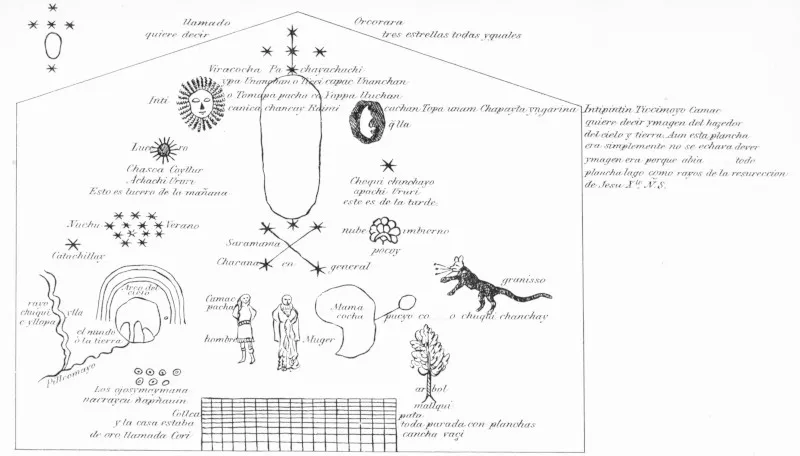
And first with regard to the origin of their idolatries, it
is so that these people had no knowledge of writing. But,
in a house of the Sun called Poquen Cancha, which is near
Cuzco, they had the life of each one of the Yncas, with the
lands they conquered, painted with figures on certain boards,
and also their origin. Among these paintings the following
fable was represented.
In the life of Manco Ccapac, who was the first Ynca, and
from whom they began to be called children of the Sun,
and to worship the Sun, they had a full account of the
deluge. They say that all people and all created things
perished in it, insomuch that the water rose above all the
highest mountains in the world. No living things survived
except a man and a woman who remained in a box, and when
the waters subsided, the wind carried them to Huanaco,[3]
which will be over seventy leagues from Cuzco, a little more
or less. The Creator of all things commanded them to
remain there as mitimas;[4] and there, in Tiahuanaco, the
Creator began to raise up the people and nations that are
in that region, making one of each nation of clay, and
painting the dresses that each one was to wear. Those that
were to wear their hair, with hair; and those that were to
be shorn, with hair cut; and to each nation was given
the language that was to be spoken, and the songs to be
sung, and the seeds and food that they were to sow. When
the Creator had finished painting and making the said
nations and figures of clay, he gave life and soul to each one,
as well men as women, and ordered that they should pass
under the earth. Thence each nation came up in the places
to which he ordered them to go. Thus they say that some
came out of caves, others issued from hills, others from
fountains, others from the trunks of trees. From this cause,
and owing to having come forth and commenced to multiply,
from those places, and to having had the beginning of their
lineage in them, they made huacas and places of worship
of them in memory of the origin of their lineage which
proceeded from them. Thus each nation uses the dress with
which they invest their huaca; and they say that the first
that was born from that place was there turned into stones,
others say the first of their lineages were turned into falcons,
condors, and other animals and birds. Hence the huacas
they use and worship are in different shapes.
There are other nations which say that when the deluge
came, all people were destroyed except a few who escaped on
hills, in caves, or trees, and that these were very few, but
that they began to multiply, and that, in memory of the first
of their race who escaped in such places, they made idols of
stone, giving the name of him who had thus escaped to each
huaca. Thus each nation worshipped and offered sacrifices
of such things as they used. There were, however, some
nations who had a tradition of a Creator of all things. They
made some sacrifices to him, but not in such quantity, or
with so much veneration as to their idols or huacas. But to
return to the fable. They say that the Creator was in
Tiahuanaco, and that there was his chief abode, hence the
superb edifices, worthy of admiration, in that place. On these
edifices were painted many dresses of Indians, and there
were many stones in the shape of men and women, who had
been changed into stone for not obeying the commands of
the Creator. They say that it was dark, and that there he
made the sun, moon, and stars, and that he ordered the sun,
moon, and stars to go to the island of Titicaca, which is near
at hand, and thence to rise to heaven. They also declare
that when the sun, in the form of a man, was ascending
into heaven, very brilliant, it called to the Yncas and to
Manco Ccapac, as their chief, and said:—“Thou and thy
descendants are to be Lords, and are to subjugate many
nations. Look upon me as thy father, and thou shalt be my
children, and thou shalt worship me as thy father.” And
with these words it gave to Manco Ccapac, for his insignia
and arms, the suntur-paucar[5]
and the champi,[6] and the other
ensigns that are used by the Yncas, like sceptres. And at
that point the sun, moon, and stars were commanded to
ascend to heaven, and to fix themselves in their places, and
they did so. At the same instant Manco Ccapac and his
brothers and sisters, by command of the Creator, descended
under the earth and came out again in the cave of Paccari-tambo,[7]
though they say that other nations also came out
of the same cave, at the point where the Sun rose on the
first day after the Creator had divided the night from the
day. Thus it was that they were called children of the Sun,
and that the Sun was worshipped and revered as a father.
They also have another fable, in which they say that the
Creator had two sons, the one called Ymaymana Viracocha,
and the other Tocapo Viracocha. Having completed the
tribes and nations, and assigned dresses and languages to
them, the Creator sent the sun up to heaven, with the moon
and stars, each one in its place. The Creator, who in the
language of the Indians is called Pachayachachi[8] and
Tecsiviracocha, which means the incomprehensible God,
then went by the road of the mountains, from Tiahuanaco,
visiting and beholding all the nations, and examining how
they had begun to multiply, and how to comply with his commands.
He found that some nations had rebelled and had
not obeyed his commands; so he turned a large number of
them into stones of the shape of men and women, with the
same dress that they had worn. These conversions into
stone were made at the following places: in Tiahuanaco,
and in Pucara, and Xauxa, where they say that he turned
the huaca called Huarivilca into stone, and in Pachacamac
and Cajarmarca, and in other parts. In truth there are
great blocks of stone in those places, some of which are
nearly the size of giants. They must have been made by
human hands in very ancient times; and, by reason of the
loss of memory, and the absence of writing, they invented
this fable, saying that people had been turned into stones
for their disobedience, by command of the Creator. They
also relate that in Pucara, which is forty leagues from the
city of Cuzco on the Collao road, fire came down from
heaven and destroyed a great part of the people, while those
who were taking to flight were turned into stones.
The Creator, who is said to be the father of Ymaymana
Viracocha, and of Tocapo[9] Viracocha, commanded that the
elder, named Ymaymana Viracocha, in whose power all
things were placed, should set out from this point, and go
by the way of the mountains and forests through all the
land, giving names to the large and small trees, and to the
flowers and fruits that they bear, and teaching the people
which were good for food or for medicine, and which should
be avoided. He also gave names to all the herbs, and explained
which had healing virtues and which were poisonous.
The other son, named Tocapo Viracocha, which
means in their language “the maker,” was ordered to go
by the way of the plains, visiting the people, and giving
names to the rivers and trees, and instruction respecting
the fruits and flowers. Thus they went until they reached
the sea, whence they ascended to heaven, after having
accomplished all they had to do in this world.
They also relate, in this same fable, that at Tiahuanaco,
where all mankind was created, all the different kinds of
birds were made, male and female, and that each was given
the songs they were to sing; those that were to live in the
forest being sent there, and each kind to its respective
place. In like manner all the different beasts were created,
male and female, and all the serpents and lizards that are
met with in the land; and the people were taught the
names and qualities of each of these birds, beasts, and
reptiles.
These Indians believed for a certainty that neither the
Creator nor his sons were born of woman, that they were
unchangeable and eternal. The tribes have many other
fables teaching their origin, insomuch that if all were to be
told, there would be no end. I will, therefore, only insert
some of these fables.
In the kingdom of Quito, there is a province called
Cañaribamba, and the Cañaris Indians are so named from
their province.[10] These Cañaris say that, at the time of the
deluge, two brothers escaped to a very high mountain called
Huaca-yñan. As the waters rose the hill also increased in
height, so that the waters never reached them. After the
flood had subsided, their store of provisions being ended,
they came forth and sought for food in the hills and valleys.
They built a very small house in which they dwelt, living on
herbs and roots, and suffering much from hunger and
fatigue. One day, after going out in search of food, they
returned to their little house, and found food to eat and
chicha to drink, without knowing who could have prepared
or brought it. This happened for ten days, at the end of
which time they consulted how they should see and know the
being who did them so much good in their great need. So
the elder of the two agreed to remain concealed. Presently
he saw two birds, of the kind called agua, and by another
name torito. In our language they are called guacamayos.[11]
They came dressed as Cañaris, with hair on their heads
fastened in front as they now wear it. The concealed
Indian saw them begin to prepare the food they brought
with them, as soon as they came to the house, the larger
one taking off the lliclla or mantle worn by the Indians.
When the concealed man saw that they were beautiful, and
that they had the faces of women, he came forth; but as
soon as they saw him, they were enraged and flew away
without leaving anything to eat on that day. When the
younger brother came home from searching for food, and
found nothing cooked and ready as on former days, he asked
his brother the reason, who told him, and they were very
angry. On the next day the younger brother resolved to
remain in concealment, and to watch whether the birds
returned. At the end of three days the two guacamayos
came back, and began to prepare the food. The men
watched for an opportune time when they had finished
cooking, and shutting the door, enclosed them inside. The
birds showed great anger; but while they were holding the
smaller one, the larger went away. Then they had carnal
knowledge of the smaller one, and had by it six sons and
daughters. It lived with them for a long time on that hill,
and they subsisted on the seeds they sowed, which were
brought by the guacamayo. And they say that from these
brothers and sisters, children of the guacamayo, all the
Cañaris proceed. Hence they look upon the hill Huaca
yñan as a huaca, and they hold the guacamayos in great
veneration, and value their feathers very highly, for use at
their festivals.
In the province of Ancasmarca, which is five leagues from
Cuzco, in the Anti-suyu division, the Indians have the
following fable.
They say that a month before the flood came, their sheep
displayed much sadness, eating no food in the day-time, and
watching the stars at night. At last the shepherd, who had
charge of them, asked what ailed them, and they said that
the conjunction of stars showed that the world would be
destroyed by water. When he heard this, the shepherd
consulted with his six children, and they agreed to collect
all the food and sheep they could, and to go to the top of a
very high mountain, called Ancasmarca. They say that
as the waters rose, the hill grew higher, so that it was
never covered by the flood; and when the waters subsided,
the hill also grew smaller. Thus, the six children of that
shepherd returned to people the province. These and other
tales are told, which I do not insert, to avoid prolixity. The
chief cause of the invention of these fables, was the ignorance
of God, and the abandonment of these people to idolatries
and vices. If they had known the use of writing they
would not have been so dull and blind. Nevertheless, they
had a very cunning method of counting by strings of wool
and knots, the wool being of different colours. They call
them quipus, and they are able to understand so much by
their means, that they can give an account of all the events
that have happened in their land for more than five hundred
years. They had expert Indians who were masters in the
art of reading the quipus, and the knowledge was handed
down from generation to generation, so that the smallest
thing was not forgotten. By the quipus, which are like these
strings that old women use for praying in Spain, only with
ends hanging from them, they keep such an account of the
years and months, that no error is committed in the record.
The system became more complete under the Ynca Yupanqui,
who first began to conquer this land, for before his
time the Yncas had not advanced beyond the vicinity of
Cuzco, as appears from the account now in the hands of your
Reverence. This Ynca appears to have been the first to
order and settle ceremonies and religions. He it was who
established the twelve months of the year, giving a name
to each, and ordaining the ceremonies that were to be
observed in each. For although his ancestors used months
and years counted by the quipus, yet they were never previously
regulated in such order until the time of this Lord.
He was of such clear understanding, that he reflected upon
the respect and reverence shown by his ancestors to the
Sun, who worshipped it as God. He observed that it never
had any rest, and that it daily journeyed round the earth;
and he said to those of his council that it was not possible
that the Sun could be the God who created all things, for if
he was he would not permit a small cloud to obscure his
splendour; and that if he was creator of all things he would
sometimes rest, and light up the whole world from one
spot. Thus, it cannot be otherwise but that there is someone
who directs him, and this is the Pacha-Yachachi or
creator. Influenced by this reasoning and knowledge, he
ordered the houses and temple of Quisuar-cancha[12] to be
made, which are above the houses of Diego Ortiz de Guzman,[13]
coming towards the great square of Cuzco, where
Hernan Lopez de Segovia now lives. Here he raised a
statue of gold to the creator, of the size of a boy of ten
years of age. It was in the shape of a man standing up,
the right arm raised and the hand almost closed, the fingers
and thumb raised as one who was giving an order.
Although the Yncas had a knowledge of a creator of all
things from the first, whom they reverenced and to whom
they offered sacrifices; yet he never was held in such
great veneration as from the time of this Ynca, who gave
orders to the heads of provinces throughout his dominions
that temples should be erected to him, and that he should
have flocks, servants, farms, and estates, out of which the
sacrifices should be provided. This also was the Ynca who
so sumptuously erected the house of the Sun at Cuzco: for
before his time it was very small and poor. The cause of
this is related in the following fable.
They say that, before he succeeded, he went one day to
visit his father Viracocha Ynca, who was in Sacsahuana,
five leagues from Cuzco. As he came up to a fountain
called Susur-puquio,[14] he saw a piece of crystal fall into it,
within which he beheld the figure of an Indian in the following
shape. Out of the back of his head there issued
three very brilliant rays like those of the Sun. Serpents
were twined round his arms, and on his head there was a
llautu[15] like that of the Ynca. His ears were bored, and
ear-pieces, like those used by the Yncas, were inserted.
He was also dressed like the Ynca. The head of a lion
came out from between his legs, and on his shoulders there
was another lion whose legs appeared to join over the
shoulders of the man; while a sort of serpent also twined
over the shoulders. On seeing this figure the Ynca Yupanqui
fled, but the figure of the apparition called him by his
name from within the fountain, saying:—“Come hither,
my son, and fear not, for I am the Sun thy father. Thou
shalt conquer many nations: therefore be careful to pay
great reverence to me, and remember me in thy sacrifices.”
The apparition then vanished, while the piece of crystal
remained. The Ynca took care of it, and they say that he
afterwards saw everything he wanted in it. As soon as he
was Lord, he ordered a statue of the Sun to be made, as
nearly as possible resembling the figure he had seen in the
crystal. He gave orders to the heads of the provinces in
all the lands he had conquered, that they should make grand
temples richly endowed, and he commanded all his subjects
to adore and reverence the new Deity, as they had heretofore
worshipped the Creator. In the narrative of his life,
which your Lordship has, it is related that all his conquests
were made in the name of the Sun his Father, and of the
Creator. It was this Ynca, also, who commanded all the
nations he conquered to hold their huacas in great veneration,
and to propitiate them by sacrifices, saying that thus
they would not be enraged at not receiving their due quantity
of reverence and worship. He also caused worship to
be offered to the thunder, and he had a statue of a man
erected in gold, in a temple in the city of Cuzco. This
huaca also had a temple, near that of the Sun, in all the
provinces, with estates, flocks, and servants for the celebration
of sacrifices. But as my intention is to touch upon
worship and ceremonies, and not to treat of laws and customs,
I will pass on to the other points of my present treatise.
They also had, in some nations, many huacas and temples
where the devil gave answers; and in the city of Cuzco
there was the huaca of Huanacauri.[16] There were many kinds
of wizards in the provinces, with names and attributes differing
one from the other. The names and offices were as
follows:—
Calparicu, which means those who bring luck and success,
and were expected to obtain the things that were
desired. With this object they killed birds, lambs, and
sheep, and, inflating the lungs, through a certain vein, they
discerned certain signs, by which they declared what was
about to happen.
There were others called Virapiricuc, who burnt the
breasts of sheep and coca in the fire, and foretold what
would occur from certain signs at the time the things were
burning. Those who consulted them said that they were
the least to be relied on, because they always lied.
Others were called Achicoc, who were the sorcerers that
told fortunes by maize and the dung of sheep. They gave
their replies to those who consulted them, according as the
things came out in odd or even numbers.
Others were called Camascas, who declared that their
grace and virtue was derived from the thunder; saying that,
when a thunder-bolt fell, and one of them was struck with
terror, after he came to himself he proclaimed how the
thunder had revealed to him the art of curing by herbs, and
how to give replies to those who consulted them. In like
manner, when one escaped from some great danger, they
said that the devil had appeared; and those who wished to
be cured by herbs were also said to be instructed. Hence
many Indians are great herbalists. Others were shown the
poisonous herbs, and these were called Camascas.
Others were called Yacarcaes, and these were natives of
Huaro. They had mighty pacts with the devil, as appears
from the ceremony they performed, which was as follows:—They
took certain tubes of copper mixed with silver, about
the length of an ordinary arquebus; and some brass vessels
in which they light fires with charcoal, which they blew and
made to blaze up by means of the tubes. It was in these
fires that the devils delivered their replies, and the sorcerers
said that it was concerning the soul of such a man or woman
that they were making inquiry, who might be in Quito or
in any other part of the empire which the Yncas had conquered.
The principal questions they asked were whether
such an one was against the Sun his father, or whether such
others were thieves, murderers, or adulterers. By means
of this invocation the Ynca knew all that passed in his
dominions, with the help of the devil. These Yacarcaes
were much feared, as well by the Ynca as by the people,
and he took them with him wherever he went.
There were other sorcerers who had charge of the huacas,
among whom there were some who conferred with the devil,
and received his replies, telling the people what they wished
to know, but they very seldom gave correct answers. According
to the accounts they give, all the people of the land
confessed to the sorcerers who had charge of the huacas;
and these confessions were made publicly. In order to test
the truth of the confessions, the sorcerers tried them by
consulting signs, and in this way, with the aid of the devil,
they discovered who had confessed falsely, and upon these
they inflicted severe punishments. Those who had grave
crimes to confess, which merited death, confessed them in
secret to the sorcerer.
The Yncas, and the people of Cuzco, always made their
confessions in secret, and generally they confessed to those
Indian sorcerers of Huaro who were employed for this office.
In their confessions they accused themselves of not having
reverenced the sun, the moon, and the huacas, with not
having celebrated the feasts of the Raymis, which are those
in each month of the year, with all their hearts; with having
committed fornication against the law of the Ynca not to
touch a strange woman or to seduce a virgin unless given
by the Ynca, and not because fornication was a sin. For
they did not understand this. They also accused themselves
of any murder or theft, which we hold to be grave sins, as
also were murmurs, especially if they had been against the
Ynca or against the Sun.
They also confess, O most reverend Sir, that the people
before the flood were made, with all other things, by the
Creator; but they are ignorant of the order in which they
were made, nor how, beyond what has already been said
concerning Tiahuanaco. This is what I have been able to
learn, touching their fables and their origin, from all the old
men with whom I have conversed on this subject. The
form of the worship and sacrifices that they established for
each month, was as follows:—
They commenced to count the year in the middle of May,
a few days more or less, on the first day of the moon; which
month, being the first of their year, was called Hauca and
Llusque, and in it they performed the following ceremonies,
called Yutip-Raymi, or the festivals of the Sun. In this month
they sacrificed to the Sun a great quantity of sheep of all
colours. Those called huacar-paña were white and woolly.
Others were called huanacos; and others, also white and
woolly, were called pacos-cuyllos. Others, which were females
with a reddish woolly fleece, were called paucar-paco. Other
pacos were called uqui-paco. Other large sheep were called
chumpi, which was their colour, being almost that of a lion’s
coat. Other sheep were called llanca-llama, which were
black and woolly. At this season they also sacrificed lambs
of the same colours. The sacrifices were performed in the
following order:—
They went to Curicancha[17] in the morning, at noon, and
at night, bringing the sheep that were to be sacrificed on
that day, which they carried round the idols and huacas
called Punchao Ynca,[18]
which means the Sun; and Pachayachachi,[19]
another idol in the shape of a man. The word
means a Creator; and Chuqui-yllayllapa,[20] which was the
huaca of lightning and thunder, and thunderbolt. It also
was in the form of a person, though the face could not be
seen, and it had a llautu of gold, and ear-rings of gold, and
medals of gold called canipo. These huacas were placed
on a bench, and the live sheep were taken round them,
while the Priests said:—
“O Creator, and Sun, and Thunder, be for ever young!
do not grow old. Let all things be at peace! let the people
multiply, and their food, and let all other things continue
to increase.”
These sayings were addressed to the Creator, and to the
Sun they prayed that he might always be young, and continue
to give light and splendour. They did not know the
Sun as their Creator, but as created by the Creator. To
the thunder and lightning they prayed that it might rain,
in order that they might have food. They also knew that
the rain came with thunder and lightning, by command of
the Creator.
Then, in the morning, they sent a sheep to Huanacauri,
which is their principal huaca, where it was killed and
burnt by the tarpuntaes,[21] who were those that had the duty
of supplying food to the huacas. While the sacrifice was
burning, at the rising of the Sun, many Yncas and Caciques
came, and, pulling the wool off the sacrifice before it was
consumed, walked round it with the wool in their hands,
crying out and saying:—
“O Creator, O Sun, and O Thunder, be for ever young,
multiply the people, and let them always be at peace.”
At noon, in the same order, they burnt another in the
court of the Coricancha or house of the Sun, which is now
the cloister of the Friars of the Lord St. Domingo: and in
the evening they took another to the hill called Achpiran,
because there the Sun sets, which they sacrificed with the
same ceremonies. They also offered up to the same huacas,
certain cestos[22] of coca, called paucar-runcu, and others called
paucar-quintu like coca, and some toasted maize, and red
and yellow sea shells called mullu, in the shape of maize.
In addition to these ceremonies, on every other day of this
month, they went to burn sheep and the other offerings at
the following places: on a hill called Succanca, on another
called Omoto-yanacauri, on another called Ccapac-uilca, which
is three leagues from Huanacauri, and on others called
Queros-huanacauri, Rontoca which is in the Quehuares,[23]
Collapata in Pumacancha, fourteen leagues from the city, on
a plain called Yana-yana, on another hill called Cuti in the
puna of Pumacancha, and continuing along the same road
they came on the next day to Vilcañota, which is twenty-six
leagues from Cuzco. The reason for taking this direction
in this month is because they say that the Sun was born in
that part,[24] and thus they went on that road, performing
the sacrifices. On a plain near Rurucache they made the
same offering, as well as on another hill called Suntu, near
to Sihuana in Cacha, in another hill called Cacha-Uiracocha,
in another called Yacalla-huaca, and in another called
Rurama, on the plain of Quiquijana.[25] The same was done
in Mullipampa, in Urcos, on a hill called Urcos Uiracocha,
on a plain called Antahuaylla,[26] on another plain near Anta-huayla,
called Pati, on another called Acahuara, on a hill in
Quispicancha, and on another called Sulcanca. The Tarpuntaes
went by one road and came back by another. The
Ynca, with all his lords, went to Mantucalla, and there
remained to drink and enjoy himself in revelry and taquis.[27]
They called this taqui Huallina,[28] and it was a dance with
singing, which was performed four times in the day. The
Yncas alone celebrated this feast; and the mama-cunas,
women of the Sun, gave drink to those who performed it;
their own wives did not enter the place where the Yncas
were, but remained outside in a court. All the vases and
utensils from which they ate and drank, and with which
they cooked the food were of gold. Thus they performed the
taqui called Huayllina, and in it they worshipped the Creator.
At this festival they brought out the two female figures
called Pallasillu and Ynca uillu, covered with very rich
clothes and small plates of gold, called llancapata, colcapata
and paucaruncu. In front they bore the suntur-paucar and
certain great figures of the size of sheep, two of gold and
two of silver, with cloths placed over the loins in the fashion
of horse cloths. They were carried on litters, and this was
done in memory of the sheep which, they say, came forth
from the tambo with them. The Indians who carried them
were principal lords, dressed in very rich clothes, and they
call the figures of gold and silver sheep corinapa collque-napa.[29]
The Ynca remained at Mantucalla until the end of
the month, and when that time arrived he went to the square
in front of the church of Cuzco, called uacay-pata, the path
by which he came being strewn with plumes of bird’s
feathers of all colours. There he drank during the remainder
of the day, and at night he went to his house. Thus this
month was ended.
The month of June was called Canay, and by another
name Chahuarhuay. The people were entirely occupied in
irrigating their fields, and in arranging the distribution of
water from the channels.
They called the month of July Moronpassa tarpuiquilla,[30]
and in it they celebrated the festivals called yahuayra, when
they besought the Creator to grant them a full harvest in
that year, for this was the month for sowing the seeds.
The following ceremonies were then performed.
The Tarpuntaes, who are a sort of priests, were careful
to fast from the time the maize was sown until it was a
finger’s length out of the ground. Their wives and children
also fasted, eating nothing during that time but boiled
maize and herbs. They drank no chicha, but only muddy
stuff called concho, and they chewed no coca. In this
season they carried a little row of maize in their chuspas,
which they put in their mouths. All the common people
celebrated a feast called yahuayra, from the name of the
song they chaunted in which they besought the Creator to
grant them a prosperous year. They sang it dressed in
red shirts reaching to the feet, and no mantles. Then they
came out to sing and dance in the place now called by the
Spaniards Limapampa,[31] which is beyond the square of San
Domingo. Here the Priests of the Creator sacrificed a white
sheep, maize, coca, plumes of coloured feathers, and sea shells
called mullu, in the morning; beseeching the Creator to
grant a prosperous year, and that, as He had made all things
out of nothing and given them being, so he would be pleased
to comply with their prayer. The Priests of the Sun,
called Tarpuntaes, and the Priests of the Thunder also
offered up sacrifices, praying the Sun to give warmth that
so their food might be produced, and the Thunder, called
Chuqui Yllapa, to send its waters to assist in the production,
and not to bring down hail. As soon as the sacrifices were
completed, the labourers went to their work, and the nobles
to the house of the lord Ynca, until the month, which in
their language was called quispe,[32] was ended.
The month of August was called Coya-raymi; and in it
they celebrated the Situa. In order to perform the ceremonies
of this festival, they brought the figures of their
huacas from all parts of the land, from Quito to Chile, and
placed them in the houses they had in Cuzco, for the purpose
which we shall presently explain. The reason for
celebrating the feast called Situa, in this month, was,
because the rains commenced, and with the first rains there
was generally much sickness. They besought the Creator
that, during the year, he would be pleased to shield them
from sickness, as well in Cuzco, as throughout the territory
conquered by the Yncas. On the day of the conjunction of
the moon, at noon the Ynca, with all the chiefs of his council,
and the other principal lords who were in Cuzco, went
to the Ccuricancha, which is the house and temple of the
Sun, where they agreed together on the way in which the
festival should be celebrated; for in one year they added,
and in another they reduced the number of ceremonies,
according to circumstances.
All things having been arranged, the High Priest
addressed the assembly, and said that the ceremonies of the
Situa should be performed, that the Creator might drive
all the diseases and evils from the land. A great number
of armed men, accoutred for war, with their lances, then
came to the square in front of the temple. The figures
called Chuquilla[33]
and Uiracocha[34] were brought to the temple
of the Sun from their own special temples in Puca-marca
and Quihuar-cancha, which are now the houses of Doña
Ysabel de Bobadilla. The priests of these huacas joined
the assembly, and, with the concurrence of all present, the
priest of the Sun proclaimed the feast. First, all strangers,
all whose ears were broken, and all deformed persons were
sent out of the city, it being said that they should take no
part in the ceremony, because they were in that state as a
punishment for some fault. Unfortunate people ought not
to be present, it was believed, because their ill-luck might
drive away some piece of good fortune. They also drove
out the dogs, that they might not howl. Then the people,
who were armed as if for war, went to the square of Cuzco,
crying out: “O sicknesses, disasters, misfortunes, and
dangers, go forth from the land.” In the middle of the
square, where stood the urn of gold which was like a
fountain, that was used at the sacrifice of chicha, four
hundred men of war assembled. One hundred faced towards
Colla-suyu, which is the direction of the Sun-rising. One
hundred faced to the westward, which is the direction of
Chincha-suyu. Another hundred looked towards Anti-suyu,
which is the north, and the last hundred turned towards the
south. They had with them all the arms that are used in
their wars. As soon as those who came from the temple of
the Sun arrived in the square, they cried out and said:
“Go forth all evils.” Then all the four parties went forth
to their appointed places. Those for Colla-suyu set out
with great speed, and ran to Augostura de Acoya-puncu,
which is two short leagues from Cuzco, crying out as they
ran “Go forth all evils.” The people of Huvin-Cuzco carried
these cries, and there they delivered them over to the
mitimaes of Huayparya, who in their turn passed them to the
mitimaes of Antahuaylla, and thus they were passed to the
mitimaes of Huaray-pacha, who continued them as far as
the river at Quiquisana, where they bathed themselves and
their arms. Thus was the shouting ended in that direction.
The Indians who passed the shouting along the Colla-suyu
road from Cuzco, were of the lineage of Usca Mayta Ayllu,[35]
Yapomayu Ayllu, Yahuaymin Ayllu Sutic, and Marasaylla
Cuynissa Ayllu.
Those who went out to the west, which is towards Chincha-suyu,
shouting in the same manner, were of the lineage
of Ccapac Ayllu,[36]
and Hatun Ayllu, Vicaquirau[37] and Chamin-Cuzco
Ayllu, and Yaraycu Ayllu. These went shouting as
far as Satpina, which will be a little more than a league
from Cuzco. There they passed the cries on to the mitimaes
of Jaquijahuana,[38] and these delivered them to the
mitimaes of Tilca, which is above Marca-huasi, about ten
leagues from Cuzco, who carried them on to the river Apurimac,
where they bathed and washed their clothes and
arms.
Those who carried the cries in the direction of Anti-suyu
were of the following lineages, Usca-panaca Ayllu, Aucaylli
Ayllu, Tarpuntay Ayllu, and Sañu Ayllu. They ran as far as
Chita, which is a league and a half from Cuzco, and handed
them to the mitimaes of Pisac, who are those of the Coya
and Paullu,[39] and these carried them forward to the river at
Pisac, and there bathed and washed their arms.
Those who went towards Cunti-suyu were of the following
lineages. Yaura-panaca[40] Ayllu, and China-panaca Ayllu,
and Masca-panaca Ayllu, and Quesco Ayllu. They ran as
far as Churicalla, which is two leagues from Cuzco, and there
they delivered them to the mitimaes of Yaurisquis, which
will be about three leagues from Cuzco. These passed them
on to those of Tautar, which is four leagues from Cuzco, who
carried them on to the river of Cusipampa, where the Friars
of La Merced have a vineyard. This is seven leagues from
Cuzco, and there they bathed and washed their arms.[41]
Such was the ceremony for driving the sicknesses out of
Cuzco. Their reason for bathing in these rivers was because
they were rivers of great volume, and were supposed to
empty themselves into the sea, and to carry the evils with
them. When the ceremony commenced in Cuzco, all the
people, great and small, came to their doors, crying out,
shaking their mantles and llicllas, and shouting, “Let the
evils be gone. How greatly desired has this festival been
by us. O Creator of all things, permit us to reach another
year, that we may see another feast like this.” They all
danced, including the Ynca, and in the morning twilight
they went to the rivers and fountains to bathe, saying that
their maladies would come out of them. Having finished
bathing, they took great torches of straw, bound round
with cords, which they lighted and continued to play with
them, passing them from one to the other. They called these
torches of straw pancurcu. At the end of their feast they
returned to their houses, and by that time a pudding of
coarsely ground maize had been prepared, called sancu and
elba. This they applied to their faces, to the lintels of their
doors, and to the places where they kept their food and
clothes. Then they took the sancu to the fountains, and
threw it in, saying, “May we be free from sickness, and
may no maladies enter this house.” They also sent this
sancu to their relations and friends for the same purpose,
and they put it on the bodies of their dead that they also
might enjoy the benefits of the feast. Afterwards the
women ate and drank their food with much enjoyment; and
on this day each person, how poor soever he might be, was
to eat and drink, for they said that on this day they should
enjoy themselves, if they had to pass all the rest of the
year in labour and sorrow. On this day no man scolded
his neighbour, nor did any word pass in anger, nor did anyone
claim what was owing to him from another. They said
that there would be trouble and strife throughout the year,
if any was commenced on the day of the festival.
In the night, the statues of the Sun, of the Creator, and
of the Thunder, were brought out, and the priests of each of
these statues warmed it with the before mentioned sancu.
In the morning they brought the best food they could prepare
to present at the temples of the Creator, of the Sun,
and of the Thunder; which the priests of those huacas
received and consumed. They also brought out the bodies
of the dead lords and ladies which were embalmed, each one
being brought out by the person of the same lineage who
had charge of it. During the night these bodies were
washed in the baths which belonged to them when they
were alive. They were then brought back to their houses,
and warmed with the same coarse pudding called çancu;
and the food they had been most fond of when they were
alive was placed before them, and afterwards the persons
who were in charge of the bodies consumed the food.
The persons who had charge of the huaca called Guana-caucique,[42]
which is a great figure of a man, washed it and
warmed it with the sancu; and the principal Ynca lord and
his wife, after they had finished their bath, put the same
sancu in their house, and on their hands. Afterwards, they
placed certain plumes on their heads, of a bird called pialco,
which are of a changing colour. The same was done with
the figure of the Creator, and those who had charge of it
called this ceremony Pilcoyacu. At about eight or nine in
the morning the principal lord Ynca, with his wife, and the
lords of the council who were in his house, came forth into
the great square of Cuzco, richly dressed. They also
brought out the image of the Sun called Apupunchau,[43]
which was the principal image among those in the temple.
They were accompanied by all the priests of the Sun, who
brought the two figures of gold, and their women called
Ynca-Ocllo and Palla-Ocllo. There also came forth the
woman called Coya-facssa, who was dedicated to the Sun.
She was either the sister or the daughter of the ruler. The
priests carried the image of the Sun, and placed it on a
bench prepared for it in the square. The priests of the
Creator likewise brought forth his image, and deposited it
in its place. So also did the priests of the Thunder, called
Chuqui-ylla, bring forth his image. Each had its bench of
gold, and before them were borne yauris, which were made
like sceptres of gold. The priests of these huacas came in
very rich dresses, to celebrate this feast. Those who had
charge of the huaca called Huanacauri, also brought its figure
into the square. They say that a woman was never assigned
to the huaca of the Creator. It was believed that the
Creator did not need women, because, as he created them,
they all belonged to him. In all their sacrifices, the first
was offered to the Creator. At this feast they brought out
all the embalmed bodies of their lords and ladies, very richly
adorned. The bodies were carried by the descendants of
the respective lineages, and were deposited in the square on
seats of gold, according to the order in which they lived.
All the people of Cuzco came out, according to their tribes
and lineages, as richly dressed as their means would allow;
and, having made reverences to the Creator, the Sun, and
the lord Ynca, they sat down on their benches, each man
according to the rank he held, the Hanan-Cuzcos being on
one side, and the Hurin-Cuzcos[44] on the other. They passed
the day in eating and drinking, and enjoying themselves;
and they performed the tauqi called alançitua saqui, in red
shirts down to their feet, and garlands called pilco-casa on
their heads; accompanied with large or small tubes of canes,
which made a kind of music called tica-tica. They gave
thanks to the Creator for having spared them to see that
day, and prayed that they might pass another year without
sickness; and they did the same to the Sun and to the
Thunder. The Ynca came with them, having the Sun before
him. He had a great vase of gold containing chicha. It
was received by the priest, who emptied it into the urn,
which, as has been said, is like a stone fountain plated with
gold. This urn had a hole made in such a way, that the
chicha could enter a pipe or sewer passing under the ground
to
the houses of the Sun,[45] the Thunder, and the Creator.
The priests came in procession, and the families of Hurin
and Hanan Cuzco, each with the embalmed bodies of their
ancestors. They passed that day in the manner already
described, and in the evening they took back the Sun and
the other huacas to their temples, and the embalmed bodies
to their houses. The Yncas, and the rest of the people also
returned to their homes.
The next day they all came to the great square in the
same order, placing the huacas on their benches as before.
The Ynca and the people brought with them a very great
quantity of flocks from all the four quarters of Colla-suyu,
chinchay-suyu, Antis-suyu, and Cunti-suyu. The number of
animals was so great, according to those who made this declaration,
that they amounted to more than one hundred thousand,
and it was necessary that all should be without spot or
blemish, and with fleeces that had never been shorn. Presently
the priest of the Sun selected four of the most perfect,
and sacrificed them in the following order: one was offered to
the Creator, another to the Thunder, another to the Sun, and
another to Huanacauri. When this sacrifice was offered up,
the priest had the sancu on great plates of gold, and he
sprinkled it with the blood of the sheep. The white fleece-bearing
sheep were called cuyllu; and the plates containing
sanco were in front of the bench of the Sun. The high priest
then said in a loud voice so that all might hear: “Take heed
how you eat this sancu; for he who eats it in sin, and with
a double will and heart, is seen by our father, the Sun, who
will punish him with grievous troubles. But he who with
a single heart partakes of it, to him the Sun and the Thunder
will show favour, and will grant children and happy
years, and abundance, and all that he requires.” Then they
all rose up to partake, first making a solemn vow before
eating the yahuar-sancu,[46] in which they promised never to
murmur against the Creator, the Sun, or the Thunder; never
to be traitors to their lord the Ynca, on pain of receiving
condemnation and trouble. The priest of the Sun then
took what he could hold on three fingers, put it into his
mouth, and returned to his seat. In this order, and in this
manner of taking the oath, all the tribes rose up, and thus
all partook down to the little children. They all kept some
of the yahuar-sancu for those who were absent, and sent some
to those who were confined to their beds by sickness; for
they believed it to be very unlucky for any one not to partake
of the yahuar-sancu on that day. They took it with such
care that no particle was allowed to fall to the ground, this
being looked upon as a great sin. When they killed the
sacrificial sheep, they took out the lungs and inflated them,
and the priests judged, from certain signs on them, whether
all things would turn out prosperously in the coming year
or not. Afterwards, they burnt them before the Creator,
the Sun, and the Thunder. The bodies of the sheep were
divided and distributed, as very sacred things, a very small
piece to each person. The rest was given to the people of
Cuzco to eat, and each man, as he entered the square,
pulled off a piece of the wool, with which he sacrificed to
the Sun. When they distributed the sheep, the priests
offered up the following prayers.
|
Aticsi-Uiracochan [caylla]
caylla-Uiracochan tocapo ac nupo
viracochan camachurac cari-cachun
huarmicachun ñis pallurac
rurac camas cayqui churascaiqui
casilla quespilla canca musac
maipimcanqui ahuapichu
ucupichu pusupichu llantupichu
huyarihuay hayniquay yuihuay
ymaypachacama haycaypachacama
canca chihuay marcarihuay
hatallihuay caycustayri
chasquihuay may piscapapas
Uiracochaya.
|
O Creator! [O conquering
Uirachocha! Ever present Uiracocha!]
Thou who art without
equal unto the ends of
the earth! Thou who givest
life and strength to mankind,
saying, let this be a man and
let this be a woman: And as
thou sayest, so thou givest life,
and vouchsafest that men shall
live in health and peace, and
free from danger:—Thou who
dwellest in the heights of heaven,
in the thunder, and in the storm
clouds, hear us! and grant us
eternal life. Have us in thy
keeping, and receive this our
offering, as it shall please thee,
O Creator!
|
|
Uiracochan apacochan titu-Uiracochan
hualpai huana-Uiracochan
topapo acnupo Uiracochan
runayachachachuchun hucerma-yachachachun
mirachun llacta-pachacasilla
quispillacachun camascayqui
taquacaycha yatalliymay
Pachacama haycay Pachacama.
|
O Creator! who doest wonders
and marvels. O most
merciful and almighty Creator!
multiply our flocks and cause
them to bring forth young, let
the land continue in peace and
free from danger, and these
whom thou hast made, hold
them in thy hand.
|
|
Coy [caylla] Uiracochan ticçi
Uiracochan hapacochan hualpai
huana Uiracochan chanca-Uiracochan
acsa-Uiracochan atun-Uiracochan
caylla-Uiracochan tacancuna
hunichic llaularuna y achacuc
ccapac hahuay pihucupi
Puris papas.
|
O Creator, thou who art coeval
with the world! O Chanca-Uiracocha!
O Atun-Uiracocha!
grant our prayer, that thou
wilt, with the Creator, give
health and prosperity to the
people.
|
Chanca-Uiracocha was a huaca in Chuqui-chaca, where
was Manco Ynca. Atun-Uiracocha is in the huaca of Urcos;
where there was an eagle and a falcon carved in stone at
the entrance of the huaca and an image of a man with a
white robe reaching to his feet, and coming down to his
waist. Apotin-Uiracocha is in Amaybamba, beyond Tampu.
Urusayua-Uiracocha is in the same place. Chuqui-chanca-Uiracocha
is in Huaypau.
|
O Uiracochan cusiussapochay
lipo-Uiracochaya runacay amaycay
miruna yana huaccha quisaruna
yquicauras cayquichuras
cayquicasiquis-pilla camachun
huarmay huanchurin huanchin
canta amaquaquinta huarya
yaichichuruay huasa causachun
mana alleas pamana pitispa
mucumuchun. Upia muchun.
|
O most fortunate and propitious
Creator, have pity and
mercy upon all men whom thou
hast made. Keep thy poor servants
in health. Make them
and their children to walk in a
straight road, without thinking
any evil. Grant that they may
have a long life, and not die in
their youth, and that they may
live and feed in peace.
|
|
O Uiracochay [atic]a ticçi-Uiracochaya
hualparillac camacchurac
cay hurin pacha pimicuchun
upiachun ñispachurascay
quictacamascay quita micuynin
yachachun papacara ymaymana
micuncancachun ñis cayqui tacamachic
michachic mana muchuncunpac
mana muchuspacan
yñincampac amacaçachunchu
amachupichupichichunchu
casilla huacaychamuy.
|
O Creator! Lord of the ends
of the earth! O most merciful!
Thou who givest life to all
things, and hast made men that
they may live, and eat, and multiply.
Multiply also the fruits
of the earth, the papas and other
food that thou hast made, that
men may not suffer from hunger
and misery. O preserve the
fruits of the earth from frost,
and keep us in peace and safety.
|
|
Uiracocha yapunchau cachuntu
tacachun ñispac nicpacarichun
yllarichun ñispac nicpunchao-churi
yquicta casillacta quispillacta
purichic runarunascay
quicta cauchay uncancampac
Uiracochaya casilla quispilla
punchau yncarunayanani uhiscayquita
quillari canchari amahuncochispa
amananu chispa
cacicta quispicha huacus-chaspa.
|
O Creator! Thou who gavest
being to the Sun, and afterwards
said let there be day and
night. Raise it and cause it to
shine, and preserve that which
thou hast created, that it may
give light to men. Grant this,
O Creator!
O Sun! Thou who art in
peace and safety, shine upon us,
keep us from sickness, and keep
us in health and safety.
|
|
A-Uiracochan ticçi-Uiracochan
hualpa y huana-Uiracochan
atun-Uiracochan Tarapaca-Uiracochan
capaccachun Yncacachun
ñispachucapac churaspac quicta
Ynca camascayquita
casillacta quispullacta Huacaychamuy
runan yananya chachuchun
accari punari usachun
ymaypacha cama ama allcachispa
churinta mitanta quanpas
huacay chay chaycaçillacta
uira-cu-chaya.
|
O pious Creator, who ordered
and saw fit that there should be
a Lord Ynca, grant to the Ynca
that he may be kept in peace,
with his servants and vassals,
that he may obtain the victory
over his enemies and always be
a conqueror. Cut not short his
days, nor the days of his children,
and give them peace, O
Creator!
|
|
Uiracochaya qualpay huana-Uiracochaya
ninacta casi quispillacta
capac Ynca-churi yquiguarmayqui
pacamascayqui huacay
chamuchun hatallimuchun
pachachacara runa llama micuy
paycaptin yacachun ccapac Ynca
camascayquita Uiracochaya ayni
huni marcari hatalli ymaypachacama.
|
O Creator! Vouchsafe that
the subjects of the Ynca may
have peace while thy son the
Ynca lives, to whom thou hast
said: Be thou Lord! Grant
that they may multiply. Keep
them in peace, let their days be
prosperous, let their farms yield
increase; and keep this Lord
Ynca in thy hand for ever, O
Creator!
|
|
Pachacama casillacta quispillacta
Ccapac Ynca huahuay quicta
marcari atalli.
|
O Creator of the world, keep
thy child the Ynca in peace and
security upon it.
|
|
Apunchau Ynca Yutiryayay
Cuzco tampu cachun aticoclla
saccoccachun ñispa churac camac
muchas-cay quicusiquispu cachun
amatisca amalla sasca
cachunchu aticuc paclla sacapac
camascayqui churascayqui.
|
O Sun! Thou who hast said,
let there be Cuzcos and Tampus,
grant that these thy children
may conquer all other people.
We beseech thee that thy children
the Yncas may be conquerors
always, for this hast
thou created them.
|
|
O pachachulla Uiracochan
ucuhulla Uiracochan huaca-vilcacachun
ñispacamacatu napahuay
pihuana tayna allastu Uiracochaya
hurinpacha anacpacha
cachun nispa nicocupa chapipuca
umacta churachay nihuay hunihuay
quispicasica musac Uiracochaya
micuy niocmin cacyoc
curayoc llamayoc ymayna yochaycaymayoc
amacacharihuay
cuchuy maymana aycay mana
chiquimanta catuiman manta
nacasca hustusca amusca manta.
|
O sacred Huacas, ancestors,
grandsires, and parents! O
Hatun-apu! O Hualpa-huanatayua!
Apu Allastu! bring
us near to the Creator, us thy
sons, and our children, that they
may be fortunate and near the
Creator, as thou art.
|
When they had distributed the flocks, the sheep were
killed in great numbers, to be eaten on that day. Then a
vast quantity of chicha was brought into the square, from
the store houses where it was kept. It was made of boiled
white maize, in the valley of Cuzco. The flocks that were
used at this festival, were the property of the Creator, the
Sun, and the Thunder, from their estates set apart in all the
provinces of Peru. Having finished eating with much
rejoicing, they performed their taquis, and drank in the
same order as on the day before. This continued for four
days. The first day of the festival was called Citua, and it
was then that they ate the sancu called yahuar-sancu. The
second day was dedicated to the Creator, the Sun, and the
Thunder, when they performed sacrifices, and a prayer was
offered up for the Ynca. The fourth day was for the Moon
and the Earth, when the accustomed sacrifices and prayers
were offered up. On a subsequent day people of all the
nations, that had been subdued by the Yncas, came with
their huacas and in the richest costumes, peculiar to their
respective countries, that they could procure. The priests,
who had charge of the huacas, carried them on litters.
When they entered the square, coming from the direction
of the four Suyus already mentioned, they made reverences
to the Creator, the Sun, and the Thunder, and to the Huanacauri,
a huaca of the Yncas, and then they did the same
to the Ynca, who was in the square on that occasion.
Having made these obeisances, they proceeded to the places
assigned to them, and, in order to make more room, the
families of Hanan-Cuzco and Hurin-Cuzco formed themselves
into one, and thus left more space in the square. As
soon as all the people were in their places, the High Priest
of the Sun sprinkled a large quantity of sancu with blood,
and the Caciques rose up in their order, and repeated the
following:—
|
Aticçi Uiracochan caylla Uiracochan
tocapu acnupu Uiracochan
camac churac carica chuyuarmicachun
ñispallutac rurac
camascay quichuras cayquicasilla
quispilla causamus ay maypincanqui
ahuapichu ucupichu
llantupichu uyarihua ayrihuay
ynihuay ymay pachacamac cançachihuay
marcallihuay attollihuay
caycoscay tarichasquihuay
may picaspapas Uiracochaya.
|
O Creator! ? [O conquering
Viracocha! Ever present (caylla)
Viracocha!] Thou who art in
the ends of the earth without
equal! Thou who gavest life
and valour to men, saying, Let
this be a man! and to women,
saying, Let this be a woman!
Thou who madest them and
gave them being! Watch over
them that they may live in
health and peace. Thou who
art in the high heavens, and
among the clouds of the tempest,
grant this with long life, and
accept this sacrifice, O Creator!
|
Then the Priest of the Sun distributed the sancu, and
afterwards the people ate the flesh of the sheep which had
been sacrificed to the Creator, the Sun, and the Thunder.
Each nation passed the rest of the day in performing the
taqui and in singing and dancing, according to the custom
of their respective countries before they were subdued by
the Yncas. On this day all the deformed persons, who had
previously been expelled from Cuzco, were allowed to join
the feast. This part of the feast lasted for two days, and at
its conclusion, in the evening, they burnt in sacrifice a sheep,
and a vast quantity of clothes of many colours. Then those
who had to return to their homes, sought permission from
the Creator, the Sun, the Thunder, and the Ynca, which
was granted, and they left at Cuzco the huacas they had
brought there in that year. They returned to their homes
with the huacas they had brought for the festival of the
previous year, and, as a recompense for their trouble in
having come from such great distances, their chiefs were
given gold and silver and clothes and servants, and permission
to travel in litters. Their huacas were also granted
estates and attendants to wait on them, and so they returned
to their homes.
The inventor of this feast was Ynca Yupanqui, at least
he established the above ceremonies, for though it was
celebrated from the time that there ever were Yncas, it was
not performed in the order described above. The rest of
the month was passed as each man found it convenient, or
as suited him best. The same feast, called Situa, was
celebrated at the chief places in all the provinces, by the
Ynca governors, wherever they might be: and, although
the ceremonies were less grand, and the sacrifices fewer, no
part of the festival was omitted.
They call the month of September Uma-Raymi, because
the Indians of Uma, which is two leagues from Cuzco, celebrated
the feast of Hurachillo.[47] This was the occasion
when the youths were admitted to knighthood, and when
their ears were pierced, as we shall mention in its place.
The women of Cuzco, whose sons were to have their ears
bored, and to perform the huarachicu, employed their time
in sewing the cloths in which their sons were to be dressed
on the day of the feast of the huarachicu. Several relations
assembled to help them to sew, and to rejoice and drink for
some days in their houses: and so the month ended.
They called the month of October Aya Marca Raymi,
because the Indians of the village of Ayamarca performed
the feasts of huarachicu, and the youths of that tribe had
their ears bored, and were admitted to knighthood, with the
ceremonies we shall presently describe. In Cuzco, the
people were employed in preparing a great quantity of
chicha, for the feast called Ccapac Raymi. This way of
making chicha was called cantoray. The youths who were
about to receive their arms, went to the huaca called
Huanacauri, to offer sacrifice, and to ask permission to
receive knighthood. For this was their principal huaca,
the brother, as was said, of Manco Ccapac, whence they
descend. But, to avoid prolixity, I will not here give the
tradition respecting this huaca, referring for an account of
it, to the history of the Yncas which I have written. The
youths who were to be armed as knights, passed that night
on the hill of Huanacauri, where the huaca was kept, in
memory of the journey which their ancestors commenced
from that spot. On the next day they returned in the
afternoon, bringing with them loads of straw, on which their
parents and relations might sit. On this day the youths
fasted; and the month was passed in preparing many kinds
of chicha for the festival. At this time, and indeed throughout
the year, the priests of the Creator, of the Sun, and of
Thunder, and those who had charge of the huaca of
Huanacauri, made three daily sacrifices; offering up three
sheep, one in the morning, one at noon, and a third at
night, with other food that was dedicated to these deities.
The huacas were supposed to consume it where they were;
but they carried the food to the hills in the feast of Yntic-raymi.
The persons also, who had charge of the embalmed
bodies, never came forth to offer up the food, and pour out
the chicha that was dedicated to them, such as they used
when they were alive. These they consumed, because they
held for very truth, the doctrine of the immortality of the
soul, and they said that wherever the soul might be, it would
receive the food and eat as when alive. Thus ended this
month.
The month of November was called Ccapac Raymi, which
means the Feast of the Lord Ynca. It was one of the three
principal feasts of the year. In this month they gave arms
to the youths, pierced their ears, and gave them breeches,
which in their language are called huara. For the said
feast, and for the arming of the knights, during the eight
first days of the month, all the parents and relations of
those who were to receive knighthood were engaged in the
preparation of the usutas, which were their shoes made of
very fine reeds, almost of the colour of gold; and of the
huaracas from the sinews of sheep; and in broidering the
trimmings of the shirts in which they were to appear, when
they went to the huaca called Huanacauri Chumpicasico.
The shirts were made of fine yellow wool, with the borders
of fine black wool like silk, a little more than a palmo and
a half in width. They also wore mantles called supayacolla,
which were of white wool, long and narrow, not being more
than two palmos in width, but reaching to the knees. They
were fastened round the neck by a knot, whence hung a
woollen cord, at the end of which there was a red tassel.
The llautus, that were put on them on that day, were black.
On the ninth day they all proceeded to the square in the
morning, as well the parents of those who were to receive
knighthood, as the relations. The parents and relations
were attired in certain dresses called collca-uncu. There
was a special dress for each festival. On this occasion the
mantles were yellow, and the plumes on their heads were
black, being taken from a bird called guito. Hence the
plumes were called quito-tica. Those who were to be armed
as knights were shorn, and after the shearing they were
clothed in the dress already described. Many maidens, who
were selected to give their services at this feast, then came to
the square, dressed in a costume called Cuzco asu ycochilli-quilla.
Their ages were from eleven to twelve or fourteen
years, and they were of the best families. They were called
Ñusta-callisapa.[48] Their duty was to carry small vases of
chicha, as we shall relate further on. Being all clothed in
these costumes, they proceeded to the house of the Sun and
of the Thunder, and brought the images to the square. Then
the Ynca came forth, and took his place near the statue of
the Sun. The youths, who were to receive knighthood,
rose up in their order, and made their mucha,[49] which was
their manner of worshipping the huacas. They also brought
out the figure of a woman, which was the huaca of the
moon, and was called Passa[50]-mama. It was in charge of
women; and when it was brought from the house of the
Sun, where it had a special place on the site of the mirador
of Santo Domingo, they carried it on their shoulders. The
reason for giving it in charge to women was that they said
it was a woman, and the figure resembled one.
After making their reverence, the youths waited until the
hour of noon, when they again made reverences to the
huacas; and sought permission from the Ynca to make their
sacrifices, which were offered up in the following way.
Each of the youths who were about to be armed had
a sheep prepared for sacrifice. They all went, with their
relations, to the hill called Huanacauri. That night they
slept at the foot of the hill, at a place called Matahua, and
at sunrise of the tenth day, all fasting, for they had fasted
on the previous day, they ascended the hill until they came
to the huaca Huanacauri. They left the sheep for sacrifice
at the foot of the hill in Matahua, the Tarpuntays pulling
out a small handful of wool from each. These Tarpuntays
are the priests who make the sacrifices. When they reached
the top of the hill, the Tarpuntays took five lambs and
sacrificed them before the huaca. They then divided the
wool they held in their hands among the youths who were
about to be made knights, and the chiefs who came with
them. The youths and chiefs then blew the wool into the
air, while the sacrifices were being consumed, with these
words “O Huanacauri! our father, may the Creator, the
Sun, and the Thunder ever remain young, and never become
old. May thy son the Ynca always retain his youth, and
grant that he may prosper in all he undertakes. And to us,
thy sons and descendants who now celebrate this festival,
grant that we may ever be in the hands of the Creator, of
the Sun, of the Thunder, and in thy hands.” After the
sacrifices, at the ninth hour of the day, they put huaracas,[51]
and bags called chuspas into the hands of the youths, and
on presenting them with the huaracas, they said: “Now
that our father Huanacauri has given the huaracas as a sign
of valour, live henceforth as brave men.” The High Priest
of the huaca used these words when the huaracas were given
to the youths. They were made of aloe fibre and the sinews
of sheep, the aloe fibre being like flax. It was said that
their ancestors, when they came forth from Paccari-tampu,
wore them. They then walked on, until they came to a
ravine called Quiras-manta, where they were met by the
uncles and parents, and by the chiefs, who whipped them on
the arms and legs, saying, “Be brave as I have been, and
receive these gifts that you may imitate me.” Then they
chaunted a song called Huari, the armed knights standing
up with the handfuls of straw in their hands, and all the rest
of the people being seated. As soon as the taqui was ended,
they rose up and went to Cuzco, whence a shepherd came,
who was one of those in charge of the flock called Raymi-napa,
which was dedicated for this feast. They brought a
sheep called napa, which was covered with a red cloth
having ear holes of gold. Those who came with it, blew
upon sea shells bored through, called hayllayquipac. An
Indian also brought the suntur-paucar, which is one of the
insignia of the Lord. When they arrived at the plaza where
the people were assembled, they performed a dance, and
then led the sheep and the suntur-paucar in front of them.
The people returned to Cuzco, marching according to their
families and tribes, those who had received knighthood
carrying the huaracas on their heads, and the bundles of
straw in their hands. When they reached the square they
worshipped the huacas. The fathers, uncles, and relations
then whipped them on the arms and legs, and afterwards
all the people made the music (taqui) called huari, and the
youths gave drinks to the fathers, uncles, and relations who
had flogged them. By that time it was nearly night, and
they went to their houses and ate the sacrificial sheep. The
Priests took the huacas back to their temples.
In the subsequent days the people remained in their
houses, and the youths who had received knighthood
rested from their labours. But on the 14th day of the
month they all came forth into the square of Cuzco, called
Huacay-pata. Each came with his father and relations;
and it must be known that all the youths who received arms
were obliged to be descendants and relations of the Lord
Yncas by direct line, for no others were admitted. In the
same month the Ynca Governors of Provinces who had sons
of the proper age, performed the ceremonies in the provinces,
boring the ears of the boys, and arming them as
knights.
On the 14th day they brought into the square the huacas
of the Creator, of the Sun, of the Moon, and of the Thunder,
which were placed together near the Ynca, the Priests being
stationed near their huacas. Dresses were given to the
youths who had been armed as knights, called umisca-uncu,
which were shirts striped red and white, and a white mantle
with a blue cord and red tassel. All the people of the land
had to make these dresses, as a tribute; and the relations
provided the usutas, made of a straw which was highly
prized among them, called ychu. The Priest of the Sun,
whose duty it was to give these dresses in the name of the
Sun, caused all the maidens to be brought before him, and
to each he gave a dress, which was red and white, and called
uncallu; the lliclla being the same; together with a cloth
in the shape of a bag, with both ends open, of the same
colour. Then they put staves into the hands of the youths,
to the upper part of which a knife was attached, which they
called yauri. Then the breeches were given, called huaraca,
made of sinews and red cloth, with a little chahuar.[52] After
receiving the clothes they went, in their order, to worship
the images of the Creator, the Sun, the Moon, and the
Thunder, and they bowed reverently to the Ynca. Before
this the uncles and relations had flogged them on the arms
and legs, exhorting them to be valiant, and ever to pay
attention to the worship of the Huacas and the Ynca. At
the end of these ceremonies they went out of the square, in
the order of their tribes, each one with those of his family;
and went to sleep in a desert called Rauranu, which is about
a league from Cuzco.
Each of those who had been armed as knights brought a
tent in which to sleep, for himself and his relations. There
went with them all the maidens who had received the
dresses which the Sun had given. They were called Ñusta-callisapa.
They brought with them small jars of chicha, to
give drink to the relations of the knights, and to offer as
sacrifice, as well as to give drink to the youths who were
armed as knights. On this day they brought with them
the sheep called tupa-huanacu or raymi-napa;[53] with a red
shirt placed over it, having golden ears, as before described.
They also carried the suntur-paucar or insignia of royalty.
When the people had all departed from the square, they
carried each huaca back to its temple, and the Ynca returned
to his palace. Next day they rose up and went to a ravine
in a mountain called Quilli-yacolca; which is not more than
half a league from the place where they slept. Here they
had breakfast, and after their meal they fastened a little
white wool to the ends of their staves, and to the handles
of the said topa-yauri they secured some ychu. Then they
continued to advance until they came to a hill called Anahuarqui,
which is two leagues from Cuzco, to the huaca of
the same name on the top of the hill, which was the huaca
of the Indians of the villages of Choco and Cachona. The
reason why they went to this huaca to perform a sacrifice
was that, on this day, they had to run a race, to try which
was the best runner. The tradition had been handed down,
from the time of the deluge, that this huaca ran like a lion.
On coming before the huaca, the youths offered a little wool
which they held in their hands. The priests of the Sun (not
the High Priest) and those of the other huacas, called Tarpuntays,
then sacrificed five lambs, burning them in the
name of the Creator, the Sun, the Moon, and the Thunder.
Then the relations once more flogged the youths who were
now knighted, urging them to set great store by the valour
and endurance of their persons. After this the people sat
down and performed the taqui called haurita[54] with the
huayllaquipas and shells; the knights remaining on their
feet, holding in their hands the staves called yauri. Some
were headed with gold, others with copper, each according
to the means of the owner. At the end of the taqui all the
maidens called Ñusta calli-sapa rose up, and each ran as
fast as she could to the place where they had slept; and
there waited for those who had been armed as knights,
with the chicha to give them to drink. The girls cried out,
and said:—“Come quickly, youths, for here we are waiting
for you.” Then the youthful knights stood in a row before
the huaca of Anahuarqui, and behind them there was a
second row of men, who served as arm bearers. These
carried the yauris and sticks in their hands; and in their
rear was yet a third row, whose duty it was to aid those who
fell. In front of all these was an Indian, very gaily dressed,
who gave the word. On hearing it they all began to run at
full speed and with all their force. Those who fell or fainted,
were assisted by the men in the rear, but some died of the
falls. Those who reached the goal received drink from the
maidens, and they drank as they ran. The object of this
race was to prove who was the best of those who had received
knighthood.
On each occasion they armed eight hundred knights and
upwards. When they were all assembled on the hill called
Raurana, they again performed the taqui called huari; after
which they took the huaracas and the yauris, and again began
to flog the knights upon the arms and legs. By this
time it was the hour of vespers, and they all rose up in their
order, to return to Cuzco, bearing in front the suntur-pancar
and the sheep called raymi-napa. They marched to the
square called Huacay-pata in Cuzco, where were the statues
of the Creator, the Sun, the Thunder, and the Moon; and
where the Ynca was seated near the statue of the Sun, with
his courtiers. As they entered they performed mucha to
the huacas and the Ynca. The tribes of Hanan Cuzco and
Hurin Cuzco then sat down in the places assigned to them,
while the youths remained standing for a short time. They
again performed the taqui called huari, and once more
flogged the youths. Afterwards the Ynca and his court
went to his house, and the youths, with their fathers and
relations, went to the hill called Raurana. They passed
the night at the foot of the hill, in a place called Huaman-cancha.[55]
At dawn they arose and ascended the hill Raurana,
which is half a league from Cuzco. The Lord Ynca came
here on this day, to grant favours to those who had been
armed as knights, giving them ear-pieces of gold, red
mantles, with blue tassels, and other marks of distinction.
The huaca of Raurana consisted of two falcons in stone,
placed upon an altar on the summit of the hill. It was instituted
by Pachacutec Ynca Yupanqui, as the place where
they should receive the breeches which they call huara.
This huaca was at first the idol of the Indians of Maras,
and Huascar Ynca caused the falcons to be brought here,
to beautify it. The sacrifice that was performed on this
occasion was to burn five lambs, and to pour out chicha,
beseeching the Creator, the Sun, the Moon, and the
Thunder, that the youths who had been armed, might become
valiant and enterprising warriors, that all they put
their hands to might prosper, and that they might never
suffer defeat. The sacrifice was performed by the Priest of
the huaca Raurana; who also besought the huaca that the
youths might be fortunate. As soon as the sacrifices were
consumed, the Huaca-camayoc, who was the Priest, gave to
each of the youths a pair of breeches called huarayarus, and
a red shirt with a blue binding, which clothes were brought
by order of the Ynca, as the tribute paid throughout the
land on this occasion. The youths were given ear-pieces of
gold, which were then fastened in their ears, and diadems
with plumes called pilcocassa, and small pieces of gold and
silver to hang round their necks. After those things had
been distributed, they had breakfast, and performed the
taqui called huari for the space of an hour. Then the
fathers and parents again flogged the youths, reminding
them of the prayers just offered up, urging them to emulate
the deeds of their ancestors, and to be valiant warriors,
never turning their backs on the foe.
With reference to the taqui so often repeated in the ceremony,
they say that, in the time of Manco Ccapac, the first
Ynca from whom they are all descended, when he came
forth from the Cave of Tampu, it was given to him by the
Creator with a command that it should be sung at this
festival, and at no other.
After the taqui, they drank in their order, and marched
back to Cuzco, the suntur-paucar being borne before them
as a banner, and the sheep dressed as on former occasions.
Manco Ccapac instituted this feast, and caused these ceremonies
to be observed in the case of his son Sinchi Rocca,
as we have related in the history of the Yncas.[56] On reaching
the square of Cuzco, they performed the mucha or
adoration before the Huacas which the Priests had brought
out, and they also made obeisances to all the embalmed
bodies of the dead Lord and Ladies which had been brought
into the square by those who had charge of them; to drink
with them as if they had been alive, and that the young
knights might beseech them to make their descendants as
fortunate and brave as they had been themselves.
Then all the people sat down, those of Hanan and Hurin
Cuzco in their respective places. The skins of lions, with
the heads, had been prepared, with gold ear-pieces in the
ears, and golden teeth in place of the real teeth which had
been pulled out. In the paws were certain ajorcas of gold,
called chipanas. They called these lions hillacunya chuquicunya.
Those who dressed in the skins, put on the head
and neck of the lion so as to cover their own, and the skin
of the body of the lion hung from the shoulders. Those
who had to take part in the taqui wore red shirts, with red
and white fringes, reaching to the feet. They called these
shirts puca-caychu-uncu. The taqui was called coyo. It was
first introduced by the Ynca Pachacutec Yupanqui, and was
performed with drums, two from Hanan Cuzco, and two
from Hurin Cuzco. They performed this taqui twice a day
for six days, and during these six days each person offered
sacrifices to the Creator, the Sun, the Moon, and the
Thunder; for the Ynca and for those who had been armed
as knights. These sacrifices consisted of a quantity of
sheep, cloth, gold, silver, and other things. It was offered
up that those who were armed as knights might be fortunate
in war, and in everything they undertook.
On the 21st day of this month all the youths who had
been armed as knights, went to bathe in a fountain called
Calli-puquio, in a ravine about a quarter of a league to the
rear of the fortress of Cuzco. They then took off the clothes
in which they had been armed as knights, and dressed themselves
in others called nanaclla, coloured black and yellow,
and in the centre a red cross. Thence they returned to the
square, where they found all the huacas. They made the
usual obeisances. They were placed according to the families
to which they belonged; and the principal uncle presented
each knight with a shield, a sling, and a club with a
metal knob at the end, with which to go to the wars. The
other relations and chiefs then offered up cloth, sheep, gold,
silver, and other things, with a prayer that the youths might
always be rich and fortunate. Each relation that offered
sacrifice, flogged a youth and delivered a discourse to him,
exhorting him to be valiant and never to be a traitor to the
Sun and the Ynca, but to be diligent in devotion to the
huacas, and to imitate the bravery and prowess of his ancestors.
When the principal Lord Ynca was armed as a knight,
all the chiefs and great lords, who were present from
all parts of the land, made great offerings in addition to
those usually supplied. At the end of the sacrifices, the
Priests of the Sun and of the Creator brought a great
quantity of fuel tied together in handfuls, and dressed in the
clothes of a man and a woman. The faggots, thus dressed
up, were offered to the Creator, the Sun, and the Ynca,
and were burnt in their clothes, together with a sheep.
They also burnt certain birds called pilcopichio[57]
and camantera-pichio;
and this sacrifice was performed for the youths
who had been armed as knights; with a prayer that they
might always be fortunate in war.
On the 22nd of the month the knights were taken to the
houses of their relations, and their ears were pierced, which
was the last ceremony in arming the knights. Among
these people they thought so much of this boring the ears,
that, if the orifice was broken through by any accident,
the man to whom it happened was looked upon as unfortunate.
They stuff pieces of cotton into the orifice of the ear,
and each day they put in more in order to enlarge it. On
the same day the priests of the Creator and the Sun, of
Thunder and the Moon, and the shepherds of the Ynca
counted the flocks of the huacas and of the Ynca. Then
commenced the feasts that were celebrated for the flocks
of the huacas, that they might multiply; for which sacrifices
were made throughout the kingdom. The shepherds
whose flocks increased most rapidly were rewarded, and
those whose flocks failed to multiply were punished.
On the 23rd day of the month they carried the statue of the
Sun called Huayna punchao, to the houses of the Sun called
Puquinque, which are on a high hill, a little more than three
arquebus shots from Cuzco. Here they sacrificed to the
Creator, the Sun, the Thunder, and the Moon, for all nations,
that they might prosper and multiply. The statue of the
Sun was then brought back, preceded by the suntur-paucar
and two sheep, one of gold and the other of silver, called
cullque-napa ccuri-napa; which were the insignia borne
before the statue of the Sun, wheresoever it was taken.
Thus ended this festival and month called Ccapac-raymi.
The name they gave to the month of December was Camay-quilla.
On the first day of the month, those who had been
armed as knights, as well those of the lineage of Hanan
Cuzco as of Hurin Cuzco, came out into the square, with
slings in their hands called huaraca, and the youths of
Hanan Cuzco hurled against those of Hurin Cuzco; their
missiles were called coco, which are found on certain thistles.
At times they came to close quarters, to prove the muscles
of their arms; until the Ynca, who was present, rose up and
restored order. They called this chocanaco, and it was a
trial of strength, to see who were the strongest and bravest.
Afterwards, they all sat down according to their lineages,
the new knights being dressed in black shirts, and mantles
of a lion colour. They also wore plumes of white feathers
on their heads, from a bird called tocto.[58] On this day the
new knights began to eat salt and other luxuries, for during
the ceremonies they fasted, and were not allowed to touch
either salt or aji. The youths ate their first meal after the
fast with great relish. For this feast they brought all the
huacas into the square, as well as the bodies of the dead
Yncas, to drink with them; placing those who had belonged
to the Hanan Cuzco on the side where that lineage was
stationed, and the same with those of Hurin Cuzco. Then
they brought food and drink to the dead bodies, as if they
were alive, saying: “When you were alive you used to eat
and drink of this; may your soul now receive it and feed on
it, wheresoever you may be.” For they believed and held
it for certain that souls did not die, but that those of good
men went to rest with the Creator. When they died they
declared this belief, and charged their families and relations
to perform all that they had left them to do, and that they
would see them from heaven. They also believed that there
was a place of punishment for bad men, where they were tormented
by demons called Supay. They said that those who
went there, suffered much hunger and thirst, and that their
food was charcoal, snakes, toads, and other things of that
kind. Those who went to heaven, on the other hand, ate
and drank the best that the Creator had, and they also
received the food and liquor which their relations offered up.
Thus all with great joy passed this day, on which they
began to dance and sing. Afterwards, they all went forth
to plough their fields, which they called chacra. This lasted
for twelve days. On the 15th day of the month, at the full
of the moon, all returned from their estates to Cuzco; and on
that night they performed the dance and taqui, called
yahuayra, through all the streets and squares of the city,
from nightfall until dawn. In the morning the priests brought
out the huacas of the Creator, the Sun, the Moon, and the
Thunder, and the dead bodies, and placed them in the square.
The Ynca also came forth, and took his place near the Sun.
The rest of the people had gone to a house called Moro-urco,
near the houses of the Sun, to take out a very long cable
which was kept there, woven in four colours, black, white,
red, and yellow, at the end of which there was a stout ball
of red wool. Every one took hold of it, the men on one
side, and the women on the other, performing the taqui called
yaqauyra. When they came to the square, after making
reverences to the huacas and the Ynca, they kept going
round and round until they were the shape of a spiral shell.
Then they dropped the huascar on the ground, and left it
coiled up like a snake. They called this cable Moro-urco.
The people returned to their places, and those who had
charge of the cable took it back to its house. When they
celebrated this feast, they were dressed in clothes called
pucay-urco; a black shirt with a white band, and white
fringes at the edges. They also wore white plumes from a
bird called tocto. Presently, they brought a lamb to be
sacrificed for the cable, and for rain, and the winter time,
saying to the winter: “Why hast thou rained?”
From noon to sunset was passed in rejoicings, and in
drinking with the huacas and dead bodies. As, in my
account of the Yntic-Raymi, which is the month of May, I
described the manner of their drinking to the Sun, and to
the other huacas, pouring the chicha down certain pipes, I
will not repeat the description here. In all the festivals the
manner of drinking to the huacas was the same. Half-an-hour
before sunset they took the huacas back to their
temples, and the Ynca returned to his house. The performing
of this taqui, with the sacrifices and drinking, lasted for
two days. On the 18th of the said month, they came out
in the square, clothed in very gay dresses called sanca-sonco-quila
pionco; and in small mantles, and with plumes called
cupaticas on their heads, being the tails of macaws and
pilos called gualanpapi, made of feathers. On reaching the
square they made their obeisances to the huacas in the usual
order, and took their places. A priest then rose up and
burnt a lamb as a sacrifice, praying to the winter ever to
send its waters so that, through its means, they might eat
and drink.
They preserved the cinders and ashes, not only of this
sacrifice, but of all others that were made throughout the
year, in order to throw them into the river.
On this day they performed the taqui chapay quenalo,
which, with all the other ceremonies that were performed in
the course of the year, was invented by Pachacutec Ynca
Yupanqui; excepting those of the huarachico when they
armed the knights, and those of quicochico and rutuchico
yayascay, which are festivals invented by the first Ynca, as
will presently be mentioned.
On the following day, which was the 19th of the said
month, they went to the square of Cuzco, called Huacay-pata,
both the Ynca and all the people, and they brought
out the huacas and the embalmed bodies of the dead.
Having made the usual obeisances, they began to offer up
the sacrifice called mojocati, in the following order.
A small river flows through the centre of Cuzco called
Capi-mayu and Huaca-puncu-mayu. It comes down from
some ravines in the heights above the town. In these
ravines they constructed dams to confine the water, although
it was winter, in order that it might bear away the sacrifices
that were about to be offered in it, with greater force. On
this day they collected all kinds and sorts of food, all the
different sorts of ajis, great quantities of bags of coca, all
kinds of cloths of different colours and shoes, llautus and
plumes worn as head dresses, sheep, flowers, gold and silver,
and every other sort of thing that they used, as well as all
the ashes and cinders of all the sacrifices, that had been
preserved throughout the year.
All these things were thrown into the river, the first dam
was thrown down, and the water rushed out with such fury
that it carried the other dams away with it, and all the
sacrifices. A lamb had been sacrificed on this day, and its
ashes, with the cinders, were thrown into the river with the
rest.
Many people were assembled on both sides of the river,
outside the city of Cuzco, at a place called Pumap-chupa,
where the sacrifices were offered up. They were made at a
little less than an hour before sunset, and the Indians who
were on both sides of the river, were commanded by the
Lord Ynca, who was present, to go with the sacrifices to
Ollantay-tampu. By the round they had to make the
distance was ten leagues from Cuzco. Indians of the villages
by which they had to pass, were stationed at intervals, with
torches, in order to give light during the night, and no part
of the sacrifices was allowed to remain in the river. When
they reached the bridge of Ollantay-tampu, which is over a
great river flowing to the North Sea, they threw two bags
of coca, called pilculuncu paucar uncu, from the bridge, as
the sacrifices flowed past, and afterwards they were allowed
to pass on by themselves.
During that day and the next, those who had passed on
the sacrifices were dancing and rejoicing, and performing
the taqui chupay huayllu. The reason for throwing these
sacrifices into the river was as follows. They said that, as
the Creator of all things had granted them a good year, it
seemed well that, out of the things that he had given them,
they should offer these sacrifices, that they might not appear
ungrateful, beseeching him to receive them, wheresoever he
might please to be. At the end of two days, those who had
followed the sacrifices as far as the bridge, returned to
Cuzco. Those who had gone furthest, carried in their
hands lances and falcons made of salt; while those who
lagged behind had toads made of salt, as a sign that they
had gone slowly, which made the people laugh at them.
During the rest of the month every man attended to his
farm.
They called the month of January Atun-pucuy, and they
had no special festival in it, the people merely attending to
their work.
The name for the month of February was Pacha-pucuy,
and neither in this month did they do anything but attend
to their farms.
The month of March was called Paucar-huara. No festival
was celebrated of any kind in this month.
The month of April was called Ayrihuay. In it they
reaped the crops and got in the harvests, and hence they call
it Ayrihuay. Those who had received arms as knights,
went to the farm of Sausiru, to fetch the maize that had
been reaped there; which is beneath the citadel. It is here
they say that Mama-huaca, the sister of Manco Ccapac,
sowed the first maize. They cultivated this farm every
year, for the body of this Mama-huaca, making from the
crop the chicha that was necessary for the service of the
body, and delivering this chicha to those who had charge
of the body, which was embalmed. Then, in their order,
they brought the maize of the harvests of the Creator, the
Sun, the Moon, the Thunder, the Ynca, and Huanacauri,
and of all the dead lords. They brought it in small baskets,
singing a chaunt called yaravi, and dressed in gay clothes.
All the rest of the people of Cuzco went to bring in this
maize, except on the first day, when it was brought by
the youths who had received knighthood. The priests,
called Tarpuntays, offered up a lamb in sacrifice, beseeching
the Creator ever to grant them good harvests. This
lasted for four days, after which they went back to their
farms; and so the year ended, and the month of May returned.
Besides the ceremonies peculiar to each of these months,
they performed others called ayuscay rutu-chica-quicu-chicu.
The ayuscay was when a women conceived. On the fourth
day they put the babies into a cradle called quirau, and
they invited the uncles and other relations to see it; but no
other ceremony of any kind was performed in consequence
of this event.
The rutuchico is when the child attains the age of one
year. Then, whether it be a boy or a girl, they give it the
name that it is to have until it is of age. In the case of a
boy, this is when he is armed as a knight, and receives the
huaraca. He is then given the name that he is to bear
until death. In the case of a girl it is when she attains the
age of puberty, when she also receives the name she is to bear
until death. The child was then shorn, and to perform the
ceremony, the eldest uncle was called, who cut the first hair.
Then the other relations did the same, and afterwards the
friends of the parents. They all drank, and the principal
uncle gave the child the name it was to bear until it came of
age.
The quicuchica is when girls reach the age of puberty:
from the first day until the last, which was three days more
or less. They fasted during the two first days, without
eating anything at all, and on the third day they were given
a little raw maize, that they might not die of hunger. They
were confined in a place within the house, and on the fourth
day they were washed, and dressed in clothes called
ancalluasu, with shoes of white wool. Their hair was
plaited, and a sort of bag was placed on their heads. On
this day the principal relations came, and the girl came
forth to set food before them, and to give them to drink.
This lasted for two days, and the principal relation gave her
the name she was to bear from thenceforth, and taught her
how she should behave, and how she should obey her parents.
They then offered gifts according to their means, without
any idolatrous practice whatever; and this custom was
ordained by Ynca Yupanqui.
When the Ynca gave women as wives, they were received
because it was the command of the Ynca. The man went
to the house of the girl’s father, not to say that the Ynca
had given her, but that he desired to serve for her, and so
the relations of the girl were assembled, and their consent
was obtained. The youth remained in the house of his
father and mother-in-law for a space of four or five days, and
carried in fuel and straw for them. Thus the agreement
was made, and he took the girl for his wife; and because
the Ynca had given her, it was considered that she was
taken until death, and she was received on this understanding,
and never deserted.
The Ccapac-cocha was instituted by Pachacutec Ynca Yupanqui,
and was as follows. The provinces of Colla-suyu,
Chincha-suyu, Anti-suyu, and Cunti-suyu brought to this
city, from each lineage or tribe, one or two male and female
children aged about ten years. They also brought cloth
and flocks, gold and silver. Then the Ynca seated himself
in the Huacay-pata, or great square of Cuzco. The children
and the other sacrifices walked round the statues of the
Creator, the Sun, the Thunder, and the Moon, which were
placed in the square, taking two turns. The Ynca then
called to the Priests of the provinces, and commanded them
to divide the sacrifices into four parts, in token of the four
provinces, Colla-suyu, Chincha-suyu, Anti-suyu, and Cunti-suyu,
which are the four divisions into which the land is
divided. He told them, “Take, each one of you, his part
of these offerings and sacrifices, and offer them to your
principal huacas.” So the children were strangled and
buried with the silver figures of sheep, and the gold and
silver figures of men and sheep, and they burnt the cloth,
with some bags of coca. The people of Cuzco carried these
sacrifices as far as Sacalpiña, about a league from Cuzco,
where they were received by the Indians of Anta, and in
this way they were passed on until they were delivered at
the places where they were to be offered up. In the same
way, they were passed on to the other provinces. The
Lord Ynca offered these sacrifices when he began to reign,
that the huacas might give him health, and preserve his
dominions in peace. No huaca or place of worship, how
small soever, was left out in the distribution of the sacrifices,
for the things that were to be sacrificed at each place
were all set apart. The reason why all the huacas, whether
they were sacred trees, fountains, or hills, or lakes, received
part of the sacrifice, was because it was held to be an evil
omen if any were left out, and because it was feared that if
any were omitted they would be enraged, and would punish
the Ynca. If any of the hills were very steep and could not
be ascended, the sacrifices were hurled to the summits from
slings. Thus, at all the principal huacas throughout the
provinces, these sacrifices were offered up; and afterwards
at all the smaller sacred places. At each place was offered
up the portion that was assigned for it at Cuzco; for in
Cuzco there was the Quipucamayu, or accountant, who took
an account of each portion of the sacrifice, and of the province
to which each was to be sent.
They began to make the sacrifices in Cuzco, in the following
order. The first was offered to the Creator, and was
received by the priest who had charge of its image, and
they prayed for long life and health, and for victory against
the enemies of the Yncas, also that while this Ynca was
Lord all the provinces might remain at peace, and be prosperous.
After this prayer they strangled the children, first
giving them to eat and drink, that they might not enter the
presence of the Creator discontented and hungry. From
others they took out the hearts while yet alive, and offered
them to the huacas while yet palpitating. They anointed
the huaca with the blood from ear to ear, and they called
this pirac. To others they gave the body with the blood,
and finally they interred the bodies with the other sacrifices,
in a place called Chuqui-cancha, which is a small hill above
San Sebastian, about half a league from the town. Then
the Priests of the Sun, in the same order, received what
was assigned to their Deity, and in the same place they performed
the sacrifice to the Sun, with the following prayer:—
|
Uiracochaya punchau cachan
tutacachannas pacnicpacarichun
yllarichun ñispac nicpunchac
churi yquicta carillacta quispillacta
purichuruna rurascayquictacancharin
yampac quilla-rincanpac
Uiracochaya casilla
quispilla punchau Ynca runayanani
chisca yquicta quillari
canchari ama un cochispa amananachispa
caçista quispicta
huacaychaspa.
|
O Creator! Thou who saidest,
let there be night and day,
dawn and twilight, grant to thy
child the Sun that when he
rises he may come forth in
peace. Preserve him that he
may give light to men whom
thou hast created. O Creator!
O Sun! thou who art in peace
and safety, shine down upon
these people, and keep them in
health and peace.
|
In like manner, the priests of the Thunder, which was
called Chuqui-ylla, received the children and other sacrifices
which were assigned to it, and buried them in the same
place, called Chuqui-cancha; and the same order was observed
with the sacrifices to the Moon; prayers being
offered up on each occasion that the Ynca might always be
granted health and prosperity; and that he might always
be victorious over his enemies. Afterwards the whole of
the priests together offered to Heaven the sacrifices that
were set apart for that purpose, and also to the earth; repeating
the following prayer:—
|
Pachacmama! cuyrumama
casillacta quispillacta Ccapac
Ynca huahuay yquctamacari
hatalli.
|
O mother earth! preserve the
Lord Ynca, thy son, who stands
upon thee, in peace and safety.
|
All the above sacrifices were placed in the Chuqui-cancha.
Then the priests who had charge of the huaca Yanacauri
offered their sacrifice. This huaca was of Ayar-cachi,[59] one
of the four brothers who were said to have come out of the
cave at Tampu; but, as I have treated of this fable in the
beginning of the history which your most illustrious Lordship
possesses, I will not dwell upon it here. As this was
the principal huaca, besides those already mentioned, the
priest who had charge of it, with his comrades, received the
children and other things that were dedicated to it, and
sacrificed them on the hill called Huanacauri, which is two
leagues and a half from Cuzco, a little more or less. They
offered up a prayer at the time of making the sacrifice, beseeching
the huaca that the Ynca, its descendant, might
ever be youthful and victorious, and that ever, during the
life of the reigning Ynca, the country might be at peace.
Afterwards sacrifices were performed at all the fountains,
hills, and other places in Cuzco that were held to be sacred;
but no child was killed for these sacrifices. These places
were so numerous in Cuzco, that it would be tedious to
enumerate them here, and I will not do so because they are
given in the account of the huacas which I have presented
to your most reverend Lordship. As soon as they had concluded
the sacrificial ceremonies in Cuzco, the Priests brought
out those which had to be sent to other parts, in the way
that has already been described. The order of marching
with the sacrifices was that all the people who went with
the Ccapac-cocha (also called Cachahuaca) took ways apart
from each other. They did not follow the royal road, but
traversed the ravines and hills in a straight line, until each
reached the places where the sacrifices were to be made.
They ran, and as they went they raised cries and shouts
which were commenced by an Indian who was deputed to
perform this duty. Having given the word, all the others
continued the same cries. The cries were to beseech the
Creator that the Ynca might ever be victorious, and be
granted health and peace. They carried on their shoulders
the sacrifices and the lumps of gold and silver, and the
other things destined to be offered up. The children that
could walk went on foot, and others were carried in their
mothers’ arms. When they reached their destinations, the
Huaca-camayoc, who had charge of the huacas, received those
that were intended for their huacas, and sacrificed them,
bringing the gold and silver and other things; and the
children, having first been strangled, were burnt in sacrifice,
with the sheep, lambs, and cloth.
It is worthy of remark that children were not sacrificed
at all the huacas, but only at the chief huaca of each lineage
or province. In this way they travelled over all the
dominions of the Ynca, with these sacrifices, until each one
reached the extreme point of the empire, in the direction in
which he travelled. The journeys were so well ordered and
arranged, and they were so well equipped when they started
from Cuzco that, although the sacrifices and the places at
which they were to be delivered were numerous, they never
made a mistake. For this service the Ynca had Indians in
Cuzco, who were natives of the four Suyus or provinces.
Each one had a knowledge of all the huacas, how small soever
they might be, that were in the province over which
he was Quipucamayoc or Accountant. They were called Vilca-camayoc.
Each Indian had charge of nearly five hundred
leagues of country, and he had an account of the things that
were to be sacrificed at every huaca within his district.
Those who had to set out from Cuzco received their destined
sacrifices from the Vilca-camayocs, with instructions as to
whom they were to deliver them. In the chief places of
each province there were also Indians with the same duties,
who kept an account of the sacrifices; nevertheless, as the
sacrifices were increased or augmented according to the will
of the Ynca, the instructions were sent from Cuzco as regarded
what was to be done at each place.
They held this sacrifice, called Ccapacocha or Cachahuaca,
in such veneration that, when those who were making
journeys over uninhabited tracts with the sacrifices met
other travellers, they did not raise their eyes to look at
them, and the travellers prostrated themselves on the
ground until the sacrifice-bearers had passed. When those
bearing sacrifices passed through a village, the inhabitants
did not come out of their houses, but remained, with deep
humility and reverence, until the said Ccapac-cocha had passed
onwards.
They also had a custom, when they conquered and subjugated
any nations, of selecting some of the handsomest of
the conquered people and sending them to Cuzco, where
they were sacrificed to the Sun who, as they said, had given
them the victory.
It was also their custom that, whenever anything excelled
all the rest of its kind in beauty, they worshipped it, and
made it huaca or sacred.
They worshipped the summits of all peaks and mountain
passes, and offered maize and other things; for they said
that, when they ascended any pass and reached the top,
they could there rest from the labour of the ascent. This
they called chupasitas.
About ten years ago there was a joke among the Indians.
They had a kind of song called taqui uncu; and, as one
Luis de Olivera, a Priest in the province of Parinacochas, in
the bishopric of Cuzco, was the first who described this
idolatrous pleasantry, I will here insert his account of it.
In the province of Parinacochas, in the diocese of Cuzco,
the said Luis de Olivera learnt, that not only in that province,
but in all the other provinces and cities of Chuquisaca, La
Paz, Cuzco, Guamanga, and even Lima and Arequipa, most
of the Indians had fallen into the greatest apostasy, departing
from the Catholic Faith, which they had received, and
returning to the idolatries which they practised in the time
of their infidelity. It was not understood how this had come
to pass; but it was suspected that the wizards, whom the
Yncas kept in Uiscacabamba, were at the bottom of it.
For in the year 1560, and not before, it was held and believed
by the Indians, that an ointment from the bodies of
the Indians had been sent for from Spain to cure a disease
for which there was no medicine there. Hence it was that
the Indians, at that time, were very shy of the Spaniards,
and they would not bring fuel or grass or anything else to
the house of a Spaniard, lest they should be taken in and
killed, in order to extract this ointment. All this had
originated from that villainy, with the object of causing
enmity between the Indians and Spaniards. The Indians
of the land had much respect for the things of the Ynca,
until the Lord Viceroy, Don Francisco de Toledo, abolished
and put an end to them, in which he greatly served God our
Lord. The deception by which the Devil deceived these
poor people was the belief that all the huacas which the
Christians had burnt and destroyed had been brought to
life again; and that they had been divided into two parts,
one of which was united with the huaca Pachacama, and
the other with the huaca Titicaca. The story went on
that they had formed in the air, in order of battle against
God, and that they had conquered Him. But when the
Marquis[60] entered this land, it was held that God had conquered
the huacas, as the Spaniards had overcome the
Indians. Now, however, it was believed that things were
changed, that God and the Spaniards were conquered, all
the Spaniards killed, and their cities destroyed, and that
the sea would rise to drink them up, that they might be
remembered no more. In this apostacy they believed that
God our Lord had made the Spaniards, and Castille, and
the animals and provisions of Castille; but that the huacas
had made the Indians, and this land, and all the things they
possessed before the Spaniards came. Thus they stripped our
Lord of his omnipotence. Many preachers went forth from
among the Indians, who preached as well in the desert places
as in the villages, declaring the resurrection of the huacas,
and saying that they now wandered in the air, thirsty and
dying of hunger, because the Indians no longer sacrificed
nor poured out chicha to them. They declared that many
fields were sown with worms, to be planted in the hearts
of the Spaniards, and of the Spanish sheep, and of the
horses, and also in the hearts of those Indians who remained
Christians. The huacas, it was announced, were enraged
with all those who had been baptized, and it was declared
that they would all be killed unless they returned to the old
belief and renounced the Christian faith. Those who sought
the friendship and grace of the huacas would, it was urged,
pass a life of prosperity and health. Those who would
return to the love of the huacas and live, were to fast for
some days, not eating salt nor aji, nor coloured maize, nor
any Spanish thing, nor entering churches, nor obeying the
call of the priests, nor using their christian names. Henceforth
the times of the Yncas would be restored, and the
huacas would not enter into stones or fountains to speak,
but would be incorporated in men whom they would cause
to speak: therefore the people were to have their houses
prepared and ready, in case any huaca should desire to lodge
in one of them. Thus it was that many Indians trembled and
fell to the ground, and others tore themselves as if they were
possessed, making faces; and when they presently became
quiet, they said, when they were asked what they had felt,
that such and such a huaca had entered into their bodies.
Then the people took such an one in their arms, and carried
him to a chosen spot, and there they made a lodging with
straw and cloaks; and began to worship the huaca, offering
sheep, colla-chicha, llipta, mollo, and other things. Then
they made a festival for two or three days, dancing and
drinking, and invoking the huaca that was represented by
the possessed man. Such persons, from time to time,
preached to the people, threatening them, and telling them
not to serve God, but the huacas; and to renounce all christianity,
with all christian names, and the shirts, hats, and
shoes of Christians. These possessed persons asked the
people if they had any relics of the burnt huacas, and when
they brought some piece of stone they covered their heads
with a mantle before the people, and poured chicha, and
the flour of white maize on the fragment. Then the possessed
shouted and invoked the huaca; and rose up with
the fragment in his hands, thus addressing the people.
“You see here your support. You see here that which can
give you health, and children, and food. Put it in its place,
where it was in the days of the Yncas;” and this was done
with many sacrifices. The wizards who in those times were
detected and punished, had freely performed their offices,
returning to them, and not leaving the Indians who were
possessed by huacas, but receiving the sheep and coys offered
as sacrifices.
This evil was so widely credited that not only the Indians
on the Repartimientos but those who lived in the cities,
among Spaniards, believed and performed the prescribed
fasts. At last the said priest, Luis de Olivera, began to
punish the people of that province and of Acari, and reported
the matter to the Royal Audience of Lima and to
the Lord Archbishop, and the Bishop of Charcas, and to
Friar Pedro de Toro, the steward of the Bishop of Cuzco.
At last the apostacy began to wane, but altogether it lasted
for seven years.
As they believed that God and the Spaniards were conquered,
the Indians began to rise, as happened in the year
1565, when the Licentiate Castro was Governor of these
kingdoms, who received reports from the Corregidors of
Cuzco, Guamanga, and Huanuco. These cities were prepared
for war during some time.
There were several forms of apostacy in the different
provinces. Some danced and gave out that they had the
huaca in their bodies. Others trembled for the same reason.
Others shut themselves up in their houses and shouted.
Others flung themselves from rocks and were killed. Others
jumped into the rivers, thus offering themselves to the
huacas. At last our Lord, in his mercy, was pleased to
enlighten these miserable people; and those who were left
were led to see the nonsense that they had believed, that
the Ynca was dead or at Vilcapampa, and that nothing of
what had been predicted had taken place, but the very
opposite.
By reason of this devilish teaching, there are still some
Indian sorcerers and witches, though their number is small.
When any Indian is sick, these witches are called in to cure
him, and to say whether he will live or die. Having pronounced
upon the case, they order the sick man to take
white maize called colli sara, red and yellow maize called
cuma-sara, yellow maize called paro-sara, sea shells called
mullu mullu, of all the colours they can collect, which they
call ymaymana mullu. When these things are collected, the
wizard grinds the maize with the shell, and gives it ground
to the sick man that, breathing on it, he may offer it to the
huacas and vilcas; with these words:—“O all the huacas
and vilcas of the four provinces of the land, my grandfathers
and ancestors, receive this sacrifice, wheresoever you
may be, and give me health.” They also make him breathe
on a little coca, and offer it to the Sun, praying for health;
and the same to the Moon and Stars. Then, with a little
gold and silver of little value in his hand, the sick man
offers sacrifice to the Creator. Then the wizard commands
him to give food to the dead, placing it on their tombs, and
pouring out chicha; if he is in the part of the country where
this can be done, and if not in a corner of his house. For
the wizard gives the patient to understand that he is visited
with this sickness because the dead are starving. If he is
able to go on foot to some junction of two rivers, the wizard
makes him go there and wash his body with water and flour
of white maize, saying that he will there leave his illness.
At the end of this ceremony the wizard tells him that, if he
would free himself from his sickness, he must confess all
his sins, without concealing any. They call this hichoco.
These Indians are so simple that some of them readily, and
with little persuasion, fall into this apostacy and error,
though some afterwards repent and confess their sins.
There are also a very great number of Indian men and
women who, understanding the offence against our Lord
that they commit in doing this, will not permit any such
acts, but rather accuse those who do them before the Cura,
that they may be punished. If some exemplary punishment
was inflicted on the wizards, I believe that this great evil
would soon disappear, although, as I have said, there are
now few wizards.
In this land there are different nations and provinces, and
each one had its own rites and ceremonies, before it was conquered
by the Yncas. The Yncas abolished some of the
rites, and introduced others. Thus it is no less desirable to
know the rites and ceremonies which existed in each of the
provinces, other than those of the Yncas, of which I have here
written. The means will be acquired, by this knowledge, of
rooting out these idolatries and follies; and mean while,
with the help of our Lord, the visit I have made through the
parishes and valley of this city called Cuzco, is now concluded.
(THE MANUSCRIPT HERE ENDS ABRUPTLY.)