CONTENTS OF VOL. I. — FIRST JOURNEY. — SECOND JOURNEY. — Translation of the Inscription by Mr. Salame.
xxvii
- FIRST JOURNEY.
- Arrive at Alexandria, 1.
- Description of the plague, 2.
- Departure for and arrival at Cairo, 5.
- Visit the Pyramids—view from the top, 6, 7.
- Excursion to the Pyramid of Dajior—return to Cairo, 8.
- Become acquainted with Mr. Burckhardt, 10.
- Wounded by a Turk on horseback—observations on the Moors from Mecca during my confinement, 10, 11.
- Presented to the Bashaw—rebellion of part of his army, 12, 13.
- Danger in proceeding to Cairo—confined to the house in consequence of the revolution—description of it, 16, 17.
- Commenced hydraulic operations, 18.
- Soubra, chief residence of the Bashaw, 20.
- His manner of living, 21.
- He is electrified—description of Zulfur Carcaja, governor of Soubra, 24, 25.
- His mode of curing diseases—marriage ceremonies and festivals of the Arabs in Soubra, 26, 27.
- Arabian play and farce, 29, 30.
- xxviiiShot at by a soldier, 31.
- A young lady shot by a soldier, 33.
- Complete the water machine, 34.
- The English consul arrives in Cairo, 34.
- Decision of the Bashaw on the hydraulic machine—his frolic with it—the Irish lad’s thigh broke in consequence, 35, 36.
- Decided on ascending the Nile, 37.
- Undertaking to remove the colossal bust, and received instruction, 41.
- Left Boolak for Thebes—saw Hermopolis—arrived at Monfaluth, 45, 46.
- Siout, description of it, 47, 48.
- Saw Gow—a curious interview with the Cacheff of Acmin, 49, 50.
- Arrival at and description of Dendera, 52.
- Arrival at Kenneh—arrival at and description of Thebes, 58.
- Begin operations for removing the bust of young Memnon, 63.
- First interview with the Cacheff of Erments—his objection against the removal, 64, 65.
- Farther difficulties encountered, 66.
- Begin the operation of removing it, 68.
- Removed from its original place and put upon a car, 69.
- Removed out of the ruins of the Memnonium—delay in consequence of indisposition—works resumed, 70, 71.
- The Fellahs prevented from working by order of the Cacheff, 73.
- Insolence and duplicity of the Caimakan, 74.
- Account of a Turkish dinner in Ramadan time, 76.
- Obtain a firman and again proceed in the works, 78, 79.
- Arrival of the great Colossus on the banks of the Nile, 79.
- First visit to a Mummy Cave, 80.
- xxixPreparations for departing to the first Cataract of the Nile, 86.
- Visit to Khalil Bey at Esne, 86.
- Arrival at and description of the ruins of Edfu, 88.
- Distant view of Assouan—tradition relating to an ancient King, 93, 94.
- Arrive at Assouan, or first Cataract, 94.
- Description of the Aga of Assouan—description of the island of Elephantine, 96, 97.
- Difficulties in obtaining a boat to proceed to the second Cataract, 98.
- Set off for the isle of Philoe, 102.
- Continue the voyage—alarmed by the natives, 103, 104. Continuation of the voyage, and arrival at El Kalabshe, 105, 106.
- Description of it, 106. Arrive at Garba Dandour—proceed to Garbah Merieh—arrival at Garba Gyrshe, and description of it, 106–110.
- Arrival at and description of Dakke—Greek inscription, 113, 114.
- Arrive at Meharraka, or Offelina—Greek inscription—curious figures on an ancient wall, 114, 115.
- Arrival at and description of Seboua—arrival at and account of Korosko, 116, 117.
- Arrival at Deir—interview with Hassan Cacheff, 117, 118.
- Leave Deir—arrive at Ibrim, 121.
- Continuation of the voyage, and description of the country, 121.
- Arrive at and description of Faras, and the temple of Ybsambul, 124.
- Arrival at the village of Ybsambul—interview with Davoud Cacheff—description of the natives, 127, 128.
- First introduce money into the country, 130.
- Further description of the natives, 131.
- xxxProceed towards the second Cataract, 134.
- Arrive at Wady Halfa, 136, 137.
- Excursion by land on camels up the Cataract—view of it—visit to the isle of Mainarty, 138.
- Frighten away the natives, 140, 141.
- Ascend the Nile against the eddies and current—visit the Rock of Apsir, 141–143.
- View of the Cataract from it—go on to the island of Gulgé, 143.
- Foundation of a Greek church on the island—return to Mainarty—leave it and descend the Nile—arrive at Iskus, 144.
- Interview with Osseyn Cacheff, 146, 147.
- Leave Iskus—return to the village of Ybsambul—description of a small temple opposite it—endeavour to persuade the natives to open the temple, 148.
- Begin operations at the temple, 149.
- Difficulties encountered from the natives, 150.
- Embarrassment of the Cacheff in fixing the price of a sheep, 153.
- He drinks wine for the first time, 155.
- The natives come to work in great numbers—their ideas on the treasure to be found, 156.
- Attempt to rob the boat, 157.
- Causes for quitting the works at the temple, and leave Ybsambul, 158.
- Hailed and received letters sent by a soldier from Deraou, 160.
- Proceed to Cardassy—return to the first Cataract—take possession of a small obelisk and various other blocks of stone in the island of Philoe, 162, 163.
- Return to Assouan—visit the granite quarries in the mountains, 165, 166.
- xxxiDiscover a Latin inscription on a column in the quarry—the little knowledge they have of diamonds, 166.
- Prepare to depart, 168.
- Observation on the manners of the Arabs, 169.
- Leave Assouan and arrive at Luxor—proceedings taken to obtain a boat to convey the bust of Memnon to Alexandria, 172.
- Works recommenced in Carnak, 174.
- Secure a boat—beginning of discoveries, 176.
- Count de Forbin, 178.
- Description of the place where I first discovered the lion-headed statues, 179.
- Further proceedings in Carnak, 181.
- Meet Khalil Bey on the Nile, 183.
- Conversazione with the Bey and his court, 185.
- Account of a dinner with him, 186.
- Description of the sepulchres in Gournou and Medinet Aboo, 188, 189.
- First excursion in the valley of Beban el Malook—first discover the tomb of a king, 192, 193.
- Description of the mountains round the valley—water descends from the desert, 194, 195.
- Further difficulties in obtaining a boat, 195.
- Curious incident by which the boat was obtained, 198.
- Trial respecting the boat, and decision in favour of the author, 199, 200.
- Works recommenced in Gournou—embark the colossal bust of Memnon, 205.
- Preparations for departing to Cairo—Ophthalmia—leave Thebes for Cairo, 208, 209.
- Arrival in Cairo—leave Cairo for Alexandria, 209, 210.
- Arrive in Rosetta—Bogase—and in Alexandria—landed and
- xxxiilodged the colossal head in the Bashaw’s magazine ready
- to be embarked for England—farther proposal to ascend
- the Nile, 210–212.
- Return to Cairo—account of Captain Cabillia’s operations at the Pyramids, 213.
- SECOND JOURNEY.
- Left Cairo for Thebes, 219.
- Stopped at Tabeen and Boorumbol, 220, 221.
- Description of an Arabian dance—arrival at Minieh, 222.
- Arrival at Eshmounein, and sudden departure for Luxor, 224, 225.
- A forced march to Thebes, 226.
- Account of Bedoween horsemen and their tents, 227.
- Disagreeable consequences occasioned by the interpreter omitting to send a letter to the Defterdar Bey, 229.
- Another interview with the Cacheff of Erments—miracles performed by a Santon, 233.
- Further proceedings in Luxor, 235.
- Description of the temple of Carnak, 236.
- Further proceedings in Thebes, 239.
- Description of the natives, and tombs of Gournou, 241.
- Observations on the mode of discovery of the tombs, 242.
- Further account of the natives—manner of the Fellahs making their researches, 248.
- Purchase two metal vases from a chief of the Fellahs, 250.
- Further operations and discovery of lion-headed sphinxes in Carnak, 252.
- Iron sickle discovered under one of the sphinxes, 252.
- Further knowledge acquired on the discovery of tombs—Herodotus’s description of mummies, 257.
- xxxiiiObservations on the various classes and descriptions of mummies, 260, 261.
- Of animal mummies, 261.
- Of mummy priests, 265.
- Mummies discovered in their original position, 266.
- Further account of mummies, 266, et seq.
- Their decorations—linen manufactures—enamelling, gilding and other arts, 268.
- Art of painting, 271.
- Sculpture, 272.
- Architecture, and knowledge of arches with a key-stone, 273.
- Sculpture, 278.
- Uncover the foundation of a temple in the waste of Gournou—curious manner in discovering a tomb, 279, 280.
- Description of a night’s lodging in the tomb, 281.
- Happiness of the natives of Gournou, 282.
- Their preparations for a wedding, 284.
- Proceedings in Carnak—discovery of a colossal head—accumulate various articles, 286.
- Arrival of the Defterdar Bey at Gamola, and his orders—receive information from the Sheik of Gournou, 287, 288.
- Present a letter from the Bashaw to the Defterdar Bey, 288.
- The Bey visits Thebes, 288.
- He visits Medinet Aboo, 290.
- His barbarous conduct towards the Sheik of Gournou, 293.
- He ascends the Nile, and returns to Thebes, 296.
- Interview with the Bey on his return from Deraou, 297.
- Arrival of two of the fathers of the Propaganda at Thebes, 299.
- Description of a whirlwind, 303.
- Mirage, 304.
- xxxivLocusts—deception of Defterdar Bey in issuing a firman for men to work, 305–307.
- Preparations for and departure to the island of Philoe—further account of its monuments, 308, et seq.
- Preparations for Ybsambul—arrival of Captains Irby and Mangles, 314.
- Celebration of the birth-day of his Majesty George III.—leave Philoe, and arrive at Ybsambul, 315, 316.
- Proceed to the second Cataract—combination of the natives and boatmen to extort money, 317.
- Return to Ybsambul—arrival of the Cacheffs, Daoud and Khalil—displeasure of Khalil—preparations for opening the temple, 318, 319.
- Commence opening the temple, 320.
- Works stopped by the Ramadan—resolve to work ourselves, 322.
- Visits from strange Cacheffs, said to be from Ibrim, 324.
- Their conduct, 325.
- Works continued—entry into the temple—description of the interior, 327–330.
- Description of the exterior, 331.
- Leave Ybsambul, 333.
- Arrive at Tomas—return to Deir, 334.
- Arrive at Almeida—return to Kalabshe—opposition of the natives to our entering the temple, 336.
- Arrival at Hindau, 337.
- Arrival at Debod, and return to Philoe—descend the cataract to Assouan—visit the granite quarries and the Latin inscription, 338, 339.
- Departure from Assouan—pass Edfu—landed at Elethias—description of it, 339, 340.
- xxxvReturn to Luxor, 342.
- Return to Erments to obtain a firman for labourers to work at Gournou—the Cacheff is displaced by the Bey, 343.
- Commence searching for the kings’ tombs, 345.
- Description of the valley of Beban el Malook, 349.
- Number and description of the tombs, 349.
- Further discovery of tombs, 352.
- Arrival of travellers, 355.
- Their visit to a newly discovered tomb, 355.
- Recommence operations, and point out the spot where the great tomb is found, 357.
- Further proceedings, 358.
- Enter the tomb, 359.
- Further entrance, and description of its various apartments, 361, et seq.
- Discovery of the sarcophagus of alabaster, 366.
- Description of the entrance into the tomb of Psammuthis, 367.
- Description of the various representations in the tomb, and figures in sculpture on the walls, 368.
- Painting—method taken for procuring a fac simile of the tomb, 371.
- Description of the various figures, 372.
- Dr. Young’s discovery of the name of the tomb, 375.
- Continuation of the description of the figures, 376, et seq.
- Mahomet Aga visits the tomb, 381.
- Unfortunate fate of the stones prepared to be taken from the isle of Philoe, 384.
- Arrival of a noble family and the consul at Thebes—set off for and arrive at Boolak, 386–388.
- Meet with Count de Forbin, 389.
- Despatches arrive from India, 391.
- xxxviFarther account of Count de Forbin, 392.
- Transmit to Europe, by the Count, on account of his proceedings, 393.
- Visit the Pyramids—reflection on the possibility of penetrating that of Cephrenes, and motive which induced the author to undertake it, 395.
- Difficulties encountered, 397.
- Observations on the Pyramids, 399.
- Mode of obtaining permission for the operation, 400.
- Caution observed not to let the proceedings be known, 401.
- Begin the undertaking, 403.
- Foundation of a large temple discovered, 404.
- Tedious operations without any prospect of success—first discovery of an entrance, 406, 407.
- Disappointment, and determination still to persevere, 411.
- Calculation by which the true entrance was discovered, 412.
- Again resume the work—Arrival of Chevalier Frediani, 413, 414.
- Discovery of the blocks of granite belonging to the true entrance—discovery of the true entrance, 415.
- Difficulties in entering—description of the portcullis, 416, 417.
- Description of the interior—the sarcophagus found in the great chamber, 418–420.
- Arabic inscription observed on the wall of the chamber—translation of it, 421, 422.
- Bones found in the sarcophagus—place from whence the stones have been taken for building the Pyramids, 426, 427.
- Accounts of the Pyramids, 428, et seq.
- The supposed purpose for which they were erected, 430.
- Their dimensions, 432.
- xxxviiOpinion on there not being hieroglyphics on the Pyramids, 432.
- Their coating—on their being surrounded by the Nile—operation on the third Pyramid, 433, 435.
- Preparations for a third journey to Thebes, 436.
- Set off for Thebes, 438.
RESEARCHES AND OPERATIONS
IN
EGYPT, NUBIA, &c.
1
We sailed from Malta on the 19th of May,
1815, and arrived at Alexandria on the 9th of
June following; Mrs. Belzoni, myself, and
James Curtain, a lad, whom I brought with me
from Ireland, formed our party. The principal
cause of my going to Egypt was the project of
constructing hydraulic machines, to irrigate
the fields, by a system much easier and more
economical than what is in use in that country.
On entering the harbour of Alexandria, the
pilot informed us, that the plague was in the
town. To an European who had never been
in that country, this was alarming intelligence.
As I wished to have some information concerning
2the state of the disease, we did not
land till the next day, when two European
gentlemen came alongside in a boat, and informed
us, that it was rapidly diminishing. We
accordingly landed, but with much caution, as
in our way to the French Occale, where we
were to perform quarantine, we had to pass
through the town. Fortunately, St. John’s
day, which is the 24th of June, was not far
off; and on that day the plague is supposed to
cease. Some superstitious persons attribute
this to the power of the saint himself; but it is
too well known, that extreme heat checks the
plague in the same manner as the cold season;
and I observed myself, that when the heat of
summer was not so great as usual, the plague
lasted longer; while, on the other hand, when
the cold season lasted longer, the plague came
later.
The necessity of putting ourselves into a
voluntary prison; the caution we were obliged
to take, not to touch any person, or suffer any
one to touch us; the strict order to be observed
in receiving any thing that came from out
of doors; and the continual perfumes with
which we were regaled, to prevent the plague,
as they say, were extremely strange to a
novice in the customs of the country. We
3were confined to our apartment, and for three
or four days no one came near us. We were
really sick, but I took the caution not to let
it be known; for the plague is so dreadful a
scourge, and operates so powerfully on human
fears and human prejudices, that, during its
prevalence, if a man be ill, he must be ill of the
plague, and if he die, he must have died of the
plague: no inquiry is made, no examination
takes place. Accordingly, had the people of
the Occale come to the knowledge of our being
indisposed, and particularly that we vomited,
they would have concluded, though it was
merely the effect of a new climate, that we had
caught the pestilence in passing through the
town; and the whole Occale would have been
struck with terror, thinking the enemy was
within the gate.
The Occale is an enclosure of several houses,
so disposed as to form a square. There is no
entrance to the area of the square but by the
great gate, leading to a common staircase,
above which a gallery takes you to every house.
In plague time, the people of these habitations
must communicate with each other without
touching: no provision can enter without being passed
through water, nor must bread be
touched whilst warm. The disease is so easily
4caught, that a piece of thread blown by the
wind is quite sufficient to infect the whole
country. Had it been known that we were ill,
no one would have come near us, except the
Arabs, who go in case of sickness indiscriminately
to every one; and are thus likely to
spread the plague, by giving it to those who
had it not. Many die the victims of neglect,
merely because every disease is taken for the
plague: others are victims of a different kind, of
the atrocious, interested views of their relatives,
who, profiting by their death, may take what
advantage they please, even by poison, as no
investigation takes place in any instance. “He
died of the plague” is the general cry, whatever
may be the disease; and as several hundreds
perish daily, they are all carried away
without distinction.
After the 24th of June, called the great
St. John, the plague nearly ceased; and as my
principal view was to reach Cairo, we hired
a boat, in company with Mr. Turner, an English
gentleman, who was going up the Nile.
We sailed on the 1st of July, but, owing to
contrary winds, were brought back the same
evening. The next day we re-embarked,
and were then obliged to land at Aboukir,
in consequence of high winds. We visited
5the place, where many a brave fellow had
fallen a sacrifice to the war, and to the
glory of his country. Human bones were scattered
here and there.
Continuing our voyage the same day, we
entered the mouth of the Nile, and landed
at Rosetta; four days more brought us to
Boolak, within a mile of Cairo. Though our
eyes began to be accustomed to the sight of the
Arabs in Alexandria, the bustling scene here
was still more striking. The majestic appearance
of Turkish soldiers in various costumes,
without regularity or discipline, Arabs of many
tribes, boats, canjeas, camels, horses, and asses,
all in motion, presented a striking picture. I
landed, and went immediately to Cairo; and as
the holy fathers of the convent of Terrasanta
could not receive women within their walls,
we were accommodated in an old house in
Boolak, belonging to Mr. Baghos, to whom I
was recommended. He was the principal interpreter
of Mahomed Ali, and director of all
foreign affairs: a man of great acuteness of
understanding, and so well disposed towards
strangers, particularly Europeans, that it was
soon arranged, that on such a day I was to be
presented to his highness the Bashaw, to make
my proposal. The house we inhabited was so
6old and out of repair, that I expected every
moment it would fall on our heads; all the
windows were shut up with broken wooden
rails; the staircase was in so wretched a condition,
that scarcely a step was left entire; the
door was fastened simply by a pole placed
against it, having neither lock nor any thing
else to secure the entrance. There were many
rooms in it, but the ceiling in all of them was
in a most threatening state. The whole furniture
consisted of a single mat in one of the
best rooms, which we considered as our drawing-room.
We had mattresses and linen with
us, otherwise we must have adopted the Arab
method of sleeping: as no chairs are to be had
in this country, we sat on the ground; a box
and a trunk served as a table: fortunately, we
had a few plates, as well as knives and forks,
which we had provided to use in the boat; and
James, our Irish lad, bought us a set of culinary
utensils, of pottery. Such were our accommodations.
Though my principal object was not antiquities
at that time, I could not restrain myself from
going to see the wonder of the world, the pyramids.
I took an opportunity of going with
Mr. Turner, who obtained an escort of soldiers
from the Bashaw to accompany us. We went
7there to sleep, that we might ascend the first
pyramid early enough in the morning to
see the rising of the sun; and accordingly we
were on the top of it long before the dawn of
day. The scene here is majestic and grand
far beyond description: a mist over the plains
of Egypt formed a veil, which ascended and
vanished gradually as the sun rose and unveiled
to the view that beautiful land, once the
site of Memphis. The distant view of the
smaller pyramids on the south marked the extension
of that vast capital; while the solemn,
endless spectacle of the desert on the west inspired
us with reverence for the all-powerful
Creator. The fertile lands on the north, with
the serpentine course of the Nile, descending
towards the sea; the rich appearance of Cairo,
and its numerous minarets, at the foot of the
Mokatam mountain on the east; the beautiful
plain which extends from the pyramids to that
city; the Nile, which flows magnificently
through the centre of the sacred valley, and
the thick groves of palm-trees under our eyes;
all together formed a scene, of which very
imperfect ideas can be given by the most
elaborate description. We descended to admire
at some distance the astonishing pile that
8stood before us, composed of such an accumulation
of enormous blocks of stones, that I was at a
loss to conjecture how they could be brought
thither; and presently we entered the pyramid:
but I must reserve for some other time the
more minute account of this wonderful work.
We went round the second pyramid, examined
several of these mausoleums, and returned to
Cairo with the satisfaction of having seen a
wonder, which I had long desired, but never
supposed I should have the happiness to behold.
A few days after we made a party of Europeans,
to go as far as Sacara by water, and
after visiting the pyramids of that place, the
party returned to Cairo, except Mr. Turner
and myself, who went to see the pyramids of
Dajior. These are considerably smaller than
the large ones, I believe in the proportion of
about one to six. One of them is of a different
form, as it has a curve in the angles, which
brings it to a perpendicular near the ground.
This, and those at Sacara, which appear like
hanging galleries, differ from the generality in
point of shape; but the two of Dajior are in
better preservation than any of the rest. I observed
also near Sacara and Betracina, which I
believe to be the central part of Memphis, the
9remains of other pyramids, which, by their
dilapidated state, induced me to suppose, that
they are of an earlier date than any of the rest.
At this time I had no opportunity of visiting
the pits of the embalmed mummies of birds;
but a Fellah brought us one of the earthen
vases that contained a bird, which I believed
to be a hawk by the shape of the bones.
The vase was so perfect, that we laughed at
the Arab for his attempting to impose on us.
Seeing that he could not sell his piece of antiquity,
and that he was laughed at besides, he
broke the vase before us, to show what connoisseurs
we were of antiques. We overshot
the mark this time; for the caution that had
been given us, never to credit what an Arab
says, made us disbelieve the truth. On our
returning towards the Nile, we passed by the
broken pyramid of sun-baked bricks; and it
appeared to me, on examining it afterwards,
that it did not decay gradually, like the other
pyramids, but by large masses of the bricks
separating at a time from the rest.
On our arrival at the Nile it was quite night,
and we had to pass several villages to come to
a place where we could embark for old Cairo.
Our road was through a cluster of palm-trees,
which by moonlight had a most solemn effect.
10Some of the Arabs were dancing to the usual
tunes on the tambourines; and, forgetting perhaps
the slavish condition in which they are
held by the Turks, were happy for a while.
We took a small boat, and arrived in old Cairo
before day. Two days after I was to be presented
to the Bashaw on the subject of my
hydraulic project; and accordingly I went to
the house of Mr. Baghos, where I first became
acquainted with the late Mr. Burckhardt. This
acquaintance was a fortunate circumstance for
me, as the various and important information I
acquired from him proved to be of the greatest
service to me in that country, and I shall ever
remember it with the deepest gratitude. Going
to the citadel with Mr. Baghos, we had to pass
through several of the principal streets, which
are always crowded with people, and for this
reason a stranger supposes the capital to be
very populous; but except these streets and
the bazars, the rest of the town is quite deserted,
and a great number of falling houses and much
rubbish are to be seen every where. We were
mounted on our asses, the most convenient and
only mode of travelling for Franks in that city.
We met a soldier on horseback, who, when he
came near, gave me such a blow with his stirrup
upon my right leg, that I thought he had cut
11it in two. The stirrups of the Turks, which
are like shovels, cut very sharp; and one of the
corners, catching the calf of my leg, tore off a
piece of flesh in a triangular form, two inches
broad, and pretty deep. After this he swore
two or three oaths at me, and went on as if
nothing had happened. The blood ran out
copiously; and, instead of seeing the Bashaw,
I was taken to the convent of Terrasanta, as
the nearest Christian place I could go to. It is
to be remarked, that, at this time, there was
a great discontent among the soldiers against
the Bashaw, for having given orders, that they
should learn the European military evolutions;
and, as I was in a Frank’s dress, I suppose the
fellow paid me for what he had learned of European
fighting. From the convent I was taken
home to my house in Boolak, where I remained
under cure for thirty days, before I could stand
on my legs.
During my confinement in this house, I had
an opportunity of observing at some distance the
manners of the Arabs, who passed under our
window. Our house stood in a good situation,
where we could observe all the landing from the
boats that came from Alexandria and Rosetta.
All the goods which went or came passed our
residence; and the caravans of the Moors from
12Mecca halted for several days in this place. It
was a strange sight for us, to observe these
people in their tents, living in separate families,
while their chief occupation was sitting on the
ground, smoking, singing, and saying prayers,
which I observed lasted sometimes three or four
hours, besides the ceremonial prayers, repeated
standing and kneeling. I did not make any
minute observations, for, as I have said, my first
occupation was with a different view; nor did
I expect at that period, that I should ever have
any thing to do with these people, as a traveller.
When I recovered, I was presented to Mahomet
Ali Bashaw, who received me very civilly.
Seeing that I walked lamely, and being told the
cause, he said, such accidents could not be
avoided where there were troops. I made an
arrangement with him, and undertook to erect
a machine, which would raise as much water
with one ox, as the machines of the country with
four. He was much pleased with my proposal,
as it would save the labour and expense of many
thousands of oxen in the country; a matter of
importance, since these animals are scarcely of
any other use than working; for, though they
are in pretty good condition, they are seldom
killed for food, the Turks eating mutton, and the
Arabs buffalo’s flesh, when they can afford it. The
13Bashaw was just returned from Arabia, where
he had conquered some of the Wahaby tribes,
and delivered the holy cities of Mecca and
Medina from the Infidels. He himself conducted
the war till lately, when his son Ibrahim
Bashaw conquered some of the great chiefs, who
were taken prisoners, and sent to Constantinople,
where they were executed. Notwithstanding
this, I am of opinion, that Mecca will be to the
Turks, what Jerusalem is to the Christians; for
unless a strong army be kept there, the
of Mahomet Ali will have no better effect than
that of our Godfrey of Bouillon.
During the time that I was engaged in preparing
my hydraulic machine, one morning I
went on the road towards Cairo, and, to my
surprise, found a perfect silence, instead of the
continual confusion of noise and bustle of every
description. The boatmen were getting their
boats ready, as if to set off immediately. No
camels appeared to carry water to Cairo; no
ass-drivers were seen; no shops open; and no
person in the streets. I could not conceive
what was the reason of this singularity, nor
could I inquire of any one, as no person was in
the way; but, being Friday, I concluded it
might be some particular holiday with the Mahommedans.
I went on, and still met no one.
14The distance from Boolak to Cairo is about a
mile through an open country; and midway is
a bridge, near which I found a group of soldiers.
I continued my walk without noticing them;
one of them, however, levelled a gun at me,
and all the rest laughed at the idea of frightening
a Frank.
I passed on till I entered Cairo. When I
reached the Franks’ quarter, both gates were
shut; but through the small door I observed a
Frank, engaged like myself in the act of peeping,
and who proved to be Mr. Bocty, the
Swedish consul-general, who was surprised to
see me. I could not imagine what all this
meant. At first I concluded, that a violent
plague had broken out, and that every one kept
his house: but the Mahommedans do not seclude
themselves on such occasions; so I was
at a loss what inference to draw. Mr. Bocty
anxiously inquired of me how I happened to be
there, whence I came, and what I had seen on
the road; and he was not a little surprised,
when I told him, that I came from Boolak, and
did not see any thing particular on the way. I
had not been at the door long, before we heard
a great noise in some of the streets, and a volley
of musketry discharged. I was then hurried
into the Franks’ quarter, and the gates were
15closely shut. I was soon informed, that a revolution
had broken out among the soldiers against
the Bashaw, and that some of the troops were
in pursuit of him to the citadel, whither he had
retired for safety. Strange as it may appear, it
proved, that by our not communicating with
any body in Boolak, we knew nothing of what
passed in the morning at Cairo; and it so happened,
that at the very place where the revolution
had begun, which was the seraglio, in the
Esbakie, no one was visible when I passed; for
after the Bashaw had retired into the citadel,
all the soldiers ran after him; and as to the rest
of the people, no one came out of their houses.
All the Franks in their quarter were alarmed,
and prepared for defence, in case the gates should
be attacked. I went to the house of Mr. Baghos,
in the same quarter, as I had business with him,
and he was not a little surprised to see me,
knowing where I lived.
I was much concerned for Mrs. Belzoni,
whom I had left at home with only James and
an Arab; and though Mr. Baghos endeavoured
to persuade me to stop with him all night, I insisted
on returning almost immediately. I went
off unperceived by any one in the house; but
at the gates of the quarter I found great difficulty
in having the door opened; and no sooner
16was I out, than it was instantly closed after me.
I took the same road that I came, and had not
gone far, when I met a body of armed soldiers
running towards the centre of the town. Advancing
further, I heard several muskets discharged
in a street near, and many others at
some distance; indeed there was a continual
firing kept up. On my approaching the Esbakie,
I saw several soldiers running towards the
seraglio, and others hastening towards me.
When they came up, one seized the bridle of
my donkey, while another took me by the collar,
and the rest were busied in rifling my pockets.
I had but a few dollars in my possession; and
my pocket-book contained only letters and
passports, of which I know not how they have
disposed: but what principally drew their attention
was a white topaz brooch, which I had in
the frill of my shirt, and which they took for a
brilliant. I kept in good humour with them;
and when I perceived their attention to the
topaz, I began to move in order to depart.
I do not know whether I had reason to fear
they would call after me, suspecting that I
marked them so as to recognise them again:
but I proceeded, and nothing further happened
to me on the road.
For several days we kept ourselves close in
17the house, as we were advised by a friendly
Turk, our neighbour, not to be seen. During
this time, the soldiers plundered the shops in
Cairo, and the Bashaw sent the Syrian horse
against them, now known under the appellation
of Tartoor. These were the only troops faithful
to him; but being mounted, they could not
follow the Albanians, who were posted in
ploughed fields between Cairo and Boolak. One
day the cavalry advanced and the Albanians
retired towards Boolak. Our house was so
situated, that from the upper part of it we could
see the firing of the troops on one side, and on
the other the confusion of the people, who had
taken to the boats, which were soon crowded
with them, and in the hurry many of them went
adrift. It was expected, that the troops would
plunder the place, if they entered it: in such
case, I depended on the appearance and ruined
state of our habitation, which I had reason to
think, would rather deter the soldiers from entering
it, lest it should fall on their heads, than
invite them to plunder. Besides, we had no
treasure with us, unless they had taken our
kitchen furniture of earthen pots, &c. There
was a universal cry among the people, and the
troops advanced to the very entrance of the
town; but, fortunately, they were prevented
18from coming in by the cavalry, who, by making
a circuit, had taken post on the road. The
confusion continued in this manner for several
days: at last, after having plundered and
ravaged Cairo at their pleasure, the troops retired
to their camps, and in a few days more
matters were arranged again. I have reason to
think, that the Bashaw knew who the chief instigators
of this insurrection were, for we found
that several persons shortly after died of sudden
deaths; and, indeed, many of the Chiefs and
Beys disappeared. The discontented troops
were all sent to encampments in various stations
at a distance from Cairo, and part towards
Mecca; but the European exercise, which was
said to have been the cause of the revolt of the
troops, was wholly abandoned, and consigned
to oblivion. Turks are averse to control of any
sort, and particularly to what is not the result
of Mahommedan customs. I was never more
amused, than when I saw our military evolutions
attempted by men, whose large trowsers are
peculiarly unsuited to our light motions.
When all was quiet again, I recommenced my
hydraulic preparations. The place, where I was
to erect my machine, was in Soubra, at the
garden of the Bashaw, on the Nile, three miles
from Cairo. We went to reside there, in a
19small house within the walls of the governor’s
palace, which was closed at night by large gates,
something like the Occales in Alexandria. I
had many provoking difficulties to encounter,
before I became acquainted with the people of
the place, as they supposed, that the introduction
of such machines into the country would
throw many of them out of work; consequently
I was not welcome among them; and the very
persons who were to furnish me with what was
necessary in wood, iron, carpentry, &c. would
be the first to suffer by it, if the machine succeeded.
It may, therefore, easily be imagined
that I had to contend with many obstacles, besides
the prejudice against all strangers, or
innovations in the customs of the natives. As
a proof of this may be cited the iron hydraulic
machine already in Soubra, sent as a present
from England to the Bashaw of Egypt, which
is said to have cost ten thousand pounds. It
was neatly put up, though the engineer, who
was in charge of it, met with many difficulties
before he effected it. At last it was set to
work; but as it was imagined that an English
machine would inundate the whole country in
an hour, the quantity of water raised was not
adequate to their expectation, and it has been
left useless ever since. For my own part, I have
20no doubt, that the machine might have been
made to draw up more water, if the person who
constructed it could have seen the place and
situation in which it was to act. The failure in
this instance had given me an early surmise of
what might be my own fate; and I was not
mistaken.
During my stay at Soubra I became acquainted
with many Turks, and in particular
with the governor of the palace, as we had our
house within his walls. The garden of the
Bashaw was under his care, and a guard was
kept at the gates. The seraglio is so situated,
that the front looks over the Nile: at the back
of it is the garden, which is under the care of
Greeks, who in a few years have brought it to
great perfection. There are beautiful alcoves,
made in form of cupolas, entirely covered with
plants; and the water machines, which are
constantly at work, keep up a perpetual verdure.
There is a fountain in the European
style, and a great quantity of fruit, particularly
grapes and peaches; but they never grow to
any size like ours, for many get rotten and fall
before they are ripe; in consequence, the Turks
eat them green.
The Bashaw is in continual motion, being
sometimes at his citadel, and sometimes at his
21seraglio in the Esbakie; but Soubra is his
principal residence. His chief amusement is
in the evening a little before sunset, when he
quits his seraglio, and seats himself on the bank
of the Nile, to fire at an earthen pot, with his
guards. If any of them hit it, he makes him
a present, occasionally of forty or fifty rubies.
He is himself an excellent marksman; for I
saw him fire at and hit a pot only fifteen inches
high, set on the ground on the opposite side of
the Nile, though the river at Soubra is considerably
wider than the Thames at Westminster
Bridge. As soon as it is dark, he retires
into the garden, and reposes either in an alcove,
or by the margin of a fountain, on an European
chair, with all his attendants round him. Here
his numerous buffoons keep him in continual
high spirits and good humour. By moonlight
the scene was beautiful. I was admitted into
the garden whenever I wished, by which means
I had an opportunity of observing the domestic
life of a man, who from nothing rose to be
viceroy of Egypt, and conqueror of the most
powerful tribes of Arabia.
From the number of lights I frequently saw
through the windows of the seraglio, I supposed
the ladies were at such times amusing themselves
in some way or other. Dancing women
22are often brought to divert them, and sometimes
the famous Catalani of Egypt was introduced.
One of the buffoons of the Bashaw
took it into his head one day, for a frolic, to
shave his beard; which is no trifle among the
Turks; for some of them, I really believe,
would sooner have their head cut off than their
beard: he borrowed some Franks’ clothes of
the Bashaw’s apothecary, who was from Europe,
and, after dressing himself in our costume, presented
himself to the Bashaw as an European,
who could not speak a single word either of
Turkish or Arabic, which is often the case.
Being in the dark, the Bashaw took him for
what he represented himself to be, and sent
immediately for the interpreter, who put some
questions to him in Italian, which he did not
answer: he was then questioned in French, but
no reply; and next in the German and Spanish
languages, and still he was silent; at last, when
he saw that they were all deceived, the Bashaw
not excepted, he burst out in plain Turkish,
the only language he was acquainted with, and
his well known voice told them who he was;
for such was the change of his person, particularly
by the cutting off his beard, that otherwise
they could scarcely have recognised him. The
Bashaw was delighted with the fellow; and, to
23keep up the frolic, gave him an order on the
treasury for an enormous sum of money, and
sent him to the Kaciabay, to present himself as
a Frank, to receive it. The Kaciabay started
at the immensity of the sum, as it was nearly
all that the treasury could furnish: but upon
questioning this new European, it was soon perceived
who he was. In this attire he went home
to his women, who actually thrust him out of
the door; and such was the disgrace of cutting
off his beard, that even his fellow buffoons would
not eat with him till it was grown again.
The Bashaw seems to be well aware of the
benefits that may be derived from his encouraging
the arts of Europe in his country, and had
already reaped some of the fruits of it. The
fabrication of gunpowder, the refining of sugar,
the making of fine indigo, and the silk manufacture,
are introduced, much to his advantage:
he is constantly inquiring after something new,
and is delighted with any thing strange to his
imagination. Having heard of electricity, he
sent to England for two electric machines, one
with a plate, the other with a cylinder. The
former was broken by the way; the latter was
dismounted. The physician of the Bashaw, an
Arminian, did not know, though it was so easy
a matter, how to set it up. Happening to be
24at the garden one evening, when they were
attempting it, and could not succeed, I was requested
to put the several pieces together;
and, having done so, I made one of the soldiers
mount on the insulating stool, charged the
machine, and gave the Turk a good shock;
who, expecting no such thing, uttered a loud
cry, and jumped off, as much terrified as if he
had seen the devil. The Bashaw laughed at
the man’s jumping off, supposing his fright to
be a trick, and not the effect of the machine;
and when told, that it was actually occasioned
by the machine, he affirmed positively that it
could not be, for the soldier was at such a
distance, that it was impossible the small chain
he held in his hand could have such power. I
then desired the interpreter to inform his Highness,
that if he would mount the stool himself,
he would be convinced of the fact. He hesitated
for a while whether to believe me or not; however
he mounted the stool. I charged well,
put the chain into his hand, and gave him a
pretty smart shock. He jumped off, like the
soldier, on feeling the effect of the electricity;
but immediately threw himself on the sofa in a
fit of laughter, not being able to conceive how
the machine could have such power on the
human body.
25The governor of Soubra, Zulfur Carcaja, was
a Mamelouk of about sixty-five years of age,
and an instance of the promotion of one of that
body of men, who for so many centuries ruled
Egypt. His political conduct towards the Bashaw
procured him the place of governor of a
village, which contained the residence of the
Bashaw himself, and a vast tract of land, the
cultivation of which was entirely under his direction.
He was a learned man among the
Turks, and had a considerable portion of knowledge
in agriculture, which I suppose to be the
cause of his continuing to enjoy the Bashaw’s
favour. He had travelled a great deal in the
Ottoman dominions, and had acquired much
information; which is uncommon for a Turk:
but the prejudices of his nation, and the superstitions
of his religion, notwithstanding all this,
did not quit him an instant. At night I used
to go to his divan, or conversazione, to chat,
drink coffee, and smoke a pipe. We agreed in
many points; but on that of the hydraulic
machine I could make no impression upon him,
as it was against his interest to be convinced.
He was one day taken very ill; and as there
was no physician nearer than Cairo, he sent to
know whether we could do something for him.
As it was only a violent cold, Mrs. Belzoni sent
26him a negus, which he liked so well, that he
continued the medicine for several days.
Some time after this, Mrs. Belzoni had a
pain in her side. One evening, I went to his
divan; and as he always inquired after the
health of his physician, I informed him of the
circumstance: upon which he assured me, that
it was nothing but what he would find a remedy
for immediately; and he rose and went into an
inner room, from which with all imaginable
pomp and devotion he brought out a book.
The Sheik of the mosque was present; and,
after turning over and over again the leaves of
this book, they concluded on what was to be
done. Three pieces of paper were cut in a
triangular form, the size of a playing card,
and the Sheik wrote on them several words in
Arabic. Of these pieces of paper, he told me,
that Mrs. Belzoni must fasten one to her forehead
by a string, and one to each ear. He
then fetched a piece of the skin of a lamb, that
had been sacrificed during the feast of Bairam.
The Sheik wrote on this also, and it was to be
applied to the part affected. I thanked him
very much for his kindness, and brought away
the amulets, which we keep to this day, as a
memorial of the Turkish method of curing
pains. It happened, that Mrs. Belzoni was
27somewhat better a day or two after, and the
old Turk exulted in having repaid the obligation
he had incurred, when cured by her of his
cold.
The Arabs of Soubra exhibit as much festivity,
when a marriage of consequence takes
place, as those of any of the villages in Egypt.
Fortunately, one happened while we were there;
and as the window of our house overlooked the
very spot where the festival was to be celebrated,
we had an opportunity of seeing the whole
ceremony. Early in the morning of the grand
holiday, a high pole was planted in the centre of
the place, with a banner belonging to the
village. A large assembly of people gathered
under it, and preparations were made for an
illumination with glass lamps, &c. The Arabs
from other villages came to the feast in procession,
beating their tambourines, and waving their
flags. At some distance from the pole they
halted, and did not advance till a deputation
was sent to invite them to the feast. The
elders of the village seated themselves around
and under the pole, and the strangers at a little
distance. One of those standing near the pole,
who had an uncommonly good windpipe, began
to sing; while the rest divided themselves into
two parties, forming two circles, one within the
28other, round the pole and facing each other.
By each man putting his arms over his neighbours’
shoulders, each circle formed a continuous
chain. The outer circle stood still,
while the people of the inner circle kept
dancing and bowing in an orderly manner to
those in the outer. Thus they continued
three hours, and those who were not in the
circles made separate rings by themselves.
Some of the Hadgees, who were desirous of
exhibiting their powers in ceremonial devotion,
went on positively for two hours, and some
minutes, bending their bodies nearly to the
ground, and raising them up again with such
quickness, that it would be impossible for any
one, who was not accustomed to it, to undergo
such exertion a quarter of an hour. All the
women were at a distance by themselves, and
among them was the bride. When the dancing
and singing ended, they all sat down in large
circles; and a great quantity of boiled rice was
brought to them in large wooden bowls, beside
a number of dishes of melokie and bamies[1],
and three or four large sheep roasted, which
were immediately torn to pieces and devoured.
For the drinking department they had a number
of boys, who were fully employed in fetching
29water in large bardacks from the Nile; but
some of the party I knew had a sly corner, to
which to retire for a drop of horaky; for it is
in this private way they drink it. At night, the
pole and all the place around it was illuminated.
The people seated themselves in an orderly
manner, in the form of an amphitheatre, the
women forming a part of the circle, separate
from the men. A band of tambourines and
pipes was continually playing; and the entertainment
began with dancing, by two well-known
and distinguished performers.
This particular mode of dancing, I believe,
has never been described, and all who see it
properly must be excused from giving a faithful
picture of it. When the dancing was at an end,
a sort of play was performed, the intent of
which was to exhibit life and manners, as we do
in our theatres. The subject represented an
Hadgee, who wants to go to Mecca, and applies
to a camel-driver, to procure a camel for him.
The driver imposes on him, by not letting him
see the seller of the camel, and putting a higher
price on it than is really asked, giving so much
less to the seller than he received from the
purchaser. A camel is produced at last, made
up by two men covered with a cloth, as if ready
to depart for Mecca. The Hadgee mounts on
30the camel, but finds it so bad, that he refuses
to take it, and demands his money back again.
A scuffle takes place, between the purchaser
and the driver, when, by chance, the seller of
the camel appears, and finds that the camel in
question is not that which he sold to the driver
for the Hadgee. Thus it turns out, that the
driver was not satisfied with imposing both on
the buyer and seller in the price, but had also
kept the good camel for himself, and produced
a bad one to the Hadgee. In consequence he
receives a good drubbing, and runs off.—Simple
as this story appears, yet it was so interesting
to the audience, that it seemed as if nothing
could please them better, as it taught them to
be on their guard against dealers in camels, &c.—This
was the play; and the afterpiece represented
an European traveller, who served as a
sort of clown. He is in the dress of a Frank;
and, on his travels, comes to the house of an
Arab, who, though poor, wishes to have the
appearance of being rich. Accordingly he
gives orders to his wife, to kill a sheep immediately.
She pretends to obey; but returns in
a few minutes, saying, that the flock has strayed
away, and it would be the loss of too much
time to fetch one. The host then orders four
fowls to be killed; but these cannot be caught.
31A third time, he sends his wife for pigeons; but
the pigeons are all out of their holes; and at
last the traveller is treated only with sour milk
and dhourra bread[2], the only provision in the
house. This finishes the play.
During my stay in Soubra, a circumstance
took place, which I shall remember as long as I
live, and which showed me plainly the country
I was in, and the people I had to deal with.
Some particular business calling me to Cairo, I
was on my ass in one of the narrow streets,
where I met a loaded camel. The space that
remained between the camel and the wall was
so little, that I could scarcely pass; and at that
moment I was met by a Binbashi, a subaltern
officer, at the head of his men. For the instant
I was the only obstacle that prevented
his proceeding on the road; and I could
neither retreat nor turn round, to give him
room to pass. Seeing it was a Frank who
stopped his way, he gave me a violent blow
on my stomach. Not being accustomed to put
up with such salutations, I returned the compliment
with my whip across his naked shoulders.
Instantly he took his pistol out of his belt; I
jumped off my ass; he retired about two yards,
32pulled the trigger, fired at my head, singed the
hair near my right ear, and killed one of his
own soldiers, who, by this time, had come
behind me. Finding that he had missed his
aim, he took out a second pistol; but his own
soldiers assailed and disarmed him.
A great noise arose in the street, and, as it
happened to be close to the seraglio in the
Esbakie, some of the guards ran up; and on
seeing what the matter was, they interfered and
stopped the Binbashi. I thought my company
was not wanted, so I mounted my charger, and
rode off. I went to Mr. Baghos, and told him
what had happened. We repaired immediately
to the citadel, saw the Bashaw, and related
the circumstance to him. He was much concerned,
and wished to know where the soldier
was, but observed, that it was too late that
evening to have him taken up. However, he
was apprehended the next day, and I never
heard or knew any thing more about him. Such
a lesson on the subject was not lost upon me; and
I took good care, in future, not to give the least
opportunity of the kind to men of that description,
who can murder an European with as
much indifference as they would kill an insect.
Some little time after this, another circumstance
took place, which I cannot omit relating.
33A charming young lady, about sixteen years
of age, daughter of the Chevalier Bocty, now
consul-general of Sweden, went out of her
house, in company with her mother, sister, and
some other ladies, to go to a bath. They
formed a cavalcade on asses, as is the custom of
the country; and had not proceeded far from
their door, when they met a soldier, a monster
I should say, who took a pistol from his belt,
and, with the greatest coolness, fired and killed
the young lady. She was one of the most
amiable creatures, both in her manners and
person, that ever lived; and was most deservedly
lamented by every one who knew her.
This is quite enough, surely, to invite young
European ladies to that country! I must say,
to the honour of Mahomed Ali, that the monster
was taken and executed: but what satisfaction
could this be to her afflicted parents?
About this time Mr. Bankes arrived in this
country, and proceeded almost immediately to
Mount Sinai, and thence to Upper Egypt;
but returned in three months, and went to
Syria. Mr. Burckhardt had for a long time
premeditated the removal of the colossal head,
or rather bust, known by the name of Young
Memnon, to England, and had often endeavoured
to persuade the Bashaw to send it as a
34present to the Prince Regent; but as it must
have appeared to a Turk too trifling an article
to send to so great a personage, no steps were
taken for this purpose. Mr. Burckhardt then
proposed it to Mr. Bankes; but the reason why
this gentleman did not take it away I am not
acquainted with.
By this time the water machine was finished;
and we waited the arrival of the Bashaw from
Alexandria, to give his opinion on the advantages
which might be derived from introducing
it into the country. It was constructed on the
principle of a crane with a walking wheel, in
which a single ox, by its own weight alone,
could effect as much as four oxen employed in
the machines of the country. I accomplished
this undertaking, notwithstanding the various
species of intrigue and difficulty which were
incessantly thrown in my way. The Bashaw
arrived at Cairo, but did not come to Soubra
till some time after.
At this period Mr. Salt, the consul-general
from England, arrived in that capital, having
business to transact in Cairo. I had frequent
interviews with Mr. Burckhardt; and, knowing
the wish he had for the removal of the colossal
bust of Memnon, I repeatedly told him that I
would undertake its conveyance from Thebes
35to Alexandria, so that it might be sent to
England. On the arrival of Mr. Salt, Mr.
Burckhardt proposed it to him; and shortly
after having myself occasion to see that gentleman,
I repeated to him, before Mr. Burckhardt,
that I should be happy to undertake the
removal of the bust, without the smallest view
of interest, as it was to go to the British Museum.
The consul seemed inclined to comply,
but was indecisive for some time, saying he
would think about it. A few days after this,
he avoided all communication, keeping himself
in strict seclusion, as the plague had begun to
show itself in the streets of Cairo.
The Bashaw was now come to Soubra, accompanied
with several connoisseurs in hydraulics.
The machine was set to work; and,
although constructed with bad wood and bad
iron, and erected by Arabian carpenters and
bricklayers, it was a question whether it did
not draw six or seven times as much water
as the common machines. The Bashaw, after
long consideration, gave his decision; and declared,
that it drew up only four times as much.
It is to be observed, that the water produced by
this machine was measured by comparison with
the water procured by six of their own; and
that, at the time of measuring, the Arabs urged
36their animals at such a rate, that they could
not have continued their exertion above an
hour; and for the moment they produced nearly
double the quantity of water, that was usually
obtained. Notwithstanding all this, the calculation
of the Bashaw was to my satisfaction, as
it decided on the accomplishment of my undertaking.
Still Mahommed Ali perceived plainly
the prejudice among the Arabs, and some of
the Turks, who were concerned in the cultivation
of the land: for instead of four hundred
people, and four hundred oxen, they would
have only to command one hundred of each,
which would make a considerable difference in
their profits: but, as it happened, an accident
occurred, that put an end to all their fears.
The Bashaw took it into his head to have the
oxen taken out of the wheel, in order to see, by
way of frolic, what effect the machine would
have by putting fifteen men into it. James, the
Irish lad in my service, entered along with
them; but no sooner had the wheel turned once
round, than they all jumped out, leaving the lad
alone in it. The wheel, of course, overbalanced
by the weight of the water, turned back with
such velocity, that the catch was unable to stop
it. The lad was thrown out, and in the fall
broke one of his thighs. I contrived to stop
37the wheel before it did farther injury, which
might have been fatal to him. The Turks have
a belief, that, when such accidents happen in
the commencement of any new invention, it is
a bad omen. In consequence of this, exclusive
of the prejudice against the machine itself, the
Bashaw had been persuaded to abandon the
affair. It had been stated to him, also, that
it cost as much as four of the usual machines
in making, while nothing was said of the advantages
as to the oxen, that would be saved in
the working of it. The business ended in this
manner; and all that was due to me from the
Bashaw was consigned to oblivion, as well as
the stipulation I had made with him.
It was with considerable pain to my feelings,
that I reflected on the idea of leaving a country,
which has ever been one of the principal points
of research among the learned. The fame of its
antiquity excited in me the desire of investigation;
but, under the circumstances I have mentioned,
my purse would not afford the expenses
of a journey to any great distance; and having
Mrs. Belzoni with me, it required some deliberation,
before I could decide, whether I
should proceed to the north or to the south. I
had been to visit the consul-general, but nothing
more was said respecting the colossal head; so
38that the project of removing it seemed to have
been forgotten. After having taken all matters
into consideration, and made a proper calculation
of the expenses, I found, that in an economical
way I could make a voyage as far as
Assouan and back again.
From the circumstances that follow, the
reader will be able to form a proper idea of the
motives by which I was induced to undertake
the removal of the Memnonium bust, which is
now lodged in the British Museum; and for
what purpose I made the researches, and accumulated
the various remains of antiquity, which
will find a place in this volume. There will be
no occasion for me to enter into such particulars
as would call for the evidence of others to the
facts, as I am well assured, that a simple statement
of the case will make the reader perfectly
acquainted with it.
It has been erroneously stated, that I was
regularly employed by Mr. Salt, the consul-general
of his Britannic majesty in Egypt, for
the purpose of bringing the colossal bust from
Thebes to Alexandria. I positively deny that I
was ever engaged by him in any shape whatever,
either by words or writing; as I have proofs
of the case being on the contrary. When I
ascended the Nile, the first and second time, I
39had no other idea in my mind, but that I was
making researches for antiquities, which were to
be placed in the British Museum; and it is
naturally to be supposed that I would not have
made these excursions, had I been previously
aware, that all I found was for the benefit of a
gentleman, whom I never had the pleasure to
see before in my life. But what has displeased
me above all is, that while occupied in my
researches an advantage has been taken, and
a notion promulgated, the very reverse of the
real matter of fact; and I am sorry I cannot
be silent on the subject, feeling it an indispensable
duty to myself, as well as the public,
to bring the truth to light. I am happy, however,
to state, that I succeeded in putting all
the articles of my discovery on their way to the
British Museum, though not in the same manner
in which I thought they were to be entered in
that place at first, as was the case with the
young Memnon head.
The indecision, whether I should go up or
down the Nile, came at last to a point. I
know not what to call it, whether curiosity, or
that enthusiasm for antiquities, which I can
trace from my younger days while in Rome,
that spurred me on to decide to ascend the
Nile.
40Agreeably to the resolution I had taken, I
hired a boat at a very cheap rate, with four
sailors, a boy, and the Reis, or captain. I made
provision for the voyage, and every thing was
ready for our departure. Any one may ascend
the Nile without being interrupted; but it is
better to obtain a firman from the Bashaw, in
case of the want of protection from any of his
Beys, Cacheffs, or Caimakans, in Upper Egypt;
and Mahomet Ali was always ready to give a
firman to any one who asked for it. I communicated
my intended departure to Mr. Burckhardt,
who, on hearing that nothing more was
said about taking away the colossal head,
seemed to be quite disappointed. Being a
native of that part of Italy which had lately
come under the Austrian dominions, I might
have applied to the Austrian consul, to obtain
a firman from the Bashaw: but as I enjoyed
the British protection, I applied to the British
consul. Going to his house for the purpose, I
found Mr. Burckhardt there: it seems he had
persuaded the consul to avail himself of the opportunity
of my ascending the Nile, by offering
to pay half the expense. Accordingly, when I
informed the consul of my intended journey,
and that I came to request he would do me the
favour to obtain a firman for me from the
41Bashaw, he expressed his joy by exclaiming,
“This is a godsend indeed!” and I was then
informed, that they had made up their minds to
have the colossus conveyed down the Nile, and
to offer it as a present to the British Museum,
if I would kindly undertake the removal of it.
I replied that my capacity was little, but that I
would use all my efforts to succeed in the enterprise;
adding that I should be happy at all
times to increase the British Museum with the
product of my exertions. To which the British
consul answered, “And I shall be glad to
do every thing in my power to promote your
wishes.” This was all that passed on either
side.
As I was unacquainted with the upper
country, I received instructions concerning the
manner in which I was to proceed, to obtain
information, and to provide myself with implements
for the purpose in view. The instructions
were as follow:
“Mr. Belzoni is requested to prepare the necessary
implements, at Boolak, for the purpose
of raising the head of the statue of the younger
Memnon, and carrying it down the Nile. He
will proceed as speedily as circumstances will
allow, to Siout, there to deliver his letters, prepared
42for that effect, to Ibrahim Bashaw, or
whoever may be left in the charge of the government;
and he will, at that place, consult with
Doctor Scotto on the subject of his further proceedings.
He will take care to engage a proper
boat for bringing down the head, and will request
Mr. Scotto to provide him with a soldier
to go up with him, for the purpose of engaging
the Fellahs to work whenever he may require
their assistance, as otherwise they are not likely
to attend to Mr. Belzoni’s orders; and he should
on no account leave Siout without an interpreter.
“Having obtained the necessary permission
to hire workmen, &c., Mr. Belzoni will proceed
direct to Thebes. He will find the head referred
to on the western side of the river,
opposite to Carnak, in the vicinity of a village
called Gournou, lying on the southern side of a
ruined temple, called by the natives Kossar el
Dekaki. To the head is still attached a portion
of the shoulders, so that altogether it is of large
dimensions, and will be recognized,—1st, by
the circumstance of its lying on its back with
the face uppermost—2dly, by the face being
quite perfect, and very beautiful—3dly, by its
having, on one of its shoulders, a hole bored
artificially, supposed to have been made by the
French for separating the fragment of the body—and
434thly, from its being a mixed blackish
and reddish granite, and covered with hieroglyphics
on its shoulders. It must not be mistaken
for another, lying in that neighbourhood, which
is much mutilated.
“Mr. Belzoni will spare no expense or
trouble in getting it as speedily conveyed to
the banks of the river as possible; and he will,
if it be necessary, let it wait there till the river
shall have attained sufficient height, before he
attempts to get it into the boat. But, at the
same time, he is requested not to attempt removing
it, on any account, if he should judge
there would be any serious risk of either injuring
the head, of burying the face in the
sand, or of losing it in the Nile.
“If, on arriving at the ground, too, he should
perceive that his means are inadequate, or that
the difficulties of the undertaking, from the nature
of the ground, or other causes, are likely
to prove insurmountable, he will, at once, relinquish
the enterprise, and not enter into farther
expense on that account.
“Mr. Belzoni will have the goodness to keep
a separate account of the expenses incurred in
this undertaking, which, as well as his other
expenses, will gladly be reimbursed; as, from
the knowledge of Mr. Belzoni’s character, it is
44confidently believed they will be as reasonable
as circumstances will allow.
“The boat meant to carry the head should be
hired for a sufficient time to allow of its being
carried directly down to Alexandria; but, on the
way, Mr. Belzoni will not fail to stop at Boolak
for further instructions.
“If Mr. Belzoni should ascertain the certainty
of his being able to accomplish his purpose,
he is requested immediately to despatch
an express with the gratifying intelligence to
Cairo.
I beg leave to observe, that in the whole of
these instructions, though written in an assuming
style, not a word is said about any
payment to myself, which would certainly have
been the case, had I been employed in the way
that has been represented.
Every thing was ready in the boat for our
departure from Boolak. The whole of the
implements for the operation consisted of a few
poles and ropes of palm leaves, no other implements
being to be procured in the place at that
time. Seeing I undertook the enterprise cheerfully,
the consul did me the honour to request
something more, which was, to purchase whatever
45antiquities I could on the road. I assented
to his wishes; and for this purpose he supplied
me with money, as well as for the removal of
the colossal head. On the 30th of June we left
Boolak; and as Mrs. Belzoni determined to accompany
me, we took with us the Irish lad, and
a Copt interpreter, who had been in the French
army.
The first ruins we arrived at were those of
Shak Abade, or the ancient Antinoe; for I
omit the pyramids for the present. Not to depreciate
the works of Adrian, these ruins did
not surprise me at all. There are few columns
standing; many are fallen; and what are of
granite were evidently taken from more ancient
edifices. I made a drawing of one of the standing
columns, merely to give an idea of the
order, &c. (see Plate 32); and we crossed the
same day over to Ashmounain. Here is the
first Egyptian architecture that travellers meet
with on the Nile above the pyramids; and I
must say, that it has made a great impression
on my mind, though it is only a portico of two
rows of columns. The solitary place on which
it stands, in the midst of the ruins of Hermopolis,
and the majestic appearance of the
columns, of a form so uncommon to a European,
cannot fail to inspire veneration for the
46people that erected such edifices. It appears
to me, that these ruins are of remoter date
than those of Thebes; which does not agree
with the opinion, that the temples in the Lower
Thebais were of later date than those of Upper
Egypt. From what I have seen of the tombs
in these mountains, I am of opinion, that Hermopolis
was inhabited by some great people, as
nothing can give juster ideas of the condition of
the Egyptians than the quality of the tombs in
which they were buried.
On the 5th, in the evening, we arrived at
Manfalût, where we met Ibrahim, Bashaw of
Upper Egypt, son of Mahomet Ali, on his way
to Cairo. Having presented my letters, he
politely requested, that I would deliver them
to the Defterdar, who was left in command in
Siout. Along with him was Mr. Drouetti, the
ex-consul-general of the late government of
France. He was on his return from Thebes,
and had been in the habit of making a collection
of antiquities during the many years he
resided in Egypt. He was already informed,
that I had undertaken to remove the colossal
bust, and he told me the Arabs would not
work at Thebes, as he had occasion to try
them. He then made me a present of a granite
cover of a sarcophagus, which the Arabs had
47discovered in one of the tombs. He said that
he had employed several of them for many
days to take it out for himself, but they could
not succeed; so that, if I could take it out, I
was welcome to it. I thanked him for his present,
and proceeded on my voyage.
On the 6th, in the afternoon, we arrived in
Siout. The Defterdar Bey was not there, but
was expected in two or three days. I waited
upon the physician of Ibrahim Bashaw, Mr.
Scotto, to whom I was referred for information
respecting boats, carpenters, &c. This person
had never seen Mr. Salt, by whom I was recommended
to him. He behaved, however,
very well to Mr. Bankes, as I have reason to
believe, when he passed that way, and he did
also to me; but as to taking away the colossal
bust, after gradually introducing the matter,
he made many difficulties: first, about obtaining
permission to have the necessary workmen;
then there were no boats to be had; and next,
the bust was a mass of stone not worth the
carriage: at last, he plainly recommended to
me not to meddle in this business, for I should
meet with many disagreeable things, and have
many obstacles to encounter. I saw that I
could obtain but little help from this quarter;
so I procured all that I wanted by means of my
48interpreter, and a few words of my own. I
provided myself with a Greek carpenter, who
agreed to follow us to Thebes; and on the
sixth day the Bey arrived. He received me
very politely. I presented the letter to him
which Mr. Salt had obtained from Mahomet
Ali himself, and he furnished me with orders
to the Casheff of the province of Erments, to
whom the Fellahs of Thebes are subject.
While waiting for the Bey, I visited the
tombs of Issus. There are only two that are
worth notice, and these are so decayed inside,
that there is scarcely any remains of figures or
painting; all the rest are small holes for the
lower class of people. Siout is the capital of
Sais, or Upper Egypt. There is a constant
commerce kept up by the caravans from Darfoor.
Negroes, feathers, elephants’ teeth, and
gum, are the principal articles brought to market.
The viceroy of Upper Egypt is always the first
to select what he pleases from the caravan; for
which he fixes his own price, and pays what he
likes. The rest is for the merchants, who dare
not buy any thing till the viceroy has made his
choice.
This place is celebrated for the making of
eunuchs. As soon as the operation is performed,
the boys are buried in the ground, all
49but the head and shoulders; and many, who
are not of strong constitutions, die with the
excruciating pain. It is calculated, that the
operation, during its performance or afterwards,
proves fatal to two out of three.
Besides the usual produce of the country,
wheat, beans, flax, and seeds, a great number
of wax candles are made; and it is from hence
Cairo is chiefly supplied with this article. Ibrahim
Bashaw has latterly been the terror of the
people. When an unfortunate culprit was brought
before him, after some few questions, he sent
him to the Cady[3] to be judged. This was the
signal for taking him to a particular cannon, to
the mouth of which he was tied; and it was
then fired off, loaded with a ball, so that the
body was scattered about in pieces at a considerable
distance. In the case of two Arabs,
who had killed a soldier, not without provocation,
this Bashaw had them fastened to a pole,
like two rabbits on a spit, and roasted alive
at a slow fire: yet this man is now heir to the
government of Egypt on the death of Mahomet
Ali.
On our proceeding up towards Acmin, we
saw the columns at Gow; which have since all
50fallen into the river, one excepted. I observed
there the largest monolite I have seen any
where. It was near twelve feet high, but of
very rough workmanship. The temple had
been very extensive, but the work not of the
best sort.
Next day, the 15th, we went to Acmin, to
visit the fathers of that convent. There is
nothing interesting in the place, except some
stairs, the only remains of the ancient temple.
One of the fathers told me, that at some distance
in the mountain there is a small lake,
which he had visited himself, entirely surrounded
by cassia trees. Among the rubbish
in the town are found a few trifling antiquities,
but nothing of any consequence. The fathers
took me to see the Casheff, or governor of the
place; who, hearing that I was in search of
antiquities, said that he well knew there were
many in the town, for the Fellahs had often
told him so. I inquired of him where they
were? “Oh! but you cannot have them,” he
replied: “they are all enchanted by the devil;
and no one can take them from where they
are!” I told him, if he would but tell me
where they were, I would arrange the business
in the other quarter. “That is very
well,” said he; “but no one here dares to tell
51you, for fear the devil should do him a mischief.”
He then informed me, that in the
mountains, about six miles distant, there was a
large gold ring stuck into the rock, which no
one could take out: that some of his soldiers
went with a cannon, and, after firing several
balls at it, were returning without success,
when by chance a man who was eating a cucumber
threw a part of it at the ring, which
immediately fell to the ground; so that it must
have been fixed by enchantment there, and
nothing but the rind of a cucumber could make
it fall. This I received from the governor of a
province! What sort of a country must that
be, which allows itself to be ruled by a man of
so elevated a mind!
On the 16th we passed before Manshia, and
arrived at Gerge. There we procured some
provision, and continued our voyage. It was
from this place I visited Arabat, the ancient
Abydos, two years after, as I shall take a proper
opportunity of relating.
Near Cossar el Sajats there is a narrow passage
of the Nile, particularly at low water. The
wind here was so strong, that we made considerable
way against the current, even without
sails; or, in nautical language, “scudding under
bare poles.”
52On the 18th, at night, we arrived at Dendera,
where we saw a phenomenon that I never before
heard of. A meteor appeared over our
heads, and took its course towards the south;
but so slowly, that, from the time of its setting
off to that of its dispersion, to the best of my
reckoning, it was visible for about twenty seconds.
It first appeared of a bluish colour,
then became white, and lastly red; leaving,
apparently, many sparks on the way it had
passed.
On the 19th, early in the morning, my curiosity
was at a high pitch, the noted temple of
Tentyra being the only thought I had in my
head. Accordingly, we set off on asses, as
usual, and proceeded to the ruins, nearly two
miles from the Nile. Little could be seen of
the temple, till we came near to it, as it is surrounded
by high mounds of rubbish of the old
Tentyra. On our arriving before it, I was for
some time at a loss to know where I should
begin my examination. The numerous objects
before me, all equally attractive, left me for a
while in a state of suspense and astonishment.
The enormous masses of stone employed in the
edifice are so well disposed, that the eye discovers
the most just proportion every where.
The majestic appearance of its construction,
53the variety of its ornaments, and, above all, the
singularity of its preservation, had such an
effect on me, that I seated myself on the ground,
and for a considerable time was lost in admiration.
It is the first Egyptian temple the traveller
sees on ascending the Nile, and it is certainly
the most magnificent. It has an advantage
over most others, from the good state
of preservation it is in; and I should have no
scruple in saying, that it is of a much later date
than many others. The superiority of the workmanship
gives us sufficient reason to suppose it
to be of the time of the first Ptolemy; and it is
not improbable, that he, who laid the foundation
of the Alexandrian library, instituted the
philosophical society of the Museum, and studied
to render himself beloved by his people, might
erect such an edifice, to convince the Egyptians
of his superiority of mind over the ancient kings
of Egypt, even in religious devotion.
This is the cabinet of the Egyptian arts, the
product of study for many centuries, and it
was here that Denon thought himself in the
sanctuary of the arts and sciences. The front
is adorned with a beautiful cornice, and a frieze
covered with figures and hieroglyphics, over
the centre of which the winged globe is predominant,
and the two sides are embellished
54with compartments of sacrifices and offerings.
The columns that form the portico are twenty-four
in number, divided into four rows, including
those in the front. On entering the gate the
scene changes, and requires more minute observation.
The quadrangular form of the capitals
first strikes the eye. At each side of the
square there is a colossal head of the goddess
Isis with cows’ ears. There is not one of these
heads but is much mutilated, particularly those
on the columns in the front of the temple facing
the outside: but notwithstanding this disadvantage,
and the flatness of their form, there is
a simplicity in their countenance that approaches
to a smile. The shafts of the columns are covered
with hieroglyphics and figures, which are
in basso relievo, as are all the figures in the
front and lateral walls. The front of the doorway,
which is in a straight line with the entrance
and the sanctuary, is richly adorned with figures
of smaller size than the rest of the portico.
The ceiling contains the zodiac, inclosed by
two long female figures, which extend from one
side to the other of it. The walls are divided
into several square compartments, each containing
figures representing deities, and priests
in the act of offering or immolating victims.
On all the walls, columns, ceiling, or architraves,
55there is nowhere a space of two feet,
that is not covered with some figures of human
beings, animals, plants, emblems of agriculture,
or of religious ceremony. Wherever the eyes
turn, wherever the attention is fixed, every thing
inspires respect and veneration, heightened by
the solitary situation of this temple, which adds
to the attraction of these splendid recesses.
The inner apartments are much the same as the
portico, all covered with figures in basso relievo,
to which the light enters through small holes
in the walls: the sanctuary itself is quite dark.
In the corner of it I found the door, which
leads to the roof by a staircase, the walls of
which are also covered with figures in basso relievo.
On the top of the temple the Arabs had
built a village, I suppose to be the more elevated,
and exposed to the air; but it is all in ruins, as
no one now lives there. From the top I descended
into some apartments on the east side
of the temple. There I saw the famous zodiac
on the ceiling. The circular form of this zodiac
led me to suppose, in some measure, that this
temple was built at a later period than the rest,
as nothing like it is seen any where else. In
the front of the edifice there is a propylæon,
not inferior to the works in the temple; and,
though partly fallen, it still shows its ancient
56grandeur. On the left, going from the portico,
there is a small temple surrounded by columns.
In the inside is a figure of Isis sitting with Orus
in her lap, and other female figures, each with a
child in her arms, are observable. The capitals
of the columns are adorned with the figure of
Typhon. The gallery or portico, that surrounds
the temple, is filled up with rubbish to a great
height, and walls of unburnt bricks have been
raised from one column to another. Farther
on, in a right line with the propylæon, are the
remains of an hypæthral temple, which form a
square of twelve columns, connected with each
other by a wall, except at the doorway, which
fronts the propylæon. The eastern wall of the
great temple is richly adorned with figures in
intaglio relevato: they are perfectly finished:
the female figures are about four feet high, disposed
in different compartments. Behind the
temple is a small Egyptian building, quite detached
from the large edifice; and from its
construction I would venture to say, that it was
the habitation of the priests. At some distance
from the great temple are the foundations of
another, not so large as the first. The propylæon
is still standing in good preservation.
My principal object did not permit me to stay
here any longer; but I do not know that I ever
57quitted a place with so much regret and wish
to remain.
When we again reached the Nile, the people
of Dendera were assembled in great numbers,
waiting our return from the ruins. On approaching
them they surrounded my interpreter, and
caught hold of him, some by the arms, others
by the garments, and insisted that he should
remain there, as he belonged to that village.
The fact was, that at the time the French were
there, a boy from that place went along with
them; and, as our interpreter told them that he
had been in the French army, they concluded
he must be the same person; nor could we persuade
them to the contrary. I was not willing
to part with him, as I was but little acquainted
with the Arabic language; but no reasoning
with them would avail, and they were too numerous
for him to escape from them. At last,
I told them to call for the mother of the boy in
question. To this they answered, that she lived
at six miles distance, and they would not take
the trouble to go and fetch her. Presently,
however, they consented; but they would not
release their supposed old friend from their
hands, telling him he had been long enough
among christian dogs. Some brought him milk
and bread, others dates, others sugar-canes, &c.
58At length the desired old woman arrived, accompanied
with another son; and, on her
coming up to my interpreter, he addressed her
in such a manner, that she soon acknowledged
he did not belong to her.
We set off the same morning, and arrived in
an hour at Kenneh. This place is well known
for its trade with India through Cosseir, and as
it is a halting-place for the Hadgees, is always
well supplied with provisions. The Aga has
under his command five hundred soldiers, to
escort the caravan through the desert to Cosseir.
The Bashaw sends supplies of wheat to
his troops in Arabia, beside the usual trade in
sugar and silk; and they bring coffee from
Mocha, with cottons and Cashmire shawls of
India manufacture. The Hadgees here take a
stock of provision sufficient to last them as far
as Mecca, and in the proper season the town is
crowded with them from all parts. The camels
for the caravans are furnished by the Ababdy,
who make it a profitable business with the Hadgees.
The best vessels for cooling water are
met with in this town. The slaves that come
from the upper country pay a duty of four
dollars for a boy, two for a woman, and one for
a man.
We continued our voyage, and arrived at
59Gamola on the 21st at night. On the 22d, we
saw for the first time the ruins of great Thebes,
and landed at Luxor. Here I beg the reader
to observe, that but very imperfect ideas can be
formed of the extensive ruins of Thebes, even
from the accounts of the most skilful and accurate
travellers. It is absolutely impossible
to imagine the scene displayed, without seeing
it. The most sublime ideas, that can be formed
from the most magnificent specimens of our
present architecture, would give a very incorrect
picture of these ruins: for such is the difference,
not only in magnitude, but in form,
proportion, and construction, that even the
pencil can convey but a faint idea of the whole.
It appeared to me like entering a city of giants,
who, after a long conflict, were all destroyed,
leaving the ruins of their various temples as the
only proofs of their former existence. The temple
of Luxor presents to the traveller at once
one of the most splendid groups of Egyptian
grandeur. The extensive propylæon, with the
two obelisks, and colossal statues in the front;
the thick groups of enormous columns; the
variety of apartments and the sanctuary it contains;
the beautiful ornaments which adorn
every part of the walls and columns, the battles
on the propylæon, described by Mr. Hamilton;
60cause in the astonished traveller an oblivion of
all that he has seen before. If his attention be
attracted to the north side of Thebes by the
towering remains that project a great height
above the wood of palm-trees, he will gradually
enter that forest-like assemblage of ruins of
temples, columns, obelisks, colossi, sphynxes,
portals, and an endless number of other astonishing
objects, that will convince him at once
of the impossibility of a description. On the
west side of the Nile, still the traveller finds himself
among wonders. The temples of Gournou,
Memnonium, and Medinet Aboo, attest the extent
of the great city on this side. The unrivalled
colossal figures in the plains of Thebes,
the number of tombs excavated in the rocks,
those in the great valley of the kings, with their
paintings, sculptures, mummies, sarcophagi,
figures, &c. are all objects worthy of the admiration
of the traveller; who will not fail to
wonder how a nation, which was once so great
as to erect these stupendous edifices, could so
far fall into oblivion, that even their language
and writing are totally unknown to us.
After having taken a cursory view of Luxor
and Carnak, to which my curiosity led me on
my landing, I crossed the Nile to the west, and
proceeding straight to the Memnonium, I had
61to pass before the two colossal figures in the
plain. I need not say, that I was struck with
wonder. They are mutilated indeed, but their
enormous size strikes the mind with admiration.
The next object that met my view was the
Memnonium. It stands elevated above the
plain, which is annually inundated by the Nile.
The water reaches quite to the propylæon; and,
though this is considerably lower than the temple,
I beg leave to observe, that it may be considered
as one of the proofs, that the bed of the Nile has
risen considerably higher since the Memnonium
was erected; for it is not to be supposed that
the Egyptians built the propylæon, which is the
entrance to the temple, so low as not to be able
to enter it when the water was at its height.
There are other proofs of this opinion, which I
shall have an opportunity of introducing in this
volume. The groups of columns of that temple,
and the views of the numerous tombs excavated
in the high rock behind it, present a strange appearance
to the eye. On my approaching these
ruins, I was surprised at the sight of the great
colossus of Memnon, or Sesostris, or Osymandias,
or Phamenoph, or perhaps some other king
of Egypt; for such are the various opinions of
its origin, and so many names have been given
to it, that at last it has no name at all. I can
62but say, that it must have been one of the most
venerated statues of the Egyptians; for it would
have required more labour to convey such a
mass of granite from Assouan to Thebes, than
to transport the obelisk, commonly known under
the appellation of Pompey’s Pillar, to Alexandria.
As I entered these ruins, my first thought was
to examine the colossal bust I had to take away.
I found it near the remains of its body and
chair, with its face upwards, and apparently
smiling on me, at the thought of being taken
to England. I must say, that my expectations
were exceeded by its beauty, but not by its
size. I observed, that it must have been absolutely
the same statue as is mentioned by
Norden, lying in his time with its face downwards,
which must have been the cause of its
preservation. I will not venture to assert who
separated the bust from the rest of the body by
an explosion, or by whom the bust has been
turned face upwards. The place where it lay
was nearly in a line with the side of the main
gateway into the temple; and, as there is another
colossal head near it, there may have been
one on each side of the doorway, as they are to
be seen at Luxor and Carnak.
All the implements brought from Cairo to
63the Memnonium consisted of fourteen poles,
eight of which were employed in making a sort
of car to lay the bust on, four ropes of palm
leaves, and four rollers, without tackle of any
sort. I selected a place in the porticoes; and,
as our boat was too far off to go to sleep in it
every night, I had all our things brought on
shore, and made a dwelling house of the Memnonium.
A small hut was formed of stones,
and we were handsomely lodged. Mrs. Belzoni
had by this time accustomed herself to travel,
and was equally indifferent with myself about
accommodations. I examined the road by which
I was to take the bust to the Nile. As it appeared,
that the season of the inundation was
advancing very fast, all the lands which extend
from the Memnonium to the water-side would
have been covered in one month’s time; and
the way at the foot of the mountain was very
uneven, and in some parts ran over the ground
to which the water reached, so that, unless the
bust was drawn over those places before the inundation
commenced, it would become impossible
to effect it after, till the next summer; a
delay which might have occasioned even still
more difficulties than I had to encounter at that
time; for I have reason to assert, that an intrigue
64was going on to prevent the removal of
the head.
On the 24th of July, I went to the Cacheff
of Erments to obtain an order to the Caimakan
of Gournou and Agalta, to procure for me
eighty Arabs, to assist in the removal of the
young Memnon. He received me with that
invariable politeness which is peculiar to the
Turks, even when they do not mean in the
slightest degree to comply with your wishes,
and which often deceives a traveller, who only
en passant takes coffee, smokes his pipe, and
goes away. It is not so these people can be
known. It requires an opportunity of dealing
with them, and in matters in which their interest
is concerned. There are exceptions among
them, as there are among the Christians of Europe;
and I often found myself deceived where
I least expected it. The smooth-faced protestations
of friendship and partiality for a person,
whom they never saw before, is so common
among them, that at last it becomes a matter of
course; and no reliance is placed on it, except
by those who are unacquainted with the customs
of the country.
I presented the firman from the Defterdar at
Siout. He received it reverently, and promised
65to do every thing in his power to get the Arabs
to work; but observed that, at the present season,
they were all occupied, and it would be
better to wait till after the inundation of the
Nile. I remarked, that I had seen a great many
Arabs about the villages, who appeared perfectly
idle, and who would be glad to gain
something by being employed. “You are mistaken,”
he replied, “for they would sooner
starve than undertake a task so arduous as
yours; since, to remove that stone, they must
be helped by Mahomet, or they will never stir
it the thickness of a thumb. Now, at the rise
of the Nile, the Arabs of these banks are quite
unoccupied, and that is the best time to employ
them for such purposes.” The next objection
was the Ramadan, which was just beginning;
and the third, that he could not spare any
Arabs, as they must work in the fields for the
Bashaw, whose work could not be interrupted.
I saw plainly, that I should have to encounter
many difficulties, but I was determined to persist;
and I told him, I should collect men myself,
accompanied by my Janizary; and that all
the Arabs I might find idle and willing to come,
I should engage, according to the firman I had
received from the Bashaw. “To-morrow,” he
then replied, “I will send my brother to see if
66any men can be got.” I told him I relied on
his word, and gave him to understand, that, if
he behaved in a manner conformably to the
orders of the Bashaw, he would receive a present
accordingly; and, leaving my Janizary
there, to conduct the men who might be procured
for me to the Memnonium the next
morning, I returned to Thebes.
The morning arrived, but no men appeared.
I waited patiently till nine o’clock, and then
mounted a camel, and went again to Erments.
I gave my interpreter some powder, and about
two pounds of raw coffee, to be produced when
I should ask for them. I found the Cacheff
occupied in giving directions to build a tomb
for a Mahometan saint; but it was of no use to
complain. I told him, therefore, that I came
to drink coffee with him, and smoke a pipe.
He was pleased, and we sat together on the
divan. I pretended to be quite unconcerned
about the removal of the colossus; and at a
proper time I presented the powder and the
coffee to him, with which he was much gratified.
I then repeated to him, that, if he would obtain
men for me, it would be much to his advantage;
and if not, he would lose the chance of reward,
and I should act accordingly. He promised
again that, on the next morning, I should have
67the assistance I wanted, and gave me an order
for the purpose. I returned to Gournou on the
same evening, and sent the tiscarry, or order,
to the Caimakan of the place, whose business it
was to attend to it. This man was an old acquaintance
of a certain collector of antiquities
in Alexandria; and, as he had immediate command
over the Fellahs, gave me much trouble.
He had collected antiquities for this person for
many years at Gournou, was married and settled
there, so that I was by no means welcome to
him. Agreeably to the order, he also promised,
like his master, to furnish me with men: but
again, on the 26th, not one appeared.
I then sent for him, and with an air of indifference,
he told me, that men could not be procured
that day, but he would do what he could
on the morrow or next day: at the same time
the Fellahs, who were idle, would have been
glad to be employed, as they came by twenty at
a time to see if permission were granted for
them to work. The Cacheff, too, instead of
sending the assistance he had promised from his
part of the country, sent only a soldier, to inquire
whether I still wanted it; and I replied,
that, if he did not supply me with some men
the next morning, I should write to Cairo. I
knew, that writing to Cairo would have been
68to no purpose, for it would take a month before
I could receive an answer, and then it would be
too late, in consequence of the rising of the
Nile. I tried in vain to persuade those Arabs
whom I saw unemployed to work; but, though
they were desirous of earning money, they dared
not do so, without permission either from the
Cacheff or the Caimakan.
To the Cacheff I now applied again, and at
last on the 27th, he sent me a few men, but by
no means sufficient for my purpose; yet, when
others saw them at work, by permission they
were easily persuaded to join the party. I arranged
my men in a row, and agreed to give
them thirty paras a day, which is equal to fourpence
halfpenny English money, with which
they were much pleased, as it was more by one
half than they were accustomed to receive for
their daily labour in the fields. The carpenter
had made the car, and the first operation was to
endeavour to place the bust on it. The Fellahs
of Gournou, who were familiar with Caphany, as
they named the colossus, were persuaded, that
it could never be moved from the spot where
it lay; and when they saw it moved, they all
set up a shout. Though it was the effect of
their own efforts, it was the devil, they said,
that did it; and as they saw me taking notes,
69they concluded that it was done by means of a
charm. The mode I adopted to place it on the
car was very simple, for work of no other description
could be executed by these people, as
their utmost sagacity reaches only to pulling a
rope, or sitting on the extremity of a lever as a
counterpoise. By means of four levers I raised
the bust, so as to leave a vacancy under it,
to introduce the car; and, after it was slowly
lodged on this, I had the car raised in the front,
with the bust on it, so as to get one of the rollers
underneath. I then had the same operation
performed at the back, and the colossus was
ready to be pulled up. I caused it to be well
secured on the car, and the ropes so placed that
the power might be divided. I stationed men
with levers at each side of the car, to assist occasionally,
if the colossus should be inclined to
turn to either side. In this manner I kept it
safe from falling. Lastly, I placed men in
the front, distributing them equally at the four
ropes, while others were ready to change the
rollers alternately. Thus I succeeded in getting
it removed the distance of several yards from its
original place.
According to my instructions, I sent an Arab
to Cairo with the intelligence, that the bust had
begun its journey towards England. From the
70great heat of the day I was unwell at night,
having never felt the sun so powerful before in
my life. Being in the hottest season, the air was
inflamed; and even at night the wind itself was
extremely hot. The place I had chosen in the
Memnonium was worse than any, as the whole
mass of stones was so heated, that the hands
could not be kept on it. In the course of time
these places became familiar to me, as well as
the climate; for I observed, three years after,
that I was often on the same spot, and at the
same season, without feeling the least inconvenience,
or being sensible of the intense heat
I had felt on my first arrival. When the Arabs
found that they received money for the removal
of a stone, they entertained the opinion,
that it was filled with gold in the inside, and
that a thing of such value should not be permitted
to be taken away.
On the 28th we recommenced the work. The
Arabs came pretty early, as they preferred to
work in the morning, and rest in the middle of
the day from twelve to two. This day we removed
the bust out of the ruins of the Memnonium.
To make room for it to pass, we had
to break the bases of two columns. It was advanced
about fifty yards out of the temple. In
the evening I was very poorly: I went to rest,
71but my stomach refused any aliment. I began
to be persuaded, that there is a great difference
between travelling in a boat, with all that is
wanted in it, and at leisure, and the undertaking
of an operation, which required great exertions
in directing a body of men, who in point of skill
are no better than beasts, and to be exposed to
the burning sun of that country from morning
till night.
On the next day, the 29th, I found it impossible
to stand on my legs, and postponed the
work to the day following. I had all our household-furniture,
beds, kitchen-pottery, and provisions,
put on a camel, and returned to the
boat, in hopes that the air might be cool at
night; but I remained very ill the whole
day, my stomach refusing to take almost any
thing.
On the 30th we continued the work, and the
colossus advanced a hundred and fifty yards
towards the Nile. I was a little better in the
morning, but worse again in the evening.
On the 31st I was again a little better, but
could not proceed, as the road became so sandy
that the colossus sunk into the ground. I was
therefore under the necessity of taking a long
turn of above three hundred yards, to a new
72road. In the evening of this day I was much
better.
On the 1st of August we still improved in
our success, as we this day proceeded above
three hundred yards. I was obliged to keep
several men employed in making the road before
us, as we went on with the head. The Irish lad
that was with me I sent to Cairo, as he could
not resist the climate; but what is singular,
Mrs. Belzoni enjoyed tolerable health all the
time. She was constantly among the women in
the tombs; for all the Fellahs of Gournou make
dwelling-houses where the Egyptians had burial-places,
as I shall have occasion to mention hereafter.
On the 2d the head advanced farther; and I
was in great hopes of passing a part of the land,
to which the inundation would extend, previous
to the water reaching that spot.
On the 3d we went on extremely well, and
advanced nearly four hundred yards. We had
a bad road on the 4th, but still we proceeded a
good way. On the 5th we entered the land I
was so anxious to pass over, for fear the water
should reach it and arrest our course; and I was
happy to think, that the next day would bring
us out of danger. Accordingly, I went to the
73place early in the morning, and to my great surprise
found no one there except the guards and
the carpenter, who informed me, that the Caimakan
had given orders to the Fellahs not to work
for the Christian dogs any longer. I sent for
him, to know the reason of this new proceeding;
but he was gone to Luxor. It is to be observed,
that the spot where the head lay at this time was
expected to be under water in a few days; and
that by delay the risk would be incurred of having
it sunk in the earth, so that it could not have
been taken out till the following year, and then
not without a great deal of additional trouble,
exclusive of the tricks that might be played
in the interval. Under these circumstances, it
may be imagined I was uneasy upon the subject,
and anxious for despatch. I afterwards learned,
that the rogue of a Caimakan had suggested to
the Cacheff to take advantage of the situation,
when the head was to pass that spot, to put an
end to our proceeding. I took the Janizary
with me, and crossed the water to Luxor. I
there found the Caimakan, who could give me
no reason for his proceeding but saucy answers;
and the more I attempted to bring him into good
humour by smooth words and promises, the
more insolent he became. My patience was
great, and I was determined that day to carry
74it to its utmost length: but there is a certain
point, which, if exceeded, these people do not
understand; and, in a country where respect is
paid only to the strongest, advantage will always
be taken of the weak: consequently if a man
carry his policy beyond that point, they mistake
him for a coward; he is despised, and will have
the more difficulties to encounter.
This was the case on the present occasion:
my patience was mistaken; and this man, after
having said all that he could against my nation,
and those who protected me, was so much encouraged
by my forbearance, that he attempted
to put his hands on me, which I resisted. He
then became more violent, and drew his sword,
though he had a brace of pistols in his belt.
There was no time to be lost; and as I had
received a good lesson at Cairo from another
Albanian like himself, I gave him no leisure
to execute his purpose. I instantly seized and
disarmed him, placed my hands on his stomach,
and made him sensible of my superiority, at
least in point of strength, by keeping him firm
in a corner of the room. The pistols and sword,
which I had thrown on the ground, were taken
up by my Janizary; and after giving the fellow
a good shaking, I took possession of them, and
told him, that I should send them to Cairo, to
75show the Bashaw in what manner his orders
were respected. He followed me towards the
boat, and was no sooner out of the crowd that
had assembled, than he began to be quite humble,
and talk of matters as if nothing had happened.
He then told me, that the order he
had given to the Fellahs not to work he had received
from the Cacheff himself, and it could not
be expected, that, being only a Caimakan, he
could disobey his superior. I did not stop one
instant, but ordered the boat to take me to
Erments immediately.
The reader, perhaps, may think my narrative
too minute; but I beg to observe, that it is in
this way only the true character of these people
can be known. I remarked, that in almost
every thing he said to me nothing escaped him
against my religion, which is generally the first
thing with a Mahometan; but I found afterwards,
that the friend in Lower Egypt, with
whom he had trafficked in antiques, from
whom he received money and presents, and
who influenced him on this occasion, was a
Christian; and if he could have found the
means to interrupt my proceedings respecting
the bust, he would greatly have obliged this
friend.
I hastened to Erments, and arrived there before
76sunset. As it was the time of Ramadan, the
Cacheff had many of his principal officers, and
several Hadgees and Santons, at dinner with
him; it being the custom of these Turkish
travellers, particularly at this season, to live at
great men’s tables. There were about thirty in
that place. The dinner was prepared in a field
before the house, as no room within it would
contain so many persons. An old carpet, about
twenty feet long and three wide, was spread on
the ground; and where we should put plates,
cakes were placed of fine white bread, made expressly
for the occasion. On my arrival they
were just going to begin, the hour of dining
being always a little after sunset during the
festival of Ramadan, as they are then not
allowed to eat till the sun has wholly disappeared;
so that I could introduce no business
at that time. There is certainly something in
the ceremonial manners of the Turks, that is
often peculiarly provoking. At the very moment
that they order your throat to be cut, they
will not fail to salute you, apparently, with the
utmost cordiality. The Cacheff received me
very politely, and invited me to dine with him.
I dared not refuse, as it would have been the
greatest affront I could have offered him. Accordingly,
we sat all round the carpet, on the
77ground. The Turkish cookery does not always
suit an European palate; but there are a few
dishes, that are equally agreeable with our
own; particularly mutton roasted on a wooden
pole, at a wood fire. They have a particular
way of cooking it, putting it on the fire immediately
after it is killed, and before it has lost its
natural warmth; and in this way it has a particular
flavour, quite agreeable to the taste. The
soldiers and Hadgees tucked up their large
sleeves, and with naked arms dipped the fingers
of their right hands into the various dishes.
They never employ the left hand in eating, nor
do they eat much out of one dish, but taste of
all that are within their reach. They always
finish their dinner with pilau, and seldom drink
while eating. They wash immediately after, and
pipes and coffee being served all round, they
begin to converse on their usual topics, horses,
arms, saddles, or dress.
At a proper time I expressed to the Cacheff
the necessity of my having an order for the
Fellahs, to proceed with my operations the next
morning. He answered with indifference, that
they must work in the fields for the Bashaw,
and that he could not spare one; but that, if I
would wait till the next season, I might have as
many as I liked. I replied to this, that as I
78could obtain no men from him, I would bring
over some from Luxor, and he would thus lose
the merit of what he had done; and as I had
to return to Luxor that night, I must take my
leave. He observed, I had no reason to be
afraid, as I was armed with such a pair of fine
English pistols. I answered, they were very
necessary in that country, but they were at his
service notwithstanding, if he would be pleased
to accept of them; though I had written to
Cairo for a better pair for him, which would
soon arrive. At these words, he put his hands
on my knees, and said, “We shall be friends.”
He ordered the firman to be written out immediately,
and set his seal to it. I left him, returned
to the boat, and arrived at Gournou before
daylight. On passing before Luxor, we
were in danger of being drowned. The pier,
that protects these ruins from the force of the
current, on the swelling of the Nile is always
under water; and our boatman, not being acquainted
with its situation, ran the boat against
it. The current was very strong; no power
could resist it; and the boat heeled so much,
that the water kept running over the gunwale.
As the rapidity in this spot is so great, that the
most expert swimmer, being once in the stream,
has no chance of reaching the shore, we appeared
79to have inevitable death before us, but Providence
ordered it otherwise. At that moment
a fresh breeze arose, the advantage of which
was seized by the pilot, who hoisted the sail, got
the boat under proper management, crossed the
current, and escaped the danger.
Early on the morning of the 7th, I sent for
the Sheik of the Fellahs, and gave him the
Cacheff’s order. The men were ready in an
hour after, and we continued the operation.
The bust advanced this day considerably more
than usual, owing to the men having rested on
the preceding day: and on the 8th I had the
pleasure of seeing it out of danger of being
overtaken by the water.
On the 9th, I was seized with such a giddiness
in my head, that I could not stand. The
blood ran so copiously from my nose and mouth,
that I was unable to continue the operation: I
therefore postponed it to the next day.
On the 10th and 11th, we approached towards
the river; and on the 12th, thank God, the
young Memnon arrived on the bank of the
Nile. Besides their promised payment, I gave
the Arabs a bakshis, or present, of one piastre
each, equal to sixpence English, with which
they were exceedingly pleased; and they well
deserved their reward, after an exertion, to
80which no labour can be compared. The hard
task they had to drag, such a weight, the
heavy poles they were obliged to carry to use as
levers, and the continual replacing the rollers,
with the extreme heat and dust, were more than
any European could have withstood: but what
is still more remarkable, during all the days of
this exertion, it being Ramadan, they never ate
or drank till after sunset. I am at a loss to
conceive, how they existed in the middle of the
day, at a work to which they were totally unaccustomed.
Next day, in the morning, according to my
wish, some Arabs came to conduct me to the
cave, where the sarcophagus was which Mr.
Drouetti had attempted to take out, and had
given to me as a present, if I could get it. I
was conducted into one of those holes, that are
scattered about the mountains of Gournou, so
celebrated for the quantities of mummies they
contain. The Janizary remained without, and
I entered with two Arabs and the interpreter.
Previous to our entering the cave, we took off
the greater part of our clothes, and, each having
a candle, advanced through a cavity in the rock,
which extended a considerable length in the
mountain, sometimes pretty high, sometimes
very narrow, and without any regularity. In
81some passages we were obliged to creep on the
ground, like crocodiles. I perceived, that we
were at a great distance from the entrance, and
the way was so intricate, that I depended entirely
on the two Arabs, to conduct us out again.
At length we arrived at a large space, into which
many other holes or cavities opened; and after
some consideration and examination by the two
Arabs, we entered one of these, which was very
narrow, and continued downward for a long way,
through a craggy passage, till we came where
two other apertures led to the interior in a
horizontal direction. One of the Arabs then
said “This is the place.” I could not conceive
how so large a sarcophagus, as it had been described
to me, could have been taken through
the aperture, which the Arab now pointed out.
I had no doubt, but these recesses were burial-places,
as we continually walked over skulls and
other bones: but the sarcophagus could never
have entered this recess; for it was so narrow,
that on my attempt to penetrate it, I could not
pass. One of the Arabs, however, succeeded, as
did my interpreter; and it was agreed, that I
and the other Arab should wait till they returned.
They proceeded evidently to a great distance,
for the light disappeared, and only a murmuring
sound from their voices could be distinguished
82as they went on. After a few moments, I heard
a loud noise, and the interpreter distinctly crying,
“O mon Dieu! mon Dieu! je suis perdu!”
After which, a profound silence ensued. I
asked my Arab, whether he had ever been in
that place? He replied, “Never.” I could
not conceive what could have happened, and
thought the best plan was to return, to procure
help from the other Arabs. Accordingly, I told
my man to show me the way out again; but,
staring at me like an ideot, he said he did not
know the road. I called repeatedly to the interpreter,
but received no answer; I watched
a long time, but no one returned; and my situation
was no very pleasant one. I naturally
returned through the passages, by which we had
come; and, after some time, I succeeded in
reaching the place, where, as I mentioned, were
many other cavities. It was a complete labyrinth,
as all these places bore a great resemblance
to the one which we first entered. At
last seeing one, which appeared to be the right,
we proceeded through it a long way; but by
this time our candles had diminished considerably;
and I feared, that, if we did not get out
soon, we should have to remain in the dark:
meantime it would have been dangerous to put
one out, to save the other, lest that which was
83left should, by some accident, be extinguished.
At this time we were considerably advanced
towards the outside, as we thought; but to our
sorrow we found the end of that cavity, without
any outlet. Convinced that we were mistaken
in our conjecture, we quickly returned towards
the place of the various entries, which we strove
to regain. But we were then as perplexed as
ever, and were both exhausted from the ascents
and descents, which we had been obliged to go
over. The Arab seated himself, but every moment
of delay was dangerous. The only expedient
was to put a mark at the place out of
which we had just come, and then examine the
cavities in succession, by putting also a mark at
their entrance, so as to know where we had
been. Unfortunately, our candles would not
last through the whole researches: however, we
began our operations.
On the second attempt, when passing before
a small aperture, I thought I heard the sound
of something like the roaring of the sea at a
distance. In consequence I entered this cavity;
and as we advanced the noise increased, till I
could distinctly hear a number of voices all at
one time. At last, thank God, we walked out;
and, to my no small surprise, the first person I
saw was my interpreter. How he came to be
84there I could not conjecture. He told me, that
in proceeding with the Arab along the passage
below, they came to a pit, which they did not
see; that the Arab fell into it, and in falling
put out both candles. It was then that he cried
out, “Mon Dieu! je suis perdu!” as he thought
he also should have fallen into the pit; but, on
raising his head, he saw at a great distance a
glimpse of daylight, towards which he advanced,
and thus arrived at a small aperture. He then
scraped away some loose sand and stones, to
widen the place where he came out, and went to
give the alarm to the Arabs, who were at the
other entrance. Being all concerned for the
man who fell to the bottom of the pit, it was
their noise that I heard in the cave. The place
by which my interpreter got out was instantly
widened; and in the confusion the Arabs did not
regard letting me see that they were acquainted
with that entrance, and that it had lately been
shut up. I was not long in detecting their
scheme. The Arabs had intended to show me
the sarcophagus, without letting me see the way
by which it might be taken out, and then to
stipulate a price for the secret. It was with this
view they took me such a way round about.
I found that the sarcophagus was not in
reality a hundred yards from the large entrance.
85The man was soon taken out of the well, but so
much hurt in one of his hips, that he went lame
ever after. Finding that the cover of the sarcophagus
could be taken out, I set several men at
work to clear the passage; but on the third day,
on my return from the king’s tombs, I found
that the Cacheff had recommenced his old
tricks. He came to Gournou from Erments;
and, seeing the Arabs at work, he took them all
to the latter place, bound like thieves, and put
them into prison. I could not imagine the
reason of all this, after the promises I had made
him, and the protestations on his part which he
had made to me; but, on inquiry, I found that
some agents of Mr. D—— had just arrived
from Alexandria and brought him presents. I
do not know what passed between them; I only
state the case as it appeared. On my applying
to him again, he said that the sarcophagus was
sold to the French consul, and no one else
should have it. I feigned to be quite unconcerned
about the matter, as well as about the
Arabs he had put into prison; for, if I had
appeared anxious, he would have kept them
longer, as his motives were all mercenary. I
told him I should write to Cairo about the sarcophagus.
In fact, I had to write to Mr. Salt,
to have a boat sent to convey the colossus down
86the Nile, as none could be had at that season
in Upper Egypt; for they were all engaged,
and mostly for the Bashaw.
After having sent a courier to the consul
about the boat, I thought I could not employ
my time better than in going up the Nile, as no
extra expense would be incurred. The boat
which I had engaged might go where I pleased;
and, by the time the answer from Cairo arrived,
I should be back again. I always had two
guards kept at the colossal bust day and night;
but when I found that I could not get a boat to
embark it without writing to Cairo, I formed an
inclosure of earth all round it; and on the 18th
we set off for Esne. Our number was diminished
in this voyage, as I had sent the Irish
lad to Cairo, and discharged the carpenter; so
that we remained only with the Janizary and
the interpreter. The next day we reached
Esne, and I landed just in time to see Khalil
Bey on the same evening, whom I knew some
time before in Soubra. He was appointed to
the government of the upper provinces, from
Esne to Assouan; and having married one of
the Bashaw’s sisters, he was quite independent
of the orders of the Deftardar Bey at Siout.
It was nearly night when I went to him. He
was just returned from an excursion into the
87country. I found him seated on a sofa made
of earth, covered with a fine carpet and satin
cushions, surrounded by a great number of his
chiefs, Cacheffs, and Santons. They had just
finished their dinner, and I could not have
arrived at a better time for conversation. He
was much pleased to see me, and offered to give
me letters to all the people under his command.
Understanding that I might perhaps proceed as
far as Ibrim, he caused a letter to be written to
Osseyn Cacheff, who was one of the three
princes residing in Nubia: and as Khalil Bey
received a yearly contribution from the Nubians,
he had sent his soldiers thither, so they were
now on friendly terms. The moment the troops
of Egypt enter Nubia to receive the tribute,
the princes march higher up the Nile, and are
never to be seen.
The usual conversation on horses, &c. was
laid aside; and, as I was going to Nubia, the
topics were the various personages I should
meet with in that country, and the risk I ran of
being robbed by them, &c. After smoking a
few pipes, and drinking as many cups of coffee,
I left the Bey, and returned to the boat.
The next day I made a cursory inspection of
the temple in that town. It is much encumbered
with rubbish, and only the portico of it is
88now to be seen; but the beautiful variety and
fine shaped capitals of the columns, as well as
the zodiacal figures on the ceiling, announce
that it was one of the principal temples of
Egypt. The figures and hieroglyphics are
somewhat larger than those of Tentyra; and
it is a great pity that such beautiful edifices
should be inhabited by dirty Arabs and their
cattle.
On the 20th we passed Elethias with a strong
wind, and therefore did not stop till we arrived
at Edfu. This temple may be compared with
that of Tentyra in point of preservation, and is
superior in magnitude. The propylæon is the
largest and most perfect of any in Egypt: it is
covered on all sides with colossal figures of
intaglio relevato, and contains several apartments
in the interior, which receive light by
square apertures in the side. We have here
one of those curious subjects of inquiry, which,
in my opinion, have never yet been explained.
These square holes, or windows, viewed from
the inside of the chambers, appear to have been
made for the purpose of giving light to these
apartments, or to hold some particular ornaments
or emblems, placed in them occasionally
on festival days; consequently, it might be concluded
that they were made at the same time
89with the building. Yet, on the outside, these
very windows come in contact with the colossal
figures which are sculptured on the walls; and
part of these appear as if cut off where the
windows have been made: so that, from the appearance
on the outside, it is to be inferred,
that these apertures were formed after the
building was finished. For my own part, I
think they were cut long after that period, and
made to give light to the apartments, which
were inhabited by people of a different religion
from those who built the temple. The pronaos
is very wide, and is the only one to be seen in
Egypt in such perfection, though completely
encumbered with Arab huts. The portico is also
magnificent; but, unfortunately, above three-fourths
of it covered with rubbish. Through
some holes in the upper part of the sekos I
entered the inner apartments; but they were
so obstructed, that I could not proceed far.
The Fellahs have built part of their village on
the top of it, as well as stables for cattle, &c.
The temple is surrounded by a high thick wall,
which extends from each side of the propylæon,
so as to inclose the whole building. Not only
the temple, but every part of the wall, is covered
with hieroglyphics and figures. On the side
wall of the pronaos I observed the figure of
90Harpocrates which is described by Mr. Hamilton,
seated on a full-blown lotus, with his finger on
his lips, as in the minor temple at Tentyra; and
on the west side of the wall is the figure of an
unicorn. This is one of the few figures of
beasts I observed in Egypt. The elephant is to
be seen only in the entrance to the temple of
Isis, in the island of Philoe: the horse, as a
hieroglyphic, is on the northern exterior wall at
Medinet Aboo; and the camelopard is on the
wall of the sekos of the Memnonium, and on
the back of the temple at Erments. On looking
at an edifice of such magnitude, workmanship,
and antiquity, inhabited by a half savage people,
whose huts are stuck against it, not unlike
wasps’ nests, and to contrast their filthy clothes
with these sacred images, that once were so
highly venerated, makes one strongly feel the
difference between the ancient and modern
state of Egypt. The minor temple is but of
small dimensions. It had a portico in the
front; nothing of which is to be seen but fragments
of columns buried in the rubbish. Some
say this temple was dedicated to Apollo: but I
do not know why there is not as much reason
to suppose that it was dedicated to Typhon, as
that the temple at Tentyra was dedicated to
Isis. The square capitals on the columns at
91Tentyra are adorned with heads of Isis; and
this is one of the principal circumstances, that
indicate the deity to whom the temple was dedicated.
In the temple at Edfu the figure of
Typhon is placed on the capitals in a similar
manner; and though there are representations
of the beneficent deeds of nature on the walls,
these may have been placed there by way of
contrast, to elucidate the destroying power of
the cruel god. Farther on to the south is part
of a building, which no doubt was a second
propylæon, as it faces the one now standing.
Farther still is a small temple, almost unnoticed
by travellers, which has an avenue of sphinxes
leading in a right line towards the great temple.
The sphinxes, several of which I cleared from
the surrounding sand, have a lion’s body and
female head as large as life. There are vast
heaps of ruins all round these temples, and
many relics of antiquity may be buried there.
On our passing by Djebel Cilcilly we did not
stop, as we had a fair wind; and I deferred
visiting that place till our return. On the 22d
we arrived at Ombos. The ruins that are now
left give a clear idea of what it has been. The
columns of the portico form one of the richest
groups of architecture I have seen: the hieroglyphics
are well executed, and some still
92retain their colours. On the water-side are the
remains of a smaller temple, part of which is
fallen into the Nile. The stones of this little
temple are not so large as most of the rest;
which proves, that the Egyptians paid great attention
to the proportion of masses, as one of
the principal points in the effect they were intended
for. The aspect of this little temple is
somewhat graceful; and some of the figures retain
part of their colours, though exposed to
the open air. In this temple the same state of
decay was apparent as in various others. The
altar is fallen down, and may be seen when the
water is low. It is a piece of gray marble,
without hieroglyphics. Close to the water-side
are some landing places, with covered staircases,
leading up to the temple; but these are quite
filled up with sand. We have reason to suppose
this little temple to have been dedicated to
Isis, as there are the heads of that goddess on
the capitals of the two pillars, like those on the
columns at Tentyra.
Before our arrival at Assouan, we landed
on the western bank of the Nile. Here the
country has a more pleasing aspect than any
we had passed since the Chained Mountains.
There are palm-trees in great abundance, on
each side of the river, and some cultivated
93spots of ground, which extend from the Nile to
the mountains. The distant view of Assouan
presents a very gratifying aspect, perhaps increased
by the barrenness of the preceding
lands. The old town of Assouan stands on a
hill, which overhangs the Nile. On its left is
a forest of palm-trees, which hides the modern
town; and on its right a distant view of the
granite mountain that forms the cataract. The
island of Elephantine seems to interfere with
the barrenness of the western bank, and fills
the ground with picturesque groups of various
trees; and the high rock on the left, with the
remains of a Coptic convent nearly on the summit
of it, forms a view, to which travellers in
Egypt are not accustomed; and this may be
the cause of their describing it with so much
partiality. We landed at the foot of the hill on
the left of the Nile, and went to see the ruins of
the convent, where I observed many grottoes,
which had served as chapels for the Christian
worship. The convent is formed of several
small arched cells, separate from each other;
and commands a very pleasing view of the
cataract, Assouan, and the lower part of the
Nile. One of the Arabian traditions relating
to this place, I think worth notice.
There is in this spot, say the Arabs, great
94treasure, left by an ancient king of the country,
previous to his departure for the upper part of
the Nile, on a war against the Ethiopians. He
was so avaricious, that he did not leave his family
any thing to live on; and he was in close
friendship with a magician, whom he appointed
to guard his treasure till his return. But no
sooner was he gone, than his relations attempted
to take possession of the treasure: the magician
resisted, was killed in the defence of his charge,
and changed to an enormous serpent, which devoured
all his assailants. The king is not yet
returned, but the serpent still keeps watch over
the treasure; and once every night, at a particular
position of the stars, he comes out of the
caves, with a powerful light on his head, which
blinds all that attempt to look at it. He is of
an enormous size; descends to the Nile, where
he drinks; and then returns to his cave, to
watch the treasure till the king returns.
The 24th, on our arrival at Assouan, I made
application to the Aga for a boat to proceed to
Nubia; but, it being the last two days of Ramadan,
none could be had, for every body was
feasting. I went the same evening to the old
town of Assouan, and found it more extensive
than it appeared from an external view. It
stands on a granite rock, and its situation is
95extremely pleasant. The higher part commands
a view over the cataract, the Elephantine, and
the New Town. The granite quarries of the
ancient Egyptians are to be seen every where.
From this spot we have a full view of the cataract,
which, when the water is high, scarcely
deserves the name; for it consists merely of
several rapids, where the river is divided in
its course by various granite islands scattered
about, and ascending gradually to the island of
Philoe, distant from Assouan about three hours’
journey by water, but two only by land. When
the Nile is low, the cataract has a different
appearance, as I shall have to describe in my
subsequent excursions. Above the New Town
are the remains of a small Egyptian temple, so
buried in the rubbish and stones, that it has
escaped the notice of many travellers.
On my return to the boat, I found the Aga
and all his retinue seated on a mat under a
cluster of palm-trees close to the water. The
sun was then setting, and the shades of the
western mountains had reached across the Nile,
and covered the town. It is at this time the
people recreate themselves in various scattered
groups, drinking coffee, smoking their pipes,
and talking of camels, horses, asses, dhourra,
caravans, or boats. The Aga came on board,
96with as many of his followers as the boat could
hold. We treated them indiscriminately with
coffee, and a small portion of tobacco each.
As a present to the Aga, I sent to his house
about a pound of tobacco, some soap and raw
coffee, which he gladly accepted. His manners
were pretty free; and, from motives of self-interest,
he proposed to furnish us with a boat
of his own. This I preferred, because I supposed
we should be the more respected by the
people of Nubia, whither we were going. He
promised, that I should see the Reis of the
Nubian boat the same evening, but he did not
appear. Showy as the appearance of the Aga
was, the inside of his house was not in conformity
with his dress, which by no means corresponded
with that of many persons in Cairo
employed by the Turkish government; who
dare not make the least show of riches, lest
they should incur the suspicion of having defrauded
their master. This proves, that the
fear of the Turks has in a great measure lost
its influence here. While remaining with our
boat, Mrs. Belzoni took an opportunity to visit
his harem, or seraglio, which consisted of two
houses; for the old Aga had separated the old
wives from the young, though he still visited
them.
97Next morning early I went to see the island
of Elephantine, named by the Arabs El-Shag.
As I could get no boat from the shore where
we were, we went to the old town, and crossed
in the ferry-boat, which is made of branches of
palm-trees, fastened together with small cords,
and covered on the outside with a mat pitched
all over. There were nine of us in this boat.
Its length was ten feet, its breadth five, and it
might weigh about fifty pounds. It cost, when
new, twelve piastres, or six shillings.
On my arrival at the island, I went to see the
temple, supposed to be dedicated to the serpent
Knuphis; and, I may truly say, the only antiquity
in it worthy of mention. It consisted of
one chamber, with two doors facing each other,
and a gallery of square pillars all round. The
walls are adorned with hieroglyphics, and it has
a staircase in the front. I could not see the
pedestal with Greek inscriptions, mentioned by
Mr. Norden. There was a subterraneous staircase
leading from the temple to the river;
and, a little above it, two lateral parts of a gateway,
made of square blocks of granite, sculptured
with hieroglyphics. Several large pieces
of granite are lying about, apparently as if there
had been a building of some magnitude. Towards
the centre of the island is a kind of
98gallery, built of several square pillars of sandstone,
full of hieroglyphics. The rocks of blue
granite, that project out of the earth, serve as
foundations. Not far from this temple, I saw
a statue of granite, I believe of Osiris, about
double the size of life. It is sitting on a chair,
with some hieroglyphics on it, and its arms
crossing the breast: but it was so mutilated,
that it did not appear worth taking away.
I crossed the island, and on the west bank
found it to contain many trees of cassia and
sycamore. The ground is well cultivated, and
altogether it is pleasant enough; but it has not
those beauties, which have been ascribed to it
by some travellers. In crossing the river, I
saw the rocks of granite, with the hieroglyphics
and the Nilometer cut on them. I returned to
our bark, and prepared for our departure.
August 25, in the morning, I waited to see
the Reis, whom the Aga had promised to send
to me the night before; but no one came. In
the afternoon I went to the Aga, who repeated,
that I should see the Reis in a few minutes. I
waited patiently some time; at length the Aga
himself came on board. After the usual ceremonies
and protestations, he gave me to understand,
that we must make an arrangement about
the money to be paid for the boat. I told him,
99that I should be very glad to see the Reis
himself on the business. He answered, that if
I agreed with him, it was the same thing. He
added, that the bark was ready: but he demanded
so exorbitant a sum, that I told him I
never would pay it, and that I would contrive
to provide myself with a Reis, who knew the
cataract, and would draw up our own bark.
He seemed very much dissatisfied with my
answer, and said, that the Reis of the Shellal
could agree with no sailors but their own.
I went with my Janizary and the interpreter
to the upper part of the cataract at Morada,
which is two hours distant. Two soldiers of
the Aga offered to accompany us, but I told
them we were not afraid, as we were well
armed. They almost insisted on coming, but
I would not permit them; for I was aware,
that they wanted only to see what we were
doing, and to interrupt my plans if possible.
When we arrived, we found the boat not ready,
without a mast, and the Reis not there. On
inquiry we met with a man, who undertook to
pilot our bark up the first cataract, and as far
as the second, and back again, for twenty pataks,
which are equal to forty-five piastres, or four
dollars and a half. As we were returning, the
Reis of the first boat came, and protested, that
100his boat would be ready early next morning.
I asked him about the price, but he said, that
this was left entirely to the Aga. I was now
certain of the Aga’s tricks, and felt pleased
that I had a Reis to pilot our own bark; but
I found myself much mistaken. While I was
absent on this expedition, the Aga had threatened
our Arab Reis, if he proceeded any farther
with his bark; and he was glad to obey,
for he thought I should leave him and his
bark to wait at Assouan till my return, and
pay him his monthly money during the whole
time. I had scarcely arrived on board, when
the Aga came with great speed, attended by
his whole train of courtiers, in their rags and
finery. They were all clad in their gala attire,
as this was their grand feast of the Ramadan.
I cannot describe the motley confused manner
in which this great divan was decorated: one
had a new tunic of their brown cloth, and a
ragged turban: another had a fine turban, and
a ragged tunic: a third, without turban or
tunic, had a fine red woollen shawl round his
body: the Aga himself was uncommonly dirty
and showy, being dressed in green and red, and
without a shirt on his back. He came on board
with all his suite. I observed the Reis, whom
101I had brought from Morada, advance to kiss
the hand of the Aga; but he refused with an
angry look, saying to him, “Do you dare to
hinder me from letting a boat?”—I then told
the Aga that, if my taking a boat from any
one but himself would cause a disturbance, I
would rather return back, as I was not anxious
to see a country, where there was nothing to
interest me, and which would occasion me such
enormous expense. At this he became all at
once very mild; and still more so when I told
him, that I was determined to return, and not go
any farther, as my patience was worn out with
the number of obstacles thrown in my way. The
result was, that he offered me his boat at the
price a Nubian would have paid; and with the
positive condition, that it should be entirely at
my disposal, to stop where I pleased, go where
I pleased, and take us to the second cataract
and back again; that it mattered not how long
I should stay in a place, even a fortnight if I
liked it; that the Reis should be obliged to
bring on board four other sailors besides himself,
supply them with provision, and give us
all the assistance and information in his power;
and for all this accommodation I was to pay the
sum of two hundred piastres, or twenty dollars,
which was less than I should have had to pay,
102if I had kept the former boat from Cairo, as I
incurred no extra expenses. The first demand
of the Aga was fifty thousand paras, equal to
about a hundred and twenty dollars. Our
luggage was to be sent on board the next
morning on camels, and we ourselves set off in
the evening.
Early in the morning the Aga came again to
our boat, begging for a bottle of vinegar, which
I gave him, accompanied with a trifling sum of
money for his trouble, to induce him to take
care of the baggage we left behind till our
return. He was well satisfied, and promised to
do all in his power to expedite our departure.
The boat I had from Cairo was to go back;
and I embraced the opportunity to write to the
consul, informing him of my scheme of ascending
the Nile to the second cataract, during the
interval required for the arrival of the boat
from Cairo, which was to convey the colossal
bust.
We arrived at Morada in the evening, and
accommodated ourselves in the boat as well as
we could for the night.
In the morning of the 27th, long before the
rising of the sun, I stood at the stern, waiting
the light to unveil that goodly sight, the beautiful
island of Philoe. My anxiety to see the
103ruins was as great as my expectations; but,
when I beheld them, they surpassed every thing
that imagination could anticipate. We crossed
the water, and three hours elapsed, which appeared
to us as so many minutes; but, as I intended
to inspect these ruins minutely on our
return, I only took a hasty view of the island.
I observed several blocks of stones, with hieroglyphics
on them in great perfection, that might
be taken away, and an obelisk of granite about
twenty-two feet in length, and two in breadth.
I thought this also might easily be removed, as
it lies in a good situation, and not far from the
water-side. On our return to the boat we set
sail, and in about three hours arrived at Debod:
but I would not go to see the temple there, as
the wind was so favourable I did not like to
lose the advantage of it. This, therefore, I
also deferred to my coming back. We stopped
near the shore above Sardeeb el farras.
28th.—We passed several ruins this day on
the western bank of the Nile, which I shall
mention hereafter, and about noon we stopped
at a village on the eastern bank, I believe to
take in provision for the crew. The Reis, the
Janizary, and the sailors went on shore; Mrs.
Belzoni, the interpreter, and myself, remained
on board. Some time after, a few natives came
104to our boat, and seemed anxious to see what
we had in it; but as it was covered with mats,
they could not look into it so well as they
wished. After one of them had approached,
and examined every thing with attention, they
all retired; but a few minutes had scarcely
elapsed, when we saw several of them returning
armed with spears and shields of crocodile
skins. As they came straight towards us, and
were joined by some others, their appearance
was rather alarming, and I thought it was time
to be on our guard. Though we were well
armed, we were only three in the boat: accordingly
I took a pistol in each hand; Mrs.
Belzoni also seized one, and the interpreter
another. They approached us in their boats,
as if with intention to come on board. We
asked them what they wanted; but, as they
had no knowledge of the Arabic language, they
did not understand us. I made signs to them
to keep off; but they appeared indifferent to
all we said or did. I then stepped forward,
and with my right hand prevented the first of
them from entering the boat, while I held the
pistols in my left. He began to be rather
rough in his manner, but kept his eyes on the
pistols, while the others behind were urging
him on. At last I pointed a pistol at him,
105making signs, that, if he did not retire, I would
shoot at him. On this he drew back, and remained
with the rest for some time, apparently
in consultation. The Reis, the crew, and the
Janizary, now came on board. I told the Reis
what had happened to us, and he talked to the
men in their own language; but, at the same
time, untied the boat, and we went from the
shore into the middle of the Nile. On my expostulating
with him upon the impropriety of
leaving the boat without any one who could
speak the language of the country, he said,
that these people had a dispute with their neighbours,
which was the reason of their being
armed; and that they only wanted our boat to
go to another island, to fight with the inhabitants,
their adversaries. Whatever might have
been their intention, whether to attack us, or
to fight others, neither would have been a pleasant
adventure to us.
Proceeding on our voyage, we passed Taffa,
and entered the rocks of granite above that
place. Here the Nile seems as if a passage
had been cut for it through a chain of high
mountains, which rise nearly perpendicular on
each side of the river, and open gradually to
the south, into another country. According
to late observation, this place is calculated to
106be under the tropic of Cancer. As we advanced
forward, the view extended more and
more. On the right of the Nile there are several
groups of palm-trees, and a distant view of
the ruins of Kalabshe; and in the centre, the
island of the same name, which has a formidable
appearance at a distance, owing to the ruins of
some Saracenic houses, which give it the resemblance
of a castle. We arrived at this island
the same evening.
29th.—This day we arrived at the village
named El Kalabshe. At the foot of a rock,
and facing the river, stand the ruins of a temple,
which certainly must have been of later date
than any other in Nubia; for it appeared to
me to have been thrown down by violence, as
I did not see that decay in its materials, which
I have observed in other edifices; and what
remained standing clearly proved, that time
had had nothing to do with the destruction of
it. On the water-side, before the temple, is a
landing-place, which leads straight to the propylæon,
as the gate of this does to the portico.
The propylæon is in good preservation, but the
portico is quite destroyed. There are two columns,
and one pedestal, on each side of the
door into the pronaos. They are joined by a
wall raised to nearly half their height, which
107proves the late period when this temple was
erected, as such a wall is clearly seen in all
other temples of later date; and I would not
hesitate to say, that Tentyra, Philoe, Edfou,
and this temple, were erected by the Ptolemies:
for though there is great similitude in all the
Egyptian edifices, yet there is a certain elegance
in the forms of the more recent, that
distinguishes them from the older massy and
enormous works; whence they appear to me to
have been executed by Egyptians under the
direction of Greeks. The pronaos and the cella
are detached from the main wall all round; the
intermediate space forms a gallery, so as to
leave them isolated from the rest of the wall.
The roof has fallen down, except a small portion
on the chamber behind the adytum, in the wall
of which there are several cells, merely large
enough to contain a single person in each.
They must have been either prisons for men,
or places for the sacred animals. There are
groups of figures on the walls of the cella, which
retain their colours remarkably well; better
indeed than in any other temple in Egypt;
which I think is another proof of its being of
later date than many others. As we entered
this temple immediately on our landing, there
were none of the people at its door: but when
108we were coming out, we found a great number
of natives assembled at the entrance of the propylæon;
and as we attempted to pass through
it, they closed it entirely, and demanded money.
They were all armed with spears, shields, halberts,
&c. I told them that I would not be
forced to part with money thus; but if they
would let us pass, I would do what I thought
proper. I did not allow them time to reflect,
but immediately walked forward, staring them
in the face, and no one touched us. When on
the outside, I gave them a bakshis, and told
them, I was ready to give them a farther present,
if they would bring me some antiquities.
This they did, and I bought several tombstones
with Greek inscriptions.
They took us to see a smaller temple, a quarter
of a mile distant; and we passed a great deal
of rubbish and stones, which indicate the ruins
of an ancient town, extending about a mile.
Mr. Burckhardt says, this seems to have been
the town of Talmis. The quantity of pottery in
the ruins is all of Greek manufacture; scarcely
any thing Egyptian is found among them: but
if this be not sufficient evidence that the town
was built by the Greeks, I can produce an incontrovertible
proof that the temple was a place
of their worship. It was only a few months
109previous to our arrival there, that one of the
natives, raising a stone among the ruins of the
temple, saw a piece of metal. He did not
know what it was; but as whatever is found
in the ruins the natives always suspect to be
gold, he took this to be so. Not being certain
of it, however, he communicated his discovery
to others, who immediately claimed a share of
it, and of course a scuffle ensued. Some time
after, the circumstance came to the ears of
Ibrahim Bashaw, or his soldiers at Assouan,
who did not fail to take possession of it, on
their first tour to collect the Miri in that
country. The piece turned out to be a golden
lamp of Grecian form, with part of a chain attached
to it. It was sent to Cairo, and I believe
money was made of it. This will prove
two points; one, that the temple was used by
the Greeks; and the other, that it was destroyed
by violence; for if the temple had
fallen gradually by decay, the lamp would not
have been left there, to be buried under the
ruins. The small temple we saw cut out of
the rock, I think, is considerably older than
this, and of a construction more conformable
with the others of that country.
On the south of the large temple stands the
village, which consists of a few huts built of
110earth and of stones from the ruins. Near the
temple I observed an ancient wall, parallel with
the front of it, and having several divisions,
apparently the habitations of the priests. The
country round has a pleasing aspect, owing to
the groups of palm-trees, and their contrast with
the barren rocks every where else; but the cultivated
grounds are very scanty. Behind the
mountain are valleys with some acacia trees, of
which the natives make charcoal: when the
Nile is at its height, they make rafts of the same
wood; and the charcoal, put into sacks fabricated
of palm leaves, or of a kind of rush, is
conveyed on them to Cairo for sale; dhourra,
salt, and tobacco, being brought back in return.
We arrived on the same day at Garba Dandour,
where are the ruins of a small temple,
consisting only of a pronaos and two chambers
in the front. There is a small portal, and a
species of platform, which extends from the
propylæon to the river, one hundred feet long
and fifty wide. This could not have been built
as a landing-place, as there are no marks of
stairs any where. The inner apartments have
a few hieroglyphics, and two columns. The
rocks here are pretty close to the water, and
for some miles without a spot of cultivated land.
We proceeded on to Garba Merieh, and early
111the next morning landed at Gyrshe. This temple
is partly hewn out of a rock, which rises
perpendicularly, facing the east, a quarter of a
mile from the river. In our way to it we crossed
the ruins of a small ancient town. I observed
the fragments of four lions, probably sphinxes,
which stood before the temple; and a mutilated
statue, apparently of a woman. The portico
consists of five pilasters on each side of the
door, of mason work, each of which has a
striking figure before it, I believe representing
Hermes. In the front of the portico are four
columns, formed of several blocks of stone: the
pronaos is hewn out of the rock, and has three
square pillars on each side, in a line from the
entrance into the cella. In front of each of
these pillars stands a colossal figure, about
eighteen feet high, elevated four feet above the
ground. We may here see how the sculpture
of primitive ages differs from that of the more
modern school. The figure of these colossi indicates
that the artist meant to represent men;
but this is all: their legs are mere shapeless
columns, and their bodies out of all proportion:
their faces are as bad as the artist could make
them from the model of an Ethiopian: they
have the usual mitres on their heads; and are
adorned on the lower part of their bodies with
112curious appendages, not unlike the tobacco
pouches used among the Highlanders; though
I hope no one will suppose, that I mean to suggest
a comparison between the two nations.
The place is blackened with smoke, I presume
from the fires made by the natives. Behind the
pillars are several niches cut in the rock, but all
mutilated. In the cella are two small chambers,
one on each side, cut also in the rock; and at
the end two lateral doors leading into smaller
apartments, independent of the adytum. In the
wall at the end of this are four figures seated,
as large as life, and an altar before them, as I
have seen in other places, without hieroglyphics
or any inscription. The floor is in many places
dug up, I suppose by the Barabra or other nations,
in search of treasure. The natives of this
place are rather rough in their manners, but
were easily satisfied with a piece of soap, a pipe
of tobacco, and a few paras. Here we bought
some gargadan, a grain of the size of a small
shot, which the Nubians use as coffee. It is a
good substitute where no coffee is to be had,
and is much cheaper. A little above this place
is a dangerous passage of the Nile, a chain of
rocks running across the river, and making it
very alarming, when the waters are low; but
as they were now high, we passed without danger.
113The country here still continues quite
barren.
In the afternoon of the next day we arrived
at Dakke (see Plate 21). The mountains at
this place stretch far from the Nile, and leave
a spacious plain, which no doubt has been formerly
cultivated, but is now covered with sand.
A stratum of vegetable mould is visible, three
feet under the sand on the banks of the Nile.
The temple stands about a hundred yards from
the river, and has a very elegant appearance.
There are no hieroglyphics on the outside wall,
but the interior is adorned with beautiful figures
in basso relievo: it has a pronaos, an adytum,
and a cella. On the west side of the adytum
is a small staircase which leads to the top of the
temple; and on the east a small chamber, with
figures uncommonly well executed: the walls
of the cella are well covered with religious processions.
In the lower part I observed several
figures, not unlike hermaphrodites. From the
cella a door in a line with the first entrance
leads into an area, formed by a wall which surrounds
the edifice, except in front. On the east
side of the exterior wall is a door, which leads
to a passage across the temple, that separates
the pronaos from the adytum. The temple faces
the north, and at the distance of forty-eight
114feet is a propylæon, with the gateway facing
the entrance to the pronaos. The isolated
situation of this edifice renders it still more
graceful to the eyes of the traveller, as it is
entirely free from any other building near it.
On the propylæon are several Egyptian, Coptic,
and Greek inscriptions, one of which is as
follows:
ΔΟΜΙΣΙΟϹΑΡΡΙΛΝΟϹ
ϹΤΡΑΤΙϹΠεΙΡΗςΙΤΟΥΡΑΝ,
ΦΗΛΙΚΟΚΑΙΔΟΜΙΤΙ
ΟΥΙΟϹΜΟΥϹΥΝΤωΠΑΝΓΑ
ΟΙΚωΠΡΟϹεΚΥΝΗΟΛ
ΦεΟΝΜεΓΙϹΤΟΝεΡΜΗ
ΚΑΔΡΙΑΝΟΥΚΑΙϹΑΡΟϹ
ΤΟΥΚΥΡΙΟΥΤΥΒΙΙΗ
We continued our voyage, and arrived in
the afternoon at Meharraka, or Offelina, where
stand the ruins of a small Egyptian temple, but
evidently built by the Greeks. It consists of
only a single portico, forty-two feet long and
twenty-five wide, with a row of columns round
the two sides and the back. On the right is a
winding staircase, the only one I recollect having
seen in any temple in Egypt or Nubia. The
columns are fourteen in all. It has served as a
Christian chapel, as is shown by many figures of
the apostles which remain perfect on the walls;
115but on close examination I observed clearly the
Egyptian figures under the saints. The main
entrance is closed by an altar, no doubt built
by the Copts or Greeks at the Christian epoch.
The wall facing the south is fallen down, but
the stones still adhere to each other. On one
of them I saw the fragment following of an inscription.
ΝΗLL
VΙϹΙΗRΟΥΝL cΤΤc
ΤΙωΤΟΥΚΑΙΤωΝϵt-ϹϵΒϵϹ
ΤΑΤωΝϜΟΝϵωΝΚΑΙϜ-ΑΙΟΥ
Υ WΙΚΓΟΥΑΑϵΑΦϹΥΚΝ
ΑΟΙΤϜωΝΑΑϵΑΦΙΙ
A few paces to the east stands part of another
temple, on which is the figure of Isis, dressed
in the Greek costume, sitting under a tree.
Before her stands the figure of Orus, in the act
of offering to his mother. In a niche further
to the east is the figure of the Egyptian Isis;
and in another small niche above are a Greek
priest and priestess, and the Egyptian Priapus.
A greater proof than this I never saw of the
religion of the Egyptian and Greek nations
united (see Plate 29). On the south of this
temple is a large pedestal of granite, formed by
three steps, which appears to have been erected
116for the purpose of supporting some large statue
or obelisk.
We proceeded with a fair wind to Wowobat;
and the next day, the 31st of August, brought
us to Seboua. On our landing, the first thing
that attracted my notice was a propylæon, at a
small distance from the Nile; in the middle of
which interval are two standing figures eleven
feet high. These form the entrance to an
avenue of sphinxes with lions’ bodies and men’s
heads, that leads to the propylæon, which is
much decayed. There is the usual entrance
or gateway into the pronaos, at each side of
which are five pillars, with figures in the front
of each, not unlike those in the pronaos at
Medinet Aboo. The wind has accumulated
a great quantity of sand, which has not only
covered the court, but closed the entrance to
the adytum and the cella. From what I could
discover, after a close examination from the top
part of this temple, it deserved to be opened;
but as my principal views were bent on other
objects, which I thought of greater importance,
we continued our voyage towards Deir. The
country here is very barren, and few habitations
are to be seen any where.
Next day we arrived at Korosko. A few
117miles above this place the Nile turns towards
the north-west six miles, and as the wind blew
mostly from that quarter, we had it right against
us, besides a very strong current, for the Nile
was nearly at its height. Though the day was
very hot, the night was exceedingly cold, considering
the climate we were in. At this place
we found it very difficult to advance, for the
wind still continued strong ahead, and the sailors
could not track the boat by ropes on the shore,
as the bank was covered with thorns and acacia trees,
so that it took us two days to reach the
territory of Deir, where the river resumes its
course again to the south. From the trees I
have mentioned we gathered a little gum-arabic;
and the Reis of the boat caught some cameleons,
which we intended to keep alive. They feed
on flies and boiled rice, and drink water; but
they do not agree together in confinement, for
they bit off the tails and legs of each other.
If put into the water, they swell like bladders,
and swim faster than they can crawl on the
ground. They generally live on palm-trees, and
descend in the evening to drink. We caught
about thirty, but they all gradually died. I saw
a female full of eggs, of the size of large peas,
eighteen in number, all attached to the matrix.
The 5th of September brought us to Deir,
118the great capital of Lower Nubia. The town
consists of several groups of houses, built of
earth intermixed with stones. They are in general
not higher than eight or ten feet, a few
excepted, which are the habitations of the Cacheffs
of the country. The town is close to the
water-side. At the foot of the sloping and
rocky hill is a small temple; but I could not
venture to go to see it, as I observed we were
closely watched. I went immediately to Hassan
Cacheff, who received me with an air of
suspicion, and wanted to know our business.
I told him, that we ascended the Nile merely
to seek for antiquities, and that we wished to
proceed as far as the Shellal, or second cataract.
This he said was impossible, for the people in
the upper country were at war with each other.
He then ordered his mat to be brought to him,
seated himself close before the door of his house,
and invited me to sit also. The first question
he put to me was, if I had any coffee. I replied
we had a little on board for our own use,
but that he was welcome to half of it. He
next asked for soap, and I made the same
reply. Then he inquired if we had any tobacco.
I told him we had but a few pipes, and we
would smoke it together; with which he was
exceedingly pleased. The next question was,
119if I had any powder. To which I answered,
that I had very little, and could not spare any.
At this he laughed, and put his hand on my
shoulder, saying, “You are English, and can
make powder wherever you go.” I was glad
that he thought so, and deemed it prudent to
leave him with this impression; but I told him
I did not come there either to make powder or
to waste any. By this time my Janizary had
brought me some tobacco from on board; so
we began to smoke; and coffee of gargadan was
served; but, notwithstanding this, he said my
sailors would not advance any farther, for they
were afraid to go into the upper country. I
told him, that if he gave me a letter to his
brother Osseyn, we should be out of any danger.
I then showed him the letter of Calil Bey
at Esne to his brother: on which he observed,
that this letter did not mention where I was
going. Perceiving that the affair was likely to
proceed very dilatorily, I frankly told him, if
he meant to let me pursue my journey, I would
make him a very handsome present of a fine
looking-glass, some soap, and some coffee; on
the contrary, if I were to return, he would lose
all, and incur the displeasure of the Bey of Esne
besides. His reply was, “We will talk of this
120to-morrow.” So I returned to our boat without
any positive answer.
Early in the morning I went to him again.
When he asked me for the looking-glass, I replied,
that it was ready, if he gave me the letter
to his brother at Farras, which at last he did.
Previous to our departure from Cairo, I took
occasion to obtain all the information possible
concerning the country of Nubia, from the
natives who came to that city with dates and
charcoal; and from them I learned, that a looking-glass
and a few Venetian beads would be
equal there to silver plate and pearls. Accordingly
we took a good stock with us, though I
was not certain of entering Nubia. The looking-glass
I gave the Cacheff was twelve inches
long and ten broad, and was the largest the
people there had ever seen. It made a great
impression on them. Many, who never came
down as far as Assouan, had not seen a looking-glass
before, and it astonished them greatly.
The Cacheff was never tired of admiring his
bear-like face; and all his attendants behind
him strove to get a peep at their own chocolate
beauty, laughing, and much pleased with it.
The Cacheff gave it, not without fear, to one of
them, with a strict charge to be careful not to
121break it.—On my way to our boat I met a very
old man, who knew Baram Cacheff, the tyrant
of Deir in the time of Norden. He said, that
Baram died in his bed, but all his descendants
were slain by the Mamelukes; and that he was
a boy when Baram died.
We left Deir about noon; and a few hours
brought us to Hafee, where the river flows from
the south-west. The country all the way from
Deir to this place is tolerably productive of
dhourra and dates, and furnishes also a great
deal of cotton, which is gathered, and sent to
Cairo. The sugar-cane is not cultivated here,
which I know not whether to attribute to the
laziness of the natives, or to the country being
too hot for that plant; but I am inclined to
think the former is the real cause.
Proceeding onward, we came to Ibrim. This
place stands on a high rock, nearly perpendicular,
and forming the bank of the Nile. The
town is surrounded by a wall of sun-baked bricks.
The houses are all in a ruined state, having been
uninhabited ever since the Mamelukes made it
their abode on their retreat to Dongola (see
Plate 27). Close to the water-side are several
chambers, not unlike sepulchres, hewn out of
the rock; some of which have been painted,
apparently by the Greeks, and retain their
122colour remarkably well. The cultivated land
on the south side of the river in some parts
extends not more than two hundred yards in
width; but it is thickly set with palm-trees,
producing dates, which are esteemed the best
in Egypt, and in which the Nubians carry on a
considerable trade. The northern bank is quite
barren, except a few date and acacia trees.
In my voyage from Ibrim to the second cataract
I must entreat the reader’s indulgence.
I noted down the names of all the villages we
passed, as they were given to me; and thus I
lay them before the public, as I am not aware,
that they have been yet described by any traveller.
Messrs. Legh and Smelt, who were the
first to penetrate to any extent up this country
by water, did not proceed beyond Ibrim; and
Norden has given a correct account of all the
villages and districts he passed only as far as
Deir. Above a league above Ibrim we came
to the village of Vady Shubak on the east, and
Mosmos on the west. The country on the east
continued to be covered with dates as far as
Bostan, but on the west it is quite a desert.
From Toske we saw several rocks in the plain
toward the east, which resembled so many pyramids
of various sizes; and I should not wonder
if these suggested to the Egyptians the first
123idea of this form. Some of them appear to be
about two hundred feet high.
We went on shore at Ermyne, on the west of
the river. The banks here are covered with
the thorny acacia, tamarisks, and palm-trees,
and some cultivated ground. Next day we saw
the island of Hogos. On this island are the
ruins of an ancient tower, which must have
commanded the whole Nile, as the river is not
very wide here, and the island is exactly in the
centre of it. The blocks of stone are not so
large as those in the temples in Egypt, but they
are well connected together. After this we
reached Formundy, a district extending on both
sides of the Nile as far as Saregg. At Formundy
the river turns to the north-east, for two
leagues only; but we had as much trouble to pass
this place as we had at Korosko, the current
and wind being both against us.
I cannot omit mentioning the hard labour
these Barabra boatmen had on this occasion.
They were continually in the water; and,
though good swimmers, they had great trouble
in wading against the current to pull the
rope from under the trees, which cover the
banks in such a manner, that it is impossible to
track it along on the shore. They are a people
living very hardly, and eat any thing. They
124chew the rock salt, or natron, mixed with tobacco,
putting the mixture between the front
teeth and the lower lip. The natron is found
in several parts of Egypt, and is one of their
articles of trade. The Laplanders are said to
be very filthy in their food, and I am sure these
people are not unlike them in that respect.
When we killed a sheep, I had sometimes the
pleasure of seeing the entrails opened, pieces of
which, dipped once into the water, were eaten
by them raw. The head and feet, with the
skin on, wool, hoofs, and all, were put into a
pot, which is never washed, to be half-boiled,
when they drank the broth, and devoured the
rest.
We fastened our bark to the shore in the district
of Formundy, and I mounted a high rock,
to have a view of the country round. I found,
on the west of the Nile, an extensive plain, with
low, isolated hills, in the form of sugar-loaves,
covered with black, smooth stones, something
approaching to basalt. Some of the stones are
about five feet in length. The country is every
where barren; there are only a few date-trees
near the water.
Next morning we reached Faras, which we
left on the east, and went to see the temples of
Ybsambul on the west. As we crossed the Nile
125exactly opposite these temples, we had an opportunity
of examining and having full views
of them at a distance (see Plate 42). In the
front of the minor temple are six colossal
figures, which make a better appearance at a
distance than when near them. They are thirty
feet high, and are hewn out of the rock; as is
also the large temple, which has one figure of
an enormous size, with the head and shoulders
only projecting out of the sand; and notwithstanding
the great distance, I could perceive,
that it was beautifully executed. On the upper
part or frieze of the temple was a line of hieroglyphics,
which covered the whole front; and
above this, a range of figures in a sitting posture,
as large again as life. The sand from the
north side, accumulated by the wind on the
rock above the temple, and which had gradually
descended towards its front, choked the entrance,
and buried two-thirds of it. On my
approaching this temple, the hope I had formed
of opening its entrance vanished at once; for
the amazing accumulation of sand was such, that
it appeared an impossibility ever to reach the
door. We ascended a hill of sand at the upper
part of the temple, and there found the head of a
hawk projecting out of the sand only to its neck.
From the situation of this figure, I concluded it
126to be over the door. From the size of the head,
the figure must have been more than twenty
feet high; below the figure there is generally a
vacant space; so that, with the cornice over
the door and the frieze, I calculated, that the
doorway could not be less than thirty-five feet
below the surface of the sand; and this distance
would have accorded in proportion with
the front of the temple, which is one hundred
and seventeen feet wide. The sand ran down
in a slope from one side to the other, and to
attempt to make an aperture straight through it
to the door would have been like making a hole
in the water. It was necessary, therefore, to
remove the sand in such a direction, that it
might fall off from the front of the door: but in
doing this the sand from above would continue
to fall on the place whence that below was
removed, and render it an endless task. Besides,
the natives were wild people, totally unaccustomed
to such labour, and knew nothing of
working for money: indeed they were ignorant
of money altogether. All these difficulties
seemed such insurmountable obstacles, that
they almost deterred me from the thought of
proceeding: yet perseverance, stimulated by
hope, suggested to me such means, that at last,
after much exertion and two voyages thither, I
127had the satisfaction of entering the great temple
of Ybsambul.
Having taken a proper measurement of the
front of the temple, and made a calculation, I
found, that, if I could persuade the people to
work with persevering steadiness, I might succeed
in the undertaking. I did not examine
the small temple that night, as I wished early
to reach the village of Ybsambul, and to see
Osseyn Cacheff. The rocks out of which the
temple is hewn continue for about two hundred
yards southward, and then open into a flat
country, where are some good spots of cultivated
land, on the banks of the Nile, abounding
with palm-trees. We embarked, and soon
landed at the village. I perceived a group of
people assembled under a grove of trees, who,
when I came near them, seemed to be somewhat
surprised at the sudden arrival of a stranger.
Having desired to see Osseyn Cacheff, for some
time I received no answer; but at last was told,
that he who sat there was Daoud Cacheff, his
son. I saw a man about fifty years of age, clad
in a light blue gown, with a white rag on his
head as a turban, seated on a ragged mat, on
the ground, a long sword and a gun by his side,
with about twenty men surrounding him, who
were well armed with swords, spears, and
128shields. A younger brother, of much inferior
rank and dignity, was among them, who behaved
very roughly towards me. Some had
garments, others had none, and they altogether
formed a ragged assembly, by no means of
most encouraging aspect. These people have
no other employment, than to gather the imposts
of their master from the poorer sort of natives.
The Cacheff himself has nothing to do
but to go from one place to another to receive
his revenue; and in every place to which he
goes he has a house and a wife. He is absolute
master to do what he pleases: there is no law
to restrain him; and the life of a man here is not
considered of so much worth as that of a cat
among us. If he have not what he wants, he
takes it wherever he can find it: if refused, he
uses force; if resisted, the opponent is murdered:
and thus the Cacheff lives.
They are not easily led by promises, for there
is so little faith among them, that what is not
obtained is considered as imaginary. It was
with such a race of people I had to deal; and
from whom I had to obtain permission to penetrate
into a place, and to carry on operations,
the thought of which appeared to them like that
of a madman. To persuade them to undertake
work for money was still worse, as their only
129mode of buying and selling is by bartering
dhourra for dates, or dates for salt. It will be
recollected that Messrs. Legh and Smelt did not
think proper to go any higher than Ibrim, as it
was useless to penetrate into a country, where
money was of little or no use, which in fact was
the case at that time at Deir, and much more
so above that place. Daoud Cacheff demanded
of me what business brought me there. I told
him I had a letter from the Cacheff, his uncle,
directed to Osseyn Cacheff, his father; and
that I came into the country in search of ancient
stones. He laughed, and said that a few
months before he had seen another man, who
came from Cairo in search of treasure, and took
away a great deal of gold in his boat; and that
I came for the same purpose, not to take stones:
what had I to do with stones, if it were not that
I was able to procure gold from them? I answered,
the stones I wished to take away were
broken pieces belonging to the old Pharaoh
people; and that by these pieces we were in
hopes of learning, whether our ancestors came
from that country; which was the reason of
my coming in search of ancient stones. I
thought this might serve as a good explanation
of the motives by which I was induced to open
the temple. He then asked where I meant to go
130in search of these stones. I told him the place
in the rock had a door, and by removing the
sand we could enter, and perhaps should find
many stones there. Accordingly I proposed
to have the place opened; and on a promise,
that, if I succeeded, he should receive a bakshis,
he consented on his own part; but still his
father remained to be persuaded, and then people
to be procured, who would work at such a
place without fearing harm from the devil. I
told him, that those who worked would gain
money. “What money do you mean?” said
he, “money from Mahomet Ali, Bashaw of
Cairo? what can we do with it? we cannot buy
any thing here, or at Dongola.” I said, the
money may be sent to Assouan, and there
dhourra could be purchased with it. “But,”
replied Daoud, “if we do so, they keep the
money, and send us no dhourra.” I could
scarcely believe, that they had so little faith, or
notion of commerce: but the fact is, that what
produce they carry to Cairo, Siout, or Esne,
they exchange for other articles, which they
send to the southern country of Nubia, and
never receive any money for it.
I produced a piastre, and showed it to some
of the people, who by this time had increased in
number all round, seated themselves in form of
131a crescent before us, and were staring me in the
face, observing all my motions. I went on endeavouring
to persuade them of the advantages
they would derive from such money, if they introduced
it into their country. The Cacheff,
however, seemed convinced, that it would do no
good; for then, he observed, the people who
were not contented to stay in Nubia could sell
their cows and goats, and go and live in Egypt.
I believe he was right in this point; but it was
certainly impolitic in him to make such a remark
before his subjects. One of them took the
piastre from my hands, and, after looking at it
for some time, asked me who would give any
thing for that small piece of metal. “Any
one,” I answered, “will give you a measure of
dhourra for it, quite enough for a man to eat in
three days.” “That may be so in your country,”
replied he; “but here I am sure no one
will give six grains of dhourra for so small a bit
of iron.” I told him, if he went on board our
boat, and presented it to any one there, he
would get for it dhourra enough to suffice him
for the time I had mentioned. Off he ran like
a deer, and in a few minutes returned with the
dhourra folded in a rag fastened to his waist.
I had previously instructed the Reis of our
boat what he had to do, if any of the natives
132should come with money to fetch dhourra; and
accordingly he gave him the measure so ordered
for a piastre. This experiment had a good
effect, not only on the minds of the people, but
also on that of the Cacheff; though, barbarianlike,
he was not yet thoroughly satisfied. He
observed, that a man who laboured a whole day
ought to have four times that measure for his
share; therefore, if I would give them four
piastres a day each, he would persuade the
people to work. At length, with much ado,
I made a bargain for two piastres a man.
Daoud told me that a man who came there a
few months before had left in his hands three
hundred piastres, to open that place for him;
but the people would not undertake the business,
as no one cared for such small pieces of
metal. On the traveller’s return from Wady
Haifa, he expected to have found the place
open; but Daoud gave him his pieces of metal
back again, as he did not know what to do with
them. I found afterwards, that the person who
had been there was Mr. Drouetti, the ex-consul
of France in Egypt; and that in fact he received
his money back, as the people would not
work for it.
The next and greatest difficulty was to persuade
Osseyn Cacheff to let us proceed; for
133without his consent nothing could be done.
He lived at Eshke, a day and a half up the
Nile. That night we slept at Ybsambul, as
I wished to strengthen the disposition of the
Cacheff in my favour. Accordingly I sent him
a measure of rice, about four pounds weight,
three ounces of coffee, half a pound of sugar,
and a few leaves of a particular sort of tobacco,
called Tunny Djebel, from Syria, which the
Barabra chew, and consider it a great luxury.
In the evening we received on board some
sour milk, and warm thin cake of dhourra
bread. This is baked on a flat stone, eighteen
inches square, raised from the ground by a
small stone at each corner, so as to admit a fire
under it; and when it is at a certain degree of
heat, the paste is laid on it, which being quite
soft, or nearly liquid, spreads in a sheet all over
the stone, and in one minute is firm enough to
be turned, which is done with great dexterity
without breaking it. As soon as one is baked,
another is placed on the stone; and they are
pretty good if eaten while hot, but when cold
they are quite sour and disagreeable. They are
generally eaten with sour milk; but if allowed
to get cold they are broken to pieces, put into
a bowl, and boiled lentils poured on them. This
forms the general food of the country.
134In the morning of the 11th, we passed near
the ruined town of Adda, in a pleasant situation,
commanding a view of the Nile, and a
considerable part of the country. It contains
a great number of houses, built like those at
Ibrim; but the land on the east side is covered
with sand. The western bank of the Nile is
fertile, abounding with trees of various sorts,
acacias, tamarisks, and many thorny groups.
Farther on we came to the district of Kosko,
on both sides of the Nile; then to Endana, or
Oddenham, Garba, Farras, and, a little farther,
to the island of the same name; beyond which
was Antero on the south, and above it on the
same side Diberet, and the island so called.
Here we passed the night. In almost all these
parts we observed the left side of the Nile quite
barren, except at Farras. On the right it is
pretty full of palm-trees, and some dhourra is
seen. The soil of the islands, however, seems
to be the most fertile.
We next morning reached Eshke, the residence
of the Cacheff, and certainly the best spot
of land above Ibrim and Assouan. The trees
are very thick here, and a large tract of land is
cultivated along the Nile, producing a great
deal of dhourra and cotton, which, being cleaned
and sent to Cairo, are exchanged for ready
135made lines, salt, and tobacco. On our arrival
we were told, that Osseyn Cacheff was not at
Eshke, but would return in a few days, as he
was only at a small distance. As I did not
like to go back to Ybsambul till I had an interview
with him, we advanced to the second cataract,
situated higher up. The Nile here turns
to the south-west, the lands as we advanced
still continued to be well cultivated, and the
few huts, which were visible among the trees,
were stronger and better built than those of the
Arabs of Egypt. We fastened our boat to the
shore, in the same district.
We set off early next morning, and with a
good north wind soon saw Aloanortis on the
right, and above it on the left Debrous. A
little farther on was an island of the same name;
and higher up on our left the district of Angosh
or Sukoy. I had expected, judging from the
rocky nature of the country about the first cataract,
to have seen the mountain of the second
at a great distance; but to my surprise we
arrived at the very last district, without perceiving
any thing but a flat country before us.
The territory of Wady Halfa is the last on
the Nile, on this side of the cataract. In the
middle of the river is an island called Givarty,
after this another called Mainarty, and beyond
136these two others, named Genesap and Ennerty.
These four are cultivated; but there are others
innumerable, which form the shellal or cataract,
that are all barren. Some present nothing to
the eye but bare stones and sand; others a few
sycamore trees and sunt; but there are no
palm-trees, except in the four islands first mentioned.
About nine in the morning we made to the
shore, as near as possible to the last cultivated
land on the left, which is Wady Halfa. A few
of the natives came to see us, whom I requested
to bring some asses, that we might ride to the
cataract,—a request they complied with without
any difficulty. Mrs. Belzoni and myself (the
Janizary and interpreter advancing before us)
proceeded as far as the day would permit us, so
as to return in proper time to the bark at night.
We had many views of the cataract, and in different
directions. I mounted one of the rocks,
to have a distant view of the deserts; and as
far as I could see it is a flat country, except a
few rocks that project here and there, particularly
at the river’s side, but they are of small
dimensions. Towards the desert we saw several
wild antelopes, which kept at a great distance
from us. As the Nile was high, the current had
not so great a fall, as when it is low; but I believe
137the cataract is not navigable at any time
of the year. The rock forming this cataract
differs from that of the first, for here is no
granite, but a kind of black marble quite as
hard. Some say it is black granite, but I cannot
consider it as such: the grain of it is too
coarse, and not so compact as that of granite.
We returned to the bark after sunset, and
immediately crossed to the island Mainarty,
where we arrived at dusk. We saw fires and
people at a distance; but when we arrived we
could not find any one. Their huts were left
with all they had, which consisted only of dry
dates, and a kind of paste made of the same,
which they kept in large vases of clay baked in
the sun, and covered with baskets made of
palm leaves. A baking-stove and a mat to
sleep on were the whole of their furniture.
They had pots and leathern bags to bring water
from the Nile for their lands. Their settlement
consisted of four men and seven women, with
two or three children. They have no communication
with the main land, except when the
water is low, for at any other time the current,
being immediately under the cataract, is so
rapid, as to render it impossible to ford it;
and boats never go to these islands, seldom
passing farther than Wady Halfa. They are
138poor but happy: knowing nothing of the enticing
luxuries of the world, and resting content
with what Providence supplies as the reward of
their industry. They have a few sheep and
goats, which furnish them with milk all the
year round; and the few spots of land they
have are well cultivated, producing a little
dhourra, which forms their yearly stock of provision.
The wool they spin into yarn; wind
the threads round little stones, and thus suspend
them to a long stick fixed in an horizontal
position between two trees, to form a warp; and
by passing another thread alternately between
these fabricate a kind of coarse cloth, with
which they cover the lower part of their bodies.
I visited along with the Reis the whole of the
island, which is about an eighth of a mile in
length, and half as much in breadth. It was
quite late when we found this poor but truly
happy people. They had lighted a fire to make
their bread, and it was this fire which directed
us to that quarter. They were all hidden in a
hole under some ruins of an old castle, which
stands on the south side of the island; and when
we approached them, the women set up a loud
scream through fear. Our Reis, who was a
native of the lower part of Nubia, could talk
their language, and pacified them: yet, notwithstanding
139this, we could not entice more
than one man out of the place. Their fear
was owing to some depredations committed by
the robbers of Wady Halfa a few years before,
who, at low water, forded over to the island,
and did all the injury that could be done to
such people. We assured them, that we were
not like the robbers of Wady Halfa, but came
only to get some one to show us the way to the
cataract. At this, they were more afraid than
ever; and said, that it never happened that
boats passed higher than Wady Halfa, which is
at the beginning of the cataract; it being impossible
to proceed farther, owing to the quantity
of rocky islands. The Reis himself opposed
my wish to ascend higher, fearing more for his
boat than for our lives. At last it was concluded,
that the Reis should leave his son on
the island as a hostage for the two men, while
they came on board, to show us the way up.
They knew their way to these islands; for at
low water they frequent them, to collect some
of the earth, from which they extract a sort of
saltpetre, which they use in their food. I had
reasons for not remaining at night with the boat
fastened to the main land, and consequently
preferred staying at the island.
Early in the morning of the 14th, we took on
140board the two men of the island, to pilot us
towards the cataract as far as the boat could go,
and then to show us the way we should proceed.
We went on with the same strong north wind;
and as we had plenty of water, advanced with
our bark till we found ourselves so tossed about
by the different currents and eddies, as to prevent
our farther progress; and at the same time
were so situated, that we could not return back,
for fear of being driven against some of the
rocks, which abounded on each side. Thus we
were confined to one spot for about an hour.
Sometimes we had a rapid start for a hundred
yards; then all at once were stopped, and
turned round, in spite of all our efforts, and of
the north wind, which blew very hard. At last
we were caught on a sudden in one of the eddies
of water, and driven against a rock concealed
about two feet below the surface. The shock was
terrible; and I must confess, having Mrs.
Belzoni on board, I felt no small degree of
alarm, as I thought the boat was split in two.
For my own part, perhaps I might have swam
on shore; but Mrs. Belzoni was no small charge
to me on this occasion. However, as it pleased
God, and to my astonishment, there was no
harm done. By crossing the rock we were on,
we succeeded in getting to the other side of the
141river as quickly as possible, and when we arrived,
forgot all the danger we had just passed.
We landed, and took our route on foot; Mrs.
Belzoni, myself, the interpreter, the Janizary,
the two men from the island, and four boys belonging
to the bark; carrying with us some
provision and water. We proceeded, on the
rocks, and over a plain of sand and stones, till
we arrived at the rock called Apsir, which is
the highest in the neighbourhood of the cataract,
and commands a complete view of the
falls. The prospect from this spot is magnificent.
The several thousand islands which are
seen, of various sizes and forms, with as many
different falls of water, running rapidly onward,
while counter-currents return with equal
velocity, exhibit a diversified appearance, truly
grand. The blackness of the stones, the green
of the trees on the islands, intermixed with the
white froth of the water, form a fine picture,
which can scarcely be described or delineated.
Hence you see the four other cultivated islands,
which lie on the south, or the most remote part
of the cataract. They are named as follows:
Nuba, Gamnarty, Ducully, and Suckeyr: on
the north side are two others, called Dorge and
Tabai. These islands are inhabited by a race
of people who may be looked on as living in
142the most primitive state; for no one ever goes
to them, nor do they ever quit their island.
They are very few in number—in some of the
islands not more than five or six; and they live
on the produce of the few spots of ground they
find on them, which they continually irrigate
with the common machine named hade, consisting
only of a piece of sheepskin and two
sticks, by which they draw up the water. They
have also a few sheep; and fabricate a cloth
from cotton produced in the islands, in the same
manner as they make that of wool.
On the left of the cataract the soil differs
from that on the right. It consists of soft whitish
stones and sand. From this spot it may be
seen, that the course of the river is for a considerable
extent among the rocks; and the summits
of two high mountains are to be seen at a
great distance. This part is not frequented by
travellers; for there is no mode of conveyance,
and no inhabitants on that side of the cataract.
Boats never venture thither: when the water is
low, it is impossible; and, when high, it would
require a very strong north wind, to stem the
rapid current against the boat.
We returned slowly to the bark, and took our
course towards the island we had left in the
morning; but unfortunately the wind, being
143very strong, drove us to the island of Gulgé.
The Reis wished to pass the whole night there;
but in the evening the wind shifting a little,
we returned to the island we were at before.
But again, notwithstanding the proof we had
given of our harmless intentions, the natives
were not to be seen; and even the two men
who had been with us in the boat no sooner
landed than they disappeared. The son of the
Reis, however, was preparing some food; and
we were glad to have escaped the danger of so
many eddies and rocks.
I forgot to mention that on the island Gulgé
I perceived the remains of an ancient wall, in
the form of a church, and built of sun-baked
bricks. It was in the centre of the island, and
consisted of three divisions.—See Plate 32.
15th.—In the morning we would not leave
the island without seeing the inhabitants. The
men soon appeared for their bakshis; and at
last came the women, to see Mrs. Belzoni, who
made them presents of glass bead-necklaces,
with which they were wonderfully pleased:
though, as it is their custom to take all, and
give nothing, they did not even return us thanks
for what they received; but took their presents,
laughed, and ran away immediately.
We now descended the river with a strong
144north wind against us; and though some authors
assert, that the Nile has no waves, but runs quite
smooth, I can assure the reader, that we were
this day tossed about as if by a gale at sea. The
wind blowing fresh against a strong current naturally
caused this effect.
We arrived in the afternoon at the village of
Iskus, and went to see Osseyn Cacheff, who
was returned, and to whom we had a letter
from his brother Mahomet at Deir. I had
landed with my interpreter and the Janizary,
and entered a kind of house made in the shape
of an angle of a propylæon. These houses
would not stand the weight of an upper apartment,
if they were built perpendicularly; for
the clay walls, of which they are made, would
fall outward. The Cacheff’s house was adorned
with an old mat spread on the ground as usual,
a water jar, and a chain with two hooks made
in a particular manner. This was that same
Osseyn, who was one of the two brothers that
caused Mr. Burckhardt to return from Tinareh.
He was about sixty-eight years of age, five feet
eleven inches high, stout and robust, and able
to support the charge he was born to hold. He
was surrounded by thirty men, all armed, some
with matchlock guns and long swords, and some
with spears and shields instead of guns. He
145was clothed in a long tunic down to his feet,
made of white woollen cloth, with a belt round
his waist, to which his sword, flint, and steel
were attached. Over his shoulder he had a
long shawl, made of the same stuff as the tunic,
thrown partly over his head, so as to cover it
from the sun. He had also a red turban, and
on his feet a pair of ragged shoes. Notwithstanding
his dress, there was an air of superiority
about him, which distinguished him at
once above all the rest. It is worthy of observation,
that even among barbarians great respect
is paid to superiors; and those very men,
who would murder a fellow-creature in a difference
about a few pipes of tobacco, almost
tremble at the frown of a single and sometimes
harmless old man. His inquiries concerning
my business were very minute; but I soon
brought the affair of the temple forward, which
did not a little surprise him. He said he knew
the entrance into the place very well; that the
round ball on the large head was the door of
the great Dere, as he named it, and if removed
I could immediately enter. This round ball
was no other than the globe on the head of the
hawk-headed Osiris, which stood over the door,
as I mentioned before. At first he stated to
me the great difficulty, if not impossibility of
146opening this place; and at last, when I had
endeavoured to remove these obstacles, he made
me promise, that, if I found the temple full of
gold, I should give him half. To this I agreed,
on condition that if I found only stones, they
should be all my own property; and he immediately
assented, for he said he wanted no
stones. Upon this he gave me a letter to his
son at Ybsambul, and when I left him, and
went on board, I sent him some trifling presents,
which he received with pleasure, and
sent us a lamb.
When I came to the bark I found it crowded
with women, who had learned from our crew,
as we passed upwards, that there was a woman
on board; and as soon as we arrived, on our
return, they all ran to the shore. Mrs. Belzoni,
not supposing they would come in such numbers,
made a present of some glass beads to
one of the wives of the Cacheff. This was
enough: they increased in crowds, and we had
to please them all.
Next morning we continued our voyage, and
arrived very early at Ybsambul. I went to see
a small temple on the south side, opposite the
village; but it is of no consequence, only it
may be remarked as the last on the Nile on this
side of the cataract. It has served as a chapel
147to the Christian Greeks; and the figures of the
Apostles remain nearly perfect painted on the
wall and roof. We crossed the river, and I
went immediately to Daoud Cacheff. Having
presented the letter from his father, he sent for
the men who were intended to work. I found
these people complete savages, and entirely unacquainted
with any kind of labour. They had
changed their minds since I was there last;
and, though I had the authority of the Cacheff,
they would not work. My persuasion was of no avail; first, because they were not inclined
to such labour; secondly, they did not
know the value of money, &c. At last I pretended
to give up my project, and go away.
When the Cacheff saw that I meant to go, and
that he should lose many a good present, he
began to talk to them; and at last, with much
difficulty, reduced the payment to one half of
what they had demanded before. On my agreeing
to this, they immediately insisted, that I
should employ as many as they chose. It was
in vain I told them, thirty were more than sufficient
for my purpose; they would not hear of
less than a hundred. With this it was impossible
for me to comply; so I rose, and took
leave of the Cacheff, ordering the Reis to go
on board, and set off immediately. This, however,
148was not satisfactory to the parties; they
had still more to say, and at last it was concluded,
that I should take forty men, who were
to be at the bark before the sun rose next morning,
as it was nearly two miles from the village
to the temple. I went on board, heartily wishing
I had done with these people.
17th.—Early in the morning when I expected
to see these wild men, for such I must
call them, I was greatly disappointed: the sun
was very high, and no one appeared. I then
returned to the Cacheff, to inquire whether the
men meant to make a joke of the business, or
to work. Not being accustomed to be disturbed
so early, he rose very slowly, and sent
a party of his soldiers to search for the men,
some of whom at last made their appearance,
while others pretended they could not come.
Their excuse was, that they saw a Bedoween
in the desert, and they were all on the watch.
The day before they wanted to be employed to
the number of a hundred, and to-day they were
unwilling to be employed at all. At length
some arrived by land, some by water, but very
late, and we went at last to the temple. I took
it patiently, and began the work in such a direction,
that the sand should fall off from the
centre of the front of the temple, where naturally
149the door must be. They had a long stick,
with a cross piece of wood at the end, at each
extremity of which was a rope. One man drew
the long stick back, and another pulled it forward.
This is the method they use in removing
the earth in their cultivated ground, and I found
it very useful in clearing away sand also. As
it was the first day of our enterprise, they went
on better than I expected; and all their thoughts
and talk were on the quantity of gold, pearls,
and jewels, we should find in the place. I did
not discourage them in their supposition, as I
considered it to be the best stimulus they could
have to proceed. At noon I gave them some
boiled lentils, and bread soup, with which they
were pretty well pleased. The Cacheff, who
attended to the work himself, partook of what
I ate. At night I paid the men, and recommended
them to be there again early in the
morning. The Cacheff and part of his court
came on board, and we returned to the village
for the night.
18th.—In the morning we went to the temple,
and the Fellahs came after us rather late, and
we began the work again very slowly. I had
to use a great deal of persuasion this day; for
the savages were led to think, they had laboured
too hard on the first day, so that they were obstinate,
150and I had much ado to prevail on them
to continue. As they complained of being very
much tired, I promised, that they should not
work the next day, but be allowed to rest themselves.
We ended this day’s work before sunset,
and returned to the village. Finding ourselves
but ill supplied with provision in this
place, I offered more than usual for a sheep,
but to no purpose: I was obliged to eat rice
and water, and very little of that, as we had
not much on board. Our stock of butter was
quite finished, and milk was very scarce.
19th.—In the morning I went to see the
Cacheff, to speak about some palm wood. I
found him quite changed in his behaviour, starting
a thousand difficulties; in particular, that
the Fellahs would not come to work any more,
as it was useless for them to fatigue themselves
for a little money; adding, that it was impossible
to get any palm wood; though at the
same time we were surrounded by it. I answered,
that this was not our agreement; and, as I kept
my word, and paid the Fellahs according to our
first engagement, I expected them to perform
their part of the bargain. After much debate,
it was at last concluded, that I should see the
Fellahs at night, and try myself what could be
done, for he could not serve me. In short, I
151could make nothing of him; but his interpreter
soon gave me to understand, that all this difficulty
arose from my not having made him any
considerable present; and the soldier who was
with me from Siout told me, that I ought not
to omit giving him a brace of pistols, or some
other valuable thing. I saw their meaning
immediately; but I also knew that these people
never feel grateful for any thing after they receive
it, but think only of contriving new tricks
to extort more, if possible; so that it is just the
same whether you give or not. However, I
took a middle course, and told the interpreter,
that I would provide a good bakshis both for
his master and himself, if they would interest
themselves in my favour. In the afternoon
the savages were all assembled, and I was sent
for. The brother of the Cacheff, whom I saw
the first time we arrived at Ybsambul, was
there: his behaviour however was altered, and
much for the better; so that he, who at first
was rough, became smooth, and the smooth became
rough. I inquired about the wood, and
was told, that I must go to a place two leagues
off, where I should find some; but this was
said only to start new difficulties, as I knew
there was plenty in the village. With respect
to the savages, I was informed, that they would
152not come to work so hard, unless I doubled the
numbers. It was in vain for me to tell them,
that a man does not work more when alone,
than when accompanied by multitudes. They
were obstinate, and I could do nothing with
them; for had I consented to employ a hundred,
I should soon have been called on to
make it up two hundred. I promised to give
bakshis to the brother of the Cacheff, who began
to talk to them in their own language; and to
my astonishment all at once they agreed to
come to the number of forty only; on condition,
however, that I should give them the
sixth part of an ardep of corn to make bread
with. The Cacheff seemed displeased with the
influence of his brother, and rose and walked
off. A barbarian from Deir, who was a stranger
in the island, and had come thither to cultivate
a piece of ground, had bought some wood to
build a sakias, or water machine; but as he
could not agree with the savages at Ybsambul,
and was going away, he proposed to sell his wood
to me; and I gladly availed myself of the opportunity,
and thus got over this difficulty.
Next day (20th), in the morning the people
came slowly to work, but upon the whole we
went on very well, though I had much ado to
make them proceed in the right way. The
153Cacheff, with his attendants, came to see how
we were proceeding, and gave me to understand,
that he intended dining with me. I told
him I was very glad of his company, but had
nothing except boiled rice, unless he would
order his people to kill a sheep for us, which I
would gladly pay for. They consulted about
who could afford to part with a sheep, and receive
piastres in payment, and at last the order
was given to an old man, who had five, which
was a greater number than any body else. When
the sheep was brought to us, the difficulty was
to fix the price of it. Being the first ever sold
for money in that place, to put a high price
on it would have increased the value of sheep
in general, and consequently would have been
against the interest of the Cacheff; for when
he receives his revenue in these animals, he
sets them at a very low price, that he may have
the more given him. To estimate it at a low
price would be worse, for it would be against
them all in the exchange of sheep for dhourra
with the other villages. Finding it a dangerous
point to decide, it was at length resolved, that
no price at all should be put upon the sheep,
but that the man should make me a present of
it, and I should give any thing I pleased in
return. To prevent any standard being established
154from what I gave the man, I paid him
in soap, tobacco, and salt.
At dinner the sheep was brought in pieces
in two wooden bowls, and the Cacheff and his
attendants seated themselves in a circle on the
sand near the temple. The extremities of their
filthy hands were soon washed in the liquor,
and in a few seconds the whole was devoured.
Not being accustomed to this unceremonious
sort of feasting, I stood but a poor chance; but
in subsequent occurrences of this kind I contrived
to take my share without interfering
with their scramble. Soon after dinner coffee
was brought up from the boat, and I went on
board to take my dinner with Mrs. Belzoni,
who had boiled rice and water for her fare, in
preference to the chieftain’s mess of mutton.
In a short time the Cacheff approached, and signified
his wish to speak to me in secret. We
retired, and his principal interpreters were called
to us. The great secret was this: on the night
before, as he stood on the bank close to our
boat, he saw me drinking a coffee cup of red
liquor that I poured out of a bottle; and having
inquired what it was, was told it was nebet
(wine). Now he had heard that the wine of
the English was much better than what they
made in their own country with dates; he
155wished, therefore, to have some to drink also,
but in a secret way. Fortunately I had a few
bottles left from our stock in Cairo, which we
preserved for extraordinary occasions; and I
sent my interpreter down to the boat to fetch
one. When the wine was first poured out
into a cup and presented to the Cacheff, he
sternly looked at the interpreter, and told him
to drink first. The interpreter, who was a
Copt, and had been in the French army for
several years, did not want much persuasion to
make a libation to Bacchus; so with a smile
he soon convinced the Cacheff of the purity of
the contents of the bottle, and the Cacheff did
not hesitate to drink the next cup. At the first
taste it did not appear to him so strong as he
had supposed; but at last he found it so good,
that in three days my scanty stock was nearly
finished. I had much reason to repent having
taken a Janizary with me, for instead of assisting
me in my dealing with these people, I found
he was the first to suggest to them what they
never would have thought of. It is not to be
supposed that a Mussulman will ever take the
part of a Christian dog, against any of his own
religion, unless he is responsible for the life of
the stranger; and then he does it for his own
sake, and not from any attachment to the European.
156The work went on very slowly this
day; but altogether we had made a considerable
advance in the sand, towards the centre
of the front of the temple.
Next morning (21st), the people took it
into their heads to come in such numbers, that
I could not employ them all, as the work was
directed only to one point. There was warm
debating on the subject; but, as I would not
spend one farthing more than I had promised
from the first, they agreed at last that the pay
should be divided amongst them all; and thus,
instead of forty men, I had eighty for the same
price, which was less than sixpence a day. The
anxiety to see the inside of the temple, and to
plunder all that it might contain, brought the
two brothers on board very early in the morning.
They soon gave me to understand plainly, that
all that was there was their own property; and
that the treasure should be for themselves. Even
the savages began to lay their account in the
division of the spoil. I assured them that I
expected to find nothing but stones, and wanted
no treasure. They still persisted, that, if I took
away the stones, the treasure was in them; and,
if I could make a drawing, or likeness of them,
I could extract the treasure from them also,
without their perceiving it. Some proposed,
157that, if there were any figure discovered, it
should be broken before I carried it away, to
see the inside of it. Thus I plainly perceived,
that, on entering the temple, I should not be
at liberty either to take notes of what was in
it, or to make any drawings, much less to take
away any statue, or any thing else that might
be found. We went on with our labour, however,
and, as I made a palisade with the palm
wood I had bought, I had no need of so many
men, as they had only to clear the space between
the palisade and the temple.
In the course of the morning, two of the men
left the work, and went down the Nile to our
boat. Finding Mrs. Belzoni on board, with only
a little girl from the village, they were rather
impertinent to her, and attempted to go on
board in spite of all she could say to them, intending
to rob the boat. At last she presented
a pistol to them, on which they immediately retired,
and ran up the hill. She followed, but
they mixed with a number of their fellow savages,
and it was impossible to find them out;
for they were all like so many lumps of chocolate
seated on the sand at work, and not to be
distinguished the one from the other. At night,
when I paid the men, the Cacheff’s brother said,
the money must be counted all in one heap,
158before it was divided among the people. My
interpreter, who was also my treasurer, accordingly
counted the money on a piece of a ragged
shawl, which he had no sooner done, than the
Cacheff’s brother threw himself on it, and seized
every piastre. The men looked at each other,
but no one dared to say a word about it; and
he took it all away with him. I observed to
him, that his magic was much more sure in its
operation than mine, for obtaining money. But
I was pleased to find they had begun to know
the worth of it so well.
I naturally expected, that no one would come
to work the next morning (22nd); but in this
I was mistaken. So much of the sand had been
taken away, that the first palisade became useless.
I made another, therefore, directly before
the place where I supposed the entrance
to be, to prevent the sand from falling against
it. I now began to perceive clearly, that this
work would employ more time than I could
spare in that country, and the period I had
meant to dedicate to it was already elapsed;
but this would not have deterred me from proceeding,
and no doubt I should have accomplished
my undertaking, had it not been for a
material cause which compelled me to quit the
work for a time. This was the want of that
159very article which, a few days before, was so
despised and unknown; and now I absolutely
could not proceed without it. It was money,
which, even here, had shown its usual power
among mankind, of exciting avarice, and of
which those wild people soon became very fond.
I had some water brought up from the Nile,
and poured down close to the wall over the
door. This stopped the sand from running, till
I had a hole made so deep, that I could perceive
it required a longer time to reach the
door than I could stay, and more money than
I could then afford. I had by this time removed
so much sand, as to uncover twenty feet
in the front of the temple. The colossal statues
above the door were completely exposed; and
one of the great colossi sitting before the temple,
on the north side, which was buried in the sand,
appeared with his face and shoulders like his
companion on the south. Having obtained a
promise from the Cacheff, that he would not let
any one touch the place till my return, which
would be in a few months, I contented myself
with putting a mark where the sand was before
I commenced the operation; and after taking a
drawing of the exterior of the temple, quitted
it, with a firm resolution of returning to accomplish
its opening. We brought our boat to the
160village, and, after making some trifling presents
to the Cacheff, set off the same evening.
We descended the Nile rapidly, as the current
was very strong, which was a fortunate circumstance
for us, for we were almost without
provisions on board. Two hours after we left
Ybsambul, a Turkish soldier on a dromedary
hailed us from the right bank of the Nile; but,
without attending to him, we continued our
voyage. He turned back, and followed us a
considerable way; and when he came to a place,
where the current brought us near the shore,
he fired a pistol, as a signal to stop. We were
greatly at a loss to conjecture who he could be,
as it was not to be supposed, that a Turkish
soldier would venture alone into this country.
At length, as we drew near the bank, he said he
had letters for me from the Bey of Esne. This
was not true. He produced two letters in Arabic,
signed by two different persons not in existence,
which ordered me, in an insolent tone of command,
to desist from any work I might have
begun in Nubia, and return to Cairo. The reason
why these letters were sent to me, by whom,
and for what purpose, is one of those mysteries
which, for the present, must remain unknown.
The soldier came on board, and sent the dromedary
back by his servant; for in that country
161every soldier has a servant, to take care of his
camel, horse, or asses, if he have any. Thus,
when a body of five thousand men marches
against an enemy, there are always at least six
thousand people more to encumber it, and eat
up the provision: for not only every common
soldier has a man, but every officer has two or
three; and those of the higher rank, as Beys,
Cacheffs, &c. have ten or more.
As the current was so rapid, the next day
(23d), in the evening, we arrived at Ibrim, and
early on the 24th at Deir. I went to see the
temple, but in a cursory way, reserving my observations
to my next visit. We took in some
provision, set off immediately, arrived in the
evening at Nobat, and the next night (25th),
stopped at El Kalabshe. Here we visited the
temple a second time, but rather too late for
much inspection.
Next day (26th,) we visited the two temples
at Taffa, my humble observations on which I
shall give in my next voyage in Nubia. Here a
barbarian, armed with a spear and shield, called
to me to stop, which I did, as he said he had
something to communicate. He demanded my
money in a resolute manner, and with a savage
look; but when I made the interpreter inquire
162of him if he demanded the money per force, or
as a voluntary bakshis, he laughed and ran off.
Continuing our voyage, at Cardassy I saw
the remains of some very extensive buildings,
and of some quarries, where a small chapel is
cut in the rock, containing many Greek inscriptions,
which I regretted I had not time to
copy. We next came to Gamby, where, on the
east, is a small temple, but almost even with
the ground, and a few figures and hieroglyphics
on the stones. This temple, that of Deir, and
the one opposite Ybsambul, are all I have seen
on the eastern side of the Nile above the first
cataract. We came down to Deboude in the
afternoon, and went to see the ruins of that
place, as I shall describe in my next journey.
Next day (27th), brought us to the Shellal,
or first cataract. The soldier of Derow, who
brought the letters, set off immediately, and I
never saw him afterwards. I took particular
notice of a small obelisk which was lying before
the propylæon, and which, if brought to England,
might serve as a monument in some particular
place, or as an embellishment to the metropolis.
I sent for the Aga of Assouan, and
a Reis who knew the channels in the Shellal,
and in the meantime took a general view of
163these superb ruins. I observed in the southern
part of the island the remains of a small temple,
quite in ruins, with blocks of stone scattered
here and there, and remarked, that a part of
the remaining wall contained the legs of several
figures in basso relievo finely finished. I examined
the blocks that had been thrown down
from the wall, and found they contained the
upper parts of the figures, which had formed a
group of seven in all. When the Aga and the
Reis came, I made an agreement with them
to have the obelisk taken down the cataract;
but, for want of a boat, it could not be effected
that season. The obelisk is twenty-two feet
long, by two wide at the base; so that it required
a pretty large boat to convey it. It was
agreed, and perfectly understood, that I took
possession of this obelisk in the name of his
Britannic Majesty’s consul-general in Cairo;
and I gave four dollars to the Aga, to pay a
guard for it till my return.
I entreat the reader here to pause, and to
recollect what caution I took in securing this
piece of antiquity; as he will find, in the course
of this work, that the obelisk in question has
caused me more trouble and persecution than
any thing else I succeeded in removing from
Egypt. Indeed, it nearly cost me my life; and
164for such disinterested exertions I received, in
return, the meanest insults. Unfortunately such
was my situation in Egypt, that some of the very
people I had to deal with, though I was acting
for the credit both of their country and of themselves,
could not restrain the impulse of jealousy,
which they nourished in their breasts, and which
always operated to my disadvantage. In a future
work, that I intend to lay before the public,
I shall perhaps unfold these matters; so that any
one who has common feeling will wonder how I
could persist so long in my researches under such
circumstances.
The blocks of stone, which formed the compartment
of fourteen feet long and twelve wide,
were twelve in number. When they were put
together on the ground, they were a beautiful
group, consisting of the great god Osiris seated
on his chair, with an altar before him, receiving
offerings from priests and female figures; the
whole surrounded by flowers and hieroglyphics.
The blocks were three feet six inches long, and
three feet wide: but as they were two feet three
inches thick, they were too bulky to be embarked
whole. As they could be easily cut,
being a calcareous gritstone, I made an agreement
for one hundred piastres, to have them
cut to six inches thickness. I left the money
165in the hands of the Aga; and it was understood,
that these stones were to be embarked by the
first opportunity of a boat, and sent down to
Luxor. The Aga hinted, that he should be
happy to know what I meant to give him for
permission to take away the obelisk; for though
I was authorised by the firman of the Bashaw
to take what stones or statues I pleased, yet
these fellows think they have a right to demand
something; and if they cannot openly refuse,
still they have it in their power to throw such
obstacles in the way, as to entirely defeat your
undertaking. It was agreed, that he should
give orders to the Sheik of the island to guard
the stones and the obelisk, so that no one should
injure them; for which guard, as before stated,
he received four dollars; and that on the removal
of the obelisk he should receive three
hundred piastres, equal to thirty dollars.
Next day, the 28th of September, we came to
Assouan by land; just one month from the day
on which we first entered that place. On our
arrival, we were informed, that there were no
boats to take us to Esne; and, in spite of all
our haste, we were obliged to wait till some came
from the north. We therefore took another
tour in the island of Elephantine, and on the
next morning, (29th), I set off for the granite
166mountain, about two hours and a half south-east
of Assouan. I took an Arab of that place
with me as a guide, and walked about the
greater part of the day. I saw a great many
granite quarries, which plainly showed, that the
ancients took the granite intended for the temples,
statues, and ornaments, from these places;
and in one of these excavations I saw two large
basins in the rough, cut out of the rock, one of
which was ready to be taken away, as it was
nearly finished. It appeared to me, by what I
could observe, that the pieces of granite were
procured by cutting a line with a chisel, about
two inches deep, round the stone intended to
be removed, and then by giving a great blow
with some machine, which separated the part
like glass when cut with a diamond. In this
basin were pieces, which plainly showed the fact
of this operation. On my return towards the
west, I was fortunate enough to find a column
lying on the ground, with a Latin inscription,
as in the annexed plate. It proves, that the
Romans used to take granite from these quarries,
and, no doubt, chiefly for religious purposes,
like the Egyptians.
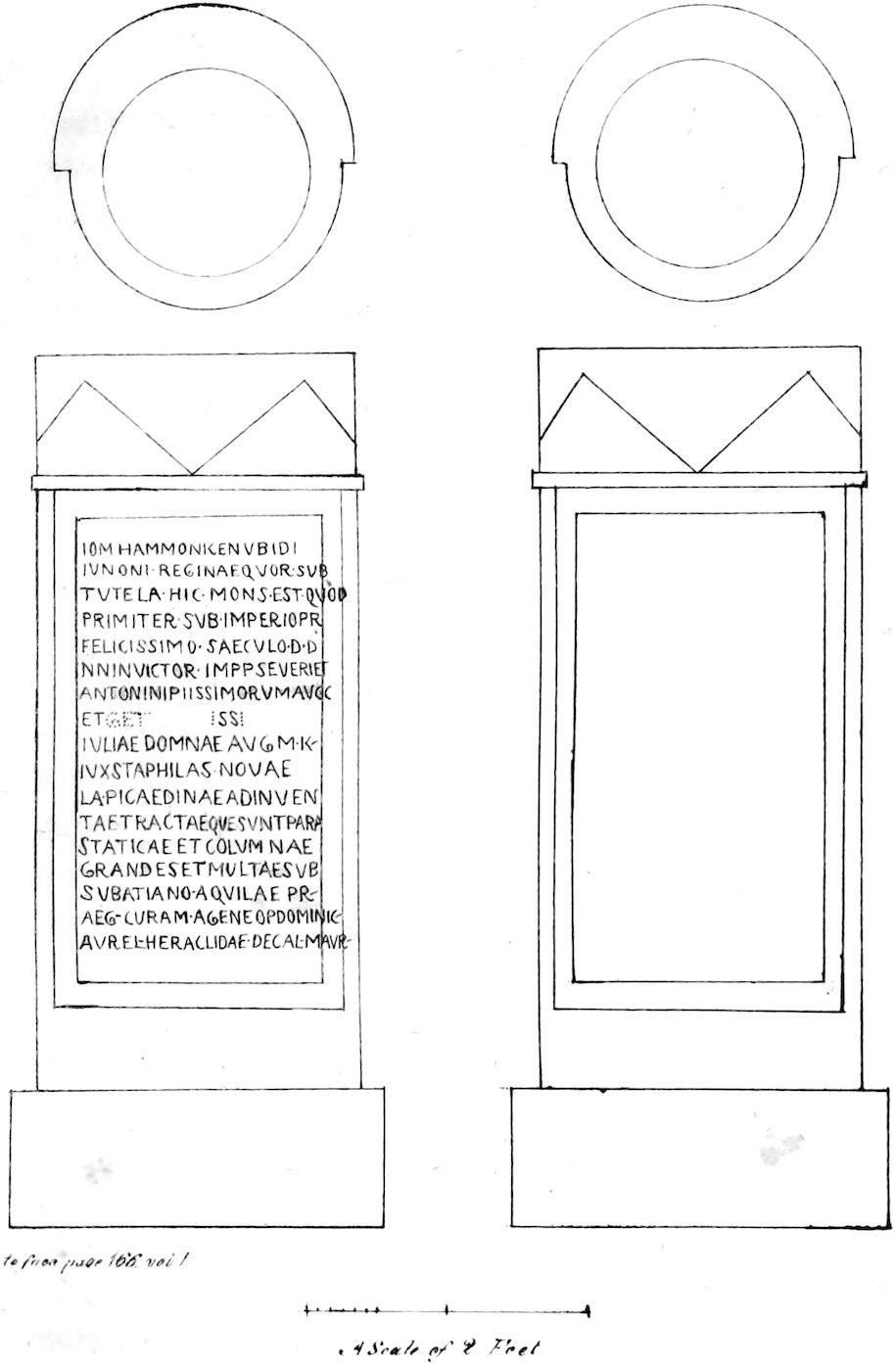
On my return to Assouan, no boat had arrived,
and I became impatient, for I wished to
reach Thebes. We were seated under a grove
167of palm-trees, eating our soup of rice and meat
with the Aga, when an Arab came to him, and
whispered in his ear, as if he had something of
great importance to communicate. The Aga
rose, though his dinner was not finished, and
went away with the air of a man of great business.
Half an hour after he returned, accompanied
by two other persons of distinction, and
the old man who came before. They all seated
themselves round me, and after introducing the
affair with a degree of caution, I was asked,
whether I wished to purchase a large piece of
diamond. I considered, that I was no diamond
merchant; but in a case like this, I would have
contrived to become a jeweller, and have procured
the money from Esne, if it had been to
my advantage; for, in the times in which we
live, jewels are no despicable articles, if they
can be obtained at a cheap rate. I told the
Aga, that if the article were good, I would purchase
it, if we could agree; but it was necessary
that I should see it. He said, the piece had
been found by one of the natives of that place;
and, as he was not in want of money, it had
been preserved in the family for many years.
This original proprietor being now dead, his
successors wished to dispose of it. I requested
to see it; so we retired some distance out of
168the way of the people. The old man then with
great solemnity took a small wooden box from
a pocket in his leathern belt. In this was a
paper, which he unfolded; after that, two or
three others, till at last he opened the sanctum
sanctorum. I took its contents in my hands
with no small degree of expectation: but, alas!
how did I look, when I saw it was only part of
the stopple of a common glass cruet, of the
size of a hazel-nut, with two or three little gilt
flowers on it! All my hopes vanished; and as
the others were anxiously observing my motions,
they could not fail to see disappointment
so strongly marked in my countenance, as decided
their fate, and destroyed their great expectations
of wealth from this invaluable jewel.
When I told them, that it was only a piece of
glass, the words affected their minds like the
unhappy tidings of some great misfortune: they
walked off in solemn silence, not without giving
me an inquiring look, to learn whether I were
really in earnest. But I also shared their disappointment,
and the smile on my face could
give them no hopes.
Another day passed, but no boat appeared.
At last I thought of bespeaking two camels, and
proceeding to Esne by land, with Mrs. Belzoni
and the interpreter, and letting the Janizary remain
169there, to follow by the first boat, and bring
the implements we should leave behind. But
when the Aga saw, that I had taken this resolution,
he sent for a boat, which was hidden
about a league distant, and there were two or
three more concealed in other places. I found,
that all this was done to keep us a few days in
that place for the benefit of the town, strangers
being of course obliged to spend money while
they are there. After the boat was hired, at a
great price, I found it belonged to the Aga
himself; and the Captain or Reis told us, afterwards,
that he ordered him to hide it, to compel
me to give what he liked for the hire of it.
Some travellers give us the notions they have
formed of the Arabs and Berberys; but it is to
be observed, that there is a very great difference
in the manner in which different persons travel;
and the methods pursued in going through a
country may afford one more opportunities of
seeing and judging than another.
A traveller who has all the accommodation
possible, and nothing to do with these people
but in passing, can never judge of their ideas,
their system of conduct, and their rapacious
manners; for in the little interval, and the
limited business he has to transact with them,
they do not appear to be the people they really
170are. Some travellers even receive civilities,
with which they are mightily pleased; without
having time to discover, that the very persons,
whom they suppose to be naturally civil, are so
only to serve their own interested views. They
pass on, and in their journal of remarks say, that
they were received civilly at such and such a
place. But let a traveller deal with them in
any transaction, where their interest is concerned,
and where their execution of any undertaking
is required, he will soon find, that in
every point they are the most cheating people
on earth. Their deception is extreme. A traveller
passing by a village stops his bark for an
hour or two: what good people he finds! Some
bring him a small basket of dates, others a few
eggs, another some bread and milk; with which
he is so pleased, that he immediately gives them
five or perhaps ten times more than the worth
of what he receives, without being aware, that
it is through such an expectation they bring
him these things; and exclaims, that in Europe
they do not treat a stranger so civilly. But let
him take the smallest of these presents without
giving any thing in return, or even no more
than it is worth, they will not fail to murmur
at him. If he give only double the price, they
have the art of returning the money with scorn
171and contempt, in order to shame him to give
more:—and if he take the money returned, or
give them nothing from the beginning, he must
not expect, that they will let him go away without
paying them for what they brought him.
All this is unknown to a traveller merely passing
by; for there is no one in this character, who
would be so mean as to accept any thing, without
returning double or treble its value. From
these trifles it may be presumed what they are
in all their dealings: to-night one word for such
a thing, to-morrow another: their intrigues are
beyond description: they have the art of making
one thing appear like another so well, that it is
very difficult to avoid falling into their trap.
There are two extremes in travellers. One
who is just arrived, has never before been in
the country, and of course has no knowledge
of customs and things, cannot see one fourth of
what he should see: the other is so thoroughly
initiated into their customs and manners, that
those things which strike at first sight, lose their
effect on him; he almost forgets his own ways,
and does not reckon any thing he beholds extraordinary
or worth attention, though perhaps
even of great consequence.
At last, after settling all my affairs with the
Aga, and satisfying his demands of oil, vinegar,
172and some empty bottles, we left Assouan in the
morning of the 30th, and two days brought us
to Esne, the current being very strong. Khalil
Bey was not there, and his Hasnadar or treasurer
did not know any thing about the orders,
which were sent to me in Nubia: but on seeing
the Bey sometime after, he said he never sent
me any such orders. On the morning of the
4th of October we arrived at Luxor. Seeing
that no boat had arrived from Cairo, though
the consul had sent me some money, I set off
next day in the same boat to Gheneh, arrived
there the next morning, and went to see Mr.
Sokiner, a person whom I knew, and who
served me much in this business. We went to
the Cacheff, who could not give me a boat, in
consequence of a fresh order from Cairo to
press all boats that passed; and I was therefore
obliged to despatch a courier again to Cairo,
for an order from the consul to obtain one.
On the 7th, in the morning, we endeavoured to
obtain a boat, but we lost the whole day in this
manner, and I was nearly despairing of success;
but, repairing the next morning to the Cacheff,
I begged him to give me an order to press a
courier, and he complied immediately, for he
was of a very different cast from the Cacheff of
Erments. The courier received his despatch
173about noon, and was to go and return from
Cairo in sixteen days. He was on the point of
setting off, when a large boat appeared, which
brought Messrs. Jacque and Caliad, two agents
of the French consul, who were going to Assouan.
On inquiry I found that the boat was
at liberty to be engaged after it arrived at Assouan.
Accordingly I bespoke it of the Reis,
before the Aga, who made him promise not to
retract his agreement. The courier had not
yet set off, and there was now no necessity of
sending to Cairo, as I was assured of having
this boat.
On our arrival at Thebes, the boat happened
to be fastened to the bank, where the colossal
head was. I will not waste my time in describing
the remarks made by the two French
agents of Mr. D., on seeing the head: suffice
it to say, they positively declared, in spite of
the evident mark it bore on its breast, that the
French invaders did not take it away, because
they thought it not worth the taking! On hearing
of my fortunate success in collecting several
valuable pieces of antiquity, their Dragoman, a
renegade Frenchman, observed to me, that, if
I persevered in my researches, I should have
my throat cut, by order of two personages; one
was the Cacheff of Erments, the other I shall
174not mention at present. I told him I was greatly
obliged to him for his information, but did not
believe any one would make such an attempt.
They went to visit the soldiers, who lived in
the tombs among the people at Gournou, and
assembled several Arabs of that place before the
two agents, who told them plainly in my presence,
that, if they sold any article of antiquity
to the English party, they would have them well
beaten by the Cacheff of Erments, who commanded
over them. From this moment I perceived,
that I should have much opposition and
many difficulties to encounter; but as my stay
there was to be short, I did not regard them,
and continued my business, after Mrs. Belzoni
had been lodged in the house of an Arab at
Luxor.
The same day I went to Carnak, and set
twenty men at work on a spot of ground, that I
chose according to a simple calculation I made,
of which I shall have to speak hereafter. I re-embarked
for Esne again, on board of the same
boat, as I had to conclude the contract with the
Reis of it, and to pay a part of the money as
earnest. The two Frenchmen were on board
also. We proceeded during the whole night,
being favoured with a good strong wind, and
arrived at Esne the next day at noon.
175I hope the reader will not think that I employ
my pen in useless accounts, or to make a
display of the difficulties I encountered in my
operations, merely to enhance any merit on my
part: on the contrary, I can assure him, that I
study, by all means possible, to be brief, and
not to insert the least thing but what is necessary
to be known, as will be seen. I went to
the house where all the owners of the boats
were assembled, who at first were of one accord,
that it was impossible to put the head on
board the boat, alleging that it would break it
to pieces, if such a mass of stone were placed
in it. They then strove to persuade me to leave
the stone, as they were disposed to believe that
there was no gold in it; and, if I took it, and
found none after I had spent so much, I should
lose all. Notwithstanding their simplicity, when
I persuaded them that no accident would happen,
and that I took all risks upon myself, they
did not fail to ask me an enormous sum for the
hire of the boat. I was in a dilemma, fearing,
that, if I missed this boat, I might lose the high
water, which would have obliged me to wait
till next year; and in a country like this,
changing from one day to another its government
and way of thinking, I did not know what
might happen. I therefore thought it best to
176secure myself from any future extortion, and
give an enormous hire for the boat. This was
three thousand piastres, equal to seventy-five
pounds sterling, from that place to Cairo.
After all this was settled, and half the money
paid down, the boat was to ascend the Nile as
far as Assouan, to unload at that place, and to
return immediately. I sent my Janizary with
some presents to the Aga, and some trifles for
Osseyn Cacheff, to be forwarded to him at Ybsambul,
by the first opportunity from Assouan
to that place; thinking by this trifle he would
be convinced, that I intended to return to that
country to finish the operation, and be induced
to keep his promise, not to let any one undertake
the accomplishment of what I had begun.
The Janizary was likewise to take on board the
twelve stones which I left there to be cut, &c.
When all this was arranged, I set off for Thebes
at night, and arrived there the next morning.
On my arrival, I went immediately to Carnak,
to see what had been done the day before by
the twenty men.
Here, reader, was the beginning of those discoveries,
which have caused me so much trouble,
not from the exertion and arduous labour required
in these researches, but in the atrocious
persecution they have drawn on me, from malice,
177jealousy, and envy to such a degree, that
to this day, the very goddess Fortune, who has
been apparently so propitious to me, I had reason
to call barbarous and unkind. Notwithstanding
which, I did not relinquish my undertaking,
till I reached the accomplishment of my
wishes. Let me add, I have further enterprises
in view, which, I hope, will convince my adversaries,
that their persecution has had no other
effect on me, than that of strengthening me to
perseverance in my undertakings. Had I not
determined to stand, like a pyramid defying the
wind, against all their numerous attacks, which
poured on me like a torrent, I should not have
been able to proceed, even from the commencement.
On the other hand, I must acknowledge,
that at the moment when I was persecuted
on one side, I received marks of kindness
and good wishes on the other; and fortunately,
thank God, the well disposed far outnumbered
the others, though few like to enter into, or
interfere with matters which do not concern
themselves. Many travellers of various nations,
at the time of my researches, witnessed, that
the greatest difficulties I had to encounter were
not in the discovery of antiquities, which I
consider the smallest part of my task, but in
controlling the complicated intrigues of my
178enemies and false friends. I am more inclined
to excuse Count Forbin, as the erroneous and
false accounts he gives are so confused and
contradictory to the facts, that he openly exposes
himself to ridicule and contempt, than to
pardon some others, who should have been
above such paltry proceedings.
The works in Carnak were begun when I returned
from Esne, but nothing was found, and
there was no likelihood of finding any thing.
The place whence the French had taken their
lion-headed statues, at the time of the invasion,
is where a temple stood, surrounded on three
sides by a lake. It faces the avenue of the
great sphinx to the north, and not a single wall
or column remains standing. On the exterior
side of the wall are several fragments of the
above statues, which were there before the
French army invaded Egypt, but they made
some excavations on the east side of the temple,
and made discoveries, the fruits of which are
now to be seen in the British Museum, they
having been captured at sea. The Count de
Forbin asserts, that after all these sphinxes had
been discovered they were covered up again by
some French gentlemen who superintended the
work. But the Count did not mention the
names of those persons, for he knew very well
179that no such thing ever took place. The account
he published of the statues, which he
acknowledges to have been found twenty feet
below the surface, and backed by a strong ancient
wall, was taken from my own letters,
which I gave him myself in Cairo, of which I
shall have to speak hereafter, and which he
promised to give to the world as they were.
Instead of this, the only use he made of them
was to throw all the facts into confusion, and
prevent the real truth from coming before the
public.
Now to more obvious facts. According to a
calculation I had made, I dug on the west side
of the temple, where no one had ever made any
excavation before, nor did any traveller previous
to me take any thing thence but what
was in sight; the French having taken theirs
from the east. The earth, bricks, and stones,
were so strongly cemented together by time,
particularly on the surface, that it clearly proved
the ground never to have been touched from
the earliest ages. In the course of a few days
I discovered about eighteen lion-headed statues,
six of which were perfect, and among them a
white statue as large as life, supposed to be of
Jupiter Ammon, which is now also in the British
Museum.
180I here beg leave to make an observation
which I hope will convince the world of the
erroneous statement of Count de Forbin. The
French Consul, Monsieur Drouetti, who had
been making researches for fifteen years in that
country, and who was naturally attached to the
interest of France, had been to Thebes twice
previous to my arrival in Egypt. How was it,
that, in the course of so long a period, he never
came to know from the natives, that such statues
had been found there by the French, and
covered up again? and how happened it, that
the person who covered them up never mentioned
it to him, or to any one else, even after a
general peace took place? We should suppose,
that as soon as the seas were cleared of the
English cruisers, whose watchful eyes did not
let even a water-rat pass into France, there was
no fear that these statues should have been
taken, and thus a second loss incurred: but
independent of all this, there was nothing to
prevent Mr. Drouetti from bringing them safe
to Alexandria, as he did other antiquities,
which were the sole object of his ascending the
Nile. I should not enter on this subject, had it
not been for the petty means which have been
employed to depreciate every thing I have done,
and which are a compound of erroneous assertions,
181that I believe originated in the volcanic
brains of Count de Forbin himself.
The place where I found these statues must
have been the interior of the pronaos; but
there were many others in various places, and
it is difficult to determine their original stations.
In another temple in Gournou, which is yet
unknown, and of which I shall speak in this
work, I found several statues of the same
sort, and by the pedestals it appears they were
within the space from one column to another.
The same may have been the case in this temple.
The situation in which I found them was
by no means their original place, and it was
clearly to be seen by their irregular positions,
that they had been brought thither in great
hurry and confusion. Some brick walls had
been built, as if to hide them from the destructive
hands of an invader, and the white statue
lay among the rest in an irregular manner.
During the time of this excavation I scrutinized
the ruins of Carnak, and perceived a
great number of spots that deserve digging. I
saw the famous altar, with the six deities mentioned
in the great French work, and the colossal
arm, both of which I formed the project of removing
even at that period. Fortunately on
this side of the water the difficulty of obtaining
182people to work was less than I had found it on
the other. The Cacheff was ready to do all he
could for me, and every thing went on very
smoothly. The only impediment here was that
the Fellahs of Carnak would insist upon coming
to work in greater numbers than those of
Luxor; for they said the others had no right
to come to labour on these grounds, and sometimes
this dispute ended in blows. These people
were quite the reverse of those in Gournou,
who, having become opulent by the trade in
antiquities, and tricking travellers, were not so
anxious to gain thirty paras a day. During the
same excavation I turned up a fine standing
colossus without a head, part of which projects
above the ground, and which had not been seen
by any body. For my part I think it one of
the most finished pieces of Egyptian sculpture
I ever saw.
It would be too tedious to the reader, to
mention all the particulars that occurred during
my researches. Unfortunately I was again
without money to proceed, and had to go to
Esne, to borrow some from a Greek I happened
to know in that place, who would supply me
with any sum; but as I expected a remittance
from the consul, I only took what was necessary
to transport the lion-headed statues from
183Carnak to Luxor, ready for embarkation. On
my return to Carnak, I found, that an order
had come from the Cacheff of Gous to the
Caimakan of Luxor, not to let me take any
thing away: this being contrary to the order I
had from Mahomet Ali Bashaw, I set off for
Gous immediately; and finding, on my arrival,
that the Cacheff was gone to Gheneh, I directed
my course to that place. As the current was
very strong, we went on pretty fast. About
midnight we saw two cangias coming up. I
inquired what party it was, and was told it was
Calil Bey, my good friend, on his return from
Cairo. I was pleased at this circumstance, as I
meant to complain against the conduct of the
Cacheff; but, on approaching the cangias, I
found that the Cacheff was there also. Calil
Bey was well pleased to see me returned from
Nubia, and was anxious to inquire how they
received me in that country. I told him, that
they obeyed his firman, and that I had done all
I wished to do in respect to the temple at
Ybsambul; but not being able to finish my
undertaking that year, I should return the
next. He desired to know, whether the two
brothers, Mahomet and Osseyn Cacheff, were
friends again; a question to which I was unable
184to reply; but I told him the country was
perfectly quiet at that time.
I returned to Gous with him, and the next
morning took an opportunity to inquire of the
Cacheff the reason of his sending the order to
the Sheik not to let the English take away any
thing that was found. He said, he knew nothing
about it; although I had seen the order
myself. However, he was ready to give me any
order I pleased. No doubt this was in consequence
of the Bey being there, otherwise I
should not have found him so easy to deal
with.
Calil Bey was an Albanian, who had married
the sister of Mahomet Ali Bashaw of Egypt,
and held the command of the provinces in
Upper Egypt from Esne to Assouan; and for
a Turk was much attached to European travellers.
He was continually inquiring concerning
things he did not know, and had a degree
of sound judgment; a quality very scarce
among Turks: but for all this he was a complete
slave to superstition, and to the belief of
magical powers. On our arrival at Gous, he
took his seat in the garden of the Cacheff, under
an arbour of vines, shaded all round by banana
trees, which formed a very pleasing and cool
185recess. A large mat was spread on the ground,
and on this a fine carpet, and cushions, as
usual. The Cacheff was seated at his right,
and a Turkish Sheik on his left. Two Hadgees
sat by the Cacheff, and I was requested to take
my seat near the Holy-man. Next to me was a
Turkish merchant, and after him a fool or Santon
quite naked. All the rest of the followers,
soldiers, and attendants, stood in a crescent before
us. Pipes were brought in for the Bey,
the Cacheff, the Holy-man, and myself. Coffee
was served all round to the persons who were
seated, and the conversation turned on the harvest,
that was to be the next season, according
to the inundation of that year. It was then the
beginning of November. They were wondering
at the great quantity of corn the Bashaw was
sending continually to be embarked at Alexandria,
particularly at this season. Some supposed,
that the Europeans were about to make
war against the Porte, and that, previous to
the declaration, they made provision of corn, as
without a supply from Egypt they would be
unable to maintain their troops. Others observed,
if this were the case, Mahomet Ali
would not send them corn, till he knew for
what purpose it was wanted. One said, he
thought the corn was sent into Russia, as he
186heard that the French had set all that country
on fire; and he then inquired of me, whether it
were not so. I told him, that I did not know
what the French did in that country; but I
knew that the corn was sent into Europe, in
consequence of a scarcity in the harvest that
year, through the whole of that quarter of the
globe. The Bey agreed it must be so, and
asked whether it would be the same the next
season. I told him I hoped not, for, in general,
after a scarcity came a plenty. Yes, says the
Bey, but the Bashaw will sell the corn at a
high price for three or four years to come, till
your granaries are filled again. “But pray,”
added he, smiling, “have you a scarcity of
stones also in Europe, that you come here to
fetch them away?” I answered, that we had
plenty of stones, but we thought those of Egypt
were of a better sort. “O ho!” replied he, “it
is because you find some gold in them perhaps,
thank God!” This is the first instance of my
hearing the word “perhaps” employed; for they
are so positive on this point, that they never
make any doubt of it.
The dinner was brought in a large tray. It
consisted, as usual, of very poor rice soup,
which, after eating three spoonsful, was taken
away, and a dish of roast mutton brought forward.
187No sooner had we begun to eat of that,
than a man came in with his hand full of large
green peppercorns, and let them fall on the
tray, which, being of metal, sounded like a
drum-head. After him came another, with
half-a-dozen onions peeled, which he let fall
in like manner, and they rolled about the tray
like billiard balls; and a third followed with
peeled garlic, &c. After eating the mutton, a
dish of very small fried fish was served up. They
were about half-a-dozen, and we were eight of
us, so that we could not eat too much of this.
It was soon removed, and a kind of tart was
produced; but neither the Bey, the Cacheff,
the Sheik, nor myself, could eat a single bit of
it. The fruit consisted of a water melon, which
having demolished, they finished their repast by
washing their beards. It was rather too mean
to set before the Bey, as I have seen the Cacheff
take a better for himself at other times; but it
is a general system among these people, both
Turks and Arabs, always to make themselves
appear poor in the presence of their superiors.
As the Cacheff had furnished me with
an order for the Caimakan of Luxor to let me
carry away what stones I pleased, I took my
leave of the Bey and set off.
On my arrival at Carnak, the work to be done
188consisted only in transporting the six sphinxes
and the white statue to Luxor for embarkation,
a distance of nearly a mile, without a road. In
many parts the water had left a soft ground
where the statues had to pass; and, as there
was no mechanical power to assist, the Arabs
had enough to do to carry them to the place of
destination. With this all my labour at Carnak
ended, in this voyage; and while thus waiting
for the boat from Assouan, and the cash from
Cairo, I paid a daily visit to the tombs in
Gournou. These sepulchres are excavated in
all directions in the rocks, but generally with
the entrance facing the east, as the chain of
these mountains runs from north to south.
They are intermixed of all sizes; and some of
them have porticoes hewn out of the rocks before
the entrance; but, generally, they are
within the outer door, which is most adorned
with well-finished figures and hieroglyphics,
and generally the watchful fox is represented
at each side of the inner door leading to the
grotto. Some of them are very extensive, and
run down in various directions, something like
winding stairs, having on each side, at regular
distances of a few paces, small chambers to deposit
the mummies. Some have deep shafts, or
wells, with excavations on each side of the
189shaft to receive the mummies; and at the bottom
of the wells are passages leading to smaller
apartments, with endless winding recesses. It
was here that I had first leisure to examine
and find the means of ascertaining where the
entrances were to many of the tombs, which
had been hidden for centuries from the eye of
mankind.
The extensive ruins of Medinet Aboo are, in
my humble opinion, best worthy the attentive
scrutiny of a traveller of any on the west of
Thebes. The descriptions given by Messrs.
Hamilton and Denon are sufficient to convey a
correct idea of these edifices, which contain
propylæa, temples, and dwelling-places. It
seems that here was the residence of some of
the sovereigns of Egypt; for in no other
edifices of ancient Egypt have I seen the remains
of habitations as they are in this place.
There are two separate temples, of which the
first that meets the view going from the Memnonium
is of a less ancient date than the other.
On the west side of the portal are stones with
hieroglyphics upside down, evidently belonging
to a former temple. The pronaos is surrounded
by a portico of pilasters, at each side of which
are two chambers: one on the right of the entrance
has been used as a Christian chapel.
190The cella contains various apartments, quite
dark; in one of which, on the right side, is a
monolite temple of red granite, without hieroglyphics.
It is wider than the door, and must
have been placed there before the cella was
erected. The hieroglyphics and figures of this
edifice differ from those of the other temple in
proportion as the two temples differ from each
other. On the north side of this little temple
was a small lake, or rather a tank for water,
which is now filled up with earth and rubbish;
and there must have been statues all round it,
as I found part of one and fragments of others
in an excavation I made in that place. Perhaps
it might have been used for the same purposes
as the small lakes near the temple of Carnak,
which may be supposed to have been the public
baths destined for the religious visitors to the
temple. On the south of these ruins is a building
something like a square tower, with a large
gateway, which I opened and went through. It
is nearly in a line with the gates leading into
the great temple. Above the gateway is a
chamber with two square windows, looking
over it at each side. There are also two doors
opposite each other on the sides. Above this
chamber was another, with two windows like
those below; but the fore part of the upper
191chamber is fallen in. There are recesses at the
sides of the windows, no doubt to place the
shutters. No hieroglyphics are to be seen
within this building, though on the outside it
is every where covered with them. The two
lateral walls in front of this place form an
avenue to the gateway.
Further on, about two hundred yards to the
west, stands the great temple. There is a
large propylæon, with the entrance into the
inner yard. The walls are covered with hieroglyphics,
deeply cut. The gateway, which is
also adorned in like manner, leads into a large
yard, with a wall opposite to the propylæon, and
a gateway into another yard. At each side of
this yard is a portico. On the right are seven
pilasters, with colossal figures before them; and
on the left eight columns, with capitals in the
form of the lotus. Both of these porticoes are
also adorned with hieroglyphics, deeply cut.
The next yard has a gallery, or area, all round
it, of pilasters and columns. The walls are
beautifully embellished with battles, men on
chariots, captives, and slaves; together with
which are distinctly visible procession offerings,
initiations, and sacrifices so well described by
Mr. Denon. The excavation of these works
shows, that they are of a very ancient period.
192The hieroglyphics are uncommonly deep, more
so than any I have seen in other buildings in
Egypt. In some parts the figures retain their
colours pretty well, particularly in the ceiling
on the capitals of the columns. This edifice
has been used as a Christian church; and the
rude columns, employed in a more modern
building within this yard, show the wonderful
difference between the arts of the two ages.
Further on, through the last gate, was the entrance
to the pronaos and cella: but now these
are buried under the earth, and several Saracenic
buildings have been raised on it. The
exterior wall of these ruins is filled with historical
subjects, such as land and sea fights, lion
hunting, processions of captives, and various
national emblems. Further to the south of the
town is a small temple, which now serves for
the shepherds to keep their cattle in at night.
The whole town, in my opinion, appears to have
been rebuilt twice or three times successively on
the ruins of the former.
It was at this period, that I began to make
some researches in the valley adjacent to that of
Beban el Malook. I had seen all the tombs of
the kings: as I did not go there, however, with
any intention of making researches, my curiosity
must have been greater than that of many who
193had been there before, as I went into every
little recess of these valleys. It was in the
western valley that one of the French savans
discovered a large tomb, which he found open,
but was quite unknown before his time. I went
to visit this tomb, and found it very extensive,
and in pretty good preservation. My curiosity
did not end here. I went farther on in the
valley; and in one of the most remote spots
saw a heap of stones, which appeared to me
detached from the mass. The vacancies between
these stones were filled up with sand
and rubbish. I happened to have a stick with
me, and on thrusting it into the holes among
the stones, I found it penetrate very deep. I
returned immediately to Gournou, and procured
a few men, to open these places. Unfortunately,
both Mrs. Belzoni and myself had been much
afflicted for some time with the ophthalmia,
which was so severe on me at this time, that I
could scarcely see any thing before me.
I took the men into the same valley the next
morning; but in consequence of my eyes being
so bad, it was some time before I could find the
spot again. On removing a few stones, we perceived
that the sand ran inwards; and, in fact,
we were so near the entrance into a tomb, that
in less than two hours all the stones were taken
194away. I had caused some candles to be brought,
and I went in, followed by the Arabs. I cannot
boast of having made a great discovery in this
tomb, though it contains several curious and
singular painted figures on the walls; and from
its extent, and part of a sarcophagus remaining
in the centre of a large chamber, have reason to
suppose, that it was the burial-place of some person
of distinction. The tomb consists of three
chambers, two corridors, and a staircase; but the
remote situation in which it was found renders
it remarkable: and I declare, that I owe this
discovery merely to fortune, not to any premeditated
research, as I went into these mountains
only to examine the various places, where the
water descends from the desert into the valleys
after rain. It is singular to observe, that though
rain falls very seldom, perhaps not more than
once or twice a year, yet such is the effect of
the climate and the sun on the spots where the
water passes, that they are as strongly marked,
as if it were continually running over them, and
much harder than the rest of the masses.
The higher part of the mountain on the west
of Thebes extends in wide plains, which rise
gradually towards the west; and when rain falls
upon them, the water takes its course towards
the Nile, descending into the valleys of Egypt.
195There are very few places in these mountains
where water gathers in such quantities, as in
the valley of Beban el Malook, and its adjoining
branch on the west side. For some time
the water forms a small torrent, that carries
every thing before it. Mr. Salt superintended
the making of a road from the tombs of the
kings to the Nile, for the purpose of transporting
a large sarcophagus, and one of these falls
of water from the desert destroyed the whole
road. For the present, however, I shall leave
this valley, as I shall have to speak of it in another
part of this work, on my second journey
to Thebes and Nubia.
The time having elapsed, in which I expected
to receive letters from Cairo, I was rather uneasy,
and resolved to return to Kenneh. On
my arrival at this place, I found the courier had
just entered it. He brought me letters from
Mr. Salt, with an order for money on the Seraf,
or banker, of Kenneh. I quickly finished my
business there, and speeded to Luxor, where I
was pleased to find the boat returned from
Assouan, to take the colossal bust on board:
but I was soon informed by the proprietor, that
it was loaded with dates, and that he was come
himself from Esne, to return the money I had
paid as earnest; for they could not think of
196taking that large stone into the boat, as it would
crush it to pieces. All my persuasions were
useless; and though I had a written agreement
in my hands, they signified to me, that it was
of no use, they never would take the stone on
board. I had much to say to them, as may be
imagined in such a case; for I was so circumstanced,
that if the present opportunity of
transporting the bust were lost, the water in
the Nile would have become much too low,
and the conveyance could not have been effected
till the next season. At the same time
I was informed by my Janizary, whom I sent
to Assouan in the same boat with the two
agents of Mr. D., that it was owing to them the
owner would not take the stone on board: for
they told him he would lose his boat, and never
receive any recompense for it; and that the
agreement I made with them was good for
nothing when in Cairo. In fact, these gentlemen
had so much warped the minds of the
crew, that they were resolved not to perform
their contract.
The twelve stones I had left in the island of
Philoe, and which were to have been conveyed
in the same boat, in like manner could not be
embarked, as the Reis said there were no small
boats to take them down the cataract: and I
197afterwards learned, that this also was owing to
the same influence. The unfortunate history
of these stones will not be read without exciting
sentiments of detestation towards the parties
concerned: they had been mutilated, and rendered
useless; how, and by whom, I shall mention
hereafter. My situation with regard to
the boat was far from pleasant, and I had no
resource, but to take the owner to Esne and lay
the case before Khalil Bey, who by this time
must have arrived at that place: but even then
I did not know how far he would interfere in
compelling these people to keep to their agreement,
as he had himself observed, that he thought
the stone would break the boat. This, however,
was the only step I could take.
Fortune sometimes brings troubles on mankind
merely that they may taste the fickleness
of her nature and uncertainty of the favours she
condescends to bestow on them. My vexation
was great, thinking all my efforts and exertion
in bringing the bust to the Nile were to no purpose,
and that very probably it would never
reach England, as the underhand machinations
against it were so powerful. At that moment,
however, a soldier arrived from Erments, acquainting
me that the Cacheff was returned
from Cairo; and he gave me at the same time
198a letter from him, with a present which he had
sent of two small bottles of anchovies and two
of olives. Strange as it may appear, it will be
seen that the effects of a few salted little fish
contributed the greatest share towards the removal
of the colossus, which I had so much at
heart, and which, in all probability, but for them,
would not have been in the British Museum to
this day. The letter contained a very gratifying
invitation to a feast to be given by the Cacheff,
and the present was in token of a friendly
disposition towards me. I was not a little surprised
at this change, but I soon discovered the
reason. The soldier acquainted me, that the
Cacheff was in a terrible rage with a certain
correspondent and friend of his, a Frank, who
for some time had raised his expectation of
having some valuable presents sent him; but,
instead of this, he received at last only a few
bottles of insignificant fish, which may be had
in plenty from the Nile, and a few olives, not
worth a pipe of tobacco. I took care, that this
should not be told to the owner of the boats;
and, as it was arranged that we should go to
Esne for the decision of the affair, I took them
on board the little boat which I had hired, and
we set off for that place, leaving the large one
at Luxor. Knowing in what humour the Cacheff
199must be in from his disappointment, I
thought to strike while his mind was hot.
On our arrival before Erments I begged the
two owners of the boat to wait a little, as I had
business with the Cacheff of the village. It was
already an hour after sunset, and the village is
about a mile from the Nile. I took my interpreter
and Janizary with me, and set off alertly to my
anchovy and olive man. I found him seated on
a mat in the middle of a field, a stick fastened in
the ground with a lantern attached to it, and all
his attendants standing before him. On seeing
me, he made a great parade of compliments;
I suppose because he thought, that, as he was
disappointed of presents from one quarter, he
would make the best market he could by trying
the other. Pipes and coffee were brought
as usual; and an offer was made me, to send
as many men as I liked to have to work, that
I might take away the great head early the next
morning, and the cover of the sarcophagus, or
any thing else I pleased. Had I requested him
to let me take the two large colossi of Thebes,
Tommy and Dummy, as the Arabs call them,
he would have had no objection to my putting
them on board my little boat that night. I
then introduced the affair of the boat, produced
the written agreement I had drawn up at Esne
200with the two owners, and mentioned the money
I had paid, which amounted to half the sum of
what they were eventually to receive. He immediately
said, I need not go to Esne for the
decision, the affair belonging to himself, as the
boat was to be loaded on a bank in his province.
The two gentlemen from Esne were sent for,
and when they heard, that the cause was to be
tried at Erments, they were thunderstruck. They
considered the boat lost to them, though I repeatedly
told them, that I would be answerable
for any damage that might be incurred in the
embarkation or landing; but it was all to no
purpose. The Cacheff, however, insisted that
they should keep their agreement with me;
and still more to accommodate matters, as they
were at a loss what to do with the dates, offered
them his canja, which would contain as much
as was necessary to be taken out of the boat, as
I did not wish to unload it entirely. Meanwhile,
as he did not like to appear too openly
decided in my favour, he proposed that in the
morning the owners should be summoned, and
the case brought to a fair hearing. They then
retired to pass the night on board. In continuing
his civilities and protestations of friendship,
the Cacheff came to an explanation of his
former conduct, and, in particular, of the letter
201he sent to his brother respecting the sarcophagus.
It was written, he said, before he saw
Mr. D.; but now that he found how things
were, I might have the sarcophagus, or any
thing else; that he would guard it for me as
long as I desired; that no one else should have
it; and added a thousand other obliging things.
So extraordinary a change led me to suppose,
that Mr. Salt had made him some handsome
present when in Cairo; but I was mistaken,
for, a little after, asking him what he thought
of the consul, to my surprise he told me, that
he did not see him. The consul invited him,
he said, to his house, and prepared a dinner for
him; but that, on the day he was to go, news
arrived of the death of Tusoon Bashaw, the
eldest son of Mahomet Ali; and he was ordered
to come away immediately, which put an end
to the pleasure of seeing the consul, for he loved
him like his right eye. The story was equally
well invented, and well told; and I saw plainly
he was so ashamed of his late conduct towards
me, that he could not face the consul. He
caused dinner to be brought, and carried his
civilities to such a height, that I began to be
alarmed, suspecting him of some diabolical trick.
On my thanking him for the bottles of anchovies
and olives, he said, they were the whole of
202the French consul’s present to him while he was
in Cairo. I took the opportunity of observing,
that it would have been well for him, if, while
he was there, he had called on the English consul.
To which he replied, that he had been
told the consul had a fine brace of pistols for
him; but that unfortunately it was out of his
power to go to see him. I answered, I had no
doubt he would make him some present when
the stone should reach Cairo; on which he immediately
rejoined, that there was nothing he
would not do either for him or for me; but I
must not think that what he did was with any
view of interest. I said, I was quite persuaded
of the contrary; and should trouble him for an
order to be given to the people at Gournou to
come to work. He protested he would comply
with all I wished; but added, with a smile,
“What will you do, if the trial should go against
you?” I told him I should proceed to Esne,
where the agreement was made in the presence
of the Sharif, and show that I was in the right.
He laughed, put his hand on my shoulder, and
said, “You may sleep in peace, for to-morrow
I will myself see the boat unloaded of every
date that is in it, and you may re-load it at
your pleasure.” I answered, that I had no
doubt he would do what was just, and, taking
203leave, I returned on board the little boat for
the night.
13th.—In the morning I found him in his
chamber of audience, surrounded by several
Arabs, Sheiks of the village. He made me sit
down on his right hand, and coffee and pipes
were brought; for no judgment could be pronounced
without these luxuries. He had explained
the cause to the gentlemen of the jury,
who said, without hearing the other side, that
what he intended to do was perfectly equitable,
and they would have said the same whether I
had been right or wrong; for these juries are
not so deficient in politeness as to contradict the
judge. The other parties came, and he received
them politely, but with a frown on his brow,
from which I have no doubt they sufficiently
augured their fate. However, not to keep them
in suspense, they were soon plainly told, that
the bark, except only eighty ardeps, an indulgence
to which I had agreed, must be unloaded;
and he saw no other way of settling
the business. He then referred to the gentlemen
of the jury, to know whether they had
any thing to say. To my astonishment they
answered, that, as the other parties made no
defence, they of course acknowledged themselves
wrong; and, having nothing more to do,
204they all instantly rose and walked off. The defendants
then partook of what was before them;
but I believe never made a worse breakfast in
their lives. They began to talk about where
to find a boat, though they were obliged of necessity
to hire one of the Cacheff, being fully
aware of his design, which was to get the best
part of the money for himself. The contract
was soon made, and they paid him two-thirds
of what they were to receive from me, which,
indeed, they were glad to do, lest he should
scrutinise the business, and, finding the freight
to be double what was mentioned in the bill
of lading, they should thus lose still more. I
then took leave of the Cacheff, that I might
hasten to Gournou, to settle what business
was to be done there. He had given me a
tiscary for the soldier to furnish me with what
I wanted, gave orders to the Fellahs to do all I
desired, and take out the sarcophagus; and on
going on board, I found that he had sent me
two sheep, a jar of cheese, and some bread.
We set off immediately. One of the sheep
died in the evening, the other next day, and
the cheese was full of vermin. We arrived at
Luxor in the afternoon, and a few hours after
went to Gournou, and saw the Sheik el bellad
of that place. I sent my Janizary to the soldier,
205and it was concerted, that the Fellahs I wanted
should be ready for me in the morning.
Early on the 14th, I went again to Gournou
to begin the work, and was not a little surprised
when I saw no Fellahs assembled. By
one whom I met, I was told, that they were
afraid, being ordered not to work for the English.
I applied as before to the soldier, who
sent a man to collect the Fellahs; but it was
too late: they were all dispersed. Accordingly,
I contented myself this day with only
having the apparatus, necessary to embark the
head, conveyed over from Luxor. The Cacheff’s
boat from Erments arrived, and that at
Luxor came also to Gournou to unload.
15th.—The next day we collected, though
not without trouble, a hundred and thirty men;
and I begun to make a causeway, by which to
convey the head down to the river side; for
the bank was more than fifteen feet above the
level of the water, which had retired at least a
hundred feet from it.
Next morning a soldier came from the Cacheff,
to say that I was not to pay the Fellahs
any thing, as they were ordered to work for
me for nothing as long as I required, and that
he made me a present of their labour. I thanked
him, but desired the soldier to tell him, at the
206same time, that it was not my custom to have
the labour of men for nothing, nor would the
consul of England accept of such a present. I
this day finished the causeway down the bank,
and had the head brought to the edge of the
slope, ready to be embarked.
On the 17th of November, I succeeded in my
attempt, and the head of the younger Memnon
was actually embarked. I cannot help observing,
that it was no easy undertaking to put
a piece of granite, of such bulk and weight, on
board a boat, that, if it received the weight on
one side, would immediately upset; and this
was to be done without the smallest help of any
mechanical contrivance, even a single tackle,
and only with four poles and ropes: the water
was about eighteen feet below the bank where
the head was to descend. The causeway I had
made gradually sloped to the edge of the water
close to the boat, and with the four poles I
formed a bridge from the bank into the centre
of the boat, so that when the weight bore on
the bridge, it pressed only on the centre of the
boat. The bridge rested partly on the causeway,
partly on the side of the boat, and partly
on the centre of it. On the opposite side of
the boat I put some mats well filled with straw.
I necessarily stationed a few Arabs in the boat,
207and some at each side, with a lever of palm wood,
as I had nothing else. At the middle of
the bridge I put a sack filled with sand, that,
if the colossus should run too fast into the boat,
it might be stopped. In the ground behind
the colossus I had a piece of a palm-tree firmly
planted, round which a rope was twisted, and
then fastened to its car, to let it descend gradually.
I set a lever at work on each side, and at
the same time that the men in the boat were pulling,
others were slackening the ropes, and others
shifting the rollers as the colossus advanced.
Thus it descended gradually from the mainland
to the causeway, when it sunk a good deal,
as the causeway was made of fresh earth. This,
however, I did not regret, as it was better it
should be so, than that it should run too fast
towards the water; for I had to consider,
that, if this piece of antiquity should fall into
the Nile, my return to Europe would not be
very welcome, particularly to the antiquaries;
though I have reason to believe, that some
among the great body of its scientific men
would rather have seen it sunk in the Nile, than
where it is now deposited. However, it went
smoothly on board. The Arabs, who were unanimously
of opinion that it would go the bottom
of the river, or crush the boat, were all attention,
208as if anxious to know the result, as well
as to learn how the operation was to be performed;
and when the owner of the boat, who
considered it as consigned to perdition, witnessed
my success, and saw the huge piece of
stone, as he called it, safely on board, he came
and squeezed me heartily by the hand. “Thank
Heaven!” I exclaimed, and I had reason to be
thankful; for I will leave it to the judgment of
any engineer, whether it would not be easier to
embark a mass ten times larger on board a
competent vessel, where all sorts of mechanical
powers can be procured, instead of being destitute,
as I was, of every thing necessary.
The boat then crossed the water to Luxor,
for what was to be taken in there, which was
done in three days, and on the 21st we left
Thebes on our return to Cairo.
I had just finished my business, when I was
again so affected with ophthalmia, that for
twelve days I kept myself shut up in the cabin
of the boat, so that I can give no account of
this voyage, till we reached Siout. I could
then just peep at the light; but it gave me
great pain whenever I attempted to open my
eyes. At Siout I went to see the Deftardar
Bey, to return him thanks for the firman he
had given me when I ascended the Nile. I
209found him in his tent in the middle of a field
of high clover, which had nearly reached its
growth, and his horses were all out at grass.
He was pleased to hear that I had succeeded
in my undertaking, and requested to be remembered
to the English consul, to whom he sent
a letter by me.
Next morning we set off for Cairo, and reached
it on the 15th of December, having been twenty-four
days from Thebes. Thus I had been five
months and a half in continual activity and
exertion; but I must not let pass the unjust observation
made by the ever veracious Count de
Forbin, who asserted, that I employed six months
solely in taking the colossal bust on board the
boat. It is true, I was absent five months and
a half from Cairo, and six months had elapsed
before I reached Alexandria; but this time was
not all devoted to the removal of the bust, as I
employed only eighteen days in that operation,
and but a single day in embarking it: the greater
part of the time was spent in more arduous researches;
and the various pieces of antiquity
which I brought down the Nile will bear infallible
testimony to my labour.
At Cairo I found that the consul was gone
to Alexandria, but had left with Mr. Beechey,
his secretary, instructions and letters for me.
210He requested, that every thing might be landed
and lodged in the consulate except the bust. I
could not conceive the reason of this distinction,
as I thought that all the articles I collected
were to go to the British Museum. However,
I made no inquiry into the business, and every
thing was deposited as desired. The first hour of
my arrival I had the pleasure of seeing my good
and much lamented friend, Burckhardt, whose
death has been a great loss to me. He was the
most candid, disinterested, and sincere being I
have ever met with; totally free from that invidious
and selfish disposition, which is so often
to be found in travellers, who wish to be alone
in one quarter of the world, to relate their story
agreeably to the suggestions of their own imagination
to the people of another. But Burckhardt
had none of that littleness of mind: he
was a true explorer, and a hardy one, without
pride, or the ambition to be thought more than
he was. He made no parade of his knowledge,
as his works plainly evince.
Having prepared for my departure for Alexandria,
we left Boolak on the 3d of January,
1817, and arrived in Raschid, or Rosetta, on
the 10th. There I had to land the colossus,
and embark it again on board a djerm; but as
I had now some tackle, of which I was destitute
211before, and proper people to work, I found it
quite an easy operation. Besides, I took care
to land it in a situation, that was advantageous
for embarking it again. Having done so, I set
off on board the same djerm, with the bust,
and was fortunate enough to reach Alexandria
two hours after sunset of the same day, which
was the fourth after our arrival in Rosetta.
That very day, above two hundred djerms came
out of the Nile, some of which had been waiting
for an opportunity of passing the bar above
eighty days. Mrs. Belzoni went by land, accompanied
by the Irish lad, and arrived the
next day. I will not mention the kind reception
of the consul-general, and the under-consul,
Mr. Lee. I was fortunate enough to become
acquainted with a gentleman, Mr. Briggs, who
received me into his house in the most hospitable
manner, and was as much concerned
for the success of my affairs as it was possible
to be; for he felt the pleasure of a true Englishman,
in seeing one of the most finished monuments
of Egyptian art ready to be embarked
for his native country.
The next and final operation with respect to
the bust, on my part, was to land it, and have
it conveyed in safety to the Bashaw’s magazine,
there to await its embarkation for England. I
212had some difficulty in landing it, as the pier
was much higher than the djerm, and the motion
of the sea did not permit me to erect
any bridge. I was so fortunate as to procure
the crew of a British transport, which was there
at the time; and with their help, with proper
tackle, and a hundred men besides, it was landed
safely.
Having finished my operations, and whatever
was necessary respecting the head, I proposed
to the consul, to make another trip into Upper
Egypt and Nubia, to open the temple at Ybsambul.
Nothing could be more pleasing to me
than to find, that my proposal was accepted;
as I thought I might have an opportunity of
accomplishing the wishes I had formed, which,
to a certain extent, were with particular views;
though, as the consul has proved, no interested
motives governed my mind. The only stipulation
I made was, that, if I were successful, he
should give me an official letter of introduction
to the Society of Antiquaries, when I should
return to England; with which he promised to
comply. Thinking, however, I might be indulging
hopes that would not be realized, he
cautioned me against any expectations from
that quarter. I told him, I was not rich; but
as I had no other view than to serve the nation
213at large, I intended to make certain proposals
to the members of that honourable society. On
this he again promised me the letter requested,
and in a few days we all set off for Cairo. There
the worthy Burckhardt would insist, that I should
receive a present, half of which he obtained
from the consul, as an acknowledgment for
my success with regard to the colossus; of the
general expenses attending which he paid a
moiety.
It was at this period that Captain Cabillia
had ventured into the well of the first pyramid
of Gaza. His enterprise was hazardous and bold,
and nothing but an enthusiasm for discovery
could induce a man to take such a step. The
consul, with Mr. Briggs, Mr. Beechey, and myself,
went to see the operations that were going
on. Captain Cabillia’s circumstances were much
better than mine; but he had no superfluous
wealth at command, to continue what he had
begun, which required a supply beyond his
means. Mr. Briggs was the first who generously
offered to furnish money for this purpose; and,
after a consultation with Mr. Salt, they agreed
to support the work to any extent that might
be required. This gentleman not only encouraged
the undertaking at the pyramid, but has
exerted his influence with Mahomed Ali for the
214general advantage of the commerce of Europe,
as I shall have occasion to mention hereafter.
The enterprise of Captain Cabillia is worthy the
attention of every one interested in antiquities,
as he has solved a question, by which the learned
world has been puzzled for many centuries.
The famous well, which has given rise to so
much conjecture, turns out to be a communication
with a lower passage leading into an inferior
chamber, discovered and opened by himself.
He first descended the well to the depth
of thirty-eight feet, where his progress was
stopped by four large stones. Three of these
being removed, there was space enough for a
man to pass through; but the fourth he could
not stir, though he had the help of Mr. Kabitsch,
a young man in the employment of Mr. Baghos,
who bore a share of the expense with the captain.
Twenty-one feet below this place they
found a grotto, seventeen feet long and four
high; and seven feet below this, a platform,
from which the well descended two hundred
feet lower. The captain went down, and at
the bottom found earth and sand: but from
the hollow sound under his feet, he judged, that
the passage must communicate with some other
apartment below. He then set some Arabs at
work, to remove the sand; but the heat was so
215great, and the candles so incapable of burning,
for want of oxygen, that they were compelled
to desist. The captain then turned his researches
to another quarter, and began to enlarge
the entrance into the first passage of the
pyramid. For this operation he was well rewarded;
for by it he found, that the passage
continued downward; and having employed
several men, and taken out a great deal of earth
and rubbish, at last, after a long and arduous
toil, he came in contact with the bottom of the
well, where he found the baskets and rope which
had been left there. The same day that this
occurred was that on which we had agreed to
visit the pyramids, and I had the pleasure to be
an eye-witness of the arduous task of Captain
Cabillia. Proceeding in his laborious researches,
he found, that the passage led into a chamber
cut out of the rock, under the centre of the
pyramid.
Captain C. made several researches round
the pyramids also, but none exceeded his toil in
uncovering the front of the great sphinx. He
found a small temple between the two paws,
and a large tablet of granite on its breast. The
tablet is adorned with several figures and hieroglyphics,
and two representations of sphinxes
are sculptured on it. Before the entrance into
216the small temple was a lion, placed as if to guard
the approach. Farther on from this front of the
sphinx is a staircase of thirty-two steps, at the
bottom of which is an altar, with a Greek inscription,
of the time of the Ptolemies. At
each side of the altar was a sphinx of calcareous
stone, much mutilated. From the base of the
temple to the summit of the head is sixty-five
feet: the legs of the sphinx are fifty-seven feet
long from the breast to the extremity of the
paws, which are eight feet high. Forty-five feet
from the first altar, he found another, with an
inscription, alluding to the emperor Septimius
Severus; and near to the first step was a stone,
with another Greek inscription, alluding to Antoninus.
Notwithstanding his own occupation
about the sphinx, Captain Cabillia employed
other people to carry on other researches. He
opened some of the mausoleums which were
choked up with sand, and found several small
chambers, with hieroglyphics and figures, some
of them pretty well executed, and in good preservation.
In one of the pits he found some
mummies, in their linen envelopes, and various
fragments of Egyptian antiquity. He also opened
some of the smaller pyramids, and from the suggestion
of Mr. Briggs to follow a certain direction,
he succeeded in finding the entrance into
217one of them: but it appears, that it was so decayed
in the interior, he could advance only a
few feet in it. No doubt this led into some
chamber, or apartment, containing, perhaps, a
sarcophagus, &c.
I was then merely a spectator of the works
of Captain Cabillia. The consul, Mr. Salt, proposed
to me, to enter into the researches in concert
with the captain; but as I thought it would
not be right to attempt to share the credit of
one, who had already exerted himself to the
utmost of his power, I declined. Besides, it
would have been a poor victory on my part to
enter into the field after the battle had been
fought, and conquest gained by another. I
contented myself, therefore, with hoping for a
better opportunity to try my skill, independent
of any one. Having got all things ready for
my departure, the consul proposed that I should
take Mr. Beechey with me up the Nile. Nothing
could suit me better than to have a companion
in a young gentleman, with the prospect of
whose society, from what I had seen of him, I
had much reason to be pleased. I was fully
satisfied that, after having weaned himself from
those indulgences to which he was accustomed,
he would make a good traveller; though it is
not easy, to one who is not accustomed to an
218arduous life, to pass on a sudden from the accommodation
of a comfortable house to that of
a rough uneasy boat, and much less to a life
that is so irregular. However, Mr. Beechey
soon accustomed himself to the change, and in
a few months became quite indifferent to the
many inconveniences he had to undergo. As
to Mrs. Belzoni, I left her at Cairo, in the family
of Mr. Cochini, the British chancellor; and when
all was ready, we took leave of the consul and
Mr. Burckhardt. Alas! I little thought it was
the last time I should see my friend; but so it
was ordained.
END OF THE FIRST JOURNEY.
219
RESEARCHES AND OPERATIONS
IN
EGYPT, NUBIA, &c.
Having thus finished the account of my first
journey up the Nile, I shall proceed to the narrative
of my second. We set off from Boolak
on the 20th of February, 1817. Mr. Beechey
had the stern of the boat well covered with
mats, and close lined all round, with a curtain
to the door from which we had light, which was
occasionally shut up, to prevent the dust or
wind from penetrating from any quarter; beside,
another cover over all, rendering it entirely
secure, not only from the wind and dust, but
also from the rain, if any should happen to fall.
We had on board a Greek servant, a Janizary
from the Bashaw, and a cook; all persons who
220never saw any necessity for economy in the
article of provision, and who would make as
much waste at Deir in Nubia as they would in
Cairo. The result was, our provision, which
was to last six months, began to fail at the
end of one; consequently, with all the caution
we took, we were obliged to live on what the
country afforded. Indeed, while we were at
Thebes we had no reason to complain; for there
is a good supply to be had of meat, fowls, and
pigeons: and, after the inundation, some greens,
such as bamies, malokies, beans, &c.
Our Reis and crew were Barabras, engaged
to go and stop where we pleased. They were
hired by the month, and had to find themselves
in provisions. As to the Janizary from the
Bashaw, we found him of so little use (as he
did scarcely any thing except treat the Christian
dogs with insolence), that we sent him back
after a few days trial.
Our departure from Boolak was attended with
a contrary wind, which very seldom happens in
going up the Nile, as the north winds prevail
there at least nine months in the year. We
passed the island of Roda, old Cairo, and all the
pyramids; but such was the slowness of our
progress, that in four days we only reached
Tabeen, a village on the eastern bank, opposite
221Dajior. We stopped at this place pretty early,
as the wind would not permit us to proceed;
and it happened to be a situation so elevated,
that it commanded a distant view of Cairo, the
pyramids of Ghizeh, Saccara, and Dajior. I
took this opportunity to make a sketch, which
I humbly present to the reader (See Plate 22).
One day more brought us near Lafachie, where
we went to see a Bedoween camp. Hearing
we were only travellers in search of antiquities,
the Bedoweens were quite civil to us, as far as
these people can be. Our business was immediately
known to them from our servants and
the crew; for no secrecy can be kept in that
country, owing to these persons. The Bedoweens
told us, that at Boorumbol, the next
village, there was a statue half buried in the
sand, which they had seen themselves. Next
day we came to this village; and as we could
not proceed, owing to a calm, we landed, and
went in quest of the said statue. On our
arrival we were shown a piece of rock, which
had not the form of any thing. The Fellahs
told us it was once a camel; that God turned it
into a stone; and that the smaller ones which
lay round it were water-melons, with which it
was loaded, and which were metamorphosed
into stones also. Perfectly satisfied with the
story, we returned to our bark.
222In the evening we arrived at Meimond; and,
hearing the tambourine, went to see an Arabic
feast in the village (See Plate 30.) We were
introduced in front of the spectators. The performers
consisted of about thirty men, all in a
row, clapping their hands in concert, so as to
form a kind of accompaniment to their song,
which consisted of three or four words; and
with one foot before the other keeping a sort of
perpetual motion, but without changing their
positions. Before the men were two women
with daggers in their hands, also in continual
action, running toward the men and then returning
from them with an extraordinary motion,
brandishing their daggers, and waving
their garments. In this they persevered for
such a length of time, that I wondered how
they could support the exertion. This is a sort
of Bedoween dance, and is the most decent of
all that I ever saw in Egypt;—but no sooner
was it ended, than, in order I suppose to please
us, they immediately began another, in the
fashion of the country, which fully compensated
for the extraordinary modesty of the first; but
we returned to our boat more disgusted than
pleased with it.
For three days we had a strong southerly
wind, so that we advanced but a few miles, and
did not arrive at Minieh till the 5th of March.
223It was necessary for us to land there, to see
Hamet Bey, who has the command over all the
boats on the river. He styles himself admiral
of the Nile, and thinks himself as great as any
British admiral on the sea. One day at a
christian party in Cairo, the discourse happened
to fall upon Sir Sydney Smith; “Ah!” said
Hamet Bey, “Sir Sydney is a very clever man,
and holds the same rank as myself.” From this
great commander we had to obtain a protection
for our Reis, to secure him from having his boat
pressed while we employed it. We found him
sitting on a wooden bench, attended by two or
three of his sailors. He complied with our request,
and gave a hint for a bottle of rum. We
sent him two, and he made a feast in high glee
with them. We went to the house of Doctor
Valsomaky, who distils aqua vita, and sells
medicines wholesale and retail. He also collects
antiquities from the Fellahs round the
country, and disposes of them to any one, who
chooses to buy them; and it was in hope of
purchasing something of this sort, that we
visited him. There we saw two Copts dressed
like Franks, as they had been in France with
the army. They were employed by Mr. Drouetti,
the ex-French consul in Alexandria, who sent
them up the Nile in search of antiquities.
224As we did not wish to interfere with these
men, we set off from Minieh immediately, and
on the evening of the next day arrived at Raramoun
near Eshmounein, the ancient Hermopolis,
where we went to see Mr. Brine, an
Englishman, who had introduced sugar-baking
into the country. After encountering many
obstacles, he had succeeded in purifying and
refining the sugar to great perfection. His
chief difficulties were to surmount the tricks
played off against him by the Arab sugar dealers
in that country, and to free the sugar from
a particular smell occasioned by the soil, which,
though not disagreeable, might retard its introduction
into Europe. At his house we learned,
that the two agents of Mr. Drouetti were
making a forced march to Thebes, of their
motives for which I was aware. They wished
to arrive there before us, and purchase all that
had been accumulated by the Arabs in the preceding
season; so that we should have had no
chance of buying any thing on our arrival. It
was not on this account however I was uneasy,
but because the spot, where I had been digging
and found the sphinxes and statues, was so evidently
pregnant with objects worthy the risk of
excavation, that I had no doubt, if they reached
Thebes before us, they would take possession
225of that ground, and we should have no longer a
right to explore it.
The mode of travelling on asses or horses
is much more speedy than the progress of our
boat could be, so that we should certainly have
no chance of regaining my old spot of ground
where I found the statues. I was not long
therefore in considering the matter, and resolved
to set off immediately, and by travelling
day and night was in hopes to reach the place
before them. Accordingly a horse and an ass
were got ready, and taking with me the Greek
servant, I left Mr. Beechey to come up in the
boat at his leisure. By this time it was midnight,
yet we set off immediately, and forced
marches brought us on the next evening to
Manfalout. From this place we hastened without
delay, and arrived at Siout before daylight.
At sunrise we mounted again, and arrived at
dark at Tahta. Here we rested in the convent
for four hours, started afresh by the light of the
moon, and arrived at Girgeh in the night. “We
resumed our journey at one o’clock in the
morning, reached Farshiout at noon, and after
a delay of four hours, in consequence of not
finding beasts immediately, arrived at night at
a village three leagues above Badjoura. Here
we rested two hours, set off by moonlight, and
226arrived at Gheneh at three. Having dined, we
proceeded onward, rested a couple of hours at
Benut at night, and arrived at Luxor the following
noon.
The whole of our journey occupied five days
and a half, during which I slept eleven hours,
and all the rest of the time we were hastening
on with asses, horses, or camels, as we could
procure them on the road. The principal places
we passed in this journey were Manfalout,
Siout, Aboutij, Tahta, Menshieh, Girgeh, Farshiout,
Badjoura, Gheneh, Copt, and Ghous.
Any one who has been in the country may form
some idea of the inconveniences a person must
undergo, travelling through a tract entirely destitute
of the necessaries of life. The fathers
of the convents of Propaganda at Tahta, Girgeh,
and Farshiout, afforded great accommodation
to me on this forced march. They provided
me with beasts and provisions for the road
immediately on my arrival, for which I felt myself
deeply indebted to them. The Arabs make
every stranger welcome when they are at their
meals; and I generally took advantage of the
custom, whenever opportunity served; but on
this occasion it would have caused the loss of
that time I was so eager to gain. In places
where there was no convent I went to the
227house of the Sheik el balet, where travellers of
all sorts assemble at night. I was so fatigued
and stiff, that any place of rest was acceptable
to me. The bare earth generally afforded me
a bed, and when I could procure a mat it was a
luxury. I was refreshed one night with a few
pieces of sugar-cane, which, after passing the
torch where the juice has been extracted, becomes
pretty soft, and affords a tolerable bed.
I was also regaled with sugar-canes as a dessert
after a repast of bread and onions. The sugar-cane
is pleasant at the first taste, but on pressing
it to extract the juice, it gives an acid that
is not agreeable, and the flavour is rather insipid.
The people of the country eat of it continually,
and are very fond of it. It is sold in
the markets as fruit when in season.
On the road between Siout and Tahta I met
a body of Bedoween horsemen. I never had an
opportunity of viewing these people to more
advantage than at this time; and I must observe,
that I never saw a finer set of men in my
life. The horses were very strong, though not
in full flesh. The riders were clothed only with
a kind of mantle, made of white woollen, of
their own manufacturing, which covered the
head, and part of the body. They had very
small saddles, contrary to the custom of this
228country; were armed with guns, pistols, and
swords; and were going to Cairo to enter into
the service of the Bashaw, who could find no
other expedient for suppressing this body of
freebooters than offering to give them good
pay, horses, and arms, and to send them to
Mecca. This proposal has had its due effect;
for all the young men have embraced it, and
left the old men and women in the deserts. In
this manner the Bashaw entertains hopes of
getting rid of the greater part, if not all, of
these people, who are detested in the country,
and, in case of any insurrection, always avail
themselves of it to plunder. I passed through
their camp, at the time of their convention with
the Bashaw, so that I escaped unmolested, and
perhaps unnoticed, as I was covered with a
large burnoose of their own fashion, and my
beard was pretty long. Their tents consist of
four sticks set in the ground, about a yard in
height, to which is fastened one of their shawls
as a cover, with another behind, so as to form a
kind of shelter from the sun, wind, or dew.
They generally pitch their camps near a fertile
spot, but always at the foot of the desert, so
that in case of surprise they are soon in their
native country: like the crocodile, which enjoys
the land, but when disturbed, or at the
229approach of any person, immediately plunges
into the river, as a place of safety. The women
were all uncovered, and the children entirely
naked. They are very frugal in their diet, and
never drink any strong liquor. They are Arabs
but no more like the Arabs of Egypt than a
freeman is like a slave. The Egyptian Arabs
are accustomed to obey, but will not do any
thing unless compelled by force. They are
humbled, because they are continually under
the rod; and indolent, because they have no
interest in any thing. But the wild Arabs, on
the contrary, are constantly in motion, and
labour to procure provision for their beasts and
themselves; and being in perpetual war with
each other, their thoughts are incessantly employed
in improving their arts of defence, or in
obtaining plunder.
I must here mention a circumstance, which
occasioned me so many unpleasant events, and
so much loss of time, and unnecessary labour,
that I would not undertake to go through the
business again for the discovery of another tomb
of Apis. This was merely in consequence of
an interpreter’s not choosing to take the trouble
of writing a few lines. It will be recollected,
that, on my return from Thebes to Cairo, I
stopped at Siout; and that the Defterdar Bey
230sent a letter on board our boat for the consul.
Previous to my return into Upper Egypt, I
urged to the consul the necessity of sending
some presents to the Bey, and in particular an
answer to his letter from Siout. The consul,
naturally thinking that his interpreter, who had
been many years settled in the country, should
know the customs of it better than myself, consulted
him; and this man, merely to save
writing, told the consul there was no occasion
for it. Relying on him, my remonstrances
were of no avail. The Bey, whose pride was
touched to the quick at not seeing any present,
or receiving any letter, was exasperated at every
thing belonging to our party. I do not mean
to impute any neglect to the consul for not
sending a present to the Bey, as I know he intended
to make him one; but the avaricious
mind of the Defterdar did not place any reliance
on the future, particularly when he
found no reply to his letter, which he certainly
had a right to expect. On the other hand, our
opponents took every advantage, and neglected
no means of attracting the good will of the Bey,
sending him continually something or other, so
that he openly promoted their interest in every
respect. Such, with what follows, is the real
state of the case; and let the Count de Forbin
231invent some other story to disguise the truth, if
he can. On my arrival at Luxor, I found the
Defterdar Bey had just passed, and, after having
inquired which was the ground where I discovered
the sphinxes, ordered it to be excavated,
and returned to Siout; leaving his
physician, Doctor Moroki, a Piedmontese, and
countryman of Mr. Drouetti, to superintend
the work. I was not a little surprised, to see
the advantage which had been taken of us by
this intrigue; and the Doctor, who was in the
plot, ashamed, I suppose, of his own mean conduct,
told me, that what he found was for the
Bey, who had taken it into his head to be an
antiquary. Several sphinxes had been uncovered,
and more were to be found, while I was
obliged to be a mere spectator of the operation,
made on the very ground I first opened. Yet
the Count de Forbin had impudence enough to
assert, that they were discovered by a gentleman,
and covered up again, with other idle
stories from his own school. Many sphinxes
had been found in the Doctor’s excavation, but
only four were worth taking out. Having
finished his operation, he left a guard to the
statues, and returned to Siout, as he was ordered
by his master; but previous to his departure
he went to the west side of Thebes, and
232forbade the Fellahs with threats to sell any thing
to the English. On finding that I had already
purchased some articles, which I did immediately
on my arrival, he took such a spite against
me, as he has not forgotten to this day. The
conclusion of all this parade about the Bey, the
Doctor, the statues, and the excavation, was,
that though the statues were for the Bey, yet
on the arrival of the agents of Mr. Drouetti (as
will be seen hereafter), they took possession of
them. Some time after the Doctor wrote me a
letter, to inquire whether it were really true,
that the agents of Mr. Drouetti had taken away
the statues he had found in Carnak, and pretending
to be quite shocked at their proceeding.
I plainly saw that the Doctor did not wish
to open my eyes, but, on the contrary, sent me
the letter to blind me entirely, and make me
believe, that he had no hand in the plot. But
what could he say, when he as well as we saw
Mr. Drouetti himself come to Luxor, and with
great coolness take away these very statues or
sphinxes, pretended to have been found for the
Defterdar? I leave the farce to be explained by
the veracious Count de Forbin, who may invent
some other puff to cover a trick so openly executed.
During this time I was not idle. I set a few
233men to work on both sides of Thebes, and went
to Erments to present to the Cacheff the letter
I had from Cairo. On my arrival he received
me with much politeness; and after the usual
ceremonious protestation of friendship, I took
the first opportunity of presenting to him the
letter of the Bashaw. He was a little alarmed
at first, and very anxious to know the contents;
but was relieved when he heard, that I had
made no complaint against him, as his good behaviour
just before my departure retrieved in
part the faults he had committed before. I then
reminded him of the behaviour of the Caimakan
of Gournou. He swore that he would punish
him, and, if I pleased, would turn him out of
his place. I said I did not desire him to do
either on my account, but for the future wished
to proceed in my business undisturbed, and we
concluded, that the next morning he should
come to Gournou, and settle the affair in a proper
manner.
He afterwards introduced to me one of those
wonderful saints, who work miracles by dozens,
catching scorpions, serpents, &c. This fellow
brought a serpent without teeth, and the Cacheff
was much alarmed when he put it into his lap.
I took it, and opened its mouth without uttering
a word; but the wonder-worker understood
234me very well. We then went into a back room to
see a miracle performed. He began with a long
prayer, and after a few minutes stretched out
his hand in a corner of the room, and to the
great astonishment of the beholders produced a
scorpion. I observed closely this wonder-working
saint, and saw clearly what was passing.
The scorpion was kept in the enormous large
sleeve of his garment, and being produced in
an instant, it appeared as if it came out of the
wall. We were now taken to see the apartments
all through the house, and he practised
the same deception over again. In a particular
lower room the son of this Santon pretended to
find a small serpent, but not being so adroit as
his father, he contented himself with protesting
that it had no teeth, which made me ask how
serpents could live in this country without
teeth. The Cacheff, I perceived, was a man
who would swallow the grossest impositions.
He told me many stories truly ridiculous;
among the rest, he said, that this caste of Santons
were subjects to a king in the mountains
of Cossara, and had such power, that if caught
in a storm at sea, a calm was restored in a
minute; and if a cannon-ball made a hole in
the ship, a Santon could stop it; that the
Venetian zechins are made by the magic of these
235Santons; and that one of them being with the
Sultan at Constantinople, where the Persian
Ambassador had been to announce war against
the Porte, he said, that they would conquer
the Persians, and that on his thrusting out his
finger, the sovereign of Persia should become
blind.
I left Erments and went to Luxor; and the
next morning I met the Cacheff at Gournou,
according to his promise. He gave orders to
the Caimakan on every necessary subject; not
to threaten the Fellahs, if they sold me any
papyri, &c. and to furnish me with men to excavate
in whatever place I pleased. The works
in Carnak were going on, and I had begun to
uncover one of the sitting colossi before the
second propylæon, beyond the large avenue of
sphinxes leading into the great temple. I had
it cleared all round, and found it to be twenty-nine
feet high from the bottom of the chair; it
is of a white calcareous stone, and very hard.
At the foot of the chair I found a sitting statue
seven feet high. It represented a female figure,
perhaps of Isis. Its head-dress, of enormous
size, differed from that of the generality of the
Egyptian statues, and from its style appeared
to be of a very remote age. The bust was
divided at the waist from the rest of the body
236and chair, I took out the bust, and intended
to take out the chair, as soon as the boat arrived
with the implements. Having then set
the people to work in another direction, where
also I had hopes, I took the opportunity to examine
at leisure the superb ruins of this edifice.
In a distant view of them nothing can be seen
but the towering propylæa, high portals and
obelisks, which project above the various groups
of lofty palm-trees, and even at a distance
announce magnificence. On approaching the
avenue of sphinxes, which leads to the great
temple, the visiter is inspired with devotion and
piety: their enormous size strikes him with
wonder and respect to the Gods, to whom they
were dedicated. They represent lions with
heads of rams, the symbols of strength and innocence,
the power and purity of the Gods.
Advancing farther in the avenue, there stand
before it towering propylæa, which lead to inner
courts, where immense colossi are seated at each
side of the gate, as if guarding the entrance to
the holy ground. Still farther on was the magnificent
temple dedicated to the great God of
the creation. It was the first time that I entered
it alone, without being interrupted by the noise
of the Arabs, who never leave the traveller an
instant. The sun was rising, and the long shades
237from the various groups of columns extended
over these ruins, intermixed with the rays of
light striking on these masses in various directions,
formed such delightful views all round as
baffle description. Plate 24 will give a general
idea of these extensive ruins; and the small
sketch, Plate 31, exhibits a small part of the interior
of the great temple. I was lost in contemplation
of so many objects; and being alone
in such a place, my mind was impressed with
ideas of such solemnity, that for some time I
was unconscious whether I were on terrestrial
ground, or in some other planet.
I had seen the temple of Tentyra, and I
still acknowledge, that nothing can exceed that
edifice in point of preservation, and in the
beauty of its workmanship and sculpture; but
here I was lost in a mass of colossal objects,
every one of which was more than sufficient of
itself alone to attract my whole attention. How
can I describe my sensations at that moment!
I seemed alone in the midst of all that is most
sacred in the world; a forest of enormous columns,
adorned all round with beautiful figures,
and various ornaments, from the top to the
bottom; the graceful shape of the lotus, which
forms their capitals, so well proportioned to the
columns, that it gives to the view the most
238pleasing effect; the gates, the walls, the pedestals,
and the architraves, also adorned in
every part with symbolical figures in basso relievo
and intaglio, representing battles, processions,
triumphs, feasts, offerings, and sacrifices,
all relating no doubt to the ancient history of
the country; the sanctuary, wholly formed of
fine red granite, with the various obelisks standing
before it, proclaiming to the distant passenger,
“Here is the seat of holiness;” the high
portals, seen at a distance from the openings to
this vast labyrinth of edifices; the various groups
of ruins of the other temples within sight; these
altogether had such an effect upon my soul, as
to separate me in imagination from the rest of
mortals, exalt me on high over all, and cause
me to forget entirely the trifles and follies of
life. I was happy for a whole day, which
escaped like a flash of lightning; but the obscurity
of the night caused me to stumble over
one large block of stone, and to break my nose
against another, which, dissolving the enchantment,
brought me to my senses again. It was
quite late when I returned to Luxor, to the hut
of an Arab, who ceded to me part of his chamber,
and a mat, which afforded me an excellent
bed.
The change from those ruins to the Arab’s
239hut was not less than that from the elevated
ideas the sight of them inspired in me, to the
thought of procuring my supper, if I could.
By this time the two agents of Mr. Drouetti
had arrived. They immediately set to work to
take out the lower sphinxes, which the Doctor
had discovered, and commenced their labours
on a very extensive scale. The Bey had left
his orders with the Caimakan and the Sheiks,
and now scarcely a Fellah could be gotten for
us. Mr. D.’s agents had employed them all,
and my remonstrances were to little purpose.
From the moment these personages came to
Thebes, I had a continual series of disagreeable
circumstances to encounter, which I could not
describe, were I to attempt it. Suffice it to
say, that the Bey, who had the command of the
whole country, made it a particular point, I
have no doubt, to thwart our views; and consequently
took care to express his wishes, as to
each party, to the Cacheffs and Caimakans, who
could not avoid obeying their superior. The
petty advantage taken on this occasion soon
showed me the characters of the persons I had
to deal with. I do not mean the first two agents
alone, who had arrived in Thebes, but those who
had given them instructions, and others who
were sent after them, consisting of European
240renegadoes, desperadoes, exiles, &c. People of
this sort, under no restraint in any thing they
do, were sent to obstruct my proceedings; and
met with every encouragement from the Bey,
and of course from his subalterns.
The first two agents, as I have said, begun
their researches extensively; and, as I could
get but a few men to employ on the east side
of the Nile, I determined to try what could be
done on the west, as I had the good will of the
Cacheffs there; but unfortunately the boat with
Mr. Beechey had not arrived, and I could not
proceed for want of money, having, from prudence,
as I came by land, taken but little with
me. Accordingly, I left my interpreter, with
instructions how to act with the few men I had
engaged, and set off in a small boat to meet
him. In twenty-four hours I arrived at Gheneh,
as the wind happened to be in my favour, and
had the good fortune to find him at that place.
It took us three days to reach Thebes, when
we moored our bark at Luxor, and I recommenced
my operations with what Fellahs I could
obtain. The work at Gournou was continued
also; and I must confess occupied a greater
share of my attention than that at Carnak.
Could it but be accurately known, with what
a wretched set of people in these tribes travellers
241have to deal, their mean and rapacious
dispositions, and the various occurrences that
render the collection of antiquities difficult,
whatever came from thence would be the more
prized, from the consideration of these circumstances.
The people of Gournou are superior to any
other Arabs in cunning and deceit, and the most
independent of any in Egypt. They boast of
being the last that the French had been able
to subdue, and when subdued, they compelled
them to pay the men whatever was asked for
their labour; a fact which is corroborated by
Baron Denon himself. They never would submit
to any one, either the Mamelukes or the
Bashaw. They have undergone the most severe
punishments, and been hunted like wild beasts,
by every successive government of Egypt. Their
situations and hiding-places were almost impregnable.
Gournou is a tract of rocks, about
two miles in length, at the foot of the Libyan
mountains, on the west of Thebes, and was the
burial-place of the great city of a hundred gates.
Every part of these rocks is cut out by art, in
the form of large and small chambers, each of
which has its separate entrance; and, though
they are very close to each other, it is seldom
that there is any interior communication from
242one to another. I can truly say, it is impossible
to give any description sufficient to convey the
smallest idea of those subterranean abodes, and
their inhabitants. There are no sepulchres in
any part of the world like them; there are no
excavations, or mines, that can be compared to
these truly astonishing places; and no exact
description can be given of their interior, owing
to the difficulty of visiting these recesses. The
inconveniency of entering into them is such,
that it is not every one who can support the
exertion.
A traveller is generally satisfied when he has
seen the large hall, the gallery, the staircase,
and as far as he can conveniently go: besides,
he is taken up with the strange works he observes
cut in various places, and painted on
each side of the walls; so that when he comes
to a narrow and difficult passage, or to have
to descend to the bottom of a well or cavity,
he declines taking such trouble, naturally supposing
that he cannot see in these abysses any
thing so magnificent as what he sees above, and
consequently deeming it useless to proceed any
farther. Of some of these tombs many persons
could not withstand the suffocating air, which
often causes fainting. A vast quantity of dust
rises, so fine that it enters into the throat and
243nostrils, and chokes the nose and mouth to such
a degree, that it requires great power of lungs to
resist it and the strong effluvia of the mummies.
This is not all; the entry or passage where the
bodies are is roughly cut in the rocks, and the
falling of the sand from the upper part or ceiling
of the passage causes it to be nearly filled
up. In some places there is not more than a
vacancy of a foot left, which you must contrive
to pass through in a creeping posture like a
snail, on pointed and keen stones, that cut like
glass. After getting through these passages,
some of them two or three hundred yards long,
you generally find a more commodious place,
perhaps high enough to sit. But what a place
of rest! surrounded by bodies, by heaps of
mummies in all directions; which, previous to
my being accustomed to the sight, impressed
me with horror. The blackness of the wall,
the faint light given by the candles or torches
for want of air, the different objects that surrounded
me, seeming to converse with each
other, and the Arabs with the candles or torches
in their hands, naked and covered with dust,
themselves resembling living mummies, absolutely
formed a scene that cannot be described.
In such a situation I found myself several times,
and often returned exhausted and fainting; till
244at last I became inured to it, and indifferent to
what I suffered, except from the dust, which
never failed to choke my throat and nose; and
though, fortunately, I am destitute of the sense
of smelling, I could taste that the mummies
were rather unpleasant to swallow. After the
exertion of entering into such a place, through
a passage of fifty, a hundred, three hundred, or
perhaps six hundred yards, nearly overcome, I
sought a resting-place, found one, and contrived
to sit; but when my weight bore on the body
of an Egyptian, it crushed it like a band-box.
I naturally had recourse to my hands to sustain
my weight, but they found no better support;
so that I sunk altogether among the broken
mummies, with a crash of bones, rags, and
wooden cases, which raised such a dust as kept
me motionless for a quarter of an hour, waiting
till it subsided again. I could not remove from
the place, however, without increasing it, and
every step I took I crushed a mummy in some
part or other. Once I was conducted from
such a place to another resembling it, through
a passage of about twenty feet in length, and
no wider than that a body could be forced
through. It was choked with mummies, and I
could not pass without putting my face in contact
with that of some decayed Egyptian; but
245as the passage inclined downwards, my own
weight helped me on: however, I could not
avoid being covered with bones, legs, arms, and
heads rolling from above. Thus I proceeded
from one cave to another, all full of mummies
piled up in various ways, some standing, some
lying, and some on their heads. The purpose
of my researches was to rob the Egyptians of
their papyri; of which I found a few hidden in
their breasts, under their arms, in the space
above the knees, or on the legs, and covered
by the numerous folds of cloth, that envelop
the mummy. The people of Gournou, who
make a trade of antiquities of this sort, are very
jealous of strangers, and keep them as secret
as possible, deceiving travellers by pretending,
that they have arrived at the end of the pits,
when they are scarcely at the entrance. I could
never prevail on them to conduct me into these
places till this my second voyage, when I succeeded
in obtaining admission into any cave
where mummies were to be seen.
My permanent residence in Thebes was the
cause of my success. The Arabs saw that I
paid particular attention to the situation of the
entrance into the tombs, and that they could
not avoid being seen by me when they were at
work digging in search of a new tomb, though
246they are very cautious when any stranger is in
Gournou not to let it be known where they go
to open the earth; and as travellers generally
remain in that place a few days only, they used
to leave off digging during that time. If any
traveller be curious enough to ask to examine
the interior of a tomb, they are ready to show
him one immediately, and conduct him to some
of the old tombs, where he sees nothing but the
grottoes in which mummies formerly had been
deposited, or where there are but few, and these
already plundered; so that he can form but a
poor idea of the real tombs, where the remains
were originally placed.
The people of Gournou live in the entrance
of such caves as have already been opened, and,
by making partitions with earthen walls, they
form habitations for themselves, as well as for
their cows, camels, buffaloes, sheep, goats, dogs,
&c. I do not know whether it is because they
are so few in number, that the government takes
so little notice of what they do; but it is certain,
that they are the most unruly people in Egypt.
At various times many of them have been destroyed,
so that they are reduced from three
thousand, the number they formerly reckoned,
to three hundred, which form the population of
the present day. They have no mosque, nor
247do they care for one; for though they have at
their disposal a great quantity of all sorts of
bricks, which abound in every part of Gournou,
from the surrounding tombs, they have never
built a single house. They are forced to cultivate
a small tract of land, extending from the
rocks to the Nile, about a mile in breadth, and
two and a half in length; and even this is in
part neglected; for if left to their own will,
they would never take a spade in their hands,
except when they go to dig for mummies;
which they find to be a more profitable employment
than agriculture. This is the fault of
travellers, who are so pleased the moment they
are presented with any piece of antiquity, that,
without thinking of the injury resulting from
the example to their successors, they give a
great deal more than the people really expect.
Hence it has arisen, that they now set such an
enormous price on antiquities, and in particular
on papyri. Some of them have accumulated a
considerable sum of money, and are become so
indifferent, that they remain idle, unless whatever
price they demand be given them; and it
is to be observed, that it is a fixed point in their
minds, that the Franks would not be so liberal,
unless the articles were worth ten times as much
as they pay for them.
248The Fellahs of Gournou who dig for antiquities
are sometimes divided into parties, and have
their chiefs over each; so that what is found
by any of the party is sold, and the money
divided among them all. They are apparently
very true to each other, and particularly in
cheating strangers; but when they can find a
good opportunity, they do not scruple to cheat
each other also. One day when I had to purchase
some antiquities according to appointment,
and was going to the tomb of one of
these companies, my guide told me by the way,
that he had some papyri to sell, which he had
himself found, previous to his entering into partnership
with his associates; and it was agreed,
that I was to repair to his house alone to see
them. However, I took Mr. Beechey with me,
and we had great difficulty to prevent those by
whom we were observed from following us; as
it is the common custom among these people to
enter each other’s houses as they please, and
see and hear all that passes. In spite of all his
caution, they suspected that the old man had
a considerable hoard of papyri, and were persuaded
that he wished them not to know the
large sum he was to receive for them. Accordingly
they did not fail to watch our coming out,
so that they might see what we purchased; and
249when they saw we had nothing, they were all
surprised and disappointed. One of the chiefs,
who was a favourite with the English, approached
the interpreter, to know what had passed; and
when he heard that nothing had passed but
words, he said, the old man dared not sell any
papyri without the consent of the company,
and that all they had to sell, and all he had,
must be brought to us conjointly. They had
no idea how this veteran had deceived them;
for other articles of consequence are so very
seldom found, that they did not suspect his
having any thing but papyri to dispose of. Age
and experience, however, had naturally rendered
him a greater adept in the art of deceit.
When Mr. Beechey, myself, and the interpreter,
entered his cave, his wife walked out to
watch if any one approached. The donkeymen,
who brought us, were at some distance
from the cave, and not a single being was near
us. His dwelling was a grotto cut in the rock
like the rest, and black as any chimney. He
made us sit down on a straw mat, which is a
luxurious thing in Gournou, and after a little
ceremony, put into my hands a brazen vessel,
one of the finest and most perfect pieces of
Egyptian antiquity I have ever seen of the kind.
It was covered with engraved hieroglyphics,
250very finely executed. It was about eighteen
inches high and ten in diameter. The composition
is extremely fine, and it sounds not unlike
the Corinthian brass. I was most agreeably
surprised, and could scarcely believe that I had
such a treasure in my hands. I conceive it to
be a sacred vessel used by the Egyptians. It
has a handle something like our common baskets.
We were examining it with astonishment, when
the old man took it from our hands, and presented
us with another exactly similar to it.
The sight of a pair of antiques like these, their
admirable preservation, and the opportunity we
had of purchasing them, delighted us so much,
that the bargain with the old man was made in
a few words. The great difficulty was to take
them to our boat, which the old man promised
to do in the night, after all were asleep. We
returned to Luxor in high glee, from the expectation
of having in our possession two of
the finest articles of metallic composition, that
ever were to be found in Egypt. At night the
old man did not come, which made me uneasy;
but he came in the morning, and said, that he
could not bring the vases with him, as his companions
were watching, but that he would not
fail to bring them at night; meanwhile he should
be glad, he added, to receive the money and
251the present we had promised; and we paid him
without hesitation, that he might not retract
his bargain. At night, however, no old man
came; nor the next day did he make his appearance.
I thought it necessary therefore to
go to his habitation. I found him at home, and
he said, as before, he would not fail to come
to us at night. Night, however, again arrived
without him; but early the next morning he
brought the vessels to our boat. Some time
after, one of his companions inquired of me
what the old man had received for his antiques.
We wondered how he came to know any thing
of the matter; when he informed us, the vessels
belonged to the company, and the pretence of
secrecy was a scheme of the old man to extract
from us the present of a turbouse[4], in which
he had succeeded.
After having described the tombs, the mummies,
the rocks, and the rogues of Gournou, it
is time to cross the Nile, and return to Carnak.
Here we continued the work, as I mentioned
before. Our opponents had taken away the
four sphinxes, which the doctor had dug up, in
the name of the Defterdar bey, from the ground
I had opened the year before, but had found
252nothing more, which is somewhat singular, considering
the number of men they had employed
in their excavation. I now opened another
piece of ground, in a line parallel with the point
of the temple, and I was fortunate enough to
find another line of sphinxes. From the fragments
there were probably twenty, but five
only were in good preservation. Among them
was a sitting figure of a young man nearly of
the size of life, of gray granite; but though the
face, hands, and arms, were in good condition,
the chest and lower parts were quite decayed,
and the bust detached from the rest of the
body. In the same place I found two small
sitting figures of red granite, nearly two feet
high, and a stone irregularly shaped, but flat
and smooth on the surfaces. It is divided by
lines into many little squares of half an inch, in
each of which is a hieroglyphic, but all different
from each other. This piece, in my opinion,
might be of much service to Dr. Young in his
undertaking of the discovery of the alphabet of
the Egyptians, particularly in the advanced state
at which he has at present arrived. Two other
articles were found in this excavation, of which
one is a tombstone, and the other an iron sickle,
that I think worthy the attention of the antiquary.
It is certain, that the burial-places of
253the Egyptians were on the west side of the Nile,
for not a single place is to be found on the eastern
side to indicate there having ever been a burial-ground
there: yet among these sphinxes was a
tombstone similar to those which are found in
the tombs on the other side of the Nile, and
probably, therefore, made to be taken to the
tomb of some family on the west. But the iron
sickle to which I would call the attention, was
found under the feet of one of the sphinxes on
its removal. I was present; one of the men
took it up and gave it me. It was broken into
three pieces, and so decayed, that the rust had
eaten even to the centre. It was rather thicker
than the sickles of the present time, but exactly
of the common shape and size of ours. It is
now in the possession of Mr. Salt. The question
is, at what time were these statues placed
there? They could not have been deposited
subsequently to the age of the Ptolemies; for
it appears, that since the time of Cambyses,
who destroyed the Gods of Egypt, the country
has never been invaded, so as to compel the
people to conceal their idols; and it is evident,
that these statues had been hidden in a hurry,
from the irregular and confused manner in which
they lie. Now, as the sickle was found under
the statue above mentioned, I think it a sufficient
254proof, that there was iron in the country
long before the invasion of the Persians, since
the Egyptians had enough to make instruments
of agriculture with it. Sickles of the same form
are to be seen in many agricultural representations
in the tombs; but it does not follow, that
they were taken from sickles of iron, like the
one in question. I do not mean to decide this
point by my own suppositions: I lay the fact
before the reader, that he may form his own
opinion upon it; yet there are circumstances
that would destroy the conjecture, that might
be drawn from this discovery. It is very singular,
if the Egyptians had iron in such abundance,
as to make sickles, that they did not
make instruments of war, and other articles for
their common use, of the same metal; for if
they had done so, it is strange, that none are
to be found among the various specimens of
their manufacture.
I continued the work as fast as I could with
the few men I had, as I foresaw, that when the
Defterdar came to the knowledge of my success
he would put a stop to our proceedings by some
intrigue or other. My daily employment kept
me in continual motion. In the morning I used
to give my directions for the works at Carnak.
The Arabs generally come to work at the rising
255of the sun, and leave off from noon till two or
three o’clock. When I had many employed, I
divided them into parties, and set an overseer
over each, to see that they worked at the proper
hours, and on the allotted spots of ground,
which I had previously marked out; but generally
some of our people were obliged to be
there, for no trust is to be reposed in the Arabs,
if they should find any small pieces of antiquity.
Before noon I used to cross the river and inspect
the works at Gournou. Having been
there the year before, and had dealings with
these people, I was at home in every part of
Thebes, knew every Arab there, and they knew
me as well. Mr. Beechey had taken possession
of the temple at Luxor, without requesting permission
from the Gods, and we made a dwelling-place
of one of the chambers: I believe it must
have been the sekos. By the help of some mats
we procured a very tolerable accommodation,
but could not prevent the dust from coming on
our beds, and clothes, to which for my part I had
long before become indifferent. We could not
sleep any longer in the boat; for in consequence
of the provision we had on board, such
quantities of large rats accompanied us all the
way to Luxor, that we had no peace day or
night, and at last they succeeded in fairly dislodging
256us. We thought to have been a match
for them, however, for we caused all the provision
to be taken out, and the boat to be sunk
at Luxor, but as they were good swimmers,
they saved their lives, and hid themselves in
the holes of the pier; and when the provision
had been put on board again, they all returned
cheerfully, a few excepted, and were no doubt
grateful to us for having given them a fresh appetite
and a good bathing.
In Gournou, our researches continued among
the mummies. The Arabs had become quite
unconcerned about the secret of the tombs; for
they saw it was their interest to search, as they
were rewarded for what they found, and those
who were duly paid were indifferent whether
we or their brethren found a tomb. The men
were divided into two classes. The most knowing
were making researches on their own account,
employing eight or ten to assist them.
They indicated the ground where they hoped
to find a tomb, and sometimes were fortunate
enough to hit on the entrance of a mummy pit
in the first attempt. At other times, after spending
two or three days, they often found only
a pit filled with mummies of the inferior class,
which had nothing among them worthy of notice:
so that, even to the most skilful explorer,
257it was a mere chance what he should find. On
the other hand, in some of the tombs of the
better class they found very good specimens of
antiquity, of all sorts. I met with some difficulty
at first in persuading these people to
work in search of tombs, and receive a regular
daily payment; for they conceived it to be
against their interest, supposing I might obtain
the antiquities at too cheap a rate: but when
they saw, that sometimes they received their
pay regularly, and I had nothing for it, they
found it was rather in their favour, to secure
twenty paras (three pence) a day, than run the
risk of having nothing for their labour, which
often happened to those who worked at adventure.
It was from these works that I became better
acquainted with the manner in which the Egyptians
regulated their burial-places; and I plainly
saw the various degrees and customs of the divers
classes, from the peasant to the king. The Egyptians
had three different methods of embalming
their dead bodies, which, Herodotus informs us,
were according to the expense the persons who
presented the dead bodies to the mummy-makers
chose to incur. This father of history thus expresses
himself on the subject: “Certain persons
were appointed by the laws to the exercise
258of this profession. When a dead body was
brought to them, they exhibited to the friends
of the deceased different models, highly finished
in wood. The most perfect of these, they said,
resembles one, whom I do not think it religious
to name on such an occasion; the second was
of less price, and inferior in point of execution;
the other was still more mean. They then inquired
after which model the deceased should
be represented. When the price was determined,
the relations retired, and the embalmers
proceeded in their work. In the most perfect
specimens of their art, they extracted the brain
through the nostrils, partly with a piece of
crooked iron, and partly by the infusion of
drugs. They then, with an Ethiopian stone,
made an incision in the side, through which they
drew out the intestines. These they cleansed
thoroughly, washing them with palm-wine, and
afterwards covering them with pounded aromatics.
They then filled the body with powder
of pure myrrh, cassia, and other spices, without
frankincense. Having sown up the body, it
was covered with nitre for the space of seventy
days, which time they were not allowed to exceed.
At the end of this period, being first
washed, it was closely wrapped in bandages of
cotton, dipped in a gum, which the Egyptians
259used as a glue. It was then returned to the
relations, who enclosed the body in a case of
wood, made to resemble a human figure, and
placed it against the wall in the repository of
their dead. This was the most costly mode of
embalming.
“For those who wished to be at less expense,
the following method was adopted. They neither
drew out the intestines, nor made any incision
in the dead body, but injected a liniment made
from the cedar. After taking proper means to
secure the injected oil within the body, it was
covered with nitre for the time above specified.
On the last day they withdrew the liquid before
introduced, which brought with it all the
intestines. The nitre dried up and hardened
the flesh, so that the corpse appeared little but
skin and bone. In this state the body was returned,
and no further care taken concerning it.
“There was a third mode of embalming, appropriated
to the poor. A particular kind of
lotion was made to pass through the body,
which was afterward merely left in nitre for
the above space of seventy days, and then returned.”
Such is the account given us by Herodotus.
Nothing can be more plainly distinguish the
various classes of people, than the manner of
260their preservation: but there are many other
remarks, that may be made to the same effect.
I shall describe how I have found the mummies
of the principal class untouched, and hence we
may judge how they were prepared and deposited
in their respective places. I am sorry
that I am obliged to contradict my old guide
Herodotus; for in this point, and many others,
he was not well informed by the Egyptians.
In the first place, speaking of the mummies in
their cases, he mentions them as erect: but it is
somewhat singular, that in so many pits as I
have opened, I never saw a single mummy standing.
On the contrary, I found them lying regularly,
in horizontal rows, and some were sunk
into a cement, which must have been nearly
fluid when the cases were placed on it. The
lower classes were not buried in cases: they
were dried up, as it appears, after the regular
preparation of the seventy days. Mummies of
this sort were in the proportion of about ten to
one of the better class, as near as I could calculate
by the quantity I have seen of both; and
it appeared to me, that, after the operation of
the nitre, adopted by the mummy-makers, these
bodies may have been dried in the sun. Indeed,
for my own part, I am persuaded it was
so; as there is not the smallest quantity of gum
261or any thing else to be found on them. The
linen in which they are folded is of a coarser
sort, and less in quantity; they have no ornaments
about them of any consequence, and they
are piled up in layers, so as to crowd several
caves excavated for the purpose in a rude manner.
In general, the tombs of the lower class are
to be found in the lower grounds, at the foot of
the mountains of Gournou; and some extend
as far as the border to which the inundation
reaches. They are to be entered by a small
aperture, arched over, or by a shaft four or five
feet square, at the bottom of which are entrances
into various chambers, all choked up with mummies:
and though there is scarcely any thing
to be found on them, many of these tombs have
been rummaged, and left in the most confused
state.
I must not omit, that among these tombs we
saw some which contained the mummies of animals
intermixed with human bodies. There
were bulls, cows, sheep, monkeys, foxes, cats,
crocodiles, fishes, and birds, in them (see Plate
44): idols often occur; and one tomb was filled
with nothing but cats, carefully folded in red
and white linen, the head covered by a mask representing
the cat, and made of the same linen.
I have opened all these sorts of animals. Of
262the bull, the calf, and the sheep, there is no part
but the head and bones which is covered with
linen, and the horns projecting out of the cloth;
the rest of the body being represented by two
pieces of wood, eighteen inches wide and three
feet long, in an horizontal direction, at the end
of which was another, placed perpendicularly,
two feet high, to form the breast of the animal.
The calves and sheep are of the same structure,
and large in proportion to the bulls. The monkey
is in its full form, in a sitting posture. The
fox is squeezed up by the bandages, but in some
measure the shape of the head is kept perfect.
The crocodile is left in its own shape, and after
being well bound round with linen, the eyes
and mouth are painted on this covering. The
birds are squeezed together, and lose their shape,
except the ibis, which is found like a fowl ready
to be cooked, and bound round with linen, like
all the rest.—(See Plate 44.)
It is somewhat singular that such animals are
not to be met with in the tombs of the higher
sort of people; while few or no papyri are to
be found among the lower order, and if any
occur they are only small pieces stuck upon the
breast with a little gum or asphaltum, being
probably all that the poor individual could afford
to himself. In those of the better classes other
263objects are found. I think they ought to be
divided into several classes, as I cannot confine
myself to three. I do not mean to impute
error to Herodotus when he speaks of the three
modes of embalming; but I will venture to assert,
that the high, middling, and poorer classes,
all admit of farther distinction. In the same
pit where I found mummies in cases, I found
others without; and in these, papyri are most
likely to be met with. I remarked, that the
mummies in the cases have no papyri; at least,
I never observed any: on the contrary, in those
without cases they are often obtained. It appears
to me, that such people as could afford it
would have a case to be buried in, on which the
history of their lives was painted; and those
who could not afford a case were contented to
have their lives written on papyri, rolled up,
and placed above their knees. Even in the appearance
of the cases there is a great difference:
some are exceedingly plain, others more ornamented,
and some very richly adorned with
figures, well painted. The cases are generally
made of Egyptian sycamore: apparently, this
was the most plentiful wood in the country, as
it is usually employed for the different utensils.
All the cases have a human face, male or female.
Some of the large cases contain others within
264them, either of wood or of plaster, painted. The
inner cases are sometimes fitted to the body of
the mummy: others are only covers to the body,
in form of a man or woman, easily distinguishable
by the beard and the breast, like that on
the outside. Some of the mummies have garlands
of flowers, and leaves of the acacia, or
sunt tree, over their heads and breasts. This
tree is often seen on the banks of the Nile,
above Thebes, and particularly in Nubia. The
flower, when fresh, is yellow, and of a very hard
substance, appearing as if artificial. The leaves,
also, are very strong, and though dried and
turned brown, they still retain their firmness.
In the inside of these mummies are found lumps
of asphaltum, sometimes so large as to weigh
two pounds. The entrails of these mummies
are often found bound up in linen and asphaltum.
What does not incorporate with the fleshy
part, remains of the natural colour of the pitch;
but that which does incorporate becomes brown,
and evidently mixed with the grease of the body,
forming a mass, which on pressure crumbles
into dust. The wooden case is first covered
with a layer or two of cement, not unlike plaster
of Paris; and on this are sometimes cast figures
in basso relievo, for which they make holes cut
In stone. The whole case is painted; the ground
265generally yellow, the figures and hieroglyphics
blue, green, red, and black. The last is very
seldom used. The whole of the painting is
covered with a varnish, which preserves it very
effectually. Some of the colours, in my humble
opinion, were vegetable, for they are evidently
transparent; besides, I conceive it was easier
for the Egyptians to produce vegetable colours
than mineral, from the great difficulty of grinding
the latter to such perfection.
The next sort of mummy that drew my attention,
I believe I may with reason conclude
to have been appropriated to the priests. They
are folded in a manner totally different from the
others, and so carefully executed, as to show
the great respect paid to those personages. The
bandages are stripes of red and white linen intermixed,
covering the whole body, and forming
a curious effect from the two colours. The arms
and legs are not enclosed in the same envelope
with the body, as in the common mode, but are
bandaged separately, even the fingers and toes
being preserved distinct. They have sandals
of painted leather on their feet, and bracelets
on their arms and wrists. They are always found
with the arms across the breast, but not pressing
it; and though the body is bound with such a
quantity of linen, the shape of the person is
266carefully preserved in every limb. The cases
in which mummies of this sort are found are
somewhat better executed, and I have seen
one, that had the eyes and eyebrows of enamel,
beautifully executed, in imitation of nature.
Among the various tombs, I discovered one
of this description in the valley adjacent to
Beban el Malook on the west of it, of which I
shall have to speak hereafter.
I found eight mummies, all untouched since
they had been deposited in their resting-place.
The cases lay flat on the ground, facing the
east, in two equal rows, imbedded four inches
deep in mortar, which must have been soft
when they were put into it; for when I had
them removed, the impression of them remained
perfect. The opening of them I shall describe,
with that of the tomb.
The tombs containing the better classes of
people are of course superior to the others. There
are some more extensive than the rest, having
various apartments, adorned with figures representing
different actions of life. Funeral processions
are generally predominant. Agricultural
processes, religious ceremonies, and more
ordinary occurrences, such as feasting, &c. are
to be seen every where. I shall not enter into
a minute account of these paintings, as they
267have been so often described, particularly by
Mr. Hamilton, whose perspicuous observations
upon them give the best idea of their various
representation. It would be impossible to describe
the numerous little articles found in them,
which are well adapted to show the domestic
habits of the ancient Egyptians. It is here the
smaller idols are occasionally found, either lying
on the ground, or on the cases of the mummies.
Vases are sometimes found containing the embalmed
entrails of the mummies. These are
generally made of baked clay, and painted
over: their sizes differ from eight inches to
eighteen: their covers represent the head of
some divinity, bearing either the human form,
or that of a monkey, fox, cat, or some other
animal. I met with a few of these vases of alabaster
in the tombs of the kings, but unfortunately
they were broken. A great quantity of
pottery is found, and also wooden articles in
some of the tombs, as if the deceased had resolved
to have all he possessed deposited along
with him. The most singular among these
things are the ornaments, in particular the small
works in clay and other composition. I have
been fortunate enough to find many specimens
of their manufactures, among which is gold leaf,
beaten nearly as thin as ours. The gold appears
268to me extremely pure, and of a finer colour than
is generally seen in our own. It is somewhat
singular that no instruments of war are found
in these places, when we consider what a warlike
nation the Egyptians were. What has become
of their weapons I cannot conjecture; for
in all my researches I found only one arrow,
two feet long. At one extremity it had a copper
point well fixed in it, and at the other a notch
as usual to receive the string of the bow: it
had been evidently split by the string, and glued
together again.
Among other articles too numerous to be
mentioned, the beetle, or scarabæus, to all appearance
a highly sacred animal, is found in
the tombs. There are various sorts; some of
basalt, verde antico, or other stones, and some
of baked clay. They are scarce, particularly
those with hieroglyphics on them, which no
doubt contain some particular prayers, or the
commemoration of striking events in the life of
the deceased. It is supposed, that the Egyptians
hung the scarabæus to their necks when
they went to war; but of this we have no clear
proofs. I must mention a circumstance on this
subject, which perhaps will solve the doubt.
The scarabæi are of such a peculiar form, that,
if they were among the ornaments of the warriors,
269they would be easily distinguished. One solitary
instance of this kind I have observed. There is
a sitting figure in the tomb of Psammuthis, which
I discovered in the valley below Beban el Malook,
that, by its splendid dress and ornaments,
may be intended to represent a king. It has a
square plate of basalt hung to its neck, with an
obelisk in the centre, and a figure on each side
of it. I was extremely fortunate in meeting
with one of these plates, I believe the only one
that ever was found of the kind. It has the
form of an Egyptian temple, and in the centre
is an elevated scarabæus on a boat, guarded by
two figures, one at each side; and on the reverse
of the scarabæus is an inscription over a
boat, on which are two other figures, exactly
like the former. The plate has the holes by
which it was hung to a chain or string. I found
also other scarabæi, with human heads, which I
never saw before.
The Egyptians were certainly well acquainted
with linen manufactures to a perfection equal
to our own; for, in many of their figures, we
observe their garments quite transparent; and
among the folding of the mummies, I observed
some cloth quite as fine as our common muslin,
very strong, and of an even texture. They had
the art of tanning leather, with which they made
shoes as well as we do, some of which I found
270of various shapes. They had also the art of
staining the leather with various colours, as we
do morocco, and actually knew the mode of
embossing on it, for I found leather with figures
impressed on it, quite elevated. I think it must
have been done with a hot iron while the leather
was damp. They also fabricated a sort of coarse
glass, with which they made beads and other
ornaments.
Beside enamelling, the art of gilding was in
great perfection among them, as I found several
ornaments of the kind. They knew how to
cast copper, as well as to form it into sheets,
and had a metallic composition not unlike our
lead, rather softer, but of greater tenacity. It
is much like the lead which we see on paper
in the tea-chests from China, but much thicker.
I found some pieces of it covered on both sides
with a thin coat of another metal, which might
be taken for silver, but I cannot believe it to
be so. It certainly is a proof of the scarcity
of this metal in Egypt, where, in my opinion,
it was less common than gold; for it is seldom
found, whereas the latter is quite common on
the ornaments.
Carved works were very common, and in great
perfection, particularly in the proportion of the
figures; and it is to be observed, that though
the Egyptians were unacquainted with anatomy,
271yet in these, as well as in their statues of marble,
they preserved that sweet simplicity peculiar to
themselves, which is always pleasing to the beholder.
In one of the tombs of the kings I found two
wooden figures, nearly seven feet high, of very
fine workmanship. They are in a standing
posture, with one arm extended, as if holding
a torch. They had many other carved works,
hieroglyphics, ornaments, &c.
The art of varnishing, and baking the varnish
on clay, was in such perfection among them,
that I doubt whether it could be imitated at
present. Articles of the best sort of this manufacture,
however, were rather scarce, as there
are but few to be found; while, on the contrary,
there are great quantities of the inferior
sorts. Indeed, the few good ones I met with
were all in the great tomb of Psammuthis, and
these are of the most beautiful colour.
The art of painting was but simple among
the Egyptians, as they had no knowledge of
shadowing to elevate their figures; but great
credit is due to them for their taste in disposing
their colours. There is great harmony even
in the red and green, which do not always agree
with us, and which they knew how to mingle so
well, that it produced a very splendid effect,
272particularly by candle-light. Their drawings
and sculpture are but simple, and systematically
done; notwithstanding which, they knew
how to impart a certain vivacity to their posture,
which animates their figures. They knew
little or nothing of perspective, and all that
was done was in profile. The wall, or whatever
other place was to be ornamented, was previously
prepared, by grinding it very smooth.
The first lines were done in red by a scholar, or
one not so expert as the master, who examined
the outlines, and corrected them in black.
Specimens of this are to be seen in the tomb
of Psammuthis, as I shall have to mention hereafter.
When the outlines were completed, the sculptor
began his work. He raised the figure by
cutting away the stone all round it. The angles
are smoothly turned, and the ornaments on
the figure or garments are traced with a chisel,
which leaves a slight impression, and adorns
the whole figure. The last was the painter, who
finished the piece. They could not find any
other colours than red, blue, yellow, green, and
black. The blue is divided into two sorts, the
dark and the light. With these colours they
adorned their temples, tombs, or whatever they
wished to have painted. As there is no colour
273among these that could imitate the living human
flesh, they adopted the red for this purpose.
The ornaments were decorated with the other
colours; and, though so few, I am sure they
are not all used in the same piece.
As to their architecture, I can only say it is
in conformity with their ideas. It is to be recollected,
that they had a notion of returning
to life again, body and soul, after a period of
three thousand years: whence we may presume,
that they intended to make their edifices last so
long, that they might see them again in good preservation.
As to arches, can we not prove, from
the circumstance of their having made them in
a different form from ours, that they could also
have made them of a larger size, than we see to
this very day in Thebes? Yes, I say, in Thebes
there are Egyptian arches. If any reader will
observe Plate 44, he will see an Egyptian arch
which exists at Gournou, under the rocks that
separate this place from the valley Beban el
Malook. The arch is made in a manner entirely
different from our own; but if the Egyptians
were inclined to have arches in their
edifices, they might have constructed them in
their own manner, and of considerable sizes,
equal in proportion to the enormous blocks
274which we see in their edifices. No, they did
not want arches—they preferred having their
temples crowded with columns, which formed
the finest embellishments of their edifices; and
I assert, that the number of these columns is no
detriment to the beauty or magnificence of these
sacred places. On the contrary, without these
columns, their architecture would not have appeared
to the Egyptians so substantially firm,
which was their principal object. This, in my
opinion, was their reason for not erecting
arches. But I shall endeavour farther to prove,
that they knew how to make an arch with the
key-stone as well as we do. A traveller may
wander among the ruins of Thebes, and his
attention be so much taken by the magnificence
of the great edifices, as to overlook what is inferior,
especially what is constructed of simple
bricks, baked in the sun. Besides, he has a
preconceived notion, that the Egyptians were
ignorant of the art of turning an arch; so that,
if he should see one, or even pass under an
archway, he would take it for granted, that it
was the work of a later people. I shall now describe
the situation of several arches, which are
to be seen in Thebes; point out the purpose
for which they were evidently erected; and
275leave the reader to conjecture whether they
were made by the Egyptians, or by any other
people.
The mode of building enormously strong walls
with unburnt bricks is peculiar to the Egyptians.
Of this I trust there can be no doubt, from the
many instances clearly before our eyes; but if
it be questioned, I would inquire of any traveller,
who has seen Thebes, whether he thinks
that the wall, which surrounded the avenue of
sphinxes, or lion-headed statues, which I discovered
at Carnak, could have been made by
any other people. There are even some of these
walls that enclose their sacred places: and if it
be objected to, on the supposition that some subsequent
nation, who adored the same gods, may
have erected these walls to preserve the holy
edifices, I can boldly say: No, this was not the
case; for the walls are so connected with the
Egyptian works, that it is plain they were constructed
at the same time with them. But what
is still more to the point, at Gournou there are
various and extensive tombs, excavated not in
the rocks themselves, but in the plains at their
foot, twelve or fourteen feet below the surface,
and extending a considerable length under
ground. The way to these tombs is generally
by a staircase, which led into a large square
276hall, cut in the rock, in some instances ninety or
a hundred feet long; and opposite the stairs is
generally the entrance into the tomb. It is to
be observed, that these halls entered into the
original plan of the structure: there was nothing
to protect or to enclose them on any side
but a wall, by which they were completely surrounded.
Without this, they would have been
exposed to all the rubbish of other tombs, which
might have fallen in. The necessity of building
these walls is evident; and I have no doubt
many travellers will plainly see, that no other
succeeding nation would have built these
enormous walls to preserve the tombs of the
Egyptians. Now over the stairs, which lead
into the hall, there are some very high and
majestic arches, not only made of the same
bricks, but connected with the walls themselves;
consequently, made by the Egyptians,
and constructed with the same key-stones as
our own in the present day. There is also at
Gournou a great number of other buildings of
sun-burnt bricks, of a later date, which I hope
will not be confounded with the others. Some
of these are built with a smaller sort of bricks;
others with bricks taken from the Egyptian
walls; but their construction plainly shows the
difference of the people who erected them.
277If we extend our observations on the Egyptian
architecture, it will appear, that the Egyptians
undoubtedly have the merit of invention,
which I consider as the source of improvement,
&c. The Greeks may claim their having brought
the art to great perfection; but it is well known,
that they took their principal hints from the
Egyptians.
The Egyptians were a primitive nation. They
had to form every thing without any model before
them to imitate. Yet so fertile was their
inventive faculty, that to this day new orders
of architecture might be extracted from their
ruins. If we observe the Egyptian capitals, do
we not see a complication of orders in one mass,
which, if divided, would produce numerous
hints for new ideas? If the lover of truth will
but inspect the various representations of the
lotus on the capitals, he will plainly see, that not
only the Doric and the Corinthian orders have
been extracted from them, but that more might
still be formed. There is reason also to believe,
that the Ionic order originated in Egypt. The
capitals of the columns of Tentyra, those in the
small temple of Edfu, and, lastly, the others in
the small temple of Isis, in the island of Philoe,
sufficiently indicate this. The name of the
deity, to which the first and third of these temples
278are dedicated, seems to strengthen this
supposition. We well know, that Isis is the Io
of the Greeks, from whom the name of Ionic
was no doubt derived; and it is very probable,
that he who introduced the order gave it that
name, as having been taken from the temple of
the goddess.
The wonderful sculptures of the Egyptians
are to be admired for the boldness of their execution.
Their enormous sizes rendered it difficult
for the artists to maintain their due proportions,
which were according to the height
of the figure. For instance, if a statue were
erected of the size of life, the head was of the
natural size; if the statue were thirty feet high,
the head was larger in proportion to the body;
and if fifty feet high, the magnitude of the head
was farther increased. Had it been otherwise
in statues of so great height, the distance from
the eyes of the spectator would have so much
diminished the size, that the head would have
appeared too small in proportion to the legs.
The tedious work of the endless hieroglyphics
which are to be seen in every part of every edifice,
the numberless figures on the temples,
tombs, obelisks, and walls, must have required
wonderful labour. They had only four sorts of
stones in general use for sculpture, the sandy,
279the calcareous, breccia, and granite. All except
the first are very hard, and what is most
singular is, we do not know with what tools they
were cut out. We have ocular demonstration,
that the tools of the present day will not cut
granite without great difficulty, and I doubt
whether we could give it that smoothness of
surface we see in Egypt. But I would observe
it is not unreasonable to suppose, that the granite
and other stones were less hard at the time
of the Egyptians than they are at present. On
the calcareous stone the figures have angles so
sharp, that the best tempered chisel of our time
could not produce the like; it is so hard that it
breaks more like glass than stone; and the granite
is almost impenetrable.
At the end of the above-mentioned plain in
Gournou, at the foot of the rocks which divide
that valley from Beban el Malook, the excavation
was going on at the end of an avenue where
sphinxes must have been. Here was found a
causeway gradually rising to some ruins, which
being uncovered, proved to be a temple, with
columns doubly octangular, the only one of such
form I saw in Egypt. The temple is evidently
ancient, but I dare not affirm it to be Egyptian,
though it has hieroglyphics, &c. It was probably
made by the Ptolemies; for the proportions of
280the plan, as far as I could see, and the order of
the columns, being totally different from any
others of the Egyptians, lead me to suppose this
temple to be of a later date. Farther on, just
under the rocks, we discovered a granite door
nine feet high by five wide, and one and a half
thick. It is covered with hieroglyphics and
figures neatly cut, and on the top it has the
winged globe and a cornice. It had been
painted, and was buried entirely under ground.
While my men were at work, I was in the
habit of searching among these tombs, and entered
all the places and holes I could possibly
squeeze myself into. In the large tombs I
caused the side wall or rock to be struck with
the large sledge hammer, to discover by the
sound if any cavity were near. One day the
hammer not only gave a hollow sound, but
made an aperture a foot and half wide into another
tomb. Having enlarged the hole sufficiently
to pass, we entered, and found several
mummies, and a great quantity of broken cases.
The stones which had fallen from the roof were
as sharp as a razor, and as my shoes were not
very strong, my feet were cut in several places.
These stones detach themselves from the roof
in flakes, which proves them to be much harder
than when first cut. In an inner apartment of
281this tomb is a square opening, into which we
descended, and at the bottom found a small
chamber at each side of the shaft. In one was
a granite sarcophagus with its cover quite perfect,
but so situated, that it would be an arduous
undertaking to draw it out. Among the
mummies I found some small papyri, and one
extraordinarily large.
When I did not choose to pass the river in
the night to our habitation at the temple of
Luxor, I took up my lodging in the entrance of
some of the tombs along with those troglodytes.
Nothing could be more amusing to me. Their
dwelling is generally in the passages between
the first and second entrance into a tomb. The
walls and the roof are as black as any chimney.
The inner door is closed up with mud, except
a small aperture sufficient for a man to crawl
through. Within this place the sheep are kept
at night, and occasionally accompany their masters
in their vocal concert. Over the doorway
there are always some half-broken Egyptian
figures, and the two foxes, the usual guardians
of burial-places. A small lamp, kept alive by
fat from the sheep, or rancid oil, is placed in a
niche in the wall, and a mat is spread on the
ground; and this formed the grand divan,
282wherever I was. There the people assembled
round me, their conversation turning wholly on
antiquities. Such a one had found such a thing,
and another had discovered a tomb. Various
articles were brought to sell to me, and sometimes
I had reason to rejoice at having stayed
there. I was sure of a supper of milk and
bread served in a wooden bowl; but whenever
they supposed I should stay all night, they
always killed a couple of fowls for me, which
were baked in a small oven heated with pieces of
mummy cases, and sometimes with the bones
and rags of the mummies themselves. It is no
uncommon thing to sit down near fragments of
bones; hands, feet, or sculls are often in the
way; for these people are so accustomed to be
among the mummies, that they think no more
of sitting on them, than on the skins of their
dead calves. I also became indifferent about
them at last, and would have slept in a mummy
pit as readily as out of it.
Every human being can be happy if he likes,
for happiness certainly depends on ourselves.
If a man be satisfied with what he has, he is
happy; but much more so when he thinks, that
there is nothing more to be got. It is somewhat
singular to talk of happiness among people who
283live in caves like brutes, or rather who live in
sepulchres among the corpses and rags of an
ancient nation, which they know nothing of.
But this is trifling compared with their slave-like
state, subject to the caprice of a tyrannical
power, who leaves them no chance of receiving
any remuneration for their labour, and no prospect
of any change except for the worse. But
custom reconciles all this. The labourer comes
home in the evening, seats himself near his cave,
smokes his pipe with his companions, talks of
the last inundation of the Nile, its products, and
what the ensuing season is likely to be. His old
wife brings him the usual bowl of lentils and
bread moistened with water and salt, and when
she can add a little butter it is a feast. Knowing
nothing beyond this, he is happy. The
young man’s business is to accumulate the
amazing sum of a hundred piasters (two pounds
and ten shillings) to buy himself a wife, and to
make a feast on the wedding day. If he has
any children, they want no clothing: he leaves
them to themselves till mother Nature pleases to
teach them to work, to gain money enough to
buy a shirt or some other rag to cover themselves;
for while they are children, they are
generally naked or covered with rags. The
parents are roguishly cunning, and the children
284are schooled by their example, so that it becomes
a matter of course to cheat strangers. Would
any one believe, that in such a state of life
luxury and ambition exist? If any woman be
destitute of jewels, she is poor, and looks with
envy on one more fortunate than herself, who
perhaps has the worth of half-a-crown round
her neck; and she who has a few glass beads,
or some sort of coarse coral, a couple of silver
brooches, or rings at her arms and legs, is considered
as truly rich and great. Some of them
are as complete coquettes, in their way, as any
to be seen in the capitals of Europe. I often
noticed, that modesty was most apparent among
the ugliest. These do not care to let a stranger
see their faces; as they have nothing to gain
by it, they deem it better to keep it covered;
on the contrary, one who hopes to excite admiration
in the stranger, takes care that some
accident or other shall cause the veil, or cloth,
or rag, covering her face, to fall or turn aside.
The artifice having succeeded, she pretends to
be quite anxious to cover herself again; but
she is satisfied the stranger has had his peep,
and she passes on, proud that he knows her to
be pretty.
When a young man wants to marry, he goes
to the father of the intended bride, and agrees
285with him what he is to pay for her. This being
settled, so much money is to be spent on the
wedding-day feast. To set up housekeeping
nothing is requisite but two or three earthen
pots, a stone to grind meal, and a mat, which is
the bed. The spouse has a gown and jewels of
her own; and, if the bridegroom present her
with a pair of bracelets of silver, ivory, or glass,
she is happy and fortunate indeed. The house
is ready, without rent or taxes. No rain can
pass through the roof; and there is no door, for
there is no want of one, as there is nothing to
lose. They make a kind of box of clay and
straw, which, after two or three days’ exposure
to the sun, becomes quite hard. It is fixed on
a stand, an aperture is left to put all their precious
things into it, and a piece of mummy case
forms the door. If the house do not please
them, they walk out and enter another, as there
are several hundreds at their command; I might
say several thousands, but they are not all fit to
receive inhabitants.
While I was thus occupied in my researches
at Thebes, we received news that the Defterdar
was to come up the Nile again. By this time I
had arranged my operations, and they were
going on very well. At Carnak, one morning
previous to my crossing the Nile to Gournou, I
286set several men to work on a spot of ground at
the foot of a heap of earth, where part of a large
colossus projected out. Mr. Beechey, who
sometimes visited the ruins, did me the favour
to superintend the work on that day; and, on
my return from Gournou, I had the pleasure to
find the discovery had been made of a colossal
head, larger than that I had sent to England.
It was of red granite, of beautiful workmanship,
and uncommonly well preserved, except one
ear, and part of the chin, which had been
knocked off along with the beard. It is detached
from the shoulder at the lower part of
the neck, and has the usual corn measure, or
mitre, on its head. Though of larger proportion
than the young Memnon, it is not so bulky
or heavy, as it has no part of the shoulder
attached to it. I had it removed to Luxor,
which employed eight days, though the distance
is little more than a mile.
I had by this time accumulated at Luxor
articles enough to fill another boat, as large as
that of the preceding year. Besides this head,
which is ten feet from the neck to the top of the
mitre, I procured an arm belonging to the same
colossus, which measures also ten feet, and with
the head, will give a just idea of the size of the
statue.
287I brought also the famous altar, with the six
divinities, in alto relievo, which are the most
finished works of any I have seen in Egypt. It
was thrown from its pedestal in a small temple
in the north-east angle of the wall inclosing the
great temple of Carnak. The pedestal is still
there, and is of a kind of whitish marble. I
had also four large statues with the lion-heads;
and the cover of the sarcophagus, of which so
much was said on my first visit. It cost some
trouble, as may be supposed, to remove a heavy
piece of granite from those abysses, through a
place scarcely high enough to allow a man to sit
on the ground, up an uneven and craggy ascent,
by the assistance of people, strangers to every
sort of order, and who had to contend with the
dust that rose under the feet, and the excessive
heat from the number of labourers. I had it
conveyed over the water to Luxor, ready to
embark, and it was well that I did so.
Fortune seemed to favour me so far this time;
for, no sooner had I finished the operation, and
made the above collection, than an order came
from the Defterdar Bey, who had arrived at
Gamola, three miles north of Thebes, to all the
Cacheffs and Caimakans, who commanded on
both sides of Thebes, not to permit the English
party to accumulate any more antiquities, nor
288to allow the Arabs to work or sell any thing
more to them on any account.
I must inform my reader, that the two agents
for the opposite party had gone to Gamola on
the arrival of the Bey, and requested him to
send this order, under the pretext, that they
could not find or buy a single article in consequence
of the English, who laid their hands on
every thing. He did not want much persuasion
to this; and immediately sent for the chiefs of
Gournou, Luxor, and Carnak, to whom he gave
strict orders as above.
The Sheik of Gournou came to tell us of the
order the Bey had issued. The poor fellow,
who was rather attached to us, was sorry for his
part, but said he must obey. It was too late to
set off that evening to see the Bey, so I waited
till early the next morning. On my arrival, I
found the mighty potentate seated in his divan,
surrounded by his Cacheffs, and a number of
other attendants. He received me more coolly
than on my former visit. He inquired whether
I had not yet made up my collection. I answered,
that, as long as I had his permission, I
would still endeavour to find something more.
I presented the letter from the Bashaw; but
if I had brought him a present, it would have
had a better effect. As he saw the address previous
289to his taking the letter into his hands, he
dexterously turned the discourse on other business;
and half an hour passed before I could
bring the subject on again, which he still contrived
to divert. I was at a loss what to think
of his behaviour, and began to inquire, if there
were any reasons why our works were stopped
at Carnak, and orders given at Gournou, that
the English should not purchase any thing, and
on what account they were to be distinguished
from the opposite party. He looked at the letter
a second time; and, with a smile, told the
Cacheffs what the Bashaw had written, but the
letter was expressed in a manner as if the old
Bashaw were in his dotage and quite childish;
so that the Bey might do as he pleased in the
affair. He then put the letter aside, and began
to talk of other matters. I saw that he wanted
an excuse for his conduct towards us; for he
said he had been informed that the Fellahs had
complained of being so exceedingly ill-treated
by us, that we drew our swords every moment
to cut off their heads, and that we beat them
continually. At this I rose from my seat,
and said I was surprised that a man of his good
understanding could believe such reports, and
condemn us without proof; that, if he would
inquire into the matter, he would find it to be
290all false; and that it was his duty to do me justice.
He answered, that we had bought nearly
every article of antiquity that could be obtained
in Gournou, while the other party could purchase
nothing, and therefore it was time to stop
our proceedings. I replied, what we had bought
had been voluntarily sold to us by the Arabs,
and begged him not to believe what he heard
from our opponents, who played such tricks,
that we could not be aware of them. He continued
to talk of other things, till at last I asked
him what he intended to do with respect to the
order for Carnak: to which he made no reply,
but inquired whether Gournou were far off.
On being shown the place out of the window,
six miles distant, he ordered horses, and in a
few minutes we set off for that place. We arrived
in two hours, and he went straight on to
Memnonium; where he inquired about these
great “mosquees,” as he named them, and put
several questions concerning the buildings and
the colossi that are there. He then proceeded
to the two colossi, and from them to Medinet,
whither I followed him, as I was determined to
have the order he gave to the Sheiks recalled.
I sought an opportunity to speak to him tête-à-tête,
and indeed I had many, but all to no purpose;
for the moment I began to mention the
291business, he put some other question, so that my
words were of no effect. Still I was determined
not to lose my patience, as I saw this was what
he wanted, and resolved not to leave him a moment;
for it is the character of the Turks, that
they must be importuned into compliance with
whatever is against their inclination. After a
general survey of the ruins, he seated himself
before the famous battle painted on the wall,
and gave his opinion respecting it; observing,
it was impossible that the colouring could have
been done at the time the figures were made, as
it was so fresh, and the stones were so much
broken. I told him, it was owing to the climate
of the country that these things were preserved;
but he persisted in his opinion, that it was impossible
it could be so. Then, quitting his station,
he seated himself under the archway of the
first entrance, and called the Sheik of Gournou,
whom he knew to be our friend, and who had
received the order the night before. The poor
Sheik, trembling all over at this call, was asked
how many men there were in Gournou who dug
the ground in search of mummies. The Sheik
answered six or seven. I saw the Bey did not
know what to do to gratify his spleen; and, as
he could not avoid retracting the order, the
poor Sheik was to suffer, and our party to be
292mortified. A diabolical thought came into his
head; and he asked the Sheik if he could find
in Gournou a mummy that had not been opened.
The Sheik answered, that one might be found,
if he gave him time to search; but the people
who find them always open them instantly. On
this the Bey flew into a great rage, and insisted
that one should be found immediately; and, if
he did not find it, he would give him the bastinado.
The poor Sheik was ordered to dig
directly under his feet, and take out a mummy;
but he answered, that the mummies were in
Gournou, and none were ever found in the place
where he stood: and it was well for him that
one of the attendants and a Cacheff confirmed
what he said. The Bey then sent him to
Gournou, and told him to see that he found a
mummy, in its case and unopened; and he allowed
him an hour for doing it. The poor
Sheik attempted to speak, but was turned out
by three or four soldiers. A little after, the
Bey began to ask some other questions respecting
the temple, particularly if we had taken any
drawings; adding, that he could draw himself,
if he had paper and pencils. I told him I had
no doubt he might make some good sketches
from what was before him; on which he asked
me for a pencil and some paper, which I gave
293him from my pocket-book, and he made a sketch
of the capital of one of the columns that are before
the gate. When finished, it was shown to
all around with great parade. He praised it
himself highly, and every one agreed, that it
was very fine indeed. He then gave it to me,
with an air of self-conceit, saying, “There, see
what I can do!” I took it, put it into my
pocket, and have preserved it, as it may give an
idea of the person by whom it was executed.
We left Medinet Abou and came to Gournou,
and under a doum-tree saw the Sheik and some
of the Janizaries, with the mummy ready for
his highness. Before he drew near to ascertain
the fact, the Bey began to cry out that he was
sure it had been opened by one of the fellows
who search for mummies; and it was in vain he
was told otherwise. I did not imagine things
would be carried to such an extreme. That
the case had been opened no one could suspect;
but the Bey wanted a pretence to beat the poor
Sheik for being our friend. Accordingly, he
ordered him to be immediately stretched on the
ground; and such a scene ensued, that I heard
from the Turks themselves expressions both of
displeasure and disgust. I perceived that all
this was owing to the intrigues of our opponents,
who had told the Bey, that the Sheik was
294our friend; and as they brought him some trifling
presents to back their assertion, of course
he listened to what they said. I did not fail to
intercede for the unfortunate wretch, who all
this time was under the stick, but it was useless;
and I was persuaded, the more I entreated,
the more beating he would receive. The interpreter,
not reflecting on what he did, ventured
to intercede in the name of Mr. Salt, the British
consul; at which the Bey laughed. He then
begged in the name of his father-in-law, the
Bashaw; and the Bey made answer, that he was
the sole commander in all business there; adding,
to the man who was punishing the Sheik,
“Go on, go on, and hard.”
By this time the poor fellow was like the
mummy that lay by his side, deprived of sense
and feeling; and with a little more beating I
have no doubt would have remained there for
ever, and been buried where he lay. I leave to
the imagination of any friend of humanity to
what a height my blood rose, and what my
feelings must have been at that moment. I can
assure the reader I did not think I could have
stood so long without openly declaring them;
but I reflected, that losing my patience would
answer no good purpose, and only expose me to
insults from the Bey, for all he wanted was an
295opportunity to justify him in acting as he liked
towards us. Reason, however, subdued not my
rage, but it restrained the mere action of my
body, and I stood for a long time motionless.
The Bey was smiling, and I was afraid might
discover the state of my feelings, which would
have increased his pleasure. At last he told the
man to stop, and the miserable Sheik was carried
to his cave as into his tomb; and was, indeed,
more fit for the tomb than for a house. The
Bey then caused the mummy to be opened, and
finding nothing, he exclaimed, if they did not
bring him one that was entire, he would throw
the Sheik into the river. Observing that I
avoided speaking to him, for I was too much
disgusted even to continue near such a being,
he called another Sheik, and ordered, that
henceforth whatever antiquities were found in
Gournou should be sold to our opponents. On
my representing to him, that I now felt myself
under the necessity of writing to Cairo that very
night, he mounted his horse, called my interpreter,
and bade him despatch a man to Gamola,
and he would send an order by him, to have the
men at work the next day. I told him, that I
should send to Cairo notwithstanding this apparent
change in his sentiments; as it was incumbent
on me to let the Bashaw know how his
296commands were obeyed. I then went to see
the Sheik, whom I found unable to speak; I
did all I could for him; but there was such fear
amongst the Arabs, that they dreaded having
any thing to do with us.
In the morning I was about to send the interpreter
to Gamola, when we saw the cangiar
of the Bey passing before Luxor, and the
Cacheff of Gheneh just landing a man from
Gamola, who brought an order, that we might
have twenty men to work for eight days. When
I perceived that the Bey did not stop, I spoke
to the Cacheff, to use his influence, that the
order might be enforced; but he seemed desirous
of evading it, as he was aware it was
merely a pretext on the part of the Bey. He
told us plainly, that our opponents had calumniated
us to the Bey; and protested, that if it had
been in his power, he would have befriended us.
Accordingly I gave him to understand, that it
would be to his advantage to be friendly to our
party, as well as to the other, and that the Bey’s
enmity would not last much longer, as it was
simply owing to some business which had prevented
the Consul from coming, who intended
to bring with him presents both to the Bey and
to himself, when all would be set to rights
again. At length my persuasions prevailed;
297he ordered the men to work; and in a few days
I collected all the pieces of antiquity together
on the quay of Luxor; and caused a mud wall
to be made round them.
At this time the Fellahs of Gournou were all
in great consternation, in consequence of another
order they had received from the Bey not
to sell any thing either to us, or to the French;
and to get three unopened mummies ready for
him on his return, which would be in a few
days. This was a pretext they had no doubt
for a general bastinadoing, as it was expressly
said, that the mummies were to be procured by
the men who worked for the English. The poor
Sheik, who still could scarcely move, began to
fear that he should receive another beating;
and we had just finished some works at Carnak
and Luxor, when, on the 3d of May, in the
morning, our gentleman made his appearance
at Luxor on his return from Derou. On landing,
he came to see our collection of antiques,
which certainly formed no inconsiderable group.
He made a remark or two, that the head was a
very fine piece, &c. and then, like a being bewildered,
ran here and there among the ruins,
to seek for antiquities, without knowing where
he went. As he appeared to be a little more
disposed to hearken to what we had to say to
298him, we complained of our situation; stating to
him, that in consequence of what he had done
to the Sheik on the other side of the water, the
Fellahs would not work, and that, although we
had brought strong letters of recommendation
from the Bashaw himself, we were without protection,
exposed to the insolence of our opponents,
and every one else, who thought they
might act as they pleased towards us with impunity.
He inquired if any one had done us
any injury; and we informed him, that our interpreter
had been beaten by the Fellahs of Carnak,
and that the Caimakan, after it had been
proved, said he could do nothing to the assailants,
as he was afraid of incurring the displeasure
of the Bey. He next asked, if I were displeased
because he had beaten the Sheik of
Gournou. I said, it was not pleasant to see any
one beaten without cause, for the Sheik had had
no dealings with us, had not sold us a single article
of antiquity; but he might treat his own
people as he liked, for we had no business to interfere
either with his orders, or with them, so
long as they were not injurious to us. He then
wished to know what we wanted. We said,
that we wanted to be respected, and to be allowed
to proceed in our researches. We did
not wish to be treated with more favour than
299our opponents; but we were desirous of an order
to the people of Gournou, that we might
purchase antiquities as well as others; and a
farther order for the Cacheffs of Assouan and
Ibrim, as we intended to ascend the Nile; with
which he complied, and set off.
On our return to Luxor I found two of the
fathers of the Propaganda whom I had met with
on my first journey from Redamont to Luxor, and
who were come to see the antiquities. As they
had treated me with civility on my journey, I
felt it my duty to return the obligation. Accordingly
I went with them to all the places I
knew, and in particular to the tombs of the
kings, the Memnonium, Medinet Aboo, Carnak,
Luxor, &c. To me it was in general a
source of pleasure to show these things to
strangers, to hear their remarks, and to observe
their astonishment and satisfaction, after coming
so far to view what cannot be seen any
where else; at the same time no vexation can
be greater to a lover of antiquity, than when he
witnesses indifference even to what is most
striking, which is often the case. These two
holy fathers had been in the country for about
ten years, and their place of residence was only
at the distance of three days’ journey from
Thebes; yet they had never thought of taking
300the trouble of such a journey during all that time,
and probably never would have done it, had it not
been for my persuasion when I first saw them.
Such neglect of antiquities would be not a little
provoking to the travellers who come from London,
Paris, Vienna, and Petersburg, to see these
magnificent ruins. On arriving at the first tombs
through the entrance, which is truly magnificent,
the holy fathers, who had as much taste
for antiquity as the animals that brought them,
complained of being very much fatigued, though
they had been carried by two very good asses.
My attention was on the alert for the first bursts
of their astonishment; but how I was disappointed!
They dismounted without taking any
more notice of these magnificent places, than of
a common building, or of the cloister of a convent.
They sent immediately for the boy who
had the bottle of aquavitæ, and drank a glass
each. I thought they meant to take it easily,
and to examine every thing minutely, but I
was soon undeceived, for the only observation
they made was on the name of a friend they
happened to know, which was scrawled on one
of these sacred walls in charcoal. They expressed
their wonder how he had come thither,
when he had been there, and so on; and although
they were surrounded by Egyptian antiquities,
301hieroglyphics, figures, fine paintings,
&c. all their occupation was to inspect the numerous
other scrawls on the stones, to see whether
any more of their friends had been there.
On our arrival at the great hall, they could not
help observing the immense sarcophagus that
lies there, and immediately inquired whether
the body were still in it. On advancing a little
farther, and perceiving it had been emptied,
they concluded there was nothing worth seeing,
as there were none of the kings’ bodies to be
found. At my request they cast their eyes on
the painting, otherwise they would have walked
out without knowing whether it were a tomb or
a cellar: in the mean time a friend of theirs,
who not being quite so anxious as the fathers to
see these antiquities, had seated himself near
the entrance, as he cared not about coming any
farther, was calling to the holy friars to make
haste, and wondered why they would waste so
much time in examining such things. It may
easily be imagined, that I was not only disappointed
in the taste of my companions, but also
provoked at their indifference; and as I saw
there was no remedy, I hurried them out of the
tomb as fast as I could, to show them another
more magnificent, in hopes to have better success.
Accordingly I took them to see the most
302remarkable of the tombs, and that which is
reckoned the best. This tomb is truly grand;
it is distinguished from the others not only by
its excellent state of preservation, but because
it contains eight small cells cut in the rock, in
the first passage on each side of it, in which are
painted a multitude of articles used by the ancient
Egyptians, such as implements of war,
domestic and ceremonial dresses, decorations,
musical instruments, and in short all that was
conducive to utility, ornament, or convenience,
in their time, so as to give perfect ideas of their
mode of living, &c. The ground is white, and
the colours are so lively and striking, that we
cannot fail to wonder at them. Farther on you
pass through a long gallery, painted with the
most beautiful hieroglyphics, in as good perfection
as the former; and in the great hall lies an
enormous sarcophagus, of one single piece of
granite, measuring ten feet long, five wide, six
high, and six inches thick, covered with hieroglyphics
inside and out. This is one of the
largest sarcophagi remaining in perfection at
this day. There are other apartments communicating
with the great hall, all of which deserve
the attention of the traveller, for in them he sees
various groups of figures and hieroglyphics indicating
the manner of living, agriculture, &c.
303On our entering I informed the fathers that
this was the finest tomb, and that it contained
paintings of the implements and other things of
the ancients, which are very interesting. They
passed the first corridor with the same apathy
as the first tomb, holding a candle into each of
the cells as they passed, and peeping in with
their heads, but without entering. The only
thing that struck their attention were the hasps
on a little box, somewhat like those which contain
large flasks for liquors. On coming out I
took the road over the mountain, which is a little
troublesome, but in a few minutes it brings you
to the summit, and then descends to Medinet
Abou. Having no better success here, I returned
with them to Luxor.
A strong wind that arose this day leads me
to mention some particulars of the phenomena
that often happen in Egypt. The first I shall
notice is the whirlwinds, which occur all the
year round, but especially at the time of the
camseen wind, which begins in April, and lasts
fifty days. Hence the name of camseen, which
in Arabic signifies fifty. It generally blows
from the south-west, and lasts four, five, or six
days without varying, so very strong, that it
raises the sands to a great height, forming a
general cloud, so thick that it is impossible to
304keep the eyes open, if not under cover. It is
troublesome even to the Arabs; it forces the
sand into the houses through every cranny, and
fills every thing with it. The caravans cannot
proceed in the deserts; the boats cannot continue
their voyages; and travellers are obliged
to eat sand in spite of their teeth. The whole
is like a chaos. Often a quantity of sand and
small stones gradually ascends to a great height
and forms a column sixty or seventy feet in diameter,
and so thick, that were it steady on one
spot, it would appear a solid mass. This not
only revolves within its own circumference, but
runs in a circular direction over a great space
of ground, sometimes maintaining itself in motion
for half an hour, and where it falls it accumulates
a small hill of sand. God help the
poor traveller who is caught under it!
The next phenomenon is the mirage, often
described by travellers, who assert having been
deceived by it, as at a distance it appears to
them like water. This is certainly the fact, and
I must confess, that I have been deceived myself,
even after I was aware of it. The perfect
resemblance to water, and the strong desire for
this element, made me conclude, in spite of all
my caution not to be deceived, that it was really
water I saw. It generally appears like a still
305lake, so unmoved by the wind, that every thing
above is to be seen most distinctly reflected by
it, which is the principal cause of the deception.
If the wind agitate any of the plants that rise
above the horizon of the mirage, the motion is
seen perfectly at a great distance. If the traveller
stand elevated much above the mirage,
the apparent water seems less united and less
deep, for, as the eyes look down upon it, there
is not thickness enough in the vapour on the
surface of the ground to conceal the earth from
the sight. But, if the traveller be on a level
with the horizon of the mirage, he cannot see
through it, so that it appears to him clear water.
By putting my head first to the ground, and
then mounting a camel, the height of which
from the ground might have been about ten
feet at the most, I found a great difference in
the appearance of the mirage. On approaching
it, it becomes thinner, and appears as if agitated
by the wind, like a field of ripe corn. It gradually
vanishes as the traveller approaches, and
at last entirely disappears when he is on the
spot.
The third phenomenon is the locusts. These
animals I have seen in such clouds, that twice
the number in the same space would form an
opaque mass, which would wholly intercept the
306rays of the sun, and cause complete darkness.
They alight on fields of corn, or other vegetables,
and in a few minutes devour their whole
produce. The natives make a great noise to
frighten them away, but in vain; and, by way
of retaliation, they catch and eat them when
fried, considering them a dainty repast. They
are something like the grasshopper in form, about
two inches in length. They are generally of a
yellow or gold colour, but there are some red
and some green.
To return to our proceedings at Luxor. By
this time our opponents were preparing to depart
for Cairo, at which we rejoiced, as we
thought we should remain quite alone. We
had written to Cairo, informing Mr. Salt, the
consul, of all that passed with the Bey; but
indeed, unless a person is present at such occurrences,
he can feel no interest in them, nor
understand the disgust they excite. I had
written also to Mr. Burckhardt on the subject,
and from his answer I perceived, that the Bey’s
conduct excited in him no surprise.
When at last we thought we should remain
alone, and pursue our researches in peace, I
made preparations for commencing our work at
Gournou. After having, in some measure persuaded
the and the people of the place,
307that they would not incur the displeasure of the
Bey, as I had an order from himself, which permitted
them to work for us, and sell us antiques,
it was agreed, that all the Sheiks should meet
in the morning, and hear the order read. Accordingly,
we assembled in the grotto, that
usually serves as a public place for strangers,
and a sort of exchange for buying and selling
antiques. A great number of the Fellahs also
came to hear the firman, which the great man
had written with his own hand; and in consequence
of the example that had recently been
made of their Sheik, they were very attentive.
The firman had been kept by our interpreter
well secured in his pocket, as the most mighty
order that had ever been given; and he often
boasted of having it in his possession. At last
it was produced, and put into the hands of the
only person among the Sheiks who could read
it. He first perused it to himself, that he might
read it fluently to the assembly; but had not
gone far, when he turned towards me a look of
astonishment: however, he proceeded to the
end, and then asked me whether he should read
it aloud to the assembly; and upon my answering
in the affirmative, read nearly as follows:
“It is the will and pleasure of Hamed, the
Defterdar Bey and present ruler of Upper Egypt,
308that no Sheiks, Fellahs, or other persons, shall
from this moment sell any article of antiquity
to the English party, or work for them; on the
contrary, it is hereby ordered, that every thing
that may be found shall be sold to the party of
Mr. Drouetti; and whoever disobeys this order
will incur the displeasure of the Bey.”
I need not inform the reader how I felt on
hearing this mandate, the very reverse of what
the Bey had given me reason to expect. Were
I sure of not returning to Egypt again, I would
explain farther how this happened, and what
means had been employed to influence the Bey:
but as I do not know what fate may attend my
future proceedings, I shall say nothing on the
subject till the proper season, when this and
many other things, of which the world has not
the smallest idea, shall be explained, and the
various intrigues be exposed to light, that were
darkly carried on against me by more than one
description of persons.
Under the circumstances I have stated, we
deemed it of no use to attempt a renewal of our
labours, and contented ourselves with writing
to Cairo, and entering on our intended journey
to the island of Philoe. I had suggested to Mr.
Salt, that, if he could send us a supply of money,
we would proceed to open the temple of Ybsambul;
309a project that was deemed nearly imaginary,
a castle in the air, as no one supposed
any temple really existed there. After having
secured all our collection in one spot, and built
a mud wall round it, and covered it with earth,
we left an Arab Sheik to guard it, and, on the
23d of May, set off for Assouan.
As we intended to examine every thing on
our return, we went straight on, seeing scarcely
any thing except Edfu and Ombos. At Assouan,
we took a general view of Elephantine, and the
other islands, and proceeded to Philoe, as our
station to await the answer to the letters we had
sent from Luxor to Mr. Salt. On our way, we
took a good view of the cataract. One of the
principal falls at this season is about thirty feet
in length, forming an angle of fifteen degrees.
Small boats and cangiars can be drawn up or
down at all times of the year.
The prospect of the island of Philoe and its
ruins is truly magnificent, particularly at some
distance, though it is extremely barren. It is
surrounded by rocks of granite in all directions,
forming part of the main land, and part of other
islands. The style of the hieroglyphics proves,
that the edifice on it is of the last era of the
Egyptian nation: in my opinion, of the time of
the Ptolemies. There are reasons enough to
310remove all doubts of this, if any were entertained:
in particular, the peripteral temple,
supposed to have been at the landing-place
at the east of the island, is evidently of the
last school, and not half finished. The work
of the columns is in a much lighter style than
the old Egyptian, evincing, if that nation had
continued its existence, it would have improved
gradually; and in due course of time,
by amalgamating the Grecian elegance with
the vast and lofty magnificence of its own
works of art, would have formed an architecture
of which we have no idea, but, no doubt, most
sublime. There are other proofs that this temple
is a more modern structure, formed of the materials
of an older edifice. In one of the columns,
opposite the gate in the portico which leads to
the sanctuary, there is in the centre a stone,
sculptured with hieroglyphics inverted; and
another stone of this kind is to be seen in the
same column on the west side, near the ground.
The whole edifice consists of two temples, nearly
united together. The small temple, dedicated
to Isis, is within the peristyle of the larger,
which was dedicated, I believe, to the same
goddess, to Serapis, and to the rest of the gods.
The building faces the south, with a large portal
or propylæon, flanked by two porticoes or colonnades,
311the capitals of the pillars of which are
different from each other. At the entrance of
the first portal lies the obelisk of granite, thrown
down, as mentioned before, its pedestal having
a Greek inscription on it, which is a complaint
of the priests, addressed to Ptolemy and Cleopatra,
against the soldiers and the government
of the place, and proves that the Egyptian priests
had no influence in the government at that
period. The inscription was discovered by an
English traveller, Mr. Banks, who, not having
time to dig it out, left it, and Mr. Beechey took
a copy of it. Part of another obelisk and pedestal
are to be seen in the mud wall opposite.
There are also two lions, of granite, which were
at the sides of the stairs formed by four steps,
that must have been in this situation, as I observed,
that the bases of the colonnades are
lower than the bases of the propylæa.
After passing the first portal is the entrance
to the pronaos; on the west of which is the
small temple of Isis, surrounded by square pillars,
with the head of the goddess as the capital. The
inner part consists of three apartments: the portico,
the cella, and the adytum. The hieroglyphics
on it are nearly perfect, but almost covered
with mud, as it has served as a Greek
chapel. On the east of the pronaos is a gallery
312with several cells, no doubt for the use of the
priests; and the north is the second portal, covered
with colossal figures like the first. On
passing this we come to the portico, which is
reckoned the most perfect and beautiful part
of this building. The hieroglyphics are entire
and highly painted, as are the capitals of the
columns, which are ten in number. The figures
on the wall of this portico are all divided into
several groups, forming compartments of five
feet high; those on the columns forming the
ornaments of this hall are highly beautiful.
There are other ruins on the west of the island,
which formed the entrance into the temple by
the water-side; and on the north-east are the
remains of three arches made by the Romans.
Here must have been the landing-place to the
island. The middle arch has fallen down. On
the key-stones the words “sanctum, sanctum,
sanctum,” are cut; affording clear evidence,
that this island served as a holy seat not only
to the Egyptians and Greeks, but also to the
Romans. There are palpable marks of the
whole temple having been fitted up for Christian
worship. The walls are covered with mud,
to hide the hieroglyphics on them; and some
figures peculiar to the Christian religion were
painted on this; but time uncovered the hieroglyphics
313again, as the mud lost its hold in several
places. At the back of the temple, or on the
north side of it, are the foundations of a building
that served for a Greek church, and was
formed of the stones from the ruins of the other
buildings, as is obvious from the hieroglyphics
on them. I cannot avoid observing, that this
island is the most superb group of ruins I ever
beheld together in so small a space of ground.
The whole island, which is not more than a
thousand feet in length, and less than five hundred
in breadth, is richly covered with ruins;
and being detached from the other barren islands
which surround it at some distance, has a very
superb appearance. On the island to the west
of Philoe are the remains of a small temple,
which has also served for Christian purposes.
There are but few hieroglyphics to be seen,
and the remains of two sitting figures in granite
much mutilated. On the south of this temple
is a burying-ground, so much like that of Gournou,
that I was led to suppose it may have been
the burying-place of the inhabitants of Philoe,
though there are other tombs in the mountains
on the east of the island.
During our stay in Philoe I made a model in
wax of the portico of the great temple. The
beautiful capitals and other ornaments of the
314columns induced me to do this. It was the
month of May, and the heat was so great, that
wax incorporated with resin could scarcely be
kept in a mass of sufficient solidity to be reduced
into form. The thermometer stood as
high as 124° of Fahrenheit in the shade; but
the mercury had risen to the top of the glass,
so that we could not judge what degree it would
have reached had the tube been longer.
An Arab now arrived from Cairo with a letter
from Mr. Salt. He had performed his journey
in eighteen days, all by land. The letter brought
us a supply of money; and, to my great satisfaction,
Mr. Salt complied with my wishes of
opening the temple of Ybsambul, which I had
so often suggested to him; and I must give
him much credit for risking the expense of such
an undertaking, the uncertainty of which would
have deterred most people from doing it, particularly
as he himself entertained strong doubts
of the existence of a temple there; for he said,
in the same letter, that he thought we should
find no entrance, but that it would turn out to
be like some of the mausoleums round the pyramids.
A few days previous to this the two captains,
Irby and Mangles, had arrived in the island.
They were going up the Nile, as far as the second
315cataract, and as there was some difficulty in obtaining
two boats, we made a joint party, and
contented ourselves with one only. We had
to send our interpreter to Esne for provision,
nothing being to be had at Assouan. The
fourth of June arrived, and our jolly companions,
Captains Irby and Mangles, proposed
to commemorate the birth-day of his Majesty
George III. Accordingly we took an old flag
we had in the boat, and planted it on the highest
propylæon in the island. At noon we brought
out all our fire-arms, and went through the regular
salute of twenty-one guns. Having only
five, we had to load them again immediately
after being fired; and from the heat of the fire
and that of the sun, the barrels soon became
so hot, that we could not touch them with our
hands. At night we repeated our rejoicings,
and frightened all the natives round, who
could not imagine why we wasted so much
powder without killing somebody. However,
it convinced them, I believe, that we were well
prepared in case it should be requisite to make
our defence. The next day Mrs. Belzoni arrived
from Cairo, a voyage which she performed
accompanied only by the Irish lad, James. I
could not contrive to take her higher up the
Nile with us, as we had only one boat; and
316therefore left her in the island till our return.
The account of her stay there will be given by
herself.
On the 16th of June we left the island of
Philoe. Our company consisted of Captains
Irby and Mangles, Mr. Beechey, and myself;
two servants, and Mahomed, a soldier sent to
us by Mr. Salt. On our voyage up we had
much trouble with our crew, who were five
men and three boys, all of one family.
On our arrival at Ybsambul, we found that
the Cacheffs were not there, but at Tomas, opposite
Deir. We sent an express to inform
them, that we were to open the temple, and
meanwhile we proceeded to the second cataract.
Previous to our arrival at Wady Halfa, or the second
cataract, we followed the west side of the
Nile, as far as we could go with the boat, and
then landed, and walked three or four miles to
the Rock Upsir; for as I had seen such beautiful
views there on my first voyage, when the water
was high, I wished to see how they appeared at
this season, and to show them to my companions.
I found them not so interesting as the first time;
the islands did not appear so numerous; nor
did the water form those foaming eddies, which
so finely interspersed the views with white and
green. Notwithstanding this, the whole was
317very grand, and I was gratified in seeing it
again.
Having returned to our boat, we passed the
night on the same side of the river. The next
morning we crossed the water, and entered into
an inlet of the Nile, where we moored our boat
near the village of Wady Halfa. The crew
took it into their heads to extort money from
us by force, for which purpose they landed, and
said we might return by ourselves if we liked.
They knew we could not effect this without
some difficulty, as the boat was surrounded by
sand banks. We had intended to proceed by
land to see the cataract on the east side, as I
had done the year before, but under the present
circumstances we deemed it imprudent to
leave the boat, lest all we had in it should be
plundered; for the crew had collected several of
the natives, who were apparently disposed to aid
them in their undertakings. We would not give
up to them, and they protested that they would
not come on board, unless we first gave them
some money. We then took the resolution to
try what we could do ourselves, but it was more
in appearance than reality, for we never could
have got the boat out of that place. However,
the appearance of our attempt to strike the sail,
which must be done to fall down the river with
318the current, had the intended effect; for these
fellows immediately sent one of the crew to a
parley. We told him, if they took the boat
out into the middle of the river, we would give
them a bakshis, but not till then. This was
agreed on, and at last, after losing the whole
day in this business, we returned towards Ybsambul.
During this day the natives came to examine
every thing we had on board; but they
perceived that we were too well armed for
them, and quite ready for defence in case of
necessity.
On our reaching Ybsambul we found that no
answer had been sent from Mosmos. We waited
three days, and on the fourth a messenger arrived
on a camel. He said he came to see whether
I were the same person, from the English
consul, who was there the preceding year, and
wished to open the temple. On recognizing
me, he returned immediately.
Three days after, the two Cacheffs appeared,
and took up their abode in small huts made of
rushes, on a sandy bank of the river. We waited
on their highnesses, and were well received, as
we were much respected for what we might bring
with us. We presented Daoud Cacheff with a
fine gun, powder and ball, a shawl, some soap,
and some tobacco. This distinction unfortunately
319caused a jealousy between the two brothers.
Khalil considered himself his brother’s
equal since the absence of his father. I was
not aware of this, as the first year he was merely
an attendant on his brother Daoud. He was
in a terrible rage, and informed us, that he was
as great a man as his brother. We told him,
that we would give him one of our guns; but
our endeavours to appease him were all to no
purpose. We passed the whole day without
knowing our fate. Daoud kindly insisted that
we should stop and dine with him; but I declined
it on account of his brother not being
there, who had retired to his hut. He went
over to bring him to dinner, but in vain. I
then went myself to speak to him, and after
much ado, I succeeded in making peace with
this great potentate. He took one of our guns,
and some powder and ball; and it was concluded,
that we should begin to work in the
morning with thirty men.
In the morning the men appeared rather late,
but we recommenced the work at the temple
with much enthusiasm and good hopes. I perceived
the necessity of drawing the sand from
the sides of the door, so that it might run off
from the centre; toward which, on the contrary,
if the sand were taken from the centre,
320that from the sides would continually run. The
enterprising Count de Forbin, who never was
within five hundred miles at least of the place,
judged that the sand might have been easily
thrown into the river. I wish he had been
there once in his life, and then he might have
seen, whether it were such a trifle as he represents
it. It was a mass of sand accumulated
by the winds for many centuries, and to have
had it removed, and thrown into the river,
would have been an undertaking, that all the
people the adjacent country afforded could not
have effected in twelve months. I was contented
to make it my principal object to reach
the door, as the most speedy means of entering
the temple.
This day I divided the men into two parties,
and stationed one on each side of the colossal
figure that stood over the entrance. They
worked pretty well, but were so few that the
little sand they removed could scarcely be perceived.
Seeing that it would be a very tedious
business that way, in the evening I made a proposal
to the Cacheff to pay three hundred piastres
for opening the temple, which was agreed to
by the Cacheff and the working men. They
continued their labour for three days with much
ardour, for they supposed they could finish it
321in that time, as their number was increased to
eighty by order of the Cacheff; but on the
evening of the third day there was as little prospect
of seeing the door as on the first. They
got tired at last, and under the pretext that the
Ramadan was to commence on the next day,
they left us with our temple, the sand, and the
treasure, and contented themselves with keeping
the three hundred piastres, which were
partly paid to them previously to their beginning,
and partly on the third day. During this
time the Cacheffs dined with us. Our mess
was in company with them and all their followers.
Our banquet consisted of a small piece
of mutton, the water in which it was stewed,
some bread, and a little butter or fat. No
sooner was the dinner set on the ground, than
a scramble took place. Every one crowded
round the earthen bowl: the Cacheff was the
first to dip in his hand, and immediately the
rest followed his example. We four, the two
Captains Irby and Mangles, Mr. Beechy, and
myself, contrived to keep as close together as
possible, that we might all eat out of the same
side of the dish, and by this means have some
chance of a cleaner meal. The Cacheff seeing
that we stood no chance against his people, who
at last plunged their hands into the dish from
322all quarters, politely picked out the most fleshy
parts from the bowl, which he distinguished from
the bones by a squeeze with his hand, placed
them on the sleeve of his gown, and then continued
to eat till the bowl was nearly emptied.
When all had done eating, he presented each
of us with a piece of the fleshy parts he had reserved
as a compliment, which we gladly devoured,
as there was no other chance of our
having a morsel to eat till the next morning.
This day being the first of Ramadan, the
Fellahs could not work, but they could feast
according to their holy law; for, though they
know very little of religion, they keep their
own festivals as correctly and as regularly as an
European. The next day again nobody came
near us, and the two Cacheffs Daoud and Khalil
went away.
From that time we took the resolution to
work at the sand ourselves. We were only six,
including the interpreter and the Janizary, but
the crew offered their services, and thus our
party amounted to fourteen in all. Finding
that one of us did as much work as in the proportion
of one to five of the Barabra, we were
well satisfied, and resolved to continue. We
rose every morning at the dawn of day, and left
off two hours and half after sunrise. Our perseverance
323and independence drew some of the
peasants, to offer their services, which we accepted;
but as many of them were from the opposite
side of the Nile, they could not agree with
those of Ybsambul, and there was a perpetual
warfare between them; besides, from jealousy,
they increased to such a number, that we could
not employ them all, which gave rise to fresh disputes,
so that we resolved to dismiss them all,
and continue the work by ourselves. They still
persisted in offering their services to what number
we pleased; but we saw it would not prevent
their having quarrels and fighting every
day, and we therefore refused their offer.
One day we observed a boat on the opposite
side of the Nile steering towards us, and as it
approached we perceived, that it was filled with
well armed men. After the Cacheffs of Ybsambul
left us, there was a man of that village, who,
in spite of their orders, still remained with us,
and occasionally helped us in the work. His
name was Musmar, which in English signifies
nail. Mr. Nail was a great man; told us wonderful
stories of his astonishing courage; gave
us to understand, that, when the Bedoweens
from the Desert attacked the village of Ybsambul
he was the first to resist them; and vaunted,
that he was not afraid of any man in the world.
324We were of course charmed at having such a
gallant knight with us. On the approach of
the boat he seemed agitated, and was very
anxious to know who the people were. While
they were at a distance, he said no one dared
come where he was. When they were nearer,
and he might see distinctly who they were, he
could not conceive what they wanted on this
side of the water. As soon as they had nearly
reached the shore, still pretending he was unable
to guess who they could be, he would
ascend the mountain to observe them better.
With this he took to his heels, and ran off as
fast as he could scamper. The men landed,
and ascended the hill of sand where we were.
We seized our arms, for this is the only way
to be respected by these gentry. They approached.—The
first was an elderly man, who
had strong traits of resolution in his countenance.
He held out his hand, which I immediately
shook, according to the custom of the
country. They were the Cacheffs of Ibrim,
father and son. They seated themselves on the
sand, and the others stood.
They appeared in greater style than our sovereigns
of Ybsambul, and had more swords and
fire-arms. We were pleased to find them friends,
particularly as we knew they were at war with
325Hassan Cacheff and his sons Daoud and Khalil.
I perceived their disappointment, for our attire
did not bespeak riches. Besides, seeing us at
work like labourers, they concluded we were but
poor people. They told us they were friends
of Mahomed Ali, Bashaw of Egypt, and presented
us with two small and meagre sheep. I
was not pleased at this, for I knew how the
politeness of such gifts always ends: we returned
this civility by paying the servant who
brought the sheep twice as much as they were
worth, and told the Cacheffs, that we were sorry
we had nothing to give them, as we had exhausted
every thing, but that we should recollect
them on our return to the country. They
said, they did not come thither to have any
thing from us, and hoped on our return to Cairo
we would speak to the Bashaw in their favour.
We answered, we could not say any thing against
them, as they never did us any harm, or ever
saw us before. Soon after they rose, and we
gave them the usual salute, but they said they
were going to see the small temple below.
Our interpreter followed them, as the boat was
near that place; and when they reached the
temple they took him aside, and told him, that
they were the masters of the country; that if
the other Cacheffs killed one man, they killed
326two; they could stop, or let us proceed on our
works, as well as the other Cacheffs, for they
were more powerful; adding, they knew we
gave guns, powder, shot, soap, and tobacco to
the others—therefore they expected we should
do more for them, as they were superior, and
we might expect the consequences of refusing
to comply with their demands. At such proceedings
I thought we were in as bad a situation
as ever respecting our works at the temple,
for we had nothing left to give these people. Accordingly
we sent them an answer, that we had
nothing for them at present, but that they might
depend on our words, that we would bring them
something on our future visit to Nubia. They
replied, we had no business to come into the
country without written orders directed to them,
as they were the true masters of it. We informed
them we had a firman from the Bashaw, and sent
our interpreter with it to show it them. They
opened it, and looking at it said they could not
understand one word in it; besides it was not
for them, and therefore was good for nothing,
and even if we had one, it would be to no purpose,
unless it was accompanied with presents
of more value than we had given to the other
Cacheffs. While all this was passing, the great
potentates and their honourable followers walked
327towards their boat, and hinted, that we must
think on the business while they were going to
the village of Ybsambul.
We left off work at our usual time, and resumed
our labour in the afternoon, expecting
that we should have some interruption in our
proceedings; but on the next day to our astonishment
we heard, that the great men were off at
night. We continued our operations regularly,
and in the course of a few days more we perceived
a rough projection from the wall, which
indicated apparently that the work was unfinished,
and no door to be found there. At this
the hopes of some of our party began to fail;
nevertheless we persevered in our exertions, and
three days after we discovered a broken cornice,
the next day the torus, and of course, the frize
under, which made us almost sure of finding
the door the next day; accordingly I erected a
palisade, to keep the sand up, and to my utmost
satisfaction saw the upper part of the door as
the evening approached. We dug away enough
sand to be able to enter that night, but supposing
there might be some foul air in the cavity,
we deferred this till the next morning.
Early in the morning of the 1st of August
we went to the temple in high spirits, at the
idea of entering a newly discovered place. We
328endeavoured as much as we could to enlarge
the entrance; but our crew did not accompany
us as usual. On the contrary, it appeared that
they intended to hinder us as much as lay in
their power; for when they saw, that we really
had found the door, they wished to deter us
from availing ourselves of it: the attempt however
failed. They then pretended, that they
could not stop any longer with the boat in that
place, and if we did not go on board immediately,
they would set off with her and leave
us. On our refusal they knelt on the ground,
and threw sand over their faces, saying, that
they would not stop an instant. The fact was,
they had promised to the Cacheffs to play some
trick to interrupt our proceedings, in case we
should come to the door. But even all this
would not do. We soon made the passage
wider, and entered the finest and most extensive
excavation in Nubia, one that can stand a
competition with any in Egypt, except the tomb
newly discovered in Beban el Malook.
From what we could perceive at the first
view, it was evidently a very large place; but
our astonishment increased, when we found it
to be one of the most magnificent of temples,
enriched with beautiful intaglios, painting, colossal
figures, &c. We entered at first into a
329large pronaos, fifty-seven feet long and fifty-two
wide, supported by two rows of square
pillars, in a line from the front door to the door
of the sekos (See Plate 43). Each pillar has a
figure, not unlike those at Medinet Aboo, finely
executed, and very little injured by time. The
tops of their turbans reach the ceiling, which
is about thirty feet high: the pillars are five
feet and a half square. Both these and the
walls are covered with beautiful hieroglyphics,
the style of which is somewhat superior, or at
least bolder, than that of any others in Egypt,
not only in the workmanship, but also in the subjects.
They exhibit battles, storming of castles,
triumphs over the Ethiopians, sacrifices, &c.
In some places is to be seen the same hero as
at Medinet Aboo, but in a different posture.
Some of the colours are much injured by the
close and heated atmosphere, the temperature
of which was so hot, that the thermometer must
have risen to above a hundred and thirty degrees.
The second hall is about twenty-two
feet high, thirty-seven wide, and twenty-five
and a half long. It contains four pillars about
four feet square; and the walls of this also are
covered with fine hieroglyphics in pretty good
preservation. Beyond this is a shorter chamber,
thirty-seven feet wide, in which is the entrance
330into the sanctuary. At each end of this chamber
is a door, leading into smaller chambers in the
same direction with the sanctuary, each eight
feet by seven. The sanctuary is twenty-three
feet and a half long, and twelve feet wide. It
contains a pedestal in the centre, and at the
end four colossal sitting figures: they are in
good preservation, not having been injured by
violence. On the right side of this great hall,
entering into the temple, are two doors, at a
short distance from each other, which lead into
two long separate rooms, the first thirty-eight
feet ten inches in length, and eleven feet five
inches wide; the other forty-eight feet seven
inches, by thirteen feet three. At the end of
the first are several unfinished hieroglyphics, of
which some, though merely sketched, give fine
ideas of their manner of drawing. At the lateral
corners of the entrance into the second chamber
from the great hall is a door, each of which leads
into a small chamber twenty-two feet six inches
long, and ten feet wide. Each of these rooms
has two doors leading into two other chambers,
forty-three feet in length, and ten feet eleven
inches wide. There are two benches in them,
apparently to sit on. The most remarkable
subjects in this temple are, a group of captive
Ethiopians, in the western corner of the great
331hall, the hero killing a man with his spear, another
lying slain under his feet, on the same
western wall: the storming of a castle, in the
western corner from the front door. The outside
of this temple is magnificent. It is a hundred
and seventeen feet wide, and eighty-six
feet high; the height from the top of the cornice
to the top of the door being sixty-six feet
six inches, and the height of the door twenty
feet. There are four enormous sitting colossi,
the largest in Egypt or Nubia, except the great
Sphinx at the pyramids, to which they approach
in the proportion of near two-thirds. From
the shoulder to the elbow they measure fifteen
feet six inches; the ears three feet six inches;
the face seven feet; the beard five feet six
inches; across the shoulders twenty-five feet
four inches; their height is about fifty-one feet,
not including the caps, which are about fourteen
feet. There are only two of these colossi
in sight, one is still buried under the sand, and
the other, which is near the door, is half fallen
down, and buried also. On the top of the door
is a colossal figure of Osiris twenty feet high,
with two colossal hieroglyphic figures, one on
each side, looking towards it. On the top of
the temple is a cornice with hieroglyphics, a
torus and frize under it. The cornice is six
332feet wide, the frize is four feet. Above the
cornice is a row of sitting monkeys eight feet
high, and six across the shoulders. They are
twenty-one in number. This temple was nearly
two-thirds buried under the sand, of which we
removed thirty-one feet before we came to the
upper part of the door. It must have had a
very fine landing-place, which is now totally
buried under the sand. It is the last and largest
temple excavated in the solid rock in Nubia, between
the first and second cataract, or Egypt,
except the new tomb. It took twenty-two days
to open it, beside six days last year. We sometimes
had eighty men at work, and sometimes
only our own personal exertions, the party
consisting of Mr. Beechey, Captains Irby and
Mangles, myself, two servants, and the crew,
eleven in all, and three boys. It is situated
under a rock about a hundred feet above the
Nile, facing the south-east by east, and about
one day and a half’s journey from the second
cataract in Nubia, or Wady Halfa.
The heat was so great in the interior of the
temple, that it scarcely permitted us to take
any drawings, as the perspiration from our hands
soon rendered the paper quite wet. Accordingly,
we left this operation to succeeding travellers,
who may set about it with more convenience
333than we could, as the place will become
cooler. Our stock of provision was so
reduced, that the only food we had for the last
six days was dhourra, boiled in water without
salt, of which we had none left. The Cacheffs
had given orders to the people not to sell us
any kind of food whatever, hoping that we might
be driven away by hunger. But there was an
Ababdy, who lived in the village, and as he was
of a different tribe, he was not so much afraid
of disobeying the Cacheffs. He sometimes came
at night, and brought us milk; but he was at
last detected, and prevented from bringing any
more.
Great credit is due to Mr. Beechey, and the
two Captains, for their laborious exertions in
assisting me in the above operation. I must
not omit to mention, that, in the temple, we
found two lions with hawks’ heads, the body as
large as life; a small sitting figure, and some
copper work belonging to the doors.
We left Ybsambul on the 4th of August, and
did not stop at Ibrim, as we had seen it before.
On passing Tomas, a village on the western
banks of the Nile, we were told, that Daoud
Cacheff was there. We found he was ready to
receive us, and came himself on board, entreating
us to go on shore, which we did, though
334not without hesitation, as he had not behaved
well to us. He wished us to stop all night, and
attempted to be very civil. We stated to him,
that we had not been well treated by the people
of Ybsambul; to which he replied, hastily, that
he knew nothing of the matter. But how could
he be ignorant of it, when one of his men, who
came to see us at work, and inquired what we
lived upon, was at that moment standing by
his side, as well as others, whom we recognized
to have been of the party, and who came there
to raise a disturbance? Perceiving we knew
what he had done to us, he attempted to make
us amends, presenting us with a sheep and
a basket of bread; and on quitting the place,
I received a present from his wife for Mrs.
Belzoni, of a milch goat, two small baskets,
and a carpet made of palm leaves. I gave in
return two pair of Turkish women’s boots, and
two small looking-glasses.
On our arrival at Deir, we met Khalil Cacheff,
who crossed the Nile in a boat, and hailed
us, saying he would return to us very soon. By
this time it was quite dark, and we went to see
the temple immediately with candles, as we
hoped to set off early in the morning, and avoid
meeting such a sincere friend. On our return,
we attempted to procure some provision, but it
335was too late at night. About ten o’clock,
Khalil returned, but we were asleep. Early in
the morning we were told, that he had sent us
some aqua vitæ and a lamb. We were sorry
for this, as it retarded us. Some time after he
came on board, accompanied by his party. We
returned him thanks for what we had received,
but told him, that we could not give him any
thing in return, as we were destitute ourselves,
and that at Ybsambul we had lived on boiled
dhourra for several days, as the peasants had
refused to sell us any thing to eat. We knew
very well that all this was done by his order,
but he pretended, like his brother, not to know
any thing of it. We did not think proper to
say much, as we wished to be gone, and leave
these affectionate friends on peaceful terms. At
last, after examining our boat, and the strange
figure we had found in the temple, he with
great sorrow quitted us, and we set off immediately.
It is to be remarked, that all his civility
was out of opposition to his brother Daoud, in
hopes that we should bring him something on
our coming up again; for it was plain to be
seen, that it was all forced politeness.
The temple at Deir is in a very ruinous state.
I saw but one or two figures entire: the fragments
of the rest indicate, that it was dedicated
336to Osiris. There was a portico, with sixteen
pillars, twelve of which are fallen down. It
has a chamber, and a sanctuary, with two small
chambers, one on each side.
In about two hours we arrived at Almeida,
the ruins of a small temple on the north of the
Nile. The river there takes its course from
north-west to south-east. It is a small temple,
and has served for a Greek chapel. The hieroglyphics
are pretty well finished, but nearly covered
with plaster by the Greeks. There are
other apartments, of unburnt bricks, which
served as a monastery to the works. Toward
evening we arrived at Seboua. The ruins of the
temple here I have described before.
Four days more brought us down to El Kalabshe.
We landed, to visit the temple; but
the Fellahs, seeing our boat at some distance,
gathered together at the entrance to the temple,
determined that we should not go in, unless we
first paid them for leave. We were accordingly
stopped, and money was demanded. We refused
to comply, but promised, that, if they
would let us in, we would give them a bakshis
afterward. As this did not satisfy them, and
they behaved in a very insolent manner, we
were returning to our boat, when our soldier
said, that he would remember them. On this
337their daggers were instantly drawn, and his gun
was seized. A scuffle took place, which gave
us something to do to rescue the gun from the
one who had taken it from the soldier, and was
endeavouring to decamp with it. On our approaching
the boat, some of them, perceiving
our indifference whether we saw the temple or
not, came to offer to let us enter, while others
were of a different opinion; but, as we had seen
the temple before, we did not think it worth our
while to venture to force our way into it. While
all this was going on at the temple, others attacked
the boat; but, as our people were armed
with pistols and guns, they retreated. One man
entered the boat with a drawn sword, but was
turned out.
Having left El Kalabshe, we passed by Taffa,
but could not land there, as the narrow passage
of the Nile did not permit us to approach the
shore. There are two small temples at Taffa,
which I had seen before. One consists of a
single chamber, and two columns, one of which
is not finished. The other has some few hieroglyphics
in a good style: it serves as a stable
for sheep and cows. We arrived the same
evening at Hindau, where we saw an extensive
wall, apparently made to enclose a vast building,
or probably more than one. There are
338the remains of a portal on the north side, and a
great quantity of ruins within. Coming down,
we saw several quarries and ruins; in one of
which is a door cut in the rock in the Egyptian
style, and a number of Greek inscriptions, written,
I suppose, by some Greek workmen, and
which I think serve to prove that the Greeks
procured stones from this place. We observed
the remains of a temple, of which six columns
are standing, beautifully adorned with the lotus
and other emblematic devices of the Egyptians.
Farther down there is another column standing
alone.
In a few hours we arrived at Debod. This
temple has a portico and a sekos, which leads
into the cella, at each side of which is a small
chamber. In the portico also are two chambers,
and a staircase leading to the top. There are
a few hieroglyphics; and in the sekos are two
monolite temples of granite. In the porch of
the building are three portals, one before another.
The whole building is surrounded by a
wall. On the water-side is a quay, with an entrance
toward the temple.
We arrived on the same day at the island of
Philoe: Mrs. Belzoni went to Assouan by land,
and we resolved to pass the cataract in the boat
in which we came. The barbarians made objections,
339and took some advantage, but they will
do any thing for money. Accordingly we set
off from the island, and began to take our course
gradually among the rapids and rocks of the
Shellal. As we advanced, we expected every
moment to arrive at the spot where the great
fall is; but having passed over several rapids,
one, in particular, a little stronger, but not
more extraordinary than are seen in other rivers,
we were agreeably surprised to find, that in less
than an hour we were out of all danger. I have
seen the great cataract on the west side when
the water is low; and its fall was then, in length,
about six hundred yards, forming an angle of
thirty or thirty-five degrees, divided by the interspersed
rocks into various branches. On our
arrival at Assouan we prepared immediately for
our departure; but meanwhile we visited the
island of Elephantine once more, and in the
evening went to see the column with the Latin
inscription, which I discovered in the mountain
of Assouan. We had some difficulty to find it
again, as the guide conducted us by another
road, different from that which I took the first
time. Next day we left that place; and as
the current of the Nile (it being now near its
height) was very strong, we reached Thebes in
three days.
340On our passage we visited Edfu once more;
and, farther down, we landed at Elethias, and
took a cursory view of its ruins and grottoes.
There is a high thick wall of unburnt bricks,
which surrounds the whole town. It is a square
enclosure of six hundred and seventy yards.
We saw the ruins of three or four temples.
One appears to have been very extensive; but
only six columns of the portico remain (See
Plate 41), and part of the sekos of another.
This town was formerly much more extensive
than it is at present, as appears by its ruins.
I observed part of the walls of ancient buildings
at some distance from the great wall which surrounds
the town. Among the ruins of the
largest temple I noticed part of a large sphinx
of white marble, with the head of a woman and
body of a lion. There were also fragments of
several statues, and other ornaments of the temple,
part of which are covered by its own ruins.
On the east of this temple was a small lake, or
rather tank, which perhaps was a public bath,
as we may likewise presume of those near the
temple in Carnak; but at present there is no
water in it. On the west of the town is another
building, of a later date, which extends
from the great wall to the river. There are
many ruins of houses with arches, but the walls
341are inferior in point of size. The remains of a
pier or landing-place are visible when the water
is low; and it appeared to me, that there had
been a causeway from the stair at the water-side
to the temple.
The country round the town is pretty flat,
and extends above a mile from the Nile to the
mountains. It must have been all cultivated
and fertile, as the few spots that are now in cultivation
are very productive. Some excellent
grapes are produced in this place; and it is to
be remarked, that, from the representations in
the grottoes or sepulchres in the mountains, the
dressing of vines appears to have formed one
of the chief occupations of the people. The
sepulchres in these rocks are numerous, and
several are much on the same plan as those of
Gournou. Some contain various agricultural
representations; from which may be formed a
more exact idea of their manner of living than
I have seen any where else. The figures and
colours are in pretty good preservation. I cannot
say, however, that they can boast of any great
perfection in their sculpture; and it is evident
that the dead deposited in those places must
have been husbandmen. I am of opinion that
this town had a communication with the Red
342Sea; my reason for which I shall state hereafter.
One mile to the north of the town is a small
peripteral temple, situated in the midst of an
extensive plain, now covered with sand, but
which evidently was once cultivated. The rock
in which the tombs are cut forms a solitary hill,
that commands the surrounding country. From
its summit I could see an extensive plain of
sand, extending north and south of the town
nine or ten miles along the banks of the Nile,
and a mile and a half in breadth from the river
to the foot of the mountain. When the whole
of this land was cultivated, it must have produced
provisions sufficient for a town of considerable
importance. Three miles to the north
of Elethias the rocks reach close to the Nile.
There is a village named El Khab, which includes
the whole of the above-mentioned land,
with the ruins of Elethias.
On our arrival at Luxor we took up our former
abode in the sekos of the temple, and found
ourselves at home again; for Thebes was now
become quite familiar to me. We received letters
from Mr. Salt, by which we learned that he
was purposing to ascend the Nile. The two
Captains, Irby and Mangles, set off for Cairo,
343Mr. Beechey began to take drawings of the
different places, and I recommenced my researches.
At Gournou I found two more agents of Mr.
Drouetti busied in digging the ground in all
directions, and who had been tolerably successful
in their researches for mummies. These
agents were of a different cast from the two
Copts who had been there before. Both of
them were Piedmontese: one a renegado who
had deserted from the French army when in
Egypt, and entered the service of the Bashaw;
the other had left Piedmont after the fall of the
late government. I did not like to begin my
work in any place near these people, and therefore
gave up the idea of prosecuting my researches
in Gournou. It was fortunate for me
I did so, and from that time I made the valley of
Beban el Malook the scene of my researches,
which is completely separated from Gournou
by the chain of mountains, that divides Thebes
from the valley. I went to this place quite
alone, and spent the whole day in making observations,
the result of which confirmed me in
the opinion, that there was a sufficient prospect
to encourage me to commence my work.
It will be recollected, that, when we left
Thebes for the island of Philoe, we could not
obtain any labourers, in consequence of the
344orders of the Bey. Supposing the same would
be the case at this time, I sought the Cacheff of
Erments, to obtain an order to allow the men to
work. I found that the old Cacheff had fallen
into disgrace with the Defterdar Bey, and was
displaced and gone; consequently I applied to
the Cacheff of Ghous, who had become ruler
over the great city of a hundred gates. He was
well aware, that to allow us to engage men to
work would not please the Defterdar Bey; but
reflecting on the firman we had from the Bashaw
himself, and the barefaced distinction made in
favour of the opposite party, who had many
men at work, he could not well refuse me a
small number of Arabs. I accordingly obtained
from him a firman to the Sheiks of Gournou, to
furnish me with twenty men, with whom I
began my operations in the valley above mentioned.
Here I entered upon an undertaking,
that appeared rather presumptuous, when I recollected,
that many travellers had been there,
and many had inquired as to the possibility of
discovering more tombs, than were already
known, even from the time of Herodotus and
Strabo. The former speaks of the tombs as
being above forty in number. In the time of
Strabo not half so many were known to exist.
Having found by experience, that the reports
of ancient authors are not always to be depended
345upon, particularly when they speak
from hearsay, I put them out of the account,
and proceeded entirely on my own judgment
to search for the tombs of the monarchs of
Thebes.
I began in the valley to the westward of
Beban el Malook, near the same place where I
discovered the tomb the year before. Here I
must acquaint my reader, that the only guide I
had in these discoveries was the knowledge I
had acquired in the continued researches for
tombs I made in Gournou. In these I found
that the Egyptians had a particular manner of
forming the entrance into their tombs, which
gave me many leading ideas to the discovery of
them. Besides, the supposition that many of
these tombs must have been buried under the
stones and rubbish, which continually fall from
the upper parts of the mountains, the great
quantity of materials cut out of the tomb accumulated
in considerable heaps in different parts
of the valley, might give various suggestions of
the spots where the entrance to the tombs was
to be found, as is justly observed by Mr. Hamilton.
But all these striking reasons it appears
were insufficient to lead any traveller to persevere
in the attempt, or to make the attempt at
all; and indeed it would have been the same
346with me, had I not been acquainted with a more
secure mode of proceeding.
After a long survey of the western valley, I
could observe only one spot, that presented the
appearance of a tomb. Accordingly, I set the
men to work near a hundred yards from the
tomb which I discovered the year before; and
when they had got a little below the surface,
they came to some large stones, which had evidently
been put there by those who closed the
tomb. Having removed these stones, I perceived
the rock had been cut on both sides, and
found a passage leading downwards. I could
proceed no farther that day, as the men were
much fatigued, and we had more than four miles
to return to Thebes. The next day we resumed
our labour, and in a few hours came to a well-built
wall of stones of various sizes. The following
day I caused a large pole to be brought,
and by means of another small piece of palm-tree
laid across the entrance, I made a machine not
unlike a battering-ram. The walls resisted the
blows of the Arabs for some time, as they were
not Romans, nor had the pole the ram’s head of
bronze at its end; but they contrived to make
a breach at last, and in the same way the opening
was enlarged. We immediately entered,
and found ourselves on a staircase, eight feet
347wide and ten feet high, at the bottom of which
were four mummies, in their cases, lying flat on
the ground, with their heads toward the outside.
Farther on were four more, lying in the same
direction. The cases were all painted, and one
had a large covering thrown over it, exactly like
the pall upon the coffins of the present day.
I went through the operation of examining
all these mummies one by one. They were
much alike in their foldings, except that which
had the painted linen over it. Among the others
I found one, that had new linen apparently, put
over the old rags; which proves, that the Egyptians
took great care of their dead, even for
many years after their decease. That which
was distinguished from all the rest, I observed
was dressed in finer linen, and more neatly wrapped
up. It had garlands of flowers and leaves,
and on the side over the heart I found a plate
of the metal which I have already described,
soft like lead, covered with another metal, not
unlike silver leaf. It had the eyes of a cow,
which so often represents Isis, engraved on it;
and in the centre of the breast was another plate,
with the winged globe. Both plates were nearly
six inches long. On unfolding the linen, we still
found it very fine, which was not the case with
the other mummies; for, after three or four foldings,
348it was generally of a coarser kind. At last
we came to the body, of which nothing was to
be seen but the bones, which had assumed a
yellow tint. The case was in part painted; but
the linen cloth covering it fell to pieces as soon
as it was touched, I believe owing to the paint
that was on it, which consisted of various devices
and flowers. The cases were sunk four
inches into the cement I have already mentioned.
Some of the painting on the inside of the cases
appeared quite fresh, as if recently done; and
there was generally a coat of varnish, whether
laid on over the colours, or incorporated
with them, I do not know. For what purpose
this tomb might have been intended, I cannot
pretend to say: perhaps it was originally designed
for one of the royal blood. It appeared
by the entrance to have been commenced on a
scale similar to those of the kings; though it
seems to have been finished for a more humble
family.
The result of my researches gave me all the
satisfaction I could desire, of finding mummies
in cases, in their original position: but this was
not the principal object I had in view; for, as I
was near the place where the kings of Egypt
were buried, I thought I might have a chance
of discovering some of their relics.
349The sacred valley, named Beban el Malook,
begins at Gournou, runs toward the south-west,
and gradually turns due south. It contains the
celebrated tombs of the kings of Egypt, and
divides itself into two principal branches, one of
which runs two miles farther to the westward,
making five miles from the Nile to the extremity.
The other, which contains most of the
tombs, is separated from Gournou only by a
high chain of rocks, which can be crossed from
Thebes in less than an hour. The same rocks
surround the sacred ground, which can be visited
only by a single natural entrance, that is
formed like a gateway, or by the craggy paths,
across the mountains. The tombs are all cut
out of the solid rock, which is of hard calcareous
stone, as white as it is possible for a stone to be.
They consist in general of a long square passage,
which leads to a staircase, sometimes with
a gallery at each side of it, and other chambers.
Advancing farther we come to wider apartments,
and other passages and stairs, and at last into
a large hall, where the great sarcophagus lay,
which contained the remains of the kings. Some
of these tombs are quite open, and others encumbered
with rubbish at the entrance. Nine
or ten may be reckoned of a superior class, and
five or six of a lower order. Strabo may have
350counted eighteen, as may be done to this day,
including some of an inferior class, which cannot
be esteemed as tombs of the kings of Egypt
from any other circumstance, than that of having
been placed in this valley. For my part, I
could distinguish only ten or eleven that could
be honoured with the name of the tombs of kings,
nor do I suppose when Strabo was told by the
Egyptian priests, that there were forty-seven
tombs of the kings of Egypt, they meant to say,
these tombs were all in the place, now named
Beban el Malook. In confirmation of this I
would observe, that similar tombs, and perhaps
even more magnificent ones, are to be found out
of this valley, which are open to this very day.
I do not mean the tombs in the western valley,
that forms the other branch of Beban el Malook;
but those in Gournou, which the traveller seldom
fails to see. There are various tombs at that
place, which are worthy to be compared with
those in Beban el Malook; and I will venture
to say, that there is one in Gournou far superior
to any in that valley, being more extensive, and,
from the fragments that remain, apparently of
greater magnificence. But the frequent exposure
to all sorts of injury from the various visitors,
owing to their being nearer to the Nile, has
reduced the tombs at Gournou to a state of the
351greatest dilapidation. From the besmoked and
defaced walls it is easy to see, that they have
been frequently visited and perhaps inhabited
by herds of Arabs at a time, who retired to these
recesses to escape the violent hands of their pursuers.
If we add the tombs in the valley above
mentioned to those of the superior class at Gournou,
I will allow, that the Egyptian priests were
right in their reports; otherwise I must say,
it is my firm opinion, that in the valley of Beban
el Malook, there are no more than are now
known, in consequence of my late discoveries;
for, previously to my quitting that place, I exerted
all my humble abilities in endeavouring to
find another tomb, but could not succeed; and
what is a still greater proof, independent of
my own researches, after I quitted the place,
Mr. Salt, the British consul, resided there four
months, and laboured in like manner in vain to
find another. I think therefore I may venture
to assert, that the whole forty or forty-seven
tombs of the kings of Egypt could not be in this
valley, but some of them were in various other
places.
One argument more I shall offer on this subject.
If the tombs of Gournou above mentioned,
which are superior to those in the valley of Beban
el Malook in size, in variety of apartments,
352consequently in number, and I will add, from
what now remains to be seen, in the excellence
of the sculpture, were not for the kings of Egypt,
what other person in that country could aspire
to such high honours, and presume to have tombs
superior to those of the kings? If I maybe permitted
to give my humble opinion on the subject,
I should conclude, that the tombs in the
valley of Beban el Malook were erected subsequently
to those in Gournou; for I could
scarcely find a spot in the latter place adapted
to the excavation of another of the great tombs,
and it may be supposed, that when all the best
spots for large tombs in Gournou had been occupied,
the Egyptians went over the rocks to
seek another situation in which to deposit their
kings. Certain it is, that the tombs in the valley
of Beban el Malook are in far better condition
than those in Gournou.
Under these circumstances, reflecting on the
possibility of discovering some of the tombs of
the kings, I set the few men I had to work.
On the 6th of October I began my excavation,
and on the 9th discovered the first tomb: the
apparent arrangement of the entrance indicated
it to be a very large one; but it proved to be
only the passage of one that was never finished.
The Egyptians, however, would not lose their
353labour, for they used it as a tomb notwithstanding.
Though it is not extensive, they plastered
it very finely with white, and painted some very
fine figures on it in the most finished style. This
passage is ten feet five inches wide, and seventy-five
feet from the entrance to the part where we
come to evidently the unfinished work. From
the appearance, as it stands, it is plain, that they
intended to proceed, and that some particular
event caused the work to be stopped. The
painted figures on the wall are so perfect, that
they are the best adapted of any I ever saw to
give a correct and clear idea of the Egyptian
taste. This tomb lies south-east from the centre
of the valley, and quite at the foot of the
large rocks, that overlook Gournou. As I had
several parties of Fellahs at work in different
directions, I hoped to make farther discoveries;
and indeed this first success gave me much encouragement,
as it assured me, that I was correct
in my idea of discovering the tombs. On
the same day we perceived some marks of another
tomb in an excavation, that had been begun
three days before, precisely in the same direction
as the first tomb, and not a hundred yards
from it. In fact, I had the pleasure to see this
second tomb on the same day, the 9th. This is
more extensive, but entirely new, and without
354a single painting in it: it had been searched by
the ancients, as we perceived at the end of the
first passage a brick wall, which stopped the entrance,
and had been forced through. After
passing this brick wall you descend a staircase,
and proceed through another corridor, at the
end of which is the entrance to a pretty large
chamber, with a single pillar in the centre, and
not plastered in any part. At one corner of this
chamber we found two mummies on the ground
quite naked, without cloth or case. They were
females, and their hair pretty long, and well preserved,
though it was easily separated from the
head by pulling it a little. At one side of this
room is a small door, leading into a small chamber,
in which we found the fragments of several
earthen vessels, and also pieces of vases of alabaster,
but so decayed that we could not join one to
another. On the top of the staircase we found
an earthen jar quite perfect, with a few hieroglyphics
on it, and large enough to contain two
buckets of water. This tomb is a hundred feet
from the entrance to the end of the chamber,
twenty feet deep, and twenty-three wide. The
smaller chamber is ten feet square: it faces the
east by south, and runs straight towards west by
north.
Several days before we received news, that
355there were some English people coming up from
Cairo, and we were anxiously expecting them,
as we knew by letter from that place, that they
were three English gentlemen. Early on the
morning of the 10th they reached Beban el Malook,
accompanied by Mr. Beechey, who was
at Luxor, where they arrived the evening before.
Early on the next morning, the 11th, we began
the tour of Thebes. We went to see the
tombs in Gournou, and the little temple in the
valley behind the Memnonium. About twelve
o’clock word was brought me, that a tomb discovered
the day before was opened, so that we
might enter it. On this we took the road over
the rocks immediately, and arrived in less than
three quarters of an hour. I found the tomb
just opened, and entered to see how far it was
practicable to examine it. Having proceeded
through a passage thirty-two feet long, and eight
feet wide, I descended a staircase of twenty-eight
feet, and reached a tolerably large and
well-painted room. I then made a signal from
below to the travellers, that they might descend,
and they entered into the tomb, which is seventeen
feet long, and twenty-one wide. The ceiling
was in good preservation, but not in the best
style. We found a sarcophagus of granite, with
356two mummies in it, and in a corner a statue
standing erect, six feet six inches high, and
beautifully cut out of sycamore-wood: it is
nearly perfect except the nose. We found also
a number of little images of wood, well carved,
representing symbolical figures. Some had a
lion’s head, others a fox’s, others a monkey’s.
One had a land-tortoise instead of a head. We
found a calf with the head of a hippopotamus.
At each side of this chamber is a smaller one,
eight feet wide, and seven feet long; and at the
end of it is another chamber, ten feet long by
seven wide. In the chamber on our right hand
we found another statue like the first, but not
perfect. No doubt they had been placed one
on each side of the sarcophagus, holding a lamp
or some offering in their hands, one hand being
stretched out in the proper posture to hold
something, and the other hanging down. The
sarcophagus was covered with hieroglyphics
merely painted, or outlined: it faces south-east
by east.
Next day, the 12th, the party could not proceed
on their voyage, the wind being foul. On
the 13th I caused some spots of ground to be
dug at Gournou, and we succeeded in opening
a mummy pit on that day, so that the travellers
had the satisfaction of seeing a pit just opened,
357and receiving clear ideas of the manner in which
the mummies are found, though all tombs are
not alike. This was a small one, and consisted
of two rooms painted all over, but not in the
best style. It appeared to me that the tomb belonged
to some warrior, as there were a great
number of men enrolling themselves for soldiers,
and another writing their names in a book.
There are also several other figures, &c. In the
lower apartment we saw the mummies lying
here and there, without any regularity. To all
appearance therefore this pit had been opened
by the Greeks, or some other people, to plunder
it.
The same day we visited another mummy pit,
which I had opened six months before. The construction
is somewhat similar to what I have just
described, a portico and a subterraneous cavity
where the mummies are. Here the paintings
are beautiful, not only for their preservation,
but for the novelty of their figures. There are
two harps, one with nine strings, and the other
with fourteen, and several other strange representations:
in particular, six dancing girls, with
fifes, tambourines, pipes of reeds, guitars, &c.
On the 16th I recommenced my excavations
in the valley of Beban el Malook, and pointed
out the fortunate spot, which has paid me for all
358the trouble I took in my researches. I may call
this a fortunate day, one of the best perhaps
of my life; I do not mean to say, that fortune
has made me rich, for I do not consider
all rich men fortunate; but she has given me
that satisfaction, that extreme pleasure, which
wealth cannot purchase; the pleasure of discovering
what has been long sought in vain, and
of presenting the world with a new and perfect
monument of Egyptian antiquity, which can be
recorded as superior to any other in point of
grandeur, style, and preservation, appearing as
if just finished on the day we entered it; and
what I found in it will show its great superiority
to all others. Not fifteen yards from the last
tomb described, I caused the earth to be
opened at the foot of a steep hill, and under a
torrent, which, when it rains in the desert, pours
a great quantity of water over the very spot I
have caused to be dug. No one could imagine,
that the ancient Egyptians would make the entrance
into such an immense and superb excavation
just under a torrent of water; but I had
strong reasons to suppose, that there was a tomb
in that place, from indications I had observed in
my pursuit. The Fellahs who were accustomed
to dig were all of opinion, that there was nothing
in that spot, as the situation of this tomb differed
359from that of any other. I continued the work,
however, and the next day, the 17th, in the
evening, we perceived the part of the rock that
was cut, and formed the entrance. On the 18th,
early in the morning, the task was resumed, and
about noon the workmen reached the entrance,
which was eighteen feet below the surface of the
ground. The appearance indicated, that the
tomb was of the first rate: but I did not expect
to find such a one as it really proved to be. The
Fellahs advanced till they saw that it was probably
a large tomb, when they protested they
could go no farther, the tomb was so much
choked up with large stones, which they could
not get out of the passage. I descended, examined
the place, pointed out to them where
they might dig, and in an hour there was room
enough for me to enter through a passage that
the earth had left under the ceiling of the first
corridor, which is thirty-six feet two inches long,
and eight feet eight inches wide, and when
cleared of the ruins, eight feet nine inches high.
I perceived immediately by the painting on the
ceiling, and by the hieroglyphics in basso relievo,
which were to be seen where the earth did not
reach, that this was the entrance into a large
and magnificent tomb. At the end of this corridor
I came to a staircase twenty-three feet
360long, and of the same breadth as the corridor.
The door at the bottom is twelve feet high. At
the foot of the staircase I entered another corridor,
thirty-seven feet three inches long, and of
the same width and height as the other, each
side sculptured with hieroglyphics in basso relievo,
and painted. The ceiling also is finely
painted, and in pretty good preservation (See
Plate 2). The more I saw, the more I was
eager to see, such being the nature of man: but
I was checked in my anxiety at this time, for at
the end of this passage I reached a large pit,
which intercepted my progress. This pit is
thirty feet deep, and fourteen feet by twelve feet
three inches wide. The upper part is adorned
with figures, from the wall of the passage up to
the ceiling. The passages from the entrance all
the way to this pit have an inclination downward
of an angle of eighteen degrees. On the opposite
side of the pit facing the entrance I perceived
a small aperture two feet wide and two
feet six inches high, and at the bottom of the
wall a quantity of rubbish. A rope fastened to
a piece of wood, that was laid across the passage
against the projections which form a kind of
door, appears to have been used by the ancients
for descending into the pit; and from the small
aperture on the opposite side hung another,
361which reached the bottom, no doubt for the purpose
of ascending. We could clearly perceive,
that the water which entered the passages from
the torrents of rain ran into this pit, and the
wood and rope fastened to it crumbled to dust
on touching them. At the bottom of the pit
were several pieces of wood, placed against the
side of it, so as to assist the person who was to
ascend by the rope into the aperture. I saw
the impossibility of proceeding at the moment.
Mr. Beechey, who that day came from Luxor,
entered the tomb, but was also disappointed of
advancing any farther.
The next day, the 19th, by means of a long
beam we succeeded in sending a man up into
the aperture, and having contrived to make a
bridge of two beams, we crossed the pit. The
little aperture we found to be an opening forced
through a wall, that had entirely closed the entrance,
which was as large as the corridor. The
Egyptians had closely shut it up, plastered the
wall over, and painted it like the rest of the sides
of the pit, so that but for the aperture, it would
have been impossible to suppose, that there was
any farther proceeding; and any one would conclude,
that the tomb ended with the pit. The
rope in the inside of the wall did not fall to dust,
but remained pretty strong, the water not having
362reached it at all; and the wood to which it
was attached was in good preservation. It was
owing to this method of keeping the damp out
of the inner parts of the tomb, that these apartments
are so well preserved. I observed some
cavities at the bottom of the well, but found nothing
in them, nor any communication from the
bottom to any other place; therefore we could
not doubt their being made to receive the waters
from the rain, which happens occasionally
in this mountain. The valley is so much raised
by the rubbish, which the water carries down
from the upper parts that the entrance into these
tombs is become much lower than the torrents;
in consequence, the water finds its way into the
tombs, some of which are entirely choked up
with earth.
When we had passed through the little aperture,
we found ourselves in a beautiful hall,
twenty-seven feet six inches by twenty-five feet
ten inches, in which were four pillars three feet
square. I shall not give any description of the
painting, till I have described the whole of the
chambers. At the end of this room, which I
call the entrance-hall, and opposite the aperture,
is a large door, from which three steps lead down
into a chamber with two pillars. This is twenty-eight
feet two inches by twenty-five feet six
363inches. The pillars are three feet ten inches
square. I gave it the name of the drawing-room;
for it is covered with figures, which,
though only outlined, are so fine and perfect,
that one would think they had been drawn only
the day before. Returning into the entrance-hall,
there is on the left of the aperture a large
staircase, which descended into a corridor. It
is thirteen feet four inches long, seven and a
half wide, and has eighteen steps. At the bottom
we entered a beautiful corridor, thirty-six
feet six inches by six feet eleven inches. We
perceived, that the paintings became more perfect
as we advanced farther into the interior.
They retained their gloss, or a kind of varnish
over the colours, which had a beautiful effect.
The figures are painted on a white ground. At
the end of this corridor we descended ten steps,
which I call the small stairs, into another, seventeen
feet two inches by ten feet five inches.
From this we entered a small chamber, twenty
feet four inches by thirteen feet eight inches, to
which I gave the name of the Room of Beauties;
for it is adorned with the most beautiful
figures in basso relievo, like all the rest, and
painted. When standing in the centre of this
chamber, the traveller is surrounded by an assembly
of Egyptian gods and goddesses. Proceeding
364farther, we entered a large hall, twenty-seven
feet nine inches by twenty-six feet ten
inches. In this hall are two rows of square
pillars, three on each side of the entrance, forming
a line with the corridors. At each side of
this hall is a small chamber: that on the right
is ten feet five inches by eight feet eight inches;
that on the left, ten feet five inches by eight feet
nine inches and a half. This hall I termed the
Hall of Pillars; the little room on the right,
Isis’ Room, as in it a large cow is painted, of
which I shall give a description hereafter; that
on the left, the Room of Mysteries, from the
mysterious figures it exhibits. At the end of this
hall we entered a large saloon, with an arched roof
or ceiling, which is separated from the Hall of
Pillars only by a step; so that the two may be
reckoned one. The saloon is thirty-one feet ten
inches by twenty-seven feet. On the right of the
saloon is a small chamber without any thing in it,
roughly cut, as if unfinished, and without painting:
on the left we entered a chamber with two
square pillars, twenty-five feet eight inches by
twenty-two feet ten inches. This I called the
Sideboard Room, as it has a projection of three
feet in form of a sideboard all round, which was
perhaps intended to contain the articles necessary
for the funeral ceremony. The pillars are
365three feet four inches square, and the whole
beautifully painted as the rest. At the same end
of the room, and facing the Hall of Pillars, we
entered by a large door into another chamber
with four pillars, one of which is fallen down.
This chamber is forty-three feet four inches by
seventeen feet six inches; the pillars three feet
seven inches square. It is covered with white
plaster, where the rock did not cut smoothly,
but there is no painting on it. I named it the
Bull’s, or Apis’ Room, as we found the carcass
of a bull in it, embalmed with asphaltum; and
also, scattered in various places, an immense
quantity of small wooden figures of mummies
six or eight inches long, and covered with asphaltum
to preserve them. There were some
other figures of fine earth baked, coloured blue,
and strongly varnished. On each side of the
two little rooms were some wooden statues
standing erect, four feet high, with a circular
hollow inside, as if to contain a roll of papyrus,
which I have no doubt they did. We found
likewise fragments of other statues of wood and
of composition.
But the description of what we found in the
centre of the saloon, and which I have reserved
till this place, merits the most particular attention,
not having its equal in the world, and
366being such as we had no idea could exist. It is
a sarcophagus of the finest oriental alabaster[5],
nine feet five inches long, and three feet seven
inches wide. Its thickness is only two inches;
and it is transparent when a light is placed
in the inside of it. It is minutely sculptured
within and without with several hundred figures,
which do not exceed two inches in height, and
represent, as I suppose, the whole of the funeral
procession and ceremonies relating to the deceased,
united with several emblems, &c. I
cannot give an adequate idea of this beautiful
and invaluable piece of antiquity, and can only
say, that nothing has been brought into Europe
from Egypt that can be compared with it. The
cover was not there: it had been taken out, and
broken into several pieces, which we found in
digging before the first entrance. The sarcophagus
was over a staircase in the centre of the
saloon, which communicated with a subterraneous
passage, leading downwards, three hundred
feet in length. At the end of this passage we
found a great quantity of bats’ dung, which
choked up the way, so that we could go no farther
without digging. It was nearly filled up
367too by the falling in of the upper part. One
hundred feet from the entrance is a staircase in
good preservation; but the rock below changes
its substance, from a beautiful solid calcareous
stone, becoming a kind of black rotten slate,
which crumbles into dust only by touching.
This subterraneous passage proceeds in a south-west
direction through the mountain. I measured
the distance from the entrance, and also
the rocks above, and found, that the passage
reaches nearly half way through the mountain
to the upper part of the valley. I have reason
to suppose, that this passage was used to come
into the tomb by another entrance; but this
could not be after the death of the person who
was buried there, for at the bottom of the stairs
just under the sarcophagus a wall was built,
which entirely closed the communication between
the tomb and the subterraneous passage.
Some large blocks of stone were placed under the
sarcophagus horizontally, level with the pavement
of the saloon, that no one might perceive
any stairs or subterranean passage was there.
The doorway of the sideboard room had been
walled up, and forced open, as we found the
stones with which it was shut, and the mortar in
the jambs. The staircase of the entrance-hall
had been walled up also at the bottom, and the
368space filled with rubbish, and the floor covered
with large blocks of stone, so as to deceive any
one who should force the fallen wall near the
pit, and make him suppose, that the tomb ended
with the entrance-hall and the drawing-room.
I am inclined to believe, that whoever forced
these passages must have had some spies with
them, who were well acquainted with the
tomb throughout. The tomb faces the north-east,
and the direction of the whole runs straight
south-west.
To give an accurate description of the various
representations within this tomb would be a
work above my capacity. I shall therefore only
endeavour to describe the most remarkable that
are to be seen in the various parts of it. From
these may be formed some idea of this magnificent
excavation.
I beg my kind reader to observe, that all the
figures and hieroglyphics of every description
are sculptured in basso relievo, and painted
over, except in the outlined chamber, which
was only prepared for the sculptor. This room
gives the best ideas that have yet been discovered
of the original process of Egyptian
sculpture. The wall was previously made as
smooth as possible, and when there were flaws in
the rocks, the vacuum was filled up with cement,
369which, when hard, was cut along with the rest
of the rock. Where a figure or any thing else
was required to be formed, after the wall was
prepared, the sculptor appears to have made his
first sketches of what was intended to be cut
out. When the sketches were finished in red
lines by the first artist, another more skilful
corrected the errors, if any, and his lines were
made in black, to be distinguished from those
which were imperfect. When the figures were
thus prepared, the sculptor proceeded to cut
out the stone all round the figure, which remained
in basso relievo, some to the height of
half an inch, and some much less, according to
the size of the figure. For instance, if a figure
were as large as life, its elevation was generally
half an inch; if the figure were not more than
six inches in length, its projection would not
exceed the thickness of a dollar, or perhaps less.
The angles of the figures were all smoothly
rounded, which makes them appear less prominent
than they really are. The parts of the
stone that were to be taken off all round the
figure did not extend much farther, as the wall
is thickly covered with figures and hieroglyphics,
and I believe there is not a space on
those walls more than a foot square without
some figure or hieroglyphic. The garments,
370and various parts of the limbs, were marked by
a narrow line, not deeper than the thickness of
a half-crown, but so exact, that it produced the
intended effect.
When the figures were completed and made
smooth by the sculptor, they received a coat of
whitewash all over. This white is so beautiful and
clear, that our best and whitest paper appeared
yellowish when compared with it. The painter
came next, and finished the figure. It would
seem as if they were unacquainted with any
colour to imitate the naked parts, since red is
adopted as a standing colour for all that meant
flesh. There are some exceptions indeed; for
in certain instances, when they intended to represent
a fair lady, by way of distinguishing
her complexion from that of the men, they put
on a yellow colour to represent her flesh; yet
it cannot be supposed, that they did not know
how to reduce their red paints to a flesh colour,
for on some occasions, where the red flesh is supposed
to be seen through a thin veil, the tints
are nearly of the natural colour, if we suppose
the Egyptians to have been of the same hue
as their successors, the present Copts, some of
whom are nearly as fair as the Europeans. Their
garments were generally white, and their ornaments
formed the most difficult part, when the
371artists had to employ red in the distribution of
the four colours, in which they were very successful.
When the figures were finished, they appear
to have laid on a coat of varnish; though
it may be questioned, whether the varnish were
thus applied, or incorporated with the colour.
The fact is, that nowhere else except in this
tomb is the varnish to be observed, as no place
in Egypt can boast of such preservation, nor
can the true customs of the Egyptians be seen
any where else with greater accuracy.
With the assistance of Mr. Ricci, I have
made drawings of all the figures, hieroglyphics,
emblems, ornaments, &c. that are to be seen in
this tomb; and by great perseverance I have
taken impressions of every thing in wax: to
accomplish the work has been a laborious task,
that occupied me more than twelve months.
The drawings show the respective places of
the figures, so that if a building were erected
exactly on the same plan, and of the same size,
the figures might be placed in their situations
precisely as in the original, and thus produce in
Europe a tomb, in every point equal to that in
Thebes, which I hope to execute if possible.
Immediately within the entrance into the
first passage, on the left hand, are two figures
as large as life, one of which appears to be the
372hero entering into the tomb. He is received
by a deity with a hawk’s head, on which are
the globe and serpent. Both figures are surrounded
by hieroglyphics; and farther on, near
the ground, is a crocodile very neatly sculptured.
The walls on both sides of this passage
are covered with hieroglyphics, which are separated
by lines from the top to the bottom,
at the distance of five or six inches from each
other. Within these lines the hieroglyphics form
their sentences; and it is plainly to be seen,
that the Egyptians read from the top to the
bottom, and then recommenced at the top. The
ceiling of this first passage is painted with the
figure of the eagles, as in Plate 2. Beyond
the first passage is a staircase with a niche on
each side, adorned with curious figures with
human bodies and the heads of various animals,
&c. At each side of the door at the bottom of
the stairs is a female figure kneeling, with her
hands over a globe. Above each of these figures
is the fox, which, according to the Egyptian
custom, is always placed to watch the doors of
sepulchres. On the front space over the door
are the names of the hero and his son, or his
father, at each side of which is a figure with
its wings spread over the names to protect them,
as is seen in Plate 3. The names are distinguished
373by being inclosed in two oval niches.
In that of Nichao is a sitting figure, known to
be a male by the beard. He has on his head the
usual corn measure, and the two feathers; on
his knees the sickle and the flail: over his head
is a crescent with the horns upward; above
which is what is presumed to be a faggot of
various pieces of wood bound together, and by
its side a group twisted in a serpentine form.
Behind the figure are what are thought by some
to be two knives, by others feathers; but as
the feathers are of a different form, I for my
part think they are sacrificing knives, which
may have served as emblems of the priesthood,
for we know, that the heroes or kings of Egypt
were initiated into the sacred rites of the gods.
Below the figure is a frame of two lines drawn
parallel to each other, and connected by similar
lines, beneath which is the emblem of moving
water.
In the next oval on the right is a sitting female
figure with a band round the head fastening a
feather, and on her knees she holds the keys of
the Nile. Above the head is the globe, and
beneath the figure the form of a tower, as it is
supposed to represent strength. The faces of
both figures are painted blue, which is the colour
of the face of the great God of the creation.
374On each of the oval frames there is the globe
and feathers, and beneath it two hieroglyphics
not unlike two overflowing basins, as they are
under the two protecting figures at each side of
the oval frame.
Next is the second passage, on the right hand
side of which are some funeral processions, apparently
in the action of taking the sarcophagus
down into the tomb, the usual boat, which carries
the male and female figures upon it, and in the
centre of the boat a figure with the head of a
ram, drawn by a party of men.
The wall on the left is likewise covered with
similar processions. Among them is the scarabæus,
or beetle, elevated in the air, and supported
by two hawks, which hold the cords
drawn by various figures; and many other emblems
and symbolical devices. The figures on
the wall of the well are nearly as large as life.
They appear to represent several deities; some
receiving offerings from people of various classes.
Next is the first hall, which has four pillars
in the centre, at each side of which are two
figures, generally a male and a female deity.
On the right hand side wall there are three tiers
of figures one above the other, which is the general
system almost all over the tomb. In the
upper tier are a number of men pulling a chain
375attached to a standing mummy, which is apparently
unmoved by their efforts. The two
beneath consist of funeral processions, and a
row of mummies lying on frames horizontally
on the ground. On the left is a military and
mysterious procession, consisting of a great number
of figures all looking toward a man who is
much superior to them in size, and faces them.
At the end of this procession are three different
sorts of people, from other nations, evidently
Jews, Ethiopians, and Persians. Behind them
are some Egyptians without their ornaments, as
if they were captives rescued and returning to
their country, followed by a hawk-headed figure,
I suppose their protecting deity. For this procession
see Plates 6, 7, and 8.
I have the satisfaction of announcing to the
reader, that, according to Dr. Young’s late
discovery of a great number of hieroglyphics,
he found the names of Nichao and Psammuthis
his son, inserted in the drawings I have
taken of this tomb. It is the first time that
hieroglyphics have been explained with such
accuracy, which proves the doctor’s system
beyond doubt to be the right key for reading
this unknown language; and it is to be hoped,
that he will succeed in completing his arduous
and difficult undertaking, as it would give to
376the world the history of one of the most primitive
nations, of which we are now totally
ignorant. Nichao conquered Jerusalem and
Babylon, and his son Psammuthis made war
against the Ethiopians. What can be more
clear than the above procession? The people of
the three nations are distinctly seen. The Persians,
the Jews, and the Ethiopians, come in,
followed by some captive Egyptians, as if returning
into their country, guarded by a protecting
deity. The reason why the Egyptians
must be presumed to have been captives is,
their being divested of all the ornaments, which
served to decorate and distinguish them from
one another. The Jews are clearly distinguished
by their physiognomy and complexion,
the Ethiopians by their colour and ornaments,
and the Persians by their well-known dress, as
they are so often seen in the battles with the
Egyptians.
In the front of this hall, facing the entrance,
is one of the finest compositions that ever was
made by the Egyptians, for nothing like it can
be seen in any part of Egypt. It consists of
four figures as large as life. The god Osiris
sitting on his throne, receiving the homages of
a hero, who is introduced by a hawk-headed
deity. Behind the throne is a female figure as
377if in attendance on the great god. The whole
group is surrounded by hieroglyphics, and inclosed
in a frame richly adorned with symbolical
figures. The winged globe is above, with
the wings spread over all, and a line of serpents
crowns the whole. The figures and paintings
are in such perfect preservation, that they give
the most correct idea of their ornaments and
decorations (See Plate 19).
Straight forward is the entrance into another
chamber with two pillars. The wall of this
place is outlined, ready for the sculptor to cut
out his figure. It is here that we may plainly
see the manner in which the artist prepared
the figure on the wall ready to be cut; and it
is almost impossible to give a description of the
various figures, which adorn the walls and pillars
of this chamber. There are great varieties of
symbolical figures of men, women, and animals,
apparently intending to represent the different
exploits of the hero, to whom the tomb was dedicated.
In the first hall is a staircase, which leads
into a lower passage, the entrance into which
is decorated with two figures, on each side, a
male and a female, as large as life. The female
appears to represent Isis, having, as usual, the
horns and globe on her head. She seems ready
378to receive the hero, who is about to enter
the regions of immortality. The garments of
this figure are so well preserved, that nothing
which has yet been brought before the public
can give a more correct idea of Egyptian customs.
The figure of the hero is covered with
a veil, or transparent linen, folded over his
shoulder, and covering his whole body, which
gives him a very graceful appearance. Isis is
apparently covered with a net, every mesh of
which contains some hieroglyphic, serving to
embellish the dress of the goddess. The necklace,
bracelets, belt, and other ornaments, are
so well arranged, that they produce the most
pleasing effect, particularly by the artificial
lights, all being intended to conduce to this
purpose (See Plate 18).
On the wall to the left, on entering this passage,
is a sitting figure of the size of life: it is
the hero himself on his throne, having the sceptre
in his right hand, while the left is stretched over
an altar, on which are twenty divisions, as will
be seen in Plate 1. A plate in the form of an
Egyptian temple is hung to his neck by a string.
It contains an obelisk and two deities—one on
each side of it. Plates of this kind have been
much sought after, as they appear to have been
the decoration or breastplate of the kings of
379Egypt. Few have been found, and I have seen
only two,—one is in the British Museum, and
the other I was fortunate enough to procure
from an Arab, who discovered it in one of the
tombs of the kings in Beban el Malook. It is
of black basalt, much larger and superior in
workmanship to the other, which proves, that
they were of various sizes, and more or less
finished. It has the scarabæus or beetle in alto
relievo on a small boat with a deity on each
side of it, and on the reverse is the usual inscription.
Over the head of this figure is the
eagle with extended wings, as if protecting the
king. On the upper part of each side of the
walls of the passage is the history of the hero
divided into several small compartments nearly
two feet square, containing groups of figures
eighteen inches high. The hero is to be seen
every where standing on a heap of corn, receiving
offerings from his soldiers or companions
in war. Farther on is a small staircase leading
into a short passage, where the procession still
continues, and the sacrifice of a bull is to be
seen, as in Plate 13. The walls of both passages
are covered with hieroglyphics in separate divisions.
From this short passage there is an entrance
into another much wider than the rest.
The charming sight of this place made us give
380it the name of the Room of Beauties. All the
figures are in such perfection, that the smallest
part of their ornaments can be clearly distinguished.
The sides of the doors are most beautifully
adorned with female deities, surrounded
with hieroglyphics, and the lotus is to be seen
both in bud and in full bloom, with the serpent
on a half globe over it (See Plate 17). Farther
on is the great hall with six pillars, containing
on each side of it two figures as large as life.
The walls are adorned with the procession and
other symbolical figures. Over the door, in
the inside, is the figure of a female with extended
wings, as in Plate 3. At each side of
this hall is a small cell; that on the left containing
various mummies and other figures, and
that on the right a cow of half the natural size,
with a number of figures under it, which form
a very curious group. The walls also are covered
with hieroglyphics. In the large hall close to
the door are a number of men carrying a long
slender pole, at each end of which is a cow’s
head, and on the pole, two bulls, as in Plate 15.
Still farther, the hall opens into the large vaulted
chamber. Here it would be impossible to give
any accurate description of the numerous figures,
which adorn the wall of this place. It was here
that the body of the king was deposited, as I
381found in its centre the beautiful sarcophagus,
which is sculptured within and without with
small figures in intaglio, coloured with a dark
blue, and, when a light is put into the inside of
it, it is quite transparent. The ceiling of the
vault itself is painted blue, with a procession
of figures and other groups relating to the
zodiac.
The next is a chamber with a projection like
a sideboard. It has two square pillars with
two figures on every side, as represented in
Plates 4 and 5. The walls in every part of this
chamber are also beautifully adorned with symbolical
figures, a specimen of which is given in
Plate 2, which represents a compartment over
the door within the chamber. It is useless to
proceed any further in the description of this
heavenly place, as I can assure the reader he
can form but a very faint idea of it from the
trifling account my pen is able to give; should
I be so fortunate, however, as to succeed in
erecting an exact model of this tomb in Europe,
the beholder will acknowledge the impossibility
of doing it justice in a description.
The Arabs made such reports of this discovery,
that it came to the ears of Hamed Aga
of Kenneh; and it was reported to him, that
great treasure was found in it. On hearing
382this, he immediately set off with some of his
soldiers to Thebes, generally a journey of two
days, but such was his speed in travelling, that
he arrived in the valley of Beban el Malook in
thirty-six hours by land. Before his arrival
some Arabs brought us intelligence, that they
saw from the tops of the mountains a great many
Turks on horseback entering the valley, and
coming toward us. I could not conceive who
they could be, as no Turks ever came near this
place. Half an hour after they gave us the
signal of their approach, by firing several guns.
I thought an armed force was sent to storm the
tombs and rocks, as no other object could bring
the Turks there; at last, when this mighty
power reached us, I found it to be the well-known
Hamed Aga of Kenneh, for some time
commander of the eastern side of Thebes, and
his followers. Accordingly I was at a loss to
conceive what he wanted there, as we were on
the west, and under another ruler; but I suppose,
in case of a treasure being discovered,
the first that hears of it seizes it as a matter of
privilege. He smiled, and saluted me very
cordially; indeed more so than usual, I presume
for the sake of the treasure I had discovered,
of which he was in great expectation.
I caused as many lights to be brought as we
383could muster, and we descended into the tomb.
What was on the walls of this extraordinary
place did not attract his attention in the least;
all the striking figures and lively paintings were
lost on him; his views were directed to the treasure
alone; and his numerous followers were
like hounds, searching in every hole and corner.
Nothing, however, being found to satisfy their
master or themselves, after a long and minute
survey, the Aga at last ordered the soldiers to
retire, and said to me, “Pray where have you
put the treasure?” “What treasure?” “The
treasure you found in this place.” I could not
help smiling at his question, which confirmed
him in his supposition. I told him that we had
found no treasure there. At this he laughed,
and still continued to entreat that I would
show it to him. “I have been told,” he added,
“by a person to whom I can give credit, that
you have found in this place a large golden
cock, filled with diamonds and pearls. I must
see it. Where is it?” I could scarcely keep
myself from laughing, while I assured him that
nothing of the kind had been found there.
Seeming quite disappointed, he seated himself
before the sarcophagus, and I was afraid he
would take it into his head, that this was the
treasure, and break it to pieces, to see whether
384it contained any gold; for their notions of treasure
are confined to gold and jewels. At last
he gave up the idea of the riches to be expected,
and rose to go out of the tomb. I asked him
what he thought of the beautiful figures painted
all around. He just gave a glance at them,
quite unconcerned, and said, “This would be
a good place for a harem, as the women would
have something to look it.” At length, though
only half persuaded there was no treasure, he
set off with an appearance of much vexation.
Every thing must come round, and be told
in proper time. I shall now introduce what
happened previous to this period. It will be
recollected, on my first voyage up to Nubia I
took possession, in the island of Philoe, of sixteen
large blocks of stone, which formed a fine
group of various figures in basso relievo; that
I had them cut thinner, to be taken more easily
down the Nile; and that the boat, which was
engaged to carry them, returned without them,
as the Reis did not intend to take the great head
on board his boat. On our arrival at the island,
on my second voyage, we found these stones
had been mutilated, and written upon in the
French language, “operation manquée.” The
hand writing could not be ascertained, as it was
done with charcoal; but we knew there had
385been only three French agents at the island,
Mr. Caliud, Mr. Jaques, and the renegado
Rosignana, all in the employ of Mr. Drouetti.
Ignorant which of the three to point out as the
perpetrator of this wanton and spiteful mischief,
we contented ourselves with writing to
the consul at Cairo, and nothing more was said.
But by this time Mr. Jaques, who had parted
from the others and was alone, came to us, and,
by way of exculpating himself, said that Caliud
was the man, who mutilated the figures with
his little hammer, which he always carried with
him to break stones. Mr. Caliud was now in
Cairo, and Mr. Beechey wrote to the consul an
account of what had passed. Mr. Caliud, afraid
of being turned out of employment, assured the
consul, that he would prove his innocence in
the face of Mr. Jaques, when he arrived in
Thebes. Sometime after Mr. Caliud reached
Thebes with a letter from the consul, stating
the promise he had made of clearing himself
from the imputation of Mr. Jaques concerning
the breaking of the stones; but instead of confronting
Mr. Jaques, who was there, he contented
himself with abusing the English consul
for having spoken to him about the business
while in Cairo, and did not choose to meet Mr.
Jaques and us, or say whether the charge were
386true or false. After abusing the consul, who
was now five hundred miles distant from him,
Mr. Caliud meditated more mischief before his
departure. He became the friend again of Mr.
Jaques, who wrote again to the consul, that all
that had been written to him by Mr. Beechey
concerning Mr. Caliud was not true, and that
he never told us any thing of the kind. On
the arrival of the consul at Thebes, Mr. Jaques
was questioned before us, whether he had not
told us, that Caliud mutilated the stones in the
island of Philoe. He again repeated to the
consul before us, that Caliud did break the
stones: and being questioned by the consul,
why he afterwards wrote, that such was not the
case, said with the greatest sang froid, that he
merely contradicted it at the request of Caliud.
One broke the stones; the other first betrayed
him, then retracted, and lastly confirmed it again.
These were the sort of honourable Monsieurs I
had to guard against.
Twenty days after the tomb was opened, we
heard by the boats which came up the Nile,
that there were three maishes, or large boats,
coming up, with Englishmen on board; and, a
few days after, Earl Belmore and family, Mr.
Salt the consul, Captain Cory, Dr. Richardson,
and the Rev. Mr. Holt, arrived at Thebes.
387In passing Kenneh they went to see Hamed
Aga, who told them of the new discovery of
the tomb. They were delighted when they saw
it; and as his Lordship was anxious to find a
tomb, I pointed out two likely spots of ground
in the valley of Beban el Malook, but they turned
out to be two small mummy pits. This proves,
that small tombs were permitted to be dug out
in that valley, where it was supposed, that none
but the tombs of the kings of Egypt were to be
found; and agrees with my former opinion,
that it was not in this valley alone the tombs of
the kings were excavated. During his stay, his
Lordship made many researches, and was pleased
to send down the Nile two of the lion-headed
statues I discovered in Carnak. Thus, with
what was found and brought by the Arabs, he
accumulated a vast quantity of fragments, which,
when in Europe, will form a pretty extensive cabinet
of antiquities.
The consul was so enraptured with the sight
of the tomb, and, I suppose, of the sarcophagus,
that he also began making excavations in the
valley of Beban el Malook, in order to find some
more of the depositories of kings. He continued
his research four months; and what he
has found he will of course describe himself
with more minuteness than I could do. Lord
388Belmore and his family proceeded to Nubia a
few days after; and I prepared to descend the
Nile, as I had business in Cairo. Such however
was the impression made on me by that beautiful
tomb, that I resolved to return to Thebes, and
form a complete model of it, of which I shall
speak hereafter.
Having embarked all that was found this
season, I left Thebes with another accumulation
of antiquities. I shall not describe this
voyage, as I think it useless to repeat almost
the same things over again. We arrived at
Boolak on the twenty-first of December, after
ten months absence. My business in Cairo
detained me longer than I wished, as I was
anxious to return to Thebes. Finding I could
not immediately despatch my little business
there, I sent up the boat, with the intention of
going myself by land. I had engaged Signor Ricci,
a young man from Italy, who was very clever
at drawing, and who with a little practice became
quite perfect in his imitations of the hieroglyphics.
He was to begin the drawings of the
tomb on his arrival at Thebes. Mrs. Belzoni
resolved to visit the Holy Land, and wait for
me at Jerusalem, to which place I intended to
go after finishing my model of the tomb. My
purse was now pretty well exhausted; for all
389my former stock of money was spent, and very
little remained of the present I received from
Mr. Burckhardt and the consul after my first
voyage with the colossal head. Mrs. Belzoni
set out for Jerusalem, accompanied by James
the Irish lad and a Janizary, who went to meet
a traveller in Syria, to escort him to Egypt.
At this time the celebrated and veracious Count
de Forbin arrived at Cairo. I then lodged at
the consulate; and the Count visited the house,
to see the collection I had just brought down
with me, as well as what had been brought the
year before. The Count was not a little confounded
at the sight of so many valuable things;
and being Director of the French Museum, they
could not fail to be interesting to him. The
colossal head, the altar with the six deities, the
colossal arm, and the various statues, particularly
attracted his attention.
I was then in possession of some statues,
which I had brought from Thebes on my own
account, according to an understanding with the
consul. I intended to send them to my native
town; for which purpose I had arranged for
their embarkation at Alexandria. The Count
made a proposal to purchase them; and being
told they were destined for Europe immediately,
he urgently requested that I would dispose of
390them to him, saying he should be under great
obligations to me if I would comply with his
request. I recollected that I might find more,
and accordingly consented to gratify him. What
he paid me for them was not one fourth of their
value; but I was fully satisfied, as I never was
a dealer in statues in my life.
At this time I received several journals from
Europe; and found, to my great surprise, that
all my former discoveries and labours had been
published in the names of other people, while
mine was not even mentioned. I must confess,
I was weak enough to be a little vexed at this;
for, after such exertions as I had made in Upper
Egypt, it was not pleasant to see the fruits and
the credit of them ascribed to others, who had
no more to do with them than the governor of
Siberia, except as far as related to supplying
me with money. Thinking all was not right,
and that people were by some means misinformed,
I drew up a statement of the facts. I
gave this account of my operations in Egypt to
the Count de Forbin in the shape of a letter,
which he promised to have published in France;
but it would have been better, if I had never
entrusted it to him, as the use he made of it
was quite the reverse of what was intended.
Every thing was again thrown into confusion
391by the French journals, who confounded one
thing with another, so that the public knew but
little of the truth from that quarter; and some
others of the European journals, which copied
and extracted from them, were also misled. I
had despaired of correcting these mis-statements;
but the many travellers who afterwards
visited that country, and were impartial spectators,
wrote to Europe an account of what they
saw and heard; and by these means the real
facts in time came out.
At this period Major Moore arrived in Cairo
with despatches from India; and, as he could
not set off on the same day for Alexandria for
want of a cangiar, he came with me to visit the
pyramids inside and out. While on the top of
the first pyramid, I descanted to him on the
various opinions entertained concerning the second,
and what a pity it was, that, in an intelligent
age like the present, it had not been opened,
so that the interior remained quite unknown.
On Major Moore’s departure for England, he
took with him the account of my operations in
Egypt, and some of the plans of the newly discovered
places, which he faithfully delivered
to Lord Aberdeen, president of the Society of
Antiquaries, agreeably to my request; and this
was one source by which the truth began to be
known.
392The Count de Forbin made much inquiry
about Upper Egypt, and expressed his wish to
see that country. I know not whether it were
my persuasions, or his own inclinations, but he
took the resolution to go up, though the whole
of his journey, from his departure to his return,
occupied only one month. Having done so,
he gave an account of the country, the city of
Thebes, its monuments, tombs, temples, colossi,
scarabæi, Europeans, &c. But he said his enterprising
spirit of penetrating into Africa failed
him, when he saw European women walking
about Luxor. A very pretty excuse for a
traveller! At the time of Norden, European
women could not go about in Alexandria as
they can now in Thebes, yet Norden continued
to make his way as far as Deir. If the Count
wanted to signalize himself as a traveller, he
should not have scorned to enter the extensive
sandy ocean of Africa, merely because he saw
a European family walking freely at Luxor in
Egypt. If the Count look at the map of that
unknown country, he will find, that the civilization
of Egypt will diminish very little of the
glory he seems to wish to acquire by penetrating
into Africa.
The Count mentions having found a colossal
arm in Thebes; and that I, by advice of the
British consul, had it taken away, though it belonged
393to him. Such an arm never existed.
But if the Count be ashamed to say, that he
has been in Egypt without finding a single
piece of antiquity, and returned without bringing
any thing to France except the statues he
obtained from me, I think he might have been
more candid, and have confessed, that the attraction
of a more easy life did not permit him
to proceed any farther into Africa. The Count
abuses almost every one who comes in his way,
merely because he did not succeed in making
any thing of Egypt himself; but I should not
have mentioned his name, had he not impelled
me to it by the falsehoods inserted against me
in his journal. One thing more I must observe
respecting the Count. On his return from
Thebes I met him at Cairo, in the house of the
Austrian consul. I had begun the task of opening
the pyramids, and had already discovered
the false passage. The Count requested in a
kind of sarcastic manner, when I had succeeded
in opening the pyramid, which no doubt he
supposed I never would, that I would send him
the plan of it, as he was about setting off for
Alexandria the next day, and thence to France.
I thought the best retaliation I could make was
to send him the desired plan, and I did so,
394as soon as I opened the pyramid, which was in a
few days after his departure. Would any one
believe, that the noble Count, on his arrival in
France, gave out, that he had succeeded in
penetrating the second pyramid of Ghizeh, and
brought the plan of it to Paris? Whether this
be the fact or no will appear from the following
paragraph, taken from a French paper now in
my possession.
“On the 24th of April, Mr. Le Comte de
Forbin, Director General of the Royal Museum
of France, landed at the lazaretto of Marseilles.
He came last from Alexandria, and his passage
was very stormy. He has visited Greece,
Syria, and Upper Egypt. By a happy chance,
some days before his departure from Cairo, he
succeeded in penetrating into the second pyramid
of Ghizeh. Mr. Forbin brings the plan of
that important discovery, as well as much information
on the labours of Mr. Drouetti, at
Carnak, and on those which Mr. Salt, the English
consul, pursues with the greatest success
in the valley of Beban el Malook, and in the
plain of Medinet Aboo. The Museum of Paris
is going to be enriched with some of the spoils
of Thebes, which Mr. Forbin has collected in
his travels.” Was this written in ridicule of
395the Count de Forbin by some person in France?
or is it an attempt to impose on the public by
a tissue of falsehoods?
Before my departure for Thebes, I visited
the pyramids in company with two other persons
from Europe. On our arrival at these monuments
they went into the first pyramid, while I
took a turn round the second. I seated myself
in the shade of one of those stones on the east
side, which form the part of the temple that
stood before the pyramid in that direction. My
eyes were fixed on that enormous mass, which
for so many ages has baffled the conjectures of
ancient and modern writers. Herodotus himself
was deceived by the Egyptian priests, when
told there were no chambers in it. The sight
of the wonderful work before me astonished me
as much, as the total obscurity in which we are
of its origin, its interior, and its construction.
In an intelligent age like the present, one of
the greatest wonders in the world stood before
us, without our knowing even whether it had
any cavity in the interior, or if it were only one
solid mass. The various attempts which have
been made by numerous travellers to find an
entrance into this pyramid, and particularly by
the great body of French savans, were examples
so weighty, that it seemed little short of madness,
396to think of renewing the enterprise. Indeed,
the late researches made by Mr. Salt himself,
and by Captain Cabillia, during four months,
round these pyramids, were apparently sufficient
to deter any one. A short time before this
period the few Franks who resided in Egypt had
some idea of obtaining permission from Mahomed
Ali, and by the help of a subscription,
which was to be made at the various Courts in
Europe to the amount of at least £20,000,
were to force their way into the centre of this
pyramid by explosions, or any other means that
could be suggested. Mr. Drouetti was to have
had the superintendence of this work. Indeed
it had created some difference among themselves
who was to have had the direction of the whole
concern. Was not this enough to show the
difficulties I had to encounter, and to make me
laugh at myself, that the thought of such an attempt
should cross my mind? Besides, there
was another obstacle to overcome. I had to
consider, that in consequence of what I had
the good fortune to do in Upper Egypt, and
under the circumstances above mentioned, it
was not likely that I should obtain permission
to make such an attempt: for if it could be
supposed, that there was any possibility of penetrating
into the pyramid, the operation would
397certainly be given to people of higher influence
than myself.
With all these thoughts in my mind I arose,
and by a natural impulsion took my walk toward
the south side of the pyramid. I examined every
part, and almost every stone. I continued to
do so on the west,—at last I came round to the
north. Here the appearance of things became
to my eye somewhat different from that at any
of the other sides. The constant observations
I made on the approach to the tombs at Thebes
perhaps enabled me to see what other travellers
did not: indeed, I think this ought to be considered
as a standing proof, that in many cases
practice goes farther than theory. Other travellers
had been also in various places where
I had been, and came often to the same spot
where I was, but perhaps did not make the observations
I did. I certainly must beg leave
to say, that I often observed travellers, who,
confident of their own knowledge, let slip opportunities
of ascertaining whether they were
correct in their notions; and if an observation
is made to them by any one, who had not the
good fortune of having received a classical education,
they scorned to listen to it, or replied
with a smile, if not a laugh of disapprobation,
without investigating whether the observation
398were just or not. I had often the satisfaction
of seeing such travellers mortified by the proof
of being wrong in their conjecture. I do not
mean to say, that a man, who has had a classical
education, should think himself under a disadvantage
in regard to knowing such things, compared
with him who has not; but, that a man,
who thinks himself well informed on a subject,
often does not examine it with such precision
as another, who is less confident in himself.
I observed on the north side of the pyramid
three marks, which encouraged me to attempt
searching there for the entrance into it. Still
it is to be remarked, that the principal signs I
discovered there were not deduced solely from
the knowledge I had acquired among the tombs
of the Egyptians at Thebes; for any traveller
will acknowledge, that the pyramids have little
in common with the tombs, either in their exterior
appearance, or in any shape whatever:—they
are two different things,—one is formed
by avast accumulation of large blocks of stones;—the
other is entirely hewed out of the solid
rock. My principal guide, I must own, was
the calculation I made from the first pyramid,
and such was my assurance on this point, that
I then almost resolved to make the attempt. I
had been at the pyramids various times before,
399but never with any intention of examining into
the practicability of finding the entrance into
them, which was deemed almost impossible. The
case was now different,—I saw then what I had
not seen before.—I observed, that just under the
centre of the face of the pyramid the accumulation
of materials, which had fallen from the coating
of it, was higher than the entrance could be
expected to be, if compared with the height of
the entrance into the first pyramid, measuring
from the basis. I could not conceive how the
discovery of the entrance into the second pyramid
could be considered as a matter to be despaired
of, when no one had ever seen the spot,
where it must naturally be presumed to exist, if
there were any entrance at all. I farther observed,
that the materials which had fallen exactly in the
centre of the front were not so compact as those
on the sides; and hence concluded, that the
stones on that spot had been removed after the
falling of the coating. Consequently I perceived
the probability of there being an entrance into
the pyramid at that spot. Encouraged by these
observations, I rejoined my companions in the
first pyramid. We visited the great sphinx, and
returned to Cairo the same evening.
I resolved to make a closer examination the
next day, which I did accordingly, without
400communicating my intention to any one, as it
would have excited great inquiry among the
Franks at Cairo, and in all probability I should
not have obtained permission to proceed in my
design. The next day’s examination encouraged
me in the attempt. I was confident, that, if my
purpose had been known to certain persons,
who had influence at the court of the Bashaw,
I should never succeed in obtaining permission.
On the following day therefore I crossed the
Nile to Embabe, as the Cacheff who commanded
the province which includes the pyramids resided
there. I introduced myself to him, and
acquainted him with my intention to excavate
at the pyramids, if it met his approbation. His
answer was, as I expected, that I must apply
to the Bashaw, or to the Kakia Bey, for a firman,
without which it was not in his power to grant
me permission to excavate at the harrans, or pyramids.
I asked him, whether he had any other
objection, provided I obtained the firman from
the Bashaw; he replied, “none whatever.” I
then went to the citadel, and as the Bashaw was
not in Cairo, I presented myself to the Kakia
Bey, who knew me from the time I was at Soubra,
and who, on my request for permission to excavate
at the pyramids, had no other objection,
than that of not being certain, whether round
401the harrans there were any ploughed grounds,
on which he could not grant permission to dig.
He sent a message to the above Cacheff at Embabe,
who assured him, that round the harrans
there was no cultivated land, but that on the
contrary it was solid rock.
With such an assurance I obtained a firman
to the Cacheff, to furnish me with men to work
at the pyramids. My undertaking was of no
small importance: it consisted of an attempt
to penetrate into one of the great pyramids of
Egypt, one of the wonders of the world. I was
confident, that a failure in such an attempt would
have drawn on me the laughter of all the world
for my presumption in undertaking such a task:
but at the same time I considered, that I might
be excused, since without attempting we should
never accomplish any thing. However, I thought
it best to keep my expedition as secret as possible;
and I communicated it only to Mr. Walmas,
a worthy Levantine merchant of Cairo,
and partner in the house of Briggs. It is not
to be understood, that I intended to conceal the
attempt I wished to make on the pyramids, for
the effects of my work would plainly show themselves;
but being near the capital, where many
Europeans resided, I could not prevent myself
from being interrupted during my operations;
402and as I knew too well how far the influence
and intrigues of my opponents could be carried,
I was not certain, that the permission I had procured
might not have been countermanded, so
as to put an end to all my proceedings. Accordingly
having provided myself with a small
tent, and some provision, that I might not be
under the necessity of repairing to Cairo, I set
off for the pyramids.
My sudden departure from Cairo was supposed
to be an expedition to the mountain of
Mokatam, for a few days, as I had given out.
At the pyramids I found the Arabs willing to
work, and immediately set about the operation.
My purse was but light, for very little remained
of what I received as a present from
Mr. Burckhardt, and the consul; and though
it had been a little strengthened by the two
statues I lately disposed of to the Count de
Forbin, who had paid me one third of the money
on account, my whole stock did not amount to
two hundred pounds, and if I did not succeed
in penetrating the pyramid before this was exhausted,
I should have been at a stand, before
the accomplishment of my undertaking, and
perhaps prepared the way for others stronger
than myself in purse.
Two points principally excited my attention:
403the first was on the north side of the pyramids,
and the second on the east. There is on the
latter side part of a portico of the temple which
stood before the pyramid, and which has a causeway
descending straight towards the great sphinx.
I thought, that by opening the ground between
the portico and the pyramid I should necessarily
come to the foundation of the temple, which in
fact I did. I set eighty Arabs to work, forty on the
above spot, and forty in the centre of the north
side of the pyramid, where I observed the earth
not so solid as on the east and west. The Arabs
were paid daily one piastre each, which is sixpence
English money. I had also several boys
and girls to carry away the earth, to whom I
gave only twenty paras, or three pence, a day.
I contrived to gain their good will by trifles I
gave as presents, and by pointing out to them
the advantage they would gain, if we succeeded
in penetrating into the pyramid, as many visitors
would come to see it, and they would get bakshis
from them. Nothing has so much influence
on the mind of an Arab as reasoning with him
about his own interest, and showing him the
right way to benefit himself. Any thing else
he seems not to understand. I must confess,
at the same time, that I found this mode of proceeding
quite as efficacious in Europe.
404The works on each side continued for several
days without the smallest appearance of any
thing. On the north side of the pyramid, the
materials which were to be removed, consisting
of what had fallen from the coating, notwithstanding
the appearance of having been removed
at a later period than the first, were so closely
cemented together, that the men could scarcely
proceed. The only instrument they had to
work with was a kind of hatchet or spade, which
being rather thin, and only fit to cut the soft
ground, could not stand much work among
stones and mortar, which latter I suppose, as it
fell from the pyramid, had been moistened by
the dew[6], and gradually formed itself almost
into one mass with the stones.
On the east side of the pyramid, we found
the lower part of a large temple connected with
the portico, and reaching within fifty feet of
the basis of the pyramid. Its exterior walls
were formed of enormous blocks of stone, as
may now be seen. Some of the blocks in the
porticoes are twenty-four feet long. The interior
part of this temple was built with calcareous
stones of various sizes, but many finely
cut at the angles, and is probably much older
than the exterior wall, which bears the appearance
405of as great antiquity as the pyramids. In
order to find the basis of the pyramid on this
side, and to ascertain whether there were any
communication between it and the temple, I
had to cut through all the material there accumulated,
which rose above forty feet from the
basis, and consisted of large blocks of stone and
mortar, from the coating, as on the north side.
At last we reached the basis, and I perceived a
flat pavement cut out of the solid rock. I
caused all that was before me to be cut in a
right line from the basis of the pyramid to the
temple, and traced the pavement quite to the
back of it, so that there was evidently a spacious
pavement from the temple to the pyramid; and
I do not hesitate to declare my opinion, that
the same pavement goes all round the pyramid.
It appeared to me, that the sphinx, the temple,
and the pyramid, were all three erected at the
same time, as they all appear to be in one line,
and of equal antiquity. On the north side the
work advanced towards the basis; a great number
of large stones had been removed, and a
great part of the face of the pyramid was uncovered,
but still there was no appearance of
any entrance, or the smallest mark to indicate
that there ever had been one.
406The Arabs had great confidence in the hopes
I had excited among them, that if any entrance
into the pyramid were found, I would
give great bakshis, in addition to the advantage
they would derive from other strangers. But
after many vain expectations, and much hard
labour in removing huge masses of stone, and
cutting the mortar, which was so hard that their
hatchets were nearly all broken, they began to
flag in their prospect of finding any thing, and
I was about to become an object of ridicule for
making the attempt to penetrate a place, which
appeared to them, as well as to more civilized
people, a mass of solid stone. However, as long
as I paid them they continued their work, though
with much less zeal. My hopes did not forsake
me, in spite of all the difficulties I saw, and the
little appearance of making the discovery of an
entrance into the pyramid. Still I observed,
as we went on with our work, that the stones
on that spot were not so consolidated as those on
the sides of them, and this circumstance made
me determine to proceed, till I should be persuaded
that I was wrong in my conjecture. At
last, on the 18th of February, after sixteen days
of fruitless labour, one of the Arabian workmen
perceived a small chink between two stones of
407the pyramid. At this he was greatly rejoiced,
thinking he had found the entrance so eagerly
sought for. I perceived the aperture was small,
but I thrust a long palm-stick into it upwards
of two yards. Encouraged by this circumstance,
the Arabs resumed their vigour on the work,
and great hopes were entertained among them.
Thus it served my purpose, as the work now
went on briskly. I was aware, that the entrance
to the pyramid could not be between two stones
in this manner; but I was in hopes, that the
aperture would furnish some clew by which the
right entrance would be discovered. Proceeding
farther, I perceived, that one of the stones, apparently
fixed in the pyramid, was in fact loose.
I had it removed the same day, and found an
opening leading to the interior. This sort of
rough entrance was not more than three feet
wide, and was choked up with smaller stones and
sand, which being removed, it proved to be
much wider within. A second and third day were
employed in clearing this place; but the farther
we advanced, the more materials we found. On
the fourth day I observed, that sand and stones
were falling from the upper part of this cavity,
which surprised me not a little. At last I
found, that there was a passage from the outside
of the pyramid by a higher aperture, which
408apparently was thought to have had no communication
with any cavity. When all the rubbish
was taken out, and the place cleared, I
continued the work in the lower part beneath
our feet; and in two days more we came to
an opening inward. Having made it wide
enough, I took a candle in my hand, and, looking
in, perceived a spacious cavity, of which I
could not form any conjecture. Having caused
the entrance to be cleared of the sand and stones,
I found a tolerably spacious place, bending its
course towards the centre. It is evidently a
forced passage, executed by some powerful hand,
and appears intended to find a way to the centre
of the pyramid. Some of the stones, which are
of an enormous size, are cut through, some have
been taken out by small pieces, and others are
on the point of falling from their old places for
want of support. Incredible must have been
the labour in making such a cavity, and it is
evident, that it was continued farther on towards
the centre; but the upper part had fallen in,
and filled up the cavity to such a degree, that
it was impossible for us to proceed any farther
than a hundred feet. At half this distance from
the entrance is another cavity, which descends
forty feet (See Plate 11), in an irregular manner,
but still turns towards the centre, which
409no doubt was the point intended by the persons
who made the excavation. To introduce many
men to work in this place was dangerous, for
several of the stones above our heads were on
the point of falling; some were suspended only
by their corners, which stuck between other
stones, and with the least touch would have
fallen, and crushed any one that happened to
be under them. I set a few men to work, but
was soon convinced of the impossibility of
advancing any farther in that excavation. In
the passage below, one of the men narrowly
escaped being crushed to pieces. A large block
of stone, no less than six feet long and four
wide, fell from the top, while the man was
digging under it; but fortunately it rested on
two other stones, one on each side of him, higher
than himself, as he was sitting at his work. The
man was so incarcerated, that we had some difficulty
in getting him out; yet, happily, he received
no other injury than a slight bruise on
his back. The falling of this stone moved many
others in this passage: indeed, they were so
situated, that I thought it prudent to retreat
out of the pyramid, or we might have reason to
repent when too late; for the danger was not
only from what might fall upon us, but also
from what might fall in our way, close up the
410passage, and thus bury us alive. My expectation
in this passage was not great, as I perceived
from the beginning it could not be the true
entrance into the pyramid, though I had strong
hopes that it would lead to some clew for the
discovery of the real entrance; but, alas! it
gave me none, and I remained as ignorant of it
as I was before I began.
Having spent so many days at the pyramids
without being discovered by any of the people
at Cairo, I did not expect that my retreat could
be concealed much longer, as there were constantly
Franks from Cairo making a Sunday’s
excursion to the pyramids, or travellers, who,
of course, made it a point to see these wonders
on their first arrival at the metropolis. In fact,
the very day I was to have quitted this work, I
perceived, in the afternoon, some people on the
top of the first pyramid. I had no doubt they
were Europeans, as the Arabs or Turks never
go up, unless to accompany somebody, to gain
money. They saw part of my men at work at
the second pyramid, and concluded that none
but Europeans could be conducting such an
operation. They fired a pistol as a signal, and
I returned another. They then descended the
angle which led towards us; and on their arrival
proved to be Monsieur L’Abbé de Forbin, who
411had accompanied his cousin, the celebrated
Count, into Egypt, but did not proceed higher.
With him were the father superior of the convent
of Terra Santa, Mr. Costa, an engineer,
and Mr. Gaspard, vice-consul of France, by
whom I was introduced to the Abbé. They all
entered into the newly discovered passage; but
it gave the Abbé less pleasure than a cup of
coffee, which he honoured me by accepting in
my humble tent. Naturally, after such a visit,
all the Franks in Cairo knew what I was doing;
and not a day passed without my having some
visitors.
I was determined to proceed still farther with
my researches, the recent disappointment making
me rather more obstinate than I was before. I
had given a day’s rest to the Arabs, which I
dedicated to a closer inspection of the pyramid.
It often happens, that a man is so much ingulfed
in the pursuit of his views, as to be in
danger of losing himself, if he do not quickly
find the means either of an honourable retreat,
or of attaining the accomplishment of his intended
purpose. Such was my case. The success
of my discovery of the false passage was
considered as a failure. I cared little what was
thought of it, but I was provoked at having been
deceived by those marks, which led me to the
412forced passage, with the loss of so much time
and labour. However, I did not despair. I
strictly noticed the situation of the entrance
into the first pyramid, and plainly saw, that it
was not in the centre of the pyramid. I observed
that the passage ran in a straight line
from the outside of the pyramid to the east side
of the king’s chamber; and this chamber being
nearly in the centre of the pyramid, the entrance
consequently must be as far from the
middle of the face as the distance from the
centre of the chamber to the east side of it.
Having made this clear and simple observation,
I found, that, if there were any chamber
at all in the second pyramid, the entrance or
passage could not be on the spot where I had
excavated, which was in the centre, but calculating
by the passage in the first pyramid, the
entrance into the second would be near thirty
feet to the east.
Satisfied with this calculation, I repaired to
the second pyramid to examine the mass of
rubbish. There I was not a little astonished
when I perceived the same marks, which I had
seen on the other spot in the centre, about
thirty feet distant from where I stood. This
gave me no little delight, and hope returned to
cherish my pyramidical brains. I observed in this
413spot also, that the stones and mortar were not
so compact as on the east side, which mark had
given me so much encouragement to proceed
in the first attempt; but what increased my
hopes was an observation I made on the exterior
of the front where the forced passage is.
I observed the stones had been removed several
feet from the surface of the pyramid, which I
ascertained by drawing a line with the coating
above to the basis below, and found the concavity
was inclined to be deeper towards the spot
where I intended to make my new attempt. Any
traveller, who shall hereafter visit the pyramids,
may plainly perceive this concavity above the
true entrance. Such has been the effect of two
different hints; first my old guide from Thebes,
I mean the spots where the stony matter is not
so compact as the surrounding mass; and, secondly,
the concavity of the pyramid over the
place where the entrance might have been expected
to be found, according to the distance
of the entrance into the first pyramid from its
centre.
I immediately summoned the Arabs to work
the next day. They were pleased at my recommencing
the task, not in hopes of finding
the entrance into the pyramid, but for the continuation
of the pay they of course were to receive.
414As to expectation that the entrance
might be found, they had none; and I often
heard them utter, in a low voice, the word
“magnoon,” in plain English, madman. I
pointed out to the Arabs the spot where they
had to dig, and such was my measurement, that
I was right within two feet, in a straight direction,
as to the entrance into the first passage,
as will be seen from Plates 9 and 10; and
I have the pleasure of reckoning this day as
fortunate, as that on which I discovered the
entrance into the great tomb of Psammuthis at
Thebes. The Arabs began their work, and
the rubbish proved to be as hard as that of the
first excavation, with this addition, that we
found larger blocks of stone in our way, which
had belonged to the pyramid, besides the falling
of the coating. The stones increased in size as
we went on.
A few days after the visit of the Abbé de
Forbin I was surprised by the appearance of
another European traveller. It was the Chevalier
Frediani, who, on his return from the second
cataract of the Nile, came to visit the
great pyramids. I had known him at Thebes on
his ascending the Nile, and was much pleased
to see him, as I thought he might be an impartial
spectator of the event of my operations,
415which in fact he was. He greatly approved of
my undertaking, but after being two days with
me was ready to take his departure. I suppose
he had as much expectation, that I should open
the pyramid, as the Arabs who named me the
magnoon. It happened, that on the very day
he was to set off for Cairo, I perceived in the
excavation a large block of granite, inclining
downward at the same angle as the passage into
the first pyramid, and pointing towards the
centre. I requested the Chevalier to stay till
the morrow, thinking perhaps he might have the
pleasure of being one of the first who saw the
entrance into the pyramid. He agreed, and
I was pleased to have a countryman of my own
to be a witness of what passed on this important
occasion. The discovery of the first granite
stone occurred on the 28th of February,
and on the 1st of March we uncovered three
large blocks of granite, two on each side, and
one on the top, all in an inclined direction
towards the centre. My expectation and hope
increased, as to all appearance, this must prove
to be the object of my search. I was not
mistaken, for on the next day, the 2d of March,
at noon, we came at last to the right entrance
into the pyramid. (See Plate 9). The Arabs,
whose expectation had also increased at the
416appearance of the three stones, were delighted
at having found something new to show to the
visitors, and get bakshis from them. Having
cleared the front of the three stones, the entrance
proved to be a passage four feet high,
three feet six inches wide, formed of large blocks
of granite, which descended towards the centre
for a hundred and four feet five inches at an
angle of twenty-six degrees. Nearly all this
passage was filled up with large stones, which
had fallen from the upper part, and as the
passage is inclined downwards, they slid on till
some larger than the rest stopped the way.
I had much ado to have all the stones drawn
out of the passage, which was filled up to the
entrance of the chamber. It took the remainder
of this day and part of the next to
clear it, and at last we reached a portcullis.
At first sight it appeared to be a fixed block
of stone, which stared me in the face, and
said ne plus ultra, putting an end to all my
projects as I thought; for it made a close joint
with the groove at each side, and on the top
it seemed as firm as those which formed the
passage itself. On a close inspection however I
perceived, that, at the bottom, it was raised
about eight inches from the lower part of the
groove, which is cut beneath to receive it; and
417I found, by this circumstance, that the large
block before me was no more than a portcullis
of granite, one foot three inches thick.
Having observed a small aperture at the
upper part of the portcullis, I thrust a long
piece of barley straw into it, and it entered upwards
of three feet, which convinced me, that
there was a vacuum ready to receive the portcullis.
The raising of it was a work of no small
consideration. The passage is only four feet
high, and three feet six inches wide. When
two men are in it abreast of each other they
cannot move, and it required several men to
raise a piece of granite not less than six feet
high, five feet wide, and one foot three inches
thick. The levers could not be very long, otherwise
there was not space in the four feet height
to work with them; and if they were short, I
could not employ men enough to raise the portcullis.
The only method to be taken was, to
raise it a little at a time; and by putting some
stones in the grooves on each side, to support
the portcullis while changing the fulcrum of
the levers, it was raised high enough for a man
to pass. An Arab then entered with a candle,
and returned saying, that the place within was
very fine. I continued to raise the portcullis,
and at last made the entrance large enough
418to squeeze myself in; and after thirty days
exertion I had the pleasure of finding myself in
the way to the central chamber of one of the
two great pyramids of Egypt, which have long
been the admiration of beholders. The Chevalier
Frediani followed me, and after passing
under the portcullis we entered a passage not
higher or wider than the first. It is twenty-two
feet seven inches long, and the works including
the portcullis occupy six feet eleven inches in
all. Where the granite work finishes at the
end of this passage, there is a perpendicular
shaft of fifteen feet, and at each side of the passage,
an excavation in the solid rock, one of
which, on the right as you enter, runs thirty
feet in an upward direction, approaching the
end of the lower part of the forced passage, as
will be seen in Plates 9 and 10. Before us we
had a long passage running in an horizontal direction
toward the centre. We descended the
shaft by means of a rope. At the bottom of it
I perceived another passage running downward
at the same angle of 26° as that above, and toward
the north. As my first object was the
centre of the pyramid, I advanced that way, and
ascended an inclined passage which brought me
to an horizontal one, that led toward the centre,
I observed, that after we entered within the
419portcullis, the passages were all cut out of the
solid rock. The passage leading toward the
centre is five feet eleven inches high, and three
feet six inches wide.
As we advanced farther on we found the sides
of this passage covered with arborizations of
nitre; some projecting in ropes, some not unlike
the skin of a white lamb, and others so long
as to resemble an endive-leaf. I reached the
door at the centre of a large chamber. (See
Plate 12). I walked slowly two or three paces,
and then stood still to contemplate the place
where I was. Whatever it might be, I certainly
considered myself in the centre of that pyramid,
which from time immemorial had been the subject
of the obscure conjectures of many hundred
travellers, both ancient and modern. My torch,
formed of a few wax candles, gave but a faint
light; I could, however, clearly distinguish the
principal objects. I naturally turned my eyes
to the west end of the chamber, looking for the
sarcophagus, which I strongly expected to see
in the same situation as that in the first pyramid;
but I was disappointed when I saw nothing there.
The chamber has a pointed or sloping ceiling;
and many of the stones had been removed from
their places, evidently by some one in search of
treasure. On my advancing toward the west
420end, I was agreeably surprised to find, that there
was a sarcophagus buried on a level with the
floor.
By this time the Chevalier Frediani had entered
also; and we took a general survey of the
chamber, which I found to be forty-six feet three
inches long, sixteen feet three inches wide, and
twenty-three feet six inches high. It is cut out
of the solid rock from the floor to the roof,
which is composed of large blocks of calcareous
stone, meeting in the centre, and forming a roof
of the same slope as the pyramid itself. The
sarcophagus is eight feet long, three feet six
inches wide, and two feet three inches deep in
the inside. It is surrounded by large blocks of
granite, apparently to prevent its removal, which
could not be effected without great labour.
The lid had been removed at the side, so that
the sarcophagus was half open. It is of the
finest granite; but, like the other in the first
pyramid, there is not one hieroglyphic on it.
Looking at the inside, I perceived a great
quantity of earth and stones, but did not observe
the bones among the rubbish till the next
day, as my attention was principally bent in
search of some inscription that would throw
light on the subject of this pyramid. We examined
every part of the walls, and observed
421many scrawls executed with charcoal, but in
unknown characters, and nearly imperceptible.
They rubbed off into dust at the slightest touch;
and on the wall at the west end of the chamber
I perceived the annexed inscription in Arabic.
و فتحم المعلم محمد احمد احجار و ذلك المعلم
عثمان حض والملك علي محمد اولا ولعلاك
The various interpretations
given of it compel
me to explain some points,
which will perhaps lead to
a satisfactory explanation.
It appears to me, that all
the difficulty lies in the last
letters of the inscription,
which are supposed to be
obscure. This indeed is
the fact; but I must say,
that these letters were so
blotted on the wall, that
they were scarcely visible.
The transcriber was a Copt,
whom I had brought from
Cairo for the purpose, as I
would not trust to my own
pen; and not being satisfied
of his protestations of
accuracy, though it was
copied under my own eyes,
I invited many other persons,
who were considered
422as the best skilled in the Arabic language of any
in Cairo, and requested them to compare the
copy with the original on the wall. They found
it perfectly correct, except the concluding word,
which indeed appeared obscure; but if it be
considered how much that word resembles the
right one, we shall find a correct sense, and the
whole inscription made out.
“The Master Mohammed Ahmed, lapicide,
has opened them; and the Master Othman attended
this (opening); and the King Alij Mohammed
at first (from the beginning) to the
closing up.”[7]
I must add, that the circumstance of the pyramid
having been again closed up agrees with
what I have said of my finding it so.
423On several parts of the wall the nitre had
formed many beautiful arborizations like those
in the passage, but much larger and stronger.
Some were six inches long, resembling in shape
a large endive-leaf, as I mentioned before.
Under one of the blocks that had been removed,
I found something like the thick part of a
hatchet, but so rusty, that it had lost its shape.
At the north and south sides are two holes,
which run in an horizontal direction, like those
that are seen in the first pyramid, but higher up.
Returning out of this chamber we reached
the passage below. At the bottom of the perpendicular
shaft were so many stones as nearly
to choke up its entrance, and after removing
these we found the passage running to the
north, at the same inclination as above, an
angle of 26°, as is to be seen in Plate 10. This
passage is forty-eight feet six inches in length,
when it joins an horizontal passage of fifty-five
feet still running north. Half-way up this passage
on the right is a recess eleven feet long and
six feet deep. On the left, opposite to it, is
another passage, running twenty-two feet with
a descent of 26° towards the west. Before we
proceeded any farther toward the north, we
descended this passage, and entered a chamber
424thirty-two feet long, nine feet nine inches wide,
and eight feet six inches high. This chamber
contains many small blocks of stone, some not
more than two feet in length. It has a pointed
roof like that before mentioned, though it is cut
out of the solid rock; for it is to be understood,
as I before observed, that, after we entered
through the portcullis, all the passages, and the
large chamber, as high as the roof, are cut out
of the solid rock of calcareous stone. On the
wall and roofs of this chamber are several unknown
inscriptions, as there are in the upper
chamber. They are perhaps Coptic. Reascending
into the horizontal passage, at the end of
it we found grooves for a portcullis like the
former; but the stone of granite which served
for this purpose had been taken down, and is to
be seen under the rubbish and stones near the
place. Passing the portcullis we entered into a
passage, which ascended in a direction parallel
with that above, as in Plate 10. This passage
runs up forty-seven feet six inches. Here we
found a large block of stone, placed there from
the upper part; and by calculation I found, that
this passage ran out of the pyramid at its basis,
as, from the upper part of this square block, I
could perceive other stones, which filled up the
425passage to the entrance, so that this pyramid has
two entrances to it. Half-way up the horizontal
passage, which leads into the large chamber,
is some mason’s work; but I believe it to be
only the filling up of a natural cavity in the
rock.
Having made all my observations, we came out
of the pyramid with no small degree of satisfaction;
and I was highly gratified with the result
of my labour, of very little more than a month,
the expense of which did not amount in all to
150l., though I had accomplished a task, which
was supposed would have required several thousands.
The Chevalier Frediani went to Cairo the
same day, and the news of the opening of the
pyramid soon brought the Franks to visit its interior.
As I had no fear that the Arabian women
would break the pyramid, I left the entrance
open (pro bono publico); and in that
place where the perpendicular descent, just inside
the portcullis, is, I made a stone step for
the accommodation of visitors, leaving half of
the passage to enter into the lower chamber.
A young man of the name of Pieri, employed
in the counting-house of Briggs and Walmas
in Cairo, came the next day to visit the pyramid,
and, having rummaged the rubbish inside
426of the sarcophagus, found a piece of bone, which
we supposed to belong to a human skeleton.
On searching farther, we found several pieces,
which, having been sent to London, proved to
be the bones of a bull. Some consequential
persons, however, who would not scruple to
sacrifice a point in history, rather than lose a
bon mot, thought themselves mighty clever in
baptizing the said bones those of a cow, merely
to raise a joke. So much for their taste for antiquity.
It has been stated also, that it might
be supposed these large sarcophagi were made
to contain the bones of bulls, as the sarcophagus
which we found in the tombs of the kings at
Thebes was of enormous size, and more fit for a
bull than a human body. I cannot agree in this
opinion, however, for if the person who made
the observation had an opportunity of seeing
and examining the cases and sarcophagi in which
the Egyptians were buried, he would find, that
the better classes of people had cases within
cases, some nearly double the size requisite to
contain one person; and it is natural therefore
to suppose, that the kings of Egypt had more
cases than one or two, consequently the sarcophagus,
which was the outer case, must have
been much larger than the rest, to contain them
all.
427Outside of the pyramid I observed the rock
surrounding it on the north and west sides to be
on a level with the upper part of the chamber;
and, as the rock is evidently cut all round, it
appeared to me, that the stones taken from it
must have been applied to the erection of the
pyramid. Accordingly I am of opinion, that
the stones which seem to form these enormous
edifices were not all taken from the east side of
the Nile, as is supposed and mentioned by
ancient writers. I cannot conceive why the
Egyptians should be thought so simple as to
fetch stones at seven or eight miles distance,
and across the Nile, when they could have them
from much nearer points; indeed from the very
spot where the pyramids stand. It is evident,
that stones of an enormous size have been cut
out of the very rocks around the pyramids; and
for what purpose were these stones extracted?
It might as well be asserted, that they were cut
to build old Babylon of Egypt, or to fill up the
vacancies in the quarries of the Mokatam. If
any traveller will go within less than half a mile of
the pyramids, particularly on the east and south
sides, he may see many places, where the rock
has been formerly quarried to a great length;
and he will find that there is stone enough to
428build many other pyramids if required. It is
true, that Herodotus says, the stones to erect
the pyramids were brought from quarries on the
other side of the Nile; but I firmly believe he
was misinformed on this subject, unless what he
asserts is to be understood of the granite alone
which must have been brought from Syene.
And as to the causeways in front of the pyramids,
said to have been made to convey the
stones for the erection of these masses, I believe
they were intended for the accommodation of
visitors, particularly at the time of high Nile; for
if they were only to convey stones, the labour of
making them must have been nearly equal to
the erection of the pyramids.
So much has been already said about the pyramids,
that very little is left to observe respecting
them. Their great appearance of antiquity
certainly leads us to suppose, that they must
have been constructed at an earlier period than
any other edifices to be seen in Egypt. It is
somewhat singular, that Homer does not mention
them; but this is no proof, that they did
not exist in his time; on the contrary, it may
be supposed they were so generally known, that
he thought it useless to speak of them. It appears,
that in the time of Herodotus as little
429was known of the second pyramid as before the
late opening, with this exception, that in his
time the second pyramid was nearly in the state
in which it was left when closed by the builders,
who must have covered the entrance with the
coating so that it might not be perceived. But at
the time I was fortunate enough to find my way
into it, the entrance was concealed by the rubbish
of the coating, which must have been nearly
perfect at the time of Herodotus: notwithstanding
this we were as much in the dark in this
present age, as he was in his. We know, however,
now, that it has been opened by some of
the rulers or chiefs of Egypt; a fact that affords
no small satisfaction to the inquirer on the subject
of these monuments. Some persons, who
would rather let this circumstance remain in
obscurity, regretted, that I should have found
the inscription on the wall, which proved it to
have been opened at so late a period, as very
little more than a thousand years ago; but I
beg them to recollect, that the present opening
has not only made known this very interesting
circumstance, but has thrown much light on the
manner in which these enormous masses were
erected, as well as explained the purposes for
which they were made.
430The circumstance of having chambers and a
sarcophagus (which undoubtedly contained the
remains of some great personage), so uniform
with those in the other pyramid, I think leaves
very little question, but that they were erected
as sepulchres; and I really wonder, that any
doubt has ever existed, considering what could
be learned from the first pyramid, which has
been so long open. This contains a spacious
chamber with a sarcophagus; the passages are
of such dimensions as to admit nothing larger
than the sarcophagus; they had been closely
shut up by large blocks of granite from within,
evidently to prevent the removal of that relic.
Ancient authors are pretty well agreed in asserting,
that these monuments were erected to
contain the remains of two brothers, Cheops
and Cephren, kings of Egypt. They are surrounded
by other smaller pyramids intermixed
with mausoleums on burial-grounds. Many
mummy pits have been continually found there;
yet with all these proofs, it has been asserted,
that they were erected for many other purposes
than the true one, and nearly as absurd as that
they served for granaries.
Some consider them as built for astronomical
purposes, but there is nothing in their construction
431to favour this supposition. Others maintain,
that they were meant for the performance
of holy ceremonies by the Egyptian priests.
Any thing, in short, for the sake of contradiction,
or to have something new to say, finds its
advocate. If the ancient authors had advanced,
that they were erected for treasuries, the moderns
would have agreed perhaps more in conformity
with the truth, that they were made for
sepulchres; and they would not have failed to
see plainly those circumstances, which clearly
prove the facts, and which are not noticed as
they ought to be. I will agree with others thus
far, that the Egyptians, in erecting these enormous
masses, did not fail to make their sides
due north and south, and consequently, as they
are square, due east and west. Their inclination
too is such as to give light to the north side
at the time of the solstice. But even all this
does not prove in the least, that they were
erected for astronomical purposes; though it is
to be observed, that the Egyptians connected
astronomy with their religious ceremonies, as
we found various zodiacs, not only among the
temples, but in their tombs also.
By the measurement I took of the second
pyramid I found it to be as follows:
| 432 |
|
Feet. |
| The basis |
684 |
| Apotome or central line down the front, from the top to the basis |
568 |
| Perpendicular |
456 |
| Coating from the top to the place where it ends |
140 |
The circumstance of not finding hieroglyphics
in or out of it makes it appear, that they were
erected before this mode of writing was invented;
for, strange as it may seem, not a single
hieroglyphic is found in all these enormous
masses. Yet I must beg leave to remark a circumstance,
which perhaps will lead to the conjecture,
that it might not have been the custom
of the Egyptians in that part of the country,
who might perhaps be even of a different religion
from their countrymen, to put hieroglyphics
on their monuments; for there are many
mausoleums round the pyramids, and some of
them very extensive, without an hieroglyphic to
be seen within or without them; and I observed,
that those which contain chambers with hieroglyphics
are evidently of a later date than the
former. All this would seem to prove, that till
a certain period subsequent to the building of
433the pyramids hieroglyphics were not known.
But what can be said when I assure the reader,
that in one of these mausoleums, which stands
on the west of the first pyramid, and which is so
decayed that it has fallen in, and is in a very
ruinous state, I saw and made others observe
some hieroglyphics and figures reversed in one
of the blocks, which formed that mausoleum;
and the hieroglyphics so preserved within, as if
they were to be hidden from the view? It certainly
must be concluded, that this stone had
been employed in a building, which was adorned
with hieroglyphics, and consequently proves
that they were known previous to the erection
of these mausoleums, though they were without
any of these ornaments or inscriptions. This
being the case, it may be supposed, that the
people, who built the pyramids, were of the same
way of thinking as those, who built the mausoleums;
consequently nothing can be inferred
respecting the age of the pyramids from the
circumstance of their not having any hieroglyphics.
It has been supposed, that the first pyramid,
or that of Cheops, was not coated. I must
agree in this opinion, for there is not the slightest
mark remaining of any coating. As to the
434coating of the second pyramid, I had an opportunity
of investigating this subject in the excavation
I made on the east side of it, where
I found the lower part as rough as any of the
upper, below the remaining coating, which confirms
the account of Herodotus in this respect,
who says, that the coating was begun from
above; and I believe myself that it never was
quite finished to the basis, for if it had, I should
have met with some below, as the accumulation
of rubbish over the basis would have kept the
stones in their places, or at least enough of them
to show there was a coating, as was the case in
the third pyramid, of which I shall have to
speak presently.
It is supposed, that the inundation of the
Nile surrounded the pyramids, so that they remained
like islands. I cannot say that it was
not so, for the situation of the pyramids is like
an island of rocks, separated from those on the
west only by a valley of sand, which might
naturally have been accumulated by the wind
in the course of so many centuries. I think
we cannot have a stronger proof of this than the
sphinx itself, the basis of which is so much below
the present surface, that if all the sand
around the pyramids were removed on a level
435with it, I have no doubt the Nile must run
round them, which probably was the case in
the early ages.
Having thus finished my operation on the second
pyramid, I felt a great inclination to have
a cursory view of the third. I observed, that
some one had made an attempt to penetrate it
by excavations on the east side. I commenced
my labours on the north side, and, after removing
a great quantity of materials, found a considerable
accumulation of enormous blocks of
granite, which had evidently formed the coating.—Proceeding
yet lower, as I cleared away
the rubbish I found that part of the coating
still remained in its place down to the bases.
The removal of these blocks would evidently
have brought me to the entrance into the pyramid,
but it required more money and time than
I could spare.
By this time the consul, who was at Thebes,
hearing of the opening of the pyramid, wrote to
me, that he was coming down the Nile; and at
the same time Lord Belmore and family arrived
at Cairo. It is somewhat singular, and I mention
it with much satisfaction, that his Lordship
arrived at Thebes one month after my discovery
of the celebrated tomb of Psammuthis, and was
the first British traveller who entered it. On
436his return from Nubia, he arrived at Cairo a
little more than a month after my opening the
second pyramid, and was the first British traveller
who entered this also. His Lordship and
family had been at Thebes for some time, and
had accumulated no small collection of antiquities;
indeed, I esteem it the largest ever made
by any occasional traveller. Dr. Richardson
had taken the opportunity of observing the
ruins of ancient Thebes at leisure; and I believe,
by his minute remarks, he must have
made himself well acquainted with many interesting
points not yet explained, and I have
no doubt his account will be highly interesting.
The Earl and family set off for Jerusalem by
way of the Desert; and I prepared for my departure
for Thebes, my old residence, which I
knew better than any other place in Egypt. A
few days after, the consul arrived, and, in half
an hour after him, Colonel Fitzclarence, with
despatches from India for England. The consul,
Mr. Salt, would have been kind enough to have
paid all the expenses I had incurred in opening
the pyramid; but this I positively refused, as I
thought it would not be fair and right that he
should pay for what he had nothing to do with.
I had the pleasure of accompanying the
Colonel in a visit to the pyramid, as described
437by himself in his account of his journey from
India to England through Egypt. He had suffered
many hardships on his journey, but did
not appear fatigued in the least. His short stay
in Cairo did not permit me to write a full account
of my labours; but at night I made a
hasty sketch as well as I could, and addressed
it to the Antiquarian Society of London, which
he was kind enough to take to England for me.
Mr. Salt, the consul, took the same opportunity
of sending an official account of my operations
in Egypt and Nubia to the ministers in
England, I suppose because he had no opportunity
of sending any correct account before
that time.
My next and principal object was to make a
small collection on my own account, and to take
drawings of the tomb of Psammuthis, with impressions
in wax of all the figures, emblems,
and hieroglyphics, the whole of which are in
basso relievo; taking the colours exactly as in
the originals, so as to enable me to erect a facsimile
in any part of Europe. This project deserved
my serious consideration, not only in
calculating the time that it would require to
complete it, but the expense I must incur.
However, though I was only in Cairo, I did not
438want means of finding supplies for what I intended
to execute, and in a few days all was
ready for my departure on my third voyage up
the Nile; when, having arranged my affairs
with the consul, I set off for my old habitation
among the tombs of Thebes.
LONDON:
PRINTED BY THOMAS DAVISON, WHITEFRIARS.
- Typos fixed; non-standard spelling and dialect retained.