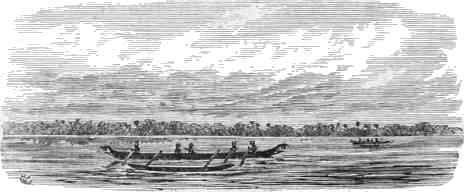
Ceylon.
Stay from 8th to 16th Jan., 1858.
Neglect of the Island hitherto by the English
Government.—Better Prospects for the Future.—The
Cingalese, their Language and Customs.—Buddhism and its
Ordinances.—Visit to a Buddhist Temple in the Vicinity of
Galle.—The sacred Bo-tree.—Other Aborigines of
Ceylon.—The Weddàhs.—Traditions as to their Origin.—Galle
as a City and Harbour.—Snake-charmers.—Departure for
Colombo.—Cultivation of the Cocoa-nut Palm, a benevolent,
Buddha-pleasing work.—Polyandria; or, Community of
Husbands.—Supposed Origin.—Annual Exportation of
Cocoa-nuts.—Rest-houses for Travellers.—Curry, the
National Dish.—A Misfortune and its Consequences.—The
Catholic Mission of St. Sebastian de Makun, and Father
Miliani.—Annoying Delays with restive Horses.—Colombo.—A
Stroll through the "Pettah" or Black Town.—Ice Trade of
the Americans with Tropical Countries.—Cinnamon Gardens and
Cinnamon Cultivation.—Consequences of the Monopoly of
Cinnamon.—Rise and Expansion of the Coffee Culture in
Ceylon.—Pearl-fishery.—Latest Examination of the Ceylon
Banks of Pearl Oysters, by Dr. Kelaart, and its
Results.—Aripo at the Season of Pearl-fishing.—The
Divers.—Pearl-lime, a Chewing Substance of wealthy
Malays;—Annual Profit of the Pearl-fishery.—Origin of
the
Pearl.—Poetry and Natural Science.—Artificial Production
of the Pearl.—The Chank-shell—The Wealth of Ceylon in
Precious Stones.—Visit to a Cocoa-nut Oil Manufactory.—The
Cowry-shell, a Promoter of the Slave Trade.—Discovery of
valuable Cingalese MSS. on Palm-leaves.—The heroic Poem of
"Mahawwanso," and Turner's English Translation of
it.—Hospitality of English Officials in Colombo.—A second
Visit to Father Miliani.—Agreeable Reception.—The
Antidote-oil against Bites of Poisonous Snakes.—Adventures
on the Journey back to Galle.—Ascent of Adam's Peak by two
Members of the Expedition.—The sacred
Footprint.—Descent.—The "Bullock-bandy," or Native
Waggon.—Departure from Galle for Madras.—The Bassos
(shallows).—A Berlin Rope-dancer among the
Passengers.—Nyctalopia; or, Night Blindness.—Fire on
board.—Arrival in Madras Roads.
The inquirer who becomes acquainted by personal examination
with the important geographical position of the Island of
Ceylon (called also Seilan or Singhala), her commodious
harbours, her productiveness, and her marvellous climate,
involuntarily wonders at the stepmother's part that England
has hitherto played with respect to this renowned island of
palms and spices, the Malta of the Indian Ocean, which of
all the British possessions in distant parts of the earth,
has, till recently, received the least care or attention.
It must be borne in mind, however, that Ceylon is an
appanage of the British Crown, and it is not an independent,
self-supporting colony. Those shortcomings of
administration, for which the mother country is exclusively
responsible, have been hitherto a complete drag upon her
development. But the English people have this advantage over
all other nations, that once anything has been recognized to
be useful and imperatively required, they proceed to apply
it with such energy, that they are enabled to make up for
any neglect with giant strides. During late years many
fetters have been knocked off which formerly impeded the
more active development of agriculture and commerce. The
harbour of Point de Galle (also called only Galle for
shortness) has become a central station for the steam-boat
trade with the East Indies, the Burmese Archipelago, China,
and Australia. A telegraphic wire will ere long stretch from
Ceylon to England, such as even now unites the island with
the Coromandel Coast and India; a railway is in course of
construction between the most important commercial centres
of the island, and so obvious are the fundamental benefits
it must confer, that ere long the classical and incomparably
beautiful island of Ceylon is destined to shine a star of
the first magnitude in the azure of the Indian Ocean, one of
the most prosperous, wealthy, and blest of islands!
The scientific researches of all kinds, which have in modern
days been instituted in Ceylon, have been attended with the
most important results, bearing upon its history and its
various tribes, as well as on its natural wealth; and the
masterly and marvellous work Sir Emerson Tennent lately
published on the isle of Ceylon, seems intended to
compensate for many instances of neglect which Ceylon and
its inhabitants have experienced from the English since they
seized on it.
Embracing all the three kingdoms of nature, and following up
with learned accuracy the history of the inhabitants, from
the obscure traditions attending their earliest settlement
down to the present day, Sir Emerson Tennent's work is a
perfect pattern of a monography, although upon this subject
the German inquirer will involuntarily, and not without an
emotion of pride, recall to mind Carl Ritter's admirable,
well-digested publication upon Ceylon, in his classical work
on Eastern Asia, doubly meritorious by the very fact that
the German scholar never set foot in the country itself.
There are, however, indeed few spots on earth which present
such inexhaustible subjects for the study of the historian
as well as the inquirer into physical science, of the poet
and the political economist, as this romantically-beautiful
island, which we have been taught to regard as the Garden of
the World, as indeed the special site of the Garden of Eden,
the first abode of the progenitors of the human race.
We have not to do here, as in most of the islands of
southern seas, with a savage people, that have only, since
the first appearance of Europeans, emerged from a state of
barbarism, and been raised one step towards civilization,
but rather find, as in the East Indies and China, a peculiar
type of civilization, which, although widely differing from
that of Europe, yet seems not less valuable and
extraordinary. The whites (scarce 7000 in number, of whom
2482 are females), who live scattered over an area of 24,700
English square miles, have hitherto been too few in number
to exercise any marked influence on the customs or mode of
life of a native coloured population of 1,726,640 souls, and
hence it is that Ceylon exhibits a more romantic and
characteristic air than any other British settlement in
distant parts of the globe.
A people like the Cingalese, of such ardent imaginativeness,
with a splendid history, and a religion professed in the
various realms of the East by more than 300 millions of
people, gains in interest the more we become acquainted with
them, and the more we make their traditions, their mode of
life, and their customs, the object of special inquiry.
The Cingalese, or indigenous natives (so named to
distinguish them from the other inhabitants of the island,
belonging to other stocks and amalgamated races, who at
various periods had settled here, and who call themselves
Ceylonese), were entirely the offspring of Hindoo emigrants,
who, about five centuries before the birth of Christ, came
from Hindostan to Ceylon, and imported their own mode of
government, and system of caste, as also their arts,
language, and religion, from the continent into the island.
They constitute the germ of the present population, and
early divided themselves into four leading castes:—1st,
that of the royal family;—2nd, the Brahmins;—3rd, the
merchants, peasants, and shepherds;—and 4th, the sixty
inferior common castes. At present there exist in Ceylon
only the two latter. The most numerous is that of the
peasants, who, however, meddle but little with the
cultivation of the soil, but have arrogated to themselves
the exclusive and hereditary possession of all employments,
lay or ecclesiastical. The dress of the Cingalese usually
consists of a cloth wound turban-fashion round their head,
and long white drapery. On festive occasions they wear
richly-adorned tight-fitting jackets of velvet or wool, and
on such occasions rank and power assert themselves by the
number of garments, to such an extent that frequently a
wealthy man makes his appearance in several of these
habiliments, worn one above the other. The Cingalese are
shorter in stature than the Europeans, their average stature
being 5 feet 4 inches to 5 feet 5 inches, English. Their
physique, though graceful and delicate, is powerful and
muscular, with a brawny breast, broad shoulders, the muscles
of the thigh strongly developed, but with disproportionately
small hands and feet. Their colour is commonly a
light-brown, their hair black and quite straight. The women
are beautifully formed, but even when they can, like
Asokamalla of historic fame, boast all the forty and six
marks of the Cingalese ideal,[77] they must fall far short of
the European standard of female beauty, with their bodies
anointed with oil, and their mouths stained with the
betel-nut. As the Cingalese girls usually marry so early as
12 years of age, they speedily lose the bloom of youth, and
frequently have the appearance of crones at 20. Another
especially loathsome habit of the Cingalese is the chewing
the betel-nut, a custom so universally prevalent among all
Indian races, that not merely the men and women, but the
very children exhibit an extraordinary predilection for it.
The ingredients of this masticatory consist of the green
tender leaves of the Betel-pepper-shrub (Piper betle),
the nut of the areca-palm (Areca catechu, or
cabbage-tree), some lime made of calcined shells, and
tobacco, which, according to the rank of the individual,
they keep ready prepared by their side, in silver or brass
boxes, resembling snuff-boxes. These corrosive substances at
the same time stain the saliva so deep a red, that, after
long use, the lips and teeth seem as though smeared with
blood.
The language is an offshoot of the Sanscrit, copious,
harmonious, and full of expression, with threefold grammar,
and as many vocabularies, viz. for the royal tongue, the
official or court tongue, and that of society at large. To
these there must be added the Pali, the learned, but
obsolete written language of the priestly caste, which the
Cingalese have in common with the kingdoms of Siam and Ava,
in the further Indies. In this language, itself but a
dialect of the Sanscrit, all their sacred books, traditions,
and poetry are written. In many parts of the island the
knowledge of language and written lore are held in such high
honour, that grammar and literature form the entire study of
the inhabitants. Reading and writing are as common among the
Cingalese as in England, except that in Ceylon the women
take no part therein. They do not write as we do, with quill
or steel pen upon paper, but engrave the characters with a
fine-pointed iron graver, or stylus, upon the leaves of
the Talipot palm-tree (Corypha umbraculifera), from which
they slice a broad strip for the purpose about 2 feet long,
and several inches broad. These require no further
preparation than that they must be well smoothed
beforehand, and all inequalities removed. In order to render
the writing more clear and legible, the Cingalese rub it
with a mixture of cocoa-nut oil and fine pulverized
wood-ashes, which imparts to it durability and prevents
obliteration. Great numbers, however, use the leaves of
another species of palm for writing upon, viz. the Palmyra
palm (Borassus flabelliformis), but those of the Talipot
are preferred to all others for their closeness of texture,
and are alone used in important records and other documents.
The religion of the Cingalese is Buddhism, which in Ceylon
still flourishes in these times in all its pristine vigour.
Buddha is not the name of the founder of this belief, who is
called Gautama, or Sakja-Muni, but is only one of the
numerous titles of honour invented by that personage, who in
the Sanscrit figures so conspicuously as a sage. Gautama was
born in the province of Maghada (now known as Reha), in
Northern Hindostan, b. c. 624. His parents were Suddhodana,
King of Magadha, and his consort Maja. Contemplating the
degeneracy and misery of man, sunk in deepest woe, Gautama
attacked the doctrine of Brahma, rejected the Vedas, or holy
books, and founded the new faith, which consists of the
following fundamental propositions:—The Creator and Ruler
of the world is a supreme, invisible, purely spiritual (and
for that reason obviously impossible to be figured) Being,
almighty, wise, just, beneficent, and merciful. Man most
fitly recognizes and honours the Deity by silent
contemplation: by the practice of chastity, temperance, and
virtue he attains to happiness. The complete fulfilment of
all his duties confers on him here on earth the dignity of a
Buddha, or sage, and after death consigns him to the
beatific repose of non-existence[78] (Nirwana). Condemned
souls are born again in the forms of wild animals. According
to Gautama's teaching a fresh Buddha always appears at
certain epochs, whose existence is manifested by his
extraordinary spiritual powers, by his deeds, and by his
prophecies, selected by destiny for the purpose of
enlightening the world as to the decrees of the Supreme
Being, and to restore religion to her pristine purity. The
death of a Buddha is also the commencement of a new
reckoning of time. Gautama, who died about b. c. 542, or some
2400 years since, was the forty-fifth and last Buddha that
appeared to the Cingalese; his doctrine must continue to
operate for 5000 years, when, according to the Cingalese
traditions, the next Buddha, or Purifier, will appear.
Gautama's belief, bequeathed by him to his disciple, the
Brahmin Mahakaja, was immediately translated into Sanscrit,
and speedily spread. Several hundred temples and monuments
dedicated to him are scattered in various parts of the
island, and remain to this day an evidence of the extent and
influence of Buddhism.
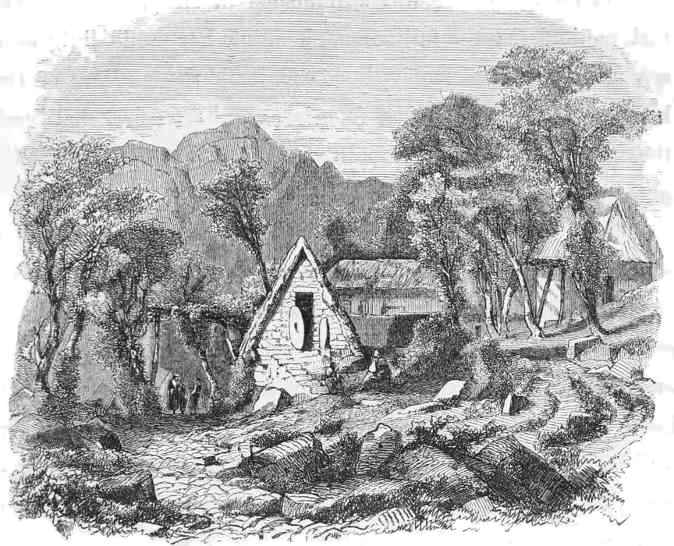
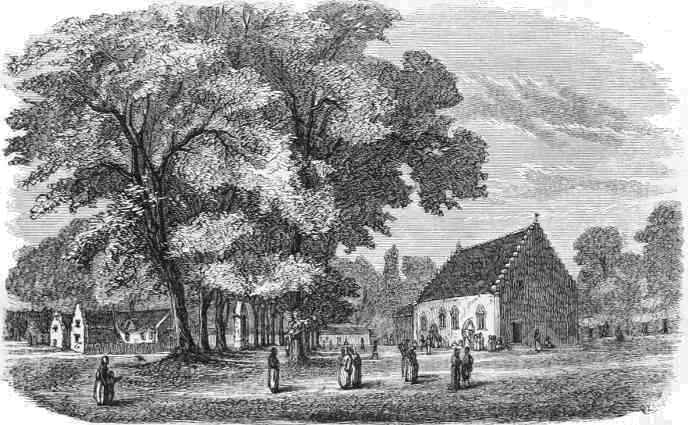
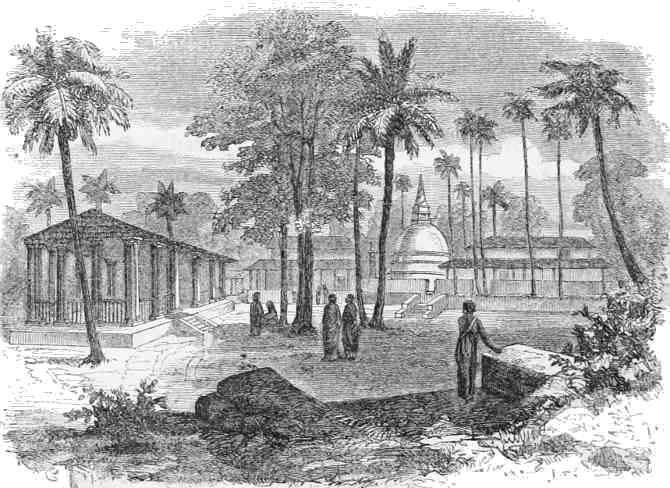 BUDDHA TEMPLE NEAR GALLE.
On the day of our arrival we at once set off to visit one
of these Buddhist temples, in the vicinity of Galle. The
edifice is small and insignificant, only the carved woodwork
of the door presenting any object of interest as a work of
art. In the interior is a gigantic figure of Buddha, carved
in wood, and in a reclining position; it is 20 feet long,
and painted yellow and red, with long flaps to the ears, and
a lotus flower on the head; while on the walls around,
richly decorated with scrollwork, dragons and lions, part
painted, part sculptured, various interesting episodes are
represented in the history of Buddhism. Right in front of
the figure are placed a number of offerings of the most
miscellaneous description, beneath which are flowers and
fruits; a small tin box is also particularly conspicuous,
into which every stranger is expected to drop a piece of
silver by way of present. Adjoining such a temple are always
to be found the wiharas, or residences of the priests
(hamaduruhs), and the spot where preaching and teaching
are carried on. The priests wear long wide vestures, yellow
or white according to their rank, or else only a single
yellow outer garment, which falls in the form of graceful
drapery over the naked shoulders; their heads are shaved,
and they walk about quite barefoot, with a parasol of
Talipot palm in their hand, and observe with strangers a
reserved, distrustful demeanour.
We were conducted all round by a young priest, of about 20
years of age, who spoke a little English, which is not a
very common accomplishment, since the Buddhists have a great
dislike for all that is foreign. Only at the conclusion of
our visit did the old, grey, half-blind superior priest make
his appearance, saluted us, but immediately left us to
snatch from a boy a shaddock (Citrus decumana), which is
especially prized by the Cingalese on account of the
refreshing qualities of its juice.
The priestly office, however, does not deter a native from
indulging the disgusting habit of chewing the betel-nut, and
this aged hamaduruh became much more sociable on receiving
some.
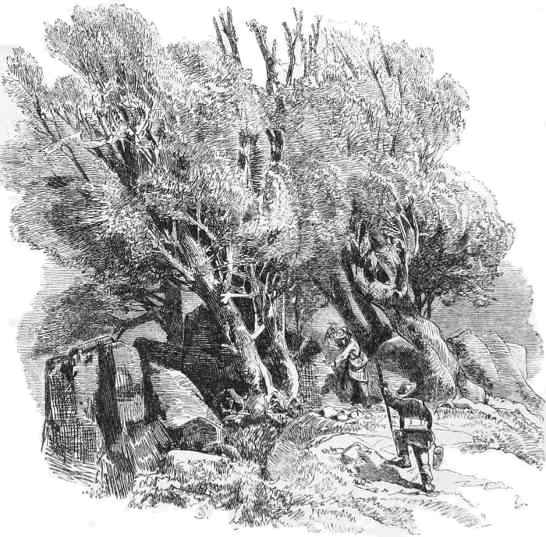
Adjoining the temple, which stands in a charming cocoa-nut
grove, we first got an idea of the extraordinary luxuriance
of the vegetation of this island. In a single enclosure, not
much larger than an ordinary house-garden, we saw
coffee-trees, cinnamon-bushes, clove-trees, nutmeg-trees,
(Areca catechu), oranges, lemons, pine-apples, and
bread-fruit trees (Arctocarpus incisa), flourishing in
wildest profusion.
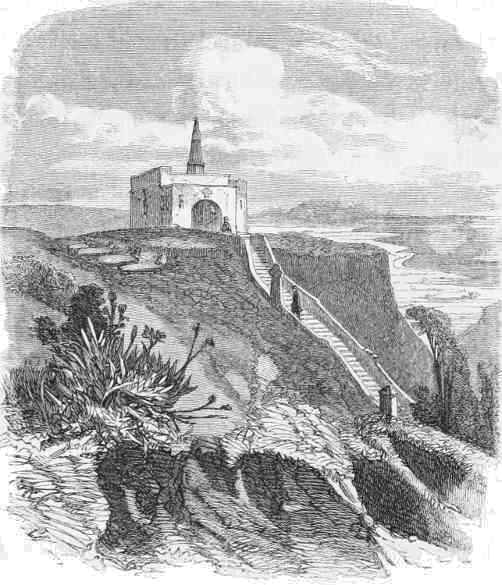
A second temple, which we also visited, was the Dadále
Panzela, the largest in the province, and the seat of the
high-priest of the Buddhists. This worthy personage, a
septuagenary, is named Nanalangara Seresumana
Mahdamaradjigurù Ganatchari-Naikunangi, and is surrounded by
a staff of priests of the temple who are reputed holy, and
who apparently venerate him as a superior being. This temple
did not differ much in construction and arrangement from the
first; but the place set apart for instruction, where, at
the time of our visit, some youths were busily engaged in
copying the sacred books upon palm leaves, as also the
residences of the priests, made a much more imposing
impression, and spoke of a certain degree of opulence. In
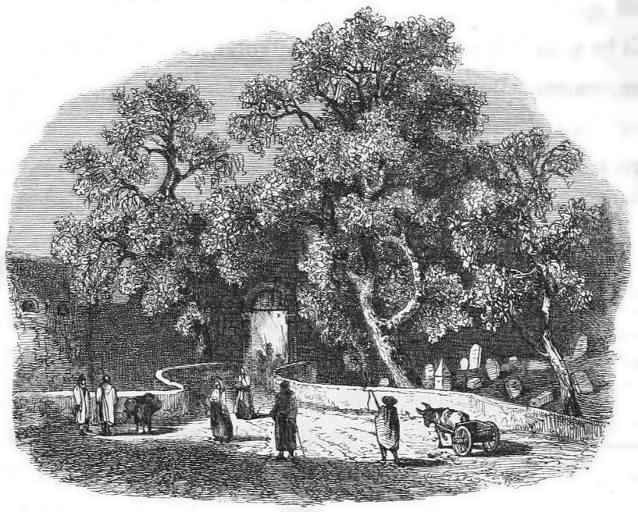
the midst of a piece of ground laid out like a garden was
planted the sacred Bo-tree, which is looked upon as holy by
the Buddhists, because, according to an ancient tradition,
Buddha was in the habit of reposing under the shadow of its
branches, as often as he visited the earth. Towering above
everything wherever a Buddhist temple is raised, there a
Bo-tree is planted; but the particular sacred tree, the
original plant from which the legend took its rise, grows at
Anaradnapura, in the northern part of the former kingdom of
Kandi, whither it had been suddenly translated from a
far-distant land, and spontaneously took root in the spot
where it at present stands, in order to serve as a
protection and shelter for Buddha.[79] Ninety Cingalese
monarchs are interred around it, all of whom, by the temples
and statues they erected to Buddha, are deemed worthy of
this pre-eminent mark of distinction.
The grey-headed high-priest permitted the library of the
temple to be shown to us, which consists of a large number
of Pali manuscripts, inscribed on Talipot leaves, each of
which was enclosed between two elegant boards made of
calamander wood (Diopyrus hirsuta), fastened with strings,
and enveloped in numerous folds of cloth, the whole guarded
with singular reverence, in lofty, broad, wooden cupboards,
richly carved. When we returned, the chief priest requested
us to give him our names, and that of the country we came
from, upon which a young priest carefully wrote down with a
goose quill on a sheet of paper, in Cingalese language,
apparently with the view of showing us civility, some
superficial remarks respecting the Novara Expedition.
Besides the pure Cingalese, the island is also inhabited by
Hindoos from the Malabar coast, Moors (the descendants of
wandering Arabs and Mahometans from northern India, who at
present carry on the greater part of the trade of the
island), Malays, Javanese; then Portuguese, Dutch, British
of the various nationalities comprised under that title;
and, lastly, Negroes from Mozambique and Madagascar, who
have formed alliances with the Cingalese, and are rearing a
numerous mixed race.[80]
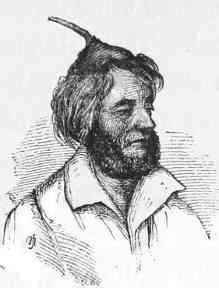
Deep in the interior of the island, in the province of
Bintang, N.E. from Kandi, and towards Trincomalee and
Batacalva, in holes in the earth, or under the palm-leaves,
reside the tribe of the Weddàhs or Veddàhs, the most savage
race in the island, traditionally said to be the aborigines
proper, who go about naked, with the exception of a girdle
round the loins, and use only bows and javelins, which
however they manufacture and handle with great dexterity.
According to one of the various Cingalese traditions, these
Weddàhs are the descendants of a very bloodthirsty, cannibal
monarch, who, deposed by his people, was only permitted the
alternative of death, or of withdrawing with the ministers
of his cruelty to roam for ever amid the solitudes of the
forest. The dethroned king chose the latter alternative, and
thus became the little-to-be-envied progenitor of this rude
savage race. At any rate it seems worthy of note, that these
Weddàhs, destitute though they are of the remotest traces of
civilization, are still regarded as belonging to the
privileged caste.
Owing to the shortness of our stay, we unfortunately had no
opportunity of visiting the interior of the island, or of
seeing these Weddàhs. With difficulty did we tear ourselves
from the zone of the cocoa-nut growth, and therefore only
got acquainted with two places on the island, Galle and
Colombo, the latter the seat of government.
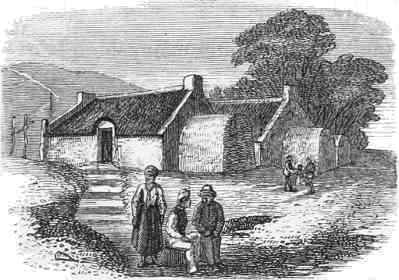
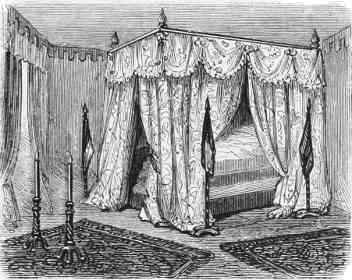
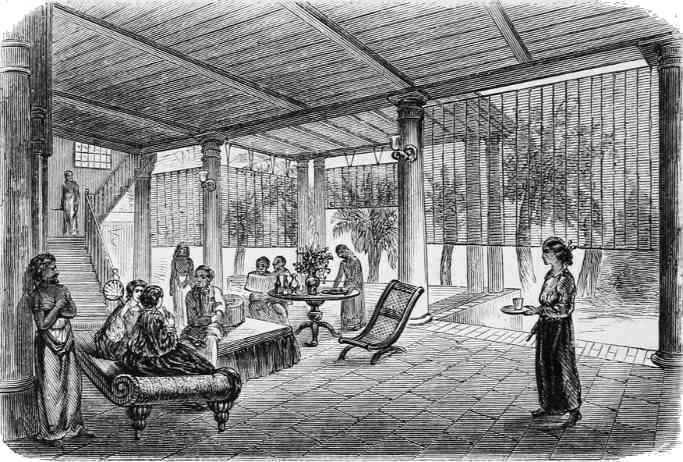 INTERIOR OF A HOUSE AT GALLE.
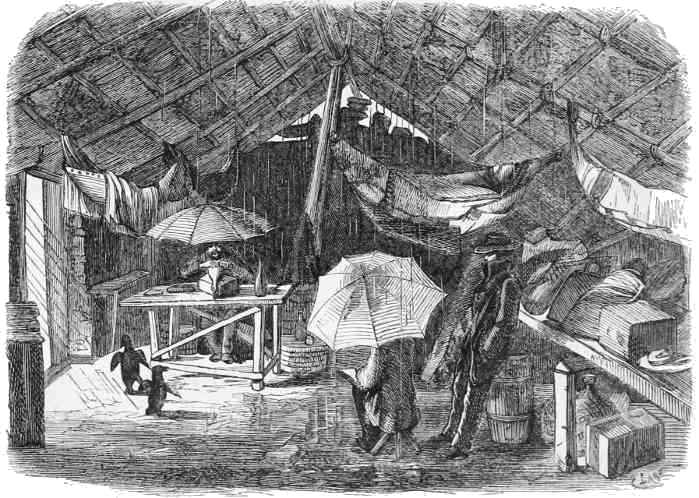
Galle is, from its position, as also from its configuration,
indisputably the best and most important harbour in the
south and west of the island, as Colombo can only be
regarded as an open, insecure roadstead. Founded in the
sixteenth century by the Portuguese, conquered at a later
period by the Dutch, and finally, at the peace of Amiens,
transferred to the English, Galle displays singularly few
traces of its different masters. The streets are narrow, but
cleanly; the houses are for the most part constructed of
earth, with verandahs, or airy colonnades towards the
street, and rooms within, plastered to imitate stone, of
spacious dimensions, as is desirable, considering the heat
of the climate. As one enters from the roadway at once into
the sitting apartment, and as the door stands wide open all
day to admit a free current of air, a sort of open
screen-work is usually put up before the entrance, to
prevent a too minute inspection of the interior, by the
prying eyes of inquisitive passers-by. At Galle we, for the
first time, saw the "Punkah," a sort of fan peculiar to
India, which stretches from one end of the roof of the room
to the other, and being swung to and fro by a servant
produces a refreshing coolness. Here, too, we first became
acquainted with the "Gecko" (Hemidactylus maculatus), an
elegant little house-lizard, which, with graceful agility,
runs to and fro upon the walls, windows, and roofs, and
speedily becomes as familiar with man as a pet-dog or
kitten. They usually make their appearance towards evening,
when, without the slightest symptoms of timidity, they begin
their surprising evolutions, during which they catch gnats
with astonishing dexterity, and although they are
disagreeable objects to all new comers, one speedily becomes
accustomed to these harmless, innocuous, playful little
animals, of which the Ceylonese are in the habit of relating
many interesting and amusing anecdotes.
Of late years, during which Galle has risen into
considerable importance, as the converging point of the
lines of steamers to Eastern India, China, and Australia,
the number of substantial houses has greatly increased, and
several large hotels are found here replete with every
comfort. Like most European settlements in India, the Cape,
and China, Galle possesses a fort in which, at an earlier
period, the European colonists dwelt with their wives and
families apart from the natives, and has also a "Pettah," or
Black Town, a sort of Cingalese Ghetto, exclusively
inhabited by the black population. At present this
separation is not so strenuously enforced as in earlier
times, but whoever would seek to form a more accurate idea
of the various races of this population, its mode of life
and its demeanour, must leave the so-called "Fort," and
wander through the native or Cingalese quarter. Here are the
fruit and vegetable markets; here all was devoted to buying
and selling, which seemed to excite the otherwise listless
little covetous disposition of the Cingalese; here jugglers
and snake-charmers exhibit, who excite interest rather by
the horrible nature and the foolhardiness of the
performances, than by their executing any surprising feats.
A belief is prevalent among the people that this singular
class of men, greatly resembling our own gipsies, possess
the art of depriving a poisonous serpent of its venom, and
rendering it innocuous. And, in fact, one does see them
produce from a white cloth the dreaded Cobra di Capello, 4
or 5 feet long, and exquisitely marked, irritate it
violently, and go through all manner of unpleasant
performances with it on their naked bodies. Frequently the
serpent, weary of being constantly brought out for
exhibition, endeavours to escape from its tormentor,
whereupon a general scramble for escape takes place among
the spectators. Every one hurries off to a safe distance,
and the unfortunate charmer is left alone on the scene with
his eminently intractable pupil, and has, into the bargain,
given his exhibition in vain. As, however, it not
unfrequently happens that the bite of the Cobra di Capello
is followed by fatal consequences to the snake-charmer
himself, it is highly probable that the whole mystery
resolves itself into courage, and the shrewdness with which,
availing themselves of the uncommon dread and aversion with
which this animal is regarded, they are able at once to
prevent him from making use of his deadly poison fang, and
to put forth their own sleight of hand. This explanation
seems also to account for the very remarkable fact that men
have ventured to domesticate this dangerous reptile in more
places than Ceylon. Indeed, within the experience of Major
Skinner, a thoroughly trustworthy personage, who has resided
for many years on the island, and to whom the naturalists of
the Expedition are indebted for many acts of kindness, an
instance actually occurred in the neighbourhood of Negombo,
in which a wealthy man, who keeps large sums of specie in
his house, bethought him of the singular precaution of
having several deadly cobras to watch the treasure in lieu
of dogs. Day and night they glide about, a terror to
thieves, while they are quite harmless to the inmates who
feed them and attend to them!
In former times snake worship (Nagas) was universal
throughout Ceylon, and, as in India, the cobra received
divine honours from the natives, because it was supposed to
be a metamorphosed king. This serpent, however, is so
singularly and wonderfully endowed by nature, its appearance
and motions are so peculiar, that an imaginative people like
the Cingalese may well be excused for associating the idea
of metempsychosis with its aspect of mystery.
From Galle, an excellent road, following the coast-line the
entire distance, leads to Colombo, the seat of government,
75 English miles distant. Every morning there starts from
Galle for that destination, the "Royal Mail" coach, an
uncomfortable, somewhat dangerous, mode of conveyance, in
which this distance is traversed in from 8 to 10 hours. In
order to travel more at our ease, we engaged an extra
waggon. In Ceylon people usually employ, on long excursions,
but one horse, which is changed at distances varying from 6
to 10 miles. We had some difficulty in reconciling this
custom with our predilection for travelling at our leisure.
The first few hours of our journey passed away very
pleasantly; the road was excellent, and the country
magnificent and charming. We seemed as though driving
through a park inhabited by thousands of men, and planted
with cocoa-nut palms—amidst which occasionally the white
dome of a Buddhist temple, or the minarets of a Mahometan
mosque, shooting up above the summits of the palms, imparted
an aspect of life to the landscape—while in the gay bazaars
that fringed the road, the few necessaries of life required
by the exceedingly frugal natives were exposed for sale,
temptingly arranged on palm or plantain leaves. The whole
south-western coast district is so populous that the huts of
the natives were continually in sight, right and left, under
the forest shade, and the scenery in consequence seemed as
full of life and careless enjoyment as though the people had
nothing else to do but walk about under palm-trees. This
impression was the more strengthened, that we rarely
perceived a man with anything else in his hand than a
Talipot leaf, or a Chinese parasol, to protect himself
against the burning rays of the sun, which shone almost
directly overhead. Of the women, on whom for the most part
fall all the troubles and hardships of life among the
Cingalese, we only saw a few carrying to the city heavy
baskets balanced on their heads.
The luxuriant, widely-extending cocoa-nut forests, which on
the south and west sides of the island stretch down to the
sea-shore (whereas on the eastern coast they are altogether
absent), seem independently of the necessity of paying all
due care to the maintenance of one of the necessaries of
life, to be specially indebted for their existence to the
circumstance that additional planting of this tree, as also
its careful cultivation, is one of the religious observances
and duties of the servants of Buddha. Whoever plants a
cocoa-nut, palm, or bread-fruit tree, performs a work
agreeable to Buddha. At the birth of a son, or on any
similar festive occasion, it is customary to plant a few
cocoa-nut shoots in the earth. Cocoa-nut palms form a very
important part of the property of a family. The father
divides them as heritable property into equal portions for
bequest to his children. Not one single palm but has an
owner, though instances occasionally occur in which several
families are supported by the produce of a single palm!
This peculiar phenomenon has been followed by most
remarkable results bearing upon the social condition of the
native population. Increasing poverty, and the ever present
grinding necessity of preventing any further subdivision of
the joint property, have impelled the natives to resort to
the unnatural remedy of the brothers of a family having but
one wife among them! The fact that there are in Ceylon fully
one-tenth more men than women, was the cause of the rapid
spread of this custom, and upheld Polyandria, or plurality
of husbands, as a desirable invention for remedying the
deficient supply of females. Many a female has three, four,
or even seven husbands, and all children that are born of
such a wedlock have equal rights, and are (differing in this
respect from the law of Hindostan, by which only the
children of the eldest brothers are registered, as the
entire property belongs to him, while all the younger
brothers serve him as vassals, and can be driven by him out
of the house), the lawful, recognized heirs of the
different fathers. In order to guard against the rise of
law-suits respecting birth and heritage among the Cingalese,
in consequence of their local customs, the British courts of
justice, singular to say, find themselves constrained to
recognize this disgraceful custom, and to interpret the law
with reference to it. Although in the maritime provinces
plurality of husbands has been signally on the decrease,
owing to foreign influences, it still prevails to a great
extent in the interior of the island. The submissiveness of
the Cingalese to their superiors and their monarchs is
assigned as the origin of this in other respects very
ancient custom, which seems to have been universally in use
among the various races of the mainland of India from time
immemorial. Constrained to apply their own manual labour in
cultivating the land of their tyrants, and frequently to
accompany them on distant journeys, they thought they could,
during their absence, most surely protect their own fields
and crops against utter ruin, by apportioning wife and
chattels among brothers and nearest relatives, and thence
the family tie was gradually converted into a socialist
community.
The almost endless cocoa forests, which we were traversing
by splendid, broad, level roads, not alone provide the
native with, to him, the most important necessary for
supporting existence, but the fruit itself forms at the
same time so important and valuable an article of produce,
that the cultivation of the cocoa-nut has been regularly and
systematically carried on by European enterprise since
1841—at present covering an area of 23,000 English
acres—while the proportion of native land on which this,
the most useful growth of the tropics, is cultivated,
amounts to about 100,000 acres. Formerly, the nuts were
shipped to foreign parts for the extraction of their oil;
but for this purpose there are now on the island itself,
especially in Colombo and Galle, a considerable number of
manufactories, at which the oil already expressed from the
nuts is usually at once put into casks for exportation. The
quantity of oil thus exported annually is estimated at from
1,000,000 to 1,500,000 gallons, worth from £100,000 to
£150,000. Besides this, the elastic fibre of the outer husk
of the cocoa-nut is used in the manufacture of ropes,
door-mats, &c., and, under the name of Coir, forms an
important article of export, the annual consumption
averaging between 30,000 and 40,000 quintals (centner
weight), worth from £20,000 to £25,000.
The first station on leaving Galle for Colombo is Bentotte,
where, as is the custom all through the country, there is a
"resting-house" open to all travellers, similar to the
"Choultries" in India, the "Caravanserais," or lodgings for
pilgrims, in Eastern countries, or the "Pasangrahans," of
Java. These resting-houses, which all through the interior
of the island are found on the highways and forest roads,
are among the oldest institutions of the country, and were
formerly maintained at the expense of private individuals.
The resting-houses, which have been erected under the
English rule on the main roads of the island, are in all
respects of a far higher class, and strongly resemble the
waiting-rooms of our own (German) railroads. One is not
merely provided in these with shelter, but also with food
and drink, at a fixed tariff. A special committee (the
Provincial Road Committee) is appointed to superintend the
management of these resting-houses.
Here we partook of a luxurious "tiffin," as the customary
meal between breakfast and dinner is called in Ceylon, as
well as throughout India; and in so doing, made acquaintance
for the first time with the renowned Indian dish "Curry,"
which consists of flesh or fish prepared with a powder
compounded of spices. It tastes so hot that the European
palate only gets accustomed to it by degrees; but in these
countries it is looked on as the favourite dish, which must
never be absent from any meal, because the cayenne pepper
plentifully sprinkled over it, stimulates the stomach and
promotes digestion. Hence the curry-powder is in immense
request, and is largely exported. The assertion that this
dish was first invented by the Portuguese is quite
erroneous, as the chronicles of the country establish that
it was in request in Ceylon in the second century before
Christ.[81]
As we mounted into our vehicle again, after a short halt at
Bentotte, in order to resume our journey to Colombo with a
fresh horse, we perceived that our driver, a negro, had been
too free of his visits to the brandy-bottle, and
occasionally took to rolling on the box. In the hope that he
might become sober by the way, we ventured to proceed, but
ere long he lost his balance, and fell to the ground,
compelling us, to avoid further mishap, to retrace our steps
on foot to the nearest village—thus reversing the order of
matters, and, so to speak, escorting our horse, coach, and
driver. This occurrence, unimportant and hardly worth
mentioning in itself, was the occasion of an interesting
adventure. As it was only with much difficulty that we could
make ourselves intelligible to the natives, we resolved to
apply to the authorities in the very first place we came to.
It turned out that we were in the vicinity of the Catholic
mission of St. Sebastian de Makùn, whose superior was a
Benedictine from Rome. The church is situated amid the rich
vegetation of the primeval forests, the gigantic trunks of
whose trees, supporting a huge diadem of luxuriant foliage,
are arched into a natural dome of the most graceful
proportions. With curiosity whetted to the uttermost, we
advanced along a beautiful path, beneath cocoa-palms,
cabbage trees, bread-fruit trees, screw pines, tree-like
ferns, and broad-leaved bananas, till we reached the
dwelling-house of the Mission, and introduced ourselves to
the missionary. Forthwith the latter, a tall, stately
figure, with handsome features and cultivated manners, and
dressed in a woollen robe, ushered us into a darkened
chamber opposite, and received us most cordially. This
worthy priest, by the name of Miliani, was not less
surprised at being visited at this solitary mission by
Austrian travellers, and with the most lively satisfaction
and the utmost readiness to oblige, offered us all the
assistance in his power. In spite of our hurry, we had to
take a cup of coffee à la Romagna, with our hospitable
missionary, and to promise to visit him on our return
journey. Father Miliani has already lived many years in this
country, and ministers to a Christian community of more than
1000 souls. Altogether there are in Ceylon about 50 Catholic
missionaries under a Bishop whose residence is in Colombo.
Our priestly host was greatly respected by the Cingalese,
but he evidently was overjoyed at being able once more to
express his thoughts and feelings in his native Italian.
It was evening ere, with many a hearty shake of the hand, we
tore ourselves away from the cordial hospitality of St.
Sebastian de Makùn. Horse and driver this time gave hope of
faster progress. But we were doomed once more to experience
a severe disappointment, and although we were only about 10
or 12 miles distant from Colombo, which was our destination,
it took us five long hours to get over the ground. The night
was very dark, but the road was continually illuminated with
torches of palm, carried by the homeward plodding natives,
which emitted a gloomy light alternating with showers of
sparks.
When at last we got to Colombo about midnight, pretty well
knocked-up, we comforted ourselves with the reflection that
the inconveniences attending personal transport between
Galle and the seat of government, can by no means be classed
among events of rare occurrence; since, in consequence of
the inveterate obstinacy of the native horse, one must have
recourse to the most incredible expedients to get the
carriage under weigh. For instance, at every station the
ears of the post-horse were twisted together and then
suddenly relaxed in order to set the vehicle in motion; and,
when this torture failed, a pole, or thick stick, was
inserted under the tail of the recalcitrant, and rubbed up
and down till the poor animal, smarting under this painful
operation, took to the collar. Once the carriage is started
in this extraordinary fashion, the coachman swings to and
fro at the peril of his life, and endeavours by continually
"pitching into" the horse, to keep him at the gallop. Thus
between whooping and whipping the next station is reached,
where the same trial of patience awaits the traveller, and a
similar martyrdom for the next horse.
Our first business the following morning was to take a walk
through Colombo, which, like Galle, consists of "The Fort,"
or White City, and the "Pettah," or Black Quarter, in the
latter of which are situated the houses and shops of the
natives, and where the chief traffic and the greatest
activity are combined. Here one rarely encounters a white
man, for even the soldiers and police belong to the brown
and black races. The natives, however, manifest, outwardly
at least, a great respect for the whites, and everywhere
draw aside reverentially when one makes his appearance.
In the middle of the main street are some Buddhist temples.
We were not, however, permitted to enter, unless we
consented to take off our shoes. At several of the natives'
houses the entrance porch and windows were gaily adorned
with plantain leaves. On inquiring of our Cingalese
attendant what was the occasion of this manifestation, he
replied in broken English that the inmates were celebrating
"Christmas," wishing probably to express that the natives
celebrated a feast analogous to our Christmas.
The filth and unsavoury odours which prevail in the Black
Quarter, and the noise and yelling of the natives, speedily
drive visitors back to the European portion of the city,
which altogether, with its gloomy, decayed aspect, makes
anything but a favourable impression. The public buildings,
the houses of the mercantile community, the warehouses, and
fortifications, all bear the impress of the Portuguese
settlement of bygone centuries; and as its commerce is
attracted more and more every year to Galle,[82] there
remains but faint hope that this quaint type will not ere
long be effaced by a new style of building, albeit the
inhabitants of the capital promise themselves a restored
reign of activity and energy, as the result of railway
communication with Galle.
During our random promenade through the streets of what is
called the Fort, we perceived at a sugar-baker's in Chatham
Street—the most select quarter of Colombo, and containing
the most important warehouses, which, however, are far from
elegant in their appearance—some rough ice offered for
sale, which had a curious effect in a town so near the
Equator, and presenting such few evidences of luxury in
other respects. This ice is brought round the Cape of Good
Hope from the United States, and is chiefly shipped from
Boston. The daily consumption of iced-water, ices, and so
forth, is estimated at about 1000 lbs., costing about one
shilling the 8 lbs. It is impossible to repress a feeling of
astonishment at these speculative Yankees who, despite all
obstacles interposed by temperature, transport in all
directions and over thousands of miles an article so
perishable, so easily destructible as ice, and are able to
drive a profitable business in it in the hottest and most
diverse regions of the globe—in the West Indies and South
America, in Asia, and in Africa.
The traveller who visits Colombo will hardly fail to make an
excursion to the Cinnamon Garden, in order to inhale the
fragrant and peculiar aroma, and enjoy tasting the tender
rind of this remarkable shrub, which plays so conspicuous a
part in the history of Ceylon. During the palmy days of
cinnamon culture, the five principal cinnamon plantations of
the southern half of the island extended some 15 or 20
miles. For this one lucrative product of the soil all
others on the island were abandoned, with most deplorable
consequences. The cinnamon culture, a monopoly of the
various governments which one after another conquered
Ceylon, and domineered over its inhabitants, was carried on,
especially by the Dutch East India Company, with terrible
severity. The slightest embezzlement of cinnamon, or wilful
damage to the plant, was visited with death. The
unintentional breaking off of a twig of the cinnamon bush
was punished with amputation of the offending member. Every
cinnamon bush, even to those growing in the gardens of
private individuals, was the property of the Government, and
the cinnamon collector, or even cinnamon-peeler alone, had
the right to strip off the rind when ripe. To destroy such a
plant, or even to dispose of it to any one, was regarded as
a crime affecting life. The labourers, who were employed in
the cutting off, peeling, and preparation of the rind,
belonged to the caste of Chalias, and constituted the lowest
grade of that class. In like manner, under the English rule,
the monopoly of cinnamon was at first continued, with such
disastrous consequences to the trade that it was finally
abandoned in 1832, and the merchants of Colombo and Galle
were left to divide among themselves the exportation of this
important article, under an exporting duty of 3s. per lb.
These duties, however, were found much too high, as the
highest price obtainable in Europe was from 6s. to 7s.;
and this advance in the price to the trade of the genuine
article, was the cause of foreign merchants turning their
attention to the supply of various species of
cinnamon-bearing laurels and cassias, growing in
Cochin-China and Java.
When Government, recovering at last from its delusion of
treating cinnamons, which at first had seemed indigenous to
the island of Ceylon alone on the earth,[83] as a national
monopoly, reduced the export duty to one shilling, and
ultimately repealed it altogether, the various substitutes
had already found their level in Europe, as affording a
larger supply at a much more moderate rate, and the
cultivation of the finer kinds became less and less each
year. Prices fell, and the consumption was diminished. Only
the coarser sorts repaid exportation. Nay, it even led to
the interesting and curious result, that just as, previous
to the high price under monopoly, the low-priced cassia
displaced the finer sort of genuine cinnamon, at the present
day the coarser sorts of cinnamon are beginning to oust the
cassia from the English market, whence all the world are
supplied. At present there are from 14,000 to 15,000 acres
planted with cinnamon, chiefly in private hands, and
producing annually from 800,000 to 900,000 lbs. of cinnamon,
worth from £40,000 to £50,000 sterling.
The chalias, moreover, are no longer, as formerly under the
Portuguese and Dutch, adscripti glebæ for life, or slaves
that could be purchased with the soil, but free labourers,
who are entitled to demand proportionate pay for the
lightest services rendered.
The Cinnamon Gardens in the neighbourhood of Colombo,
although for the most part gone to decay, nevertheless
impart to the whole scene a singularly cheerful, agreeable
aspect. The bushes, from 4 to 6 feet in height, with their
smooth, beautiful, light green leaves, resembling those of
the bay-tree, and their pale, yellow flower-stamens shoot up
doubly fresh and succulent, from the snow-white quartz soil
in which they best thrive. The flowering season of the
cinnamon is in January, and the fruit ripens in April, when
the sap is richest in the shrub. In May the boughs are begun
to be "barked," which process continues till October. The
pruning and gathering of the yearling shoots, which are
about the thickness of a man's thumb, is very laborious, and
employs many hands. Each labourer cuts off as many as he can
conveniently carry in a bundle, then, with the point of a
crooked knife, made for the express purpose, strips the
entire rind from the wood, carefully scrapes off the
exterior corticle and innermost layer, and lays the
stripped-off cinnamon rind, now reduced to the thickness of
parchment, in the sun, where it dries and curls together.
All round the hut, in which the peeling of the rind is
carried on, is diffused a most exquisite aroma, caused by
the breaking of the leaves or twigs. What is related,
however, by various travellers of the fragrance of the
cinnamon forests, which they have scented at a great
distance seaward, would seem to indicate that this delicious
odour emanates from various other aromatic plants in which
Ceylon is so rich, rather than the cinnamon groves, the
aroma of which, indeed, is not perceptible beyond the
immediate vicinity. The best description of cinnamon is not
so thick as stout paper, and is fine-grained, flexible,
light brown, or golden yellow, sweet and pungent; the
coarser qualities are thick-skinned, dark brown, acrid,
stinging, and leaves a bitter after-taste. In the
warehouses, the cinnamon rinds and canes sorted for shipping
are piled upon each other, packed in bales of about 90 lbs.
weight each, and carefully sewed. In all cavities and spaces
between each layer an immense quantity of pepper is strewn,
to preserve the cinnamon during its sea-voyage, by which
both spices are benefited, the black pepper absorbing all
the superfluous moisture, and gaining by the fragrance of
the cinnamon.
Consequent on the diminution of cinnamon cultivation, which
undoubtedly has resulted in great measure from the altered
taste of mankind and the consequent extraordinary falling
off in the demand for this once highly-prized spice, the
cultivation of coffee in Ceylon has, during the last 20
years, increased tenfold; and it is solely owing to the
dearth of available labour that this branch of produce,
considering the splendid profits it returns, is not even
more extensively carried on. In 27 districts there are 404
coffee plantations, covering a surface of 80,950 acres, of
which, however, only 63,771 acres are really productive.
These produced last year, 347,100 cwt., or 5½ centners
per acre. To this must be added the quantity under
cultivation by the natives, who possess about 36,000 acres
of coffee plantations, and in the year 1859 alone, exported
180,000 cwt. We may safely assume, therefore, that the
cultivation of coffee is on the eve of transforming this
island of Ceylon, from a mere military station of England,
into one of the most flourishing colonies of the British
Empire. Twenty years ago there were exported barely 60,000
centners, worth £180,000. In September, 1858, the export
exceeded 600,000 cwt., which represented on the spot a value
of £1,500,000 sterling. "When capital and labour shall have
become more plentiful," remarked to us a by no means
over-sanguine resident, "Ceylon will have in its mountain
districts 240,000 acres planted with coffee trees, yielding
at the lowest estimate, 1,680,000 cwt. of coffee annually."
Here, as among the high table-lands of Guatemala and Costa
Rica, we have the reassuring evidence how one of the most
important plants for the civilized man can be profitably
cultivated, without having recourse to the blighting
influences of slave-labour, at the same time making the
lands in which it is produced both rich and prosperous.[84]
While the cultivation of the coffee-plant has been followed
by such splendid results, the repeated attempts to introduce
the sugar-cane have been on the contrary as uniformly
failures—so that of the numerous plantations established by
Europeans, there are at present no more than five remaining.
In all those localities where the temperature seemed adapted
to the growth of the sugar-cane, the nature of the soil, and
the too great humidity have prevented its thriving.
On the other hand, the island possesses two natural products
in which but few spots on the globe are qualified to enter
the lists with her, and which may be expected to increase in
value and importance in proportion as science assumes her
share in their exploration. These products are pearls and
precious stones.
The most productive pearl banks lie on the west coast of
Ceylon, between the 8th and 9th degrees of North latitude,
near the level, dreary beach of Condatchy, Aripo, and
Manaar. The pearl fisheries are a monopoly, and, therefore,
under the inspection of the Government. Former governors had
counted too much on the abundance of this natural treasure,
and in their blind haste to fill the coffers of the State,
had so exhausted the banks, that suddenly, from a source of
revenue they became an item of considerable deficiency, and,
from 1838 to 1854, could no longer be dredged. From a net
annual return of £120,000 sterling, the yearly return had
sunk to £10,000, of which nearly one-half was consumed in
the attendant expenses. Now-a-days the work is gone about
more circumspectly, a scientific examination having been
made by a native naturalist, Dr. Kelaart, of all the oyster
banks on the west coast. We had the pleasure, while at
Colombo, of becoming personally acquainted with this very
able, unassuming gentleman, who presented us with several
memoirs of his own, touching upon the latest facts that had
been ascertained with reference to the pearl oyster. One
special result of his various researches has been the
demonstration of two facts of the utmost importance to the
pearl fishery, and which hitherto had not been fully
ascertained—that this mollusc possesses locomotive powers;
that its occasional disappearance is perfectly natural; and
that, moreover, the pearl oyster may, without any injury, be
transplanted from one locality to another—nay, even from
salt to brackish water. The first-named observation explains
the occasional disappearance of the pearl oyster from
certain beds,[85] even when they have not been inordinately
thinned by too keen a quest after gain; the latter
opens up the pleasing anticipation of the pearl oyster being
susceptible of very extensive propagation, by a process
similar to that of pisciculture, or artificial breeding of
fish (such as the colonies of edible oysters which are met
with in the South of France), by transplanting them to such
places as seem best suited to the conditions necessary to
their highest development. What a splendid conception it
were to plant the sea-coasts of Ceylon with pearls, and thus
throw the wealth of the island in precious stones into the
shade, by the treasures she would possess in the depths of
the sea!
Exactly at the period of our arrival at Colombo, the
preparations were being resumed at Aripo for the take of the
oysters, which commences at the beginning of February each
year, and lasts about three weeks. It is, in fact, a sort of
jubilee time for the people, at which the Governor and
numbers of the wealthier classes mingle with the populace.
Ordinarily this spot becomes at that season a rendezvous for
the poor and the wretched, and a rallying point for all
manner of abominable odours, filth, troublesome flies, and
intolerable heat, despite which drawbacks the fishery is
visited by thousands of boats, and hundreds of thousands of
men, who flock hither with the alluring prospect of speedy
and abundant wealth, or have been attracted from all parts
of the Indian Continent by the singularity of the spectacle.
Suddenly, as though evoked by the wand of a magician, a
regular town starts into existence, of tents, or even neat
huts, with bamboo and cabbage-tree palings, roofed over with
palm-leaves, rice-straw, or coarse thick woollen cloth;
booths for the sale of merchandise "rise like an exhalation"
during the night to supply necessaries of all sorts to the
converging multitudes from the interior, as well as the
fleets of visitors from seaward; and last, not least, the
divers themselves. Swindlers and mountebanks throng hither,
adroit thieves creep stealthily about, all Indian customs
and fashions are represented, all castes jostle each other.
Priests, and the subordinate hangers-on of the various
sects, hurry about, and jugglers and Nautch girls vie with
each other in amusing the noisy multitudes.
The result of numerous experiments has proved that no diving
apparatus can replace the human machine, the cost of which,
moreover, is a fixed definite quantity, viz., the fourth
part of the pearls brought up, which is the diver's share.
In each boat, or "Dhonie," are ten divers, each having an
assistant. Before the divers proceed to descend, a number of
quaint ceremonies are gone through, and incantations
murmured, as well in the boats as on shore, by the so-called
"shark-charmers;" indeed, the superstition of the divers,
who for the most part come from the Coromandel coast, is so
great, that not one of their number, Christian or idolator,
would continue in this employment without the countenance of
the sorcerer; and the Government finds itself compelled to
pay the impostors.[86] They levy a tribute of ten oysters
upon each boat.
Accidents with sharks are of rare occurrence: the noise of
1000 divers on the water at once seeming to scare the
animals. Moreover, the dark colour of the skin of their
bodies, acts as a considerable protection to the divers, so
that there are numbers who blacken their legs, in order
still more to alarm the monster.[87]
After these preliminaries, the divers go down into the
water, each carrying a basket-shaped net, in which to bring
up the oysters, when selected—a stone of from 15lbs. to
25lbs. weight being fastened round the body, so as more
readily to enable him to sink to the bottom. When at a depth
of some 5 or 6 fathoms, the diver unfastens the stone, which
is forthwith hauled up. He now throws himself forward on his
face, and keeps himself as close as he can to the ground,
while he rapidly rakes up and collects together all that is
within his reach, so as to fill his landing net. He crawls
along in this manner during the minute of his submersion,
over a space of from 40 to 50 feet; and so soon as he pulls
the cord attached to his plaited basket-edge, it is
immediately hauled up, and he himself speedily follows it to
the surface.[88]
The utmost depth at which the diver can safely remain seems
to be about 40 feet, beyond which blood is apt to issue from
the nose and ears. They seldom remain above 50 or 60 seconds
under water, although cases occasionally occur in which the
stay under water is protracted to 80 seconds. The diving is
carried on for 5 or 6 hours without intermission, so that
each of the ten divers can, in the course of a day, bring up
from 1000 to 4000 oysters. By dint of good fortune, and
close packing, about 150 oysters are brought up in each
basket-net, while occasionally an unprolific bed does not
give more than five or ten oysters. So soon as the oysters
have been dragged to land, they are sorted in shares, of
which one goes to the oyster fisher as his remuneration, and
the remainder are sold in lots of 1000 each to the highest
bidder. Now begins speculation. Chance presides here, quite
as capriciously as at a lottery or another game of hazard.
It often happens that a single oyster contains thirty or
forty pearls, of which some may be worth a sovereign on the
spot; but it more frequently occurs that several hundred
oysters do not yield a single pearl. The small, valueless
pearls, called also "seed pearls," are burnt down, and sold
as pearl-lime to the wealthy Malays, by whom it is used as a
luxurious addition to the betel and cabbage nuts, as
masticatories. The Ceylonese mix the lustreless pearls with
other grains, with which they feed the poultry, in whose
croops the pearls regain their former brilliancy after a few
minutes' grinding. The croop is then slit up, and the
glittering stones extracted, white as the most beautiful
pearl-muscular tissue.[89]
The pearl oysters caught on the coast of Ceylon are all of
the same species (Meleagrina Margaritifera), uniformly
oval in shape, and about 9½ inches in circumference. The
number taken in Ceylon annually must be numbered by
millions. In the year of our arrival to Ceylon (1858), the
pearl fishery yielded £24,120. According to the last
returns, before us as we write, there were in the year 1859,
1352 boats engaged during eighteen days in the pearl
fishery, the gross take of which amounted to 9,534,951
oysters, sold for £48,216. The divers' shares amounted
together to 2,126,749 oysters.
The wide-spread popular delusion, that the pearl in the
oyster is but a produce of disease in the animal, has long
been refuted by scientific research, and although the great
German poet, Henry Heine, in his "Romanzero," sings,
"Those world-famed pearls,
They are but the wan mucus
Of a sad oyster,
Dimly sickening in the depth of the sea!"
it is rather a poetic fancy than a scientific fact. We have
latterly been especially indebted to the German naturalist,
Theodore von Hessling, for a very circumstantial and
thoroughly exhaustive memoir on the natural history of the
pearl oysters and their pearls,[90] in which the learned
author seeks to establish that the enveloping matter of the
germ of the pearl is identical with the covering of the
animal, and that in the process of growth two influences are
at work, an external and an internal. The first is called
into play by the property peculiar to the hinge system that
unites the double shell, of gaping wide open, in consequence
of which extraneous substances rush in with the current of
water, such as minute fragments of quartz, molecules of
plants, &c., which, being detained either circling in the
cavity, or eddying round the hinges, are seized on in the
course of their revolutions, and entangled in the parenchyma
of the various organs, which is specially secreted from the
mantle, till it becomes enveloped by layers of solid shell.
On the other hand, the internal development is closely
allied to the conditions of deposition and subsequent growth
of the shell-matter. Molecules, either a single grain or
congeries of grains, varying from 9.01 to 0.05 of a line
(¾ of an inch down to the 1⁄240th of an inch), enclosed in
the epidermis of the shell, constitute usually the
nuclei of the pearls, which, to a certain extent, may be
considered as nothing but a portion of the epidermis not
applied to the formation of shell. The pearls also are
simply independent concretions growing in the creature, and
consisting of the substance of the shell, which are with
difficulty discriminated from the various descriptions of
growths which constitute the inner surface of the shell.
The great importance of the pearl as an article of luxury
and commerce, has naturally led to numerous attempts to
manufacture them by artificial means, in the course of which
extraneous bodies have been introduced between the mouth and
shell of the animal, sometimes with, sometimes without
injury to it. The Chinese especially are adepts at placing
certain small bodies, specially prepared, in the shells of
the pearl oyster, which, after a short time, becomes coated
with mother-of-pearl, or nacre. This manufacture of
artificial pearls is carried on on a large scale in the
neighbourhood of Hong-Chow-Foo. During our stay at Hong-Kong
and Shanghai respectively, we ourselves saw several
mussel-shells, in which a mother-of-pearl covering had
formed over small neatly carved figures, mostly sitting
figures of Buddha,[91] the singular appearance of which
would, at the first glance tend to make the observer suspect
that the pearl had been fastened to the mussel by some
adhesive substance. But we had so frequently an opportunity
of satisfying ourselves by actually witnessing the entire
process, that we could no longer doubt that the carved
figures are with the utmost care introduced into the animal,
and, after remaining a few days in the water, become
attached to the mussel by a distinct membrane. This, their
membrane, afterwards becomes interpermeated by the
calcareous matter, till, finally, layers of mother-of-pearl
are deposited all around the nucleus, the whole formation
corresponding with the chalk-like concretions occurring in
other creatures.
Besides the pearl-shells, the northern shores of Ceylon,
especially between the Island of Manaar and Karativoe, are
especially rich in beds of a volute mussel (Turbinella
rapa, or soluta gravis), which are exported in great
numbers to India, where the Hindoo women saw them into rings
of all sizes, to be worn as ornaments on the arms, legs,
fingers and toes. The chank-shell is likewise a chief
instrument of the Buddhists, who, amongst other devout
customs, blow three times a day on this sacred shell, to
summon believers to worship.[92] It is also used as a festive
ornament of the Indian temples, as well as a donation to
the dead, which, inspired by a religious feeling, the
survivors place in the grave alongside of the corpse of
their illustrious departed.
The gems found on the island are distinguished, less for
their intrinsic value than for the great variety of precious
stones which are present. They are, with few exceptions,
found to have been disengaged from the primitive rocks, and
washed into the alluvial soil, especially in the outskirts
of the mountainous districts, where they are rolled along
the beds of the streams together with other pebbles, or are
washed out of the alluvial deposits. Hitherto, they have
only been searched for for purposes of trade, and then only
in the most desultory and thriftless way, no one having as
yet examined the rocks themselves, by the disintegration of
which the valuable stones are disengaged. There was, indeed,
no detailed information as to the wealth in precious stones
of the island, until the researches of the English
mineralogist, Dr. Gygax, who has very lately published on
this subject many interesting observations and remarks. The
locality in which precious stones are most abundant is, so
far as present experience goes, the district of Saffragam,
the capital of which in consequence takes the name of
Ratnapoora, or Anarhadnaporra, "the city of rubies." They
are also found at various other parts of the island; in the
plains on the West coast, between Adams' Peak and the sea,
at Nuwera Ellia, Kandy, Matelle, and Ruanwelli, near
Colombo, as also in Matura, and the river courses on the
eastern side, towards the ancient Mahagam. The geologist of
the Expedition visited some mines of precious stones near
Ratnapoora. These are situated on the Kaluga-Sella, a small
tributary of the Kalu-Gunga, and lie, some in the very bed
of the river, some on the steep bank. They are about thirty
feet deep, but having been some time disused, they are full
of water. The uppermost stratum of these pits or mines is a
rich fertile yellow loam, exactly resembling our diluvial
loams. This is succeeded, according to the report of the
proprietor of the mines, by a slimy black clay, and clayey
sand, beneath which again is a bituminous clay, holding
numerous organic remains, such as leaves, trunks of trees
converted into a substance resembling lignite, and not
infrequently elephants' tusks and bones of animals;
thereafter sand, and lastly a bank of rolled gravel, forming
a species of conglomerate with red, yellow, and occasionally
blue clay—being, in fact, what is known as stone-gravel.
This bank of pebbles is the layer in which the precious
stones occur, and these are most commonly found between the
larger masses of agglutinated matter, that are always found
especially to abound in gems, whenever they are superposed
upon what is called malave, which appears to be a sort of
greenish-coloured talc-like half-decomposed mica. The most
valuable stones that are obtained from these mines are
rubies and sapphires. In the Kalu-Gunga, also, precious
stones are occasionally washed down, and as the
geologist of the Novara Expedition was descending the
river in a boat, from Ratnapoora to Caltura, he perceived at
several places, more particularly at the various rapids, men
standing in the water, provided with flat pan-shaped
baskets, in which they sifted the sand and pebbles.
The gems found on the island are rubies, sapphires topazes,
amethysts, garnets, cinnamon-stone, and tourmaline. On the
other hand, all the diamonds, emeralds, carnelians, agates,
opals, and turquoises, which the natives offer for sale, are
imported from India. One precious stone, on which the
Cingalese set an exceedingly high value, because they
erroneously believe that it is peculiar to the island of
Ceylon, whereas it is also found on the southern shores of
Hindostan, is the "Cat's-eye," a greenish transparent
quartz, which, when polished in its natural shape, or "en
cabochon," exhibits in its interior a varying reflected
light, undoubtedly arising from the presence of fibres of
asbestos, and which, in fact, bears some resemblance to the
eye of a cat. The natives, as a rule, estimate the value and
symmetry of this stone by the brilliancy and tenuity of the
beam which it emits, and the clear olive-coloured ground
upon which it shines in relief.
A vast number of men give themselves up to the exciting but
most uncertain occupation of searching for precious stones,
and barter what they have found, chiefly to Mahometan
merchants, for clothes and salt. As, however, the natives
themselves set a high value on jewels, in consequence of
their small bulk admitting of their being readily concealed
and easily carried about, the finer descriptions are readily
disposed of at a good price, and, singular to say, it has
frequently happened, as we ourselves found by personal
experience, that precious stones are dearer in Colombo and
Galle than in the European markets! The explanation of this
paradox is probably that the steady copious influx into the
London and Paris markets of precious stones from all parts
of the earth where jewels are found, admits of by no means
such excessive fluctuations in value as at Ceylon, where the
supply actually on hand is so varying, and where the value
of the article almost always depends upon the rank and
wealth of the Indian purchaser. The foreign traveller very
often cannot restrain a feeling of surprise at seeing the
fingers of the stately Mahometan jewellers adorned with
rings of costly gems, which are only offered for sale to
himself at an exorbitant sum.
The value of the precious stones of all sorts found in
Ceylon in the course of a year is estimated by Sir Emerson
Tennent at about £10,000, one-fourth, at least, of the
entire quantity finding a market on the island, a full half
being sent to the jewel-polishers of India, so that only the
remaining fourth is exported to Europe.
The scant time allotted to us at Colombo was zealously
occupied in seeing the utmost that we could of the many
interesting objects that invited attention. Among others,
we visited one of the largest industrial enterprises in
Ceylon, known as Hultsdorf Mill, a cocoa-nut-oil factory,
the proprietorship consisting in shares, of which the
largest holder is David Wilson, Esq., the Austrian Consular
Agent. Here are carried on all the various processes
connected with the manufacture, the preparation of the
oil-cake from the cocoa-nut, the expressure of the oil, &c.,
which are carried on by apparatus, partly sent out from
England, partly put up in this country, all set in motion by
steam-engines. The task assigned in these factories to the
natives, of whom above a thousand are employed in the
various departments, is, nevertheless, not the less
important and significant, that, while machinery is used in
those processes where it is necessary to use an agency far
transcending the powers of mere human labour, all collateral
products, such as soap, candles, perfumery, as also the
implements and tools required for the works, and even the
barrels and chests required for the transport of the
manufactures, are prepared and used by handicraft labour.
To the thoughtful visitor it is a scene of no ordinary
interest to behold several hundreds of Cingalese, Hindoos,
and Mozambique negroes, all thoroughly conversant with the
management of the most magnificent invention of the
nineteenth century. Here are a number of artisans employed
at the hydraulic presses and iron turning-lathes; in another
apartment the various parts of the different machines are
being constructed or put together, which regulate the
pressure of the steam supplied to the apparatus when in
activity; in a third, persons are busy examining and testing
the resulting products with scrupulous precision. With all
its development, European industry has, in this quarter,
exercised but an obscure influence; and, thus far, has been
productive of but small results as a civilizing element
among this population, which has hitherto shown itself so
little disposed to accept the Christian form of
civilization.
In the large warehouse belonging to Mr. Wilson, we also saw
huge heaps of "Kauris," or Cowries, (cypræa moneta), the
renowned, or rather ill-reputed, species of mussel, which
comes from the Maldive Islands, and plays so important a
part in the commerce with the coast of Malabar and the
interior of Africa; while here, it constitutes the sole
medium of exchange, which is used by way of barter for
almost all sorts of agricultural produce, chiefly among the
blacks.[93] These mussels are sent from Ceylon to London, and
thence back to the Eastern Coast of Africa, and thus
indirectly uphold the slave-trade, as, the native merchants
of that region barter these shells, so greatly sought after
by all African tribes, as ornament, for negroes and
negresses, who are in turn sold to the "speculators in human
flesh." A ton of these shells, of which the smaller
description are most in request, and therefore the most
valuable, costs in Ceylon about £70 to £75.
To the kindness and active interest in our objects of Mr.
Wilson, in whose agreeable villa at Mootwall—the plan and
method of construction of which reminded us of the beautiful
planters' houses on the sugar estates of Louisiana—we spent
the last night of our stay at Colombo, we are also indebted
for a copy, with which he presented us, of the most ancient
annals of Ceylon, inscribed with an iron graver upon Talipot
palm-leaves in the highly-esteemed Pali language, and
preserved between richly-carved boards of the costly wood of
the Kalamander tree (Diospyrus Hirsuta). This
carefully-preserved MS. includes, among others, the
celebrated epic poem "Mahawanso," (an abbreviation
"Mahantaman Wanso," "Genealogy of mighty men,") which
recites under 100 heads, and in 9175 verses, the most
important events connected with the interior constitution
and history of the island, as also of all the battles fought
by the inhabitants in foreign countries from b. c. 543 to the
year 1758, a. d. Of these, the most renowned historic relics
of the Cingalese, 38 chapters, of 262 pages 4to, were
translated into English by George Tumour, Esq., an eminent
Pali scholar, and printed at Ceylon, in the year 1837.
Unfortunately, his earnest desire to publish the rest of
this highly-interesting work was destined not to be
gratified. The grave closed over him ere he could realize
his wish. At present, however, there is a prospect of the
translation of the "Mahawanso" being completed by Mr. James
de Alwis, a worthy follower in the footsteps of Mr. Turnour,
chiefly through the munificence of Government and of the
Scientific Institutes, which were invoked to supply the
requisite assistance for the prosecution of an undertaking
likely to prove so unremunerative.
In addition to the copy of the "Mahawanso," we also procured
a number of other important Cingalese MSS. on Talipot palms,
which were made use of by Tumour, partly in his translation
of the "Mahawanso," partly in his other works upon Ceylon,
and which embrace numerous valuable historical details not
comprised in the "Mahawanso." This complete collection of
the most antique annals of the Island of Ceylon, in the
purchase of which we were kindly favoured with the advice
and assistance of Mr. Wilson at Colombo, together with a
variety of other Cingalese MSS. on palm leaves, collected at
a subsequent date, now form part of the collection of
valuable books in the Imperial Royal Library at Vienna.
Besides Mr. Wilson, our very best thanks are due to the
Colonial Secretary, Sir C. J. McCarthy, who had the kindness
to provide several of the members of the Novara Expedition
with the requisite letters of introduction to the
authorities in the interior of the Island: also to Mr. John
Selby, the very obliging proprietor of the Examiner; to
Dr. Kelaart, physician and naturalist; to Charles P. Layard,
Esq., the Government Agent for the Western Provinces; and to
Captain Gosset, Surveyor-General, for their numerous
attentions. The last-mentioned gentleman very kindly
provided us with a pair of level-tubes which we urgently
needed for one of our levelling instruments, and which, in
this quarter of the globe, were more rare and difficult to
be met with than pearls or precious stones.
Our return from Colombo to Galle, was not less marked by
misadventures than our journey thither. As far as Caltura,
where our amiable Father Miliani was in waiting for us with
his neat single-horse equipage, to convey us to the
beautiful parsonage of St. Sebastian Makùn, all went
tolerably smoothly with us. We arrived, as had been
concerted, to breakfast with this hospitable shepherd of
souls. On our way to the parsonage, we noticed that great
respect was paid to the worthy Father, by such of the
Cingalese as met us. Their usual salutation was to bend
themselves to the earth, veiling their eyes at the same
time, and bending forward the outstretched head as though to
implore a blessing. Father Miliani, who held the reins in
his left hand, while his right hand flourished a long heavy
whip, slightly inclined his body upon the cabriolet, and so
dismissed in peace the poor folk that besought his
benediction. When we had now got pretty near the parsonage,
we were suddenly brought to a halt by a couple of natives,
of whom one implored the spiritual ministration of the
Father for his wife, then lying almost in articulo mortis,
while the other had brought with him, from the sacristy of
Makùn, the Communion-plate required for the purpose. The
priest, to whom this interruption seemed to come as a
matter of course, stopped, apologized for the unexpected
delay, threw the reins to one of the party, sprang from the
waggon, and disappeared in the gloom of the forest. It was
not for long, as it proved; for the stately, handsome figure
of the priest of Makùn presently appeared between the
cocoa-palms. He had found the woman much less dangerously
ill than he had been led to expect by the report of the
husband, the native converts to Christianity being very much
given to requesting the administration of the rites of the
Church, upon being attacked by the slightest indisposition,
because they anticipate much more benefit from spiritual
treatment than from the medicines of their body-curers. And
now we proceeded on our way to the parsonage at a smart
gallop, which, however, did not prevent a zealous,
much-believing Cingalese from keeping up with the mettled
horse, stride for stride, for the entire distance, keeping
close to the waggon as he ran alongside. We were not then
aware, indeed, whether this violent bodily exercise was
undertaken as a matter of choice or as a penance, but it
seemed to us, in any case, an act far less meritorious than
prejudicial to health.
In St. Sebastian de Makùn, the entire community were
awaiting our arrival, and escorted us by a romantic hill,
and through a delicious palm-forest, to the priest's abode.
Here we found the porch of the house gaily adorned, and
metamorphosed with tropical fruits and flowers into a
smiling fragrant bower, with the feathery leaf of the
cocoa-palm cut into thin strips. The inventive ingenuity of
the Cingalese had endeavoured to represent the various birds
found in tropical forests, which were suspended in
ornamental baskets of green leaves among the festoons. Over
the entrance to this bower, improvised out of materials
supplied by the primeval forest, was placed a picture
painted by the good Father himself, representing a large
anchor, with the superscription in Italian "La speranza non
confunde!" (Hope never disappoints!) This was evidently a
delicate allusion of our kind-souled entertainer to the hope
which he had expressed during our previous visit, that he
should see us on our return from Colombo, "which had not
been disappointed."
In the interior of the arbour appeared an elegantly
appointed table, that seemed ready to give way under the
weight of good things spread upon it, around which were
placed a number of arm-chairs, worked in tapestry, while the
plastered floor was strewed with the glistening green leaves
of the Ficus religiosa. As soon as we had taken our seats,
the members of the community, consisting of more than a
hundred tawny, half-naked Cingalese (principally men and
children), arranged themselves in a circle, and some
half-dozen dancers began to execute a very ordinary-looking
dance to the sound of a drum. The entire figure consisted in
their simply approaching each other from opposite sides,
during which they struck the hollow-sounding instrument
pretty sharply, holding it in their hand the while, after
which they drew away from each other, and wound up by
dancing round in a circle in couples. A boy of eight, in
glittering costume, next performed a dance, in which he was
accompanied by a grown-up Cingalese who sung, occasionally
accompanied by drum and fife. Frequently we enquired what
was the meaning of the vocal accompaniment to the dance, but
could get no information upon the subject. But we have
always had occasion to remark among the various primitive
races, that they are rarely able to give any connected
account of the history of their dances or even their songs,
but simply go through a set of mechanical figures which they
have learned, or rehearse a set of words by rote, without
being able to assign any signification to either. Over and
over again have we put the question, only to receive the
same stereotyped answer from Hindoos, Negroes, Chinese,
Malays, and Polynesians, that they could tell us nothing
more than that these songs and dances took their origin in
the "olden times." Breakfast was served in the arbour by
Cingalese boys. As often as the hospitable Father turned to
apologize for his scanty means, which prevented him from
ministering to our entertainment as he could wish, some new
dish would be forthcoming, or some fresh kind of wine would
be produced, till one knew not which most to admire, the
variety of the entertainment, or its cost in preparation.
On inquiring of Father Miliani, in the course of
conversation, whether he had any acquaintance with the
plants to which the natives ascribe healing properties, he
sent for a phial containing an oily substance, which;
according to the Cingalese herbalists, is composed of 57
different roots and as many flowers, and has already been
wonderfully efficacious in cases of persons bitten by
poisonous serpents. It is called by the natives,
Visanili-Katail (oil against poison); and the priest of
Makùn remarked to us, he had himself had an opportunity of
satisfying himself as to the marvellous curative qualities
of this vegetable substance, in the case of persons who had
been bitten by the most venomous snake in the whole island,
the Cobra di Capello, who had entirely recovered by the
copious use of this antidote. The application is very
simple. The mouth is rinsed out with it, and the patient
further takes from 15 to 20 drops of the oil internally.
Unfortunately, we were not able to inquire more particularly
as to the ingredients from which the Visanili-Katail is
compounded, of which we eventually got a small quantity to
carry away with us, after much entreaty; but by way of
compensation, Father Miliani was able to give us much
valuable information as to the manners, customs, and
traditions of his flock. He regretted, however, that they
were all of a highly impassioned strain, and that they
constantly passed from one extreme to the other. The
following trait, which was pointed out to us by the Father
in the course of conversation, may serve to indicate the
modes of thought and observation of the natives. When the
Cingalese perceived how eagerly and with what warmth of
friendship the Father received us, they inquired of him
whether he had been previously an acquaintance of ours, as
they were unable to conceive the existence of such hearty
good-will between persons who were utter strangers to each
other. The priest, readily appreciating the results which
must flow from the reply he should give, in confirming the
devout souls of his children, replied that the reputation of
his name had long since penetrated to us, and we were
unwilling to ride by without turning aside to salute him, to
which he had readily expressed his assent, and had also long
since been apprized of the important mission of the Austrian
ship of war, whose commander was termed by the natives, with
the bombast of their native tongue, "King of the Sea." At
our departure, the kind Father presented us with several
interesting articles, as souvenirs of Makùn, while we, on
our part, left with him a donation in money to defray the
expenses of erecting his church.
Father Miliani, the band of musicians, consisting of ten or
twelve wild-looking fellows, with all manner of barbarous
musical instruments, of which they made not less barbarous
use, together with a laughing, yelling, gesticulating crowd
of half-naked Cingalese, with long raven locks floating over
their shoulders, accompanied us to our travelling chariot.
Here we took leave of the hospitable Father, the vehicle set
out on its route, and the whole brown retinue at once
dispersed.
Hardly had we left the Mission of St. Sebastian Makùn behind
us, ere our troubles began afresh. At almost the very first
station we came to, we had to hire a horse from a resident
at an exorbitant rate—the animal belonging to the station,
and which had been engaged for us, being utterly useless.
This gave occasion for fresh delays. The party letting the
horses was what is called a native doctor, who assumed the
title of "native vaccinator," and bitterly complained, that
for his attendance four days in every week, as required by
the law, for the purpose of inoculation, he only received
from Government a monthly salary of £2 5s. sterling.
Whatever deficiency existed in his salary, he seemed
determined to make up for in the hire of his horse, which he
charged for at the rate of ten shillings for six miles! On
the cash being forthcoming, our "native vaccinator" did not
disdain himself to take the reins, and, with his own hands,
apply the whip to his mare between the shafts of our
vehicle. But this mark of distinction was destined, ere
long, to cost us dear. Hardly had we proceeded a couple of
miles under his care, when the hind-wheels of the vehicle
sunk into a rut, whence our Æsculapian steed lacked the
strength to extricate us. To complete the sum of our
misfortunes, at the very moment we were using our utmost
endeavours to replace the waggon on the regular track, it
came on to rain heavily, and we were, in a twinkling, wet to
the skin. Some thirty young Cingalese, in the full dress of
Adam before the Fall, who were standing open-mouthed round
the waggon, could only be roused by threats from their
passive attitude; and when, finally, they lent a hand to
assist, they, in their ill-timed zeal, came near oversetting
the waggon into the ditch on the opposite side. Next, we
exchanged this stubborn brute for one that was blind. For a
brief space we hoped the latter might probably be the more
easily driven in consequence of his not seeing what was
going on around him; but these anticipations were speedily
dispelled, and in a rather unpleasant manner. The short
distance that now separated us from our destination seemed
as though it would never have an end; and, in a word, it was
already verging on midnight ere we reached Galle, where we
had been expected to dinner five hours before, by our
hospitable friend, the Consul for Hamburg. Some of the
invited guests had already left this agreeable house, while
others were still seated at the whist-table, as, wearied and
exhausted, we entered the drawing-room. The circumstances
that had so seriously delayed our arrival were explained by
way of apology, and proved the subject of some goodnatured
quizzing on our misfortunes by the guests present; and in
such agreeable society, and over a sumptuous supper, we
speedily forgot the trifling annoyances of our latest
experiences.
In the course of a desultory agreeable conversation about
the natural beauties of the island, many were the plans of
more distant excursions which we projected this
evening—which, however, upon more mature consideration, all
proved impracticable, owing to the scanty time at our
disposal. Thus we found ourselves, much against our wishes,
compelled to forego a visit to Kandy, and its beautiful
environs, in which is situated the renowned temple that
enshrines the tooth of Buddha, the occupation of which by
the English was, in the eyes of the Cingalese, the most
manifest indication of their being the legitimate conquerors
of the kingdom.[94] Neither were we able to take part in an
elephant hunt, although these animals are found in the
island in such quantities, that it is related, with every
appearance of accuracy, of a single elephant hunter, the
late Major Rodgers, who was struck dead by a flash of
lightning a few years since in the midst of the forest, that
he had, in the course of his life of active exercise, laid
low fifteen hundred elephants with his own hand! But
permission was granted by the commander of the Expedition to
the geologist and one of the zoologists to remain in Ceylon,
and rejoin the frigate at Madras by the steamer which runs
fortnightly, so as to enable them to ascend the world-famous
Adam's Peak, 7000 feet high, one of the loftiest peaks in
Ceylon, where, according to tradition, the founder of the
Buddhist doctrine, when last he visited the earth, in answer
to the supplications of a priest, left behind the print of
his footstep (Sri-pada), as a visible sign of his
presence.
We cite, in the following extract, the most prominent
features of this venture, as supplied by the two members of
the Expedition who undertook it, so as to complete the
description of the Novara's visit to Ceylon:—
"On 13th January, 1858, we proceeded from Colombo to
Ratnapoora, en route, to visit Adam's Peak, a tolerably
long and tedious journey. On the margin of a river we
encountered an elephant, who was engaged in assisting the
labourers on the public roads in that vicinity. While our
car and the baggage were being embarked here, and again put
in order, this animal went through a number of tricks, such
as swaying to and fro, lying down, raising his trunk, and
trumpeting, the latter of which, at a sign from his driver,
he did with a vengeance, and for so doing was rewarded with
a few plantains. These exercises seem to constitute the
first steps in taming, as they were gone through in a
similar manner by all the elephants we afterwards saw,
whether employed like this one in task-work, or maintained
for show, or made use of in the Temple service.
At mid-day we reached Ratnapoora, and as we were anxious to
shorten as much as possible our next day's journey, we
decided on pushing forward in the course of the afternoon,
as far as the little village of Gilli-Mali, seven miles
further on. We had been provided by C. W. Layard, Esq., the
Government Agent in Colombo, with letters of introduction to
his deputy, Mr. Mooyart, at Ratnapoora, who, however, we
unfortunately found was absent from home. Next day, however,
we had unmistakable evidence that our letters had, very
shortly after our departure, reached the hands they were
intended for, by a variety of precautions which the
hospitable gentleman must have at once arranged with a view
to our greater comfort. While yet on the second-half of our
road to Gilli-Mali, night overtook us, and we prosecuted our
march by torch-light through the dense jungle. Our guides
and porters had shown some reluctance to enter this jungle,
partly on account of the swarms of land-leeches (litchies,
as they are termed here, doubtless by a corruption of the
English name), which are especially active during the night,
partly from other causes of anxiety. Accordingly, they kept
reciting Cingalese ditties, alternated with shrill yells, or
shouted, so as to be heard at a distance; whether to drive
away evil spirits, or to frighten the chetah or leopard,
we could not ascertain. No long time elapsed ere we
ourselves began to perceive traces of having been victimized
by that most uncomfortable of guests, the land-leech. The
naked Hindoos were incessantly occupied with pulling off
these painful blood-suckers, and we had to call a halt from
time to time, in order to loosen and carefully fling them
away, as they had succeeded in reaching the skin, through
the trousers immediately above the boot. They are found up
to an elevation of 4000 feet above the sea on the mountains,
chiefly in damp or wet localities, and are most active
during the evening and night in the selection of a victim.
At Gilli-Mali, we fell in with Mr. Braybrooke, an English
engineer, who most hospitably invited us to his bungalow,
and with whom we conversed upon topics relating to Ceylon,
till far into the night.
Next day we had to ascend the Peak itself; which is in so
far a difficult undertaking on the side from which we
approached it, that one has gained no vantage-ground at
Gilli-Malli, our last night's resting-place, towards
reaching the summit, so that one sees it in its entire
colossal height of above 7000 feet directly in front;
whereas, in ascending from Kandy, one has already, at
Neuwera Ellia, attained an elevation of 4000 feet, which can
be performed in a carriage. We set out at 7 a. m., and after
an hour-and-a-half's march, gained the last village,
Balahab-a-Dullu, in the Buddhist temple of which is kept a
flat metal dish, adorned with silver rosettes, with which
the imprint of the holy footstep is covered over at the
season of the annual pilgrimage. On the table, before a
colossal figure of Buddha, were strewn, as usual, a quantity
of flowers presented by the faithful; these were the
flower-shrubs of the Areca palm, Hibiscus, Alamanda,
Tagetes; also, close to the wooden statue, are placed
several small figures of silver or wood, 3 or 4 inches
long. The priest also showed us a magnificent manuscript of
at least 1000 palm leaves, closely and beautifully engraved
on both sides with Cingalese characters, which belonged to
the temple, and was guarded with great care.
At a solitary house on the road, we left our guides and
porters to discuss their modest repast, which, in
consequence of the strict ordinances of the Buddhist faith,
consists of vegetable substances only. Reclining on a mat
spread on the ground, each took a piece of green plantain
leaf, scattered upon it a little rice which they had just
brought with them, and some chili (red Spanish pepper), and
thence conveyed their simple food to their mouth with the
hand. This frugal meal was speedily concluded, and we once
more pushed forward. From this point we had the dense covert
of the high forest trees, the lofty foliage of which
afforded a most agreeable shade, and kept us comparatively
cool. The path, which consists simply of ravines, formed by
the rush of torrents during the rainy season, is so steep
that it seems like one uninterrupted flight of stairs, the
steps of which seem partly constructed by Nature, partly by
the hand of man. Frequently they are artistically chiselled
in the solid rock; at one stupendous precipice a Cingalese
monarch has had four flights, of 250 steps in all, hewn out
of the living rock. Here and there, also, ladders have been
contrived, the rounds of which are composed of pieces of
bamboo bound together, by which one clambers up. The whole
route bears marks of being much used, and is considerably
worn, the stones being rubbed quite smooth. Under the damp
shade of the forest are found a vast quantity of the most
beautiful ferns and Lycopodium (Club-moss; or Wolf's-claw,
as it is called in Sweden, whence the Linnæan name); from
the delicate beauty of the Jungermania (Star-tip), to the
tree-like fern, Filius Phyllophisidos, which vies with the
giants of the forest. The more deeply shaded spots are
adorned here with beautiful balsams, a genus of plants
which, besides being unusually luxuriant and beautiful in
this district, exhibits certain peculiarities of form not
usually met with.
At one place, called Nihilabellagalla, there was pointed out
to us, at a few paces to the side of the road, near a rugged
projecting rock with a steep declivity in front, a narrow
valley which seemed to be closed in by perpendicular walls
of rock on the opposite side. This cul de sac, we were
informed, was a favourite resort of numerous wild elephants.
A shot fired at this point, with the gun directed towards
the rocks opposite, returned a thundering echo.
By 4 p. m. the last halt, or resting-place, was reached,
above which the singular-looking cone towers sheer overhead,
some 500 or 600 feet high. The vapours which, during the
entire day, had been playing about the summit, from time to
time lifted like a veil, as though to indulge us with an
opportunity of beholding this sublime mountain-peak under
the magical effect of twilight. Our native retinue, which
had gathered fresh accessions of strength at every place we
passed, and now consisted of from 24 to 30 persons, showed
no inclination to proceed farther, but appeared desirous of
passing the night at the last halting-place, which was
nothing but a sort of hovel. It was only by a resolute
expression of our determination to reach the summit the same
evening that they gave in. Their reluctance arose from an
idea that no one could with impunity pass the night on the
highest point of the mountain—which, indeed, is natural
enough, since the sharp night-air at such an elevation may
well be prejudicial to the health of those who are not
sufficiently protected against its attacks.
The last portion of the ascent is so steep, and so
difficult, that all superfluous baggage was left behind, and
we took with us only what was absolutely indispensable. Thus
far we had seen occasional traces of elephants, sometimes so
fresh, that they could not have been more than an hour old.
According to a report of Major Skinner, the unmistakable
marks of one of these animals was remarked in the year 1840
quite close to the rock which bears the sacred footprint! At
the steepest points, iron ladders have been made fast, by
which the visitor has to scramble up. There were, also,
innumerable chains fastened to the rock, of every
description and variety of link, which swung to and fro by
dozens on either hand, some eaten away with age and rust,
some forged quite lately, it being considered a meritorious
work to provide such as a protection against the occurrence
of accidents. By 6 p. m., we at last reached the summit, and
were rewarded with a panoramic view of indescribable
magnificence. The mists were almost entirely dispersed, and
in the clear, calm, evening light, the eye wandered at
pleasure over the vast, almost limitless, panorama at our
feet, as far as the sea, barely visible in the grey
distance. Bounding our view from north-west to east, the
mountain ranges rose by three distinct terraces of hills,
each behind the other, and in regular gradations, till they
culminated in the highest peak on the island, the
Pedro-talla-galla, which overtops Adam's peak by nearly 1000
feet,[95] but presents no pre-eminent peak, similar to that
on which we now stood. The remainder of the horizon was
filled with low mountains, which gradually became more and
more flat as they approached the coast. The followers of
three religions,—Buddhists, Brahmins, and Mahometans, stand
face to face with each other on this space of barely a few
steps, in order to bow before these visible emblems, in
sincere devotion to the invisible Deity. The highest
surface, which is nearly level, is of an irregular oval
form, and is about 60 or 70 feet in length, by from 36 to 40
feet in breadth, and is inclosed within a wall 5 feet in
height, with two entrances on the west and south, while the
north-east corner is shut out by an artificially rounded
rock, easily surmounted, however, by any one who ascends it.
In the middle of this enclosure stands a block of rock some
10 or 11 feet high, which, on the extreme top, has a
depression, the divine Sri-pada, or Holy Footstep. The
adoration consists chiefly of offerings of flowers which
are brought up hither, and presented with innumerable
genuflections, invocations, and exclamations of "Sadoo,"
which corresponds to the Christian Amen. The impressed
foot-print is ascribed by the Buddhists to the last
incarnation of Buddha, the gentle hermit Gautama; while it
is regarded by the Brahmins as the footstep of Siva, and by
the Mahometans as that of Adam, as being the spot on which
the progenitor of the human race stood so long, doing
penance after his expulsion from Paradise, until the
Almighty pardoned him.
This depression, in which only the most unbridled
imagination can see any resemblance to the human foot, is
about 5 feet in length by 2½ in breadth, and is set, as
it were, in a level stratum of mortar, several inches in
height, by six in breadth, shaped to resemble the outline of
the human foot. At its anterior extremity, it presents a
straight line, on which the five toes are artificially
formed by several tolerably thick, narrow crevices, filled
with mortar, and about 8 or 9 inches in length, which jut
inwards, the great toe being on the right or east side, and
thus indicating that it is a representation of the left
foot. At the heel end the setting of mortar is somewhat
narrowed and rounded off. Over the whole affair a wooden
temple with balustrades open on all sides, has been erected,
which is fastened by iron chains to the rock, and to beams
of rhododendron fastened on the N.W. side, outside the wall,
to prevent its being swept away by the storms which, on this
lofty, exposed peak, occasionally rage with great
vehemence. These cables, as also several of the poles by
which the temple was supported, were thickly hung with
carved figures of Buddha enveloped in linen cloth, which,
originally the votive offerings of pilgrims, and bleached by
long exposure, fluttered in the breeze. On the front of the
temple is erected a penthouse roof, shading a bench beneath,
on which several of our porters, who regarded our impious
presence, and still more impious admeasurements of the holy
footprint, with a horror which they flattered themselves was
unobserved, deposited their offerings of flowers, and humbly
bent the knee. On the west side, under two small distinct
roofs, were two bells, and quite apart, on the rock itself,
and somewhat in the background, a smaller temple. Between
the block of rock and the inner half of the enclosure, a
small house has been erected, 12 feet long by 6 feet broad,
which is used as a shelter at night by the priests who are
on duty during the pilgrimage season,[96] in which we too
took up our quarters. Suddenly, from the depths below there
arose, through the unbroken silence of the night, a confused
murmur, in which the sounds of human voices were plainly
recognizable. The singularity of such a phenomenon produced
a certain degree of excitement among our superstitious
spectre-dreading followers, inasmuch as it had never
happened that strangers undertook the ascent of the peak at
night, seeing it gives trouble enough to reach the summit
by daylight. By degrees we perceived a number of torches
borne by natives, who, with loud and long-continued cheers,
set about slowly ascending the ladders. To the inquiries of
our followers they made no reply; and we had, in a word, to
wait a considerable interval, until, indeed, the leading
torch-bearer had reached the summit, ere we were enlightened
as to the object of this mysterious nocturnal visit. How
great, and let us add, agreeable was our surprise at finding
ourselves suddenly surrounded by a choice array of wines,
with food of various sorts, which the overflowing
hospitality of Mr. Mooyart had dispatched after us to the
summit of Adam's Peak, together with his card, the whole
being conveyed in huge baskets by the supposed spectres! A
cheerful fire speedily blazed up, at which our tea and
provisions were cooked, and, as may well be supposed, while,
enjoying our delicate fare, we thankfully toasted the kind
and thoughtful donor.
Deep silence once more fell on all around, no cry of any
wild beast reached us at this elevation, no hum of insect
broke upon the awful stillness. Our coolies lay cowering
together around the drooping blaze, seeking some shelter
against the night air. One division stowed themselves away
in a second sleeping-house for priests, which had been run
up some twenty paces distant, in which we also were in the
end fain to seek shelter from the ever-increasing keenness
of the air, the temperature of which fell to 54°.5 Fahr.,
where, with our wrappers drawn close around us, and
stretched at full length on the bare rock, we awaited the
approach of morning.
The first faint glimmer of dawn invited us once more to the
open air, in order to contemplate the wonderful aspect of
Nature at this elevation. We had, after leaving Ratnapoora,
taken barometrical and thermometrical observations, with the
view of determining the elevation at nine different
stations, which had been, wherever practicable, selected in
such manner, that by means of them the various limits of
certain classes of vegetation were indicated, which in many
instances are marked out with extraordinary distinctness
upon the perpendicular side of the peak. These series of
observations, which were at the same time supplemented by
investigations as to the temperature of the soil and of
various springs, will be compared with the results of
previous scientific visitors to the summit of Adam's Peak,
and published in another form. The geology of the isolated
pinnacle of Adam's Peak, so far as the dense covering of
primeval forests permitted us to observe, is uncommonly
simple and uniform. The chief directions of the lofty chain
of mountains in Southern Ceylon, separated from each other
by level plateau-like depressions, is from S.S.E. to N.N.W.,
corresponding likewise with the chief directions of the
strata of gneiss, of which these mountains are composed. The
gneiss is uniformly of a species not often met with, studded
with garnets, and between its strata are inserted single
beds of hornblende-gneiss and splinters of pure hornblende,
as also granulite-gneiss and pure granulite. The steep,
final cone of the rock consists of a granulitic gneiss of
varying texture from coarse to fine, and abounding in
garnets. Everywhere, even up to the highest summit, the
gneiss is decomposed on the surface into laterit-like
products. The huge blocks of brown ironstone, however, which
are found near the summit, in the hollow path by which it is
customary to ascend, owe their origin to the decomposition
of the hornblende.
After these interesting observations, admeasurements, and
investigations, made at the summit of the most remarkable
peak in the world, had been brought to a conclusion, we set
out on our return to Gilli-Mali, which we reached late at
night. Here we found, at the abode of our hospitable
entertainer, Mr. Braybrooke, a fresh guest, who likewise
intended to ascend Adam's Peak the following day. This was
the well-known Count Medem, a Russian gentleman, who has
frequently traversed both the old and new worlds, and was
now about making a second visit to China.[97] The next day
saw us at Ratnapoora, from which point we continued our
return journey on the waters of the Kalu-Gunga, or Black
River, as far as Caltura.
Our boat consisted of two trunks of trees hollowed out and
fastened together, upon which was erected a semicircular
tilt, covered with the leaves of the Fan Palm (Borassus
Flabelliformis), under which one might sit or lie at
pleasure, sheltered from the sun. As the mail-car that runs
daily from Colombo to Caltura was already full, we were
compelled, in order to pursue our journey to Galle, to make
use of the native waggon, or bullock-bandy. This is a
two-wheeled cart drawn by oxen, and covered with a
semicircular tilt of palm-leaves, beneath which there was
room for two persons to lie at full-length packed closely
together. The oxen, of a breed that have humps and erect
horns, are small, and walk with a quick, short tramp, while
their entire bodies are tattooed with Cingalese characters
and ornaments. The horns are usually adorned with metal
tips, and frequently are dyed, the one red, the other green.
The cross-piece of the pole is fastened to the neck instead
of the customary yoke, and the cord for guiding the animal
passes through the nose. The driver either strides along
between the two oxen, or sits with his back to them on the
pole. The rate of progression by this national conveyance is
so slow, that the mail-car which left Colombo the day after
overtook us long ere we reached our destination, and it was
with some difficulty we reached Galle in time for the
overland steamer which was to bring us to Madras."
 PLATE VI.—TRACK FROM POINT DE GALLE TO MADRAS.
Larger.
PLATE VI.—TRACK FROM POINT DE GALLE TO MADRAS.
Larger.
At 6 a. m. of the 16th January, the Novara set sail from
the roads of Point de Galle with light breezes off the land,
and steered southerly in order to avoid the Basses or Baxos,
a much-dreaded rocky shoal, traditionally alleged to be the
remains of the island of Giri, swallowed up by the sea, and
which, owing to the very strong current, require the utmost
care to be observed, in order to avoid drifting right upon
them.[98]
The evening before our departure, the Consul for Hamburg had
requested from the Commander of the Expedition the favour of
a free passage to Madras, on board our frigate, for a native
of Berlin, named Neupert. This man had come to Ceylon a long
time previously with a company of rope-dancers, and had at
first made a good deal of money as an acrobat and juggler,
despite the dangerous competition of the Indian
practitioners, but had afterwards lost his all, and had been
for some weeks in a pitiable plight. The request was at once
acceded to, and Neupert came on board during the night. His
luggage did not encumber him much. However, although the
greatest part of his effects had disappeared in Galle, he
fortunately had kept his various apparatus; and, by way of
showing his gratitude for the free passage that had been
accorded to him, professed his willingness, in the course of
the voyage, to give us some specimens of his skill on deck.
Accordingly, one fine afternoon, he gave us an entertainment
out on the open ocean, which not alone hugely pleased the
sturdy tars grouped together on the forecastle, but
ultimately, in consequence of a collection set on foot for
the unfortunate Berlin acrobat, procured him enough ready
money to enable him to pass the first week after his arrival
at Madras free from anxiety, besides supplying him with a
fresh outfit.
Within a few days after our departure from Galle, several
severe cases occurred of hemeralopia, chiefly among members
of the ship's band. Every evening, as darkness set in, these
men lost all power of distinguishing objects, and had to be
led about like blind men. In Vienna, we had been advised by
various physicians there, with a view to the confirmation or
refutation of the popular belief, to try the use of boiled
ox-liver;[99] and, as one of the oxen shipped at Ceylon had
been slaughtered, we were in a position to make the desired
experiment, which, it must be confessed, proved eminently
successful. This time, moreover, several of those thus
afflicted were treated with cooked pig's-liver, which was
given them to eat, while the steam rising from the dish was
applied to their eyes. But we had, on our return voyage, the
most convincing proof of the efficacy of the liver of
animals of the ox tribe in cases of night-blindness, when
above twenty of those afflicted, after frequent relapses
during the voyage from Valparaiso to Gibraltar, were treated
in the last-named port with ox-liver, and dismissed
permanently cured.[100]
The voyage from Ceylon to Madras was, on the whole,
monotonous and void of interest, with the exception of one
single event, which no one on board is likely to forget for
the remainder of his life. About 3.30 p. m. of the 2nd
January, 1858, there suddenly resounded from the hold, the
astounding cry of "Fire! fire!" Everyone rushed, in the
utmost excitement, on deck. It turned out that a by no
means insignificant quantity of pure alcohol, which was
stowed away in the hold for the preservation of specimens of
natural history, had, from some unknown cause, caught fire.
Forthwith the pumps were manned, the sails clewed up, all
the portholes closed, so as to cut off the slightest
draught, and all the hammocks of the crew trundled,
pêle-mêle on deck anyhow, out of the quarter-nettings, in
which they are stowed away during the day, there to be
dipped in sea-water, and in that wringing-wet condition
applied, partly in extinguishing the flames, partly in
preventing the fire from spreading. In less than a quarter
of an hour the worst danger was over, and our wonted quiet
restored, despite the first terrible excitement. On a more
searching investigation, several of the tin carboys in the
hold, filled with spirits of wine, and kept between layers
of sand in iron chests, were found to have been corroded
till the liquor had oozed through, while the air, having
free access to the sand, had become strongly impregnated
with gas. This atmosphere, impregnated as it was with
alcoholic fumes, took fire on one of the sailors carelessly
entering the hold with a badly-fastened lantern, and in a
moment the light flames which speedily enveloped the man in
such a confined space, at once gave the alarm. The full
carboys remained uninjured by the fire. Had such a
catastrophe happened, and the whole quantity of spirit
(about 40 gallons) taken fire, considering the immense
quantities of combustible matter we had on board, among the
rest a ton-and-a-half of gunpowder, the upshot must have
been of a far less agreeable nature. The extraordinary
lightning-like activity displayed by the entire ship's
company on this occasion was something wonderful. Each man
seemed to have got wings. There was the most laudable
emulation displayed by all hands in seeking to save the
lives of themselves and others from such a terrible doom.
On the 30th January, at 7.30 p. m., we anchored in Madras
Roads, so dreaded for their insecurity, about three nautical
miles from the shore, and in 9 fathoms (56 feet English).
Even in the calmest weather there is a tremendous surf on
this coast, and from October to December, in which strong
gales blow from the N.E., it is all but unapproachable. For
this reason, so soon as the wind increases so as to endanger
the ships in the roads, a flag is hoisted on a staff at the
Master Attendant's office, that they may put to sea at once.
On the second signal, all ships must quit the Roads for fear
of being dashed through the surf upon the beach.
From the city we heard a running fire of musketry and some
salutes with cannon, which, considering the prevalence of
warlike rumours and movements in the then circumstances of
India, made us conjecture that the natives of the Coromandel
coast were also in insurrection against the English.
However, we learned afterwards that the musketry and salvoes
proceeded from the troops stationed near the
drilling-ground, who were receiving their general on his
return from parade with a salute. The following day (Sunday,
the 31st January, 1858) the European community of Madras
fell into a precisely similar error in consequence of our
salute, which they, being at that hour assembled at worship,
mistook for a much less peaceful and agreeable intimation,
so that the majority, dreading an outbreak, hurried to their
houses in deep anxiety.
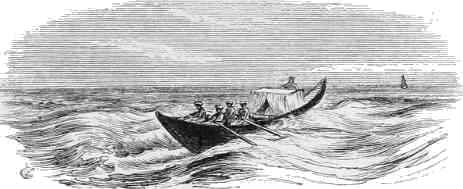 MASULI BOAT AT MADRAS.
VIEW OF MADRAS (AND PROPOSED PIER).
IX.
Madras.
Duration of Stay from 30th January to 10th February, 1858.
"Catamarans" and "Massuli" boats.—Difficulty of
disembarkation, and plans for remedying
it.—History.—Brahminism.—Festival in honour of
Vishnu.—Employment of Heathens under a Christian
Government.—Politics and Religion.—Laws of Brahminic
faith.—The Observatory.—Museum of Natural History and
Zoological Garden.—Academy of Fine Arts.—Medical
School.—Infirmary.—Orphan Asylum.—Dr. Bell.—Lancastrian
Method of Teaching Children first applied in
Madras.—Colonel Mackenzie's Collection of Indian
Inscriptions and Manuscripts.—The Palace of the former
Nabob of the Coromandel Coast.—Journey by rail to
Vellore.—Fête given by the Governor in Guindy
Park.—Visit to the Monolithic Monuments of
Mahamalaipuram.—Excursion to Pulicat Lake.—Madras
Club.—Fête in honour of the members of the Novara
Expedition.—"Tiffin" and dance on board.—Departure from
Madras.—Zodiacal light.—Shrove Tuesday in the
tropics.—Arrival at the Island of Kar-Nicobar.
The morning after our arrival in Madras Roads, a native boat
came alongside, of the sort known as "Catamarans," having
on board two natives, who brought off from the authorities
of the port the customary papers to be filled up. This
extraordinary and very primitive boat consists of merely two
or three trunks of trees bound together raft-fashion, on
which these daring boatmen kneel. As a great part of their
body is necessarily under water, they carry the papers and
letters entrusted to them for transmission to the ships in
the Roads, in turban-like wrappings which envelope their
heads. Ordinarily, these men are excellent swimmers, a most
requisite accomplishment to enable them to regain their
boats, in the event of being swept off by the waves, or to
save themselves and others from the innumerable sharks,
which frequent the entire Coromandel coast, and render it
eminently dangerous. About noon, a larger boat approached
us, manned by from 15 to 20 natives, who offered their
services as caterers, washers, agents, servants, in short as
"Dubashes" a sort of Hindoo factotum; while each
individual, shrieking and vociferating at the top of his
voice, held high in the air, with outstretched arm, a number
of written testimonials of ship-captains that had already
employed him. These boats, called "Massuli," or "Musli"
boats (from Muchly—fish), about 36 feet long by 5 or 6 in
width, and in which alone it is possible to bring passengers
and goods to land, are light, as flexible as if made of
leather, and are fastened together with the elastic fibres
of the cocoa-nut, being in every particular specially
adapted to yield to the tremendous blows of the heavy surf,
which a boat of ordinary construction could not possibly
live through. They are for the most part pretty deep, and
are usually manned with from 12 to 15 naked natives, who
make use of an exceedingly smooth pallette-shaped paddle. In
one of these boats, the officers of the frigate on leave,
and the naturalists of the Expedition, were conveyed to land
in the midst of a fresh breeze from the N.E. The more we
approached the shore, the more formidable was the appearance
of the tumultuous tempest-driven waves. Amid frightful yells
and hurrahs, we passed in safety the first and second lines
of surf. But we had yet to encounter the third, and by far
the most furious. The boatmen spread a couple of cloths over
our heads, to prevent our getting a soaking; the boat made
several violent plunges forward, and was for an instant
apparently covered by the tremendous foaming billows, but
seemed to glide in a most extraordinary manner over these,
and finally was neatly laid alongside the beach on the crest
of the last breaker. This is the critical moment, and the
most disagreeable, because the boat is, by this
manipulation, thrown on its side, and one feels disposed to
rush out, ere the returning wave throws the boat high and
dry on the sand. The noisy shrieks of the boat's crew and
Coolies, or Lascars (Indian porters), with which the
disembarkation is accompanied, combine to render it still
more annoying and unpleasant. One feels a sensation of
satisfaction at having gone through this remarkable, and to
some extent wholly peculiar, experience; but no one was ever
known to encounter it voluntarily a second time. The glowing
picture, which numbers of travellers have drawn of the
landing at Madras, might impress many readers with the idea
that their representations were most probably tinged
somewhat with a colouring of romance; but, in view of our
own experience at what is confessedly the pleasantest season
of the year, there can be at certain times no description,
however vividly sketched, but what must lag behind the
reality.
There could hardly have been selected a more unsuitable site
for a city, than that of Madras, and it is only the
circumstance that the entire Coromandel coast presents no
more eligible haven, as also the importance of the place as
the chief city of the Carnatic, which alone has a population
of 5,000,000, that has enabled Madras to boast a population
of 700,000 inhabitants, and a commerce of such magnitude
that 6000 vessels, British and foreign, are annually[101]
cleared inwards and outwards, laden with upwards of 650,000
tons of produce and goods of a total value of more than
£8,000,000 sterling.
The spot at which vessels anchor can by no stretch of terms
be called a roadstead, being in fact nothing but an open
strip of coast running nearly due north and south, so that
during the N.E. monsoons, the sea that sets in is something
extraordinary, and produces a tremendous surf. At no season
of the year is it practicable to reach the shore by ordinary
ship-boats, because the beach, being utterly unprovided
with any artificial appliances, is left in its natural
state—that is to say, covered with fine sand, which lies so
level that the depth is only nine fathoms two miles out at
sea! Singular to say, no steps have to this day been taken
to carry out the proposition, made many long years ago, of
remedying this difficulty in reaching land, by the
construction of a mole or pier, although three or four plans
have already been presented by distinguished engineers. The
last and most feasible scheme, and the most likely to be put
in execution, consists in constructing a mole 1000 feet in
length and 60 feet in breadth, to be erected upon iron piles
driven into the sand, and with a cross-piece at the seaward
extremity—the mole construction resembling the letter T. On
either side of the mole, tramways will be laid down to
facilitate the transport of goods that have been discharged.
The entire cost of this undertaking would be about
£100,000—an entirely disproportionate, and, indeed,
insignificant amount, when one takes into consideration the
important consequences which must result to trade and
passenger traffic on the completion of this erection.
The earliest British settlement was at Armegon, about 36
miles north of Pulicat (or about 78 miles N. by W. of
Madras). The cession of a piece of land by the native Rajah
of Besnayor induced the president of the old factory at
Armegon, Mr. Francis Day, to abandon the latter, and in the
year 1639, the Fort of St. George was erected at the
newly-selected station, where formerly stood the little
Hindoo village of Ischinapatam. This fort formed the
nucleus, at a later period, of the city of Madras, which is
built on the flat alluvial soil along the coast, and at
present comprises an area of about 30 (English) square
miles. Its extent along the beach from north to south is
about 9 miles by an extreme width of 3¾ miles. Madras,
like all the rest, consists of a White town, exclusively
inhabited by Europeans, and a Black town, or Pettah, in
which the natives and all coloured residents carry on
business.
The White town, which, however, presents none of the
carefully laid-out streets and compact blocks of houses
involuntarily suggested by the word "town," but rather
resembles a gigantic park, in which are situated a vast
number of comfortable ornamental villas, rises at its
highest point 20 feet above the sea; whereas the Black town,
at several points—for instance, Popham's Broadway—is
hardly 8 feet above the level of spring floods.
While in Ceylon we had had an opportunity of becoming
acquainted with the influence exercised by Buddhism over the
political and social condition of the island; here we, for
the first time, found ourselves confronted with the
followers of Brahmah. At the moment of our arrival, the
principal festival of the year was being celebrated in
honour of Vishnù, one of the three godheads of the
Brahminical faith. It lasted fourteen days, and was
celebrated with much pomp. Temples were improvised, and some
dancing platforms erected for the female servants of the
temple and "bayadères." In one of these dancing saloons,
adorned in the most marvellous manner, a sort of altar rose
in the background, richly hung with gold filagree work and
stained cut-glass, and fringed with singular representations
of the god. In the doorway stood, on the left hand side, a
copy of the statue of the Venus de' Medici; on the right, of
the Apollo Belvedere; on a small table were visible
butterflies, fire-flies, and conchs, in ornamental glass
cases. On the walls, of plain deal boards, were suspended on
one side, adjoining the portrait of Anthony da Padua, a
number of representations of voluptuous Oriental
"odalisques;" on the other, near an engraving in copper of
Carlo Barromeo, all sorts of obscene engravings, such as are
offered for sale only in the most abandoned quarters of
Paris and London, and then under the cover of night. For
that matter, we believe that the Hindoo priests, who
superintended the erection of this hall consecrated to the
worship of Vishnù, gave themselves less anxiety respecting
the subjects treated of in the pictures suspended round,
than that the walls should appear richly decorated with
engravings and pictures. Adjoining this half-open dancing
booth for the women in attendance on the temple, rises the
chief Hindoo temple in Madras, a stately edifice of blocks
of syenite, and surrounded by a lofty wall painted with the
usual white and red streaks; and on which a fleecy-coated
long-tailed baboon was performing his antics. Two gloomy
pyramidal towers shoot up from the wall of the temple, and a
beautiful colonnade leads to the entrance porch. A huge
tank, almost resembling a pond, in which the Hindoos thrice
daily performed their ceremonies, and went through their
ablutions, lies in front of the temple, surrounded on its
remaining sides by buildings for various purposes, while a
stately elephant, specially consecrated to the service, is
kept on the side next the temple, which carries up a pitcher
of water every forenoon from the pool in front of the
pagoda, one of the servants attached to the temple sitting
on his back holding it, while a second, seated behind him,
keeps waving a fan in either hand. The elephant is first
conducted round the temple and then inside, in order to
present the water to the god. This elephant (which animal it
seems is itself an incarnation of Vishnù) had the
distinguishing mark of the sect, as also several other
indications of a similar nature richly tatooed upon his huge
broad forehead. Every evening during the continuance of the
fourteen days' festival, the various temples and dancing
booths were brilliantly illuminated with wax tapers and oil
lamps, but admission was refused to the profane, and in the
eyes of Brahmah, unbelieving Europeans, a rule which was
everywhere enforced with much politeness but unvarying
firmness. Moreover, everything that the hand of a European
has touched is unclean to the Hindoo. Only the Pariah, or
"outcaste," the very lowest class of the people, eats any
food that has been prepared in the kitchen of a Christian.
The most substantial part of the festival, however, was
fortunately not confined to the interior of the temple, but
took place in the streets, through which, during the period
the festival lasted, immense processions of Hindoos,
praying, singing, and dancing, used to pass every evening
about 11 p. m. on their way from one temple to another, so
that we were in no want of picturesque objects. First, a
band of musicians would lead the way, with the peculiar
little drum or tom-tom, whining pipes, and blaring
clarinets. It was more like the noise of a lot of children's
instruments than music. Next came a Hindoo riding on a
gaily-bedizened ox, after whom appeared a number of girls
and "Bayadères," dressed in white clothes, their hair
richly dressed, and with rings through their nostrils, while
the flaps of their ears were adorned with richly-gemmed
ear-rings hanging down to the neck, and moving both hands
and feet as they danced before the sacred figure, which was
drawn along by 24 sturdy believers in Vishnù. The image was
placed on a daïs thickly overspread with flowers, filagree
work, and small mirrors, approached by steps, and with a
parasol outspread overhead; in a vehicle in front was a sort
of figure dressed up in flowers. On either side a multitude
of torch-bearers strode along, with sulphurous lights and
other means of illumination, or iron frames, on which were
disposed in pyramidal form or like a bow, from 7 to 13
fireballs, which, let off at intervals alternately with
Bengal lights and rockets, formed a veritable ocean of
light. A tub filled with cocoa-nut oil was dragged behind,
from which the cotton wicks were kept constantly
replenished, so that the flames continued unintermittently.
Wherever the procession passed the by-standers stood with
hands reverentially folded. Many had the thresholds of their
houses gaily adorned with flags and illuminated with paper
lamps, others let off sky-rockets. From time to time, the
procession halted for a moment, the female dancers formed
two rows, and some of their number went through a sort of
dance, in which they performed a set of stereotyped motions
with their hands, and chanted the praises of the god in a
most monotonous chorus. Thousands upon thousands of Hindoos
joined the procession, so that we could hardly make way
through the crowds. The yelling, heat, odour of oil, and
stink of sulphur were absolutely intolerable. As often as
the procession paused, the noise was redoubled, the
confusion became tenfold. Itinerant confectioners, who
offered for sale all sorts of sweetmeats, prepared either
from the kernel or milk of the cocoa-nut, drew back
reluctantly when the eye of a stranger was directed towards
their piled-up delicacies, through dread lest a mere glance
from him should blight their stock in trade. On the other
hand, we remarked some of these vendors pressing forward
with eagerness to satisfy the curiosity of strangers by
offering small samples of their eatables, so as the more
easily to propitiate and get rid of these dangerous guests,
and leave the poor Hindoo in peace and unharmed! As
Christianity makes but slow progress among the Hindoos, and
as the tendencies of the English residents in India do not
point, as of yore among the Spaniards in America, towards
the violent conversion of the heathen natives with the
alternative of annihilation, but rather towards political
and commercial influences, we find the British Government
regarding with placid indifference the abominations of
Hindoo worship, which, even to this hour, take the form of
laceration of the flesh and self-immolation, rather than, by
ruling with the strong hand, fan the religious fanaticism of
the multitude, without the possibility of Christianity
becoming a gainer. Among the thousands upon thousands who
were celebrating the festival of Vishnù in such a heathenish
fashion, there undoubtedly were many who are in the employ
of Government, which has no scruples about appointing
Hindoos of all sorts to the various posts in the public
service. The English State Church which held that such
appointments tended, not very indirectly, to support
heathenism,[102] earnestly remonstrated against the practice,
but the Government becoming daily more convinced that the
doctrines and homilies of the Christian faith continued to
be entirely a dead letter among the Hindoos, seems to hold
fast to a policy of seeking gradually to introduce
Christianity and European civilization among the Indian
races, by means of equality of rights and assimilation of
laws, by a system of well-organized national, trade, and
industrial education, and, above all, by the influence of
personal example. This, to be sure, is a very slow and
arduous method of conversion, inasmuch as a life of
religious observances is more deeply intertwined with the
very foundations of the social system in India than in any
other country of the globe, and fairly blocks the way
against the expansiveness of European civilization. For as
simple as the Hindoo religion appears in its primitive
principles, the proper observance of its various rites is
proportionately difficult, and full of subtle distinctions
for the sincere Hindoo believer.
The worship of Brahma, according to the doctrines enunciated
by Brahma's own lips in the Vedas, or holy books, took its
rise in the adoration paid to the powers of nature, regarded
as so many divinities, especially in the exalted
transcendentalism of their ideas respecting the sun, the
moon, the stars, and the firmament. Thence was readily
developed the belief in a sole, eternal, Almighty Creator
and Ruler of the world, Brahma, represented as having four
faces looking to the four quarters of the globe, and
reposing on a swan. This simple monotheistic belief was
gradually developed into the divine manifestation of Brahma
as a Triune divinity, namely, as the Creating power
(Brahma), the preserving power (Vishnù), and the destroying,
and at the same time renewing, energy of nature (Siva).
Although the revelation of Brahma has long since been
completed, while Vishnù and Siva are still active agencies
in the world as Supporter and Augmenter respectively, Brahma
is assigned a very inferior rank in the worship of the
masses, although, according to the lawgiver Menù, the Moses
of India, he created the Brahmins out of the substance of
his head, to guide and instruct man; from his arms the
Chetriyas, to protect and defend him; from his trunk the
Veisigas, to nourish and support him; and, lastly, from his
feet the Sadras, to serve and be the property of all the
other castes.
To Brahma, the fulness of whose existence no earthly notions
can embrace, there are no temples dedicated, these being
rather erected in honour of Vishnù, the Intercessor and
Supporter, who manifests himself in the atmosphere and in
water, and Siva the destroyer and regenerator of the various
races, as also to the other divinities whom the Hindoo
religion numbers by millions, although the majority of these
have several names, and the lower classes are simply
Avatars, that is incarnations or manifestations, of the
superior deities. This peculiarity of the Hindoo religion
makes it impossible correctly to classify or define Indian
mythology. The god Rama, for example, is frequently named
for Krishna, and the latter again for Vishnù. Vishnù, on his
part, sometimes figures as Rama, when he is to destroy
Ravana, the tyrant of Ceylon, or as Buddha, in order to
found Buddhism. Like the Proteus of Grecian fable, the
Hindoo mythology assumes a thousand different shapes,—it
is, in short, Pantheism in its most perfect development.
A zealous Hindoo requires about four hours of each day to
get through his religious ceremonies, these being performed
at different periods, as he must bathe in the morning, at
noon, and again at night, in a tank or pool before the
temple, and recite certain prayers. For purposes of
recognition, the two chief castes wear special marks, the
worshippers of Vishnù having a trident painted on the
forehead in either white or yellow, while those of Siva, on
the other hand, sport three horizontal stripes, or one round
spot marked with the ash of burnt sandal-wood. Many Hindoos
write on their foreheads the distinguishing insignia of both
Vishnù and Siva, and look thus the more strange and
peculiar.
After every ablution these marks are painted afresh, and
with much care upon the forehead, so that paint and
rouge-boxes play an important part in a native household. No
Hindoo can partake of his exclusively vegetable nutriment,
if cooked in a European kitchen, such being entirely
contrary to the principles of his faith. Every servant,
therefore, leaves his master regularly at noon, in order to
partake of his simple meal of rice and vegetables, either
with his family or in one of the numerous Hindoo cook-shops.
The frequent holidays of the Hindoos, of which there are
twenty-one within two months, seriously interfere with trade
among the natives, and still more with the instruction of
the young.
Hindooism, however, appears to have lost much of its
originality by constant contact with Europeans, and by the
various political revolutions, and although many of these
ceremonies are still kept up, and the bodies of their dead
are still burned on pyres, yet the modern Hindoo has so far
relaxed from his ascetic austerity, as to admit of his being
employed in the various pursuits of active life. And it is
not a little surprising to see these handsome, tall, brown
figures, with their insignia of Vishnù or Siva marked on
their foreheads, and dressed in their sweeping plaited togas
of pure white, employed on the telegraph, the railway, the
arsenal, and even the observatory, all which employments
demand the utmost exactness and punctuality, and thus afford
the most gratifying evidence of the adaptability of the
Hindoo race to be impressed and to benefit by European
civilization. With the exception of Major Jacob, the
director of the astronomical and magnetic observatory, the
whole of the employés are natives, who are not indeed
employed in making the actual observations, but are found
perfectly competent to compute the various calculations, and
make the requisite reductions. The institution itself is at
present of but little importance as a place of scientific
observation, in consequence of the small support it
receives, but it is to be provided with a meridian circle,
similar to that in the Royal Observatory at the Cape of Good
Hope, when it must become an important station. Strange to
say, here, as at the Cape, there are no observations made on
the Sundays, which in the course of a year gives rise to
lamentable deficiencies, especially when some natural
phenomenon of rare occurrence happens to fall upon a Sunday.
We were greatly surprised at the flourishing condition of
the Central Museum, with which is united a Zoological
Garden, both set on foot in 1851. In the spacious rooms of
this stately edifice are ranged costly Indian antiquities
and sculptures, inscriptions in Sanscrit, in stone, or
marble slabs, antique fragments of Indian monuments,[103] as
also an instructive collection of technical and
ethnographical subjects, models of fortresses, ships,
agricultural implements, instruments, tools, machines, and
native forts. The geological department of the Museum is the
weakest and poorest department; and as spirits of wine and
glass jars are expensive articles in India, the greatest
number of the animals, even the fish and snakes, are simply
stuffed. In the garden which surrounds the museum buildings
are a considerable number of cages inclosing living animals,
such as monkeys, panthers, bears, giraffes, stags, gazelles,
cobras, Indian hens, pigeons, marsh-birds, and
singing-birds. In addition there were Aquaria with fishes
arranged in groups at various spots all round the garden. Of
objects of special interest there was a powerful baboon
(Pithecus Satyrus), above 5 feet high, fastened to a chain
in a large monkey-house, around whom were gambolling a
number of smaller species, as also a number of cobras in a
large box with glass sides, so that one could examine them
at leisure on every side. Here we witnessed the
uncomfortable spectacle of a native engaged in cleaning the
panes inside the cage and directly beneath these formidable
animals, which thronged around him in such numbers that he
was continually compelled with one hand to resist their
importunate caresses. Anyone not aware of the fact that
these animals have been rendered harmless by the extraction
of their poison-fangs, must experience a feeling of terror
and astonishment at the sight of this brood of malign,
stealthy-moving, hissing serpents, with a naked Hindoo in
their midst!
Most astonishing and gratifying is the immense number of
casual visitors that frequent this institution for advancing
education. The book for inscribing names lying in the
Museum, showed for a single month no less than 36,522
visitors, mostly natives, and this it seems has been about
the average number since the foundation of the Museum. There
is also a small, valuable library, which, by means of
purchases, gifts, and exchanges, is being visibly added to
with each year, and is accessible to visitors of all
classes, the custodian and inspectors being all natives.
The Madras Literary Society, an offshoot of the Royal
Asiatic Society in London, and now reckoning but a small
number of associates, publishes from time to time the most
valuable information as to the latest achievements of
science in India, and serves in a measure as a medium by
which to compare the intellectual progress of Asia and
Europe. To the members of this society the naturalists of
the Novara Expedition are specially beholden for their
great attention during their stay in Madras, as also for
their hearty participation in the objects of the Imperial
Expedition as evidenced by their sending copies of their own
various and useful publications.
There are in Madras numerous institutes devoted to the
diffusion of useful knowledge among the masses, part
founded and maintained by Government, part by private
enterprise, and this liberality is the more praiseworthy
that the European community of Madras does not comprise much
more than 1600 persons, of whom only a very few settle any
length of time. The Europeans resident here are chiefly
military men and merchants, who leave the country after
remaining five or ten years, as almost every one regards his
stay in this hot, sandy capital of the desert Coromandel
coast, as purely provisional, and views it as a
stepping-stone towards attaining some better post, or
becoming suddenly wealthy by some favourable conjuncture of
circumstances. That the majority of these institutions have
more practical objects in view admits of ready proof, and is
but one instance the more of the moulding power of
surrounding circumstances. In the school of arts for
instance, under Dr. Hunter's superintendence, there are 20
pupils, mostly Hindoos, who are receiving instruction in
drawing, sculpture, lithography, woodcutting, etching, and
photography. But in order to reduce, as far as possible, the
expenses of this institution, there is also included a
manufacture of earthenware, the proceeds arising from the
sale of which are applied to the support of the school.
Another eminently useful institution, the Medical College,
which, as well as most of the other professional
foundations, we visited in the company with our hospitable
and influential friend, Dr. Kelly, possesses one division,
in which such of the natives as purpose to set up as
apothecaries, are at the same time so far educated as to be
able, in case of necessity, to perform a few of the minor
surgical operations. Of the hundred of an auditory who at
the period of our visit were attending a lecture on
chemistry, the majority were half-blooded Indians, dressed
in the European fashion, with a sprinkling of barely 9 or 10
Hindoos in their white robes, and with the Vishnù or Siva
marks on their forehead. We frequently heard the professors,
among whom are several gentlemen of high scientific
attainments, such, for instance, as Messrs. Evans, Lorimer,
Mudge, Montgomery, Mayr, &c., express their regret at the
severe check which the development of science sustained by
the outbreak of the late revolt. Plans for a new university,
a hospital, and a medical school to correspond are all
ready, and but for that ruinous catastrophe would have been
by this time in working order.
In other respects the present Infirmary is an ugly and
unsuitable building, making up about 100 beds for patients.
Several of these were occupied by soldiers, who had been
severely wounded under Havelock at the storming of Delhi.
The introduction of punkahs, or wind-fans, into the wards
has proved so salutary, that there is an intention to have
them worked without intermission day and night, by means of
water power, instead of by manual labour as hitherto. In
order to be able to estimate the boon conferred by such an
improvement upon the condition of the poor invalids, we must
call to mind that the average annual temperature of Madras
is about 94° Fahr., which is slightly in excess of the
average temperature at the equator, although Madras is 10
degrees north of the line. Under such climatic conditions,
it is no wonder that the invigorating wholesome breeze is
known at Madras as "The Doctor."
Among the benevolent institutions visited by us, we found
the twin asylums for male and female orphans of soldiers
well worthy of notice in many particulars. These are for the
most part the offspring of European soldiers married to
native women, and are known as "half-castes," or
"Mestizoes." In the Military Female Asylum, there were at
this time 216 girls, who were brought up to all manner of
female work, as well as taught reading, writing, and
arithmetic, and remained in the institution until suitably
provided for in marriage. The marriage outfit, as also a
small wedding present of Rs. 50 (£5), for each girl is
provided by Government, and the entire working expenses,
which amount to about Rs. 30,000 (£3000) annually, are
defrayed by a Government grant of Rs. 1000 (£100) a month,
together with the interest of the funded capital, upon which
Government pays 8 per cent. interest.
The Military Male Orphan Asylum was founded in 1788 by means
of voluntary contributions, supplemented by a Government
Subvention, and possesses a special historical interest from
the circumstance that it was here that Dr. Bell, who held
the post of Head-Master in the establishment, first
projected and put into execution the method of imparting
elementary instruction, afterwards so widely renowned as the
Lancastrian method of teaching, which since that period has
traversed the globe, and has been introduced into every
capital in Europe. The course of instruction of the
institution includes writing, reading, arithmetic, grammar,
geography, history, English, Tamil, and music. The capital
of the institution is vested by Government in the 4 per
cent. stocks, paying 8 per cent. interest, which, with the
large amount realized within the establishment itself, is
sufficient to defray all expenses without any further
assistance. The number of boys is about 242. The head
teacher, who obligingly conducted us over the whole
establishment, which is very handsome, called a dozen boys
forward just as we were leaving, who played a few simple
pieces on wind instruments, on which they performed a
variety of national airs with great precision. The music
master was a German.
Among its casual attractions, Madras has occasionally flower
shows, and exhibitions of industry, and it is exceedingly
gratifying to observe how European science is even here
called in to elicit the treasures of nature, and administer
to the necessities of mankind. The catalogue of the
industrial exhibition of 1857 shows, inter alia, 17 sorts
of spices, 20 varieties of resin, 64 plants suitable for the
distillation of oil, and 41 different drugs, and Dr.
Kirkpatrick, a physician in Mysore, has taken the trouble to
enumerate, by their botanical and Indian names, 240 native
drugs, which had been sent to the Madras exhibition, as also
their market value, and at the same time has subjoined the
modes in which the natives use them.
Among the most remarkable private museums which have been
formed at Madras for the illustration of the history and
monuments of the southern provinces of the Deccan, must
undoubtedly be included the collection of native
inscriptions and manuscripts of the well-known Colonel
Mackenzie, which first attracted the attention of all
friends of Oriental science, as also the British Government,
through a memoir[104] of Alexander Johnston, Esq. It is a
magnificent testimony to the conservative spirit of the
British resident among heathen nations, as compared with the
barbarous spirit of destruction that characterized the
Spanish colonists. From an erroneous idea that they were in
so doing promoting the interests of Christianity, these
Romanist conquerors destroyed all sculptures and monuments
of the pagan Indian races, and, by this fanatical Vandalism,
at the same time prevented the hand of science from
unfolding, as it might have done from these important
vestiges, the history of these very remarkable races from
the most remote ages.
In the immense old palace, surrounded by adjacent edifices
and gardens, once occupied by the King of the Coromandel
coast, the renowned nabob of the Carnatic, the offices of
the English Government employés are at present located.
The last of these sovereigns died a few years since, and his
former minister receives from the British Government a
pension of Rs. 1300 (£130) a month. Great men who have
fallen do not ordinarily like to be sought out or gazed at.
There is, however, on the contrary, no difficulty in
obtaining access to the last minister of the last monarch of
the Coromandel coast, who seems to feel flattered by a visit
from strangers. On our entering, the venerable old gentleman
rose from a rich thick carpet, on which he was sitting
cross-legged, held out his hand in the most affable manner,
and did us the honour of accompanying us through the palace.
He had a long white beard, and wore a white turban on his
head, while his person was enveloped in white linen. A
splendid staircase conducted to a council-room, adorned with
a portrait of the late nabob, life-size, executed in London.
A second room has a likeness of George Augustus Frederick,
Prince of Wales, dedicated to his friend, Omadal-Omrah,
nabob of the Carnatic, 1st January, 1797, and of Lord
Cornwallis, arm in arm with a nabob, the former represented
as walking among pines, the latter among palms. In the
harness-room and coach-house adjoining, our obliging
attendant revealed to us an endless array of golden howdah
trappings, gilt with cunning hand, which seemed to have
formerly borne the mighty nabob, when riding on his
elephant. As we emerged from this lumber room, filled with
dust and mud, we perceived in the square before us an
immense dust-cloud, which approached nearer and nearer in
its gyrations, and gradually assumed the shape of an
elephant. It was a gigantic and magnificent specimen, and
proved to be the favourite elephant of the last nabob,
which, like the minister himself, was reduced to eat the
bread of charity. His enormous tusks were sawn half off, for
which his attendant assigned the singular reason that the
tusks of an elephant must be cut, just as we pair our nails!
This pensioner-elephant, however, seemed to find himself in
very good quarters, and was a carefully-tended gentle
creature, who carried about his chain with his proboscis,
and knelt down at the word of command.
Among the other spacious apartments of this deserted palace
was the banquetting hall, as it is called, which was
represented by various writers as one of the largest rooms
in the world, which, however, is a transparent fallacy. It
is hard to believe that above a thousand persons could find
room in it. At the period of our visit this apartment was
used as a barrack for the English troops, in consequence of
which the splendid full-length pictures already mentioned
were carefully covered. One of the soldiers, anxious to show
them to us, tore away the covering of one before we could
interfere, when we found it to be a splendid likeness,
painted in London, of Sir Thomas Monroe, a former governor
of Madras.
In the first few days of our stay in Madras, we made an
excursion to the fort of Vellore, distant about 80 miles
(English) from Madras, formerly a renowned native fort,
which is now reached in a few hours by rail. This line
passes through a flat uninteresting country, which is barely
relieved here and there by a couple of solitary palms or a
Hindoo temple, and altogether presents a strongly African
character in its scenery. Only at those points, at which
there are tanks, or artificial basins, either excavated or
formed by damming the water, does there occur a luxuriant
green vegetation covering the parched, brown, dusty soil.
These tanks are filled in the rainy season, and during the
dry season, which continues for months, supply the
rice-fields with water for irrigation, the culture of that
plant requiring an unusually large supply of water.
If English railroads are proverbially comfortable in the
mother-country, they certainly fall off lamentably in that
particular in the cars used in India. This deficiency is the
more provoking and remarkable, considering the various other
appliances for comfort which are to be found in this
country. The conductor, as well as the other servants of the
Company, was a Hindoo. On the entire line we saw but five or
six white men employed. The fares are pretty moderate, that
for the entire distance, 80 miles, being Rupees 7½
(15s.), for first-class, and Rupees 3 (6s.), second
(about 2¼d. and 1d. per mile, respectively). The line
is to be extended from Bejapoor, so as to unite the eastern
and western coasts of the peninsula. There are also lines
projected from Madras to Bombay by Poonah and Bellary, and
from Madras to Calcutta. The Governor, who (the evening
previous to our departure, as we were being entertained at
his summer residence, Guindy Park,) had been apprized of our
intention to visit Vellore, was so attentive as to order the
commandant to be informed by telegraph of our projected
excursion at a late hour of the evening, and when we reached
Vellore at 11 a. m., Captain Stevens was awaiting us at the
station, to greet the voyagers by the Novara in the name
of the commandant of the fort, and convey them to the fort,
three miles off, in a waggon drawn by oxen, as is the custom
of the country. The waggon was about as large as an ordinary
sized sitting-room, and contained several arm-chairs and
cane stools, the position of which could be altered at
pleasure.
Vellore was once one of the strongest fortresses in India,
the wells of which were formerly rendered inaccessible by
numerous colonies of alligators. These Hindoo fortifications
have, however, lost their military importance for Europeans,
as they are on all sides "overcrowed," as Rittmeister Dugald
Dalgetty would say, by eminences, from which they could
easily be cannonaded. Within the fort itself are several
extraordinary buildings, once pagodas and houses of
entertainment for priests and pilgrims (choultries). The
former sanctuary, now used as an arsenal, is a
chef-d'œuvre of architectural skill, with splendid
relievos and figures sculptured in granite blocks. Most of
the divinities have four arms, symbolical of the
universality of their power. The various edifices seem to
have been once an abode of Brahmins, a sort of Hindoo
monastery in which, in addition to the pagoda, there were
ranged all round, a temple, colonnades, and halls for the
residence of the priests. In some of the smaller apartments
there still are openings for windows, with a finely carved
grating hewn out of the solid granite, the workmanship of
which even the stone-cutters of our own days might feel
proud of. Captain Mitchell, an English officer stationed at
Madras, had hit upon the idea of photographing the most
interesting of these monuments.
The fortress of Vellore has been fortified for about 1000
years! Captured by the English at the close of the last
century, the then Nabob, a Mussulman, was taken prisoner,
and his descendants have ever since inhabited the fort as
State prisoners, without ever being permitted to leave it.
We inquired of the officer who accompanied us, whether the
Nabob was permitted at least to make use of the space within
the fortress for exercise in the open air. "The Mussulmen,"
replied the cautious Englishman, "do not care to show
themselves in public; they prefer taking their exercise in
the court in front of their residence, or in the garden."
Accordingly, the aged prince is rarely known even to take an
airing in a palanquin. The town of Vellore itself is, in a
great measure, another place altogether, whose inhabitants
are Mahometans, about 80,000 in number, chiefly engaged in
rice culture.
We originally intended to return the same day to Madras, the
length of the journey, as well as the distance of the fort
from the railway station, having been represented to us as
much shorter than was actually the case. Accordingly, we
telegraphed to the Austrian Consul, M. Campbell, Esq., an
exceedingly courteous gentleman, that we should not return
till the following morning. How great was our astonishment
to find that the telegraph employés at Vellore, both in
the transcribing department, and in the management of the
apparatus, which was on Morse's system, were Hindoos, with
their curious marks upon their foreheads, and their
old-fashioned costume! They went, however, through the
duties connected with this modern invention with great
adroitness. The telegraph is already in operation to Bombay,
and in this direction has two separate lines. There are,
moreover, other lines in course of construction,—along the
coast to Calcutta,—along the coast to Pondicherry by Adam's
Bridge,[105] from Madras to Point de Galle, and from Madras to
Hyderabad, Bangalore, and Bellary.
In proceeding from the fort to the town of Vellore, which is
charmingly situated and regularly laid out, and is inhabited
by numerous pensioners of the East India Company, we must
cross the river Palaar (or Peliar), which, during the rainy
season, is a headlong dangerous torrent, while in the dry
season its bed, 1000 feet wide, is but a bare expanse of
sand. It is only by dint of strenuous exertions that the
traveller is able to pass this sand waste in a waggon, as it
sinks at some points above the hubs of the wheels. We had
four buffalo oxen yoked, and even then had to be propelled
at certain points by the assistance of some 30 coolies or
Indian porters besides. This serious inconvenience was
shortly after our visit to be remedied by the erection of a
splendid bridge of solid masonry, which was to span the
river by 42 arches, and will reduce the time of transit from
the station from 1¼ hour to 20 minutes. Hereabouts oxen
are usually employed for draught, which are of the same
humped species as those we had previously seen in Ceylon.
These animals trot with uncommon swiftness, so that the
rapidity of transport may stand comparison with that where
horses are employed.
A few miles distant from Vellore, and visible from the hills
around, lies Arcot (Arucati), the residence of the nominal
nabob of the Carnatic, who has long been a pensioner of the
British. The population of Arcot are mostly Mahometans, who
speak a dialect of Hindustani, and drive a very active
trade.
At Vellore we resided in the house of the hospitable
Lieut.-Colonel McCally, who, in the absence of the
Commandant, did the honours of the Fort to the members of
the Novara Expedition. Here we experienced a most cordial
reception, and passed a few most delightful hours in the
domestic circle of his amiable family. In the evening we
made out an excursion to an adjoining eminence, 1400 feet
above sea-level, 300 above Vellore, from which there is a
commanding view over the town and neighbourhood. Seen from
this point, the Fort looked charming, presenting itself to
us, surrounded as it is by moats and watercourses, like an
island in the foreground. On the top of this hill is the
bungalow or country-seat of the collector of revenue, W. A.
Sulivan, Esq., where we revelled in the enjoyment of the
exquisite natural scenery, and partook of refreshment.
In the evening a number of officers, with their wives, met
us at dinner at Lieut.-Colonel McCally's house. The gaieties
were prolonged till far in the evening, music and songs
alternating with round games and dancing, so that we had
hardly composed ourselves to sleep ere we were awakened by
the servants, in order to avoid missing the train, which
leaves Vellore for Madras at 6.30 a. m. By 11 a. m., we were
once more in the chief city of the Carnatic.
The same afternoon the officers of the Novara, and the
naturalists of the Expedition, were invited to an Indian
fête, which Lord Harris gave every year at this season in
his palace at Guindy Park, and to which it was customary to
invite the majority of the European residents at Madras,
together with their families,—military, civil service, and
mercantile community, all being honoured with cards. This
festival originated in a children's entertainment, which the
governor had been in the habit of giving on the birthday of
his son; the latter had long since gone to an English
University, but the custom had survived, and the day was
equally carefully observed this year also, having been
looked forward to for months before by the "white" young
folks of Madras. The entertainment still retains the
character of a children's party, inasmuch as on the present
occasion there were assembled above 250 children of both
sexes, varying from 5 to 12 years of age. The total number
of guests who, in addition to these, shared in the
festivities was probably more than a thousand. The fête
began with the performances of some 30 Indian jugglers and
acrobats, on a large lawn in the park. These, as may be
conceived, had been selected from among the most athletic
and skilful. They presented a singularly-picturesque
appearance, from the diversities of age, agile boys,
athletic young men, slender voluptuous-looking Bayadères,
old grey-headed men, and marvellous-looking old hags, with
streaming white hair, and dark, piercing, gleaming eyes,
recalling in their manners and appearance our own gipsies.
All played at once, and performed with the most astonishing
precision a succession of breakneck feats, that set the
spectator's hair on end. It was a spectacle entirely sui
generis, thoroughly Indian in short, to behold these
wild-looking brown figures, unawed by the presence they were
in, going through their various performances and feats of
agility. In front of us knelt an old man who played with a
dozen knives, which he kept circling around him with wild
yells, apparently without looking at them, till he finally
turned them in such a manner that it seemed as though the
sharp points of the knives had transfixed his hand. Next
youthful acrobats sprang through paper balloons set on
fire,—girls in boys' dresses climbed up bamboo poles 100
feet high, in the midst of continual yells,—boys executed
on the damp meadow ground the most extraordinary feats of
agility and contortions of the limbs, while one old fellow,
to the intense astonishment of the assembled children,
swallowed swords, as also tow and other combustible matter,
whereupon flames presently seemed to issue from his month.
These, indeed, are feats of conjuring which have been
performed in Europe, usque ad nauseam, but here all was
done with such precision and dexterity (each man especially
playing entirely con amore, evidently not to impress the
spectators, but because he felt a pleasure in it himself),
that the whole exhibition left quite a different impression
from anything of the sort elsewhere.
After this introductory amusement, the children invited were
regaled with a refection under an enormous tent. This was
for the grown-up guests another source of great amusement.
More than 300 children took their seats at a long
well-covered table, while their fathers, mothers,
governesses, &c., stood behind the benches, and took special
care to supply the little watering mouths with a sufficient
supply of the many delicacies before them.
A distribution of souvenirs to the various children present
succeeded the repast, the various articles being fastened to
a gigantic tree under a tent. The tree was profusely hung
with elegant paper lamps, and although there were no
pine-branches, only palm leaves, the "tout ensemble," bore
a strong resemblance to a genuine Christmas tree. Fathers
and mothers expressed to us their own feelings of pleasure
at beholding the glee of their children, and, indeed, seemed
to think this the most entertaining part of the fête. The
distribution lasted a considerable time, and many of the
children affected to coquette disparagingly with the
presents of their neighbours, which these latter held fast
with both hands, till at length the whole joyous train were
dismissed homewards, thoroughly pleased with the day's
proceedings.
After this interlude there were fireworks on the lawn for
the grown-up children, which seemed intended to serve merely
as a stop-gap to while away the time between the
distribution of the presents to the children and the supper,
which was laid out in the brilliantly-illuminated
dining-room of the palace. The fine band, which a few days
previously had so pleased us by its performances during
dinner at Guindy Park, drew up on the large lawn fronting
the ball-room, and during this interval played a few select
pieces with admirable precision. At last, supper was
announced by a flourish of trumpets. Despite the spacious
proportions of the apartment, the company was too numerous
to admit of all sitting down at once. We calculated the
number of guests still remaining at at least 500. The ladies
supped first, and afterwards the gentlemen—the Governor,
Lord Harris, doing the honours in person, in the most
courteous and kindly manner. After supper the party
proceeded in couples to a splendid ball-room, where dancing
speedily began, while over their heads an omnipresent
punkah, of rich tapestry-paper, and elegantly adorned with
beautiful arabesques, swung to and fro, and kept the
half-breathless dancers continually fanned by its currents
of air.[106] In spite, however, of this artificial
ventilating machine overhead, one must have had an
extraordinary love for the dance to find pleasure in a polka
or galop at a temperature of 86° of Fahrenheit.
Lord Harris had taken measures for ensuring our proceeding
direct from his residence in Guindy Park upon the favourite
excursion from Madras—that, namely, to the Seven Pagodas.
We had accordingly provided ourselves with only what was
indispensable in the way of luggage; and towards 1 a. m., we
left the ball-room, and proceeded on our way to the renowned
Hindoo Temples to the south of Madras. A waggon conveyed us
to the Adyar bridge, where a Government boat was in waiting
for us, together with some Hindoo servants of the Governor,
who were to be our guides to the Seven Pagodas. One of these
peons, as they are called in India, named Iritschapa,
presented us with a document, in which he was commissioned
to place himself at our disposal during the whole period we
were absent, and anticipate all our requirements without
further authorization, to the best of his ability, so as to
ensure our comfort and assist the objects we had in view.
The Government boat was supplied with everything that could
minister to our comfort, a second boat following us
exclusively for the conveyance of our heavy baggage,
personal effects, tents, and provisions. Towards 2 a. m., we
embarked on the Eastern Coast Canal, which goes as far as
Sadras, and by which we reached the Seven Pagodas, called
also Mahamalaipuram, the city of the Great or Holy Mountain,
at 9 a. m.
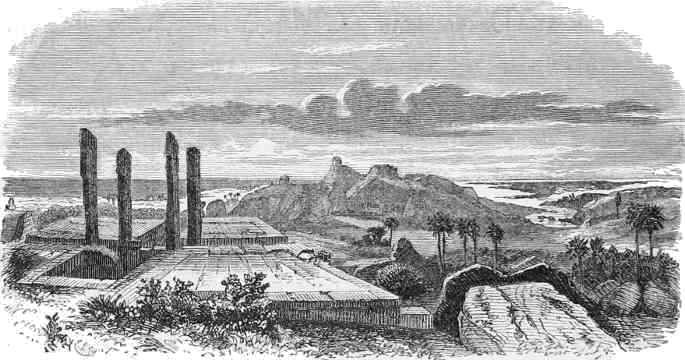 THE HOLY MOUNTAIN.
These singular and majestic specimens of architecture are
about 3 miles from Sadras, being situated on the coast
northwards, and about 500 paces from the canal. They consist
of temples, grottoes, bas-reliefs, cisterns, stone-benches,
and thousands of sculptures in long ranges of bas-reliefs,
which afford an abundant store of antiquarian research. They
go by the name of the Seven Pagodas (from Baghavati—Holy
House, whence the European corruption, Pagoda), from the
circumstance, that there are, upon the very brink of the
ocean, seven temples hewn out of one piece of rock. The
Brahminical legends speak of an entire city having existed
here, of which only the fragments are now washed by the sea.
But, according to Babington's and Heber's minute researches
in this neighbourhood,[107] there seems no doubt that there
never existed any large city here, but that the whole was a
mere myth of the Brahmins, who procured a royal gift, an
Agrabaram in this neighbourhood, and with subtle forethought
left here a caste of stone-cutters, who from time to time,
under the guidance of their priests, executed these
sculptures for the adornment of their sanctuary, which are
justly the objects of wonder to their descendants. To this
day, even, there dwell here certain families of
stone-cutters, who work these singular rocks as granite
quarries, and make money by the trade. The Seven Pagodas,
specially so-called, are monolith temples, hewn on the spot
out of massive blocks of rock. The mountain itself, a huge
block of granite, to which the entire locality owes its
reputation as a site of works of art, is covered, behind as
well as in the front slope, with innumerable figures.
After our arrival, we made a hasty circuit through the
place, so as first of all to be able to identify them, and
be in a position to recognize the various sculptures and
bas-reliefs cut out in the solid granite rock. The greater
number of the sculptures represent either the one or the
other descriptions of the Avatars (the incarnations or
transfigurations) of Vishnù, to whom the larger proportion
of the temples is dedicated. In one of these temples, we
perceived the god Vishnù in the fifth, or Dwarf Incarnation,
in the course of which he had, under the guise of a
Brahminical dwarf, begged of King Balitscha-Kravathi—who,
by his piety, had acquired so much power over the gods, that
they had to transfer to him the dominion of sea and land,
and had in consequence waxed arrogant—as much soil as he
could traverse in three steps! The wealthy Rajah made no
objection to complying with the apparently moderate request
of the pigmy being before him. On the opposite wall of the
temple we now see, in a large admirably executed bas-relief,
how Vishnù, represented on this occasion with eight arms, at
once embraced heaven and earth with his left foot, and as
there was thus no more room left for the next step, Vishnù
released the haughty Rajah from his promise, on condition
that he should descend to the infernal regions. From this
feat, Vishnù bears the name of Triwikrama and Tripadas
(thrice-stepper).
In the next rock grotto we came to, we beheld the Life of
Krishna, the shepherd-god, represented, first as tending his
sheep, surrounded by cows, goats frisking about, &c. Walter
Elliot names this representation "Krischna's Choultry," or
the abode of the priests. The temple has a frontage of 50
feet, is from 30 to 40 feet in depth, and has about twenty
figures.
From this spot, our guide, a Brahmin, brought us to what is
called the Ganeza Temple, a monolith Pagoda. When we
expressed a wish to touch the face of Ganeza (a son of
Siva), cut in stone and plentifully besmeared with oil and
lard, one of the Hindoo attendants hurried forwards to
prevent us from being guilty of insult to this much-beloved
divinity. The inscription to the right, in front of the
niche in which Ganeza, hewn out of a single block of
granite, is represented in a sitting posture, consists of
verses and prayers to Siva, written in Sanscrit.
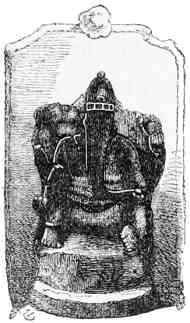 THE GOD GANEZA.
We also remarked, on our way to the village, an ellipsoidal
block of rock, 68 feet in circumference, by 25 in height,
which, from its very peculiar position, seems to shift every
moment, and presents a very extraordinary appearance.
As we were proceeding to the beach, we came upon the Pagoda
of Kovulgobrom, which is at present in use (first
constructed in the days of Rajah Apatsch, 400 or 500 years
since), situated on a large oblong plot of ground, which is
surrounded by a wall from 6 to 8 feet high. We were not
permitted to cross the threshold of the pagoda, the door of
which always stands wide open, and the minor apartments of
which, so far as we could discern at a little distance away,
were quite empty. We could just descry a few sculptures on
the walls.
The whole village contains at present about 400
inhabitants,[108] who reside in eighty small dwellings. Of
these, three, built of bricks and with tiled roofs, belong
to the caste of Brahmins, thirty to the Pariahs, five to
families occupied in fishing, and two mere hovels of
palm-wood to the Willis, the lowest and most wretched caste
of all. The families of stone-cutters reside outside the
village. One remarks here that the walls of the houses are
hidden by heaps of cow and horse-dung, which the
inhabitants, as in Egypt, use for fuel, and which they pile
up to dry against those of the walls which are most exposed
to the sun. The peon of the settlement, by name
Randghajaneik, a sort of overseer, gave us a drawing of the
various groups of houses, their inhabitants, and also the
names of the various castes in Tamil, engraved as usual with
an iron tool upon palm-leaves, and very elegantly rolled up
in a small envelope. Among the customs and fashions of the
inhabitants which attracted our notice, we were informed
that they always burn their dead from four to five hours
after life has departed—usually four hours and forty
minutes—alleging that the released soul takes that length
of time to reach heaven! The bones are collected and thrown
into the sea. Widows are no longer required, on the death
of their husbands, to ascend the pyre with them.
Accordingly, the mortality upon this score is small enough
in Mahamalaipuram. All seem hale and hearty, although for
the most part they live upon rice and fruits, tasting flesh
but seldom, as it is never used by the Brahmin caste. The
Brahmins will not even eat eggs, because they are the
produce of hens; nor drink milk because it is procured from
cows! The girls generally marry at thirteen. They are,
however, usually betrothed from the time they are two or
three years of age, the bridegroom-elect taking the
bride-elect to reside with himself.
All the natives whom we fell in with could read and write,
but the Sanscrit inscriptions on the rock-temples were quite
unintelligible to them, as they only spoke Tamil, Telùgu,
and Malabar. The greater number had their foreheads painted
according to the caste they belonged to. Those worshipping
Siva wore, suspended by a cord round the neck, small silver
amulets, called Lingams, which have images of Siva enclosed.
The adherents of Brahma, as already mentioned, wear no
distinguishing mark upon the forehead, except that those
that are married wear a five-ply cord (panul), tied
obliquely across the upper part of the body. One must not,
however, attach too much faith to these varieties of
external markings, since many tattoo their foreheads with
red, or yellow, or ashen-gray punctures, which usually have
no special signification, but simply imply that on account
of the pressure of business requiring frequent absence, they
have neither time nor opportunity to have the distinguishing
insignia of their caste properly designed. According to the
natives, the yellow colour is procured from the crushed,
yellow-tinted root of the Curcuma longa, (a species of
spice), the red from the Cardomum (Amomum repens),
citron-juice, and red rice; while the white is prepared from
common chalk.
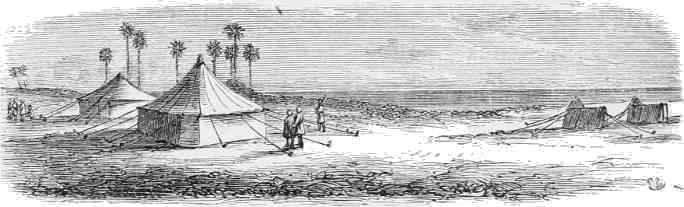 BIVOUAC AT MAHAMALAIPURAN.
Lord Harris had, with true Indian hospitality, made the most
admirable arrangements for our accommodation while at the
Seven Pagodas. When, after our first survey of the locality,
we came down to the beach, we found two large and two small
tents ready pitched, and a number of men collected round a
fire preparing our breakfast. But how great was our
astonishment, on entering the first tent, to find it spread
with carpets, with an elegant sleeping-apartment with two
large commodious bedsteads, and fitted up with all the usual
necessaries for the toilette; while, in the passage which
ran between the inner and outer walls of the tent, stood two
immense baths ready filled with soft water to reinvigorate
our exhausted frames! Ere we had recovered from our
surprise, we were advised of the voice of the Government
Peon, apprising us that breakfast was served in the second
tent. This was used exclusively as a dining and reception
room, and was also furnished with every conceivable
appliance to promote our comfort. His lordship was even so
attentive as to send his own travelling canteen for our use
on the excursion. This tent, likewise, had double walls,
with a passage between; the exterior wall being lined with
blue, by means of which the glare of the sun and of the
blinding white sand was rendered less painful and more
tolerable to the eye. A number of coolies were employed in
sprinkling water from time to time upon the fine-grained
sand, which produced a most refreshing coolness all around.
The Government Peon, as also the chief of police of the
district, wore their best uniforms of white, with bran new
bandoliers over their shoulders, of broad deep-red scarves,
with gold-lace edgings, and, in the centre, a gilt plate,
with the words, "Government Peon" engraved on it. A number
of men and children ran hither and thither,—in a word, the
whole village seemed in an uproar to see the strange
gentlemen, and supply them with flowers, in the hope of
receiving some trifling present. At 12.30 p. m., the
thermometer suspended within the tent marked 84° Fahr.,
although a gentle breeze was blowing from seaward through
the fragrant luxuriant grass (Kus-kus, or Vetiveyr),
which hung like a curtain over both entrances. It is an
exceedingly happy idea to use this fragrant Kus-kus,
(Andropogon muricatum) in the manufacture of mats, which
are intended to be suspended in the entrance-halls of
houses, and to be sprinkled with water, whereupon the
penetrating, hot, parching wind is passed through the fine
damp texture, which thus at once tempers the heat, and
fills the air with perfume.
Towards 5 p. m., the heat having somewhat abated, we strolled
to the Five Pagodas, distant about one English mile from our
encampment. The prevalent tree in this locality is the
Palmyra palm, which, though it does not boast the majestic
proportions of the Oreodoxia Regia, or the cocoa-nut palm,
presents, nevertheless, a very imposing appearance.
Generally speaking, however, the district is quite bare and
destitute of trees; and, in short, like all the rest of this
coast, has very much the appearance of the flat coasts of
Africa.
Of the five monolith temples, four were dedicated to the
brothers of Vishnù, Dharma Rajah, Bimen, Nagulan, and
Sawadewen, the fifth being excavated in honour of Dubrotis,
the consort of Dharma Rajah. The legend relates that the
four brothers lived in a state of Polyandry, or plurality of
husbands, and had but one wife in common, who was a species
of Amazon. All these temples are tolerably sculptured,
which, indeed, constitutes their chief claim to attention;
but they are far from showing the artistic finish of the
bas-reliefs and sculptures, at what is known as the Holy
Mount.
Rhanganatha Swami, for instance, is the finest, though not
the most important of these artificial grottoes. The
sculptures here are incontestably the most highly-finished.
The upper portion, to which access is obtained by some steps
cut in the rock, rises above the huge granite block, known
as Jamapuram; the lower portion is a temple hewn out of one
piece of rock, and with the most marvellously-executed
allegories.
Among the reliefs on the north wall is perceived Donga,
Siva's wife, riding on a lion (according to the natives, on
a tiger), and bending her bow in conflict with Mahishasura,
a giant with the head of a buffalo, who brandishes a club.
According to Elliot's interesting interpretation, this
represents the contest between the matronly Amazon and
heroine, Donga, the representative of active virtue, and the
bull-headed Mahishasura, the personification of brute
strength and animal passion. Over the head of either figure,
a parasol, such as is used by the natives, is outspread,
giving a most grotesque appearance to the group.
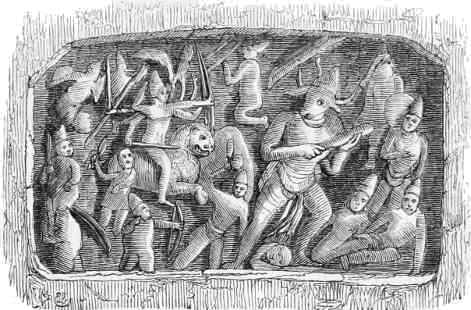 BAS-RELIEF ON ONE OF THE MONOLITH TEMPLES.
The relief on the southern wall represents a sleeping Vishnù
(Rhanganatha), 9½ feet high, apparently representing the
idea of the Creation, as the serpent, Sescha, with its five
heads, encircles his head. At his feet one perceives two
rajahs or princes, and one female figure, in a praying
attitude, with uplifted hands, only the bust being
represented. In one of the niches at Swami are two busts,
life-size, of Siva, and his wife Paravathi, the latter
holding an infant at the breast, his offspring Supramanión.
Above this representation, and, like them, only showing from
the shoulder upwards, are represented on the right Brahma,
on the left Vishnù, each with four arms, symbolical of their
power and dominion.
The superstructure of these rock sculptures is a sort of
platform of loose stones accurately fitted to each other
without mortar, so as to make an ornamental whole. The
interior is adorned with much more highly-finished specimens
of art, to view which, a large number of Hindoos, doing
penance, annually climb, with great difficulty, into this
part of the building, and make their way into the unfinished
interior apartments. While we were giving free scope to our
surprise at all we saw, we were greatly annoyed in our
contemplations by the natives, who offered us bouquets of
flowers, wreaths, and fruit. Also, a couple of flute-players
(Pulanpolen) who were passing, made their appearance to
give us a specimen of their musical skill. One old man, of
whom we procured a curious figure of Vishnù, neatly carved
in wood, as also several manuscripts, remarked that there
was in the neighbourhood, written upon Palmyra leaves, a
manuscript, known as the Istálam-purànam which gave the
history of the Seven Pagodas, written in Tamil.
The late president of the Madras Society, the learned Walter
Elliot, who formed an extensive collection of the various
valuable Hindoo manuscripts and inscriptions of
Mahamalaipuram, and has partly published a translation of
them,[109] told us afterwards, that this renowned Tamil
Manuscript consisted of nothing but fables, and did not give
one single reliable particular as to the history of the
Seven Pagodas.
In Varaha Swami, one of the pagodas at present in use, and
surrounded by a modern walled cemetery, there is visible, on
the exterior of the Temple, an inscription in Tamil, which
is, however, utterly unintelligible to the natives. This
inscription, deciphered latterly by Babington, refers to a
donation to the pagoda by a sincere Hindoo believer, and
gives the most complete detail, together with signature of
the donor. The name Mahamalaipur,[110] the "City of the Sacred
Hill," occurs frequently in it.
In the course of conversation with some of our Hindoo
followers, we remarked that they made no difference between
a "kovül" or praying-house, in which the divinities are
never produced, but are guarded under lock and key, and a
pagoda, which is a residence of the gods, from which they
can be carried forth and afterwards brought back. Hence it
is that a pagoda is more readily accessible than a kovül,
the sanctity of which it is forbidden him to violate.
In 1845, Mr. Elliot, by a private arrangement with the
Brahmins, was permitted, on payment of Rs. 30 (£3), to break
away the partition which divided the inscriptions into two
portions, in order to prepare three copies, and have them
translated by three Tamil scholars. One of these translators
was the learned Tandavaraya Mudaliar, of Chingleput. The
inscription contains the history of two donations, on the
enlargement and laying the foundation-stone of the temple,
accomplished by the "Kanattan" of the village, and, lastly,
a gift of 90 goats by the Siva Brahmin Paramesvara-Mahavara,
on the stipulation that a lamp should be kept constantly
burning in the temple: the whole dating from the year 1073.
It results from this interpretation that the inscription was
put up towards the end of the 11th century, thus supplying
some clue to the age of this rock temple, which, according
to Mr. Elliot's researches, does not exceed a thousand
years.
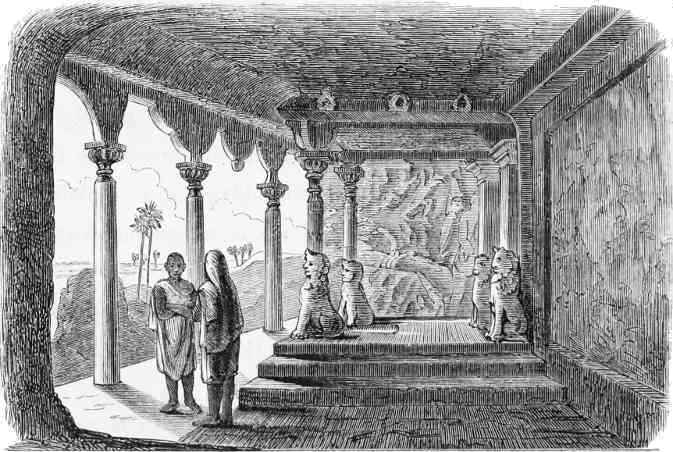 ENTRANCE TO ONE OF THE TEMPLES.
To this Vahara Swami, which seems to contain their whole
history, the natives wander regularly every morning, and
sometimes two or three times during the day, to offer
flowers, cocoa-nuts, and other fruits. A flight of steps cut
in the rock leads to the highest platform, whence there is
an excellent view over these monumental edifices.
That fancy has been called in to invest these unique
unfinished sculptures with the character of
pleasure-grottoes, baths, &c., &c., of historical
personages, is readily intelligible. Thus, for example, the
guide does not fail to point out to the stranger a sort of
stone cistern hewn out of the solid rock, traditionally
reported to have been once the plunge-bath of Dubrotis. This
colossal basin has about 2½ feet water during the rainy
season, which gradually evaporates, or is drawn off for use.
The water, tinged with the yellow colour of the soil, leaves
a mark behind on the stone sides, which naturally becomes
very visible during the dry season. This the natives
maintain marks the height of the water as often as Dubrotis,
(Dharma Rajah's consort), bathed herself in it. Another
similar block of gneiss was transformed into a stone couch,
and is called Dharma Rajah's bed, at the upper end of which,
near the head, a tiger is crouched to guard it. This
gigantic ellipsoidal block of rock, which seems as though
balanced on a sharp point, could neither be displaced nor
made to oscillate by continued leaping. Some masses of rock
piled up above the grottoes were once Siva's kitchen, and so
forth. All these spots, however, have in reality not the
slightest historic significance; it is only the present
generation that have tacked on to them legends, traditions,
and interpretations, which assuredly never were in the
intention of the constructors.
On a slope on one side of the mountain are a number of
sculptures of remarkable beauty, representing the history of
Tapasa, or the deep penitence of Ardschuna. On the right
hand, close to the figure of the penitent Ardschuna, one
perceives a multitude of people, two elephants as large as
life and wonderfully finished, a tiger, and a figure, half
woman half serpent. This relief, one of the finest we have
seen, is a huge sculpture on the rock, 20 feet long by 30 in
height, comprising hundreds of figures, with an idol in the
centre, to which from all sides worshipping deities, men,
and beasts, bow the knee in supplicatory attitudes; along
the edge are elephants, life size, with their young. The
colour of the rock, somewhat resembling that of the animal,
tends still more to deceive the eye, and make the beholder
doubt whether he is looking upon sculptures or upon living
elephants. Elliot and others who have described these rock
temples, assign to them, as already mentioned, a
comparatively small antiquity. They are representations
borrowed from the poem of Mahabharata, in the Hindoo
mythology. The five roundish temples to the south of the
village are beyond all question the oldest of these
monuments. They are pagodas that have never been completed;
solid, and here and there showing marks of work, but only
adorned externally, the interiors being masses of unhewn
granite; each of these temples is 30 feet in length by 20 in
breadth and height. Thus far, the inscriptions have been
ascertained to be in threefold characters, of which two are
as yet undecipherable. Babington was the first to attempt to
decipher them, or at all events to find the key by which to
decipher them. The most important has been copied and
interpreted. But neither the inscriptions nor the various
representations give the slightest historical clue as to the
object of these monuments. Taylor's researches seem to
establish the fact, that in the 17th century this district
was inhabited by the Corumbas, a half-civilized race of the
Dschaina religion. About this period, or a little later, in
the reign of Abondai, one of the princes, whose capitals
were Conjeveran and Tripetty, the Brahmins were introduced
to this neighbourhood. The extent of these works, however,
their nature, and the immense expense incurred, all point to
a long-continued influence of the Brahmins. Most of these
temples seem to have been first erected in the 17th century,
under Prince Sinhamanayadu, and Elliot assigns to several
even a much later date.
As for the report of a smaller pagoda, of which only an old
pyramidal pagoda-stone is visible on the very edge of the
sea, peering up from amid the furious foaming surf, it seems
to be altogether a myth, so that such enquirers as Ellis,
Mackenzie, and Heber, making allowance for what Hindoo
traditions are known to be, will no longer take the trouble
of searching for any traces of the sunk pagoda, or of
seeking to recover the ruins of the submerged city. Several
writers, indeed, are of opinion, that the sea on the
Cormandel coast is retiring; but this appears to be a
mistake, for here the sea seems encroaching rapidly, as is
the case at Fort St. George, which 80 years ago was at some
distance from the sea-shore, whereas its walls are at
present washed by the tremendous surf.
But the inroads of the sea could hardly have been so sudden
and extensive as to have swallowed up an entire city,
without leaving any traces. Not one of the natives to whom
we spoke in the place could say for certain, that the sea
had materially gained upon the land within the memory of
man. Nowhere are there any traces visible of the ruins of a
city. One can safely assert that there never existed such a
city at Mahamalaipuram, but that it has always been a mere
abode of priests, with temples, sanctuaries, &c., without
any more extensive settlement, similar to Copan, Quirigua,
or Peten, in Central America, but altogether larger and more
artistic, and evidencing a far higher culture on the part of
the artist. The supposed antiquity of the sculptures at
Mahamalaipuram is too low, to admit of our supposing that
since their erection the greater part had been swallowed up
in the sea. None of the sculptures that we saw belonged to
any period (before the flood extended so far), whereas they
are all susceptible of explanation out of the modern Hindoo
mythology, with the aid of the Epic poems of Mahabharata,
all referring to Vishnù and his world of deities.
While some of the Novara expedition were visiting
Mahamalaipuram, others made out a trip to the Pulicat Lake,
near the shore, northwards from Madras. About 40 or 50
miles on the road thither, the Neilgherries (or Blue
Hills), with their jagged outline, came into view on the
gray horizon to the N.W., the height of which may be about
1,500 to 2000 feet. A narrow bulwark or quay of unequal
breadth, varying from 20 feet to 5 miles, separates this
salt lake from the ocean, the fierce surf of which, at some
narrow places, actually breaks over, and mingles its waters.
The lake varies in breadth, from 5 to 10 miles, and is about
60 to 70 miles long. The level of its bed is so remarkably
regular, never exceeding from 3 to 5 feet, that when the
wind fails, the boats that navigate the lake can be pushed
along with poles, and one everywhere sees the naked
inhabitants of the coast standing in the very middle of the
water, with their landing or drag-nets, or busily occupied
with rod and line! Being but a few hours distant from
Madras, the lake is connected with the city by an artificial
canal, along both sides of which are a number of outlets,
carefully faced with masonry, so as to convert the adjoining
land into lagoons, in which during the rainy seasons the
strongly brackish water enters, and is used to make
sea-salt.
In the canal there is considerable trade, as well by
fishing-boats, as by those laden with wood and fruit, which
they convey to the city for disposal. Most especially
remarkable is the enormous number of fen-birds, which
frequent its shores and all around it. At several places
where the shores, for a width of about a mile, are mere
swamps with barely a foot of water, they are literally
covered with myriads of curlews, which fly about in flights
of incredible numbers, and stretch out like clouds. Long
rows of flamingoes stand, their bodies half bent to the
earth, seeking their food in the mud; far as the eye can
reach, one saw whole ranks of these birds blending with
storks, perched upon scattered stumps; while in the water
itself, vast flocks of sea-mews swam about, and the
sea-swallows, in pursuit of their prey, flew to and fro in
the air. As evening came on, the naturalists of the Novara
were sailing as though in a sea of fire. Hundreds of fish,
as they sprang out of the water, left a fiery wake behind
them, like a rocket, while a flame-coloured ever-widening
circle marked the spot at which they struck the water again.
Hundreds of various notes of birds, above, near, and round
the boat, united with the singular melancholy cry of the
jackal, which resounded from the shore, while overhead
flights of birds flew restlessly about in the air, whirring
in the ear like the rustling of disembodied spirits.
From the lake, a short excursion was made to one of the
artificial canals, which unite this basin of water at
various points and in different directions with the
surrounding country, so as to get to the Strihoricotta
Forest, which supplies Madras with fuel. This consists of a
sort of underwood or brush, which grows again within the
extraordinary short space of ten to twelve years. Sisyphus
vulgaris (Rhamnea), Gardenia Ficus, tamarinds, and
several species of Mimosa, form the principal part of the
forest, which is thickly grown with immense quantities of
climbers. The wood is cut by the natives, who have
constructed huts in the jungle, into pieces of about 2 feet
in length, which are transported in ox-carts to the shore,
whence they are forwarded by boat to Madras.
When the members of the Novara Expedition had returned,
greatly pleased, from their various excursions, the Madras
Club gave a grand banquet in honour of the captain and
staff, to which the élite of Madras society were invited.
Immediately on our arrival the managing committee of the
club had the courtesy to place the officers and scientific
members of the Expedition upon the free list of the club
during the ship's stay. The Madras Club-house, though not so
luxurious or magnificent as the Clubs of London, fairly
surpasses them in extent and commodiousness. It is, in fact,
a small portion of the city in itself, in which one finds
assembled all that can conduce to a comfortable, agreeable
mode of existence; parlours, with wide arm-chairs and
American rocking-chairs; reading-rooms, in which are all the
best journals and an excellent assortment of the best and
newest literature; dining apartments, in which one can dine
in either the English or French style; billiard-rooms,
shower and plunge-baths, and a large swimming-bath. Members
from the country, or strangers, can be accommodated with
lodging as well.
At the splendid banquet in honour of the Expedition, at
which above 200 persons sat down, the chair was taken by the
Chief Justice Sir Christopher Rawlinson—next to the
Governor, the most influential person in the community. The
extremely friendly disposition manifested on that occasion
found its expression in toasts on all sides, which in few,
but appropriate words, welcomed the foreign guests; while,
on the other side, they gave unmistakable evidence of the
admiration and sympathy which the voyagers by the Novara
carried away with them from the hospitable shores of
Madras.[111]
As a number of our new-found friends expressed a wish,
notwithstanding the difficulties of getting out to, and back
from the roads, to visit our ship, the commodore invited
some forty guests, shortly before our departure, to a
"tiffin" on board. Although the frigate rolled pretty
heavily, yet we, nevertheless, had the pleasure of the
company of some twenty gentlemen and ten ladies. After
"tiffin," which was served on the poop, under a tent
improvised with flags for the occasion, all felt
sufficiently comfortable to try a dance on the quarter-deck,
our band of music being called into requisition for
quadrilles, polkas, and waltzes; and, indeed, our guests
paid so little attention to the approach of night, that
their return was postponed till it was absolutely dark, of
which opportunity we gladly availed ourselves to light our
pleasant guests homewards with Bengal lights.
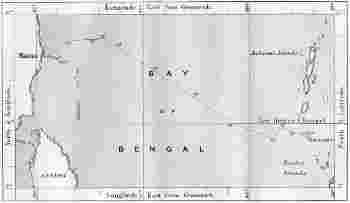 PLATE VII.—TRACK FROM MADRAS TO THE NICOBAR ISLANDS.
Larger.
PLATE VII.—TRACK FROM MADRAS TO THE NICOBAR ISLANDS.
Larger.
At length, on 10th February, shortly after noon, we set
sail. As the frigate was perceived, from Fort George to
weigh anchor, a thundering salute was fired of 21 guns—an
extraordinary honour and mark of attention, to which we
responded by a similar salute. In consequence of calms and
light winds, we were 48 hours ere losing sight of land; and
it was not till the 12th February we could proceed on our
voyage. For several evenings after, that magnificent, and as
yet unexplained, phenomenon, the Zodiacal light, which is
conjectured by the greatest physicist of our age, to be the
beams radiated from a vapour-like, flattened ring, revolving
in the space between the orbits of Mercury and Venus, was
visible with much regularity. What was afterwards observed,
however, of this remarkable zone of light, during the course
of our voyage, will be found detailed in the meteorological
portion of the scientific volumes. Unbroken fine weather
accompanied us during our entire voyage to the Nicobar
Islands, our next station. But although, as was rendered
necessary by the climate so near the Equator, we were
clothed entirely in summer apparel, and there was nothing to
remind us of its being winter and carnival at home, our
sailors did not let Shrove Tuesday pass over without
celebrating that day, to be marked with a white stone, by
masking and dancing according to ancient custom. Jack has
an especially good memory for the return of such junketings,
and is by no means prone to letting the sensible vicinity of
the Equator put him out of his reckoning; so he danced near
the line also, not because he had any pleasure therein, but
because it has always been his custom to do so at
carnival-time!
The state of health of the ship's company was excellent,
there being but eight on the sick list, of whom only two
were seriously ill.
On the 22nd February towards 10 a. m. the Island of
Kar-Nicobar hove in sight, and towards afternoon we found
ourselves but a few miles distant. The land seemed for the
most part level, only a low eminence thickly covered with
frost rising towards the centre. The coast was overgrown
with cocoa-nut-palm. In the N.W. and S.E. we could see three
Malay boats at anchor. On the beach were some huts of
beehive-like shape, in and out of which naked brown figures
were seen moving; while, as night fell, numerous lights
glimmered from the shore.
The following morning, Tuesday 23rd February, 1858, we
anchored off the N.W. side of the island, in 14½ fathoms
coral sand, about 2 miles distant from the shore, and just
between the two villages of Mosse and Sàui, each consisting
of a few huts. One can approach within 3 or 4 cable-lengths
of the shore, where there are still 10 fathoms, with clay
bottom. Several natives, some naked, some with their bodies
covered in the most ludicrous fashion with cast-off European
clothes, approached the frigate while she was being
secured, in small but elegant canoes, and called out
anxiously when within hailing distance, in an inquisitive
tone and a broken English, "No fear? good friend?" which we
interpreted into an inquiry as to whether they had anything
to fear, and whether we were disposed to be friendly. When,
however, we did not immediately throw them a rope to make
fast their little canoes, and they got sight of our numerous
guns, they speedily turned tail and hurried away.
 ARRIVAL AT KAR-NICOBAR.
END OF VOL. I.
APPENDIX C.
SUMMARY OF EXPENDITURE
DURING THE VOYAGE OF THE AUSTRIAN IMPERIAL FRIGATE "NOVARA."
- KEY:
- A - Pay of Commodore, in Austrian currency.
- B - Pay of Staff.
- C - Pay of Naturalists, and incidental Expenses of this department.
- D - Pay of Crew, including extras.
- E - Victuals for Crew and Hospital (Sick).
- F - For Sundries, Repairs, and Ship's Material.
- G - Purchase of Books, Instruments, and Medicines.
- H - Pilots and Tug Steamers.
- I - Pay of Servants, including extras.
- J - Boat-hire, Postages, Travelling Expenses of the Staff, &c.
- K - Totals.
| Period of Expenditure. | A | B | C | D | E | F | G | H | I | J | K |
| Fl. | Kr. | Fl. | Kr. | Fl. | Kr. | Fl. | Kr. | Fl. | Kr. | Fl. | Kr. | Fl. | Kr. | Fl. | Kr. | Fl. | Kr. | Fl. | Kr. | Fl. | Kr. |
| April to June, | 1857 | 2,112 | .. | 5,413 | 51 | 1,744 | 53 | 7,522 | 52 | 133 | 55 | 146 | 7 | 37 | 10 | ... | .. | 811 | 34 | 5,277 | 59 | 23,200 | 21 |
| III. | Quarter | " | 2,327 | 10 | 8,214 | 10 | 3,302 | 40 | 10,562 | 37 | 2,316 | 40 | 362 | 47 | 16 | 28 | 28 | .. | 363 | 53 | 186 | 18 | 27,680 | 43 |
| IV. | ditto | " | 3,261 | 20 | 9,604 | 50 | 4,816 | 57 | 10,560 | 50 | 27,344 | 29 | 2,839 | 3 | 644 | 49 | 356 | 26 | 435 | 9 | 2,027 | 31 | 61,891 | 24 |
| I. | ditto | 1858 | 3,118 | .. | 9,377 | .. | 4,073 | .. | 10,557 | 49 | 2,099 | 39 | 646 | 10 | 36 | 34 | 85 | 53 | 397 | 28 | 96 | 22 | 30,487 | 55 |
| II. | ditto | " | 3,212 | .. | 10,542 | 30 | 4,358 | 5 | 10,755 | 39 | 21,514 | 37 | 2,170 | 53 | 349 | 54 | ... | .. | 1,144 | 43 | 814 | 25 | 54,764 | 46 |
| III. | ditto | " | 5,102 | 30 | 9,638 | 30 | 5,421 | 17 | 10,245 | 24 | 17,443 | 32 | 5,925 | 48 | 338 | 14 | 645 | 50 | 566 | 8 | 1,351 | 46 | 56,678 | 59 |
| IV. | ditto | " | 2,217 | 10 | 6,931 | 50 | 5,272 | 56 | 10,020 | 6 | 5,762 | 30 | ... | .. | 212 | 34 | 2,197 | 55 | 29 | 24 | 651 | 59 | 33,296 | 24 |
| I. | ditto | 1859 | 4,914 | 20 | 16,958 | 20 | 9,578 | 23 | 10,840 | 43 | 30,715 | 17 | 18,185 | 34 | 2,286 | 40 | 647 | 54 | 1,592 | 30 | 1,258 | 51 | 96,978 | 32 |
| II. | ditto | " | 3,227 | 16 | 11,008 | .. | 4,090 | 20 | 11,151 | 56 | 3,179 | 24 | 767 | 4 | 23 | 2 | 94 | 23 | 200 | 5 | 1,258 | 32 | 35,000 | 2 |
| III. | ditto | " | 3,117 | 7 | 10,911 | 41 | 3,857 | 14 | 11,009 | 29 | 11,444 | .. | 7,551 | 15 | 306 | 24 | ... | .. | 1,910 | .. | 793 | .. | 50,900 | 10 |
| IV. | ditto | (not full) | 984 | 18 | 2,564 | 5 | 1,990 | 5 | 3,314 | 16 | 2,163 | 40 | ... | .. | 33 | 30 | ... | .. | 269 | 46 | 5 | .. | 11,324 | 40 |
| | | | —— | — | —— | — | —— | — | —— | — | —— | — | —— | — | —— | — | —— | — | —— | — | —— | — | —— | — |
| | Grand Total | | 33,593 | 11 | 101,164 | 47 | 48,505 | 50 | 106,541 | 41 | 124,009 | 43 | 38,594 | 41 | 4,285 | 19 | 4,056 | 21 | 7,720 | 40 | 13,721 | 43 | 482,193 | 56 |
Thus the Expenditure, during the voyage, amounting to
483,193 florins 56 kreuzer, Austrian currency, which,
calculated at the rate of 10 florins to a pound sterling at
par, is equal to about £48,219 sterling. To this sum must be
added the outfit and armament of the frigate for the
purposes of the voyage, amounting to about £6000 sterling,
and the expenses for four months' provisions, taken in at
Trieste before our departure, and estimated at about £4500
sterling, so that the entire Expenditure of the Expedition,
from the time of starting till its return, amounted to about
£58,000 sterling.
LONDON:
PRINTED BY WOODFALL AND KINDER,
ANGEL COURT, SKINNER STREET.
66, Brook Street, Hanover Square, W.
Messrs. SAUNDERS, OTLEY, & Co.'s
LITERARY ANNOUNCEMENTS.
THE VOYAGE OF THE NOVARA ROUND THE WORLD. The
Circumnavigation of the Globe, by the Austrian Frigate
Novara. English Edition. Containing an Unpublished Letter
from Baron Humboldt. With numerous wood engravings.
Dedicated, by special permission, to Sir Roderick Murchison.
3 vols., 8vo.
THE MARQUIS OF DALHOUSIE'S ADMINISTRATION of BRITISH INDIA.
By Edwin Arnold, M.A., of University College, Oxford.
THE POLITICAL LIFE of the EARL of DERBY.
THE LIFE of the RIGHT HON. BENJAMIN DISRAELI, M.P.
THE SPEECHES AND ADDRESSES of the LORD BISHOP of OXFORD from
1841 to the Present Time. Edited by the Author. 1 vol., 8vo.
THE LIVES of the SPEAKERS of the HOUSE of COMMONS. By
William Nathaniel Massey, Esq., M.P., author of "The History
of England," and Chairman of Ways and Means.
THE LATITUDINARIANS. A Chapter of Church History, from the
Accession of Archbishop Tillotson in 1691, to the Death of
Archdeacon Blackburne, in 1787. By Edward Churton, M.A.,
Archdeacon of Cleveland.
THE LIFE OF THE RIGHT HON. W. E. GLADSTONE, M.P. 1 vol.,
8vo.
ECCLESIA RESTITUTA. By F. C. Massingberd, M.A., Prebendary
of Lincoln and Rector of Ormsby.
SEVEN ANSWERS to the 'ESSAYS and REVIEWS,' BY SEVEN WRITERS
IN SEVEN SEPARATE ESSAYS.
THE HISTORY OF THE CONSERVATIVE PARTY, from the Defection of
Sir Robert Peel to the Present Time. 1 vol., 8vo.
THE HISTORY OF THE CHURCH OF ENGLAND, from the Death of
Elizabeth to the Present Time. By the Rev. Geo. G. Perry,
M.A., Rector of Waddington, late Fellow and Tutor of Lincoln
College, Oxford. 3 vols., 8vo.
CHURCH RATE A NATIONAL TRUST. By the Venerable Archdeacon
Denison. 1 vol., 8vo, 10s. 6d.
THE CHURCHES OF THE EAST. By the Rev. George Williams, B.D.,
Senior Fellow of King's College, Cambridge. 1 vol., 8vo.
THE AMERICAN CHURCH and the AMERICAN UNION. By Henry
Caswall, D.D., of Trinity College, Connecticut, and
Prebendary of Sarum. 1 v., post 8vo.
PHILOSOPHY; or, THE SCIENCE of TRUTH, being a Treatise on
First Principles, Mental, Physical, and Verbal. By James
Haig, Esq., M.A., of Lincoln's Inn.
RECOLLECTIONS OF GENERAL GARIBALDI; or, TRAVELS FROM ROME TO
LUCERNE, comprising a Visit to the Mediterranean Islands of
La Madalena and Caprera, and the Home of General Garibaldi.
1 vol. 10s. 6d.
THE TRAVELS AND ADVENTURES OF DR. WOLFF, the Bokhara
Missionary. 2d. edition, 2 vols. 8vo. 36s.
AN AUTUMN TOUR IN SPAIN. By the Rev. R. Roberts, B.A., of
Trinity College, Cambridge, and Vicar of Milton Abbas. With
numerous Engravings. 21s.
HISTORICAL MEMOIRS OF THE SUCCESSORS OF ST. PATRICK AND
ARCHBISHOPS OF ARMAGH. By James Henthorne Todd, D.D.,
F.S.A., President of the Royal Irish Academy, Treasurer of
St. Patrick's Cathedral, Regius Professor of Hebrew in the
University, and Senior Fellow of Trinity College, Dublin. 2
vols., 8vo.
THE LIFE OF GEORGE FOX, The Founder of the Quakers. From
numerous original sources. 10s. 6d.
THE PRIVATE JOURNAL OF THE MARQUESS OF HASTINGS,
Governor-General and Commander-in-Chief in India. Edited by
his Daughter, Sophia, the Marchioness of Bute. Second
Edition, 2 vols. post 8vo, with Map and Index. 21s.
NAPOLEON THE THIRD ON ENGLAND. Selections from his own
writings. Translated by J. H. Simpson. 5s.
THE HUNTING GROUNDS OF THE OLD WORLD. By H. A. L. (the Old
Shekarry). Second Edition. 21s.
HIGHLANDS AND HIGHLANDERS; As they were and as they are. By
William Grant Stewart. First and Second series, price 5s.
each; extra bound, 6s. 6d.
THE ENGLISHMAN IN CHINA. With numerous Woodcuts. 10s. 6d.
LECTURES ON THE EPISTLE TO THE EPHESIANS. By the Rev. R. J.
M'Ghee. Second Edition. 2 vols, Reduced price, 15s.
PRE-ADAMITE MAN; or, THE STORY OF OUR OLD PLANET AND ITS
INHABITANTS, TOLD BY SCRIPTURE AND SCIENCE. Beautifully
Illustrated by Hervieu, Dalziel Brothers, &c. 1 vol, post
8vo, 10s. 6d.
LOUIS CHARLES DE BOURBON: THE "PRISONER OF THE TEMPLE." 3s.
A HANDY-BOOK FOR RIFLE VOLUNTEERS. With 14 Coloured Plates
and Diagrams. By Captain W. G. Hartley, author of "A New
System of Drill." 7s. 6d.
RECOLLECTIONS of a WINTER CAMPAIGN IN INDIA, in 1857-58. By
Captain Oliver J. Jones, R.N. With numerous illustrations
drawn on stone by Day, from the Author's Sketches. In 1 vol.
royal 8vo, 16s.
TWO YEARS IN SYRIA. By T. Lewis Farley, Esq., Late Chief
Accountant of the Ottoman Bank, Beyrout. 12s. Second
Edition.
DIARY OF TRAVELS IN THREE QUARTERS OF THE GLOBE. By an
Australian Settler. 2 vols, post 8vo, 21s.
RECOLLECTIONS of the COURT of NAPLES in OUR OWN TIMES.
MOUNT LEBANON AND ITS INHABITANTS: A Ten Years' Residence
from 1842 to 1852. By Colonel Churchill, Staff Officer in
the British Expedition to Syria. Second Edition. 3 vols,
8vo, £1·5s.
FROM SOUTHAMPTON TO CALCUTTA. Sketches of Anglo-Indian Life.
10s. 6d.
THE TABLETTE BOOKE of LADYE MARY KEYES, OWNE SISTER TO THE
MISFORTUNATE LADYE JANE DUDLIE. Post 8vo, 10s. 6d.
TRAVEL and RECOLLECTIONS of TRAVEL. By Dr. John Shaw. 1 vol,
post 8vo, 7s. 6d.
LETTERS ON INDIA. By Edward Sullivan, Esq., Author of
'Rambles in North and South America;' 'The Bungalow and the
Tent;' 'From Boulogne to Babel Mandeb;' 'A Trip to the
Trenches;' &c. 1 vol. 7s.
CAMPAIGNING IN KAFFIRLAND; or, SCENES AND ADVENTURES IN THE
KAFFIR WAR OF 1851-52. By Captain W. R. King. Second
Edition. 1 vol. 8vo, 14s.
THE RELIGIOUS TENDENCIES OF THE AGE. 6s. 6d.
ADVENTURES OF A GENTLEMAN IN SEARCH OF A HORSE. By Sir
George Stephen. With illustrations by Cruikshank. New and
cheaper Edition, 5s.
THE LANGUAGE OF FLOWERS, Elegant Gift Book for the Season.
Beautifully bound in green watered silk, with coloured
plates. Containing the Art of Conveying Sentiments of Esteem
and Affection. Eleventh edition, dedicated, by permission,
to the late Duchess of Kent. 10s. 6d.
THE MANAGEMENT OF BEES; With a description of the "Ladies'
Safety Hive." By Samuel Bagster, Jun. 1 vol., illustrated.
7s.
THE HANDBOOK OF TURNING, With numerous plates. A complete
and Practical Guide to the Beautiful Science of Turning in
all its Branches. 1 vol. 7s. 6d.
TEXTS FOR TALKERS. By Frank Fowler. 3s. 6d.
THE SUMMER TOUR of an INVALID. 5s. 6d.
ARMY MISRULE: BARRACK THOUGHTS. By a Common Soldier. 3s.
Fiction.
WHY PAUL FERROLL KILLED HIS WIFE. By the Author of "Paul
Ferroll." Third Edition. 10s. 6d.
OUR NEW RECTOR. Edited by the Author of 'Mr. Verdant Green.'
10s. 6d.
THE RECTOR'S DAUGHTERS. A Tale of Clerical Life. 10s. 6d.
SWEETHEARTS AND WIVES. A Novel. By Marguerite A. Power. 3
vols., 31s. 6d.
AN M.P. IN SEARCH OF A CREED. A Novel. 10s. 6d.
ROTTEN ROW. A Novel. 2 vols., 21s.
CRISPIN KEN. By the Author of 'Miriam May.' Dedicated, by
special permission, to the Right Hon. Sir E. B. Lytton,
Bart., M.P. 2 vols., 21s.
WHO SHALL BE DUCHESS? or, THE NEW LORD OF BURLEIGH. A Novel.
2 vols., 21s.
THE LIGHTHOUSE. A Novel. 2 vols., 21s.
THE SKELETON IN THE CUPBOARD. By Lady Scott. 2 vols., 21s.
Cheaper Edition, 5s.
TOO LATE! By Mrs. Dimsdale. 7s. 6d.
HELEN. A Romance of Real Life. 7s. 6d.
THE CASTLE and the COTTAGE in SPAIN. By Lady Wallace, Author
of 'Clara; or, Slave Life in Europe.' 2 vols., 21s.
CYRUS. By Lady Julia Lockwood.
GERTRUDE MELTON; or, NATURE'S NOBLEMAN. A Tale. 7s. 6d.
RUTH BAYNARD'S STORY. 1 vol., 10s. 6d.
VANITY CHURCH. 2 vols., 21s.
MY WIFE'S PINMONEY. By E. E. Nelson, a grand niece of the
great Lord Nelson. 5s.
THE EMIGRANT'S DAUGHTER. Dedicated, by permission, to the
Empress of Russia. 5s.
MIRIAM MAY. 4th Edition. 10s. 6d.
WHISPERING VOICES OF THE YULE. Tales for Christmas. 5s.
THE SENIOR FELLOW. A Tale of Clerical Life. 10s. 6d.
ALMACK'S. A Novel. Dedicated to the Ladies Patronesses of
the Balls at Almack's. New Edition, 1 vol, crown 8vo, 10s.
6d.
NELLY CAREW. By Miss Power. 2 vols, 21s.
MEMOIRS OF A LADY IN WAITING. By the Author of 'Adventures
of Mrs. Colonel Somerset in Caffraria.' 2 vols, 18s.
HULSE HOUSE. A Novel. By the Author of 'Anne Gray.' 2 vols,
post 8vo, 21s.
THE NEVILLES OF GARRETSTOWN. A Historical Tale. Edited, and
with a Preface by the Author of 'Emilia Wyndham.' 3 vols,
post 8vo, 31s. 6d.
CORVODA ABBEY. A Tale. 1 vol, post 8vo, 10s. 6d.
THE VICAR OF LYSSEL. The Diary of a Clergyman in the 18th
century. 4s. 6d.
GOETHE IN STRASBOURG. A Dramatic Nouvelette. By H. Noel
Humphreys. 7s. 6d.
SQUIRES AND PARSONS. A Church Novel. 1 vol. 10s. 6d.
THE DEAN; or, the POPULAR PREACHER. By Berkeley Aikin,
Author of 'Anne Sherwood.' 3 vols. post 8vo, 31s. 6d.
CHARLEY NUGENT; or, PASSAGES IN THE LIFE OF A SUB. A Novel,
3 vols, post 8vo. 31s. 6d.
PAUL FERROLL. By the Author of 'IX Poems by V.' Fourth
Edition. Post 8vo, 10s. 6d.
LORD AUBREY; or, WHAT SHALL I DO? By the Author of 'Every
Day.' A Novel. 2 vols., 21s.
THE IRONSIDES. A Tale of the English Commonwealth. 3 vols.,
31s. 6d.
AGNES HOME. A Novel. 10s. 6d.
LA CAVA; or, RECOLLECTIONS OF THE NEAPOLITANS. 10s. 6d.
ANSELMO. A Tale of Modern Italy. 2 vols., 21s.
THE DALRYMPLES; or, LONG CREDIT AND LONG CLOTH. 10s. 6d.
INSTINCT; or, REASON. By Lady Julia Lockwood. 5s. 6d.
CARELADEN HOUSE. A Novel. 10s. 6d.
Poetry.
Sir E. L. Bulwer Lytton's Eva, AND OTHER POEMS.
Sacred Poems. By the late Right Hon. Sir Robert Grant, with
a Notice by Lord Glenelg.
Eustace; An Elegy. By the Right Hon. Charles Tennyson
D'Eyncourt.
Oberon's Empire. A Mask.
The Shadow of the Yew, AND OTHER POEMS. By Norman B. Yonge.
MESSRS. SAUNDERS, OTLEY, AND CO.'S
EAST INDIA ARMY AND COLONIAL
AGENCY.
66, Brook Street, Hanover Square,
London, W.
(In the immediate vicinity of the New East India House and
the Oriental Club.)
Messrs. Saunders, Otley, and Co. beg to invite the attention
of Regimental Messes, Officers, Members of the Civil
Service, and other Residents in India, Australia, and the
Colonies to their East India Army and Colonial Agency, and
to the advantages it offers.
BANKING DEPARTMENT.
Pay, Pensions, Fund Allowances, Dividends, &c., drawn and
remitted with regularity. Sales of, and Investments in,
Government Stock, Foreign Securities, &c., effected. Every
other description of Financial Business transacted.
SUPPLY DEPARTMENT.
Miscellaneous Supplies of every description, including
Provisions, Wines, Plate, Jewellery, Books, Guns, Band
Instruments, Clothing, &c., carefully selected and
despatched by Overland Route, or Sailing Ship, to Regiments
and Messes in India, Australia, and the Colonies.
Private Orders from Officers, Members of the Civil Service,
and Residents in India, Australia, and the Colonies
generally, are executed with care, economy, efficiency, and
promptitude.
All orders should be accompanied by full and detailed
directions.
PERSONAL AGENCY DEPARTMENT.
The Constituents of Messrs. Saunders, Otley, and Co. may
depend upon receiving every attention to their requirements
and instructions. Every assistance will be afforded to their
Constituents and their Families on their arrival in England,
with the view to relieve them from every possible
inconvenience.
Charge, when required, will be taken of children coming from
India and the Colonies, and arrangements will be made for
their education in England.
To those going out to India, Australia, and the Colonies,
Messrs. Saunders, Otley, and Co. offer their services to
secure passages Overland, or by Ship, and to afford them all
necessary information connected therewith.
All Letters, Parcels, &c., will be received by Messrs.
Saunders, Otley, and Co., for their Constituents (whether in
England, India, or the Colonies), to whom they will be
forwarded regularly.
TERMS.
No Commission charged on the execution of Orders, whether
from Regimental Messes or Private Individuals, WHEN
ACCOMPANIED BY A REMITTANCE, and a small Discount at all
times allowed.
LITERARY AND POLITICAL NEWSPAPER FOR INDIA
AND THE COLONIES.
THE ORIENTAL BUDGET,
Price One Shilling (Post Free).
Published on the First of every Month by Saunders, Otley, and Co.,
66, Brook Street, Hanover Square, London.
TRANSCRIBER'S NOTE: Blank pages have been deleted. The title page has been
rearranged to meet accessibility requirements. Illustrations may have been
moved. Tags at the beginning of the work going directly to the table of
contents etal were added to ameliorate the effects of an Internet Explorer
7 bug and for convenience of the reader. To the table of illustrations
have been added entries for the preceding illustrations. Discovered
publisher's punctuation errors have been corrected. The publisher's
corrections listed at the end of Volume III have been applied. In
addition, the following changes were made:

xxvii: analagous[analogous] to the mountain chains
xv: Crossing the Breede Rivier[River].
169: to be reaped from European emigation[emigration]
171: Namely: 9159 Portuguese[Two footnotes were improperly swapped]
191: we were still able vividly to recal[recall]
203: If any one desires [to] see a veritable
226: towards the end of the rainy reason[season],
252: their bite produces on the the[del 2nd the] hand
264: that such soundings are only succesful[successful] when
294: they cannot recal[recall] having perceived,
308: Terrestrial Magnetism, Liuteenant[Lieutenant] Robert Müllar;
320: of New Bedford, Massachussets[Massachusetts],
322: pendant les annés[années] 1791-94
331: there there[del 2nd there] is nothing resembling a beach
358: custom that seems to recal[recall] the frightful
420: This time, morever,[moreover]
433: and chaunted[chanted] the praises
459: all to be able to indentify[identify] them,
462: thirty to the Parias[Pariahs],
Lit. Announcements: Ry[By] T. Lewis Farley, Esq.,
Lit. Announcements: effected. Every other descripion[description]

Also, the publisher on one occasion confused the degrees Réaumur and
Fahrenheit used in measuring temperature with degrees and minutes used to
determine lattitude and longitude:

Between the Gulfs of Guayaquil and Panama, north-east of the cold current,
the temperature of the sea during the month of April rose as high as 24°
5′, (87° 12′ Fahr.). Within the range of the current, Mr. Dirckinck had
carried on his observations in compliance with my instructions, by means
of thermometers that had been compared by Arago. Everywhere in the
current, in December 1824, he found from 16° to 18° (68° to 72°·5 Fahr.);
between Quilca and Callao, in January, 1825, from 18° to 19° (72° 5′ to
74° 75′ Fahr.); between Chorillos, near Lima (Lat. 12° 39′ S.) and
Valparaiso, in August, 1825, from 13° 8′ to 10° 5′ (63°·05 to 5° 62′
Fahr.); between Chorillos and San Carlos de Chiloe, in June, 1825, from
18° 8′ to 9° 2′ (74° 3′ to 52° 7′).

The corrected paragraph is as follows:

Between the Gulfs of Guayaquil and Panama, north-east of the cold current,
the temperature of the sea during the month of April rose as high as
24°·5, (87°·12 Fahr.). Within the range of the current, Mr. Dirckinck had
carried on his observations in compliance with my instructions, by means
of thermometers that had been compared by Arago. Everywhere in the
current, in December 1824, he found from 16° to 18° (68° to 72°·5 Fahr.);
between Quilca and Callao, in January, 1825, from 18° to 19° (72°·5 to
74°·75 Fahr.); between Chorillos, near Lima (Lat. 12° 39′ S.) and
Valparaiso, in August, 1825, from 13°·8 to 10°·5 (63°·05 to 55°·62 Fahr.);
between Chorillos and San Carlos de Chiloe, in June, 1825, from 18°·8 to
9°·2 (74°·3 to 52°·7).]
back
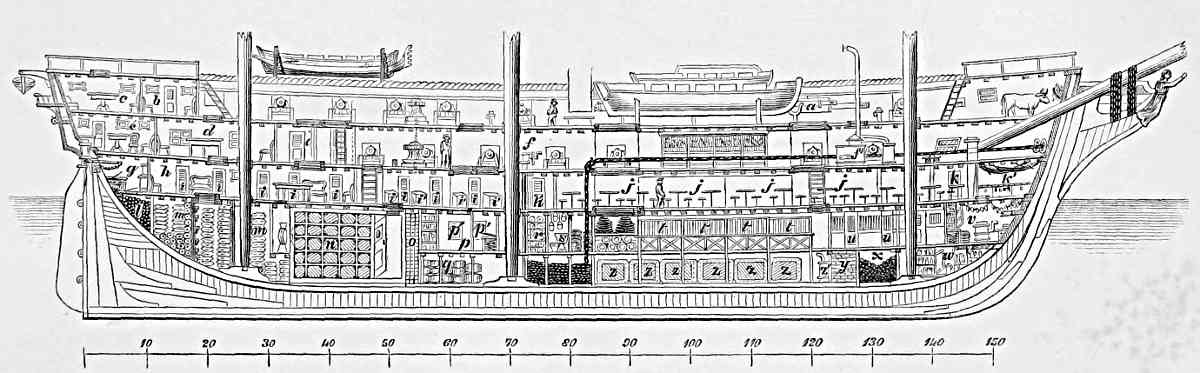
VERTICAL SECTION OF THE FRIGATE NOVARA.
| a. | Spare Spars. | hh. | Officers' Mess or Ward-room. | n. | Powder Magazine. | v. | Boatswain's Cabin. |
| b. | Captain's Cabin. | h'. | Commodore's Stores. | o. | Preserve fresh provisions in tins. | w. | Painters' Stores. |
| c. | Commodore's Apartment. | iii. | Officer's Cabins. | p. | Pantry. | x. | Coal-cellar. |
| c'. | Captain's Apartment. | i'i'i'. | Officers' Lockers. | p'. | Store-room for Rice, Cocoa, and Dried Vegetables. | y. | Tins of fresh provisions for the crew. |
| d. | Gun-room (also used as Reading-room.) | j. | Half-deck (for Crew.) | q. | Spirit Room. | z. | Iron Water-tanks. |
| e. | Cabins of Naturalists. | k. | Sergeants' Cabins. | r. | Salted Provisions. | z'. | Tank for the Distilling Apparatus(f'). |
| f. | Pumps. | k'. | "Sick bay." | s. | Buckets, Holystones, &c. |
| f'. | Kitchen, with Distilling Apparatus. | l. | Shot-hold. | t. | Sail-room. |
| g. | Side-board & Lockers of Officers. | m. | Bread-lockers. | uu. | Tool Room, &c. |
 CHART OF THE TRACK OF THE AUSTRIAN IMPERIAL FRIGATE NOVARA
ON HER VOYAGE ROUND THE GLOBE
CHART OF THE TRACK OF THE AUSTRIAN IMPERIAL FRIGATE NOVARA
ON HER VOYAGE ROUND THE GLOBE