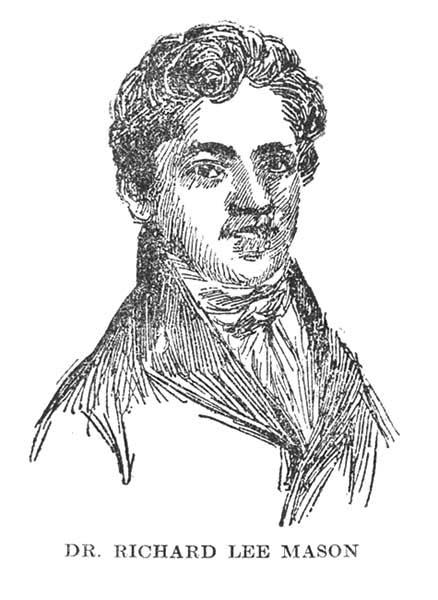
Sunday, Oct. 18.—Myself and friend proceeded on our journey. We arrived
at Siers, a distance of thirty miles, at dusk, much relieved by the
change from our horses to the wagon. The roads were muddy, the weather
drizzly and the country hilly. Buildings indifferent. The land very
fertile and black. Trees uncommonly tall. Passed the little village of
Cadis. In this country a tavern, a store, a smith shop and two or three
cabins make a town. Passed ten or fifteen travelers. Great contrast
between the quality of the land from Chambersburg to Pittsburg, and that
which we have already traveled over from Steubenville in Ohio.
Monday, Oct. 19.—Left Siers at 6 o'clock a. m. The morning fair and
cold. Roads extremely rough. Country fertile, but hilly. Log cabins,
ugly women and tall timber. Passed a little flourishing village called
Freeport, settled by foreigners. Yankee Quakers and mechanics.
Remarkable, with two taverns in the village, there was nothing fit to
drink, not even good water. The corn fields in the woods among dead
trees and the corn very fine. We arrived at Adairs, a distance of
twenty-seven miles, at 6 o'clock p. m. Passed some peddlers and a few
travelers. Value of land from Steubenville to Adairs from $2 to $30 per
acre. Lots in Freeport, eighteen months old, from $30 to $100. This day
being Monday and the end of the second week since leaving home, our
feelings were warm and our hearts beat high for those that are dear and
behind us.
Tuesday, Oct. 20.—Left Adairs at 6 o'clock a. m. The country extremely
hilly and not quite so fertile. Independent people in log cabins. They
make their own clothes, sugar and salt, and paint their own signs. They
picture a lion like a dove, a cat like a terrapin, and Gen. Washington
like a bird's nest. Salt wells and sugar orchards are common in this
country. Steep hills, frightful precipices, little or no water, and even
a scarcity of new whisky. Ragged and ignorant children and but little
appearance of industry. Met a number of travelers inclining to the east,
and overtook a larger number than usual bound to the land of promise.
The evening being rainy, the roads soon became muddy. We arrived at
Silver's Travelers' Rest at 6 o'clock. Distance twenty-nine miles.
Passed a little village called Cambridge.
Wednesday, Oct. 21.—Left Silver's at 7 o'clock and breakfasted at
Zanesville, a very growing and flourishing village. It is situated on
the Muskingum river, which is navigable for flat-bottomed boats.
Zanesville is a lively and busy little town. There are several mills and
manufactories in and at the place. Neat bridges and a canal cut at great
labor and expense through a solid rock for a considerable distance, by
which very important water power is gained. Left Zanesville and
traveled twenty-three miles to a village called Somerset. The country
very hilly and the lands not so fertile as those met with near Cadis.
Rain continues. Roads extremely slippery. Met and overtook about sixty
travelers, many on foot—Scotch, Irish, and Yankees. Oats, 25 cents;
butter, 12½ cents; brandy, 50 cents a half-pint; hay, $8 a ton.
Thursday, Oct. 22.—Left Somerset at 7 o'clock a. m. Dull, drizzly
weather. Deep roads. Horse lame in consequence of bad shoeing in
Pittsburg. Heart a little heavy. Thought of home. Rallied again and
arrived at a neat little town at the foot of a hill. It is called New
Lancaster. Distance, eighteen miles. Stopped on the road for refreshment
and found a Pennsylvania family whose kindness and hospitality deserve
mention, as we had been denied water and sometimes other refreshments by
the almost wild inhabitants west of Pittsburg to this place. Some brick
houses and a few neat frame dwellings to be seen in the last two days'
ride.
Friday, Oct. 23—Left New Lancaster at 8 o'clock and arrived at
Chillicothe, a distance of thirty-four miles. Passed some elegant farms
and some neat dwellings. The people appear more polite and better
educated. Chillicothe is situated on the Sciota, a stream navigable for
flat-bottomed boats. The bridge over the Sciota is long, substantial and
handsome. Chillicothe is a town of considerable business for its size.
One of the branches of the United States bank is at this place. The bank
was entered lately by a man named Harper, acting under the authority of
the state, and a large amount of money was taken out. Harper and his
attendants in gaol. Mob threatens to release them. Bank of the United
States and all its branches are much abused by the inhabitants and some
very impudent threats made. When the bank was entered by Harper no
resistance was made by its officers. Passed Tarlton and Kingston, two
inconsiderable villages.
Saturday, Oct. 24.—Left Chillicothe at 7 o'clock a. m. Arrived at
Sinking Springs, a little village, after traveling a distance of
thirty-three miles. Passed over some rich bottoms, neat farms and very
fertile prairies. A few poor ridges, part level, part mountainous.
People look healthy, but are extremely impudent and lazy. Game is
abundant deer, turkeys, partridges and squirrels.
Sunday, Oct. 25.—Left Sinking Springs at 7 o'clock a. m. Traveled to
West Union, a little village. Distance twenty-three miles. Lands of
three qualities, broken, barren and mountainous. Miserable log huts.
Inhabitants more polite and civil. Crossed Brush creek at the foot of a
small mountain. At this place met some travelers, among them some
Philadelphians. The inhabitants in this part of the country generally
emigrants. Real Ohios, real savages in appearance and manners, destitute
of every degree of politeness. Not uncommon for a man to follow three or
four occupations. For example, John Noble follows both tailoring and
saddlering. My barber is also a waiter on the table, assistant cook and
hostler. In this town one man is a lawyer, a merchant and an apothecary.
Monday, Oct. 26.—Left West Union at 10 o'clock a. m. My friend having
business here, we lost one day. Traveled over a poor, hilly and
mountainous country for seventeen miles and arrived at Limestone.
Crossed the Ohio in a horse-boat and landed at Maysville, Ky., at 5
o'clock p. m., bidding a willing adieu to Ohio, not leaving behind a
single individual whom we ever wished to see again. I must confess from
the many favorable representations made of the habits, manners and state
of society and quality of the lands in the state of Ohio, I was prepared
to meet a different soil and a different people from those just left.
Before I take a final leave of Ohio I must mention an occurrence that
transpired a few days previous to our arrival in New Lancaster. Ten or
fifteen friendly Indians were traveling from near New York to visit
their red brethren in the west. They were poor, but peaceable and well
behaved. When they were within about twenty-five miles of New Lancaster
three of the Indians were unable to keep up with the leading party, a
man, a young squaw and a child. Those unoffending and unfortunate people
were waylaid by three monsters in human shape, ruffians belonging to the
neighborhood. They lay hid until those three Indians got in a rake, and
then fired upon them, intending to kill all at the same shot. The child
and man escaped unhurt, but the unfortunate female had her thigh broken
and received a ball in the abdomen. No hope was entertained of her
recovery. The villains were taken and committed to prison. The only
reason given by them for committing this extraordinary outrage was that
during the war the Indians had murdered in battle some of their
connections or relatives.
Tuesday, Oct. 27.—Maysville is a growing little village, situated on
the Ohio and reaching in a southerly direction to the foot of a small
mountain. Left Maysville at 6 o'clock a. m. and arrived four miles
beyond the Blue Licks at 5 o'clock, a distance of thirty miles. Passed
Washington, May Licks and some smaller villages. Some good land, some
very poor. Country mountainous and stony. Great difficulty in obtaining
meat or drink during the day, although taverns are plenty. The Blue
Licks are rude, uncultivated, stony barrens, poor beyond description and
extremely difficult to travel over. Passed several dead horses on the
road. An infectious disease called the sore tongue had produced their
deaths, and was to be found at every stable for hundreds of miles. Men,
cows, hogs and sheep were subject to it. Being tired, hungry and
disappointed in the appearance of the country, I retired to bed early.
On the 25th inst. the ground was covered with snow. Little or no rain
had fallen in this part of the country for near six months. Many creeks
nearly dry. Great difficulty in obtaining water to drink. Passed some
salt springs and wells. Salt $2.50 per bushel, coffee 50 cents per
pound. Those prices will sound very high to the merchants of
Philadelphia.
Wednesday, Oct. 28.—Left Artis' tavern, thirty miles from Maysville, at
7 o'clock a. m. Traveled over a very fertile country, a distance of
seventeen miles, and arrived at a neat little town called Paris. Passed
some handsome houses. Saw many negroes. They were ragged, foolish, and,
in appearance, miserable. Paris, as a town, has some claim to beauty.
It is placed on an eminence. Many of the houses are brick and of
handsome shape. There is constantly that stir and bustle which denotes a
place of business. The country around is fertile, and, although there is
no navigable stream near, the eye is prevented from falling too heavily
on the neighboring fields and valleys by the winding of a small stream,
upon which there is a busy-looking mill.
"How often have I paused on every charm—
The sheltered cot, the cultivated farm,
The never-failing brook, the busy mill,
The decent church that topped the neighboring hill."
In this little town we met a hearty welcome. The inhabitants are polite
and hospitable. The singular variety which is to be found in the human
family by a traveler is difficult to be described. Indeed, every hundred
miles would take a small volume. Straggling play-actors and tightrope
dancers had found their way to Paris, besides other amusements which
were to be found in this sprightly little town, which had a tendency to
make our time pass very agreeably. On Wednesday night at 11 o'clock, I
was called to visit Miss Craughan, sister of Col. Craughan, an old
acquaintance. I found her dangerously ill with quinsy. Large bleedings
and some other medicines gave relief. Was compelled to leave her and
proceed on my journey. Heard of her recovery. Interesting lady.
Thursday, Oct. 29.—Left Thorgmorton's tavern at 9 o'clock a. m. Good
roads; fair weather; generous people; good land and neat dwellings.
Dined in Lexington, a town of considerable size, and a place of great
business. Saw large numbers of country people dealing in stores. Met and
overtook but few travelers the last three or four days. Traveled this
day thirty-two miles to Cole's. The lands not so fertile and a little
hilly.
Friday, Oct. 30.—Left Cole's at 6 o'clock a. m. Breakfasted at
Frankfort, the seat of the government of Kentucky. It is situated in a
deep valley near a stream, surrounded with high and uneven hills, and at
a distance, from its shape and situation, it resembles a garden laid off
in squares. A very handsome bridge, neatly painted, is thrown across the
Kentucky river, which, together with some public buildings erected with
considerable taste, assist much in enlivening and adding beauty and
elegance to the appearance of the town. Left Frankfort at 9 o'clock.
Crossed the Kentucky river, which was only three feet wide, owing to the
uncommon drought. Foot passengers were crossing on a rail. Passed
through Shelbyville, a small village. Many creeks, rivers and branches
entirely dry. Every animal suffering for water. The farmers compelled to
cart a sufficient quantity to support life, many miles. No water to be
obtained in the village for our horses. Fortunately we were enabled to
purchase some on the road. Traveled twenty-nine miles to Smith's. Lands
rich. Country broken on the old road. Deep valleys. Frightful
precipices. Beech woods. Large trees. Good corn. Warm and dry weather.
Saturday, Oct. 31.—Left Smith's at 7 o'clock a. m. Traveled over a very
rich and flat country. Passed through Middletown, and at 4 o'clock
arrived at Louisville, after traveling twenty-eight miles. This day
being Saturday, and having met some old friends and acquaintances, a
party was made up to visit the Louisville theater. Philadelphia being
the theater for all great performers, curiosity was on tip-toe to view
the players of Louisville. The theater is a neat little building. It was
but thinly attended, owing to the pressure of the times. The play was
"Wives as They Were and Maids as They Are," Mr. Drake and Mrs. Grochong
supporting the principal characters. Their persons, features, voices and
gestures were fine, appearing to possess the nicest feelings and
tenderest sympathies, and, in my opinion, they were well suited to a
better stage. The play better performed than expected. Indeed, I may say
well performed, if I may be permitted to add there was more than one of
the actors who was unfeeling, unmeaning, made of wood and more like a
gate-post than an animated being. This had the happiest of effects, for
after shedding tears of grief at interesting parts of the play they were
kept flowing with laughter at those ridiculous performers making tragedy
into comedy. Louisville is a flourishing town immediately on the banks
of the Ohio. The town and business principally confined to one street.
The inhabitants are polite, hospitable and live fast.
Sunday, Nov. 1.—This day was spent in visiting a family near
Louisville, friends of my youthful days, whom I had not seen for
eighteen years. As I approached the dwelling, happy days that are never
to return, pleasant hours, youthful, happy and blooming faces, joyous
scenes and many dear moments, flashed suddenly across my mind. But judge
of my disappointment on meeting the remains of this amiable family. I
will not attempt to express feelings that in the human language know no
description. Mrs. M——, a truly good woman, had been borne to that
shore "from whence no traveler returns." Her daughter, who was the
admiration of all that knew her, soon followed. The remains of the
family which eighteen years ago was young and fashionable, elegant and
beautiful, had become sedate, crooked, wrinkled and even gray. To
witness the ravages of time produced a gloom which lasted several days.
I took an affectionate leave of them, never expecting to see them again.
Tuesday, Nov. 3.—Remained in Louisville Monday and part of today. Left
Aleen's the 2d. Passed through Shipping Port, on the bank of the Ohio,
two and one-half miles below Louisville. A very promising little
village. Twelve or thirteen steamboats lying at this place aground,
owing to the unusual drought. Curiosity induced me to go on board the
largest steamboat in the world, lying at this place. She is called the
United States, and is owned by a company of gentlemen. I have taken down
her dimensions: Length of keel, 165 feet 8 inches; depth of hold, 11
feet 3 inches; breadth of beam and girder, 56 feet; length on deck, 176
feet 8 inches; breadth of beam without girder, 37 feet. This mammoth
boat has eight boilers and elegant accommodations for a large number of
passengers. Many of the steamships lying at this place are built on
improved plans and are very handsome. We crossed the Ohio at a point
where it is three-quarters of a mile wide. Passed through New Albany,
Ind., a little village inhabited by tavernkeepers and mechanics.
Traveled to Miller's, a distance of six miles over the knobs. Country
very much broken. Some steep hills and sugar-loaf knobs. The woods being
on fire, a scene truly sublime presented itself at night. The lands
indifferent. Weather warm and dry. Passed many travelers bound to the
west, and met three or four wagons with families returning from the
promised land. Slept in a house without glass in the windows and no
fastenings to the doors. The inhabitants impudent and lazy beyond
example. Supped on cabbage, turnips, pickles, beets, beefsteak made of
pickled beef, rye coffee and sage tea. The people of Indiana differ
widely from Kentuckians in habits, manners and even dialect. Whilst
hospitality, politeness and good sense characterize Kentuckians,
ignorance, impudence and laziness has stamped the Indianians.