1821.
August 17.
My original intention, whenever the season
should compel us to relinquish the
survey, had been to return by the Copper-Mine
River, and in pursuance of my arrangement
with the Hook to travel to Slave Lake through
the line of woods extending thither by the Great
Bear and Marten Lakes, but our scanty stock of
provision and the length of the voyage rendered
it necessary to make for a nearer place. We had
already found that the country, between Cape
Barrow and the Copper-Mine River, would not
supply our wants, and this it seemed probable
would now be still more the case; besides, at
this advanced season, we expected the frequent
recurrence of gales, which would cause great
detention, if not danger in proceeding along that
very rocky part of the coast.
I determined, therefore, to make at once for
Arctic Sound, where we had found the animals
more numerous than at any other place; and
entering Hood's River, to advance up that stream
as far as it was navigable, and then to construct
small canoes out of the materials of the larger
ones, which could be carried in crossing the
barren grounds to Fort Enterprise.
August 19.—We were almost beaten out of
our comfortless abodes by rain during the night,
and this morning the gale continued without
diminution. The thermometer fell to 33°. Two
men were sent with Junius to search for the deer
which Augustus had killed. Junius returned in
the evening, bringing part of the meat, but owing
to the thickness of the weather, his companions
parted from him and did not make their appearance.
Divine service was read. On the 20th we
were presented with the most chilling prospect,
the small pools of water being frozen over, the
ground covered with snow, and the thermometer
at the freezing point at mid-day. Flights
of geese were passing to the southward. The
wind, however, was more moderate, having
changed to the eastward. Considerable anxiety
prevailing respecting Belanger and Michel, the
two men who strayed from Junius yesterday, the
rest were sent out to look for them. The search
was successful, and they all returned in the evening.
The stragglers were much fatigued, and
had suffered severely from the cold, one of them
having his thighs frozen, and what under our
present circumstances was most grievous, they
had thrown away all the meat. The wind during
the night returned to the north-west quarter, blew
more violently than ever, and raised a very turbulent
sea. The next day did not improve our
condition, the snow remained on the ground, and
the small pools were frozen. Our hunters were
sent out, but they returned after a fatiguing day's
march without having seen any animals. We
made a scanty meal off a handful of pemmican,
after which only half a bag remained.
The wind abated after midnight, and the surf
diminished rapidly, which caused us to be on the
alert at a very early hour on the 22d, but we had
to wait until six A.M. for the return of Augustus,
who had continued out all night on an unsuccessful
pursuit of deer. It appears that he had walked
a few miles farther along the coast, than the party
had done on the 18th, and from a sketch he drew
on the sand, we were confirmed in our former
opinion that the shore inclined more to the eastward
beyond Point Turnagain. He also drew a
river of considerable size, that discharges its
waters into Walker's Bay; on the banks of which
stream he saw a piece of wood, such as the Esquimaux
use in producing fire, and other marks
so fresh that he supposed they had recently
visited the spot. We therefore left several iron
materials for them; and embarking without delay,
prepared to retrace our steps[13]. Our men, cheered
by the prospect of returning, shewed the utmost
alacrity; and, paddling with unusual vigour,
carried us across Riley's and Walker's Bays, a
distance of twenty miles, before noon, when we
landed on Slate-clay Point, as the wind had
freshened too much to permit us to continue the
voyage. The whole party went to hunt, but returned
without success in the evening, drenched
with the heavy rain which commenced soon after
they had set out. Several deer were seen, but
could not be approached in this naked country;
and as our stock of pemmican did not admit of
serving out two meals, we went dinnerless to bed.
Soon after our departure this day, a sealed tin-case,
sufficiently buoyant to float, was thrown
overboard, containing a short account of our proceedings,
and the position of the most conspicuous
points. The wind blew off the land, the
water was smooth, and as the sea is in this
part more free from islands than in any other,
there was every probability of its being driven
off the shore into the current; which as I have
before mentioned, we suppose, from the circumstance
of Mackenzie's River being the only known
stream that brings down the wood we have found
along the shores, to set to the eastward.
August 23.—A severe frost caused us to pass
a comfortless night. At two P.M. we set sail,
and the men voluntarily launched out to make a
traverse of fifteen miles across Melville Sound,
before a strong wind and heavy sea. The privation
of food, under which our voyagers were then
labouring, absorbed every other terror; otherwise
the most powerful persuasion could not have
induced them to attempt such a traverse. It was
with the utmost difficulty that the canoes were
kept from turning their broadsides to the waves,
though we sometimes steered with all the paddles.
One of them narrowly escaped being overset
by this accident, which occurred in a mid-channel,
where the waves were so high that the masthead
of our canoe was often hid from the other,
though it was sailing within hail.
The traverse, however, was made; we were
then near a high rocky lee shore, on which a
heavy surf was beating. The wind being on
the beam, the canoes drifted fast to leeward;
and, on rounding a point, the recoil of the sea
from the rocks was so great that they were with
difficulty kept from foundering. We looked in
vain for a sheltered bay to land in; but, at
length, being unable to weather another point,
we were obliged to put ashore on the open beach,
which fortunately was sandy at this spot. The
debarkation was effected fortunately, without
further injury than splitting the head of the
second canoe, which was easily repaired.
Our encampment being near the spot where
we killed the deer on the 11th, almost the whole
party went out to hunt, but returned in the
evening without having seen any game. The
berries, however, were ripe and plentiful, and,
with the addition of some country tea, furnished
a supper. There were some showers in the
afternoon, and the weather was cold, the thermometer
being 42°, but the evening and night were
calm and fine. It may be remarked that the
musquitoes disappeared when the late gales commenced.
August 24.—Embarking at three A.M., we
stretched across the eastern entrance of Bathurst's
Inlet, and arrived at an island, which I have named
after the Right Hon. Colonel Barry, of Newton
Barry. Some deer being seen on the beach, the
hunters went in pursuit of them, and succeeded in
killing three females, which enabled us to save our
last remaining meal of pemmican. They saw also
some fresh tracks of musk-oxen on the banks of
a small stream which flowed into a lake in the
centre of the island. These animals must have
crossed a channel, at least, three miles wide, to
reach the nearest of these islands. Some specimens
of variegated pebbles and jasper were
found here imbedded in the amygdaloidal rock.
Re-embarking at two P.M., and continuing
through what was supposed to be a channel between
two islands, we found our passage barred
by a gravelly isthmus of only ten yards in width;
the canoes and cargoes were carried across it, and
we passed into Bathurst's Inlet through another
similar channel, bounded on both sides by steep
rocky hills. The wind then changing from S.E.
to N.W. brought heavy rain, and we encamped
at seven P.M., having advanced eighteen miles.
August 25.—Starting this morning with a fresh
breeze in our favour, we soon reached that part
of Barry's Island where the canoes were detained
on the 2d and 3d of this month, and contrary to
what we then experienced, the deer were now
plentiful. The hunters killed two, and relieved
us from all apprehension of immediate want of
food. From their assembling at this time in
such numbers on the islands nearest to the coast,
we conjectured that they were about to retire to
the main shore. Those we saw were generally
females with their young, and all of them very
lean.
The wind continued in the same direction
until we had rounded Point Wollaston, and then
changed to a quarter, which enabled us to steer
for Hood's River, which we ascended as high as
the first rapid and encamped. Here terminated
our voyage on the Arctic Sea, during which we
had gone over six hundred and fifty geographical
miles. Our Canadian voyagers could not restrain
their joy at having turned their backs
on the sea, and passed the evening in talking
over their past adventures with much humour
and no little exaggeration. The consideration
that the most painful, and certainly
the most hazardous part of the journey was yet
to come, did not depress their spirits at all. It is
due to their character to mention that they displayed
much courage in encountering the dangers
of the sea, magnified to them by their novelty.
The shores between Cape Barrow and Cape
Flinders, including the extensive branches of
Arctic and Melville Sounds, and Bathurst's Inlet,
may be comprehended in one great gulf, which I
have distinguished by the appellation of George
IV.'s Coronation Gulf, in honour of His Most
Gracious Majesty, the latter name being added
to mark the time of its discovery. The Archipelago
of islands which fringe the coast from
Copper-Mine River to Point Turnagain, I have
named in honour of His Royal Highness the
Duke of York.
It may be deserving of notice that the extremes
in temperature of the sea water during our voyage
were 53° and 35°, but its general temperature
was between 43° and 48°. Throughout our return
from Point Turnagain we observed that the
sea had risen several feet above marks left at
our former encampments. This may, perhaps, be
attributed to the north-west gales.
August 26.—Previous to our departure this
morning an assortment of iron materials, beads,
looking-glasses, and other articles were put up
in a conspicuous situation for the Esquimaux,
and the English Union was planted on the loftiest
sand-hill, where it might be seen by any ships
passing in the offing. Here also, was deposited
in a tin box, a letter containing an outline of our
proceedings, the latitude and longitude of the
principal places, and the course we intended to
pursue towards Slave Lake.
Embarking at eight A.M. we proceeded up the
river which is full of sandy shoals, but sufficiently
deep for canoes in the channels. It is
from one hundred to two hundred yards wide,
and is bounded by high and steep banks of clay.
We encamped at a cascade of eighteen or twenty
feet high, which is produced by a ridge of rock
crossing the river, and the nets were set. A
mile below this cascade Hood's River is joined
by a stream half its own size, which I have called
James' Branch. Bear and deer tracks had been
numerous on the banks of the river when we
were here before, but not a single recent one
was to be seen at this time. Crédit, however,
killed a small deer at some distance inland, which,
with the addition of berries, furnished a delightful
repast this evening. The weather was remarkably
fine, and the temperature so mild, that
the musquitoes again made their appearance,
but not in any great numbers. Our distance
made to-day was not more than six miles.
The next morning the net furnished us with
ten white fish and trout. Having made a further
deposit of iron work for the Esquimaux we pursued
our voyage up the river, but the shoals and
rapids in this part were so frequent, that we
walked along the banks the whole day, and the
crews laboured hard in carrying the canoes thus
lightened over the shoals or dragging them up
the rapids, yet our journey in a direct line was
only about seven miles. In the evening we encamped
at the lower end of a narrow chasm
through which the river flows for upwards of a
mile. The walls of this chasm are upwards of
two hundred feet high, quite perpendicular, and
in some places only a few yards apart. The
river precipitates itself into it over a rock, forming
two magnificent and picturesque falls close to
each other. The upper fall is about sixty feet
high, and the lower one at least one hundred; but
perhaps considerably more, for the narrowness
of the chasm into which it fell prevented us from
seeing its bottom, and we could merely discern
the top of the spray far beneath our feet. The
lower fall is divided into two, by an insulated
column of rock which rises about forty feet above
it. The whole descent of the river at this place
probably exceeds two hundred and fifty feet.
The rock is very fine felspathose sand-stone. It
has a smooth surface and a light red colour. I
have named these magnificent cascades "Wilberforce
Falls," as a tribute of my respect for
that distinguished philanthropist and christian.
Messrs. Back and Hood took beautiful sketches
of this majestic scene.
The river being surveyed from the summit of
a hill, above these falls, appeared so rapid and
shallow, that it seemed useless to attempt proceeding
any farther in the large canoes. I therefore
determined on constructing out of their materials
two smaller ones of sufficient size to contain
three persons, for the purpose of crossing
any river that might obstruct our progress.
This operation was accordingly commenced,
and by the 31st both the canoes being finished,
we prepared for our departure on the following
day.
The leather which had been preserved for
making shoes was equally divided among the
men, two pairs of flannel socks were given to
each person, and such articles of warm clothing
as remained, were issued to those who most required
them. They were also furnished with
one of the officers' tents. This being done, I
communicated to the men my intention of proceeding
in as direct a course as possible to
the part of Point Lake, opposite our spring encampment,
which was only distant one hundred
and forty-nine miles in a straight line. They received
the communication cheerfully, considered
the journey to be short, and left me in high
spirits, to arrange their own packages. The
stores, books, &c., which were not absolutely
necessary to be carried, were then put up in
boxes to be left en cache here, in order that the
men's burdens might be as light as possible.
The next morning was warm, and very fine.
Every one was on the alert at an early hour,
being anxious to commence the journey. Our
luggage consisted of ammunition, nets, hatchets,
ice chisels, astronomical instruments, clothing,
blankets, three kettles, and the two canoes, which
were each carried by one man. The officers
carried such a portion of their own things as their
strength would permit; the weight carried by
each man was about ninety pounds, and with this
we advanced at the rate of about a mile an hour,
including rests. In the evening the hunters killed
a lean cow, out of a large drove of musk-oxen;
but the men were too much laden to carry more
than a small portion of its flesh. The alluvial
soil, which towards the mouth of the river spreads
into plains, covered with grass and willows, was
now giving place to a more barren and hilly
country; so that we could but just collect sufficient
brushwood to cook our suppers. The part
of the river we skirted this day was shallow, and
flowed over a bed of sand; its width about one
hundred and twenty yards. About midnight our
tent was blown down by a squall, and we were
completely drenched with rain before it could be
re-pitched.
On the morning of the 1st of September a fall
of snow took place; the canoes became a cause
of delay, from the difficulty of carrying them in a
high wind, and they sustained much damage
through the falls of those who had charge of them.
The face of the country was broken by hills of
moderate elevation, but the ground was plentifully
strewed with small stones, which, to men
bearing heavy burdens, and whose feet were
protected only by soft moose skin shoes, occasioned
great pain. At the end of eleven miles
we encamped, and sent for a musk-ox and a deer,
which St. Germain and Augustus had killed.
The day was extremely cold, the thermometer
varying between 34° and 36°. In the afternoon
a heavy fall of snow took place, on the wind
changing from north-west to south-west. We
found no wood at the encampment, but made a
fire of moss to cook the supper, and crept under
our blankets for warmth. At sunrise the thermometer
was at 31°, and the wind fresh from
north-west; but the weather became mild in the
course of the forenoon, and the snow disappeared
from the gravel. The afternoon was remarkably
fine, and the thermometer rose to 50°. One of
the hunters killed a musk-ox. The hills in this
part are lower, and more round-backed than those
we passed yesterday, exhibiting but little naked
rock; they were covered with lichens.
Having ascertained from the summit of the
highest hill near the tents, that the river continued
to preserve a west course; and fearing that by
pursuing it further we might lose much time,
and unnecessarily walk over a great deal of
ground, I determined on quitting its banks the
next day, and making as directly as we could
for Point Lake. We accordingly followed the
river on the 3d, only to the place where the musk-ox
had been killed last evening, and after the
meat was procured, crossed the river in our two
canoes lashed together. We now emerged from
the valley of the river, and entered a level, but
very barren, country, varied only by small lakes
and marshes, the ground being covered with
small stones. Many old tracks of rein-deer were
seen in the clayey soil, and some more recent
traces of the musk-ox. We encamped on the
borders of Wright's River, which flows to the
eastward; the direct distance walked to-day
being ten miles and three-quarters. The next
morning was very fine, and, as the day advanced,
the weather became quite warm. We set out at
six A.M., and, having forded the river, walked
over a perfectly level country, interspersed with
small lakes, which communicated with each other,
by streams running in various directions. No
berry-bearing plants were found in this part, the
surface of the earth being thinly covered in the
moister places with a few grasses, and on the
drier spots with lichens.
Having walked twelve miles and a half, we encamped
at seven P.M., and distributed our last
piece of pemmican, and a little arrow-root for
supper, which afforded but a scanty meal. This
evening was warm, but dark clouds overspread
the sky. Our men now began to find their burdens
very oppressive, and were much fatigued by
this day's march, but did not complain. One of
them was lame from an inflammation in the knee.
Heavy rain commenced at midnight, and continued
without intermission until five in the morning,
when it was succeeded by snow on the wind
changing to north-west, which soon increased to
a violent gale. As we had nothing to eat, and
were destitute of the means of making a fire, we
remained in our beds all the day; but the covering
of our blankets was insufficient to prevent us
from feeling the severity of the frost, and suffering
inconvenience from the drifting of the snow
into our tents. There was no abatement of the
storm next day; our tents were completely frozen,
and the snow had drifted around them to a depth
of three feet, and even in the inside there was a
covering of several inches on our blankets. Our
suffering from cold, in a comfortless canvass tent
in such weather, with the temperature at 20°,
and without fire, will easily be imagined; it
was, however, less than that which we felt from
hunger.
The morning of the 7th cleared up a little, but
the wind was still strong, and the weather extremely
cold. From the unusual continuance of
the storm, we feared the winter had set in with
all its rigour, and that by longer delay we should
only be exposed to an accumulation of difficulties;
we therefore prepared for our journey, although
we were in a very unfit condition for starting,
being weak from fasting, and our garments stiffened
by the frost. We had no means of making
a fire to thaw them, the moss, at all times difficult
to kindle, being now covered with ice and
snow. A considerable time was consumed in
packing up the frozen tents and bed clothes, the
wind blowing so strong that no one could keep
his hands long out of his mittens.
Just as we were about to commence our march,
I was seized with a fainting fit, in consequence of
exhaustion and sudden exposure to the wind;
but after eating a morsel of portable soup, I recovered
so far as to be able to move on. I was
unwilling at first to take this morsel of soup,
which was diminishing the small and only remaining
meal for the party; but several of the
men urged me to it, with much kindness. The
ground was covered a foot deep with snow, the
margins of the lakes were incrusted with ice, and
the swamps over which we had to pass were entirely
frozen; but the ice not being sufficiently
strong to bear us, we frequently plunged knee-deep
in water. Those who carried the canoes
were repeatedly blown down by the violence of
the wind, and they often fell, from making an insecure
step on a slippery stone; on one of these
occasions, the largest canoe was so much broken
as to be rendered utterly unserviceable. This
we felt was a serious disaster, as the remaining
canoe having through mistake been made too
small, it was doubtful whether it would be sufficient
to carry us across a river. Indeed we had
found it necessary in crossing Hood's River, to
lash the two canoes together. As there was
some suspicion that Benoit, who carried the
canoe, had broken it intentionally, he having on
a former occasion been overheard by some of
the men to say, that he would do so when he got
it in charge, we closely examined him on the
point; he roundly denied having used the expressions
attributed to him, and insisted that it
was broken by his falling accidentally; and as
he brought men to attest the latter fact, who saw
him tumble, we did not press the matter further.
I may here remark that our people had murmured
a good deal at having to carry two canoes,
though they were informed of the necessity of
taking both, in case it should be deemed advisable
to divide the party; which it had been
thought probable we should be obliged to do if
animals proved scarce, in order to give the whole
the better chance of procuring subsistence, and
also for the purpose of sending forward some of
the best walkers to search for Indians, and to get
them to meet us with supplies of provision. The
power of doing this was now at an end. As the
accident could not be remedied, we turned it to
the best account, by making a fire of the bark
and timbers of the broken vessel, and cooked the
remainder of our portable soup and arrow-root.
This was a scanty meal after three days' fasting,
but it served to allay the pangs of hunger, and
enabled us to proceed at a quicker pace than before.
The depth of the snow caused us to march
in Indian file, that is in each other's steps; the
voyagers taking it in turn to lead the party. A
distant object was pointed out to this man in the
direction we wished to take, and Mr. Hood followed
immediately behind him, to renew the
bearings, and keep him from deviating more than
could be helped from the mark. It may be here
observed, that we proceeded in this manner
throughout our route across the barren grounds.
In the afternoon we got into a more hilly country,
where the ground was strewed with large
stones. The surface of these was covered with
lichens of the genus gyrophora, which the Canadians
term tripe de roche. A considerable quantity
was gathered, and with half a partridge each,
(which we shot in the course of the day,) furnished
a slender supper, which we cooked
with a few willows, dug up from beneath the
snow. We passed a comfortless night in our
damp clothes, but took the precaution of sleeping
upon our socks and shoes to prevent them from
freezing. This plan was afterwards adopted
throughout the journey.
At half past five in the morning we proceeded;
and after walking about two miles, came to Cracroft's
River, flowing to the westward, with a very
rapid current over a rocky channel. We had
much difficulty in crossing this, the canoe being
useless, not only from the bottom of the channel
being obstructed by large stones, but also from
its requiring gumming, an operation which, owing
to the want of wood and the frost, we were unable
to perform. However, after following the course
of the river some distance we effected a passage
by means of a range of large rocks that crossed a
rapid. As the current was strong, and many of
the rocks were covered with water to the depth
of two or three feet, the men were exposed to
much danger in carrying their heavy burdens
across, and several of them actually slipped into
the stream, but were immediately rescued by the
others. Junius went farther up the river in search
of a better crossing-place and did not rejoin us
this day. As several of the party were drenched
from head to foot, and we were all wet to the
middle, our clothes became stiff with the frost,
and we walked with much pain for the remainder
of the day. The march was continued to a late
hour from our anxiety to rejoin the hunters who
had gone before, but we were obliged to encamp
at the end of ten miles and a quarter, without
seeing them. Our only meal to-day consisted of
a partridge each (which the hunters shot,) mixed
with tripe de roche. This repast, although scanty
for men with appetites such as our daily fatigue
created, proved a cheerful one, and was received
with thankfulness. Most of the men had to sleep
in the open air, in consequence of the absence of
Crédit, who carried their tent; but we fortunately
found an unusual quantity of roots to make a fire,
which prevented their suffering much from the
cold, though the thermometer was at 17°.
We started at six on the 9th, and at the end of
two miles regained our hunters, who were halting
on the borders of a lake amidst a clump of stunted
willows. This lake stretched to the westward as
far as we could see, and its waters were discharged
by a rapid stream one hundred and fifty yards
wide. Being entirely ignorant where we might
be led by pursuing the course of the lake, and
dreading the idea of going a mile unnecessarily
out of the way, we determined on crossing the
river if possible; and the canoe was gummed for
the purpose, the willows furnishing us with fire.
But we had to await the return of Junius before
we could make the traverse. In the mean time
we gathered a little tripe de roche, and breakfasted
upon it and a few partridges that were killed
in the morning. St. Germain and Adam were
sent upon some recent tracks of deer. Junius
arrived in the afternoon and informed us that he
had seen a large herd of musk-oxen on the banks
of Cracroft's River, and had wounded one of
them, but it escaped. He brought about four
pounds of meat, the remains of a deer that had
been devoured by the wolves. The poor fellow
was much fatigued, having walked throughout
the night, but as the weather was particularly
favourable for our crossing the river, we could
not allow him to rest. After he had taken some
refreshment we proceeded to the river. The
canoe being put into the water was found extremely
ticklish, but it was managed with much
dexterity by St. Germain, Adam, and Peltier,
who ferried over one passenger at a time, causing
him to lie flat in its bottom, by no means a pleasant
position, owing to its leakiness, but there
was no alternative. The transport of the whole
party was effected by five o'clock and we walked
about two miles further and encamped, having
come five miles and three quarters on a south-west
course. Two young alpine hares were shot
by St. Germain, which, with the small piece of
meat brought in by Junius, furnished the supper
of the whole party. There was no tripe de roche
here. The country had now become decidedly
hilly, and was covered with snow. The lake preserved
its western direction, as far as I could see
from the summit of the highest mountain near
the encampment. We subsequently learned from
the Copper Indians, that the part at which we had
crossed the river was the Congecatha-wha-chaga
of Hearne, of which I had little idea at the time,
not only from the difference of latitude, but also
from its being so much further east of the mouth
of the Copper-Mine River, than his track is laid
down; he only making one degree and three
quarters' difference of longitude, and we, upwards
of four. Had I been aware of the fact, several
days' harassing march, and a disastrous accident
would have been prevented by keeping on the
western side of the lake, instead of crossing the
river. We were informed also, that this river is
the Anatessy or River of Strangers, and is supposed
to fall into Bathurst's Inlet; but although the
Indians have visited its mouth, their description
was not sufficient to identify it with any of the
rivers whose mouths we had seen. It probably
discharges itself in that part of the coast which
was hid from our view by Goulbourn's or Elliott's
Islands.
September 10.—We had a cold north wind, and
the atmosphere was foggy. The thermometer
18° at five A.M. In the course of our march
this morning, we passed many small lakes; and
the ground becoming higher and more hilly as
we receded from the river, was covered to a
much greater depth with snow. This rendered
walking not only extremely laborious, but also
hazardous in the highest degree; for the sides
of the hills, as is usual throughout the barren
grounds, abounding in accumulations of large
angular stones, it often happened that the men
fell into the interstices with their loads on their
backs, being deceived by the smooth appearance
of the drifted snow. If any one had broken a
limb here, his fate would have been melancholy
indeed; we could neither have remained with
him, nor carried him on. We halted at ten to
gather tripe de roche, but it was so frozen, that we
were quite benumbed with cold before a sufficiency
could be collected even for a scanty meal.
On proceeding our men were somewhat cheered,
by observing on the sandy summit of a hill, from
whence the snow had been blown, the summer
track of a man; and afterwards by seeing several
deer tracks on the snow. About noon the weather
cleared up a little, and to our great joy, we
saw a herd of musk-oxen grazing in a valley
below us. The party instantly halted, and the
best hunters were sent out; they approached the
animals with the utmost caution, no less than two
hours being consumed before they got within
gun-shot. In the mean time we beheld their
proceedings with extreme anxiety, and many
secret prayers were, doubtless, offered up for
their success. At length they opened their fire,
and we had the satisfaction of seeing one of the
largest cows fall; another was wounded, but
escaped. This success infused spirit into our
starving party. To skin and cut up the animal
was the work of a few minutes. The contents of
its stomach were devoured upon the spot, and the
raw intestines, which were next attacked, were
pronounced by the most delicate amongst us to
be excellent. A few willows, whose tops were
seen peeping through the snow in the bottom
of the valley, were quickly grubbed, the tents
pitched, and supper cooked, and devoured with
avidity. This was the sixth day since we had
had a good meal; the tripe de roche, even where
we got enough, only serving to allay the pangs
of hunger for a short time. After supper, two
of the hunters went in pursuit of the herd, but
could not get near them. I do not think that we
witnessed through the course of our journey a
more striking proof of the wise dispensation
of the Almighty, and of the weakness of our own
judgment than on this day. We had considered
the dense fog which prevailed throughout the
morning, as almost the greatest inconvenience
that could have befallen us, since it rendered the
air extremely cold, and prevented us from distinguishing
any distant object towards which our
course could be directed. Yet this very darkness
enabled the party to get to the top of the
hill which bounded the valley wherein the
musk-oxen were grazing, without being perceived.
Had the herd discovered us and taken
alarm, our hunters in their present state of debility
would in all probability have failed in approaching
them.
We were detained all the next day by a strong
southerly wind, and were much incommoded in
the tents by the drift snow. The temperature
was 20°. The average for the last ten days
about 24°. We restricted ourselves to one
meal this day, as we were at rest, and there was
only meat remaining sufficient for the morrow.
The gale had not diminished on the 12th, and,
as we were fearful of its continuance for some
time, we determined on going forward; our only
doubt regarded the preservation of the canoe,
but the men promised to pay particular attention
to it, and the most careful persons were appointed
to take it in charge. The snow was two feet
deep and the ground much broken, which rendered
the march extremely painful. The whole
party complained more of faintness and weakness
than they had ever done before; their strength
seemed to have been impaired by the recent
supply of animal food. In the afternoon the wind
abated, and the snow ceased; cheered with the
change, we proceeded forward at a quicker pace,
and encamped at six P.M., having come eleven
miles. Our supper consumed the last of our meat.
We set out on the 13th, in thick hazy weather,
and, after an hour's march, had the extreme mortification
to find ourselves on the borders of a
large lake; neither of its extremities could be seen,
and as the portion which lay to the east seemed
the widest, we coasted along to the westward
portion in search of a crossing-place. This lake
being bounded by steep and lofty hills, our march
was very fatiguing. Those sides which were
exposed to the sun, were free from snow, and we
found upon them some excellent berries. We
encamped at six P.M., having come only six
miles and a half. Crédit was then missing,
and he did not return during the night. We
supped off a single partridge and some tripe de
roche; this unpalatable weed was now quite
nauseous to the whole party, and in several it
produced bowel complaints. Mr. Hood was the
greatest sufferer from this cause. This evening
we were extremely distressed, at discovering
that our improvident companions, since we left
Hood's River had thrown away three of the
fishing-nets, and burnt the floats; they knew we
had brought them to procure subsistence for the
party, when the animals should fail, and we could
scarcely believe the fact of their having wilfully
deprived themselves of this resource, especially
when we considered that most of them had passed
the greater part of their servitude in situations
where the nets alone had supplied them with food.
Being thus deprived of our principal resource,
that of fishing, and the men evidently getting
weaker every day, it became necessary to lighten
their burdens of every thing except ammunition,
clothing, and the instruments that were required
to find our way. I, therefore, issued directions to
deposit at this encampment the dipping needle,
azimuth compass, magnet, a large thermometer,
and a few books we had carried, having torn out
of these, such parts as we should require to work
the observations for latitude and longitude. I
also promised, as an excitement to the efforts in
hunting, my gun to St. Germain, and an ample
compensation to Adam, or any of the other men
who should kill any animals. Mr. Hood, on this
occasion, lent his gun to Michel, the Iroquois, who
was very eager in the chase, and often successful.
September 14.—This morning the officers being
assembled round a small fire, Perrault presented
each of us with a small piece of meat which he
had saved from his allowance. It was received
with great thankfulness, and such an act of self-denial
and kindness, being totally unexpected in
a Canadian voyager, filled our eyes with tears.
In directing our course to a river issuing from
the lake, we met Crédit, who communicated the
joyful intelligence of his having killed two deer
in the morning. We instantly halted, and having
shared the deer that was nearest to us, prepared
breakfast. After which, the other deer was sent
for, and we went down to the river, which was
about three hundred yards wide, and flowed with
great velocity through a broken rocky channel.
Having searched for a part where the current
was most smooth, the canoe was placed in the
water at the head of a rapid, and St. Germain,
Solomon Belanger, and I, embarked in order to
cross. We went from the shore very well, but in
mid-channel the canoe became difficult to manage
under our burden as the breeze was fresh. The
current drove us to the edge of the rapid, when
Belanger unluckily applied his paddle to avert
the apparent danger of being forced down it,
and lost his balance. The canoe was overset
in consequence in the middle of the rapid. We
fortunately kept hold of it, until we touched a
rock where the water did not reach higher than
our waists; here we kept our footing, notwithstanding
the strength of the current, until the
water was emptied out of the canoe. Belanger
then held the canoe steady whilst St. Germain
placed me in it, and afterwards embarked himself
in a very dextrous manner. It was impossible, however,
to embark Belanger, as the canoe
would have been hurried down the rapid, the
moment he should have raised his foot from the
rock on which he stood. We were, therefore,
compelled to leave him in his perilous situation.
We had not gone twenty yards before the canoe,
striking on a sunken rock, went down. The place
being shallow, we were again enabled to empty
it, and the third attempt brought us to the shore.
In the mean time Belanger was suffering extremely,
immersed to his middle in the centre of
a rapid, the temperature of which was very little
above the freezing point, and the upper part of
his body covered with wet clothes, exposed in a
temperature not much above zero, to a strong
breeze. He called piteously for relief, and St.
Germain on his return endeavoured to embark
him, but in vain. The canoe was hurried down
the rapid, and when he landed he was rendered
by the cold incapable of further exertion, and
Adam attempted to embark Belanger, but found
it impossible. An attempt was next made to
carry out to him a line, made of the slings of the
men's loads. This also failed, the current acting
so strongly upon it, as to prevent the canoe from
steering, and it was finally broken and carried
down the stream. At length, when Belanger's
strength seemed almost exhausted, the canoe
reached him with a small cord belonging to one
of the nets, and he was dragged perfectly senseless
through the rapid. By the direction of Dr.
Richardson, he was instantly stripped, and being
rolled up in blankets, two men undressed themselves
and went to bed with him: but it was
some hours before he recovered his warmth
and sensations. As soon as Belanger was
placed in his bed, the officers sent over my
blankets, and a person to make a fire. Augustus
brought the canoe over, and in returning he was
obliged to descend both the rapids, before he
could get across the stream; which hazardous
service he performed with the greatest coolness
and judgment. It is impossible to describe my
sensations as I witnessed the various unsuccessful
attempts to relieve Belanger. The distance
prevented my seeing distinctly what was going
on, and I continued pacing up and down upon
the rock on which I landed, regardless of the
coldness of my drenched and stiffening garments.
The canoe, in every attempt to reach him, was
hurried down the rapid, and was lost to view
amongst the rocky islets, with a rapidity that
seemed to threaten certain destruction; once,
indeed, I fancied that I saw it overwhelmed in
the waves. Such an event would have been
fatal to the whole party. Separated as I was
from my companions, without gun, ammunition,
hatchet, or the means of making a fire, and in
wet clothes, my doom would have been speedily
sealed. My companions too, driven to the necessity
of coasting the lake, must have sunk under
the fatigue of rounding its innumerable arms and
bays, which, as we have learned from the Indians,
are very extensive. By the goodness of Providence,
however, we were spared at that time,
and some of us have been permitted to offer up
our thanksgivings, in a civilized land, for the
signal deliverances we then and afterwards experienced.
By this accident I had the misfortune to lose
my portfolio, containing my journal from Fort
Enterprise, together with all the astronomical and
meteorological observations made during the descent
of the Copper-Mine River, and along the
sea-coast, (except those for the dip and variation.)
I was in the habit of carrying it strapped
across my shoulders, but had taken it off on entering
the canoe, to reduce the upper weight.
The results of most of the observations for latitude
and longitude, had been registered in the
sketch books, so that we preserved the requisites
for the construction of the chart. The meteorological
observations, not having been copied,
were lost. My companions, Dr. Richardson, Mr.
Back, and Mr. Hood, had been so careful in
noting every occurrence in their journals, that the
loss of mine could fortunately be well supplied.
These friends immediately offered me their documents,
and every assistance in drawing up another
narrative, of which kindness I availed myself at
the earliest opportunity afterwards.
September 15.—The rest of the party were
brought across this morning, and we were delighted
to find Belanger so much recovered as to
be able to proceed, but we could not set out until
noon, as the men had to prepare substitutes for
the slings which were lost yesterday. Soon after
leaving the encampment we discerned a herd of
deer, and after a long chase a fine male was
killed by Perrault, several others were wounded
but they escaped. After this we passed round
the north end of a branch of the lake, and ascended
the Willingham Mountains, keeping near the
border of the lake. These hills were steep,
craggy, and covered with snow. We encamped
at seven and enjoyed a substantial meal. The
party were in good spirits this evening at the recollection
of having crossed the rapid, and being
in possession of provision for the next day. Besides
we had taken the precaution of bringing
away the skin of the deer to eat when the
meat should fail. The temperature at six P.M.
was 30°.
We started at seven next morning and marched
until ten, when the appearance of a few willows
peeping through the snow induced us to halt
and breakfast. Recommencing the journey at
noon, we passed over a more rugged country,
where the hills were separated by deep ravines,
whose steep sides were equally difficult to descend
and to ascend, and the toil and suffering
we experienced were greatly increased.
The party was quite fatigued, when we encamped,
having come ten miles and three quarters.
We observed many summer deer roads, and some
recent tracks. Some marks that had been put
up by the Indians were also noticed. We have
since learned that this is a regular deer pass,
and on that account, annually frequented by the
Copper Indians. The lake is called by them
Contwoy-to, or Rum Lake; in consequence of
Mr. Hearne having here given the Indians who
accompanied him some of that liquor. Fish is
not found here.
We walked next day over a more level country,
but it was strewed with large stones. These
galled our feet a good deal; we contrived, however,
to wade through the snow at a tolerably
quick pace until five P.M., having proceeded
twelve miles and a half. We had made to-day our
proper course, south by east, which we could not
venture upon doing before, for fear of falling
again upon some branch of the Contwoy-to.
Some deer were seen in the morning, but the
hunters failed of killing any, and in the afternoon
we fell into the track of a large herd, which
had passed the day before, but did not overtake
them. In consequence of this want of success
we had no breakfast, and but a scanty supper;
but we allayed the pangs of hunger, by eating
pieces of singed hide. A little tripe de roche[14] was
also obtained. These would have satisfied us in
ordinary times, but we were now almost exhausted
by slender fare and travel, and our appetites
had become ravenous. We looked, however,
with humble confidence to the Great Author and
Giver of all good, for a continuance of the support
which had hitherto been always supplied to
us at our greatest need. The thermometer varied
to-day between 25° and 28°. The wind blew
fresh from the south.
On the 18th the atmosphere was hazy, but the
day was more pleasant for walking than usual.
The country was level and gravelly, and the
snow very deep. We went for a short time
along a deeply-beaten road made by the rein-deer,
which turned suddenly off to the south-west,
a direction so wide of our course that
we could not venture upon following it. All the
small lakes were frozen, and we marched across
those which lay in our track. We supped off the
tripe de roche which had been gathered during
our halts in the course of the march. Thermometer
at six P.M. 32°.
Showers of snow fell without intermission
through the night, but they ceased in the morning,
and we set out at the usual hour. The men
were very faint from hunger, and marched with
difficulty, having to oppose a fresh breeze, and
to wade through snow two feet deep. We
gained, however, ten miles by four o'clock, and
then encamped. The canoe was unfortunately
broken by the fall of the person who had it in
charge. No tripe de roche was seen to-day, but
in clearing the snow to pitch the tents we found
a quantity of Iceland moss, which was boiled for
supper. This weed, not having been soaked,
proved so bitter, that few of the party could eat
more than a few spoonfuls.
Our blankets did not suffice this evening to
keep us in tolerable warmth; the slightest breeze
seeming to pierce through our debilitated frames.
The reader will, probably, be desirous to know
how we passed our time in such a comfortless
situation: the first operation after encamping
was to thaw our frozen shoes, if a sufficient fire
could be made, and dry ones were put on; each
person then wrote his notes of the daily occurrences,
and evening prayers were read; as soon
as supper was prepared it was eaten, generally in
the dark, and we went to bed, and kept up a
cheerful conversation until our blankets were
thawed by the heat of our bodies, and we had
gathered sufficient warmth to enable us to fall
asleep. On many nights we had not even
the luxury of going to bed in dry clothes, for
when the fire was insufficient to dry our shoes,
we durst not venture to pull them off, lest they
should freeze so hard as to be unfit to put on
in the morning, and, therefore, inconvenient to
carry.
On the 20th we got into a hilly country, and
the marching became much more laborious, even
the stoutest experienced great difficulty in climbing
the craggy eminences. Mr. Hood was particularly
weak, and was obliged to relinquish his
station of second in the line, which Dr. Richardson
now took, to direct the leading man in keeping
the appointed course. I was also unable to
keep pace with the men, who put forth their
utmost speed, encouraged by the hope, which
our reckoning had led us to form, of seeing Point
Lake in the evening, but we were obliged to
encamp without gaining a view of it. We had
not seen either deer or their tracks through the
day, and this circumstance, joined to the disappointment
of not discovering the lake, rendered
our voyagers very desponding, and the meagre
supper of tripe de roche was little calculated to
elevate their spirits. They now threatened to
throw away their bundles, and quit us, which
rash act they would probably have committed, if
they had known what track to pursue.
September 21.—We set out at seven this morning
in dark foggy weather, and changed our course
two points to the westward. The party were
very feeble, and the men much dispirited; we
made slow progress, having to march over a hilly
and very rugged country.
Just before noon the sun beamed through the
haze for the first time for six days, and we obtained
an observation in latitude 65° 7' 06" N.,
which was six miles to the southward of that part
of Point Lake to which our course was directed.
By this observation we discovered that we had
kept to the eastward of the proper course, which
may be attributed partly to the difficulty of preserving
a straight line through an unknown country,
unassisted by celestial observations, and in
such thick weather, that our view was often limited
to a few hundred yards; but chiefly to our total
ignorance of the amount of the variation of the
compass.
We altered the course immediately to west-south-west,
and fired guns to apprize the hunters
who were out of our view, and ignorant of our
having done so. After walking about two miles
we waited to collect the stragglers. Two partridges
were killed, and these with some tripe de
roche, furnished our supper. Notwithstanding a
full explanation was given to the men of the reasons
for altering the course, and they were assured
that the observation had enabled us to discover
our exact distance from Fort Enterprise,
they could not divest themselves of the idea of
our having lost our way, and a gloom was spread
over every countenance. At this encampment
Dr. Richardson was obliged to deposit his specimens
of plants and minerals, collected on the sea-coast,
being unable to carry them any farther.
The way made to-day was five miles and a
quarter.
September 22.—After walking about two miles
this morning, we came upon the borders of an
extensive lake, whose extremities could not be
discerned in consequence of the density of the atmosphere;
but as its shores seemed to approach
nearer to each other to the southward than to the
northward, we determined on tracing it in that
direction. We were grieved at finding the lake
expand very much beyond the contracted part
we had first seen, and incline to the eastward of
south. As, however, it was considered more than
probable, from the direction and size of the body
of water we were now tracing, that it was a
branch of Point Lake; and as, in any case, we
knew that by passing round its south end, we
must shortly come to the Copper-Mine River,
our course was continued in that direction. The
appearance of some dwarf pines and willows,
larger than usual, induced us to suppose the
river was near. We encamped early, having
come eight miles. Our supper consisted of tripe
de roche and half a partridge each.
Our progress next day was extremely slow,
from the difficulty of managing the canoe in passing
over the hills, as the breeze was fresh. Peltier
who had it in charge, having received several
severe falls, became impatient, and insisted on
leaving his burden, as it had already been much
injured by the accidents of this day; and no arguments
we could use were sufficient to prevail on
him to continue carrying it. Vaillant was, therefore,
directed to take it, and we proceeded forward.
Having found that he got on very well, and was
walking even faster than Mr. Hood could follow, in
his present debilitated state, I pushed forward to
stop the rest of the party, who had got out of sight
during the delay which the discussion respecting
the canoe had occasioned. I accidentally passed
the body of the men, and followed the tracks of
two persons who had separated from the rest,
until two P.M., when not seeing any person, I
retraced my steps, and on my way met Dr.
Richardson, who had also missed the party whilst
he was employed gathering tripe de roche, and
we went back together in search of them. We
found they had halted among some willows, where
they had picked up some pieces of skin, and a
few bones of deer that had been devoured by the
wolves last spring. They had rendered the
bones friable by burning, and eaten them as well
as the skin; and several of them had added their
old shoes to the repast. Peltier and Vaillant
were with them, having left the canoe, which, they
said, was so completely broken by another fall,
as to be rendered incapable of repair, and entirely
useless. The anguish this intelligence
occasioned may be conceived, but it is beyond
my power to describe it. Impressed, however,
with the necessity of taking it forward, even in
the state these men represented it to be, we
urgently desired them to fetch it; but they declined
going, and the strength of the officers was
inadequate to the task. To their infatuated obstinacy
on this occasion, a great portion of the
melancholy circumstances which attended our
subsequent progress may, perhaps, be attributed.
The men now seemed to have lost all hope of
being preserved; and all the arguments we could
use failed in stimulating them to the least exertion.
After consuming the remains of the bones
and horns of the deer we resumed our march, and
in the evening, reached a contracted part of the
lake, which, perceiving it to be shallow, we forded,
and encamped on the opposite side. Heavy
rain began soon afterwards, and continued all
night. On the following morning the rain had
so wasted the snow, that the tracks of Mr. Back
and his companions, who had gone before with
the hunters, were traced with difficulty; and the
frequent showers during the day almost obliterated
them. The men became furious at the apprehension
of being deserted by the hunters, and
some of the strongest throwing down their bundles,
prepared to set out after them, intending to leave
the more weak to follow as they could. The entreaties
and threats of the officers, however, prevented
their executing this mad scheme; but not
before Solomon Belanger was despatched with
orders for Mr. Back to halt until we should join
him. Soon afterwards a thick fog came on, but
we continued our march and overtook Mr. Back,
who had been detained in consequence of his companions
having followed some recent tracks of
deer. After halting an hour, during which we
refreshed ourselves with eating our old shoes,
and a few scraps of leather, we set forward in the
hope of ascertaining whether an adjoining piece
of water was the Copper-Mine River or not, but
were soon compelled to return and encamp, for
fear of a separation of the party, as we could
not see each other at ten yards' distance. The
fog diminishing towards evening, Augustus was
sent to examine the water, but having lost his
way he did not reach the tents before midnight,
when he brought the information of its being a
lake. We supped upon, tripe de roche, and enjoyed
a comfortable fire, having found some pines,
seven or eight feet high, in a valley near the encampment.
The bounty of Providence was most seasonably
manifested to us next morning, in our killing
five small deer out of a herd, which came in
sight as we were on the point of starting. This
unexpected supply re-animated the drooping
spirits of our men, and filled every heart with
gratitude.
The voyagers instantly petitioned for a day's
rest which we were most reluctant to grant,
being aware of the importance of every moment
at this critical period of our journey. But they so
earnestly and strongly pleaded their recent sufferings,
and their conviction, that the quiet enjoyment
of two substantial meals, after eight days'
famine, would enable them to proceed next day
more vigorously, that we could not resist their
entreaties. The flesh, the skins, and even the
contents of the stomachs of the deer were equally
distributed among the party by Mr. Hood, who
had volunteered, on the departure of Mr. Wentzel,
to perform the duty of issuing the provision. This
invidious task he had all along performed with
great impartiality, but seldom without producing
some grumbling amongst the Canadians; and,
on the present occasion, the hunters were displeased
that the heads and some other parts,
had not been added to their portions. It is proper
to remark, that Mr. Hood always took the
smallest portion for his own mess, but this
weighed little with these men, as long as their
own appetites remained unsatisfied. We all suffered
much inconvenience from eating animal
food after our long abstinence, but particularly
those men who indulged themselves beyond moderation.
The Canadians, with their usual
thoughtlessness, had consumed above a third of
their portions of meat that evening.
We set out early on the 26th, and after walking
about three miles along the lake, came to the
river which we at once recognised, from its size,
to be the Copper-Mine. It flowed to the northward,
and after winding about five miles, terminated
in Point Lake. Its current was swift, and
there were two rapids in this part of its course,
which in a canoe we could have crossed with ease
and safety. These rapids, as well as every other
part of the river, were carefully examined in
search of a ford; but finding none, the expedients
occurred, of attempting to cross on a raft made of
the willows which were growing there, or in a
vessel framed with willows, and covered with
the canvass of the tents; but both these schemes
were abandoned, through the obstinacy of the
interpreters and the most experienced voyagers,
who declared that they would prove inadequate
to the conveyance of the party, and that much
time would be lost in the attempt. The men, in
fact, did not believe that this was the Copper-Mine
River, and so little confidence had they in
our reckoning, and so much had they bewildered
themselves on the march that some of them asserted
it was Hood's River, and others that it
was the Bethe-tessy. (A river which rises from a
lake to the northward of Rum Lake, and holds a
course to the sea parallel with that of the Copper-Mine.)
In short, their despondency had returned,
and they all despaired of seeing Fort Enterprise
again. However, the steady assurances of
the officers that we were actually on the banks of
the Copper-Mine River, and that the distance to
Fort Enterprise did not exceed forty miles, made
some impression upon them, which was increased
upon our finding some bear-berry plants (arbutus
uva ursi,) which are reported by the Indians not to
grow to the eastward of that river. They then
deplored their folly and impatience in breaking
the canoe, being all of opinion, that had it not
been so completely demolished on the 23d, it
might have been repaired sufficiently to take the
party over. We again closely interrogated Peltier
and Vaillant as to its state, with the intention of
sending for it; but they persisted in the declaration,
that it was in a totally unserviceable condition.
St. Germain being again called upon to
endeavour to construct a canoe frame with willows,
stated that he was unable to make one sufficiently
large. It became necessary, therefore, to search
for pines of sufficient size to form a raft; and
being aware that such trees grow on the borders
of Point Lake, we considered it best to trace its
shores in search of them; we, therefore, resumed
our march, carefully looking, but in vain, for a
fordable part, and encamped at the east end of
Point Lake.
As there was little danger of our losing the
path of our hunters whilst we coasted the shores
of this lake, I determined on again sending Mr.
Back forward, with the interpreters to hunt. I
had in view, in this arrangement, the further
object of enabling Mr. Back to get across the
lake with two of these men, to convey the earliest
possible account of our situation to the Indians.
Accordingly I instructed him to halt at the first
pines he should come to, and then prepare a raft;
and if his hunters had killed animals, so that the
party could be supported whilst we were making
our raft, he was to cross immediately with St.
Germain and Beauparlant, and send the Indians
to us as quickly as possible with supplies of
meat.
We had this evening the pain of discovering
that two of our men had stolen part of the officers'
provision, which had been allotted to us with
strict impartiality. This conduct was the more
reprehensible, as it was plain that we were suffering,
even in a greater degree than themselves,
from the effects of famine, owing to our being of
a less robust habit, and less accustomed to privations.
We had no means of punishing this crime,
but by the threat that they should forfeit their
wages, which had now ceased to operate.
Mr. Back and his companions set out at six in
the morning, and we started at seven. As the
snow had entirely disappeared, and there were
no means of distinguishing the footsteps of stragglers,
I gave strict orders, previously to setting
out, for all the party to keep together: and
especially I desired the two Esquimaux not to
leave us, they having often strayed in search of
the remains of animals. Our people, however,
through despondency, had become careless and
disobedient, and had ceased to dread punishment,
or hope for reward. Much time was lost
in halting and firing guns to collect them, but the
labour of walking was so much lightened by the
disappearance of the snow, that we advanced
seven or eight miles along the lake before noon,
exclusive of the loss of distance in rounding its
numerous bays. At length we came to an arm,
running away to the north-east, and apparently
connected with the lake which we had coasted on
the 22nd, 23rd, and 24th, of the month.
The idea of again rounding such an extensive
piece of water and of travelling over so barren a
country was dreadful, and we feared that other
arms, equally large, might obstruct our path, and
that the strength of the party would entirely fail,
long before we could reach the only part where
we were certain of finding wood, distant in a
direct line twenty-five miles. While we halted
to consider of this subject, and to collect the
party, the carcase of a deer was discovered in
the cleft of a rock into which it had fallen in the
spring. It was putrid, but little less acceptable
to us on that account, in our present circumstances;
and a fire being kindled, a large portion
was devoured on the spot, affording us an unexpected
breakfast, for in order to husband our
small remaining portion of meat, we had agreed
to make only one scanty meal a day. The men,
cheered by this unlooked-for supply, became sanguine
in the hope of being able to cross the
stream on a raft of willows, although they had
before declared such a project impracticable, and
they unanimously entreated us to return back to
the rapid, a request which accorded with our own
opinion, and was therefore acceded to. Crédit
and Junius, however, were missing, and it was
also necessary to send notice of our intention to
Mr. Back and his party. Augustus being promised
a reward, undertook the task, and we
agreed to wait for him at the rapid. It was supposed
he could not fail meeting with the two
stragglers on his way to or from Mr. Back, as it
was likely they would keep on the borders of the
lake. He accordingly set out after Mr. Back,
whilst we returned about a mile towards the
rapid, and encamped in a deep valley amongst
some large willows. We supped on the remains
of the putrid deer, and the men having gone to
the spot where it was found, scraped together
the contents of its intestines which were scattered
on the rock, and added them to their meal. We
also enjoyed the luxury to-day of eating a large
quantity of excellent blue-berries and cran-berries
(vaccinium uliginosum and v. vitis idæa) which
were laid bare by the melting of the snow, but
nothing could allay our inordinate appetites.
In the night we heard the report of Crédit's
gun in answer to our signal muskets, and he rejoined
us in the morning, but we got no intelligence
of Junius. We set out about an hour after
day-break, and encamped at two P.M. between
the rapids, where the river was about one hundred
and thirty yards wide, being its narrowest
part.
Eight deer were seen by Michel and Crédit,
who loitered behind the rest of the party, but
they could not approach them. A great many
shots were fired by those in the rear at partridges,
but they missed, or at least did not choose to add
what they killed to the common stock. We subsequently
learned that the hunters often secreted
the partridges they shot, and ate them unknown
to the officers. Some tripe de roche was collected,
which we boiled for supper, with the moiety of
the remainder of our deer's meat. The men commenced
cutting the willows for the construction of
the raft. As an excitement to exertion, I promised
a reward of three hundred livres to the
first person who should convey a line across the
river, by which the raft could be managed in
transporting the party.
September 29.—Strong south-east winds with
fog in the morning, more moderate in the evening.
Temperature of the rapid 38°. The men
began at an early hour to bind the willows in
fagots for the construction of the raft, and it was
finished by seven; but as the willows were green,
it proved to be very little buoyant, and was unable
to support more than one man at a time.
Even on this, however, we hoped the whole party
might be transported, by hauling it from one side
to the other, provided a line could be carried to
the other bank. Several attempts were made by
Belanger and Benoit, the strongest men of the
party, to convey the raft across the stream, but
they failed for want of oars. A pole constructed
by tying the tent poles together, was too short to
reach the bottom at a short distance from the
shore; and a paddle which had been carried from
the sea-coast by Dr. Richardson, did not possess
sufficient power to move the raft in opposition to
a strong breeze, which blew from the other
side. All the men suffered extremely from the
coldness of the water, in which they were necessarily
immersed up to the waists, in their endeavours
to aid Belanger and Benoit; and having
witnessed repeated failures, they began to consider
the scheme as hopeless. At this time Dr.
Richardson, prompted by a desire of relieving
his suffering companions, proposed to swim across
the stream with a line, and to haul the raft over.
He launched into the stream with the line round
his middle, but when he had got a short distance
from the bank, his arms became benumbed with
cold, and he lost the power of moving them; still
he persevered, and, turning on his back, had
nearly gained the opposite bank, when his legs
also became powerless, and to our infinite alarm
we beheld him sink. We instantly hauled upon
the line and he came again on the surface, and
was gradually drawn ashore in an almost lifeless
state. Being rolled up in blankets, he was placed
before a good fire of willows, and fortunately was
just able to speak sufficiently to give some slight
directions respecting the manner of treating him.
He recovered strength gradually, and through the
blessing of God was enabled in the course of a few
hours to converse, and by the evening was sufficiently
recovered to remove into the tent. We
then regretted to learn, that the skin of his whole
left side was deprived of feeling, in consequence
of exposure to too great heat. He did not perfectly
recover the sensation of that side until the
following summer. I cannot describe what every
one felt at beholding the skeleton which the
Doctor's debilitated frame exhibited. When he
stripped, the Canadians simultaneously exclaimed,
"Ah! que nous sommes maigres!" I shall
best explain his state and that of the party, by
the following extract from his journal: "It may
be worthy of remark that I should have had little
hesitation in any former period of my life, at
plunging into water even below 38° Fahrenheit;
but at this time I was reduced almost to skin and
bone, and, like the rest of the party, suffered from
degrees of cold that would have been disregarded
in health and vigour. During the whole
of our march we experienced that no quantity of
clothing could keep us warm whilst we fasted,
but on those occasions on which we were enabled
to go to bed with full stomachs, we passed the
night in a warm and comfortable manner."
In following the detail of our friend's narrow
escape, I have omitted to mention, that when he
was about to step into the water, he put his foot
on a dagger, which cut him to the bone; but this
misfortune could not stop him from attempting
the execution of his generous undertaking.
In the evening Augustus came in. He had
walked a day and a half beyond the place from
whence we turned back, but had neither seen
Junius nor Mr. Back. Of the former he had seen
no traces, but he had followed the tracks of Mr.
Back's party for a considerable distance, until
the hardness of the ground rendered them imperceptible.
Junius was well equipped with ammunition,
blankets, knives, a kettle, and other
necessaries; and it was the opinion of Augustus
that when he found he could not rejoin the party,
he would endeavour to gain the woods on the
west end of Point Lake, and follow the river until
he fell in with the Esquimaux, who frequent its
mouth. The Indians too with whom we have
since conversed upon this subject, are confident
that he would be able to subsist himself during
the winter. Crédit, on his hunting excursion
to-day, found a cap, which our people recognised
to belong to one of the hunters who had left us in
the spring. This circumstance produced the conviction
of our being on the banks of the Copper-Mine
River, which all the assertions of the officers
had hitherto failed in effecting with some of the
party; and it had the happy consequence of reviving
their spirits considerably. We consumed
the last of our deer's meat this evening at supper.
Next morning the men went out in search of
dry willows, and collected eight large fagots, with
which they formed a more buoyant raft than the
former, but the wind being still adverse and
strong, they delayed attempting to cross until a
more favourable opportunity. Pleased, however,
with the appearance of this raft, they collected
some tripe de roche, and made a cheerful supper.
Dr. Richardson was gaining strength, but his leg
was much swelled and very painful. An observation
for latitude placed the encampment in 65°
00' 00" N., the longitude being 112° 20' 00" W.,
deduced from the last observation.
On the morning of the 1st of October, the wind
was strong, and the weather as unfavourable as
before for crossing on the raft. We were rejoiced
to see Mr. Back and his party in the afternoon.
They had traced the lake about fifteen miles farther
than we did, and found it undoubtedly
connected, as we had supposed, with the lake
we fell in with on the 22nd of September; and
dreading, as we had done, the idea of coasting its
barren shores, they returned to make an attempt
at crossing here. St. Germain now proposed
to make a canoe of the fragments of painted
canvass in which we wrapped our bedding.
This scheme appearing practicable, a party
was sent to our encampment of the 24th and
25th last, to collect pitch amongst the small
pines that grew there, to pay over the seams of
the canoe.
In the afternoon we had a heavy fall of snow,
which continued all night. A small quantity
of tripe de roche was gathered; and Crédit, who
had been hunting, brought in the antlers and back
bone of a deer which had been killed in the
summer. The wolves and birds of prey had
picked them clean, but there still remained a
quantity of the spinal marrow which they had not
been able to extract. This, although putrid, was
esteemed a valuable prize, and the spine being
divided into portions, was distributed equally.
After eating the marrow, which was so acrid as
to excoriate the lips, we rendered the bones friable
by burning, and ate them also.
On the following morning the ground was covered
with snow to the depth of a foot and a half,
and the weather was very stormy. These circumstances
rendered the men again extremely despondent;
a settled gloom hung over their countenances,
and they refused to pick tripe de roche,
choosing rather to go entirely without eating, than
to make any exertion. The party which went
for gum returned early in the morning without
having found any; but St. Germain said he could
still make the canoe with the willows, covered
with canvass, and removed with Adam to a
clump of willows for that purpose. Mr. Back
accompanied them to stimulate his exertion, as
we feared the lowness of his spirits would cause
him to be slow in his operations. Augustus went
to fish at the rapid, but a large trout having carried
away his bait, we had nothing to replace it.
The snow-storm continued all the night, and
during the forenoon of the 3d. Having persuaded
the people to gather some tripe de roche, I partook
of a meal with them; and afterwards set out
with the intention of going to St. Germain to
hasten his operations, but though he was only
three quarters of a mile distant, I spent three
hours in a vain attempt to reach him, my strength
being unequal to the labour of wading through
the deep snow; and I returned quite exhausted,
and much shaken by the numerous falls I had
got. My associates were all in the same debilitated
state, and poor Hood was reduced to a perfect
shadow, from the severe bowel complaints
which the tripe de roche never failed to give him.
Back was so feeble as to require the support of
a stick in walking; and Dr. Richardson had
lameness superadded to weakness. The voyagers
were somewhat stronger than ourselves, but more
indisposed to exertion, on account of their despondency.
The sensation of hunger was no longer
felt by any of us, yet we were scarcely able to
converse upon any other subject than the pleasures
of eating. We were much indebted to
Hepburn at this crisis. The officers were unable
from weakness to gather tripe de roche themselves,
and Samandrè, who had acted as our cook on
the journey from the coast, sharing in the despair
of the rest of the Canadians, refused to make the
slightest exertion. Hepburn, on the contrary,
animated by a firm reliance on the beneficence
of the Supreme Being, tempered with resignation
to his will, was indefatigable in his exertions
to serve us, and daily collected all the tripe de
roche that was used in the officers' mess. Mr.
Hood could not partake of this miserable fare,
and a partridge which had been reserved for
him was, I lament to say, this day stolen by one
of the men.
October 4.—The canoe being finished, it was
brought to the encampment, and the whole party
being assembled in anxious expectation on the
beach, St. Germain embarked, and amidst our
prayers for his success, succeeded in reaching
the opposite shore. The canoe was then drawn
back again, and another person transported, and
in this manner by drawing it backwards and forwards,
we were all conveyed over without any
serious accident. By these frequent traverses
the canoe was materially injured; and latterly it
filled each time with water before reaching the
shore, so that all our garments and bedding were
wet, and there was not a sufficiency of willows
upon the side on which we now were, to make a
fire to dry them.
That no time might be lost in procuring relief,
I immediately despatched Mr. Back with St.
Germain, Solomon Belanger, and Beauparlant,
to search for the Indians, directing him to go to
Fort Enterprise, where we expected they would
be, or where, at least, a note from Mr. Wentzel
would be found to direct us in our search for
them. If St. Germain should kill any animals on
his way, a portion of the meat was to be put
up securely for us, and conspicuous marks placed
over it.
It is impossible to imagine a more gratifying
change than was produced in our voyagers after
we were all safely landed on the southern banks
of the river. Their spirits immediately revived,
each of them shook the officers cordially by the
hand, and declared they now considered the worst
of their difficulties over, as they did not doubt of
reaching Fort Enterprise in a few days, even in
their feeble condition. We had, indeed, every
reason to be grateful, and our joy would have
been complete had it not been mingled with
sincere regret at the separation of our poor
Esquimaux, the faithful Junius.
The want of tripe de roche caused us to go
supperless to bed. Showers of snow fell frequently
during the night. The breeze was light
next morning, the weather cold and clear. We
were all on foot by day-break, but from the frozen
state of our tents and bed-clothes, it was long
before the bundles could be made, and as usual,
the men lingered over a small fire they had
kindled, so that it was eight o'clock before we
started. Our advance, from the depth of the snow,
was slow, and about noon, coming to a spot
where there was some tripe de roche, we stopped
to collect it, and breakfasted. Mr. Hood, who
was now very feeble, and Dr. Richardson, who
attached himself to him, walked together at a
gentle pace in the rear of the party. I kept with
the foremost men, to cause them to halt occasionally,
until the stragglers came up. Resuming
our march after breakfast, we followed the track
of Mr. Back's party, and encamped early, as all
of us were much fatigued, particularly Crédit,
who having to-day carried the men's tent, it
being his turn so to do, was so exhausted, that
when he reached the encampment he was unable
to stand. The tripe de roche disagreed with this
man and with Vaillant, in consequence of which,
they were the first whose strength totally failed.
We had a small quantity of this weed in the
evening, and the rest of our supper was made up
of scraps of roasted leather. The distance walked
to-day was six miles. As Crédit was very
weak in the morning, his load was reduced to
little more than his personal luggage, consisting
of his blanket, shoes, and gun. Previous to
setting out, the whole party ate the remains of
their old shoes, and whatever scraps of leather
they had, to strengthen their stomachs for the
fatigue of the day's journey. We left the encampment
at nine, and pursued our route over a
range of black hills. The wind having increased
to a strong gale in the course of the morning, became
piercingly cold, and the drift rendered it difficult
for those in the rear to follow the track over
the heights; whilst in the valleys, where it was
sufficiently marked, from the depth of the snow,
the labour of walking was proportionably great.
Those in advance made, as usual, frequent halts,
yet being unable from the severity of the weather
to remain long still, they were obliged to
move on before the rear could come up, and the
party, of course, straggled very much.
About noon Samandrè coming up, informed us
that Crédit and Vaillant could advance no further.
Some willows being discovered in a valley
near us, I proposed to halt the party there,
whilst Dr. Richardson went back to visit them.
I hoped too, that when the sufferers received the
information of a fire being kindled at so short a
distance they would be cheered, and use their
utmost efforts to reach it, but this proved a vain
hope. The Doctor found Vaillant about a mile
and a half in the rear, much exhausted with cold
and fatigue. Having encouraged him to advance
to the fire, after repeated solicitations he made
the attempt, but fell down amongst the deep snow
at every step. Leaving him in this situation,
the Doctor went about half a mile farther back,
to the spot where Crédit was said to have halted,
and the track being nearly obliterated by the
snow drift, it became unsafe for him to go further.
Returning he passed Vaillant, who having moved
only a few yards in his absence, had fallen down,
was unable to rise, and could scarcely answer
his questions. Being unable to afford him any
effectual assistance, he hastened on to inform us
of his situation. When J. B. Belanger had heard
the melancholy account, he went immediately to
aid Vaillant, and bring up his burden. Respecting
Crédit, we were informed by Samandrè,
that he had stopped a short distance behind Vaillant,
but that his intention was to return to the
encampment of the preceding evening.
When Belanger came back with Vaillant's load,
he informed us that he had found him lying on
his back, benumbed with cold, and incapable of
being roused. The stoutest men of the party
were now earnestly entreated to bring him to the
fire, but they declared themselves unequal to the
task; and, on the contrary, urged me to allow
them to throw down their loads, and proceed to
Fort Enterprise with the utmost speed. A compliance
with their desire would have caused the
loss of the whole party, for the men were totally
ignorant of the course to be pursued, and none of
the officers, who could have directed the march,
were sufficiently strong to keep up at the pace
they would then walk; besides, even supposing
them to have found their way, the strongest men
would certainly have deserted the weak. Something,
however, was absolutely necessary to be
done, to relieve them as much as possible from
their burdens, and the officers consulted on the
subject. Mr. Hood and Dr. Richardson proposed
to remain behind, with a single attendant,
at the first place where sufficient wood and tripe
de roche should be found for ten days' consumption;
and that I should proceed as expeditiously
as possible with the men to the house, and thence
send them immediate relief. They strongly
urged that this arrangement would contribute to
the safety of the rest of the party, by relieving
them from the burden of a tent, and several
other articles; and that they might afford aid to
Crédit, if he should unexpectedly come up. I
was distressed beyond description at the thought
of leaving them in such a dangerous situation,
and for a long time combated their proposal; but
they strenuously urged, that this step afforded
the only chance of safety for the party, and I
reluctantly acceded to it. The ammunition, of
which we had a small barrel, was also to be left
with them, and it was hoped that this deposit
would be a strong inducement for the Indians to
venture across the barren grounds to their aid.
We communicated this resolution to the men,
who were cheered at the slightest prospect of
alleviation to their present miseries, and promised
with great appearance of earnestness to
return to those officers, upon the first supply of
food.
The party then moved on; Vaillant's blanket
and other necessaries were left in the track, at
the request of the Canadians, without any hope,
however, of his being able to reach them. After
marching till dusk without seeing a favourable
place for encamping, night compelled us to take
shelter under the lee of a hill, amongst some
willows, with which, after many attempts, we at
length made a fire. It was not sufficient, however,
to warm the whole party, much less to thaw
our shoes; and the weather not permitting the
gathering of tripe de roche, we had nothing to
cook. The painful retrospection of the melancholy
events of the day banished sleep, and we
shuddered as we contemplated the dreadful effects
of this bitterly cold night on our two companions,
if still living. Some faint hopes were entertained
of Crédit's surviving the storm, as he was provided
with a good blanket, and had leather to
eat.
The weather was mild next morning. We
left the encampment at nine, and a little before
noon came to a pretty extensive thicket of small
willows, near which there appeared a supply of
tripe de roche on the face of the rocks. At this
place Dr. Richardson and Mr. Hood determined
to remain, with John Hepburn, who volunteered
to stop with them. The tent was securely
pitched, a few willows collected, and the ammunition
and all other articles were deposited, except
each man's clothing, one tent, a sufficiency
of ammunition for the journey, and the officers'
journals. I had only one blanket, which was
carried for me, and two pair of shoes. The offer
was now made for any of the men, who felt themselves
too weak to proceed, to remain with the
officers, but none of them accepted it. Michel
alone felt some inclination to do so. After we
had united in thanksgiving and prayers to
Almighty God, I separated from my companions,
deeply afflicted that a train of melancholy circumstances
should have demanded of me the
severe trial of parting, in such a condition, from
friends who had become endeared to me by their
constant kindness and co-operation, and a participation
of numerous sufferings. This trial I
could not have been induced to undergo, but for
the reasons they had so strongly urged the day
before, to which my own judgment assented, and
for the sanguine hope I felt of either finding a
supply of provision at Fort Enterprise, or meeting
the Indians in the immediate vicinity of that
place, according to my arrangements with Mr.
Wentzel and Akaitcho. Previously to our starting,
Peltier and Benoit repeated their promises,
to return to them with provision, if any should be
found at the house, or to guide the Indians to
them, if any were met.
Greatly as Mr. Hood was exhausted, and
indeed, incapable as he must have proved, of
encountering the fatigue of our very next day's
journey, so that I felt his resolution to be prudent,
I was sensible that his determination to
remain, was chiefly prompted by the disinterested
and generous wish to remove impediments
to the progress of the rest. Dr. Richardson
and Hepburn, who were both in a state of
strength to keep pace with the men, besides this
motive which they shared with him, were influenced
in their resolution to remain, the former
by the desire which had distinguished his character,
throughout the expedition, of devoting
himself to the succour of the weak, and the latter
by the zealous attachment he had ever shown
towards his officers.
We set out without waiting to take any of the
tripe de roche, and walking at a tolerable pace,
in an hour arrived at a fine group of pines,
about a mile and a quarter from the tent. We
sincerely regretted not having seen these before
we separated from our companions, as they
would have been better supplied with fuel here,
and there appeared to be more tripe de roche than
where we had left them.
Descending afterwards into a more level country,
we found the snow very deep, and the labour
of wading through it so fatigued the whole party,
that we were compelled to encamp, after a march
of four miles and a half. Belanger and Michel
were left far behind, and when they arrived at
the encampment appeared quite exhausted. The
former, bursting into tears, declared his inability
to proceed, and begged me to let him go
back next morning to the tent, and shortly afterwards
Michel made the same request. I was
in hopes they might recover a little strength by
the night's rest, and therefore deferred giving any
permission until morning. The sudden failure
in the strength of these men cast a gloom over
the rest, which I tried in vain to remove, by repeated
assurances that the distance to Fort Enterprise
was short, and that we should, in all
probability, reach it in four days. Not being
able to find any tripe de roche, we drank an infusion
of the Labrador tea plant, (ledum palustre),
and ate a few morsels of burnt leather for supper.
We were unable to raise the tent, and found its
weight too great to carry it on; we, therefore,
cut it up, and took a part of the canvass for a
cover. The night was bitterly cold, and though
we lay as close to each other as possible, having
no shelter, we could not keep ourselves sufficiently
warm to sleep. A strong gale came on
after midnight, which increased the severity of
the weather. In the morning Belanger and
Michel renewed their request to be permitted
to go back to the tent, assuring me
they were still weaker than on the preceding
evening, and less capable of going forward; and
they urged, that the stopping at a place where
there was a supply of tripe de roche was their
only chance of preserving life; under these circumstances,
I could not do otherwise than yield
to their desire. I wrote a note to Dr. Richardson
and Mr. Hood, informing them of the pines we
had passed, and recommending their removing
thither. Having found that Michel was carrying
a considerable quantity of ammunition, I desired
him to divide it among my party, leaving him
only ten balls and a little shot, to kill any animals
he might meet on his way to the tent. This
man was very particular in his inquiries respecting
the direction of the house, and the course we
meant to pursue; he also said, that if he should
be able, he would go and search for Vaillant, and
Crédit; and he requested my permission to take
Vaillant's blanket, if he should find it, to which
I agreed, and mentioned it in my notes to the
officers.
Scarcely were these arrangements finished,
before Perrault and Fontano were seized with a
fit of dizziness, and betrayed other symptoms of
extreme debility. Some tea was quickly prepared
for them, and after drinking it, and eating
a few morsels of burnt leather, they recovered,
and expressed their desire to go forward; but
the other men, alarmed at what they had just
witnessed, became doubtful of their own strength,
and, giving way to absolute dejection, declared
their inability to move. I now earnestly pressed
upon them the necessity of continuing our
journey, as the only means of saving their own
lives, as well as those of our friends at the tent;
and, after much entreaty, got them to set out at
ten A.M.: Belanger and Michel were left at the
encampment, and proposed to start shortly afterwards.
By the time we had gone about two
hundred yards, Perrault became again dizzy,
and desired us to halt, which we did, until he,
recovering, offered to march on. Ten minutes
more had hardly elapsed before he again desired
us to stop, and, bursting into tears, declared he
was totally exhausted, and unable to accompany
us further. As the encampment was not more
than a quarter of a mile distant, we recommended
that he should return to it, and rejoin Belanger
and Michel, whom we knew to be still there, from
perceiving the smoke of a fresh fire; and because
they had not made any preparation for starting
when we quitted them. He readily acquiesced in
the proposition, and having taken a friendly leave
of each of us, and enjoined us to make all the
haste we could in sending relief, he turned back,
keeping his gun and ammunition. We watched
him until he was nearly at the fire, and then
proceeded. During these detentions, Augustus
becoming impatient of the delay had walked
on, and we lost sight of him. The labour we
experienced in wading through the deep snow
induced us to cross a moderate sized lake, which
lay in our track, but we found this operation far
more harassing. As the surface of the ice was
perfectly smooth, we slipt at almost every step,
and were frequently blown down by the wind
with such force as to shake our whole frames.
Poor Fontano was completely exhausted by
the labour of this traverse, and we made a
halt until his strength was recruited, by which
time the party was benumbed with cold. Proceeding
again, he got on tolerably well for a
little time; but being again seized with faintness
and dizziness, he fell often, and at length exclaimed
that he could go no further. We immediately
stopped, and endeavoured to encourage
him to persevere, until we should find some willows
to encamp; he insisted, however, that he
could not march any longer through this deep
snow; and said, that if he should even reach our
encampment this evening, he must be left there,
provided tripe de roche could not be procured to
recruit his strength. The poor man was overwhelmed
with grief, and seemed desirous to remain
at that spot. We were about two miles
from the place where the other men had been
left, and as the track to it was beaten, we proposed
to him to return thither, as we thought it
probable he would find the men still there;
at any rate, he would be able to get fuel to
keep him warm during the night; and, on the
next day, he could follow their track to the
officers' tent; and, should the path be covered by
the snow, the pines we had passed yesterday
would guide him, as they were yet in view.
I cannot describe my anguish on the occasion
of separating from another companion under circumstances
so distressing. There was, however,
no alternative. The extreme debility of the rest
of the party put the carrying him quite out of the
question, as he himself admitted; and it was
evident that the frequent delays he must occasion
if he accompanied us, and did not gain strength,
would endanger the lives of the whole. By returning
he had the prospect of getting to the
tent where tripe de roche could be obtained, which
agreed with him better than with any other of the
party, and which he was always very assiduous
in gathering. After some hesitation he determined
on going back, and set out, having bid each
of us farewell in the tenderest manner. We
watched him with inexpressible anxiety for some
time, and were rejoiced to find, though he got
on slowly, that he kept on his legs better than
before. Antonio Fontano was an Italian, and
had served many years in De Meuron's regiment.
He had spoken to me that very morning, and
after his first attack of dizziness, about his father;
and had begged, that should he survive, I
would take him with me to England, and put him
in the way of reaching home.
The party was now reduced to five persons,
Adam, Peltier, Benoit, Samandrè, and myself.
Continuing the journey, we came, after an hour's
walk, to some willows, and encamped under the
shelter of a rock, having walked in the whole four
miles and a half. We made an attempt to gather
some tripe de roche, but could not, owing to the
severity of the weather. Our supper, therefore,
consisted of tea and a few morsels of leather.
Augustus did not make his appearance, but
we felt no alarm at his absence, supposing he
would go to the tent if he missed our track.
Having fire, we procured a little sleep. Next
morning the breeze was light and the weather
mild, which enabled us to collect some tripe de
roche, and to enjoy the only meal we had had for
four days. We derived great benefit from it, and
walked with considerably more ease than yesterday.
Without the strength it supplied, we should
certainly have been unable to oppose the strong
breeze we met in the afternoon. After walking
about five miles, we came upon the borders of
Marten Lake, and were rejoiced to find it frozen,
so that we could continue our course straight for
Fort Enterprise. We encamped at the first rapid
in Winter River amidst willows and alders; but
these were so frozen, and the snow fell so thick,
that the men had great difficulty in making a
fire. This proving insufficient to warm us, or
even thaw our shoes, and having no food to prepare,
we crept under our blankets. The arrival
in a well-known part raised the spirits of the men
to a high pitch, and we kept up a cheerful conversation
until sleep overpowered us. The night
was very stormy, and the morning scarcely less
so; but, being desirous to reach the house this
day, we commenced our journey very early. We
were gratified by the sight of a large herd of rein-deer
on the side of the hill near the track, but
our only hunter, Adam, was too feeble to pursue
them. Our shoes and garments were stiffened
by the frost, and we walked in great pain until
we arrived at some stunted pines, at which we
halted, made a good fire, and procured the refreshment
of tea. The weather becoming fine in
the afternoon, we continued our journey, passed
the Dog-rib Rock, and encamped among a clump
of pines of considerable growth, about a mile
further on. Here we enjoyed the comfort of a
large fire for the first time since our departure
from the sea-coast; but this gratification was
purchased at the expense of many severe falls in
crossing a stony valley, to get to these
trees. There was no tripe de roche, and we
drank tea and ate some of our shoes for supper.
Next morning after taking the usual repast
of tea, we proceeded to the house. Musing
on what we were likely to find there, our minds
were agitated between hope and fear, and, contrary
to the custom we had kept up, of supporting
our spirits by conversation, we went silently
forward.
At length we reached Fort Enterprise, and to
our infinite disappointment and grief found it a
perfectly desolate habitation. There was no deposit
of provision, no trace of the Indians, no
letter from Mr. Wentzel to point out where the
Indians might be found. It would be impossible
to describe our sensations after entering
this miserable abode, and discovering how we
had been neglected: the whole party shed tears,
not so much for our own fate, as for that of our
friends in the rear, whose lives depended entirely
on our sending immediate relief from this place.
I found a note, however, from Mr. Back, stating
that he had reached the house two days before
and was going in search of the Indians, at a part
where St. Germain deemed it probable they
might be found. If he was unsuccessful, he purposed
walking to Fort Providence, and sending
succour from thence: but he doubted whether
either he or his party could perform the journey
to that place in their present debilitated state.
It was evident that any supply that could be sent
from Fort Providence would be long in reaching
us, neither could it be sufficient to enable us to
afford any assistance to our companions behind,
and that the only relief for them must be procured
from the Indians. I resolved therefore, on going
also in search of them: but my companions were
absolutely incapable of proceeding, and I thought
by halting two or three days they might gather
a little strength, whilst the delay would afford us
the chance of learning whether Mr. Back had seen
the Indians.
We now looked round for the means of subsistence,
and were gratified to find several deer-skins,
which had been thrown away during our
former residence. The bones were gathered from
the heap of ashes; these with the skins, and the
addition of tripe de roche, we considered would
support us tolerably well for a time. As to the
house, the parchment being torn from the windows,
the apartment we selected for our abode
was exposed to all the rigour of the season.
We endeavoured to exclude the wind as much
as possible, by placing loose boards against
the apertures. The temperature was now between
15° and 20° below zero. We procured
fuel by pulling up the flooring of the other
rooms, and water for cooking, by melting the
snow. Whilst we were seated round the fire,
singeing the deer-skin for supper, we were rejoiced
by the unexpected entrance of Augustus.
He had followed quite a different course from
ours, and the circumstance of his having found
his way through a part of the country he had
never been in before, must be considered a remarkable
proof of sagacity. The unusual earliness
of this winter became manifest to us from
the state of things at this spot. Last year at the
same season, and still later there had been very
little snow on the ground, and we were surrounded
by vast herds of rein-deer; now there were but
few recent tracks of these animals, and the snow
was upwards of two feet deep. Winter River
was then open, now it was frozen two feet
thick.
When I arose the following morning, my body
and limbs were so swollen that I was unable to
walk more than a few yards. Adam was in a
still worse condition, being absolutely incapable
of rising without assistance. My other companions
happily experienced this inconvenience
in a less degree, and went to collect bones,
and some tripe de roche which supplied us with
two meals. The bones were quite acrid, and the
soup extracted from them excoriated the mouth if
taken alone, but it was somewhat milder when
boiled with tripe de roche, and we even thought
the mixture palatable, with the addition of salt,
of which a cask had been fortunately left here in
the spring. Augustus to-day set two fishing lines
below the rapid. On his way thither he saw two
deer, but had not strength to follow them.
On the 13th the wind blew violently from south-east,
and the snow drifted so much that the party
were confined to the house. In the afternoon of the
following day Belanger arrived with a note from
Mr. Back, stating that he had seen no trace of
the Indians, and desiring further instructions as
to the course he should pursue. Belanger's
situation, however, required our first care, as he
came in almost speechless, and covered with ice,
having fallen into a rapid, and, for the third time
since we left the coast, narrowly escaped drowning.
He did not recover sufficiently to answer
our questions, until we had rubbed him for some
time, changed his dress, and given him some
warm soup. My companions nursed him with
the greatest kindness, and the desire of restoring
him to health, seemed to absorb all regard
for their own situation. I witnessed with
peculiar pleasure this conduct, so different from
that which they had recently pursued, when every
tender feeling was suspended by the desire of
self-preservation. They now no longer betrayed
impatience or despondency, but were composed
and cheerful, and had entirely given up the practice
of swearing, to which the Canadian voyagers
are so lamentably addicted. Our conversation
naturally turned upon the prospect of getting
relief, and upon the means which were best
adapted for obtaining it. The absence of all
traces of Indians on Winter River, convinced me
that they were at this time on the way to Fort
Providence, and that by proceeding towards that
post we should overtake them, as they move
slowly when they have their families with them.
This route also offered us the prospect of killing
deer, in the vicinity of Rein-Deer Lake, in which
neighbourhood, our men in their journey to and
fro last winter, had always found them abundant.
Upon these grounds I determined on taking the
route to Fort Providence as soon as possible,
and wrote to Mr. Back, desiring him to join me
at Rein-Deer Lake, and detailing the occurrences
since we parted, that our friends might receive
relief, in case of any accident happening
to me.
Belanger did not recover sufficient strength to
leave us before the 18th. His answers as to the
exact part of Round-Rock Lake in which he had
left Mr. Back, were very unsatisfactory; and we
could only collect that it was at a considerable
distance, and that he was still going on with the
intention of halting at the place where Akaitcho
was encamped last summer, about thirty miles
off. This distance appeared so great, that I told
Belanger it was very unsafe for him to attempt
it alone, and that he would be several days in
accomplishing it. He stated, however, that as
the track was beaten, he should experience little
fatigue, and seemed so confident, that I suffered
him to depart with a supply of singed hide.
Next day I received information which explained
why he was so unwilling to acquaint us with the
situation of Mr. Back's party. He dreaded that
I should resolve upon joining it, when our numbers
would be so great as to consume at once
every thing St. Germain might kill, if by accident
he should be successful in hunting. He even endeavoured
to entice away our other hunter, Adam,
and proposed to him to carry off the only kettle we
had, and without which we could not have subsisted
two days. Adam's inability to move, however,
precluded him from agreeing to the proposal,
but he could assign no reason for not acquainting
me with it previous to Belanger's departure. I
was at first inclined to consider the whole matter
as a fiction of Adam's, but he persisted in his
story without wavering; and Belanger, when we
met again, confessed that every part of it was
true. It is painful to have to record a fact so
derogatory to human nature, but I have deemed
it proper to mention it, to shew the difficulties we
had to contend with, and the effect which distress
had in warping the feelings and understanding of
the most diligent and obedient of our party; for
such Belanger had been always esteemed up to
this time.
In making arrangements for our departure,
Adam disclosed to me, for the first time, that he
was affected with œdematous swellings in some
parts of the body, to such a degree as to preclude
the slightest attempt at marching; and upon my
expressing my surprise at his having hitherto
concealed from me the extent of his malady,
among other explanations the details of the preceding
story came out. It now became necessary
to abandon the original intention of proceeding
with the whole party towards Fort Providence,
and Peltier and Samandrè having volunteered to
remain with Adam, I determined on setting out
with Benoit and Augustus, intending to send them
relief by the first party of Indians we should
meet. My clothes were so much torn, as to be
quite inadequate to screen me from the wind, and
Peltier and Samandrè fearing that I might suffer
on the journey in consequence, kindly exchanged
with me parts of their dress, desiring me to send
them skins in return by the Indians. Having
patched up three pair of snow shoes, and
singed a quantity of skin for the journey, we
started on the morning of the 20th. Previous
to my departure, I packed up the journals of the
officers, the charts, and some other documents,
together with a letter addressed to the Under-Secretary
of State, detailing the occurrences of
the Expedition up to this period, which package
was given in charge to Peltier and Samandrè
with directions that it should be brought away by
the Indians who might come to them. I also instructed
them to send succour immediately on
its arrival to our companions in the rear, which
they solemnly promised to do, and I left a letter
for my friends, Richardson and Hood, to be sent
at the same time. I thought it necessary to admonish
Peltier, Samandrè, and Adam, to eat two
meals every day, in order to keep up their
strength, which they promised me they would do.
No language that I can use could adequately describe
the parting scene. I shall only say there
was far more calmness and resignation to the
Divine will evinced by every one than could have
been expected. We were all cheered by the
hope that the Indians would be found by the one
party, and relief sent to the other. Those who
remained entreated us to make all the haste we
could, and expressed their hope of seeing the
Indians in ten or twelve days.
At first starting we were so feeble as scarcely
to be able to move forwards, and the descent of
the bank of the river through the deep snow was
a severe labour. When we came upon the ice,
where the snow was less deep, we got on better,
but after walking six hours we had only gained
four miles, and were then compelled by fatigue
to encamp on the borders of Round-Rock Lake.
Augustus tried for fish here, but without success,
so that our fare was skin and tea. Composing
ourselves to rest, we lay close to each other for
warmth. We found the night bitterly cold, and
the wind pierced through our famished frames.
The next morning was mild and pleasant for
travelling, and we set out after breakfast. We
had not, however, gone many yards before I had
the misfortune to break my snow shoes by falling
between two rocks. This accident prevented me
from keeping pace with Benoit and Augustus, and
in the attempt I became quite exhausted. Feeling
convinced that their being delayed on my account
might prove of fatal consequence to the rest, I
resolved on returning to the house, and letting
them proceed alone in search of the Indians. I
therefore halted them only whilst I wrote a note
to Mr. Back, stating the reason of my return, and
desiring he would send meat from Rein-Deer
Lake by these men, if St. Germain should kill
any animals there. If Benoit should miss Mr.
Back, I directed him to proceed to Fort Providence,
and furnished him with a letter to the
gentleman in charge of it, requesting that immediate
supplies might be sent to us.
On my return to the house, I found Samandrè
very dispirited, and too weak, as he said, to
render any assistance to Peltier; upon whom the
whole labour of getting wood and collecting the
means of subsistence would have devolved. Conscious,
too, that his strength would have been
unequal to these tasks, they had determined
upon taking only one meal each day; so that
I felt my going back particularly fortunate,
as I hoped to stimulate Samandrè to exertion,
and at any rate could contribute some help
to Peltier. I undertook the office of cooking,
and insisted they should eat twice a day whenever
food could be procured; but as I was
too weak to pound the bones, Peltier agreed to
do that in addition to his more fatiguing task of
getting wood. We had a violent snow storm all
the next day, and this gloomy weather increased
the depression of spirits under which Adam
and Samandrè were labouring. Neither of them
would quit their beds, and they scarcely ceased
from shedding tears all day; in vain did Peltier
and myself endeavour to cheer them. We had
even to use much entreaty before they would
take the meals we had prepared for them.
Our situation was indeed distressing, but in comparison
with that of our friends in the rear, we
thought it happy. Their condition gave us
unceasing solicitude, and was the principal subject
of our conversation.
Though the weather was stormy on the 26th,
Samandrè assisted me to gather tripe de roche.
Adam, who was very ill, and could not now be
prevailed upon to eat this weed, subsisted principally
on bones, though he also partook of the
soup. The tripe de roche had hitherto afforded
us our chief support, and we naturally felt great
uneasiness at the prospect of being deprived of
it, by its being so frozen as to render it impossible
for us to gather it.
We perceived our strength decline every day,
and every exertion began to be irksome; when
we were once seated the greatest effort was necessary
in order to rise, and we had frequently to
lift each other from our seats; but even in this
pitiable condition we conversed cheerfully, being
sanguine as to the speedy arrival of the Indians.
We calculated indeed that if they should be near
the situation where they had remained last winter,
our men would have reached them by this
day. Having expended all the wood which we
could procure from our present dwelling, without
danger of its fall, Peltier began this day to
pull down the partitions of the adjoining houses.
Though these were only distant about twenty
yards, yet the increase of labour in carrying the
wood fatigued him so much, that by the evening
he was exhausted. On the next day his weakness
was such, especially in the arms, of which
he chiefly complained, that he with difficulty lifted
the hatchet; still he persevered, while Samandrè
and I assisted him in bringing in the wood, but
our united strength could only collect sufficient to
replenish the fire four times in the course of the
day. As the insides of our mouths had become
sore from eating the bone-soup, we relinquished
the use of it, and now boiled the skin, which
mode of dressing we found more palatable than
frying it, as we had hitherto done.
On the 29th, Peltier felt his pains more severe,
and could only cut a few pieces of wood. Samandrè,
who was still almost as weak, relieved
him a little time, and I aided them in carrying
in the wood. We endeavoured to pick some
tripe de roche, but in vain, as it was entirely
frozen. In turning up the snow, in searching for
bones, I found several pieces of bark, which
proved a valuable acquisition, as we were almost
destitute of dry wood proper for kindling the fire.
We saw a herd of rein-deer sporting on the
river, about half a mile from the house; they
remained there a long time, but none of the
party felt themselves strong enough to go after
them, nor was there one of us who could have
fired a gun without resting it.
Whilst we were seated round the fire this
evening, discoursing about the anticipated relief,
the conversation was suddenly interrupted by
Peltier's exclaiming with joy, "Ah! le monde!"
imagining that he heard the Indians in the other
room; immediately afterwards, to his bitter disappointment,
Dr. Richardson and Hepburn entered,
each carrying his bundle. Peltier, however,
soon recovered himself enough to express his
delight at their safe arrival, and his regret that
their companions were not with them. When I
saw them alone my own mind was instantly filled
with apprehensions respecting my friend Hood,
and our other companions, which were immediately
confirmed by the Doctor's melancholy
communication, that Mr. Hood and Michel were
dead. Perrault and Fontano had neither reached
the tent, nor been heard of by them. This intelligence
produced a melancholy despondency in
the minds of my party, and on that account the
particulars were deferred until another opportunity.
We were all shocked at beholding the
emaciated countenances of the Doctor and Hepburn,
as they strongly evidenced their extremely
debilitated state. The alteration in our appearance
was equally distressing to them, for since
the swellings had subsided we were little more
than skin and bone. The Doctor particularly
remarked the sepulchral tone of our voices, which
he requested us to make more cheerful if possible,
unconscious that his own partook of the same
key.
Hepburn having shot a partridge, which was
brought to the house, the Doctor tore out the
feathers, and having held it to the fire a few
minutes divided it into six portions. I and
my three companions ravenously devoured our
shares, as it was the first morsel of flesh any of
us had tasted for thirty-one days, unless, indeed
the small gristly particles which we found occasionally
adhering to the pounded bones may
be termed flesh. Our spirits were revived by
this small supply, and the Doctor endeavoured to
raise them still higher by the prospect of Hepburn's
being able to kill a deer next day, as
they had seen, and even fired at, several near
the house. He endeavoured, too, to rouse us into
some attention to the comfort of our apartment,
and particularly to roll up, in the day, our
blankets, which (expressly for the convenience
of Adam and Samandrè,) we had been in the
habit of leaving by the fire where we lay on
them. The Doctor having brought his prayer-book
and testament, some prayers and psalms,
and portions of scripture, appropriate to our situation,
were read, and we retired to bed.
Next morning the Doctor and Hepburn went
out early in search of deer; but though they saw
several herds and fired some shots, they were not
so fortunate as to kill any, being too weak to hold
their guns steadily. The cold compelled the former
to return soon, but Hepburn persisted until
late in the evening.
My occupation was to search for skins under
the snow, it being now our object immediately
to get all that we would, but I had not strength
to drag in more than two of those which were
within twenty yards of the house until the Doctor
came and assisted me. We made up our stock
to twenty-six, but several of them were putrid,
and scarcely eatable, even by men suffering the
extremity of famine. Peltier and Samandrè continued
very weak and dispirited, and they were
unable to cut fire-wood. Hepburn had in consequence
that laborious task to perform after he
came back. The Doctor having scarified the
swelled parts of Adam's body, a large quantity
of water flowed out, and he obtained some ease,
but still kept his bed.
After our usual supper of singed skin and
bone soup, Dr. Richardson acquainted me with
the afflicting circumstances attending the death
of Mr. Hood and Michel, and detailed the occurrences
subsequent to my departure from them,
which I shall give from his journal, in his own
words; but I must here be permitted to express
the heart-felt sorrow with which I was overwhelmed
at the loss of so many companions;
especially of my friend Mr. Hood, to whose
zealous and able co-operation I had been indebted
for so much invaluable assistance during
the Expedition, whilst the excellent qualities of
his heart engaged my warmest regard. His
scientific observations, together with his maps
and drawings (a small part of which only appear
in this work), evince a variety of talent, which,
had his life been spared, must have rendered
him a distinguished ornament to his profession,
and which will cause his death to be felt as a loss
to the service.
Dr. RICHARDSON'S NARRATIVE.
After Captain Franklin had bidden us farewell
we remained seated by the fire-side as long
as the willows the men had cut for us before
they departed, lasted. We had no tripe de roche
that day, but drank an infusion of the country
tea-plant, which was grateful from its warmth,
although it afforded no sustenance. We then
retired to bed, where we remained all the next
day, as the weather was stormy, and the snow-drift
so heavy, as to destroy every prospect of
success in our endeavours to light a fire with the
green and frozen willows, which were our only
fuel. Through the extreme kindness and forethought
of a lady, the party, previous to leaving
London, had been furnished with a small collection
of religious books, of which we still retained
two or three of the most portable, and they proved
of incalculable benefit to us. We read portions
of them to each other as we lay in bed, in addition
to the morning and evening service, and found
that they inspired us on each perusal with so
strong a sense of the omnipresence of a beneficent
God, that our situation, even in these wilds, appeared
no longer destitute; and we conversed,
not only with calmness, but with cheerfulness,
detailing with unrestrained confidence the past
events of our lives, and dwelling with hope on
our future prospects. Had my poor friend been
spared to revisit his native land, I should look
back to this period with unalloyed delight.
On the morning of the 9th, the weather, although
still cold, was clear, and I went out in
quest of tripe de roche, leaving Hepburn to cut
willows for a fire, and Mr. Hood in bed. I had
no success, as yesterday's snow-drift was so
frozen on the surface of the rocks that I could
not collect any of the weed; but on my return to
the tent, I found that Michel, the Iroquois, had
come with a note from Mr. Franklin, which stated,
that this man and Jean Baptiste Belanger being
unable to proceed, were about to return to us,
and that a mile beyond our present encampment
there was a clump of pine-trees, to which he recommended
us to remove the tent. Michel informed
us that he quitted Mr. Franklin's party
yesterday morning, but, that having missed his
way, he had passed the night on the snow a mile
or two to the northward of us. Belanger, he said,
being impatient, left the fire about two hours
earlier, and, as he had not arrived, he supposed
must have gone astray. It will be seen in the sequel,
that we had more than sufficient reason to
doubt the truth of this story.
Michel now produced a hare and a partridge
which he had killed in the morning. This unexpected
supply of provision was received by us
with a deep sense of gratitude to the Almighty
for his goodness, and we looked upon Michel as
the instrument he had chosen to preserve all our
lives. He complained of cold, and Mr. Hood
offered to share his buffalo robe with him at
night: I gave him one of two shirts which I wore,
whilst Hepburn in the warmth of his heart, exclaimed,
"How I shall love this man if I find
that he does not tell lies like the others." Our
meals being finished, we arranged that the greatest
part of the things should be carried to the pines
the next day; and, after reading the evening
service retired to bed full of hope.
Early in the morning Hepburn, Michel, and
myself, carried the ammunition, and most of the
other heavy articles to the pines. Michel was
our guide, and it did not occur to us at the time
that his conducting us perfectly straight was incompatible
with his story of having mistaken his
road in coming to us. He now informed us that
he had, on his way to the tent, left on the hill above
the pines a gun and forty-eight balls, which
Perrault had given to him when with the rest of
Mr. Franklin's party, he took leave of him. It
will be seen, on a reference to Mr. Franklin's
journal, that Perrault carried his gun and ammunition
with him when they parted from Michel
and Belanger. After we had made a fire, and
drank a little of the country tea, Hepburn and I
returned to the tent, where we arrived in the
evening, much exhausted with our journey.
Michel preferred sleeping where he was, and requested
us to leave him the hatchet, which we
did, after he had promised to come early in the
morning to assist us in carrying the tent and bedding.
Mr. Hood remained in bed all day. Seeing
nothing of Belanger to-day, we gave him up
for lost.
On the 11th, after waiting until late in the
morning for Michel, who did not come, Hepburn
and I loaded ourselves with the bedding, and,
accompanied by Mr. Hood, set out for the pines.
Mr. Hood was much affected with dimness of
sight, giddiness, and other symptoms of extreme
debility, which caused us to move very slowly,
and to make frequent halts.
On arriving at the pines, we were much
alarmed to find that Michel was absent. We
feared that he had lost his way in coming to us
in the morning, although it was not easy to conjecture
how that could have happened, as our
footsteps of yesterday were very distinct. Hepburn
went back for the tent, and returned with it
after dusk, completely worn out with the fatigue
of the day. Michel too arrived at the same time,
and relieved our anxiety on his account. He reported
that he had been in chase of some deer
which passed near his sleeping-place in the morning,
and although he did not come up with them,
yet that he found a wolf which had been killed
by the stroke of a deer's horn, and had brought
a part of it. We implicitly believed this story
then, but afterwards became convinced from circumstances,
the detail of which may be spared,
that it must have been a portion of the body of
Belanger or Perrault. A question of moment
here presents itself; namely, whether he actually
murdered these men, or either of them, or whether
he found the bodies in the snow. Captain
Franklin, who is the best able to judge of this
matter, from knowing their situation when he
parted from them, suggested the former idea, and
that both Belanger and Perrault had been sacrificed.
When Perrault turned back, Captain
Franklin watched him until he reached a small
group of willows, which was immediately adjoining
to the fire, and concealed it from view, and at
this time the smoke of fresh fuel was distinctly
visible. Captain Franklin conjectures, that
Michel having already destroyed Belanger, completed
his crime by Perrault's death, in order to
screen himself from detection. Although this
opinion is founded only on circumstances, and
is unsupported by direct evidence, it has been
judged proper to mention it, especially as the
subsequent conduct of the man shewed that he
was capable of committing such a deed. The
circumstances are very strong. It is not easy to
assign any other adequate motive for his concealing
from us that Perrault had turned back; while
his request overnight that we should leave him
the hatchet, and his cumbering himself with it
when he went out in the morning, unlike a hunter
who makes use only of his knife when he kills a
deer, seem to indicate that he took it for the purpose
of cutting up something that he knew to be
frozen. These opinions, however, are the result
of subsequent consideration. We passed this
night in the open air.
On the following morning the tent was pitched;
Michel went out early, refused my offer to accompany
him, and remained out the whole day.
He would not sleep in the tent at night, but chose
to lie at the fire-side.
On the 13th there was a heavy gale of wind,
and we passed the day by the fire. Next day,
about two P.M., the gale abating, Michel set
out as he said to hunt, but returned unexpectedly
in a very short time. This conduct surprised us,
and his contradictory and evasory answers to our
questions excited some suspicions, but they did
not turn towards the truth.
October 15th.—In the course of this day Michel
expressed much regret that he had stayed behind
Mr. Franklin's party, and declared that he
would set out for the house at once if he knew
the way. We endeavoured to sooth him, and to
raise his hopes of the Indians speedily coming to
our relief, but without success. He refused to
assist us in cutting wood, but about noon, after
much solicitation, he set out to hunt. Hepburn
gathered a kettleful of tripe de roche, but froze his
fingers. Both Hepburn and I fatigued ourselves
much to-day in pursuing a flock of partridges
from one part to another of the group of willows,
in which the hut was situated, but we were too
weak to be able to approach them with sufficient
caution. In the evening Michel returned, having
met with no success.
Next day he refused either to hunt or cut wood,
spoke in a very surly manner, and threatened to
leave us. Under these circumstances, Mr. Hood
and I deemed it better to promise if he would
hunt diligently for four days, that then we would
give Hepburn a letter for Mr. Franklin, a compass,
inform him what course to pursue, and let
them proceed together to the fort. The non-arrival
of the Indians to our relief, now led us to
fear that some accident had happened to Mr.
Franklin, and we placed no confidence in the
exertions of the Canadians that accompanied
him, but we had the fullest confidence in Hepburn's
returning the moment he could obtain assistance.
On the 17th I went to conduct Michel to where
Vaillant's blanket was left, and after walking
about three miles, pointed out the hills to him at
a distance, and returned to the hut, having gathered
a bagful of tripe de roche on the way. It
was easier to gather this weed on a march than
at the tent, for the exercise of walking produced
a glow of heat, which enabled us to withstand
for a time the cold to which we were exposed in
scraping the frozen surface of the rocks. On the
contrary, when we left the fire, to collect it in the
neighbourhood of the hut, we became chilled at
once, and were obliged to return very quickly.
Michel proposed to remain out all night, and
to hunt next day on his way back. He returned
in the afternoon of the 18th, having found
the blanket, together with a bag containing two
pistols, and some other things which had been
left beside it. We had some tripe de roche in
the evening, but Mr. Hood from the constant
griping it produced, was unable to eat more than
one or two spoonfuls. He was now so weak as
to be scarcely able to sit up at the fire-side, and
complained that the least breeze of wind seemed
to blow through his frame. He also suffered
much from cold during the night. We lay close
to each other, but the heat of the body was no
longer sufficient to thaw the frozen rime formed
by our breaths on the blankets that covered
him.
At this period we avoided as much as possible
conversing upon the hopelessness of our situation,
and generally endeavoured to lead the conversation
towards our future prospects in life. The fact is, that
with the decay of our strength, our minds decayed,
and we were no longer able to bear the contemplation
of the horrors that surrounded us. Each
of us, if I may be allowed to judge from my
own case, excused himself from so doing by a
desire of not shocking the feelings of the others,
for we were sensible of one another's weakness
of intellect though blind to our own. Yet we
were calm and resigned to our fate, not a murmur
escaped us, and we were punctual and fervent in
our addresses to the Supreme Being.
On the 19th Michel refused to hunt, or even to
assist in carrying a log of wood to the fire, which
was too heavy for Hepburn's strength and mine.
Mr. Hood endeavoured to point out to him the
necessity and duty of exertion, and the cruelty
of his quitting us without leaving something for
our support; but the discourse, far from producing
any beneficial effect, seemed only to excite his
anger, and amongst other expressions, he made
use of the following remarkable one: "It is no
use hunting, there are no animals, you had better
kill and eat me." At length, however, he went
out, but returned very soon, with a report that he
had seen three deer, which he was unable to
follow from having wet his foot in a small stream
of water thinly covered with ice, and being consequently
obliged to come to the fire. The day
was rather mild, and Hepburn and I gathered a
large kettleful of tripe de roche; Michel slept in
the tent this night.
Sunday, October 20.—In the morning we again
urged Michel to go a hunting that he might if possible
leave us some provision, to-morrow being
the day appointed for his quitting us; but he
shewed great unwillingness to go out, and lingered
about the fire, under the pretence of cleaning his
gun. After we had read the morning service I
went about noon to gather some tripe de roche,
leaving Mr. Hood sitting before the tent at the
fire-side arguing with Michel; Hepburn was employed
cutting down a tree at a short distance
from the tent, being desirous of accumulating a
quantity of fire-wood before he left us. A short
time after I went out, I heard the report of a gun,
and about ten minutes afterwards Hepburn called
to me in a voice of great alarm, to come directly.
When I arrived I found poor Hood lying lifeless
at the fire-side, a ball having apparently entered
his forehead. I was at first horror-struck with
the idea, that in a fit of despondency he had
hurried himself into the presence of his Almighty
Judge, by an act of his own hand; but the conduct
of Michel soon gave rise to other thoughts,
and excited suspicions which were confirmed,
when upon examining the body, I discovered that
the shot had entered the back part of the head,
and passed out at the forehead, and that the
muzzle of the gun had been applied so close as
to set fire to the night-cap behind. The gun,
which was of the longest kind supplied to the
Indians, could not have been placed in a position
to inflict such a wound, except by a second person.
Upon inquiring of Michel how it happened, he
replied, that Mr. Hood had sent him into the tent
for the short gun, and that during his absence
the long gun had gone off, he did not know whether
by accident or not. He held the short gun
in his hand at the time he was speaking to me.
Hepburn afterwards informed me that previous
to the report of the gun Mr. Hood and Michel
were speaking to each other in an elevated angry
tone; that Mr. Hood being seated at the fire-side,
was hid from him by intervening willows, but that
on hearing the report he looked up and saw
Michel rising up from before the tent-door, or just
behind where Mr. Hood was seated, and then
going into the tent. Thinking that the gun had
been discharged for the purpose of cleaning it,
he did not go to the fire at first; and when Michel
called to him that Mr. Hood was dead, a considerable
time had elapsed. Although I dared not
openly to evince any suspicion that I thought
Michel guilty of the deed, yet he repeatedly protested
that he was incapable of committing such
an act, kept constantly on his guard, and carefully
avoided leaving Hepburn and me together.
He was evidently afraid of permitting us to converse
in private, and whenever Hepburn spoke,
he inquired if he accused him of the murder. It
is to be remarked, that he understood English
very imperfectly, yet sufficiently to render it unsafe
for us to speak on the subject in his presence.
We removed the body into a clump of willows
behind the tent, and, returning to the fire, read
the funeral service in addition to the evening
prayers. The loss of a young officer, of such distinguished
and varied talents and application, may
be felt and duly appreciated by the eminent characters
under whose command he had served; but
the calmness with which he contemplated the probable
termination of a life of uncommon promise;
and the patience and fortitude with which he sustained,
I may venture to say, unparalleled bodily
sufferings, can only be known to the companions
of his distresses. Owing to the effect that the
tripe de roche invariably had, when he ventured
to taste it, he undoubtedly suffered more than any
of the survivors of the party. Bickersteth's Scripture
Help was lying open beside the body, as if
it had fallen from his hand, and it is probable,
that he was reading it at the instant of his death.
We passed the night in the tent together without
rest, every one being on his guard. Next day,
having determined on going to the Fort, we began
to patch and prepare our clothes for the journey.
We singed the hair off a part of the buffalo
robe that belonged to Mr. Hood, and boiled and
ate it. Michel tried to persuade me to go to the
woods on the Copper-Mine River, and hunt for
deer instead of going to the Fort. In the afternoon
a flock of partridges coming near the tent,
he killed several which he shared with us.
Thick snowy weather and a head wind prevented
us from starting the following day, but on the
morning of the 23d we set out, carrying with us
the remainder of the singed robe. Hepburn and
Michel had each a gun, and I carried a small
pistol which Hepburn had loaded for me. In
the course of the march Michel alarmed us much
by his gestures and conduct, was constantly
muttering to himself, expressed an unwillingness
to go the Fort, and tried to persuade me to go
to the southward to the woods, where he said he
could maintain himself all the winter by killing
deer. In consequence of this behaviour, and the
expression of his countenance, I requested him
to leave us, and to go to the southward by himself.
This proposal increased his ill-nature, he
threw out some obscure hints of freeing himself
from all restraint on the morrow; and I overheard
him muttering threats against Hepburn, whom he
openly accused of having told stories against him.
He also, for the first time, assumed such a tone
of superiority in addressing me, as evinced that
he considered us to be completely in his power,
and he gave vent to several expressions of hatred
towards the white people, or as he termed us in
the idiom of the voyagers, the French, some of
whom, he said, had killed and eaten his uncle
and two of his relations. In short, taking every
circumstance of his conduct into consideration, I
came to the conclusion that he would attempt to
destroy us on the first opportunity that offered,
and that he had hitherto abstained from doing so
from his ignorance of his way to the Fort, but
that he would never suffer us to go thither in company
with him. In the course of the day he had
several times remarked that we were pursuing the
same course that Mr. Franklin was doing when
he left him, and that by keeping towards the
setting sun he could find his way himself. Hepburn
and I were not in a condition to resist even
an open attack, nor could we by any device escape
from him. Our united strength was far inferior
to his, and, beside his gun, he was armed with
two pistols, an Indian bayonet and a knife. In
the afternoon, coming to a rock on which there
was some tripe de roche, he halted, and said he
would gather it whilst we went on, and that he
would soon overtake us. Hepburn and I were
now left together for the first time since Mr.
Hood's death, and he acquainted me with several
material circumstances which he had observed of
Michel's behaviour, and which confirmed me in the
opinion that there was no safety for us except in
his death, and he offered to be the instrument of
it. I determined, however, as I was thoroughly
convinced of the necessity of such a dreadful act,
to take the whole responsibility upon myself;
and immediately upon Michel's coming up, I put
an end to his life by shooting him through the
head with a pistol. Had my own life alone been
threatened, I would not have purchased it by
such a measure; but I considered myself as intrusted
also with the protection of Hepburn's, a
man, who, by his humane attentions and devotedness,
had so endeared himself to me, that I
felt more anxiety for his safety than for my own.
Michel had gathered no tripe de roche, and it was
evident to us that he had halted for the purpose
of putting his gun in order, with the intention of
attacking us, perhaps, whilst we were in the act
of encamping.
I have dwelt in the preceding part of the
narrative upon many circumstances of Michel's
conduct, not for the purpose of aggravating his
crime, but to put the reader in possession of the
reasons that influenced me in depriving a fellow-creature
of life. Up to the period of his return
to the tent, his conduct had been good and respectful
to the officers, and in a conversation between
Captain Franklin, Mr. Hood, and myself,
at Obstruction Rapid, it had been proposed to
give him a reward upon our arrival at a post.
His principles, however, unsupported by a belief
in the divine truths of Christianity, were unable
to withstand the pressure of severe distress.
His countrymen, the Iroquois, are generally Christians,
but he was totally uninstructed and ignorant
of the duties inculcated by Christianity;
and from his long residence in the Indian country,
seems to have imbibed, or retained the rules of
conduct which the southern Indians prescribe to
themselves.
On the two following days we had mild but
thick snowy weather, and as the view was too
limited to enable us to preserve a straight course,
we remained encamped amongst a few willows
and dwarf pines, about five miles from the tent.
We found a species of cornicularia, a kind of lichen,
that was good to eat when moistened and toasted
over the fire; and we had a good many pieces of
singed buffalo hide remaining.
On the 26th, the weather being clear and extremely
cold, we resumed our march which was
very painful from the depth of the snow, particularly
on the margins of the small lakes that lay
in our route. We frequently sunk under the load
of our blankets, and were obliged to assist each
other in getting up. After walking about three
miles and a half, however, we were cheered by
the sight of a large herd of rein-deer, and Hepburn
went in pursuit of them; but his hand being
unsteady through weakness he missed. He was
so exhausted by this fruitless attempt that we
were obliged to encamp upon the spot, although
it was a very unfavourable one.
Next day, we had fine and clear, but cold,
weather. We set out early, and, in crossing a
hill, found a considerable quantity of tripe de roche.
About noon we fell upon Little Marten Lake,
having walked about two miles. The sight of a
place that we knew, inspired us with fresh vigour,
and there being comparatively little snow on the
ice, we advanced at a pace to which we had
lately been unaccustomed. In the afternoon we
crossed a recent track of a wolverene, which,
from a parallel mark in the snow, appeared to
have been dragging something. Hepburn traced
it, and upon the borders of the lake found the
spine of a deer, that it had dropped. It was
clean picked, and at least one season old; but
we extracted the spinal marrow from it, which,
even in its frozen state, was so acrid as to excoriate
the lips. We encamped within sight of
the Dog-rib Rock, and from the coldness of the
night and the want of fuel, rested very ill.
On the 28th we rose at day-break, but from the
want of the small fire, that we usually made in
the mornings to warm our fingers, a very long
time was spent in making up our bundles. This
task fell to Hepburn's share, as I suffered so much
from the cold as to be unable to take my hands
out of my mittens. We kept a straight course
for the Dog-rib Rock, but, owing to the depth of
the snow in the valleys we had to cross, did not
reach it until late in the afternoon. We would
have encamped, but did not like to pass a second
night without fire; and though scarcely able to
drag our limbs after us, we pushed on to a clump
of pines, about a mile to the southward of the
rock, and arrived at them in the dusk of the evening.
During the last few hundred yards of our
march, our track lay over some large stones,
amongst which I fell down upwards of twenty
times, and became at length so exhausted that I
was unable to stand. If Hepburn had not exerted
himself far beyond his strength, and speedily
made the encampment and kindled a fire, I must
have perished on the spot. This night we had
plenty of dry wood.
On the 29th we had clear and fine weather.
We set out at sunrise, and hurried on in our
anxiety to reach the house, but our progress was
much impeded by the great depth of the snow in
the valleys. Although every spot of ground over
which we travelled to-day, had been repeatedly
trodden by us, yet we got bewildered in a small
lake. We took it for Marten Lake, which was
three times its size, and fancied that we saw the
rapids and the grounds about the Fort, although
they were still far distant. Our disappointment
when this illusion was dispelled, by our reaching
the end of the lake, so operated on our feeble
minds as to exhaust our strength, and we decided
upon encamping; but upon ascending a
small eminence to look for a clump of wood, we
caught a glimpse of the Big Stone, a well-known
rock upon the summit of a hill opposite to the
Fort, and determined upon proceeding. In the
evening we saw several large herds of rein-deer,
but Hepburn, who used to be considered a good
marksman, was now unable to hold the gun straight,
and although he got near them all his efforts
proved fruitless. In passing through a small
clump of pines we saw a flock of partridges,
and he succeeded in killing one after firing several
shots. We came in sight of the Fort at dusk,
and it is impossible to describe our sensations,
when on attaining the eminence that overlooks
it, we beheld the smoke issuing from one of the
chimneys. From not having met with any footsteps
in the snow, as we drew nigh our once
cheerful residence, we had been agitated by
many melancholy forebodings. Upon entering
the now desolate building, we had the satisfaction
of embracing Captain Franklin, but no
words can convey an idea of the filth and wretchedness
that met our eyes on looking around. Our
own misery had stolen upon us by degrees, and
we were accustomed to the contemplation of each
others emaciated figures, but the ghastly countenances,
dilated eye-balls, and sepulchral voices
of Captain Franklin and those with him were
more than we could at first bear.
Conclusion of Dr. Richardson's Narrative.
The morning of the 31st was very cold, the
wind being strong from the north. Hepburn
went again in quest of deer, and the Doctor
endeavoured to kill some partridges: both were
unsuccessful. A large herd of deer passed close
to the house, the Doctor fired once at them, but
was unable to pursue them. Adam was easier
this day, and left his bed. Peltier and Samandrè
were much weaker, and could not assist in the
labours of the day. Both complained of soreness
in the throat, and Samandrè suffered much
from cramps in his fingers. The Doctor and
Hepburn began this day to cut the wood, and
also brought it to the house. Being too weak to
aid in these laborious tasks, I was employed in
searching for bones, and cooking, and attending
to our more weakly companions.
In the evening Peltier, complaining much of
cold, requested of me a portion of a blanket to
repair his shirt and drawers. The mending of
these articles occupied him and Samandrè until
past one A.M., and their spirits were so much
revived by the employment, that they conversed
even cheerfully the whole time. Adam sat up
with them. The Doctor, Hepburn, and myself,
went to bed. We were afterwards agreeably
surprised to see Peltier and Samandrè carry three
or four logs of wood across the room to replenish
the fire, which induced us to hope they still possessed
more strength than we had supposed.
November 1.—This day was fine and mild.
Hepburn went hunting, but was as usual unsuccessful.
As his strength was rapidly declining,
we advised him to desist from the pursuit of deer;
and only to go out for a short time, and endeavour
to kill a few partridges for Peltier and Samandrè.
The Doctor obtained a little tripe de
roche, but Peltier could not eat any of it, and
Samandrè only a few spoonfuls, owing to the
soreness of their throats. In the afternoon Peltier
was so much exhausted, that he sat up with
difficulty, and looked piteously; at length he
slided from his stool upon his bed, as we supposed
to sleep, and in this composed state he
remained upwards of two hours, without our apprehending
any danger. We were then alarmed
by hearing a rattling in his throat, and on the
Doctor's examining him, he was found to be
speechless. He died in the course of the night.
Samandrè sat up the greater part of the day,
and even assisted in pounding some bones; but
on witnessing the melancholy state of Peltier, he
became very low, and began to complain of cold
and stiffness of the joints. Being unable to keep
up a sufficient fire to warm him, we laid him
down and covered him with several blankets.
He did not, however, appear to get better, and I
deeply lament to add he also died before daylight.
We removed the bodies of the deceased
into the opposite part of the house, but our united
strength was inadequate to the task of interring
them, or even carrying them down to the river.
It may be worthy of remark that poor Peltier,
from the time of Benoit's departure, had fixed on
the first of November as the time when he should
cease to expect any relief from the Indians, and
had repeatedly said that if they did not arrive by
that day, he should not survive.
Peltier had endeared himself to each of us by
his cheerfulness, his unceasing activity, and affectionate
care and attentions, ever since our arrival
at this place. He had nursed Adam with the
tenderest solicitude the whole time. Poor Samandrè
was willing to have taken his share in
the labours of the party, had he not been wholly
incapacitated by his weakness and low spirits.
The severe shock occasioned by the sudden dissolution
of our two companions rendered us very
melancholy. Adam became low and despondent,
a change which we lamented the more, as we had
perceived he had been gaining strength and spirits
for the two preceding days. I was particularly distressed
by the thought that the labour of collecting
wood must now devolve upon Dr. Richardson and
Hepburn, and that my debility would disable me
from affording them any material assistance; indeed
both of them most kindly urged me not to
make the attempt. They were occupied the whole
of the next day in tearing down the logs of which
the store-house was built, but the mud plastered
between them was so hard frozen that the labour
of separation exceeded their strength, and they
were completely exhausted by bringing in wood
sufficient for less than twelve hours' consumption.
I found it necessary in their absence, to remain
constantly near Adam, and to converse with
him, in order to prevent his reflecting on our condition,
and to keep up his spirits as far as possible.
I also lay by his side at night.
On the 3d the weather was very cold, though
the atmosphere was cloudy. This morning Hepburn
was affected with swelling in his limbs, his
strength as well as that of the Doctor, was
rapidly declining; they continued, however, to
be full of hope. Their utmost exertions could
only supply wood, to renew the fire thrice, and
on making it up the last time we went to bed.
Adam was in rather better spirits, but he could
not bear to be left alone. Our stock of bones
was exhausted by a small quantity of soup we
made this evening. The toil of separating the
hair from the skins, which in fact were our chief
support, had now become so wearisome as to
prevent us from eating as much as we should
otherwise have done.
November 4.—Calm and comparatively mild
weather. The Doctor and Hepburn, exclusive
of their usual occupation, gathered some tripe de
roche. I went a few yards from the house in
search of bones, and returned quite fatigued,
having found but three. The Doctor again made
incisions in Adam's leg, which discharged a considerable
quantity of water, and gave him great
relief. We read prayers and a portion of the
New Testament in the morning and evening, as
had been our practice since Dr. Richardson's
arrival; and I may remark that the performance
of these duties always afforded us the greatest
consolation, serving to re-animate our hope in the
mercy of the Omnipotent, who alone could save
and deliver us.
On the 5th the breezes were light, with dark
cloudy weather, and some snow. The Doctor
and Hepburn were getting much weaker, and
the limbs of the latter were now greatly swelled.
They came into the house frequently in the course
of the day to rest themselves, and when once
seated, were unable to rise without the help of
one another, or of a stick. Adam was for the
most part in the same low state as yesterday,
but sometimes he surprised us by getting up and
walking with an appearance of increased strength.
His looks were now wild and ghastly, and his
conversation was often incoherent.
The next day was fine, but very cold. The
swellings in Adam's limbs having subsided, he
was free from pain, and arose this morning in
much better spirits, and spoke of cleaning his
gun ready for shooting partridges, or any animals
that might appear near the house, but his tone
entirely changed before the day was half over;
he became again dejected, and could scarcely be
prevailed upon to eat. The Doctor and Hepburn
were almost exhausted. The cutting of one log
of wood occupied the latter half an hour; and
the other took as much time to drag it into the
house, though the distance did not exceed thirty
yards. I endeavoured to help the Doctor, but
my assistance was very trifling. Yet it was evident
that, in a day or two, if their strength should
continue to decline at the same rate, I should be
the strongest of the party.
I may here remark that owing to our loss of
flesh, the hardness of the floor, from which we
were only protected by a blanket, produced soreness
over the body, and especially those parts on
which the weight rested in lying, yet to turn ourselves
for relief was a matter of toil and difficulty.
However, during this period, and indeed all along
after the acute pains of hunger, which lasted but
three or four days, had subsided, we generally
enjoyed the comfort of a few hours' sleep. The
dreams which for the most part, but not always
accompanied it, were usually (though not invariably,)
of a pleasant character, being very often
about the enjoyments of feasting. In the day-time
we fell into the practice of conversing on
common and light subjects, although we sometimes
discussed with seriousness and earnestness
topics connected with religion. We generally
avoided speaking directly of our present sufferings,
or even of the prospect of relief. I observed,
that in proportion as our strength decayed, our
minds exhibited symptoms of weakness, evinced
by a kind of unreasonable pettishness with each
other. Each of us thought the other weaker in
intellect than himself, and more in need of advice
and assistance. So trifling a circumstance as a
change of place, recommended by one as being
warmer and more comfortable, and refused by
the other from a dread of motion, frequently
called forth fretful expressions which were no
sooner uttered than atoned for, to be repeated
perhaps in the course of a few minutes. The
same thing often occurred when we endeavoured
to assist each other in carrying wood to the fire;
none of us were willing to receive assistance,
although the task was disproportioned to our
strength. On one of these occasions, Hepburn
was so convinced of this waywardness that he
exclaimed, "Dear me, if we are spared to return
to England, I wonder if we shall recover our understandings."
November 7.—Adam had passed a restless
night, being disquieted by gloomy apprehensions
of approaching death, which we tried in vain to
dispel. He was so low in the morning as to be
scarcely able to speak. I remained in bed by
his side to cheer him as much as possible. The
Doctor and Hepburn went to cut wood. They
had hardly begun their labour, when they were
amazed at hearing the report of a musket. They
could scarcely believe that there was really any
one near, until they heard a shout, and immediately
espied three Indians close to the house.
Adam and I heard the latter noise, and I was
fearful that a part of the house had fallen upon
one of my companions, a disaster which had in
fact been thought not unlikely. My alarm was
only momentary, Dr. Richardson came in to communicate
the joyful intelligence that relief had
arrived. He and myself immediately addressed
thanksgivings to the throne of mercy for this deliverance,
but poor Adam was in so low a state
that he could scarcely comprehend the information.
When the Indians entered, he attempted
to rise but sank down again. But for this seasonable
interposition of Providence, his existence
must have terminated in a few hours, and that of
the rest probably in not many days.
The Indians had left Akaitcho's encampment
on the 5th November, having been sent by Mr.
Back with all possible expedition, after he had
arrived at their tents. They brought but a small
supply of provision that they might travel quickly.
It consisted of dried deer's meat, some fat, and a
few tongues. Dr. Richardson, Hepburn, and I
eagerly devoured the food, which they imprudently
presented to us, in too great abundance,
and in consequence we suffered dreadfully from
indigestion, and had no rest the whole night.
Adam being unable to feed himself, was more
judiciously treated by them, and suffered less;
his spirits revived hourly. The circumstance of
our eating more food than was proper in our present
condition, was another striking proof of the
debility of our minds. We were perfectly aware
of the danger, and Dr. Richardson repeatedly
cautioned us to be moderate; but he was himself
unable to practise the caution he so judiciously
recommended.
Boudel-kell, the youngest of the Indians, after
resting about an hour, returned to Akaitcho with
the intelligence of our situation, and he conveyed
a note from me to Mr. Back, requesting another
supply of meat as soon as possible. The two
others, "Crooked-Foot and the Rat," remained
to take care of us, until we should be able to
move forward.
The note received by the Indians from Mr.
Back, communicated a tale of distress, with regard
to himself and his party, as painful as that
which we had suffered; as will be seen hereafter,
by his own narrative.
November 8.—The Indians this morning requested
us to remove to an encampment on the
banks of the river, as they were unwilling to remain
in the house where the bodies of our
deceased companions were lying exposed to
view. We agreed, but the day proved too
stormy, and Dr. Richardson and Hepburn having
dragged the bodies to a short distance, and
covered them with snow, the objections of the
Indians to remain in the house were dissipated,
and they began to clear our room of the accumulation
of dirt, and fragments of pounded
bones. The improved state of our apartment,
and the large and cheerful fires they kept up, produced
in us a sensation of comfort to which we
had long been strangers. In the evening they
brought in a pile of dried wood, which was lying
on the river-side, and towards which we had often
cast a wishful eye, being unable to drag it up the
bank. The Indians set about every thing with
an activity that amazed us. Indeed, contrasted
with our emaciated figures and extreme debility,
their frames appeared to us gigantic, and their
strength supernatural. These kind creatures
next turned their attention to our personal appearance,
and prevailed upon us to shave and
wash ourselves. The beards of the Doctor and
Hepburn had been untouched since they left the
sea-coast, and were become of a hideous length,
and peculiarly offensive to the Indians. The
Doctor and I suffered extremely from distention,
and therefore ate sparingly[15]. Hepburn was
getting better, and Adam recovered his strength
with amazing rapidity.
November 9.—This morning was pleasantly
fine. Crooked-Foot caught four large trout in
Winter Lake, which were very much prized,
especially by the Doctor and myself, who had
taken a dislike to meat, in consequence of our
sufferings from repletion, which rendered us
almost incapable of moving. Adam and Hepburn
in a good measure escaped this pain. Though
the night was stormy, and our apartment freely
admitted the wind, we felt no inconvenience, the
Indians were so very careful in covering us up,
and in keeping a good fire; and our plentiful
cheer gave such power of resisting the cold, that
we could scarcely believe otherwise than that the
season had become milder.
On the 13th, the weather was stormy, with
constant snow. The Indians became desponding
at the non-arrival of the supply, and would
neither go to hunt nor fish. They frequently expressed
their fears of some misfortune having
befallen Boudel-kell; and, in the evening, went
off suddenly, without apprizing us of their intention,
having first given to each of us a handful
of pounded meat, which they had reserved. Their
departure, at first, gave rise to a suspicion of their
having deserted us, not meaning to return, especially
as the explanations of Adam, who appeared
to be in their secret, were very unsatisfactory.
At length, by interrogations, we got from him the
information, that they designed to march night
and day, until they should reach Akaitcho's encampment,
whence they would send us aid. As
we had combated their fears about Boudel-kell,
they, perhaps, apprehended that we should oppose
their determination, and therefore concealed it.
We were now left a second time without food,
and with appetites recovered, and strongly excited
by recent indulgence.
On the following day the Doctor and Hepburn
resumed their former occupation of collecting
wood, and I was able to assist a little in bringing
it into the house. Adam, whose expectation of
the arrival of the Indians had been raised by the
fineness of the weather, became, towards night,
very desponding, and refused to eat the singed
skin. The night was stormy, and there was a
heavy fall of snow. The next day he became
still more dejected. About eleven, Hepburn, who
had gone out for the wood, came in with the intelligence
that a party appeared upon the river.
The room was instantly swept, and in compliance
with the prejudices of the Indians, every scrap of
skin was carefully removed out of sight: for these
simple people imagine, that burning deer-skin
renders them unsuccessful in hunting. The party
proved to be Crooked-Foot, Thooee-yorre, and
the Fop, with the wives of the two latter dragging
provisions. They were accompanied by Benoit,
one of our own men.
We were rejoiced to learn, by a note from Mr.
Back, dated November 11, that he and his companions
had so recruited their strength that they
were preparing to proceed to Fort Providence.
Adam recovered his spirits on the arrival of the
Indians and even walked about the room with
an appearance of strength and activity that surprised
us all. As it was of consequence to get
amongst the rein-deer before our present supply
should fail we made preparations for quitting
Fort Enterprise the next day; and, accordingly,
at an early hour, on the 16th, having united in
thanksgiving and prayer, the whole party left the
house after breakfast. Our feelings on quitting
the Fort where we had formerly enjoyed much
comfort if not happiness, and, latterly, experienced
a degree of misery scarcely to be paralleled, may
be more easily conceived than described. The
Indians treated us with the utmost tenderness,
gave us their snow-shoes, and walked without
themselves, keeping by our sides, that they might
lift us when we fell. We descended Winter
River, and, about noon, crossed the head of
Round-Rock Lake, distant about three miles
from the house, where we were obliged to halt, as
Dr. Richardson was unable to proceed. The
swellings in his limbs rendered him by much the
weakest of the party. The Indians prepared our
encampment, cooked for us, and fed us as if we
had been children; evincing humanity that would
have done honour to the most civilized people.
The night was mild, and fatigue made us sleep
soundly.
From this period to the 26th of November,
we gradually improved, through their kindness
and attention; and on that day arrived in
safety at the abode of our chief and companion
Akaitcho. We were received by the party
assembled in the leader's tent, with looks of
compassion, and profound silence, which lasted
about a quarter of an hour, and by which
they meant to express their condolence for our
sufferings. The conversation did not begin until
we had tasted food. The Chief, Akaitcho, shewed
us the most friendly hospitality, and all sorts
of personal attention, even to cooking for us with
his own hands, an office which he never performs
for himself. Annœthai-yazzeh and Humpy, the
Chief's two brothers, and several of our hunters,
with their families, were encamped here, together
with a number of old men and women. In the
course of the day we were visited by every
person of the band, not merely from curiosity,
but a desire to evince their tender sympathy
in our late distress. We learned that Mr. Back,
with St. Germain and Belanger, had gone to
Fort Providence; and that, previous to his departure
he had left a letter in a cache of
pounded meat, which we had missed two days
ago. As we supposed that this letter might acquaint
us with his intentions more fully than we
could gather from the Indians, through our imperfect
knowledge of their language, Augustus, the
Esquimaux, whom we found here in perfect
health, and an Indian lad, were despatched to
bring it.
We found several of the Indian families in
great affliction, for the loss of three of their relatives
who had been drowned in the August
preceding, by the upsetting of a canoe near
Fort Enterprise. They bewailed the melancholy
accident every morning and evening, by repeating
the names of the persons in a loud singing
tone, which was frequently interrupted by bursts
of tears. One woman was so affected by the
loss of her only son, that she seemed deprived of
reason, and wandered about the tents the whole
day, crying and singing out his name.
On the 1st of December we removed with the
Indians to the southward.
On the 4th we again set off after the Indians
about noon, and soon overtook them, as they had
halted, to drag from the water, and cut up and
share a moose-deer, that had been drowned in
a rapid part of the river, partially covered with
ice. These operations detained us a long time,
which was the more disagreeable, as the weather
was extremely unpleasant from cold low fogs.
We were all much fatigued at the hour of encampment,
which was after dark, though the day's
journey did not exceed four miles. At every
halt the elderly men of the tribe made holes
in the ice and put in their lines. One of them
shared the produce of his fishery with us this
evening.
In the afternoon of the 6th, Belanger, and
another Canadian, arrived from Fort Providence,
sent by Mr. Weeks with two trains of dogs, some
spirits and tobacco for the Indians, a change of
dress for ourselves, and a little tea and sugar.
They also brought letters for us from England,
and from Mr. Back, and Mr. Wentzel. By the
former we received the gratifying intelligence of
the successful termination of Captain Parry's
voyage; and were informed of the promotion of
myself and Mr. Back, and of poor Hood, our
grief for whose loss was renewed by this intelligence.
The letter from Mr. Back stated, that the rival
Companies in the fur trade had united; but that,
owing to some cause which had not been explained
to him, the goods intended as rewards to Akaitcho
and his band, which we had demanded in the spring
from the North-West Company, were not sent.
There were, however some stores lying for us at
Moose-deer Island, which had been ordered for
the equipment of our voyagers; and Mr. Back
had gone across to that establishment, to make a
selection of the articles we could spare for a temporary
present to the Indians. The disappointment
at the non-arrival of the goods was seriously
felt by us, as we had looked forward with pleasure
to the time when we should be enabled to
recompense our kind Indian friends, for their
tender sympathy in our distresses, and the assistance
they had so cheerfully and promptly rendered.
I now regretted to find, that Mr. Wentzel
and his party, in their return from the sea, had
suffered severely on their march along the Copper-Mine
River, having on one occasion, as he mentioned,
had no food but tripe de roche for eleven
days.
All the Indians flocked to our encampment to
learn the news, and to receive the articles brought
for them. Having got some spirits and tobacco,
they withdrew to the tent of the Chief, and
passed the greater part of the night in singing.
We had now the indescribable gratification of
changing our linen, which had been worn ever
since our departure from the sea-coast.
December 8.—After a long conference with
Akaitcho, we took leave of him and his kind companions,
and set out with two sledges heavily
laden with provision and bedding, drawn by the
dogs, and conducted by Belanger and the Canadian
sent by Mr. Weeks. Hepburn and Augustus
jointly dragged a smaller sledge, laden principally
with their own bedding. Adam and Benoit were
left to follow with the Indians. We encamped
on the Grassy-Lake Portage, having walked
about nine miles, principally on the Yellow
Knife River. It was open at the rapids, and in
these places we had to ascend its banks, and
walk through the woods for some distance, which
was very fatiguing, especially to Dr. Richardson,
whose feet were severely galled in consequence
of some defect in his snow-shoes.
On the 11th, however, we arrived at the Fort,
which was still under the charge of Mr. Weeks.
He welcomed us in the most kind manner, immediately
gave us changes of dress, and did every
thing in his power to make us comfortable.
Our sensations on being once more in a comfortable
dwelling, after the series of hardships
and miseries we had experienced, may be
imagined. Our first act was again to return
our grateful praises to the Almighty for the manifold
instances of his mercy towards us. Having
found here some articles which Mr. Back had
sent across from Moose-deer Island, I determined
on awaiting the arrival of Akaitcho and his party,
in order to present these to them, and to assure
them of the promised reward, as soon as it could
possibly be procured.
In the afternoon of the 14th, Akaitcho, with
his whole band came to the Fort. He smoked
his customary pipe, and made an address to Mr.
Weeks in the hall previous to his coming into
the room in which Dr. Richardson and I were.
We discovered at the commencement of his
speech to us, that he had been informed that our
expected supplies had not come. He spoke of
this circumstance as a disappointment, indeed,
sufficiently severe to himself, to whom his band
looked up for the protection of their interests, but
without attaching any blame to us. "The world
goes badly," he said, "all are poor; you are poor,
the traders appear to be poor, I and my party,
are poor likewise; and since the goods have not
come in, we cannot have them. I do not regret
having supplied you with provisions, for a Copper
Indian can never permit white men to suffer from
want of food on his lands, without flying to their
aid. I trust, however, that we shall, as you say,
receive what is due next autumn; and at all
events," he added, in a tone of good-humour,
"it is the first time that the white people have
been indebted to the Copper Indians." We
assured him the supplies should certainly be sent
to him by the autumn, if not before. He then
cheerfully received the small present we made to
himself; and, although, we could give a few
things only to those who had been most active in
our service, the others, who, perhaps, thought
themselves equally deserving, did not murmur at
being left out in the distribution. Akaitcho afterwards
expressed a strong desire, that we should
represent the character of his nation in a favourable
light to our countrymen. "I know," he
said, "you write down every occurrence in your
books; but probably you have only noticed the
bad things we have said and done, and have
omitted the good." In the course of the desultory
conversation which ensued, he said, that
he had been always told by us, to consider
the traders in the same light as ourselves; and
that, for his part, he looked upon both as equally
respectable. This assurance, made in the presence
of Mr. Weeks, was particularly gratifying
to us, as it completely disproved the defence
that had been set up, respecting the injurious
reports circulated against us amongst the Indians
in the spring; namely, that they were in
retaliation for our endeavours to lower the traders
in the eyes of the Indians. I take this opportunity
of stating my opinion, that Mr. Weeks, in
spreading these reports, was actuated by a mistaken
idea that he was serving the interest of his
employers. On the present occasion, we felt
indebted to him for the sympathy he displayed
for our distresses, and the kindness with which
he administered to our personal wants. After
this conference, such Indians as were indebted
to the Company were paid for the provision they
had given us, by deducting a corresponding sum
from their debts; in the same way we gave a
reward of sixteen skins of beaver to each of the
persons who had come to our relief at Fort Enterprise.
As the debts of Akaitcho and his hunters
had been effaced at the time of his engagement
with us, we placed a sum equal to the amount of
provision they had recently supplied, to their
credit on the Company's Books. These things
being, through the moderation of the Indians, adjusted
with an unexpected facility, we gave them
a keg of mixed liquors, (five parts water,) and
distributed among them several fathoms of tobacco,
and they retired to their tents to spend the
night in merriment.
Adam, our interpreter, being desirous of uniting
himself with the Copper Indians, applied to me
for his discharge, which I granted, and gave him
a bill on the Hudson's Bay Company for the
amount of his wages. These arrangements being
completed, we prepared to cross the lake.
Mr. Weeks provided Dr. Richardson and I
with a cariole each, and we set out at eleven A.M.,
on the 15th, for Moose-deer Island. Our party
consisted of Belanger, who had charge of a sledge
laden with the bedding, and drawn by two dogs,
our two cariole men, Benoit, and Augustus.
Previous to our departure, we had another conference
with Akaitcho, who, as well as the rest
of his party, bade us farewell, with a warmth of
manner rare among the Indians.
The badness of Belanger's dogs, and the
roughness of the ice, impeded our progress very
much, and obliged us to encamp early. We had
a good fire made of the drift wood, which lines
the shores of this lake in great quantities. The
next day was very cold. We began the journey
at nine A.M., and encamped at the Big Cape,
having made another short march, in consequence
of the roughness of the ice.
On the 17th, we encamped on the most southerly
of the Rein-deer Islands. This night was very
stormy, but the wind abating in the morning, we
proceeded, and by sunset reached the fishing-huts
of the Company at Stony Point. Here we
found Mr. Andrews, a clerk of the Hudson's Bay
Company, who regaled us with a supper of excellent
white fish, for which this part of Slave Lake
is particularly celebrated. Two men with sledges
arrived soon afterwards, sent by Mr. McVicar,
who expected us about this time. We set off
in the morning before day break, with several
companions, and arrived at Moose-deer Island
about one P.M. Here we were received with
the utmost hospitality by Mr. McVicar, the chief
trader of the Hudson's Bay Company in this district,
as well as by his assistant Mr. McAuley.
We had also the happiness of joining our friend,
Mr. Back; our feelings on this occasion can be
well imagined, and we were deeply impressed
with gratitude to him for his exertions in sending
the supply of food to Fort Enterprise, to which,
under Divine Providence, we felt the preservation
of our lives to be owing. He gave us an affecting
detail of the proceedings of his party since our
separation; the substance of which I shall convey
to the reader, by the following extracts from
his Journal.
Mr. BACK's NARRATIVE.
1821.
October 4.
Captain Franklin having directed me
to proceed with St. Germain, Belanger,
and Beauparlant, to Fort Enterprise, in the hope
of obtaining relief for the party, I took leave of
my companions, and set out on my journey,
through a very swampy country, which with the
cloudy state of the weather and a keen north-east
wind, accompanied by frequent snow showers,
retarded us so much, that we scarcely got more
than four miles before we halted for the night, and
made a meal of tripe de roche and some old
leather.
On the 5th we set out early, amidst extremely
deep snow, sinking frequently in it up to the
thighs, a labour in our enfeebled and almost worn
out state, that nothing but the cheering hopes of
reaching the house and affording relief to our
friends, could have enabled us to support. As
we advanced we found to our mortification, that
the tripe de roche, hitherto our sole dependence,
began to be scarce, so that we could only collect
sufficient to make half a kettleful, which, with the
addition of a partridge each, that St. Germain
had killed, yielded a tolerable meal; during this
day I felt very weak and sore in the joints, particularly
between the shoulders. At eight we
encamped among a small clump of willows.
On the 6th we set out at an early hour, pursuing
our route over a range of hills at the foot of
one of which we saw several large pines, and a
great quantity of willows; a sight that encouraged
us to quicken our pace, as we were now certain
we could not be far from the woods. Indeed we
were making considerable progress, when Belanger
unfortunately broke through the ice, and
sank up to the hips. The weather being cold, he
was in danger of freezing, but some brushwood
on the borders of the lake enabled us to make a
fire to dry him. At the same time we took the
opportunity of refreshing ourselves with a kettle
of swamp tea.
My increasing debility had for some time
obliged me to use a stick for the purpose of extending
my arms; the pain in my shoulders being
so acute, that I could not bear them to remain in
the usual position for two minutes together. We
halted at five among some small brushwood, and
made a sorry meal of an old pair of leather
trowsers, and some swamp tea.
The night was cold with a hard frost, and
though two persons slept together, yet we could
not by any means keep ourselves warm, but
remained trembling the whole time. The following
morning we crossed several lakes, occasionally
seeing the recent tracks of deer, and at noon we
fell upon Marten Lake; it happened to be at
the exact spot where we had been the last year
with the canoes, yet though I immediately recognised
the place, the men would not believe it to
be the same; at length, by pointing out several
marks, and relating circumstances connected with
them, they recovered their memory, and a simultaneous
expression of "Mon Dieu, nous sommes
sauvés," broke from the whole. Contrary to
our expectations the lake was frozen sufficiently
to bear us, so that we were excused from making
the tours of the different bays. This circumstance
seemed to impart fresh vigour to us, and we
walked as fast as the extreme smoothness of the
ice would permit, intending to reach the Slave
Rock that night; but an unforeseen and almost
fatal accident prevented the prosecution of our
plan: Belanger (who seemed the victim of misfortune)
again broke through the ice, in a deep
part near the head of the rapid, but was timely
saved by our fastening our worsted belts together,
and pulling him out. By urging him forwards
as quick as his icy garments would admit, to
prevent his freezing, we reached a few pines, and
kindled a fire; but it was late before he even felt
warm, though he was so near the flame as to
burn his hair twice; and to add to our distress,
(since we could not pursue them,) three wolves
crossed the lake close to us.
The night of the 7th was extremely stormy,
and about ten the following morning, on attempting
to go on, we found it totally impossible, being
too feeble to oppose the wind and drift, which
frequently blew us over, and on attempting to
cross a small lake that lay in our way, drove
us faster backwards, than with every effort, we
could get forwards; we therefore encamped
under the shelter of a small clump of pines, secure
from the south-west storm that was raging around
us. In the evening, there being no tripe de
roche, we were compelled to satisfy, or rather
allay the cravings of hunger, by eating a gun
cover and a pair of old shoes; at this time I had
scarcely strength to get on my legs.
The wind did not in the least abate during the
night, but in the morning of the 9th it changed
to north-east and became moderate. We took
advantage of this circumstance, and rising with
great difficulty, set out; though had it not been
for the hope of reaching the house, I am certain,
from the excessive faintness which almost overpowered
me, that I must have remained where I
was. We passed the Slave Rock, and making
frequent halts, arrived within a short distance of
Fort Enterprise; but as we perceived neither
any marks of Indians, nor even of animals, the
men began absolutely to despair: on a nearer
approach, however, the tracks of large herds of
deer, which had only passed a few hours, tended
a little to revive their spirits, and shortly after we
crossed the ruinous threshold of the long-sought
spot; but what was our surprise, what our
sensations, at beholding every thing in the most
desolate and neglected state; the doors and
windows of that room in which we expected
to find provision, had been thrown down
and the wild animals of the woods had
resorted there as to a place of shelter and retreat.
Mr. Wentzel had taken away the trunks
and papers, but had left no note to guide us to
the Indians. This was to us the most grievous
disappointment: without the assistance of the
Indians, bereft of every resource, we felt ourselves
reduced to the most miserable state, which
was rendered still worse, from the recollection
that our friends in the rear were as miserable as
ourselves. For the moment, however, hunger
prevailed, and each began to gnaw the scraps of
putrid and frozen meat that were lying about,
without waiting to prepare them. A fire, however,
was made, and the neck and bones of a
deer, found in the house, were boiled and devoured.
I determined to remain a day here to repose;
then to go in search of the Indians, and
in the event of missing them, to proceed to the
first trading establishment, which was distant
about one hundred and thirty miles, and from
thence to send succour to my companions. This
indeed I should have done immediately, as the
most certain manner of executing my purpose,
had there been any probability of the river and
lakes being frozen to the southward, or had we
possessed sufficient strength to have clambered
over the rocks and mountains which impeded the
direct way; but as we were aware of our inability
to do so, I listened to St. Germain's proposal,
which was, to follow the deer into the woods,
(so long as they did not lead us out of our route
to the Indians,) and if possible to collect sufficient
food to carry us to Fort Providence. We
now set about making mittens and snow shoes,
whilst Belanger searched under the snow, and
collected a mass of old bones, which when burned
and used with a little salt we found palatable
enough, and made a tolerable meal. At night
St. Germain returned, having seen plenty of
tracks, but no animals; the day was cloudy, with
fresh breezes, and the river was frozen at the
borders.
On the 11th we prepared for our journey,
having first collected a few old skins of deer, to
serve us as food; and written a note to be left
for our commander, to apprize him of our intentions.
We pursued the course of the river to
the lower lake, when St. Germain fell in, which
obliged us to encamp directly to prevent his being
frozen; indeed we were all glad to rest, for
in our meagre and reduced state it was impossible
to resist the weather, which at any other
time would have been thought fine; my toes were
frozen, and although wrapped up in a blanket I
could not keep my hands warm.
The 12th was excessively cold with fresh
breezes. Our meal at night consisted of scraps of
old deer skins and swamp tea, and the men complained
greatly of their increasing debility. The
following morning I sent St. Germain to hunt, intending
to go some distance down the lake, but
the weather becoming exceedingly thick with
snow storms, we were prevented from moving.
He returned without success, not having seen any
animals. We had nothing to eat.
In the morning of the 14th the part of the lake
before us was quite frozen. There was so much
uncertainty in St. Germain's answers as to the
chance of any Indians being in the direction we
were then going, (although he had previously
said that the leader had told him he should be
there) and he gave me so much dissatisfaction in
his hunting excursions, that I was induced to
send a note to the Commander, whom I supposed
to be by this time at Fort Enterprise, to inform
him of our situation; not that I imagined for a
moment he could amend it, but that by all returning
to the fort we might, perhaps, have better success
in hunting; with this view I despatched Belanger,
much against his inclination, and told him
to return as quickly as possible to a place about
four miles further on, where we intended to fish,
and to await his arrival. The men were so weak
this day, that I could get neither of them to move
from the encampment; and it was only necessity
that compelled them to cut wood for fuel, in performing
which operation Beauparlant's face became
so dreadfully swelled that he could scarcely
see; I myself lost my temper on the most trivial
circumstances, and was become very peevish;
the day was fine but cold, with a freezing north-east
wind. We had nothing to eat.
October 15.—The night was calm and clear,
but it was not before two in the afternoon that
we set out; and the one was so weak, and the
other so full of complaints, that we did not get
more than three-quarters of a mile from our last
encampment, before we were obliged to put up;
but in this distance we were fortunate enough to
kill a partridge, the bones of which were eaten,
and the remainder reserved for baits to fish
with. We, however, collected sufficient tripe
de roche to make a meal: and I anxiously
awaited Belanger's return, to know what course
to take. I was now so much reduced, that my
shoulders were as if they would fall from my body,
my legs seemed unable to support me, and in
the disposition in which I then found myself, had
it not been for the remembrance of my friends
behind, who relied on me for relief, as well as
the persons of whom I had charge, I certainly
should have preferred remaining where I was, to
the miserable pain of attempting to move.
October 16.—We waited until two in the afternoon
for Belanger; but not seeing any thing of
him on the lake, we set out, purposing to encamp
at the Narrows, the place which was said to be
so good for fishing, and where, according to
St. Germain's account, the Indians never failed to
catch plenty; its distance at most could not be
more than two miles. We had not proceeded far
before Beauparlant began to complain of increasing
weakness; but this was so usual with us that
no particular notice was taken of it, for in fact
there was little difference, all being alike feeble:
among other things, he said whilst we were resting,
that he should never get beyond the next
encampment, for his strength had quite failed him.
I endeavoured to encourage him by explaining
the mercy of the Supreme Being, who ever beholds
with an eye of pity those that seek his aid. This
passed as common discourse, when he inquired
where we were to put up; St. Germain pointed
to a small clump of pines near us, the only place
indeed that offered for fuel. "Well," replied the
poor man, "take your axe Mr. Back, and I will
follow at my leisure, I shall join you by the time
the encampment is made." This is a usual practice
of the country, and St. Germain and myself
went on towards the spot; it was five o'clock and
not very cold, but rather milder than we had experienced
it for some time, when on leaving the
ice, we saw a number of crows perched on the
top of some high pines near us. St. Germain
immediately said there must be some dead
animal thereabouts, and proceeded to search,
when we saw several heads of deer half buried
in the snow and ice, without eyes or tongues:
the previous severity of the weather having
obliged the wolves and other animals to abandon
them. An expression of "Oh merciful God! we
are saved," broke from us both; and with feelings
more easily imagined than described, we
shook hands, not knowing what to say for joy.
It was twilight, and a fog was rapidly darkening
the surface of the lake, when St. Germain commenced
making the encampment; the task was
too laborious for me to render him any assistance,
and had we not thus providentially found provision,
I feel convinced that the next twenty-four
hours would have terminated my existence. But
this good fortune in some measure renovated
me for the moment, and putting out my whole
strength I contrived to collect a few heads, and
with incredible difficulty carried them singly
about thirty paces to the fire.
Darkness stole on us apace, and I became
extremely anxious about Beauparlant; several
guns were fired, to each of which he answered.
We then called out, and again heard his responses
though faintly, when I told St. Germain
to go and look for him, as I had not strength myself,
being quite exhausted. He said, that he
had already placed a pine branch on the ice, and
he could then scarcely find his way back, but if
he went now he should certainly be lost. In this
situation I could only hope that as Beauparlant
had my blanket, and every thing requisite to light
a fire, he might have encamped at a little distance
from us.
October 17.—The night was cold and clear,
but we could not sleep at all, from the pains of
having eaten. We suffered the most excruciating
torments, though I in particular did not eat a
quarter of what would have satisfied me; it might
have been from using a quantity of raw or frozen
sinews of the legs of deer, which neither of us
could avoid doing, so great was our hunger. In
the morning, being much agitated for the safety
of Beauparlant, I desired St. Germain to go in
search of him, and to return with him as quick as
possible, when I would have something prepared
for them to eat.
It was, however, late when he arrived, with a
small bundle which Beauparlant was accustomed
to carry, and with tears in his eyes, told me that
he had found our poor companion dead. Dead!
I could not believe him. "It is so, Sir," said
St. Germain; "after hallooing and calling his
name to no purpose, I went towards our last encampment,
about three quarters of a mile, and
found him stretched upon his back on a sand
bank frozen to death, his limbs all extended and
swelled enormously, and as hard as the ice that
was near him; his bundle was behind him, as if
it had rolled away when he fell, and the blanket
which he wore around his neck and shoulders
thrown on one side. Seeing that there was no
longer life in him, I threw your covering over
him, and placed his snow-shoes on the top of it."
I had not even thought of so serious an occurrence
in our little party, and for a short time was
obliged to give vent to my grief. Left with one
person and both of us weak, no appearance of
Belanger, a likelihood that great calamity had
taken place amongst our other companions, still
upwards of seventeen days' march from the
nearest Establishment, and myself unable to
carry a burden; all these things pressed heavy
on me; and how to get to the Indians or to the
fort I did not know; but that I might not depress
St. Germain's spirits, I suppressed the feelings
to which these thoughts gave rise, and made
some arrangements for the journey to Fort Providence.
October 18.—While we were this day occupied
in scraping together the remains of some deer's
meat, we observed Belanger coming round a point
apparently scarcely moving. I went to meet him,
and made immediate inquiries about my friends.
Five, with the Captain, he said, were at the house,
the rest were left near the river, unable to proceed;
but he was too weak to relate the whole.
He was conducted to the encampment, and paid
every attention to, and by degrees we heard the
remainder of his tragic tale, at which the interpreter
could not avoid crying. He then gave me
a letter from my friend the Commander, which
indeed was truly afflicting. The simple story of
Belanger I could hear, but when I read it in
another language, mingled with the pious resignation
of a good man, I could not sustain it any
longer. The poor man was much affected at the
death of our lamented companion, but his appetite
prevailed over every other feeling; and, had
I permitted it, he would have done himself an
injury; for after two hours' eating, principally
skin and sinews, he complained of hunger. The
day was cloudy, with snow and fresh breezes
from the north-east by east.
The last evening, as well as this morning, the
19th, I mentioned my wishes to the men, that we
should proceed towards Rein-Deer Lake, but this
proposal met with a direct refusal. Belanger
stated his inability to move, and St. Germain
used similar language; adding, for the first time,
that he did not know the route, and that it was
of no use to go in the direction I mentioned,
which was the one agreed upon between the
Commander and myself. I then insisted that we
should go by the known route, and join the Commander,
but they would not hear of it; they
would remain where they were until they had
regained their strength; they said I wanted to
expose them again to death (faire perir). In
vain did I use every argument to the contrary,
for they were equally heedless to all. Thus
situated I was compelled to remain; and from
this time to the 25th we employed ourselves in
looking about for the remnants of the deer and
pieces of skin, which even the wolves had left;
and by pounding the bones, we were enabled to
make a sort of soup, which strengthened us
greatly, though each still complained of weakness.
It was not without the greatest difficulty
that I could restrain the men from eating every
scrap they found, though they were well aware of
the necessity there was of being economical in
our present situation, and to save whatever they
could for our journey; yet they could not resist
the temptation, and whenever my back was
turned they seldom failed to snatch at the nearest
piece to them, whether cooked or raw.
We had set fishing-lines, but without any success;
and we often saw large herds of deer
crossing the lake at full speed, and wolves pursuing
them.
The night of the 25th was cold with hard
frost. Early the next morning I sent the men to
cover the body of our departed companion Beauparlant
with the trunks and branches of trees,
which they did; and shortly after their return
I opened his bundle, and found it contained two
papers of vermilion, several strings of beads,
some fire-steels, flints, awls, fish-hooks, rings,
linen, and the glass of an artificial horizon. My
two men began to recover a little as well as
myself, though I was by far the weakest of the
three; the soles of my feet were cracked all
over, and the other parts were as hard as horn,
from constant walking. I again urged the
necessity of advancing to join the Commander's
party, but they said, they were not sufficiently
strong.
On the 27th we discovered the remains of a
deer, on which we feasted. The night was unusually
cold, and ice formed in a pint-pot within
two feet of the fire. The coruscations of the Aurora
were beautifully brilliant; they served to shew
us eight wolves, which we had some trouble to frighten
away from our collection of deer's bones;
and, between their howling and the constant
cracking of the ice, we did not get much rest.
Having collected with great care, and by self-denial,
two small packets of dried meat or sinews,
sufficient (for men who knew what it was to fast)
to last for eight days, at the rate of one indifferent
meal per day, we prepared to set out on the 30th.
I calculated that we should be about fourteen
days in reaching Fort Providence; and allowing
that we neither killed deer nor found Indians, we
could but be unprovided with food six days, and
this we heeded not whilst the prospect of obtaining
full relief was before us. Accordingly we set
out against a keen north-east wind, in order to
gain the known route to Fort Providence. We
saw a number of wolves and some crows on the
middle of the lake, and supposing such an assembly
was not met idly, we made for them and came
in for a share of a deer which they had killed a
short time before, and thus added a couple of
meals to our stock. By four P.M. we gained
the head of the lake, or the direct road to Fort
Providence, and some dry wood being at hand,
we encamped; by accident it was the same place
where the Commander's party had slept on the
19th, the day on which I supposed they had left
Fort Enterprise; but the encampment was so
small, that we feared great mortality had taken
place amongst them; and I am sorry to say the
stubborn resolution of my men, not to go to the
house, prevented me from determining this most
anxious point, so that I now almost dreaded passing
their encampments, lest I should see some of
our unfortunate friends dead at each spot. Our
fire was hardly kindled when a fine herd of deer
passed close to us. St. Germain pursued them
a short distance, but with his usual want of success,
so that we made a meal off the muscles and
sinews we had dried, though they were so tough
that we could scarcely cut them. My hands were
benumbed throughout the march, and we were
all stiff and fatigued. The marching of two days
weakened us all very much, and the more so on
account of our exertion to follow the tracks of
our Commander's party; but we lost them, and
concluded that they were not before us. Though
the weather was not cold, I was frozen in the
face and was so reduced and affected by these
constant calamities, as well in mind as in body,
that I found much difficulty in proceeding even
with the advantages I had enjoyed.
November 3.—We set out before day, though,
in fact, we were all much fitter to remain, from
the excessive pain which we suffered in our
joints, and proceeded till one P.M., without halting,
when Belanger, who was before, stopped,
and cried out, "Footsteps of Indians." It is
needless to mention the joy that brightened the
countenances of each at this unlooked-for sight;
we knew relief must be at hand, and considered
our sufferings at an end. St. Germain inspected
the tracks, and said that three persons had passed
the day before; and that he knew the remainder
must be advancing to the southward, as was customary
with these Indians, when they sent to the
trading establishment on the first ice. On this
information we encamped, and being too weak
to walk myself, I sent St. Germain to follow the
tracks, with instructions to the chief of the Indians
to provide immediate assistance for such of
our friends as might be at Fort Enterprise, as
well as for ourselves, and to lose no time in
returning to me. I was now so exhausted, that
had we not seen the tracks this day, I must have
remained at the next encampment, until the
men could have sent aid from Fort Providence.
We had finished our small portion of sinews,
and were preparing for rest, when an Indian
boy made his appearance with meat. St. Germain
had arrived before sunset at the tents of
Akaitcho, whom he found at the spot where he
had wintered last year; but imagine my surprise
when he gave me a note from the Commander,
and said that Benoit and Augustus, two
of the men, had just joined them. The note was
so confused, by the pencil marks being partly
rubbed out, that I could not decipher it clearly;
but it informed me, that he had attempted to come
with the two men, but finding his strength inadequate
to the task, he relinquished his design,
and returned to Fort Enterprise, to await relief
with the others. There was another note for the
gentleman in charge of Fort Providence, desiring
him to send meat, blankets, shoes, and tobacco.
Akaitcho wished me to join him on the ensuing
day, at a place which the boy knew, where they
were going to fish; and I was the more anxious
to do so, on account of my companions: but particularly
that I might hear a full relation of what
had happened, and of the Commander's true situation,
which I suspected to be much worse than
he had described.
In the afternoon I joined the Indians, and repeated
to Akaitcho what St. Germain had told
him; he seemed much affected, and said, he
would have sent relief directly, though I had not
been there; indeed, his conduct was generous
and humane. The next morning, at an early
hour, three Indians, with loaded sledges of meat,
skins, shoes, and a blanket, set out for Fort Enterprise;
one of them was to return directly with
an answer from Captain Franklin, to whom I
wrote; but in the event of his death, he was to
bring away all the papers he could find; and he
promised to travel with such haste, as to be able
to return to us on the fourth day. I was now
somewhat more at ease, having done all in my
power to succour my unfortunate companions;
but was very anxious for the return of the messenger.
The Indians brought me meat in small
quantities, though sufficient for our daily consumption;
and, as we had a little ammunition,
many were paid on the spot for what they gave.
On the 9th I had the satisfaction of seeing the
Indian arrive from Fort Enterprise. At first he
said they were all dead, but shortly after he gave
me a note, which was from the Commander, and
then I learned all the fatal particulars which had
befallen them. I now proposed that the Chief
should immediately send three sledges, loaded
with meat, to Fort Enterprise, should make a
cache of provision at our present encampment, and
also, that he should here await the arrival of the
Commander. By noon two large trains, laden
with meat, were sent off for Fort Enterprise.
The next day we proceeded on our journey,
and arrived at Fort Providence on the 21st of
November.
Conclusion of Mr. Back's Narrative.
I have little now to add to the melancholy
detail into which I felt it proper to enter; but
I cannot omit to state, that the unremitting
care and attentions of our kind friends, Mr.
McVicar and Mr. McAuley, united with our
improved diet, to promote to the restoration
of our health; so that, by the end of February,
the swellings of our limbs, which had
returned upon us, entirely subsided, and we
were able to walk to any part of the island. Our
appetites gradually moderated, and we nearly
regained our ordinary state of body before the
spring. Hepburn alone suffered from a severe
attack of rheumatism, which confined him to his
bed for some weeks. The usual symptoms of
spring having appeared, on the 25th of May we
prepared to embark for Fort Chipewyan. Fortunately,
on the following morning, a canoe arrived
from that place with the whole of the stores which
we required for the payment of Akaitcho and the
hunters. It was extremely gratifying to us to
be thus enabled, previous to our departure, to
make arrangements respecting the requital of
our late Indian companions; and the more so, as
we had recently discovered that Akaitcho, and
the whole of his tribe, in consequence of the
death of the leader's mother, and the wife of our
old guide Keskarrah, had broken and destroyed
every useful article belonging to them, and
were in the greatest distress. It was an additional
pleasure to find our stock of ammunition
more than sufficient to pay them what
was due, and that we could make a considerable
present of this most essential article to every
individual that had been attached to the Expedition.
We quitted Moose-deer Island at five P.M., on
the 26th, accompanied by Mr. McVicar, and Mr.
McAuley, and nearly all the voyagers at the establishment,
having resided there about five months,
not a day of which had passed without our having
cause of gratitude, for the kind and unvaried
attentions of Mr. McVicar and Mr. McAuley.
These gentlemen accompanied us as far as Fort
Chipewyan, where we arrived on the 2d of June;
here we met Mr. Wentzel, and the four men, who
had been sent with him from the mouth of the
Copper-Mine River; and I think it due to that
gentleman, to give his own explanation of the
unfortunate circumstances which prevented him
from fulfilling my instructions, respecting the
provisions to have been left for us at Fort
Enterprise[16].
In a subsequent conversation he stated to me,
that the two Indians, who were actually with him
at Fort Enterprise, whilst he remained there
altering his canoe, were prevented from hunting;
one by an accidental lameness, the other by the
fear of meeting alone some of the Dog-Rib
Indians.
We were here furnished with a canoe by Mr.
Smith, and a bowman, to act as our guide; and
having left Fort Chipewyan on the 5th, we arrived,
on the 4th of July, at Norway House. Finding
at this place, that canoes were about to go down
to Montreal, I gave all our Canadian voyagers
their discharges, and sent them by those vessels,
furnishing them with orders on the Agent of the
Hudson's Bay Company, for the amount of their
wages. We carried Augustus down to York
Factory, where we arrived on the 14th of July,
and were received with every mark of attention
and kindness by Mr. Simpson, the Governor,
Mr. McTavish, and, indeed, by all the officers of
the United Companies. And thus terminated our
long, fatiguing, and disastrous travels in North
America, having journeyed by water and by
land (including our navigation of the Polar Sea,)
five thousand five hundred and fifty miles.
THE END.
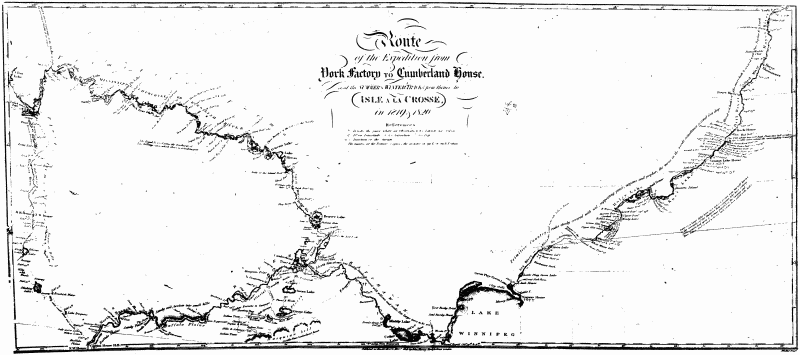
Route of the Expedition from York Factory to Cumberland House
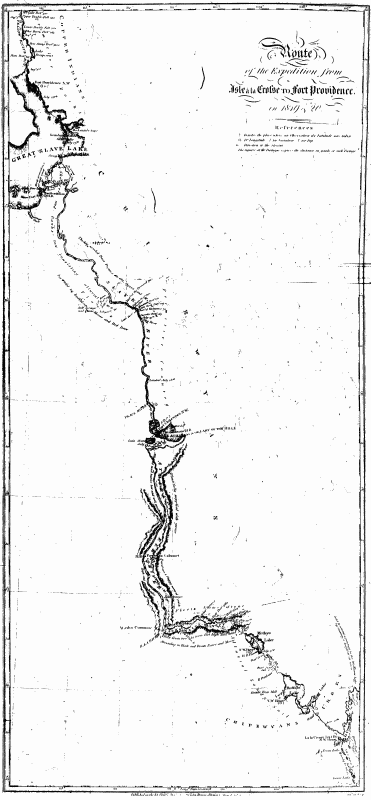
Route of the Expedition from Isle à la Crosse to Fort Providence
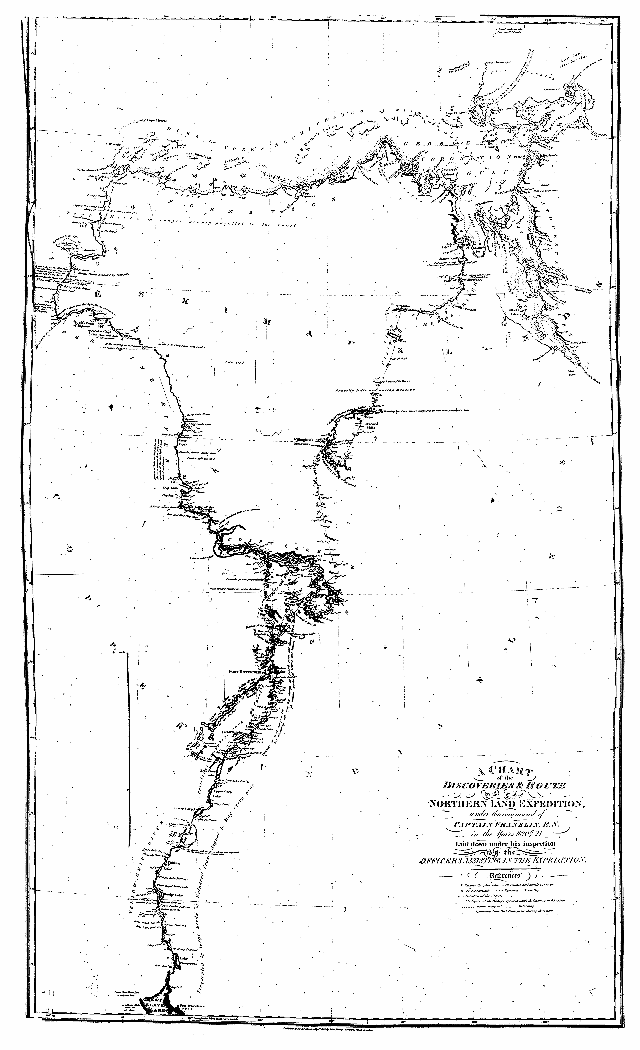
A Chart of the Discoveries & Route of the Norther Land Expedition
under the command of Captain Franklin, R. N. in the years 1820/21.
LONDON:
PRINTED BY WILLIAM CLOWES,
Northumberland-court.
1. Original had "throngh"; corrected to "through".
2. Assume -45° 5' means -45.5°, but possibly this could also be
-45-5/60°
3. Original had "phenemenon"; corrected to "phenomenon".
4. The context of soap making indicates that "ley" is most likely a
misprint for "lye".
5. Original had "holyday"; corrected to "holiday" (as in 2nd edition).
6. Original list order was "M., L."; changed to "L., M." for consistency.
7. Original list order was "S., R."; changed to "R., S." for consistency.
8. Original had "storehouse"; changed to "store-house" to be
consistent with other occurrences in the text.
9. Original had "An"; corrected to "At".
10. Original had "McAulay"; changed to "McAuley" to be consisten with
other occurrences in the text.
11. Added comma missing after "tobacco" in original.
12. Original had "determine"; corrected to "determined".
13. Original had "considerally"; corrected to "considerably" (as in
2nd edition).
14. Original had comma after "him"; corrected to period.
15. Original had period after "impossible"; corrected to comma.
16. Added "a" missing before "medal" in original.
17. Assume "Akaiyazzeh" is the same as "Akaiyazza" in chapter VIII.
18. Original had "Instructions"; corrected to "instructions".
19. Original had "et"; corrected to "set".
20. Original had "June", which doesn't fit into the sequence; corrected
to "July".
21. Original had "good-nature" at line break; corrected to "good
nature".
22. Original had "looses and"; corrected to "loose sand".
23. Original had "June", which doesn't fit into the sequence; corrected
to "July".
24. Original had "this"; corrected to "his".
25. Original had "tattoed"; corrected to "tattooed".
26. Original had "her and"; corrected to "her".
27. Added period missing after "house" in original.
28. Added comma missing after "being" in original.
29. Original had "easernmost"; corrected to "easternmost".
30. Added period missing after "Academy" in original.
31. Original had "Blackmeat"; changed to "Black-meat" to be consistent
with other occurrences in this text and in the first volume.
32. Alternative spellings for "Thlueetessy" in the first volume are "Thlouee-tessy"
and "Thloueea-tessy".
33. Original had "tha"; corrected to "that".
34. Original had "Slate-Clay"; changed to "Slate-clay" to be consistent
with occurrence in chapter XI.
35. Original had "sandstone"; changed to "sand-stone" to be consistent
with other occurrences in the text.
36. Original had "philanthrophist"; corrected to "philanthropist".
37. Original had "brush-wood"; changed to "brushwood" to be consistent
with other occurrences in the text.
38. Original had "port-folio"; changed to "portfolio" to be consistent
with spelling in footnote 6 in chapter X.
39. Original had "daybreak"; changed to "day-break" to be consistent
with other occurrences in the text.
40. Original had "amongt"; corrected to "amongst".
41. Original had "Rein-deer"; changed to "Rein-Deer" to be consistent
with other occurrences in the text.
42. Original had "signed"; corrected to "singed".
43. Original had "goiug"; corrected to "going".
44. Original had superfluous comma after "companions"; deleted.
45. Added comma missing in original after "hunting".
46. Original had "firewood"; changed to "fire-wood" to be consistent
with other occurrences in the text.
47. Original had "morrrow"; corrected to "morrow".
48. Added word "be" missing in phrase "used to considered" in original.
49. Original had "Semandrè"; corrected this and all further instances
to "Samandrè" to be consistent with the spelling used earlier in
this text and in the first volume.
50. Original had "w"; corrected to "we".
51. Original had "combatted"; corrected to "combated" (as in 2nd
edition and elsewhere in the text).
52. Original had "exited"; corrected to "excited".
53. Original had "sauvès"; corrected to "sauvés".
54. Superfluous "as" in original; deleted.
55. Added period missing after "meal" in original.
56. Original had superfluous comma after "said"; deleted.
57. Original had "scacrely"; corrected to "scarcely".


