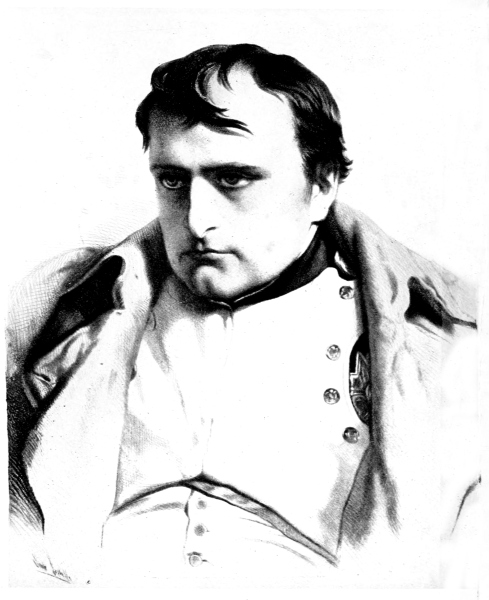
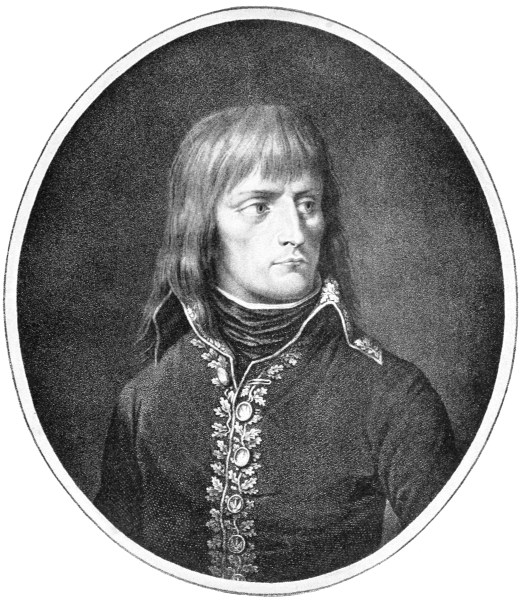
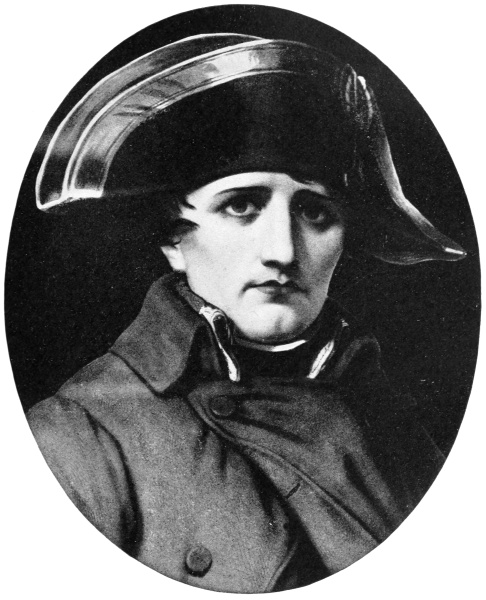
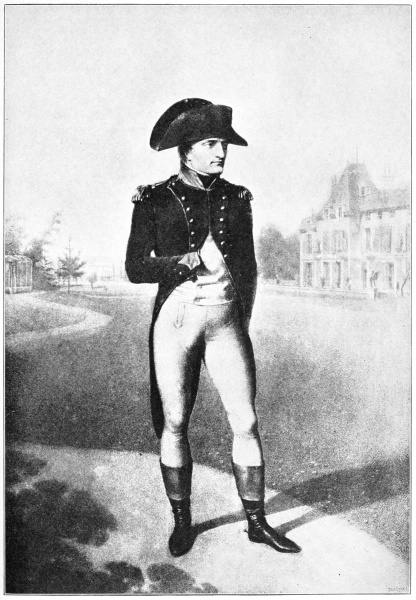
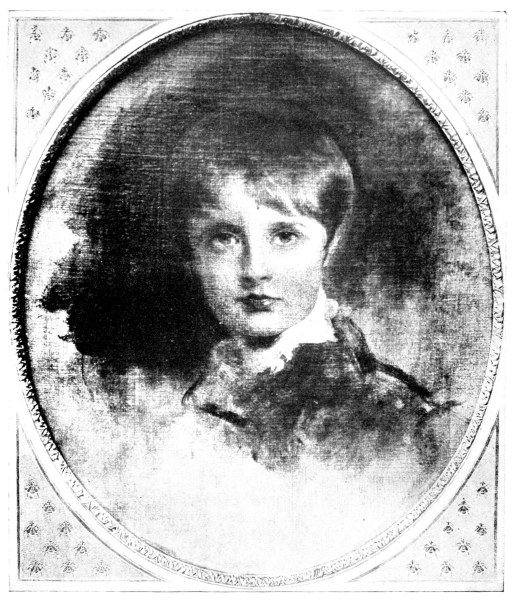
At this period (1807) Napoleon was a strikingly handsome
man. The “wan and livid complexion, bowed
shoulders, and weak, sickly appearance” of the Vendémiaire
period were things of long ago. The skin disease
of the Italian campaign had been cured. Not yet fat and
paunchy as he became toward the end, his form had
rounded to a comely fulness, which did not impair his
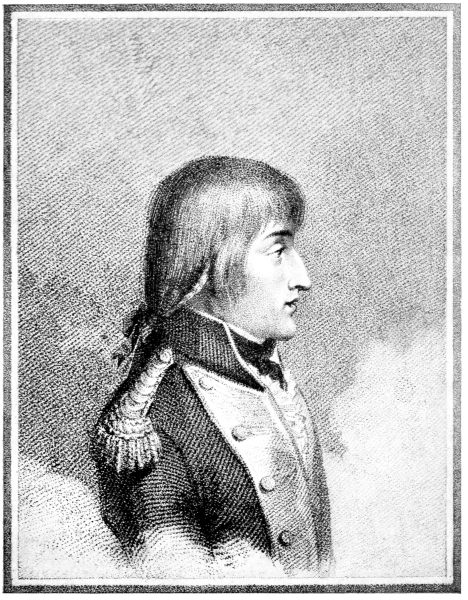
activity. The face was classic in profile, and in complexion
a clear, healthy white. His chin was prominent,
the jaw powerful, the head massive, being twenty-two
inches round, according to Constant. The chestnut-colored
hair was now thin, inclining to baldness on the
crown. Worn long in his youth, he cut it short in the
Egyptian campaign, and ever afterward continued to
wear it so. His ears, hands, feet, were small and finely
shaped. The nose was long, straight, well proportioned.
His teeth were white and sound; the lips beautifully
moulded; the expression about the mouth, when he
smiled, being peculiarly sweet and winning. His eyes
were gray-blue, and formed the striking feature of his
face. All accounts agree that his glance was uncomfortably
steady and penetrating; or, at other times,
intolerably fierce and intimidating; or, again, irresistibly
soft, tender, magnetic. One is struck with the fact that
so many who knew him, and loved him or hated him,
feared him or defied him, should emphasize the impression
made upon them by his eyes. Before that steady
gaze, which seized and held attention, Lavalette said that
he felt himself turning pale; Decrés lost all desire to be
familiar; Vandamme became a coward; Augereau and
Masséna admitted they were afraid; Madame de Staël
grew embarrassed; and Barras faltered into silence at his
own table. Not many years ago there lived in Michigan
a battered veteran of the Italian wars, one who had been
with Napoleon the day he reconnoitred Fort Bard, which
had checked the army; and this old soldier’s recollection
of Napoleon had dwindled down to the wonderful eyes
which had fixed him as though they would pierce the very
innermost fibre. During the year 1900 there died in
London an aged man, who as a boy had seen Napoleon
at St. Helena; and his recollection of the fallen Emperor
hung upon the same feature,—the eyes.
Generally, the expression of Napoleon’s face was that
of a student,—mild, pensive, meditative, intellectual.
In moments of good humor, his smile, glance, voice, were
caressing, genial, even fascinating. In anger, his look
became terrible; a rotary movement took place between
the eyes, and the nostrils distended. All agree that in
conversation there was such a play of feature, such quick
changes of expression, such mirroring of the mind upon
the face, that no description or portrait could convey an
idea of it. Only those who had talked with him could
realize it. But it is also agreed that when he wished to
banish all expression, he could do that also, and his face
then became a mask.
His voice was sonorous and strong. In anger it became
harsh and cruelly cutting. In his best mood it was as soft
and wooing as a woman’s. His general appearance, then, at
this time, was that of a well-built man, below the medium
height, but powerfully moulded, the bust, neck, and head
being massive, and the legs somewhat short for the trunk.
Unfriendly critics called him stunted, his stature being
about five feet, three inches.
He was inclined to be round-shouldered, and, when
walking meditatively, he slightly stooped. In talking he
gesticulated freely, sometimes violently; when in repose
the hands were folded behind him, or across the breast,
or one would rest within the waistcoat and the other
behind him.
It is doubtful whether any true portrait of Napoleon
exists. He has been idealized and caricatured until
the real Napoleon may have been lost. If the death
mask claimed to have been taken by Antommarchi is
genuine, one must surrender the belief that Napoleon’s
head was massive, his brow imperial, his profile perfect;
for this mask exhibits a forehead which recedes,
and which narrows above the temples. It shows the
high cheek-bones of the American Indian, and the skull
itself is commonplace. But this is not the Napoleon
pictured in the portraits and Memoirs of his contemporaries.
According to friend and foe, his head was massive,
in fact too large to be in symmetry with his body.
Madame Junot speaks of that “brow fit to bear the
crowns of the world.” Bourrienne, Méneval, and numbers
of others speak of the magnificent forehead and
classic face. And yet there are two or three fugitive
portraits of Napoleon which are so different from the
orthodox copies, and so much like the Antommarchi’s
death-mask, that one knows not what to believe.
Napoleon was very temperate in eating and drinking.
He preferred the simplest dishes, drank but little wine,
and that weakened with water. Coffee he drank, but not
to excess. He ate fast, and used his fingers oftener than
his fork. He was very sensitive to cold, and could not
bear the least light in his room at night. He slept a
good deal, from six to eight hours per day; and usually
took a nap during the afternoon or evening. His standing
order to his private secretary was a model of wisdom,
“Never wake me to hear good news, that will wait; but in
case of bad news wake me at once, for there is no time to
be lost.” Another rule of his was to sleep over a matter
of doubt. “Night is a good counsellor.”
While his nerves were very irritable, his pulse was
slow and regular. He declared that he had never felt his
heart beat. Medicine he detested and would not take.
When ill, he left off food, drank barley water, and took
violent exercise. He could not bear the least tightness
in his clothing. His garments were of the softest, finest
material, and cut loose. His hats were padded, his boots
lined with silk, and both hats and boots were “broken”
for him before he wore them. His favorite trousers were
white cassimere, and a habit he had of wiping his pen on
his breeches made a new pair necessary every morning.
His taking of snuff consisted merely in smelling it. He
used tobacco in no other form.
Extremely careful in business matters, he was disorderly
in some personal details. In undressing he flung
his clothes all about the room, and sometimes broke his
watch in this way. Newspapers and books which he had
been reading were scattered around in confusion. In
shaving, he would never allow both sides of his face
to be lathered at the same time: one cheek was finished
before the other was touched. He had a habit of poking
the fire with his foot, and burnt out many a pair of boots
in so doing. Excessively fond of the hot water bath,
he opened letters, read newspapers, and received callers
while splashing around in the tub. On leaving the bath,
his valet rubbed him down, using the flesh brush and
coarse cloths, and then dressed him. The most self-helpful
of men in matters of importance, he was one of
the least so in this. He depended upon servants for
almost everything connected with the care of his person.
“Rub me hard! Scrub me as though I were an ass!” he
would call to his valet, while he stood almost naked, and
with a red bandanna handkerchief knotted about his head.
He loved cologne-water and drenched himself with quantities
of it. One of the privations he keenly felt at St.
Helena was the lack of cologne. Other perfumes he detested,
and Constant relates a curious incident of Napoleon
calling to him one night to take out of his room
a certain young lady who had been brought there, and
who was “killing me with her perfume.”
With his elevation to empire, Napoleon became more
stately, reserved, dignified, and imposing; but perfect ease
and repose of manner he never acquired. The indolent,
calm, and studied air of languor and fatigue which, according
to a well-known standard, constitutes good-breeding,
he did not have. Perhaps he did not realize its tremendous
value. Nervous, intense, electrical, pulsing with vital
power, tossed by colossal ideas, ambitions, purposes, it
was never possible for him to become a self-complacent
formality, posing with studiously indolent grace, and uttering
with laborious ease the dialect of polite platitude.
But the man never lived who knew better how to talk,
how to write, how to say what he meant. He could address
mobs, committees, state councils, senates, armies,
peoples, and kings. Who that ever lived excelled him
in speaking to soldiers? Verily the lines are yet hot in
his proclamations, and he who reads them even now will
feel the magnetic thrill. How they must have inspired
the soldiers then!
His speeches to the councils and the Senate were models
in their way; his state papers have not been excelled;
his diplomatic correspondence measures up the loftiest
standards. In truth, his language varied with the subject
and the occasion. He could be as elegantly gracious as
any Bourbon, if the occasion required it. If it became
needful to call a spade a spade, he could do it, and with
a vim which left the ears tingling. In all of his talk, however,
there was character, individuality, and greatness.
Wrong he might often be, weak never. Whatever view
he expressed, in youth or age, was stated clearly, and
with strength. Even when sifted through the recollections
of others, his sayings stand out as incomparably
finer than those of any talker of that age. Compare the
few little jests and epigrams of Talleyrand, for instance,
with the numberless comments of Napoleon on men and
things, on matters social, political, industrial, financial,
military, and religious. It is like a comparison between
a few lamps in a hallway and the myriad stars of the
firmament. On every topic he discussed he said the best
things that can be said on that side; and there is no subject
connected with human affairs in a state that he has
not touched. Upon every subject he had a word which
shot to the core of the matter. His talent for throwing
into one dazzling sentence the pith of a long discussion
was unexcelled. Some of the best sayings attributed to
Talleyrand were really the sayings of Napoleon. It often
happened that these terse expressions were coarse, the
language of men on the street. At such sayings the
“Lady Clara” tribe of men arched their eyebrows in delicate
protest, and said to one another, “This Bonaparte is no
gentleman; he was not so well brought up as we were,—we,
the Talleyrands, Metternichs, and Whitworths!”
In one humor, Napoleon was brusque, coarse, overbearing,
and pitiless; in another he was caressing, elegantly
dignified, imperially generous and gracious. Between
these extremes ran the current of his life: hence the
varied impressions he made upon others. Charles Fox
and Lord Holland knew him personally, and they risked
political and social influence in England by defending him
from the abuse which had become the fashion there. Almost
without exception the men who came into personal
relations with him loved him. The rare exceptions are
such people as Bourrienne and Rémusat, whom Napoleon
had to rebuke for ways that were crooked. Even to his
valets he was a hero.
As Charles Fox said, “The First Consul at Malmaison,
at St. Cloud, and at the Tuileries are three different men,
forming together the beau ideal of human greatness.”
To these three Napoleons should be added at least one
other,—Napoleon at the head of his army.
In public, Napoleon trained himself to that majestic
dignity, grace, and thoughtfulness which his imposing
position required. The Pope did not act his part better
at the coronation, nor Alexander at Tilsit. He rarely, if
ever, overacted or underacted a public part, but in private
there was a difference. In familiar converse he
would pace up and down the room, or twitch in his
chair, or throw his feet up on the desk, and open his
penknife and whittle the chair arm, or sprawl on the
floor studying his big maps, or sit down in the lap of
his secretary.
With the rough good humor of a soldier, he would call
his intimates “simpleton,” “ninny,” or even “fool”; he
would pinch their ears, and lightly flick them on the
cheek with his open hand. Whereupon the oversensitive
biographers have unanimously shuddered, and exclaimed,
“See what a vulgar creature this Napoleon was!”
In his personal habits he was neat to the point of being
fastidious. If ever he wasted any time at all, it was the
hours he spent in the bath. Simple in his dress and
in his tastes, no gentleman was ever more scrupulously
clean. Generally he wore the uniform of a colonel of his
guard; and his plain gray overcoat, and plain little hat
with its cheap tricolor cockade, formed a vivid contrast
to the gaudy dress of foreign diplomats, or of his own
officers.
He pretended that anger with him never reached his
head, that he had his passions under perfect control.
This was all nonsense. His temper frequently burst all
bounds, and for the moment he was as insane as other
men in a passion. Madame Junot states that when he
fell into one of these fits of anger, he was frightful.
Upon at least one occasion of this kind he kicked the
dinner table over, and smashed the crockery; at another
he put his foot, in a violent and tumultuous manner,
against the belly of Senator Volney.
It was rumored around the palace, on his return from
Spain in 1809, that he gave Talleyrand a “punch on the
nose”; and once when the jealous and watchful Josephine
came upon him as he was enjoying himself with
another woman, he sprang at her in such a fury that she
fled the room in terror.
At Moscow while the Emperor was in his blackest
mood, everything going wrong, and a general crash
impending, Roustan, kneeling before him to put on his
boots, carelessly got the left boot on the right foot. The
next instant he was sprawling on his back on the floor.
Napoleon had kicked him over.
It is said that he threatened Berthier once with the
tongs, and Admiral Bruix with his riding-whip. On the
road to Moscow he rode furiously into the midst of some
pillaging soldiers, striking them right and left with his
whip, and knocking them down with his horse.
But these occasions were rare. His control of himself
was almost incredible, and he learned to endure the most
startling and calamitous events without a word or a
change of expression.
If you would see far, far into the heart of Napoleon,
study his relations with Junot. Not much brain had this
Junot, not much steadiness of character; but he was as
brave as a mad bull, and he had shared his purse with Napoleon
in the old days of poverty and gloom. More than
this, he had believed in Napoleon at a time when Napoleon
himself had well-nigh lost heart. So it came to pass
that Junot was the beloved of the chief, and remained so
in spite of grievous faults and sins. Junot gambled, and
Napoleon abhorred gaming; Junot drank to excess, and
Napoleon detested drunkards; Junot was a rowdy, and Napoleon
shrank from rowdyism; Napoleon loved order, and
Junot was most disorderly; Napoleon loved a strict relation
between income and outgo, and Junot was a marvel
of extravagant prodigality. Napoleon loved success, and
Junot brought failure upon him where it hurt dreadfully—in
Portugal, in Russia. Yet through it all Napoleon
never flagged in his indulgence to Junot. He made the
hot-headed grenadier Governor of Paris, Duke of Abrantes,
lapping him in honors and wealth. Sometimes Junot would
be angry at his chief, and Napoleon would coax him back
to good humor, as a father would a child. Sometimes
Junot would run to Napoleon with his griefs; and the
busiest man in the world would drop everything, take his
suffering friend by the arm, walk him up and down some
quiet room or corridor, soothing him with soft words, with
caresses. One day when Junot had taken to his bed, because
of a fancied slight at the palace, Napoleon, hearing
of it, slipped away from the Tuileries, went to the bedside
of his old comrade, comforted him, reassured him, and
stood by him until he was himself again.
When Madame Junot is in the throes of child-birth, it
is to Napoleon that the distracted husband flies. At the
Tuileries he is soothed by Napoleon himself, who sends off
messengers to inquire after the wife; and when the ordeal
is safely over, it is Napoleon who congratulates the now
radiant Junot, finds his hat for him, and sends him off
home to the mother and babe.
At last there did come something like a rupture between
these two—and why? Junot had brought scandal
on Napoleon’s sister while the brother was off with
his army in Germany. “To bring shame upon my sister—you,
Junot!” and the great Emperor fell into a chair,
overcome with grief.
In his relations with Duroc, Berthier, Lannes, La Salle,
Rapp, Méneval, Eugène Beauharnais, we find the same traits.
The indulgence with which he treated those he liked, the
pains he took to keep them in good humor, his care not to
wound their feelings, and his caressing way of coaxing
them out of their occasional sulks, shows a phase of Napoleon’s
own character which is usually overlooked.
He had many boyish ways which never left him. He
would hum a song and whistle a tune to the last. During
moments of abstraction he fell to whittling his desk or
chair, sat upon a table and swung his leg back and forth,
or softly whistled or hummed some favorite air. During
the great disaster at Leipsic, when all had been done and
all had failed, Napoleon, in a kind of daze, stood in the
street and whistled “Malbrook has gone to the wars.”
He was fond of playing pranks. He tried to drive a
four-in-hand at Malmaison, struck a gate-post, and got
thrown headlong to the ground, narrowly escaping fatal
injuries to himself and Josephine. He would disguise
himself, and go about Paris to hear the people talk, coming
back delighted if he had provoked angry rebuke by
some criticism of his on Napoleon. He would throw off
his coat at Malmaison, and romp and play like a schoolboy.
After dinner, if the weather was fine, he would call
out, “Let’s play barriers!” and off would go his coat, and
in a moment he would be racing about the grounds.
One afternoon while amusing himself in this way, two
rough-looking men were seen near the gate, loitering
and gazing at the romping group. The ladies saw fit
to become frightened, and to make the usual hysterical
outcry. Gallant young officers sprung forward to drive
off the intruders, as gallant young officers should. But
it turned out that one of the men was a maimed veteran
of the wars, come with his brother, in the hope of catching
a glimpse of the beloved form of his general—Napoleon.
Having seen, having heard, the First Consul put
his arm around Josephine, drew her toward the two men,
gave them gracious welcome, introduced them to his wife,
and sent them under Eugène’s escort to the house to
drink his health in a glass of wine. So promptly was
the thing done, so naturally, so warmly, so tactfully, that
the one-armed soldier was melted to tears.
In his rude horse-play, Napoleon taught his gazelle to
chase the ladies of the court, and when the animal caught
and tore a dress, or caught and pinched a leg, his delight
was precisely that of the mischievous, slightly malicious
boy. In playing barriers he cheated, as he did at all
games, and violated all the rules. When he was unbent,
when he was at Malmaison, he could take a joke as well
as any. One very rough piece of horse-play he took a
good deal more placidly than many a private citizen
would have done. Passing through a gallery at Malmaison,
he stopped to examine some engravings which were
lying upon a table. Young Isabey happening to come
into the gallery behind Napoleon, and seeing the back
of the stooping figure, took it to be Eugène Beauharnais.
Slipping up softly, Isabey gave a jump, and leaped upon
Napoleon’s shoulders, astraddle of his neck. Napoleon
recovered from the shock, threw Isabey to the ground,
asking, “What does this mean?”
“I thought it was Eugène,” cried Isabey.
“Well, suppose it was Eugène—must you needs break
his shoulder bones?” Without further rebuke Napoleon
walked out of the gallery. Through the folly of Isabey,
the secret leaked out, and there was just enough of the
ludicrous about it to embarrass both the actors, and Isabey
went to play leap-frog elsewhere.
Napoleon was fond of children, knew how to talk to
them, play with them, and win their confidence. The man
never lived who knew better than he the route to the
heart of a soldier, a peasant, or an ambitious boy. With
these he could ever use exactly the right word, look, smile,
and deed. He was familiar with his friends, joked them,
put his arms around them, and walked with them leaning
upon them: he never joked with men like Fouché, Talleyrand,
Bernadotte, Moreau, and St. Cyr. These men he
used, but understood and disliked.
Fat women he could not endure, and a pregnant woman
showing herself when she should have been in seclusion,
excited his disgust. One of the pictures he most liked
to gaze upon was that of a tall, slender woman, robed in
white, and walking beneath the shade of noble trees.
A fastidious, exacting busybody, he was forever on the
lookout for violations of good taste on the part of the
ladies of his court. He detested the low dresses which
exposed the bosom to the vulgar gaze; and if he saw
some one dressed in peculiarly unbecoming style, he was
rude enough to give words to his irritation. “Dear me!
are you never going to change that gown?” This was
very, very impolite, but the costume was one which he
abhorred, and the wearer had inflicted it upon him “more
than twenty times.”
Possibly if there were a greater number of outspoken
Napoleons, there would be fewer absurdities in fashionable
female attire.
To some of Napoleon’s sharp sayings, the haughty
dames and damsels of the old aristocracy made some
crushing replies—according to their Memoirs. It is
fairly safe to say that these crushing retorts were made
in the seclusion of the homes of the fair retorters. The
man whose stern look and bitter tongue awed into embarrassed
silence such a veteran in word-play as Madame
de Staël, was not likely to be crushed by such pert and
shallow beings as Madame de Chevreuse and her kind.
For facts, events, his memory was prodigious; for
names and dates, it was not good. Sometimes he would
ask the same man about court three or four different times
what his name was. In his later years his memory became
very fickle, and he was known to forget having
given the most important orders. He could not remember
a charge he ordered Ségur to make in Spain; nor
could he recall that he had ordered the charge of the
heavy cavalry at Waterloo.
Noted at school for his skill in mathematics, and using
that science constantly in his military operations, it is
said that he could rarely add up a column of figures
correctly.
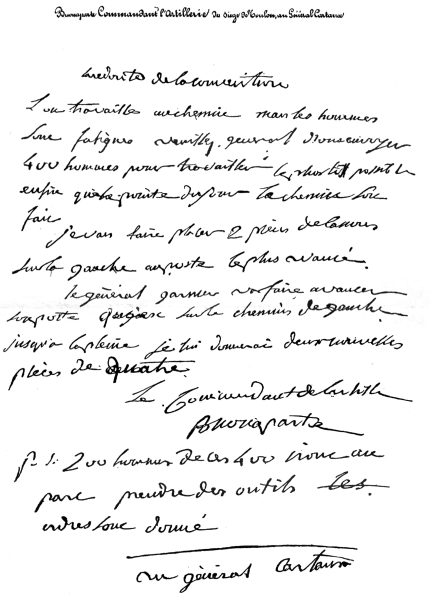
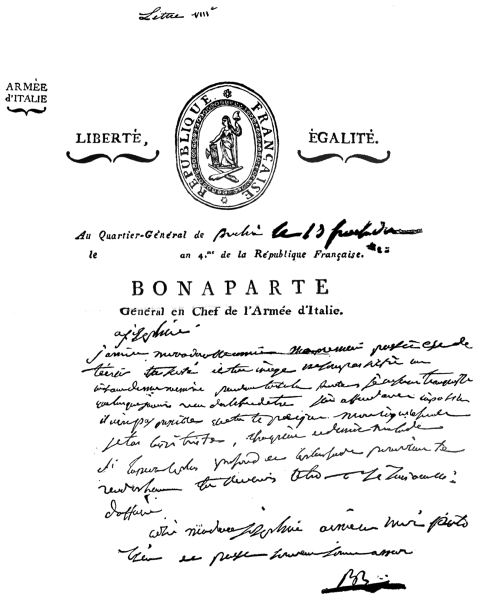
He could not spell, nor could he write grammatically;
and he took no pains to learn. A busy man, according
to his idea, had no time to waste on such matters.
He loved music, especially Italian music; was fond of
poetry of the higher sort, and appreciated painting, sculpture,
and architecture. He loved the beauty and quietude
of such country places as Malmaison, never wearied of adding
to their attractions, and was happy when free from
business, and taking a solitary stroll along garden walks
amid flowers and under the shade of trees.
In his work, Napoleon was all system. No clerk
could keep papers in better order. No head of a department
could turn off business with such regularity and
despatch. He knew all about his army, down to the
last cannon; knew just what his forces numbered, where
they were, and what their condition. He was master of
the state finances, of every branch of the internal administration,
of every detail of foreign affairs. He kept up
with everything, systematized everything, took the initiative
in everything. An extra plate of soup could not
be served in the palace without a written order from
Duroc, the proper officer. An army contractor could
not render a false account without being exposed and
punished. An overcharge could not be made in the
palace furnishings without his finding it out. “He is a
devil,” said many a quaking Beugnot.
One day, says Constant, the pontoon men were marching
with about forty wagons. The Emperor came along,
and cried, “Halt!”
Pointing to one of the wagons, Napoleon asked of the
officer in charge:—
“What is in that?”
The officer answered, “Some bolts, nails, ropes, hatchets,
saws—”
“How many of all that?”
The officer gave the number.
“Empty the wagon and let me see!”
The order was obeyed, bolts, nails, ropes, saws, everything
taken out and counted. But the Emperor was not
satisfied. He got off his horse, climbed into the wagon
over the spoke to see that it had been emptied.
The troops shouted: “Bravo! That’s right! That is
the way to find out!”
He compared his mind to a chest of drawers, where each
subject occupied its separate space. In turn he opened
each drawer. No one subject ever got mixed with another.
When all the drawers were shut, he fell asleep. Of course
this was not literally true, but during his best years it
came as near being literally true as is possible to the
human brain.
After the day’s work was done, he would enter into
the amusements of his domestic circle, would play and
dance with the young people, would read or listen to
music, or would entertain the circle by telling some
romantic story which he composed as he talked. In the
evening he loved to have the room darkened while he
threw the ladies into a gentle state of terror with a ghost-story.
Napoleon’s penetration in some directions was wonderfully
keen; in others remarkably dull. For instance, it
was almost impossible to deceive him in matters of account,
the number of men in a mass, or the plan of battle of a
foe. He would converse with an engineer in reference
to a bridge he had been sent to build and which Napoleon
supposed he had built; after a few words he would
turn away and say to the prefect, “That man did not
build the bridge—who did it?” The truth would
come out: an obscure genius had planned the work,
and Napoleon would say to this genius, obscure no more,
“Come up higher.”
He could scan a list of political prisoners, pounce upon
the name of a surgeon, decide at a flash that this man
could not be a fanatic. “Bring him to trial, order him
to be shot, and he will confess.” And it so happened.
But it is marvellous that Napoleon, who revolutionized
the strategy of war, improved nothing, invented nothing,
in the instruments of warfare. A Prussian offered
to him the original of the needle-gun, and he totally
failed to grasp the terrible effectiveness of the weapon.
True, he experimented with it, ordering that specimens
should be made and shown him. But when his armories
turned out clumsy models, as at first they were almost
sure to do, he seemingly lost interest. The Prussian
carried his invention to Germany; and the Austrians
and French of a later day melted like snow before this
new and fearful gun.
When Fulton came to France with his steam-boat discovery,
offering a means by which Napoleon might have
destroyed with ease England’s all-powerful navy, his
invention was not appreciated. True, Napoleon gave
him encouragement and money, and urged the wise men
of the Institute to look into the thing; but Napoleon himself
did not “take hold.” When the sages of the Institute
reported adversely to the new invention, as sages
almost always do, Napoleon let the subject drop, apparently
forgetting that it is usually the ignorant “crank”
and the untutored “tenderfoot” who stumbles upon
great inventions and the richest mines. So far-sighted
in some directions, it seems unaccountable that he did
not realize immediately the vast importance of the
breech-loading gun, and the steam-propelled vessel.
With the same muzzle-loading muskets he fought the
first battle and the last. The same little cannon which
could not batter down the old walls of Acre, sent balls
which rebounded from the farmyard enclosures at
Waterloo.
During all of his campaigns prior to 1812, Napoleon
gave personal attention to everything; no detail was
neglected. He saw with his own eyes, taking nothing
for granted, nothing on trust. As far as possible he
followed up his orders, seeing to it that they were
executed. Thus on the night before Jena he risked his
life and came near being shot reconnoitring the Prussian
position, and after he had selected positions for his
batteries, and marked out the path up which the guns
were to be drawn to the heights, he could not rest
until he had gone in person and seen how his orders were
being executed. It was fortunate that he did so. The
foremost cannon carriage had got jammed between the
rocks of the passage and had blocked the way of all the
others. The whole battery was at a halt, and nothing
being done to forward the guns. Angry as he was, Napoleon
at once took command, ordered up the sappers, held
a lantern while they were at work, and showed them how
to widen the road. Not until the first gun had passed
through did he leave the place. The failure to look after
such things was one cause of the disasters of his later
years.
He spared himself no fatigue in war. Sensitive to
cold, to evil smells, to ugly scenes, to physical discomfort
of all sorts, the Sybarite of the palace became the Spartan
on the campaign. He could stand as much cold, or heat,
or hunger, or thirst, camp hardships and camp nastiness
as any private. He could stay in the saddle day and
night, could march on foot by the hour in snow or mud,
could stand the storms of rain, sleet, and wind, made no
complaint of filthy beds and disgusting surroundings, and
could eat a soldier’s bread out of the knapsack with all
of a soldier’s relish.
In later years he carried his habits of luxury to the
army, and with them came defeats. The general who
in Italy could have taken all his baggage in a cart was
followed in 1812 by a train of seventy wagons. He went
to war then like Louis XIV., and the luck of Louis XIV.
overtook him.
On the field of battle his aspect was one of perfect
composure. No turn of the tide broke through his absolute
self-control.
At Marengo, when the great plain was covered with the
flying fragments of his army, and fugitives were crying:
“All is lost! Save himself who can!” he was as calm
as at a review. Berthier galloping up with more bad
news, Napoleon rebuked him with, “You do not tell me
that with sufficient coolness.” When Desaix arrived,
Napoleon took all the time that was necessary to make
proper dispositions for the attack, exhibiting not the
slightest nervousness under the galling Austrian fire.
In the retreat from Russia he was stoically serene, save
on the rarest occasions. Only a few intimates knew how
much, in private, he gave way to his immense burden of
care, of grief, of impotent rage. To the army he appeared
as cold, as hard, as unyielding as granite. When a
general brought him some unusually appalling news,
Napoleon turned away as though he did not wish to hear.
The officer persisted; Napoleon asked, “Why do you wish
to disturb my equanimity?”
If his fatigues had been excessive in the preparation
for battle, and his dispositions had been made, and all
was going as he had foreseen, he could slumber restfully
while the combat raged. Thus at Jena, Ségur speaks of
Napoleon asleep on the ground where his great map was
unrolled—asleep with the grenadiers standing in hollow
square about him.
Lord Brougham writes: “Lying under some cover in
fire, he would remain for an hour or two, receiving reports
and issuing his orders, sometimes with a plan before him,
sometimes with the face of the ground in his mind only.
“There he is with his watch in one hand, while the
other moves constantly from his pocket, where his snuffbox,
or rather his snuff, lies. An aide-de-camp arrives;
tells of a movement; answers shortly, some questions
rapidly, perhaps impatiently, put; is despatched with the
order that is to solve the difficulty of some general of
division. Another is ordered to attend, and sent off with
directions to make some distant corps support an operation.
The watch is again consulted; more impatient symptoms;
the name of one aide-de-camp is constantly pronounced;
question after question is put whether any one
is coming from a certain quarter; an event is expected;
it ought to have happened; at length the wished-for
messenger arrives. ‘Well! what has been done yonder?’—‘The
height is gained; the Marshal is there.’—‘Let
him stand firm—not to move a step.’ Another
aide-de-camp is ordered to bring up the guard.
“‘Let the Marshal march upon the steeple, defiling by
his left—and all on his right are his prisoners.’ Now
the watch is consulted and the snuff is taken no more;
the great captain indulges in pleasantry; nor doubts any
more of the certainty and of the extent of his victory
than if he had already seen its details in the bulletin.”
Cruelty and kindness, selfishness and generosity, loyalty
and treachery, honesty and perfidy, are almost unmeaning
terms if applied without qualification to Napoleon.
Where his plans were not involved, he frequently manifested
the human virtues in their highest form; where
those plans were involved, he practised all the vices without
scruple or pity. Naturally he was humane, charitable,
kind, indulgent, sympathetic, generous; if policy required
it, he became as hard as steel. He left no debt of gratitude
unpaid; ignored none of the claims, however slight, of
kindred and old association. See how he behaves toward
Madame Permon, how tolerant he is of that intolerable
woman, how he forgets her snubs, how he forgives her a
public insult, how he follows her with respectful consideration
all the days of her life—and why? She had
been kind to him when he was a poor boy, had nursed
his father on the death-bed. “It is a devil of a temper,
but a noble heart;” and the noble heart makes him forget
the devil of a temper.
He gave place and pension to early sweetheart, to boyhood
friends, to schoolmates, to teachers. The son and
daughter of General Marbeuf found him delighted to
serve them in remembrance of their father. The widow
of the Duke of Orleans who had chanced to be the giver of
a prize to him at Brienne, and who had forgotten all about
it, was happily surprised to find that he had remembered.
He restored her confiscated pension, and gave a relative
of hers a place in the Senate. To the daughter of Madame
de Brienne he proved himself a vigilant guardian. So the
record runs throughout his life, and his last will is little
more than a monument of gratitude to those who had at
any time done him a service.
He was not free from superstition. What people called
“omens” made an impression upon him. He sometimes
made the sign of the cross, as though to ward off impending
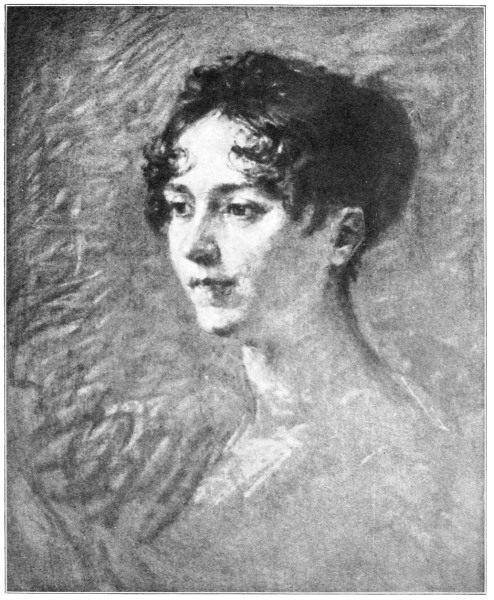
evil. When in Italy the glass over Josephine’s
portrait was broken, Marmont says that he turned frightfully
pale, and exclaimed that his wife was either dead or
unfaithful.
He was a man of insatiable curiosity. He wished to
know everything, and to have a hand in everything. His
police infested every nook and corner, and over his police
he set spies, and over the spies he set the informer. Thus
he had two or three systems going at the same time. He
not only sought to know all about public affairs, but private
matters also. He delighted in gossip and scandal,
hugely enjoying his ability to twit some man or some
woman with an amour which he had discovered. Theatre
talk, street talk, drawing-room talk, were reported to him
regularly. Copying the Bourbon example, he opened private
letters to ascertain what correspondents were saying
to each other. He allowed no freedom of the press, and
no real freedom of speech. Journals which showed the
least independence he suppressed. Authors, actors, orators,
who ventured upon forbidden ground, felt the curb
at once.
Lavish as he was in expenditures, there was method and
economy throughout. He was good at a bargain, exacted
the worth of his money, would tolerate no imposition or
overcharge. His imperial displays were more magnificent
than those of the Grand Monarch, but they cost him less
than one-tenth as much.
It is not possible to dogmatize about a man like Napoleon,
saying positively just what he was. A more contradictory
mortal never lived.
The man who massacred the prisoners at Jaffa was the
same who perhaps lost his crown because he would not
consent to excite civil war in Russia or in France. He
who had just sent tens of thousands to death at Borodino,
angrily reproved a careless member of his staff for allowing
the hoof of his horse to strike one of the wounded,
causing a cry of pain.
“It was only a Russian,” said the negligent rider.
“Russian or French, it’s all the same,” cried Napoleon,
furiously; “I want them all cared for.”
His temper was despotic; he could not brook opposition,
nor tolerate independence. Hence he banished
Madame de Staël, suppressed the tribunate which had
the power of debate, and frowned upon voluntary movements
of all kinds, whether clubs or schools. His
treatment of Toussaint was atrocious, filling the honest
biographer with anger, disgust, and shame: but, after all,
Toussaint was a rebel, and the way of the rebel is hard.
In his own eyes the insurgent, striving for national independence,
is a hero: in the eyes of the world he is an
incendiary, unless he whips his master and becomes free.
From the grave of Robert Emmett, Ireland can speak
of England’s treatment of rebels: from Cuba comes a
voice choked with blood, which vainly tries to do justice
to Spain’s treatment of the rebel; and from Siberia,
Hungary, Poland, Finland, Hindustan, Crete, Italy, South
Africa, come awful reminders of the well-known fact,—the
way of the rebel is hard. Toussaint L’Ouverture,
regarded as a rebel, was cast into prison: Jefferson
Davis, regarded as a rebel, was cast into prison: Davis,
the white man, was put in irons and came near dying:
Toussaint, the black man, was ironed, and died. In each
case the motive was the same,—to degrade and to punish
an alleged rebel.
Great has been the outcry made by the literary Scribes
and Pharisees against Napoleon because of his cruelty to
the hero of St. Domingo and to Andreas Hofer, the hero
of the Tyrol; until these indignant people indict also the
kings and cabinets who have slain their hundreds where
Napoleon slew his dozens, we cannot feel much sympathy
for the prosecution.
Relentlessly selfish in the pursuit of power, it will be
admitted by those who impartially study his career that
he used his power, not for personal and selfish pleasures,
but for the future welfare of the peoples over whose
destinies he presided. The laborious manner in which
he worked out the revolutionary principle of lifting the
despised Jew into full citizenship, will always be a striking
illustration of the liberality of his statesmanship.
He loved to tour the country, to see with his own eyes,
to hear with his own ears. He loved to meet the people
face to face, to talk with them familiarly, to get at the
real facts about everything. The man never lived who
had such a passion for making things better. Harbors
must be widened, deepened, made more secure. Trade
routes must be improved, rivers linked to rivers, or rivers
connected with seas. Mountains must be conquered by
broad, easy-grade roads; and villages must be planted
along the route for the convenience of the traveller.
He tore out old buildings to make way for new ones,—larger,
better, grander. Crooked streets—narrow,
nasty, the homes of squalor, of crime, and of pestilence—he
replaced by broad avenues and handsome
buildings. Churches, schools, town-halls, arsenals, dockyards,
canals, highways, bridges, fortifications, manufactories,
harbor works, new industries, sprang up at his
touch throughout the realms he ruled. Had he never
been known as a warrior, his work as administrator and
as a legislator would have made his name immortal. Had
he never been heard of as a legislator, his work in Europe
as a developer of material resources would have made it
impossible for the world to forget him. The manufactories
which he encouraged were but the beginnings of a
mighty evolution which would have transferred to the
Continent the vast profits England had so long reaped.
At every seaport, on every canal, on all the highways,
in every town from Venice to Brest and Cherbourg,
the traveller of the present day sees the footprints of
Napoleon the Great.
He rid Paris of the periodical nuisance of the Seine
overflow, and along the river ran his magnificent embankments.
At St. Helena he expressed a wonder that the
Thames had never been thus controlled, and England
afterward embanked her river as the great Emperor
suggested.
His natural instinct was to make improvements. The
first thing he did in Spain was to establish free-trade
between her provinces, abolish feudal burdens, suppress
one-third of the monasteries where “those lazy beasts of
monks” lived in idleness at public expense, and to give
the people the right to be heard in fixing taxes and
making laws. The first thing the Bourbons did, on
their return, was to restore all the abuses Napoleon had
abolished.
In Italy, the first thing he did, after overturning the
temporal power of the Pope, was to suppress the papal
monopolies by which the Albani family had the sole
right to manufacture pins, Andrea Novelli the exclusive
privilege of selling oil for lamps, Alexandro Betti the
monopoly of ferry boats, and so forth. To these benighted
Romans he gave the Code Napoléon, trial by
jury, home rule in local affairs, equality before the law,
and relief from all feudal abuses.
The first thing the Pope did when in 1814 he was restored
to temporal power was to abolish all things Napoleonic,
and to reëstablish the hateful monopolies, feudal
burdens, and papal customs.
In Egypt he projected the mighty work of adding millions
of acres to the cultivable area by the construction
of vast storage basins on the Nile. England has but
recently carried to successful completion the magnificent
plan he suggested.
In Milan he finished the gorgeous cathedral which had
been commenced hundreds of years before. To stagnant,
pestilential Venice he gave new life, dredging her lagoons,
decreeing a Grand Canal, deepening her harbor, overhauling
her sanitary system—spending $1,000,000 during
his one visit. And the story is the same for almost every
portion of his huge empire.
Bad? Lord Wolseley says he was not only bad, but
“superlatively” so. Perhaps he was; but here is one
publican and sinner who dares to say that were the good
men to work half as hard as Napoleon did to improve
the condition of this world, its moral and material situation
would more nearly approximate the imagined perfection
of that heavenly abode in whose behalf this poor
planet and its poor humanity are so often neglected.