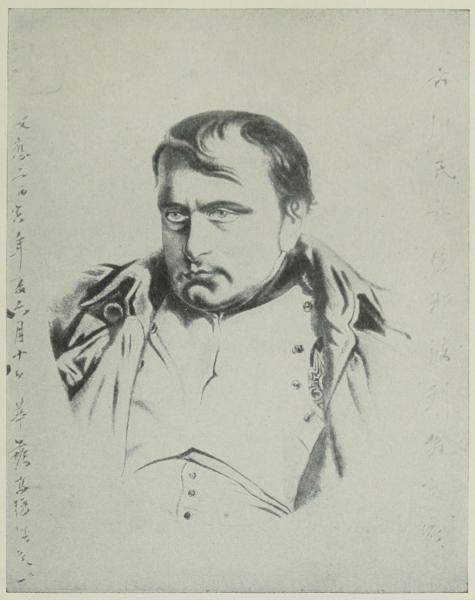
Napoleon at St. Helena. Watercolour painting, probably
by a Japanese, with a marginal inscription in Chinese
ideographs concerning the owner. Broadley Collection
Battles of Millesimo, Castiglione, Arcola, Rivoli, Mantua.
1797.
At the castle of Montebello.
Peace of Campo Formio.
1798.
In Paris till May.
May 19th, embarcation for Egypt.
Battle of the Pyramids.
1799.
Jaffa, Acre, Aboukir.
October 7th, landing in France.
November 9th, coup d’état of the eighteenth Brumaire.
December 24th, First Consul.
BOOK THREE
1800.
June 14th, battle of Marengo.
December 24th, attempted assassination.
1801.
Peace of Lunéville.
Concordat with Pius VII.
1802.
Peace with England.
Consul for life. Legion of Honour.
1804.
March 21st, duke of Enghien shot.
May 18th, assumption of imperial title.
December 2nd, coronation.
1805.
October, Trafalgar.
November, Vienna taken.
December 2nd, battle of Austerlitz.
Peace of Pressburg.
1806.
Confederation of the Rhine. Joseph, King of Naples.
Louis, King of Holland.
October 14th, battle of Jena.
Berlin. Continental System.
1807.
Battles of Preussisch-Eylau and Friedland.
June 7th, treaty of Tilsit.
Jerome, King of Westphalia.
1808.
Rome. Madrid. Bayonne. Joseph, King of Spain. Murat,
King of Naples.
1809.
Excommunication. Battles of Aspern-Essling, Wagram,
and Vienna.
1810.
January, divorce.
April, married to Marie Louise.
1811.
March 20th, birth of his son.
BOOK FOUR
1812.
Battles of Smolensk, Borodino, Vittoria, Moscow.
December, return to Paris.
1813.
April, battles of Lützen and Bautzen.
July, battle of Dresden.
October 16th to 18th, battle of Leipzig.
1814.
Battles of Brienne, La Rothière, Champaubert, Montereau,
Bas-sur-Aube, Laon, Arcis-sur-Aube.
April 6th, abdication in Fontainebleau.
April 20th, embarcation for Elba.
1815.
February 26th, sails from Elba.
March 13th, outlawed.
March 20th, Paris.
June, battles of Ligny and Waterloo.
June 23rd, second abdication.
July 13th, letter to the prince regent.
July 31st, declared a prisoner.
BOOK FIVE
1815.
October 17th, arrival in St. Helena.
1821.
May 5th, death.
BOOK ONE THE ISLAND — I — II — III — IV — V — VI — VII — VIII — IX — X — XI — XII — XIII — XIV
The story of Napoleon produces on me an impression like
that produced by the Revelation of Saint John the Divine.
We all feel there must be something more in it, but we do not
know what.—Goethe.
A young woman is sitting in a tent. Wrapped in a shawl,
she is suckling her baby, and listening to a distant rumbling and
roaring. Are they still shooting, though night has fallen?
Maybe it is only the sound of one of those autumn thunderstorms
whose echoes reverberate from the mountains; or perhaps
it is nothing more than the murmur from the surrounding
forest of pines and evergreen oaks, where foxes and wild swine
have their lairs. She looks like a gipsy, sitting there with her
white breast half covered by the shawl, brooding within the
murky tent, uncertain what the fate of the day may have been.
Now she hears the sound of hoof-beats. Is it he? He promised
to come; but it is a long way from the fighting line, and the
mists are rising.
The flap of the tent is thrown open, letting in a breath of
night air. A man enters. An officer in a coloured tunic and
wearing a plumed head-dress; a slim fellow, nimble of movement;
a young patrician, in the middle twenties. He greets the
woman ardently. Springing to her feet, she gives the nursling
to her maid. Wine is brought. Taking the kerchief from her
head, she stands before him, showing chestnut ringlets astray
on a smooth, white brow. An eager question is on her well-shaped
lips. Add to the picture that she has a long chin, a
sign of energy; that her aquiline nose is thrown into relief by
the firelight; and that on her hip there gleams the dagger which
in this mountain land she never lays aside. We see a lovely
amazon, daughter of an ancient race, sprung from men of
action and resolution. The woman’s forebears, like the man’s,
have for centuries been leaders and warriors; first across the
water in Italy, and then in this craggy island.
But now, when all have gathered together against the hated
enemy, have joined forces in the attempt to drive out the
French, here, in the wildest part of the mountains, whither the
brave girl of nineteen has followed the husband fighting for
their fatherland; who, now, could recognise in her the brilliant
patrician, the magnet of all eyes? Here, nothing but pride and
courage show that she is of noble birth.
The man, full of life and vigour, ever in movement, tells her
all his news. The enemy has been beaten, driven back towards
the coast. There is no escape. Envoys have been sent to Paoli.
“There will be a truce to-morrow. Letizia, we are winning!
Corsica will be free!”
Every Corsican longs for many children. It is a land where
an affront is instantly avenged by a dagger thrust; where the
vendetta is sacred; where family feuds last from decade to decade
and from century to century. The man before us wants
many children, to ensure that his race shall persist; and the
woman has learned from mother and grandmother that children
are tokens of honour. She had become a mother at fifteen; but
the baby she has just been nursing was her first boy.
The thought of freedom glows afresh, for the officer is adjutant
to Paoli, the leader of the people.
“No longer shall our children be the slaves of France!”
With the coming of spring, despondency prevails. The
enemy has landed reinforcements; the children of the island take
up arms once more; again the young wife accompanies her husband
to the war; this time she carries a child beneath her heart,
the child conceived during the storms of the previous autumn.
“Often, in search of news, I would steal forth from our mountain
nook to the battle-field; I heard the bullets whistling, but
I put my trust in Our Lady”—so she would tell the story in
later years.
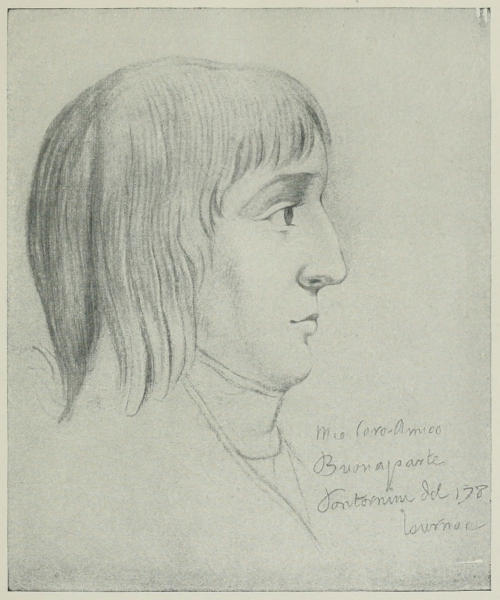
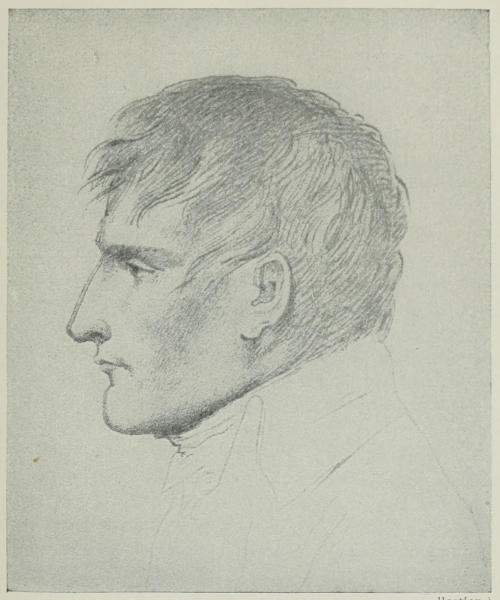
Buonaparte in 1783. The first known portrait, drawn by his
fellow-countryman Pontornini. Musée Nationale, Versailles.
In May, the Corsicans were defeated. There was a terrible
retreat through the dense forests and the rugged mountains.
Among the multitude of men and the few women, rode Letizia,
big with child, carrying her one-year-old boy in her arms, seated
on a mule. They reached the coast safely. In June the defeated
Paoli, accompanied by a few hundred of his faithful
followers, had to flee to Italy. In July Paoli’s adjutant,
Letizia’s husband, with other envoys, capitulated to the conqueror.
The insular pride was humbled. But in August
his wife brought the avenger into the world.
She named him Napolione.
This woman, who during the campaign had played the heroine
and had shown a man’s courage, must now, in the great house
by the seashore, become a prudent and thrifty housewife. Her
young husband, fanciful by temperament, lived more on plans
than on income. For years his energies were mainly devoted
to the great lawsuit concerning his inheritance. As a student
in Pisa, where among his fellows he was known as Count
Buonaparte, he had lived well but learned little. After the
birth of his second son, he cut his studies short. How was he
to make a living? In troublous times, a man of the world takes
the world as it is; comes to terms with the conqueror; all the
more since the French, in order to secure their footing in the
island, are inclined to show favour to the Corsican nobility.
Soon he becomes assessor in the new law-courts; superintendent
of a nursery in which the king of France, eager to turn
the new possessions to account, wishes to grow mulberries;
and when the distinguished marshal comes to stay, no expense
must be spared. There are still flocks of sheep in the hills and
vineyards along the coast; his brother, archdeacon at the
cathedral, is well-to-do; and his wife’s half brother, another
priest, a merchant’s son, is skilled in worldly affairs.
By the time his proud and beautiful wife has reached her
thirties, five boys and three girls have been born to her. This
is well accordant to the notions of the islanders, for whom
rivalries and vendettas are supreme virtues. But the rearing
of eight children is a costly matter; so, day by day, the youngsters
hear their parents talking about money. At length, however,
the father finds a way out of his difficulties. Accompanied
by his two eldest sons, now ten and eleven years of age, he sails
to France, and journeys from Toulon to Versailles.
He brings recommendations from the marshal in Corsica.
The Buonapartes’ Italian title of nobility is confirmed by the
Herald’s College in Paris. To the Corsican official who has
been loyal for a decade, King Louis makes a grant of two
thousand francs. The two sons and one of the daughters are
given scholarships in the Nobles’ Schools. One son is to be a
priest; the other, an officer.
A taciturn boy, small, shy, and lonely, sits reading in a
corner of the garden. It is his own plot in the school garden at
Brienne, and he has made a fence round it. Really, only a
third of the enclosure is his own, for he has fenced in the plots
of neighbours on either side. They may come in too; but woe
to any one else who disturbs his privacy! He rushes furiously
at the intruder. A little while ago, when the boys had had a
fireworks’ display, two of his schoolmates, who had been slightly
burned, had run away to his garden for refuge. He had
driven them out, flourishing a hoe at them.
No punishment will bring him to reason in this matter. The
masters shake their heads and let him go his own way.
“The youngster is made of granite,” says one of them, “but
there is a volcano inside.”
No one may touch this little kingdom of his in the garden,
though part of it is usurped. He has an ardent feeling for
his own independence. Writing to his father, he says: “I would
rather be the first among the workmen in a factory than the last
among the artists in the Academy.” Did he get the idea out of
Plutarch? Certainly he has an enthusiasm for that author,
the lives of the great men as sketched by Plutarch, especially
the Roman heroes. Of these, he is always dreaming. No one
tells us that he ever saw this boy laugh.
To his schoolfellows he seems half a savage, or at best a
queer foreigner. He knows scarcely a word of French, and has
little inclination to learn the language of the foe. What a
tiny little chap he is, and what a ridiculous name! His coat
is too long. No pocket-money, nothing to spend, and yet he
claims to be of noble birth! The scions of the French nobility
laugh. Who cares about Corsican noblemen?
“If you Corsicans are such brave fellows, why did you let
yourselves be beaten by our unconquerable troops?”
“We were one to ten,” the lad angrily exclaims. “You just
wait till I’m grown up, and I will pay you Frenchmen out!”
“Your father is nothing more than a sergeant, after all!”
An outburst of wrath from the boy, who challenges his tormentor.
The young Napoleon is “kept in.” He writes to his
father: “I am tired of explaining my poverty; of having to endure
the mockery of these foreign boys, whose only superiority
is in respect of money, for in nobility of feeling they are far
beneath me. Must I really humble myself before these purse-proud
fellows?” The answer from the island is: “We have no
money. You must stay where you are.”
He stays five years; and, just as his revolutionary feeling is
intensified by every slight, so does his self-confidence grow proportionally
with the growth of his contempt for his fellows.
The masters, indeed, monks one and all, have a good opinion of
him, although he does not make much headway except in mathematics,
history, and geography—subjects which appeal to a
precise mind, a seeing eye, and also to the bitterness of spirit
characteristic of one who belongs to a conquered race.
For always his thoughts turn back to his native island. In
secret, he is angry with his father for having come to terms
with the French. He has made up his own mind. He will get
all he can out of the king at whose cost he now pursues his
studies, so that in due time he may use the knowledge against
his patron. He has a presentiment that some day he will set
Corsica free. As yet all the lad of fourteen can do is to pore
over books about his homeland, for he who would make history
must first study history. He devours, too, all that Voltaire,
Rousseau, and the great king of Prussia shortly before his
death, have written on behalf of the liberation of Corsica.
Such a boy as this—solitary, suspicious, questing and rebellious,
brooding rancorously over vast designs—what is he likely
to become? Precociously thoughtful; endowed with a knowledge
of men that is beyond his years. When Joseph, his elder
brother, wishes to abandon the priestly career and to adopt the
profession of arms, the youngster writes of him: “1. He lacks
courage to brave the perils of the battle-field.—He will be a
good garrison officer: well-grown and handsome, quick-witted
and therefore inclined to pay frivolous compliments, with his
talents he will always make a good impression in society. But
in battle? 2. ’Tis too late to make a change. He might have
got a rich benefice, and what an advantage that would have
been to the family! 3. What branch of the service will he enter?
The navy? (a) He knows nothing of mathematics; (b) his
health could never endure life at sea. He is too light-minded
for the sustained work that will be needed if he is to be an
artillery officer.” These are the reflections of a fifteen-year-old
observer, who sees in himself the qualities that his brother
lacks; and it is a perfect description of Joseph, who was, indeed,
his father’s son.
From this same father, Napoleon had inherited versatility
and a vigorous imagination; from his mother came pride, courage,
and accuracy; from both was derived his strong family
feeling.
“Only the sword-belt belongs to France; the edge is my own,”
thinks the youth, as he first buckles on his sword. At sixteen
he has become a sub-lieutenant—and he will don uniform a good
many more times before he dies. He has qualified for this rank
by a year in the Paris Cadets’ School, where he spent his time
as he had spent it at Brienne, poring over books. A lad of
Spartan tastes, he finds the prodigal expenditure of the sprigs
of the French nobility (by whom he is utterly outshone) extremely
distasteful. Since, however, nature sets him, even more
than most young men, in the centre of his own world, he makes
a virtue of necessity, and pens a memorial to the effect that
luxurious living is unsuitable for budding soldiers. He must
not get into debt, for he knows how poor they are at home.
Now, when his father dies, the family affection of this Italian
becomes intensified. Though little more than a boy, he begins
to save money in order to help his mother.
After his examination, passed with fair credit, his superiors
wrote of him: “Reserved and diligent, he prefers study to any
kind of conversation, and nourishes his mind upon good
authors.... He is taciturn, with a love for solitude; is moody,
overbearing, and extremely egotistical. Though he speaks little,
his answers are decisive and to the point, and he excels in argument.
Much self-love, and overweening ambition.”
Clad in his new uniform, the little sub-lieutenant goes to
join his regiment at Valence, compelled by his poverty to walk
a great part of the way. Three impulses stir his youthful
heart: to despise and make use of his fellow-creatures, most
of whom are empty-headed and pretentious; to extricate himself
from the clutches of poverty; to learn much in order that
he may rule others. The means and the goal are one. He is to
be a leader in the struggle on the island, and then to make
himself master of Corsica.
How dull life is in this garrison town! Of course, a young
man should learn to dance, should taste the pleasures of lively
society. He tries this, but soon abandons the attempt, for his
teeming pride makes him want to hide his poverty. However,
any one who holds converse with members of the burgher class,
lawyers and shopkeepers, hears strange talk, gets wind of
things that the young viscounts in Paris never dream of. Is
it really true? Has the spirit of Voltaire’s and Montesquieu’s,
and Raynal’s writings actually climbed down so soon, to stalk
among the provincial petty bourgeois? Is the movement which
these prophets were conjuring up now seriously afoot? Can
it be that the revolution is at hand?
Books clamour it abroad. Reading is free as breathing; and
when a man has read all the books in the lending library, he
can spare a franc or two now and again to buy a new book.
True, the youth lodges in a café, and the clicking of the billiard
balls in the next room is tiresome. But it would be still more
tiresome to move. In personal habits, he is conservative.
What about his sentiments? Judge for yourselves. Like
every young man of his generation, he is keenly interested in the
State and society. There he sits in the room next the billiard-room;
pale, lonely, in a hot and stuffy atmosphere. While his
comrades, after their short hours of duty, scatter to seek distraction
in gaming or the pursuit of women, the impoverished
lieutenant bends over his books, reading with sure instinct about
the things (and those only) that will be of use to him in days to
come: artillery, its principles and its history; the art of siege;
Plato’s Republic; the constitution of the Persian, the Athenian,
the Spartan State; the history of England; the campaigns of
Frederick the Great; French finances; the Tartars and the
Turks, their manners and customs, and the topography of their
countries; the history of Egypt and the history of Carthage;
descriptions of India; English accounts of contemporary
France: Mirabeau, Buffon, and Machiavelli; the history and
the constitution of Switzerland; the history and constitution of
China, India, the Inca State; the history of the nobility and
the story of patrician misdeeds; astronomy, geology, and
meteorology; the laws of the growth of population; statistics
of mortality.
He did not simply flutter the pages of his books, but was an
attentive reader. There is extant a whole series of copy-books
containing Napoleon’s notes, penned in an almost illegible handwriting.
The contents of these, reprinted, occupies four hundred
pages. Here we find a map of the Saxon heptarchy with
a list of the kings for three centuries; item, the varieties of
foot-race in ancient Crete; item, lists of the Hellenic fortresses
in Asia Minor; item, the dates of twenty-seven caliphs, with a
note of the strength of their cavalry, and an account of the
misconduct of their wives.
Especially frequent are memoranda concerning Egypt and
India, including even the measurements of the Great Pyramid
and a catalogue of Brahminical sects. He copies a passage
from Raynal: “In view of the position of Egypt, lying betwixt
two seas, and in fact betwixt the East and the West, Alexander
the Great conceived the design of establishing the capital of
his worldwide empire in that country, and of making Egypt
the centre of world commerce. This most enlightened of the
conquerors had realised that if there was any practicable way
of amalgamating his conquests into one consolidated State, it
was by this use of Egypt, created as a point of union between
Africa, Asia, and Europe.” Thirty years later, he still had
the words by heart. He had read them so often.
At this date, too, he begins original composition, drafting
more than a dozen essays and projects: the placing of artillery;
suicide; monarchical authority; the inequality of men; and
Corsica, above all, Corsica—each were the topics. Rousseau,
the most popular author of those days, is pulverised by Napoleon’s
realism. The young officer is epitomising Rousseau’s
views on the origin of the human race (in the Discours sur
l’origine et les fondements de l’inégalité parmi les hommes),
but abruptly he breaks off the epitome with the comment: “I
don’t believe a word of this.” Then come a couple of pages filled
with his own counterstatement. Human beings were not, to begin
with, solitary; nor were they nomadic. They were happy,
and lived apart, because they were not numerous enough to be
forced into close contact. When the population grew more
thick upon the ground, “then imagination came forth from
the cave in which for so long it had been prisoned: self-confidence,
passion, and pride reared their heads; there arose ambitious
men with pale features, who took control of affairs, and
mastered the multicoloured young popinjays, the Lotharios
and lady-killers.”
Do not we already hear him rattling his chains, in the dark
cavern where he himself is prisoned with his titanic imagination?
Do not we see the fancy portrait of the young author, pale of
visage, full of hatred for the brilliant lady-killers who are his
messmates?
Away from these fellows, who are Frenchmen! His gaze is
still fixed upon his native isle, and it is to the advantage of
Corsica that he twists the new sociological outlooks. We read
in one of the essays: “How absurd to declare that divine laws
forbid us to shake off a usurper’s yoke! Were that so, then
every regicide who has clambered into the vacant throne would
be under God’s protection, whereas in case of failure he would
have lost his head. With how much better right, then, can a
people drive out a usurping prince! Does not this speak for
Corsicans?... Thus we can shake off the yoke of France,
just as we shook off the yoke of Genoa. Amen.”
Meanwhile, the fledgling genius wished to try its wings, and
this urge led Napoleon to draft a novel on Corsica, and also
some short stories. All were animated by hatred of France,
but none of them were ever finished. Still he was learning his
trade, spurred on by poverty, passion, and sentiment. Imagination
rules the world, but cannons are the instrument whereby
imagination realises its purposes. “I have no refuge but my
work. I only change my linen once a week. Since I was ill,
I have slept very little.... I eat only once a day.”
He studies ordnance and munitions of war, always thinking in
figures, so that every one says that he is a born mathematician.
Now, side by side with the drafts of works of imagination, he
draws up specifications of all the localities in the island where
he would place batteries, dig trenches, station troops—if he
had but the power! Beneath the network of poetical thoughts
with which he has covered the island, he spreads over his maps
a second network, wherein crosses denote big guns. Maps,
maps! In his room beside the noisy café, he restudies everything
conceivable, copies whole speeches out of the report of
the parliamentary proceedings at Westminster, and sketches
the remotest parts of the earth. At the end of the last of his
copy-books, the final entry runs: “St. Helena, a small island in
the Atlantic Ocean. English colony.”
At this juncture he received a letter from his mother. Her
powerful patron, the marshal, was dead; the house had lost its
main prop; the mulberry orchard was no longer to be a means
of livelihood; Joseph had no paid occupation; could the second
son give any help? Shortly after this appeal reached him, he
went home on furlough. Are we to consider him an unacknowledged
conqueror, returning to the island of his plans and
dreams? Read what he wrote in his diary:
“Always alone, though in the midst of men, I go back home
that I may give myself up to my lonely dreams and to the waves
of my melancholy. Whither, now, do my gloomy thoughts
tend? Towards death. Yet I stand on the threshold of life,
and may reasonably expect to draw breath for many, many
years. For the last six or seven years I have been far away
from my country. How great the joy—to see my own people
once more!—What demon, then, is it that tempts me to self-destruction?—Since
misfortune dogs my footsteps, and nothing
gives me pleasure, why should I go on bearing a life in which,
for me, everything goes awry?—What a tragedy in the homeland?
My fellow-countrymen, in chains, kiss the hand that
beats them.—Proud, buoyed up by a sense of his own worth, so
lived of yore the happy Corsican, giving his days to the service
of the State, and spending his nights in the arms of his beloved
wife—the nights which nature and affection made divine for
him. With the disappearance of freedom, those happy times
have vanished like a dream. Frenchmen, not only have you
stolen from us our greatest good, but now you are corrupting
our morals! That is how I see my country, and yet I am
powerless to help. Are there not reasons enough for quitting
a world in which I must glorify those whom I hate?—If it were
but the life of one individual which stood between us and our
liberties, I should not be slow to act.—Life has become a burden
to me, I have no enjoyment, nothing but pain,—and because I
cannot live after my own fashion, everything is loathsome to
me.”
After a year spent in Corsica, a year rendered gloomy by
money troubles and family cares, he was still in this mood of
despair when his furlough expired. He returned not to Valence,
but to Auxonne. What did the change matter?
But, at last, recognition comes. His new general, who sees
that this subaltern of nineteen is well informed, puts into his
hands the task of carrying out some works upon the parade
ground. “Difficult calculations are involved; and so, for the
last ten days, I have been busied from morning till night
at the head of two hundred men. This unusual preferment has
given some of my superiors a spite against me. They are furious
that so important a job should have been taken out of their
hands and given to a lieutenant.”
The old depression recurs. Promotion will be desperately
slow, and when he becomes a captain he will be retired on half-pay.
He will return home, to be despised because he is a
pensioner of the French. At long last, he will be buried in his
native soil. Of that privilege, at least, the French cannot rob
him! Were they, then, nothing but froth, the dreams of liberty
revealed in the books he had read? If mighty France herself
was unable to shake off the yoke of the nobility, to rid herself
of venality and nepotism, how was poor little Corsica to shake
off the French tyranny?
The young author fills his diary with new schemes. He would
have had to pay heavily for it if the book had fallen into the
hands of his superiors. “Draft for a memorial concerning
monarchical authority. Set forth details as to the usurped
power which kings enjoy to-day in the twelve monarchies of
Europe. There are few of them who have not merited dethronement.”
Thus does he vent his spleen in the faithful diary;
whilst in public on every royal birthday, dressed in gala uniform,
he must join in the cry: Long live the king!
Another year of his youth is spent in the dull routine of
such service, while Napoleon holds his peace and waits, dividing
his energies between imaginative writing and mathematics.
The year of destiny has opened. Into the most out-of-the-way
regions of the slumbering province comes the presage of
the trumpets that are about to sound. We are in the month of
June 1789. The melancholy lieutenant feels that the day of
vengeance draws near. Is the arrogance of those who have
so long humiliated him, to bring destruction upon their own
heads? May it not be that the call of the myriads is also the
battle-cry of the island? He takes his Letters on Corsica;
sends them to his admired exemplar Paoli, in exile; and writes:
“General! I came into the world when my country was
perishing. My cradle was surrounded by men with the death-rattle
in their throats, and by those whom despair had driven to
tears.... With them, hope vanished. Slavery was the reward
of our subjugation. To justify themselves, the traitors
have heaped calumnies upon you.... When I read this, my
blood boiled, and I resolved to scatter the mists. Now I shall
blacken with the brush of shame all who have betrayed the common
cause.... If I lived in the capital, I should find other
means.... Owing to my youth, this undertaking may be
fruitless; but I shall be helped by my passion for truth, my
love for my country, and my enthusiasm. If you, General, will
encourage in this work a young man whose coming into the
world you saw, I shall gain confidence.... My mother,
Madame Letizia, has charged me to remind you of the old days
in Corte.”
We notice a new tone, a symphony of new tones: the soaring
emotion of the epoch; the gesture of the tyrannicide; the whole
equipment of scintillating words, not an uprush of feeling (as
in the pages of his diary), but deliberately chosen with an eye
to their effect. Only one thing is alarmingly original, quite
peculiar to the writer: the decisive “I” at the opening of the
letter, this “I” as a great thesis, fronting the world. Immeasurable
self-confidence is breaking a trail; for now the drum-taps
of a new era are sounding; an era which will give the palm,
not to birth but to action, thus sweeping away the only hindrance
that has hitherto been insuperable. An unprecedented
claim is voiced, a claim which henceforward will never cease to be
heard. But at the close of the letter, with a courteous turn of
phrase, he slips back into the familiar, implying that he looks
to Paoli for protection. What adroitness, what good manners,
we find in all the letters of this adolescent, who in person is
still rough and enigmatical!
Paoli, the survival from an earlier day, is annoyed by such
arrogance, and answers with civil irony that young people
should not try to write history.
Four weeks after the sending of the letter, young people
begin to write history, for the first time in the eighteenth century.
They storm the Bastille; the great signal has been given;
and France leaps to arms. Even in the garrison town of our
young lieutenant, the masses riot and loot, until the propertied
classes join forces with the troops. Buonaparte is at his post
with his battery in the streets, and helps to shoot down the
people. This is the first time he has fired a gun in real earnest.
He acts under orders from the king’s officers; but there can be
no doubt that he acts whole-heartedly against the mob, which
he despises no less than he despises the nobility.
In the depths of his soul, he regards this as nothing more
than a dispute among foreigners. What does he care about
Frenchmen who raise their hands against other Frenchmen?
His brain is fired by a single thought: “Corsica’s hour has
come!” Madness or enthusiasm, an ideal or merely a catch-word?
What matter? Let us carry the message to our
island. Apply for leave; and, in the turmoil of the new movement,
be the first to reach home!
Lieutenant Buonaparte landed on his island like a prophet
carrying a new doctrine to a foreign coast. He was the first
to bring the red cockade; to promise liberty, equality, and
fraternity. Was not this a race of free mountaineers, who of
old had been self-governing, but for twenty years had groaned
under the heel of the oppressor—a conqueror who ruled through
the instrumentality of the nobles and the Church, but did not
understand the people?
What did it matter to the young Jacobin that until yesterday
he had lived upon his patrician birth, that solely because
of his rank he had been educated at the king’s cost? What was
the king to him? At length the peoples were to be free to rule
themselves. If the new France, just awakened, had proclaimed
the right of self-government, Corsica, which the old France
had loaded with chains, must proclaim its own freedom. Citizens,
the hour has struck! To arms! Let every one wear
the red cockade of the new era; let us form a National Guard,
as they have done in Paris! Let us wrest the means of power
from the king’s troops. I am an artillerist, and I will be your
leader!
Twenty years of age, pale of countenance, with cold, blue-grey
eyes, but with a mouth full of glowing phrases, such is
the aspect of young Buonaparte as he hastens through the
streets of Ajaccio. Every one in the little town knows him, and
he is followed by a growing number of persons, some eager for
liberty, and others in search of a change of any kind. To the
crowd in the square, he seems a man bringing passionate hopes;
his figure is that of a tribune of the people. In this half-oriental
atmosphere, and among these quarrelsome families (so
he says later), “a man soon learns to study the human heart.”
But there is a set-back. No reinforcements come from the
mountains; and, when the regular troops put in an appearance,
they scatter the revolutionists. Within a few hours, all
have been disarmed, though, for prudence, no arrests are made.
This is a further source of disillusionment. He is not even a
martyr, but only a would-be popular leader who has been defeated;
his position borders on the ludicrous. Yet the fever is
still burning in his veins, and at all costs he must do something
to cool himself. A statement of grievances to the National
Assembly in Paris! First of all, in the florid style of the day,
an ode to the new freedom, and then a spate of complaints and
adjurations. To the gallows with the king’s servants! Arm
the citizens of the island!—A committee promptly joins him
in signing the document.
Weeks of waiting. What answer will come from Paris?
Here is the courier at last. The island is to be a French province,
having the same rights as the other provinces; in accordance
with Mirabeau’s proposal, Paoli and all the champions
of liberty are free to return home. The lieutenant is
taken aback. A province? In spite of the new ideas, and indeed
because of them, the Corsicans are to remain Frenchmen?
A strange form of liberty! But there, already, is the procession,
headed by the authorities, on its way to the cathedral,
where the decree from Paris is to receive a blessing. Buonaparte
is prompt to seize the rope which all are seizing. He
pens fiery manifestoes to his fellow-citizens, seeks supporters in
the new political club, and engineers his elder brother’s election
to the town council. Meanwhile he continues to work at his
history of Corsica, and reads to his mother choice passages of
what he is writing.
“Can this be the great Paoli?” That is the question Buonaparte
asks himself, when, after twenty years’ exile, the hero of
his youthful enthusiasms returns amid popular acclamations.
“His talk and his appearance are so humdrum, so politic, so
unsoldierly.” But it was expedient to keep on good terms with
Paoli, for he was to be the commander of the National Guard.
In the mountains, the young artillery officer was for some time
closely associated with the man who had been his father’s chief
just before his own coming into the world.
When they were sitting together or riding together—the
tried veteran and the darkly aspiring young Corsican,—the
latter would eagerly expound to the former his plans for an
armed rising, and even for the forcible severance of the island
from the new France. On these occasions, Paoli would look at
Buonaparte with mingled pride and alarm. He could not but
feel that the author of the Letters on Corsica really had a claim
upon him. But the young fellow had the devil in his body;
and (which was worse) in his brain, for in the man’s brain was
the image of the world throne in solitary splendour. Shaking
his head, Paoli would exclaim:
“There is nothing modern about you, Napolione. You come
from the age of Plutarch!”
For the first time in his life young Napoleon felt that he
was understood. The Roman heroes of Plutarch were alone
adequate to his aspirations. Paoli was the first to recognise
the Roman in Buonaparte.
At length he has a phrase upon which his self-esteem
can luxuriate. Now, from his country retreat, when at Paoli’s
instigation he writes a manifesto, the superscription penned by
his fevered imagination runs as follows: “23rd day of January
in the 2nd year, from my study at Midilli.” Ridiculous or
sublime? However this may be, as soon as he has issued the
dictatorial pronunciamento the young man has to hasten back
to his military duties in France, for his furlough, though renewed
again and again, has finally expired. Is he to sacrifice
this last firm standing-ground? To what end? Why should
he stay in the island any longer? The first place is occupied!
“I am in a peasant’s hut writing to you, after a long talk
with the good folk.... It is four in the afternoon; the
weather is fresh but mild; I thoroughly enjoyed walking. No
snow yet, but there is snow in the air—Everywhere I have found
the peasants staunch; ... they are all ready to die for the
constitution—The women are royalists almost without exception.
No wonder for that, seeing that Liberty is fairer than
they, and eclipses them. In Dauphiné, the priests have taken
the oath of fealty to the constitution; they laugh at the bishops.—‘Good
society,’ as it is called (three out of four are aristocrats),
affects admiration for the British constitution. It is
true that Peretti threatened Mirabeau with a dagger. This is
little to our credit. The Patriotic Society must make Mirabeau
a present of our national costume: biretta, vest, knee-breeches
and hose, cartridge pouch, stiletto, pistol, and musket. It will
certainly have a good effect.”
Everything in this letter to Napoleon’s maternal uncle, the
abbé Joseph Fesch, bears witness to observation and calculation,
the elements upon which the politician’s influence is based: the
weather, the State, travelling on foot, the conciliation of a man
in high position, men’s motives—all have been the objects of
careful consideration. Vanity and avarice, these are the weaknesses
to which an appeal can be successfully directed. We see
deep into his soul when, in a bluntly-worded letter dating from
those weeks, he arraigns an opponent thus: “Your study of
human nature has taught you the price of every man’s enthusiasm;
for you, the difference between people’s characters was
summed up in a few gold pieces more or less!”
Gold pieces! Where were they to be had? Louis, the
brother of thirteen, had come back to France with him. When
Lieutenant Buonaparte (he had the full rank now) and his
brother got back to Valence, they had no more between them
than eighty-five francs, to provide for food, clothing, and the
boy’s education. They had to brush their own clothes.
Money! Not for enjoyment (he despises trivial pleasures),
but to help him make his way in the world! Lyons Academy
has offered a prize for an essay. Twelve hundred francs; one
could for that sum equip half Corsica with weapons. “What
truths and sentiments is it most important to inculcate upon
men for their happiness?” The lieutenant smiles. The subject
suits him very well. First of all, so to say, he leaves his
card on the academicians who have chosen the theme. They
are disciples of Rousseau. Our essayist opens by extolling the
joys of nature, friendship, ardent idleness—three things which
he neither knew nor prized. Suddenly the argument takes a
political turn, against kings, and on behalf of the universalisation
of the free enjoyment of possessions and rights. Then
comes a sinister tone, as if the writer were contemplating in a
mirror his own image as the pallid student of a few years before:
“The ambitious man, pale of countenance, laughing sardonically,
plays with crime, and intrigue is his chosen instrument....
If, at length, he gets his hand on the rudder of
power, he soon wearies of the adulation of the crowd....
Men of great ambition have sought happiness, and have found
fame.”
Sublime forebodings, worthy of any of the characters in
Plutarch. Soon the author expresses himself more plainly.
His ideal is Sparta; courage and strength are the outstanding
virtues. A Spartan moved through life as a man moves in
the plenitude of his powers. “He was happy because he lived
in accordance with his nature. Only the strong man is good;
the weakling is evil.” Another presage glows in the following
utterance: “Men who are truly great are like meteors: they
shine and consume themselves, that they may lighten the darkness
of the earth.”
This was too much for the Lyons Academy, which declared
the essay “unworthy of commendation.” A fresh disappointment!
The effort had brought neither money nor renown.
With indefatigable assiduity, none the less, he resumes work
on his Corsican novel, and pens a dialogue on love.
What? Does this word, too, shed its lustre into the youth’s
sombre mind? Are we to have an outpouring in the Rousseauist
vein? Hearken to the words of our lieutenant, now twenty-two
years of age: “I, too, was in love once, and learned enough
of it to despise definitions, which only confuse the issue. I
deny its justification; nay, more, I regard it as injurious to
society and destructive to the happiness of the individual. Men
could bless heaven if they were quit of it.”
Fanfares interrupt these political and social musings, fanfares
from Paris! Louis XVI, attempting to escape, had been
caught at Varennes and brought back. The people had triumphed,
and the revolutionary movement was intensified. On
the second anniversary of the taking of the Bastille, the Red
lieutenant proposed a toast to the patriots. From the island
came to him sounds of confusion, the heart-beats of anarchy—for
during these wild years the ripples of turbulence spread
from Paris in widening circles, to reach distant shores. In
Corsica, too, civil war is imminent. Back there, for a second
venture!
Now the lieutenant has to play the part of Coriolanus.
Catch voices, catch men; for, since the people have come into
power, it is necessary to cultivate popularity. Archdeacon
Lucien Buonaparte has chosen this convenient hour for dying,
and the family is in easier circumstances. Mother’s brother
Fesch, another cleric, has been prevailed upon to join the
Jacobin Club. Joseph can influence opinion in the town council.
Is there any other man in the island competent to direct
a battery? Of course the leader of the National Guard would
have the real power in his hands. But suppose one should fail
to secure election?
This time his furlough lasts only till the new year. Better
be careful! He writes to his commanding officer: “Urgent circumstances
have forced me to outstay my leave. But I have
nothing to reproach myself with: more sacred duties, tenderer
obligations, are my excuse.” He hopes that he will not be
cashiered. No answer! Well, he must take the risk.
Now comes the election of the commandant of the National
Guard. Kinsmen everywhere, but that does not suffice. His
mother keeps open house for party friends; often sympathisers
from the hills have to be put up for the night; this is the way
to catch votes. “At that time,” writes a comrade, “he would
for a season be taciturn and reflective; then he would be
genial once more, pleasant to all comers, conversationally inclined,
prepared to visit any one who might be of use, and doing
his utmost to win adherents.” When the commissaries come,
he has one of them forcibly detained in his house; and he arranges
that the supporters of a rival shall have a thrashing.
This is a Corsican election! But when the palpitating day
draws to a close, Napoleon has gained his end. He is second
in command, with the rank of lieutenant colonel.
Shall he seize the opportunity, this Italian, of sending in
his papers in France? Shall he leave the French service? Better
be careful, still! From the memoirs of great commanders
he has learned that it is always wise to leave a line of retreat
open. “In this difficult posture of affairs,” he writes to Valence,
“a good Corsican’s post of honour is in his native country. That
is why my own folk keep me from returning to France. Since,
however, I am not one to compromise where duty is concerned,
I had it in mind to resign my commission.” But, far from sending
in his papers, he asks for arrears of pay, and actually
speaks of France as “your nation.” In answer, he is cashiered
by the French military authorities.
Thus he has become a soldier of fortune more speedily than
he had wished. He is without firm standing-ground; his only
rights are the revolutionary rights of a National Guardsman,
the member of a force which may go to pieces directly a reverse
is sustained. Hic Rhodus! He must take advantage of the
latent civil war between the townsfolk of Ajaccio and the
Guard; must fan the flames, so that, amid the general confusion,
he may assume the role of saviour! Is not the citadel,
now occupied by the king’s regular forces, a standing menace?
Did not Frederick and Cæsar always begin by storming
citadels? Seize the commander of the regulars, drive out this
well-born booby, and thus, at one stroke, free the island!
France, now involved in wars, will be unable to reconquer
Corsica. The liberator will become a popular hero, and old
Paoli will be no more than a legend.
On Easter Sunday, 1792, an open struggle occurred. Was
the National Guard provocative; were the townsfolk playing
double? Who began the affray? An everlasting problem!
This much is certain, that Buonaparte, at the head of his battalion,
tried to seize the fortress. But the garrison was not
to be intimidated. Guns were trained on his men, and he had
to withdraw. A complaint against the young officer was lodged
in Paris; he was accused of armed rebellion, and a trial for high
treason was impending. His exculpatory phrases deceived no
one. Paoli, who had from the outset been somewhat alarmed at
the zeal of his turbulent fellow-islander, hastened to proclaim
his own loyalty to France, and to cashier the son of his old
friend.
“If you turn against me, Paoli, I will turn against you,”
thought Buonaparte. “You had better be careful what you are
about! To Paris, post-haste. Not for nothing is there a revolution
there!”
Through the streets of the French capital, these hot summer
days, strolls our adventurer, for whom everything has gone
awry. He has neither money nor position. In France, he is a
lieutenant, but regarded more or less as a deserter; in Corsica,
he is a cashiered lieutenant colonel. The gravest charges are
likely to be brought against him, and to-morrow he may be
actually starving. The Jacobins are his last hope, and he joins
Robespierre’s faction, for nothing can save him but the fall
of the dynasty. To him, the complete break up of the old order
has become essential.
Life in Paris is costly. He pawns his watch, and, in spite
of this, gets into debt—a thing he has hitherto been sedulous to
avoid. Fifteen francs due to a wine-dealer! He proposes to
his friend Bourrienne that the pair shall become house-agents.
Does he envy those who sit in high places? No, he merely
despises them. “Any one who sees at short range all that is
going on, must admit that the peoples are hardly worth wooing
for their favours. Here, human beings are perhaps even more
base and calumniatory.—Enthusiasm is merely enthusiasm,
and the French nation is outworn. No one seeks anything but
his own advantage, and every one tries to push his way into the
first rank.—Ambition undermines everything. To lead a quiet
life, for oneself and one’s family, that is the only lot worth
having, with a fixed income of four or five thousand francs—if
imagination would but cease to torment one, would quiet down!”
Woe to him who is thus plagued by a lively imagination!
What colossal possibilities may be cooling in this Parisian cauldron,
may arise out of the chaos of this titanic time! Being an
Italian, a foreigner, he can contemplate with equanimity the
destinies of these Frenchmen, and, as a cold-blooded adventurer,
can seek to turn their fortunes to his own account. The
Jacobins are already coming to the front.
When the sansculottes storm the Tuileries, Buonaparte is
among the onlookers. What are the thoughts of the man under
the harrow? “Thank God, we are free once more.” But
what does the army officer say? “I saw soldiers threatened by
civilians, and was terribly shocked.—Had the king shown himself
on horseback, he would have gained the victory; such was
the mood that morning.” A few days earlier, when the king
had been masquerading in the red cap of liberty, Napoleon had
written: “What a fool! Why didn’t he use grape-shot? If a
few hundred of the mob had been shot down, the others would
have run away!”
Still, his main feeling was one of liberation. His opponents
had been overthrown. The day after the storming of the Tuileries,
he wrote to his uncle: “You needn’t worry about your
nephews. They will know how to look after themselves.” The
new government does the handsome thing by Napoleon. Not
merely is the deserter taken back into the service, but he is
promptly raised to the rank of captain. He has, however, no
inclination to hasten to his regiment. What does it matter to
him that the king of Prussia is on the Moselle? What does he
care about the wars of France? “I am a Corsican! Back to
the island!”
Is it possible? Has not the fresh wind from the sea, has not
even the pure breeze from the mountains, been able to dispel
that partisan spirit into which, everywhere, the struggle of
ideas tends to degenerate? Calumny, corruption, anarchy:
these are the forms which the strife has assumed in the island.
Saliceti, the Corsican delegate to the Convention in Paris, is
Paoli’s mortal enemy, and is therefore friendly to the Buonapartes
now that they have turned against Paoli. The Jacobin
Club in Ajaccio is divided, but revolutionary feeling is in the
ascendant; and Paoli, the only honest man in the island, is
stigmatised as a traitor because he is a moderate.
Who holds the reins of power? Every one and no one.
Mutual suspicion is ripe, for in Paris the guillotine has been
set up, the king has passed by that red road, and no one knows
who will be the ruler there to-morrow. In Corsica, all go armed,
and not the mountaineers alone; but orders from the coastland
break unavailingly against the crags of the interior. Every
one, here, is his own king; every one, his own avenger. Can
there be a better field for this adventurer, who has nothing more
to lose? He makes a third attempt to become master of the
island.
Brother Joseph, Brother Lucien, and Uncle Fesch, all have
adherents, but Napoleon is the first to gather the scattered
forces. He has the confidence of the deputy, who needs a skilled
artillerist to help him in the next faction fight. For the same
reason, the Club is inclined to court his favour. Might it not be
a good move to accuse Paoli of treason against France? We
know that he has been influenced by his twenty years’ enjoyment
of British hospitality, and is it not in his mind to sell us to
England? If Lucien were to go to Marseilles, and whisper the
suspicion in the commissary’s ears, Saliceti would soon be shouting
it in the Convention. A little island like Corsica is a hot-bed
of intrigue. Since public life is controlled by two or three
families, family life becomes merged in public life.
Ere long the Convention sends representatives to Corsica.
Officers are appointed and dismissed without Paoli’s leave or
advice. Buonaparte, now a captain in the French service, regains
in the island his position as commander. Before this,
his abilities and the affection of his soldiers have enabled him
to usurp the command once more, and the official appointment
is no more than an endorsement of an accomplished fact. His
chances are improving.
Then comes a terrible order from Paris. Paoli is to be arrested.
But his opponents have overreached themselves. The
hearts of the islanders warm towards the veteran hero. All
rally to his support, and he defies the order.
Young Buonaparte is at a loss. Always he has had his ear
at the heart of the people, not in the spirit of a lover, but in
the investigatory mood of a physician. He tries to gain time,
seeks a middle course, publicly proclaims himself on the side of
the maligned Paoli; but also explains that he is a supporter
of the sagacious Convention. Yet the Convention mistrusts
this supporter, and now issues a warrant for his arrest also.
Paoli likewise suspects him of wanting to have a foot in both
camps. In a Paolist manifesto we read: “Since the brothers
Buonaparte have supported the slander, and have sided with
the commission, it would be beneath the dignity of the Corsican
nation to have anything more to do with them. Enough to
abandon them to remorse and public execration.”
The enemies of the family raided the Buonaparte mansion,
looted the place, and would have made short work of the
inmates had not these already taken refuge with the commission.
Perhaps Buonaparte had wanted events to take this course.
He had given the authorities in Paris plain proof that he was a
staunch revolutionist. Certainly, they were now ready to show
their trust in him. He, who a year before had led the Corsican
volunteers against the French governmental artillery, was now
made commander of this same artillery against the Corsican
volunteers. Big guns! True, the others occupy the best positions,
but at length he has power, ample power, with orders to
protect the coast. Now then, Paoli, for our last duel!
But the old man, enjoying the full tide of popular favour,
has also the best of it as a soldier. He holds the citadel.
When Napoleon, acting this time as a Frenchman, makes his
second attempt to storm that stronghold, he succeeds no better
than before. A last endeavour is made to take the fortress from
the islands. It is fruitless!
There is no longer a place for him and his in Corsica. They
are banished by popular decree, and declared outlaws. The
mother, so proud of her descent; her two sons, her two daughters,
and her brother—all have been rendered shelterless by
Napoleon’s unsuccessful attack on Paoli. They must escape
from the island at a few hours’ notice. Through the silent
woods, in whose recesses twenty-four years earlier she had found
safety from the French, Letizia has now to flee towards the
coast under the protection of the French. All her possessions
are in the hands of her enemies. Nothing is left to her beyond
the clothes she wears.
The artillery officer, twenty-three years of age, stands on
the deck of the sailing ship that is bearing him to Toulon.
Throughout the long June evening, he watches the coast recede;
every cape, every ridge, is familiar to him. Thrice he has tried
to conquer the island, as its liberator. Now he has been driven
out by the Corsicans as a Frenchman. He is full of rage and
of a thirst for revenge. The victories of France will strengthen
him, and in days to come he will, after all, be master of Corsica!
But as he sails westward, and as the French coast draws
near, our adventurer enjoys the sense of freedom that comes to
him who is everywhere at home. Such is the happy lot of the
man who has no country.
“How shabby their dresses are!” thinks Letizia Buonaparte,
when her two half-grown girls come home from the market with
their poor purchases. The refugees are living on the fourth
floor of a confiscated house in Marseilles (the owner, a nobleman,
has been guillotined). The mother is in the early forties.
The three children with her are earning bread for the family
as best they can; the two youngest are still in Corsica, cared
for by relatives. Since the Buonapartes are “persecuted
patriots,” they receive a part of their rations from the commandant.
Letizia, who is proud as ever, makes no complaints.
Soon Napoleon, who is travelling, has the chance of putting
some lucrative opportunities in his brother’s way, affairs connected
with the supply of munitions of war. Maternal Uncle
Fesch lays aside the priestly habit and becomes a man of business,
in the silk trade. Then Joseph, who is of fashionable exterior,
resembling his father in appearance, and, as the eldest,
following the father’s example in styling himself Count Buonaparte,—wins
the hand of one of the two heiresses of a Marseilles
silk merchant. Napoleon entertains thoughts of marrying
his sister-in-law Désirée, the late silk merchant’s other
daughter.
He is on the move throughout this summer; now at Nice, with
his regiment; now on the Rhone; now at Toulon. All the time,
his soldier’s eyes are on the look out; his artillerist’s brain is
noting the actual and the potential fortifications along this
strip of coast. Soon he will make good use of the knowledge
now acquired. Meanwhile he writes political dialogues. One
of them in conversational form, appears as a pamphlet, printed
at the public expense.
In this conversation, the manufacturer is of a familiar type.
The well-to-do folk of Toulon, like their brethren in Marseilles,
are, in fact, under Robespierre’s rule, afraid of losing their
heads or even their property. Concern for their money-bags
tends to make them ever more solicitous for the welfare of the
sometime royal house, now in exile. At length, in the hope of
saving their capital, they call the enemies of France to their
aid, handing over the remnants of the navy to the English, who
in return promise them protection.
This is a fearful blow for the young republic. On all fronts,
France is at grips with the forces of reaction. Belgium has
been lost; the Spaniards are advancing over the mountains; in
Vendée, the Bourbon cause is gaining ground. Then comes the
crowning disaster of Toulon. The republic calls up its last man
for active service, enlists women, transforms the whole of
France into an armed camp. Experts are doubly welcome.
Before Toulon, preparations are being made to drive out
the English. As to how this is to be done, the Convention
leaves that to the commander of the forces, originally a painter
of pictures, in whom revolutionary enthusiasm is to make up
for the lack of technical knowledge of the art of war.
Then it came to pass that young Captain Buonaparte, returning
from Avignon whither he had been sent for a consignment
of gunpowder, paid a visit to his fellow-countryman
Saliceti, who introduced the young artillerist to the painter-general.
After dinner, the dilettantes went for a stroll, and
happened upon a 24-pounder, several miles from the sea. They
began to boast of all that the gun would do. The expert assured
them that, in its present position, it would be useless.
He fired four shots to show them that the sea was quite out of
range. Dumbfounded, they kept Buonaparte at Toulon, and
set him to work.
“At last, one end of the rope is in my hands. Grip and hold
fast!” thinks the lonely man with the strong will. With amazing
activity, our captain has heavy guns brought from all possible
places along the coast. In six weeks, he has more than a
hundred pieces of ordnance at his disposal.
Now he will give a display of his talents as military commander.
What is his plan? He will mount batteries on the
tongue of land which divides the bay into twin harbours, and
will thus cut off the hostile fleet from access to the sea. The
British commander will not stay to be shot at in a mousehole
with no outlet. He will set light to the arsenal and withdraw
his forces from the town.
“Fantastical nonsense!” say the amateurs, mockingly. But
Buonaparte, who has friends in the Convention, has a complaint
lodged there against his chief. He also sends to Paris his
scheme for the bombardment of Toulon, many pages of manuscript,
containing, in addition, counsel of a more general nature:
“Our fire must always be concentrated. If we can breach
the wall, the balance will incline to our side, resistance will be
fruitless, the place will be won. To live, we must divide; to
strike, we must unite. Victory is impossible without unity of
command. Time is everything!” Thus does a captain of
twenty-four write to the central authorities.
He has a powerful ally in Paris, the younger Robespierre,
who has the reputation of a man of talent, and is not completely
overshadowed by his all-powerful brother. “Should you ever
need a man of iron for street fighting,” said Joseph Robespierre
to Maximilien, “a young man, a new man—then it must be this
Buonaparte.” Indeed, the Corsican adventurer had already
been asked whether he would become military guardian of the
terrorists, but considerations of caution had led him to decline.
Now his plan was approved, and the painter-general was recalled.
Who would replace him?
Buonaparte gnashes his teeth. Another dilettante! The
new general is a medical man. He spends his time nosing out
conspiracies hatched by the nobility—and meanwhile the enemy
occupies the precious tongue of land. From Paris there had
come State carriages filled with “men of genius,” clad in brilliant
uniforms, and resolved to end the siege of Toulon, to take
the place out of hand. Buonaparte led them to an unprotected
battery. When the enemy opened fire, and they looked round
vainly for cover, their guide said gravely: “We do without
cover, nowadays; we have patriotism instead.” This young
man with blue-grey eyes is more interested in actions than in
intentions. Further complaints, and a new change in command.
This time the chief is a tried warrior, who is prompt to appoint
Napoleon battalion commander, and to adopt the young artillerist’s
plan for driving the enemy from the tongue of land.
When, finally, Toulon is stormed (still in accordance with
Buonaparte’s designs), his horse is shot under him; and he is
wounded in the calf by an English lance—this being his first
and almost his last wound. Moreover, it is his first victory, although
he is not the official commander; and it is a victory over
England. The enemy retreats to the ships, fires the arsenal,
and withdraws, all in one night, just as Napoleon had foretold.
Conflagration and death, battle and the terrors of a naval
port in which thousands of treasonable burghers are trying to
escape the avengers; amid all the fierce passions of this December
night, through the reek and the cries, across heaps of
corpses, and to the accompaniment of the agonised curses of
drowning civilians and the exultant shouts of looting soldiers, a
new star rises in the firmament—Napoleon’s fame.
The popular festival held in Paris to celebrate the liberation
of Toulon and fresh victories on the northern and eastern
fronts, spreads Napoleon’s name among the masses. He is
raised to the rank of brigadier general, and his chief, sending
in a report in which the subordinate is given due credit as the
originator of the plan of siege, adds (betwixt fear and admiration)
the amazing sentence: “Even though the Convention
were to slight him, he would still force his way to the front.”
But five other young officers are likewise mentioned in despatches,
and when for the first time Napoleon sees his own
name in the “Moniteur” there can be no doubt that he is vexed
at being merely one among so many. How hard it is to climb!
Already, however, there are some young fellows who have
noted the rising of the new star. Marmont and Junot, unknown
officers, want to join their fortunes to his. He appoints them
his adjutants; Brother Louis, too, now sixteen years of age.
He has a group!
Big guns! The Convention commissions him to fortify the
whole stretch of coast from Toulon to Nice. Is not Genoa,
Corsica’s ancient enemy, farther along the coast? He who
takes Genoa, has the island in his hands. Is not Genoa full of
diplomats and agents? This is the place for weather-breeding
among the neutrals; here, any one with sharp eyes and keen
ears can learn a great deal, and keep his information to himself.
He gets himself appointed people’s commissary, which
gives him precedence over the chiefs in Genoa. Ostensibly the
appointment is made that he may help in the settlement of
frontier questions.
In reality, this is the first step of Buonaparte the diplomatist.
He intrigues with agents of various kinds, while taking note
whether the representatives of France in that part of the world
are genuinely revolutionary or only making a pretence of
revolutionary fervour. At the same time, he keeps his eyes open
to see where the cannons are. He comes back to Nice to write
his report, and, without warning, he is arrested.
For, meanwhile, Robespierre had fallen, and had perished by
the guillotine. There is a general movement of repudiation.
Every one wishes to make out that only under compulsion did
he hold converse with the tyrant. Those who wish to prove
themselves guiltless, look round for victims. The best victims
will be those who are not in Paris to make a fight for it. Quick,
quick, lest we should be suspected of having belonged to
Robespierre’s faction! General Buonaparte! He has just been
on a secret mission to hostile Genoa. Lay the traitor by the
heels! He was colloguing with Robespierre to bring about the
destruction of our southern army. Hale him to Paris for trial!
Napoleon is in Fort Carrée near Nice. All his papers have
been seized. It is his birthday. “To-day I am twenty-five,” he
thinks, as he glances seaward through the grating. If he could
lean out of the window, he would catch a glimpse of Corsica.
How many attempts he has made there, only to be defeated!
Was the destiny of a young aspiring soul ever before built upon
such a series of catastrophes? What has Plutarch to say on
this matter? Cashiered, banished, outlawed—as far as Corsica
is concerned. Now, after all his plans, he is a prisoner of
France. Next week, perhaps, he will be standing in the barrack
yard, with his back against the wall, awaiting a score of
bullets. What is to be done?
His faithful followers advise him to flee. He answers in an
impassioned tone such as we rarely encounter in the sixty
thousand of Napoleon’s letters. He thanks them for their
friendly counsel, but says: “Men may treat me unjustly; no
matter, so long as I am innocent. My conscience is the tribunal
before which I judge my own conduct, and my conscience
is untroubled. Do nothing, for you would only compromise
me.” The one genuine phrase in this letter wherein he poses
as a martyr, is the last. To Junot, the enthusiastic admirer,
he speaks of motives which Junot will understand. In reality,
since he knows that there is not a jot of evidence of complicity
with Robespierre, he does not wish to compromise himself.
Flight would be an admission of guilt.
Writing from prison to an influential diplomat, he says: “I
am somewhat affected by the tragical death of the younger
Robespierre, for I loved the man and believed him genuine.
Nevertheless, had he been my own father I would have stabbed
him had he wished to become a tyrant.” Is not that spoken like
a true Roman? With even more circumspection, he writes to
the Convention: “Although innocent of the charge, I shall never
make any complaint against the committee, whatever it may decide....
But now hear me! Strike off my chains, and restore
to me the respect of patriots! An hour afterwards, if the
wicked clamour for my corpse, I shall be ready. I hold my life
at little account, for I have risked it in the trenches too often.
Nothing but the thought that I can serve my country enables
me to endure my burdens cheerfully.”
A week later, he is free. Saliceti, his fellow-countryman in
the Convention, had been his accuser. Now, when the Corsican
deputy has got over his first fright and feels that his own neck
is safe, he pledges his word that Buonaparte is innocent. But
at the close of his statement, he adds a phrase which is an
unconscious prediction of the young officer’s triumphs: “Besides,
we need him in the army.”
How he is shunned! Powerful friends, to whom he sends
letter after letter, long epistles, make no answer. He writes
beseechingly for little things, such as “a good surveying outfit
for the army,” when he wishes to force an influential comrade to
reply. All at once comes a signal from the island. Old Paoli
has summoned the English to his aid. Corsica must be saved
for France! Back to Paris, in order to fan the flames. The
expedition is actually decided on, and he eagerly hopes to secure
the command. In a fortnight the fleet is back at Toulon, having
sustained a reverse. Fresh disappointment! Why did
they not put him in charge? Had he not conquered Toulon,
fortified the coast—all with an eye towards the campaign
against Corsica?
Reaction is in full swing. Napoleon is suspect. The authorities
offer him high command in Vendée, for this will separate
him from his adherents. At the same time he is transferred to
the infantry, as a “supernumerary.” How mortifying to a
highly skilled artillerist!
The pale young man grew paler than ever, for he had made
up his mind to refuse. He expostulated with the People’s Commissary
for War, who, in reply, twitted him with his youth.
Napoleon looked the commissary, who knew little of active
service, straight in the eyes, and said: “A man matures quickly
on the battle-field, and it is from the battle-field that I come.”
Refusal to obey orders; expectation of dire consequences;
just as it had been three years before.
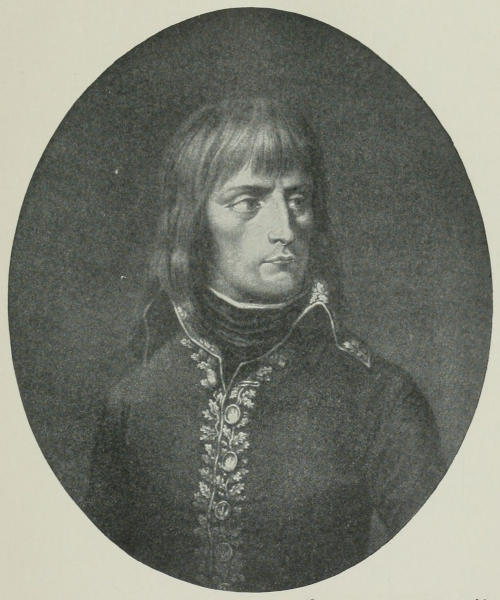
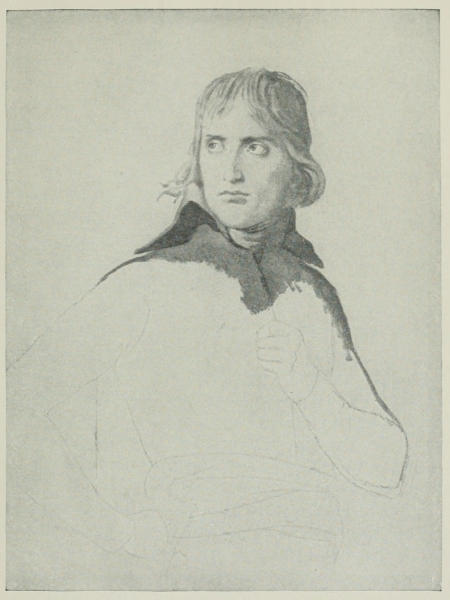
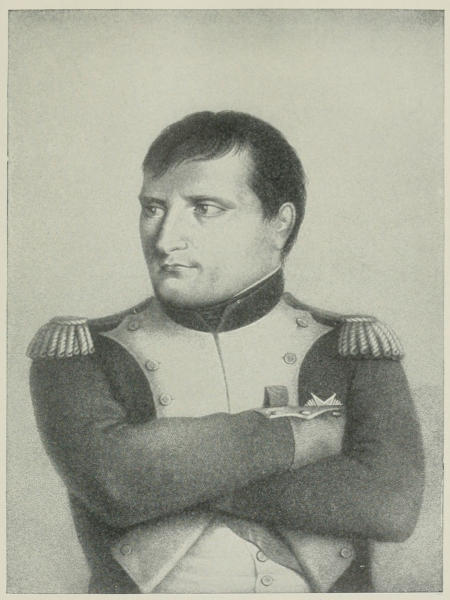
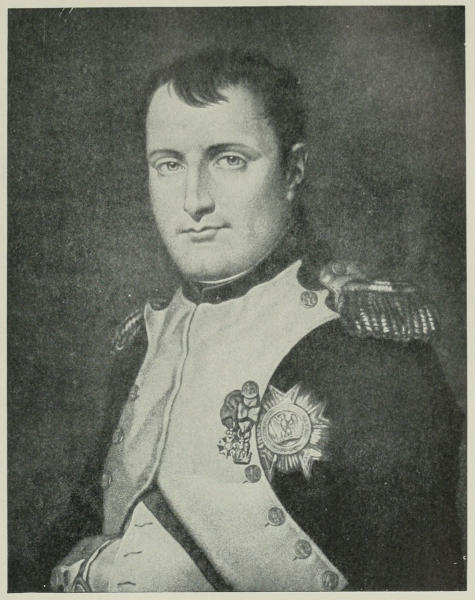
General Bonaparte in 1797. After a painting by Jean Guérin.
Bibliothèque Nationale, Paris.
(From the “Corpus Imaginum” of the Photographic Society, Charlottenburg.)
What had I better do? Report sick? Apply for leave?
The out-of-work general turns the possibilities over in his mind.
Better stay where I am. Paris is the world’s navel. True,
Marmont and Junot, who have joined him without leave, are
also penniless. What’s Bourrienne doing? Speculating? Well,
I can try that too, but assignats are falling. How badly
you staged the last affair. Did you think you could make a
coup d’état without cannon? But to Saliceti, who in his turn
has had serious charges brought against him, and is being
sheltered by a fellow-countrywoman, he writes: “You see, I
might have paid you back in your own coin.... Who has
played the better part, you or I? I might have taken vengeance
on you, but have not done so.... Go in peace, to seek a
refuge where you can, and meditate upon your country to better
advantage. My lips will always be sealed about you. Take
counsel with yourself, appreciate my motives ... they are
noble and magnanimous.”
During these summer weeks, the flood of life is obscurely
murmuring, is heavily pulsing against the shores. He is profoundly
moved by Ossian, the book of melancholy passion; and
he is stirred by the tragical end of plays he witnesses, hastening
from the theatre that his mood may not be jarred by the subsequent
farce. “How preposterous, in this new opera, to give a
happy ending to Paul and Virginie by having the girl rescued!”—“But
what is happiness?” asks the lady to whom he says
this.
“Happiness?” answers Buonaparte. “The highest possible
development of my talents.”
Just now they are lying fallow, that is what troubles him.
He is a prey to increasing dejection and dumb rancour. When
a comedy is being played (the wife of one of his friends reports
this), every one else is laughing, but Buonaparte sits there in
frozen silence. Sometimes he vanishes, to reappear with gloomy
aspect at the other side of the stalls. Often enough his lips are
twisted in an unsuccessful attempt to smile. He is an irresistible
raconteur of campaign stories, but his laughter on these
occasions is rough. He is often to be seen wandering through
the streets, short in the leg, thin, sallow, sickly, irritable of
mien, “awkward, hesitant, wearing an old round hat, from
beneath which two badly powdered ‘dog’s ears’ project, scurf
upon his collar, his ungloved hands are long and lean and dark,
ill-fitting boots.”
He now plans a book traffic with foreign lands; but his first
attempt, with a consignment to Basle, miscarries.
Sometimes he visits drawing-rooms, for, as he writes to his
brother, every one here seeks distraction.... There are
women all over the place, at the theatre, in the Bois, at the
Library. The prettiest of girls are to be found in the studies
of the learned. Indeed, it is right that women should rule here,
for the men are infatuated, living only through and for women.
When Buonaparte is in the salon of Barras, the tribune (who
outdoes himself in splendour and extravagance, so that all Paris
talks; who can never have enough women round him), when he
stands there among women famous for their beauty like Tallien
and Récamier, he, who is small and gloomy and angular, can
only make an impression by cleverness and caprice. Even then
he seems a freak.
Always the solitary, he only “lets himself go” in his long
letters to his brothers. He is educating Louis, and writes:
“The lad is a good soldier. What especially pleases me is that
he combines so many excellent qualities: ardour, spirit, health,
talent, trustworthiness, good-nature.... He will certainly be
the best of us four. Of course, none of us have enjoyed his
advantages in the matter of education.” He is thinking of having
Jerome, the youngest, sent to Paris. He is at odds with
Lucien. This talented brother is his rival. Indeed, Lucien vies
with Napoleon in his knowledge of men, was the first to understand
Napoleon, did so already when he was seventeen while
his brother was twenty-three. “In Napoleon,” wrote young
Lucien to Joseph, “I detect an ambition which is not wholly
selfish, but is greater than his love for the public welfare. In
a free State he would certainly be a dangerous man. He seems
to me inclined to become a despot. I think he would become
one, were he king. At any rate, his name would be a terror to
posterity and to sensitive patriots.” In Lucien’s mouth, such
grandiose vaticination is no mere playing with words. His own
ambition is so intense that in this age and country he regards a
development of the kind as quite possible for his brother, and he
is mortified at the prospect that Napoleon is likely to outshine
him.
For the nonce, Napoleon is in low spirits. He envies Joseph,
whom money and happiness have made independent. He offers
Joseph support in the way of introductions and papers; advises
him to use the depreciated currency for the economical
purchase of an estate. Yet we find him already writing to his
elder brother, apropos of a letter on political questions: “Your
letter was too dry; you must learn to write better than that.”
A home! He wants a home of his own, like Joseph. More
eagerly in each successive letter he urges Joseph to make sure
for him of the wealthy sister-in-law, with whom he has been in
affectionate correspondence for more than a year. When she is
slow to make up her mind, he presses for a decision. His
brother and one of his intimate friends have married well;
comrades of his own age occupy prominent positions. Only
he, with his surging thoughts and imaginative schemes, remains
lonely and does nothing.
“If you are going away for a long time,” he writes to
Joseph, “send me your portrait. We have lived so long in close
companionship that our hearts are intertwined. No one knows
better than you how wholly I am yours. As I write these lines,
I am more moved than almost ever before, feeling that it will be
long before we meet again. I cannot write any more. Farewell,
mon ami.”
He is in a melting mood, and at times he seems utterly discouraged.
“To clamber upwards from step to step, this is
rather like an adventurer, like a man who is trying to make happiness.”
Finally he says: “Life is a trivial dream, which fades
away....”
Suddenly everything is in a flux. A new Minister for War
has been appointed, and he is eager to effect changes on the
Italian front. Does any one know of a new man to whom the
command there can be entrusted? The enquiry passes from
one to another, until some one recommends Buonaparte. He
is summoned to the War Office. For years he has been making
himself familiar with the Italian coast and the Italian frontier,
and forthwith he expounds a detailed plan for a campaign in
northern Italy, against Sardinia and Austria. It is substantiated
by a display of intimate knowledge of the Alpine
passes; of the weather and the snows; of seedtime and harvest;
of the administration, the temperament, and the characteristics
of the territories and the populations concerned. After the
conquest of Lombardy, between February and July, the powerful
position of Mantua must be wrested from the Austrians.
Then the Army of Italy must move northward, and in Tyrol
must effect a junction with the sister army, the Army of the
Rhine. The joint forces will threaten Vienna and this will compel
the emperor to accept a peace which will fulfil all that
France has been expecting or imagining for years past.
Overwhelmed by the cataract that issues from this brain, the
minister can only say: “Your ideas, General, are equally brilliant
and bold. We must examine them closely. Write a report
for the committee. You can take your time.”
“My plan is ready now. I can write it down in half an hour.”
“A notable design,” say the members of the Committee of
Public Safety when the report has been read to them; “notable,
even if impracticable.” In any case, such an intelligence as
this must be utilised in the Operations Department. A few days
afterwards he has a seat in this department, where everything
is decided.
The great moment has come, the turning-point of his youth.
At length he stands on the threshold of his career. The chance
has come suddenly, for everything is sudden in this eruptive
era. From now, when he is barely twenty-six, he will for twenty
years, with unremitting vigour, move onwards towards his goal,
drawing the chain of thought and action after him. Suddenly,
twenty years hence, the chain will snap.
Napoleon’s work begins. With burning energy, attending
carefully to little things because his aim is the greatest of
things, he devotes himself to “affairs.” The veil is lifted, for
here he finds the most secret reports concerning all the armies
of the republic. At the same time, his daily association with
the leading civilian figures in France gives him authority. The
suggestive influence of his personality makes itself felt.
What is the first thing he aspires to gain for himself?
Neither the command in Vendée nor the command of the Army
of the Rhine. These are attainable, tangible magnitudes.
Here, at the centre of all the real fronts, nothing allures him
so much as the thought of a command which as yet lives only in
his imagination; in a battle-ground which does not exist, but
which he wants to create to-day, and which he will again want
to create seventeen years hence. Asia! Directly he gets to
work at the centre of things, he begins to emphasise the importance
of galvanising Turkey into activity, of introducing
artillery and the modern art of war on the Bosphorus, for in
due time they can from that centre be used against the Russians
and the Austrians. In fancy, he already sees himself conversing
with the sultan, beyond reach of the eyes of these everlasting
republicans, in an obscure and closed country into which
the doctrine of liberty has never made its way—a land where
a man can still do whatever he pleases. Twelve days after his
entry into the ministry, he asks to be transferred to Turkey.
The application is refused. Powerful opponents are already
beginning to be afraid of this man. They want to get him out
of the War Office; to send him to the front. His protest takes
a new tone. As if he were foreseeing all the successes that are
still hidden in his own heart, he begins to dictate. “General
Buonaparte, who commands the artillery under the most critical
circumstances and has contributed to the greatest successes,
expects from the justice of the members of the Committee that
they shall reinstate him in his functions, and shall spare him
the distress of seeing his position usurped by men who have
always kept themselves in the background, ... but who now
press forward to snatch the fruits of victories whose dangers
they well knew how to avoid.”
In the third person, in the iron style of the historian.
Roman.
It avails nothing. Once more the insubordinate officer’s
name is struck from the lists, and for a second time he has to
yield. But he feels that his hour draws nigh; nothing, now,
can seriously shake his position. A fresh change of government
is at hand. Announcing to his brother the impending transformation,
he says that he himself is in the good graces of all the
party leaders who will have military posts at their disposal.
“The prospect is rosy. Even were it otherwise, a man must live
in the present. He who has courage, despises the future.”
Because he despises it, it serves him. Henceforward, men
will serve him for the same reason.
A fortnight after this letter had been written, a conflict
broke out between the government and the moderates, who were
backed by the royalists. Once more, there was fighting on the
boulevards, as there had been three years earlier. The National
Guard is four times as strong as the governmental forces.
Either from caution or from cowardice, the general of the
Convention parleys with the leaders of the Guard. He is
declared a traitor, and placed under arrest. The Convention
meets in a panic. It is defenceless, intimidated by the left-wing
and right-wing revolutionaries, who, for various reasons,
have joined forces.
In the evening, Buonaparte hastens to the Convention, for a
successor to the arrested general is needed, and he learns that
the name of one of his rivals has been proposed. The heart of
the silent onlooker beats furiously. Will his name now be mentioned?
If he is asked to take command, shall he accept a task
which he had refused in the days when Robespierre was supreme?
Does not every one who leads soldiers against the
people make himself hated, precisely because of his success?
“Appoint Buonaparte!” Yes, his name has come up. “I turned
the matter over in my mind for nearly half an hour.” Such a
mission will not bring renown, but it will bring power. He
presents himself before the committee. It is past midnight;
the tumult is expected to begin early next morning; everything
must be ready within a few hours.
In this situation, he demands that he shall be absolutely free
from civilian supervision. This seems a monstrous request to
make of the revolution, one of whose new principles it is to lay
especial stress upon supervision of the dreaded military arm.
“If you appoint me, I shall be responsible, and must have a free
hand. To-day, it was the fault of the people’s commissaries
that the general found himself in so precarious a position. Do
you expect that the people will give us permission to open fire
upon the people?” The only man he will share the command
with is Barras, who is the most powerful among the leaders,
but is in his hands. The minutes are passing. There is no
choice.—Buonaparte was entrusted with the defence of the government,
a fortnight after his name had been erased from the
list of general officers.
For seven years the Parisian populace, when roused to
action, has had to encounter nothing more than extemporised
opposition. That is why the revolution has always made headway.
Buonaparte is the first to prepare for the struggle. In
one night, he transforms the Convention into a fortress. Even
the alarmed deputies are supplied with weapons. They are
still more frightened when they hear talk of cannon.
A young cavalry officer, Murat by name, undertakes to bring
forty big guns from the suburbs. Murat thus opens a great
career on the same day as his chief. Out in the streets he finds
the masses, who are likewise on the prowl for artillery. Buonaparte
cannot protect the Convention without ordnance. There
are hours of tension, during which he must tranquilly devote
himself to the disposition of his slender forces. At length, at
five in the morning, he hears the rattling wheels of his old
friends the big guns. Murat’s men were mounted, and they
have won the prize. Forward! Within two hours, everything
must be ready.
In well-armed companies, the crowd advances threateningly.
The lawyers in the Convention are shaking in their shoes.
Speech after speech is made from the tribune, urging a parley,
advocating the withdrawal of the troops. In the daylight, the
situation is so menacing that the civilians utterly lose heart.
They weaken; towards noon, some of the troops want to fraternise
with the people. Night is falling. Now or never! Is
the commander to allow the mob to triumph? In like circumstances,
he had laughed at the weakness of King Louis. Shall
he himself play the weakling, when he is in command of the
guns?
It is probable that Buonaparte ordered the firing of the first
shot, or perhaps extorted the order from Barras, although in
his report, and subsequently, he declared that his opponents
had this “crime against the French people” on their consciences.
Anyhow, the firing begins. The big guns win the day; blood
besprinkles the pavements; the crowd scatters; in two hours the
streets are clear. That night, Napoleon writes to his brother:
“At length it is over; my first wish is to send you news....
We posted our troops, the enemy attacked us in the Tuileries.
We killed a lot of them, our own casualties being thirty killed
and sixty wounded. We have disarmed the companies of the
National Guard, and everything is quiet. As usual, I have
escaped without a scratch. Brigadier General Buonaparte.
Postscript. Luck is on my side. My compliments to Désirée
and Julie.”
This is Napoleon’s first bulletin of victory. The enemy are
Frenchmen; the battle-field is Paris; the offenders are revolutionists;
most of the fatalities are on the opposing side; the
signature, which in earlier and subsequent letters consists of
nothing but the name, includes, to-day, the writer’s military
title. Everything is calculated for effect. But his feelings
break through, and in the postscript he discloses to his brother
the two things he has most at heart: Luck and Woman.
At a later date he said: “I have two men within me, the man
of the head and the man of the heart.”
On the tribune of the Convention stands Buonaparte with
his officers, hailed by the acclamations of the assembly, to whom
the youthful saviour is being presented. He scarcely notices the
applause, for such triumphs of the moment seem of little value
to him. Coldly surveying the hall, he thinks: “So you are the
leaders of the nation. You trembled with fear when you heard
the thunder of the guns! You shall not forget how to tremble!
I have become your protector. I shall go on protecting you
until you have become my humble servants.”
As a matter of course, he is appointed to the command of the
Army of the Interior. He now has a great following: cashiered
officers, who hope to climb in the footsteps of the cashiered
general; officials who have dreaded the reaction; all who feel
that they have been rescued. But the crowd must be learning
to hate him; for, in that darkling hour, hundreds of unarmed
citizens, idle spectators, women have perished. What is that
to him? It is not his aim to be loved.
Now, when he suddenly has money and servants and carriages
at his disposal, he wants nothing for himself, everything
for his kin. His younger brothers are given good positions;
his mother can once more live a life after her own heart, and
gratify her taste for saving; Joseph has the offer of several
posts; there are places for the most distant relatives. But the
letters become rarer, and the very first of them sounds a new
note: “I shall do everything I can to help you, shall spare no
effort which can contribute to your happiness.” From brother,
he has become protector, head of the family.
During these weeks, when he is tasting the joys of fulfilment,
he becomes involved in the only passion of his life.
Désirée has missed her chance. Only a few weeks before,
writing from the office of the general staff, he had implored
Joseph to intervene on his behalf, to demand a prompt answer.
“I am burning with desire to have a home of my own.” At the
same time, in several of his letters, we find more frequent references
to charming women, allusions which betray a happy prospect
of success. He has come to know la femme de trente ans,
in her power and her beauty. He has made advances to two
such women, in quick succession: one of them a Corsican of
noble birth, a friend of his mother’s; the other, a pretty
cocotte, Chénier’s mistress. Both of them are considerably
older than he, and neither of them favours his suit. But the
atmosphere surrounding these practitioners of the art of love,
the electric atmosphere of the new salon, has exercised its influence
on him: “A kiss for the two ladies: for the first, on the
lips; for the second, on the cheek.” Since he has hitherto
known almost nothing of women, his lonely heart is susceptible.
Immediately after his appointment, the new generalissimo
issues a decree against bearing arms. A search is made, and
all weapons in civilian hands are confiscated. Now a boy of
twelve, with engaging manners, turns up at the general’s office
with a plea for the return of his dead father’s sword, which has
been taken away from his mother. Napoleon concedes the
point, and shortly afterwards the mother comes to thank him.
What an elegant woman—wayward, gracious, captivating!
Thirty or more; who can say? Not so much beautiful, as
enthralling; slender; distinguished, but with a slightly foreign
air; the dark skin of the Creole, for she was born in Martinique,
though brought up in Paris; and during the days of the Terror
she has learned to conquer by her charms.
When the general pays her a visit at the little house in an
out-of-the-way suburb, his eyes, sharpened by his own experience
of poverty, detect evidence of an endeavour to put a good
face upon poor circumstances. This does not trouble him. An
army officer, who now, at the age of twenty-seven, can for the
first time dispose of means which enable him to live as he pleases,
he prizes money, but he does not prize rich people. Just as in
the life of affairs, men can only move him by their capacity, by
what they can do; so women can only please him by their
capacity—by their personal appearance, their nature, and what
they can make of these.
Josephine makes a great deal, as she needs to do. From
Martinique, her tropical home, she was able to save nothing
when she lost her husband, Vicomte de Beauharnais. For years
she was separated from him, but was reunited with him after her
return to Paris from a prolonged visit to her native island.
During the Terror, he was executed as a royalist; and she spent
three terrible months in gaol, to be liberated after Robespierre’s
fall on the very day when Buonaparte was imprisoned. Friends
came to her assistance in her difficulties; but her position and
that of her two lovely young children, Hortense and Eugene,
was precarious.
In this genteel poverty, it is expedient for her to make the
best use of her charms. In any case, she is a born coquette,
and is urged towards amorous adventures by the spur of her
own love of pleasure. At this time, she is Barras’ mistress, her
handsome friend Tallien having taken up with a wealthy banker,
handing over the man of might to Josephine. However, the
two women hold Barras in joint control. The Committee of
Public Safety supplies them with horses and carriages. But
Beauharnais, being of gentle birth, knows how to give attractive
dinner parties, and associates with members of both factions,
although the counts and marquises who frequent her
house leave their wives at home. She has become an adventuress
of the revolution.
Well, what about Buonaparte himself? Any change in the
political situation may cost him his position. What more is
he, as yet, than an adventurer of the revolution? If Murat had
failed to shark up those guns the other night, the general would
have been shot. Life is insecure, both for him and for
Josephine.
What can be easier than to befool this misanthropic and
misogynistic man in whose dumb soul the schoolmaster at
Brienne had long ago discovered the hidden volcano? For the
first time in his life he is in the toils of a woman, an expert in
love; he is consumed by his passion for the Creole beauty. To
Josephine, it seems a stroke of luck, and in cold blood she
decides on marriage.
“You have seen General Buonaparte at my house. He is to
become a father to my orphaned children, a husband to my
widowed self.... I admire the general’s courage, and I
wonder how much he knows.... But, I must confess, I am
alarmed at the energy which animates all his doings. In his
questing glance there is something inexplicable, which intimidates
even our Directors. What ought to please me most, the
passionate ardour he displays, is the very thing which makes me
hesitate. Now that I am past my first youth, can I hope that
I shall be able to keep alive in him an affection so stormy that
it borders on madness?”
This lady of refinement does not fully understand what
threatens her, and yet in the depths of her soul she shudders at
the foreboding that she is to become the play of elemental
forces. For, if this man who covets all or nothing and cannot
rest until he has all, this man who has never given himself up to
any one person or any one thing because it has been his unceasing
wish to gain every one and everything, if Napoleon now
gives himself for the first and only time in his life, he will stake
his whole being, and will fetter it to the personality of the
woman whom he clasps in his arms.
“I am waiting for you; I am wholly filled with you; your
picture and the intoxicating evening leave my senses no peace.
Sweet, incomparable Josephine, what have you done to my
heart? Are you angry with me? Do you look sad? Are you
ill at ease?... But I find calm when I give myself up to my
passion, that on your lips, at your heart, I may fan the flames
which burn me. How plain it was to me last night that your
picture can never replace the real you. At noon you will start;
in three hours I shall see you; till then, mio dolce amor, a
thousand kisses! But you must not give me kisses, for they
burn my blood!”
He does not tell her his plans, and yet he tells her something
more. “These Directors fancy that I need their protection.
They will consider themselves happy, some day, to secure mine.
I shall make my way with the sword.”—“What do you
think,” writes Josephine, “of this faith in success? Can such
self-confidence be based on anything else than immeasurable
conceit? A brigadier general is to protect the heads of the
government! I don’t know what to make of it; and yet, often
enough, this ludicrous self-assurance makes me believe that anything
is possible which the strange man wants to achieve.”
We feel as if we were standing in front of the iron door
which guards a glowing human heart, and looking through the
key-hole into the fiery furnace of a soul.
But this woman, whom he possesses, why does he take her to
wife? That he may possess her for himself alone? His egotism
is against it, and, besides, he would be deluding himself. To
gain advantages? In respect of money, and in respect of
influence with the powerful, she can offer him nothing that he
does not already enjoy. Of course she might prove useful to
him; he is certainly flattered that she is of noble birth; and
beyond doubt he has taken into consideration the fact that if
she, who had a place in the days of the old regime, becomes his
wife, this will put an end to the whispers that he is “only a
Corsican.” Yet it is as a Corsican, with the family feeling of
an Italian (a feeling that has come down to him through the
generations, and masters even him), that he desires marriage
with a woman of birth. Finally, is it not obvious that this man
who is so utterly self-centred must passionately long for a
perpetuation of his own ego?
The one thing in the world which Napoleon cannot make
without another’s aid is an heir, and this heir must be made
out of good materials. He is no man of the people. He has
come into being amid the struggles of old families, and beneath
a coat-of-arms bearing two stars which he now wishes to fuse
into one. If he has helped to break down the prejudices against
the masses, he has been moved along this course by delight in
the elemental energy of action, and never by humanist feelings.
Why should he wish to mix his blood with that of the people?
When he marries the woman who long ere this has granted
him all, he does so because, in both branches of her ancestry,
she is the offspring of a long line of noble forebears. It is her
birth, in addition to her charms, which makes her a welcome
figure in a drawing-room, despite her reputation and her position.
Since the Thirteenth Vendémiaire, Barras, the most
powerful of the Directors, has regarded Buonaparte as his
main prop—and he wishes to bind the general to his service by
handing over Josephine. In this realm of erotic freedoms, a
man who should wish, of a sudden, to insist on points of honour
would simply make himself ridiculous. There are no knights
and ladies now, but only citizens and citizenesses, who pair and
separate as they please.
Barras has long since decided that Napoleon shall command
the Army of Italy; and when Josephine, womanlike, is unable to
make up her mind, Barras gives her a definite pledge to this
effect. There are good reasons, too, why he should send the
dangerous man to the most difficult front. Napoleon’s great
plan, the one which has procured him his position on the general
staff, is now sent to Nice, and comes back with annotations
by the commander-in-chief there. The man who has drafted
the plan, says that worthy, must have been a lunatic. He had
better come and try his own hand at the job. That is exactly
what the Directory has been angling for. The writer of the
criticism is recalled, and the “lunatic” is sent to take his place.
The position is assured; the prudent Josephine hesitates no
longer. A legal friend has to certify that no birth certificate is
now obtainable from the blockaded island in the West Indies,
and that the authorities must therefore take the lady’s word
for the statement that she is twenty-eight. Since this knocks
five years off her age, the bridegroom is gallant enough to add
a year to his own. Thus the marriage begins with a twofold
falsification of dates. A marriage settlement arranging for the
division of property is signed, although the vicomtesse owns
nothing but debts, and the warrior declares that his only possessions
are his clothes, his uniform.
In the wedding ring, the words “To Destiny!” are engraved.
Two days later, he leaves Paris. Eleven crazy love letters
are sent to her from eleven halting places. In Nice he joins his
army, and takes over a command which will lead him beyond
the frontiers of Europe.
It is the season of the equinoctial gales. From a turret he
looks across at the enemy coast, and thinks: “This is the place
I have always coveted as a starting-point. Behind me lies Paris;
and her bedchamber, hung with mirrors. That is happiness.
It is mine. Over there, across the mountains, in that hostile
land, is fame. The goal of my desire.”
As he turns away, he catches sight of a familiar line of
mountains shimmering in the distant blue. No longer does this
hold his attention.
It is his lost homeland. The island.
BOOK TWO THE TORRENT — I — II — III — IV — V — VI — VII — VIII — IX — X — XI — XII — XIII — XIV — XV — XVI — XVII — XVIII — XIX — XX
So divine an illumination is always linked with youth and
productivity; and, in very truth, Napoleon was one of the
most productive men that ever lived.—Goethe.
The towering peaks form a white, serrated ridge that thrusts
upward into the blue of morning. Gleaming with perpetual
snows, dangerous as the adventure he has undertaken, the Alps
look down threateningly upon the bay, and mock the teeming
crowds of men. Invincibly does nature, in symbolic fashion,
here call a halt to the commander; here she has interposed a
barrier between the land of his fathers and his new fatherland.
But he, who never trusts in force alone, who always outbids
force with prudence, has to good purpose been pondering the
old problem. Hannibal crossed the Alps; he, Napoleon, will go
round them. If we come to grips with the enemy at the weakest
point, where the Apennines press close to the Alps and a slight
depression facilitates an entry, we need not wait for the summer.
The earlier in the year, the firmer the snows, and the less
danger from avalanches. Forward, into the land of my fathers!
Delay will be fatal. Not that the enemy is a danger to him.
His foes are asleep in winter quarters: the Austrians in the
east of Lombardy; the Sardinians in the west of the Lombard
plain; and the numerous petty republics and duchies, the fragments
of Italy, are not expecting an attack until the thaw has
come. But the French soldiers are hungry. Paris, on the
verge of ruin, through depreciation of the currency, can send
them nothing but almost valueless assignats; and all of these
disappear into the greedy maw of the army contractors.
“France would tremble,” said one of the generals in his letters
home just before Bonaparte’s arrival, “could every one know
how many are dying here of famine and disease.” What will
the new commander do if he brings neither money nor bread
with him?
“Soldiers, you are half starved and half naked. The Government
owes you much, but can do nothing for you. Your
patience, your courage, do you honour, but give you no glory,
no advantage. I will lead you into the most fertile plains of
the world. There you will find flourishing cities, teeming
provinces. There you will reap honour, glory, and wealth.
Soldiers of the Army of Italy, will you be wanting in courage
and firmness?”
A faint cheer from the ranks answered the new commander
when, at the first parade, he addressed his men in the foregoing
words. But when they were all back in camp, one said to
another: “General doesn’t look very weatherproof, with his
yellow hide. Fine talk, that, about the fertile plains. He’d
better let us have some boots first, so that we can march
there!” The people of Israel must have grumbled in much the
same fashion when Moses spoke of the Promised Land. The
new commander encounters nothing but opposition.
Who knows him among the soldiers of this army, which has
now been encamped for three years on the crests of the hills?
Those of them who remain, that is to say: for a fourth of the
men are in hospital; and an equal number have been killed, or
taken prisoner, or have deserted! The officers? Will not they,
like those captains in Auxonne seven years ago, be inclined to
encounter this wonderful young man’s orders with passive
resistance rather than ready obedience? Look at him as he sits
there writing and calculating; his powdered hair is cut in a
fringe over his forehead, but lengthens towards the back of the
head to hang down over his shoulders; his coat is simple and
scantily embroidered; he walks up and down and issues dictatorial
orders, this foreigner whose French is still faulty. Not an
officer in his staff is well-disposed towards him, except the three
or four faithful followers whom he has brought with him. One
of these latter tells us: “They looked upon him as a mathematician
or a visionary.”
What if he be both at once, and for this very reason a man
of genius?
At first, he seems to be nothing but a calculator. Consider
one of his early letters to the Directors—for he promptly opens
an epistolary campaign, carried on side by side with a campaign
of cavalry and by guns, waged with the same ardour and
the same success. “You are asking me to perform miracles,
and I cannot do that.... Only with prudence and foresight
can we achieve great ends. It is but a step from victory to
defeat. In affairs of magnitude I have learned that, in the
last resort, everything invariably turns upon a trifle.” But to
Carnot, the great army organiser, to whom he can say much
that is unsuitable for his official dispatches, he writes, gnashing
his teeth: “Would you believe it, that I have not a single
engineer officer here, not one who has ever taken part in a
siege!... You can hardly conceive how furious I am that I
have no artillery!” His actual resources totalled 24 mountain
guns, 4,000 underfed horses, frs. 300,000 in silver, and enough
food to supply his 30,000 men for a month on half rations.
With these vestiges of an equipment, he is to conquer Italy!
Nevertheless, having undertaken the venture, he makes the
best of the materials at his disposal. Getting to work like a
hurricane upon this crowd of pitiful men who have run to seed,
upon corps some of which have already begun to sing the royal
anthem again, with indefatigable energy he succeeds in transforming
them into a republican army.
Here are some of his doings on the third day after his
arrival. Sending a hundred and ten workmen to make a road.
Suppression of a mutiny in a brigade. Quartering of two
artillery divisions. Orders to two generals in case of horse
stealing. Answer to the requests of two others concerning their
commands. Order to a general in Toulon to bring his men to
Nice. Order to another general to call up the National Guard
of Antibes. Order to a general to find the most efficient officers
in the mutinous brigade. Address to the general staff. Review
of troops, with orders of the day.—During the first
twenty days, one hundred and twenty-three written orders
relate solely to the provisioning of the troops; among them are
numerous complaints concerning peculation, short weight, and
inferior goods; and these orders are issued on the march, from
twelve different headquarters, in the interludes between six
skirmishes.
For hardly has he passed through the narrow defiles than,
in accordance with his new principle, he has massed his forces
to attack first one and then the other of the allied foes, and in
two battles he defeats and separates them. In truth, these were
mere advance-guard skirmishes, as becomes the nature of the
French, and the previous training of these troops, which as yet
know nothing of a great movement in open lines. At this stage
of his campaign, speed and boldness are more important than
elaborate strategy.
When he is on one of these breathless rides, in the deep mountain
valleys, through the passes, amid the thunder of his own
and the enemy cannon, suddenly the glass covering Josephine’s
miniature (which he carries in the inner pocket of his tunic,
and has kissed hundreds of times) shivers into fragments.
Growing paler than ever, he reins in his charger, and says to
Bourrienne: “The glass is broken. My wife is ill or unfaithful.
Forward!”
Everything depends upon the fulfilment of his first old
pledge. He knows that if, this once, he is able to do what he
has promised, the army will believe him; and if it believes him,
it will soon believe in him. In actual fact, a fortnight after his
prophecy had been uttered, the army, which had won its first
victories on entering the downward grades, found itself on the
last elevation. The soldiers raised a hearty cheer. After the
weary days in the narrow valleys, they at length caught sight
of the plains of Piedmont lying at their feet, stretching out into
the immeasurable distance, blossoming in the spring weather,
offering all that they had gone short of for so long. The Po
and other rivers were flowing towards the horizon, and at length
the world of snows lay behind. “As if by a magician’s spell,
they had been enabled to cross the gigantic barrier, which had
seemed to them like the frontier of another world.”
“All this is yours!” Their commander has forced one of the
two opponents, the king of Sardinia, to make truce, thus compelling
the surrender of everything that grows on Sardinian
territory. This first truce of his campaigns was secured by
Bonaparte through cunning and bluff, for he threatened the
enemy with the use of overwhelming forces, which he did not
possess, and, indeed, could not have used, pressed as he was
on both sides. The soldiers are amazed; their general is a man
of his word! Literally, in a fortnight, he has fulfilled his
promise.
Henceforward, the men under his command put their trust
in Bonaparte. It is as Bonaparte that he begins to sign
himself from the outset of the campaign. Since Italy is the
enemy, he will have nothing more to do with an Italian name.
Ere long, he will change his name again.
Why was he victorious? How can we explain that during
the next few weeks he was able to deliver blow after blow?
What is the solution of this riddle?
First of all, he owes his success to youth and health. A body
that can endure interminable riding without fatigue; the power
to sleep at any moment, and to wake whenever he pleases; a
stomach which can digest anything, and makes no complaint at
being put on short commons; eyes that see and arrange everything.
But it is to the revolution that he is indebted for the fact
that at the age of twenty-seven, when his splendid powers are
in their first vigour, he has risen to a leading place, and can
wield unrestricted dictatorship. Only, thanks to the new ideas
of equality, in a world which prizes a man for what he does and
not for his birth, can any one become a leader in the prime of
youth and after so rough an apprenticeship.
Look at the men who are in the field against him. Archduke
Charles, with his delicately shaped and decadent Habsburg
nose, how can he, with his education, vie with the Corsican in
indifference to hardships, rival Bonaparte in knowledge of men?
How can Beaulieu, the Austrian commander, cope with the
French general? The former is seventy-two; the latter, twenty-seven.
General Colli suffers from gout, and has to be carried
throughout the campaign. Alvintzy is in the middle sixties.
The king of Sardinia is an old man. What can the excellent
General Wurmser, who is deaf, and a slow, elderly gentleman,
cautious in his movements, do against a commander who thinks
nothing of changing his headquarters every day, who surrounds
himself with young men, and who takes “Time is everything,”
for his motto?
The oldest man in Napoleon’s circle is the faithful Berthier,
now forty-two, whom the new commander has taken over from
his predecessor because Berthier has a good knowledge of the
country. For two decades he is to be Bonaparte’s slavishly
devoted chief of general staff. Next to be mentioned comes
Masséna, a man of ardent temperament, who had been a cabin
boy and a vagrant, and had served fourteen years under the
Bourbons without rising to the rank of sergeant major; now,
within a few weeks, he was to become a general. Augereau, too,
a deserter from three armies, boaster, adventurer, and great
thief. Such were the men drawn from the dregs of society out
of whom their commander, the youngest of them all, was soon
to make heroes and generalissimos, and subsequently princes
and dukes.
In every dispatch, he recommends for promotion those, and
only those, who have displayed courage. Thus, after three
battles, a grenadier rises to the rank of colonel, and will climb
yet higher. On the other hand, many of the generals whom he
has taken over with his command are dismissed with blunt censure:
“Good enough for office work, knows nothing of war.”
His subordinates do not necessarily incur his displeasure because
they are beaten: “The fortune of war, dear Masséna,
changes from day to day. To-morrow, or later, we shall win
back what you have just lost.” But a division which has done
badly is paraded to hear a rating. He says that he will have
a mocking inscription worked upon its colours. Then the
soldiers cry to him from the ranks: “To-morrow we will lead
the van.” Next day, he has a thousand more enthusiasts
among the troops. When they are victorious, in the orders of
the day he calls them comrades and friends. Thus does he
lead the sons of the people.
For it is a people’s army that he is leading; that is the
second great factor of his success. This, too, he owes to the
revolution. Indeed, the people’s army is an expression of the
revolution. The soldiers on the Austrian side must be used
thriftily, for they cost a great deal, and it is not easy to
replace them. They are drawn from a larger number of
nationalities than the German emperor himself rules. Six
different languages are spoken in the army, and there is no
community of thought to hold it together. But the French
are fighting as a united nation of thirty millions, and their army
will be capable of perpetual regeneration for twenty years to
come.
What is the French army fighting for? The new freedom of
the republic, and to spread throughout the world the few and
simple ideas which animate it! The French are fighting for the
world revolution, and nothing short of that. But the army is
not in pursuit of purely ideal aims. It has to defend liberty
against the environing forces of legitimate monarchy, against
the legitimists who are more concerned with self-defence than
with the cause of the fallen Bourbons. The French cannot
achieve their end by simply defending their own frontiers.
They are surrounded by kings and emperors who wish to keep
their peoples from any attempt to imitate the French revolution,
and are therefore trying to destroy the very focus of the
new ideas. Thus France is forced to assume the offensive as a
means of self-defence. Those who in such a fashion become
conquerors in spite of themselves, are surely entitled to declare
that their conquests are achieved in the name of liberty.
This brings us to the third factor of Napoleon’s success.
While the commander is engaged in the attempt to conquer
Lombardy, and then Italy, for France, he issues a series of
manifestoes to tell the inhabitants of the territories he is invading
that he comes to free them from the Habsburgs and the
Sardinians, from dukes and patrician senates. Will not all who
have been discontented with the old order be roused to action
by the torrential force of such appeals? Have not the oppressed
masses long had it in mind to rid themselves of their
rulers? Have not the ideas of the revolution crossed the frontiers
years ago, rousing, in many of the towns, students and
burghers to revolt? Here in Italy were young people who
longed for freedom; leaders who had been vainly clamouring for
“Italia unità.” The revolt, though still in chains, was rattling
its chains outside the kings’ palace doors. The malcontents
were ready to welcome the invading army, and to believe in its
mission.
The commander, a man of Italian blood, bearing an Italian
name, and speaking Italian as his mother tongue, was not for
them a French warrior. He was the herald of liberty and
equality, and the two great words headed all his letters. How
terrible would be the disillusionment, should the invader prove,
after all, a foreign oppressor! The commander is well aware
how much turns upon this. Will he be able to keep his famished
army within bounds? Can he make his soldiers behave as well
as if they were fresh from a well-provisioned garrison town?
“Looting is on the wane,” he writes home. “The thirst of an
army which lacked everything has been quenched. There is an
excuse for the poor devils. They have spent three years in the
marches of the Alps, and now I have led them into the Promised
Land! A famished soldier perpetrates excesses which make one
ashamed of being a man.... I intend to restore order, for
I will not remain in command of a robber band.... To-morrow
I am going to have several privates and a corporal shot,
for having looted the plate from a church. Discipline will be
re-established within a day or two. Italy has been amazed at
the valour of our soldiers, and shall be amazed at their good
behaviour. There have been terrible moments; things have happened
which have made me shudder. Thank God, the retreating
enemy behaved even worse!”
He puts his men on their honour. “Swear to me”—thus runs
one of his early manifestoes—“to spare the peoples you are
liberating; otherwise you will be the scourges of the people!
Your victories, your courage, the blood of our fallen brothers,
will be lost; honour and glory, too! I and my generals would
blush at leading an undisciplined army!” Hard to carry out,
despite his adjurations. Throughout the campaign, he is
hampered by this problem of looting. Again and again he
issues orders to his generals telling them they are to shoot
any one who fails to hand over his plunder within twenty-four
hours, even if the stolen goods be horses and mules.
There are revolts and counter-attacks. Priests and nobles,
agents of the princes, incite a town to resist. He is pitiless in
his shootings, ruthless in his reprisals, whenever, in the conquered
territory, any one raises a hand against the new master.
But this becomes increasingly rare, for in the towns he is
skilful in enlisting the civic sense on the side of a new order
which assumes imposing lineaments. He understands (and this
is an additional factor of success) the Italian temperament;
knows how to appeal to the sense of historic veneration: “Peoples
of Italy, the army of France comes to break your chains.
It is a friend to all the peoples. Have confidence! Your property,
your customs, your religion, shall be respected.” He goes
on to speak to them of Athens, Sparta, classical Rome.
History inspires him. While with rapid strokes he is making
history, history gives his spirit wings. In boyhood, he had
studied Plutarch; as lieutenant, he had read the history of all
times; now, from moment to moment, he turns the knowledge
to account. Knowing who has ruled in every part of these territories,
understanding how the governments he has overthrown
came into being, he has appropriate measures for each area.
Time-honoured figures are ever present to his imagination; he
wants to resemble them, to outdo them. Thus, whatever he
does is conceived in a historic setting; and he compels his army,
the country with which he is dealing, and, soon, Europe as a
whole, to breathe the same atmosphere. These first victories,
which in reality are nothing more than big skirmishes, are by
the magic of his words transformed into battles, and the battles
are magnified into history. In this way, half of what he
achieves is achieved by the power of words. To the lands he is
freeing, to his soldiers, he invariably suggests that they have
done the whole thing themselves. Read his proclamation to the
army in Milan.
“Soldiers, like a torrent you have rushed down from the
heights of the Apennines.... Milan is yours.... We are
the friends of all the peoples; but, above all, we are the friends
of the offspring of Brutus and Scipio and the other great men
who are our models. To re-establish the Capitol, to set up there
the statues of the heroes, to awaken the Roman people which
for centuries has been paralysed by servitude—that is the fruit
of your victories, that will amaze posterity. It is your title to
immortal fame that you have given a new visage to the most
beautiful land in Europe.... Then you will return to your
homes, and your neighbours will point you out to one another,
saying: ‘He was with the army in Italy!’”
Did a commander ever before make such alluring appeals to
soldiers and peoples, to friends and foes? Who understood so
well as Napoleon how to influence people through their imaginations
instead of through a sense of obedience? At Arcola he
shouts to his men: “Are you cowards, or are you the victors of
Lodi?” In a month or two, he will be urging them onward by
reminding them that they are the victors of Arcola. “We have
crossed the Po, and have opened the second campaign,” he
writes to the Directors. All his reports to Paris are penned
with consummate art. What he writes is the truth, but it is so
skilfully adorned that it develops a life of its own as soon as
the government communicates it to the press, and when from
France it makes its way into foreign lands.
With the pen, Bonaparte rounds off the victories he has won
with the sword.
“I have received your peace treaty with Sardinia. The army
has approved it.”
The Directors quake as they read the words. The arrival of
this dispatch cancels the joy they had felt at the coming of so
many captured colours. When, before, had a general in the field
dared to write in such a fashion to his government? “For this
letter, the young hero ought to be stood up before a firing
squad,” cry his opponents. But the fame of his victories, the
glory of his conquest of Lombardy, have already secured him
so strong a position in the hearts of the people that no one
dares attack him. Recently, when the governmental commissary,
his fellow-Corsican Saliceti, came to his camp, Bonaparte
ignored the official’s authority, and himself signed the truce
with Sardinia. These negotiations were the first in which he
proved his mettle as diplomatist. When the other side wanted
to bargain, he took out his watch, named the hour at which he
had decided to attack, and said they had better make up their
minds quickly. “I may lose battles,” he said, “but no one will
ever see me lose minutes either by over-confidence or by sloth.”
With this truce, he for the first time dispossessed a king. Without
asking for instructions, he entered into negotiations with
the dukes, with Tuscany. Was he not, before long, to do the
same thing with the pope? What was the best way of dealing
with this dangerous conqueror?
“We will send him a partner,” thought the Directors, with a
smile. “Let him share the supreme command with Kellermann,
while Saliceti decides upon political issues.” Orders to this
effect reached him at Lodi, on the day of battle.
That was the first real battle he had won. A colossal bluff
and a bold movement enabled him to storm the bridge over the
Adda and to defeat the alarmed Austrians. There were to be
much greater victories in days to come; but, in the history of
the man’s spiritual development, not one of them was to equal
this in importance.
For now, after a battle which decided the first part of his
campaign, having taken much booty and sustained only trifling
losses, and having made himself master of a territory opened
to him by an hour’s struggle on the bridge,—this evening,
Bonaparte feels for the first time how obscure plans and brilliant
exploits of war, dream and reality, are interconnected.
The consciousness of his own powers makes him realise that
boundless possibilities lie before him. That was the first time
on which a word concerning such aims crossed his lips. To his
friend Marmont he said: “I feel that deeds await me of which
the present generation has no inkling.” Long afterwards, in
retrospect, he declared: “That evening, after the battle of
Lodi, I first became aware that I was an exceptional man; from
then I date the awakening of an ambition to do the great things
which hitherto had existed for me only as the fantasies of a
dream.”
Such was his mood when the new orders came from Paris.
What? The conquest of two or three continents was looming
before his imagination—and he was to go halves with Kellermann?
He strode up and down the room, pursing his lips, and
then he issued his fiat to the government:
“If you put hindrances in my path, if you make my actions
dependent upon the commissary’s decision, ... you must not
expect any more good results from me.... Here it is indispensable
that you should have absolute confidence in your commander.
If I do not enjoy that confidence, I shall without
complaint endeavour to win your approval in some other post.
Every one has his own way of making war. General Kellermann
has more experience, and would doubtless do it better;
but, together, we should do it badly. I cannot serve the country
unless I have your complete and undivided trust. Much
courage, I know, is needed to write you this report, for it would
be easy to charge me with ambition and pride! But you are
responsible for my having to express my feelings.... I cannot
serve jointly with a man who regards himself as the best
commander in Europe. For the rest, one bad general is better
than two good generals. With war, as with governance, it is a
question of tact.”
The general does not seem inclined to yield up his place to
any one. If the authorities in Paris insist on a divided command,
is it not likely that he will march ahead on his own
initiative, gain further victories with his unaided talents, then
turn back to threaten France, and, as a condottiere, overthrow
the government? The Directors think it will be better not to
insist; with a smile, a wry one this time, they give way. After
his first, noiseless victory over the government, Bonaparte feels
he is master. Henceforward he behaves, substantially, as a king
who is his own commander-in-chief, but who can only secure
reinforcements and other requisites by reiterated adjurations.
For months and years, therefore, his dispatches are still written
in the tone of a subordinate; of one who does not threaten,
but advises. Yet in reality he acts all the time as if he were
already in the land of the sultan, towards which his masterful
character draws him.
The Paris courier has been sent off. Bonaparte’s first “No”
is on its way. Another restless night in camp, and then to
Milan!
In everything, he imitates the Roman general celebrating a
triumph. As of old, the prisoners lead the way, the only difference
being that nowadays they are not in chains. They are
followed by five hundred cavalrymen. The citizens, who are
used to seeing brilliant uniforms, are astonished at the tattered
tunics, the sorry screws, the jaded appearance of the riders;
and they are still more amazed when they see the thin little
man on the inconspicuous white nag, at the head of his weary-looking
suite. How grey the whole procession looks in the
light of this brilliant spring day. At the gate the venerable
archbishop, with a train of counts and dukes, bids him welcome.
He dismounts, but does not draw near to the reception committee;
he merely listens with forced politeness to the words of
greeting. The onlookers are wondering what answer he will
make. For a few seconds he keeps his lips tightly pressed together,
and then contents himself with a single sentence, to the
effect that France wishes the Lombards well. Remounting, he
salutes, and rides on.
Leaders and crowd are deeply impressed; no enthusiasm,
only astonishment. Not a sign of arrogance about this conqueror;
nothing but resolution, and a force of will before which
all must bend. Was his conduct deliberately planned to produce
such an impression, though never before had he experienced
anything of the kind? Was he “play-acting”? If so,
all the more remarkable his knowledge of men; all the more
plain that he was a master of the ruler’s art!
Nevertheless, he is absent-minded to-day, for he has not all
that he wants.
Now, the streets echo to the shouts of the crowd, who cannot
restrain their expressions of astonishment as they watch the
men who follow the commander—marching in a slack and almost
disorderly fashion, clad in scarecrow uniforms patched with
many colours. These Frenchmen seem in almost sorrier case
than the prisoners!
General Bonaparte in 1796. Engraving from the Kircheisen
Collection.
The commander is taking his ease in the archbishop’s palace.
He is having a bath. Hot baths are his one luxury, a luxury
that he will continue to indulge in down to the day of his death,
taking them hotter and hotter, staying in them longer and
longer, as time goes on. Nothing can break him of the habit,
for a hot bath is the only thing which really refreshes him,
soothes his nerves. In the evening there is a reception. “You
will be free, and in a safer position than the French. Milan
will be the capital of this new republic, which has a population
of five million. You shall have five hundred pieces of ordnance,
and the friendship of France. From among you I will choose
fifty men, who shall rule the country in the name of France.
Adopt our laws, modifying them to suit your own customs....
Be sagacious and united, and all will go well. Such is my will.
If Habsburg should again seize Lombardy, I swear to you that
I will take up your cause, that I will never desert you. If your
land perishes, I shall be no more. Athens and Sparta did not
last for ever!”
Never since the days of Plutarch’s heroes did a commander
talk like this. It was the conqueror’s first speech from the
throne, and was compounded of all the elements with which, in
his speeches and letters, he was to work upon the mind of
Europe for twenty years to come. Everything is single and
definite; there is so much fixity of purpose that every one
wishes to comply. You are vassals, but free. I am your master,
but I will protect you. Five hundred pieces of ordnance
and the friendship of France. “Such is my will.” Then it is
all over.
Through the May night, the wealthy town blazed with fireworks
and resounded with music. The young commander-in-chief
has moved on to the Palazzo Serbelloni; the banquet is
over, and he stands at the window. The triumphal entry of
which he dreamed in youth, towards which his virginal fancy
strained, has now been accomplished. Does he look forward or
back? With what is his mind busied?
“What do you imagine the Parisians are thinking of us?”
he asks his adjutant. “Do you expect they are satisfied?”
When Marmont makes the conventional reply, Napoleon goes
on: “But Paris has seen nothing, so far. The future hides
much greater victories. The goddess of fortune has not smiled
on me that I may scorn her. The more she favours me, the
greater shall be my demands. In a few days we shall reach
the Adige; then Italy will be at our feet. Perhaps we shall
cross the river, and press onward. Our age has produced nothing
great. I want to set an example.”
A royal couch in the Serbelloni Palace; never has he lain
so soft before. But it is far too wide for one! Where is
Josephine? What are triumphal entries and victories worth,
without her? Fireworks and flags! Why has she not come?
Is she really ill? Has she a lover?—He lies awake for hours.
From the very first this man, who inspired respect even in
the veterans among the generals, imperilled that respect by
his way of showing his wife’s picture to all and sundry, and
when he was in the middle of a conversation about service matters.
“You will come soon, won’t you?” So he wrote in one
of his almost daily letters. “You must come to me. I want
you on my heart, in my arms! Quick! Fly, fly!” He knows
her frivolous disposition; that her senses are easily aroused;
that she is always ready to give herself up to new impressions,
new admirers. But now, now! What can be keeping her? He
had expected her to come to Milan. His ambition had been to
escape thither from the savagery of the campaign, that in one
of the palaces of that city he might give her capricious charms
a splendid setting worthy of her and himself.
But there is something which our great calculator has left
out of his calculations. By his very feats of arms, he has kept
her away from his side. For years in Paris she has been living
in the half-world. Now, in this city which she loves, she wishes
to shine forth in an assured position, as wife of the great commander
whose name is in every newspaper, on every one’s lips.
Does the little general really think she married him for love?
When the first captured colours are exhibited, she drives out
among the people, and, while she is loudly cheered, she thinks
to herself how much more gratifying this is than to rough it
in foreign towns surrounded by unmannerly soldiers. She
seldom writes to him. His own words grow ever more urgent.
“Have you a lover, have you taken up with some stripling of
nineteen? If so, you have reason to dread Othello’s fist!” She
laughs, and says to Tallien: “A queer fellow, this Bonaparte!”
Another day, in the middle of a letter to Carnot dealing with
urgent affairs, he writes: “I am in despair. My wife won’t
come here. I am sure she must have a lover, and that that is
what keeps her in Paris. I loathe women, one and all!” Then
comes a letter in which she grasps at an expedient. Since there
is no other way of avoiding the dangers and the dirt of camp
life, she writes to him that she has hopes....
Thunder and lightning! Have all the spirits of good fortune
united to shower blessings on him? Among his successes,
that was the only thing he lacked to complete his happiness.
For, if destiny is to carry him to the lofty altitudes he foresees,
to the heights he has resolved to scale, then his greatest
need is to have heirs. But this battle is only planned, not yet
won; new dangers are impending. He shudders. Is it true?
Is it his child?
“I am sorry!”—the words are penned in his almost illegible
handwriting on the commander-in-chief’s official stationery. “I
have been pestering you with complaints, and you are ill. Love
had robbed me of reason. Forgive me, but I think I shall never
be reasonable again. My life is an unending dream; gloomy
forebodings make it hard for me to breathe; I have lost all
hope. Write me ten pages, for nothing else can console me.
You are ill, you love me, you are with child, and I never see
you. Who takes care of you? Hortense? I love the sweet
girl more than ever when I think of her as taking care of you....
Soon you are to have in your arms a child as fascinating as
yourself. If I could only spend a whole day with you. You
know, if I saw a lover with you, I should instantly tear the man
to pieces!”
But who is to help her through her time of trouble? There
is no friendship in the world, only the ties of blood. “I am in
despair,” he writes to Joseph under the same date. “My wife
is ailing; I do not know whether I am standing on my head or
my heels; dreadful forebodings rack my heart. Write to me,
I implore you. Since early childhood, we have been bound
together by kinship and affection. Do for her what I would
so eagerly do for you.... You know how much I love her;
know her ardent nature; know that I have never loved so passionately,
that Josephine is the first woman whom I have
adored. Her condition drives me crazy.... But as soon as
she is well again, well enough to travel, she must come to me.
I must have her in my arms; I love her to distraction, and cannot
live without her. If she no longer loves me, there is nothing
more for me in the world. Oh, mon ami, do not keep the courier
more than six hours in Paris; send him back to me with an
answer which will give me new life. Be happy! For myself,
nature has doomed me to win none but outward victories!”
On the same day, he dictates, inter alia: Order to Berthier
to occupy Alessandria; dispatch to the Directors concerning
urgently needed reinforcements; ultimatum to the Genoese
Senate anent the murder of soldiers; letter introducing Murat
to the same Senate; plan to sell some cannon which are still
left on the Riviera; order to Masséna to procure ammunition
from the arsenal in Venice; order to Lannes to advance no
farther; order to send all suspects to Tortona; order to send a
division to Toulon; report to Kellermann that money and
troops are on the way.
His letter has an effect. Joseph asks Josephine to come with
him to Milan. What pretext can she find for refusing? She
sighs, packs her trunks, sheds tears at a farewell festival in the
Luxembourg, gets into the carriage. After all, to-morrow is
the thirtieth of June, the season is at an end, and she has good
company for the journey. Of course Joseph, her vis-à-vis, is
a homely fellow, but Junot is a dapper young man; Fortuné,
her lap-dog, is a darling, as ever. Then there is Charles,
another young officer whose acquaintance she has recently
made, and who has danced attendance on her ever since. Is
he on the lookout for a career, or a conquest? What a choice
Christian name, Hippolyte! How fine he looks in his chasseur
uniform. He tells such amusing stories, has an expert knowledge
of the latest shawls and wigs, and his legs are so well
turned!
Milan. Bonaparte is away? More battles near Verona?
No matter, this is a lovely place! Such a splendid palace;
they all flock to pay their respects. But Hippolyte is hors
concours; no one can rival the grace with which, sword clanking,
he strides up and down the Corso. What a pity one has
to be circumspect in one’s behaviour under so many prying eyes.
But Hippolyte knows his way about, and has found a discreet
staircase....
Suddenly there is a stir of excitement. The commander-in-chief
is coming from Verona. For two days and two nights,
the lava of this volcano overwhelms her.
Thrice do the soldiers of Emperor Francis try to relieve
Mantua, which Bonaparte is besieging. Mantua is the key
position. Old Wurmser, marching down beside Lake Garda
with fresh troops, drives back the opposing forces. If Bonaparte
is to make front against him, Mantua must be abandoned
for a time. Meanwhile, however, the enemy has blocked the
line of retreat upon Milan. A terrible reverse, and the French
army is in the utmost danger. Bonaparte, hastening from
Milan, rides under the hot July sun across the plain, busily
inspecting one division of the army after the other, gathering
all his strength, for the fate of the whole campaign is at stake.
A period of the utmost activity, and of extreme tension.
“Since I left you,” he writes on one of these evenings, “I
have been sad. I can only be happy when I am near you. I
spend my whole time thinking of your kisses, your tears, your
bewitching jealousy. The charm of the incomparable Josephine
is perpetually rekindling the flames of my heart and my senses.
When shall I be free, at length, free from cares and duties,
free to devote all my time to you, with nothing in the world
but to love you.... Since I have known you, I have come to
respect you more day by day, which shows how wrong La
Bruyère was when he said that love comes suddenly. Everything
in nature runs its course, and increases by degrees....
Be less beautiful, less tender, and above all less jealous. Your
tears inflame my blood.... Join me quickly, so that, before
we die, we may be able to say: ‘We have had so many happy
days!’ A million kisses, even for your horrid Fortuné!”
Neither now nor later could the commander-in-chief rid his
home of this lap-dog. He tells us that on his wedding night
the dog was in bed with Josephine. “I had to choose between
sleeping beside the beast or not sleeping with my wife. A
terrible dilemma, but I had to take it or leave it. I resigned
myself. The dog was less accommodating. I have the marks
on my leg to show what he thought about the matter!”
Amid the hurly-burly, the general’s lady arrives at Brescia.
Almost immediately she has to be sent back to Milan. She
has a narrow escape of being seized by the enemy, together with
some recruits and cannon. Now she has an excuse, and, in the
future, she will be slower to comply with his invitations.
During these weeks, Bonaparte for the first time loses courage,
though it is only for a few hours of one night. Instead
of simply issuing orders, he holds a council of war, much to the
astonishment of his generals. In this critical situation, he
proposes to retreat across the Po, but the mad Augereau
thumps the table, shouting: “For the sake of your own fame,
I insist that we attack.” He flings from the room. The counsels
of the others are divided.
See him before the decision, brooding over his maps. He is
alone. Moths are fluttering round the candles, and at last
burn themselves to death. The midsummer night is sultry.
As he listens to the drums and the shouting without, he thinks:
“To-morrow will settle whether we can keep Lombardy. Perhaps
it will be the turning point in my fame, my destiny. Shall
I stake all on one card? What if Wurmser’s strength is greater
than the reports say? Josephine is sleeping now, in the great
bed. Or, who knows, she may be laughing softly in the embrace
of some puppy who has bewitched her.”
He decides to fight. Next day, he is victorious at Castiglione.
Soon afterwards, he writes: “Three days without a letter
from you; I have written daily. This separation is terrible;
the nights are long and savourless, the days monotonous.” At
this time, Josephine writes to Tallien in Paris: “I am bored to
death.” He is busied in battles and victories; she is fêted and
honoured. To both of them life seems wearisome: to him, because
she is too far away; to her, because he is too near. Three
days later: “The enemy has been beaten, my darling. Eighteen
thousand prisoners, the others dead or wounded. Wurmser has
only Mantua left. This is the biggest success yet: Italy, Friuli,
and Tyrol are saved for the republic. In a few days we shall
see one another again, that is the reward for labour and pains.
A thousand glowing kisses!”
When the commander can draw breath, the statesman must
turn every moment to account. In Modena he assembles
deputies from all the States as far south as Bologna, and at a
formal sitting he gives them a constitution, that they may unite
to form henceforward one State, the new republic. Is he happy,
now that he is at work State-building? His wife in Milan must
be in love with some one, or she would write to him differently!
“Your letters are cold”—this is from Modena on the same
day. “Their tone suggests that we must have been married for
half a century at least. Friendship and winter, it is odious and
spiteful. What more am I to expect of you? That you have
ceased to love me? That is an old story. That you should
hate me? Well and good. That is what I wish. Everything
degrades, save only hatred. But indifference with a heart of
marble, lack-lustre eyes, languid gait?... A thousand kisses,
tender as my heart.”
Fresh crises call him northward once more. He comes, he
fights, he is driven back. The gloomy November weeks, in
which his fate again trembles in the balance, are not gladdened
by any consolation from her. Far from it, for his most intimate
friends, alive to all that goes on in Milan, venture cautious
hints that my lady Josephine is having a merry time there.
This is the day after the defeat at Caldiero. He sends to Paris
a despairing appeal for reinforcements.
Complications thicken; courage wanes; every one turns for
help to the chief. He seems to be thinking with thirty heads
these days, when the battle of Arcola is impending. It is in a
crazy mood of despair that he writes to her in the evening,
his pen storming over the paper: “I no longer love you, I hate
you. You are hateful, stupid, inept. You do not write to
me, do not love your husband. What are you doing all day,
Madame? What important business makes it impossible for
you to write to the man who loves you?... Who is the fairy
prince that claims all your time, so that you cannot write to
your husband? Take care, Josephine: some fine night, the door
will burst open, and I shall be there! Quite seriously, I am
uneasy, my pretty one. Do write me four pages full of sweet
words which will warm my heart with joy and happiness. In
a few days I hope to clasp you in my arms, and to cover you
with a million kisses, hot as the equator.”
How his heart flutters, uncertain whether she is still to be
trusted, miserable if she be unworthy of trust. There is a
crisis in his own soul as well as out there on the battle-field.
Responsibility, uncertainty, storm in the heart of this man,
who has perhaps already been dishonoured in his private life,
and to-morrow may be dishonoured as a military commander—the
man who still hopes to rule the world. During these days,
when a suicide occurs among the troops, he issues an order:
“The soldier must conquer the pain and the melancholy of the
passions.”
Two days after the date of the letter last quoted, he is standing
near Arcola on a bridge spanning the Adige. The enemy
is bombarding this bridge. The French troops shrink back;
there seems no way of forcing a passage across the river. At
length, after repeated summonses, the soldiers advance once
more, but there are calls from the ranks to Napoleon: “Do not
go any farther, General. You will be killed, and then we shall
be lost!” Marmont is a little in the van. Turning round to
see if his men are following, he notices that the commander is
in the arms of Muiron, the adjutant, apparently wounded.
Around them a group of motionless figures. Now that the
movement of the vanguard is arrested, the troops seek the shelter
of the embankment. Bonaparte, who has recovered, stumbles
and falls into the ditch at the foot of the dyke. His brother
Louis and Marmont drag him out. A horse! Confusion,
shots; Muiron covers the general with his own body, is hit,
and falls. Bonaparte saves himself on horseback.
That evening in camp, he is greatly depressed. Second day’s
fighting, and a vain attempt to storm the enemy’s position.
This abominable river. Seems impossible to get across it. For
a long time, the fortunes of the third day are no better than
those of the first two.
At the eleventh hour, he has recourse to cunning. While the
fight on the river rages uncertainly, he sends all the trumpeters
and drummers he can get together, with part of the guard, in
a wide half-circle to reach a position in the enemy’s rear.
There the charge is sounded. The wearied Austrians are panic-stricken,
and one of their divisions draws back. The French,
encouraged by the rout of part of the foe, assume that all the
opposing army is retreating, and act accordingly. Courage
and ruse have snatched victory out of a morass of despair.
The name of another village becomes famous. Arcola medals
are struck in Paris. A picture is painted, showing the commander
on the bridge of Arcola, waving imaginary colours.
The danger is over for a time. The enemy supports are
withdrawn from Mantua, and soon the town must fall. Bonaparte
makes a fresh disposition of his troops, and hastens to
Milan. At length he will be able to administer the province
from the capital, and have Josephine and hold her fast.
But Josephine is harder to catch than Wurmser. “I reach
Milan, rush to your house, having thrown aside everything in
order to clasp you in my arms. You are not there! You are
gadding about somewhere, running away when I come to seek
you. You care nothing about your Napoleon. A whim led
you to give me your love, and now fickleness has made you indifferent.
Inured to dangers, I know how to meet reverses of
fortune.... Don’t put yourself about, amuse yourself, happiness
is made for you, all the world is happy to have the chance
of pleasing you, your husband alone is most unhappy.”
Next morning. “You have no reason to trouble yourself
about the happiness or unhappiness of a man whom you do
not love. But it is my fate to love you.... Take no part in
the unhappiness of your husband, who lives only for you. It
would be unjust if I were to ask you to love me as I love you.
Who can expect delicate lace to weigh as heavy as gold....
My fault is that nature has denied me the charms which might
bind you to me. What I do deserve is nothing more than this,
that Josephine should show me a little consideration, a little
respect, for I love her to the verge of madness, her and her
alone. Farewell, adorable woman.... If I were certain
that she could no longer love me, I would hide my pain, and
would content myself with being useful to her whenever I
could.... I open the letter once more, to send you a kiss.
Ah, Josephine! Josephine!”
What a confession! With ardour and ambition he pushes
forward to the goal, but the enemy has escaped, and what is to
be done? Resignation must be the first aim after a failure, not
raging and cursing. A man must retain his self-respect, and
act prudently. A little mockery, embellished with courtesy,
will have its due effect. Next day, he has turned things over
in his mind. I must have her. How shall I lure her back? To
extol my exploits does not move her in the least. What does
influence her? Flattery and service. Such is his calculation.
A miscalculation: for he, who is masterful with kings, fails to
see that the charming Josephine would fear a master, even
though she would not worship him; that nothing makes her
more secure in her own position than his confessed passion.
Napoleon’s mistake is the outcome of his pride. His pride
will lead him to the limits of what is humanly possible, but will
in the long run mislead him into the greatest of his blunders.
Now, it is pride that prevents his veiling a passion which he
does not master because he does not wish to do so. After all
his carefully planned phrases to the effect that he wishes to be
of use to her, the foolish human heart drives him, with the gesture
of a love-sick youth, to tear open his letter that he may
“send a kiss.”
What is Paris saying?
Paris is radiant, for, after long years, it once more has a
hero to worship. Bonaparte’s picture is in all the shops;
rhymed comparisons of him with the heroes of antiquity are
in every one’s mouth; the actors speak of him when instructions
are sent to announce a new victory; the colours he has
taken from the enemy are on show at the Luxembourg; his
reports, cut about by the Directors, appear in the “Moniteur.”
Songs, medals, caricatures (a recent importation from across
the Channel), enliven the boulevards.
He knows all this. He knows, likewise, that the rapid growth
of his popularity is alarming the Directors, who feel that he
has long ceased to be their creature. “The fellow’s perpetual
victories will be the death of us,” they think, and put their
heads together. A people’s army is invincible, but it is dangerous
unless its officers are genuinely devoted to the government.
For the last seven years, it has been the rulers’ way to threaten
with the guillotine any general who has dared to meddle in
politics on his own account. “A commander who does not comply
with our orders, who makes light of the commissaries we
send to his camp, must be dismissed, even if his name be
Napoleon Bonaparte. Saliceti is too much under his thumb,
being a fellow-Corsican, and having an uneasy conscience because
he betrayed Bonaparte not very long ago. Let us send another
commissary, Clarke, who is both prudent and ambitious.”
Elegant and high-spirited, himself a general, Clarke, while
on the journey to Milan, looks forward to twisting Bonaparte
round his fingers. That gawky little fellow in the threadbare
uniform whom he had often met at Barras’ should be easy
enough to deal with. But in the Palazzo Serbelloni, the envoy
is abashed before the commander. Napoleon has not grown
any taller, certainly; but the manner of his entries and exits,
while all wait for his coming or make way for his going, suggests
the ruler rather than the simple warrior. The commissary
has a courteous reception, but he is far from being able
to penetrate Bonaparte’s secret plans and report them to his
masters. On the contrary, within a couple of days the commander-in-chief
has full knowledge of the Directors’ private
designs, about which Clarke ought to have kept his mouth shut.
The commissary has bowed before the higher authority. “Here
is the man of the future,” says he to himself; and promptly
changes sides. Napoleon’s suspicions are now confirmed. He
knows that the Directors are using his conquests as mere pawns
in the game they are playing to secure peace with the Austrians.
They have no intention of keeping Italy, and still
less do they think of revolutionising it. Now that he is fore-warned,
he will make all his preparations to thwart the government’s
plans.
But he still has need of the Directors. “Reinforcements!
Reinforcements! Not in name only, not on paper merely, but
armed men in the flesh.... My best soldiers are wounded;
none of my staff officers and generals are fit for active service.
The new levies are raw and unsteady. The army is reduced to
a handful of exhausted warriors. We are forsaken in the
middle of Italy. The few brave fellows left to me, are marked
out for death unless you send ample reinforcements. Soon
may strike the hour of the valiant Augereau, the indomitable
Masséna, Berthier, myself. What will happen then to the lads
in the ranks? This thought makes me cautious. I no longer
dare to defy death, for if I were to fall it would demoralise
those who are the object of all my care.”
Could anything be more artfully phrased?
Yes, he has another string to his bow. When he does not
threaten imminent destruction, he cajoles with gifts. Month
after month, to this government whose only resources have for
some time been piles of almost worthless paper currency, he
sends a consignment of hard cash, gold extorted from princes
and republics by the terms of truce. He is the first commander
to send money home, instead of continually demanding money.
And in addition he has little presents to spare for the Directors.
“I am sending a hundred of the finest horses I can lay my hands
on, to replace any you may have that are not really good
enough to draw your carriages.”
He asks for the troops quartered in the southern provinces
of France, and is told that they are needed for home service.
“It is better,” he rejoins, “that there should be broils in
Lyons, while we keep Italy, than conversely.” When told to
leave all diplomatic negotiations to the commissaries, his answer
runs: “For such matters, you do not merely need a one
and only general; you must see to it that no one and nothing
interfere with him in his work.... My advance is no less
precise than my thought process.... We have to do everything
with a weak army: thrust back the German troops; lay
siege to fortresses; keep our lines of communication open;
threaten Genoa, Venice, Tuscany, Rome, and Naples; show our
strength here, there, and everywhere. For this, absolute unity
of the military, political, and financial command is indispensable....
Unless the general remains the great centre, you
will be exposed to incessant danger. I hope this language will
not be ascribed to personal ambition. For my own part, I am
unfortunately overburdened with honours, and my health has
been so seriously undermined that I may soon have to ask you
to appoint my successor. I can no longer mount a horse; nothing
is left to me but courage.... I am continuing the negotiations.
Troops! troops!—if you want to keep Italy. Bonaparte.”
The more popular he becomes, the more often does he tender
his resignation, though his health is in truth excellent, and day
after day he rides until his horse stumbles from fatigue. Woe
to the Parisian lawyers if they run counter to his wishes!
While he strengthens France’s power in Italy, he is consolidating
his own influence in Paris; this is his new idea. Although
he neither champions popular freedom nor believes Italy ripe
for it, he insists upon the formation of the “Cisalpine Republic,”
against the wishes of the Directors—among whom Carnot,
at least, is a convinced democrat, though he wants to use Italy
as a pawn in the French game.
This is the first occasion on which Bonaparte builds up an
organism out of centrifugal forces. In days to come, he will
repeat the process again and again, on an ever grander scale
of creation, his aim being to establish a United Europe. He
now welds together the half dozen petty States of northern
Italy, prescribes their constitution, appoints and dismisses
their officials. Throughout, he is the dictator, and yet all the
time he acts on rational principles and allows for elasticity in
matters of detail. He issues brilliant proclamations, announcing
that these States are to be free whether they like it or not,
and that they are to pay him promptly in hard cash for the
privilege.
“The French Republic has sworn hatred of the tyrants,
brotherhood with the peoples. This principle of the constitution
is the principle of the army as well. The despot who has
so long kept Lombardy enslaved, has done great injury to
France.... The victorious army of an insolent monarch was
compelled to spread terror among the conquered. But the republican
army, while waging war to the death against its enemies,
the kings, gives a pledge of friendship to the peoples it
has set free. Respect for property, humanity, and religion—this
is our animating principle. But the Lombards owe us,
who are their brothers, a fair return.... Lombardy must
support us with all her resources. We need provisions, for
France is so far away that we cannot supply our requirements
thence. We are entitled to them by the right of conquest;
friendship must hasten to offer them to us. We have to requisition
twenty million francs from the provinces. They are so
rich that this will not be a serious burden.”
Then he takes whatever he wants out of the taxes, the countryside,
the camps, the arsenals, and the domains. In the
articles of every truce, he demands money, oxen, and pictures.
If he sends pictures and statues to Paris, this will not, of
course, stabilise the currency; but it will tickle the vanity of
the Parisians, and win him popular favour. In a period of intense
financial stringency, Bonaparte, with Italy as his source
of supply, stocks the Louvre with precious works of art, contributing
far more than the most resplendent of kings.
But all the time, while he is ruthlessly extorting money from
the Italians, he is not less ruthless with Frenchmen who are
trying to feather their own nests. In one of his early
despatches, he writes: “The army consumes five times as much
as it should, because the commissariat officers are falsifying
their accounts.... Prodigality, venality, and peculation are
rife. There is only one thing to do: a committee of three
must be appointed, with power, during from three to five days,
to shoot every dishonest administrator.” When the deliveries
of hay are found to be short weight, he declares: “It is of the
utmost importance that not one of these rascals shall escape.
Too long have the army and the country been the victims of
cupidity.” Innumerable are the documents bearing his signature
which are directed against these plunderers. When the
influx of women camp-followers exceeds all bounds, he issues the
following order: “Any woman found among the troops without
a permit twenty-four hours after the posting of this notice,
will be blackwashed and publicly exposed for two hours.”
On the other hand, this strict disciplinarian was humane in
his desire to put an end to some of the barbarities which still
characterised war in those days: “The infamous practice of
flogging men to make them disclose secrets, must come to an
end. The only result of torturing people in this way is that the
poor wretches say whatever they think will please their captors.
I forbid the use of means that are equally repugnant
to humanity and reason.”
As a diplomat, he strengthens all the instruments of diplomacy:
flattery and threats; lying and frankness—or sometimes,
even in diplomatic negotiations, he will play the bluff soldier.
He is especially shrewd in his dealings with the Vatican.
As thorough-going revolutionists, the Directors wish to put
an end to the temporal power of the pope; for the Papal States
are the focus of the religion which revolutionary France has rejected.
The prospect of this moral success, to be gilded by
the wealth of the Vatican, charms them more than all Bonaparte’s
activities in the formation of border States. They insist
upon his advancing against Rome. Now he will be able to
see it close at hand, this city with which, from childhood onwards,
his imagination has associated power, greatness, and
fame. Like Cæsar, he will be able to pluck laurels from the
Capitol, for the papal troops cannot stand against him for a
moment.
But he holds his hand. For him, the pope is the only ruler
who cannot be dethroned by big guns. He sees the idea behind
the papacy, with its millennial influence on France and Europe;
he knows the moral repercussions of martyrdom, and he has
determined not to wage war upon the pope, unless it be a make-believe.
“The influence of Rome is incalculable. It was a serious
error to break with this power, which will profit by our
mistake.”
He moves southward, and, literally, crosses the Rubicon, but
there he stops. Because he is the stronger, he offers a truce;
henceforward this will be his technique. The aged pope accepts
the offer, for Bonaparte is wise enough to leave all ecclesiastical
questions open. Pius VI promises to pay France several millions;
to hand over one hundred pictures, busts, vases, or
statues as the French commissioners shall determine. There
are only two articles for which the commander-in-chief makes a
specific demand: He wants the busts of Junius Brutus and Marcus
Brutus from the Capitol. He is a Roman from Corsica;
he crosses the Rubicon, spares Rome, and does not enter the
city; but he requisitions the busts of the two heroes of
antiquity.
When the pope fails to pay up, and makes difficulties, Napoleon
sets out towards Rome a second time, but does not go to
the city. After a trifling skirmish, he is willing to make peace.
He will soon want to use his soldiers in the north. A pope on
the run would carry his treasures with him, and what would
there be left then for the poor Directors in Paris? On his own
initiative, he actually pardons the French priests who have
refused to take the oath of allegiance to the constitution and
have sought refuge in Rome. He makes friends everywhere
among the clergy, compares a “citizen archbishop” to one of
the apostles, and writes as follows in several of his letters to
high ecclesiastics: “The teaching of the Gospels is based on
equality, and is therefore the most suitable for any republic.”
What will they say to that in Paris, where Christ has been
done away with?
Finally, he sends to the pope, who is on the point of taking
to flight, an assurance that there is nothing to be afraid of.
“Tell the Holy Father that I am not an Attila; and that even if
I were, the Holy Father should not forget that he is a successor
of Leo.” He thus dresses himself in historical trappings when
he is dealing with the oldest of the thrones. But when the
nuncio is slow to sign the new agreement, the polished man
of the world is suddenly metamorphosed into a soldier, who
tears up the draft and throws it into the fire. “We are not
discussing terms of peace, Monsignore; there is merely a suspension
of hostilities.” The other side is alarmed. He doubles
his demands, and this time he gets what he wants. Thereupon
the pope writes his “dear son” a letter, and gives the child of
the revolution his blessing.
He never wraps up his doings in mystery, as the diplomats
of those days were wont to do. An hour after his first truce
has been arranged, he discussed recent happenings with the
freedom of a historian in the next generation. Talking to the
conquered Piedmontese over the dinner table, he says: “My attack
on the castle of Cossaria was needless; but your movement
of the 17th was a sound tactical manœuvre.”
At the end of the second campaign, he again shows himself a
master in respect of both self-confidence and moderation. He
has moved forward out of Lombardy in the beginning of March,
and by the end of the month he is already in Styria, a few
days’ march from Vienna. If the Army of the Rhine follows
up his blow by similar victories, they will be able to dictate
peace to Emperor Francis. Yet he chooses to halt, and to offer
peace to the vanquished. True, the Army of the Rhine is still
a good way off, whilst Austria and Hungary are arming themselves
in frenzied haste. To stay where he is as a menace, this
is the conqueror’s logic.
Bonaparte, however, is a statesman. The Directors want
peace before the elections, and he still has need of the
Directors. How would it be if he, he alone, the soldier, were to
bring France the peace for which she has been waiting five
years? Is he to share the glory of this achievement with his
rivals in the Army of the Rhine? The fortune of war is uncertain,
and none but the foolhardy will tempt it unless they
must. Once more he has broken the troops of the Empire, cut
off as they are from the Rhenish armies. For a year, Europe
has been afraid of the new commander; it will become him now
to make a gesture of peace, so that people may learn to revere
the new statesman. Without courtly periphrases, and as an
equal, he writes to the defeated Austrian leader, Emperor
Francis’ brother:
“Commander-in-Chief, Sir! Our valiant soldiers are waging
war and want peace. Has not the war lasted six years? Have
we not killed enough people; have we not brought enough suffering
upon mankind? Everywhere there is a reaction towards
humaneness, and almost everywhere the enemies of France have
laid down their arms. Your nation is the only exception. The
omens of this new campaign are sinister. However it may
end, each of us will slay a few thousands of the other’s soldiers;
and yet, in the end, we shall make peace, for everything comes
to an end, even the fiercest hatred.... You, who stand so
near to the throne, uplifted above the petty emotions of statesmen
and governments, are not you disposed to win for yourself
the title of benefactor of mankind, saviour of Germany? I
regard it as quite possible for you to save your country by
force of arms. But, even then, Germany will be laid waste. If
these lines could save the life of but one man, I should pride
myself more upon my civic crown than upon the melancholy
renown of the battle-field.”
This letter makes a strong appeal to Archduke Charles. A
highly cultured man, declared enemy of all wars, and only
acting as commander-in-chief from a sense of duty, with this
document in his hand he will be able to make headway against
the war party in Vienna and to influence the emperor. For
what would happen should they refuse? Bonaparte would certainly
publish his letter and their reply. He would have another
chance of parading before Europe the humanist ideals of
the republic, and contrasting with them the feudal militarism
of the empire. He would lay the country waste with fire and
sword, while censuring us before the world for our truculence.
He is following up his letter by advancing his troops, and he
has already occupied Leoben.
The emperor’s envoys arrive. The French commander meets
them at the foot of the stairs, speaks of the emperor and the
archduke with respect. When they beg for a ten days’ truce
(during which Vienna will be able to continue preparations
for war), he answers by inviting them to supper. After the
meal, he agrees to a five days’ suspension of hostilities.
While comparative calm now reigns in Vienna, the Directors
in Paris are much perturbed. Is this general of ours going
to make the Great Peace all by himself? If he can do that, he
will only have to come to Paris afterwards, and with one hand
he will be able to push us from our seats. Most politely, therefore,
they instruct him to await the coming of the envoy they
are sending. All the more does Bonaparte press the other side
for a decision. He knows what reports concerning him are
current in Paris, and he cracks his whip over the Directors’
heads: “I should like to have a rest. I have justified your
confidence in me; in all my undertakings I have hazarded my
life; I have covered myself with more glory than the most fortunate
man could wish; now I have advanced upon Vienna, leaving
Italy’s lovely plains behind me, as I advanced once before
in search of bread for the army which the republic could no
longer feed. Calumny vainly attempts to discredit my intentions.
My civic career, like my military career, will be
unique and simple.”
Ironies, beneath whose mask the writer is moving towards
unnamed goals.
Endless negotiations. But why should the matter drag on?
Give us Belgium and Lombardy. You can compensate the dispossessed
princes with possessions in the Holy Roman Empire!
Habsburg accepts this principle, for neither the emperor nor
any one of the German princes is concerned any longer about
the Holy Roman Empire. It is very old, in poor health, and
will soon be laid in the tomb. This plan will give France a
finger in the pie across the Rhine. But how Habsburg is to
be compensated for the loss of Lombardy, remains uncertain.
Opportune is the arrival of letters from Venice reporting
insurrections against the French and the murder of a number
of French soldiers. At length the day of vengeance has come!
Venice, too, is outworn, and ripe for destruction. “Since the
discovery of the Cape route to the Indies and the rise of Triest
and Ancona, Venice has been on the decline,” he writes to the
Directors, to soothe their conscientious scruples—i.e., for use in
a justificatory campaign. “It will hardly survive the blow.
This wretched and cowardly population, unfitted for freedom,
without land or water, must, of course, be handed over to those
to whom the hinterland is allotted. First of all, we shall take
the ships, empty the arsenal, carry off the big guns, and close
the banks; we shall also keep Corfu and Ancona.” Thus weakened,
the Lagoons were to pass to Habsburg.
Bonaparte dealt in summary fashion with the old lords of the
region, with the few patrician families which, as the successors
of strong men, had ruled Venice for centuries, and had made of
it one of the most reactionary States in the world. “You have
stirred up the peasants against us,” he wrote to the doge while
the negotiations with the Austrians were in progress. “Thanks
to you, every one is shouting: ‘Death to the French!’ Hundreds
of our soldiers have already perished through your machinations.
Do not lie to me! You incited these disturbances.
Do you imagine that because I am in the heart of Germany I
shall be unable to enforce respect for the greatest nation in the
world? I shall take vengeance for the blood of my companions-in-arms.
War or peace! Unless you instantly hand over the
ringleaders, I shall declare war.”
This is his tone when he wishes to terrify a dozen tottering
old patricians. When the envoys from the Senate come to his
camp, he pretends to fly into a passion: “I shall have no more
constitution and no more Senate. For Venice, I shall be a
second Attila. Make me no more proposals. I will be your
lawgiver.” When the city is being handed over, the doge, a
man of ninety, falls dead—the last doge of Venice. Bonaparte
never forgot this scene.
Has he done with Italy now? Has not he got all he wants;
has not he reached his end?
There is no end, for every step forward opens a new vista.
Venice is merely a springboard, whence he can start his swim
into the open sea. The islands first; then the Adriatic; and
now he contemplates a more distant horizon. When he was in
Ancona a while back, forcing his terms of peace upon Rome, he
stood on the shore, looking seaward. There were the Ionian
Islands, and beyond them lay Turkey. He wrote: “From this
point, we could reach Macedonia in twenty-four hours; the
place would be invaluable for our influence upon the destinies of
the Turkish Empire.” As brigadier on the general staff he had
thought of engulfing himself in Turkey. From Ancona he sends
agents to open up relationships with powerful pashas in Janina,
Scutari, and Bosnia.
Now, when he is in Leoben, he makes sure of the island
possessions of Venice, arranges for the occupation of Corfu and
Zante, “to control simultaneously the Adriatic and the East.
No one will be able to save the Turkish Empire. We shall
watch its death agony. The occupation of the Ionian Islands
leaves us the choice between supporting Turkey and making
sure of our own share of the spoils.”
The political reality underlying this is an attack on England.
France has long looked forward to the acquisition of
strongholds in the Mediterranean, and to thus imposing a
barrier between England and India. In Bonaparte, this general
aim acquires the impulsive energy of a personal ambition.
He does not want the East that he may inflict a mortal wound
on England as his arch enemy; he is in search of means to injure
England that thereby he may win the East. Since his imagination
always runs far ahead of his achievements, Europe, of
which but yesterday he first seized a corner, is already beginning
to seem too small for him. He says to Bourrienne:
“Only in the East have there been great empires and mighty
changes; in the East, where six hundred million people dwell.
Europe is a mole-hill!”
A high-arched room, in the baroque style; the walls are white,
picked out with gold. On a long couch upholstered in green
silk, a sixteen-year-old lieutenant, a spoiled darling, with the
fawning manners of a page, is sitting between two women of
ripe beauty. One of them is the youth’s mother; but when her
smiling glance roves coquettishly over the surrounding group
of smartly dressed officers, we gather that she is thinking far
less of maternal obligations than of hours in which such boys
as hers are engendered. Without words, she seems to add:
“Creole women are adepts in the art of love!” Another connoisseur
in the same art is the handsome general who stands
behind her, craning forward over her shoulder that he may
see far down into her corsage—as fashion and the lady’s pride
in her charms make it easy for him to do. This is Masséna,
whose talent as a soldier is to be ever prompt to attack, being
too unrestrained and uncultured to count the cost; but his
flaming impetuosity often saves his troops in moments of danger.
His temperament is so ardent, that he must always have
at least two women in his train; and his appetite for money is
no less keen. Money and women—he steals both, whenever he
has the chance.
All the qualities that Masséna lacks, you will find in the
little man with the big head who stands in front of the ladies
making conversation. He is ugly, touchingly grotesque in his
movements, and at the moment intoxicated by his success in
winning—no one knows how—the love of a pretty member of
the Visconti family. This is Berthier, chief of general staff,
unresting in his activity; a man who will do administrative work
one day, and take a fortress by storm the next; a great student
of maps, for he is one of the few among these officers who is
well grounded in the theory of his profession.
There is Murat, theatrically decked out in green satin, twisting
the huge plumed hat he holds in his hands. Of proletarian
birth, like most of the men at this remarkable headquarters, he
is fond of talking in asides. Now he laughs too loudly because
the ribald Augereau, the avaricious and extravagant peasant’s
son, has been telling him an after-dinner story. Murat, though
he fears neither artillery fire nor the frowns of princes, is now
painfully embarrassed because Josephine calls to him across
the room. She wants to hear the joke!
But Joseph, a man of the world, who dreads what the enfant
terrible may blurt out, nods meaningly to Murat, implying to
him that for God’s sake he must hold his tongue. Elise is sitting
in the embrasure of one of the windows. Not so good-looking
as the other women, and finding her husband a bore,
she is apt to be censorious, and would carry tales to Mother
Letizia, who abhors Josephine’s loose morals.
Now comes the bright sound of laughter from the garden.
That is Pauline’s birdlike voice. She is making the most of
the days of freedom left to her before her marriage to General
Leclerc, the husband chosen for her by Napoleon. She is playing
blind-man’s-bluff with Hippolyte, and her pleasure in the
game is doubled by the knowledge that she is annoying
Josephine.
Here is the chief, coming slowly along the passage. For two
long hours he has been walking up and down with the Parisian
dramatist Arnault. This companion has been carefully chosen.
The newcomer has asked many questions about the army and
the battles. Bonaparte has answered them with a detailed
report of his own doings, which he knows that Arnault will
spread far and wide. Now he has steered the conversation to
the topic of the governmental crisis, long drawn out. As the
two come into the reception room, he says, ostensibly with indifference,
and yet with emphasis enough to fix the words in
Arnault’s memory: “I can hardly conceive any other way out
of their difficulties than that they should bend before the power
of one strong man. But where is such a man to be found?”
As Bonaparte enters, the officers rise to their feet, break off
all conversation, and look expectantly at this man of twenty-seven,
though most of them are older than he and all of them
a good deal taller. Only the page continues to loll on the
couch, for Eugene knows that his mother is unchallenged
mistress of the house.
We are at Montebello, the huge castle near Milan, where
Bonaparte is passing the summer. He is almost wholly the
statesman now, for the war has been ended by the arrangement
entered into at Leoben, and nothing more is needed than a
formal ratification. He might be in Paris, receiving the adulation
of which he dreamed in youth; but he prefers to stay in
Italy. He will not return to Paris until the political consequences
of his victories have assumed a concrete form, until
the new States are consolidated and the Italian business over
and done with. Meanwhile, during the many months he spends
at Montebello, the life there is not so much that of a military
headquarters, as that of a minor court.
But in no respect does he behave like an upstart. There are
no pretences. In everything he will make his influence felt as
one who is a child of the revolution that established a regime
of equality. He has appointed sons of the people to the leading
positions in his army; but he has no fear of what his noble
guests, the dukes and princes of Italy, may think of it, should
one of his valiant generals commit a solecism. He sees no reason
for hiding his origin like a parvenu, although his adoption
of French nationality might well incline him to conceal his
Corsican birth. In actual fact, he parades it. Before the
close of the previous year, he had summoned the whole family to
Milan. Now, with lavish oriental hospitality, he has invited
them all to Montebello, and those who seek his favour must
show his relatives due honour. Half Italy pays court to him,
for his name is already acquiring the mythical power of that of
a man of destiny. Besides the numerous persons who wish to
harness their fortunes to his chariot, not a few come from afar
to ask the sage’s advice concerning family matters and private
affairs.
He has found it hard to persuade his mother, proud and a
woman of strict principles, to make friends with Josephine,
whose reputation is an offence to her. Josephine reciprocates
Madame Letizia’s dislike; but Napoleon, though he idolises his
wife and can refuse her nothing, compels her to observe the outward
forms of respect. Now, the friction between the two
women has become even greater than at first. “This Creole
says soft nothings to every man, and kisses every woman, instead
of attending to her business of bearing children.” The
Corsican mother has given birth to thirteen. Josephine’s barrenness
dishonours Napoleon and his family. Letizia fancies
that in the eyes of many of his adversaries she can read satisfaction
and mockery because the great man cannot procreate a
child. But it is not his fault. Josephine has led, and still
leads, too loose a life. That is what is amiss.
When Letizia first met Napoleon again, after his battles and
victories, she embraced him and said:
“You are thinner than ever! You are wearing yourself out!”
“Not a bit of it. I am really living, now!”
“Yes, for posterity....”
“Well, do you call that dying?”
When he leaves her, he says to her: “Do take good care of
yourself, Mother. If you die, there will be no one left with any
authority over me.” His Corsican clannishness is almost as
strong as his cosmopolitan self-confidence.
Three sisters, three brothers, and Uncle Fesch are, in their
various ways, enjoying themselves at Montebello. The fascinating
Pauline, sixteen years of age, cannot forgive Josephine,
who, in deference to Napoleon’s wishes, has interfered with her
plans for a love marriage. She weds Leclerc in the castle chapel,
and at the same time Elise and Bacciochi have to resolemnise
their union in church, for the chief is eager to keep in the good
graces of the Vatican. After the ceremony Letizia, who has
no interest in these intrigues, returns to Corsica.
“This island, this province,” as Bonaparte now calls it, as if
it were an island or a province like any other, has now been
regained from the English, who had occupied it in response to
Paoli’s call for aid. Bonaparte managed the affair from a distance,
while busied in his campaign on the mainland. One
foggy night, a couple of dozen Frenchmen, taking with them
plenty of money and an abundance of weapons, landed in
Corsica “to encourage the patriots,” circulate pamphlets, and
so on. Napoleon also sent Saliceti, his friend and his opponent
of earlier days. Thus, by proxy and from afar, he was able to
achieve what he had thrice failed to do in person.
“Can it really be only four years?” thinks Signora Letizia,
when those who had driven her and hers into exile receive her
with acclamations. Is this the very citadel which was for so
long the centre of Napoleon’s thoughts and feelings? Now,
simply because he orders it, Elise’s husband is to be commandant
there. For a long while, already, Lucien has been intendant
of the forces. To Napoleon, in Italy, his native island
now seems an ancient family seat, a romantic and medieval
spot where his kindred can dwell when convenient. With a contemptuous
smile, not long ago, he had read a letter from the
Bourbon pretender, in which Louis offered him the title of duke,
or even hereditary viceroy, of Corsica, if he would espouse the
royalist cause.
In Montebello, Bonaparte first learns how to separate his
private life from his public life—a lesson which those born in
the purple learn from childhood upwards.
The guardianship of the castle, strangely enough, is entrusted,
not to French soldiers, but to three hundred Polish
legionaries. In several of his battles, there had been danger
that he would be taken prisoner, so he has formed a bodyguard,
forty strong. They are called guides, are chosen from among
the tallest and best of his soldiers, and have a dare-devil for
their leader.
The castle is thronged with orderlies and couriers. Envoys
are flocking from all quarters. The lion of St. Mark and the
key of St. Peter gleam on foreign epaulettes; Vienna, Leghorn,
and Genoa are also represented at Montebello. Napoleon lives
in state. Following the custom of the country, he keeps open
house. Interested spectators are admitted to the gallery of
the banqueting hall; and he drops a hint, lest they should
forget to spread the news when they return home, that like
them he drinks the wine of the country.
The reports of those who come to see him on service matters
or other official business express astonishment that this young
commander-in-chief is never embarrassed. He is dignified and
yet perfectly natural; always the most simply dressed man in
the company. None the less, he knows quite well how to keep
people at a distance. Though nearly every one who comes to
see him towers over him in stature, he never tries to appear
taller than he is. Instead, those conversing with him are inclined
to stoop a little, and thus seem to be paying court to
him. Henceforward, throughout life, he is able from his natural
defect to derive an advantage whose ultimate psychical
consequences are incalculable. One of the visitors to Montebello
wrote: “Should this man have the luck to escape death
in battle, within four years he will be in exile or seated on a
throne.” The writer was only three years out in his reckoning.
A student of his epoch, one who knows how fame is manufactured,
he has in attendance an able journalist, the first
publicity agent in history, whose business it is to blow Napoleon’s
trumpet in Paris and subtly to discredit the Directors.
Being a disciple of Plutarch, Bonaparte knows through whose
agency the story of great men’s deeds is handed down to posterity;
that is why the faces of poets, historians, artists, and
men of science are so often seen at his Italian castle. A year
before, a few days after the triumphal entry into Milan, and
when overwhelmed with urgent business, he had found time to
pen the following remarkable lines to a great astronomer:
“The sciences which are the glory of the human mind, the
arts which beautify the world and bequeath great deeds to our
offspring, must be cherished with especial care in free States.
All men of genius, all those who are famous in the world of
learning, are Frenchmen, no matter to what country they may
belong.” Hitherto, such men have had to lead a retired life.
Now, freedom of thought prevails; intolerance is a thing of the
past, there are no despots left. The talented can foregather
under his patronage, and fearlessly tell him all their wishes.
Any such person who wants to go to France may be sure of a
cordial reception, “for the French people would rather win a
great mathematician, painter, or other man of note, than win
the wealthiest of provinces. That is why, Citizen, I ask you to
make these sentiments widely known among the great men of
Milan!”
He commissions an attaché, who, like most of his tribe, has
little to think about and nothing to do, to make a register of
the art treasures in the possession of the petty States of Italy.
In subsequent treaties, he demands the best of these for Paris.
For the Paris Conservatoire, he instructs experts to make
copies of the best Italian music. Writing on this topic, he
says: “Of all the arts, music has the strongest influence on the
passions, and for that reason the legislator must make it one
of his chief concerns. An inspired symphony composed by a
master cannot fail to stir our feelings, and has far more influence
than a treatise on morality, which convinces our reason
without affecting our conduct.” When he becomes a member
of the Institute, he flaunts this title at the head of all the letters
he writes as commander-in-chief, and declares: “The true power
of the French Republic must henceforward consist in this, that
no new idea shall arise anywhere which is not the property of
France.” In confidential talk he says: “The soldier must,
above all, regard his commander as wiser and more cultured
than himself; and the soldier will regard this title with respect
for the very reason that its meaning is obscure to him.”
Such actions disclose, not the statesman alone, but the man
born to rule, the prince who regulates every gesture, every word
that he says or writes, with an eye to the legend as to his personality
which he wishes to inculcate upon his people. But
when the door is closed, and he is among intimates, he opens his
heart.
Here is a description of Napoleon as he was in those days,
penned by an exceptionally shrewd observer: “The power of the
man impressed every one with whom he came in contact....
His demeanour was still rather ungainly at times; but there was
something imperious in his nature, his glance, and his speech.
Every one obeyed his orders. In public, he deliberately tried to
heighten this impression. In private life, on the other hand, he
was unconstrained, genial, and even confidential; with a taste
for witticisms, which were never ill-natured, but were merry and
discreet. Frequently, he shared in our amusements. He did
not take his work too strenuously, not finding it necessary at
that time to measure out his hours; and in leisure moments he
was always accessible. But when he had withdrawn to his work-room,
his door was closed to every unauthorised intruder,
without distinction of rank.—He needed a great deal of sleep,
like all people of nervous temperament and very active mind.
I have often known him to stay in bed for ten or eleven hours
at a stretch; but if it was necessary to wake him up, he was
unperturbed, and could easily make up for the lost hours afterwards—or
could store up reserves of sleep in expectation of a
strenuous time. He had the precious faculty of being able
to go to sleep wherever and as often as he pleased. Fond of
vigorous exercise, he rode very often, and at a great pace,
though he had an exceedingly bad seat.”
He has a taste for talking, and chooses politics or general
questions of life as his theme; if the conversation flags, he
suggests the telling of stories; should this be followed by a general
silence, he spins a yarn of his own, pregnant and humorous.
The loveliest women set their caps at him in vain; he is
wholly devoted to Josephine. Not, indeed, so frenzied in his
adoration as he was a year back, when she betrayed or disillusioned
him; it is she, and she alone, who has trifled away this
passion for self-surrender. Now there is a moving note in his
tone towards her; a fervent courtship, a smile, a petition: “You
are sad,” he wrote to her while still in the field. “You do not
write; are you longing to get back to Paris? Have you ceased
to care for me? The thought makes me wretched. My life has
become unbearable since I have known that you are not happy.
Perhaps I shall soon make peace with the pope; then I shall
join you at once.” Three days later: “The peace with Rome
has just been signed. Bologna, Ferrara, and Romagna are
ceded to us.—But there is not a word from you! Good God,
how have I offended you?—I fear you know only too well how
absolute is your power over me! For life, wholly yours.”
Now, at Montebello, he is for the first time tasting the joys
of uninterrupted connubiality, while he is delighted to watch
Josephine’s winning charm in social intercourse. Occasionally
he steals time for a brief love festival. They drive across to
Lake Maggiore; and when, among the rhododendron bushes
beneath the baroque stone edifices on Isola Bella, Grassini, the
heroine of La Scala, uplifts her thrilling voice and sings an
appassionata by Monteverde, Napoleon sits wrapped in
thought, his companion’s hand clasped in his own.
“In the carriage”—so his adjutant relates—“he would take
marital liberties which were apt to be rather embarrassing to
Berthier and me. But it was all so simple and natural, that
there was no ground for offence.”
What is Paris saying?
Since yesterday, there has been a watchman on duty there.
Hitherto, the cabinet ministers had all been nothing more than
lawyers; now, a statesman was at work in that innermost
circle. Sprung from the old nobility of France, a bishop,
then as a republican placed under the ban of the Church by
the pope, Talleyrand had recently spent years of waiting in
the United States. Now he was back in Paris, and had grasped
a share of power. The recently elected Chambers were predominantly
“right,” and had been railing against the Directors;
the commander-in-chief in Italy wanted to revolutionise Europe;
he wished to perpetuate the war; the rape of Venice was
an infamy. Perhaps many of the accusations were only too
true, but when the echoes of what was being said in the place of
words made their way into the place of deeds, they could not
fail to arouse the contempt of the man of might. He sent the
Chambers a memorial, or, rather, a memento: “Speaking in the
name of eighty thousand men, I warn you that the days when
cowardly lawyers and pitiful chatterers could allow valiant
soldiers to be butchered are over and done with!”
General Bonaparte. Unfinished portrait by Jacques Louis
David. From the collection of the Duke of Bassano.
(Photograph by Braun, Paris and Dornach.)
At this date, Bonaparte had dispatched Augereau to defend
the Directors, as he himself had defended them a year or two
before; for the growing power of royalists and priests were
becoming an ever greater menace to the new constitution of the
Republic. If either of the Bourbon brothers should venture to
set foot on French soil, all the malcontents would flock to his
standard, and in a hand’s turn he would win his way to the
throne. But the Bourbons stayed in their safe retreats, and the
Directors could risk a little coup d’état. Now, they were five
instead of three, and felt more self-confident.
Called to office after this coup, an expert was for the first
time in charge of the Ministry for Foreign Affairs. From
afar, he measured the strength of his only rival. Though he
had never seen Bonaparte face to face, he knew him for the
coming man. To begin with, at any rate, he was willing to play
second fiddle, and set to work that he might win the confidence
of one greater than himself.
In all respects, Talleyrand was Napoleon’s counterpart.
Not a born negotiator; passionless, except for his avarice; cold
and crafty, never natural and frank; always adapting himself
to the mood of those he wished to use as his tools. His cynic’s
head, his long, pointed, prying nose, now surmounted the gold-braided
collar of the republic; they would surmount the imperial
and the royal uniform; and then, for a fourth time in the
service of the ruler of the French, he would don the livery of
the bourgeois king. For forty years he served the man who
happened to be in power; but never unreservedly, and therefore
he was never tied to any ruler’s fortunes. Lamed by an accident
in childhood, he was unable to enter the army, and became
a priest, remembering that, in this guise, the great Richelieu had
been master of France. Talleyrand was the only man in the
country able to measure his strength against that of Bonaparte.
Never would the man of destiny be able to shake off
Talleyrand even when he had come to hate the subtle diplomat;
and when the final breach between the two men occurred, it was
at the very time when Talleyrand, with a smile, could limp
across the body of the master he had cast down and enter the
cabinet of the enemy. Talleyrand was the man who overthrew
Napoleon; but, if we think of elemental forces, Napoleon
was felled by his own hand.
Talleyrand’s breadth of view and utter lack of principle
make their due impression on the distant Bonaparte. These
September days, the commander has gone to Udine, to sign the
peace whose preliminaries had been arranged in the spring.
In this sprig of the old nobility, in this connoisseur of the
rococo, in this cold nihilist, Napoleon sees the tool he will need.
Hitherto, he has wanted none but soldiers. Now, when he
has become a statesman, he wants and finds a statesman. While
he is discussing matters with the Austrians, he sends the new
Minister for Foreign Affairs a long letter (a letter of betrothal,
we might call it), disclosing his whole political programme:
“The organisation of French power has only just begun—Despite
our good opinion of ourselves,—we Frenchmen are still
tyros in political matters. As yet we do not even understand
the difference between executive, legislature, and judiciary.
In such a State as ours, where all authority issues from the
nation, where the people is sovereign—governmental power, in
the full comprehensiveness I ascribe to it, must be regarded as
the true representative of the nation, who rules in accordance
with the constitution.”
“Does your heart express itself so openly, Bonaparte?”
thinks the inscrutable recipient, smiling to himself as he reads.
“It is an immeasurable misfortune that, in the eighteenth
century, a nation of thirty million persons should still be compelled
to take up arms in order to save the country. These
forcible means are a burden upon the legislator, seeing that a
constitution for human beings must take human beings into
account.”
“Is your aim so high?” muses the reader, with astonishment.
“He is already sated with martial fame, and aspires,
under the new constitution, to become dictator!” Talleyrand
reads on:
“Why should we not make sure of Malta?—I had good reason
for confiscating the estates of the Knights of Malta.—With
Malta and Corfu in our hands, we should be masters of the
Mediterranean. If we cannot dislodge England from the Cape,
we must take Egypt. With twenty-five thousand men and from
eight to ten ships of the line, the expedition could be risked.
Egypt does not belong to the sultan. I wish you could find out
what impression an Egyptian expedition would make upon the
Porte.—The break-up of the huge Turkish Empire, day by day
more imminent, must lead us to think of our trade in the East.”
As he sits in the Foreign Office, reading this, the diplomat
raises his eyebrows yet higher. He feels that the writer is a
man of genius, if not the very devil. A week or two later, comes
another letter.
“If our doings are guided by a sound policy, which is nothing
else than the calculation of combinations and chances, we shall
for a long time to come be the Great Nation and the arbiter
of Europe. The scales are in our hands, and, should fate be
propitious, within a few years there may be great happenings.
To-day, these may seem the vague anticipations of a visionary
enthusiast; but a cold, pertinacious, and far-sighted man will
be able to make them a reality.”
How slow these German diplomats are to make up their
minds. For weeks we have been at it, discussing matters far on
into the night, and still the titled negotiators hesitate to sign
the document, though any reasonable man would come to a
decision in an hour or two! Throughout, the Austrians are
looking over their shoulders at the emperor in Vienna. In the
room where the conversations take place, there is an empty
throne on which the shadowy Francis is supposed to be sitting
beneath the canopy. “Better carry that chair away before we
begin,” says the commander. “I have never been able to see a
raised seat without wanting to sit in it.”
His letters to the enigmatical Minister for Foreign Affairs,
those fervid preludes, had been nothing more than the soliloquies
of a man chafing at idleness, to whom weeks spent in thinking
about peace seem wasted, even though the peace be one for
which Europe has been longing for years. His patience is exhausted,
and he assumes a menacing tone: “I have been too
lenient with you,” he growls to the Austrians. “I might have
made the conditions much harsher! You are frittering away
my time. I stand before you as the equal in rank of any of your
princes. Don’t talk to me about congresses.... With the
means at our disposal, in a couple of years we Frenchmen can
conquer the whole of Europe. Not that we want to do so.
Our wish is to give our citizens peace, and quickly.... You
tell me that this, that, and the other are your instructions. If,
when the sun is shining, your instructions said that night had
fallen, would you insist that it was dark?”
At last, to give them a salutary fright, he bursts into a
rage, dashes a vase to the ground, and thus forces them to sign
the peace in which every one gets what Napoleon had promised
six months before in Leoben.
When Europe learns the news, there will be a sigh of relief.
But what is going on in Bonaparte’s mind? The day after he
has signed at Campo Formio the peace which ends a six years’
war, the peace he has fought for and won, he writes to the Directors,
in the most matter-of-fact way: “It is absolutely indispensable
to our government that we should speedily overthrow
the English monarchy. Unless we succeed in doing this,
we can be sure that the corruption and the intrigues of these
active islanders will ruin us. The moment is favourable. Let
us concentrate our energies upon increasing our navy, so that
we may crush England. Then Europe will be at our feet.” He
issues a manifesto to the navy: “Comrades! Now that we have
established peace on land, let us conquer the freedom of the
seas. Without your aid, the glory of the French name could
be carried only through a corner of the Continent. With your
help, we shall cross the ocean, and the fame of our nation will
reach the most distant lands!”
His mind is full of titanic schemes. As he gallops along the
causeway of his great deeds, fame vanishes behind him in the
dust raised by his charger’s thundering hoofs, but fame ever
looms in front of him, beckoning from the mirage of his fresh
designs. In this spirit he hastens back to Milan, to Montebello,
whence he is to give Italy her final orders; for now, carrying
the peace treaty, he will go to Paris. In the tone of a prince
speaking to his people, Bonaparte issues a proclamation to the
newly formed Cisalpine Republic:
“Yours is the first nation in history to win freedom without
partisan struggles, without a revolution, and without a blow.
We have given you liberty, and you will know how to keep it!...
Let your minds be full of the sense of your own strength,
and of the self-respect proper to the free man.... Had the
Romans of old used their powers as the French are using their
powers to-day, the Roman eagles would still wave above the
Capitol, and the human race would have escaped being dishonoured
by eighteen centuries of slavery! To consolidate your
liberties, and with the sole end of bringing you happiness, I
have completed a task such as hitherto has only been performed
by ambition and the will-to-power.... In a few days I shall
leave you.... Your happiness and the glory of your republic
will always be matters very dear to my heart.”
Is this a warrior blowing a trumpet? Is it a poet, into
whose mouth the ecstasy of life puts words that are to arouse
popular enthusiasm? During these very days, in the company
of a diplomat belonging to this very country, he is strolling to
and fro in the park of Montebello. His whole nature is straining
towards Paris; his companion is a good listener, and a man
of ability. Napoleon, in one of those bursts of frankness which
genius sometimes allows itself, delivers himself as follows:
“Do you fancy that I have won my triumphs in Italy that
I may help the lawyers of the Directory ... to achieve greatness?
Or can you imagine that I want to stabilise the republic?
What a ridiculous notion, a republic with thirty million
inhabitants! With our customs! With our failings!
France will soon forget these whims. The French need glory
and the gratification of their vanity, but they do not understand
the elements of freedom. Look at the army! Our victories
have restored the French soldier to his true self. I am
the idol of the soldiers. If the Directors, for instance, were
to try to withdraw my commission, they would soon see who is
master of the army.
“The people needs a chief, made resplendent by fame and
victory; it does not want theories and governments, the phrases
and the oratory of the ideologues. Give the masses a toy!
They will play with it, and allow themselves to be led—provided
always that the leader is adroit enough to hide his true aims!
Here in Italy, it is not necessary for me to be so circumspect....
Still, the time is not yet ripe. For the present, it is
necessary to yield to the fervour of the moment, so here we shall
have two or three republics after the French model.... Peace
is opposed to my interests.... If peace were firmly established,
and if I were no longer at the head of the army, I should
have to renounce the power and position I have gained, and
should have to pay homage to the lawyers in the Luxembourg.
If I leave Italy, it is only that I may play the same part in
France. But that fruit, likewise, is not yet ripe. Paris is
divided. There is a Bourbon party, and I cannot fight on its
side. In due time I shall weaken the republicans, but I shall
not do so to the advantage of the old dynasty!”
Such are Bonaparte’s real plans. What he says is true:
“Everything has happened as I foresaw; and I believe that I am
the only person in the world who is not surprised. So will it be
in the future; I shall make my way whithersoever I will.”
A stream of confessions is forcing a way for itself. The
words have come down to us in the memoirs of the man who
heard them; of course the speaker would have denied them, had
the hearer then ventured to repeat them. But it is true that he
is far from being satisfied with what he has hitherto achieved.
Seated beside Bourrienne in the carriage in which he is driving
away from Italy after a stay of nearly two years, he says:
“A few more campaigns like this, and we shall have made a
fairly great name for ourselves, a name that will go down to
posterity.” When his friend interposes that Bonaparte has
already secured a notable reputation, the commander laughs
him to scorn:
“You flatter me, Bourrienne! If I die to-day, ten centuries
hence my record will not occupy more than half a page in
universal history!”
The Luxembourg palace has been transformed into an amphitheatre.
Weapons and colours, the latest trophies, are displayed,
side by side with the gold-blazoned slogans of the
revolution, on the venerable walls within which, of old, the
satellite peers used to circle round their central luminary, the
king of France. Paris has assembled, and all are dressed in
gala attire, as if for a May Day festival—though it is chill
December. The front seats are filled with pretty women,
friends of the men in power, for they want to get a close view of
the little commander with the leathery yellow skin, the hero of
the occasion.
“He has already been a week in Paris, and not a soul has
set eyes on him. Why does he modestly shun the acclamations
of his people?”
“There is the signal for the entry! Look, the five Directors
are coming on to the platform!”
The chorus sings the anthem of liberty, the crowd joining
in the refrain. A pause. The sound of clanking sabres and
clinking spurs is heard upon the perron without. People crane
from the windows, look down from the roofs. He is coming!
He is coming!
Napoleon wears a field uniform, for this looks less pretentious.
His mien is grave and unassuming, as with firm step he
strides along the gangway to the dais. He carries a roll of
paper, and three adjutants follow in his train. But, as well as
these, hard upon the heels of the plainly uniformed little figure
with the martial gait, comes a man wearing silk stockings, and
resplendent in gold lace; he walks with a limp. At this moment,
a cannon shot is heard, the first shot of a salute; the sometime
lieutenant of artillery is being honoured in appropriate fashion.
Thunders of applause shake the building, and are echoed outside
by the thousands who are waiting to greet Napoleon on his
departure. Quiet once more. Talleyrand is speaking. Brilliantly,
smoothly, with undercurrents of meaning which few can
understand, he praises the classical simplicity of their great
general, the saviour of his country, who scorns pomp, and is a
servant of the things of the spirit. The minister closes with the
words: “All France will be free; save only him, perhaps—that is
his destiny.”
Applause, as usual; but is there one among these thousands,
even among those in the inner councils, who realises the profound
truth of the closing phrase? Does any one of the auditors
feel the poignancy of the satire?
Napoleon quietly comes to the front. What is he going to
say?
“The French nation had to fight with its kings in order to
win freedom.... Religion, feudalism, monarchy, have in turn
ruled Europe for two thousand years. The era of democratic
constitutions has only just begun. It has been your achievement
to extend the domain of the Great Nation to its natural
frontiers. You have done more. The two loveliest countries of
Europe, renowned for science, art, and genius, see the spirit
of freedom, buoyed up by hope, rising out of the tombs of their
ancestors. These are the pedestals on which two mighty nations
are uplifted. I have the honour to present you the treaty
of Campo Formio, ratified by Emperor Francis.... As soon
as the fortunes of the French nation are established upon the
best organic laws, Europe, too, will be free.”
The soldierly voice is silent. For a moment, not a sound is
to be heard. Then come salvos of applause. Are they applauding
the speech? It lacks the charm of the popular orations
and the speeches from the tribune with which the walls of
Paris are often placarded. The hearers are astonished; many
of them are positively amazed. Alarm and veneration are the
prevailing sentiments. The applause is not for the speech,
but for the man. He has spoken on many fronts, has harangued
a crowd in Corsica, but has never before addressed society
folk, or politicians.
His speech was that of a statesman. At first perhaps not a
soul but Talleyrand understood it. All that he had said of
their own epoch, seemed false. England and America had been
democracies for many, many years. France had been fighting
nearly a decade for her recognition as a democracy. Now, at
last, recognition had come, in this peace with Germany. There
was the tangible proof of it in the parchment which betokened
peace on the Continent.
But the story was not finished—such was the implied
menace that sounded, with a metallic ring, from the concluding
words of the statesman hidden in the soldier. The Directors
understood his meaning, knew that the threat was for them.
But Barras pulled himself together, delivered a fulsome speech,
and then, for the first and last time embraced the little general,
whose wife he would infinitely rather have held in his arms.
Josephine, where was Josephine? Why was she absent on
the great occasion? No one knows with certainty how or where
she spent these weeks. She did not reach Paris until a month
after Napoleon. When she came, she was serene, charming,
rather tired. In Paris, she promptly resumed her old life, and
took up the threads of some of her old amours.
Meanwhile, another woman had entered Napoleon’s orbit.
She was handsome, but was too intelligent to please him. This
was Necker’s daughter, Madame de Staël. An influential
woman, as well as an interesting; it was at her suggestion
that Talleyrand had been appointed Minister for Foreign
Affairs. She besieged Bonaparte with letters; she would fain
have harnessed him to her chariot wheels, but he jibbed at the
prospect. Now, when she had met him in the flesh, he parried
her advances with a few civilities; but he could not prevent this
talented woman from seeing further into his mind than most
men had succeeded in doing. Here is her pen picture of the
commander, an early impression:
“His face is thin and pale, but not unpleasing. Being short
of stature, he looks better on horseback than on foot. In social
life, he has rather awkward manners, though he is by no means
shy. When he is on the alert, he is a little contemptuous in his
bearing; whereas his natural demeanour is a trifle common.
The contemptuous pose suits him better.... When he is
speaking, I am enthralled by an impression of his pre-eminence,
though he has none of the qualities of the men of the study and
of society. If he recounts his personal experiences, he often
discloses the lively imagination of an Italian.... But I always
become aware of a profound irony, which nothing escapes,
neither the sublime, nor the beautiful, nor even his own fame....
I have known not a few men of note, some of them savage
by disposition, but the dread with which this man fills me is a
thing apart. He is neither good nor bad, neither gentle nor
cruel. He is unique; he can neither inspire nor feel affection;
he is more and less than a man. Character, mind, speech—all
have a strange stamp. This very strangeness helps him to win
over the French.
“He neither hates nor loves; for him, no one exists but himself;
all other people are merely ‘number so-and-so.’ A great
chessplayer, for whom humanity-at-large is the adversary he
hopes to checkmate. His success is quite as much due to the
qualities he lacks as to the qualities he possesses.... Where
his own interest is involved, he pursues it as the just man seeks
virtue; if his aim were good, his perseverance would be exemplary....
He despises the nation whose applause he seeks;
there is not a spark of fervour intermingled with his craving
to astound mankind.... I have never been able to breathe
freely in his presence.”
If we discount in these sentences all that may reasonably
be regarded as due to the mortified vanity of a notable and
much admired woman, enough will still remain to be worthy of
careful study. Each moment she tries to pierce his armour,
only in the next breath to acknowledge herself his prisoner. She
moves in a Rousseauist world of abstract virtue and goodness,
with which a dictator can have nothing to do, and she therefore
cannot regard Bonaparte with enthusiasm; but nevertheless she
foresees his aim, which was not publicly disclosed till near the
end of his career, and hers is the credit of having been the
first to recognise his genius.
“Picture to yourself a little man,” writes a German at this
date in one of his letters home. “No taller than Frederick the
Great; very regularly and slenderly built; lean, but sturdy; a
large head; high forehead; dark-grey eyes; thick, dark-brown
hair; Grecian nose, so long that it almost hangs down over the
mouth; his mouth is full of humaneness and grace; the firm
chin is rather prominent. His movements are brisk, but he
has a fine and dignified bearing. You may see him run down a
long staircase in five or six strides, and yet, as he finishes the
last stride, he stands before you as graceful as ever. Unless he
is fixing his gaze upon some object he particularly wishes to
examine, he is generally looking upwards. It was always a delight
to me to contemplate his beautiful, deep, sensitive eyes,
at once severe and kindly, like those of our own Frederick.”
On the way to Paris, Napoleon had had to spend a few days
in Rastatt, to discuss with the imperial envoys certain details
connected with the carrying out of the peace treaty and the
evacuation of Mainz. Here, expected with mingled curiosity
and scepticism, he had assumed royal airs. He had alternately
scolded and made much of the envoys, as best suited his plans
at the moment, giving one of these Austrian counts a watch and
the other a jewelled hat-buckle. “The two poor envoys were
amazed that I had so much money to spend, for they were as
poor as church mice.”
This oriental lavishness in present-giving, the outcome of
kindliness quite as much as of arrogance, will be a persistent
characteristic. He will become known as a caliph who loves
to shower gifts, displaying a mingled disdain and generosity
which throw a searching light upon his own spiritual make-up.
But if he has to acknowledge some genuine service, then this
same man (who from underlings exposed to danger demands
scrupulous exactitude in the fulfilment of duty) will express his
thanks in the most courtly fashion, as if he were one of Arthur’s
knights, and the world a jousting-place. The warrior who has
captured so many of the enemy colours is given one of the flags
from Arcola, as a keepsake. He passes it on to General Lannes,
writing:
“At Arcola, there was a moment when the fortune of the day
was so uncertain that nothing but the utmost bravery on the
part of the leaders could have saved the situation. Thereupon,
bleeding from three terrible wounds, you left the field hospital,
resolved to conquer or die. Again and again I saw you in the
foremost ranks of the brave. You were the first ... to cross
the Adda. Yours must be the honour of owning and guarding
this glorious flag.”
He knows exactly how his words will affect the people of
Paris. If he makes a public display of such expressions of approval,
he is just as sedulous to draw near to the footlights
when he has to censure or to condemn. That is one of the tricks
of his trade.
Now, he is careful to behave in such a way that all Paris,
every one of his opponents, the whole press, shall exclaim:
“The modesty of true greatness!” Twice more, during these
days, he makes ceremonial appearances, one of them being at a
festival held in his honour by Talleyrand. He had hastened to
pay his respects to the Minister for Foreign Affairs on the day
after his return to Paris. Neither of them had as yet disclosed
his ultimate plans, but Bonaparte, in his dealings with
this scion of the old nobility, had not forgotten to speak of
his own exalted antecedents. “You are the nephew of the archbishop
of Rheims,” he had said in the first half hour. “One
of my uncles, who helped in my education, is an archdeacon—in
Corsica, you know, that means much the same as being a
bishop in France.” In this way Napoleon implied that he was
no parvenu whom a man of ancient lineage was, in his heart,
entitled to despise. From the first, he looked upon Talleyrand
as a possible antagonist.
He has bought the little house in which Josephine used to
live. Here he leads a retired life, with his wife, who has at
length arrived in Paris. His circle is small, consisting of his
brothers and a few friends who come and go. He often wears
mufti, drives out alone, avoids parties, is easy of access. When
he is cheered at the theatre, he draws back into the recesses of
his box. This is the man who, a little while ago at Montebello,
was keeping up a princely state. “If I am seen three or four
times at the theatre, people will cease to notice me,” he says to
an intimate. “You expect me to be pleased by such public
demonstrations? There would be quite as big a crowd to see me
guillotined!”
He invites men of learning to his house; attends most of the
sittings of the Institute, and is willing to read a paper there
now and again; discusses mathematics after dinner with Laplace,
and shows the astronomer new Italian methods of calculating
orbits; argues with Chénier about poetry, and even metaphysics
(if he can’t help himself!).
But he silently follows, all this time, every move made by the
Directors, whose power is continually on the wane. Knowing
them to be his secret enemies, he keeps out of their path, and
has them watched by his brothers. He gathers information as
to the relative strength of the various parties, and ponders his
own course. “Paris has no memory. A new reputation drives
out an old one; and if I linger here inactive, I shall be lost.
I must not stay here.” Often he walks to and fro in the garden,
arms locked behind, thinking.
“Too soon. Better wait until they have made a complete
mess of things. Become their colleague, a member of the Directory,
just when the pillars are crackling? A good thing
that I am not yet forty, as the law demands. Meanwhile, I
must capture the fancy of the crowd! How? There is peace
throughout the Continent. Hardly a rival left to dread.
Hoche, the most dangerous of them, is dead, thanks be! One
of Josephine’s lovers; a handsome fellow, certainly. His passing
troubled her little; she is inconstant by nature. Carnot
thrust aside, Moreau defeated. Augereau, in command of the
Army of the Rhine, is jealous of me; I must put a spoke in his
wheel. The Corsican stalwarts have little influence now; but
that woman who came to warn me against the risk of poisoning
was stabbed next day; there are conspiracies. Too soon. I
must leave Paris once more.
“Get to work against England? That would be the best
plan, if only these idiots had not allowed the navy to get into
so wretched a condition! I’ve been worrying them about the
matter ever since the siege of Toulon. During the naval war of
the last five years, we’ve lost half a dozen sea-fights. What
about invasion? If only that were possible! Any one who
could defeat England would be master of the world. Sail along
the coast, study the possibilities, and then, if there seems no
chance of a successful landing on the other side of the Channel,
back to the Mediterranean! Only there, in the East, can I
throw off all restraint, and keep France a-quiver with curiosity
and excitement. Egypt’s the place, in the footsteps of Alexander;
and there we can strike England a shrewd blow!”
After long preparations, the general visits Dunkirk and the
Flemish coast. He asks questions wherever he goes, not forgetting
to cross-examine fishermen and smugglers. Returning
unexpectedly, he gives Josephine a fright, but it escapes his
notice that she hastens to pen a few lines to the secretary of
an old flame. In his campaigns, hundreds of spies have brought
him secret missives; what would he say if he could read this
one? “Bonaparte has come back this evening. Please tell
Barras how sorry I am that I cannot come to supper after all.
Say that he is not to forget me. You know better than any one
what my position is.—La Pagerie Bonaparte.”
Thus undermined is the marriage in which he still puts
his trust. Thus equivocal is the position of Barras, the impotent
Director, who hates and mistrusts the mighty commander
of the forces. Thus nonchalant is Josephine, as with carefree
heart she makes her way through society, passing her time in
women’s boudoirs and men’s bedrooms—and, among the men,
she has to put up with Bonaparte, although when she signs her
married name she prefixes to it her maiden name, as though
she were still mistress of her own destinies and free to choose
her lover.
No doubt Barras is cursing Bonaparte this evening, but next
day the general writes to him and the other Directors a long
report, which begins as follows: “Even with our best efforts, it
will take us several years to get the upper hand at sea. The
invasion of England would be a desperate venture; it will only
be possible if we take the islanders by surprise.... We shall
need long nights, so it must be in winter. Consequently we cannot
make the attempt till next year. Before then, it is likely
enough that hindrances will have arisen on the Continent. Perhaps
the great moment has been lost for ever.”
After this amazingly perspicacious renunciation of his scheme
for the invasion of England, he goes on to formulate a yet
more amazing plan for achieving the same end by other means.
Substantially, he proposes eight naval campaigns, ranging from
Spain to Holland, all the political conditions and consequences
being carefully considered. If, however, ships and money are
not forthcoming, the next best expedient will be to attack English
commerce, beginning in Egypt, whence Bonaparte could
get back to direct further operations against England.
Enough for the Directors to hear the word Egypt, and they
are ready to agree to this last plan. He shall have the command
there, and all the help they can give. So dangerous a
man as this—the farther away he is, the better! Best of all
would be, to make an end of him!
The Egyptian plan is not new; it has been mooted at intervals
for years. Talleyrand had brought it forward in connection
with Bonaparte’s letter, though his comment had been:
“The leader of this campaign would not need to be a man of
exceptional military talent.” Was this remark prompted by a
wish to keep Bonaparte in France, or was it nothing more than
a spiteful innuendo? However that may be, the talented commander,
when he read the words at a much later date, wrote in
the margin: “Crazy!” But we anticipate. He drafted the
terms of his own nomination as chief of the Army in the East:
plenipotentiary powers; a commission to take Malta and Egypt,
to drive the English from the Red Sea, to cut a canal through
the Isthmus of Suez in order that France may be secure in
the possession of the Red Sea.
With feverish energy he now devotes himself to preparations
for the new undertaking. He has long been familiar with all
the essentials of the problem. The Mediterranean is his home.
In childhood, he was wont to contemplate the Moor’s head on
the scutcheon of Corsica; sailing ships from Africa often visited
the island; not long ago, he had deprived Genoa and Venice of
their fleets; he was already in touch with Tunisians and Greeks,
with Albanians and Bosnians. Over all these machinations
brooded the spirit of Alexander, who had chosen Egypt as the
centre of his world empire.
For the first time, during these weeks of waiting, do the
elements of Bonaparte’s nature become formally compacted
within him. What has been no more than a scheme of the unbridled
imagination, the plan of one who aspires to resemble
the most splendid exemplars of the ancient world, is now dissected,
pondered, weighed in the calculating brain; it is refashioned,
reconsidered; by degrees it is adapted to the actual
possibilities of the situation. When preparing his Egyptian
campaign, Bonaparte attempts, in the grand style, to unite
the calculator with the dreamer, while it escapes his notice that
there is an incalculable residue. His imagination, nourished
upon dreams of the heroic age, blinds him to the fact that we
are no longer living in the days of classical antiquity, that
caliph and conqueror can no longer command millions of unthinking
slaves, that even in distant Africa the peoples are
awakening. Bonaparte is making ready for a titanic and insoluble
conflict; and the more deeply he becomes involved in it,
the more defiantly will he continue his vain attempts to solve it.
This man of genius, born two thousand years too late, is
already spinning the threads of his own doom. With the hand
of a demigod, he is sketching the outlines of his own fate.
“I am going to the East,” he writes to his brother, “with all
the means to ensure success. Should France need me, ...
should war break out and take an unfavourable turn, I shall
come home, and public opinion will be more solidly on my side
than it is now. But if the fortune of war should favour the republic,
if another commander like myself should appear upon
the scene, I shall, perhaps, be staying in the East, do the
world more service than he can.” When Bourrienne asks how
long they are to be away, Bonaparte answers: “Six months or
six years.”
At the last moment, fate wants to give him another warning.
In Rastatt, Austria refuses to cede the left bank of the Rhine;
in Vienna, Bernadotte, who is French envoy there, is so provocative
that a new war already seems imminent. Would it not
be better to stay in Europe? But the Directors speed the departure,
saying that matters have now gone too far to withdraw.
In May, exactly two years after Napoleon’s entry into
Milan, four hundred ships set sail from Toulon. Josephine
waves farewell to her husband, and (doubtless with more concern)
to Eugene. Not until the whole mighty apparatus has
been set in motion at the master’s nod, does he disclose to his
subordinates the goal of the voyage. All are on deck, watching
the gradual disappearance of the European coast; but Napoleon,
on the “Orient,” standing beside the mainmast among
the eight-pounders, is not, like the others, looking back at
Europe. His gaze is directed towards the south-east.
At the same hour, Nelson and three other British admirals,
standing on the decks of their ships, are searching the seas with
telescopes for a sign of the hated enemy, who is, it is supposed,
about to sail for Sicily. Where is he to be found? Yesterday,
Nelson’s fleet was scattered by a storm. Days pass before the
ships can get together again, and the very storm which had
detained Bonaparte for twenty-four hours in Toulon, saves the
French. They reach Malta before the English fleet, and seize
the important island by a coup de main. By the time the cat
arrives, the mouse is gone. Under all sail, Nelson presses on to
Egypt, but finds no one there, for he has outstripped the enemy.
He tries the Syrian coast. Nothing! Back to Sicily. No one!
“The Devil has the devil’s own luck,” says Nelson, cursing himself
and the foe.
The French fleet is four weeks on the voyage, and Napoleon,
who is a bad sailor, spends most of the time in bed. Is not this
symbolic? Will the seasick general ever win to the command
of the sea? He is restless lying down, and, to pass the weary
hours, he makes Bourrienne read aloud to him.
For on board this fleet there are not only two thousand guns.
A whole university is sailing to the East. Astronomers, geometricians,
mineralogists, chemists, antiquarians, bridge-builders,
road engineers, orientalists, political economists, painters, poets—one
hundred and seventy-five learned civilians, with hundreds
of boxes full of apparatus and books. Everything in this land
of ancient story is to be meticulously studied. For France,
Bonaparte is to win a colony, and for himself an African reputation.
The soldiers have bluntly nicknamed these learned passengers,
collectively, “the donkeys.” But Bonaparte prizes
them, and his wrath breaks loose on any of his officers who
grumble at the presence of so many “idlers.” He has chosen
his experts with the utmost care, and has thought out every
detail of what they are to do. He has brought a font of
Arabic type, extracted with great difficulty from the State
printing house. He has taken especial pains in the choice of
books for the library with which the flagship is freighted for
the voyage to Egypt. Novels are good for officers; and when
he finds them reading novels, he laughs good humouredly. For
himself, he has only Werther and Ossian, works of passion, his
inseparable companions. On this journey, however, he seldom
reads them.
What does Bourrienne read aloud to the chief? Travels in
Egypt, which have been collected from various quarters, from
Rome and elsewhere; Plutarch; Homer; Arrian’s account of
Alexander’s campaigns; the Koran, which, logically enough, is
housed among the political works, beside the Bible and Montesquieu.
After dinner, he is fond of holding sessions of “the Institute.”
He uses the name jestingly, and yet in the discussions he takes
it seriously enough. He propounds a subject for debate, and
nominates the champions. Mathematics and religion are his
favourite topics on these occasions, for he has always been both
calculator and dreamer. There sits the famous Monge, a man
with a crooked nose, a receding forehead, and a massive chin;
Napoleon has admired him for years, and thinks more of him
than of any of the others. Beside Monge is Desaix, whom
Bonaparte has just summoned from the Army of the Rhine;
he has a thick nose and thick lips, a somewhat negroid but
kindly face, and the strategist rivals the mathematician in the
shrewdness of his eyes. Look at Kléber, a man of fearless
countenance, full of courage and resolution; beside him, Laplace,
who peers earnestly at the company from beneath his
eye-shade; next is Berthollet, with a head like a ram. Kléber
runs atilt at geometry; but when one of the professors wishes
to take up the cudgels on behalf of the things of the spirit,
Bonaparte signs to him not to waste breath, and points with a
smile to Berthier, who has fallen asleep in the corner over the
Sorrows of Werther.
The weather is getting much warmer. Napoleon, wishing to
breathe the night air, lies on deck till a late hour. His intimates
are sitting round him in a circle, and discussion turns on the
planets, on the question whether they are inhabited. Pros and
cons are voiced by the disputants. This leads to the problem of
the creation. The sons of the revolution, disciples of Voltaire,
be they generals or be they professors, are agreed upon one
point, that the universe and its origin are rationally explicable
in terms of natural science, without reference to the idea of
God. Napoleon lies there, listening in silence. Then, pointing
to the stars, he interjects:
“You may say what you like, but who made all those?”
Bonaparte rides slowly across the desert sands to look upon
the face of the Sphinx. The eyes of stone and the eyes of steel
meet. Like the Sphinx, he knows how to be silent, but we can
guess his thoughts.
“Alexander stood here. Cæsar stood here. They lived two
thousand years after this image was sculptured, as I live two
thousand years after them. Immeasurable empires, consecrated
to the sun, extended around the Nile. Millions obeyed the will
of one. What the ruler dreamed, was fashioned by his slaves
with their myriad hands. Everything was possible to him.
The king was the son of the gods. All obeyed him as the descendant
of the original conqueror. Because that first conqueror
named himself king, and son of the gods, all believed
him. Here, in the East, it is possible to say to human beings,
‘I am your god,’ and all believe. Europe is a mole-hill.”
Soon, not many miles away, Napoleon makes ready for battle.
Eight thousand Mamelukes, the best cavalry in the world, are
ready to crush the invader. He rides up and down in front
of his troops, points to the pyramids in the distance, and exclaims:
“Soldiers, forty centuries are looking down on you.”
The Mamelukes charge the French, but are driven back by
artillery fire; their camp is soon in Bonaparte’s hands; they
flee to the Nile, crossing the river in boats and by swimming;
since it is notorious that they always have gold with them, the
fight continues for hours on the bank and in the water until the
victors have secured some of the treasure.
In Cairo, he knows how to win the support of the pashas and
the sheiks. He gives out that he loves and venerates the Turks
and the sultan. He is only attacking the Mamelukes, who are
their enemies likewise. Periphrases, bowings and scrapings,
elaborate metaphors—these come natural to him, the man of
the Mediterranean who is half an oriental. They are devices
for lying even more circumstantially than do the diplomats of
Europe with their speedier and directer methods. Here he is
following the oriental custom. While still on board the
“Orient,” he had dictated to his interpreter a letter to the
pasha of Egypt. It began as follows:
“Thou who shouldst be supreme over all the beys, but hast,
as I know, neither power nor prestige in Cairo, thou wilt welcome
my coming. Assuredly thou knowest that I have it not in
mind to do anything against the Koran or against the sultan.
Come, therefore, to my help, and join with me in cursing the
godless race of beys!”
To approximate his own creed to the faith of Allah, he begins,
like a conjuror, to juggle with the Trinity. First of all he
explains that he has conquered the pope and the Maltese, and
that for him the Koran is the word of God just as much as the
Bible. But, at a later date, when the forces sent to dislodge
his own are being disembarked, he argues as follows: “Allah is
Allah, and Mohammed is his prophet. To the divan of Cairo,
chosen from among the ablest, most learned, and most enlightened
of men! The blessing of the Prophet be upon you!” He
goes on to say that he has allowed these men to be landed in
order that he may kill them all at one blow, “which will be a
glorious sight for Cairo.” There were Russians on board the
invader’s ships. “The Russians hate all who, like you and
myself, believe in one God, for, in their own legends, they speak
of three gods. They will learn, soon enough, that there is but
one God, the father of victory, who graciously fights on the
side of the good.”
Out of this potpourri of the religious, which ends on a more
pagan note than he seems to be aware, he subsequently extracts
unchristian France as a political instrument, saying that the
religion of France is especially akin to Mohammedanism. He
is continually appealing to the Koran as the basis of his
thought. The holy book which he has included in the political
section of his travelling library, shall be made to do him good
service. When he dismisses a dangerous cadi in Cairo, he
finds a justification for his action in the Koran: “All that is
good comes from God; he gives us victory.... Whatever I
undertake must succeed. All those whom I call my friends,
thrive. But any one who helps my enemies, perishes.”
If he had but had the luck to have been born here in Egypt
four thousand years ago, he would have gained the victory by
the power of suggestion alone. But nowadays even these brown
fellows are sceptical! He despises them, while showering them
with superlatives; but, at the same time, he threatens to punish
with the utmost rigour any of his soldiers who injure a native.
The first order of the day to the Army in the East runs: “The
peoples with whom we are now in contact do not treat their
women as we treat ours. Nevertheless, any one who harms a
woman is looked upon as a monster here as in Europe. Looting
enriches very few, dishonours all, destroys the sources of aid,
and makes us hated by those with whom it is to our interest
that we should be friends.” No one is to enter a mosque, and
groups must not even assemble round the doors. By cajolery
and threats, by tolerance and intrigue, by Allah and the sword,
by all the methods of the oriental, Bonaparte secures an
authoritative position within a few weeks.
At length he can regard himself as master in the East. Is he
any the happier for that?
Junot has received a letter about Josephine. If only this
letter, like hundreds more, had been intercepted by the English!
Then, at least, Napoleon could still have enjoyed the bliss of
ignorance! For Junot feels it his duty to tell his commander
and old friend all about the matter. It concerns Hippolyte
Charles, as well as Josephine. Napoleon had cashiered the
young man. Josephine had found him a job with an army contractor,
and had lost sight of him for a time. But she has met
him again, has come across him at a fashionable dancing school.
Her old passion has revived. He has such graceful hips! He
makes such elegant sallies! Now he has the added charm of
wealth. Meanwhile, Josephine has bought a fine estate near
Paris (though it is not yet paid for); the young dandy is living
with her at Malmaison as master of the house....
Bonaparte walks up and down as he talks things over with
Junot. He grows paler and paler; his face twitches; twice or
thrice he strikes his forehead despairingly with his fist. Suddenly,
turning upon Bourrienne, who is sitting in front of the
tent, he says: “You are not a true friend! These women!
Josephine! You ought to have told me. Junot, he is really my
friend. Josephine—and I am more than two thousand miles
away! How can she betray me like this? Damn these puppies
and coxcombs! I’ll make short work of the lot of them. I
will divorce her. Yes, a public, sensational divorce! I will
write instantly. I know everything. If she is guilty, farewell!
I will not be a mock for the flâneurs on the boulevards.”
Bourrienne tries to pacify him; tells him that fame is more
important than family happiness. “Fame! What is that
worth? I would give everything in the world, so much do I love
her, if only Junot’s news were false.”
But the English may intercept and publish anything he
writes, so in his letter to his brother Joseph he can do no more
than hint at this private calamity. The missive has a peculiar
charm, which is perhaps given to it by the writer’s enforced
restraint, by the need for using veiled expressions. Tædium
vitæ of genius at its climax. This private letter is penned the
day after a victorious and virile despatch:
“No other country in the world is so rich as Egypt in maize,
rice, vegetables, and meat. Barbarism reaches its highest level
here. There is no money, not even for paying the troops. In
two months I can be back in France. Look after my interests,
I beseech you; I have a great deal of trouble at home; the veil
has been torn off once for all—I have no one left in the world
but you. Your affection is precious to me. Only one thing
could increase my bitterness—if I were to lose you, if you also
were to play the traitor. How terrible that all my affections
should be concentrated upon one personality. You understand
me? Make arrangements that as soon as I return home I
shall have at my disposal a country house near Paris or in
Burgundy, a place where I can spend the winter in absolute
seclusion. Mankind has become loathsome to me. I need rest
and solitude. Greatness bores me to death. The fount of
feeling is dried up. At twenty-nine years of age, I find that
fame is vanity. I’ve got to the end of everything. Only one
resource is left to me, to become an absolute egoist. I shall
keep my house in Paris, and not hand it over to any one! I
have nothing more than what I brought into the world with
me. I have never been unjust to you, that you must admit,
though I have often wanted to be. You will understand. Kiss
your wife for me, and Jerome. Bonaparte.”
This cynicism and misanthropy, the desire for vengeance and
the demand for satisfaction, have at length, and for the first
time, become merged in a symphony of melancholy. The melancholy
note had been sounded twelve years before in his diary,
but since then it has been silent. A heart that desired to give
itself wholly, in which trust had been ever renewed despite many
disillusionments, now seems to have been pierced through and
through. Victory, glory, to be a second Alexander—all dust
and ashes. If a man is deceived where he least deserves it, and
where he has trusted with all the ardency of youth, what is
greatness to him? He begins his letter with rice and vegetables,
and ends with solitude and utter disheartenment. What is left
for him in the world besides his brother? “I have got to the end
of everything.”
A blow quickened him back to life.
Returning from a ride in the desert, he entered Marmont’s
tent to find that all his associates were greatly perturbed.
What had happened? The French fleet had been destroyed.
The day before, there had been a sea-fight in Aboukir Bay, and
only four ships had escaped. All the rest had been sunk or
captured by Nelson.
The officers stood in gloomy silence. The grenadier on sentry
duty in front of the tent understood, every one understood, the
meaning of this reverse. Napoleon’s face paled, but he recovered
his composure instantly, realising that it was his business
to restore the morale of the others. After a brief pause, he
was ready with encouraging words: “So we are cut off in Egypt.
Good. We must keep our heads above the stormy waters; the
sea will soon be smooth once more.—Perhaps we are predestined
to change the face of the East. Here we must remain, or
achieve a grandeur like that of the ancients!”
A terrible reverse! What will Paris say? He is not admiral
of the fleet, and was not present at the battle of the Nile, but
the disaster will certainly affect his prestige. How are we to
get home again? On Turkish ships? But will the sultan remain
neutral any longer? He has been wavering between
Russia and France, and will be likely, now, to turn against the
French. England, too. The fleet annihilated; thirteen battleships
gone. How many years will it be before we can again
face England on the high seas? A decade, perhaps. Allah is
Allah, but behind what cloud was my star hidden?
No, not my star! For, when he reports the defeat, he conceals
nothing, but is careful to explain in his official despatches
that fortune had delayed Nelson’s return until the French had
been able to secure their footing in Egypt.
Weeks of uncertainty. This is a new phase in Bonaparte’s
life. He must remain inactive, while he waits for news that will
throw light upon the state of affairs in Europe. If England
keeps good watch, perhaps no letter will be able to cross the
seas. For the first time in his career, he begins to wonder how
he can kill time. The administration of a whole army, the
suppression of disturbances, the rehabilitation of crumbling
fortresses—these are no more than variants of idleness. The
hours hang heavily, and he becomes more nervous, more fanciful
than of yore. Bourrienne tries to tranquillise the commander’s
mind, saying: “Let us wait till we hear what the Directory
proposes to do!”
“The Directory? A dung-heap! The Directors hate me,
and will leave me here to rot!”
If he could only ride! But it is too hot, at any rate to ride
in uniform, and an attempt to wear Arab clothing has been
abandoned. Sometimes he goes for a ride, in spite of the heat.
When, on his return, he finds that no despatches have come, he
grows meditative:
“Do you know what I have been thinking, Bourrienne?—If
I ever see France again, my greatest ambition will be to conduct
a campaign on the Bavarian lowland. There I could win a great
battle, and take vengeance for Blenheim. Then I should retire
to my country seat, and lead a quiet life, perfectly contented.”
The fire still glows; the kettle goes on simmering! In the plain
of the Po, his restless spirit was yearning for the East; having
made his way to Egypt, he craves for Bavaria; and always he
thinks in terms of battles.
Now, when his future is so uncertain, when he is perhaps cut
off from all chance of returning home, and when there is no
longer a strong tie of personal affection to bind him to distant
Europe, he opens negotiations with the shah of Persia and
Tippoo Sahib, England’s enemies: asking the former for a right
of way to India; and offering the latter an alliance, and deliverance
from “The iron yoke of England.” The prospect of
following in Alexander’s footsteps looms nearer. But when he
comes to practical calculations he begins to doubt the possibility:
“Only if fifteen thousand men can be left here, and I
have another thirty thousand at my disposal, shall I be able to
venture a march on India.”
Although all remains in the realm of fancy, such imaginative
excursions fill Bonaparte’s happiest hours; he luxuriates in
these vast plans. Four years later, he declares: “In Egypt
alone did I feel free from the trammels of civilisation; and
there I seemed to have the means of realising all my dreams.
I pictured myself on the road to Asia, the founder of a new
religion, mounted on an elephant, wearing a turban, and holding
a new Koran which contained my own message. My plan
was to weld the experiences of two worlds, to force history into
my service, to attack the English power in India, and, through
my conquests there, to reopen communications with Europe.”
Are these the visions of a poet? Or is it that the conqueror
and the poet are close kin? In Egypt, he has a romantic
name for himself, “Sultan El Kebir”—he is, in truth, always
the sultan, more or less. El Kebir is his third name, as visionary
as the whole campaign.
His lively imagination, his spleen on account of his wife’s
infidelity—these combine with the influences of climate and lack
of occupation to drive him into an amourette. A pretty young
woman, the wife of a lieutenant, had sailed with the army from
Toulon, in male attire. She was the illegitimate daughter of a
cook, had herself been a dressmaker before marriage, was
piquant, blonde, violet-eyed. He takes her to himself, and sends
her husband back to France on official service. She soon learns
to play Cleopatra’s part boldly and charmingly; graces the
head of his table; drives out with him. But Eugene, her rival’s
son, is adjutant, and his duty is to follow the carriage on horseback.
This conjuncture is disagreeable to all parties, and so
the young man is given furlough.
Eugene knows more than he cares to know about the scandal
attaching to his mother’s name; Bonaparte has himself
enlightened the youth. What a painful situation! His mother,
not far on in the thirties, is a coquette, and makes his step-father
(the hero of the nation!) ridiculous in all men’s eyes by
her open and shameless intrigue with a young coxcomb who is
but little older than her son. Eugene himself has to look on
while Napoleon, commander-in-chief of the army and pasha of
the new French colony, flaunts his mistress before the public
gaze. The little dressmaker, who would probably find the handsome
adjutant more to her taste than his step-father, laughs
gaily, showing her white teeth. Anyhow, she has cut out the
Creole countess, and she glories in the new spirit of equality.
Napoleon Bonaparte is the central figure of the composition.
All he asks of the young woman is that she shall give him a
child.
An heir, that is what he has been wanting for years! If she
will but provide one, he will marry her, for divorces can be
arranged. One of his ruling passions is the desire to found a
family. The mother would be of working-class origin? So are
most of his generals! What matter, so long as the child is
legitimate, and of the blood of Bonaparte? He believes in the
equality of all who play an active part in the world; but he
believes no less strongly in legitimacy. The hereditary succession
of kingship is over and done with. The hereditary succession
of efficiency is the new doctrine. Such is the fallacy by
which his mind is enslaved.
After a while, he says savagely to one of his confidants:
“The silly fool of a woman does not even know how to make
children!” The gibe is retailed to her, and she exclaims mockingly:
“It’s not my fault, you know!” Bonaparte hears of the
rejoinder, and his face is shadowed. He has no proof to the
contrary, nothing but the inner consciousness of a productivity
such as no mortal has ever had before.
His spirit embraces the whole world in its grasp. But if
nature has denied him the capacity for reproduction, the
foundation of all activity has been shattered. His self-confidence
would collapse.
In the Institute, the commander-in-chief sits as an equal
among equals. He never tries, in argument there, to gain a
victory by rank instead of reason. Yet many of the questions
that are discussed relate to army matters of immediate practical
importance, such as the filtering of Nile water, the erection
of windmills, the search for ingredients needed to make
gunpowder. On one occasion, Napoleon grew heated. Berthollet
said quietly: “You are wrong, my friend, for you have
lost your temper.” A naval surgeon supported Berthollet.
“You men of science are as thick as thieves,” exclaimed Bonaparte.
“Chemistry plays the cook for medicine, and plays the
assassin for science!” The surgeon’s answer came pat: “But
how, Citizen-General, would you define the conqueror’s art?”
Within the republic of learning, this equality pleased the dictator,
whom elsewhere hardly any one now ventured to contradict.
For weeks in succession, the orders of the day ended with the
words: “No news from France.” Everything was at a standstill;
widespread uncertainty prevailed. Amid the general
inertia, the travelling university was an exception; the savants
were hard at work, studying, advising, ever ready to help in
the second line. As far as they were concerned, this time of
waiting was a great opportunity for research. A thorough
investigation of the country and its resources was in progress:
the fishes of the Nile and the minerals of the Red Sea, the flora
of the Delta and the constituents of the desert sand—all were
now for the first time being elaborately scrutinised. The exploitation
of the natron lakes and the Nile mud was under consideration.
The physicians of the expedition were enquiring
into the causes of oriental plague; and of trachoma, the terrible
form of ophthalmia which is so frequent a cause of blindness
in Egypt. A dictionary and a grammar were printed;
some of the buried temples of Upper Egypt were disinterred;
the Wells of Moses were discovered. One day, an engineer officer
came back from Rosetta bringing with him a granite slab
on which there was a polyglot inscription, chiselled in Greek
and in two variants of the ancient Egyptian picture-writing.
The riddle of the hieroglyphs had been unriddled.
What especially interested the commander, however, was the
possibility of cutting a canal through the Isthmus of Suez. He
made long journeys in the desert, always exposed to the danger
of Bedouin raids; traced the line of the ancient canal; planned
the course of a new channel. All his speculations were confirmed
half a century later by Lesseps. Not like an adventurer
whose schemes have miscarried, but in the spirit of a conqueror,
he designed to separate the continents and link the seas.
Now at length! Some merchants on small vessels have managed
to slip through the English lines. From them, Napoleon
learns that the destruction of the French fleet off Aboukir has
brought about a general transformation. The sultan has
entered into an alliance with Russia, and the two powers have
declared war on France. Achmed, the Turkish commander, is
marching on Egypt through Syria. The malcontents in Cairo,
encouraged by these tidings, rise in revolt. The insurrection
is quelled by artillery fire, and the heads of the rebels are exposed
on pikes as a warning. “This will have a salutary effect.
Clemency is no good here.”
On the whole, the commander is more relieved than alarmed.
If the Turks are marching southwards, so much the better; at
length he will have a chance of beating them in open fight.
From most of his close associates he conceals his deeper cause
for anxiety. When he left France to occupy Egypt, his aim
was to secure a position that would help him in his scheme for
the conquest of India. “With ships, we can cross the seas;
with camels we can cross the desert.” He had allowed fifteen
months for the conquest of Egypt and the consolidation of his
power there, and for the preparation and equipment of his
forces for the Indian campaign. That would need forty thousand
men, as many camels, and one hundred and twenty field-guns.
He had asked for extensive reinforcements; ships, guns,
and men. These were to support his land army by sea.
The battle of the Nile had frustrated his fine schemes. The
English were blockading the coast; the sultan had become his
enemy; Egyptian sentiment was now hostile. But it was
Napoleon’s way to adapt his plans to changing circumstances,
and it seemed to him that he could derive advantage from the
turn of events. The Turks and the English are going to make
a joint landing? That threatens our very existence here?
Well, then, let us attack to escape destruction! Seize all the
magazines and ports from the Turks, arm the Syrian Christians,
stir up the Druses! If we were to take the fortress of
Acre, opinion in Cairo would veer round to our side. By June,
we shall be in Damascus; shall thrust outposts forward into the
Taurus; march eastward with 26,000 Frenchmen, 6,000 Mamelukes,
and 18,000 Druses. Desaix will come direct from Egypt.
The sultan will find it expedient to keep quiet. The shah of
Persia has already agreed to our marching by way of Bassora
and Shiraz. By March, if Allah favours us, we shall reach the
Indus.
Once more, Bonaparte fashions a splendid dream out of
pressing embarrassments. He sets out for Syria.
There are practically no roads. Sometimes he rides as many
as forty-five miles in fifteen hours, invariably by night, without
water, and almost always with the vanguard. When Jaffa
falls, three thousand Turkish soldiers surrender. What on
earth is he to do with them? Keep them prisoner? His own
men are on short commons; and, besides, he would then have to
spare thousands of Frenchmen to guard the Turks. Send them
home? He has no ships. Exchange them? The Turks have no
prisoners. Set them free? Then they will reinforce Acre, the
next stronghold. What on earth is he to do? Council of war!
All are in favour of killing the prisoners. Only a few days
before, the Turks killed one of our envoys! Our own troops
would be infuriated if they were to go hungrier still because of
these fellows. Bonaparte wavers, thinks matters over for
three days, and finally agrees. The prisoners are marched
down to the sea and slaughtered. Subsequent military critics,
especially the Germans, have agreed that there was no choice.
Acre lies before us. There we shall find stores of new
weapons. Then onwards towards the north! The great dream
renews itself during these weeks. Now that Turkey has declared
war, he is completely isolated, and forced into a life-and-death
struggle. Everything is possible, for needs must
when the devil drives. But he is not quite easy in his mind
about the Indian scheme, for he mentions an alternative plan
to one of his officers: “After I have seized Acre, I shall march
upon Damascus and Aleppo, augmenting my army as I go, for
I shall announce to the people the overthrow of the tyrannous
pashas. Then, with overwhelming forces, I shall take Constantinople,
make an end of Turkey, and found a new and great
empire. This will bring me immortal fame. Perhaps I shall
then make my way home through Adrianople or Vienna, after
annihilating the house of Habsburg.”
Always the same visions, magnified now, when the situation
grows desperate.
He reaches Acre. Not a big fortress, but well supplied with
modern weapons, and defended by English officers and artillerists.
Three successive attempts to storm the place are fruitless.
English battleships arrive to support the besieged, and threaten
the besiegers.
At last, after eight months, he has direct news from Paris!
It is little to his taste. Talleyrand has not gone to Constantinople
to treat with the sultan. Is the rogue hedging? The
French Republic is at war with Naples and Sardinia. Moreau
and Augereau, Bonaparte’s rivals, have high command. Why,
in God’s name, do we squat here on the burning sands, inactive?
Storm the place! Are our schemes to be wrecked against these
miserable walls?
Who is in charge of the defence! Phélippeaux is there, a
skilled engineer, one of Napoleon’s old comrades at the Cadets’
School in Paris, afterwards an émigré who had entered the
English service!
Why can they not take the place by storm? Bonaparte has
no patience for a slow siege, for starving his enemy into surrender.
The whole idea is foreign to his impetuous temperament.
A fortress, like a woman, must be taken by storm, or
not at all. He cannot beg, serve, or woo; and he cannot wait.
Now time presses, and to wait is out of the question. Storm!
The soldiers begin to murmur. Even among the officers there
are mutterings which are the heralds of mutiny. “Let us have
Kléber for our leader; he is humane and gentle.”
Bonaparte sits in his tent, thinking matters over. A terrible
hour! Is England to be ever invincible, even on land, even here
in the East? Is the siege to drag on for months? Impossible!
Europe is full of the clash of arms. Turn back, without having
won a victory? An unprecedented experience, an entirely new
feeling; but there is no choice. The enterprise must be abandoned.
Back to Egypt! It is only half the truth to say that
Acre barred his march upon India. Who can tell whether, if
the fortress had been taken, he would have pressed on towards
the Indus notwithstanding the ominous news from Paris. We
should have to reckon with incalculable feelings here. Every
coincidence is symbolical. Before Acre and on the Po, France
is at war with the same monarchical coalition. None but the
son of the revolution can save the situation. Contrary to his
usual custom, he does not ride in the van, but for hours after
the columns have started southward, till nightfall indeed, he
stays behind on an elevation to contemplate the stubborn fortress,
his mind filled with a sort of ferocious melancholy.
A ghastly retreat. No roads, no water, the plague as rearguard.
Is Bonaparte’s career to be ruined by the desert and
the black death? Calm of aspect, he visits the sick in hospital,
and encourages them wherever possible. The doctor points to
fifty cases as hopeless. They must be put out of their misery,
thinks Bonaparte; their path to death must be smoothed. With
a royal assumption of responsibility, he orders a lethal dose of
opium. The doctor demurs. It remains uncertain whether
some one else carried out the order. “In such circumstances,”
he says later, “I would have had my own son poisoned.”
Two thousand sick men and six thousand who are still in
health make their way slowly through the desert. Every four
of the healthy has to carry a comrade who is too ill to walk,
for there are not enough horses to bear the sick and the maimed.
The staff officers are all marching with the rest. This is by
Napoleon’s command. An equerry asks him which horse he will
ride. “Did you not hear the order?” retorts the commander,
striking the man with his whip. “Every one on foot!”
At length the retreating army reaches Cairo. By entering
with a triumphal display of captured colours, and by proclamations
and marches, he makes a vain attempt to delude the people
of Egypt.
What is Paris saying? What shall he tell Paris? We did
not occupy Acre, because the plague was raging there! That
was why we withdrew from the siege! In the Institute, a committee
is appointed to substantiate this tale. A doctor stands
up, and, in the presence of a hundred savants, refuses to attach
his name to this fiction. The commander yields with a wry
face, but bears no grudge against the stalwart, whom he promotes
more than once in years to come.
The Turks now arrive by sea, intending to make an end of
the French. Once more, the whole existence of the expeditionary
force is at stake. The enemy is to land in Aboukir Bay,
just a year after the battle of the Nile. He lets them land,
and then inflicts a crushing defeat on them, though their army
outnumbers his by two to one. After the battle, Murat meets
him, and embracing him, says: “General, you are as great as
the world, but the world is too small for you!” Bonaparte
writes to Cairo: “You will have heard of the battle on the
shores of Aboukir Bay, one of the finest I have ever seen! Of
the army the enemy had landed, not a man escaped.”
At this time he notices among the Mamelukes who have
entered his service a tall, handsome fellow with blue eyes, a
Georgian named Rustam, who has five times been sold as a slave.
Fidelity is written on his countenance. Napoleon gives him a
sword with an enchased hilt and scabbard, and makes him his
body-servant. For fifteen years, Rustam sleeps outside his
master’s door.
After the victory at Aboukir, Napoleon enters into a parley
with the admiral of the blockading fleet. Ostensibly he wishes
to discuss an exchange of prisoners with the English. Really
he is hungering for news; newspapers are worth more than
king’s crowns. Some one manages to get hold of what he
covets, and an adjutant brings them into his tent. The commander
is asleep. “Here are newspapers, General. Bad news.”
He sits up. “What’s happened?”
“Scherer has been beaten. We have lost nearly the whole
of Italy.” Napoleon jumps out of bed, seizes the papers, and
goes on reading them all through the night, with an occasional
pause for an outburst of wrath. At dawn, he sends for
his admiral-in-chief, is closeted with the seaman for a couple
of hours, and then sets out for Cairo.
“I have made up my mind to return to France,” he says behind
shut doors to the faithful Marmont. “You will come
with me. Our armies in Europe have been defeated. God
knows where the enemy will have got to by now. Italy is lost.
What are they about, these incompetent idiots at the head of
affairs? Stupidity and corruption! I have borne the whole
burden single-handed, and by my victories have propped up a
government which could never have maintained itself but for
me. As soon as I leave, everything collapses. If I start at
once, I shall get to Paris almost as soon as the news of my
latest victory. My presence will restore confidence to the
troops, and will reanimate the citizens with hopes for a happier
future.”
“My future,” he thinks, as soon as Marmont has gone.
“People will say I have abandoned the army in Egypt. It will
get along all right under Kléber. I came here to found a
colony. It is founded, and the Turks have been beaten. Help
can only come from France, and no one but myself can send it.
I have nothing more to gain here, but everything to win on the
battle-fields of Europe. Thirty years! How many days before
I can get away? The admiral says it is a bad wind for Toulon,
and that English warships swarm in the Mediterranean. I’m
afraid I can’t get to Paris in an air-balloon! But Paris is the
heart of the world. I must risk the sea passage.”
They show no lights, the two small frigates which had once
flown Venetian colours. The vessel freighted with the commander
is the “Muiron,” thus rechristened in memory of the
lieutenant who had died to save him at Arcola. Fifteen years
later he is to do still more honour to this name. Here, off Cape
Bon, is the most dangerous point. Literally, they sail through
the English fleet, for they know the ships by their lights. An
August night, but cold, for the mistral is blowing. They sit on
deck in the starlight, feeling dull and rather depressed. Let’s
liven things up with a game of cards; there’s just light enough
to play! Bonaparte cheats, and is delighted that no one
notices. Next morning, with mischievous glee, he owns up, and
restores his ill-gotten gains.
What a different voyage from that of fifteen months ago!
Only two ships now, and then there were four hundred. Half
of the army is dead bones. True, France still holds the land
of ancient story—but for how long? The hopes of striking an
effective blow against England have been dashed. What has
become of the plan for a landing at Dover? Gone to join the
scheme for the invasion of India! He has had to steal away
furtively from Egypt, for there might have been a mutiny had
his impending departure become generally known among the
soldiers of the army of occupation. Kléber was not appointed
commander-in-chief until Napoleon had gone. The last order
of the day had been dry and brief. The civilians had been sent
to Upper Egypt, for Monge and Berthollet, who were in the
know, and were now on board, might have blabbed the news to
their colleagues. But poets were a nuisance! One of the fellows,
keen-witted, had guessed what was in the wind, and had
stolen aboard the frigate, whose destination was still undisclosed.
Oh, well, let the beggar come along. He and his tribe
are the brokers of fame, so we can’t do without them. After
the last victory, Paris will be on our side.
For weeks, the two frigates are in continual danger. “What
would you do, if the English fleet were to heave in sight?
Fight? Impossible! Surrender? You would none of you like
that any better than I should. The only other alternative is to
blow up the ship.” A general silence. Monge, who is sitting
beside the commander, grows pale. “That shall be your
charge,” adds Napoleon, turning to him with a mischievous
smile. A few days later, a ship is sighted, and is wrongly supposed
to be an English man-of-war. The mathematician vanishes,
and is found afterwards at the door of the powder magazine.
This incident gives us the measure of Bonaparte’s authority.
After a six weeks’ cruise in the Mediterranean, an island is
sighted on a fine October morning, a familiar ridge of mountains
is seen or the horizon. The captain of the frigate consults
his chart. “That is Corsica,” says Bonaparte unhesitatingly.
Does he order the seamen to clap on all sail and
make for the island? No, they must find out, first, whether the
place is still French. But a strong wind is blowing shoreward,
and, even under light canvas, progress is rapid. His thoughts
run swiftly, too.
“‘Still French?’ My question used to be, ‘French yet?’
Only six years ago. I was twenty-four then, and to be master
of this island seemed to me the greatest thing in the world.
Since then, I have had Italy at my feet; Egypt has been conquered;
Paris smiles. All has happened as if by natural
sequence. The wind is freshening. What will be the answer
from the shore?” The signals show that the harbour is open to
a French ship. The native island of the man without a country
is home to him once more.
They land, and all Ajaccio crowds to the harbour; thousands
who once cursed the name of Bonaparte are now eager to
welcome him. He regards the throng cynically. Many address
him with the familiar “thou”; and hundreds wish to shake
hands with him. He accepts these demonstrations unmoved.
But suddenly he hears a voice: “Figlio! Caro figlio!” Camilla
is speaking, his old nurse, a vigorous peasantwoman, hardly
fifty years of age. The sight of her is the only thing that stirs
his emotions.
Napoleon makes for his ancestral home, which his mother
has had set in order once more, though she is away just now.
He summons those best fitted to give him the news he craves.
There, beside the family hearth, he learns what has, during the
last three months, happened to his creations. Mantua and
Milan have gone, and with them most of Italy, won by his feats
of arms three short years ago. Genoa is still French, though
hard to keep. Masséna has been forced back through Switzerland!
The English have landed in Holland! What is the first
thing to do? Make for Nice! Instantly take the lead! Win
back all in a storm of victories. “What’s that you say?” Two
of the Directors forcibly removed! Only by such tricks can
the shaky government still keep in power? General Moulin is
one of the Directors? Moulin, who the devil is he? The other
substitute? Sieyès, you say? Another coup must be impending—perhaps
a forcible change of government. We must make
all speed for Paris. On board! On board! Take a big rowing
boat in tow!
Two days’ sail towards Toulon. Twilight when the coast is
sighted. The lookout man reports English ships. “Put
about!” orders the admiral. “Forward!” thunders Bonaparte.
In case of need, we can make the shore in the big rowing boat!
Once more his star blinds the enemy; once more he escapes
capture by the English. Night falls. Impossible to land at
Toulon? Let us make for Fréjus, then. Uncharted rocks
there? Rocks everywhere! In sight of the French coast after
a seven weeks’ voyage, we must run all risks to land!
Does this Italian love the country on which he now sets his
foot? To him it is nothing more than the fiddle on which he
can play a better tune than on any other instrument.
Next day, in the little town of Fréjus, Bonaparte’s name is
on every one’s lips. Why is the harbour full of rowing boats,
laden with sightseers? Why this popular rejoicing? What
has the man done in Africa, that the inhabitants of the provincial
town should greet him as if he were a Roman imperator
celebrating a triumph? An official says something about
quarantine. “We prefer the plague to the Austrians, and the
Austrians are almost at our gates!” shouts the crowd, escorting
him through the streets as a deliverer.
“France seems to be in a bad way,” thinks the man in the
carriage, as he acknowledges the vociferations. “It looks as if
every one had been waiting for me. A while back would have
been too soon. To-morrow would have been too late. I have
come at the right moment.”
He drives westward from Fréjus, and stays for a time in
Aix, questioning every one he meets. At Aix, a copy of a letter
comes into his hands, an old letter that had miscarried: “The
Directory is waiting for you, General; for you and your brave
companions!” This was written in the panic of rulers who
are at their wits’ end for a saviour! What had he better do?
Stay where he is for a time, and write before going to Paris.
“Egypt is wholly ours, and safe from invasion.—I was cut
off from newspapers till the end of July, but when I heard of
your troubles I instantly set out for home. I had to take all
risks, for my place was the spot where I could be of most use.
Had there been no frigate, I should have wrapped myself in my
cloak and should have sailed in the first cockle-shell I could find.
With Kléber in command, Egypt is in good hands. When I
left, the whole country was under water—the best Nile for fifty
years.”
General Bonaparte in 1797. Drawing by Wocher in Basle.
Town Library, Basle.
This carefully worded epistle goes as a herald to Paris. The
people there must be told who is on the way. His northward
journey is a via triumphalis; salutes are fired everywhere.
Passing through Valence, he recognises among the onlookers
the good woman who keeps the café where he used to lodge, the
place with the billiard room; he gives her a keepsake from the
East. In Lyons, he waits two or three hours to see the performance
of a hastily extemporised drama, “The Hero’s Return.”
Everything shows the powerful spell already exercised
by his name. Perhaps the most signal instance is the sensational
end of Baudin, one of the best of the deputies, who utters
a shout of joy on hearing the news of Napoleon’s return, and
drops dead from surcharge of emotion. The light that radiates
from the commander is so strong that it kills.
Paris draws near. He is still gathering news. But about
private affairs, about Josephine, he can ask no questions. Is
he already a divorcé? Where are his brothers? The news of
his coming has been noised abroad; why has no one come to
meet him? She, where is she? Will she, after all, be waiting
for him in the mirrored room, ready to welcome him with a
smile? In the grey dawn he passes the octroi, drives along the
outer boulevards, turns into his own little street. There is the
house. A woman stands alone at the door. Who is it?
His mother.
“Bonaparte’s landing is one of those events which at first
we hesitate to believe. The news spread over night at theatres
and in social gatherings. In the most obscure pot-houses,
people were drinking to celebrate his return....” “Every
one hails him with delight, for he brings us new hope....”
“Glory, peace, and happiness follow in his train.”
These and similar items catch Bonaparte’s eye as he flutters
the newspapers. Day by day he can read an abundance of details,
mingled truth and falsehood, concerning his aspect, demeanour,
and dress. Even the opposition press pins its hopes
on him: “His Egyptian campaign has miscarried; but what
matter? He is satisfied with having undertaken it, and it is
difficult to say whither his rashness may lead. All the same,
his bold ventures restore our courage.”—He is received with
acclamation, and his plans are consolidated.
But his wife is away. When the news that he had landed
reached Paris, she was dining with Gohier, the first of the five
Directors. She and her host were equally alarmed. Both had
uneasy consciences, and now the volcano was rumbling beneath
them. Some time ago, Barras (who during this period seems
still to have been an occasional recipient of her favours) had
advised her to procure a divorce from the absent and almost
vanished adventurer, and to marry handsome Hippolyte. She
had received no letters from Napoleon. If he had written any,
they must have miscarried. But her brother-in-law’s hostile
attitude showed her what was in the wind. Barras was right.
She would do well to act first.—Then Paris was electrified by
the news of Napoleon’s great victory over the Turks. Perhaps
it would be wiser, after all, to stay in her present safe harbourage.
Unstable and frivolous, she had of late been coquetting
with the thought of reconciliation. A glance at her own image
in the mirror, a knowledge of the way she could turn men’s
heads, sufficed to convince her of the possibility.
Now, at Gohier’s table, she pulls herself together, and her
host tries to outdo her in self-command. They drink to the
general’s return. She hurries home, packs up all that can set
off her beauty to the best advantage, and in a trice is driving
southward. As her carriage rattles past the barrier, she
thinks: “Act promptly, and take the enemy by surprise—is not
that the secret of his military success? On the return journey,
I shall be with him day and night, and shall win him over
before the tale-bearers can get at him!”
But she misses him, learns that he has passed her, and
hastens back to Paris. She has lost three precious days, during
which his relatives have told him all the scandal. True, some
of his intimates warn him against applying for a divorce. In
Paris, a cuckold is always a figure of fun. He is resolute, however:
“I have done with her. What do I care about the chatter?
It will only last for a day or two.” He has her trunks packed,
and carried down to the porter’s lodge, so that she shall not
enter the house. Could he give plainer proof that he dreads
his own weakness?
She comes, breaks through the first line of defence, enters the
fortress. He has locked himself in. She calls to him and pleads
with him through the door. During her journey, the more she
has come to realise that his name is in every one’s mouth, the
more fervent have been her hopes for a reconciliation, and the
more has her pride been humbled. But the citadel holds out.
At length she decides to call up reinforcements for a final
assault. Hortense and Eugene must come to her aid. They
clamour, beseech, shed tears. Thus a night passes.
No dispassionate observer can fail to understand Josephine’s
motives in making this ridiculous scene. What of Bonaparte
himself, the man with so profound a knowledge of the human
soul? Was he duped by a woman?
There he lies, returned after a long absence, with his head
full of schemes for the conquest of a nation. Let us try to
follow his thoughts. “They have deceived me one and all. The
government, the political parties, my own companions-in-arms,
were all endeavouring, during my absence, to exclude me from
power, for they regarded me as a danger to themselves. As
long as I was out of range, no one wanted me back; my brothers
no more than the rest. This capricious woman, whose pretty
whims I have never tried to restrain—would it be reasonable for
me to expect that she should have spent a year and more thinking
of no one but her absent husband, whose return seemed ever
more unlikely as the days went by? When I am there, she is
fascinating. If I make truce with her now, when the game is
in my hands, she will agree to all my conditions, and I can
exact guarantees for the future. What a lovely voice she has.
There cannot have been any falling off in her charms, or she
would not have so many admirers. What a fool, compared
with her, was that little woman in Egypt, and even she could
not give me an heir. Where shall I find a woman who will make
a more perfect lover and a better wife than Josephine? Besides,
she has had two children, and may yet have more.”
He opens the door and, heroic in his silence, suppresses, once
and for all, the accusations with which his heart is filled. In
this matter, as in others, he holds fast to his resolves. Next
day she confesses that she is in debt to the tune of two million
francs. He pays without a word.
It is hard for his brothers, and still harder for his sisters, to
accept the situation; but they do not venture a remonstrance.
Nor is there time for the further discussion of family matters.
Events are on the wing. His brothers have not been
idle while he has been away. Joseph, after being envoy in
Rome, is now on guard as one of the Parisian deputies. Lucien
is leader of the opposition, although, being only twenty-four,
he is under the legal age. A brilliant orator, dreaded in debate,
a Hotspur with a taste for theatrical displays, burning with
ambition, too headstrong for constructive work. He and Sieyès
have been working at plans for a coup d’état on their own, but
they lack the support of a great soldier whom the troops would
follow. Now the soldier has come, and Lucien will keep his
private wishes to himself. He, too, is a Bonaparte.
Dangerous, inscrutable, and cunning is Joseph’s new brother-in-law,
Bernadotte. He is slow in coming to greet Bonaparte.
When he does come, and Bonaparte speaks of the desperate
situation of the republic, Bernadotte rejoins: “It will be able
to make headway against its enemies both abroad and at home!”
He looked searchingly at his interlocutor, and for a moment
the masterful eyes of the two men clash. But Bonaparte, controlling
his emotions as usual, attempts a diversion to political
issues, speaks again of the dangers, and then passes severe
strictures on the Jacobin Club. Thereupon Bernadotte breaks
in: “Your brothers founded it!”
Bonaparte is still loathe to take offence, and replies: “Well,
well, General, I would rather live in the woods than in a State
where there is no security!”
Bernadotte, mockingly: “Good God! What security is lacking
to you?”
Now, Bonaparte is about to make an angry rejoinder, but
Josephine intervenes to keep the peace. And yet the hidden
fact is that Josephine is, in a sense, the cause of the dissension.
For Bernadotte has married Désirée Clary, to whom Napoleon
had once paid court, with whom he had not found favour when
he was still obscure, and to whom he had preferred Josephine
when his fortunes were on the mend. Now he can forgive
neither himself nor Bernadotte. Throughout his career, Bonaparte
will try, by showering benefits on her, to atone to
Désirée for what she has lost by not marrying him, though it
was mainly her doing that they did not become man and wife.
For her sake, he continually advances Bernadotte, who no less
persistently betrays him.
All that his brothers and other intimates have told him about
affairs in Paris during his absence, their picture of anarchical
corruption and violent impotence, fills him with forebodings and
urges him to speedy action. The number of the holders of
power must be reduced, and their term of office must be
lengthened. The government is a plateau; it must become a
towering peak. A ten years’ triumvirate—that will be the best
plan.
At the Luxembourg they are all uneasy, now that he is back.
Every one of the Directors mistrusts him, and each of them is
suspicious of his four co-Directors likewise. Which of them is
intriguing with Bonaparte? Sieyès is on friendly terms with
Lucien, Barras with Josephine, Gohier with both. What about
Ducos? Is General Moulin to be relied on?—Immediately after
reaching Paris Bonaparte had sent Moulin a Damascus blade
with a diamond-studded hilt, and Moulin could not in decency
refuse the gift.
Such are the secret thoughts of the Directors. Look at
Bonaparte’s get-up when he first came to pay us his respects!
Did any one ever see a general in such a rig? Much more like
an adventurer! Mufti; green coat; round hat; Mameluke
sword. The man wants to dazzle Paris into believing him a
pasha. Did you notice that he has had his hair cut short?
Wants to win people by an affectation of simplicity! Yet to-day
he comes to call in great style. General on horseback, with
all his aides. Brilliant uniforms. Paris agog. Very sinister,
this change of aspect. Look at the way he sits and questions
the five of us, as if he were a monarch holding audience.
“Why do you let the man impose on you?” say his enemies
angrily to the Directors. “He made a frightful mess of the
Egyptian campaign. Your proper course is plain enough.
Have him arrested for deserting the army under his command!
He’s got something up his sleeve, you may be sure!”
Bonaparte, meanwhile, receives visits from Jacobin leaders
and Bourbon agents; gives advice to all and sundry, but tells
no one what he really thinks; behaves like a man of family who
has just returned from a long journey, and, with an air of
good-natured boredom, allows his relatives to tell him all about
their squabbles while he has been away. He has been home for
two weeks now. The tension is increasing. Affairs of State
are at a standstill, or nearly so; for the Five, who should be
carrying on the work of government, are busied in intrigue.
Amid the general confusion, the Councils have utterly lost
prestige. The new constitution is rocking in the blast, but no
one seems to know from which quarter the wind is blowing.
Who is the real holder of power in the State? Who controls
the army? General Moulin? General Bonaparte?
While no one can tell from day to day how the relationships
between Napoleon and the government are likely to shape
themselves, he goes to the Institute to deliver a lecture on the
vestiges of the ancient Suez canal, and describes the Rosetta
stone. On November 1st, there is a State banquet in honour of
a victory won by Masséna. Where is Bonaparte? No doubt
it is not to his taste to celebrate the triumphs of a brother-in-arms!
That evening he is closeted with Lucien and Abbé Sieyès.
Talleyrand has at length brought him in touch with the ablest
of the Directors. Sieyès and Bonaparte, the man who has
rediscovered the constitution and the man who has rediscovered
the secret of power, sit face to face; they vie with one another
in ambition and in intellectual ability. “I have made the Great
Nation,” says the general. “You could not have done so, had
we not first made the Nation,” counters the abbé.
They discuss the details of the proposed coup d’état. On the
critical day, they will spread the report that a Jacobin conspiracy
is afoot. The Councils, in alarm, will transfer their
sessions from Central Paris to Saint-Cloud. “As a measure of
precaution,” Bonaparte will be entrusted with the command of
the Paris garrison. Sieyès has come to an understanding with
Ducos. Persuasion, threats, or money, will induce the other
three Directors to resign. Barras will take money. But what
about Gohier? “Make short work of it,” says Lucien. “Dissolve
the Councils by force.” But at night Napoleon, when he
is alone, turns matters over in his mind:
“Force! How silly it was to use force four years ago! We
see where it has led! The supreme art is to maintain the appearance
of legality. Without cannon or bloodshed, without
arrests and parties, that is the secret of the ideal coup d’état.
Otherwise you set up something that may last a year before
it wears out. After ten years of revolution, the republic is
heartily sick of it all. She is an amazon who has borne arms till
she is tired, and now asks nothing better than to be led by a
strong man. She is ready for me.
“Can I depend upon Sieyès? Behind that receding forehead
of his, he thinks too much. For ten years he has been building
constitutions, but he is nothing more than the ideologue whom
a vigorous general can use before casting aside. Had I not
arrived in the nick of time, he would have joined forces with
Moreau. I shall turn the pair of them to account. I know I
can trust Berthier, Bourrienne, Murat, Marmont, and Leclerc.
Is Lucien faithful? For the time being. Bernadotte? His
spiteful look betrayed his true feelings. Still, he will not come
into the field against me. What about Talleyrand? A dangerous
man, and for that very reason I must have him on my side.
Moulin? No time to waste; there are too many generals in
Paris. Watch out!”
Next evening he went to Talleyrand’s, for a private talk
with that intriguer. They sat late, discussing plans. Suddenly
there was a noise in the street. Trotting horses, which stop in
front of the door. The patrol? “Bonaparte turned pale, and
I fancy I must have done the same,” wrote Talleyrand in his
Memoirs. Both men believe that they are about to be arrested.
Lights out, and on tiptoe to the balcony. False alarm! An
ordinary street scene, nocturnal revellers and police, nothing
more. The conspirators breathe again. But why do not the
Directors have them arrested on suspicion? The answer is
simple. Bonaparte is already too commanding a figure to be
touched!
On the 6th, there is a banquet at the Luxembourg. Bonaparte
and Moreau are the guests, but the latter has the place
of honour, and the hosts eye Bonaparte askance. He reciprocates
his entertainers’ suspicions, and eats nothing but bread
and eggs, handed him by a trusty servant. After half an hour,
he makes his excuses, and goes back to his confederates, to talk
over the plan for bringing about the downfall of the men with
whom he has just been dining. Next evening, Talleyrand,
Roederer, and Sieyès, dine with Bonaparte; Jourdan and
Bernadotte, who are to be won over, have also been invited.
After dinner, he asks Jourdan what is to happen. This simple
question is evidence enough of the prevailing crisis. Two generals
who have never before exchanged a word except about
commonplaces, meet, and look one another in the face. “What
is going to happen?” enquires one. The other significantly
grips his sword-hilt. The plotters agree to take action in
forty-eight hours. The parts to be played by members of the
inner ring are assigned. Murat, Lannes, and Marmont are to
inform the officers of the three branches of the service; Berthier
will acquaint the general staff.
Lucien undertakes to manage affairs in the Council of Five
Hundred. He is president for the month, having been elected
in honour of his brother’s return. The president of the Council
of Ancients is also a party to the conspiracy. The bedells will
be told to overlook certain names when notices of the sitting are
sent out. As soon as Bonaparte has been appointed commander
of the Paris garrison, he will hand over the Tuileries to
Lannes and the Palais Bourbon to Murat. Gohier and his
wife will be invited to breakfast by Josephine—eight o’clock.
Bonaparte will offer himself to Barras for luncheon, in order
to put Barras off his guard. Joseph will persuade his brother-in-law
Bernadotte to keep quiet, if Bernadotte will not actively
participate. Roederer writes the proclamation. His son
knows a friendly printer who will set it up and machine it—on
the quiet.
“Was Brutus’ mood so paltry?” thinks Bonaparte. “But, in
truth, we too wish to slay some one—Anarchy! A new era, a
new century, to be ushered in by such petty and distasteful
means! Camp life is cleaner!”
November 9th, a foggy autumn morning; the Eighteenth
Brumaire is dawning. A bustle in the street opposite Bonaparte’s
house; officers arriving on horseback and in carriages.
Is the blow to be struck at last? Most of those present were
with him in Italy. The house is too small for such a concourse.
They stroll up and down in the garden, discussing their
chances; lively and cheerful as if they were on the Rhine. Appearances
must be kept up. No one must be able to say that
uniformed officers were about so early. All goes well. Messengers
come to confirm the carrying out of the programme;
both Councils were summoned at seven o’clock, but undesirable
members have not received notice. The initiates were the first
comers, and, as soon as there was a quorum, Lucien in the
Council of Five Hundred and his colleague in the Council of
Ancients had proposed Bonaparte’s appointment to the command
of the Paris garrison.
Here is the messenger with the commission, duly sealed! The
formalities are being strictly observed. The general joins his
faithful followers. Everything goes on as if they were in camp.
With a great suite, he rides through the town, to the amazement
of a huge crowd, which does not, however, show any
political interest. A dragoon regiment which had been through
the Italian campaign with Napoleon turns up on the Boulevard
Madeleine without awaiting the orders of its colonel. Other
officers follow with Ducos and Marmont. The latter summoned
them at an early hour. When they said they could not come
for lack of horses, he borrowed some from a riding-school.
The Tuileries garden is crowded. Many remain on horseback;
but Bonaparte dismounts and enters the Council of
Ancients. Is he going to make a speech to people whom he
despises, in this dark and unfamiliar hall? Why does he not
take the oath to the constitution, the constitution he is about
to destroy? The law directs that a general appointed to a new
command should take this oath. Evading the formality, he
speaks from the rostrum:
“The republic is in danger.... Recognising this, you have
passed a law that will save it. Do not search history for examples
that may give reason for restraining your activities.
No epoch in history is like the end of the eighteenth century,
and in that end there is nothing like this moment.... We
want a republic based on liberty and equality. We shall have
it. With the aid of all the friends of liberty, I shall save the
republic. In my own name and in that of my companions-in-arms,
I swear it to you!”
“We swear it!” comes like an echo through the open doors
of the hall. The Ancients move uneasily in their seats. “Companions-in-arms?”
But Bonaparte has left the hall, drawing
a breath of relief. These lawyers’-eyes; bespectacled eyes!
Effete pygmies! Has he noticed that he spoke to them as if
he were on the parade ground, and that they did not like his
tone?
His words and his voice have a very different ring outside,
when, having remounted his charger, he summons his troops to
save the republic. Then comes a report from Lucien, who
has meanwhile adjourned to the following day the sitting of the
Council of Five Hundred. What is that you say? The Directors’
guard is on the way hither? Do they come as friends or
foes? “Is Sieyès sending them?” Their colonel says no. The
two men laugh.
In fact, Sieyès, pale of countenance, is still at the gate of the
Luxembourg. For the last fortnight, our clever abbé has been
taking riding lessons. It had been his design to ride at the
head of his guard to join his new comrades. Before all the
world, he would show his equality with these comrades by leaning
from his saddle and embracing them. But the guard has
started without his orders; their colonel has brought them to
the Tuileries, riding hell-for-leather, too hot a pace for the
abbé. Almost unnoticed, and much crestfallen, Sieyès drives
after them in a carriage, with Ducos, who is pliable, by his side.
Every one in the know is aware by this time what will happen
to the other three Directors.
Moulin looks at the matter from a soldier’s standpoint. He
estimates the opposing force at the Tuileries to be eight thousand
strong, and his adjutants report to him that all the important
points of the town are in Bonaparte’s hands. He
writes, therefore, saying: “At your service.”
Honest Gohier is at home, blustering ineffectually. He had
not thought it advisable to accept the strange invitation to an
eight o’clock breakfast, and had been content to send his wife.
Now, a sort of hostage, she is drinking tea with Josephine, while
Bonaparte is betraying her husband—not, indeed, stealing his
mistress, but stealing France. When the first news comes,
Gohier sends to his colleagues, summoning them to a meeting
of the Directory. No one turns up. Moulin has joined Sieyès
and Ducos. Barras says he is in his bath.
When Talleyrand, the messenger of fate, visits Barras, the
Director is shaving; he seems to be devoting the day to the arts
of the toilet! But, at a glance or two from the other augur, he
throws up the game, being content to ask for a safe-conduct.
When his secretary brings this demand to Bonaparte, the general
harangues the man publicly in the Tuileries garden:
“What have you done with France, that I should let you off so
easily? I gave you peace, and I find war.... What have
you done with the hundred thousand Frenchmen who were the
companions of my glory? They are dead! We can go no
farther along that road, for in three years it leads to despotism!
We want a republic based on equality and liberty, toleration
and morality!”
Thus berated, the little secretary shakes in his shoes. In
reality, Bonaparte is perfectly calm, but it suits him to simulate
wrath in the presence of so many witnesses. In a couple of
hours, all Paris will hear of it.
Here comes Gohier. He does not lack courage, anyhow.
Bearding the man of power surrounded by his troops, Gohier
reminds him of his duty to the Directory.
“The Directory no longer exists!” storms Bonaparte. “The
republic is in danger, and I intend to save it. Sieyès, Ducos,
and Barras have resigned.” As he speaks, a letter from Moulin
is brought to him. “Are not you in league with Moulin? No?
Well, here is his resignation too. You are the last. Do you
intend to hold out all by yourself?”
Gohier is a stickler for the law, and refuses to give way. He
goes back to the Luxembourg, and there he and his friends
are kept under guard by five hundred men until all is over.
Barras is waiting at home, uneasy till he has the answer to his
message. What if Bonaparte were now to take vengeance?
Who can depend on Josephine’s moods? Here is Talleyrand
back again, with the safe-conduct and a bag of gold. As to
this last, no one knows whether Barras had the fingering of the
money, or whether Talleyrand kept it as messenger’s fee.
Thus the five heads of the republic were rendered powerless
by General Bonaparte. But this was only the first day. To-morrow,
at Saint-Cloud, greater difficulties may have to be
faced. Lucien, who has been all over the place, and is fully
informed, exclaims with well-grounded anger: “The whole job
ought to have been finished in one day! You have left them
too much time! The Five Hundred are already crying out that
they have been tricked! To-morrow all will be in the melting-pot
once more! The only thing to do is to send soldiers to
clear out the Chambers, and to put the most dangerous members
of the Councils under arrest.”
Certainly there may be complications to-morrow. Bernadotte
had wanted the Jacobin Club to appoint him general of the opposing
forces. “But the fellows were in too great a funk!”
The generals unsympathetic to the coup d’état must be put
under lock and key. Bonaparte’s associates urge this again
and again, but in vain. He is resolute to maintain the
semblance of legality.
“People would say I was afraid of the generals. No one
shall have a right to accuse us of illegality. No parties; no
force! The whole people must be associated with the decision
through the votes of its deputies! No civil war! What begins
with the shedding of civilian blood, will come to a shameful
end!”
But at night, prepared for all eventualities, he has loaded
pistols handy to his bedside.
Next morning, an endless string of carriages and carts, an
endless succession of riders and pedestrians, makes its way to
Saint-Cloud, as if to see a great military review. Bonaparte,
too, drives instead of going on horseback attended by a bevy
of mounted officers. That might be provocative. He has made
up his mind to observe constitutional formalities to the very
last moment. Could any one say that there had been a breach
of law the day before? Are not the Councils entitled to remove
their sittings to a spot beyond the precincts of the town, if
they think that this would be safer? Is it not within their competence
to appoint a new commander for the Paris garrison?
Had not the Directors the right to resign? Will any one pretend
that the Jacobin peril, which is the occasion for these
happenings, is imaginary? To-day, at public sittings, the
Councils will alter the constitution. Three rulers will be provisionally
appointed. Borrowing a title from ancient Rome,
they can be called Triumvirs, or, perhaps better, Consuls.
Then the Councils will be prorogued, everything being done in
due form of law.
But the deputies hold other views. Like cloud-drifts hanging
low, they flit through the valleys of this forsaken palace,
discussing the situation, and giving vent to their protests.
Since the hall that is being furbished up for the sitting will
not be ready before one o’clock, they have plenty of time to
foment their wrath.
In a small room fronting on the park, sit the three men who
will be Consuls to-morrow. At least Sieyès and Ducos remain
seated most of the time, but the third walks up and down impatiently,
as his adherents come and go to report. He thinks:
“How infernally slow civilians are! They have needed a
whole morning to arrange a few benches. Then they must
take an oath one by one, a thing which our recruits do in
chorus, and get through it all in a couple of minutes! Why
should I have to wait in a back room while these lawyers are
deliberating in the council chamber?”
The Ancients meet upstairs in the Salle Apollo; the Five
Hundred, downstairs in the Orangerie. Spectators, safe people,
throng the hall of the Five Hundred. When, after the
swearing-in, the discussions at length begin (Lucien is in the
chair), the protests of the opposition gain weight from the
circumstances. Speakers point to the threatening force of
soldiery outside. When some of the orators exclaim: “No
dictatorship! This Cromwell wants to bind us in chains!”
almost all the delegates applaud. The reports that come to
the back room are more and more unfavourable. The officers
grow restive: “Chase the beggars out! What else have we got
our men here for?”
Bonaparte’s only answer is a cold glance. Buckling on his
sword, he silently mounts the stairs to the hall of the Ancients.
Two or three of the stalwarts follow him, shaking their heads.
Is he going to talk once more, as he did yesterday, instead of
shooting? Amazed but curious, the president allows him to
speak. Will he put up a better case than yesterday, speaking
to the point, and not simply haranguing them about himself?
“Yesterday, I was sitting quietly at home when you summoned
me.... To-day, I am overwhelmed with calumnies....
Since my return, all parties have been busied with
my name.... The Council of Ancients must decide quickly.
I am no intriguer. You know me. Have I not given proof
and to spare of my devotion to the country?... Am I, a
man whom even the great coalition could not conquer, to
tremble before a few rioters? If I am a crafty schemer, you
may well be all Brutuses!”
Uneasy stirrings; smiles. Why does he speak, instead of
acting? He is not sure of his ground, for he goes on to say:
“All France shall know what we have lived through.—Every
one of the parties wishes to turn this crisis to its own account,
and every one of them would like me to side with it. But I
have come to the Councils. If you hesitate, and if liberty is
overthrown, you will be answerable to the world and to posterity!”
His periods grow ever more confused. The Ancients
surround the rostrum, interrupting him, demanding names.
Suddenly he turns, and waves his hand towards the doors, as if
pointing to the soldiers, who are out of sight. He seems to be
looking for an exit. He apostrophises the invisible soldiers:
“You, comrades, whom I see united in this circle, raise your
bayonets with which we fought our way to victory together,
raise them against my breast! But if an orator in foreign
pay dares to call your general an outlaw, smite the wretch
with the thunderbolts of battle! The god of battles and the
goddess of good fortune are on my side....”
Will not a burst of laughter sweep the speaker away, and
his coup d’état along with him? At length Bourrienne comes
up to him from behind, takes him by the arm, and whispers in
his ear: “Do stop, General. You really don’t know what you’re
saying!” He turns, and follows Bourrienne from the hall. A
deputy devoted to his interest takes the floor promptly, and
does his best to put a good face upon the matter.
General Bonaparte in 1798, during the voyage to Egypt.
Sketch by André Dutertre.
Outside, he draws a breath of relief. What could have been
the matter with him? Why had his brain been clouded? Amid
all the turmoil of battle, he is calm, fully master of himself; his
decisions are well-rounded, brilliant, and cool, like polished
marble spheres. Why is he unequal to the occasion on this
day of days, when his whole future is at stake?
Because he is a man who knows how to command, but does
not know how to beg. He can cajole, threaten, feign hesitation,
lie; outdoing in these arts all the diplomatists with whom
he negotiates treaties. He meets them as equals, but is always
sustained by the feeling that, if he does not get his way by
diplomacy, he can enforce his wishes by artillery fire. He can
endure everything, except having to ask favours, and except
having to submit to a law which is not of his own making. He
wants order and legality, but not such as existed before he
established them!
With titanic energy, as he already foresees, he will lead this
country towards order, will found an orderly State after a
decade of chaos. No one will be the worse for humble birth or
for poverty, since all will have equal opportunities. But in
these halls to-day sit lawyers, ridden by the spirit of faction,
corrupt, outworn, besoiled by the grime of party politics. He
is to implore them to be good enough to give him (and others)
a power which has long been his, and which stands outside
there, impatient to get to work!
He, who in the Institute could sit quietly among the savants,
learning and questioning, is so little able to understand the
mood of these legislative assemblies that he actually fancies
the day already won. He sends a message to Josephine to tell
her that all is going well; says a few encouraging words to his
followers, and goes quickly downstairs to play a similar part
before the Council of Five Hundred. It is just as well that his
friends take the precaution to send into the hall with him four
stalwart grenadiers, whose strength and loyalty can be thoroughly
depended on.
No matter that this escort is quite out of keeping with his
determination to be strict in the observance of parliamentary
forms! Followed by his grenadiers, carrying hat and riding
whip in his hand, he enters the hall of the Five Hundred.
“Bonaparte!” All turn towards the door. The Jacobins
shout: “Down with the tyrant! Down with the dictator! Outlaw
him!” A few of the more hefty among the Five Hundred
hurl themselves upon him; the grenadiers rally to his protection,
encircling him, and sheltering him with their big bodies
from the angry Jacobins’ blows. The combat sways to and
fro for a while, a knot of struggling and shouting people.
Then, step by step, the five force their way backwards towards
the door. Outside, surrounded by his own supporters, he is
for a moment too much discomposed to speak; but, rallying
quickly, he makes for the back room.
During the Italian campaign, Bonaparte was under fire in
the front ranks on several occasions. At Lodi, and again at
Arcola, he had been in imminent peril. But here, he was for
the first time involved in a rough-and-tumble affray where fire-arms
and cold steel are against the rules. Towards the close
of his career, he was to have a similar experience. In such a
chance medley, he could not draw his sword. He must assume
his antagonists to be unarmed, though some of them were in
truth armed. To use his sword seemed to be in hopeless conflict
with the fundamental principles of the coup d’état—as he
envisaged it.
But at length he has to abandon these principles of his. In
person, he has been rescued from the blows of his adversaries,
but their fists have shattered his doctrine. Force has been used
against him. He strides furiously up and down the room;
his pride is touched to the quick; in his anger, he scratches his
cheek till his finger-nails are bloody. Blood? In an instant
he has recovered his composure. This blood will be most useful!
Attempted assassination in the council chamber! He will show
his soldiers how these villains have manhandled the commander
of Paris! The pretence that the other side had been the first
to break the law, frees him from the tyranny of his principles.
In the assembly hall, meanwhile, Lucien is fighting for him.
“Hors la loi! Outlaw him!” cry most of the deputies. Lucien
tries to still the clamour with voice and bell. The attempt is
vain. A formal demand is made for a vote on Bonaparte’s outlawry,
and every one knows what that means in revolutionary
Paris. Since there is no other way out of the difficulty,
Lucien, whose pose to-day is that of the defender of law and
order, with an imposing gesture throws off his toga and storms
out of the hall. None too soon!
He finds his brother with the troops. Napoleon had turned
pale when the news had been brought of the vote of outlawry.
Then, running to the window, he called to the troops: “To
arms!” Going out, he mounted, and was quick to notice that
the soldiers were not sufficiently moved, were not yet ripe for
action. Night was falling, and all were waiting on events.
Lucien came out, leapt into the saddle, and the two brothers
rode up and down the front. Outside the railings were Sieyès
and Ducos in a carriage, ready for flight to-day, or to become
rulers to-morrow, as events might decide. The movement
seemed to be without a head.
Then Lucien grasped the opportunity. He could make a
better job of speaking to the soldiers than Napoleon had made
of speaking to the deputies:
“Soldiers, as president of the Five Hundred I tell you that
in the hall there the majority is being terrorised by a handful
of armed Jacobins. These rascals are in English pay. They
have dared to outlaw your general, who was appointed by the
Councils. They actually tried to assassinate him. Look at
the wounds! Use your bayonets to guard him against their
daggers, so that the deliberations concerning the welfare of
the country can be conducted in peace! Recognise as deputies
none but those who come with me into the midst of your ranks.
Drive out the rest, all who would stay in the hall!”
Napoleon listens with pinched lips. When Lucien has finished,
he speaks in his turn, shouting: “Kill any one who resists.
Follow me! I am the god of battles!” Lucien, who is
afraid of another speech, hisses: “For God’s sake, hold your
tongue!”
“Long live Bonaparte!” shout the soldiers, who regard
the brothers as military and civil authority conjoined. But
not a man moves. All is lost, if they will not march now.
Lucien grasps at the last expedient. With a theatrical flourish,
he snatches an officer’s sword and points it at Napoleon’s
breast: “I swear that I will run my brother through, should he
ever dare to threaten the liberties of France!”
The phrase has the desired effect. Murat orders the sounding
of a general advance, summons a troop of soldiers to follow
him, and shouts: “Lads, chuck the whole rabble of them out of
the hall!” At length he has raised a laugh. With bayonets
at the charge, but good-humouredly and without hurting any
one, they thrust from the hall any of the deputies that are
valiant enough to offer resistance. In the failing light, there
is a confused scene in which red togas, birettas, and the caps
of the guardsmen are intermingled. The last of the fleeing
deputies escape through the windows.
The priceless Lucien now hastened upstairs to the Council
of Ancients. Grossly exaggerating the injuries sustained by
his brother at the hands of the Jacobin deputies, he induced the
Ancients, in a panic, to appoint the three Consuls, and to adjourn
their sitting until a late hour that night. Then the
leaders foregathered in a small café for a meal, being all much
in need of food.
That night, the most trustworthy among the deputies reassembled
in the deserted hall at Saint-Cloud. By the light of a
pair of candles, the thirty who were left to represent the people
of France voted whatever they were told. While a hundred or
so people of fashion, pretty women and their gallants, mockingly
watched the midnight ceremony—while all went smoothly,
society-at-large being quite undisturbed and the proletariat unruffled—the
indefatigable Lucien insisted that the political
mass should be worthily celebrated. At two in the morning,
to the sound of drums, the three Consuls took the oath. “Long
live the republic!” called a few weary voices.
At three o’clock, Consul Bonaparte drives back to Paris with
Bourrienne. He looks straight in front of them, saying never
a word. Not until he is at home, and Josephine is present,
does he open his mouth:
“I say, Bourrienne, did I talk a frightful lot of nonsense
to-day?”
“A fair amount, General.”
“Those idiots drove me crazy. I’m no good at speaking in
public assemblies.”
Then, instead of going on to talk about the coup d’état, or
to congratulate himself upon its amazing success (for from to-morrow
onwards he will rule France) he alludes to personal
enmities. Bernadotte’s conduct is what rankles!
“That fellow Bernadotte! He wanted to betray me! His
wife—his wife has a great deal of influence over him. I should
have thought I had done enough to placate him! You were
there, and you know. I regret having gone so far to please him.
He will have to clear out of Paris. There is no other way in
which I can pay my score.... Good-night, Bourrienne. To-morrow
night we shall sleep in the Luxembourg.”
BOOK THREE THE RIVER — I — II — III — IV — V — VI — VII — VIII — IX — X — XI — XII — XIII — XIV — XV — XVI — XVII — XVIII — XIX — XX — XXI — XXII
One who thoughtfully ponders the centuries,
Surveys the whole in the clear light of the spirit;
All that is petty has vanished from sight;
Oceans and continents alone are of account.
—Goethe.
About twenty men are seated round a large oval table.
Some are quite young, some middle-aged, some elderly. They
are plainly dressed, in accordance with the fashion of 1800,
when wigs were no longer worn, and lace was out of date; those
of them that are in uniform are not resplendent with gold braid,
and they wear no orders. Some have the bold, self-confident
look of the man of action; others, the thoughtful mien of the
savant. From town and from countryside, from office and
from laboratory, they come, but are unified by a common
experience and a common aim. For ten years, they have been
living through a revolutionary epoch; they meet to bring that
epoch to a close. Around them is the chill splendour of the
Tuileries, the palace of the last Bourbon kings. The golds
and the reds of the rich carpets and the silken hangings are
out of keeping with their bourgeois circumstantiality; the
silvery sheen of the candles, reflected in rainbow tints from the
myriad facets of the candelabras, recalls an era that scintillated
with light and glowed with colour.
The Directors before them had been wont to entertain their
lady friends in royal halls, but that was in the Luxembourg,
the former meeting-place of the peers of France. The Tuileries
seemed full of Ghosts. Did not a curse lie upon the place?
The dictator had broken the spell. Two months after the coup
d’état, he had come with his fellow Consuls to take possession
of the palace, which exerted a magical lure upon his imagination.
Yet when, seven years after the arrest of the last scion
of the royal line, the first of the bourgeois rulers made his
formal entry, the affair had a strong flavour of burlesque. The
Parisians could not but laugh to see the numbers of the hackney
carriages peeping out from beneath the slips of paper which
had been carelessly pasted over them. This seemed to symbolise
the ludicrous aspect of time’s revenges.
The Consul’s own mood was no less haphazard as he looked
round with childlike curiosity. “Well, here we are in the
Tuileries,” he said to one of his friends; “let’s see to it that
we stay here!”
Several of those now seated at the oval table, had waited
here of old—wearing powdered wigs, lace jabots, and pumps—tremulous
with eagerness to learn whether His Majesty would
receive them, and when. Some of them had sat at a similar
table in the Luxembourg. There had been no stability about
those deliberations. Laws had come and gone, urgency orders
and exceptional provisions; transitional decrees had pushed
foregoing decrees out of the way; three constitutions had risen
and set, had shot up into the air swiftly and brilliantly like
rockets, to vanish like these and to fall like rocket-sticks. The
whole decade during which the new ideas had been trying to
realise themselves in the concrete, had passed swiftly over Paris
like a single night, amid a confusion of flashing lights and
rumbling drums. The city had been like an armed camp with
no fighting fronts and no battles, but perturbed by the to-and-fro
march of armed political parties, deafened by the noisy
wrangling between the old order and the new wishes, dazzled by
the glare of venturesome ideas, confused by the clamour of disappointed
hopes and the clash of warring ambitions—a titanic
bacchanal of liberty, equality, and cozenage. Surveying the
medley, looking down from the skies, were the shades of the
two men whose books had set the whole in motion: Rousseau,
with eyes of disgust; Voltaire, with a mocking smile.
But suddenly the tumult had been stilled. That little man at
the head of the table had stilled it, the little general in the
well-worn green uniform. Not that he, presiding over the
Council of State, is in fact presiding over the State; the parties
have withdrawn into their caves, satisfied or rancorous, but
at any rate silenced. France, weakened by clubs and corruption,
by the Terror and the demagogues, is turning back (like
an adventuress weary of errant amours) to the arms of a
strong man who can master her.
Enough, now, for Bonaparte that he should aspire to fulfil
this masterful lover’s role. No longer did he need to fight
for the position. The man for whom France was longing,
must be a man of order; must be one who had never before
held power, who belonged to no party, and who none the less
enjoyed popular favour. He must, therefore, be a soldier and
a conqueror. Moreau lacked the self-confidence and adroitness
needed to make him a successful rival; the other great generals
were dead or overshadowed; there were no civilian competitors.
After Bonaparte’s outstanding military successes, it was easy
for him to win supreme power in the State. He would have
won it without a struggle had he not been so stubborn in his
desire to observe constitutional formalities.
The attempt to be strictly constitutional had been a ludicrous
failure, and had imposed artificial obstacles in his path.
Yet this very fact was a token and a guarantee of his political
talents. He was a man with a firm grip on the sword-hilt, but
he was also a man who clearly understood the limits of the
power of the sword. “Do you know,” he said in those days,
“what amazes me more than all else? The impotence of force
to organise anything. There are only two powers in the world:
the spirit and the sword. In the long run, the sword will always
be conquered by the spirit.” Napoleon was the greatest military
commander of his day, but neither now nor later was it
his habit to strike the table with mailed fist, neither in Paris
at this juncture nor elsewhere when negotiating a truce or a
peace or an alliance. He was a political genius, who prized
the sword, indeed, but prized it only as one of the two powers.
His ear was never deafened by the clash of arms. As now, so
for fifteen years to come, he is ever on the watch for indications
of public opinion; always listening to the voice of the people, a
voice which defies calculation; a voice which Napoleon, a man
of figures, vainly tries to calculate. Precisely because of his
failure to do this, the attempt to reckon with public opinion
is always alluring to the imaginative side of his nature.
Because Bonaparte believes in the power of the spirit more
than in the power of the sword, he strives for order and peace
more resolutely than for war and conquest. The history of
the next ten years will prove it.
For him, order denotes equality, but not liberty. He adopts
into his dictatorship the former of these two gods of the revolution.
Except for a few vacillations, he will cherish equality
to the end, despite appearances to the contrary. But liberty?
What is liberty? “Both the savage and the civilised man need
a lord and master, a magician, who will hold the imagination in
check, impose strict discipline, bind man in chains, so that he
may not bite out of season; one who will thrash him, and lead
him to the chase. Obedience is man’s destiny; he deserves nothing
better, and he has no rights!” These threatening words of
the misanthropist disclose no more than half of his secret
thoughts. Through all the phases of his rule, he is ever in
search of the efficient man, and to such a man he grants power
over thousands; just as he himself, through energy and diligence,
through natural and acquired superiority, has won to
power over millions. In spite of all, he is the son of the revolution;
and in this sense he will remain the son of the revolution,
whatever forms his power may assume.
In part, that is the explanation of the mysterious influence
he wields. The wider his domain extends, the more plainly do
all realise that they are living in a system which promises to
every efficient man the gratification of his wishes, and guarantees
to every efficient man place and power and wealth; which
does these things because the Master has himself risen out of
the crowd. He shows this, now, in his very first step. Sieyès
has drafted a constitution. There is to be a grand elector, a
president who can only represent and sign his name. With
soldierly curtness, Bonaparte puts his pen through the item.
“Away with this fat hog!” Instead, there is to be a First
Consul, with plenary powers, and plenty of work. He is to be
war lord and also director of foreign policy; he is to appoint
all ministers and envoys, councillors of State and prefects,
officers and judges. Thirty nominated senators are to elect
their colleagues; but neither the Senate nor the Legislative
Assembly nor the Tribunate is to have any power to initiate
legislation. These bodies are merely brought into existence to
give politicians a platform for their orations, and to provide
senators with high salaries and opportunities for a resplendent
life.
Although everything was dependent upon the will of one man,
that one man insisted that those dependent on him should themselves
be men, and not mere names. Neither birth nor pretentiousness
nor prominence in a political party could lead to
the front in the army or in civil life. Nothing but energy and
capacity could ensure promotion. Such was the principle upon
which Napoleon chose the members of the Council of State.
This last was a round table of experts, selected by the dictator
on his own initiative. Among them was Laplace, whom,
to honour the Institute, Napoleon had also appointed Minister
for Home Affairs—an appointment the great mathematician
held for a time, until he turned back from the mechanics of
the State to the mechanics of the heavens. There, too, was
Roederer, official and journalist, the most independent man to
be encountered by Napoleon during twenty years, and the most
valuable recorder of conversations. Tronchet, also, one of the
finest jurists of the age, was there. In the council chamber,
all alike were citizens, and addressed one another by that plain
title. Royalists and Jacobins sat there side by side, under a
regime of equality, since reason was enthroned.
When the minutes of the sittings are shown to the citizen-consul,
he says: “It is essential to give a full and accurate
report of the opinions expressed by legal luminaries, for their
words are weighty; but what we soldiers and moneyed men
think is of little account. In the heat of the moment I have
often said things which an instant afterwards I saw to have
been unjust. I do not wish to seem better than I am.” When
he noticed that the councillors were simply echoing whatever he
said, he was quick to call them to order: “You are not here,
gentlemen, to agree with me, but to express your own views.
If you do that, I can compare them with mine, and decide which
is better.”
The sittings, often enough, do not begin before nine in the
evening, for up till then the Consul has been dealing with the
urgent affairs of the day. They may last till five o’clock in
the morning. The councillors get very tired during the small
hours. Perhaps the Minister for War goes to sleep. Napoleon
shakes them up, exclaiming: “Do let’s keep awake, citizens.
It’s only two o’clock. We must earn our salaries.” He, who
presides, is indeed one of the youngest of the company, being
now thirty. But in three campaigns he has learned how to
watch over the interests of hundreds of thousands. Was not
the management of an army which set out from the Alps,
crossed the sea, and marched far into the desert—was not this
the best school for the study of State administration? There,
too, he had to think of money and bread, of rights and laws,
of rewards and punishments, of rest and obedience and order.
During the very first night after the coup d’état, he had
appointed two committees to draft a legal code; this was the
first act of his dictatorship! The prevailing chaos had been
the outcome of a lack of law. Down to the outbreak of the
revolution, there had been no unified legal system in France.
The revolution brought the promise of such a system; but even
now, after eleven years, the promise was unfulfilled. That
first summer, three great lawyers were set to work; four months
later a draft of the Civil Code, subsequently rechristened the
Code Napoléon, was ready; then the draft was discussed in
the Council of State. In eighteen months the laws were voted.
They passed into effect in 1804.
After more than a century, this Code is still the law of
France; it was adopted in many of the lands conquered by
Napoleon, having great influence on the legislation of Central
and Southern Germany, Prussia, Switzerland, and Spain; and
its influence spread still farther afield, to Central America
and South America. All that is new and morally decisive in
the Code Napoléon is revolutionary law. The law-book which
the Dictator discussed in all its details for many months, the
law-book, many of whose most contentious points were the
direct outcome of his decisions, borrowed the fixed principles of
reason that had been sketched in the first days of the revolution.
Experienced and dispassionate minds, under Napoleon’s
guidance, worked them up, purified them, and made them into
a new system of the rights of man. In this system, there was
no longer a hereditary nobility; all children had an equal share
in inheritance; all parents became legally responsible for the
maintenance of their children; Jews became equal with
Christians before the law; civil marriage was open to all, and
was dissoluble.
Concerning this matter, as concerning all matters of family
law, his Corsican family feeling persistently influenced his
judgments: “We know that adultery is not a rare occurrence,
but an ordinary one; that it can happen on any convenient
sofa.... Some sort of restraint must be imposed upon these
women who commit adultery for trinkets or verses, for Apollo
and the nine Muses.”
His sense of order leads him to be a thorough-going supporter
of marriage. He even sees to it that women shall follow
their husbands into transportation, “for how can we forbid a
woman to do so when she is convinced of her husband’s innocence?
Or is this conviction of hers to deprive her of her rights
as married woman; is she to lose the title of wife, and to become
the man’s concubine? Many men have only become criminals
owing to their wives. Are we to forbid those who have been
the cause of the misfortune from sharing that misfortune?”
He also thinks highly of the custom of old Roman days, when,
at marriage, the woman was formally described as passing from
her father’s guardianship into that of her husband. “That
would be excellent in Paris, where women do as they please. It
would influence some of them, though not all.”
Therefore, though he favours divorce, it must not be too
easy: “What would happen to the most intimate of natural ties
if people were suddenly to become estranged? Unless we make
divorce difficult, a young woman will be ready to marry a quite
unsuitable man, for fashion, convenience, simply to get a roof
over her head. The law must warn her against this.... In
truth, there are only three valid grounds for divorce: attempted
murder, adultery, and impotence.”
Such are the plastic thoughts of this expert in human nature,
whose mathematical talents still leave him free to subsume facts
under ideas; one who has an intelligence well fitted for the
consideration of laws, seeing that it is equally swayed by theory
and practice, by energetic activity and sceptical suspense.
The conflict of trends within the legislator’s mind is obvious,
and it was intensified by his thoughts concerning Josephine’s
former infidelity and present faithfulness. (We know that she
manifested a lively interest in the drafting of those sections of
the Code that related to divorce! Napoleon at this time was
already wondering whether, if his wife remained childless, he
would not have to divorce her for reasons of State. Her own
dread of this possibility led her to use her influence in favour
of strengthening the marriage tie, whereas he was driven by
self-interest to insist that marriage must not be indissoluble.)
It is a personal feeling, too, which drives him to avoid
scandal, to save the honour of marriage. He opposes the interference
of the law-courts in conjugal questions; prefers that
such matters should be settled by mutual understanding, so
that the veil shall not be stripped off. “The desire of both
parties for divorce is an indication that divorce is necessary.
It is not the business of the court to establish the fact that
this mutual desire exists; the court has simply to pronounce
the divorce when the desire exists.” His strong family feeling
leads him to add that maltreatment, perversion, and adultery
should be concealed beneath the formula of mutual desire; the
need for divorce is to be settled at a family council, and the
judge has merely to confirm this decision.
For the same reason, he introduces a semi-divorce, a judicial
separation from bed and board. This is always to be arranged
after a mutual private understanding, for it will be a barrier
to the possibility of reconciliation if the grounds for the separation
have been made public. His aim in all these matters
is to maintain family life; he is a champion of order, an anti-revolutionist.
His social sense is so strong that he maintains
it would be necessary to punish an adulterous woman by criminal
procedure unless she were punished by being divorced.
Similar considerations regarding the sanctity of marriage lead
him to raise the age at which marriage becomes permissible.
At the revolution it had been lowered to thirteen for women
and fifteen for men; he insists upon fifteen and twenty-one
respectively.
For children, the Code promises all the things which the
ensuing century is slowly to build up. Under the fatherhood
of the man to whom they are born in lawful marriage, they have
a secure position even before they enter the world. True,
“the father cannot recognise the child as his own if he
has been absent for fifteen months”—the figure is specified by
Napoleon—“and has fought at Marengo.” But, a man of
position as well as a man of the world, he concludes by saying:
“I will sacrifice honour to truth, but why should I sacrifice the
wife’s honour when no one will gain thereby? If the husband
is not sure of his dates, he had better hold his tongue; the
child’s interest is paramount.”
When some one proposes to restrict the elder children’s
right to maintenance, he rejoins: “Is a father to have the right
to drive his fifteen-year-old daughter out of the house? Let
us suppose him to have an income of sixty thousand francs,
can we allow him to say to his son: ‘You are old enough to
tend for yourself; be off with you to work!’ If we limit this
duty, we shall tend to make children entertain thoughts of
putting their father out of the way.” The suggestion is made
that adoption shall be feasible by simple declaration before a
notary, with revolutionary speed. He opposes the plan:
“We are not concerned here with a trivial formality. Human
beings are controlled through their imaginations; that is what
distinguishes them from animals. The main defect of the newer
legislation is that it makes no appeal to men’s imaginations.
A soldier does not face death in order to earn a few pence a
day, or to win some paltry order of merit. None but the man
who touches his heart, can stir his enthusiasm! A notary
cannot touch our hearts merely because we pay him a fee of
twelve francs; that is why we need a legislative act. What is
adoption? An imitation of nature, a sort of sacrament. By
the will of society, the offspring of one human being’s flesh and
blood is supposed to become the offspring of another’s flesh and
blood. Could any action be more sublime? Thanks to it, two
creatures between whom there is no tie of blood, become inspired
by a natural mutual affection. Whence must this action
come? Like the lightning, from on high!”
“In these sittings,” says Roederer, “the First Consul manifested
those remarkable powers of attention and precise
analysis which enabled him for ten hours at a stretch to devote
himself to one object, or to several, without ever allowing himself
to be distracted by memory or by errant thoughts.”
Bonaparte is filled with respect for the logicality and mental
energy of the octogenarian Tronchet; and the old lawyer responds
with admiration for the analytical faculty and the
sense of justice of the young Consul, who, in the case of every
ordinance, asks: “Is it just?” and “Is it useful?” He is never
tired of enquiring how predecessors have solved the problems
under consideration, paying special attention to Roman law
and to the legal institutions of Frederick the Great.
Not only are thirty-seven laws discussed at this table;
furthermore, the Consul propounds question after question
concerning other matters. How is bread made? How shall
we make new money? How shall we establish security? He
makes all his ministers send detailed reports, and this
is a great tax upon their energies. But he affects not to
notice that they are overworked, and when they get home
they often find letters from him requiring an immediate
answer. One of his collaborators writes: “Ruling, administering,
negotiating—with that orderly intelligence of his, he gets
through eighteen hours’ work every day. In three years he
has ruled more than the kings ruled in a century.” He spoke
to every expert in the phraseology of the craft, so that none
of them could ever plead in excuse that his questions had not
been understood. Even the most hidebound royalists were
amazed at the technical accuracy of his enquiries.
His unfailing memory was the artillery wherewith he defended
the fortress of his brain. Ségur, returning from an
official inspection of the fortifications on the north coast, sends
in a report. “I have read your report,” says the First Consul.
“It is accurate, but you have forgotten two of the four guns
in Ostend. They are on the high road behind the town.”
Ségur is astonished to find that Napoleon is right. His report
deals with thousands of guns, scattered all over the place, but
the chief pounces on the omission of two.
By slow degrees, the huge machine (which for ten years has
been standing still or moving backwards) is set in regular
motion once more. Throughout the last decade, all the reports
from the provinces have been full of complaints regarding the
lack of public safety, sanitation, and order; the louis-d’or used
to exchange for twenty-four francs, but now the ratio is one
to eight thousand; the Directory’s attempt to stabilise the
franc has been an utter failure; the newly enriched have bought
up the State domains, the Church lands, and the seignorial
estates. No one is paying taxes. What is the new dictator
going to do about it all?
Within a fortnight after the coup d’état, he had arranged
for the establishment of tax-collecting offices in all the departments,
for, as he put it: “Security and property are only to
be found in a country which is not subject to yearly changes in
the rate of taxation.” Two months later, the Bank of France
came into being; next year, there were new boards to supervise
taxation, the registration of landed property, and forestry.
Whereas his predecessors had simply squandered the State domains,
he used what was left of them to defray repayment of
national debt. The funds rose from 7 to 17; he continued the
process of debt cancellation, renovated the Chambers of Commerce,
regulated the Stock Exchange, put an end to speculation
in the depreciated currency, stopped the frauds of the army
contractors and other war profiteers, and by these and similar
measures restored manufacturing industry whose productivity
had sunk to a quarter or half of its former level.
What was his magical spell?
At the head of affairs was himself, a man of indomitable
energy, and incorruptible. Men of the same stamp, energetic,
diligent, and bold, were put in charge of the ministries, the departments,
and the prefectures. Favouritism was done away
with; sinecures were abolished. Preferment was obtainable
only by the efficient, and to them it came regardless of birth or
party. All officials, down to the mayors, were appointed from
above, and paid from above—“a hierarchy, all First Consuls in
miniature,” to quote his own words.
There was no political opposition. “No reaction is possible,”
he prophesied. “I have not relied upon the credit or
upon the strength of a party, and am therefore indebted to no
one.—The men of intelligence who, a little while ago, were
perpetrating crimes, are now being used by me to upbuild a
new social edifice. There are excellent workmen among them
but the trouble is that they would all like to be master builders.
Typically French, that trait; every one thinks himself competent
to rule the country!” Being careful to satisfy all
parties, he gives the two most coveted portfolios to two rogues,
mutually hostile, but both men of remarkable ability. Having
done this, he is able to say: “What revolutionist can fail to
have confidence in the social system when Fouché, the Jacobin,
is Minister of Police. What nobleman would be unwilling to
live under Talleyrand as Minister for Foreign Affairs? I have
one of them on my right, and the other on my left. I open a
wide road, in which all can find room.”
To all the prefects and all the generals the order went forth:
“No more clubs; no more parties. Tell the National Guardsmen
and the citizens whenever you can, if a few ambitious
fellows still feel the need to hate, that the rudder of State is
now in strong hands, accustomed to overcome obstacles.” A
few weeks after the coup d’état, he issued a great proclamation,
commending the new constitution to the people. It closed
with the simple and lofty words: “Citizens, the revolution has
returned to the principles with which it began. It is at an
end.”
It is not war.
“Returning to Europe after eighteen months’ absence, I find
that war has broken out once more between the French Republic
and Your Majesty. The French people summons me to the first
position in the State.” In these terms, shortly after the coup
d’état, he addresses the German emperor, just before marching
against him. Napoleon writes as proudly as any monarch, as
if before the journey he had already been the first man in the
State; and he writes with the natural dignity to which, in large
measure, he owes his success. That is his way. In this manner
he puts his adversary in the wrong. But the emperor is unmoved.
Well, Bonaparte’s plans were made long since; he has
only to carry them out.
First of all he surrounds himself with a guard, every member
of which must have been through four campaigns—as many as
the commander, but no more. Then, while he sends Moreau
to fight on the Rhine, he makes his own preparations for an
adventure in Italy. If he were to come along the coast, as he
did four years ago, they would be ready for him. He must
find a new plan! At Dijon, in full view of the Austrian spies,
he collects from the rawest levies a pitiful reserve corps, and
smiles as he reads the mocking comments in the Viennese papers.
Meanwhile, he prepares a force of 32,000 men, no more, but
the finest soldiers under his command. They are for a bold
venture of which no one dreams, any more than they dreamed
of his Egyptian campaign. Did not Hannibal cross the Alps,
bidding the mountains make way for him? But nowadays a
general must get cannon through the passes! Cut down trees,
then, and make huge sleighs on which to drag the ordnance
over the snows!
Thus in the spring after the coup d’état an army climbs the
Great St. Bernard, for the first time in two thousand years.
The old monks in the hospice can hardly believe their eyes.
The herdsman who guides the commander’s mule, prattling the
while about his wishes and his troubles, will soon afterwards
learn that he has been talking to a fairy godmother, will be
enriched by the gift of a house and a farm. Even the common
soldiers seem to realise the epic character of this campaign,
and vie with one another in their zeal to drag the guns. They
are following their tried and trusted leader; they are returning
to that Lombardy whither, four years ago, he had led them as
to the Promised Land; these reflections, and the urgency of the
occasion, increase the mysterious suggestiveness of the expedition.
So little do the Austrians realise what is impending, that
their chief, writing to a lady friend in Pavia, tells her she is
quite safe there; no need to leave. Twelve hours later, Bonaparte
enters the town.
Nevertheless, the great blow seems to him a questionable
success. When, in the middle of June, he attacks the Austrians
in the plain, the enemy, whose forces greatly outnumber his,
drives him back. Where is Desaix with the promised reserves?
The affair begins to have the look of a general rout. The
commander, by the roadside, flicks the dust nervously with his
riding-whip, as he watches the beaten army pass by. “Stand
firm! Wait a little! Reinforcements are coming! Only an
hour!” But the flight continues. Has fortune, too, been
routed? At length Desaix arrives, and hurls himself on the
dismayed Austrians; the dragoons charge; the enemy’s lines
are broken. The battle of Marengo, which Bonaparte had lost
at five o’clock, was won by Desaix at seven—but Desaix fell in
the hour of triumph.
Sad at heart, Napoleon remained on the field of battle. The
best of his generals was dead; but an even more painful thought
was that Desaix, not himself, had won the victory. He himself
had been defeated. Maybe he was consoled by the knowledge
that he alone had designed the whole campaign, and that
he alone was responsible for the plan of battle in accordance
with which Desaix had arrived in time to snatch success out of
the jaws of failure. Perhaps he realised that this great battle,
which opened and closed the campaign, had been won by him
no otherwise than the Eighteenth Brumaire. Then, also, he
had lost the day, and the crown of victory had been gained
for him by another!
Yet in neither case can this judgment be maintained when
all the circumstances are reviewed. Only three or four miles
from the spot where this evening he dictates to Bourrienne the
report of the battle, is the point on the map into which, four
months earlier, he had thrust a pin, saying (to this same Bourrienne):
“Crossing the Alps at the Great St. Bernard, I shall
fall upon Melas, cut off his communications with Austria, and
meet him here in the plains of the River Scrivia at San
Giuliano.”
This was no time for reminiscences! Statesman as well as
commander, he was already parleying with Vienna, acting on
the principle: “We must fight and negotiate at the same time.”
Now, on the battle-field, he writes again to Emperor Francis:
“The cunning of the English has neutralised the effect which
my simple and frank advances must otherwise have had on
Your Majesty’s heart. War has become actual. Thousands
of Frenchmen and Austrians are no more.—The prospect
of the continuance of such horrors is so great a distress to
me, that I have decided to make another personal appeal to
you.—On the battle-field of Marengo, amid grief and pain,
surrounded by fifteen thousand corpses, I implore Your
Majesty, it behooves me to give you an urgent warning. You
are far from the scene, and your heart cannot be so deeply
moved as mine is on the spot. You rule over many States.—Let
us give our generation peace and tranquillity. If the men
of later days are such fools as to come to blows, they will learn
wisdom after a few years’ fighting, and will then live at peace
one with another.”
This long letter, of which only a few of the most weighty
sentences have been quoted here, is as brilliant as had been his
plan for the battle of Marengo, and it was as fruitful as his
victory. For the first time it gave plain expression to his longing
for peace. In days to come, he will write half a dozen such
letters after as many decisive victories. Is Bonaparte, the
great military commander, a pacifist after all?
By no means, but he is not a swashbuckler either. His
nerves always remain sensitive to the impressions of the battle-field;
and he has an unfailing reserve of scepticism as regards
successes won merely by the sword. He is fond of camp life,
and he has a chessplayer’s love for the great game of war; but,
before all, he is a statesman. It was in this very plain of Lombardy
that the sense of statecraft first awakened in him. It
was there that, with kings and countries as pieces, he began to
play that other great game of chess, the diplomatic game. Delight
in the use of spiritual force has taken possession of his
soul. He will never renounce the sword, will never allow its
edge to become blunted. It is as the wielder of the sword that
he is acclaimed as the hero of Europe. But he also has the
Golden Goblet, and does not wish to risk it anew every year.
He knows, too, that, while France is always eager for glory,
an even greater need at the moment is tranquillity. Above all,
the country has need of him, personally; but he has enemies
in his rear. Before, it mattered little that he should be away
for a year or two at a time; but now, when he is dictator, so
long an absence would be fatal. These multiple considerations
explain his letter to Emperor Francis—surely an unparalleled
despatch from a conqueror on the battle-field. As soon as he
has written it, he hastens to Milan.
What is Paris saying?
Is the capital satisfied at length? Is it not like Josephine,
before whom one can pour out all the treasures of the world—to
find only that she takes them as a matter of course, and
holds out her hand for more? Paris is by no means enthusiastic
about the new master. “For eleven years,” writes Roederer
in his diary, “the Parisian’s first thought on waking in the
morning had been: ‘When shall we be able to rid ourselves of
tyrants?’ Now, the Parisians were saying: ‘Everything seems
to be going on well. But these enterprises that are being
started, this capital that is being invested, these houses that
they are building, these trees that they are planting—what will
happen to the lot of them, if the Man should perish?’—His
supreme calling was not the general’s, but the statesman’s. His
victories, indeed, had made him the cynosure of all eyes; but it
was his talent for statecraft that had raised men’s hopes.”
Thus the Parisians are uneasy, but wellwishing. One among
them, however, foresees the future, and writes to Napoleon at
the theatre of war:
“General, I have just returned from the Tuileries, and shall
not attempt to describe either the enthusiasm of the French or
the amazement of foreigners.... Will posterity believe the
miracle of this campaign? Favourable, indeed, are the auspices
that preside over your homecoming! Never has there been an
empire that was not founded upon miracle. In this instance,
miracle has become reality.”
Napoleon smiles, thinking: “In truth, Talleyrand is more
than a flatterer; he is a soothsayer! But why does he give a
name to my secret thoughts? Would he play the part of the
Roman of old, who tempted Cæsar with a crown?”
Here is another missive from Paris. A police report from
Fouché, who tells how Talleyrand had recently summoned a
few intimates to discuss what had better be done should the
Consul have a misadventure, or perchance be defeated. The
news of Marengo had come while they were at supper! “So he
was alarmed!” thinks Bonaparte. “There were stirrings of
what remained of a conscience. Good friends! Fine confidants!
Their alleged concern for my safety, is but the mask
for their secret longing to rid themselves of their master!”
Is it a mocking smile or is it an expression of pensive anxiety
that purses Napoleon’s lips? Certainly, he must be back in
Paris as soon as possible! But this evening he goes to the
Scala, where the heroine is the lovely Grassini—whose advances
he had scorned a year or two back. Now she sings for his
ear, has eyes for him alone; and though she may be piqued that
his beckoning nod comes so late, the handsome Italian prima
donna gives herself to the conqueror of Italy for the asking.
She shall go to the Paris opera. As star, or as his mistress?
Time will show!
Since in Germany, too, the enemy has been defeated, the
subsequent peace of Lunéville is extremely favourable to France,
the Rhine frontier being conceded, and the re-establishment of
the Cisalpine Republic agreed to. Could more have possibly
been achieved by a few weeks’ campaign? His colleagues and
other false friends make ready to receive him as hero of the
hour; they write to him about plans for a triumph. “I shall
make an unlooked-for entry into Paris,” he rejoins, with malicious
double meaning; “and I have no desire for triumphal
arches or any kind of ceremonial. I have a sufficiently good
conceit of myself to scorn such plummery. The only genuine
triumph is public content.”
A little later, he writes in a vein that is equally modest, or
equally proud: “I accept the offer to erect a monument in my
honour and should like a site to be chosen. But I would rather
leave the actual building of the monument to future centuries,
should these confirm your good opinion of me.” It is as if
he could sense the coming storm of iconoclasm, could foresee
that in less than twenty years his idolaters of to-day will be
rolling his eagles in the dust!
After his return, the dictator devotes all his energies to the
consolidation of peace. He outsoars himself: for whereas
formerly, by forced marches and crashing blows, he has imposed
his will on one country after another, now, by shrewd negotiation,
he cements peace with his sometime foes. Within two
years of his seizure of power, France is at peace with Austria,
Prussia, Bavaria, Russia, Naples, Spain, Portugal and even
with England.
Nine legitimate and therefore ardently legitimist rulers now
recognise the republic which they had been fighting for a
decade. France, which two years before had been threatened
by disruption from within and by dangerous impacts from
without, had become the leading power on the Continent.
It is as First Consul, not as general and not as emperor,
that Bonaparte leads the revolution to victory. In a Europe
all the rest of which (except for Switzerland) is ruled by kings
and princes, he not only establishes peace between the new ideas
and the old forces, but also, unchallenged, compels his border
States, Holland and northern Italy, to adopt the consular constitution.
Neither Austria nor England attempts to interfere
when, with a turn of the hand, he extends his grip over Piedmont,
Genoa, Lucca and Elba. At the same time, when the
compensation of the princes on the left bank of the Rhine is in
question, the members of the oldest reigning houses of Germany
throng around the great huckster, the man who has
robbed them of their lands—thus teaching him to despise birth
and heritage, nobles and crowns.
Only one chasm gapes in the structure he is building, but he
will be able to close it.
At the opening of the revolution, Reason took the place of
Christ. Indeed, this anti-Christian notion became extremely
popular. Bonaparte stood almost alone in his rejection of it.
Four years earlier, in Italy, he had granted the pope all kinds
of things which Paris wished to refuse; and, for reasons of his
own, he had always been chivalrous in his attitude towards the
clergy. Now he wished to heal the breach that had existed for
ten years between France and the Church. He did not do this
because he was a believer. “Among the Turks, I was a Mohammedan;
now I shall become a Catholic.” He knew that this
oldest of the powers could not be conquered either by the sword
or by the spirit. He must come to terms with it in order to
make use of it. “Catholicism kept the pope in being for me,”
he said later: “and, in view of my grip upon Italy, I continued
to hope that sooner or later I should be able to bend him to my
will. What immense influence I should then wield! What a
means to have at my disposal in my dealings with Europe!”
It will be difficult to make Paris accept the rehabilitation
of the Church! As a preliminary step, he is actually willing to
present himself before the bishops in the guise of a philosopher:
“I am aware that in no State can a man be truly virtuous
and upright unless he knows whence he comes and whither he
is going. Unaided reason cannot tell us these things. Without
religion, we grope in the dark. But the Catholic faith
throws a clear light upon the origin and the destiny of human
beings.” Rome is dumbfounded for a time, when this and similar
speeches are reported; but the shrewdest of worldly sages
can find his master in the Vatican. When Cardinal Consalvi
comes to Paris in order to discuss matters with Napoleon, and,
at the first official audience, the consul wishes to browbeat him,
the prince of the Church smilingly stands his ground. What
a spectacle for Talleyrand, who looks on in silence! Still,
agreement is reached on various important points, such as the
celibacy of priests, the choice of bishops by Rome, and the
re-establishment of the old canon law. But though these concessions
are made to the Church, the payment of stipends by
the State, which gives the latter decisive influence, is to remain.
A great ceremony in Notre Dame seals the agreement. The
Consul, with the other State dignitaries, had wanted only to
come for the Te Deum; but he found it expedient, after all,
to attend Mass, stipulating that he was not to be expected to
take the sacrament, “or to participate in all the rest of the
hocus-pocus that makes a man ridiculous.” To his brother, he
said on this occasion: “We’re going to Mass to-day. What will
Paris say about it?”
“The audience will look on at the play, and will hiss if it
does not please.”
“Then I shall have the church cleared by the guards!”
“But what if the grenadiers join in the hissing?”
“They won’t. My old war-dogs will be just as respectful in
Notre Dame as they were in the Cairo mosques. They will
keep their eyes on me, and when they see that their general is
serious and well behaved, they will follow his example, saying
to themselves, ‘Those are the orders of the day!’”
The ground is still unsteady beneath his feet. His consulship
is for ten years only, and there are but eight years more
to run. Then a rival may take his place. He is dependent on
popular favour, which he must court, and which he despises.
What sort of a position is that for the head of a State in his
dealings with foreign potentates? They will not take him seriously,
any more than if he were an American president. Turning
these thoughts over in his mind, he makes a sign to the
Senate.
Always compliant (being dependent on his good graces), the
Senate now proposes to ensure that the First Consul shall hold
office for an additional term of ten years after the expiry
of the present term. Put out of humour by this suggestion, he
jogs the senators’ thoughts and induces them to propose a lifelong
tenure of the consulship. But, prudent as Cæsar, he says
that the matter must be referred to the “people,” the source
of all power. A plebiscite is taken, and there are nearly four
million ayes against a handful of courageous noes. His powers
are enlarged. He now has sole authority to sign treaties with
foreign States; he alone appoints the senators, who are themselves
entitled to dissolve the Chambers; and he is granted the
right to appoint his successor. When he compares his position
with that of other European rulers, and notices that they all
wear crowns, he consoles himself with the naïve sophism:
“Henceforward, I am as good as the other sovereigns, for they,
likewise, rule for life only!”
By no means all among the millions who have voted for him
are his whole-hearted adherents. Even in Paris, when he makes
a triumphal entry into the Luxembourg, there is so little public
applause that he says afterwards to his Minister of Police:
“Why did you not work up opinion beforehand?”
Said Fouché: “We are still the children of the ancient Gauls,
of whom it was said that they could neither endure liberty nor
tolerate oppression.”
“What do you mean?”
“I mean, Citizen Consul, that, in your last steps, the
Parisians fancy they see the loss of liberty, and a tendency
towards absolutism.”
“I should not care to rule for six weeks, if I had but the
shadow of power, and could not be master!”
“You have only to be humane, strong, and just, at one and
the same time,” rejoins the fox (who never showed any of these
qualities himself), “and soon you will win all hearts once
again.”
“Public opinion is capricious. I shall know how to mend it,”
said Bonaparte, turning his back on his interlocutor.
A two-minutes’ talk like this, and Napoleon has made up his
mind. He dismisses Fouché, but not because he is afraid of the
ex-cleric (whom he despises, rather). He abolishes the Ministry
of Police, and transfers its functions to the Ministry of
Justice, “for I wish to show Europe that my policy is peaceful,
and that the French love me sincerely.” We must get used
to such phrase-mongering, in which he cloaks his policy. To
keep Fouché quiet, he makes the ex-minister a senator. When,
on leaving office, Fouché discloses to the Consul a reserve fund
of two and a half million francs, Bonaparte is amazed, and tells
him to keep half the sum “as a token of personal regard.” In
the anteroom, the departing Fouché grins over his mental arithmetic,
adding the undisclosed residue of the reserve to the
amount of the First Consul’s gift.
Such are Bonaparte’s methods with a dangerous man who
knows too much. As for public opinion, he can take his measures
to get that on his side. It is because he is determined
not to be indebted to any party or any individual, that he
demands a popular ratification of his appointment as Consul
for life, just as he had asked for popular approval after the
coup d’état. The result gives him assurance that the revolution
is over. “This consultation of the people has a twofold
advantage. Besides confirming the prolongation of the consular
term, it throws light on the sources of my power, which
otherwise might have seemed ambiguous.” The phrasing shows
that he is aware of his dangerous position betwixt revolution
and legitimacy. To the very last, he will be worried by this
problem.
Like a Roman imperator, Bonaparte wishes to concentrate
all the powers of State in his own hands; but whereas the
Roman’s title to power was the commandership of the armies,
Napoleon is supreme because of his supreme efficiency. That
is why he bases his power, not upon the army, which loves him,
but upon the people, to which he is hostile. He wants to be
“tyrant,” in the classical sense of the term; but he wishes to be
tyrant on a democratic footing, as the outcome of a free popular
decision. The people, the source of power, is to transfer
power to Napoleon. None knows better than he the weakness
of any such fiction, but it is imposed on him by the spirit of
the age. After all, Bonaparte can fearlessly quote in his own
favour the revolutionary principle that power must go to talent
instead of to birth, for where can a more talented man than
himself be found? But instead of contenting himself with talent
as the source of his power (the talent that has brought him victory
in war and in peace, the talent that has enabled him to
grasp the reins), he muddies this splendid source by a popular
vote, feels morally compelled to do so, and even fancies that he
is clarifying the waters by his action. If Bonaparte saves the
revolution, he certainly kills the republic.
These ideas are not the outcome of calculating policy, but of
the mood which seeks its stimulus in classical life. It is the
same mood as that which draws him towards the East; the same
mood as that which, on the day of the coup d’état, led him to
make a fool of himself before the Councils. “Your place is
among the men of Plutarch,” said the first who really understood
Bonaparte in early youth. The Consul was not a democrat
in the sense that he believed in popular sovereignty. What
he lacked was such days as those of classical antiquity, when
genius did not need to entrench itself behind representative
assemblies, but held sway on its own initiative; or Asia, where,
even in modern times, there are monarchs in the literal sense.
In his work-room at Saint-Cloud there are two busts, Scipio’s
and that of Hannibal’s. No other position than that of Roman
emperor or that of caliph was suited to his temperament.
Immediately after the coup d’état, the Bourbons, with a
childlike frankness, had made advances to him. The brother
of the executed king, now Count of Provence, and in future days
to reign as Louis XVIII, asked the son of the revolution to help
him to the throne. The demand was thrice repeated, and a
handsome reward was offered. The Consul made no answer to
the first two applications. To the third he replied as follows:
“Sir, I have received your letter, and thank you for what
you are so kind as to say about myself. You cannot seriously
wish to come back, for your return would cost a hundred
thousand lives. You must sacrifice your personal interests
to the peace and happiness of France, and history will thank
you for the sacrifice. I am not insensitive to the misfortunes
of your family.... I shall be happy to do all in my power to
contribute to the welfare and tranquillity of your retirement.
Bonaparte.”
Very different is Napoleon’s reception of the Vendée royalists,
for he hopes to win them over to his side. At first they
fail to understand him when, after a long time of waiting, the
man of destiny, wearing his old green coat, and with untidy
hair, makes advances to them.
“Come over to my side. Mine will be the government of
youth and enthusiasm!... You struck shrewd blows for your
princes.... But your princes have by no means covered
themselves with glory. Why were they not in Vendée to lead
the fight? Was not that their place?”
“They were kept in London by political considerations,”
answered the nobles.
“They should have crossed the Channel in the first fishing
smack they could get hold of,” he answered passionately, and,
so the report runs, “in a voice that seemed to come from the
depths of his stomach.” Yes, my fine noblemen, from the depths
of his stomach! The phrase carries with it the implications of
an incident in universal history which was still recent, still vivid
in Napoleon’s memory. That was the tone proper to the bold
adventurer who, in a tiny frigate, had made his way across
the storm-tost Mediterranean, through the enemy fleet, to reach
the coast where power was his for the seizing. Hear how he
mingles flattery and threats, the young wizard who has turned
the whole continent upside down!
“What would you like to be? General or prefect? You
and yours can have whatever you please, if you will come over
to my side. Nothing? Would you think it a disgrace to wear
the coat that Bonaparte wears?... Unless you will make
peace, I will march against you with a hundred thousand men,
and burn your towns to ashes!”
“If you do,” answers the count firmly, “we shall annihilate
your columns.”
“You dare to threaten me?” he exclaims—this time “with a
terrible voice.” But upon receiving a matter-of-fact answer,
he is calm once more. The noble emissaries retire in disgust,
having achieved nothing, having been perplexed by his foreign
accent, and by the impetuous imagination, which leads him to
complicate the issues to such an extent that it is often hard to
follow his meaning.
None the less, the Consul induces a great many of the émigrés
to return, disarming their hostility by making suitable provision
for them. Forty thousand families promptly come back.
At the same time, he negotiates with the Jacobins, although
these, “with their metaphysics, are enough to ruin twenty governments.”
He feels sure of the support of those who follow
the middle courses of democracy, for the democratic masses
feel safe under his rule, now that Paris is no longer a sort of
civilian camp, and now that (a benevolent despot) he is doing
all in his power to bring better times.
Consider these instructions issued to various authorities:
“If the cold should be sharp, as it was in 1789, you must
have fires kept alight in the churches and market-places, so
that as many people as possible can warm themselves.”—“The
winter is very severe, meat is dear, we must provide work in
Paris. Get on with the cutting of the Ourcq canal, with the
construction of the Quai Desaix, with the paving of the back
streets.”—“The law directs that all beggars shall be laid by
the heels. Were we to do nothing more than this, our conduct
would be barbarous and absurd. Arrest them, certainly, that
you may give them work and food. We must have several
homes of refuge in every department.”—“There are a great
many out-of-work shoemakers, hatters, tailors, and saddlers.
See to it that five hundred pairs of shoes are made every day.”
He writes to the Minister for War saying that special orders
for supplies for the artillery are to be issued. To the Minister
for Home Affairs: “We must provide work, especially this
month before the holidays. Issue an order that in May and
June two thousand of the Saint Antoine workmen are to supply
chairs, chests of drawers, armchairs, etc.... Send me your
proposals to-morrow, so that a beginning may be made
promptly.”
He reads a by-law that no one wearing a workman’s blouse
is to walk through the Tuileries garden. Instantly he has the
regulation cancelled, and gives express permission for such
people to go through. He learns of a proposal to close the
public reading-rooms: “I won’t allow anything of the kind. I
have not forgotten my own experience, how useful it was to
know of a well-warmed room where I could read the newspapers
and recent pamphlets. I will not allow others who are as poor
as I was then to be robbed of these comforts.” In the Théâtre
Français, the stalls are to be very cheap on Sundays, “so that
the people may enjoy the performance.” There are to be no
gambling hells in France: “They bring families to ruin, and I
should set a bad example were I to tolerate them.”
By his new education law, he establishes public elementary
schools, middle schools, lycées, and technical colleges, throughout
the country. There are to be six thousand free scholarships,
and a third of these are to be reserved for the sons of
specially deserving persons. Within three years, there are
4,500 elementary schools, 750 middle schools, and 45 lycées.
He honours the Institute by choosing a third of his first senators
from among its members. The Ministry for Home Affairs is
instructed to draw up lists “of the ten best painters, sculptors,
composers, musicians, architects, and other artists whose
talents make them worthy of support.” He orders great
frescoes to be painted, which shall depict striking incidents in
his battles. He gives his reasons for this State regulation of
art, saying: “People complain that we have no literature.
That is the fault of the Minister for Home Affairs!”
But if he tranquillises persons of all occupations by bringing
them prosperity, what opening will be left, in this nation of
the ambitious, for the pursuit of fame? If there is to be no war
and no court life, where will the French find an outlet for their
vanity? He answers this question by founding the Legion of
Honour.
The Legion will form a group of stalwart supporters, for
those who have taken a solemn oath to resist any attempt at
the restoration of the feudalist regime will not be so likely to
side against Bonaparte. Besides, it is not to be merely an
officers’ club, inasmuch as the aim is to provide distinctions for
all who do good service. He therefore appoints a natural
philosopher to the office of arch-chancellor; and when, in the
Council of State, a warning reference is made to the kinship
between these orders of distinction and the abuses which have
been swept away, he answers with perfect seriousness:
“I doubt if there has ever been a republic without such distinctions.
You declare that they are toys for children. Well,
grown men are led by toys. I would not say that from a
rostrum, but in a council of sages and statesmen I can speak
my mind. I do not think that the French love liberty and
equality; they have not been changed by ten years of revolution;
they are what the Gauls were, fierce and fickle. They are
accessible to only one sentiment, the love of honour. That is
why we must have distinctions.... Soldiers must be allured
by fame and pay.... Here is a new kind of money assessed
at a different valuation from current coin. Its source is inexhaustible.
With no other kind of money, is it possible to
reward actions which are so sublime that they cannot be valued
in current coin.” In these notable words, we hear the rippling
of the three fountains of his soul: contempt for mankind,
understanding of the masses, and the critical aloofness of the
foreigner who has chosen a new fatherland.
On Christmas Eve, 1800, the Consul was driving to the opera.
Josephine and her daughter were following in another carriage.
In a narrow street an empty cart partially blocked the way,
and caused a halt. The cart was pushed aside, and the coachman
whipped up his horses. The instant after the carriage had
passed, an infernal machine hidden in the cart exploded. About
twenty persons were killed, but no one in either Napoleon’s or
Josephine’s carriage was hurt. On reaching the opera,
Napoleon went straight to his box. When his wife arrived,
he said calmly: “Josephine, those rascals wanted to blow me
up; send for a copy of the music.” Outwardly unmoved, he
listened to the performance of Haydn’s recent work, Creation.
Ordinarily, good music made him forget all his schemes; but
this evening his brain was busily at work, pondering the causes
and foreseeing the consequences of the attempt on his life. It
mattered little who “the rascals” were, revolutionaries of the
left or revolutionaries of the right. He knew well enough that
he had plenty of enemies on both sides. The question was,
whether it would suit him best to assume that his would-be
assassins belonged to the right or to the left. His mind was
soon made up on this point. Had the attempt been successful,
the consequences for France would have been immeasurably
great. Well, the consequences of the unsuccessful attempt
should be no less momentous. It was a lucky chance, and he
would make it solve the problem of personal power.
Next morning, when people came to offer congratulations
on his escape, and when all were agreed in the opinion that the
outrage must have been planned by the royalists, with assumed
heat Napoleon declared they were absolutely mistaken. “This
was the work of Septembrists, intellectuals, the non-commissioned
officers of the revolution—persons with a bolder imagination
and more culture than the masses, but in close touch
with them, and always ready to spur on the workers!” When,
in the Council of State, a proposal was made to institute special
proceedings, Bonaparte objected on the ground that the
method would be too slow. His speech was impassioned:
“Either we must do nothing at all, and, like Augustus, forgive
the sinners; or else we must act promptly, take far-reaching
steps which will guarantee social order once for all.... No
ordinary criminal procedure will suffice; this is a matter for
statesmanship.... Blood must flow. As many of the guilty
must be shot as there perished innocent persons in the streets.
Two hundred of these raging wolves must be seized and transported.
They are always watching and waiting for their prey.
All our troubles are due to these metaphysicians!”
Old Tronchet shakes his head. The attempt had been the
work of émigrés and Englishmen.
“Are you proposing that I should transport noblemen or
priests?” asked Napoleon angrily. “Vendée is quiet, and I
do not want to banish the servants of the most widely spread
religion in the world. I shall have to dismiss all the members
of the Council of State, for, with two or three exceptions, every
one of you believes in this fable of a royalist plot.... Do you
think me a child? Am I to say that the country is in danger?
Has France ever been in better case since the revolution, the
army more victorious, the country more peaceful? A pretty
thing that men who have never been among the true friends of
liberty, should now display so much concern for liberty! Do
not think to excuse yourselves by saying: ‘I defended the
patriots in the Council of State.’ That might go down in a
drawing-room, but it will not go down here, among the most
enlightened men in France!” He abruptly closes the sitting.
Do the councillors understand his drift?
These alarums and excursions are not the outcome of any
sense of personal danger, for if that were his motive, if his
own alarmed will-to-live were at work, he would seek out the
real offenders as object for vengeance. The whole scene was
statecraft. Whom can we frighten here at home? Whom can
we pacify across the frontier? That is what the Consul is
asking himself. Those are the considerations that guide his
actions. Of course, there is a personal motive as well. He
thinks that his own safety can best be guarded by draconian
measures. “I did not sleep well o’ nights,” he said at a later
date, “until I had had these leaders of the great towns sent
across the seas. I was not afraid of the sort of conspirator
who gets up at nine o’clock in the morning and puts on a
clean shirt!”
At the same time, he is infuriated by an anonymous pamphlet,
“Cæsar, Cromwell, and Bonaparte,” in which the writer advocates
the establishment of a hereditary monarchy. Who is
daring to disclose his own secret thoughts, even though the
indiscreet pamphleteer is a sympathiser? When one of his
confidants says that the only thing wrong with the pamphlet
is that the disclosure is premature, Bonaparte lets the observation
pass. But these two attempts, the attack on his body and
the attack on his mind, have terrible consequences as far as
freedom is concerned. The Tribunate and the Chambers are
purged of a fifth of their numbers, Constant, Chénier, and
other noted democrats being excluded; sixty-one out of seventy-three
newspapers are suppressed; pamphlets and plays
are subjected to a censorship. When the Council of State
reminds him of the freedom of the press, he answers: “Do you
think that, in such a situation, we can allow public meetings?...
And is not every journalist an orator? Do not
the subscribers to his newspaper really form a club? Calumny
is like an oil spot, which always leaves traces.... In England
it is different; there the Government is old-established; here it
is new. People would write worse things about me day by day;
saying, for instance, that I am so afraid of being poisoned that
I dare not eat!... The only way of keeping the political
parties in check is to deprive them of their battle-ground.”
Sound reasoning, appropriate measures. But the spirit of
free thought stands weeping at the door; her fascinated gaze
is fixed upon power enthroned.
The man who was certainly in part responsible for the before-mentioned
pamphlet, perhaps its author, the man who had
thus inflicted a grave injury upon the First Consul, was the
very man who had been his main buttress on the Eighteenth
Brumaire, and who had saved the situation that day—Brother
Lucien. The most gifted of Napoleon’s four brothers, six
years younger than the Consul, scaling the heights of ambition
at an even earlier age than his great brother, though helped
in his upward progress by that brother’s prestige, Lucien
coveted the highest for himself. To stand in the shadow of
Napoleon’s great name, to be under his protection, and even
to be the object of his love—these were more galling to Lucien
than Napoleon’s disfavour in later days. He never forgot the
incidents of the coup d’état. He had been the king-maker.
How, then, could he obey the man whom he had raised to the
throne?
Bonaparte as First Consul. Painting by Girodet. Musée
Nationale, Versailles.
(Photograph in the Kircheisen Collection.)
Needs must, however. Shortly after Brumaire, he becomes
Minister for Home Affairs, a mere instrument of the master
brain. Is it not natural that he should critically examine all
that comes to him from the chief, wondering whether he can
make a better job? Hostile to Josephine, he is hostile to her
confidants. This brings him into conflict with Fouché, who is
always ready to blame the Minister for Home Affairs for anything
untoward, like the publication of the pamphlet.
By temperament, Lucien was as unscrupulous and amoral
as his brother. Though very like his brother, he lacked the
boldly calculating brain, and may even be said to have had
semi-criminal traits beneath his smiling exterior. A Napoleon,
like the other, but one degree more adventurer and several degrees
less statesman. At twenty-five years of age, Lucien was
powerful and yet embittered, his audacious spirit urging him
to more and yet more hazardous adventures. His first wife was
an innkeeper’s daughter; he sold monopolies; speculated in
grain; lived beyond his means, instead of setting to work;
bought the finest house in Paris, furnished it sumptuously, rebuilt
it, and refurnished it; gave splendid banquets, indulged
in amateur theatricals, wrote verses. All these extravagances
were undertaken in the half-conscious desire to eclipse his
brother.
Between two such men, in such a relationship, how can a
breach be avoided! Lucien taunts the Consul, saying that he,
Lucien, had won the victory on the Nineteenth Brumaire. In
the first flush of his wrath, Napoleon has it in mind to banish
Lucien; but, in the end, he is content to deprive the young man
of ministerial office. This will put a term to the monetary
scandals attaching to Lucien’s abuse of his position. Lucien
goes to Madrid as envoy. His ability in this new post enables
him to work successfully against England, and also to divert
the flow of a good many millions into his own pockets. Being
now a widower, he soon returns, and marries his lady love, a
beauty whose reputation is of the same sort as Josephine’s in
earlier days. The First Consul is furious, for he has been
working to promote a marriage that would have brought political
advantages.
Joseph, too, man of the world and good fellow, is inclining
to join the ranks of the sceptics, now that, with his brother’s
aid, he has risen to wealth and power; he frequents Madame
de Staël’s circle, and speaks critically of the Consul. He is no
longer content with the position of envoy in Rome, refuses the
presidency of the Italian Republic and the chancellorship of
the Senate; cannot forget that he is the eldest; looks upon
himself as head of the family.
Louis still vacillates, the poet in his temperament taking
charge from time to time. For years he is in love with one of
Josephine’s relatives, and has no affection for Hortense, whom
he is forced to marry. Years afterwards he will sing the love
of his heart.
Jerome, the youngest, good-natured and frivolous, is brought
up by his brother with paternal strictness. “I send you Citizen
Jerome Bonaparte, who is to serve as a midshipman. As you
know, he must be kept under strict discipline. See to it that
he fulfils all his duties.”
His sisters, again; he has loaded them with money and
honours, but they give him little thanks, and are incessant in
their demands for more. There is Elise! She and Lucien, her
favourite brother, vie with one another in escapades that are
the talk of Paris. At amateur theatricals, they disport themselves
in pink tights, and the Consul thunders: “Disgraceful
behaviour! While I am wearing myself out trying to make
people moral and respectable once more, my brother and my
sister appear before the footlights almost naked!” But as
soon as his back is turned, they laugh merrily, and follow their
own bent.
Caroline, who has married General Murat, is already involving
her husband and Bernadotte in intrigues against the Consul.
The public learns nothing of these matters, but they come to
Napoleon’s ears, and he says angrily that Murat deserves to be
shot.
Pauline loses her husband in a colonial campaign. She does
not regret the loss. By her second marriage, she becomes
Princess Borghese in Rome. Her innocence is no more than a
cynical pose, but her brother remains fonder of her than of
any of the others. Even when the looseness of her life imperils
his reputation, and he thinks it necessary to remonstrate,
he words his remonstrances cautiously.
Uncle Fesch, at first a priest, and then an army contractor,
now enters political life and resumes the clerical habit. Napoleon
secures his appointment as archbishop and then as
cardinal. All the Bonapartes exploit the man of power, that
they may win money and position, lead a splendid life, and
enjoy themselves, whereas in his life of superhuman toil there is
little scope for pleasure.
Only his mother continues to hold aloof. Although she is not
better pleased with Josephine now than formerly, although she
is still the woman of Corsica and continues to talk an island
dialect, he invites her, immediately after the coup d’état, to
come and live with him in the Tuileries. She refuses, prefers to
stay with Joseph. At the first great parade he holds in the
courtyard of the palace, when she appears on the balcony
among the highest State officials, she is very simply dressed, all
in black, and yet looks prouder than Josephine, hard by, decked
out in peacock array. Letizia mistrusts all this splendour,
being now inured to the vicissitudes of life. When any one
tries to flatter her by speaking of her son’s greatness and
power, she sagely answers, in her Italian French: “Pourvou
que cela doure.”
What is the source of these family dramas, some of which will
end in farce, others in tragedy?
In Napoleon’s heart, had he been nothing more than a
parvenu of the familiar type, he would, when pressed by his
nearest and dearest for a share in his good fortune, graciously
or ungraciously, but infallibly, have kept this dozen or so of
men and women far from his circle of influence, for he would
have been fain to conceal an origin which conflicted with his
affectation of French nationalism. He is dictator of France, and
yet every time his mother opens her mouth she reminds all the
nationalists of his foreign birth. Here is the sister of a man
who ranks with kings, and she plays the maddest pranks before
the eyes of the monarchs of Europe, who naturally delight in
pointing the finger of scorn at the ill-breeding of the upstart’s
relatives. His brothers wallow in the practice of corrupt
methods which it was a primary aim of the revolution to abolish.
All this occurs in Paris, where irony has ever been the fundamental
tone of criticism!
Yet he does not merely tolerate these embarrassing kinsfolk;
he is continually showering honours on them, promoting them
to high office, making them his representatives abroad.
Herein we see the working of his Italian blood, and, above
all, of his island upbringing. Every Corsican family,
patriarchal by tradition, is clannish to the core, while filled with
sentiments of hatred and vengefulness towards the rival
houses of the puny isle. Such traditions are older than those
of many of the royal families, and as a result of them the urge
towards the gratification of pride and towards the vindication
of honour is more powerful than the desire for wealth. With this
inborn clannishness is associated and intertwined the intense
longing of a conqueror to preserve for the heirs of his body
all that he has snatched for himself by the strength of his
genius and through the favour of fortune. Nevertheless, destiny
(tragical in its working, being conditioned by his innermost
sentiments, and therefore inexorable) has made this man
childless. The wife, into whose arms he has been driven by all
the passion of love, the wife who has borne two healthy children
in previous marriage, remains barren in her second union; and
the infirmity of barrenness, but for which the history of Europe
would have taken a different turn, is obviously a consequence of
her devotion to the art of love, of the facile amorousness with
which she won Bonaparte’s affection and held him for a time
in thrall. For, when she first met him, she was little over
thirty; and, as for him, in subsequent relationships with other
women, he was able to procreate three sons. He urgently
needs a legitimate heir. Even an heiress would serve his turn.
There can be no doubt that Josephine’s failure to satisfy him in
this crucial instance had a decisive effect on his plans.
In view of the plenitude of his powers, how could it be otherwise?
During the first years of his rise, Roederer propounds
the great theme: “The royalists are saying: ‘Who will be Bonaparte’s
successor!’ If you die to-morrow, what will happen to
us? You must nominate your successor.”
“What you suggest would not be a strong policy.”
“France would be more at ease if she knew who was to succeed
you.”
“I have no children.”
“You could adopt one.”
“That would not meet the difficulties of the moment. I can
see no other way out than that the Senate should appoint my
successor. Only three of the senators and myself should know
his name. But who is it to be?”
“They had better choose a lad of twelve.”
“Why do you want him to be a child?”
“A boy who can grow up in your school; one whom you can
train and love.”
At length the Consul, driven into a corner, exclaims: “My
natural heir is the French people.”
The man who speaks is not old. He is little more than thirty.
Though he is appointed dictator for ten years only, he plainly
foresees that he will be monarch. But he is already alarmed
by the dangers of the position. When he looks round in search
of an heir, his only hope is in his brothers. The best return
they can make for the gifts he showers on them is that they
should raise up heirs to his name, heirs who will at least have
the advantage of Bonapartist blood. That is why Napoleon is
so furious with Lucien, not because he has taken a wife with a
bad name, but because he has taken a wife with no name.
Lucien must get a divorce, and thus win freedom to marry
a woman of royal blood.
Lucien refuses, quite as much owing to spite for his all-powerful
brother as owing to affection for his wife. He is,
indeed, fond of her; but he is so ambitious that he would
sacrifice anything in the world for the sake of supreme power.
After a stormy scene between the pair, Bonaparte comes into
Josephine’s room, and his voice is shaken with emotion as he
says: “It is all over! I have given Lucien his dismissal.”
Similar considerations explain the long-lasting quarrel with
Louis, to whom Josephine looks for the salvation of her own
line. He cannot endure Josephine’s daughter Hortense, who
reciprocates the dislike and loves another man. Josephine, however,
forces her to marry Louis, and the son of this ill-assorted
union becomes Napoleon’s darling, and is looked upon as likely
to be the heir. Thereupon, his sisters begin to intrigue, spreading
abroad the report that Napoleon is really the father.
Through these disputes, the unity of the family is shattered,
at the very time when Europe envies it for its good fortune.
Letizia sides with the young people who have been forced into
a marriage; and also espouses the cause of the ostracised
Lucien, whom she follows to Rome. There she can live happily,
far from the glowing star that has sprung from her womb.
There she can live as an Italian, a wealthy and respected associate
of Rome’s leading families, and treated by the pope
with all the honours due to a woman of royal blood.
What if Bonaparte were to divorce Josephine? His sisters,
who hate “the old woman,” do what they can, and trot attractive
beauties up and down in full view. As Josephine grows
older, Napoleon’s relations with her become more tranquil, but
he needs her friendship. He has ceased to be fastidious and
has transient love affairs with one pretty actress after another,
or makes this or that companion of his sisters the
mistress of a few evenings or a night or two.
Georges, who, like all the rest, is afraid of him, describes
him as “an amiable and considerate man,” who plays
hide and seek with her, helps her to undress, and bends to her
“childish caprices.” Since her Christian name is Josephine, he
refuses to call her by it, and invents for her an Italian name.
She is Giorgina. He asks her to tell him her own story, listens
attentively, and nods approvingly—for he has taken care to
learn all about her, and is pleased that she tells him the truth.
Sometimes the Consul’s servants catch sight of him in the
evening, as, in his stockinged feet, he steals up a secret winding
staircase to visit the lovely Duchatel. She is gentle, slender,
and blonde—the type he prefers. Duchatel is one of Josephine’s
ladies-in-waiting. He likes to play cards with her sometimes,
talking to her in an undertone about matters of love, while the
uneasy Josephine, at another card table, strains her ears to
catch what he is saying. The lady-in-waiting retires. Napoleon
follows, to find her in the place of assignation. His
wife, beside herself, pursues them, rattles the door-handle. Napoleon
comes to the door in a rage. Next day he threatens her
with divorce, but he is softened by her tears.
These amours are but occasional. He is always up to the
eyes in work. Besides, he has made up his mind to avoid what
has proved disastrous to so many kings. He will not squander
his resources on inamoratas, and he will not allow them to interfere
in matters of State. As regards affairs of love, he is prematurely
old. It is with a sense of shock that we find this
man of thirty writing in a letter to a friend: “My old heart,
which now knows human beings for what they are....”
Josephine is racked with anxiety about his conduct, just as
formerly he was racked with anxiety about hers. She relies on
dresses, hats, the arts of the toilet; spends more than the late
queen of France; and has still so little reticence that, though
she is the first lady in the land, she cannot refrain from telling
her maid when the Consul has spent the night with her. He
forgives her much. Sometimes she sits at the weary man’s
bedside, reading to him in her lovely alto voice. He thanks
her with his eyes. He is conservatively inclined, this man of the
revolution. Rarely does he part with a general, dismiss an
official. How, then, shall he divorce this woman whom he
loves, despite her faults?
In the pleasant gardens at Malmaison, where during his
year’s absence in Egypt she lived with her light-of-love, Hippolyte,
he runs races with Bourrienne, Rapp, and a few men of
letters, while Eugene and Hortense look on. When he trips
and falls, he joins merrily in the others’ laughter. Then he
gets into his carriage for the drive to Paris, saying:
“Now I can put my head in the collar once more.”
“Bonaparte very seldom writes with his own hand. He dictates
everything, while walking up and down his study; dictates
to a young man of twenty named Méneval, the only one who
has the entry to this study and the three other rooms of the
private suite. No use approaching Méneval; nothing to hope
in that quarter; indeed, no one would dare to try. But the
First Consul himself jots down the memoranda that relate to
his most important plans. This ... very special map, he
locks up with his own hand, and always carries the key about
with him. If he leaves his study, Méneval has to put the map
away in a cupboard screwed to the floor. Of course the map
might be stolen, but it would instantly be missed. Suspicion
would at once fall upon Méneval and the underling, who cleans
the study and lights the fire, so the underling would have
to make a bolt for it.... All the secret memoranda concerning
his military operations must be in it, and since the only way
of overthrowing his power would be to destroy his plans, the
theft of this map would bring everything to naught.”
Who writes the foregoing? A Bourbon spy? Or is it a
traitor among the Consul’s intimates?
Neither the one nor the other. The young man of twenty
named Méneval writes it; and it is dictated to him by his chief,
the First Consul, who is walking up and down the study. Acting
on Bonaparte’s orders, the Minister for Justice is sending a
provocative agent to Munich, where the man is to get in touch
with English agents of the Bourbons. The letter is to be part
of the outfit. Many other details are given. We are told more
about the royalist menial who cleans the study and lights
the fire; what this fellow will get if he brings off the coup successfully;
where he will spend the night during his escape. The
commander is drafting the plan of a little campaign directed
against himself.
He has good reason to be on his guard. Uneasy winter weeks
are these, during which he collates the data sent in by a hundred
spies in London, Vendée, and Paris itself. “Has the time
come to strike?” his agents are continually asking. “Wait,”
he replies, and quietly goes on gathering information. At
length he has all the proofs in his hands. His deadly enemies
of the extreme right and the extreme left, the royalists and the
Jacobins, have joined forces for the destruction of their great
enemy. Pichegru, the friend of the Bourbons, and Moreau,
the champion of the republicans who are opposed to the dictatorship,
are working together. Both the generals are his
rivals. Now is the time to strike.
When the plot became public property, alarm spread across
Europe. The legitimate rulers were amazed at Napoleon’s perspicacity,
but put their trust in his enemies, whose number must
be greater than the “Moniteur” was willing to admit. The
English ambassador compromised! The great Moreau in jail!—Bonaparte
hesitates a long time before arresting Moreau,
having high esteem for the man who had shared his laurels. On
the day of the arrest, the Consul sends repeatedly for news. Is
his memory at work? Less than four years ago, he himself had
a scare that night in Talleyrand’s house when he believed his
own arrest to be imminent! The trial is distressing; Moreau’s
complicity is clearly proved; but Napoleon thinks it better to
pardon the victor of Hohenlinden on condition of withdrawal
to the United States. Pichegru is found strangled in prison.
Thirteen of the conspirators are executed. A man named
Querelle, personally involved in the conspiracy, reveals that one
of the Bourbon princes has been privy to the plot.
The Consul lends an eager ear. A Bourbon prince! Talleyrand
draws attention to the fact that for a long time the duke
of Enghien has been living close to the Rhine frontier—presumably
in order to watch through a telescope what is going
on in France. Would a man spend his time thus inertly in
Baden, simply in order to make love to a cardinal’s niece? The
duke of Enghien is a scion of the house of Condé; he is a
Bourbon, and is in English pay. Most likely he is the Bourbon
prince incriminated in the affair. At any rate, he is in touch
with the agents who swarm in South Germany. An example
must be made of this suspect of the blood royal. That will put
an end to the reiterated attempts on the part of the exiled
Bourbons to disturb the peace of France and to trouble the
sleep of its master!
In a lengthy despatch, the Consul orders an attack on the
little Badenese town of Ettenheim, just across the Rhine. The
number of boats and the soldiers’ rations are prescribed with
as much care as if the expedition were the siege of Mantua.
Three hundred dragoons make a raid into Baden and carry
off the duke. Four days later, he is brought in secret to the
fortress of Vincennes.
Two of Napoleon’s confidants warn the dictator that no
compromising documents have been found among the duke of
Enghien’s belongings. But Talleyrand, who has ever an eye
to his own future, advises court martial and the severest measures,
knowing that the moral reprobation thus aroused will, in
the end, prove disastrous to Napoleon. Brother Joseph is
alarmed at the same thought. He reminds Napoleon of the
veneration they had shared for the great Condé during their
cadet days; of the verses they had recited about the hero of
the seventeenth century. Was the only remaining descendant
of that famous man to be slaughtered?
“I have made up my mind to pardon him,” answers the Consul.
“But that is not sufficient. I feel that I am strong enough
to have him fighting on my side.”
Joseph returns home, able to reassure Madame de Staël and
his other quests.
The duke, who was two years younger than Napoleon, and
who would probably have won renown but for the peculiar political
circumstances which had brought Napoleon fame and power,
was tried by court martial the same evening. With a brave and
knightly bearing, he faced the twelve staff officers who formed
the court, while a member of the Council of State, acting as
prosecutor, asked the questions that had been drafted by
Napoleon.
“Did you never have any dealings with English agents?”—“No.”—“Was
it not your intention, if Pichegru’s conspiracy
had been successful, to cross the Rhine and invade Alsace?”—“No.”—“Have
you been in receipt of an English pension?”—“Yes.”—“Did
you wish to enter the English service?”—“Yes,
in order to free my country.”—“This means that you placed
yourself at England’s disposal in order to take up arms against
France?”—“How can a Condé return to his homeland except
under arms?”
A death sentence follows, and next day at dawn the duke of
Enghien is shot.
In one respect the treatment of the duke of Enghien was
definitely illegal. The French had no right to kidnap him in
foreign territory and to bring him across the frontier. Once
he was on French soil, there was legal warrant for condemning
him to death as a person who (according to his own admission)
desired by force of arms to overthrow the extant form of
State. With the primary reservation regarding the French
raid into Baden, of course absolutely indefensible, the condemnation
was technically just.
Nevertheless, as Talleyrand subsequently said of the affair,
it was worse than a crime—it was a blunder. In time of revolution,
hundreds are put to death who are more innocent than
was this prince. Even though he may not have been privy to
the plot, he would have hailed with delight the assassination of
the usurper, and would, sword in hand (to quote his own
words), have joined in the march on Paris to take vengeance on
any of the regicides who remained alive. There would have
been very little said about the court martialling and shooting
of this young officer, had he not been a Bourbon, had he not
been a symbol of that prince-ridden Europe whose system had
been ended on French soil by the revolution. The shooting of
the duke of Enghien was a challenge to a dozen thrones, and to
the many millions of Europeans who believed in rule by divine
right. It gave the signal for a rallying of forces against the
dictator who had had neither part nor lot in the reign of terror,
and who during his seven years as military commander and as
statesman had never committed an outrage.
The day after the execution, a few tongue-tied and crestfallen
guests were seated at his board. Josephine was doing her
best to hide her fears, and Napoleon had been taciturn despite
his tumultuous thoughts. Then, suddenly, he broke out: “At
any rate, they will know now what we can do. Henceforward,
I hope, they will leave us in peace.” After dinner, he walked
up and down the room, explaining to the silent listeners his
reasons and what he thought of it all. Continuing to pace the
room, he went on to speak movingly of genius, of statesmanship,
and above all of Frederick the Great, for whom he had so profound
an admiration:
“Ought a statesman to indulge in feelings? Is he not an
isolated individual, always alone though always in company?
Policy is his telescope, which must neither reduce things in size
nor magnify them. Even while he is attentively watching the
course of events, he must be pulling the strings which move
them. Often enough, ill-matched horses are harnessed to his
chariot. Do you think he can allow himself to heed some of
those feelings which may in other respects be of great importance
to the welfare of society?... How often he will have to
do things which seem quite out of keeping with the whole!...
Try to get outside the limitations of your own epoch, enlarge
your imagination instead of being content merely to blame, and
you will see that those great personalities you had regarded
as violent and cruel, are nothing but statesmen! They know
themselves better than others know them; they are the best
judges of their own conduct; if they have true ability, they
will even know how to control their passions, for they will be
competent to calculate the precise effect of these.”
Suddenly breaking off this monologue, which discloses some
of the deepest recesses of his soul, he sends for the documents
bearing on the conspiracy and has them read over to him.
“You see,” he says, “we have incontrovertible proof that the
conspirators wanted to spread disorder in France, and hoped,
through killing me, to slay the revolution! It was my business
to defend the revolution, to avenge it! The duke was a conspirator
just like another, and had to be treated in the same
way as the others.... The madmen seek to kill me, though
they would gain nothing by it, for a gang of fanatical Jacobins
would take my place.... These Bourbons! If they ever do
regain power, I will wager that their first concern will be with
etiquette. If they were prepared to share in the rough and
tumble of the battle-field, with its blood and its grime!...
But how can they expect to win back a kingdom with a letter
dated from London and signed Louis? All the same, letters like
that will incriminate incautious recipients.... I have shed
blood; I had to. Perhaps I shall shed more in the future. But
always without passion, quite simply, because blood-letting is
indicated. I am a statesman: I am the French revolution, and
shall know how to protect it!” Abruptly he dismisses his
guests.
Such is his mood; such are his motives, his views, the
undercurrents of his feelings. But his notable inferences are
not yet disclosed.
A week after the court-martialling of the duke of Enghien
a committee of the Senate comes to see the Consul, with a very
remarkable twofold request: for the establishment of a State
tribunal and the foundation of a monarchy. This is a cautious
improvisation, to test the current of popular opinion. Can
anything be more logical, or simpler? To scare the terrorists,
to safeguard the head of the State, two things are requisite, a
State tribunal and an heir!
As with all the decisions of his life, so also this premature
resolve to become an emperor is an outgrowth of circumstances.
In none of the decisive moments of his career, do we find evidence
that he had a definite scheme of life, which he systematically
endeavoured to realise. When he first invaded Italy, it
was not in search of the crown of Milan, and still less in search
of the crown of France. But, as he winged his soaring flight,
the natural sequence was that wider and ever wider vistas of
land and sea should unfold themselves before his eyes. What
happened, was a fulfilment of his own guiding principle:
“He will not go far who knows from the first whither he is
going.” Improvisation, which, in amazing fashion, characterises
so much of his activity, merely deprives him of the nebular
glory of the mystical hero. As far as details are concerned, it
leaves him free to make exact preparations, while restoring to
him, as a whole, a liberty and a guilelessness which strengthen
his genius.
Was the desire to become emperor a mistake? What urged
him towards the adoption of such a role?
First of all, the imaginative side of his nature, which for
the second time is blinding the cold reason of the calculator.
Thus was it in Egypt, and thus was it to be for a third time in
Russia. His ideal drives him to take this step. He had grown
to manhood amid dreams of the antique world; classical imagery
had filled his mind; his dictatorial nature necessarily craved for
the forms of Roman imperialism. A poetical temperament
which makes him look upon the successive occurrences in his
life as phases in the unrolling of a saga, and makes him feel,
on the very evening after a battle has been won, that the battle
has already passed into the realm of history; this engine, driven
by the power of fantasy; this eye that looks upward and beyond
to see how posterity will crown his deeds with fame—they need
a symbol which no one has to-day, but which shone over Europe
two thousand years ago.
Yet the mathematician in him also needs this symbol; the
statesman needs it, that he may safeguard his country without
perpetual wars. Lastly, and perhaps most passionately of
all, the man with strong family attachments needs it; the man
who feels he has won nothing, if what he has won be no more
than an adventurer’s prize that will perish with the winner.
“The name of king is outworn. It carries with it a trail of
obsolete ideas, and would make me nothing more than the heir
of dead men’s glories. I do not wish to be dependent upon any
predecessor. The title of emperor is greater than that of
king. Its significance is not wholly explicable, and therefore it
stimulates the imagination.” Here, in two or three sentences,
are compendiously disclosed the impetuous and the hot, the
cunning and the cold, motives of his soul.
Does he see the dangers, or does he overlook them? What
are his antitoxins? “What is a throne? A piece of wood covered
with satin!” When he has become emperor he will ask
the question and answer it thus, more than once. But with
this satin-covered piece of wood, as he knows, he can influence
grown men, just as he could influence them with the toys of the
Legion of Honour. Indeed, the glamour of the throne is
stronger, and therefore he will take the establishment of his
throne more seriously than he took the foundation of the Legion
of Honour. It is an instrument of policy, a means for the management
of men. In the real world, where no one can call
familiar spirits to his aid, the private person, the poet or the
philosopher, can raise his head heavenward without bearing
the burden of a crown; but the statesman needs the insignia of
power, for the dull populace cannot believe in the reality of
power unless he who wields power wears the insignia.
Are we to suppose that he, who can calculate all eventualities,
does not see the danger that lurks in the symbol of the crown?
Does he not know that for thousands of years people have
regarded the monarch as akin to God? If he is aware of this,
how without disaster will he be able to harmonise the illusion
with his political cynicism? If the crown is the gift of his
genius, how can he bequeath it without bequeathing the genius?
Nevertheless, all his endeavours, like those of the emperors of
ancient Rome, are now concentrated upon the bequest of power.
He, whose own genius has taught him that genius is always
aboriginal and primary; he who with his own eyes has seen
hereditary power perish amid blood and grime, and whose inmost
heart said aye to the act of regicide; he, who to-day reproaches
the Bourbons, not with their origin, but with the
cowardice that keeps them trembling in their mouseholes; he,
Napoleon Bonaparte, who feels himself to be the one man of a
millennium; he, a principle of whose rule it is to grant honour
and wealth only to merit and courage and talent; he, who is the
symbol of revolt incorporated in human flesh—believes that in
the place he has fought and won for himself through the storms
of eight years, he will be able to perpetuate his blood for the
sole reason that it is his own!
He knows Plutarch and the story of the Cæsars. He has
studied the history of the great kings of France and England
and Prussia, and has learned to look with contempt upon their
decadence. And yet he is ready and eager to restore the
hereditary principle for the succession to this, the highest
office in the State! Here, and here only, he wishes to combine
the newest of the new with the old, so that, as he says later in a
phrase both profound and tragical: “I might achieve that
harmony which I regarded as essential for the tranquillity of
the world, a solitary man, driven forward by the impetus of
my own personality. That is why I dropped sheet-anchors
everywhere.”
But side by side with these heroic words, which sufficed to
class him with the heroes of Plutarch, were housed the simplest
feelings of domestic life. For, when his confidant Roederer
urged him to seek a new wife, who would bear him a son, Napoleon
answered in great excitement:
“Hitherto I have always ruled justly. It might be to my
interest to seek a divorce. But what right have I to put away a
good wife merely because I have become a greater man than
I was when we married? She would have followed me into exile
or imprisonment. Now I am to divorce her? I am not strong
enough to do that. A human heart beats in my bosom; my
mother was not a tigress.” After Josephine’s death, he would
be free to choose a new partner. But, as things are, what
will be the best way of solving this problem of the succession?
“My brothers, like myself, were born in petty circumstances,
but they did not force themselves upwards unaided as I did.
The man who is to rule France must either be born to greatness,
or he must be one of those whose inborn strength enables
them to distinguish themselves from the herd.”
In this last idea is implicit the disastrous error which in
due time is to lead him to inevitable destruction.
For the nonce, however, all is done quietly and soberly, just
as on two previous occasions. Wishing to be independent of
the parties and to stand above them, he again demands a popular
vote; and the very Frenchmen who twelve years earlier had
destroyed, not only the king, but kingship, now re-establish
both, doing this with even more enthusiasm than when, two
years before, they had made Napoleon Consul for life. In a few
days, everything is settled. First of all there are votes in the
Chambers. In the Senate, only three adverse votes, those of
personal enemies. In the Tribunate, Carnot is alone in recording
his dissent, Carnot who admires Napoleon, but is a far-sighted
devotee of the principle of freedom. The result of a
plebiscite is overwhelmingly in favour of the adoption of the
imperial title with hereditary succession. In May 1804, the
new constitution is promulgated. It is short and businesslike,
as if it were a mere paragraph modifying an old constitution.
He never affects to believe that his power has a mystical
origin, or even that it really springs from the people. See him,
a few days after he has been proclaimed Emperor, seated in a
bow window one evening after dinner. He is astraddle on a
chair, with his chin resting on the back. For a long time he is
silent while Josephine and Madame de Rémusat are talking
(the latter records the incident). Then he stands up, turns to
Madame de Rémusat, and, after posing for a while as an easy-going
and cheerful man of the world, of a sudden, with that
free gesture which always amazed his associates and still amazes
posterity, he tore off the veil, disclosed his motives, expounded
his thoughts as if he had been writing a predecessor’s history:
“You were all very angry with me about the execution of the
duke of Enghien. You seem still to be fond of traditional
memories. My own memory goes back only to the time when
I began to be something. What is a duke of Enghien to me?
An émigré, more important than the others, and therefore one
whom it is all the better to destroy.... Two years ago, power
dropped into my hands in the most natural way in the world....
It is true that the duke compelled me to cut the crisis
short. I had expected to carry on the Consulate for another
two years, although its forms conflicted with the reality of
things. France and I could have walked along arm-in-arm
for a while longer, for France had confidence in me, and wanted
everything that I wanted. But after this conspiracy, which
was to set the Continent in motion, it was necessary to show
Europe the error of her ways....
“The political parties I wished to conciliate, the royalists
and the Jacobins, will not lose heart as long as they have somebody
to dread. I realised, therefore, that no pact between
them could be concluded, but that it would be possible to conclude
one with them to my own advantage.... Now, they
have been reduced to silence. Still opposed to me are the republicans,
the cranks who believe that Europe will look on
quietly while a republic is being established upon the ruins of a
monarchy.... That is why I preferred the imperial dignity
to a dictatorship, for in an empire people no longer feel that
they are travelling in unmapped country....
“You will soon see what a lure court etiquette will exercise
on the émigrés. The old familiar forms of address will win
over the nobility.... You French love monarchy. It is the
only form of government which really suits you. I will wager,
Monsieur de Rémusat, that you feel a hundred times more at
ease now that you call me ‘Sire’ and I address you as ‘Monsieur’....
Your vanity was always being bridled; the strictness
of the republic would have bored you to death.... Liberty
is no more than a pretext; equality is your hobby horse;
the people are content to be ruled by a prince who comes from
the army.... To-day, soldiers and people are on my side. A
man who could not rule under such conditions would be an
idiot.”
He broke off, resumed a formal demeanour, and gave Monsieur
de Rémusat an order of no importance whatever in the
dry tone of the absolute master.
These moments of confession; these quarters of an hour in
which we stand opposite him, silently listening and watching,
while he lounges on his chair, this newly made emperor of
thirty-four in his well-worn green coat, looking askance up and
down the room, rising to walk restlessly to and fro, pouring out
his most intimate thoughts and then with a brusque transition
cutting off all the springs of familiarity; when we see him in
such movingly close proximity, in scenes full of nature and
purpose, full of surrender to destiny and animus against the
present—we can see and hear for ourselves even more than he
frankly discloses in simulated self-forgetfulness. We become
aware of his easy contempt for persons of noble birth, which is
none the less conjoined with a secret wish to make a good impression
on them; we discern programmes which he is always
willing to adapt to changing circumstances; we observe the
robust cynicism aroused in him by the folly of mankind, and
see that it exists side by side with the foreign character traits
of this Corsican, the very traits which enable him to rule the
lovely Marianne with such gallant rigour.
Of course he discloses no more than half his motives, for he is
here confining himself to political issues. Still, at the outset
of the imperial epoch these political issues exert a predominant
influence. It seems as if, to begin with, he regards the
change of title with the utmost sobriety: “My brother will not
hear a word of his new title,” writes Napoleon to Madame de
Staël. “He says he is just the same man he was before, and at
the same time he puts on great airs. The truly great man is
the one who fully realises that such empty names, which only
the system of society compels us to assume, make no difference
to friendship, to family life, or to social relationships. I am
certain that since I have been ‘Your Majesty,’ not one of those
who live with me will have been able to detect any difference in
me.”
Yet it is an event that now for the third time he takes
leave of his name. It may be nothing that the leading persons
in the country who appear at the first court reception address
him and Josephine as “Sire” and “Madame,” and that the
members of the noblesse, who on this same polished floor fifteen
or twenty years earlier had said “Sire” and “Madame,” should
feel their hearts revive as they bandy courtiers’ compliments.
That may be nothing. Certainly, as regards essential nature,
clothing, and deportment, the Emperor of to-day is no different
from the Consul of yesterday.
But the proclamation, the thousand and one letters, memoranda,
and decrees, will henceforward be signed with a new
name. For eight years they have been signed with the rudiments
of a “Bonaparte.” Now he signs with a name which he
himself has never written since he was a child, and which his
nervous hand will speedily compress into an initial N. and a
flourish. Josephine has always addressed him as “General.”
His brothers and his sisters have for a long time past spoken to
him with the ceremonial “you” instead of the familiar “thou”
(the change was initiated, not by the Consul himself, but by
Joseph). Only his mother in rare moments of expansion has
occasionally used her son’s Christian name; and she utters it in
her own dialect as “Napolione.”
There is a profound significance in the newness of this
name when, adding to it a brand-new title, he writes for the
first time in his life:
Napoleon I., Emperor of the French.
With the first steps, the dilemma begins. The new coins he
issues bear the legend: “Emperor according to the Constitution
of the Republic”—this paradox will dog him for another four
years. When the anniversary of the taking of the Bastille and
the outbreak of the revolution comes round once more, he celebrates
it with imperial pomp. The gesture may look sublime,
but it is nothing more than a measure of political expediency.
Even on this very first occasion, the anniversary of the day of
liberation is postponed to a Sunday. A year or two later, the
commemoration is completely ignored. With it vanishes the
revolutionary calendar, for the old one is restored by degrees.
All flock to his standard. Ere long, one hundred and thirty
of those who twelve years earlier had voted for the king’s
execution, hold office under the Emperor. This is the revolutionary
picture caricatured in France, while Europe looks on,
watching how first the forms, and then by slow stages the
content, for whose sake so much blood has been shed, are laid
aside in the museum of history. What can Europe do but
smile?
Still more broadly smiles the old noblesse. In the Faubourg
Saint-Germain, which the emperor watches as closely as he
watched the working-class quarter of Saint Antoine, anecdotes
are rife concerning the new master in the old Tuileries. Now
that he is called “Sire,” just like the last of the Bourbons, all
the lorgnettes are turned on him, and he has become the focus
of criticism. As far as his own personality is concerned, so
great is his native dignity that he is practically above criticism;
in Milan, already, when no more than a general of the French
Republic, he ruled simply because he was there. But his relatives,
with their childish curiosity and jealousy, and with their
gossip about everything that goes on in the palace, soon become
the targets of mockery. Magnified by rumour, and carried
across the frontiers, this ridicule besmirches the master.
Henceforward England keeps in Paris, in addition to ordinary
spies, a horde of quilldrivers, whose tales find credence
whenever they are enlivened with wit. Caricatures pass from
hand to hand, showing the little lieutenant being taught by the
great Talma how to walk like an emperor—Napoleon, who has
often taught Talma the best way of playing the royal roles in
Corneille! How otherwise could old Europe defend herself
against this saga which had become reality? The only resource
was to degrade to farce what was being staged with all
the crude seriousness of tragi-comedy.
For the Emperor needs a court! It is his way to do everything
with due attention to detail; but the details of court life
are beyond the range of his studies, and he has to call in the
experts of the old regime. The sometime chamberlain at the
court of the late king must lay aside his pen (literature had
been the resource of his retirement), to resume his staff of
office. Josephine, who at first is attended by no more than a
few of the ladies of the former court, is at a loss as to the management
of an empress’ train. What has become of Marie
Antoinette’s lady-in-waiting? She is still alive, and keeps a
school in Paris. Bring her forth from her obscurity! She
comes, and in the same rooms, before the same mirrors, arranges
the folds of the train round these Creole feet which know very
different dances from those of the poor dead queen.
The Emperor organises his court with the same seriousness
and the same precision as if he were organising the general staff
of a new army. No one knows better than Napoleon the vanity
of these things: “I am well aware that plenty of people are
writing unfavourably about them. Even you, Monsieur Roederer,
are not complaisant enough to suppose that I have a little
common sense! You ought to understand without my telling
you why I have given my new marshals, plain republicans
though they be, the title of ‘Monseigneur’; it is only to safeguard
my own imperial title of ‘Majesty’? The marshals, having
grand titles of their own, cannot make fun of mine.” His
very first undertakings as Emperor involve him in the toils of
such contradictions.
The two ex-consuls (these are the only offices suppressed by
the Emperor) become respectively arch-chancellor and arch-treasurer
of the Empire. Talleyrand, as grand chamberlain,
brings back the old arts and graces into the old house. How
easy it would be for the Emperor to appoint none but gentlemen
and ladies of the old regime to the leading offices at court!
Instead, he chooses the scions of the proletariat and the bourgeoisie,
the men who have risen with him: Berthier, Murat,
Lannes, Ney, and Davoust. Fourteen generals, who in youth
had been bakehouse lads, stable boys, waiters, cabin boys, or
vagrants, must now exchange their campaigners’ uniforms for
the gold-braided coats of the marshals of France, must double
their military duties with offices at court, must wear lace ruffs
and buckled shoes; their wives must learn how to curtsey in
the grand manner, how to stand and sit properly, how to
scratch at the door instead of knocking—all that Europe may
see how the Emperor, who was himself a lieutenant, promotes
his lieutenants according to merit. Marmont is there, still
wearing his arm in a sling; he is decked out in silk and satin and
gold; but the slit sleeve, with its reminiscence of martial glory,
seems to mock the splendour of his breeches. The Emperor
tactfully drops out of the ceremonial two details that were
degrading to the dignity of the courtiers: the presentation of
the shirt at the king’s levee, and the kissing of the ruler’s hand.
But how is the charm of the rococo court to be revived,
now that a soldier sits upon the throne? True, that, after
hours of deliberation, it is possible to decide what colours the
empress and the highnesses (Napoleon’s relatives) must wear
when they go out hunting. When, however, the time has come
to bring down the stag, and the Emperor’s thoughts are wandering
in other fields, no one else ventures to shoot, with the
result that the stag escapes because the chief sportsman has so
much else on his mind. The ceremonial “was conducted as if
to the sound of drums; everything seemed to happen at the
storming pace; and the dread which he inspired in all, drove
away grace and ease.... Court life was cold and dull, was
gloomy rather than dignified. Since we were following a prescribed
ritual, our inner feeling was that we were only machines
which some one had placed upon the new gilded couches.”
The Emperor is bored by ladies’ society. With blunt circumstantiality,
he asks how many children they have had, and
whether they suckle their own babies. He tries to make himself
agreeable, but often fails, when his thoughts range to other
matters. At Saint-Cloud, in a room full of ladies, he can find
nothing to say but, again and again: “How hot it is here!”
All the same, every one attached to the court grows rich.
He gives princely salaries to the court officials, and only shows
thrift in his payments to some of the members of the old
noblesse, maliciously implying that such work is nothing more
than their duty. In general, he pays munificently, for “ambition
is the mainspring of action. People work so long as they
are aspiring upwards.... I have made senators and princes
in order to promote ambition, and to make them dependent on
me.” He thus uses both honours and money to attach people
to his cause, making, not friends, but dependents.
He knows the value of money; and though at all the critical
moments of his career he surprises us by improvisation, we are,
in general, just as much astonished by the way in which he
continually displays a bourgeois rationality and foresight. His
own demands are moderate. The Emperor’s personal salary is
fixed at twenty-five millions, the amount paid to the late king;
but where as Louis had spent forty-five millions, Napoleon
saves twelve. The whole court, resplendent though it is, does
not cost a fourth as much as the Bourbon court. France, which
has to foot the bill, owes this economy to the care and knowledge
of the master, who once had to live on ninety francs a month,
and even now declares that he could get along well enough with
twelve hundred francs a year and a horse.
There was no change in his routine of life. The Emperor
was called at seven, and held his first reception at nine. Most
of the day, his secretaries were engaged in taking down from
dictation. This dictation was at the speed of ordinary conversation,
and must be transcribed with perfect accuracy. At
night, when he had some difficulty in sleeping, Méneval must
come to record his master’s night thoughts. His dinner took
twenty minutes, and he hardly noticed what he was eating. He
was much more plainly clad than his gaily bedecked courtiers;
and when, on State occasions, he had to dress ceremoniously, he
was always in a bad temper while being arrayed, and greatly
relieved when he could doff his finery. When he entered Saint-Cloud
after the place had been done up, he regarded it with
disfavour, saying: “Rooms like this are suitable for a kept
woman; they lack seriousness.”
He does not allow himself to be enslaved by anything, and
never insists that his bed or his meals or the lighting shall be
just so and no otherwise. Even the snuff-box that he always
carries is no more than a toy. The only things which the Emperor
finds indispensable are open fires, hot baths, eau-de-cologne,
Chambertin, and clean linen twice a day.
Josephine is extravagant. Her seven hundred dresses and
two hundred and fifty hats, her jewels, her shawls, and her hair-dressing,
cost millions; and although the Emperor wants her
to shine in all the splendours which he scorns for himself, he
often grumbles at the preposterous totals of the bills.
His brothers and sisters squander money too. He gives them
everything, and they are never satisfied. There is an absurd
rivalry between the five couples (Lucien is still banished) and
Josephine, whom all the others detest. Of the six grand dignitaries
who draw fabulous salaries, four are his near relatives,
by blood or by marriage. Joseph is grand elector; Louis, constable;
Eugene, arch-chancellor of State; and Murat, high admiral.
Since the brothers are to be styled Imperial Highnesses,
the sisters have their noses put out of joint, and make a
collective demand, complaining that Hortense, as the wife of
Louis, has become Imperial Highness, while they are “nothing.”
He eyes them for a moment, and replies with a witticism which
deserves a place in universal history: “When I listen to you, I
can almost believe that His Majesty our father of blessed memory
must have bequeathed us crown and realm!”
Indeed, one could almost believe it. For when he complies
with their demand, with a good nature he is not apt to show
towards others, and when for ten years to come he showers
honours and wealth, crowns and territories, upon these brothers
and sisters who show no gratitude, who never obey him, and
never cease to trouble him—we cannot but ask ourselves once
more what can be the prejudice which blinds his eyes where they
are concerned. His pride is great; he is lonely in his self-confidence;
his path is that of a pioneer; in this instance as in
others, his motives must be mixed; in part obscurely felt, in
part coldly calculated.
He is half an oriental, and it tickles his fancy to bestow
diadems as he used to bestow swords and snuff-boxes; but all
the same, he warily contrives that power shall be given to
those only on whom he can rely. Well, what is thicker than
blood? Even his companions-in-arms seem to him less trustworthy
than his relatives; but for his trust in them, his relatives
will repay him with ingratitude, and in the end his sister
will betray him. Because in this one respect he infringes his
own principle of equality and departs from his determination to
choose only the efficient, because he appoints brothers and
nephews to high office and looks upon them as his heirs, he
cannot give them the free hand which it is his way to give all
his generals within the limits of their commissions. By treating
his relatives as an all-powerful minister treats princes who
are still under tutelage, he enrages them, and lays up a store
of bitterness for himself.
Joseph is already animated by a mocking spirit. He tells his
daughter to address His Majesty as “Consul”; holds disputations
in democratic circles; refuses to become a minister of
State; but accepts an allowance of two millions as an imperial
prince, and lives at the Luxembourg, which his brother hands
over to him. At length Napoleon loses patience. The ostensible
cause of his anger is a trifle, but all the rage of his heart is now
vented in this complaint:
“What on earth is Joseph thinking about? Does he imagine
that he has been made prince in order to hobnob with my
enemies and walk up and down the streets of Paris in brown
surtout and round hat? I have sacrificed my own personal
pleasures in order to become what I am. I am as well fitted
as another to shine in society!... But things of that sort do
not help a man to rule. Does he dream of disputing with me
for the supreme power? My strength is builded on a rock!...
“Do you know what he ventured to say to me recently in the
presence of two others? I ought not to have my wife crowned;
the step would be opposed to his interest; it would give Louis’
children a better position than his, because they would be the
grandsons of an empress! He had the impudence to talk to me
about his rights and his interests! He wanted to touch me on
the raw! He might almost as well have boasted he had slept
with my mistress, or hoped to do so soon. My mistress! Power
is my mistress! The conquest of that mistress has cost me so
much that I will allow no one to rob me of her, or to share her
with me!”
Thus does the volcano suddenly spout forth great rocks, in
the midst of a conversation about trifles. But the rest of the
conversation does not turn wholly on trifles. He speaks bitterly
of his brothers and sisters, comparing them with Eugene
and Hortense. “My stepchildren always side with me. If their
mother is put out because I take a fancy for a pretty girl, they
say to her: ‘Oh, well, he’s still quite young, you know. You
mustn’t make a fuss. No doubt he has faults, but you must
not forget how much he has done for us all.’”
But nothing will keep him from pushing his brothers’ advancement.
When Joseph refuses all other occupations, Napoleon
forces him into the army. “He must have military rank,
get a nice wound, and win a good reputation for himself. I
shall only give him easy jobs. Then he can win a battle, and I
shall be able to promote him to a higher rank than all the other
commanders.” It sounds like the education of a degenerate
son by a great father.
Louis has an enthusiasm for poetry; he becomes chief of the
imperial guard, so that he may have a dignified position; but
he can stay at home when the guns begin to shoot.
Murat and Caroline are frightfully extravagant; their table
service is of gold. “As for Caroline, my own sister, if I have
to discuss anything with her, I must make longer speeches than
at the Council of State....
“The whole lot of them are always thinking about my death.
It’s rather nasty of them to be continually bringing that into
my mind.... Were it not that I find some happiness in my
home life, I should be miserable! Why are they always so suspicious
of my wife? What has she more than they? Diamonds
and debts!... She’s a good wife to me, and does them no
harm! She’s rather fond of playing the empress, with her
jewels, her dresses, and the whimsies natural to her age. I
have never been blinded by love. But I am just. She shall be
crowned, even if it costs me two hundred thousand men!”
Thus he is continually bickering with a family which he could
reduce to nonentity in a moment, but from which he is unable to
cut adrift.
Only one of them is incorruptible, asks for nothing, and holds
aloof. Lucien writes from Rome:
“Mother thinks that the First Consul is wrong to take the
Bourbons’ crown. She has uneasy presentiments which she will
not confide to me. Her dread is that a gang of fanatics will
assassinate the Emperor.”—While this dignified mother of the
family, still a beautiful woman though well over fifty, is led by
her knowledge of the world and her gloomy forebodings to keep
herself to herself, while she holds her tongue and only mentions
her anxieties to a few intimates, in the Tuileries her children
are quarrelling about titles and precedence, disputing who is to
sit at the Emperor’s right, debating whether they are entitled
to walk out of the room in front of a sovereign prince!
Then Napoleon summons Madame Mère to Paris. But here
is one who will not obey him. At first she makes excuses. When
more urgent commands are sent, she sets out on the journey,
but takes her time, and does not reach Paris for the most
splendid festival that a mortal mother can ever have witnessed.
She hears and reads all that a gaping world says and writes
about the affair. Her only comment is: “Pourvou que cela
doure!”
Meanwhile, Letizia’s protector the pope has become more
compliant, and is already on the way to Paris. What else could
the Holy Father do? The man of might had summoned him,
and the Emperor must be kept in a good humour. Besides, he
who is to be crowned is an Italian. As one of the cardinals had
put it, in the decisive conclave: “After all, we have this satisfaction,
that we are taking vengeance on the Gauls by setting
an Italian family to rule over these barbarians.” Napoleon is
still regarded as a foreigner in France! But why does he not
go to Rome for his coronation? Why is he not content to
be anointed in Rome, as Charlemagne had been, and all the
emperors of the west since Charlemagne’s day? What does he
want a pope for at all?
In this matter, once more, he is trying to harmonise the new
with the old. At first he is silent about details, and merely asks
the pope “to give the highest religious consecration to the
anointing and crowning of the first Emperor of the French.”
For weeks, letters have been exchanged between Rome and
Paris, but the exact nature of the ceremony still remains obscure.
Pius VII. is in an uneasy frame of mind as he draws near
to Paris, and his spirit is by no means one of benediction.
Never before has a pope been summoned in this way, much as a
great physician is summoned. When the Emperor meets the
pope at the gate of the city, the Holy Father does not fail to
note that Napoleon neither kneels to receive a blessing nor kisses
hands in token of fealty. Paris is a town where people’s faith
is unstable and where popes are held in little honour. The
visitor is chilled.
But Josephine is different. All devotion, she confides to him
that she and her husband were not married in church, and that
therefore from the pope’s point of view they are not married
at all. She is eager to grasp the opportunity of consolidating
her union, which seems to her frail in view of her barrenness.
Taking the hint, Pius insists upon a religious celebration of
the marriage before he will crown her as empress. In the palace
chapel, two days before the festival, Uncle Fesch, clad in purple,
solemnises the union of the pair who eight years before had
needed the intervention neither of priests nor civilian officials
before coming together. There are no witnesses, not one who
could laugh over this comedy in which cheating is still the order
of the day—for even the Corsican uncle is not aware what is
about to happen.
On December 2, 1804, in Notre Dame, an abundance of
precious stones reflects the light of a myriad candles, so that
the place looks more like a banqueting hall than a church.
Everything has been prepared for weeks beforehand. A skilful
museum director has even produced a colourable imitation of
Charlemagne’s sceptre. Ancient parchments from the days of
the Roi Soleil had been consulted, to ensure that the crowning
of this revolutionist should vie in every respect with that of the
legitimate monarchs of France. Ségur had studied the etiquette
of the occasion with the utmost care; Isabey had rehearsed
the whole affair with an array of dolls; the old palace,
Paris, France, were in a fever.
The Emperor is in a pleasant humour. Early in the morning
he makes sure that Josephine’s crown is a good fit. The
great procession drives to the cathedral. Napoleon, robed in
an antique imperial mantle, strides to the high altar leading the
empress by the hand. Josephine’s charm helps to divest the
great moment of a certain sense of embarrassment. Surrounded
by attendant cardinals, the pope is seated, waiting. The organ
peals forth.
Then, when the appointed instant has come, and all are expecting
this man who has never bowed the knee to any one, to
kneel before the Holy Father, Napoleon, to the amazement of
the congregation, seizes the crown, turns his back on the pope
and the altar, and, standing upright as always, crowns himself
in the sight of France. Then he crowns his kneeling wife.
None but the pope had known his intentions. Informed at
the eleventh hour, Pius had lacked courage to threaten
immediate departure. Now, all he could do was to anoint and
bless the two sinners. Moreover, the crown on the Emperor’s
head is not a Christian crown at all, but a small pagan circlet
of golden laurel leaves. All who describe the occasion agree
in saying that the Emperor was pale but handsome. He resembled
Emperor Augustus; and from now onwards, as if by
some mystical power, his features grew more and more like those
of the first emperor of Rome.
Thus, in this symbolical hour, Napoleon reduces to mockery
the legitimate formalities he is affecting to copy. Furthermore,
he makes a laughing-stock of the pope, who will not forget the
slight. In an instant the cloud of Bourbon reminiscence has
been scattered; the flavour of imitation and parody has vanished;
and on the steps of a temple there stands a soldier,
a Roman imperator, whom a dozen years before this day no one
had ever heard of, who since then has performed no miracles
but only done deeds, and has now crowned himself with the
golden laurels of these deeds. But his mantle is broidered with
golden bees, the emblem of activity.
Several incidents show that he has not, throughout this day
of his coronation, wholly surrendered to the mood of a man
who has made his own destiny.
When he was seated on the throne, crown on head, with the
pope in front of him, he said in a low aside to his brother:
“Joseph, if only Father could see this!” The remark, poignant
at such an hour in the mouth of a man who was never wont to
speak of his father, is fundamentally natural. The perfect simplicity,
the unsophisticated innocence, of his course of action,
lead his mind back to his origin. Memories of family feuds on
the island, of the pride and ambition of the Corsican clans,
direct his thoughts towards the stock from which he has sprung.
Semblance never holds his attention, which always reaches
out to the core of reality. Thus he is not bewildered even in
this amazing hour. When he wants to whisper something to
his uncle, who stands just in front of him during Mass, he gives
the cardinal a gentle dig in the back with his sceptre. As soon
as all is over, and, alone with Josephine, he goes in to dinner, he
says with a sigh of relief: “Thank God we’re through with it!
A day on the battle-field would have pleased me better!” At
their little dinner he tells her to keep on her crown, as if he
and she were poet and actress, for, he says, she is charming, his
little Creole woman as empress. Thus, in the most natural way
in the world, he unmasks the whole masquerade, and we are at
ease once more as we see the son of the revolution laughing his
own empire to scorn.
Bonaparte as First Consul. Pencil sketch by J. D. A. Ingres.
Germain Bapst Collection.
(Photograph in the Kircheisen Collection.)
The freedom of spirit shown by the foregoing petty details
is splendidly illuminated by an admission he made the same
evening, when, to a confidant, he summed up the whole matter
with sceptical emotion: “No, Decrès, I have come into the world
too late. There is nothing great left for me to do. I do not
deny that I have had a fine career, but what a difference between
me and the heroes of antiquity. Look at Alexander, for
instance. After he has conquered Asia, he declares himself to
be the son of Jupiter, and the whole East believes him, save only
his mother and Aristotle and a handful of Athenian pedants.
But if I, nowadays, were to declare myself the son of the Father
Eternal, every fishwife would laugh in my face. There is nothing
great left for me to do.”
This was said a few hours after he had crowned himself
emperor; said quite simply and quite truthfully. Is it not plain
why the East has always allured him, and will continue to allure
him? By nature he is endowed with immense powers, and is
overburdened by their incredible weight. Nothing can be
adequate to his aspirations, now that he has learned how readily
people obey the man who can command obedience by his skill
and by his deeds. He is strong in his own strength; what does
Voltaire’s enlightenment, what does Rousseau, matter to him?
How can he wish to establish democracy, to install popular
government, when he knows the weakness of the popular instincts,
and all the corruptness of the leaders of the people?
To expand his sway, to spread his name widely and ever more
widely, to leave more record of himself in the book of universal
history than that half page of which he spoke a few years
ago, to sacrifice life itself to the little golden circlet on his
head, to do these things without enjoyment and without leisure
and without pause—this is all that life now offers.
When, during these days, the sketch for an imperial seal is
laid before him, and he sees a lion couchant, he draws his pen
across the picture, and writes in the margin: “An eagle volant.”
But with a sinister energy the dangerous fluid of divine right
radiates from the golden circlet, and slowly spreads its waves
through the brain of the wearer, the chosen man. Vainly he
endeavours to master and transform the millennial force that
has been stored up in this crown, or to make light of it; it masters
him, and from time to time forces him to quit the realm of
his self-control. When, a year after his coronation as emperor,
he crowns himself in Milan with the iron crown of the Lombards
(for the border States, like France itself, are to become monarchies),
his voice reverberates through the cathedral as he
thunders the traditional formula of the Carlovingian kings:
“God gave it to me, woe to him who touches it!” Of course, it
is only the statesman who speaks, for sound political reasons
saying something he does not believe. But, though he is well
aware of the contradiction, he will not always be able to solve
it with the same vigour as in Notre Dame.
In the first place, the new position makes it necessary to
impose new fetters on the mind. The Ministry of Police is revived;
and France is parcelled out into four great sectors, in
which the most trusty members of the Council of State, each
with an army of spies, keep watch upon the mood of the country,
for he wants to collect “moral statistics.” Fouché is reappointed
Minister of Police, and, since Napoleon’s ties with
Talleyrand become increasingly close, the Emperor is by degrees
enmeshed in the nets of the two great intriguers—though
he is aware that they are playing a double game between himself
and the Bourbons, and, by a second relay of spies, fruitlessly
endeavours to keep watch and ward over his watchers.
Sinister figures, these two ex-clerics, whom he hates, who
hate him, but whom he will never be able to shake off.
Fouché is a man of humble origin, pale, with a cold manner,
taciturn, parchmenty. Though orders flash on his breast and a
lace ruffle waves there, were it not for his piercing eyes he would
look like a mummy in court dress.
Talleyrand is in all respects the man of noble birth. Lame
though he be, the prettiest women pay court to him. His
charm is that of a rolling sphere, whose living summit is everywhere
and nowhere. The assertion that he betrayed his master
only for the sake of France, is belied by his immeasurable
avarice and venality. For the nonce, he continues to serve the
Emperor; but, from the first, the two men have mistrusted
one another. Once, indeed, Talleyrand made a sacrifice for
Napoleon. Late in the evening, when the two were on a journey
together, the Emperor summoned the minister to his bedside for
a talk about public affairs. Suddenly Napoleon fell asleep,
and Talleyrand sat on guard till morning, not stirring, lest he
should wake his master. That is his version of the affair. But
the man’s whole nature is so remote from any idea of sacrifice or
sympathy, that we may suppose rather that his motive was the
hope that Napoleon might reveal some important secret by
talking in his sleep.
A dozen times every year, the name of Madame de Staël
crops up. Afraid of her and her works, he keeps her away from
Paris with an obstinacy which arouses wonder. Yet she says
of him: “His look grows infinitely tender when he speaks to
women.” Throughout Europe, the champions of the freedom
of the spirit fall away from him; Byron, who had greatly admired
him; Beethoven, who cancels the original dedication of the
Eroica to Napoleon. With painfully mixed feelings the Emperor
must have read the tribute of the mad tsar Paul, who had
already acclaimed the First Consul as the suppressor of the
revolution.
Since Marengo, he has been doing his utmost to maintain
peace on the Continent, and for four years he has been successful.
His hope is that the re-establishment of monarchy will
appease the united princes, will assuage the anger they still cherish
against France. The death of two men comes to thwart
his plans. Tsar Paul is murdered, and this enemy of England
is succeeded by a youthful son, an idealist, trained by French
apostles of the enlightenment, a man with democratic leanings,
gentle, muddle-headed, animated by the wish to be a better
sovereign. Alexander, therefore, quickly comes to an understanding
with England, where, after Fox’s brief predominance
and death, a transient attempt at peace with France has been
followed by a revival of the old jealous enmity. England fails
to evacuate Malta as had been arranged, imposes new conditions,
and is the first to break the peace. Once more there arises
the menace of a European coalition under English leadership, a
coalition that will aim at a Bourbon restoration, for talent
enthroned in France sets so dangerous an example to all other
countries.
Thus, a year after the coronation, the war with England is
resumed, and will not end until Napoleon’s star sets. There is
no campaigning, at first; simply a state of war, in which this
great military commander cannot force a decision, and which,
therefore, he cannot bring to a close. England has two notable
advantages over her continental rivals, and over France in
particular. It is an island realm; and it spreads athwart the
world. Napoleon’s historical sense, growing ever more alert,
shows England to him as a new empire of Alexander, extending
like Alexander’s from homeland isles and peninsulas to Asia
and to Africa, invincible so long as it remains a united whole.
The dream of our new oriental splits upon this rock.
On this rock, too, are wrecked the mathematician’s calculations.
The day after Aboukir, he had said that a decade would
be needed for the rebuilding of France’s fleet. Half that time
has elapsed, and England’s naval predominance has steadily
grown. During the brief peace, the soldiers of the unsuccessful
Egyptian campaign are brought back to France in English
bottoms; England is confirmed in the possession of the Cape
and other overseas colonies; and France has more urgent claims
on her energies than the building of the new fleet.
Fundamentally, what was a ship to the Emperor? He was
competent to design a big gun, to cast it, to place every screw;
and to repair every wheel and every shaft of an ammunition
wagon. He knew when every horse in a cavalry squadron
would have to be re-shod, and how much it would cost; and he
knew exactly how many loaves a field bakery could turn out a
day. This far-reaching knowledge was one of the secrets of his
predominance; made his subordinates zealous in their terror of
his incessant control, whether in peace time or in war time;
aroused respect for the all-embracing intelligence of the chief;
and ensured the exact carrying-out of his military ideas.
But one who would know a ship, must grow up in a ship,
just as one who would know ordnance must have passed his
youth among big guns. Even though his admirals were
astonished to find how quickly he made himself at home in naval
matters, how shrewd were his questions, and how sensible were
his orders, still their commendation of Napoleon was no more
than the praise of a kindly expert who, tacitly, is criticising a
talented amateur. Napoleon knew this well enough. Since he
lacked a great admiral quite as much as a great fleet, and had
never been willing to entrust the conduct of a campaign to any
subordinate, he invented a new kind of war which was to enable
him, after all, to get the better of England. The European
ports from Hamburg to Taranto were to be closed to English
ships, and thus the nation of traders was to be vanquished in a
trade war. At the same time, he revived his plans of invasion;
for, could he but set foot on the island, he would be the military
commander, and in his own element.
Just as he had done before the Egyptian campaign, so now
in Boulogne, he studies the possibilities of embarkation and disembarkation.
On land, his fantasy has found satisfaction and
his mathematical powers have gained conquests in ardent
imaginings; and yet, all the time, his battles have been realities,
have realised these imaginings. But here, at sea, he is
an amateur, not an expert; is, for the first time, the onlooker
instead of the man of action. In none other of his private letters
do we find sentences akin to those which he writes from the
coast to Josephine after a stormy night in which a gunboat has
broken away from her moorings: “A wonderful sight! The
minute-guns were firing; watch-fires were lighted along the
coast. A raging, foaming sea; uncertainty and anxiety
throughout the night. But a kindly spirit brooded over the
ocean and the night. No lives were lost, and I lay down to
sleep with the feeling that I had been witnessing a romantic and
epic vision—so that I could almost believe that I had been
looking on quite alone.”
A wonderful sight; but, alas, only a sight! The Ossianic
note is sounded again, for the first time after fifteen years.
Napoleon waxes romantic. How moving and how significant
are the closing words of this artist, who suddenly feels that he
has been robbed of the human material with which he works,
and who is even a little alarmed (we cannot help but read this
through the lines) at the unwonted sensation of being quite
alone.
The unfamiliar element leads him astray. When a storm is
threatening, he orders a naval review. Admiral Bruix does not
carry out the order. The Emperor finds that no preparations
are being made, and sends for the admiral. A terrible scene.
“Why did you not obey my orders?”
“Your Majesty can see that for yourself. You would not
needlessly risk brave men’s lives in such weather!”
The Emperor, surrounded by his rigid officers, turns pale
with wrath, and says: “Sir, I have given you an order. The
consequences are no concern of yours. Do what you are told!”
“Sire, I cannot obey.”
An ominous pause. Napoleon strides towards Bruix, riding-switch
in hand, threateningly, though the switch is not raised.
The admiral draws back a step, and lays his hand on his sword-hilt.
A petrified group.
“You will leave Boulogne within twenty-four hours, and
betake yourself to Holland. Rear-Admiral Magon, carry out
my orders.”
A naval review is held in a raging storm. A number of
chaloupes are capsized, and their crews struggle in the water.
The Emperor, to save himself, jumps into the first boat; all
who can, follow his example. Two hundred bodies are washed
ashore next day.
This incident, unique in Napoleon’s career, a blunder, an act
of cruelty, a direct disobedience on the part of a subordinate,
is a warning symptom. But there is a third indication.
A year before, an American inventor had come to Paris, and
had offered the French admiralty two new inventions: one of
them a ship to be propelled by steam power instead of by the
wind; the other, a submarine boat which was to sink ships by
the discharge of a kind of torpedo. “The man is a charlatan,”
was Napoleon’s comment on Fulton, after an experiment in
which the inventor’s “plunging boat” had secured a partial
success; and he brushed the whole matter aside. If the American
had brought him models of a machine gun and a field telegraph,
he would have opened his purse.
Napoleon failed to conquer England because this was the one
matter in which he was not confident of victory. Failure was
inevitable because here, and here only, his self-confidence was
at fault; because his belief in his own powers was weakened by
his want of expert knowledge and by the inaccessibility of the
foe. By land! Yes, if he could only get at this island by land!
The thought brings back to his mind the scheme of five years
ago, when he had planned an attack on India by way of Herat.
But for such a scheme, quiet and time are needed.
His first aim is to keep the peace, to bring about which he
has worked with his best powers for years. Immediately after
the coronation, he writes in this sense to six monarchs, addressing
each in a style appropriate to his correspondent’s character,
thinking out the effect of every detail, and considering
even the exact working of his signature. Note, for instance,
how he writes to the shah:
“My reputation reaches so far, that you cannot fail to
know who I am and what I have done; how I have made France
supreme among the nations of the West; and how great an
interest I take in the rulers of the East.... Orientals
are full of courage and spirit, but their ignorance of certain
arts and their neglect of military discipline put them at a disadvantage
in war when they are faced by soldiers from the
North.... Write me your wishes, and we will renew friendly
and commercial relationships.... Written in my Imperial
Palace of the Tuileries ... in the first year of my reign.
Napoleon.” But, in the heading, the document sets forth a title
which never existed, a title which Napoleon obviously uses to
show the ruler of Persia that the writer is the general who made
himself famous in the Egyptian campaign. The document purports
to come from “Bonaparte, Emperor of the French.”
On his table, as he signs the letter to the shah, lies a letter
to George III., though England and France are at war. It is
penned with wonderful art, and is both moving and politic:
“Does not all the blood that is being shed without apparent
advantage to any one, touch the consciences of the governments?
I am not ashamed to take the first step. It seems to
me I have shown the world that I have no dread of war and
its caprices. My heart, indeed, longs for peace; but war has
never dimmed my fame. I implore Your Majesty not to deprive
yourself of the good fortune of restoring peace to the
world! Do not leave this precious task to your children.
Never was there a more favourable opportunity of stilling
angry passions. If this chance be missed, what will be the outcome
of the war? During the last ten years, Your Majesty
has won more territory and more treasure than all Europe
possesses. What further could you expect from the war?”
How could the writer fail to smile at the realisation that the
last argument could with equal force be turned against himself?
The appeal is fruitless, for neither England nor the rulers on
the mainland will tolerate the new power of France or its upstart
emperor. A fourth coalition of the princes against the
republic is imminent.
During the years of peace, he has been tolerably well content.
His intimates at Malmaison have often described him as cheerful.
Now he must take up arms once more, and resign himself
to the knowledge that “it lies in the nature of things to continue
this struggle between the past and the future, for the
enduring coalition of our enemies makes it essential to attack
them if we are to escape annihilation.” There is the simple
truth, spoken without exaggeration and without bitterness. If
he did not create this nature of things, at any rate he stabilised
it. Even though the first wars of France in the revolutionary
epoch were purely defensive, the subsequent campaigns became
offensive, and were transformed into wars of conquest by the
impetus of the people’s army and the outstanding genius of its
commander.
Nevertheless, when he is thus challenged by opponents whom
he has twice defeated, can we wonder that concrete plans which
have hitherto followed his soaring imagination at a respectful
distance, should now, likewise, begin to outsoar the boundaries
of reason? In the opening years of the nineteenth century and
here in the West, the Emperor might have kept the peace for
another decade, that in the end he might measure his strength
against England’s in Asia. But when Europe’s persistent
desire for revenge upon revolutionary France spurs him into
action, he conceives the great plan of a unified European realm.
Now for the second time (and for the last time down to our
own days) a great and saving work will be attempted, and the
attempt will fail.
Thus it is that Napoleon’s crowning political thought issues
out of a personal defensive. Now, when a new coalition is
being formed, and formed against him, his ideal takes a fresh
shape. For years his inward gaze has been concentrated on
Alexander; now, instead, he sees the figure of Charlemagne.
He goes to Aix-la-Chapelle, for a ceremonial visit to the tomb
of the great Frankish emperor. “There will be no peace in
Europe,” he says at this time to his trusted companions, “until
the whole continent is under one suzerain, an emperor whose
chief officers are kings, whose generals have become monarchs....
Would you tell me that this plan is but an imitation of the
old imperial constitution? Well, there is nothing new under
the sun!”
This gradual transformation of his ideal, and the sustenance
of the new ideal by the historical imagination, has immeasurable
consequences. Precisely because the adoption of the
Carlovingian scheme involves for him a renunciation, he storms
forward in pursuit of it as if he were fighting for a province.
The haste with which he tries to reconstruct the empire of
Charlemagne is new, is symptomatic of a fever which will drive
him towards new goals before he has reached the old ones.
Since the spring, his army has been assembled in Boulogne
in readiness for the repeatedly postponed landing in England.
But in the autumn, when the menace of a fresh Austrian attack
becomes a certainty, with a change of plans which is decided on
in a couple of days and is carried out in a fortnight, he directs
all his forces eastward, and is across the Rhine in advance of
the news of his first movement. Just before leaving the coast,
he dictates to Daru the whole scheme of the attack on Austria,
“the order and length of the marches, the meeting places of
the columns, the attacks by storm, the movements and the
blunders of the enemy—all this two months before the events,
and at a distance of six or seven hundred miles from the scene
of action.”
Austria had good reason for taking up arms once more. On
the knob of the new king of Italy’s sceptre, the lion of Venice
was graven. This, and the seizure of Genoa, were urgent warnings
to the Habsburg ruler not to venture across the Alps a
third time. Francis must be content to fight the matter out
on German soil. England was liberal with proffers of money;
and the inexhaustible forces of Russia were again available
for the coalition, as they had been when it was victorious during
Bonaparte’s absence in Egypt. The new tsar was determined
to overcome Europe’s old prejudice against Russia, and, with
an exchange of roles, to draw his sword against the tyrant of
the West. The secret of Napoleon’s fighting technique had
been learned, and this time the engineer should be hoist with
his own petard.
But the soldier of genius can evolve new methods of victory.
By forced marches he encircles the Austrians before they realise
what is afoot, encloses them in an iron ring at Ulm, and compels
the capitulation of an army which has not even a chance to
fire a shot. “I have attained my end, and have annihilated the
Austrian army by simple marches. Now I shall turn against
the Russians. They are lost.”
The habit of success is making him thrifty of his words. “I
had a rough time of it, rougher than necessary,” he writes to
Josephine; “wet through day after day for a week, and my feet
very cold.” Among the gold-bedizened marshals, who are for
the first time parading their splendours on foreign soil, stands
Napoleon to receive the capitulation of Ulm. He wears the
uniform of a private soldier, a mantle weather-worn at elbows
and skirt, a hat without a cockade. His arms are locked behind.
Of the imperial purple there is no sign.
Once more, as on the evening after Marengo, he offers peace,
sends an admonitory letter to the defeated Austrian emperor,
writing as usual with the frankness which is so annoying to the
diplomats of Europe: “You will understand that it is only right
and proper if I take advantage of my good luck to impose, as
condition of peace, that you should give me guarantees against
a fourth coalition with England.... Nothing would make
me happier than to combine the tranquillity of my people with
your friendship, upon which I venture to make a claim, despite
the number and strength of my enemies in your entourage.” At
the same time, he marches on Vienna.
Then, while he is advancing at topmost speed, comes a blow.
He learns that two days after his victory on land had come
the sea-fight of Trafalgar, when England had almost annihilated
the French fleet. Eighteen ships have been lost; Nelson
is dead; the French admiral is a prisoner. Is this another disastrous
hour, like the one when the news of Aboukir reached
him in the desert? Courage! Then the situation was a hundredfold
more difficult. We are not now cut off from Paris by
the sea; we need no ships. With redoubled speed he marches
on Vienna, which the enemy surrenders without a blow.
But the tidings of Trafalgar have renewed Francis’ fixity
of purpose, and have made Alexander firmer than ever. Both
try to win over Prussia, which hesitates, and protracts negotiations.
Napoleon vainly tempts the tsar with the promise of
Turkey. In Brünn there is a great game of hide-and-seek, in
which each power tries to keep the others in suspense and is
disavowed by its own plenipotentiaries. The Emperor is the
only ruler who improvises a political idea. Two days before
the decisive battle, for which preparations are already being
made, he writes to Talleyrand, who is negotiating in Brünn:
“I should have no serious objection to handing over Venice
to the elector of Salzburg, and Salzburg to the house of Austria.
I shall take Verona ... for the kingdom of Italy....
The elector can call himself king of Venice if he has a fancy
that way.
“The electorate of Bavaria would become a monarchy....
I will give back the artillery, the magazines, and the fortresses,
and they must pay me five millions.... To-morrow, I think,
we shall have a pretty big battle with the Russians. I have
done my utmost to avoid it, for it is only useless bloodshed. I
have exchanged a few letters with the tsar, and learn from what
he writes that he is a good fellow, with bad counsellors....
Write to Paris, but don’t say anything about the battle, for
that would make my wife anxious. You don’t need to worry. I
am in a very strong position here, and my only regret is for the
almost needless bloodshed which the battle will cost.... You
write home for me; I have been in camp among my grenadiers
for the last four days, and have to write on my knees, so I
can’t manage many letters.”
Such is the Emperor’s mood just before the most famous
of his victories. While he is studying his maps, noting the
name of every Moravian village, the width of every stream, and
the condition of every road, and while he does his best to keep
himself warm by the camp-fire, he is thinking of the ministers
in Paris who are awaiting his commands, and of his wife who
may be anxious. In the same half hour, he drafts a new programme
for the partition of four or five States, talks of new
crowns, of war indemnities, and of handing over fortresses.
Twice his laments for the useless bloodshed light up the written
page like the rising sun of one of these December days. Need
we be surprised that such a man conquers the legitimate
princes, who at this moment are dining in their palaces?
In the evening, when he learned the enemy’s movements, he
clapped his hands, and, “trembling with joy” (the words are
his adjutant’s), said: “They are walking into the trap! They
are delivering themselves into my hands! By to-morrow evening,
their army will be annihilated!”
Then he sits down with his staff to supper in a peasant’s
hut, and, an unusual thing with him, remains at table for some
time after his meal, emotioned and musing. He goes on to
speak at considerable length concerning the nature of tragedy.
From this, he passes to Egypt: “If I had taken Acre, I should
have donned a turban, have clad my soldiers in wide Turkish
trousers. But only in the utmost need should I have exposed
my Frenchmen to serious danger; I should have made of them
a corps of immortals, the Holy Battalion. I should have
fought the war with the Turks to a finish by the use of Arab,
Greek, and Armenian levies. I should have won a great battle
at Issus, instead of in Moravia, should have become Emperor
of the East, and should have made my way back to Paris
through Constantinople.” The concluding words, so one who
heard the soliloquy tells us, were accompanied with a smile,
as if to show his awareness that he was being carried away by
a rapturous dream.
But is not the scene we are describing a dream? Must we
really and truly believe that, little more than a century ago, a
mortal man, the understudy of a demigod, stormed across
modern Europe and remoulded it in accordance with his will?
Did it not all happen in the Homeric age, when two princes in
single combat would settle the fate of generations? Or, perhaps,
he is a character in a fairy-tale, this man in the middle
thirties, a little fellow, seated in a wattle-and-dab hut, on an
unknown plain. He wears a greasy coat, a clammy shirt;
stuffs potatoes and onions into his hungry mouth. Next day,
by this one battle, he will renew the glories of Charlemagne,
dead a thousand years since. Now, over night, his unbridled
imagination wanders across Asiatic deserts, where a stone-heap
successfully resisted him; dwells on that old frustrated plan;
while his errant thoughts follow the wraith of the Macedonian
to the Ganges.
Day dawns. A year ago, on the altar steps in Notre Dame,
he had crowned himself with the circlet of golden laurels. In
a fervent proclamation, he reminds his soldiers of that day, and
concludes with the promise that for this once he will keep out
of the firing line.
Never before has history recorded such words uttered by
a commander. They have always been eager to declare their
determination to defy death in the forefront of the battle.
Napoleon, whose grenadiers have seen him in twenty fights and
regard him as a heavenborn leader, can venture to tell his men
that he will reward their valour by being careful of his own
safety.
Then the Emperor defeats both his enemies, and makes
famous for a thousand years an out-of-the-way spot of which
no one had ever heard before—the plain of Austerlitz.
“Soldiers,” he says next day to the victors, “I am pleased
with you.... Name your children after me, and if one of
them should prove worthy of us, I will make him my own son
and appoint him my successor!” That is the emotional note
he keeps for the army. To his wife, he writes as simply as
possible: “I have beaten the Russian and Austrian armies.
Rather tired, after a week in the open, when the nights have
been chilly. To-night I shall sleep in a bed, in Prince Kaunitz’
fine castle. I’m wearing a clean shirt, the first time for a week....
I hope to get two or three hours’ sleep.”
Quite a simple matter, these momentous happenings! It is
but a new song in the rhapsody when, a day later, Emperor
Francis comes to Count Kaunitz’ castle, to beg for an interview
with the little Corsican lieutenant. But the bird has
flown. When the two men meet at length, it is in a windmill.
Napoleon greets his brother emperor courteously, saying: “I
regret, Sire, that I must receive you here, in the only palace I
have entered for two months.” What self-confidence in the
soldier interviewing the man born in the purple; what subtle
mockery in the mouth of one who knows that in his distant
capital, at news of his splendid victory, flags will soon wave
and songs resound.
But the distinguished guest, a man of sound sense and good
breeding, knows how to parry the thrust: “Your present
quarters are so profitable to you, Sire, that I think they cannot
fail to please you.” Both smile; and unobtrusively they eye
one another up and down, for, though they have fought for a
decade, they have never met. Of the same age, they had both
reached power at twenty-six or thereabouts, though in such different
ways; and neither of them can foresee how close Napoleon’s
will-to-peace is one day to bring them, or how widely
Francis’ will-to-revenge will ultimately sever them.
“Yesterday I had the German emperor in camp with me
and we had two hours’ talk.... He threw himself on my
generosity. But I took good care of myself, as I am used to
doing.... We have agreed to make peace promptly....
The battle of Austerlitz is the finest of all I have fought. We
have taken forty-five regimental colours, more than one hundred
and fifty guns, the flag of the Russian guard, twenty generals,
and thirty thousand prisoners in all. More than twenty
thousand killed—a ghastly sight!” Did the jubilant outburst
of a conqueror ever come to a stranger close? He luxuriates
in the figures of his gains, and then, suddenly, the corpses of
the dead rise before his eyes! Henceforward, such references
become frequent; he writes in simple and heartfelt words about
bloodshed.
In the peace negotiations, the minister has a contest with his
master. The day after Austerlitz, Talleyrand writes to the
Emperor: “How easy would it be, now, to destroy the Habsburgs
once for all. But it would suit our book better to
strengthen them, to give them a fixed place in France’s system!”
Napoleon, however, enforces the peace of Pressburg, in
which the old German empire is shattered into fragments, while
Austria vanishes from Germany and Italy. What is in the
conqueror’s mind?
Europe! A league of States under French hegemony. Russia
is Asia; England is detached, an island. The Continent
must be unified, must consist of middle-sized and small powers
overshadowed by the eagles of France, and democratically
ranged side by side. Now, after Austerlitz, the new thought
takes shape. The victory has put it within his power to realise
the greatest aim of a European, the unification of Europe.
He did not set out towards this goal. It was a gradual
growth, the fruit of circumstances. He did not deliberately
provoke the wars that were fought when the new idea was in its
inception. Since Marengo, his chief wish has been for peace.
At that time, Austria had been loath to make peace. The
Austrian renewal of the attack was a logical outcome of
legitimist theory, for Habsburg and the revolution could not
jointly rule Europe. Austerlitz had settled the dispute once
more. Now it had become possible to reunite Charlemagne’s
resurrected Europe. But neither the kings and emperors
(who were only beaten, not convinced), nor he himself (who
had gained all by the sword and not by persuasion), could
march along the way of the spirit towards the unification of
Europe. The determinisms of his own past left Napoleon no
option but to create his United States of Europe by force.
Not till ten years later did he come to see that he had been
seeking to achieve a great end by false means.
When he came to understand this, it was too late; he was
impotent, in the great epilogue of his exile.
“Tell the pope that I am keeping my eyes open; tell him
that I am Charlemagne, the Sword of the Church, his Emperor,
and as such I expect to be treated.”
Thus threateningly he writes to Rome. If he must bow
before this mole-hill, at least he will enforce obedience. His
demeanour is infused with a new tone since Austerlitz and
Pressburg. From conquered Austria, he writes in a dictatorial
style which neither he nor Europe has hitherto known.
The queen of Naples, despite his yearlong warnings, has permitted
English ships to anchor in the bay. An army order is
issued: “The Bourbon dynasty has ceased to reign in Naples.”
Simultaneously, he writes to Brother Joseph: “I think I have
already told you that I intend the kingdom of Naples to accrue
to my family, so that, like Switzerland, Holland, Italy, and
the three German kingdoms, it may belong to my federated
States or, rather, to the French Empire.”
Henceforward he endeavours to make the plan a reality, the
plan whereby Europe shall be governed by one emperor with
kings as vassals. Paris, which now acclaims the conqueror,
shall be the capital city of the Continent. The Emperor has,
in the best sense of the term, “come home again.” He exclaims:
“This campaign has made me fat! I believe that if all the
princes of Europe were to ally themselves against me, I should
develop an absurdly wide paunch!” In such a mood does he
hurl himself from recent events into new adventures and allow
them to run their course.
During the next few months he organises, from Paris, the
following realms: Joseph becomes king of Naples; the princes
of Bavaria and Württemberg are turned into kings; Baden is
changed into a grand duchy; Eugene weds a daughter of the
House of Wittelsbach; a Badenese hereditary prince marries
a niece of Josephine’s; a Württemberg princess is reserved for
his youngest brother; sixteen States of southern and western
Germany are joined together to form the Confederation of the
Rhine, vassals of the Emperor, liable for the payment of tribute
and the provision of troops, and the sixteen German princes
hasten to Paris to vow allegiance, hoping to get a share for
themselves in the great mart; a dozen small principalities are
wiped out; imperial fiefs are established for Talleyrand,
Berthier, and Bernadotte.
Meanwhile Napoleon announces, curtly and conclusively:
“Holland has no executive. She must have one. I will give her
Prince Louis. We will frame a treaty.... For me the whole
matter is settled: either thus, or annexation to France....
Not a minute must be lost.” Why “not a minute”? Holland
has been dependent for years; she only needs a crowned vassal;
her dependence is to be made clearer by the phrasing, “Napoleon
bestows his brother on Holland.” The Dutch object? Then
they shall be gobbled up; the choice is quickly made. Louis
does not care for the honour; climate bad; health weak? “It
is better to die sitting on a throne, than to live a mere prince
in France.” Hortense must become a queen, Josephine is aglow
for the consummation; the Dutch must present a solemn petition,
and must be graciously received by the Emperor in the
Tuileries. But Napoleon is so overcome by the irony of the situation,
he is so contemptuous, that after the audience he cannot
resist telling his little nephew (son of the new king of Holland),
in front of the ladies of the court, the fable of the frogs who
wanted a king.
What next? His sisters are complaining and intriguing.
Are there no more kingdoms available? The pity of it. Oh
well, a few grand duchies must be vacated! Through Murat’s
promotion, Caroline becomes grand duchess of Cleves; Elise is
made grand duchess of Tuscany; and the lovely Pauline
Borghese weeps because she is nothing more than princess of
Guastalla. “Why, it’s no more than a village! And I’m to be
princess of that?” Still, she soon finds consolation in an ocean
of diamonds and lovers.
None of the clan are equal to the occasion. King Joseph, in
his first proclamation, compares the love of his subjects (who
have never clapped eyes on him till yesterday) towards himself
with the love of the French towards their emperor. He covers
himself with ridicule, and makes the Emperor furious. King
Louis utters piteous sighs because the war with England
forces him to interfere with “his country’s” trade; and he sends,
instead of troops, long letters to the Emperor filled with complaints.
“Really, you are throwing unnecessary burdens upon
me,” replies Napoleon, in a hectoring tone. “It is all due to
your narrow-mindedness and your lack of interest.... I
wish you were not always whining!... Leave wailing and
complaining to women; a man must be determined.... You
are governing far too gently. You allow me to bear the full
brunt of the war expenses.... See to it that you raise an
army of thirty thousand men. You only think of yourself;
that is neither good nor magnanimous.... More energy!”
Elise, who dominates her husband, gives a constitution to
Tuscany, holds reviews of the troops, changes her favourites
every quarter, and amuses Napoleon by an assumption of the
imperial style: “My people is content; the opposition is
crushed; your commands, Sire, have been carried out. I am
much pleased with the Senate; it is showing deference to my
authority.”
Murat, for excess of zeal, draws upon himself a reprimand
phrased with Napoleon’s customary bluntness: “I have seen
decrees issued by yourself which are quite senseless. You seem
to have lost your reason!... All you appear to have in mind
is to reign and nothing more!”
Pauline, however, is immortalised by Canova, in a work which
outlasts all the realms Napoleon has set up.
Young Jerome, who has gone to America in his capacity of
midshipman, has meanwhile married a lady of the middle class
without consulting his family. The Emperor, who has more
crowns to dispose of than siblings to give them to, and cannot
spare any of his brothers, is outraged by this marriage. He
pursuades his mother to utter a prohibition. When the young
man’s ship puts in to Lisbon, the vessel is surrounded; Jerome
alone is permitted to land. Bidding the lady farewell, the
youthful husband swears everlasting troth; he travels alone to
Paris; is received by the Emperor with threats and lures; at
length he gives up his spouse for the sake of princely honours
and a post as admiral; maybe, even, he will become a king.
The wife fruitlessly endeavours to land on the Continent; she
journeys to England, where she brings a child into the world.
There she meets Lucien, her companion in misfortune. He has
been well received by the English, and settles in the island
realm with his wife and children. He writes poetry. An epic.
What is it called?
Charlemagne.
The only member of the family who is active, loyal, and, for
the most part, judicious in his undertakings is Napoleon’s step-son
Eugene. The Emperor loves him, publicly praises his work
whenever possible, and now, when Eugene becomes viceroy of
Italy and spouse of the Bavarian Princess, Napoleon writes:
“You are working too hard, dear son. That is all very well
for yourself, but you have a young wife who has hopes....
Why do you not go once a week to the theatre and occupy the
royal box?... One can accomplish much business in a short
time. I am leading the same kind of life as yourself, but my
wife is getting on in years—also I have more business to deal
with!” To his step-daughter-in-law, from whom he categorically
demands a male heir (seeing that Hortense’s son has but
one life, and the dynasty needs additional safeguards!),
he writes: “Do not give us a daughter, please! Here is a
recipe for you: drink some undiluted wine, daily—only you’ll
never believe me!” When, in his despite, she gives birth to a
daughter, he says: “If one begins with a daughter, one is
destined to have a dozen children!”
How marvellously Napoleon, the great stylist, can accommodate
his tone to every circumstance—to inspire dread or to flatter,
to praise, to spur on, to punish, or to persuade. He pours
this out upon a family which is ever acting in opposition to him,
and expends himself thus in the interludes of all his other
business.
The Emperor’s mother lives in Paris, as retired a life as her
son will allow. She is watchful and conciliatory. He has installed
her in the Trianon; gives her one million a year. No
one understands why she is so thrifty. Some use the word
“miserly.” But she maintains that “we Corsicans have experienced
many revolutions; all this may come to an end; what will
then happen to my children? It is better that they should
come to their mother, than go to strangers who might leave them
in the lurch.” From time to time she holds a reception, where
she carries herself with natural dignity, and far more regally
than many of her children who wear the royal crown. If any
one haggles as to the price of the beads with which she works,
she smiles and says: “No, you can’t impose upon me. I do not
play the princess as my daughters do.” Though she is the
mother of the Emperor, and of kings and princes, she laments
that not a single trustworthy person is in her immediate entourage.
She only unbends over a game of reversi with old
friends of hers; or when she chats of an evening with her faithful
servant, discussing “the happy days gone by.... They
all say that I am the happiest of mothers. In truth I am
always full of worry. Every news item makes me tremble lest
the Emperor lie dead upon the battle-field.”
On Sundays, following the tradition of her patrician ancestors,
she dines with her children at the Tuileries. She does not
invariably obey the Emperor; and when he constrains her, she
is resentful. No doubt he is aware that she is too proud to
accept the relationship which circumstances have established
between them; and whenever he looks in the mirror, he cannot
fail to see his increasing personal resemblance to his mother,
in forehead, mouth, eyes, and hands. Sometimes he teases her:
“Do you find life at court tedious? Look at your daughters!
Why do you hoard your money? You ought to spend freely!”
“You’d better allow me two millions instead of one, if that
is what you want. But it’s my nature to be thrifty.”
She has as keen an eye for the detection of flatterers as
Napoleon himself, and gently warns him against them from
time to time. Though she never asks anything for herself,
she will often enough beg him to help the numerous Corsicans
who come to visit her, and thus does her best for whilom family
friends. Once, indeed, and late in the day, she puts in a plea
for something she has much at heart. She would like Ajaccio
to become the capital of Corsica, instead of Corte. A stirring
of family pride! The Emperor issues a decree to this effect,
understanding perfectly well what moves her, and says: “My
mother was born to reign over a kingdom.”
But she cannot get him to do anything for Lucien. “I love
him more than all the others,” she says, “because he’s not been
so lucky.” The Emperor is adamant: “No feelings of affection
can weigh against reasons of State. I will only accept as relatives,
those who serve me. He who does not soar with me, ceases
to belong to my family.”
At Paris, in his study, Napoleon has a silent witness of his
activities; a bronze bust of Frederick the Great.
He had grown up in the days when the renown of the last
of the famous commanders was still fresh; and, indeed, he had
become lieutenant before the king died. Like all the generals
of the day, in the art of war he was a disciple of Frederick.
He had not yet come into personal contact with the Prussian
army, but he still had considerable respect for it, although
Frederick’s immediate successor had won no laurels against
the soldiers of France. He knew Frederick William III. to be
foolish and weak; and if, none the less, he tried to induce the
Prussian ruler to enter into an alliance, and hoped to turn
Prussia’s antagonism towards Austria and Russia to his own
uses, it was because he continued to entertain an unavowed
respect for the only foreign army in Europe which had covered
itself with glory during the eighteenth century. But when
Prussia showed him, not her strongest side, the military, but
her weakest, the political, his respect waned.
In the previous year, before Austerlitz, he had offered
Frederick William an alliance. After Trafalgar, when Francis
and Alexander were courting Prussia, and after Austerlitz,
when the indications were in favour of France, the weakling
monarch continued to vacillate, always hoping to better his position
by neutrality. Then, when the Emperor was stronger
than ever before, the Prussian ruler seized the first pretext for
making warlike preparations against France. Had not Napoleon
violated Prussian neutrality last year by marching
through Ansbach?
What has really decided the king’s attitude is the mood of
the democrats, in conjunction with his dread of mortified national
pride, and, in especial, with his uncertainty as to the
loyalty of some of his bellicose generals. In Nuremberg, a
bookseller had been tried by court martial and shot for publishing
a lampoon against the French army and circulating it
in places which, in accordance with the terms of the treaty,
were legitimately occupied by French troops. The decision of
the court was formally just; but the indignation it aroused,
being moral, was juster. The Emperor realised this, and
wanted to avoid war. He proposed a mutual withdrawal of
troops. Through the mouth of his envoy, he explained that
Frederick William had only to say whether the presence of
French soldiers in Westphalia annoyed him. Then he wrote
personally to the king: “I hold unalterably to our alliance....
But if your answer shows me that on your side you repudiate
this alliance, and put your trust solely in the power of arms,
then indeed I shall be compelled to make war. Nevertheless,
battles and victories notwithstanding, my feelings will remain
unchanged. Since I regard this war as a wicked one, I shall,
even then, propose peace.”
In private, however, with mingled feelings of anger and contempt,
he says hard things about Prussia. He cannot believe
that country to be so mad as it seems. “Its cabinet is
despicable; its sovereign a weakling; its court ruled by young
officers who will risk anything.”
A fortnight before the outbreak of war, he still finds it impossible
to believe in its coming.
He is mistaken. The men of noble birth who officer the
Prussian army, the men who, under Frederick the Great, defeated
France, and were subsequently defeated by France,
want to rehabilitate themselves. The middle classes are inspired
with ardent nationalist sentiments. The Prussians are
ready to “risk anything”; their eyes are fixed on a protectress
in whom they trust. The queen of Prussia is a passionate
advocate of war, for the tsar is now allied with Prussia, and
during his stay in Berlin she has recognised in him the manliness
that is lacking in her husband. After Austerlitz, Alexander
had promptly withdrawn into his own realm, to await a
more favourable opportunity. Now the opportunity had come.
We learn from Talleyrand that Napoleon was full of secret
disquietude at having to draw the sword once more. He had
been dazzled by the feats of the great Frederick’s soldiers.
Never before had he fought against an army famous in story.
“I fancy we shall find them tougher metal than the Austrians.”
All the more reason for getting quickly across the Rhine! A
week after the beginning of the advance, he gains his first
victory. At Saalfeld, the best of the Prussians fell, Prince
Louis Ferdinand, the first and finest blossom shattered in the
first storm.
Confusion prevails among the Prussians, and the king contributes
to its spread. General Scharnhorst had advised him
to attack two weeks earlier, but the irresolute ruler had waited
for the French offensive. The duke of Brunswick is commander-in-chief;
but instead of leaving the management of the
campaign to this officer, at the last moment the king comes to
the fighting front. “We don’t know whether the headquarters
should be called royal or ducal.” The duke obeys the king
when he ought to command. Questions of precedence necessitate
the division of the forces into three army corps, for Prince
Hohenlohe, who is a reigning prince, cannot possibly fight
under a duke. Once more the enemy holds out the hand of
friendship. Two days before the main battle, and while confident
of victory, Napoleon writes:
“I do not wish to derive any advantage from the folly of
your advisers, whose blunders in statesmanship amaze Europe....
Well, we are at war.... But why should we lead our
subjects to slaughter one another? I care nothing for a victory
that is bought with the lives of many of my children. If
I were at the beginning of my career, and had reason to dread
misadventure in battle, I should have no right to use such language.
But, Sire, you will be defeated. You will sacrifice the
quiet of your days and the lives of your subjects without the
smallest justification.... I have nothing to gain from Your
Majesty; I do not want and never have wanted anything from
you. This war is unwise! I know that my letter may wound
your royal sensibilities, but the circumstances make bluntness
essential. I am telling you what I really think.... Restore
peace to yourself and your territories. Even if I could never
be your ally, you will always find in me a man, ... whose
greatest wish it is never to shed blood by making war with
princes who are not the adversaries of his industry, his commerce,
and his policy.”
Louise, who has followed her husband to the front, is a
woman with more peaceful instincts than is pleasing to the
ambition of the generals on the headquarters staff. When the
letter is read, however, she agrees with their scornful view that
Napoleon writes as he does because he is afraid of a catastrophe
to himself. Is she, then, unable to realise that destiny
has placed her among these men to-day, that she may influence
her weak-willed husband in the direction of a humane settlement
of the dispute? She cannot see it! Napoleon is nothing
but “an infernal monster risen out of the mire,” and to-morrow
he must fall!
“My affairs march very well,” writes this monster, meanwhile,
to his wife. “Everything is going just as I should like.
The king and the queen are in Erfurt. If they want to see a
battle, they will have this gruesome delight. I feel splendid.
Although I am travelling from eighty to a hundred miles a
day, I have put on weight. I go to bed at eight in the evening,
get up at midnight, and remember when I do so that you have
not yet retired to rest.” The last night before the battle he
refuses to go to bed. At three in the morning, one of his officers
urges him to take a nap, but he exclaims: “Impossible! I
have my plans here” (he touches his forehead), “but nothing
yet in my maps!” Then he quickly explains the whole plan.
“Do you understand?... To horse with you and find me a
place from which I can get a commanding view of the battle-field.
I shall be there at six.” Then he throws himself on the
camp-bed, and instantly falls asleep.
In the course of that night, the Prussian headquarters staff
is informed by its scouts that remarkable movements are going
on among the French troops. Oh, well, to-morrow will be time
enough to discuss the matter! But before the day dawns, the
Emperor has ridden along the front, has fired his guard with
enthusiasm, has recalled the day of Austerlitz.
He defeats the Prussians near Jena, while simultaneously
Davoust is routing a superior force of the enemy at Auerstädt.
When the valiant duke of Brunswick is fatally wounded, no
one ventures to take over the command. They all lose their
heads, and what is left of the army of the great Frederick flees
in disorder through Saxony eastward.
“Chère amie, I did some fine manœuvring against the Prussians,
and won a great victory yesterday. Twenty thousand
prisoners, and we took about a hundred cannon and colours....
Have been camping here for a couple of days. I’m feeling
splendid. Farewell. Take good care of yourself, and
love me.”
In Weimar, he meets the reigning duchess. Charles Augustus,
the duke, has been in a warlike frame of mind for the last
twenty years. He is Prussophil, and, in defiance of advice, has
joined issue with the Emperor. Now, as Prussian general, he is
in full flight after the disaster at Jena. No one knows his
whereabouts. The court has also fled from Weimar. Only the
duchess and her minister, Goethe, remain behind. When the
Emperor sees the lady for the first time, he says: “I am sorry
for you! How could the duke ...!” But to his amazement
(for he is always against women’s rule—in especial, when the
woman happens to be a German) the duchess answers him with
so much clarity, simplicity, and dignity, explains the duke’s
friendship with Prussia in so steadfast a manner, that he is
shaken, behaves courteously, returns in the evening in order to
have a long talk with her, and, after having vowed the annihilation
of her dynasty, promises her that nothing shall be done to
injure the duchy. Why?
Because this woman has never interfered in politics, has
not now affected a knowledge she does not possess, but in simple
camaraderie has spoken on behalf of her absent husband, and
with princely demeanour has pleaded for her country. She has
made use neither of cajolery nor anger, but has kept the golden
mean between pride and deference becoming to a conquered
monarch. Years afterwards, the Emperor remembered this
woman who by her noble bearing had saved her country and her
dynasty.
In Berlin, he meets another woman. Count Hatzfeld, who
has been negotiating with the conqueror on behalf of Berlin,
writes indiscreetly to one of the discredited generals, and gives
him details concerning the strength of the French troops. His
letter is intercepted. The Emperor, in a rage, declares he is
to be shot as a spy. Berthier is depressed by the command;
Rapp endeavours to soften Napoleon. Countess Hatzfeld is
brought to see him; she falls at his feet. He invites her to
Potsdam: “When I showed her the count’s letter she answered
me guilelessly, with a sob, and with deep emotion: ‘Yes, that is
certainly his handwriting.’ As she read the document the tone
of her voice moved me to my innermost being. I pitied her.
You see,” he concludes his report to Josephine, “I love good,
simple, and gentle women.”
Love? There stands the man of might; the countess is
naught to him as far as her womanhood goes; hardly has he
noticed her figure or her dress. But these natural passions,
womanly pleadings, tears, and silences, move him deeply. He
throws the letter into the fire: “The proof I had has been
burned. Your husband is safe.”
Thus does Napoleon the Conqueror deal with two German
women whose husbands have fought against him. He deals
leniently with them because their conduct appeals to his heart.
He dislikes Queen Louise. A politician, that woman, who
has driven her country and her consort into a disastrous enterprise,
who has egged this quiet-loving man into war when he
could have had peace with honour. Napoleon execrates such
a woman. Since she seizes every opportunity to spit fire at
him, he determines to strip her of all her womanly dignity. He
jeers at her in official bulletins: “She is a woman with beautiful
features but little brain.... She must be terribly tortured
by pangs of conscience for all the suffering she has brought
upon her country. Her husband is a man of honour who desired
happiness and peace for his people.”
He has made a triumphal entry into Berlin. His suite is
brilliantly dressed, but he is as simply clad as ever, and his
hat is adorned with a cockade worth about a penny. Nothing
interests him so keenly as Sans Souci. He holds the sword of
the great Frederick in his hands, and takes it away as a trophy
more priceless than any other he could ever find in his whole
life. He would not exchange it for the throne of Prussia. But
he heartily despises Frederick’s descendants, and publicly attacks
the queen:
“In the queen’s rooms was found the tsar’s picture, which
he himself had given her. Also there was her correspondence
with the king.... These documents go to prove how unhappy
those princes can be who permit their wives to interfere
in affairs of State. Notes and State papers reeked of musk,
and lay beneath ribbons and laces and other fal-lals of the
toilet.”
An unworthy tone! He seems to have forgotten the patriotic
impulse of the queen. If, however, we compare these taunts
with what the best and greatest of contemporary Prussian
statesmen, the non-Prussian Baron vom Stein, wrote about
Queen Louise, we can understand the Emperor’s humour,
though hardly excuse it.
Serious considerations restrain him from destroying the
house of Hohenzollern, though he had already drafted a decree
to dethrone the king. Napoleon has to bear the tsar in mind.
In Berlin he thinks in terms of Europe as a whole: “On the
Elbe and on the Oder we have won our India, our Spanish colonies,
and our Cape of Good Hope.” The grandiose words
as yet only announce the start of the voyage; but with mighty
strokes of the oar he is now to round the cape of his hopes. In
the castle at Charlottenburg he dictates the greatest, most un-bloody,
and most dangerous of all his declarations of war:
Charlemagne closes all the harbours of Europe against English
ships. If the island cannot be reached by his sword? Well,
henceforward, Europe shall be placed out of her reach! All
merchandise, parcels, postal communications, etc., from and to
England and her colonies are to be held up; every Englishman
at large on the Continent is now a prisoner of war.
How is the carrying-out of the scheme to be supervised?
Hitherto, action has always followed close upon the heels of
thought. Now, he has to make treaties with various States,
and, first of all, with Russia and Austria. Austria has fragments
of the sometime realm of Poland within her frontiers;
but Russia wants them for herself; Poland, tossed between the
two, pays allegiance to neither. As to a god, the Poles turn
to the Emperor. He, the champion of the freedom of the peoples,
must come to their aid and free them. What is to be
done? How does Napoleon solve the Polish problem?
“Shall I set up the throne of Poland anew, and thus restore
a great nation to life? God alone, who has the fashioning of
all things in his hands, can solve this riddle.” Words of
Delphic cunning, which he sends forth throughout Poland. God
alone sees the smile with which he signs the proclamation! In
addition he takes three measures. He demands that the Poles
shall provide troops, for “not until you have an army of forty
thousand men will you be worthy of the name of Nation.”
Next he proposes to the Austrians an exchange of Galicia for
Prussian Silesia. But the real key to the Polish problem he
fishes out of the Bosphorus, for he tells the sultan to drive the
Russians out of Moldavia, and to meet him, the Emperor, on
the Dniester; thereby he hopes to bind, not only Russia, but
also the trembling Austria, to the lower Danube.
There he sits in Sans Souci, the ancient candelabra in Frederick’s
study scintillate over his head, Voltaire’s picture smiles
sideways, through the wraith, at his great fellow-countryman.
He sits alone at his game of chess, calculates the moves of his
unseen opponent, his glance takes in wider and wider circles;
suddenly the traits of his new ancestor suffer a change, the big
blond beard vanishes, the nose is flatter, the eyes lose some of
their confident glance, then become bolder again: instead of the
great Charles, he is facing the great Alexander. Yes, now, indeed,
he will conquer England in India! World dominion hovers
before his eyes.
A new opponent leaps on to the board. Couriers bring the
news of a revolt in Spain. He pales. The whole game is imperilled.
Once more Napoleon sees clearly that he who would
vanquish England must gain Russia’s friendship. But in order
to conquer Russia or to win her over to his side, he needs a
fulcrum. He has one ready to hand: Poland in revolt.
Napoleon journeys to Warsaw.
While in imagination he had, during these weeks, been weighing
the fate of continents, his heart had felt lonely. Yet he did
not trouble himself about women. Only to his wife did he write
gallant things: “I love you, and long for you.... These
Polish women [in Posen] are all Frenchwomen in their hearts.
But for me there is only one woman. Do you know who she is?
I would tell you what she is like, only I should have to flatter
her too much, so that you could recognise yourself in the description.
Seriously, my heart can say naught but good of
her. Oh, these long nights, all alone!”
Josephine, with the keenness of a foxhound, senses a rival
under these cajoleries. But she has no reason, as yet, to be
jealous, or to make so long a journey. He answers her that
“the agitation of your letter tells me that you beautiful women
know of no limits to your powers. What you wish must come
to pass. I, on the other hand, recognise that I am the most
enslaved of men. My master has no mercy on me, for my master
is the nature of things.”
Hardly has he finished touching upon these airy trifles in
weighty words, when a courier brings him tidings of the great
consequences of a trifling affair: the beauty to whom Caroline
had introduced him in the previous winter, and who was expecting
a child before he went away, has been confined. At
last! It is then proved that he does not lack the power which
Dame Nature grants to other men! A great gift from above.
A boy. He turns to his intimate and exclaims with the ingenuous
delight of a youth: “Duroc! I’ve got a son!”
The brilliantly lighted ball-room forms a background where
Poland displays her greatest beauty and her most precious
jewels. This is the evening of evenings. In the old palace of
Poland’s kings at Warsaw, the Emperor of the French is to be
shown the calibre of the nation that has been suffering so long.
Will he admire the national dance, its music and its figures?
Will the eyes of the ladies ravish him, those eyes which are
pools of Slavic melancholy? Will the flattery of the speeches
or the idolising comparisons appearing in the newspapers make
his heart as wax? Such, according to the sanguine, are the
questions upon which hang the fate of the nation. The procession
has passed by; he has spoken to many in cheerful vein;
now he is standing in a recess, dividing his attention between
his interlocutor and the dancers. He is thinking of Paris,
where, for seven years, he has never failed to be in January.
Bonaparte in 1802, as First Consul. Engraving by Alexandre
Tardieu. After a drawing by Jean Baptiste Isabey.
Suddenly his gaze is focused on a special point, and he forgets
to carry on the conversation. A hundred watchful eyes
follow the glance of the huntsman. Who is the quarry? A
little later he approaches a group, asks for the names of those
composing it, and smilingly, with a courtliness of manner rarely
shown by him on public occasions, he draws the lady of his
choice out of the circle of her companions. She is a gentle,
fair-haired beauty, dainty and small, has blue eyes, appears to
be of a yielding disposition, and is eighteen years of age. She
is simpler in her dress than any of the others, and her behaviour
is correspondingly quiet and without display or the lures of
coquetry. The Emperor chooses her as partner in a contra-dance,
delights in her grace and her lovely voice, finds her
broken French bewitching. While she smiles and is covered
with confusion, her name is whispered from room to room
throughout the palace: Countess Walewska.
“Who is she?” asks Napoleon later of his friend Duroc. She
is the daughter of an ancient line, the family so impoverished
that the lady has been married off to a wealthy old count whose
youngest grandchild is ten years older than the new wife.
“I had eyes only for you,” he writes to the countess next
day. “I admired only you, and longed to be with you alone.
Send me an answer quickly, in order that the fire which is consuming
me may be appeased. N.” But the messenger, Duroc,
returns with neither answer nor tidings of any sort. The Emperor
is nonplussed. Something quite new. Twelve years ago
the brigadier general had had such a rebuff. But Napoleon,
never. Have not all women, whether princesses or actresses,
have not all the beauties, invariably come to him at his slightest
nod of invitation? The more enchanting, therefore, is this lady
who shrinks back so virginally from the unveiled desire of a
man.
“Have I displeased you? I hoped the opposite. Or has
your first feeling vanished? My passion grows. You rob me
of my rest. Vouchsafe a little joy, a little happiness, to the
poor heart that would fain worship you! Is it so hard to give
me an answer? You now owe me two.” This second letter is
unsigned. Suppose an amateur of such matters to come across
it in a collection of love letters, would he dream of ascribing
its authorship to Napoleon? Neither heavy nor dictatorial,
neither emotional nor stilted, but romantic rather is the tone.
Nevertheless, since worldly convention demands that she should
pay no heed to his suit, again his missive remains unanswered.
Terrible the position of the adjutant who for the second time
has failed in the carrying out a movement ordered by his chief.
The Emperor, controlling his passion, thinks:
“If neither my pleading nor my rank has any effect on this
tender creature, I must try to gain my end by a half-promise,
which I need not regard as binding.” He writes: “There are
moments in life when high position is a heavy burden. That is
borne in on me at this moment.... If only you would!
None but you can overcome the obstacles which separate us.
My friend Duroc will do what he can to make it easy for you.
Oh, come, come! All your wishes shall be fulfilled! Your country
will be even dearer to me, if you have compassion on my
heart. N.”
Now we should recognise his wonted style, even without the
capital N. Nevertheless, how amazingly the loneliness of the
man of might breathes from these lines. The third love-letter
is intelligently composed, and therefore achieves its purpose—but
it discloses to us the tragical mask of destiny, the destiny
of one who wishes to walk along the course he has planned for
himself, and who is sacrificing his human happiness to this
heroical monomania. He roams through the splendid palace,
arms locked behind. For weeks his mood has been one of
yearning, but always he has been alone. For months he has
hardly been near a woman. Now, having fallen passionately
in love, storm-tost, he dismisses his secretaries, will not discuss
matters with his generals, refuses to admit deputations, will
not go out riding. The whole mechanism he has constructed is
stationary. The palace, the army, Paris, Europe—let them
wait. He, more a slave than any other, refuses to-day to obey
the nature of things; a man of thirty-seven whose wife, well
past forty, no longer stirs his passion. Profoundly moved
by a girl, twice rebuffed, he must devise lures from his other
realms, must tempt her with the freedom of her country,
in order that, after nearly a decade of quiescent feeling, he may
spread upon the shoulders of a young woman the mantle of his
yearning for tranquillity.
She, alarmed at the assault of this virile will, sits the same
afternoon among her friends and relatives who are urging the
sacrifice upon her, for Poland’s sake. In this mood, she at
length goes to see him. The three evening hours she spends
with him are spent in tears. By gentle arts he restores her to
calm, and to her astonishment she finds that this dreaded man
of iron is a tender wooer.
“Marie, sweet Marie, my first thought is yours!” she reads
next morning. “I shall see you at dinner. I pledge you my
word. Please wear the nosegay that I send; it will be a secret
messenger of our feelings amid the crowd; thus we shall understand
one another. If I lay my hand on my heart, you will
know that it is wholly yours; for answer, press your flowers to
your bosom. Love me, my charming Marie; do not take your
hand away from the flowers.”
Not until three days later does she become his. Then she
comes to see him every evening. But, as well as this, she must
be present at every reception, for otherwise he stays away.
What is she to him? The second creature in the world who
asks nothing from him; his mother was the first. Never has he
known another woman who did not expect his magician’s hand
to shower on her the treasures of the universe: jewels, palaces,
crowns, money. This woman wants nothing from him, and
gives him everything. Countess Walewska is the quiet and loving
companion whom Napoleon’s stormy soul has sought. It
will be long before he will be willing to part from her. “She is
an angel. It may justly be said that her spirit is as lovely as
her features.”
Josephine wants to come? Now? He smiles. Since the
Cairo days, Bonaparte has never had a mistress while campaigning,
whereas his generals have had plenty of love-affairs.
There can be no doubt that the story of this intrigue, distorted
of course, will quickly be carried to Paris, and in a veiled form
will find a way to Josephine’s ears. She is waiting there, waiting
to be summoned to his side. Now, in the most graceful way
in the world, he deceived the wife who had deceived him for
years. The weather, the roads, the public insecurity, made it
impossible. “How gladly should I be spending the long winter
nights at your side.... If you are always weeping, then you
lack courage and character. I cannot endure cowardly people.
An empress must have courage!”
Now he betrays her. “I laughed when you wrote to me that
you had taken a husband in order to be with him. In my
simplicity, I had believed that woman was made for man; man
for country, family, fame. Forgive my ignorance. One can
always learn something from lovely women.... Besides, I
could not think of any lady with whom I was exchanging letters.
If there really were one, I can assure you she would have
to be as beautiful as a newly opened rose. Does that apply to
the lady of whom you speak?”
See how this ambiguous trifling amuses him. His heart is so
light sometimes. He can play the gallant as if there had never
been a revolution in the world. When, after a few weeks, he
resumes a campaigner’s life, his farewell to his Polish inamorata
is an au revoir.
Now Russia is open to him for the first time, a land like the
desert. Endless steppes, covered with snow or mud; no bread,
and hardly any roads. After a few skirmishes, the tsar slowly
retreats. Can we follow him? Whither is he enticing us? Who
will feed the army? There is nothing in this land to be seized,
nothing such as there is in prosperous Germany, no storehouses.
Had not a few hundred Polish Jews, shrewd speculators,
seen the chance of striking good bargains, the regiments
would have perished, at this early date, in the year 1807. When
the Emperor, whose carriage has perforce been left behind, is
riding towards Pultusk, he hears murmurs from the ranks.
This is a sound he has almost forgotten; he heard it for the
first and last time eight years ago at Acre. His generals report
suicides among the men. Thousands of starving soldiers
desert, to become marauders. The Emperor is dumbfounded
at the news, but what can he do? “I know my Frenchmen,”
he says. “It is difficult to march them on distant expeditions.
France is too beautiful.”
It is not surprising, therefore, that when he compels the Russians
to fight, for the first time he should fail to conquer in the
open field. He is not actually beaten at Eylau, but both the
contending armies sustain terrible losses, and the issue is indecisive.
A first warning not to campaign against Russia!
Report after the battle: the soldiers are rifling the potato
clamps for food, and the horses are tearing straw from the
roofs. The whole countryside is filled with invalided soldiers,
and none of the colonels know how many men are left in their
commands. The Emperor speaks:
“We shall stay here a couple of days more, and then withdraw
a few miles. Post guards on all the bridges over the
Vistula; no one must be allowed to cross, except the amputated.
Don’t bother about stragglers; no punishments.” But these
signs of the disintegration of his army trouble him more than
in former days. A cramp of the stomach, from which he has
already suffered at times, becomes more frequent, and he says:
“I bear within me the germs of an early death, and shall die of
the same trouble as my father.” Cancer is the family heritage:
his grandfather, his father, his uncle, Lucien, and Caroline, all
perished of this disease.
He writes to his brother: “We are living here amid snow
and mud, without wine, bread, or brandy.” But this is a
private missive. From Osterode, where he is housed in a barn
among the soldiers, and eats whatever they can shark up for
him (a comrade among his men, as he had been years before in
Italy), his bulletins to Paris speak of a great victory, and of a
Russian rout. The casualties are stated at a third of the true
figures. The French army is in fine case, and can stay where
it is for a year if thought best.
For the second time he must learn that his nerves are not
made for waiting. Here, as in Egypt, this commander finds
that there is something uncanny about standing still. Only
once more in the whole course of his fifteen years as a conqueror
will there be another such pause of two or three months
in a place far from Paris. Both these epochs of tedious consideration,
cautious negotiation, are filled out in the interludes
of work by giving free rein to his pent-up emotions. They are
filled out with idylls.
Finckenstein, a fortified Prussian castle, is now the scene
of his activities, while he is awaiting the thaw on the roads and
in the hearts of his adversaries. There are huge fireplaces,
which are a delight to him, “for I love to look into the fire at
night when I can’t sleep.” The place is roomy enough to house
the envoys and couriers. For ten weeks, the world is ruled
from here. In the great bedroom upstairs, he has had his iron
camp-bed set up beside the huge four-poster.
No one knows that the Polish countess occupies the next
room—or hardly any one except Constant, his valet, and Rustam,
the Mameluke. She rarely goes out, and then only after
dark. The time is passed in embroidery, reading, and waiting,
until the door opens, and he enters, to devote himself to her for
a time. He has his meals with her alone. In these two rooms
are the commander’s headquarters, and here the Emperor has
enshrined his idyll. There are no dynastic wishes to trouble
him as in Paris, no jealousies, and no bargainings for jewels;
there is no wish to shine; nothing but the desire to remain
hidden from the world, a wordless wish in the eyes of this sweet
girl of eighteen who has learned to love him.
“I know,” he says to her, “you would rather live without me.
Yes, yes, don’t protest; I know it! But you are good and
gentle; your heart is pure. You don’t want to rob me of the
few hours of happiness which you can give me every day? To
think that people regard me as the happiest of men!”
A dispatch comes to tell him that his nephew and heir, the
son of King Louis, is dead. How the news affects him is shown
by his moving words to Josephine; but he cannot tell his wife
all the thoughts that now enter his mind at Finckenstein. That
little cocotte in Cairo, what he had really hoped from her was
a son. How if this beautiful woman, this noblewoman whom he
loves, were to give him an heir? Would he then make her his
empress? Why not? He looks at Walewska, but keeps his
own counsel.
What is Paris saying?
With ear attent, he listens to the rumours that reach him
across the Polish steppe. The funds are falling. Malicious
jests are current on the boulevards. “Where are our brave
lads?” ask the Parisians. Caution is needed! What begins
as a gentle shower, may turn into a raging storm; and the man
who knows how to control the thunder is far away. He offers
the beaten Prussians a separate peace, and even proposes a conference,
but Queen Louise holds firmly to the alliance with the
tsar. Austria, too, is deaf to his voice.
Despite all, here and now, with enemies to right and to left
of him, and without any firm standing-ground, he begins to
dream once more of the conquests of Alexander. Messengers
bearing heavily sealed letters ride forth from the courtyard
of Finckenstein; strangers bringing dispatches arrive from remote
lands and make their way to him across distant mountains.
To this northern headquarters comes a Persian envoy, and the
messenger of the King of Kings reverently bows his head to
greet the sublime Emperor of the West. Next day, Napoleon
and the Persian emissary come to an understanding. The
Emperor will force the tsar to give back Georgia to the shah.
In return, the shah will spur on the Afghans and the tribes of
Kandahar to attack the English in India; he will equip an army
for the invasion of Hindustan. If the Emperor wishes to send
an army against India, his men shall have free passage across
Persia.
Hardly has the Persian departed, when a gorgeously attired
Turk rides in past the astonished sentries, bringing golden
gifts and a dispatch. A bespectacled oriental expert translates
it. Standing in front of the fire, the Emperor, having reduced
the eastern bombast to sober proportions, dictates a letter to
the sultan: “I regret very much that you ask for no more than
five hundred men instead of several thousand.... State your
demands clearly, and whatever you want shall be instantly
done. Get into communication with the shah of Persia, for
he, too, is an enemy of the Russians.... I offered your envoy
the artillerymen and other soldiers you need, but he would not
accept them, being afraid of hurting Mohammedan susceptibilities.
I am so powerful, and I am so desirous for your victory
(I wish this because of my friendship for you, and not on political
grounds alone), that I can deny you nothing.”
The same day, he writes to Brother Louis, who has been
sending urgent appeals from his new kingdom, a letter which
may be regarded as a sort of general instruction for kings,
and which occupies five pages of print. He also sends orders to
Joseph, as to the latter’s conduct in Naples. To Jerome, who
in Breslau is commanding a corps of pretty actresses instead
of his soldiers, Napoleon writes to ask why his brother never
sends complete reports, and why he has left six hundred men
in Schweidnitz, four hundred in Brieg. “Let me know your
exact plans, down to the smallest details, so that I can form an
accurate picture of your situation.” He likewise sends a missive
to all the bishops in France. They are to institute a public
thanksgiving for the Emperor’s victories; but he aims, also, at
exercising personal influence on each of his episcopal correspondents,
for he has learned that the dispute between himself
and the pope is making the ecclesiastics more and more
uneasy in their consciences. Meanwhile he sends a dozen orders
to Fouché: concerning Madame de Staël, and the extent of her
influence; concerning the salons of the aristocratic quarter;
and so on. He enquires about the two leading Parisian theatres;
their condition, their finances, and their repertoire.
“What has become of my librarian?” he asks in another letter.
“Is he dead, or enjoying himself in the country? That would
be a fine way of fulfilling his duties! I ordered him to send me
all newly published books, and to let me have the publishers’
announcement lists, but I have not had a word from him.”
Draft for a new historical university, where young people may
learn about modern happenings as well as the story of ancient
days. To the Minister for Home Affairs: “Literature needs
encouragement. Let me hear your proposals for livening up
the various forms of belles lettres.” Enquiries as to the building
of a new Stock Exchange and of the Madeleine. How can
six millions be best applied for the encouragement of manufactures,
and what will be the best way of raising the money?
Two millions are to be spent in renovating his palaces. Arrangements
must be made for the Paris newspapers to publish
articles ostensibly based on information from Bucharest and
Tiflis, and describing Russia’s desperate situation.
He smiles, glancing at his demure little friend. “You marvel
at my manifold activities? I have to keep watch on all my
posts. Before, I was only an acorn. Now I am an oak, the
ruler of nations. All eyes are fixed on me because I am in so
outstanding a position. A man must play his part, and cannot
always be natural. But, for you, I will become the acorn
once more.” Simple words, tranquilly uttered. One more evening
with her, and then he must take the field again, for May has
come, and the idyll ends with the leaving of winter quarters and
the extinction of the fires at Finckenstein. He will see her
again. They are both sure of this. But were he to forget
her, he could read the posy in the ring she gives him:
“If you cease to love me, forget not that I love you.”
On the Memel, where it flows past Tilsit, a huge raft is
anchored in mid-stream. The tree trunks and the planks are
covered with carpets, and in the centre a tent gleams in the
June sunlight, with the colours of France and of Russia flying
above it. On the western and the eastern banks are ranged the
guards of the two emperors. Boats set out from either shore.
Napoleon and the tsar enter the peace-tent simultaneously.
The soldiers, who were shooting one another only ten days
back, cheer lustily, and those in front, who can see, pass the
word to the thousands in the rear. The foes of yesterday have
embraced, their masters have made friends.
Immediately after the great victory of Friedland, Napoleon,
as was his way, had offered his hand to the vanquished. At the
opening parleys, since the appropriate response had not been
made by the sultan, he had given a hint that the tsar might
well hope, some day, to establish the cross once more on the
dome of St. Sophia. The words were carefully chosen, for he
knew that the man to whom they would be reported next day,
a romanticist and a mystic, would be amenable to their influence.
Alexander had been prompt to take the proffered hand
of friendship. Now the enemies of Austerlitz and Friedland
stood face to face in amicable converse. Napoleon coldly
scrutinised his only serious rival on the Continent, a young man
with feminine lineaments, compact, delicately moulded, rosy;
hearing and eyesight rather weak. In an instant he felt assured
that the tsar was a man whom he could win over.
By the end of a fortnight, the sometime adversaries have not
merely entered into an alliance, but have made friends. How
has this come about?
“He is an amiable and pleasant fellow, a hero of romance,”
says Napoleon of him at this time. Inasmuch as the Emperor
is bored by novels, and has no use for heroes of romance in the
practical world of his calculations, there is an undercurrent of
criticism in these pretty phrases. But he adds: “A handsome
young man, more intelligent than is usually supposed.” At a
later date, Napoleon utters profound truths regarding Alexander:
“The tsar is an attractive figure, well formed to exercise
a victorious charm on those with whom he comes in contact.
Had I been inclined to surrender to superficial impressions, I
should have become devoted to him instantly. But there is
something peculiar about him, which I can best express by saying
that in all he is and does there seems to be something lacking.
The strangest point about the matter is that it is
impossible to foresee precisely what will be lacking in any given
instance, for the defect is infinitely variable.” Thus, the man
whose friendship is all-important to him seems to him utterly
feminine. His final judgment takes the form of an overwhelming
compliment: “Were Alexander a woman, I think I should
fall passionately in love with him.”
It is not surprising that such a man should in a trice be
mastered by the seductions of the man of power; nor is it
remarkable that subsequently the tsar should forsake the Emperor,
for the surrender and the abandonment are both feminine.
No one has ever given a better description of Alexander than
Metternich: “A mingling of masculine merits with feminine defects;
favourite ideas, imperfectly thought out, initiate sudden
impulses. As a result, sudden embarrassments. He gives his
word too quickly, and then finds it very difficult to keep; not
strong enough for ambition in the grand style, and not weak
enough for mere vanity; the man of the world rather than
ruler. There is a sort of periodicity in his enthusiasms and disenchantments,
a periodicity of five-year terms during which an
idea waxes and wanes. At the close of each cycle, a new one
opens. To begin with, he is a liberal. Then he is filled with
hatred for the Frenchman; then he passes under the Frenchman’s
influence.”
Five years hence, the new period will come to an end, and the
friends of to-day will be at war again.
Maybe Napoleon already foresees this in the splendid tent,
where for two hours the emperors discuss the affairs of the
world; certainly he foresees it during the long dinners and during
the rides and drives together. Napoleon’s handling of
Alexander is masterly. At first, the Emperor assumes the role
of the cavalier, who cannot sufficiently extol the heroism of the
Russians; then he conveys the implication that ere long he must
surround himself with a bodyguard of his ministers, lest he
should be carried away by the tsar’s charm. At table, in order
to dazzle Alexander, he talks of his good luck—a thing to which
the man of destiny rarely alludes. He tells an anecdote, for
which this is the only warrant, of an incident that had happened
in Egypt. He had fallen asleep beneath an ancient wall, which
had suddenly crumbled to pieces without injuring him. Awaking,
he found in his hand something which at first he believed to
be a stone, but which, on examination, he saw to be a wonderfully
beautiful cameo of Augustus. Could any playwright invent
a more marvellous scene than this one invented by the
Emperor, in an after-dinner hour, to stir the imagination of the
mystical idealist, his companion?
Enthralled, the tsar listens to the man of wonders. If he
could only know all that Napoleon knows! “I feel that I am
not really emperor as you are, for I am dependent on my generals.”
He asks a hundred questions about the art of war.
Naïvely, when the two men are out walking together, the tsar
asks: “What sort of position is this? How would you defend
it, and how would you attack it?”—“I explained matters to
him; and I told him that, if I were ever again at war with
Austria, he should lead an army corps of thirty thousand men
under my orders, so that he could learn the art of war.”
Was ever woman in such humour wooed? Soon an offensive
and defensive alliance is concluded.
“The lands between the Elbe and the Memel” (this is a
secret note to the treaty), “are to form the barrier between
the two great empires, a barrier to render harmless all the pin-pricks
which, in disputes between nations, are apt to precede
the firing of the guns.” In this treaty, each party to the alliance
gives only in order to take; and in a couple of words the
tsar sacrifices Prussia, the Emperor Poland, although each of
the two rulers has pledged a woman to maintain the integrity
of her country. Almost grotesque is the calm with which,
seated in a small room in an out-of-the-way and little known
town hard by the shores of the Baltic, the two men pore over
the map and cut pieces out of countries like Hotspur and Owen
Glendower in the play. The Emperor gives Coburg, Mecklenburg,
and Oldenburg, whose rulers have ties with the tsar, receiving
the Ionian islands and Cattaro in return. Only when
the tsar asks for the Bosphorus, does the Emperor demur.
“Constantinople? That carries world dominion with it!” In
the thorny thicket of these negotiations, we have stumbled upon
the decisive word that slumbers beneath the treaties and notes.
It is plain that when two men are dividing the world between
them, they will in the long run come to blows.
The king of Prussia joins their company; and, since he lacks
dignity and intelligence, he is ignored by both the emperors.
Napoleon privately considers him a dullard, possessing neither
talent nor character, and adversely criticises everything connected
with him; even his dress, which is the uniform of a hussar,
headgear and all complete. Since the king is anxious about
the very existence of Prussia, he leaves no stone unturned to secure
the safety of his State, and summons the queen to Tilsit.
The Emperor, curious to see his beautiful foe, intimates that he
would be pleased to receive the lady there. He uses the neutral
zone as a pretext for not setting out to meet her; but he has a
charming residence prepared for her reception. Then, with a
brilliant suite, though himself dressed in the simplest attire, he
rides forth to visit her, and is received by the queen, who stands
at the head of the flight of steps to welcome him.
She is clad in white silk, adorned with ancient jewels, beautiful
and bitter. With seemingly innocent words, Louise breaks
down the unbearable constraint:
“Sire, I hope you will excuse these narrow steps.”
“What would one not excuse to reach such a goal,” he answers.
But when he continues to speak in this complimentary
tone, she says with dignity:
“Sire, have we come here to speak of trifles?”
Then she pleads as spouse and mother, and appeals to his
“magnanimous heart.”
“You will be glad to be back in Berlin?”
“Not in all circumstances. It depends upon you whether
we return home without sorrow in our hearts.”
“Madame, I should be only too pleased....”
When she moved to speak, he interjected:
“Madame, how came Prussia to venture upon this war?”
“The fame of Frederick the Great deceived us as to our
strength.”
“How many times have I offered peace? Austria showed
more wisdom after Austerlitz.”
“To-day, I beg you to establish a claim upon our gratitude.”
“Have you not, yourself, destroyed my friendship for Prussia?”
“Your heart is noble; it unites with other fine qualities, the
possession of a great character.”
“Unfortunately, general considerations often stand in the
way of special wishes.”
“I do not understand questions of high politics; yet I do not
feel that I am foregoing any of my dignity as a woman if I
assure you....”
He listens to her with growing interest. She notices “a
kindly smile trembling at the corners of his mouth, which seemed
to guarantee success,—when, at that moment, the king entered
the room.”
The conversation has no political consequences, but the human
appeal has been very great. “It was just as well that the
king put in an appearance when he did,” the Emperor says to
the tsar with a spice of coquetry. “I might have made her
promises.... An exquisite woman. Instead of depriving her
of a crown, one is tempted to lay one at her feet.” After
another talk with Queen Louise, Napoleon writes to Josephine:
“She is a bewitching woman, and is most amiable in her behaviour
towards me. But you have no cause for jealousy....
I should have to pay dearly for it were I to play the gallant
here.... She has been punished for her love of domination;
but she has displayed much character in the midst of her misfortunes....
One has to concede that she said many sensible
things.”
Even more amazing is his effect upon her, who had once
called him an infernal monster. She writes: “His head is
shapely, his lineaments are those of a thinker, his whole appearance
reminds one of a Roman emperor. When he smiles,
his mouth assumes a kindly expression....”
This is Napoleon’s greatest victory. What other woman has,
after a few weeks’ acquaintance, been able to portray him more
charmingly? And yet she has reasons enough to detest him,
for, in spite of the humility of her attitude, he is as unyielding
as iron. Soon, however, she arouses his irritability. When,
at last, everything has been signed, and the Emperor, “in consideration
of his friendship for the tsar,” has secured the kingdom
of Prussia against dissolution (though monstrous cantles
have been sliced off!), she cannot refrain from making renewed
attempts to soften him. Finally, he sees her into her carriage,
and she seizes this opportunity to ask him, for the last time,
why so mighty a man should have foregone the chance of earning
her eternal gratitude. He throws courtesy to the winds,
and answers with ironical bitterness:
“What will you, Madame? I am to be pitied, for this is
obviously the work of my evil star!”
What is Paris saying?
“Even were I ten thousand miles away from my homeland, I
could not leave the field free for bad citizens to stir up my
capital to strife!” He has now been ten months absent—longer
away than ever before or afterwards.
He tightens up the home government all the more rigorously
since he fears that his censorious Parisians are slipping out of
his hands. This city, renowned for its biting wit, is not only
venting its feelings in songs and jokes that are the delight of
the boulevards; it is now assuming a sceptical tone, and is more
amused than impressed by his expeditions. Yes, he is right,
these Parisians need to be ruled by “an iron hand in a velvet
glove.” Now they are to experience both again, only the velvet
seems to have worn rather thin. Indeed, the whole tone of the
capital has become lax and disorderly. Do they want to return
to Directory days, when every one said and printed exactly
what he pleased?
A new and more rigid censorship of newspapers and plays is
introduced. Historical drama must deal only with matters of
the remote past; and even Corneille, his ideal, is pruned of certain
passages. Before every opera he must be consulted, not
merely as to the general question of acceptance after it is written,
but earlier, as to the choice of topic; religious subjects
are forbidden, and mythology is recommended. With lavish
means, on the imperial scale, a university is founded, modelled
after the Jesuit schools he detests; the professors are exempt
from military service, but to some extent celibacy is insisted on.
Chateaubriand is attacked, and his “Mercure de France” is
suppressed, because in opposition salons he has criticised the
Emperor, and has quoted Tacitus the historian as having taken
vengeance on Nero the tyrant.
Madame de Staël’s new requests for permission to return to
Paris are rejected, “for she is able to make people think, people
who had never learned or had forgotten how to think.” To the
arch-chancellor he writes: “Summon Count R., and let him
know that his wife’s boudoir is the talk of Paris.” To Fouché:
“You are not policing Paris properly. Malicious gossip is
ripe. Keep watch on the speeches that are being made at
Citerni’s restaurant and in the Café Foy.” That young people
may learn who pleases God, every child in France patters the
following catechism: “We owe our Emperor Napoleon I. love,
respect, obedience, loyalty, military service, ... ardent prayers
for his welfare, ... because God has showered gifts on
him in peace and war, and has made him God’s image on earth.”
He has moved a long way. When the heir of countless generations
believes such things of himself, others (or some of
them) can believe them of him. But it is only three years
since the Emperor, on the day of his coronation, had said that
every fishwife would laugh in his face were he to declare himself
the son of God....
Is he no longer the same man? As of old, in personal matters
he renounces display. He will not have money lavished
on his study. Here, apart from the great writing table, there
are only a small settee (on which he lounges when he is dictating,
unless he wanders about the room), two tall bookcases, a
couple of chandeliers, and the bust of Frederick the Great; in
another simply furnished study, he has a bust of Cæsar. Looking
through some bills, he says: “I was charged much less when
I was lieutenant. Why should I pay more than any one else?”
When the private theatre of the palace is to be done up, he remarks:
“There must still be a lot of upholstered benches and
candelabras that were supplied at great expense for my coronation.
No doubt they are stored away somewhere.”
When Rémusat exceeds the Emperor’s wardrobe allowance
of twenty thousand francs, he is dismissed, and his successor is
handed a long inventory of requirements, a list personally
drafted by the Emperor: “I think we can make a few more
savings even than this. See to it that the tailor does his work
properly. Lay the new clothes out for my inspection and approval
on the day of delivery, and then put them away at once
in my drawers.” In the case of uniform coats which are to be
delivered every quarter, he remarks: “This coat must last three
years.... In addition, forty-eight pairs of white breeches
and waistcoats, at eighty francs a suit = frs. 3840. One pair of
breeches and one waistcoat must be delivered every week, and
they must last three years.... Also twenty-four pairs of
shoes, to be delivered a pair every fortnight, must last two
years = frs. 312.” Shirts are the only things he orders in large
quantities, to be delivered a dozen every week, must last six
years.
Here, in his intimate life, he is the same man as before; just
as, when he is campaigning, he is the old Bonaparte—a man of
few enjoyments. But upon the formalities of majesty, upon
court ceremonial, upon all the outworn display of the world
whose power he has broken, he will squander, not money alone,
but, more precious, time, and, more precious still, human
dignity and his own freedom.
He no longer laughs sarcastically when those who dwell in
the aristocratic quarter frequent his court; he is genuinely
pleased. His mood is difficult to understand. The men of birth
who had mortified him in his cadet days by making fun of his
poverty, now throng the court of this same Corsican, and their
shadows on the shining parquet floor seem to mock the humility
of their gestures. They are all back in the Tuileries now, the
Montmorencys, the Montesquieus, the Radziwills, the Noailles,
the Narbonnes, the Turennes, who for years had sworn the
death of the upstart. The princes of the Confederation of the
Rhine clank through the halls in their German uniforms; the
Mecklenburger pays his court to the empress; the heirs apparent
of Baden and Bavaria are privileged to hear the discussions
at the Council of State. To the old nobility this was a
pastime; to the Emperor it was policy, for he wished to make
sure of the allegiance of their class.
But now there happens something which should never have
happened. Napoleon, the man who counts his coats as he
counts his soldiers; the man who in the army gives promotion
only for good service, and will never make an inefficient soldier a
lieutenant merely because he is some one’s son or nephew; the
man who sits contentedly in a barn among his officers, or by the
camp-fire among his grenadiers; the man who has expunged the
privileges of birth from his legal code; the man who has contraposed
the new idea of individual ability to the old idea of
hereditary dignity, and has thus turned a whole continent upside
down—this same Bonaparte, in the autumn of the year
1807, founds a new nobility, “because it is a part of human
nature that a man should wish to hand down to his children,
not property alone, but also tokens of esteem.” Counts and
princes, dukes and majorats, were created, not, as before, in
order to bestow a supreme dignity upon the bravest marshals,
the ablest senators and ministers, but that the sons and grandsons
of these new nobles, ne’er-do-wells, wealthy Parisian idlers,
and degenerates, might enjoy the privileges which the men of a
whole decade had fought and bled to abolish!
Even the Legion of Honour was now desecrated by its own
creator, for these appointed knights, every one of whom had
done good service to his country, were to be entitled to bequeath
the semblance of this service as well as their property; and the
great dignitaries were to bequeath their princely rank and
appellation. Certainly, the bequest did not carry with it any
special civic privileges, but none the less the new institution
conflicted with the spirit of the Code Napoléon. “Liberty,” he
wrote with too much truth in a private letter at the time of
the issue of this decree, “liberty is only the need of the few whom
nature has endowed with exceptional talent; and there is no
danger in restricting it. The crowd loves equality. I do not
injure the many when I distribute titles without raising the old
question of birth; they are bourgeois crowns, which any one
can win. Clever men impart their own movement to those
whom they rule. My movement is an upward one, and therefore
the nation must move upwards.... I know that these
dukes whom I am endowing so richly that I make them independent
of me, will endeavour to elude me, and that they are
relying on what they call the caste spirit. But I can run
quicker than they, and shall soon overtake them.”
Rarely has a great error had so grand a foundation. Not
many months before, in his letters, he had positively cudgelled
his brother for having founded a nobility in Holland; and,
speaking of his own intention to do the same thing, had excused
himself by saying that the Dutch were a trading people, and
that in the militarist French Empire matters were on an altogether
different footing. But in the very fact that he himself
had transformed France into a militarist State, lay the first
danger; and the second danger was the imperial crown, which,
with inexorable logic, was now diffusing its ancient symbolical
power athwart his realm.
Before, when he had been Consul, he could with impunity
bestow civic crowns, gather honour and glory into a Legion,
and transmit the stupendous momentum of his flywheel to the
strongest of the lesser wheels in his country. But when he
granted estates to the best among his followers, he had to supply
titles to go with their estates, titles which were necessarily
inheritable; and when to the second and third best he now gave
titles without lands, the recipients naturally begged that the
titles, too, should be hereditary. Thus in a generation, several
thousand, and in three generations, as many as twenty thousand,
would bear these new titles, not for services rendered, not
for deeds splendidly performed, but with the semblance of superiority,
and, if not with the political privileges attaching of
old to birth and title, still with the social privileges which in
former days had aroused revolt in the masses.
The treason and ingratitude which he is here laying up in
store will in due time open his eyes to his mistake. In truth,
the death sentence he passes on equality will prove to have
been a more grievous blunder than the execution of the duke of
Enghien. Then he was destroying a scion of the past; now he
is creating forebears who will resuscitate that past.
The resolve issues from a moody mind; for this is a dark
year in Napoleon’s soul, although nothing seems to be going
awry. “You do not understand the nature of human motives,”
he said at this period to an honest democrat. “You
democrats are unable to draw distinctions between one another,
whereas personal interest plays its part in what every one does.
Look at Masséna. He has won an abundance of fame; but what
he wants now is to become a prince, like Murat and Bernadotte.
Soon he will get himself killed in the forefront of the battle,
thanks to his eagerness to win this distinction. Ambition is
what spurs the French!”
He grows colder in his manner, forbids his brothers to speak
to him uninvited, is less regular in the arrangement of his work,
needlessly extends sittings far into the night. Even at Fontainebleau,
in the interludes between hunting and festivities, he
will have nothing but tragedies staged; rises from his bed at
midnight, and dictates to his secretaries till morning; can only
soothe the increasing irritability of his nerves by spending
hours in a hot bath. The cramps in his stomach trouble him
more frequently and grow more severe.
He has periods of gloom like those from which he suffered in
youth, speaks of the roaring of the sea and the moaning of the
wind, has the candles shaded when he is listening to the mournful
songs of Italian singers. None of his associates understand
these moods; they can only wonder, and they guess at
political motives. They do not realise that now, when the
dream of his fancy is being fulfilled, he cannot but be disillusioned
by the fulfilment, which comes otherwise than he had
dreamed, and far too slowly. “You are just like all the rest
of them,” he says roughly to one of his ministers who congratulates
him on the treaty of Tilsit. “I shall not be master
until I have signed the peace of Constantinople!”
Worldwide power! Asia! These are the thoughts that continue
to pulse in his brain. If he, who is always studying the
tragical figures of the heroes of antiquity in search of his own
image, could find the true reflexion of his own soul, it would
be in the verses at this time being written by a German poet to
describe the inner aspect of the Faustian unrest which he, the
Emperor, with ever more violent blows, is now producing in the
countries of Europe.
But these dark hours are followed by others in which his mind
recovers the wonted clarity of its calculations. Thus, to the
tsar, the other ruler of vast territories, he writes this imaginative
programme:
“An army of fifty thousand Frenchmen and Russians, with
perhaps a few Austrians, could march to Constantinople, and
thence hurl itself upon Asia. Once it had reached the Euphrates,
England would lie at the feet of the Continent.... Within a
month of our coming to an understanding, our armies can be at
the Bosphorus: the influence will make itself felt as far as India....
Of course the arrangements could only be concluded
in a personal interview with Your Majesty. Everything can be
signed and sealed before the middle of March. By May 1st, our
troops will be in Asia, yours in Stockholm. England will collapse
beneath the weight of the events with which the atmosphere
will be charged. It is true that Your Majesty and I
have proposed to enjoy peace within our far-flung empires....
But it is always wise and politic to do what destiny commands....
That will make this crowd of pygmies bow their
heads, the pygmies who cannot see that the prototype of the
present age must be sought in the remote periods of history,
and not in the newspaper articles of the century that has just
closed.... In these few lines I am pouring out all my soul
before Your Majesty.”
All his soul? Part of it, since the jewels are cut for the
delectation of a muddle-headed idealist whose own dreams will
be reflected with rainbow tints from their sparkling facets. But
the undertaking has its elements of well-considered realism. At
about this time he has an interview with a general who has been
in India. This expert declares the scheme practicable, and the
Emperor’s hesitations superfluous. Thereupon, the latter repeatedly
strokes his visitor’s face with both hands, and “bubbles
over with an almost childlike joy.”
Thus imaginative was Napoleon.
The present leads him once more to the shade of Charlemagne.
The previous year he had thought of visiting Rome to
have himself crowned Emperor of the West. The pope was to
lose all temporal authority, and to content himself with a few
millions as revenue; but the cardinals had vetoed the scheme.
Thereupon he had rancorously exclaimed: “The whole of Italy
will be subject to my laws. I will not disturb the independence
of the Holy See, if Your Holiness will pay me the like consideration
in temporal matters. No doubt Your Holiness is
sovereign in Rome, but I am Emperor of Rome!” This threatening
demeanour, this Carlovingian defiance, is in sharp conflict
with the constitutional law on which his power is assumedly
based. In Rome, as in India, he aims at the forcible realisation
of things which only the vision of his great forerunners created.
More and more frequent become the signs which show that
Napoleon’s historical fantasies are tending to outsoar the limits
which, were he still an accurate calculator, he would regard as
attainable—and terrible will be the ultimate result.
In Rome, for the time being, he is still the stronger; but so
much has the habit of command grown upon him, so overweening
has his belief in his unconquerable sword become, that he
has lost sight of the moral canons which, ten years earlier, he
(then a mere military commander with no experience in political
matters) had with clear insight defended against the hectoring
Directors, and had subsequently, though at considerable
risk to his popularity, incorporated in the Concordat. Now he
writes to Eugene that one of the cardinals has died leaving a
history of the popes. “If it represents an attempt to set forth
all the harm the popes have done to the Church and to Christendom,
let it be published forthwith.”
Because the pope refused to exclude English ships from his
ports, the Emperor occupied Ancona, relying “upon the protection
of God, who crowns all my enterprises with his glory—If
Your Holiness would like to give my envoy his papers, you
are at liberty to do so. I should even prefer that you should
receive the English, or the caliph of Constantinople.—In conclusion
I pray to God that he may keep you for many years
more at the head of our Holy Mother the Church. Your pious
son, the Emperor of the French and the king of Italy, Napoleon.”
The year before, simultaneously with these burlesque menaces,
he had sent warnings through Uncle Fesch that his own role
resembled that of Constantine, and had touched upon the old
struggle of the Middle Ages about investiture: “For the pope,
I am Charlemagne, seeing that I have joined the crowns of
France and Lombardy, and that my dominions border on the
East.... On condition of good behaviour, I shall make no
change in the outward semblance of things, but if the pope
thwarts me I shall degrade him to the status of a Roman bishop,
... and shall introduce the Concordat into Italy: for whatever
can make people happy in France, can make them happy in
Italy as well; and what does not contribute to the happiness of
life in one land, cannot do so in the other.”
This is truly Lutheran terminology! The man who lets his
imagination riot when his temporal affairs are merged in historical
mysticism, becomes circumstantially clear when religious
mysticism is a cloak for worldly concerns. Napoleon’s
reasoning inclined him towards Protestantism throughout life,
and it was only on grounds of policy that he resisted the inclination
to impose Lutheranism on France. Having determined
to make short work of it with the Head Shepherd (since
the pope hesitated to give England the go-by), he proposes to
sweep away the hindrance that severs the North Italian and the
South Italian kingdoms, that he may at length have all Italy
for his own—the Italy of which he wrongfully calls himself
king.
Now he writes to Eugene, the viceroy, in the style of his military
decrees: “The present pope has too much power. Priests
are not made to rule. Why will he not render unto Cæsar the
things that are Cæsar’s, and refrain from troubling my States?
Perhaps the time is not far distant when I ... shall summon
the Churches of France, Germany, Italy, and Poland to a council,
and settle matters without the pope.” He wants to secure a
majority among the cardinals by the appointment of French
cardinals, but the pope will not allow their number to be increased,
and proposes to make up for this refusal by agreeing
to crown Napoleon Emperor of the West. Now, however, what
he had vainly asked for a year earlier has ceased to charm his
imagination. Since it has become possible, he regards it as
already achieved; and when the pope shows himself pliable in
money matters, Napoleon makes this an occasion for further
exactions. He threatens “to reunite this group of my crown
lands with the Empire at once, and to revoke the gift of
Charlemagne.”
In a word, having a large appetite, he will make one mouthful
of all the Papal States. Thereupon the enraged pope breaks
off the negotiations, the Emperor has Rome occupied, and in
April the Papal States become a province.
Napoleon, who has ranged from Cairo to Vienna, and will
range from Madrid to Moscow, Napoleon, who has often been
in Italy, hesitates to set foot in Rome; caution or circumstance
always keeps him away. He never confirms by actual
inspection the image he has carried in his mind from boyhood
upwards. Now for the second time his generals take possession
of what he had been wont to regard as the Eternal City. No
member of his entourage protests against the occupation. But
his mother feels it to be a mistake, and her distress affects her
health. Whereas formerly she had been content to say sceptically
of her son’s great fortune: “if only it lasts!” now, with a
presage of destruction, she confides her misgivings to her
intimates:
“I foresee that he will bring disaster on himself and all his
family. He should be content with what he has. He tries to
grasp too much, and will lose all!”
“What the German peoples ardently desire is that persons
who are not of noble birth but are talented shall have equal
rights to your consideration and to office, so that there may
be an end, once and for all, to any kind of subordination, and
to all intermediaries between the ruler and the lowest classes of
the population. The advantages brought by the Code Napoléon,
publicity of legal procedure, and trial by jury, will be
characteristics of your monarchy. To lay my whole thought
before you: for the consolidation of this monarchy, I look more
to the effects just named than to the results of the greatest victories.
Your people must have a liberty, an equality, and a
prosperity hitherto unknown in Germany. This way of ruling
will be a stronger barrier between you and Prussia than the
Elbe, than fortresses, than the protection of France. What
nation would ever wish to go back to Prussian rule when it had
once experienced the advantages of a liberal government?”
In these sentences (which are written as a private lesson, and
are not penned with an eye to public effect), the Emperor expounds
to his youngest brother the great mission that is being
entrusted to the latter when he takes charge of the new kingdom
of Westphalia. Jerome’s task was to plant the fundamental
ideas of the revolution on German soil, a pioneer work,
this introduction of the first glimmer of self-government in a
part of western Europe where hitherto the inhabitants had
known only how to obey. In Holland and Italy, ideas of self-government
were by no means new. But as far as concerned
the princes of the Confederation of the Rhine, although, acting
under orders, they could introduce the new legal codes, they
lacked the traditions and the talents that might have made it
possible to initiate such changes from within. We can now
understand the historic mission of the youngest of the Bonapartes.
He was to make a great experiment in democracy; he
was to transform four million Germans from subjects into citizens.
Had this impetus been successful, the whole nation might
have been spared resubjugation to princely arrogance after the
War of Liberation.
But the young man of twenty-three who, coming at the end
of this long family, had been reared as a prince, regarded his
kingship as a gallant adventure, in which money and vital energy
could be squandered. Youth was like champagne, which
bubbles when the cork is drawn. He forsook the arms of his
Württemberg consort for those of innumerable mistresses; ran
into debt, became involved in manifold scandals, and procreated
children all over the place; amused himself more than his subjects;
and, by this traditional deportment of one born in the
purple, succeeded for decades to come in discrediting the fine
notion of the choice of the fittest. There was something to be
said for the German view that, if they must have a prince to
ride across fields and men, they would like him to be one who had
inherited the position. Jerome, however, laughed at the world’s
mockery, and even laughed at his great brother’s exhortations.
Napoleon had a predilection for his youngest brother, the
sort of weakness that fathers are apt to have for the latest
born of their sons. The brio of the young man’s life was in
keeping with his own tempo. Besides, Jerome was always
amiable, took nothing amiss. For instance, on one occasion
he asked Napoleon to make him commander-in-chief, and showed
no offence at a refusal couched in the following terms: “Are
you serious? After you have been through six campaigns, and
after you have had a half a dozen horses shot under you, you
can ask me again!”
When Jerome went to war, he took his whole court with him—not
the queen, indeed, but all the prettiest of her ladies. He
issued proclamations in the style of the Roi Soleil. But he was
not mortified to receive the following imperial admonition:
“I have read an order of the day issued by you, in which
you make yourself ridiculous. You are king, and the Emperor’s
brother! Fine qualities in war! In war, a man must be
a soldier before everything. When I am in camp, I need neither
ministers nor luxury. You must camp with the advance guard,
be in the saddle day and night, march with the advance guard,
so that you may get all the news without delay. If you don’t
like that, you had better stay at home in your palace! You
make war like a satrap! God in heaven, you never learned
that from me! I ride in front of the skirmishers, and do
not allow even my minister for foreign affairs to follow me....
You make vast claims; you have a certain amount of
talent and a few good qualities, but these are put quite in the
shade by your follies. Furthermore, you are insufferably conceited,
and know absolutely nothing of public affairs.”
The king sticks the letter into his jabot with a laugh. But
the Emperor? Cannot he realise, while he talks to his brother
like a father, that every one to whom he gives unmerited power
endangers the very essence of power? That these golden crowns
and the extemporised coats-of-arms he provides for them
create very unstable kings and princes? That homunculus
escapes from the phial and makes fun of his master? This
perennial weakness where his relatives are concerned leads him,
at times, to assume what is a very unusual role for him, that
of the good-natured man; for, though he begins by issuing orders
to his brothers, he very often gives way to them in the end.
“My brother, inclosed you will find the constitution of your
kingdom”—thus he begins a missive of instruction in matters of
high politics, with a sentence that might have been taken out
of a comic opera. When he is in a friendly humour, he will end
a letter full of reproaches with a paternal smile: “Mon ami, I
love you, but you are so frightfully young!”
Napoleon is no longer young. Inevitably, as his plans grow,
there must be an increase in that harshness which, in him, is
mainly the outcome of overwork. When, twelve years earlier,
he had come down from the Alps as a conqueror and his fame
had spread before him across the plain of Lombardy, his youth
had endowed the novelty of this campaign with a sort of romantic
innocence which carried his contemporaries off their
feet. Now, when the mountain torrent has long since widened
into a river, bearing on its broad bosom ships freighted with
the treasures of the world, and when the river is drawing near
to the ocean in which its waters will soon mingle with all the
waters of the earth; now, the gravity of this labour of Atlas
has stamped its imprint upon his features, has written its
message in his heart. Rare have become the hours of tranquillity,
few the moments of merriment and sportive humour;
and the heroical cynicism of his mission moulds him before the
eyes of the world into a statue of bronze.
True, he had sent for his Polish countess. She was installed
in the very street where Josephine had first charmed him, and
where, again and again, a quaint superstition led him to house
his lady friends. Walewska is munificently provided for, and
Napoleon’s physician visits her every day. But, though there
is no secret about the matter, she leads a retired life, does not
use the box at the opera he has reserved for her, and seldom
sees him now that she has come to Paris. This is an interlude
between one idyll and the next. He has made up his mind that
the child she is to bear him will be a son; and the event may
have still greater consequences to-day than it would have had
yesterday.
For the first of his illegitimate children, the one of whose
birth he had received tidings in Berlin (when he had been reassured
to learn that there was no justification for the common
belief that he was sterile), has been put out of court by the
mother’s unwise importunity. Shortly after his return to
Paris, she had called. He would not see her, sending a message
to say that he received no one whom he had not summoned. He
provided her with a house and an income, and would have nothing
more to do with her. But he had the boy brought to him,
and playfully teased the little chap. For a moment, he even
thought of adopting him. All had to be done secretly. The
invisible master, whom he called the “nature of things” and on
rare occasions “fate,” forbade him the unconcealed enjoyment
of this most natural of scenes in our human life, one in which
Napoleon could not play his part until he was nearly forty.
At length he had a son of his body, who might become his heir.
Yet he, Emperor of the West, could not step forward and say:
“This is my son!” Wishing to give the boy at least half his
own name, he called him Léon.
But the mother had become completely estranged from him,
and Napoleon soon ceased to have any serious thought of making
the child his successor. Perhaps he thought that the boy
came of a bad stock; maybe he had a foreboding that this half
Napoleon would become a half criminal and an outright ne’er-do-well.
All the more vigorously does his advance in years urge him
towards a new marriage. There are long conversations between
Napoleon and Josephine, between reason and sorrow; and
after them it is not Josephine alone in whom the servants note
the traces of tears. “How terrible to die childless!” he says on
one occasion. Nevertheless his fondness for his helpmate increases.
We know how difficult he found it to break with any
of his collaborators; and his temperamental conservatism makes
him cling to this first companion of his rise. “If I were to
divorce her,” he says to Talleyrand who advises him to take
this step, “the witchery of my home would be gone. I should
have to go to school again in order to understand the ways
and fancies of a young wife. The empress adapts herself to
me perfectly, and understands me so well. Besides, it would
be very ungrateful to divorce a woman who has done so much
for me.” Such are the motives, tender and reasonable, respectable
and convenient—in a word, thoroughly middle class—which
make the man cleave to his wife.
But the difficulties grow in number, and the need for a decisive
step becomes more urgent. While he ponders the moral
impression which his divorcing Josephine will make in France
(where she inspires far more personal affection than he does),
he, as his manner is, lays his plans deliberately, that, at last, he
may make an advance which no one anticipates, and will enable
him to fulfil two wishes at once. He arranges for an interview
with a man whom he has long needed, and whom he may now
need more than ever. His mother is always interceding with
him on Lucien’s behalf; now, Napoleon, who is travelling in
Italy, sends for Lucien.
The conversation between the brothers is the most interesting
of all Napoleon’s recorded conversations, and has been reported
by Lucien with fidelity and picturesqueness. Napoleon is
there portrayed to the life.
Lucien was now just thirty-two. It was on a December
evening when he had reached the castle of Mantua, after a
journey during which the dread of imprisonment, aroused by
his brother’s summons, had been continually present to his
mind. On entering a room extravagantly lighted by numerous
candelabra, he was blinded for a moment by the glare. Then
he heard Rustam’s voice announcing him: “Sire, your brother
Lucien!”
The man to whom the announcement is made does not stir.
He is seated at a large round table, which is covered by a huge
map of Europe, the biggest Lucien has ever seen. Supporting
his head on his left hand, with the other hand he is thrusting
coloured pins into the map, pins which presumably represent
army corps or whole armies. It is so many years since Lucien
has seen his brother, and Napoleon has changed so much, that
the visitor is not quite sure whether he is looking at the Emperor,
and he remains motionless for several minutes. At length
the man sits up, yawns, rubs his back against the chair, takes
up a small bell from the table, and rings it with one strong
movement. The visitor advances a step or two:
“Sire, I am Lucien.”
The Emperor jumps up from his chair, dismisses the servant,
and takes his brother by the hand affectionately, though with
a certain amount of reserve. Lucien feels called upon to embrace
Napoleon, who does not repel the advance, but accepts it
with a passive coldness, as if no longer used to such intimacies.
Then, taking the visitor by the hand once more, he pushes
Lucien gently away to scrutinise him the better:
“So it’s you, is it? How are you? How is your family?
When did you leave Rome? Have you had a pleasant journey?
What about the pope? How is he? Does he like you?”
Bonaparte as First Consul. Painting by J. D. A. Ingres.
Musée de Liége.
(Photograph by Braun, Paris and Dornach.)
Lucien notes the nervousness masked by this flood of questions,
turns them off lightly, and says he is glad to find his
brother in good health.
“Yes, I’m very well.” He pats his waistcoat, and adds:
“I’m getting fat, and I’m afraid I shall get fatter still.” He
looks keenly at Lucien, takes a pinch of snuff, and says: “As
for you! Do you know that you are looking uncommonly well?
You used to be rather too thin. Now, you are almost handsome.”
“Your Majesty is good enough to make fun of me.”
“No, no, it’s quite true. But let’s sit down and have a talk.”
They seat themselves opposite the huge map, the Emperor
fidgets with the pins, and Lucien waits for him to begin. But,
since Napoleon does not open the ball, the younger man says,
hesitatingly: “Sire....” At this moment, the Emperor
sweeps all the pins flat, and says abruptly: “Well, what have
you to say to me?”
Lucien replies that he hopes his brother has forgiven him.
“You can have my pardon soon enough. It depends entirely
on yourself.”
Lucien expresses his willingness to do anything compatible
with his honour.
“Well and good, but what sort of things will square with
your honour?”
Lucien speaks of nature and religion.
“But politics, Sire; do politics mean nothing to you?”
Lucien demurs, saying that he has retired into private life.
“It rested entirely with yourself. You could have been a
king just as well as your brothers.”
“Sire, my wife’s honour, my children’s position....”
“You keep on speaking of your wife, when you know perfectly
well that she has never been your wife. Is not, and
never will be, for I shall never recognise her.”
“Ah, Sire!”
“No, never, though the heavens should fall! Since you are
my brother, I can forgive the wrong you have done me. But
upon her my curse will rest!” There is a long tirade, until at
length Lucien intervenes, laughing nervously, and saying:
“Moderate your words, Sire. There is a proverb: ‘La processione
torna, dove esce,’” and Lucien thinks it expedient to
add a French translation. When Napoleon continues to talk
of his brother’s wife as a woman of bad reputation, and Lucien
shows signs of taking offence, the Emperor tries to mollify him
by admitting that these reports may be calumnious, but adds
that nothing will induce him to recognise her. Besides, it is now
a fundamental law, as firmly fixed as the Salic law, that no
marriage in the Emperor’s family is valid without the Emperor’s
consent. Lucien reminds him of the date of the marriage,
and Napoleon answers: “Yes, but the law was passed
because of what you had done!” This Napoleonic logic makes
Lucien smile.
“What are you laughing at? I don’t see anything laughable
in it! I know what you and your wife and my enemies say about
the matter. You choose your friends from among my enemies.
But no good Frenchman approves of what you have done. The
only way in which you can regain popular esteem is by espousing
my cause, like Jerome.”
Lucien, who is in the Emperor’s hands, has absolutely determined
to let nothing affront him. But he is spurred into
opposition, springs to his feet, and does not sit down again:
“Your Majesty is mistaken! When your courtiers approve
your attitude towards me as thanks for the services I was so
happy to render you, they are only acting after their kind.
On my side, too, my servants tell me that I am right!”—At
these words, Napoleon’s brow is furrowed, his eyes flash, and his
nostrils work, “an unmistakable sign of rage in members of
our family.” But Lucien has taken the bit between his teeth,
and goes on: “What ought the nation to do for me? What
gratitude does it owe me? It ought to look upon me as the
saviour of the man who has saved it.... I am proud to think
that it will rather be inclined to compare me with you than
with Jerome. No, Sire, public opinion, which is mightier by
far than all the kings in the world, assigns every one to his true
place, whatever courtiers may say.”
Napoleon grows calmer. Instead of flying into a passion,
as Lucien dreaded for a moment, he controls himself, and says
quietly:
“Talleyrand is right. You speak of the affair with an ardour
worthy of a political club. Such eloquence, Citoyen, is, believe
me, long since out of fashion. I am well aware that you did
me good service on the Nineteenth Brumaire; but as for having
been my ‘saviour,’ of that proof is lacking. This much I remember
clearly, that you disputed with me the unity of power
which I needed for the saving of France, and that I and Joseph
spent half a night before we could get you to pledge yourself
to silence when these questions should be touched upon....
Finally, after the victory, you were inclined to oppose my personal
elevation, and this conduct on your part releases me from
all obligation to show gratitude.
“But you, do you owe me no gratitude? When you ‘saved’
me at Saint-Cloud, were not you yourself in mortal peril? I
sent my grenadiers to save you from the hands of assassins.
And if you, a bad brother, an unnatural brother, had really
allowed that vote of my outlawry to be taken, do you imagine
that I should have been such a fool as to accept the decree
unresistingly? Had I not adherents enough, with God’s aid,
to defend this head that was destined to wear so many crowns?”
He goes on to speak for a whole hour of those days, and of
Corsican compatriots who had helped him; suddenly gives the
conversation an intimate turn; speaks of his generals and the
extent of their devotion; refers to political conflicts in which
the brothers had held divergent views, and shows how his view
had been right. Then he changes the subject, saying abruptly:
“Enough. That is all ancient history, like your great day
of the Nineteenth Brumaire. I did not summon you that we
might deliver lectures to one another.” A long pause.
“Listen to me, Lucien, and weigh my words carefully, for,
above all, let us avoid getting heated.... I am too powerful
to have any desire to lose my temper. You have come to me
trustfully. Corsican hospitality shall never be violated by the
Emperor of the French. This virtue of our forefathers and
fellow-countrymen is a guarantee for your absolute safety.”
The Emperor strides up and down the hall for a long time,
pulling himself together, and then turns to Lucien, whose hand
he takes and presses:
“We are alone here. You see? We are alone. No one can
overhear us. I am wrong about your marriage.... Knowing
your wilfulness as I did, knowing your self-love—for everything,
you know, depends on self-love, which regards itself as a
virtue, just as we princes dignify by the name of policy everything
which turns on our passions—I ought not to have interfered
with your union. People slandered your wife to me,
though some ventured to speak well of her, especially Mamma,
who loves her, saying she makes you happy and is a good
mother.... Lebrun, indeed, has sung her praises so often
that Josephine once told the good fellow he must be in love with
her himself. I was very much amused at my wife, who has more
of a temper than people fancy. Still, I must say that Josephine
never shows her claws to me! Well, I have no disrespect for
your wife, but I detest her because this passion of yours for
her has robbed me of the most capable of my brothers. However,
her beauty will pass; you will be disillusioned; then, returning
to political life, you will oppose my policy, and I shall
have to take measures against you whether I like it or not; for—let
me say this to you—unless you are on my side, Europe is
too small for the pair of us!”
“You are making fun of me.”
“No, I’m in earnest; friend or foe! It is easier for you to-day
than ever before. You need not be surprised: there has
been a change in my family policy. You will see soon enough.
Your children, which hitherto I have wanted to exclude, can
now be of great use to me, but they must be dynastically recognised.
The offspring of a marriage I do not recognise can have
no right to the throne. Tell me, then, what would you do in
my place?”
Lucien advises him to make the Senate pass a simple resolution
to the effect that the children come within the right of
succession.
“Of course I know that I can do that, but I must not. As
you said just now, public opinion has to be conciliated. What
would the family, the court, France, which all watch my slightest
movements, say about such a step? A recantation of that
kind would do me more harm than the loss of a battle.”
Lucien points out that he cannot possibly ask pardon for a
marriage which had been entered into long before Napoleon’s
accession to the throne. “Grant my request, Sire. You will
have no more faithful servant than I. All the rest of my life
will be an expression of my gratitude.”
The younger man goes on talking for a long time, and
throughout his speech Napoleon is incessantly taking snuff, but
spilling most of the tobacco, so nervous is he, growing more and
more anxious; in his perplexity exclaiming at length: “Good
God, you press me hard, and I am weak. But I shall not be so
weak as to move the Senate to pass the resolution you ask for.
I cannot recognise your wife!”
Thereupon Lucien, who is now almost beside himself, says:
“Well, then, Sire, what do you really want of me?”
“What do I want? Simply that you should divorce your
wife.”
“But you have always maintained that we are not married,
so how can we get a divorce?”
“I expected you to say that. What do you think I can
mean by asking you to procure a divorce? Obviously, thereby
I recognise your marriage, but not your wife. The divorce will
be the best thing for your children, just like all that you have
hitherto refused to do, all that I have so much wanted you to
do: to annul the marriage and divorce her.”
“That would be a dishonour for me and my children, and I
will never do it!”
“Why is it, that with all your mother wit, you cannot see
the difference between my earlier proposals and my present
ones. In the former case, if your marriage had been declared
null, your children would have become bastards!”
Lucien points out the difference between his children’s
dynastic rights and their civic rights. “You can bestow your
thrones upon whom you will, Sire, for you won them at the
point of the sword. But no one shall cheat my children out of
their share in the modest heritage of Carlo Bonaparte, for
they are as legitimate as any one else’s both by canon law and
by State law. The pope has even given one of my daughters
the name of his mother!”
“Calm yourself!... Of course the divorce I ask for implies
the recognition of your marriage. Nor do I wish to force an
actual separation from your wife. She shall be honoured in
accordance with her merits if she will make this sacrifice to my
policy and to the future interests of France. I would even pay
her a visit. But if she refuses, you and she will both be blamed
for having sacrificed the true greatness of your children to your
own egoism, and your children will curse your memory!”
Lucien answers mournfully.
“You are really incorrigible,” rejoins Napoleon. “You take
everything so tragically. I am not asking for any tragedies!
Think it over.”
After Lucien has again and again insisted upon his point of
honour, and has several times wished to take leave, the Emperor
once more brings up the distribution of the thrones. Eugene’s
position in Italy is merely provisional, and he would much rather
see Lucien installed there. Napoleon complains about Hortense,
too. None of them are satisfied. “Pauline is naturally
the most reasonable in the matter of ambition, for she is the
queen of fashion. Besides, she grows more lovely day by
day. Josephine is ageing, and is greatly distressed about a
divorce.”
Lucien pricks up his ears. Napoleon goes on as if he were
talking at random:
“Can you believe it? She always bursts into tears when her
digestion is a little upset, for she fancies she is being poisoned
by those who would like me to marry some one else. That is
despicable. Still, in the end, I shall have to get a divorce. I
ought to have taken the step long ago, and I should have had
quite big children by now; for, I may as well tell you”—he
speaks earnestly—“people are wrong in thinking it is my fault
we have no children. I have several. Two I know of for certain.”
He mentions, without naming her, Léon’s mother; and
then, wonder of wonders, the Polish countess. “She is an exquisite
woman, an angel.... You laugh to see that I am in
love. Yes, I really am; but I never forget considerations of
policy. She wants me to marry a princess. Of course, as far
as feelings go, I would much rather raise my beloved to the
throne. You, in your dealings with your wife, ought in like
manner to be guided by considerations of policy!”
“Sire, I should act as you are doing if my wife were only my
mistress.”
The Emperor grows more and more animated; speaks of a
fixed intention to get a divorce; deplores having given the
Bavarian princess to Eugene, who does not care for her and
did not choose her for himself; remarks that he might long
since have had Lucien’s daughter betrothed to the prince of
Asturia “or some other great prince, perhaps even a great
emperor.... Your divorce would have to precede mine, or be
simultaneous. Then there would be less chatter about my
divorce; for yours, in view of your obstinate refusal for so long
previously, will certainly arouse more interest. Will you do me
this service? I think you really ought to.”
Lucien looks at him so quizzically that the Emperor is
amazed, eyes his brother up and down, and says: “Why not?”
Lucien smiles at the unreasonableness of the demand. Napoleon
is embarrassed, but returns to the charge. Suddenly
he addresses his brother as “my dear President” (Lucien having
long ago been president of the Council of Five Hundred),
and adds with emphasis: “Service for service, of course—and
this time you will not find me ungrateful!”
Lucien sank “into a sort of reverie, which was by no means
unpleasant,” so that for a few moments he hardly noticed what
Napoleon was talking about. Before long he realised that the
Emperor was saying, confidentially, that his only reason for
wanting Lucien’s divorce was that this would probably minimise
the effect of his own on public opinion. Lucien, as tactfully as
he could, alluded to his own advantages, pointing out that his
wife was a young woman and was not barren. Napoleon took
no offence. “Your wife, oh, yes, your wife, didn’t I tell you?
She will become the duchess of Parma, your eldest boy will be
her heir, without having any claim of succession to your rights
as a French prince. For this is only the first stage to which I
shall raise you, until something better can be found: an independent
crown.”
At the word “independent,” Lucien cannot restrain a smile,
for he is thinking of the part his brothers have to play. Napoleon
notices the expression on his face.
“Yes, independent. You will know how to reign.... You
need only take your choice!” His eyes flash fire, and he bangs
the enormous map with the flat of his hand. “I’m not talking
at random. All this belongs to me or soon will. Even to-day, I
can do what I please. Would you like to have Naples? I will
take it away from Joseph.... Italy, the loveliest jewel in my
imperial crown? Eugene is no more than viceroy. He hopes
to become king, expects to outlive me, but he will be disappointed
in this matter. I shall live to be ninety, for I cannot
do with less than that for the complete consolidation of my empire.
Besides, Eugene will not suit me in Italy, after I have
divorced his mother. Would you care for Spain? Do you not
see that it is ripe to fall into my hands, thanks to the blunders
of the Bourbons you are so fond of? Would you not like to be
king in the country to which you went as envoy? What would
you prefer to have? It is for you to say. Anything and everything
is at your disposal, if only you will divorce your wife before
I divorce mine!”
Lucien is spell-bound for a time by the feverish haste with
which Napoleon speaks. At last he says: “Not even your lovely
France, Sire, would bribe me to this divorce; and besides....”
He hesitates; but the Emperor guesses his thoughts, and says
dryly, with an imperious air such as Lucien has never before
seen him assume:
“Do you think that you, as a private individual, are in a
more secure position than I upon my throne?... Do you
believe that your friend the pope is strong enough to protect
you against me if I should seriously propose to take measures
against you?” After reiterating arguments and enticements,
he says in a formal tone: “You may be quite sure of this: everything
for the divorced Lucien; nothing for the undivorced!”
Lucien glances at the door, as a hint to the Emperor that
he would be glad to be given his dismissal; but Napoleon takes
him by the hand, and says “in a vague tone, and with a demeanour
which might mean anything”:
“If I get a divorce, you will not be the only other one.
Joseph is merely waiting for my divorce to arrange for his own.
Madame Julie has been good for nothing but to bring girls
into the world, whereas I urgently need boys. The only use
of girls is to marry them off in advantageous alliances. Besides,
your eldest girl is nearly fourteen, so you tell me; just
the right age. Won’t you send her to Mamma? If you do what
I want, I will get Mamma to arrange something good for her....
You are not afraid that we shall do any harm to your
spoiled darling? Tell her we shall be good friends, and that I
will not pull her ears as if she were a child.... I need more
nephews and nieces! The divorced Josephine, the grandmother
of Hortense’s children, will always be the enemy of my legitimate
and my adopted sons.” Then, murmuring as if to himself,
“It must be done. I have no other way of undermining the
power of Louis’ and Hortense’s children.”
He comes back to the subject of his own illegitimate children,
says he intends to adopt them, enters into details, and suddenly
exclaims: “You cannot suppose that I have not the power to
legitimise my natural children, just as Louis XIV. declared his
bastards, the fruit of a twofold adultery, to be within the right
of succession to the throne.” Again he speaks of Joseph’s intention
to procure a divorce, and, when Lucien is sceptical, he
rubs his hands delightedly, saying:
“Yes, yes! Joseph and you will both divorce your wives!
We will all three get divorces, and then marry again, all of us,
on the very same day!” He adds a number of quips in the like
merry vein. Then, suddenly: “But why have you become so
serious? One might think you a sage of classical antiquity!
You must stay with me for three days. I’ll have a bed made
ready for you in the next room to mine!”
He presses this invitation. Lucien, who dreads his brother’s
blandishments, has to invent an excuse, and says that one of
his children is ill.
His wife, he goes on to say, has suffered because of the
Emperor’s dislike; so much so, that he had been afraid at one
time her anxiety and distress about the matter would be too
much for her.
“Is that really so? I’m sorry. You must take care of her!
Whatever happens, she must not die before you get your divorce,
for if she did I should not be able to legitimise her children!”
Lucien pretends that he will think the matter over.
“That’s all right. Well, well, go if you must! But be sure
to keep your word!” Napoleon takes Lucien by the hand, and
at the same time presents his cheek for a kiss, which is not as
brotherly as it might be. Lucien departs, and when he is in
the anteroom he hears the Emperor calling: “Méneval!”
Lucien quickens his steps, for again the dread of imprisonment
has seized him.
No one, no historian and no imaginative writer, has ever
given a more brilliant description of Napoleon than the foregoing,
penned by his brother with obvious fidelity. This evening,
the Emperor is in a quandary. He wants the help of a
man whom he cannot coerce, and one who in certain respects is
his equal. In the light thrown by Lucien, Napoleon’s character
becomes positively transparent. He develops himself under our
very eyes, showing us all the interplay of his motives.
He lavishes temptations in the endeavour to overpersuade
his adversary. Every move is carefully thought out, that it
may exercise its appropriate influence upon the ambition of his
interlocutor, whom he tries to win by the studied gradations of
the dialogue. The visitor finds him brooding over the map of
Europe, and is greeted in a way which is to alarm and to
inspire confidence by turns. The wife, the bone of contention,
is first vilified and then extolled. Napoleon goes back to the
phraseology of the Jacobin Club, calls his brother “citizen,”
pulls out one emotional stop after another. He reminds Lucien
that they are both Corsicans; says with a challenging irony
that Europe is too small for the pair of them; talks of Mamma
and Pauline, of Joseph and Louis, using names that carry with
them reminiscences of the nursery in which the Bonaparte children
had played together. Thus he spins his web round Lucien.
And yet—this is the marvel—we are shown the bubbling up
of his nature, the beating of his heart, the quivering of his
brain. Again and ever again, imagination and passion seem
to carry him beyond the limits of self-restraint. Though his
brother is a declared opponent, he makes all kinds of confessions:
about Josephine and the countess; about his stepchildren
and his generals; about his own blunders and his new,
far-reaching plans. There is a flood of confidential admissions.
Why?
Because this Lucien, though an adversary, though no less
gifted than Talleyrand, is a brother, and therefore, to the clannish
Napoleon, is, in spite of everything, worthy of confidence.
It moves us to see the way in which Napoleon detains him in
private talk for hours, till midnight is long past; how he presses
Lucien to stay for a few days, that they may thrash matters
out; and how Lucien insists on going, not because he really
needs to, but because he does not wish to bow before the force
of his brother’s genius. For there is a secret contest between
the pair, not about love or divorce, not about honour or crowns.
To-day, just as seven years before, when the younger man could
not bring himself to obey the elder, the contest is between the
innermost self-esteem of one rival and of the other. After all
these years, in the privacy of his own thoughts Lucien is still
convinced that he could have managed everything much better
than Napoleon.
And yet, all the time, he loves him after his own fashion.
Every word of his report betrays the obscure enmity between
the brothers, the enmity that lives side by side with love. That
is why he concedes nothing. The memory of the Nineteenth
Brumaire has to be revived, and once more each of them is
confident he was right. While these expert realists are talking,
with the old phrases on their lips, the old verbiage about the
greatness and the safety of France, they are really moved by
nothing but their own passions. We seem to see them posturing
before the crowd (a doubt seizes them—“We are alone here.
You see. We are alone. No one can overhear us”); but in
truth they are alone, in a strange and foreign castle, beneath
huge candelabra, on which the candles are burning low.
Nevertheless, despite Napoleon’s wealth and all his crowns,
despite his stupendous powers of intellect and imagination, how
poor a man he is, entangled in the threads of destiny, the
threads which he has spun, but which are now spinning themselves
in defiance of his wishes! For all his omnipotence, he is
the slave of an incalculable, much-courted power, public opinion,
which will not allow him to effect a reconciliation with his
brother, to recognise his own children, or to marry the woman
he loves. The impotence of the man of might is displayed in his
own exclamations. He asseverates his power to do anything
and everything—and yet he dare not do what he wants. How
pleased he is with his brother, whose affairs he could manage so
beautifully now that they have met after many years of separation.
If Lucien would only stay with him, were it but for three
days, they would certainly be able to come to an understanding.
“Good God, you press me hard, and I am weak.”
During this night when an emperor was offering his brother
a choice among the thrones of Europe, was there not talk of
the heritage of Carlo Bonaparte, a poor nobleman, on a small,
out-of-the-way island? Did the Emperor of the French, who
will never hear a word of his being a foreigner in France, conjure
up the shade of the Corsican; was it he who evoked the
penates of his birthplace for the protection of Brother Lucien,
a negotiator in a hostile camp? Surely what we are recounting
is a saga, told at midnight beside the fireplace in Mantua?
Yes, it is the saga which the little Corsican lieutenant has woven
out of the threads of his life: first a narrow band; but as he
trails it after him, twists it and loops it, mixes colours and
patterns, by degrees a carpet is formed; greater and more
varied become the pictures produced out of the one thread,
pictures of lands and thrones, of seas and men.
The whole has been woven in the most natural way in the
world. Not by a miracle, but only through the working of his
talents, has the man become master of men. To-night he wants
to add yet another to the long list of his subjects. He has not
enough time, even though he hopes to live till he is ninety. He
cannot allow his brothers to have girl children, or to live with
the women of their choice. But if these undesired nieces throng
his stage, he must set up new nephews against them. If a wife
is in danger of dying of grief, she must at least be good enough
to wait until she is divorced. When the men of the family have
at length forsaken the wives who are barren or can only bear
daughters, then, on the same day, they will take new wives unto
themselves—and all will go happily ever after. Look at him,
when the conversation is drawing to a close, rubbing his hands
in his satisfaction, the little magician who stands in front of
his immense map. By the time he has impaled all the countries
with his coloured pins, impaled them like butterflies to put away
in his collection—well, by that time the candles have burned
out and a large slice of to-morrow has already been devoured.
The Spanish dynasty seemed about to fall. Immediately
after the conversation recorded above, war was declared. Had
not the Emperor already predicted it? A king who had degenerated
into being his wife’s souteneur; a queen who only
lacked courage to be a Messalina; a faithless minister; hatred
between father and son; rascality, bribery, and corruption—to
such a pass had sunk the house of Bourbon! He who wished
to dethrone those who represented it, must use the same means
as were used by the Spanish royal house itself. Never before
had Napoleon’s actions been more fiercely unscrupulous; never
before had the degeneracy of his opponent been a more useful
weapon to his hand. He had always adapted his methods to his
adversary; and, in the case of this decayed dynasty, he had
recourse to the wiles and trickery similar to those which the
Spanish house availed itself of in a last effort to preserve its
integrity. Absorbed in his schemes, he forgot the Spanish
people, which was in no way responsible for such princes, and
which in no way resembled the royal rulers: in days to come the
Emperor was bitterly to rue his forgetfulness.
He who is for England, is against me! In support of this
principle, Napoleon had already chased the Portuguese royal
family from the throne. Now, since Spain, too, is on the side
of England, in a prolonged intrigue he turns to his own advantage
the struggle between the king and the crown prince; brings
the latter to the front; then orders him to withdraw in favour
of the father; and, finally, at a meeting of all parties in
Bayonne, is able, by threats and cunning, to ensure that the
Spanish crown shall be his own. The Mediterranean must belong
to him; the coasts at any rate, from Gibraltar to Cattaro.
This is an essential part of the war on England.
At first his generals have an easy task in their work of conquest.
“Do you know why I am invading Spain?” says
Napoleon to Metternich. “I must feel safe at my back.” Alas
for him when he is no longer safe in that quarter!
On the critical day when he has settled matters with the
Spanish princes, and has arranged that they shall be kept in a
mild imprisonment, he is in a condition of moderate intoxication.
The new crown gives him fresh impetus. He no longer
sees Spain; his eyes are turned to contemplate the worldwide
empire of Spain in the days of her vanished glory. On this
occasion, a witness tells us, “the Emperor spoke, or rather
dictated, at great length, in the Ossianic vein, ... like one
whose heart was uplifted.... In his picturesque, metaphorical
style, he referred to the powerful kingdoms of Mexico and
Peru, describing the might of their rule and their influence.
Never have I heard him display such a wealth of imagery as
on this day. He was sublime.”
The one thing he lacks is an occupant for the vacant throne,
since Lucien has not accepted the bribe. The only way out of
the difficulty will be a general post, like that which occurs when
a vacancy is filled in the upper ranks of the officialdom and
every one is promoted a step. Let us do away with the kingdom
of Holland, make it into a province, and discrown Louis.
The victim protests: “It does not suit me to be governor of
a province. A king must rule by divine right.... How could
I demand loyalty from my people if I myself were false to the
oath I swore when I ascended the throne?” Napoleon is
troubled once more by the consequences of having founded a
dynasty. This modern Roman should have put his provinces
in charge of generals and regents, whom he could recall whenever
he pleased. But the ermine in which he dresses his
puppets, all the apparatus of coronation and Mass and anointing,
awaken ideas which were being laid to rest, and fully
justify little King Louis in his refusal. Joseph is more accommodating.
Till yesterday, he was king in Naples: why should
he not be king in Madrid to-morrow? Shortly after the
Bayonne intrigue, King Joseph I. enters his new capital, acclaimed,
not indeed by the hearts of the people, but by the
proper number of salute guns and all the ceremonial suitable
to the occasion. Murat, whose wife has long been pestering
her brother for a crown, Murat the son of the proletariat, becomes
king of Naples, and thus the imposing couple gain a
statelier field for their intrigues, and in due time for their
treason.
But this Spanish affair is a great adventure, and has serious
consequences. There is muttering “at the Emperor’s back,”
for the Spaniards are proud, and will not endure the
conquest without a struggle. In front, across the Rhine, all
the Prussians and all the Austrians who hate the Emperor have
now reason to dread that Prussia and Austria may share the
fate of Spain, and have good grounds for yet another renewal
of their offensive. In Berlin, Napoleon had declared that on
the Elbe he had conquered the Ganges. Now he fails to see
that in his dealings on the Tagus he is raising up new enemies
on the Danube. But he knows that he cannot do as he pleases
in Spain unless the tsar holds Austria in check for him. The
tsar is a man of unstable character. The only way to win over
Alexander is by suggestion, as two years before, in Tilsit, and
for this a personal interview will be necessary. The Emperor
thereupon proposes to meet the tsar in central Germany, half
way between their respective empires, thus initiating a form of
policy new to him, a conference. Always before, when he has
left France, it has been sword in hand, and he has invariably
paved the way for negotiations by fighting. Now, to avoid a
fight, a conference table is established in Erfurt.
Napoleon prepares for this new sort of campaign with as
much care as if he had been preparing for a military expedition.
Day after day he summons court officials and other
dignitaries. “My journey must be extremely imposing. I
want great names for the headquarters, ... and I wish to
amaze Germany by the splendour of the occasion.” For others
are coming besides the tsar. The great double stars are attracting
all the lesser stars. How can he best influence this
assembly? The play’s the thing wherein he’ll catch the conscience
of the kings! He stage-manages his theatre elaborately,
devotes much thought to the cast, amends passages, and gives
Talma (for whom he feels something akin to friendship) hints
as to what requires to be emphasised—all with an eye to the
royal audience. “You are going to play your parts in a
theatre where the stalls will be filled with kings.”
In actual fact, the evenings at the theatre form the climax
of the Erfurt weeks. Among the audience are four kings and
thirty-four princes, rivalling one another in the splendour of
their retinues. The Emperor of the West and the Emperor
of the East occupy the royal box. Almost every evening, this
distinguished audience sees and hears what the kings of saga
or the kings of history proclaim, what they struggle for, what
they suffer. Talma, as Orestes, thunders forth:
The gods are the rulers of our times,
And yet fame is created by our own deeds.
Why should the heart allow the heavens to threaten?
Resolve to become immortal
And you will be as gods upon the earth!
The next evening they see Voltaire’s Mahomet, of which the
Emperor is especially fond, were it only because the hero so
seldom quits the stage. The prophet’s disciple exclaims:
All men are equal; it is not birth,
But virtue alone which makes them different.
There are certain mortals favoured by the gods,
Who achieve everything by their own merits,
Who owe nothing to their forefathers.
Such a one is he whom I have chosen as master;
He alone, in all the world, has deserved his position.
Is there any one among the audience whose heart does not
beat faster as he glances at the man up there in the royal box—though
the passion may be a passionate antagonism? The
princes by right of birth may dread to look at the Emperor,
but at least their eyes will seek one another as if to secure a
common understanding. They do not dare to smile. They
tremble before the man who sits there in a plain green coat,
the man who is revolt incorporated in human form. He knows
what the German princes in the stalls do not yet know, that a
new and stronger utterance will soon be made by Mahomet:
See, the Roman Empire falling into ruins,
That great torn body, whose scattered limbs
Lie spread about the earth dishonoured and lifeless:
On these fragments of a world we shall upbuild the far-flung East,
A new god reveals himself to the blind world!
Finally, the Emperor’s policy of to-day and to-morrow is
voiced in the words:
Who was it made the master a king?
Victory alone has crowned him! But now
To the name of Conqueror he will add
The name of Peacemaker.
At this instant, when all glance at him questioningly, Napoleon
makes a slight movement as a sign that such is actually his
intention, and for a political instant the illusion of the theatre
is dispelled. But when, next evening, Œdipus proclaims: “A
strong man’s friendship is a gift of the gods!” the two emperors
rise and clasp hands.
Napoleon knows well enough that Alexander is not a strong
man, that his friendship is not a gift of the gods. He tries,
therefore, by suggestion, to win over this vacillating personality.
If the tsar is to be influenced to move along the lines
laid down in the letter previously quoted, if he is to agree to
divide with Napoleon the empire of the world, he will require
a course of psychomagnetism, renewed from day to day.
Napoleon rarely leaves the tsar to his own thoughts, but treats
him like a woman who is to be wooed and won. The only person
who is allowed to help the Emperor in this matter is Talleyrand.
The diplomat still limps after Napoleon as the Emperor
strides forward, though recently the differences between the
two men had found vent.
Talleyrand’s shrewdness had led him—sooner than Napoleon,
sooner than any one—to detect the first cracks in his master’s
system. A year before, after the drawn game of Eylau, he
had foreseen the possibility of his master’s failure in Russia.
This had come to him as the vision of a great statesman, and
he had promptly deduced therefrom the mission of a great and
statesmanlike traitor. Matters had been privately arranged
between Napoleon and Alexander; the Emperor was relying on
the tsar (to the exclusion of Talleyrand); Napoleon was cherishing
a Carlovingian dream, interpenetrated with thoughts of
Cæsarism: the fantastical elements in Napoleon’s schemes for
world conquest had estranged Talleyrand from his master’s
policy. But instead of cutting adrift from Napoleon, he had
been content, on specious pretexts, to resign his ministerial
post, receiving instead a lucrative position among the dignitaries
of the empire. Both men hoped to gain by the change;
Napoleon thinking that he would be able to keep better watch
on Talleyrand, and Talleyrand fancying that he would be able
to keep better watch on the Emperor’s secret thoughts. He
was still grand chamberlain; and Champagny, his successor as
minister, was a butt for Napoleon’s shafts of ridicule. Thus,
even after the divorce from his master, Talleyrand remained
the sultan’s favourite, and his power was redoubled by his shifts
as a trickster no longer hampered by official responsibility.
His doubts as to the stability of Napoleon’s position were
confirmed by the progress of events in Spain. Directly he saw
that the Emperor’s mind was set on this act of plunder, he
realised that its upshot would be disastrous, and for that very
reason encouraged his master to the venture. Since the days
of Louis XIV., said Talleyrand, the Spanish crown had always
been an apanage of the rulers of France. Napoleon, when his
mind had been rendered effervescent by this and similar pseudo-arguments,
decided upon the occupation of Catalonia “for the
duration of the war with England.” Now the intriguer
promptly returned to a critical attitude, and laughed to himself
when the Emperor gave him the ignominious task of entertaining
the infantes of Spain in their durance at his mansion
near Valençay.
He wants privacy, that he may keep watch on the kidnapped
princes, and, through their instrumentality, not only spy upon
England, but also keep England informed. Thence it is but
a step to open betrayal, and that step Talleyrand now takes.
This is in keeping with his whole career as a statesman. Henceforward
he sends Tolstoy and Metternich (the envoys of Tsar
Alexander and Emperor Francis in Paris) private information.
How can he make his duplicity square with his duties to the
master, to whose service he is pledged as imperial official, court
official, and confidential adviser?
There is a scene about the matter.
“Well, you see,” says the Emperor on his return from Spain,
“they all walked into the net I spread for them!”
“I think, Sire, you have lost more than you have won by
what has happened at Bayonne.”
“What do you mean?”
“Something quite simple. Let me explain my meaning by an
example. If a man of standing commits follies, keeps mistresses,
treats his wife and his friends badly, he will be blamed;
but his wealth and his power will enable him to regain the good
opinion of society. But if the same man cheats at cards, he is
expelled from good society, which will never forgive him.”
The Emperor turns pale—so Talleyrand reports and will
not speak to him for the rest of the day. Why does he not
drive the plain speaker out of his circle? Why does he not
banish Talleyrand to the West Indies? Napoleon receives a
moral castigation from a scion of the old nobility, and still
keeps the man in his entourage! Or was Talleyrand lying?
We may have all the more confidence in the diplomat’s memoirs,
seeing that they were written twenty years later, after the
Restoration; were written to show how he had always played
double, and (of course, owing to his respect for the claims of
the legitimate rulers!) had served his imperial master only by
halves. We can assume that the words were actually spoken,
and to a man to whom hardly any one now spoke the truth, to a
man whom even fewer now ventured to affront. Why does
Napoleon keep Talleyrand in his service?
“He is the only one who understands me,” said the Emperor
of Talleyrand again and again. That accounts for much.
Talleyrand’s unscrupulous way of thinking, his freedom from
all qualms of conscience, furnished a tilting-ground on which
the Emperor could joust freely when running a political course.
The others had principles or considerations which must first be
leapt over. Because Talleyrand was exempt from all prejudices
of class and time, and also lacked the ordering ideas with which
Napoleon fashioned his realm out of the chaos of chances, the
wily opportunist, whose only passion was for money, was the
best adviser of the other realist, who could only assuage his
stormy imagination in a perpetual succession of new plans.
That is why they understood one another, though only in the
superficial regions of their respective characters. Napoleon
never plumbed the depths of the treason that Talleyrand was
preparing.
Here, in Erfurt, the great day for the double-dealer has at
last dawned. When the German princes gather round him and
listen as he talks of the Emperor, he gives little heed to these
pygmies, for there is some one else who will pay a far higher
price for information, will pay both in political advantages and
in ready cash.
Alexander is prompt to seize the opportunity! The Russian
has been well informed by his representative in Paris, and
is almost as inquisitive concerning this Frenchman as he is
concerning the Emperor. Talleyrand soon meets the tsar in
the reception room of the Princess of Thurn and Taxis, who
keeps open house every evening after the play. Talleyrand’s
report of the encounter, written several decades later, reads like
the utterance of a Mephistopheles: “The arts which I had prepared
for the capture of the tsar were quite unneeded. At my
first word he understood me, just as I had wished him to understand.”
The play of their eyes conveyed a meaning which was not
manifest in the words, for on the first day Talleyrand had said
to the tsar: “Sire, what are you thinking of doing here? It
lies with you to save Europe. But you will not succeed in
your task unless you become a match for the Emperor. The
French people is civilised: their ruler is not. The ruler of
Russia is civilised: his people is not. Thus, the ruler of Russia
should be the ally of the French people.... Your Majesty
should not allow yourself to be inveigled into any disciplinary
measures against Austria, but should consent to undertake the
same duties towards that country as those my master has
undertaken.”
During the long evenings, over a glass of punch or a dish of
tea, Talleyrand (who, like Napoleon, knows the manifold arts
of the seducer) instils into the tsar’s brain all the truths and
the hopes he wishes to bring to life within this suggestible
spirit. The tsar shows his appreciation of the diplomat’s indiscretions
at France’s expense by bestowing his favour upon
the Emperor’s confidential adviser. He promises the hand of
a Russian princess to one of Talleyrand’s nephews; she is the
richest heiress in the eastern realm.
Alexander, who in any case had come to Erfurt in a cautious
frame of mind (for his relatives had succeeded in arousing
suspicions before he started), is now for the first time able to
resist Napoleon. In their private interviews, each is always
trying to humbug the other; the honeymoon atmosphere of
Tilsit has vanished, and the tsar’s enthusiasm for the Emperor
is a thing of the past.
Napoleon is taken aback. He makes Talleyrand draft the
new treaty of alliance. Then, with great labour, he transcribes
it, inserting his own emendations, and takes it to Alexander,
who has to promise that no one shall hear a word of what is
written in this secret document. The tsar gives the required
pledge; but the very same evening he hands Talleyrand the
amended treaty, so that the author of the draft learns what
alterations his master has made. In the end, this treaty is not
signed.
At night, the Emperor summons Talleyrand, who plays the
part of Iago admirably. The Emperor says: “I can make no
headway with him; he takes such short views.”
“But he is completely under your spell, Sire.”
“He makes you think so, and you are taken in by him. If he
is really fond of me, why won’t he sign?”
“He is a man of knightly faith,” answers Talleyrand. “His
simple word and his inclinations will bind him more strongly
than a treaty.”
“I shall not talk to him about this matter any more; for if
I do, he will think I have it very much at heart. Our private
interviews will be enough to make Austria believe that there is
a secret treaty.... I cannot understand your fondness for
Austria, a country whose whole policy recalls that of our old
regime!”
When fundamental principles are under discussion, Talleyrand
is apt to become more communicative: “It seems to me
that Austrian policy is also that of the new regime, and I venture
to say it ought to be your own policy. People count on
you, Sire, to safeguard civilisation.”
“Civilisation!...” Napoleon halts in front of the fireplace,
and, with a sudden change of tone, says softly: “Do you
know why no one will negotiate with me plainly and straightforwardly?
Because I have no children.... That is the
secret. People are afraid of me, and every one wants to
snatch what advantages he can. This is an unfortunate state
of affairs for the world, and it must be altered.”
A few days pass. Intercourse between the two rulers seems
more cordial; etiquette has been forgotten; they come and go
freely, like ordinary friends in private life. Napoleon spreads
his nets cunningly. He says to the tsar: “Yes, I need rest; I
need a home. How can one get these when one has no children?
My wife is ten years older than I,” he goes on, falsely adding
four years to Josephine’s tale. “Please excuse me. What I
have just said may sound rather absurd, but I do not wish,
where you are concerned, to hide the stirrings of my heart.”
A pause. “Hullo, I see it’s almost dinner time, and Baron
Vincent is still waiting my leave to depart.”
The kings of the drawing-room are fond of describing
Napoleon as a man of camps; but how prettily he can introduce
a delicate topic just before dinner, so that he can slip
away without having it discussed at this state. Late that
evening he summons Talleyrand to his bedside; orates, questions,
suggests combinations, and issues orders by turns. At
length he speaks of divorce. “Fate constrains me to it, and
it is essential to the tranquillity of France. I have no successor.
Joseph is a man of no account, and his children are
all girls. I must found a dynasty, and my consort must be the
daughter of a great line. Alexander has sisters, and one of
them is of suitable age. Have a talk with Romanzoff. When
the Spanish affair is settled, I shall discuss the partition of
Turkey. Tell him this, and use other arguments as well. I
know you have long been in favour of the divorce.”
Next day, Talleyrand broaches the topic with the tsar, who
has been influenced by the suggestion the Emperor has instilled
with his assumption of melancholy overnight. “No one fully
understands the man’s character,” says Alexander, much
moved. “All the commotion he spreads abroad is an inevitable
outcome of his position. No one realises how good he is. You
know him so well. What is your opinion?”
Talleyrand has no intention of saying what he really thinks,
but deems it expedient, at this juncture, to let Alexander know
what Napoleon had let fall about the Russian princess. “I
should have no objection,” rejoins the tsar promptly, “but I
cannot dispose of my sister’s hand without my mother’s consent.”
Thereafter, a long conversation between the emperors, and a
renewal of intimacy; Alexander spends some more evenings
with Talleyrand, talking over the teacups—but no conclusion is
reached. The expanded treaty of alliance between the emperors
is not signed at Erfurt, nor is the marriage to Alexander’s
sister arranged. Although Napoleon receives more adulation
than ever before, he is disappointed at having to leave
without his treaty and without his Russian bride. The only
one who brings home substantial advantages is Talleyrand, for
he has secured the new niece’s millions.
Meanwhile the thirty-eight princes have been cajoled or
threatened, rewarded or ignored, by the Emperor and his train.
“In Erfurt,” writes Talleyrand, “not a man among them was
bold enough to face the lion.... On the last day he was surrounded
by princes whose armies he had seized or destroyed,
whose States and existence he had curtailed, but not one of
them ventured even to proffer a request. The only wish of
them all was to be seen; and to be seen last if possible, in order
to remain in his memory.”
In any case, Napoleon thinks Vienna will believe that to have
been settled which unfortunately has not been settled. Fear
will achieve what he has failed to secure through a treaty. He
does not know that Talleyrand has betrayed him to Metternich,
saying: “It rests with you to restore your relationships with
Russia to the intimate footing that existed before Austerlitz.
Nothing but an alliance between Austria and Russia can save
the vestiges of Europe’s independence.” The Austrian
diplomat writes exultantly in his report: “At length we have
entered a new epoch, in which allies offer themselves to us from
within the French Empire.”
Farewells are taken. The Emperor, watched by the princes,
exchanges a brotherly kiss with Alexander. All the onlookers
are profoundly impressed by this token of friendship in the
pair who rule the world. But Talleyrand, hat in hand, smiles
inwardly, for over the teacups at the German princess’ he has
been able to undermine the foundations of this friendship.
In four years his labours will bear fruit, and the fruit will
poison Napoleon.
Brightly, against this dull background of German princelets,
shines the torch of the German spirit. “I have gained only
one thing here to take back with me to Paris: that you will
have a pleasant memory of me.” To the Weimar circle, the
Emperor says these words on the evening of his departure, for
here and in Erfurt he has spent several evenings among those
who are the true princes of Germany—princes who have no
ancestors, but only genius. Himself a genius without ancestors,
it is solely among them that he feels at home; though, during
this fortnight, he experiences so much that increases his misanthropic
contempt for his fellow-men, a contempt which has
its counterpart in the respect he feels for the German spirit.
The works of the masters of German literature are, indeed,
unknown to him; but he knows their reputation, he knows the
position they occupy in the invisible German and the imperial
French Republic. That is why he seeks them out.
Two years before, in Potsdam, he had summoned Johannes
von Müller to his presence, and nothing throws a stronger light
upon the significance of their conversation than the reserve with
which the Prussianised Swiss historian treats the incident.
With all the precision of a mind that knew so well how to
classify its materials, the Emperor was able, without periphrases,
to come direct to the topics which must interest every
historian, and were especially interesting to this one. Within
three minutes, the pair were deep in the profoundest problems
of history.
The Emperor spoke of Tacitus. Then he sketched the main
epochs of intellectual life, and waxed enthusiastic concerning
the wonderful manner in which Greek culture was renovated
by Christianity when Roman culture was decaying. How
adroit had been the Greek tactic, when Greece, conquered by
the Roman sword, had found a way to reassert her dominance
over the things of the spirit. These words, addressed by
Napoleon so soon after the battle of Jena to a man of learning
in Prussian service, convey both recognition and a challenge.
The Emperor showed himself even more affable by going on to
advise Müller to write a history of the Napoleonic exploits—advice
he had never given to any Frenchman. Then he spoke
of the basis of all religions, and of the need for religion. “The
conversation was a long one,” writes Müller. “It embraced
nearly all lands and nations in its scope.... The more interesting
he became, the more did he drop his voice, so that at
length I had to come very close to him, and no one else in the
room can have heard what he was saying. Much of it, indeed,
I shall never disclose.”
From this remarkable conclusion to a bald report, we may
infer, not only the discretion of the grave historian, but also
the splendid frankness which the Emperor could show when
holding forth in monologue to a man of mark.
Now, in Weimar, he pays especial attention to old Wieland,
compares him to Voltaire, but asks him rather critically when
he mixes up romance and history. “A man of outstanding intelligence,
like you, should know how to keep them apart. Running
them together is apt to lead to confusion.”
Something more serious than literary criticism is involved,
for when Wieland ably defends his misuse of history, and goes
on to speak of virtue as an example, the Emperor pulls him up
with customary bluntness, saying: “But don’t you know what
happens to people who are always expounding virtue in the
realm of fable and nowhere else? In the end they come to
believe that virtue itself is nothing more than a fable.”
Napoleon turns back to Tacitus, for he always keeps a sharp
eye on this Roman historian, as if the man, like Madame de
Staël to-day, might still work mischief in Parisian drawing-rooms.
As a development of this criticism, speaking in a
modern ball-room, Napoleon utters great things concerning
the activities of men: “Tacitus has not sufficiently studied the
causes and the inner motives of events. His enquiries into the
mystery of actions and states of mind have not been sufficiently
profound to enable him to hand down an unprejudiced judgment
to posterity. A historian should take men and nations
as they are, should appraise them as their time and their circumstances
have made them.... I have heard him extolled
because he would fain make tyrants dread the people, but that
would be very unfortunate for the people! Perhaps I am
boring you? We did not come here to talk about Tacitus.
Look how beautifully Emperor Alexander dances!”
Wieland has been waiting for this moment. In a carefully
prepared speech, he defends the old Roman against the new,
so that, at the end, the Weimarian dignitaries and any others
who are listening cannot restrain their jubilation.
The Emperor has listened attentively. All now look at him,
wondering what he will say. Will he politely withdraw from
the discussion? Napoleon, as if on the battle-field, has been
wondering upon what private information his adversary’s unexpected
attack can have been based, and how the onslaught can
best be parried. Unquestionably, the speech was not improvised.
But how on earth had it entered Wieland’s mind to get
up that particular topic? Suddenly the Emperor, who in the
interim has talked to hundreds upon hundreds of persons, recalls
his conversation with Johannes von Müller two years back.
“I certainly have a strong opponent,” he says, when the old
gentleman has finished the harangue. “You make full use of
your advantages. Do you happen to be in correspondence
with Herr Müller, whom I met in Potsdam?”
Every one in the audience smiles, including Wieland, who is
fonder of wit than of himself, and frankly rejoins:
“Yes, Sire, it was he who told me that you do not like
Tacitus.”
“Well, I do not admit defeat,” says the Emperor. He returns
to his Greek and Christian ideas, develops them further
and more boldly, for he sees that the clever old Wieland is a
sceptic: “Furthermore,” he says in low tones, shading his
mouth with his hand, and coming close to his interlocutor, “it
remains an open question whether Christ ever lived.”
Conqueror and poet. One of them is still in his prime, a
ruler who has re-established the Christian faith upon the ruins
of the revolutionary cult of reason, but is now more or less at
odds with the Church. The other is a venerable poet, a pagan
whom Napoleon has just coupled with Voltaire, a man who
has maintained the cause of reason against the cause of Christ,
a member of a conquered nation, and physically so frail that
again and again he has to lean on the back of a chair. The
former whispers to the latter that it is probable Christ never
lived. But the old man has for half a century been justly regarded
as the wittiest among the Germans. He will show the
Emperor that, in the intellectual world at any rate, a German
can courteously exchange thrusts with a Frenchman, and he
hastens to reply: “I know that there are foolish people who
doubt that Christ lived. But it would be just as absurd to
doubt that Julius Cæsar lived; or that you, Sire, are alive
to-day!”
Thus with a sally in the French manner Wieland upholds
both German courtesy and wit, and the historicity of Christ.
The Emperor, without committing himself, is content to drop
the subject, and to clap the poet on the shoulder, saying: “Excellent,
excellent, Herr Wieland!” Then raising his voice, he
talks to his ball-room audience about the value of Christianity
as one of the buttresses of the State. But although he was
obviously eager to continue his talk with Wieland, the latter
showed plainly that he was too tired to stand any longer, and
thus the old man’s fatigue put a premature end to a scene
which the aid of a couple of chairs might have made even more
valuable.
One of the silent witnesses of this conversation was Goethe.
A few days earlier, in Erfurt, the Emperor had had an hour’s
talk with Goethe. They were together in a room where, as was
Napoleon’s custom when on a journey, he breakfasted, received,
commanded, philosophised, and signed documents. Their conversation
was a union of two minds, the balancing of counter-poised
electrical forces. It was a process of mutual accommodation
in which the two greatest men of their day contemplated
the world together; a duologue in which most of their
thoughts were never uttered, and in which the best elements
were an expression of the homage the two paid one another.
Goethe, who learned everything from nature, though in the
reality of the world of men he could only find the confirmation
of his previous imaginings, felt that this conversation was
one of the greatest events in his life, and he described it as
such. To the Emperor it was less significant.
For Goethe had followed the Emperor’s course for a decade,
marvelling all the while; and in his old age he said such profound
things about Napoleon that a century after their utterance
they have not been excelled. Napoleon, on the other hand,
knew almost nothing about Goethe; in especial, he never surmised
the poet’s personal admiration for himself, since the German
had hitherto confided his feelings only to his intimates, and
even now kept his own counsel. Though the Emperor had read
Werther several times, the mood that work had aroused was as
completely a thing of the past as those youthful feelings which
are merely compensatory derivatives for an unoccupied imagination.
What this grey-headed poet now signified, was at that
time not realised by more than a hundred Germans, and hardly
one Frenchman; and, since his name in his own country was
little known (and, where known, was unpopular and evoked
no enthusiasm), it was natural that the Emperor should know
nothing of him save that he had written some wonderful things
which were unknown to any except the poet’s immediate circle,
and that Goethe, at the time of the battle of Jena, was minister
to that Saxon prince who had incurred the Emperor’s displeasure.
When Napoleon summoned Goethe to an audience, he
had less to expect from the poet than he had expected from
Müller and from Wieland.
But such as Napoleon and Goethe need but look in a man’s
eyes to know all about him. Napoleon sits breakfasting at a
large, round table; on his right is Talleyrand; on his left,
Daru. Now he looks up, and, seeing the poet framed in the
doorway, invites Goethe to approach. The Emperor is silent,
amazed. There stands the sexagenarian, the most beautiful, the
halest of old men, Goethe in the calm of his age, at the pinnacle
of a strenuously wrought harmony of spirit, a harmony he had
never possessed before and was so soon to lose. Napoleon
is too full of admiration to speak. Then, more to himself
than to his companions, he says:
“Voilà un homme!”
That is the golden shaft which pierces the heart and illuminates
the scene: the word of a seer, deeply felt, an impression
rather than a judgment—and it is meet that such it should be.
For, precisely because the world ruler does not know that a
world ruler is now before him, this utterance, the like of which
he had never made to or of any one in the past and which
he is never to make in the future, shows the godlike kinship of
a genius with his brother genius. It is as if two elemental
forces hovering on high had recognised each other through a
rift in the clouds, and had, despite themselves, stretched out
arms to one another until the tips of their forefingers had met;
then the mists of time once more rose between them. A fleeting
moment in the course of a thousand years; there has been nothing
to compare with it since the meeting between Diogenes and
Alexander.
Goethe’s discretion prevented him from recording the conversation
for many a year, and even then the record was incomplete.
Other memoirs provide us with fragments only.
Napoleon praises Werther, and adds: “I do not like the end
of your romance.”
“I can well believe that, Sire. You would rather that a romance
had no end.”
The Emperor calmly accepts this wellnigh threatening epigram.
He then continues to criticise the story, saying that
Werther’s love was not the only factor of the catastrophe, for
ambition was likewise at work. The poet laughs (in two letters
Goethe mentions this—a freedom rarely indulged in when the
Emperor was present), and admits that the criticism is sound;
but he adds that surely an artist may be forgiven for using
an artifice which few readers will detect.
The Coronation. Detail from the picture by Jacques Louis
David. Louvre, Paris.
(Photograph in the Kircheisen Collection.)
The Emperor is well content with his little victory in the
other man’s domain. Turning now to drama, he makes “very
remarkable observations, like one who had studied tragedy with
the closest attention, in the spirit of a judge presiding over a
criminal trial, and of one who keenly regretted the departure
of the French theatre from nature and truth.” He spoke unfavourably
of the drama of destiny, saying that it was a relic
of less enlightened days:
“What have we to do with destiny now! Politics are
destiny!”
As he utters these words, he gives an object lesson in his
own fashion, turning to Daru to discuss requisitions, and then
speaking to Soult who has just entered. Turning back to
Goethe, he manœuvres to get the poet to himself, and asks
personal questions. Then he assumes the offensive:
“Does it please you here, Herr Goethe?”
But Goethe, too, knows how to seize political opportunities,
and rejoins: “Very much; and I hope these days will also prove
advantageous to our little country.”
“Is your people happy?” asks the Emperor, not noticing that
he has phrased the question as if he were talking to a sovereign
prince—for he must often have used such words in conversation
with rulers. Really, he has no interest now in Saxony, and is
thinking: “How can this man of genius be useful to me? What
a pity he does not write history. But as a novelist he might
describe this congress, or he might write a play.—He would
certainly do either much better than our folk; and, besides,
this would have redoubled value coming from a foreigner.”
He therefore says:
“You would do well to stay here for the whole period of the
conference, that you may write your impressions of this great
drama. What does Herr Goethe think of the suggestion?”
Napoleon ends with this question (so unconsonant with his
customary dictatorial manner) almost all his advances to
the poet who is so hard to lure out of his reticence. Goethe
says cautiously:
“I have not the pen of a classical author.”
“That’s in the political vein,” thinks the Emperor. But
what he says is:
“Your duke has invited me to Weimar. For a time he was
sulky, but now he is in a better humour.”
“If he was sulky, Sire, the punishment was certainly rather
sharp; but perhaps I ought not to express an opinion on these
matters. At any rate, we all owe him reverence.”
“Splendid!” thinks Napoleon. “He stands in front of his
master, but lets me see he knows that the duke is a donkey.
I must get this man to write my ‘Cæsar’ for me! The effect in
France would be bigger than that of winning a battle!” His
spoken words are:
“Tragedy should be the school of kings and peoples; there
is no other field in which the poet can win such laurels. Why
do you not write ‘Cæsar’s Death,’ more worthily, more splendidly
than in Voltaire’s attempt? This might be the greatest
work of your life. The aim of the tragedy would be to show
how much happiness Cæsar would have conferred on the human
race had he been given time to carry out his far-reaching plans.
Come to Paris! I urge you to do so! Thence you will get a
wider prospect of the world, and there you will find the most
abundant materials for new imaginative creations.”
The poet expresses his thanks for the proposal, and says he
would deem himself happy were it possible to accept.
“That is as far as I had better go,” thinks the Emperor, as
he had thought recently in his dealings with the tsar; “if I am
too insistent, he will fancy I have a strong interest in the matter.
It is very strange! He wants nothing from me, not
even to shine in my presence. What can charm him out of
himself, this incorruptible man? He must come and see the
plays we are presenting here; that will stimulate his ambition
to write better ones.”
Out loud: “I hope you will come to the theatre this evening.
You will find a lot of princes there. Do you know the prince-primate?
You’ll see him in his box, fast asleep, with his head
pillowed on the king of Württemberg’s shoulder. Do you
know the tsar? You ought to dedicate something to him in
honour of Erfurt!”
Thus the Emperor gives a third hint. Will Goethe take it?
But the poet only smiles civilly, and candidly declares:
“I have never done anything of that sort, Sire, and therefore
I have never had occasion to repent it.”
A touch! A touch! The Emperor of the French cannot but
feel it! Marvellous to relate, the son of the revolution tries to
strengthen his position by referring to the Roi Soleil:
“In the reign of Louis XIV., our great authors held other
views!”
“No doubt they did, Sire; but we do not know whether they
may not have repented.”
“How true!” is the Emperor’s thought when he hears this
sceptical answer, which is really a skirmisher’s attack on the
part of the German. Consequently, he makes no attempt to detain
the poet when the latter, with a deprecatory gesture, himself
closes the interview and bids the Emperor farewell—another
breach of court traditions, with which Goethe is perfectly
familiar.
Thus the amazing upshot of this uncanny conversation between
the two men of genius is that the Emperor, to whom the
duologue was merely interesting, had vainly solicited a favour
of the poet to whom it was the greatest encounter in his life.
The explanation is simple: The Emperor wanted to make use
of the poet, whereas the poet did not need the Emperor. Napoleon
wanted Goethe to write for him. But to Goethe, Napoleon’s
actions were merely the precious material which enabled
him to penetrate to the heart of the other’s genius; and
he could do this without a journey to Paris.
Although the poet did not respond to the Emperor’s invitation
by so much as a poetically worded compliment, years
afterwards, in a tragical moment, Napoleon remembered the
man whom, by three great words, he had set apart from all
contemporaries.
Two months after this conversation, Napoleon is in Madrid,
standing in front of the picture of Philip II. He has been over
the palace, and has made a quick transit through the galleries;
but here, in front of this conqueror’s image, he stands so long
that the members of his suite watch in dumb amazement while
the Emperor seems to be holding converse with the king. The
man contemplating the picture is unable to say: “Upon my
realm the sun never sets.” Perhaps this worldwide empire cannot
be achieved without the aid of the Inquisition—which Napoleon
has just suppressed, when invading Spain. Has he
always been too lenient? Too democratic? Still, he has, in a
dozen countries, put liberty in harness, that she may be broken
in to dragging the dictator’s chariot. Perhaps the trouble is
that he talks and writes too much? Philip, with the unfathomable
eyes, was always silent. He does not look happy. But
who is happy?
A gloomy and joyless war had led the Emperor to this
southern capital, for the intrigues with which the Spanish
affair had been begun had wrought their own revenges. The
kings and princes with whom he had dealt so high-handedly in
the previous spring, had deserved no better fate; but the Emperor
had failed to understand the temper of the Spanish
people. When these had taken up arms in defence of their
injured pride, the Emperor had regarded the insurgents as mere
windbags. “They were worthy countrymen of Don Quixote.
Ignorance, arrogance, cruelty, cowardice—these made up the
spectacle before our eyes. Monks and inquisitors had stolen
away Spanish brains.... Their soldiers were like the Arabs,
and would only fight from behind the protection of walls; their
peasants were no better than fellaheen; their monks were
ignorant and dissolute; their grandees were degenerate, and
had neither energy nor influence.”
Entangled in this error, he failed to realise that, though he
might conquer them to-day, his conquest would be for the day
only. To-morrow the Spaniards, supported by England (which
here finds its greatest rallying point), will begin to shoot once
more from the houses, and who shall hinder them? The Emperor
was already willing to admit it to his confidants. To
Vincent, who had been a comrade in his earliest campaigns, he
said:
“This is the stupidest thing I have ever done in my life!
Can you think of any possible way in which I can free myself
from the embarrassment?”
“You have simply to withdraw, Sire, and leave the country
to itself.”
“Fine words! Remember my position. I am a usurper. To
gain this position, I needed to have the best head and the best
sword in Europe. If I am to keep what I have won, all must
be convinced of this. There must be no falling off in the prestige
of my head and my sword. In face of a watchful universe,
it is impossible for me to say that I have made a serious mistake,
and to withdraw with a defeated army. You must see
for yourself that the thing can’t be done. I am still asking
for your advice!”
Conviction that he has made a blunder, and that it is impossible
for him to retrieve it; crude admissions made to an old
companion-in-arms, whose advice he asks; is this young Bonaparte,
or Napoleon growing old? In a week, he had beaten
Frederick’s famous army. But in Spain, he effects very little
in eight months. When he has to deal with armies in a country
which can feed his soldiers, a country with roads and
towns, he is always victorious; but when he must campaign in
trackless regions, such as the desert, the plains of Poland, or the
mountains of Andalusia, the tempo is too tedious for his impetuous
nature, and the circumstances are too incalculable for
his mathematics.
His royal brother, instead of supporting him in this perplexing
situation, makes difficulties. King Joseph wants to be
a Spaniard, and to win his subjects by kindness. There are
scenes between the brothers. With good reason the new king
feels that he has made himself ridiculous by having to run away,
and because he can only return under shield of the advancing
Emperor. But with even better reason does the man of iron
complain to Roederer about the king:
“Joseph wants to be loved by the Spaniards, and to make
them believe in his affection. Kings cannot inspire affection
through tenderness. They must make themselves feared....
He writes that he wants to retire to Morfontaine; at this busiest
of moments, he proposes to leave me in the lurch.... He says
that he would rather pass the time at his country-seat than
in a land bought with blood unjustly shed.... The blood is
that of the foes of France! If he is king of Spain to-day,
it is because he wanted to be; he could have stayed in Naples
had he wished. Support me? I need no family.... My
brothers are not Frenchmen, as I am.... The king of Holland,
too, talks about going into private life. It seems to me
that I, if any one of us three, have the best right to retire to
Morfontaine!”
Why does he not break with Joseph? Here is Marshal Soult,
commander in Spain, and perhaps the most highly prized among
all his generals. Why does he not give Soult a crown, just as
he has given one to Murat? “Joseph writes to say that if I
value any one more highly than himself, that is the man I had
better make king. I certainly did not make Joseph a king
because I thought such a lot of him! If I distributed thrones
according to merit, I should have made a very different choice!
I need my family to stabilise my dynasty, for that is the system
on which I am working.”
Now, in Madrid, he issues decrees to establish the new order
of things; which is welcomed by few, loved by no one, threatened
by England, and detested by the Spanish people. Nothing
can restrain him. Only last October he had written to his
wife from Weimar, saying that the tsar had been dancing,
but he himself would not dance, for “forty years are forty
years.” Moreover, he often makes fun of the way in which he
is putting on fat. Yet on Christmas Eve, afoot, he crosses the
Sierra de Guadarrama in a snowstorm, as if he had still been
the general at Lodi. He defeats the English; but on these miry
roads, deep in snow, he is no more able to follow them in retreat
than he could follow the Russians after Friedland; and he
gnashes his teeth when the enemy escapes to the ships. Shall
he follow up the other portion of the English forces, away
there in the mountains? That would be to withdraw the nucleus
of his power still farther from France. Here he is, waiting in
the centre of Castille; but what is Paris saying?
He is in camp at Astorga when the courier arrives. Now he
will learn what is going on at home. As he is reading one of
the letters, he begins to tremble with a dumb wrath. Silently
he paces up and down for an hour, without saying a word even
to those who are deepest in his confidence. Then he suddenly
issues order that the headquarters staff is to return. For
his own part, leaving army and generals, he hastens to Valladolid,
and thence to the frontier.
“King Philip was right with his unfathomable gaze!” thinks
the Emperor as he drives northward in his travelling carriage.
“Instead of abolishing the Inquisition in Spain, I should have
set it up in France. A conspiracy in Paris, and not one organised
by the enemy! Fouché and Talleyrand, whom I could
only use because they hated one another, and because each
watched the other and told tales, have become reconciled and
have entered into an alliance. Murat in it, too!”
The warning letters, which had decided him to return, were
from Eugene and from his mother. Letizia is active in spite
of her years; active in playing her part when danger threatens,
though she withdraws when festivals are the order of the day.
She is the Corsican mother, and safeguards her children. The
scope of Talleyrand’s treason, and how long he has been playing
a double game, can at present only be guessed. That he
has advised the Austrian envoy to take the offensive against
France immediately, now when the Emperor is busy elsewhere,
is not known, for there are no incriminatory documents. Even
if such documents were in the Emperor’s possession, how could
so great a master have such great servitors arrested? Slowly
and invisibly has the power proceeding from himself grown in
their hands, ultimately to be turned against him whom they
hate. During the fortnight’s journey to Paris the waters of
his wrath are rising against these creatures of his making.
Arrived in the capital, the Emperor calls a Council of State
composed of many senators and all his ministers, that they
may be witnesses to his vengeance. The two delinquents are
present. Napoleon loses no time before he begins his attack on
Talleyrand: “You are a thief and a scoundrel, for whom nothing
is sacred. You would sell your own father! I have showered
benefactions upon you, and yet there is nothing that you
would refuse to do against me. You it was who advised me to
undertake the mad venture in Spain, and now you criticise it to
all and sundry. It was you who informed me of the duke of
Enghien’s whereabouts and incited me to take ruthless measures
against him.... You have intrigued with the dethroned Spaniards
who were placed in your charge. To-day, because you
consider the Spanish affair a mistake, you have the effrontery
to declare that you had always warned me against it.... You
shall restore to me the keys of your office as grand chamberlain....
I could break you like glass if I chose; I have the
power! But I despise you too much to give myself the
trouble!...”
For half an hour, Napoleon holds forth in this fashion. His
hearers sit petrified. Silently, Talleyrand bows, and withdraws:
“What a pity,” he says smilingly to a friend he meets
outside, “that so great a man should be so ill-mannered!”
Within the council chamber, the Emperor now proceeds to his
attack on Fouché, whom he charges with having failed to work
up public opinion, with having supported the enemies of the
Emperor....
His hearers sit petrified. Silently, Fouché bows—and remains!
The Emperor commands that the higher officials shall
renounce all right of criticism; they are to become mere tools of
his thoughts. He declares menacingly that doubt is the first
step on the road to betrayal, which, in its turn, becomes actual
as soon as it takes the form of opposition.
Meanwhile, all Paris is convinced that both the unfaithful
servants are to be banished or placed in confinement. But
neither is dismissed! Fouché remains, for who could replace
the man with a hundred eyes? Talleyrand, smiling as ever, continues
to come to court; he has retained his official position;
at the Sunday receptions, he always places himself so that his
master cannot fail to see him; answers in the stead of his
neighbour when the Emperor has put a question to the latter;
and, in general, demonstrates the truth of Lannes’ soldierly
judgment: when Talleyrand is kicked from behind and one is
conversing with him at the moment, not a sign of his feelings
can be detected in his face! Ere long he is to be seen once more,
limping away from the chill festivities in the brightly lit Tuileries,
following in his master’s wake to resume his labours in the
Emperor’s study, for “he is the only man with whom I can
really talk!”
Weighty matters have to be talked over. Germany has
awakened; slowly she is beginning to stir; all eyes are fixed on
Austria. The Prussian king hesitates as usual; and an order,
dated from Madrid, has banished Baron vom Stein from Prussia.
Tyrol is seething with mutiny, like Spain; Austria, now
allied not only with England but also with Turkey, is arming
for the fifth time. What matters it, then, that Saragossa,
after a heroic struggle, should have fallen? Troops cannot be
withdrawn from Spain so long as insurrection is rife. How can
a war be undertaken, seeing that a vast army of a quarter million
men is tied up in Spain? It is precisely on account of this
situation that Austria has found courage to take up arms
against the Emperor.
The Russian menace is Napoleon’s last hope. When the
Russian envoy, Romanzoff, is leaving for St. Petersburg, the
Emperor overwhelms him with gifts and with promises. Thinking
to make himself agreeable to the tsar, he pledges himself to
the evacuation of Prussia; and urges Alexander, for his part,
to proclaim the alliance of the two emperors to a trembling
central Europe.
But Alexander vacillates; he allows himself to be reassured
by Vienna, Berlin, and London; timid and hesitant as he is, he
yields to the threats of his grand dukes (who to a man detest
Napoleon), and yet cannot make up his mind to go whole-heartedly
over to their side; Vienna’s hopes of securing one of
the tsar’s sisters as bride for an Austrian archduke are frustrated:
the tsar elects to remain neutral!
The Emperor is cut to the quick by his friend’s breach of
faith; indeed, it is the unkindest cut of all. He has given too
much personal confidence, his pride is wounded, his labour lost.
Literally, there remains nothing for him to do but to raise an
army out of the very earth: the levies for the following year are
now being called up, a year in advance; money must be procured
by every possible and impossible means; the funds have
fallen to 78, in consequence of the Spanish affair. Still, Austria
is ready far earlier than he had expected. When, in April,
the semaphore announces that the enemy is on the march, and
Napoleon is informed of the news in his bed at ten o’clock that
night, he orders the mobilisation of his troops for midnight,
and is furious when the unwieldy machine is not ready until
four hours later.
When he arrives in Bavaria, he sees the mistakes committed
by the Austrians in their advance. He can hardly believe his
good luck; it was as if “he grew; his eyes gleamed, and with a
delight which his glance, his mood, and his movements all betrayed,
he exclaimed: ‘I’ve got them! Their army is lost! A
month hence, and I’ll be in Vienna!’” He underestimates the
time: he will be there in three weeks! He incites his soldiers to
marches of over sixty-five miles in forty hours, and beats his foe
in a series of five battles. Later he was to call these five days
his finest achievement from the point of view of manœuvring.
The last day he is wounded on the foot; and, since fate wills
that the legend of his invulnerability (in which the army
whole-heartedly believes and to which even he is inclined to lend
an ear) shall be exploded, the bullet hits his Achilles’ tendon.
But he speeds away again, and crosses Germany. Napoleon’s
carriage is outwardly plain, but within it is comfortably
built. The Emperor can sleep in it; by day he can govern
from it, just as well as from the Tuileries or from a tent. He
is the first to overcome the friction which brings movement to a
standstill; and, though he does not travel as fast as we do nowadays,
he travels faster than any man ever travelled before.
Five days take him from Dresden to Paris. In a number of
lock-up drawers within the carriage, he collects reports, dispatches,
memoranda; a lantern hanging from the roof lights up
the interior; in front of him hangs a list of the different places
he must pass through, including where relays of horses are
awaiting him. Should a courier reach him, Berthier, or another
official who happens to be at hand, must take down the more
pressing orders, while the carriage goes jolting on its way.
Before long, orderlies are to be seen flying off in every direction.
On the box seat, the Mameluke is enthroned in solitary
grandeur. Two postilions whip up the six horses. The carriage
is surrounded by a crowd of equerries, pages, and light
cavalrymen; when the procession sets forward, the road is all
too narrow to accommodate it, eddies of dust and heat envelop
it, night and fog encompass it. The peasants stand aside
to let the tornado pass; they are agape with wonderment and
firmly believe that the devil is hiding inside the great Napoleon.
He leaves behind him a trail like that of a paper-chase: for
he throws out of the windows of the carriage, not only all the
envelopes and other useless paper, but all the reports he does
not wish to file (torn into tiny fragments); all the newspapers
he has read; and, finally, books, which he glances at when he
has a moment to spare, and then consigns to their fate in the
mud of the highway.
Wherever he gets out of his carriage, a hot bath is ready
for him. Then, at two in the morning, he will dictate till four,
snatch three hours’ sleep, and start off again at seven. At his
halts, four light cavalrymen surround him in a square, and
follow him in all his movements, if, for instance, in the daytime
he studies the country through his small telescope. Should he
need the large telescope, he uses the shoulder of the page in
waiting as a rest. Whether his halt be short or long, in
wartime the map is always ready to his hand, in carriage or
tent, in camp and by the watch-fire. Any member of his escort
who fails to show him in the map the precise point where the
halt has been made, the area he now wishes to study, receives a
volley of abuse—be it Berthier himself, Prince of Neuchâtel.
Through all countries, for the whole duration of his life, the
map follows him, pierced with coloured pins, illuminated at
night by twenty or thirty candles, and with a pair of compasses
lying on it. This is his altar, before which he offers up his
prayers. It is the real home of the man who has no home.
Now, without a blow, he takes Vienna for the second time,
and occupies the same room as of old in the palace of Schönbrunn;
but the war is not over.
For what has meanwhile been happening in his wide realms
is unfavourable to him, and encourages the enemy. There is
bad news from Spain; in northern Italy, Eugene has been fighting
unsuccessfully; and since, at this instant, Murat has to
advance from Naples, the Roman Emperor makes as short work
of it with Rome as the Hohenstaufen had done many centuries
before. Four years ago, at the same writing table, he had
penned a decree annihilating the royal house of Naples. Now
he repeats the manœuvre with the pope. Since Napoleon, at
this juncture, has to strike with his sword in all directions,
he no longer troubles himself about moral and political consequences,
and ventures this dangerous edict for little better
reason than that a junction must be effected between his armies
in Italy.
But anger is a contributory cause. When he had been in
Spain at the beginning of the year, he had let fall expressions
showing how out of humour he was with Rome: “Last year, the
pope was impudent enough to neglect sending us the consecrated
candles he sent the heads of other States. Write to Rome saying
that we don’t want any, not even for the three kings of our
house. Say that at Candlemas I always get consecrated candles
from my own clerics, and that the value of these things does not
depend upon purple or the other insignia of power. In the
realm of the shades, there will be priests just as good as the
popes! Thus a candle blest by one of my own clergy will be
just as holy as one sent by the pope. I won’t have his candles,
and none of the princes of my house may accept them.”
In this way he trumped the pope’s trick, like a Protestant,
like a revolutionary. Such was Napoleon’s mood, in the slough
of the Spanish roads and battles. Now, in Schönbrunn, he
bluntly deprives the Holy Father of power as sovereign prince.
The pope is relegated to the Vatican, and assigned a revenue
of two millions.
Many members of the Emperor’s retinue are shocked, for
some of them are good Catholics, and it is only five days from
the feast of Pentecost. Is he not challenging God? Those in
whom faith becomes intensified into superstition are likely
enough, ere long, to find confirmation of their presentiments.
In five days, at Pentecost, Napoleon will be defeated for the
first time in his life.
Some regard the battle of Aspern-Essling as indecisive; at
any rate, no one can consider it a success for Napoleon. When
the bridge across the Danube was swept away, this was just as
much and just as little due to chance as were all the great
happenings whereby at Lodi, Rivoli, Marengo, and on many
other occasions, he had, by precisely such improvisations,
wrested victory from God. A friend of his youth, Marshal
Lannes, is mortally wounded. Napoleon hastens to the dying
man’s side, and, so the story runs, his old comrade shows hostility
both in word and glance. That evening Napoleon sits
long before his untasted supper, silent, and refusing to see any
one.
“Conquered? Conquerable?” he muses, staring forth gloomily
into the future. “Has Achilles’ heel indeed been hit? That
marksman aimed better than Talleyrand. No, it was my own
fault. Too hazardous to cross the river in full view of the
enemy! Lannes was right; he was already half way over.
What is Paris saying? What will be the best way of reporting
this in Paris?” In uneasy mood, he goes back to Schönbrunn,
a huge, lonely palace in the midst of a hostile land. His Polish
mistress! If only he had had the lovely Walewska with him.
She is sitting now in a Polish castle, far away, but her thoughts
fly towards him. His hopes of a child by her last year had been
dashed.
He sends for her.
Strange news from Rome! To Napoleon’s edict of deposition,
the pope has promptly replied by a bull of excommunication.
Does this alarm the Emperor? He laughs. He laughs
at Catholic mediævalism, and the soldier, the self-made man,
thinks:
“Is this vengeance for my having, in Notre Dame, snatched
from him the crown which the holy man wanted to place on my
head with his own hands? And what is holy? It is doubtful if
Christ ever lived; the only certain thing is that we can make
use of him. But in these enlightened days, none but children
and nursemaids are afraid of curses. I have been outlawed
twice ere this, on the Nineteenth Brumaire, and in Corsica.
Such farces bring good luck!” Much refreshed by these
thoughts, he prepares for the counterstroke on the Marchfeld,
and at Wagram is again victorious, as in thirty battles, his
excommunicated weapons being too much for the pious archduke
Charles. Towards the end of his two days’ battle, when
all was going well, and the commander was overpowered by
fatigue, he made Rustam spread a bearskin for him on the battle-field,
told the Mameluke to call him in twenty minutes, lay
down, and fell fast asleep for the prescribed period, to awaken
fully reinvigorated. The war was finished, and a truce was
agreed on. Next day, reporting the new victory to his wife, he
adds: “I’ve been burned as brown as a berry.” He has been
thoroughly toned up, and his mood is rejuvenated.
Returning to Schönbrunn, he finds Walewska awaiting him.
How many lovely women have glided through the secret portals
and discreet chambers of this vast palace, to revivify the Habsburgs?
Now the adventurer from the Mediterranean sends
evening after evening to fetch the countess, who is housed near
by; and again and again he warns the groom of the chambers
to be careful lest the carriage should be overturned on the
rough road. For the second time, the pair live three months
together. He had looked forward to this in Finckenstein, and
had promised her that it should happen; but the where and
the when depended on the course of universal history, and not
wholly on himself.
In a few weeks, she knows that she is with child. Will she
this time give him the gift that he has been asking from women
for twelve years, and has only once received? Thus, the idyll
gains a new content; and when, at midnight on August 15th,
lying in her arms, waiting for his fortieth birthday to dawn,
and thinking how early next morning salutes and bell peals will
hail the coming of this day, throughout France, and indeed in
all the countries over which he rules,—the day to which the
pope had complacently transferred the feast of St. Napoleon—may
it not seem strange to him that the first to congratulate
him should be this beauty of twenty summers, who can speak
but haltingly the two languages in which he is at home, and
whose glances convey more meaning than her words? His
thoughts may well fly back to that time ten years ago when he
sailed homeward from Egypt, hazarding all to the luck of the
seas, out of which the great English net could so readily have
fished him. Now he is a different man, but not a happier one,
for he is the slave of “the nature of things.”
He is different, also, from the man he was two years ago in
Finckenstein. Then he was the builder of a world empire, the
potentate to whom the kings of the East and the kings of the
West paid homage; now, that empire is on the defensive, and
even a great victory like that he has just won, can only be
turned cautiously to account.
On the day of Wagram, his people in Rome had committed a
blunder of which he has only just heard:
“I am very much annoyed at the arrest of the pope. That
was an idiotic thing to do! You should have arrested Cardinal
——, while leaving the pope at his ease in Rome.” He had
laughed at the symbolic power of the bull of excommunication.
“Excommunication” is an empty word, an airy nothing, which
the French bishops can blow away; but as statesman he realises
instantly that the imprisonment and deportation of the Holy
Father are very serious matters. This rash action has put him
in the wrong, for a banished pope is morally stronger than a
pope fulminating bulls.
Other letters are coming to hand, from Spain this time,
telling how England has made good her losses there; and how,
in the forest wilds, the visible-invisible Spanish people, allied
with England, is standing more stoutly to arms. The news from
Paris is that Fouché has overstepped his orders, and has called
up the National Guard everywhere; his obvious intention has
been to intensify the dread of England throughout the country,
and to fan the flames of discontent among the newly levied conscripts.
A difficult and dangerous situation, and one whose difficulties
and dangers thicken as the radius widens. The despatches from
Rome and Paris are a week old, and those from Spain date
from more than a fortnight back. By the time fresh orders
from Schönbrunn can reach Valladolid, the whole position will
have changed. If only he had the power to issue his commands
with the velocity of light, then he would be able to rule
the world from this office on the Danube. As things are, he must
cut short the negotiations, which Austria, encouraged by England
and Hungary, has been protracting for weeks. When,
recently, the victor demanded a third of the monarchy, with
nine million souls, he was met with a refusal. Now he pursues
a different plan. With the splendid frankness which is so
baffling to diplomats of the old school, in one of his endless
conversations (this particular talk with Count Bubna lasted
seven hours), he explains his own difficulties to his opponent:
“I was to blame for Aspern-Essling, and suffered for my
mistake: but the confidence of my soldiers remain unshaken.”
In broad outline, he sketches his own tactics on the battle-field.
“But I will tell you the mistake you are always making....
You draw up your plans the day before the battle, when you do
not yet know your adversary’s movements, or what positions
you will have to occupy. But for my part, I never issue orders
long in advance, and am especially cautious overnight. At
peep of day, I send out my scouts, survey the field for myself,
and keep my troops in mass formation as long as I am still in
doubt.... Then I hurl myself on the enemy, attacking him
wherever the ground makes attack most favourable.... You
are right when you remind me that my free use of artillery
fire causes much bloodshed. But what am I to do? My troops
are weary; my men want peace. That is why I have to be sparing
with the bayonet, and to use cannon more than formerly.”
Later he comes to the condition of the alliances: “To-day
I am sure of the tsar, but what guarantee have I that he will
stand by me? As regards Prussia, I have known for a long
time that that country is oscillating between you and me.”
Suddenly he demands only half of what he had asked before,
disavows his minister, and offers an alliance. Needs must, for
he has to get back to Paris. A new basis for negotiation!
Austria is to lose a fragment to the Confederation of the Rhine,
and another to Russia; a pathway to the Balkans has to be left
open for Napoleon. Several more weeks pass in negotiation.
His impatience is soothed by the bright glances of Walewska.
In October, Napoleon is holding a great review in Schönbrunn.
A young man forces his way into the palace. He is
arrested. When searched, he is found to be carrying a long
knife and the picture of a girl. Examined in the guard room,
he refuses to give any information, and says he will only explain
himself to the Emperor in person. Soon the lad of eighteen,
a fair-haired youth, serious of aspect, frank and courageous
but courteous, is confronted with Napoleon. His name is
Friedrich Staps, and he is the son of a Tyrolese pastor. Napoleon
questions him in French, Rapp acting as interpreter.
“Yes, I intended to kill you.”
“You must be mad, young man, or ill.”
“I am neither mad nor ill, but in the full possession of my
faculties.”
“Then why do you want to kill me?”
“Because you are ruining my country.”
“Your country?”
“It is mine, as it is that of all good Germans.”
“Who was the instigator?”
“No one. My heart told me that by killing you, I should
do good service to Germany and to Europe.”
“Have you ever seen me before?”
“In Erfurt. Then I believed you would make no more wars,
and I was your greatest admirer.”
The Emperor sends for his physician, in the hope that the
young fellow will be declared a lunatic; but the doctor, having
made his examination, says that Staps is of sound mind.
“I told you so,” says Friedrich.
The Emperor is uneasy. He is loath to make an end of so
frank and bold a youth. He has not to do here with a partisan,
with a conspiracy, with one who is out to destroy a principle;
he has not to do with an ideologue, but with an idealist. Germany
has sent forth against him a Brutus with a long knife.
“You are distraught. You are bringing affliction on your
family. Ask my forgiveness, and say you are sorry. Then I
will grant you your life!”
Never before has Napoleon spoken thus, at any rate to an
assassin. The young man remains steadfast. Has Napoleon
lost the power of suggestion? “Well?”
“I do not want your forgiveness, and I am not sorry. My
only regret is that I have failed.”
The Emperor grows angry.
“The devil! A crime means nothing to you, then?”
“To kill you would not be a crime, but a public service,”
says Staps, still perfectly respectful, indeed, thoroughly well
bred.
“Hm. Whose portrait is this?”
“The girl I love.”
“Will she approve this attempt of yours?”
“She will be sorry it has miscarried, for she hates you as
much as I do.”
“What a pretty girl,” thinks the Emperor looking at the
miniature in his hand. “Am I really to be baffled by this
young fellow? No, I will save him, will pardon him. What
does it matter to me if he hates me?” Still holding the
miniature, he looks Staps squarely in the face: “If I pardon
you, I suppose it will gladden the heart of this girl?”
Friedrich’s blue eyes flashed, and he says firmly:
“Then I shall be able to kill you after all!”
The Emperor turns away, and leaves the prisoner to his
doom. To Champagny, who is present, he talks for a long time
about the Illuminates. Then, with a sudden transition he says:
“We must make peace. Drive back into the town. Summon
the Austrians. We are practically agreed on the main points,
and the only trouble relates to the war indemnity. The difference
amounts to fifty millions. Reduce the demand by half.
Get the matter settled. I was satisfied with the last draft.
Add whatever clauses you think necessary. I leave everything
in your hands. Make peace.”
So great is the impression wrought by the youth. We cannot
call it alarm. Caution is too mild a word. The trouble is that
a shadow has fallen across his soul. After negotiating for three
months, the Emperor, simply that he may save one day, leaves
the conclusion of the peace to his minister. He has Staps
examined once more, but the enthusiast prefers death to recantation.
Next morning at six, the minister brings the treaty
which has been arranged during the night. The Emperor,
well content, praises his minister:
The same morning, the assassin is shot, and the Emperor returns
to the topic: “The thing is unprecedented! So young a
man, a German, a Protestant, well brought up; and such a
crime! How did he meet his end?” The answer is that Staps,
in face of the firing squad, had cried in loud tones: “Liberty for
ever! Death to the tyrant!” The Emperor holds his peace.
Napoleon commands that the long German knife shall be
brought back with him to Paris.
The Empress Josephine is lying in a swoon on the floor.
Napoleon summons the palace prefect, and orders him to bear
her to her chamber. The Emperor goes in front, carrying a
lighted candle. Since the staircase is narrow, he passes the
candlestick to a servant, and helps Bausset to carry Josephine.
He carefully lays her on her bed, and, in a state of great excitement,
leaves the room. Hardly is he out of sight, when the
empress opens her eyes: cries and fainting fit were all a pretence!
Bausset betrayed her secret later, stating that, as he
carried her up the stairs, she had whispered that he was holding
her too tightly, and was hurting her.
All the same, fear and sorrow are in very truth her portion;
for she has been informed that she must leave the Tuileries,
where, for more than a decade, she has ruled as queen. The
Emperor himself has broken the news to her. Matters cannot
continue as in the past: every one is counting on his death:
across the frontier are the Germans with their long knives;
here at home is Fouché, colloguing with the English. Napoleon
needs a son; and his son must be the child of a princess of royal
blood. The scene with Josephine took place shortly after his
return from Schönbrunn. Probably he was feeling sore because
he could not place his Polish love, who bore his child in
her womb, straightway upon the throne. For a certainty, he
did not as yet know the name of his future bride.
Mother, sisters, brothers, are sitting in silence, with stony
faces, round the table, in family conclave: Josephine is likewise
present. She can detect the smothered joy in the minds of these
witnesses who at last have gained their end. The “old woman”
must go! With uncontrolled emotion in his voice, the Emperor
declares that all hope of an heir from the empress is quenched,
and that it is solely on this account that he must part from her.
“God alone knows how hard a step this is for me to take....
But no sacrifice is too great for the sake of France.... For
fifteen years, the empress has made my life beautiful by her
presence. She was crowned by my own hands.... I have
determined that she shall preserve the rank and the title of
empress; and, above all, that she shall look upon me as her lifelong
friend.” Josephine exercises admirable self-control, but
asks the arch-chancellor to read her words of acquiescence.
The memorandum concerning the divorce is then signed by
all. Napoleon’s signature is more legible than usual. It is
vigorous, and a long, firm flourish underlines his full name: he
thus brings a very serious matter to a close, in manly fashion.
Nervously, Josephine adds her signature to the right of his,
quite near, as though pleading for his support. Madame Mère
writes her M. as her son has written his N., and follows him,
likewise, in the concluding flourish.
That night, Josephine makes an amazing entry into his room,
and approaches his bed, tears streaming down her face, and her
hair falling round her shoulders. Next day, supported by Napoleon,
a veritable Niobe, she quits the palace and drives to
Malmaison. Before leaving, however, she has (foolishly perhaps)
besought Méneval to speak of her as often as possible to
the Emperor.
Napoleon went alone to Trianon, which was at this time unoccupied.
There he held a death watch such as no lover had
ever held before over the love from whom he was to be eternally
severed: he remained there for three days, absolutely inactive—this
being as great an achievement as if a Buddhist holy man
had for three days done Napoleon’s work! He received no one,
he dictated never a word, read nothing, noted down nothing;
for three days the mighty wheel stood still, the wheel which for
fifteen years had rotated by the strength of its own impetus.
Soon afterwards he visited his divorced lady at her house in
Malmaison. Then he wrote to her:
“I found you to-day in a worse condition of mind than I
had hoped, mon amie.... You should not give yourself up to
so profound a melancholy. Take good care of your health,
which is so dear to me. If you love me, then show me how
strong and happy you can be. You cannot doubt my fondness,
or all the tenderness I feel for you. You cannot believe
that I shall ever be happy if you are unhappy.... I was very
sad when I got back to the Tuileries; the great palace seemed
so empty; I felt so lonely.... Farewell, chère amie; sleep
soundly, and remember that I wish it thus....” After fifteen
years of intimate association, the man of forty writes in so
natural and so grateful a fashion—though at the same time we
may detect a gentle hint of a determined will that commands.
Then come endless calculations: he will allow her three
millions per annum; the set of rubies he will pay extra for:
“this will cost me quite four hundred thousand francs and I will
have it valued, for I do not wish to be cheated by the jeweller....
In the wardrobe at Malmaison you should find five to six
hundred thousand francs. You can take this money in order to
increase your silver plate and your underclothing. I have ordered
a beautiful china service for you, but I have told the
makers to await your commands, for I wish it to be really
lovely.... The page who saw you this morning, tells me you
were weeping.... I shall take my meals all by myself....
Have you really lost courage since going to Malmaison? And
yet that house has been the witness of our happiness, and our
feelings for one another. These feelings must never change;
nor can they, at least as far as I am concerned.... I should
so much like to pay you a visit; but first I must know if you
are a valiant woman or a weakling. I am rather weak myself,
and am suffering greatly. Farewell, Josephine. Good-night.”
A melting mood has once more taken possession of him. The
tone resembles that of the passionate letters sent from Milan by
the young general to his faithless wife in Paris. It is set in a
minor key; and the same melody that surged up and soared
above the whole orchestra of his senses in those days, is now
played by the ’cello as a solo echoing through the desolate halls
of the Tuileries.
Shortly after this, a masked ball was given by the arch-chancellor.
Among the guests was Princess Metternich, whose
husband had formerly been envoy at the court of Paris. A
man clad in a green domino took her by the arm and led her
aside. Every one knew who he was, for although no one fully
knew Napoleon unmasked, the masked Napoleon was impossible
to mistake: the tragi-comedy of genius in this world. After a
few quips, he asked her whether she thought that an archduchess
would accept the offer of his hand.
“I do not know, Sire.”
“Were you in the archduchess’ place, would you accept the
offer?”
“I should certainly refuse it,” says the Viennese lady with a
smile.
“How unkind! Will you write to your husband, to ask his
views on the matter?”
“I think you had better say that to Prince Schwarzenberg,
Sire; he is the envoy now.”
Thus with one of his improvisations does Napoleon begin his
new wooing after the divorce. It is a splendid return to the
straightforwardness of the revolution. The same evening, he
instructs Eugene, who next morning approaches the Austrian
ambassador. None of the Habsburg clan understand promptness
and simplicity in such campaigns; but to the Emperor
these qualities come naturally. The tsar makes no sign. Vienna,
beaten in four wars, must at length be pacified. What could
be more obvious than this solution? Why get a divorce if you
do not forthwith do your utmost to attain the unattainable?
The Corsican family feeling is at work once more. He, who
so rarely holds a council of war, summons a family council
before the divorce and before the marriage. There they sit,
just as six weeks earlier, round the oval table; all the great
dignitaries are there; according to the report of one of those
present, general embarrassment prevails. The Emperor announces
his desire for an heir, and then speaks with an assumption
of dubiety:
“Were it possible for me to be guided by personal feelings
alone, I should choose my bride out of the circle of the Legion
of Honour, from among the daughters of the heroes of France,
and should make the worthiest of Frenchwomen empress of the
French. But a man must adapt his actions to the customs of
his own century, to the usage of other States, to political considerations.
Many sovereigns have sought my alliance, and I
do not think there is any reigning house to which I cannot propose
this personal tie. Three of them have now to be considered:
the Austrian, the Russian, and the Saxon. I should
like to hear your views.”
Thus does the curse of legitimacy break once more into the
mighty dictator’s private preserve. Legitimacy is the rock
on which he will be shipwrecked. Why should he not choose
Countess Walewska whom he loves? Or, if the empress is to be
a Frenchwoman, why not a daughter of one of those heroes to
whom he has given kingdoms? He has shaken the old world to
its foundations; has with his own hands placed two crowns on
his head; has kept kings of ancient lineage waiting in his ante-rooms;
has dethroned one such, and placed an innkeeper’s son
upon the vacant throne. Has he done all these things that to-day,
debarred from the choice of the woman of his heart, on
the prowl for an heir, he must “adapt his actions to the customs
of his own century”—customs which hitherto he has
defied like a demigod?
But no such unconventional possibilities are discussed in these
cold, imperial halls, for one and all are against a Frenchwoman.
Eugene and Talleyrand are for Austria. Murat demurs, saying
that Marie Antoinette had brought bad luck to France.
Some voice the advantages of a Russian alliance. Others
favour Saxony. The Emperor listens to their views, closes the
sitting, and does what he has already made up his mind to do.
That same evening he sends a message to Vienna. The only one
present at the council who saw clearly was the minister who had
strongly urged the claims of Russia, but who did not venture to
utter his real reasons except in private; “Within two years, we
shall certainly be at war with both the monarchies with whose
ruling house the Emperor does not ally himself by marriage—and
Austria is the only one of the three a war with which would
not be dangerous!”
By the Emperor’s instructions, the court of St. Petersburg
is informed that he has been kept waiting too long. Furthermore,
it would be inconvenient to have a priest of the Russian
Orthodox Church in the Tuileries. Finally, he has been informed
“that Grand Duchess Anna, who is fifteen years old, is
not yet ripened to womanhood. Inasmuch as, in young girls,
two years elapse between the appearance of the first signs of
womanhood and complete maturity, this will not suit the aims
of the Emperor, who does not wish to be married for three years
before he can have a child.” This gynecological excursus is the
last we hear of the Russian wooing which had begun so inauspiciously
in Erfurt.
But the Habsburgs are a prolific family, so that he may
regard an Austrian princess as practically guaranteed against
barrenness. When he learns that the mother of his chosen
bride has given birth to thirteen children, that one of her ancestresses
has had seventeen, and another actually twenty-six,
the Emperor exclaims: “That’s the kind of womb I want to
marry!” There could be no doubt about the answer to his
proposal; Francis would accept it, and his eighteen-year-old
daughter would comply.... Acceptance is taken for granted
in the first letter of his courtship, which the Emperor writes
with his own hand, legibly in places, for it is penned with
Méneval’s aid, and with more pains than might be gathered
from an inspection of the schoolboy script:
“Chère Cousine, The brilliant qualities which distinguish your
person have aroused in us the desire to serve you and to honour
you. Inasmuch as we are approaching the emperor, your
father, with the request that he will entrust us with Your Imperial
Highness’ happiness, may we venture to hope that you
will graciously accept the sentiments which move us to this
step. Dare we flatter ourselves that you are not deciding on
this step solely from a sense of duty and filial obedience?...
If Your Imperial Highness has no more than a trace of inclination
towards us, we shall carefully cherish this sentiment,
and make it our supreme task to be agreeable to you always
and in all things, so that we may look forward to the happiness
of winning your whole heart....”
Did ever a great genius write a more preposterous letter?
He knows perfectly well that her acceptance will be dictated by
filial obedience and nothing more; that she cannot possibly
have a trace of liking for the devil who, during the years of
her childhood, has been despoiling her father of one province
after another, so that she has learned to cross herself at the
sound of his name. He knows that he has better things to do,
that he has other supreme tasks, than to make himself agreeable
to a little goose, who is not distinguished by any other
quality than by the luck of being born a Habsburg; who is
neither beautiful nor wise, neither brave nor passionate. Yet
the equivocal nature of his position constrains Napoleon, who
has never asked a favour, to write such a letter as the foregoing!
With the gesture of a sultan, he gives to his friend Berthier
(who is to woo for him by proxy in Vienna) tokens of affection
for his bride: his miniature set in diamonds, and jewellery
worth one-and-a-half-millions. But at the proxy wedding in
the Hofburg, Napoleon is represented by the bride’s uncle,
Archduke Charles, whom he has worsted in a dozen battles.
The Emperor, meanwhile, gives more attention to clothing
and furniture than to affairs of State; orders for Marie Louise
a trousseau to the tune of five millions, for what she is bringing
with her has cost only half a million; studies all the details of
Marie Antoinette’s journey, lest the Habsburgs should be able
to plume themselves on breaches of etiquette; orders fashionable
coats from his tailor, and buckled shoes from his shoemaker;
goes out hunting, rides vigorously, in the hope of sweating off
his fat; even finds that his dancing days are not yet over.
While on her way to Paris, Marie Louise receives a love letter,
quite illegible, for all she can make out is the capital N.
of the signature; flowers greet her wherever she halts for the
night; in Compiègne she is expecting to be received by the
terrible man whom she is to wed; he is waiting there for her
with all his family.
But suddenly, with a surge of vigorous youth, the firm will
and the fierce impatience of the revolutionist break through this
hedge of antiquated formalities. Laying aside his new embroidered
coat, and donning his old uniform, he jumps into a
calash undecorated with armorial bearings, and drives to meet
the bridal procession. There it is; the horses are being changed
in a downpour of rain. He wants to take Marie Louise by
surprise, but her master-of-the-horse, recognising him, exclaims,
“His Majesty”; so the little coup fails to come off. In
a moment he is in the carriage beside her, dismisses the lady-in-waiting,
kisses his bride, laughing the while, for he is wet
through. In her embarrassment, she finds a pretty phrase:
“Your portrait does not flatter you, Sire!”
“She is by no means beautiful,” he meditates, as he takes
stock of her. “Marked with smallpox, though not badly, thick
lips; watery blue eyes; full-bosomed for her years; but fresh
and young.”
With disgust, that evening, the masters of the ceremonies
see their whole programme, which has been rehearsed for weeks
in advance, torn to tatters. The meeting with the imperial
family has been effected with scant formality; all come and go
as they please; the girls who present bouquets must cut their
compliments short, for every one is wet and cold; supper is improvised,
with Caroline as third at table. At one in the morning
the whole company retires to rest. But the Emperor has
taken his uncle the cardinal aside, and has asked Fesch, as an
authority upon these matters, whether Marie Louise is not
already his wife, thanks to the proxy marriage in Vienna.
“Yes, Sire, according to civil law,” answers the priest, foreseeing
what is about to happen.
Next morning the Emperor has breakfast for two brought to
the empress’ bedside. Within an hour all Compiègne knows.
By this night attack, made on the spur of the moment,
Napoleon conquers the world of legitimacy after the same fashion
as he has conquered it in the field, taking the Habsburg
fortress by storm, as beseems his reputation.
With a mischievous double meaning, he writes next day to
his unsuspecting father-in-law: “She fulfils all my hopes, and
we do not cease to give one another proofs of the tender
feelings that unite us. We suit one another exceedingly well....
Allow me, therefore, to thank you for this lovely gift.”
Uncle Fesch does not give their union the blessing of the Church
until after they have made their imposing entry into Paris. In
Josephine’s case, he was eight years too late; this time the
sanctification has been delayed no more than a fortnight.
The Emperor finds his bride charming. “You should all
marry Germans,” he tells his intimates; “they are gentle, good,
unspoiled, and as fresh as roses.” He is delighted that she
gets on well with his family. Domestic peace is new to him.
He graces the intimacies of the toilet with his presence; pinches
her cheeks caressingly; calls her his “bonne petite animale.”
Two or three weeks later, there is news from Poland. The
child conceived during the weeks at Schönbrunn has been born—a
boy. There is a strange medley of feelings in Napoleon’s
soul. From that same Austrian palace, where he has stayed
only in the absence of its rightful owner, has come the new wife,
who as yet gives no signs of capacity for doing her duty. He
vacillates; sends for the Polish countess. But, soon after
this, Marie Louise finds that she is with child. “The Emperor’s
jubilation almost passes description,” writes Metternich to
Vienna. At this early stage, the empress’ condition is solemnly
announced to the Senate and the nation; prayers for the successor
to the throne are to be said; there is to be a festival of
rejoicing as sumptuous as those of pagan times.
When the lovely Walewska arrives, he gives her everything
she can ask for; sees the baby and fondles it; makes it a count
of the Empire, with the chancellor for guardian. But nothing
beyond this unites the sometime lovers. Napoleon has become
a respectable married man.
In all respects, now, this man’s career seems to be transcending
familiar limitations, outstepping traditional horizons.
Thus among the women who have crossed his path new relationships
begin. The Polish countess, whose eyes Josephine would
at one time have been glad to scratch out, is invited to Malmaison.
Walewska brings Josephine Napoleon’s son, that son
whose absence from her own womb decided Josephine’s fate.
See the group on the terrace. One of them is a grey-headed
woman, who was born in the West Indies, had a taste of prison,
and then became empress of the French. The other, young and
blooming, was brought up in an impoverished Polish noble
family, was married off to a wealthy old man, and was then
switched into a new career through Napoleon’s chance glimpse
of her at a ball. Between them is the child of the man who
had loved both and forsaken both, that he might compel a
stupid little Habsburg girl to immortalise a name which had
long ere this immortalised itself.
When the empress’ hour comes, he has to make a choice great
as destiny itself. Paris knows, France knows, that the young
wife is in labour. All are waiting for the heir; enemies are
dreading him before he is born; the common people, who at such
moments are always dynastically inclined, are praying for
mother and child. Throughout the night Napoleon has been
watching by his wife’s bedside, but has withdrawn for a time.
The accoucheur brings him dread tidings: “The child is in a
bad position; there is danger to the life of both mother and
infant!”
The whole structure of his dynastic schemes is tottering.
What will he say, this man of iron, when the doctor asks
whether the first thought is to be for the mother or for the
child? Will he not answer that, before all, it is necessary to
save the child, for whose first cry millions besides Napoleon are
waiting? What does Marie Louise matter? When she has
borne him a healthy boy, she will have fulfilled her earthly
mission. Surely the Emperor can have no choice?
“Do exactly what you would do if an ordinary citizen’s wife
were in labour. The mother’s life comes first!”
Two hours later, however, the baby has been born, and the
mother is in good case. With rapt attention, Paris counts the
cannon shots. Nineteen, twenty, twenty-one—so far, it may
only be a girl. But when the twenty-second gun booms out, the
whole city is in a frenzy of delight. The crowd surrounding the
old Bourbon palace cheers madly. The salute is still thundering.
The little lieutenant of artillery stands by the window,
mechanically noting the calibre of the guns from the pitch
of the gun-fire, glancing down upon the mutable many without—while
his thoughts reach far back into the past, and roam
yet farther forward into the future.
The groom-of-the-chambers sees that there are tears in the
cold, grey-blue eyes.
Napoleon as Emperor. Painting by Vigneux. Count Primoli
Collection.
(From the “Corpus Imaginum” of the Photographic
Society, Charlottenburg.)
BOOK FOUR THE SEA — I — II — III — IV — V — VI — VII — VIII — IX — X — XI — XII — XIII — XIV — XV — XVI — XVII — XVIII — XIX — XX
It is essential that this man shall be ruined!... But
since, here below everything takes place by natural causes,
the daimons trip him: thus, in the end, even Napoleon is
overthrown.—Goethe.
The old struggle in Napoleon’s mind between mathematics
and fantasy had ripened. The issue of the struggle was now
to decide the history of his world dominion.
For now, at the climax of his career; fortified by his ties
with the Habsburgs, ties for whose sake he had broken the
familiar associations of years of married life; fortified by having
a legitimate heir, whose birth gave firm anchorage to his
adventurer’s dynasty; having gained the mastery over conspiracies,
and having learned to dominate all the political parties—he
was once more free as he had been eleven years earlier,
when the victory of Marengo had safeguarded the tranquillity
he needed for the internal development of France. True, England
was unconquered; but Russia seemed still friendly. True,
Spain was uncoerced; but Europe from Reggio to Hammerfest
was allied to France, this being a euphemism for dependence
on France. For the last time in his life, he was free to
make a great decision.
Had he been nothing more than a mathematician, he would
have been content with his calculations within the resuscitated
realm of Charlemagne, and dreams of world dominion would
have yielded place before the reality of the United States of
Europe under France’s leadership. Had he been nothing but a
visionary, he would have aimed, like a new Alexander, to march
towards the Ganges; and England would have been merely a
pretext for his onslaught on India. But he was both mathematician
and visionary, and was therefore in danger of disavowing
himself. For, as calculator, he failed to grasp an
eminently real factor which could not be expressed in figures.
The moods of un-uniformed men in Spain and in Germany
could play no part in the cipherings of a military commander
who thought in terms of army corps and big guns. Nevertheless
such moods should have come within the scope of his visions
as a seer!
Thus during these decisive years, after the birth of his heir,
and before his next warlike designs have become active, his mind
is alternately dominated by his two fundamental impulses, and
the whole future depends upon which of the two will be supreme
when the moment for action comes. Will his awakened fantasy
warn him that it is dangerous to brave the anger of exasperated
peoples, or will his calculating faculty disclose to him the danger
that will await him on the distant road to the East?
What will happen should he err in both respects? Then, indeed,
his whole world will go up in flames.
He feels that his powers are ripening. In addition to the
two energies we have been considering, a third is growing to
maturity, the sense of destiny. Words unheard before, or
rarely expressed, now find voice: “I feel that I am being driven
towards an unknown goal. But as soon as I have reached it,
as soon as I no longer have an inexorable mission, an atom
will suffice to overthrow me. Till then, no human powers can
effect anything against me. The days are numbered.”
Truly they are numbered; and through these prophetic
words there already breathes the foreboding of an exit, although
he does not know the way thither. Now, on the path
towards the tragical catastrophe, the clarity of his inner vision
is dimmed. Yet he himself speaks of the campaign against
Russia as the “fifth act,” though the full significance of the
term is not apparent to him. Tones like those of his youthful
days resound in the new harmony. “I have got to the
end of everything,” he had said when he was thirty, on the Nile.
Now, at forty-three, he declares in the Council of State: “All
this will last as long as I do, and no longer. Perhaps when
I am dead, my son will think himself well off if he can be sure of
an income of forty thousand francs a year.”
But at the same time his ardour increases. Since those days
when it seemed to him that (thanks to the acceleration of
genius) he had got to the end of everything, since the days of
the Egyptian campaign, he had been guided by a religious faith
that it was his destiny to become a second Alexander. Now,
when for the first time he is equipped with means for the carrying
out of his design, is he to annihilate his dream by figures,
which are not more potent in the world than dreams? When
the arch-chancellor wishes him a happy new year, he answers,
as if suddenly rejuvenated: “I must grow wise if you are to
be able to repeat this greeting thirty years hence.”
Napoleon never grew wise, but he was always clever. When
he finds that his commercial warfare is reacting to the detriment
of his own country, he disregards his own prohibitions,
and grants licenses for the import of certain raw materials and
dyes from England, in part because they are urgently needed
for French industry, and in part because the articles in question
are among the requirements of Parisian luxury. Soon,
in all continental countries, huge sums are made by smugglers
who import the very colonial produce which the Emperor wishes
to prevent his chief enemy from marketing. These goods are
then retailed at a great profit. Is the smartest dealer in
Europe to be robbed of his gains by smugglers? He would
rather have the business under his own control, so he imposes
a fifty per cent. duty on all the colonial produce his agents can
find on the Continent, and pouches these receipts for France.
Since at the same time he has all English woollen textiles that
he can lay hands on burned, he opens opportunities for illicit
gains which are so large that for their sake people will ignore
the risks of draconian punishments. He has to carry on a
guerilla warfare, just as in Spain, though this time he is
fighting the nation of shopkeepers with trade weapons.
It is likewise a war of decrees. Since Paris has prohibited
all trading in English wares, London reciprocates by demanding
from all neutral countries enhanced dues for permission to
call at the blockaded ports. Paris counters this move by declaring
that the vessels of neutrals which shall call at the ports
of London or of Malta, run the risk of capture as prizes.
London responds by sending her ships out under false colours,
and Paris thereupon has all merchantmen trading in Mediterranean
waters overhauled and searched. The American government
forbids its citizens to have business dealings with
Europe, or even to have any private intercourse with the Continent;
but the Emperor promises all kinds of privileges to the
Americans if they will cease to call at English ports. So paradoxical
is the situation resulting from the endeavour to strangle
overseas trade, by which Napoleon had hoped to extort the
freedom of the seas!
The Emperor’s hopes are rising. The English pound sterling
is still quoted at seventeen francs, the English banks are failing,
and in parliament the opposition is against the continuance of
the war. In spite of this, his peace proposals are rejected.
The disturbances in Spain are at once the cause and the consequence
of England’s defiant attitude.
There is still an army numbering a quarter million men
stationed in Spain; and, despite all endeavours, Wellington’s
thirty thousand are not driven out, for the bands of native
insurrectionaries led by officers and monks carry on unceasing
guerilla warfare against the French invaders. The Emperor’s
quarrel with the pope stiffens the antagonism of the monks.
While French children on the northern slopes of the Pyrenees
are being taught that Napoleon is God’s vicegerent, Spanish
children on the southern slopes are learning that the Emperor
is the devil incarnate and that the murder of a Frenchman
is a deed pleasing to the Almighty.
In so fanatical a land, where hardly any regular troops
are left for the French to fight against, Napoleon’s generals
feel out of their element. Disunion prevails. Masséna is sent
against Portugal. At the same time, Napoleon deprives
Joseph of four provinces. When the king journeys to Paris to
demand the cancelling of the decree, the Emperor declares that
his brother has ceded these lands. Napoleon places a general
to administer each province, and appoints a marshal in
supreme command. He carries out this Roman system of ruling
through military governors thus ruthlessly and persistently
because of his intense disappointment in the rule of the members
of his family to whom he has allotted crowns, and, above
all, in the behaviour of his brothers. Terrible battles, made
more ghastly by famine and disease, are meanwhile forcing
Masséna to retreat. The Emperor, in a fury, recalls him.
Will Napoleon at length realise that his presence is essential?
Marshals, officers, and, above all, the rank and file of the army,
eagerly await his coming. Full well does he know this; and yet
he does not go. Does he fear assassination at the hands of
some fanatical Spaniard? Or is it treachery at home that
deters him; such conspiracies as those which called him back to
Paris so suddenly when he was encamped near Astorga? Is
he to get enmeshed in this southern corner of his empire at the
moment when the whole is at stake? What is Spain to him?
He chooses the oldest of his companions-in-arms: Marmont is
sent to clear up the mess and bring the campaign to an end.
The second kingly brother had, with good reason, thrown
up his job. Napoleon had deprived him of all the Dutch territory
on the left bank of the Rhine; had insisted upon the removal
of the rest of the protective duties against France; and
(this was the worst of all) had angered the Dutch, who are
traders and seamen, by the measures he had compelled them to
take against England. The Emperor had expected both his
brothers to run counter to the currents of national feeling in
their respective kingdoms, underestimating alike the strength
of popular sentiment and the sense of honour of the two men he
had forced to become monarchs. It would have been easier for
military governors to cope with the rising tide of nationalism
and to dispense with a feeling obligation towards the people
they ruled, than it was for kings burdened with historic crowns.
When Louis found it impossible to put up any longer with
the Emperor’s tutelage, he abdicated in favour of his younger
son, and fled by night from his kingdom for an unrevealed
destination. Napoleon’s catchpolls sought him far and wide
in Europe, to discover him at length in Austria. The Emperor
was greatly enraged, yet he could not but see that he was
himself more to blame than Louis. He therefore made no attempt
to punish, but sent his own body physician to care for
the fugitive, who had excused the flight on the ground of illness.
To his mother, the Emperor wrote saying that there were tidings
of Louis’ whereabouts. “You need not be anxious; but
his conduct has been of a kind which can only be explained by
his illness. Your very affectionate son, Napoleon.”
The wording of this subscription stands out among the
numberless letters in which the dictator of Europe was accustomed
to express his will to those who usually received these
missives with trembling. The fugitive king, meanwhile, drawing
a breath of relief, settled down to a literary life in Graz,
writing in three volumes under the title Marie, ou les peines
d’amour (1808), the story of the love affair which the Emperor
had so ruthlessly frustrated. But when Joseph wished to follow
Louis’ example, feeling that he would rather retire into private
life than continue to play the part of king in a pack of
cards, he was restrained from abdication by the iron hand of
the Emperor. Napoleon considered that his democratically
inclined brother would do more mischief as an intriguer in
Paris than in his position as nominal chief and military commander;
so Joseph had once more to put his hand to the task
of war, for which, to the Emperor’s great annoyance, he was
utterly unfitted.
The most frivolous members of the family, Jerome and
Pauline, were amusing themselves with love affairs. Murat
and Caroline were immersed over head and ears in old and new
intrigues. As for Elise, she had so much printed in the Tuscan
newspapers anent her reviews and hunting parties that the Emperor
was even more annoyed by her craze for notoriety than
by the things she actually did, and wrote to her, saying:
“Europe pays very little heed to what the grand duchess of
Tuscany is doing.”
The most dangerous man in his family circle has not yet
become an object of his menaces. Since the old king of Sweden
was on friendly terms with England, the Emperor had made
him abdicate in favour of an uncle; and the new ruler, who is
devoted to the cause of Napoleon, has declared war against
England. Being old and childless, he thinks he cannot please
the Emperor better than by appointing as successor one who is
closely connected with Napoleon by marriage. Thus it is that
Bernadotte, Joseph’s brother-in-law, who during the wars has
made friends in Swedish Pomerania, is unexpectedly nominated
crown prince of Sweden—as a result of a complicated intrigue,
in which Fouché has played a considerable part. The Emperor
would have found it difficult, in any case, to object to this
selection of a French general as heir to a foreign throne; and
it was practically impossible for him to interfere with the promotion
of his sometime rival, the man who had nearly prevented
the coup d’état of the Eighteenth Brumaire, and had subsequently
become the husband of the woman whom Napoleon had
once thought of marrying. “A good soldier,” growled the Emperor;
“but with no talent for ruling; one of the old Jacobins,
with a bee in his bonnet like the rest of them, and therefore he
will never be able to keep his position on a throne.... Still, I
could not interfere, were it only because it would be impossible
to do anything more effective against the English than to set a
French marshal upon the throne of Gustavus Adolphus....
I am glad to be quit of him.”
Is he really so carefree? Hitherto these folk whom he cannot
trust have always been kept under his own eyes in Paris.
Bernadotte triumphans! Soon, at last, he too will wear
a crown, and will not even have to thank this detested Bonaparte
for the gift. To Napoleon, therefore, who till yesterday
was Bernadotte’s supreme war lord, the crown prince of
Sweden now writes a bitter-sweet letter, offering soldiers and
iron, but asking for money. The Emperor smiles. He knows
what is written between the lines, and makes no direct answer.
He has Bernadotte informed that he does not correspond with
royal princes. His old opponent will not forget the gibe. In
less than two years, Bernadotte will take vengeance for it, and
for all that has gone before!
Ruefully, the Emperor watches the flames that are springing
up everywhere, the flames his family mania has lighted.
He does not conceal from his intimates that he is disappointed
with his kin and his nobles. Writing to one of them at this
time, Napoleon says: “I ought never to have had Murat
and my brothers crowned. Live and learn!... It was a mistake,
too, to give back the confiscated estates to the émigrés. I
should have kept the lands as State domains, and have been
content to allow the former owners a modest income. I can’t
stomach them, these people of the old regime; their light and
airy graces are out of keeping with my serious temperament.
I myself did not succeed to a heritage, but was content to take
what belonged to no one. I ought to have been satisfied with
the appointment of governors and viceroys. Some of my marshals,
even, are beginning to dream of greatness and independence.”
At length he has realised that it is dangerous to play the
emperor! His troubles are the fruit of his wish to safeguard
a dynasty (this meaning that the spirits of revolt and of
genius, from whose union Napoleon has sprung, are to be
taught to walk in the paths of legitimate mediocrity). They
are the outcome of the weak moments of a man who in his hours
of strength believed in the immortality of deed and of fame,
of a man who in these hours of strength felt no need of the
perpetuation that is achieved by means of a family line. The
brothers, and brothers-in-law, and marshals, who all shine by
reflected light, will take vengeance ere long. When his star
pales, and the skies of Europe are overcast, they will still
try to shine across the Continent in the afterglow of his
splendour!
Deeply ingrained in him was the illusion that his good fortune
would be transmitted to his son. When, after the boy’s
birth, a great reception was held, and all the notables came to
offer congratulations, the Schwarzenbergs were among the
guests. Schwarzenberg, as Austrian envoy in Paris, had done
much to promote the marriage. The Emperor, full of gratitude,
went up to Princess Schwarzenberg and, taking from his
coat a scarab pin, presented it to her, saying:
“I found this scarab in the tomb of an Egyptian king, and
have worn it ever since as a talisman. Please accept it; I no
longer need such a mascot.”
He feels that the birth of his son has placed him above all
possibility of danger, and that everything will go well with him
in future. He can have no further need for an amulet!
These kings, these brothers, have been but a substitute for
the sons that were lacking. Now, when he can feast his eyes
on a son of his body, he recognises his mistake, and the disastrous
consequences of Josephine’s barrenness are plainer than
ever. Too many battles have been fought, too many years
have passed, there has been too much self-restraint and self-denial,
for it to be possible now to give this heir a great place
in his system. The boy has been born too late. The tempo of
Napoleon’s life has been so rapid. The man who at two-and-twenty
was still a lieutenant, had become an emperor at thirty-four.
Such a man should have had his first-born son long
before the age of forty-one. He has recklessly expended his
vital energies, and cannot look forward confidently to many
years of power. How can he reasonably expect to establish
the child securely as his successor?
It is, indeed, a poignant sight. Watch this man who is now
growing old with fearful speed, as he dandles the long-desired
infant on his knees, tries his own hat on the baby’s head,
watches the child crawling on the floor while he sits at breakfast,
and even (when the youngster grows a little older) allows
him to run about the study. Napoleon is playing the war
game, with little wooden rods representing soldiers dispersed
over the floor, and is planning how to make an end of Wellington
in Spain. The boy is brought to the door. According to
the rule of the house, the governess may not cross this threshold,
so Napoleon himself goes to the door for the child, sets
him down among the mimic armies, and, with the tolerance of
a grandfather, lets the child play riot with the battle. Laughing,
he pulls faces at his infant son in front of the looking-glass;
buckles round the body of the two-year-old the sword
with which he has conquered Europe; and, with his actor’s
instincts, feels that the boundaries between jest and earnest
are being broken down. Imaginings are ripening into reality,
while all that has seemed to him real is not more than an
image and a parable.
He says that the child is “spirited and sensitive. Just what
I want him to be.... My son is sturdy, and in splendid
health. He has my lungs, my mouth, and my eyes.... I do
hope he will turn out well.” In such simple fashion he writes to
Josephine, and to her only. He insists upon her keeping up
the old tone of comradeship, and scolds her when, after the divorce,
she writes to him as “Your Majesty.” “You have written
me an unkind letter. I am always the same; my feelings
do not change.... I shall say no more until you have compared
this letter with yours. Then you can judge for yourself
which of us two is more friendly, you or I.” To no one else
can he speak so simply, unless it be to Berthier, whom he often
calls his “wife.” The only thing that annoys him with
Josephine is that she is always running into debt. He thinks
that she ought to be able to save half of her allowance of three
millions. “Then in ten years you would have put by fifteen
millions for your grandsons.... Let me know that you are
quite well again. I am told that you are getting as stout as one
of our good Norman peasant women.” But when Josephine
continues to be spendthrift, he tells the steward of her property
not to make her any further payments till evidence is
forthcoming that she is no longer squandering money.
He sees very little more of her, however; and he will have
nothing to do with the lady friends of earlier years. His attitude
towards marriage is that of a respectable citizen, and
that of an Italian. Besides, as a sovereign prince he wishes to
set a good example to his subjects. Since Marie Louise makes
no nationalist pretensions (for, being of a dull, easy-going, and
fickle temperament, she has promptly come to regard herself as
a Frenchwoman), the two get on very well together. He has
always time to spare for her. When she is learning to ride, he
walks patiently at her bridle. He, who has never waited before,
will even wait when she is late for dinner. She is not afraid of
him, and is saucy enough to tell the Austrian envoy that she
thinks her husband is a little afraid of her. It is important
to the Emperor that he should make a good impression upon
the Hofburg. Regarding it as politically expedient that a
report of his wife’s happiness shall be sent to Vienna, he brings
Metternich to see the empress, and tells the envoy to stay until
some one fetches him. Napoleon goes away, locking the door
of the room after him. He does not release the prisoners for
an hour, and then, with a sly laugh, asks Metternich whether
he is satisfied, now, that the empress is happy.
These are nothing more than jests, but that he can find it
possible to make them in a period of grave decisions indicates
that there is a certain release of tension in his heavily laden
heart. In truth, Marie Louise’s only service to him was that,
during the years with which we are now dealing, her freshness
did actually bring him such a solace.
But the marriage did not effect the desired release of political
tension. Felix Austria, accustomed to gain advantages by
these royal marriages, had hoped for a couple of provinces as
dower, but had received nothing. All the more, therefore, must
Emperor Francis feel rancorous on account of the humiliation
inflicted upon him by the little Corsican; for, as soon as the
gates of the Hofburg had closed behind Marie Louise, he could
not but regard the marriage as detrimental to his dignity. To
appease his legitimist misgivings, the Habsburg ruler had a
search for Buonaparte ancestors made in musty old Tuscan
documents, and when next he met his son-in-law was able to assure
the latter that the Buonaparte lineage had been traced as
far back as the eleventh century. At that time, said Francis,
there had been members of the family in Treviso. Thereupon
the first and last of the Buonaparti made the delicious answer:
“Thank you, Sire. I prefer to be the Rudolf of my race!”
Witty, but unwise, for such words from an upstart sovereign
could not but rankle in the mind of this descendant of an ancient
line! When, as would soon come to pass, the question
whether the emperor of Austria was to take sides for or against
his son-in-law was to be decided by Francis’ mood, the memory
of this and similar slights may have played a considerable part.
Napoleon recognised this when it was too late. “Had I but
made myself agreeable to that simpleton, who knows but that
in the plains of Leipzig there might have been a hundred thousand
fewer men in the opposing army!”
All the same, the revolutionist admired many of the ways of
the legitimate ruler. One day he caught sight of a letter his
wife had addressed to her father as follows: “His Sacred Majesty,
the Apostolical Emperor.” Napoleon considered this an
excellent idea; and in private, no doubt, his thoughts turned
to Alexander of Macedon who had declared himself to be the
son of Jupiter.
The apostolical emperor was especially out of humour with
his son-in-law on the pope’s account. Napoleon was continually
tightening the bonds round the Holy Father. Pius VII.
was kept at Savona. A man by no means learned in canon law,
he was cut off from his advisers, and subsequently deprived of
his papers, in order to make him pliable. A schism was threatening.
Thirteen of the cardinals had failed to put in an appearance
at the Emperor’s wedding, for the pope would not
recognise the divorce which Fesch had pronounced. Now Napoleon
has cases filled with the Vatican State papers brought to
Paris, thus arousing the belief that he really intends to make
this city the capital of Christendom; he summons a council at
which the prelates of his European realm appear; he extorts a
decree depriving the pope of the investiture in case of dissent,
and ultimately compels Pius to agree to this—at any rate for
France.
Europe is troubled by these matters, and split into factions.
On the whole, the Russians and the Poles are glad that things
are going ill with the Roman pontiff; the Prussians and the
English are, of course, delighted; but what arouses general surprise
is that the inhabitants of the Papal States are also on
the side of the Emperor. This little country, now doubly
robbed of its master, is glad to accept the Code Napoléon,
modern education, a rational system of administration, vigorous
road construction, and the draining of the Pontine marshes.
Whereas the son of the revolution has long since brought back
the old spirit of Rome to Paris, he now transplants young
revolutionary practice from Paris to Rome. Thus does Napoleon
build bridges.
The excommunicated Emperor cunningly tries to turn the
curse against the pope. When, in newly annexed Holland, he
receives the clergy in the presence of the Protestants, he rebukes
the bishops as follows: “Are you of the religion of Gregory
VII.? I am not. My religion is that of Jesus Christ, who
said: ‘Render unto Cæsar the things which are Cæsar’s.’ In
accordance with the same text, I render unto God the things
which are God’s. I have received my sceptre from God. But
I wear a worldly sword, and know how to use it! God erects
thrones. I did not raise myself to my throne: God set me upon
it! You poor mortals wish to resist? You will not pray for
your monarch, because the priest of Rome has excommunicated
him? Do you think I am the sort of man to kiss the
pope’s toe?... Prove to me, imbeciles, that Jesus has appointed
the pope his vicegerent, and that the pope has power to
excommunicate a monarch!... Be good citizens, and sign the
Concordat. You, Mr. Prefect, must take such measures as
will prevent my hearing any more of these matters.”
To so preposterous a travesty of his own innermost
thoughts has Napoleon come. He does not believe a word of
what he is here thundering out; and in private mocks at this
official doctrine, as he has always done. Nonetheless, to the
circlet of golden laurels with which he had crowned himself
before the eyes of the priest of Rome, there now attaches a
vestige of divine right which makes the crown a heavy one to
wear.
“Kindly inform me why the price of salt in the neighbourhood
of Strasburg has risen one sou.”
Closely following upon the heels of this enquiry to the Ministry
for War, comes a command to the Admiralty: two entire
fleets are to be constructed in the course of the next three
years, one Atlantic fleet and one Mediterranean fleet; the latter
against Sicily and Egypt, the former against Ireland. As
soon as the Spanish affair is in better case, preparations are to
be made for an expedition to the Cape in 1812. An army of
from sixty to eighty thousand men is to be got ready for an
attack on Surinam and Martinique. “Having eluded the enemy
cruisers,” the expeditionary forces are to share out the two
hemispheres.
We see how closely at this date, when imaginative fantasies
threaten to develop into adventures, the exact observations of
the father of his country are allied to the rhapsodical plans of
the world conqueror. For that is what Napoleon now attempts:
he is actually trying to realise his old dream of world conquest.
“You want to know whither we are going? We shall have
done with Europe; then, as robbers of robbers less bold than
ourselves, we shall march to the attack, seize India, over which
they have made themselves masters.... I must take India ...
in the rear, if I am to strike successfully at England....
Just imagine Moscow occupied, the tsar conciliated or killed
by his people, perhaps a new, dependent throne,—and tell me
whether an army of Frenchmen, reinforced by auxiliary troops
from Tiflis, cannot press forward to the Ganges, and thence,
at a touch, destroy the whole structure of English commerce!...
At one blow, France would have established the independence
of the West and the freedom of the seas!” A witness
reports that while he was voicing these ideas “his eyes shone
with a wonderful light, and he went on to point out the reasons
for the adventure, all the difficulties it entailed, the means of
achievement, and the prospects of success.”
Shall the tsar be conciliated or killed? That is the question
which troubles the Emperor the whole year round. Calculations
and presentiments make him desire to have Alexander as
his friend rather than his enemy. Napoleon has nothing to
gain by a defeat of Russia. On the contrary! He dreads
being forced into this war, and endeavours, as on former occasions,
to avoid it; though only if the tsar, as previously
agreed, shall participate in the great final struggle as an ally.
Napoleon keeps the tsar under observation, and perceives that
suggestions are having less and less effect upon Alexander.
He therefore writes to a prince of the Confederation of the
Rhine in these amazing terms: “This war will break out in
spite of the tsar, in spite of me, and in spite of the interests of
the two empires.”
Never before had the Emperor or the Consul declared, in such
words, that war was unavoidable. Precisely because all rational
need for the campaign was lacking this time, he found it necessary
to proclaim the war with the tsar to be the work of fate.
At the very first hand-clasp, in the peace tent on the Memel,
the seed of this war was sown. During the days of intimacy
which followed, when the encounter blossomed into friendship,
that seed invisibly took root and grew. In later days, Talleyrand’s
treacherous diplomacy cherished its growth; and when,
at Erfurt, the emperors embraced, they could already feel between
them the coils of the snake. That they did not become
related by marriage was neither an accident nor the outcome
of a conscious desire: it was consequent upon the mistrust which
had invaded the tsar’s mind, a mistrust of which he could not
rid himself and which was to prove well founded. Two men
wishing to divide Europe between them, could not see with complacency
the half in a rival’s hands. Their intentions were
honourable at the outset; but they were impossible of fulfilment.
The day of contest must inevitably come at last. “He alone
is still weighing upon the pinnacle of my edifice. My rival is
young; daily his strength is waxing; daily mine is waning.”
This gloomy recognition spurs him ever onward.
It is useless to try to interpret such decrees of destiny as the
outcome of political causes.
Somewhat earlier, the Emperor has asked the tsar to lay an
embargo on all neutral ships, as he himself has done, and thus
give England the death-blow. The tsar cannot agree to this,
for it would fatally injure his own sea-borne trade; he will
only continue, as before, to confiscate all the prohibited goods
he discovers, but he needs colonial wares from the neutrals.
Being unable to stop this leak in the East, the Emperor has
to exercise redoubled care on the German coast, and he therefore
annexes the mouths of the Weser and the Elbe with the
Hansa towns and part of Hanover. “Circumstances demand
these new guarantees against England.” Oldenburg is swallowed
up with the rest, though the heir to this duchy has married
Alexander’s sister.
The Emperor’s high-handed proceedings were a logical outcome
of his policy, but they were necessarily an offence to the
tsar. Alexander regarded them as a breach of the treaty of
Tilsit, in which the integrity of Oldenburg had been guaranteed.
He issued a circular to the powers protesting against this
insult to his house, a remonstrance almost equivalent to a
declaration of war. In this document he enquired what could
be the use of alliances unless the treaties in which they were
incorporated were strictly observed, so that the cabinets of
Europe could not but smile at the concluding words of the
circular, in which he described the alliance between Russia and
France as permanent. His next step was a ukase in which he
threw Russia open to colonial goods, while imposing prohibitive
import duties on wine and silk, the products of French industry.
The maps lie spread on the tables in St. Petersburg and
Paris. Where can either power best harass the other? The
tsar proposes to make peace with Turkey. The Emperor incites
Austria to seize Serbia, to advance towards Moldavia and
Wallachia, promising not to interfere; this will keep Alexander
busy. Metternich nods assent, but does not move. “What
about Poland?” thinks Alexander. “Has not Napoleon already
enlarged the duchy of Warsaw by the addition of Galicia? Is
there any guarantee that he will not re-establish the kingdom
of Poland?” Caulaincourt, French ambassador in Russia, who
admires the tsar and wants peace, gives the desired guarantees.
But the Emperor would only agree to a secret ratification. If
the differences between France and Russia should culminate in
war, he will need Poland for his operations against the tsar;
Polish hopes must, therefore, be fostered. Penetrating this
design, Alexander demands an open treaty, which shall put an
end to Polish expectations.
When Masséna is defeated in Spain, the Emperor entertains
fresh doubts. Caulaincourt, who is back in Paris, does his
utmost to intensify these misgivings, dilates on the tsar’s will-to-peace,
and ventures far in his defence of Alexander. The
Emperor leads him on; hears all he has to say; asks a thousand
questions concerning the tsar and the court, Alexander’s piety,
the nobles, and the peasants; takes Caulaincourt by the ear, a
sign of affability.
“You must be in love with him!”
“I am in love with peace.”
“So am I. But I will not allow any one to dictate to me.
Evacuate Danzig, forsooth! Next I shall have to ask Alexander’s
permission before I can hold a review in Mainz. You are
a fool. I am an old fox, and know the people with whom I am
dealing.... We must deprive this Russian colossus and his
hordes of the power to inundate the south once more.... I
shall advance northwards, and re-establish there the old boundaries
of Europe.”
Quite unsubstantial reasons, masks, mere pretexts. Warningly
Caulaincourt quotes Alexander’s words: “I shall learn
from his own teachings, which are those of a master. Our climate
will make war for us. The French are not inured to it
as we are. Miracles only happen when the Emperor is present,
and he cannot be everywhere.” Napoleon is greatly moved by
these words; he tramps restlessly up and down the room; the
conversation lasts for hours. Since he cannot refute Caulaincourt’s
arguments, he makes vague answers behind which his
titanic wishes loom.
“A well-fought battle will put an end to the fine resolves of
your friend Alexander.... He is false, ambitious, and weak;
he has the character of a Greek. Believe me, it is he, not I, who
wants this war, for he cherishes a hidden design.... He is out
of humour because I did not take his sister.” When Caulaincourt
gives proofs to the contrary, Napoleon says: “I have
forgotten the details.”—Forgotten! This is a new word in the
Emperor’s mouth. He knows his position to be weak; himself
a man of facts, he now brushes away those which he finds inconvenient.
He sends a more resolute envoy to the tsar. When a proposal
comes from St. Petersburg that Warsaw shall be exchanged
for Oldenburg, the Emperor says threateningly to the
Russian ambassador, raising his voice so that every one in the
room may hear: “Not one Polish village!”
But these political incidents and discussions are merely the
forms of destiny. Schemes flash like lightning through his
brain; his soul is devoured by wishes: and he will rather reveal
these things to a dangerous enemy like Fouché than to a shrewd
adherent like Caulaincourt. He cannot rid himself of the
ex-Jacobin and ex-cleric. Last year, he had cashiered the Minister
of Police, for Fouché was obviously intriguing with England.
But Napoleon was as lenient as he had been at the time
of the conspiracy which had brought him back hot foot from
Astorga. Instead of banishing the man, the Emperor had appointed
him senator—at the same time writing to him
words which give a glimpse into the inferno of these struggles
between the monarch and the spy: “Although I do not doubt
your devotion, I find it necessary to have you watched all the
time. This is a fatiguing necessity, and I should not be called
upon to do anything of the kind.”
But though he dismisses Fouché from his ministerial post,
and has the watcher watched, Napoleon cannot get on without
him, and talks to him about the most private matters.
“Since my marriage, people fancy that the lion is asleep.
They will soon learn whether I am asleep. I need eight hundred
thousand men, and have them; I shall tow all Europe in
my wake. Europe is nothing more than an old woman, and
with my eight hundred thousand men I can make her do whatever
I please.... Did not you yourself say to me: ‘You let
your genius have its way, because it does not know the word
impossible.’ How can I help it if a great power drives me on to
become dictator of the world? You and the others, who criticise
me to-day and would like me to become a good-natured
ruler—have not you all been accessories? I have not yet fulfilled
my mission, and I mean to end what I have begun. We
need a European legal code, a European court of appeal, a
unified coinage, a common system of weights and measures.
The same law must run throughout Europe. I shall fuse all
the nations into one.... This, my lord duke, is the only
solution that pleases me....” Having said this, he suddenly
sends Fouché from the room.
Here we have it plainly disclosed, Napoleon’s vision of the
United States of Europe. The plan is recorded by one who,
in his memoirs, would fain have discredited the Emperor—this
plan with its extremely rational deductions and its daimonic
inspiration. Europe is no longer a “mole-hill” as it was in the
days of Milan and Rivoli, when he was nothing more than General
Bonaparte, and when to the young man of genius all possible
adversaries seemed too petty. Fifteen years later, Europe
has become a plastic material; and Bonaparte is the emperor,
the legislator, the great orderer, the enemy of the anarchy out
of which he sprang, the modeller who would mould the clay into
a splendid whole. Throughout the intervening years he has
been marching along a predestined path; now he displays
before us, in this statement of his aims, the productive consequences
towards which he has been moving along that road of
force through ever new hecatombs of slaughter. Behind him
lie Charlemagne’s visions of a united Europe; in front of him
glide new forms; and Cæsar, half way towards the realisation of
his dream, is well aware that the spirit will ultimately overpower
the sword. He has himself said this; and what he is now
striving to establish by force with the aid of eight hundred
thousand men, will some day come into existence as a voluntary
amalgamation based upon reason and necessity. All the
nations will fuse into one.
This, my lord duke, is the only solution that pleases me.
While Napoleon is pouring his thoughts into Fouché’s ears,
Alexander is pouring gold into Talleyrand’s pockets, and no
doubt Talleyrand is going shares with Fouché. The bank could
have informed Napoleon to whom Count Nesselrode, the new
secretary to the Russian embassy, was paying out such large
sums of money. From month to month Talleyrand lets Russia
know how the French preparations for war are advancing, and
when they will be completed. The limping Mephistopheles must
have smiled to himself, sometimes, when Russia paid him for
his information with licenses for the import of English goods
into Russian harbours—documents which he could sell for hard
cash in Paris!
Is the tsar richer than the Emperor? Russia is still allied
to France, but the Russian market has been closed to French
goods, and the famous 1811 vintage has one purchaser the
less. Since England and Spain have long ceased to be customers,
French industry is in a bad way. But when the Minister
for Finance urges peace because tranquillity is essential
to the restoration of French finances, the Emperor cuts him
short by saying: “Not at all! It is true that our finances are
disordered, but that is why we need war!”
This argument was valid in the past, when the general had
sent from Italy the money which the indebted Directory needed,
and when, as Consul and Emperor he had made money by his
wars. The French State, suffering more than any other from
the effects of the blockade it had itself established, showed a
deficit for the first time, though the deficit amounted to hardly
more than fifty millions. Yet, even now, the Emperor refused
to sanction any kind of State loan; “that would be immoral,
for it would lay a burden upon later generations.” Nevertheless,
he introduced indirect taxes and monopolies; nor did he act
unwisely in doing so, since he expected to acquire fresh markets,
and thereby more stable finances, from the Russian war.
But victory was essential!
He enthusiastically lays his plans before the Chambers of
Commerce. “England has harmed herself far more by her
blockade than she has harmed any other country; she has
taught us how to dispense with her products. In a couple of
years’ time, Europe will have adapted herself to the new ways
of feeding her populations. Soon, we shall have more than
enough beet sugar and shall be able to do without cane sugar....
Every year I draw only nine hundred millions revenue
from my own country; three hundred millions I put away, and
store in the cellars of the Tuileries. The Bank of France is
full of silver; the Bank of England has none. Since the peace
of Tilsit, I have received more than a milliard francs in indemnities.
Austria is bankrupt. England and Russia will soon
follow suit. I alone have money!”
All the same, no one has much faith in his fine words. The
more the Emperor’s plans for world conquest force the pace
of recruiting, the more keenly does he keep watch upon the
internal tranquillity of France. As the ruthlessness of his dictatorship
increases, the mood of the citizens of France becomes
gloomier and gloomier. Any criticism, even in the remotest
corner of the realm, is immediately pounced upon and prosecuted.
There are more than three thousand persons locked
up in gaol without trial, because this one “hates the Emperor,”
or this other has certain “religious outlooks,” or another has
written, “in private letters, unfriendly expressions in regard
to the government.” A new press bureau, with the absurd
name of “Bureau of Public Opinion,” is established to manufacture
political trends. When a Dutch newspaper publishes
the statement that it is within the competence of the pope to excommunicate
kings, not only is the journal suppressed, but the
author of the offending article is arrested. In a certain book,
an appreciation of the English constitution has to be deleted;
another work has to be rechristened “Campaigns of Napoleon
the Great,” whereas the author’s original title had been “History
of Bonaparte.”
While oppression of thought is rampant, it is not inconsonant
with the imperialistic spirit to find that such men as Monge
and Laplace, Guérin and Gérard, are willing to accept baronial
honours. And when the French version of The Robbers is prohibited
in Hamburg, the last of the republicans recall with
ironical bitterness the day twenty years earlier when the revolution
had conferred the right of French citizenship upon its
German author.
What cares the Emperor for the mood of these ideologues?
Under the spell of the evolution of his own powers, his eyes
fixed upon the goal of his life’s aspiration, he misjudges now,
as earlier in his struggle with the pope, the moral impression he
is making upon his contemporaries. Yet in the past he had
never failed to take this into account; at each step, he had questioned
public opinion. Now, he allows the newfangled Bureau
to manipulate public opinion: “What do I care for the opinion
of the drawing-rooms and the babblers! I recognise only one
opinion, that of the peasants!” Certain it is that the peasants
are his most faithful supporters, mainly because he rescued
their lands from the dangers threatened by the revolution.
Now that the Spanish war has swallowed up larger and larger
armies, the peasants have to pay eight thousand francs for a
substitute, simply to save the few remaining sons to carry on
the work of agriculture on the lands of their fathers. Many
thousands of these young men are trying to evade service; and
those who in the early days of the war would have joyfully
rallied to the colours, have now to be rounded up by mobile
columns or forced into the ranks by threats against their families
and the communes to which they belong.
Why should the Emperor be surprised at such a change
of mood? Had not General Bonaparte set out to carry the
ideas of the revolution to the peoples groaning under the yoke
of emperors and kings? Did not the First Consul go forth
to repel in his one campaign, did not the Emperor likewise go
forth to repel in his three wars, the ever-renewed onslaughts
of the allied monarchs? That by wars thus forced upon him
he won more than freedom for the land of his adoption, that
by the battles of Austerlitz, Jena, and Wagram he obtained
new provinces from the enemy, was the outcome of his genius,
and encouraged the people’s army to fresh deeds of valour.
Even the rivalry with England was comprehensible to the
French people; had it not been ever thus in the days of their
fathers and grandfathers before them? But what could the
peasant of Provence make of these purely political struggles in
Spain and in Russia? The Emperor could not explain to him
the plan for setting up a United States of Europe. Men had
disappeared in the rivers of Andalusia, the names of which fell
haltingly from a Frenchman’s lips. The peasant needed the
support of his son’s young arm, now that the years were
creeping onward. So it was that he purchased his son’s freedom
from military service, and growled as he paid.
What had the German peasants to say when, addressed as
“contingents,” they answered the call of their kings and accompanied
the foreign Emperor into distant lands? Thousands
of peasants from the valley of the Main were dispatched to
Spain; Jerome sent thirty thousand Westphalians to the
Oder; Saxons guarded the Vistula; Württembergers and Bavarians
flowed in a steady stream eastward, for “if the princes of
the Confederation of the Rhine” (thus writes the Emperor to
one of these same princes) “give me the least cause to doubt
their willingness to undertake a joint defence, then, I tell them
frankly, they are lost. I prefer open enemies to untrustworthy
friends.” Such is the crack of the master’s whip. He deals
more politely with the Habsburg. All being well, Austria may
even be rewarded for her aid by receiving Silesia.
Germany, composed as she is of many small and disintegrated
fragments, serves Napoleon admirably in his jig-saw
game with the nations. The three southern States have had
their inhabitants and their lands bartered and exchanged at
will; and, since Eugene has lost his throne to the Emperor’s
son (the baby was made “King of Rome”) he is immediately installed
as ruler in the hastily concocted “grand duchy of Frankfort.”
What of Prussia? Why should Prussia continue to exist?
Had he not, in Tilsit days, merely preserved this kingdom to
please the tsar? But he is about to destroy the tsar! By
notices and decrees, the Emperor announces that now, just
before the war with Russia begins, Prussia is to be parcelled
up. Does he not know that for the last year Prussia has been
the ally of Russia, and that in a secret treaty the tsar has
promised Frederick William his assistance? The Emperor
hears much of defiant songs, of volunteer corps, of discontent
in the universities, of the Tugendbund. Beware! Remember
Spain! Do not trust to the proverbial “tolerance and coldness
of these north Germans”! Surely it would be wiser to utilise
the Prussian army before destroying it....
The great-hearted Scharnhorst assures Frederick William
that now is the time to strike. But Metternich, in Vienna,
tricks the Prussian general when he proposes an alliance, and
advises him to seek alliance with Russia rather than with the
Habsburg emperor. For only if the man with whom he exchanges
these words of false friendship, becomes an opponent,
only if Prussia enters the war as Austria’s enemy, can Austria
hope to enclose Silesia once more within her borders. At the
same time Hardenberg bends before the Vienna wind, to-day as
always. The king, who will take no risks, and who considers
Napoleon absolutely unconquerable, at last makes up his mind
to enter into alliance with the Emperor; his resolution comes
too late to secure favourable terms. Silesia and Poland are
already alive with troops, and Prussia is surrounded. In such
circumstances it is natural that she should be treated as a
vassal, should have to tolerate the passage of armies, should
have to put up with requisitionings, should have to look on
patiently while her eastern fortresses are manned by French
soldiers and her auxiliary corps commanded by foreign marshals.
Metternich writes to his master in gleeful mood: “Prussia
need no longer be reckoned among the powers.”
And yet! And yet! Although Europe, from Capua to Tilsit,
at the outset of 1812, is rallying to Napoleon’s standard,
although his arm reaches from Finisterre to Bukovina, he feels
how uncertain is the outcome of his campaign, and, as Count
Ségur tells us, starts up from the conning of his interminable
lists and calculations to exclaim in terror: “I am not ready to
undertake a war in such far-off lands! I need three years
more!”
But the machine rolls on; no master hand can stay it.
An inner impulse urges him forward; the whole history of his
rise to power impels him; all the shades of vanished years drive
him on. He, who has built so many harbours wherein to seek
refuge in times of storm and stress, is in the end tossed out
upon the open sea, more roughly, more speedily than he had
wished, and, with the wild determination of the adventurer, he
now recklessly seizes the steering-wheel which for so long he
has manipulated with statesmanlike care. “Do you not see,”
he exclaims to his brother, “that I can only keep my seat upon
this throne by means of the fame which brought me to it?
That a private individual such as I, who has merely risen to
become a ruler, dare not call a halt? That such a one is constrained
to mount higher and ever higher, and is doomed
to perish the moment he stops climbing?”
His soul is a-flicker with excitement, so that at one moment
he is eager for the final struggle, and at the next dreads it.
His letter to the tsar, with which, as heretofore, he begins the
campaign, still preserves a friendly tone. At the same time he
says to a Russian colonel who is on spy duty in Paris: “Since
the tsar is young and I have yet many years to live, I had
thought to preserve the peace of Europe by means of our
good feelings towards one another. My feelings have not
changed. Tell him this; and say, in addition, that if the fates
decree that the two greatest powers of the world are to come to
blows over girlish peccadilloes, I shall enter the lists as a gallant
knight, without hatred and without enmity. I suggest to
him the possibility of our meeting for breakfast together between
our respective outposts.... I still hope that we shall
not spill the blood of hundreds of thousands of brave men,
simply because we cannot agree as to the colour of a ribbon!”
How his own unrest vibrates through these brilliant subterfuges,
which he specially adapts to cajole Alexander’s feminine
disposition! A grey gauntlet of steel is hurled from one
world power to the other; the great fight between birth and
genius is now to take place in all its grandeur. And he who,
after two decades of dreaming, sees his dream descending out
of the clouds earthwards, talks as if nothing more were at
stake than a girl’s quarrel or the colour of a piece of ribbon—when
in reality the fate of the world hangs in the balance!
What is passing in Alexander’s mind? Estranged from the
Russian nobility, railed at by his mother, cheated out of his
hopes of setting up the cross once more on St. Sophia, deeply
concerned about Poland (which his adversary threatens to liberate)—there
are reasons enough, both in political and court
life, why he should no longer regard Napoleon as his friend.
After Tilsit, Metternich had said that it would take five years
for the tsar’s feelings to swing to the opposite pole. That
period had now elapsed, and although the tsar’s was one of
those nervous temperaments in which moods decide actions, on
his side, too, the struggle could assume allegorical greatness.
But he lacked a grand aim and a lofty thought. He was not
even fighting to win warlike renown against the master craftsman
in the art of war. The impulses that drove him to the
fight were merely the outcome of a confused mysticism, in
whose waters he had drowned his old veneration for the magician
of Tilsit.
Politically, he makes two successful moves in the game, one
of these being intimately adapted to the peculiarities of human
character, and therefore weighty with consequence. To cope
with Napoleon, he needs tranquillity on his southern and his
northern borders. He finds means to keep the sultan neutral;
but in the case of Sweden he manages even better, for he is
able to secure an alliance. He and Bernadotte meet on the
frontier; and here, for the second time, the tsar of all the
Russias succumbs to the charm of a French revolutionary.
Sweden is in danger of English vengeance. Norway belongs to
the Francophil Danes. The community of interests between
Sweden and Russia secures expression when Russia, in return
for a promise of help in the coming war, guarantees that
Sweden shall have Norway.
But this prospect of territorial enlargement is not the
thing that spurs Bernadotte to action. He, who is king in
Napoleon’s despite, cares no more about his new subjects than
those who had become kings by Napoleon’s favour cared about
theirs. But the tsar, too, has an imagination. Looking forward
to the winning of this game, he sees in broad outline what
lies beyond. He sees, not only the Emperor’s defeat, but the
Emperor’s destruction; and while Napoleon, at the head of the
greatest army known to history, is slowly advancing to swallow
up the tsar, Alexander is promising Bernadotte, the friend of
Bonaparte’s youth, no less a prize than the throne of France.
To such heights, this summer, do the opposing eagles soar.
In Dresden, the Emperor treats all the princes to the spectacle
of a review, just as he had done four years earlier in
Erfurt. The only sovereign from among that company who is
absent, is the one he is now to fight. But Alexander’s place
has been taken by the Habsburg ruler. Only once before have
Napoleon and Francis met, on the day after Austerlitz. Twice,
since then, has the victorious Emperor of the French occupied
the Austrian’s abandoned capital. When peace had been made
between them, and the victor had wedded the daughter of the
vanquished, the girl had been sent alone from Vienna to distant
Paris.
Now Marie Louise sits between husband and father at the
sparkling board, and to outward seeming all is well. The
father-in-law is pledged in alliance, and the Emperor has appointed
his wife regent of France. But vainly has he forbidden
her to be so foolish as to attempt the outshining of her step-mother
on these festal occasions. The empress from Paris
sheds tears at the prohibition, while the empress from Vienna
weeps because her pearls are smaller than those worn by Marie
Louise. The old jealousies between the principalities and
powers now find vent in family quarrels which the courtiers try
to gloss over. When a health is drunk to the boy who should
be a tie between all four of them, both the men and both the
women drown their thoughts in their champagne, though each
knows perfectly well what the others are thinking.
The December meeting in the windmill near Austerlitz, and
the May meeting in the palace of the Saxon kings! Son-in-law
and father-in-law will never set eyes on one another again.
Meanwhile, half a million men are being ranged between
Königsberg and Lemberg. The master of these legions journeys
to Posen, and announces the “Second Polish War,” for his
ostensible aim is merely to wrest Poland from the tsar—most
of the old kingdom, at any rate, as far as Smolensk. “There
or in Minsk,” he tells a confidant, “the campaign will end. I
shall winter in Vilna, organise Lithuania, and live at Russia’s
expense. If, then, peace cannot be secured, I shall, next year,
advance into the centre of the enemy’s land, and stay there
until the tsar becomes pliable.” The whole disposition of
Napoleon’s troops is made in accordance with this scheme. At
Russia’s expense? What supplies can he get from Russia?
Has he accurate information regarding the resources of this
foreign land?
In Gumbinnen, he sends for a Prussian president. Speaking
of the stores of grain he has collected in the German ports,
and proposes to have sent to Kovno, he says:
“I presume there are plenty of mills in Kovno?”
“No, Sire; very few mills are to be found there.”
The Emperor looks at Berthier “dubiously.” This glance
of the supreme war lord at his chief of general staff is a fore-shadowing
of the disillusionments he is to experience in the unknown
land beyond the Memel. It is not the mere lack of mills
which disturbs him, but the fact that he is taken by surprise.
For a whole year, the Emperor has been preparing the great
campaign. Troops, parks of ammunition, reserve corps, fourteen
hundred pieces of ordnance, siege trains, bridge-building
materials, pontoons, have been assembled from seven realms,
counting the Confederation of the Rhine as one. Eight Baltic
fortresses are used as storehouses, to which hundreds of ships
and thousands of wagons bring wheat and rice. Some of the
wagons are drawn by oxen which are destined for the slaughter
house at the end of their journey—a symbol of compulsory military
service, in which a man serves only that he may die. Now
Napoleon learns that he is about to enter a country without
mills. He can build them, no doubt; but at what cost in time
and men! Are other surprises awaiting him across the Russian
border? It will be impossible to carry fodder for one hundred
and fifty thousand horses. That is why he has waited till June,
when the grass will be green. But what if the steppe should
disappoint him here?
And what if his men’s spirit should disappoint him?
On the frontier, warning voices make themselves heard. He
is told that these young recruits are hardly able to endure the
long marches, and that the heat will be too much for them. In
Dresden, Murat had vainly asked for furlough. Now, in Danzig,
he and Berthier and Rapp are dining with the Emperor
in gloomy silence. Napoleon, emerging from his thoughts of
world conquest, suddenly asks Rapp: “How far is it from
Danzig to Cadiz?” Rapp is bold enough to answer: “Too far,
Sire!” Thereupon the master rejoins:
“I can see, gentlemen, that you no longer have any taste
for fighting. The king of Naples would rather be back in his
pretty kingdom; Berthier would like to be playing the sportsman
in Grosbois; Rapp would fain be enjoying the sweets of
Parisian life!”
The marshals answer never a word, for they will not deny
that it is so. But that it should be so, is a new experience for
Emperor Napoleon.
Napoleon as Emperor. Bust by Houdon, Musée de Dijon.
(Photograph by J. E. Bulloz, Paris.)
When he reaches the Memel, the symbolic significance of the
Russian frontier captivates his imagination to such an extent
that he is the first to cross the river, and he gallops several
miles eastward before returning slowly to the bridge. Well, he
is over now, and this time, in very truth, he has crossed the
Rubicon. At his nod, three armies advance into the interior of
Poland. The main army is under his immediate command, the
second being commanded by Eugene, and the third by Jerome.
Why does he venture to entrust a whole army to the leadership
of this amateur (who made such a fool of himself in the last
war), even with the safeguard of veteran generals as advisers?
Napoleon thinks he can risk it. The enemy has at most three
hundred thousand men.
Where is the enemy? In two armies, led by Barclay de
Tolly and Bagration. They are somewhere in Lithuania, far
away, and the total force is only one hundred and seventy
thousand. Napoleon’s overestimate of the strength of his
opponents was a disastrous error, for if he had himself had
fewer mouths to feed, he would have had a much better chance
of getting adequate supplies for his soldiers. Why is he so
keen on superiority of numbers? General Bonaparte was used,
with forty thousand men, to defeat an enemy that greatly outnumbered
him, his method being to crush one wing of the foe
after another. The cumbrous multitude he has collected for
the present campaign is symptomatic of his own increasing age,
and of the lust for power which makes him pile up weight, instead
of equipping the spirit with wings. Is he no longer the
commander of the days of Rivoli?
In a sense, he is still that commander, for, even with this
gigantic array of troops, he will be a victorious invader. His
first army will march from Tilsit upon Vilna, to take up a
position between the Russian detachments, so that his second
and third armies can separately defeat the enemy. But the
Russian distances weaken his influence. Upon a front of such
vast extent, he cannot show himself everywhere. Those who
command under him are too independent of one another
(Davoust and Murat nearly fight a duel), and yet they are
too dependent upon him. Never did he suffer more than in
this campaign from the lack of speedy means of communication.
His was the central brain in all his undertakings, so that
a telegraph would have been far more useful to him than to
his opponents.
The Russians are aware of their own weakness. Neither of
the two commanders ventures to stand firm. Both of them
withdraw before the invaders, at first without any mutual
understanding, to get into touch later, far in the rear. These
are not the tactics of inspired leaders. Though the Russians do
the right thing, it is merely because they are afraid of the
forces that outnumber theirs, and because they dread the great
name of Napoleon. They are but instruments in the hands of
fate.
For a time, the Emperor pauses in his advance. In Vilna, he
says: “If Monsieur Barclay imagines that I am going to run
after him to the Volga, he is making a great mistake. We will
follow him to Smolensk and the Dvina, where a good battle will
provide us with quarters.... It would certainly be destruction
were we to cross the Dvina this year. I shall go back to
Vilna, spend the winter there, send for a troupe from the Théâtre
Français, and another to play opera. We shall finish off
the affair next May, unless peace is made during the winter.”
News from the outer world is satisfactory. At length the
United States has declared war on England, and has gained
some victories at sea. In England the opposition, which wants
peace, is gathering strength. Even in Spain things are not
going so badly. Forward! A good battle!
But where is the enemy? The Emperor goes scouting,
accompanied by only one officer; there is no trace of the Russians.
Uneasiness grows. Since the invaders are marching
light, and therefore too quickly, part of the army, on bad roads
and amid heat and rainstorms, gets separated from its commissariat,
upon which everything depends. In Vilna he fails to
find the tsar, though Alexander has been there just before. At
this moment, news is brought that the supplies are delayed, for
the commissariat wagons have stuck fast in a morass, and the
vessels that are bringing other supplies have run aground in
the river; moreover, ten thousand horses have perished, through
gorging themselves upon rank grass. The shortage cannot be
hidden from the troops, who scatter through the town, and
plunder so recklessly that there will be no supplies left for the
next comers.
The Emperor can get nothing from the inhabitants of this
land either by threats or cajoleries; and yet he detests rapine,
which leads to chaos. The Lithuanians note that even now he
has not granted the Poles the promised kingdom. They do not
hail him as a liberator, as the people of Lombardy had done
long years before. They give no help; they give nothing; they
are hardly willing to accept in payment the forged rouble notes,
millions of which he has had printed in Paris. They pray.
What is to be done? Now is the time to win over the tsar.
He writes: “All that has taken place is out of keeping with
Your Majesty’s character, and with the personal consideration
you have sometimes shown me in the past.... When I crossed
the Memel, I had it in mind to send you an adjutant, as I have
always done in previous campaigns.” But, since the tsar had
refused to receive his last envoy, “I realised that the invisible
providence whose power and dominion I recognise would decide
this matter, as he had decided so many others.... Nothing,
therefore, is left but to conclude with the request that you will
remain convinced of the steadfastness of my kindly feelings
towards you.”
Before writing this long and unctuous letter, in which nothing
is genuine except the perplexity and the faith in destiny,
he has had a conversation with a captured general who is to
convey the missive. The way in which the Emperor hectors the
prisoner, smacks of comic opera: “What does the tsar expect
from this war? I have seized one of his best provinces without
firing a shot, and neither of us knows what we are quarrelling
about!” Then, as his way was, he spent an hour or more
pointing out the Russians’ mistakes, asking why they had not
defended Vilna, and talking to this captive just as if he had
been berating one of his own generals in Spain. “Are you not
ashamed of yourselves?” is the burden of his song. He waxes
enthusiastic about the Poles, whom as a rule he frankly
despises; but now it suits him to make much of their contempt
for death. He says that he has thrice as many soldiers as the
tsar, and much more money, so that he will be able to carry
on the war for three years. These falsehoods are uttered in
simulated anger, which he allows to flash out by fits and starts.
The Russian meets bluff with bluff, saying that in Muscovy they
have made preparations for a five years’ campaign. But now
the turn has come for one of the Emperor’s bursts of frankness,
in words suited to the ears of this officer blown him by a
chance wind, but of course designed to impress the tsar, to
whom they will be reported.
“I am the man of calculations. When I was in Erfurt, my
reckonings convinced me that it would suit my book better to
walk hand in hand with you Russians, instead of quarrelling
with you. We might still have been good friends.... Then
the tsar made peace with me, when his country wanted war;
now he makes war on me, when his country wants peace. It
puzzles me that so distinguished a man can have anything to
do with such persons as some of his present advisers.... How
can any one make war through a council of war? If at two
in the morning a good idea enters my mind, in a quarter of an
hour I have issued my orders, and half an hour later my outposts
are executing it. But what happens among you?” Napoleon
shows the prisoner a letter from the Russian general
staff which his men have intercepted. “You can take it with
you, for it will while away the tedium of your journey....
Tell the tsar I pledge him my word that five hundred and fifty
thousand men have already crossed the Vistula. But I am a
man of calculations, not a man of passion. I am still willing to
enter into negotiations. What a glorious reign he might have
had, if he had not broken with me!”
The general is alarmed by this flood of confessions. But in
the evening, when he dines with the Emperor and three of the
marshals, he is placed on an entirely different footing, for the
Emperor proceeds to cross-question him like an explorer eager
for information.
“Have you any Kirghiz regiments?”
“No, but we are making experiments with Bashkirs and Tartars,
who are very like the Kirghiz.”
“Is it true that when the tsar was in Vilna, he went to tea
every day with a pretty lady there? Let me see, what was her
name?”
“The tsar is courtly to every lady.”
“Is it true that Baron vom Stein dined with the tsar?”
“All persons of note were invited to dinner.”
“How can the tsar tolerate such a man as Stein at his table!
Does he think the fellow can be fond of him? Angels and devils
cannot be good companions.... What is the population of
Moscow? How many houses? How many churches?...
Why are there such a lot of churches?”
“Because our people are very pious.”
“Nobody is pious nowadays. Which is the shortest way to
Moscow?”
“All roads lead to Rome, Sire. You can choose your own
route to Moscow. Charles XII. marched by way of Pultava.”
At this mischievous answer, the Emperor thought fit to turn
the conversation. As for the general, he had wit enough to
report in St. Petersburg that Napoleon was extremely nervous.
This nervousness increases mile after mile. The Emperor
tries to join battle, but the Russians evade the issue. Barclay,
who is waiting for a junction with Bagration, retreats aimlessly;
Bagration does not come, for he believes that he is
facing, not Jerome, but the main body of the invaders. Still,
Bagration retreats. Jerome, who ought to follow him up, is
too slow in his movements, so that Davoust, who is waiting for
a junction with Jerome, has to let the enemy slip. The Emperor,
in a rage, cashiers Jerome (who retires in dudgeon to
Cassel), and gives the command to Davoust. Too late! His
fondness for Jerome, the braggart, has cost him the chance of
a decisive battle. As difficulties increase, the Emperor redoubles
the pace of his advance; but as the tempo is quickened,
the difficulties are redoubled. There is no means, now, of providing
for the army. The retreating Russians burn their storehouses.
No bread, no vegetables, nothing but meat. Dysentery
breaks out. The horses eat the thatch from the roofs, and
collapse in great numbers, so that their corpses line the road.
During this advance in which there are no battles, the Bavarian
leader estimates the losses of his corps at nine hundred men a
day.
What is Paris saying?
Very little news comes to hand; hardly a word even from
the empress. It seems as if the couriers were already being
cut off. But here is a report from the Tuileries, written by the
governess, to let him know how the child is getting on. He
rejoins: “I hope to hear from you soon that the last four teeth
have been cut. I have seen to it that the nurse shall get everything
she needs. You can assure her of this.”
See the Emperor in the sun-parched steppe; before him rises
the smoke of the burning villages he has yet to reach, behind
him the stench of decomposing bodies. The strange food and
the unaccustomed heat lead to a recurrence of his attacks of
gastric spasm; he can no longer bear to ride, and, since
wheeled traffic is constantly coming to grief, he covers great
distances on foot, accompanied by the whole of his staff, pursued
by the thought: Where is the fight to take place? Couriers
arrive less frequently, and, when they do come, bring no news
calculated to interest him in his present state of nervous tension.
Yet here he is, pacing up and down within his tent; and
the pen of his secretary, instead of, as usual, ordering masses of
men to move from one place to another, hastens over the paper
to record the master’s concern about the four teeth which are
still lacking to an infant in a forlorn palace twelve hundred
miles away. Soon the Emperor will be in Vitebsk. How far is
it thence to Paris?
“Too far, Sire,” is re-echoed from unseen lips.
At last! We’ve got him! There stands Barclay, held in
check for the moment by Murat! He thinks to escape to
Smolensk on the morrow; such are the tidings! The hour has
struck. But the Emperor is ill, irresolute. With unwonted consideration,
he does not wish his exhausted army to go straight
from the heat of the march into the heat of battle; with unwonted
caution, he wishes to collect more troops than he really
needs before beginning the attack, in order that the battle may
be “another Austerlitz.” He waits till morning.
The Russian laughs. Under cover of the morning mists, he
makes good his retreat; and when the air clears not a trace
of the foe is to be seen, nor can a guess be made as to the direction
he has taken. At midday the Emperor returns from the
search, flings his sword on the table, and exclaims:
“Here I remain. Let us rally our forces. The campaign of
the year ’12 is at an end.” When Murat urges him to continue
the forward march, Napoleon answers: “In ’13 I shall
be at Moscow; in ’14 at St. Petersburg. This war will last
three years!”
It is time that the scattered army should be reorganised.
Nearly a third of the forces has been struck off the lists,
although no battle has taken place; the country has devoured
them. Where are the auxiliaries—the Prussians under Macdonald,
the Austrians under Schwarzenberg? Trustworthy
news is lacking. Too far! What a country! How is one to
pass the weary hours when there is no fighting? Wait? In
Cairo there were a hundred men of science in his train, and the
country was full of unsolved riddles.—The following letter
bears witness to a sense of boredom the Emperor has not known
since the days of his lieutenancy:
“Send us some entertaining books,” the secretary writes to
the librarian in Paris. “If there are some good novels, new
or old, which the Emperor has not read, or memoirs
pleasantly written, we should be most grateful; for time hangs
so heavily on our hands in this place.”
Can we not see him standing in front of his tent in his old
green coat? He takes one pinch of snuff after another, and
from time to time looks through his telescope across the plain.
Then a grenadier approaches with a paper in his hand; the
Emperor reads it, puts it away; the two secretaries gaze dumbly
from the gloom of the tent, like two tamed animals awaiting the
nod of their tamer. Rustam sits apart Turk fashion; for him
alone is the weather never too hot. All movement is paralysed,
activity is stopped, one can go neither forward nor backward.
Napoleon calls towards the tent: “Méneval! Order some
novels!”
News comes at last: England has secured a treaty with the
tsar and with the Spanish regent. This arouses the Emperor:
he sees in it the birth of a fresh coalition; perhaps, even, encirclement.
Must he really lie up here till Europe rises against
him or goes to sleep? Over there is Smolensk. The two Russian
armies have doubtless by now met in the town. That is
where the real Russia begins: surely they will not evacuate and
burn the old town of the Blessed Virgin, as they have been
doing in the Polish and Lithuanian wilderness! Should victory
be achieved at Smolensk, then the march on Moscow or St.
Petersburg can be undertaken at will.
He questions his generals. Many of them utter words of
warning. But the Emperor replies: “Russia cannot continue
this sacrifice of her towns. Alexander can only begin negotiations
after there has been a big battle. No blood has yet been
spilled. Even if I have to march as far as the holy city of
Moscow, I am determined to force a fight and win!”
At last the two Russian armies have effected a junction; they
plan a systematic retreat, preceded by a stubborn resistance;
wave after wave of the weary French army breaks against the
walls of Smolensk. The veterans think of Acre, thirteen years
gone by.... In the end, the town falls, but it falls amid the
flames; a heap of ruins is all that is left in the victor’s hands.
Is the Emperor beginning to understand the moral strength of
this people? Can he not see that day by day its mood becomes
more fanatical, that it would rather burn its ancient holy
things than leave them to the enemy? There remains nothing
for a starving army to plunder.
The Emperor, indeed, is in sorry plight. King Lear upon
the heath. Power crumbles in fragments from his body; every
gesture melts in the air; from afar the laughter of the rational
world comes echoing, to be lost in the void. An end must be
made. A second message is sent to the tsar. No use writing,
for that last letter from Vilna has remained unanswered. Once
more a captured general is ushered into his presence, and once
more the Emperor’s secret meditations are unveiled. In conclusion
he says:
“Can you write to the tsar? No? Still, you can write to
your brother at headquarters and tell him what I am saying to
you. You will greatly oblige me if you tell him that you have
seen me and that I have charged you to write to him. He
would do me a real service if he himself would let the tsar know,
or get the grand duke to do it for him, that my greatest wish
is to conclude peace.... What are we fighting for? Of
course, if you were the English, that would be a different matter!
But the Russians have done nothing to me. You want
to buy coffee and sugar cheaply? Very well. That can be
arranged. But do you fancy it will be easy to beat me? Then
get your council of war to consider the situation; if it thinks
the Russians can achieve a victory, choose your battle-ground....
Otherwise I shall be compelled to take Moscow, and, in
spite of every precaution, I shall perhaps not be able to save
it from destruction. A capital which has been in the possession
of the enemy, is like a woman who has lost her honour....
What do you think? If the tsar wishes to conclude peace,
surely none will oppose him?”
As a young lieutenant, as a young general, he had never
asked a favour; he could not; he knew only how to command.
Even to kings he wrote in the tone of a commander, and the
word “please” had only twice passed his lips during the course
of this last decade: the first time, when he asked the pope to
anoint him emperor; the second time, when he besought Francis
of Habsburg for his daughter’s hand. Yet to-day, what a
tone! What thoughts must be passing through the captive’s
mind at the moment when his sword is given back to him!—Can
this be the master of the world? Has he not begged me, a poor
man, begged me and my brother, to do him a service? How
came these things to be? Has he no other messenger? Coffee
and sugar are to blame, it seems, for the fact that an army
of hundreds of thousands of men is perishing in my land! And,
as though the whole thing were some brilliant game of chess,
the master player sends his challenge, while Little Mother Russia
is suffering and weeping, and sees one of her cities after
the other go up in flames, and the images of her saints reduced
to ashes!
The letter to the captive general’s brother is duly written,
passes Berthier’s censorship, is delivered—but is never answered.
The Emperor is beside himself with rage: he passes
through a period in which he makes impulsive and vacillating
decisions. When Rapp asks whether the army is to go forward
or to retreat, Napoleon answers: “The wine is poured out; it
must be drunk to the last drop. I am for Moscow.... Too
long have I played the emperor; it is time I became the general
once more.” The eyes of the officer light up as he recognises
the old ring in the voice!—We are at the beginning of
September.
On the sacred soil of the heath near Borodino, Kutusoff,
Barclay’s successor, must at length put up a fight. The armies
now are of equal strength: this is the game the Emperor proposed.
No one sleeps, for to-morrow, to-morrow at last, the
battle will be joined! Then will golden Moscow lie at our feet,
and all our troubles will be at an end. In the middle of the
night, a courier arrives from Paris. The Emperor, bending
over his maps, asks if there is anything urgent to attend to.
Silently his secretary hands him a dispatch from Spain: Wellington
has gained a decisive victory over Marmont in the fight
near Salamanca. The Emperor reads the report, makes no
comment, and resumes his interrupted work. At the eastern
extremity of Europe, at the point where it loses itself in the
Asiatic wastes, in a few hours he is to vanquish the Russians.
This is no time to trouble his mind as to the significance of the
victory of the detested Briton at the southern extremity of
Europe. Day has dawned. To-day, as every day, the guards
call the salute: “Vive l’Empereur!”
He shows them his son’s picture, which the courier that night
had brought him from Paris. There they stand, the old war-dogs,
never dreaming that France has been beaten in Spain, but
admiring the portrait of the beautiful boy who is their leader’s
very own son. When the picture is brought back to the tent,
the Emperor says, speaking like a poet: “Hide it away. He is
too young to look upon a battle-field.”
In fierce fighting, on this day of Borodino, salient points are
taken, lost, and retaken. The guards shout. They want to
decide the issue, here, on the Moskva, as they have so often
done before. His generals beseech him to order the advance,
and his intimates urge him to action, but he will not give the
word. For the first time, when the fight is on, he will not
stir from his place. He is feverish, panting for breath, racked
with a cough, and his legs are swelled. He sits motionless on
his horse, and cannot make up his mind to order the advance of
the guards, although the fate of the day seems to hang on it.
“Suppose there should be another battle to-morrow? What
men shall I have left to fight it with?” At night the Russians
withdraw. Next day, when the fallen are counted on the
field, they number seventy thousand dead or half-dead—more
than in any of his previous battles. The Emperor exclaims:
“Fortune is a strumpet. I have often said so. Now the
truth is coming home to me.”
But the way to Moscow is open. Half a million men had
been chosen for the invasion. One hundred thousand of them
are still following him, when, from an elevation, with his back
towards the setting sun, he first sees the city of a thousand
cupolas, and upon the hill in its centre that fragment of the
East, the Kremlin. Napoleon, as he gazes at the sight, is filled
with weariness rather than with exultation, and he says in a
low tone:
“Moscow! It is time!”
“Where are the keys of the city? Why are not the mayor
and corporation here to hand them over?”
For the greater part of the afternoon he waits while the
army marches past him, waits for the keys of the town. At
Vienna and Milan, at Madrid and Berlin, he had ridden
through the gates as a conqueror. Are these Tartars ignorant
of the fine old Roman custom? From afar can be heard the
noise made by Kutusoff’s soldiers, as the half-beaten army
evacuates the Eastern side of the town, while Napoleon’s men
are streaming in from the west. The advance guard of the
French and the rear guard of the Russians are almost in touch.
It is a silent entry, for the town is like a city of the dead; the
houses are empty. “Still, there are plenty of houses,” think
the weary campaigners; “we shall find food, and be able to sleep
at our ease.”
The Emperor and his staff ride slowly through the streets
whose silence is so ominous. The Kremlin is their destination.
Here is the ancient fortress. The newcomers look with astonishment
at its walls. All the gates are open, but there is no one
there to act as guide. The golden and red halls are forsaken,
as in the vision of a dream. The invaders make their
way into a huge room where the windows are boarded up. The
grenadiers knock the boards away with the butt ends of their
muskets, and the Emperor recognises by the canopy that he is
in the coronation room of the tsars of Muscovy; but the throne
is veiled.
Peace is the only thing lacking to him in this moment of
fulfilment. Where is the peace? He has nothing but a victory.
Who has cheated him of its fruits? Only the vast, strange
land; the steppe has cheated him to-day, as the desert cheated
him thirteen years ago. Why did he not free the serfs in
Lithuania, and thus win guides and new soldiers, as he had
planned to do aforetime with the liberated Arabs? What if he
were to adopt this policy now? The town is deserted, but there
are peasants in the surrounding countryside. Why not summon
them, make terms with them? We are masters here; this
enigmatic realm can still offer much of what we desire!
Night comes, but sleep is coy. “Let us do some work, then,
to distract our minds,” he says to Caulaincourt. He opens the
map of Poland; satisfies himself that it was impossible to stay
there; in six weeks he can be in St. Petersburg. The muster
rolls (they are his Bible, which he always takes with him on a
journey, and perpetually cons even in peace time) show
him what forces are still at his disposal. His spirits rise as he
looks at the columns of figures. “In a few weeks I could get
together a quarter of a million men here. There are plenty of
roofs to cover them, but what about food? The city seems to
be in the middle of a desert!”
A red glare shows through the windows. Fire! Oh, well,
we’re used to that. There were several fires here and there
yesterday evening. But orderlies rush in, and generals arrive.
A hundred messengers have reported the outbreak of fires all
over the city. Not accidental fires, but prearranged, for the
fire-engines have been broken or removed. Do these lunatics
mean that Holy Moscow should go up in flames? What will
the Emperor do? Ségur, who was with him in these dark hours,
tells us what happened:
“It seems as if the encircling flames have spread to the Emperor’s
mind. By turns, he leaps to his feet, sits down again,
or tramps hastily through the rooms of the palace. His abrupt
movements betray his terrible agitation. He abandons an
urgent task, resumes it, abandons it once more, that he may
fling the window wide. He exclaims:
“‘What a dreadful sight! Their own work! So many
palaces! How stupendous a decision! Who could have expected
anything of the kind? What men they are! They are
Scythians!’
“Suddenly we are informed that the Kremlin has been mined.
Some of the servants are panic-stricken; the guard quietly
awaits orders. The Emperor smiles incredulously, but he continues
to pace convulsively to and fro, halting at every window
to watch the raging element as it seizes the bridges and the
gates, simultaneously imprisoning him and besieging him. The
air is full of smoke and flying sparks; the equinoctial gale increases
the fury of the conflagration.
“Murat and Eugene arrive hotfoot, force their way to the
Emperor, and urge him to flee. In vain! Napoleon, master
in the palace of the tsars, is steadfast. He will not yield even
to devouring flame. But suddenly comes the cry: ‘Fire in the
Kremlin!’ The Emperor is to see the danger close at hand.
“A Russian military policeman has been seized in a turret
of the arsenal. Brought before the Emperor, the man admits
that he has fired the Kremlin, acting under orders. The Emperor
makes a sign of rage and contempt. The prisoner is led
out into the courtyard and is cut down by the grenadiers.
This incident decides the Emperor’s action.
“We hasten down the northern staircase, and the Emperor
orders us to guide him out of the town. But all the gates of
the citadel are blocked by the flames. At length an alley-way
leading to the Moskva is discovered between two rocks.
Through this narrow passage we are able to escape from the
Kremlin. But what has been gained? How can we cross the
river? The soldiers, blinded by the sparks and deafened by the
storm, do not know where they are, and the streets are hidden
amid the smoke. The only way out of the inferno is through
a winding street where the houses are on fire.
“Heedlessly the Emperor strides along this dreadful exit,
undismayed by the crackle of the flaming beams and by the
crash of the falling roofs.... We can hardly breathe, so intense
is the heat. Our guide loses his way, and we should all
have ended our lives in the flames had not some marauders belonging
to the first army corps recognised the Emperor and
found a way for him and the rest of us out of the smoking
ruins.
“We meet Davoust. He has been injured on the Moskva, but
has had himself carried back among the blazing houses, hoping
to find the Emperor or perish with him. The general embraces
Napoleon in a fever of delight. The Emperor responds in
friendly fashion, but with that calm which never leaves him in
the hour of danger.”
He awaits the end of the conflagration in the Petroffsky
palace, a suburban retreat. On the fourth day, he returns to
the Kremlin, where very little damage has been done. On the
fifth day, his patience gives out. For the third time, he writes
to the tsar. Even now, when he is in possession of the capital,
he feels he is grasping at the air. He is so cut off from the
enemy that once more he has to make use of a Russian prisoner
(this time only a captain), in order to find a contact with the
tsar. Napoleon receives the man in the throne room. Does he
sense the heroic grotesqueness of the scene? An officer of no
account, powerless, unknown, is the representative of Holy
Russia; before him, in the storied hall of the tsars, stands the
mighty Emperor of the French, the conqueror at whose
slightest nod all Europe trembles. The Emperor speaks,
chaffers, poses conditions with this man, as though the occasion
were another Tilsit and the captain the tsar.
“I am conducting a purely political war,” Napoleon reiterates.
“All I need is the fulfilment of our treaties. Had I
taken London, I would not have offered to leave it so speedily.
From here, however, I intend very soon to withdraw. If the
tsar wants peace, he must let me know of his desire.... I am
setting you free, but on condition that you make your way to
St. Petersburg. The tsar will be glad to see an eyewitness of
recent happenings in Moscow. You must tell him everything.”
“I shall not be permitted to enter his presence, Sire.”
“Appeal to Court Chamberlain Tolstoy. He is an upright
man. If he fails you, get the tsar’s body servant to introduce
you to his presence, or you must approach His Majesty during
one of his daily walks....” The captain gets cold all over;
it seems to him that he is being urged to commit a crime, an
attempt on the tsar’s life. He can promise nothing; stammers.
The Emperor says: “Very well. I shall write a letter to
your emperor and you must see that he gets it.” This last
missive, which finds its way from one emperor’s hands into those
of the other, is the strangest of the trio.
“My Lord Brother.... Beautiful, magical Moscow exists
no more.... This deed is loathsome, and to no purpose. Did
you wish to rob me of my means of support? They were in the
cellars, to which the flames never penetrated. How could you
consign to destruction the loveliest city in the world, a city it
has taken hundreds of years to build; how could you lay it
waste for so little gain!... Out of kindness, and in the interests
of Your Majesty, I have now taken charge of the town
which the Russian army had sacrificed. At least the municipal
authorities and the militia should have been left in the city, as
was the case in Vienna, on two occasions, and in Berlin and
Madrid; Milan, likewise, acted thus when Suvaroff entered at
the head of his army.... It is surely impossible that you,
with your high principles and your good heart, can have consented
to such abominations, for they are unworthy of a great
ruler and a great nation. Your people were so busy getting
the fire-engines away, that they abandoned one hundred and
fifty pieces of ordnance.... I have warred against Your
Majesty without bitterness. A sign from you, before or after
the last battle, would have stayed my forward march; nay, for
Your Majesty’s sake, I should have wished to forego my entry
into Moscow.... If you have preserved any of your former
friendship towards me, you will receive this letter favourably.
In any case, you will be grateful to me for informing you of
the recent occurrences.”
The letter of a tutor to his pupil, angry and threatening,
written from the depths of his isolation, with intent to rouse the
recipient. Thus might an impeccable moralist write to a ne’er-do-well!
The whole epistle turns upon the two words “receive
favourably”; this is the aim; on these words are built up the
writer’s hopes. Will the letter fulfil its mission?
The advance of the invader, the threatening proximity of the
foe, the burning of Moscow, have filled all hearts in St. Petersburg
with despair. The court is for peace. Can a more
favourable opportunity present itself? The enemy is becoming
more embarrassed day by day. Emperor Napoleon is eager
for negotiations. The madcap grand duke Constantine is in
favour of a parley; the tsarina-mother, she who hates the upstart,
who refused her daughter to him as bride, who railed at
Alexander for weeks after the Tilsit meeting, even she advises
the tsar to clasp hands once more in friendship with the Emperor.
Now is the time!
But Alexander held firm. Two men were responsible for his
unwonted steadfastness. One was a Frenchman, Bernadotte.
He and the tsar had recently met in Finland, and Bernadotte
had strengthened Alexander in his determination to persevere,
had even handed back the Russian auxiliary corps which the
tsar had lent for the conquest of Norway. Bernadotte’s hatred
was so fierce, he had so inflexibly made up his mind to destroy
Napoleon, and he so greedily coveted the crown of France
which the tsar had promised him, that he would stick at nothing.
The other was a German, the best the nation had nurtured
in its downfall and in its fight for freedom. Four years had
passed since Napoleon pronounced a verdict of outlawry on
Baron vom Stein. The baron spent them far from his homeland;
and had become the tsar’s trusted adviser. In every
respect he was Napoleon’s exact contrary. He was now to
fight the Emperor to a decisive issue.
This time Stein would conquer.
In many lands, among the many wise and energetic men, who
for seventeen years had pitted themselves against the General,
the Consul, and the Emperor, none proved equal to the task
except Talleyrand and Stein: The former did so, because he
succeeded in paralysing Napoleon’s productive will by the
genius of his malicious cunning; the latter, because, to Napoleon’s
amoral energy, he contraposed a moral energy which
was wedded to fervour. Just as Stein embodied the virtues of
the Germans, so Napoleon gathered into himself the talents of
the Italian character; and yet, since neither Teutonic virtues
nor Italian talents are mutually exclusive, but, rather, cut
athwart one another, each man could understand the opponent
so far, that Stein, had he been a Frenchman (Carnot’s blood
brother), might have proved the mainstay of the Emperor.
Pride and practical good sense would have brought the two
men together.
But this mutual respect could never have bridged the abyss
of alienation which must have continued, in spite of everything
to hold them asunder. For, just as Napoleon lived entirely
without feeling for a fatherland; just as he would gladly have
made his career anywhere, and merely placed the French before
other peoples because he chanced to be their emperor, so, on the
other hand, Stein lived and wrought entirely for the sake of
his fatherland; and his Teutonic solidity (firmly rooted in the
native soil), the whole weight of his rich soul, remained
estranged from the agility, the swiftness, which was so essential
a part of Napoleon’s make-up, and which the Emperor utilised
so adroitly. Here was a statesman whose one thought was
Germany and the Germans, who wanted unity among the stocks
speaking the same speech, even if such unity had to be achieved
against the wishes of the weakling princes. Over the way stood
the man who could only think in terms of Europe and Europeans,
people whom he wished to weld together for a fight
against the self-same princes.
A baron of the empire, and therefore an independent though
petty prince, Stein was a worthy son of ancestors who for
seven centuries had tilled and ruled the same fragment of
German soil. Having left the home of his fathers for one reason
only, that he might serve the nation, he regarded with mistrust,
and soon with growing contempt, the other German
princes, who were so eager to barter lands and liberties—their
own and their subjects—for the favour of the world conqueror.
Napoleon, sprung from an impoverished noble stock, a man
who had in early youth been driven forth from the ancestral
vineyard, despised these lickspittle princes as heartily as did
Stein, and in secret he honoured none but the few irreconcilables.
But whereas the contempt with which he regarded the decadence
of the European princes was mingled with amusement,
Stein’s attitude towards them was purely one of rancour.
Their innate impotence, which encouraged the self-confidence of
the brilliant upstart, was a challenge to the self-respect of
Stein, the man who would fain believe in the knightly order to
which he belonged; and just as the Corsican used his own career
as an argument to strengthen his conviction that a new and
splendid epoch was in the making, the German could not fail
to consider the behaviour of his fellow-princes as melancholy
evidence of the collapse of the old order, and must perforce
regard the king of Prussia with a contempt no less hearty than
the hatred he cherished for the Emperor of the French.
Thus Napoleon’s pronouncement of outlawry against Stein
was symbolic of the differences between the two men in respect
of nationality, class, and epoch. Had the imperial baron been
a king, he would, far more worthily than any Habsburg, or
Hohenzollern, or other among the defeated monarchs, have
embodied, in opposition to the son of the revolution, that idea
of legitimacy for which the German nation was willing to battle
with no less ardour than it would display in the fight against
the foreigner. Apart from the duke of Brunswick and one or
two of the younger princes, Stein stood alone in those days as
saviour of the pride and dignity of the German rulers.
Now his great moment has come. From Madrid, the Emperor
had sent forth his decree of banishment against the Prussian
minister. Twice, for this, time was to exact vengeance.
Now was the first occasion. Nothing but the sentence of outlawry
had brought Stein into contact with the tsar, for whose
soul he was wrestling with his old enemy. In all Alexander’s
vacillations, no influence did more to strengthen him than the
indomitable spirit of the German exile. When the Emperor,
not long before, holding forth to the Russian general, had
spoken with so much acerbity about Stein, it was because, from
afar, he had sensed this influence, and because he was afraid
of the imperial baron. He knew Stein to be a vigorous idealist,
an undismayed monarchist; and he knew that in the decisive
hour such a man was likely to exercise a potent suggestive
influence upon the tsar, also an idealist, though irresolute and
timid. Stein, knowing human character as he did, and knowing
that the tsar, in a hazy fashion, was eager to live in accordance
with the moral law, would dilate upon Napoleon’s contempt
for morality and itch for dictatorship. Stein would not
tempt Alexander with countries to be annexed, but with principles
to be obeyed; and would rouse to action a modern
monarch who would know better than the German princes how
to defend rule by right divine.
This German was the only person at the tsarist court who
had no axe to grind. Driven from his own home by the homeless
Napoleon, he was ready betwixt night and morning to
change his present hospitable asylum for any other. The tsar
knew that Stein was not a place-hunter, but an independent
foreigner whose counsel was not tainted by any thought of personal
advantage; for this reason, he had more trust in the
German baron than in his own Francophil minister. Perhaps
he had heard of the splendid words uttered by the German
when the news of the burning of Moscow had arrived. Stein,
sitting at table, had raised his glass, and had exclaimed: “Three
or four times, ere this, I have lost my baggage. We must get
used to throwing away such things. Since we must die, let us
be valiant.”
His enemy in Moscow will soon make up his mind to the same
thing. He throws away the baggage of the past, and marches
on; he makes up his mind to retreat. Not a word has come
from St. Petersburg. Five weeks have been wasted, and the
winter draws near! He has been waiting on events, waiting and
listening; this is ill suited to his temperament, out of keeping
with his energetic nature. The novels he has ordered from
Paris have not yet come to hand, so he hunts up whatever can
be found in the Kremlin. But he reads very little. After meals,
which, contrary to his usual custom he protracts to the uttermost,
he sometimes lies for hours, book in hand, but meditating
with fixed gaze.
What is there to do in a burned city where nothing is left to
organise! On one or two evenings, the Emperor has some
French plays performed by a troupe of actors which had remained
behind at the time of the evacuation. This reminds the
holiday-making ruler of the charter of the Comédie Française,
and he sends instructions for its amendment. Half the day is
whiled away in issuing army orders which by no means appear
to emanate from a wearied brain, and are far from being commonplace;
on the contrary, they are as crystal clear as in
earlier days. But since nothing remains to be hoped for, since
provisions are dwindling and the cold season is imminent, he
calls a council of war in mid-October, although he knows that
only one way lies open to him.
Daru counsels: make the winter quarters here; await reinforcements
from liberated Lithuania; in the spring, march
upon St. Petersburg. The Emperor remains for long in a
brown study. Then he says:
“That is the advice of a lion. But what will Paris say?
Who can calculate the effect of six months’ separation? France
may grow accustomed to my absence; Germany and Austria
might turn it to account.” The only possible order is for the
whole army to turn back. What trophies shall we bring back
with us to Paris? The giant cross of gold from the church of
St. John within the Kremlin walls is taken down from the
cupola that it may be set up on the dome of the Invalides. But
can we not devise some better revenge against the false friend?
The Emperor orders the Kremlin to be blown up.
Eight miles away from Moscow he reins in, and waits for
news of the explosion. The unending stream of the grand army
flows steadily by the Emperor; it is flanked by the sick and the
wounded; it is laden with booty, rested but undisciplined. At
last come tidings: the explosion has missed fire. He is silent.
But when Rapp expresses anxiety about the approach of winter,
Napoleon rebukes him, saying: “Can’t you see how lovely the
weather is, even to-day, on October 19th? Do you not recognise
my star?”
Such words hardly ever fall from his lips, and this day he is
full of cares. He realises that the baggage train is going to
cause delay, and yet he has not the heart to order his men to
leave their booty behind; they must have something to take
home. Russian troops have encircled the French army, and
recently they pressed so hard on Murat’s squadrons as to drive
these back upon the town. On the eastward march, the Emperor
had longed for nothing so much as a good action to take
place; but now, on the westward march, there is nothing he
dreads more than to have to put up a fight. Get to Smolensk
as quickly as possible; we will find winter quarters there!
Is the beginning of his career falling into step with the end?
Again, as in Egypt, the army marches with the baggage in the
middle; again the troops have to defend themselves from the
swarming enemy. Once the Emperor is saved from being made
prisoner only by the presence of mind of one of his men.
“Cossacks! Turn about!” cries Rapp, pointing to a thicket.
The Emperor will not follow this advice. The adjutant, thereupon,
seizes the bridle-rein and turns Napoleon’s horse round.
“You must!” Never, in his whole life has he heard such an
order addressed to him. What is he to do? Reason tells him
to flee.
But the Emperor remains where he is, and draws his sword.
Rapp, Berthier, Caulaincourt, do the same. They place themselves
to the left of the road and await the riders, who are
barely forty paces away. Then the officers of the suite cover
Napoleon until the guard cavalry comes to the rescue and puts
the Cossacks to flight.
New thoughts flit through his brain after this adventure.
Shall Alexander harness him to a triumphal car? He procures
a dose of poison from his physician, and wears it always
in a black silk bag around his neck, in case he should be made a
prisoner. Since the day when he was so nearly captured, the
ambition of every Russian flying column is to procure the head
of the “wicked infidel.” Russian headquarters issues a warrant
against the Emperor; it is embellished with his picture,
and orders the corps leaders to have “every man of small
stature” among the prisoners brought before them for examination:
any one of them may be Emperor Napoleon!
As in Egypt the heat of the march had killed hundreds of
men, so now does the Russian cold devour them by thousands.
Snow and ice bring down the horses, guns get stuck, munition
wagons are blown up, cavalry soldiers must pad the hoof,
frozen men line the roads.
Not more than fifty thousand reach Smolensk, one-tenth of
all the invading host. They have no more supplies, and cannot
winter here. The freezing army pushes forward. Thousands
have thrown their weapons away; now, even the guard weakens.
The Emperor comes among his grenadiers:
“You see the disorder of my army. These poor deluded men
are throwing their muskets away. Are you going to follow
this shameful example? If so, then there is no hope left to us!
On you the whole future of the army depends!” He marches
among them. A silent procession (thus described by one who
met it): first come the generals, few of whom are mounted.
Ghosts in rags, in scorched cloaks, lean, grey, with matted
beards, bent and silent: prisoners of fate. These are followed
by the Holy Legion, a legion composed of officers, most of them
leaning upon sticks, their feet swathed in remnants of sheepskin.
Then come the survivors of the cavalry guard.
Last of all three men on foot: to the right, the king of
Naples, no longer concerned about his peacock splendours; to
the left, the viceroy of Italy. In the middle walks a little man,
wearing a Polish fur coat and a cap of red fox, and helping
himself along with a birchen staff. Thus in silence he wends
his way through Russia.
What is Paris saying?
He does not know. For the first time since he was in Egypt,
his calculations concerning Paris have no solid foundation in
fact. Not to know what is going on in his capital: a dreadful
position this, like that of a traveller who fancies that during
his absence his wife may be betraying him! Writing to Maret
in Vilna, he says: “For more than a fortnight I have had no
courier, so that I am in the dark as to all that is going on ...
in France and Spain.... The army is terribly disorganised.
It would take at least a fortnight to set things straight, but we
cannot possibly spare the time. Shall we be able to maintain
our position in Vilna? Only if we are not attacked during the
first week. Food! Food!... Make sure that there shall be
no foreign envoys in Vilna, for the army is not in a fit condition
to be seen. Send them all away.”
Here is the courier at last. Why does the Emperor turn
pale? What terrible news can have come from Paris? Can
anything have happened there worse than what he has just
been living through? The fact is that, through English newspapers,
through letters, and through rumour, France has long
since learned the whole truth, which had been glossed over in
the Emperor’s bulletins. Many of the Parisians are fickle, and
many of them are easily reduced to despair. A good part of
Paris has already given up the Emperor for lost. Alarmist
reports and spiteful quips are rife on the boulevards. But
what is this item?
A coup d’état had been planned, and had been frustrated.
But what a background of discontent is revealed! Malet, who
had been a general in the days of the republic, had years before
been concerned in a conspiracy, imprisoned, and then committed
to a lunatic asylum. Having received distorted news
about the Emperor’s disasters and the burning of Moscow, he
had escaped. With a number of accomplices, he had published
a forged dispatch announcing Napoleon’s death. The conspirators
had seized the Minister of Police; had declared a
provisional government; had bamboozled the National Guard,
the militia, the prefects, and even veteran generals. At length,
however, two undismayed officers had seen through the cheat,
had seized the conspirators, and from the balcony of the
governor’s residence had shouted, “Vive l’Empereur.” Therewith
the spectre had been laid.
In his tent, on which the snow is falling, the Emperor contemplates
this document with dismay. More serious news even
than that which recently arrived from Salamanca! The
offenders had been shot; the whole affair had fizzled out. But
for a time the conspirators had been masters of the Paris
police, and one who controls the Paris police is master of
France! No carriages would venture into the streets! When
an elderly nobleman had asked what was afoot, a workman had
laughed, saying: “Citizen, the Emperor is dead. At noon the
republic will be proclaimed!” Greatly shaken by the tidings,
the Emperor drops the newspaper containing these details, and
says to his intimates:
“What about the dynasty? Did no one think of my wife,
my son, all the institutions of the Empire? I must get back to
Paris instantly!”
The dangerous possibilities revealed by this interlude, flash
like lightning through his mind. “The workman who laughs—he
is the people! I toil day and night for years at my great
building; I break with the woman I love, and take an emperor’s
daughter to wife, that our heir, the pledge of earthly immortality,
may grow up in our palace. Then some foolhardy
officer, a man no one has ever heard of, has merely to call out
that the Emperor is dead, and instantly a clamour about
‘citizens’ and ‘republic’ rises once more from the people! The
regent, the heir, the Council of State—all these count for
nothing? The bottomless cask of the Danaids! But I will
make a bottom for it. Like the Capets, I will have my son
crowned in my own lifetime, and muster my faithful supporters
in Paris!”
Fortified by the approach of danger, the Emperor grips the
reins firmly once more. “He is pale, but his face is calm; nothing
in his features gives any sign of trouble.” His health is
better, too. Now the army nears the Beresina. Having received
false intelligence to the effect that the auxiliary armies
are close at hand, he draws his own forces more compactly
together, and has the rest of the baggage train burned, that
the horses may be freed to draw the remaining guns. If only
the bridge is still standing! He writes: “Should the enemy
have seized the bridge-head and burned the bridge in order to
prevent our crossing, it would be very serious.”
Next day they come to the river. No bridge, no boats; two
armies outnumbering the French are waiting on the other
shore; between runs the broad river with marshy banks. Is
there any way out of the difficulty?
He makes a shrewd plan, like those of his early days as general.
He will decoy the Russians away. Out of eighteen hundred
horseless cavalrymen of the guard, of whom only eleven
hundred still have their weapons, he forms two battalions.
Then he has all the regimental eagles burned, for even in this
dread hour Napoleon thinks of honour and glory, and he will
not risk the loss of colours to the enemy. After midnight, he
at length lies down in his tent, where he overhears Duroc and
Daru, who believed him to be asleep, discussing in an undertone
the possibility of a catastrophe. The phrase “State prisoner”
has caught his ear. He fingers the black bag he is wearing
round his neck, and sits up in bed:
“You think they would dare?”
“I would not trust the enemy’s magnanimity,” says Daru,
composedly.
“But France! What would France do?”
Daru’s answer is evasive; but when pressed, he says: “I
think, Sire, the sooner you are in Paris, the better. When you
are there, you will have a better chance of saving us all.”
“Then you feel I am a burden on you here?”
“Yes, Sire.”
“And you don’t want to be State prisoners?”
There is a long silence. Then the Emperor resumes:
“Have my ministers’ reports been destroyed?”
“Hitherto you have always refrained from giving us the
order.”
“It must be done. Destroy the lot of them. We are in a
very difficult position.”
This is the only admission of the kind made by the Emperor
during all the weeks of the Russian campaign. It is the voice
of a man who regards himself as a moriturus. But nature is
more sensible than fate, and in a few moments he is fast asleep.
Next morning, while the enemy has been lured down stream
and is being kept at a distance by artillery fire, the sappers,
neck-deep in the freezing water and amid the drifting ice,
hastily build two bridges. The crossing of the river takes two
days more. With the cavalry, which swims the stream, the
army still numbers about twenty-five thousand men. The Emperor,
though the risk of his being taken prisoner is imminent,
remains until all have crossed; and then, on the third day, surrounded
by the old guard, he too makes his way over the river.
But there are still stragglers to come, and these perish during
the next few days betwixt ice and fire.
In the ensuing week the Emperor’s life is twice in danger.
The first peril is from a Cossack attack. On the next occasion
the trouble is an assassination plot in which one of his
own Frenchmen is engaged. It is early on the morning of
December 5th when Major Lapie meets the officers of the
Prussian guard of honour in front of the Emperor’s tent.
“Now then, gentlemen, the hour has come!” The senior captain
is to cut down the Mameluke, and then to make an end
of Napoleon. Presumably the conspirators have seen Schiller’s
Wallenstein on the German stage! The Prussian wants the
Frenchman to do the deed, but Lapie says he is not sure of his
men. Then Caulaincourt, to whom the conspirators’ behaviour
seems suspicious, comes forward, claps his hands, and says:
“Now, gentlemen, it is time to start!”
That evening the Emperor, who has not heard a word of the
affair, summons his marshals. “I shall be stronger when I can
speak from my throne in the Tuileries than I am at the head
of an army which has been destroyed by the cold.... Had I
been a Bourbon, born to rule, it would have been easy for me
to avoid making mistakes.” He takes the marshals aside by
turns, asking each for his advice; he flatters, praises, and encourages;
he smiles and charms. Obviously his design is to
counteract the possibility of revolt.
Next, he tells Eugene to read them his latest bulletin, the
first in which he admits disaster. “Men who had not been
sufficiently steeled by nature to rise superior to all vicissitudes
of fate and fortune, lost courage and equanimity, and could
dream of nothing but misfortune and defeat. But those who
were equal to the occasion were able to keep up their spirits,
and regarded every fresh difficulty as a fresh opportunity for
glory.”
The only reason why the army had wasted away was the
rigour of the climate. “His Majesty has never been in better
health.”
The unfeeling, metallic tone! Again we are listening to
General Bonaparte who, having recovered confidence in his
destiny, and having regained health, is able to use the old language.
The incisive sentence at the close is, of course, added
for the special benefit of Paris, which for several weeks has had
no news as to his state of health. But, on the whole, the mood
in which he ends the Russian campaign, exactly six months
after it had begun, is one of heroic cynicism. The command of
the army is handed over to Murat, who is to lead the survivors
home. There are still nine thousand men under arms.
Now there is something new. The Emperor embraces every
one of the generals present. Is this the last coup of a trickster
who wants to strengthen their waning loyalty? Is he really
overcome by his feelings? Every one of these soldiers, that
evening, could feel the beating of the Emperor’s heart.
He gets into the sleigh with Daru and Caulaincourt, and
the three drive away. To be on the safe side, he travels under
an assumed name, that of his secretary, Rayneval. This is his
fifth name. The fourth had been Napoleon.
When they are driving through the snows across the Polish
plain, he suddenly has the sleigh stopped at a cross road. This
must be near Countess Walewska’s mansion; he wants to go
there. Napoleon is on the flight from Russia, his head full of
world-shaking plans; he is forsaking his army because Paris
needs him and he needs Paris—and now comes this lyrical
thought, the painful recollection of a frustrated idyl. But the
urgent warnings of his companions, who remind him that they
are alone in a couple of sledges and that Cossacks are scouring
the countryside, induce him to abandon his plan. He wraps
his furs around him once more and goes to sleep.
Five days afterwards he leaves the sleighs waiting on the
bridge near Warsaw, and at noon goes on foot with Caulaincourt
into the town. Should any one recognise him, they will
face it out, and declare that the interlocutor is seeing ghosts,
or must be mad. Napoleon sends Caulaincourt to the embassy;
but, in order to keep his own identity secret, he himself goes
to an inn, which, of all names in the world, still calls itself the
Hôtel de l’Angleterre. The low-ceilinged white-washed room
is cold; there is only green wood, and the maidservant cannot
get the stove to light; he must keep on his furs, his cap, and
his big boots, while he tramps up and down the room, thrashing
his arms like a coachman to keep himself warm. It is thus he
is found by two Polish noblemen for whom he has sent through
the embassy. They can hardly believe their eyes, but the
ghost laughs at their astonishment.
“How long have I been in Warsaw? A week? No, only a
couple of hours. It is but one step from the sublime to the
ridiculous. How are you, Monsieur Stanislas?... Dangers?
Not a bit of it. I thrive on excitement. The more I am tossed
to and fro, the better I feel. The shadow kings grow fat in
their palaces, but I put on flesh when riding my nag in the field....
So you’ve been anxious here? The army is in splendid
condition. I have still one hundred and twenty thousand men!
Gave the Russians a good hiding everywhere. They never ventured
to stand up against me. The army will winter in Vilna.
I am returning to Paris, and there I shall raise three hundred
thousand soldiers! In six months I shall be back on the Memel.
“I have been through other fights! At Marengo I was beaten
until six in the evening, but next day I was lord of Italy. At
Aspern-Essling I made myself master of Austria, though the
archduke believed he had held me in check there. It was not
my fault that the Danube rose sixteen feet in one night. But
for that, I should have finished off with the Habsburgs once for
all. However, it was written in the stars that I was to marry
an archduchess....
“The same thing in Russia. I can’t prevent its freezing
there. Morning after morning, the report was that ten thousand
horses had perished during the night. Bon voyage! Our
Normandy horses cannot endure the cold like the Russians;
the same with our soldiers.... Perhaps people will say that
I stayed too long in Moscow; but the weather was beautiful,
and I was waiting for peace. A great political drama! Nothing
venture, nothing have. One step from the sublime to the
ridiculous!... Who could have foreseen the burning of Moscow?...
I never felt better in my life!”...
Such is the spate of words that for two hours flows from the
mouth of a man who, after unspeakable losses, wishes to give
the impression of desperate courage.
Napoleon becomes an adventurer. To impress these Poles,
who will pass on what he says, he invents an army which has
vanished long since; cold which really did nothing more than
complete the destruction that other forces had begun; battles
he never fought. He intersperses these figments with historical
parallels of worldwide significance; treats what has just been
happening as if it were ancient history; appeals to providence;
and repeats no less than four times the cynically imposing
aphorism about the sublime and the ridiculous, which blunts
the edge of criticism. Great realist though he is, the world and
what he is doing with it are becoming drama to him; and thus
Napoleon, when his own fortunes are declining, is slowly mounting
the ascent towards supreme irony.
The two Poles see nothing of all this. Their thoughts are
concentrated upon their country’s debts, and they would fain
get money from this man who is still numbered among the great
ones of the earth. They seize their opportunity when at length
there is a pause in the torrent of speech. He gives them an
order on the treasury for six millions, which he thinks will buy
support for him in Poland. Then his visitors wish him a happy
journey, and, with secret scorn, watch the incognito drive away
hastily in his sleigh.
The Emperor’s profile. Sketched during Mass in the Tuileries.
Germain Bapst Collection.
(Photograph in the Kircheisen Collection.)
Day and night, night and day, they glide swiftly westward;
for Germany, too, is under snow. Day and night, night and
day, questions, commands, and plans are churning in his brain.
“Is England really invincible? Now, the English can trade
freely in the Baltic; English goods can enter Cadiz, and can
make their way into the Levant.” He must put off his scheme
for the conquest of India, but will abate no jot of his other
designs! Will the Confederation of the Rhine still answer to
his nod? How will it be possible to explain this crash in Russia?
The disaster cannot be hushed up indefinitely. Is there
any chance of raising another hundred and twenty thousand
men in France? Next year’s levies must be called up in advance.
Make peace with the pope at once, and with Spain likewise,
for he must feel safe at his back. A National Guard, that
was the best thought of the revolution; in that way he will be
able to raise a million armed citizens within three months.
Night. Change of horses. He thrusts out his head.
“Where are we?”
“In Weimar, Sire.”
“Weimar? How is the duchess? And how is Herr Goethe?”
Forty bowed backs receive the beaten war lord on his return
home. The sight of the court dresses which he has embroidered
with his contempt revives his belief in the folly and the weakness
of these men whose only wish is to be ruled. But his glance
strays to the bars of the golden cage in which the son of liberty
has locked himself up. He does not realise that the people of
his capital are weary and disaffected; and instead of following
the example of his own youth, instead of with disarming frankness
acknowledging the faults he hopes to better, he postures
as Cæsar before his servile officials, and rails at the weather
god, though but yesterday he had boasted his power to make
what weather he pleased throughout Europe.
During the nine days’ drive from Warsaw to Paris, the uncertain
mood of the adventurer had given place once more to
the steadily aspiring flame of the imperator. Although the
Russian winter had set in later than usual, he carries off the
reverse by saying: “The army sustained heavy losses, but that
was because the winter began so early.... The king of Naples
is not fitted for high command, and he lost his head after my
departure.... All the same, I have three hundred battalions
left, without bringing a single man back from Spain.”
Has his contempt for his fellows risen to such a pitch that
he can serve up these fables to experienced men who have known
the truth for months? But their consciences are uneasy. They
feel responsible for the October putsch, or at any rate guilty
for not having made an end of the whole business within the
first quarter of an hour. On the other hand the Emperor,
whose own heart accuses him, is glad to play the accuser, for
it galls him that in the decisive hour they should have forgotten
the empress and the heir to the throne. In memorable words,
at the first reception in the Tuileries, he tries to hammer his
point into the heads of his councillors.
“The apostles of the rights of man are really to blame for
all that has happened. They declared rebellion to be a duty.
They flattered the people, imputing to it a sovereignty it is incapable
of exercising. They destroyed respect for law by
establishing the supremacy of an assembly which knew nothing
of administration and law, instead of holding fast to the nature
of things! Any one who wishes to build up a State once more,
must be guided by the very opposite principles. History
depicts the human heart, and we must study history if we would
learn the merits and defects of legislation.... When I undertook
the reconstruction of France, my prayer was that I might
be spared for a considerable number of years, seeing that what
has been destroyed in a moment will take a long time to
refashion. The State needs courageous officials. ‘The king is
dead; long live the king!’ That was the watchword of our
fathers. The phrase makes us realise the advantages of monarchy.”
Were it not for the prettily turned expression about history
and the human heart, Emperor Francis might have subscribed
to this speech, and it might have been an ornament to the pages
of any of the familiar expositions of monarchical doctrine.
Why should people go on quarrelling about such matters?
The ancient dispute between tradition and revolution has been
settled, now that the son of the revolution has acknowledged
the supremacy of tradition. No matter whether an heir be
named Bourbon or Bonaparte! When we compare the two
fathers we see that they are very much alike! His marriage
with the daughter of one who rules by right divine has complicated
the problem, and has sophisticated his own genius.
Or does he believe no more than half of what he is saying?
Before setting out on the Russian campaign, he had frankly
explained his plans to Metternich: “The legislature belongs
to me; all I need is to put the key of the deliberative chamber
in my pocket. France is less suited for democracy than a
good many countries.... When I get back, therefore, I shall
transform the Senate and the Council of State into an Upper
House and a Lower House, most of whose members I shall myself
nominate. These will constitute a real popular representation,
consisting only of experienced business men, without an
ideologue among them. Then France will be satisfactorily
ruled, even under a prince who is a mere figure head (and such
will come), for whom the ordinary education of hereditary
princes will suffice.”
These Cæsarist ideas betray the monarchist, but also the
sceptic. Although, when he shows people his son’s portrait,
they tell him that the little boy is the loveliest child in France,
the flattered father knows perfectly well that dynasties last a
long time whereas genius is fleeting. Foreseeing the decadence
of his own blood, having studied that decadence in the annals
of all princely houses, he wants to rid himself of waverers that
he may fortify the position of his heir. For the very reason
that he understands the contradiction inherent in monarchy, he
wishes to build his own monarchy on a rock.
For the time being, his business is to buttress it anew with
the power of the sword. What has been the fruit of the war
games in which he moved his myriads over Europe? Those
leather-bound muster rolls of his contained the death sentences
of numberless youths, even though there were marshals’ batons
to be won by a few among the best of them! Of the old guard,
four hundred men, and of the cavalry guard, eight hundred
men, made their way back to Königsberg; a few thousand
officers and sergeants, broken men most of them, have survived
the storms of war. Except for the auxiliaries, who are
not under France’s orders, that is all that remains of the Emperor’s
hosts. Marshal Ney, on his flight from Russia, seems
like a hero out of a Greek tragedy when he reaches Prussia,
and makes his way into the first Prussian government office on
his route. When old acquaintances look at him incredulously,
as if questioning who this man can be, he rejoins with a superb
gesture: “I am the rear guard of the Grand Army.”
A new army must be made, and it must be made in a few
weeks. The year 1813 will supply one hundred and forty
thousand recruits, but where are the rest to come from? The
Emperor has a magic wand, and can conjure up men whenever
he needs them. The passing of a new law is all that is requisite
for the levying of the National Guard and for the drafting of
eighty thousand soldiers from the dependencies of France.
Add one hundred thousand belonging to the oldest conscript
levies; and call up the youngsters who should not, properly
speaking, be enrolled until 1814. Soon he will have half a
million under arms once more. “The French people,” he says
to the Prussian envoy, “will follow me whatever I do, and, if
needs must, I shall arm the women!”
With unbroken will, he charms into existence the innumerable
machines without which he cannot ply his trade. But how
shall he explain these unexpected measures to the people? The
enemy is far from the frontier.
A stroke of luck! At the close of the year, Yorck, a Prussian
general, acting on his own initiative, enters into an agreement
with his Russian neighbours, declares the force under his
command neutral, and thus opens the door to a change in the
military situation for which the German nation has long been
eager. The Emperor can use the incident in order to whip up
the enthusiasm of the French. For the moment, the treason
of his ally costs him no more than twenty thousand men; but
it serves as the text for a manifesto in Paris, and for hectoring
letters to the princes of the Confederation of the Rhine.
He would not, says Napoleon, need their help at all, had not
Yorck’s secession compelled his army to withdraw.
The summons of France is actually obeyed. The German
princes, including the Habsburg ruler, once more collect money
and levy troops. One of them is servile enough to send an assurance
that he is “delighted to be able to give the Emperor
opportunity for winning fresh laurels.” The king of Prussia
cashiers Yorck, and assures the Emperor of his fidelity to the
alliance. But Frederick William conveys a hint to the tsar,
goes to Breslau, wobbles between the parties, what time a wave
of enthusiasm is spreading far beyond Prussia’s borders, and
threatening to sweep away the debile monarch. Youths, politicians,
and poets are voicing the call of national sentiment.
Stein is the man to treat with the tsar on behalf of his country,
and in Königsberg the baron takes matters into his own hands.
The Emperor is ever on the watch. In a circular, he warns
the princes against the intrigues of those “who by rebellion and
revolution are trying to give Germany a new form. Should
they succeed in infecting the Confederation of the Rhine with
their doctrines, intolerable sufferings may await these territories.”
He feels the stirring of the new spirit. Now, for the first
time, does the Emperor seem to become aware of the growth
of a national sentiment among the Germans, as among the
Spaniards. Shortly before the Russian campaign, he had said
that hardly so much as a night watchman was needed to keep
the Germans quiet. “Since Germany has no America, nor yet
a sea, nor yet a great number of strongholds, nor even Englishmen
as there are in Spain, there is nothing to be afraid of,
and would not be though the Germans were as lazy, dirty,
superstitious, and monk-ridden as the Spaniards. How could
there be anything to fear from such honest, reasonable, cool-headed,
and patient people, who have so little inclination to
violence that throughout the war not one of our soldiers has
been murdered in Germany?”
A wonderfully true picture of the Germans, and yet there is a
slight miscalculation. He has overlooked the romanticism by
which these people can be stirred, and without a knowledge of
which they cannot be understood. Of course the Italian, with
his fiery imagination, cannot grasp the nature of an imagination
that works slowly and lacks ardour. Napoleon, who
knows how monarchical the Germans are in their sentiments,
believes that when he holds the princes in his hands he must be
master of the German people.
Besides, were the Germans a people? Was this realm, which
ten years earlier had been formally liquidated by the abdication
of the last of its emperors, really anything more than a “metaphysical
concept”? Only for a moment, only for two years,
will the German peoples be united. Then, as soon as the enemy’s
power has been broken, they will fall asunder once more. Not
for half a century, and not until another Napoleon threatens
them, will they at length become a nation—though even then,
only a fragment. So atrophied was Napoleon’s own sense of
nationality, that the quarrels and jealousies of the German
princes made him believe that the Germans were disintegrated
for all time; whereas, had he been able to understand the forces
that were at work, he would have realised that the jealousies
of the rival sovereign houses were the only obstacle to the reunion
of these kindred stocks.
But the sublime breathing of history sometimes determines
the rhythm of an epoch even in despite of the will of the genius
that animates it. In sweeping curves, during these years, the
spirit of liberty returns to her primal home in the hearts of
the people. For, just as Bonaparte, in the name of liberty, had
defeated the princes and stirred the peoples to revolt; so now,
in the name of liberty, the peoples arose to defeat him, the
prince of princes. Doubtless this great movement of destiny
was complicated by numerous petty wishes, and blurred by
minor circles. It is not the force of legitimism which now, after
twenty years, is at last gathering strength to slay the spirit of
revolt. Pallid, disunited, decadent, and with never a great
figure among them, are the princes in the league they form
against the one man who rules in virtue of his self-made
power.
But the fact that the peoples of Spain and Germany are
eager to force their princes into the fight, gives to the tragical
collapse of the usurper a semblance of poetical justice, and
that is why we who look on find it easier to bear the sight of
the slaying of the lion by the spears cast by such a legion of
hunters.
Letizia looks anxiously at her son. His face is clouded,
though he keeps his thoughts to himself. What can she do to
help him? Intimates? Many of them, she sees plainly enough,
are betraying him. He needs his brothers, that he may have
the support of steadfast hearts, even though he thinks them
lacking in intelligence. She therefore puts her trust in her
other sons, writes to London and to Graz, smooths the path
for reconciliation. One day, after a decade of estrangement,
comes a letter from the ambitious Lucien, who says he is
always at Napoleon’s service.
But the Emperor cannot believe that he, the mightiest of
his family, needs any assistance from the others. Though he
has always regarded Lucien as the most capable of his brothers,
he proposes merely a formal promotion. In imperial fashion,
he answers through his mother: “Please write to let him know
in my name that his letter has awakened an echo in my heart.
I think of raising him to the throne of Tuscany. He loves the
fine arts. It will suit him to reign in Florence, and to revive
the glories of the Medicis.” There is no place for Lucien at
the centre of things! As for Louis, who also offers to devote
his powers to the cause of France (in so far as he can honourably
do this), and who sends a copy of his last volume of verse—the
ex-king of Holland is met with a rebuff: “The idea you
seem to have formed about my position is quite erroneous. I
have more than a million men under arms, and two hundred
million francs in my war chest. Holland remains French....
Still, I am ready to greet you in the spirit of one who brought
you up as if he had been your father.”
The Emperor reads this answer to his mother before sending
it. She tries to mitigate its harshness in a long covering letter;
tells Louis how pretty his children have grown; urges him to
come to Paris in any case. “The Emperor has forgotten to
give me your poems. I will ask him for them, and will let you
know what I think of them when next I write.”
Next day, the old lady finds a savage article in the “Moniteur,”
in which she learns that the king of Naples will have to
recall his envoys from Vienna. When she asks what this signifies,
her friends reluctantly explain that Murat has been persuaded
by Caroline to intrigue with the Habsburgs, so that the
pair are now playing double. Letizia writes to upbraid her
daughter. Joseph is out of humour, for he thinks that Napoleon
is not supporting him properly in the Spanish war.
She does her best to appease him through the instrumentality
of his wife. Furthermore, she tries to mollify Jerome, whom
the Emperor had sent home in disgrace. Finally, she gets to
work on Hortense, who is doing all she can to hinder Louis’
coming to Paris.
Now a woman well over sixty, she does her utmost to keep
the peace between her sons, daughters, sons-in-law, and daughters-in-law.
But it seems to her that the greatness for which
the world envies her family has brought in its train nothing
but discord, jealousy, arrogance, ostracism, and betrayal. Her
thoughts fly back to her native island, where her kindred always
formed a united front against other clans. Moreover, her eyes,
though old, are clear-sighted; and she sees that the star of the
Buonaparti is paling.
The Emperor has little personal feeling about these matters.
In his present situation, he regards them from a purely political
outlook. No doubt he says to himself that Murat and Caroline
are traitors; but his main concern is, how he can make sure of
the support of Murat’s soldiers. He therefore writes in a conciliatory
strain to Caroline; keeps her husband informed about
the impending campaign; and asks for troops, which Murat
ultimately agrees to send, for both he and Caroline think that
Napoleon may prove victorious after all, and are afraid of
being dethroned unless they keep in his good graces. At the
same time, they wish to have a secure footing in the other camp,
and therefore conclude secret treaties with England and with
the ex-king of Sicily (whose dominions they themselves have
filched).
Napoleon even seeks to conciliate Bernadotte, though he cannot
but regard the crown prince of Sweden as a treacherous
kinsman and an enemy of his house. He offers Pomerania as
the reward of alliance and the prize of victory. But for
Bernadotte, the bid is not high enough; this Frenchman prefers
to join the coalition against France. His ambition is to reign
there; France is worth more than Pomerania. Bernadotte enters
into especially close relationships with Prussia. In Berlin
he meets Madame de Staël, and these fellow-countrymen of the
Emperor, united in their detestation of him, foregather among
the oppressed Prussians.
A third enemy, whom the Emperor approaches with blandishments
during these feverish weeks, is the captive pope.
Pius VII. has been brought to Fontainebleau, and Napoleon
gets to work on him through the instrumentality of prelates
devoted to the imperial cause, adding personal suggestion until
the old man gives way. How great will be the power of the
Church (this is the Emperor’s theme) when Catholicism has
been re-established throughout Germany! By trifling concessions
upon matters of form, and by cunning devices, Napoleon
is able to secure a new Concordat. Thanks to this reconciliation
with the Church, he is able to recruit new Catholic soldiers
in all the lands under his sway. When the pope, a week after
signing the Concordat, wants to revoke it, the Emperor says
with a smile: “Your Holiness, being infallible, cannot have
made a mistake in entering into this arrangement!”
During these weeks, a desire for peace suddenly spreads
throughout Europe. The pope wants peace on the Vistula, and
Metternich wants it in London. Count Bubna, with whom Napoleon
had negotiated years before in Schönbrunn, comes to
Paris to advise peace, for Vienna can neither send nor refuse
the troops which the Emperor has demanded. In February,
peace can be had for the asking. Why does the man who needs
peace most of all, make impossible stipulations?
For ten years, one war after another has been practically
forced upon the Emperor as a consequence of his first victories.
Now, when he is in grievous peril, and when his isolation is
increasing, the will-to-war grows in him as in the early days
of his career. When unconquered, he would gladly have laid
aside the sword; now, after his defeat, he craves for new victories.
But though his shield has been tarnished in Russia,
though he would fain win fresh glories for himself and for
France, these are but the pretexts of destiny. In very truth,
he is stiff-necked, and will prove himself to be so at three
congresses during this year 1813. The reason is that all the
elements of his character are now rolling inexorably forwards;
the reason is that, “in accordance with the nature of things,”
he is advancing along a road on which he must march to the
bitter end.
Forward! Since the war must be, the allies are arming
everywhere. England makes treaties with Sweden and Prussia;
to conciliate the latter, the tsar renounces his claims to
East Prussia; Prussia calls Germany to arms; Austria makes
a truce with Russia, tries to enter into an agreement with Saxony
and Bavaria and even King Jerome. Emperor Francis
withdraws his troops to Cracow, ostensibly to save them for the
coming campaign.
“The first step towards desertion!” exclaims Napoleon, when
this news comes to hand. He must now withdraw his own forces
from the Vistula to the Oder. In Vienna, he once more offers
Silesia. The offer is declined with thanks, for the Austrian
role is to be one of armed mediation. While the whole world is
thus preparing for the struggle, and when in the middle of
March the first signal is given in Paris by the Prussian declaration
of war, Talleyrand, in his open ambush, says with a smile:
“The hour has struck; the Emperor Napoleon must become
king of France.”
A remarkable flash of insight, on the part of one who cannot
but hope that no step so sensible as this shall be taken—and
who must, none the less, at bottom, wish for it. Nevertheless
matters have gone too far; not the levying of troops alone, but
the preparations in the minds of men. Every one knows that
the last great combat is imminent, that nothing can avert it.
The only one who could have called a halt, and will not do so,
is driven onward in his own despite, and he is weary. There are
new signs of this growing weariness.
First of all, there is the simplicity upon which he insists
in his environment. “I want my journeys to be very differently
arranged. I shall not take so many people with me; fewer
cooks and less table furniture; no meal to consist of more than
three courses.... I shall not take any pages with me; they
are of no use whatever; only two bedmakers instead of four;
two tents instead of four; and so on.” At the same time, he
orders plans for a small palace, “a comfortable place rather
than an imposing one (the two things are incompatible); ...
my room must open on the garden; ... or, preferably, I must
have a north room and a south room, according to the season;
all arranged as in a well-to-do country gentleman’s mansion....
It is to be a holiday seat, or a dwelling for a man in his
declining years.”
In 1805, when he was in the plenitude of his powers, he had
said: “The war need not take long. I am still good for six
years, but then it will be time to call a halt.” Now, when he
takes the field once more, four months after his return from
Russia, his mien is quiet and careworn as he steps into his
travelling carriage in the courtyard at Saint-Cloud. He leans
back among the cushions, with his hand pressed to his forehead.
To Caulaincourt, his travelling companion, he acknowledges
his distress “at having so soon to leave my good Louise and
my lovely boy. I envy the poorest peasant in my dominions.
By the time he grows old, he has already paid his debt to his
country, and can stay at home with his wife and children.
I am the only person whom an inexplicable fate leads back ever
and again into the field.”
No more pages, he is in his declining years, wants to stay
at home with wife and child—and this is only seven years after
the programme just quoted! Are these fourth-act moods, these
shadows that fall across his soul, merely the consequences of
the Russian catastrophe? Are they not, rather, the essential
causes of new defeats? The moods of a man growing prematurely
old, one whose work is often interfered with by illness,
one who is being increasingly mastered by the natural inclinations
of a family man well on in the forties. He wants to spend
at the domestic fireside the evening of a life which is not
equipped for seven or eight decades like that of his mother or his
brothers.
He is himself in the frame of mind with which he had reproached
his marshals at Danzig less than a year ago, when
he had declared they would rather have an easy life of it in
their country seats than go campaigning with him. Is not such
a longing natural in a man who has been working himself to
death for twenty years, and who has chosen the bee for his
escutcheon?
But those on whom the Parcæ bestow the ecstasies of youth,
must pay for it by the oncoming of age. He has had such
wonderful successes that he must not expect to garner also the
joys of content in achievement. He has conjured up the gods;
now they have come!
At the first review in Mainz, there are only one hundred and
eighty thousand men instead of the three hundred thousand
he had hoped to assemble there. The army is very short of
cavalry; the equipment is inadequate, for it has been far too
hastily got together; the best guns have been lost in Russia,
or are tied up in Spain; the general staff has been decimated;
the ambulance service is defective. He sees all that is amiss,
but even this imperfect army reminds him of old times and old
happiness. He recalls the April days in Cannes and Nice,
seventeen years before, when he had taken over the command of
half-starved and ragged soldiers, that he might lead them
through the mountains to victory. With these memories surging
up in his mind, he gathers his energies, and utters the
darkly challenging words: “I shall conduct this war as General
Bonaparte.”
Such is the signal, a mingling of impetus and self-restraint,
with which he launches himself into the first battle. At Lützen,
he exposes himself more than he has done for years. During
the first day’s fighting, he does not sleep at all; on the second
day, when everything is going well, he has his bearskin spread
on the ground in the middle of Marmont’s corps; and when,
an hour later, they wake him to let him know that all is going
on well, he leaps to his feet with the ironical remark:
“You see, the best things come to one while one is asleep.”
But hardly has the general won this victory than the
emperor-politician resumes the ascendant. He sends letters in
all directions; forces the vacillating king of Saxony to a decision,
talks to the princes of the Confederation of the Rhine
about providence and the fortune of war, that he may keep
them up to the scratch; sends his ministers to the Russian
outposts; abruptly and informally offers the tsar Poland in
exchange for Prussia, and suggests other territorial rearrangements,
until Alexander weakens; and he writes to Emperor
Francis in terms of unusual self-commendation: “Although I
personally led all the movements of my army, and was several
times within range of grape-shot, I have not had even a graze.”
The words and the actions are those of one who feels weak,
and would fain appear strong. Henceforth the warnings of
fate thicken.
True, he gains another victory at Bautzen, but does not take
any prisoners. On the second day of the battle, he is riding
under fire, accompanied by Caulaincourt and his friend Duroc—the
latter having for a decade been his inseparable companion
in the field. Men are being shot down in his immediate
neighbourhood. He gallops to an adjoining elevation; adjutants
follow him. Dust and smoke; a tree close at hand is
smashed to splinters. He thunders past. On the hillock, a
young officer comes up to him and stammers: “Marshal Duroc
has been killed.”
“Impossible! He was at my side a moment ago!”
“The cannon ball which struck the tree, brought down the
marshal as well.”
The Emperor slowly rides back into camp. He says:
“When will fate have a little discrimination? What will be
the end of it all? Caulaincourt, my eagles are again victorious,
but my star is setting.”
Duroc has not been killed outright, but he is dying. Terrible
is the aspect of this shattered comrade. Greeting and farewell,
both men in tears. Duroc murmurs: “I told thee at Dresden
what would happen; the inner voice.... Give me some
opium.”
This tone, the sudden use of “thee,” the last request of a
man who has no fear of death. The Emperor walks unsteadily
as he leaves the cottage.
From a farmyard, he contemplates for a while the spot
where his friend had fallen, and then makes his way to the
place where the guard is encamped, with his own tent in the
middle. That evening, wearing his grey field-coat, he sits
gloomily on a campstool, apart from his suite; he listens to
the sounds of the camp, where the guardsmen are cooking supper
and calling to one another; in the distance, the men of
a yager corps are singing a song. Bivouac fires are glowing in
the half-darkness of the May night; two burning villages flame
like torches in the sky. An officer draws near, and hesitates to
give his report. Before the words are spoken, the Emperor
understands that Duroc is dead.
Next day, he orders the purchase of land where a memorial
is to be erected, and he pens the inscription: “Here died, gloriously,
in the arms of his friend the Emperor, struck down on
the field of battle by a cannon ball, General Duroc, Grand
Marshal of the Emperor Napoleon.”
General Bonaparte used to have no time for such feelings.
He concealed his heart-ache, and stormed onward, even when he
lost his wife’s love. Now it behoved him to push forward into
Silesia, to follow up the Russians into Poland, to take advantage
of the misgivings of the allies; and, by delivering blows
in rapid succession, to fetter the vacillating Austrian to his
side. In later years, he said frankly that his failure to do these
things had been the greatest mistake in his life. Once more,
the deliberations of the emperor are impeding the activities of
the general. His private letters from France are full of reports
concerning the clamour for peace. “What especially determined
my course of action was Austria’s preparation for war,
and the desire to gain time. This led me to interrupt the course
of my victories.” In Silesia, at the beginning of June, he
agrees to a six weeks’ truce, thus giving his adversaries time to
attain complete unity at the congresses of Reichenbach and
Prague.
Is he deceived as to the frame of mind of the wavering
German princes? He knows them all. “The Saxons are just
as German as the others, and would gladly follow Prussia’s
example. The king is faithful to me, but I do not trust his
troops.... Austria’s impudence is indescribable. While
uttering honeyed words, she tries to snatch from me Dalmatia
and Istria.... There never was anything so false as the
court of Vienna. If, to-day, I were to grant Austria’s demands,
she would ask to-morrow for Italy and Germany.”
Now, when he sees that the Habsburg ruler is about to go over
to the enemy, he realises too late that his marriage has been a
mistake, for he has gained nothing by it, and has lost much.
His own patrician family feeling had made him believe that
there must be an imperial family feeling. The old tone of contempt
for hereditary monarchs is at length heard once more.
To his intimates, he again and again says frankly what he
thinks of the kings who are kings by birth:
“Among those who are born to sit on the throne, the ties
of nature count for nothing. The interests of his daughter and
his grandson will not move Emperor Francis an inch from the
calculations of his cabinet. These men have no blood in their
veins, nothing but frozen politics! What pygmies they are,
the kings by the grace of God—and the grace of Napoleon!
My leniency has been my blunder. In Tilsit I could have
crushed them, but I was too generous. History should have
taught me that houses so degenerate deserve neither loyalty nor
faith! Now, England is filling their coffers with gold. But I
shall prove myself a better statesman than these born kings
who never leave their golden cages!”
In this atmosphere of intrigue, when he has to rub shoulders
with princes who dare not fight either for him or against him,
traitors are his best confidants.
The Emperor therefore summons Fouché, to whom he says:
“Your friends Bernadotte and Metternich are my worst
enemies. Your Bernadotte can do us an immense amount of
harm, for he is able to give my enemies the key to our policy,
and he can explain to them the tactics of our armies.... His
head has been turned because legitimate princes flatter him!”
There we have it once more, the word whose mystical power
explains half of Napoleon’s perpetual unrest. He can never
refrain from a tremor when he speaks of the legitimate rulers,
whom he regards with mingled contempt and envy. Whether
he is mimicking them, or whether he is railing at them, he, who
is an upstart, is always pondering this problem of birth.
Instead of listening to the call of the nations, which soon
rises clear above the babble of the princes, he can only look
on with malicious delight at the manœuvres of the chessplayers
in the cabinets. He watches how England doles out subsidies to
Prussia; how Alexander and Francis hold converse about the
weakness of their ally, the king of Prussia; how Frederick William,
in his dread of revolution, disbands the enthusiastic
Landsturm, refuses to give high office to Scharnhorst the boldest
and to Stein the ablest of his advisers, dismisses and banishes
Schleiermacher for a speech voicing the popular sentiment.
The Emperor sends Fouché on a secret mission (in plain
words, as a spy) to the congress of Prague.
In Spain, meanwhile, though Napoleon in the north has been
strengthening his position by two victories, Joseph has been
utterly crushed by Wellington at Vittoria. The king of Spain
has run away. When the princes learn in Prague that the
south of France now lies open to an English invasion, their
inclination to defiance is promptly strengthened. The Emperor,
who had left the best of his generals to fight for Joseph
in Spain, is beside himself with wrath. “He alone is to blame!”
writes Napoleon to Paris. “The English reports show how
utterly stupid was his command. Never was anything so absurd!
Of course he is no soldier, but he is responsible....
Make the king understand that he is not to see any one till
I come back.... Otherwise his house in Paris will become a
centre of intrigue, and I shall have to put him under arrest, for
my patience is at an end. I will no longer have my affairs
imperilled out of consideration for idiots who are neither soldiers
nor statesmen!”
His eldest brother is his closest intimate in the family,—and
now the Emperor thinks that Joseph in a private house in
Paris is more to be dreaded even than as king in Madrid! Will
Napoleon at length learn his lesson, and, after this outburst,
leave Joseph at peace? Hardly! For even little Jerome has
an army once more, and is again making a mess of things; he
gives one of the generals new marching orders, with the remark
that he is acting on instructions from the Emperor. The
latter hears of it too late. “I will not tell you in plain terms
what I think of your conduct; enough that I will not tolerate it
any longer! If you again make false representations of the
kind, I shall publish an order of the day to the effect that in
future no attention is to be paid to anything you say.... By
such behaviour you may disturb the march of my whole army.
It is sheer cheating!”
Soon afterwards Junot, one of the oldest of his comrades,
becomes affected with megalomania; he loses a battle in Illyria,
and then, in a fit of frenzy, throws himself out of a window.
Bourrienne, who had for a time been cashiered on account of
peculation, and had then been appointed chargé d’affaires in
Hamburg, had, after all, to be dismissed once more for the old
offence. “If he dares to interfere in public business, I will have
him arrested, and make him disgorge his ill-gotten gains!”
Bernadotte, the most faithless, has actually landed in Pomerania
with his Swedes, has advised the allies to stand firm, and
will deceive them as he has deceived others. To crown all, a
sworn enemy of the Emperor is now to join the opposing combination.
General Moreau, who had been exiled to America for
his share in Cadoudal’s conspiracy, is on his way to join the
foes of France, and will share with Bernadotte the distinction
of fighting against his native land.
In this situation, on the horns of a dilemma, too cautious to
turn his victories to account, and too powerful to accept the
terms on which alone he would be able to make peace, the Emperor
has recourse to his whilom methods. He invites Metternich
to Dresden, and tries to win over the Austrian diplomat by
suggestion. The interview is typically Napoleonic, lasting nine
hours without a break. The Emperor gains nothing by it, but
posterity gains a great deal.
Standing in the middle of the room, his sword buckled on
and his hat under his arm, the Emperor receives the minister.
After making formal enquiries about his father-in-law’s health,
he forthwith assumes the offensive: “So you, too, want war.
Well, you shall have it. I have crushed the Prussians at Lützen,
and have beaten the Russians at Bautzen. You are waiting
for your turn? Be it so, we shall meet again in Vienna.
Men are incorrigible! Three times I have replaced Emperor
Francis on his throne; I have promised always to live at peace
with him; I have married his daughter. Even at that time I
thought: ‘You are making a fool of yourself.’ Still, I did it;
and now I regret it!”
We see that he is not disposed to be civil; that to his father-in-law’s
envoy, on whom he wishes to make a good impression,
he is blunter than he had been to Francis on the day after
Austerlitz. Metternich speaks of world peace, which will only
be possible if the Emperor is willing to accept a reasonable
curtailment of his dominions. It will be necessary to give back
Warsaw to the tsar and Illyria to the emperor of Austria, to
set the Hansa towns free, to enlarge Prussia.
“What you are asking is that I shall dishonour myself. I
will die rather than cede a hand’s breadth of soil. Your born
kings can accept defeat twenty times over, and still go back to
their palaces. I am the child of fortune, and I cannot do
this! My power will not outlast the day on which I cease to
be strong, on which I cease to be feared.... Through the
cold of Russia I lost everything except honour.... Now I
have a new army; you shall see it; I will hold a review for your
benefit!” Here we have once more the pride of the born soldier
facing those who are born kings; here we have General
Bonaparte. When the minister ventures to declare that this
army of which Napoleon speaks would be glad if peace were
made, the Emperor cuts Metternich short with one of his
amazing outbursts of frankness:
“It is not the army that wants peace! My generals want
it! Really, I have no generals left. The cold of Moscow has
demoralised them all. There, the bravest among them cried
like children. A fortnight ago, I could still make peace; now,
after two victories, I can no longer do so.”
“Europe and you, Sire, will never come to terms. When
you have made peace, it has been nothing more than a truce.
To you, success and failure are equally strong motives for
war. This time the whole of Europe will fight against you.”
The Emperor laughs savagely:
“Do you think to destroy me by a coalition? How many of
you are there, then, Messieurs les Alliés? Four, five, six,
twenty? The more, the merrier!” He goes on to warn Metternich
against counting on Germany, whose peoples he is holding
together by the presence of his soldiers and whose princes are
held together by their dread of Austria. He advises armed
neutrality, so long as the negotiations are going on in Prague,
whereas Metternich talks of armed mediation. These finesses
of the old diplomacy are to mask the gulf between them. Then,
for a whole hour, they dispute about the relative strength of
the opposing armies, each claiming the possession of exact information
about the other side.
“I have detailed and accurate lists of your forces,” says the
Emperor. “I have had so many spies at work, that I know to a
unit even how many drummers you have. But no one knows
better than myself how much or how little value to attach to
these secret service reports. My calculations are based on
more exact data, upon mathematical inferences. In the last
resort, no one has more than he can have.” The Emperor shows
the Austrian envoy the muster rolls of the Austrian army,
which till yesterday had been part of the French alliance.
Metternich can see for himself whether the figures are accurate.
The Emperor then spends hours upon a description of the
Russian campaign. When the minister remarks that the imperial
troops are composed of striplings, and asks what Napoleon
will do when these children, like those who have gone before
them, have been swallowed up by the war, the Emperor is
overcome with wrath. He turns pale, his features are distorted,
and he shouts at Metternich:
“You are not a soldier. You do not know what passes in a
soldier’s mind. I grew to manhood on the battle-field. Such
a man as I does not care a snap of the fingers for the lives of a
million men!” He flings his hat into a corner of the room.
Now, there is nothing assumed about his anger, and what he has
just said is the revelation of an innermost truth. The man who
turns pale at the sight of a dying horse, who cannot bear to see
a human being pass away, remains and must remain impassive
when, in his army lists, he adds up the figures, shifts the hundreds
of thousands from column to column, and erases the
myriads of slain. Is not war made with human lives, and does
it not end with corpses? What is the use of reproaching a
craftsman for using the tools of his trade? But as far as
morals are concerned, the minister has the best of the argument,
and he would have been glad if all France could have
heard Napoleon’s words.
“France has no reason to complain,” says the Emperor more
calmly. “To spare France, I have sacrificed Germans and
Poles. In Russia I lost three hundred thousand men, but only
a tenth of them were Frenchmen!” Meanwhile, he has picked
up his hat for himself, a thing he has certainly not done for
the last ten years; he has acted sensibly, as if he had still been
General Bonaparte. Then he plants himself in front of the
Austrian and says:
“It was exceedingly stupid of me to marry an archduchess.
I was trying to weld the new with the old, to make Gothic prejudices
square with the institutions of my own century. Now
I can see the whole extent of my error! The blunder may cost
me my throne, but I will bury the world beneath its ruins!”
This tragical admission is the climax of the interview, and
the turning-point of the problem of war or peace. The rancour
engendered in him by his own mistake spurs him on, regardless
of prudential considerations, into the fight with a coalition
whose forces outnumber his by three to one. Like a great
gambler who realises that he has made an irretrievable blunder,
he is impelled by the stubbornness characteristic of such natures
as his to stake all upon a single throw. He will show that,
blunder notwithstanding, he can still win.
By the time he dismisses Metternich, he has fully recovered
composure. His hand on the door-handle, he says: “We shall
see one another again before you leave?”
“I am at Your Majesty’s service. But I have no longer any
hope of succeeding in my mission.”
The Emperor looks at him quizzically, and taps him gently
on the shoulder: “Do you know what will happen? You will
not make war on me!”
After three days’ negotiation, Metternich wishes to depart,
but the Emperor is afraid of the final rupture. Napoleon summons
the Austrian envoy several times, and then invites him to
an early interview in the garden. The two men walk up and
down.
“Now then, you must not assume this injured air!” In ten
minutes they arrange for a prolongation of the truce, and talk
about further conversations in Prague. Everything is left
hanging in the wind; and in the memorandum he signs with
Metternich, the Emperor recognises his father-in-law’s position
of armed neutrality, which can only be a stage on the way
to war. Then he drives off to Mainz, that he may see once more
the wife who is daughter of that same Austrian ruler. He has
appointed her regent in Paris again, but has expressly forbidden
his ministers to submit certain kinds of documents for
her consideration. “There are details with which a young
woman’s mind must not be besmirched.”
Had the Habsburg archduchess been a staunch wife and an
affectionate daughter, she would have journeyed on to Vienna,
and would have brought about a reconciliation which there was
really nothing to prevent except the two men’s wounded pride.
She had a passably good understanding. Only a few weeks
before, the Emperor, writing to Francis, had said: “She fills the
post of prime minister to my great satisfaction.” We cannot
for a moment suppose that now, at the height of the crisis, he
can have failed to let her know all the hazards of the hour,
were it only to ensure that in the event of a breach her feelings
would be on his side. But the little goose made no move. Her
only concern was to send costly gifts which would make an impression
on her relatives.
In Prague, each party keeps the other in suspense; Fouché
does his master harm by gossiping with all and sundry; Bernadotte
cements his alliance with his new friends. When, at
the last moment, it seems possible that the Emperor may give
way, Alexander and Frederick William are so much alarmed at
the prospect that they compel Metternich to make the terms
more exacting, for they realise that so favourable an opportunity
is not likely to recur. The Emperor now angrily draws
back, and on the day after the expiry of the truce he receives
his father-in-law’s declaration of war. No doubt, in the interval,
he has secured reinforcements; but he can no longer
trust the Confederation of the Rhine, and has to keep watch
upon his German auxiliaries. He stands to arms in Saxony and
Silesia, faced by Schwarzenberg in command of three armies,
two of them, respectively led by Blücher and Bernadotte, holding
Silesia and the north. With Schwarzenberg is Moreau, who
has just arrived, and who, on his last visit to Germany, had
been the conqueror of that country.
Thus paradoxical is the marshalling forces in the game of
chess. Under the Emperor of the French, are fighting three
German kings against a German general, who a little while
back had been the Emperor’s subordinate in the war against
Russia. Against Napoleon, are fighting two French generals.
One of them is leading Prussian troops against the man who
had for years pushed him to the front; nor is this general really
a royalist, for he, too, is a son of the revolution. Blücher is
the only true-hearted foe, for Blücher, whom Napoleon defeated
seven years earlier, has never fought on the Emperor’s side,
and has never espoused his cause. The one element in Napoleon’s
favour is that three monarchs have their fingers in
Schwarzenberg’s pie, three commanders who know as little about
the trade of war as Brother Joseph did in Spain.
At the end of August, the Emperor opens the second Saxon
campaign with a great victory near Dresden. But on the third
day, when he might have followed up the allies and scattered
them, he is seized by a violent attack of gastric spasm. For a
whole hour he fancies he has been poisoned; his will is paralysed,
and he withdraws instead of pursuing. Thereby he loses
an army corps, and thus (according to the report of Daru,
his daily companion) “causes the disaster of 1813.” In this
first battle against the hated Bonaparte, Moreau falls. Is it an
omen? When the Emperor hears the news, the rivalry of his
youth flames up anew, and from his very soul he cries: “Moreau
is dead! My star!”
His other army has been defeated by Blücher on the Katzbach.
Once more, considerations of statesmanship outweigh
those of generalship. How can I divide my adversaries? It
will be better to spare Bohemia for the sake of Austria, for the
defeat has aroused alarm there. He will make a surprise march
on Berlin, and will thus lure the Prussians out of Silesia.
But what the tsar had said years ago is still true....
Miracles only happen when the Emperor is present, and he
cannot be everywhere. He is thus hampered in his great enterprise.
Lack of fighting spirit, difficulties of food-supply, and
the frequency of desertion, are continually making it necessary
for him to visit his flanking armies: so that in popular parlance,
in consequence of his rushings to and fro, he is nicknamed the
“Bautzen Messenger.” His armies suffer more and more from
lack of food. They are so thickly set upon the ground that
they have long since eaten the country bare.
Nevertheless, he has not nearly enough soldiers. Since the
1814 levies are already with the colours, he orders the Senate to
call up also those of 1815, and even the men whose liability to
service has nearly expired on account of advancing years—the
very peasants whom, when setting forth on this campaign in a
mood of self-pity, he had envied for their fortunate position.
But when will the reinforcements arrive? Who will train them,
and how long will it take? Vainly now, at the end of September,
he sends an envoy to his father-in-law, to talk of peace; he is
prepared to make great sacrifices, “if only you will listen.”
But Francis remains firm, and is at length able to detach an
important member of the Confederation of the Rhine: the king
of Bavaria falls away. Thereupon the anxious chessplayer,
round whom the clouds are gathering, says to his old comrade
something which he has never before been willing to admit:
“Marmont, my game is going awry.”
With this admission, the Emperor’s genius spreads its wings
and flies away.
On Düben Heath is a Saxon fortress, Düben Castle. There,
one morning, the Emperor is at work, planning the march on
Berlin, the defeat of Bernadotte and Blücher, smashing blows
which will finish off the enemy.
Then a number of generals are announced. He comes out
of his study to meet them, knowing what they want, for his
intimates have kept him informed of the growing discontent
among the leaders, who wish to winter quietly on the Rhine.
Marshal Ney has recently reported: “I am no longer master
of my army.” One of the visitors begins to speak hesitatingly;
a second puts forward dubious reasons; then, nodding to encourage
one another, they all obsequiously beg him not to march
on Berlin. Leipzig will be a better point of attack.
The Emperor listens to them in silence as he wonders: “Is
my power vanishing?” At length he replies: “The secession of
Bavaria is imminent. A movement on Leipzig, a backward
movement, will arouse despair among the soldiers. But I will
think over what you have said.” He spends the rest of the day
alone, refusing himself to all visitors, brooding over his maps.
Caulaincourt, on duty outside, listens for sounds from within,
but can only hear the windows rattling in the October gale
which is howling round the castle. At length he is allowed to
enter. The Emperor walks up and down, and, speaking rather
to himself than to Caulaincourt, he says: “The French cannot
endure reverses.” Then he sinks into a reverie.
Next day he announces that they will go to Leipzig. It is
October 15th: general animation; orders are issued; every one
is delighted. Discussing with Marmont the latest steps of the
Habsburg ruler, Napoleon says in conclusion: “I prefer a man
of honour who simply keeps his word, to a conscientious man
who does what he thinks right.... Emperor Francis has done
what he believes to be the best for his subjects; he is conscientious,
but he is not a man of honour.”
Next day begins the great “Battle of the Nations.” The
Emperor has only one hundred and eighty thousand men against
three hundred thousand of the allies; by the evening he has
won only part of the battle-field. On the second morning
Bernadotte arrives with reinforcements. The Emperor sees
that things are going badly, and would like to withdraw, but
he cannot make up his mind to a step that would give the
impression of defeat. Once more he tries negotiation. General
Merveldt has been taken prisoner; his sword is restored on
parole; he is to go to Emperor Francis with proposals for an
armistice.
“I will retire behind the Saale, while the Russians and the
Prussians withdraw beyond the Elbe, and you Austrians go
back into Bohemia; Saxony must remain neutral.” Then, livening
up, he develops to this enemy general nothing less than a
new plan for Europe. Hanover is to be returned to England;
the Baltic coast is to be freed; any of the princes of the Confederation
of the Rhine who wish to do so can leave the Confederation;
Poland, Spain, and Holland are to be independent;
the only reservation is as regards Italy, which must not become
Austrian. “Be off with you! You have a splendid peace mission.
Should fortune favour it, you will earn the love of a
great nation. But if your side refuse peace, we shall know
how to defend ourselves.”
General Merveldt departs in amazement, and his report seems
incredible to his master. What! The Emperor Napoleon, in
the course of war, between battles, is willing to renounce half
Europe and chooses a prisoner to bring this offer? We did
not know he was so weak.
The Emperor is anxiously awaiting his emissary’s return.
Till far on into the night, therefore, he refrains from issuing
orders for the morrow; he speaks of the ties of kinship, and
of his wife and child. Suddenly he is attacked by his gastric
trouble, and staggers against the wall of the tent, his face pale.
They wish to send for his physician. “No! my tent is transparent.
If I am up and about, every one is at his post.”
“At least lie down, Sire!”
“No, I will die standing.”
“Do let me fetch the doctor, Sire.”
“No, I tell you! I can send a sick soldier to hospital. But
who can send me?” Terrible moments pass. “I’m getting
better now. See to it that no one comes into the tent!”
Half an hour later, he issues orders, but not for a retreat.
Instead, the army moves a little nearer to Leipzig. The enemy
now outnumbers him by two to one.
When day comes, he takes up his headquarters in a windmill.
The attack upon the French starts from three sides. It
appears that, at the last moment, Bernadotte has persuaded
the Saxons to turn their guns against France. “Infamous!” exclaims
the Emperor, and all around echo the word. Saxon
officers who remain faithful to him, break their swords. A
dragoon belonging to the escort wheels his horse, and shouts:
“We’ll do for them yet, the scoundrels! We Frenchmen, too,
are here! Vive l’Empereur!” The whole escort follows him
at the charge. Soon a young officer, who has seized one of the
Saxon eagles, gallops back with it to the Emperor, and collapses
from his wounds as he arrives. “These sons of France!”
says Napoleon softly.
On the second day of battle, he loses sixty thousand men.
He is beaten, but even the German critics say of the affair:
“The allies did not secure an overwhelming victory, such as
might have been expected from the enormous preponderance of
their forces.”
During the hasty retreat of the defeated army through the
town of Leipzig, the Emperor dictates orders for the withdrawal.
“They had brought him a wooden stool,” writes an
eyewitness. “On this, he now fell into a slumber of exhaustion,
his hands loosely folded in his lap. In gloomy silence the generals
were standing round the fire, while the soldiers were
marching past a little way off.”
Next morning the pursuing enemy spread disorder in the
streets; a bridge was blown up prematurely, so that the rear
guard was forced to surrender; one of the marshals escaped by
swimming across the river, another was drowned, several were
wounded and taken prisoner. When, subsequently Macdonald
came across Augereau, for whose corps he had been waiting,
Augereau laughed him to scorn: “Do you think me such a
fool as to let myself be slaughtered in a Leipzig suburb? I
won’t do that for a madman’s sake!”
Here we have it for the first time, a sign that one of Napoleon’s
oldest companions-in-arms has become completely indifferent
to the Emperor’s fame; is animated by the mere will-to-live,
reasonable enough in a private soldier, but unworthy
of a marshal of France. On the very same day, another friend
of Bonaparte’s youth writes to the Emperor, complaining that
in the report of the previous day’s fighting his services have
been overlooked, although for ten hours he had held a part of
the plain for whose defence another man is now given the credit.
“Never in my life have I served you more faithfully than I did
on this occasion.... Sire, I could not suffer anything worse
than to be forgotten at such a time.” The letter is signed,
“Marmont.”
These two utterances on the day after Leipzig are the
shadows of coming events. Marmont and Augereau will both
desert the Emperor in the decisive hour.
Fifty miles away, Goethe is sitting in his room at Weimar.
Napoleon’s picture has fallen from its nail. The poet has
heard the sound of the Leipzig guns. The first news of the
French defeat has arrived. Though none of the allied generals
can say, yet, whether the Emperor may not be able to collect
his forces once more, and to resume his career of victory,
Goethe, who only a few months earlier had declared Napoleon
to be invincible, already realises the full extent of the disaster.
On the day of the retreat, as if everything had happened a
hundred years before, and the whole matter had become legendary,
he writes the following verses:
He who feels courage in his royal breast
knows no shudderings, treads gladly
the undermined road leading to the steps of the throne,
knows the danger and nevertheless mounts confidently.
The golden circlet’s tremendous burden,
he does not try its weight; resolute and calm,
he presses it gladly on his bold brow,
and bears it lightly, as if it were a laurel crown.
Thus didst thou. What seemed so far away,
thou hast tranquilly learned to make thine own;
and whatever fierce obstacles might block the path,
thou sawest them, contemplated them, and understood them.
A joyful day dawned, it summoned thee,
thou wast summoned, and thus it came to pass....
And thou still standest despite all that has happened to thee,
despite the foe, who, with war and death
threatens thee from without and from within....
The peoples are agape, they chatter, they are full of vain imaginings—
What do they care for, but games?...
The false world, it wooes us for our treasure,
for our favour, for our position,
and, even if one makes one’s lover one’s equal,
love does not suffice him, he wants the whole kingdom.
So was it with this man!—And now, declare it abroad,
even if it cost you your life:
To every man, be he whom he may,
there comes a last happiness and a last day.
At the same date, Schelling writes: “I do not believe that
Napoleon’s end is yet very near. If I am right, he will still be
spared; and, even if all his helpers fall away from him, he will
still live to drink the cup of humiliation to the dregs.” When,
almost immediately afterwards, the Bavarians definitively
changed sides, Hegel wrote: “In Nuremberg, the mob has welcomed
the incoming Austrians with the most hateful jubilation....
Nothing more contemptible can be imagined than
the mood and the conduct of the burghers.”
Three outstanding Germans, immediately after Leipzig!
Certainly, it is far from being a final defeat. Fighting, and
fighting victoriously, the Emperor withdraws. In Erfurt,
Murat presents himself, wishing to go back to his kingdom.
The master allows him to do so, saying: “By next May, I shall
have an army of a quarter of a million on the Rhine!” Thus
does his intelligence work; such is the quality of his imagination;
he can still think only in hundreds of thousands. In
Mainz, his troops are attacked by typhus, and he hastens to
move what is left of them across the Rhine. During the retreat,
he works from three in the morning till eleven at night.
Meanwhile, the advancing allied headquarters are thronged
by the princes who are deserting the cause of Napoleon. All is
promptly forgotten and forgiven. But there is one honest man
left who finds strong words to describe what is happening:
“What do you think of these wretches’ behaviour?... They
have had better treatment than they deserve.... All these
princelets are weaklings, to whom a far more honourable existence
has been conceded than their pitiful conduct would seem
to justify.... The retention of their sovereignty, which consists
in pretentiousness, pleasure seeking, and the lust for dominion,
has cost them nothing more than the blood of their
subjects.”
Such is Baron vom Stein’s judgment concerning his peers,
the German princes.
Letizia is sitting by the fire. In her hand is a letter from
Mainz, in which her son answers her intercession for Louis by
imposing certain conditions. But this is not what troubles her;
she is thinking of the Emperor’s parenthetical allusion to the
turn in his fortunes. He writes: “In this situation, when all
Europe is rising against me, and my heart is so full of
care....” She has never warned him of the impending dangers;
they are both of them too proud for that. But she has
often uttered her foreboding to intimates, with her phrase
“Pourvou que cela doure!” She has never been disturbed by
the thought of any disaster to herself. She thinks only of her
dear ones. Who will help them when everything falls to pieces?
To whom, she is now asking herself, can the Emperor look for
support?
When he returns, she has to endure the recognition that the
treachery begins among her own children. Murat, who is always
led by a keener intelligence than his own (that of Caroline),
signs a truce with England and enters into an alliance
with Austria. Elise has an adviser, Fouché, who keeps away
from Paris until the Emperor’s fall. “The only thing that
could save us all would be the Emperor’s death.” Such are the
ex-minister’s words to the Emperor’s sister. But Elise writes
to her mother asking what dances are to be given that winter
in Paris. Louis defies orders, and, being unable to stay in
Austria any longer, comes to Paris without leave. Napoleon
proposes to banish him to a distance of two hundred miles from
Paris. The mother intercedes between the pair; there is a further
interview, as a result of which Napoleon and Louis are
once more estranged. Jerome has left his subjects in the lurch,
and has fled incognito from Cassel. Joseph, despite the Emperor’s
reiterated requests, persists in his refusal to undertake
the defence of Paris. Lucien keeps his distance, still in a bad
humour.
Such is the gallery of brothers and sisters, the relatives upon
whom for a decade the Emperor has been trying to build up his
dynasty. What can be the feelings of a mother who has always
cherished the most tender affection for that one of her children
who happened to be suffering most keenly?
But in Morfontaine a cheerful mood prevails. The company
there consists of Joseph, the Spanish king without a country;
Jerome’s wife, a queen in like situation, whose father has gone
over to the allies; the sometime grand inquisitor of Spain says
Mass in the chapel; there are two colonial bishops; German,
Spanish, and Italian courtiers without a court—a brilliant
company, like the audience at private theatricals, watching
actors who will soon come down from the stage to take their
place on the floor of the drawing-room. Only one of them hopes
to draw a big fish out of the troubled waters, Bernadotte’s wife,
Joseph’s sister-in-law, the woman to whom twenty years before
the Emperor had given the go-by. She knows that her husband,
commander of one of the allied armies, is already on the Rhine;
she hopes that ere long, in Notre Dame, he will place Josephine’s
crown on her pretty brown head.
Napoleon as Emperor in 1809. Woodcut from a medal by
J. P. Droz.
At this country-seat, more intrigues are carried on against
Napoleon than Joseph is aware of; for Joseph is not himself
an intriguer; he is merely easy-going and vain. The Emperor
recognises this, now that it is too late, and says to Roederer:
“That has been one of my mistakes. I fancied I needed my
brothers for the dynasty, but it is safe without them. It has
been brought into being in the heart of the storm by the nature
of things. The empress suffices.... Everything has been
quiet for a year past. There is only disquiet when Joseph lives
in Paris.... He cannot forget that he is the first-born. Was
there ever anything more absurd? If he were talking of our
father’s vineyard, that would be another story!... His interests
are in women, houses, furniture. He likes to go out
rabbit shooting, and to play blind man’s buff with the girls.
I am tied to nothing; care not a jot for houses or for women;
though I do feel a little concern about my son.”
Thus does his monomania make headway in these weeks of
increasing peril. We see that all the rest, court included, has
been nothing more than a game. He cares not a jot for anything
outside the one passion of his soul—except that he is a
little concerned about his son.
He now quickly makes up his mind to restore the Spanish
crown to King Ferdinand, who is set at liberty; but the Cortes
must approve the treaty. This is Talleyrand’s advice, for
Talleyrand has now been recalled to the Tuileries. Insistence
on ratification by the Cortes will delay matters. The traitor’s
aim is to keep a French army in the south, so that France may
be weakened for the benefit of the allies, for whose cause Talleyrand
is now working. Joseph protests.
“My present situation makes it impossible for me to think of
any sort of foreign dominion,” writes the Emperor to his
brother. “I shall deem myself lucky if the peace treaty will
allow me to keep the old boundaries of France. Everything is
crashing round me. My armies have been destroyed, and it
will hardly be possible to make the losses good. Holland is
gone, and Italy is uncertain.... Belgium and the Rhine
province are discontented; the Spanish frontier is held by the
enemy.... How is it possible, at this crisis, to think of a
foreign throne?” When the prefect of police advises him to
leave a larger body of National Guards in Paris, during the
campaign that is now imminent, he rejoins: “Who can guarantee
that they will be faithful to me? Am I to leave so large a
force in my rear?”
He is in despair. Surely there is no other word for the description
of these thoughts? His family, his allies, his own
capital, all seem untrustworthy to him. Thus completely has
his mood changed since the battle of Leipzig. Count Lavalette,
Postmaster General, one of the most honest men in Paris, who
often came to see him at this time, found him one evening in a
condition of great depression. Napoleon received Lavalette in
his bedroom, standing in front of the fire, his hands stretched
out towards the blaze. The visitor, though a stout-hearted
fellow, advises peace, saying that the French are mutable. But
when he ventures to mention the name of the Bourbons, on whom
perhaps the Emperor’s mantle may fall, Napoleon turns away
from the fire and silently throws himself on the bed. When, a
few minutes later, the count draws near, he finds that Napoleon
is sleeping.
These healthy reactions are a sign of returning courage.
Napoleon’s overthrow is close at hand; he foresees the catastrophe;
but when people talk to him about the Bourbons, to
whose throne he has mounted and who may dispossess him in
turn, he cannot be bothered with the topic. It bores him, and
he goes to sleep.
Awakening reinvigorated, he recognises that the Bourbon
sympathies of the northern provinces are a danger; he notes
that the funds have fallen to fifty, and that the shares of the
Bank of France have declined to half their former value; and
he finds that the new National Guard, which after all he is
obliged to call up, fails to materialise. He therefore gladly accedes
to a proposal that issues from the allies in Frankfort.
They are as disunited as he can possibly wish. Metternich, being
a statesman, thinks it will be better not to occupy Paris.
The tsar, being a romanticist, wants to take vengeance for
Moscow by blowing up the Tuileries. In the end, Austria gets
her way. The offer to France is that the country is to retain
her natural frontiers; the Rhine, the Alps, the Pyrenees. The
Emperor feels that he is saved. Without a moment’s delay he
will accept the Frankfort proposal. Maret has actually
drafted the dispatch.
Suddenly he changes his mind. Why? Perhaps he has been
put out of temper by the opposition voiced in the Chambers.
There, at length, the members are showing themselves refractory.
“We will not vote further armaments unless the government
agrees that they are to be used only for defence. The
Emperor must pledge himself to carry out all the laws that
protect liberty.” Thunders of applause greet these words.
For the first time in fifteen years, an assembly has ventured to
criticise Napoleon. In his hatred for all Chambers, the Emperor
flies into a passion, forbids the printing of the speech,
closes the House, receives a few of the deputies, scolds them:
“The throne is nothing more than a piece of wood covered
with satin. I, and I alone, represent the people. I am the
State. If France wants a different constitution, let her find
another monarch for herself. Do you think my words proud?
I utter them because I have the courage, and because France
owes her greatness to me.” After this language in the vein of
the Roi Soleil, on New Year’s Day he openly threatens the
deputies, and says he will have them closely watched.
That very day, Blücher crosses the Rhine.
Thus, after twenty years of effort, and after six great wars,
the more or less united powers of Europe and the old monarchical
idea, incorporated in a Prussian field marshal, have
made their way back across the boundary river of the revolution—and
in the same hour, the heir of these modern ideas
scatters their representatives and threatens imprisonment.
With a similar logic, the manifestoes of the conflicting worlds
have changed places. In Notre Dame, where for twenty years
nothing has been heard but thanksgiving services, prayers are
now offered up on behalf of the success of French arms. From
the allies, on the other hand, who have so long heard talk of
success of the French arms as heralding the liberation of conquered
peoples, come assurances to conquered France that the
invaders are “liberators.”
The legitimists have at length learned from their great foe
the technique of his battles and his proclamations. But if they
are able to turn the lesson to good account, it is only because
of their preponderance of power, and because of the weariness
of a nation, which, after twenty years of glory, now seeks
nothing but repose.
To begin with, they weaken their position by asking too
much; for when they offer nothing better than the old frontiers
of 1792, the Emperor breaks off negotiations, and makes ready
to repel their onslaught. In spite of all difficulties, he is able
to strengthen his fighting front. His spirits are now steadily
rising. When a pious count advises him to send the empress
and her ladies to kiss the relics of Ste. Geneviève, Napoleon
bursts out laughing, and says: “You’re a pretty bigot! I am
going to fight it out!”
But to whom, in this stern moment, does he entrust the
capital? Who merits all his confidence?
Joseph! Joseph, who understands nothing about war and
has been keeping open house for the Emperor’s enemies, becomes
lieutenant general of France and governor of Paris!
This domestic peace treaty throws a glaring light upon the
Emperor’s isolation, upon his lack of confidence in his supporters,
and upon his family feeling. Shortly before leaving
for the front, Napoleon has coldly ordered his brother to choose
between openly declaring himself to be the friend of the empress-regent
or continuing to be banished from Paris. “You
can live in retirement at your country-seat, so long as I am
alive. If I die, you will be killed or imprisoned. At Morfontaine,
you will certainly be of no use either to your own
people or to France, but at any rate you will not do me any
harm. Make your choice. Feelings, whether friendly or hostile,
are useless and out of place.”
The tone is that of a man fighting to save his crown. He
reckons with the likelihood of death; burns a great many State
papers; and provides for his natural sons. Little Léon is to
receive a fixed income, Walewska’s boy is to have a big majorat.
As for his legitimate heir, who is now nearly three years old,
Napoleon has the child in his arms when he takes leave of the
officers of the National Guard. “I entrust to you the dearest
of my possessions. You are answerable!” Once more he urges
tenacity on his brother; once more he leaves his wife regent of
their son’s realm. Next morning he quits Paris.
He will not re-enter the city for more than a year, after
devious wanderings.
In a few weeks he is beaten.
His first strokes are successful. Near Brienne, where he
forces Blücher to retreat, and where he himself takes so active
a part in the fight that he is obliged to draw his sword in self-defence,
he recognises the tree under which “as a twelve-year-old
youngster I used to sit and read Tasso.” A romantic encounter
which links his later life with those early days when his
dreams were first dreamed! His historical feeling concerning
himself grows in such circumstances to legendary proportions.
Immediately thereafter, Blücher gains a victory over him
near La Rothière. Paris is threatened. The Emperor’s
strength seems broken. Caulaincourt, in a letter, begs him to
yield; Maret does the same by word of mouth. Napoleon pays
little heed to what Maret is saying; absently, he flutters the
pages of a book by Montesquieu. Then, pointing to a passage,
he bids Maret read aloud. “I know of nothing nobler than the
determination of a monarch of our day to prefer to bury himself
beneath the ruins of a throne rather than accept proposals
to which no king should ever hearken.”
“I know of something nobler still!” exclaims Maret. “That
you should sacrifice your glory and thereby fill the abyss
wherein, otherwise, France will find her grave!”
“Very well,” answers the Emperor. “Make peace. Caulaincourt
can conclude it, and sign the documents. I shall bear
the shame. But do not claim from me that I myself should
dictate my own abasement!” Maret writes to Caulaincourt in
Châtillon, where he is negotiating anew with the enemy.
Caulaincourt demands confirmation. Meanwhile the Emperor
has veered about. He writes to Joseph: “Hold the gates bravely.
Have two guns mounted and see that the National Guard takes
up its position there.... Place fifty men at each gate armed
with service muskets, one hundred with fowling pieces, and one
hundred with pikes. Thus, each gate will be guarded by two
hundred and fifty men.”
Crœsus has become a beggar! Only six months ago, nay,
even three months back, Napoleon would have added three
noughts to the figures! But now, encircled by the conglomerated
forces of so many princes, two cannon and a hundred
fowling pieces must suffice to save Paris! He sees the absurdity,
for the same evening Maret finds him depressed. The
minister, however, tries to persuade the Emperor to dictate the
conditions of peace: Belgium and the left bank of the Rhine are
to be free, Italy must be yielded up, everything which Bonaparte
and Napoleon conquered must be given back in order
that he may keep Paris and the piece of wood covered with
satin. He will sign to-morrow, he says. Those who love him,
tremble at thought of the moment when with one stroke of
the pen he will lose all that his warlike deeds have won.
But fate guards him from this. News comes during the
night. The enemy’s position is worse than it seemed the previous
day. Once more the war lord’s imagination gets to work.
When, next morning, Maret arrives with the papers for the
Emperor’s signature, he finds his master brooding over the
map. Napoleon hardly notices his entrance. All the minister
can catch is a few hurried words:
“Other matters are to the fore! I am determined to smash
Blücher!” When, at the self-same hour, Joseph’s letter arrives
wherein he states that Paris is in peril, Napoleon, in the interludes
of issuing army orders, dictates, from the depths of his
heart, this rock-like answer:
“Should Paris be taken, I shall no longer continue to live....
I have commanded you to do all that is needful to safeguard
the empress, the king of Rome, and our family.... I
have the right to claim the assistance of my kin, for I have
helped them so often in the past....
“If Talleyrand considers that the empress should in any case
remain in Paris, this advice is secret treachery. Do not trust
him! For sixteen years I have associated with him, and have
often given him favours. But nothing is more certain than
that he is the greatest enemy of our house, now that luck has
forsaken us. Take my advice to heart. I understand events
better than the young folk. If I lose the fight and die, you
will be the first to hear of it.... I fancy that Madame Mère
could find asylum with the queen of Westphalia. For God’s
sake, do not allow the empress and the king to fall into the hands
of the enemy! Austria would then lose interest in the war, and
would take the empress to Vienna. England and Russia would
make the French see things from their outlook, and our cause
would be lost....
“Perhaps I shall conclude peace in a day or two.... Never
since the world began has a sovereign allowed himself to be
taken alive in an open city.... So long as I live, I must be
obeyed. If I die, my reigning son and the regent his mother
must not allow themselves to be taken, were it only for France’s
honour. On the contrary, they must withdraw with the last of
their soldiers and entrench themselves in the remotest village.
Otherwise it might be said that I had sacrificed my son’s
throne....
“I would rather know that my son had been killed than that
he was being brought up in Vienna as an Austrian prince. I
have never seen Andromache played without lamenting the fate
of Astyanax, and I have always regarded it as a stroke of
good fortune that his father did not live to see it. You do not
know the French people. The consequences of these vast events
are incalculable!”
This hunted man is panting for breath. For the first time
since his youth, death or collapse seems close at hand; perhaps
both. When he writes commanding Joseph to prepare for
either eventuality, the two main elements of his soul are
mingling, and both are scattering sparks. His calculating
temperament is reckoning up the disastrous consequences that
would ensue, should Austria’s ambition cease to be operative;
but at the same time his idea of the destiny of his nearest and
dearest takes a soaring flight. Were he to fall next day, this
letter would remain to show that honour and glory had been
the last flames of his heroic imagination. But to-day, as always,
everything discloses a meditation upon the historical
parallels which have throughout life been his spur to greatness.
Thus the letter is the burning-cold document of a statesman
and poet, and only in this frame of mind is it becoming for a
Napoleon to perish.
At the same time, he is a great military commander to the
last. When he divides the remnants of his army into two halves,
and begins by defeating Blücher with one of them in a brilliant
advance, the six battles he fights in nine days, from Champaubert
to Montereau, are still in the avalanche tempo of General
Bonaparte. But that the names of these battle-fields are
French, tells us the whole story; hitherto his victories have always
borne foreign names. At Montereau he is an artillerist
once more, training the guns with his own hand as at Toulon.
He cries: “Forward, comrades! The cannon ball that will hit
me has not been cast!”
He has settled accounts with Blücher. Now to deal with
Schwarzenberg! But the Austrian is afraid of having his
renown as commander dimmed, and is sedulous to avoid a decisive
conflict; he actually writes direct to Berthier, suggesting
that a truce be arranged in Châtillon. Enough for the Emperor
to read this, and his lust for battle is redoubled. Another
letter to Joseph, written with his own hand this time, breathing
defiance, shrewd, bold:
“You have been talking to my wife about the Bourbons, but
you should avoid such topics. I have no wish to take shelter
behind my wife.... That would only sow dissension between
us.... I have never tried to win the applause of the Parisians,
for I am no stage puppet.... Besides, the real Paris is something
very different from the passions of the three thousand
persons who are raising all the clamour. Of course it would
be easier to explain that one cannot levy any soldiers, than it
is to make the attempt.... Je vous embrasse!”
It is many, many years since he has penned these words at
the close of a letter. Not since the Marengo days has he written
thus to any of his brothers or to any of his commanders—and
Joseph is both. His heart is beating more vigorously.
Next day, writing to Savary, who has informed him about a
petition to the monarchs, and about the regency and fears and
intrigues, his phrasing is more incisive, and bears witness to the
excitement of a campaign:
“They shall learn that I am still the man of Wagram and
Austerlitz! I will have no intrigues in the State.... Let me
tell you that if a petition against the public authority is being
circulated, I will arrest King Joseph and all the others who
sign it!... I want no tribunes of the people! I myself am
the great tribune!”
Meanwhile the allies are quarrelling. The tsar wants Paris
to be placed under a Russian governor until the nation chooses
Bernadotte or another; Austria will hear of nothing but a
Bourbon restoration; Schwarzenberg wants peace to be made
at once, and instead of joining battle is content to assume “a
military attitude.” But Blücher, who has remarshalled his
forces, simply cries “Forward!” and is on the march. When
the allies once more send a proposal for the re-establishment
of the old frontiers of France, the Emperor is enraged, saying:
“I am so angry, that I feel dishonoured by the mere suggestion.”
Being reminded that the enemy outnumbers him by three
to one, he answers heroically: “I have fifty thousand men. Add
myself, and you get a hundred and fifty thousand!”
Now, at the beginning of March, when he is to attack Blücher
once more, for the command of his other army he puts his trust
in Marmont, his earliest companion-in-arms.
But the spirit of revolt is rising. It had shown itself to
Napoleon at Düben Castle in the previous autumn; during the
winter it had been fomented in his brother’s circle; now it was
to eventuate in treason under fire. Marmont, the first among
men still above ground who had served under Napoleon, is
also the first to betray him. Oudinot and Macdonald have lost
the battle of Bar-sur-Aube. Now, at Laon, Marmont makes no
more than a pretence of fighting, leaves his artillery in the town
square, thus snatches victory from his master, and even allows
himself to be surprised in his camp. “The Emperor would
have been justified in cutting him down,” says Berthier, “but is
so fond of him that, after making a scene, he has left him in
command of his corps.”
What is more natural than that, during these days, his
heart should go out to the friends of his youth? But Marmont
is not the only traitor to whom he is lenient! Augereau, who
had fought beside him at Rivoli, begins to make signals to the
Austrians, fails to be at his post. The reprimand he receives is
an affectionate one. Napoleon writes to him almost as if they
were still brothers in the field, as of old.
“Six hours’ rest were not enough for you?... What pitiful
excuses you are making, Augereau! No money! No horses!
I command you to take the field within twelve hours of receiving
this. If you are still the old Augereau of Castiglione, you can
keep your command. But if you find the burden of your sixty
years so heavy, hand over the command to the oldest of your
generals. The country is in danger!... You should be the
first in the firing line. We must all put on our seven-leagued
boots, and must find the reckless courage of ’93. If the French
soldiers see your plumes at the outposts, you will be able to
lead your men whithersoever you please.”
Here we have General Bonaparte once more. The red of
sunset reminds us of the glories of sunrise.
Owing to Marmont’s retreat, the Emperor is left unsupported
at Arcis-sur-Aube, and has no more than a few thousand
men with which to face a great army. Defeat is inevitable.
During the height of the battle, a dust eddy sweeps across the
field. A thousand dragoons are panic-stricken, and take to
flight, shouting: “The Cossacks!” The Emperor gallops forward
into the press. “Dragoons! Turn and fight! You are
running away, but I stand firm!” He draws his sword and
charges the enemy, followed only by his staff and the bodyguard.
Six thousand Cossacks take to flight. It is years upon
years since he has led a cavalry attack. His horse is shot under
him, and he mounts another. Berthier reports that the Emperor
was obviously hoping to find death on the field.
But death does not come for the asking. No more than
Cæsar, Cromwell, or Frederick, is Napoleon destined for this
swift, heroic end. Such men are something more than military
commanders, and must live out their lives as leaders of nations,—even
though they have to fight against their own nation.
Henceforward the blows thicken, and each blow is symbolical.
But who can wonder if, at last, men forsake the despiser of
men? He has made princes of his soldiers; should it surprise
us that they prefer their princedoms to a soldier’s death?
Need we wonder that a wife sprung from an ancient ruling
house, married off to an upstart, should be quick to repudiate
him and to become a Habsburg once more? That his brothers,
in whom he has shown too much trust, should, when disaster
comes, think of themselves rather than of the man to whom
they owe everything?
When, in his last letters to Marie Louise, he asks her to
write to her father, she complies with a bad grace, and, instead
of following the example of Maria Theresa, she pens cold letters
which can serve as hints to her father and his ministers.
News reaches the allied headquarters that the English have
landed in Bordeaux, and that the Bourbon flag has been hoisted
there; a letter from the Emperor to his wife is intercepted, a
letter in which he announces his intention to withdraw behind
the Marne. It is enough; at length all are agreed for the march
on Paris.
In this utmost danger, Napoleon has still a last bold shift.
He will arm the peasants as a national reserve; they will be
ready to his hand, for they hate the invading foreigners. But
now tidings come that Marmont has allowed himself to be
beaten once more, and is withdrawing to Paris with Mortier.
Like one who hears that his house is on fire, the Emperor storms
back towards Paris, entrusts the command of his troops to
Berthier, and rides citywards with his bodyguard. Then, leaving
everything behind, he jumps with Caulaincourt into a post-chaise,
hoping it will not be too late to seize the reins of power.
After how many victories has he not driven in such a carriage
through the gates of his capital? Always his thoughts have
circled round the problem, “What is Paris saying? How shall
I find things there?” But now there is only one idea pulsing
in his brain: Will three persons stand firm till I come; three to
whom I can entrust the safety of the realm? The empress as
regent, Joseph as governor of Paris, Marmont as leader of the
strongest corps!
Night. Change of horses. A squad of soldiers led by an
officer. The officer reports: “I am under Marshal Mortier’s
orders, and am seeking quarters for the troops that are being
withdrawn.”
“Troops being withdrawn? Where is the empress? Where
is King Joseph?”
“Her Majesty, with the king of Rome, fled yesterday to
Blois. King Joseph left Paris to-day.”
“Where is Marmont?”
“I don’t know, Sire.”
Beads of sweat form on the Emperor’s forehead; his lips
twitch nervously; he is horrified at the news. He breaks out:
“Forward! To-morrow the guards will be here. The National
Guard is on my side. Once within the walls of Paris,
I shall only leave the town as a conqueror or as a dead man!”
With difficulty, Caulaincourt persuades him to renounce this
foolhardy design. The Emperor orders that Marmont’s corps
is to take up its position behind the Essonne. Then he says
to his minister: “Hasten to Paris! Go on negotiating for a
treaty. I have been betrayed and sold. You have full powers.
I will wait for you here. It is not far. Forward!”
He drives a hundred paces nearer, and can see the waters of
the Seine. But what is mirrored therein? The enemy’s watch-fires!
At the outposts, the invaders are cooking supper and
singing songs; while the Emperor, on the left bank with two
post-chaises and a few servants, watches them under cover of
the darkness.
Then he has the carriage turned, and drives to Fontainebleau.
Next morning, Talleyrand is sitting in his bedchamber, submitting
to the ministrations of his valet. This statesman of
the revolution still has his wig dressed in the rococo style. The
door is thrown open, and almost before the servant has time to
announce him, Count Nesselrode hurries in to greet the friend
of many years’ standing. He gets covered with powder from
head to foot, Talleyrand informs us. Two hours later, the
tsar himself comes to stay with his intimate friend as guest;
he will not put up at the Elysée for fear of bombs. The moment
for which Napoleon’s minister has worked indefatigably
for six years has come at last, and the smiling victors shake
hands with a sense of moral righteousness: virtue has triumphed!
After knocking at the gates of Paris for two and
twenty years, the legitimist monarchs have at length been admitted.
This is their great moment. They have ridden into
the city. A small party of Bourbon supporters has hailed
them as liberators; the Faubourg Saint-Germain has rallied.
Elsewhere in Paris, silence reigns. Every one is calmly waiting
to see whether, on the morrow, Napoleon or Louis is to be
called master.
The Emperor’s fate is sealed, for Joseph, in his cowardly
flight and in spite of Napoleon’s warnings, has not taken Talleyrand
along with him, but has left that cleverest and most
dangerous of enemies in Paris. It is not fixity of purpose on
the part of the nation that brings the Emperor to his doom;
nor are the four allied foes unanimous as to his fate. He is
ruined by the co-operation of faithless servants and treacherous
friends, under the guidance of a man who is both—for Talleyrand,
with the good graces of the tsar, takes upon himself the
spiritual leadership of the next ten days. Now the intriguer is
in his true element.
Yesterday he received another guest. Talleyrand by no
means hates the Emperor, but has from the first sign of Napoleon’s
decline, forsaken his master in order that he himself
may climb. He has no wish to wreak vengeance on a prisoner,
and, indeed, has no reason for revenge. Still, it would be convenient
were the disturber of the peace quietly to disappear;
and therefore he promises a goodly reward to a certain
Maubreuil (a monarchist officer with an adventurous past) if
this man “will carry out an important commission on the road
to Fontainebleau.” But the adventurer’s heart fails him at the
last moment, and he is content to attack Jerome’s brave young
wife and carry off her jewels, instead of making an attempt on
Napoleon’s life. Blücher, too, on his own initiative, has sent a
detachment with definite orders to make an end of the Emperor.
“Well, what does France want?” asks the tsar of the abbé,
as a man of wide experience. Talleyrand has long had in mind
the restoration of the former king, but he thinks it best to ask
whom Alexander would recommend. Somewhat diffidently, the
tsar mentions the name of Bernadotte. Talleyrand smiles:
“France does not want any more soldiers. If we wanted one
we should keep the one we have already, the finest soldier in the
world. No other, in his place, would find a hundred men to
follow him.” Talleyrand says this to the conqueror, says it in
plain words to the tsar; the defeated Emperor at Fontainebleau
could have wished no greater tribute of admiration than such
words from such lips in such a situation.
A day later, Talleyrand summons the Senate, and the legislature
confirms the decision that the Emperor must abdicate.
There is a general swing of opinion in this direction. Caulaincourt
is the only one who puts up a fight for Napoleon, and
tries to win over the tsar. For a moment, Alexander’s impressionable
heart is touched; the image of his whilom friend rises
before his mind; he wavers, and says that he will do his best
with his allies to save the crown for the king of Rome.
But while the impotent Caulaincourt is trying to persuade
the vacillating tsar, and is doing what he can to save the house
of Bonaparte, at this same hour on the third of April, Talleyrand
has summoned Marshal Marmont who, with his twelve
thousand men across the Seine, is still a power, since the main
body of the allies has not yet reached Paris.
See them sitting there, Napoleon’s companion-in-arms and
senior officer, hobnobbing with the doyen of the Emperor’s
ministers. The diplomat reasons coldly with the soldier, who
hardly needs to listen to the arguments. He is hopelessly disillusioned,
tired out. His faith had been shaken three years
ago in Spain. His thoughts run this wise: “What is the use
of trying to march with a dead man? The king is dead; long
live the king! At the military academy, we were all monarchists.
His defeat is a proof that the Bourbons have the right
of it. The only choice is between being stood up in front of an
old wall or taking one’s stand behind an old throne. The oath
of allegiance? That has been abrogated. The ties of friendship?
Only the other day, he was scolding me after the Laon
affair.” Acting on the suggestion of his old acquaintance,
Marmont writes to Schwarzenberg, the allies’ commander-in-chief:
“By the decree of the Senate, the army and the people have
been released from their obligation of fealty to Napoleon. I
am ready to promote an understanding between people and
army, in order to avoid civil war.” Upon this pretext, which
he subsequently endeavoured to fortify with the excuse of
patriotism (the paltry argument of every turncoat), the Emperor’s
senior marshal destroys the Emperor. Augereau, in a
shameful proclamation, is quick to follow Marmont’s lead.
At the time when Talleyrand is winning over the marshals,
the Emperor in Fontainebleau is reviewing his guards. To
them he exclaims: “Never shall we allow any one to wear in
Paris the white cockade of the émigrés.... In a few days
we will attack the enemy in Paris!” The officers brandish their
swords enthusiastically, shouting: “À Paris! Vive l’Empereur!”
He waves his hand to them, and, smiling joyfully,
he briskly mounts the steps, surrounded by his last ministers
in their embroidered coats.
Soon afterwards, a carriage draws up in the courtyard.
Caulaincourt steps out; he is pale, having passed the night
in a vigil. He approaches the Emperor. Berthier enquires:
“Well, my lad, how goes it?” The minister hesitates to answer,
for he does not like Berthier’s tone. Are the very nearest
going to fall away too? He finds the Emperor at work.
“What do they want of me?” asks Napoleon eagerly.
“Great sacrifices, that you may retain the crown for your
son.”
“You mean that they refuse to treat with me! They want
to make a helot of me, to hold me up as a warning to all those
whose genius enables them to rule men and to make the born
kings tremble on their ancient thrones!”
Bonaparte’s metallic tone! Such is the mood produced in
the Emperor by the sight of his guards, by the perusal of his
latest muster rolls, by the study of his maps. Now the minister
mentions the most moderate of the tsar’s demands. Napoleon
is to abdicate in favour of the king of Rome, and then the
terms of a regency will be discussed. But there is talk of a
Bourbon restoration. The Emperor leaps to his feet:
“They are mad! The Bourbons in France; they would not
be able to hold their position for a year! Nine-tenths of the
nation cannot endure them; my soldiers will never serve under
them. They have lived for twenty years upon the alms of a
foreigner, at war all the time with the fundamental principles
of their homeland! The Senate consists entirely of regicides,
or the sons of regicides. I was a newcomer, with nothing to
take vengeance for; a man whose only business it was to upbuild....
No doubt they can draw profit out of the crash,
can exile me and my family; but the Bourbons—never!”
Thus does his work roll before his mind as in a rhapsody,
lighted up by his contempt for those whom he succeeded and
who are now to succeed him. He becomes the soldier once more.
“They demand my abdication. Will the crown then be secure
for my son? I have still fifty thousand men. They will march
with me to Paris. After the victory, the people shall decide.
If, then, the French want to chase me away, I will go.” See
the conflict in his soul. As statesman, he is willing to abdicate,
that his son may reign; as soldier, he is still eager to fight,
that he may retain all.
But while enthusiasm grows in the rank and file of his army,
while the common soldiers are willing to give their lives for the
Emperor, the marshals are malcontent. Although they have
not yet heard of Marmont’s defection, they cherish like wishes,
and would gladly shake off their allegiance to Napoleon if they
could do so decently. This marked difference between the mood
of the men and that of their leaders is once more a vengeance
for the system of titles and monetary rewards with whose aid
the military commander, when he had become an emperor, had
transformed generals into marshals. Next day, the seniors
among them are of one mind. Ney, Macdonald, Oudinot, and
Lefèvre, in the most subservient way possible, speak to him of
the advantages of abdication.
The Emperor shows them his maps, which are again beset
with coloured pins; he points out to them that the enemy is in
an unfavourable position, and enumerates his own resources.
All is vain! The frame of mind they had shown in Düben
Castle, intensified a hundredfold, blocks his way. Silently he
dismisses them, for he wants to think over a plan. Mentally, he
has mustered his forces, and the total of his additions does not
seem to him a bad one. A conditional renunciation, therefore,
will not betoken anything more than an armistice, a postponement.
A few hours after the audience of the marshals, he sends for
Caulaincourt, and points to a holograph document on the table:
“There is my abdication. You can take it to Paris.”
The minister reads:
“Since the allied powers have declared that Emperor Napoleon
is the only obstacle to the peace of Europe, Emperor
Napoleon, faithful to his oath, declares himself ready, for the
welfare of his country, which is inseparable from the rights of
his son, from those of the regency of the empress, and from the
maintenance of the laws of the Empire, to descend from the
throne, to give up France and even life itself.”
What a style! A diplomatic document, involved in its
phraseology, cautiously worded, ambiguous, penned for the
inspection of diplomats of the old school. Nothing of Napoleon
in it. The minister begs for the companionship of two
of the marshals for so important a mission.
“Take Marmont and Ney,” says the Emperor, adding,
“Marmont is my oldest comrade.”
“Marmont is not here.”
“Macdonald, then.”
Late that evening, three hours after the interview with
Napoleon, the plenipotentiaries are at the Elysée confronting
the allied princes and ministers. Most of the negotiations are
carried on between the tsar and Caulaincourt. The latter’s
contention that the French are heartily against the Bourbons
has its effect; the parleys continue far into the night. Suddenly
an announcement is made in Russian; the Frenchmen do
not understand. Thereupon the tsar speaks: “You are relying,
gentlemen, upon the unshakable loyalty of the troops
towards the imperial regime. Well, I have just been informed
that the advance guard, the sixth army corps, has deserted
the Emperor. It has come over to our lines.”
The allies’ task has become easier; they now demand instant
and unconditional abdication. Meanwhile the Emperor sends
one courier after another from Fontainebleau to his minister.
He writes:
“If they refuse to negotiate with me, what kind of a treaty
will it be?... Bring back my act of abdication, I command
you.... I will sign no treaty!”
Next day at six o’clock in the morning the Emperor is at
work with Berthier. A captain is introduced, an adjutant of
Mortier’s.
“Well, what news?”
“The sixth army corps has gone over to the enemy. It is
marching to Paris.”
The Emperor seizes him by the arm and shakes it.
“Marmont? Are you sure? Did the troops know where
they were being led?”
“During the night they were led into the Austrian camp.
They were told that they were marching against the enemy.”
“My men have to be duped before they can be torn away
from me! Did you see Marmont at the time he set out?”
“No, Sire.”
“The cavalry, too?”
“In close columns.”
“Where is Mortier?”
“He sent me to tell you that his corps will be loyal to you
in life and in death. He awaits Your Majesty’s orders. The
young guard is ready to die for you. All young France is
ready!”
The emperor steps close up to the young officer, looks him
straight in the eyes, and with a friendly gesture allows his
hand to slip under the fringe of the epaulette so that it may
rest on the captain’s shoulder. Thus does the ageing Napoleon
find support once more in the young men of France.
When Caulaincourt brings the demands, he is accompanied
only by Macdonald.
“Where is Ney?”
Silence. A pause. Then he is told the conditions. They
probe him to the quick. To disavow the dynasty! For a decade
the dynasty has been his goal.
“My personal withdrawal did not suffice? Must I, with my
signature, disinherit my wife and my son? I cannot do this!
I won their throne for them by my deeds!” The paradox has
taken such deep root in his thoughts that he has ceased to be
aware of his existence. Then he counts his troops again.
“I have twenty-five thousand men here; I can speedily bring
up another eighteen thousand from Italy; Souchet has eighteen
thousand, Soult forty. I shall fight!...”
The remaining troops are loyal, but the leaders are weary
of the struggle. Why does he not place himself at the head
of his guards? Because he can only think in terms of marshals,
because the feudalist atmosphere is cutting him off from his
stalwarts.
Here they all come again! They warn him, even Berthier
joins with the others now, that Fontainebleau can easily be surrounded.
He listens to them with dignified composure. Then
he abruptly asks them whether they are prepared to march
with him to the Loire; or to Italy, where they can join
Eugene’s forces. Behind the proposal, we sense new plans of
our adventurer. But the men who stand before him are marshals
and Frenchmen; they breathe the words “civil war”; they
advise him to abdicate. The island of Elba has been chosen
for his dwelling place; he had better take what he can get!
He dismisses them.
“None of them has either heart or reins! I am not so much
beaten by fortune, as by the ingratitude of my brothers-in-arms.
It is infamous. All is over!”
Without, in the drawing-room, groups of courtiers and dignitaries
have assembled. Voices are hushed as though a king
lay dead. All are awaiting the signature. The Emperor is
well aware of this, he allows no one to enter his room, he will
keep them waiting till morning. After a feverish, sleepless
night, his negotiators find him sitting in his dressing-gown before
the fire, a broken man and pitiable.
They bring him the deed which they have signed in Paris
that night. He is to receive Elba, and two million francs as
annual subsidy; he is to retain the title of Emperor; he is to
have a guard of four hundred men. Talleyrand had warned
the allies that this proximity of the lion to France was a
menace; he suggested Corfu, and even mentioned St. Helena.
Fouché endeavours to shield the Emperor from a slow descent
from the heights; in elegantly phrased letters he suggests that
Napoleon should go straight to America, where, as a free citizen,
life could be started anew.—The farther away from the
coasts of Europe, the better!
All this leaves the Emperor cold. He is visioning something
different. He sees how Macdonald is standing the test; in his
secret heart he is comparing this marshal with those others
who have shown so much ingratitude; he feels now that he has
not honoured the man enough. In this hour when he has to
sign his abdication, Napoleon says:
“I have not sufficiently rewarded you. Now I can do no
more. Take the sword which Sultan Selim gave me and keep it
in remembrance.” While all are waiting for the signature, the
Emperor sends for the gilded scimitar, and embraces the general
as he presents it. Then Napoleon signs the act of abdication.
“The allied powers having declared that Emperor Napoleon
is the sole obstacle to the re-establishment of peace in Europe,
the Emperor, faithful to his oath, declares that he renounces,
for himself and his heirs, the thrones of France and Italy, and
that there is no sacrifice, not even that of life, which he is not
ready to make for the interests of France.”
The deed is done! All breathe freely again. The generals
and the courtiers leave Fontainebleau; Maret alone remains.
They hasten to Paris; even Berthier throws himself into the
arms of the provisional government. Talleyrand and Fouché
are at the head of things.
But the Emperor remains another nine days in his palace,
and he is not alone. Around him, unshaken, his guards are encamped;
they still muster twenty-five thousand men. Who else
is with him? His brothers have taken to their heels. What is
Josephine doing, at Malmaison? After she has wept, and
sworn that she will follow the forsaken Emperor, she receives
Napoleon’s conqueror with sparkling eyes and adorned with all
the pitiful appeal of a Niobe. The tsar wishes to play the part
of a knightly cavalier, and succumbs to the renowned charms
of the first empress. But Hortense, her daughter, receives the
tsar’s visit coldly and off-handedly. As soon as he is gone, she
hastens to Fontainebleau and remains with the Emperor till
his departure.
At first, his mother is with him. But, wishing to see her in
safety, he persuades her to go away with Jerome. They will
meet again later. When the empress says good-bye to Letizia,
she utters polite commonplaces and wishes her mother-in-law
well. The old lady, who sees through Marie Louise, and knows
that all she cares for is security and enjoyment, answers this
daughter of the Habsburgs: “That will depend upon you, and
upon your future conduct.”
The Emperor has no word from wife or son in reply to his
numerous letters and messengers. While for himself he asks
neither land nor money, for her he demands that, in addition
to Parma, she should have Tuscany, or at least a strip of it
which would bring her lands nearer to Elba and thus set up a
link between man and wife. He writes to her advising as to the
best halting-places on the route; Corvisart is to decide which
waters will do her health most good; she is to take her personal
treasure with her. Then he writes to the palace prefect that
all the diamonds which are not her or his personal property
must be given back to the treasury, for they belong to France.
Meanwhile the government has sent a confidential agent to
the Tuileries with orders to seize the imperial treasure. All
the gold and securities, valued at one hundred and fifty millions,
were taken away; in plain words, stolen. These sums had been
saved by Napoleon from his civil list during the fourteen years
of his rule. His silver plate, all personal articles of value, his
golden snuff-boxes, and even his handkerchiefs embroidered
with the initial N., were taken at the same time. The order for
this bears, among others, Talleyrand’s signature. The Emperor,
who until yesterday was the wealthiest man in Europe,
journeys to Elba with three million francs as his fortune!
He is profoundly disheartened. Can anything disillusion
him further? Lucien writes to the pope the day after the
abdication, and becomes a Roman prince. Murat, acting on
the advice of Fouché (who holds the net of intrigues during
these last weeks), has entered Rome, has advanced his troops
towards Tuscany, invading Elise’s realm—always spurred on
by Caroline, and always in alliance with England, which has
occupied Tuscany. Elise, who at the last moment has staked on
the wrong hazard, and has through a false calculation remained
faithful to her brother, flees before her sister’s troops, brings
a child into the world while lying up at a mountain tavern, and
in Bologna is taken prisoner by the Austrians. The only two
of the pack who have behaved decently are Jerome and his
wife.
The last days pass in sinister silence. “If a carriage drives
into the palace yard, all prick up their ears. Is any one coming
to bid Napoleon farewell? No one comes while affairs are
being wound up. But a day or two before the departure, a
veiled lady arrives, late in the evening. No one knows her,
and she is not admitted. Countess Walewska waits a whole
night, and when she goes away in the morning she leaves a
letter for him. He sends after her, but she has gone. He
writes:
“Marie!... The feelings which animate you touch me
profoundly. They are worthy of your lovely soul and the
goodness of your heart.... Think affectionately of me!
Never doubt me! N.”
As soon as he has recovered his old tranquillity of mind, the
Emperor is promptly animated with new energy. Has he not
an island as base of operations? Who knows what may come
of it? Corsica, too, is an island in the Mediterranean! He
orders a monograph and studies the geography and statistics
of Elba. “The air is wholesome, the inhabitants are honest
folk, and I hope that my good Louise will like the place well
enough.” He chooses his four hundred men; but the whole
guard wants to go with him, though this will involve leaving
wife and children. Among them are men whose hearts he had
won two-and-twenty years earlier when he had been captain in
Toulon, men who had followed his fortunes from Cairo to Moscow,
through sixty battles.
He cheers up. Discussing predetermination with the palace
prefect, and how death has passed him by during the last
battles, he adds:
“A violent death is cowardice. I can see no greatness in
shirking responsibility in that manner, like one who has
gambled away his fortune.... Suicide is incompatible with
my principles and with the position I have occupied in the
world.” They walk up and down the terrace in silence for a
time, and then he says with a smile: “Between ourselves, a
living drummer is better than a dead emperor!”
All the formalities have been accomplished; the allied commissioners
who are to accompany him to Elba, four in number,
have arrived; the start is fixed for noon. He writes in simple
terms to tell his wife, and concludes: “Farewell, my good
Louise. You can rest assured of the courage, the tranquillity,
and the affection of your husband. N.” He adds as a postscript:
“A kiss for the little king!”
The start will be an easy matter, for no one has come to take
leave.
But there are to be leave-takings after all. The old guard
is waiting for him in the palace yard, drawn up in a square.
As he comes down the steps, thousands of eyes are fixed on
him. He must say something. What can he say? For twenty
years he has only spoken to these men just before a battle and
just after a victory, to inspire them or to thank them. Well,
he will thank them now, though there has been no victory; he
will thank them for the hundred victories of the past. He steps
forward. “Vive l’Empereur!” He enters the square, and says:
“Soldiers of my old guard, I take leave of you. For twenty
years I have seen you always upon the path of honour and
glory. During the last few weeks, you have been models of
bravery and fidelity, just as in the years of good fortune....
But there would have been civil war. That is why I sacrificed
all other interests to those of the country. I am going away....
You, friends, continue to serve France. Her happiness
has been my only thought. My good wishes go with you. Do
not mourn my fate. If I have determined to go on living, it is
that I may increase your fame. I shall write the story of the
great deeds we wrought together. Farewell, my children. I
would gladly press you all to my heart. At least let me kiss
your colours!”
The general holds out the colours. Napoleon embraces him,
and kisses the flag. “Good-bye, comrades!” He gets into the
carriage. “Vive l’Empereur!” He drives away.
The war-hardened veterans stand there, blubbering like
children. Their father has gone away. Never had he spoken
to them more movingly. The dignified pathos of ancient Rome,
the ardent imagery of his manifestoes, the similes and the exaltations,
have vanished with the fever of battle. This Emperor
spoke like a commander, this commander spoke like a
company leader. His words were manly, blunt, and restrained.
When he kissed the colours, it was an unparalleled gesture;
never before had he done anything of the kind. They will tell
their grandchildren what the great Emperor, their “petit
caporal,” has said to them this day. The grandchildren will
tell their grandchildren in turn, and so the story will go down
the generations.
But hardly has he left this soldierly atmosphere, in which he
grew to manhood and then to greatness, when he has to face
the mob. After the sobs of his old soldiers, come clamour,
cries, and curses! As the train of carriages drives swiftly
through Provence, the threatening shouts of the people deafen
him: “Down with the tyrant! Kill the wretch!” In the villages
where the horses are changed, women rage round his carriage,
screaming at him, flinging stones, trying to force the
coachman to shout “Vive le Roi!” At one of these villages, the
crowd has prepared an effigy, a uniform coat stuffed with straw
and smeared with mire and blood. Here they hail him with the
cry: “Kill the murderer!” The carriages press on at top speed
and the journey becomes a flight. Napoleon’s first flight.
With rigid face, the Emperor looks at the mob and listens to
the cries of execration. Are these the same people who ran
beside his carriage, eager to catch a glance from his eyes?
They are indeed the same! What he is now experiencing, he
had foreseen, with the seer’s vision of the misanthrope, at his
first entry into Paris when the crowd had jubilantly welcomed
him as conqueror. He sits huddled in a corner of the carriage,
pale and silent; at each halt, the foreign commissioners jump
out to guard the windows of his coach. Will he bear all this
without making a sign? Will he draw his sword? He does not
wear one now. In mufti, he can get away from his country,
but not in his green uniform. Only once before has he had
such an experience. It was on the Nineteenth Brumaire, when
the radicals were shaking their fists at him. Then he did not
draw his sword. Then, as now, he was powerless against the
mob, for it was not his trade to beat the mutable many, nor
was it his talent to persuade them. He is not a tribune; he is
an emperor. One who can command as well as he, can do nothing
but command. If he fights, it must be in a battle.
Movement! Air! In a lonely road, he has the carriage
stopped, and one of the post-horses taken out of the traces.
He fixes a white cockade on his plain round hat, and rides in
front of the carriages, outstripping them, his servant following.
Thus he makes his way to Aix, but halts short of the
town, enters a wayside inn, and gives his name there as Campbell,
a British colonel. This is his sixth name.
The little Provençal maid who waits at table prattles:
“They’ll finish him off before he reaches the sea!” “Colonel
Campbell” nods, saying “Of course, of course!” to all her
utterances. Then, when he is left alone with his servant, his
head droops on the man’s shoulder, he has a nap to make up
for two sleepless nights. Kindly nature, this is your gift to
the greatest of your warriors! When he wakes, the recent
sounds and sights recur to his mind. With a shudder, he says
in low tones:
“Never again! I shall be happier in Elba than ever before.
The sciences now, nothing more. I do not want to wear another
European crown. You have seen what the people really is.
Was I not right to despise man?”
When the carriages reach the inn, he thinks it wise, warned
by his previous experiences, to change his clothes once more.
Since time presses, he puts on the uniform of an Austrian general
which belongs to Commissioner Koller; surmounts it with
the cap of Truchsess, the Prussian colonel; and has a Russian
cloak hung round his shoulders by Shuvaloff. Thus bedecked
in a carnival costume, pieced together from garments belonging
to the three allied powers, a fool on the heath, does Emperor
Napoleon escape from his country.
Fréjus at last! This is the port where he landed on his
return from Egypt, a beaten commander, who had lost all the
battleships of France, and ought to have been tried by court-martial!
But how enthusiastic, then, had been his reception
by this leaderless people, for the memory of his successful
Italian campaign was still fresh. Then, he had driven through
triumphal arches on the journey to Paris; the journey he had
now been making in the reverse direction, in danger of being
stoned, and escaping murder only by a mummer’s disguise!
Fifteen years lie between, the rebirth of a State, the glory of a
nation. Europe lies between, the clash of arms, dead soldiers
rotting in their graves, the returning hero received with
frenzied acclamations, a marshal rising from pothouse to
palace, men of genius taking sides for and against the conquering
nation—and a circlet of little golden leaves which the
foreigner from the Mediterranean island had, with the simplicity
of the self-made man, placed on his own brow.
How big Corsica is! How high her mountains! Bastia is an
admirable harbour; its fortifications can be seen through a
spyglass. If taken from the eastern side....
When the ruler of Elba rides among the hills of his new
home, the silhouette of his old home lies spread before him;
everything looms larger across the water. Forty times bigger,
ten times as many inhabitants; he has all the figures, to a unit,
in his head. Elba is nothing more than a mole-hill.
On the clear May morning when he landed, he was welcomed
by a deputation of peasants and petty burghers in Porto
Ferrajo. Timidly they had paid their compliments to the
man who was to reign over them. But their astonishment was
great when, instead of inviting them to a banquet, he leapt
into the saddle and rode off to inspect the fortifications. On
the morrow, orders began to fly about the sleepy little isle:
Pianosa was to have two more batteries; the mole must be
lengthened; the roads improved. When first the four hundred
grenadiers appeared in the land, the natives looked at them
askance as men of a foreign race. Soon, however, the forces
were increased by the creation of a foreign battalion, and a
National Guard. Napoleon once more has an army of over a
thousand men; soon he has a small flotilla likewise. What for?
Just for him to see after and take care of. He has a Council
of State; Bertrand and Drouot (the generals who have accompanied
him into exile) and a dozen inhabitants of the island,
are members; and, together with Napoleon who presides over
the assembly, they discuss improvements in the iron mines and
the salt pits. Have you no mulberry culture here? The silkworms
bring in good money over there, in Lyons; and if the
French government imposes a tariff upon our produce, we can
easily sell to Italy.
Save! We are so poor, and France makes no move to pay
the promised allowance. The white house is smaller than the
one in Ajaccio, and very much simpler; but there is no money
for building additional accommodation; and when the “grand
marshal” Bertrand draws up a list of mattresses and other
bedgear, his master underlines the mistakes,—for he has every
detail of his establishment by heart.
Is this indefatigable man never to realise what a parody is
his administration over the tiny island, the diminutive army,
the small household? Never! Here in Elba, where in the best
of spirits and health he throws himself whole-heartedly into his
undertakings, he comes to realise that it was not the masses
that had allured him. To order, to build, to press his finger
into the wax of humanity, these things he must do, urged onward
by the impulse of his artist’s soul. But, since humanity
is not as wax, and since his constructions can never be finished
and are always vibrant with life; since the opposition of material
forces also takes a hand in the game, even when matter
seems to have been conquered—he can only fulfil his mission by
coercing and conquering the human spirit, by issuing orders
and bringing suggestions to bear, by constant vigilance and
constant upbuilding; in a word, by ruling. He has never been
a dilettante or a parvenu; and, this being so, he drives the little
wheel to-day with just as much precision and earnestness as he
had driven the earth’s sphere in former days.
But soon, when most of his enterprises are in good going
order, he feels he is becoming lazy, even when he is studying
mathematics. This causes him to reconsider his position.
“It is by no means difficult to accustom oneself to a life of
meditation,” he writes, “if one possesses within oneself the
necessary reserves. I work hard in my study; when I emerge I
have the delightful spectacle of my old grenadiers in front of
me.... Born kings must suffer terribly when they are dethroned,
for pomp and etiquette are the very marrow of their
lives. For my part, I have always been a soldier, and became
a king only by chance, so that these things have been nothing
but a burden to me, whereas wars and camps come naturally.
Out of my great past, I regret naught but my soldiers. After
all my treasures and my crowns, my most cherished possessions
are the couple of French uniforms they have allowed me to
keep.”
These are the words of an unpretentious king. Do people
not believe him? And does Europe laugh when, in his kingdom
of Lilliput, he preserves the forms of kingship? Does Europe
begin to suspect a secret in the island? The innate dignity,
whereby long ago the young general had wrung respect from
the bearers of inherited rank, to-day is still able to hold
satirical visitors in check. Every one admires the natural
simplicity of the lonely man who, despite the exiguity of his
dwelling, still holds to the title of “Majesty.” He lives in his
island sans palace or fittings, sans court or ministers, only surrounded
with the aureole of his deeds.
This return home brings solace to his heart—for Elba is
Italy. The peasant speaks to him in the language Napolione
had learned at Letizia’s knee. The Mediterranean amid whose
waters he was born and reared, the islands with their quiet
shores, do they not all of them bring back memories of youthful
days? Stone-pines, fig trees, and crags; the white houses
among the vineyards; the sails, and the fishermen’s nets; pride
of clan, and the headkerchief worn at church; all these things
seem to take him gently by the hand and lead him back to the
dreams of childhood. Now the storm-racked nerves relax, and
at length know a spell of repose. In these wholesome months,
the Emperor comes to look upon his career as a visionary flight
into the land of childish imagination; and it is only when he
contemplates the men of his old guard that he realises something
did happen during the years that separate Corsica from
Elba.
“The Emperor lives very contentedly on his island,” writes
one who accompanied him there. “He seems to have forgotten
the past. The management of his small household gives him
occupation; he is now looking out for a suitable site to build
his country-seat; we ride, and drive, and sail round the coasts
as much as we please.”
Since he has plenty of time on his hands, and since thrift is
essential, he examines everything, to the minutest details. Just
as, in the Tuileries, he himself drew up the list of his clothing,
so now, in Elba, he says to Bertrand: “My underlinen is in a
lamentable state. Part of it has never been unpacked, and it
has not been marked. Give orders that everything must be laid
out in drawers and presses, and that no one is to be given
anything belonging to our court without furnishing a receipt....
There are not enough ordinary chairs. Have a sample
sent from Pisa; they must not cost more than five francs
apiece.”
Europe laughs when it hears of this. Posterity stands bewildered
before such energetic renunciation.
Once only do we hear a gentle sigh. He has climbed to the
top of a hill whence he can look over the whole of his realm.
Surveying the prospect, he says: “One must acknowledge that
the island is very small.” Like distant thunder, the fate of a
man seems to rumble in these words; for an all too great
imagination, confined within the narrow limits of Europe and
cribbed within the circle of the folk intelligence of the nineteenth
century, is doomed at the outset to be crushed.
With the summer, comes his mother. She, alone, is happy.
Her son is no longer threatened with assassination or with
battles. Here, all is peaceful and warm; Elba is almost as
lovely as Corsica. Daily intercourse with him renews for her
the good old times. It is as well that she has come; for, from
the millions which she alone has put by, she now brings her son
what he needs; and when he receives her banknotes, may we not
picture mother and son smiling at one another? On his name-day,
she invites him to a little rustic feast.
Napoleon as Emperor. Engraving by Bourgeois, after a
painting by Jacques Louis David.
(From the “Corpus Imaginum” of the Photographic
Society, Charlottenburg.)
A dozen and more St. Napoleon days she has spent in Paris:
the guns would fire the salute from the Invalides, Masses would
be said; Senate and ministers, the court and foreign diplomats,
would throng the halls of the Tuileries. When, in the evening,
the rooms were filled with guests, and, amid the strains of
music, there came and went all that France possessed of great
names, of beauty, and of precious jewels; when the fireworks
filled the August night-sky with brightness, and thousands of
tiny lamps formed the initial N.—Letizia, surrounded by the
kings who were the fruit of her womb, would stand silent and
proud, thinking the old words so full of ominous warning. But
to-day she is blithe; to-day she compares this jocund festivity
with the little town of Ajaccio; to-day, for the first time, she
thinks: “All the same, we achieved something fine!”
Letizia had been able, while in Rome, to heal many wounds
dealt in the heat of the fray. The pope, on his return, had
pardoned the mother of his sometime foe. She was not surprised
when the whole court, when even her secretary (a Corsican),
speedily went over to the Bourbon king. Has she not
always foretold it? Caroline, alone, is not permitted to appear
before her.
Pauline, Princess Borghese, merry and brilliant, does not
hang long in the wind. She has always been the most affectionate,
and has been clever enough to prefer real diamonds
and nights of love to uncertain thrones and crowns. She comes
to the island, so that, with her mother, she may bring cheer to
the Emperor. She shakes out a basketful of gossip and news
for his delectation.
Hardly a word from his brothers. One letter comes from
Lucien. What propositions can he be laying before his banished
brother? Will he, who lives in princely fashion in Rome,
with magnanimous generosity offer Napoleon money or bring
his influence to bear in his imperial brother’s behalf? What
does the “Prince of Canino” by the pope’s grace write in his
letter? He owns smelting furnaces, and Elba has iron ore
wherewith to feed them: he asks his brother to provide him
with the minerals. Crowns and gold, he has refused; but iron,
which his brother still possesses, he can make good use of.
Maybe he, who is a poet, is enjoying the farce of these blast-furnaces!
Is it not a kindness that one still thinks of the
exile? Who else writes?
Josephine is dead. A few weeks after Napoleon’s departure,
she died at Malmaison. No one knows if she ever wrote to
him; what is certain is that she left debts amounting to three
millions, which he had to pay. Hortense has been separated
from her husband. She has become a duchess, and has made
her most graceful curtsey before the Bourbon king, in the very
room where she and her mother had held sway for so long.
Little Léon, whom Letizia had for a time with her in Rome,
resembles his father; he is reported to be courageous and full
of pranks. These are all the members of Napoleon’s family
about whom he has news.
An English vessel brings the unknown lady who visited
Fontainebleau to the island. In a marquee, beneath the chestnut
trees, the Emperor receives Countess Walewska. For two
days and two nights they are inseparable. The Emperor only
issues forth to give the necessary orders, and the four-year-old
boy, dressed in the Polish national costume, plays in the
meadow with the tall grenadiers. The Emperor would like to
keep Walewska by his side, but he does not wish to provide the
empress with an excuse for not coming to live with him. Thus,
for the second time, he sacrifices on the altar of the Habsburg
princess the phantom of his happiness. Walewska sails away.
Her ship encounters bad weather, and the Emperor is filled with
restless anxiety until he receives tidings that she has arrived
safely at Leghorn.
How marvellously are the threads weaving themselves into
the tissue of a legend! With wizard spells this man of forty-five
links up epochs and customs. Here he is, a petty prince on
a Mediterranean isle: he receives his beloved, the lady with
whom he had lived in the imperial palace at Schönbrunn when
he himself was an enemy and unknown to the proprietor;
to-day he is once again this man’s foe, and another woman
whom he had invited to his arms from the self-same palace has
long since forsaken him; yet his natural son, born in a lonely
castle in Poland, is playing beneath the trees of the southern
land and wears the dress of a foreign folk which the Emperor
had once promised to free. Who could believe that all this had
come to pass within five years? A hundred years seemed likelier
for the accomplishment of so many events. With such nets,
what other fish could one expect to catch but the golden ones
of the fairy tale? A thousand years ago a great emperor was
banished and left forsaken on an island; but from a distant
realm a beautiful, tragical woman found the way to him across
the sea, and brought him his son.
In truth Napoleon is forsaken by wife and child. This loss
cuts him no less, maybe even more cruelly, than the loss of
power, for his conception of marriage is conservative and
bourgeois. Constantly, even during the via dolorosa of his last
journey through France, he has written to Marie Louise; he
has planned a new house for her. But his letters remain unanswered.
Believing that his correspondence has been intercepted,
he at last writes to the grand duke of Tuscany, her uncle,
begging for news; for “I trust that Your Royal Highness has
preserved a little friendliness towards me, in spite of the events
which have changed the sentiments of so many men.... If so,
I beg that you will look favourably upon the tiny commune
which feels the same towards you as does Tuscany....” Ay,
thus writes the prince of this diminutive isle, a prince with no
more than twenty thousand subjects, to the mighty grand
duke! But the grand duke keeps silence.
When Napoleon realises the sluggishness of the human heart,
his old defiance regains the ascendant. It is with a sense of
relief that we hear his well-known voice ring out again, after
the anguish of this grovelling letter—a letter that would never
have been written but for his wife’s sake. He exclaims: “These
sovereigns, who were wont to send me, in all solemnity, their
delegations of ambassadors, who gave a daughter of their blood
to share my bed, and who called me ‘Brother,’ are now cursing
me as a usurper, and spit upon my picture since they cannot
spit upon the original. They have bespattered the majesty
of kings with mud! What is the title of emperor? Had I no
other name to bequeath, posterity would laugh.... In classical
days, the vanquished were robbed of their children, that
these might be paraded before the people when the conqueror
was celebrating his triumph....”
What must be the tenor of Napoleon’s thoughts when he
learns how, on that shameful day of cowardice and confusion,
the lad of four had refused to leave the palace of his father;
of how, when the little king of Rome had met his grandfather
for the first time, he had uttered the innocent words: “I have
seen the emperor of Austria. He is not handsome.” This was
precisely what Napoleon had wished to avoid. The fate of
Astyanax has been prepared for the boy; and even though he
is made much of, the child is well aware that he must no longer
mention his father’s name. Though he has received the symbolical
names of Napoleon Francis and thus embodies the unhappy
union of two antagonistic worlds, the name of Napoleon
is soon destined to be heard no more. For, when the young
cuckoo is introduced into the Habsburg nest, he is called
Francis, and nothing else. Later, when the empress’ secretary
is leaving Vienna and presents himself to take farewell, the boy
draws him into a window recess and says in a hurried whisper:
“Tell my father I love him tremendously!”
What must be the tenor of Napoleon’s thoughts when he
hears gossip about a certain Neipperg, an Austrian officer, a
man of no account, and one whose only way into history is
through the bedroom of a Habsburg princess—who would herself
never have been heard of had it not been for her marriage
to Napoleon. Thus terrible are the blows of fate, and his intimates
think it natural enough when they see their master
weeping over his boy’s portrait.
But now Pauline arrives, fascinating as ever, in the best of
spirits. To amuse him, she mimics the grimaces that are made
by the worthies of the island and their wives when, at the
weekly receptions, the Emperor asks them how many children
they have, and whether they think he ought to build a hospital.
As the year draws on, Italians from the mainland come
in increasing numbers. Persons with satisfactory recommendations—historians,
poets, men of birth, and even Englishmen—secure
a good reception; and he will talk to them for hours,
though only of the past, with never a word about the future.
He is delighted to hear such visitors rail at the Austrian regime
which has now been set up once more, but he will pay no heed
to conspirators who wish him to come to Italy as leader of a
revolt. His thoughts range towards the other coast, and by
slow degrees mature into plans.
What is Paris saying?
To him this is still the question of questions. The news
brought to him in the journals twice a week, and the information
he gleans from his visitors, lead him to turn new possibilities
over in his mind. But it must not be supposed that Napoleon
began the new epoch with a definite plan. When he
landed in Elba, it was an open question in his mind whether he
would ever quit the island. Still, the thought of future possibilities
was intensified in him by the usual forebodings of an
adventurer—the adventurer he had become since the failure at
Moscow. “A living drummer is better than a dead emperor.”
Slowly, as the conditions change, he makes plans and rejects
them, renews and modifies his designs. They turn upon what
is happening in Paris and in Vienna.
What is Paris saying about the Bourbons? Hardly is Napoleon
away, when they make their “entry” after the usual
manner of exiled kings who return; and though the newspapers,
under duress of the censorship the Emperor had established, lie
like troopers, in his remote island he can learn the ridiculous
truth. Four persons are sitting in a small carriage. The
Parisians, whose risibilities are easily touched, certainly have
something to laugh at. The king is there, in an amazing rig-out,
in plain clothes, but decked with gigantic epaulettes; a
man so fat that he has three chins; and he smiles at the gaping
crowd. Beside him is the duchess of Angoulème, her face tearful
with reminiscence. On the opposite seat are the prince of
Condé, a very old man, and the duke of Bourbon; they wear
the uniforms of the good old days, which none of the younger
onlookers have ever seen before. This carriage, freighted with
the resurrected ghosts of those who had been laid to rest
twenty-two years ago, was attended by Emperor Napoleon’s
sulky-looking guard, men whose uniforms, shot and slashed,
bore witness to the titanic struggles that had been waged in
the interim.
The Emperor makes eager enquiries concerning the habits
of his successor on the throne, and is gratified to learn that
Louis has taken over his room without making any changes.
The king’s demeanour is said to be far from regal. According
to a German description of this date, Louis was “extremely
obese, so fat that he can hardly walk. Wearing black satin
boots, he is supported on each side, and would stumble over a
straw. He is clad in a sort of blue soutane with a turn-over
red collar and hanging golden epaulettes of an antique pattern.”
This sort of thing keeps the Emperor amused for a
whole hour. For a dozen years, England has been publishing
caricatures depicting Napoleon’s camp manners in the palace
of the Bourbons, and now this legitimate ruler, set up by England,
is a veritable caricature of a monarch. What is Louis
doing to show his good will towards the people?
He has granted a constitution? But soon comes news that
this gracious gift exists only on paper. The old inequalities,
the privileges of caste, which had cost the present king’s
brother his head, are quietly stealing in through the back door.
The nobles are not liable to military service, and men of
humble birth have no chance of rising to high office. The new
nobility is made a mock of. King Louis, a good old man,
reasonable enough, is led by his brother, the gloomy count of
Artois. Around the latter are concentrated the vengeful
émigrés, who are demanding the return of their property; but
the law guarantees the rights of the actual holders. The king,
therefore, gives peerages and large pensions to the émigrés.
What is this? So the clergy is rising to power once more!
The priests are on the side of the old nobility, and by threats
of hell-fire induce the dying to execute wills in favour of the
sometime owners of confiscated property. On Sundays, though
the new constitution guarantees religious freedom, all business
is suspended under threat of punishment. Religious processions
again make their way through the streets. But there is a
reaction against ecclesiasticism. When Christian burial is
refused to an actress who has lived a gay life and is the darling
of the Parisians, there is a riot, the first under the restored
regime.
People are beginning to see how much they owed to their
foreign liberator. With intense delight, the exile contemplates
a caricature showing Louis riding pillion behind a Cossack,
making his way into France over French corpses. When Wellington,
the conqueror of Spain, comes to Paris as British ambassador,
he meets angry glances when he walks the streets.
What is the new regime doing for the thousands who may no
longer remain soldiers? The officers are put on half-pay, and
those who are not practising Catholics are cashiered. A new
royal guard, consisting of gentlemen of noble birth, is richly
endowed; the nobles’ military academy is reopened; but the
schools for the orphans of members of the Legion of Honour
are done away with. Disillusionment spreads through France
more quickly than the Emperor had expected.
But the tone in Elba is not Jacobin. Napoleon does not
abandon his system, although he recognises his mistakes:
“France needs an aristocracy. For its foundation, however,
time and memories are requisite. I made princes and dukes,
and gave them land and wealth; but they were men of low birth,
so it was impossible to make noblemen of them. I tried, therefore,
to unite them by marriage with old families. Had I been
granted the twenty years I wanted for the establishment of
France’s greatness, I could have done much. Fate willed
otherwise.”
On the whole, like a chessplayer when the game is finished,
he frankly acknowledges the wrong moves that have led to his
defeat. Nor is he cautious in the choice of persons to whom
he pours out such confessions. He tells English visitors that
he ought to have made peace after Dresden. But when they
ask why he did not make peace in Châtillon, he answers
proudly:
“I could not make a peace dishonourable to France. Belgium
was part of France when I rose to power. Could I cede
the lands I had conquered, and go back to the Bourbon frontiers?
Never!... I am a born soldier. Suddenly, I found
myself in the midst of the revolution. The throne was vacant.
I took it, and kept it as long as I could. Now I am once more
what I was to begin with, a soldier....”
Those who know the man will recognise from such thoughts
that he is still unbroken. But what amazes us is the freedom
with which he speaks of the past. Never, in Elba, does he show
any desire to falsify his history. And yet, during the first
months, he believes his career finished, and has no thought of
trying a new coup de main. He even fancies that he would like
to become a justice of the peace in England. “What would
happen to me if I went to England? Would people throw
stones at me? The London mob is a dangerous factor.” The
Englishmen to whom he thus talks assure him that their country
is hospitable. He makes a mental note of this assurance.
The Vienna congress is the first thing to set him in motion.
Four monarchs, allied against one republic, were at length
able, after a decade, to annihilate it; five monarchs, now all
united, had assembled to reorganise Europe, and there was no
longer an enemy worth considering to hold them in check; but
four and a half conquerors (if the Bourbon ruler can be accounted
as half) were soon to be disunited, thanks to the inborn
jealousy with which each one of them regarded his fellows.
Does the tsar want to take the whole of Poland as his share of
the spoil; and does Prussia want Saxony? What will happen,
then, to Galicia; and what about the worthy king of Saxony,
Bourbon’s ally? A split is inevitable. By New Year, three
months after the opening of the congress, the coalition has
been broken up. Ministers and potentates who had so recently
been celebrating their victory in a series of festivities, have
begun to cheat one another. The Habsburg ruler is now
allied with England and France against the Russians and the
Prussians, by whose side the Austrians had a few months earlier
been fighting against Napoleon.
Metternich’s levity, laziness, vanity, intriguing disposition
(this is Stein’s description), dominated the situation: “he twists
our excellent and victorious monarchs round his fingers.” A
Saxon nobleman writes from Vienna: “The king of Prussia is
the embodiment of wrath.... The king of Denmark is ...
well-meaning and sometimes intelligent. The king of Bavaria
looks like an uncouth and morose wagoner. The grand duke of
Baden is huge, gloomy, vain, and robust.... The old duke
of Weimar lives as jovially as ever he did.” The hopes of the
man of Elba rise as he reads and hears all this. “My time will
come,” he thinks, “when the congress goes up in the air!”
Henceforward, he is in receipt of secret information concerning
the currents of opinion in Vienna. The faithful Maret is able
to arrange an intelligence service. But while the congress, a
brightly lit pleasure ship, rolling for lack of ballast, is intriguing
and enjoying itself, in the crow’s nest sits Napoleon’s old
enemy, keeping anxious watch. He has his spies in Leghorn,
who report every ship that sails to Elba, and tell him the names
of the passengers.
Thus do the old adversaries eye one another across mountains
and seas and across the documents of the diplomats, until
it seems as if all these people of importance had come together
in Vienna to furnish a lively setting for the game of chess the
two experts are playing. Does either of them recall that night
just before the Eighteenth Brumaire, when they had been
scared by the clatter of hoofs from the mounted patrol, and had
turned pale in their dread of arrest?
This much is certain, that at Vienna Talleyrand remains a
shrewd judge of men. Regarding Murat as a dangerous personality,
he would like to have the king of Naples shipped off
to the Azores, nearly a thousand miles from the nearest continent.
But his ruling passion, avarice, comes in the way. At
the congress, Murat, driven into a corner in the defence of his
kingdom, promises Talleyrand a large sum of money in return
for the minister’s princedom of Benevento. Talleyrand therefore
drops the plan against Murat, and concocts a new scheme.
The Emperor is to be kidnapped. But the spies in Leghorn
report that this will only be possible if one of the four captains
who command his ships can be suborned.
When Napoleon gets wind of these intrigues, the adventurer’s
blood of his Corsican home runs swiftly through his veins.
He has the defences of Elba strengthened, and his artillerymen
are trained in the use of hand-grenades. “I am a soldier, and
am ready to face a firing squad. But I will not be deported!
Before they can do that they will have to take my citadel by
storm.” No attempt is made. In Vienna there is now a better
understanding, and the likelihood of the rupture of negotiations
diminishes. In France, however, disaffection to the Bourbons
is growing. The general upshot is to stimulate the Emperor’s
determination. His thoughts run as follows:
“If the congress closes with a peace festival after all the
documents have been signed, the phalanx will have been reconstituted.
But now, when it is still imperfectly consolidated, a
touch will break it to pieces. France is murmuring against the
Bourbons; Paris makes fun of them; every one detests the allies.
There are a hundred signs to show that the old army is devoted
to me—the Emperor. The Bourbons are fainthearts, and will
run away. As soon as I regain my position, my son and heir
will be sent back to me.”
Calculations, only calculations; and never has he reckoned
more soberly. None the less, though he considers his figures
with the utmost care, in the last resort he relies upon psychological
reactions. “I count upon taking them by surprise. A
bold deed upsets people’s equanimity, and they are dumbfounded
by a great novelty.” He adds: “I am the cause of
France’s unhappiness. I must effect a cure.” In the end of
February, he sends for his treasurer. “Have you plenty of
money? How much does a million in gold weigh? What is
the weight of a hundred francs? How much does a box filled
with books weigh?... Take a couple of packing cases, put
all the gold coin you have at the bottom, and fill up the case
with my books; my valet will give them to you. Discharge the
present staff of servants; pack their trunks and pay them off.
Everything must be kept strictly secret.”
In alarm, the man hastens to General Drouot. They exchange
glances, but keep their own counsel. Next day, Napoleon
orders that no ships are to leave the harbour. Everything
has been quietly prepared; an expedition like that to
Egypt, but on a small scale.
On the eve of his departure, he plays a game of écarté with
the ladies; but he soon leaves the table and goes into the garden,
whence he does not return. His mother, according to her own
story, finds him sitting under a fig tree. After brief hesitation,
he lays his hand on her forehead, and says, much moved:
“I will tell you all about it. No one else must know, not
even Pauline.”
Then he goes back to his old tone, as if he were talking to
Berthier:
“I must tell you that I am leaving next evening.”
“Where are you going?”
“To Paris.” A pause. “I should like your advice.”
The mother’s heart stops beating for a moment. How she
has enjoyed the last six months; the period of quiet intercourse
with her son. An end to the tranquillity and the security!
But Letizia is a proud woman and a clever one. She knows
that nobody can hold him back when he has made up his mind,
and that the only effect of anxious dissuasion will be to disturb
his composure. She says:
“Follow your destiny. It cannot be God’s will that you are
to die from poison, or after an inactive old age; though it may
well be his will that you are to die sword in hand. Let us put
our trust in Mother Mary.”
On the last evening, the authorities are summoned by their
sovereign. He announces his imminent departure. “I have
been extraordinarily well pleased here. As a sign of confidence,
I am leaving my mother and my sister. To your care, too, I
entrust this country, to which I attach great importance.”
The governor and the mayor express their lively regret. The
tone befits the departure of a distinguished guest, who has been
spending a few months in a lovely island for the benefit of his
health, and is sorry that the time has come for his return home.
He goes on board, and at dawn seven little frigates, carrying
a thousand men and a few guns, set sail for the French
coast. He stands on the deck. The outlines of Elba, where he
has lived so peacefully, and of Corsica, where many years before
he had made stormy attempts to force his way upwards,
fade into the distance. Slowly the coast of the French Riviera
begins to show clearly through the mists of the first day of
March. Let us look into the Emperor’s mind:
“What is the minimum? Defeat and death. What is the
maximum? Europe? No use thinking any more about Europe!
The dream of the United States of Europe is finished. I cannot
get another million Frenchmen, and the foreign nations are
not ready for my scheme. I must give France a constitution,
and must accommodate myself to governing through Chambers.
The time for dictatorships is over. Besides, we are not in Paris
yet. What will the army do?”
His thoughts are coloured with the spirit of the time. He is
a man of forty-five, with more past than future; no longer
young enough to take the world by storm, but not too old for
a desperate venture. Thus does Napoleon again draw near to
French shores, in a mood betwixt courage and renunciation.
The mountains are calling, the valleys are echoing, as the
procession of a thousand men who landed at Cannes wends its
way through one Alpine village after another. An enthusiastic
crowd encircles the old guard which has pursued its way along
the road of history without jubilation and without sorrow, imperturbable
as a rock. The peasants, these sons of the hills, in
the self-same hamlets, had once before seen him, a lean, small,
unknown general; in those days he had relieved them from the
burden of maintaining an undisciplined soldiery, and had led
the troops over the Alps to victory. These mountain folk were
the first to see the miracle he wrought; they plumed themselves
on the thought that from their villages the Emperor had
gone forth. And now, of a sudden, he is among them again!
Surely the procession of the thousand will work a spell, and
seem to be the march of prophets and saviours?
They come from their mountain fastnesses; women and children
bring up the rear; songs against the king are composed
and sung; in the lesser towns, the bolder spirits force the city
fathers to go forth to meet the new comer; for more than a
hundred miles he encounters none but peasants.
Napoleon had reckoned upon this. He would not face a
march through Aix and Avignon, through the monarchical
provinces. He preferred to leave his few cannon behind in the
snow-covered mountain paths, in order the quicker to reach
Dauphiné. Here the peasants had received the most generous
distribution of the nobles’ lands. They are full of anger now
against king, priest, and émigré, who, after the lapse of twenty-five
years, are contesting the peasants’ right to hold these
lands. Was not the great revolution made to protect the poor?
Was it not made by peasants in the country and workmen in
the town? The Consul had not taken back anything from
them; even the Emperor had only called up their sons; they
have never ceased to look upon him as one of themselves, for
their minds moved slowly and their hearts were constant.
Now, the king had come back again, and forthwith the nobles
had begun to squabble over the fields the peasant had tilled.
The souls of the countryfolk were heavy at the change of
fortune. Fifteen years ago the mood had been similar when
Napoleon, returning from Egypt in his little ship, had landed,
and the whole of southern France had hailed him as saviour.
What can have happened in the last ten months, to make these
people receive with every token of joy the man whom they had
so recently execrated? True, he had passed through another
part of the country at that time; and the national misfortune
had needed a scapegoat. His disfavour among the folk had
been as brief as his defeat. But belief in him lasted as long as
the years of his glory.
What will the first troops we meet do? He himself, when
he took leave, had urged them to serve the fatherland. And
the fatherland was the king! They wear the Bourbon’s white
cockade, they eat the king’s bread, from the lips of patrician
officers they have received a new and ugly picture of the erstwhile
leader. Everything will depend on his power of suggestion.
Uncertain feelings govern his heart as he strides inland
from Cannes. To his left, lies the fort of Antibes. Does he
recognise the tower wherein he was thrown when Robespierre
fell? In just such a tower, the Bourbon will fling him, against
just such a wall Europe will stand him, if he should fail on the
morrow to accomplish what his glance and his word have so
often succeeded in doing before.
Outside Grenoble, near La Mure, he has his first encounter
with the royal troops. They have orders to exterminate him
and his “band of brigands”; the officers have taken the oath to
the king just as in former days they had taken the oath to the
Emperor. The order to attack is given. Is the blood of
brethren to be shed? That is what Napoleon has spent a lifetime
in avoiding. Is this highway to be turned into a battle-field?
He alights from his horse, takes ten strides towards
them, and shouts:
“Soldiers of the fifth army corps! Don’t you know me?
If there is one among you who wishes to kill his Emperor, let
him come forward and do so. Here I am!” Saying which, he
throws open his grey cloak.
A terrible pause. What will happen?
Those are our brethren! This is our general! We have seen
him in so many battles, standing on a hillock, or sitting over
the bivouac fire, or facing the musket shots and cannon balls!
Must not nature and remembrance overpower the influence of
recent vows? The soldiers cry: “Vive l’Empereur!” A general
running to and fro ensues, guards and soldiers mingling; caps
are stuck upon bayonet points—what does one more hole in the
blue cloth matter? An hour later, two thousand instead of
one thousand fall in behind their leader.
This encounter on the high road to Grenoble, this moment
of time, his call, his aspect, were decisive. The man of action
had won back to leadership through his own deed; the middle-aged
warrior had regained life, power, and realm, by a look and
a word. Thus he reaches Grenoble. By a manifesto he communicates
his thoughts to the people:
“Frenchmen!... After the fall of Paris my heart was torn,
but my spirit remained unshaken.... My life belongs to you,
and must once more be made useful to you. In my exile, I heard
your plaints and your cries.... You accused me of too long
a slumber, saying I was sacrificing the interests of the country
to my own repose. Encompassed by dangers, I have sailed over
the sea. Now I am in your midst, to demand my rights, which
are also your rights.
“Soldiers! We are not conquered!... Marmont’s treachery
delivered the capital into the hands of the enemy, and
disorganised our army.... Now I have come! Your general,
who was elected to the throne by the suffrage of the
people, and raised aloft on your shields, has returned to you.
Rally to him!... Wear the tricolour cockade again, the
cockade of our days of victory! Let the eagles which you bore
at Ulm and Austerlitz, at Jena, Eylau, and Friedland, at
Eckmühl and Wagram, at Smolensk and on the Moskva, at
Lützen and Montmirail, once more wave on high!... Possessions,
rank, and glory, for yourselves and for your children,
have no worse foes than those princes who have been forced
upon you by foreign powers.... Victory will guide us forward
through the storms, and the eagles shall fly from one
church steeple to the other until at last they alight on Notre
Dame!”
Vive l’Empereur! The troops in Grenoble, together with the
imperial nobles, come over. Seven thousand men follow him
to Lyons. Lyons comes over. Masséna, who had been serving
the king, journeys from Marseilles and pays homage to the
Emperor.
“Where is Ney?” Embarrassed silence. “With the king?”
They tell him about the council of war in Paris. Since the
terrible news was brought, the fat king and his lean court have
sat there trembling. The “Moniteur,” which had lied in Napoleon’s
favour for fifteen years, now lies on behalf of the king:
the Emperor, it announces, is dead. Just as they are deliberating
what to do, old Count Condé enters the room and asks his
royal cousin whether on Maundy Thursday the king himself
should not officiate at the washing of feet. The king is writing
a manifesto to the army. But who is sitting by him, his mainstay,
the true leader of the Bourbon army? What is the man’s
name?
It is Marshal Ney. When, on the retreat from Moscow he
had been cut off from the main body and appeared to be lost,
his master had cried: “Ney is lost! I would give the two hundred
millions from my cellars in the Tuileries, if I had him
again!” Now he rises from among the royal plenipotentiaries
gathered round the conference table; he swears to annihilate
his sometime master. But when the breeze of general
enthusiasm sweeps by him, he veers; his corps dons the tricolour
cockade, and in Besançon he sends word to the Emperor that
he would like to write a vindication of his conduct. But the
Emperor waves the proposal aside, saying: “Tell him I love
him the same as ever, and that to-morrow I shall embrace him.”
What a master-stroke! True, he forgives; but he leaves Ney
on tenterhooks till the morrow. Next day, the marshal stammers:
“I love you, Sire; but as a son of the fatherland ... I
was forced to kneel down before that fat hog to receive the
cross of St. Louis! Had you not come, we should have chased
him away ourselves.”
“Marvellous! How vacillating he is, how pale!” These
thoughts flit through the Emperor’s mind as he asks his questions.
The count of Artois has fled. The very morning of the
flight, the guards had sworn to die with him; by midday, they
had rallied to the Emperor. Such behaviour does not please
Napoleon, and he keeps this portion of the guard at arm’s
length. But there is one man who had remained loyal to Louis
until the Bourbon was in safety; not till then does he change
sides. This recruit, Napoleon welcomes, and with his own
hand decorates him with the emblem of the Legion of Honour!
But what a change! The more this avalanche of soldiers
grows as he marches forward towards Paris, the more peaceful
do his speeches become. In one town after another, he addresses
the municipal councillors and the citizens in the following
words: “War is at an end. Peace and liberty! The
principles of the revolution must be protected from the onslaughts
of the émigrés. The treaties with Europe must be
adhered to. France will win back her glory without war. We
must be content to be the most esteemed nation, without trying
to dominate other countries.”
Does the people grasp the significance of the new tone? If
the nation understands, is there belief in its genuineness? Must
one be content? Glory without war? To a high official, an
old acquaintance whom he meets on the march and in whom at
length he finds an intelligent listener after addressing dull-witted
citizens and partisan officers, he gives this political explanation:
“The spirit of the people is changed. In earlier days, the
nation thought only of glory; now it thinks only of liberty.
In the past, I brought the nation glory; I will not withhold
liberty now. Freedom can be enjoyed in full, when power rests
upon a good constitution.... Only—no anarchy! That
would bring us back to the days of the despotic republicans,
when every one had a finger in the pie. I shall retain only so
much power as is essential for governing properly.”
In the naïve closing sentence lies the new problem. He has
broached the question; he is determined to stabilise the basic
ideas of democracy. One thing is the same as on the Eighteenth
Brumaire: no party politics! “I don’t want to write to them,”
he says, when advised to forgive the turncoats. “They would
believe that I was pledged to them. How are things in the
Tuileries?”
“Nothing has been changed; not even the eagles have been
removed.” He is gay, bubbling over with good humour. He
laughs.
“I suppose King Louis found the eagles decorative! What
are they playing at the theatre? How is Talma? Were you
at court? I’ve been told that the Bourbons looked like parvenus,
did not know what to talk about, nor how to behave.”
How inquisitive he is! How full of malicious joy! How
he yearns for the air of Paris! He seeks his revenge in mockery,
he whom the others had so long held up to ridicule. He is
told of the parsimony of the court. He is shown the king’s
effigy on a twenty-franc piece.
“Do you see? They’ve got it again: ‘God protect the king’!
My device is: ‘God protect France’! They’ve left out those
words. They were always like that: everything for themselves;
nothing for France!” In the course of three minutes
he enquires after twenty persons. When he is told that Hortense
has been made a duchess, he answers simply:
“She should have called herself Madame Bonaparte. That
name is worth more than all the rest.”
His words are symbolic of the new epoch. If he calls himself
Bonaparte once more, grants a constitution, allows liberty,
and does not grasp at more power than he actually needs, he
can make himself king of France. Then, after the failure of
his attempt at the unification of Europe, he will still be able to
become the happy exemplar of a modern prince by God’s grace.
He has always ruled as circumstances might dictate. Now,
called to power for the second time, and after his imaginative
flight towards far horizons, he will still prove himself a master.
The road lies open.
The road to Paris is likewise open. The Bourbon king has
run away, and the majority of the inhabitants are on the Emperor’s
side. Any one who might still have dreaded a fight with
the last royal troops, must have overestimated them. When
the Emperor is yet a hundred miles from the capital, the
remnants of the royal guard flee from the city. The Emperor’s
army overtakes the king, but allows him to escape to a seaport,
being content to take the silver he is carrying off with him in
sixty carts, and to seize his cannon. France has a hearty
laugh at this fat old gentleman, who had been escorted from
England to Paris by enemy soldiers, and now makes all speed
back to England with the soldiers of France chasing him.
Paris is calm. The town has long since forgotten how to
take the initiative. During the twenty days between the Emperor’s
landing in the south and his arrival at the capital, the
thermometer of the press registers the following degrees: “The
monster has escaped from his place of exile.”—“The Corsican
werewolf has landed at Cannes.”—“The tiger appeared at Gap,
troops were sent against him, the wretched adventurer ended
his career in the mountains.”—“The fiend has actually, thanks
to treachery, been able to get as far as Grenoble.”—“The
tyrant has reached Lyons, where horror paralysed all attempts
at resistance.”—“The usurper has dared to advance within a
hundred and fifty miles of the capital.”—“Bonaparte moves
northward with rapid strides, but he will never reach Paris.”—“To-morrow
Napoleon will be at our gates.”—“His Majesty
is at Fontainebleau.”
When, at length, without having had to fire a shot, the Emperor
mounts the steps of the palace he had been compelled to
leave thirteen months before, Paris is overawed by his soldiers,
and the émigrés have fled with the king. All is quiet. He notes
the fact, listens attentively, and says: “They have let me come,
just as they let the others go.”
Now he has his first disappointment! The march on Paris
had been glorious, and in after days he spoke of it as the most
splendid experience in his life. But here, in the city which will
ultimately decide his fate, the city whose favour he has wooed
more assiduously than he ever fought for any realm, the city he
has never wholly conquered, he encounters moral resistance.
Those whose favour he courts are no longer in the arms of their
new friend; but they are listless, as if, after excess of passion,
their vital energy had run down. Still, here he is, and he must
bestir himself.
He looks to Vienna for a sign.
A week after Napoleon’s landing in France, Metternich goes
to bed at three o’clock, and is awakened at six by a messenger
who hands him a despatch. He reads the inscription on the
envelope, “General Consulate, Genoa,” angrily turns over and
goes to sleep again. He does not open the missive till several
hours later, to read: “Campbell, the English commissioner, has
just called to enquire whether Napoleon has been seen in Genoa.
He has vanished from the island of Elba.”
The bomb! Those who were yesterday still intriguing
against one another, now become thick as thieves once more.
The vows which have so often been broken are renewed. The
first to think of declaring the man an outlaw is Baron vom
Stein, whom Napoleon had outlawed five years earlier. The
possibility is discussed, but father-in-law Francis of Habsburg
cannot make up his mind to the step; he would like to ask
Marie Louise first. Four years ago she was devoted to her
husband. She has never breathed a word of complaint to her
father or to any of her women friends. Why should she?
Napoleon had done whatever she wanted; she had been courted
and wealthy; he had been the most equable of husbands; the
parents had shared in the games of the little boy. Will she
now become the Emperor’s advocate?
The wife of Napoleon and the mistress of the Austrian officer
prefers to take up her pen and write a formal declaration
to the congress. She will have nothing to do with the Emperor,
and she will put herself under the protection of the allies. Such
is her answer to that hour when Napoleon had had to choose
between the mother’s life and the child’s, and had decided in
favour of the mother. Not until his wife has cast her vote
against him, is the Emperor made an outlaw: “The powers
declare that Napoleon Bonaparte has placed himself outside the
bounds of civil and social relationships, and that as an enemy
and disturber of the peace of the world he is consigned to
public prosecution.”
The tidings leave him unmoved. He is used to being outlawed.
When he left Corsica, he and all his relatives were under
sentence of outlawry. The word “outlaw” had been shouted
at him in the Orangerie at Saint-Cloud. The pope had pronounced
the major excommunication against him. All three
anathemas had glanced harmless from his coat of mail, so that
he deemed himself impregnable. But this fourth ban will lay
him low.
He still continues to hope in the Habsburg. Announcing his
intention to summon the Electoral Colleges of the Empire to a
great assembly, he speaks of the gathering, in Carlovingian
terminology, as a Champ de Mai, for he intends to have the
empress and his son crowned there. He thinks that this will
ensure Austrian support, and writes to his wife:
“I am master of France. The people and the army are wild
with enthusiasm! No one but the so-called king has run away
to England.... I expect you here in April with my son.”
The thought of his dynasty is ineradicable.
But even this most natural of feelings assumes a distorted
form, for his feelings are in pawn to the old world. Writing
to the man who has just outlawed him, he says: “At the
moment when providence has recalled me to the capital of my
States, it is my chief desire, the object of my tenderest inclination,
to see my wife and son once more.” He goes on to
speak of his wife, who must certainly reciprocate his longing.
Then: “All my endeavours are directed towards the firm establishment
of this throne which the love of my people guarantees
and restores to me; and towards handing it down to my son in
due time, based upon an imperishable foundation.... Since a
lasting peace is essential to the attainment of this important
and sacred aim, there is nothing nearer to my heart than to
remain at peace with all the powers.”
Is this sublime, or is it ridiculous? Napoleon renounces war,
and abandons his designs on Europe. He speaks truth when
he says that he needs nothing more than France. The monarchs
who had conquered him last year have formed a new
alliance against him, and have declared him an outlaw. The
sentence of outlawry has been signed by Emperor Francis, in
the Austrian capital, with Marie Louise’s express authorisation.
She had left him after the last defeat; had thrown up the
regency which she had sworn to carry on faithfully; had taken
the boy with her; had thrown herself into another man’s arms,
and is still living with him: the Emperor knows these things.
But now, instead of beginning the new era with a clear-cut
severance from all that has overthrown and disappointed him,
he begins by suing for the friendship of this old throne which
had triumphed over his new one.
This is the ban, this is the outlawry, which will for the second
time bring him to his doom.
The adventurer now becomes a rat-catcher, like the Pied
Piper of Hamelin. Bourbon had been clever enough to invite
the best talents to serve him; and as a result of this, when once
the royalist national anthem had been sung, all went smoothly
for him. Some of these men know not whether to go or
to stay: they wait upon events. But Napoleon, who has always
commanded, who has never canvassed for any one’s services,
places the flute of the tempter to his lips: he knows that
now is the time for suggestion and smiles. The loyal few, he
restores to their posts, with a shake of the hand. Maret,
Davoust, and Caulaincourt, form part of his ministry.
He knows all that those who have proved ungrateful have
been doing, and he judges them by their record. Officials, officers,
and court dignitaries, again flock to his levees. A count
of the old aristocracy comes likewise. Napoleon had called this
man back from exile and had made him senator; but at the
Bourbon restoration the count had gone over to the king. Now,
as the Emperor draws near, the count casts his eyes heavenward
and seems to imply that his actions were dictated by
God’s inscrutable will. The Emperor smiles. Not a word is
exchanged. But the count comes no more to court. When, on
the other hand, one of Marmont’s generals, a man who had delivered
a decisive speech in the war council before the marshal’s
defection, approaches Napoleon and begins to stammer out an
explanation, the Emperor does not smile. He says, in an overbearing
tone: “What do you want of me? Can you not see
that I do not know you?”
Here is Oudinot: for twenty years he was Bonaparte’s
companion-in-arms; now he comes back to the Emperor. “You
see, Oudinot? You were worshipped as a god by the Lorrainers;
two hundred thousand peasants were ready, even last
year, to go through fire and water for your sake. To-day I
have to protect you against these same peasants!”
Here is Rapp. He has wavered longer than the rest, and
even now comes hesitatingly to his master. “You’ve kept us
waiting a long time! Did you really want to take up arms
against me?”
Rapp is an Alsatian, half a German, and as such he is more a
man of duty than a man of feeling: “My duty, Sire, constrained
me.”
“Diable! The soldiers would not have obeyed you; your
Alsatians would have stoned you!”
But Rapp is nothing if not thorough: “You must admit,
Sire, the position was a difficult one. You abdicate, you leave
France, you advise us to serve the king, you come again....”
“Were you often here? How did they treat you? At first,
I suppose, they flattered you. Soon they’d have chucked you
out of doors. That is what your fate would have been....
Have you read Chateaubriand’s pamphlet? Is it true that I am
a coward on the battle-field? They are always accusing me of
ambition because they have nothing better to say. Does one
get as fat as I, if one is constantly being spurred on by ambition?...
Once again, General, we must serve France. Then
we can be gathered to our fathers.”
In such a debonair and lively manner does he play with this
doughty and decorous old comrade. But Rapp holds his own:
“You must admit, Sire, that you made a mistake in not concluding
peace after Dresden. You treated as nonsensical my
reports concerning German sentiment....” The Emperor is
quick with his repartee:
“You do not understand what such a peace would have
meant!” Suddenly his tone changes into one more suitable to
the camp than to this palace and to this hour; it is intimate
and familiar, and goes home to Rapp’s heart: “Or were you
perhaps afraid of beginning a fresh war, you who for fifteen
long years had acted as my adjutant? When you returned
from Egypt you were nothing more than a soldier. I have
made a man of you. To-day you can have whatever you like
to ask for.... I shall never forget your conduct before
Moscow. At Danzig you achieved the greatest that any man
could achieve. Ney and you, you belong to the tiny legion of
those who have strength of character!” The Emperor embraces
him, kisses him again and again. Then, pulling Rapp’s
moustache, he says:
“Eh? One of the braves of Egypt and Austerlitz—and you
wanted to forsake me! You shall take command of the army
on the Rhine, while I am dealing with the Prussians and the
Russians. In two months, I hope you will be receiving my wife
and my son in Strasburg. From to-day, you are my adjutant!”
“At your orders, Sire!”
Had the Emperor ever seen Wallenstein’s Death performed
on the German stage, as had, perhaps, that would-be murderer
in Poland? He must have this fellow, Rapp, about him. The
man is fundamentally honest, and is as brave as he is honourable;
of all the Grand Army, he is the officer who was most
frequently wounded. He only went over to the king from a
sense of duty; he is not to be bought by the lure of promises.
And yet, in a quarter of an hour, he is not only the Emperor’s
man once more, but has accepted the posts of army commander
and adjutant, as of old. Fidelity, Napoleon realised it well,
is what the Emperor most urgently needs.
Ney’s case is a more difficult one. Remorse keeps Ney sleepless.
With distraught countenance and extravagant words he
addresses his master: “Perhaps you have heard, Sire, before I
marched to Besançon, I said at the council of war—here, in the
Tuileries, I promised the king—”
“Well, what did you promise?”
“To bring you in an iron cage, and place you before his
throne—”
The Emperor stiffens. Then: “Foolishness! Such thoughts
are unworthy of a soldier!”
“You are mistaken, Sire,” exclaims the Marshal yet more
excitedly; “allow me to finish. I said it, yes—but—I wanted
to hide my real feelings—”
The Emperor is incensed. Ney quickly withdraws, and only
after the lapse of two months takes command in the campaign.
Thus near to madness had these iron warriors been brought
through their struggle between duty and inclination, when the
one great will which mastered them had been withdrawn.
Berthier, who also rallied to Napoleon, had gone through the
same experience.
“The donkey,” exclaims the Emperor leniently, when talking
of his old favourite. “He’s a good fellow. I ask nothing of
him than that he should present himself before me in the uniform
of the royal guard!” But Berthier, since the Emperor’s
return, rushes all night through the rooms of his mansion,
and at last throws himself headlong from a balcony, like Junot,
to perish on the cobbles instead of dying in the battle-field.
Forwards! We have no time for loitering! Who else is
there? Ah, Madame de Staël pops up again. This old opponent
writes to him, admires his conduct, and promises that
if he will restore the two million francs which France still owes
her father, she will in future devote her literary gifts to the
cause of France. The pity of it! Through making this stipulation,
so splendid a woman must come down to history as
beaten in the game! The Emperor mischievously replies that,
to his great regret, he is not wealthy enough to fulfil her
condition.
Who else is there? Marmont? Augereau? They are declared
outlaws by the Emperor, because they sold the fatherland
to the foreigner. And then, at long last, Talleyrand
likewise! The lightning flashes that travel from Vienna to
Paris and from Paris to Vienna strike a deadly blow at this
hostile friendship which has lasted for eighteen years. Each
man thinks in his secret heart: “A pity that so fine a brain
should be working for the other side!”
What about the second of the Dioscuri? Fouché is back
again! He takes up his service as Minister of Police in the
twofold capacity of working for and against his master. He
says of the Emperor: “Well, he’s here. We none of us exactly
wished him back again; now we shall have to keep close watch
on him.... The man has returned even madder than when
he left. I give him three months!” Meanwhile, he corresponds
with Metternich; but spies soon tell the Emperor, who
angrily apostrophises him: “You are a traitor!” Lavalette,
who is in waiting, hears the words through the half-open door.
“Why do you consent to be my minister if you mean to betray
me? I know that you are exchanging letters with Metternich
through the intermediation of a bank official in Basle. I
could have you hanged, and all the world would applaud my
action.” Fouché’s answer has not been recorded!
The minister owed his present position to his radical outlook,
for he had been a revolutionary in theory ever since
Robespierre’s time. The Emperor needed him in the cabinet as
a decoy for the democrats. But Fouché not only betrayed his
master to Metternich, he likewise betrayed Metternich to the
radicals; he wanted to set up a republic—with Fouché at the
head. Carnot, who was a more violent antagonist of the king
than even the Emperor himself had been, now, for the first time
since the days of the Directory, entered the ministry.
But, as spiritual leader, the Emperor wins over his whilom
enemy, Benjamin Constant, a friend of Madame de Staël. This
old-time democrat, who had recently been thundering in the press
against the brigand of Elba and comparing him to Attila and
to Genghis Khan, is needed now that the Emperor proposes to
govern through Chambers. Napoleon, therefore, invites Constant
to an audience. The Emperor has not seen him for
fifteen years. The interview, recorded by Constant, occupies
four pages of print. We are shown, without periphrases, the
last transformation of Napoleon, the statesman who was ever
ready to adapt his course to the demands of practical politics.
“The nation again wishes for tribunes and assemblies. It
has always wanted them, for it threw itself at my feet when I
climbed to power.... I assumed less power than was actually
conceded me. To-day, all is otherwise. The preference for
constitutions, for elections, for speeches, is again to the fore.
This is, however, the desire of a minority. The majority desires
myself, alone.... I am not only the soldiers’ Emperor;
I am also the Emperor of the workers and peasants....
Thus, in spite of all, the people comes back to me. I treat
the people severely, I never flatter the people; and yet the
people cries: ‘Long live the Emperor!’ This is because there
are common bonds between us....
“It is otherwise with nobility. The nobles thronged my ante-rooms
begging and receiving the posts they coveted.... But
no common bond has ever existed between us. The horse submitted
to the rider, it had been well trained; all the same, I
felt it tremble beneath me.... Yes, I endeavoured to set up
a world monarchy, and for this I needed unfettered power.
Who, in my place, would not have wished to do likewise? Did
not the world itself encourage me? Princes and subjects hastened
to come beneath my sceptre’s sway.... But if France is
to be the whole of my dominions, then a constitution is better....
“Tell me your ideas. Freedom of speech, free elections, responsible
ministers, freedom of the press?... I am agreeable
to all this. Especially the freedom of the press. To try and
crush this any longer would be absurd.... I am the man of
the people. If the people really wants freedom, I must give
it.... I am no longer a conqueror; I can no longer be a conqueror.
I know what is possible and what is impossible. My
sole mission now is to set France on her feet once more and
to give her a constitution adapted to the temperament of her
people....
“I do not hate freedom, although I gave it a wide berth
when I met it on my way. I understand liberty; I was nourished
on this idea. The labours of fifteen years have been
destroyed; if I wished to begin all over again, I should need
twenty years and should have to sacrifice two million men....
I want peace; I can get it only through victory. I will not
fill you with false hopes; I foresee a terrible war. In order
to win through, I must have the support of the people. The
people will ask for freedom in exchange for its support. Very
well, the people shall have freedom.... My situation is a new
one for me. I am getting older. At forty-five one is no longer
the man one was at thirty. The repose of a constitutional king
would suit me excellently. And I am sure that this state of
things would meet with the approval of my son.”
Such were the basic ideas of Emperor Napoleon on his return
from Elba; he was to become king of France. That his
ideas are genuine and his intentions pure, is proved by the
realism of his motives. We have not to do with a man who
pretends to a change of heart; this is no hero who, in commune
with his maker upon an island, has become a saint. Here we
have the man himself, wishful to rule as circumstances permit;
a man who has ever been mindful of public opinion. He recognises
that he has to do with a new epoch. If he himself did not
inaugurate such an epoch, at least, through his fall, he made
its realisation possible. Napoleon feels that a land which has
experienced the dictatorship of genius, can no longer revert to
the dictatorship of inheritance. If the spirit of the revolution
has become petrified into a single huge figure, a new structure
must arise from its ruins, and the stone blocks that are used in
the building must be so placed as to secure wider levels and a
less tapering pinnacle. In very truth, the son of the revolution,
even when he becomes a tyrant, cannot be succeeded by a king
who reigns by God’s grace. He can only be succeeded by
democracy.
For this reason, the Emperor deals more severely with the
émigrés than he was wont; he confiscates estates; he disbands
the royal guard; and does at the end of his career what he
should have done at the start, namely, he abolishes feudal titles,
thus ridding himself of the old nobility whose false compliments
had cost him so dear. By these decrees he recreates the revolutionary
spirit, and makes it stronger than it has been since his
coronation, eleven years earlier. He issues the following declaration
to the civil authorities:
“I have returned to-day for the same reason which brought
me back from Egypt: because things are not going well with
the fatherland.... I do not want to carry on any more wars.
We have to forget that we were masters of the world.... In
those days, I pursued the aim of creating a great United States
of Europe, and I was compelled to neglect many points of
home policy which would have secured the freedom of the
citizens of France. Now I shall work for no other object than
for France’s consolidation and tranquillity, for the protection
of property, for the free interchange of ideas: the prince must
be the first servitor of the State.” Among the hearers are many
who, but a year ago, amid the thunder crashes of the catastrophe,
had listened to other words uttered by these self-same
lips: “I am the State.” Nevertheless they pin their faith to
his new constitution, whose elaboration is entrusted to Constant.
When the constitution is placed before them, they are
alarmed. “Additional Act?” Are we once more to be cheated?
The democrats pour forth a hail of criticism. Simultaneously,
news comes from Vienna: the powers declare war on Napoleon;
no harm shall come to France. A signal! For twenty years,
so the saying runs through the land, we have desired peace.
At last we have got it. Is it once more to come to an end?
“I cannot hide the fact from you any longer,” says a councillor
of State to the Emperor; “the women are your declared enemies,
and these opponents are always dangerous in France.” No one
wants any more levies to be made. Instead of two hundred
and fifty thousand men, only sixty thousand answer his call.
This decision of the powers is an expression of the mood of
the princes, and not of the peoples they govern, for these, just
like the French people, are eager for repose. The sentence of
outlawry is not so much a political move as an insistence on a
point of honour, and the expression of Emperor Francis’ desire
to exact moral vengeance. But it gnaws at the foundation of
Napoleon’s power. When he had first come back, France had
been in his favour. Since, however, all the other States of
Europe are against him, France will make no more sacrifices on
his behalf. The funds, which had risen when he reached Paris,
fall.
The Emperor is alarmed. An intimate, from whom he has
asked news of the recruiting campaign, says to him: “Your
Majesty will not be left unsupported.” To which the Emperor
replies in low tones: “I was almost afraid I should be!”
His friends find him less active than of yore; he is fatter, his
features are lax, he needs many hot baths, and lies in them
a long time; he takes a great deal of sleep. “He seemed full
of cares,” writes one of his circle. “The self-confidence of his
speeches, his authoritative tone, had vanished.”
Only four weeks ago, at his first advent, he appeared rejuvenated
and lively. Why this relapse?
First and foremost, his wife’s behaviour has shaken him. A
semi-anonymous letter from Vienna, addressed to Lavalette,
has fallen into his hands. Herein are described Marie Louise’s
scorn for the Emperor, her love for Neipperg; and a number of
shameful details are added. The Emperor is surprised holding
this letter, in his dimly lighted study, crouched over the
fire, silent.
When Méneval, who was to have accompanied Marie Louise
on her return journey to Paris, comes back from Vienna, he
finds the Emperor, in the very midst of these eventful weeks,
lying on a sofa, sunk deep in reverie. For many hours that
day, and for half the next, the secretary has to give his master
a precise account of everything that is happening over there,
of all he has observed. The Emperor spoke as though “overwhelmed
by a calm sorrowfulness, and seemed so resigned that
I was deeply moved. He was no longer confident of victory,
and I felt that his belief in his good luck, which had sustained
him during the march to Paris, had forsaken him.” Méneval
has to describe every trait and gesture of the little son. The
Emperor, an ageing man, paces to and fro in the garden on
this day in May, alone; he has to rely on a stranger’s word to
know what his boy is like, whether the child is growing up to
resemble his father or his grandfather.
These things weigh him down. Tragically, the conflicts within
him are renewed. Now that he wishes to be a democrat in response
to the spirit of the time, now that his will-to-peace is
great, the menace from without frustrates his attempts to
establish democracy or maintain peace. If no one in Europe
were to lift a finger in order to replace Louis on the throne,
Napoleon might content himself with ruling within the boundaries
of France, might introduce the freedoms he had promised.
But the powers, which have no more lands to reclaim (since they
have received back all that was ever taken from them, and now
possess what they had had before the revolution), come forward
as they had in ’92, because the wind blowing from this stormy
corner of Europe threatens their inherited calm, and because
none of the monarchs can sleep sound o’ nights so long as their
Bourbon cousin is standing on the English shore of the Channel
looking plaintively across the waters towards France, the land
of his fathers.
Napoleon as Emperor in 1814. Painting by Horace Vernet.
Tate Gallery, London.
(From the “Corpus Imaginum” of the Photographic
Society, Charlottenburg.)
Never had Napoleon taken up arms more reluctantly than he
did when this war was forced upon him by the Vienna decree.
Never had the rapidity and clear-sightedness of a dictator or
the sympathy of public opinion been more necessary to him
than in this terrible crisis. Just now, when every one wants
peace, he is obliged to arm for war; just now, when he is to
bestow liberties on the people, his actions are hampered at
every turn. The struggle of the legitimists with this interloper
(the upshot of which had been his own legitimisation), the
struggle which had placed him on the throne, is resumed when,
too late, he is cured of his longing to pose as legitimate monarch.
Though he is reaching out towards liberty once more,
he is now to sustain his final defeat.
Thus the great renewal gets no further than the Additional
Act to the Constitutions of the Empire, which, as earlier with
his great decrees, he leaves to the approval of the “sovereign
people.”
Nevertheless, the sixty-seven articles evolved out of Constant’s
head contain all the newer democratic elements; they are
a great advance upon English constitutional law, and remain
as a model for the whole of the subsequent century. No one
henceforward can be imprisoned or banished without due form
of law; religious belief and the press are to be free. The legislative
body is changed into a Lower House, the Senate becomes
an Upper House without the former privileges, all deliberations
are open to the public, both Houses may initiate legislation and
reject the budget, the ministers are to be responsible to parliament,
the interpretation of the law devolves upon the Chambers.
A number of new laws, each a dagger in the dictator’s heart!
Yet he yields in everything save two points which he carries,
after a lively debate against Constant: the hereditariness of the
peerage, into which “after one or two successful battles,” the
nobility would again pour; and his right to confiscation, for
“without this right I should be defenceless against the party
factions. I am not an angel, but a man who cannot allow himself
to be attacked without meting out punishment.”
These two concessions to him create as bad an impression as
the words “Additional Act” had done. Since he will allow no
discussion on the matter, but only consents to the empty form
of a plebiscite, as he had done in the days when he wished to
become consul for life and subsequently emperor, the democrats
begin to grumble, and no one is aware how greatly the
nation is to be congratulated on this latest work of its leader.
Instead of the four million votes he had received of yore, his
constitution receives only just over one and a half million
votes, for most of the citizens abstain.
A few venture to protest. Honest Carnot says: “Your Additional
Act has not pleased the people; it will not meet with
acceptance. Promise me that you will amend it. I must tell
you the truth, for your and our salvation hangs upon your
tolerance.” His tone is upright, but wholly unprecedented.
Since the days when Bonaparte was a lieutenant no one had
ever spoken thus to him. He makes a gesture of annoyance,
and Carnot continues: “This word alarms you, Sire? Yes, you
must show tolerance in the face of the national will.”
“The foe is at our gates,” answers the veteran soldier.
“First of all, help to chase him away. Then I shall have
time to occupy myself with your liberal panaceas.” Even
though he profoundly recognises the demands of the new age,
he finds it impossible to deliberate with representatives of the
people.
Napoleon knows only how to command!
On a bright spring morning, the plain is lively as on days of
high festival. The Parisians are flocking in crowds to the
Champ de Mai. The whole town has come forth to this revival
of the Carlovingian folk assembly. The old troops are there,
and the new. The platforms are gaily decorated with tricolours.
Six hundred deputies and several hundred peers are
waiting for the Emperor, who is to take the oath to the new
constitution before starting on his campaign. It is the first
time for two or three years that the people of the gay city have
had a chance of glutting their lust for merrymaking. Under
the king, all had been sober and staid.
Now the procession is coming forth from the town; from afar
can be heard the fanfare of the trumpets, and every one is expecting
the hero of the occasion, the warrior Napoleon, to be
dressed as beseems the posture of affairs, seeing that within a
few days he will be fighting for throne and country at the head
of his troops. Rumour has run through Paris saying that he
still wears his old green coat, in which people love best to see
him.
But what is the pageant which unfolds itself?
First comes the guard of honour, followed by the eagles and
the colours; then heralds and pages, clad in many-coloured costumes,
as if in an allegorical picture; then the Emperor’s coronation
coach, drawn by eight horses. In it is seated a man
picturesquely attired in white silk, almost overshadowed by a
hat decked with huge ostrich plumes, and burdened by his vast
coronation mantle; a solitary man, glittering with gold. Is
this the Emperor?
The masses are dumbfounded, for they wanted to fraternise
with their ruler returned from exile; they are stupefied by
the spectacle of a Cæsar whose chill splendours seem to repel
the cordiality they would fain exhibit. Painful indeed is the
forlorn aspect of this middle-aged man, whose wife has not
returned to him and whose son is far away, as he drives among
the gaping crowds in his stately chariot.
When, after High Mass, the spokesman of the new Chambers
confronts the Emperor, this citizen speaks in tones which ring
athwart the plain: “Trusting your pledges, the deputies will
sagaciously revise our laws, and harmonise them with the constitution”—the
implication being that the representatives of
the people are not yet satisfied, but want more than this Additional
Act. Then the spokesman of the Chambers and the
citizens expresses his hopes of victory, and wishes success to
the eagles.
The Emperor has to hide his vexation. He announces the
new constitution, and swears to observe it faithfully. Then the
soldiers must acclaim the oath. But they can hardly recognise
their master in this pompously attired ruler. They want the
old green coat; their hero should be wearing the tricolour cockade,
not gold and plumes. Their cheers lack enthusiasm. An
eyewitness writes: “These were not the cheers of Austerlitz and
Wagram. The Emperor could not fail to notice it.”
A week later, when he opened both Houses with a speech
from the throne, he was careful to avoid everything which had
put people out of humour at the Champ de Mai. The Lower
House promises to devote its energies to the defence of the nation;
but goes on to say: “Even the will of the victorious ruler
would not induce the nation to transcend the bounds of defence.”
The peers in the Upper House utter a like warning
in their address, saying: “The French government will never
be led away by the seductions of victory.” Napoleon stands
there constrained to silence, but trembling with wrath. He
would like to sweep them all away, but dares not even give
them the lie.
Among the new peers is Lucien. He has come to join his
brother after all. A glance and a hand-clasp have reconciled
the brothers. For the first time in his life he is styled prince
and imperial highness. He is the Emperor’s companion, delivers
speeches, even gives lectures in the Institute, and receives
large sums of money. Louis is ill, and does not come. Jerome
is ready and willing. Hortense must replace the missing lady
of the house, and her sons have once more become important to
the man without a son. Napoleon appears on the balcony with
his nephews, to show the crowd, to show France, that the Emperor
still has heirs. Unseen, the spirit of irony contemplates
this tragical conclusion to the history of his dynastic delusion.
Once he drives with Hortense to Malmaison, but goes alone
into the room where Josephine died, to come forth from it in
silence.
Next day he sets out for the war, hoping it will be his last
war. It is.
Carnot, to whom at this late hour he divulges his plan,
strongly advises him to wait until the army has been reinforced.
Neither the Russians nor the Austrians can arrive before the
end of July. The English and the Prussians will not venture
to attack until their allies have joined them. During these six
weeks, Napoleon could double his forces, transform France into
an armed camp, fortify Paris on the side whence the onslaught
will come. The Emperor shakes his head:
“I know all that. But it is essential that I should win a
brilliant victory without waiting so long!”
He knows what is at stake. It is his way to assume the
offensive. But the master of figures would have done well to
wait awhile, and collect his forces. “I must win a brilliant victory
soon!” Is not that the thought of a beaten champion?
Perhaps it is; but the gloomy vaticinations of the ruined Cæsar
are fortified by the memories of General Bonaparte. Not since
his youth has he ventured to do what he now proposes, to
advance with a small army, without reserves, mobile, swift.
Such, then, is his plan. He will not give his four opponents
time to get together. The two that appear to be ready must
be separately attacked and defeated. That is the picture which
hovers before his mind. What Napoleon, the Emperor, now
begins at Charleroi, when his prospective opponents are the
Prussians and the English, Bonaparte, the unknown general,
had begun at Millesimo, when his prospective opponents were
the Austrians and the Piedmontese. His last battle is the
parallel of his first.
But during these twenty years, all the commanders of Europe
have learned the tactics of the new master of the art of war;
and he, during these twenty years, has worn out his machinery.
Moreover, swift though his movements are in the days before
Waterloo, he no longer possesses the old tempo. As in his
recent campaigns, so now, anxious considerations hamper the
boldness of his attack. Having taken Charleroi, he fails next
day to make a mass onslaught on Blücher, sends Ney with half
the army along the Brussels road against the English, only to
learn with alarm in the afternoon that he is faced by the whole
of the Prussian army. He sends to recall the marshal, writing:
“The fate of France is in your hands.” Ney, instead of
continuing his advance, must envelop the Prussian enemy. Too
late! Ney has become involved in the fight with Wellington
at Quatre Bras, can spare only one army corps, and sends it to
a place where it can be of no use. This makes it impossible
for him to gain a victory over the English, and he is driven
back.
Napoleon, this same day, fighting with only half his army at
Ligny, secures a victory.
The last victory! Blücher falls from his wounded horse, and
is reported killed. Gneisenau retains composure, prevents the
retreat from degenerating into a rout, and sends to let his ally
know that they can form a junction at Wavre the next day.
With an inertia which we should wonder at did we not know
that Napoleon is ailing and prematurely old, the Emperor
makes no move on the day after his victory. Too late he sends
Grouchy with thirty thousand men to follow up the Prussians,
not believing that they can reorganise their forces speedily,
or that after the heavy losses they have sustained they will be
able to effect a junction with the English. Yesterday, he had
dealt with the Prussians singly; to-morrow he will be able to
defeat the English, now cut off from their allies. His seventy
thousand men will suffice. He fails to allow for Gneisenau’s
imperturbability and for Blücher’s impetuosity.
For the first time, he underrates an opponent. At Friedland,
Aspern-Essling, and Laon, he was not beaten. Nor was
he beaten in Russia. At Leipzig, and at Arcis-sur-Aube, he
was defeated; but it was because he had only a small army with
which to meet the onslaughts of vastly superior forces; those
of three great powers in one case, and those of four in the
other. Never, yet, had any isolated commander been able to
say: “I have defeated Napoleon.”
Now he thinks too much of his victory, and too little of his
opponent. For the first time he fails to focus his lens accurately,
with the result that one point escapes his reckoning.
But it is not that he makes a wanton and ill-considered onslaught.
Nor is the trouble on this occasion that family feeling
makes him entrust leadership to inefficient hands. If he had
kept Grouchy’s force with him, his enemy would have scarcely
outnumbered him. But the course of the decisive battle shows
that this error in calculation was not the main cause of the
French defeat.
The final cause, as any one can recognise who studies all
the elements in Napoleon’s fate, was the man’s advancing years.
His activity was undermined by his ailments, and that is
why, on the morning of the battle of Waterloo, he failed to
attack promptly. In the middle of June, the sun is above the
horizon by four. If the Prussians were able to march upon
the roads that had been softened by the recent heavy rains, the
French veterans could have done the same—for the Emperor’s
soldiers on this occasion were almost all of them tried men.
But he waits till noon, that he may place his guns better when
the ground becomes less sodden! At Jena, in October, in a
Scotch mist, he had headed his troops, shouted to encourage
them, attacking so early in the morning as to arouse many of
his foes from their slumbers. To-day he waits till noon.
The loss of this half-day is to destroy him. He rides to an
elevation bearing the fatal name of La Belle Alliance; he arranges
his troops in three lines, rides along the front, shouts to
his men in metallic phrases; he is going to break through the
enemy and enter Brussels; he already has the proclamation to
the Belgians in his pocket. He has only wasted half a day!
In the afternoon, when battle is already joined, news comes
that Bülow’s corps is advancing. The Emperor turns pale,
and sends Grouchy orders to come back. Will the orders reach
him? If they do, will he be able to disengage himself from the
enemy? Everything turns upon the fortune of the next hour.
The English must be beaten before the Prussians can come to
their aid. Napoleon delivers a great cavalry attack on the
centre, but the English stand firm. Shall he use the old guard?
Not yet! Not yet! Bülow is already beginning to fire. At all
costs he must keep the line of retreat open, for otherwise there
may be a catastrophe. But, in fact, the English forces are
already half defeated. It is five o’clock, and the guard might
have finished their defeat, for at this hour Wellington sent a
message to his Prussian ally: “Unless your corps keeps marching,
and attacks without respite, the battle will be lost.” This
would have been the moment for an attack by the old guard,
but once more caution makes the Emperor hold his hand at
the critical moment. He sees that a second Prussian corps is
about to attack.
A dread decision! A brilliant gamester staking his last
coins, but to-day he must not be beaten. At length, towards
seven, he sends the last five thousand guardsmen, the veterans,
to the attack. Now, it is only a forlorn hope. “Vive l’Empereur!”
This cry has shaken half Europe. Is it not a century old?
In a decade it has gained a legendary force throughout the
Continent. But what is imperishable? Even the eagles of
Marengo are not imperishable. Is the mythical energy of this
cry, Vive l’Empereur, to subside with the setting of to-day’s
sun? Yes, to-morrow it will be heard no more!
The second Prussian corps pours a deadly fire on the guard,
which yields ground. The opposing force continues to grow;
at eight, the third army corps appears on the scene, and a
hundred and twenty thousand of the allies are now attacking
half that number of Frenchmen. The battered French army
takes to flight, and Bonaparte, in his last hour as a commander,
is for the first time in his life commander of a routed army.
After an hour on horseback in the open, exposed to the British
fire, the Emperor rides into the centre of one of the two remaining
French squares. When these, likewise, break up, he gallops
across country protected only by mounted grenadiers. Though
in bodily pain, he has to stay in the saddle until five in the
morning, when he is able at length to secure a few hours rest
in an old cart.
Is he discouraged?
By no means! What is Paris saying? This is the thought
which continually drives him onward. He does not venture, as
he had done last year, to assemble the guards in Laon or Soissons,
or to betake himself to one of the fortresses. He thinks
only of Paris, as the place from which more soldiers can be
gathered. Calculations, as of old: “I can still mobilise a hundred
and fifty thousand men; with the National Guard, there
will be three hundred thousand in all. That will be enough to
stop the advance of the enemy.” The last orders he sends to
Paris end with the words: “Courage! Firmness!”
Two days later, he is once more in the Elysée, which he had
left so recently. Has the whole campaign been a dream? In
nine days he has lost the empire which he had fought nine years
to win.
Not lost yet!
In the cabinet and in the Chambers, opinions are divided. He
sits in council with his brothers and his ministers; he is worn
out, but there is no sign of collapse. What does he propose?
To work hand in hand with the Chambers? Far from it; he
proposes dictatorship. In this national crisis, he needs, for a
short time, full freedom of movement. Some of the ministers
point out to him that the Chambers no longer trust him. Then
Lucien takes the floor, and with all the fire of a youth urges
the Emperor to dissolve the Chambers, declare Paris in a state
of siege, take all power into his hands, get together the remaining
troops—thus alone, now, can France be saved!
He listens. Sixteen years have passed since that November
day at Saint-Cloud when this very Lucien had made the same
proposal, and, with a single speech, had snatched his brother
from the abyss. Then Lucien had raised Napoleon higher than
he had wished. The Emperor approves the plan, but does not
instantly act on it. Instead, he listens while Davoust, the Minister
for War, refuses to place the remnants of the armed forces
at his disposal. While they are disputing, news comes from the
Chamber of Deputies. It has declared itself in permanent session,
will regard any attempt to dissolve it as high treason,
and will impeach any one who may dare to try. “I can see
only one man between us and peace,” said old Lafayette from
the rostrum. “If we rid ourselves of him, peace will be ours
for the asking!”
Is this the cry of the people? Paris is perfectly calm, so it
is nothing more than the cry of a liberated democracy. But
it is also the cry of a society which loves change and bears
adversity badly, for the House of Peers now passes a vote
identical with that of the Chamber of Deputies. The Chambers
demand that the Emperor shall appear before them. Why
does he not go? Who would venture to oppose him openly?
“I ought to have gone,” he said subsequently, “but I was tired
out. I could have dissolved them, but I lacked courage; I am
only a man, after all. My memories of the Nineteenth Brumaire
terrified me.”
Now the Chambers send for the ministers. The Emperor
replies that he has forbidden them to go. The Chambers
rejoin that they will depose him unless the ministers come.
He gives way. He sends Lucien and the ministers to the
Chamber of Deputies, and they report that he has formed a
commission to negotiate with the enemy. “The powers will
not treat with him!” cry the Chambers. “They have outlawed
him. He must abdicate. If he refuses, we shall depose him!”
While this is going on in the Chambers, the Emperor, much
agitated, is walking to and fro in the garden with Constant.
At length he is roused, and flames out:
“Not my own future, but that of France is at stake! Have
they considered the consequences of my abdication? The army
is grouped round me. Do they think they can fight the general
dissolution with ideology? I could have understood it if I had
been repelled when I landed three months ago. But to-day,
when the foe is only a hundred miles from Paris, they cannot
overthrow a government without suffering for it. A fortnight
back, to repudiate me would have been a bold action. Now, I
am part of what the enemy is attacking, a part of France which
it is their business to defend. France will sacrifice itself if it
sacrifices me! It is not liberty which would fain depose me,
it is Waterloo—fear!... All I want now is to be the commander;
but even if part of the troops were to fall away, I
should promptly replace them by workmen, who can readily be
moved to revolt.”
At this moment, the two men in the garden hear shouts from
the avenue, “Vive l’Empereur!” Whose are these last voices
raised for Napoleon? The workers from Saint-Antoine; men
whose troubles he had remembered in days of need, men who
cared little about the suppression of liberty, for equality had
made them free. There they were, peering through the railings
which separated the son of the revolution from them just as it
had separated the kings, but shouting through the bars of the
cage into which he had shut himself: “Dictatorship! National
Guard! Vive l’Empereur!”
“You see?” said Napoleon to Constant. “I never loaded
those fellows with honours. What have they got to thank me
for? I left them poor men, just as I had found them. Nothing
but instinct leads them to me. If I liked, these rebellious
Chambers would be dissolved within the hour.... I need
merely say the word, and all the deputies who oppose me would
be butchered! But for one man, the price is too high. Blood
must not flow in Paris!”
This mood of renunciation, which is akin to justice, this refusal
to employ brute force in his extremity, just as he had
refused (to begin with) sixteen years earlier, resembles the
mood of Brumaire. But what was then the prudence of a
statesman who did not wish to tarnish the origins of his long
career of power, is now a prudence which does not beseem the
adventurer he is to-day. Nevertheless, his unwillingness to use
the bayonets with which, to-day, he could again have cleared
the Chambers, is one more sign of his recognition of the new
epoch, which wants more freedom and less force.
Meanwhile, the Chamber of Deputies is in secret session.
Lucien has presented the imperial message. The deputies are
willing to discuss matters. Some of them speak, in civil terms,
of the abdication as a sacrifice necessary for France. Honest
Carnot mounts the rostrum, and, in this moment of disaster, is
almost alone in espousing the cause of the Emperor whom almost
alone he had openly attacked in the days when all others
had been subservient to the man of the hour. But now
Sieyès, too, speaks in favour of the Emperor, speaks like a
Roman of old: “Napoleon has lost a battle.... Let us help
him to drive the barbarians from our country, for no one else
is equal to the task. If, when he has done it, he wants to play
the despot, we can hang him. But to-day we must march with
him shoulder to shoulder!”
Lafayette springs to the rostrum once more: “Have you
forgotten where the bones of our sons and our brothers whiten?
In Africa, on the Tagus, on the Vistula, amid the snows of
Russia. Two million have been the victims of this one man
who wanted to fight all Europe! Enough!” In the small hours,
the Chamber demands Napoleon’s abdication.
The Emperor hesitates. In the morning there is another
cabinet council. Much agitated, he paces the room, uttering
gibes about these Jacobins, foreseeing a new Directory. Then
the commandant of the Palais Bourbon arrives with a message
from the Chambers. He stammers when he attempts to discharge
his commission, but at length manages to get the words
out. If the Emperor does not abdicate, the Chambers will
outlaw him. Savary and Caulaincourt come in. All present
urge him to the step, for even Lucien has given up the game.
The Emperor says:
“I have accustomed them to great victories, and now they do
not know how to endure a single day of adversity. What will
happen to France?” He adds in low tones: “I have done what
I could.”
After this epilogue of six words, which tells the whole story,
at noon he dictates his declaration to the people. He is making
the sacrifice, his political life is at an end, he proclaims his
son emperor as Napoleon II., the Chambers must establish a
regency. To whom does he dictate these words? Who among
his intimates can hold the pen firmly enough to write them
down?
Lucien! The brother who for years from the enemy coast
had gazed enviously at this city and this throne; who, if he had
been a little less of a poet, might long since have collected the
malcontents around him; and who might even now come to the
front, not indeed as a second Napoleon, but at least as a second
Bonaparte—and that would be something. Lucien sits there, a
man of forty now. He had been no less ambitious than the
Emperor, but had had to content himself with the modest career
of a virtuoso and a Mæcenas. For four whole weeks, now, he
has been an imperial prince! Smiling inwardly, he pens his
great brother’s abdication; writes from dictation, still a mere
hodman, but this time animated with a humorous sympathy
which atones for the old discords.
For, in truth, it is the eternal recurrence of the similar. As
before, come cries from the Chambers, “Outlaw him!” As
before, five Directors, like those Bonaparte had once deposed,
are appointed. They call themselves a provisional government.
But when they proceed to elect from among their own number
one to function as president of the Directory, who is chosen
to take over the authority from Napoleon’s hands? Who, by
his own vote, has decided his own choice as president?
Fouché.
But the Chamber has become less turbulent. Those who,
yesterday, were thirsting for Napoleon’s blood, to-day send a
deputation to thank him for his abdication. To these polite
gentlemen the Emperor says: “I fear things will turn out badly,
now that there is no head. I trust France will never forget
that my sole object in abdicating was to promote the welfare
of the nation, and that I have abdicated in favour of my son.
Only under my dynasty, will France remain free and happy.”
At the very time when he is saying this, Fouché and the
others are considering the possibility of having one of the
Orleanist Bourbons, a member of the Brunswick family, or even
the king of Saxony, as Napoleon’s successor. Moreover, the
five Directors are appointed to form a government, not a
regency; and, in his decrees, Fouché often speaks of the nation,
but never of Napoleon II. The Emperor notes all this, but
holds his peace. Slowly his dream of a dynasty vanishes, the
dream for whose realisation he has fought half a lifetime. It
has become for ever unattainable. When Lavalette comes to
see him in the evening, he is in a hot bath, has been there for
several hours.
“Where am I going? Why not to America?”
“Because Moreau went there.”
To the Emperor this answer seems surcharged with emotion,
for he has serious thoughts of seeking an asylum in the United
States, and he asks the government for a frigate. But the only
answer is a request that he should leave Paris, for crowds are
flocking round the Elysée, clamouring for a dictatorship. He
burns a number of documents, and then betakes himself to
Malmaison.
In the garden there, the garden that is full of memories of
Josephine, he passes two whole days in a state of reverie. The
few who remain faithful to him are there: his mother, Hortense,
Caulaincourt, Lavalette, Lucien, even Joseph. But when the
Emperor asks who will go with him, the answers are evasive.
Letizia, indeed, will go gladly, but he thinks that at her
age it would be dangerous. Lavalette has a daughter growing
up, and his wife is expecting another child; perhaps he will
follow later. Drouot, who shared the Elba exile, is wanted in
France. The secretary had promised the day before to accompany
Napoleon into exile, but now his mother, who is blind,
has implored him not to leave her. “You are right; you must
stay with your mother,” says the Emperor, turning away.
Pauline, before the last campaign, had pressed her jewels
on him; now Hortense offers him a diamond necklace; a quixotic
return of imperial gifts, a gesture suitable to the strange turn
in his fortunes. He tells Hortense she will have a million, but
no one knows if it will ever be paid. Lucien and Eugene get
money, and he gives little Léon something for his mother—still
dealing in hundreds of thousands.
But he does all these things like a man in a dream. He does
not say a word about the last few weeks, but talks only of old
times, and chiefly of Josephine. “I have promised the minister
to go away. I shall start to-night. I am weary of myself,
of France, and of Paris. Make your preparations.”
Whither away? Conjectures, deliberations. Spectral is the
tone of the manifesto he now addresses to the army:
“Soldiers!... I am with you even though I am away. I
know every corps. If any one wins a victory, I shall approve
his courage.... Show, in days to come, that, before all, you
serve your country, show it by obeying me; and show that I
have earned your affection (if indeed I have earned it) by my
ardent love for our common mother. One more storm, and the
coalition will be shattered! Napoleon will know you by the
blows that you deal out. Save the honour and the liberty of
the French. Be what you have been for twenty years, and you
will be unconquerable!”
The government suppresses the document, but could have
published it without risk. No one could be more aloof, no living
man could have become more completely a part of history, than
this man who speaks of himself as if he were speaking of a
stranger. He seems to be no longer present in the flesh.
Suddenly he is startled! The old sounds assail his ears.
The noise of cannon shots reaches him from the plain of Saint-Denis;
the foe is at the gates. Officers and soldiers, scarred
and tattered, but hastily patched up, bring him the news, vague
and dispersed like the sound of the firing. Instantly he returns
to life. “In two detachments? You must attack and
defeat them separately; first one and then the other.” At night
he elaborates a plan for the defence of Paris. Next morning it
seems as if the familiar sounds had rejuvenated him, and he
writes to the five Directors as General Bonaparte had written
of old:
“I offer to place myself at the head of the army. At sight
of me, the soldiers will recover their courage, hurl themselves
on the foe, and punish him. I pledge you my word as general,
soldier, and citizen that I will not retain the command an hour
after the victory has been won. I vow to conquer, not for
myself but for France.”
It is impossible that after such words he should fail to
conquer, unless he is slain in the first onslaught. In this mood
of impending death, he writes his magnificent letter. Napoleon,
in the garden, surrounded by his remaining officers,
restlessly awaits the answer.
Fouché’s great moment has come. To this ex-master of his,
to the man whom he so cordially detests, he does not even vouchsafe
a written answer. The Emperor, who is trembling with
eagerness to take up arms, and who has never since he grew to
full manhood had to wait for another man’s permission, tears
the response out of the returning messenger. It is curt: The
Emperor is mistaken if he thinks the members of the government
are such fools as to entertain his proposal; all they ask
is that he should go away as soon as possible. Napoleon says
bitterly: “I ought to have hanged him long ago. Now I must
leave the job to the Bourbons.”
Mufti; a rapid gathering together of necessaries; Hortense
sews her necklace for him into a black silk belt. For a few
minutes he entertains the thought of Corsica, with Lucien as
governor of the island. His mother’s eyes sparkle. But he
knows that the scheme is impracticable. America is his last
resource. The only thing lacking is the frigate for which he
has been asking. All are aware that every hour increases the
risk to his liberty. It is said that Wellington has demanded
his surrender, and the number of the deputies in favour of his
being handed over is steadily increasing. Lavalette urges him
to start, but the Emperor is stubborn.
“I cannot leave without an order from the government to the
captain.”
“Why not, Sire? Have the anchor weighed, promise the
crew money, send the captain ashore if he won’t set sail. You
may be sure that Fouché has already promised to hand you
over to the allies.”
“Drive to the Minister for the Navy!”
The councillor drives to Decrès’, and finds him in bed.
Decrès refers the messenger to Fouché, saying: “I can do
nothing.”
Fouché cannot be found. The councillor gets back to
Malmaison at one in the morning. The Emperor is awakened,
gets up, still thinks the United States will be best, but hesitates.
“Over there, they will grant me land, or I will buy an estate
and till it. I shall end where mankind began. I shall live upon
the produce of my fields and my herds.”
“But what if they propose to hand you over?” enquires the
secretary.
“Then I shall go to Mexico. There I shall find patriots at
whose head I can place myself.”
“The leaders there might turn against you.”
“All right; I shall leave them and go to Caracas. If I don’t
like it, I shall go on to Buenos Ayres or to California. I shall
sail across the seas until I find a city of refuge where I can
be safe from the persecutions of my fellows.”
“But what if the English catch you, Sire?”
“I must risk that. A bad government, but a great nation,
noble and generous. England will treat me properly. Besides,
there is no choice. Am I to allow myself, like a ninny, to be
taken prisoner here by Wellington, to be led in triumph through
the streets of London like King John the Good of old? Since
they have no use for my services here, I must go elsewhere.
Ability will do the rest.”
“Your Majesty was not made for flight.”
“Flight! What are you talking about?” He looks at the
secretary “questioningly and proudly.”
“The English must certainly be on the watch for you already.
Your end ought to be the worthiest possible.”
“Suicide, like Hannibal? Leave that to weaklings and persons
of disordered mind! Whatever fate may hold in store for
me, I would never deliberately shorten my life by a single
day.”
“I did not mean that, Sire. But what if you were to hand
over liberty and life to the enemies of France in order to save
France? That is how Napoleon the Great should act.”
“All very fine, but to whom am I to hand myself over? To
Blücher? To Wellington? They have no plenipotentiary
powers. They would simply take me prisoner, and do what
they pleased with France and with me.”
“The tsar, perhaps?”
“You do not know the Russians! Still, I will think the
matter over. To sacrifice my own person would be easy
enough. The question is, whether it would help France?”
Almost every element that goes to make the statesman seems
to have been eliminated from this all-too-human dialogue.
Here is an adventurer hankering after fresh voyages in every
corner of the world. Here is the man without a country, the
ocean traveller without any earth under his feet, always on
board, always driven hither and thither, a bold pirate fearless
of death. Ay, fearless of death! The dry manner in which,
once again, he waves aside the idea of suicide, the sober realism
of his outlook, this grasp at the flying moment, the old-time
dauntlessness of the islesman—what unconquerable vital
energy!
Now he is to start. The last person with whom the Emperor
has a quiet talk is his mother. But a soldier rushes in; he will
not let any hold him back: the soldier is Talma. The call of
his heart and his love of the tragical have urged him to come
for a great farewell; he feels he must be there. Later he is to
represent this leave-taking between mother and son, in all its
dignified simplicity, in a pathetic scene on the stage. Then
the Emperor invites young General Gourgaud, the scatter-brained
idealist, into his dilapidated carriage. Bertrand and
his wife, who had lived with him in Elba, and two others, accompany
him. They drive to Rochefort, to the port where they
hope to find a frigate. The pace is too slow for a fugitive.
He still looks over his shoulder, listening for the call which shall
summon him back at the eleventh hour. They meet two regiments
marching northward. The men raise a cheer, and the
Emperor discusses with the generals the possibility of overthrowing
the government if he places himself at their head and
marches on Paris.... Away again, at length the long drive
is over, and he stands gazing at the Atlantic Ocean. Joseph is
there, and urges Napoleon to charter a brig which is taking a
cargo of spirits to America. The Emperor assumes the name
of Muiron, his seventh name. This name calls up the vision of
another coast, the Mediterranean with its many isles, and
Corsica, and then Italy; and again he sees the young, small,
lean general, with long hair falling on his shoulders and cold
grey-blue eyes, and the bridge of Arcola where the fate of a
man and a country hung in the balance; and he sees Lieutenant
Muiron fling himself before the young general in the mêlée, he
sees Muiron fall, and he knows that by this love-death the lieutenant’s
name will be immortalised. It would seem that once
again a new epoch is opening before the genius of energy, and
that across the seas, in new zones, on uninhabited prairies, the
adventurer will swing himself into the saddle, will watch the
increase of his herds; maybe, even, will travel to Mexico and
become the leader of a band of rebels!
But God is wiser.
He sees to it that this great life shall have an epilogue such
as no man has ever lived through before, an epilogue which
shall fitly round off its tragical poesy. Once more the Almighty
stifles the adventurous impulse in the soul of Napoleon;
once more there are days of questioning, negotiation, vacillation—ten
days before the final decision.
The Emperor crosses to a small island. They think of
chartering two fishing smacks which the English will never
dream of searching for Napoleon; but in the end he rejects
the plan. There are two American ships available. Negotiations
are entered into with a Danish sloop. Enthusiastic youths
from the naval training school propose to carry him off in an
advice-boat. Sixteen midshipmen will spirit him out of the
harbour at dead of night. They sit packed together in the
little room, feverishly discussing the plan with Las Cases, the
Emperor’s new confidant. The man to whom this madcap venture
is proposed, talks over the situation coolly with his companions,
asking each in turn for an opinion as to the best
course. Most of them advise a return to the army, for there
are still good prospects that the soldiers in the south will support
him. He emphatically refuses:
“Nothing will induce me to light up a civil war. I will have
no more to do with politics; I need repose; I shall go to
America!”
But his self-respect makes him shrink from the thought of
escaping in disguise.
News comes that the Bourbon has re-entered the land of his
fathers, once more under the protection of allied troops. The
path of escape seaward is now blocked by an English cruiser
which bears the ominous name of “Bellerophon.” The Emperor
has missed his chance. Here are his thoughts: “A return
to Paris is impossible. The port is blockaded. Shall I allow
myself to be seized like a pirate, and taken in chains to London?
England has been my foe for twenty years. Next to
the French, the English nation is the greatest and the most
distinguished in the world. Have I not been an Emperor?
Has not, from of old, chivalry toward a fallen enemy aroused
universal admiration? In Corsica, they knife any one who
violates the rights of hospitality.”
Making up his mind, he dictates the following letter to the
prince regent:
“Your Royal Highness, Exposed to the factions which distract
my country and to the enmity of the greatest powers of
Europe, I have closed my political career, and I come, like
Themistocles, to throw myself upon the hospitality of the
British people. I put myself under the protection of their
laws, and beg Your Royal Highness, as the most powerful, the
most persistent, and the most generous of my enemies, to grant
me this protection. Napoleon.”
Eight lines, three words of respect, neither arrogance nor
humility, almost courtly. There is, however, one word which
embodies the pathos of the step he is taking, and assumes that
his adversary will give moral guarantees; that in this century,
after such a life, Napoleon will be as welcome a guest in the
enemy land, as of old in Persia had been—Themistocles. It is
overwhelming self-confidence, based upon historical parallels,
which determines the last great step of his career, as, in youth,
it had determined his first advances to Paoli. Now, this self-confidence
will be his ruin.
Next day, Las Cases hands the letter to the captain of the
“Bellerophon,” and negotiates with Maitland for Napoleon’s
reception on board. Admiral Hotham, Maitland’s immediate
superior, was not a party to the negotiations, but had long
since received orders to seize the fugitive if possible. In accordance
with international law, this was quite in order, for
England, with the other powers in Vienna, had decreed Napoleon’s
outlawry. But it is an undisputed fact that Captain
Maitland, supreme on his own ship, guaranteed his guest’s
liberty, saying: “Napoleon will receive all proper attention in
England. Our people are generous and democratic.”
No record was taken at the time of the terms of the understanding
in accordance with which the man who had been the
master of Europe went on board one of his enemy’s ships.
Nevertheless, it was not an affair of hours, but, rather, of days;
not the outcome of haste and desperation, but the logical conclusion
of a long chain of reasoning. Napoleon’s own experience
of the last twenty years had shown him that verbal agreements
are untrustworthy, whereas written agreements are comparatively
reliable. Yet he takes this last step, one of profound
historical significance, without any written document
having been signed, sealed, and delivered. In truth, he cannot
await an answer from London. He trusts, however, not in the
mere word of a captain in the navy, but in the moral effect of
what he is doing. That is why, just before going on board
the “Bellerophon,” he writes the above-quoted heroic lines, addressed
to the ruler of the land in which he seeks hospitality,
and the supreme commander of all its navies.
Then, in uniform, Napoleon boards the British vessel.
Maitland stands on the quarter-deck. Napoleon raises his
hat, a thing he has not always done to greet princes, and addresses
the captain as follows: “I come to place myself under
the protection of your king and your laws.” The British naval
officers are introduced to him, and he asks about the sea-fights
in which they have been engaged. Then, with the detachment
of a man discussing ancient history, he talks about the English
navy and the French, says that the English sailors are
cleaner and more efficient, and argues with his host about certain
punishments customary in the navy after a fight. Then
he passes to generalities:
“I really cannot understand why your ships have defeated
our French vessels so easily. The best of them were ours to
begin with. A French ship is stronger in every respect than
an English vessel of the same type. It has more and heavier
guns, a larger complement.”
“I have already explained that to you, Sir. Our seamen
have had more experience than yours.”
Napoleon does not move an eyelash. The conversation remains
strictly academic; they talk of the nautical science of
their respective countries.
“If you had tried to escape in a French frigate,” says Maitland,
“you would have seen for yourself how well we can shoot.”
No repining! Here stands a gamester who has lost the
game. All that the Emperor troubles to dispute is Maitland’s
contention that two frigates with a few twenty-four pounders
could not possibly have got the better of the “Bellerophon,”
which carried seventy-four heavy guns. The captain proves
that it would have been impossible. Napoleon examines the
ship’s guns, praises what he sees, but has some criticisms to
make here and there. Maitland declares afterwards, when
alone with his own people, that he has been amazed by the
extent of the Emperor’s technical knowledge.
The ship puts out to sea.
Meanwhile, the legitimate ministers and kings are discussing
their course. Not a single member of this circle proves great
enough to advise a great gesture, before Europe and before
history. Ten days after leaving the roads of Rochefort, the
“Bellerophon” anchors in Plymouth harbour. It is a fine morning
in the end of July, and the water is thronged with rowing
boats full of people anxious to catch a glimpse of the caged
lion. Since no decision has yet arrived from London, civilian
visitors are not allowed on board. But it is a great time for
the crew. They can see Napoleon every day, and he converses
with any of them that are able to speak French. The gaping
crowds in the boats are the thousands who for twenty years
past have heard nothing but abuse and mockery of “Boney”;
have seen numberless caricatures of him, depicted as a hideous
monster. Now, they are all animated with the same curiosity;
they all want to feast their eyes upon this dread spectre.
For the most part, Napoleon stays in his cabin. He does
not want to become a raree-show. A few days’ patience, and
he will be able to go ashore, and live where he pleases. At
length, however, feeling the need for fresh air, he comes up the
gangway and mounts the poop. There he stands, the great
defeated foe, in his old world-famous green coat; defenceless.
Thousands of eyes instantly converge on him, so that it seems
as if he must be consumed in their fire.
But the man with the simple, impenetrable countenance, who
is thus pilloried, must radiate an aura of dignity and suffering,
for an extraordinary thing happens. Thousands of heads are
bared. As far as Napoleon’s gaze can reach, on the boats, the
ships, throughout the harbour, not a man remains covered.
The greeting is universal, but for one exception. Only one man
among all those onlookers keeps his three-cornered hat on his
head. It seems as if the whole nation were willing to pay the
Emperor the homage which a pettifogging captain withheld.
Such was the judgment of the British nation, which in this
tense moment cleared itself from all the contumely so soon to
be heaped upon its name. The waiting lasted three days. On
the fourth, British officers entered the Emperor’s cabin, and
laid before him a paper containing the government’s decision.
No direct answer had come from the prince regent.
The document was to the effect that it would not be consistent
with the government’s duties towards England and her
allies to allow General Bonaparte any further opportunity of
disturbing the peace of Europe, and it would therefore be
necessary to restrain his liberty to “whatever extent may be
necessary for securing that first and paramount object.” St.
Helena would be his place of residence, as it was healthy, and
would admit of a smaller degree of restraint than might be
necessary elsewhere. He could take with him three officers, a
physician, and twelve servants.
Such was the reply of the modern Xerxes.
Napoleon, we are told, “laid the paper on the table, and,
after a pause, began to protest in vigorous terms.” He said:
“I am not a prisoner of war!... I came on board the
‘Bellerophon’ of my own free will, after previous negotiation
with the commander. I threw myself on your protection, and
claimed the rights of hospitality. The tricolour was still waving
over Rochefort and Bordeaux. I might have gone back to
the army; or might for years have lived secretly among the
people, who were devoted to me.
“Instead, I came to this country as a private person. I
asked the commander of one of your warships whether he was
disposed to take me and my train to England. He told me he
had orders to this effect from his government. If I have fallen
into a trap, your government has acted dishonourably and has
dishonoured your flag.... St. Helena will kill me in three
months. I am used to riding twenty leagues a day. What can
I do on a little rock at the world’s end? I will not go!... If
your government wishes to kill me, that can be done here....
I gave the prince regent an opportunity of performing the
finest action of his life. I have been the greatest of his country’s
foes, and I paid you the highest compliment in the world
by voluntarily entrusting myself to your protection....
What you are proposing will be an everlasting disgrace to the
whole British nation!”
The most characteristic point in this protest, which he renews
in writing, is the moral indignation with which it thrills.
International law is but lightly touched upon, for what he
claims is a hero’s right. Such were the words spoken in the
heat of the moment, in that small cabin, to the officers who had
brought him notice of his doom, and who subsequently recorded
them for posterity. Though spoken in haste, they have a historical
ring and some of the sentences are modelled for imperishability.
A soul has been wounded, a soul that is mourning,
not so much on account of its own loss of freedom, as
because the world fails to recognise greatness.
Thus, in the first moment of his doom, he recognises that
which, a century later, cannot be more profoundly expressed
by the great grandchildren of the men of those days, who have
been brought up on contemplation of the legend of Napoleon’s
career. Themistocles feels that he has been betrayed. Once
again, one of these legitimate princes has failed to seize the
opportunity of performing the finest action of his life. A man
void of imagination, a weakling in possession of brute force, he
crushed the great and splendid thing which has fallen into his
hands.
But from under the brutal pressure of this fist, the spirit of
what he is crushing rises in a tenuous column. He upon whom
the doom is enforced has acquired a power over himself, a
power which sustains him in his powerlessness—stoicism. After
the first outbreak, he bears the injustice with indomitable firmness,
enduring for ten days the indignity of his position at Plymouth,
and unruffled while England seizes his baggage and his
money.
In due course, the Emperor and his companions were transferred
to the “Northumberland,” which set sail for St. Helena.
It was on an August morning that, for the last time, Napoleon
set eyes on the coast of France, looming through the mist. But
what did he care about the coast? The centre of his interest
lay many miles to the eastward—Paris, which he had wooed
more hotly than all the rest of the world, Paris, which had rejected
his suit.
By evening, he loses sight of Europe, which he has ruled.
Darkling is the sea, which he has never been able to rule. He
stands in the bows, not looking backwards, nor forwards either.
As on the voyage to Egypt, he looks upwards towards the
stars. He is seeking his own star.
A great saga is drawing to its close.
BOOK FIVE THE ROCK — I — II — III — IV — V — VI — VII — VIII — IX — X — XI — XII — XIII — XIV — XV — XVI — XVII — XVIII — XIX — XX
On Judgment Day, before God’s throne,
There stood at last, Napoleon.
The Devil had his list begun
Of crimes the Bonapartes had done,
When God the Father, or God the Son,
Cut Satan short before God’s throne:
“Don’t bore us all to death with reading
A German professorial pleading!
If you’re bold enough to face him,
In your kingdom you may place him.”
—Goethe.
The sea spreads out into the vast distance. It is like a
mirror of steel. The man on the rock, hands clasped behind,
stares across the watery plain. He is lonely, so lonely.
One looking at him from a distance would see a fat
man with short legs, a man of uncertain age. He is wearing
a green coat, decorated with the star of the Legion of Honour;
silk stockings; three-cornered hat in his hands. The head is
large; the brownish hair makes a bush at the back; there is no
sign of whitening. The short neck springs from powerful
shoulders. The features are as if hewn out of stone, with a
yellowish tint, like the marble of an ancient statue that has
been darkened in the course of the ages; no wrinkles, but the
classical profile is somewhat marred by the heaviness of the
chin. The only beautiful features are the nose and the teeth.
These last are perfect, and he has never lost a tooth. His
hands, too, are beautiful. All through his campaigns he was
scrupulous in his care for them; and, when correcting the letters
and despatches he dictated, he generally used a pencil in
order that he might avoid staining his fingers with ink.
The doctors have told us a good deal about his physical
condition. “Pulse never more frequent than 62; bosom well
padded, almost like a woman’s, and with very little hair; partes
viriles exiguitates insignis sicut pueri.” He himself knows
much about his body, he has studied his battle-field of his life
in order that here, likewise, he may utilise his forces to the
best advantage.
“I have never yet heard my own heart beating; it is almost
as if I had none,” he says, half seriously. Moderation, he
assures us, is the secret of his amazing faculty for work. “Nature
has bestowed on me two valuable gifts: the capacity for
sleeping whenever I want to; and the incapacity for committing
excesses in drinking and eating.... However little a man may
eat, he always eats too much. One can get ill from over-eating,
but never from under-eating.” The alternation between
campaigning and sedentary life enables him again and again to
escape from the air of the study, and to fortify his constitution
by long rides and drives. “Water, air, and cleanliness are my
favourite medicines.”
With a body thus steeled, he can drive without stopping from
Tilsit to Dresden, nearly five hundred miles, and be quite fresh
at the journey’s end: can ride fifty miles from Vienna to
Semmering, breakfast there, and be back at work in Schönbrunn
the same evening; can gallop in five hours from Valladolid to
Burgos, a distance of about eighty miles. After long rides and
marches through Poland, he reaches Warsaw at midnight and
receives the new authorities at seven next morning. These are
the excesses he practises to restore the balance of his natural
forces. After a long spell of sedentary life, he will start off on
a ride of seven days, or will go out shooting for the whole day;
after great exertions, he will keep his room for twenty-four
hours. He believes that his energy has saved his life. He says
to Metternich: “Sometimes death only comes from lack of
energy. Yesterday, when I was thrown out of my carriage, I
thought I was done for. But I had just time to say to myself
that I would not die. Any one else in my place would have
been killed.”
His muscles are powerful, but his nerves are sensitive. Accustomed
to command, he cannot endure anything in the nature
of compulsion. If his coat is at all tight, he tears it off; the
same with shoes that pinch him in the slightest. On these
occasions, he will box his servants’ ears. If he has to wear
court dress, they watch out while they help him on with his
coat. When his mind is busy (when is it not?) he will push
away his breakfast, jump up from his chair, and stride about,
talking, issuing orders. His handwriting is nothing more than
a series of violent contractions of the hand which cannot keep
up with the furious pace of his thoughts; a sort of involuntary
shorthand, which in places has not been deciphered after a
hundred years of study. He cannot endure the smell of paint
or size; he always masks unpleasant odours by using eau-de-Cologne.
If his nerves are utterly exhausted, he soothes them
in a hot bath. When the war with England broke out, he
worked continuously, with four secretaries, for three days and
three nights, and then spent six hours in his bath dictating
dispatches. This nervous irritability is the antithesis of his
slow circulation. He thinks that, the constitution of his nerves
being what it is, he would be in danger of going mad, “if it
were not that my blood works so slowly.”
Napoleon as Emperor in 1815. Engraving by Robert Lefèvre,
after a painting by Muneret.
But there is no evidence at all that his nervousness ever rose
to the pitch of convulsions, that he suffered from epilepsy.
This illness usually begins in childhood, and none of his schoolmates
have reported that he had fits. Never was any one’s
life more closely watched than Napoleon’s; and the documents
upon which the assertion that he was an epileptic is based are
scanty, confused, and untrustworthy.
As long as his body remained healthy, he was able to endure
all the tensions and shocks to which he was exposed. It was
when he was approaching forty that he began to show the first
symptoms of a stomach trouble which was in those days summarily
diagnosed as cancerous. Beyond questions, the tendency
to it was inherited. During the last three years of warfare, he
was put out of action in decisive hours by paroxysms of gastric
spasm. His courage and resolution were practically unimpaired;
had it not been for these attacks, the history of his
decline would have been different.
The soul which governed this body was driven forward by
three fundamental powers:
Self-confidence, energy, imagination.
“I am not as other men; the laws of morality and convention
cannot be applied to me.” In these cold words, he emphasises
the “I” with which he began his first political writing in the
days of his youth. They are a plain acknowledgment of a
fact, by a man of thirty to whom nothing is more alien than
vanity. “I alone, because of my position, know what government
is,” he said when he was Consul. “I am persuaded that
no one save myself could govern France at this moment. Were
I to die, it would be a great misfortune for the nation.” He
utters such words seldom, and only when he is with an intimate;
but these sayings show with what scientific aloofness he could
contemplate the phenomenon, Napoleon. When, during the
Russian disaster, he was asked who in spite of all would defend
him in France, he replied: “My name.”
His contemporaries and posterity have held this fundamental
feeling to be ambition. That view is mistaken. Common ambition
distinguishes itself from Napoleon’s self-confidence as a
restless, climbing animal does from a bird of prey whose free
flight, by a law of nature, assumes wider and wider circles as it
swings heavenwards. Napoleon’s aspiration is neither restless
nor envious: it is nothing but his natural disposition which, as
Consul, he once charmingly explained to his friend Roederer:
“I have no ambition whatever; or if I have, then it is so inborn,
so intimately knit up with my very life, that it is as the
blood in my veins. It does not incite me to outstrip my associates....
I have never had to fight for or against it; it
does not urge me to greater speed than is natural to me, it
comes out only when circumstances and my ideas demand.”
Already in the days when he was a general, ideas and circumstances
forced upon him the conviction that he was the
man predestined to rebuild France. It is nothing other than
the conviction of his mission which makes him say to Roederer:
“Circumstances have changed. I am now one of those who
found States, not one of those who ruin States.” Another time,
he speaks of Corneille, but he means himself when he says:
“Whence did this man acquire his antique greatness? From
himself, from his soul? Very well. Do you know what that is
called, My Lord Cardinal? It is called genius. Genius is a
flame, which comes from heaven, but seldom finds a head ready
to receive it. Corneille is a man whom the world has recognised.”
When his interlocutor observed that the poet had not
seen the flame, so how could he recognise it, the Emperor answered
scornfully: “Precisely for that reason I consider he is a
great man!”
He thus, indirectly by anticipation, announces his own genius
to the world, just as Goethe had announced his own.
The will-to-power, not as an endeavour or even as a question,
but, rather, as simplicity, dwells within him close at hand. He
calls interest the key to ordinary deeds; the will to govern the
intellect, he describes as the strongest of all the passions: and
the artistic urge of genius, he depicts in the following words:
“I love power, yes, I love it, but after the manner of an artist:
as a fiddler loves his fiddle in order to conjure from it tone,
chords, harmonies.”
That is why it is his nature to command. “Wherever I may
be, I command, or else I keep silence.” He might have added:
“I negotiate,” for he had spent a quarter of his time in negotiating.
Even as a young general of twenty-seven, he aroused
the respect of all who came in contact with him. He never
learned to obey; but to command came to him naturally at the
very outset, just as a calf stands and walks in the first hour
of its life. Because this power of commanding comes so naturally,
he never acquires the art of asking; because he can command
as no other, he is denied the gift of being able to ask
favours.
His self-confidence confers on him a natural dignity that
amazes and angers the legitimist world, which believes dignity
to be consonant only with heredity and culture. The friends
of his youth stand embarrassed when they recognise him as
their commander in the field and yet realise the solitude which
his position as leader entails. All his companions-in-arms speak
of him with spontaneous homage. One of his intimates writes:
“When he speaks, every one listens, for he speaks as an expert;
if he is silent, his silence is respected; and no one would venture
to say that he was silent because of ill humour. We all felt
that between him and us there lived a great thought which was
wholly occupying his mind and forbade familiar accost.” This
statement is all the more surprising since it was made during a
campaign, when tent life usually breaks down barriers. With
absolute ingenuousness he once said, while playing and chatting
with friends at Malmaison: “I have no sense of the ridiculous.
Power is never ridiculous.”
An adept at analysis, the greatest psychologist of his epoch,
he knows all about his own qualities, and is therefore able, by
degrees, to elaborate these instincts into principles. “The
goodness of a king,” he informs his brother Louis, King of
Holland, “must always bear a regal stamp and must never be
monkish.... The love which a king inspires should invariably
be a manly love, wedded to reverence, fear, and esteem. If
people speak of him as ‘a good man,’ his rule is a failure.”
This love and fear which he himself inspires has the greatest
practical results.
Nevertheless, the dignity which holds people at a distance is
not assumed, for a leading element in it is a bewildering naturalness,
which grows with the years and with his successes. His
unsophisticated and frank realism, the sterling simplicity of
his character, shows itself in a hundred gestures and words,
and in the freshness with which he repeatedly makes fun of his
own ardency. He expresses this in a profound saying: “A
truly great man will rise superior to the events which he himself
has brought about.” The greatest successes, whose fateful
origin and consequences he fully grasps, he sums up to his
intimates in a schoolboy’s laugh. Many have reported this,
for between the boisterous gaiety of a soldier and the most
delicate curl of the lip are many shades of good humour; he
possesses all.
On the eve of his coronation he exclaims: “Is the result not
truly delightful, to be named brother by the kings?” Or he
sends his ambassador to St. Petersburg with the words: “Our
brother in Russia is fond of luxury and festivity. Very well,
then, give him his fill of them!” Sometimes his simplicity of
manner infringes etiquette, and the legitimists blanch: “When
I was an insignificant lieutenant,” he begins once at table with
the kings in Dresden. General consternation! Every one
gazes into his plate. Napoleon clears his throat: “When I had
the honour of serving as lieutenant in the second artillery regiment
at Valence....” Or he is sitting with the tsar in
Tilsit, and, since he is ever eager to learn, he asks off-handedly
across the table: “How much does your tax on sugar bring in
yearly?” We are told that this question places all present in
a state of grave embarrassment. Why? Because, as a big
man of business, he calls money by its name; whereas the kings
never mention it by name, though they are glad enough to reap
the harvest!
Since he was not vain, he knew when he had made mistakes.
His whole life long he was in the habit of saying that next day
he might lose a battle; he frequently consulted his friends and his
experts, and was inspired with the feeling of God-given necessity.
How well Napoleon could bear to be told the truth, we
can learn from Marmont—who, when he praises, is one of the
most trustworthy of witnesses, for he wrote his memoirs long
after the Emperor had publicly stigmatised him as a traitor.
“Napoleon had a strong sense of justice, and would readily forgive
an improper word or other sign of anger in one who had
good grounds for complaint, provided of course he was alone
with the offender.... He made kindly allowance for others’
weaknesses and could never resist the appeal of well-grounded
sorrow. One who chose time and place, could say anything to
him. He was always willing to listen to the truth. Though it
did not invariably influence him, there was no danger in uttering
it.”
He saw through the wiles of flatterers, and they gained
nothing from him. Byzantine bombast, devoid of political
value, infuriated him. “How could you depict the French eagle
tearing the English leopard to pieces, at a time when I cannot
safely send even a fishing-smack out to sea? Break up your
moulds instantly, and never show me anything of the kind
again!”
On the other hand, those who fearlessly speak the truth to
him, impress him. He praises Chateaubriand, who has attacked
him. In the days when he was Consul he was wont, after a
sitting of the Council of State, to invite to dinner the man
who had most vigorously opposed his wishes. In the Russian
campaign, a captive general tells him some home truths about
the burning of Moscow. Napoleon dismisses the prisoner in a
rage; but presently has him recalled, and shakes the Russian’s
hand, saying: “You are a brave man!” Méhul plays a trick
on the Emperor, producing his new opera as the work of
an Italian composer, and thus earning approbation. Paisiello
also plays a trick by introducing into one of his own compositions
an aria by Cimarosa, a composer whose work Bonaparte
cannot endure. The Consul applauds; and when afterwards
told of the deception, he only laughs.
Madame de Staël has been a worry to him for fifteen years,
voicing Europe’s call for freedom. He suppresses her books,
banishes her from Paris, continues to take measures against
her even when he is in Russia, speaks of her as the dangerous
driving-wheel which sets the salons in motion; but he pays this
enemy the high compliment of dreading her, and acknowledges
as much in many of his private letters.
In the Bavarian muster rolls, he comes across the name of a
former regimental comrade, a declared royalist. He makes this
man his military attaché. They have not met for fourteen
years. Now, during the campaign, they meet, and the old companion
introduces himself. The Emperor rides with him out of
the press, dismounts, and sits down on a convenient stone; the
other wishes to hold his horse. “Let be,” says Napoleon;
“that’s not your business,” and beckons a chasseur to take the
bridle-rein. The Emperor promptly becomes reminiscent: “Do
you remember how, at the lieutenants’ mess in Besançon, you
flung your table napkin down and shouted: ‘I will not sit beside
an officer who belongs to the Jacobin Club!’ That is ancient
history, and is of no consequence now.” He beckons his
attendant staff and points to his interlocutor, saying: “Look
at this fellow. Ability of the old school. He and I worked at
equations together.” Then, coming down to practical matters:
“Have you plenty of ammunition? What is your artillery like?
How soon will you be ready?”
Unique, perhaps, in Napoleon’s life, is the scene at Erfurt in
the year of 1813, when von Müller, the Weimar chancellor,
braves his anger. Two privy councillors have written letters
in cipher. These have been seized at the outposts. The writers
have been arrested. Müller has been sent for. The Emperor
has stormed at him, threatening to burn Jena, to shoot the
culprits. Müller breaks in impetuously: “No, Sire, you will
not commit this abomination! You will not tarnish your record
for all time by shedding innocent blood!” In his excitement,
the German presses so close that the Emperor anticipates a
personal attack, and lays his hand on his sword-hilt. Müller
is dragged back by a companion. A pause. “You are a bold
man, but I see that you are a good friend. Berthier shall look
into the matter once more.” The privy councillors are
pardoned.
This scene, creditable to both participants, is another proof
of Napoleon’s invulnerable dignity. It is invulnerable, unless
the arrow is poisoned. A sense of honour is the vulnerable
point of self-confidence. “If the French people expects certain
advantages from me,” said Bonaparte when First Consul, “it
must put up with my weaknesses, and the chief of these is that
I cannot endure an affront.” It was he who said: “I am a man
whom people may kill, but will not affront.” Bourrienne tells
us that from Bonaparte’s earliest days he had no faith in law
or morality, but always believed in honour. This compensated
for his fundamental amoralism. The power exercised over him
by his conception of honour distinguishes him absolutely from
the condottieri of the Renaissance, with whom he ought never
to have been compared. When he is Consul, betwixt night and
morning he breaks off his intimacy with this very Bourrienne,
who has been his private secretary for so long, because
Bourrienne is involved in an unsavoury financial scandal. Years
afterwards, he refuses to admit Bourrienne to the Legion of
Honour, saying: “One who worships the golden calf may have
money, but not honour.” When a bill signed by King Jerome
goes to protest, Napoleon writes: “Sell your diamonds, your
silver plate, your furniture, your horses—anything to pay
your debts. Honour comes first!”
He was so sensitive on this point that after his coronation
he summoned to his presence a notary who had long before
advised Josephine against marrying a person of doubtful character;
Napoleon wished to rehabilitate himself in this man’s
mind. In exile at St. Helena, he remembered how his German
teacher in Brienne had always treated him with contempt: “I
should very much like to know whether Herr Bauer ever learned
how I made good!”
He is a stickler for morality, just as he is for honour.
“Nothing can be worse in a ruler than immorality. He makes
it fashionable, and it poisons society.” Napoleon does not say
this merely because he has been warned by the example of the
Bourbons and the Directors. He has an inborn sense of
decency, which is part of his dignity. No one has ever recorded
having heard Napoleon, the soldier, tell an obscene story. Nor
did he ever listen to one complacently. When he becomes First
Consul, he forbids Josephine to have anything more to do with
friends of hers who are leading gay lives. Years afterwards,
when the empress allows Tallien to visit her, Napoleon writes
to reprimand his wife, saying: “I can see no excuses for Tallien.
I know that some poor devil has married her with her eight
bastards, and I despise her even more than I did before. She
was an amiable cocotte; now she is nothing more than a common
woman.”
Talleyrand, who has had a liaison for many years, is told
that he must marry his inamorata or quit Napoleon’s service
within twenty-four hours. Berthier is made a prince, but the
same condition is imposed on him, Napoleon saying: “This passion
of yours has lasted too long, and is becoming ridiculous.
You are a man of fifty, but may live to be eighty, and these
thirty years are left you for marriage.” The revolution had
encouraged nudity in mythological representations, but Napoleon
wants nakedness to be draped. When, in one of the
squares there is set up a fountain where there is a group of
naiads with water spouting from their breasts, he has “these
wet-nurses” removed as improper, and decrees that “the naiads
were virgins.” His own women friends must not make themselves
conspicuous. He lavishes money on them; but if they are
actresses, he does not allow his liaison to be used as a reason for
promotion. On the other hand, like any bourgeois he boasts of
sharing his wife’s bedroom, saying: “It has a remarkable influence
upon conjugal life, strengthens the man’s influence,
guarantees his faithfulness, promotes intimacy and good
morals; a couple will never become estranged if they spend the
whole night together. As long as Josephine and I kept this
custom, she was familiar with all my thoughts.”
One of the most sublime forms of his egotism is gratitude.
This is not ordinary kindness, but the pride of a man who feels
he is unique, and overwhelms with benefits any one who has ventured
to be useful to him, lest he should possibly remain in the
other’s debt. That was the consideration which really underlay
his frequently declared policy, that he would never make
use of any party, lest he should incur obligations. We must
not look upon these things in a romantic light. But it is an
actual fact that he was not content to promote only the friends
of his youth, his fellow-students at the military academy. As
soon as he rose to power, he found for the priest who had been
headmaster at Brienne a sinecure at Malmaison as librarian—without
any books! The sometime school porter became lodge
keeper at his country house. A young lady of noble birth to
whom, in his lieutenant days, he had once paid court for a
whole evening, and who sixteen years later applied for help to
the Emperor, received what she wanted, together with a post
for her brother, and a friendly letter. He remembered many of
his former associates in his will. Years after his brief intimacy
with “Giorgina,” when he hears that she is in difficulties
(though she has made no application to him), he provides her
with a competency.
Hitherto we have been talking about money, or money’s
worth. But the nature of his gratitude is different when he
loves, as in the case of Josephine. When we consider his relationships
with her, we realise the truth of Marmont’s tribute,
which is all the more remarkable as coming from an enemy: “He
had a grateful, kind, indeed affectionate, heart.” At the time
of the coronation, he says to Roederer: “What right have I to
put away a good wife merely because I have become a greater
man than I was when we married?... Before all, I am a just
man.” A little later, he writes to Josephine: “As far as I am
concerned, I deem ingratitude the greatest weakness any one
can have.”
Napoleon’s self-confidence, his self-esteem, his egotism, lies
at the root of his wavering between revolution and legitimacy.
Relying entirely upon himself, scorning all whose pride rests
upon the accident of birth, he has nevertheless to take the
egotism of others into account in so far as this egotism becomes
embodied in achievement. And yet he is constitutionally incapable
of suffering others to be on an equal footing with himself.
For his own sake he has to choose the most capable to
fill administrative and other positions, and yet he has to please
the masses: he must stand for equality of all, and at the same
time bear the individual in mind. These contradictions give
rise to a tragical conflict.
Both the weapons he has chosen for his battle of life, namely,
the spirit and the sword, he conceives of in a revolutionary
sense. “Why is the French army the most dreaded in the
world? Because the officers became émigrés; non-commissioned
officers replaced them, and became generals. One can lead a
people’s army with non-commissioned officers, for they have
risen from the people.” For years, Napoleon refused to confer
the grand cross of the Legion of Honour upon Metternich and
Schwarzenberg. It was only after their gallant behaviour during
the fire at Schwarzenberg’s mansion, that the Emperor relented,
and conferred the decoration. The orders which his
brother, the king of Holland, distributed with so lavish a hand,
Napoleon would not allow to be worn in Paris. He sends his
brother the following memorandum for kings:
“How can one give this indelible mark of appreciation to a
man one does not know, to a person who may before long prove
to be a rogue? Learn to know those who gather round your
throne! The wish to distribute decorations should not be
gratified suddenly, as one can gratify a desire to go out for a
day’s shooting. Noteworthy achievements must come first....
You have as yet done nothing to deserve the honour of
decorating others with your effigy....”
His egotism makes him emphasise the advantage of the lack
of any ancestry to an original or unusual person. When
flatterers suggest that one of his Italian forebears should be
canonised, he calls the suggestion an idiocy. Metternich lays
before Napoleon an ancestral tree manufactured in Vienna
from records of the Buonaparte family in Tuscany. The Emperor
says: “Take these papers away!” In the official gazette,
Napoleon has the following notice inserted: “To all questions
as to when the house of Bonaparte began, the answer is simple:
on the Eighteenth Brumaire. How can one show so little tact
and good breeding for all one owes the Emperor as to stress
the question of his ancestry?” Once he is so angry because
some one has contradicted him in this matter of his genealogy
that he exclaims: “I shall not suffer any one to insult me by
treating me as if I were a king!”
Then come transitions in which the cleavage begins to show
itself. “I shall be the Brutus of the kings and the Cæsar of
the republic:” which saying is certainly ambiguous. “I know
of no aristocracy but the rabble which I have allowed to escape;
and of no rabble but the aristocracy which I have created:”
here there is hardly any ambiguity. “Tacitus is praised because
he made the tyrants fear the people—and that was a
very bad thing for the people:” which is open to but one
interpretation.
No one, in the presence of such a man, can be satisfied with
the facile assertion that Napoleon only pretended to believe in
the principles of freedom until he attained to power, and then
promptly betrayed them. On the contrary, we have here to do
with a spiritual struggle. This is the one problem with which
the self-confident man had to wrestle; a problem he never solved.
“I am the man of the people: its pulse beats in unison with
my own.... The aristocracy remains always aloof, and never
forgives.” Such utterances show us the original trend of his
character. Inasmuch as he overcomes this trend, never becomes
an ideologue, but gets the better of his inborn sympathies,
he is a statesman of genius. Of course it is ridiculous when he,
who only rewards merit, decorates his baby son’s cradle with
the grand cordon of the Legion of Honour; or again, when he
has the deposed king of Spain, who addressed him as “cousin,”
informed through the intermediation of Talleyrand that the
Emperor must be addressed as “Sire.” These weaknesses are
grotesque, and yet they are superficial; he himself recognises
them and spurns them if the mood is upon him. When he is
hesitating whether he shall send Eugene, or perhaps better
still Talleyrand (a man sprung from the old noblesse), to
prepare the ground for the “imperial diet” at Erfurt, he suddenly,
in virile fashion, ceases to bother about the question:
“After all, what does it matter to me whether I am criticised?
I will show them that I do not care.”
A more serious problem, both for him and for us, is when the
origin and the laws of the right of succession to the throne
come up for discussion. “It is false to call me a usurper; I
have simply taken the unoccupied place which Louis could not
keep for himself. Had I been Louis I should have hindered
the revolution in spite of the amazing progress which has accrued
to thought because of the change.... My strength is
in my good luck; I am as new as the Empire.” Yet, in spite
of this somewhat confused reasoning, he ventures a step farther,
and writes to Brother Louis: “I hold myself responsible for
everything that has happened since Clovis’ days down to the
days of the Committee of Public Safety; and I shall consider
everything that is deliberately said against the governments
as an attack on myself.”
Thus we see that his egotism reaches so paradoxical an intensity
in the championship of legitimacy, and that he sails so
near the serious acceptance of rule by divine right (which is
otherwise only used by him as a political formula), that he
makes himself responsible for the actions of those very kings
whose dethronement has opened the way to his rise!
All his life he restlessly hovered round this question of status.
At Kaunitz Castle, during the night after Austerlitz, while at
every minute Austrian and Russian colours, captive generals,
and dispatches from the beaten commanders, are being brought
to him, he thrusts everything aside because the courier from
Paris has entered the room. Then he does the same with all the
tidings from the capital, in order to read a letter full of gossip
from a lady, who tells how the Fronde of the Faubourg has
sworn never to put in an appearance at court. He is furious:
“Ah! so these people fancy that they are stronger than I? Very
well, gentlemen of the old aristocracy, we shall see! We shall
see!” This is on the evening after the battle of Austerlitz!
Here we see such hatred as that which a man gradually comes
to feel for a woman who stubbornly resists his wooing. He
must win over the spirit of tradition, cost what it may. One
evening, not very long before the scene just described, he takes
Roederer from the drawing-room into the billiard-room, begins
knocking the balls about, and then says, apropos of nothing in
particular:
“Your Senate has no feelings for the aristocratic, no esprit
de corps in favour of the imperial system.”
“Sire, it is devoted to your person.”
“That is not what I want. It must be devoted to my mantle,
no matter who wears it. The mantle ought to be enough to
guarantee the safety of the wearer. This is the aristocratic
spirit, which is lacking to you ideologues!”
The whole problem of hereditary succession is implicit
in these considerations; it logically develops therefrom, leading
to the second marriage, and thus to the tragical issue. There
are only two things which Napoleon cannot create unaided:
children and ancestors. He therefore asks the world of
legitimate rulers to enter into an alliance with him, which will
settle his difficulty as far as offspring is concerned, and will also
provide his children with an ancestry. He is not really a man
of the people, but a nobleman; and who can complain because
he regards himself as such?
“I am in a peculiar position. The genealogists want to trace
my pedigree back to the deluge, while there are some who describe
me as sprung from the lower middle class. Truth lies
between. The Bonapartes are a good Corsican family, not
celebrated, but certainly better than these coxcombs who believe
themselves entitled to humiliate us.”
This is the tone of the sixteen-year-old lad, scion of the lesser
territorial nobility, whom a handful of counts made fun of at
the military academy and slighted at the boarding school in
Paris. They are the very words which the young man had
used in his letters and literary sketches when the noblesse of
monarchical France had mortified him. Nothing can expunge
the memory of his early mortifications. It may well be that,
but for these never-to-be-forgotten affronts suffered at the
hands of a few silly young marquises, his whole outlook upon
the question of legitimacy would have been different; his court
life, his marriage, his destiny, would have been different; and
therewith the course of European history would have been
other than it was.
His egotism finds expression in the struggle with France,
just as it does in the struggle with the noblesse. He does not
wholly belong to the high nobility, and therefore throughout
life he remains critical of the pretensions of birth. In the
same way, though formally he was a Frenchman, he was not
French by blood, and he was therefore irritably critical of the
French, just as he was irritably critical of the noblesse. He
conquered both, but never felt perfectly secure in either of his
conquests.
But he had more success with France than with the
legitimists. Because he is not really a Frenchman, France
never becomes his legitimate spouse; she remains his beloved
mistress. He knows this; he wooes, gives himself, renounces;
and from the perpetual uncertainty of his relationship to
France, he derives the keenest joys of his life. “I have only one
passion, only one mistress: France. I lie by her side. She has
never been untrue to me; she pours out her blood for me, and
lavishes her treasures upon me. If I need half a million men,
she gives them!” When he chides his mistress, he does it as a
jealous lover; he rules her “with an iron hand in a velvet
glove”; he gratifies all her caprices; and he knows better than
any one else how to allure her by the glamour of fame and
fantasy. That is why she beams on him when he comes home
victorious; that is why she gives him her children.
Yet lover and mistress remain critical of one another.
Mutual jealousy persists. Neither of them ever forgets the
wish to master the other. Hear his exclamation in the tone of
a despotic lover: “I swear that I do everything for the sake
of France alone! If I do not give her more liberty, it is because
she does not need more!” He is standing in the middle of his
drawing-room, scrutinising his guests sharply as he speaks to
them with raised voice. Among intimates, he will often use
harsher words: “Always the same old Gauls! The same
frivolity, the same vanity! When, if ever, will these be replaced
by a proper pride?”
The French, likewise, remain sceptical. Must they not, in
confidential talks, say of this Italian the very thing that he
once wrote to his brother Louis? “Since you ascended the
throne, you have forgotten that you are a Frenchman, and
have strained every nerve to persuade yourself that you are a
Dutchman. The foreign environment tickles your fancy, but
it is still foreign.” Roederer writes of Napoleon: “He is making
a mistake. They are by no means so enthusiastic about
him as they were about Lafayette (who did nothing practical
for them). At bottom, they merely admire and respect him
because he is useful to them.”
Such a liaison cannot fail to end tragically. The mistress
discards her lover when he is no longer useful to her.
Tragical, too, is the ending of another embodiment of his
egotism, its noblest incorporation. “I wish I could be my own
posterity, and read what such a poet as Corneille would make
me feel, do, and say.” From boyhood’s days down to the time
of his exile, in the island where he was born and in the island
where he died, his self-esteem is nourished on historical parallels.
History, he said, was the only true philosophy. Had he not
had his peculiar feeling for history, Napoleon’s career would
have been very different; nay, it would have been impossible.
His political calculations are fed from two sources, history and
imagination; the first of these streams being intellectual, and
the second passionate. It is history alone which gives him
alighting places on his flight. In his own age he is unique; he
travels alone; nowhere but in history can he find prototypes
by whose example he can guide his impetuous progress. With
Cæsar, the lieutenant begins to soar. At Rochefort, the Emperor
ends the active phase of his existence by trusting too
implicitly in the heroic example of Themistocles.
Between the opening and the close, we find numberless indications
of the way in which his imagination remains at work,
mirroring the great incidents of classical and modern history.
Why is he opposed to Tacitus and Chateaubriand? Because
they warn the people against tyrants. Why does he blame
the assassins of Cæsar? Because he wishes to defend his own
sentence upon the duke of Enghien. When he is First Consul,
he actually thinks of writing a few chapters of Roman history,
to prove “that Cæsar never wanted to become king, and that
he was murdered because he wished to re-establish order by
uniting all parties.” He goes on to add that Cæsar had been
killed in the Senate House, and that in the Senate were forty
Pompeians, personal enemies of the dictator. Napoleon’s unexpressed
inference is that he must clean up the Senate, and
he does so.
In the Roman style, he sketches the ideas for eight splendid
bas-reliefs which, on triumphal arches, are to illustrate the doings
of his reign; they are to be representations of fact, devoid
of self-commendation, and only in a formal sense illustrations
of historical egotism. He summons historiographers and
imaginative writers from all civilised lands, and converses with
them for hours, in order that, through their intermediation,
he may win the approval of posterity. When his portrait
seems to him too crudely lifelike, he says that Alexander never
sat to Apelles; David must paint him “in a tranquil attitude,
mounted upon a fiery steed.” It pleases him to write army
orders when he is sitting in Frederick the Great’s study; at
Sans Souci, to invite the biographer of the former master of
the house to dine with him; in Lombardy, to visit the arch of
Augustus, in Egypt, the pillar of Pompey, and on these monuments
to inscribe the names of those who have recently fallen;
in Madrid and Moscow, to study the environment and the
habits of Philip and of Catherine. But his pleasure in these
things is not purely æsthetic. The hours he devotes to them are
heroical; they are Napoleon’s true recompense; they are
realisations of his earliest dreams.
With his own hand, he is continually writing his own history.
The young general records his first victories in orders of the
day; with each new campaign, and after every battle, he adds
to the long series; and the work is done with the hand of an
artist, is wrought with an eye to immortal fame. When he is
offered the crown of Italy, he surveys his own deeds of little
more than five years ago as if they had come down in legend:
“When, a few years later, we learned on the banks of the Nile
that our aims had come to naught, we were bitterly distressed
at this evil turn of fortune; but, thanks to the courage of our
armies, we were able to appear in Milan at a time when Italy
believed us to be still on the shores of the Red Sea.” Actually,
in the interim, he had, before the eyes of all the world, trampled
on the constitution of France, and even the meanest herd in
the Apennines knew of his return from Egypt.
When he is carrying on a struggle with the pope he pens a
long letter, and sends it to Eugene for the latter to copy, since
ostensibly it is to be a letter from Eugene to the pope; therein
Eugene is made to say that Napoleon can only be compared to
Cyrus and Charlemagne.
At the height of his career, he says to his Austrian ambassador:
“Don’t you make any mistake, I am a Roman
emperor, in the best line of the Cæsars. Chateaubriand has
compared me with Tiberius, who could only travel from Rome
to Capri. A pretty idea! Trajan. Aurelian—that would be
another story. They were self-made men, who shook the world
out of old ruts. Do you not see the resemblances between my
regime and that of Diocletian? The net so widely spread; the
Emperor’s eyes everywhere; the civil authority omnipotent
throughout an empire that is fundamentally warlike.... A
man is born to be a Cæsar.”
This is not a proclamation, not a political letter, not an
attempt to seduce any one. The words are spoken lightly, in a
drawing-room, without emotion and without ulterior aim, with
all the simplicity of a man aware of his own strength.
After victories and successes, this historical feeling for his
own personality becomes as objective as the attitude of the
chessplayer towards the pieces on his board. We seem to be
contemplating a man whose fondness for the game is the only
thing which makes him want to win; and who, as soon as he has
won, can converse dispassionately with his defeated opponent
about the mistakes they have made and the artifices to which
they have had recourse. When he is talking to enemy generals
whom he has taken prisoner or with whom he is negotiating,
he will say: “You ought to have done this, that, or the other.
There, you were in an advantageous position. That would
have been an excellent move.”
Immediately after his victory at Wagram, he says to Count
Bubna: “I am certain that you are damnably strong, for you
can deliver shrewd blows. At what figure do you estimate my
forces?... You appear to be uncommonly well informed!
Would you care to have a look at my army?... No? Well,
at least you had better study my position on this map. It was
my own fault when I failed to win a victory at Aspern-Essling.
I got the punishment I deserved.”
Only with regard to one matter does this detachment fail
him—Waterloo. In St. Helena, an English surgeon ventured
to say that people in England would be glad to hear his opinion
of Wellington. The remark was followed by an embarrassing
silence.
Fame is the supreme goal of his egotism; substantially, it is
the only goal. All his energies are directed towards this end:
his consciousness of his uniqueness; his historic sense; his sense
of honour; his dignity; the boy’s dreams, the youth’s plans,
the man’s deeds, the prisoner’s unrest. Posterity is the great
confused picture which fills his imagination; and the desire of
his heart would seem to be rather the Latin “gloria” which
thinks of future generations, than the French “gloire” which
suns itself in the smile of contemporaries. He is animated by
a daimonic being’s eager wish for immortality, although he
knows that he must share the fate of all mortal men. “Better
never to have lived; than to exist, and pass without leaving a
trace.”
He modifies the coronation oath by swearing, not only to
protect the realm and the happiness of France, but also to rule
for the glory of his people. On one of the battle-fields of
Henry IV in Normandy he has a column erected with the inscription:
“Great men love the fame of those who resemble
themselves.” Frederick’s sword is “more precious than all the
treasures of the king of Prussia”; but it is not only when he
is campaigning that his thoughts turn towards the future.
When he is having houses built for the unemployed, his order
to the minister to whom the task is entrusted ends with the
phrase: “We must not pass out of the world without leaving
traces that will commend us to the thoughts of posterity.” At
the close of his career as Emperor, he refuses to make peace
on terms that will involve the renunciation of territories upon
whose conquest part of his fame depends; and towards the end
of his life he utters a melancholy parable, darkly significant,
lonely as his own destiny:
“The love for glory is like the bridge which Satan tried to
build across chaos in order to make his way into paradise.
Glory is a connecting link between past and future, from which
an abyss separates him. I leave to my son nothing but my
name.”
Energy is the second element in Napoleon’s make-up. How
does this quality show itself?
First of all in calculation. Never a trace of the flash of
genius; but, rather, continuous weighing, over-elaborating, discarding:
“I have known myself to argue with myself over the thoughts
concerning a battle, and have contradicted myself.... When
I have drawn-up a plan of battle I am the most pusillanimous
of men. I magnify the dangers and the incidents, am in a
terrible state of excitement even when I seem cheerful; I am
then like a girl who is going to have a baby.” This is the mood
of an artist during the conception of his work. He once described
these feelings to Roederer in even franker terms:
“I am always at work; I think a great deal. If I appeared
to be ever ready and equal to any occasion, it is because I have
thought over matters for long before I undertake to do the
slightest thing; I have foreseen all eventualities. There exists
no guardian angel who suddenly and mysteriously whispers in
my ear what I have to do or to say. Everything is turned over
in my mind, again and again, always, whether I am at table or
at the theatre. At night, I wake up in order to work.”
This constant deliberation builds up something within him
which he names “the spirit of things:” the precision, which
penetrates he touches; the thinking in numbers, to which he
ascribes part of his success and for which he has to thank his
mathematical training. There is nothing too small for this
brain; for the sum total of millions of details is a plan whose
scope is world embracing. If one of his officers writes to say
that the Emperor’s instructions have been carried out, Napoleon
waives this general statement aside and demands details.
Nothing is so small but he wants to know all about it and judge
its importance for himself. He writes to Eugene, who is in
Italy:
“How is it possible that you are distributing three million
seven hundred and forty-seven thousand rations of meat?...
I can calculate a similar gross total for dried vegetables, wine,
salt, and spirits. But I want calculations according to corps.
I am robbed of fifty per cent., even as much as seventy per
cent.... How can you allow them to calculate for one million
three hundred and seventy-one thousand rations of hay?
I should have to provide twelve thousand horses to eat it, not
counting the Istrians and Dalmatians! You know I have only
seven thousand.... The office charges are insane! Frs.
118,000 for four months! That equals frs. 400,000 a year!
Such a sum should suffice for the whole of Italy!”
This is but one example among many. Thousands of such
letters, hailing from every corner of the military and civil
administration, personally dictated, are to be found in the
volumes of correspondence, and must sadly disappoint those
who expect to find only ideas and temperament in the letters.
He is the man who, in the midst of his wars in Italy, writes
home that they must concoct a letter, nominally written by a
German patriot and dealing with Austrian politics, and have it
circulated throughout Germany; again, in the throes of a campaign,
he has to write to Murat, King of Naples, detailing how
the latter is to behave at balls or when he visits the theatre,
whom he is to invite and whom to exclude from his invitations.
While the preparations are being made for the Erfurt gathering,
he suddenly remembers that some one must be there to
introduce the actresses to the gallant grand dukes. He never
demonstrates more forcibly the way he formulates destinies in
figures than by the following incursion into social life: “Each
household should have six children, seeing that, on the average,
three are sure to die. Of the three who survive, two should
replace the father and mother; the third will serve for an unforeseen
emergency.”
His precision of thought goes to such grotesque lengths!
A third means for expressing this energetic faculty is his
tempo. “Activity! Speed!” he writes with his own hand at
the foot of an order. The king of Prussia has depicted this
peculiarity with especial felicity: “We need but see him ride:
he always gives his horse rein, and never troubles about what
may be happening in his rear!” But Napoleon negotiated better
than he rode, for he never negotiated until after long reflection.
“Not a moment must be lost,” is the slogan even when
nothing presses for decision. The instinctive impetus of an
overburdened but short life drives him forward; it seems as if
he could not arrive quickly enough at the end of his career.
He writes to Bernadotte, in the course of a campaign: “I have
lost a whole day through you, and the fate of the world hangs
upon one single day.”
The drive he imposes upon himself has its reaction upon
those who serve him. He drives them, not only in the field, but
also in circumstances which ordinary governments would take
months to decide. He demands a treaty with Russia from
Talleyrand, saying it is to be drawn up and ready in a couple
of hours. To explain the reasons for his second marriage, he
wants a circular letter sent to all his ambassadors and consuls;
this is to be drafted “in the course of the day.” One night
he is immersed in thoughts concerning the embellishment of
Paris. Next morning he says to his Minister for Home
Affairs: “I require that Paris shall have two million inhabitants
by the end of ten years. I want to do something useful
and great for the city. What do you suggest?”
“Provide the town with a good water-supply, Sire,” and the
minister expounds a plan whereby the Ourcq water can be conveyed
to Paris.
“Your proposal is good. Summon G.; he must send five
hundred men to La Vilette to-morrow, in order to start work
on the canal.”
Another of his weapons is memory. “I always know my
position. I cannot remember a single Alexandrine, but I never
forget a figure relating to my military situation.” This is the
productive memory. Although he pronounces them abominably,
he retains the names of all the important places—important
from his point of view—in all the countries where he has fought.
The Postmaster General reports that the Emperor is able to
mention, offhand, distances which he himself has to hunt up in
works of reference. On his way back to Paris from the camp
at Boulogne, Napoleon encounters a troop of soldiers who have
lost their way, asks the number of their regiment, whence they
set out, and when. He tells them their line of march! “Your
battalion will be at H. this evening.” At this time, two hundred
thousand men were on the march close at hand!
His technique is to arrange things in his head “as in a wardrobe.”
He says: “When I wish to put any matter out of my
mind, I close its drawer and open the drawer belonging to
another. The contents of the drawers never get mixed, and
they never worry me or weary me. Do I want to sleep? I
close all the drawers, and then I am asleep.”
Among the numerous heraldic emblems which might have
tickled the fancy of an upstart—stars, tutelary deities, saints,
beasts of prey—he finds none to please him. He chooses the
bee, thus emphasising once more his opinion that a man of
talent who aspires and works unceasingly, can achieve everything
that can otherwise be achieved through what is vaguely
spoken of as genius. He declares that genius is industry;
meaning, of course, that genius is industry among other
things. He says that work is his element, that for which he
has been created. Had he left nothing behind him, had all his
works perished, still his industry and his glory would have been
an emblematic stimulus to the youth of countless generations
after he had passed away.
Many witnesses testify to his amazing powers of continued
work. Roederer, who was his close companion during the
Consulate, writes as follows: “That which especially characterises
him is the power and persistence of his attention. He
can work for eighteen hours at a stretch, it may be at one piece
of work, it may be at several in turn. I have never seen his
mind flag. I have never seen his mind without a spring in it,
not when he was physically tired, not when he was taking
violent exercise, not even when he was angry. I have never
seen him distracted from one affair by another, neglecting the
matter in hand for one which he is about to work. Good or bad
news from Egypt never interfered with his attention to the civil
code, and the civil code never interfered with the steps it was
necessary to take for the safety of Egypt. No one was ever
more wholly immersed in what he was doing, nor did any one
ever make a better distribution of his time among all the things
he had to do. Never was any one more stubborn in rejecting
the occupation or the thought which was not appropriate to
the hour or the day; nor was any one ever more adroit in seizing
an occupation or a thought when the right moment had
come.”
He robbed hundreds of his fellow workers of health and
youth, because he demanded too much of them when he demanded
from them what he exacted from himself. His private
secretary would be sent for at a late hour, and would get to
bed at four in the morning; at seven, the poor man would find
new tasks ready for him, and would be told that they must be
finished within two hours. When Napoleon and his secretary
were together all day, one dictating and the other writing from
dictation, at meal times the chief would order food for two,
and would share with his subordinate at a corner of the work-table,
just as he would have shared with his adjutant on a
boundary stone. During the Consulate he would sometimes begin
a sitting with his ministers at six in the evening and keep it
up till five next morning. In the three months at Schönbrunn,
his official correspondence comprised four hundred and thirty-five
letters occupying four hundred folio pages of print. This
was only his political and administrative correspondence; in
addition he wrote a great many private letters, and delivered
innumerable orders by word of mouth.
These are the main forms of his energy. It is with their aid
that he enters upon his duel with the world, availing himself
of their interplay, and speaking of his genius as a talent for
combination. In his plans and orders, he is fond of the phrase
“at the given moment.” He is not hampered by any principle;
is always willing to modify his scheme to suit the weather of
destiny, to adapt his combinations to the slightest modifications
of the situation. This man of iron will had a most supple
intelligence. While forcing all those with whom he came in
contact to bend before his resolves, he himself showed a wonderful
elasticity in compliance with the will of circumstances.
“The weakness of a captain who, instead of forcing his way
into port, preferred to let himself be chased on the open sea—this,
and some of the trifling defects of our frigates, were the
reasons why I failed to change the face of the world. Had
Acre fallen, we should have made our way to Aleppo by forced
marches, have enlisted Christians, Druses, and Armenians; have
speedily reached the Euphrates: thence I should have gone to
India, and should have stablished new institutions everywhere.”
Whether these vaticinations were historically tenable, may
remain an open question; but his belief that he could have done
what he describes, bears witness to his realism. In this world
of figures and magnitudes, for Napoleon everything depends
upon the individual behaviour of the individual man at his post.
Since the failure of any one individual may give the totality
of circumstances a new trend, he is always ready to adapt the
trend of his own intelligence to changing circumstances. But
he does not himself attribute his successes to this, saying that
they were due to his having been born at the right moment,
and that under Louis XIV. he would only have become a marshal
like Turenne.
Napoleon’s energy is very little disturbed by the passions.
His self-confidence and his sense of dignity made self-command
easy to him, and, being habituated to surprise, he was
always fully master of himself. “Since I am used to great
events, they make no impression on me at the moment when
they are reported; I feel the pain an hour later.” This sometimes
makes him appear more stoical than he might wish people
to believe him. When Hortense’s boy dies, he tells her to
be composed, saying: “To live means to suffer; but the brave
man is continually striving for self-mastery, and achieves it in
the end.”
Nevertheless, he sometimes loses his temper. The fierceness
of his passion is then proportional to his pride, the irritability
of his nerves, and the impatience of his creative will—the will
of one who needed a thousand hands to complete his work.
The stories about his threatening an ambassador with his fist,
and similar outbursts of violence, are fabulous; but there is
trustworthy evidence as to the terrible moment when Berthier
had infuriated the First Consul by his tactlessness. Led on by
Talleyrand as Mephistopheles, Berthier, in the Tuileries, had
urged upon the Consul the need of assuming the title of king.
Bonaparte’s anger flashed from his eyes, his lips twitched, he
seized the offender by the throat, and pushed him back against
the wall, shouting: “Who put you up to raising my bile in this
way? You will pay for it, if you dare to do anything of the
kind again!”
Even amid his anger, his faculty for combination is at work,
and he realises that the notion cannot have originated in the
good Berthier’s mind. In its psychical significance the scene
is unique.
Often he is a rough, irritable soldier, who furiously lifts a
badly closing window off its hinges and hurls it into the street;
lashes a groom with his whip; when dictating a letter, utters
curses against the addressee, which his secretary suppresses;
even before the vicars-general speaks in an unseemly way,
asking, “Which of you leads this blockhead of a bishop by the
nose?”
One of these vicars-general, who has been absent from duty
for a long time, returns, and comes to report.
“Where have you been, misérable?”
“At home, with my people.”
“How dare you stay away so long when you know that your
bishop is such a damned fool?”
More important are the occasions when he simulates anger
to gain some political end. Occasionally he gives the show
away afterwards. “You think I was in a rage?” he says in
Warsaw. “You are making a mistake. While I have been
here, my wrath has never exceeded bounds.” One day he is
playing with his little nephew and gossiping with the court
ladies, in the best of humours. The English ambassador is
announced. Instantly his face changes like an actor’s, his
features are convulsed, he turns pale, strides towards the Englishman
and storms at him for a whole hour in the presence of
numerous witnesses. He is genuinely angry with England and
he is genuinely annoyed at being disturbed by this visit; but
the wrathful mask, the scene he makes, the angry expressions
he uses, are political expedients.
The frequency of such incidents made many people believe
that Napoleon was a passionate man. Talleyrand has more
insight: “He’s a perfect devil. He humbugs us all, even about
his passions, for he knows how to act them, though they are
really there!”
Self-command and coldness are so dominant in him that he
never takes the vengeance that might seem appropriate to his
irritable sense of honour and to the extent of his power. He
never punished rivals or traitors unjustly. He only banished
those whom he had good reason for wishing out of the way;
and it was a point of chivalry with him to leave beaten enemies,
great or small, unmolested.
Here is a scene with the Badenese envoy. The envoy asks
compensation for the duke of Brunswick. The Emperor
angrily refuses: not because the duke is supposed to have incited
Prussia to make war against France; but because, long
before this, during the first campaign against France in 1792,
he had issued the famous manifesto of Coblenz, in which he had
said that in Paris he would not leave one stone standing on
another. “What harm had this city done to him?” fiercely enquires
the Emperor two decades later, the man who in those
days had been Lieutenant Bonaparte. “This affront must be
avenged!”
Napoleon’s energy is most conspicuous in his role of conqueror.
But in this case it finds a more spiritual expression
than one would be led to anticipate from a soldier. “I have
seldom drawn my sword; I won my battles with my eyes, not
with my weapons.” To gain a knowledge of his soul, it is not
important to understand the new forms of his art of war; of
importance is to understand the way in which his whole being
vibrated before, during, and after a fight. In this, too, he is
wholly original.
Even courage, that fundamental virtue of the soldier, assumes
in Napoleon a form peculiar to himself. During his
youthful days, and again during the last campaigns he displayed
so much personal courage that he can venture to say,
“no soldier is proof against cowardice”; but such moments
of panic fear must be utilised against the foe. What he believes
himself almost alone to possess is “two-o’clock-in-the-morning
courage”: courage in face of the unforeseen, the sudden;
courage which demands presence of mind and power of
determination. But he despises the “chivalrous” courage of the
duel, which he crushingly describes as “cannibal courage.”—“Since
you have both fought at Marengo and Austerlitz you do
not need to give any further proofs of your courage. Women
are fickle, and so is good luck. Go back to your regiments and
become comrades again.”
The commander of armies clearly recognises the line of
demarcation between humaneness and coldness. The same man
who, in his study, could exclaim to Metternich: “Such a man as
I does not care a snap of the fingers for the lives of a million
men”; will say on the field of battle: “If the kings of the world
could contemplate such a sight as this, they would hanker less
after wars and conquests.” Another time he writes to
Josephine: “The earth is strewn with dead and bleeding men;
this is the obverse of war; the heart is tortured at the sight of
so many victims.” Calculation and feeling are at cross purposes
in this case, and he excuses himself for the duties imposed
by his own craft: “He who cannot look upon a battle-ground
dry-eyed, allows many men to be killed purposelessly.” This is
what he wants above all to avoid. For the great aim, Europe
entrusts him with a million men: his lesser aim, the taking of
this trench or that bridge, must be thriftily achieved, for “he
who heedlessly allows ten men to be killed where at most two
need have died, is answerable for the lives of eight men.”
Since most of his wars are fought from political necessity,
and are always conducted without hate, as soon as the fight is
finished the foe ceases to exist. He writes from Schönbrunn:
“I am appalled to learn that the eighteen thousand prisoners on
the island of Lobau are suffering from hunger; this is inhuman
and unpardonable. Have twenty thousand rations of bread
sent there immediately; a similar amount of flour for the bake-houses.”
But when, after the truce, soldiers are still being
killed by the embittered Tyrolese, he is furious, and orders that
“at least six of the larger villages are to be plundered and
burned, so that the mountain folk may not soon forget the
vengeance that has been exacted.”
War is for him an art, “the most noteworthy art, one which
contains within itself all the other arts.” Like a true artist, he
declares that, in the long run, this art cannot be taught: “You
fancy that because you have read Jomini you are fitted to be a
leader in war?... I have fought in sixty fights, and I can
assure you that I have learned nothing from any of them.
Cæsar used the same tactics in his last battle as he had used in
his first.” In typical artist fashion, he contradicts himself in
the definitions of those things in which he is a master. After
the Spanish campaigns, he delivers the following lecture to one
of his generals: “War is decided far more by the power of
strategical calculation than by material forces.” At another
time he will maintain that it is the superior numbers or the
moral courage of the troops which constitutes the deciding
factor. Sometimes he even goes so far as to say that inspiration
decides an issue: “The result of a battle hangs on a thread
and is mostly the outcome of a sudden thought. One approaches
the enemy according to a prearranged plan, one
comes to blows, one fights for a while, the critical moment
draws near, a spark of inspiration flames up—and a small reserve
division does the rest!”
More logically, but not less as the artist, he speaks of the
decisive moment which, after a couple of engagements, one can
find out for oneself without any difficulty. “Such moments are
not more than quarter hours.... In every battle a moment
comes when the bravest of soldiers would like to turn tail: it
needs but a trifle, but a plea, to put heart into him again.”
This power of suggestion has won him many a victory, for
soldiers constitute the only mass to which he can speak with
effect. The soldier understands him, because Napoleon is
simple. The Emperor even describes war as “a simple art like
everything that is beautiful.” By this contention he seems to
uphold the idea that war is the highest of all arts. “The military
profession is a freemasonry ... and I am the grand
master of its lodge.”
He draws this personal influence from the history of his own
rise, which is known to every soldier. As a young general, he
had learned to put up with his dependence on the civil
authority; and as emperor he still commiserates his royal adversaries
because their generals’ activities are frustrated by
civilian control. On the other hand, he knows the dangers of
amateurishness, and writes to Joseph: “When the king himself
commands, the soldier does not feel commanded. The army
applauds him as when a queen is riding by. If one is not oneself
a general, one must give the generals full power of command.”
Because he is the only ruler in Europe who has risen from
the ranks, from youth upwards he remains familiar with details,
and always understands how things look to an officer on the
fighting front. “There is nothing connected with the art of
war which I cannot do with my own hand: power, siege engines,
artillery.” But he does not concern himself with these details
unless it is necessary, and laughs at the romantic anecdote in
a book where he is said, one night, to have taken over the
duties of a sentry who had gone to sleep at his post: “That is
a civilian’s idea, the sort of thing a lawyer would think of,
and was certainly not written by a soldier.”
But he is a stickler for equality in the army, and in this
matter remains true to the revolution until the very end of his
career. No one is promoted unless his record in the service
justifies the advancement. If Napoleon makes an exception in
the case of his brothers, we must remember that after he has
made them kings he continues to scold them as if they were
subalterns. He writes to Jerome, commenting on a report from
Silesia: “Besides, your letter is too clever for my taste....
What a man needs in war is precision, firmness, simplicity.”
When Joseph plays the prince in Boulogne, and vies with
Marshal Soult in the splendour of his receptions, Napoleon
scolds him. “In the army, no one must put the commander
in the shade. On review days, it is the general and not the
prince who must give a dinner. At a review, a royal colonel is
a colonel and nothing more. Discipline can tolerate no exceptions.
The army is a whole. Its commander is everything.
Keep to your own regiment.”
Napoleon as Emperor in 1815. Woodcut, after a medal.
Nevertheless, a wounded commander-in-chief has become a
private soldier. At Eylau, where there have been heavy losses,
the Emperor forbids a famous surgeon to go out of his way in
order to care for a wounded general: “Your business is to
attend to all the wounded, and not to any one in particular.”
A German officer reports that after a fight Napoleon would
often stand by the wounded and see that they were carefully
lifted into the stretchers: “If this good fellow pulls through,
there will be one victim the less.”
In all the memoirs, we read how in camp the Emperor would
foregather with his men at the bivouac fire, ask whether their
food was being properly cooked, and laugh at their replies.
When they confided all their troubles to him, and often said
“thou” to him, this was not the assumed good fellowship of a
condescending monarch, but a genuinely paternal relationship.
If he calls them “my children,” to them he is their “little corporal,”
meaning the comrade who takes the responsibility. “I
have received your letter, dear comrade,” he writes to a veteran
grenadier who wishes to re-enter the service. “You need not
speak to me of your deeds, for I know you to be the bravest
grenadier in the army. It will be a pleasure to see you once
more. The Minister for War will send you your orders.”
He never confides his plans to any one; but when it is a
question of rewarding merit, he calls in Everyman as adviser.
After a fight, he often forms a circle, speaks to the officers, the
non-commissioned officers, and the rankers individually, asking
who were the most valiant, rewarding then and there, allotting
eagles with his own hand. “The officers pointed out, the
soldiers confirmed, the Emperor approved,” relates Ségur as
eyewitness.
It is true that Napoleon loves war, but as a fine art, just as
he loves power. It is true that he laughs incredulously at a
traveller who tells him a tale of a Chinese island where there are
no weapons.
“What do you mean? But they must have weapons!”
“No, Sire.”
“Pikes, anyhow; or bows and arrows?”
“Neither the one nor the other.”
“Daggers!”
“Not even daggers.”
“But how the devil do they fight there?”
“There has never been a war on the island.”
“What, no war?”
It sounds to the traveller as if the very existence of such
people under the sun outrages the Emperor. The thought stirs
a soldier’s bile!
All the same, he looked forward to the coming of peaceful
days, not with an ardent desire for them perhaps, but with the
seer’s vision. He showed his superiority to all the modern commanders
against whom he fought, in that he, the greatest
soldier of the new times, declared the primacy of the spirit over
the sword. When Canova made a statue of him in which he
was shown with a threatening mien, he said contemptuously:
“Does the man think I achieved my conquests with blows of
my fist?” But, more than this, he himself defined a commander
as something above and beyond a soldier. When First
Consul, he said in the Council of State:
“In what does the commander’s superiority consist? ‘In his
mental qualities: insight, calculation, decision, eloquence,
knowledge of men.’ But all these qualities are what make a
man shine in civil life.... If bodily vigour and courage
sufficed the commander, any brave private could be a leader of
armies. Everywhere, crude force now yields ground to moral
qualities. The man with the bayonet bows before the man who
possesses exceptional knowledge and understanding.... I
knew perfectly well what I was about when, as the head of the
army, I bore the title of Member of the Institute; and the
youngest drummer understood what I meant.”
At a later date, he spoke more decisively.
“War is an anachronism. Some day, victories will be won
without cannon and without bayonets.... Whoever troubles
the peace of Europe, wants civil war.”
Remember that these are the words of Napoleon, the military
commander.
His energy is concentrated on human beings. Very rarely
does he come into conflict with natural forces; and whenever
he does so, he is beaten. But, in general, all he has to do is to
compel men to conquer, for him, the mountains and the miles.
Human beings are the material in working with which the
energy and the imagination of this artist are destined to become
weary; them he must overcome if he is to do his work
at all. No mortal ever conquered more men than did Napoleon.
He subjugated, not only armies and peoples, but something
more: individuals, and the best of these.
To achieve his goal, he followed the road of contempt; and
used as his means, glory and money. Self-confidence and experience
had convinced him that every one acts only from self-interest;
that some are driven to grasp at money through love
of pleasure, or avarice, or clannishness; that others seek public
recognition in order to gratify their vanity, their jealousy,
or their ambition. Denying the force of ideal motives, Napoleon
relied exclusively upon material means; and if the spur
of ambition occasionally assumed the aspect of a desire for
eternal glory, this occurred against his will, but the magic of
his personality sometimes exercised a more puissant lure than
the well-calculated material attractions offered by others. To
quote Goethe: “Napoleon, who lived wholly for ideas, was
nevertheless unable to grasp the nature of ideal motives; he
repudiated the ideal, denied that there was any such thing, at
the very time when he himself was eagerly trying to realise the
ideal.”
Yet to Napoleon the Mephistophelian conception of men was
as alien as it was to Goethe. He said: “Most people bear within
themselves the seeds of good and of evil, of courage and of
cowardice. Thus is human nature created: upbringing and circumstance
do the rest.” Since, for twenty years, he needed
this human nature, daily and in quantities of a hundred at a
time, the subtlest knowledge of it was a primary condition of his
success. Among all the materials which Napoleon bent to his
uses, the human heart was the most familiar.
“I am a great friend of analysis.... ‘Why’ and ‘How,’ are
such useful questions, that they cannot be uttered too often.”
Coldly and clearly as a nerve specialist, he controls all psychical
symptoms, utilises every method for the attainment of
such control, and trusts especially to physiognomy—for he
knows his Lavater. He is fond of reproving people. “According
as they react, I discover the pitch of their souls. If I strike
brass with a glove, it gives back no tone: but if I strike with a
hammer, it rings out.” A person meeting Napoleon for the first
time, is gripped by the magnetism of his glance.
By talking and questioning, he makes himself acquainted
with the atlas of human types, an atlas he is ever enlarging.
He questions so long that a stranger grows embarrassed, confused,
and alarmed; he questions until his questions become
ridiculous; but he must at all costs get the information he
needs, even if he is not negotiating. In what way can the
twenty minutes that a doctor sits at Napoleon’s table in St.
Helena be put to the best use by the ex-Emperor?
“How many patients suffering from ailments affecting the
liver had you on board? How many cases of dysentery?
What is the fee for a consultation in England? What is the
pension awarded to an army surgeon?... What is death, or
how would you define it? When does the soul quit the body?
When does a body first receive a soul?”
Another means is monologue. One of his intimates declares
that the right of the Emperor to hold forth in monologue was
the only real pleasure his high estate awarded him! We have
testimonies concerning other men of action: but who ever
talked so much as Napoleon! Since he always faces the world
alone, he must continually hold forth that he may convey his
suggestions to the world. His conversations often lasted from
five to eight hours, some of them ten or eleven hours; and
during the greater part of them Napoleon took the floor. We
must admit that this was more in accordance with the Italian
manner than the Roman; Italian, too, were the rapidity of his
utterance, and his foreign accent: but he gesticulated little;
and only when much moved did he unclasp his hands—generally
they were clasped behind his back, as if he wished to
throw out his chest against the world.
Upon all who serve him, he lavishes money with oriental
profusion. But as far as his personal expenditure is concerned,
he is thrifty. During the Consulate he says: “A man
who has been through so many wars will have acquired a little
property whether he will or no. I have a private income of
from frs. 80,000 to frs. 100,000, with a house in town and a
country mansion. What more do I need? If I should get out
of humour with France, or France with me, I should retire
from public life without a qualm.... But every one round
me is stealing; the ministers are weak. Some people must be
laying by vast sums.... What is to be done about it?
France is corrupt through and through. It has always been
like that; as soon as a man becomes a minister, he builds himself
a palace.... Do you know what they are trying to make
me pay for my installation in the Tuileries? Two millions!...
It must be cut down to eight hundred thousand. I am
surrounded by a pack of scoundrels.”
“Your great operations,” answers Roederer, “must cost you
much more than these domestic defalcations.”
“All the more reason why I should watch over my personal
expenditure.”
This conversation tells us how the head of the State, a man
of thirty, regards money. He needs nothing for himself, and
complains of the venality and profusion of those by whom he is
surrounded; acknowledges that he has himself made money out
of the wars; rails at the tradesmen who want to charge two
millions for the equipment of a palace, when, as far as his own
taste is concerned, he sees no reason for spending anything at
all. Amid the frightful corruption which is a heritage of the
revolution, he fights with the army contractors and war
profiteers; but as soon as, by drastic punishments, he has succeeded
in putting an end to this scandal, he assigns preposterous
incomes to his marshals, some of whom receive more than a
million francs a year. As Consul, he rids the State of the
thieves who are making away with the national property; and
then, as Emperor, he burdens this same State with extortionate
salaries.
Still, there are a few persons who make money thanks to
their relationship with him, though without his aid. “When I
have nothing left,” he says to Talleyrand, “I shall turn to you.
Tell me honestly, how much have you made out of me?”
“I am not a rich man, Sire, but all that I have is at your
service.”
Napoleon’s way of dealing with men is modified by a hundred
and one considerations. If we wish to study the variations
of his technique, we must class his instruments in groups.
Generals and marshals are the easiest to keep dependent, for
they have unceasing opportunities of winning military renown;
and, since he pays them so liberally for their services, they
grow more and more wealthy. By loading them with money,
he gains two ends, spreading effulgence around himself, and
keeping his most powerful officers in a state of dependence. It
delights him to see these soldiers unused to money spending
extravagantly, running into debt, and then turning to him for
help in their difficulties. He leads them from profusion to
want, and then back to profusion again. At the same time, he
gives them little scope for originality, reserving important decisions
for himself, so that even the commanders of armies
rarely have a chance of proving themselves men of genius. He
shrewdly regulates his public mention of them in his bulletins,
both in respect of time and form, so that, through their vanity
and jealousy, he can get his way with his generals.
The result is that their sentiments towards him are a mingling
of hatred and love, whereby they are chained to his service
more firmly than if the feeling had been one of pure
affection. Perhaps only two of them are wholly devoted to
him, Berthier and Duroc, whose love for him he compares with
that of a child and a dog. Ney speaks of himself as a loaded
musket which is fired when and where the Emperor orders.
Napoleon, for his part, has a personal affection for those only
who have risen with him, and in his memoirs he pays his tribute
to them. He extols Desaix’s mental balance. Moreau has
“more instinct than genius”; whereas Lannes has “more courage
than sense,” though as time goes on he makes good in the
latter respect. Kléber seeks glory only as a means of enjoyment.
Masséna is not really courageous until he is under fire.
Murat “has not a spark of intelligence, but what dash! He is
a duffer and a hero.” Napoleon cannot break away from these
witnesses of his rise, although almost all of them have learned
the weight of his anger. In his tent, after Wagram, Napoleon
thunders at Marmont for having made a mess of things, and a
quarter of an hour later appoints him marshal.
Sometimes the Emperor’s misanthropy got the better of him.
“In those moods, I begin to distrust even my companions-in-arms;
that causes me intense suffering, and I do everything I
can to rid myself of such horrible suspicions.” Yet he really
knew. Lannes’ death touched him to the quick, but he never
really uttered the moving farewell words which he publishes.
Indeed, he confided to Metternich: “Lannes hated me. When
I heard that, on being wounded, he had called out my name,
I knew it was all up with him. He called on me as a dying
atheist calls on God.”
The remembrance of friendships formed in youth does not
prevent him from scolding the most exalted of his marshals
like schoolboys when he considers they have behaved foolishly
or have been wanting in courage. He says to Junot: “Your
conduct was unprecedented, extraordinarily indiscreet....
You have a strange notion of your military duties. I don’t
recognise you!” To a general in Lombardy: “Under your command,
there has been very little honesty and a great deal of
avarice; but I never knew until to-day that you were a coward.
Leave the army, and never let me see your face again!” In
Spain, one of his generals capitulated in the open field. Six
months later, this man ventured to appear before Napoleon at
a review. The Emperor stormed at him in full hearing of the
troops; would not be appeased. The witnesses say that the
scene lasted a whole hour. “A man may have to surrender a
fortress. The fortune of war is uncertain, and defeat is always
possible. Any one can be taken prisoner. The thing may
happen to me to-morrow. But honour, before all! On the
battle-field, a commander’s business is to fight: and if he capitulates
instead, he deserves to be shot.... A soldier must know
how to die. Have we not all to face death?... As a subject,
you committed a crime in capitulating; as a general, a stupid
blunder; as a soldier, your action was cowardly; but as a
Frenchman, your surrender was dishonourable!”
He alarmed the diplomats of his day by a frankness which
none of them trusted. “Tact, and putting all the cards on the
table, will do better service in diplomacy than cunning. The
tricks of the diplomats of the old school are out of date; all
their rogueries have been exposed long since.... Nothing betrays
weakness more than the attempt to deceive.”
Just before the renewal of the war with England, he tells
the British envoy how many years it will take before France
can face England at sea, but he explains how quickly he can
increase his army to four hundred thousand. In Schönbrunn,
he says to the Austrian negotiator: “That is my last word. If
you defeat me, I shall propose more favourable terms; but if I
gain the victory, I shall make them harder. What I want is
peace.”
He studies every shade of expression when he wishes to influence
the envoys of foreign powers. We see this especially when
he is adapting his demeanour towards the Austrians with an
eye to the Habsburg traditions. He waits for the formal reception
on his birthday, and then, faced by the semicircle of
the diplomats, he stops in front of Metternich to say: “Well,
Monsieur l’Ambassadeur, what does your emperor want?
Would he like me to come to Vienna?” This is calculated to
intimidate the Austrian envoy, and at the same time to advertise
Napoleon’s threatening attitude throughout Europe. But
two days later, when Metternich comes to a private interview,
the Emperor says: “To-day, we won’t play at being Emperor
of the French and Austrian envoy. There is no audience now,
so we need not make any fine speeches.”
Shortly before the conclusion of the first peace with Austria,
he wishes to avoid meeting the defeated archduke in Schönbrunn,
lest he should commit himself prematurely to peace
terms. He therefore arranges that the meeting shall take place
in a hunting lodge. “I shall spend only two hours there: one
of them will be occupied in having dinner, and the other will
be devoted to talk about the war and to mutual protestations
of respect.” When the First Consul receives Count Cobenzl,
he has personally arranged the stage in the Tuileries; writing-table
in the corner; no chairs, so that they will have to sit on
the sofa; only one lamp, no lights in the chandelier, although
it is late in the evening. When Talleyrand ushers in the Austrian,
the room seems almost dark, and the Consul, on the
farther side of it, is scarcely visible; the stranger is perplexed,
and has to sit exactly where his host chooses.
He is even more subtle in his dealings with the princes. During
the years of his supreme power, he ceases to pay them
visits. In Tilsit, he becomes the host within two days; in Dresden,
though he is the king of Saxony’s guest, he plays the
master. He avoids having anything to do with queens. When
Queen Louise pathetically implores justice, he begs her to sit
down. “Nothing interrupts a tragical scene more effectually
than this. When people sit down, tragedy becomes comedy.”
In his dealings with the peoples he was less happy, and his
only tolerable successes were secured with the French and the
Italians. During the Consulate, he said in the Council of
State: “My policy is to rule in accordance with the will of the
majority. This, I think, implies the recognition of the
sovereignty of the people. I became a good Catholic when I
wanted to finish the war in Vendée; in Egypt, I was a Turk;
when I wished to win over the Italians, I was an ultramontane.
If I reigned over the Jews, I should rebuild Solomon’s temple.
That is why I propose to talk about freedom in that part of
San Domingo where the slaves have been liberated, while maintaining
slavery in the other part of the island.”
His policy was not very successful in the negro republic;
he did better in Poland, which he tried to win over by festivities
and phrases; and better still with the Jews. These had been
granted equal rights by the revolution, and on the Rhine many
of them were doing harm by the practice of usury. Napoleon,
who knew their value as traders, did not have recourse to crude
prohibitions. He bethought himself of Jewish laws and customs;
summoned to Paris their highest council, the Sanhedrin,
which had not met for centuries; left the decision to this body,
and was able to arrange that the supreme Jewish authority
should forbid usury as sinful. But in Spain he made a complete
mess of things, overlooking the risks he was running, and
advising Joseph to make himself agreeable to the whole nation
“by instilling fear into the rabble.”
The Germans puzzled Napoleon most of all. They had
everything he lacked, and none of the things he had. He therefore,
even in the midst of his successes, regarded them with a
mixture of fear and admiration; they seemed to him uncanny.
When he went to Erfurt and wished to influence the German
princes by the drama, he told the managing director not to
stage any comedies. “No one understands comedies on this
bank of the Rhine. Corneille’s Cinna might be played, for
therein great interests are portrayed; then a scene depicting
royal clemency, which would certainly have a good effect.” He
went on to misquote Cinna. Rémusat, having put him right,
said: “In this sacred office, to which God’s grace has appointed
the king, the past is justified, and the future is free. He who
is advanced to this office, cannot be held culpable; whatever he
does, he remains invulnerable.”
“Splendid!” exclaims the Emperor, “especially for the
Germans, who always cling to the same ideas, and are still
talking about the death of the duke of Enghien! We must
broaden their moral outlook. That will be good for people
with melancholy ideas, the sort of persons with whom Germany
is filled.” It is as if he were talking about German music, of
which he knows practically nothing; but really he is thinking
of German philosophy. The one is as uncongenial to him as
the other, for he is fond of Italian arias and the wisdom of Voltaire,
but says that “Kant is an obscure writer.” This misconception
of his prevents him from foreseeing the possibility
that so slow-moving a people may one day become inspired with
a passionate enthusiasm.
Perhaps the reason for the misinterpretation lies in the
impracticability of understanding the masses of a foreign
nation. In northern Italy, he did indeed make headway, for he
was a young man, his ideas were naïve, the yearning of the
oppressed was still fresh in him; and he was the herald of the
revolution. But the dictator could no longer bring a torch
to foreign peoples. Nevertheless, he continued to watch the
sentiments of the masses. “A ruler should reign for the masses,
without asking whether he is pleasing Mr. So-and-So....
Men of mark look from above, and have no party ties; one
who belongs to a party, is a slave.” Such were his principles,
but his actions told another story.
The masses, even in France, saw a man who made himself
dreaded. They feared him for a decade, but became sceptical
at his first failure. “A ruler should be dignified in his demeanour
towards the people,” says Napoleon. “But he must
not flatter the crowd, which will then think itself cheated if he
does not give it everything. You ask me why I make threatening
speeches? I make them in order to avoid having to do the
things I threaten!”
But this severity is, in the long run, out of keeping both
with his own simplicity of nature and with the instincts of the
crowd. He could not seduce the masses by the offer of fame
and money, so he showed them symbols: crowns and coronation
ceremonies; courts and splendour and princes: but the
people felt the growing distance between them and their ruler,
and were not deceived.
When the people of Paris learned that the Emperor, in his
theatre, would no longer allow King Henry to say, “I tremble,”
but only, “I shudder,” because, though a king (being only a
man) may tremble, he may not admit it—the crowd must either
feel angry or become derisive. But the crowd did not hear the
words in which the Emperor instructed Talma how to play
Cæsar:
“When Cæsar utters his long tirade against kingship, saying,
‘for me, in whom the throne inspires nothing but contempt,’
he does not mean a word of what he says. He only talks like
that because he knows that his Romans are standing behind
him, and wishes to persuade them that the throne is an
abomination to him. In reality, it is already the goal of his
desire. Consequently those words ought not to be spoken with
conviction.”
He wants to use religion, just as he uses the drama, that he
may lull the masses to sleep. Here is what the newmade Consul
says to the Council of State: “What I see in religion is, not
the mystery of the incarnation, but social order. It associates
with heaven an idea of equality, which prevents the poor from
massacring the rich. Religion has the same sort of value as
vaccination. It gratifies our taste for the miraculous, and protects
us from quacks; for the priests are worth more than the
Cagliostros, the Kants, and all the German dreamers....
Society cannot exist without inequality of property; but this
latter cannot exist without religion. One who is dying of
hunger when the man next him is feasting on dainties, can only
be sustained by a belief in a higher power, and by the conviction
that in another world there will be a different distribution
of goods.”
Though he knows all this, and though he takes kindly measures
for the relief of the poor, he can never free his mind from
thoughts of the rabble and the mob. When he turns from contemplating
the princes to contemplating the masses, his contempt
for his fellows diminishes, but not enough. The masses,
like the princes, are to be used for his own ends. He says:
“The men of intelligence who have changed the world, have
never done so by influencing the leaders, but have always set
the masses in motion. He who influences princes is only an intriguer,
and his results are second rate; but he who moves the
masses, changes the face of the earth.” Democracy came between
him and the people; and what he has to say about parliamentarism
is not creative but critical:
“The republic is the political form which elevates the soul
and contains the germ of great things: but, precisely because
of its greatness, it will sooner or later perish; for it needs a
unified authority to maintain its power, and this must lead
either to despotism or to a patriciate. The latter is the worst
of despotisms; Rome, Venice, England, and even France are
instances. If the republic wishes to attain greatness, the central
authority must be established upon a permanent parliamentary
majority; ... but this can be secured only by
corruption, which is the cancer of the peoples, and a terrible
weapon in the hands of the central authority. The liberals
have discovered the expedient of constitutional monarchy.
That is a mezzo termine, which has its advantages, but only
when the popular assembly, whose business it is to bridle the
monarchical authority, is elected by universal suffrage.”
Napoleon recognised the existence of all the problems that
confronted the nineteenth century; but he never understood the
social problem, with which his own story began.
Imagination, the third element of his personality, is the real
driving force of his self-confidence and his energy. Continually
at war with the calculating part of his nature, fantasy, in the
end, brings this harbourer of opposites to destruction. The
imaginative power, which links the poet to the statesman (enabling
both unceasingly to dwell in the affective world of
strangers as well as in their own), is also the source of his
knowledge of men and his guide to the management of men.
But always his energy interacts with other qualities. One who,
for analytical purposes, would force the living whole of his
character into the framework of a system, cannot avoid, from
time to time, breaking threads that he may bind other threads
together.
“I know not what I do, for everything depends on events.
I have not a will of my own, but expect everything from their
outcome.... The greater one is, the less can one have a will.
One is always dependent upon events and circumstances.”
Such words, casually introduced into a letter from husband to
wife, express the distantly visible forms of his fantasy; for
only the imaginative man, not tied to systems and principles,
trusts himself to the movements of the moments, allows his
spirit to roam freely, and discovers his course as he goes. In
this sense, his whole career is improvisation, though in the converse
way from that in which most people improvise. He calculated
little things in advance with great precision; whereas
his worldwide designs were originated, transformed, improvised,
in accordance with circumstances and developments. “One
who has become familiar with affairs, despises all theories, and
makes use of them only like the geometricians, not in order to
move forward in a straight line, but merely to keep heading in
the same direction.”
This direction, this fundamental idea of the statesman, was,
moreover, only possible in a man whose mind was simultaneously
imaginative and mathematical. It is his most ardent
vision and his coolest calculation; it is his political aim, his
hope, his ambition: Europe. If this vision could be realised
only by force of arms, that was because of the fierceness with
which the first republic of Europe was again and again attacked
by the European princes. We have seen how earnestly
he strove for peace. No doubt he chose his means badly, his
error being due to the time, the circumstances, and his own
domineering character. But his mistakes as to method still
leave undiminished the genius of the seer who looked forward
towards an aim which was again to become an object of statesmanship
a hundred years after his fall.
“There are in Europe more than thirty million Frenchmen,
fifteen million Italians, thirty million Germans.... Out of
each of these peoples, I wanted to make a united national whole....
That would have supplied the best chance of establishing
a general unity of laws; a unity of principles and thoughts
and feelings, of outlooks and interests.... Then it would
have been possible to think of founding the United States of
Europe after the model of the United States of America or of
the Greek Amphictyonic League.... What perspectives of
strength, greatness, and prosperity this opens up!... For
France, unity has been wrought; in Spain, it has proved unattainable;
to establish the Italian nation, I should have needed
twenty years; to make the Germans a nation, would have required
still more patience, and all I could do was to simplify
their monstrous constitution. At the same time, I wanted to
pave the way for the unification of the great interests of Europe,
just as I had unified the parties in France.... The
transient mutterings of the peoples troubled me little; they
would have been reconciled to me by the result.... Europe
would soon have become one nation, and any who travelled in
it would always have been in a common fatherland.... Sooner
or later, this union will be brought about by the force of events.
The first impetus has been given; and, after the fall and the
disappearance of my system, it seems to me that the only way
in which an equilibrium can be achieved in Europe is through a
league of nations.”
Here there is no talk of a dictatorial welding together of
different stocks, or of an enthusiastic fraternisation. He
speaks only of interests, and of a preliminary unification of
these on a national and racial basis. The work of the nineteenth
century was to inaugurate the preliminaries by the
establishment of the nations. The twentieth century opens with
the realisation of the Napoleonic idea.
The effects underlying his energy and his imagination are
dominated by the clarity of his thought. Napoleon hated less,
and loved more, than he would have been willing to admit. In
this domain, we find the converse of what happens in the matter
of his sympathies in war time, when a million men are coldly
sacrificed, while one man wounded and bleeding touches him
to the heart. Since his fantasy needs enormous masses, he is
enraged when Joseph says: “I am the only person who cares
for you.” Napoleon rejoins: “Nothing of the sort. I need
five hundred million men to love me.” In these icy words glows
the volcano which one of his school masters heard rumbling
long ago.
Emotionally convinced of his mission to order the affairs of
the nations, he deliberately rejects anything that may distract
him from this aim, and nothing sustains him but his monomania.
Even in the drama, he objects to the interweaving of love
stories, saying: “Love is a passion which should only be the
main theme of a tragedy, and never a subsidiary motif....
In the days of Racine, it was the whole content of a human life.
That happens in a society where no great deeds are being
done.”
If love becomes intrusive, he annuls it. “I have no time to
be bothered with feelings and to repent them like other men....
There are two motives to action: self-interest and fear. Believe
me, love is a foolish blindness!... I love no one, not
even my brothers—Joseph a little, from force of habit, and
because he is the elder. I am fond of Duroc, too; he is serious
and resolute; I believe the man has never shed tears in his
life!... Let us leave sensibilities to women. Men should be
firm of heart and strong of will, or else they should have
nothing to do with war or governance.” Another time: “The
only friend I have is Daru; he is unfeeling and cold; that suits
me.” Last of all, in St. Helena: “A man of fifty has done with
love.... I have an iron heart. I never really loved; perhaps
Josephine, a little; but then I was only seven-and-twenty.
I incline to the view of Gassion, who once said to me that he did
not love life well enough to give it to another being.”
Always half ashamed of his feelings; ever ready to make
excuses for them; “perhaps,” “a little.” Yet this is the same
man who said: “I am the slave of my way of feeling and acting,
for I value the heart much more than the head.” This very
feeling is his fantasy.
One in whom egotism is supreme, will be more inclined to
jealousy than to love. His first letters to Josephine show him
devoured by jealousy. Years later, as Consul, when he is inspecting
his new bridge in course of construction across the
Seine, he has to step aside with his companions for a moment
to let a carriage pass. In the carriage sits Hippolyte, his
sometime rival. That was long ago; everything has been condoned;
the man’s name is never mentioned in his presence. But
now, at a chance encounter in the street, Bonaparte grows pale
and confused, and takes a little while to recover composure.
From time to time, he shows an involuntary kindliness. On
one of the Italian battle-fields, he sees a dog howling over the
dead body of its master. “The poor beast seemed to be asking
for an avenger, or begging help. I was profoundly moved by
the dog’s suffering, and at that moment I should have been
very much in the mood to grant quarter to an enemy. I understood
why Achilles surrendered Hector’s body to the weeping
Priam. Such is man; so little can he count upon his moods.
Impassively I had sent my soldiers into the battle; dry-eyed I
had watched them marching past in an advance where thousands
of them would meet their fate; then I was shaken to the
depths by the howling of a dog.”
Affectionate tones are to be heard in many of his letters.
To Cambacérès: “I am so sorry to hear that you are not well.
I hope it is only a passing trouble. If you did not take so
much medicine, you would be better already.... But anyhow,
you must do your utmost to get well, if only because of
my friendship for you.” To Corvisart: “Dear Doctor, I wish
you would see to the arch-chancellor and to Lacépède: the
former has been ailing for a week, and I am afraid he is in the
hands of a quack; Lacépède’s wife has been ill for some time.
Give them the benefit of your advice, and cure them as soon as
you can. You will save the life of a man of note, and one who
is very dear to me.”
Chénier, who has written against him for years, is assisted
by him in poverty and given a secure position. Carnot, for
ten years an enemy of the Emperor, is heavily in debt; Napoleon
learns this, settles the debts, and refuses to hear of being
given a note of hand; reckons up the pay which Carnot would
have received as general in active service, makes this calculation
the basis of a large pension; and when Carnot says he would
like to do some work for his money, Napoleon commissions him
to write a military treatise, lest his pensioner should have to
undertake duties that might go against the grain.
During the Hundred Days, learning that some of the Bourbon
princes are greatly distressed for lack of money, he sends
them large sums anonymously. On one occasion his secretary
is asleep, and he himself has nothing particular to do; he
looks through a pile of begging letters, and writes in the margin
of each the amount of an allowance which is to be given
to the sender. Hundreds of officers whom, in fits of anger, he
has sworn to have shot, remain at their posts—to forsake him
in the end. When he orders Jerome to get a divorce, he is
alarmed at his own harshness. After he has written to enforce
his command with threats he sends a letter to his mother saying
that she had better write to Jerome at once and get his sisters
to write as well, “for if I have passed judgment on him, nothing
can alter it, and his life will be spoiled.”
From his few friends, he demands blind devotion. Never is
the self-centred nature of Napoleon more plainly shown than in
the words the exile speaks to Montholon, from whom he has
been temporarily estranged: “I love you like a son, for I believe
that you love me only; otherwise you could not love me
at all. According to my way of feeling, it is not in our nature
to love several persons at once. People deceive themselves in
these matters; they cannot even love all their children with
the same intensity. For my part, at any rate, I want to be the
supreme object of affection in the case of those whom I love
and honour with my confidence. I cannot bear partings. They
stab me to the heart, for my disposition is too sensitive; spiritual
poison affects the body more powerfully than arsenic.”
Logically enough, he dislikes western views concerning the
enlightenment of women. He always hankers after the East,
and in this matter he is an oriental. “Nature intended women
to be our slaves; and it is only because of our distorted outlooks
that they venture to describe themselves as our rulers....
For one who can influence us in a good direction, there
are a hundred who will only lead us into follies.... What a
mad idea to demand equality for women! They are our property,
we are not theirs; for they give us children, but we do
not give them any. They belong to us, just as a tree which
bears fruit belongs to the gardener.... In this difference,
there is nothing degrading; every one has his privileges, and
every one his duties. You, ladies, have beauty, attractiveness;
but also dependence.”
Throughout life, the imagination of this creator was troubled
by the thought of the Creator. This ruler of men was greatly
disturbed that there should be no one who ruled all men. It
was not that he ever regarded himself as divine; he laughed at
all mystical interpretations of his own power: but there was
one great power which remained uncoercible—no matter
whether it were called God, destiny, or death. How do self-confidence
and fantasy escape from this snare?
First of all by the rejection of dogma. “My firm conviction
is that Jesus ... was put to death like any other fanatic who
professed to be a prophet or a Messiah; there have been such
persons at all times. For my part, I turn from the New Testament
to the Old, and there I find one man of mark, Moses....
Besides, how could I accept a religion which would damn
Socrates and Plato?... I cannot believe that there is a god
who punishes and rewards, for I see honest folk unlucky, and
rogues lucky. Look at Talleyrand; he is sure to die in his
bed!... How could I have remained independent if I had
been subject to the influence of a confessor to threaten me with
the pains of hell? Think what powers a confessor who is a
rascal can exercise!...”
In this matter he is consistent; from childhood, when he
would not go to Mass, until the end of his life, he rejected (for
himself) all the religions. The man who, in his own life, would
not recognise the existence of miracle, and ascribed everything
that he was able to achieve to the working of the healthy human
understanding, boldness, power of combination, knowledge of
men, and imagination, could not possibly believe in the miracles
recorded in the Bible. He was perfectly logical when he told
one of his subordinates it was impossible that two million men
could have quenched their thirst at the Wells of Moses.
Even more uncongenial to him is any dread of a great assize.
He does not talk about morality; or at most, he does so with
some political end in view. Only towards the last, on the island,
he says once in an evening conversation with his intimates:
“How happy should we be here if I could confide my troubles to
God, and could expect from him happiness and salvation!
Have I not a just claim to it? I, who have had so unusual a
career, have never committed a crime, and need not fear to step
before God’s judgment seat and await his sentence. Never has
the thought of committing a murder entered my mind.”
For these reasons, he does not falter in the days of misfortune.
Five years before the end, he expresses the hope that
he will die without a confessor, but adds that no one can be
certain what he will do in his last hours. In fact, this heart
of steel was steadfast to the end.
Nevertheless, his ideas as to the nature of the creation
developed, and just as the revolutionist became a legitimist, so
the materialist became a theist. But these developments were
not transformations; there was simply a broadening of the
basis of his thought. Throughout life, he had a sense that
things had come into existence by a natural process: “When
out hunting, I had the deer cut open, and saw how like the
beast’s internal organs were to those of a human being. Man
is merely a more perfect creature than a dog or a tree. The
plan is the first link in a chain whose last link is mankind.”
It should be remembered that the Emperor had not read
Goethe’s Zur Morphologie, or Lamarck’s Philosophie zoologique.
He had actually refused to receive Lamarck.
Still more remarkable are his deductions concerning psycho-physical
processes. In a Christmas discourse at St. Helena,
he expresses his doubts as follows: “How can any one understand
that God should sanction the caprices of a ruler who
sends thousands of men into battle that they may die for him?...
Where is the soul of a child; or that of a madman?...
What are electricity, galvanism, magnetism? In these lies the
great secret of nature. I am inclined to believe that man is a
product of these fluids and of the atmosphere; the brain sucks
them in and imparts life, and the soul is composed of them.
After death, they return into the atmosphere, whence they are
sucked up again by other brains.” After giving utterance to
these Goethean motifs, he is alarmed at his own temerity.
Breaking off suddenly, he says, as a soldier among soldiers:
“Oh, well, my dear Gourgaud, when we are dead, we are simply
dead.”
Side by side with this scepticism, there exists and expands a
theism. To Laplace, who denies the existence of God, he says:
“You should be more ready than any one else to admit that God
exists, for you, more than most, have seen the wonders of creation.
If we cannot actually see God with our own eyes, this
is because he did not wish our understanding to reach so far.”
On another occasion: “We believe in God because everything
around us testifies to his existence.” In St. Helena: “I have
never doubted the existence of God, for, even if my reason were
incompetent to grasp him, still my inner feelings would convince
me of his reality. My temperament has always been in
harmony with this feeling.”
How shall such a spirit come to terms with destiny? Since
his self-esteem makes it impossible for him to believe that any
man can have beaten him, he is forced to ascribe his defeat
to fate. But this sense of the workings of destiny is present
in his mind before the final overthrow; it accompanies him
throughout life, and appears to be an equivalent for the reverence,
devotion, and faith by which other men live. With the
aid of his belief in destiny, Napoleon wages a heroic struggle.
In his strongest moments, he feels that he wears armour of
proof: “I have a soul of marble. The lightnings were unable to
destroy it, but broke on it in vain.” Once he expresses his
defiance even more poetically: “Should the heavens fall down
on us, we shall hold them off with the points of our lances!”
But these defiant moods are rare. In general, he is resigned
to fate. There are hundreds of his sayings to bear witness
to this. Here are three: “All that happens, is written; our
hour is fixed, and no one can postpone it.... No one can
escape his fate.” To the duchess of Weimar: “Believe me, there
is a providence which guides all. I am merely its instrument.”
To Johannes von Müller: “Fundamentally, all things are linked
together, and are subject to the unsearchable guidance of an
unseen hand. I have only become great through the influence
of my star.” In such tropes we see awareness of God and a
sense of dependence welded into pride in his own mission. At
these times, a prophetical effulgence seems to radiate from him,
but is obscured again and again by the self-confidence of his
iron energy.
Yet Napoleon was far from believing in his star as another
man may believe in a god or a talisman. He could not bear to
have the greatness of his deeds minimised by insistence on his
good fortune. He was, therefore, far less superstitious than
other men of his type. Louis brings him a valuable knife, but
hesitates to give it to him; Napoleon snatches it from his
brother’s hand, saying: “Don’t bother, it won’t cut anything
but bread!” He scolds Josephine because she consults fortune-tellers;
but then, being curious, asks her to tell him all about
the hocus-pocus. He wants to have the signing of the peace
of Pressburg postponed for a few days, that it may take place
after the reintroduction of the prerevolutionary calendar; but
he does not order this, being content to use the unwonted
phrase, “that would please me very much.” Schwarzenberg’s
death, in 1820, is a great relief to him; for when a fire broke
out in the Schwarzenberg mansion at the ball given in honour
of Napoleon’s second marriage, the Emperor had interpreted
this as a bad omen for himself; now Schwarzenberg’s death is a
derivative for his own uneasy forebodings!
Apart from these trifles, in a life so packed with important
happenings, we do not hear of a single day during twenty years
on which he forms, postpones, or modifies a resolution on superstitious
grounds. But he makes an adroit use of his “star”
and his “destiny” for political or rhetorical purposes. Since
he wishes to pose before Europe as the Man of Destiny, he
tries to work upon suggestible minds like Alexander’s by such
turns of phrase as the following: “It is wise and politic to do
what fate commands, and to march on the road along which
we are led by the irresistible course of events.” His mind is
fond of playing with the kindred notions of destiny, circumstance,
and chance; and while he regards destiny as involved
in more or less obscurity, he believes himself able to calculate
the chances of a coming battle with almost mathematical certainty.
“In these matters one must be careful not to make a
slip, for an overlooked fraction can modify the whole result....
To people of mediocre intelligence, chance will always remain
a mystery; but to the clear-sighted, it becomes a reality.”
Sometimes he lumps them all together—talents, destiny, and
power,—and shows himself an energetic fatalist when he says:
“Against attempts on my life, I trust in my luck, my good
genius, and my guards.”
In this virile spirit, he strides resolutely along betwixt life and
death.
A modern tragedy depicts a man who wishes to die. Napoleon
says that the portrait is well limned, but unnatural:
“A man must wish to live, and must know how to die.” That is
why, from youth upwards, he opposes suicide; first, in an essay;
then, in an order of the day; then, with the reiterated argument
that suicide is cowardice, especially in hours of misfortune. A
careful study of the documents shows that the story of his
having attempted suicide just before the first abdication is
apocryphal. The leading memoirs make no reference to the
matter, and such accounts as we have are at second hand and
untrustworthy. There is no doubt that during his last battles
Napoleon deliberately sought a soldier’s death; but he never
tried to poison himself.
Yet it was not only in those last days at Fontainebleau, and
after Waterloo, that he suffered from tedium vitæ. The weariness
recorded in the diary of the lad of sixteen, and in the letter
which the man of thirty wrote from Cairo to his brother, were
little in evidence during the most energetic years of febrile
activity. Those who trouble to ask whether persons of genius
are happy, will have to agree that this man of genius, who was
not fitted by nature for happiness, enjoyed during the climax
of his career, hours of content, and even sublime moments. But
there were periods of doubt:
“For the tranquillity of France,” says Bonaparte at Rousseau’s
tomb, “it would have been better if this man had never
lived.”
“Why, Citizen Consul?”
“He paved the way for the revolution.”
“Surely you are not the man to deplore the revolution?”
“Time will show whether it would not have been better for the
peace of the world if neither Rousseau nor I had lived.”
Gradually these doubts fade. But what he never loses is
the sense of daimonic loneliness, which increases as his soaring
flight leads him to chillier altitudes. “There are times when
life is hard to bear.” Since the sea has always been unfriendly
to him, there is only one place where he really feels at home—the
desert, which to him is the image of the infinite. The desert
is the sublime vacancy which expands before him when the
myriad-faceted pictures of ordinary life sink from sight.
But never was Napoleon more perfectly freed from the
tyranny of his thoughts, never was he happier, than when
seated alone in his box at the theatre, watching a tragedy being
enacted.
Nothing else could restore his inner peace of mind; for, since
he loved less than most, he was doomed to a tragical loneliness,
the price he had to pay for his egotism. “There is neither
happiness nor unhappiness,” he said. “The life of a happy
man is a picture showing black stars on a silver background.
The life of an unhappy man is a picture showing silver stars
on a black background.” But it is not these heroic images
which best characterise the loneliness of a soul. Even more
poignant voices reach us from the familiar arena of the daily
struggle:
“Don’t you understand, Caulaincourt, what is going on
here? The folk I have got together want to enjoy themselves;
the poor devils don’t realise that a man has to fight before he
can get the repose he longs for. What about myself? Have
not I a palace, a wife, a child? Do I not weary myself to the
utmost with every possible kind of tension? Do I not day by
day give my life to my country?”
He gives his life to his work, for that is what he means
when he talks of his country. A human note, gently plaintive,
and fraught with the lofty irony of the finale, sounds when he
says on the island:
“The whole time I was bearing the world on my shoulders.
’Tis rather a tiring job!”
A volcano made the island, which was flung up from beneath
the waters thousands upon thousands of years ago.
Forth from the midst of the sea, projects the gloomy mass of
rock. Steep, black, and deeply furrowed are the walls of lava
that run down from the heights into the waves. The chasm
above the harbour looks like the gate of hell to one who first
sees it from a ship; and the traveller fancies that these dark
ramparts must have been built by the hands of demons. Nothing
betrays the work of man but the cannon placed among the
rocks. When the voyager lands, the ground crunches softly
beneath his feet, for the soil is made of disintegrated lava. He
is treading the road of death.
An extinct volcano in the Atlantic Ocean, two thousand miles
from Europe and nearly a thousand from Africa, guarded by
British guns—such is the rock of St. Helena, on which this
limitless life might have ended like a tragedy of Æschylus.
But, owing to the mendacity of a moralising century, the malice
of English oligarchs, and the dry spitefulness of a colonial governor,
the island becomes the stage for a tragi-comedy.
The diligence of a few farmers and the energy of the East
India Company had made the place pleasant enough. Hundreds
of frigates had, by degrees, brought garden mould,
building stone, and timber. But since no one would stay long
on the rock unless under compulsion, there were twelve hundred
negro slaves and Chinese to serve the five hundred whites
who dwelt there for a few years at a time.
No one can stay there. On this island, no one reaches the
age of sixty, and very few live to be fifty; the climate is deadly.
We are in sunless tropics, where the fierce heat of the equator
is variegated with cloud bursts, and where within an hour a
damp sultriness may give place to a cold downpour. The skin
of those who, just before, were dripping with sweat, is suddenly
chilled by the storming south-east trade wind, whose vapours
are arrested by the rock. One who, after a burning day, ventures
abroad in the evening, will pant for breath as he walks.
Those who stay for a year, suffer from dysentery, giddiness
and fever, vomiting and palpitation. Above all, they suffer
from liver disease. Whenever England tried to station a
squadron at St. Helena, the sailors died by hundreds; the
ships had to put out to sea, and to keep under sail. The officials
and the planters fall sick. Unless they have the luck
to live in one of the four or five sites protected from the wind,
they and their families are soon compelled to seek some healthier
place of residence.
The inhabitants will tell you that one of the most unwholesome
regions is a chilly tableland seventeen hundred feet above
sea level; a lonely place, on the windy side of the island, made
specially insalubrious by the persistence of fogs. There grow
sparse gum trees, blighted by the trade wind, gnarled and
twisted, leaning away from the prevailing blast. The St.
Helenians call the region Deadwood. Here is Longwood. That
is the place selected by England as the one in which the sick
foe can most certainly be killed. It was not a temporary
asylum, chosen hastily and in an emergency; it was not originally
intended for the Emperor; it was made ready for him
while he was living elsewhere on the island, in poor case, but
still in fairly good health.
Till yesterday, Longwood had been a stable, built fifty years
before, and only at the last moment transformed into a dwelling-house.
Negroes, and the carpenters of the “Northumberland,”
fixed a wooden floor over the mud of the interior, neglecting
to clear away the cattle dung. Soon after the Emperor’s
entry, the planks rotted and broke, the stinking damp soaked
through the flooring, and he had to move into another room.
For himself and his followers, a home has been made out of a
cow-shed, a wash-house, and a stable. In his bedroom, a dark
and narrow corner, the brown nankeen which covers the walls
is stained with saltpetre; smells from the kitchen invade it.
In this last point it resembles the lodging he had in a café
thirty years ago when he was lieutenant in Valence. But in
that earlier abode his books kept dry; here they are attacked
by mould. The dining-room is lighted through a glass door;
the drawing-room is furnished with a worm-eaten mahogany
suite; the servants’ quarters are flooded by the rain, for the
roof here is made of roofing-felt.
The Emperor lives in two small rooms, each about fourteen
feet by twelve, and ten feet high. The bedroom boasts a
threadbare carpet, muslin curtains, a fireplace, painted wooden
chairs, two small tables, a wash-hand-stand, and a sofa. The
work-room has a bare table, under which two chairs are tucked;
rough shelves closely packed with books, and an extra bed
where he would rest sometimes in the daytime or which he
would use on the nights when he was restless and sleepless. The
bedroom contains some trophies rescued from his ruin; the
little camp-bed he had used at Austerlitz, hung with green silk
curtains; a silver lamp; and, on the wash-hand-stand, magnificent
silver ewers and basins.
These rooms, and indeed the whole premises, swarm with
rats, which kill the fowls, gnaw the leg of a sick horse, bite
General Bertrand in the hand, and spring out of Napoleon’s
three-cornered hat as he takes it from the sideboard.
Who lives in the house besides the rats? Three counts and
one baron with their families (all of them officers, and accustomed
to court life), two valets, and the rest of the Emperor’s
staff with their dependents; nearly forty persons in all, when
they first land. After six years, at the end of Napoleon’s life,
the number has been reduced by half.
Las Cases and his young son hold out for a year. Marquis
and émigré, older than the Emperor, a sprig of the Faubourg,
count of the empire, it was not until the Hundred Days that
Las Cases became one of Napoleon’s close associates. He was
a man of the world, author of some works on geography; later
he was to write his Memorial of St. Helena, which is said to
have brought him thousands of pounds. He was shorter than
the Emperor, and as lean as General Bonaparte had been. He
was cultured, pleasant of temper, always ready to serve: certainly
the most agreeable companion and secretary the prisoner
had. He entertained the Emperor with witticisms the Parisians
had made at Napoleon’s expense, thereby unfolding the comic
obverse of a tragic career. Las Cases taught the Emperor
English, thus widening the scope of the exile’s reading. When
the two men exchanged notes in English, the count would underscore
the Emperor’s mistakes. Las Cases, under various
pretexts, finally abandoned the island, and left a vacant place
which during the last years of the Emperor’s life was never to
be filled.
For Bertrand, sometime governor of Illyria, and devoted to
the Emperor, is touchy, and is too proud to write from dictation;
in other respects, he observes a faultless passivity, except
when he shows fear of offending his wife. This lady, a
beautiful creole, half-English with the head of a young lord,
had been loath to share Napoleon’s exile. At Plymouth, she
had tried to throw herself overboard; she is miserable, thinks of
Paris, and weeps over her youth; consorts much with the enemy.
One day her place is empty at the Emperor’s board. Napoleon
says that his house is not an inn; Bertrand is aggrieved
at the reproach, and does not put in an appearance next day.
Then the Emperor is so unhappy that he cannot eat, and
pushes his plate away, saying softly and with deep melancholy:
“If, in Longwood, they are going to fail in their respect for
me, my lot is bitterer than if it had happened in Paris.”
Gourgaud is unbearable. The young general had been
through the last campaigns as Napoleon’s adjutant. His affection
for his chief has made him accompany the Emperor to
St. Helena; but he is quite unable to overcome his feelings of
wonder at his self-sacrifice. After a few weeks’ sojourn on
the island he meets a charming lady, and writes in his diary:
“O liberty, why am I a prisoner?” He is useful to the Emperor
because of his erstwhile position on the general staff; he is
conversant with the science of strategy, understands maps and
mathematics. Not a day goes by, however, but Gourgaud is
offended. Innate vanity and jealousy are increased a thousandfold
by the narrowness of the circle; he becomes the incarnation
of the grotesque, which, from the first day on the
island, begins to encompass the Emperor about. Gourgaud
has the temperament of a snarling dog; he cannot allow Las
Cases to take precedence; Napoleon vainly tries to smooth the
young man’s ruffled plumes, and only by resorting to command
is he able to prevent a duel. “You followed me here in order to
comfort my life, so you are brothers. Am I no longer here
to care for you? And are you not aware that the eyes of
strangers are upon you?”
The Emperor learns patience upon the rock. He also learns
considerateness, especially where Gourgaud is concerned. A
dozen times and more, he speaks to the young man in fatherly
fashion; tries to persuade him to bear with his companions;
cajoles him with the promise of a wealthy and beautiful Corsican
bride. Another time he sends the general to a little
festivity in the town: “You will meet the Baroness Stürmer
there, and see Lady Lowe. At your age, it is always agreeable
to consort with pretty women. You will go to sleep filled
with pleasant thoughts, and by to-morrow morning you’ll feel
fit for work once more. We’ll talk over the Russian campaign....”
A voice from Tartarus! But next day Gourgaud
again takes offence because in a picture of the group
which has been painted by one of the valets, he appears in
civilian dress. A few days later he reminds his master of an
episode near Brienne: Gourgaud saved Napoleon’s life by cutting
down a Cossack who was about to attack the Emperor.
The Emperor pretends to have forgotten; Gourgaud is outraged,
saying that all Paris was buzzing with talk of the incident.
Napoleon smiles: “You are a brave man, but amazingly
childish.”
Las Cases’ servant steals a diamond cross belonging to
Gourgaud; in order to secure peace, the Emperor has to put
the cross in his own pocket, and, later, present it to Gourgaud
with the assurance that he had taken it himself. Again, Gourgaud
complains that he is short of money and has not enough
to keep his mother in comfort. The Emperor writes: “General!
We are here on a battle-field. He who runs away because
he does not receive enough money, is a coward!... I do not
owe you any thanks. If you had remained in France you
would have been executed, for you had a command in the ’15
campaign!” In rare moments only, does the rage in his heart
find such vent. Napoleon does, indeed, tell Gourgaud that he
is free to leave any day he pleases. But immediately afterwards
the Emperor turns the conversation on to cannons, gun-carriages,
and cartridges. Next day he says:
“My dear Gourgaud, how glum you look! Have a cold rub
down; that’ll do you good. One must curb one’s imagination,
otherwise one is liable to go mad; it is like the Danube: at the
source of the river one can cross it in a bound.... When I
die, I shall leave no family behind me but you. I am no longer
wealthy, but I have a few million still. In addition you will
inherit my writings. I know what I owe you. But, while we
are here, I want my friends to cheer me, and not to make me
sadder by pulling long faces.... Do you fancy that I have
no terrible moments? At night I wake up and think of what I
was and to what I have come.”
When such poignant words are uttered at the table of this
tiny court, all sit silent and tremble. Each one feels that
from this room, this house, this island, an echo like a belated
rock-fall from the volcano must surely find its way to Europe’s
shore. For a few days thereafter, intrigues are discontinued
and enmities subside. But next week, over a trifle, the quarrels
break out anew. Gourgaud can stand life on the island no
more. He leaves at the end of two years. He makes friends
with the English, and, when he bids farewell to Emperor and
island, he sails away with letters of introduction from the governor
who is the deadly foe of his master.
Napoleon at St. Helena. Watercolour painting, probably by
a Japanese, with a marginal inscription in Chinese ideographs
concerning the owner. Broadley collection.
Count Montholon is the most loyal of the exile’s companions.
As a youngster of ten he had been instructed by Captain
Buonaparte in mathematics. Later, he had served in two score
battles under his master, and was much at the Emperor’s court.
Many decades after Napoleon’s death, he proved his fidelity to
the House of Bonaparte; for, just as now he offers up six years
of his life to live with his exiled master on this rocky site, so,
too, he devotes six further years to Napoleon’s nephew, sharing
the third Napoleon’s captivity in a fortress. The only drawback
in St. Helena is that the count’s wife does not get on with
Madame Bertrand. One day the countess declares in the hearing
of all that the Bertrands’ latest born is puny because the
mother’s milk is good for nothing.
Meanwhile Madame Bertrand is reckoning that her eldest is
sure to be made grand marshal as soon as Napoleon II ascends
the throne. How much jealousy rages in these breasts because,
meanwhile, under Napoleon I, Bertrand remains “grand marshal,”
while Montholon superintends culinary affairs and Gourgaud
attends to the Emperor’s stable. Besides, none of them
have enough to do. Their duties cannot occupy more than two
hours of the endless day. At last things come to such a pass
in this ramshackle palace that the members of the little court
can only communicate with one another in writing. Even
Countess Montholon and her children have in the end to forsake
the Emperor and the island.
Who is really loyal, loyal in his heart of hearts?
Three servants. Marchand, the valet, who has attended the
Emperor for the last four years; and two Corsicans who, in the
hurry of departure, Napoleon had pressed into his service,
thereby linking up the island of his birth with the island of his
latter days. These servants never have any dealings with the
English foe, who would gladly draw their secrets from them.
Cipriani has a special reason for his reticence: as sergeant he
had seized Capri from the governor of Capri who to-day is
governor of St. Helena. Santini occasionally asks for a day
off in order to go shooting. But his sport is soon stopped when
the fact gets known that he intends to shoot “that monster, the
governor,” and then to put a bullet through his own head.
The Emperor sternly forbids his man to contemplate any
such deed, for who in Europe would not immediately cast suspicion
on himself? But when the servant has withdrawn, the
master thinks indulgently: “We Corsicans are all like that!”
A lean, middle-aged man with restless movements, red-haired,
freckled, with a large brown patch on the cheek; his throat
is stringy; he has pale golden eyebrows shading eyes which can
look no one in the face; he is clad in a British uniform—such is
the governor of the prison.
He lives in a fine country house, in the most sheltered part
of the island, with a garden which is the oldest and most
luxuriant in St. Helena. When he pays his first visit to Longwood,
the Emperor says: “Execrable! A real hang-dog face,
like that of a Venetian sbirro. He glared at me with the eye
of a hyena caught in a trap. Perhaps he is my executioner.”
It was not Sir Hudson Lowe’s position which made him seem
so obnoxious to the prisoner, who was on excellent terms with
two or three army officers and with the admiral. But Lowe
had been an English Fouché on the small scale, had been chief
of the spy service in Italy, and had taken over his present
delicate task in Fouché’s spirit. It was true that the peace of
Europe depended on his watchfulness; and since, in Europe,
people loved sleep more than greatness, one section of the
public was hounding Lowe on to be brutal.
The English press was describing the prisoner in atrocious
terms. One of the most noted of English journals pilloried
him as the murderer of the Jaffa prisoners, described his sisters
as whores, and spoke of Murat as a waiter; a special law was
passed to make any attempt at freeing him a capital offence,
with the proviso that the offender would be denied spiritual
consolation on the way to execution; the prince regent was said
to have “besmirched his name” by presenting some fowling-pieces
to Napoleon. The honour of England is saved only by
the Whigs; and by the formal protest of two members of the
House of Peers, the duke of Sussex and Lord Holland. Lady
Holland ventures to send the Emperor books and fruit; another
noblewoman, who in earlier days had wanted to raise a corps of
amazons against him, now boldly espouses his cause in London;
a great English lawyer writes twenty-one theses to prove that
Napoleon’s detention after peace has been signed is illegal;
Thomas Moore and Lord Byron save England’s credit before
the tribunal of history. Germany’s good fame is rescued by
the fierce attacks upon Lowe in the German press, attacks
that go on for years.
The governor is attacked because he has turned the whole
island into a prison. He has issued regulations arranged in
twenty-four paragraphs, informing the captains and crews of
vessels that touch at St. Helena about all the things that are
forbidden, under penalty; posters in the streets of Jamestown
prohibit contact with the French; no one may approach Longwood
without a written permit. Every movement of the
prisoners is watched through a telescope; for six long years
British officers keep their eyes riveted on the place of detention,
but can rarely see anything more noteworthy than the lizards
on the roof. Semaphores keep the governor informed as to all
that is going on. They report: “General Bonaparte is out of
bounds.”—“He is accompanied.”—“He is alone.”—One flag was
kept in reserve for a terrible emergency, to announce the news
that General Bonaparte had vanished. This blue signal was
never hoisted.
The “bounds” are a twelve-mile ring round Longwood, subsequently
restricted to an eight-mile ring; at 9 p.m. (or,
when the restrictions are increased, at sunset), a cordon of sentries
at fifty paces’ interval is posted. If Bertrand, who lives at
Hutt’s Gate (a small villa about a mile away), is summoned
by the Emperor after nightfall, he is escorted to Longwood by
two soldiers with fixed bayonets—these bayonets, so runs the
order, “must point at the Frenchman’s heart.”
The Emperor, who has for thirty years been accustomed to
horseback exercise, may not go out of bounds unless accompanied
by a British officer. He protests, “Not because I object to
the red uniform more than another; after their baptism of fire,
all soldiers are alike. But I refuse to do anything which involves
the acknowledgement that I am a prisoner.” When in
high spirits, as he was sometimes in the early days of his captivity,
he would defy the regulations. Once he gave the English
officer the slip, rode across country with Gourgaud, burst
into a private plantation, saying to the owner: “Don’t let any
one know that we have been here!” But during the latter part
of his stay at St. Helena he kept within bounds, and, indeed,
rarely left the grounds of Longwood. Sometimes he would order
his horse for a ride; and then, when all was ready for the
start, overwhelmed with bitterness at sight of the officer who
was to accompany him, he would countermand the order and
re-enter the house.
The result of this lack of outdoor exercise is that his health
suffers more and more. The climate alone would have brought
premature death, but confinement to the house quickens the
pace of his maladies. For lack of movement, his legs swell.
Furthermore, while Sir Hudson Lowe is giving dinner parties,
for weeks at a time Napoleon cannot get even fresh water or
milk. His stomach trouble grows much worse. The sick man
would like a wider bed, but there is no room for one; he must
content himself with rigging up a sofa beside his camp bed.
He and his companions have been deprived of their money.
The letters he writes to France asking for funds are intercepted.
Being positively in want, he has some of his silver
plate put up to auction. When this is reported to the governor
by semaphore, the inhabitants are forbidden to buy; Lowe
himself purchases the articles at knock-down prices through an
agent. Six months later, when the governor reads in the newspapers
what Europe thinks of his conduct, he is greatly incensed,
makes the regulations stricter than ever, supplies Longwood
with uneatable meat and sour wine.
Like the villain in the folk-tale, Lowe is continually on the
lookout for new ways of mortifying his prisoner. On the anniversary
of Waterloo, he holds a great review close to Longwood.
He invites “General Bonaparte” to Plantation House on
the prince regent’s birthday. Another invitation is “to meet
the countess” (Lady Loudoun, wife of the governor general of
India). When the mail brings him a new lampoon against
Napoleon, the governor sends it to one of the Emperor’s companions;
but when a bust of the king of Rome, modelled by an
admirer, arrives, he proposes to impound it, for documents may
be hidden in its interior. He intercepts a letter from Napoleon
to the prince regent, in which the prisoner begs for news of his
wife and child; refuses to allow a Viennese traveller who has
seen the little boy to visit Longwood; and when, through the
kindly thought of a nurse and the loyalty of a valet, a lock
of the boy’s hair at length reaches the Emperor by devious
channels, Lowe sends home a detailed report concerning the
obvious dangers of a conspiracy to liberate the caged eagle.
To begin with, the gaoler sees the prisoner a few times.
“Throw away that cup of coffee,” says the Emperor after one
of these interviews; “the man was near it.” From the first,
Lowe does his utmost to shorten Napoleon’s life. When the
Emperor’s vital energies begin to flag, the governor deprives
him of the services of the English surgeon in whom Napoleon
has confidence because this man, O’Meara, has refused any
information beyond medical bulletins. O’Meara is one of those
on whom Lowe has to keep a wary eye. It is not enough to
surround Longwood with spies; the whole island is beset with
them; they watch all the officers; and when they have nothing
better to do, they watch one another. Soon a network of
intrigue envelops the little house, whose interior is hung with
yet another network—that of the jealousies which of old had
been so rife in the Tuileries.
In the third year of the captivity, O’Meara reports to London
that the Emperor’s liver trouble has been greatly aggravated
by the climate, the dampness of his dwelling, the lack of
exercise, and the vexations to which the prisoner is subjected.
It is amazing that the illness does not advance with more rapid
strides. This would happen, were it not for the energy with
which the patient bears up, and were it not that his body has
not been weakened by any excesses.—Since this report is shown
to the British Minister for Foreign Affairs, and presumably to
the prince regent as well, and since in spite of it the Emperor is
kept for three years more at St. Helena instead of being
sent to the Azores or some other suitable place, the bad faith
of Napoleon’s custodians may be taken as proved—and Lowe
was a worthy interpreter of his instructions.
The man’s animus, and the craftiness of his designs, are well
shown by a passage in one of his reports. Lowe says he will
arrange matters so that Napoleon will be able to resume horse
exercise. Otherwise the prisoner might die of apoplexy, and
that would be extremely inconvenient. Death from some lingering
disorder would be better, for then the British doctors would
have no difficulty in certifying that death was due to natural
causes.
In the early days at St. Helena, the Emperor compiles a long
official protest (it occupies twelve pages of print); it contains
all his grounds of objection, and he has a private copy made
upon silk, hoping that he will be able to smuggle it away to
Europe. In this document he reiterates his refusal to allow
himself to be addressed as “General Bonaparte,” for that implies
a disavowal of his position as popularly elected Consul
and Emperor. He remarks that he had proposed, as a reasonable
compromise, to name himself Duroc or Muiron, after one
of his two dead adjutants; but that England had refused to
concede to him this “privilege accorded to persons of sovereign
rank.” The governor had even attempted to address him as
General “Buonaparte.”
In this tragi-comical fashion, after bearing seven names,
he returns with the eighth, to the first name by which he had
been known.
Soon there are actual hostilities. The lust of battle glows
once more in the prisoner. He displays a vigour of hatred
which in former days he had hardly ever shown in words, for
then he had simply annihilated the objects of his wrath. Longwood,
too, inaugurates a system of signals, though a less conspicuous
one than that of the British, who use flags and semaphores.
When the governor approaches, the Emperor, warned
by his vedettes, hastens indoors, and tells his servants to say
he is “not at home.” Once, however, he is taken by surprise in
the garden; Lowe bluntly tells him that his establishment is
too costly, and asks him to cut down expenses. The soldier
flames in the Emperor.
“How dare you talk to me of such matters? You are nothing
but a gaoler. You have only commanded brigands and deserters.
I know the name of every English general who has
won distinction. All I have ever heard of you is that you were
one of Blücher’s quilldrivers, and a robber captain who never
had the honour of commanding real soldiers.—Don’t send me
any more food! I will take meals with those brave fellows of
your 35th, over there; not one of them will refuse to share his
rations with an old fellow-soldier. You can dispose of my life
as you please, but not of my heart. That is still as proud on
this rock as it was when all Europe was awaiting my orders.—You
would stick at nothing. You would poison me if you had
the courage, or were sent orders to do so!”
Without a word, the governor turns on his heel, mounts
his horse, and gallops away. The Emperor compares past and
present. “In the Tuileries, I should have blushed at such a
scene.”
For ever, the governor remains on the watch, negotiates
about details with the Emperor’s companions, but does not see
the living Napoleon again. One day, however, Lowe makes another
attempt, persists in spite of a refusal to admit him,
wants to see with his own eyes that “General Bonaparte” is
still there. The servant announces this importunacy. Then
the governor hears the Emperor shout through the door:
“Tell him he can bring his executioner’s axe if he likes.
But if he wants to enter my room, he must do so over my dead
body. Give me my pistols!”
Lowe was able to satisfy himself as to the general’s presence
when Napoleon lay dead.
The Emperor rises as late as possible, so that the day may
seem shorter. He rings; Marchand enters; Napoleon asks
about the weather, slips on his white morning gown, and retains
his headgear—a red chequered Madras kerchief he has been
wearing all night. The red kerchief seems to be a whimsical
parody of the turban he once dreamed of donning! Cold douche
and rub—but of eau-de-Cologne, alas, there is none! Then Dr.
O’Meara pays a visit. He speaks Italian with the Emperor,
and gossips over the ludicrous happenings on the island.
Sometimes there is no sugar to sweeten the coffee. Has the
mailship come to port with fresh newspapers? Nothing as
yet. Gourgaud arrives and writes from dictation. Where were
we? The pyramids? The Emperor paces to and fro in the
narrow room; a map of Egypt lies spread on the table.
He breakfasts with Gourgaud since the young man chances
to be there. The talk is of artillery fire, and means of defence
against it. In the afternoon, lounging on the sofa in the bedroom,
he reads. The old home on the other island was certainly
more comfortable. A couple of bound volumes of the “Moniteur”
pass the hours. If he wearies of reading, his book will
sink on to his knees, and his gaze will wander to Isabey’s portrait
of wife and child. Nearby, on the white lacquered shelf,
are two eagles, candlesticks, from Saint-Cloud. Between them
is the marble bust of his son; and, hanging to the faded gilt
frame of the mirror, four miniatures of the boy. There is also
a picture of Josephine; and the gold watch of Rivoli, suspended
by a chain made from the fair plaited hair of Marie Louise,
hangs to the wall. There hangs also the silver alarum clock of
Frederick the Great. Jetsam from the past, adorning his last,
tiny bedroom!
He dressed for dinner in the old green coat; sported the
decoration of the Legion of Honour; wore white silk stockings,
and shoes with golden buckles. He was waited on at table
by his Parisian servants in their rich liveries of green and gold.
The table in his fusty dining-room was set with a dinner
service of Sèvres depicting Napoleon’s battles, branched candlesticks,
glass globes crowned with eagles. Cipriani carved for
His Majesty and served his master with great ceremony. Conversation
was usually carried on in monosyllables; it concerned
the cost of various things in Paris; the price of the throne and
the sceptre. After dinner, the company would pass into the
drawing-room for a reading of Corneille; the same plays over
and over again; the Emperor read with too much feeling to
read well. Sometimes his hearers would nod: “Madame, you
are asleep!” or, “Gourgaud, wake up!”
“At your orders, Sire.”
Occasionally he plays chess with Bertrand or reversi with
Montholon. Then it is time to withdraw.
“What o’clock is it?”
“Eleven, Sire.”
“Another victory over time. One day the less!”
Thus passed more than two thousand days and nights. His
campaigns in Italy and Egypt and his coup d’état had taken
half the time!
The best way of getting through the weary hours is by reading
and dictating. For five-and-twenty years he had had no
time for reading; in earlier days he had devoured and annotated
a whole library of books. What is he reading to-day?
The things which the young man had not had an opportunity
of reading. In those days, standing outside the closed portals
of the world, he gathered materials from all sides, went to first-hand
sources: a practically minded student. Now, standing on
the further side of the portals of the world, which have now
closed behind him, he surveys the material: a sceptical philosopher.
In those days, he searched history; now, he searches
the poets, and especially relishes those passages from the poets
which apply to his own case. An epic lies behind him; in the
epics of others, he tries to find his prototype.
First of all, the Iliad. He sometimes browses over this till
midnight. “Now, at length, I understand Homer. He is, like
Moses, a child of his epoch: poet, orator, historian, lawgiver,
geographer, theologian.... I am specially struck by the
rough manners of the heroes as compared with their lofty
thoughts.” Napoleon finds ease of heart in Homer. He cares
less for the Odyssey. This seems to him no more than the story
of an adventurer: he himself is more than that. Next in order
of preference come Sophocles’ Œdipus, a tragedy of banishment;
Æschylus’ Agamemnon; Milton’s Paradise Lost; the
Bible. Corneille and Racine depict, in the French style, the
heroes of antiquity, who for thirty years have been his models:
unending are his readings of Cinna and Philoctète. Ossian rises
out of the roar of the Atlantic: this he reads in an Italian
translation. In addition, the satirists of the social life of
Europe: Molière, whom in the ardent years of conquest and success
the Emperor had scorned; and Beaumarchais’ Figaro and
the Barbier de Séville. Finally, all the latest publications,
whether memoirs or pamphlets, and, preferably, anything
against himself.
The golden day for him was when the ship arrived with
cases of books. In the course of his stay, he collected three
thousand volumes; they were ranged on the bare damp shelves.
Unfortunately, he reads so fast that a book hardly lasts him an
hour, and the servant is kept busy carrying away armfuls of
finished books which only a day before had been brought from
the shelves. As soon as a book is read (or rejected) the Emperor
flings it on to the floor.
In the early days on St. Helena, Napoleon’s actions were
performed at his erstwhile speed, a speed which was many
times faster than that of any of his associates. He forgot that
now it was expedient to go slower. The consequence was that
the few duties the prisoner imposed upon himself came to an
end too quickly.
When, on taking leave of the imperial guard, he had promised
that, during his reign in Elba, he would record their deeds, this
had only been thought of as a way out of the threatened idleness.
In the days of his first exile, he had begun no such record.
Now, during the first year of his second exile, he dictates the
whole of his memoirs. This work too, like all else in his life, is
begun on the inspiration of the moment. Some pamphlets have
arrived. In one of them, his landing at Cannes in the year ’15
is falsely described. He tells his doctor the true sequence of
affairs; paces up and down, declaiming; motions to Montholon
while continuing his tirade, and dictates, without a pause, the
whole chapter dealing with his return from Elba. Separated
from his archives by five thousand miles and more, lacking
documents, from his unerring memory, and with an inspiration
unsurpassed in the days of his greatest activity, he dictates the
story of the Hundred Days. Then, suddenly, he breaks off.
What’s the use of it all?
Another day, the report of an incident in the Lower House
excites him: he thereupon dictates for fourteen hours without
a rest. Those who take down his words, collapse, and replace
one another at the task. Napoleon laughs them to scorn, and
continues his dictation. Or, again, he sends for Montholon in
the middle of the night to pen his recollections of more recent
times.
Since he loves above all to dwell on his early victories, his
friends at first advise him: “Perhaps Your Majesty might set
about describing the Italian and Egyptian campaigns, and the
days of the Consulate?” Set about describing! No one seems
to notice, and least of all the Emperor, that these events are
being spoken of as one might speak of the Thirty Years’ War.
And just as, in those days, the man in whose heart and brain
these things first took birth had projected his thoughts to the
ends of the earth and had commanded his legions, so now, to the
last instruments in his service, he communicates the details of
his early campaigns, and in a few weeks describes how he conducted
the wars from 1796 to 1799. Up and down, up and
down, the Emperor paces, noticing nothing, wholly absorbed.
Without, doors bang, people talk; the amanuensis is disturbed
by these noises; not so Napoleon.
Las Cases, after taking down the description of the battle
of Arcola, exclaims: “That’s finer than the Iliad!” The Emperor
makes a wry face, and laughingly rejoins: “Bah! You
still fancy yourself at court! I shall rewrite that chapter
twenty times ere I shall be satisfied.” This expostulation is
only a defence against flattery, for he has no intention of
writing the chapter again; all he does is to make certain
emendations when it is read over to him.
On the other hand, he dictates the events of Waterloo over
and over again. Since, in spite of his historical objectivity, he
cannot understand the result of this battle which undid him, he
is always searching for new formulations. When, through the
good offices of some sympathetic Englishmen, an opportunity
occurs for smuggling documents to Europe, he works laboriously
at the battle of Waterloo in order to dim England’s
glory in the eyes of the European continent. But, he avers:
“this task always makes me sad.”
In these memoirs, there are errors here and there. They
are not due to lapses of memory, but to the author’s desire to
emphasise his own place in history. Such errors are not more
serious than those to be found in Cæsar’s works, are not serious
errors at all. When he erroneously records that in his lieutenant
days he received the gold medal from the academy of Lyons
for his solution of a problem, and states that the money prize
was of great use to his mother; when telling the story of his
battles he ascribes to himself certain deeds which, in reality,
had been performed by his generals (at Marengo, for instance);
when he invents a treaty in which the tsar, before the Russian
campaign, is made to propose the division of Europe we have
inaccurate statements regarding the individuals concerned,
but the broad facts are correct. It is true that, in accordance
with his conception of the hero, he formally idealises the hero’s
deeds; but he seems to us to lose more than he gains thereby.
Since he is describing the period of his rise to power, he cannot
materially falsify the facts: the immeasurable consequences of
his first victory were bound to give rise, on the one hand, to a
certain boastfulness, and, on the other, to detraction. But
these volumes, which deal for the most part with the exploits
of the commander, furnish but little real knowledge of Napoleon.
Where we have to seek for the true Napoleon is in the
memoirs of those who had the privilege of recording his conversations
in exile.
Soon, indeed, his pleasure in dictation evaporates. Though
he had intended to dictate in a few weeks the campaign of 1800
which had lasted but that amount of time, he postpones this
labour, and tells Gourgaud to collect material bearing upon the
Russian campaign. Then the young general, who had himself
participated in the campaign of 1812, sets to work to read—not
a Russian work dealing with the campaign, but an English
work dealing with the life of the Emperor who is there, three
rooms away, and could probably furnish full particulars!
Napoleon, the movement of whose mind was from events to
ideas, and very rarely from thought to deed, is still true to
type. When he reads news from Paris, he dictates rejoinders
which demonstrate his expertise, and he compiles financial
schemes. From his rock, from his little room, he answers the
sounds coming from the outer world, although the sounds are
no summons and his answer dies away into the void. He
often proposes to write a treatise on the art of war, but he
gives the notion up, “for the generals who in days to come get
beaten will blame me, and say they were following my principles....
I could instruct them, for I am a good teacher;
but I cannot have my principles of warfare set down in print.”
He mistrusts every systematisation, for he is essentially a man
who has learned by experience, by the unexpected. But if an
isolated problem crops up in the course of a book he is dictating,
then he deals with it in the precisest of terms. Thus, he
makes Gourgaud calculate how much water a fire hose can deliver,
for he wants to introduce the fire hose to combat the
consequences of artillery fire.
Congenial society occasionally shortens the day. Or visitors
come to see the Emperor. English travellers, men of learning,
colonial magnates, are admitted to audience. On their return
to Europe, they bear witness to his mental alertness. Napoleon
himself desires such reports to be spread abroad, for they can
do nothing but good to his cause now that Las Cases’ diary has
aroused fresh sympathy for his plight.
“Scatter your complaints throughout Europe! I myself do
not complain.” And he adds the orphic saying:
“I command, or else I hold my peace.”
His visitors tell him interesting things. An English admiral,
whose vessel had been lying off the coast during the battle of
Waterloo, assures the Emperor that Wellington had already
given orders to ship the English army because Blücher did
not arrive. When his companions inform him of the enthusiasm
with which the enemy officers were filled after their interview
with the Emperor, he says, assuming the role of the revolutionary:
“Of course, these people belong to us. They all come
from England’s third estate, and are the natural foes of their
haughty aristocracy.”
All the men in the services are on his side. English sailors,
on shore leave for a day or two, will prowl round the place all
night. At the first opportunity, they pounce upon him, stuttering
incoherent words, presenting him with flowers. The Emperor
claps them pleasantly on the shoulder. When the garrison
is changed, he receives the members of the officers’ corps,
exactly as though they had been Frenchmen and he their army
chief. They form a semicircle; he asks, “How many years’ service;
how many wounds? I was greatly pleased with the 53rd
regiment. I shall always be delighted to hear of good strokes
of luck coming in its way. You are sad, Admiral Bingham,
that these brave soldiers are leaving you. To comfort your
heart, My Lady must bear you a little Bingham!” The army
men laugh. The admiral blushes. When, next day, the transport
hoists sail, the men give the prisoner three hearty cheers.
A few months later, all Europe is agog with the anecdote.
On another occasion, he sees a medal displayed on the chest
of a captain, half raises it, and reads: Victory at Vittoria.
The Emperor allows the decoration to slip from his fingers, and
passes without a word to the next visitor.
Each of England’s allies sends a commissioner to the island.
They are there merely to gratify the curiosity of their sovereigns.
The prisoner refuses them access to his presence, and,
though they are here on this desolate rock with the sole purpose
of seeing that he is in safe custody, during all the years of their
sojourn they never clap eyes on him once. Here is a fresh focus
of intrigue and boredom. The only one of the commissioners
whom the Emperor allows his suite to make friends with is
Monsieur le Marquis. This is the representative chosen by
His Very Christian Majesty King Louis XVIII to keep watch
on his formidable predecessor. The marquis sees that Napoleon
gets all the most recent periodicals; the Emperor reciprocates
by the loan of books. When tidings are brought announcing
the assassination in France of a Bourbon duke, General
Bonaparte sends his condolences to the marquis of the
old nobility by the intermediation of Count Bertrand, who is
also a sprig of the noblesse. A scene out of comic opera!
When the prisoner is in happy vein he seeks other pastimes.
One evening he spends fluttering the pages of the official year-books
of his reign, and says, like the bewitched tinker in the old
folk-tale: “It was a fine empire. I ruled eighty-three million
human beings; more than half the population of Europe!” He
spends the whole of another evening with Las Cases chatting
over old times. They laugh, the Emperor’s spirits rise, he orders
champagne to be brought, and before they realise it the
hands of the clock point to eleven. Napoleon says delightedly:
“How quickly the time has gone! What agreeable hours! My
dear fellow, you are sending a happy man to bed.”
Words which grip one perhaps more poignantly than any
complaint could do.
He takes Montholon’s seven-year-old child on his knee and
recites La Fontaine’s fable of the wolf and the lamb. The child
has not fully understood, and makes a delicious muddle of
lamb, wolf, and His Majesty. Another happy half hour in
the Emperor’s life! Again, he strolls up and down the room
in the evening after dinner, humming an Italian aria, and
laughing gleefully, for he has just read that King Louis always
speaks of him as “Monsieur de Buonaparte.” If he has a sleepless
night, he makes Las Cases tell him anecdotes from the Faubourg;
or he says to Gourgaud: “Let us exchange stories about
love affairs. I never had enough time to spare for women.
Otherwise they would have ruled my life for me.” If he gets
bored in his bath, he takes the opportunity of demonstrating
to Gourgaud why the pressure of the water upon a floating
body is equal to the weight of the body. On one occasion, in
the drawing-room, he has his own height and that of his companions
measured against the door.
Sometimes he will not dress or go out in the morning, putting
off both until the afternoon. On one of these occasions, after
an exceptionally torrid evening, he does not re-enter the house
till midnight, and says that he has won a real victory by staying
out so long. Another day he goes up the stair-ladder into
his valet’s garret, having been told that it is so nicely furnished.
He is shown his own wardrobe, which is stowed away there, and
is amazed to find what a lot of clothing he still possesses. He
fingers the uniform he had worn as Consul (a gift from the
city of Lyons), the spurs he had worn at Wagram, the cloak of
the Marengo days. He makes no comment; goes down the
stair-ladder in silence.
Amid these desperate attempts to kill time, does the prisoner
come across no one whose situation moves him?
Yes, there is one. Of all the dwellers on this rock, the one
whose lot touches the Emperor’s heart most profoundly is a
slave, a Malay who passes by the name Tobias, has been kidnapped,
sold into slavery, and cast up on this remote island.
Napoleon comes across him working in the garden, or meets
him in the road, is never weary of studying him, and gives him
a gold coin whenever he sees him. The Malay thanks him in
broken English: “Good gentleman.”
“Poor devil!” says the Emperor to his companion, obviously
picturing himself in the position of this dusky piece of flotsam.
“Snatched from his family, torn from his home, robbed of himself,
sold into slavery! Was there ever a greater piece of
wickedness? If a captain did it, he was a villain; but if the
crew combined to seize poor Tobias, they were hardly
responsible. Wickedness is always individual, never collective.
Joseph’s brethren could not make up their minds to kill him,
but Judas betrayed his master.”
After the next encounter with the Malay: “What a pitiful
machine man is, after all! Not one bodily wrapping like
another; not one soul that does differ from all the rest. Those
who fail to recognise this, make a great many mistakes. Had
Tobias been a Brutus, he would have hurled himself on death;
an Æsop, and he would have been governor by now; a good
Christian, and he would have blessed his chains. But he is
only poor Tobias, so he is none of these things, merely bows
his head in his simplicity and goes on with his daily task.”
The two continue their walk: “Certainly it is a long way
from poor Tobias to King Richard. But the deed which brought
the fellow here is no less shameful, for this man had his family,
his friends, his own life. What a crime to have condemned him
to slave on this island until the day of his death!” Suddenly,
Napoleon stops short, and eyes Las Cases quizzically:
“I read from your face that you are thinking he is not the
only sufferer of the kind on this island.” Las Cases nods
assent, and the Emperor bursts out with a youth’s ardour:
“There is no warrant for such a comparison! True, the violence
done to us is more refined in its cruelty, but, in compensation,
we are more distinguished victims.... The world has its
eyes fixed on us. We are the martyrs of an immortal cause!
Millions weep for us, the fatherland sighs, the spirit of glory
mourns.... Adversity, too, has its heroism and its fame.
Had I died on the throne, surrounded by all the emblems of
power, I should have remained a riddle to many. To-day the
wrappings have been stripped from me; thanks to my misfortunes,
every one can judge me in my nakedness.”
Subsequently, the Emperor buys the slave, wishing to send
him back to his own land and his own folk, but the governor
forbids the repatriation: “It is plain to me that General Bonaparte
is trying to win the hearts of the coloured population, in
the hope of setting up a second negro empire, as in San
Domingo.”
Tobias, therefore, remains a captive; a slave in a far country,
like the Emperor.
“I am very old to make a journey of two thousand leagues.
Perhaps I should die on the way; but, never mind, I should
die nearer you.”
Thus writes his mother. The Emperor reads the letter again
and again, when it is delivered to him a year after it was
penned. The powers forbade the journey: who could tell, the
old lady might concoct a plan for his escape! Letizia had been
banished from France when the other members of her family
were expelled. For the second time in her life, she is unable
to go to her island home: the first time had been long ago
when Corsica was in revolt; now, Europe stands in the way.
She, therefore, goes to Rome, where the moral power of the
pope upholds her; always making fresh attempts to secure her
son’s removal to a more healthy abiding place. Although the
tsar is favourable to such a transfer, Habsburg and England
are determined Napoleon shall die; so there is nothing more
to be done. Neither mother nor any of the brothers and sisters
is allowed to send money to the exile.
When the monarchs assemble in Aix-la-Chapelle for the congress,
Letizia writes to the princes: “A mother, more bowed
with grief than words can tell, has long been hoping that the
meeting of your imperial and royal highnesses would give her
back her life. It is impossible that the captivity of Emperor
Napoleon should not come up for discussion. Your magnanimity,
your power, and your memory of earlier events, will surely
incline Your Imperial and Royal Majesties to work for the
liberation of a prince for whom you once professed friendship.
I pray to God and to you, for you are God’s representatives
on earth. Interests of State have their limits. Posterity,
which confers immortality, admires a generous conqueror.”
No answer.
Later the captive learns that his mother has been accused
of fostering a conspiracy in Corsica. She is said to have provided
money amounting to millions. The pope is ordered to
send his secretary of State to see the old lady and to make enquiries.
Letizia gives the emissary the following message: “Tell
the pope, and may the monarchs mark my words: If I were so
fortunate as to possess all these millions they have credited
me with, I should certainly not spend them in buying champions
for my son’s cause. He has enough of them already. I would,
rather, equip a fleet capable of rescuing him from the island
where he is unjustly detained.”
What a feeling of pride and elation fills the son’s heart as he
reads his mother’s words! But he never hears of Letizia’s
bitter remark to an Austrian noble: “Why is my daughter-in-law
amusing herself in Italy instead of joining her husband in
St. Helena?”
Round what sun are the other planets turning? What an
anticlimax!
Lucien and Joseph have gone to America, and are later
joined by Jerome. They assume exotic titles. The Spanish
revolutionaries have offered their ex-king the crown of Mexico.
This piece of news excites the prisoner:
“Joseph will refuse. He is too fond of the pleasures of life
to bother himself again with the burden of a crown—and yet, it
would be a stroke of luck for England that the whole problem
of Spanish America should be solved in this way. For if
Joseph were to become king of Mexico a breach with France
and Spain would be inevitable. For myself, his acquiescence
would be weighty with consequences. He loves me and would
use his position as a weapon to coerce England into treating
me differently. Unfortunately, he is sure to refuse.” Thus
quickly and hopefully does Napoleon, in the first year of his
captivity, toy with every fresh opportunity.
The other brothers and sisters retire into obscurity. Jerome
alone lives to be an old man, and, in the days of the third
Napoleon, appears once more at court. The Emperor receives
few letters from his brothers and sisters. Caroline begs her
mother to send some money. Letizia refuses: “All I have belongs
to the Emperor, from whom I have received all I possess.”
To Lucien she writes: “When one is no longer king, one makes
oneself a laughing-stock if one tries to live ostentatiously.
Rings may adorn the fingers; but, if they fall off, the fingers
still remain.” Hortense and Pauline once more play comedy
as they had done at Malmaison.
Other tidings give Napoleon food for thought. Bernadotte
becomes king. And Désirée? At last Napoleon’s early love
wears a crown; she also lives to see the Second Empire.
Countess Walewska, now a widow, marries a French nobleman.
He approves the step, passes her situation in review, considers
all he has done for her son, and then says complacently: “She
is rich, and must have saved.” The tactless Gourgaud makes
answer: “Your Majesty paid Madame Walewska ten thousand
francs a month.” The Emperor blushes, and asks with embarrassment:
“How do you know that?”
King Murat and Marshal Ney are both shot after court
martial. Their master accepts their fate with soldierly fortitude.
His only annoyance is that Murat should have been
such a fool as to land in Calabria. He bears his brother-in-law
no grudge. Even Marmont, who lives happily under the Bourbons,
comes in for no more reproach than: “I am sorry for
Marmont; I was really fond of him. He’s not a bad fellow.
They appealed to him through his feelings. He fancied he was
to be saviour of his country, and behaved like a madman. He
would have done better to shoot himself.... Human nature
is weak.”
And yet it is precisely Marmont who stifles every movement
which might be of advantage to the exile. Murmurings against
the Bourbon ruler spread throughout the land. But when,
once more, the émigrés and the members of the new nobility are
placed in great positions, notwithstanding their lack of qualifications
for such posts, and a Richelieu is given high office in
spite of his long absence from France and his ignorance of
French affairs; when Lafayette, the veteran fighter for liberty,
becomes leader of the proletariat and makes ready for a new
revolution, gathering his forces in the clubs and even in the
schools, and preparing among the troops “the men of the coming
day,” to clear out the Bourbons, who can only maintain
their position by the aid of foreign armies; when the radical
provinces, eager to flaunt the tricolour cockade, rally in support
of Napoleon II—it is Marmont, Bonaparte’s eldest comrade,
who crushes the movement, and thereafter becomes
minister.
The Emperor composedly reads that Louis XVIII. has dissolved
the Chambers because many of the members favour Orleans
or Napoleon. Executions for treason are the order of
the day. But who is the most trusted associate of the Bourbon?
A little nobody of a Corsican, whom Letizia once upon a time
had made her private secretary—a sinecure job created to provide
the man with a livelihood. Since all these events take
place during the first year, the Emperor is filled with hope,
and meditates upon the chances of a fresh revolution.
“What a cruel decree of fate that just at this moment I
should be held prisoner! Who is there to set himself at the
head of things? Who will be there to save thousands of the
bravest from the scaffold?” He stays alone in his room until
the morrow, when he speaks absently of Elba. Soon stranger
ships heave in sight, the prisoner counts the shots. What is
happening? The Emperor sends his friends to gather tidings;
they hear nothing; but hope is strong. “What children we are,
to be sure,” he exclaims next day. “And I, instead of giving a
good example, am no better than the rest of you. Were I in
America, I should think of nothing but my garden.”
Nevertheless, he would not have gone to America. He owns
as much when he says: “If I were in America with Joseph, instead
of suffering here, nobody would ever think of me, and
my cause would be lost. I may have another fifteen years of
life, but I am doomed to die here—unless France should summon
me.”
These hopes are not unfounded. England considers it wise
to increase the garrison from two hundred men to three thousand,
in order to keep guard on one individual, although the
cost of the troops in St. Helena is £320,000 a year. Still,
there are possibilities, for the soldiers are whole-heartedly
on his side. On one occasion six officers were arrested. They
had come from Rio de Janeiro, and had planned to get the
Emperor away in a kind of submarine. Again, two captains,
travellers to India on a ship which has touched at the island,
make him proposals for an escape: Napoleon listens attentively,
but decides not to accept. On a third occasion, Montholon
breaks in on the Emperor while he is at work with Gourgaud to
remind his master that the passport of a certain individual
expires in an hour’s time and a decision must be made. Montholon
writes: “It had been proposed to take the Emperor to
America for the sum of one million francs payable on landing.
The Emperor’s word would suffice. Unfortunately I may not
divulge any more of the scheme, lest I expose the originator,
for whose loyalty to the Emperor we must be eternally grateful.
The Emperor listened to me, and considered all I had to
say: he paced to and fro several times in silence, asked Gourgaud
and myself for our opinions. He took no part in the
discussion. In the end, he said: ‘You must decline the offer.’”
There he stands, he has not been captive a year as yet,
passably well in health, athirst for action, goaded by the pin-pricks
of a mighty government and a puny governor. Before
him opens out the possibility of escape, escape with the aid of
English officers. The fact that risk is attached does not alarm
one who is used to bold enterprises. There he is, dictating the
story of his youth, when suddenly, at the end of his career, a
friend makes proposals that are certainly not cobwebs of the
brain. Napoleon is silent, he questions, he is silent again.
Then: “You must decline the offer.” Why?
Because France is once more in a state of unrest, and so he
decides to stay where he is. He is so sure of a change of feeling
among the people that, later, when a ship is sighted and
signals to the station, the Emperor says: “Perhaps the vessel
brings news of my recall. If the prince regent dies, the young
queen will summon me to England. She was always against
my being sent to St. Helena.” When, on the outbreak of fresh
revolts in Paris, his companions mention the possibility of
France demanding his return, he concedes the point, adding:
“But what can they hope from my return? That I should
again conduct wars? I am too old. That I should seek for
fresh glories? I am sated with them.... It will be much
better for my son that I should stay here. If Christ had not
died upon the cross, he would not have become the Son of God.
My martyrdom will give the crown back to my son, if he lives.”
Napoleon’s feeling for the dynasty is as deep as ever. His
preoccupation with the thought of founding a line overpowers,
in his maturer years, his impulse to action, to adventure, and
even to win fame.
Though he is inspired with these lofty moods of hope and
heroical renunciation, nevertheless despondency overwhelms
him at times; then he becomes greatly depressed, and the most
trifling upset in the household will seem an intolerable burden.
When Bertrand stays away from dinner in a pet, the Emperor
is out of sorts for days: “I know that I have fallen from
my high estate, but that one of my nearest companions should
rub it in is dreadful....” He groans. Las Cases offers to
intervene. “No, I forbid it. I had to say that much. But
now all is forgotten and I shall behave as though I had noticed
nothing.” If travellers should wish to see him on such days,
he refuses, saying: “Tell them, dead men do not receive visitors.”
Occasionally Napoleon broods alone for the whole evening,
sends at last for one of his companions, says a word or
two, and dismisses him.
A quarrel arises between Montholon and Gourgaud as to
whose room shall be furnished first, the Emperor has to mediate,
the countess weeps, the Emperor proposes a game of chess.
Dinner. A reading from the Book of Esther. Sometimes these
scenes verge on the grotesque: a cow has escaped, the Emperor
shows his vexation, Gourgaud sits glum throughout dinner because
he is responsible for the cow, and is feeling aggrieved by
his master’s anger. After dinner, the Emperor speaks of
Islam and his preferences for the Mohammedan faith, then
passes to a discussion of the trinity; finally he withdraws, making
painful attempts to conceal his angry mood and muttering
between his teeth: “Moscow! Five hundred thousand men!”
Gourgaud, who has left him overnight in an agreeable state
of excitement, finds him next day in a gloomy temper: “What
sort of an education will they give my son? Will they teach
him to loathe his father? Hateful thought!” When Las
Cases, who has copied out the chapter on Waterloo, deplores
that victory should have been snatched from the Emperor’s
grasp, Napoleon makes no reply, but says to Las Cases’ son
in a voice which seems to come from a great distance: “My lad,
go and fetch Iphigenia in Aulis; that will do us good.” Or he
has Racine’s Andromache read to him.
I am come to the place where my son
lies captive: for one moment only,
allow my tears to flow with his!
This is all that is left to me
of Hector and of Troy. Permit me, Lord,
to visit him once on every day....
But the Emperor breaks in on the reading with the cry:
“Enough! Leave me; I would be alone!”
With the growing inactivity and boredom, the moods of this
tortured heart become more and more agonising; this many-toned
instrument can no longer be controlled; discords arise.
He has been an emperor! How can he cease to play the part
to which the society of a handful of courtiers and the degrading
mockery of the enemy constrain him? In order to protest
against the use of the title of general and against the illegality
of his captivity, he drives out, at first, in full imperial grandeur,
his carriage drawn by six horses, and an equerry in uniform
riding at each door. His companions appear before him in
general’s uniform or in court dress; no one opens conversation
uninvited; when he takes his walks in the garden his suite does
not approach till he gives a sign; visits are announced by an
adjutant general, booted, and wearing a sword. When Gourgaud
rises as Countess Montholon enters the room, he is reproved
for this breach of etiquette.
Meanwhile he makes fun of the whole thing, mockingly calls
Gourgaud “my grand master of the horse,” or announces at
table: “I have been anointed by the pope; thereby I have become
a bishop, and have the power to consecrate you as
priests.” When he teases his friends about their all being in
the “Dictionary of Weathercocks,” whose pages he is at the
moment fluttering, Gourgaud ventures to say that the Emperor
himself deserves a place in it. “Oh; and pray why?”
“Because you first of all recognised the republic, Sire, and
yet, later, you were the crown.”
“You are right. Oh, well, the Empire was certainly the best
of the republics!”
At the feast of Epiphany, he has a cake made for the children.
Then he crowns little Napoléon Bertrand as king.
When he is informed that there has been a complaint from the
governor about the expenses of his household, and that, now
that the price of meat has risen to forty sous, they must be
more moderate in their consumption, he turns the matter off
with a laugh, saying: “Parbleu! You might have answered
that it costs us more than a crown.”
Never before has so much self-control been forced on him.
Impassively he reads Lowe’s answer to a statement of grievances
from Bertrand, who had said something about “the Emperor.”
The governor writes that he is not aware of the
presence of any emperor on the island.—The prisoner asks
Gourgaud to order his horse to be saddled. Gourgaud replies
that he has not seen the animal for three days, since the blacksmith
insists on being paid three napoleons before he will send
it back. The Emperor masters his anger, and says nothing
more at the time; but next day he bursts out at Gourgaud:
“Why did you insult me by talking to me about the blacksmith’s
bill?” The day before, by a superhuman effort, he had
managed to restrain his wrath, but by the torturing thoughts
of the intervening hours his pride had been broken. The adjutant’s
sullen reply had disturbed the Emperor’s equanimity
quite as much as Austria’s desertion had done in earlier years.
A soldier and a southron, he is choked sometimes by the passion
for vengeance. On one occasion, when uneatable meat is
served at dinner, he contents himself with the remark: “I
should trouble little about myself, if I could only feel sure that
some day our humiliations would be proclaimed to the world,
so that those who are responsible for them would be covered
with shame!”
With a sublimity of spirit which grows in him now, he tries
to moderate the natural rebelliousness of his disposition: “I
am living here under a weight, so to speak; a weight which
compresses the spring, but does not break it. Resignation—that
is the dominion of reason, the real triumph of the soul.”
This masterful man does his utmost to regulate his own conduct
in accordance with the foregoing axiom. Subsequently
he says: “Misfortune has its good side; it teaches us truths....
For the first time, I am able to contemplate history as a
philosopher.”
For the first time, too, he is able to contemplate the present
with a tranquil mind. During the early weeks of his stay on
the island, when he was out walking with a pretty young Englishwoman,
he conversed with her agreeably about various
topics: how the climate was bad for the complexion; Ossian;
the plantations. At this moment some negro slaves carrying
heavy boxes crossed the path, and the lady called to them imperiously:
“Get out of the way!”
The Emperor interposed: “But, Madame, please remember
that the men are carrying burdens!”
Collapse of lady! Yet Napoleon Bonaparte himself would
not have been so considerate in the days before he came to St.
Helena.
In all matters now, except when he is playing the shadow
emperor in pursuance of his feud with Lowe, Napoleon adopts
a simplicity of life which outdoes that even of his poorest days
as a lieutenant. When for some time there has been very little
to eat, and the cook has had to eke things out with French
beans, he eats them enthusiastically, praises the dish and the
cooking.
“In Paris, I could get along with twelve francs a day. Dinner
frs. 1.50; reading room; theatre in the evening, pit; I should
hire a room for frs. 20 a month. I should only want one
servant; and I should associate exclusively with people of like
fortune. One can be happy in any station in life. When my
mother sang lullabies over my cradle, there was not a word
about what I was destined to become. I believe ‘Monsieur
Bonaparte’ would have been quite as happy as ‘Emperor Napoleon.’
Everything in life is relative.”
His doctor has a fainting fit. Coming to himself, he finds
that he is being attended to, not by a servant, but by the
Emperor in person. Napoleon has lifted him on to the bed,
has unfastened the collar of his shirt, and is kneeling beside
him, administering vinegar.—When Cipriani, the Corsican
servant, is dying, the Emperor asks the doctor whether a visit
from the master would stimulate the man’s flagging forces.
“The excitement would kill him.”
“Oh, well, I suppose I had better not go.”
When playing reversi, he establishes a bank. For whose
benefit? The money is to be used to buy the freedom of the
most beautiful female slave on the island. One evening, his
companions find him at work beside the lamp, slowly and carefully
stitching the pages of a manuscript.
Sometimes, however, his dreams reawaken, and flutter against
the bars of the cage. “I wish they would transfer me to a
desert island, where I could have two thousand people of my
own choice, with muskets and cannon. I should found a glorious
colony, and should end my days happily in that model land.
There I should not find it necessary to be at grips all the time
with antiquated ideas.” Having said this apropos of nothing
in particular, he passes on to the details of the scheme, dictating
specifications—how much money and stores would be needed
for the founding of his colony.
A chained sculptor, his plastic impulses must be content with
such outlets in the world of imagination; but, side by side with
these capriccios, he displays a heroic simplicity. One day, during
the early weeks at St. Helena, he is out riding with Las
Cases. “We came to a field that was being ploughed. The
Emperor dismounted, and took the handles of the plough.
With incredible speed, he drove a long and perfectly straight
furrow. All this without saying a word until he had finished,
when he told me to give the ploughman a napoleon. We remounted,
and rode on our way.”
“No one but myself can be blamed for my fall. I have been
my own greatest enemy, the cause of my own disastrous fate.”
This admission, the profoundest of all those made by the
exile shows that Napoleon has completely outgrown the cloudy
Cæsarist fancies of his middle period. Had he been a believing
Christian, the confession would have rounded off his atonement
upon the rock. His sense of responsibility, however, is not
directed towards God but only towards himself, and therefore
the utterance represents a great man’s final settlement of accounts
with destiny. But, at the same time, it is a last outburst
of defiance, for his self-overweening esteem made it
impossible for him to admit that there were any greater forces
in the world than his own. Napoleon alone could overthrow
Napoleon.
The remark was not the outcome of transient depression.
During the closing years of his power, he had again and again
spoken to his intimates about his faults and errors; now, upon
the island, such admissions are frequent. Some of them are
ardent, and some of them are cold; for even in these self-examinations
there is an alternation between fantasy and
realism. From time to time, we have the heartfelt cry of a
penitent: “When I close my eyes, all my mistakes parade themselves
before me, like figures in a nightmare.” Or, again: “I
wanted too much.... I strung the bow too tightly, and
trusted too much in my good fortune.”
But he will coldly reckon up the cases in which he has failed
to understand men, coming at this late hour to views which the
ablest observers had held while he was still on the throne. The
reader who knows his story will require no comment on the
remarks that follow.
“I considered Emperor Francis a good man; but he was only
a blockhead, and in Metternich’s hands he became an instrument
for my destruction.”—“I ought to have left Talleyrand at
his post. What concern was it of mine that he was plundering
the foreign chancelleries. I should have been content with having
him closely watched. He served me well, as long as he
could hope to make anything out of me. If I had kept him
in office, I should still have been on the throne.”—“If only that
man Fulton, with his steamboat, had been right, I should have
been master of the world. But those idiots of savants made
fun of his invention, just as they make fun of electricity. All
the same, gigantic powers are hidden in steam and electricity!”
He regrets that at Tilsit he had decided to maintain the
Hohenzollern dynasty. He regrets having crossed the Memel
too early; having crossed it in 1812, before he had settled
matters in Spain. He regrets that, in defiance of Carnot’s
advice, he began the last campaign too early, and he regrets
that at Waterloo he did not send the guard forward soon
enough. Most of all, he regrets having, when his power was
finally broken, entrusted himself to England, instead of to the
tsar, or, better still, to the United States. Always, when he
hears of crises in France, he regrets that he did not go to
America.
“From that vantage ground I should have been able to
guard France against humiliation from abroad, reaction from
within; the dread of my return would have sufficed. In America
I should have established the centre of a new French fatherland.
Within a year, I should have had sixty thousand men
grouped round me.... It would have been the most natural
place of refuge—a land of vast expanses where a man can live
in freedom. If I had had a fit of the blues, I should have
mounted a horse, ridden hundreds of miles, enjoyed travel with
the ease of a private individual, lost amid the crowd. In
Europe I was too popular; bound up, in one way or another,
with every nation.... As a fugitive, and disguised, I could
certainly have escaped to the United States; but both expedients
would have been undignified. I put my trust in the approach
of danger, thinking that the nation would be forced
to turn to me as its saviour; that is why I stayed as long as
possible at Malmaison and in Rochefort. The destiny that
brought me to St. Helena was the outcome of those feelings.”
This is the most productive of his meditations. The other
mistakes of his career had entailed such complicated consequences
that it was impossible for him to trace what might
have been had he acted otherwise. But the final resolve at
Rochefort had, as its inevitable upshot, brought him to this
rock. In that respect, therefore, his mind was continually
busied with alternative possibilities. Although, when in fancy
he roams across the American prairies, he sometimes pictures
himself as founding new States there, and sometimes as galloping
through the wilds, we may ascribe it to the infinite variety
of human passions that he should at the same time justify his
final blunder on patriotic grounds.
His critical faculty is most keenly at work when he is pondering
his dynastic aspirations. In the last days of the Empire,
he had confided his doubts to a few choice spirits; now, when
it is too late, he freely acknowledges his error. “I was a
softy where my family was concerned; by sticking to their
point they could get anything out of me. What terrible mistakes
I made there! If my brothers had communicated a
common impulse to the masses I placed under their rule, we
should have been able to make our way to the ends of the earth!...
I was not so lucky as Genghis Khan, whose four sons
vied with one another in their father’s service. If I made any
one king, he instantly regarded himself as king by divine right;
the mere word was as infective as the plague. The new king
was no longer my representative, but became a fresh enemy;
instead of serving me, he wanted to make himself independent.
I was the only stumbling block in his path. In the twinkling
of an eye, they all became kings warranted genuine; under my
protection, they all tasted the sweets of dominion. I alone
bore the burden. Poor devils! Once I had been defeated, the
enemy did not even bother to declare their formal deposition.”
That was as far as his penitence reached. However self-critical
he might be, Napoleon never uttered a word of regret
for having assumed a crown, or for having wished to found a
dynasty. On the contrary, again and again he returned to his
basic social idea: “I was the natural mediator in this struggle
between the revolution and the past; my empire was in the
interests of the rulers as well as in that of the peoples. My
aim was the social rebirth of Europe; fate interfered before I
had completed my task.” In line with his general conception of
kingship, he deplores that the kings should have made an end
of Murat. They would have done better to show the peoples
that kings are above the law. Though the guillotining of King
Louis had opened the road along which he himself had advanced
to a throne, he condemned the act of regicide; not because he
regarded the Bourbons as competent rulers, but because continuity
seemed to him essential.
Death mask of Napoleon. By Dr. Antommarchi.
For he will never misunderstand Europe’s historical conditions;
he will never try to establish offhand in Europe that
which he dreams of establishing in the promised land of
America or in the utopian island of his fancy. He always
sees what is, as an outgrowth of what has been; always transforms
the extant, instead of destroying it; he never wants to
build entirely anew. Consequently, he does not discard the
old forms, but uses them as a foundation for his new buildings.
With a passion for ordering and arranging, and with a hatred
for destruction, he feels how much can be done when the basis
is secure. “When I rose to power, people thought I was going
to be a Washington. Words cost nothing! In America, the
role would have suited me well enough; there would have been
no merit in adopting it on the western side of the Atlantic. In
France, I could only become a Washington as a king among
kings.”
That is the truth as he sees it. Since, at bottom, he despises
the purple he has hung round his own shoulders, he would have
been careful to avoid taking it to America, just as Washington
had resisted the solicitations of his officers. By birth, he had
been neither proletarian nor prince, but a member of a petty
noble family which had fallen on evil days. Thus his position
was an intermediate one, sandwiched between the classes. In
his conversations with Englishmen about England, he displayed
the naïveté of his class feeling, and his faith in the right of
succession, for he closed an attack upon the British nobility
in the following remarkable way:
“It is not a handful of nobles or rich men that makes a
nation, but the mass of the people. True, as soon as the mob
gains the upper hand it adopts an alias, and speaks of itself
as the People; whereas, if it is conquered, a few poor wretches
are hanged, and spoken of as robbers and rebels. ’Tis the way
of the world: mob, robbers, rebels—or heroes. As the fortune
of war may decide!”
After a reading of Voltaire’s La mort de César, he remarks
that in youth he had himself wanted to write a “Cæsar.” One
of his auditors, with a courtly double meaning, says that the
Emperor has done so. Napoleon laughs the flatterer to scorn.
“I? You poor babe! Yes, if I had been completely successful!
But, in fact, Cæsar had no better luck than I have had—for
he was assassinated!”
Closely associated with his self-criticism is his own estimate
of his deeds. His historical sense, which is an integral part of
his composition, leads him to an objective clarity in his contemplation
of himself; perhaps an attitude of mind we may
vainly seek for elsewhere in history before his day. Las Cases
tells us that Napoleon talks of his career as if three hundred
years lay behind him; and Countess Montholon movingly observes:
“It seemed to me as if we found ourselves in another
world, and I was listening to a Dialogue of the Dead.”
He stubbornly defends his alleged crimes, the poisoning of
the plague-stricken in Jaffa, the execution of the duke of
Enghien. One day he is seized with the impulse to confide to
an English physician the whole story of the Enghien episode;
since, as Consul, he ran the risk of being murdered, a counterstroke
was necessary. Another time he deliberately sets himself
to the task of finding out what O’Meara really thinks
of him. The Emperor knows the doctor to be whole-heartedly
devoted to his person, but of independent character. They
are sitting over a jug of porter, drinking together. Napoleon
suddenly puts his question:
“What sort of a man did you think I was before you came
to know me? Speak your mind frankly!”
O’Meara gives the description of an amoral chimera, a man
capable of any crime to achieve his end.
“I expected as much!” exclaims the Emperor. “Probably
many Frenchmen think the same. They’ll be saying: Yes, he
climbed to the top of the ladder of fame, by his own efforts;
but in his climb he had to commit many atrocities.’” Thereupon
he launches forth into vehement self-defence.
One night he summons Montholon in order to dictate the
thoughts which throng his sleepless brain. He sets down how
he was ever inclined to peace, how before a battle and after a
victory he always entered negotiations. Or he compares the
two revolutions, adding: “Cromwell achieved his aim when he
was in the full maturity of his age, and attained to the highest
rung of the ladder through cunning and hypocrisy. But
Napoleon came to the fore as a stripling, and his first steps
are illuminated with deeds of glory.... Whose blood have I
shed? Who can boast that in my place he would have acted
differently? What epoch confronted with similar difficulties
has ever come through with such blameless results?... I believe
it to be without parallel in history that a plain man should
have attained to such amazing power without committing a
single crime. In face of death itself, I could make no other
declaration.”
Something now occurs which takes us wholly by surprise.
Instead of, in the midst of this harangue, laying the blame for
ill success on others, instead of allowing his inborn misanthropy
to storm the heavens in resentment, he shows us that his days
of exile have fostered his sense of justice. He who, for a lifetime,
had declared that cupidity lay at the root of all men’s
endeavours, and had dealt with his fellows on that presupposition,
now becomes a cautious analyst; the man of power becomes
a philosopher; Napoleon becomes tolerant.
Now, he declares that mankind is prone to gratitude rather
than to ingratitude; the only trouble is, people always expect
more thanks than the deed is worth. Las Cases informs us
that his greatest censure nowadays is expressed by silence. He
defends even those who were faithless: Augereau, Berthier, were
not equal to the magnitude of their positions; he excuses his
brothers. From the altitude of these judgments, he surveys the
wide perspective with a tolerant eye. We seem to be listening
to the imprisoned Socrates when we read:
“It is difficult to give people their due.... Do they even
know themselves? Those who forsook me would never have believed,
in the days of their good fortune, that a time would
come when they would deny me.... Our last trials were more
than human nature could endure. As a matter of fact, I was
left in the lurch rather than actually betrayed, just as Peter
denied his master.... Perhaps they have already shed tears
of repentance. Who ever had more friends and more adherents
than I? Who has ever been more beloved?... My fate might
have been far worse!”
The Emperor’s companions keep diaries. He is well aware
of this; he even has a look into one of them, but he reserves
his thoughts. As a realist he calculates the monetary worth
of these records, and he foretells what the writers will earn
when they publish their books after his death; his only mistake
is that he underestimates the amount. He bequeaths to each
of his secretaries those portions of his writings which he has
dictated to them severally. But he is correct in his estimate
of the incalculable value the diaries will have for posterity in
the study of himself.
Accustomed as he is to dictate, he shapes his sentences carefully
even when conversing, so that his hearers may record his
sayings with advantage. The value to future generations is
thus enhanced, and these summaries of his thoughts raise him
above his present wearisome existence. His passionate feeling
for historical events drives him to this self-expression, no less
than regard for those who shall come after.
Five days pass, sometimes, without his seeing anybody; he
reads and he writes nothing. The future gives him no more
food for thought. But during these periods of seclusion he
surveys his life as a whole. Then his soul is shaken, and his
lightning glance searches through and through his personality
for a hundred hours at a stretch. Never has any man before
him had to submit to such a scrutiny. The tension of his being
is at these moments greater than at Austerlitz, more elemental
than in the Council of State: he is a bound Prometheus, one
who wishes to promote human happiness; and, shackled to the
rock, he groans. Yet he is but a little man in an old green
coat! The visions, the dreams, which for twenty years he was
able and willing to conjure into reality, he now dissects into
ideas. Thus, in the end, he becomes the severest commentator
upon his own life story.
A book arrives. It is a collection of his manifestoes and
decrees. He reads. Then he throws the volume aside, strides
to and fro, and says to Las Cases:
“Every future historian will have to allow me my share....
Facts speak for themselves. I closed up the chasm of anarchy,
and put an end to chaos. I cleansed the revolution from the
filth it had accumulated, I ennobled the peoples, I stabilised
the thrones. I encouraged all those who had talents, rewarded
every merit, and widened the boundaries of fame and glory....
Could not historians protect me against many grave
charges?... If I am accused of despotism, they can claim
that dictatorship was necessary in the circumstances. Is it
freedom I attacked? They can answer that anarchy was still
threatening on our very threshold. Love of war? I was never
the aggressor. Striving for world dominion? This arose accidentally,
because of the conditions of the time. Too ambitious?
Yes, true indeed. But my ambition was of the sublimest: to
found the kingdom of reason, with full development and unrestricted
enjoyment of all the human faculties. The historian
may deplore that such ambition could not wholly attain its
goal.” After a momentary silence, he concludes: “There, my
dear fellow, in a few words, you have my entire story.”
Here he is on the defensive. But neither in such moods nor
in any other do we ever hear him rave enthusiastically over his
battles. In all the six years of his captivity, he does not seem,
even once, to have sung the praises of General Bonaparte. If
he is summing up what he achieved, he says:
“My fame does not rest upon my forty victorious battles,
nor does it lie in the fact that I bent the monarchs to my will.
Waterloo will wipe out the memory of so many victories; the
last act makes one forget the first. What will never pass away,
is my book of laws, the minutes of my Council of State, my
correspondence with my ministers.... Through its simplicity
my code of laws has had more effect than any civil codes before
it; the schools I have set up, my methods of instruction, are
creating a new generation; crime has decreased during my
rule, whereas in England crime has become more prevalent....
I wanted to found a European system, a European code
of laws, a European court of appeal; there would have been
but one people throughout Europe.”
He reads in an English newspaper that Napoleon has hidden
away vast treasures. He leaps to his feet, and dictates, to the
man who happens to be his companion at the moment, these
splendid sentences:
“Would you like to know about Napoleon’s treasures? Yes,
they are vast, but they are not hidden away. The harbours of
Antwerp and Flushing, where there is room for the largest
fleets in the world, harbours which are open all through the
winter; the waterworks at Dunkirk, Havre, and Nice; the huge
docks at Cherbourg; the port of Venice; the high roads from
Antwerp to Amsterdam, from Mainz to Metz, and from
Bordeaux to Bayonne; the passes over the Simplon, Mont
Cenis, La Corniche, and Mont Genèvre, which open up the Alps
in four directions, and excel all the constructions of the
Romans. Then there are the roads from the Pyrenees to the
Alps, from Parma to Spezia, and from Savona into Piedmont;
the bridges across the Seine, and the bridges of Tours and
of Lyons; ... the Rhine-Rhone canal and the draining of
the Pontine marshes; ... the re-establishment of the Church
destroyed by the revolution; the setting up of new industries;
the new Louvre; warehouses, streets, the water supply of Paris,
the quays along the Seine; ... the revival of the weaving
mills in Lyons; more than four hundred sugar factories; the
repair and embellishment of the royal palaces at a cost of frs.
50,000,000, and the refurnishing of them out of Napoleon’s
private fortune at a cost of frs. 60,000,000; the redemption of
the only remaining crown diamond, the Regent, which had been
pawned to Jews in Berlin for frs. 3,000,000; the Napoleon
Museum, where all the works of art had been obtained by purchase
or by the peace treaties; many millions for the support
of agriculture and horse breeding.... These are the treasures
of Napoleon, which represent an expenditure of milliards,
and will outlast the centuries! These are the monuments which
defy calumny.... Moreover, history will record that they
were all erected while long wars were being waged, and without
loans being raised to pay for them!”
There he is in his little room, in the narrow house, on the
rock in the midst of the sea, defending his work, and, with a
regal gesture, shaking things together pell-mell—main roads,
sugar factories, crown diamonds, and the Catholic Church!
Foreseeing the criticisms of history, he is fully aware of the
truth about himself; though a century will elapse before
posterity will begin to see in him something more than the
military commander whose fame (as he says) was dimmed by
the failure at Waterloo.
One evening, after dinner, the question assumes a personal
aspect. An inquisitive member of his circle has asked when he
was happiest, and all present give their ideas. Napoleon tells
them that he was made content by his marriage and when his
son was born, “I cannot say happy, but content.”
“When you were First Consul?”
“I was not yet sure enough of myself.”
“At the coronation?”
“In Tilsit, I think. By that time I had learned the vicissitudes
of fortune; Preussisch-Eylau had been a warning to me,
and nevertheless I had won a victory there; I had dictated the
terms of peace; the tsar and the king of Prussia were paying
court to me. But no, I am wrong, that was not the best. The
happiest days I ever knew were after my first victories in Italy,
when the masses surrounded me, shouting: ‘Evviva il liberatore!’
I was only twenty-six, but I foresaw what I might
become. It was as if I were being lifted up into the air, and
the world were disappearing beneath my feet!”
With a sudden transition, he hums an Italian song, and then
stands up, saying: “Ten o’clock. Time for bed.”
How pale do these comparisons of happy moments seem in
contrast with the fiery rhapsody of his deeds! It was in the
work he did that was concentrated the life happiness of the
man who enjoyed nothing but the completed action. He surveys
his past; doubts this suggestion and that, saying that he
was no more than “content,” and finally hears again the first
chorus of evvivas. In imagination he is again the youth soaring
upwards; and in the evening of his life, spent in this
tropical exile, the vision of fame floats once more before his
eyes. That was what the disciple of the classical heroes had
set out to win—fame!
Fame, whose lure he had felt for the first time on the island
of his birth, still allures him on the island to which he had been
banished. Moreover, he knows that it is the glamour of warlike
fame which has made him most widely known among men.
He asks whether there can be any one in Paris who has never
heard of Napoleon; he does not really mean Paris, but the
world. When Las Cases tells him how, in the remotest valleys
of Wales, shepherds had asked for news of the First Consul,
or how yellow men in China had spoken of him in the same
breath with Tamerlane, then the Emperor Napoleon forgets
the shame and the weariness of his life on the rock, and knows
his happiest moments. If he is in such a mood, some trifling
item in the newspaper may arouse a flight of fancy:
“Yes, the reaction is doomed! Nothing can destroy great
principles; they will endure for ever in the light of the wonderful
deeds we have done! The first stains have been washed out
in the waters of glory, and now the principles are immortal....
Adorned with our laurels, acclaimed by the peoples, sanctified
by treaties with the powers, they are breathed from all
lips and hearkened to by all ears.... They will rule the
world; will become the faith and the morality of all the peoples;
and, say what you will, this new epoch is associated with my
name. I lighted the torch; friends and foes alike will acclaim
me the leading champion, the greatest representative of the
new principles. After my death, for the nations I shall still be
the sun of their rights; my name will be the war cry of their
struggle, the slogan of their hopes!”
Still, these heroics about himself lack the right conclusion.
Politically he overestimates the value of his martyrdom; it has
not been able to save the dynasty: but he does not foresee the
effect which this last act of the drama will have upon the hearts
of men. A soldier’s death looms before his eyes; he had sought
it under fire on the last battle-fields; again and again he turns
his own story over in his mind, in search of the romantic moment
which would have been the most appropriate close; he
often recurs to the subject in conversation. Like a playwright
he looks for the fitting climax: “I ought to have died in Moscow.
Till then my fame was undiminished.... If only
heaven had sent me a bullet in the Kremlin! My dynasty would
have been established; history would have compared me with
Alexander and Cæsar. Whereas, as things have turned out, I
am practically nothing.” On another occasion he thinks that
death shortly before attaining the goal, would have had even
more effect on posterity: “Had I fallen at Borodino, my death
would have been like Alexander’s. A death at Waterloo would
have been a good one. But perhaps Dresden would have been
better. No, no, at Waterloo would have been best. The love
of the people, their mourning!”
Once he summarises the whole as follows:
“Taking it all in all, what a ballad my life has been!”
Sunrise. A man stands at the door of a house where all the
inmates are still asleep. He wears a white coat, red slippers,
a broad-brimmed straw hat; he holds a spade in one hand, and
rings a huge bell with the other, rousing the sleepers to work.
A wall is to be raised, a ditch lengthened; land is to be reclaimed
from the inroads of the sea; this is the scheme. Doors
open, tent-flaps are flung back, and from all directions men
flock to the master’s side. They are armed with shovels, rakes,
axes; and are eager to carry out the Emperor’s commands.
He resembles the centenarian Faust.
The last year of his life has opened. He has made up his
mind, come what may, to stay on this rock; and, since no one
offers to make a verdant bower for him, he has decided, after
yearlong feuds and resistance to his plans, to make a garden
for himself. A half-circle of wall is to protect the growths
from too much sun, from the trade wind, and from the watchful
eye of the sentry. Cisterns are to store rain water; within the
ramparts, earth is distributed for the flowers and the bushes;
four-and-twenty large trees are planted; peaches, oranges, and,
in front of his window, an oak. The trees have been imported
from the Cape, and are brought to Longwood with the aid of
the English artillery regiment—an old acquaintance of the
Peninsular War. Chinese gardeners, Indian coolies, French
servants, English stablemen, all help in the work; the doctor
must take a hand too, with Montholon and Bertrand; and when
the English officer on duty draws near, he sees the Emperor
take a turf from his grand marshal’s hands, fit it into its place
on the bank, and pat it down carefully. But since Napoleon
knows that transplanted soldiers must be especially well treated
in foreign parts, he waters the square of grass assiduously.
The work goes on for seven months; and, when it is finished,
the garden, so swiftly brought into being on the rock, is regarded
as a wonder. The governor’s daughter comes secretly
to look at it. This is the last miracle wrought by Napoleon.
It is because he has become aware of the decline in his
energies, that he has decided to beautify the place in which he
is to pass the remainder of his days. He is overheard murmuring
to himself Voltaire’s line: “See Paris once more? I
cannot hope for that.” When his birthday comes round, he
says it will be the last, gives the children presents; “at dinner,
where we were all assembled, he beamed on us like a father in
the family circle.”
That autumn, he takes his last ride, a long one, going out
of bounds for the first time after four years.
He seldom dictates now, but has a fancy to do so sometimes
at night when sleep will not come; dictates comments on the
battles of Turenne, Frederick, and Cæsar; literary criticism
upon Voltaire’s Mahomet and Virgil’s Æneid; remarks on suicide,
which he had condemned long ago when he had been a
lieutenant. His best secretaries, Gourgaud and Las Cases,
have left the island long since. For a quarter of an hour at a
time, he will stand drumming with his fingers on the door of
the veranda, watching the gulls, or gazing at the clouds; he no
longer scrutinises the ships through the telescope; he is only
waiting for death.
The news of a fresh conspiracy against the Bourbons, originating
in the army and widely supported by civilians, no longer
excites him. During the last six months of his life, he rejects
two schemes of rescue. “It is written in the stars that I am
to die here. In America I should be assassinated, or forgotten.
Nothing but my martyrdom can save my dynasty. That is
why I prefer to stay in St. Helena.”
His mortal illness gains on him. The climate of the island is
dangerous to persons whose livers are healthy when they first
come; Napoleon, at thirty-five, had foretold that he would die
of liver trouble like his father, and his liver complaint is greatly
aggravated. He says that his stomach burns like fire; in some
of the paroxysms, he rolls on the floor in agony. He complains
of a pain in the gastric region, “like the stab of a penknife.”
He shivers with cold, though he is burning within; when hot
compresses are applied, they can never be hot enough for him.
He watches his symptoms, and studies their meaning; will
not take any medicine until its action has been explained to him.
He says ruefully: “I have got so fond of my bed that I would
not exchange it now for a throne. What a pitiful creature I
have become! I, who hardly ever needed sleep, pass my days in
lethargy. It seems a desperate resolve merely to open my
eyes. Often enough, I used to dictate on different topics to
four secretaries at once. In those days, I was Napoleon.”
His mood vacillates between heroic pathos and irony. When
his valet reports that a comet is visible, the Emperor rejoins:
“That was the sign before the death of Cæsar.” But when his
doctor declares that there is no comet to be seen, the sick man
says: “Well, people die without comets!”
His medical attendant is a Corsican named Antommarchi.
Owing to the quarrel with the governor, the prisoner had no
doctor for a year after O’Meara’s departure. At length
Madame Letizia, after much effort, was able to arrange for the
sending of this compatriot as his physician, together with two
priests, a body servant, and a cook. Thus it is that, after years
of silence, the Emperor hears trustworthy details about his
mother. Once, during these last days, he says in simple words
what she means to him: “All that I am and was, I owe to my
mother; she taught me her own principles, and encouraged in
me the habit of work.”
Now there are five Corsicans round the lonely man. Only
two of them are any good: the body servant and the cook. Of
the two priests, one is a deaf old man, partially paralysed, and
unable to articulate clearly; the other, fresh from the seminary,
is ignorant and uncouth. Antommarchi, too, is a young man,
inexperienced but pretentious. Still, the sight of these
islanders, men of his own race, revives memories of his Corsican
home. Hence, towards the close, feelings reawaken which in
early life he had stifled because of his determination to be a
Frenchman. Napoleon dies as he was born, an Italian.
He often talks Italian, now, or intersperses his French with
strange locutions literally translated from his mother tongue.
When he reads an attack made on him by a senator who declares
that in the day of the Empire France had chosen her
master from among a people whom the Romans did not consider
good enough, to use as slaves, Napoleon’s comment is that it is
a great compliment to the Corsicans, “for the Romans knew
that this people could not be forced to serve.... Besides,
Corsica, lying between France and Italy, was an appropriate
birthplace for a man who was to rule both.”
Then, suddenly, it is again his fatherland. “Ah, Doctor,
where are the lovely skies of Corsica? If only I could have
fled thither, the people would have received me with open arms,
and would have become my family. Do you think that the
allies could have mastered me in Corsica? You know our mountaineers,
their courage and their pride! I am familiar with
every ravine in the island, every stream!” He declares that he
would fain have made much of this island (about which he never
troubled after leaving it), would have signalised his love for it
before all France. Only his misfortunes had prevented his
carrying out these plans. He speaks of the spiritual greatness
of the islanders, of their veneration for honour, of the blood
feuds they hand down from generation to generation; he speaks
of Paoli. “Everything is better there, the very smell of the
ground. If my eyes were shut, I should recognise it; I have
never come across it anywhere else.... No longer to own the
house where one was born, to be homeless—this is to be without
a fatherland!” Thus late, thus painfully, and thus indirectly,
does this man without a fatherland make his great
discovery; or thus late does he acknowledge his true feelings.
The Corsican doctor has no great sympathy with the Emperor;
he does not credit Napoleon’s sufferings; he believes
them to be simulated for political ends, in the hope of a removal
to Europe; and is absent during the worst paroxysms.
Thus the political use the Emperor has made of his ailments
works out its own revenge; for now, when he is really dying,
his own compatriot regards his sufferings as spurious. There is
ample record of these differences between doctor and patient.
Napoleon wishes to get rid of Antommarchi, and asks Lowe
to have him sent back to Europe. This is a new triumph for
the governor, to whom the quarrel between the great Corsican
and the little is useful ammunition. Only four weeks before
the Emperor’s death, his gaoler once more tries to force a way
into his presence, and the consequent excitement is very bad
for Napoleon.
The number of the faithful diminishes, as if to justify the
misanthropist at the close of his life. Now, in the very last
weeks, four of the servants and the old priest set sail for
Europe; two others fall sick, and the last remaining members
of his suite are meditating flight: Montholon is corresponding
with the countess about the possibility of a substitute; Bertrand
is about to yield to the continued solicitations of his family,
and return to France. Montholon, to induce him to remain,
has to assure him that when the Emperor talks of being seriously
ill, this is not done merely to play upon Bertrand’s sympathies.
When Bertrand finally decides to remain, the invalid
is greatly encouraged. The only one who never thought of
leaving, was Marchand, the valet. The Emperor says to him:
“If this goes on much longer, no one will be left here but you
and me. But you will look after me till the end, and will then
close my eyes for me.”
What really cuts him to the heart is that the man who has
been his close companion for so many years should now let
long-hidden truths peep out. He has had an argument with
Bertrand, who says: “It would have been the happiest day in
my life if, after the deposition of the king, the Convention had
raised the duke of Orleans to the throne.” The Emperor
makes no immediate rejoinder, but afterwards says bitterly:
“Bertrand, who owes everything to me, whom I made one of the
grand officers of my empire!”
As his strength wanes, he looks round for something to lean
on, and, for the first time in his life, he appeals to his relatives
for help. Pauline is the dearest of them. Dictating a letter
to her in the third person, he gives a bulletin of his condition,
and ends as follows: “The Emperor earnestly hopes that Your
Highness will acquaint influential Englishmen with his situation.
He is dying on this dreadful rock, forsaken by all. His
death struggle is terrible.”
In the middle of April, three weeks before the end, behind
locked doors, he dictates his will to Montholon. Then the
amanuensis has to redictate the document to the Emperor, for
it must be in his own handwriting, that it may be above suspicion.
The Emperor sits writing for five hours, in a cold
sweat. The testament is characterised alike by statesmanlike
greatness and by human feelings; it represents, as it were, a
survey of his whole life.
He begins his testament by declaring that he dies in the
apostolical and Roman religion, in the bosom of which he was
born,—the faith which he re-established in France, which he
always protected, although, in his innermost soul, he never
accepted its teachings. Then his thoughts turn to the glory of
a hero’s grave, and, with a turn of phrase which shows that he
regards himself as a Frenchman by choice rather than by birth,
he writes: “It is my wish that my ashes shall be laid to rest
on the bank of the Seine, in the midst of the French people,
which I have loved so well.”
Next come thoughts of his son, upon whom are lavished all
the hopes a man can entertain concerning what will happen
after his own death, and for whom he wishes to concentrate
such rights as he may possess, such treasures as he may own,
and such teachings as he may utter. He tells his “beloved
wife” that he retains for her the most tender sentiments, and
beseeches her to watch over their son, since the lad is being
brought up as an Austrian prince. She is never to forget that
the young Napoleon was born a Frenchman. She must never
allow the boy to become a tool in the hands of the triumvirs
who oppress the peoples of Europe—among whom the greatest
oppressor is the child’s own grandfather.
Then comes a last thrust at the enemy: “I am dying before
my time, murdered by the English oligarchy and its hired assassins.”
But, in the challenging tone of a tribune, he adds:
“The English people will not be slow to avenge me.” He closes
this part of his will by declaring that he had been defeated
“through the treachery of Marmont, Augereau, Talleyrand,
and Lafayette.” Though he adds, “I forgive them,” behind
this mask of Christian charity the warrior’s steel glitters in the
words: “May the France that is yet unborn forgive them as I
do.”
Now, quite in the patrician style, he thanks his beloved
mother and his brothers and sisters for the interest they have
continued to feel in him. “I pardon Louis for the libel he published
in 1820: it is full of false assertions and falsified documents.”
Then come the actual bequests.
The main substance of what he has to leave consists of his
savings out of the civil list during fourteen years, together
with all the furniture, plate, etc., he had himself bought for
his palaces; and also his Italian property. He estimates it as
amounting to more than frs. 200,000,000, and points out that,
as far as he is aware, no law has deprived him of it. Half of
it is bequeathed to the surviving officers and men who had
fought in the glorious campaigns from 1792 to 1815, in sums
proportional to their rates of pay on active service; the other
half is to go to the provincial towns and communes that had
suffered in the two invasions. His aim, in these provisions, is
to put the Bourbon government in the wrong for laying an
embargo, at the time of his abdication, upon all his money and
securities. These clauses in his will are to promote a Napoleonic
sentiment among soldiers and civilians alike; his secret
hope being that his testament will exercise an influence in favour
of his dynasty, like Cæsar’s will when disclosed to the Roman
populace by Mark Antony.
Now comes legacies to ninety-seven specified individuals.
The list was drawn up in the course of ten days. “His mind is
continually at work discovering new objects for his liberality;
day after day he recalls the names of additional old servants
whom he wants to remember in his will.” The bequests are to
come from a special property of frs. 20,000,000, of whose ownership
he feels more secure than of the great imperial treasure.
Frs. 6,000,000 had been deposited in hard cash on leaving
Paris in 1815.
Who are the legatees?
Montholon is to have frs. 2,000,000; Bertrand and the valet
Marchand, about half a million each. The valet is the only one
whom Napoleon honours with the name of friend, and he adds:
“It is my wish that he should marry the widow, sister, or daughter
of an officer of my old guard.” Marchand, Bertrand, and
Montholon are to be the executors, and all three of them have
to affix their seals to each page of the will. Thus the last document
penned by Napoleon’s hand bears four seals: the Emperor’s
eagle volant, the arms of the two counts of the old
noblesse, and the plain monogram of the man of the people in
whom the Emperor showed supreme confidence by appointing
him one of his executors. “The services he has rendered me
are those of a friend.”
Every one of the servants on St. Helena receives a competence;
so do the three surgeons Larrey, Percy, and Emmery.
Of Larrey, Napoleon adds: “He is the most virtuous man I
have ever known.” Similar large sums, frs. 100,000 in most
instances, are left to various generals who had been closely
associated with him, to his secretaries, to two authors, the Elba
guards, and the children of generals killed in battle. The
stablemen, the valets, the orderly officers, the huntsmen, a
house-porter, a librarian, the children or grandchildren of old
family friends in Corsica; the children or grandchildren of
his nurse (if in need, despite previous benefactions); the children
or grandchildren of his sometime tutor in Auxonne; those
of the general in command at Toulon under whom he had had
his first experience of active service; those of the deputy who
had helped him to get his plans put in force against Toulon;
those of Muiron, “our aide-de-camp, killed at our side at
Arcola, covering us with his body”—all are remembered. The
next item to the Muiron bequest is a legacy “to the subaltern
officer Cantillon,” who had been acquitted of the charge of attempting
to assassinate Wellington. “Cantillon had as much
right to assassinate that oligarch, as the latter had to send me
to perish upon the rock of St. Helena. Wellington, who proposed
this outrage, attempted to justify himself by pleading
the interest of Great Britain. Cantillon, if he had really assassinated
that lord, would have excused himself, and have been
justified, by the same motives, the interest of France.”
This revolutionary outcry about Cantillon concludes the list
of legatees. In the instructions to the executors, the following
items are enumerated: the malachite furniture from Russia; the
golden table service (which was presented to him by the town of
Paris); a small farm on the island of Elba which had been purchased
with Pauline’s money; a store of quicksilver at Venice,
reckoned to be worth frs. 5,000,000; gold and jewels in a hiding-place
at Malmaison; and so on, the fantastic inventory of
a monarch and an adventurer.
To his mother, he leaves his silver night-lamp which has
lighted many a sleepless night during his sojourn on St.
Helena; each brother and sister receives a special bequest;
Joseph and Lucien, as if no cloud had ever shadowed his relations
with them, are mentioned calmly one after the other, each
receiving “an embroidered mantle, vest, and small-clothes,”
though the living Napoleon had given a crown to one and
offered a crown to the other.
But the principal legatee of Napoleon is his son. First of
all, the boy is to have all his “arms, field-beds, saddles, spurs,
snuff-boxes, orders, books, body linen, which I have been accustomed
to wear and use.... It is my wish that this slight
bequest may be dear to him, as recalling to him the memory of
a father of whom the universe will discourse to him.” Amid
the inventories, which mention such items as two pairs of night-drawers
and two pillow-cases, there flash out such entries as the
following: “My sword, the one I wore at Austerlitz; ... my
gold travelling box, the one I made use of on the morning of
Ulm, of Austerlitz, of Jena, of Eylau, of Friedland, of the
island of Lobau, of Borodino, and of Montmirail; ... four
boxes found on the table of Louis XVIII. in the Tuileries on
March 20, 1815; ... my alarm-clock, it is the alarm-clock of
Frederick II. which I took at Potsdam (in box No. III); ...
a blue cloak (that which I had at Marengo); ... a consular
sword; ... a grand collar of the Legion of Honour.” Each
list of items finishes with a charge to one or other of his confidants
to take care of the articles named, “and to convey
them to my son when he shall attain the age of sixteen years.”
Here is another entry: “Marchand shall preserve my hair,
and cause a bracelet to be made of it, with a gold clasp, to be
sent to the empress Marie Louise, to my mother, and to each of
my brothers, sisters, nephews, nieces, the cardinal, and one of
larger size to my son.”
Various persons and places are named in which his son is
likely to be interested. “I wish my executors to make a collection
of engravings, pictures, books, and medals which may
give my son sound ideas, and destroy the erroneous ideas which
the policy of a foreign land may have tried to impress on him.
I want him to be able to see things as they really were....
My memory will be the glory of his life.... I do not expect
my son to benefit by my mother’s will, for he is likely to be
wealthier than her other children, but I hope that she will leave
him some such precious legacy as her own portrait and my
father’s, or some trinkets which he will know have come down
to him from his grandparents.”
It may seem as if his life were ending with very simple
thoughts, since he makes this touching reference to his parents;
but in the next clause the abyss yawns. Those who are about
his son, Bertrand’s children perhaps, or Montholon’s, are “to
see to it that he resumes the name of Napoleon as soon as he
comes of age, and is able to do so without inconvenience.”
After this sedulous care for the legitimate heir, there follows,
at the very last, a clause of a few lines, §37, in which Napoleon
writes: “I should not complain if little Léon were to
enter the civil service, should he be so disposed. I should like
Alexandre Walewski to serve France in the army.” The writer
could not foresee that, some decades after the death of his
legitimate son, Léon was to end his ne’er-do-well life in America
as the husband of a cook; but that Count Walewski was to attain
high distinction, as a diplomat under Louis Philippe, and
as minister of State and senator during the second empire. By
his talent and good looks, Marie’s son was to show that he had,
in very truth, been a love child.
But there is a second testament for the legitimate heir. Two
weeks before his death, towards three in the morning, the Emperor
sends for Montholon, who has been tending him faithfully
for the last few weeks: “When I entered the room, I
found him sitting up, and the fire glancing in his eyes made me
fear a fresh attack of fever. He perceived my uneasiness, and
said kindly: ‘I am not worse, but my mind has been roused by
discussing with Bertrand what my executors ought to say to
my son when they see him ... it is better, therefore, that I
should, in a few words, give you a summary of the counsels
which I bequeath to my son. Write:’”
There follow twelve printed pages, containing the Emperor’s
political testament. Not a word about war, but a great many
words about peace; and, as regards Europe, we find almost all
the leading thoughts of the century which opened with his rise
to power. We are given a glimpse of a fancied second reign.
He tells us how he would govern, loftily criticising his own
previous work. He looks forward to new political forms, and,
with a seer’s vision, contemplates the twentieth century. From
the rock, he issues an appeal for the union of Europe, a manifesto
on behalf of an understanding among the peoples to promote
liberty, equality, civilisation, talent, and commerce. All
these thoughts form themselves in the mind of the dying Napoleon
during one of the last restless nights of his illness:
“My son should not think of avenging my death; he should
profit by it.... The aim of all his efforts should be, to reign
by peace: if he should recommence my wars out of pure love of
imitation and without any absolute necessity, he would be a
mere ape. To do my work over again would be to suppose
that I had done nothing; ... the same thing is not done twice
in a century. I was obliged to daunt Europe by arms; in the
present day, the way is to convince her reason.... I have
implanted new ideas in France and in Europe; they cannot
retrograde: let my son bring into blossom all that I have
sown....
“It is possible that the English, in order to efface the remembrance
of their persecutions, will favour my son’s return to
France; but in order to live in a good understanding with England
it is necessary, at any cost, to favour her commercial
interests: this necessity leads to one of these two consequences—war
with England, or a sharing of the commerce of the world
with her. This second condition is the only one possible in the
present day; questions of foreign policy will, in France, for a
long time, take precedence of questions of home policy. I bequeath
to my son sufficient strength and sympathy to enable
him to continue my work with the sole aid of a lofty and conciliatory
diplomacy....
“Let not my son ever mount the throne by the aid of foreign
influence; his aim should not be to fulfil a desire to reign, but
to deserve the approbation of posterity. Let him cherish an
intimacy with my family, whenever it shall be in his power.
My mother resembles the great women of classical antiquity....
The French nation, when it is not taken the wrong way,
is more easily governed than any other; its prompt and easy
comprehension is unequalled; it immediately discerns who labours
for, and who against it; but then it is necessary always
to speak to its senses, otherwise its uneasy spite gnaws, it
ferments and explodes....
“Let him despise all parties; let him only see the mass. Excepting
those who have betrayed their country, he should
forget the previous conduct of all men, and reward talent,
merit, and services, wherever he finds them....
“France is the country where the chiefs of parties have the
least influence: to rest for support on them, is to build on sand.
Great things can only be done in France by having the support
of the masses....
“I relied on the whole mass of the people without exception;
I set the example of a government which favoured the interests
of all.... To divide the interests of a nation is ... to engender
civil war. A thing indivisible by nature cannot be
divided; it can only be mutilated. I attach no importance to
the constitution; but its fundamental principle should be universal
suffrage.
“The nobility I created will not be a buttress to my son....
“My dictatorship was indispensable, and the proof of this is
that I was always offered more power than I wanted.... It
will not be the same with my son: his power will be disputed;
he must anticipate every desire for liberty.... The aim of a
sovereign is not only to reign, but to diffuse instruction,
morality, and wellbeing. Anything false is an untrustworthy
prop....
“The French people is animated by two equally powerful
passions, which seem opposed, but which, nevertheless, are derived
from one and the same feeling, namely, love of liberty
and love of distinction. A government can only satisfy these
two wants by the most exact justice.... In order to govern,
it is not necessary to pursue a more or less perfect theory, but
to build with the materials which are under one’s hand; to
submit to necessities, and profit by them....
“The liberty of the press ought to become, in the hands of
the government, a powerful auxiliary in diffusing, through all
the most distant corners of the Empire, sound doctrines and
good principles. To leave it to itself would be to fall asleep
beside a danger.... Under pain of death, nowadays, one
must either direct or hinder everything.
“My son ought to be a man of new ideas, and of the cause
which I have made triumphant everywhere: ... to reunite
Europe in the bonds of an indissoluble federation....
“Europe is moving towards an inevitable transformation:
to endeavour to retard this progress, would be to waste strength
in a useless struggle; to favour it, is to strengthen the hopes
and wishes of all....
“My son’s position will not be free from immense difficulties.
Let him do by general consent what circumstances forced me to
work for by force of arms. If I had remained victorious over
Russia in 1812, the problem of peace would have been solved
for a hundred years to come. I cut the Gordian knot of nations;
at the present day it must be untied.... It is no longer
in the north that great questions will be decided, but in the
Mediterranean; on the shores of the Mediterranean, there is
enough to content all the ambitions of the different powers, and
the happiness of civilised nations may be purchased with fragments
of barbarous lands. Let the kings listen to reason;
Europe will no longer provide matter for maintaining international
hatreds. Prejudices are dispersing; interests are widening
and becoming fused; trading routes are being multiplied.
No longer can any one nation monopolise commerce....
“All that you say to my son, or all that he learns, will be
of little use to him, unless he has in the depths of his heart
that sacred fire and love of good which alone can achieve great
things.
“I hope, however, that he will be worthy of his destiny.
“If they refuse you permission to go to Vienna....”
The document suddenly breaks off; Napoleon’s powers have
flagged; like the utterance of an oracle, the soothsaying ends
in the middle of a sentence. But what this man on his deathbed
designed for the instruction of his poor little son, can serve
to instruct Europe a century after it was written. The political
problems of our own day, however we may attempt to solve
them, are in truth solved here by the sovereignty of genius.
After this brilliant outpouring, the productive spring dries
up. Agreeable visions float before his mind. It seems as if
fate intends him to enjoy the euthanasia. The day after writing
his political testament, he lies free from pain and care,
surrounded by the mist-wreaths of hope:
“When I am dead, each of you will have the sweet consolation
of returning to Europe. You will see again, the one his
relatives, the other his friends; but for my part, I shall meet
my brave warriors in the Elysian Fields. Yes,” he continued,
raising his voice, “Kléber, Desaix, Bessières, Duroc, Ney,
Murat, Masséna, Berthier; all will come to meet me: they will
talk to me of the deeds we did together. I shall recount to
them the later events of my life. When they see me, they will
be inspired with their old enthusiasm, their old passion for
glory. We shall talk of our battles to the Scipios, to Hannibal,
Cæsar, and Frederick. What a delight that will be. If
only people here on earth are not terrified at seeing so many
soldiers put their heads together!”
Such is the dying man’s flight of fancy. In all the thousands
of his recorded utterances, there is none that shows the naïveté
of his mind more plainly than this reverie. He looks into a
world peopled by the shades of the heroes, sees his generals
there in familiar converse with those of ancient Rome, enters an
idyllic paradise in which they talk of big guns. While Napoleon
is speaking, the English doctor (whose ministrations the
Emperor has at length consented to accept) enters the room.
At this moment, the music of flutes, to which he has, in fancy,
been listening, breaks off; once more he hears the rattle of the
drums. The statesman recurs to the present. Without transition,
he passes into a new register, after his manner, and makes
a formal oration which embodies what he wishes to be the official
view of his death:
“Come nearer, Bertrand, and translate what I say word for
word to this gentleman. My death is the results of injuries
worthy of the hands that have inflicted them. I surrendered to
the British people, that I might settle down at a British fireside.
In defiance of international law, I was loaded with chains....
England overpersuaded the princes, and the world saw
an unprecedented sight. Four great powers hurled themselves
upon one solitary man. How shamefully you have treated me
on this rock! There is no possible mortification to which you
have not subjected me!... With cold calculation, you have
slowly done me to death! The vile governor has been the
executioner appointed by your ministers! I end like the proud
republic of Venice! I bequeath the shame of my death to the
royal family of England!”
After this outburst, he sinks back upon his pillows. The
doctor stands there dumbfounded, and Napoleon’s companions
are in little better case. What was it? An epilogue; a protest;
a commination? Pure politics! In the evening, he has an
account of Hannibal’s campaigns read aloud to him.
Next day, April 21st, a fortnight before the end, he sends
for the Corsican abbate. Since this man’s coming, Napoleon
has had Mass read every Sunday, but otherwise has had nothing
to do with the priest. Now he says:
“Do you know what a ‘chapelle ardente’ is? Have you ever
officiated at one before? Never? Well, now you will officiate
at mine.” Details follow. “After my death, you will set up
your altar at my bedside, and will say Mass with the usual
ceremonies until I am under ground.”
In the evening, the priest spends nearly an hour with him.
Since, we are told, Vignali was not dressed for the occasion,
he can only have conversed with Napoleon, and cannot have
confessed him. Napoleon has not communicated for forty
years, and does not do so now.
The sick man is much wasted; for several weeks he has not
been shaved; his face is sunken and dusky. Now he has his bed
carried into the drawing-room, for he finds the bedroom too
confined. He is racked by terrible attacks of gastric spasm.
In the intervals of calm, he continues to speak of persons to
whom he wishes to leave legacies. Sometimes he dozes and
dreams. In these dreams, women appear to him; Marie Louise
is not one of them: “I saw my good Josephine, but she would
not put her arms round me.... She was unchanged, loving
as always. She said we should soon meet to part no more.
She assured me—— Did you see her too?” Just like the dream
about his generals; from the paradise of children, from the
land of faëry.
When he feels better, he has the latest newspapers read
aloud. An attack on him in one of them excites him, and he
has his will brought to him. Breaking the seals he has laboriously
affixed, without saying a word he writes with tremulous
hand:
“I had the duke of Enghien arrested and brought to trial
because this trial was necessary for the safety, the interest, and
the honour of the French people, at a time when the count of
Artois, according to his own admission, was maintaining sixty
assassins in Paris.”
Like two ghosts, they face one another; the dead Bourbon
and the dying Bonaparte.
On the 27th., he asks for the will once more, and laboriously
reseals it. He has inventories made of the contents of his boxes
and cupboards; valuable documents are put into envelopes, on
which he writes the inscriptions. All this is done in the intervals
between attacks of vomiting. His companions have to affix
their seals, and every one of them must verify a written record
of the packets. So great is his mistrust of England.
Is there anything still to do? Various articles which have
not yet been dealt with are lying on the counterpane. “I am
very weak; there is not much time left; we must finish things
off.” What is that? Hortense’s diamond necklace, which used
to gleam from her neck on festal occasions in the Tuileries, and
was sewn into his waistband the day he left Malmaison. This
he gives to Marchand. There is a plain golden snuff-box.
Toilsomely, with the point of a penknife, he scratches his
initial N on the lid, and gives the box to the doctor, saying:
“I expressly demand that a post-mortem shall be made, and,
in especial, that the stomach shall be examined. I believe that
I am dying of the same illness as my father. Ask Louis to
send you the report about that, and compare it with what you
find at the autopsy. Then you may at least be able to spare
my son this horrible illness. Tell him how he can guard
against it, and how he can be saved from the dread of it which
has so afflicted me.”
For six years he has been blaming the climate of the rock
for his liver trouble; only a few days ago he had charged
England with killing him in the unwholesome prison-house. By
ordering a post-mortem examination, he is risking the collapse
of this theory; indeed, that is what he expects. All is done for
his son’s safety. He hopes that the lad can be saved from the
family disorder.
Is everything ready? Can we start? Wait a moment!
There is still lacking an official address to the authorities. He
dictates the following letter:
“Monsieur le Gouverneur! Emperor Napoleon died on the
——, after a long and painful illness. I have the honour to
inform you of the fact.... Please let me know what arrangements
your government has made for the conveyance of his
body to Europe, and also in respect of the members of his
suite.”
“Count Montholon, you will sign that.”
Napoleon had dictated sixty thousand political letters. Perhaps
this one, the formal report of his own death with the date
left open, is the most remarkable of them all; for who would
have expected that destiny would leave so much time and so
much tranquillity of mind in face of approaching death to a
man who had faced sudden death on sixty battle-fields? The
lines above quoted seem rather a grotesque close to his
domineering career, and we feel a hope that this gruesome
epistle will not be his last.
It is not the last. On the 29th., after a feverish night, he
dictates the drafts of two communications. One deals with the
utilisation of Versailles; the other with a reorganisation of the
National Guard. But these are not addressed, as they would
have been before his abdication, to the Minister for Public
Works and to the Minister for War. He dictates the superscriptions:
“First Dream”; and “Second Dream.” Then he
says: “I feel so wonderfully well now; I could go for a thirty-mile
ride.” Next day, he becomes icy cold and sinks into a
delirium, which lasts five days till the end.
But Napoleon Bonaparte’s vital energies do not subside so
easily. During these five days, there is a lucid interval, and he
seizes the opportunity for issuing orders and making declarations:
“When I lose consciousness, you must on no account admit
an English doctor.... You will remain true to my memory,
and will not do anything that might harm it. All my laws and
all my actions were based upon the strictest principles. Unfortunately,
the circumstances were so grave that I could not
be lenient, and had to postpone many good things. Then came
the disasters. I could not string the bow more tightly; ...
that was why France never secured the liberal institutions I
had intended to introduce. But the country credits me with
my good intentions; it loves my name and my victories. You
will do the same! Be true to our principles and to our fame!”
His thoughts are still circling round his work. With the
mournful glance of a dying sculptor, he sees before him nothing
but a fragment; and with his last breath he tells those
around him what he had designed to fashion.
Next day, his mind is wandering once more amid memories
of youth and of Corsica. But still, from time to time, there
revives the wish to be useful to his son. His fantasy creates
possessions on the island, and the faithful Marchand takes
down from dictation these mind-wanderings that are so precise
in their details:
“I leave to my son my house in Ajaccio with its outbuildings;
two houses adjacent to the saltpits with their gardens;
and all my estates in the Ajaccio district. These will bring
him an income of frs. 50,000. I bequeath....”
This is Napoleon’s last command. He has won and lost half
the world; but in his dying visions he sees the Corsican home
of his ancestors, together with the son to whom he had intended
to leave half the world as heirloom. The strains mingle;
to keep his son from want, he bequeaths the lad a house which
he does not own. Then his mind turns back from his kin. He
is once more the soldier, on his first campaign, in Italy.
Around him flit the wraiths of his earliest comrades. He
shouts:
“Desaix! Masséna! Victory is ours! Quick! Forward!
We have them....”
Next day the abbate goes to him unsummoned. Beneath a
layman’s dress, the priest carries something he seeks to hide.
He demands to be left alone with the dying man. After a
while he comes out, saying: “I have given him extreme unction.
Owing to the condition of the stomach, no other sacrament was
possible.”
A terrible last night. Towards morning, when he is murmuring
in delirium, Montholon hears the words:
“France!... Armée!... Tête d’armée.... Josephine!”
This is Napoleon’s last utterance.
Next moment, with amazing energy, he springs out of bed,
overpowering Montholon, who is alone with him. The two fall
to the floor, and he grips Montholon so fiercely that the count
cannot even cry for help. Archambaud, who is in the next
room, hears the noise, comes in, and releases Montholon. No
one knows what enemy the Emperor was trying to strangle in
this last fight.
The rest of the day he lies breathing quietly. By signs he
seems to ask for water, but since he can no longer swallow they
must be content with holding a sponge moistened with vinegar
to his lips. Mist and rain drive fiercely round the house. A
count of the old noblesse and a man of the people watch by the
camp-bed of Austerlitz.
At five o’clock, the rage of the south-east trade wind is redoubled,
and two trees of the latest planting are uprooted.
At this moment, the man on the bed is in the throes of a
prolonged rigor. There is no sign of pain; his eyes are
widely opened, staring into vacancy; the death-rattle is in his
throat. As the tropical sun sinks into the sea the Emperor’s
heart stops beating.
On the study table, in the garish light of noon, lies the naked
corpse of Napoleon. Five English surgeons, three English
army officers, and the three Frenchmen, surround the extemporized
post-mortem table, where Antommarchi is performing
the autopsy. The Corsican doctor has removed the liver and
incised it. He holds up the organ for the others’ inspection,
and demonstrates, as if to a class of students. “You see,
gentlemen, how this ulcerated part of the stomach has become
adherent to the liver. What are we to infer? That the climate
of St. Helena has intensified the gastric disorder, and has
thus brought about the Emperor’s premature death.”
A vote is taken: England against France. The majority declare
the viscera to be healthy, while the Corsican is ostentatiously
thrusting his finger through the perforated wall of the
stomach. Medical report.
The Emperor’s body was embalmed, and at the lying-in-state
was covered with the gold-embroidered cloak of Marengo.
The whole garrison, by its own wish, marched past. All who
saw the body testify to the calm and serenity of the features.
In mysterious fashion, his face, which, since the days of the
coronation, had tended to assume the robust maturity of the
Roman emperors, had now returned to the delicacy of youth.
The British authorities refused to allow the shipment to
Europe. The grave was dug in a secluded valley, beside a
spring shaded by two weeping willows. He was accorded the
honours of a British general; salvos of artillery and musketry
were fired over the grave, what time there fluttered in the breeze
the colours on which were emblazoned the names of the English
victories in Spain. The governor was present, and declared
that he had forgiven the Emperor.
Six stone slabs from gun emplacements cover the tomb. A
seventh was needed for the artillery officer’s grave; but, since
it was not available at the moment, three glazed tiles were taken
from the cooking-stove of a new house. The governor would
not allow the inscription “Napoleon” to be placed on the tomb,
but insisted upon “Napoleon Bonaparte.” There was, therefore,
no inscription. The furniture of Longwood was sold by
auction; the house was bought by a farmer, who turned the
place into a mill; the two rooms in which the Emperor had
lived for six years were restored to their former uses, becoming
a byre and a pig-sty.
One thing only did England do in honour of the dead: a
sentry was posted at the grave. For nineteen years, the guard
was relieved at the proper intervals; then the dead Emperor
was brought home to Paris.
Without waiting for this, all the others return to Europe.
The governor was publicly horsewhipped in London by Las
Cases’ son; he died in obscurity. Bathurst, who, as Minister
for War and Plantations, had been responsible for the treatment
of Napoleon, ultimately killed himself in an access of
melancholia. All England was writing and talking about the
barbarous treatment of the great exile.
The Corsican doctor goes to Italy. Lucien refuses to see
him. In Parma, Marie Louise also shuts her door against him,
but he sees her in her box at the theatre. In Rome, Antommarchi
visits Letizia Bonaparte, and for three days she makes
him tell her all his news. He leaves the silver lamp with her,
and sails back to Corsica. Letizia sits by the fireside, weeping
over the fate of her second son, Napolione.
She has still fifteen years to live. She outlives Elise; outlives
Pauline, who dies with a mirror in her hands; outlives
several of her grandchildren, and three popes. She is half
paralysed, and has become blind. But she sits there facing
her son’s bust, her spirit unbroken, mourning her dead.
Like a princess, she welcomes to her palace all those who
have remained faithful to the Emperor. Her servants are the
last persons in Europe to wear his colours; her carriage is the
last to bear his escutcheon. She has news at times from Vienna
and her grandson, but the young man is not allowed to visit
her. When he is one-and-twenty, he dies. Now, Marie Louise
writes to her. She does not answer the letter. At last she is
told that she may return home, but she refuses to go, since
the same right is not accorded to her children.
Letter to Countess Walewska
Nine years after the Emperor’s death, the Bourbon dynasty
is overthrown, and the Orleans monarchy is established. The
new king knows how strong the Bonapartists are, and he orders
that the statue of Napoleon, which fifteen years before had
been removed, shall be replaced on the Vendôme column. When
Jerome brings his bed-ridden mother these tidings, she has a
renewal of health and is able to leave her bed. For the first
time after a long interval she makes her way into the drawing-room,
and her blind eyes turn towards the bust. She says in a
toneless voice:
“Once again the Emperor is in Paris.”
ENVOY
To write the history of a man, or the history of an epoch, these
are two distinct undertakings, differing both in name and technique.
Vain has been the attempt to combine them. Plutarch renounced
the one, and Carlyle renounced the other; that is why both these
masters were able to achieve their respective tasks. It would be
fair to say that Plutarch’s example has found no imitators; no one,
after Plutarch, has made it his specific task to write the history
of great minds upon a strictly historical foundation.
Such a work does not come within the domain of the historian,
seeing that the search for truth demands other talents than
those requisite for the art of portrayal. Artists have sometimes
dramatised historical figures with a free hand; sometimes they
have produced one of those horrible mishmashes which pass by the
name of “historical novel”—of which Goethe, like Napoleon, said
that they confuse everything.
The attempt is especially difficult when, not works, but deeds,
are the milestones along the road of life. Cæsar, Frederick, and
Napoleon, only became great powers through their victories in the
battle-field; and yet their battles tend, more and more, to become
unmeaning for posterity. Nowadays, it is only in military academies
that Pharsalia, Rossbach, and Austerlitz, have a historical significance.
Not one of the three great generals I have named would
mean any more to us than Crassus, Seydlitz, or Masséna, had they,
too, been nothing more than military commanders; it is the political
genius of Cæsar, Frederick, and Napoleon, that makes these men
supreme. In his highest embodiment, the statesman shapes all our
destinies. Where genius and character intersect, is the focus for
the searcher of the soul.
In this book, I have tried to write the inner history of Napoleon.
Since his personality finds expression in every step of his political
career, his ideas as founder of States and as legislator, his attitudes
towards revolution and legitimacy, towards the social order and the
problem of Europe—are valuable means of portrayal. Irrelevant
was the course of the battles; irrelevant the contemporary position
of the European States, in so far as this was manifested only in
coalitions or antagonisms as mutable as the weather.
Every difference of opinion with his brothers or his wife, every
hour of gloom or elation, his outbursts of wrath and his accesses
of pallor, tricks or acts of kindness towards friend or foe, every
word to his generals or to women (as reported in letters or authentic
conversations), seemed more important than the order of battle at
Marengo, the items of the peace of Lunéville, or the details of the
Continental System. What we have all learned about him at school
and the university has here been restricted to a minimum; but there
has been a broad demonstration of the things that are lacking amid
such everyday knowledge. Yet we have not been concerned only
with that Napoleon intime who is so favourite a topic with French
writers; but, rather, with the Napoleonic figure as a whole, in
public career and in private life, as representative of all mankind.
Affairs of State and love affairs that happened on the same day,
have been referred to on the same page: they derive from the same
source; they determine one another; and a study of the imbroglio
of the human heart will often give us more information concerning
great plans than all the calculations of the tactician.
Napoleon’s personality, which has no more to do with the nation
for which or against which he was fighting than it has to do with
morality, has not been treated here as miraculous, nor yet as split
up into abstract concepts. In the episodes of his life I have tried
to grasp the innermost moods (of which his rise was a natural and
logical outcome), and to trace his movement towards the climax of
St. Helena. To examine this man’s inner life; to explain his resolves
and his refrainings, his deeds and his sufferings, his fancies
and his calculations, as issuing from the moods of his heart—the
disclosure of this great chain of affects, was at once the means and
the end of the portrayal.
That is why there was no place in my record for portraits of the
generals. Nothing could be admitted to this one volume which did
not throw light upon the history of the one interior.
If we wish to give a picture of a life so full as this man’s, we must
perforce follow his tempo; the writer, therefore, is bound to the
words of the person being described, and can never let that person
speak too much. For, in truth, a man always explains himself
better than any one else can do it for him; even when he is mistaken,
or when he is lying, he reveals himself to those who come
afterwards, to those who know the truth. But the author must
forget that he, too, knows the end. Only if, from moment to moment,
he describes the feelings as they must have been experienced
by one without foresight into the completed destiny, will he be able
to generate that tension which, in actual life, made the sequence of
events vibrant with passion.
Thus with his own sympathy, he forces the heart of the man to
reveal its sympathy. In the present work, the spirit of dispassionate
analysis is shown once only, towards the end. We cannot study
the motor engine till it stops running.
Such a portrayal, which brings us into close proximity with its
object, may give the impression of being a work of pure fancy.
If, by its method of treatment, it is to be sharply differentiated from
an imaginative creation, it must throughout cling to the framework
of historical truth. One who believes that there is a logical succession
of happenings in which there is no room for chance, will
guard against retouching any detail; he will never bend a date or
an incident to fit a preconceived purpose, even though, for stylistic
purposes, he may think fit at times to leave one or the other unmentioned.
In this book, all the data are recorded facts, except the soliloquies.
To it there might well be applied Goethe’s judgment upon Bourrienne’s
Memoirs: “All the nimbus, all the illusion, with which
journalists and historians and poets have surrounded Napoleon,
vanishes before the awe-inspiring realism of this book: but the hero
is by no means diminished thereby; he grows. We learn from this
what a splendid thing truth is, when any one has the courage to
speak it.” Napoleon’s life is a great epic, written by the hand of
fate; its full meaning will not reveal itself to one who gives rein to
imagination, but only to him who gives himself up to the amor fati.
Thus, likewise, for the reader of these pages should be reconstructed
the tragedy which once only in a millennium a mortal man
has created out of his life. What a man can attain through self-confidence
and courage, through passion and imagination, through
industry and will, he attained. To-day, in the age of the revolutions
which once again are opening every path to the man of
supreme ability, the ardent youth of Europe can find as an example
and a warning no greater man than the one who, of all men of
the West, made and suffered the most violent commotions.
AUTHOR’S ACKNOWLEDGMENTS
The author wishes to thank Monsieur Edouard Driault, editor
of the “Revue des Etudes Napoléoniennes,” Versailles, and Herr
F. M. Kircheisen, for kindly help in supplying material for the
illustrations; and to make due acknowledgments to Professor Pariset
of Strasburg and Herr Kurt Wildhagen of Heidelberg, for advice
during the preparation of the book.