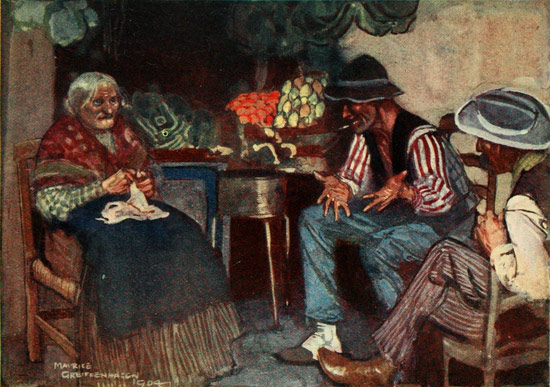
It is to most strangers approaching Naples for the
first time a matter of surprise to discover that
Vesuvius has two peaks rising out of the same base,
and that far removed from all the range of Apennines
which, dim and distant, hedge in the wide fertile
plain.
When viewed from Naples, Monte Somma, the
landward peak, appears scarcely less conical than its
neighbour, which contains the crater; but from the
other side it has a wholly different aspect, and if one
looks at it from the Sorrento cliffs one perceives that
it is no peak, but a long ridge, the segment of a circle
which, if completed, would enfold the present eruptive
cone.
The fact is important, for not only is it the key
to all the topography of the mountain, but it is
essential to the comprehension of what happened on
that August day of the year 79 A.D., when the dead
volcano woke to life. The broken circle of Monte
Somma was complete in those days; and men looking
up from Pompeii or Herculaneum saw a mountain
vastly different from that which we behold, yet one
which, from the part before us, can be reconstructed
by an easy use of the imagination.
If a man will take his stand on the lower heights
of the hills behind Castellammare, he will find that
he looks over Pompeii, over Bosco Reale lying on
the first slopes which swell upward from the plain,
into the mouth of the gap which parts Vesuvius from
Somma. Even from that distance he will obtain a
forcible impression of the black cliff of Somma,
towering almost sheer to the height of a thousand
feet above the bottom of the gap, while the outer
face of the same rock wall slopes towards the sunny
plain and the woods of Ottajano with an incline so
gentle as to be comparatively easy of ascent.
Clearly the two faces of Somma have been differently
formed. The sheer one was, at least in part, the
actual wall of the prehistoric crater, that caldron in
which the volcanic forces raged in days so ancient
that they had been clean forgotten when the Romans
ruled the land. The present cone did not exist. The
circuit of Monte Somma was unbroken, and lay
clothed with green meadows up to the very summit.
But where, then, is the rest of that gigantic wall? It
was blown away by the eruption that destroyed
Pompeii.
This is the first tremendous fact which the visitor
to Naples has to realise; and it is well worth while to
absorb it thoroughly before setting foot upon the
mountain, for nothing else seen there carries with it
the same impression of overwhelming, cataclysmal
awe. It is from a distance that the terror of the
thing can be appreciated best. When one goes
forward from the observatory on the mountain-side,
skirting the flank of the eruptive cone, into that
portion of the gap which is called the Atrio del
Cavallo—though it would at certain times be found
as safe to stable a steed in the Kelpie's flow as in this
wilderness of burnt rock—the sight of the steep wall
towering on one's left is infinitely striking. But at so
close a distance, and in the immediate neighbourhood
of so many other sights, it is scarcely possible to
concentrate one's thoughts on the girth of the ancient
crater. To comprehend the extent of the wall which
has been blown away one must go further off, till one
can distinguish the shape of Somma's wall, till one's
eye can measure the vast size of the crater which
would be formed by its completion, even allowing for
the doubts which have been raised whether the
circuit could have been so vast as this measurement
would imply. There are some shattered fragments
of the wall to be seen upon the south or seaward side
of the volcano. The ridge where the white observatory
building stands is one; another, named the
"pedementina," appears as a shoulder of the mountain,
clearly distinguishable from Naples. But these
scattered remnants help little towards the general
impression. It is by contemplating Somma that one
learns to comprehend the appalling nature of the
convulsion which, with little warning, blasted away
so immense a portion of the mountain regarded by
those who dwelt beneath it as one of the eternal
hills.
Far from having any title to immortality Vesuvius
is among the youngest and most mutable of mountains.
The present cone is, as I said, the creation of
the last eighteen centuries, piled up by successive
eruptions to something more than the height of
Somma, which once, as its name implies, towered far
above it. Even though the antiquity of the mountain
be reckoned by the age of Somma, or of some earlier
cone, on the ruins of which Somma may have reared
itself, it is as nothing when set beside the great wall
of mountains which sweeps round the plain and ends
in the great crags of St. Angelo and the cliffs of
Capri. Those hills may be termed "eternal" by as
true a warrant as any on the earth. But long after
they were shaped and fashioned the sea flowed over
the Campagna Felice and the site of Naples.
Vesuvius was a volcanic vent-hole underneath the
water, like many another which now seethes and
hisses deep down in the blue bay, forming lava reefs
about which the best fish always cluster. Then came
the upheaval of the sea floor, and Vesuvius stood on
dry land, no longer a sea-drenched reef or islet, but
a hill of ashes and of lava piled over a crack in the
earth's crust, which belched forth fiery torrents for
unnumbered years, and sank at last to rest after an
outburst which, if one may judge by the hugeness of
the crater it scooped out, must have been terrible
almost beyond conception.
Yet it was completely forgotten! How many
centuries of rest must it not have needed to erase
from the minds of men all memory of a cataclysm
so tremendous! In the days when doom was drawing
near to the cities of the Campagna, an old tradition
was current that fire had once been seen coming
out of the summit of Vesuvius. Doubtless many
people looking up at the green mountain pastures
shrugged their shoulders at the tale. Yet Strabo, the
geographer, remarked that the rocks upon the surface
of the mountain looked as if they had been subjected
to fire. It is difficult for us to detach the idea
of terror from Vesuvius, and to contemplate it with
thoughts at all resembling those which the dwellers
in the buried cities bestowed upon it. There has,
however, been one period when the summit of the
mountain presented an aspect probably not far unlike
that which a Pompeiian would have seen, had
curiosity led him to the top after visiting his vineyards
or his pastures on the lower slopes. That time
was in the years immediately preceding the eruption
of 1631. Vesuvius had been almost at rest for near
five centuries, and there were many who believed its
fires to be extinct.
The Abate Braccini ascended the mountain in 1612,
nineteen years before the outbreak. Vesuvius was
then, as it is now, somewhat higher than Somma,
though the comparative level has been changed more
than once in the last three centuries. On the summit
Braccini found a profound chasm, a mile in circuit,
surrounded by a bulwark of calcined stones, on which
no vegetation grew. Having crossed it, he descended
to a little plain, where he found plants of divers
kinds, though in no profusion. But from that point
there was a gulf of verdure. One could descend it by
tortuous paths, which led to the very bottom of the
abyss, and were used not only by woodcutters plying
their trade among the dense forest trees which had
grown up to maturity on the lava soil, but also by
animals which strayed down to browse on the succulent,
rich grass. Neither men nor cattle retained any
fear of the green crater depths. Only the rim of
calcined stones at the summit seems to have betrayed
the volcanic fire of old days, except that here and
there a wreath of smoke coiled away across the elms
and oaks and the pleasant scrub of broom and other
underwood.
About the same time a Neapolitan descended to
the bottom of the crater. He found there a flat plain
with two small lakes, the crater walls all pierced with
caverns, through some of which the wind whistled with
a noise which sounded awfully on that dim, lonely
spot. There were tales of treasure hidden in the
caves, but no man had dared explore them. The
crater was so deep that the descent and ascent
occupied three hours.
Such was the aspect of the mountain in days when
it had certainly rested for a shorter space than in the
great age of Pompeii and Herculaneum. All men
must have known what none remembered in either of
those doomed cities. The tales of terror spreading
from the mountain were still fresh, yet they inspired
no more fear than there is in Ischia to-day of Monte
Epomeo; and the herdsmen sat and whistled all day
long upon the slopes as they do now within an hour's
climb of Casamicciola.
To this false security must be ascribed the fact
that those who dwelt about the mountain paid little
heed to the indications of an approaching break in
its long rest. Profound changes were taking place
within the abyss which Braccini has described; and
on the 1st or 2nd of December, 1631, an inhabitant
of Ottajano, visiting the summit, found the woods
gone, the chasm filled up to the brim. A level plain
had replaced the yawning gulf. The bold Ottajanese
walked across from one side to the other, surprised,
no doubt, to see what had occurred, but, so far as
we can judge from Braccini's narrative, by no means
afflicted with any sense of awe at the magnitude of
the event, still less inclined to see in it a foretaste
of danger for the country.
A few nights later the peasants of Torre del Greco
and of Massa di Somma began to complain that the
growlings of the demons confined within the mountain
disturbed their rest. Religious ceremonies were
carried out, but the growls continued. On the
night of the 15th, the air being extraordinarily clear,
there hung in the sky above the mountain a star of
strange size and brilliance. Dusk fell upon that day,
and still there was no alarm; but somewhat later in
the evening, a servant crossing the Ponte della
Maddalena, on his way home from Portici, saw a
flash of lightning strike the mountain; while at
Resina a deep red glow appearing on the summit
perplexed the villagers, for no such sight had been
seen within the memory of living man.
As night passed and day approached, the reports
of those who had ventured up the slopes grew more
awful. Peasants between Torre del Greco and Torre
dell'Annunziata had seen smoke pour in volumes
out of the Atrio del Cavallo. A herdsman on the
mountain saw the pastures rent, and the sweet herbage
turned into a raging blast furnace. Santolo di
Simone ventured some way up to ascertain the truth.
He saw the ground cleft in divers places, out of which
poured smoke and flame, while all the air was filled
with thunderous reports, and great stones cast out of
the fiery gulfs were hurled about the slopes. Meantime
dawn in Naples was at hand; and as the light
increased, men going about the common affairs of
their existence began to take note of an extraordinary
cloud which hung above Vesuvius, having the precise
shape of a gigantic pine tree. Some wondered and
some feared, but none understood what was the terror
which had come upon them, till Braccini, going into
his library and taking down his Pliny, read them that
vivid passage which describes the sight young Pliny
saw when he looked towards Vesuvius from Misenum.
"There," said Braccini, as he closed the book, "there,
in the words of sixteen centuries ago, is depicted
what you see to-day."
That pine tree has become awfully familiar to most
Neapolitans now alive; and to some of those who
visit the city during an eruption it seems as if
familiarity had bred contempt, and caused the occasion
to be regarded as one for merriment, since it
draws strangers there in countless numbers, and enriches
every trader on the coast. But there is terror
also in the streets when the shocks come rapidly,
when doors and windows rattle with continuous
concussions, and all the city reeks with sulphurous
stenches coming one knows not whence. To this
natural and human fear there was added, in the days
of which Braccini wrote, the shock of a horrible surprise.
The people were not dreaming of eruptions.
They thought of them as little as did their far-distant
kinsmen, who occupied the lovely shore when Pompeii
was a city of the quick, not of the dead. That is
what makes Braccini's tale so interesting. It reproduces
for us, as nearly as is possible, a picture of
what must have happened in the city streets on that
morning when Pliny came sailing from Misenum at
the urgent cry of Herculaneum for help, only to find
his ships beaten off the coast by a hail of fiery
stones.
The Cardinal Archbishop of Naples was at Torre
del Greco on that fateful morning. He hurried back
to the city, and having celebrated the Sacrament, and
given orders for the rite to be solemnised throughout
the city, he went up to the treasury where the relics
of the saints were kept, intending to arrange a solemn
procession. The blood of San Gennaro was found
already liquefied and boiling! Great crowds accompanied
the procession, the superstitious Neapolitans
turned to their priests and saints at the first sign of
danger, and marched behind the relics with effusion
of piety, the men scourging themselves till the blood
ran from their shoulders, the women dishevelled and
weeping, while crowds of boys chanted the Litany
with extraordinary tenderness. The shops were shut.
Naples had become a city of devotees.
But San Gennaro, though his blood had boiled,
was not ready to disperse the peril. The shocks of
earthquake grew louder. The concussions rattled
faster from the mountain. Towards noon thick
darkness stole down upon the city, as it had upon
Misenum sixteen hundred years before. The smell
of sulphur in the streets was choking. Men asked
themselves if so strong a reek could possibly travel
from Vesuvius, and whether some vent had not
opened close at hand. The houses, says Braccini,
were swaying like ships at sea, and in the air there
was a horrible roaring sound like the blast of many
furnaces. The darkness grew more dense, and tongues
of lightning flashed continuously out of the mirk sky.
The crashes became quite appalling. Naples went
wild with terror. The Viceroy sent drummers round
the city appealing to the people to live cleanly in
that which appeared to be the supreme moment of
the created world. Men and women utterly unknown
to each other ran up and embraced, seeking comfort,
and crying, "Gesù, misericordia !"
So passed the first day of the reawakened activity
of Vesuvius. The night brought no abatement of
terror. Early in the morning the crashes redoubled.
The whole mountain seemed to be springing into the
air, and all the surface of the earth rocked like water
in a vessel which is violently shaken. At the same
moment the sea retreated for near half a mile, and
then swept back to a point far above its level. At
Naples nothing more than that was seen, but the
miserable inhabitants of Resina perceived that those
mighty birth throes had ended in the ejection of a
vast flood of lava, which was pouring down the
mountain on the seaward side. The fiery torrent
came on with such speed that it had reached the sea
in less than an hour from the outbreak. As it advanced
it split into seven streams, each one of which
took a different course of devastation. One flowed
in the direction of San Jorio, which it destroyed,
engulfing, it is said, no less than three thousand
persons, including a religious procession. A second
arm of the flood destroyed Bosco Reale and Torre
dell'Annunziata, running out more than two hundred
yards into the sea, where it formed a reef so hot
that the water round about it boiled for days. A
third wrecked Torre del Greco, a fourth poured over
Resina, and a fifth, passing westwards, ruined San
Giorgio a Cremano, and touched Barra and San
Giovanni. Meantime a sixth stream, after filling the
valleys divided by the ridge on which the observatory
stands now, swept down on Massa di Somma, and
reached San Sebastiano.
In this point the eruption of 1631 differed from
that which destroyed Pompeii. In the latter there
was no lava, but only falling stone and ash, either
dry, or compacted into mud by storms of rain and
showers of water thrown out of the crater. But it
was not by lava only that the country was devastated
three centuries and a half ago. Ashes fell also in
such masses that near Vesuvius they were heaped up
twelve feet deep, and great quantities of them drifting
across southern Italy fell upon the shores of that
lovely bay where Taranto looks across to the snow-topped
mountains of Calabria. Stones fell also of
astounding weight. One which was thrown into
Massa di Somma is reported to have weighed 50,000
pounds; while another, which fell as far away as Nola,
was of such dimensions that a team of twenty oxen
could not stir it.
When this great eruption ended, the relative heights
of Vesuvius and Somma were reversed, and the eruptive
cone, which had risen 50 feet above its neighbour,
stood nearly 200 feet below it. It is almost the
rule that in great eruptions Vesuvius suffers loss of
height, while the cone is piled up by smaller ones.
Such is the country in which a teeming population
elects to live. It is said that no less than 80,000
persons have their homes on the slopes of the mountain—a
fact which appears inexplicable to those who
do not know by experience how small the loss of life
may be in the greatest eruption. It is true that in
1631 a vast number of persons perished. But this
was due probably in some measure to the fact that
they did not know their danger and took no proper
measures to avoid it. The men then living had seen
nothing like the sudden peril which beset them. But
every peasant of our day is well aware what lava
floods may do, and how their course will lie. All
have their little images of San Gennaro, which they
set up in their cottages, and many can tell how the
good saint has averted from his vineyard a fiery
torrent which crawled on to the point when it seemed
as if not even heavenly power could avert destruction,
yet twisted off to one side and left him scatheless.
At times, of course, the velocity of the lava is so
great that no man can do aught but flee. In 1766
Sir William Hamilton saw a stream which ran in the
first mile with a velocity "equal to that of the River
Severn at the passage near Bristol," while in 1794 the
lava ran through Torre del Greco at the rate of one
foot in a second. Yet the loss of life was small.
"Napoli fa i peccati," say the people, "e Torre li
paga !"—Naples commits the sins and Torre pays for
them. It is true enough; yet the toll is taken more
in property than life. Moreover, the after-fruits of an
eruption are worth rubies to the people, so fertile
is the soil created by the decaying lava.
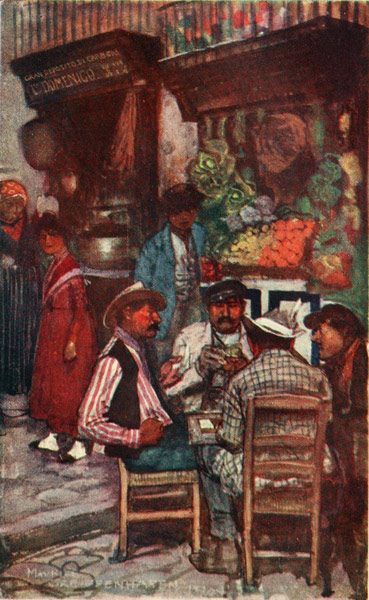
CARD-PLAYERS—NAPLES.
That the loss of life remains so small is the more
surprising in view of the fact that Vesuvius can by
no means be trusted to discharge itself on all occasions
by the main crater. In fact, the flanks of the
mountain, strengthened and compacted as they are
by the outflow of countless lava streams, are yet
seamed and fissured by the rupture of the surface
to form other vents. Occasionally these "bocche"
mouths, as the Italians call them, have opened far
down the slopes among the cultivated fields and vineyards.
It was so in 1861, not fortunately one of the
greatest of eruptions. The bocche of that year are
on the hillside no great way above Torre del Greco.
Nothing, in fact, is certain about the operation of
volcanic forces, and this is a fact which may be borne
in mind by those who elect to ascend the mountain
during an eruption. Sir William Hamilton in 1767
had a narrow escape. "I was making my observations,"
he says, "upon the lava, which had already
from the spot where it first broke out reached the
valley"—that is, the Atrio del Cavallo—"when on a
sudden, about noon, I heard a violent noise within
the mountain, and at a spot about a quarter of a mile
off the place where I stood, the mountain split, and
with much noise from this new mouth a fountain of
liquid fire shot up many feet high, and then like a
torrent rolled on directly towards us. The earth
shook, and at the same time a volley of stones fell
thick upon us; in an instant clouds of black smoke
and ashes caused almost a total darkness; the explosions
from the top of the mountain were much
louder than any thunder I ever heard, and the smell
of the sulphur was very offensive. My guide, alarmed,
took to his heels; and I must confess I was not at
my ease. I followed close, and we ran near three
miles without stopping."
To run three miles over the broken and uneven
lava reefs of the Piano, with a fiery torrent hunting
close behind, is not an experience which would be
relished by the ordinary tourist, however far it might
be sweetened in the retrospect to the adventurous man
of science. Yet happy is the man who in such a
case gets off with a sharp run. In 1872 a party of
tourists were less happy. The terrible eruption of
that year deserves attention, being certainly the
greatest within the present generation, and fortunately
it has been described with knowledge and precision
by Professor Palmieri who, with noble devotion to the
cause of science, had spent so many years in the observatory
planted on the barren ridge of trachyte
which divides the two valley-arms which the Atrio
del Cavallo projects towards Naples. Those valleys
receive the streams of lava which are ejected into the
Atrio, and when the volume of the flow is large, it has
happened that the observatory has been almost engirdled
with the red-hot torrents—a position of which,
if the danger may be exaggerated, the awe certainly
cannot, and which must fill all men with admiration
for the illustrious scientists who endure it.
Palmieri regarded the eruption as the last phase of
a series of disturbances which began at the end of
January, 1871. From November, 1868, until the end
of December, 1870, the mountain had been almost
quiet. Only a few fumaroles discharging smoke bore
witness to the need for watchfulness. "Early in 1871
the delicate instruments of the observatory which
register earth tremors were observed to be slightly
agitated, and the crater discharged a few incandescent
projectiles, detonating at the same time, but not remarkably.
On the 13th of January an aperture
appeared on the northern edge of the upper plain
of the Vesuvian cone; at first a little lava issued
from it, then a small cone arose which threw out incandescent
projectiles and much smoke of a reddish
colour, whilst the central crater continued to detonate
more loudly and frequently. The lava flow continued
to increase until the beginning of March, without
extending much beyond the base of the cone, although
it had great mobility. In March the little cone
appeared not only to subside but even partly to give
way, as almost always happens with eccentric cones
when their activity is at an end.... A little smoke
issued from the small crater, and a loud hissing from
the interior was audible. By lying along the edge I
could see a cavity of cylindrical form about ten metres
deep.... The bottom of the crater was level, but in
the centre a small cone of about two metres had
formed, pointed in such a manner that it possessed
but a very narrow opening at the apex, from which
smoke issued with a hissing sound, and from which
were spurted a few very small incandescent stones and
scoriæ. This little cone increased in size as well as
in activity until it filled the crater and rose four or
five metres above the brim. New and more abundant
lavas appeared near the base of this cone, and
pouring continually into the 'Atrio del Cavallo'
rushed into the 'Fossa della Vetrana' in the direction
of the observatory, and towards the Crocella, where
they accumulated to such an extent as to cover the
hillside for a distance of about three hundred metres....
For many months the lava descended from the
cone and traversed the 'Atrio del Cavallo.'... On
the 3rd and 4th of November a copious and splendid
stream coursed down the principal cone on its western
side, but was soon exhausted. The new small cone
appeared again at rest, but did not cease to emit
smoke...."
In the beginning of January, 1872, the little cone
again became active, the crater of the preceding
October resumed strength, there were bellowings,
projectiles, and copious outflows of lava. In February
the action of the hidden forces abated somewhat; but
in March, at the full moon, the cone opened on the
north-western side, the cleavage being marked out by
a line of fumaroles, and a lava stream issued from
the lowest part without any noise and with very little
smoke, pouring down into the Atrio del Cavallo as
far as the precipices of Monte Somma. This lava
ceased flowing after a week, but the fumaroles still
pointed out the clefts, and between the small re-made
cone and the central crater a new crater of small
dimensions and interrupted activity opened. On the
23rd of April, another full moon, the observatory
instruments were agitated, the activity of the craters
increased, and on the evening of the 24th splendid
lavas descended the cone in many directions. The
spectacle was of superb beauty. There was clear
moonshine, and from Naples the outline of a vast
fiery tree was seen to be traced on the black side
of the mountain. Strangers poured into the city.
The long period of activity without destruction disposed
them to regard the show as a display of
fireworks. Half Naples set its heart on ascending
the mountain by night, and little wonder, for the
moonlit bay reddened by the wide reflection from
the burning breast of the volcano made a sight on
which no man could look without the sense of
witnessing a thing which was absolutely unearthly
in the splendour of its beauty.
But on the following morning the flow was nearly
spent. One stream only continued to flow from the
base of the cone. And this one was almost inaccessible,
by reason of the roughness of the ground.
As night fell the visitors began to arrive. No less
than 120 carriages are said to have passed the
hermitage by dusk. Palmieri tried to dissuade the
sightseers from going on, but in vain. The display
of the previous night had been too splendid. They
hoped continually that the show might be repeated.
It was, but in a manner which they little looked for.
The crater was casting out huge stones, with detonations
resembling the discharge of whole parks
of artillery at once. From time to time the din
ceased absolutely, then low and softly it began again,
and gained force quickly till it crashed as loudly as
before. When midnight was past, immense clouds
of smoke began to pour out of all the craters, and
lava broke out simultaneously from many points upon
the slopes. Out of the chief crater rose the awful
pine tree. The detonations grew more constant.
There was still time to flee; but the spectacle was
growing grander every moment, and inexperienced
guides led forward a large party into the Atrio, where
they stood watching such a sight as living men have
rarely seen. At half-past three came the catastrophe.
The whole of the great cone rent itself from top to
bottom with an appalling crash, casting out a huge
stream of fiery lava. At the same moment two
large craters formed upon the summit, discharging
showers of red-hot scoriæ, while the pillar of the
pine tree rose up to many times more than even
the vast height which it then stretched across the
sky. A cloud of choking blinding smoke enveloped
the visitors, a fiery hail rained down on them, the
lava broke out immediately by them, and barred
their retreat to the observatory. Eight medical
students were engulfed by the fire, with others who
were not known. Eleven more were grievously
injured; and when the survivors were able to reach
the observatory, it was in several cases but to die.
The lava flow from this grand fissure was restrained
for some time within the Atrio; but issuing thence
at last divided, one branch threatening Resina, but
stopping happily almost as soon as it reached the
cultivated ground, while the larger branch ran through
the Fossa della Vetrana, traversing its whole length
of 1,300 metres in three hours. It dashed into the
Fossa della Faraone, then again divided, one arm
of the diminished stream destroying a great part
of the villages of Massa and San Sebastiano, and
flowing on so far in the direction of Naples that
had it continued but for four-and-twenty hours longer
it must have flowed into the city streets.
It may be supposed that whilst this awful eruption
was proceeding, the position of the courageous men
of science in the observatory was rather glorious than
safe. Nothing can exceed the value of the services
rendered to science by these gentlemen who elect
to spend their lives upon a spot which is always
dreary and exposed to constant danger. They are
of the outposts of mankind. I take my cap off to
their stout hearts and their keen intellects. To them
their danger is a little thing, and they would not
thank me if I were to dwell too long on it. But
I will take Professor Palmieri's own words, and beg
those who read to ponder over what is involved
in them. "On the night of the 26th of April the
observatory lay between two torrents of fire. The
heat was insufferable. The glass of the windows
was hot and crackling, especially on the side of the
Fossa della Vetrana. In all the rooms there was
a smell of scorching."
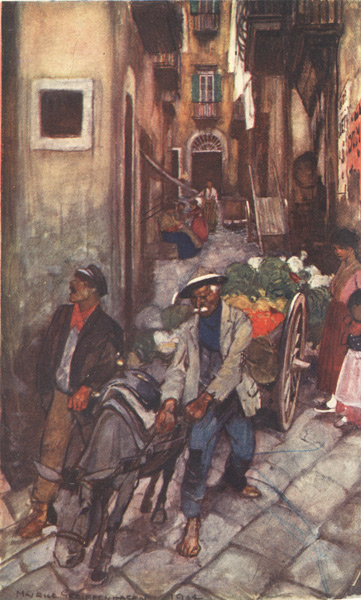
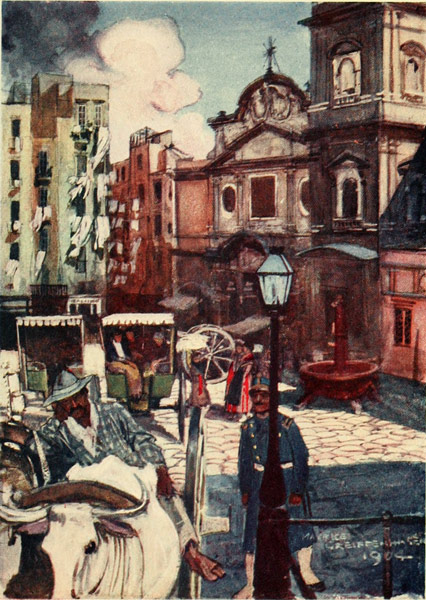
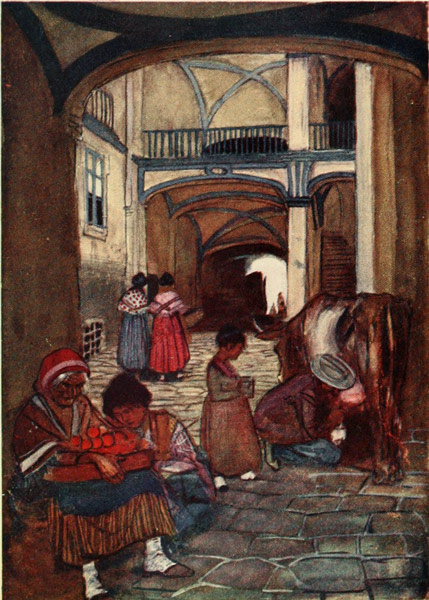
NAPLES—A SLUM.
Meantime the spectacle of the mountain must have
been bewilderingly grand. The cone was seamed
and perforated on every side, and the fiery lava
issuing from the vents covered it so completely
that, in Palmieri's picturesque expression, Vesuvius
"sweated fire." On the 27th of April the igneous
period of the eruption was over, though the rain of
ashes and projectiles became more abundant, the
crashes were louder than ever, the pine tree was of
a darker colour, and was continually furrowed by
flashes of lightning; while on the 29th stones fell
at the observatory of such size that the glass of the
unshuttered windows was broken. By midnight,
of that day, however, there was a marked improvement,
and on the 1st of May the eruption was at
an end.
The visitor who strolls to-day through the main
street of Portici sees nothing but a continuation
of the squalid life and poverty of building which
have followed him continuously from the eastern
quarters of the city. The mean aspect of the
town is unexpected. One had not looked for any
striving after the dream of classical beauty, once
so frequent and so great upon the Campanian shore.
But this was the chosen pleasure resort of the
Bourbon kings; and some greater dignity might
have been expected in the close neighbourhood of
a palace.
The palace is there still. The noisy street runs
through its courtyard. Poor deserted palace! It
has lost its royalty of aspect, and for all one sees
in passing by the discoloured walls and shuttered
windows it might be any poverty-stricken crowded
palazzo in Naples. But turn in beneath the archway
on the right, and go by the large cool staircase, across
the clanking stones, until you emerge into the hot
spring sun again. There is a noble semicircular
expanse, flanked on either hand by a terrace, adorned
with busts and vases, and with stairs descending to
the garden, which stretches down to a belt of pine
trees, cut away a little in the centre to reveal that
band of heavenly blue which is the sea. The
young trees standing by the pine are in fresh leaf;
the grass is full of poppies; white butterflies are
skimming to and fro across it; all is silent and
deserted. A bare-armed stable-boy comes out to
train a skinny pony round the terrace. The stucco
of the walls is peeling off; the long rows of windows
are shuttered; the sentry boxes stand empty. It is
forty years since any courtier came out to taste
the evening freshness on this spot where Sir William
Hamilton talked of the wonders of the buried cities
so long and eagerly that he forgot to watch the wife
and friend whose sins the world forbears to reckon
when it remembers the beauty of the one and the
valour and wisdom of the other.
It is but a little way beyond the palace to the spot
where the Prince d'Elbœuf is said, while sinking
a well in the year 1709, to have chanced on things
of which he did not know the meaning. This is one
of the fables which demonstrate the extreme difficulty
of speaking the truth, even about important and
world-famous matters. Nothing is more certain than
that the prince sank his "well" with the hope and
intention of drawing up not water, but antiquities.
The fact is, that in the year just mentioned he
bought a country house, which stood near the site
of the present railway station. It was perfectly well
known that Herculaneum lay buried underneath
Portici or Resina, and the prince began excavating
of set purpose. It was mere chance which guided
him to a spot where his first shaft came right down
on the benches of the theatre, thus letting in to
Herculaneum the first gleam of daylight which had
entered there for more than sixteen centuries. Not
much more than that stray glimmer has enlightened
the old academic city even now; for none of the
energy and learned patience lavished daily on
Pompeii has been expended here.
Herculaneum as it lies to-day, awaiting its turn
for excavation, creates in one respect an impression
which Pompeii excites in a far less degree. It
retains the visible aspect of a buried city. The
sense of overwhelming tragedy is never lost.
Pompeii stands free and open under the clear sky;
so large, so perfect, that in the fascination of its
archæology one is somewhat led away from the
disaster. It is a deserted city. One knows what
it was that drove the people out, but it is easy to
forget. Perhaps one cares more to gloat over the rich
old life laid bare so freely than to burden one's mind
with memory of that day when the glow of August
sunshine turned to darkness "as of a room shut up,"
and death came down from the mountain into the
crowded streets.
At Herculaneum the mere fragment of a street,
the few half-buried houses, the pit in which they lie,
the cavernous darkness which hides the amphitheatre,
stimulate the imagination till it leaps to a sudden
comprehension of what it was that happened on that
day of woe. One passes from the dirty street of
Resina into a building of no dignity, somewhat like
the entrance to the public baths of some small
English town. A guide appears and guides one
down a flight of steps which are at first palpably
modern. But ere long the tread changes. One is
on an ancient stair, and almost immediately the
guide pauses in a vaulted corridor running right and
left through perfect darkness. The height is hardly
more than permits a tall man to walk upright. Here
and there an arched opening in the corridor goes
one sees not whither. Passing under such an arch
one may descend four steps, beyond which rises
another wall. That wall is tufa; it is no part of
the structure. It flowed or fell here when it was half
liquid; it came out from Vesuvius, and it is what
overwhelmed the city.
The steps, thus interrupted by the intrusion of
what are now stone walls, are the upper tier of seats
in the amphitheatre. A gleam of daylight breaks
the darkness: it comes from the Prince d'Elbœuf's
shaft, which pierces the stone steps and goes down
far below them. One looks up the tubular wet
boring and then plunges forward to the bottom of the
theatre through blackness barely scattered by the
candles which the guide carries.
A short descent of nineteen steps in all brings one
to the floor of the theatre, at the spot appropriated
to the orchestra. The stage is a low platform,
approached on either hand by steps. It is deprived
of some part of its original depth by pillars and
barriers hardened out of that choking mud which
poured down from the mountain. Such barriers
present themselves on every side; they leave the
theatre formless; they create gangways where none
existed, walls where the spectators had clear line of
vision, darkness where the sun shone freely eighteen
centuries ago. In one of these gangways behind
the stage the clear impression of human features
looks down from the rough wet ceiling; it is the
impression of a player's mask. There were doubtless
many in the theatre when the seething flood rolled in.
Among this darkness and these sights the sense
of tragedy tightens on the imagination. The cruelty
of the ruin stands before one and is not to be set
aside. There are remains of frescoes here and there;
but they are almost destroyed, and serve only to
increase the pity that a theatre which once rang with
laughter and glowed so richly with soft light and
colour should lie wet, buried and forsaken in the
darkness.
It is sometimes said that Herculaneum was destroyed
by lava—the guides use the word to this day.
But Vesuvius threw out no lava in the great eruption
which destroyed the cities. It ejected much in prehistoric
times. Pompeii itself is built upon a lava
ridge, which in the old days was quarried for millstones,
thus giving rise to an important industry.
But in historic times lava did not flow—if we may
trust geologists—till the year 1036 A.D.
Herculaneum was destroyed by fragments of
pumice stone and ashes, scarcely distinguishable
from those which one may see raked away from the
half-uncovered walls of some new house at Pompeii.
With this storm of falling cinders—how dense and
thick one may picture dimly by remembering once
more that all the seaward wall of the vast old crater
was being blown away—with this crushing, choking
shower, came torrents of rain, enough to turn the
falling ashes to a sort of mud, which hardened into
tufa. Indeed, just as the yellow tufa of Posilipo is
composed of volcanic ash ejected underneath the sea,
and is thus formed of ash and water, such precisely
is the crust which hardened over Herculaneum, and
holds the city in its clutch unto this hour. Perhaps
the mud formed on the mountain slopes, and came
rolling down upon the town. Professor Phillips
thought it formed within the crater. Some obvious
warning of great peril there must have been, and that
quite early on the fatal 24th of August; for it was
not long past noon when a message reached Pliny at
Misenum, begging for his ships, since escape was
even then impossible except by sea. Already Pliny,
looking from Misenum, saw the mountain topped by
that vast and awful cloud shaped like a pine tree, out
of which ashes were raining down on the three cities.
His ships, approaching the coast towards evening,
ran into a hail of pumice stone. The ashes fell
hotter and hotter on the decks, and in continually
larger masses. The sea ebbed suddenly. Ruins
were tumbling from the mountain. There was no
possibility of giving help to the doomed city, and
Pliny gave orders to steer off the coast. No eye has
seen Herculaneum from that day to this. What
became of the citizens is not known. Comparatively
few bodies have been found; but the excavations
were too imperfect to prove that somewhere in the
city bounds they do not lie in heaps.
Such was the end of Herculaneum, by ashes, not
by lava. It is true that lava beds lie above the city
now. Probably the lava of 1631 passed over it.
Sir William Hamilton distinguished the débris of
no less than six eruptions besides that which destroyed
it. Sir Charles Lyell also thought that a large
part of the covering of the city was subsequent to its
first destruction.
At Herculaneum all that is most interesting lies
underground, and nearly all is still invisible. But
little effort has been made at any time to disinter
the city. The searchers who dug there at the command
of Charles of Bourbon between the years 1750
and 1761—to which period we must refer nearly all
the most precious discoveries—contented themselves
with sinking shafts in likely spots, from which they
mined and tunnelled as far as seemed possible to
them, and then filled up the shaft again and sank
another. Thus the notices of what they found, and
still more of how they found it, are imperfect. They
have, moreover, been carelessly preserved. Some
were even wantonly destroyed in the last century
by men who did not appreciate their value. Yet
enough has been retained to stimulate the highest
interest in Herculaneum, if not indeed to justify the
belief that whenever it shall be possible to overcome
the obvious difficulties of excavation, treasures will
be found which may far exceed in quantity and
beauty those which Pompeii has yielded.
This will be better understood by considering
what has been written by Signor Comparetti and
Signor de Petra concerning a single villa of Herculaneum,
now, alas! buried up once more in darkness.
It stood between the "new diggings" and the royal
palace of Portici. I will preface my abstract of the
treatise of the two scholars by some passages taken
from the letters of Camillo Paderni, director of the
excavations, to Mr. Thomas Hollis, in 1754.
"This route," says Paderni, "led us towards a
palace, which lay near the garden. But before they
arrived at a palace they came to a square ... which
was adorned throughout with columns of stucco.
At the several angles of the square was a terminus
of marble, and on every one of these stood a bust of
bronze of Greek workmanship, one of which had on
it the name of the artist. A small fountain was
placed before each terminus, which was constructed
in the following manner. Level with the pavement
was a vase to receive the water which fell from above.
In the middle of this vase was a stand of balustrade
work, to support another marble vase. This second
vase was square on the outside and circular within,
where it had the appearance of a scallop shell; in the
centre whereof was the spout which threw up the
water that was supplied by leaden pipes within the
balustrade. Among the columns ... were alternately
placed a statue[1] of bronze and a bust of the
same material, at the equal distance of a certain
number of palms.... The statues taken out from
April 15 to September 30 are in number seven, near
the height of six Neapolitan palms, except one of
them, which is much larger, and of excellent expression.
This represents a faun lying down, who
appears to be drunk, resting upon the goatskin in
which they anciently put wine.... September 27.—I
went myself to take out a head in bronze, which
proved to be that of Seneca, and the finest that has
hitherto appeared.... Our greatest hopes are from
the palace itself, which is of a very large extent. As
yet we have only entered into one room, the floor
of which is formed of mosaic work, not inelegant.
It appears to have been a library, adorned with
presses inlaid with different sorts of wood, disposed
in rows. I was buried in this spot more than twelve
days, to carry off the volumes found there, many of
which were so perished that it was impossible to remove
them. Those which I took away amounted to
the number of 337, all of them at present incapable
of being opened. These are all in Greek characters.
While I was busy in this work I observed a large
bundle, which from the size I imagined must contain
more than a single volume. I tried with the utmost
care to get it out, but could not, from the damp and
weight of it. However, I perceived that it consisted
of about eighteen volumes.... They were wrapped
about with the bark of a tree, and covered at each
end with a piece of wood.
"November 27th.—We discovered the figure of an
old faun, or rather a Silenus, represented as sitting on
a bank, with a tiger lying on his left side, on which
his hand rested. Both these figures served to adorn
a fountain, and from the mouth of the tiger had
flowed water. From the same spot were taken out,
November 29th, three little boys of bronze of a good
manner. Two of them are young fauns, having the
horns and ears of a goat. They have likewise silver
eyes, and each of them the goatskin on his shoulder,
wherein anciently they put wine, and through which
here the water issued. The third boy is also of
bronze, has silver eyes, is of the same size with the
two former, and in a standing posture like them, but
is not a faun. On one side of this last stood a small
column, upon the top of which was a comic mask
that served as a capital to it and discharged water
from its mouth. December 16th.—In the same place
were discovered another boy with a mask and three
other fauns.... Besides these we met with two
little boys in bronze, somewhat less than the former.
These likewise were in a standing posture, had silver
eyes, and had each a vase upon his shoulder whence
the water flowed. We also dug out an old faun,
crowned with ivy, having a long beard, a hairy
body, and sandals on his feet. He sat astride
upon a goatskin, holding it at the feet with both
his hands...."
Thus far Paderni; and I have made this long extract
to little purpose if the reader has not already
recognised some among the finest objects in the
great museum at Naples. This villa, with its garden
full of statues, its cool peristyle all humming with
the plash of falling water, its shadowy colonnade
sheltering the marvellous bronzes, must have been
a place of wonderful beauty. He was a rare collector
who dwelt there. He had twenty-three large bronze
busts and eight small ones, thirteen large bronze
statues and eighteen small ones. In his garden stood
not less than nine marble statues, and of marble busts
he had certainly seven and probably seven more.
Among these not one is of mean workmanship. The
greater part are famous all round the world for
beauty. They are unsurpassed, and they all came
from a single villa just beyond the walls of this
buried city.
Who was the man who made himself a home so
splendid? The style of the decorations points to the
latter years of the Republic. It is in marked distinction
from the more ornate style which prevailed
under the Empire, and of great mythological pictures
there was none. One thing only enables us to guess
with something like assurance who among the patricians
of those days owned the villa—namely the
library. The mode of inference is curious.
It was no small library which was lifted by Paderni
from the presses where it had lain for seventeen
centuries. The papyri numbered 1,806, though by
no means all were separate treatises, while some were
mere scraps. All were charred and damaged to such
a degree as to render their examination a work
whose difficulty baffled many men of science. At
length the task was accomplished by an ingenious
arrangement of silk threads, which unfolded the
papyrus upon a false back made partly of onion
skins, and laid it open to investigation. The results
are curious. Indeed, they are something more than
curious; and making due allowance for the fact that
wise men do not permit themselves to be ruffled by
the tricksy mockeries of time, it must be admitted
that the story of this library is exasperating.
All the world knows how small a space the treasures
of Greek and Latin literature occupy upon our
shelves compared with that which they would fill
were they intact. What melancholy gaps! How
much pure delight has not been reft from us! Where
is the scholar who in moments of low spirits has not
roamed round his library reckoning up his losses?
Livy shorn of more than half his bulk, Terence
mangled, Cicero lacking heaven knows how many of
his finest compositions! Petrarch had the treatise
of the great orator "De Gloria," but nobody has seen
it since. It is a painful subject—the canker at the
heart of learned men, the skeleton at the feasts of all
academies.
So much the greater, then, was the joy when the
news ran round Europe that a library, formed in the
best age of Latin literature, was discovered at Herculaneum.
Now, surely, some of the lost treasures
would be restored! All the universities chuckled and
stood on tiptoe. Humanity, with the help of a
volcano, had scored a point against time at last.
But the rolls of papyri were sadly like mere lumps
of charcoal. Paderni saw a letter here, a letter there,
but on the whole could make nothing of them. The
smile died on the faces of the scholars. The trick
was not won yet. Who would unroll these charred
manuscripts, and who could possibly read them when
unrolled?
Many people tried and failed, Sir Humphry Davy
among the number. Learned hearts sank, and hope
flickered almost to extinction. At length Padre
Piaggi invented an ingenious arrangement of silk
threads, whereby the charred and brittle rolls were
unwrapped in the manner described above. It was
a slow and weary process, but the wit of man has
devised no better. One by one the treasures of the
past were read. It took a century and a half, but we
know the contents of some three hundred and fifty of
them now.
Broadly stated, the outcome of all the pother has
been to restore to an unthankful world what is probably
a complete set of the works of Philodemus!
"Philodemus!" gasp the scholars. "Who wanted
him?" A fifth-rate Greek philosopher and a fourth-rate
poet, who lived at Rome in the days of Cicero,
better esteemed for his verses than his reasoning, and
not much for either. But no Livy? No Terence?
No Cicero? Not one line; hardly anything but the
prose treatises of Philodemus, concerning which
Signor Comparetti observes with emphasis that the
oblivion they lay in was anything but undeserved.
Such is the greatest practical joke played on us by
the Time Spirit in the present age. But now, laying
aside our disappointment and bad temper, let us see
what can be made out of this curious, if worthless,
discovery. Who could have cared to collect the
works of Philodemus, large and small, even to the
notes he made from other books? The philosophy
was Epicurean, but the chief works of the leaders of
that school are with few exceptions not there. Who
could it be but Philodemus himself, the only man,
surely, for whom such a collection would have value?
But what, then, was the library doing in this splendid
and costly villa at Herculaneum? Philodemus was
a poor Greek scholar, the last man who could have
afforded to collect fine marbles or to house them
nobly. The villa must have belonged to his patron
and protector. Cicero names for us the patrician
who enjoyed the privilege of hearing Philodemus
reason when he would. It was Piso, Lucius Calpurnius
Piso Cæsoninus, attacked by Cicero in one of
the greatest of his orations. Piso had known this
poor scholar from a boy, learnt the philosophy of
Epicurus from him, and gave him rooms in his own
house. To Piso, probably, belonged this villa. Here
he may have ended his stormy life in the society of
Philodemus; and when that learned man ascended
to Parnassus, his books remained in what had been
his study, preserved perhaps by some lingering attachment
to his memory, perhaps by such a superstitious
pride in what is never read as may be seen in certain
country houses of to-day, where the squire believes
the dusty volumes collected by his grandfather are a
credit to the house, and chides the housemaid if he
ever finds a cobweb on the peaceful shelves. It will
also be remembered that, unless you want the space
very much, it is easier to leave books alone than to
destroy them. On the whole, I do not think the
discovery of this library affords any evidence of
the prevalence of cultivated taste in Herculaneum.
Rather the opposite, indeed, for whatever value the
owners of the house may have attached to the library
the fact remains that they added to it nothing in the
hundred years which followed the decease of Philodemus.
As for the statues and the bronzes, the finest were
doubtless part of the spoils of Piso's proconsulate
in Macedonia. Cicero taunted him with having
stripped Greece of its treasures, as Verres ransacked
those of Sicily. The conduct of both men was
barbarous perhaps; but the candid visitor will look
many times at the Sleeping Faun, or the Mercury in
repose, before daring to ask himself whether he
would have come home from Macedonia without
them. If he discover that he would, he may yet
find cause to rejoice that Piso was less virtuous; for
a very short reflection on the state of Greece during
the last twenty centuries suggests that if a moralist
had been proconsul we should have lacked many
pleasures which we now enjoy.
The "Scavi Nuovi" lie at a little distance from the
theatre. One goes down a steep street sloping to
the sea, the Vico di Mare. A gate in the wall gives
admission to what seems at first a quarry, but a
second glance shows one a short street of roofless
houses, emerging from the hillside and running
straight in the direction of the shore until stopped
by the opposite bank. Beneath and behind these
walls, bright with mesembryanthemums and wild
roses, lies all the city save this little fragment, this
portion of a street, this poor two dozen houses, with
the remnants of four insulæ, of which three are
occupied by private houses and the fourth by some
rooms belonging to the baths, of which the greater
part are buried still. The houses of the south-west
insula are the most interesting. At the corner is a
shop with marble counter, and close to that is a
dwelling of rare beauty, the so-called "Casa d'Argo."
At the door there are four pillars, and on either side
a bench. Out of this entrance one passes through a
larger room into the xystos, colonnaded on three
sides. A row of rooms open from it, all frescoed in
the architectural style of which we shall see much at
Pompeii, and giving on the garden. Beyond these
rooms there is a second peristyle, all very beautiful—clearly
the dwelling of a man of taste and means.
But in all this there is no source of pleasure which
cannot be enjoyed far better at Pompeii. It is there
and not to Herculaneum that the traveller goes
to see the results of excavation. On this spot, I say
again, it is the tragedy that counts; and as I turn in
the warm sunshine and look up the broken street,
where rose bushes bloom profusely in the untended
gardens and the brown lizards slip in and out among
the cold and empty hearths, I see above the houses
of the dirty modern town the huge cone of Vesuvius
fronting me directly. So he stands, looking down
upon the ruin he has made, while the long train of
sulky smoke which stains the clear blueness of the
April sky flaunts itself like a warning to mankind
that it is vain to set human forces against his, and
that what he wills to hide shall lie lost and hidden in
the earth for ever.
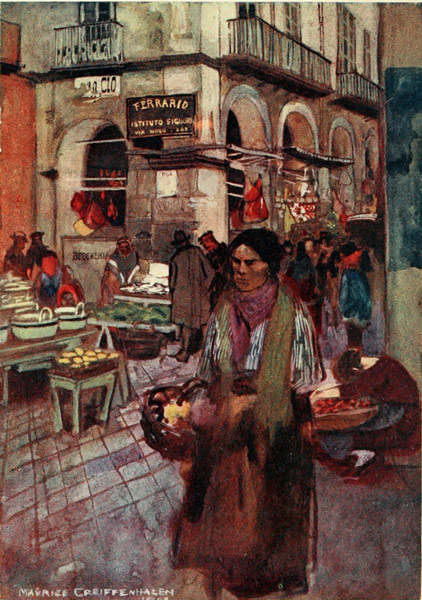
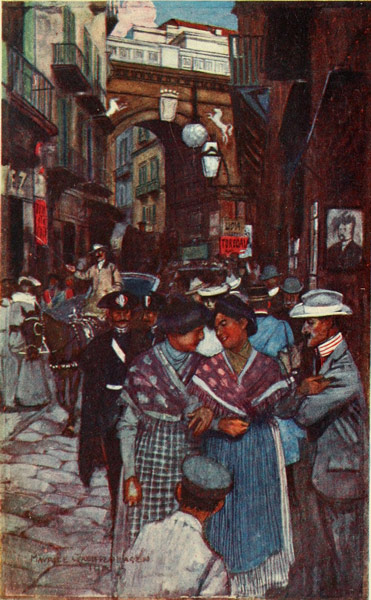
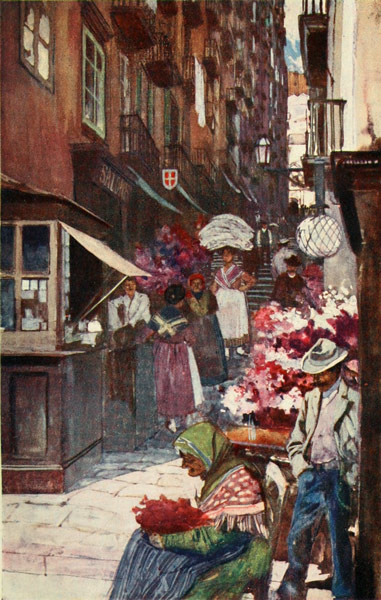
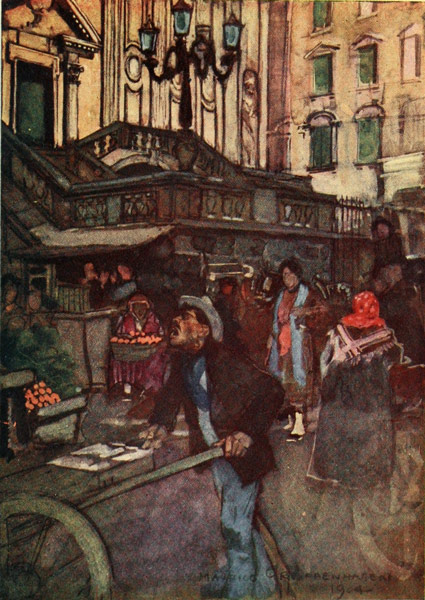
NAPLES—IN THE STRADA DI TRIBUNALI.
A man willing to go on foot from Resina to
Pompeii might find much to amuse him by the way,
especially if he have any care for tracing out the
ravages of eruptions. The seashore is not unpleasant.
The lava reefs that fringe it are curious, and the
ports of Torre del Greco and Torre dell'Annunziata
have their share of interest and picturesqueness.
But the crumbs of knowledge to be picked up during
such a walk seem insignificant beside the banquet
which lies waiting at Pompeii; and only those who
have already tasted the last dish of that banquet will
care to loiter on the way.
I do not propose to add one more to the countless
unscholarly rhapsodies which have been produced by
visitors to Pompeii. Certain tragic feelings strike
every one who enters the old grey streets. They are
too obvious to need description. All else belongs to
the domain of the guide-book or of the expert—to
the latter more than to the former, since the best
of guide-books is a sorry companion to a man who
has neglected the works of Helbig or August Mau.
It is not to be expected that the detailed descriptions
of Murray or of Gsell-Fels can supply the broad
principles and the general ideas which would have
been a constant delight if acquired in advance. Many
of the best intellects in Europe have been engaged in
estimating the significance of the objects found from
day to day in Pompeii. It is in their works that
knowledge should be sought; for there is scarce any
subject on which so much has been written, both
so badly and so well, as on this lost city of the
Campanian Plain.
It is, as I have said already, by wandering up and
down the Strada Tribunali in Naples that one may
prepare oneself to picture what would have struck
a stranger on first entering Pompeii. A man passing
to-day beneath the vault of the Porta Marina sees a
grey street, its house-fronts perfect, but empty, and
startlingly silent. This street runs into the Forum,
and is in easy hearing distance of the babel of noise
which issued constantly from that centre of the city.
Under the colonnade of the Forum tinkers mended
pots with clatter and din of hammers. Women
hawked fruit and vegetables up and down, chanting
their praises doubtless as loudly as the "padulani" of
to-day in Naples. Ladies met their shoemakers
under the cool shadows of the great arcade; and
there, too, children chased each other up and down,
screaming at their games like any urchins of to-day
upon the steps of San Giovanni Maggiore. We know
it, for they are all depicted in paintings found in
neighbouring houses. There is the seller of hot food
with his caldron, not unlike the stall at which the
workman stops to-day in the Piazza Cavour and pays
a soldo to have his hunch of bread dipped into hot
tomato broth. What cheerful sounds must have
risen up from all these occupations! How shall one
picture them, except in the streets of some other
crowded city? On the left, abutting on the south-west
angle of the Forum, is the Basilica, a broad hall
used as an extension of the market-place, and containing
at the rear the tribunals of justice; while at
the opposite, or north-east corner of the Forum, is the
market proper, the Macellum, where the fish were
sold. Certainly they were brought in by this Porta
Marina, far nearer to the shore in those days than
now. The scales scraped off the fish in the Macellum
were found there in great numbers. Close by were
pens for living sheep and counters for the butchers.
What a reek of odours, what a hum of eager voices,
must have risen up from this dense quarter of the
busy, active town! The Pompeiians traded with
their very hearts. "Lucrum gaudium!" "Oh, joyous
gain!" such were the exclamations which they
painted on their walls. And gain they did! Transmitting
over the seas the commerce from Nola and
Nocera, trading doubtless with ships of Alexandria,
as Pozzuoli did; harbouring at their piers upon the
Sarno, round which a suburb had sprung up, galleys
of many a seaport city, Greek or Barbarian, carrying
the industries, and not a few among the vices of the
East. Both found a ready welcome in this full-blooded
city, intensely alive to all delights and
interests, whether pure or impure. Venus was protectress
of the city, and was worshipped without stint.
There were some within the city whom loathing of
its wickedness had impelled to prophecy, so at least
one must infer from the fact that the words "Sodoma
Gomora" are scratched in large letters on one of the
house-fronts.
To whom in that pagan city could Hebrew history
have suggested so apt and terrible a foreboding?
A Jew, perhaps, of whom there were multitudes in
Rome; even possibly a Christian, but there is scant
evidence of that. Doubtless the Pompeiians read
those words without comprehending their horrible
significance, and went their way to theatre or to
wineshop, a laughing people, a gay, light-hearted
nation, a mixed race, the blood of Oscans and of
Samnite mountaineers mingling with the languid
graces of the degenerating Greeks, loving easily,
forgetting lightly, careless, passionate, and intensely
human.
Such was Pompeii, a seething, noisy, eager city,
filled with the reek of dense humanity. But now
it is swept clean by winds and sunlight. Its very
stews are fragrant. In the morning sweet air blows
in from the sea; at night it steals down no less
sweetly from the mountains. In all the city there
is not one stench. The freshness and the silence
of the long streets weigh upon the nerves. There
is so little evidence of ruin, not an ash left, not
a bank of earth in all the wide district which one
enters first, nothing to remind us by the evidence
of sight what it was that drove out the people
from these once crowded streets and left the houses
and the colonnades open to the whispering sea wind.
It was not so before the great director Fiorelli
came. He it was who stopped haphazard digging,
and cleared each quarter completely before beginning
work upon another. Since, then, his methods have
in great measure freed the city already of its débris,
and set its inanimate life before us as it was, the
wiser part at Pompeii is to try to grasp the arrangements
of a Roman city, leaving the necessary musings
on the tragedy to be got through elsewhere.
It is beyond my scope, as I have said already, to
assume the authority of an expert on Pompeii. More
experts are not wanted. The lack, at least in England,
is of readers for those who exist. A man intending
a tour in Italy will lay out ungrudgingly ten pounds
upon his travelling gear, but he will scout the idea
of spending the price of a new hat-box on August
Mau's treatise, Pompeii, its Life and Art, though it
would increase his pleasure tenfold more. Still less
will he buy any book in a foreign tongue. I must,
therefore, in my unlearned way, set down some few
facts which will with difficulty be discovered in the
guide-books or from the guides. And firstly as to
the houses.
It will occur to any man that a town so large
as Pompeii must have been built in many fashions,
old and new. New types grew popular, while old
ones still persisted. There is no town in the world
in which many manners cannot be traced. At
Pompeii, where building was arrested eighteen
hundred years ago, the changes of taste are plain
and interesting. Indeed, while the houses all possess
the atrium, that is the large square or oblong hall
in front, open to the sky, with chambers surrounding
it on every side, and most have also the peristyle,
the colonnaded court behind; yet there are some
which are built without the peristyle, and which by
other points in their construction give witness of
belonging to an earlier and simpler age.
One of these antique houses is easily found by
passing through the Forum, across the Strada delle
Terme and up the Strada Consolare, almost to the
Herculaneum gate. It is called the House of the
Surgeon; and as in all the city there is no other
which retains so largely the aspect and arrangements
of the earlier time, before Greek influence was paramount,
it should certainly be visited first.
It appears at once on entering the house that the
peristyle is lacking. One may stand within the
courtyard of the atrium, and, looking through the
house, see no such vista of colonnaded quadrangle,
of fountains, busts, and splendid distances, as gratified
the eye within the larger and more modern
houses. Those beauties were the contribution of the
Greeks to the old simple Latin life. This was the
abode of a "laudator temporis acti," a lover of
the old homely times, when the single courtyard
of the atrium sufficed alike for the master, his
family and clients, when the wife sat spinning with
her maidens by the scanty light, as in Ovid's immortal
description of Lucretia, and the slaves came
and went about the household duties close at hand.
A colonnade there is certainly, but of only one
arcade, and giving on the garden. There was but
little splendour in such a dwelling. Only when
Greek influence destroyed the simplicity of earlier
life was the family quarter distinguished from that
of slaves and clients and relegated to the peristyle,
the inner courtyard. There is no trace in the
Surgeon's house of the rich ornament which became
so popular in Pompeii, neither mosaics nor wall
paintings. The very building stone differs from
that used in later years; for the house is built of large
square limestone blocks, while the immense majority
of houses in the city are constructed of tufa, quarried
chiefly from the ridge on which the city stands. All
these facts mark the Surgeon's house as belonging
to the earliest Pompeiian age of which traces still
exist. It is certainly older than the year 200 B.C.,
and we may picture the city, while still untouched
by the rare sense of beauty which was flowering in
the Greek coast towns, as consisting largely of houses
on this model, with others of a fashion older and
more humble, of which we now know nothing.
From the House of the Surgeon it is but a little
way to that of Sallust, a larger residence, and one
of later date, when tufa had displaced limestone as
a building material. It belongs, therefore, to the
same period as the vast majority of houses in the
city, yet in that period it is of the most antique,
the work of a day when Greek influence was not yet
paramount in architecture or in private life. It has
no peristyle, if a late Roman addition be excepted;
the family life was not yet divided. From the
atrium one looked through to colonnade and garden,
much as in the Surgeon's house. The only paintings
are in imitation of slabs of marble on the walls.
To reach the House of the Faun we must return
to the Strada delle Terme and follow it towards
the north-east until it merges in the Strada della
Fortuna, in which, upon the left, stands the once
magnificent dwelling which takes its name from the
beautiful bronze of the Dancing Faun now in the
Naples museum. It is much to be wished that the
treasures of this noble house could have been left
in it. It may in part be older than the house of
Sallust, though belonging like it to the Tufa period,
and possessing the additional apartments prescribed
by the influx of Greek taste. Indeed the added
rooms, like all the other portions of the house, were
planned with magnificence; and as there are two
atria, so there are two peristyles, each of singular
beauty and built in the purest taste. There is no
house in Pompeii in which a man should pause so
long, or to which he should come back so often;
for this is the most perfect specimen of the best
age of building in the city. It is the fruit of a
long age of peace, during which the people drank
in thirstily the exquisite sense of beauty diffused
from the Greek coast towns. It is not difficult to
understand how these rough townsmen, bred of sturdy
mountaineers, and inheriting no tradition of fine
culture, must have been affected when they went
across the sea to Cumæ or to Pæstum, saw the
austere glory of the temples rising near the shore,
talked with the men whose brains schemed out that
splendour and whose hands learnt how to fashion
it, craftsmen who wrought nothing destitute of loveliness,
whose coins were as noble as their temples,
whose hearts must have been afire to spread more
widely their own perception of line and form, and
who were doubtless no less eager to teach than the
Pompeiians were to learn. There is nothing in the
world to-day comparable to the magic of that
influence which spread like sunshine out of the Greek
cities on the Campanian coast, no teachers so noble,
no scholars so devoted and receptive, no people who
surrender themselves so absolutely to the dominion
of beauty, and will have it pure, and none but it.
Under the first passion of this enthusiasm Pompeii
was transformed. Almost all the public buildings
received their present shape from this wave of pure
Greek art. Almost every one is graceful and lovely,
the columns and architraves were white, the ornament
not overloaded, the decorations simple. The artists
who tinted the walls confined themselves to producing
masses of colour. Wall pictures there were
none; but the mosaics of the floors were wrought
with curious beauty, and reproduced the first compositions
of great painters. The House of the Faun
is beautified by no wall pictures, but it contained
on the floor of the room which divided the two
peristyles one of the finest mosaics ever found, that
which depicts the battle of Alexander the Great
upon the Issos.
The stream of Greek influence ran pure for some
four generations. After that it was contaminated.
Man can keep no beauty in his hands for long
unspoilt. The change is manifest in Pompeii. The
Roman influence stole in. A muddy taste obscured
the simple grace of the Greek lines, tortured the
architecture, piled up unmeaning ornament, and
degraded all the city. There were many stages
between the first step and the last, not a few still
beautiful, though the downward tendency is plain.
The house of the Vettii is the finest of the later
period. There one may see wall-paintings of rare
charm, mingled with others of far inferior taste, as
if the gallery of some fine connoisseur had fallen
by mischance into the hands of men who did not
understand its worth, and placed the compositions
of degraded artists side by side with the masterpieces
of an olden time.
Exact descriptions of these houses are the business
of the guide-book. But there are certain observations
which I think it necessary to make about the
paintings—though if anyone would read the work
of Helbig on the subject, it would be much better.
No one who visits Pompeii, no one who has seen
in the most hasty way the collections of the Naples
Museum, can fail to be impressed, first with the worth
of the pictures, their dramatic force, their exquisite
grace, their rich and tender fancy; and next by their
vast profusion. What manner of city was this which
worshipped art so devoutly that scarce a single house
is without pictures more beautiful than any save a
few collectors can obtain to-day? Helbig, writing
more than twenty years ago, described and classified
two thousand. Others perished on the walls where
they were found. More still are being dug up day
by day. No ancient writer has told us that Pompeii
was renowned for the multitude of its paintings. The
city bore almost certainly no such reputation. It was
a provincial town of little note, remarkable for nothing
in the eyes of those who visited it. Yet what a world
of beauty must have existed on the earth when these
were the common decorations of a fourth-rate town,
excelled by those of Rome, or even Ostia, in proportion
to the higher wealth and dignity of those imperial
haunts! What were the decorations to be seen at
Baiæ, when Pompeii was adorned so finely! That
group of palaces must surely have drawn more noble
craftsmen, and in greater numbers, than ever visited
the town of trade and pleasure on the Sarno. As in
a great museum we stand before the gigantic bone of
some lost animal, striving to picture in our minds the
creature as he lived, getting now a dim conception of
great strength and bulk which is lost again by the
weakness of our fancy ere half realised, so in presence
of these pictures at Pompeii we are tormented by
flashing visions of the grace and splendour of the
ancient world which so many centuries ago was
shattered into fragments, and which it may be that
no human intellect will ever reconstruct before the
earth grows cold and man fails from off its surface.
Whence came these pictures, these noble visions of
Greek myth, austere and restrained, these warriors,
these satyrs, these happy, laughing loves? Is it
possible that one small city can have bred the artists
who dreamed all these dreams and yet have left no
mark in history of such great achievement? Clearly
not. The artists cannot have been Pompeian. The
elder Pliny tells us that in his day painting was at the
point of death, while Petronius declares roundly that
it was absolutely dead. One walks round the Naples
Museum and recalls these judgments with astonishment.
Can this art be really moribund, this Iphigenia,
spreading her arms wide to receive the stroke, this
Calchas, finger on lip, watching for the fated moment,
this Perseus, this Ariadne! If this is dying art,
Heaven grant that English art may ere long die of
the same death.
But it is not. No man can judge it so. Pliny and
Petronius meant something else, and the key to their
despondency is produced by the discovery that many
of these Pompeian pictures are replicas. The same
subjects recur, with almost the same treatment. Sometimes
the figures are identical. Sometimes the painter
has elected to reduce the composition. The painting
of Argos watching Io occurs four times in Pompeii.
It has been found also in Rome!—the same picture,
but containing figures which the Campanian artist
thought proper to omit. There is evidence, too, that
the picture was diffused over an area far wider than
that lying between Rome and Pompeii. It appears
on reliefs, on medals, and on cameos. Lucian had it
in his mind when he wrote a famous passage in his
poem, and it suggested an epigram by Antiphilos.
The case is similar with the fresco of Perseus and
Andromeda. Both were world-known pictures, the
composition of a great artist—Helbig suggests that
it was the Athenian Nikias—and both were copied
far and wide by craftsmen who could merely reproduce.
This is what Pliny and Petronius meant. They
looked about them and found only copyists. The
great school of painting was dead, and those who
reproduced its works did so without heart or understanding.
This was sorrowful enough for them; but
we may regard their woeful faces cheerfully. Time
and the volcano have done us the good service of preserving
to our day copies of some masterpieces of
ancient painting. The copyists were often treacherous.
There is a fresco of Medea at Pompeii in which
the figure of the mother brooding over the thought
of murdering her children is weak and unconvincing.
But at Herculaneum was found a Medea who is
terrible indeed, wild-eyed and murderous, such a
figure as none but the greatest artist could conceive
and few copyists could reproduce. Set this Medea
in her place in the Pompeian fresco and the result
may well be the Medea of Timomachus, one of the
most famous pictures of all antiquity.
The school in which these artists, Pompeians or
travelling painters, found their models was Hellenist,
Greek art of the period subsequent to Alexander
the Great. They did not draw by preference upon
its highest compositions. Serious treatment of the
ancient myths, that treatment which revealed the great
and elemental facts from which they sprang, was not
popular in Pompeii, where the citizens appear to have
preferred a lighter and more artificial view of life—love
without its passion, the comedy of manners rather
than the tragedy. These gay feasters desired to see
no skeletons among their roses and their winecups.
They preferred light laughing cupids, kind towards
the human frailties of both men and women. It was
a joyous, light-hearted, unreflecting society on which
this terrible destruction fell, luxurious and vicious.
The realisation of that fact tightens the sense of
tragedy, as the sudden annihilation of a group of
children playing with their flowers seems more pitiful
than the death of men.
There are a thousand things still to say of Pompeii,
but they are beyond my scope. The westering sun
has turned all the hills above Castellammare into
purple clouds. The heat lies among the broken city
walls. It is enough. I turn away, and take up anew
the course of my journey.
It is no long way from the turfed ridges which
conceal Pompeii to the first rises of the Castellammare
Mountains. The road crosses the Sarno, and
cuts straight and dusty through wide fields of beans
and lupins, with here and there a gaunt farmhouse,
or massaria, bare of all attempt to make it pleasant
to the eye. The bitter lupins are almost, if not
quite, the cheapest food that can be bought in Naples,
and are accordingly sold principally to the very poor
by the "lupinaria," who may be seen any day in the
precinct of the Porta Capuana, or in the byways
round about the Mercato. Does anyone ask how the
beans became so bitter? It was by the curse of our
Lord, who was fleeing from the Pharisees, and hid
Himself in a field of lupins. The beans were dry,
and betrayed His movements by their rustling; whereupon
He cursed them, and they have been bitter ever
since.
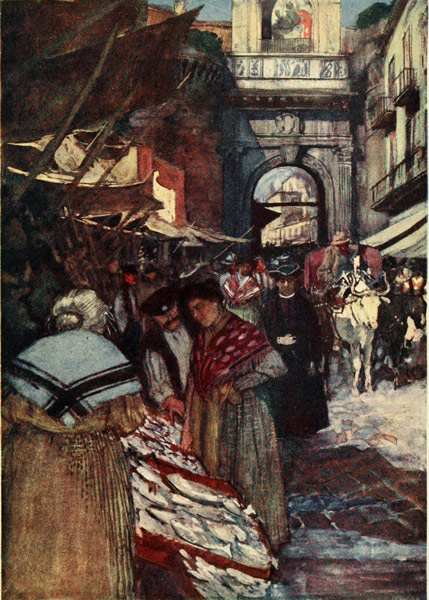
PORTA CAPUANO—NAPLES.
There is no doubt that the Sarno was navigable
when Pompeii was a living city, but these many
centuries it has been a rather dirty ditch, unapproachable
by shipping. Its chief interest for me lies in
the fact that along its bank, and across all the fertile
country up to the base of the great mountains, was
fought the last great battle of the Goths, those brave
Teutons out of whom, as Mr. Hodgkin says, "so
noble a people might have been made to cultivate
and to defend the Italian peninsula." Heaven had
been very kind to Italy in this sixth century after
Christ. It had sent down upon her from the north
a race of conquerors, barbarian, it is true, but brave,
honourable, sincere, and possessing every capability
for government. They conquered Italy from end to
end. No province, no city, held out against them.
From the Alps to Sicily they were supreme, and
their genius, humane and not disdainful either of the
arts or Christianity, was rapidly fusing every warring
element of the peninsula into a mighty nation—Germanic
earnestness infused with Latin wit—when
the lord of the world, the Roman Emperor in distant
Constantinople, resolved to put forth his strength and
drive out these strangers, these builders of a nation,
who were tending what he had neglected, defending
what he had left open to attack, and reaping harvests
of which he, out of all men, was least entitled to proclaim
himself the sower.
So the Emperor sent first Belisarius, and then
Narses, and long and bitter was the war which followed.
Mr. Hodgkin, in his fourth volume, has told
it in a style which is beyond all praise. Upon these
plains was fought out the last battle of the Goths.
Here Narses brought them to bay. For two months
they lay along the line of the Sarno, while Narses,
baffled by the river, plotted how to take them in the
rear. At last he won over some traitor of an admiral,
who surrendered to him the Gothic fleet, lying, perhaps,
at Castellammare; and the Goths, finding that
the port was no longer theirs, fell back upon the hills,
entrenching themselves upon the spot where the
ruined castle of Lettere now stands. But their
supplies were cut off—it was impossible to feed an
army on the barren mountains—and adopting counsels
of despair, they descended to the plain and gave
battle to the Imperial troops.
It was a great and terrible fight. Goths and
Romans fought on foot. Teias the king fell after
bearing himself right nobly; but the Goths fought
on, and when darkness interrupted the engagement
they did but pause in order to renew it with no less
desperation when the light returned. When both
armies were nearly wearied out the Goths sent a
messenger to Narses. They perceived, they said,
that God had declared against them, and that the
strife was hopeless. If terms were granted they
would depart from Italy. The Imperial general accepted
their proposals, and the Goths, the noblest
invaders who ever entered Italy, turned their backs
for ever on the fertile land where they had made their
homes, crossed the Alps in order, and were never
heard of in Italy again. So perished, until our day,
the last hope of unity for Italy, and for full thirteen
centuries that unhappy land was drenched in constant
blood—the prey of conquerors who could not conquer,
and the sport of statesmen who never learnt to govern.
For the Roman Emperor could build no state comparable
to the one he had destroyed, and what Italy
owes to him is forty generations of unhappiness.
In travelling through this country one is haunted
by the perpetual desire to look back into past ages,
and admonished almost as often that as yet one
cannot do so. Indeed, one looks forward almost as
often, anticipating that day when scholars will combine
to assist in the excavation of all the buried
regions, when every villa shall be disinterred, and the
secrets hidden underneath the vineyards be exposed
to the light of day again. Here on the first slopes of
the hills around Castellammare lay the groups of
country villas which formed ancient Stabiæ, and
every man who goes this way longs to see them
disinterred. For what is seen at Pompeii is but half
the life of Roman days—a city stripped of its country
villas and all its rustic intercourse. Pompeii
stood in the heart of the country. Its citizens must
have had farms upon the mountain slopes; they
must have had concern in husbandry as well as trade;
there must have been hourly comings and goings between
the crowded streets and the sweet hillsides of
Varano, where the grapes ripened and the wine-vats
gathered the crushed juice, where the oil dripped
slowly from the olive-presses, and the jars stood waiting
for the mountain honey.
The day will come when all this great life of
Roman husbandry will be disclosed to us, and we
shall know it as we now know the city streets; for
it is here still upon the mountain slopes, buried safe
beneath the vineyards, waiting only till its vast interest
is comprehended by people in sufficient numbers
to provide the funds to excavate it. Stabiæ was
by no means another Pompeii. It was no city, but a
group of farms and country villas, and has countless
things to teach us which cannot be seen or learnt
beside the Sarno. The very houses were of other
shapes and plans; for the Romans did not reproduce
town houses in the country, but designed them for
different uses, and embodied apartments which had
no matches in the city. There are the residences of
wealthy men, adorned with noble peristyles, mosaics,
and fine statues, and side by side with them the
home farms—if one may use a modern term—the
chambers of the husbandmen, and the courts in which
they worked. There, too, are buildings far too large
for any family and differing in arrangement from any
private dwelling yet discovered. The use of these
great buildings can only be conjectured. Ruggiero,
whose self-denying labour has collected in one monumental
work all the information now obtainable upon
the subject, suggests that they may have been
hospitals, a supposition probable enough when we
remember that the Romans must have been no less
aware than we ourselves how potent a tonic is the
mountain air for patients suffering from the fevers
bred upon the plains. In Ruggiero's pages one may
see the scanty and imperfect plans sketched out by
those who dug upon the site more than a century
ago. Posterity owes those hasty workers but
little gratitude. They were inspired by hardly more
than a mean kind of curiosity. They were treasure-seekers,
pure and simple; and what they judged to
be of little value they broke up with their pickaxes.
Swinburne, the traveller, watched a portion of the
excavations, but without intelligence, and has nothing
to tell us of much interest. "When opened," he
says, speaking evidently of a villa on Varano, it may
be the very one in which Pliny passed the last night
of his life, "the apartment presented us with the
shattered walls, daubed rather than painted with
gaudy colours in compartments, and some birds and
animals in the cornices, but in a coarse style, as
indeed are all the paintings of Stabiæ. In a corner
we found the brass hinges and lock of a trunk; near
them part of the contents, viz. ivory flutes in pieces,
some coins, brass rings, scales, steelyards, and a very
elegant silver statue of Bacchus about twelve inches
high, represented with a crown of vine leaves,
buskins, and the horn of plenty." With this perfunctory
account we must rest content, until some
millionaire shall conceive the notion of delighting all
the world instead of building a palace for himself.
But the camel will have gone through the needle's eye
before that happens.