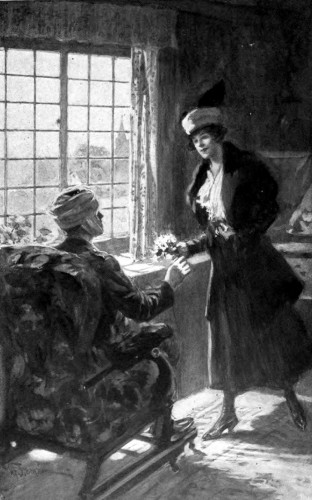
The visits to The Beeches now became for Anita a sort of fearful joy.
If anyone noticed her solicitous concern for Terrence Wirt no one
commented upon it. They were all too busy, too occupied with quite as
serious cases to think these attentions anything out of the usual, and
attributed them to Anita's compassionate desire to lighten a sufferer's
burdens. Bobbie Haynes, provided with an artificial leg, struck out
for his own home. As others became better they, too, went away and
their places were taken by those more recently hurt, yet Terrence still
lingered, for as yet it was not certain that his sight would return.
The doctor from London favored a slight operation.
As the days succeeded one another Anita crept closer and closer into
the confidence of the man who knew her only as Miss Beltrán, and he
grew to look for her coming as the one bright spot in his day.
At last there came a time when Anita felt that she could ask him: "Why
did you join the British troops?"
He was silent a few moments. By this time the bandages had been removed
from his face all but the eyes, and the girl's looks lingered on the
features she still loved, but with a new tenderness. "I went for one
or two reasons," he said. "I had a fierce sense of justice and I felt
that the Belgians should be avenged. If I could help to do it I wanted
to."
"I think that was very unselfish and noble," said Anita in a low tone.
"Oh, don't think it was altogether that," he replied quickly. "I
think the chief reason was because I was most unhappy. I had lost
the two whom I loved best in all the world, and life did not appear
particularly desirable. I didn't care much whether I was knocked out by
a German shell or not. I am afraid I didn't calculate on just this sort
of thing happening, or I might not have been so ready to go."
"I am so sorry about those—those two you lost." Anita's voice
trembled. "Do you—can you bear to tell me about them?"
"One was my mother," he said reverently. "She died a little over a year
ago. I was in France when it happened, and I did not see her, for it
was quite a sudden illness."
"Oh, I am so sorry, so sorry," Anita spoke with feeling, "I can——"
she checked herself from saying that she could sympathize with him
because of having gone through a similar experience, and went on to
say, "I can imagine what a great grief that must have been. And the
other loss?"
"Is something that I should get over and probably will do so in time.
Indeed, I cannot see why I do not, but I suppose I am built that way.
It is the girl in the case, perhaps you may have guessed. She threw me
over, to speak plainly."
"How horrid," Anita gave a quick gasp.
"Well, perhaps that isn't exactly so. She was so young, so full of
girlish fancies, and I was too hard and unyielding. Oh, I see now what
I should have done. I saw it when it was too late. I don't excuse my
part of it at all, yet as I was then my uppermost feeling at the time
was indignation that she should doubt me. I was hurt to the quick that
she should declare my love for her was a pretence. She gave me back
her ring and I went off hot with despair and injured feelings. She was
'fire and dew and spirit;' I was a youth supreme in a belief in his
own opinions. I couldn't see beyond a very limited horizon. I couldn't
perceive her side at all. I was just out of college and you know,
perhaps, the state of mind of the just graduated college boy."
"You didn't even think of going back and trying to make up?"
"Of course, but I told myself that my pride wouldn't permit it. In my
state of mind I wanted to get as far off as possible and so I came to
Europe. I have been here ever since, and I have learned a lot."
"About—about—girls?"
"About life in general, about my stupid self, and well yes, about girls
as a class."
"Did you never think of going back after you had learned all these
things?"
"Yes, but it would have been of no use. She left that part of the
country, and I don't know whether she ever went back. Her mother died,
I learned, and she went away. My sister, who used to be a neighbor
of hers, removed to California and all I learned was through casual
friends. Perhaps if my sister had known how matters stood she would
have found out more for me."
"But she never knew?"
"No, we thought, at least N——, the girl, thought it would be so much
more romantic to keep our engagement a secret, so no one knew except
her mother."
"She must have been a very silly girl," said Anita, with a triumphant
smile playing around her lips and with her heart beating rapturously.
"She was the most adorable girl I have ever seen. I can say that," he
said with a sudden smile, "because I can't see you and I really don't
know how young you may be."
"I shall never be so young as I was once," returned Anita with a little
laugh.
"No more shall I. Well, it is all over now. Some day I may meet her,
married, probably, but even if she were not and she still had a thought
for me I could not offer her this battered up old hulk."
"You just said she wasn't a silly girl, and she would be worse than
silly if she did not appreciate you."
"That is the loveliest, most friendly thing for you to say," declared
the young man, holding out his hand. "Do you know you speak so much
like her that I have been wild enough sometimes to imagine that it was
she sitting here reading to me, talking to me. It was a stupid thing to
imagine, but, for the moment, it has made me quite happy."
"I am so glad if I could bring you a moment's happiness when you have
to live in this darkness." Anita tried to steady her voice and wondered
if he observed the thrill which she realized she could not control.
"And that first day, when I asked you to play the Chopin étude, do
you remember? It was one which she played the oftenest. She played
marvellously well. But, dear me, I know I must be boring you. There is
nothing so ungallant as to descant upon one woman's charms when you are
talking to another."
"Did you learn that in Paris?" asked Anita, her laugh rippling out.
"In Paris and elsewhere. I stayed mostly in little places when I was in
France; Brittany, Normandy I love. I did not mean to revert again to
our late subject of conversation, but I have to say this. Not only do
you speak like her but your laugh is hers over again. I could believe
it Nancy's."
"Ah, her name was Nancy?"
"Yes. It is a dear little name, isn't it?"
Again Anita laughed. She was half hysterical.
"Were you ever in the States?" asked Terrence, suddenly.
"Yes," she answered falteringly. He must not discover her yet. "I was
over there with my mother a couple of years ago."
"You were not born there?"
"No, I was born in Mexico, although my father was a Spaniard from
the north of Spain. We came last spring from visiting his relatives.
Have you been in Spain?" She adroitly turned the conversation to this
subject.
"No. I have thought several times that I would go, but not knowing the
language I thought I would wait till I could come across a travelling
companion who did."
Here a sudden interruption came in the person of Aunt Manning, who took
a fancy to come over with Mr. Kirkby to see Mrs. Teaness. "Nancy," she
called, "Nancy Beltrán, where are you?"
Anita sprang up. "It is my Aunt Manning," she said, nervously.
"Nancy," came the voice again. "Oh, there you are. I want to see that
American you have been talking so much about."
Anita turned to Terrence who in his corner was half hidden by a
curtain. "My aunt wants to meet you, do you mind?" she asked. "She is
a funny old dear."
"I shall be very glad to meet her," returned Terrence courteously.
"Will you let me lead you?"
"If you will be so good."
So hand in hand they went toward Aunt Manning who stood in the doorway
waiting. If Anita had thrilled before how much more did she with her
hand clasped in her lover's. She wished the way were longer. She
wondered if he could feel the throbbing of her pulses, the beating of
her heart. But all this tumult was hidden from Aunt Manning, who was
looking interestedly at the young man as he held out his hand while
Anita said: "This is my aunt, Mrs. Manning, Mr. Wirt. She has been very
much interested in our account of our American hero."
"Oh, don't call me a hero," cried Terrence. "I'm just like any other
Tommy who happened to get hit."
"But you needn't have been," spoke up Aunt Manning. "You hadn't any
cause to fight unless you wanted to, while we had."
"But I wanted to." He smiled.
"So we see," returned Aunt Manning. "I don't happen to represent any
special organization and I am here entirely upon my own account, but I
want to give you one English woman's thanks for what you have done."
"The thanks are worth a great deal, coming to me from such a source,"
returned Terrence, with a courtly bow.
"When you get better you must come to see us at Primrose Cottage,"
continued Aunt Manning. "Mr. Kirkby can bring you over; he would like
to. We have a nice dog and a cat."
"Two dogs," corrected Anita.
"To be sure, to be sure. Well, Mr. Wirt, you must come over and have a
cup of tea. Do you like crumpets? I'll have some for you. Come along,
Nancy. I hear that horn tooting out there at a great rate. Evidently
our friend, Ernest Kirkby, is getting impatient."
"I will take Mr. Wirt back to his chair and then I will come,"
responded Anita.
Again, hand in hand, they went across the room. Terrence felt for
the arms of the chair and settled back in it. Anita stood hovering
over him, longing to touch his hair, to lay her hand upon his broad
shoulder. "Before I go," she said presently, "I want to add my thanks
to my aunt's, not only for what you have done on the field but for the
proof of friendship you have shown in confiding in me. I want you to
believe that I shall respect your confidence and that it is a matter
between our two selves alone."
"I do believe that. Really I don't know why I should have told you, for
it is not a thing I ever speak about, but somehow I felt impelled to,
and your sweet consideration and sympathy are very comforting."
"Nancy, Nancy," came the call again, "aren't you ever coming?"
A hurried good-bye and she was gone. The young man sat there thinking,
thinking. Nancy. Nancy. She was called that, and yet how could it be?
The tones of her voice, her laugh, many little turns of expression,
yet how could there be any connection between Nancy Loomis and Anita
Beltrán? He tried in vain to imagine some situation which would explain
it but failed utterly. "I'll ask Mrs. Teaness or one of her daughters,
that nice pleasant one they say is so stout," he told himself.
Therefore the next time that Eleanor came in to render some slight
service he said: "I wish you would tell me something about Mrs. Beltrán
and her daughter. They have been so unutterably good to me that I feel
interested in them beyond the ordinary."
"Mrs. Beltrán is an old friend of my mother's," Eleanor told him. "They
were schoolmates in their young days, and when Mrs. Beltrán came back
with Anita the friendship was resumed. Mrs. Beltrán is the daughter of
a clergyman, and was born in the same place my mother was. She married
a Spaniard. I believe it was not a very fortunate marriage. Mr. Beltrán
died years ago. My mother never saw him, she tells us, for they lived
in Mexico."
"I understand. Miss Anita was born there, I am told."
"Yes. Isn't she a dear? We are all so fond of her. She has a charm
quite unlike any girl we know. I suppose it is the Spanish element. She
looks very Spanish, too. Oh, you must get well by Christmas so as to
see her dance. She is quite wonderful in her Spanish dances. You must
not think of leaving us before Christmas, Mr. Wirt, for in spite of
these grave times we want to make a cheerful day of it, and you must
help us celebrate. When do you see Mr. Meredith again?"
"Mr. Kirkby is to take me up to London in a few days. There is to be a
consultation and perhaps a slight operation."
"We shall all pray hard that it will be a successful one. You will come
back to us after it is over, I hope."
"If the doctors will let me, I shall be only too glad to do so. There
are no words to tell of my appreciation of this haven of rest."
Eleanor moved off, but Terrence called her back. "Would you mind
describing Miss Beltrán to me. We have become such good friends that I
should like to visualize her better. She is young?"
"Oh, yes, not more than twenty-one or two at the most."
"And has fair hair, which she wears simply in smooth bands?"
"Oh, no, that is an entirely wrong impression. Her hair is quite dark
and curly. Her eyes are dark, too."
"Her nose and mouth?"
"She has a nice straight nose, but her mouth is her least good feature.
It isn't bad, you know, but it is rather large and just a trifle more
prominent than one would choose for perfection, not at all like her
mother's, so it must be like her Spanish father's."
"She is slender?"
"Compared to me she really is, but compared to my sister Alicia she is
not," returned Eleanor laughing. "I suppose one might call her rather
slender, and she has pretty little hands and feet."
"Thank you, Miss Eleanor, I think I can see her in my mind's eye quite
plainly."
"I hope you will see her with your actual eyes before long," said
Eleanor, heartily, and then she left the young man more puzzled than
ever. Try as he would he could not disassociate his idea of Anita
Beltrán from his remembrance of Nancy Loomis. The resemblance must go
beyond the mere matter of voice and manner of speech. Her features,
the color of her eyes, not the hair though; that was different. It was
distracting, yet at last he came to the conclusion that it must be one
of those coincidences which often do lead persons astray in cases of
mistaken identity.
Anita arrived at home tingling with excitement. Her mother was taking
one of her days of much needed rest and Anita flew to her room,
appearing radiant, with eyes like stars and lips glowing. She flung
herself upon her mother in a transport of happiness. "Oh, madre,
madre," she cried, "I have discovered why he went to the war. It is
wonderful, wonderful. I never dreamed it could be so. Oh, I am so
happy."
"Who is he and why are you happy?" asked her mother, smiling.
"Terrence, you know; it is because of Terrence. He told me to-day
all about it. He was so unhappy and he didn't care what became of
him, at least that was part of the reason. He had lost his mother,
poor darling, and he had lost me and so he was ready to do anything
reckless, but he did go on principle, too."
"And does he know you to be the Nancy he used to know?" Mrs. Beltrán
asked, rather anxiously.
"Oh, no. I don't want him to know at once. Somehow I do not, for he is
too honorable to offer himself to anyone while he is uncertain about
his sight, yet I know, I know that he has not forgotten, and I shall
marry him, eyes or no eyes."
"But, my dear, my dear, that is too serious a matter for you to decide.
How could you support him with your small income, even granting that it
would be a wise thing to do?"
"Oh, he has enough. Did I never tell you that he has quite a nice
little income, not a great one, but enough? How could he have stayed
over here all this time without? I have never thought much about that
part, for I don't believe I am mercenary."
"I don't believe you are," returned her mother, smiling, "but the same
cannot be said of some other things; you certainly are an excitable
young person. How did he happen to tell you all this?"
"I don't know. He said he was impelled to, that he never did speak of
it, but that somehow he wanted to confide in me, in me. Think of it.
Oh, I can tell you that it was as much as I could do not to let him
know who he was talking to. Was I deceitful, I wonder."
"Perhaps you were somewhat so, but if all goes well and he returns from
London with his sight restored I think he will forgive the deceit."
"You like him, mother, after seeing him and knowing him as a nurse does
a patient, you do like him, don't you?"
"I like him very much indeed, more and more as I know him better."
"You darling to say so. You will have two sons instead of one, and we
shall all be so happy together."
"Two sons? Ah, my dear, my dear, if I could but be sure. I am beginning
to fear that our quest will never come to anything."
"Oh, yes it will. Mr. Kirkby told me to-day that he believed he had
another clue and that he would follow it up at once. He is going up to
London with Terrence, you know. Wouldn't it be dreadful if I were to
forget and call him Terrence to his face?"
"Do you think he would be offended if you did?"
"Perhaps not so much offended as astonished. Do you know I am rather
jealous of myself. I am suddenly seeing myself as a rival. Isn't that
ridiculous? He knows me as Anita Beltrán, a girl whom he has been
acquainted with but a short time and here he goes to work and confides
in her; it is always a bad sign. Suppose he should fall in love with
Anita and forget Nancy."
Her mother put back her head and laughed heartily. "No one but your
fanciful self would get hold of such a notion. If you think there is
danger of your becoming unhappy over such a situation I would advise
you to avoid it by telling him that you are both Anita and Nancy."
"I think I shall, but not till he returns from London. He will meet me
but once in the meantime. Mother, dear, there is one thing I do wish
you would ask Mr. Kirkby to promise you."
"And what is that?"
"I want you to make him promise to let you know every day how Mr.
Wirt—I'd better call him that—how Mr. Wirt is getting on. You can do
it with perfect reason as he has been here under your charge for so
long. Will you?"
"I think I can promise to ask him, but I cannot promise that he will
perform."
"I shall be satisfied with your part of the promise. Mother, I wish you
could have seen how startled he, Terrence, Mr. Wirt, I should say, how
startled he looked when Aunt Manning called me Nancy. She was dear. She
wanted to meet him and she asked him to come to see us here at Primrose
Cottage. Oh, mother, if he were to be well enough to come to us for
Christmas."
"Did she ask him?"
"Not for Christmas, but I believe she would if I wanted her to.
Wouldn't it be glorious if he and Pepé should both be here. Even this
dreadful war wouldn't prevent our being happy then. Dear me, it is
dinner time and I am not dressed. Don't hint at anything I have told
you. I had to tell my own darling mother. Do you care, madre, that I
can't help thinking of mamma in this? She would be so glad."
"My dear, of course not. My feeling for her is one of deep gratitude
and reverence. Even if you loved her best I should think it only right."
"I love her very dearly, but somehow when you know that your very, very
own mother has come into your life, and that she is such a mother as
you are, you cannot help giving her the best love." She stopped long
enough to give one kiss and then flew off to change her dress.