The little folks and the donkeys as well were
wild to get on shore again and stretch their
legs a bit, for they had not left the boat for
several days. As soon as they could get away
from the boat they scampered off past the big
hotels where many tourists were sitting on the
verandas and in the gardens sipping cool drinks
just as they did at Cairo.
Everywhere George and his uncle were
followed around by people who wanted to sell
them relics which they said they had found in
the ancient ruins,—coins and scarabs and
pottery, and all sorts of odd things. Mustapha
waved them all away. "Their antiquities are
only make-believes," he said, with contempt.
"There are people who make these imitations,
and these fellows make a business by selling
them to travellers as real curiosities. Sometimes
there were real treasures that could be
picked up at a bargain, but not so many as in
the old days," said Mustapha.
Sun-up next morning found our little party
riding out on another excursion. Mizram
had packed many good things to eat in a big
palm-leaf basket covered over with green leaves
to keep the things cool, and this was slung across
Teddy Pasha's broad back. Our friends were
to have a picnic among some riverside ruins.
Soon they were riding between two rows of
stone figures; an avenue of Sphinxes, like the
great Sphinx at the Pyramids, only much
smaller, and in a few minutes more all dismounted
at the entrance to a great temple.
Such a rabble surrounded them! Beggars
clamouring for backsheesh, people wanting to
guide them through the ruins, and vendors of
relics. Mustapha and the boys had to use their
sticks freely to make the crowd stand back.
Two donkey boys promised to look after
the donkeys, so after threatening them with
all sorts of dire punishments if any harm should
come to their animals, Nabul and his cousin
ran after their little American friend.
For several hours Mustapha led his little
band in and out among the great columns and
across the broad courts of ancient temples.
There seemed to be thousands of these columns,
some standing in long rows, others lying broken
on the ground. How the children stared at the
pictures painted on the walls by the old Egyptians,
the colours as fresh as if they had just
been painted. Mustapha showed them how
these pictures made a regular story-book, if one
only knew how to read them. Here were a lot
of pictures that told all about the doings of
one of the Pharaohs,—how he went to war
and the battles he fought. There were other
pictures showing how he went hunting, and the
various kinds of animals and birds he had
brought back with him from the chase.
The children thought it was most amusing to
read a story-book like that, and went about
trying to make up stories for themselves out of
the pictures.
They stopped to watch a number of men hard
at work among the ruins lifting a fallen stone
column. More than three hundred Egyptians
were working to set up the fallen columns and
clear away the rubbish, and they worked in
much the same way as did the ancient Egyptians
who built the same temples. There were many
young boys, too, helping to pull on the long
ropes by which the columns were raised.
"Come, let us hunt and perhaps we can find
some relics for ourselves," said Nabul. "One of
the donkey boys last year found a little statue."
"I would like to find a mummy," exclaimed
George, as the boys went to work prodding
in the sand with their sticks.
"Mummies are too heavy to carry away,"
said Abdal, wisely shaking his head.
"I should like to find a doll," whispered
Menah to her sister as they too turned over
the sand in their little fingers, thinking of her
own curious little dolls at home fashioned
after the same manner as those frequently
found among the ruins. "You remember the
great traveller who went with our father in the
dahabeah to some old city? How he had
many men to dig in the sand for him, and how
they found many wonderful things there?
Well, he said that often the dolls and toys that
were put in a little girl's tomb would be made
of gold and silver," replied Menah. "I should
like a doll of real gold to play with."
Pretty soon the children tired of their search
and stretched themselves out in the shade of an
enormous stone column to rest.
Our party made many excursions to see
many other old ruins, and one day Mustapha
took them to see some funny camel races. It
was the queerest thing in the world to see the
long-legged camels come swinging along, covering
yards and yards of ground at each step,
each camel ridden by an Arab in flowing white
dress and head covering. After this there was
a race among the donkey boys. Nabul and
Abdal were wild to join in this, but found
it was against the rules for outsiders to
enter.
"They are jealous, they know we could beat
these up-country donkeys," Nabul consoled
himself with saying, but he hurrahed with
everybody else all the same when a lively little
gray donkey, ridden by a small boy in a green
dress, reached the goal first and got the
prize.
One morning early found the Isis again
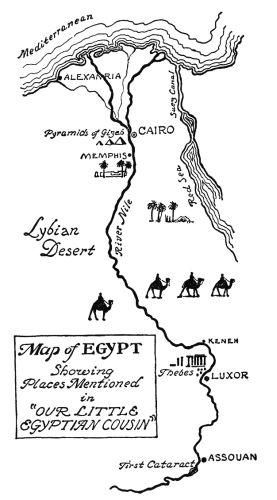
sailing up the river toward Assouan and the
Great Cataract, which was to be their last
stopping-place.
When George and Uncle Ben arrived at
Assouan it was market-day, and the square by
the riverside was filled with all sorts of queer
people and things.
For centuries lower Egypt had been periodically
flooded and then dried out again, and the
poor native farmers and fellaheen had suffered
greatly, many, many thousands even dying of
starvation. All the great volume of water in the
river Nile became at certain seasons a mere
trickling rivulet.
In late years a plan whereby all lower Egypt
was to be properly watered and drained has
made even the poorest of the labourers of the
countryside happy and prosperous. This great
benefit was brought about by the building of
a great dam just above Assouan, and as the
water was let through little by little in the dry
season, and properly stored up when it flowed
in abundance, it proved to be just the treatment
that was needed to make an otherwise suffering
people quite contented with their lot.
"I want to see the great Assouan dam,"
said George one morning as he and Uncle
Ben were just finishing their breakfast. George
was a most inquiring little fellow, and he had
heard some men talking of this great work at the
hotel, and he wanted to see for himself what it
really was.
George had become so expert with donkeys,
that Uncle Ben called him his little donkey boy.
Soon all was ready and Mustapha headed the
little procession that made its way quickly
along through clouds of dust and began struggling
over a stony desert road.
Little Menah was riding behind George and
Mustapha had been gracious enough to let
Zaida sit behind him. The reason of this was
that the donkey boys on the quay, who were a
lot of wild young fellows from the desert, had
come to blows among themselves as to which
of their number should go with our party
to supply the two extra donkeys required,
whereupon Mustapha said he wouldn't have
any of them, that they were a set of black
heathens anyway,—for some were little negro
boys from the Soudan,—so he borrowed a
donkey from a friend of his for himself, and
divided up the party in this way.
Mustapha was so big and fat and his donkey
so small that poor little Zaida had scarcely any
room to sit comfortably. George could hear
Menah shaking with laughter at her sister's
efforts to keep from slipping off at every bounce
the donkey gave.
Meanwhile Mustapha, quite unconscious that
they were amused at him, was gravely telling
them that the high wall of bricks which followed
their road was the old-time boundary to Egypt
and was built to keep back the hordes of barbarians
from the south, but now Egypt was a
much greater country and went far beyond this
wall.
Soon they came into a little village on the
bank of the river which spread out here like a
lake. The children laughed when they dismounted
and looked at each other. They were
so covered with dust that the brown little
Egyptians looked white. They shouted and
clapped their hands with glee when Mustapha
told them to get into a big boat painted with the
brightest colours. Six tall black Soudanese,
dressed in white, with red fezes, pulled at the
oars, keeping time to a queer sort of chant. The
children were so busy watching the rowers
that, before they knew it, they were gliding
past a tiny temple that seemed to be rising out
of the water.
"This is the ancient temple of Philæ, one
of the most beautiful in Egypt," said Mustapha.
"It is on an island, but since the great
dam of Assouan was built the island itself is
covered by water, and if the dam is raised still
higher, as they talk of doing, the little temple
will be entirely covered with water, or perhaps
destroyed, which would be a pity."
On arriving at the great dam they got into
another boat which took them over the First
Cataract, or waterfall, on the Nile. Not over
the worst part of it by any means, but quite
"scary" enough for the little girls. Shortly
after they were again back at Assouan.
George would have liked to have kept on up
the river to the city of Khartoum, where there
is a great school or college erected as a memorial
to General Gordon, who opened up and first
introduced outside civilization into these parts,
but their plans would not permit of spending the
extra time. To-day this magnificent school is
filled with intelligent, hard-working Egyptian
boys who, when they leave college and go out
among their fellows, do much to benefit and
lift them from the ignorance and superstition
which formerly existed.
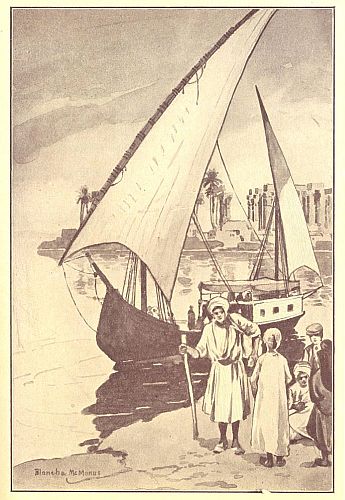
So the Isis was headed for home, and the good
dahabeah raced along, borne by the strong
current of the river, as if it knew it was on its
way home. The happy days passed quickly and
our little friends had many adventures of which
there is not time to tell you.
As they came to the wide fertile country above
Cairo, and neared Abdal's home, the children
were on a sharp lookout, and Abdal was wondering
who would come down to the river to meet
them. When the Isis did run her sharp prow
into the bulrushes at the little landing-place
for the farm of Abdal's father, where Mustapha
proposed to stop, not only were all of
Mustapha's friends there, but most of the villagers
besides, and they all gave the visitors
the heartiest of welcomes. There was Abdal's
father and mother and the baby, and his little
brother, who kissed him on both cheeks, and
each in turn took the hand of each visitor, kissing
his own hand at the same time, a pretty little
custom among these people.
After the actual landing Uncle Ben and
George mounted the donkeys, and followed
by the others on foot, all talking and in the
highest spirits, they rode for some distance
through great fields of cotton and rice until
they came to a little village nestled away in the
midst of palm-trees.
Here they stopped at Abdal's father's house,
which was the biggest in the village, for Ali-Hijaz
was the chief man of the little village and
had many "fellaheen," or labourers, working
in his cotton, rice, and cane fields.
Ali-Hijaz's house, like all the houses in the
village, was built of mud bricks, which had first
been baked by the sun; it was thatched with
palm-leaves, and the trunks of palm-trees
strengthened the walls and formed the rafters.
Their host invited them into a large room,
where they all seated themselves on mats
spread on the hard earthen floor. While Ali-Hijaz
offered Mr. Winthrop a long-stemmed
pipe to smoke, Abdal and Nabul ran to the
little Arab café of the village and soon came
back bringing a big metal tray on which were a
number of small cups and tiny tin pots of coffee.
This was put in the middle of the floor and each
person was served with a cup and one of the
little pots of coffee. Menah and Zaida amused
themselves playing with the baby, while their
two mothers gossiped together, and George
made friends with Abdal's little brother Amad,
whom he thought looked very cunning in his
white cotton gown and little turban stuck on
his clean-shaven head.
"Just think, Uncle Ben," laughed George,
"he can barely walk and yet he goes to the village
school at five o'clock in the morning and stays
till sundown, only coming home for dinner in the
middle of the day. Whew! but that's hard
work!"
"And then, all he learns is to recite the Koran—the
Mohammedan Bible—at the top of his
voice," replied Mr. Winthrop.
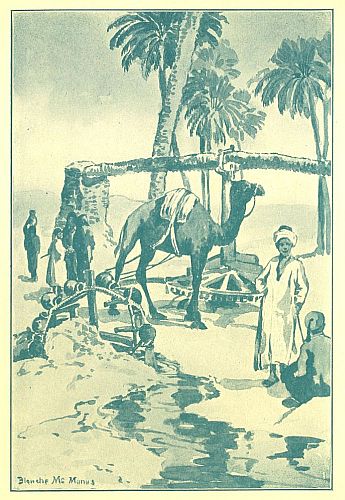
"A LAZY-LOOKING OLD CAMEL WAS SLOWLY TURNING A GREAT CREAKING WOODEN WHEEL."
"That little mite!" said George with a
mock groan. "Well, I am glad I go to school
in America."
But Amad seemed to grow fat in spite of it,
and was at the head of the procession when
the children trooped out to see the village.
All the houses looked alike, with only one big
wooden door and no windows, just little slits
in the walls for air and light. Within most
of these houses there was no furniture of any
kind, save some rugs, mats, and cooking utensils,
and a few boxes made of the wood of the palm-tree,
in which to keep the family clothes. Abdal's
father had two European beds in his house
which he had brought from Cairo, but the villagers
had no use for such new-fangled things.
As they walked along all the little village children
ran out to talk to Abdal and followed them
until, as Nabul said, the procession looked like a
kite with a long tail. There were almost as
many dogs as children, and George fought
rather shy of the fierce-looking mongrel curs
that barked at their heels.
Abdal took them into the fields where there
was a "sakiyeh," or water-wheel, by which the
fields are watered. A lazy-looking old camel
was slowly turning a great creaking wooden
wheel, and this turned another wheel on the
rim of which were fastened a lot of earthen jars.
These jars were filled with water as the wheel
went down into a sort of well, and as it came up
the water from the jars was emptied into a ditch
which carried it over the fields in every direction.
Here for the first time George saw a camel
ploughing, and such a funny plough it was!
Just a log of wood with a pointed iron tip at
one end and an upright pole at the other, by
which the ploughman could guide it.
When they got back to the home at sunset
they found Ali-Hijaz had persuaded Mr. Winthrop
to stay a day or two, as there was some
good bird shooting in his rice fields, a sport
of which Uncle Ben was very fond. This
pleased the children, and that evening they had
lots of fun playing one of their games called
"Playing Pasha." They elected a "Pasha,"
and the choice fell on George, whom they put
in a kind of litter made of palm branches.
Four of their number carried this on their
shoulders while the rest ran beside carrying
lighted wisps of straw and hay for make-believe
torches. One of the boys meanwhile beat a
drum, and another played a small flute; and
thus they marched around the village until
the torches were all burned out and their mothers
called them to bed.
The two guests were made comfortable in
one of the beds, which were only kept for grand
occasions like this, and early the next morning
Mr. Winthrop and his host, with Mustapha,
were off to shoot rice birds.
"We will go and see the wild pigeons," said
Abdal, as the boys wondered how they should
amuse themselves. "I know where there are
many of them roosting in the trees."
"Good," answered Nabul, clapping his
hands, and the boys started off across the fields.
The Egyptian folk are very fond of the wild
pigeons of the country, and like to catch them
and keep them for pets.
At the same time many of the Egyptian boys,
too, are so cruel as to hunt these gentle birds,
killing them with stones which they throw
with unerring aim.
"Hist! they roost here," whispered Abdal
as they came to a clump of low trees. Just then
a number of pigeons flew out of the trees; at
the same time, to the great surprise of the boys,
one apparently was injured, and fell to the
ground, and Nabul ran to pick it up. Some
one had evidently injured its leg or wing. Just
then two wild, savage-looking young boys came
dashing up to Nabul crying, "Thou hast killed
one of our tame pigeons, our father shall beat
thee," trying at the same time to snatch the
bird away from Nabul.
"'Tis not true," returned Nabul angrily,
"dost thou think I am such a dullard as not to
know a wild pigeon from a tame one?"
"And I know these birds well, I have often
been here, they always roost in these trees,"
exclaimed Abdal. "I know thee, and I know
that thy pigeons are far from here."
The Egyptians in the country usually tame
many of these pigeons, and build them little
houses to live in on the side of their own, and
sometimes one will see a big mud tower in the
village where hundreds of these pigeons live
and build their nests.
In the midst of the dispute a tall man with an
ugly, scowling face strode up with a stick, so,
thinking things were getting too hot for them,
our little friends turned and fled toward the
village, Nabul, however, triumphantly holding
on to the pigeon.
The other hunting party had brought back a
big bag of birds and were well pleased with the
day's work.
The next day they were to take leave of their
kind hosts and go back to the Isis. When
George awakened in the early morning, such a
wailing met his ears he could only imagine that
some one must be dead. Throwing on his
clothes he rushed down the short flight of steps
that led from his room to the big room on the
ground floor and from there into the yard.
There he saw Nabul lying face downward on the
ground beside the stable door, with his sisters
sitting beside him rocking themselves backwards
and forwards and wailing piteously,
while Abdal and the older people rushed wildly
about all talking at once.
"What is the matter? Nabul, are you hurt?"
cried George, rushing up to the little group.
"Teddy Pasha is gone, some thief has stolen
him," they all cried in one breath.
It was only too true, the little donkey had
mysteriously disappeared in the night. Nabul
had got up early to get the Pasha ready for
their return to the boat. He had found the
little donkey gone, as well as his bridle and
saddle; Nabul had been looking for him ever
since and had just come back broken-hearted.
"Oh, Nabul, we are sure to find him! Come
and we will all look," cried George, nearly
ready to cry himself,—he had grown really
attached to his little steed.
Poor little Nabul lifted up a wobegone face
and slowly rose to his feet. His donkey was
like a brother to him, and he felt he would
never see him again.
No one thought of going back to the boat
until the little donkey was found, and the whole
village turned out to search for him.
Suddenly Nabul struck his forehead with his
hand. "I know now! Those two ruffian boys
we saw yesterday! 'Tis they who have stolen
my donkey. The wretches! This is their
revenge! We will go to their house and demand
news of the Pasha," cried the distracted little boy.
"Follow, I know the way," said Abdal. The
boys hurried through the fields and rice swamps
until they came to a tumbled-down group of
mud huts. No one was in sight save an ugly-looking
brute of a dog and a little girl, who
peered at the strangers from behind a corner
of a wall.
Nabul boldly went up and shook the heavy
wooden door of the house and called loudly,
but it was tightly fastened and no one answered.
He then gave the whistle he always
used to call Teddy Pasha, but only the dog
began to bark.
George was for battering in the door, but the
boys said it was no use. "Teddy is not here,
or he would have answered me," sighed Nabul,
as he turned away sorrowfully, "but they
have stolen him, I am sure."
"They would not dare keep him here so
near our village," replied Abdal. "They have
doubtless put him in some hiding-place far off.
That is their sister," he continued, pointing to
the little girl behind the wall. "Where art thy
brothers?" he demanded, but she only laughed
and made a face at them.
"She knows something," said George, making
a face in return at the child. But there was
nothing for them to do but walk away and
keep on with their search.
At sundown the boys returned home and poor
Nabul sat on the ground with his head buried
in his arms, refusing to be consoled. He had
eaten nothing all day, and when his mother
brought him a nice dish of curds she had made
herself, he only shook his head.
It was a miserable household and nobody
slept much that night. George and Abdal
refused to go to bed at all and sat beside Nabul
in the big room. Just as George was dozing
away at daybreak he was roused up by a terrible
bray just outside the door, answered by
one from Bobs in the stable.
Like a flash Nabul, who had heard it too,
tore open the house door and nearly tumbled
over Teddy Pasha, who calmly walked into
the middle of the room and stood there as much
as to say, "Here I am, at last."
Little Nabul gave a shriek of joy and threw
his arms about the little donkey's neck and cried
and laughed in the same breath. Abdal called
out the good news, and in another moment
everybody was petting Teddy Pasha and making
as much to-do over him as if he were a long-lost
member of the family. As for the little
American, he was as happy as could be to see
the little companion of his wanderings once more.
But the poor little donkey, wasn't he a sight,
all covered with mud! He had evidently been
taken away and hidden in the rice swamps;
his pretty bridle and saddle were gone, and only
a dirty and knotted piece of rope was around
his neck. An ugly cut on one of his feet showed
where he had been hobbled; his captors had
evidently done everything to keep him secure,
but in spite of it he had broken away by some
means or other, and had come straight back
to his master.
After leaving Abdal's family, and just as our
party were going on board the dahabeah, Nabul
picked up an odd greenish pebble. "What
a funny looking stone!" he said. "It looks
just like a beetle."
"That is what the learned ones call a scarab,—don't
you know there are many of these in the
big museum at Cairo?" cried Abdal, as the
children bent over the tiny stone.
"Oh! maybe it is old," exclaimed George
eagerly, "and worth lots and lots of money."
Just at that moment a party of learned looking
men, Europeans, came up the bank from their
dahabeah which had tied up just below the Isis.
At their head was a Frenchman, an inspector
of the Egyptian public monuments. With his
party he was going some miles inland to pass
judgment upon some newly discovered ruins
of which he had recently heard.
"Let us go and ask the great Frenchman,
he surely can tell us," and so saying, Nabul
ran back to where Mr. Winthrop and the
Frenchman were already talking together.
"Please, monsieur, is this old?" said Nabul,
in his queer French, holding up the little pebble
carved in the form of the sacred beetle of
the Egyptians.
"Eh!" said the great man, taking the
beetle in his hand. "Is it old, indeed!" he
exclaimed in great excitement. "It is a sacred
scarab. Most rare! There are only two others
like it in the world. Where did you find it,
mon petit?"
Nabul pointed out the spot where he had
found the stone.
"Voila! and to think that I have already
passed over that spot and did not know one of
the most ancient and most wonderful scarabs
known to the world was lying there!" and the
great man paced up and down, running his
hands through his hair.
"Mon petit," the Frenchman said at last,
stopping in front of Nabul, "you know the
great museum at Cairo? Well, if you will take
this little stone to the gentleman who is in
charge there, he will be very glad to have it,
and the authorities of the museum will reward
you handsomely; it is worth more than money
to them. I will give you a letter, which you
must also give to this gentleman," and so saying
the Frenchman took a pencil out of his pocket,
and, tearing a leaf out of a small blank book,
quickly wrote a few words and gave it to Nabul.
"I will write him myself at once," he continued,
"but I beg of you to guard the scarab
most carefully. I rely on you to see that he does
not lose it," said the Frenchman, turning earnestly
to Mr. Winthrop. "It does not seem
fair to take it from him unless I at once took it
myself to Cairo, and it is impossible for me to
leave here now."
Mr. Winthrop and all of them promised, for
they were all now interested in the wonderful
stone, and Nabul proudly and carefully hid
it inside his embroidered vest.
There was a happy little party on the dahabeah
when she set sail again, and many were
the farewells to the kind people of the little
village, who all came to see them off.
And wasn't Teddy Pasha a spoiled and pampered
little donkey! He was petted and fed and
rubbed down by everybody on board until he
not only looked as fine and sleek as ever, but
also got so fat and lazy that Mustapha doubted
if he would ever be willing to do any more work.
At last the Isis floated up to her moorings at
Cairo, and everybody felt that they were home
again. The first thing George did was to buy the
finest donkey saddle and bridle he could find
in Cairo and give to Teddy Pasha, who thereupon
got vainer than ever. George and his
little Egyptian friends took many more rides
together before he and Uncle Ben went back
to America. They all went together when
Nabul carried the wonderful scarab and the
Frenchman's letter to the great man in the
big museum, who talked very wisely about it.
He thanked Nabul and told him he had done
his country a service, and used a lot of long
words that the children could not understand.
But one day, not long afterward, a man in a
fine uniform came riding in great style up to
Nabul's house and gave little Nabul a sealed
packet from the authorities of the big museum,
and in it was a handsome sum of money for the
little donkey boy who found the wonderful
scarab.
It was enough indeed to set him up as a
dragoman when he was older, but this would
not be, Nabul promised himself, until he had
first made a visit to see his little friend, George,
in that wonderful country over the sea.
And thus it happened that the Little American
Cousin really did bring the good fortune to
little Nabul, the youngest donkey boy in the
big city of Cairo.
THE END.
THE LITTLE COLONEL BOOKS
(Trade Mark)
By Annie Fellows Johnston
Each large 12mo, cloth, illustrated, per volume $1.50
THE LITTLE COLONEL STORIES
(Trade Mark)
Being three "Little Colonel" stories in the Cosy Corner
Series, "The Little Colonel," "Two Little Knights of
Kentucky," and "The Giant Scissors," in a single volume.
THE LITTLE COLONEL'S HOUSE PARTY
(Trade Mark)
THE LITTLE COLONEL'S HOLIDAYS
(Trade Mark)
THE LITTLE COLONEL'S HERO
(Trade Mark)
THE LITTLE COLONEL AT BOARDING-SCHOOL
(Trade Mark)
THE LITTLE COLONEL IN ARIZONA
(Trade Mark)
THE LITTLE COLONEL'S CHRISTMAS VACATION
(Trade Mark)
THE LITTLE COLONEL, MAID OF HONOR
(Trade Mark)
THE LITTLE COLONEL'S KNIGHT COMES RIDING
(Trade Mark)
MARY WARE: THE LITTLE COLONEL'S CHUM
(Trade Mark)
These ten volumes, boxed as a ten-volume set. $15.00
THE LITTLE COLONEL
(Trade Mark)
TWO LITTLE KNIGHTS OF KENTUCKY
THE GIANT SCISSORS
BIG BROTHER
SPECIAL HOLIDAY EDITIONS
Each small quarto, cloth decorative, per volume $1.25
New plates, handsomely illustrated with eight full-page
drawings in color, and many marginal sketches.
IN THE DESERT OF WAITING: The Legend of
Camelback Mountain.
THE THREE WEAVERS: A Fairy Tale for
Fathers and Mothers as Well as for Their
Daughters.
KEEPING TRYST
THE LEGEND OF THE BLEEDING HEART
THE RESCUE OF PRINCESS WINSOME: A
Fairy Play for Old and Young.
THE JESTER'S SWORD
| Each one volume, tall 16mo, cloth decorative |
$0.50 |
| Paper boards |
.35 |
There has been a constant demand for publication in
separate form of these six stories, which were originally
included in six of the "Little Colonel" books.
JOEL: A BOY OF GALILEE: By Annie Fellows
Johnston. Illustrated by L. J. Bridgman.
New illustrated edition, uniform with the Little Colonel Books, 1 vol., large 12mo, cloth decorative $1.50
A story of the time of Christ, which is one of the author's
best-known books.
THE LITTLE COLONEL GOOD TIMES BOOK
| Uniform in size with the Little Colonel Series |
$1.50 |
| Bound in white kid (morocco) and gold |
3.00 |
Cover design and decorations by Amy Carol Rand.
The publishers have had many inquiries from readers
of the Little Colonel books as to where they could obtain
a "Good Times Book" such as Betty kept. Mrs. Johnston,
who has for years kept such a book herself, has gone
enthusiastically into the matter of the material and format
for a similar book for her young readers. Every girl will
want to possess a "Good Times Book."
ASA HOLMES: Or, At the Cross-Roads. A sketch
of Country Life and Country Humor. By Annie
Fellows Johnston.
With a frontispiece by Ernest Fosbery.
Large 16mo, cloth, gilt top $1.00
"'Asa Holmes; or, At the Cross-Roads' is the most
delightful, most sympathetic and wholesome book that
has been published in a long while."—Boston Times.
THE RIVAL CAMPERS: Or, The Adventures of
Henry Burns. By Ruel Perley Smith.
Square 12mo, cloth decorative, illustrated $1.50
A story of a party of typical American lads, courageous,
alert, and athletic, who spend a summer camping on an
island off the Maine coast.
THE RIVAL CAMPERS AFLOAT: Or, The
Prize Yacht Viking. By Ruel Perley Smith.
Square 12mo, cloth decorative, illustrated $1.50
This book is a continuation of the adventures of "The
Rival Campers" on their prize yacht Viking.
THE RIVAL CAMPERS ASHORE
By Ruel Perley Smith.
Square 12mo, cloth decorative, illustrated $1.50
"As interesting ashore as when afloat."—The Interior.
JACK HARVEY'S ADVENTURES: Or, The
Rival Campers Among the Oyster Pirates. By
Ruel Perley Smith.
Illustrated $1.50
"Just the type of book which is most popular with lads
who are in their early teens."—The Philadelphia Item.
PRISONERS OF FORTUNE: A Tale of the Massachusetts
Bay Colony. By Ruel Perley Smith.
Cloth decorative, with a colored frontispiece $1.50
"There is an atmosphere of old New England in the
book, the humor of the born raconteur about the hero,
who tells his story with the gravity of a preacher, but with
a solemn humor that is irresistible."—Courier-Journal.
FAMOUS CAVALRY LEADERS. By Charles H.
L. Johnston.
Large 12mo. With 24 illustrations $1.50
Biographical sketches, with interesting anecdotes and
reminiscences of the heroes of history who were leaders
of cavalry.
"More of such books should be written, books that
acquaint young readers with historical personages in a
pleasant informal way."—N. Y. Sun.
FAMOUS INDIAN CHIEFS. By Charles H. L.
Johnston.
Large 12mo, illustrated $1.50
In this book Mr. Johnston gives interesting sketches of
the Indian braves who have figured with prominence in
the history of our own land, including Powhatan, the
Indian Cæsar; Massasoit, the friend of the Puritans;
Pontiac, the red Napoleon; Tecumseh, the famous war
chief of the Shawnees; Sitting Bull, the famous war chief
of the Sioux; Geronimo, the renowned Apache Chief, etc.,
etc.
BILLY'S PRINCESS. By Helen Eggleston Haskell.
Cloth decorative, illustrated by Helen McCormick Kennedy $1.25
Billy Lewis was a small boy of energy and ambition, so
when he was left alone and unprotected, he simply started
out to take care of himself.
TENANTS OF THE TREES. By Clarence
Hawkes.
Cloth decorative, illustrated in colors $1.50
"A book which will appeal to all who care for the
hearty, healthy, outdoor life of the country. The illustrations
are particularly attractive."—Boston Herald.
BEAUTIFUL JOE'S PARADISE: Or, The Island
of Brotherly Love. A sequel to "Beautiful Joe."
By Marshall Saunders, author of "Beautiful Joe."
One vol., library 12mo, cloth, illustrated $1.50
"This book revives the spirit of 'Beautiful Joe' capitally.
It is fairly riotous with fun, and is about as unusual
as anything in the animal book line that has seen the light."—Philadelphia
Item.
'TILDA JANE. By Marshall Saunders.
One vol., 12mo, fully illustrated, cloth decorative, $1.50
"I cannot think of any better book for children than
this. I commend it unreservedly."—Cyrus Townsend
Brady.
'TILDA JANE'S ORPHANS. A sequel to 'Tilda
Jane. By Marshall Saunders.
One vol., 12mo, fully illustrated, cloth decorative, $1.50
'Tilda Jane is the same original, delightful girl, and as
fond of her animal pets as ever.
THE STORY OF THE GRAVELEYS. By Marshall
Saunders, author of "Beautiful Joe's Paradise,"
"'Tilda Jane," etc.
Library 12mo, cloth decorative. Illustrated by E. B. Barry $1.50
Here we have the haps and mishaps, the trials and
triumphs, of a delightful New England family, of whose
devotion and sturdiness it will do the reader good to hear.
BORN TO THE BLUE. By Florence Kimball
Russel.
12mo, cloth decorative, illustrated $1.25
The atmosphere of army life on the plains breathes on
every page of this delightful tale. The boy is the son of a
captain of U. S. cavalry stationed at a frontier post in the
days when our regulars earned the gratitude of a nation.
IN WEST POINT GRAY
By Florence Kimball Russel.
12mo, cloth decorative, illustrated $1.50
"Singularly enough one of the best books of the year
for boys is written by a woman and deals with life at West
Point. The presentment of life in the famous military
academy whence so many heroes have graduated is realistic
and enjoyable."—New York Sun.
FROM CHEVRONS TO SHOULDER STRAPS
By Florence Kimball Russel.
12mo, cloth, illustrated, decorative $1.50
West Point again forms the background of a new volume
in this popular series, and relates the experience of Jack
Stirling during his junior and senior years.
THE SANDMAN: HIS FARM STORIES
By William J. Hopkins. With fifty illustrations by
Ada Clendenin Williamson.
Large 12mo, decorative cover $1.50
"An amusing, original book, written for the benefit of
very small children. It should be one of the most popular
of the year's books for reading to small children."—Buffalo
Express.
THE SANDMAN: MORE FARM STORIES
By William J. Hopkins.
Large 12mo, decorative cover, fully illustrated $1.50
Mr. Hopkins's first essay at bedtime stories met with
such approval that this second book of "Sandman" tales
was issued for scores of eager children. Life on the farm,
and out-of-doors, is portrayed in his inimitable manner.
THE SANDMAN: HIS SHIP STORIES
By William J. Hopkins, author of "The Sandman:
His Farm Stories," etc.
Large 12mo, decorative cover, fully illustrated $1.50
"Children call for these stories over and over again."—Chicago
Evening Post.
THE SANDMAN, HIS SEA STORIES
By William J. Hopkins.
Large 12mo, decorative cover, fully illustrated $1.50
Each year adds to the popularity of this unique series
of stories to be read to the little ones at bed time and at
other times.
THE DOCTOR'S LITTLE GIRL
By Marion Ames Taggart, author of "Pussy-Cat
Town," etc.
One vol., library 12mo, illustrated $1.50
A thoroughly enjoyable tale of a little girl and her comrade
father, written in a delightful vein of sympathetic
comprehension of the child's point of view.
SWEET NANCY
The Further Adventures of the Doctor's Little
Girl. By Marion Ames Taggart.
One vol., library 12mo, illustrated $1.50
In the new book, the author tells how Nancy becomes
in fact "the doctor's assistant," and continues to shed
happiness around her.
THE CHRISTMAS-MAKERS' CLUB
By Edith A. Sawyer.
12mo, cloth decorative, illustrated $1.50
A delightful story for girls, full of the real spirit of
Christmas. It abounds in merrymaking and the right
kind of fun.
CARLOTA
A Story of the San Gabriel Mission. By Frances
Margaret Fox.
Square 12mo, cloth decorative, illustrated and decorated in colors by Ethelind Ridgway $1.00
"It is a pleasure to recommend this little story as an
entertaining contribution to juvenile literature."—The
New York Sun.
THE SEVEN CHRISTMAS CANDLES
By Frances Margaret Fox.
Square 12mo, cloth decorative, illustrated and decorated in colors by Ethelind Ridgway $1.00
Miss Fox's new book deals with the fortunes of the delightful
Mulvaney children.
PUSSY-CAT TOWN
By Marion Ames Taggart.
Small quarto, cloth decorative, illustrated and decorated in colors $1.00
"Anything more interesting than the doings of the cats
in this story, their humor, their wisdom, their patriotism,
would be hard to imagine."—Chicago Post.
THE ROSES OF SAINT ELIZABETH
By Jane Scott Woodruff.
Small quarto, cloth decorative, illustrated and decorated in colors by Adelaide Everhart $1.00
This is a charming little story of a child whose father was
caretaker of the great castle of the Wartburg, where Saint
Elizabeth once had her home.
GABRIEL AND THE HOUR BOOK
By Evaleen Stein.
Small quarto, cloth decorative, illustrated and decorated in colors by Adelaide Everhart $1.00
Gabriel was a loving, patient, little French lad, who
assisted the monks in the long ago days, when all the books
were written and illuminated by hand, in the monasteries.
THE ENCHANTED AUTOMOBILE
Translated from the French by Mary J. Safford.
Small quarto, cloth decorative, illustrated and decorated in colors by Edna M. Sawyer $1.00
"An up-to-date French fairy-tale which fairly radiates
the spirit of the hour,—unceasing diligence."—Chicago
Record-Herald.
O-HEART-SAN
The Story of a Japanese Girl. By Helen Eggleston
Haskell.
Small quarto, cloth decorative, illustrated and decorated in colors by Frank P. Fairbanks $1.00
"The story comes straight from the heart of Japan.
The shadow of Fujiyama lies across it and from every
page breathes the fragrance of tea leaves, cherry blossoms
and chrysanthemums."—The Chicago Inter-Ocean.
THE YOUNG SECTION-HAND: Or, The Adventures
of Allan West. By Burton E. Stevenson.
Square 12mo, cloth decorative, illustrated $1.50
Mr. Stevenson's hero is a manly lad of sixteen, who is
given a chance as a section-hand on a big Western railroad,
and whose experiences are as real as they are thrilling.
THE YOUNG TRAIN DISPATCHER. By Burton
E. Stevenson.
Square 12mo, cloth decorative, illustrated $1.50
"A better book for boys has never left an American
press."—Springfield Union.
THE YOUNG TRAIN MASTER. By Burton E.
Stevenson.
Square 12mo, cloth decorative, illustrated $1.50
"Nothing better in the way of a book of adventure for
boys in which the actualities of life are set forth in a practical
way could be devised or written."—Boston Herald.
CAPTAIN JACK LORIMER. By Winn Standish.
Square 12mo, cloth decorative, illustrated $1.50
Jack is a fine example of the all-around American high-school
boy.
JACK LORIMER'S CHAMPIONS: Or, Sports on
Land and Lake. By Winn Standish.
Square 12mo, cloth decorative, illustrated $1.50
"It is exactly the sort of book to give a boy interested
in athletics, for it shows him what it means to always
'play fair.'"—Chicago Tribune.
JACK LORIMER'S HOLIDAYS: Or, Millvale
High in Camp. By Winn Standish.
Illustrated $1.50
Full of just the kind of fun, sports and adventure to
excite the healthy minded youngster to emulation.
JACK LORIMER'S SUBSTITUTE: Or, The Acting
Captain of the Team. By Winn Standish.
Illustrated $1.50
On the sporting side, this book takes up football, wrestling,
tobogganing, but it is more of a school story perhaps
than any of its predecessors.
CAPTAIN JINKS: The Autobiography of a Shetland
Pony. By Frances Hodges White.
Cloth decorative, illustrated $1.50
The story of Captain Jinks and his faithful dog friend
Billy, their quaint conversations and their exciting
adventures, will be eagerly read by thousands of boys and
girls. The story is beautifully written and will take its
place alongside of "Black Beauty" and "Beautiful Joe."
THE RED FEATHERS. By Theodore Roberts.
Cloth decorative, illustrated $1.50
"The Red Feathers" tells of the remarkable adventures
of an Indian boy who lived in the Stone Age, many years
ago, when the world was young.
FLYING PLOVER. By Theodore Roberts.
Cloth decorative. Illustrated by Charles Livingston Bull $1.00
Squat-By-The-Fire is a very old and wise Indian who
lives alone with her grandson, "Flying Plover," to whom
she tells the stories each evening.
THE WRECK OF THE OCEAN QUEEN. By
James Otis, author of "Larry Hudson's Ambition," etc.
Cloth decorative, illustrated $1.50
"A stirring story of wreck and mutiny, which boys will
find especially absorbing. The many young admirers of
James Otis will not let this book escape them, for it fully
equals its many predecessors in excitement and sustained
interest."—Chicago Evening Post.
LITTLE WHITE INDIANS. By Fannie E. Ostrander.
Cloth decorative, illustrated $1.25
"A bright, interesting story which will appeal strongly
to the 'make-believe' instinct in children, and will
give them a healthy, active interest in 'the simple life.'"
MARCHING WITH MORGAN. How Donald
Lovell Became a Soldier of the Revolution.
By John L. Veasy.
Cloth decorative, illustrated $1.50
This is a splendid boy's story of the expedition of
Montgomery and Arnold against Quebec.
COSY CORNER SERIES
It is the intention of the publishers that this series shall
contain only the very highest and purest literature,—stories
that shall not only appeal to the children themselves,
but be appreciated by all those who feel with
them in their joys and sorrows.
The numerous illustrations in each book are by well-known
artists, and each volume has a separate attractive
cover design.
Each 1 vol., 16mo, cloth $0.50
By ANNIE FELLOWS JOHNSTON
THE LITTLE COLONEL (Trade Mark.)
The scene of this story is laid in Kentucky. Its heroine
is a small girl, who is known as the Little Colonel,
on account of her fancied resemblance to an old-school
Southern gentleman, whose fine estate and old family
are famous in the region.
THE GIANT SCISSORS
This is the story of Joyce and of her adventures in
France. Joyce is a great friend of the Little Colonel,
and in later volumes shares with her the delightful experiences
of the "House Party" and the "Holidays."
TWO LITTLE KNIGHTS OF KENTUCKY
Who Were the Little Colonel's Neighbors.
In this volume the Little Colonel returns to us like an
old friend, but with added grace and charm. She is not,
however, the central figure of the story, that place being
taken by the "two little knights."
MILDRED'S INHERITANCE
A delightful little story of a lonely English girl who
comes to America and is befriended by a sympathetic
American family who are attracted by her beautiful
speaking voice. By means of this one gift she is enabled
to help a school-girl who has temporarily lost the
use of her eyes, and thus finally her life becomes a busy,
happy one.
CICELY AND OTHER STORIES FOR GIRLS
The readers of Mrs. Johnston's charming juveniles
will be glad to learn of the issue of this volume for young
people.
AUNT 'LIZA'S HERO AND OTHER STORIES
A collection of six bright little stories, which will appeal
to all boys and most girls.
BIG BROTHER
A story of two boys. The devotion and care of Stephen,
himself a small boy, for his baby brother, is the theme of
the simple tale.
OLE MAMMY'S TORMENT
"Ole Mammy's Torment" has been fitly called "a
classic of Southern life." It relates the haps and mishaps
of a small negro lad, and tells how he was led by
love and kindness to a knowledge of the right.
THE STORY OF DAGO
In this story Mrs. Johnston relates the story of Dago,
a pet monkey, owned jointly by two brothers. Dago
tells his own story, and the account of his haps and mishaps
is both interesting and amusing.
THE QUILT THAT JACK BUILT
A pleasant little story of a boy's labor of love and how
it changed the course of his life many years after it was
accomplished.
FLIP'S ISLANDS OF PROVIDENCE
A story of a boy's life battle, his early defeat, and his
final triumph, well worth the reading.
By EDITH ROBINSON
A LITTLE PURITAN'S FIRST CHRISTMAS
A story of Colonial times in Boston, telling how Christmas
was invented by Betty Sewall, a typical child of the
Puritans, aided by her brother Sam.
A LITTLE DAUGHTER OF LIBERTY
The author introduces this story as follows:
"One ride is memorable in the early history of the
American Revolution, the well-known ride of Paul
Revere. Equally deserving of commendation is another
ride,—the ride of Anthony Severn,—which was no less
historic in its action or memorable in its consequences."
A LOYAL LITTLE MAID
A delightful and interesting story of Revolutionary
days, in which the child heroine, Betsey Schuyler, renders
important services to George Washington.
A LITTLE PURITAN REBEL
This is an historical tale of a real girl, during the time
when the gallant Sir Harry Vane was governor of Massachusetts.
A LITTLE PURITAN PIONEER
The scene of this story is laid in the Puritan settlement
at Charlestown.
A LITTLE PURITAN BOUND GIRL
A story of Boston in Puritan days, which is of great
interest to youthful readers.
A LITTLE PURITAN CAVALIER
The story of a "Little Puritan Cavalier" who tried
with all his boyish enthusiasm to emulate the spirit and
ideals of the dead Crusaders.
A PURITAN KNIGHT ERRANT
The story tells of a young lad in Colonial times who
endeavored to carry out the high ideals of the knights
of olden days.
By OUIDA (Louise de la Ramee)
A DOG OF FLANDERS
A Christmas Story
Too well and favorably known to require description.
THE NURNBERG STOVE
This beautiful story has never before been published
at a popular price.
By FRANCES MARGARET FOX
THE LITTLE GIANT'S NEIGHBOURS
A charming nature story of a "little giant" whose
neighbors were the creatures of the field and garden.
FARMER BROWN AND THE BIRDS
A little story which teaches children that the birds are
man's best friends.
BETTY OF OLD MACKINAW
A charming story of child life.
BROTHER BILLY
The story of Betty's brother, and some further adventures
of Betty herself.
MOTHER NATURE'S LITTLE ONES
Curious little sketches describing the early lifetime, or
"childhood," of the little creatures out-of-doors.
HOW CHRISTMAS CAME TO THE MULVANEYS
A bright, lifelike little story of a family of poor children
with an unlimited capacity for fun and mischief.
THE COUNTRY CHRISTMAS
Miss Fox has vividly described the happy surprises that
made the occasion so memorable to the Mulvaneys, and
the funny things the children did in their new environment.
By MISS MULOCK
THE LITTLE LAME PRINCE
A delightful story of a little boy who has many adventures
by means of the magic gifts of his fairy godmother.
ADVENTURES OF A BROWNIE
The story of a household elf who torments the cook
and gardener, but is a constant joy and delight to the
children who love and trust him.
HIS LITTLE MOTHER
Miss Mulock's short stories for children are a constant
source of delight to them, and "His Little Mother," in
this new and attractive dress, will be welcomed by hosts
of youthful readers.
LITTLE SUNSHINE'S HOLIDAY
An attractive story of a summer outing. "Little Sunshine"
is another of those beautiful child-characters for
which Miss Mulock is so justly famous.
By MARSHALL SAUNDERS
FOR HIS COUNTRY
A sweet and graceful story of a little boy who loved
his country; written with that charm which has endeared
Miss Saunders to hosts of readers.
NITA, THE STORY OF AN IRISH SETTER
In this touching little book, Miss Saunders shows how
dear to her heart are all of God's dumb creatures.
ALPATOK, THE STORY OF AN ESKIMO DOG
Alpatok, an Eskimo dog from the far north, was stolen
from his master and left to starve in a strange city, but
was befriended and cared for, until he was able to return
to his owner.
By WILL ALLEN DROMGOOLE
THE FARRIER'S DOG AND HIS FELLOW
This story, written by the gifted young Southern
woman, will appeal to all that is best in the natures of
the many admirers of her graceful and piquant style.
THE FORTUNES OF THE FELLOW
Those who read and enjoyed the pathos and charm
of "The Farrier's Dog and His Fellow" will welcome
the further account of the adventures of Baydaw and
the Fellow at the home of the kindly smith.
THE BEST OF FRIENDS
This continues the experiences of the Farrier's dog
and his Fellow, written in Mr. Dromgoole's well-known
charming style.
DOWN IN DIXIE
A fascinating story for boys and girls, of a family of
Alabama children who move to Florida and grow up in
the South.
By MARIAN W. WILDMAN
LOYALTY ISLAND
An account of the adventures of four children and
their pet dog on an island, and how they cleared their
brother from the suspicion of dishonesty.
THEODORE AND THEODORA
This is a story of the exploits and mishaps of two mischievous
twins, and continues the adventures of the
interesting group of children in "Loyalty Island."
Transcriber's Notes:
Page 13, "dahaheah" changed to "dahabeah" (captain of a dahabeah)
Page 37, repeated word "in" removed from text (exercises in in
his school)
Page 41, "fete" changed to "fête" (great religious fête)