Larger versions of most illustrations may be seen by right-clicking them
and selecting an option to view them separately, or by double-tapping and/or
stretching them.
New original cover art included with this eBook is granted
to the public domain. It includes an illustration taken
from the original book.
NARRATED WITH SPECIAL REFERENCE TO
LITERATURE AND ART
BY
H. A. GUERBER AUTHOR OF “MYTHS OF GREECE AND ROME”
“Wake again, Teutonic Father ages,
Speak again, beloved primæval creeds;
Flash ancestral spirit from your pages,
Wake the greedy age to noble deeds.”
CHARLES KINGSLEY
❦
NEW YORK ⁘ CINCINNATI ⁘ CHICAGO AMERICAN BOOK COMPANY
Copyright, 1895, by American Book Company.
MYTHS OF NORTHERN LANDS.
DEDICATED TO
MY PARENTS.
PREFACE.
The aim of this handbook of Northern mythology is to
familiarize the English student of letters with the religion
of his heathen ancestors, and to set forth, as clearly as possible,
the various myths which have exercised an influence over our
customs, arts, and literature.
As Norwegians, Danes, Swedes, Icelanders, Germans, English,
and French all came originally from the same stock and worshiped
the same gods, so these tales formed the basis not only of their
religious belief, but also of their first attempts at poetry. They
are the classics of the North, and deserve as much attention at our
hands as the more graceful and idyllic mythology of the South.
The most distinctive traits of the Northern mythology are a
peculiar grim humor which is found in the religion of no other
race, and a dark thread of tragedy which runs throughout the
whole woof. These two characteristics, touching both extremes
of the scale, have colored Northern thought, and have left their
indelible imprint upon all our writings even to this day.
The mythology of Greece and Rome, growing as spontaneous
and luxuriant as the tropical vegetation, came to its full fruition
and began to decay before the introduction of Christianity. But
Northern mythology, of slower growth, was arrested in mid-career
before it had attained its complete development.
A glossary, and complete index have been added to adapt
this book for general use in libraries and public schools. Author
and publishers sincerely trust that this little work will be as kindly
received and as well appreciated as has been the case with its
predecessor, “Myths of Greece and Rome,” the first volume of
this series.
MYTHS OF NORTHERN LANDS. — CHAPTER I. THE BEGINNING OF ALL THINGS.
Although the Aryan inhabitants of northern Europe are
supposed by some authorities to have come originally
from the plateau of Iran, in the heart of Asia, the climate and
scenery of the countries where they finally settled had great
influence in shaping their early religious beliefs, as well as in
ordering their mode of living.
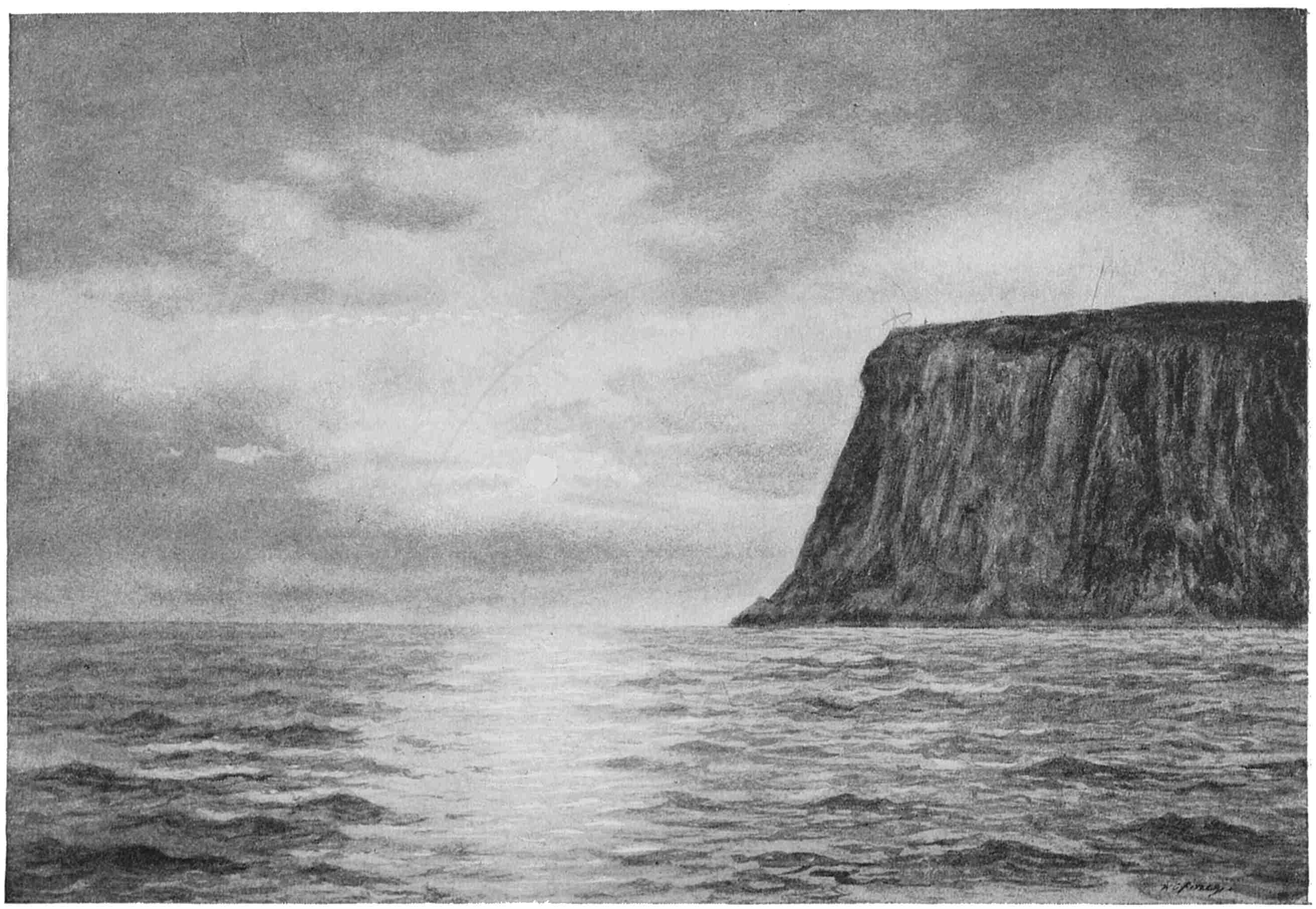
The grand and rugged landscapes of Northern Europe, the
midnight sun, the flashing rays of the aurora borealis, the ocean
continually lashing itself into fury against the great cliffs and
icebergs of the arctic circle, could not but impress the people as
vividly as the almost miraculous vegetation, the perpetual light,
and the blue seas and skies of their brief summer season. It is
no great wonder, therefore, that the Icelanders, for instance, to
whom we owe the most perfect records of this belief, fancied in
looking about them that the world was originally created from
a strange mixture of fire and ice.
Northern mythology is grand and tragical. Its principal theme
is the perpetual struggle of the beneficent forces of Nature against
the injurious, and hence it is not graceful and idyllic in character
like the religion of the sunny South, where the people could bask
in perpetual sunshine, and the fruits of the earth grew ready to
their hand.
It was very natural that the dangers incurred in hunting and
fishing under these inclement skies, and the suffering entailed by
the long cold winters when the sun never shines, made our ancestors
contemplate cold and ice as malevolent spirits; and it was
with equal reason that they invoked with special fervor the beneficent
influences of heat and light.
Myths of creation.
When questioned concerning the creation of the world, the
Northern scalds or poets, whose songs are preserved in the Eddas
and Sagas, declared that in the beginning, when
there was as yet no earth, nor sea, nor air, when
darkness rested over all, there existed a powerful being called
Allfather, whom they dimly conceived as uncreated as well as
unseen, and that whatever he willed came to pass.
In the center of space there was, in the morning of time, a
great abyss called Ginnunga-gap, the cleft of clefts, the yawning
gulf, whose depths no eye could fathom, as it was enveloped in
perpetual twilight. North of this abode was a space or world
known as Nifl-heim, the home of mist and darkness, in the center
of which bubbled the exhaustless spring Hvergelmir, the
seething caldron, whose waters supplied twelve great streams
known as the Elivagar. As the water of these streams flowed
swiftly away from its source and encountered the cold blasts from
the yawning gulf, it soon hardened into huge blocks of ice, which
rolled downwards into the immeasurable depths of the great abyss
with a continual roar like thunder.
South of this dark chasm, and directly opposite Nifl-heim, the
realm of mist, was another world called Muspells-heim, the home
of elemental fire, where all was warmth and brightness, and
whose frontiers were continually guarded by Surtr, the flame
giant. This giant fiercely brandished his flashing sword, and
continually sent forth great showers of sparks, which fell with a
hissing sound upon the ice blocks in the bottom of the abyss, and
partly melted them by their heat.
“Great Surtur, with his burning sword,
Southward at Muspel’s gate kept ward,
And flashes of celestial flame,
Life-giving, from the Fire-world came.”
Valhalla (J. C. Jones).
Ymir and Audhumla.
As the steam rose in clouds it again encountered the prevailing
cold, and was changed into rime or hoar frost, which, layer
by layer, filled up the great central space. Thus
by the continual action of cold and heat, and also
probably by the will of the uncreated and unseen, a gigantic
creature called Ymir or Orgelmir (seething clay), the personification
of the frozen ocean, came to life amid the ice blocks in
the abyss, and as he was born of rime he was called a Hrim-thurs
or ice giant.
“In early times,
When Ymir lived,
Was sand, nor sea,
Nor cooling wave;
No earth was found,
Nor heaven above;
One chaos all,
And nowhere grass.”
Sæmund’s Edda (Henderson’s tr.).
Groping about in the gloom in search of something to eat,
Ymir perceived a gigantic cow called Audhumla (the nourisher),
which had been created by the same agency as himself, and out
of the same materials. Hastening towards her, Ymir noticed with
pleasure that four great streams of milk flowed from her udder to
supply him with nourishment.
All his wants were thus satisfied; but the cow, looking about
her for food, began to lick the salt off a neighboring ice block
with her rough tongue. There she stood patiently licking that
selfsame lump until the hair of a god appeared. After she had
licked some time longer the whole head emerged from its icy
envelope, and by and by Buri (the producer) stepped forth entirely
free.
While the cow had been thus engaged, Ymir, the giant, had
fallen asleep, and as he slept a son and daughter were born from
the perspiration under his armpit, and his feet produced the six-headed
giant Thrudgelmir, who, shortly after his birth, brought
forth in his turn the giant Bergelmir, from whom all the evil frost
giants are descended.
“Under the armpit grew,
’Tis said of Hrim-thurs,
A girl and boy together;
Foot with foot begat,
Of that wise Jötun,
A six-headed son.”
Sæmund’s Edda (Thorpe’s tr.).
Odin, Vili, and Ve.
When these giants became aware of the existence of the god
Buri, and of his son Börr (born), whom he had immediately produced,
they began waging war against them, for as the gods and
giants represented the opposite forces of good and evil, there was
no hope of their ever coming to an agreement and living together
in peace. This struggle continued evidently for ages, neither
party gaining a decided advantage, until Börr married the giantess
Bestla, daughter of Bolthorn (the thorn of evil), who bore him
three powerful sons, Odin (spirit), Vili (will), and Ve (holy).
These three sons immediately joined their father
in his struggle against the inimical frost giants, and
finally succeeded in slaying their deadliest foe, the great Ymir.
As he sank down lifeless the blood gushed from his wounds in
such floods that it produced a great deluge, in which all his race
perished, with the exception of Bergelmir, who escaped in a boat
and went with his wife to the confines of the world.
“And all the race of Ymer thou didst drown,
Save one, Bergelmer,—he on shipboard fled
Thy deluge, and from him the giants sprang.”
Balder Dead (Matthew Arnold).
Here he took up his abode, calling the place Jötun-heim (the home
of the giants), and here he begat a new race of frost giants, who
inherited his dislikes, continued the feud, and were always ready
to sally forth from their desolate country and make a raid into
the territory of the gods.
The gods, who in Northern mythology are called Æsir (pillars
and supporters of the world), having thus triumphed over all their
foes, and being no longer engaged in perpetual warfare, now
began to look about them, wondering how they could improve the
desolate aspect of things and fashion a habitable world. After
due consideration Börr’s sons rolled Ymir’s great corpse into the
yawning abyss, and began to make the world out of its various
component parts.
Creation of the earth.
Out of the giant’s flesh they fashioned Midgard (middle
garden), as the earth was called, which was placed in the exact
center of the vast space, and hedged all round
with Ymir’s eyebrows which formed its bulwarks
or ramparts. The solid portion of Midgard was surrounded by
the giant’s blood or sweat, which now formed the ocean, while
his bones made the hills, his flat teeth the cliffs, and his curly hair
the trees and all vegetation.
Well pleased with the result of these their first efforts at creation,
the gods took the giant’s unwieldy skull and poised it skillfully
above earth and sea as the vaulted heavens; then scattering his
brains throughout the expanse they fashioned from them the fleecy
clouds.
“Of Ymir’s flesh
Was earth created,
Of his blood the sea,
Of his bones the hills,
Of his hair trees and plants,
Of his skull the heavens,
And of his brows
The gentle powers
Formed Midgard for the sons of men;
But of his brain
The heavy clouds are
All created.”
Norse Mythology (R. B. Anderson).
To support the heavenly vault in place, the gods stationed the
strong dwarfs, Nordri, Sudri, Austri, Westri, at its four corners,
bidding them uphold it on their shoulders, and from them the
four points of the compass received their present names of North,
South, East, and West. To light up the world thus created, the
gods began to stud the heavenly vault with sparks secured from
Muspells-heim, points of light which shone steadily through the
gloom like brilliant stars. The most vivid of all these sparks,
however, were reserved for the manufacture of the sun and moon,
which were placed in beautiful golden chariots.
“And from the flaming world, where Muspel reigns,
Thou sent’st and fetched’st fire, and madest lights:
Sun, moon, and stars, which thou hast hung in Heaven,
Dividing clear the paths of night and day.”
Balder Dead (Matthew Arnold).
When all these preparations had been finished, and the steeds
Arvakr (the early waker) and Alsvin (the rapid goer) were harnessed
to the sun chariot, the gods, fearing lest the animals
should suffer from their proximity to this ardent sphere, placed
under their withers great skins filled with air or with some iron
refrigerant substance. They also fashioned the shield Svalin (the
cooler), and placed it in front of the car to shelter them from the
sun’s direct rays, which would else have burned them and the
earth to a crisp. The moon car was, moreover, provided with a
fleet steed called Alsvider (the all-swift); but as its rays were
very mild indeed, no shield was required to protect him.
Mani and Sol.
The chariots were all ready, the steeds harnessed and impatient
to begin their daily round, but there was no one to guide
them along the right road. The gods, perceiving
this, looked about them and soon beheld Mani
(the moon) and Sol (the sun), children of giant Mundilfari, who
was so inordinately proud of his beautiful offspring that he called
them by the names of the newly created orbs. He gave his
daughter Sol in marriage to Glaur (glow), who was probably
one of Surtr’s sons. The brother and sister were transferred to
the sky, where, after receiving minute directions from the gods,
they skillfully guided their fleet steeds along their appointed paths.
“Know that Mundilfær is hight
Father to the moon and sun;
Age on age shall roll away,
While they mark the months and days.”
Hávamál (W. Taylor’s tr.).
Seeing how satisfactory all these arrangements were, the gods
now summoned Nott (night), a daughter of one of the giants,
Norvi, and intrusted to her care a dark chariot, drawn by a sable
steed, Hrim-faxi (frost mane), from whose waving mane the dew
and hoar frost dropped down upon the earth.
“Hrim-faxi is the sable steed,
From the east who brings the night,
Fraught with the showering joys of love:
As he champs the foamy bit,
Drops of dew are scattered round
To adorn the vales of earth.”
Vafthrudni’s-mal (W. Taylor’s tr.).
The goddess of night had already thrice been married: by her
first husband, Naglfari, she had had a son named Aud; by her
second, Annar, a daughter Jörd (earth); and by her third, the
god Dellinger (dawn), she now had a son, radiant with beauty,
who was called Dag (day).
As soon as the gods became aware of this beautiful being’s
existence they provided a chariot for him also, drawn by the
resplendent white steed Skin-faxi (shining mane), from whose
mane bright beams of light shone forth in every direction,
illuminating all the world, and bringing light and gladness to
all.
“Forth from the east, up the ascent of Heaven,
Day drove his courser with the shining mane.”
Balder Dead (Matthew Arnold).
The wolves Sköll and Hati.
But as evil always treads close upon the footsteps of good,
hoping to destroy it, the ancient inhabitants of the Northern regions
imagined that both Sun and Moon were incessantly
pursued by the fierce wolves Sköll (repulsion)
and Hati (hatred), whose sole aim was to overtake and
swallow the brilliant objects before them, so that the world might
again be enveloped in its primeval darkness.
“Sköll the wolf is named
That the fair-faced goddess
To the ocean chases;
Another Hati hight,
He is Hrodvitnir’s son;
He the bright maid of heaven shall precede.”
Sæmund’s Edda (Thorpe’s tr.).
At times, they said, the wolves overtook and tried to swallow
their prey, thus producing an eclipse of the radiant orbs. Then
the terrified people raised such a deafening clamor that the wolves,
frightened by the noise, hastily dropped them. Thus rescued, Sun
and Moon resumed their course, fleeing more rapidly than before,
the hungry monsters rushing along in their wake, anxious for the
time when their efforts would prevail and the end of the world
would come. For the Northern nations all believed that as their
gods had sprung from an alliance between the divine element
(Börr) and the mortal (Bestla), they were finite, and doomed to
perish with the world they had made.
“But even in this early morn
Faintly foreshadowed was the dawn
Of that fierce struggle, deadly shock,
Which yet should end in Ragnarok;
When Good and Evil, Death and Life,
Beginning now, end then their strife.”
Valhalla (J. C. Jones).
Mani was also accompanied by Hiuki, the waxing, and Bil,
the waning moon, two children whom he had snatched from earth
where a cruel father forced them to carry water all night. Our
ancestors fancied they saw these children, the original “Jack and
Jill,” with their pail, darkly outlined upon the moon.
The gods not only appointed Sun, Moon, Day, and Night to
count out the year, but also called Evening, Midnight, Morning,
Forenoon, Noon, and Afternoon to share their duties, making
Summer and Winter the rulers of the seasons. Summer, a
direct descendant of Svasud (the mild and lovely), inherited his
gentle disposition, and was loved by all except Winter, his deadly
enemy, the son of Vindsual, himself a son of the disagreeable god
Vasud, the personification of the icy wind.
“Vindsual is the name of him
Who begat the winter’s god;
Summer from Suasuthur sprang:
Both shall walk the way of years,
Till the twilight of the gods.”
Vafthrudni’s-mal (W. Taylor’s tr.).
As the cold winds continually swept down from the north,
chilling all the earth, these nations further imagined that at the
extreme northern verge of the heavens sat the great giant Hræ-svelgr
(the corpse swallower), all clad in eagle plumes, and that
whenever he raised his arms or wings the cold blasts darted forth
and swept ruthlessly over the face of the earth, blighting all things
with their icy breath.
“Hræ-svelger is the name of him
Who sits beyond the end of heaven,
And winnows wide his eagle-wings,
Whence the sweeping blasts have birth.”
Vafthrudni’s-mal (W. Taylor’s tr.).
Dwarfs and Elves.
While the gods were occupied in creating the earth and providing
for its illumination, a whole host of maggot-like creatures
had been breeding in Ymir’s flesh. Crawling in
and out, they now attracted divine attention.
Summoning these uncouth beings into their presence, the gods,
after giving them forms and endowing them with superhuman
intelligence, divided them into two large classes. Those which
were dark, treacherous, and cunning by nature were banished to
Svart-alfa-heim, the home of the black dwarfs, situated underground,
whence they were never allowed to come forth as long as
it was day, under penalty of being turned into stone. They were
called Dwarfs, Trolls, Gnomes, or Kobolds, and spent all their
time and energy in exploring the secret recesses of the earth.
They collected gold, silver, and precious stones, which they
stowed away in secret crevices, whence they could withdraw
them at will. As for the remainder of these small creatures,
including all that were fair, good, and useful, the gods called them
Fairies and Elves, and gave them a dwelling place in the airy
realm of Alf-heim (home of the light-elves), situated between
heaven and earth, whence they could flit downwards whenever
they pleased, to attend to the plants and flowers, sport with the
birds and butterflies, or dance in the silvery moonlight on the
green. Odin, who had been the leading spirit in all these undertakings,
now bade the gods, his descendants, follow him to the
broad plain called Idawold, far above the earth, on the other side
of the great stream Ifing, whose waters never froze.
“Ifing’s deep and murky wave
Parts the ancient sons of earth
From the dwelling of the Goths:
Open flows the mighty flood,
Nor shall ice arrest its course
While the wheel of Ages rolls.”
Vafthrudni’s-mal (W. Taylor’s tr.).
In the very center of the sacred space, which from the beginning
of the world had been reserved for their own abode
and called Asgard (home of the gods), the twelve Æsir (gods) and
twenty-four Asynjur (goddesses) all assembled. They decreed
that no blood should ever be shed within the limits of their realm,
or peace stead, but that harmony must reign there forever. Then
after due consultation they established a forge where they fashioned
all their weapons and the tools required to build magnificent
palaces of precious metals, in which they lived for many
long years in a state of such perfect happiness that this period
has been called the Golden Age.
Creation of man.
Although the gods had from the beginning designed Midgard,
or Mana-heim, as the abode of man, there were at first no human
beings to inhabit it. One day Odin, Vili, and Ve,
according to some authorities, or Odin, Hoenir (the
bright one), and Lodur, or Loki (fire), started out together and
walked along the seashore, where they found either two trees,
the ash, Ask, and the elm, Embla, or two blocks of wood, hewn
into rude semblances of the human form. The gods gazed at
first upon the inanimate wood in silent wonder, then perceiving
the use it could be put to, Odin gave these logs souls, Hoenir
bestowed motion and senses, and Lodur contributed blood and
blooming complexions.
“There were twain and they went upon earth, and were speechless, unmighty, and wan;
They were hopeless, deathless, lifeless, and the Mighty named them Man.
Then they gave them speech and power, and they gave them color and breath;
And deeds and the hope they gave them, and they gave them Life and Death.”
Sigurd the Volsung (William Morris).
This newly created man and woman were then left to rule Midgard
at will. They gradually peopled it with their descendants,
while the gods, remembering they had called them into life, took
a special interest in all they did, watched over them, and often
vouchsafed their aid and protection.
The Yggdrasil tree.
Allfather in the mean while had not been idle, but had created
a huge ash called Yggdrasil, the tree of the universe, of time, or
of life, which filled all the world, taking root not
only in the remotest depths of Nifl-heim, where
bubbled the spring Hvergelmir, but also in Midgard, near Mimir’s
well (the ocean), and in Asgard, near the Urdar fountain.
These three great roots permitted the tree to attain such a
marvelous height that its topmost bough, called Lerad (the peace
giver), overshadowed Odin’s hall, while the other wide-spreading
branches towered over all the other worlds. An eagle was
perched on the bough Lerad, and between his eyes sat the falcon
Vedfolnir, sending his piercing glances down into heaven, earth,
and Nifl-heim, and reporting all he saw.
As the tree Yggdrasil was ever green, and its leaves never
withered, it served as pasturing ground not only for Odin’s goat
Heidrun, which supplied the heavenly mead, the drink of the
gods, but also for the stags Dain, Dvalin, Duneyr, and Durathor,
from whose horns the honeydew dropped down upon the earth
and furnished the water for all the rivers in the world.
In the seething caldron Hvergelmir, close by the great tree,
was a horrible dragon called Nidhug, which continually gnawed
the roots, and was helped in his work of destruction by countless
worms, whose aim it was to kill the tree, knowing that its death
would be the signal for the downfall of the gods.
“Through all our life a tempter prowls malignant,
The cruel Nidhug from the world below.
He hates that asa-light whose rays benignant
On th’ hero’s brow and glitt’ring sword bright glow.”
Viking Tales of the North (R. B. Anderson).
Scampering continually up and down the branches and trunk
of the tree was the squirrel Ratatosk (branch borer), the typical
busybody and tale bearer, which passed up and down, reporting
the eagle’s remarks to the dragon, and vice versa, in the hope of
stirring up strife between them.
Bifröst.
To maintain the tree Yggdrasil in a perfectly healthy condition,
the Norns or Fates daily sprinkled it with the holy waters from
the Urdar fountain, and as this water trickled down
to earth it supplied the bees with honey. From
either edge of Nifl-heim, arching high above Midgard, rose the
gods’ bridge, Bifröst (Asabru, the rainbow), built of fire, water,
and air, whose quivering and changing hues it retained, and over
which none but the gods were privileged to travel to and fro, on
their journey to the earth or to the Urdar well, at the foot of the
ash Yggdrasil, where they daily assembled in council.
“The gods arose
And took their horses, and set forth to ride
O’er the bridge Bifröst, where is Heimdall’s watch,
To the ash Igdrasil, and Ida’s plain.
Thor came on foot, the rest on horseback rode.”
Balder Dead (Matthew Arnold).
Of all the gods only Thor, the god of thunder, never passed
over the bridge, for they feared that his heavy tread or the heat
of his lightnings would destroy it. The gods’ watchman, Heimdall,
kept guard there night and day. He was armed with a very
trenchant sword, and carried a trumpet called Giallar-horn, upon
which he generally blew a soft note to announce the coming or
going of the gods, but upon which he would blow a terrible blast
when Ragnarok should come, and the frost giants and Surtr
threatened to destroy the world.
“Surt from the south comes
With flickering flame;
Shines from his sword
The Val-god’s sun.
The stony hills are dashed together,
The giantesses totter;
Men tread the path of Hel,
And heaven is cloven.”
Sæmund’s Edda (Thorpe’s tr.).
The Vanas.
Now although the original inhabitants of heaven were the Æsir,
they were not the sole divinities of the Northern races, who also
recognized the power of the sea and wind gods,
the Vanas, dwelling in Vana-heim and ruling their
realms as they pleased. In early times, before the golden palaces
in Asgard were built, a dispute arose between the Æsir and Vanas,
and they soon resorted to arms to settle it, using rocks, mountains,
and icebergs as missiles. But discovering ere long that in
unity alone lay their strength, they agreed to let the quarrel drop
and make peace, and to ratify the treaty they exchanged hostages.
It was thus that the Van, Niörd, came to dwell in Asgard with
his two children, Frey and Freya, while the Asa, Hoenir, Odin’s
own brother, took up his abode in Vana-heim forever.
CHAPTER II. ODIN.
Odin’s personal appearance.
Odin, Wuotan, or Woden was the highest and holiest god of
the Northern races. He was the all-pervading spirit of the universe,
the personification of the air, the god of universal wisdom
and victory, and the leader and protector of princes and heroes.
As all the gods were supposed to be descended from him, he
was surnamed Allfather, and as eldest and chief among them he
occupied Asgard, the highest seat. Known by the name of
Hlidskialf, this chair was not only an exalted throne, but also a
mighty watch tower, from whence he could overlook the whole
world and see at a glance all that was happening among gods,
giants, elves, dwarfs, and men.
“From the hall of Heaven he rode away
To Lidskialf, and sate upon his throne,
The mount, from whence his eye surveys the world.
And far from Heaven he turn’d his shining orbs
To look on Midgard, and the earth and men.”
Balder Dead (Matthew Arnold).
None but Odin and his wife and queen Frigga had the privilege
of using this seat, and when they occupied it they generally
gazed towards the south and west, the goal of all
the hopes and excursions of the Northern nations.
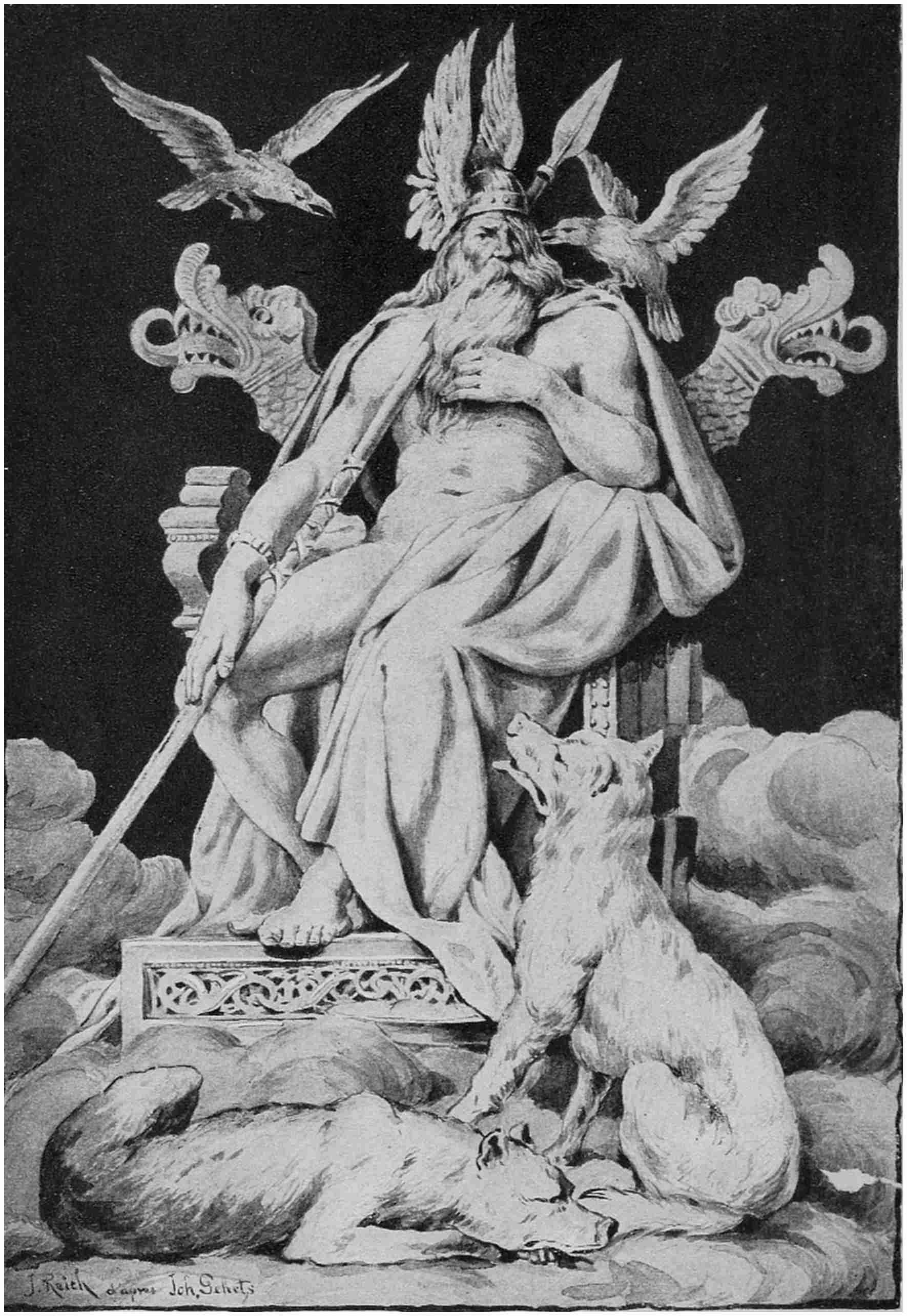
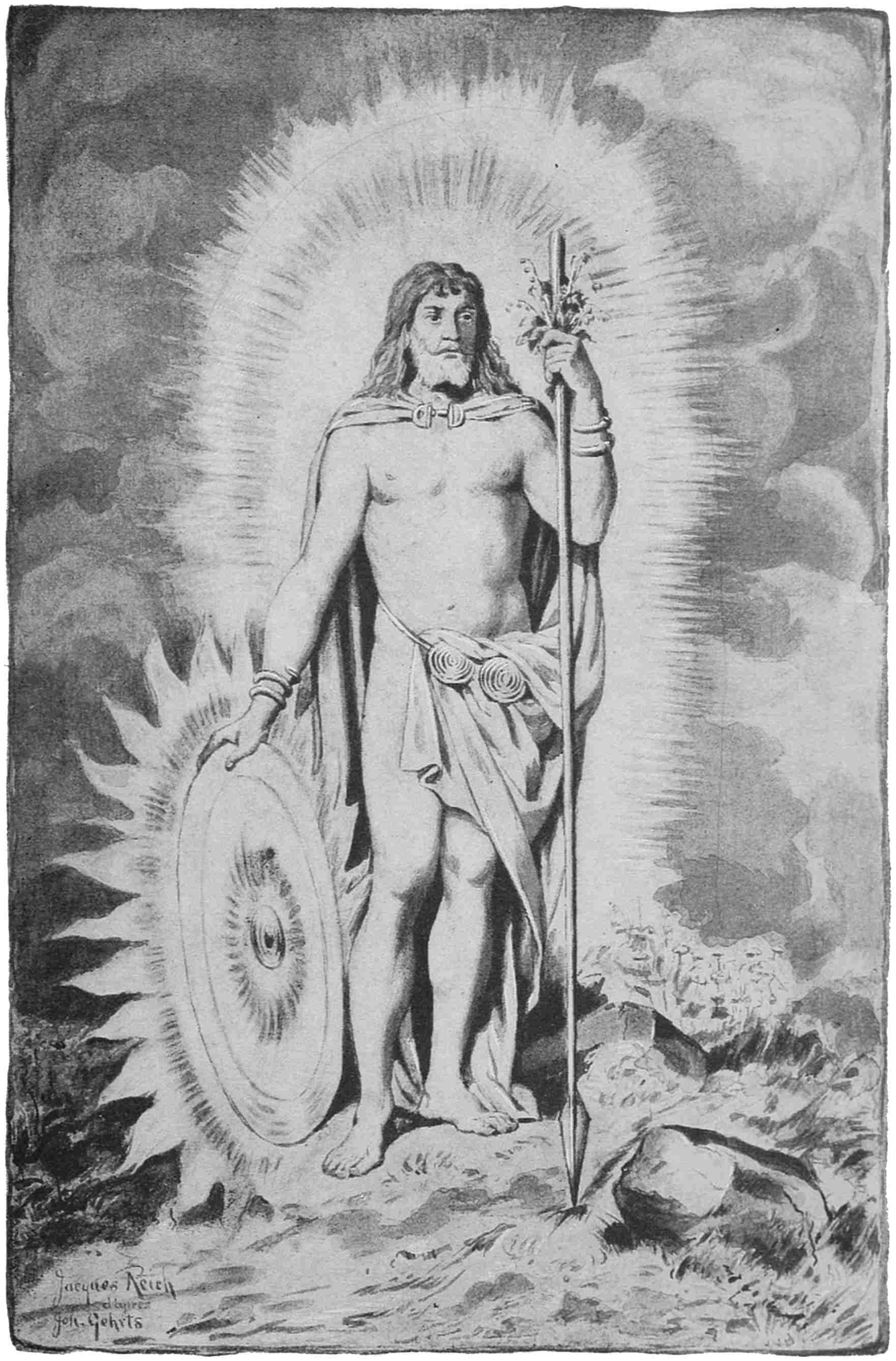
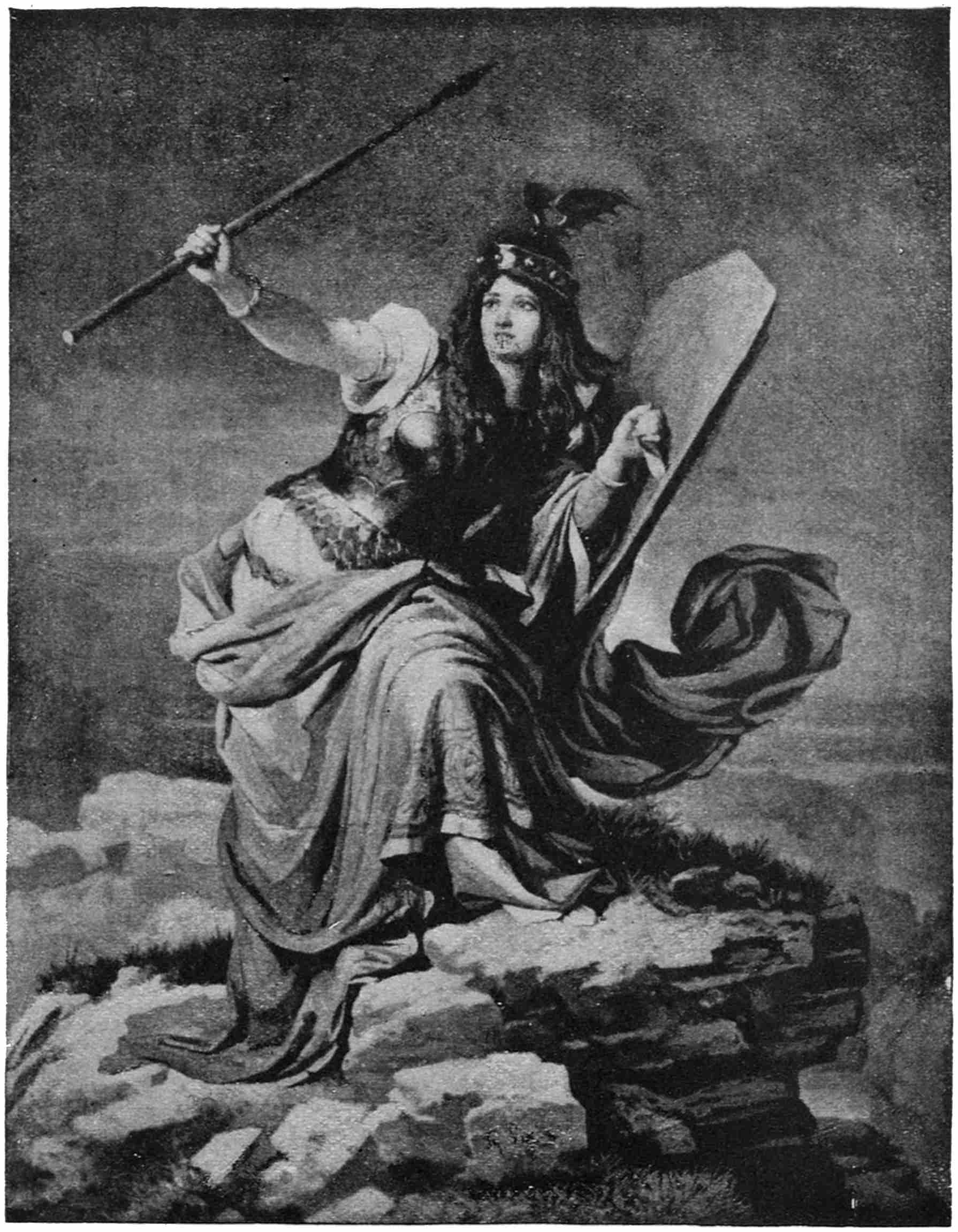
Odin was generally represented as a tall, vigorous man, about
fifty years of age, either with dark curling hair or with a long
gray beard and bald head. He was clad in a suit of gray, with
a blue hood, and his muscular body was enveloped in a wide blue
mantle all flecked with gray—an emblem of the sky with its
fleecy clouds. In his hand Odin generally carried the infallible
spear Gungnir, which was so sacred that an oath sworn upon its
point could never be broken, and on his finger or arm he wore
the marvelous ring Draupnir, the emblem of fruitfulness, precious
beyond compare. When seated upon his throne or armed for
the fray, in which he often took an active part, Odin wore his
eagle helmet; but when he wandered about the earth in human
guise, to see what men were doing, he generally donned a broad-brimmed
hat, drawn down low over his forehead to conceal the
fact of his having but one eye.
“Then into the Volsungs’ dwelling a mighty man there strode,
One-eyed and seeming ancient, yet bright his visage glowed;
Cloud-blue was the hood upon him, and his kirtle gleaming-gray
As the latter morning sun dog when the storm is on the way:
A bill he bore on his shoulder, whose mighty ashen beam
Burnt bright with the flame of the sea and the blended silver’s gleam.”
Sigurd the Volsung (William Morris).
Two ravens, Hugin (thought) and Munin (memory), perched
upon his shoulders as he sat upon his throne, and these he sent
out into the wide world every morning, anxiously watching for
their return at nightfall, when they whispered into his ears news
of all they had seen and heard, keeping him well informed about
everything that was happening on earth.
“Hugin and Munin
Fly each day
Over the spacious earth.
I fear for Hugin
That he come not back,
Yet more anxious am I for Munin.”
Norse Mythology (R. B. Anderson).
VALHALLA—Hoffmann.
At his feet crouched two wolves or hunting hounds, Geri and
Freki, which animals were therefore considered sacred to him,
and of good omen if met by the way. Odin always fed these
wolves with his own hands from the meat set before him, for he
required no food at all, and seldom tasted anything except the
sacred mead.
“Geri and Freki
The war-wont sates,
The triumphant sire of hosts;
But on wine only
The famed in arms
Odin, ever lives.”
Lay of Grimnir (Thorpe’s tr.).
When seated in state upon his throne, Odin rested his feet upon
a footstool of gold, the work of the gods, whose furniture and
utensils were all fashioned either of that precious metal or of silver.
Besides the magnificent hall Glads-heim, where stood the twelve
seats occupied by the gods when they met in council, and Valaskialf,
where his throne, Hlidskialf, was placed, Odin had a third
palace in Asgard, situated in the midst of the marvelous grove
Glasir, whose leaves were all of shimmering red gold.
Valhalla.
This palace, called Valhalla (the hall of the chosen slain),
had five hundred and forty doors, wide enough to allow the passage
of eight hundred warriors abreast, and above
the principal gate were a boar’s head and an eagle
whose piercing glance looked all over the world. The walls of
this marvelous building were fashioned of glittering spears, so
highly polished that they illuminated all the hall. The roof was
of golden shields, and the benches were decorated with fine
armor, the god’s gifts to his guests. Here long tables afforded
ample accommodations for the warriors fallen in battle, who were
called Einheriar, and were considered Odin’s favorite guests.
“Easily to be known is,
By those who to Odin come,
The mansion by its aspect.
Its roof with spears is laid,
Its hall with shields is decked,
With corselets are its benches strewed.”
Lay of Grimnir (Thorpe’s tr.).
The ancient Northern nations, who deemed warfare the most
honorable of occupations, and considered courage the greatest
virtue, worshiped Odin principally as god of battle and victory,
and believed that whenever a fight was about to occur he sent out
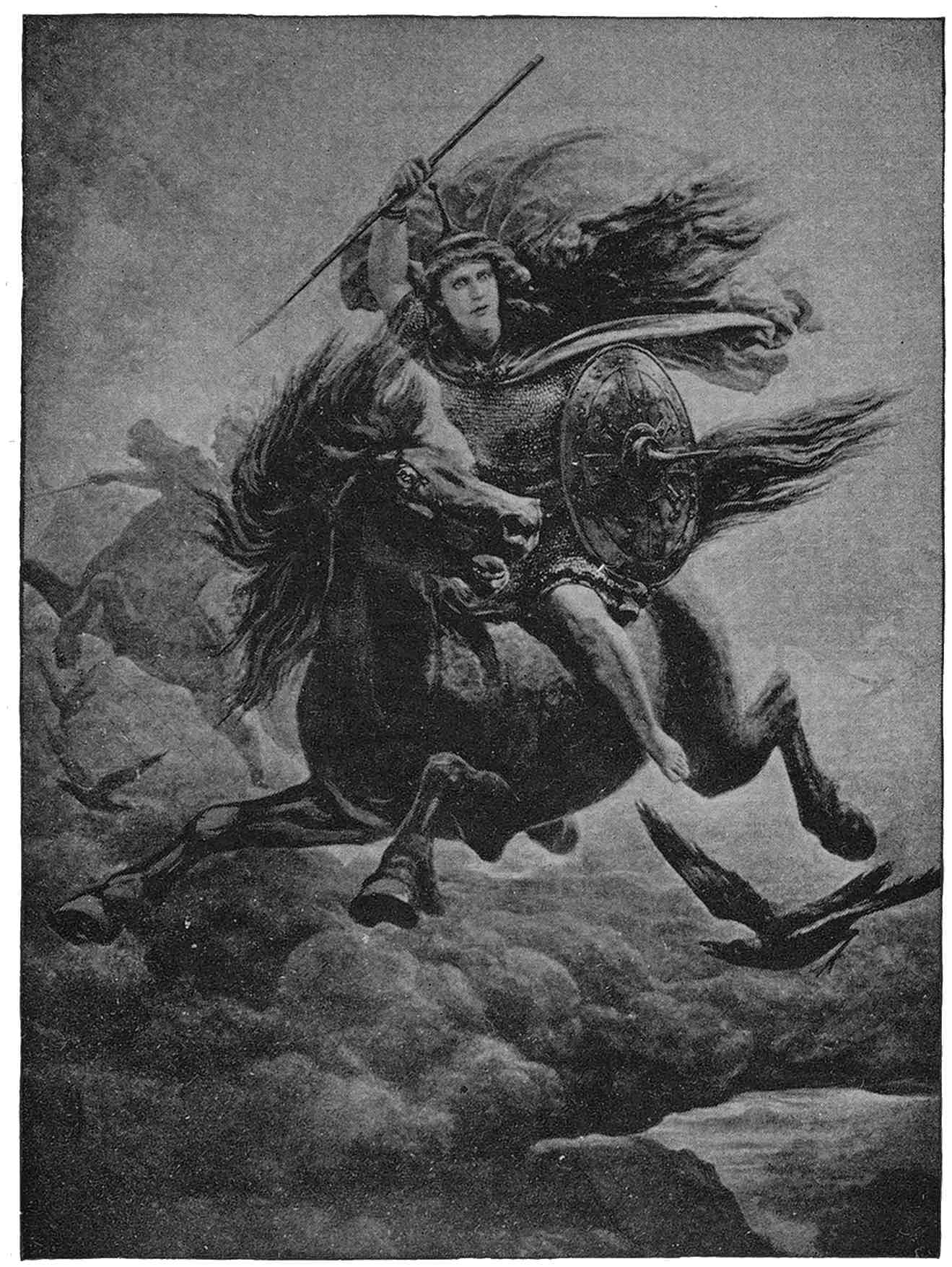
his special attendants, the shield, battle, or wish maidens, called
Valkyrs (choosers of the slain). They selected one half the
dead warriors, and bore them on their fleet steeds over the quivering
rainbow bridge Bifröst, into his hall, where many honors
awaited them. Welcomed by Odin’s sons, Hermod and Bragi,
the heroes were then conducted to the foot of Odin’s throne,
where they received the praises due their valor. When some
special favorite of the god was thus brought into Asgard, Valfather
(father of the slain), as Odin was called when he presided
over the warriors, sometimes rose from his throne to meet him
at the door and himself bid him welcome.
The feast of the heroes.
Besides the hope of the glory of such a distinction, and the
promise of dwelling in Odin’s beloved presence day after day,
other more material pleasures awaited the warriors in Valhalla.
They were seated around the board, where the
beautiful white-armed virgins, the Valkyrs, having
laid aside their armor and clad themselves in pure white robes,
constantly waited upon them. These maidens, nine in number,
according to some mythologists, brought the heroes great horns
full of delicious mead, and set before them huge portions of boars’
flesh, upon which they feasted most heartily. The usual Northern
drink was beer or ale, but our ancestors fancied this beverage
too coarse for the heavenly sphere. They therefore imagined
that Valfather kept his table liberally supplied with mead or
hydromel, which was daily furnished in great abundance by
his she-goat Heidrun, continually browsing on the tender leaves
and twigs on Yggdrasil’s topmost branch, Lerad.
“Rash war and perilous battle, their delight;
And immature, and red with glorious wounds,
Unpeaceful death their choice: deriving thence
A right to feast and drain immortal bowls,
In Odin’s hall; whose blazing roof resounds
The genial uproar of those shades who fall
In desperate fight, or by some brave attempt.”
Liberty (James Thomson).
The meat upon which the Einheriar feasted was the flesh of the
divine boar Sæhrimnir, a marvelous beast, daily slain by the
cook Andhrimnir, and boiled in the great caldron Eldhrimnir;
but although Odin’s guests had true Northern appetites and
fairly gorged themselves, there was always plenty of meat for all.
“Andhrimnir cooks
In Eldhrimnir
Sæhrimnir;
’Tis the best of flesh;
But few know
What the einherjes eat.”
Lay of Grimnir (Anderson’s version).
Moreover the supply was exhaustless, for the boar always
came to life again before the time for the next meal, when he
was again slain and devoured. This miraculous renewal of supplies
in the larder was not the only wonderful occurrence in
Valhalla, for it is also related that the warriors, after having eaten
and drunk to satiety, always called for their weapons, armed
themselves, and rode out into the great courtyard, where they
fought against one another, repeating the feats of arms achieved
while on earth, and recklessly dealing terrible wounds, which were
miraculously and completely healed as soon as the dinner horn
sounded.
“All the chosen guests of Odin
Daily ply the trade of war;
From the fields of festal fight
Swift they ride in gleaming arms,
And gaily, at the board of gods,
Quaff the cup of sparkling ale
And eat Sæhrimni’s vaunted flesh.”
Vafthrudni’s-mal (W. Taylor’s tr.).
Whole and happy once more,—for they bore one another no
grudge for the cruel thrusts given and received, and lived in
perfect amity together,—the Einheriar then rode gaily back to
Valhalla to renew their feasts in Odin’s beloved presence, while
the white-armed Valkyrs, with flying hair, glided gracefully about,
constantly filling their horns or their favorite drinking vessels, the
skulls of their enemies, while the scalds sang of war and stirring
Viking expeditions.
“And all day long they there are hack’d and hewn
’Mid dust, and groans, and limbs lopp’d off, and blood;
But all at night return to Odin’s hall
Woundless and fresh; such lot is theirs in Heaven.”
Balder Dead (Matthew Arnold).
Thus fighting and feasting, the heroes were said to spend day
after day in perfect bliss, while Odin delighted in their strength
and number, which, however, he foresaw would not long avail to
ward off his downfall when the day of the last battle had dawned.
As such pleasures were the highest a Northern warrior’s fancy
could paint, it was very natural that all fighting men should love
Odin, and early in life should dedicate themselves to his service.
They vowed to die arms in hand, if possible, and even wounded
themselves with their own spears when death drew near, if they
had been unfortunate enough to escape death on the battlefield
and were threatened with “straw death,” as they called decease
from old age or sickness.
“To Odin then true-fast
Carves he fair runics,—
Death-runes cut deep on his arm and his breast.”
Viking Tales of the North (R. B. Anderson).
In reward for this devotion Odin watched with special care
over his favorites, giving them a magic sword, spear, or horse,
and making them invincible until their last hour had come, when
he himself appeared to claim or destroy the gift he had bestowed,
and the Valkyrs bore them off to Valhalla.
“He gave to Hermod
A helm and corselet,
And from him Sigmund
A sword received.”
Lay of Hyndla (Thorpe’s tr.).
Sleipnir.
Whenever Odin took an active part in war, he generally rode
his eight-footed gray steed, Sleipnir, brandished his white shield,
and flung his glittering spear over the heads of the
combatants, who only awaited this signal to fall
upon one another, while the god dashed into their midst shouting
his warcry: “Odin has you all!”
“And Odin donn’d
His dazzling corslet and his helm of gold,
And led the way on Sleipnir.”
Balder Dead (Matthew Arnold).
At times he also used his magic bow, from which he shot ten
arrows at once, every one invariably bringing down a foe. Odin
was also supposed to inspire his favorite warriors with the renowned
“Berserker rage” (bare sark or shirt), which enabled
them, although naked, weaponless, and sore beset, to perform
unheard-of feats of valor and strength, and go about as with
charmed lives.
As Odin’s characteristics, like the all-pervading elements, were
multitudinous, so were also his names, of which he had no less
than two hundred, almost all of which were descriptive of some
phase of his being. He was considered the ancient god of seamen
and of the wind:
“Mighty Odin,
Norsemen hearts we bend to thee!
Steer our barks, all-potent Woden,
O’er the surging Baltic Sea.”
Vail.
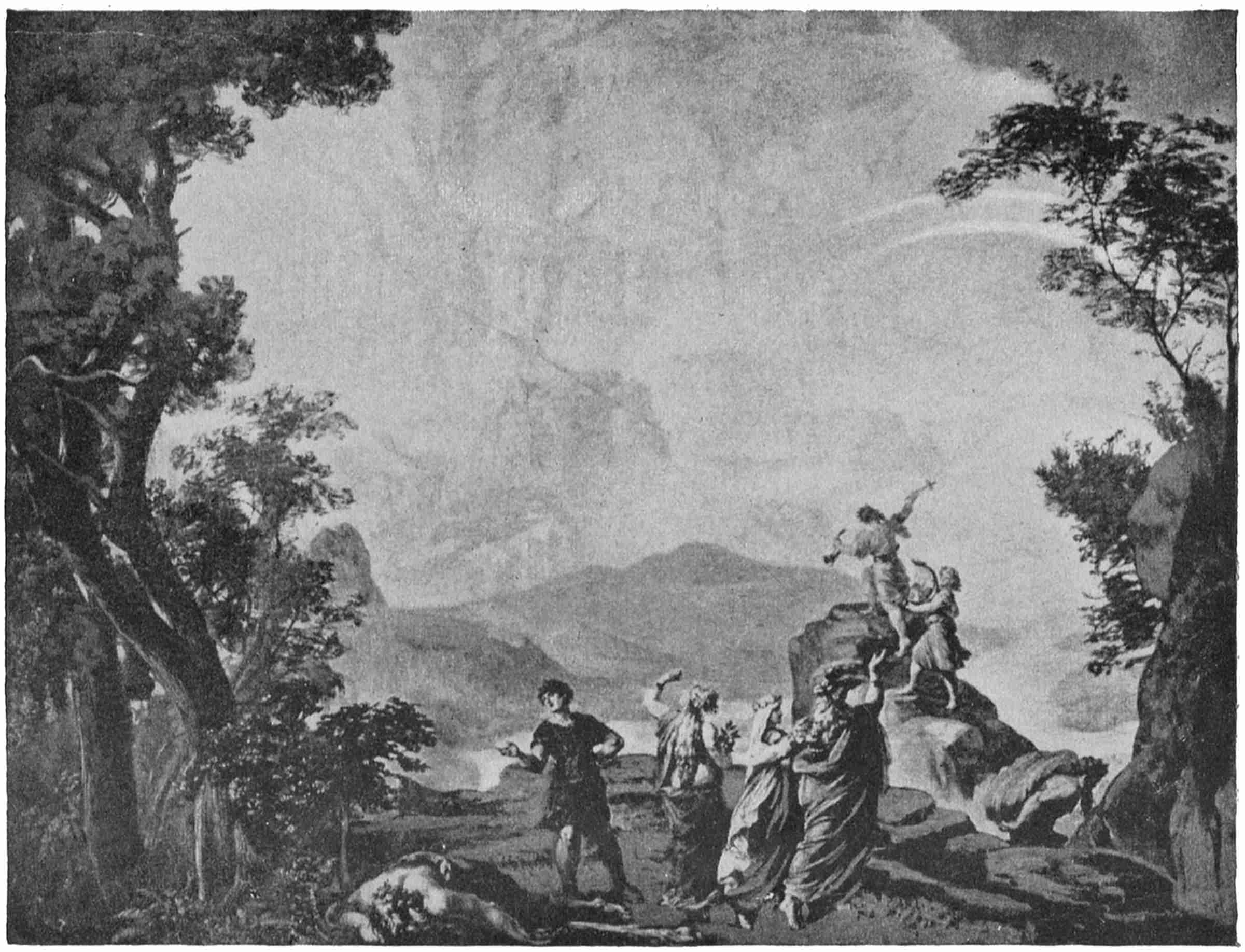
The Wild Hunt.
Odin, as wind god, generally rode about on his eight-footed
steed Sleipnir, a habit which gave rise to the oldest Northern
riddle, which runs as follows: “Who are the two who ride to the
Thing? Three eyes have they together, ten feet, and one tail;
and thus they travel through the lands.” And as the souls of the
dead were supposed to be wafted away on the wings of the storm,
Odin was worshiped as the leader of all disembodied spirits. In
this character he was most generally known as the Wild Huntsman,
and when people heard the rush and roar of the wind they
cried aloud in superstitious fear, fancying they heard and saw him
ride past with his train, all mounted on snorting steeds, and accompanied
by baying hounds. And the passing of the
Wild Hunt, known as Woden’s Hunt, the Raging
Host, Gabriel’s Hounds, or Asgardreia, was also considered a
presage of misfortune of some kind, such as pestilence or war.
“The Rhine flows bright; but its waves ere long
Must hear a voice of war,
And a clash of spears our hills among,
And a trumpet from afar;
And the brave on a bloody turf must lie,
For the Huntsman hath gone by!”
The Wild Huntsman (Mrs. Hemans).
People further fancied that if any were so sacrilegious as to
join in the wild halloo in mockery, they were immediately
snatched up and whirled away with the vanishing host, while
those who joined in the halloo with implicit good faith were
rewarded for their credulity by the sudden gift of a horse’s leg,
hurled at them from above, which, if they carefully kept until the
morrow, was changed into a solid lump of gold.
Even after the introduction of Christianity the ignorant Northern
people still dreaded the on-coming storm, declaring that it was
the Wild Hunt sweeping across the sky.
“And ofttimes will start,
For overhead are sweeping Gabriel’s hounds,
Doomed with their impious lord the flying hart
To chase forever on aëreal grounds.”
Sonnet (Wordsworth).
Sometimes it left behind it a small black dog, which, cowering
and whining upon a neighboring hearth, had to be kept for a whole
year and carefully tended unless the people succeeded in exorcising
it or frightening it away. The usual recipe, the same as
for the riddance of changelings, was to brew beer in egg-shells,
which performance so startled the spectral dog that he fled with
his tail between his legs, exclaiming that, although as old as the
Behmer, or Bohemian forest, he had never yet seen such an uncanny
sight.
“I am as old
As the Behmer wold,
And have in my life
Such a brewing not seen.”
Old Saying (Thorpe’s tr.).
The object of this phantom hunt varied greatly, and was either
a visionary boar or wild horse, white-breasted maidens who were
caught and borne away bound only once in seven years, or the
wood nymphs, called Moss Maidens, who were thought to represent
the autumn leaves torn from the trees and whirled away
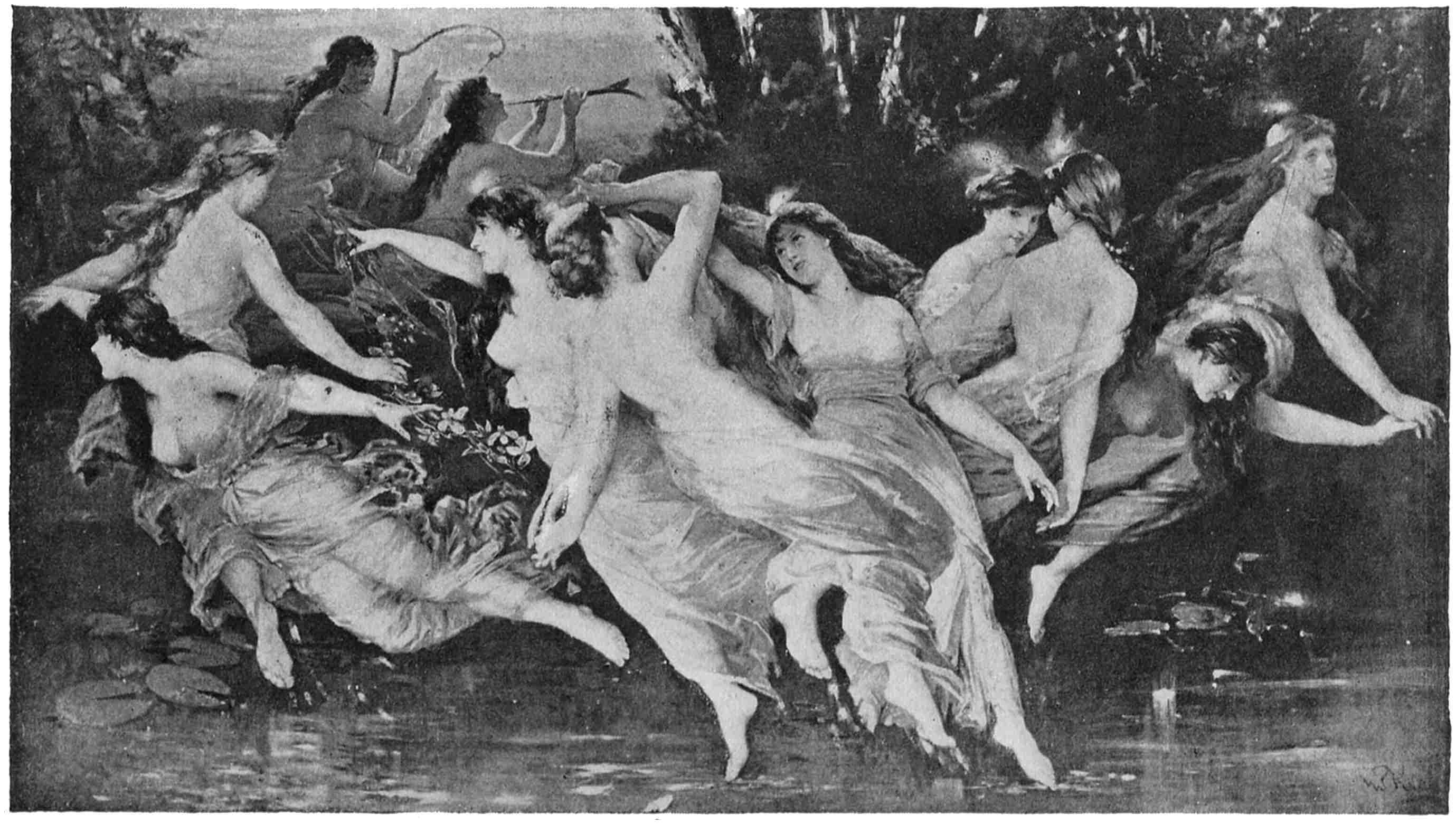
by the wintry gale.
In the middle ages, when the belief in the old heathen deities
was partly forgotten, the leader of the Wild Hunt was no longer
Odin, but Charlemagne, Frederick Barbarossa, King Arthur, or
some Sabbath breaker, like the squire of Rodenstein or Hans von
Hackelberg, who, in punishment for his sins, was condemned to
hunt forever through the realms of air.
As the winds blew fiercest in autumn and winter, Odin was
supposed to hunt in preference during that season, especially
during the time between Christmas and Twelfth-night, and the
peasants were always careful to leave the last sheaf or measure
of grain out in the fields to serve as food for his horse.
This hunt was of course known by various names in the different
countries of northern Europe; but as the tales told about it
are all alike, they evidently originated in the same old heathen
belief, and to this day ignorant people of the North still fancy
that the baying of a hound on a stormy night is an infallible
presage of death.
“Still, still shall last the dreadful chase,
Till time itself shall have an end;
By day, they scour earth’s cavern’d space,
At midnight’s witching hour, ascend.
“This is the horn, and hound, and horse
That oft the lated peasant hears;
Appall’d, he signs the frequent cross,
When the wild din invades his ears.
“The wakeful priest oft drops a tear
For human pride, for human woe,
When, at his midnight mass, he hears
The infernal cry of ‘Holla, ho!’”
Sir Walter Scott.
The Wild Hunt, or Raging Host of Germany, was called Herlathing
in England, from the mythical king Herla, its supposed
leader; in northern France it bore the name of Mesnée d’Hellequin,
from Hel, goddess of death; and in the middle ages it was
known as Cain’s Hunt or Herod’s Hunt, these latter names being
given because the leaders were supposed to be unable to find
rest on account of the iniquitous murders of Abel, of John the
Baptist and of the Holy Innocents.
In central France the Wild Huntsman, whom we have already
seen in other countries as Odin, Charlemagne, Barbarossa,
Rodenstein, von Hackelberg, King Arthur, Hel, one of the Swedish
kings, Gabriel, Cain, or Herod, is also called the Great
Huntsman of Fontainebleau (le Grand Veneur de Fontainebleau),
and people declare that on the eve of Henry IV.’s murder,
and also just before the outbreak of the great French Revolution,
his shouts were distinctly heard as he swept across the sky.
THE PIED PIPER OF HAMELIN.—H. Kaulbach.
It was generally believed among the Northern nations that the
soul escaped from the body in the shape of a mouse, which crept
out of a corpse’s mouth and ran away, and it was also said to creep
in and out of the mouths of people in a trance. While the
soul was absent, no effort or remedy could recall the patient to
life; but as soon as it had come back animation returned.
The Pied Piper.
As Odin was the leader of all disembodied spirits, he was
identified in the middle ages with the Pied Piper of Hamelin.
According to mediæval legends, Hamelin was so infested
by rats (the souls of the dead) that life became unbearable, and
a large reward was offered to the person who would
rid the town of these rodents. A piper, in party-colored
garments, undertook the job, and piped so gaily that the rats
were one and all beguiled out of their holes, along the street, and
down to the river Weser, where they were drowned.
“And ere three shrill notes the pipe uttered,
You heard as if an army muttered;
And the muttering grew to a grumbling;
And the grumbling grew to a mighty rumbling;
And out of the houses the rats came tumbling.
Great rats, small rats, lean rats, brawny rats,
Brown rats, black rats, gray rats, tawny rats,
Grave old plodders, gay young friskers,
Fathers, mothers, uncles, cousins,
Cocking tails and pricking whiskers,
Families by tens and dozens,
Brothers, sisters, husbands, wives—
Followed the Piper for their lives.
From street to street he piped advancing,
And step for step they followed dancing,
Until they came to the river Weser,
Wherein all plunged and perished!”
Robert Browning.
As the rats were all dead, and there was no chance of their
returning to plague them, the people of Hamelin refused to pay
the promised reward, and braving the piper’s anger bade him do
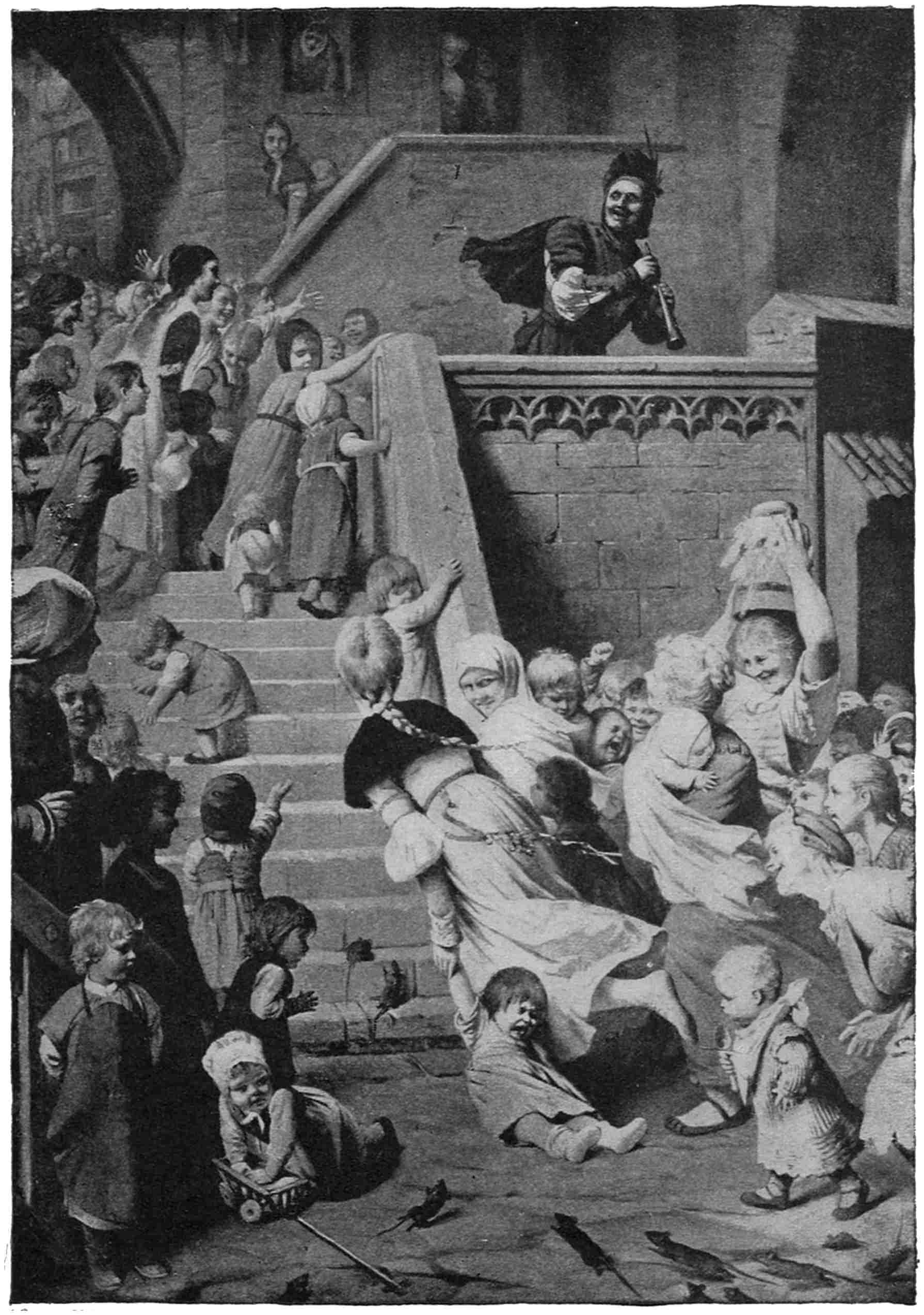
his worst. A few moments later the magic flute again began to
play, and the astonished parents saw all their children gaily
swarm out of the houses and merrily follow the piper.
“There was a rustling that seemed like a bustling
Of merry crowds justling at pitching and hustling;
Small feet were pattering, wooden shoes clattering,
Little hands clapping and little tongues chattering,
And, like fowls in a farmyard when barley is scattering,
Out came all the children running.
All the little boys and girls,
With rosy cheeks and flaxen curls,
And sparkling eyes and teeth like pearls,
Tripping and skipping, ran merrily after
The wonderful music with shouting and laughter.”
Robert Browning.
While the parents stood there helpless and spellbound, the piper
led the children out of the town to the Koppelberg, a hill, which
miraculously opened to receive them, and only closed again
when the last child had passed out of sight. The children were
never seen in Hamelin again, and in commemoration of this
public calamity all official decrees have since been dated so
many years after the Pied Piper’s visit.
“They made a decree that lawyers never
Should think their records dated duly
If, after the day of the month and year,
These words did not as well appear,
‘And so long after what happened here
On the Twenty-second of July,
Thirteen hundred and seventy-six.’
And the better in memory to fix
The place of the children’s last retreat,
They called it the Pied Piper street—
Where any one playing on pipe or tabor
Was sure for the future to lose his labor.”
Robert Browning.
In this myth Odin is the piper, the shrill tones of the flute are
emblematic of the whistling wind, the rats represent the souls of
the dead, which cheerfully follow him, and he even leads the
children into the hollow mountain, which is typical of the grave.
Bishop Hatto.
Another German legend, which owes its existence to this belief,
is the story of Bishop Hatto, the miserly prelate, who, annoyed
by the clamors of the poor during a time of famine,
had them all burned alive in a deserted barn, like
the rats whom he declared they resembled, rather than give them
some of the precious grain which he had laid up for himself.
“‘I’ faith, ’tis an excellent bonfire!’ quoth he,
‘And the country is greatly obliged to me
For ridding it in these times forlorn
Of rats that only consume the corn.’”
Robert Southey.
No sooner had this terrible crime been accomplished than the
souls of the poor murdered wretches, assuming the forms of the
rats to which he had likened them, came rushing towards the
wicked bishop, whom they pursued even into the middle of the
Rhine, where he took refuge in a stone tower to escape from
their fangs. But the rats swam to the tower, gnawed their way
through the stone walls, and pouring in on all sides at once, they
pounced upon the bishop and devoured him.
“And in at the windows, and in at the door,
And through the walls, helter-skelter they pour,
And down from the ceiling, and up through the floor,
From the right and the left, from behind and before,
From within and without, from above and below,
And all at once to the Bishop they go.
They have whetted their teeth against the stones;
And now they pick the Bishop’s bones;
They gnaw’d the flesh from every limb,
For they were sent to do judgment on him!”
Robert Southey.
The red glow of the sunset above the Rat Tower near Bingen
on the Rhine is supposed to be the reflection of the hell fire in
which the wicked bishop is slowly roasting in punishment for this
heinous crime.
Irmin.
In some parts of Germany Odin was considered identical with
the Saxon god Irmin, whose statue, the Irminsul, near Paderborn,
was destroyed by Charlemagne in 772. Irmin was said to possess
a ponderous brazen chariot, in which he rode
across the sky along the path which we know as
the Milky Way, but which the ancient Germans designated as
Irmin’s Way. This chariot, whose rumbling sound occasionally
became perceptible to mortal ears as thunder, never left the sky,
where it can still be seen in the constellation of the Great Bear,
which is also known in the North as Odin’s, or Charles’s Wain.
“The Wain, who wheels on high
His circling course, and on Orion waits;
Sole star that never bathes in the Ocean wave.”
Homer’s Iliad (Derby’s tr.).
Mimir’s well.
To obtain the great wisdom for which he is so famous, Odin,
in the morn of time, wandered off to Mimir’s (Memor, memory)
spring, “the fountain of all wit and wisdom,” in
whose liquid depths even the future was clearly
mirrored, and besought the old man who guarded it to let him
have a draught. But Mimir, who well knew the value of such a
favor (for his spring was considered the source or headwater of
memory), refused to grant it unless Odin would consent to give
one of his eyes in exchange.
The god did not hesitate, but immediately plucked out one of
his eyes, which Mimir kept in pledge, sinking it deep down into
his fountain, where it shone with mild luster, leaving Odin with
but one eye, which is considered emblematic of the sun.
“Through our whole lives we strive towards the sun;
That burning forehead is the eye of Odin.
His second eye, the moon, shines not so bright;
It has he placed in pledge in Mimer’s fountain,
That he may fetch the healing waters thence,
Each morning, for the strengthening of this eye.”
Oehlenschläger (Howitt’s tr.).
Drinking deeply of Mimir’s fount, Odin gained the knowledge he
coveted, and such was the benefit received that he never regretted
the sacrifice he had made, but as further memorial of that day
broke off a branch of the sacred tree Yggdrasil, which overshadowed
the spring, and fashioned from it his beloved spear
Gungnir.
“A dauntless god
Drew for drink to its gleam,
Where he left in endless
Payment the light of an eye.
From the world-ash
Ere Wotan went he broke a bough;
For a spear the staff
He split with strength from the stem.”
Dusk of the Gods, Wagner (Forman’s tr.).
But although Odin had won all knowledge, he was sad and
oppressed, for he had also won an insight into futurity, and had
become aware of the transitory nature of all things, and even
of the fate of the gods, who were doomed to pass away. This
knowledge so affected his spirits that he ever after wore a melancholy
and contemplative expression.
To test the value of the wisdom he had thus obtained, Odin
soon went to visit the most learned of all the giants, Vafthrudnir,
and entered with him into a contest of wit, in which the stake
was nothing less than the loser’s head.
“Odin rose with speed, and went
To contend in runic lore
With the wise and crafty Jute.
To Vafthrudni’s royal hall
Came the mighty king of spells.”
Vafthrudni’s-mal (W. Taylor’s tr.).
Odin and Vafthrudnir.
On this occasion Odin had disguised himself as a Wanderer,
by Frigga’s advice, and when asked his name declared it was
Gangrad. The contest of wit immediately began,
Vafthrudnir questioning his guest concerning the
horses which carried Day and Night across the sky, the river
Ifing separating Jötun-heim from Asgard, and also about Vigrid,
the field where the last battle was to be fought.
All these questions were minutely answered by Odin, who,
when Vafthrudnir had ended, began the interrogatory in his turn,
and received equally explicit answers about the origin of heaven
and earth, the creation of the gods, their quarrel with the Vanas,
the occupations of the heroes in Valhalla, the offices of the
Norns, and the rulers who were to replace the Æsir when they
had all perished with the world they had created. But, when in
conclusion, Odin bent near the giant and softly inquired what
words Allfather whispered to his dead son Balder as he lay upon
his funeral pyre, Vafthrudnir suddenly recognized his divine visitor.
Starting back in dismay he declared that no one but Odin himself
could answer that question, and that it was now quite plain to
him that he had madly striven in a contest of wisdom and wit
with the king of the gods, and fully deserved the penalty of
failure, the loss of his head.
“Not the man of mortal race
Knows the words which thou hast spoken
To thy son in days of yore.
I hear the coming tread of death;
He soon shall raze the runic lore,
And knowledge of the rise of gods,
From his ill-fated soul who strove
With Odin’s self the strife of wit,
Wisest of the wise that breathe:
Our stake was life, and thou hast won.”
Vafthrudni’s-mal (W. Taylor’s tr.).
As is the case with so many of the Northern myths, which are
often fragmentary and obscure, this one ends here, and none of
the scalds inform us whether Odin really slew his rival, nor what
was the answer to his last question; but mythologists have hazarded
the suggestion that the word whispered by Odin in Balder’s
ear, to console him for his untimely death, must have been the
hopeful term “resurrection.”
Invention of runes.
Besides being god of wisdom, Odin was god and inventor of
runes, the earliest alphabet used by Northern nations, which
characters, meaning mystery, were at first used for
divination, although in later times they served for
inscriptions and records. Just as wisdom could only be obtained
at the cost of sacrifice, Odin himself relates that he hung nine
days and nights from the sacred tree Yggdrasil, gazing down into
the immeasurable depths of Nifl-heim, plunged in deep thought,
ere, after wounding himself with his spear, he won the knowledge
he sought.
“I know that I hung
On a wind-rocked tree
Nine whole nights,
With a spear wounded,
And to Odin offered
Myself to myself;
On that tree
Of which no one knows
From what root it springs.”
Odin’s Rune-Song (Thorpe’s tr.).
When he had fully mastered this knowledge, Odin cut magic
runes upon his spear Gungnir, upon the teeth of his horse Sleipnir,
upon the claws of the bear, and upon countless other animate and
inanimate things. And because he had thus hung over the abyss
for such a long space of time, he was ever after considered the patron
divinity of all who were condemned to be hanged or who
perished by the noose.
After obtaining the gift of wisdom and runes, which gave him
power over all things, Odin also coveted the gift of eloquence
and poetry, which became his in a manner which we shall relate
in a subsequent chapter.
Geirrod and Agnar.
Odin, as has already been stated, took great interest in the
affairs of mortals, and, we are told, was specially fond of watching
King Hrauding’s handsome little sons, Geirrod
and Agnar, when they were about eight and ten
years of age. One day these little lads went fishing, and when
a storm suddenly arose their boat drifted far out to sea, and was
finally stranded upon an island, where dwelt an old couple, Odin
and Frigga, in disguise. The lads were warmly welcomed and
kindly treated, Odin choosing Geirrod as his favorite, and teaching
him the use of arms, while Frigga petted and made much of
little Agnar. The boys tarried on the island with their kind protectors
during the long, cold winter season; but when spring
came, the skies were blue, and the sea calm, they embarked in a
boat which Odin provided, and set out for their native shores.
Favored by gentle breezes, they were soon wafted thither; but as
the boat neared the shore Geirrod quickly sprang out and shoved
it far into the water, bidding his brother sail away into the evil
spirit’s power. At that selfsame moment the wind veered, and
Agnar was carried away, while his brother hastened back to his
father’s palace, where he was joyfully received, and where, in due
time, he succeeded his father upon the throne.
Years had passed since Odin and Frigga had spent that winter
in human form on the desert island, when one day, while the
royal couple were seated on the throne Hlidskialf, Odin bade his
wife notice how powerful his pupil had become, and taunted her
because her favorite Agnar had married a giantess and had remained
poor and of no importance in the world. Frigga quietly
replied that it was better to be poor than hard hearted, and accused
Geirrod of lack of hospitality—one of the most heinous crimes
in the eyes of a Northerner. She even went so far as to declare
that in spite of all his wealth he often ill treated his guests.
When Odin heard this accusation he declared that he would
prove the falsity of her charge by assuming the guise of a Wanderer
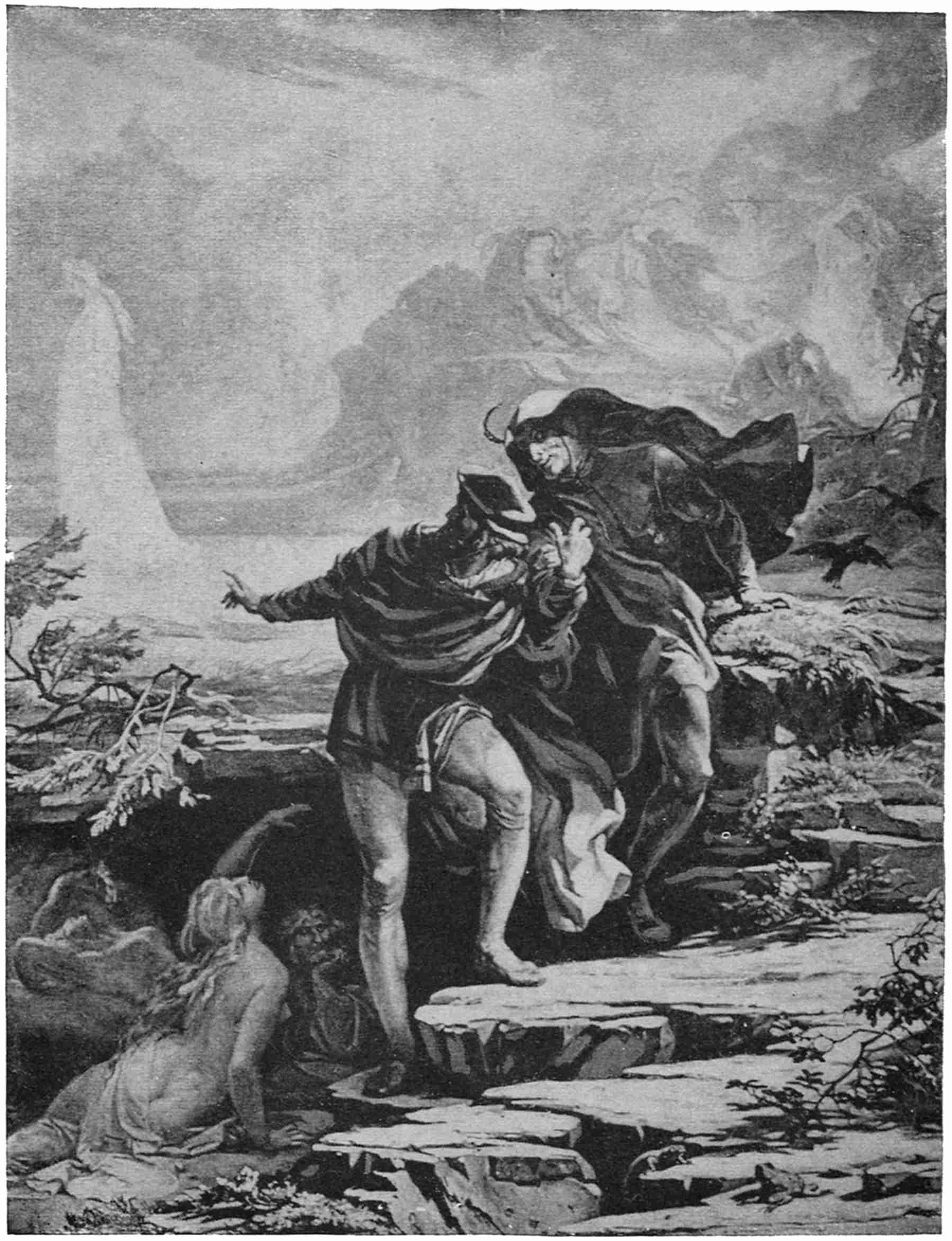
and testing Geirrod’s generosity. Wrapped in his cloud-hued
raiment, with slouch hat and pilgrim staff,—
“Wanderer calls me the world,
Far have I carried my feet,
On the back of the earth
I have boundlessly been,”—
Wagner (Forman’s tr.).
Odin immediately set out by a roundabout way, while Frigga,
to outwit him, sent Geirrod a secret warning to beware of a man
in wide mantle and broad-brimmed hat, as he was a wicked
enchanter who would work him ill.
As soon, therefore, as Odin presented himself before the king’s
palace he was dragged into Geirrod’s presence, where, when he
had given his name as Grimnir, and had refused to tell whence
he came or what he wanted, he was bound between two fires,
whose flames played around him without quite touching him.
There he remained eight days and nights, in obstinate silence,
without a morsel of food, and had it not been that Agnar, who
had returned to his brother’s palace and occupied a menial position
there, once secretly brought him a horn of ale, he would have
had nothing to drink.
At the end of the eighth day, while Geirrod, seated upon his
throne, was gloating over his prisoner’s sufferings, Odin began to
sing—softly at first, then louder and louder, until the hall reëchoed
with his triumphant notes—a prophecy that the king, who
had so long enjoyed the god’s favor, would soon perish by his own
sword.
“The fallen by the sword
Ygg shall now have;
Thy life is now run out:
Wroth with thee are the Dîsir:
Odin thou now shalt see:
Draw near to me if thou canst.”
Sæmund’s Edda (Thorpe’s tr.).
As the last notes died away the chains dropped from his hands,
the flames flickered and went out, and Odin stood in the midst
of the hall, no longer in human form, but in all the power and
beauty of a god.
On hearing the ominous prophecy Geirrod hastily drew his
sword, intending to slay the insolent singer; but when he beheld
the sudden transformation he started in dismay, tripped, fell
upon the sharp blade, and perished as Odin had just foretold.
Turning to Agnar, who, according to some accounts, was the
king’s son and not his brother, Odin then bade him ascend the
throne in reward for his humanity and, further to repay him for the
timely draught of ale, the king of the gods blessed him with all
manner of prosperity.
On another occasion Odin wandered off to earth, and was
absent so long that no one ever expected to see him in Asgard
again. His brothers Vili and Ve, who by some mythologists
are considered as other personifications of himself, then usurped
his power, occupied his throne, and even, we are told, married
his wife Frigga.
“Be thou silent, Frigg!
Thou art Fiörgyn’s daughter
And ever hast been fond of men,
Since Ve and Vili, it is said,
Thou, Vidrir’s wife, didst
Both to thy bosom take.”
Sæmund’s Edda (Thorpe’s tr.).
May-day festivals.
But upon his return they vanished forever; and in commemoration
of the disappearance of the false Odin, who had ruled
seven months and had brought nothing but unhappiness to the
world, and of the return of the benevolent deity, the heathen
Northerners formerly celebrated yearly festivals
and processions, which were long continued as
May-day rejoicings. Until very lately there was always, on that
day, a grand procession in Sweden, known as the May Ride, in
which a flower-decked May king (Odin) pelted with blossoms the
fur-enveloped Winter (his supplanter), until he put him to ignominious
flight. In England the first of May was also a festive
occasion, in which May-pole dances, May queens, Maid Marian,
and Jack in the Green played prominent parts.
As personification of heaven, Odin, of course, was the lover
and spouse of the earth, and as it appeared under a threefold
aspect, the Northerners, although a chaste race, depicted him as
a polygamist, and allotted to him several wives. The first among
these was Jörd (Erda), the primitive earth, daughter of Night
or of the giantess Fiorgyn. She bore him his famous son Thor,
the god of thunder. The second and principal wife was Frigga, a
personification of the civilized world. She gave him Balder, the
gentle god of spring, Hermod, and, according to some authorities,
Tyr. The third wife was Rinda, a personification of the
hard and frozen earth, who reluctantly yields to his warm embrace,
but finally gives birth to Vali, the emblem of vegetation.
Odin is also said to have married Saga or Laga, the goddess of
history (hence our verb “to say”), and to have daily visited her
in the crystal hall of Sokvabek, beneath a cool, ever-flowing river,
to drink its waters and listen to her songs about olden times and
vanished races.
“Sokvabek hight the fourth dwelling;
Over it flow the cool billows;
Glad drink there Odin and Saga
Every day from golden cups.”
Norse Mythology (R. B. Anderson).
His other wives were Grid, the mother of Vidar; Gunlod, the
mother of Bragi; Skadi; and the nine giantesses who simultaneously
bore Heimdall—all of whom play more or less important
parts in the various myths of the North.
Historical Odin.
Besides this ancient Odin, there was a more modern, semi-historical
personage of the same name, to whom all the virtues,
powers, and adventures of his predecessor have
been attributed. He was the chief of the Æsir,
inhabitants of Asia Minor, who, sore pressed by the Romans,
and threatened with destruction or slavery, left their native land
about 70 B.C., and migrated into Europe. This Odin is said
to have conquered Russia, Germany, Denmark, Norway, and
Sweden, leaving a son on the throne of each conquered country.
He also built the town of Odensö. He was welcomed in
Sweden by Gylfi, the king, who made him associate ruler, and
allowed him to found the city of Sigtuna, where he built a
temple and introduced a new system of worship. Tradition
further relates that as his end drew near, this mythical Odin
assembled his followers, publicly cut himself nine times in the
breast with his spear,—a ceremony called “carving Geir odds,”—and
told them he was about to return to his native land
Asgard, his old home, where he would await their coming, to
share with him a life of feasting, drinking, and fighting.
According to another account, Gylfi, having heard of the power
of the Æsir, the inhabitants of Asgard, and wishing to ascertain
whether these reports were true, journeyed off to the south. He
soon came to Odin’s palace, where he was expected, and where
he was deluded by the vision of three divinities, enthroned one
above the other, and called Har, Iafn-har, and Thridi. The
gatekeeper, Gangler, answered all his questions, gave him a long
explanation of Northern mythology, which is recorded in the
Younger Edda, and having finished his instructions, suddenly
vanished with the palace amid a deafening noise.
According to other very ancient poems, Odin’s sons, Weldegg,
Beldegg, Sigi, Skiold, Sæming, and Yngvi, became kings of
East Saxony, West Saxony, Franconia, Denmark, Norway, and
Sweden, and from them are descended the Saxons, Hengist and
Horsa, and the royal families of the Northern lands. Still another
version relates that Odin and Frigga had seven sons, who
founded the Anglo-Saxon heptarchy. In the course of time this
mysterious king was confounded with the Odin whose worship he
introduced, and all his deeds were attributed to the god.
Odin was worshiped in numerous temples, but especially in the
great fane at Upsala, where the most solemn festivals were held,
and where sacrifices were offered. The victim was generally a
horse, but in times of pressing need human offerings were made,
even the king being once offered up to avert a famine.
“Upsal’s temple, where the North
Saw Valhal’s halls fair imag’d here on earth.”
Viking Tales of the North (R. B. Anderson).
The first toast at every festival here was drunk in his honor,
and, besides the first of May, one day in every week was held
sacred to him, and, from his Saxon name, Woden, was called
Woden’s day, whence the English word “Wednesday” has been
derived. It was customary for the people to assemble at his
shrine on festive occasions, to hear the songs of the scalds, who
were rewarded for their minstrelsy by the gift of golden bracelets
or armlets, which curled up at the ends and were called “Odin’s
serpents.”
There are but few remains of ancient Northern art now extant,
and although rude statues of Odin were once quite common they
have all disappeared, as they were made of wood—a perishable
substance, which in the hands of the missionaries and especially
of Olaf the Saint, the Northern iconoclast, was soon reduced to
ashes.
“There in the Temple, carved in wood,
The image of great Odin stood.”
Saga of King Olaf (Longfellow)
Odin himself is supposed to have given his people a code of
laws whereby to govern their conduct, in a poem called Hávamal,
or the High Song, which forms part of the Edda. In this lay he
taught the fallibility of man, the necessity for courage, temperance,
independence, and truthfulness, respect for old age, hospitality,
charity, and contentment, and gave instructions for the
burial of the dead.
“At home let a man be cheerful,
And toward a guest liberal;
Of wise conduct he should be,
Of good memory and ready speech;
If much knowledge he desires,
He must often talk on what is good.”
Hávamál (Thorpe’s tr.).
CHAPTER III. FRIGGA.
The queen of the gods.
Frigga or Frigg, daughter of Fiorgyn and sister of Jörd,
according to some mythologists, is considered by others as a
daughter of Jörd and Odin, whom she eventually
married. This wedding caused such general rejoicing
in Asgard, where the goddess was greatly beloved, that
ever after it was customary to celebrate its anniversary with
feast and song, and the goddess being declared patroness of
marriage, her health was always proposed with that of Odin and
Thor at wedding feasts.
Frigga was goddess of the atmosphere, or rather of the clouds,
and as such was represented as wearing either snow-white or dark
garments, according to her somewhat variable moods. She was
queen of the gods, and she alone had the privilege of sitting on the
throne Hlidskialf, beside her august husband. From thence she,
too, could look over all the world and see what was happening,
and, according to our ancestors’ declarations, she possessed the
knowledge of the future, which, however, no one could ever prevail
upon her to reveal, thus proving that Northern women could
keep a secret inviolate.
“Of me the gods are sprung;
And all that is to come I know, but lock
In my own breast, and have to none reveal’d.”
Balder Dead (Matthew Arnold).
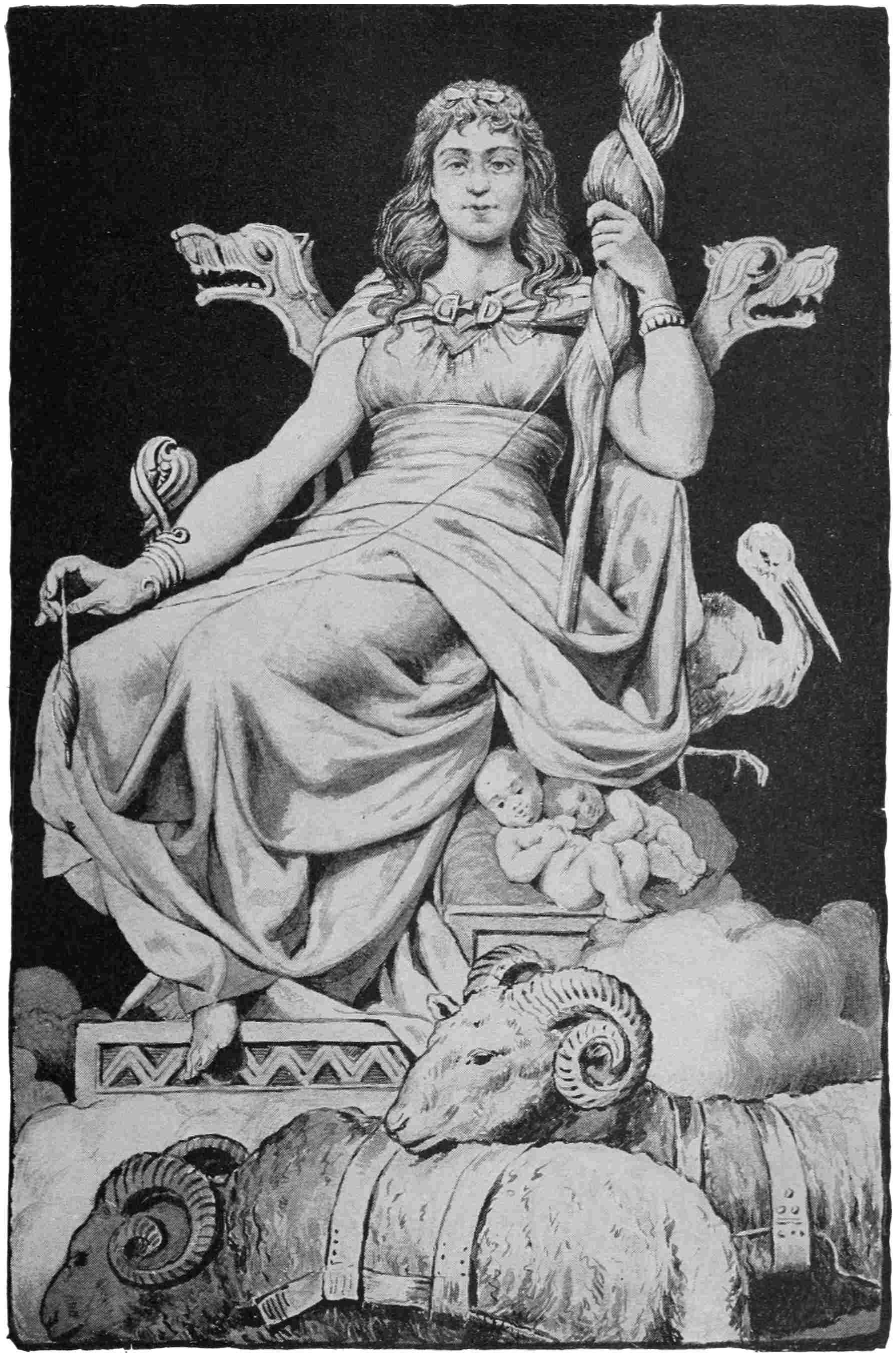
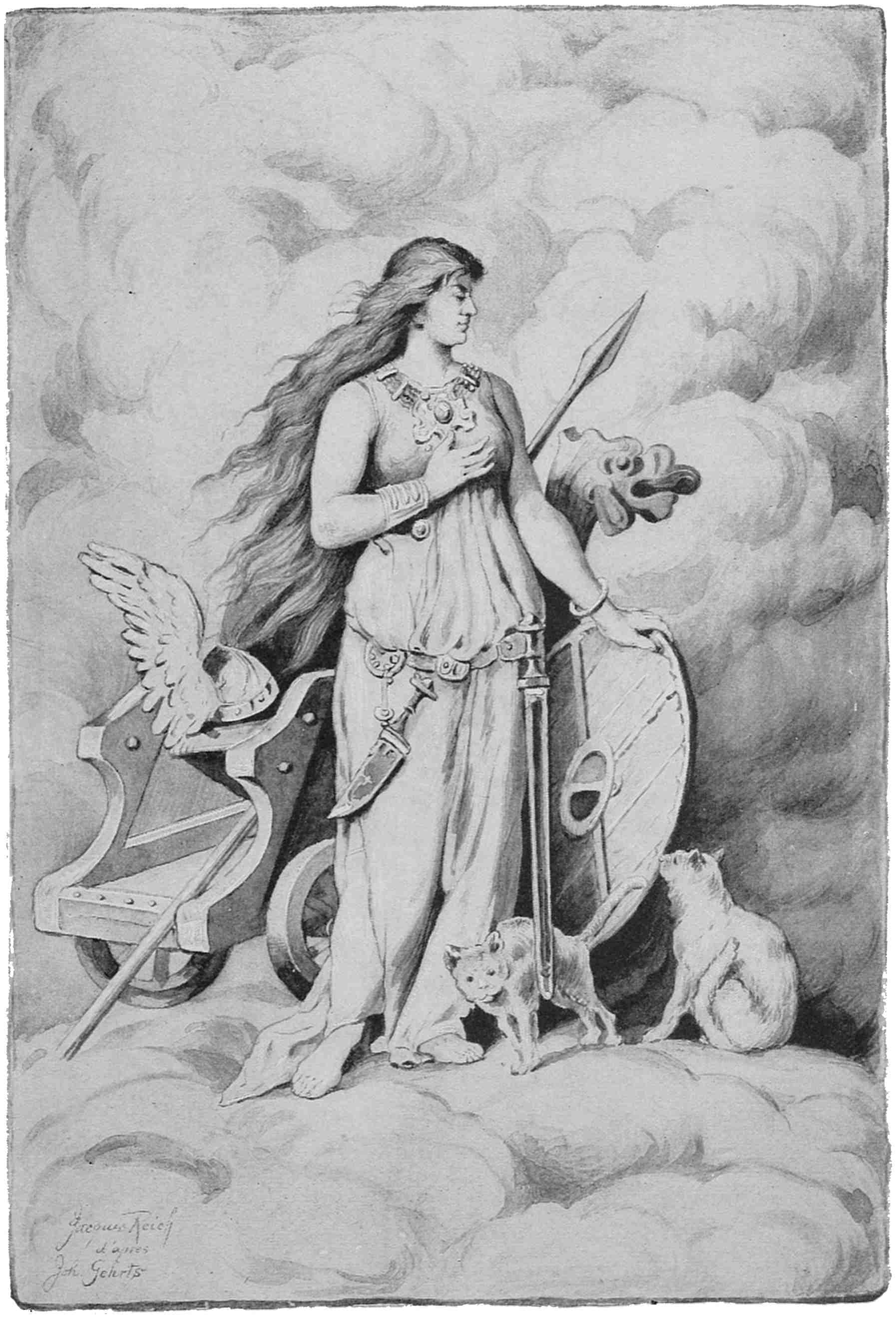
She was generally represented as a tall, beautiful, and stately
woman, crowned with heron plumes, the symbol of silence or
forgetfulness, and clothed in pure-white robes, secured at the
waist by a golden girdle, from which hung a bunch of keys, the
distinctive sign of the Northern housewife, whose special patroness
she was said to be. Although she often appeared beside her
husband, Frigga preferred to remain in her own palace, called
Fensalir, the hall of mists or of the sea, where she diligently
twirled her wheel or distaff, spinning golden thread or weaving
long webs of bright-colored clouds.
In order to perform this work she owned a marvelous jeweled
spinning wheel or distaff, which at night shone brightly in the sky
in the shape of a constellation, known in the North as Frigga’s
Spinning Wheel, while the inhabitants of the South called the
same stars Orion’s Girdle.
The stolen gold.
To her hall Fensalir the gracious goddess invited all husbands
and wives who had led virtuous lives on earth, so that they might
enjoy each other’s companionship even after death, and never
be called upon to part again.
“There in the glen, Fensalir stands, the house
Of Frea, honor’d mother of the gods,
And shows its lighted windows and the open doors.”
Balder Dead (Matthew Arnold).
Frigga was therefore considered the goddess of conjugal and
motherly love, and was specially worshiped by married lovers
and tender parents. This exalted office did not so entirely absorb
all her thoughts, however, that she had no time for other
matters; for we are told that she was very fond of dress, and whenever
she appeared before the assembled gods her attire was rich
and becoming, and her jewels always chosen with much taste.
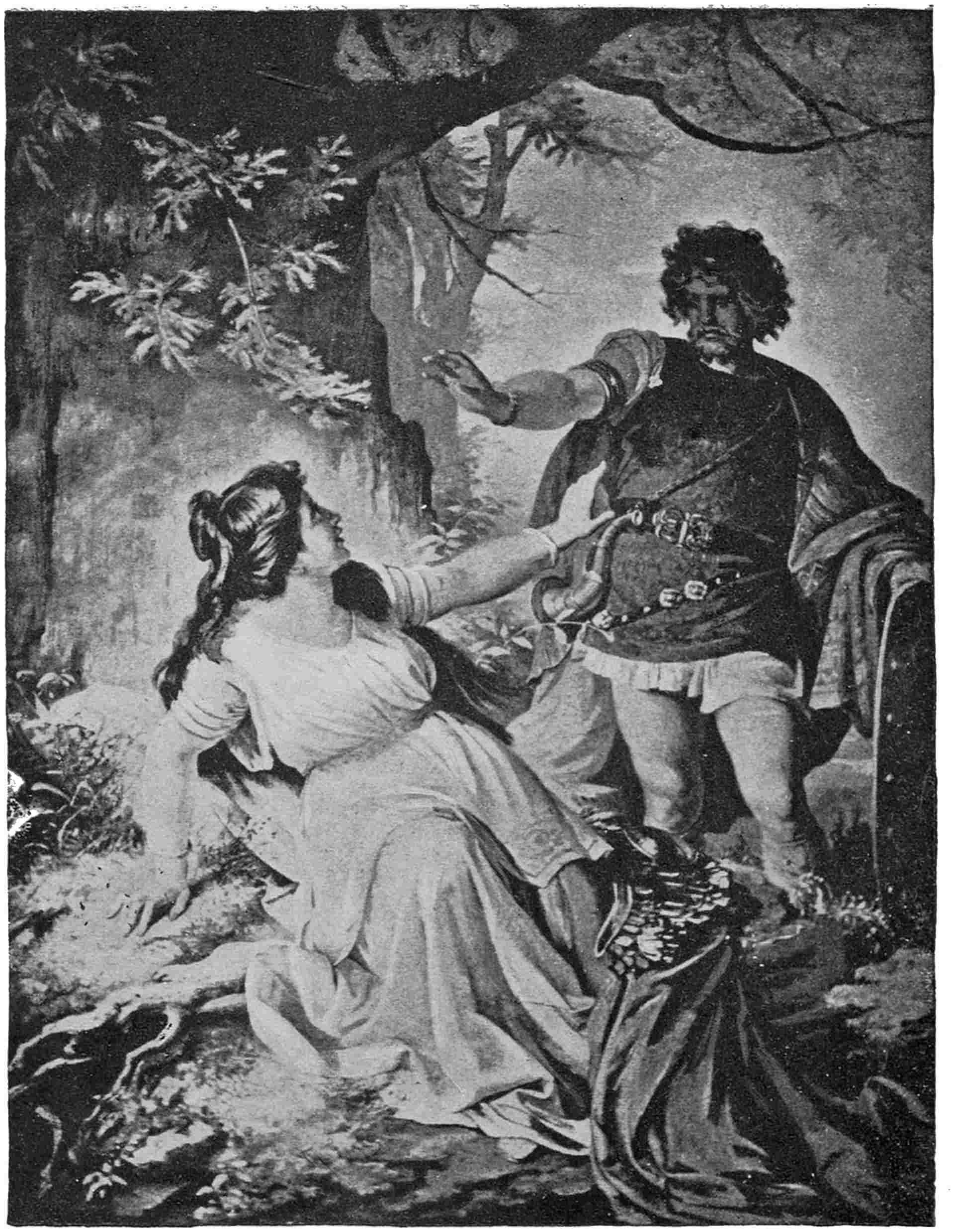
This love of adornment once led her sadly astray, for, in her
longing to possess some new jewel, she secretly purloined a piece
of gold from a statue representing her husband,
which had just been placed in his temple. The
stolen metal was intrusted to the dwarfs, with instructions to
fashion a marvelous necklace for her use. This jewel, once
finished, was so resplendent that it greatly enhanced her charms
and even increased Odin’s love for her. But when he discovered
the theft of the gold he angrily summoned the dwarfs and bade
them reveal who had dared to touch his statue. Unwilling to
betray the queen of the gods, the dwarfs remained obstinately
silent, and, seeing that no information could be elicited from them,
Odin commanded that the statue should be placed above the
temple gate, and set to work to devise runes which should endow
it with the power of speech and enable it to denounce the thief.
When Frigga heard these tidings she trembled with fear, and
implored her favorite attendant, Fulla, to invent some means of
protecting her from Allfather’s wrath. Fulla, who was always
ready to serve her mistress, immediately departed, and soon returned,
accompanied by a hideous dwarf, who promised to prevent
the statue from speaking if Frigga would only deign to smile
graciously upon him. This boon having been granted, the dwarf
hastened off to the temple, caused a deep sleep to fall upon the
guards, and while they were thus unconscious, pulled the statue
down from its perch and broke it to pieces, so that it could never
betray Frigga’s theft in spite of all Odin’s efforts to give it the
power of speech.
Odin, discovering this sacrilege on the morrow, was very angry
indeed; so angry that he left Asgard and utterly disappeared,
carrying away with him all the blessings which he had been wont
to shower upon gods and men. According to some authorities,
his brothers, as we have already seen, took advantage of his
absence to assume his form and secure possession of his throne
and wife; but although they looked exactly like him they could
not restore the lost blessings, and allowed the ice giants, or Jötuns,
to invade the earth and bind it fast in their cold fetters.
These wicked giants also pinched the leaves and buds till they all
shriveled up, stripped the trees bare, shrouded the earth in a
great white coverlet, and veiled it in impenetrable mists.
FRIGGA.
But at the end of seven weary months the true Odin relented
and returned, and when he saw all the evil that had been done
he drove the usurpers away, forced the frost giants to beat a
hasty retreat, released the earth from her icy bonds, and again
showered all his blessings down upon her, cheering her with the
light of his smile.
Odin outwitted.
As has already been seen, Odin, although god of wit and wisdom,
was sometimes outwitted by his wife Frigga, who, woman-like,
was sure to obtain her will by some means.
On one occasion the divine pair were seated upon
Hlidskialf, gazing with interest upon the Winilers and Vandals,
who were preparing for a battle which was to decide which people
should henceforth have the supremacy. Odin gazed with satisfaction
upon the Vandals, who were loudly praying to him for
victory; but Frigga watched the movements of the Winilers with
more attention, because they had entreated her aid. She therefore
turned to Odin and coaxingly inquired whom he meant to
favor on the morrow; he, wishing to evade her question, declared
he would not yet decide, as it was time for bed, but would
give the victory to those upon whom his eyes first rested in the
morning.
This answer was shrewdly calculated, for Odin knew that his
bed was so turned that upon waking he would face the Vandals,
and he intended looking out from thence, instead of waiting until
he had mounted his throne. But, although so cunningly contrived,
this plan was entirely frustrated by Frigga, who, divining
his purpose, waited until he was sound asleep and then noiselessly
turned his bed around so that he should face her favorites instead
of his. Then she sent word to the Winilers to dress their women
in armor and send them out in battle array at dawn, with their
long hair carefully combed down over their cheeks and breasts.
“Take thou thy women-folk,
Maidens and wives:
Over your ankles
Lace on the white war-hose;
Over your bosoms
Link up the hard mail-nets;
Over your lips
Plait long tresses with cunning;—
So war beasts full-bearded
King Odin shall deem you,
When off the gray sea-beach
At sunrise ye greet him.”
The Longbeards’ Saga (Charles Kingsley).
These instructions were carried out with scrupulous exactness
by the Winiler women, and when Odin awoke and sat up in bed
early the next morning, his first conscious glance fell upon their
armed host, and he exclaimed in surprise, “What Longbeards are
those?” (In German the ancient word for long beards was
Langobarden, which was the name used to designate the Lombards.)
Frigga, upon hearing this exclamation, which she had
foreseen, immediately cried out in triumph that Allfather had
given them a new name, and was in honor bound to follow the
usual Northern custom and give them also a baptismal gift.
“‘A name thou hast given them,
Shames neither thee nor them,
Well can they wear it.
Give them the victory,
First have they greeted thee;
Give them the victory,
Yoke-fellow mine!’”
The Longbeards’ Saga (Charles Kingsley).
Odin, seeing he had been so cleverly outwitted, gave them the
victory, and in memory of this auspicious day the Winilers retained
the name given by the king of the gods, who ever after watched
over them with special care, and vouchsafed them many blessings,
among others a home in the sunny South, on the fruitful plains of
Lombardy.
Fulla.
Frigga had, as her own special attendants, a number of beautiful
maidens, among whom were Fulla (Volla), her sister, according
to some authorities, to whom she intrusted her jewel casket.
Fulla always presided over her mistress’s toilet, was privileged to put
on her golden shoes, attended her everywhere, was her confidante
and adviser, and often told her how best to help the mortals who
implored her aid. Fulla was very beautiful indeed,
and had long golden hair, which she wore
flowing loose over her shoulders, restrained only by a golden
circlet or snood. As her hair was emblematic of the golden
grain, this circlet represented the binding of the sheaf. Fulla
was also known as Abundia, or Abundantia, in some parts of
Germany, where she was considered the symbol of the fullness
of the earth.
Hlin, Frigga’s second attendant, was the goddess of consolation,
sent out to kiss away the tears of mourners and pour balm
into hearts wrung by grief. She also listened with ever-open
ears to the prayers of mortals, repeated them to her mistress,
and advised her at times how best to answer them and give the
desired relief.
Gna.
Gna was Frigga’s swift messenger, who, mounted upon her
fleet steed Hofvarpnir (hoof thrower), traveled with marvelous
rapidity through fire and air, over land and sea, and
was therefore considered the personification of the
refreshing breeze. Darting thus to and fro, Gna saw all that was
happening upon earth, and told her mistress all she knew. On
one occasion, as she was passing over Hunaland, she saw King
Rerir, a lineal descendant of Odin, sitting mournfully by the
shore, bewailing his childlessness. The queen of heaven, who
was also goddess of childbirth, upon hearing this took an apple
(the emblem of fruitfulness) from her private store, gave it to
Gna, and bade her carry it to the king. With the rapidity of
the element she personified, Gna darted away, passed over Rerir’s
head, and dropped her apple into his lap with a radiant smile.
“‘What flies up there, so quickly driving past?’
Her answer from the clouds, as rushing by:
‘I fly not, nor do drive, but hurry fast,
Hoof flinger swift through cloud and mist and sky.’”
Asgard and the Gods (Wägner-Macdowall).
The king, after pondering for a moment upon the meaning of
this sudden apparition and gift, returned home, his heart beating
high with hope, gave the apple to his wife to eat, and to his intense
joy was soon no longer childless, for his wife bore him a son,
Volsung, the great Northern hero, who became so famous that
he gave his name to all his race.
Lofn.
Besides the three above-mentioned attendants, Frigga also had
in her train the mild and gracious maiden Lofn
(praise or love), whose duty it was to remove all
obstacles from the path of lovers.
“My lily tall, from her saddle bearing,
I led then forth through the temple, faring
To th’ altar-circle where, priests among,
Lofn’s vows she took with unfalt’ring tongue.”
Viking Tales of the North (R. B. Anderson).
Vjofn’s duty was to incline obdurate hearts to love, to maintain
peace and concord among mankind, and to reconcile quarreling
husbands and wives. Syn (truth) guarded the door of Frigga’s
palace, refusing to open it to those who were not allowed to come
in. When she had once shut the door upon a would-be intruder
there was no appeal which would avail to change her decision.
She therefore presided over all tribunals and trials, and whenever
a thing was to be vetoed the usual formula was to declare that
Syn was against it.
Gefjon.
Gefjon was also one of the maidens in Frigga’s palace, and to
her were intrusted all those who died virgins, whom she received
and made happy forever. According to some
mythologists, Gefjon did not always remain a virgin
herself, but married one of the giants, by whom she had four
sons. This same tradition goes on to declare that Odin sent her
ahead of him to visit Gylfi, King of Sweden, and beg for some
land which she might call her own. The king, amused at her request,
promised her as much land as she could plow around in
one day and night. Gefjon, nothing daunted, changed her four
sons into oxen, harnessed them to a plow, and began to cut a
furrow so wide and deep that the king and his courtiers were
amazed. But Gefjon continued her work without giving any
signs of fatigue, and when she had plowed all around a large
piece of land forcibly wrenched it away, and made her oxen drag
it down into the sea, where she made it fast and called it Seeland.
“Gefjun drew from Gylfi,
Rich in stored up treasure,
The land she joined to Denmark.
Four heads and eight eyes bearing,
While hot sweat trickled down them,
The oxen dragged the reft mass
That formed this winsome island.”
Norse Mythology (R. B. Anderson).
As for the hollow she left behind her, it was quickly filled with
water and formed a lake, at first called Logrum (the sea), but
now known as Mälar, whose every indentation corresponds with
the headlands of Seeland. Gefjon then married Skiold, one of
Odin’s sons, and became the ancestress of the royal Danish race
of Skioldungs, dwelling in the city of Hleidra or Lethra, which
she founded, and which became the principal place of sacrifice
for the heathen Danes.
Eira.
Eira, also Frigga’s attendant, was considered a most skillful
physician. She gathered simples all over the earth to cure both
wounds and diseases, and it was her province to
teach her science to women, who were the only
ones to practice medicine among the ancient nations of the North.
“Gaping wounds are bound by Eyra.”
Valhalla (J. C. Jones).
Vara heard all oaths and punished perjurers, while she rewarded
those who faithfully kept their word. Then there were also Vör
(faith), who knew all that was to occur throughout the world, and
Snotra, goddess of virtue, who had mastered every kind of study.
With such a band of followers it is no wonder that Frigga was
considered an influential goddess; but in spite of the prominent
place she occupied in Northern religion, she had no special temple
or shrine, and was but little worshiped except in company with
Odin.
Holda.
While Frigga was not known by this name in southern Germany,
there were other goddesses worshiped there, whose attributes
were so exactly like hers, that they were evidently the same, although
they bore very different names in the various provinces.
Among them was the fair goddess Holda (Hulda or Frau Holle)
who graciously dispensed many rich gifts, and as
she presided over the weather, the people were wont
to declare when the snowflakes fell that Frau Holle was shaking
her bed, and when it rained, that she was washing her clothes,
often pointing to the white clouds as her linen which she had put
out to bleach. When long gray strips of clouds drifted across the
sky they said she was weaving, for she too was supposed to be a
very diligent weaver, spinner, and housekeeper. It is said she
gave flax to mankind and taught them how to use it, and in Tyrol
the following story is told about the way in which she bestowed
this invaluable gift:
Discovery of flax.
There was once a peasant who daily left his wife and children
down in the valley to take his sheep up the mountain to pasture;
and as he watched his flock graze on the mountain
side, he often had the opportunity to use his cross-bow
and bring down a chamois, whose flesh furnished his larder
with food for many a day.
While pursuing some fine game one day he saw it disappear behind
a bowlder, and when he came to the spot, he was amazed
to see a doorway in the neighboring glacier, for in the excitement
of the pursuit he had climbed higher and higher until he
was now on top of the mountain, where glittered the everlasting
snow.
The shepherd boldly passed through the open door, and soon
found himself in a wonderful jeweled and stalactite-hung cave,
in the center of which stood a beautiful woman, clad in silvery
robes, and attended by a host of lovely maidens crowned with
Alpine roses. In his surprise, the shepherd sank to his knees,
and as in a dream heard the queenly central figure bid him choose
anything he saw to carry away with him. Although dazzled by
the glow of the precious stones around him, the shepherd’s eyes
constantly reverted to a little nosegay of blue flowers which the
gracious apparition held in her hand, and he now timidly proffered
a request that it might become his. Smiling with pleasure,
Holda, for it was she, gave it to him, telling him he had chosen
wisely and would live as long as the flowers did not droop and
fade. Then giving the shepherd a measure of seed which she
told him to sow in his field, the goddess bade him begone; and
as the thunder pealed and the earth shook, the poor man found
himself out upon the mountain side once more, and slowly
wended his way home to tell his adventure to his wife and show
her the lovely blue flowers and the measure of seed.
The woman reproached her husband bitterly for not having
brought some of the precious stones which he so glowingly described,
instead of the blossoms and seed; nevertheless the man
sowed the latter, and often lingered near the field at nightfall to
see his new crop grow, for to his surprise the measure had supplied
seed enough for several acres.
Soon the little green shoots began to appear, and one moonlight
night, while the peasant was gazing upon them, wondering
what kind of grain they would produce, he saw a mistlike form
hover above the field, with hands outstretched as if in blessing.
At last the field blossomed, and countless little blue flowers
opened their calyxes to the golden sun. When the flowers
had withered and the seed was ripe, Holda came once more to
teach the peasant and his wife how to harvest the flax stalks and
spin, weave, and bleach the linen they produced. Of course all the
people of the neighborhood were anxious to purchase both linen
and flaxseed, and the peasant and his wife soon grew very rich
indeed, for while he plowed, sowed, and harvested, she spun,
wove, and bleached her linen. When the man had lived to a
good old age and seen his grandchildren and great grandchildren
grow up around him, he noticed that his carefully treasured
bouquet, whose flowers had remained fresh for many a year, had
wilted and died.
Knowing that his time had come and that he too must soon die,
the peasant climbed the mountain once more, came to the glacier,
and found the doorway which he had long vainly sought.
He vanished within, and was never seen or heard of again, for the
legend states that the goddess took him under her care, and bade
him live in her cave, where his every wish was gratified.
Tannhäuser.
According to a mediæval tradition, Holda dwelt in a cave in
the Hörselberg, in Thuringia, where she was known as Frau
Venus, and was considered as an enchantress who lured mortals
into her realm, where she detained them forever, steeping their
senses in all manner of sensual pleasures. The most famous of her
victims is doubtless Tannhäuser, who, anxious to
save his soul, escaped from her power and hastened
to Rome to confess his sins and seek absolution. But the pope,
hearing that he had been in the company of one of the heathen
goddesses, whom the priests taught were nothing but demons,
declared that the knight could no more hope for pardon than to
see his staff bear buds and bloom.
“Hast thou within the nets of Satan lain?
Hast thou thy soul to her perdition pledged?
Hast thou thy lip to Hell’s Enchantress lent,
To drain damnation from her reeking cup?
Then know that sooner from the withered staff
That in my hand I hold green leaves shall spring,
Than from the brand in hell-fire scorched rebloom
The blossoms of salvation.”
Tannhäuser (Owen Meredith).
Crushed with grief at this sentence, Tannhäuser fled, and finding
no rest, returned to the Hörselberg, where he reëntered the
cave in spite of the entreaties of the German mentor, the faithful
Eckhardt. He had no sooner disappeared, however, than the
pope’s messengers arrived, proclaiming that he was pardoned, for
the withered staff had miraculously bloomed, proving to all that
there was no sin too heinous to be pardoned, providing repentance
were sincere.
EASTRE or OSTARA.
“Dashed to the hip with travel, dewed with haste,
A flying post, and in his hand he bore
A withered staff o’erflourished with green leaves;
Who,—followed by a crowd of youth and eld,
That sang to stun with sound the lark in heaven,
‘A miracle! a miracle from Rome!
Glory to God that makes the bare bough green!’—
Sprang in the midst, and, hot for answer, asked
News of the Knight Tannhäuser.”
Tannhäuser (Owen Meredith).
This same Holda was also considered the owner of a magic
fountain called Quickborn, which rivaled the famed fountain of
youth, and of a chariot in which she rode from place to place, inspecting
her domain. This wagon having once suffered damage,
the goddess bade a wheelwright repair it, and when he had finished
told him to keep the chips as his pay. The man, indignant
at such a meager reward, kept only a very few; but to his surprise
found them on the morrow changed to solid gold.
“Fricka, thy wife—
This way she reins her harness of rams.
Hey! how she whirls
The golden whip;
The luckless beasts
Unboundedly bleat;
Her wheels wildly she rattles;
Wrath is lit in her look.”
Wagner (Forman’s tr.).
Eástre, the goddess of spring.
The Saxon goddess Eástre, or Ostara, goddess of spring, whose
name has survived in the English word Easter, is also identical
with Frigga, for she too is considered goddess of the earth, or
rather of Nature’s resurrection after the long death of winter.
This gracious goddess was so dearly loved by the old Teutons,
that even after Christianity had been introduced they still
retained a pleasant recollection of her, utterly
refused to have her degraded to the rank of a
demon, like many of their other divinities, and
transferred her name to their great Christian feast. It had long
been customary to celebrate this day by the exchange of presents
of colored eggs, for the egg is the type of the beginning of life;
so the early Christians continued to observe this rule, declaring,
however, that the egg is also symbolical of the resurrection. In various
parts of Germany, stone altars can still be seen, which are
known as Easter-stones, because they were dedicated to the fair
goddess Ostara. They were crowned with flowers by the young
people, who danced gaily around them by the light of great bonfires,—a
species of popular games kept up until the middle of
the present century, in spite of the priests’ denunciations and of
the repeatedly published edicts against them.
Bertha, the White Lady.
In other parts of Germany, Frigga, Holda, or Ostara is known
by the name of Brechta, Bertha, or the White Lady. She is
best known under this title in Thuringia, where she
was supposed to dwell in a hollow mountain, keeping
watch over the Heimchen, the souls of unborn children, and
of those who died unbaptized. Here Bertha watched over agriculture,
caring for the plants, which her infant troop watered
carefully, for each babe was supposed to carry a little jar for that
express purpose. As long as the goddess was duly respected and
her retreat unmolested, she remained where she was; but tradition
relates that she once left the country with her infant train dragging
her plow, and settled elsewhere to continue her kind ministrations.
Bertha is the legendary ancestress of several noble
families, and she is supposed to be the same as the industrious
queen of the same name, the mythical mother of Charlemagne,
whose era has become proverbial, for in speaking of the golden
age in France and Germany it is customary to say, “in the days
when Bertha spun.”
As this Bertha is supposed to have developed a very large and
flat foot, from continually pressing the treadle of her wheel, she
is often represented in mediæval art as a woman with a splay
foot, and hence known as la reine pédauque.
As ancestress of the imperial house of Germany, the White
Lady is supposed to appear in the palace before a death or misfortune
in the family, and this superstition is still so rife in Germany,
that the newspapers in 1884 contained the official report
of a sentinel, who declared that he had seen her flit past him in
one of the palace corridors.
As Bertha was so renowned for her spinning, she naturally was
regarded as the special patroness of that branch of female industry,
and was said to flit through the streets of every village, at
nightfall, during the twelve nights between Christmas and January
6th, peering into every window to ascertain whether the work
were all done.
The maidens whose work had all been carefully performed
were rewarded by a present of one of her own golden threads or
a distaff full of extra-fine flax; but wherever a careless spinner
was found, her wheel was broken, her flax soiled, and if she had
failed to honor the goddess by eating plenty of the cakes baked
at that epoch of the year, she was cruelly punished.
In Mecklenburg, this same goddess is known as Frau Gode, or
Wode, the female form of Wuotan or Odin, and her appearance
is always considered the harbinger of great prosperity. She is
also supposed to be a great huntress, and to lead the Wild Hunt,
mounted upon a white horse, her attendants being changed into
hounds and all manner of wild beasts.
In Holland she was called Vrou-elde, and from her the Milky
Way is known by the Dutch as Vrou-elden-straat; while in parts
of northern Germany she was called Nerthus (Mother Earth).
Her sacred car was kept on an island, presumably Rügen, where
the priests guarded it carefully until she appeared to take a yearly
journey throughout her realm and bless the land. The goddess
then sat in this car, which was drawn by two cows, her face
completely hidden by a thick veil, respectfully escorted by her
priests. The people seeing her pass did her homage by ceasing
all warfare, laid aside their weapons, donned festive attire, and
began no quarrel until the goddess had again retired to her sanctuary.
Then both car and goddess were bathed in a secret lake
(the Schwartze See in Rügen), which swallowed up the slaves
who had assisted at the bathing, and once more the priests resumed
their watch over the sanctuary and grove of Nerthus or
Hlodyn, to await her next apparition.
In Scandinavia, this goddess was also known as Huldra,
and boasted of a train of attendant wood nymphs, who sometimes
sought the society of mortals, to enjoy a dance upon the
village green. They could always be detected, however, by the
tip of a cow’s tail which trailed from beneath their long snow-white
garments. These Huldra folk were the special protectors
of the herds of cattle on the mountain sides, and were said to surprise
the lonely traveler, at times, by the marvelous beauty of the
melodies they sang to beguile their labors.
CHAPTER IV. THOR.
Thor’s foster parents.
According to some mythologists, Thor, or Donar, is the son
of Jörd (Erda), and of Odin, but others state that his mother was
Frigga, queen of the gods. This child was very remarkable for
his great size and strength, and very soon after his birth amazed
the assembled gods by playfully lifting and throwing about ten
loads of bear skins. Although generally good tempered, Thor
occasionally flew into a terrible rage, and as he was very dangerous
under these circumstances, his mother, unable to control him,
sent him away from home and intrusted him to the care of Vingnir
(the winged), and of Hlora (heat). These foster parents, who
are also considered as the personification of sheet
lightning, soon managed to control their troublesome
charge, and brought him up so wisely, that all the gods were
duly grateful for their kind offices. Thor himself, recognizing
all he owed them, assumed the names of Vingthor and Hlorridi,
by which he is also known.
“Cry on, Vingi-Thor,
With the dancing of the ring-mail and the smitten shields of war.”
Sigurd the Volsung (William Morris).
Having attained his full growth and the age of reason, Thor
was admitted in Asgard among the other gods, where he occupied
one of the twelve seats in the great judgment hall. He was also
given the realm of Thrud-vang or Thrud-heim, where he built a
wonderful palace called Bilskirnir (lightning), the most spacious
in all Asgard. It contained five hundred and forty halls for the
accommodation of the thralls, who after death were welcomed to
his home, where they were treated as well as their masters in Valhalla,
for Thor was the patron god of the peasants and lower classes.
“Five hundred halls
And forty more,
Methinketh, hath
Bowed Bilskirnir.
Of houses roofed
There’s none I know
My son’s surpassing.”
Sæmund’s Edda (Percy’s tr.).
As he was god of thunder, Thor alone was never allowed to pass
over the wonderful bridge Bifröst, lest he should set it aflame by
the heat of his presence; and when he daily wished to join his
fellow gods by the Urdar fountain, under the shade of the sacred
tree Yggdrasil, he was forced to make his way thither on foot,
wading through the rivers Kormt and Ormt, and the two streams
Kerlaug, to the trysting place.
Thor, who was honored as the highest god in Norway, came
second in the trilogy of all the other countries, and was called
“old Thor,” because he is supposed by some mythologists to have
belonged to an older dynasty of gods, and not on account of his
actual age, for he was represented and described as a man in his
prime, tall and well formed, with muscular limbs and bristling
red hair and beard, from which, in moments of anger, the sparks
fairly flew.
“First, Thor with the bent brow,
In red beard muttering low,
Darting fierce lightnings from eyeballs that glow,
Comes, while each chariot wheel
Echoes in thunder peal,
As his dread hammer shock
Makes Earth and Heaven rock,
Clouds rifting above, while Earth quakes below.”
Valhalla (J. C. Jones).
The Northern races further adorned him with a crown, on
each point of which was either a glittering star, or a steadily
burning flame, so that his head was ever surrounded by a kind
of halo of fire, his own element.
Thor’s hammer.
Thor was the proud possessor of a magic hammer called Miölnir
(the crusher) which he hurled at his enemies,
the frost giants, with destructive power, and which
possessed the wonderful property of always returning to his hand,
however far away he might hurl it.
“I am the Thunderer!
Here in my Northland,
My fastness and fortress,
Reign I forever!
“Here amid icebergs
Rule I the nations;
This is my hammer,
Miölnir the mighty;
Giants and sorcerers
Cannot withstand it!”
Saga of King Olaf (Longfellow).
As this huge hammer, the emblem of the thunderbolts, was
generally red hot, the god had an iron gauntlet called Iarn-greiper,
which enabled him to grasp it firmly and hurl it very far, his
strength, which was already remarkable, being always doubled
when he wore his magic belt called Megin-giörd.
“This is my girdle:
Whenever I brace it,
Strength is redoubled!”
Saga of King Olaf (Longfellow).
Thor’s hammer was considered so very sacred by the ancient
Northern people, that they were wont to make the sign of the
hammer, as the Christians later taught them to make the sign of
the cross, to ward off all evil influences, and to secure many
blessings. The same sign was also made over the newly born
infant when water was poured over its head and a name given
it. The hammer was used to drive in boundary stakes, which it
was considered sacrilegious to remove, to hallow the threshold of
a new house, to solemnize a marriage, and, lastly, to consecrate
the funeral pyre upon which the bodies of heroes were burned,
together with their weapons and steeds, and, in some cases, with
their wives and dependents.
In Sweden, Thor, like Odin, was supposed to wear a broad-brimmed
hat, and hence the storm clouds in that country are
known as Thor’s hat, a name also given to one of the principal
mountains in Norway. The rumble and roar of the thunder were
called the roll of his chariot, for he alone among the gods never rode
on horseback, but walked, or drove in a brazen chariot drawn by
two goats, Tanngniostr (tooth cracker), and Tanngrisnr (tooth
gnasher), from whose teeth and hoofs the sparks constantly flew.
“Thou camest near the next, O warrior Thor!
Shouldering thy hammer, in thy chariot drawn,
Swaying the long-hair’d goats with silver’d rein.”
Balder Dead (Matthew Arnold).
When the god thus drove about from place to place, he was
called Aku-thor, or Thor the charioteer, and in southern Germany
the people, fancying a brazen chariot alone inadequate to furnish
all the noise they heard, declared it was loaded with copper kettles,
which rattled and clashed, and therefore often called him, with
disrespectful familiarity, the kettle vender.
Thor’s family.
Thor was twice married; first to the giantess Iarnsaxa (iron
stone), who bore him two sons, Magni (strength) and Modi
(courage), both destined to survive their father and
twilight of the gods, and rule over the new
world which was to rise like a phenix from the ashes of the first.
His second wife was Sif, the golden-haired, who also bore him
two children, Lorride, and a daughter named Thrud, a young
giantess renowned for her size and strength. By the well-known
affinity of contrast, Thrud was wooed by the dwarf Alvis, whom
she rather favored; and one evening, when this suitor, who, being
a dwarf, could not face the light of day, presented himself in
Asgard to sue for her hand, the assembled gods did not refuse
their consent. They had scarcely signified their approbation,
however, when Thor, who had been absent, suddenly appeared,
and casting a glance of contempt upon the puny lover, declared
he would have to prove that his knowledge atoned for his small
stature, before he could win his bride.
To test Alvis’s mental powers, Thor then questioned him in
the language of the gods, Vanas, elves, and dwarfs, artfully prolonging
his examination until sunrise, when the first beam of
light, falling upon the unhappy dwarf, petrified him. There he
stood, an enduring example of the gods’ power, and served as a
warning to all other dwarfs who would fain have tested it.
“Ne’er in human bosom
Have I found so many
Words of the old time.
Thee with subtlest cunning
Have I yet befooled.
Above ground standeth thou, dwarf,
By day art overtaken,
Bright sunshine fills the hall.”
Sæmund’s Edda (Howitt’s version).
Sif, the golden-haired.
Sif, Thor’s wife, was very vain of a magnificent head of long
golden hair which covered her from head to foot like a brilliant
veil; and as she too was a symbol of the earth, her
hair was said to represent the long grass, or the
golden grain covering the Northern harvest fields. Thor was very
proud of his wife’s beautiful hair; imagine his dismay, therefore,
upon waking one morning, to find her all shorn, and as bald
and denuded of ornament as the earth when the grain has all been
garnered, and nothing but the stubble remains! In his anger,
Thor sprang to his feet, vowing he would punish the perpetrator
of this outrage, whom he immediately and rightly conjectured to be
Loki, the arch plotter, ever on the lookout for some evil deed to
perform. Seizing his hammer, Thor soon overtook Loki in spite
of his attempting to evade him by changing form, caught him by
the throat, and almost strangled him ere he yielded to his imploring
signs, and slightly loosed his powerful grasp. As soon as
Loki could catch his breath, he implored forgiveness, but all his
entreaties were vain, until he promised to procure for Sif a new
head of hair, as beautiful as the first, and as luxuriant in growth.
“And thence for Sif new tresses I’ll bring
Of gold, ere the daylight’s gone,
So that she shall liken a field in spring,
With its yellow-flowered garment on.”
The Dwarfs, Oehlenschläger (Pigott’s tr.).
Thor, hearing this, consented to let the traitor go; so Loki
rapidly crept down into the bowels of the earth, where Svart-alfa-heim
was situated, to beg the dwarf Dvalin to fashion not only
the precious hair, but a present for Odin and Frey, whose anger
he wished to disarm.
The dwarf soon made the spear Gungnir, which never failed
in its aim, and the ship Skidbladnir, which, always wafted by favorable
winds, could sail through the air as well as on the water, and
was so elastic, that although it could contain the gods and all
their steeds, it could be folded up into the very smallest compass
and thrust in one’s pocket. Lastly, he spun the very finest
golden thread, from which he fashioned the required hair for Sif,
declaring that as soon as it touched her head it would grow fast
there and become alive.
“Though they now seem dead, let them touch but her head,
Each hair shall the life-moisture fill;
Nor shall malice nor spell henceforward prevail
Sif’s tresses to work aught of ill.”
The Dwarfs, Oehlenschläger (Pigott’s tr.).
Loki was so pleased with these proofs of the dwarfs’ skill that
he declared the son of Ivald was the most clever of smiths—words
which were overheard by Brock, another dwarf, who exclaimed
that he was sure his brother Sindri could produce three
objects which would surpass those which Loki held, not only in
intrinsic value, but also in magical properties. Loki immediately
challenged the dwarf to show his skill, wagering his head against
Brock’s on the result of the undertaking.
Sindri, apprised of the wager, accepted Brock’s offer to blow
the bellows, warning him, however, that he must work persistently
if he wished to succeed; then he threw some gold in the fire, and
went out to bespeak the favor of the hidden powers. During his
absence Brock diligently plied the bellows, while Loki, hoping to
make him fail, changed himself into a gadfly and cruelly stung
his hand. In spite of the pain, the dwarf did not let go, and when
Sindri returned, he drew out of the fire an enormous wild boar,
called Gullin-bursti, on account of its golden bristles, which had
the power of radiating light as he flitted across the sky, for he
could travel through the air with marvelous velocity.
“And now, strange to tell, from the roaring fire
Came the golden-haired Gullinbörst,
To serve as a charger the sun-god Frey,
Sure, of all wild boars this the first.”
The Dwarfs, Oehlenschläger (Pigott’s tr.).
This first piece of work successfully completed, Sindri flung
some more gold on the fire and bade his brother blow, ere he
again went out to secure magic assistance. This time Loki, still
disguised as a gadfly, stung the dwarf on his cheek; but in spite
of the pain Brock worked on, and when Sindri returned, he triumphantly
drew out of the flames the magic ring Draupnir, the
emblem of fertility, from which eight similar rings dropped every
ninth night.
“They worked it and turned it with wondrous skill,
Till they gave it the virtue rare,
That each thrice third night from its rim there fell
Eight rings, as their parent fair.”
The Dwarfs, Oehlenschläger (Pigott’s tr.).
Now a lump of iron was cast in the flames, and with a new
caution not to forfeit their success by inattention, Sindri passed
out, leaving Brock to ply the bellows and wrestle with the gadfly,
which this time stung him above the eye until the blood began
to flow in such a stream, that it prevented his seeing what he was
doing. Hastily raising his hand for a second, Brock dashed aside
the stream of blood; but short as was the interruption, Sindri
uttered an exclamation of disappointment when he drew his work
out of the fire, for the hammer he had fashioned had too short a
handle.
“Then the dwarf raised his hand to his brow for the smart,
Ere the iron well out was beat,
And they found that the haft by an inch was too short,
But to alter it then ’twas too late.”
The Dwarfs, Oehlenschläger (Pigott’s tr.).
Notwithstanding this mishap, Brock was so sure of winning
the wager that he did not hesitate to present himself before the
gods in Asgard, gave Odin the ring Draupnir, Frey the boar
Gullin-bursti, and Thor the hammer Miölnir, whose power none
could resist.
Loki immediately gave the spear Gungnir to Odin, the ship
Skidbladnir to Frey, and the golden hair to Thor; but although
the latter immediately grew upon Sif’s head and was unanimously
declared more beautiful than her own locks had ever been, the
gods decreed that Brock had won the wager, for the hammer
Miölnir, in Thor’s hands, would prove invaluable against the frost
giants on the last day.
“And at their head came Thor,
Shouldering his hammer, which the giants know.”
Balder Dead (Matthew Arnold).
Wishing to save his head, Loki fled, but was soon overtaken
by Thor, who brought him back and handed him over to Brock,
telling him, however, that although Loki’s head was rightfully
his, he must not touch his neck. Thus hindered from obtaining
full vengeance, the dwarf tried to sew Loki’s lips together, but, as
his sword would not pierce them, he was obliged to borrow his
brother’s awl. However, Loki, after enduring the gods’ gibes in
silence for a little while, managed to cut the string and was soon
as loquacious as ever.
THOR.
In spite of his redoubtable hammer, Thor was never considered
as the injurious god of the storm, who destroyed peaceful
homesteads and ruined the harvest by sudden hail storms and
cloud bursts, for the Northerners fancied he hurled it only against
ice giants and rocky walls, reducing the latter to powder to fertilize
the earth and make it yield plentiful fruit to the tillers of
the soil.
In Germany, where the eastern storms are always cold and
blighting, while the western bring warm rains and mild weather,
Thor was supposed to journey always from west to east, to wage
war against the evil spirits which would fain have enveloped the
country in impenetrable veils of mist and have bound it in icy
fetters.
Journey to Jötun-heim.
As the giants from Jötun-heim were continually sending out
cold blasts of wind to nip the tender buds and hinder the growth
of the flowers, Thor once made up his mind to go
and force them to better behavior. Accompanied
by Loki he therefore set out in his chariot. After riding for
a whole day the gods came at nightfall to the confines of the
giant-world, where, seeing a peasant’s hut, they resolved to spend
the night and refresh themselves.
Their host was hospitable but very poor, and Thor seeing that
he would scarcely be able to supply the necessary food to satisfy
his by no means small appetite, slew both his goats, which he
cooked and began to eat, inviting his host and family to partake
freely of the food thus provided, but cautioning them to throw
all the bones, without breaking them, into the skins spread out
on the floor.
The peasant and his family ate heartily, but a youth called
Thialfi, encouraged by Loki, ventured to break one of the bones
and suck out the marrow, thinking his disobedience would never
be detected. On the morrow, however, Thor, ready to depart,
struck the goat skins with his hammer Miölnir, and immediately
the goats sprang up as lively as before, except that one seemed
somewhat lame. Perceiving in a second that his commands had
been disregarded, Thor would have slain the whole family in his
wrath. The culprit acknowledged his fault, however, and the
peasant offered to compensate for the loss by giving the irate
god not only his son Thialfi, but also his daughter Roskva, to
serve him forever.
Charging the man to take good care of the goats, which he
left there until he should return, and bidding the young peasants
accompany him, Thor now set out on foot with Loki, and after
walking all day found himself at nightfall in a bleak and barren
country, which was enveloped in an almost impenetrable gray
mist. After seeking for some time, Thor saw through the fog
the uncertain outline of what looked like a peculiar-shaped house.
Its open portal was so wide and high that it seemed to take up
all one side of the house. Entering and finding neither fire nor
light, Thor and his companions flung themselves wearily down on
the floor to sleep, but were soon disturbed by a peculiar noise, and
a prolonged trembling of the ground beneath them. Fearing lest
the main roof should fall during this earthquake, Thor and his
companions took refuge in a wing of the building, where they
soon fell sound asleep. At dawn, the god and his companions
passed out, but they had not gone very far ere they saw the
recumbent form of a sleeping giant, and perceived that the
peculiar sounds which had disturbed their rest were produced by
his snores. At that moment the giant awoke, arose, stretched
himself, looked about him for his missing property, and a second
later he picked up the object which Thor and his companions
had mistaken in the darkness for a house. They then perceived
with amazement that the wing in which they had all slept was
the separate place in a mitten for the giant’s great thumb!
Learning that Thor and his companions were on their way to
Utgard, as the giants’ realm was also called, Skrymir, the giant,
proposed to be their guide; and after walking with them all day,
he offered them the provisions in his wallet ere he dropped
asleep. But, in spite of strenuous efforts, neither Thor nor his
companions could unfasten the knots which Skrymir had tied.
“Skrymir’s thongs
Seemed to thee hard,
When at the food thou couldst not get,
When, in full health, of hunger dying.”
Sæmund’s Edda (Thorpe’s tr.).
Utgard-loki.
Angry because of his snoring, which kept them awake, Thor
thrice dealt him fearful blows with his hammer. These strokes,
instead of annihilating the monster, merely evoked
sleepy comments to the effect that a leaf, a bit
of bark, or a twig from a bird’s nest overhead had fallen upon
his face. Early on the morrow, Skrymir left Thor and his companions,
pointing out the shortest road to Utgard-loki’s castle,
which was built of great ice blocks, with huge glittering icicles
as pillars. The gods, slipping between the bars of the great gate,
presented themselves boldly before the king of the giants, Utgard-loki,
who, recognizing them, immediately pretended to be greatly
surprised at their small size, and expressed a wish to see for
himself what they could do, as he had often heard their prowess
vaunted.
Loki, who had fasted longer than he wished, immediately
declared he was ready to eat for a wager with any one. So the
king ordered a great wooden trough full of meat to be brought
into the hall, and placing Loki at one end and his cook Logi at
the other, he bade them see which would win. Although Loki
did wonders, and soon reached the middle of the trough, he still
found himself beaten, for whereas he had picked the bones clean,
his opponent had devoured both them and the trough.
Smiling contemptuously, Utgard-loki said that it was evident
they could not do much in the eating line, and so nettled Thor
thereby, that he declared if Loki could not eat more than the
voracious cook, he felt confident he could drain the biggest
vessel in the house, such was his unquenchable thirst. Immediately
a horn was brought in, and, Utgard-loki declaring that
good drinkers emptied it at one draught, moderately thirsty persons
at two, and small drinkers at three, Thor applied his lips to
the rim. But, although he drank so deep that he thought he
would burst, the liquid still came almost up to the rim when he
raised his head. A second and third attempt to empty this horn
proved equally unsuccessful. Thialfi then offered to run a race,
and a young fellow named Hugi soon outstripped him, although
he made remarkably good time.
Thor next proposed to show his strength by lifting great
weights, but when challenged to pick up the giant’s cat, he
tugged and strained, only to succeed in raising one paw from
the floor, although he had taken the precaution to enhance his
strength as much as possible by tightening his belt Megin-giörd.
“Strong is great Thor, no doubt, when Megingarder
He braces tightly o’er his rock-firm loins.”
Viking Tales of the North (R. B. Anderson).
An attempt on his part to wrestle with Utgard-loki’s old nurse
Elli, the only opponent deemed worthy of such a puny fellow,
ended equally disastrously, and the gods, acknowledging they
were beaten, were hospitably entertained. On the morrow they
were escorted to the confines of Utgard, where the giant politely
informed them that he hoped they would never call upon him again,
as he had been forced to employ magic against them. He then
went on to explain that he was the giant Skrymir, and that had
he not taken the precaution to interpose a mountain between
his head and Thor’s blows, he would have been slain, as deep
clefts in the mountain side testified to the god’s strength. Next
he informed them that Loki’s opponent was Logi (wild fire);
that Thialfi had run a race with Hugi (thought), than which no
swifter runner exists; that Thor’s drinking horn was connected
with the ocean, where his deep draughts had produced a perceptible
ebb; that the cat was in reality the terrible Midgard snake
encircling the world, which Thor had nearly pulled out of the
sea; and that Elli, his nurse, was old age, whom none can resist.
Having finished these explanations and cautioned them never to
return or he would defend himself by similar delusions, Utgard-loki
vanished, and although Thor angrily brandished his hammer
to destroy his castle, such a mist enveloped it that it could
not be seen, and the thunder god was obliged to return to Thrud-vang
without having accomplished his purpose, the extermination
of the race of giants.
“The strong-armed Thor
Full oft against giant Jötun-heim did wend,
But spite his belt celestial, spite his gauntlets,
Utgard-Loki still his throne retains;
Evil, itself a force, to force yields never.”
Viking Tales of the North (R. B. Anderson).
Thor and Hrungnir.
As Odin was once dashing through the air on his eight-footed
steed Sleipnir, he attracted the attention of the giant Hrungnir,
who proposed a race, declaring he was sure his own
steed Gullfaxi could rival Sleipnir in speed. In
the heat of the race, Hrungnir did not even notice in what direction
they were going, and, in the vain hope of overtaking Odin,
urged his steed on to the very gates of Valhalla. Discovering
where he was, the giant then grew pale with fear, for he knew he
had jeopardized his life by venturing into the stronghold of the
gods, his hereditary foes.
The Æsir, however, were too honorable to take even an enemy
at such a disadvantage, and, instead of doing him any harm,
asked him into their banqueting halls, where he proceeded to indulge
in liberal potations of the heavenly mead set before him.
He soon grew so excited that he began to boast of his power, declaring
he would come some day and take possession of Asgard,
which he would destroy, as well as all the gods, excepting only
Freya and Sif, upon whom he gazed with an admiring, drunken
leer.
The gods, knowing he was not responsible, let him talk unmolested;
but Thor, coming home just then from one of his
journeys, and hearing him propose to carry away his beloved Sif,
flew into a terrible rage. He furiously brandished his hammer,
intending to annihilate the boaster. This the gods would not permit,
however, and they quickly threw themselves between the irate
Thunderer and their guest, imploring the former to respect the
sacred rights of hospitality, and not desecrate their peace-stead
by shedding blood.
Thor at last consented to bridle his wrath, providing the giant
Hrungnir would appoint a time and place for a holmgang, as a
Northern duel was generally called. Thus challenged, Hrungnir
promised to meet Thor at Griottunagard, the confines of his
realm, three days later, and departed somewhat sobered by the
fright he had experienced. When his fellow giants heard how
rash he had been, they chided him sorely; but hearing he was to
have the privilege of being accompanied by a squire, whom
Thialfi would engage in fight, they proceeded to construct a creature
of clay, nine miles long, and proportionately wide, whom
they called Mokerkialfi (mist wader). As they could find no
human heart big enough to put in this monster’s breast, they
secured that of a mare, which, however, kept fluttering and quivering
with apprehension. The day of the duel arrived. Hrungnir
and his squire were on the ground awaiting the arrival of
their respective opponents. The giant had not only a flint heart
and skull, but also a shield and club of the same substance, and
therefore deemed himself well-nigh invincible. But when he
heard a terrible noise, and Thialfi came running up to announce
his master’s coming, he gladly followed the herald’s advice and
stood upon his shield, lest the thunder god should come up from
the ground and attack him unprotected.
A moment later, however, he saw his mistake, for, while Thialfi
attacked Mokerkialfi with a spade, Thor came rushing up and
flung his hammer full at his opponent’s head. Hrungnir, to
ward off the blow, interposed his stone club, which was shivered
into pieces, that flew all over the earth, supplying all the flint
stones to be found, and one fragment sank deep in Thor’s forehead.
As the god dropped fainting to the ground, his hammer
crashed against the head of Hrungnir, who fell down dead beside
him, in such a position that one of his ponderous legs was thrown
over the recumbent god.
“Thou now remindest me
How I with Hrungnir fought,
That stout-hearted Jötun,
Whose head was all of stone;
Yet I made him fall
And sink before me.”
Sæmund’s Edda (Thorpe’s tr.).
Thialfi, who, in the mean while, had disposed of the great clay
giant with its cowardly mare’s heart, now rushed to his master’s
rescue; but all his efforts and those of the assembled gods, whom
he quickly summoned, could not raise the pinioning leg. While
they were standing there, helplessly wondering what they should
do next, Thor’s little son Magni came up. According to varying
accounts, he was then only three days or three years old, but he
quickly seized the giant’s foot, and, unaided, set his father free,
declaring that had he only been summoned sooner he would
easily have disposed of both giant and squire. This exhibition
of strength upon his part made the gods wonder greatly, and
helped them to recognize the truth of the various predictions,
which one and all declared that their descendants would be
mightier than they, would survive them, and would rule in their
turn over the new heaven and earth.
To reward his son for his timely aid, Thor gave him the steed
Gullfaxi (golden-maned), to which he had fallen heir by right of
conquest, and Magni ever after rode this marvelous horse, which
almost equaled the renowned Sleipnir in speed and endurance.
Groa, the sorceress.
After vainly trying to remove the stone splinter from his forehead,
Thor sadly returned home to Thrud-vang, where Sif’s loving
efforts were equally unsuccessful. She therefore
resolved to send for Groa (green-making), a sorceress,
noted for her skill in medicine and for the efficacy of her
spells and incantations. Groa immediately signified her readiness
to render every service in her power to the god who had so
often benefited her, and solemnly began to recite powerful runes,
under whose influence Thor felt the stone grow looser and looser.
In his delight at the prospect of a speedy deliverance, Thor wished
to reward the enchantress. Knowing that nothing could give
greater pleasure to a mother than the prospect of seeing a long-lost
child, he therefore told her he had recently crossed the Elivagar,
or ice streams, to rescue her little son Orvandil (germ) from
the frost giants’ cruel power, and had succeeded in carrying him
off in a basket. But, as the little rogue would persist in sticking
one of his bare toes through a hole in the basket, it had been
frost bitten, and Thor, accidentally breaking it off, had flung it
up into the sky, where it shone as a star, known in the North as
“Orvandil’s Toe.”
Delighted with these tidings, the prophetess paused in her incantations
to express her joy, but, having forgotten just where she
left off, she was never able to continue her spell, and the flint
stone remained imbedded in Thor’s forehead, whence it could
never be dislodged.
Of course, as Thor’s hammer always did him such good service,
it was the most prized of all his possessions, and his dismay
was very great when he awoke one morning and found it gone.
His cry of anger and disappointment soon brought Loki to his
side, and to him Thor confided the secret of his loss, declaring
that were the giants to hear of it, they would soon attempt to
storm Asgard and destroy the gods.
“Wroth waxed Thor, when his sleep was flown,
And he found his trusty hammer gone;
He smote his brow, his beard he shook,
The son of earth ’gan round him look;
And this the first word that he spoke:
‘Now listen what I tell thee, Loke;
Which neither on earth below is known,
Nor in heaven above: my hammer’s gone.’”
Thrym’s Quida (Herbert’s tr.).
Thor and Thrym.
Loki declared he would try to discover the thief and recover
the hammer, if Freya would only lend him her falcon plumes,
and immediately hastened off to Folkvang to borrow them. In
the form of a bird he then winged his flight across the river Ifing,
and over the barren stretches of Jötun-heim, where he shrewdly
suspected the thief was to be found. There he
saw Thrym, prince of the frost giants and god of
the destructive thunder storm, sitting alone on a hillside, and,
artfully questioning him, soon learned that he had stolen the
hammer, had buried it deep underground, and would never give
it up unless Freya were brought to him, in bridal array, ready to
become his wife.
“I have the Thunderer’s hammer bound
Fathoms eight beneath the ground;
With it shall no one homeward tread
Till he bring me Freya to share my bed.”
Thrym’s Quida (Herbert’s tr.).
Indignant at the giant’s presumption, Loki returned to Thrud-vang,
where Thor, hearing what he had learned, declared it
would be well to visit Freya and try to prevail upon her to
sacrifice herself for the general good. But when the Æsir told
the goddess of beauty what they wished her to do, she flew into
such a passion that even her necklace burst. She told them
that she would never leave her beloved husband for any god,
and much less to marry an ugly old giant and dwell in Jötun-heim,
where all was dreary in the extreme, and where she would
soon die of longing for the green fields and flowery meadows, in
which she loved to roam. Seeing that further persuasions would
be useless, Loki and Thor returned home and there devised another
plan for recovering the hammer. By Heimdall’s advice,
Thor borrowed and reluctantly put on all Freya’s clothes and her
necklace, and enveloped himself in a thick veil. Loki, having
attired himself as a handmaiden, then mounted with him in the
goat-drawn chariot, to ride to Jötun-heim, where they intended
to play the respective parts of the goddess of beauty and of her
attendant.
“Home were driven
Then the goats,
And hitched to the car;
Hasten they must—
The mountains crashed,
The earth stood in flames:
Odin’s son
Rode to Jötun-heim.”
Norse Mythology (R. B. Anderson).
Thrym welcomed his guests at the palace door, overjoyed at
the thought that he was about to secure undisputed possession
of the goddess of beauty, for whom he had long sighed in vain.
He quickly led them to the banquet hall, where Thor, the bride
elect, almost disgraced himself by eating an ox, eight huge salmon,
and all the cakes and sweets provided for the women, washing
down these miscellaneous viands with two whole barrels of mead.
The giant bridegroom watched these gastronomic feats with
amazement, and was not even reassured when Loki confidentially
whispered to him that the bride was so deeply in love with
him that she had not been able to taste a morsel of food for
more than eight days. Thrym then sought to kiss the bride, but
drew back appalled at the fire of her glance, which Loki explained
as a burning glance of love. The giant’s sister, claiming
the usual gifts, was not even noticed; so Loki again whispered
to the wondering Thrym that love made people absent-minded.
Intoxicated with passion and mead, which he, too, had drunk in
liberal quantities, the bridegroom now bade his servants produce
the sacred hammer to consecrate the marriage, and as soon as
it was brought he himself laid it in the pretended Freya’s lap. The
next moment a powerful hand closed over the short handle, and
the weapon, rapidly hurled by Thor, soon slew the giant, his sister,
and all the invited guests.
“‘Bear in the hammer to plight the maid;
Upon her lap the bruiser lay,
And firmly plight our hands and fay.’
The Thunderer’s soul smiled in his breast;
When the hammer hard on his lap was placed,
Thrym first, the king of the Thursi, he slew,
And slaughtered all the giant crew.”
Thrym’s Quida (Herbert’s tr.).
Leaving a smoking heap of ruins behind them, the gods then
drove rapidly back to Asgard, where the borrowed garments were
given back to Freya, and the Æsir all rejoiced at the recovery of
the precious hammer. When next Odin glanced towards that
part of Jötun-heim from the top of his throne Hlidskialf, he saw
the ruins covered with tender green shoots, for Thor, having
conquered his enemy, had taken possession of his land, which no
longer remained barren and desolate as before, but brought forth
fruit in abundance.
Thor and Geirrod.
Loki, in search of adventures, once borrowed Freya’s falcon
garb and flew off to another part of Jötun-heim, where he perched
on top of the gables of Geirrod’s house, and, gazing
about him, soon attracted the attention of this
giant, who bade one of his servants catch the bird. Amused at
the fellow’s clumsy attempts to secure him, Loki flitted about
from place to place, only moving just as the giant was about to
lay hands upon him, until, miscalculating his distance, he suddenly
found himself a captive.
Geirrod, gazing upon the bird’s bright eyes, shrewdly suspected
that it was a god in disguise, and to force him to speak, locked
him up in a cage, where he kept him for three whole months
without food or drink. Conquered at last by hunger and thirst,
Loki revealed his identity, and obtained his release by promising
that he would induce Thor to visit Geirrod without his hammer,
pelt, or magic gauntlet. Loki then flew back to Asgard, and
told Thor that he had been royally entertained, and that his
host had expressed a strong desire to see the powerful thunder-god,
of whom Loki had told him such wonderful tales. Flattered
by this artful speech, Thor was soon brought to consent
to a journey to Jötun-heim, and immediately set out, leaving his
three marvelous weapons at home. He and Loki had not gone
very far, however, ere they came to the house of the giantess
Grid, one of Odin’s many wives, who, seeing Thor disarmed, lent
him her own girdle, staff, and glove, warning him to beware of
treachery. Some time after leaving her, Thor and Loki came to
the river Veimer, which the thunder-god, accustomed to wading,
coolly prepared to ford, bidding Loki and Thialfi cling fast
to his belt if they would come safe across.
In the middle of the stream, however, a sudden cloudburst
and freshet overtook them; the waters began to rise and roar,
and although Thor leaned heavily upon his staff, he was almost
swept away by the force of the raging current.
“Wax not, Veimer,
Since to wade I desire
To the realm of the giants!
Know, if thou waxest,
Then waxes my asamight
As high as the heavens.”
Norse Mythology (R. B. Anderson).
Looking up the stream, Thor now became aware of the presence
of Geirrod’s daughter Gialp, and rightly suspected that she was the
cause of the storm. He picked up a huge bowlder, which he flung
at her, muttering that the best place to dam a river was at its
source. The rock had the desired effect, for the giantess fled,
the waters abated, and Thor, exhausted but safe, pulled himself
up on the opposite bank by a little shrub, the mountain-ash or
sorb, which has since been known as “Thor’s salvation,” and
considered gifted with occult powers. After resting awhile the
god resumed his journey; but upon arriving at Geirrod’s house
he was so exhausted that he sank wearily down upon the only
chair in sight. To his surprise, however, he felt it rise beneath
him, and fearing lest he should be crushed against the rafters, he
braced the borrowed staff against the ceiling and forced the chair
downward with all his might. A terrible cracking, sudden cries,
and moans of pain proved that he had broken the backs of the
giant’s daughters, Gialp and Greip, who had slipped under his
chair and had treacherously tried to slay him.
“Once I employed
My asamight
In the realm of giants,
When Gialp and Greip,
Geirrod’s daughters,
Wanted to lift me to heaven.”
Norse Mythology (R. B. Anderson).
Geirrod now challenged Thor to show his strength and skill,
and without waiting for the preconcerted signal, flung a red-hot
wedge at him. Thor, quick of eye and a practiced catcher,
caught the missile with the giantess’s iron glove, and hurled it
back at his opponent. Such was the force of the god, that the
missile passed, not only through the pillar behind which the giant
had taken refuge, but through him and the wall of the house, and
buried itself deep in the earth without.
Thor then marched up to the giant’s corpse, which at the blow
from his weapon had been changed into stone, and set it up in a
conspicuous place, as a monument of his strength and of the
victory he had won over his redoubtable foes, the mountain
giants.
Worship of Thor.
Thor’s name has been given to many of the places he was
wont to frequent, such as the principal harbor of the Faroe
Islands, and to families which claim to be descended
from him. It is still extant in such names
as Thunderhill in Surrey, and in the family names of Thorburn
and Thorwaldsen, but is most conspicuous in the name of one of
the days of the week, Thor’s day or Thursday.
“Over the whole earth
Still is it Thor’s day!”
Saga of King Olaf (Longfellow).
Thor was considered a preëminently benevolent deity, and it
was for that reason that he was so widely worshiped and that his
temples arose at Moeri, Hlader, Godey, Gothland, Upsala, and
other places, where the people never failed to invoke him for a
favorable year at Yule-tide, his principal festival. It was customary
on this occasion to burn a great log of oak, his sacred
tree, as an emblem of the warmth and light of summer, which
would soon come to drive away the darkness and cold of winter.
Brides invariably wore red, Thor’s favorite color, which was
considered emblematical of love, and for the same reason betrothal
rings in the North were almost always set with a red stone.
Thor’s temples and statues, like Odin’s, were fashioned of
wood, and the greater number of them were destroyed during the
reign of King Olaf the Saint. According to ancient chronicles,
this monarch forcibly converted his subjects. He was specially
incensed against the inhabitants of a certain province, because
they worshiped a rude image of Thor, which they decked with
golden ornaments, and before which they set food every evening,
declaring the god ate it, as no trace of it was left in the morning.
The people, being called upon in 1030 to renounce this idol in
favor of the true God, promised to consent if the morrow were
cloudy; but when after a whole night spent in ardent prayer, Olaf
rapturously beheld a cloudy day, the obstinate people declared
they were not yet convinced of his God’s power, and would
only believe if the sun shone on the following day.
Once more Olaf spent the night in prayer, but at dawn his
chagrin was great to see the sky overcast. Nevertheless, determined
to gain his end he assembled the people near Thor’s
statue, and after secretly bidding his principal attendant smash
the idol with his battle ax if the people turned their eyes away
but for a moment, he began to address them. Suddenly, while
all were listening to him, Olaf pointed to the horizon, where the
sun was slowly breaking its way through the clouds, and exclaimed,
“Behold our God!” While the people one and all turned to
see what he meant, the attendant broke the idol, and a host of
mice and other vermin scattered on all sides. Seeing now that
the statue was hollow, and that the food placed before their god
had been devoured by noxious animals only, the people ceased
to revere Thor, and definitely accepted the faith which King Olaf
had so long and vainly pressed upon them.
CHAPTER V. TYR.
Tyr, Tiu, or Ziu was the son of Odin, and, according to different
mythologists, his mother was either Frigga, queen of the
gods, or a beautiful giantess whose name is unknown, but who
was a personification of the raging sea. He is the god of martial
honor, and one of the twelve principal deities of Asgard. Although
he appears to have had no special dwelling there, he was
always welcome to Vingolf or Valhalla, and occupied one of the
twelve thrones in the great council hall of Glads-heim.
“The hall Glads-heim, which is built of gold;
Where are in circle ranged twelve golden chairs,
And in the midst one higher, Odin’s throne.”
Balder Dead (Matthew Arnold).
The god of war.
Tyr was regarded also as the god of courage and of war, and
therefore frequently invoked by the various nations of the North,
who cried to him as well as to Odin to obtain
victory. That he ranked next to Odin and Thor is
proved by his name, Tiu, having been given to one of the days
of the week, Tiu’s day, which in modern English has become
Tuesday. Under the name of Ziu, Tyr was the principal divinity
of the Suabians, who originally called their capital, the modern
Augsburg, Ziusburg. This people, venerating the god as they did,
were wont to worship him under the emblem of a sword, his distinctive
attribute, and in his honor held great sword dances, where
various figures were carried out. Sometimes the participants
forming two long lines, crossed their swords, point upwards, and
challenged the boldest among their number to take a flying leap
over them. At other times the warriors joined their sword points
closely together in the shape of a rose or wheel, and when this
figure was complete invited their chief to stand on the navel
thus formed of flat, shining steel blades, and then they bore him
upon it through the camp in triumph. The sword point was
further considered so sacred that it became customary to register
oaths upon it.
“... Come hither, gentlemen,
And lay your hands again upon my sword;
Never to speak of this that you have heard,
Swear by my sword.”
Hamlet (Shakespeare).
A distinctive feature of the worship of this god among the Franks
and some other Northern nations was that the priests called
Druids or Godi offered up human sacrifices upon his altars, generally
cutting the bloody or spread eagle upon their victims, that
is to say, making a deep incision on either side of the backbone,
turning the ribs thus loosened inside out, and tearing out the
viscera through the opening thus made. Of course only prisoners
of war were treated thus, and it was considered a point of honor
with north European races to endure this torture without a moan.
These sacrifices were made upon rude stone altars called dolmens,
which can still be seen in Northern Europe. As Tyr was considered
the patron god of the sword, it was deemed indispensable
to engrave the sign or rune representing him upon the blade of
every sword—an observance which the Edda enjoined upon all
those who were desirous of obtaining victory.
“Sig-runes thou must know,
If victory (sigr) thou wilt have,
And on thy sword’s hilt rist them;
Some on the chapes,
Some on the guard,
And twice name the name of Tyr.”
Lay of Sigdrifa (Thorpe’s tr.).
Tyr was identical with the Saxon god Saxnot (from sax, a
sword), and with Er, Heru, or Cheru, the chief divinity of the
Cheruski, who also considered him god of the sun, and deemed
his shining sword blade an emblem of its rays.
“This very sword a ray of light
Snatched from the Sun!”
Valhalla (J. C. Jones).
Tyr’s sword.
According to an ancient legend, Cheru’s sword, which had
been fashioned by the dwarfs, sons of Ivald—the same who had
also made Odin’s spear—was held very sacred by
his people, to whose care he had intrusted it, declaring
that those who possessed it were sure to have the victory
over their foes. But although carefully guarded in the temple,
where it was hung so that it reflected the first beams of the
morning sun, it suddenly and mysteriously disappeared one night.
A Vala, druidess, or prophetess, consulted by the priests, revealed
that the Norns had decreed that whoever wielded it would conquer
the world and come to his death by it; but in spite of all
entreaties she refused to tell who had taken it or where it might
be found. Some time after this occurrence a tall and dignified
stranger came to Cologne, where Vitellius, the Roman prefect,
was feasting, called him away from his beloved dainties, gave him
the sword, telling him it would bring him glory and renown, and
hailed him as emperor. This cry was taken up by the assembled
legions, and Vitellius, without making any personal effort to secure
the honor, found himself elected Emperor of Rome.
The new ruler, however, was so absorbed in indulging his
taste for food and drink that he paid but little heed to the
divine weapon. One day while leisurely making his way towards
Rome he carelessly left it hanging in the antechamber to his
apartments. A German soldier seized this opportunity to substitute
in its stead his own rusty blade. The besotted emperor
went on, and was so busily engaged in feasting that he did not
notice the exchange. When he arrived at Rome, he learned that
the Eastern legions had named Vespasian emperor, and that he
was even then on his way home to claim the throne.
Searching for the sacred weapon to defend his rights, Vitellius
now discovered the theft, and, overcome by superstitious fears,
did not even attempt to fight. He crawled away into a dark
corner of his palace, whence he was ignominiously dragged by
the enraged populace to the foot of the Capitoline Hill. There
the prophecy was duly fulfilled, for the German soldier, who had
joined the opposite faction, coming along at that moment, cut off
Vitellius’ head with the sacred sword.
The German soldier now changed from one legion to another,
and traveled over many lands; but wherever he and his sword
were found, victory was assured. After winning great honor
and distinction, this man, having grown old, retired from active
service to the banks of the Danube, where he secretly buried his
treasured weapon, building his hut over its resting place to guard
it as long as he lived. But although implored, when he lay on his
deathbed, to reveal where he had hidden it, he persistently refused
to do so, saying that it would be found by the man who was destined
to conquer the world, but that he would not be able to escape
the curse. Years passed by. Wave after wave the tide of
barbarian invasion swept over that part of the country, and last
of all came the terrible Huns under the leadership of Attila, the
“Scourge of God.” As he passed along the river, he saw a peasant
mournfully examining his cow’s foot, which had been wounded
by some sharp instrument hidden in the long grass, and when
search was made the point of a buried sword was found sticking
out of the soil.
Attila, seeing the beautiful workmanship and the fine state of preservation
of this weapon, immediately exclaimed that it was Cheru’s
sword, and brandishing it above his head announced that he was
about to conquer the world. Battle after battle was fought by
the Huns, who, according to the Saga, were everywhere victorious,
until Attila, weary of warfare, settled down in Hungary,
taking to wife the beautiful Burgundian princess Ildico, whose
father he had slain. This princess, resenting the murder of her
kin and wishing to avenge it, took advantage of the king’s state
of intoxication upon his wedding night to secure possession of
the divine sword, with which she slew him in his bed, once more
fulfilling the prophecy uttered so many years before.
The magic sword again disappeared for a long time, only to
be unearthed once more and wielded by the Duke of Alva,
Charles V.’s general, who shortly after won the victory of Mühlberg
(1547). Since then nothing more has been heard of the sword
of the god Cheru, in whose honor the Franks were wont to celebrate
yearly martial games; but it is said that when the heathen
gods were renounced in favor of Christianity, the priests transferred
many of their attributes to the saints, and that this sword
became the property of the Archangel St. Michael, who has wielded
it ever since.
Tyr, whose name was synonymous with bravery and wisdom,
was also considered by the ancient Northern people to have the
white-armed Valkyrs, Odin’s attendants, at his beck and call, and
to designate the warriors whom they had best transfer to Valhalla
to aid the gods on the last day.
“The god Tyr sent
Gondul and Skogul
To choose a king
Of the race of Ingve,
To dwell with Odin
In roomy Valhal.”
Norse Mythology (R. B. Anderson).
Story of the wolf Fenris.
Tyr was generally spoken of and represented as one-armed,
just as Odin was called one-eyed. This fact is explained in
various ways by different authorities; some claim
that it was because he could give the victory only
to one side; others, because a sword has but one blade. However
this may be, these explanations did not satisfy the ancients,
who preferred to account for the fact by the following myth:
Loki, the arch deceiver, went to Jötun-heim and secretly married
the hideous giantess Angur-boda (anguish boding), who bore
him three monstrous children—the wolf Fenris, Hel, the party-colored
goddess of death, and Iörmungandr, a terrible serpent.
He kept the existence of these monsters secret as long as he could;
but they speedily grew so large that they could no longer remain
confined in the cave where they had come to light. Odin, from
the top of his throne Hlidskialf, soon became aware of their existence,
and also of the frightful rapidity with which they increased
in size. Fearing lest the monsters, when they had gained a little
more strength, should invade Asgard and destroy the gods, Allfather
determined to get rid of them, and, striding off to Jötun-heim,
flung Hel down into the depths of Nifl-heim, where he told
her she could reign over the nine dismal worlds of the dead. He
threw Iörmungandr into the sea, where he stretched himself
and grew until he encircled all the earth and could bite his own
tail.
“Into mid-ocean’s dark depths hurled,
Grown with each day to giant size,
The serpent soon inclosed the world,
With tail in mouth, in circle-wise;
Held harmless still
By Odin’s will.”
Valhalla (J. C. Jones).
None too well pleased that the serpent should have attained
such fearful dimensions in his new element, Odin resolved to lead
Fenris to Asgard, where he hoped, by kindly treatment, to make
him gentle and tractable. But the gods one and all shrank back
in dismay when they saw the wolf, and none dared approach to
give him food except Tyr, whom nothing ever daunted. Seeing
that Fenris daily increased in size, strength, voracity, and fierceness,
the gods assembled in council to deliberate how they might
best dispose of him. They unanimously decided that it would
desecrate their peace-steads to slay him, and resolved to bind him
fast so that he could work them no harm.
With that purpose in view, they ordered a strong chain named
Læding, and, going out into the yard with it, playfully proposed
to Fenris to bind it about him, to see whether his vaunted
strength could burst it asunder. Confident in his ability to
release himself, Fenris patiently allowed them to bind him fast,
but when all stood aside, he shook and stretched himself and
easily broke the chain to pieces.
Concealing their chagrin, the gods praised his strength, but
soon left him to order a much stronger fetter, Droma, which,
after some persuasion, the wolf allowed them to fasten around
him also. A short, sharp struggle sufficed, however, to burst this
bond too; so it has become proverbial in the North to use the
figurative expressions, “to get loose out of Læding,” and “to dash
out of Droma,” whenever great difficulties have to be surmounted.
“Twice did the Æsir strive to bind,
Twice did they fetters powerless find;
Iron or brass of no avail,
Naught, save through magic, could prevail.”
Valhalla (J. C. Jones).
The gods, perceiving now that ordinary bonds, however strong,
would never prevail against the Fenris wolf’s great strength, bade
Skirnir, Frey’s servant, go down to Svart-alfa-heim and bid the
dwarfs fashion a bond which nothing could sever.
By magic arts the dark elves manufactured a slender silken rope
out of such impalpable materials as the sound of a cat’s footsteps,
a woman’s beard, the roots of a mountain, the longings of the
bear, the voice of fishes, and the spittle of birds, and when it was
finished they gave it to Skirnir, assuring him that no strength
would avail to break it, and that the more it was strained the
stronger it would become.
“Gleipnir, at last,
By Dark Elves cast,
In Svart-alf-heim, with strong spells wrought,
To Odin was by Skirnir brought:
As soft as silk, as light as air,
Yet still of magic power most rare.”
Valhalla (J. C. Jones).
Armed with this bond, called Gleipnir, the gods went with Fenris
to the Island of Lyngvi, in the middle of Lake Amsvartnir, and
again proposed to test his strength. But although Fenris had
grown still stronger, he mistrusted the bond which looked so slight.
He therefore refused to allow himself to be bound, unless one of
the Æsir would consent to put his hand in his mouth, and leave it
there, as a pledge of good faith, and that no magic arts were to
be used against him.
The gods heard this condition with dismay, and all drew back
except Tyr, who, seeing that the others would not venture to comply
with this request, boldly stepped forward and thrust his hand
between the monster’s jaws. The gods now fastened Gleipnir
around Fenris’s neck and paws, shouting and laughing with glee
when they saw that his utmost efforts to free himself were fruitless.
Tyr, however, could not share their joy, for the wolf, finding himself
captive, snapped his teeth together for rage, biting off the god’s hand
at the wrist, which since then has been known as the wolf’s joint.
Loki.
“Be silent, Tyr!
Thou couldst never settle
A strife ’twixt two;
Of thy right hand also
I must mention make,
Which Fenris from thee took.
Tyr.
I of a hand am wanting
But thou of honest fame;
Sad is the lack of either.
Nor is the wolf at ease:
He in bonds must bide
Until the gods’ destruction.”
Sæmund’s Edda (Thorpe’s tr.).
Deprived of his right hand, Tyr was now forced to use the
maimed arm for his shield, and to wield his sword with his left
hand; but such was his dexterity that he slew just as many enemies
as before.
The gods, in spite of all the wolf’s struggles, now drew the end
of the fetter Gelgia through the rock Gioll, and fastened it to the
bowlder Thviti, which was sunk deep in the ground. Opening
wide his fearful jaws, Fenris uttered such terrible howls that the
gods, to silence him, thrust a sword into his mouth, the hilt resting
upon his lower jaw and the point against his palate. The blood
then began to pour out in such streams that it formed a great
river, called Von. The wolf was condemned to remain thus
chained fast until the last day, when his bonds would burst and
he would find himself free to avenge his wrongs.
“The wolf Fenrir,
Freed from the chain,
Shall range the earth.”
Death-song of Hakon (W. Taylor’s tr.).
While some mythologists see in this myth an emblem of crime
restrained and made innocuous by the power of the law, others
see the underground fire, which kept within bounds can injure
no one, but which unfettered fills the world with destruction and
woe. Just as Odin’s second eye is said to rest in Mimir’s well,
so Tyr’s second hand (sword) is found in Fenris’s jaws, as he has
no more use for two weapons than the sky for two suns.
Tyr’s worship is commemorated in sundry places (such as Tübingen,
in Germany), which bear more or less modified forms of
his name. It has also been given to the aconite, a plant known
in Northern countries as “Tyr’s helm.”
CHAPTER VI. BRAGI.
Origin of poetry.
At the time of the dispute between the Æsir and Vanas, when
the peace articles had all been agreed upon, a vase was brought
into the assembly into which both parties solemnly
spat. From this saliva the gods created Kvasir,
a being renowned for his wisdom and goodness, who went about
the world answering all questions asked him, thus teaching and
benefiting all mankind. The dwarfs, hearing about Kvasir’s great
wisdom, coveted it, and finding him asleep one day, two of their
number, Fialar and Galar, treacherously slew him, and drained
every drop of his blood into three vessels—the kettle Od-hroerir
(inspiration) and the bowls Son (expiation) and Boden (offering).
After duly mixing this blood with honey, they manufactured from
it a sort of beverage so inspiring that any one who tasted it immediately
became a poet, and could sing with a charm which was
certain to win all hearts.
Now, although the dwarfs had brewed this marvelous mead
for their own consumption, they did not even taste it, but hid it
away in a secret place, while they went out in search of further
adventures. They had not gone very far ere they found the
giant Gilling also sound asleep lying on a steep bank, and
maliciously rolled him into the water, where he perished. Then
hastening to his dwelling, some climbed on the roof, carrying a
huge millstone, while the others, entering, told the giantess that
her husband was dead. This news caused the poor woman great
grief; but just as she was rushing out of the house to view Gilling’s
remains, the wicked dwarfs rolled the millstone down upon
her head, and killed her. According to another account, the
dwarfs invited the giant to go fishing with them, and succeeded in
slaying him by sending him out in a leaky vessel, which sank beneath
his weight.
The crime thus committed did not long remain unpunished,
for although Gilling’s wife was dead, he had left a brother,
Suttung, who determined to avenge him. Seizing the dwarfs in
his mighty grasp, this giant placed them on a shoal far out at
sea, where they would surely have perished at the next high tide
had they not succeeded in redeeming their lives by relinquishing
their recently brewed mead. As soon as Suttung set them
ashore, they therefore gave him the precious compound, which
he intrusted to his daughter Gunlod, bidding her guard it night
and day, and allow neither gods nor mortals to have even a
taste. To fulfill this command, Gunlod carried the three vessels
into the hollow mountain, where she kept watch over them
with the most scrupulous care, little suspecting that Odin had discovered
their place of concealment, thanks to the sharp eyes of
his ever-vigilant ravens Hugin and Munin.
As Odin had mastered the runic lore and had tasted the
waters of Mimir’s fountain, he was already the wisest of gods;
but hearing of the power of the draught of inspiration manufactured
out of Kvasir’s blood, he became very anxious to obtain
possession of it also. With this purpose in view he therefore
donned his broad-brimmed hat, wrapped himself in his cloud-hued
cloak, and journeyed off to Jötun-heim. On his way to the
giant’s dwelling he passed by a field where nine ugly thralls were
busy making hay. Odin paused for a moment, watched them
work, and then proposed to whet their scythes, which seemed
very dull indeed—an offer which the thralls eagerly accepted.
Drawing a whetstone from his bosom, Odin proceeded to
sharpen the nine scythes, skillfully giving them such a keen edge
that the thralls, finding their labor much lightened, asked for
his whetstone. With good-humored acquiescence, Odin tossed the
whetstone over the wall; but as the nine thralls simultaneously
sprang forward to catch it, they wounded one another with their
keen scythes. In anger at their respective carelessness, they now
began to fight, and did not pause until they were all either mortally
wounded or dead.
Quite undismayed by this tragedy, Odin continued on his way,
and soon came to the house of the giant Baugi, a brother of Suttung,
who received him very hospitably, and in the course of the
conversation informed him that he was greatly embarrassed, as it
was harvest time and all his workmen had just been found dead
in the hayfield.
Odin, who on this occasion had given his name as Bolwerk
(evil doer), promptly offered his services to the giant, promising
to accomplish as much work as the nine thralls, and to
labor diligently all summer in exchange for one single draught of
Suttung’s magic mead when the busy season was ended. This
bargain was immediately concluded, and Baugi’s new servant,
Bolwerk, worked incessantly all summer long, more than fulfilling
his part of the contract, and safely garnering all the grain before
the autumn rains began to fall. When the first days of winter
came, Bolwerk presented himself before his master, claiming his
reward. But Baugi hesitated and demurred, saying he dared not
openly ask his brother Suttung for a draught of inspiration, but
would try to obtain it by cunning. Together, Bolwerk and Baugi
then proceeded to the mountain where Gunlod dwelt, and as
they could find no other mode of entering the secret cave, Odin
produced his trusty auger, called Rati, and bade the giant bore
with all his might to make a hole through which he might crawl
into the mountain.
Baugi silently obeyed, and after a few moments’ work withdrew
the tool, saying that he had pierced through the mountain side, and
that Odin would have no difficulty in slipping through. But the
god, mistrusting this statement, merely blew into the hole, and
when the dust and chips came flying into his face, he sternly bade
Baugi resume his boring and never attempt to deceive him again.
The giant bored on, and when he withdrew his tool again,
Odin ascertained that the hole was really finished. Changing
himself into a worm, he wriggled through with such remarkable
rapidity that he managed to escape, although Baugi treacherously
thrust the sharp auger into the hole after him, intending to kill
him.
“Rati’s mouth I caused
To make a space,
And to gnaw the rock;
Over and under me
Were the Jötun’s ways:
Thus I my head did peril.”
Hávamál (Thorpe’s tr.).
Having reached the stalactite-hung cave, Odin reassumed his
usual godlike form and starry mantle, and then presented himself
before the beautiful Gunlod to exert all his fascinations to win
her love, and coax her to grant him a sip from each of the vessels
confided to her care.
Won by his passionate wooing, Gunlod consented to become
his wife, and after he had spent three whole days with her in this
retreat, she brought out the vessels from their secret hiding place,
and told him he might take a sip from each.
“And a draught obtained
Of the precious mead,
Drawn from Od-hroerir.”
Odin’s Rune-Song (Thorpe’s tr.).
Odin made use of this permission to drink so deeply that
he completely drained all three vessels, and then, having obtained
all he wanted, and being intoxicated with love, poetry, and
inspiration, he donned his eagle plumes, rose higher and higher
up into the blue, and, after hovering for a moment over the mountain
top, winged his heavy flight towards Asgard.
He was still very far from the gods’ realm, however, when he
suddenly became aware of a pursuer, and, turning his head, ascertained
that Suttung, having also assumed the form of an eagle,
was coming rapidly after him to compel him to surrender the
stolen mead. Odin therefore flew faster and faster, straining
every nerve to reach Asgard before the foe should overtake him,
while the gods anxiously watched the race.
Seeing that Odin was greatly handicapped and would scarcely
be able to escape, the Æsir hastily gathered all the combustible
materials they could find, and as soon as he had flown over the
ramparts of their dwelling, they set fire to the mass of fuel, so
that the flames, rising high, singed the wings of Suttung, who,
bewildered with pain, fell into the very midst of the fire, where
he was burned to death.
As for Odin, he flew on to the spot where the gods had prepared
vessels for the stolen mead, and disgorged the draught of
inspiration in such breathless haste that a few drops were scattered
over the earth. There they became the portion of rhymsters
and poetasters, the gods reserving the divine beverage for
their own consumption, and only occasionally vouchsafing a taste
to some favored mortal, who, immediately after, won world-wide
renown by his inspired songs.
“Of a well-assumed form
I made good use:
Few things fail the wise;
For Od-hroerir
Is now come up
To men’s earthly dwellings.”
Hávamál (Thorpe’s tr.).
As men and gods owed this priceless gift to Odin, they were
ever ready to show him their gratitude, and not only called it by
his name, but also worshiped him as god of eloquence, poetry, and
song, and made him the patron of all scalds.
The god of music.
Although Odin had thus won the gift of poetry, he seldom
made use of it himself. It was reserved for his
son Bragi, the child of Gunlod, to become the god
of poetry and music and to charm the world with his songs.
“White-bearded bard, ag’d
Bragi, his gold harp
Sweeps—and yet softer
Stealeth the day.”
Viking Tales of the North (R. B. Anderson).
As soon as Bragi was born in the stalactite-hung cave where
Odin had won Gunlod’s affections, the dwarfs presented him
with a magic golden harp, and, setting him on board of one of
their own vessels, sent him out into the wide world. As the boat
gently passed out of subterranean darkness, and floated over the
threshold of Nain, the realm of the dwarf of death, Bragi, the
fair and immaculate young god, who until then had shown no
signs of life, suddenly sat up, and, seizing the golden harp beside
him, began to sing the wondrous song of life, which at times rose
up to heaven, and then sank down to the underground realm
of Hel, the goddess of death.
“Yggdrasil’s ash is
Of all trees most excellent,
And of all ships, Skidbladnir;
Of the Æsir, Odin,
And of horses, Sleipnir;
Bifröst of bridges,
And of scalds, Bragi.”
Lav of Grimnir (Thorpe’s tr.).
While he played the vessel was gently wafted over sunlit
waters, and soon touched the shore. The god Bragi then proceeded
on foot, threading his way through the bare and silent
forest, playing as he walked. At the sound of his tender music
the trees began to bud and bloom, and the grass underfoot was
gemmed with countless flowers.
Here he met Idun, daughter of Ivald, the fair goddess of immortal
youth, whom the dwarfs allowed to visit the earth from
time to time, and at her approach nature invariably assumed its
loveliest and gentlest aspect.
Bragi having secured this fair goddess for his wife hastened
with her to Asgard, where both were warmly welcomed and
where Odin, after tracing runes on Bragi’s tongue, decreed that
he should be the heavenly minstrel and compose songs in honor
of the gods and of the heroes whom he received in Valhalla.
Worship of Bragi.
As Bragi was god of poetry, eloquence, and song, the Northern
races also called poetry by his name, and scalds of either sex were
frequently designated as Braga-men or Braga-women.
Bragi was greatly honored by all the Northern
races, and hence his health was always drunk on solemn or
festive occasions, but especially at funeral feasts and at Yule-tide
celebrations.
When it was time to drink this toast, which was served in
cups shaped like a ship, and was called the Bragaful, the sacred
sign of the hammer was first made over it. Then the new ruler
or head of the family solemnly pledged himself to some great deed
of valor, which he was bound to execute within the year, unless
he wished to be considered destitute of honor. Following his
example, all the guests were then wont to make similar vows and
declare what they would do; and as some of them, owing to
previous potations, talked rather too freely of their intentions on
these occasions, this custom seems to connect the god’s name
with the vulgar but very expressive English verb “to brag.”
In art, Bragi is generally represented as an elderly man, with
long white hair and beard, and holding the golden harp from which
his fingers could draw such magic tones.
CHAPTER VII. IDUN.
The apples of youth.
Idun, the personification of spring or immortal youth, who,
according to some mythologists, had no birth and was never to
taste death, was also warmly welcomed by the
gods when she made her appearance in Asgard
with Bragi. To win their affections she promised them a daily
taste of the marvelous apples which she bore in her casket,
which had the power of conferring immortal youth and loveliness
upon all who partook of them.
“The golden apples
Out of her garden
Have yielded you dower of youth,
Ate you them every day.”
Wagner (Forman’s tr.).
Thanks to this magic fruit, the Scandinavian gods, who, because
they sprang from a mixed race, were not all immortal,
warded off the approach of old age and disease, and remained
vigorous, beautiful, and young through countless ages. These
apples were therefore considered very precious indeed, and Idun
carefully treasured them in her magic casket. But no matter
how many she drew out, the same number always remained for
distribution at the feast of the gods, to whom alone she vouchsafed
a taste, although dwarfs and giants were eager to obtain possession
of this fruit.
“Bright Iduna, Maid immortal!
Standing at Valhalla’s portal,
In her casket has rich store
Of rare apples, gilded o’er;
Those rare apples, not of Earth,
Ageing Æsir give fresh birth.”
Valhalla (J. C. Jones).
One day, Odin, Hoenir, and Loki started out upon one of their
usual excursions to earth, and, after wandering for a long while,
found themselves in a deserted region, where they could discover
no hospitable dwelling. Weary and very hungry, the gods
perceiving a herd of oxen, slew one, kindled a fire, and sat down
beside it to rest while waiting for their meat to cook.
To their surprise, however, in spite of the roaring flames the
meat remained quite raw. Realizing that some magic must
be at work, they looked about them to discover what could hinder
their cookery. They finally perceived an eagle perched upon
a tree above them. The bird addressed them and declared that
the spell would be removed and the meat done to a turn in a
very short time if they would only give him as much food as he
could eat. The gods agreed to do this, and the eagle, swooping
downwards, fanned the flames with his huge wings, and
soon the meat was cooked. But as he was about to carry off
three quarters of the ox as his share, Loki seized a great stake
lying near at hand, and began to belabor the voracious bird, forgetting
that it was versed in magic arts. To his great dismay
one end of the stake stuck fast to the eagle’s back, the other
to his hands, and he found himself dragged over stones and
through briers, flying through the air, his arms almost torn out
of their sockets. In vain he cried for mercy and implored the
eagle to let him go; the bird flew on, until he promised any ransom
his ravisher could ask in exchange for his release.
Thiassi, the storm giant.
The bird, who was the storm giant Thiassi in eagle guise, let
him go only upon one condition. He made him
promise upon the most solemn of oaths that he
would lure Idun out of Asgard, so that the giant might obtain
possession of her and of her magic fruit.
Released at last, Loki returned to join Odin and Hoenir, to
whom, however, he was very careful not to confide the condition
upon which he had obtained his freedom; and when they had returned
to Asgard he began to plan how he might entice Idun outside
of the gods’ abode. A few days later, Bragi being absent
on one of his minstrel tours, Loki sought Idun in the groves of
Brunnaker, where she had taken up her abode, and by artfully
describing some apples which grew at a short distance from there,
and which he mendaciously declared were exactly like hers, he
lured her away from home with a crystal dish full of fruit, which
she intended to compare with that which he extolled. No sooner
had Idun left Asgard, however, than the deceiver Loki forsook
her, and ere she could return home the storm giant Thiassi swept
down from the north on his eagle wings, caught her up in his
cruel talons, and bore her swiftly away to his barren and desolate
home of Thrym-heim.
“Thrym-heim the sixth is named,
Where Thiassi dwelt,
That all-powerful Jötun.”
Lay of Grimnir (Thorpe’s tr.).
There she pined, grew pale and sad, but persistently refused to give
him the smallest bite of her magic fruit, which, as he well knew,
would make him beautiful and renew his strength and youth.
“All woes that fall
On Odin’s hall
Can be traced to Loki base.
From out Valhalla’s portal
’Twas he who pure Iduna lured,—
Whose casket fair
Held apples rare
That render gods immortal,—
And in Thiassi’s tower immured.”
Valhalla (J. C. Jones).
Time passed. The gods, thinking that Idun had accompanied
her husband and would soon return, at first paid no heed to her departure,
but little by little the beneficial effect of their last apple
feast passed away. They gradually felt themselves grow old and
stiff, and saw their youth and beauty disappear; so they became
alarmed and began to search for the missing goddess of perpetual
youth.
Close investigation very soon revealed the fact that she had
last been seen in Loki’s company, and when Odin sternly called
him to account, this god was forced to reveal that he had betrayed
her into the storm giant’s power.
“By his mocking, scornful mien,
Soon in Valhal it was seen
’Twas the traitor Loki’s art
Which had led Idun apart
To gloomy tower
And Jötun power.”
Valhalla (J. C. Jones).
The gods now indignantly bade Loki undo the harm he had
done and immediately bring the goddess back, warning him that
unless he complied with this command he would forfeit his life.
Thus adjured, Loki promised to do all he could, and, borrowing
Freya’s falcon plumage, flew off to Thrym-heim, where he
found Idun alone, sadly mourning her exile from Asgard and
her beloved Bragi. Changing the fair goddess into a nut according
to some mythologists, or according to others, into a
swallow, Loki held her tightly between his claws, and rapidly
winged his way back to Asgard, hoping he would reach the shelter
of its high walls ere Thiassi returned from his fishing excursion
in the Northern seas.
The gods, assembled on the ramparts of the heavenly city,
were watching for his return with far more anxiety than they had
for Odin when he went in search of Od-hroerir, and, remembering
the success of their ruse on that occasion, they had gathered great
piles of fuel, which they were ready to set on fire at any moment.
Return of Idun.
Suddenly they saw Loki coming, but descried in his wake the
giant Thiassi, who, in eagle plumes, was striving to overtake him
and claim his prey. Loki, knowing his life depended upon the
success of his venture, made such great efforts to
reach the goal ere Thiassi overtook him that he
cleared the wall and sank exhausted in the midst of the gods,
who, setting fire to the accumulated fuel, singed Thiassi’s wings,
blinded him with smoke, and, when he dropped stunned in their
midst, ruthlessly fell upon and slew him.
The Æsir were overjoyed at the recovery of Idun,—who hastened
to deal out her apples to them all. Feeling their wonted
strength and good looks return with every mouthful they ate,
they good-naturedly declared that it was no wonder even the
giants longed to taste the apples of perpetual youth. They therefore
vowed they would place Thiassi’s eyes as constellations in
the heavens, in order to soften any feeling of anger which his
relatives might experience upon learning how he had been slain.
“Up I cast the eyes
Of Allvaldi’s son
Into the heaven serene:
They are signs the greatest
Of my deeds.”
Lay of Harbard (Thorpe’s tr.).
The goddess of spring.
The physical explanation of this myth is obvious. Idun, the
emblem of vegetation, is forcibly carried away in autumn, when
Bragi is absent and the singing of the birds has
ceased. The cold wintry wind, Thiassi, detains her
in the frozen, barren north, where she cannot thrive, until Loki,
the south wind, brings back the seed or the swallow, which are
both precursors of the returning spring. The youth, beauty, and
strength conferred by Idun are symbolical of Nature’s resurrection
in spring after winter’s sleep, when color and vigor return to
the earth, which has grown wrinkled and gray.
As the disappearance of Idun (vegetation) was a yearly occurrence,
the old scalds were not content with this one myth, but
also invented another, which, unfortunately, has come down to
us only in a fragmentary and very incomplete form. According
to this account, Idun was once sitting upon the branches of the
sacred ash Yggdrasil, when, growing suddenly faint, she loosed her
hold and dropped down on the ground beneath, to the lowest
depths of Nifl-heim. There she lay, pale and motionless, gazing
with fixed and horror-struck eyes upon the grewsome sights of
Hel’s realm, trembling violently all the while, as if overcome by
the penetrating cold.
“In the dales dwells
The prescient Dîs,
From Yggdrasil’s
Ash sunk down,
Of alfen race,
Idun by name,
The youngest of Ivaldi’s
Elder children.
She ill brooked
Her descent
Under the hoar tree’s
Trunk confined.
She would not happy be
With Norvi’s daughter,
Accustomed to a pleasanter
Abode at home.”
Odin’s Ravens’ Song (Thorpe’s tr.).
Seeing that she did not rouse herself and return, Odin finally
bade Bragi, Heimdall, and another of the gods go in search of
her, giving them a white wolfskin to envelop her in, so that
she should not suffer from the cold, and bidding them make
every effort to rouse her from her stupor.
“A wolf’s skin they gave her,
In which herself she clad.”
Odin’s Ravens’ Song (Thorpe’s tr.).
But although Idun passively allowed them to wrap her up in the
warm wolfskin, she persistently refused to speak or move, and the
gods sadly suspected she foresaw great ills, for the tears continually
rolled down her pallid cheeks. Bragi, seeing her unhappiness,
bade the other gods return to Asgard without him, vowing
that he would remain beside her until she was ready to leave
Hel’s dismal realm. But the sight of her woe oppressed him so
sorely that he had no heart for his usual merry songs, and the
strings of his harp remained entirely mute.
In this myth Idun’s fall from Yggdrasil is symbolical of the
autumnal falling of the leaves, which lie limp and helpless on
the cold bare ground until they are hidden from sight under the
snow, represented by the wolfskin, which Odin, the sky, sends
down to keep them warm; and the cessation of the birds’ songs
is further typified by Bragi’s silent harp.
CHAPTER VIII. NIÖRD.
We have already seen how the Æsir and Vanas exchanged
hostages after the terrible war they had waged against each other,
and that while Hoenir, Odin’s brother, went to live in Vana-heim,
Niörd, with his two children, Frey and Freya, definitely took up
his abode in Asgard.
“In Vana-heim
Wise powers him created,
And to the gods a hostage gave.”
Lay of Vafthrudnir (Thorpe’s tr.).
As ruler of the winds, and of the sea near the shore, Niörd was
given the palace of Nôatûn, near the seashore, where we are told
he stilled the terrible tempests stirred up by Ægir, god of the
deep sea.
“Niörd, the god of storms, whom fishers know;
Not born in Heaven—he was in Van-heim rear’d,
With men, but lives a hostage with the gods;
He knows each frith, and every rocky creek
Fringed with dark pines, and sands where sea fowl scream.”
Balder Dead (Matthew Arnold).
He also extended his special protection over commerce and fishing,
which two occupations could be pursued with advantage only
during the short summer months, of which he was in a measure
considered the personification.
God of summer.
Niörd is represented in art as a very handsome god, in the
prime of life, clad in a short green tunic, with a crown of shells
and seaweed upon his head, or a broad-brimmed hat adorned
with eagle or heron plumes. As personification of the summer,
he was invoked to still the raging storms which
desolated the coasts during the winter months. He
was also implored to hasten the vernal warmth and thereby extinguish
the winter fires.
As agriculture was practiced only during the summer months,
and principally along the fiords or sea inlets, Niörd was also
invoked for favorable harvests, for he was said to delight in prospering
those who placed their trust in him.
Niörd’s first wife, according to some authorities, was his sister
Nerthus, Mother Earth, who in Germany was identified with
Frigga, as we have seen, but in Scandinavia was considered a
separate divinity. He was, however, obliged to part with her
when summoned to Asgard, where he occupied one of the twelve
seats in the great council hall, and was present at all the assemblies
of the gods, withdrawing to Nôatûn only when his services
were not required by the Æsir.
“Nôatûn is the eleventh;
There Niörd has
Himself a dwelling made,
Prince of men;
Guiltless of sin,
He rules o’er the high-built fane.”
Lay of Grimnir (Thorpe’s tr.).
In his own home by the seashore, Niörd delighted in watching
the gulls fly to and fro, and in observing the graceful movements
of the swans, his favorite birds, which were held sacred to
him. He spent many an hour, too, considering the gambols of
the gentle seals, which came to bask in the sunshine at his feet.
Skadi, goddess of winter.
Shortly after Idun’s recovery from Thrym-heim, and Thiassi’s
death within the bounds of Asgard, the assembled gods were
greatly surprised and dismayed to see Skadi, the
giant’s daughter, appear one day in their midst,
demanding satisfaction for her father’s death. Although the
daughter of an ugly old Hrim-thurs, Skadi, the goddess of
winter, was very beautiful indeed, in her silvery armor, with
her glittering spear, sharp-pointed arrows, short white hunting
dress, white fur leggings, and broad snowshoes, and as she confronted
the gods they could not but recognize the justice of her
claim, and offered the usual fine in atonement. Skadi, however,
was so very angry that she at first refused this compromise, and
sternly demanded a life for a life, until Loki, wishing to appease
her wrath, and thinking that if he could only make those proud
lips unbend enough to smile the rest would be easy, began to
play all manner of pranks. Fastening a goat to himself by an
invisible cord, he went through a series of antics, grotesquely
reproduced by the goat; and this sight was so very comical that
all the gods fairly shouted with merriment, and even Skadi was
seen to smile.
Taking advantage of this softened mood, the gods pointed to
the firmament where her father’s eyes glowed like radiant stars
in the northern hemisphere. They told her they had placed
them there to show him all honor, and finally added that she
might select as husband any of the gods present at the assembly,
providing she were content to judge of their attractions by their
naked feet.
Blindfolded, so that she could see only the feet of the gods
standing in a circle around her, Skadi looked about her until she
saw a pair of beautifully formed feet. She felt sure they must
belong to Balder, the god of light, whose bright face had charmed
her, and she designated their owner as her choice.
But when the bandage was removed, she discovered to her
secret chagrin that she had chosen Niörd, to whom her troth
was plighted, and with whom she nevertheless spent a very happy
honeymoon in Asgard, where all seemed to delight in doing her
honor. This time passed, however; Niörd took his bride home
to Nôatûn, where the monotonous sound of the waves, the shrieking
of the gulls, and the cries of the seals so disturbed Skadi’s
slumbers that she finally declared it was quite impossible for her
to remain there any longer, and implored her husband to take
her back to her native Thrym-heim.
“Sleep could I not
On my sea-strand couch,
For screams of the sea fowl.
There wakes me,
When from the wave he comes,
Every morning the mew (gull).”
Norse Mythology (R. B. Anderson).
Niörd, anxious to please his new wife, consented to take her to
Thrym-heim and dwell there with her nine nights out of every
twelve, providing she would spend the remaining three with him
at Nôatûn; but when he reached the mountain region, the soughing
of the wind in the pines, the thunder of the avalanches, the
cracking of the ice, the roar of the waterfalls, and the howling
of the wolves appeared to him as unbearable as the sound of
the sea had seemed to his wife, and he could not but rejoice
when his time of exile was ended, and he once more found himself
domiciled at Nôatûn.
“Am weary of the mountains;
Not long was I there,
Only nine nights;
The howl of the wolves
Methought sounded ill
To the song of the swans.”
Norse Mythology (R. B. Anderson).
Parting of Niörd and Skadi.
For some time, Niörd and Skadi, who are the personifications
of summer and winter, alternated thus, the wife spending the
three short summer months by the sea, and he reluctantly
remaining with her in Thrym-heim during
the nine long winter months. But, finding at last that their
tastes would never agree, they decided to part forever, and returned
to their respective homes, where each could follow the
occupations which custom had endeared.
“Thrym-heim it’s called,
Where Thjasse dwelled,
That stream-mighty giant;
But Skade now dwells,
Pure bride of the gods,
In her father’s old mansion.”
Norse Mythology (R. B. Anderson).
Skadi now resumed her wonted pastime of hunting, leaving
her realm again only to marry the semi-historical Odin, to whom
she bore a son called Sæming, the first king of Norway, and the
supposed founder of the royal race which long ruled that country.
According to other accounts, however, Skadi eventually married
Uller, the winter-god. As Skadi was a skillful markswoman,
she is represented with bow and arrow, and, as goddess of the
chase, she is generally accompanied by one of the wolf-like Eskimo
dogs so common in the North. Skadi was invoked by hunters
and by winter travelers, whose sleighs she guided over the snow
and ice, thus helping them to reach their destination in safety.
Skadi’s anger against the gods, who had slain her father, the
storm giant, is an emblem of the unbending rigidity of the ice-enveloped
earth, which, softened at last by the frolicsome play
of Loki (the heat lightning), smiles, and permits the embrace of
Niörd (summer). His love, however, cannot hold her for more
than three months of the year (typified in the myth by nights),
as she is always secretly longing for the wintry storms and her
wonted mountain amusements.
Worship of Niörd.
As Niörd was supposed to bless the vessels passing in and out
of port, his temples were situated by the seashore;
it was there that the oaths in his name were commonly
sworn, and his health was drunk at every banquet, where
he was invariably named with his son Frey.
As all aquatic plants were supposed to belong to him, the
marine sponge was known in the North as “Niörd’s glove,” a
name which was retained until lately, when the same plant has
been popularly called the “Virgin’s hand.”
CHAPTER IX. FREY.
Frey, or Fro, as he was called in Germany, was the son of
Niörd and Nerthus, or of Niörd and Skadi, and was born in
Vana-heim. He therefore belonged to the race of the Vanas,
the divinities of water and air, but was warmly welcomed in
Asgard when he came thither as hostage with his father. As
it was customary among the Northern nations to bestow some
valuable gift upon a child when he cut his first tooth, the Æsir
gave the infant Frey the beautiful realm of Alf-heim or Fairyland,
the home of all the Light Elves.
“Alf-heim the gods to Frey
Gave in days of yore
For a tooth gift.”
Sæmund’s Edda (Thorpe’s tr.).
The god of fairyland.
Here Frey, the god of the golden sunshine and the warm summer
showers, took up his abode, charmed with the company of
the elves and fairies, who implicitly obeyed his
every order, and at a sign from him flitted to and
fro, doing all the good in their power, for they were preëminently
beneficent spirits.
FREY.
Frey received from the gods a marvelous sword (an emblem
of the sunbeams), which had the power of fighting successfully,
and of its own accord, as soon as it was drawn from its sheath.
Because he carried this glittering weapon, Frey has sometimes
been confounded with the sword-god Tyr or Saxnot, although
he wielded it principally against the frost giants, whom he hated
almost as much as did Thor.
“With a short-shafted hammer fights conquering Thor;
Frey’s own sword but an ell long is made.”
Viking Tales of the North (R. B. Anderson).
The dwarfs from Svart-alfa-heim gave Frey the golden-bristled
boar Gullin-bursti (the golden-bristled), a personification of the
sun. The radiant bristles of this animal were considered symbolical
either of the solar rays, of the golden grain, which at his
bidding waved over the harvest fields of Midgard, or of agriculture,
for the boar (by tearing up the ground with his sharp tusk)
was supposed to have first taught mankind how to plow.
“There was Frey, and sat
On the gold-bristled boar, who first, they say,
Plowed the brown earth, and made it green for Frey.”
Lovers of Gudrun (William Morris).
Frey sometimes rode astride of this marvelous boar, whose celerity
was very great, and at other times harnessed him to his golden
chariot, which was said to contain the fruits and flowers which
he lavishly scattered abroad over the face of the earth.
Frey was, moreover, the proud possessor, not only of the dauntless
steed Blodug-hofi, which dashed through fire and water at
his command, but also of the magic ship Skidbladnir, a personification
of the clouds. This vessel, navigating over land and sea,
was always wafted along by favorable winds, and was so elastic
that, while it could assume large enough proportions to carry the
gods, their steeds, and all their equipments, it could also be folded
up like a napkin and thrust out of sight.
“Ivaldi’s sons
Went in days of old
Skidbladnir to form,
Of ships the best,
For the bright Frey,
Niörd’s benign son.”
Lay of Grimnir (Thorpe’s tr.).
It is related in one of the lays of the Edda that Frey once ventured
to ascend Odin’s throne Hlidskialf, and from this exalted
seat cast a glance over all the wide earth. Gazing towards the
frozen North, he saw a beautiful young maiden enter the house
of the frost giant Gymir, and as she raised her hand to lift the
latch her radiant beauty illuminated sea and sky.
The wooing of Gerda.
A moment later, this lovely creature, whose name was Gerda,
and who is considered as a personification of the flashing Northern
lights, vanished within her father’s house,
and Frey pensively wended his way back to Alf-heim,
his heart oppressed with longing to make this fair maiden
his wife. Being deeply in love, he was melancholy and absent-minded
in the extreme, and began to behave so strangely that
his father, Niörd, became greatly alarmed about his health, and
bade his favorite servant, Skirnir, discover the cause of this sudden
change. After much persuasion, Skirnir finally won from
Frey an account of his ascent of Hlidskialf, and of the fair vision
he had seen. He confessed his love and especially his utter
despair, for as Gerda was the daughter of Gymir and Angur-boda,
and a relative of the murdered giant Thiassi, he feared she would
never view his suit with favor.
“In Gymer’s court I saw her move,
The maid who fires my breast with love;
Her snow-white arms and bosom fair
Shone lovely, kindling sea and air.
Dear is she to my wishes, more
Than e’er was maid to youth before;
But gods and elves, I wot it well,
Forbid that we together dwell.”
Skirner’s Lay (Herbert’s tr.).
Skirnir, however, consolingly replied that he could see no reason
why his master should take such a despondent view of the
matter, and proposed to go and woo the maiden in his name,
providing Frey would lend him his steed for the journey, and
give him his glittering sword in reward.
Overjoyed at the mere prospect of winning the beautiful Gerda,
Frey handed Skirnir the flashing sword, and bade him use his
horse, ere he resumed his interrupted day-dream; for ever since
he had fallen in love he had frequently indulged in revery. In
his absorption he did not even notice that Skirnir was still hovering
near him, and did not perceive him cunningly steal the reflection
of his face from the surface of the brook near which he was
seated, and imprison it in his drinking horn, intending “to pour
it out in Gerda’s cup, and by its beauty win the heart of the
giantess for the lord” for whom he was about to go a-wooing.
Provided with this portrait, with eleven golden apples, and with
the magic ring Draupnir, Skirnir now rode off to Jötun-heim, to
fulfill his embassy. As soon as he came near Gymir’s dwelling
he heard the loud and persistent howling of his watch dogs,
which were personifications of the wintry winds. A shepherd,
guarding his flock in the vicinity, told him, in answer to his inquiry,
that it would be impossible for him to approach the house,
on account of the flaming barrier which surrounded it; but Skirnir,
knowing that Blodug-hofi would dash through any fire, merely
set spurs to his steed, and, riding up to the giant’s door, soon
found himself ushered into the presence of the lovely Gerda.
To induce this fair maiden to lend a favorable ear to his
master’s proposals, Skirnir showed her the purloined portrait,
and proffered the golden apples and magic ring, which she
haughtily refused to accept, declaring that her father had gold
enough and to spare.
“I take not, I, that wondrous ring,
Though it from Balder’s pile you bring.
Gold lack not I, in Gymer’s bower;
Enough for me my father’s dower.”
Skirner’s Lay (Herbert’s tr.).
Indignant at her scorn, Skirnir now threatened to use his magic
sword to cut off her head; but as this threat did not in the least
frighten the maiden, and she calmly defied him, he had recourse
to magic arts. Cutting runes in his stick, he told her that unless
she yielded ere the spell was ended, she would be condemned
either to eternal celibacy, or to marry some hideous old frost
giant whom she could never love.
Terrified into submission by the frightful description he gave
of her cheerless future in case she persisted in her refusal, Gerda
finally consented to become Frey’s wife, and dismissed Skirnir,
promising to meet her future spouse on the ninth night, in the
land of Buri, the green grove, where she would dispel his sadness
and make him happy.
“Burri is hight the seat of love;
Nine nights elapsed, in that known grove
Shall brave Niorder’s gallant boy
From Gerda take the kiss of joy.”
Skirner’s Lay (Herbert’s tr.).
Delighted with his success, Skirnir hurried back to Alf-heim,
where Frey eagerly came to meet him, and insisted upon knowing
the result of his journey. When he learned that Gerda had
consented to become his wife, his face grew radiant with joy; but
when Skirnir further informed him that he would have to wait
nine nights ere he could behold his promised bride, he turned
sadly away, declaring the time would appear interminable.
“Long is one night, and longer twain;
But how for three endure my pain?
A month of rapture sooner flies
Than half one night of wishful sighs.”
Skirner’s Lay (Herbert’s tr.).
In spite of this loverlike despondency, however, the time of
waiting came to an end, and Frey joyfully hastened to the green
grove, where he met Gerda, who became his happy wife, and
proudly sat upon his throne beside him.
“Frey to wife had Gerd;
She was Gymir’s daughter,
From Jötuns sprung.”
Sæmund’s Edda (Thorpe’s tr.).
According to some mythologists, Gerda is not a personification
of the aurora borealis, but of the earth, which, hard, cold,
and unyielding, resists the spring-god’s proffers of adornment
and fruitfulness (the apples and ring), defies the flashing sunbeams
(Frey’s sword), and only consents to receive his kiss when
it learns that it will else be doomed to perpetual barrenness, or
given over entirely into the power of the giants (ice and snow).
The nine nights of waiting are typical of the nine winter months,
at the end of which the earth becomes the bride of the sun, in the
groves where the trees are budding forth into leaf and blossom.
Frey and Gerda, we are told, became the parents of a son
called Fiolnir, whose birth consoled Gerda for the loss of her
brother Beli. The latter had attacked Frey and had been slain
by him, although the sun-god, deprived of his matchless sword,
had been obliged to defend himself with a stag horn which he
hastily snatched from the wall of his dwelling.
Besides the faithful Skirnir, Frey had two other attendants, a
married couple, Beyggvir and Beyla, the personifications of mill
refuse and manure, which two ingredients, being used in agriculture
for fertilizing purposes, were therefore considered Frey’s
faithful servants, in spite of their unpleasing qualities.
The historical Frey.
Snorro-Sturleson, in his “Heimskringla,” or chronicle of the
ancient kings of Norway, states that Frey was an historical personage
who bore the name of Ingvi-Frey, and
ruled in Upsala after the death of the semi-historical
Odin and Niörd. Under his reign the people enjoyed
such prosperity and peace that they declared their king must be
a god. They therefore began to invoke him as such, carrying
their enthusiastic admiration for him to such lengths that when
he died the priests, not daring to reveal the fact, laid him in a
great mound instead of burning his body, as had been customary
until then. They then informed the people that Frey—whose
name was the Northern synonym for “master”—had “gone
into the mound,” an expression which eventually became the
Northern phrase for death.
Only three years later the people, who had continued paying
their taxes to the king by pouring the gold, silver, and copper
coin into the mound by three different openings, discovered that
Frey was dead. As their peace and prosperity had remained
undisturbed, they decreed that his corpse should never be burned,
and thus inaugurated the custom of mound burial, which in
due time supplanted the funeral pyre in many places. One
of the three mounds near Gamla Upsala still bears this god’s
name. His statues were placed in the great temple there, and
his name was duly mentioned in all solemn oaths, of which the
usual formula was, “So help me Frey, Niörd, and the Almighty
Asa” (Odin).
Worship of Frey.
No weapons were ever admitted in Frey’s temples, the most
celebrated of which were at Throndhjeim, and at Thvera in Iceland
where oxen or horses were offered up in
sacrifice to him, and where a heavy gold ring was
dipped in the victim’s blood ere the above-mentioned oath was
solemnly taken upon it.
Frey’s statues, like those of all the other Northern divinities,
were roughly hewn blocks of wood, and the last of these sacred
images seems to have been destroyed by Olaf the Saint, who
forcibly converted many of his subjects. Besides being god of sunshine,
fruitfulness, peace, and prosperity, Frey was considered the
patron of horses and horsemen, and the deliverer of all captives.
“Frey is the best
Of all the chiefs
Among the gods.
He causes not tears
To maids or mothers:
His desire is to loosen the fetters
Of those enchained.”
Norse Mythology (R. B. Anderson).
The Yule feast.
One month of every year, the Yule month, or Thor’s month,
was considered sacred to Frey as well as to Thor, and began on
the longest night of the year, which bore the name of Mother
Night. This month was a time of feasting and rejoicing, for it
heralded the return of the sun. The festival was called Yule
(wheel) because the sun was supposed to resemble
a wheel rapidly revolving across the sky. This resemblance
gave rise to a singular custom in England, Germany,
and along the banks of the Moselle. Until within late years, the
people were wont to assemble yearly upon a mountain, to set fire
to a huge wooden wheel, twined with straw, which, all ablaze,
was then sent rolling down the hill and plunged with a hiss into
the water.
“Some others get a rotten Wheele, all worn and cast aside,
Which, covered round about with strawe and tow, they closely hide;
And caryed to some mountaines top, being all with fire light,
They hurle it down with violence, when darke appears the night;
Resembling much the sunne, that from the Heavens down should fal,
A strange and monstrous sight it seemes, and fearful to them all;
But they suppose their mischiefs are all likewise throwne to hell,
And that, from harmes and dangers now, in safetie here they dwell.”
Naogeorgus.
All the Northern races considered the Yule feast the greatest
of the year, and were wont to celebrate it with dance, feasting,
and drinking, each god being pledged by name. The missionaries,
perceiving the extreme popularity of this feast, thought
best to encourage drinking to the health of the Lord and his
twelve apostles when they first began to convert the Northern
heathens. In honor of Frey, boar’s flesh was eaten on this occasion.
Crowned with laurel and rosemary, the animal’s head was
brought into the banquet hall with much ceremony—a custom
long after observed at Oxford, where the following lines were
sung:
“Caput apri defero
Reddens laude Domino.
The boar’s head in hand bring I,
With garlands gay and rosemary.
I pray you all sing merrily
Qui estis in convivio.”
Queen’s College Carol, Oxford.
The father of the family then laid his hand on this dish, which
was called “the boar of atonement,” swearing he would be faithful
to his family, and would fulfill all his obligations—an example
which was followed by all present, from the highest to the lowest.
This dish could be carved only by a man of unblemished
reputation and tried courage, for the boar’s head was a sacred
emblem which was supposed to inspire every one with fear. For
that reason a boar’s head was frequently used as ornament for
the helmets of Northern kings and heroes whose bravery was
unquestioned.
God of conjugal happiness.
As Frey’s name of Fro is phonetically the same as the word
used in German for gladness, he was considered the patron of
every joy, and was invariably invoked by married
couples who wished to live in harmony. Those
who succeeded in doing so for a certain length of time were
publicly rewarded by the gift of a piece of boar’s flesh, for which,
in later times, the English and Viennese substituted a flitch of
bacon or a ham.
“You shall swear, by custom of confession,
If ever you made nuptial transgression,
Be you either married man or wife:
If you have brawls or contentious strife;
Or otherwise, at bed or at board,
Offended each other in deed or word;
Or, since the parish clerk said Amen,
You wish’d yourselves unmarried again;
Or, in a twelvemonth and a day
Repented not in thought any way,
But continued true in thought and desire
As when you join’d hands in the quire.
If to these conditions, with all feare,
Of your own accord you will freely sweare,
A whole gammon of bacon you shall receive,
And bear it hence with love and good leave:
For this our custom at Dunmow well known—
Though the pleasure be ours, the bacon’s your own.”
Brand’s Popular Antiquities.
At Dunmow, England, and in Vienna, Austria, this custom was
kept up very long indeed, the ham or flitch of bacon being
hung over the city gate, whence the successful candidate was expected
to bring it down, after he had satisfied the judges that
he lived in peace with his wife, but was not under petticoat rule.
It is said that in Vienna this ham once remained for a long
time unclaimed until at last a worthy burgher presented himself
before the judges, bearing his wife’s written affidavit that they
had been married twelve years and had never disagreed—a
statement which was confirmed by all their neighbors. The
judges, satisfied with the proofs laid before them, told the candidate
that the prize was his, and that he only need climb the
ladder placed beneath it and bring it down. Rejoicing at having
secured such a fine ham, the man obeyed; but as he was
about to reach upwards, he noticed that the ham, exposed to
the noonday sun, was beginning to melt, and that a drop of fat
threatened to fall upon and stain his Sunday coat. Hastily beating
a retreat, he pulled off his coat, jocosely remarking that his
wife would scold him roundly were he to stain it, a confession
which made the bystanders roar with laughter, and which cost
him his ham.
Another Yule-tide custom was the burning of a huge log, which
had to last all night or it was considered of very bad omen indeed.
The charred remains of this log were carefully collected,
and treasured up to set fire to the log of the following year.
“With the last yeeres brand
Light the new block, and
For good successe in his spending,
On your psaltries play,
That sweet luck may
Come while the log is a-tending.”
Hesperides (Herrick).
This festival was so popular in Scandinavia, where it was celebrated
in January, that King Olaf, seeing how dear it was to the
Northern heart, transferred most of its observances to Christmas
day, thereby doing much to reconcile the ignorant people to their
change of religion.
As god of peace and prosperity, Frey is supposed to have reappeared
upon earth many times, and to have ruled the Swedes
under the name of Ingvi-Frey, whence his descendants were called
Inglings. He also governed the Danes under the name of Fridleef.
In Denmark he is said to have married the beautiful maiden
Freygerda, whom he had rescued from a dragon. By her he had
a son named Frodi, who, in due time, succeeded him as king.
This Frodi ruled Denmark in the days when there was “peace
throughout all the world,” that is to say, just at the time when
Christ was born in Bethlehem of Judea; and because all his subjects
lived in amity, he was generally known as Peace Frodi.
How the sea became salt.
This king once received from Hengi-kiaptr a pair of magic
millstones, called Grotti, which were so ponderous that none of
his servants nor even his strongest warriors could
turn them. As Peace Frodi knew that the mill
was enchanted and would grind anything he wished, he was very
anxious indeed to set it to work, and, during a visit to Sweden,
saw and purchased as slaves the two giantesses Menia and Fenia,
whose powerful muscles and frames had attracted his attention.
On his return home, Peace Frodi led these women to the
mill, and bade them turn the grindstones and grind out gold,
peace, and prosperity—a wish which was immediately fulfilled.
Cheerfully the women worked on, hour after hour, until the king’s
coffers were overflowing with gold and his land with prosperity
and peace.
“Let us grind riches to Frothi!
Let us grind him, happy
In plenty of substance,
On our gladdening Quern.”
Grotta-Savngr (Longfellow’s tr.).
But when Menia and Fenia would fain have rested awhile, the
king, whose greed had been excited, bade them work on. In
spite of their cries and entreaties he forced them to labor hour
after hour, allowing them only as much time to rest as was required
for the singing of a verse in a song, until, exasperated by
his cruelty, the giantesses resolved to have their revenge. Once
while Frodi slept they changed their song, and grimly began to
grind an armed host, instead of prosperity and peace. By their
spells they induced the Viking Mysinger to land with his troops,
surprise the Danes, who were wrapped in slumber, and slay
them all.
“An army must come
Hither forthwith,
And burn the town
For the prince.”
Grotta-Savngr (Longfellow’s tr.).
This Viking then placed the magic millstones Grotti and the
two slaves on board his vessel, and bade the women grind for
him, saying that he wanted salt, as it was a very valuable staple
of commerce at that time. The women obeyed; the millstones
went round, grinding salt in abundance; but the Viking, as cruel
as Frodi, kept the women persistently at work, until they ground
such an immense quantity of salt that its weight sunk the ship
and all on board.
The ponderous millstones sank straight down into the sea in
the Pentland Firth, or off the northwestern coast of Norway,
making a deep round hole. The waters, rushing into the vortex
and gurgling in the holes in the center of the stones, produced
the great whirlpool, which is known as the Maelstrom. As for
the salt, it soon melted; but such was the quantity ground by
the giantesses that it tainted all the waters of the sea, which have
ever since been very salt indeed.
CHAPTER X. FREYA.
Freya, the fair Northern goddess of beauty and love, was the
sister of Frey and the daughter of Niörd and Nerthus, or Skadi.
She was the most beautiful and best beloved of all the goddesses,
and while in Germany she was identified with Frigga, in Norway,
Sweden, Denmark, and Iceland she was considered a separate
divinity. Freya, having been born in Vana-heim, was also known
as Vanadis, the goddess of the Vanas, or as Vanabride.
As soon as she reached Asgard, the gods were so charmed by
her beauty and grace that they bestowed upon her the realm of
Folkvang and the great hall Sessrymnir (the roomy-seated), where
they assured her she could easily accommodate all her guests.
“Folkvang ’tis called,
Where Freyja has right
To dispose of the hall-seats.
Every day of the slain
She chooses the half,
And leaves half to Odin.”
Norse Mythology (R. B. Anderson).
Queen of the Valkyrs.
Although goddess of love, Freya was not soft and pleasure-loving
only, for the ancient Northern races said that she had very
martial tastes, and that as Valfreya she often led
Valkyrs down to the battlefields, choosing and
claiming one half the heroes slain. She was therefore often
represented with corselet and helmet, shield and spear, only
the lower part of her body being clad in the usual flowing feminine
garb.
FREYA.
Freya transported the chosen slain to Folkvang, where they
were duly entertained, and where she also welcomed all pure
maidens and faithful wives, that they might enjoy the company
of their lovers and husbands even after death. The joys of her
abode were so enticing to the heroic Northern women that they
often rushed into battle when their loved ones were slain, hoping
to meet with the same fate; or they fell upon their swords, or
were voluntarily burned on the same funeral pyre as the beloved
remains.
As Freya was inclined to lend a favorable ear to lovers’ prayers,
she was often invoked by them, and it was customary to indite
love songs in her honor, which were sung on all festive occasions,
her very name in Germany being used as the verb “to woo.”
Freya and Odur.
Freya, the golden-haired and blue-eyed goddess, was also, at
times, considered a personification of the earth. She therefore
married Odur, a symbol of the summer sun, whom
she dearly loved, and by whom she had two
daughters, Hnoss and Gersemi, so beautiful that all things lovely
and precious were called by their names.
So long as Odur lingered contentedly at her side, Freya was
smiling and perfectly happy; but, alas! this god was a rover, and,
wearying of his wife’s company, he suddenly left home and wandered
far out into the wide world. Freya, sad and forsaken, wept
abundantly, and her tears fell down upon the hard rocks, which
softened at their contact. We are even told that they trickled
down to the very center of the stones, where they were transformed
to drops of gold. The tears which fell into the sea, however,
were changed into translucent amber.
Weary of her widowed condition, and longing to clasp her beloved
in her arms once more, Freya finally started out in search
of him, passing through many lands, where she was called by
different names, such as Mardel, Horn, Gefn, Syr, Skialf, and
Thrung, inquiring of all she met whether her husband had passed
that way, and shedding so many tears that gold can be found in
all parts of the earth.
“And Freya next came nigh, with golden tears;
The loveliest Goddess she in Heaven, by all
Most honor’d after Frea, Odin’s wife.
Her long ago the wandering Oder took
To mate, but left her to roam distant lands;
Since then she seeks him, and weeps tears of gold.
Names hath she many; Vanadis on earth
They call her, Freya is her name in Heaven.”
Balder Dead (Matthew Arnold).
Far away in the sunny South, under the flowering myrtle trees,
Freya found Odur at last, and her love being restored to her, she
grew happy and smiling once more, and as radiant as a bride.
It is perhaps because Freya found her husband beneath the
flowering myrtle, that Northern brides, to this day, wear myrtle
in preference to the conventional orange wreath.
Hand in hand, Odur and Freya now gently wended their way
home once more, and in the light of their happiness the grass
grew green, the flowers bloomed, and the birds sang, for all Nature
sympathized as heartily with Freya’s joy as it had mourned
with her when she was in sorrow.
“Out of the morning land,
Over the snowdrifts,
Beautiful Freya came
Tripping to Scoring.
White were the moorlands,
And frozen before her;
Green were the moorlands,
And blooming behind her.
Out of her gold locks
Shaking the spring flowers,
Out of her garments
Shaking the south wind,
Around in the birches
Awaking the throstles,
And making chaste housewives all
Long for their heroes home,
Loving and love-giving,
Came she to Scoring.”
The Longbeards’ Saga (Charles Kingsley).
The prettiest plants and flowers in the North were called Freya’s
hair or Freya’s eye dew, while the butterfly was called Freya’s hen.
This goddess was also supposed to have a special affection for
the fairies, whom she loved to watch dancing in the moonbeams,
and for whom she reserved her daintiest flowers and sweetest
honey. Odur, Freya’s husband, besides being considered a personification
of the sun, was also regarded as an emblem of passion,
or of the intoxicating pleasures of love; so the ancients
declared that it was no wonder his wife could not be happy
without him.
As goddess of beauty, Freya was very fond of the toilet, of
glittering adornments, and of precious jewels. One day, while she
was in Svart-alfa-heim, the underground kingdom, she saw four
dwarfs carefully fashioning the most wonderful necklace she had
ever seen. Almost beside herself with longing to possess this
treasure, which was called Brisinga-men, and was an emblem of
the stars, or of the fruitfulness of the earth, Freya implored the
dwarfs to give it to her; but they obstinately refused to do so
unless she would promise to grant them her favor. Having
secured the necklace at this price, Freya hastened to put it on,
and its beauty so enhanced her charms that the goddess wore it
night and day, and only occasionally could be persuaded to loan
it to the other divinities. Thor, however, wore this necklace when
he personated Freya in Jötun-heim, and Loki coveted and would
have stolen it, had it not been for the watchfulness of Heimdall.
Freya was also the proud possessor of a falcon garb, or falcon
plumes, which enabled the wearer to flit through the air like a
bird; and this garment was so invaluable that it was twice borrowed
by Loki, and was used by Freya herself when in search
of the missing Odur.
“Freya one day
Falcon wings took, and through space hied away;
Northward and southward she sought her
Dearly-loved Odur.”
Fridthiof’s Saga, Tegnér (Stephens’s tr.).
As Freya was also considered goddess of fecundity, she was
sometimes represented as riding about with her brother Frey in
the chariot drawn by the golden-bristled boar, scattering, with
lavish hands, fruits and flowers to gladden the hearts of all mankind.
She also had a chariot of her own, however, in which she
generally traveled, which was drawn by cats, her favorite animals,
the emblems of caressing fondness and sensuality, or the personifications
of fecundity.
“Then came dark-bearded Niörd, and after him
Freyia, thin robed, about her ankles slim
The gray cats playing.”
Lovers of Gudrun (William Morris).
Frey and Freya were held in such high honor throughout the
North that their names, in modified forms, are still used for “master”
and “mistress,” and one day of the week is called Freya’s
day, or Friday, even by the English-speaking race. Freya’s
temples were very numerous indeed, and were long maintained
by her votaries, the last in Magdeburg, Germany, being destroyed
by order of Charlemagne.
Story of Ottar and Angantyr.
The Northern people were wont to invoke her not only for
success in love, prosperity, and increase, but also at times for
aid and protection. This she vouchsafed to all
who served her truly, as is proved by the story of
Ottar and Angantyr, two men who, after disputing for some time
concerning their rights to a certain piece of property, laid their
quarrel before the Thing. In that popular assembly it was soon
decreed that the man who could prove that he had the longest
line of noble ancestors would be the one to win, and a special
day was appointed to hear the genealogy of each claimant.
THE WITCHES’ DANCE (VALPURGISNACHT)—Von Kreling.
Ottar, unable to remember the names of more than a few of
his progenitors, offered up sacrifices to Freya, entreating her aid.
The goddess graciously heard his prayer, appeared before him,
changed him into a boar, and rode off upon his back to the
dwelling of the sorceress Hyndla, the most renowned witch of
the day. By threats and entreaties, Freya compelled this old
woman to trace Ottar’s genealogy back to Odin, naming every
individual in turn, and giving a synopsis of his achievements.
Then, fearing lest her votary’s memory should prove treacherous,
Freya further compelled Hyndla to brew a potion of remembrance,
which she gave him to drink.
“He shall drink
Delicious draughts.
All the gods I pray
To favor Ottar.”
Sæmund’s Edda (Thorpe’s tr.).
Thus prepared, Ottar presented himself before the Thing on
the appointed day, glibly recited his pedigree, and by naming
many more ancestors than Angantyr could recollect, obtained
possession of the property he coveted.
“A duty ’tis to act
So that the young prince
His paternal heritage may have
After his kindred.”
Sæmund’s Edda (Thorpe’s tr.).
Freya was so beautiful that all the gods, giants, and dwarfs
longed for her love and in turn tried to secure her as wife. But
Freya scorned the ugly old giants and refused to belong even
to Thrym, when urged to accept him by Loki and Thor. She
was not so obdurate where the gods themselves were concerned,
if the various mythologists are to be believed, for as the personification
of the earth she is said to have married Odin, the sky,
Frey, the fruitful rain, Odur, the sunshine, etc., until it seems as
if she deserved the accusation hurled against her by the arch-fiend
Loki, of having loved and married all the gods in turn.
Worship of Freya.
It was customary on solemn occasions to drink Freya’s health
with that of the other gods, and when Christianity was introduced
in the North this toast was transferred to
the Virgin or to St. Gertrude; Freya herself, like
all the heathen divinities, was declared a demon or witch, and
banished to the mountain peaks of Norway, Sweden, or Germany,
where the Brocken is pointed out as her special abode,
and the general trysting place of her demon train on Valpurgisnacht.
Chorus of Witches.
“On to the Brocken the witches are flocking—
Merry meet—merry part—how they gallop and drive,
Yellow stubble and stalk are rocking,
And young green corn is merry alive,
With the shapes and shadows swimming by.
To the highest heights they fly,
Where Sir Urian sits on high—
Throughout and about,
With clamor and shout,
Drives the maddening rout,
Over stock, over stone;
Shriek, laughter, and moan,
Before them are blown.”
Goethe’s Faust (Anster’s tr.).
As the swallow, cuckoo, and cat were held sacred to Freya in
heathen times, these creatures were supposed to have demoniacal
properties, and to this day witches are always depicted with
coal-black cats close beside them.
CHAPTER XI. ULLER.
The god of winter.
Uller, the winter-god, is the son of Sif, and the stepson of
Thor. His father, who is never mentioned in the Northern
sagas, must have been one of the dreaded frost
giants, for Uller loved the cold and delighted in
traveling all over the country on his broad snowshoes or glittering
skates. This god also delighted in the chase, and pursued
his game through the Northern forests, caring but little for ice
and snow, against which he was well protected by the thick furs
in which he was always clad.
As god of hunting and archery, he is represented with a quiver
full of arrows and a huge bow, and as the yew furnishes the best
wood for the manufacture of these weapons, it is said to have
been his favorite tree. To have a supply of suitable wood ever
at hand ready for use, Uller took up his abode at Ydalir, the vale
of yews, where it was always very damp indeed.
“Ydalir it is called,
Where Ullr has
Himself a dwelling made.”
Sæmund’s Edda (Thorpe’s tr.).
As winter-god, Uller, or Oller, as he was also called, was considered
second only to Odin, whose place he usurped during his
absence in the winter months of the year, when he exercised full
sway over Asgard and Midgard, and even, according to some
authorities, took possession of Frigga, Odin’s wife, as in the myth
of Vili and Ve. But as Uller was very parsimonious, and never
bestowed any gifts upon mankind, they gladly hailed the return
of Odin, who drove his supplanter away, forcing him to take
refuge either in the frozen North or on the tops of the Alps,
where, if we are to believe the poets, he had built a summer
house into which he retreated until, knowing Odin had departed
once more, he again dared appear in the valleys.
Uller was also considered god of death, and was supposed to
ride in the Wild Hunt, and at times even to lead it. He is
specially noted for his rapidity of motion, and as the snowshoes
used in the Northern regions are sometimes made of bone,
and turned up in front like the prow of a ship, it was commonly
reported that Uller had spoken magic runes over a piece of bone,
changing it into a vessel, which bore him over land or sea at will.
Snowshoes being shield-shaped, and the ice with which he
yearly enveloped the earth acting also as a shield to protect it
from harm during the winter, won for Uller the surname of the
shield-god, and as he was thus designated he was specially invoked
by all persons about to engage in a duel or in a desperate
fight.
In Christian times, St. Hubert, the hunter, was made to take
his place in popular worship, and also made patron of the first
month of the year, which was dedicated to him, and began on
November 22d, as the sun passed through the constellation of
Sagittarius, the bowman.
In Anglo-Saxon, Uller was known as Vulder; but in some
parts of Germany he was called Holler and considered the husband
of the fair goddess Holda, whose fields he covered with a
thick mantle of snow, to make them more fruitful when the spring
came.
By the Scandinavians, Uller, god of winter, was said to have
married Skadi, Niörd’s divorced wife, the female personification
of winter and cold, and their tastes were so very congenial that
they never quarreled in the least.
Worship of Uller.
Numerous temples were dedicated to this god in the North,
and on his altars, as well as on those of all the other gods, lay
a sacred ring upon which oaths were sworn. This ring was
said to have the power of shrinking so violently
as to sever the finger of any premeditated perjurer.
The people visited Uller’s shrine, especially during the months
of November and December, to entreat him to send a thick covering
of snow all over their lands, as earnest of a good harvest;
and as he was supposed to send out the glorious flashes of light,
the aurora borealis, which illumine the Northern sky during its
long night, he was considered very nearly akin to Balder, the
personification of light.
According to other authorities, Uller was considered Balder’s
special friend, principally because he too spent part of the year
in the dismal depths of Nifl-heim, with Hel, the goddess of death.
Uller was supposed to endure a yearly banishment thither, during
the summer months, when he was forced to resign his sway
over the earth to Odin, the summer god, and there Balder came
to join him at Midsummer, the date of his disappearance from
Asgard, for then the days began to grow shorter, and the rule of
light (Balder) gradually yielded to the ever encroaching power
of darkness (Hodur).
CHAPTER XII. FORSETI.
God of justice and truth.
Son of Balder, god of light, and of Nanna, goddess of immaculate
purity, Forseti was the wisest, most eloquent, and most
gentle of all the gods. No sooner had his presence
been made known in Asgard than the gods
awarded him a seat in the council hall, decreed that he should
be patron of justice and righteousness, and gave him as abode
the radiant palace Glitnir. This dwelling had a silver roof, supported
on pillars of gold, and shone so brightly that it could be
seen from a great distance.
“Glitner is the tenth;
It is on gold sustained,
And also with silver decked.
There Forseti dwells
Throughout all time,
And every strife allays.”
Sæmund’s Edda (Thorpe’s tr.).
Here, upon an exalted throne, Forseti, the lawgiver, sat day
after day, settling the differences of gods and men, patiently listening
to both sides of every question, and finally pronouncing
a sentence which was so very equitable that none ever found fault
with his decrees. Such were this god’s eloquence and his power
of persuasion that he always succeeded in touching his hearers’
hearts, and never failed to reconcile even the most bitter foes.
All who left his presence were thereafter sure to live in peace, for
none dared break a vow once made to him, lest they should
incur his just anger and immediately fall down dead.
“Forsete, Balder’s high-born son,
Hath heard mine oath;
Strike dead, Forset’, if e’er I’m won
To break my troth.”
Viking Tales of the North (R. B. Anderson).
As god of justice and eternal law, Forseti was supposed to
preside over every judicial assembly, was invariably appealed
to by all who were about to undergo a trial, and it was said that
he rarely failed to help the deserving.
The story of Heligoland.
On one occasion the Frisians selected twelve of their wisest
men, the Asegeir, or elders, and bade them collect all the laws of
the various families and tribes composing their nation,
to compile from them a code which should
enable them to have uniform laws throughout all the land, and
to render justice more easily. The elders, having painstakingly
finished their task of collecting this miscellaneous information,
embarked upon a small vessel, to seek some secluded spot
where they might hold their deliberations in peace. But no
sooner had they pushed away from shore than a tempest arose,
driving their vessel far out to sea and whirling it around, until
they entirely lost their bearings. In their distress the twelve
jurists called upon Forseti, begging him to help them reach land
once more, and this prayer was scarcely ended when they perceived,
to their utter surprise, that the vessel contained a thirteenth
passenger.
Seizing the rudder, the newcomer silently brought the vessel
around, steered it towards the place where the waves dashed
highest, and in an incredibly short space of time brought them
to an island, where he motioned to them to disembark. In awe-struck
silence the twelve men obeyed; but their surprise was
further excited when they saw the stranger fling his battle ax at
a distance, and a limpid spring gush forth from the spot on the
greensward where it had struck. Imitating the stranger, all drank
of this water without saying a word; then they sat down in a
circle, marveling because the newcomer resembled each one of
them in some particular, but was still very different from them all.
Suddenly the silence was broken, and the stranger began to
speak in low tones, which grew firmer and louder, as he clearly
expounded a code of laws which combined all the good points of
the various existing regulations. This speech being finished, he
vanished as suddenly and mysteriously as he had appeared, and
the twelve jurists, recovering the power of speech, simultaneously
exclaimed that Forseti himself had been among them, and had
drawn up the code of laws by which the Frisians would henceforth
be ruled. In commemoration of the god’s appearance
they declared that the island upon which they stood was holy,
and laid a solemn curse upon any who might dare to desecrate it
by quarrel or bloodshed. This island, known as Forseti’s land or
Heligoland (holy land), was greatly respected by all the Northern
nations, and even the boldest vikings refrained from raiding its
shores, lest they should suffer shipwreck or shameful death in
punishment for this crime.
Solemn judicial assemblies were frequently held upon this
sacred isle, the jurists always drawing water and drinking it in
silence, in memory of Forseti’s visit there. The waters of his
spring were, moreover, considered so holy that all who drank of
them were pronounced sacred, and even the cattle who had tasted
of them could not be slain. As Forseti was said to hold his
assizes in spring, summer, and autumn, but never in winter, it soon
became customary, in all the Northern countries, to dispense justice
in those seasons, the people declaring that it was only when
the light shone clearly in the heavens that right could become
apparent to all, and that it would be utterly impossible to render
an equitable verdict during the dark winter season. Forseti is
seldom mentioned except in connection with Balder. He apparently
has no share whatever in the closing battle in which all the
other gods play such prominent parts.
CHAPTER XIII. HEIMDALL.
Odin was once walking along the seashore when he beheld
nine beautiful giantesses, the wave maidens, Gialp, Greip, Egia,
Augeia, Ulfrun, Aurgiafa, Sindur, Atla, and Iarnsaxa, sound asleep
on the white sand. To secure possession of these charming girls
was not much trouble for the god of the sky, who married all
nine of them at once, and was very happy indeed when they
simultaneously bore him a son called Heimdall.
“Born was I of mothers nine,
Son I am of sisters nine.”
Sæmund’s Edda (Thorpe’s tr.).
The nine mothers now proceeded to nourish this babe on the
strength of the earth, the moisture of the sea, and the heat of
the sun, which singular diet proved so strengthening that the
new god acquired his full growth in a remarkably short space of
time, and hastened to join his father in Asgard. There he found
the gods proudly contemplating the rainbow bridge Bifröst, which
they had just constructed out of fire, water, and air, which three
materials can still plainly be seen in its long arch, where glow
the three primary colors: the red representing the fire, the blue
the air, and the green the cool depths of the sea.
Guardian of the rainbow.
Fearing lest their enemies, the frost giants, should make their
way over this bridge, which, connecting heaven
and earth, ended under the shade of the mighty
world tree Yggdrasil, close beside the fountain where Mimir kept
guard, the gods bade the white-clad Heimdall watch it night and
day.
“Bifröst i’ th’ east shone forth in brightest green;
On its top, in snow-white sheen,
Heimdal at his post was seen.”
Oehlenschläger (Pigott’s tr.).
To enable their watchman to detect the approach of any
enemy from afar, the assembled gods gifted him with very keen
senses, for he is said to have been able to hear the grass grow
on the hillside, and the wool on the sheep’s back, to see plainly
one hundred miles off by night as well as by day, and to have
required less sleep than a bird.
“’Mongst shivering giants wider known
Than him who sits unmoved on high,
The guard of heaven, with sleepless eye.”
Lay of Skirner (Herbert’s tr.).
Heimdall was further provided with a flashing sword and a
marvelous trumpet, called Giallar-horn, which the gods bade him
blow whenever he saw their enemies draw near, declaring that its
sound would rouse all creatures in heaven, earth, and Nifl-heim;
would announce that the last day had come and that the great
battle was about to be fought.
“To battle the gods are called
By the ancient
Gjallar-horn.
Loud blows Heimdall,
His sound is in the air.”
Sæmund’s Edda (Thorpe’s tr.).
To keep this instrument, which was a symbol of the moon
crescent, ever at hand, Heimdall either hung it on a branch of
Yggdrasil above his head or sank it in the waters of Mimir’s well,
where it lay side by side with Odin’s eye, which was an emblem
of the moon at its full.
Heimdall’s palace, called Himinbiorg, was placed on the highest
point of the bridge, and here the gods often visited him to
quaff the delicious mead which he set before them.
“’Tis Himminbjorg called
Where Heimdal, they say,
Hath dwelling and rule.
There the gods’ warder drinks,
In peaceful old halls,
Gladsome the good mead.”
Norse Mythology (R. B. Anderson).
Heimdall, always clad in resplendent white armor, was therefore
called the bright god, as well as the light, innocent, and
graceful god, all which titles he fully deserved, for he was as
good as beautiful, and all the gods loved him. Connected on
his mothers’ side with the sea, he was sometimes counted among
the Vanas; and as the ancient Northerners, and especially the
Icelanders, to whom the surrounding sea appeared the most important
element, fancied that all things had risen out of it, they
attributed to him a knowledge of all things and imagined him
particularly wise.
“Then said Heimdall,
Of Æsir the brightest—
He well foresaw
Like other Vanir.”
Sæmund’s Edda (Thorpe’s tr.).
This god was further distinguished by his golden teeth, which
flashed when he smiled, and won for him the surname of Gullin-tani
(golden-toothed). He was also the proud possessor of a swift,
golden-maned steed called Gull-top, which bore him to and fro
over the quivering rainbow bridge. This he crossed many times
a day, but particularly in the early morn, when he was considered
a herald of the day and bore the name of Heim-dellinger.
“Early up Bifröst
Ran Ulfrun’s son,
The mighty hornblower
Of Himinbiorg.”
Sæmund’s Edda (Thorpe’s tr.).
Loki and Freya.
Owing to his extreme acuteness of hearing, Heimdall was
greatly disturbed one night by hearing soft, catlike footsteps in the
direction of Freya’s palace, Folkvang. Gazing
fixedly towards that side with his eagle eyes,
Heimdall soon perceived, in spite of the darkness, that the sound
was produced by Loki, who stealthily entered the palace as a
fly, stole to Freya’s bedside, and strove to purloin her shining
golden necklace Brisinga-men, the emblem of the fruitfulness
of the earth.
As it happened, however, the goddess had turned in her sleep
in such a way that he could not possibly unclasp the necklace
without awaking her. Loki stood hesitatingly by the bedside
for a few moments, and then rapidly began to mutter the runes
which enabled the gods to change their form at will. As he was
doing this, Heimdall saw him shrivel up until he was changed to
the size and form of a flea, when he crept under the bedclothes
and bit Freya’s side, thus making her change her position without
really rousing her.
The clasp was now free, and Loki, cautiously unfastening it,
secured the coveted ornament, with which he proceeded to steal
away. Heimdall immediately started out in pursuit of the midnight
thief, and drawing his sword from its scabbard, was about
to cut off his head when the god suddenly transformed himself
into a flickering blue flame. Quick as thought, Heimdall changed
himself into a cloud and sent down a deluge of rain to quench
the fire; but Loki as promptly altered his form to that of a huge
polar bear, and opened wide his jaws to swallow the water.
Heimdall, nothing daunted, then assumed the form of a bear also,
and fought fiercely with him; but the combat threatening to end
disastrously for Loki, he changed himself into a seal, and, Heimdall
imitating him, a last struggle took place, at the end of which
Loki, vanquished, was forced to give up the necklace, which was
duly restored to Freya.
In this myth, Loki is an emblem of the drought, or of the baleful
effects of the too ardent heat of the sun, which comes to rob
the earth (Freya) of its most cherished ornament (Brisinga-men).
Heimdall is a personification of the gentle rain and dew, which,
after struggling for a while with his foe the drought, manages to
conquer him and force him to relinquish his prize.
Heimdall’s names.
Heimdall has several other names, among which we find those
of Hallinskide and Irmin, for at times he takes Odin’s place
and is identified with that god, as well as with
the other sword-gods, Er, Heru, Cheru, and Tyr,
who are all noted for their shining weapons. He, however, is
most generally known as warder of the rainbow, god of heaven,
and of the fruitful rains and dews which bring refreshment to the
earth.
This god also shared with Bragi the honor of welcoming heroes
to Valhalla, and, under the name of Riger, was considered the
ancestor of the various classes which compose the human race,
as is set forth in the following myth:
“Sacred children,
Great and small,
Sons of Heimdall!”
Sæmund’s Edda (Thorpe’s tr.).
The story of Riger.
One day Heimdall left his place in Asgard to wander down
upon the earth as the gods were wont to do. He had not gone
very far ere he came to a poor hut on the seashore,
where he found Ai (great grandfather) and Edda
(great grandmother), a poor but worthy couple, who hospitably
invited him to share their meager meal of porridge. Heimdall,
who gave his name as Riger, gladly accepted this invitation,
and remained with them three whole days, teaching them many
things. At the end of that time he left them to resume his journey.
Some time after his visit, Edda bore a dark-skinned, thickset
male child, whom she called Thrall.
Thrall soon showed uncommon physical strength and a great
aptitude for all heavy work; and having attained marriageable
age, he took to wife Thyr, a heavily built girl with sunburnt hands
and flat feet, who labored early and late, and bore him many children,
from whom all the Northern serfs or thralls are descended.
“They had children,
Lived and were happy;
* * * * *
They laid fences,
Enriched the plow-land,
Tended swine,
Herded goats,
Dug peat.”
Rigsmál (Du Chaillu’s version).
Riger, in the mean while, had pursued his journey, and leaving
the barren seacoast had pushed inland, where ere long he
came to cultivated fields and a thrifty farmhouse. He entered,
and found Afi (grandfather) and Amma (grandmother), who hospitably
invited him to sit down and share their plain but bountiful
fare.
Riger accepted this invitation also, remained three days with
them, and imparted all manner of useful knowledge to his hosts.
After his departure from their house, Amma gave birth to a blue-eyed
sturdy boy, whom she called Karl. He soon revealed great
skill in all agricultural pursuits, and married a buxom and thrifty
wife named Snor, who bore him many children, from whom all
husbandmen are descended.
“He did grow
And thrive well;
He broke oxen,
Made plows;
Timbered houses,
Made barns,
Made carts,
And drove the plow.”
Rigsmál (Du Chaillu’s version).
After leaving the house of this second couple, Riger went on
until he came to a hill, upon which a stately castle was perched,
and here he was received by Fadir (father) and Modir (mother),
who, delicately nurtured and luxuriously clad, received him cordially,
and set before him dainty meats and rich wines.
Riger tarried three days with them ere he returned to Himinbiorg
to resume his post as guardian of the Asa-bridge; and the
lady of the castle bore a handsome, slenderly built little son,
whom she called Jarl. This child early showed a great taste for
the hunt and all manner of martial exercises, learned to understand
runes, and lived to do great deeds of valor which brought
added glory to his name and race. Having attained manhood,
Jarl married Erna, an aristocratic, slender-waisted maiden, who
ruled his household wisely and bore him many children, all born
to rule, the youngest of which, Konur, became the first king of
Denmark according to this myth, which is illustrative of the
marked sense of classes among the Northern races.
“Up grew
The sons of Jarl;
They brake horses,
Bent shields,
Smoothed shafts,
Shook ash spears.
But Kon, the young,
Knew runes,
Everlasting runes
And life runes.”
Rigsmál (Du Chaillu’s version).
CHAPTER XIV. HERMOD.
Another of Odin’s sons, and his special attendant, was Hermod,
a bright and beautiful young god, who was gifted with such
great rapidity of motion that he was always designated as the
swift or nimble god.
“But there was one, the first of all the gods
For speed, and Hermod was his name in Heaven;
Most fleet he was.”
Balder Dead (Matthew Arnold).
As Hermod was so remarkably quick the gods usually employed
him as their messenger, and at a mere sign from Odin he
was always ready to speed to any part of the world. As a special
mark of favor, the king of gods gave him a magnificent corselet
and helmet, which he often donned when he took part in war,
and sometimes Odin intrusted to his care the precious spear Gungnir,
bidding him cast it over the heads of combatants about to
engage in battle, and thus kindle their ardor into murderous fury.
“Let us Odin pray
Into our minds to enter;
He gives and grants
Gold to the deserving.
He gave to Hermod
A helm and corselet.”
Sæmund’s Edda (Thorpe’s tr.).
As Hermod delighted in battle, he was often called “the valiant
in combat,” and confounded with the god of the universe, Irmin;
he sometimes accompanied the Valkyrs on their ride to earth, and
frequently escorted the warriors to Valhalla, whence he was considered
the leader of the heroic dead.
“To him spake Hermoder and Brage:
‘We meet thee and greet thee from all,
To the gods thou art known by thy valor,
And they bid thee a guest to their hall.’”
Owen Meredith.
Hermod’s distinctive attribute, besides his corselet and helmet,
was a wand or staff called Gambantein, the emblem of his office,
which he carried with him wherever he went.
Hermod and the soothsayer.
Once, oppressed by nameless fears for the future, Odin, seeing
that the Norns would not answer his questions, bade Hermod don
his armor, saddle Sleipnir, which he alone was
allowed to ride, and hasten off to the land of the
Finns. This people, living in the frozen regions of the pole,
were supposed to have great occult powers, and to be able to
call up the cold storms which swept down from the North, bringing
plenty of ice and snow in their train.
The most noted among all these conjuring Finns was Rossthiof
(the horse thief), who was wont to entice travelers into his realm
by magic arts, only to rob and slay them; but although he could
predict the future, he was always very reluctant indeed to do so.
Hermod, “the swift,” had no sooner received Allfather’s directions
than he started out, riding rapidly northward, and brandishing,
instead of his own wand, Odin’s runic staff, which had the
power of dispelling all the obstacles that Rossthiof conjured
up to hinder his advance. In spite, therefore, of phantom-like
monsters and of invisible snares and pitfalls, Hermod safely
reached the conjurer’s abode, and when the giant began to attack
him, soon mastered him, bound him hand and foot, and
declared he would set him free only if he promised to reveal all
that he wished to know.
Rossthiof, seeing there was no hope of escape, pledged himself
to do all the god wished, and as soon as he was free began
to mutter terrible incantations, at the mere sound of which the
sun hid behind the clouds, the earth trembled and quivered, and
the storm winds howled like a pack of hungry wolves.
Pointing to the horizon, the conjurer now bade Hermod look,
and the swift god saw a great stream of blood redden all the
ground. While he was gazing wonderingly at this stream, a
beautiful woman suddenly appeared, and a moment later a little
boy stood beside her. To the god’s amazement, this child grew
with such marvelous rapidity that he soon attained his full growth,
and then only did Hermod notice that he fiercely brandished a
bow and arrows.
As Hermod was gazing fixedly upon this vision, Rossthiof
began to speak, and declared that the stream of blood portended
the murder of one of Odin’s sons, but that if the father of the gods
wooed and won Rinda, in the land of the Ruthenes (Russia),
she would bear him a son who would attain his full growth in a
few hours and would soon avenge his brother’s death.
“Rind a son shall bear,
In the western halls:
He shall slay Odin’s son,
When one night old.”
Sæmund’s Edda (Thorpe’s tr.).
Satisfied with this prophecy, Hermod returned to Asgard, where
he reported all he had seen and heard to Odin. The father of the
gods thus definitely ascertained that he was doomed to lose a
son by a violent death. He soon consoled himself, however,
by the thought that another of his descendants would avenge
the murder and thereby obtain all the satisfaction which a true
Northerner ever required.
CHAPTER XV. VIDAR.
Odin once saw and fell in love with the beautiful giantess
Grid, who dwelt in a cave in the desert, and, wooing her, prevailed
upon her to become his wife. The offspring of this union
between Odin (mind) and Grid (matter) was a son as strong as
taciturn, named Vidar, whom the ancients considered a personification
of the primeval forest or of the imperishable forces of
Nature.
As the gods, through Heimdall, were intimately connected with
the sea, they were also bound by close ties to the forests and Nature
in general by Vidar, surnamed “the silent,” who was destined
to survive their destruction and rule over the regenerated earth.
This god had his habitation in Landvidi (the wide land), a palace
decorated with green boughs and fresh flowers, situated in the
midst of an impenetrable primeval forest where reigned the deep
silence and solitude which he loved.
“Grown over with shrubs
And with high grass
Is Vidar’s wide land.”
Norse Mythology (R. B. Anderson).
This old Scandinavian conception of the silent Vidar is very
grand and poetical indeed, and was inspired by the rugged Northern
scenery. “Who has ever wandered through such forests, in
a length of many miles, in a boundless expanse, without a path,
without a goal, amid their monstrous shadows, their sacred gloom,
without being filled with deep reverence for the sublime greatness
of Nature above all human agency, without feeling the
grandeur of the idea which forms the basis of Vidar’s essence?”
Vidar’s shoe.
Vidar was tall, well made, and handsome, had a broad-bladed
sword, and besides his armor wore a great iron or leather shoe.
According to some mythologists, he owed this peculiar
footgear to his mother Grid, who, knowing
that he would be called upon to fight against fire on the last day,
thought it would protect him from all injury, as her iron gauntlet
had shielded Thor in his encounter with Geirrod. But other
authorities state that this shoe was made of the leather scraps
which Northern cobblers had either given or thrown away. As
it was very important that the shoe should be large and strong
enough to resist the Fenris wolf’s sharp teeth at the last day, it
became a matter of religious observance among Northern shoemakers
to give away as many odds and ends of leather as possible.
The Norns’ prophecy.
One day, when Vidar had joined his peers in Valhalla, they
welcomed him gaily, for they all loved him and placed their reliance
upon him, for they knew he would use his
great strength in their favor in time of need. But
after he had quaffed the golden mead, Allfather bade him accompany
him to the Urdar fountain, where the Norns were busy
weaving their web. When questioned by Odin concerning his
future and Vidar’s destiny, the three sisters answered oracularly
each by the following short sentences:
“Early begun.”
“Further spun.”
“One day done.”
To which their mother, Wyrd, the primitive goddess of fate,
added: “With joy once more won.” These mysterious answers
would have remained totally unintelligible to the gods, had she
not gone on to explain that time progresses, that all must change,
but that even if the father fell in the last battle, his son Vidar
would be his avenger, and would live to rule over a regenerated
world, after having conquered all his enemies.
“There sits Odin’s
Son on the horse’s back;
He will avenge his father.”
Norse Mythology (R. B. Anderson).
At Wyrd’s words the leaves of the world tree began to flutter as
if agitated by a breeze, the eagle on its topmost bough flapped its
wings, and the serpent Nidhug for a moment suspended its work of
destruction at the roots of the tree. Grid, joining the father and
son, rejoiced with Odin when she heard that their son was destined
to survive the older gods and to rule over the new heaven and earth.
“There dwell Vidar and Vale
In the gods’ holy seats,
When the fire of Surt is slaked.”
Norse Mythology (R. B. Anderson).
Vidar, however, said not a word, but slowly wended his way
back to his palace Landvidi, in the heart of the primeval forest,
where, sitting down upon his throne, he pondered long about
eternity, futurity, and infinity. If he fathomed their secrets he
never revealed them, for the ancients averred that he was “as
silent as the grave”—a silence which indicated that no man
knows what awaits him in the life to come.
Vidar was not only a personification of the imperishability of
Nature, but he was also a symbol of resurrection and renewal,
proving that new shoots and blossoms are always ready to spring
forth to replace those which have fallen into decay.
The shoe he wore was to be his defense against the wolf Fenris,
who, having destroyed Odin, would turn all his wrath upon
him, and open wide his terrible jaws to devour him. But the old
Northerners declared that Vidar would brace the foot thus protected
against the monster’s lower jaw, and, seizing the upper,
would struggle with him until he had rent him to pieces.
As one shoe only is mentioned in the Vidar myths, some mythologists
suppose that he had but one leg, and was the personification
of a waterspout, which would suddenly rise on the last day
to quench the wild fire personified by the terrible wolf Fenris.
CHAPTER XVI. VALI.
The wooing of Rinda.
Billing, the king of the Ruthenes, was greatly dismayed when
he heard that a great force was about to invade his kingdom, for
he was too old to fight as of yore, and his only
child, a daughter named Rinda, although she was
of marriageable age, obstinately refused to choose a husband
among her many suitors, and thus give her father the assistant
he so sorely needed.
While Billing was musing disconsolately in his hall, a stranger
suddenly entered his palace. Looking up, the king beheld a
middle-aged man wrapped in a wide cloak, with a broad-brimmed
hat drawn down over his forehead to conceal the fact that he
had but one eye. The stranger courteously inquired the cause
of his evident depression, and as soon as he had learned it volunteered
to command the army of the Ruthenes.
His services being joyfully accepted, Odin—for it was he—soon
won a signal victory for the aged king, and, returning in
triumph, asked permission to woo his daughter Rinda to be his
wife. Billing, hoping that his daughter would lend a favorable
ear to this suitor, who appeared very distinguished in spite of
his years, immediately signified his consent. So Odin, still unknown,
presented himself before the princess, who scornfully rejected
his proposal, and rudely boxed his ears when he attempted
to kiss her.
Forced to withdraw, Odin nevertheless clung to his purpose to
make Rinda his wife, for he knew, thanks to Rossthiof’s prophecy,
that none but she could bear the destined avenger of his
murdered son. Assuming the form of a smith, Odin therefore
soon came back to Billing’s hall, fashioned costly ornaments of
silver and gold, and so artfully multiplied these precious metals that
the king joyfully acquiesced when he inquired whether he might
pay his addresses to the princess. The smith Rosterus was,
however, as summarily dismissed by Rinda as the successful old
general had been; but although his ear tingled with the force of
her blow, he was more determined than ever to make her his wife.
A third time Odin now presented himself before the capricious
fair one, disguised this time as a dashing warrior, thinking a young
soldier might perchance touch the maiden’s heart; but when he
again attempted to kiss her, she pushed him back so suddenly
that he stumbled and fell upon one knee.
“Many a fair maiden,
When rightly known,
Towards men is fickle:
That I experienced,
When that discreet maiden I
Strove to win:
Contumely of every kind
That wily girl
Heaped upon me;
Nor of that damsel gained I aught.”
Sæmund’s Edda (Thorpe’s tr.).
This third insult so enraged Odin that he drew his magic rune
stick out of his breast, pointed it at Rinda, and uttered such a
terrible spell that she fell back into the arms of her attendants
rigid and apparently lifeless.
When Rinda came to life again, the suitor had disappeared,
but the king discovered with great dismay that she had entirely
lost her senses and was melancholy mad. In vain all the physicians
were summoned and all their simples tried; the maiden
remained as passive and sad as before, and her distracted father
was only too glad when an old woman called Vecha, or Vak,
appeared, offering to undertake the cure of the princess. The
old woman, who was Odin in disguise, first prescribed a footbath
for the patient; but as this did not appear to have any very
marked effect, she declared she would be forced to try a severe
treatment. This could only be administered if the patient were
intrusted to her exclusive care, securely bound so that she could
not offer the least resistance. Billing, anxious to save his child,
consented to all the strange attendant proposed; and when Odin
had thus gained full power over Rinda, he compelled her to
marry him, releasing her from bonds and spell only when she
had faithfully promised to be his wife.
Birth of Vali.
The prophecy made by Rossthiof was duly fulfilled, for Rinda
bore a son named Vali (Ali, Bous, or Beav), a personification of
the lengthening days, who grew with such marvelous
rapidity, that in the course of a single day he attained
his full stature. Without even taking time to wash his
face or comb his hair, this young god hastened off to Asgard with
bow and arrow to avenge the death of Balder, god of light, by
slaying his murderer, Hodur, the blind god of darkness.
“But, see! th’ avenger, Vali, come,
Sprung from the west, in Rinda’s womb,
True son of Odin! one day’s birth!
He shall not stop nor stay on earth
His locks to comb, his hands to lave,
His frame to rest, should rest it crave,
Until his mission be complete,
And Baldur’s death find vengeance meet.”
Valhalla (J. C. Jones).
In this myth, Rinda, a personification of the hard-frozen rind
of the earth, resists the warm wooing of the sun, Odin, who vainly
points out that spring is the time for warlike exploits, and offers
the adornments of golden summer. She only yields when, after
a shower (the footbath), a thaw set in. Conquered then by the
sun’s irresistible might, the earth yields to his embrace, is freed
from the spell (ice) which made her hard and cold, and brings
forth Vali the nourisher, or Bous the peasant, who emerges from
his dark hut when the pleasant days have come. The slaying of
Hodur by Vali is therefore emblematical of “the breaking forth
of new light after wintry darkness.”
Vali, who ranked as one of the twelve deities occupying seats
in the great hall of Glads-heim, shared with his father the dwelling
called Valaskialf, and was destined, even before birth, to survive
the last battle and twilight of the gods, and to reign with
Vidar over the regenerated earth.
Worship of Vali.
Vali is god of eternal light, just as Vidar of imperishable matter;
and as beams of light were often called arrows, he is always
represented and worshiped as an archer. For that
reason his month in Norwegian calendars is designated
by the sign of the bow, and is called Lios-beri, the light-bringing.
As it falls between the middle of January and of
February, the early Christians dedicated this month to St. Valentine,
who was also a skillful archer, and was said, like Vali, to be
the harbinger of brighter days, the awakener of tender sentiments,
and the patron of all lovers.
CHAPTER XVII. THE NORNS.
The Northern goddesses of fate, who were called Norns, were
in nowise subject to the other gods, who could neither question
nor influence their decrees. They were three sisters, probably
descendants of the giant Norvi, from whom sprang Nott (night).
As soon as the Golden Age was ended, and sin began to steal
even into the heavenly homes of Asgard, the Norns made their
appearance under the great ash Yggdrasil, and took up their
abode near the Urdar fountain. According to some mythologists,
their purpose in coming thus was to warn the gods of future
evil, to bid them make good use of the present, and to teach
them wholesome lessons from the past.
These three sisters, whose names were Urd, Verdandi, and
Skuld, were personifications of the past, present, and future. Their
principal occupation was to weave the web of fate; daily to
sprinkle the sacred tree with water from the Urdar fountain, and
to put fresh clay around its roots, that it might remain fresh
and ever green.
“Thence come the maids
Who much do know;
Three from the hall
Beneath the tree;
One they named Was,
And Being next,
The third Shall be.”
The Völuspá (Henderson’s tr.).
Some authorities further state that the Norns kept watch over
the golden apples which hung on the branches of the tree of life,
experience, and knowledge, allowing none but Idun to pick the
fruit, which had the power of renewing the gods’ youth.
The Norns also fed and tenderly cared for the two swans
swimming over the mirror-like surface of the Urdar fountain,
and from this pair of birds all the swans on earth are supposed
to be descended. At times, it is said, the Norns themselves
adopted the swan plumage to visit the earth, or sported like mermaids
along the coast and in various lakes and rivers, appearing
to mortals, from time to time, to foretell the future or give them
valuable advice.
Their weaving.
The Norns sometimes wove such large webs that one of the
weavers stood on a high mountain in the extreme east, while
another waded far out into the western sea. The
threads of their woof resembled cords, and varied
greatly in hue, according to the nature of the events about to
occur, and a black thread, tending from north to south, was invariably
considered an omen of death. As these sisters flashed
the shuttle to and fro, they chanted a solemn song. They seemed
not to weave according to their own wishes, but blindly, as if
reluctantly executing the wishes of Orlog, the eternal law of the
universe, an older and superior power, who apparently had neither
beginning nor end.
Two of the Norns, Urd and Verdandi, seemed very beneficent
indeed, while the third relentlessly undid their work, and often,
when it was nearly finished, tore it angrily to shreds, scattering
the remnants to the winds of heaven. As personifications of
time, the Norns were represented as sisters of different ages and
characters, Urd (Wurd, weird) appearing very old and decrepit,
continually looking backward, as if absorbed in contemplating
past events and people; Verdandi, the second sister, young,
active, and fearless, looked straight before her, while Skuld, the
type of the future, was generally represented as closely veiled,
with head turned in the opposite direction from that where Urd
was gazing, and holding a book or scroll which had not yet been
opened or unrolled.
These Norns were daily visited by the gods, who loved to consult
them; and even Odin himself frequently rode down to the
Urdar fountain to bespeak their aid, for they generally answered
all his questions, maintaining silence only about his own fate and
that of his fellow gods.
“Rode he long and rode he fast.
First beneath the great Life Tree,
At the sacred Spring sought he
Urdar, Norna of the Past;
But her backward seeing eye
Could no knowledge now supply.
Across Verdandi’s page there fell
Dark shades that ever woes foretell;
The shadows which ’round Asgard hung
Their baleful darkness o’er it flung;
The secret was not written there
Might save Valhal, the pure and fair.
Last youngest of the sisters three,
Skuld, Norna of Futurity,
Implored to speak, stood silent by,—
Averted was her tearful eye.”
Valhalla (J. C. Jones).
Other guardian spirits.
Besides these three principal Norns there were many others, far
less important, who seem to have been the guardian spirits of
mankind, to whom they frequently appeared, lavishing
all manner of gifts upon their favorites, and
seldom failing to be present at births, marriages, and deaths.
“Oh, manifold is their kindred, and who shall tell them all?
There are they that rule o’er men folk, and the stars that rise and fall:
* * * * *
They love and withhold their helping, they hate and refrain the blow;
They curse and they may not sunder, they bless and they shall not blend;
They have fashioned the good and the evil, they abide the change and the end.”
Sigurd the Volsung (William Morris).
Story of Nornagesta.
On one occasion the Norns wandered off to Denmark, and
entered the dwelling of a nobleman just as his first child came
into the world. Entering the apartment where
the mother lay, the first Norn promised that the
child should be handsome and brave, and the second that he
should be prosperous and a great scald—predictions which filled
the parents’ hearts with joy and greatly surprised the neighbors,
who, crowding in to see the strangers, rudely pushed the third
Norn off her chair.
Angry at this insult, Skuld proudly rose and declared her sisters’
gifts would be of no avail, as she decreed that the child
should live only as long as the taper then burning near the bedside.
These ominous words filled the mother’s heart with terror,
and she tremblingly clasped her babe closer to her breast, for the
taper was nearly burned out and its extinction could not be very
far off. The eldest Norn, however, had no intention of seeing
her prediction thus set at naught; but as she could not force her
sister to retract her words, she quickly seized the taper, put out
the light, and giving the smoking stump to the child’s mother,
bade her carefully treasure it, and never light it again until her
son was weary of life.
“In the mansion it was night:
The Norns came,
Who should the prince’s
Life determine.”
Sæmund’s Edda (Thorpe’s tr.).
This child was called Nornagesta, in honor of the Norns, and
grew up to be as beautiful, brave, and talented as any mother
could wish. When he was old enough to comprehend the gravity
of the trust, his mother told him the story of the Norns’ visit,
and placed in his hands the candle end, which he treasured for
many a year, placing it for safekeeping inside of the frame of
his harp. When his parents were dead, Nornagesta wandered
from place to place, taking part and distinguishing himself in
every battle, singing his heroic lays wherever he went. As he
was of an enthusiastic and poetic temperament, he did not soon
become weary of life, and while the other heroes grew wrinkled
and old, he remained young at heart and vigorous in frame. He
therefore witnessed all the deeds of the heroic ages, was the boon
companion of all the ancient warriors, and, after living three
hundred years, saw the belief in the old heathen gods gradually
supplanted by the teachings of Christian missionaries. Finally
Nornagesta came to the court of King Olaf Tryggvesson, who,
according to his usual custom, converted him almost by force,
and made him receive baptism. Then, wishing to convince his
people that the time for superstition was past, the king forced the
aged scald to produce and light the taper which he had so carefully
guarded for more than three centuries.
In spite of his recent conversion, Nornagesta anxiously watched
the flame, and as it flickered and went out, he sank lifeless to the
ground, proving that, in spite of the baptism just received, he
still believed the words of the Norns.
In the middle ages, and even later, the Norns figure in many
a story or myth, appearing as fairies or witches, as, for instance,
in the tale of “the Sleeping Beauty,” and in Shakespeare’s tragedy
of “Macbeth.”
“1st Witch. When shall we three meet again,
In thunder, lightning, or in rain?
2d Witch. When the hurlyburly’s done,
When the battle’s lost and won:
3d Witch. That will be ere the set of sun.”
Macbeth (Shakespeare).
The Vala.
Sometimes the Norns bore the name of Vala, or prophetesses,
for they had the power of divination—a power which was held
in great honor by all the Northern races, who believed
it restricted to the female sex. The predictions
of the Vala were never questioned, and it is even said that
Drusus, the Roman general, was so terrified by the appearance
of Veleda, one of these women, forbidding his crossing the Elbe,
that he actually beat a retreat. She foretold his approaching
death, which actually happened shortly after and was occasioned
by a fall from his steed.
These prophetesses, who were also known as Idises, Dises, or
Hagedises, officiated at the forest shrines and in the sacred groves,
and always accompanied invading armies. Riding ahead, or in
the very midst of the host, they vehemently urged the warriors
on to victory, and when the battle was over they often cut the
bloody-eagle upon the captives. The blood was then collected
into great tubs, wherein the Dises plunged their naked arms up
to the shoulders, previous to joining in the wild dance with which
the ceremony ended.
These women were greatly feared, sacrifices were offered to
propitiate them, and it was only in later times that they were degraded
to the rank of witches, and sent to join the demon host
on the Brocken, or Blocksberg, on Valpurgisnacht.
Besides the Norns or Dises, who were also regarded as protective
deities, the Northerners ascribed to each human being a
guardian spirit named Fylgie, which attended him through life,
either in a human or animal shape, and was invisible except at
the moment of death by all except the initiated few.
The allegorical meaning of the Norns and of their web of
fate is too patent to need any explanation; still some mythologists
have made them demons of the air, and state that their web
was the woof of clouds, and that the bands of mists which they
strung from rock to tree, and from mountain to mountain, were
ruthlessly torn apart by the suddenly rising wind. Some authorities,
moreover, declare that Skuld, the third Norn, was at times a
Valkyr, and at others personated the party-colored goddess of
death, the terrible Hel.
CHAPTER XVIII. THE VALKYRS.
Odin’s special attendants, the Valkyrs, or battle maidens, were
either his daughters, like Brunhild, or the offspring of mortal
kings, who were privileged to serve this god and remain immortal
and invulnerable as long as they implicitly obeyed his orders and
remained virgins. They and their steeds were the personification
of the clouds, their glittering weapons being the lightning flashes.
The ancients imagined that they swept down to earth at Valfather’s
command, to choose among the slain the heroes worthy
to taste the joys of Valhalla, and brave enough to lend their aid
to the gods when the great battle was to be fought.
“There through some battlefield, where men fall fast,
Their horses fetlock-deep in blood, they ride,
And pick the bravest warriors out for death,
Whom they bring back with them at night to Heaven,
To glad the gods and feast in Odin’s hall.”
Balder Dead (Matthew Arnold).
VALKYRS RIDING TO BATTLE.—P. N. Arbo.
These maidens, young and beautiful, with dazzling white arms
and flowing golden hair, wore helmets of silver or gold, blood-red
corselets, carried glittering spears and shields, and boldly
charged hither and thither on their mettlesome white steeds.
These horses galloped over the quivering Bifröst and through the
realms of air, carrying not only their fair riders, but the heroes
slain, who were thus immediately transported to Valhalla, after
having received the Valkyrs’ kiss of death.
The clouds.
As the Valkyrs’ steeds were also personifications of the clouds,
the people fancied that all the hoar frost and
dew dropped down upon earth from their glittering
manes as they rapidly dashed to and fro through the air.
“He spake and his harp was with him, and he smote the strings full sweet,
And sang of the host of the Valkyrs, how they ride the battle to meet,
And the dew from the dear manes drippeth as they ride in the first of the sun,
And the tree-boughs open to meet it when the wind of the dawning is done:
And the deep dales drink its sweetness and spring into blossoming grass,
And the earth groweth fruitful of men, and bringeth their glory to pass.”
Sigurd the Volsung (William Morris).
The Valkyrs were not only sent to visit the battlefields upon
earth, but often rode over the sea, snatching the dying Vikings
away from the sinking vessels. Sometimes they stood upon the
strand to beckon them thither, thus warning them that the coming
struggle would be their last—a warning which every Northern
hero received with joy.
“Slowly they moved to the billow side;
And the forms, as they grew more clear,
Seem’d each on a tall pale steed to ride,
And a shadowy crest to rear,
And to beckon with faint hand
From the dark and rocky strand,
And to point a gleaming spear.
“Then a stillness on his spirit fell,
Before th’ unearthly train;
For he knew Valhalla’s daughters well,
The choosers of the slain!”
Valkyriur Song (Mrs. Hemans)
Their number and duties.
The number of Valkyrs differs greatly according to the various
mythologists, and ranges from three to sixteen, the greater
part of them, however, naming only nine. These
Valkyrs, also divinities of the air, were sometimes
called Norns, or wish maidens, and Freya and Skuld were often
supposed to lead them on to the fray.
“She saw Valkyries
Come from afar,
Ready to ride
To the tribes of god;
Skuld held the shield,
Skaugul came next,
Gunnr, Hildr, Gaundul,
And Geir-skaugul.
Thus now are told
The Warrior’s Norns.”
Sæmund’s Edda (Henderson’s tr.).
The Valkyrs, as we have seen, were also very busy in Valhalla,
where, having laid aside their bloody weapons, they poured
out the heavenly mead for the Einheriar. These delighted in this
beverage and welcomed the fair maidens as warmly as when
they had first seen them on the battlefield and knew that their
errand was to transport them where they fain would be.
“In the shade now tall forms are advancing,
And their wan hands like snowflakes in the moonlight are gleaming;
They beckon, they whisper, ‘Oh! strong Armed in Valor,
The pale guests await thee—mead foams in Valhalla.’”
Finn’s Saga (Hewitt).
Wayland, smith, and the Valkyrs.
The Valkyrs were also supposed to own swan plumage, in
which they frequently flew down to earth, and which they threw
aside when they came near a secluded stream, so
that they might indulge in a bath. Any mortal
surprising them thus, and securing their plumage, could prevent
their ever leaving the earth, and could even force these proud
maidens to mate with him if such were his pleasure.
Three of the Valkyrs, Olrun, Alvit, and Svanhvit, were once
sporting in the waters, when suddenly the three brothers Egil,
Slagfinn, and Völund, or Wayland the smith, came upon them,
and securing their swan guise forced them to remain upon earth
and become their wives. The Valkyrs, thus detained upon earth,
remained with these husbands nine years, but at the end of that
time, recovering their plumage, or the spell being broken, they
effected their escape.
“There they stayed
Seven winters through;
But all the eighth
Were with longing seized;
And in the ninth
Fate parted them.
The maidens yearned
For the murky wood,
The young Alvit,
Fate to fulfill.”
Lay of Völund (Thorpe’s tr.).
Two of the brothers, Egil and Slagfinn, were so lonely without
their wives that, putting on their snow shoes, they went in search
of them, disappearing in the cold and foggy regions of the North;
but the third brother, Völund, remained at home—knowing all
search would be of no avail—contemplating a ring which Alvit
had given him as a love token, and constantly hoping she would
return. As he was a very clever smith, and could manufacture
the most dainty ornaments of silver and gold, as well as magic
weapons which no blow could break, he now employed his leisure
in making seven hundred rings exactly like the one which his wife
had given him. These he bound all together; but one night, on
coming home from the hunt, he found that some one had carried
away one ring, leaving all the others behind; so he fancied his
wife had been there and would soon return for good.
That selfsame night, however, he was surprised in his sleep, and
bound and made prisoner by Nidud, King of Sweden, who took
possession of his choicest sword, which he reserved for his own
use, and of the love ring made of pure Rhine gold, which latter
he gave to his only daughter, Bodvild. As for the unhappy Völund
himself, he was led captive to a neighboring island, where,
after having hamstrung him to prevent his escape, the king made
him forge weapons and ornaments for his use day after day.
He also compelled him to build an intricate labyrinth, and to
this day a maze in Iceland is known as “Völund’s house.” Völund’s
rage and despair increased with every new insult offered
him by Nidud, and he thought night and day how he might
effect his revenge. During the pauses of his labor he furthermore
fashioned a pair of wings similar to those his wife had used
as a Valkyr, which he intended to don as soon as his vengeance
had been accomplished, to escape from the labyrinth on the island.
One day the king came to visit him, and brought him the
stolen sword that he might repair it; but Völund cleverly substituted
another weapon so exactly like the magic sword as to deceive
the king when he came to claim it once more. A few
days after, Völund the smith enticed the king’s sons into his
smithy, slew them, and cunningly fashioned drinking vessels for
Nidud out of their skulls, and jewels out of their eyes and teeth,
which he bestowed upon their mother and sister.
“But their skulls
Beneath the hair
He in silver set,
And to Nidud gave;
And of their eyes
Precious stones he formed,
Which to Nidud’s
Wily wife he sent.
But of the teeth
Of the two
Breast ornaments he made,
And to Bodvild sent.”
Lay of Völund (Thorpe’s tr.).
These gifts were joyfully accepted, as the royal family did not
suspect whence they came; for they fancied the youths had
drifted out to sea, where they had been drowned. Some time
after this, Bodvild, wishing to have her ring repaired, also visited
the smith’s hut, where, while waiting for it, she unsuspectingly
partook of a magic drug, which sent her to sleep and left her in
Völund’s power. His last act of vengeance accomplished, Völund
donned the pair of wings which he had cunningly fashioned
to effect his escape, and grasping his sword and ring slowly
rose up in the air. He flew to the palace, and, perched there out
of reach, he confessed all his crimes to Nidud. The king, beside
himself with rage, summoned Egil, Völund’s brother, who had
also fallen into his power, and bade him use his marvelous skill
as an archer to bring down the impudent bird. Obeying a signal
from Völund, Egil aimed for a protuberance under his wing where
a bladder full of the young princes’ blood was concealed, and
Völund flew triumphantly away, declaring that Odin would give
his sword to Sigmund—a prediction which was duly fulfilled.
Völund then went to Alf-heim, where, if the legend is to be
believed, he found his beloved wife once more, and lived happy
with her until the twilight of the gods.
But, even in Alf-heim, this clever smith continued to ply his
trade, and manufactured several suits of impenetrable armor,
which are described in later heroic poems. Besides Balmung
and Joyeuse, Sigmund’s and Charlemagne’s noted swords, he is
reported to have fashioned Miming for his son Heime, and many
other remarkable blades.
“It is the mate of Miming
Of all swerdes it is king,
And Weland it wrought,
Bitterfer it is hight.”
Anglo-Saxon Poetry (Coneybeare’s tr.).
There are countless other tales of swan maidens or Valkyrs,
who are said to have consorted with mortals; but the most popular
of all is that of Brunhild, the wife of Sigurd, a descendant of
Sigmund and the most renowned of Northern heroes.
CHAPTER XIX. HEL.
Loki’s offspring.
Hel, goddess of death, was the daughter of Loki, god of evil,
and of the giantess Angur-boda, the portender of ill. She came
into the world in a dark cave in Jötun-heim, and
was closely related to the serpent Iörmungandr
and the terrible Fenris wolf, the trio being considered the emblems
of pain, sin, and death.
“Now Loki comes, cause of all ill!
Men and Æsir curse him still.
Long shall the gods deplore,
Even till Time be o’er,
His base fraud on Asgard’s hill.
While, deep in Jötun-heim, most fell,
Are Fenrir, Serpent, and Dread Hel,
Pain, Sin, and Death, his children three,
Brought up and cherished; thro’ them he
Tormentor of the world shall be.”
Valhalla (J. C. Jones).
Odin, having become aware of the terrible brood which Loki
was cherishing, resolved, as we have already seen, to banish them
from the face of the earth. The serpent was therefore cast into
the sea, where his writhing was supposed to cause the most terrible
tempests; the wolf Fenris was chained fast, thanks to the
dauntless Tyr; and Hel or Hela, the party-colored goddess of
death, was hurled down into the depths of Nifl-heim, where Odin
gave her power over nine worlds.
“Hela into Nifl-heim thou threw’st,
And gav’st her nine unlighted worlds to rule,
A queen, and empire over all the dead.”
Balder Dead (Matthew Arnold).
Hel’s kingdom in Nifl-heim.
This realm, which was supposed to be situated under the earth,
could only be entered after a painful journey over the roughest
roads in the cold, dark regions of the extreme
North. The gate was so far from all human abode
that even Hermod the swift, mounted upon Sleipnir, had to
journey nine long nights ere he reached the river Giöll. This
formed the boundary of Nifl-heim, over which was thrown a bridge
of crystal arched with gold, hung on a single hair, and constantly
guarded by the grim skeleton Mödgud, who made every spirit
pay a toll of blood ere she would allow it to pass.
“The bridge of glass hung on a hair
Thrown o’er the river terrible,—
The Giöll, boundary of Hel.
Now here the maiden Mödgud stood,
Waiting to take the toll of blood,—
A maiden horrible to sight,
Fleshless, with shroud and pall bedight.”
Valhalla (J. C. Jones).
The spirits generally rode or drove across this bridge on the
horses or in the wagons which had been burned upon the funeral
pyre with the dead to serve that purpose, and the Northern races
were very careful to bind upon the feet of the departed a specially
strong pair of shoes, called Hel shoes, that they might not
suffer during the long journey over rough roads. Soon after the
Giallar bridge was passed, the spirit reached the Ironwood, where
stood none but bare and iron-leafed trees, and, passing through
it, reached Hel-gate, beside which the fierce, blood-stained dog
Garm kept constant watch, cowering in a dark hole known as
the Gnipa cave. This monster’s rage could only be appeased by
the offering of a Hel-cake, which never failed those who had ever
given bread to the needy.
“Loud bays Garm
Before the Gnipa cave.”
Sæmund’s Edda (Thorpe’s tr.).
Within the gate, amid the intense cold and impenetrable darkness,
was heard the seething of the great caldron Hvergelmir,
the rolling of the glaciers in the Elivagar and other streams of
Hel, among which were the Leipter, by which solemn oaths
were sworn, and the Slid, in whose turbid waters naked swords
continually rolled.
Further on in this grewsome place was Elvidner (misery), the
hall of the goddess Hel, whose dish was Hunger. Her knife was
Greed. “Idleness was the name of her man, Sloth of her maid,
Ruin of her threshold, Sorrow of her bed, and Conflagration of
her curtains.”
“Elvidner was Hela’s hall.
Iron-barred, with massive wall;
Horrible that palace tall!
Hunger was her table bare;
Waste, her knife; her bed, sharp Care;
Burning Anguish spread her feast;
Bleached bones arrayed each guest;
Plague and Famine sang their runes,
Mingled with Despair’s harsh tunes.
Misery and Agony
E’er in Hel’s abode shall be!”
Valhalla (J. C. Jones).
This goddess had many different abodes for the guests who
daily came to her, for she received not only perjurers and criminals
of all kinds, but also all those who were unfortunate enough
to die without shedding blood. To her realm also were consigned
all those who died of old age or disease—a mode of
decease which was contemptuously called “straw death,” as the
beds of the people were generally of that material.
“Temper’d hard by frost,
Tempest and toil their nerves, the sons of those
Whose only terror was a bloodless death.”
Thomson.
Ideas of the future life.
Although the innocent were treated kindly by Hel, and enjoyed
a state of negative bliss, it is no wonder that the inhabitants of
the North shrank from the thought of visiting her
cheerless abode. And while the men preferred to
mark themselves with the spear points, to hurl themselves down
from a precipice, or to be burned ere life was quite extinct, the
women did not shrink from equally heroic measures. In the
extremity of their sorrow, they did not hesitate to fling themselves
down a mountain side, or fall upon the swords which were
given them at their marriage, so that their bodies might be burned
with those whom they loved and their spirits permitted to join
them in the bright home of the gods.
Further horrors, however, awaited those whose lives had been
criminal or impure, for they were banished to Nastrond, the
strand of corpses, where they waded in ice-cold streams of venom,
through a cave made of wattled serpents, whose poisonous
fangs were all turned towards them. After suffering untold
agonies there, they were washed down into the caldron Hvergelmir,
where the serpent Nidhug ceased for a moment gnawing the
root of the tree Yggdrasil to feed upon their bones.
“A hall standing
Far from the sun
In Nâströnd;
Its doors are northward turned,
Venom-drops fall
In through its apertures;
Entwined is that hall
With serpents’ backs.
She there saw wading
The sluggish streams
Bloodthirsty men
And perjurers,
And him who the ear beguiles
Of another’s wife.
There Nidhog sucks
The corpses of the dead.”
Sæmund’s Edda (Thorpe’s tr.).
Pestilence and famine.
Hel herself was supposed occasionally to leave her dismal
abode to range the earth upon her three-legged white horse, and
in times of pestilence or famine she was said to
use a rake if a part of the inhabitants escaped,
and a broom when whole villages and provinces were depopulated,
as was the case during the historical epidemic of the Black Death.
The Northern races further fancied that the spirits of the dead
were sometimes allowed to revisit the earth and appear to their
relatives, whose sorrow or joy affected them even after death, as
is proved by the Danish ballad of Aager and Else, where a dead
lover bids his sweetheart smile, so that his coffin may be filled
with roses instead of the clotted blood drops produced by her
tears.
“‘Listen now, my good Sir Aager!
Dearest bridegroom, all I crave
Is to know how it goes with thee
In that lonely place, the grave?’
“‘Every time that thou rejoicest,
And art happy in thy mind,
Are my lonely grave’s recesses
All with leaves of roses lined.
“‘Every time that, love, thou grievest,
And dost shed the briny flood,
Are my lonely grave’s recesses
Filled with black and loathsome blood.’”
Ballad of Aager and Eliza (Longfellow’s tr.).
CHAPTER XX. ÆGIR.
God of the sea.
Besides Niörd and Mimir, who were both ocean divinities, the
one representing the sea near the coast and the other the primeval
ocean whence all things were supposed to
have sprung, the Northern races recognized another
sea-ruler, called Ægir or Hier, who dwelt either in the cool depths
of his liquid realm or had his abode on the Island of Lessoe, in
the Cattegat, or Hlesey.
“Beneath the watery dome,
With crystalline splendor,
In radiant grandeur,
Upreared the sea-god’s home.
More dazzling than foam of the waves
E’er glimmered and gleamed thro’ deep caves
The glistening sands of its floor,
Like some placid lake rippled o’er.”
Valhalla (J. C. Jones).
Ægir (the sea), like his brothers Kari (the air) and Loki (fire),
is supposed to have belonged to an older dynasty of the gods, for
he ranked neither with the Æsir, the Vanas, the giants, dwarfs,
nor elves, but was considered omnipotent within his realm.
He was supposed to occasion and quiet the great tempests
which swept over the deep, and was generally represented as
a gaunt old man, with long white beard and hair, his clawlike
fingers ever clutching convulsively, as though he longed to have
all things within his grasp. Whenever he appeared above the
waves, it was only to take fiendish delight in pursuing and overturning
vessels, which he greedily dragged down to the bottom
of the sea.
Ran.
Ægir was mated with his sister, the goddess Ran, whose name
means “robber,” and who was as cruel, greedy, and insatiable as
her husband. Her favorite pastime was lurking
near dangerous rocks, whither she enticed mariners.
There she spread her net, her most prized possession, and,
having entangled the men in its meshes and broken their vessels
on the jagged cliffs, she calmly drew them down into her cheerless
realm.
“In the deep sea caves
By the sounding shore,
In the dashing waves
When the wild storms roar,
In her cold green bowers
In the Northern fiords,
She lurks and she glowers,
She grasps and she hoards,
And she spreads her strong net for her prey.”
Story of Siegfried (Baldwin).
Ran was therefore also considered the goddess of death for all
who perished at sea, and the Northern nations fancied that she
entertained the drowned in her coral caves, where her couches
were spread to receive them, and where the mead flowed freely
as in Valhalla. The goddess was further supposed to have a great
affection for gold, which was called the “flame of the sea,” and
was used to illuminate her halls. This belief originated when
the sailors first noticed the well-known phosphorescent gleams in
the deep, and to win Ran’s good graces, they were careful to
hide some gold about them whenever any special danger threatened
them on the sea.
“Gold, on sweetheart ramblings,
Pow’rful is and pleasant;
Who goes empty-handed
Down to sea-blue Ran,
Cold her kisses strike, and
Fleeting her embrace is—
But we ocean’s bride be-
Troth with purest gold.”
Viking Tales of the North (R. B. Anderson).
The Waves.
Ægir and Ran had nine beautiful daughters, the Waves, or
billow maidens, whose snowy arms and bosoms, long golden
hair, deep-blue eyes, and willowy, sensuous forms
were fascinating in the extreme. These maidens
delighted in playing all over the surface of their father’s vast
domain, lightly clad in transparent blue, white, or green veils.
They were very moody and capricious damsels, however, varying
from playful to sullen and apathetic moods, and at times exciting
one another almost to madness, tearing their hair and veils, flinging
themselves recklessly upon their hard beds, the rocks, chasing
one another with frantic haste, and shrieking aloud with joy or
despair. These maidens, however, seldom came out to play
unless their brother, the Wind, were abroad, and according to his
mood they were gentle and playful, or rough and boisterous.
The Waves were generally supposed to go about in triplets, and
were often said to play around the ships of vikings whom they
favored, smoothing away every obstacle from their course, and
helping them speedily to reach their goal.
“And Æger’s daughters, in blue veils dight,
The helm leap round, and urge it on its flight.”
Viking Tales of the North (R. B. Anderson).
Ægir’s brewing kettle.
In Anglo-Saxon the sea-god Ægir was known by the name
of Eagor, and whenever an unusually large wave came thundering
towards the shore, the sailors were wont to cry,
as the Trent boatmen still do, “Look out, Eagor is
coming!” He was also known by the name of Hler (the shelterer)
among the Northern nations, and of Gymir (the concealer),
because he was always ready to hide things in the depths of
his realm, never revealing the secrets intrusted to his care. And,
because the waters of the sea were frequently said to seethe and
hiss, the ocean was often called Ægir’s brewing kettle or vat.
His two principal servants, noted for their quickness, were Elde
and Funfeng, emblems of the phosphorescence of the sea; they
invariably waited upon the guests whom he invited to his banquets
in the depths of the sea. Ægir sometimes left his realm
to visit the Æsir in Asgard, where he was royally entertained,
and took special pleasure in Bragi’s tales of the various adventures
and achievements of the gods. Excited by the sparkling
mead and by these tales, the god on one occasion ventured to
invite all the Æsir to celebrate the harvest feast with him in
Hlesey, where he promised to entertain them in his turn.
Thor and Hymir.
Surprised at this invitation, one of them ventured to remind
Ægir that the gods were accustomed to dainty fare; but the
god of the sea declared that as far as eating was
concerned they need have no care, as he was sure
he could cater to the most fastidious appetites; but he confessed
that he was not so confident about drink, as his brewing kettle
was rather small. Hearing this, Thor immediately volunteered to
procure a suitable kettle, and set out with Tyr to obtain it. The
two gods journeyed east of the Elivagar in Thor’s goat chariot,
left this conveyance at the house of the peasant Egil, Thialfi’s
father, and wended their way on foot to the dwelling of the giant
Hymir, who, they knew, owned a kettle one mile deep and proportionately
wide.
“There dwells eastward
Of Elivagar
The all-wise Hymir,
At heaven’s end.
My sire, fierce of mood,
A kettle owns,
A capacious cauldron,
A rast in depth.”
Sæmund’s Edda (Thorpe’s tr.).
Only the women were at home, however, and Tyr recognized in
the eldest—an ugly old hag with nine hundred heads—his own
grandmother, while the youngest, a beautiful young giantess, his
mother, hospitably received him and his companion and gave
them a drink.
After learning their errand, this woman bade Tyr and Thor
hide under some huge kettles resting upon a beam at the end of
the hall, for her husband Hymir was very hasty and often slew
his would-be guests with a single baleful glance. The gods had
no sooner followed her advice than the old giant Hymir came
in. When his wife told him that visitors had come, he frowned
so portentously, and flashed such a wrathful look towards their
hiding place, that the rafter split and the kettles fell with a crash,
and were all dashed to pieces with the exception of the largest.
“In shivers flew the pillar
At the Jötun’s glance;
The beam was first
Broken in two.
Eight kettles fell,
But only one of them,
A hard-hammered cauldron,
Whole from the column.”
Sæmund’s Edda (Thorpe’s tr.).
The giant’s wife, however, prevailed upon him to welcome Tyr and
Thor, and slay three oxen for their refection; but he was greatly
dismayed to see the thunder-god eat two of these for his supper.
Muttering that he would have to go fishing early the next morning
to secure a breakfast for such a voracious guest, the giant
fell asleep. When he went down to the shore at dawn the next
day, he was joined by Thor, who declared he would help him. As
the giant bade him secure his own bait for fishing, Thor coolly
slew his host’s largest ox, Himinbrioter (heaven breaker), cut off
its head, and, embarking with it, proceeded to row far out to sea.
In vain Hymir protested that his usual fishing ground had been
reached, and that they might encounter the terrible Midgard snake
were they to venture any farther—Thor persistently rowed on,
until he fancied they were directly above this monster.
“On the dark bottom of the great salt lake,
Imprisoned lay the giant snake,
With naught his sullen sleep to break.”
Thor’s Fishing, Oehlenschläger (Pigott’s tr.).
Baiting his powerful hook with the ox head, Thor angled for
Iörmungandr, while the giant drew up two whales, which seemed
enough for an early morning’s meal.
As Hymir was about to propose a return, Thor suddenly felt
a jerk, and began pulling as hard as he could, for he knew by
the resistance of his prey, and the terrible storm lashed up by its
writhings, that he had hooked the Midgard snake. In his determined
efforts to force him to rise to the surface, Thor braced
his feet so strongly against the bottom of the boat that he went
through it and stood on the bed of the sea.
After an indescribable struggle, the monster’s terrible venom-breathing
head appeared, and Thor, seizing his hammer, was
about to annihilate it when the giant, frightened by the proximity
of Iörmungandr, and fearing lest the boat should sink and he
become its prey, drew his knife, cut the fishing line, and thus
allowed the monster to drop back like a stone to the bottom of
the sea.
“The knife prevails: far down beneath the main
The serpent, spent with toil and pain,
To the bottom sank again.”
Thor’s Fishing, Oehlenschläger (Pigott’s tr.).
Angry with Hymir for his inopportune interference, Thor dealt
him a blow with his hammer which knocked him overboard; but
Hymir, undismayed, waded ashore, and met him as he returned
to the beach. Hymir then took both whales, his share of the
fishing, upon his back, to carry them to the house; and Thor,
wishing to show his strength also, shouldered boat, oars, and fishing
tackle, and followed him.
Breakfast being disposed of, Hymir challenged Thor to show
his strength by breaking his goblet; but although the thunder-god
threw it with irresistible force against stone pillars and walls,
it remained whole and was not even bent. In obedience to a
whisper from Tyr’s mother, however, Thor suddenly hurled it
against the giant’s forehead, the only substance tougher than
itself, where it was shivered to pieces. Hymir, having thus seen
what Thor could do, told him he might have the required kettle,
which Tyr vainly tried to lift, and which Thor could raise from
the floor only after he had drawn his belt of strength up to the
very last hole.
“Tyr twice assayed
To move the vessel,
Yet at each time
Stood the kettle fast.
Then Môdi’s father
By the brim grasped it,
And trod through
The dwelling’s floor.”
Lay of Hymir (Thorpe’s tr.).
The wrench with which he pulled it up, however, greatly shattered
the giant’s house and broke his floor to pieces. As Tyr
and Thor were departing, the latter having clapped the huge pot
on his head in the guise of a hat, Hymir summoned the other
frost giants, and proposed that they should slay their inveterate
foe. Before they could overtake him, Thor, turning around, became
aware of their pursuit, and, hurling Miölnir repeatedly at
them, slew them all ere he carried the kettle in triumph to Ægir
to enable him to brew enough ale for the harvest feast.
The physical explanation of this myth is, of course, a thunder
storm (Thor), in conflict with the raging sea (the Midgard snake),
and the breaking up of the polar ice (Hymir’s goblet and floor)
in the heat of summer.
The gods now joyfully accepted Ægir’s invitation to be present
at his feast, went there in festive array, and were ever after
wont to celebrate the harvest home in his coral caves.
“Then Vans and Æsir, mighty gods,
Of earth and air, and Asgard, lords,—
Advancing with each goddess fair,
A brilliant retinue most rare,—
Attending mighty Odin, swept
Up wave-worn aisle in radiant march.”
Valhalla (J. C. Jones).
Ægir, as we have seen, ruled over all the sea with the help of
the treacherous Ran. Both of these divinities were considered
cruel by the Northern nations, who had much to suffer from the
sea, which, surrounding them on all sides, ran far into the heart
of their countries by means of the numerous fiords, and often
swallowed the ships of their vikings, with all the men on board.
“We Goth-folk know indeed
That the sea is a foe full deadly, and a friend that fails at need,
And that Ran, who dwells thereunder, will many a man beguile.”
Sigurd the Volsung (William Morris).
Other divinities of the sea.
Besides these principal divinities of the sea, the Northern nations
believed in mermen and mermaids, the latter having swan
plumage or seal garments, which they sometimes
laid for a moment upon the beach, and if a mortal
secured them he could compel the fair maidens to remain ashore.
“She came through the waves when the fair moon shone
(Drift o’ the wave and foam o’ the sea);
She came where I walked on the sands alone,
With a heart as light as a heart may be.”
L. E. R.
There were also malignant marine monsters who were known as
Nicors, from whose name has been derived the proverbial Old
Nick. Many of the lesser water divinities had fish tails; the
females bore the name of Undines, and the males of Stromkarls,
Nixies, Necks, or Neckar. These water spirits often left their
native streams, especially during the middle ages, to appear at
village dances, where they were recognized by the wet hem of
their garments. They often sat beside the flowing brook or river,
playing on a harp, or sang alluring songs while combing out their
long golden or green hair.
“The Neck here his harp in the glass castle plays,
And mermaidens comb out their green hair always,
And bleach here their shining white clothes.”
Stagnelius (Keightley’s tr.).
The Nixies, Undines, and Stromkarls were particularly gentle and
lovable beings, and were very anxious indeed to obtain repeated
assurances of their ultimate salvation.
Many stories are therefore told of priests or children meeting
these spirits playing by a stream, and taunting them with future
damnation, which threat turned the joyful music to pitiful wails.
But when priest or children, discovering their mistake, hastened
back to the stream and assured the green-toothed water sprites of
future redemption, they invariably resumed their happy strain.
“Know you the Nixies, gay and fair?
Their eyes are black, and green their hair—
They lurk in sedgy shores.”
Mathisson.
River nymphs.
Besides Elf or Elb, the water sprite who gave its name to the
Elbe River in Germany, the Neck, from whom the Neckar
derives its name, and old Father Rhine, with his
numerous daughters (tributary streams), the most
famous of all the lesser water divinities is the Lorelei, the siren
maiden who sits upon the Lorelei rock near St. Goar, on the
Rhine, and whose alluring song has enticed many a mariner to
death. The legends concerning this siren are very numerous indeed,
one of the most ancient being as follows:
Lorelei was an immortal, a water nymph, daughter of old
Father Rhine; during the day she dwelt in the cool depths of
the river bed, but late at night she appeared in the moonlight,
sitting aloft upon a pinnacle of rock, in full view of all who
passed up or down the stream. At times, the evening breeze
wafted some of the notes of her song to the boatmen’s ears, when,
forgetting time and place in listening to these enchanting melodies,
they drifted upon the sharp and jagged rocks, where they
invariably perished.
“Above the maiden sitteth,
A wondrous form, and fair;
With jewels bright she plaiteth
Her shining golden hair:
With comb of gold prepares it,
The task with song beguiled;
A fitful burden bears it—
That melody so wild.
“The boatman on the river
Lists to the song, spell-bound;
Oh! what shall him deliver
From danger threat’ning round?
The waters deep have caught them,
Both boat and boatman brave;
’Tis Loreley’s song hath brought them
Beneath the foaming wave.”
Song, Heine (Selcher’s tr.).
The Lorelei and the fisherman.
One person only is reported to have seen the Lorelei close by,
a young fisherman from Oberwesel, who met her every evening
by riverside, and spent a few delightful hours
with her, drinking in her beauty and listening to
her entrancing song. Tradition further relates that ere they parted
the Lorelei invariably pointed out the places where the youth
must cast his nets on the morrow—instructions which he always
obeyed, and which invariably brought him success.
One night the young fisherman was seen going towards the
river, but as he never returned search was made for him. No
clew to his whereabouts being found, the credulous Germans
finally reported that the Lorelei had dragged him down to her
coral caves that she might enjoy his companionship forever.
LORELEI AND THE FISHERMAN.—Paul Thumann.
According to another version, the Lorelei, perching on the
rocks above, and luring the fishermen by her songs, caused so
many deaths that an armed force was once sent out at nightfall
to surround and seize her. But the water nymph used her magic
to lay such a powerful spell upon the captain and his men that
they could move neither hand nor foot. While they stood motionless
around her, the Lorelei divested herself of all her ornaments,
which she flung into the waves below; then, chanting a
spell, she lured the waters up to the top of the rock, and the soldiers
saw her spring into a sea-green chariot drawn by white-maned
steeds, and drive rapidly away. A few moments later the
Rhine had subsided to its usual level, the spell was broken, and
the men recovered the power of motion, and retreated to announce
how their efforts had been baffled. Since then, however,
the Lorelei has never been seen, and the peasants declare that
she still resents the insult offered her and will no longer leave her
coral caves.
CHAPTER XXI. BALDER.
Odin and Frigga, we are told, were parents of twin sons as
dissimilar in character and physical appearance as it was possible
to be; for while Hodur, god of darkness, was somber, taciturn,
and blind, like the obscurity of sin, which he was supposed to
symbolize, Balder, the beautiful, was the pure and radiant god of
innocence and light. The snowy brow and golden locks of this
Asa seemed to send out beams of sunshine to gladden the hearts
of gods and men, by whom he was equally beloved.
“Of all the twelve round Odin’s throne,
Balder, the Beautiful, alone,
The Sun-god, good, and pure, and bright,
Was loved by all, as all love light.”
Valhalla (J. C. Jones).
Nanna.
Balder, attaining his full growth with marvelous rapidity, was
admitted to the council of the gods, and married Nanna (blossom),
the daughter of Nip (bud), a beautiful and charming
young goddess, with whom he lived in perfect
unity and peace. He took up his abode in the palace of Breidablik,
whose silver roof rested upon golden pillars, and whose
purity was such that nothing common or unclean was ever allowed
within its precincts.
The god of light was well versed in the science of runes which
were carved on his tongue; he knew the various virtues of the
simples, one of which, the camomile, was always called “Balder’s
brow,” because its flower was just as immaculately pure as his
forehead. The only thing hidden from Balder’s radiant eyes, at
first, was the perception of his own ultimate fate.
“His own house
Breidablik, on whose columns Balder graved
The enchantments that recall the dead to life.
For wise he was, and many curious arts,
Postures of runes, and healing herbs he knew;
Unhappy! but that art he did not know,
To keep his own life safe, and see the sun.”
Balder Dead (Matthew Arnold).
As Balder the beautiful was always smiling and happy, the
gods were greatly troubled when they finally saw the light die out
of his blue eyes, a careworn look come into his face, and his step
grow heavy and slow. Odin and Frigga, seeing their beloved
son’s evident depression, tenderly implored him to reveal the
cause of his silent grief. Balder, yielding at last to their anxious
entreaties, confessed that his slumbers, instead of being peaceful
and restful as of yore, had been strangely troubled of late by
dark and oppressive dreams, which, although he could not clearly
remember them when he awoke, constantly haunted him with a
vague feeling of fear.
“To that god his slumber
Was most afflicting;
His auspicious dreams
Seemed departed.”
Lay of Vegtam (Thorpe’s tr.).
When Odin and Frigga heard this, they were troubled indeed,
but declared they were quite sure nothing would harm their son,
who was so universally beloved. Yet, when the anxious father
and mother had returned home, they talked the matter over,
acknowledged that they also were oppressed by strange forebodings,
and having learned from the giants that Balder really
was in danger, they proceeded to take measures to avert it.
Frigga, therefore, sent out her servants in every direction, bidding
them make all living creatures, all plants, metals, stones—in
fact, every animate and inanimate thing—register a solemn
vow not to do any harm to Balder. All creation readily took
the oath, for all things loved the radiant god, and basked in the
light of his smile. So the servants soon returned to Frigga, telling
her that all had been duly sworn except the mistletoe, growing
upon the oak stem at the gate of Valhalla, which, they added,
was such a puny, inoffensive thing that no harm could be feared
from it.
“On a course they resolved:
That they would send
To every being,
Assurance to solicit,
Balder not to harm.
All species swore
Oaths to spare him;
Frigg received all
Their vows and compacts.”
Sæmund’s Edda (Thorpe’s tr.).
The Vala’s prophecy.
Frigga now resumed her spinning with her usual content, for
she knew no harm could come to the child she loved best of
all. Odin, in the mean while, also sorely troubled,
and wishing to ascertain whether there was any
cause for his unwonted depression, resolved to consult one of the
dead Valas or prophetesses. He therefore mounted his eight-footed
steed Sleipnir, rode over the tremulous bridges Bifröst and
Giallar, came to the entrance of Nifl-heim, and, passing the Hel-gate
and the dog Garm, penetrated into Hel’s dark abode.
“Uprose the king of men with speed,
And saddled straight his coal-black steed;
Down the yawning steep he rode,
That leads to Hela’s drear abode.”
Descent of Odin (Gray).
To his surprise, he noticed that a feast was being spread in
this dark realm, and that the couches had all been covered with
tapestry and rings of gold, as if some highly honored guest were
expected before long. Hastening on, Odin finally reached the
grave where the Vala had rested undisturbed for many a year,
and solemnly began to chant the magic spell and trace the runes
which had the power of raising the dead.
“Thrice pronounc’d, in accents dread,
The thrilling verse that wakes the dead:
Till from out the hollow ground
Slowly breath’d a sullen sound.”
Descent of Odin (Gray).
Suddenly the grave opened, and the prophetess slowly rose,
inquiring who he was and why he thus came to trouble her long
rest. Odin, not wishing her to know that he was king of the
gods, replied that he was Vegtam, Valtam’s son, and that he had
awakened her to inquire for whom Hel was spreading her couches
and preparing a festive meal. In hollow tones, the prophetess
now confirmed all his fears by telling him that the expected guest
was Balder, who would shortly be slain by Hodur, his brother,
the blind god of darkness.
“Hodur will hither
His glorious brother send;
He of Balder will
The slayer be,
And Odin’s son
Of life bereave.
By compulsion I have spoken;
Now I will be silent.”
Sæmund’s Edda (Thorpe’s tr.).
But in spite of these sad tidings, and of the Vala’s evident reluctance
to answer any other questions, Odin was not yet satisfied,
and forced her to tell him who would avenge the murdered
man by calling his assassin to account—a spirit of revenge and
retaliation being considered a sacred duty among the races of
the North.
Then the prophetess told him, as Rossthiof had predicted before,
that Rinda, the earth-goddess, would bear a son to Odin,
and that this divine emissary, Vali, would neither wash his face
nor comb his hair until he had avenged Balder and slain Hodur.
“In the caverns of the west,
By Odin’s fierce embrace comprest,
A wondrous boy shall Rinda bear,
Who ne’er shall comb his raven hair,
Nor wash his visage in the stream,
Nor see the sun’s departing beam,
Till he on Hoder’s corse shall smile
Flaming on the fun’ral pile.”
Descent of Odin (Gray).
Having discovered this from the reluctant Vala, Odin, who,
thanks to his visit to the Urdar fountain, already knew much of
the future, now incautiously revealed some of his knowledge by
inquiring who would refuse to weep at Balder’s death. When
the prophetess heard this question, she immediately knew that it
was Odin who had called her out of her grave, and, refusing to
speak another word, she sank back into the silence of the tomb,
declaring that none would ever be able to lure her out again until
the end of the world had come.
“Hie thee hence, and boast at home,
That never shall inquirer come
To break my iron sleep again,
Till Lok has burst his tenfold chain;
Never, till substantial Night
Has reassum’d her ancient right:
Till wrapt in flames, in ruin hurl’d,
Sinks the fabric of the world.”
Descent of Odin (Gray)
Odin had questioned the greatest prophetess the world had ever
known, and had learned Orlog’s (fate’s) decrees, which he knew
could not be set aside. He therefore remounted his steed, and
sadly wended his way back to Asgard, thinking of the time, no
longer far distant, when his beloved son would no more be seen
in the heavenly abodes, and when the light of his presence would
have vanished forever.
On entering Glads-heim, however, Odin was somewhat cheered
when he heard of the precautions taken by Frigga to insure their
darling’s safety, and soon, feeling convinced that if nothing would
slay Balder he would surely continue to gladden the world with
his presence, he cast aside all care and ordered games and a
festive meal.
The gods at play.
The gods resumed their wonted occupations, and were soon
casting their golden disks on the green plain of Ida, which was
called Idavold, the playground of the gods. At
last, wearying of this pastime, and knowing that
no harm could come to their beloved Balder, they invented a new
game and began to use him as a target, throwing all manner of
weapons and missiles at him, certain that no matter how cleverly
they tried, and how accurately they aimed, the objects, having
sworn not to injure him, would either glance aside or fall short.
This new amusement was so fascinating that soon all the gods
were assembled around Balder, at whom they threw every available
thing, greeting each new failure with prolonged shouts of
laughter. These bursts of merriment soon excited the curiosity
of Frigga, who sat spinning in Fensalir; and seeing an old woman
pass by her dwelling, she bade her pause and tell what the gods
were doing to provoke such great hilarity. The old woman, who
was Loki in disguise, immediately stopped at this appeal, and told
Frigga that all the gods were throwing stones and blunt and
sharp instruments at Balder, who stood smiling and unharmed in
their midst, daring them to touch him.
The goddess smiled, and resumed her work, saying that it was
quite natural that nothing should harm Balder, as all things loved
the light, of which he was the emblem, and had solemnly sworn
not to injure him. Loki, the personification of fire, was greatly
disappointed upon hearing this, for he was jealous of Balder, the
sun, who so entirely eclipsed him and was generally beloved, while
he was feared and avoided as much as possible; but he cleverly
concealed his chagrin, and inquired of Frigga whether she were
quite sure that all objects had joined the league.
Frigga proudly answered that she had received the solemn oath
of all things, except of a harmless little parasite, the mistletoe,
which grew on the oak near Valhalla’s gate, and was too small
and weak to be feared. Having obtained the desired information,
Loki toddled off; but as soon as he was safely out of sight,
he resumed his wonted form, hastened to Valhalla, found the
oak and mistletoe indicated by Frigga, and by magic arts compelled
the parasite to assume a growth and hardness hitherto
unknown.
Death of Balder.
From the wooden stem thus produced he deftly fashioned a
shaft ere he hastened back to Idavold, where the gods were still
hurling missiles at Balder, Hodur alone leaning
mournfully against a tree, and taking no part in
the new game. Carelessly Loki approached him, inquired the
cause of his melancholy, and twitted him with pride and indifference,
since he would not condescend to take part in the new
game. In answer to these remarks, Hodur pleaded his blindness;
but when Loki put the mistletoe in his hand, led him into
the midst of the circle, and indicated in what direction the novel
target stood, Hodur threw his shaft boldly. Instead of the loud
shout of laughter which he expected to hear, a shuddering cry of
terror fell upon his ear, for Balder the beautiful had fallen to the
ground, slain by the fatal blow.
“So on the floor lay Balder dead; and round
Lay thickly strewn swords, axes, darts, and spears,
Which all the Gods in sport had idly thrown
At Balder, whom no weapon pierced or clove;
But in his breast stood fixed the fatal bough
Of mistletoe, which Lok, the Accuser, gave
To Hoder, and unwitting Hoder threw—
’Gainst that alone had Balder’s life no charm.”
Balder Dead (Matthew Arnold).
BALDER
Anxiously the gods all crowded around him, but alas! life was
quite extinct, and all their efforts to revive the fallen sun-god
were vain. Inconsolable at their loss, they turned angrily upon
Hodur, whom they would have slain had they not been restrained
by the feeling that no willful deed of violence should ever desecrate
their peace steads. At the loud sound of lamentation the
goddesses came in hot haste, and when Frigga saw that her darling
was dead, she passionately implored the gods to go to Nifl-heim
and entreat Hel to release her victim, for the earth could
not live happy without him.
Hermod’s errand.
As the road was rough and painful in the extreme, none of the
gods at first volunteered to go; but when Frigga added that she
and Odin would reward the messenger by loving
him most of all the Æsir, Hermod signified his
readiness to execute the commission. To help him on his way,
Odin lent him Sleipnir, and bade him good speed, while he motioned
to the other gods to carry the corpse to Breidablik, and
directed them to go to the forest and cut down huge pines to
make a worthy pyre for his son.
“But when the Gods were to the forest gone,
Hermod led Sleipnir from Valhalla forth
And saddled him; before that, Sleipnir brook’d
No meaner hand than Odin’s on his mane,
On his broad back no lesser rider bore;
Yet docile now he stood at Hermod’s side,
Arching his neck, and glad to be bestrode,
Knowing the God they went to seek, how dear.
But Hermod mounted him, and sadly fared
In silence up the dark untravel’d road
Which branches from the north of Heaven, and went
All day; and daylight waned, and night came on.
And all that night he rode, and journey’d so,
Nine days, nine nights, toward the northern ice,
Through valleys deep-engulph’d by roaring streams.
And on the tenth morn he beheld the bridge
Which spans with golden arches Giall’s stream,
And on the bridge a damsel watching, arm’d,
In the straight passage, at the further end,
Where the road issues between walling rocks.”
Balder Dead (Matthew Arnold).
While Hermod was traveling along the cheerless road to Nifl-heim,
the gods hewed and carried down to the shore a vast
amount of fuel, which they placed upon the deck of Balder’s
favorite vessel, Ringhorn, constructing an elaborate funeral pyre,
which, according to custom, was decorated with tapestry hangings,
garlands of flowers, vessels and weapons of all kinds, golden
rings, and countless objects of value, ere the immaculate corpse
was brought and laid upon it in full attire.
One by one, the gods now drew near to take a last farewell of
their beloved companion, and as Nanna bent over him, her loving
heart broke, and she fell lifeless by his side. Seeing this, the
gods reverently laid her beside her husband, that she might accompany
him even in death; and after they had slain his horse
and hounds and twined the pyre with thorns, the emblems of
sleep, Odin, the last of the gods, drew near.
The funeral pyre.
In token of affection for the dead and of sorrow for his loss,
all laid their most precious possessions upon his pyre, and Odin,
bending down, now added to the offerings his magic
ring Draupnir. The assembled gods then perceived
that he was whispering in his dead son’s ear, but none were near
enough to hear what word he said.
These preliminaries ended, the gods now prepared to launch
the ship, but found it so heavily laden with fuel and treasures
that their combined efforts could not make it stir an inch. The
mountain giants, witnessing the sad scene from afar, and noticing
their quandary, said that they knew of a giantess called Hyrrokin,
who dwelt in Jötun-heim, and was strong enough to launch
the vessel without any other aid. The gods therefore bade one
of the storm giants hasten off to summon Hyrrokin, who soon
appeared, riding a gigantic wolf, which she guided by a bridle
made of writhing live snakes. Riding down to the shore, the
giantess dismounted and haughtily signified her readiness to give
them the required aid, if in the mean while they would but hold
her steed. Odin immediately dispatched four of his maddest
Berserkers to fulfill this task; but, in spite of their phenomenal
strength, they could not hold the monstrous wolf until the giantess
had thrown and bound it fast.
Hyrrokin, seeing them now able to manage her refractory
steed, marched down the beach, set her shoulder against the
stern of Balder’s ship Ringhorn, and with one mighty shove sent
it out into the water. Such was the weight of the burden she
moved, however, and the rapidity with which it shot down into
the sea, that all the earth shook as if from an earthquake, and
the rollers on which it glided caught fire from the friction. The
unexpected shock almost made the gods lose their balance, and
so angered Thor that he raised his hammer and would have slain
the giantess had he not been restrained by his fellow gods. Easily
appeased, as usual—for Thor’s violence, although quick, was
evanescent—he now stepped up on the vessel once more to consecrate
the funeral pyre with his sacred hammer. But, as he was
performing this ceremony, the dwarf Lit managed to get into his
way so provokingly that Thor, still slightly angry, kicked him
into the fire, which he had just kindled with a thorn, where the
dwarf was burned to ashes with the corpses of the faithful pair.
As the vessel drifted out to sea, the flames rose higher and
higher, and when it neared the western horizon it seemed as if
sea and sky were all on fire. Sadly the gods watched the glowing
ship and its precious freight, until it suddenly plunged into
the waves and disappeared; nor did they turn aside and go back
to their own homes until the last spark of light had vanished, and
all the world was enveloped in darkness, in token of mourning
for Balder the good.
“Soon with a roaring rose the mighty fire,
And the pile crackled; and between the logs
Sharp quivering tongues of flame shot out, and leapt
Curling and darting, higher, until they lick’d
The summit of the pile, the dead, the mast,
And ate the shriveling sails; but still the ship
Drove on, ablaze above her hull with fire.
And the gods stood upon the beach, and gazed;
And while they gazed, the sun went lurid down
Into the smoke-wrapt sea, and night came on.
Then the wind fell with night, and there was calm;
But through the dark they watch’d the burning ship
Still carried o’er the distant waters, on
Farther and farther, like an eye of fire.
So show’d in the far darkness, Balder’s pile;
But fainter, as the stars rose high, it flared;
The bodies were consumed, ash choked the pile.
And as, in a decaying winter fire,
A charr’d log, falling, makes a shower of sparks—
So, with a shower of sparks, the pile fell in,
Reddening the sea around; and all was dark.”
Balder Dead (Matthew Arnold).
Sadly the gods entered Asgard, where no sounds of merriment
or feasting were heard, but all hearts were filled with despair, for
they knew the end was near, and shuddered at the thought of the
terrible Fimbulwinter, which was to herald their death.
Frigga alone cherished some hope, and anxiously watched for
the return of her messenger, Hermod the swift, who in the mean
while had ridden over the tremulous bridge, along the dark Hel-way,
and on the tenth night had crossed the rushing tide of the
river Giöll. Here he was challenged by Mödgud, who inquired
why the Giallar-bridge trembled more beneath his horse’s tread
than when a whole army passed, and asked why he, a live man,
was attempting to penetrate into the dreaded realm of Hel.
“Who art thou on thy black and fiery horse
Under whose hoofs the bridge o’er Giall’s stream
Rumbles and shakes? Tell me thy race and home.
But yestermorn five troops of dead pass’d by,
Bound on their way below to Hela’s realm,
Nor shook the bridge so much as thou alone.
And thou hast flesh and color on thy cheeks,
Like men who live, and draw the vital air;
Nor look’st thou pale and wan, like man deceased,
Souls bound below, my daily passers here.”
Balder Dead (Matthew Arnold).
Hermod explained to Mödgud the reason of his coming, and,
having ascertained that Balder and Nanna had ridden over the
bridge before him, he hastened on, until he came to the gate of
hell, which rose forbiddingly before him.
Nothing daunted by this barrier, Hermod dismounted on the
smooth ice, tightened the girths of his saddle, remounted, and
burying his spurs deep into Sleipnir’s sleek sides, he made him
take a prodigious leap, which landed him safely on the other side
of Hel-gate.
“Thence on he journey’d o’er the fields of ice
Still north, until he met a stretching wall
Barring his way, and in the wall a gate.
Then he dismounted, and drew tight the girths,
On the smooth ice, of Sleipnir, Odin’s horse,
And made him leap the gate, and came within.”
Balder Dead (Matthew Arnold).
Riding onward, Hermod came at last to Hel’s banquet hall,
where he found Balder, pale and dejected, lying upon a couch,
his wife Nanna beside him, gazing fixedly at the mead before
him, which he had no heart to drink.
Result of Hermod’s quest.
In vain Hermod informed his brother that he had come to redeem
him; Balder sadly shook his head, saying that he knew he
must remain in this cheerless abode until the last
day should come, but imploring him to take Nanna
back with him, as the home of the shades was no place for such
a bright and beautiful young creature. But when Nanna heard
this request she clung more closely still to her husband’s side,
vowing that nothing would ever induce her to part from him,
and that she would stay with him, even in Nifl-heim, forever.
The whole night was spent in close conversation, ere Hermod
sought Hel and implored Balder’s release. The churlish goddess
listened silently to his request, and finally declared that she would
let her victim go providing all things animate and inanimate
should prove their sorrow for his loss by shedding a tear.
“Come then! if Balder was so dear beloved,
And this is true, and such a loss is Heaven’s—
Hear, how to Heaven may Balder be restored.
Show me through all the world the signs of grief;
Fails but one thing to grieve, here Balder stops!
Let all that lives and moves upon the earth
Weep him, and all that is without life weep;
Let Gods, men, brutes, beweep him; plants and stone
So shall I know the lost was dear indeed,
And bend my heart, and give him back to Heaven.”
Balder Dead (Matthew Arnold).
Having received this answer, the ring Draupnir, which Balder
sent back to Odin, an embroidered carpet from Nanna for Frigga,
and a ring for Fulla, Hermod cheerfully made his way out of
Hel’s dark realm, whence he hoped soon to rescue Balder the
good, for well he knew all Nature sincerely mourned his departure
and would shed unlimited tears to win him back.
The assembled gods crowded anxiously around him as soon
as he returned, and when he had delivered his messages and gifts,
the Æsir sent out heralds to every part of the world to bid all
things animate and inanimate weep for Balder.
“Go quickly forth through all the world, and pray
All living and unliving things to weep
Balder, if haply he may thus be won!”
Balder Dead (Matthew Arnold).
These orders were rapidly carried out, and soon tears hung
from every plant and tree, the ground was saturated with moisture,
and metals and stones, in spite of their hard hearts, wept
too.
On their way home the messengers passed a dark cave, in
which they saw the crouching form of a giantess named Thok,
whom some mythologists suppose to have been Loki in disguise;
when they asked her also to shed a tear, she mocked them and
fled into the dark recesses of her cave, declaring that she would
never weep and that Hel might retain her prey forever.
“Thok she weepeth
With dry tears
For Balder’s death—
Neither in life, nor yet in death,
Gave he me gladness.
Let Hel keep her prey.”
Elder Edda (Howitt’s version).
As soon as the returning messengers arrived in Asgard, all the
gods crowded around them to know the result of their mission;
but their faces, all alight with the joy of anticipation, soon grew
dark with despair when they heard that, as one creature refused
the tribute of tears, they should behold Balder on earth no more.
“Balder, the Beautiful, shall ne’er
From Hel return to upper air!
Betrayed by Loki, twice betrayed,
The prisoner of Death is made;
Ne’r shall he ’scape the place of doom
Till fatal Ragnarok be come!”
Valhalla (J. C. Jones).
The sole consolation left Odin was to fulfill the decree of fate.
He therefore departed and achieved the difficult courtship of
Rinda, which we have already described. She bore Vali, the
Avenger, who, coming into Asgard on the very day of his birth,
slew Hodur with his sharp arrow. Thus he punished the murderer
of Balder according to the true Northern creed.
The physical explanation of this myth is either the daily setting
of the sun (Balder), which sinks beneath the western waves,
driven away by darkness (Hodur), or the end of the short Northern
summer and reign of the long winter season. “Balder represents
the bright and clear summer, when twilight and daylight
kiss each other and go hand in hand in these Northern latitudes.”
“Balder’s pyre, of the sun a mark,
Holy hearth red staineth;
Yet, soon dies its last faint spark,
Darkly then Hoder reigneth.”
Viking Tales of the North (R. B. Anderson).
“His death by Hodur is the victory of darkness over light, the
darkness of winter over the light of summer; and the revenge by
Vali is the breaking forth of new light after the wintry darkness.”
Loki, the fire, is jealous of the pure light of heaven, Balder, who
alone among the Northern gods never fought, but was always
ready with words of conciliation and peace.
“But from thy lips, O Balder, night or day,
Heard no one ever an injurious word
To God or Hero, but thou keptest back
The others, laboring to compose their brawls.”
Balder Dead (Matthew Arnold).
The tears shed by all things for the beloved god are symbolical
of the spring thaw, setting in after the hardness and cold of winter,
when every tree and twig, and even the stones drip with moisture;
Thok (coal) alone shows no sign of tenderness, as she is buried
deep within the dark earth and needs not the light of the sun.
“And as in winter, when the frost breaks up,
At winter’s end, before the spring begins,
And a warm west wind blows, and thaw sets in—
After an hour a dripping sound is heard
In all the forests, and the soft-strewn snow
Under the trees is dibbled thick with holes,
And from the boughs the snow loads shuffle down;
And, in fields sloping to the south, dark plots
Of grass peep out amid surrounding snow,
And widen, and the peasant’s heart is glad—
So through the world was heard a dripping noise
Of all things weeping to bring Balder back;
And there fell joy upon the Gods to hear.”
Balder Dead (Matthew Arnold).
From the depths of their underground prison, the sun (Balder)
and vegetation (Nanna) try to cheer heaven (Odin) and earth
(Frigga) by sending them the ring Draupnir, the emblem of fertility,
and the flowery tapestry, symbolical of the carpet of verdure
which will again deck the earth and enhance her charms with its
beauty.
The ethical signification of the myth is no less beautiful, for
Balder and Hodur are symbols of the conflicting forces of good
and evil, while Loki impersonates the tempter.
“But in each human soul we find
That night’s dark Hoder, Balder’s brother blind,
Is born and waxeth strong as he;
For blind is ev’ry evil born, as bear cubs be,
Night is the cloak of evil; but all good
Hath ever clad in shining garments stood.
The busy Loke, tempter from of old,
Still forward treads incessant, and doth hold
The blind one’s murder hand, whose quick-launch’d spear
Pierceth young Balder’s breast, that sun of Valhal’s sphere!”
Viking Tales of the North (R. B. Anderson).
Worship of Balder.
One of the most important festivals was held at the summer
solstice, or midsummer’s eve, in honor of Balder the good, for
it was considered the anniversary of his death
and of his descent into the lower world. On that
day, the longest in the year, all the people congregated out of
doors, made great bonfires, and watched the sun, which in extreme
Northern latitudes merely touches the horizon ere it rises
upon a new day. From midsummer, the days gradually grow
shorter, and the sun’s rays less warm, until the winter solstice,
which was called the “Mother night,” as it was the longest in
the year. Midsummer’s eve, once celebrated in honor of Balder,
is now called St. John’s day, that saint having entirely supplanted
Balder the good.
CHAPTER XXII. LOKI.
Besides the hideous giant Utgard-Loki, the personification
of mischief and evil, whom Thor and his companions visited in
Jötun-heim, the ancient Northern nations had another type of sin,
whom they called Loki also, and whom we have already seen
under many different aspects.
In the beginning, Loki, who by some mythologists is considered
the brother of Odin himself, was only the personification of
the hearth fire and of the spirit of life. But other authorities assert
that Odin and Loki were not related, and had merely gone through
the Northern form of swearing blood brotherhood.
“Odin! dost thou remember
When we in early days
Blended our blood together?
When to taste beer
Thou dids’t constantly refuse
Unless to both ’twas offered?”
Sæmund’s Edda (Thorpe’s tr.).
At first a god, Loki gradually becomes “god and devil combined,”
and ends by being an exact counterpart of the mediæval Lucifer,
the prince of lies, “the originator of deceit, and the backbiter”
of the Æsir.
While Thor is the embodiment of Northern activity, Loki represents
recreation, and the close companionship early established
between these two gods shows very plainly how soon our ancestors
realized that both were necessary to the welfare of mankind.
Thor is ever busy and ever in dead earnest, but Loki
makes fun of everything, until at last his love of mischief leads
him entirely astray, and he loses all love for good and becomes
utterly selfish and malevolent.
Loki’s Character
He represents evil in the seductive and seemingly beautiful
form in which it glides about through the world. On account
of this deceptive appearance the gods did not at
first avoid him, but considered him one of their
number, took him with them wherever they went, and admitted
him not only to their banquets and merrymakings, but also to
their council hall, where they, unfortunately, too often listened to
his advice.
As we have already seen, Loki played a prominent part in the
creation of man, endowing him with the power of motion, and
causing the blood to circulate freely through his veins and inspire
him with passions. As personification of fire as well as of mischief,
Loki (lightning) is often seen with Thor (thunder), whom
he accompanies to Jötun-heim to recover his hammer, to Utgard-Loki’s
castle, and to Geirrod’s house. It is he who steals Freya’s
necklace and Sif’s hair, and betrays Idun into the power of Thiassi;
and although he sometimes gives the gods good advice and affords
them real help, it is only to extricate them from some predicament
into which he has rashly inveigled them.
Some authorities declare that, instead of making part of the
creative trilogy (Odin, Hoenir, and Lodur or Loki), this god originally
belonged to a pre-Odinic race of deities, and was the son
of the great giant Fornjotnr (Ymir), his brothers being Kari (air)
and Hler (water), and his sister Ran, the terrible goddess of the
sea. Other mythologists, however, make him the son of the
giant Farbauti, who has been identified with Bergelmir, the sole
survivor of the deluge, and of Laufeia (leafy isle) or Nal (vessel),
his mother, thus stating that his connection with Odin was only
that of the Northern oath of good fellowship.
Loki (fire) first married Glut (glow), who bore him two daughters,
Eisa (embers) and Einmyria (ashes); it is therefore very
evident that Norsemen considered him emblematic of the hearth
fire, and when the flaming wood crackles on the hearth the good-wives
in the North are still wont to say that Loki is beating his
children. Besides this wife, Loki is also said to have married the
giantess Angur-boda (the anguish-boding), who dwelt in Jötun-heim,
and, as we have already seen, bore him the three monsters,
Hel, goddess of death, the Midgard snake Iörmungandr, and the
grim wolf Fenris.
“Loki begat the wolf
With Angur-boda.”
Sæmund’s Edda (Thorpe’s tr.).
Sigyn.
Loki’s third marriage was with Sigyn, who proved a most loving
and devoted wife, and bore him two sons, Narve and Vali,
the latter a namesake of the god who avenged
Balder. Sigyn was always faithful to her husband,
never forsook him, and stood beside him even after he had
definitely been cast out of Asgard and bound in punishment for
his sins.
As Loki was the embodiment of evil in the minds of the Northern
races, they felt nothing but fear of him, built no temples in
his honor, offered no sacrifices to him, and designated the most
noxious weeds by his name. The quivering, overheated atmosphere
of summer was also supposed to betoken his presence, for
the people were then wont to remark that Loki was sowing his
oats, and when the sun drew water they said Loki was drinking.
The story of Loki is so inextricably woven in with that of the
other gods that most of the myths relating to him have already
been told, and there remain but two episodes of his life to relate,
one showing his good side before he had degenerated into the
arch deceiver, and the other illustrating how he finally induced the
gods to defile their peace steads by willful murder.
Skrymsli and the peasant’s child.
A giant and a peasant were playing a game together one day
(probably a game of chess, which was a favorite winter pastime
with the Northern vikings). They of course determined
to play for certain stakes, and the giant,
coming off victor, won the peasant’s only son, whom he said he
would come and claim on the morrow unless the parents could
hide him so cleverly that he could not find him.
LOKI AND SIGYN.—Carl Gebhardt.
Knowing that such a feat would be impossible for them to
perform, the parents fervently prayed Odin to help them, and in
answer to these entreaties the god came down to earth, took the
boy, and changed him into a tiny grain of wheat, which he hid
in an ear of grain in the midst of a large field, declaring that the
giant would never find him. The giant Skrymsli, however, was
very wise indeed, and, failing to find the child at home, strode off
to the field with his scythe, mowed down the grain, and selected
the particular ear where the boy was hidden. Counting over the
grains of wheat he was about to lay his hand upon the right one
when Odin, hearing the child’s cry of distress, suddenly snatched
the kernel out of the giant’s hand, and restored the boy to his
parents, telling them that he had done all in his power to help
them. But, as the giant vowed he had been cheated, and would
claim his prey on the morrow unless the parents could outwit him,
the unfortunate peasants now applied to Hoenir. He changed
the boy into a bit of down, which he hid in the breast of a swan
swimming in a pond close by. Skrymsli, the giant, coming up a
few minutes later, and guessing what had occurred, caught the
swan, bit off its neck, and would have swallowed the down, had
not Hoenir interfered, wafted it away from his lips and out of
reach, restoring the boy safe and sound to his parents, but warning
them that he could never aid them again.
Skrymsli having told the parents that he would make a third
attempt to secure the child, they now applied in despair to Loki,
who carried the boy out to sea, and concealed him, as a tiny egg,
in the roe of a flounder. Returning from his expedition, Loki
encountered the giant near the shore, and seeing he was bent
upon a fishing excursion, insisted upon accompanying him to interfere
in case of need. Skrymsli baited his hook, angled awhile,
caught several fishes, and finally drew up the identical flounder
in which Loki had concealed his little charge. Opening the fish
upon his knee, the giant proceeded to count over every egg in
the roe, until he found the one which he was seeking; but Loki
snatched it out of his grasp, set the child ashore, and secretly
bade him run home, passing through the boathouse and closing
the door behind him. The terrified boy obeyed, and the giant,
in close pursuit, dashed into the boathouse, where Loki had cunningly
placed a sharp spike, which pierced his head. The giant
sank to the ground with a groan, and Loki, seeing him helpless,
cut off one of his legs. Imagine the god’s dismay, however,
when he saw the pieces join and immediately knit together. Recognizing
that magic was at work, Loki cut off the other leg,
promptly throwing flint and steel between the severed limb and
trunk, and thereby hindering any further sorcery. The peasants,
perceiving that their enemy was slain by Loki’s agency, ever after
considered this god the mightiest of all the heavenly council, for
he had delivered them from their foe forever, while the others
had only lent temporary aid.
The giant architect.
In spite of Bifröst, the tremulous way, and of the watchfulness
of Heimdall, the gods could not feel entirely secure in Asgard, and
were often afraid lest the frost giants should make
their way into their midst. To obviate this possibility,
they finally decided to build an impregnable fortress; and
while they were planning how this work could be executed, an unknown
architect appeared among them, offering to undertake the
construction, provided the gods would give him sun, moon, and
Freya, goddess of youth and beauty, as reward. The gods were
at first inclined to demur; but, urged by Loki, they finally told
the architect that the guerdon should be his, provided the fortress
were finished in the course of a single winter, and that he accomplished
the work with no other assistance than that of his horse
Svadilfare.
“To Asgard came an architect,
And castle offered to erect,—
A castle high
Which should defy
Deep Jötun guile and giant raid;
And this most wily compact made:
Fair Freya, with the Moon and Sun,
As price the fortress being done.”
Valhalla (J. C. Jones).
The unknown architect submitted to these conditions, and immediately
began his work, hauling ponderous blocks of stone by
night, building during the day, and advancing so rapidly that the
gods’ attention was attracted to the work. Ere long they perceived
that more than half the labor was accomplished by the
wonderful steed Svadilfare, and trembled when they saw, near
the end of winter, that the work was all finished except one
portal, which they knew the architect could easily erect during
the night.
“Horror and fear the gods beset;
Finished almost the castle stood!
In three days more
The work be o’er;
Then must they make their contract good,
And pay the awful debt.”
Valhalla (J. C. Jones).
Terrified lest they should be called upon to part, not only with
the sun and moon, but also with Freya, the personification of all
the youth and beauty of the world, the gods sought Loki, and
threatened to kill him unless he devised some means of hindering
the architect from finishing the work within the specified time.
Changing himself into a mare, at nightfall, Loki rushed out of
the forest, and neighed invitingly as Svadilfare passed by, painfully
dragging one of the great blocks of stone required for the termination
of the work. In a trice the horse kicked his harness to
pieces and ran after the mare, closely pursued by his angry and
gesticulating master. Loki, the mare, artfully lured horse and
master deeper and deeper into the forest, until the night was
nearly gone, and it was impossible to finish the work. Discovering
the fraud, the architect (a redoubtable Hrim-thurs, in disguise)
now returned to Asgard in a towering rage, and, assuming
his wonted proportions, would have annihilated all the gods
had not Thor suddenly confronted him, and slain him by hurling
his magic hammer Miölnir full in his face.
The gods having saved themselves on this occasion only
through fraud and by perjury, this murder brought great sorrows
upon them, and eventually brought about their downfall and
hastened the coming of Ragnarok. Loki, however, felt no remorse
for what he had done, and in due time it is said he became
the parent of an eight-footed steed called Sleipnir, which, as we
have seen, was Odin’s favorite mount.
“But Sleipnir he begat
With Svadilfari.”
Lay of Hyndla (Thorpe’s tr.)
Loki performed so many evil deeds during his career that he
richly deserved the title of “arch deceiver” which was given him.
He was generally hated for his subtle malicious ways, and for an
inveterate habit of prevarication which won for him also the title
of “prince of lies.”
Loki’s last crime.
The last crime which he committed, and the one which filled
his measure of iniquity, was to induce Hodur to throw the fatal
mistletoe at Balder, whom he hated merely on account
of his immaculate purity. Had it not been
for his obduracy as Thok, perhaps even this crime might have
been condoned; but the gods, seeing that nothing but evil remained
within him, refused to allow him to remain in Asgard,
and unanimously pronounced the sentence of perpetual banishment
upon him.
To divert the gods’ sadness and make them, for a short time,
forget the treachery of Loki and the loss of Balder, Ægir, god of
the sea, invited them all to partake of a banquet in his coral
caves at the bottom of the sea.
“Now, to assuage the high gods’ grief
And bring their mourning some relief,
From coral caves
’Neath ocean waves,
Mighty King Ægir
Invited the Æsir
To festival
In Hlesey’s hall;
That, tho’ for Baldur every guest
Was grieving yet,
He might forget
Awhile his woe in friendly feast.”
Valhalla (J. C. Jones).
The gods gladly accepted the invitation, and donning their
richest garb, and wreathing their faces with festive smiles, they
appeared in the coral caves at the appointed time. All were
present except the radiant Balder, for whom they heaved many
a regretful sigh, and the evil Loki, whom none could regret. In
the course of the feast, however, this last-named god appeared
in their midst like a dark shadow, and when told to depart, gave
vent to his rage by vilifying all the gods.
“Of the Æsir and the Alfar
That are here within
Not one has a friendly word for thee.”
Ægir’s Compotation, or Loki’s Altercation (Thorpe’s tr.).
Then, jealous of the praises which Funfeng, Ægir’s servant, had
won for the dexterity with which he waited upon the guests, Loki
suddenly turned all his wrath upon him and slew him. The
gods, indignant at this wanton crime, drove Loki away once more,
sternly bidding him never appear before them again.
Scarcely had the Æsir recovered from this disagreeable interruption
to their feast, and resumed their places at the board,
when Loki came creeping in once more, and with venomous
tongue resumed his slanders, taunting all the gods with their
weaknesses or shortcomings, dwelling maliciously upon their
physical imperfections, and deriding them for their mistakes. In
vain the gods tried to stem his abuse; his voice rose louder and
louder, and he was just uttering some base slander about Sif,
when Thor suddenly appeared, angrily brandishing his hammer,
at the mere sight of which Loki fled.
“Silence, thou impure being!
My mighty hammer, Miöllnir,
Shall stop thy prating.
I will thy head
From thy neck strike;
Then will thy life be ended.”
Ægir’s Compotation, or Loki’s Altercation (Thorpe’s tr.).
Knowing that he had now lost all hope of ever being admitted
into Asgard again, and that sooner or later the gods, seeing the
ripening of the crop of evil he had sown, would regret having
permitted him to roam about the world, and would try either to
bind or slay him, Loki withdrew to the mountains, where he
built himself a hut with four doors, which he always left wide
open to permit his hasty escape. Carefully laying his plans, he
decided that if the gods ever came in search of him he would
rush down to the neighboring cataract which is said to have
been the Fraananger force or stream, and, changing himself into
a salmon, would escape all pursuit. He reasoned, however, that,
although he could easily avoid any hook, it would be difficult for
him to effect an escape were the gods to fashion a net like that
of the sea-goddess Ran.
Haunted by this thought, he wondered if such an implement
could be manufactured, and began to make one out of twine.
He had not quite finished his work when Odin, Kvasir, and Thor
suddenly appeared in the distance; and knowing they had discovered
his retreat, and were about to come and make him a
prisoner, Loki threw his half-finished net into the fire, and, rushing
out, jumped into the waterfall, where, in the shape of a
salmon, he hid among the stones.
The gods, finding the hut empty, were about to depart, when
Kvasir perceived the remains of the burned net on the hearth, and,
examining them closely, advised the gods to weave a similar implement
and use it in searching for their foe in the neighboring
stream. This advice was immediately followed, and, the net
finished, the gods proceeded to drag the stream. Loki eluded
them the first time by hiding at the bottom of the river between
two stones; but when the gods weighted the net and tried a
second time, he effected his escape by jumping up stream. A
third attempt to secure him proved successful, however, for, as
he once more tried to get away by a sudden leap, Thor caught
and held him so fast, that he could not escape. The salmon,
whose slipperiness has become proverbial in the North, is noted
for its remarkably slim tail, which the people attribute to Thor’s
tight grasp upon his foe.
Loki’s punishment.
The gods, having thus secured Loki and forced him to resume
his wonted shape, dragged him down into a cavern, where they
made him fast, using as bonds the entrails of his
son Narve, who had been torn to pieces by his
brother Vali, whom the gods had changed into a wolf for this
express purpose. One of these fetters was passed under Loki’s
shoulders, and one under his loins; when he was securely bound,
hand and foot, the gods, fearing lest these fetters might give way,
changed them into adamant or iron.
“Thee, on a rock’s point,
With the entrails of thy ice-cold son,
The gods will bind.”
Sæmund’s Edda (Thorpe’s tr.).
Skadi, the giantess, a personification of the cold mountain
stream, who had joyfully watched the fettering of her foe (subterranean
fire), then fastened a venomous serpent directly over
his head, so that the poison would fall, drop by drop, upon his
upturned face. But Sigyn, Loki’s faithful wife, hurried with a
cup to his side, gathered up the drops as they fell, and never left
her post except when her vessel was full and she was obliged to
empty it. During her short absence the drops of venom, falling
upon Loki’s face, caused such intense pain that he writhed with
anguish, shaking all the earth in his efforts to get free, and producing
the earthquakes which so frighten mortals.
“Ere they left him in his anguish,
O’er his treacherous brow, ungrateful,
Skadi hung a serpent hateful,
Venom drops for aye distilling,
Every nerve with torment filling;
Thus shall he in horror languish.
By him, still unwearied kneeling,
Sigyn at his tortured side,—
Faithful wife! with beaker stealing
Drops of venom as they fall,—
Agonizing poison all!
Sleepless, changeless, ever dealing
Comfort, will she still abide;
Only when the cup’s o’erflowing
Must fresh pain and smarting cause,
Swift, to void the beaker going,
Shall she in her watching pause.
Then doth Loki
Loudly cry;
Shrieks of terror,
Groans of horror,
Breaking forth in thunder peals!
With his writhings scared Earth reels.
Trembling and quaking,
E’en high Heav’n shaking!
So wears he out his awful doom,
Until dread Ragnarok be come.”
Valhalla (J. C. Jones).
In this painful position Loki was condemned to remain until
the twilight of the gods, when his bonds would be loosed, and
he would be free to take part in the last conflict, on the battlefield
of Vigrid, where he was destined to fall by the hand of
Heimdall, who would be slain at the same time.
As we have seen, the venom-dropping snake in this myth is
the cold mountain stream, whose waters, falling from time to time
upon the subterranean fire, evaporate, and the steam, escaping
through fissures, produces the earthquakes and geysers with which
the inhabitants of Iceland, for instance, were so familiar.
NORWEGIAN WATERFALL.
When the gods were all reduced to the rank of demons by the
introduction of Christianity, Loki was confounded with Saturn,
who had also been shorn of all his divine attributes, and both
were considered the prototypes of Satan. The last day of the
week, which was held sacred to Loki, was known in the Norse
as Laugardag, or wash day, but in English it was changed to
Saturday, and was said to owe its name not to Saturn but to
Sataere, the thief in ambush, and the Teutonic god of agriculture,
who is supposed to be merely another form of the god Loki.
CHAPTER XXIII. THE GIANTS.
As we have already seen, the Northern races imagined that the
giants were the first creatures who came to life among the icebergs
filling the vast abyss of Ginnunga-gap. These giants were
from the very beginning the opponents and rivals of the gods,
and as the latter were the personifications of all that is good and
lovely, the former naturally served to denote all that was ugly
and evil.
Jötun-heim.
Slain by the gods, Ymir, the first giant, fell lifeless on the ice,
drowning all his progeny in his blood. One couple only, Bergelmir
and his wife, effected their escape to the
confines of the world, Jötun-heim, where they took
up their abode and became the parents of all the giant race.
In the North the giants were called by various names, each having
a particular meaning. Jötun, for instance, meant “the great
eater,” for the giants were noted for their enormous appetites as
well as for their uncommon size. As they were fond of drinking
as well as of eating, they were also called Thurses, a word which
some writers claim had the same meaning as thirst, while others
think they owed this name to the high towers (“turseis”) which
they were supposed to have built. As the giants were antagonistic
to the gods, the latter always strove to keep them at a distance,
and drove them away into Jötun-heim, in the cold regions
of the pole, where they condemned them to remain. The giants
were almost invariably worsted in their encounters with the gods,
for they were heavy and slow witted, and had nothing but stone
weapons to oppose the Æsir’s bronze. In spite of this inequality,
however, they were sometimes greatly envied by the
gods, for they were thoroughly conversant with all knowledge
relating to the past. Odin himself was envious of this acquirement,
and no sooner had he secured it by a draught from Mimir’s
spring than he hastened off to Jötun-heim to measure himself
against Vafthrudnir, the most learned of the giant band. But he
would never have succeeded in defeating his antagonist in this
strange encounter had he not ceased inquiring about the past
and propounded a question relating to the future.
Of all the gods Thor was the most feared by the Jötuns, for
he was continually waging war against the frost and mountain
giants, who would fain have hindered agriculture and bound the
earth forever in their rigid bands. In fighting against them,
Thor, as we have already seen, generally had recourse to his crashing
hammer Miölnir, with which he reduced them to powder.
Origin of the mountains.
The Germans fancied that the uneven surface of the earth was
due to the giants, who, treading upon it while it was still soft
and newly created, marred its smoothness, while
the giantesses, seeing the valleys made by their
huge footprints, shed copious tears, which formed the streams.
As such was the Teutonic belief, the people imagined that the
giants, who were their personifications of the mountains, were
huge uncouth creatures, who could only move about in the darkness
or fog, and were petrified as soon as the first rays of sunlight
pierced through the gloom or scattered the clouds.
This belief made them call one of their principal mountain
chains the Riesengebirge (giant mountains). The Scandinavians
also shared this belief, and to this day the Icelanders designate
their highest mountain peaks by the name of Jokul, a modification
of the word “Jötun.” In Switzerland, where the everlasting
snows rest upon the lofty mountain tops, the people still relate
old stories of the time when the giants roamed abroad; and when
an avalanche comes crashing down the mountain side, they say
the giants have restlessly shaken off part of the icy burden from
their brows and shoulders.
As the giants were also personifications of snow, ice, cold, stone,
and subterranean fire, they were all said to be descended from
the primitive Fornjotnr, whom some authorities identify with
Ymir. According to this version of the myth, Fornjotnr had
three sons: Hler, the sea; Kari, the air; and Loki, fire. These
three divinities were the first gods, formed the oldest trinity, and
their respective descendants were the sea giants Mimir, Gymir,
and Grendel, the storm giants Thiassi, Thrym, and Beli, and the
giants of fire and death, such as the Fenris wolf and Hel.
As all the royal dynasties claimed descent from some mythical
being, the Merovingians asserted that their first progenitor was a
sea giant, who rose up out of the waves in the form of an ox, surprised
the queen while she was walking alone on the seashore,
and induced her to become his wife. She gave birth to a son
named Meroveus, the founder of the first dynasty of Frankish
kings.
Many stories have already been told about the most important
giants. They reappear in many of the later myths and fairy-tales,
and manifest, after the introduction of Christianity, a peculiar
dislike to the sound of church bells and the singing of the
monks and nuns.
The giant in love.
The Scandinavians relate, in this connection, that in the days
of Olaf the Saint a giant called Senjemand, who dwelt on the
Island of Senjen, was greatly incensed because a
nun on the Island of Grypto daily sang her morning
hymn. The sound of this singing troubled his daydreams,
for he had fallen in love with a beautiful maiden called Juternajesta,
and was trying to gain courage to propose to her. When
he made his halting request, however, the fair damsel scornfully
rejected him, declaring that he was far too old and ugly
to suit her taste.
“Miserable Senjemand—ugly and gray!
Thou win the maid of Kvedfiord!
No—a churl thou art and shalt ever remain.”
Ballad (Brace’s tr.).
TORGHATTEN, NORWAY.
In his anger at being thus scornfully refused, the giant swore
vengeance, and soon after he shot a great stone arrow from his
bow at the maiden, who dwelt eighty miles away. Her lover,
Torge, also a giant, seeing her peril and wishing to protect her,
flung his hat at the speeding arrow. This hat was a thousand
feet high and proportionately broad and thick, but a collision
with it only spent the force of the arrow, which, piercing the
giant’s headgear, fell short of its aim. Senjemand, seeing he had
failed, and fearing the wrath of Torge, mounted his steed and
prepared to ride away as quickly as possible; but the sun, rising
above the horizon just then, turned him into stone, as well as the
arrow and Torge’s hat, which is now known as the Torghatten
mountain. The people still point out the stone arrow,—a huge
obelisk,—the hole in the mountain, which is 289 feet high and
88 feet wide, and the horseman on Senjen Island, apparently riding
a colossal steed and drawing the folds of his wide cavalry
cloak closely about him. As for the nun whose singing had so
disturbed Senjemand that he could not propose properly, she was
petrified too, and never troubled any one with her psalmody again.
The giant and the church bells.
Another legend relates that one of the mountain giants, annoyed
by the ringing of church bells more than fifty miles away,
once caught up a huge rock, which he hurled at
the sacred building, but which fortunately fell
short and broke in two. Ever since then, on Christmas eve, the
peasants report that the trolls have come to raise the largest piece
of stone upon golden pillars, and to dance and feast beneath
it. A lady, wishing to know whether this tale were true, once
sent her groom to the place. The trolls came forward and hospitably
offered him a drink in a horn mounted in gold and ornamented
with runes. Seizing the horn, the groom flung its contents
away and dashed off at a mad gallop, closely pursued by
all the trolls, from whom he escaped only by passing through a
stubble field and over running water. A deputation of trolls
visited the lady on the morrow to claim this horn, and when she
refused to part with it they laid a curse upon her, declaring that
her castle would burn down every time the horn was removed.
This prediction has thrice been fulfilled, and now the family guard
their horn with superstitious care. A similar drinking vessel,
obtained in much the same fashion by the Oldenburg family,
is exhibited in the collection of the King of Denmark.
The giants were not supposed to remain stationary, but were
said to move about in the darkness, sometimes transporting
masses of earth and sand, which they dropped here and there,
thus forming the sandhills in northern Germany and Denmark.
The giants’ ship.
A North Frisian tradition relates that the giants also possessed
a colossal ship, called Mannigfual, which constantly cruised about
in the Atlantic Ocean. Such was the size of this
vessel that the captain was said to pace the deck
on horseback. The rigging was so extensive and the masts so
high that the sailors who went up as youths came down as gray-haired
men, having rested and refreshed themselves in rooms
fashioned and provisioned for that purpose in the huge blocks
and pulleys.
By some mischance it happened that the pilot once directed
this immense vessel into the North Sea, and wishing to return to
the Atlantic as soon as possible, yet not daring to turn around in
such a small space, he steered into the English Channel. Imagine
the dismay of all on board when they saw the passage
grow narrower and narrower the farther they advanced. When
they came to the narrowest spot, between Calais and Dover, it
seemed barely possible that the vessel, drifting along with the
current, could force its way through. The captain, with laudable
presence of mind, promptly bade his men soap the sides of the
vessel, laying an extra-thick layer on the starboard, where the
rugged Dover cliffs threateningly rose. These orders were no
sooner carried out than the vessel entered the narrow space, and,
thanks to the captain’s precaution, it slipped safely through. The
rocks of Dover scraped off so much soap, however, that ever
since then they have been very white indeed, and the waves dashing
against them still have a particularly foamy appearance.
This exciting experience was not the only one which the Mannigfual
passed through, for we are told that it once, nobody
knows how, penetrated into the Baltic Sea, where, the water not
being deep enough to keep the vessel afloat, the captain ordered
all the ballast thrown overboard. Such was the amount of material
thus cast on either side the vessel into the sea that it formed
the two islands of Bornholm and Christiansoë.
Princess Ilse.
In Thuringia and in the Black Forest the stories of the giants
are very numerous indeed, and the peasants delight in telling
about Ilse, the lovely daughter of the giant of the
Ilsenstein. She was so charming that she was
known far and wide as the beautiful Princess Ilse, and was
wooed by many knights, among whom she preferred the lord of
Westerburg. But her father did not at all approve of her consorting
with a mere mortal, and forbade her seeing her lover.
Princess Ilse was willful, and in spite of his prohibitions she daily
visited her lover. The giant, exasperated by her persistency and
disobedience, finally stretched out his huge hands and, seizing the
rocks, tore a great gap between the height where he dwelt and
the castle of Westerburg. Princess Ilse, perceiving the cleft which
parted her from her lover, recklessly flung herself over the precipice
into the raging flood beneath, where she was changed into
a bewitching undine. She dwelt here in the limpid waters for
many a year, appearing from time to time to exercise her fascinations
upon mortals, and even, it is said, captivating the affections
of the Emperor Henry, who paid frequent visits to her cascade.
Her last appearance, according to popular belief, was at Pentecost,
a hundred years ago; and the natives have not yet ceased
to look for the beautiful princess, who is said still to haunt the
stream and wave her white arms to entice travelers into the cool
spray of the waterfall.
“I am the Princess Ilse,
And I dwell at the Ilsenstein;
Come with me to my castle,
And bliss shall be mine and thine.
“With the cool of my glass-clear waters
Thy brow and thy locks I’ll lave;
And thou’lt think of thy sorrows no longer,
For all that thou look’st so grave.
“With my white arms twined around thee,
And lapped on my breast so white,
Thou shalt lie, and dream of elf-land—
Its loves and wild delight.”
Heine (Martin’s tr.).
The giant’s plaything.
The giants inhabited all the earth before it was given to mankind;
they very reluctantly made way for the human race, and
retreated into the waste and barren parts of the
country, where they brought up their families in
strict seclusion. Such was the ignorance of their offspring, that
a young giantess, straying away from home, once came to an
inhabited valley, where for the first time in her life she saw a
farmer plowing on the hillside. Deeming him a pretty plaything,
she caught him up with his team, thrust them into her apron, and
gleefully carried them home to exhibit them to her father. But
the giant immediately bade her carry peasant and horses back to
the place where she had found them, and when she had done so
he sadly explained that the creatures whom she took for mere
playthings, would eventually drive all the giant folk away, and
become masters of all the earth.
CHAPTER XXIV. THE DWARFS.
In the first chapter we saw how the black elves, dwarfs, or
Svart-alfar, were bred like maggots in the flesh of the slain giant
Ymir. The gods, perceiving these tiny, unformed creatures creeping
in and out, gave them form and features, calling them dark
elves on account of their swarthy complexions. These small
beings were so homely, with their dark skin, green eyes, large
heads, short legs, and crow’s feet, that they were told to hide
underground and never show themselves during the daytime
under penalty of being turned into stone. Although less powerful
than the gods, they were far more intelligent than men, and
as their knowledge was boundless and extended even to the
future, gods and men were equally anxious to question them.
They were also known as trolls, kobolds, brownies, goblins,
pucks, or Huldra folk, according to the country where they dwelt.
“You are the gray, gray Troll,
With the great green eyes,
But I love you, gray, gray Troll—
You are so wise!
“Tell me this sweet morn,
Tell me all you know—
Tell me, was I born?
Tell me, did I grow?”
The Legend of the Little Fay (Buchanan).
The Tarnkappe.
These dwarfs could transport themselves with marvelous celerity
from one place to another, loved to conceal themselves behind
rocks, and mischievously repeated the last words of every conversation
they overheard. Owing to this well-known trick, the
echoes were called dwarfs’ talk, and people fancied
that the reason why they were never seen was because
each dwarf was the proud possessor of a tiny red cap which
made the wearer invisible. This cap was called Tarnkappe, and
it was owing to it only that the dwarfs dared appear above the
surface of the earth after sunrise without fear of being petrified.
“Away! let not the sun view me—
I dare no longer stay;
An Elfin-child, thou wouldst me see,
To stone turn at his ray.”
La Motte-Fouqué.
The magic of the dwarfs.
The dwarfs as well as the elves were ruled by a king, who, in
various countries of northern Europe, was known as Andvari,
Alberich, Elbegast, Gondemar, Laurin, or Oberon.
He dwelt in a magnificent subterranean palace, all
studded with the gems which his subjects had drawn from the
bosom of the earth, and, besides untold riches and the Tarnkappe,
he owned a magic ring, an invincible sword, and a belt of strength.
At his command his subjects, who were very clever smiths, fashioned
marvelous jewels or weapons, which he bestowed upon
favorite mortals.
We have already seen how the dwarfs fashioned Sif’s golden
hair, the ship Skidbladnir, the point of Odin’s spear Gungnir, the
ring Draupnir, the golden-bristled boar Gullin-bursti, the hammer
Miölnir, and Freya’s golden necklace Brisinga-men. They are
also said to have made the magic girdle which Spenser describes
in his poem of the “Faerie Queene,”—a girdle which was said
to have the power of revealing whether the wearer were virtuous
or a hypocrite.
“That girdle gave the virtue of chaste love
And wifehood true to all that did it bear;
But whosoever contrary doth prove
Might not the same about her middle wear
But it would loose, or else asunder tear.”
Faerie Queene (Spenser).
The dwarfs also manufactured the mythical sword Tyrfing,
which could cut through iron and stone, and which they gave to
Angantyr. This sword, like Frey’s, fought of its own accord,
and could not be sheathed, after it was once drawn, until it had
tasted blood. Angantyr was so proud of this weapon that he
had it buried with him; but his daughter Hervor visited his tomb
at midnight, recited magic spells, and forced him to rise from his
grave to give her the precious blade. She wielded it bravely,
and it eventually became the property of another of the Northern
heroes.
The dwarfs were generally kindly and helpful; sometimes they
kneaded bread, ground flour, brewed beer, performed countless
household tasks, and harvested and threshed the grain for the
farmers. If ill treated, however, or turned into ridicule, these
little creatures forsook the house and never came back again.
When the old gods ceased to be worshiped in the Northlands,
the dwarfs entirely withdrew from the country, and a ferryman
once said that he had been hired to ply his boat back and forth
across the river one night, and that at every trip his vessel was
so laden down with invisible passengers that it nearly sank. When
his night’s work was over, he received a rich reward, and his employer
informed him that he had helped all the dwarfs across the
river, for they were leaving the country forever to punish the
people for their unbelief.
Changelings.
According to popular superstition, the dwarfs envied man’s
taller stature and often tried to improve their race by winning
human wives or by stealing unbaptized children,
and substituting their own offspring for the human
mother to nurse. These dwarf babies were known as changelings,
and were recognizable by their puny and wizened forms.
To recover possession of her own babe, and to rid herself of the
changeling, a woman was obliged either to brew beer in egg-shells
or to grease the soles of the child’s feet and hold them so
near the flames that, attracted by their offspring’s distressed cries,
the dwarf parents would hasten to claim their own and return
the stolen child.
The female trolls were also said to have the power of changing
themselves into Maras or nightmares, and of tormenting any
one they pleased; but if the victim succeeded in stopping up the
hole through which a Mara made her ingress into his room, she
was entirely at his mercy, and he could even force her to marry
him if he chose to do so. A wife thus obtained was sure to remain
as long as the opening through which she had entered the
house was closed, but if the plug were removed, either by accident
or design, she immediately effected her escape and never
returned.
A conjecture.
Some writers have ventured a conjecture that the dwarfs so
often mentioned in the ancient sagas and fairy-tales were real
beings, probably the Phœnician miners, who, working
the coal, iron, copper, gold, and tin mines of
England, Norway, Sweden, etc., took advantage of the simplicity
and credulity of the early inhabitants to make them believe that
they belonged to a supernatural race and always dwelt underground,
in a region which was called Svart-alfa-heim, or the home
of the black elves.
CHAPTER XXV. THE ELVES.
Besides the dwarfs there was another numerous class of tiny
creatures called Lios-alfar, light or white elves, who inhabited
the realms of air between heaven and earth, had their palace in
Alf-heim, and were gently governed by the genial god Frey.
They were lovely, beneficent beings, so pure and innocent that,
according to some authorities, their name was derived from the
same root as the Latin word “white” (albus), which, in a modified
form, was given to the Alps, those snow-covered mountains, and
to Albion (England), because of her white chalk cliffs which could
be seen from afar.
DANCE OF THE WILL-O’-THE-WISPS.—W. Kray.
The elves were so small that they could flit about unseen to
care for the flowers, birds, and butterflies; and as they were
passionately fond of dancing, they often slipped down to earth on
a moonbeam, to dance on the green. Holding one another by
the hand, they danced round in circles, thereby making the “fairy
rings,” which could easily be discovered, as the grass grew
greener and more luxuriant in the places their little feet had
trod.
“Merry elves, their morrice pacing
To aërial minstrelsy,
Emerald rings on brown heath tracing,
Trip it deft and merrily.”
Walter Scott.
If any mortal stood in the middle of one of these fairy rings
he could, according to the popular belief in England, see the
fairies and enjoy their favor; but the Germans and Scandinavians
vowed that the unhappy man must die. In connection with this
superstition, they tell how Sir Olaf, riding off to his wedding, was
enticed by the fairies into their ring. On the morrow, instead
of a merry marriage, his friends witnessed a triple funeral, for his
mother and bride both died of grief when they beheld his lifeless
corpse.
“Master Olof rode forth ere dawn of the day
And came where the Elf folk were dancing away.
The dance is so merry,
So merry in the greenwood.
“And on the next morn, ere the daylight was red,
In Master Olof’s house lay three corpses dead.
The dance is so merry,
So merry in the greenwood.
“First Master Olof, and next his young bride,
And third his old mother—for sorrow she died.
The dance is so merry,
So merry in the greenwood.”
Master Olof at the Elfin Dance (Howitt’s tr.).
Fairies or fays.
These elves, who in England were called fairies or fays, were
also enthusiastic musicians, and delighted especially in a certain
tune which was known as the elf dance, and which
was so irresistible that no one could hear it without
dancing. If a mortal, overhearing the air, ventured to play
it, he suddenly found himself incapable of stopping and was
forced to play on and on until he died of exhaustion, unless he
were deft enough to play the tune backwards, or some one charitably
slipped behind him and cut the strings of his violin. His
hearers, who were forced to dance as long as the tones continued,
could only pause when they ceased.
The Will-o’-the-wisps.
In the North, in the mediæval ages, the will-o’-the-wisps were
known as lights, for these tiny sprites were supposed
to mislead travelers; and popular superstition
claimed that the Jack-o’-lanterns were the restless spirits of murderers
forced against their will to return to the scene of their
crimes. As they nightly walked thither, it is said that they doggedly
repeated with every step, “It is right;” but as they returned
they sadly reiterated, “It is wrong.”
Oberon and Titania.
In later times the fairies or elves were said to be ruled by the
king of the dwarfs, who, being an underground spirit, was considered
a demon, and allowed to retain the magic
power which the missionaries had wrested from the
god Frey. In England and France the king of the fairies was
known by the name of Oberon; he governed fairyland with his
queen Titania, and held his highest revels on earth on Midsummer
night. It was then that the fairies all congregated around
him and danced most merrily.
“Every elf and fairy sprite
Hop as light as bird from brier;
And this ditty after me
Sing, and dance it trippingly.”
Midsummer-Night’s Dream (Shakespeare).
These elves, like the brownies, Huldra folk, kobolds, etc., were
also supposed to visit human dwellings, and it was said that they
took mischievous pleasure in tangling and knotting horses’ manes
and tails. These tangles were known as elf locks, and whenever
a farmer descried them he declared that his steeds had been elf-ridden
during the night.
Alf-blot.
In Germany and Scandinavia sacrifices were offered to the
elves to make them propitious. These sacrifices, which consisted
either of some small animal, or of a bowl of honey
and milk, were known as Alf-blot, and were quite
common until the missionaries taught the people that the elves
were mere demons. The sacrifice once offered to them was
then transferred to the angels, who were long entreated to befriend
mortals, and propitiated by the same gifts.
Many of the elves were supposed to live and die with the trees
or plants which they tended, but these moss, wood, or tree
maidens, while remarkably beautiful when seen in front, were
hollow like a trough when viewed from behind. They appear
in many of the popular tales, but almost always as benevolent
and helpful spirits, for they were anxious to do good to mortals
and to remain on a friendly footing with them.
Images on doorposts.
In Scandinavia the elves, both light and dark, were worshiped
as household divinities, and their images were carved on the
doorposts. The Norsemen, who were driven away
from home by the tyranny of Harald Harfager in
874, entered their ships, taking these carved doorposts with them.
Similar carvings, including images of the gods and heroes, decorated
the pillars of their high seats which they also carried away.
The exiles showed their trust in their gods by throwing these
wooden images overboard when they neared the Icelandic shores,
and settling where the waves carried the posts, although the spot
scarcely seemed the most desirable. “Thus they carried with
them the religion, the poetry, and the laws of their race, and on
this desolate volcanic island they kept these records unchanged
for hundreds of years, while other Teutonic nations gradually became
affected by their intercourse with Roman and Byzantine
Christianity.” These records, carefully collected by Sæmund the
learned, form the Elder Edda, the most precious relic of ancient
Northern literature, without which we would know comparatively
little of the religion of our forefathers.
The sagas relate that the first Norse settlements in Greenland
and Vinland were made in the same way,—the Norsemen piously
landing wherever their household gods drifted ashore,—many
years before the voyage of Columbus and the accredited discovery
of America.
OLD HOUSES WITH CARVED DOORPOSTS, NORWAY.
CHAPTER XXVI. THE SIGURD SAGA.
While the first part of the Elder Edda consists of a collection
of alliterative poems describing the creation of the world, the
adventures of the gods, their eventual downfall, and gives a
complete exposition of the Northern code of ethics, the second
part comprises a series of heroic lays describing the life and adventures
of the Volsung family, and especially of their chief
representative, Sigurd, the great Northern warrior.
The Volsunga Saga.
These lays form the basis of the great Scandinavian epic, the
Volsunga Saga, and have supplied not only the materials for the
Nibelungenlied, the German epic, and for countless
folk tales, but also for Wagner’s celebrated operas,
“The Rhinegold,” “Valkyr,” “Siegfried,” and “The Dusk
of the Gods.” They have also been rewritten by William Morris,
the English poet, who has given them the form which they will
probably retain in our literature, and it is from his work that
almost all the quotations in this chapter are taken in preference
to extracts from the Edda.
Sigi.
Sigi, Odin’s son, was a powerful man, and generally respected
until he killed a man out of jealousy because the latter had slain the
most game when they were out hunting together.
In consequence of this crime, Sigi was driven from
his own land and declared an outlaw. But, although he was a
criminal, he had not entirely forfeited Odin’s favor, for the god now
gave him a well-equipped vessel, provided him with a number of
brave followers, and promised that victory should ever attend him.
Thanks to Odin’s protection, Sigi soon won the glorious empire
of the Huns and became a powerful monarch. But when he had
attained extreme old age his fortune changed, Odin suddenly forsook
him, his wife’s kindred fell upon him, and after a short encounter
he was treacherously slain.
Rerir.
His death was soon avenged, however, for his son Rerir, returning
from a journey, put all the murderers to death and
claimed the throne. But, in spite of all outward
prosperity, Rerir’s dearest wish, a son to succeed
him, remained unfulfilled for many a year. Finally, however,
Frigga decided to grant his constant prayer, and to vouchsafe
the heir he longed for. Her swift messenger Gna, or Liod, was
dispatched to carry him a miraculous apple, which she dropped
into his lap as he was sitting alone on the hillside. Glancing
upward, Rerir recognized the emissary of the goddess, and joyfully
hastened home to partake of the apple with his wife. The
child thus born in answer to their prayers was a handsome little
lad called Volsung, who, losing both parents in early infancy,
became ruler of all the land.
Volsung.
Every year Volsung’s wealth and power increased, and, as he
was the boldest leader, many brave warriors rallied around him,
and drank his mead sitting beneath the Branstock,
a mighty oak, which, rising in the middle of his
dwelling, pierced the roof and overshadowed the whole house.
“And as in all other matters ’twas all earthly houses’ crown,
And the least of its wall-hung shields was a battle-world’s renown,
So therein withal was a marvel and a glorious thing to see,
For amidst of its midmost hall-floor sprang up a mighty tree,
That reared its blessings roofward and wreathed the roof-tree dear
With the glory of the summer and the garland of the year.”
Volsung did not long remain childless, for ten stalwart sons and
one lovely daughter, Signy, came to brighten his home. As soon
as this maiden reached marriageable years, many suitors asked for
her hand, which was finally pledged to Siggeir, King of the Goths,
whom, however, she had never seen.
The wedding of Signy.
The wedding day came, and when the bride first beheld her destined
groom she shrank back in dismay, for his puny form and
lowering glances contrasted oddly with her brothers’
strong frames and frank faces. But it was
too late to withdraw,—the family honor was at stake,—and Signy
so successfully concealed her dislike that none except her twin brother
Sigmund suspected how reluctantly she became Siggeir’s wife.
The sword in the Branstock.
The wedding feast was held as usual, and when the merrymakings
had reached their height the guests were startled by the
sudden entrance of a tall, one-eyed man, closely
enveloped in a mantle of cloudy blue. Without
vouchsafing word or glance to any in the assembly, the stranger
strode up to the Branstock and thrust a glittering sword up to
the hilt in its great bole. Then, turning slowly around, he faced
the awe-struck assembly, and in the midst of the general silence
declared that the weapon would belong to the warrior who could
pull it out, and that it would assure him victory in every battle.
These words ended, he passed out and disappeared, leaving an
intimate conviction in the minds of all the guests that Odin, king
of the gods, had been in their midst.
“So sweet his speaking sounded, so wise his words did seem,
That moveless all men sat there, as in a happy dream
We stir not lest we waken; but there his speech had end,
And slowly down the hall-floor and outward did he wend;
And none would cast him a question or follow on his ways,
For they knew that the gift was Odin’s, a sword for the world to praise.”
Volsung was the first to recover the power of speech, and, waiving
his own right to try to secure the divine weapon, he invited
Siggeir to make the first attempt to draw it out of the tree-trunk.
The bridegroom anxiously tugged and strained, but the sword
remained firmly embedded in the oak. He resumed his seat, with
an air of chagrin, and then Volsung also tried and failed. But
the weapon was evidently not intended for either of them, and the
young Volsung princes were next invited to try their strength.
“Sons I have gotten and cherished, now stand ye forth and try;
Lest Odin tell in God-home how from the way he strayed,
And how to the man he would not he gave away his blade.”
Sigmund.
The nine eldest sons were equally unsuccessful; but when Sigmund,
the tenth and youngest, laid his firm young
hand upon the hilt, it easily yielded to his touch,
and he triumphantly drew the sword out without making the least
exertion.
“At last by the side of the Branstock Sigmund the Volsung stood,
And with right hand wise in battle the precious sword-hilt caught,
Yet in a careless fashion, as he deemed it all for naught;
When, lo, from floor to rafter went up a shattering shout,
For aloft in the hand of Sigmund the naked blade showed out
As high o’er his head he shook it: for the sword had come away
From the grip of the heart of the Branstock, as though all loose it lay.”
All present seemed overjoyed at his success; but Siggeir’s heart
was filled with envy, for he coveted the possession of the weapon,
which he now tried to purchase from his young brother-in-law.
Sigmund, however, refused to part with it at any price, declaring
that the weapon had evidently been intended for him only. This
refusal so offended Siggeir that he secretly resolved to bide his
time, to exterminate the proud race of the Volsungs, and thus
secure the divine sword.
Concealing his chagrin therefore, he turned to Volsung and
cordially invited him to visit his court a month later, bringing all
his sons and kinsmen with him. The invitation so spontaneously
given was immediately accepted, and although Signy, suspecting
evil, secretly sought her father while her husband slept, and implored
him to retract his promise and stay at home, he would not
consent to appear afraid.
Siggeir’s treachery.
A few weeks after the return of the bridal couple Volsung’s
well-manned vessels came within sight of Siggeir’s shores, and
Signy perceiving them hastened down to the beach to implore
her kinsmen not to land, warning them that her husband had
treacherously planned an ambush, whence they could never
escape alive. But Volsung and his sons, whom no
peril could daunt, calmly bade her return to her husband’s
palace, and donning their arms they boldly set foot ashore.
THE BRANSTOCK.—Hoffmann.
“Then sweetly Volsung kissed her: ‘Woe am I for thy sake,
But Earth the word hath hearkened, that yet unborn I spake;
How I ne’er would turn me backward from the sword or fire of bale;—
—I have held that word till to-day, and to-day shall I change the tale?
And look on these thy brethren, how goodly and great are they,
Wouldst thou have the maidens mock them, when this pain hath passed away
And they sit at the feast hereafter, that they feared the deadly stroke?
Let us do our day’s work deftly for the praise and the glory of folk;
And if the Norns will have it that the Volsung kin shall fail,
Yet I know of the deed that dies not, and the name that shall ever avail.’”
Marching towards the palace, the brave little troop soon fell
into Siggeir’s ambuscade, and, although they fought with heroic
courage, they were so overpowered by the superior number of
their foes that Volsung was soon slain and all his sons made
captive. Led bound into the presence of Siggeir, who had taken
no part in the fight (for he was an arrant coward), Sigmund was
forced to relinquish his precious sword, and he and his brothers
were all condemned to die.
Signy, hearing this cruel sentence, vainly interceded for them,
but all she could obtain by her prayers and entreaties was that
her kinsmen should be chained to a fallen oak in the forest,
there to perish of hunger and thirst if the wild beasts spared them.
Then, fearing lest his wife should visit and succor her brothers,
Siggeir confined her in the palace, where she was closely guarded
night and day.
Early every morning Siggeir himself sent a messenger into the
forest to see whether the Volsungs were still living, and every
morning the man returned saying a monster had come during the
night and had devoured one of the princes, leaving nothing but
his bones. When none but Sigmund remained alive, Signy finally
prevailed upon one of her servants to carry some honey into the
forest and smear it over her brother’s face and mouth.
That very night the wild beast, attracted by the smell of the
honey, licked Sigmund’s face, and even thrust its tongue into his
mouth. Clinching his teeth upon it, Sigmund, weak and wounded
as he was, struggled until his bonds broke and he could slay the
nightly visitor who had caused the death of all his brothers.
Then he vanished into the forest, where he remained concealed
until the daily messenger had come and gone, and until Signy,
released from captivity, came speeding to the forest to weep over
her kinsmen’s remains.
Seeing her evident grief, and knowing she had no part in Siggeir’s
cruelty, Sigmund stole out of his place of concealment,
comforted her as best he could, helped her to bury the whitening
bones, and registered a solemn oath in her presence to avenge
his family’s wrongs. This vow was fully approved by Signy, who,
however, bade her brother abide a favorable time, promising to
send him a helper. Then the brother and sister sadly parted, she
to return to her distasteful palace home, and he to seek the most
remote part of the forest, where he built a tiny hut and plied the
trade of a smith.
“And men say that Signy wept
When she left that last of her kindred; yet wept she never more
Amid the earls of Siggeir, and as lovely as before
Was her face to all men’s deeming: nor aught it changed for ruth,
Nor for fear nor any longing; and no man said for sooth
That she ever laughed thereafter till the day of her death was come.”
Signy’s sons.
Years passed by. Siggeir, having taken possession of the Volsung
kingdom, proudly watched the growth of his eldest son,
whom Signy secretly sent to her brother as soon as he was ten
years of age, bidding Sigmund train the child up to help him, if
he were worthy of such a task. Sigmund reluctantly
accepted the charge; but as soon as he had
tested the boy and found him deficient in physical courage, he
either sent him back to his mother, or, as some versions relate,
slew him.
Some time after this Sigmund tested Signy’s second son, who
had been sent to him for the same purpose, and found him wanting
also. Evidently none but a pure-blooded Volsung could help
him in his work of revenge, and Signy, realizing this, resolved to
commit a crime.
“And once in the dark she murmured: ‘Where then was the ancient song
That the Gods were but twin-born once, and deemed it nothing wrong
To mingle for the world’s sake, whence had the Æsir birth,
And the Vanir, and the Dwarf-kind, and all the folk of earth?’”
This resolution taken, she summoned a beautiful young witch,
exchanged forms with her, and, running into the forest, sought
shelter in Sigmund’s hut. Deeming her nothing but the gypsy
she seemed, and won by her coquetry, he soon made her his
wife. Three days later she vanished from his hut, returned to
the palace, resumed her own form, and when she gave birth to a
little son, she rejoiced to see his bold glance and strong frame.
Sinfiotli.
When this child, Sinfiotli, was ten years of age, she herself
made a preliminary test of his courage by sewing his garment to
his skin. Then she suddenly snatched it off with
shreds of flesh hanging to it, and as the child did
not even wince, but laughed aloud, she confidently sent him to
Sigmund. He, too, found the boy quite fearless, and upon leaving
the hut one day he bade him take meal from a certain sack,
and knead and bake the bread. On returning home Sigmund
asked Sinfiotli whether his orders had been carried out. The lad
replied by showing the bread, and when closely questioned he
artlessly confessed that he had been obliged to knead into the
loaf a great adder which was hidden in the meal. Pleased to
see that the child, for whom he felt a strange affection, had
successfully stood the test which had daunted his predecessors,
Sigmund bade him refrain from eating of that loaf, as he alone
could taste poison unharmed, and patiently began to teach him
all a Northern warrior need know.
“For here the tale of the elders doth men a marvel to wit,
That such was the shaping of Sigmund among all earthly kings,
That unhurt he handled adders and other deadly things,
And might drink unscathed of venom: but Sinfiotli was so wrought
That no sting of creeping creatures would harm his body aught.”
The werewolves.
Sigmund and Sinfiotli soon became inseparable companions,
and while ranging the forest together they once came to a hut,
where they found two men sound asleep. Wolf skins
hanging near them immediately made them
conclude that the strangers were werewolves (men whom a cruel
spell forced to assume the habits and guise of ravenous wolves,
and who could only resume their natural form for a short space
at a time). Prompted by curiosity, Sigmund donned one of the
wolf skins, Sinfiotli the other, and they were soon metamorphosed
into wolves and rushed through the forest, slaying and devouring
all they saw.
Such were their wolfish passions that they soon attacked each
other, and after a fierce struggle Sinfiotli, the younger and weaker,
fell down dead. This sudden catastrophe brought Sigmund to
his senses. While he hung over his murdered companion in sudden
despair, he saw two weasels come out of the forest and fight
until one lay dead. The live weasel then sprang back into the
thicket, and soon returned with a leaf, which it laid upon its
companion’s breast. At the contact of the magic herb the dead
beast came back to life. A moment later a raven flying overhead
dropped a similar leaf at Sigmund’s feet, and he, understanding
that the gods wished to help him, laid it upon Sinfiotli,
who was restored to life.
Afraid lest they might work each other further mischief while
in this altered guise, Sigmund and Sinfiotli now crept home and
patiently waited until the time of release had come. On the
ninth night the skins dropped off and they hastily flung them into
the fire, where they were entirely consumed, and the spell was
broken forever.
It was now that Sigmund confided the story of his wrongs to
Sinfiotli, who swore that, although Siggeir was his father (for
neither he nor Sigmund knew the secret of his birth), he would
help him to take his revenge. At nightfall, therefore, he accompanied
Sigmund to the palace; they entered unseen, and concealed
themselves in the cellar, behind the huge beer vats. Here
they were discovered by Signy’s two youngest children, who were
playing with golden rings, which rolled into the cellar, and who
thus suddenly came upon the men in ambush.
They loudly proclaimed the discovery they had just made to
their father and his guests, but, before Siggeir and his men could
don their arms, Signy caught both children by the hand, and dragging
them into the cellar bade her brother slay the little traitors.
This Sigmund utterly refused to do, but Sinfiotli struck off their
heads ere he turned to fight against the assailants, who were
rapidly closing around him.
In spite of all efforts Sigmund and his brave young companion
soon fell into the hands of the Goths, whose king, Siggeir, sentenced
them to be buried alive in the same mound, a stone partition
being erected between them so they could neither see nor
touch each other. The prisoners were already confined in their
living graves, and the men were about to place the last stones on
the roof, when Signy drew near, bearing a bundle of straw, which
they allowed her to throw at Sinfiotli’s feet, for they fancied that
it contained only a few provisions which would prolong his agony
a little without helping him to escape.
When the workmen had departed and all was still, Sinfiotli undid
the sheaf and shouted for joy when he found instead of bread
the sword which Odin had given to Sigmund. Knowing that
nothing could dull or break the keen edge of this fine weapon,
Sinfiotli thrust it through the stone partition, and, aided by Sigmund,
sawed an opening, and both soon effected an escape
through the roof.
“Then in the grave-mound’s darkness did Sigmund the king upstand,
And unto that saw of battle he set his naked hand;
And hard the gift of Odin home to their breasts they drew;
Sawed Sigmund, sawed Sinfiotli, till the stone was cleft atwo,
And they met and kissed together: then they hewed and heaved full hard
Till, lo, through the bursten rafters the winter heavens bestarred!
And they leap out merry-hearted; nor is there need to say
A many words between them of whither was the way.”
Sigmund’s vengeance.
Sigmund and Sinfiotli, free once more, noiselessly sought the
palace, piled combustible materials around it, and setting fire to
it placed themselves on either side the door, declaring
that none but the women should be allowed
to pass through. Then they loudly called to Signy to escape ere
it was too late, but she had no desire to live, and after kissing
them both and revealing the secret of Sinfiotli’s birth she sprang
back into the flames, where she perished.
“And then King Siggeir’s roof-tree upheaved for its utmost fall,
And its huge walls clashed together, and its mean and lowly things
The fire of death confounded with the tokens of the kings.”
Helgi.
The long-planned vengeance had finally been carried out, Volsung’s
death had been avenged, and Sigmund, feeling that nothing
now detained him in Gothland, set sail with Sinfiotli
and returned to Hunaland, where he was warmly
welcomed and again sat under the shade of his ancestral tree,
the mighty Branstock. His authority fully established, Sigmund
married Borghild, a beautiful princess, who bore him two sons,
Hamond and Helgi, the latter of whom was visited by the Norns
when he lay in his cradle, and promised sumptuous entertainment
in Valhalla when his earthly career should be ended.
“And the woman was fair and lovely, and bore him sons of fame;
Men called them Hamond and Helgi, and when Helgi first saw light
There came the Norns to his cradle and gave him life full bright,
And called him Sunlit Hill, Sharp Sword, and Land of Rings,
And bade him be lovely and great, and a joy in the tale of kings.”
This young Volsung prince was fostered by Hagal, for Northern
kings generally entrusted their sons’ education to a stranger,
thinking they would be treated with less indulgence than at home.
Under this tuition Helgi became so fearless that at the age of
fifteen he ventured alone into the palace of Hunding, with whose
whole race his family was at feud. Passing all through the palace
unmolested and unrecognized, he left an insolent message, which
so angered Hunding that he immediately set out in pursuit of the
bold young prince. Hunding entered Hagal’s house, and would
have made Helgi a prisoner had the youth not disguised himself
as a servant maid, and begun to grind corn as if it were his wonted
occupation. The invaders marveled somewhat at the maid’s tall
stature and brawny arms, but departed without suspecting that
they had been so near the hero whom they sought.
Having thus cleverly escaped, Helgi joined Sinfiotli; they collected
an army, and marched openly against the Hundings, with
whom they fought a great battle, during which the Valkyrs hovered
overhead, waiting to convey the slain to Valhalla. Gudrun,
one of the battle maidens, was so charmed by the courage which
Helgi displayed, that she openly sought him and promised to be
his wife. Only one of the Hunding race, Dag, remained alive,
and he was allowed to go free after promising never to try to
avenge his kinsmen’s death. This promise was not kept, however,
for Dag, having borrowed Odin’s spear Gungnir, treacherously
made use of it to slay Helgi. Gudrun, now his wife, wept
many tears at his death, and solemnly cursed his murderer;
then, hearing from one of her maids that her slain husband kept
calling for her in the depths of his tomb, she fearlessly entered
the mound at night and tenderly inquired why he called and why
his wounds kept on bleeding even after death. Helgi answered
that he could not rest happy because of her grief, and declared
that for every tear she shed a drop of his blood must flow.
“Thou weepest, gold-adorned!
Cruel tears,
Sun-bright daughter of the south!
Ere to sleep thou goest;
Each one falls bloody
On the prince’s breast,
Wet, cold, and piercing,
With sorrow big.”
Sæmund’s Edda (Thorpe’s tr.).
To still her beloved husband’s sufferings, Gudrun then ceased
to weep, but her spirit soon joined his, which had ridden over
Bifröst and entered Valhalla, where Odin made him leader of
the Einheriar. Here Gudrun, a Valkyr once more, continued
to wait upon him, darting down to earth at Odin’s command to
seek new recruits for the army which her lord was to lead into
battle when Ragnarok, the twilight of the gods, should come.
Death of Sinfiotli.
Sinfiotli, Sigmund’s eldest son, also came to an early death;
for, having quarreled with and slain Borghild’s brother, she determined
to poison him. Twice Sinfiotli detected
the attempt and told his father there was poison
in his cup. Twice Sigmund, whom no venom could injure,
drained the bowl; but when Borghild made a third and last
attempt, he bade Sinfiotli let the wine flow through his beard.
Mistaking the meaning of his father’s words, Sinfiotli immediately
drained the cup and fell to the ground lifeless, for the poison
was of the most deadly kind.
“He drank as he spake the words, and forthwith the venom ran
In a chill flood over his heart, and down fell the mighty man
With never an uttered death-word and never a death-changed look,
And the floor of the hall of the Volsungs beneath his falling shook.
Then up rose the elder of days with a great and bitter cry,
And lifted the head of the fallen; and none durst come anigh
To hearken the words of his sorrow, if any words he said
But such as the Father of all men might speak over Balder dead.
And again, as before the death-stroke, waxed the hall of the Volsungs dim,
And once more he seemed in the forest, where he spake with naught but him.”
Speechless with grief, Sigmund tenderly raised his son’s body in
his arms, and strode out of the hall and down to the shore, where
he deposited his precious burden in the skiff of an old one-eyed
boatman who came at his call. But when he would fain have
stepped aboard also, the boatman pushed off and was soon lost
to sight. The bereaved father then slowly wended his way home
again, knowing that Odin himself had come to claim the young
hero and had rowed away with him “out into the west.”
Hiordis.
Sigmund repudiated Borghild in punishment for this crime, and
when he was very old indeed he sued for the hand of Hiordis, a
fair young princess, daughter of Eglimi, King of
the Islands. Although this young maiden had
many suitors, among others King Lygni of Hunding’s race, she
gladly accepted Sigmund and became his wife. Lygni, the discarded
suitor, was so angry at this decision, that he immediately
collected an army and marched against his successful rival, who,
overpowered by superior numbers, fought with the courage of
despair.
Hidden in a neighboring thicket, Hiordis and her maid
anxiously watched the battle, saw Sigmund pile the dead around
him and triumph over every foe, until at last a tall, one-eyed warrior
suddenly appeared, broke his matchless sword, and vanished,
leaving him defenseless amid the foe, who soon cut him down.
“But, lo! through the hedge of the war-shafts, a mighty man there came,
One-eyed and seeming ancient, but his visage shone like flame:
Gleaming gray was his kirtle, and his hood was cloudy blue;
And he bore a mighty twi-bill, as he waded the fight-sheaves through,
And stood face to face with Sigmund, and upheaved the bill to smite.
Once more round the head of the Volsung fierce glittered the Branstock’s light,
The sword that came from Odin: and Sigmund’s cry once more
Rang out to the very heavens above the din of war.
Then clashed the meeting edges with Sigmund’s latest stroke,
And in shivering shards fell earthward that fear of worldly folk.
But changed were the eyes of Sigmund, the war-wrath left his face;
For that gray-clad, mighty Helper was gone, and in his place
Drave on the unbroken spear-wood ’gainst the Volsung’s empty hands:
And there they smote down Sigmund, the wonder of all lands,
On the foemen, on the death-heap his deeds had piled that day.”
All the Volsung race and army had already succumbed, so
Lygni immediately left the battlefield to hasten on and take
possession of the kingdom and palace, where he fully expected
to find the fair Hiordis and force her to become his wife. As
soon as he had gone, however, the beautiful young queen crept
out of her hiding place in the thicket, ran to the dying Sigmund,
caught him to her breast in a last passionate embrace, and tearfully
listened to his dying words. He then bade her gather up
the fragments of his sword, carefully treasure them, and give them
to the son whom he foretold would soon be born, and who was
destined to avenge his death and be far greater than he.
“‘I have wrought for the Volsungs truly, and yet have I known full well
That a better one than I am shall bear the tale to tell:
And for him shall these shards be smithied; and he shall be my son,
To remember what I have forgotten and to do what I left undone.’”
Elf, the viking.
While Hiordis was mourning over Sigmund’s lifeless body, her
watching handmaiden warned her of the approach of a party of
vikings. Retreating into the thicket once more,
Hiordis exchanged garments with her; then, bidding
her walk first and personate the queen, they went to meet
the viking Elf (Helfrat or Helferich), and so excited his admiration
for Sigmund that he buried him with all pomp, and promised
them a safe asylum in his house.
As he had doubted their relative positions from the very first
moment, he soon resorted to a seemingly idle question to ascertain
their real rank. The pretended queen, when asked how she
knew the hour had come for rising when the winter days were
short and there was no light to announce the coming of morn,
replied that, as she was in the habit of drinking milk ere she fed
the cows, she always awoke thirsty. But when the same question
was put to the real Hiordis, she answered that she knew it was
morning because the golden ring her father had given her grew
cold on her hand.
Sigurd.
Elf, having thus discovered the true state of affairs, offered
marriage to the pretended handmaiden, Hiordis, promising to
foster her child by Sigmund—a promise which
he nobly kept. The child was sprinkled with water
by his hand—a ceremony which our pagan ancestors scrupulously
performed—received from him the name of Sigurd, and
grew up in the palace. There he was treated as the king’s own
son, receiving his education from Regin, the wisest of men, who
knew all things and was even aware of his own fate, which was
to fall by a youth’s hand.
“Again in the house of the Helper there dwelt a certain man,
Beardless and low of stature, of visage pinched and wan:
So exceeding old was Regin, that no son of man could tell
In what year of the days passed over he came to that land to dwell:
But the youth of king Elf had he fostered, and the Helper’s youth thereto,
Yea, and his father’s father’s: the lore of all men he knew,
And was deft in every cunning, save the dealings of the sword:
So sweet was his tongue-speech fashioned, that men trowed his every word;
His hand with the harp-strings blended was the mingler of delight
With the latter days of sorrow; all tales he told aright;
The Master of the Masters in the smithying craft was he;
And he dealt with the wind and the weather and the stilling of the sea;
Nor might any learn him leech-craft, for before that race was made,
And that man-folk’s generation, all their life-days had he weighed.”
Under this tutor young Sigurd grew up to great wisdom. He
mastered the smith craft, and the art of carving all manner of
runes, learned languages, music, and eloquence, and, last but not
least, became a doughty warrior whom none could subdue. By
Regin’s advice, Sigurd, having reached manhood, asked the king
for a war horse—a request which was immediately granted, for
he was bidden hasten to Gripir, the stud-keeper, and choose from
his flock the steed he liked best.
On his way to the meadow where the horses were at pasture,
Sigurd encountered a one-eyed stranger, clad in gray and blue,
who bade him drive the horses into the river and select the one
which could breast the foaming tide most successfully.
Sigurd, acting according to this advice, noticed that one horse,
after crossing, raced around the meadow on the opposite side;
then, plunging back into the river, he returned to his former
pasture without showing any signs of fatigue. The young hero
selected this horse, therefore, calling him Grane or Greyfell.
This steed was a descendant of Odin’s eight-footed horse Sleipnir,
and, besides being unusually strong and indefatigable, was as
fearless as his master. A short time after this, while Regin and
his pupil were sitting over the fire, the former struck his harp,
and, after the manner of the Northern scalds, sang or recited the
following tale, which was the story of his life:
The treasure of the dwarf king.
Hreidmar, king of the dwarf folk, was the father of three sons.
Fafnir, the eldest, was gifted with a fearless soul and a powerful
hand; Otter, the second, with snare and net, and
the power of changing form at will; and Regin,
the third, could, as we have already seen, command all knowledge
and skillfully ply the trade of a smith. To please the avaricious
old Hreidmar, this youngest son fashioned for him a house
which was all lined with glittering gold and flashing gems, and
guarded by Fafnir, whose fierce glances and Ægis helmet none
dared encounter.
Now it came to pass that Odin, Hoenir, and Loki once came
down upon earth in human guise for one of their wonted expeditions
to test the hearts of men, and soon reached the land where
Hreidmar dwelt.
“And the three were the heart-wise Odin, the Father of the Slain,
And Loki, the World’s Begrudger, who maketh all labor vain,
And Hönir, the Utter-Blameless, who wrought the hope of man,
And his heart and inmost yearnings, when first the work began;—
The God that was aforetime, and hereafter yet shall be
When the new light yet undreamed of shall shine o’er earth and sea.”
These gods had not wandered very far before Loki perceived
an otter basking in the sun. Animated by his usual spirit of destruction,
he slew the unoffending beast—which, as it happened,
was the dwarf king’s second son, Otter—and flung its lifeless
body over his shoulders, thinking it would furnish a good dish
when meal time came.
Following his companions, Loki came at last to Hreidmar’s
house, entered with them, and flung his burden down upon the
floor. The moment the dwarf king’s glance fell upon it he flew
into a towering rage, and before the gods could help themselves
they were bound by his order, and heard him declare that they
should never recover their liberty unless they could satisfy his
thirst for gold by giving him enough of that precious substance
to cover the otterskin inside and out.
“‘Now hearken the doom I shall speak! Ye stranger-folk shall be free
When ye give me the Flame of the Waters, the gathered Gold of the Sea,
That Andvari hideth rejoicing in the wan realm pale as the grave;
And the Master of Sleight shall fetch it, and the hand that never gave,
And the heart that begrudgeth forever, shall gather and give and rue.
Lo, this is the doom of the wise, and no doom shall be spoken anew.’”
As this otterskin had the property of stretching itself out to a
fabulous size, no ordinary treasure could suffice to cover it. The
gods therefore bade Loki, who was liberated to procure the ransom,
hasten off to the waterfall where the dwarf Andvari dwelt,
and secure the treasure he had amassed by magical means.
“There is a desert of dread in the uttermost part of the world,
Where over a wall of mountains is a mighty water hurled,
Whose hidden head none knoweth, nor where it meeteth the sea;
And that force is the Force of Andvari, and an Elf of the dark is he.
In the cloud and the desert he dwelleth amid that land alone;
And his work is the storing of treasure within his house of stone.”
In spite of diligent search, however, Loki could not find the
dwarf; but perceiving a salmon sporting in the foaming waters,
he shrewdly concluded the dwarf must have assumed this shape,
and borrowing Ran’s net he soon had the fish in his power. As
he had suspected, it was Andvari, who, in exchange for liberty,
reluctantly brought forth his mighty treasure and surrendered it
all, including the Helmet of Dread and a hauberk of gold, reserving
only the ring he wore, which was gifted with miraculous
powers, and, like a magnet, helped him to collect the precious
ore. But the greedy Loki, catching sight of it, wrenched it away
from him and departed laughing, while the dwarf hurled angry
curses after him, declaring that the ring would ever prove its
possessor’s bane and would cause the death of many.
“That gold
Which the dwarf possessed
Shall to two brothers
Be cause of death,
And to eight princes,
Of dissension.
From my wealth no one
Shall good derive.”
Sæmund’s Edda (Thorpe’s tr.).
On arriving at Hreidmar’s hut, Loki found the mighty treasure
none too great, for the skin widened and spread, and he was
even forced to give the ring Andvaranaut (Andvari’s loom) to
purchase his and his companions’ release. The gold thus obtained
soon became a curse, as Andvari had predicted, for Fafnir
and Regin both coveted a share. As for Hreidmar, he gloated
over his treasure night and day, and Fafnir the invincible, seeing
that he could not obtain it otherwise, slew his own father,
donned the Helmet of Dread and the hauberk of gold, grasped
the sword Hrotti, and when Regin came to claim a part drove
him scornfully out into the world, where he bade him earn his
own living.
Thus exiled, Regin took refuge among men, to whom he taught
the arts of sowing and reaping. He showed them how to work
metals, sail the seas, tame horses, yoke beasts of burden, build
houses, spin, weave, and sew—in short, all the industries of civilized
life, which had hitherto been unknown. Years elapsed, and
Regin patiently bided his time, hoping that some day he would
find a hero strong enough to avenge his wrongs upon Fafnir,
whom years of gloating over his treasure had changed into a
horrible dragon, the terror of Gnîtaheid (Glittering Heath), where
he had taken up his abode.
His story finished, Regin suddenly turned to the attentive
Sigurd, told him he knew that he could slay the dragon if he
wished, and inquired whether he were ready to help his old tutor
avenge his wrongs.
“And he spake: ‘Hast thou hearkened, Sigurd? Wilt thou help a man that is old
To avenge him for his father? Wilt thou win that treasure of gold
And be more than the kings of the earth? Wilt thou rid the earth of a wrong
And heal the woe and the sorrow my heart hath endured o’er long?’”
Sigurd’s sword.
Sigurd immediately assented, declaring, however, that the curse
must be assumed by Regin, for he would have none of it; and, in
order to be well prepared for the coming fight, he
asked his master to forge him a sword which no
blow could break. Twice Regin fashioned a marvelous weapon,
but twice Sigurd broke it to pieces on the anvil. Then, declaring
that he must have a sword which would not fail him in time
of need, he begged the broken fragments of Sigmund’s weapon
from his mother Hiordis, and either forged himself or made
Regin forge a matchless blade, whose temper was such that it
neatly severed some wool floating gently down the stream, and
divided the great anvil in two without being even dinted.
After paying a farewell visit to Gripir, who, knowing the future,
foretold every event in his coming career, Sigurd took leave of
his mother, and accompanied by Regin set sail from his native
land, promising to slay the dragon as soon as he had fulfilled his
first duty, which was to avenge his father Sigmund’s death.
“‘First wilt thou, prince,
Avenge thy father,
And for the wrongs of Eglymi
Wilt retaliate.
Thou wilt the cruel,
The sons of Hunding,
Boldly lay low:
Thou wilt have victory.’”
Lay of Sigurd Fafnicide (Thorpe’s tr.).
On his way to the Volsung land Sigurd saw a man walking on
the waters, and took him on board, little suspecting that this individual,
who said his name was Feng or Fiöllnir, was Odin or
Hnikar, the wave stiller. He therefore conversed freely with the
stranger, who promised him favorable winds, and learned from
him how to distinguish auspicious from unauspicious omens.
The fight with the dragon.
After slaying Lygni and cutting the bloody eagle on his foes,
Sigurd left his reconquered kingdom and went with Regin to slay
Fafnir. A long ride through the mountains, which
rose higher and higher before him, brought him
at last to his goal, where a one-eyed stranger bade him dig
trenches in the middle of the track along which the dragon daily
rolled his slimy length to go down to the river and quench his
thirst. He then bade Sigurd cower in one of those holes, and
there wait until the monster passed over him, when he could drive
his trusty weapon straight into its heart.
SIGURD AND THE DRAGON.—K. Dielitz.
Sigurd gratefully followed this advice, and as the monster’s
loathsome, slimy folds rolled overhead he thrust his sword under
its left breast, and, deluged with blood, sprang out of the trench
as the dragon rolled aside in the throes of death.
“Then all sank into silence, and the son of Sigmund stood
On the torn and furrowed desert by the pool of Fafnir’s blood,
And the serpent lay before him, dead, chilly, dull, and gray;
And over the Glittering Heath fair shone the sun and the day,
And a light wind followed the sun and breathed o’er the fateful place,
As fresh as it furrows the sea plain, or bows the acres’ face.”
Regin, who had prudently remained at a distance until all
danger was over, seeing his foe was slain, now came up to Sigurd;
and fearing lest the strong young conqueror should glory in his
deed and claim a reward, he began to accuse him of having murdered
his kin, and declared that instead of requiring life for life,
as was his right according to Northern law, he would consider it
sufficient atonement if Sigurd would cut out the monster’s heart
and roast it for him on a spit.
“Then Regin spake to Sigurd: ‘Of this slaying wilt thou be free?
Then gather thou fire together and roast the heart for me,
That I may eat it and live, and be thy master and more;
For therein was might and wisdom, and the grudged and hoarded lore:—
Or else depart on thy ways afraid from the Glittering Heath.’”
Sigurd, knowing that a true warrior never refused satisfaction
of some kind to the kindred of the slain, immediately prepared
to act as cook, while Regin dozed until the meat was ready.
Feeling of the heart to ascertain whether it were tender, Sigurd
burned his fingers so severely that he instinctively thrust them
into his mouth to allay the smart. No sooner had Fafnir’s blood
touched his lips than he discovered, to his utter surprise, that he
could understand the songs of the birds, which were already gathering
around the carrion. Listening to them attentively, he found
they were advising him to slay Regin, appropriate the gold, eat
the heart and drink the blood of the dragon; and as this advice
entirely coincided with his own wishes, he lost no time in executing
it. A small portion of Fafnir’s heart was reserved for future
consumption, ere he wandered off in search of the mighty hoard.
Then, after donning the Helmet of Dread, the hauberk of gold,
and the ring Andvaranaut, and loading Greyfell with as much
ruddy gold as he could carry, Sigurd sprang on his horse, listening
eagerly to the birds’ songs to know what he had best undertake
next.
The sleeping warrior maiden.
Soon he heard them sing of a warrior maiden fast asleep on a
mountain and all surrounded by a glittering barrier
of flames; through which only the bravest of men
could pass in order to arouse her.
“On the fell I know
A warrior maid to sleep;
Over her waves
The linden’s bane:
Ygg whilom stuck
A sleep-thorn in the robe
Of the maid who
Would heroes choose.”
Lay of Fafnir (Thorpe’s tr.).
After riding for a long while through trackless regions, Sigurd
at last came to the Hindarfiall in Frankland, a tall mountain
whose cloud-wreathed summit seemed circled by fiery flames.
“Long Sigurd rideth the waste, when, lo! on a morning of day,
From out of the tangled crag walls, amidst the cloudland gray,
Comes up a mighty mountain, and it is as though there burns
A torch amidst of its cloud wreath; so thither Sigurd turns,
For he deems indeed from its topmost to look on the best of the earth;
And Greyfell neigheth beneath him, and his heart is full of mirth.”
Riding straight up this mountain, he saw the light grow more
and more vivid, and soon a barrier of lurid flames stood before
him; but although the fire crackled and roared, it could not
daunt our hero, who plunged bravely into its very midst.
“Now Sigurd turns in his saddle, and the hilt of the Wrath he shifts,
And draws a girth the tighter; then the gathered reins he lifts,
And crieth aloud to Greyfell, and rides at the wildfire’s heart;
But the white wall wavers before him and the flame-flood rusheth apart,
And high o’er his head it riseth, and wide and wild its roar
As it beareth the mighty tidings to the very heavenly floor:
But he rideth through its roaring as the warrior rides the rye,
When it bows with the wind of the summer and the hid spears draw anigh;
The white flame licks his raiment and sweeps through Greyfell’s mane,
And bathes both hands of Sigurd and the hilt of Fafnir’s bane,
And winds about his war-helm and mingles with his hair,
But naught his raiment dusketh or dims his glittering gear;
Then it fails and fades and darkens till all seems left behind,
And dawn and the blaze is swallowed in mid-mirk stark and blind.”
No sooner had Sigurd thus fearlessly sprung into the very
heart of the flames than the fire flickered and died out, leaving
nothing but a broad circle of white ashes, through which he rode
until he came to a great castle, with shield-hung walls, in which
he penetrated unchallenged, for the gates were wide open and no
warders or men at arms were to be seen. Proceeding cautiously,
for he feared some snare, Sigurd at last came to the center of the
inclosure, where he saw a recumbent form all cased in armor.
To remove the helmet was but a moment’s work, but Sigurd
started back in surprise when he beheld, instead of a warrior,
the sleeping face of a most beautiful woman.
All his efforts to awaken her were quite vain, however, until
he had cut the armor off her body, and she lay before him in
pure-white linen garments, her long golden hair rippling and
waving around her. As the last fastening of her armor gave way,
she opened wide her beautiful eyes, gazed in rapture upon the
rising sun, and after greeting it with enthusiasm she turned to her
deliverer, whom she loved at first sight, as he loved her.
“Then she turned and gazed on Sigurd, and her eyes met the Volsung’s eyes.
And mighty and measureless now did the tide of his love arise,
For their longing had met and mingled, and he knew of her heart that she loved,
And she spake unto nothing but him, and her lips with the speech-flood moved.”
The maiden now proceeded to inform Sigurd that she was
Brunhild, according to some authorities the daughter of an earthly
king. Odin had raised her to the rank of a Valkyr, in which
capacity she had served him faithfully for a long while. But
once she had ventured to set her own wishes above his, and,
instead of leaving the victory to the old king for whom he had
designated it, had favored his younger and therefore more attractive
opponent.
In punishment for this act of disobedience, she was deprived
of her office and banished to earth, where Allfather decreed she
must marry like any other member of her sex. This sentence filled
Brunhild’s heart with dismay, for she greatly feared lest it might
be her fate to mate with a coward, whom she would despise.
To quiet these apprehensions, Odin placed her on Hindarfiall or
Hindfell, stung her with the Thorn of Sleep, that she might await
in unchanged youth and beauty the coming of her destined husband
and surrounded her with a barrier of flame which none but
the bravest would venture to pass through.
From the top of the Hindarfiall, Brunhild now pointed out to
Sigurd her former home, at Lymdale or Hunaland, telling him he
would find her there whenever he chose to come and claim her
as his wife; and then, while they stood on the lonely mountain
top together, Sigurd placed the ring Andvaranaut upon her hand,
in sign of betrothal, swearing to love her alone as long as life
endured.
BRUNHILD’S AWAKENING.—Th. Pixis.
“From his hand then draweth Sigurd Andvari’s ancient Gold;
There is naught but the sky above them as the ring together they hold,
The shapen-ancient token, that hath no change nor end,
No change, and no beginning, no flaw for God to mend:
Then Sigurd cries: ‘O Brynhild, now hearken while I swear
That the sun shall die in the heavens and the day no more be fair,
If I seek not love in Lymdale and the house that fostered thee,
And the land where thou awakedst ’twixt the woodland and the sea!
And she cried: ‘O Sigurd, Sigurd, now hearken while I swear
That the day shall die forever and the sun to blackness wear,
Ere I forget thee, Sigurd, as I lie ’twixt wood and sea
In the little land of Lymdale and the house that fostered me!’”
The fostering of Aslaug.
According to some authorities, after thus plighting their troth
the lovers parted; according to others, Sigurd soon sought out
and married Brunhild, with whom he lived for a
while in perfect happiness, until forced to leave
her and his infant daughter Aslaug. This child, left orphaned at
three years of age, was fostered by Brunhild’s father, who, driven
away from home, concealed her in a cunningly fashioned harp,
until reaching a distant land he was murdered by a peasant couple
for the sake of the gold they supposed it to contain. Their surprise
and disappointment were great indeed when, on breaking the
instrument open, they found a beautiful little girl, whom they
deemed mute, as she would not speak a word. Time passed on,
and the child, whom they had trained to do all their labor, grew
up to be a beautiful maiden who won the affections of a passing
viking, Ragnar Lodbrog, King of the Danes, to whom she told
her tale. After a year’s probation, during which he won glory in
many lands, he came back and married her.
“She heard a voice she deemed well known,
Long waited through dull hours bygone,
And round her mighty arms were cast:
But when her trembling red lips passed
From out the heaven of that dear kiss,
And eyes met eyes, she saw in his
Fresh pride, fresh hope, fresh love, and saw
The long sweet days still onward draw,
Themselves still going hand in hand,
As now they went adown the strand.”
The Fostering of Aslaug (William Morris).
The story of Sigurd and Brunhild did not end on the Hindarfial,
however, for the hero soon went to seek adventures in the
great world, where he had vowed, in true knightly fashion, to
right the wrong and defend the fatherless and oppressed.
The Niblungs.
In the course of his wanderings, Sigurd finally came to the
land of the Niblungs, the land of continual mist, where Giuki
and Grimhild were king and queen. The latter was
specially powerful, as she was well versed in magic
lore and could not only weave spells and mutter incantations,
but could also concoct marvelous potions which would steep the
drinker in temporary forgetfulness and make him yield to whatever
she wished.
The Niblung king was father of three sons, Gunnar, Högni,
and Guttorm, who were brave young men, and of one daughter,
Gudrun, the gentlest as well as the most beautiful of maidens.
Sigurd was warmly welcomed by Giuki, and invited to tarry
awhile. He accepted the invitation, shared all the pleasures and
occupations of the Niblungs, even accompanying them to war,
where he distinguished himself by his valor, and so won the
admiration of Grimhild that she resolved to secure him as her
daughter’s husband at any price. She therefore brewed one of
her magic potions, which she bade Gudrun give him, and when
he had partaken of it, he utterly forgot Brunhild and his plighted
troth, and gazed upon Gudrun with an admiration which by the
queen’s machinations was soon changed to ardent love.
“But the heart was changed in Sigurd; as though it ne’er had been
His love of Brynhild perished as he gazed on the Niblung Queen:
Brynhild’s beloved body was e’en as a wasted hearth,
No more for bale or blessing, for plenty or for dearth.”
Although haunted by a vague dread that he had forgotten
something important, Sigurd asked for and obtained Gudrun’s
hand, and celebrated his wedding amid the rejoicings of the
people, who loved him very dearly. He gave his bride some of
Fafnir’s heart to eat, and the moment she had tasted it her
nature was changed, and she began to grow cold and silent to all
except him. Sigurd further cemented his alliance with the eldest
two Giukings (as the sons of Giuki were called) by stepping
down into the doom ring with them, cutting out a sod which was
placed upon a shield, beneath which they stood while they bared
and slightly cut their right arms, and allowing their blood to
mingle in the fresh earth, over which the sod was again laid after
they had sworn eternal friendship.
But although Sigurd loved his wife and felt true brotherly
affection for her brothers, he could not get rid of his haunting
sense of oppression, and was seldom seen to smile as radiantly
as of old. Giuki having died, Grimhild besought Gunnar, his
successor, to take a wife, suggesting that none seemed more
worthy to become Queen of the Niblungs than Brunhild, who, it
was reported, sat in a golden hall surrounded by flames, whence
she had declared she would issue only to marry the warrior who
would dare pass through the fire to her side.
Gunnar’s stratagem.
Gunnar immediately prepared to seek this bride, and strengthened
by one of his mother’s magic potions, and encouraged by
Sigurd, who accompanied him, he felt very confident
of success. But when he would daringly
have ridden straight into the fire, his steed drew back affrighted
and he could not induce him to advance a step. Seeing that
Greyfell did not flinch, he asked him of Sigurd; but although the
steed allowed Gunnar to mount, he would not stir unless his master
were on his back. Gunnar, disappointed, sprang to earth and
accepted Sigurd’s proposal to assume his face and form, ride
through the flames, and woo the bride by proxy. This deception
could easily be carried out, thanks to the Helmet of Dread,
and to a magic potion which Grimhild had given Gunnar.
The transformation having been brought about, Greyfell
bounded through the flames with his master, and bore him to the
palace door, where he dismounted, and entering the large hall
came into the presence of Brunhild, whom he failed to recognize,
owing to Grimhild’s spell. Brunhild started back in dismay
when she saw the dark-haired knight, for she had deemed it utterly
impossible for any but Sigurd to cross the flames, and she, too,
did not know her lover in his altered guise.
Reluctantly she rose from her seat to receive him, and as she
had bound herself by a solemn oath to accept as husband the man
who braved the flames, she allowed him to take his lawful place
by her side. Sigurd silently approached, carefully laid his drawn
sword between them, and satisfied Brunhild’s curiosity concerning
this singular behavior by telling her that the gods had bidden
him celebrate his wedding thus.
“There they went in one bed together; but the foster-brother laid
’Twixt him and the body of Brynhild his bright blue battle-blade,
And she looked and heeded it nothing; but, e’en as the dead folk lie,
With folded hands she lay there, and let the night go by:
And as still lay that image of Gunnar as the dead of life forlorn,
And hand on hand he folded as he waited for the morn.
So oft in the moonlit minster your fathers may ye see
By the side of the ancient mothers await the day to be.”
Three days passed thus, and when the fourth morning dawned,
Sigurd drew the ring Andvaranaut from Brunhild’s hand, replaced
it by another, and received her solemn promise that in ten days’
time she would appear at the Niblung court to take up her duties
as queen and be a faithful wife.
GUDRUN GIVING THE MAGIC DRINK TO SIGURD.—Th. Pixis.
“I thank thee, King, for thy goodwill, and thy pledge of love I take.
Depart with my troth to thy people: but ere full ten days are o’er
I shall come to the Sons of the Niblungs, and then shall we part no more
Till the day of the change of our life-days, when Odin and Freya shall call.”
Then Sigurd again passed out of the palace through the ashes
lying white and cold, and joined Gunnar, with whom he hastened
to exchange forms once more, after he had reported the success
of his venture. The warriors rode homeward together, and Sigurd
revealed only to Gudrun the secret of her brother’s wooing, giving
her the fatal ring, which he little suspected would be the cause of
many woes.
True to her promise, Brunhild appeared ten days later, solemnly
blessed the house she was about to enter, greeted Gunnar
kindly, and allowed him to conduct her to the great hall, where
she saw Sigurd seated beside Gudrun. He looked up at the
selfsame moment, and as he encountered Brunhild’s reproachful
glance Grimhild’s spell was broken and he was struck by an
anguished recollection of the happy past. It was too late, however:
they were both in honor bound, he to Gudrun and she to
Gunnar, whom she passively followed to the high seat, where she
sat beside him listening to the songs of the bards.
But, although apparently calm, Brunhild’s heart was hot with
anger, and she silently nursed her wrath, often stealing out of
her husband’s palace to wander alone in the forest, where she
could give vent to her grief.
In the mean while, Gunnar, seeing his wife so coldly indifferent
to all his protestations of affection, began to have jealous
suspicions and wondered whether Sigurd had honestly told the
whole story of the wooing, and whether he had not taken advantage
of his position to win Brunhild’s love. Sigurd alone continued
the even tenor of his way, doing good to all, fighting none
but tyrants and oppressors, and cheering all he met by his kindly
words and smile.
Quarrel of the queens.
One day the queens went down to the Rhine to bathe, and
as they were entering the water Gudrun claimed precedence by
right of her husband’s courage. Brunhild refused
to yield what she deemed her right, and a quarrel
ensued, in the course of which Gudrun accused her sister-in-law
of infidelity, producing the ring Andvaranaut in support of her
charge. Crushed by this revelation, Brunhild hastened homeward,
and lay on her bed in speechless grief day after day, until
all thought she would die. In vain did Gunnar and all the
members of the royal family seek her in turn and implore her to
speak; she would not utter a word until Sigurd came and inquired
the cause of her great grief. Like a long-pent-up stream,
her love and anger now burst forth, and she overwhelmed the
hero with reproaches, until his heart swelled with grief for her
sorrow and burst the tight bands of his strong armor.
“Out went Sigurd
From that interview
Into the hall of kings,
Writhing with anguish;
So that began to start
The ardent warrior’s
Iron-woven sark
Off from his sides.”
Sæmund’s Edda (Thorpe’s tr.).
But although he even offered to repudiate Gudrun to reinstate
her in her former rights, she refused to listen to his words, and
dismissed him, saying that she must never prove faithless to Gunnar.
Her pride was such, however, that she could not endure
the thought that two living men had called her wife, and the
next time her husband sought her presence she implored him
to put Sigurd to death, thus increasing his jealousy and suspicions.
He refused to grant this prayer because he had sworn
good fellowship with Sigurd, and she prevailed upon Högni to
work her will. As he, too, did not wish to violate his oath, he induced
Guttorm, by means of much persuasion and one of Grimhild’s
potions, to do the dastardly deed.
Death of Sigurd.
In the dead of night, Guttorm stole into Sigurd’s chamber, sword
in hand; but as he bent over the bed he saw Sigurd’s bright eyes
fixed upon him, and fled precipitately. Later on
he returned and the same scene was repeated; but
towards morning, when he stole in for the third time, he found
the hero asleep and traitorously drove his spear through his
back.
Mortally wounded, Sigurd raised himself in bed, grasped his
wonderful sword hanging beside him, flung it full at the flying
murderer, and cut him in two just as he reached the door. His
last remaining strength thus exhausted, Sigurd sank back, whispered
a last farewell to the terrified Gudrun, and breathed his last.
“‘Mourn not, O Gudrun, this stroke is the last of ill;
Fear leaveth the house of the Niblungs on this breaking of the morn;
Mayest thou live, O woman belovèd, unforsaken, unforlorn!
It is Brynhild’s deed,’ he murmured, ‘and the woman that loves me well;
Naught now is left to repent of, and the tale abides to tell.
I have done many deeds in my life-days; and all these, and my love they lie
In the hollow hand of Odin till the day of the world go by.
I have done and I may not undo, I have given and I take not again:
Art thou other than I, Allfather, wilt thou gather my glory in vain?’”
Sigurd’s infant son was also slain, and poor Gudrun mourned
over her dead in speechless, tearless grief; while Brunhild laughed
aloud, thereby incurring the wrath of Gunnar, who repented now,
but too late, of his share in the dastardly crime.
While the assembled people were erecting a mighty funeral
pyre—which they decorated with precious hangings, fresh flowers,
and glittering arms, as was the custom for the burial of a
prince—Gudrun was surrounded by women, who, seeing her
tearless anguish, and fearing lest her heart would break if her
tears did not flow, began to recount the bitterest sorrows they
had known, one even telling of the loss of all she held dear.
But their attempts to make her weep were utterly vain, until they
laid her husband’s head in her lap, bidding her kiss him as if he
were still alive; then her tears began to flow in torrents.
The reaction soon set in for Brunhild also; her resentment was
all forgotten when she saw Sigurd laid on the pyre in all his martial
array, with the burnished armor, the Helmet of Dread, and the
trappings of his horse, which was to be burned with him, as well
as several of his faithful servants who could not survive his loss.
She withdrew to her apartment, distributed all her wealth among
her handmaidens, donned her richest array, and stretching herself
out upon her bed stabbed herself.
In dying accents she then bade Gunnar lay her beside the
hero she loved, with the glittering, unsheathed sword between
them, as it had lain when he had wooed her by proxy. When
she had breathed her last, these orders were punctually executed,
and both bodies were burned amid the lamentations of all the
Niblungs.
“They are gone—the lovely, the mighty, the hope of the ancient Earth:
It shall labor and bear the burden as before that day of their birth:
It shall groan in its blind abiding for the day that Sigurd hath sped,
And the hour that Brynhild hath hastened, and the dawn that waketh the dead:
It shall yearn, and be oft-times holpen, and forget their deeds no more,
Till the new sun beams on Balder and the happy sealess shore.”
According to another version of the story, Sigurd was treacherously
slain by the Giukings while hunting in the forest, and
his body was borne home by the hunters and laid at his wife’s
feet.
Gudrun, still inconsolable, and loathing the kindred who had
thus treacherously robbed her of all her joy, fled from her father’s
house and took refuge with Elf, Sigurd’s foster father, who, after
Hiordis’s death, had married Thora, the daughter of King Hakon.
The two women became great friends, and here Gudrun
tarried several years, working tapestry in which she embroidered
the great deeds of Sigurd, and watching over her little daughter
Swanhild, whose bright eyes reminded her so vividly of the husband
whom she had lost.
BRUNHILD.—Th. Pixis.
Atli, King of the Huns.
In the mean while, Atli, Brunhild’s brother, who was now King
of the Huns, had sent to Gunnar to demand atonement for his
sister’s death; and to satisfy these claims Gunnar
had promised that in due time he would give him
Gudrun’s hand in marriage. Time passed, and when at last Atli
clamored for the fulfillment of his promise, the Niblung brothers,
with their mother Grimhild, went to seek the long-absent Gudrun,
and by their persuasions and the magic potion administered by
Grimhild succeeded in persuading her to leave little Swanhild in
Denmark and become Atli’s wife.
Gudrun dwelt, year after year, in the land of the Huns, secretly
hating her husband, whose avaricious tendencies were extremely
repugnant to her; and she was not even consoled for Sigurd’s
death and Swanhild’s loss by the birth of two sons, Erp and Eitel.
As she lovingly thought of the past she often spoke of it, little
suspecting that her descriptions of the wealth of the Niblungs
excited Atli’s greed, and that he was secretly planning some pretext
for getting it into his power.
Finally he decided to send Knefrud or Wingi, one of his subjects,
to invite all the Niblung princes to visit his court, intending
to slay them when he should have them at his mercy; but
Gudrun, fathoming this design, sent a runic-written warning to
her brothers, together with the ring Andvaranaut, around which
she had twined a wolf’s hair. On the way, however, the messenger
partly effaced the runes, thus changing their meaning; and
when he appeared before the Niblungs, Gunnar accepted the invitation,
in spite of Högni’s and Grimhild’s warnings and the
ominous dream of his new wife Glaumvor.
Burial of the Niblung treasure.
Before his departure, however, they prevailed upon him to secretly
bury the great Niblung hoard in the Rhine,
where it was sunk in a deep hole, the position of
which was known to the royal brothers only, and which they
took a solemn oath never to reveal.
“Down then and whirling outward the ruddy Gold fell forth,
As a flame in the dim gray morning flashed out a kingdom’s worth;
Then the waters roared above it, the wan water and the foam
Flew up o’er the face of the rock-wall as the tinkling Gold fell home,
Unheard, unseen forever, a wonder and a tale,
Till the last of earthly singers from the sons of men shall fail.”
The treachery of Atli.
In martial array they then rode out of the city of the Niblungs,
which they were never again to see, and after many unimportant
adventures came into the land of the
Huns, where, on reaching Atli’s hall and finding
themselves surrounded by foes, they slew the traitor Knefrud, and
prepared to sell their lives as dearly as possible.
Gudrun rushed to meet them, embraced them tenderly, and,
seeing that they must fight, grasped a weapon and loyally helped
them in the terrible massacre which ensued. When the first onslaught
was over, Gunnar kept up the spirits of his followers by
playing on his harp, which he laid aside only to grasp his sword
and make havoc among the foe. Thrice the brave Niblungs
resisted the assault of the Huns ere, wounded, faint, and weary,
Gunnar and Högni, now sole survivors, fell into the hands of
their foes, who bound them securely and led them off to prison
to await death.
Atli, who had prudently abstained from taking any active part
in the fight, had his brothers-in-law brought in turn before him,
promising freedom if they would only reveal the hiding place of
the golden hoard; but they proudly kept silence, and it was only
after much torture that Gunnar acknowledged that he had sworn
a solemn oath never to reveal the secret as long as Högni lived,
and declared he would believe his brother dead only when his
heart was brought to him on a platter.
“With a dreadful voice cried Gunnar: ‘O fool, hast thou heard it told
Who won the Treasure aforetime and the ruddy rings of the Gold?
It was Sigurd, child of the Volsungs, the best sprung forth from the best:
He rode from the North and the mountains, and became my summer-guest,
My friend and my brother sworn: he rode the Wavering Fire,
And won me the Queen of Glory and accomplished my desire;
The praise of the world he was, the hope of the biders in wrong,
The help of the lowly people, the hammer of the strong:
Ah! oft in the world, henceforward, shall the tale be told of the deed,
And I, e’en I, will tell it in the day of the Niblungs’ Need:
For I sat night-long in my armor, and when light was wide o’er the land
I slaughtered Sigurd my brother, and looked on the work of mine hand.
And now, O mighty Atli, I have seen the Niblung’s wreck,
And the feet of the faint-heart dastard have trodden Gunnar’s neck;
And if all be little enough, and the Gods begrudge me rest,
Let me see the heart of Högni cut quick from his living breast
And laid on the dish before me: and then shall I tell of the Gold,
And become thy servant, Atli, and my life at thy pleasure hold.’”
Urged by greed, Atli immediately ordered that Högni’s heart
should be brought; but his servants, fearing to lay hands on such
a grim warrior, slew the cowardly scullion Hialli. This trembling
heart called forth contemptuous words from Gunnar, who declared
such a timorous organ could never have belonged to his
fearless brother. But when, in answer to a second angry command
from Atli, the unquivering heart of Högni was really brought,
Gunnar recognized it, and turning to the monarch solemnly swore
that since the secret now rested with him alone it would never be
revealed.
The last of the Niblungs.
Livid with anger, the king bade him be thrown, with bound
hands, into a den of venomous snakes, where, his harp having
been flung after him in derision, Gunnar calmly sat,
playing it with his toes, and lulling all the reptiles
to sleep save one only. This snake was said to be Atli’s mother
in disguise, and it finally bit him in the side, silencing his triumphant
song forever.
To celebrate the death of his foes, Atli ordered a great feast,
commanding Gudrun to be present to wait upon him. Then he
heartily ate and drank, little suspecting that his wife had slain
both his sons, and was serving up their roasted hearts and their
blood mixed with wine in cups made of their skulls. When the
king and his men were intoxicated, Gudrun, according to one
version of the story, set fire to the palace, and when the drunken
sleepers awoke, too late to escape, she revealed all she had done,
stabbed her husband, and perished in the flames with the Huns.
According to another version, however, she murdered Atli with
Sigurd’s sword, placed his body on a ship, which she sent adrift,
and then cast herself into the sea, where she was drowned.
“She spread out her arms as she spake it, and away from the earth she leapt
And cut off her tide of returning; for the sea-waves over her swept,
And their will is her will henceforward, and who knoweth the deeps of the sea,
And the wealth of the bed of Gudrun, and the days that yet shall be?”
A third and very different version reports that Gudrun was not
drowned, but was borne along by the waves to the land where
Jonakur was king. There she became his wife, and the mother
of three sons, Sörli, Hamdir, and Erp. She also recovered possession
of her beloved daughter Swanhild, who, in the mean while,
had grown into a beautiful maiden of marriageable age.
Swanhild.
Swanhild was finally promised to Ermenrich, King of Gothland,
who sent his son, Randwer, and one of his subjects, Sibich,
to escort the bride to his kingdom. Sibich, who
was a traitor, and had planned to compass the
death of the royal family that he might claim the kingdom,
accused Randwer of having tried to win his young stepmother’s
affections, and thereby so roused the anger of Ermenrich that he
ordered his son to be hanged, and Swanhild to be trampled to
death under the feet of wild horses. But such was the beauty
of this daughter of Sigurd and Gudrun that even the wild steeds
could not be urged to touch her until she had been hidden from
their view under a great blanket, when they trod her to death
under their cruel hoofs.
HÖGNI THROWING THE TREASURE INTO THE RHINE.—Julius Schnorr.
Gudrun, hearing of this, called her three sons to her side, and
provided them with armor and weapons against which nothing but
stone could prevail. Then, after bidding them depart and avenge
their murdered sister, she died of grief, and was burned on a great
pyre. The three youths, Sörli, Hamdir, and Erp, invaded Ermenrich’s
kingdom, but the two eldest, deeming Erp too young
to assist them, taunted him with his small size, and finally slew
him. They then attacked Ermenrich, cut off his hands and feet,
and would have slain him had not a one-eyed stranger suddenly
appeared and bidden the bystanders throw stones at the young
invaders. His orders were immediately carried out, and Sörli
and Hamdir both fell under the shower of stones, which alone
had power to injure them according to Gudrun’s words.
“Ye have heard of Sigurd aforetime, how the foes of God he slew;
How forth from the darksome desert the Gold of the Waters he drew;
How he wakened Love on the Mountain, and wakened Brynhild the Bright,
And dwelt upon Earth for a season, and shone in all men’s sight.
Ye have heard of the Cloudy People, and the dimming of the day,
And the latter world’s confusion, and Sigurd gone away;
Now ye know of the Need of the Niblungs and the end of broken troth,
All the death of kings and of kindreds and the Sorrow of Odin the Goth.”
Interpretation of the Saga.
This story of the Volsungs is supposed by some authorities to
be a series of sun myths, in which Sigi, Rerir, Volsung, Sigmund,
and Sigurd in turn personify the glowing orb of
day. They are all armed with invincible swords,
the sunbeams, and all travel through the world fighting against
their foes, the demons of cold and darkness. Sigurd, like Balder,
is beloved of all; he marries Brunhild, the dawn maiden, whom
he finds in the midst of flames, the flush of morn, and parts from
her only to find her again when his career is ended. His body
is burned on the funeral pyre, which, like Balder’s, represents
either the setting sun or the last gleam of summer, of which he
too is a type. The slaying of Fafnir is the destruction of the
demon of cold or darkness, who has stolen the golden hoard of
summer or the yellow rays of the sun.
According to other authorities this Saga is based upon history.
Atli is the cruel Attila, the “Scourge of God,” while Gunnar is
Gundicarius, a Burgundian monarch, whose kingdom was destroyed
by the Huns, and who was slain with his brothers in 451.
Gudrun is the Burgundian princess Ildico, who slew her husband
on her wedding night, as has already been related, using the
glittering blade which had once belonged to the sun-god to
avenge her murdered kinsmen.
CHAPTER XXVII. THE TWILIGHT OF THE GODS.
One of the distinctive features of Northern mythology is that
the people always believed that their gods belonged to a finite
race. The Æsir had had a beginning; therefore, it was reasoned,
they must have an end; and as they were born from a mixture of
the divine and gigantic elements, and were imperfect, they bore
within them the germ of death, and were, like men, doomed to
endure physical death to attain spiritual immortality.
The decline of the gods.
The whole scheme of Northern mythology was therefore a
drama, every step leading gradually to the climax or tragic end,
when, with true poetic justice, punishment and
reward were impartially meted out. In the foregoing
chapters, the gradual rise and decline of the gods has been
carefully traced. We have recounted how the Æsir tolerated the
presence of evil, personated by Loki, in their midst; how they
weakly followed his advice, allowed him to involve them in all
manner of difficulties from which they could be extricated only
at the price of some of their virtue or peace, and finally permitted
him to gain such ascendency over them that he dared rob them
of their dearest possession, purity, or innocence, as personified by
Balder the good.
Too late now, the gods realized what an evil spirit had found
a home among them, and banished Loki to earth, where men,
following the gods’ example, listened to his teachings, and instead
of cultivating virtue became addicted to crime.
“Brothers slay brothers;
Sisters’ children
Shed each other’s blood.
Hard is the world;
Sensual sin grows huge.
There are sword-ages, ax-ages;
Shields are cleft in twain;
Storm-ages, murder-ages;
Till the world falls dead,
And men no longer spare
Or pity one another.”
Norse Mythology (R. B. Anderson).
The Fimbulwinter.
Seeing crime rampant, and all good banished from the earth,
the gods realized that the prophecies uttered long before were
about to be fulfilled, and that their downfall, Ragnarok,
the twilight or dusk of the gods, would soon
come to pass. Sol and Mani grew pale with horror, and tremblingly
drove their chariots along their appointed paths, gazing
with fear behind them at the pursuing wolves which would shortly
overtake and devour them; and as their smiles disappeared the
earth grew sad and cold, and the terrible Fimbulwinter began.
Then snow fell from the four points of the compass at once, the
biting winds swept down from the north, and all the earth was
covered with a thick layer of ice.
“Grim Fimbul raged, and o’er the world
Tempestuous winds and snowstorms hurled;
The roaring ocean icebergs ground,
And flung its frozen foam around,
E’en to the top of mountain height;
No warming air
Nor radiance fair
Of gentle Summer’s soft’ning light,
Tempered this dreadful glacial night.”
Valhalla (J. C. Jones).
This severe winter lasted during three whole seasons without a
break, and was followed by three others, equally severe, during
which all cheer departed from the earth, where the crimes of
men increased with fearful rapidity, and where, in the general
struggle for life, the last feelings of humanity and compassion
disappeared.
The wolves let loose.
In the dim recesses of the Ironwood the giantess Iarnsaxa
or Angur-boda diligently fed the wolves Hati, Sköll, and Managarm,
the progeny of Fenris, with the marrow of
murderers’ and adulterers’ bones; and such was
the prevalence of these vile crimes, that the almost insatiable
monsters were never stinted in food, and daily gained more
strength to pursue Sol and Mani, whom they finally overtook
and devoured, deluging the earth with the blood from their dripping
jaws.
“In the east she was seated, that aged woman, in Jarnrid,
And there she nourished the posterity of Fenrir;
He will be the most formidable of all, he
Who, under the form of a monster, will swallow up the moon.”
Voluspa (Pfeiffer’s tr.).
As this terrible calamity occurred the whole earth trembled
and shook, the stars, affrighted, fell from their places, and Loki,
Fenris, and Garm, renewing their efforts, rent their chains asunder
and rushed forth to take their revenge. At the same moment
the dragon Nidhug gnawed through the root of the ash Yggdrasil,
which quivered to its topmost bough; the red cock Fialar,
perched above Valhalla, loudly crowed an alarm, which was immediately
echoed by Gullin-kambi, the rooster in Midgard, and
by Hel’s dark-red bird in Nifl-heim.
“The gold-combed cock
The gods in Valhal loudly crow’d to arms;
The blood-red cock as shrilly summons all
On earth and down beneath it.”
Viking Tales of the North (R. B. Anderson).
Heimdall gives the alarm.
Heimdall, seeing these ominous portents and hearing the
cocks’ shrill cry, immediately put the Giallar-horn to his lips and
blew the long-expected blast, which was heard throughout the
whole world. At the first sound of this rallying call Æsir and Einheriar
sprang from their golden couches, armed
themselves for the coming fray, sallied bravely
out of the great hall, and, mounting their impatient steeds, galloped
over the quivering rainbow bridge to the spacious field of
Vigrid, where, as Vafthrudnir had predicted so long before, the
last battle was to take place.
The terrors of the sea.
The terrible Midgard snake Iörmungandr, aroused by the general
commotion, writhed and twisted in the bottom of the sea,
wriggled out of the deep, lashed the waters with
his tail, and, crawling upon land, hastened to join
the fray, in which he was to play a prominent part.
“In giant wrath the Serpent tossed
In ocean depths, till, free from chain,
He rose upon the foaming main;
Beneath the lashings of his tail,
Seas, mountain high, swelled on the land;
Then, darting mad the waves acrost,
Pouring forth bloody froth like hail,
Spurting with poisoned, venomed breath
Foul deadly mists o’er all the Earth,
Thro’ thundering surge, he sought the strand.”
Valhalla (J. C. Jones).
One of the great waves, stirred up by Iörmungandr’s struggles,
set afloat the fatal ship Nagilfar, constructed entirely out of the
nails of the dead, many relatives having failed, in the course of
time, to do their duty and show the respect due to the deceased,
whose nails should have been pared ere they were laid at rest.
As soon as this vessel was afloat, Loki boarded it with the fiery
host from Muspells-heim, and steered it boldly over the stormy
waters to the place of conflict.
This was not the only vessel bound for Vigrid, however, for
out of a thick fog bank towards the north came another ship,
steered by Hrym, in which were all the frost giants, armed to
the teeth, and eager for a conflict with the Æsir, whom they had
always hated.
Through a crevice Hel, the party-colored goddess of death,
crept out of her underground home, closely followed by the Hel-hound
Garm, all the malefactors of her cheerless realm, and the
dragon Nidhug, which flew over the battlefield bearing corpses
upon his wings.
Seeing these reinforcements to his party as soon as he landed,
Loki welcomed them with joy, and placing himself at their head
led them on to the fight.
Just then the skies were suddenly rent asunder, and through
the fiery breach rode Surtr with his flaming sword, followed by
his sons; and as they attempted to storm Asgard by riding over
the bridge Bifröst, the glorious arch sank with a crash beneath
their horses’ tread.
“Down thro’ the fields of air,
With glittering armor fair,
In battle order bright,
They sped while seething flame
From rapid hoofstrokes came.
Leading his gleaming band, rode Surtur,
’Mid the red ranks of raging fire.”
Valhalla (J. C. Jones).
The gods now knew full well that their end was near, and that
through weakness and lack of foresight they were laboring under
great disadvantages; for Odin had but one eye, Tyr but one
hand, and Frey nothing but a stag’s horn wherewith to defend
himself, instead of his invincible sword. Nevertheless, the Æsir
did not show any signs of flinching or despair, but, like true Northern
warriors, donned their richest attire, and gaily rode to the
battlefield, determined to sell their lives as dearly as possible, and
harboring no thought of surrender.
The great battle.
While they were mustering their forces, Odin once more rode
down to the Urdar fountain, where, under the wilting Yggdrasil,
the Norns sat, with veiled faces, their torn web lying at their feet,
obstinately refusing to utter a single word. Once more the father
of the gods whispered a mysterious communication to Mimir,
then he remounted Sleipnir and went to join the
waiting host. On Vigrid’s broad plain the combatants
were now all assembled; on one side the stern, calm faces
of the Æsir, Vanas, and Einheriar, on the other the flashing host
of Surtr, the grim frost giants, the pale army of Hel—Loki leading
Garm, Fenris, and Iörmungandr, the two latter belching forth
fire and smoke and exhaling clouds of noxious, deathly vapors,
which filled all heaven and earth with their poisonous breath.
“The years roll on,
The generations pass, the ages grow,
And bring us nearer to the final day
When from the south shall march the fiery band
And cross the bridge of heaven, with Lok for guide,
And Fenris at his heel with broken chain;
While from the east the giant Rymer steers
His ship, and the great serpent makes to land;
And all are marshal’d in one flaming square
Against the Gods, upon the plains of Heaven.”
Balder Dead (Matthew Arnold).
At a given signal the opposing hosts close in battle, fighting,
as did our ancestors of old, hand to hand and face to face.
Rushing impetuously onward, Odin and the Fenris wolf came
into contact, while Thor attacked the Midgard snake, and Tyr
the dog Garm. Frey closed in with Surtr, Heimdall with Loki,
whom he had defeated once before, and the remainder of the
gods and all the Einheriar selected foes worthy of their courage
and performed unheard-of deeds of valor. But, in spite of their
constant practice and glittering arms, Valhalla’s host was doomed
to defeat, and Odin, after struggling fiercely with the Fenris wolf,
saw it suddenly assume colossal proportions, and open its jaws
so wide that they embraced all the space between heaven and
earth. Then the monster rushed furiously upon the father of the
gods and swallowed him whole.
“Fenrir shall with impious tooth
Slay the sire of rolling years:
Vithar shall avenge his fall,
And, struggling with the shaggy wolf,
Shall cleave his cold and gory jaws.”
Vafthrudni’s-mal (W. Taylor’s tr.).
None of the gods could lend Allfather a helping hand at that
critical moment, for Frey succumbed beneath Surtr’s flashing
sword, Heimdall and Loki fell mutually slain, Tyr and Garm dealt
and received from each other a mortal wound, and Thor, after
an indescribable encounter with the Midgard snake, slew him by
a blow from Miölnir, staggered back nine paces, fell, and was
drowned in the flood of venom which poured from the dying
monster’s jaws.
“Odin’s son goes
With the monster to fight;
Midgard’s Veor in his rage
Will slay the worm;
Nine feet will go
Fiörgyn’s son,
Bowed by the serpent
Who feared no foe.”
Sæmund’s Edda (Thorpe’s tr.).
Vidar, seeing that his beloved father had succumbed, now
came rushing from the other end of the plain to avenge his death,
and planting his large shoe upon Fenris’s lower jaw, he seized
the monster’s upper jaw and with one terrible wrench tore him
asunder.
The devouring fire.
The other gods who took part in the fray and all the Einheriar
having now perished, Surtr suddenly flung his fiery brands all
over heaven, earth, and the nine kingdoms of Hel.
The raging flames rose higher and higher, curled
round the stalwart stem of the world ash Yggdrasil, consumed the
golden palaces of the gods, destroyed the vegetation upon earth,
and made all the waters seethe and boil.
“Fire’s breath assails
The all-nourishing tree,
Towering fire plays
Against heaven itself.”
Sæmund’s Edda (Thorpe’s tr.).
This fire raged most fiercely until everything was consumed,
when the earth, blackened and scarred, slowly sank down beneath
the boiling waves of the sea. Ragnarok had indeed come; the
world tragedy was over, the divine actors were slain, and chaos
seemed to have returned to resume all its former sway. But as
in a play, after the actors are all slain and the curtain has fallen,
the audience still expects the principal favorites to appear and
make a bow, so the ancient Northern races fancied that, all evil
having perished in Surtr’s flames, goodness would rise from the
general ruin, to resume its sway over the earth, and some of the
gods would return to dwell in heaven forever.
“All evil
Dies there an endless death, while goodness riseth
From that great world-fire, purified at last,
To a life far higher, better, nobler than the past.”
Viking Tales of the North (R. B. Anderson).
Regeneration.
As our ancestors believed fully in regeneration, they declared
that after a certain space of time the earth, purged by fire and
purified by its immersion in the sea, would rise
again in all its pristine beauty and be illumined
by the sun, whose chariot was driven by a daughter of Sol’s, born
before the wolf had devoured her mother. The new orb of day
was not imperfect, as the first sun had been, for its rays were no
longer so ardent that a shield had to be placed between it and
the earth, which soon grew green beneath its beneficent rays,
and brought forth flowers and fruit in abundance. Two human
beings, a woman, Lif, and a man, Lifthrasir, now emerged from the
depths of Hodmimir’s (Mimir’s) forest. They had taken refuge
there when Surtr set fire to the world, and had sunk into peaceful
slumbers, unmindful of the destruction around them, and
remained, feeding upon the morning dew, until it was safe for
them to wander out once more and take possession of the regenerated
earth, which their descendants were to people and
over which they were to have full sway.
“We shall see emerge
From the bright Ocean at our feet an earth
More fresh, more verdant than the last, with fruits
Self-springing, and a seed of man preserved,
Who then shall live in peace, as now in war.”
Balder Dead (Matthew Arnold).
All the gods who represented the developing forces of Nature
were slain on the fatal field of Vigrid, but the imperishable
forces of Nature, typified by Vali and Vidar, returned to the field
of Ida, where they were met by Modi and Magni, Thor’s sons,
the personifications of strength and energy, who saved their
father’s sacred hammer from the general destruction, and carried
it thither with them.
“Vithar’s then and Vali’s force
Heirs the empty realm of gods;
Mothi’s thew and Magni’s might
Sways the massy mallet’s weight,
Won from Thor, when Thor must fall.”
Vafthrudni’s-mal (W. Taylor’s tr.).
Here they were joined by Hoenir, no longer an exile among
the Vanas, who, as developing forces, had also vanished forever;
and out of the dark underworld where he had languished so
long rose the radiant Balder, accompanied by his brother Hodur,
with whom he was reconciled, and who was now ready to live
with him in perfect amity and peace. Gently and pensively these
gods talked of the past, recalled the memory of their former
companions, and, searching in the long grass on Idavold, found
again the golden disks with which the Æsir had been wont to
play.
“We shall tread once more the well-known plain
Of Ida, and among the grass shall find
The golden dice with which we play’d of yore;
And that will bring to mind the former life
And pastime of the Gods, the wise discourse
Of Odin, the delights of other days.”
Balder Dead (Matthew Arnold).
Then, looking towards the place where their lordly dwellings
once stood, the assembled gods became aware of the fact that
Gimli, the highest heavenly abode, had not been consumed, but
rose glittering before them, its golden roof outshining the sun;
and when they hastened thither they discovered, with unmixed
joy, that it had become the place of refuge of all the virtuous.
“In Gimli the lofty
There shall the hosts
Of the virtuous dwell,
And through all ages
Taste of deep gladness.”
Literature and Romance of Northern Europe (Howitt).
One too mighty to name.
As the Norsemen who settled in Iceland, and through whom
the most complete exposition of the Odinic faith has come down
to us in the Eddas and Sagas, were not definitely
converted until the eleventh century,—although
they had come in contact with Christians during their viking raids,
nearly six centuries before,—it is very probable that the Northern
scalds gleaned some idea of the Christian doctrines, and that this
knowledge influenced them to a certain extent, and colored their
descriptions of the end of the world and the regeneration of the
earth. It was perhaps this vague knowledge, also, which induced
them to add to the Edda a verse, which is generally supposed
to have been an interpolation, proclaiming that another God, too
mighty to name, would rule over Gimli, judge all mankind, separate
the bad from the good, banish the former to the horrors
of Nastrond, and invite the latter to taste of endless bliss in the
halls of Gimli the fair.
“Then comes another,
Yet more mighty.
But Him dare I not
Venture to name.
Few farther may look
Than to where Odin
To meet the wolf goes.”
Literature and Romance of Northern Europe (Howitt).
There were two other heavenly mansions, however, one reserved
for the dwarfs and the other for the giants; for as these creatures
had no free will, and blindly executed the decrees of fate, they
were not held responsible for any harm they had done, and were
not punished.
The dwarfs, ruled by Sindri, were said to occupy a hall in the
Nida mountains, where they drank the sparkling mead, while the
giants took their pleasure in the hall Brimer, situated in the region
Okolnur (not cool), for the power of cold was entirely annihilated,
and there was no more ice.
Various mythologists have, of course, attempted to explain
these myths, and some, as we have already stated, see in the
story of Ragnarok the influence of Christian teachings and esteem
it only a barbaric version of the end of the world and the coming
judgment day, when a new heaven and earth shall arise, and
all the good shall enjoy eternal bliss.
CHAPTER XXVIII. GREEK AND NORTHERN MYTHOLOGIES—A COMPARISON.
Comparative mythology.
During the past fifty years the learned men of many nations
have investigated philology and comparative mythology so thoroughly
that they have ascertained beyond the possibility
of doubt “that English, together with all
the Teutonic dialects of the Continent, belongs to that large
family of speech which comprises, besides the Teutonic, Latin,
Greek, Slavonic, and Celtic, the Oriental languages of India and
Persia.” “It has also been proved that the various tribes who
started from the central home to discover Europe in the north,
and India in the south, carried away with them, not only a common
language, but a common faith and a common mythology.
These are facts which may be ignored but cannot be disputed,
and the two sciences of comparative grammar and comparative
mythology, though but of recent origin, rest on a foundation as
sound and safe as that of any of the inductive sciences.” “For
more than a thousand years the Scandinavian inhabitants of Norway
have been separated in language from their Teutonic brethren
on the Continent, and yet both have not only preserved the
same stock of popular stories, but they tell them, in several instances,
in almost the same words.”
This resemblance, so strong in the early literature of nations
inhabiting countries which present much the same physical aspect
and have nearly the same climate, is not so marked when we
compare the Northern myths with those of the genial South.
Still, notwithstanding the contrast between the boreal and south
temperate zones, where these myths gradually ripened and attained
their full growth, there is sufficient analogy between the
two mythologies to show that the seeds from whence both sprang
were originally the same.
In the foregoing chapters the Northern system of mythology
has been outlined as clearly as possible, and the physical significance
of the myths has been explained. Now we shall endeavor
to set forth the resemblance of Northern mythology to that of the
other Aryan nations, by comparing it with the Greek, which,
however, it does not resemble as closely as it does the Oriental.
It is, of course, impossible in a brief work of this character to do
more than mention the main points of resemblance in the stories
forming the basis of these religions; but that will serve to demonstrate,
even to the most skeptical, that they must have been identical
at a period too remote to indicate now with any certainty.
The beginning of things.
The Northern nations, like the Greeks, imagined that the world
rose out of chaos; and while the latter described it as a vapory,
formless mass, the former, influenced by their immediate
surroundings, depicted it as a chaos of fire
and ice—a combination which is only too comprehensible to any
one who has visited Iceland and seen the wild, peculiar contrast
between its volcanic soil, spouting geysers, and the great icebergs
which hedge it all around during the long, dark winter season.
From these opposing elements, fire and ice, were born the first
divinities, who, like the first gods of the Greeks, were gigantic in
stature and uncouth in appearance. Ymir, the huge ice giant,
and his descendants, are comparable to the Titans, who were also
elemental forces of Nature, personifications of subterranean fire;
and both, having held full sway for a time, were obliged to yield
to greater perfection. After a fierce struggle for supremacy, they
all found themselves defeated and banished to the respective remote
regions of Tartarus and Jötun-heim.
The triad, Odin, Vili, and Ve, of the Northern myth is the
exact counterpart of Jupiter, Neptune, and Pluto, who, superior
to the Titan forces, rule supreme over the world in their turn.
In the Greek mythology, the gods, who are also all related to
one another, betake themselves to Olympus, where they build
golden palaces for their use; and in the Northern mythology the
divine conquerors repair to Asgard, and there construct similar
dwellings.
Cosmogony.
Northern cosmogony was not unlike the Greek, for the people
imagined that the earth, Mana-heim, was entirely surrounded by
the sea, at the bottom of which lay the huge Midgard
snake, biting its own tail; and it was perfectly
natural that, viewing the storm-lashed waves which beat against
their shores, they should declare they were the result of his convulsive
writhing. The Greeks, who also fancied the earth was
round and compassed by a mighty river called Oceanus, described
it as flowing with “a steady, equable current,” for they generally
gazed out upon calm and sunlit seas. Nifl-heim, the Northern
region of perpetual cold and mist, had its exact counterpart in
the land north of the Hyperboreans, where feathers (snow) continually
hovered in the air, and where Hercules drove the Cerynean
stag into a snowdrift ere he could seize and bind it fast.
The phenomena of the sky.
Like the Greeks, the Northern races believed that the earth was
created first, and that the vaulted heavens were made afterwards
to overshadow it entirely. They also imagined
that the sun and moon were daily driven across
the sky in chariots drawn by fiery steeds. Sol, the sun maiden,
therefore corresponded to Helios, Hyperion, Phœbus, or Apollo,
while Mani, the moon (owing to a peculiarity of Northern grammar,
which makes the sun feminine and the moon masculine),
was the exact counterpart of Phœbe, Diana, or Cynthia.
The Northern scalds, who thought that they descried the prancing
forms of white-maned steeds in the flying clouds, and the
glitter of spears in the flashing light of the aurora borealis, said
that the Valkyrs, or battle maidens, were galloping across the
sky, while the Greeks saw in the same natural phenomena the
white flocks of Apollo guarded by Phaethusa and Lampetia.
As the dew fell from the clouds, the Northern poets declared
that it dropped from the manes of the Valkyrs’ steeds, while the
Greeks, who generally observed that it sparkled longest in the
thickets, identified it with Daphne and Procris, whose names are
derived from the Sanskrit word “to sprinkle,” and who are slain
by their lovers, Apollo and Cephalus, personifications of the sun.
The earth was considered in the North as well as in the South
as a female divinity, the fostering mother of all things; and it
was owing to climatic difference only that the mythology of the
North, where people were daily obliged to conquer the right to
live by a hand-to-hand struggle with Nature, should represent
her as hard and frozen like Rinda, while the Greeks embodied
her in the genial goddess Ceres. The Greeks also believed that
the cold winter winds swept down from the North, and the Northern
races added that they were produced by the winnowing of
the wings of the great eagle Hræ-svelgr.
The dwarfs, or dark elves, bred in Ymir’s flesh, were like Pluto’s
servants in that they never left their underground realm, where
they, too, sought the precious metals, which they molded into
delicate ornaments such as Vulcan bestowed upon the gods, and
into weapons which no one could either dint or mar. As for
the light elves, who lived aboveground and cared for plants,
trees, and streams, they were evidently the Northern substitutes
for the nymphs, dryads, oreades, and hamadryads, which peopled
the woods, valleys, and fountains of ancient Greece.
Jupiter and Odin.
Jupiter, like Odin, was the father of the gods, the god of victory,
and a personification of the universe. Hlidskialf, Allfather’s
lofty throne, was no less exalted than Olympus or
Ida, whence the Thunderer could observe all that
was taking place; and Odin’s invincible spear Gungnir was as
terror-inspiring as the thunderbolts brandished by his Greek prototype.
The Northern deities feasted continually upon mead
and boar’s flesh, the drink and meat most suitable to the inhabitants
of a Northern climate, while the gods of Olympus preferred
the nectar and ambrosia which were their only sustenance.
Twelve Æsir sat in Odin’s council hall to deliberate over the
wisest measures for the government of the world and men, and
an equal number of gods assembled on the cloudy peak of Mount
Olympus for a similar purpose. The Golden Age in Greece
was a period of idyllic happiness, amid ever-flowering groves
and under balmy skies, while the Northern age of bliss was also
a time when peace and innocence flourished on earth, and when
evil was as yet entirely unknown.
Creation of man.
Using the materials near at hand, the Greeks modeled their
first images out of clay; hence they naturally imagined that
Prometheus had made man out of that substance
when called upon to fashion a creature inferior to
the gods only. As the Northern statues were all hewed out of
wood, the Northern races inferred, as a matter of course, that
Odin, Vili, and Ve (who here correspond to Prometheus, Epimetheus,
and Minerva, the three Greek creators of man) made
the first human couple, Ask and Embla, out of blocks of wood.
The goat Heidrun, which supplied the heavenly mead, is like
Amalthea, Jupiter’s first nurse, and the busy, telltale Ratatosk is
equivalent to the snow-white crow in the story of Coronis, which
was turned black in punishment for its tattling. Jupiter’s eagle
has its counterpart in the ravens Hugin and Munin, or in the
wolves Geri and Freki, which are ever crouching at Odin’s feet.
Norns and Fates.
The close resemblance between the Northern Orlog and the
Greek Destiny, goddesses whose decrees the gods themselves
and were obliged to respect, and the equally powerful
Norns and Mœræ, is too obvious to need
pointing out, while the Vanas are counterparts of Neptune and
the other ocean divinities. The great quarrel between the Vanas
and the Æsir is merely another version of the dispute between
Jupiter and Neptune for the supremacy of the world. Just as
Jupiter forces his brother to yield to his authority, so the Æsir
remain masters of all, but do not refuse to continue to share
their power with their conquered foes, who thus become their
allies and friends.
Like Jupiter, Odin is always described as majestic and middle-aged,
and both gods are regarded as the divine progenitors of
royal races, for while the Heraclidæ claimed Jupiter as their
father, the Inglings, Skioldings, etc., said Odin was the founder
of their families. The most solemn oaths were sworn by Odin’s
spear as well as by Jupiter’s footstool, and both gods rejoice in a
multitude of names, all descriptive of the various phases of their
nature and worship.
Odin, like Jupiter, frequently visited the earth in disguise, to
judge of the hospitable intentions of mankind, as in the story of
Geirrod and Agnar, which resembles that of Philemon and Baucis.
The aim was to encourage hospitality, therefore, in both stories,
those who showed themselves humanely inclined are richly rewarded,
and in the Northern myth the lesson is enforced by the
punishment inflicted upon Geirrod, as the scalds believed in poetic
justice and saw that it was carefully meted out.
The contest of wit between Odin and Vafthrudnir has its
parallel in the musical rivalry of Apollo and Marsyas, or in the
test of skill between Minerva and Arachne. Odin further resembled
Apollo in that he, too, was god of eloquence and poetry, and
could win all hearts to him by means of his divine voice; he was
like Mercury in that he taught mortals the use of runes, while the
Greek god introduced the alphabet.
Myths of the seasons.
The disappearance of Odin, the sun or summer, and the consequent
desolation of Frigga, the earth, is merely a different
version of the myths of Proserpine and Adonis.
When Proserpine and Adonis have gone, the earth
(Ceres or Venus) bitterly mourns their absence, and refuses all
consolation. It is only when they return from their exile that
she casts off her mourning garments and gloom, and again decks
herself in all her jewels. So Frigga and Freya bewail the absence
of their husbands Odin and Odur, and remain hard and cold until
their return. Odin’s wife Saga, the goddess of history, who lingered
by Sokvabek, “the stream of time and events,” taking note
of all she saw, is like Clio, the muse of history, whom Apollo
sought by the inspiring fount of Helicon.
Just as, according to Euhemerus, there was an historical Zeus,
buried in Crete, where his grave can still be seen, so there was
an historical Odin, whose mound rises near Upsala, where the
greatest Northern temple once stood, and where there was a
mighty oak which rivaled the famous tree of Dodona.
Frigga and Juno.
Frigga, like Juno, was a personification of the atmosphere, the
patroness of marriage, of connubial and motherly love, and the
goddess of childbirth. She, too, is represented as
a beautiful, stately woman, rejoicing in her adornments;
and her special attendant, Gna, rivals Iris in the rapidity
with which she executes her mistress’s behests. Juno has full
control over the clouds, which she can brush away with a motion
of her hand, and Frigga is supposed to weave them out of the
thread she has spun on her jeweled spinning wheel.
In Greek mythology we find many examples of the way in
which Juno seeks to outwit Jupiter. Similar tales are not lacking
in the Northern myths. Juno obtains possession of Io, in
spite of her husband’s reluctance to part with her, and Frigga
artfully secures the victory for the Winilers in the Langobardian
Saga. Odin’s wrath at Frigga’s theft of the gold from his statue
is equivalent to Jupiter’s marital displeasure at Juno’s jealousy
and interference during the war of Troy. In the story of Gefjon,
and the clever way in which she procured land from Gylfi
to form her kingdom of Seeland, we have a reproduction of the
story of Dido, who obtained by stratagem the land upon which
she founded her city of Carthage. In both accounts oxen come
into play, for while in the Northern myth these sturdy beasts
draw the piece of land far out to sea, in the other an ox hide,
cut into strips, serves to inclose the queen’s grant.
Musical myths.
The Pied Piper of Hamelin, who could attract all living creatures
by his music, is like Orpheus or Amphion, whose lyres had
the same power; and Odin, as leader of the dead,
is the counterpart of Mercury Psychopompus, both
being personifications of the wind, on whose wings disembodied
souls were thought to be wafted away from this mortal sphere.
The trusty Eckhardt, who would fain save Tannhäuser and
prevent his returning to expose himself to the enchantments of
the sorceress in the Hörselberg, is like the Greek Mentor, who
not only accompanied Telemachus, but who gave him good
advice and wise instructions, and would like to have rescued
Ulysses from the hands of Calypso.
Thor and the Greek gods.
Thor, the Northern thunder-god, also has many points of
resemblance with Jupiter. He bears the hammer Miölnir, the
Northern emblem of the deadly thunderbolt, and,
like Jupiter, uses it freely when warring against
the giants. In his rapid growth Thor resembles Mercury, for
while the former playfully tosses several loads of ox hides about
a few hours after his birth, the latter steals Apollo’s oxen before
he is one day old. In physical strength Thor resembles Hercules,
who also gave early proofs of uncommon vigor by strangling the
serpents sent to slay him in his cradle, and who delighted, later
on, in attacking and conquering giants and monsters. Hercules
became a woman and took to spinning to please Omphale, the
Lydian queen, and Thor assumed a woman’s apparel to visit
Thrym and recover his hammer, which had been buried nine
rasts underground. The hammer, his principal attribute, was
used for many sacred purposes. It consecrated the funeral pyre
and the marriage rite, and boundary stakes driven in by a hammer
were considered as sacred among Northern nations as the
Hermæ or statues of Mercury, whose removal was punished by
death.
Thor’s wife, Sif, with her luxuriant golden hair, is, as we have
already stated, an emblem of the earth, and her hair of its rich
vegetation. Loki’s theft of these tresses is equivalent to Pluto’s
rape of Proserpine. To recover the golden locks, Loki must
visit the dwarfs (Pluto’s servants), crouching in the low passages
of the underground world; so Mercury must seek Proserpine in
Hades.
The gadfly which hinders Jupiter from recovering possession
of Io, after Mercury has slain Argus, reappears in the Northern
myth to sting Brock and prevent the manufacture of the magic
ring Draupnir, which is merely a counterpart of Sif’s tresses, as
it also represents the fruits of the earth. It continues to torment
the dwarf during the manufacture of Frey’s golden-bristled boar,
a prototype of Apollo’s golden sun chariot, and it prevents the
perfect formation of the handle of Thor’s hammer.
The magic ship Skidbladnir, also made by the dwarfs, is like
the swift-sailing Argo, which was a personification of the clouds
sailing overhead; and just as the former was said to be large
enough to accommodate all the gods, so the latter bore all the
Greek heroes off to the distant land of Colchis.
The Germans, wishing to name the days of the week after
their gods, as the Romans had done, gave the name of Thor to
Jove’s day, and thus made it the present Thursday.
Thor’s struggle against Hrungnir is like the fight between Hercules
and Cacus or Antæus; while Groa is evidently Ceres, for
she, too, mourns for her absent child Orvandil (Proserpine), and
breaks out into a song of joy when she hears it will return.
Magni, Thor’s son, who when only three hours old exhibits
his marvelous strength by lifting Hrungnir’s leg off his recumbent
father, also reminds us of the infant Hercules; and Thor’s voracious
appetite at Thrym’s wedding feast has its parallel in Mercury’s
first meal, which consisted of two whole oxen.
Thor’s crossing the swollen tide of Veimer reminds us of Jason’s
wading across the torrent when on his way to visit the tyrant
Pelias and recover possession of his father’s throne.
The marvelous necklace worn by Frigga and Freya to enhance
their charms is like the cestus or girdle of Venus, which
Juno borrowed to subjugate her lord, and is, like Sif’s tresses
and the ring Draupnir, an emblem of luxuriant vegetation or a
type of the stars which jewel the firmament.
The Northern sword-god Tyr is, of course, the Roman war-god
Mars, whom he so closely resembles that his name was given
to the day of the week held sacred to Mars, which is even now
known as Tuesday or Tiu’s day. Like Mars, Tyr was noisy and
courageous; he delighted in the din of battle and warfare, and
was quite fearless at all times. He alone dared to brave the
Fenris wolf; and the Southern proverb concerning Scylla and
Charybdis has its counterpart in the Northern adage, “to get
loose out of Læding and to dash out of Droma.” The Fenris
wolf, also a personification of subterranean fire, is bound, like his
prototypes the Titans, in Tartarus.
The similarity between the gentle, music-loving Bragi, with his
harp in hand, and Apollo or Orpheus is very great; so is the
resemblance between the magic draft Od-hroerir and the waters
of Helicon, which were also supposed to serve as inspiration to
mortal as well as to immortal poets. Odin dons eagle plumes to
bear away this precious mead, and Jupiter assumes a similar guise
to secure his cupbearer Ganymede.
Idun, like Adonis and Proserpine, or still more like Eurydice,
is also a fair personification of spring. She is borne away by
the cruel ice giant Thiassi, who represents the boar which slew
Adonis, the kidnapper of Proserpine, or the poisonous serpent
which bit Eurydice. Idun is detained for a long, long time in
Jötun-heim (Hades), where she forgets all her merry, playful
ways, and becomes mournful and pale. She cannot return alone
to Asgard, and it is only when Loki (now an emblem of the
south wind) comes to bear her away in the shape of a nut or a
swallow that she can effect her escape. She reminds us of Proserpine
and Adonis escorted back to earth by Mercury (god of
the wind), or of Eurydice lured out of Hades by the sweet
sounds of Orpheus’s harp, which were also symbolical of the
soughing of the winds.
Idun and Eurydice.
The myth of Idun’s fall from Yggdrasil into the darkest depths
of Nifl-heim, while subject to the same explanation and comparison
as the above story, is still more closely related
to the tale of Orpheus and Eurydice, for the former,
like Bragi, cannot exist without the latter, whom he follows
even into the dark realm of death; without her his songs are
entirely silenced. The wolfskin in which Idun is enveloped is
typical of the heavy snows in Northern regions, which are considered
a great blessing, as they preserve the tender roots from the
blighting influence of the extreme winter cold.
Skadi and Diana.
The Van Niörd, who is god of the sunny summer seas, has
his counterpart in Neptune and more especially in Nereus, the
personification of the calm and pleasant aspect
of the mighty deep. Niörd’s wife, Skadi, is the
Northern huntress; she therefore resembles Diana. Like her,
she bears a quiver full of arrows, and a bow which she handles
with consummate skill. Her short gown permits the utmost freedom
of motion, also, and she, too, is generally accompanied by
a hunting hound.
The myths of the transference of Thiassi’s eyes to the firmament,
where they glow like brilliant stars, remind us of many
Greek star myths, and especially of Argus’s eyes ever on the
watch, of Orion and his jeweled girdle, and of his dog Sirius, all
changed into stars by the gods to appease angry goddesses. Loki’s
antics to win a smile from the irate Skadi are considered akin to
the quivering flashes of sheet lightning which he personified in
the North, while Steropes, the Cyclops, typified it for the Greeks.
The Northern god of sunshine and summer showers, the genial
Frey, has many traits in common with Apollo, for, like him, he is
beautiful and young, rides the golden-bristled boar which was the
Northern conception of the sunbeams, or drives across the sky in
a golden car, which reminds us of Apollo’s glittering chariot.
Frey has some of the gentle Zephyrus’s characteristics besides,
for he, too, scatters flowers along his way. His horse Blodug-hofi
is not unlike Pegasus, Apollo’s favorite steed, for it can pass
through fire and water with equal ease and velocity.
Fro, like Odin and Jupiter, is also identified with a human
king, and his mound lies beside Odin’s near Upsala. His reign
was so happy that it was called the Golden Age, and he therefore
reminds us of Saturn, who, exiled to earth, ruled over the people
of Italy, and granted them similar prosperity.
Gerda, the beautiful maiden, is like Venus, and also like Atalanta;
she is hard to woo and hard to win, like the fleet-footed
maiden, but, like her, she yields at last and becomes a happy
wife. The golden apples with which Skirnir tries to bribe her
remind us of the golden fruit which Hippomenes cast in Atalanta’s
way, and which made her lose the race.
Freya, the goddess of youth, love, and beauty, like Venus,
sprang from the sea, for she is a daughter of the sea-god Niörd.
Venus shows that she is not entirely devoid of martial tastes by
bestowing her best affections upon Mars and Anchises, while
Freya often assumes the garb of a Valkyr, and rides rapidly
down to earth to take her part in mortal strife and bear away
one half of the heroes slain to feast in her halls. Like Venus,
she delights in offerings of fruits and flowers, lends a gracious
ear to the petitions of lovers, and favors them as much as she
can. Freya also resembles Minerva, for, like her, she wears a
helmet and breastplate, and, like her, also, she is noted for her
beautiful blue eyes.
Odur and Adonis.
Odur, Freya’s husband, is like Adonis, and when he leaves
her, she, too, sheds countless tears, which, in her case, are turned
to gold, while Venus’s tears are changed into
anemones, and those of the Heliades, mourning
for Phaeton, harden to amber, which resembles gold in color and
in consistency. Just as Venus rejoices at Adonis’s return, and
all Nature blooms in sympathy with her joy, so Freya becomes
lighthearted once more when she has found her husband lover
beneath the flowering myrtles of the South. Venus’s car is drawn
by fluttering doves, while Freya’s is swiftly carried along by cats,
which are emblems of sensual love, just as the doves were considered
types of tenderest love. Freya is so sensitive to beauty
that she angrily refuses to marry Thrym, and Venus scorns and
finally deserts Vulcan, whom she has been forced to marry much
against her will.
The Greeks represented Justice as a blindfolded goddess, with
scales in one hand and a sword in the other, to indicate the impartiality
and the fixity of her decrees. The corresponding deity
of the North was Forseti, who patiently listened to both sides of
a question ere he, too, promulgated his impartial and irrevocable
sentence.
Uller, the winter-god, resembles Apollo and Orion only in his
love for the chase, which he pursues with ardor under all circumstances.
He is the Northern bowman, and his skill is quite as
unerring as theirs.
Heimdall, like Argus, was gifted with marvelous keenness of
sight, which enabled him to perceive even the growth of the grass.
His Giallar-horn, which could be heard throughout all the world,
proclaiming the gods’ passage to and fro over the quivering bridge
Bifröst, was like the trumpet of the goddess Renown. As he was
related to the water deities on his mother’s side, he could, like
Proteus, assume any form at will, and made good use of this power
on one occasion to frustrate Loki’s attempt to steal the necklace
Brisinga-men.
Hermod, the quick or nimble, resembles Mercury not only in
his marvelous celerity of motion, but he, too, was the messenger
of the gods, and, like the Greek divinity, he flashed hither and
thither, aided not by winged cap and sandals, but by Odin’s steed
Sleipnir, whom he alone was allowed to bestride. Instead of the
Caduceus, he bore the wand Gambantein. He questioned the
Norns and the magician Rossthiof, through whom he learned
that Vali would come to avenge his brother Balder and to supplant
his father Odin. Instances of similar consultations are
found in Greek mythology, where Jupiter would fain have married
Thetis, yet desisted when the Fates foretold that she would
be the mother of a son destined to surpass his father in glory
and renown.
The Northern god of silence, Vidar, has some resemblance to
Hercules, for while the latter has nothing but a club with which
to defend himself against the Nemean lion, whom he tears asunder,
the former, protected by one large shoe, rends the Fenris
wolf at Ragnarok.
Rinda and Danae.
Odin’s courtship of Rinda reminds us of Jupiter’s wooing of
Danae, who is also a symbol of the earth; and while the shower
of gold in the Greek tale is intended to represent the fertilizing
sunbeams, the footbath in the Northern story typifies
the spring thaw which sets in when the sun
has overcome the resistance of the frozen earth. Perseus, the
child of this union, has many points of resemblance with Vali,
for he, too, is an avenger, and slays his mother’s enemies just as
surely as Vali destroys Hodur, the murderer of Balder.
The Fates were supposed to preside over birth in Greece, and
to foretell a child’s future just as well as the Norns; and the story
of Meleager has its unmistakable parallel in that of Nornagesta.
Althæa preserves the half-consumed brand in a chest, Nornagesta
conceals the candle end in his harp; and while the Greek mother
brings about her son’s death by casting the brand into the fire,
Nornagesta, compelled to light his candle end at Olaf’s command,
dies as it sputters and goes out.
Hebe and the Valkyrs were the cupbearers of Olympus and
Asgard. They were all personifications of youth; and while Hebe
married the great hero and demigod Hercules when she retired
from office, the Valkyrs were relieved from further attendance
when united to heroes like Helgi, Hakon, Völund, or Sigurd.
The Cretan labyrinth has its counterpart in the Icelandic
Völundarhaus, and Völund and Dædalus both effect their escape
from a maze by a cleverly devised pair of wings, which enables
them to fly in safety over land and sea and escape from the tyranny
of their respective masters, Nidud and Minos. Völund resembles
Vulcan, also, in that he is a clever smith and makes use
of his talents to work out his revenge. Vulcan, lamed by a fall
from Olympus, and neglected by Juno, whom he had tried to
befriend, sends her a golden throne, which is provided with cunning
springs to seize and hold her fast. Völund, hamstrung by
the suggestion of Nidud’s queen, secretly murders her sons, and
out of their eyes fashions marvelous jewels, which she unsuspectingly
wears upon her breast until he reveals their origin.
Myths of the sea.
Just as the Greeks fancied that the tempests were the effect of
Neptune’s wrath, so the Northern races attributed them either to
the writhings of Iörmungandr, the Midgard snake, or to the anger
of Ægir, who, crowned with seaweed like Neptune,
often sent his children, the wave maidens
(the counterpart of the Nereides and Oceanides), out to play in
the tossing billows. Neptune had his dwelling in the coral caves
near the Island of Eubœa, while Ægir lived in a similar palace
near Cattegat. Here he was surrounded by the nixies, undines,
and mermaids, the counterpart of the Greek water nymphs, and
by the river-gods of the Rhine, Elbe, and Neckar, who remind
us of Alpheus and Peneus, the river-gods of the Greeks.
The frequency of shipwrecks on the Northern coasts made the
people describe Ran (the equivalent of the Greek sea-goddess
Amphitrite) as greedy and avaricious, and armed with a strong
net, with which she drew all things down into the deep. The
Greek Sirens had their parallel in the Northern Lorelei, who possessed
the same gift of song, and also lured mariners to their
death; while Princess Ilse, who was turned into a fountain, reminds
us of the nymph Arethusa, who underwent a similar transformation.
In the Northern conception of Nifl-heim we have an almost
exact counterpart of the Greek Hades. Mödgud, the guardian
of the Giallar-bru (the bridge of death), over which all the spirits
of the dead must pass, exacts a tribute of blood as rigorously
as Charon demands an obolus from every soul he ferries over
Acheron, the river of death. The fierce dog Garm, cowering in
the Gnipa hole, and keeping guard at Hel’s gate, is like the three-headed
monster Cerberus; and the nine worlds of Nifl-heim are
not unlike the divisions of Hades, Nastrond being an adequate
substitute for Tartarus, where the wicked were punished with
equal severity.
The custom of burning dead heroes with their arms, and of
slaying victims, such as horses and dogs, upon their pyre, was
much the same in the North as in the South; and while Mors or
Thanatos, the Greek Death, was represented with a sharp scythe,
Hel was depicted with a broom or rake, which she used as ruthlessly,
and with which she did as much execution.
Balder and Apollo.
Balder, the radiant god of sunshine, reminds us not only of
Apollo and Orpheus, but of all the other heroes of sun myths.
His wife Nanna is like Flora, and still more like
Proserpine, for she, too, goes down into the underworld,
where she tarries for a while. Balder’s golden hall of
Breidablik is like Apollo’s palace in the east; he, too, delights
in flowers; all things smile at his approach, and willingly take an
oath of allegiance to him. Just as Achilles is vulnerable only in
the heel, Balder can be slain only by the harmless mistletoe, and
his death is occasioned by Loki’s jealousy just as truly as Hercules
was slain by Dejanira’s. Balder’s funeral pyre on Ringhorn
reminds us of Hercules’s death on Mount Œta, the flames and
reddish glow of both fires serving to typify the setting sun. The
Northern god of sun and summer could only be released from
Nifl-heim if all animate and inanimate objects shed tears; so
Proserpine could issue from Hades only upon condition that she
had partaken of no food. The trifling refusal of Thok to shed a
single tear is like the pomegranate seeds which Proserpine ate,
and the result is equally disastrous in both cases, as it detains
Balder and Proserpine underground, and the earth (Frigga or
Ceres) must continue to mourn their absence.
Through Loki evil entered into the Northern world; Prometheus’s
gift of fire brought the same curse down upon the
Greeks. The punishment inflicted by the gods upon both culprits
is not unlike, for while Loki is bound with adamantine chains
underground, and tortured by the continuous dropping of venom
from the fangs of a snake fastened above his head, Prometheus
is bound to Caucasus by adamantine fetters also, and a ravenous
vulture continually preys upon his liver. Loki’s punishment has
another counterpart in that of Tityus, bound in Hades, and in
that of Enceladus, chained beneath Mount Ætna, where his writhing
produced earthquakes, and his imprecations were the sudden
eruptions of the volcano. Loki further resembles Neptune in that
he, too, assumed an equine form and was the parent of a wonderful
steed, for Sleipnir rivals Arion both in speed and endurance.
The Fimbulwinter has been compared to the long preliminary
fight under the walls of Troy, and Ragnarok, the grand closing
drama of Northern mythology, to the burning of that famous city.
“Thor is Hector; the Fenris wolf, Pyrrhus, son of Achilles, who
slew Priam (Odin); and Vidar, who survives in Ragnarok, is
Æneas.” The destruction of Priam’s palace is the type of the
ruin of the gods’ golden halls; and the devouring wolves Hati,
Sköll, and Managarm, the fiends of darkness, are prototypes of
Paris and all the other demons of darkness, who bear away or
devour the sun maiden Helen.
Ragnarok and the Deluge.
According to another interpretation, however, Ragnarok and
the consequent submersion of the world is only a Northern version
of the Deluge. The survivors, Lif and Lifthrasir,
are like Deucalion and Pyrrha, who were
destined to repeople the world; and just as the shrine of Delphi
alone resisted the destructive power of the great cataclysm, so
Gimli stood radiant to receive the surviving gods.
We have already seen how closely the Northern giants resembled
the Titans; now it only remains to mention that while the
Greeks imagined that Atlas was changed into a mountain, so the
giants in Germany formed the Riesengebirge, and that the avalanches
were the burdens of snow which they impatiently shook
off in changing their cramped positions. The apparition of one
of the water giants, in the shape of a bull, in order to court the
queen of the Francs, has its parallel in the story of Jupiter’s wooing
of Europa, and Meroveus is evidently the exact counterpart
of Sarpedon. A faint resemblance can be traced between the
giant ship Mannigfual and the Argo, for while the one is supposed
to have cruised all round the Ægean and Euxine Seas, and to
have made many places memorable by the dangers it encountered
there, so the Northern vessel sailed about the North and Baltic
Seas, and is mentioned in connection with the Island of Bornholm
and the cliffs of Dover.
While the Greeks imagined that the Nightmares were the evil
dreams which escaped from the cave of Somnus, the Northern
race fancied they were female dwarfs or trolls, who crept out of
the dark recesses of the earth to torment them. All magic weapons
in the North were the work of the dwarfs, the underground
smiths, while those of the Greeks were manufactured by Vulcan
and the Cyclops, under Mount Ætna, or on the Island of Lemnos.
In the Sigurd myth we find Odin one-eyed like the Cyclops,
who are also personifications of the sun. Sigurd is instructed by
Gripir, the horse trainer, who, like Chiron, the centaur, is not
only able to teach a young hero all he need know, and to give
him good advice concerning his future conduct, but is also possessor
of the gift of prophecy.
The marvelous sword which becomes the property of Sigmund
and of Sigurd as soon as they prove themselves worthy to wield
it reminds us of the weapon which Ægeus concealed beneath the
rock, and which Theseus secured as soon as he had become a
man. Sigurd, like Theseus, Perseus, and Jason, seeks to avenge
his father’s wrongs ere he sets out in search of the golden hoard,
the exact counterpart of the golden fleece, which is also guarded
by a dragon, and is very hard to secure. Like all the Greek sun-gods
and heroes, Sigurd has golden hair and bright blue eyes.
His struggle with Fafnir reminds us of Apollo’s fight with Python,
while the ring Andvaranaut can be likened to Venus’s cestus,
and the curse attached to its possessor is like the doom which
accompanied Helen and caused endless bloodshed wherever she
went.
Sigurd could never have conquered Fafnir without the magic
sword, just as the Greeks could never have taken Troy without
the arrows of Philoctetes, which are also emblems of the all-conquering
rays of the sun. The recovery of the stolen treasure is
like Menelaus’s recovery of Helen, and it apparently brings as
little happiness to Sigurd as his recreant wife did to the Spartan
king.
Brunhild resembles Minerva in martial tastes, in physical appearance,
and in knowledge; but when Sigurd deserts her in
favor of Gudrun, she becomes angry and resentful like Œnone,
when Paris left her to woo Helen. Brunhild’s anger continues
to accompany Sigurd through life, and she even seeks to compass
his death, while Œnone, feeling she can cure her wounded
lover, refuses to do so and permits him to die. Œnone and Brunhild
are both overcome by the same remorseful feelings when
their lovers have breathed their last, and both insist upon sharing
their funeral pyres, and end their lives lying by the side of those
whom they had loved.
Containing, as it does, a whole series of sun myths, the Volsunga
Saga repeats itself in every phase; and just as Ariadne, forsaken
by the sun hero Theseus, finally marries Bacchus, so Gudrun,
when Sigurd has departed, marries Atli, the King of the
Huns. He, too, ends his life amid the flickering flames of his
burning palace or ship. Gunnar, like Orpheus or Amphion, plays
such marvelous strains upon his harp that even the serpents are
lulled to sleep. According to some interpretations, Atli is like
Fafnir, and covets the possession of the gold. Both are therefore
probably personifications “of the winter cloud which broods
over and keeps from mortals the gold of the sun’s light and heat,
till in the spring the bright orb overcomes the powers of darkness
and tempests, and scatters his gold over the face of the earth.”
Swanhild, Sigurd’s daughter, is another personification of the
sun, as is shown by her blue eyes and golden hair; and her death
under the hoofs of black steeds represents the blotting out of the
sun by the clouds of storm or of darkness.
Just as Castor and Pollux hasten off to rescue their sister Helen
when she has been borne away by Theseus, so Swanhild’s
brothers, Erp, Hamdir, and Sörli, hasten off to avenge her death.
Such are the main points of resemblance between the mythologies
of the North and South, and the analogy serves to prove
that they were originally formed from the same materials, and
that the difference consists principally in the local coloring unconsciously
given by each nation.
Punctuation, hyphenation, and spelling were made
consistent when a predominant preference was found
in the original book; otherwise they were not changed.
Simple typographical errors were corrected; unbalanced
quotation marks were remedied when the change was
obvious, and otherwise left unbalanced.
Illustrations in this eBook have been positioned
between paragraphs and outside quotations. In versions
of this eBook that support hyperlinks, the page
references in the List of Illustrations lead to the
corresponding illustrations.
Printer’s placement designations omitted from illustrations.
The index was not checked for proper alphabetization
or correct page references.
In the Plain Text version of this ebook,
o͞o indicates a macron above oo, o͝o
indicates a breve above oo, and y̆ indicates
a breve above y. These diacritics
displayed directly above the oo’s and the y
in Browsers, as they did in the original book.