ABSYRTUS. Son of Aeëtes
king of Colchis. Is taken
on board the Argo by his sister
Medea, 165. Is killed by Medea
in order to delay Aeëtes in his
pursuit of the Argonauts, 166.
Achelōus. A river-god. Fights
with Heracles for Deianira, and
is conquered by him, 142 and
143. Helps Alcmaeon in his
distress and gives him his
daughter in marriage, 228.
Acheron. One of the rivers of the
Lower World. Psyche is rowed
across it by Charon, 241.
Acrisius. King of Argos. Builds
a brazen room for his daughter
Danaë, and afterwards shuts her
up with her child in a chest and
turns them adrift, 95. Is
accidentally killed by his grandson
Perseus, 102.
Actaeon. Is turned into a stag as
a punishment fur looking at the
goddess Artemis when bathing,
24 and 25.
Admētus. Is helped by Apollo to
win the hand of Alcestis, 91 to
93. Is restored to life through
the sacrifice of Alcestis, 93 and 94.
Adrastus. King of Argos.
Receives Polynices when banished
by Eteocles, 212 and 213.
Marches with him against
Thebes, 213 to 221. Escapes
through the speed of his horse
Arion, 221. Begs Theseus to
procure an honourable burial
for the Argives, 223. Sends the
Epigoni to avenge their fathers,
224.
Axētēs. King of Colchis.
Receives Phrixus when brought to
his country by the Golden Ram,
150. Promises to let Jason
have the Golden Fleece on certain
conditions, 160. Plots to
kill him, 164 and 165. Pursues
Jason and Medea, but turns back
to bury his son Absyrtus, 166.
Aegeūs. King of Athens.
Marries Aethra and becomes the
father of Theseus, 177. Receives
Theseus at Athens, 182
and 183. Parts unwillingly
with Theseus that he may go to
Crete to slay the Minotaur, 187
and 188. Kills himself at sight
of the black sail which he
believes to be the announcement
of his son's death, 192.
Aegyptus. Brother of Danaus
and king of a part of Africa, 34.
Aethra. Marries Aegeus and
becomes the mother of Theseus,
177. Keeps her son at Troezen
till he is grown up, and then
sends him to his father at Athens,
177 to 179. Takes charge of
Helena for a time, till she is
rescued by her brothers, 199 and 201.
Africa. Io is kindly received in
Africa by the king of Egypt, 32
and 33. Danaus, her descendant,
leaves the country for Argos, 34.
The inhabitants are burnt black
by Phaëthon, 41. Cassiopea,
wife of Cepheus, king of a part
of Africa, is punished by
Poseidon for her pride, 98 and 99.
Perseus arrives and delivers
Andromeda from the monster,
99 and 100.
Alcestis. Daughter of King Pelias,
91. Is sued for by Admetus, 92
and 93. Dies in order that her
husband may live, 93. Is
restored to life by Persephone, 94.
Alcmaeon. Son of Amphiaraus.
Leads the Epigoni against
Thebes, 224 to 226. Returns
home and kills his mother in
obedience to the command of
his father, 227. Goes to King
Phegeus to be purified, and
marries his daughter, 227; but is
obliged to leave the country,
228. Asks the help of Acheloüs,
who has pity on him and forms
an island on which he can live,
228. Marries the daughter of
Acheloüs, 228. Is killed by the
brothers of his former wife, 229.
Alcmēnē. Daughter of Electryon.
Is driven away from Mycenae
after her father's death by her
uncle Sthenelus, and takes refuge
in Thebes, 105. Induces
Amphitryon to make war upon the
Teleboae, 105 and 106. Is
married to Zeus during his
absence, but afterwards marries
Amphitryon. 108. Becomes the
mother of Heracles and Iphicles,
108. Finds Heracles attacked
by serpents, 109.
Altar of Pity. Erected by
Theseus in the market-place of
Athens, 196. Oedipus goes
there to sue for help, 210. Also
Adrastus, 223.
Althaea. Wife of Oeneus king of
Calydon, and mother of Meleager,
whose death she hastens
by burning the brand on which
his life depends, 83 and 88.
Amalthea. The goat that nourished
Zeus, 3. Her horn is converted
into the Horn of Plenty, 5;
and becomes the property of
Heracles, 143.
Amazons. A nation of
women-soldiers. Heracles is sent by
Eurystheus to fetch the girdle
of the Queen of the Amazons,
124 to 126. The women of
Lemnos try to imitate them, 153.
Theseus carries off Hippolyta to
be his wife, 193; and is in
consequence attacked by the
Amazons, 194. He wins the
first victory ever gained over
them, 195.
Amphiarāus. A seer,
brother-in-law of Adrastus king of Argos,
213. Advises against the
expedition to Thebes, 214 and
217; but is over-ruled by his
wife Eriphyle, 214 and 215.
Zeus interposes to prevent his
being killed in the battle, and
takes him to dwell among the
gods, 220 and 221.
Amphīon. King of Thebes, and
husband of Niobe, 59 and 80.
Builds a wall round the city by
singing to the stones, 59 and
60. Grieves for his children
slain by Apollo and Artemis, 81.
Amphitryon. Comes to Mycenae
to sue for the hand of Alcmene.
and accidentally kills her father,
Electryon, 105. Takes refuge
with Creon, king of Thebes,
105; and delivers the city from
a destroying Fox, 106. Makes
war upon the Teleboae at the
desire of Alcmene, 105 to 108.
Marries Alcmene, 108.
Androgeus. Son of Minos king of
Crete. Goes to Athens to take
part in some games, and is killed
by the Athenians on his way
home, 186.
Andromeda. Daughter of Cepheus
and Cassiopea, 98. Is delivered
by Perseus from the monster
who was to have devoured her,
99. Is married to him, 100.
Antaeus. King of Libya.
Compels Heracles to wrestle with
him, 133. His mother the
Earth gives him new strength
each time he touches her, but
Heracles raises him in his arms,
and strangles him to death, 133.
Antigonē. Daughter of Oedipus,
210. Chooses to share her
father's fate when he is banished
from Thebes, and accompanies
him through all his wanderings,
210 and 211. Buries her brother
Polynices notwithstanding the
prohibition of Creon, and is
immured for having dared to
disobey him, 221 to 223.
Aphroditē. Goddess of beauty, 231.
Gives her daughter Harmonia
to be the wife of Cadmus, 68.
Gives Milanion three golden
apples that he may conquer
Atalanta in the race, 89. Is
angry with Psyche, 231; and
treats her cruelly, 237 to 243;
but is afterwards reconciled to
her marriage with Eros, 243.
Apollo. Son of Zeus and Leto,
and brother of Artemis, 23.
Disputes with Idas for
Marpessa, 21. Gifts Melampus
with the power of knowing the
future, 72. Punishes the pride
of Niobe, 80 and 81. Becomes for
a time the slave of Admetus, 91.
Helps Admetus to win Alcestis,
92 and 93. Helps to arm
Heracles for his fight with the
Minyae, 112. Refuses to
pronounce the oracle demanded by
Heracles, 139. Blesses the
marriage of Eros and Psyche, 243.
Theseus sacrifices the Cretan
Bull to Apollo, 185. the
Temple of Apollo at Delphi see
page 55,--also Delphi.
Arcadia. Heracles drives the
Stymphalian birds out of the
country, 121 and 122.
Arēs. The god of war. Is made
prisoner by Otus and Ephialtes,
28. Gives his daughter
Harmonia to be the wife of Cadmus,
58. Gives a beautiful girdle to
the Queen of the Amazons, 124.
Argo. The vessel in which Jason
and his friends sail to fetch the
Golden Fleece, 153. She is
dedicated to Poseidon, 171.
Argonauts. The heroes who sailed
in the Argo. For their adventures,
see pages 153 to 171.
Argos. The home of Io, 31. Her
descendant Danaus finds a
refuge in Argos when obliged to
flee from Egypt, and becomes
king, 34 and 35. Lynceus
succeeds him, 37. Melampus is
sent for to Argos to deliver the
daughters of King Proetus from
their mania, 73 and 74. Danaë
is driven away from Argos by
her father, King Acrisius, 95.
Perseus becomes king of Argos,
but exchanges it for the cities
of Mycenae and Tiryns, 103.
Polynices comes to Argos to ask
for help, 212. King Adrastus
leads the Argives against Thebes,
213 to 223. Their defeat is
afterwards avenged by the Epigoni,
224 to 227.
Argus. (1) The hundred-eyed
watchman placed by Hera in
charge of Io; 31. (2) The
builder of the Argo, 152 and 153.
Ariadnē. Daughter of Minos,
king of Crete. Helps Theseus
to overcome the Minotaur, and
flees away with him, 188 to
190. At Naxos, Theseus is
commanded to abandon her, 191;
and she becomes the wife of the
god Dionysus, 192.
Arīon. A horse of divine origin.
Carries Adrastus back to Argos
after his defeat before Thebes,
221.
Artemis. Goddess of the chase,
24. Daughter of Zeus and Leto,
and sister of Apollo, 23. Punishes
Actaeon for looking at her
when bathing, 25. Causes the
death of Otus and Ephialtes,
28. Punishes Niobe for her
pride, 80 and 81. Sends a
wild-boar to lay waste the country
round Calydon, 84.--Festival of
Artemis celebrated at Sparta,
199.
Asia. The home of Europa and
Cadmus, 54. The country of
the Amazons lies in Asia, 125
and 193. Phrixus is brought to
the city of Colchis in Asia by
the Golden Ram, 150.
Atalanta. Is exposed in a forest
and brought up by hunters, 84
to 86. Takes part in the
Calydonian boar-hunt, 86 to 89.
Allows herself to be conquered
by the golden apples in the race
with Milanion, 89 and 90.
Athamas, King. Father of Phrixus
and Helle, 148. Dionysus is
placed under his charge by
Zeus, 63. Hera is angry at
this and punishes Athamas by
making him mad, 63 and 150.
He kills his wife and children
in his madness, and is
condemned to wander about till
he becomes the guest of wild
beasts, 150 and 151.
Athēnē. Daughter of Zeus, and
goddess of wisdom. Buries one
of the Giants beneath the island
of Sicily, 6. Teaches Bellerophon
how to control the winged horse
Pegasus, 49. Directs Cadmus
to sow the dragon's teeth and
build a city with the help of the
warriors who should spring from
them, 56 and 57. Received from
Perseus the Gorgon's head and
fastens it to her shield, 103.
Helps to arm Heracles for his
fight with the Minyae, 112.
Helps Heracles to drive away
the Stymphalian birds, 121 and
122. Returns the apples procured
by Heracles from the Garden of
the Hesperides, 135. Sends a
Sacred Beam for the Argo, 153.
Claims the guardianship of the
city of Athens, 176 and 177.
Athens. Is named after Athene,
176 and 177. Amphitryon goes
there to fetch the dog who could
not be baffled of his prey, 106.
The city is ruled over by Aegeus,
177. Theseus arrives at Athens,
182; delivers the land from the
Bull of Marathon, 184 and 185;
and from the tribute imposed
by Minos, 185 to 191; succeeds
his father as king of Athens,
193; defeats the Amazons, 195;
sets up an Altar of Pity in the
market-place, 196. Hippolytus
comes to stay at Athens, 197 and
198. Oedipus finds a refuge
there, 210. Adrastus comes to
sue for help, 223. The bones of
Theseus are brought to Athens,
203 and 204.
Atlas. Is compelled to support the
vault of heaven, 134. Fetches
the golden apples from the
Garden of the Hesperides fur
Heracles, 134 and 135.
Augeas. King of Elis. Has his
stables cleansed by Heracles in
a single day, 119 and 120.
Refuses to give the reward agreed
upon, 120 and 121. Is punished
by Heracles for his treachery,
141 and 142.
Aventīnus, Mt. A mountain in
Italy over which Heracles is
driving the cattle of Geryon
when they are stolen by the
Giant Cacus, 130.
BACCHANTES. Followers of
Dionysus or Bacchus, 65 to
67.
Beam, The Sacred. A beam with
the power of speech,--sent by
Athene to be inserted in the
Argo, 153. It reproves Jason
and Medea for their crime, 167.
Dies of old age, 171.
Bellerophon. Son of Glaucus, and
grandson of Sisyphus, kings of
Corinth. 45. Kills his brother
unintentionally, and goes to
King Proetus to be purged from
the stain of blood, 45. Is sent
by Proetus to Iobates king of
Lycia, 46. Slays the Chimaera
by the help of the winged horse
Pegasus, 47 to 50. Marries the
king's daughter and settles in
the country, 51.
Bias. Brother of Melampus.
Obtains the hand of Pero, daughter
of king Neleus, through the
kindness of his brother, 69 to
72. Obtains also a third part
of the dominions of Proetus, king
of Argos, 73 and 74.
Black Sea. Crossed by Phrixus
when carried by the Golden
Ram to Colchis, 150. Passed
through by the Argonauts on
their way to Colchis, 155.
Boreas. The god of the North
Wind, 158.
Bull of Crete or of Marathon.
Sent by Poseidon to Minos for
sacrifice, 122. Taken to
Mycenae by Heracles, 123. Captured
by Theseus and sacrificed to
Apollo, 184 and 185.
Busīris. A king of Egypt who
sacrificed a stranger every year
to the gods. Is killed by Heracles,
133 and 134.
CACUS. A giant living on
Mt. Aventinus. Steals the
cattle of Heracles and is killed
by him, 130 and 131.
Cadmēa. The fortress of Thebes.
Named after Cadmus, 58. Hera
enters and gives bad advice to
Semele, 61. It is visited by a
devastating Fox, whom
Amphitryon overcomes with the
help of the Athenian Dog, 106.
Cadmus. Sets off in search of his
sister Europa, 50. Is directed
to found a city, 56. Sows
dragon's teeth, from which
spring warriors who help him
to build the Cadmea, 57 and
58. Marries Harmonia, 58. Is
the father of Semele, 61.
Calydon. The country of Oeneus
and the scene of the great
boar-hunt in which Meleager
and Atalanta take part, 83-89.
Heracles goes there to sue for
Deianira, 142, and spends some
years there, 143.
Capaneūs. One of the Seven
Heroes who march against Thebes,
213 and 214. Is killed by
lightning, 219.
Cassiopēa. Wife of Cepheus and
mother of Andromeda. Punished
by Poseidon for her pride, 98 and
99.
Castor. Son of Tyndareus and
Leda, and twin-brother of
Pollux, 200. Takes part in the
expedition of the Argonauts,
157. Rescues his sister Helena,
201. Shares the fate of his
brother Pollux after death as
well as through life, 201.
Caucasus, Mt. Prometheus is
chained there, 12.
Centaurs. Monstrous creatures,
half men, half horses. Quarrel
with Heracles, 117 to 119.
Fight with the Lapithae, who
overcome them with the help
of Theseus, 196. (See also
Chiron, Nessus, and Pholus.)
Cepheus. King of a part of
Africa. Husband of Cassiopea
and father of Andromeda, 99 and
100.
Cerberus. A three-headed dog
who stood as watchman at the
gate of the land of Shades.
Heracles is sent to fetch him to
the Upper World, 135. He
allows Psyche to pass him, 242.
Ceryneian Hind. A hind under
the protection of Artemis,
captured by Heracles as his third
Labour, 116 and 117
Chaos. The state of the universe
before the creation of the heaven
and the earth, 1.
Charon. The ferryman who
conducted mortals to the Lower
World. Rows Psyche across the
river Acheron, 241.
Chimaera. A monster half-lion,
half-goat, with a serpent's tail,
47. Killed by Bellerophon,
48 to 50.
Chīron. The wisest and best of
the Centaurs. Instructs Heracles, 100.
Is killed by him
unintentionally, 118 and 119.
Circē. An enchantress, sister of
King Aeëtes. Purges Jason and
Medea from the blood of Absyrtus, 167.
Cithaeron, Mt. Heracles
pastures the flocks of Amphitryon
on this mountain, and slays the
lion whose skin he afterwards
wears, 110 and 111. Oedipus
is left there to perish by his
parents, 205.
Club-carrier. One of the robbers
killed by Theseus on his journey
to Athens, 179.
Clytaemnestra. Daughter of
Tyndareus and Leda, 200.
Colchis. The city of King Aeëtes.
Phrixus is brought there by the
Golden Ram, 150. The
Argonauts reach Colchis, 159.
Corinth. The country of Sisyphus,
43. Bellerophon is obliged
to leave Corinth on account
of the murder of his
brother, 45. Jason and Medea
settle there, 173. Oedipus is
brought there and adopted by
King Polybus, 205 and 206.
Creon (1). King of Corinth.
Receives Jason and Medea, and
offers his daughter Glauce to
Jason for a wife, 173 and 174.
(2). King of Thebes. Purges
Amphitryon from the blood of
Electryon, 105. Accompanies
him on his expedition against
the Teleboae, 106 & 107. Gives
his daughter Megara to Heracles
for a wife, 112. (3). Brother
Jocasta. Becomes King of
Thebes, 221. Refuses burial to
the Argives and condemns
Antigone to death for disobeying
his orders, 221 to 223. Is
compelled by Theseus to rescind
them, 223.
Crete. Zeus is hidden in this
island from his father when a
child, 3. Daedalus makes the
Labyrinth for King Minos, 52.
Daedalus escapes from Crete
with his son Icarus, 52 and 53.
Heracles is sent by Eurystheus
to fetch the Cretan bull to
Mycenae, 122 and 123. The
Argonauts land after having caused
Talos to kill himself, 169 and
170. Theseus goes to Crete as
part of the tribute given by
the Athenians, kills the
Minotaur and escapes with Ariadne,
187 to 190.
Cronus. Son of Uranus and
Gala. Dethrones his father
and succeeds him as king of
the gods, 2. Marries Rhea, 2.
Is dispossessed by his son Zeus,
3 and 4.
DAEDALUS. An artist
employed by Minos king of
Crete. Builds the Labyrinth,
52. Escapes with his son Icarus,
52 and 53.
Danaē. Daughter of Acrisius,
king of Argos. Is married to
Zeus, and becomes the mother
of Perseus, 95 and 96. Is shut
up in a chest by her father and
cast adrift, 95. Is allowed to
take refuge on an island, 96. Is
delivered by Perseus from the
king, 101.
Danaïdes. The daughters of
Danaus. They sail to Argos with
their father, 34. Kill their
husbands at his command, 35
and 36. Are condemned to
unending punishment in the
Lower World, 37 and 38.
Danaus. A descendant of Io.
Flees from his home in Africa
with his daughters, and settles
in Argos, 34. Becomes king of
Argos, 35. Commands his daughters
to kill their husbands, and
wishes to punish Hypermnestra
for failing to obey him, 36 and 37.
Deianīra. Daughter of Oeneus
king of Calydon. Is wooed by
both Heracles and the
river-god Acheloüs, who agree to
fight for her, 142. Marries
Heracles, 143. Receives from
the Centaur Nessus a cloth
dipped in his blood, 144. Smears
with this cloth the robe of
Heracles, and thus causes his death,
145 and 146. Hangs herself in
despair, 147.
Dēos. A floating island. Leto
takes refuge on it, and Poseidon
causes four pillars to spring up
and hold it fast, 23. Apollo
and Artemis are born there, 23.
The island is honoured by the
Greeks, 24.
Delphi. A city of Greece in which
there was an oracle of Apollo, 55.
(See Oracle.) Heracles carries
off the sacred Tripod, 139. The
Epigoni present to Apollo the
best of the spoil taken from
Thebes, 226. Acheloüs advises
his grand-children to offer the
veil and necklace of Harmonia
to Apollo at Delphi, 230.
Dēmētēr. Daughter of Cronus, 4.
Seeks for her daughter Persephone,
16 to 18. Creates corn
and teaches Triptolemus how to
cultivate it, 18 and 19. Eats by
mistake the shoulder of Pelops,
75 and 76.
Deucalion. Son of Prometheus.
Saves himself and his wife
Pyrrha in a wooden chest at the
time of the great Flood, 13 and
14. They re-people the earth
by throwing stones behind them
which become men and women, 15.
Diomēdēs. A king of Thrace who
fed his horses on human flesh.
Heracles is sent by Eurystheus
to fetch the horses to Mycenae;
he conquers the king and throws
him to be eaten by his own
horses, 123 and 124.
Dionȳsus. Son of Zeus and
Semele. Is placed under the
charge of Athamas, 63; then
under that of some nymphs, 64.
Is gifted by Zeus with divine
power, 64 and 65. Creates the
Vine, 65. Sets out upon a
triumphal journey round the world,
65. Punishes the sailors who
refuse to take him to Naxos, 66
and 67. Punishes the daughters
of Proetus who refuse to
honour him, 73. Is received
into the abode of the gods, 67.
Marries Ariadne, 192.
Dioscūri. The brothers Castor
and Pollux, 201.
Doliōnes. A people in whose
country the Argonauts land on
their way to Colchis, 154 and 155.
EARTH, The. Gives a golden
apple-tree to Hera on her
marriage with Zeus, 131. Gives
her son Antaeus new strength
every time he touches her, 133.
Egypt. Io is kindly received by
the king, and becomes his wife,
32 and 33. Danaus leaves Egypt
for Argos, 34. Heracles kills
King Busiris, 133 and 134.
Electryon. Son and successor of
Perseus. His right is disputed
by Pterelaus king of the
Teleboae, 104. He prepares to make
an expedition against the Teleboae,
but is killed accidentally
by Amphitryon, 105.
Elis. A country of Greece. Ruled
over by Salmoneus, 42. Pelops
goes to Elis to sue for Hippodamia,
conquers her father in
the chariot-race, and becomes
king, 77 to 79. Heracles cleanses
the stables of Augeas, king of
Elis, 119 and 120. He marches
against Elis to punish Augeas
for his faithlessness, and
transfers the kingdom to Phyleus,
141 and 142.
Endymion. A son of Zeus. Asks
that he may sleep for ever, 29.
Is beloved by the goddess Selene,
30.
Ephialtēs. Brother of Otus, and
son of Poseidon, 27. The
brothers fight against the gods, and
make Ares prisoner, 28. They
are killed through a device of
the goddess Artemis, 28.
Epigoni. The sons of the Seven
Heroes defeated before Thebes.
They march against Thebes to
avenge the death of their fathers,
and take possession of the city,
224 to 227.
Epimēthēus. Brother of Prometheus,
9. Zeus sends Pandora
to be his wife, 10 and 11.
Ergīnus. King of the Minyae.
Demands tribute from the
Thebans, 111. Is attacked and
conquered by Heracles, 112.
Eriphȳlē. Wife of Amphiaraus
and sister of Adrastus, 214.
Decides that Amphiaraus shall
march against Thebes, 215. Is
killed by her son Alcmaeon, 227.
Erōs. The god of Love--son of
Aphrodite, 231. Is commanded
by his mother to do Psyche an
injury, but instead of that,
marries her secretly, 231 to 236.
Is obliged to leave her, 236.
Obtains the gift of immortality
for Psyche, and the sanction of
the gods to his marriage with
her, 243.
Erymanthus, Mt. The home of
the boar captured by Heracles
as his Fourth Labour, 117 to 119.
Etēoclēs. Son of Oedipus and
Jocasta. Banishes his brother
Polynices from Thebes, 212.
Defies the summons of the Argives
to surrender the kingdom, 218.
Challenges Polynices to a single
combat, in which each brother
kills the other, 220.
Euboea. The country of Eurytus.
Heracles goes there to sue for
Iole, 137. Heracles conquers
the city and kills Eurytus and
his sons, 145.
Eurōpa. Sister of Cadmus. Is
carried off by Zeus in the form
of a bull, 54 and 58.
Europe. The country to which
Europa was carried by the bull,
and which was called after her,
58. Heracles reaches the
extreme limit of Europe, 128.
Phrixus and Helle are carried
away from it into Asia by the
Golden Ram, 150.
Eurȳstheūs. Son of Sthenalus.
Becomes king of Mycenae and
Tiryns, 109. Is served for
twelve years by Heracles who
performs twelve Labours at his
command, 113 to 137.
Eurytus. King of Euboea.
Refuses to give his daughter Iole
in marriage to Heracles and
taunts him with his former
madness, 137. He and his sons are
killed by Heracles, 145.
Evēnus. Father of Marpessa.
Refuses to let his daughter marry
Idas, 20. Pursues Idas and
Marpessa, and being unable to
overtake them, drowns himself, 21.
FATES. Three goddesses who
determine the course of
men's lives. They are present
at the birth of Meleager, 83.
They promise that Admetus
shall recover if one of his
relatives will die for him, 93.
They decree that the Theban
Fox shall never be caught, and
that the Athenian Dog shall
never pursue in vain, 106.
Fir-bender. One of the robbers
killed by Theseus on his
journey to Athens, 170 and 180.
Flood. Zeus destroys the whole
race of men by a great Flood,
excepting Deucalion and Pyrrha,
13 to 15.
GAEA. Wife of Uranus and
goddess of the earth, 1.
Helps her son Cronus to dethrone
his father, 2. Plans the
overthrow of Cronus, 3. Creates
Giants to fight against the
gods, 5; also a monster named
Typhöeus, 6. Interferes to
prevent Phaëthon from burning up
the earth, 41.
Ganymede. Son of Laomedon
king of Troy. Is carried off to
Olympus by the sacred eagle of
Zeus, 127.
Garden of the Hesperides. A
garden in Oceanus where Hera
planted the golden apple-tree,
given her by the Earth at her
marriage with Zeus. Heracles
is sent by Eurystheus to fetch
three golden apples from it, 131
to 135.
Geryon, A three-headed king in
the far West, possessor of a
beautiful herd of red-brown
cattle. He loses his life in
defending them against Heracles,
128 and 129.
Giants. Huge monsters created
by Gaea to fight against the
gods. They are defeated in a
great battle, and buried beneath
volcanic mountains, 6.
Glaucē. Daughter of Creon king
of Corinth. Is offered to Jason
as a bride, 173 and 174. Her
death is caused by Medea, 174.
Glaucus. Son of Sisyphus, and
father of Bellerophon, 45.
Golden Age. The time when men
were first created, and lived
long and happy lives, 8.
Golden Fleece. The fleece of the
ram who carried Phrixus to
Colchis. It is hung up on a
tree in a forest near Colchis,
150. Jason is sent to fetch it,
152. He carries it off from
the forest, 165; and brings it
safely to Iolcus, 171.
Gorgons. Three sisters with iron
claws and golden wings and
live serpents instead of hair,
who turned to stone everyone
that looked at them, 96 and 98.
Perseus cuts off the head of
Medusa, the youngest Gorgon, 98.
Graces. Three beautiful
daughters of Zeus. They dance
at the wedding of Eros and
Psyche, 243.
Grey Sisters. Sisters of the
Gorgons who had only one eye and
one tooth between them. Perseus
goes to their cave and
obliges them to tell him where
to find the nymphs who can
help him obtain the head of
Medusa, 97.
HARMONIA. Daughter of
Ares and Aphrodite. Is
married to Cadmus, 58. Is
presented by Hephaestus with a
beautiful veil and necklace, 214
Harpies. Creatures with the
bodies of maidens and the feet and
wings of ravens. They torment
Phineus until they are killed by
the Argonauts, 157 and 158.
Hēbē. A goddess,--daughter of
Hera. Is given by her in
marriage to Heracles, 147.
Helena. Daughter of Zeus and
Leda, 200. Is carried off by
Theseus and Pirithoüs, 199.
Is rescued by her brothers,
Castor and Pollux, 201.
Hēlios. The sun-god. Tells
Demeter that Pluto has carried
off her daughter, 17. Unwillingly
grants the request of his
son Phaëthon to be allowed to
drive the chariot of the sun, 39
to 41. Lends Heracles his golden
shell that he may sail in it to
the island of Geryon, 129.
Hellē. Daughter of King
Athamas and sister of Phrixus.
Is carried away, with her
brother, by the Golden Ram,
but falls off his back into the
sea and is drowned, 148 to 150.
Hellespont. The sea which lies
between Europe and Asia. Called
after Helle, 150.
Hephaestus. Fashions Pandora out
of clay, 10. Binds Prometheus
to a rock on Mt. Caucasus, 12.
Helps to arm Heracles for his
fight with the Minyae, 112.
Makes the rattle which
Heracles uses to drive away the
Stymphalian birds, 122. Makes
an iron watchman for Minos
king of Crete, 169. Presents a
beautiful veil and necklace to
Cadmus and Harmonia, 214.
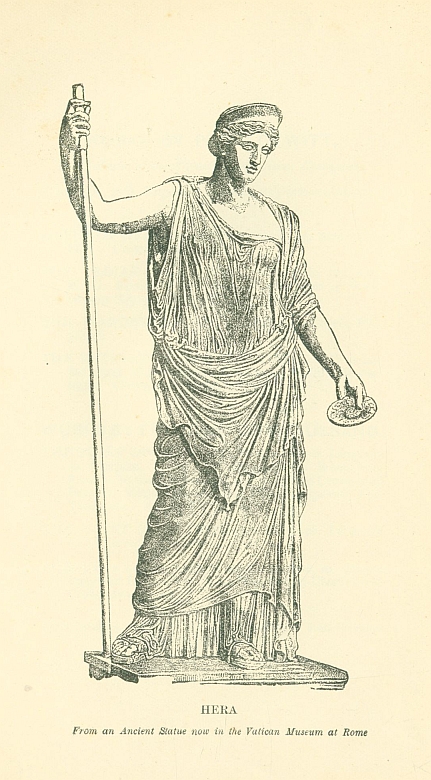
Hēra. Daughter of Cronus, 4.
Becomes the wife of Zeus and
queen of the gods, 4. Is
presented by the Earth at her
marriage with a golden apple-tree,
131. Persecutes Leto, 23;
and Io, 31 to 33. Gives
treacherous advice to Semele, 61.
Punishes Athamas for receiving
Dionysus, 63 and 150. Is
reconciled to Dionysus and Semele,
67. Causes Eurystheus to be
born before Heracles and thus
become heir to the cities of
Mycenae and Tiryns, 109.
Sends serpents to kill Heracles
when a child, 109. Afflicts him
with madness, 113. Takes the
form of an Amazon and leads
an attack upon Heracles, 125.
Sends a great gnat to torment
his cattle, 131. Raises a storm
to destroy him, 141; and is
punished for this by Zeus, 141.
Is reconciled to Heracles and
welcomes him among the gods,
147. Protects the Argonauts
in their passage through the
Wandering Rocks, 169.
Hēraclēs. Son of Zeus and
Alcmene, 108 and 109. Strangles
two serpents sent by Hera to kill
him in his sleep, 109. Is taught
by the Centaur Chiron, 110.
Kills a lion on Mt. Cithaeron
and dresses himself in the skin,
110 and 111. Conquers the
Minyae and kills their king,
Erginus, 111 and 112. Marries
Megara, 112. Becomes mad,
and throws his children into the
fire, 113. Leaves Thebes in
consequence, and enters the
service of Eurystheus for whom
he performs twelve Labours:--
1st Labour. Killing the
Nemean Lion, 113 and 114.
2nd Labour. Killing the
Lernean Hydra, 114 to 116.
3rd Labour. Capturing the
Ceryneian Hind, 116 and 117.
4th Labour. Bringing the
Erymanthian Boar to
Mycenae, 117 and 119.
5th Labour. Cleansing the
stables of Augeas in a
single day, 119 to 121.
6th Labour. Driving away
the Stymphalian Birds,
121 and 122.
7th Labour. Bringing the
Cretan Bull to Mycenae,
122 and 123.
8th Labour. Bringing to
Mycenae the fierce horses of
Diomedes, 123 and 124.
9th Labour. Obtaining the
girdle of the Queen of
the Amazons, 124 to 126.
10th Labour. Fetching the
cattle of Geryon, 128 to 131.
11th Labour. Procuring three
golden apples from the
Garden of the Hesperides, 131 to 135.
12th Labour. Fetching the
three-headed dog Cerberus
from the Lower
World, 135 to 137.
Heracles delivers Prometheus
from the eagle, 12. Fights
with the Centaurs and causes
the death of Chiron unintentionally,
117 to 119. Delivers
Hesione from the monster, 126
and 127. Punishes Laomedon
her father for breaking his word
to him, 140. Kills the giant
Cacus for stealing his cattle,
130 and 131. Wrestles with
Nereus the sea-god, 132.
Wrestles with Antaeus, son of
the Earth, and squeezes him to
death, 133. Kills Busiris who
had been accustomed to sacrifice
a stranger every year to the
gods, 133 and 134. Visits
Atlas, and takes his place for a
time in supporting the heaven,
134 and 135. Goes to Oechalia
to sue for Iole daughter of King
Eurytus, and is taunted by her
father with his former madness,
137 and 138. Punishes Eurytus
for this, 145. Kills Iphitus,
son of Eurytus, 138. Is smitten
with sickness, and when he
asks the Oracle what he shall
do, is refused an answer, 139.
Quarrels with Apollo about this
and carries off the sacred
Tripod, 139. Enters the service
of Omphale queen of Lydia,
with whom he remains for three
years, 139 and 140. Punishes
Augeas for his faithlessness, 141
and 142. Goes to Calydon to
sue for Deianira, and wins her
in a contest with the river-god
Acheloüs, 142 and 143.
Marries Deianira and lives with
her for some time in Calydon,
143. Accidentally kills his
servant-boy and has to leave, and
go to Trachin to be purified, 143
and 144. Is about to celebrate
his victory over Eurytus when
he receives from Deianira a
robe poisoned with the blood of
the Centaur Nessus, which
causes him such terrible suffering
that he resolves to die, 145
and 146. Ascends Mt. Oeta
and builds a funeral pile which
he causes to be set alight, 146.
But before the flames reach him,
he is carried up to Mt. Olympus
and enthroned among the gods,
146 and 147. The goddess Hebe
is given to him for a wife, 147.
Hermēs. The Messenger of the
gods. Takes Pandora to
Epimetheus, 10. Is sent to tell
Deucalion and Pyrrha that
they may make any request they
like, 14. Helps Ares to escape
from captivity, 28. Kills the
watchman Argus, and rescues
Io, 31 and 32. Takes Dionysus
to King Athamus, 63; and
afterwards to be brought up by
some nymphs, 64. Gives Perseus
a sickle with which to cut off
the head of Medusa, 97.
Returns to the nymphs the three
Precious Things they had lent
to Perseus, 103. Steals part of
the booty of Amphitryon for
Zeus, 108. Helps to arm
Heracles for his fight with the
Minyae, 112. Brings the
Golden Ram to carry away
Phrixus and Helle, 149. Brings
Psyche into the assembly of the
gods, 243.
Hersīonē. Daughter of Laomedon
king of Troy. Is rescued by
Heracles from the monster, 126.
Is given to the hero Telamon
after the conquest of Troy, and
allowed to take her little brother
Podarces or Priam with her,
140 and 141.
Hesperides. Three nymphs who
tended the garden of golden
apple-trees, 132. (See Garden
of Hesperides.)
Hestia. Daughter of Cronus, 4.
Hippodamīa. Daughter of
Oenamaus king of Elis. Her father
compels nil her suitors to
compete with him in a chariot-race,
77. Pelops wins, and marries
Hippodamia, 78 and 79.
Hippolyta. An Amazon carried
off by Theseus to be his wife,
193 and 194. She is killed,
fighting for him against her
country-women, 195.
Hippolytus. Son of Theseus and
Hippolyta, 194. Is beloved by
Phaedra, wife of Theseus, 197.
She causes his death, 198.
Hippomedon. One of the Seven
Heroes who march against
Thebes, 213.
Horn of Plenty. The horn of the
goat Amalthea, converted by
Zeus into a miraculous horn, 5.
Is given to Heracles in exchange
for the horn of Acheloüs, 143.
Hundred-armed. Monsters, children
of Uranus and Gaea, 1. Are
thrust into Tartarus, 2 and 3.
Are released by Zeus and help
him to fight against the old
gods, 4.
Hydra. A monster killed by
Heracles, 114 to 116. Heracles
poisons his arrows with the
Hydra's gall, 116; and uses
them in shooting at the Centaurs,
118; and 144.
Hylas. The most beautiful boy in
Greece. Is dragged down into
a forest pool by the nymphs who
live there, and never seen again,
155 and 156.
Hypsipele. Queen of Lemnos.
Saves the life of her father
when all the other men in the
island are killed, 153 and 154.
Is banished in consequence, and
becomes nurse to the child of
Lycurgus king of Nemea, 215 to
217.
[I-macro]CARUS. Son of Daedalus.
Flies away from Crete with
his father, but falls into the sea
and is drowned, 52 and 53.
Idas. Carries off Marpessa in a
winged chariot, 20. Is preferred
by her to the god Apollo, 21
and 22.
Ino. Wife of Athamas, and
stepmother of Phrixus and Helle,
63 and 148. Tries to get
Phrixus put to death, 148 and
149. Is killed in trying to
escape from her husband, in his
madness, 63 and 150.
Io. Daughter of a king of Argos.
Is beloved by Zeus, and changed
by him into a white cow to save
her from Hera, 31. Hera gets
possession of the cow and puts
her under the charge of the
watchman Argus, 31. She is
rescued by Hermes, 31 and 32.
Hera however continues to torment
her till she is protected by
the king of Egypt who marries
her, 32 and 33.
Iobatēs. King of Lycia. Receives
Bellerophon kindly, 47; but at
the request of Proetus, sends
him on dangerous missions in
the hope of his being killed, 47
to 50; until, finding that he is
under the protection of the gods,
he begs him to settle in the
country and gives him his
daughter in marriage, 51.
Iolāus. A cousin of Heracles.
Accompanies him on his expedition
to destroy the Lernean
Hydra, 115 and 116.
Iolcus. The city of King Pelias,
151. Jason sets out from Iolcus
in quest of the Golden Fleece,
152 and 153. Returns with the
Fleece, 171. Is obliged to leave
the city, 173.
Iolē. Daughter of Eurytus king of
Oechalia. Is sought in marriage
by Heracles, but refused to him
by her father, 137 and 138.
Iphiclēs. Son of Amphitryon and
Alcmene, and half-brother of
Heracles, 108 and 109.
Iphiclus. (1) The owner of a
famous herd of cattle demanded
by Neleus king of Pylos in
return for the hand of his daughter
Pero, 69. (2) Grandson of the
above. Melampus instructs him
how to propitiate the gods and
obtain an heir, 71 and 72.
Iphitus. Son of Eurytus, king of
Oechalia. Is killed by Heracles
in a fit of anger, 138.
Isthmus. The neck of land which
connects the peninsula of
Peloponnesus with the rest of Greece.
The Argonauts land there on
their return from Colchis, 171.
Italy. Heracles passes through
the country when driving home
the cattle of Geryon to Mycenae,
130.
JASON. Nephew of Pelias,
king of Iolcus, by whom he
is sent to fetch the Golden
Fleece, 152. Reaches Colchis,
159; and accomplishes the tasks
demanded by Aeëtes, 160 to 164.
Obtains possession of the Fleece
by the help of Medea, and escapes
with her, 165. Is purified
by Circe from the blood of
Absyrtus, 167. Arrives at Iolcus
and shows Pelias the Golden
Fleece, 171. Goes to Corinth,
where King Creon offers him
Glauce for his wife, 173.
Presents her with a marriage-robe
which, unknown to him, has
been poisoned by Medea, 174.
Sees Medea drive away in her
dragon-car, 175.
Jocasta. Wife of Laïus king of
Thebes, and mother of Oedipus,
205. Marries Oedipus, not
knowing who he is, 207 and
208. When it is discovered, she
hangs herself in her despair and
grief, 209.
LABYRINTH. A wonderful
house made for Minos king
of Crete by the artist Daedalus,
52 and 186. Theseus enters it
and kills the Minotaur, 189 and
190.
Lāïus. King of Thebes and
husband of Jocasta. Exposes his son
Oedipus on Mt. Cithaeron,
205. Is killed by his son
unknowingly, 206 and 207.
Land of Shades. See Lower World.
Laodamas. Son of Eteocles.
Succeeds his father as king of
Thebes, and is killed in fighting
against the Epigoni, 225.
Laomedon. King of Troy, and
father of Ganymede, Hesione
and Priam. Tries to cheat the
gods Apollo and Poseidon, and
is punished by them, 126.
Receives from Zeus two horses of
the gods to console him for the
loss of Ganymede, 127. Promises
the horses to Heracles if
he will deliver Hesione from the
monster, but fails to keep his
word, 126 and 127. Is punished
by Heracles for his faithlessness,
140.
Lapithae. The subjects of
Pirithoüs the friend of Theseus, 195.
They conquer the Centaurs with
the help of Theseus, 196.
Lēda. Wife of Tyndareus king of
Sparta. Marries Zeus in the
form of a swan, and becomes
the mother of Pollux and Helena,
as well as of Castor and
Clytaemnestra, 200.
Lemnos. An island inhabited by
women only. The Argonauts
rest there on their way to
Colchis, 153 and 154.
Lernē. The city near which was
the abode of the Lernean
Hydra destroyed by Heracles, 115.
Lēto. Marries Zeus, and becomes
the mother of Apollo and Artemis,
23 and 24. Begs her children
to punish Niobe, 80.
Libya. The country of Antaeus.
Heracles wrestles with him, 133.
Lichas. A herald. Brings to
Heracles the robe poisoned by
Deianira which causes him such
agony that he beats Lichas to
death against the rocks, 145
and 146.
Lower World. Pluto is made
king of the Lower World, 5.
Persephone is carried off to it
by Pluto, 16 to 18. The
Danaïdes are condemned to
never-ending punishment, 37 and 38.
Tantalus is condemned to a
similar punishment, 76.
Alcestis is allowed to return from
the Lower World, 94. Heracles
goes there to fetch Cerberus,
135 to 137. Theseus and
Pirithoüs descend with the
intention of carrying off
Persephone, 199 to 202. Castor
and Pollux spend alternate days
in Olympus and in the Lower
World, 201. The helmet of
Pluto is lent to Perseus, 97.
Lycia. The country of King
Iobates. Bellerophon slays the
Chimaera, and afterwards settles
in the country, 47 to 51.
Lycomēdēs. King of part of the
island of Scyros, 202. Kills
Theseus by treachery, 203.
Lycurgus. King of Nemea. The
Nemean games are instituted in
memory of his child by the
heroes marching through his
country on their way to Thebes,
215 to 217.
Lydia. The country of Queen
Omphale, whom Heracles serves
as a slave for three years, 139
and 140.
Lynceūs. Son of Aegyptus. Is
saved from death by his wife
Hypermnestra, 36. Succeeds
Danaus as king of Argos, 37.
MARPESSA. Daughter of
Evenus. Runs away with
Idas, 20. Prefers him to the
god Apollo, 21 and 22.
Medēa. Daughter of Aeëtes king
of Colchis. Helps Jason to win
the Golden Fleece, and escapes
with him, 161 to 165. Kills
her brother Absyrtus, 166. Is
purged by Circe from the stain
of blood, 167. Deceives Talos
and makes him destroy himself,
169 and 170. Deludes the
daughters of Pelias into killing
their father, 172 and 173.
Sends a poisoned robe to Glauce,
174. Flees away from Corinth
in her dragon-car, 175. Is at
the court of Aegeus at Athens
when Theseus arrives, 183. Her
plan for poisoning him fails, and
she flees away in her winged car,
183 and 184.
Mediterranean. The sea which one
of the Giants is in the act of
crossing when buried by Athene
under the island of Sicily, 6.
Europa is carried across it by
Zeus, 58.
Medūsa. One of the three
Gorgons. Is killed by Perseus, 96
to 98. Her head turns his
enemies to stone, 101.
Megara. Daughter of Creon, king
of Thebes. Becomes the wife
of Heracles, 112. Dies, 137.
Melampus. Learns the language
of birds and insects, 68; and the
art of knowing the future, 72.
Obtains the cattle of Iphiclus
for his brother Bias, 69 to 72.
Restores the reason of the
daughters of Proetus, 73 and 74.
Meleager. Son of Oeneus and
Althaea, king and queen of
Calydon. Takes part in the
great boar-hunt which Atalanta
also attends, and dies in
consequence of a quarrel with his
uncles, 83 to 88.
Mīlanion. Wins the race with
Atalanta by the help of three
golden apples which he drops
at intervals, 89 and 90.
Minos. King of Crete. Father of
Ariadne and Phaedra. Refuses
to let Daedalus leave his country,
52. Is sent a bull for sacrifice
by Poseidon, but fails to kill it,
122. Receives Heracles who
delivers him from the mad bull, 122
and 123. Is furnished by
Hephaestus with an iron watchman,
169. Demands from the Athenians
a tribute of seven youths
and seven maidens, 186. Hears
that Theseus has slain the
Minotaur and carried off his
daughter Ariadne, 190 and 191. Gives
his daughter Phaedra in marriage
to Theseus, 197.
Minotaur. A monster, half man,
half bull, who lived in the
Labyrinth of Crete, 187. Is
killed by Theseus, 189 and 190.
Minyae. The subjects of King
Erginus. They are conquered
by Heracles and obliged to pay
tribute to the Thebans, 112.
Moors. Name given to the people
of Africa, burnt black by
Phaëthon, 41.
Muses. Nine beautiful goddesses
of poetry, art and science. They
teach a riddle to the Sphinx, 207.
They sing at the marriage of
Eros and Psyche, 243.
Mycēnae. A city of Greece.
Perseus exchanges his kingdom
of Argos for the cities of
Mycenae and Tiryns, 103. The
right of his son Electryon to
succeed is disputed by Pterelaus,
104. Amphitryon comes to
Mycenae to sue for Alcmene,
but is obliged to leave on
account of the unintentional
murder of Electryon, 105.
Sthenelus drives away Alcmene
and seizes the kingdom,
105. His son Eurystheus
succeeds him as king, 109.
Heracles goes to Mycenae and
serves Eurystheus for twelve
years, 113.
Mysia. A country of Asia Minor.
The Argonauts land on their
way to Colchis, and leave
Heracles and Hylas behind when
they sail away, 155 and 156.
NAXOS. An island, the favourite
land of the god Dionysus,
66 and 67. He finds Ariadne on
the island and marries her, 191
and 192.
Nēleūs. King of Pylos. Demands
the cattle of Iphiclus in
return for the hand of his
daughter Pero, 69. Gives her
in marriage to Bias, 72.
Refuses to purge Heracles from
the murder of Iphitus, 138.
Heracles marches against him
and kills him and all his family,
142.
Nemea. A city of Greece.
Heracles goes there to kill the
Nemean lion, 113. The Nemean
Games are instituted in memory
of the child of King Lycurgus,
215 to 217.
Nēreūs. A sea-god. Is
compelled by Heracles to tell him
how to obtain the golden apples
from the Garden of the Hesperides, 132.
Nessus. A Centaur. Carries
Deianira across the river and
tries to run away with her, but
is shot by Heracles with a
poisoned arrow, 144.
Nestor. Son of Neleus king of
Pylos. The only member of the
family of Neleus left alive after
the revenge of Heracles, 142.
Niobē. Daughter of Tantalus,
and wife of Amphion king of
Thebes. Boasts of her superiority
to the goddess Leto, and
is punished by having all her
children taken from her at once,
80 to 83.
OCEANUS. The great stream
that flows right round the
world. The horses of Helios
bathe in it every evening, 39.
The Gorgons live on an island
in Oceanus, 97. On an island in
Oceanus lives the three-headed
king Geryon, whose cattle
Heracles is sent to fetch, 128. The
golden apple-tree from which
the Garden of the Hesperides
grows, is planted by Hera in
Oceanus, 131 and 132.
Oechalia. The capital of Eurytus
king of Euboea. The city is
destroyed by Heracles, 145.
Oedipus. Son of Laïus and
Jocasta, king and queen of
Thebes. Is exposed by his
parents on Mt. Cithaeron because
of the prediction that he shall
kill his father and marry his
mother, 205. Is found by a
herdsman and taken to Polybus
king of Corinth who adopts
him, 206. Kills his father not
knowing who he is, 207. Goes to
Thebes where he delivers the
country from the Sphinx, and is
rewarded with the kingdom and
the hand of Jocasta, 207 and
208. Puts out his eyes in
despair, on discovering his
parentage, 209. Is banished from
Thebes, and finds a refuge at
Athens, where he dies, 210 and
211.
Oeneūs. King of Calydon, and
father of Meleager and
Deianira. Inaugurates the great
Calydonian boar-hunt, 83 to 88.
Receives Heracles, who comes
to sue for Deianira, 142.
Oenomāus. King of Elis. Makes
all the suitors of his daughter
Hippodamia, vie with him in a
chariot-race, and is killed in
racing with Pelops, 77 to 79.
Oeta, Mt. Heracles ascends the
mountain and builds his funeral
pile upon it, 146.
Olympus, Mt. The abode of the
gods, 2. The Giants try to
climb up into it, 5 and 6.
Demeter comes down from it to
the earth, 16 and 17. Hera
drives Leto from it, 23; but
afterwards receives her back
again, 24. Hera descends from
it to give bad advice to Semele,
61. Zeus descends and shows
himself to Semele in god-like
splendour, 62. Dionysus and
Semele are received among the
gods, 67. Tantalus is allowed
sometimes to ascend to
Mt. Olympus, 75. Ganymede is
brought to Mt. Olympus by the
sacred eagle of Zeus, 127.
Heracles is enthroned as a god,
147. Psyche is received among
the Immortals, 243. Heracles
drives the horses of Diomedes
to the foot of Mt. Olympus, 124.
Omphalē. Queen of Lydia.
Heracles sells himself to her as a
slave for three years, 139 and
140.
One-eyed, The. Monstrous children
of Uranus and Gaea, 1. Are
thrust into Tartarus, 2 and 3.
Are released by Zeus, and forge
weapons for him, 4.
Oracle. A temple of Apollo at
Delphi, where the god vouchsafed
prophetic answers (also
called Oracles) to those who
came to enquire concerning the
future. Answers are given to
Cadmus, 56; Oenomaus, 77;
Acrisius, 95; the parents of
Andromeda, 99; Heracles, 113
and 139; the Trojans, 126;
Pelias, 151; the Athenians, 203;
Oedipus, 206; Adrastus, 213;
Alcmaeon, 227; the parents of
Psyche, 231.
Orpheūs. Delivers the Argonauts
from the Sirens by overpowering
their song, 168.
Ossa, Mt. The Giants propose
to set up this mountain on the
top of Mt. Pelion, and so
climb up to Olympus, 6.
Othrys, Mt. The mountain
from which the old gods fight
with the younger ones, 4.
Otus. Son of Poseidon and brother
of Ephialtes, 27. He and his
brother fight against the gods
and make Ares prisoner, 28.
They are killed through a device
of Artemis, 28.
PALLANTIDAE. Sons of
Pallas, the brother of Aegeus,
177. They lay a plot to kill
their Uncle and Theseus, 184.
Pallas. Brother of Aegeus king
of Athens, 177.
Pandōra. Is fashioned by
Hephaestus out of clay, and endowed
with gifts by all the gods, 10.
Is sent to be the wife of
Epimetheus, anil takes with her,
as her dowry, a casket full of
Diseases and Cares, 10 and 11.
Parnassus. A mountain sacred to
the gods. Zeus proves it to be
the centre of the earth, 14. The
chest in which Deucalion and
Pyrrha have been preserved
during the Flood, strands there,
14. The sacred Oracle of Apollo
is located in Delphi, a city on
Mt. Parnassus, 55.
Parthenopaeus. One of the Seven
Heroes who marched against
Thebes, 213.
Pegasus. A beautiful winged
horse. Bellerophon becomes
his master, is taught by the
goddess Athene how to control
him, and by his help overcomes
the Chimaera, 48 to 50.
Pelias. King of Iolcus, 151; and
father of Alcestis, 92. Gives
his daughter in marriage to
Admetus, 92 and 93. Sends
Jason to fetch the Golden Fleece,
152. Kills the father of Jason
during his absence, 171. Is put
to death by his own daughters,
through the treachery of Medea,
172 and 173.
Pēlion, Mt. The Giants propose
to climb up from this mountain
to Olympus, 6.
Peloponnesus. A peninsula of
Greece, named after Pelops, 79.
Pelops. Is killed by his father,
and served up to the gods at a
banquet, 75; but is brought to life
again by Zeus, 76. Is dispossessed
of his kingdom of Phrygia,
77. Travels to Elis, and through
craft conquers Oenomaus in the
chariot-race, 77 to 79. Marries
Hippodamia, and becomes king
of Elis, 79.
Perigunē. Daughter of the
Fir-bender, one of the robbers slain
by Theseus on his way to
Athens, 180.
Pēro. Daughter of Neleus, king
of Pylos, 69. Becomes the wife
of Bias, 72.
Persephonē. Daughter of
Demeter. Is carried off by Pluto to
be queen of the Lower World,
16 to 18. Sends back Alcestis
to live again for a time in the
Upper World, 94. Receives
Heracles when he visits the
Lower World, 136. Gives
Psyche the casket for which she
has been sent by Aphrodite,
212.
Perseūs. Son of Zeus and Danaë,
95 and 96. Is sent by the king
of the island where his mother
has taken refuge, to fetch the
head of Medusa, 96 to 98.
Rescues Andromeda from the
monster, and is married to her, 99 to
101. Returns with the head of
Medusa, and rescues his mother
from the king, who wants to
marry her, 101. Kills his
grandfather unintentionally, and
succeeds to the kingdom of
Argos, 102; but exchanges it
for the cities of Mycenae and
Tiryns, 103.
Phaedra. Daughter of Minos king
of Crete. Is married to Theseus,
197. Loves Hippolytus and
asks him to marry her, 197.
Causes his death when he
refuses, and then hangs herself in
despair, 198.
Phaëthon. Son of Helios, 39.
Obtains leave from his father to
drive the chariot of the sun for
a single day, 40. Falls from it,
and is killed by a thunderbolt,
41.
Phēgeūs. Purges Alcmaeon from
the stain of blood, and gives him
his daughter in marriage, 227.
Sends his sons to kill Alcmaeon
on account of his faithlessness,
229.
Phenicia. The home of Europa
and Cadmus, 54.
Phineūs. (1) Brother of Cepheus.
Disputes the right of Perseus to
marry Andromeda, and is turned
to stone, 100 and 101. (2) A
seer whom the Argonauts deliver
from the Harpies, 157 and
158.
Pholus. One of the Centaurs.
Entertains Heracles in his cave,
117 and 118.
Phrixus. Son of King Athamas,
and brother of Helle. His
stepmother lays a plot to kill him,
hut he is rescued by a Golden
Ram and carried away to Colchis,
where he marries the daughter
of King Aeëtes, 148 to 150.
Phrygia. The country of Tantalus,
75. His son Pelops is driven
away from his kingdom, 77.
Phylacus. Inherits the cattle of
his father Iphiclus, 69. Agrees
to give them to Melampus if he
will teach him how his son may
propitiate the gods and obtain
an heir, 70 to 72.
Phyleūs. Son of Augeas king of
Elis. Refuses to bear false
witness against Heracles, and is
banished by his father, 120 and
121. Heracles restores him,
and makes him king, 142.
Pillars of Heracles. Two
mountains of rock set up by Heracles
in the sea between Europe and
Africa, 128.
Pīrithoüs. King of the Lapithae.
Forms a friendship with
Theseus, 195; who helps him
to defeat the Centaurs, 196.
Pirithoüs is compelled to sit for
ever on an iron seat in the
Lower World, 200 and 202.
Pluto. Son of Cronus, 4. Is made
king of the Lower World, 5.
Carries off Persephone, 16 to
18. Allows Sisyphus to return
to the earth for a single day, 44.
Allows Heracles to take
Cerberus to the Upper World on
condition that he captures him
without weapons, 136.
Podarces. Son of Laomedon king
of Troy. Is rescued by his
sister Hesione when the town
is sacked by Heracles, 140.
Receives the name of Priam,
141.
Pollux. Son of Zeus and Leda,
and brother of Castor, 200 and
201. Rescues his sister Helena,
201. Takes part in the
expedition of the Argonauts, 157.
Petitions Zeus that he and his
brother Castor may be allowed
to share the same fate, 201.
Polybus. King of Corinth, 205.
Adopts Oedipus, 206.
Polynīces. Son of Oedipus and
Jocasta. Is banished from
Thebes by his brother Eteocles,
and takes refuge with Adrastus
king of Argos, 212 and 213.
Induces Adrastus to march an
army against Thebes, 213.
Accepts his brother's challenge
to single combat, in which he
gives and receives a mortal
blow, 220.
Poseidon. Son of Cronus, 4. The
sea is made subject to him, 4
and 5. Gives Idas a winged
chariot in which to carry off
Marpessa, 20. Becomes the
father of Otus and Ephialtes,
27. Punishes Cassiopea for
being vain of her beauty, 99.
Gives Pterelaus a golden hair
which preserves him from
death, 107. Sends Minos a bull
for sacrifice, and punishes him
for keeping it back, 122.
Punishes Laomedon for his
faithlessness, 126. The Argo is
dedicated to Poseidon, 171.
Poseidon disputes with Athene
the guardianship of Athens,
176. At the request of Theseus,
he creates the monster that
destroys Hippolytus, 198.
Priam. See Podarces.
Proetus. King of Argos. Cleanses
Bellerophon from the murder of
his brother, 45; but thinking
he has done him an injury, sends
him to Iobates, whom he desires
to kill him, 46. Sends to beg
Melampus to restore his daughters
to their right minds, 73 and
74.
Promēthēus. Brings down fire to
the earth against the will of
Zeus, 9 and 10. Is chained, as
a punishment, to Mt. Caucasus
where an eagle preys upon
his liver, 12. Is delivered by
Heracles, 12. Warns his son
Deucalion of the great flood
about to take place, 13.
Psȳchē. Is hated by Aphrodite
on account of her beauty, 231.
Is carried away by the Wind-god,
and secretly married to
Eros, 232 and 233. She
disobeys his command that she
shall never seek to see him, and
he is obliged to leave her, 236.
Psyche enters the service of
Aphrodite, who requires her to
accomplish hard tasks, 237 to
242. Zeus gifts Psyche with
immortality, and sanctions her
marriage with Eros, 243.
Pterelāus. Grandson of Perseus
and king of the Teleboae.
Disputes the right of Electryon to
the cities of Mycenae and
Tiryns, 104. Amphitryon leads
an expedition against him, and
conquers him through the treachery
of his daughter, 106 and 107.
Pylos. The home of Melampus,
68; also of King Neleus and
his daughter Pero, 69. Heracles
conquers the city, 142.
Pyrrha. Wife of Deucalion, who
is saved with him in a wooden
chest at the time of the great
Flood, 13 to 15.
Pythia. The Priestess of Apollo,
through whom the prophetic
answers vouchsafed by the god
were transmitted, 55. Answers
are given by her to Cadmus,
56; to Heracles, 113; to the
Athenians, 203; to Oedipus,
206. An answer is refused to
Heracles, 139.
RHEA. Wife of Cronus, 2.
Saves her son Zeus from
being devoured by his father, 3.
Rome. Heracles passes the spot
where Rome was afterwards
built, in bringing the cattle of
Geryon to Mycenae, 130.
SALMONEUS. King of Elis.
Tries to imitate Zeus, and is
destroyed by a thunderbolt, 42
and 43.
Sciron. One of the robbers killed
by Theseus on his journey to
Athens, 181.
Scyros. The island where Theseus
proposed to spend the last days
of his life, 202. He is
treacherously killed there by
Lycomedes, 203. The Athenians
fetch his bones from the island,
203 and 204.
Selēnē. Goddess of the moon.
Loves Endymion, 30.
Semelē. Daughter of Cadmus and
Harmonia. Is secretly married
to Zeus, 61. Prevails on him
to come to her clothed in the
glory of the gods, and dies at
the sight, 61 and 62. Is gifted
by Zeus with immortality, 67.
Shadow-leader. The conductor of
dead souls to the Lower World.
He takes Alcestis thither, 94.
Sicily. The goddess Athene
buries one of the Giants beneath
the island, 6. Persephone is
carried off from it by the god
Pluto, 16. Daedalus flies to it
from the island of Crete, 53.
Silēnus. Plays with Dionysus
when a child, 64. Follows him
in his journey through the
world, 65 and 66; and helps to
celebrate his marriage with
Ariadne, 192.
Sirens. Treacherous sea-nymphs,
who attract sailors by their
magic singing and then tear
them to pieces. The Argonauts
escape them through listening
to the song of Orpheus, 168.
Sīsyphus. King of Corinth. Tries
to cheat gods as well as men,
and is tormented in the Lower
World with an unending
punishment, 43 and 44.
Sparta. The country of King
Tyndareus, husband of Leda.
Theseus and Pirithoüs go there
and carry off Helena, 199.
Sparti. The warriors who sprang
from the dragon's teeth sown
by Cadmus, 58.
Sphinx. A monster with the head
of a woman and the body of a
lioness. She propounds a riddle
and devours everyone who fails
to answer it, 207 and 208.
Oedipus guesses the riddle, and the
Sphinx dies, 208.
Sthenelus. Brother of Electryon.
Drives his niece Alcmene and
her brother from Mycenae, and
seizes the kingdom, 105.
Becomes the father of Eurystheus,
109.
Storm-foot. One of the Harpies
from whom the Argonauts
deliver Phineus, 167 and 158.
Stretcher, The. One of the robbers
killed by Theseus on his way to
Athens, 181 and 182.
Stymphālus. A city in Arcadia.
Heracles drives away the birds
that infest the Stymphalian
lake, 121 and 122.
Styx. A river of the Lower World,
by which the gods swore an
inviolable oath, 40; 62.
Swift-wing. One of the Harpies
from whom Phineus is delivered
by the Argonauts, 157 and 158.
Syria. Io travels to Syria to find
her child, 33.
TAENARUS, MT. Psyche is
directed to go there to find an
entrance to the Lower World,
240.
Talōs. An iron watchman, made
by Hephaestus for Minos king of
Crete. Medea deludes him into
killing himself, 169 and 170.
Tantalus. King of Phrygia, 65;
and father of Niobe, 80. Kills his
son Pelops and offers the flesh
to the gods at a banquet, 75. Is
condemned in the Lower World
to an unending punishment, 76.
Tartarus. A dark pit below the
earth into which the hundred-armed
and one-eyed monsters
are banished by Uranus, 2.
They are released by Zeus, and
the old gods whom he has
defeated, take their place, 4.
Typhöeus is thrust into Tartarus, 7.
Telamōn. Receives the beautiful
Hesione as a reward for having
been the first to scale the walls
of Troy, 140.
Tēleboae. The subjects of King
Pterelaus. They are sent on an
embassy to Electryon, and a
quarrel takes place, 104.
Amphitryon marches against them
at the desire of Alcmene, and
conquers their land, 105 to 107.
Thebes. Built by the descendants
of Cadmus, 59. A wall is built
round it by means of the song
of Amphion, 59 and 60. Alcmene
takes shelter there when driven
by Sthenelus from Mycenae, 105.
Amphitryon delivers the city
from the destroying Fox, 106.
Heracles is born in Thebes, 108
and 110. He delivers the land
from the tribute imposed by the
Minyae, 111 and 112; but leaves
the city after his madness, 113.
Laïus and Jocasta are king and
queen of Thebes, and Oedipus is
born there, 205. Oedipus
delivers the land from the Sphinx,
and becomes king, 207 and 208;
but on the discovery of his
parentage, he is banished, 209 and
210. His sons Eteocles and
Polynices succeed him, but Polynices
is banished by his brother, 212.
Polynices goes to Argos, 212;
and persuades Adrastus to lead
an army against Thebes, 213.
The Argives are defeated before
Thebes, 218 to 220. Creon king
of Thebes refuses burial to the
Argives, and immures Antigone
for disobeying his orders, 221 to
223. The Epigoni march against
Thebes, 224 and 225. The Thebans
decide to abandon the city,
225 and 226. The Epigoni and
others re-people it, 226 and 227.
Thermōdon. A river in Asia, near
which was the country of the
Amazons, 125.
Thersander. Son of Polynices.
Made king of Thebes by the
Epigoni, on their taking
possession of the city, 226.
Thēseūs. Son of Aegeus king of
Athens. Is brought up at
Troezen by his mother Aethra,
177 and 178. Is sent by her to
the court of his father at Athens,
179. Or: his way there, he kills
many robbers,--the Club-carrier,
179; the Fir-bender, 179 and
130; Sciron, 181; the Stretcher,
181 and 182. Reaches Athens,
182; and is recognised by
Aegeus, 183. Medea's attempt to
poison him fails, 183. The
Pallantidae are foiled in their
plan to murder him, 184.
Theseus captures the Bull of
Marathon, 184 and 185. Goes
to Crete as part of the tribute
of seven youths and seven
maidens, kills the Minotaur,
and escapes with Ariadne, 187
to 190. Is compelled to leave
Ariadne at Naxos, 191. Forgets
to hoist the white sail, and thus
causes the death of his father,
192 and 193. Carries off
Hippolyta to be his wife, 193.
Conquers the Amazons, 194 and
195. Makes a friendship with
Pirithoüs, and helps him to
defeat the Centaurs, 195 and 196.
Erects an Altar of Pity in the
market-place of Athens, 196.
Marries Phaedra, 197. Prays
for the death of Hippolytus, 198.
Joins Pirithoüs in carrying off
the beautiful Helena, 199; and
descends with him to the Lower
World to try and get possession
of Persephone, 199. Finds
himself unable to leave a stone on
which he had sat down for a
moment, 200; but after many
years is released by Heracles,
201 and 202. On his return to
Athens, finds himself forgotten,
and retires to Scyros, 202. Is
there killed treacherously by
Lycomedes, 203. His bones are
transferred to Athens, 203 and 204.
Thrace. The country of Diomedes,
whose fierce horses Heracles
goes to fetch, at the command
of Eurystheus, 123.
Tiresias. A blind seer of Thebes.
Explains the visit of Zeus to
Alcmene, 108. Foretells the
fate of Oedipus, 205; and 225.
Advises the Thebans to abandon
the city, 225. Goes with them,
and dies during the flight, 226.
Tiryns. Perseus exchanges his
kingdom of Argos for the cities
of Mycenae and Tiryns, 103.
The right of his son Electryon
to succeed is disputed by
Pterelaus, 104. Sthenelus takes
possession of the kingdom, 105. He
is succeeded by Eurystheus,
109.
Titans, Titanides. Children of
Uranus and Gaea, 2. The father
of Prometheus was a Titan, 9.
Trāchis. A city of Greece.
Heracles leaves Calydon for
Trachis, 144; and goes from Trachis
to Euboea, 145.
Tripod. A three-legged stool on
which the Priestess of Apollo
sat when uttering her divine
predictions, 55. Heracles
carries off the sacred Tripod from
Delphi, 139.
Triptolemus. Is taught by
Demeter how to sow corn and
cultivate the land, 19.
Troezēn. The home of Aethra, wife
of King Aegeus, 177. Theseus
is brought up by her at Troezen,
177 and 178. Helena is placed
there under her care for a time,
but is rescued by her brothers,
199 and 201.
Troy. The country of King
Laomedon, father of Ganymede.
Apollo and Poseidon build a
wall round Troy, and punish
Laomedon for withholding the
reward he has promised, 126.
Heracles lands at Troy, and
rescues Hesione from the monster,
126 and 127. Returns to punish
Laomedon for his faithlessness,
and conquers the city, 140.
Tȳdeūs. Is driven from his
country on account of an
unintentional murder, and goes for
refuge to Adrastus king of Argos,
212 and 213. Takes part in the
expedition against Thebes, 213.
Bears a message to Eteocles,
and distinguishes himself by
feats of strength, 218. Is
killed before Thebes, with all
the other heroes, 220.
Tyndareūs. King of Sparta, 199;
and husband of Leda, 200.
Typhōeūs. A monster created by
Gaea to fight against the gods,
6. Is conquered by Zeus, and
flung into Tartarus, 7.
URANUS. God of the sky, 1.
Is killed by his son Cronus, 2.
WANDERING ROCKS. The
Argonauts pass through
them in safety by the help of
Hera, 168 and 169.
Wind-god. Carries Psyche into
the beautiful valley, 232.
Brings her two sisters to see
her, 234; and takes them home
again, 235.
ZEŪS. Son of Cronus and Rhea.
Is hidden in the island of
Crete and nourished by the goat
Amalthea, 3. Makes war against
his father and thrusts him into
Tartarus, 4. Marries Hera, 4.
Conquers the Giants, 6; and
Typhöeus, 7. Sends Pandora to
bring Disease and Care into the
world, 10 and 11. Punishes
Prometheus for bringing down
fire to the earth, 12. Destroys
the world by a Flood, 13 and
14; and allows Deucalion and
Pyrrha to re-people it, 14 and
15. Stops the fight about to
take place between Apollo and
Idas, 21. Marries Leto and
becomes the father of Apollo
and Artemis, 23. Becomes the
father of Endymion whom he
gifts with perpetual sleep, 29.
Hurls a thunderbolt at Phaëthon
to prevent him from destroying
the earth, 41. Carries off Europa
in the form of a bull, 54 and 58.
Marries Semele, and at her wish
goes to her surrounded with the
glory of the gods, 62. Raises
her from the Lower World to
Olympus, 67. Conceals his son
Dionysus from Hera, 63; and
gifts him with divine power,
64 and 65. Imposes a punishment
upon Apollo, 81. Marries
Danaë in the form of a golden
shower, and becomes the father
of Perseus, 95 and 96. Marries
Alcmene, and becomes the father
of Heracles, 108 and 100.
Decrees that the next child born
of the race of Perseus shall rule
over the cities of Mycenae anil
Tiryns, 109. Sends his sacred
eagle to steal away Ganymede,
127. Interposes between
Heracles and Apollo, 139. Punishes
Hera for trying to destroy
Heracles, 141. Marries Leda in the
form of a swan, and becomes the
father of Pollux and Helena,
200. Grants the wish of Pollux
to share the fate of his
brother Castor, 201. Causes
the two sons of Alcmaeon to
grow up to manhood in a single
night, 229.
PRINTED BY
SPOTTISWOODE AND CO., NEW-STREET SQUARE
LONDON