Ojibwa
Nanebojo and his grandmother journeyed
about for a long time. At last they came again
to Lake St. Clair. In the lake were many
geese. Nanebojo thought, “How am I going to get
some of those ducks?” He thought for a long while.
Then he remembered.
Nanebojo took a birch-bark pail, and began to drum
on it and to sing. He sang,
I am bringing new songs,
I am bringing new songs.
When the geese heard that, they drew near to him.
At once he said to his grandmother, “Go farther on,
and build a lodge where we may live.” And at once she
did so. Then he went down to the water where the
geese were floating around. He pulled out his sack, got
into it, and dived into the water. The ducks and geese
were quite surprised to see what a good diver he was.
They came closer and closer.
Nanebojo said, “I can dive better than you can.”
The geese said, “Oh, no!” Then they all began diving,
150
and Nanebojo did beat them. So he spent a long time
diving and floating about in the water. Suddenly he
dived, came up softly among the geese, caught the feet
of many, and tied them together with a string of basswood
bark. At once the geese started to fly. They rose
very slowly at first, because Nanebojo was pulling back,
but at last they rose high in the air, carrying with them
Nanebojo, who held on to the basswood string. Higher
and higher they rose, until the earth was far beneath
them. Then the string broke, and Nanebojo fell to the
earth. He fell into a tall hollow tree.
Nanebojo spent a long while in that hollow tree. At
last he heard the sound of chopping wood. Then
he called for help, and the Indian women let him
out of the tree. At once he went in search of his grandmother.
Grandmother asked, “Why didn’t you get the geese?”
“You know you never eat goose, even when you do
get it,” answered Nanebojo.
Nanebojo killed a deer. He at once skinned and
dressed it, and then he lighted a fire and roasted it.
When he sat down to eat, the branch of a tree near by
began to screech. Two branches were rubbing together.
Nanebojo did not like that. He said to the tree, “Don’t
bother me just now when I want to eat, I am hungry!”
151
But every time he took a bite the branch began to
screech.
Nanebojo climbed into the tree, broke off a branch,
and just then caught his hand between two branches as
they rubbed together. He could not free himself.
Just then a pack of wolves came running along the
river. Nanebojo heard them at a distance. He called
to them, “Run right along. Don’t look this way.” The
wolves said among themselves, “He must have something
to eat over there, else he wouldn’t tell us to run
straight ahead.” So they went right under his tree.
They ate that entire deer.
When they had finished, Nanebojo said, “Now go
straight ahead and don’t look at that tree near-by.” In
the tree he had hung the deer’s head for his grandmother.
So the wolves looked at the tree and at once
ate the head. Then they went on.
At once the tree released Nanebojo’s arm, and he
climbed down. He could only pick the bare bones of
the deer. He went to the head. He turned it round
and round. It was entirely bare. He went on and
joined his grandmother.
One day when Nanebojo went for a drink, he saw
some whitefish in the river. He said to them, “Can’t
I go along with you?”
152
“Oh, no,” said the whitefish. “You wouldn’t last
long if you did.”
“Why not?” asked Nanebojo.
“Because the Indians are always looking for us. You
would be the first one caught,” they answered.
“I am very timid,” said Nanebojo. “If I go with
you, I shall never be caught.” So he turned himself
into a whitefish.
Soon after some Indians came along fishing. Nanebojo
said, “Now I am going over there to tease them.
You all stay here and I will go over there alone. Just
before they try to spear me, I will dive to the bottom of
the river and rise again a long way off.”
So Nanebojo began teasing the Indians. He kept it
up for some time until one of the Indians speared him.
The Indian kept his spear in the water until he got to
the shore, and then dragged Nanebojo out. The other
whitefish remarked, “That is just what he said—that
after he dived he would not come up for a long time,
and then at some distance.”
The Indians took Nanebojo home with them. He
was a very large fish. After a while he began to jump
about a little, so the Indians were afraid. They did not
cook him at once.
Just about dawn the next morning, Nanebojo came
to life again and remembered he was a fish and that the
153
Indians had speared him. So he got up and found
everyone sleeping.
“If they wanted to eat me, they should have done so
while they had a chance,” he said as he walked away.
He was going back to his grandmother.
154
WISKE-DJAK [7] AND THE GEESE
Algonquin
Wiske-djak was always hungry. One time,
in the autumn of the year, he stood on the
shores of a lake, when clouds of ducks were
flying by overhead. Wiske-djak wanted some of those
ducks. He thought for a long time. Then he made a
small clearing right there on the lake shore, and built
quite a large tepee, with a fire in the center. The grassy
floor of the tepee was very smooth, so one could dance
well there. Wiske-djak made a birch-bark door, with
a long center stick to keep the bark spread, and to prevent
the door from opening inward. Now everything
was ready.
Wiske-djak went out walking and soon met Duck.
“I suppose you will soon be going south,” he said.
“Yes,” said Duck, “and we’ll be gone all winter. It’s
a bit cold up here for us.”
“It would be pleasant,” said Wiske-djak, “if we all
had a dance before you went. Invite your friends, all
155
of them, and Geese and any of the others who go south
for the winter. We’ll have a dance in my tepee.” Duck
thought that would be very pleasant.
Wiske-djak went back to his tepee, and sat down in
the sunshine outside. He got his drum and rattle and
began to sing a song of invitation. He sang:
You will all be gone for a long time.
You will all be gone until it is warm again.
Let us have a dance before you go.
Thus he sang.
Soon ducks and geese came flying by overhead, and
they heard his singing. They alighted on the ground
very near the tepee.
Wiske-djak called, “Let us go inside and have a good
dance,” and he opened the door. In went all the ducks.
Wiske-djak mended the fire so it would give very little
light.
“Now,” he said, when he had finished that, “you must
all follow the rules of the dance. You must do whatever
I call out.” So they all began to dance. Geese
were there and ducks and a few loons, and Cyngabis
was there also. They danced hard, around and around
the tepee.
Then Wiske-djak said, “Now close your eyes. Don’t
open them until I give the order. That is one of the
rules of the dance.”
156
The birds all closed their eyes tightly, and as they
danced and sang, they made a great deal of noise. Anyone
who has seen Indians dance knows that they make
much noise. So Wiske-djak caught one fat bird after
another, and wrung his neck as he passed him in the
dance. No one heard anything at all because of the
noise of the dancing.
But after a while Cyngabis thought Wiske-djak was
moving around in the dance, so he slipped into a dark
corner and opened one eye just a little. At once he saw
that Wiske-djak was wringing the neck of the dancers.
He called out, “Wiske-djak is killing you! Fly!”
At once the birds all opened their eyes and took wing.
They flew very rapidly indeed. But Cyngabis was way
over in one corner and he was the very last man to
get out. Wiske-djak tried to catch him, but he got
away.
Now Wiske-djak began to cook the birds for a feast.
He built the fire outside the tepee, after poking the
earth loose with a stick. Then he buried his birds in
the hot earth, with the hot coals above them. Then he
went to sleep.
Now some Indians came around the point in a canoe.
They saw the smoke of the fire, and they saw something
strange lying beside the fire. Therefore they went
nearer.
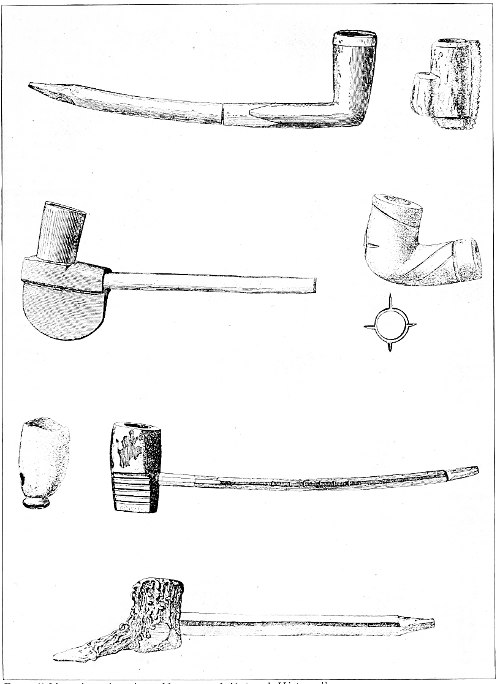
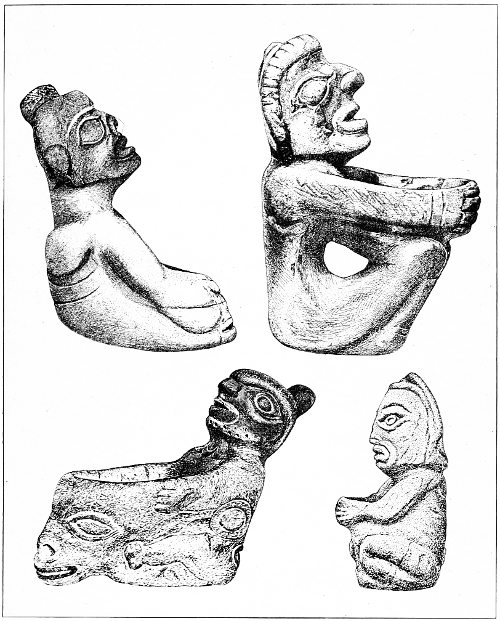
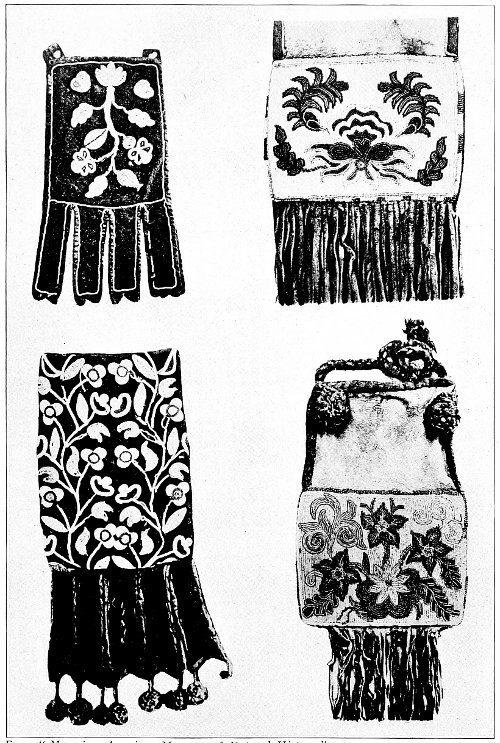
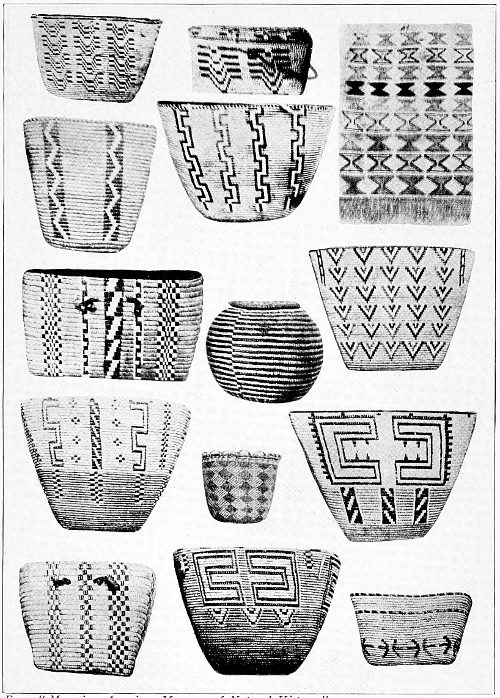
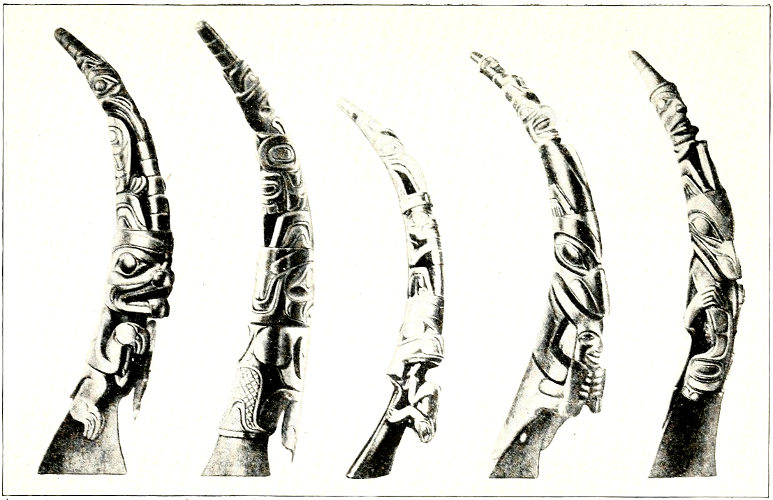
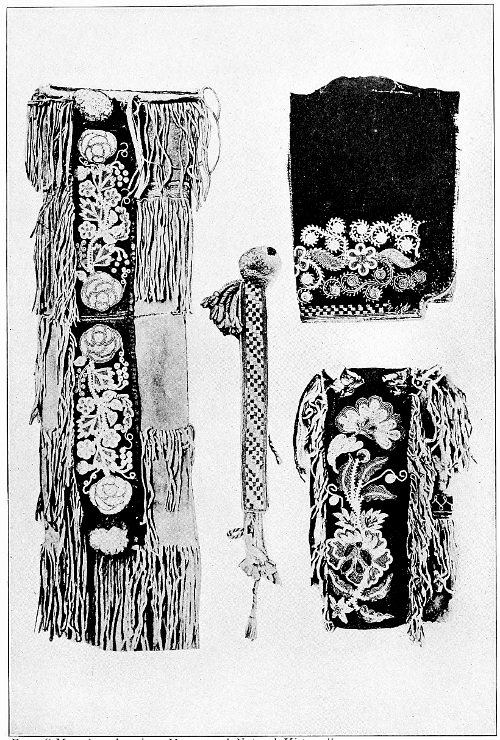
Indian Pipes
From “Memoirs, American Museum of Natural History”
157
One Indian said, “Look out, it might be Wiske-djak
up to more of his mischief!” But another Indian went
ashore, saying, “I’ll see who it is and what he is doing.”
When he came close to the fire, there lay Wiske-djak,
sure enough, and sound asleep. But the Indian couldn’t
see why he should have a big fire on a warm day until
he saw ducks’ legs sticking out of the earth under the
hot coals. At once he went back to his friends and told
them all about it.
The Indians all jumped out of the canoe. They said,
“Ha! We will take Wiske-djak’s ducks and geese and
eat them ourselves.” With their paddles they dug up
all the birds, twisted the legs off, and put the leg bones
back in the earth. They looked just as Wiske-djak had
placed them. Then the Indians paddled off.
Soon Wiske-djak waked up. He got up and looked
all around. No one was there. Everything looked just
as it had when he went to sleep. He looked at the dying
coals, and said, “I guess those birds are pretty well
cooked by this time.” He went all around the coals,
pulling out the ducks’ legs. They came out very easily.
He was surprised. “They must be very tender,” he
thought. He dug around in the earth, but not one thing
did he find. Wiske-djak was disgusted.
158