Secrecy; its Uses and Abuses.—Mystery; its
Definition.—Mysticism, and its Definition.
It is not true, as has been sometimes said, that wherever there is
secrecy there is error.
Secrecy, like most all else, hath its uses and abuses: its uses, as
developed in modesty and domestic virtue, in religious meditation,
self-examination, and prayer, and in prudence in the affairs of life: its
abuses, in prudery, asceticism, superstitious awe, undue veneration of
power, and when used as a cloud to conceal crime so hideous that nothing
but the truth of God, vindicated by human laws founded thereon, directed
by wisdom, can dispel it.
Virtue and modesty shrink from public gaze. Each looks alone to its
innate sense, the gift of God, and to the sole approval of the great "I
AM."
The hidden sincere aspirations of the heart are known only to Him who
"breathed into man the breath of life, and he became a living
soul." These are a secret between the created being and its Almighty
Father. At the lonely hour, when the burdened soul, knowing no earthly
refuge from overwhelming troubles, but a mightier Hand than that of man,
seeks on bended knee and with penitential tear, a blessing from on high,
no word is spoken, no sound uttered save the sob from a contrite heart.
The aspiration has gone forth inaudibly to Him who said to all mankind,
then and for future ages, "Come unto me all ye that labor and are heavy
laden and I will give you rest."[1]
"Prayer is the soul's sincere desire,
Uttered or unexpressed,
The motion of a hidden fire
That trembles in the breast.
It is the burden of a sigh,
The falling of a tear,
The upward glancing of an eye
When none but God is near."[2]
What knoweth the outer world of this? Yet wrong can not exist in such
secret communion between a penitent heart and its Maker. Pure religious
meditation, leading us from earth to heaven, is only promoted by secret
study and reflection in solitude. Neither philosophy nor religion can be
cultivated in the midst of the vortices of commerce or other business
requiring constant intercourse with hundreds of men during the day, nor
in the whirl of fashion in the evening.
Thus, then, do we trace one of the uses of secrecy. Both its use and
its abuse we shall hereinafter find exemplified in marked effects not
only on individual minds, but also on the masses of mankind in past
history: its use, in the development of true piety: its abuse, in
asceticism, superstition, and overweening spiritual power resulting in
crimes, which were "a sin unto death." Another abuse of secrecy has been
manifested in means heretofore employed in the constant effort to obtain
and maintain worldly power. This was by affecting the imagination and
blinding the reason of the masses. Some time ago, an ephemeral work was
published, even the name of which is not recollected by this writer,
wherein was a picture showing the section of a handsome tent with
curtains closely drawn. Within, is a man eating and feasting like other
mortals. Without, is a stand on which are exposed to view the usual
emblems and insignia of royalty, before which there is a kneeling crowd.
An admirable illustration! True it is, that "no man is a hero to his
valet-de-chambre." Fashionable wealth and power depend upon exclusiveness
to accomplish their usual attendant influences. Royalty hides every hour
in secrecy from public gaze, except when it occasionally becomes
necessary to treat the subjects to a mere pageant or show of military
costume and outside appearances. When Lola Montes displayed to the world the
mere humanity of the old king of Bavaria, where had he any
prestige left? Schamyl has attained his extraordinary influence
and power by his seclusion, asceticism, and pretended revelations; and
bravery having crowned his efforts, he is a favorite of fortune, and the
idol of a superstitious veneration. What did not Mohammed accomplish in
the same manner? But, in illustration of the opposite effect, so well
known to the sad experience of all, hath not a mightier One testified
that, "a prophet hath no honor in his own country?"[3]
But doth not also common prudence in worldly affairs demand the use of
secrecy?
What good general will detail, even to his own forces, and still less
make public for the use of his adversary, his plans and intentions for an
ensuing campaign?—what business man communicate to the public or to
his rivals his hard thought and well-planned speculation?—what
inventor publish his new machine or discovery until he has secured his
patent-right?
In what follows, then, let us discriminate between the use and abuse
of secrecy; so that, by the lessons of the past and the present, we may
be safely guided in our course through the future.
Before going into matters of historic detail, it were well to
understand the definition of the word "mystery."
Many suppose it to mean "something which is incomprehensible." This is
all a mistake.
"Μυστηριον" means
simply "a revealed secret." In other words, "mystery," which we derive
from the Greek word quoted, means neither more nor less than a secret
revealed and explained to us. A man of mature years and finished
education knows that which no school-boy can comprehend. To the elder a
secret has been revealed. He is in possession of the mystery. To the
younger it is yet a secret, not incomprehensible, but which can only be
attained in the progress of learning. To the scientific many of the
mysteries of nature are unfolded, but they are a secret to the world at
large. To those Christians in the earlier days of the church, who had
attained its highest instruction, and after the "Ite, missa est" had
dismissed the rest of the congregation, remained to participate in the
"pure offering" (or "clean oblation") prophesied by Malachi[4] to be thereafter offered in
every place to Him whose name thenceforth should be great among the
Gentiles—to them "it was given to know the mysteries of God:"[5] not to understand things
incomprehensible. That would be a contradiction in terms: a thing
impossible. How can a person comprehend that which passeth all
understanding? But it may be said, there are things which are
incomprehensible. Not so. They may be a secret to us while, in this
school-house, the earth, the pedagogue Necessity is teaching us only the
rudiments of the laws of God as developed in nature or in mind; but, when
the scintilla divinitatis, hidden in these "earthen vessels,"[6] shall have been set free,
and (while "the dust returns to the earth as it was") rises unto Him that
breathed into us that "spiritus" or "breath of life"—when we shall
hereafter have been "newly born" into a spiritual state of higher
existence—then may we hope that what is secret to us now, may
become a mystery or revealed secret to us hereafter. It is not all of
life to terminate our existence on this earth. This is but the
school-house in the commencement of eternity. These mysteries, now
secrets to us, are created and maintained by the fixed laws of Him "who
is without variableness or shadow of turning." The revelations thereof
belong to a higher kingdom, which "flesh and blood can not inherit," yet
in which every soul "shall be made alive."[7] Then shall these secrets be unfolded in
proportion to the cultivation of the mind and talents here: for the
unchangeable laws of God have placed all matter in constant and regular
mutation; and whether of matter or of mind, all is governed by a certain
law of progress, compelling us to attain excellence and strength only by
constant endeavors to surmount difficulties: and it is thus alone we can,
by severe study and deep meditation, in investigating these laws of
mutation and progress in things physical and moral, bring the mind,
even in this life, to a nearer approximation to, and capability of,
appreciating the wonderful truths we must hereafter learn. As in all
other laws of God, the cultivation of our talents must then carry its
proportionate reward hereafter.[8]
Let us then examine into the uses and abuses of secrecy in past
history, and at the present day—but more particularly will these be
manifested by "Mysticism;" by which is meant,
the revelation of learning, social, religious, and political, the
teaching of which has been, and is, preserved secret from the world, by
societies, associations, and confraternities.[9]
The Distinction between the Early Elohistic and Jehovahstic Ages of
Primeval Patriarchal Times.—The Secrecy of Original Worship on
Mountain Tops.—The Collation and Reconciliation of the patriarchal
Traditions brought together by Moses.—The Commencement of the
Jehovahstic Age.—The Origin of Mythology.—The Magi; their
Organization and Modes of Worship.—The Deification of Nimrod, and
the Source of Political Power at its Beginning.—The Secret Writings
they adopted.—The Dead Invokers.—The Mysteries of Egypt,
Greece, and Rome.
In a critical study of the books of Moses two eras seem to be
discernible. The earlier, the Elohistic, when God was only known by the
name, "Elohim." The latter, the "Jehovahstic," beginning at a later
period.[10]
Though not altogether germain to our subject, may we here be permitted
to inquire—par parenthese—whether this simple rule
does not furnish to us the means of reconciliation of apparent
contradictions?
All instruction originally was traditional alone. The patriarch was
priest and teacher, as well as ruler of his tribe. Each handed down to
his successor the traditions he had received from his
ancestors orally. As tribes became nomadic, or else sought permanently
new settlements and homes, traditions in course of time necessarily
became variant. Moses seems honestly to have collated these traditions,
and has, no doubt, given them in their respective versions as he received
them from Jethro, his father-in-law, and from the patriarchal instruction
among the elders of his people in Egypt. Thus we can recognize those in
which the name Elohim is used as being of much earlier date than the same
tradition differently told, where the word Jehovah indicates the name of
Deity. For instance, we find in one place[11] the command of God to Noah to take the
beasts and fowls, &c., into the ark by sevens. But again, in the same
chapter,[12] we find them
taken only by pairs. Are these not variant traditions of one event? So,
of the story of Abraham passing off his wife for his sister before Pharaoh, king of
Egypt,[13] and also before
Abimelech, king of Gerar,[14] and the farther tradition of Isaac and
Rebecca having done the same thing before Abimelech, king of Gerar.[15] Are not these variant
traditions of one fact? The legal experience of the writer for many
years, convinces him that no two persons without collusion view a
transaction generally exactly alike. Frequently—and each equally
sincere and honest—they widely vary in their testimony. Collusion may
produce a story without contradiction. Slight discrepancies show there is
no fraud, only that the witnesses occupied different stand points, or
gave more or less attention to what was the subject matter.
But, asking pardon for this digression, let us return to our
theme.
We know little or nothing about the teaching of the patriarchs in the
Elohistic age. Neither writing nor sculpture thereof existed in the time
of Moses, except, perhaps, the lost book of Enoch, or, unless—which
we are inclined to doubt—the book of Job had just before his era
been reduced to writing by the Idumean, Assyrian, or Chaldean priesthood.
We find at that period that sacrifices were offered on mountain tops.
Why? Abraham went to such a place to offer up his son. Was it not for
secrecy in the religious rite? If the earliest instruction was from God,
whose truth is unchangeable and eternal, were not the earliest sacrifices
offered in secret by reason of the same command which subsequently
obliged the high priest of his chosen people to offer the great sacrifice
in secret within the veils, first of the Tabernacle, afterward of the
Temple? The Elohistic age ended with the first official act of Moses,
after he, also, had met with Aaron on "the mount of God."[16]
A new era then commenced. As men dispersed themselves over the
earth, the original belief in the one true God (Monotheism) was lost, and
people fell into the worship of many deities (Polytheism), adoring the
visible works of creation, more particularly the sun and the stars of
heaven, or else reverencing the operative powers of nature as divine
beings. Faith in the one Great Jehovah was
preserved by the children of Israel alone. Idols were erected within
gorgeous temples. With the Chaldean, Phœnician, and Assyrian,
Moloch began the dreadful cruelty of human sacrifices, chiefly of
children. If, at first, the image of the idol was only a visible symbol
of a spiritual conception, or of an invisible power, this higher meaning
was lost in progress of time in the minds of most nations, and they came
at length to pay worship to the lifeless image itself. The priests alone
were acquainted with any deeper meaning, but refused to share it with the
people; they reserved it under the veil of esoteric (secret) doctrines,
as the peculiar appanage of their own class. They invented endless fables
which gave rise to Mythology. They ruled the people by the might of
superstition, and acquired wealth, honor, and power, for themselves.[17] We arrive then at nearly
the culminating point of Egyptian priestcraft, the days of "wise men,"
"sorcerers," and "magicians."[18] Such men ever have, and we presume ever
will employ secrecy as the chief element of their clever jugglery.
Mankind love to be deceived. Let an Adrian, Blitz, or
Alexander—while they tell you, and you well know it, that their
tricks are a deception—put forth notices of an exhibition, and they
will attract crowds, where an Arago, or a Faraday, would not be listened
to. Maelzel's automata, or Vaucanson's duck, will attract the world, when
Bacon's, or Newton's, or Laplace's works may remain in dust on the
book-shelves. Human nature is always the same, and thus it was in the
days of Moses and Pharaoh. The wise men, sorcerers, and magicians, held
undisputed sway, not only over the superstitions of the people, but over
their educated monarchs and princes. Egypt possessed, at an inconceivably
early period, numberless towns and villages, and a high amount of
civilization. Arts, sciences, and civil professions, were cherished
there, so that the Nile-land has generally been regarded as the
mysterious cradle of human culture; but the system of castes checked free
development and continuous improvement. Everything subserved a gloomy
religion and a powerful priesthood, who held the people in terror and
superstition. Their doctrine, that, after the death of man, the soul
could not enter into her everlasting repose unless the body were
preserved, occasioned the singular custom of embalming the corpses of the
departed to preserve them from decay, and of treasuring them up in the
shape of mummies in shaft-like passages and mortuary
chambers. Through this belief, the priests, who, as judges of the dead,
possessed the power of giving up the bodies of the sinful to corruption,
and by this means occasioning the transmigration of their souls into the
bodies of animals, obtained immense authority. Notwithstanding the
magnificence of their architectural productions, and the vast technical
skill and dexterity in sculpture and mechanical appliances which they
display, the Egyptians have produced but little in literature or the
sciences; and even this little was locked up from the people in the
mysterious hieroglyphical writing, which was understood by the priests
alone.[19] The following
translation is a quotation from a Latin work: "Among the ancient
Egyptians, from whom we learn the rudiments of speech, besides the three
common kinds of letters, other descriptions of characters are used which
have been generally consecrated to their peculiar mysteries. In a
dissertation on this subject, that celebrated antiquarian (conditor
stromatum), Clement, of Alexandria, teaches in his writings, thus:
'Those who are taught Egyptian, first, indeed, learn the grammar and
chirography called letter-writing, that is, which is apt for ordinary
correspondence; secondly, however, that used by the priests, called
sacred writing, to commemorate sacred things; the last also,
hieroglyphic, meaning sacred sculpture, one of the first elements of
which is cyriologism, meaning, properly speaking,
enunciating truth by one or another symbol, or in other words, portraying
the meaning by significant emblems.' With Clement agrees the Arabian,
Abenephi, who uses this language: (This Arabic writing is preserved in
the Vatican library, but not as yet printed: it is often quoted by
Athanasius Kircher, in his Treatise on the Pamphilian Obelisk, whence
these and other matters stated by us have been taken.) 'But there were
four kinds of writing among the Egyptians: First, that in use among the
populace and the ignorant; secondly, that in vogue among the philosophers
and the educated; thirdly, one compounded of letters and symbols, without
drawn figures or representations of things; the fourth was confined
solely to the priesthood, the figures or letters of which were those of
birds, by which they represented the sacred things of Deity.' From which
last testimony we learn that erudite Egyptians used a peculiar and
different system of writing from that of the populace, and it was for the
purpose of teaching their peculiar doctrines. For example, they show that
this writing consisted of symbols, partly of opinions and ideas, partly
of historic fables accommodated to a more secret method of teaching. But
Clement, of Alexandria, went further. In book v. of Antiquities
(stromata, 'foundation of things'), he says: 'All who controlled
theological matters, Barbarian as well as Greek, have concealed their
principles, hiding the truth in enigmas, signs, symbols, as well as
allegories, and also in tropes, and have handed them down in various
symbols and methods.'"[20]
This passage led subsequently to the brilliant discoveries of
Champollion.
Who, then, were the "erudite Egyptians" who used a peculiar system of
writing" for the purpose of teaching their peculiar doctrines?" Who were
these "magi," "wise men," "sorcerers," and
"magicians"? Nowhere do we find Pharaoh in the midst of his troubles
calling for a priest. It is always for the wise men, magicians, and
sorcerers. Were they not the priests?—were they not those who
controlled the mysteries—who practised divination? When Moses and
Aaron cast down their rods, the magicians of Egypt "also did in like
manner with their enchantments," and the result was the same.[21] When Moses smote the
waters that they became blood, the acuteness of the priests, or magi, in
their mysteries taught them a lesson whereby they were able to do the
same.[22] When the frogs
came up on Pharaoh and on all his people, and on all his servants, and
covered the land of Egypt, we learn "the magicians did so with their
enchantments, and brought up frogs upon the land of Egypt."[23] If the ancient Egyptians
were like their descendants, it is singular the magi could not accomplish
the next plague, that is, of lice. But here their power ended. The magi
originated in Media. According to oriental custom, to them was intrusted
the preservation of scientific knowledge, and the performance of the holy
exercises of Religion. Afterward, in a special sense, the magi were a
caste of priests of the Medes and Persians, deriving the name of Pehlvi;
Mag, or Mog, generally signifies in that language, a priest. They
are expressly mentioned by Herodotus as a Median tribe. Zoroaster was not
their founder, but was their reformer, and the purifier of
their doctrines. The Magi of his time were opposed to his innovations;
and they, therefore, were condemned by him. When afterward, however, they
adopted his reforms, he effected their thorough organization, dividing
them into Apprentices, Masters, and Perfect Masters.
Their study and science consisted in observation of their holy rites, in
the knowledge of their sacred forms of prayer, and liturgies by which
Ormuzd was worshipped, and in the ceremonies attendant on their prayers
and sacrifices. They only were permitted to act as mediators between God
and man. To them alone was the will of God declared. They only could
penetrate the future. And they alone predicted the future to those who
sought of them therefor. In later days the name Magi became synonymous
with sorcerer, magician, alchemist, &c.[24]
The magi of Egypt were the priests, the founders and preservers of the
mysteries of the secret grades of instruction, and of the hieratic and
hieroglyphic writings and sculptures. In secret they were the priesthood.
In public, in religious matters, the same. But in public secular affairs
they seem to be recognised as Magi.
When mythology was invented, most of the gods, if not all of them,
were received as symbolical, physical beings, the poets made of them
moral agents; and as such they appear in the religions of the people of
earlier days. The symbolical meaning would have been lost, if no means
had been provided to insure its preservation. The MYSTERIES, it seems, afforded such means. Their great
end, therefore, was to preserve the knowledge of the peculiar attributes
of those divinities which had been incorparated into the popular religion
under new forms; what powers and objects of nature they represented; how
these, and how the universe came into being; in a word, cosmogonies, like
those contained in the Orphic instructions. But this knowledge, though it
was preserved by oral instruction, was perpetuated no less by symbolic
representations and usages; which, at least in part, consisted of sacred
traditions and fables. "In the sanctuary of Sais," says Herodotus (l.c.),
"representations are given by night of the adventures of the goddess; and
these are called by the Egyptians mysteries; of which, however, I
will relate no more. It was thence that these mysteries were introduced
into Greece."[25] The
temples of India and of Egypt seem to be identical in architecture and in
sculpture.[26] Both nations
seem to have sprung from the old Assyrian stock.[27] The magi of both countries appear to
have had a common origin; and their teachings must have been, therefore,
traditionally the same. We may, then, presume that there were three
grades in the instructions of these mysteries, by whatever name they may
have been called—whether Apprentices, Masters, and Perfect Masters,
or otherwise; that they were sacred in their character; and that their
symbolic meanings were revealed in these Mysteries, and in no other manner, while they were kept
a secret from the world at large. But this was not all. They spread, with
emigration and commerce, into all then known countries. Their common
origin, or at least that of most of them, is still perceptible. Ceres had long wandered over the earth, before she was
received at Eleusis, and erected there her sanctuary. (Isocrat.
Paneg. op., p. 46, ed. Steph., and many other places in Meursii Eleusin.,
cap. 1.) Her secret service in the Thesmophoria, according to the account
of Herodotus (iv. 172), was first introduced by Danaus; who brought it
from Egypt to the Peloponnesus.[28] One writer says that mysteries were,
among the Greeks, and afterward also among the Romans, secret religious
assemblies, which no uninitiated person was permitted to approach. They
originated at a very early period. They were designed to interpret those
mythological fables and religious rites, the true meaning of which it was
thought expedient to conceal from the people. They were perhaps necessary
in those times, in which the superstitions, the errors, and the
prejudices of the people, could not be openly exposed without danger to
the public peace. Upon this ground they were tolerated and protected by
the state. Their first and fundamental law was a profound secrecy. In all
mysteries there were dramatic exhibitions, relating to the exploits of
the deities in whose honor they were celebrated.[29] We may thus trace all ancient pagan
religion to a common origin, with similarity of human means to accomplish
a general result, variant in name, or in practice, as to the deity, or
form of its worship, but resting on a unity as to its commencement and
its object.
We can hardly penetrate the veil which hides from us the pagan worship
of that early human stock the race of Ham, which—without the divine
light granted only to the Israelites—was the origin of false
worship. We can only arrive at conclusions, but these are the result of
strong presumptions arising from undisputed historical facts. What are
they?
One of the principal chiefs of the earliest race, whence came the
magi, &c., was Nimrod, afterward deified by the name of Bel to the
Chaldeans, Baal to the Hebrews, Βηλος to the Greeks, and Belus to
the Romans; and when, in later days, statues received adoration (which at
first was only accorded to the being of whom the statue was a type), he
became worshipped under a multiplication of statues, they were in the
Hebrew language called "Baalim," or the plural of Baal. Nimrod was the
son of Cush, grandson of Ham, and great-grandson of Noah. "And Cush begat
Nimrod: he began to be a mighty one in the earth. He was a mighty hunter
before the Lord: wherefore it is said, 'Even as Nimrod the mighty hunter
before the Lord.' And the beginning of his kingdom was Babel, and Erech,
and Accad, and Calneh, in the land of Shinar. And out of that land he
went forth to Assyria, and builded Nineveh, and the city Rehoboth, and
Calah, and Resen between Nineveh and Calah: the same is a great city."[30] While, then, the children of
Shem and Japheth pursued the patriarchal course, and preserved the
ancient traditions subsequently handed down, the descendants of Ham,
suffering under the patriarchal malediction of Noah, built cities
composed of families, and a great kingdom composed of cities and nations.
This kingdom was the origin of pagan worship. They lost the patriarchal
traditions, and were the first to establish on this earth the
concentration of power in a political system. That power once attained,
the daring energy of the king became in the hand of the priesthood a
subject of deification for two reasons. 1. The king was mortal, and must
die. 2. The power must be preserved. When afterward, under Peleg, this
race, at their building of Ba-Bel—their temple of
Bel—became dispersed, and left to us only their ruin of that
temple, now called Birs Nimroud, the magi, or priests, preserved
the power he attained to themselves, by means of secrecy in their
mysteries, and which were dispersed subsequently through the earth in
different languages and forms, varying with the poetry and climate of the
country or countries thereafter occupied, and adapted from time to time
to the existing exigencies of the times. Thence sprang the origin of
mythologies, or, in other words, fabulous histories of the fructifying
energies of Nature, whether developed in the germination of the vegetable
kingdom, or in an occasional poetical version of some heroic act of one
in power.
This nation, the old Assyrian, became dispersed at the destruction of
their great temple. But their political power everywhere was mysteriously
preserved. When the magi became organized in Media, they spread in every
direction. From earliest days we find their worship amid the nations
conquered by Joshua. We see them in the traces of the Οἰ
Ποιμενες, or
shepherd-kings of Egypt, and in the sorcerers of the days of Moses. We,
find them reformed by Zoroaster in Persia. They are conspicuous among the
Greeks, who derived their mysteries from Egypt; and in the worship of
Isis at Rome, never indigenous there. And even in later days (those of
Darius, Belshazzar, and Cyrus), they seem to be thoroughly re-established
in their original birthplace. And, strange as it may appear, we find
their power over kings, generals, nations, and people, in the hands of
the priesthood, by means of their mysteries, from all early history,
until affected by the gospel of our Lord and Saviour Jesus Christ.
Regarding, then, the off-shoot from patriarchal tradition to be the
origin of pagan worship; referring also to the first formation of cities,
and of one immense kingdom, by the descendants of Ham (accursed by his
prophetic ancestor), by whom an empire was first established; to Nimrod's
deification; to the preservation in the priesthood of future political
power; to the fact that after his death they would and might thereby
perpetuate the same; that wherever thereafter dispersed, they did so by
their revelations by mysteries, in which they controlled not only the
masses of the people, but those who governed them, in whatsoever nation
then known—we arrive at the conclusion that the mysteries were the
elements of religious and consequently of political power.
The important Greek mysteries, of the details whereof we know most,
were—1. The Eleusinian. 2. The Samothracian, which
originated in Crete and Phrygia, and were celebrated in the former
country in honor of Jupiter. From these countries they were introduced
among the Thracians or Pelasgians in the island of Samothrace, and
extended thence into Greece. They were sometimes celebrated in honor of
Jupiter, sometimes of Bacchus, and sometimes of Ceres. 3. The
Dionysia, which were brought from Thrace to Thebes, and were very
similar to the former. They were celebrated every second year. The
transition of men from barbarism to civilization was likewise represented
in them. The women were clothed in skins of beasts. With a spear
(thyrsus), bound with ivy, in their hands, they ascended Mount
Cithæron; when, after the religious ceremonies, wild dances were
performed, which ended with the dispersion of the priestesses and the
initiated in the neighboring woods. They had also symbols, chiefly
relating to Bacchus, who was the hero of these mysteries. These
celebrations were forbidden in Thebes, even in the time of Epaminondas,
and afterward in all Greece, as prejudicial to the public peace and
morals. 4. The Orphic, chiefly deserving mention as the probable
foundation of the Eleusinian. 5. The mysteries of Isis, not in vogue in
Greece, but very popular in Rome.[31] The offspring of Egyptian priestcraft,
they were instituted with a view to aggrandize that order of men, to
extend their influence, and enlarge their revenues. To accomplish these
selfish projects, they applied every engine toward besotting the
multitude with superstition and enthusiasm. They taught them to believe
that they were the distinguished favorites of Heaven; that celestial
doctrines had been revealed to them, too holy to be communicated to the
profane rabble, and too sublime to be comprehended
by vulgar capacities. Princes and legislators, who found their advantage
in overawing and humbling the multitude, readily adopted a plan so
artfully fabricated to answer these purposes. The views of those in power
were congenial with those of the priests, and both united in the same
spirit to thus control the respect, admiration, and dependence, of the
million.
They made their disciples believe that in the next world the souls of
the uninitiated should roll in mire and dirt, and with difficulty reach
their destined mansion. Hence, Plato introduces Socrates as observing
that "the sages who introduced the Teletæ had positively affirmed that
whatever soul should arrive in the infernal mansions unhouselled
and unannealed should lie there immersed in mire and
filth."—"And as to a future state," says Aristides, "the initiated
shall not roll in mire and grope in darkness, a fate which awaits the
unholy and uninitiated." When the Athenians advised Diogenes to be
initiated, "It will be pretty enough," replied he, "to see Agesilaus and
Epaminondas wallowing in the mire, while the most contemptible rascals
who have been initiated are strolling in the islands of bliss!" When
Antisthenes was to be initiated, and the priests were boasting of the
wonderful benefit to ensue, "Why, forsooth, 'tis wonder your reverence
don't hang yourself, in order to come at it sooner," was his remark.
When, however, such benefits were expected to be derived from the mysteries, it is no wonder the world crowded
to the Eleusinian standard. Initiation was, in reality, a consecration to
Ceres and Proserpine. Its result was, honor and reverence from the
masses. They believed all virtue to be inspired by these goddesses.
Pericles says: "I am convinced that the deities of Eleusis inspired me
with this sentiment, and that this stratagem was suggested by the
principle of the mystic rites." So also Aristophanes makes the chorus of
the initiated, in his Ranæ, to sing:—
"Let us to flowery mead repair,
With deathless roses blooming,
Whose balmy sweets impregn the air,
Both hills and dales perfuming.
Since fate benign one choir has joined,
We'll trip in mystic measure;
In sweetest harmony combined,
We'll quaff full draughts of pleasure.
For us alone the power of day
A milder light dispenses,
And sheds benign a mellow ray
To cheer our ravished senses.
For we beheld the mystic show,
And braved Eleusis' dangers;
We do and know the deeds we owe
To neighbors, friends, and strangers."
It is believed that the higher orders of magi went further, and
pretended to hold intercourse with, and cause to appear, the very ἔιδωλον of the dead. In
the days of Moses it was practised. "There shall not be found among you
... a charmer, or a consulter with familiar spirits, or a wizard, or a
necromancer."[32] Diodorus
Siculus mentions an oracle near Lake Avernus, where the dead were raised,
as having been in existence before the age of Hercules.[33] Plutarch, in his life of Cimon, relates
that Pausanias, in his distress, applied to the Psychagogi, or
dead-evokers, at Heraclea, to call up the spirit of Cleonice (whose
injured apparition haunted him incessantly), in order that he might
entreat her forgiveness. She appeared accordingly, and informed him that,
on his return to Sparta, he would be delivered from all his
sorrows—meaning, by death. This was five hundred years before
Christ. The story resembles that of the apparition of Samuel before Saul:
"To-morrow shalt thou and thy sons be with me."[34] The appearance of Samuel was regarded
as a real transaction by the writer of Ecclesiasticus, for he says: "By
his faithfulness he was found a true prophet, and by his word he was
known to be faithful in vision; for after his death he showed the king
his end, and lift up his voice from the earth in prophecy."[35] The rabbins say that the
woman was the mother of Abner; she is said to have had the spirit of
Ob, which Dean Milman has remarked is singularly similar in sound
to the name of the Obeah women in Africa and the West Indies.
Herodotus also mentions Thesprotia, in Epirus, as the place where
Periander evoked the spirit of his wife Melissa, whom he had murdered.[36]
It was a very general opinion, in later days, that demons had power
over the souls of the dead, until Christ descended into Hades and
delivered them from the thrall of the "Prince of Darkness." The dead were
sometimes raised by those who did not possess a familiar spirit. These
consulters repaired to the grave at night, and there lying down, repeated
certain words in a low, muttering tone, and the spirit thus summoned
appeared. "And thou shalt be brought down, and shalt speak out of the
ground, and thy speech shall be low out of the dust, and thy voice shall
be, as of one that hath a familiar spirit, out of the ground, and thy
speech shall whisper out of the dust."[37]
Euripides also refers to necromancy.[38]
ADMETUS.
ὅρα γε μή τι φασμα νερτέρων τόδ ἦ?
HERCULES.
οὐ ψυχαγωγὸν τόνδ' ἐποιήσω ξένον.
Adm. See! is not this some spectre from the dead?
Her. No dead-invoker for thy guest hast thou.
Seneca describes the spirits of the dead as being evoked by the
Psychagogus in a cave rendered gloomy and as dark as night by the
cypress, laurel, and other like trees.[39] Claudian refers to the same
superstition.[40] And
Lucan,[41] where Erictho
recalls a spirit to animate the body it had left, by horrid ceremonies.
So Tibullus:[42]—
"Hæc cantu finditque solum, manesque sepulchris,
Elicit, et tepido devocat ossa toro."
The celebrated Heeren, in his "Politics of Ancient Greece" (ch. iii.,
p. 67, Am. ed.), remarks, in reference to the mysteries of Eleusis, that
they exhibited the superiority of civilized over savage life, and gave
instructions respecting a future life and its nature. For what was this
more than an interpretation of the sacred traditions which were told of
the goddess as the instructress in agriculture, of the forced descent of
her daughter to the lower world, etc.? And we need not be more astonished
if, in some of their sacred rites, we perceive an excitement carried to a
degree of enthusiastic madness which belonged peculiarly to the East, but
which the Hellenes were very willing to receive. For we must not neglect
to bear in mind that they shared the spirit of the East; and did they not
live on the very boundary-line between the East and the West? As those
institutions were propagated farther to the west, they lost their
original character. We know what the Bacchanalian rites became at Rome;
and had they been introduced north of the Alps, what form would they have
there assumed? But to those countries it was possible to transplant the
vine, not the service of the god to whom the vine was sacred. The orgies
of Bacchus suited the cold soil and inclement forests of the North as
little as the character of its inhabitants.
Without going further into detail (the minutiæ of which are thus
opened to every scholar), we must presume that the mythology of the
children of Ham, the origin of pagan worship, fostered by variant
mysteries to obtain and maintain temporal power, spread itself through
the then known world. So far as we know, the secret doctrines which were
taught in the mysteries may have finally degenerated into mere forms and
an unmeaning ritual. And yet the mysteries exercised a great influence on
the spirit of the nation, not of the initiated only, but also on the
great mass of the people; and perhaps they influenced the latter still
more than the former. They preserved the reverence for sacred things, and
this gave them their political importance. They produced that effect
better than any modern secret societies have been able to do. The
mysteries had their secrets, but not everything connected with them was
secret. They had, like those of Eleusis, their public festivals,
processions, and pilgrimages, in which none but the initiated took a
part, but of which no one was prohibited from being a spectator. While
the multitude was permitted to gaze at them, it learned to believe that
there was something sublimer than anything with which it was acquainted,
revealed only to the initiated; and while the worth of that
sublimer knowledge did not consist in secrecy alone, it did not lose any
of its value by being concealed. Thus the popular religion and the secret
doctrines, although always distinguished from each other, united in
serving to curb the people. The condition and the influence of religion
on a nation were always closely connected with the situation of those
persons who were particularly appointed for the service of the gods, the
priests. The scholar will readily call to mind a Calchas, a Chryses, and
others. The leaders and commanders themselves, in those days, offered
their sacrifices (see the description which Nestor makes to Pallas, Od.
iii., 430, &c.), performed the prayers, and observed the signs which
indicated the result of an undertaking. In a word, kings and leaders were
at the same time PRIESTS.[43]
How far may this have been a reason why Pharaoh did not call on a
priest for help, but rely on the supposed superior knowledge of the Magi?
a higher grade of secret instruction, perhaps, than he had received.
The Origin of the Cabbalistæ; the Chaldeans, and their Antagonism to
Patriarchal Tradition.—The Hand-writing on Belshazzar's
Wall.—The Secret Writings of the Cabbalistæ.—How Daniel read
the Same.—Ezra.—The Origin of the Masoretic
Text.—Zoroaster.—His Reformation and Reconstruction of the
Religion of the Magi.—Pythagoras, and his "League."—The
Thugs.—The Druids.
So far as the children of Shem and Japheth are concerned, it is
believed true religion was preserved, except where tradition became
adulterated with extraneous matter. And for the preservation of that
religion, Almighty God, in his mercy, established of that lineage a
certain race, with rules, partly signifying his truth, partly merely
political, which should thereafter shine as a moral light to the world,
no matter how dim the light might be, through the imperfection of human
nature under peculiar circumstances of temptation or otherwise.
Here, at once, was an antagonism with the pagan religion, which was of
the children of Ham, under his father's patriarchal curse.
When Moses, the servant with the watchword, "I am
that i am," presented himself to the Shemitic and Japhetic races,
he was everywhere received and acknowledged by them as their leader, in
opposition to both the temporal and theological power of the Magi and of
Pharaoh.
Here came the clashing between pagan and traditional theology
preserved by the patriarchs. And Almighty God, to show the truth of his
laws, sanctioned their promulgation by signs and miracles, which the Magi
could not equal nor counteract.
Pass by the Israelitish history until the loss and destruction of the
first temple, when we find this religious race, although imbued with the
principles of truth, fallen from their high estate, and led captive into
a strange land, subject to the very people that insisted on the opposite
of their own religion. They were then under the control of a monarch who
was governed by the laws of the Medes and Persians, that is, of the Magi;
and who, in turn, relied upon their emperor, who trusted only to his
magicians, sorcerers, and Chaldeans. They were in Babylon itself.
To confirm what has been said, and to elucidate what is to follow, we
will pause a moment to learn what is meant by "the Chaldeans."
The accounts that have been transmitted to us by the Chaldeans
themselves of the antiquity of their learning, are blended with fable,
and involved in considerable uncertainty. At the time when Callisthenes
was requested by Aristotle to gain information concerning the origin of
science in Chaldea, he was informed that the ancestors of the Chaldeans
had continued their astronomical observations through a period of 470,000
years; but upon examining the ground of this report, he found that the
Chaldean observation reached no further backward than 1,903 years, or
that, of course (adding this number to 331, B.C., the year in which
Babylon was taken by Alexander), they had commenced in the year 2,234,
B.C. Besides, Ptolemy mentions no Chaldean observations prior to the era
of Nabonassar, which commenced 747 years B.C. Aristotle, however, on the
credit of the most ancient records, speaks of the Chaldean Magi as prior
to the Egyptian priests, who, it is well known, cultivated learning
before the time of Moses. It appears probable that the philosophers of
Chaldea were the priests of the Babylonian nation, who instructed the
people in the principles of religion, interpreted its laws, and conducted
its ceremonies. Their character was similar to that of the Persian Magi,
and they are often confounded by the Greek historians. Like the priests
in most other nations, they employed religion in subserviency to the
ruling powers, and made use of imposture to serve the purposes of civil
policy. Accordingly Diodorus Siculus relates (lib. ii., p. 31, compared
with Daniel ii. 1, &c., Eccles. xliv. 3) that they pretended to
predict future events by divination, to explain prodigies, interpret
dreams, and avert evils or confer benefits by means of augury and
incantations. For many ages they retained a principal place among diviners.
In the reign of Marcus Antoninus, when the emperor and his army, who were
perishing with thirst, were suddenly relieved by a shower, the prodigy
was ascribed to the power and skill of the Chaldean soothsayers. Thus
accredited for their miraculous powers, they maintained their consequence
in the courts of princes. (See Cic. de Divin. l. i., Strabo l.
xv.—Sext. Emp. adv. Matt. l. v. § 2, Aul. Gell. l. xiv. s. 1,
Strabo l.c.) The mysteries of Chaldean philosophy were revealed only to a
select few, and studiously concealed from the multitude; and thus a veil
of sanctity was cast over their doctrine, so that it might more easily
be employed in
the support of civil and religious tyranny. The sum of the Chaldean
cosmogony, as it is given in Syncellus (Chronic. p. 28), divested of
allegory is, that in the beginning all things consisted of darkness and
water; that Belus, or a divine power, dividing
this humid mass formed the world, and that the human mind is an emanation from the
divine nature. (Perizon. in Orig. Bab. Voss. de Scient. Math. c. xxx. §
5. Hottinger Hist. Or. p. 365. Herbelot Bib. Or. Voc. Zor. Anc. Un. Hist.
vol. iii. Prid. Conn. b. iv. Shuckford, b. viii. Burnet Archæol. Phil. l.
i. c. 4. Brucker's Hist. Phil., by Enfield, vol. i. b. i, c. 3.)[44]
Now, we read that, "in the second year of the reign of Nebuchadnezzar,
Nebuchadnezzar dreamed dreams, wherewith his spirit was troubled,
and his sleep brake from him. Then the king commanded to call the
magicians, and the astrologers, and the sorcerers, and the Chaldeans, for
to show the king his dreams. So they came and stood before the king."[45] But when by the king
required not only to interpret but to reveal the very phantasm itself,
they declared it beyond the power of their own or human art. Daniel,
however, of the captive race, revealed it by supernal influence. Then did
the monarch admit as to Deity, that God (Jah, Ps.
lxviii. v. 4) was God of gods (Baalim, the representations of
Baal).[46] His second dream
was again only understood by the inspired representative of the Hebrews.
But when, finally, appeared the stupendous handwriting on the wall, and
when Belshazzar and his court were overwhelmed with amazement, so that
"the king's countenance was changed, and his thoughts troubled him, so
that the joints of his loins were loosed, and his knees smote one against
another, the king cried aloud to bring in the astrologers, the Chaldeans,
and the soothsayers."[47]
They came; but all in vain. Daniel interpreted the hand-writing at sight,
and his reading proved true. Some theories prevail about this, which,
whether correct or not, are entitled to be understood and considered.
They have, at least, direct reference to our subject of secret
instruction and writing.
The wonderful miracles of God at the exodus did not prevent that
nation from repeated lapse into paganism, and acts of open disobedience
to the Theocratic law. Still less were they debarred thereby the mere
oriental customs of imparting moral instruction in secret associations,
or the pursuit of science in hidden confraternities. But the train of
thought and instruction in the Hebrew societies was singularly pure, and
directly at variance with the mysteries of paganism. While the whole
result of the teaching of the heathen mysteries was to represent,
symbolically, the fructifying energies of nature (which they supposed to
be the sum of both science and theology), that of the Israelites was the
inculcation alone of virtue, the acquisition of science, and the
preservation of the name of Deity under peculiar forms and ceremonies,
the recognition of which by members of the initiated, opened from one to
the other every heart in perfect confidence, constantly reminding them of
their duty to him as well as to each other. The whole system of oriental
instruction, save that proclaimed in Leviticus and Deuteronomy, was
secret. Even the name of Deity could not be pronounced except at low
breath, or in a whisper, under prescribed forms. Has the reader ever
asked himself the meaning of the passage in the Lord's Prayer,
"Hallowed be thy name?" The Hebrews had a visible manifestation of
God. That was not the only object of reverence. It was limited not to any
manifestation, but to the name of Deity. And that teaching has
received the express recognition of our Saviour, by his making it a part
of the selections from the Jewish euchologies which form his prayers. We
profess to worship Deity in spirit and in truth. Do we hallow his
name? Mere abstinence from profanation is a negative duty. How
must it be hallowed? That is a positive duty. Christianity, rejecting the
Hebrew form, regards this as a mere Hebraism, substituting the name for
the being himself. The Israelites do not: and one secret society still
existing, whose origin we shall trace in this essay, still preserves the
Hebraistic sanctification of the original holy name as their form of
recognition of each other, under solemnities which hallow it.
We know that Moses[48]
"was learned in all the wisdom of the Egyptians, and was mighty in words
and deeds." At his day pagan hieratic and hieroglyphic symbols only were
written on papyrus, or carved and engraved on stone.
Take, then, the fact, that the Hebrew patriarchs and their tribes of
his time were suffering under the persecution of hard task-masters in
Egypt. How could their patriarchs teach to their classes the lessons of
virtue and morality? We can readily suppose at the conclusion of a
toilsome day, when all is dark, and tired nature would otherwise be at
rest, he that had patriarchal authority, at dead of night, when their pagan
rulers could not hear, and while due guard was kept, whether on high
hills, or in low vales, would summon together those who were worthy TO RECEIVE instruction in moral science, virtue, and
their patriarchal traditions, and there—taking as emblems their
instruments of daily toil—preserve the lessons which thus alone
could be imparted. This we believe to be the origin of the Cabbalists, or Kabbalistæ, a secret society
among the Hebrews, whose origin is lost in antiquity, yet whose knowledge
may, under God's blessing, have been an instrument in accomplishing his
great results. Their very name is derived from the Hebrew word קבל
(Cabbala, "to receive"). This society of Cabbalistæ, had various methods
of secret writing. Their first was the scriptura cœlestis; the
second, that of angels, or kingly or dominant power; the third, that of
the passage of the flood (Scriptura transitus fluvii).
Breithaupt[49] says: "It is
to be recollected, that the more ancient of the Kabbalistæ, studied out
even a secret method of writing, consisting of four lines intersecting
each other at right angles, forming a square in the middle, after the
following method. The figure of the four lines is thus:—
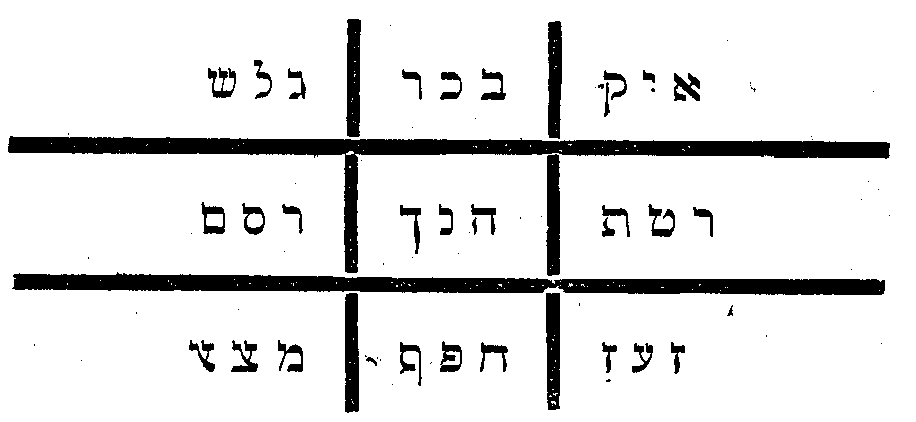
In each section three letters they place from right to left. When,
therefore, they intend the first of the three, they write the figure of
that section in which it is found, with one point ( ). If
another (or the next), the same figure with two points (
). If
another (or the next), the same figure with two points ( ). if
the third, the same again with three points (
). if
the third, the same again with three points ( ). and so on. But the
Cabbalistæ had also a simpler writing: "The sublime philosophy of those
who are called the Kabbala, embraces within itself different kinds to
which the following appertain. In their most famous magic pamphlet
Rasiel, which the Kabbalistæ hold in great respect, in the first
place three secret alphabets are read, which, in many things, are wanting
in the common form and syntax of usual Hebrew. The first is called
Scriptura cœlestis (the writing of heaven); the next, מלאכים or
מלכים, that is, of
angels or kings (angelorum sive regum); and the third the writing
of the crossing of the flood."[50] There are extant also, drawings
of these letters preserved by Hern. Corn. Agrippa, in his work "De
Occult. Phil. lib. iii. c. 30," the copying of which would be merely
matter of curiosity to no end.
). and so on. But the
Cabbalistæ had also a simpler writing: "The sublime philosophy of those
who are called the Kabbala, embraces within itself different kinds to
which the following appertain. In their most famous magic pamphlet
Rasiel, which the Kabbalistæ hold in great respect, in the first
place three secret alphabets are read, which, in many things, are wanting
in the common form and syntax of usual Hebrew. The first is called
Scriptura cœlestis (the writing of heaven); the next, מלאכים or
מלכים, that is, of
angels or kings (angelorum sive regum); and the third the writing
of the crossing of the flood."[50] There are extant also, drawings
of these letters preserved by Hern. Corn. Agrippa, in his work "De
Occult. Phil. lib. iii. c. 30," the copying of which would be merely
matter of curiosity to no end.
But Breithaupt goes much further, and refers to a book, "In
Œnigmatibus Judæorum Religiosissimis. Helmst. 1708, editio, p. 49,"
wherein he says,[51] that
Herm. Vonder Hardt, the most celebrated philologist of our age, remembers
two singular alphabets used by the Jews in preparing their amulets. The
first is when the next succeeding is substituted for
the preceding letter in every instance, as to wit: ב for א, ג for ב, and so forth. They are
said to have concealed in this manner their recognition of the one true
God, which they recite daily, early and toward evening, and as to which
they persuade themselves that it is the most efficacious safeguard
against idolatry, fortified wherewith they can not lapse from true to
false religion. The other secret alphabet consisted in this, that in
inversed order they change the last letter ת with the first א, and this and another in
turn, and so on through the rest, which inversion it is the custom to
call אתבש. From this they
produce, by such letters, in their more elaborate amulets, the noted
symbol מצפץ, which is nothing
else than the name of God, יהוה. St. Jerome,[52] a celebrated father of
the early church, contends that the prophet Jeremiah used this kind of
writing, and not to irritate the king of Babylon against the Hebrews, for
king, בבל, said ששך. But
some, also, among the Jews, declare that these words in Daniel,
which, at the supper of the King Belzhazzar miraculously appeared upon
the wall, to the astonishment of all, were written in this mode; and
hence think this artificial transposition of letters originated with God.
But these things are to be passed by as uncertain. If this last
be true, the handwriting on the wall would have appeared thus:
But according to the first system referred to, the following would
have been the appearance.[54]
 .
.
(See Conf. Jan. Hercvles de Svnde in Steganologia, lib. v., num. 4.,
p. 148. seqq.)
If the society of Kabbalistæ originated among the Israelites as early
as the time of Moses, their secret writings must having been only known
to him and few besides, with their successors. Solomon, to whom Almighty
God declared "wisdom and knowledge is granted unto thee,"[55] must have learned them; or, if it
originated with him, Daniel and Ezra, who lived in a succeeding age;
after the great temple had been destroyed, during the captivity, and at
the rebuilding of the second temple, both inspired servants of God,
equally knew them; and when the inscriptions on the wall, or on the ark,
or in the sacred rolls, were lost and unknown to the people, they were
easily deciphered by means of the knowledge of the Kabbalistic character,
no matter what its form. Thus when Daniel saw the handwriting on the wall
he read it at once, possessed as he may have been of the knowledge how to
read that cipher, while it can readily be seen why the Magi of Chaldea,
and of Media and Persia, were at fault. It was a secret writing of the
Hebrews, known only to the select few. Ezra, in the reign of Artaxerxes,
king of Persia, "was chief-priest. This Ezra went up from Babylon, and he
was a ready scribe in the law of Moses, which the Lord God of Israel had
given."[56] This was, then,
no new matter to him. The book of the law had been lost during the
captivity. Yet, at the rebuilding of the temple, Ezra was a ready scribe
in that lost writing. As such he went up from Babylon to Jerusalem.
The wisdom of God granted to Solomon, must have provided against the
foreseen loss of the sacred rolls, and determined a way for their
discovery, and the manner of reading them. The lost rolls were brought
forth by Ezra, and were read, notwithstanding the ignorance of their
ancient language. In what way, so consistent with reason, as by his
understanding the secret writing known only to the learned of that
race—the hidden scripture and instruction of a mysterious society,
whose only teaching was pure, in accordance with the divine commands of
the theocracy, and with the oriental manner of instruction in matters of
science and morality? Did this not furnish him a key to the original
text? The words of the one must have been recognised by their
original use in application to the reading of the other; and though the
language may have changed, the old cipher must have interpreted all. We
learn that, "after the second veil, the tabernacle, which is called the
holiest of all, which had the golden censer, and the ark of the covenant
overlaid round about with gold, wherein was the golden pot that had
manna, and Aaron's rod that budded, and the tables of the covenant," were
entered.[57]
The book (or rolls) of the law was commanded to be put within the
ark.[58] The end of laying
it there was, that it, as the original, might be reserved there as the
authentic copy, by which all others were to be corrected and set right.[59] Prideaux contends that,
the ark deposited in the second temple was only a representative of a
former ark on the great day of expiation, and to be a repository of the
Holy Scriptures, that is, of the original copy of that collection which
was made of them after the captivity, by Ezra and the men of the great
synagogue; for when this copy was perfected, it was then laid up in it.
And in imitation hereof, the Jews, in all their synagogues, have a like
ark or coffer,[60] of the
same size or form, in which they keep the Scriptures belonging to the
Synagogue; and whence they take it out with
great solemnity, whenever they use it, and return it with the like when
they have done with it. What became of the old ark, on the destruction of
the temple by Nebuchadnezzar, is a dispute among the Rabbins. The
Jews—and herein they are supported by the traditions of the most
ancient secret society on earth—contend that it was hid and
preserved, by Jeremiah, say some, out of the second book of Maccabees.[61] But most of them will
have it, that King Josiah, being foretold by Huldah, the prophetess, that
the temple would speedily, after his death, be destroyed, caused the ark
to be put in a vault under ground, which Solomon, foreseeing this
destruction, had caused of purpose to be built for the preserving of it.
And, for the proof hereof, they produce the text where Josiah commands
the Levites[62] to put the
holy ark in the house, "which Solomon, the son of David, king of Israel,
did build."[63] Whether
within or without the ark, or within a secret vault or not, Ezra, the scribe, brought forth the lost book or rolls
of the law, and established the rules for its future perpetuity, whether
by writing, or in oral explanation. And here, again, we note the use of
secrecy in matters of power. From him is derived the present method of
reading Hebrew, by what is usually known as the vowel points in the
Masoretic text. The Masorites were a set of men whose profession it was
to write out copies of the Hebrew Scriptures. And the present vowel
points were used by them, as derived from the secret writings of the
Cabbalists. The Jews believe that, when God gave to Moses the law in
Mount Sinai, he taught him first the true readings of it; and, secondly,
the true interpretation of it; and that both these were handed down, from
generation to generation, by oral tradition only, till at length the
readings were written by the accents and vowels, in like manner as the
interpretations were, by the Mishna and Gemara. The former they call
Masorah, which signifieth "tradition." The other is called Cabbala, which
signifieth "reception;" but both of them denote the same thing, that is,
a knowledge down from generation to generation, in the doing of which,
there being tradition on the one hand, and reception on the other, that
which relates to the readings of the Hebrew Scriptures hath its name from
the former, and that which relates to the interpretations of them from
the latter. As those who studied and taught the Cabbala were called the
Cabbalists, so those who studied and taught the Masorah were called the
Masorites. As the whole business of the Cabbalists and Masorites was the
study of the true reading of the Hebrew Scriptures, to preserve and teach
the proper text, they certainly are justly held the most likely to have
invented, or at least received and preserved these vowel points,
because the whole use of these points is to serve to this purpose.[64]
About this time, in the reign of Darius, otherwise Artaxerxes, who
sent Ezra and Nehemiah to Jerusalem to restore the state of the Jews,
first appeared in Persia the famous prophet of the Magi, whom the
Persians call Zerdusht, or Zaratush, and the Greeks Zoroastres: born of
mean and obscure parentage, with all the craft and enterprising boldness
of Mohammed, but much more knowledge. He was excellently skilled in all
the learning of the East that was in his time; whereas the other could
neither read nor write. He was thoroughly versed in the Jewish religion,
and in all the sacred writings of the Old Testament that were then
extant, which makes it most likely that he was, in his origin, a Jew. It
is generally said of him, that he had been a servant to one of the
prophets of Israel, and that it was by this means that he came to be so
well skilled in the Holy Scriptures, and all other Jewish knowledge. From
the collation of authorities made by Dr. Prideaux,[65] it would seem that it was Daniel under
whom he served; besides whom there was not any other master in those
times, under whom he could acquire all that knowledge, both in things
sacred and profane, which he was so well furnished with. He founded no
new religion, but only reformed the old one. He
found that the eminent of the Magi usurped the sovereignty after the
death of Cambyses. But they were destroyed, and by the slaughter which
was then made of all the chief men among them, it sunk so low, that it
became almost extinct, and Sabianism everywhere prevailed against it,
Darius and most of his followers on that occasion going over to it. But
the affection which the people had for the religion of their forefathers,
and which they had all been brought up in, not being easily to be rooted
out, Zoroastres saw that the revival of this was the best game of
imposture that he could then play; and having so good an old stock to
engraft upon, he with greater ease made his new scions grow. He first
made his appearance in Media, now called Aderbijan, in the city of Xix,
say some; in that of Ecbatana, now Tauris, say others. The chief
reformation which he made in the Magian religion was in the first
principles of it: for whereas before they had held the being of TWO FIRST CAUSES, the first light, or the good God,
who was the author of all good; and the other darkness, or the evil god,
who was the author of all evil; and that of the mixture of these two, as
they were in a continual struggle with each other, all things were made;
he introduced a principle superior to them both, one
Supreme God, who created both light and darkness, and out of these
two, according to the alone pleasure of his own will, made all things
else that are, according to what is said:[66] "I am the Lord, and there is none else,
there is no God besides me: I girded thee, though thou hast not known me:
that they may know from the rising of the sun, and from the west, that
there is none besides me. I am the Lord, and there is none else. I form
the light, and create darkness: I make peace, and create evil: I the Lord
do all these things." These words, directed to Cyrus, king of Persia,
must be understood as spoken in reference to the Persian sect of the
Magians, who then held light and darkness, or good and evil, to be the
supreme beings, without acknowledging the great God who is superior to
both. To avoid making God the author of evil, Zoroaster's doctrine was,
that God originally and directly created only light or good, and that
darkness, or evil, followed it by consequence, as the shadow doth the
person; that light or good had only a real production from God, and the
other afterward resulted from it as the defect thereof. In sum, his
doctrine as to this particular was, that there was one Supreme Being,
independent and self-existent from all eternity. That under him were two
angels, one the angel of light, who is the author and director of all
good; and the other the angel of darkness, who is the author and director
of all evil; and that these two, out of the mixture of light and
darkness, made all things that are; that they are in a perpetual struggle
with each other; and that when the angel of light prevails, then the most
is
good, and when the angel of darkness prevails, then the most is evil;
that this struggle shall continue to the end of the world; that then
there shall be a general resurrection, and a day of judgment, wherein
just retribution shall be rendered to all according to their works,
&c. And all this the remainder of that sect, which is now in
Persia and India do, without any variation, after so many ages still
hold, even to this day. Another reformation which he made in the Magian
religion was, that he caused fire temples to be built wherever he came:
this being to prevent their sacred fires, on the tops of hills, from
being put out by storms, and that the public offices of their religion
might be the better performed before the people. Zoroaster pretended he
was taken up into heaven, there to be instructed in those doctrines which
he was to deliver unto men. Mohammed pretended to have seen God.
Zoroaster was too well informed for such imposture. He only claimed to
have heard him speaking to him out of the midst of a great and most
bright flame of fire; and he, therefore, taught his followers that fire
was the truest shechinah of the divine presence. His followers
thereafter worshipped the sun as the most perfect fire of God. But this
was an original usage of the Magi (referred to in Ezekiel viii. 16),
where it is related, that the prophet being carried in a vision to
Jerusalem, had there shown him "about five-and-twenty men standing
between the porch and the altar, with their backs toward the
temple of the Lord, and their faces toward the east; and they worshipped
the sun." The meaning of which is, that they had turned their backs upon
the true worship of God, and had gone over to that of the Magians.[67] The Kebla, or
point of the heavens toward which they directed their worship being
toward the rising sun, that of the Jews in Jerusalem to the Holy of
Holies on the west end of the temple; of those elsewhere toward
Jerusalem; of the Mohammedans toward Mecca, and the Sabians toward the
meridian.
Come whence it may, what is the meaning of the use of fire in any
divine worship?
1. Burnt-offerings of old required it.
2. It descended on the altars of Elijah, and of Solomon, from God
himself.
3. The Magi, from the time of Zoroaster, have deemed it the symbol of
purity.
4. The pagan mysteries in Egypt, Greece, and Rome, all preserved the
"sacred fire." Most religions seem to have adopted its use. Why?
5. The Catholic church has ever preserved its use in burning tapers,
lamps, and smoking incense.
In his reformation of the customs and rites of the Magi, Zoroaster, as
has been hereinbefore said, preserved their three grades of Apprentices, Masters, and Perfect
Masters.[68] The
first were the inferior clergy, who served in all the common offices of
their divine worship; next above them were the
superintendents, who in their several districts governed the inferior
clergy, as bishops do with us; and above all was the perfect-master, the
archimagus, who was the head of the whole religion. Accordingly their
places of worship were of three sorts. The lowest sort were parochial
oratories served by the inferior clergy, where they read the daily
offices out of their liturgy, and on solemn occasions read part of their
sacred writings to the people. In these churches there were no fire
altars; but the small scintilla of sacred fire preserved in them, was
kept only in a lamp. Next above these were their fire temples, in which
fire was continually burning on a sacred altar. The highest church of all
was "the fire-temple," the residence of the archimagus, first
established by Zoroaster at Balch, but removed in the seventh century to
Kerman, a province in Persia on the southern ocean. To gain the better
reputation to his pretensions, Zoroaster first retired to a cave, and
there lived a long time as a recluse, pretending to be abstracted from
all earthly considerations, and to be given wholly to prayer and divine
meditations; and the more to amuse the people who there resorted to him,
he dressed up his cave with several mystical figures, representing
Mithra, and other mysteries of their religion. In this cave he wrote his
book, called Zendavesta, or Zend, meaning "fire-kindler," or
"tinder-box." This book contains much borrowed from the Old Testament.
He even called it the book of Abraham, and his religion the religion of
Abraham; for he pretended that the reformation which he introduced was no
more than to bring back the religion of the Persians to that original
purity in which Abraham practised it, by purging it of all those defects,
abuses, and innovations, which the corruptions of after-times had
introduced into it.[69]
Is it not singular that all the nations of the earth still trace their
teaching in pure religion to Abraham, whether under the name of Brahma,
or otherwise?
These ancient Magi were great mathematicians, philosophers, and
divines of the ages in which they lived, and had no other knowledge but
what by their own study, and the instructions of the ancients of their
sect they had improved themselves in. All of the Magi were not thus
learned, only those of the higher order. The priesthood, like the Jewish,
was communicated only from father to son, except to the royal family,[70] whom they were bound to
instruct, the better to fit them for government. Whether it were that
these Magians thought it would bring the greater credit to them, or the
kings, that it would add a greater sacredness to their persons, or from
both these causes, the royal family of Persia, so long as the Magi
prevailed among them, was always reckoned of the sacerdotal
tribe.[71] The kings of
Persia were looked on to be of that sacerdotal order, and were always
initiated into the sacred rites of the Magians, before they took on them
the crown, or were inaugurated into the kingdom.[72]
Pythagoras next assumed, in the west, the most
prominent place for learning. He was the scholar of Zoroaster at Babylon,
and learned of him most of that knowledge which afterward rendered him so
famous. So saith Apulcius (Floridorum secundo), and so say Jamblichus (in
vita Pythag. c. 4), Porphyry (Ibid. p. 185. edit. Cant.), and Clemens
Alexandrinus (Stromata i. p. 223) for the Zabratus or Zaratus of
Porphyry, and the Na-Zaratus of Clemens, were none other than this
Zoroaster; and they relate the matter thus: that when Cambyses conquered
Egypt he found Pythagoras there on his travels, for the improvement of
himself in the learning of that country; that, having taken him prisoner,
he sent him, with other captives, to Babylon, where Zoroaster (or
Zabratus, as Porphyry calls him) then lived; and that he there became his
disciple, and learned many things of him in the eastern learning. There
may be error as to date, but that Pythagoras was at Babylon, and learned
there a great part of that knowledge which he was afterward so famous
for, is agreed by all. His stay there, Jamblichus tells us,
was twelve years; and that, in his converse with the Magians, he learned
from them arithmetic, music, the knowledge of divine things, and the
sacred mysteries pertaining thereto. But the most important doctrine
which he brought home thence, was that of the immortality of the soul;
for it was generally agreed among the ancients (Porphysius in vita
Pythagoræ p. 188, edit., Cant. Jamblichus in vita Pyth. c. 30), that he
was the first of all the Greeks that taught it. Prideaux says he takes
this for certain, that Pythagoras had this from Zoroaster, for it was his
doctrine, and he is the earliest heathen on record who taught it.[73] But Pythagoras seems to
have combined the notions he then received with those of the Egyptian
Magi; for he taught immortality to consist in constant transmigration
from one body to another. The Egyptian Magi claimed to be judges of the
dead,[74] and taught this
doctrine. Zoroaster taught a resurrection from the dead, and an immortal
state as we understand it. And it is probable Pythagoras adopted this
notion after he fled from Samos to Egypt to escape from the government of
Polycrates.
Be this as it may, he was a master-spirit in a secret society with its
lodges spread through Magna Græcia, originating in one he established at
Crotona in Lower Italy. Like that of the Cabbalists, this society had no
connection whatever with the dominant religion. The Kabbalistæ taught
virtue and science, and thus were, perhaps, an auxiliary, but certainly
no opponent to the sacred teachings of the holy law. The Pythagorean
league taught philosophy alone; full instruction was given in the liberal
arts and sciences in accordance with the learning of that age. But, after
it was thought destroyed (and it was suppressed by Cylon and his faction,
about the year 500 B.C.), it still exercised a great influence over all
Greece, in such manner as that Heeren speaks of it as a phenomenon which
is in many respects without a parallel. The grand object of the moral
reform of Pythagoras was SELF-GOVERNMENT. By
his dignity, moral purity, dress, and eloquence, he excited not only
attention but enthusiasm. In that day an aristocracy prevailed in Magna
Græcia, based chiefly on the corrupting tendencies of wealth and luxury.
Against this class a popular movement commenced, by the influence whereof
Sybaris was destroyed, and thereupon five hundred nobles fled for safety
to Crotona, and prayed for protection from that city, which they obtained
principally by the advice of Pythagoras. (Diod. Sic. xii. p. 77. Wechel.)
Aristocratic evils he abrogated. A friend of the people, he recognised
their equal rights: and it would seem that, while he adopted grades in
knowledge and moral worth, he considered mankind on "a level" so far as
all political power was concerned. To accomplish this end, he prescribed
in his own society, and their affiliated lodges, or meetings, a
certain manner of life, distinguished by a most cleanly but not luxurious
clothing, a regular diet, a methodical division of time, part of which
was to be appropriated to one's self, and part to the state. Heeren
remarks, that when a secret society pursues political ends, it naturally
follows that an opposing party increases in the same degree in which the
preponderating influence of such a society becomes more felt. In this
case, the opposition existed already in the popular party. It therefore
only needed a daring leader, like Cylon, to scatter the society by
violence; the assembly was surprised, and most of them cut down, while a
few only, with their master, escaped. They are said, so far as their
political views were concerned, to have regarded anarchy as the greatest
evil, because man can not exist without social order. They held that
everything depended on the relation between the governing and the
governed; that the former should be not only prudent but mild; and that
the latter should not only obey, but love their magistrates; that it was
necessary to grow accustomed, even in boyhood, to regard order and
harmony as beautiful and useful, disorder and confusion as hateful and
injurious. They were not blindly attached to a single form of government,
but insisted that there should be no unlawful tyranny. Where a regal
government existed, kings should be subject to the laws, and act only as the chief
magistrates. They regarded a mixed constitution as the best, and where
the administration rested principally in the hands of the upper class,
they reserved a share of it for the people. The writings of the
Pythagoreans commanded high prices, but gained political importance only
so far as they contributed to the education of distinguished men, of whom
Epaminondas was one.[75]
Another scion of these methods of secret instruction, wherein,
however, religion was the engine of political power, came from the
ancient Assyrian stock with Phœnician emigration to Great Britain.
The Druids controlled the learning of that
country in religion as in science; and by their mysteries exerted an
overwhelming influence upon the rulers and the masses.
Dr. Parsons[76] says,
what were the filids, and bards, and the Druids, but professors of the
sciences among the Gomerians, and Magogians or Scythians, and it is plain
that, from Phenius downward, there were always, in every established
kingdom among the Scythians, philosophers and wise men, who, at certain
times, visited the Greek sages, after they had found their schools? It is
no easy matter to point out the first rise and ages of the Druids. They
taught the same opinions of the renovated state of the earth, and of
souls, with the Magi. According to Cæsar, in his time these Druids
instructed their youth in the nature and motion of the stars, in the
theory of the earth, its magnitude, and of the world, and in the power of
the immortal gods. On the continent of Europe, he says, the Druids grew
into such power and ascendency over the minds of the people, that even
the kings themselves paid an implicit slavish obedience to their
dictates; insomuch, that their armies were brave in battle, or abject
enough to decline even the most advantageous prospects of success,
according to the arbitrary prognostics of this set of religious tyrants;
and their decisions became at last peremptory in civil, as well as in the
affairs of religion. One of the kings of Ireland, the learned Carmac
o' Quin, great in law and philosophy, who was not afraid to inveigh
openly against the corruptions and superstition of the Druids, and
maintained, in his disputations against them, that the original theology
consisted in the worship of one omnipotent, eternal Being, that created
all things; that this was the true religion of their ancestors; and that
the numerous gods of the Druids were only absurdity and
superstition—proved fatal to him. For, as this society saw an
impending danger of their dissolution, they formed a deep conspiracy
against him, and he was murdered. The Druids on the continent never
committed their mysteries to writing, but taught their pupils
memoriter. The Irish and Scotch Druids wrote theirs, but in secret
character. These were well understood by the learned men who were in
great numbers, and had not only genius but an ardent inclination to
make researches into science. St. Patrick, then, with the general consent
and applause of the learned of that day, committed to the flames almost
two hundred tracts of their pagan mysteries.[77] And with his day ended the last of
druidical superstition. The Druids preserved the mistletoe evergreen as
an emblem of nature's fructifying energy, and of immortality.
The Thugs, Assassins, Phanzigars, or by what other name they may be
known, were no society for the development of philosophy or religion;
and, although they began about this time, are unworthy of farther
mention. Their mysteries, if any, were only those of the highway robber,
murderer, or other violater of God's law. Their only secrecy was the
concealment of their crime.
The Discipline of the Secret in the Origin of the Christian
Church.—The Inquisition.—The Mystics.—The rise of
Monachism.—The Mendicant Orders.—The Order of
Knighthood.—The Jesuits, their Organization, and History.—The
Rosicrucians, &c.
But next appeared upon the stage of human life, our Lord and Saviour,
Jesus Christ; "The sun of Righteousness, rising
with healing on his wings:" that LIGHT of this
world, which was to draw all men unto him, at the mention of whose name
"every knee should bow, of things in heaven, and things in earth, and
things under the earth."[78]
His lessons to man were all oral. The church he established received
none but traditional instruction. The gospels of his life were written
more than half a century after the crucifixion. The apostles,
commissioned to go forth and preach the Gospel, held their meetings in
upper chambers, and in secrecy, and part of their manner of teaching, if
not all, was founded upon the still-prevailing systems of the Kabbalistæ
and philosophers. There were grades observed in the orders of ministry.
The diaconate, the presbyter, priest or elder, and the επισκοπος or bishop. So there were three
grades of the laity—catechumens, (not yet baptized,) baptized
persons, and "the faithful." The policy of the apostles (who, when they
were taught to be harmless, were to be wise) adapted itself to the then
existing state of affairs. It was not only for fear of the Jews, as at
first, that they adopted the method of instruction in secret, and which
is to this day recognised by the catholic church as the then
disciplina arcani, or "discipline of the secret;" but they kept it
up even during the times of persecution, down to the time of St.
Augustin. When our Saviour was insulted by the scribes and Pharisees,
saying, "why do thy disciples transgress the tradition of the elders?"
&c. He said to them, "why do ye also transgress the commandment of
God by your tradition?"[79]
Still more did he rebuke them, when they asked him, "why walk not thy
disciples according to the traditions of the elders, but eat bread with
unwashen hands?" In his answer, he replied, "laying aside the commandment
of God, ye hold the tradition of men, as the washing of pots and cups,
&c., &c. And he said unto them, Full well ye reject the
commandment of God, that ye may keep your own tradition."[80] St. Paul afterward, well knowing the
then systems of philosophy, and their then traditional instruction, wrote
to them at Philippi,[81]
"Beware lest any man spoil you through philosophy and vain
deceit after the tradition of men, after the rudiments (or elements) of
this world, and not after Christ." Then St. Paul, guarding the early
Christians so carefully, writes to the faithful in Thessaly, "Now we
command you, brethren, in the name of our Lord Jesus Christ, that ye
withdraw yourselves from every brother that walketh disorderly, and not
after the tradition which ye have received of us,"[82] &c. When St. Paul preached on the
first day of the week when the disciples came together to break bread, it
was in an upper chamber where they were gathered together.[83] At an earlier date, the
first day of the week after the crucifixion, in the evening, "when the
doors were shut where the disciples were assembled, for fear of the Jews,
came Jesus, and stood in the midst," &c.[84] When Pliny was proconsul in Judea, such
charges were made against the Christians on account of their secrecy, as
caused severe persecution, not for matters of religion, but for supposed
cannibalism. He writes to Trajan, that he took all pains to inform
himself as to the character of the Christian sect. To do this he
questioned such as had for many years been separated from the Christian
community, but though apostates rarely speak well of the society to which
they formerly belonged, he could find out nothing. He then applied
torture to two female-slaves, deaconesses, to extort from them the truth.
After all, he could learn only that the Christians were in the
habit of meeting together on a certain day; that they then united in a
hymn of praise to their God, Christ; and that they bound one
another—not to commit crimes, but to refrain from theft, from
adultery, to be faithful in performing their promises, to withhold from
none the property intrusted to their keeping; and then separated and
afterward assembled at a simple and innocent meal.[85]
Evidently, the Christian mysteries were preserved secret from the
Romans as from the Jews, or such crime could never have been imputed to
them. Alluding to the secret traditional instruction prevalent in Judea
and adopted by the early church, St. Augustin writes, "You have heard the
great mystery. Ask a man, 'Are you a Christian?' He answers you, 'I am
not.' 'Perhaps you are a pagan, or a Jew?' But if he has answered 'I am
not;' then put this question to him, 'Are you a catechumen, or one of the
faith?' If he shall answer you, 'I am a catechumen;' he is anointed but
not yet baptized. But, whence anointed? ask him. And he replies. Ask of
him in whom he believes. From the fact that he is a catechumen, he says,
in Christ."
This is the third lecture of St. Augustin on the ninth chapter of St.
John's gospel, where our Saviour is portrayed as healing the blind man,
by mixing earth with spittle and anointing his eyes therewith. And St.
Augustin adds, "Why have I spoken of spittle and of mud?
Because the word is made flesh; this the catechumens hear; but it is not
sufficient for them as to what they were anointed; let them hasten to the
font, if they desire light."[86]
But still further to mark the distinction between these grades of
Christian secret instruction, St. Augustin, in the eleventh tract on the
Gospel of St. John, treating of the conversation between Nicodemus and
our Saviour, as to regeneration, says, "If, therefore, Nicodemus was of
the multitude who believed in his name, now in that Nicodemus we
comprehend why Jesus did not trust them. Jesus answered and said to him,
'Verily, verily I say unto you, unless any one shall have been born
again, he can not see the kingdom of God.' Jesus placed faith, therefore,
in those who were born again. Lo! they believed in him, and Jesus did not
trust in them. Such are all catechumens: they now believe in the name of
Christ, but Jesus does not confide in them. Let your love comprehend and
understand this. If we say to a catechumen, 'Do you believe in Christ?'
He answers, 'I do,' and signs himself with Christ's
cross: he bears it on his forehead, and blushes not at his Lord's cross.
Lo! he believes in his name. Let us ask him, 'Do you eat the flesh of the
son of man, and drink his blood?' He knows not what we say, because Jesus
has not trusted him."[87]
Now we are told in Holy Writ in reference to this matter. St. Paul,
alluding to this secret traditional instruction in the several degrees of
Christian learning, says to those advanced to a higher or more perfect
degree: "and I, brethren, could not speak unto you as unto spiritual, but
as unto carnal, even as to babes in Christ. I have fed you with milk, and
not with meat: for hitherto ye were not able to bear it, neither yet now
are ye able."[88] Even
their first lessons in the great mystery were imperfect. Other and
further instruction was to complete it. So also St. Peter saith in his
general letter, "Wherefore laying aside all malice and all guile and
hypocrisies and envies and all evil speakings, as new-born babes,
desire the sincere milk of the word that ye may grow thereby."[89] And again, St. Paul
saith,[90] "For when for
the time ye ought to be teachers, ye have need that one teach you again
which be the first principles of the oracles of God; and are become such
as have need of milk, and not of strong meat. For every one that useth
milk is unskilful in the word of righteousness: for he is a babe. But
strong meat belongeth to them that are of full age, even those who by
reason of use" (habit, or perfection) "have their senses exercised
to discern both good and evil. Therefore leaving the principles" (the
word of the beginning of Christ) "of the doctrine of Christ, let us go on
to perfection,"[91] &c.
We need not here refer to the wonderful spread of Christianity. We learn
a plain and simple lesson taught by Jesus, as to the administration of
his church. "These twelve Jesus sent forth, and commanded them, saying,
Go not into the way of the Gentiles," &c. "Heal the sick, cleanse the
lepers, raise the dead, cast out devils: freely have ye received, freely
give. Provide neither gold, nor silver, nor brass, in your purses: nor
scrip for your journey, neither two coats, neither shoes, nor yet a
staff; for the workman is worthy of his meat."[92] When questioned before Pilate, he
declared, "My kingdom is not of this world."[93] Whether the successors of the apostles have
or not, since that day, established a kingdom of this world, is not for
us here to discuss. Whether those that claim such succession obey the
precept quoted, or not, we do not interfere with.
To insure unity in the church throughout the world, prudence would
suggest that there should be some place, free from the control of worldly
politics, whence its teachings should issue, and its counsels be heard.
In its infancy the Christian church suffered bitterly from persecution.
The faithful everywhere received a crown of martyrdom. When earthly
terrors interposed, the blood of the martyrs proved the seed of the
church.
It is for us, however, to trace in history the secret teachings of
those who have claimed its highest authority in any denomination, and if
we do not reach their private counsels, their acts proclaim them.
Has, or not, each Christian church been tempted by worldly power,
wealth, and honor, like all other systems of religion?
Have there existed within their jurisdiction, confraternities, with
secular power, directly or indirectly under their control, seeking by
secret measures to manage the government of the nations of this
earth?
That great Creator, whose word is truth which can not change, declared
as law to govern all his creatures, "Thou shalt not
kill." What saith history of those who claim to have acted in his
name? Why, and in what manner did they act?
The south of France in the twelfth and thirteenth centuries became a
scene of blood, the immediate cause of which was the erections of the
"tribunals of faith," better known to us as a secret society called
"The Inquisition." Innocent III., who ascended
the papal chair in 1198, conceived the project thereof, to extirpate the
rebellious members of the church—the Albigenses—and to extend
the papal power at the expense of the bishops: and his successors carried
out his plan. This tribunal, "the holy office" or "inquisition"
(sanctum officium), was under the immediate direction of the papal chair:
it was to seek out heretics and adherents of false doctrines, and to
pronounce its dreadful sentence against their fortune, their honor, and
their lives, without appeal. The process of this tribunal differed
entirely from that of the civil courts. The informer was not only
concealed, but rewarded by the inquisition. The accused was obliged to be
his own accuser. Suspected persons were secretly seized and thrown into
prison. No better instruments could be found for inquisitors than the
mendicant orders of monks, particularly the Franciscans and Dominicans,
whom the pope employed to destroy the heretics, and inquire into the
conduct of bishops. Pope Gregory IX., in 1233, completed the design of
his predecessors, and, as they had succeeded in giving these
inquisitorial monks, who were wholly dependent on the pope, an unlimited
power, and in rendering the interference of the temporal
magistrates only nominal, the inquisition was successively introduced
into several parts of Italy, and into some provinces of France; its power
in the latter country being more limited than in the former. The
tribunals of faith were admitted into Spain in the middle of the
thirteenth century, but a firm opposition was made to them, particularly
in Castile and Leon, and the bishops there maintained their exclusive
jurisdiction in spiritual matters. For a time this power waned, when,
afterward in the fifteenth century, it assumed an aspect truly alarming.
Three religions then prevailed in Spain: Christians, Jews, and
Mahommedans. The power of the nobles was a bar, at the same time, to the
absolute power of Ferdinand and Isabella. But this engine of religious
tyranny accomplished their ends, and became the most powerful instrument
of their policy. Owing to the fanatical preaching of Fernando Nuñez, who
taught the persecution of the Jews to be a good work, popular tumults
prevailed, in which this people was plundered, robbed, and murdered.
Cardinal Mendoza, at Seville, in 1477, condemned and punished many who
persevered in opposition to the doctrines of his faith.
Mendoza recommended the establishment of the inquisition to Ferdinand
and Isabella. Dependent entirely upon the court, what better engine could
they use to render their power absolute, by confiscation of estates to
fill their treasury, and to limit the power of the nobles and
superior clergy? In the assembly of the estates, therefore, held at
Toledo, 1480, in spite of all opposition, it was determined to establish
a tribunal, under the name of the general inquisition (general
inquisicion suprema). This was opened in Seville, 1481. Thomas de
Torquenada, prior of the Dominican convent at Segovia, father-confessor
to Mendoza, had been appointed first grand inquisitor by the king and
queen, in 1478. The peaceful teachings of the meek and lowly Jesus do not
seem to have had much influence on this political Boanerges. He had two
hundred familiars, and a guard of fifty horsemen, but he lived in
continual fear of poison. The Dominican monastery at Seville soon became
insufficient to contain the numerous prisoners, and the king removed the
court to the castle in the suburb of Triana. At the first auto da
fè (act of faith), seven apostate Christians were burnt, and the
number of penitents was much greater. Spanish writers relate that above
seventeen thousand were given up to the inquisition. More than two
thousand were condemned to the flames the first year, and great numbers
fled to neighboring countries. The then pope, Sixtus IV., opposed the
establishment of this court, as being the conversion of an ecclesiastical
into a secular tribunal: but he was compelled to submit to circumstances,
and actually promulgated a bull subjecting Aragon, Valencia, and Sicily,
the hereditary dominions of Ferdinand, to the inquisitor-general of
Castile. The introduction of the new tribunal was attended with risings
and oppositions in many places, excited by the cruelty of the
inquisitors, and encouraged, perhaps, by the jealousy of the bishops.
Saragossa and other places refused admission to the inquisitors, many of
whom lost their lives; but the people were obliged to yield in the
contest; and the kings not only became the absolute judges in matters
of faith, but the honor, property, and life of every subject were in
their hands. The political importance of this institution may be
estimated by the following statement. In every community, the grand
inquisitor must fix a period, from thirty to forty days, within which
time heretics, and those who have lapsed from the faith, shall deliver
themselves up to the inquisition. Penitent heretics and apostates,
although pardoned, could hold no public office, nor become lessees,
lawyers, physicians, apothecaries, or grocers; nor wear gold, silver, or
precious stones; nor ride; nor carry arms; during their whole life, under
a penalty of being declared guilty of a relapse into heresy: and they
were obliged to give up a part of their property for the support of the
war against the Moors. Those who did not surrender themselves within the
time fixed were deprived of their property irrevocably. The absent, also,
and those who had been long dead, could be condemned, provided there was
sufficient evidence against them. The bones of those who were condemned
after death were dug up, and the property which they had left
escheated to the king.
At first the jurisdiction of the inquisition was not accurately
defined; but it was regularly organized by the ordinance of 1484,
establishing branches in the different provinces of Spain, under the
direction of the inquisitor-general. The inquisitor-general presided,
with aid of six or seven counsellers nominated by the king; and his
officers were a fiscal (or quasi prosecuting attorney), two secretaries,
a receiver, two relators, a secuestrador (or escheator), and officials.
In an ordinance of 1732, it was made the duty of all believers, to inform
the inquisition, if they knew any one, living or dead, present or absent,
who had wandered from the faith, who did observe, or had observed the
laws of Moses, or even spoken favorably of them: if they knew any one who
followed, or had followed the doctrines of Luther; any one who had
concluded an alliance with the devil, either expressly or virtually; any
one who possessed any heretical book, or the Koran, or the Bible in the
Spanish tongue; or, in fine, if they knew any one who had harbored,
received, or favored heretics. If the accused did not appear at the third
summons he was excommunicated. From the moment that the prisoner was in
the power of the court he was cut off from the world. Then followed
tortures, solitary confinement, and death in flames, with every attendant
of abject humiliation, while his name, with that of his children and
grand-children, was officially declared infamous. Napoleon crushed this
monstrous iniquity December 4, 1808. According to the estimate of
Llorente, the number of victims of the Spanish inquisition, from 1481 to
1808, amounted to 341,021 persons.
In Portugal the inquisition was established in 1557. Whence they also
carried a branch of it to Goa, in the East Indies; in like manner as the
Spaniards established one in America.[94]
From the earlier days, however, of the Christian religion we find a
select few known as the MYSTICS, steadily
pursuing a peaceful course in the investigation of truth. Of them it is
said, that they exercised a powerful influence both upon life and
literature: and, although the inculcation of meekness and
self-humiliation paralyzed active exertion, and a life devoted to
emotions and sentiments occasionally produced fanaticism, yet this
influence, especially in the middle ages was highly beneficial. John
Tauler, of Strasbourg, Henry Suss, of Constance, and Thomas à Kempis,
were active mystics, and eminent among their fraternity which was called
"the brethren of the common life." Theirs was a religion of feeling,
poetry, and imagination, in contrast with philosophical rules and forms
of reasoning, as taught by the school-men. They excused their fanaticism,
by appealing to the words of St. Paul: "The spirit prays in us
by sighs and groans that are unutterable." Now, if the spirit, say they,
prays in us, we must resign ourselves to its motions, and be swayed and
guided by its impulse, by remaining in mere inaction. Hence, passive
contemplation they considered the highest state of perfection. The number
of the mystics increased in the fourth century under the influence of the
Grecian fanatic, who gave himself out as Dionysius, the Areopagite, a
disciple of St. Paul, and probably lived about this period; and by
pretending to higher degrees of perfection than other Christians, and
practising greater austerities, their cause gained ground, especially in
the eastern provinces in the fifth century. A copy of the pretended works
of Dionysius, was sent by Balbus to Louis the Meek, in the year 824,
which kindled the flame of mysticism in the western provinces, and filled
the Latins with the most enthusiastic admiration of this new religion. In
the twelfth century these mystics took the lead in their method of
expounding Scripture; and by searching for mysteries and hidden meanings
in the plainest expressions, forced the word of God into a conformity
with their visionary doctrines, their enthusiastic feelings, and the
system of discipline which they had drawn from the excursion of their
irregular fancies. In the thirteenth century they were the most
formidable antagonists of the schoolmen, and toward the close of the
fourteenth many of them resided and propagated their tenets in almost every
part of Europe. In the fifteenth century they had many persons of
distinguished merit in their number; and in the sixteenth, previously to
the Reformation, it is said that the only true sparks of real piety were
to be found among them.[95]
Let us, then, examine the rise of confraternities attached to, and of,
the Christian church, yet not necessarily more than its other laity
entitled to authority which they afterward usurped.
Monachism took its rise in the East, where a solitary and
contemplative life, devoted to the consideration of divine subjects, had
always been considered more meritorious than active exertion. This
calling was gradually adopted by so many, that at the end of the third
century, the Egyptian Antonius, who had cast away his vast possessions,
and chosen the desert for his residence, collected together the hitherto
dispersed anchorites (monachi) into fenced places (monasteria, cænobia,
claustra, cloisters), that they might live together in fellowship; and
his disciple, Pachomius, soon gave the brotherhood a rule. Monachism soon
extended to the west. In the sixth century, Benedict, of Nursia,
established the first monastery on Mount Casius, in Lower Italy, and
became, by this means, the founder of the widely-spread order of
Benedictines, which rapidly extended itself among all nations, and built
many convents. These monasteries, erected, for the most part, in beautiful and remote situations, and the
inhabitants of which were obliged to take the three vows of chastity
(celibacy), personal poverty, and obedience, proved in those days of
lawlessness and barbarism, a blessing to mankind. They converted heaths
and forests into flourishing farms. They afforded a place of refuge
(asylum) to the persecuted and oppressed. They ennobled the rude minds of
men by the preaching of the Gospel. They planted the seeds of morality
and civilization in the bosoms of the young by their schools for
education. And they preserved the remains of ancient literature and
philosophy from utter destruction. Many of the Benedictine monasteries
were the nurseries of education, the arts, and the sciences, as St.
Gallen, Fulda, Reichenau, and Corvey (in Westphalia), and many others.
When the Benedictine order became relaxed, the monastery in Clugny, in
Burgundy, separated itself from them in the tenth century, and introduced
a more rigid discipline. In the twelfth century the monks of Clugny
numbered upward of two thousand cloisters. But this order, also, soon
proved insufficient to satisfy the strong demands of the middle age,
against the allurements of sin, and the seductions of the flesh; so that,
at the end of the eleventh century, the Cistercians, and, a few decades
later, the Premonstrants sprang up: the former in Burgundy (Citeaux), the
latter in a woody country near Laon (Premontré). The order of
Carthusians, founded about the year 1084, which commenced
with a cloister of anchorites (Carthusia, Chartreuse) in a rugged valley
near Grenoble, was the most austere in its practice. A life of solitude
and silence in a cell, a spare and meagre diet, a penitential garment of
hair, flagellations, and the rigid practices of devotional exercises,
were duties imposed upon every member of this fraternity.
They deserve, at our hands, the full benefit of an honest and severe
Christian effort to find out and nurture truth; so long as government and
political power did not control them. History next tells us of the
so-called "MENDICANT ORDERS." They originated
in the thirteenth century, and this establishment was productive of
remarkable results. Francis of Assisi (A.D.
1226), the son of a rich merchant, renounced all his possessions, clothed
himself in rags, and wandered through the world, begging, and preaching
repentance. His fiery zeal procured him disciples, who, like himself,
renounced their worldly possessions, fasted, prayed, tore their backs
with scourges, and supplied their slender wants from voluntary alms and
donations. The order of Franciscans then spread rapidly through all
countries. About the same time arose the order of Dominicans, or
preaching monks, founded by an illustrious and learned Spaniard,
Dominicus. Their chief objects were the maintenance of the predominant
faith in its considered purity, and the extinction of heretical opinions.
In carrying these out, they became endowed with
the greatest worldly and temporal privileges, received the powerful
patronage of the pope, gradually obtained the chairs in the universities,
and took the lead in the murder of their fellow creatures through the
inquisition. What a temptation to brawling mendicants, too lazy to earn a
living, authorized to beg, and the supple tools of political leaders; and
all this by a mysterious society, under the guise and pretence of the
Christian religion! Laic tools for such clerical workmen!
While, from the mystics of that date, valuable works have been
preserved, what has been left us from these mendicant orders? Anything
save the cry of blood from the earth? Aught else than servile obedience
in accomplishing the mandates of those in power?
In the eleventh century, the crusades had given rise to a singular
class of men, half-military, half-monk. They had their secret means of
recognition, a peculiar garb, and a professed object. Religion was the
motive cause, while science and philosophy seem to have been secondary
with them. They were knights, of three orders, viz.: the Knights of St.
John, or Hospitallers; the Templars; and the Teutonic Knights. The
Knights of St. John are known equally by the name of the Knights of
Malta, because, in 1530, Charles V. granted them the islands of Malta,
Gozzo, and Comino, on condition of perpetual war against the infidels and
pirates, and the restoration of these islands to Naples, if the order
should succeed in recovering Rhodes. The chief of this order had immense
possessions in most parts of Europe. Their chief was called Grand
Master of the Holy Hospital of St. John of Jerusalem, and Guardian
of the Army of Jesus Christ. He was chosen by vote, and lived at La
Villette in Malta. Foreign powers addressed him as Altezza
eminentissima. His income equalled a million of guilders annually.
This order still exists. Originally the affairs of the order were
exercised by "THE CHAPTER," which consisted of
eight balliages (ballivi conventuali), of the different languages
of which the knights of the order consisted, that is, Provence, Auvergne,
France, Italy, Aragon, Germany, Castile, and England. The lands of these
ballivi conventuali of languages were divided into three classes,
priories, balliages, and commanderies. Of the priories the German had the
preference, and was called the Grand Priory.
This confraternity were free-masons. And their organization was framed
accordingly. Such was their kindness and benevolence to a wandering and
unprotected pilgrim, that when afterward accosted on his journey with the
customary inquiry, "Whence came you?" one and multitudes would answer,
"From a lodge of the Holy St. John of Jerusalem," having experienced
their hospitality and kindness in their pilgrimage. Their duty was to
nurse, accommodate, and protect pilgrims to the Holy Land: and
everywhere on their travels, in whatever country, these lodges (or
hutten) were found for their comfort.
In the beginning of the twelfth century a secret order was formed,
"for the defence of the Holy Sepulchre, and the protection of Christian
Pilgrims." They were first called "The poor of the Holy City," and
afterward assumed the appellation of "Templars," because their house was
near the Temple. The order was founded by Baldwin II., then king of
Jerusalem, with the concurrence of the pope.
Many of the noblest knights connected themselves therewith, and they
became known, then, as the Knights Templars.
But the order degenerated, became faithless to their vows, and used
the wealth and power they had attained in such manner as to occasion
their public condemnation.
In the beginning of the fourteenth century a sect of soi-disant
philosophers appeared, known as the Rosicrucians.
They bound themselves together by a solemn secret, which they all swore
inviolably to preserve; and obliged themselves, at their admission into
the order, to a strict observance of certain established rules. They
pretended chiefly to devote themselves to medicine, but above all that,
to be masters of important secrets, and among others, that of the
philosopher's stone; all which they affirmed to have received by
tradition from the ancient Egyptians, Chaldeans, the Magi, and
the Gymnosophists. By their pretences that they could restore youth, they
received the name of Immortelles. Their pretension to all
knowledge, acquired for them the title of Illuminati. For years
they were lost sight of. Consequently, when in later years they once more
appeared under their original organization, they have been recognised as
"The invisible brothers." Their name is not, as generally
supposed, derived from rosa and crux: but it is from
ros (dew), the then supposed solvent of gold, and crux (the
cross). To see, perhaps, a badge of this order, mark the arms of Luther!
a cross placed upon a rose. True, a mistake as to the definition, yet
does it not indicate the reason of its use politically and otherwise?
Passing by, then, the middle ages, we commence a new era with the rise
and progress of a religious secret order, without a parallel in the
history of the world; one which has risen in influence and power far
above all the other orders of the church, prohibiting its members to
accept office in the church, yet which, in the art of ruling, has
excelled the governments of the world hitherto, no less than any of its
ecclesiastical rivals of any age or country.
The Society of Jesus—known as the
Jesuits—early raised itself to a degree of historical
importance unparalleled in its kind. This order was founded (1539) by
Ignatius Loyola, who called it the Society of Jesus, in consequence of a
vision, and bound the members, in addition to the usual vows of
poverty, chastity, and implicit obedience to their superiors, to a
fourth, viz: to go, unhesitatingly, and without recompense, whithersoever
they should be sent, as missionaries for the conversion of infidels and
heretics, or for the service of the church in any other way, and to
devote all their powers and means to the accomplishment of the work. The
intention of Ignatius Loyola was originally directed rather to mystic and
ascetic contemplations; but the order, from the nature of its fourth vow,
soon took a shape adapted to the wants of the church.
The origin of this society seems to have been a vision to the
over-wrought mind of Loyola: may we call it a temporary inflammation of
the brain? He was a Spaniard of very warm imagination, and a man of great
sensibility. He declared he saw Mary, the mother of Jesus, in a vision:
that she gave him the power of chastity: that Jesus and Satan appeared to
him in the form of military officers enlisting men for service; whereupon
he followed Christ. The society designated their object by Loyola's
motto—Omnia ad majorem Dei gloriam. The intimate union of
this society has been insured by severe trials, constant inspection, and
unconditional obedience. Thoroughly organized by past experience, it now
quietly pursues a policy deep, powerful, and difficult to be met on
account of its mysticism. After Loyola's death the society was farther
developed by Lainez, and after him, by Aquaviva, men of deep
knowledge of mankind, and steadfast purpose, who became the real authors
of the present society. The seat of the society was, in so far, in Rome,
as the general of the order resided there, with the committee of the
society, and the monitor, who, totally independent of him, controlled the
general as if he were his conscience. The order was divided into
provinces, each of which was superintended by a provincial. Under the
care of these officers were the professed-houses, with each a præpositus
at its head, and the colleges, with each a rector. In the latter there
were also novices. The mutual dependence of all parts of the system
resemble the structure of a well-built fabric. The relations of
subordination are so well ordered that the society is simplex duntaxat
unum, without interrupting the free will of the individual, as is
said, who only had to obey in permitted things.
The popes Paul III. and Julius III., seeing what a support they would
have in the Jesuits against what is usually called "the Reformation,"
which was rapidly gaining ground, granted to them privileges such as no
body of men, in church, or state, had ever before obtained. They were
permitted not only to enjoy all the rights of the mendicant and secular
orders, and to be exempt from all episcopal and civil jurisdiction
and taxes, so that they acknowledged no authority but that of the pope
and the superiors of their order, and were permitted to exercise every
priestly function, parochial rights
notwithstanding, among all classes of men, even during an interdict; but,
also (what is not even permitted to archbishops unconditionally), they
could absolve from all sins and ecclesiastical penalties, change the
objects of the vows of the laity, acquire churches and estates without
further papal sanction, erect houses for the order, and might, according
to circumstances, dispense themselves from the canonical observance of
hours of fasts and prohibition of meats, and even from the use of the
breviary. Besides this, their general was invested with unlimited power
over the members; could send them on missions of every kind, even among
excommunicated heretics; could appoint them professors of theology at his
discretion, wherever he chose, and confer academical dignities, which
were to be reckoned equal to those given by universities. These
privileges, which secured to the Jesuits a spiritual power almost equal
to that of the pope himself, together with a greater impunity, in point
of religious observance, than the laity possessed, were granted them to
aid their missionary labors, so that they might accommodate themselves to
any profession or mode of life, among heretics, and infidels, and be
able, wherever they found admission, to organize Catholic churches
without a further authority. A general dispersion, then, of the members
throughout society with the most entire union and subordination, formed
the basis of their constitution.
In the education of youth, there has been a very unjust charge against
them, that is, that they mutilated the classics. Would to God that every
pure Christian would follow such an example; and that we might thereby
present such an expurgated edition, as would create all the good they may
contain, devoid of evil. Any who have read Virgil, Ovid, Terence, or
other classic works, must acknowledge this necessity. Even Shakespeare's
plays can not be read, as printed, in a modest company. There is not,
either, any prudery in this. And, accordingly, a family expurgated
edition has been published by Dr. Bowdler, demanding a far greater
circulation than it may have as yet received. Praise, then, be awarded to
all instructors of youth who will promote such expurgation from the
classics as will blot out their immorality!
The latitude in which this society has understood its rights and
immunities has given occasion to fear an unlimited extension and exercise
of them, dangerous to all existing authority, civil and ecclesiastical,
as the constitution of the order, and its erection into an independent
monarchy in the bosom of other governments, have assumed a more fixed
character.
This society seems to have been divided into different ranks or
classes. The novices, chosen from the most talented and
well-educated youths, and men without regard to birth or external
circumstances; and who were tried for two years, in separate novitiate
houses, in all imaginable exercises of self-denial and obedience, to
determine whether they would be useful to the purposes of the order, were
not ranked among the actual members, the lowest of whom are the
secular coadjutors, who take no monastic vows, and may, therefore,
be dismissed. They serve the order partly as subalterns, partly as
confederates, and may be regarded as the people of the Jesuit state.
Distinguished laymen, public officers, and other influential personages
(e.g., Louis XIV., in his old age), were honored with admission into this
class, to promote the interests of the order. Higher in rank, stand the
scholars and spiritual coadjutors, who are instructed in
the higher branches of learning, take upon themselves solemn monastic
vows, and are bound to devote themselves particularly to the education of
youth. These, as it were, the artists of the Jesuit community, are
employed as professors in academies, as preachers in cities, and at
courts; as rectors, and professors in colleges, as tutors and spiritual
guides in families which they wish to gain or to watch, and as assistants
in the missions. Finally, the nobility, or highest class, is made up of
the professed, among whom are admitted only the most-experienced
members, whose address, energy, and fidelity to the order, have been
eminently tried and proved. According to one statement, they make
profession, that is, take the vows of their order, by binding themselves
in addition to the common monastic vows by the fourth vow, to the
undertaking of missions, among whom they consider heathen and heretics,
as governors in colonies in remote parts of the world, as
father-confessors of princes, and as residents of the order in places
where it has no college. They are entirely exempt, on the other hand,
from the care of the education of youth. None but the professed have a
voice in the election of a general, who must himself be of their number,
and who has the right of choosing from them the assistants, provincials,
superiors, and rectors. The general holds his office for life, and has
his residence in Rome, where he is attended by a monitor, and five
assistants or counsellors, who also represent the five chief nations: the
Italians, Germans, French, Spanish, and Portuguese. He is the centre of
the government of the whole order, and receives monthly reports from the
provincials, and one every quarter from the superiors of the
professed-houses, from the rectors of the colleges, and from the masters
of the novices. These reports detail all remarkable occurrences,
political events, and the characters, capacities, and services of
individual members, and thereupon the general directs what is to be done,
and how to make use of tried and approved members. All are bound to obey
him implicitly, and even contrary to their own convictions. There is
no appeal from his orders.
Loyola died July 31, 1556, leaving to the order a sketch of this
constitution, and a mystical treatise called "Exercitia
Spiritualia," which work occupies the first four weeks of every novice.
The rapid increase of the order, and the previous purity of Loyola's
life, obtained canonization for him in 1662. Their first great missionary
was St. Francis Xavier, whose labors (1541) in the Portuguese East
Indies, where he died ten years afterward, have obtained for him the name
of "the apostle of India", and the honor of canonization. We are told
that, at Goa, Travancore, Cochin, Malacca, Ceylon, and Japan, some
hundred thousand were by him converted to the Christian religion. If so,
at present the light of it has become very dim. Stat nominis
umbra. The inquisition at Goa, perhaps, may have shown the people the
difference between theory and practice. Claudius Aquaviva, of the family
of the dukes of Atri, general of the Jesuits from 1581 to 1615, is the
author of their system of education. The want of deep, critical learning,
with the mutilation of the classics (for which last they deserve praise,
not blame), exposed their teachers, for a time, to the censure of
philologists. Viewed with suspicion by the French, they only were
admitted into that nation in 1562, under the name of "the Fathers of the
College of Clermont," with a humiliating renunciation of their most
important privileges, but they soon united in the factions of that
country, and, notwithstanding a strong suspicion of their having had a
share in the murder of Henry III., under the protection of the
Guises, they contrived to establish themselves, regain their privileges,
and deprive the French Protestants of their rights. One of their pupils,
John Chatel, attempted Henry's life (1594), and this caused their
banishment until 1603, when, at the intercession of the pope, they were
again restored by Henry IV. That they participated in the crime of
Ravaillac could never be proved. They became the confidential advisers in
Germany, of Ferdinand II. and III. They discovered remarkable political
talent in the thirty years' war; the league of the Catholics could do
nothing without them. Father Lamormain, a Jesuit, and confessor to the
emperor, effected the downfall of Wallenstein, and by means of his
agents, kept the jealous Bavarians in their alliance with Austria. Then
burst upon them in France and the Netherlands, the hurricane of the
Jansenist controversy, when Pascal's Provincial Letters scathed them, and
his sentiments were even quoted (1679) by Innocent IX., against
sixty-five of their offensive propositions. Complaints were made against
some of them by the Iroquois, who had been converted by them, as would
appear by the treaty of peace (1682). In 1759, by an edict, they were
declared guilty of high-treason, and expelled from Portugal. Owing to
difficulties at Martinique under their deputy, Father La Vallette, and
the declaration of their general, Lorenzo Ricci, refusing to make any
change in their constitution (sint aut non sint), "let them be as
they are, or not be," the king of France (1764)
issued a decree for abolishing the order in all the French states, as
being a mere political society, dangerous to religion, whose object was
self-aggrandizement. In 1767 they were driven out of Spain, and soon
after from Naples, Parma, and Malta. And the voice of public opinion at
length compelled Pope Clement XIV. to publish his famous bull, Dominus
ac Redemptor noster, of July 21, 1773, by which the society of Jesus
was totally abolished in all the states of Christendom. The society,
however, did not become extinct. In 1780 they were thought to have
possessed themselves of the secrets of the Rosicrucians, and to have
taken a part in the schemes of the Illuminati. In 1787, an unsuccessful
attempt was made to revive the order under the name of the
Vicentines. Pius VII. restored the order, in 1814, upon the
issuance of the bull, August 7, Solicitudo omnium. In 1815 they
were restored in Spain. Russia, by an imperial ukase, March 25, 1820,
banished them thence. Since then they have been driven from Mexico, again
restored by Santa Anna, and now, though resident, they are politically
powerless under the administration of President Comonfort. They now seem
to rely on the United States of America as their chief asylum, and upon
the valley of the Mississippi river and its tributaries, as their basis
of operations. Full and perfect freedom of thought and speech, of
religious toleration, and of mode of life, monastic or otherwise,
insures to them a safe home in this country. They possess a flourishing
college at Georgetown, which may almost be considered as part of the city
of Washington, the capital of the United States. Also one at Cincinnati,
and one at St. Louis, well endowed, and possessed of great wealth. They
exercise a powerful yet unseen influence over the minds of the members of
the Catholic faith where they reside, each naturalized citizen of which
has an equal voice in selecting all officers of state and general
government. An eminent writer has remarked, that everything in history
has its time, and the order of Jesuits can never rise to any great
eminence in an age in which knowledge is so rapidly spreading. We think
differently. A society so capable of adaptation to any circumstances,
whether political, religious, or social, plastic in nature to meet every
desired impression, talented, highly learned, wealthy, and among others,
embracing in its order some men of such pure and admirable life as to be
cited as examples of virtue and Christian character, with the protection
the American flag throws around all under its folds, is to be carefully
observed. Human nature is always the same. The past history, then, of
this society merits the study of every philanthropist and patriot. Once,
in Paraguay, it became a blessing to mankind. Within due limits, it may
be so anywhere. But its interference in any political affairs, under
pretence of serving him, whose "kingdom is not of this world," is not
to be tolerated, as it may prove a most dangerous engine in the struggle
of the cause of popular self-government. An unconditional surrender of
one's own convictions to the will of another man is at variance with
every principle of republicanism.
The Struggle between an alleged Jus Divinum Regum, and Popular
Sovereignty.—And the Efforts now attempted to destroy our Grand
Experiment of Self-Government.—Practical Results.
With the differences of religious bodies as to dogmas of faith, this
essay has nothing to do; but so far as churches connected with any
religion, interfere with temporal governments, by mystic confraternities,
that is a topic directly within our scope. Any union of church and state
must, from these authorities, appear in opposition to the unprejudiced
action of the citizen in the government of his country.
The great struggle for political power, the contest as to the source
thereof—whether a fancied divine right (jus divinum) in any
family, or in an individual by anointment of a priest; or the free voice
of a free people governing themselves by framing a constitution, limiting
power in the hands of rulers, who are only their agents—is now
undergoing a severe test. Of this, however, more hereafter.
The history of England, from the days of James II.—yes, even
from Henry VIII., whose crimes form a strange contrast to his assumption
of a title to being head of a church—presents a singular
contest for political power, by means of religious domination.
From the days of William of Orange, the parties in Ireland (which
seems to have formed the battleground of these contestants) have been not
only well-defined, but they have been organized in the most perfect
mysticism, into Orange men and Ribbon men. Let the days of Curran,
Grattan, and of the persecuting government tell that story. The blood of
an Emmett has crowned a noble effort with martyrdom. His last speech will
be read as long as school-books can perpetuate one of the finest efforts
of oratory.
Meantime, a secret society still existed which softened down asperity,
and extended the blessings of fraternity even among those arrayed against
each other—not only there, but over the world. By its teachings and
its obligations, universal charity was inculcated. Is there an
intelligent Free-Mason who has perused our
previous pages, but what has recognised the history of his own society
from the origin of the Kabbalistæ? Spread everywhere, under whatever
name, emanating from a common origin, recognised by common principles and
instruction, enforcing the study of the liberal arts and sciences,
teaching philosophy throughout the world, and the hope of a future
immortality, it has, as a mystic order, taken deep root in every nation,
but more so in republics, not having fear of an interdict, or other
religious fulmination. It has not and does not
interfere in politics, nor seek political power in any shape. Like its
brothers of old under Pythagoras in Magna Græcia, it teaches philosophy,
and is well calculated to promote such education as must form true
statesmen. So catholic is its every teaching, and such are its fraternal
tendencies, that one church has placed it under ban. Throughout the
world, whether among the descendants of the ancient Magi, the Hebrew
Cabbalist, the Rosicrucian, or Templar, in the deserts of Africa, the
forests of America, or on the wide-spread ocean, the symbols of
recognition are known and received. Such have been its tendencies that
spurious imitations for mere political purposes have been frequent. The
Illuminati, the Carbonari, and other secret political societies have been
supposed to be Masonic lodges. But it is a great mistake. The Kabbalists
never interfered with, or acted in opposition to the Hebrew Theocracy.
Their brothers of a later date have never interfered with politics, even
to the present day; nor have they, in any wise, inculcated a single maxim
at variance with their duty to God, their neighbor, or themselves. They
have simply preserved and obeyed the original traditional instruction
handed down to them.
Another benevolent secret society has sprung up, chiefly in the United
States, calling themselves the Independent Order of Odd Fellows. This is
a charitable confraternity, intended, mainly, to promote benevolence,
aid the sick and distressed, and cultivate the warmer sympathies of our
nature. It is of modern origin, and in most things seems to be an
imitation of Free-Masonry. It has been productive of great good in the
accomplishment of its benevolent purposes. Having no leaning whatever
toward politics, it quietly pursues its mission of love.
Thus, then, we have arrived at a point where we must pause.
The summary of the past seems to be as follows:—
I. From the earliest history of the world there seems to have been an
effort on the part of those who pretended to control the consciences and
religious views of others to preserve in their own hands, the predominant
political power.
1. The first government recorded is that of Nimrod. He discarded
patriarchal instruction; united tribes in cities; and formed their
combination into an empire. The Magi controlled him, and, at his death,
under the pretence of his deification, preserved his power in the
priesthood.
2. In the extension of the Magi, every great leader, or king, was one
of them; and obedient to the rules and instructions of their general, the
Hierophant.
3. When, in the assertion of popular right, Pythagoras was driven away
by Cylon, the then imperfect effort of self-government fell through. But
little understood, its then dim light faded.
4. The society of the Kabbalistæ, part of whom were afterward
known as the Pythagorean league, as the Collegio fabrorum
of Numa Pompilius, as the Liberi Architectonici of the middle
ages, and as the Free-Masons of the present day; this society, I
repeat, never interfered in politics.
5. The Christian church was tempted to forget, that Christ's kingdom
was not of this world. And its two great branches, that of Rome and
England, were seduced into the error of seeking to obtain power through
public policy.
Rome exerted her influences through her prætorian cohorts, the
confraternities of mendicants and of Jesus—the Jesuits. Unknown,
and in silence, they were domiciliated in courts and in families,
throughout all nations; and some roamed as itinerants. The will of their
general, on their unconditional subserviency to his behest, seemed to
create an almost omnipresent power to be controlled by Rome alone. Has
not the exercise of it been exemplified in the inquisition? Was it not
felt in the massacre of St. Bartholomew? I will not stop to ask the power
and control of a Madame Maintenon, or Du Barry: nor whose influences
controlled them. Does not all history portray their one effort?
But has not the Church of England endeavored to obtain temporal power,
also, by interference in the affairs of this world, politically?
Shame! shame!! If the priesthood are honest in giving an undivided
allegiance to Him, whom they have taken an
oath only to serve; and yet, whose "kingdom is not of this world;"
how dare they violate that obligation? "Ne sutor ultra crepidam,"
&c.
But we in the United States are not better than our neighbors. Man is
the same everywhere, but for education.
And this brings us to the great, practical lesson, to which end all
that has thus far been detailed has been directed.
Americans! no matter of what nation you came, consider this
lesson.
We have ignored and thrown aside the priestly fable of an anointment
by a man conferring an hereditary right to rule his brother man, by any
family. This jus divinum regum is an absurdity, practically
discarded by those who assert it. What divine right has been granted
either to Napoleon the Great, or to Napoleon the little? Whence came it?
By whose hands? How is it preserved? Is not the same religious power
ready to crown a Bourbon one day, and, in spite of the hereditary jus
divinum already granted, crown a Corsican (who has waded through
blood to his throne) the next day; over the very rights of the Bourbon,
who relies on that jus divinum as his title?
A divine right (if any) is here granted to both—to the Bourbon,
and to the Corsican. Can truth contradict itself? If there be a
contradiction must there not be error somewhere?
This jus divinum that began with the deification of Nimrod, is
still perpetuated though in other hands.
But we must look into this a little further.
II. Although the Theocracy in the days of Moses was of temporary
duration, and human power afterward asserted a kingly right, was that
divine right ever preserved? If divine, it is immutable. Does history
show this? When Titus conquered Jerusalem, does not Jewish history tell
us the voice was heard saying, "Let us go
hence?"
III. History shows, among men, two classes who have governed
others:—
1. Kings, emperors, and rulers.
2. Priests and clergy, controlling the superstitious feelings of
mankind; yes, even these kings, emperors, and rulers, by mysticism.
IV. There have been throughout history two classes of secret
societies.
One always endeavoring to govern and control the masses politically,
by religious mysteries, &c. The other endeavoring to persuade to the
study of science and philosophy, and trying to wean men from the mere
struggle of this world's power, to a preparation for another world, into
which we must be born spiritually, by human death, and as to which this
earth is only the school-house. And this class has not interfered in any
manner with politics in any country.
This bring us to the present condition of our own beloved country at
this time.
A secret society, also political, was formed here, known as the Know-Nothings. And its secrecy was about to destroy
it, when that secrecy, under the power of the press, vanished into
mist.
But what was the origin thereof? And when, after gentlemen and
statesmen controlled it, and expelled its rubbish, it assumed a powerful
influence, and a new form, as an "American Party," what were the deep
moving causes which led to its prominent position?
From the days of Nimrod to the present day, all history shows an
effort on the part of a few to control temporal power, at the expense of
the many. They have always acted on the superstitions of man to
accomplish this end.
But the American theory (esto perpetua) is, that all men are
free and equal in their political rights, when their intellect is that of
control, not of servitude; and that the people are the source and
fountain of political power. It cometh not from a priest. It is the voice
of freemen speaking and acting through their agents, whom they
select.
This antagonism is now to be severely tested in coming history.
What is the source of temporal power?
Rome, England, France, and other countries, say it is from "the
church," meaning their own particular designation of a
religion. That it is a divine right communicated by priestly anointment,
attended by public ceremonies, imposing in appearance, and "ad
captandum," for the public eye.
The American theory, going far beyond the bare and imperfect teaching
of Pythagoras, boldly asserts what is believed to be the true and only
origin of temporal power, the free will of a people exercised through
agents of its own selection.
For about eighty years past this first great experiment has been
successful. But that success has induced the most insidious attacks of
those who advocate the opposite policy. We must be watchful, or our
liberties will be gone. The game they now play is new in history; but, it
is one easily comprehended. It has been well said that the price of
liberty is eternal vigilance.
But two centuries since this land was the home of the savage. The
Caucasian intellect, however, has assumed its supremacy here; and the
Indian, incapable of mental culture, is gradually, but surely passing,
like other forms of animal existence, from the world.
One of the highest efforts of the human mind, is the Constitution of
the United States of America. The great principles of freemen governing
themselves, as there enunciated, must and will necessarily be attacked by
the asserters of divine right in temporal government. If our experiment
succeeds the powers of Europe must fall, or undergo an entire change.
England's nobility must acknowledge,
sooner or later, the equality of the commonalty and gentry with
themselves. Distinctions in France have already gone, except as to the
assertion of the power of an emperor by virtue of a priestly
coronation.
The popular masses of Europe have only displayed their first, but, as
yet, imperfect efforts to assert their political rights. It is the reflex
action of the great principle we have successfully, thus far, practised.
And will not the powers who have conquered the masses then thus far, use
every effort to destroy this experiment of ours and perpetuate thereby
their own existence? If we continue to succeed, our lesson to the world
is the death-knell of monarchy and imperial power. Foreign powers and
priestly powers are making this effort. And if we are doomed to fail, it
will be by the DISUNION their emissaries here
endeavor to produce. With us, again, is religious influence exerted.
Servitude is recognised and practised in the south. But the clergy of the
north have commenced a fanatical crusade against it. We should guard well
against these influences, foreign and domestic, now operating against
us.
As a part of the history of the times, it may be proper to give the
rise and progress of the so-called order of "Know-Nothings." The plan of
the organization was conceived by a gentleman of the city of New York,
who, in 1849, prepared and embodied into a system, a plan for uniting the
American sentiment of the American people
throughout the United States. It was meant as a combined resistance, on
the part of the native American population, to foreign and papal
influence in this country. The progress of the plan was so slow in its
development, that at the end of two years, the number of members uniting
in the organization did not exceed thirty. In 1852 the plan was examined
by a few gentlemen connected with the Order of United Americans, another
secret and American organization, but not directly political or partisan
in its aims and objects. A society was formed, and forty-three members
signed their names to it, and from that small beginning was formed a body
of native Americans which, in a year or two after, exceeded, in the state
of New York alone, two hundred thousand members. This state organization
soon extended its ramifications all over the country, and is now known as
the American party. It has held three national conventions, one in
Philadelphia, one at New York, and one in Louisville, and is now no more
of a secret party than either of the two great parties opposed to it: the
national conventions having abolished all secret meetings, and the state
conventions or councils having generally concurred in this abolition of
all oaths and all forms of obligation but those of personal honor and
mutual good faith.
The ban of secrecy had made it, doubtless, an object of suspicion. Its
adversaries hurl at it these unfortunate antecedents. But now all
secrecy has been abolished, and the party claims to assert only, the
great principle of an INTELLIGENT
SELF-GOVERNMENT. They recognise the secret and insidious
influences of the Jesuit, and deprecate it. They call attention to it,
and to its increasing importance in this valley; but still, in the spirit
of liberty, leave the Jesuit free to act as he pleases. They perceive
that it is irreconcilable with freedom of thought and conscience to
surrender, unconditionally, one's own views and thoughts to the will of
any one man, whether he be at Rome or elsewhere. Still he is not
interfered with. Let him act with all freedom. You can vote for him for
office or not, as you please; and, here, we have reason to fear the
secret influence controlled alone at Rome. But, with all this freedom, it
is called "persecution" to say "I will not vote for such a man."
Let Europe send over all her emissaries, and our country tells them
you shall have the protection of our flag. You shall think, and speak
what you will, if it be not to the injury of your neighbor. But is there
not a spirit of self-preservation which demands that eternal vigilance
which is the price of freedom? Is it "proscription" in saying to another
man, "I will not vote for you?" If you can not exercise your own will,
where is your freedom? If a whig refuses to vote for a democrat is that
"proscription?"
Then, if I believe another man has surrendered his own will to
the unconditional control of another, in a foreign country, can I trust
him—regarding the antecedents hereinbefore referred to?
It has been said, perhaps unjustly (at least I hope so), that the
teaching of this important society, the Jesuit, so deeply-rooted here,
is, that "the end justifies the means." If this be so, and if they can
exercise over the immigrant population from Europe the power imputed to
them—all this also controlled at Rome by the general of the order
and his monitor—where can freedom be preserved to us, if they can
control a majority of votes here? In such case our liberties are gone. In
such case, they have simply adopted and ingeniously carried out the
ancient powers of the priestly Magi.
Has not an Englishman, a member of parliament, come to this country,
and lectured in New England on the abolition of slavery, expressly to aid
in creating disunion of our states?
Has not the leaven of Puritanism been excited to new action to
accomplish the same result?
Have not three thousand clergymen been induced to interfere in our
temporal and political affairs; just as in past history we find the Magi
and the priests did?
Has not the word of God been set at naught? Where the command is,
"Thou shalt not kill," are not Sharpe's rifles purchased by their
command?
A clever book of fiction, written by a fanatical old woman,
although untrue even as a picture of southern society, has obtained for
her the cordial entrée of British aristocracy.
Then, again, regard the immense immigration from Europe. No sooner is
it possible, but we find politicians busy to influence them, and obtain
their votes. And they chiefly are opposed to slavery.
As patriots, Americans should say, you may vote. We throw around you
no restraint. Your home is our home. You are in every sense a brother,
and you shall be deprived of no privilege. But while in no manner the
privileges of a freeman should be denied to any, we must not shut our
eyes to the influences that surround us.
The Magi controlled the then known world.
The Roman church has done the same. In England a church has assumed
secular power.
In each instance it was the fabulous jus divinum by which it
was accomplished.
Shall they be allowed by such influences to control and so break down
our great experiment of self-government?
Rather let those peaceful and benevolent influences prevail, which
were inculcated by societies who taught equality of rights, and peace and
charity among men.
This bring us then to the great motive power which alone can save our
country.
It is the education of the people, and the freedom of the press,
directed through a unity of language. Through these, if
properly conducted, unless they be controlled by the hostile influences
hereinbefore spoken of, we shall be a happy and united nation.
There is no need, hereafter, of any secret teaching. Secret societies
may promote social good, but they are no longer necessary to teach either
traditional philosophy, or promote public welfare, except by
benevolence.
Our duty is to encourage thought, foster public schools, create a
unity of feeling and ideas, by means of a unity of language, and a
freedom of the press.
But, in doing so, from the history of the past, can we be too careful
in guarding against the insidious influences of societies, whose
antecedents in history have proved so dangerous?
Societies having for their object a religious influence, and, thereby
intending to control political power, are dangerous. The past has shown
it.
Societies of benevolence, like the Free-Masons and Odd-Fellows, have
done much good; but each member therein votes, in political matters, as
he pleases, and without control. These societies do good to all, without
view to any particular faith.
Each person that binds himself, by an obligation, to serve only Him, whose "kingdom is not of this world," should be
debarred thereby from interfering in the politics of this world, which he
has thus forsworn.
But what are the facts? Do not even the clergy of New England try to
control our government? Are they not even endeavoring to create DISUNION? Is this not with the desire and
empressement of foreign power?
How far may not the prætorian bands of Rome aid therein to carry out
the result?
Can we be too guarded as to our great experiment?
The first practical result, then, indicated by past history, is, that
political power, in monarchies, empires, &c., has been under the
control of mere priestly mysteries.
The next is, that human nature is always the same, and will endeavor
to accomplish the same result.
Take the history of the past, what are we to anticipate for the
future? Can we judge but from the past? Have they not endeavored to
govern Europe?
We can only allow the will of freemen to govern us. The will that has,
on oath, submitted itself to the control of a foreign power, is not that
of a free man, and our duty is to watch it.
Let, then, every secret become a mystery; or, a revealed secret. If it
be good to one, let it be good to all. Secure equality of rights.
Collision of mind strikes out the sparks of truth. Secure universal
education by free schools, ensuring unity of language, but leaving
thought free; and the result will be, that secrecy will have become a
mystery, or revealed knowledge to all.
Education, and the freedom of the press, are the true
safeguards of a republic. Interfere with the exercise of no religion; but
let no one system of faith control your government. Frown down every
effort of priests or clergy to meddle with politics. Then shall we avoid
the errors of the past, preserve our present union, and hope for the
spread of the true principles of liberty. With education will be united
true piety, each assisting the other, no matter what the peculiar system
of faith. Do away with secrecy altogether, and let every blessing that
knowledge can confer, be devoted to public information, and the good of
all. So, shall the abuses of secrecy be done away with for ever—and
it shine forth only in the holy sphere to which it should be confined, to
modesty and domestic virtue, religious meditation and prayer, and
prudence in the transactions of life.
[1] St. Matt. xi. 28.
[2] Montgomery. Hymn 134. Book of
Common Prayer.
[3] St. John, Gospel, iv. 44.
[4] Mal. i. 2.
[5] 1 Corinthians ii. 7-10, 12, 13,
16. Ibid. iv. 1, 5.
[6] 2 Corinthians iv. 7.
[7] 1 Corinthians xv. 22.
[8] St. Matthew xxv. 14 to 29,
inclusive.
[9] St. Paul (Rom. xvi. 25, 26)
defines "mystery" as above given: "Now to him that is of power to
establish you according to my gospel, and the preaching of Jesus Christ
according to the revelation of the mystery, which was kept secret since
the world began, but now is made manifest, and by the scriptures of the
prophets," &c.
[10] Exodus vi. 2, 3. "And God
spake unto Moses, and said unto him, I am the Lord [or Jehovah], and I appeared unto Abraham, unto Isaac, and
unto Jacob, by the name of God Almighty; but by my name Jehovah was I not known to them."
[11] Genesis vii. 2, 3.
[12] Ibid vii. 9.
[13] Ibid xii.
[14] Ibid xx.
[15] Ibid xxvi.
[16] Exodus iv. 27, 28. "And the
Lord said unto Aaron, Go into the wilderness to meet Moses. And he went,
and met him in the mount of God, and kissed him."
[17] Weber. Outlines of Universal
History. Am. Ed., p. 4.
[18] Exodus vii. 11. "Then Pharaoh also
called the wise men, and the sorcerers: now the magicians of Egypt, they
also did in like manner with their enchantments."
[19] Weber. Outlines Univ. Hist. §
12, p. 12.
[20] Christ. Breithaupt.
Prof. &c. De arte decifratoria. Helmstadtii, apud Ch. Fried.
Weygand. MDccxxxvii. p. 13. "Apud veteres Ægyptios, vt ab his dicendi
initium faciamus, præter vulgares litteras, tria adhuc alia characterum
genera celebrantur, quibus ad mysteria sua condenda fuerunt usi.
Diserte hoc celebris ille stromatum conditor, Clem. Alexandrinus (lib. v.
Stromatum, pag. 563, edit. Paris, de an. 1612), docet, ita scribens. s:
'Qui docentur ab Ægyptiis primum quidem discunt Ægyptiarum litterarum
viam ac rationem, quæ vocatur ἐπιζολογραφικὴ,
i.e., apta ad scribendas epistolas: secundam autem, sacerdotalem, qua
vtuntur ἱερογραμματεῖς,
i.e., qui de rebus sacris scribunt: vltimam autem ἱερογλυφικην,
i.e., sacram, quæ insculpitur, scripturam, cuius vna quidem est per prima
elementa κυριολογικὴ,
i.e., propria loquens, altera vero symbolica, i.e., per signa
significans.' Cum Clementi conferendus est Arabs Abenephi, cuius verba
ita se habent: (Scriptum hoc Arabicum asseruatur in bibliotheca Vaticana,
et typis nondum expressum est; ab Ath. Kirchero autem in Obelisco
Pamphilio sæpius citatur: vnde etiam ea, quæ hic ex illo adduximus,
depromta sunt.) 'Erant autem Ægyptus quatuor litterarum genera: primum
erat in vsu apud populum et idiotas; secundum apud philosophos et
sapientes: tertium erat mixtum ex litteris et symbolis sive imaginibus:
quartum vsupabatur a sacerdotalibus, erant que litteræ avium, quibus
sacramenta indicabant divinitatis.' Ex quo posteriori testamento hoc
discimus, quod erudite inter Ægyptios peculiari et a communibus litteris
diuerso scripturæ genere vsi sint ad doctrinas suas propagandas. Vti
exempla ostendunt, constitit hœc scriptura partim ex certis
sententiis et argutis symbolis, partim ex historicis fictionibus,
secretiori docendi methodo accommodatis." ... "Omnes, qui de rebus
diuinis tractarunt, tam Barbari quam Græci rerum quidem principia
occultaverint: veritatem autem ænigmatibus, signisque & symbolis,
& allegoriis rursus, & metaphoris, & quibusdam tropis
modisque tradiderunt."
[21] Exodus vii. 11, 12.
[22] Ibid vii. 22.
[23] Ibid viii. 7.
[24] Rheinisches
Conversations-Lexicon. Köln und Bonn. 1827. Vol. 7, page 432. "Magier,
Magie, ein ursprünglich medischer Volksstamm, dem, der Sitte des Orients
zufolge, die Erhaltung der wissenschaftlichen Kenntnisse und die Ausübung
der heiligen Gebräuche der Religion überlassen war; nachher im speziellen
Sinne die Priesterkaste der Perser und Meder. Der Name kommt aus dem
Pehlei; Mag oder Mog heißt in dieser Sprache überhaupt ein Priester. Als
eigner Stamm der Meder werden sie ausdrücklich von Herodot erwähnt.
Zoroaster war nicht der Stifter, sondern nur der Reformator der Magier
oder vielmehr ihrer Lehrsätze. Daher widersetzten sich die zu seiner Zeit
vorhandenen Magier anfangs seinen Neuerungen und werden von ihm
verstucht. Nachdem sie seine Verbesserungen angenommen hatten,
organisirte er auch ihre inneren Einrichtungen und theilte sie in
Lehrlinge, Meister und vollendete Meister. Ihr Studium und ihre
Wissenschaft bestand in der Beobachtung der heiligen Gebräuche, in der
Kenntniß der heiligen Gebetformeln oder Liturgien, mit denen Ormuzd
verehrt wurde; und der bei Gebeten und Opfern gebräuchlichen Zeremonien.
Nur durch sie konnte man Gebete und Opfer der Gottheit darbringen; nur
sie waren die Mittelpersonen zwischen der Gottheit und den Menschen; nur
ihnen offenbarte jene ihren Willen; nur sie blickten in die Zukunft, und
enthüllten sie dem, der bei ihnen darnach forsichte. Später hat man
Magier überhaupt, Zauberer, Wundershäter, Goldmacher und dergl.
genannt."
[25] Heeren's Politics of Ancient
Greece, ch. iii., p. 65. Bancroft, Amed., 1824.
[26] Delafield's Antiquities of
America, pp. 69-71, et notæ.
[27] Sir William Jones, vol. i., p.
92.
[28] Heeren's Politics of Ancient
Greece: Am. ed., 1824, p. 64. Also Bryant's Ancient Mythology, ii.,
390.
[29] Encyclopædia Americana, vol.
ix. (1835), p. 118.
[30] Gen. x. 8-12. This is adopting
the marginal for the text reading of the passage, and the reason for it
is this: The above is a clear historical account of those who journeyed
to the plains of Shinar, which were only the descendants of Cush the
father of Nimrod; though Asshur is said to have gone and builded the city
of Nineveh, with the others mentioned in the text—which Asshur was
one of the sons of Shem, who perhaps was blended by marriage, or other
connections, with his relations the sons of Ham, unless it can be shown
that there was one of that name in Ham's descendants as well as Shem's
son. It was something particular (if correct) that Moses should bring in
Asshur into his account of Ham's issue, because he was very strict in
giving such relations of Japheth and Shem in their own places. Would
Noah, who was so much disgusted at his son Ham as to curse him, permit
the children of his other sons, whom he blessed, to have any
communication with his children? Bishop Cumberland, in the last century,
took some pains to unravel this, and concluded that the marginal
translation in our bibles is the right one—that in the text being,
"Out of that land went forth Asshur, and builded Nineveh", &c.; that
in the margin, "And he [Nimrod] went out of that land into
Assyria"—for Asshur generally in scripture signifies the
Assyrian, excepting only in the genealogies: and in support of this
he brings forward many authentic testimonies. (See Parsons's Remains of
Japheth, p. 15: London, 1767.)
[31] Encyclopædia Americana, title
"Mysteries," vol. ix., p. 118.
[32] Deut. xviii. 10.
[33] Livy, iv., c. 22.
[34] 1 Sam. xxviii. 19.
[35] Eccles. xlvi.
[36] Lib. v., c. 92.
[37] Isaiah xxix. 4; also viii.
19.
[38] Alcestis, 1127.
[39] Œdipus, Act iii.,
530.
[40] See Rufinius, i., 155.
[41] Phars., vi., 670. This writer
proposes hereafter to publish an essay on the intercourse between the
living and the dead, as connected with natural magic, even to the present
day.
[42] Lib. i., El. ii., 45.
[43] Heeren. Politics Anc. Greece;
Am. Ed., p. 68. See also page following.
[44] Rees' Cyclop. vol. vii. voc.
"Chaldean Philosophy."
[45] Daniel ii.
[46] The true God, Jah, was God over the false deities, Baalim.
[47] Daniel v. 6, 7.
[48] Acts vii. 23.
[49] Disq. Hist. de variis modis
occvlte scribendi, Helmstadt. MDccxxxvii. pp. 23-26. "Illud memorandum, quod Kabbalistarum
antiquiores etiam ex figura quatuor linearum, quæ inuicem sese
intersecant, & in medio quadratum efficiunt, occultum scripturæ genus
excogitarint sequentem in modum. In singulis sectionibus tres collocant
litteras a dextra ad sinistram. Quando igitur primam extribus
intelligunt, figuram sectionis istuis, in qua reperitur, cum vno puncto
scribunt; si alteram, eandam figuram cum duobus punctis; si tertiam,
rursus eandem cum tribus punctis."
[50] "Illorum philosophia sublimis,
quam Kabbalam vocant, diuersas sub se complectitur species, quarum
quædam huc pertinent. In famossissimo illo libello magico Rasiel, quem
Kabbalistæ in magna veneratione habent, tria imprimis secreta alphabeta
leguntur, quæ a communi Ebraicarum litterarum forma & ductu in multis
abeunt. Primum vocatur scriptura cœlestis; alterum scriptura
angelorum sive regum; & tertium scriptura transitus
fluvii.—Disq. Hist. &c., ibidem.
[51] Herm. Von der Hardt,
celeberrimus ætatis nostræ philologus, duorum etiam singularium
alphabetorum meminit, quibus Judæi in amuletis suis conficiendis utuntur.
Primum est, si proxima semper pro prœcedente substituitur littera,
nimirum ב
pro א, ג pro ב & sic porro. Hoctegere dicuntur
confessionem suam de vno vero Deo, quam quotidie mane & circa
vesperam recitant, & de qua sibi persuadent, quod effica cissimum
contra idololatriam prœsidium sit, quo quasi prœmuniantur, ne
a veritate ad falsam religionem desciscant. Alterum alphabetum occultum
in eo consistit, quod ordine elementorum in uerso vltimam litteram ת cum prima א, & hanc cum
illa vicissim permutent, & sic etiam reliquas: quam inversionem אתבש dicere moris est. Ex
hoc maiusculis litteris in nobilioribus amuletis conspicuum symbolum
מצפץ conficiunt, quod
nihil iterum aliud, quam nomen Dei יהוה. Hieronymus, non incelebris primæ ecclesiæ pater
contendit (hereinafter quoted) prophetam Jeremiam hoc scribendi
genere vsum fuisse, &, ne regem Babyloniæ adversus Ebræos irritaret,
pro rege בבל dixisse ששך. Quin
etiam sunt inter Judæos, qui verba illa apud Danielem מנא
מנא תקל
ופרסין, quæ super cænam
regis Belsazaris e pariete per miraculum ad stuporem omnium prodibant,
eodem modo scripta fuisse, atque iccirco hanc artificiosam litterarum
transpositionem a Deo ipso primam originem suam trahere existimant. Sed
incerta hœc & transeunda.
[52] Tom. iv. Oper. comment. in
Jerem. cxxv., 26, p. 286, edit. Coloniens. de an. 1616.
[53] See Conf. Lud. Henr. Hillerus,
in præfat. mysterii artis stenographicæ nouissimi Vlmæ an. 1682
editi.
[54] Breithaupt, Disq. Hist., p.
25, notis.
[55] 2 Chron. i. 12.
[56] Ezra vii. 1-6.
[57] Heb. ix. 4: and hereto agree
Abarbanel on 1 Kings viii. 9, and R. Levi Ben Gersom.—Prideaux
Conn. i. 297.
[58] Deut. xxxi. 26: Or, as others
interpret it, "by the side of the ark." Mittzad. 1 Sam. vi. 8. 2
Kings xxii. 8. Prideaux i. 297.
[59] Prideaux i. 297.
[60] Vide Buxtorfii Synagogam. c.
14.
[61] 2 Maccabees ii.
[62] 2 Chron. xxxv. 3.
[63] Prideaux i. 303-'4. It were
well to call to the reader's attention here, the remarkable subterranean
discoveries made this year (1856), and still going on in Jerusalem, under
the Austrian authorities there.
[64] Prideaux i. 285.
[65] Vol. i., Connex. pp. 383,
384.
[66] Isaiah xlv. 5-7.
[67] Prideaux, Con. i. 389.
[68] Page 25.
[69] Prideaux i. 338-'9.
[70] Plato in Alcibiade i.
Stobases, p. 496. Clem. Alex. in Pædagogo i. p. 81.
[71] Prideaux Con. i. 395.
[72] Cicero de Divinatione, l. i.
Philo Judæus de spec. leg. Plutarch in Artaxerxe.
[73] Prideaux i. 404-'5.
[74] See page 21, antea.
[75] Heeren, Politics Anc. Greece,
p. 292.
[76] Remains of Japheth, 136.
[77] A bad way to extirpate error.
Education, reason, and piety will meet error openly.
[78] 2 Phil. ii. 9, 10.
[79] Matthew xv. 2, 3.
[80] Mark vii. 5-9.
[81] Coloss. ii. 8.
[82] 2 Thess. iii. 6, 7.
[83] Acts xx. 7, 8.
[84] John xx. 19.
[85] Neander, Gen. Hist. of Christ.
Rel. &c., p. 98.
[86] Brev. Rom., p. 251. Lectio
iij. infra Hebd. quartam Quadragesimæ. "Audistis grande mysterium.
Interroga hominem: Christianus es? Respondet tibi: non sum. Si paganus
es, aut Judæus? Si autem dixerit, non sum: adhuc quæris ab eo,
Catechumenus, an fidelis? Si responderet tibi, Catechumenus: inunctus
est, nondum lotus. Sed unde inunctus? Quære, et respondet. Quære ab illo,
in quem credat? Eo ipso quo Catechumenus est, dicit, In Christum. Ecce
modo loquor et fidelibus et catechumenis. Quid dixi de sputo et luto?
Quia verbum caro factum est; hoc catechumeni audiunt: sed non eis
sufficit ad quod inuncti sunt: festinent ad lavacrum, si lumen
inquirunt."
[87] Brev. Rom. p. 652. Festa Maji.
Lectio viii. "Si ergo Nicodemus de illis multis erat qui crediderunt in
nomine ejus, jam in isto Nicodemo attendamus, quare Jesus non se credebat
eis. Respondit Jesus, et dixit ei: Amen, Amen dico tibi, nisi quis
renatus fuerit denuo, non potest videre regnum Dei. Ipsis ergo se credit
Jesus, qui nati fuerint denuo. Ecce illi crediderant in eum, et Jesus non
se credebat eis. Tales sunt, omnes Catechumeni: ipsi jam credunt in
nomine Christi, sed Jesus non se credit eis. Intendat et intelligat
charitas vestra. Si dixerimus catechumeno: credis in Christum? Respondet,
credo, et signat se cruce Christi: portat in fronte, et non erubescit de
cruce Domini sui. Ecce credit in nomine ejus. Interrogemus cum: Manducas
carnem filii hominis, et bibis sanguinem filii hominis? Nescit quid
dicimus, quia Jesus non se credidit ei."
[88] 1 Corinth. iii. 1, 2.
[89] 1 Peter ii. 2.
[90] Hebrews v. 12-14.
[91] Hebrews vi. 1.
[92] Matt. x. 5, &c.
[93] John xviii. 36.
[94] Llorente, Hist. Span. Inq.
London. 1827.
[95] Enc. Brit. xv. 674.
