Biff Brewster was suddenly awake—wide
awake. The gray light of dawn outlined the window
of his first-floor bedroom. Something—or someone—was
outside. He felt sure of it. Something had
prodded him out of his deep sleep with startling suddenness.
For a moment he lay still, eyes on the window, his
ears sharply tuned for the slightest sound. He knew,
of course, that he might have been awakened by a
stray dog, or a night-prowling cat. But he didn’t think
so.
2
Very carefully, Biff slipped out of his bed. Bare-footed,
he padded noiselessly toward the window, taking
care to remain outside the dim shaft of early light
coming through. He moved to one side of the window
and peered out cautiously. He detected a slight
movement beneath a gnarled apple tree about thirty
feet away. Then suddenly, swiftly, a figure emerged
from behind the protection of the tree’s drooping
limbs. The figure came at a run toward the window. It
was a man, small and slight of build. He was wearing
blue jeans and a sweat shirt. On the shirt’s front there
was an athletic letter—Biff couldn’t make it out—cut
from luminous cloth, making it glow faintly in the
dawn’s light.
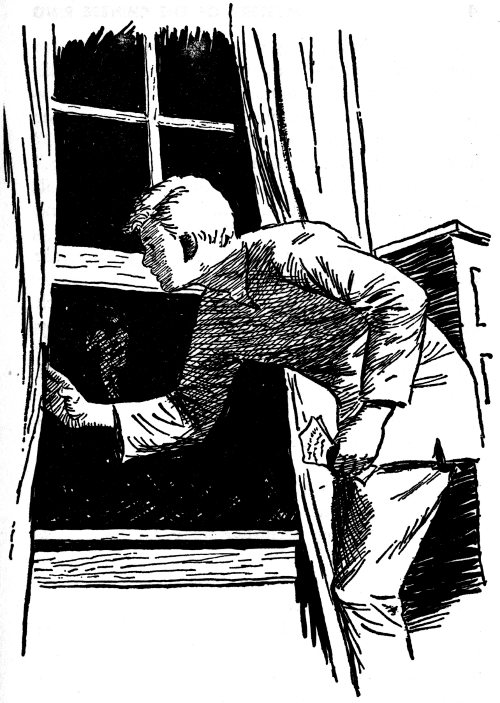
Biff drew back, pressing his body against the wall.
A moment later a white object, the size of a baseball,
came hurtling into the room, tearing a hole in the
screen. It fell with a dull plop on Biff’s pillow. Biff
held his breath, waiting. The man was leaving the
yard on the run. At the sidewalk, he slowed to a casual
saunter. Apparently he did not want to risk attracting
the attention of some early riser.
Biff waited. He counted slowly to a hundred, to
make sure his strange visitor was gone. Once more he
looked out the window. Nothing moved in the eerie
light of the dawn. Biff turned away. Had he waited
a few seconds longer, he would have seen two men
leave the shadows of a corner tree and stealthily follow
the hurler of the object.
Biff snapped on the reading light by his bed and
picked up the object that had been tossed through his
window. It was a round white rock, one of those
used to outline his mother’s herb garden. More interesting
was the heavy piece of twine tied tightly
around it. At the other end of the twine was a ring. It
was a man’s heavy ring, set with a square-cut green
stone. Biff examined it carefully. The stone was dull,
not glittering. He wasn’t sure, but he thought it was
jade. He looked at the ring more closely. On its face
there was an intricately etched marking. “A design?”
he wondered. “No, it looks more like Chinese writing.”
3
Nothing moved in the eerie light of dawn
4
Twisted into a knot around the ring was a small
piece of paper. Biff unfolded it carefully and
smoothed it out.
“Fortune shines upon, and the gods protect, the
wearer of this ring,” he read.
“‘Protect!’” Biff thought angrily. “Why, that rock
could have conked me but good if I hadn’t left my
bed.”
Biff reread the printed message. “Now what, just
what,” he thought, “has this got to do with me?” He
stretched out on his bed, cupping his hands behind his
head, and stared at the ceiling. Unable to read any
sense into the message, or the mysterious manner in
which the ring had come to him, Biff jumped out of
bed and made for the shower.
Under the pelting needlelike spray, he threw back
his broad shoulders and let the water sting his face
and soak his light-brown hair. Afterward he toweled
himself vigorously, dressed quickly, and placed the
ring on his key chain. He knew his father would be
up, even though it was only six-thirty. Maybe his father
would have some ideas about this or, at least, a
couple of good guesses.
5
Biff bounded into the kitchen.
“Morning, Dad. Say, what do you think happened—”
He stopped short as he saw his mother
come out of the pantry. He didn’t want to mention
the ring incident in front of her. Not yet, anyway.
Not until he had discussed it with his father. He knew
his mother already was worried enough about his impending
trip to far-off Rangoon. Tomorrow was the
day he was leaving.
“Good morning, Biff,” his father greeted him.
“What were you saying?”
“Er—I was just saying it so happens I’m hungry
enough to eat a crocodile. Good morning, Mother.
What’s for breakfast?”
“Certainly not crocodile,” Mrs. Brewster replied.
“Even if you and your father do say crocodile steaks
are delicious. Ugh!” She gave a quick shudder.
Father and son looked at one another and smiled.
They had had to eat crocodile on their Brazilian adventure
when their food supplies had run short.
“What’s on the program this nice bright Saturday
morning?” Biff’s mother asked, putting large portions
of scrambled eggs and bacon before Biff and his
father.
Before a reply could be made, Biff’s brother and
sister, Ted and Monica, eleven-year-old twins, burst
into the room.
“Hi, Mom! Hi, Dad!” they shouted together.
6
“Gee, Biff, just think, tomorrow you’ll be on your
way to Rangoon in Burma, to visit Uncle Charlie,”
Ted said enviously.
“Wish I could go, too,” Monica chimed in.
“You! Why, you’re a girl,” Ted said derisively.
“Now, no arguments, you two,” Mrs. Brewster
said. “Drink your orange juice. I’ll start your eggs.”
“How far from Indianapolis is it to Rangoon?”
Monica asked.
“Quite a way. Six or seven thousand miles at least,”
Mr. Brewster replied.
“You ever been there, Dad?” Ted asked.
“No. I envy Biff. Rangoon is one of the places in
this world I’ve missed so far.”
“And about the only one, Dad, isn’t it?” Biff asked.
“There are a few others,” his father replied.
“Maybe if I had started out as young as you are, I’d
have made them, too. For a sixteen-year-old, you’ve
been about this world of ours quite a bit, me boy-o.
Well, I’m all for it.”
“I am too, Dad,” Biff agreed. “Remember the time
in Brazil, when we—”
“Hold it!” Mrs. Brewster interrupted, laughing.
“Don’t you two get started talking about your adventures.
There’s just this one more day before Biff
leaves, and my goodness, what a lot has to be done!”
Biff smiled. He knew there was hardly anything
left to be done. His mother had finished packing for
him the day before.
7
Just as Mrs. Brewster brought the twins their eggs,
the telephone rang. Monica started to get up. She answered
every phone call.
“You sit still and eat those eggs while they’re hot,
young lady. I’ll take the call,” Mrs. Brewster said.
Biff and his father saw a puzzled look come over
her face as she answered the telephone.
“Yes? I understand. This morning? All right, I’ll
tell them.”
When she returned to the breakfast table she said,
“That was Charlie’s friend, that Chinese merchant,
Mr. Ling. Ling Tang, isn’t it?”
“Why, yes. What did he want?” Tom Brewster
asked.
“He said it is most urgent that you and Biff see him
before Biff leaves for Rangoon.”
8
CHAPTER II Beware, Biff!
“I think we’d better get down to Ling Tang’s
shop this morning,” Mr. Brewster said. “It must be
something important for him to have called so early.
Especially if he knows Biff is leaving for Burma tomorrow.”
Biff waited until his father had finished his second
cup of coffee, and then rose from the table.
“All set, Dad?” he asked. “I’ll get the car.”
Not until they were in the car did Biff bring up the
subject of the ring.
“What do you think of this, Dad?” He took his
key chain from his pocket, removed the ring, and
placed it in his father’s hand.
Thomas Brewster looked at the ring carefully. “It’s
a beautiful ring. Jade. Where did you get it?”
“Someone threw it at me this morning,” Biff said, a
grin on his tanned face.
“Threw it at you? What do you mean?”
9
Biff explained quickly, then handed the note to his
father.
“Read this.”
Mr. Brewster read the words: “Fortune shines
upon, and the gods protect, the wearer of this ring.”
He looked back at his son, shaking his head in puzzlement.
“This is all? You haven’t any idea who the man
was?”
“Not the faintest, Dad.”
“H-m-m.” Mr. Brewster studied the ring again.
“Jade, and it looks Chinese. That call from Ling Tang
may be connected with this in some way.”
“Hey! Maybe you’ve hit on something!” Biff exclaimed.
It was nine o’clock when Biff and his father entered
the small Chinese curio shop of Ling Tang. Ling
Tang, a small, neat man in his middle thirties, greeted
them with a deep bow.
“You honor my humble establishment by your
presence,” he said.
“Rather it is you who honor us by inviting us
here,” Mr. Brewster replied, falling easily into the polite
form of greeting used by the Chinese.
Ling Tang’s shop was filled with graceful Chinese
urns and vases, beautifully decorated with green and
red dragons, flowers, and tree-filled valleys. Chinese
fans hung from wires stretched from wall to wall. In
glass-covered cases were carved idols of jade and delicate
pieces of ivory. A heavy aroma of incense filled
the small store.
10
Ling Tang had attended Butler University in Indianapolis
with Charles Keene, the uncle Biff was going
to visit. They had become close friends, and this had
led to a friendship with the entire Brewster family.
On graduating, Ling Tang had returned to China.
After several years, when the political atmosphere of
Red China had put a stern, cruel check on freedom of
movement and freedom of speech, Ling Tang had fled
his beloved country and returned to America. He had
opened his shop and thrived.
“We received your message, Tang,” Mr. Brewster
said.
Ling Tang placed the tips of his long, well-cared-for
fingers together.
“It is true that your son goes to Burma soon?”
“Yes. Tomorrow.”
Tang’s face remained expressionless. “Perhaps what
I have to tell you is of no importance. I do not wish
to alarm you.” He paused. “This trip was arranged
several months ago?”
Biff and his father nodded their heads.
“And there has been no attempt to keep it secret?”
“There was no need to,” Thomas Brewster stated.
“I wonder. Was the boy’s trip not arranged when
my good friend Charles Keene visited here last?”
“Yes. But I don’t see—” Biff began.
“Your Uncle Charles had just returned from Cape
Canaveral, had he not?”
11
Biff nodded his head. Uncle Charlie had been in the
Navy for several years. He was a pilot in the squadron
of planes assigned to tracking missiles fired from
the Cape into the South Atlantic. It was the squadron’s
task to recover the instrument-loaded nose cones
dropped from the powerful rockets.
Uncle Charlie had bounced around the world quite
a bit. He had flown a fighter plane during the Korean
conflict and had traveled as much as he could about
the Orient on his furlough time. He remained in the
Navy following Korea, and was delighted when he
was assigned to Canaveral. But after two years there,
his traveling feet told him, “I want out.” So he had
resigned his commission to join an old pilot friend establishing
a fleet of planes for Explorations Unlimited,
in Burma. Charles Keene wanted badly to get back
to the Orient. He was fascinated by the eastern
countries so different from his own.
“I’m interested in the money, too,” he told the
Brewster family on his visit. “There’re plenty of
American businesses building up in the Orient. Flying
for this outfit in Burma is real opportunity and big
money. I want some of both before I’m too old.”
Explorations Unlimited had its headquarters at Unhao,
on the Irrawaddy River, northeast of Rangoon
near the Chinese border.
“Why don’t you ship Biff out to me for a few
weeks?” Uncle Charlie had suggested. “He could get
a glimpse of the other side of the world—learn a lot,
too.”
12
Those words had been music to Biff’s young ears.
A family council had been held, and it had been
agreed that the trip would be a good way for Biff
to spend the remainder of his summer vacation.
“About a month after your uncle’s visit,” Tang continued,
“two men, countrymen of mine, traveling on
Burmese passports, arrived here. They asked many
questions about your uncle.”
“I still don’t see what that has to do with Biff’s
going to Rangoon,” Mr. Brewster said.
“I try your patience,” Tang said. “Now to my
point. Only last night these same two men came again
to our city. This time, they were most curious about
your son, Biff.”
13
CHAPTER III Under Chinese Eyes
“You said two men,” Biff repeated. “I’ll just bet
you that one of them was the joker who paid me a
visit this morning!”
“You had a visitor? Early this morning?” Ling
Tang asked.
“I’ll say I did. Not a visitor, though. A spy, maybe—sneaking
around the yard and—”
“Hold it, Biff,” his father interrupted. “Why don’t
you show Mr. Ling what the intruder brought you?”
“Brought me,” Biff muttered to himself as he
opened the safety catch of his key chain. “Some way
to bring anything to someone!” He removed the ring
from a tangle of keys—to his foot-locker, his suitcase,
a “secret” box, and to several things he had long since
forgotten about. Taking the ring by the thick circle
of gold, he held it out to the Chinese gentleman.
Ling took the ring in his thin hands. He looked at it
carefully.
14
“A beautiful piece of jade,” he murmured. Bringing
the ring closer to his eyes, he took a loupe—a jeweler’s
magnifying glass—from his pocket to inspect the
ring more minutely. While he did this, Biff filled
him in on how the ring had been “delivered.”
“Exquisitely carved,” Tang said, removing the loupe
from his eye.
“What’s carved on it?” Biff asked.
“It’s the Chinese character which, roughly, would
stand for the capital letter ‘K.’”
“Does that have any significance for you, Tang?”
Mr. Brewster asked.
“Indeed it does. This is the ring of the great House
of Kwang. Before the Communists took over, it was
one of the richest and strongest houses in all China.
This ring was worn by the Great Lord of the house,
and by his sons, the young lords.”
“It’s funny I should get one of them,” Biff said,
laughing. “I’m no young lord.”
Ling Tang smiled. “Most mysterious, true,” he
agreed.
“And if they wanted to give me a ring, why didn’t
they just send it to me, instead of throwing it through
my window and ruining the screen?”
“You did receive it in a most dramatic fashion.”
“You can bet all the tea in China I did,” Biff said.
“Perhaps, young man,” Ling said, “you received it
as you did, so that he who presented it to you could
keep his identity a secret. Even more important”—Ling
paused to drive home his point—“he did it to
keep you from seeing what he looked like.”
15
Biff and his father exchanged concerned glances.
“Were you acquainted with the House of Kwang?
Did you know its master?” Mr. Brewster asked.
“It is an old, old family, once strong, once rich.”
An expression of sadness passed fleetingly across
Tang’s face. “Until the Reds moved in and made ruthless
changes, the House of Kwang lived in the same
age-old feudal manner as had the founder of the family
generations ago. They had rich farm lands and
houses of many courts. In the Old Lord’s house, he
who was called the Ancient One, there were more
than a hundred courts. In America you would call
them apartments or suites. Each court had its sleeping
room. A room for eating. And a room, beautifully
decorated with a small fish pond in its center, where
the lords of the house would go to think and meditate
and honor the memories of their fathers and their fathers’
fathers.”
“And this no longer exists?” Mr. Brewster asked his
friend.
“Gone. All gone. The farm lands divided up into
small communes; the mines, the grain-storage house
snatched away. But the family still clings together.
They still resist. Many of them are in hiding from local
Red officials. The earthly possessions of the House
of Kwang have been torn from them. But the family
is still a proud one. They aid one another, even to
helping the older members escape into the free world.”
16
Thomas Brewster had been doing some heavy
thinking. “Tang,” he said. “Tell me this. In what part
of China was the House of Kwang located?”
“In the province of Yunnan, south and somewhat
west of Kunming, the capital of the province.”
Mr. Brewster was creating the map of China in his
mind’s eye. “That would be near the border of
Burma.”
Ling Tang nodded his head gravely.
“Not far from Unhao, on the Irrawaddy River?”
Biff’s father inquired.
“Your memory of China is excellent, my friend.
Once the Old Lord, Tao Kwang, made annual pilgrimages
to Rangoon to visit the shrine of the
Gautama Buddha, the magnificent pagoda of Shwe
Dagon.”
Biff was beginning to put the pieces together. “I
still don’t get it loud and clear, but Uncle Charlie’s
located at Unhao. That’s where I’m going. And Uncle
Charlie’s in Rangoon a lot, isn’t he?”
“Yes, Biff. He is.”
“But the ring—why would someone want me to
have it? Do you suppose they want me to take it with
me?”
“That, my boy, is the question we’d all like to have
the answer to,” Mr. Brewster replied.
“Gosh. Maybe I shouldn’t take the ring with me.”
17
Tang spoke up quickly. “Oh, but I think you
should. Its manner of delivery hints of peril. But its
message speaks of fortune and safety.”
Biff took the ring back. As he did so, a young, smiling
Chinese entered the store hurriedly.
“So sorry, revered elder cousin, so sorry to be late.
I change quickly and take over my duties.”
Tang smiled as the young Chinese hurried to the
rear of the store. Biff had noticed the young man was
wearing jeans and a sweat shirt. On the front of the
shirt was the letter “K!” Biff turned and looked
sharply after him.
“Who was that, sir?” Biff inquired of Ling Tang.
“My young cousin—one of them,” Tang said. “He
works afternoons for the Kirby Ice Cream Co. He is
much enthused about your game of soft ball. He is of
the team called the Kirby Koolers.”
“Well, thanks for your information, Tang. Guess
we’d better be going,” Mr. Brewster said.
“I’ll say hello to Uncle Charlie for you, Mr.
Ling,” Biff said.
“That will be most kind of you,” the Chinese replied.
Both bowed to Ling Tang, and he returned their
gesture with a deep bow of his own.
18
Biff and his father were thoughtful as they walked
to their parked car. Something was building. No
doubt about that. But what? What was the answer to,
or the connection between, the spying stranger, the
ring, and Biff’s coming visit to his Uncle Charlie?
The answers to those questions were not to be found
that day.
At home, Mrs. Brewster’s first question was, “Biff,
who ruined the screen in your room?”
Biff looked helplessly at his father, who merely
shrugged his shoulders.
“A rock, Mother. This morning, early. Fooling
around....”
“I thought, young man, you were old enough to
know better than to toss rocks around carelessly.”
Biff heaved a sigh of relief. He was going to get out
of this easily. Neither he nor his father wanted to tell
Mrs. Brewster the real reason for the hole in the
screen. They didn’t want to worry her.
“Now,” Mrs. Brewster said briskly, “we’ve lots to
do today. We’ll have no time in the morning. We’ll
have to leave for the airport early. Now here’s what
I want you to do, Biff....”
On the morning of his departure, Biff again woke
early. He could hear noises throughout the house
and sniffed at the friendly smells of breakfast being
prepared. Everybody was up. They were all going
with him to the airport. Biff looked at his watch. It
was nearly seven by the time he was dressed. In one
hour and fifteen minutes he would be air-borne, on his
way to Chicago, the first leg in a journey that would
take him halfway around the world.
19
Breakfast was a funny kind of a meal that morning—not
the food, but the way the whole family acted.
The twins, of course, kept up a steady, excited
chatter. Any trip to the airport made them bubble like
a bottle of pop. But Biff and his mother and father
either all tried to talk at the same time, or suddenly
remained silent at the same time.
“Biff gets all the breaks,” Ted complained. “Don’t
see why I can’t go, too.”
“Because you’re too young, that’s why,” retorted
his twin sister, Monica. “You’re just eleven.”
“You are, too,” the younger boy shot back. “Way
you act, anybody’d think you were older’n me.”
“Your time will come, Ted,” Mr. Brewster said,
acting as a peacemaker between his youngest children.
“When you’re five years older, like Biff, the world
will still be here. There’ll be plenty of chances for
you to spread your wings and fly.”
“Right,” said Ted emphatically. “And I’ll go by
rocket.”
“But what about me? I’m a girl,” Monica wailed.
“Yes, Tom. Answer that one,” Martha Brewster
said with a laugh. “Don’t worry, Monica,” she continued,
“we women will show these men a thing or
two.”
“Like what?” the girl said, pouting.
“Like how fast you can get ready. Right now. We
have to leave for the airport.”
20
As they drove into the busy terminal, Biff felt a
lump in the pit of his stomach. First signs of homesickness,
he thought. It had happened before. Biff always
felt homesick at these last moments. But once
he was under way, the feeling left him. Except sometimes
late at night, just before he fell asleep.
This time, though, it was different. This was the
first time Biff was going to be all on his own. Before,
his adventures had been shared with his father. True,
he’d be with his Uncle Charlie, but as nice a guy
as Uncle Charlie was, uncles weren’t the same as fathers.
Biff checked in and had his ticket cleared. At the
gate, he ruffled his brother’s hair, gave him a quick
hug, and turned to Monica. He lifted her off her feet
and planted a big “smack” on her plump cheek. Unashamedly,
he embraced his mother in front of the
crowded gate, then turned to his father.
The two shook hands, and Mr. Brewster placed a
hand on Biff’s shoulder.
“You have the ring in a safe place?” he asked softly.
Biff nodded his head and touched his side trouser
pocket. He had fastened the key chain to a longer,
stronger chain which was attached to his belt loop.
“I wouldn’t display it, Biff.”
Biff nodded. He felt tears coming to his eyes, but
he was through the gate and up the plane’s loading
platform before anyone could see them. Moments
later, the plane was taxiing out to the runway for
the take-off. Biff, looking through the window, could
see his family waving.
21
After the plane’s four engines had been warmed up
and tested, the giant airliner lurched forward, and in
seconds was air-borne. First stop Chicago. Change to
a jetliner for San Francisco. Next stop Hawaii. Then
Tokyo, Hong Kong, and finally Rangoon.
Biff unfastened his seat belt when the lighted sign
snapped off, and looked about him. The plane was
only half filled. He glanced to the rear, and his heart
started pounding. Seated in the last seat on the plane’s
starboard side were two Chinese. They returned Biff’s
stare without expression. One of them, Biff noticed,
seemed to have but one good eye. The other eye
was nothing but a thin slit.
22
CHAPTER IV A Fortune Cooky
Biff’s connections at Chicago with the jetliner for
San Francisco went without a hitch. In less than an
hour the sleek, silvery plane was in the air, circling
over the bustling city of Chicago. It pointed its slender
nose westward, and began a race with the sun to
the Pacific Ocean.
The liner seemed to hang motionless over the broad
plains of the West. Even the towering peaks of the
Rocky Mountains passed backward beneath the plane
slowly, as if the plane were barely moving, instead of
slicing through the air at nearly 700 miles per hour.
Once they were in the air, Biff, as casually as he
could, had let his eyes sweep the length of the plane,
trying to see if the two Chinese were still with
him. There were no Orientals on this flight.
23
By early afternoon the plane had left the mountains
behind it and was starting its long glide to lose altitude
as it neared San Francisco. Far ahead, Biff could see
the blue waters of the Pacific, sparkling under the rays
of the sun, now standing high in the sky. Before he
realized it, the plane was circling over San Francisco
Bay. Biff saw the beautiful Golden Gate Bridge, arching
gracefully over the harbor.
After a two-hour layover, during which time Biff’s
papers and baggage were cleared by customs, the boy
boarded the plane which was to take him to his final
destination, Burma.
The sun had a good lead on the plane by the time
the huge airliner took off. It would soon disappear
over the horizon, and darkness would greet the touch-down
in Honolulu.
Once the plane was over the water, Biff turned in
his seat for a final glance at his homeland. He could
just see the hills of San Francisco, fading rapidly behind
him. As he turned more toward the front, his
eye was caught by two Chinese passengers.
Biff looked at them closely. They were dressed in
long, flowing robes. The robes were brightly colored
in greens and reds and were gold-trimmed. Their
wearers had tight skull caps worn low on their foreheads,
and each wore heavy, dark sun glasses. Could
they be the same two who had been on the plane with
him from Indianapolis to Chicago? For a closer look,
Biff walked to the rear of the plane for a drink of
water. He stood just in back of the pair and inspected
the men closely. They could be the same men, he
decided. But he couldn’t be sure. It was difficult for
him to tell one Chinese from another. And the change,
if these were the same two, from American clothes to
Oriental, made such a difference that it was impossible
for Biff to be certain.
24
Biff decided on a bold move. He stopped at the seat
where the two Orientals sat impassively, staring
straight ahead.
“I’m going to Rangoon,” he said, a friendly smile
breaking out on his face. “To a place very near the
Chinese border. Are you going to Rangoon, or Hong
Kong?”
There was no answer.
“Don’t you speak English?” Biff asked.
“I’m afraid they don’t,” a voice said behind him.
Biff whirled. It was the stewardess. “Can I help
you?” she asked.
“No,” Biff said lamely. “I was just—er—just going
to get a glass of water.”
The stewardess moved on. Biff downed the glass
of water which he didn’t need and started back to his
seat. As he came to the side where the Chinese were
sitting, he decided to try a little trick.
He bent toward the floor of the plane.
“Is that your glasses case on the floor?” he asked.
The Chinese in the outside seat bent forward. His
hand reached down, feeling by his feet. Then, quickly
realizing he had given himself away, he sat up straight,
and stared ahead.
25
A big smile of satisfaction decorated Biff’s face as
he settled himself in his seat. He knew one thing about
them at least. They understood English—but good!
And they could have taken another airline from Chicago
to San Francisco.
Biff’s swift flight was without further incident as
the plane sped across the Pacific. Then he was on the
last leg—the flight from Hong Kong to Rangoon.
It was the middle of the afternoon, an hour after
the take-off from Hong Kong. Rangoon was still
nearly three hours away. The stewardesses were serving
tea. With it they served almond cookies and, as a
favor from the air lines, each passenger received a fortune
cooky, a small delicate piece of folded, crisply
cooked dough. Inside each fortune cooky was a narrow
ribbon of paper on which was printed a short
saying—usually humorous. Biff remembered them
from the Chinese restaurant he went to with the family
every so often back in Indianapolis.
He smiled as he remembered one he had once gotten.
It had read: “Man who count chickens before
they hatch is egghead.”
Biff finished his tea. He reached for the fortune
cooky. Just as he did so, someone lurched against his
shoulder, upsetting the tray. Cup, saucer, and fortune
cooky fell to the floor. Both Biff and the awkward
passenger reached to pick up the scrambled tray.
Biff’s eyes met his helper’s—it was one of the two
Chinese! There was no reason for him to have stumbled.
The plane was flying smoothly. It appeared to
Biff that the shoulder bumping had been intentional.
26
“So sorry,” the Chinese said. His dark glasses
glinted as he straightened up. “Too bad. Fortune
cooky smashed to bits. But slip of paper still okay.”
Smiling briefly, he handed Biff the slender slip of
tissue paper, and made his way hurriedly forward.
Biff watched him go, still puzzled by the man’s action.
The boy smoothed out the slip. It had only a
Chinese character scrawled on it. Through the Chinese
printing had been drawn a red “X.” “Now what
the dickens is this?” Biff thought. He started to crumple
the paper, but something about it held his attention.
There was something familiar about it. Then he
had it. Carefully, he took out his key chain. He bent
low, and compared the character on the cooky slip
with that on the surface of the ring’s green stone.
They were identical—the letter “K!”—the seal of the
lords of the House of Kwang.
Was this a warning of some kind? Did the red “X”
cancel out the protection and good fortune the ring
was supposed to insure? But why? Why? Biff’s brain
kept signaling that one word with its question mark.
The plane climbed over the coastal mountains of
Viet Nam, dropped down to skim over the rice fields
of Thailand, then swung out over the Bay of Bengal
for its approach to Rangoon.
As the plane banked, Biff could see the many
mouths of the Irrawaddy River, spread out like long
fingers from the broad, brown arm of the river itself.
27
The plane came low over the bay on its approach
to the city, and Biff could see the colorful sails of the
dhows, the native craft which dotted the harbor. Some
of the sails were bright red, some dirty brown. Many
wore patches of every color of the rainbow.
The plane followed the course of the Hlaing River,
twenty-one miles inland to the city of Rangoon.
Standing out against the low, white buildings, Biff
saw the pagoda of Shwe Dagon, rising nearly 400 feet
skyward. It was entirely covered with gold leaf which
glistened in the setting sun. Then he remembered.
Ling Tang had told him this was the important shrine
of Buddha where the head of the House of Kwang
used to worship.
Biff stretched and twisted. In spite of the cooky accident
and the red “X,” he smiled. “Almost there, at
last,” he said to the passing stewardess.
The long trip had been pleasant enough, but being
confined to a plane for three days and three nights
had become monotonous. Just as soon as he could, Biff
bounded down the ramp from the airliner and ran
eagerly to the entrance of the airport terminal.
Through the portal into the terminal, Biff was
caught up in a swirling mass of figures. Fat merchants,
skinny students, long-robed mandarins, ragged
beggars, and men in the uniforms of all the
world’s military forces milled about the huge room.
Biff searched the crowds, trying to spot his Uncle
Charlie. He was nowhere to be seen.
28
Worried minutes followed. Then Biff saw a tall,
very thin Oriental, wearing a long, straight white
robe approach. The man came up to Biff. With hands
clasped to his chest, he bowed low.
“Sahib Brewster?” he asked.
“I’m Biff Brewster,” the boy answered, thinking,
“Gee, I’m a sahib!”
“I come from Sahib Charles Keene. He had planned
to meet you. However, an emergency arose, and he
had to fly to the north. But he should be back at Unhao
by the time we get there.”
“Oh.” Biff was slightly shaken by this unexpected
turn of events. “And how do we get there, then?”
“It is all arranged. Another pilot was dispatched to
pick you up when your uncle was unable to come
himself. Come. If you will follow me, even now the
plane is ready.” The Oriental turned, and a path in
the human mass seemed to open for him.
Biff followed, still not sure of this man.
“Hey,” he called. “Wait a minute!”
The Oriental paused and turned to the boy.
“I’d like to know your name,” Biff said. “I don’t
like calling people just ‘hey.’”
The Oriental’s puzzled expression changed to a
slight smile as understanding of Biff’s “hey” came to
him. “I am called Nam Palung, head of the servants in
your uncle’s house.”
“Okay, Nam. But what about getting through customs?”
29
“That is all arranged. Your uncle is a man of
much importance and influence. Come. We must
hurry before darkness spreads its mantle upon the
land.”
Biff didn’t like being rushed like this. “Yeah, but
what about my luggage—my suitcase and trunk?”
“Even now they precede us to the plane. All is
cared for.”
The whole business seemed a bit cockeyed to Biff,
but then, shrugging his shoulders, he followed Nam to
the northern exit of the terminal.
Nam walked quickly, his fast, short steps limited
by the skirt of his robe. Even so, Biff had to step up
his pace to stay with the man.
Suspicion again came to Biff as they left the terminal
building and appeared to be taking a direction
away from the airport.
“Look, Nam. Just where are we going? The airstrips
are back that way.”
“Those, Sahib Brewster,” Nam replied, “are for the
commercial airlines planes. Private planes, such as
those used by Explorations Unlimited, use a different
part of the field.”
Biff’s suspicions dropped a degree. Nam’s explanation
made sense. His suspicions dropped still further
when Nam reached a jeep, and with a low bow, indicated
that Biff was to get in.
30
An American jeep, Biff thought. They’re found
everywhere. The small vehicle represented home and
safety to Biff. He hopped aboard, and Nam took his
place behind the wheel. Biff looked across the airport
where a mile away, several small planes were clustered.
He figured that was where they were heading.
He heard a rustling behind him and turned abruptly.
In the jeep’s rear seat now sat, as if they had appeared
out of thin air, two more Orientals. Both were
dressed like Nam. But, as Biff looked at them more
closely, he noticed that each man’s hand was partly
thrust into a fold of his robe, and each hand clasped
the hilt of a slender dagger. Biff turned to Nam,
alarmed.
“Who are those men—with knives—” His voice
shook in spite of his attempt to control it.
Nam interrupted. His manner was no longer courteous,
his voice no longer smooth. His reply was
stem and harsh.
“You will remain silent. Any outcry, any attempt
to escape, and my men have been told to use those
knives.”
31
CHAPTER V Jack Hudson
Nam Palung meant business. There was no question
about that. But Biff had no intention of yielding
without a struggle. He would make his escape if at all
possible. Right now, though, as his mind whirled trying
to think his way out of this predicament, it would
be best to do exactly as he had been told.
Biff promised himself one thing. Once he was free
of Nam Palung he, Biff Brewster, was going to give
himself, Biff Brewster, one swift kick. He had been
played for a sucker, a trusting, easy-to-take American,
and he had filled the role perfectly. How, he now
thought, could he have been so taken in?
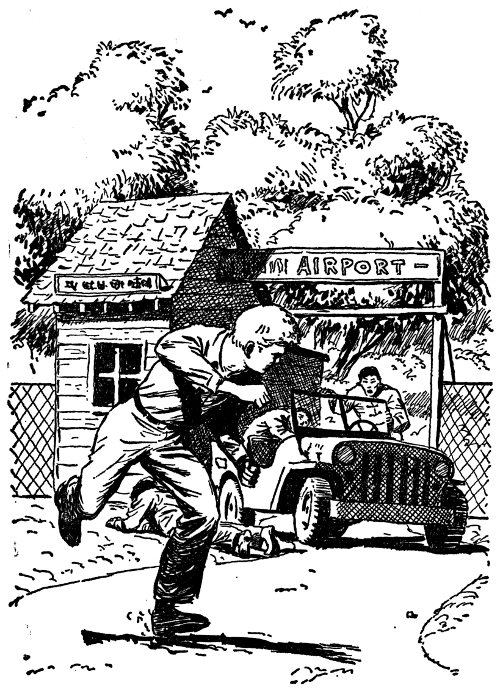
The jeep rolled across the field. Biff shot a sidelong
glance at Nam Palung. The jeep moved at a steady
pace, not fast enough to attract attention. It was
headed toward a gate in the high wire fence surrounding
the airfield through which service trucks
passed. He noticed that the gate was blocked by an
iron bar, raised to allow a vehicle to pass underneath
it. When raised, the bar on its upright poles looked
like a football goal post.
32
As the jeep drew near and fell in line behind a truck
and a small car, Biff noticed the bar was raised just
sufficiently to allow about a foot’s clearance for the
vehicle passing beneath. An idea came into Biff’s
head. He turned to look over his shoulder at his knife-bearing
guards.
“Keep your head straight forward,” Nam ordered.
“And no tricks as we pass the gateman.”
Biff watched the truck ahead pass through. It
slowed down without stopping as it passed under the
raised bar. The bar was lowered to stop position after
the truck’s tail-gate went through. Next came the
smaller car, its roof much lower than the truck’s.
Again the bar was raised, but this time, just high
enough to accommodate the car, leaving about two
feet between it and the car’s top.
Now the jeep approached the bar barricade. The
bar began rising slowly. Biff watched it, his heart in
his mouth. “Don’t let them raise it too high,” he
prayed. Biff leaned slightly forward, placing his
weight on his firmly planted feet. He tensed his leg
and thigh muscles until they felt like tightly coiled
steel springs.
33
The bar was about three feet higher than tall Nam’s
head. Biff waited until the front of the jeep was directly
under the bar. Then he leaped up as if he’d
been blasted off a launching pad. His hands seized the
bar. Like a trapeze artist, he swung his body forward
in a giant arc. At the top of his swing, when his body
was parallel to the ground, Biff twisted his head, looking
over his shoulder as his body started a swift downward
stroke. At the split second, he lashed out with
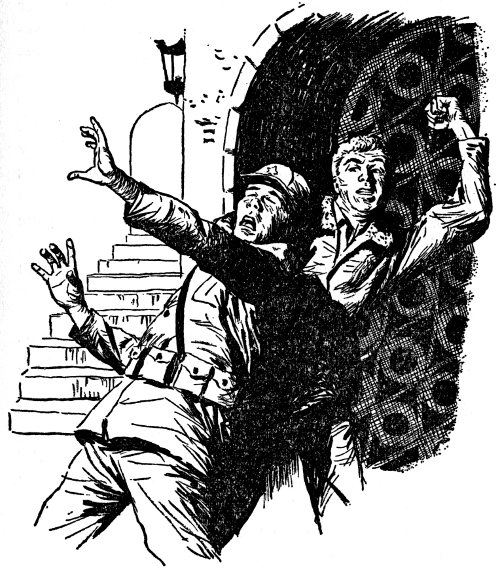
his feet. One foot struck the left knife-wielder square
on the side of his head. The man shot over the side of
the jeep as if jerked by the hand of a giant.
Biff’s other foot struck the second knife-wielder
full in his chest, toppling him out the back of the
jeep.
Now Biff was propelling himself into the backward
arc of his swing. Again his body came swiftly downward.
He lashed at Nam, planting both his feet solidly
in the Oriental’s shoulders. Nam shot forward, his
head striking the windshield.
Biff swung his body sideways, and dropped to the
ground. He ran back toward the terminal building,
nearly half a mile away. After a hundred yards, he
slowed to catch his breath. Turning, he looked back
at the jeep. There was no need to run. Nam still lay
sprawled over the steering wheel. One of the knife-bearers
was out of sight, apparently still sprawled on
the ground on the other side of the jeep. The other
guard was just rising from behind the jeep. Biff saw
him stagger, still not fully recovered.
34
He ran back toward the terminal building
35
There would be no more trouble with those three,
Biff said to himself. Not right away, at any rate. The
boy continued toward the terminal building at a rapid
walk. He didn’t run, no need to, and if he did, he
might attract attention. He might be stopped. Explanations
would be demanded. The gate-keeper
might come up and describe what had happened.
Biff needed time to think. What was his next move?
“Guess I’ll have to play it by ear,” he told himself,
and what, he wondered, had happened to Uncle Charlie?
Had he been waylaid by those same three?
Inside the teeming terminal building, Biff mingled
with the constantly moving crowds. He hoped he
wouldn’t be noticeable, but there was little chance
of that. In his American clothes, gray slacks and open-necked
shirt, he was as noticeable as an Oriental
dressed in mandarin clothes would have been at the
Indianapolis airport.
There was only one thing to do, Biff decided. Go
to the airline check-in counter and see if any message
had been left him by his uncle. The boy approached
the counter cautiously. He wanted to look around
before identifying himself.
Biff sidled up to the counter. A tall, handsome man,
about thirty years old, was leaning over the counter,
questioning the clerk intensely. He was wearing white
drill trousers and a white shirt open at the collar. A
well-shaped, close-cropped head topped a strong neck
and broad shoulders. He spoke to the clerk in a voice
filled with authority. Unless he was badly fooled
again, Biff felt sure that this man was an American,
and there was something about him that the boy liked
immediately.
36
“Hold it,” Biff told himself. “Let’s not jump too
fast this time.”
Standing behind the man, Biff saw him take out a
worn wallet from his hip pocket.
“Now you listen to me. I’m Jack Hudson. I’m a
pilot for Explorations Unlimited. Here, take a look
at my papers. I’m here to meet a boy named Biff
Brewster, and I want to know where he is. Right
now!”
The clerk leaned on the counter. He carefully inspected
the list of names on the paper in front of him.
“So sorry. No name like one you say on this list.”
“Is that your passenger manifest list?” the man,
Jack Hudson, demanded.
The clerk nodded his head.
Without asking, without waiting, Hudson snatched
the list from the man’s hand.
“Here. You can’t do that!”
Hudson ignored the clerk. His eye ran down the
list quickly.
“And just what do you think this name is?” Hudson
held his index finger beside one of the names.
“Oh, so sorry. I guess I no understand your talk.”
“Fat chance,” Hudson said angrily. “Now you just
tell me where that boy is.”
Biff had made up his mind. He couldn’t be mistaken
in this man of action.
37
“I think you’re looking for me, sir,” Biff said and
placed his hand on Jack Hudson’s arm.
Hudson swung around. He looked Biff up and
down, slowly, carefully, sizing him up, before answering.
“If I weren’t so glad to see you, I’d ask where the
devil you’ve been.” Then, seeing Biff’s face fall, Hudson
smiled, a warm, immediately friendly smile. “But
the important thing is I’ve found you.”
“I guess it is mostly my fault that you’ve had trouble
meeting me,” Biff confessed. “I had a little mixup
with—” He cut his sentence short. Perhaps he had
better wait until he got to know Jack Hudson better
before revealing all the mysterious happenings that
had taken place from that early hour in the morning
four days ago, back in Indianapolis.
“Well, part of it’s my fault, too,” Jack said. “Or the
weather’s. Coming in from Unhao, I ran into a terrific
headwind. Should have allowed for it. These
winds spring up all the time in these parts. I was late.
But come on now, we’ve got to clear you with customs
and get your gear.”
Jack Hudson, with a forcefulness sharp enough to
cut any red tape, literally bulldozed Biff through a
maze of inspections, checks, and rechecks.
“I’m slipping,” he grinned at Biff when the boy had
been cleared. “Took me thirty-one minutes. My record’s
twenty-nine. Come on. We’ve got to make with
the plane back to Unhao. Fast. Lots to be done.”
38
“That sure suits me. I’m anxious to see my uncle.”
“Hope he’s there when we get back.” A frown
creased Jack’s face as he spoke.
“He will be, won’t he? That’s what I was told,
that the emergency came up quickly and—” Biff
ended his sentence feeling foolish. He suddenly remembered
who had told him the story.
“Emergency? I don’t know of any emergency.
Your uncle wasn’t even in Unhao today. It was arranged
for me to pick you up before he left.”
“Before he left? What do you mean?” Biff was getting
puzzled.
“Your uncle flew out of Unhao over a week ago.”
39
CHAPTER VI Interrupted Message
Darkness had spread over the airfield by the time
Biff and Jack Hudson reached the “Explorations”
plane. It was a twin-engine Cessna, a five-passenger,
capable of a speed of 250 miles per hour.
“Hop in, Biff,” Jack said. “Be my co-pilot.”
Jack stowed Biff’s gear, and took his place in the
pilot’s seat. As quick to action as Hudson was, he was
also a sober, careful pilot. He warmed up the plane’s
motors. He tested the wing flaps. He made a thorough
instrument check. Then he called the tower for
take-off instructions.
The plane moved to its assigned runway. Once
more Jack revved up his engines. Then, the brakes
released, the plane started rolling down the runway.
Once it was air-borne, Jack put the plane in a steep
climb, made a wide circle over the city of Rangoon,
then headed north, following the Irrawaddy River.
40
“How long before we get there?” Biff asked.
“About four hours. If we don’t hit any weather.
Unhao’s about fifty miles north of Myitkyina. ’Bout
eleven hundred miles from here.”
“How big’s Unhao. Is it much of a place?” Biff
asked.
Jack grinned. “Take a look back at Rangoon.
That’s the last civilization you’re going to see for a
while.”
The plane sped through the night. As the moon
rose out of the South China Sea, its light turned the
Irrawaddy River, thousands of feet below, into a
slender silvery ribbon, reflecting the moon’s rays like
a long sliver of mirror.
Jack Hudson put the plane on automatic pilot. He
reached behind him and brought out two boxes. He
handed one to Biff.
“Hungry?”
Biff hadn’t thought about eating. But now, he realized
he was ravenous. “I’ll say I am. Thanks a lot.”
He practically tore open the box and chomped on the
sandwiches with an appetite that made Jack wonder
when the boy had last eaten.
Just before midnight, Hudson switched on the
plane’s radio transmitter and called the landing strip
at Unhao.
“Keep your eyes dead ahead for the next few minutes,”
he told Biff. “I always get a thrill out of it.”
41
Biff did as he was told. He peered intently through
the windshield into the night. Clouds had obscured
the moon, and all was darkness. Not a light could be
seen anywhere.
Suddenly, as if by magic, the letter “X” blazed out
of the jungle, twenty miles ahead. It was so startling
that Biff gasped in amazement.
“Our landing field. I told them we’d be in in about
ten minutes and to turn on the lights. We have two
runways. One from southwest to northeast. The
other from southeast to northwest. They bisect in the
center, forming a perfect ‘X.’ I think it’s a wonderful
sight.”
“It sure is,” Biff replied.
For the next few minutes, Jack’s entire attention
was devoted to the landing. The plane swooped out
of the dark, flashed over the landing field, circled and
entered its final glide path. Biff felt the lurch which
told him they had touched down. Jack taxied the
plane toward the hangars.
“Well, here we are,” he said to Biff. “Welcome to
Unhao.”
Despite the excitement of landing in this strange
isolated spot in Upper Burma, Biff couldn’t hold back
a yawn. He was just plain, dog-tired. It had been
four nights since he had slept in a bed. Oh, he had
slept. But sleeping in a sitting position, he told himself,
would never replace the good, old stretch-out
type of snooze.
42
Native servants swarmed around the plane. Biff
and his gear were deposited in a jeep standing by.
Jack hopped behind the wheel. The jeep, with natives
clinging to every possible foot and hand-hold, headed
through the night toward Headquarters House, a
quarter of a mile away.
Headquarters House was a combination office,
communications center, and living quarters for the
staff of Explorations Unlimited. Sleeping rooms, resembling
those of Bachelor Officers’ Quarters on an
army post, filled one ell of the building. Into one of
these went Biff. Moments after his head hit the pillow,
he was in a deep sleep, in spite of the murky heat that
was unrelieved by the lateness of the night.
Around five o’clock in the morning, as dawn was
transforming the night-blackened jungle into a greenish
maze, Biff was awakened by the sound of running
feet passing his door. These were followed by
others. The whole building seemed to spring to life.
Something was up.
Biff jumped out of bed. First he went to the window.
Looking out, he saw a tremendous animal
faintly outlined in the morning mists not more than
thirty feet away. Just as he was about to call out, he
saw the floppy ears and the swaying trunk of the
animal raise toward the sky, and let go with a trumpeting
that rattled the windows. Biff had to smile at
himself. What was an elephant doing wandering
around loose at that time of the morning? “Some
difference from home,” he thought.
43
Biff dressed quickly. He hurried down the hallway
toward the center of Headquarters House. Sounds of
activity came from the communications center. He
paused in the doorway. Jack Hudson and two other
men were bunched together around a short-wave receiver.
Static crackled throughout the room. One of
the men picked up a hand microphone.
“This is H H One, calling. This is Happy Harry
One calling X 0369. Come in X 0369. Repeat: Come
in X 0369. We were beginning to read you. Acknowledge.
Do you read us?”
His answer was a roar of static.
Jack Hudson shook his head. His concern and the
intense looks on the faces of the other men told Biff
they were troubled.
“Was it Keene, Mike?” Jack demanded. “Was it
Charlie?”
Biff heard Jack’s question, and he felt a sudden
pang of fear.
The radio operator, Mike Dawson, shook his head.
“I can’t say for sure. I think it must have been. But
the voice was so faint. And the static—”
“Could you make out anything? Any of the
words?” Jack’s voice was insistent.
Mike shook his head worriedly. “The sender didn’t
identify. I did think I caught some of the words, but
I can’t say for sure—”
“Well, what were they, man? What were they?”
44
“I—I thought he said, ‘They’re coming for me....
My position is lati—’ And right then transmission
broke off completely. That’s when I buzzed your
rooms. I’ve been working this mike ever since. And
getting nothing. But nothing.”
Biff stepped into the room. He crossed to the three
men.
“Was that my uncle you were talking about?”
Mike and the other man looked at Jack Hudson. It
was obvious that they wouldn’t speak unless he gave
them the go-ahead. Jack looked at Biff. He didn’t
reply at once. Then, having reached his decision, he
answered.
“Yes, Biff. I’m afraid it was.”
“Afraid?” Biff felt a tingle of fear race up his spine.
“What do you mean? Is my uncle in danger?”
Jack Hudson’s shoulders sagged. He shook his head
as if trying to rid himself of unpleasant thoughts.
“Come along, Biff. I’ll tell you about it over some
coffee.” At the door, he turned back. “Keep trying,
Mike. You might raise him. And if you do—”
“I’ll buzz you fast.”
In the mess hall, the servants had already set the
breakfast table. Two of them padded about the room
silently on their bare feet. Biff sat down to a plate
containing an oval-shaped, reddish fruit, streaked with
white.
“It’s the fruit of the durian tree. Try it. We think
it’s delicious. If you don’t like it, though, there’s fresh
pineapple or guava.”
45
The taste was like nothing Biff had ever eaten before.
He didn’t know whether he liked it or not. And
he didn’t care. There were more important things
than breakfast fruit right now.
“Tell me about Uncle Charlie.”
Jack sipped some coffee. “I’ll tell you what I can,
Biff. It won’t be much. I don’t know it all myself. I
know where he went, and I think I know why. The
why is what I can’t tell you.”
“Was there danger in this trip of Uncle Charlie’s?”
“Danger? Perhaps. Always dangerous crossing the
border. But Charlie should have been able to handle
it.”
Biff felt his heart pound.
“Your uncle left here exactly eight days ago. He
left early in the morning. He needed the cover of
night to fly across the border.”
“The border? What border?” Biff asked.
“The border into Red China. That border’s closed,
you know, especially to Americans.”
Jack paused to light a cigarette.
“He took off in a light, four-place plane. It’s the
type plane that Charlie could land or take off in on a
dime. It carried extra fuel tanks.”
“How long did he expect to be gone?”
“He didn’t know for certain. Not more than four
or five days, he said.”
Four or five days, Biff thought. And eight days had
passed.
46
“We’ve been expecting him, Watching for him. I’ve
flown from dawn to daylight myself the last three
days, hoping to spot him or his plane, if he was forced
down. Nothing. He didn’t break radio silence once
from the time he left.”
“Until this morning,” Biff cut in.
“Yes. Until this morning. If that was Charlie.”
“Have you any idea where he was going in China?”
Jack shook his head. “Not exactly. With the extra
tanks, he had fuel for about twelve hundred miles. So,
since he had to return, he must have expected to find
what he was looking for not more than five hundred
miles inside China.”
“And you can’t tell me your ideas of what his
search was for?”
Jack hesitated. “All I could tell you would be the
results of my own speculations. Your uncle was at
Cape Canaveral, as you know, and he must know a
lot about guided missiles. He was one of the Navy’s
top young officers. Well—put your thinking cap on.
Maybe between us we can come up with something.”
Biff thought hard. There were many parts to this
puzzle. He thought he himself was probably one of
them. But fitting them together into an answer—that
would take more than minutes, hours, or even days to
do. Too many important parts of the puzzle were still
missing. Biff thought that perhaps now he should fill
Jack in on his own small mystery. His hand went to
his key chain and touched the jade ring. He made a
decision. He wouldn’t mention the ring. He would
only tell Jack about what had happened when he arrived
at the Rangoon airport.
47
Quickly he told Jack the story. As he poured it
out rapidly, Jack’s look of worried concern deepened.
“There must be some connection. Charlie disappears,
and you’re almost kidnaped. Describe the man
again.”
Biff sketched the three men in as best he could. “I
only saw the one called Nam Pulang closely. He said
he was the Number One man here at Explorations.”
“Never heard of him. Was he Chinese, or Burmese?”
“I’d say Chinese,” Biff answered. “Although I don’t
really know how Burmese look.”
Jack was thoughtful.
“But Jack,” Biff said, “we’re not just going to sit
here, are we? Can’t we do something? Can’t we go
into China and find Uncle Charlie?”
“Go into China? Impossible. You get any such idea
out of your head.”
That idea, though, was very much in Biff’s head.
The idea had been growing from the moment he first
heard of his uncle’s disappearance.
“I mean that,” Jack said. “You have no idea of the
difficulty in crossing the border. It’s patroled night
and day. And the border guards shoot to kill.”
48
Man and boy sat in silence, both deep in thought.
The silence was suddenly broken. A native boy about
Biff’s age, but smaller, came running into the room.
“Sahib Jack! Come on run! Come on run! Quick!
Quick!” He ran out of the room.
Biff and Jack were at his heels.
49
CHAPTER VII A “Spirited” Box
The native boy raced across the open compound toward
the group of low buildings where the servants
slept. Jack and Biff ran side by side, ten feet behind
the boy.
“What is it, Chuba? What is it?” Jack called. But
the boy didn’t answer until he reached the door of
one of the small white cabins. There he stopped,
gasping for breath, and turned to Jack and Biff. His
face was contorted with fear; his eyes were opened
wide and filled with terror.
“Now get hold of yourself, Chuba. Steady. We’re
right here. What’s inside your cabin that’s so frightening?”
Chuba’s voice trembled as he spoke. “The evil ones.
They come. They come to punish Chuba and the
father of Chuba.”
50
“The evil ones? What are you talking about?”
Jack’s voice was firm, but his tone was kind. He had
to quiet this boy’s fears.
“It has been spoken,” Chuba said, his voice trembling.
“Many, many years ago, the gods spoke to the
ancestors of my father. They said”—and here the
boy’s voice almost broke—“they said that evil will
befall any member of the House of Chin Fu who
leaves his land to become a slave of the white man.”
Biff watched the boy. He felt sympathy toward
him, yet it was hard for Biff to believe that such superstitious
beliefs could still cast their spell in these
modern days.
“That’s nonsense, Chuba. You and your father are
not slaves. You are honorable workers. Without your
help, we could not live here. You are well paid, and
you hold positions of responsibility and dignity.
Enough of this. Just what is inside your cabin?”
“Chuba not know. But is bad. Very bad. It is voices
of the evil ones, casting spell on Chuba and his honorable
father.”
“All right. Come on and show us what it is.”
“Please, Sahib Jack. You to go first.”
“Okay. Come on, Biff.”
Jack and Biff entered the one-room cabin. It was
small, but comfortably furnished. Beds stood against
the walls on either side of the room. At the rear there
was a small, compact kitchen. Biff and Jack inspected
the room quickly. They saw nothing unusual.
Chuba stood behind them, standing on tiptoes.
51
“There!” he said. “Watch, and you shall hear evil
spirits.” He pointed to a small box on the floor by
one of the beds.
As they watched, a low growl came from the box.
The growl grew louder. It became a wail. Then it
turned into the high, piercing scream of a siren. It
held this chilling, blood-curdling pitch for about ten
seconds. Then the lid of the box slowly raised. A
yellowish hand emerged. It bent over the front of the
box. One finger touched a small button. The high
scream dropped down to a wail, then to a growl, then
stopped. The hand withdrew into the box. The lid
closed. All was silent again.
Biff put a restraining hand on Chuba, keeping the
boy from fleeing in terror. On Biff’s face a slow grin
was spreading. He wanted to laugh, but one glance at
Chuba’s stricken face stopped him. This was a serious
thing to Chuba. Chuba would feel Biff was laughing
at him, insulting him.
Jack stared at the box in amazement. “Now just
what on earth is that thing?” He scratched his head.
Biff started across the room toward the box.
“Hold it, Biff. We don’t know what that gadget
might be. Might be a bomb.”
Now Biff did laugh. Even Jack was concerned.
Not terror-stricken like Chuba, but the weird performance
of the box had undoubtedly alarmed Jack.
Biff reached for the box, bent over, and picked it
up. Chuba cowered behind Jack. But the native boy’s
curiosity got the better of him. He watched Biff’s
every move, his eyes wide.
52
“It’s only a toy, Jack,” Biff said. “My kid brother
got one last Christmas. It was the newest thing out.
Caused a sensation.”
“Let me take a look at it,” Jack said, and Biff
handed it to him.
A great feeling of relief had come over Biff. When
Chuba had come rushing in, crying out in a voice
filled with fright, Biff had figured that another in the
series of strange happenings had taken place. To discover
that all the excitement was only about a toy
relaxed Biff completely for the first time since he had
arrived in the Orient.
Jack inspected the toy somewhat gingerly. “How
does it work?”
Biff took the box back. “Look. I’ll show you.” He
raised the lid of the box, and as he did so, Chuba took
a step back. He was taking no chances with evil
spirits even if the Americans did. Jack’s and Biff’s
heads were together inspecting the box. This was too
much for Chuba. He had to see, too. He cautiously
poked his head forward for a closer look.
“See this small siren? That’s where the noises come
from. The toy has two small batteries, like the ones
used in a transistor radio. They power this small
motor, and it does the rest. Raises the lid and makes
this hand snake out.”
Biff looked at Chuba and smiled. A shy, friendly
grin lit up the native boy’s face. “Want to see it work
with the lid open?”
Chuba nodded his head rapidly.
53
Biff set the toy in motion. The siren reached its
high pitch. The hand, attached to the end of a small
iron rod, snaked out, flopped over the front side of
the box, and touched the cut-off button.
“That’s all there is to it. Some gadget, isn’t it?”
Jack laughed. “I can see how it must have been the
toy sensation of last Christmas. I can also see why it
scared the daylights out of Chuba. It would scare me,
too, if it woke me from a sound sleep.”
“That’s what happen, Sahib Jack. I sleep deep.
This thing start screaming. Chuba jump, run fast,
plenty scared, for help.”
“I suppose once it’s turned on, it keeps operating
until the batteries run out.”
“That’s right,” Biff said. “Its action is set so it goes
off once about every three minutes. You turn it off
here.” Biff pointed to a switch on the bottom of the
box.
“But how it get in my father’s house this morning?”
Chuba demanded.
“I can answer that one.” Jack’s shoulders started
shaking with laughter. Biff started laughing, too,
partly from relief, and partly because when Jack
laughed everyone joined in. Chuba, his eyes darting
from Jack to Biff, decided his worries had passed. He
giggled shyly at first, then added his high laugh to the
chorus. The little white cabin shook with their hilarity.
“The ‘evil’ one, Chuba,” Jack said, “is a certain red-headed
maintenance mechanic called Muscles.”
54
“Muscles! Him play another joke on Chuba. He
much cool fellow. Him way in.”
“What’s this?” Biff thought. “Jive talk from a native
boy? This kid’s all right.”
“You mean this Muscles is real cool; he’s way out,
don’t you, Chuba?” Biff asked.
“That’s what Chuba say. He here, man, here.”
Biff slapped his thighs and doubled up again with
glee. Chuba’s mixed-up talk was so far “gone,” it had
come back to “here.”
“How old are you, Chuba?” Jack asked.
Chuba drew himself fully erect. He puffed out his
chest. “Chuba soon be sixteen.”
“Aren’t you about the same, Biff?” Biff nodded his
head. “Chuba, shake hands with Biff Brewster. Biff’s
Sahib Charlie’s nephew.”
The boys shook hands. There was no doubt but
that they took to one another right off.
“Chuba, you show Biff around. I’ve got to get back
and see if Mike’s been able to—”
“I get it, Jack,” Biff said.
The two boys watched Jack stride back to Headquarters
House.
“Come, Sahib Biff, I show you many things.”
Biff didn’t reply at once. A plan was beginning to
shape up in his head. It would work, too, with the
help of Chuba.
“Okay, Chuba. But first off—cut out that sahib
stuff. To you, I’m just plain Biff.”
55
CHAPTER VIII Still Missing
The friendship between Biff and Chuba developed
rapidly. Chuba was an odd boy, with his mixed-up
jive talk, his quick Oriental mind, and his desperate
anxiety to be “like American kid.” He was half a head
shorter than Biff. He had long, black, wiry hair, usually
plastered down with smelly hair tonics. These he
got from Muscles. The burly mechanic tried every
new hair conditioner that came along, in an attempt
to control his unruly light brown hair. Chuba’s skin
was dark, so deeply tanned that its yellowish tinge
from his Chinese blood hardly showed. He looked
more Burmese than Chinese.
56
His daily clothes were a pair of hand-me-down
brown shorts and hand-made sandals, ideal for the
heavy, humid weather which turned the jungle-enclosed
camp into a smoking oven. The shorts Chuba
got from the Americans in the camp. Chuba did his
own alterations on the shorts to cut them down to
his size. He was far from an expert tailor. One pair
had the left leg six inches longer than the right. Another
pair, handed down from a man with a forty-four-inch
waist, gave Chuba a laughable balloon
effect in the rear, particularly when he ran.
Biff’s second day at the camp in Unhao began with
a visit to the communications room. Mike Dawson,
the radio operator, merely shook his head at the question
written on Biff’s face.
No word from Uncle Charlie.
Biff hurried through breakfast. He left Headquarters
House, stepping into a blazing sun already sending
heat waves up from the brown dirt surface of the
camp.
Chuba was waiting just outside the entrance to
headquarters.
“I hurry up this morning. Help my father. Now I
can show you rest of camp.” Chuba’s father was in
charge of the servants in the camp. “My father Number
One Boss here,” Chuba told Biff proudly.
The boys roamed around for more than an hour.
Chuba chattered on as fast as any of the monkeys
scampering about the trees which fringed the camp.
“Are there elephants around here?” Biff asked.
“Yesterday morning I thought I saw one out of my
bedroom window.”
57
“Sure. Sure. Much elephants. Wild ones.” Chuba
grinned. “But one you saw must be Suzie. She dig it
here big. That means likes it here,” Chuba explained.
Biff smiled to himself. “When they clear jungle to
make the camp, many elephants used to push over
trees, and pull them away. When job is done, Suzie
and Tiny, that’s the other elephant, they won’t leave.
So—who can make an elephant go when he no want
to? They stay on.”
“Where did you pick up all this jive talk, Chuba?”
Biff asked.
“Jive talk? You mean talk like American boys?”
“They don’t all talk that way. Jive talk is American
slang. Some boys use it more than others.”
“I learn it from Muscles. He has many magazines
come to him by the mail from United States. Many
books of the comics, too. You like to meet up with
Muscles? He come back from Rangoon early this
morning.”
“I sure would,” Biff said.
There was no mistaking Muscles. Biff spotted him
as soon as they entered the hangar. The plane maintenance
mechanic, wearing only shorts, shoes, and a
long white mechanic’s coat, towered over the small
natives whom he was directing. Big was the word for
Muscles. Biff could only compare him with some of
the giant linesmen he had seen play for the Chicago
Bears professional football team. He and his father
went to the games in Chicago every now and then.
58
As the boys approached the plane Muscles was
working on, they saw the powerful man heave an oil
drum off the floor as if it were made of tissue paper.
The drum could have weighed anywhere from one
hundred to three hundred pounds. He up-ended the
drum, and a heavy stream of thick oil flowed
smoothly to the intake pipe. Muscles held the drum
steadily for a couple of minutes.
“That ought to do it,” he said, and put the drum
back on the floor. He looked at the boys.
“Well, now, if it isn’t my young friend and Number
One boy Chuba. Hey, did you have a visitor yesterday
morning?” A big grin cracked across Muscles’ face.
It was clear that Muscles had a great liking for the
Chinese boy.
“Friend? No friend,” Chuba replied. He didn’t
want Muscles to think he had been frightened by
what Chuba now called his Evil Spirit Box. “I find
evil spirits in my room. They make with strange
noises, like wild animals howling.”
“Yeah?” Muscles was all interest. “So what gave?
Did the evil spirits send you?”
“I send them. I take evil spirit’s hand, shake it good,
and evil spirit’s howl become purr of pussycat.”
“Didn’t scare you? Gosh, and that thing cost me
twenty bucks to have it sent out from the States.”
Muscles was disappointed. Biff grinned. Chuba had
carried the thing off well. He wasn’t going to give
Muscles the satisfaction of knowing how really frightened
he had been.
“And you must be Biff Brewster.” Muscles turned
away from Chuba. “Charlie Keene’s nephew.”
59
“You’re right the first time, Muscles. I’ve sure
heard a lot about you. Particularly from Chuba.”
“I’m going to make an American kid out of that
rascal, no matter what. Say, I’m awfully sorry about
your uncle.” He paused, as he saw a worried look
come over Biff’s face. Then he hurried on rapidly.
“But don’t worry. Charlie Keene can take care of
himself. He always has. I was with him in Korea, and
I know. He’ll get back. If he doesn’t, we’ll go in and
get him.”
Going into Red China to hunt for his uncle had
been a thought growing more and more prominent in
Biff’s mind. If no word came from Uncle Charlie
soon, Biff knew that he couldn’t just sit around and
wait any longer. He’d have to do something.
After a few more minutes of talk with Muscles,
Biff and Chuba left the hangar. Biff was silent as they
walked across the hot field to the shade of a small
coconut palm grove. Chuba kept rattling on, but his
words just bounced off Biff’s ears. Biff seated himself
against the leaning trunk of a palm.
“Sit down a minute, Chuba. I want to ask you some
questions.”
“Shoots. Chuba will make with the answers.”
Biff frowned. “Tell me, just how tough would it be
to slip across the border into China?”
“For Chuba, easy. Very easy. I do it many times.”
“How about me? Think I could get across?”
60
“Not by yourself. But with Chuba for Number
One guide—” The native boy shrugged his shoulders.
“I know all trails. I know just where Red border
patrol guards strong, and where they guard weak.
Afraid to guard some places.”
“Why is that?”
“Wild animals. Black bears—fierce, big, kill a man
with one big swipe with paw. Also tigers and leopards.
Snakes, too. All kinds. They hang from trees.
Big python slide off tree, wrap around man’s neck
and—urgle gurgle—” Chuba made a rattling noise
in his throat. “No more man.”
Biff swallowed hard. “And you go over the border
in a place where all the wild animals are?”
“Sure,” Chuba boasted. “Chuba smell and see animals
before they see Chuba. Is safer to go into China
that way.”
“That way? Safer? What do you mean?”
“Red patrol stays close to main road. Sometimes
they let kids like me through. But, if they angry, or
their Big Boss chew ’em out, then they don’t care
whether you kid or not. They shoot you or catch you
and make you work like slave. Once you in slave
labor camp, you never come back.”
Biff was silent.
“You think maybe you like to go in find your Uncle
Charlie. Put snatch on him from Red baddies?”
“Something like that, Chuba. Think we could do
it?”
61
Chuba didn’t answer too quickly. His thin face was
screwed up in thought. “Be most rough. But we
smart. Most patrol dumb. Maybe all go well—maybe
not—”
Biff didn’t want to hear any more. His mind was
made up. If they had a fifty-fifty chance of finding
Uncle Charlie, then that was all he wanted.
“Meet me back here in an hour, Chuba. I want to
talk to Sahib Jack.”
Biff found Jack Hudson in the communications
center, pouring over a large map of China. Biff
moved to his side.
“Trying to figure out where Charlie might be,”
Jack said. He pointed to a position on the map.
“Now if you drew a line from Chungking to
Chengtu, I’d say he was somewhere west of that
line.”
Biff leaned closer. “Why do you think he’s in that
area?” he asked.
“Well, I do remember Charlie’s mentioning a small
place called Jaraminka. About two, maybe three
weeks ago. He’d just received a letter from his friend,
Ling Tang, back in the States. Right after that, he
went into Rangoon for a few days. I do know that
there’s a village by that name somewhere in that area.”
“Rough country?” Biff asked.
“In spots. It’s north of the Yunnan plateau. In the
foothills of Mt. Minya Konka. And some of those
foothills would be called mountains back where you
come from.” Jack smiled.
62
“Anything else to go on?” Biff wanted to know.
“Well, we do know how much gas Charlie was
carrying. Enough for about 1,200 miles. He’d have
to allow for a safety margin. As I told you, I figure
he planned on about 500 miles in, and 500 back, of
course. That would give him a 200-mile safety factor.”
Jack leaned back against the map table, scratched
his head, and lit a cigarette.
“Another thing ... that radio signal we got.”
“You mean the one yesterday?”
“Yes. Now if that was your uncle calling....”
“You’re still not sure it was Uncle Charlie?”
“Well, I guess I am. Let’s say it was. That’s another
reason I figure he’s over toward the mountain range.”
“I’m not reading you too clearly right now,” Biff
said.
Jack laughed. “I’ll try to explain. Charlie had a
portable radio transmitter with him. A good one, battery
operated. Its maximum range would be about
500 miles under ideal conditions. That means he’d
have to have straight-line transmission.”
“You mean nothing in the way, like a high mountain?”
“That’s right, Biff. Transmission is greatly reduced
if your wave has to bend over hills or mountains.”
“So you figure he’s got to be high enough to shoot
a straight wave directly to Unhao.”
63
Jack nodded his head. “And the elevation around
Jaraminka really fills that bill—5,000 to 6,000 feet.”
“How could he ever land in such rugged terrain?”
Biff asked.
“Plenty of small plateaus. Some of them have been
cleared for farming.”
Biff picked up a drawing compass. He adjusted its
opening to fit the five-hundred-mile mark on the scale
of miles at the bottom of the map. Then, placing the
steel point on the dot marking Unhao, he swirled the
compass. The pencil end cut right through the area
Jack was describing.
“Nice figuring, Jack.” A faraway look floated
across Biff’s face.
“Hey! You’re not getting any ideas, are you?”
Jack demanded. “An American boy could never make
it across the border. Natives, sure—but you—never.”
Maybe not, thought Biff, but in his thoughts, he
was already there.
64
CHAPTER IX Into the Jungle
A light-skinned boy could never make it.
That thought, first suggested by Chuba, restated by
Jack Hudson, kept running through Biff’s head. The
Chinese Reds’ border patrol would spot a white boy
instantly. Biff remembered stories he had read of
Americans captured in Red China. The stories weren’t
pleasant.
Biff left Headquarters House deep in thought. He
walked slowly across the compound. Chuba was waiting
for him in the palm grove.
“Biff has big thoughts?” was Chuba’s greeting.
“Maybe Chuba can help.”
“Maybe you can, Chuba. Maybe you just can. I’ve
got an idea. See what you think of it.”
65
For fifteen minutes Biff spoke to Chuba. At first,
the native boy kept shaking his head. Then, as Biff’s
enthusiasm mounted, Chuba was swept up by the idea.
Negative shakes of his head became excited head
shakes of agreement. Chuba’s eyes lighted up. Now he
cut in on Biff’s enthusiasm with bursts of his own. He
took over Biff’s plan, and added to it. Biff was a hard
one to resist when he became enthusiastic about anything
he wanted to do. And this he meant to do.
“We can do it, Biff,” Chuba said. There was no
holding the boy now. “I get things ready on double
quick. Have much ideas. But will take time.”
“How much time?” Biff demanded.
“Two hours—maybe three. Then you come to the
house of my father. You know, where you saw Evil
Spirit Box. Chuba be all ready.”
“Chuba, you’re a really smooth operator.”
“Like real American boy?”
“You said it.”
Chuba’s mouth was split into a wide grin of pride.
No praise could have pleased him more.
Toward late afternoon, Jack Hudson ran his hand
over his forehead. He was tired. He hated paper
work. All afternoon, he had been poring over files,
checking bills, answering letters. The work had to be
done, but he wished there was someone else to do it.
Action, that’s what he liked. Not sitting at a desk in a
hot room.
66
As cluttered as his mind was with facts and figures,
the thought of his missing friend, Charles Keene, kept
coming back again and again. Jack thought of Biff,
too. He didn’t like the idea he felt sure was building
in Biff’s mind. Too risky, of course. But, he told himself,
this sitting around, just waiting, was getting him
down too.
With an impatient sweep of his arm, Jack shoved
the papers away from him. He stretched, got up, and
made for the front entrance of Headquarters House.
On the raised platform, six steps above the ground,
Jack stopped to light a cigarette. As he did so, his attention
was caught by a beggar boy coming at a run
across the compound. The boy reached the foot of
the steps and sprawled on the ground.
“Baksheesh, Sahib! Baksheesh!” the boy wailed.
Jack Hudson looked down at the boy, his feeling
of disgust mingled with one of sympathy. These poor
kids, he thought, trained to beg from the day they
could walk. Baksheesh, the word for a tip, a present,
was used in many places in the East and Far East.
“Baksheesh! Baksheesh!” the boy continued to
moan.
Jack looked about him. He spotted Chuba’s father.
“Ti Pao. Come here. Chop! Chop!”
Ti Pao came on the run. He could tell Sahib Hudson
was annoyed.
“You know my orders, Ti Pao. No beggars allowed
in the compound. How did this boy get in?”
Ti Pao shrugged his shoulders. “Maybe slip through
gate, or hide in truck coming through.”
67
“Well, get him out of here. You know that twice
a week, we hand out food and alms to the beggars.
They are not to come inside.”
“Baksheesh, Sahib! Baksheesh.” The plea came again.
“Take him away, Ti Pao.” Jack Hudson turned,
and started to reenter the building. As he did so, the
beggar said softly, “No baksheesh? Not even Coke
money?”
Jack whirled around. The beggar boy was already
heading for the gate. Jack scratched his head. “I could
have sworn he said— Nah! I must have been hearing
things. Must be the heat,” he mumbled to himself. He
shook his head and went through the door.
The beggar boy neared the gate, then cut to the
left. He raced through the palm grove, then carefully,
stealthily, made his way to the cabin of Ti Pao. There
was just a flash of brown, ragged clothing as he slipped
through the door.
“It work. It work! Biff!” Chuba danced up and
down in his excitement.
The beggar boy grinned. It was the grin of a happy
Biff Brewster.
“I’ll say it worked. Even your father didn’t recognize
me.”
“Not Sahib Hudson, either?”
Biff shook his head. “Nope. I fooled him completely.
I even spoke some American words. Course,
I said them low, just as I was leaving. Don’t know
whether he heard them or not.”
68
“Let me take closer look,” Chuba said. Biff turned
slowly around as Chuba made his inspection.
“Is much okays. I only afraid sweat make betel nut
juice get all smeary.”
“I was afraid of that, too, Chuba. But the stain didn’t
run.”
Biff looked as much like a native boy as Chuba did.
The tattered shorts and torn shirt that he wore had
been dug up by the always astonishing Chuba. Biff’s
face, his body, his legs, were stained a light, yellowish
brown. This had been done with the juice of betel
nuts, mixed and thinned with still another liquid, to
lighten the blackish fluid crushed from the betel.
On his feet, Biff wore floppy, torn sandals.
“Only one thing, Biff. Your eyes. Should be more
slanty. I fix.”
Chuba took out a piece of charcoal. At the outside
corners of each of Biff’s eyes, Chuba deftly applied
upward strokes with the charcoal. He stepped back to
view his handiwork. Then he went into a gale of
laughter.
“You much China boy now. No one could tell difference.”
“Just call me the Chop Suey Kid,” Biff laughed.
“Chop Suey Kid? What’s chop suey?”
“You never heard of it?”
Chuba shook his head.
“Well, back in America it’s our favorite Chinese
food.”
69
Chuba looked puzzled. He still didn’t get it. He
shrugged it off. “Now, we all set. No border guard
ever spot you. Never tell you American boy.”
Biff had passed his test. Neither Jack Hudson nor,
even more important, Ti Pao, had penetrated his disguise.
“Okay then, Chuba. We’re all set. It’s still an hour
before the night mess call. I think we’d better be well
on our way by then. I’ll be missed when I don’t show
up for chow. And Jack Hudson will guess where I’ve
headed. But by then, it will be too late, too dark, to
start a search. What about food, and other stuff?”
“All set. Chuba has everything. Even bottle of juice
in case you start turning back into white boy. We got
food for two days. After that, Chuba get more wherever
we are.”
“All right, Chuba. Now I’m really going to let your
father put me out the gate. I’ll follow the river until
I reach the second bend. Then I’ll wait for you.”
“All is good. Chuba be right after you. Not look
good for me to leave here with lowly beggar boy.”
Chuba grinned, and Biff returned his smile.
That night, by nine o’clock, the two boys were deep
in the swampy jungle between the Irrawaddy River
and the border of China.
70
CHAPTER X The Barrier
Night turned the Burmese jungle into a frightening
enemy. Towering trees, teak, acle, ironwood, shot
straight upward, so close packed and dense that they
blotted out the starlit sky.
Vines, some of them as thick as a man’s arm, were
forever stretching low across the boys’ path, as if trying
to hold them back from their bold venture.
What bothered Biff most of all was the sickening
smell of the jungle. Rotted vegetation gave off a rank,
stifling odor. Biff had been in the jungles of Brazil,
but they were nothing compared to the one he and
Chuba were forcing their way through.
During the two hours they had traveled in the waning
daylight, their progress had been swift. Chuba
knew the trails well. Sometimes, moving at a trot
several steps ahead of Biff, the native boy would seem
to be swallowed by hedges of low, thick brushwood.
But he would reappear, parting the thick growth so
that Biff could follow.
71
Moving swiftly, silently, without talking, to conserve
their breath, Biff was suddenly startled. From
directly overhead came a chorus of angry screams.
Biff stopped and looked up.
“Only monkeys, Biff,” Chuba called back. “We
wake them from their sleep, and they no like. Come.”
Once again Chuba took up his steady pace. Thorny
bushes grabbed at Biff’s already tattered clothes. Ugly
scratches marked his legs. Most upsetting was the unexpected
change from dry land into dank, oozing
swampland. Chuba never stopped, or gave any warning
of what lay ahead. Time and again the native boy
plunged into a narrow stream. Once the water,
muddy, almost hot, came up to Biff’s waist. As he
neared the opposite bank, he halted a moment to look
back.
“Biff! Biff! Hurry! Out of the water!”
Biff leaped for the bank just as a partly submerged
log moved swiftly through the water to the spot
where he had been standing. As it reached the bank,
the “log’s” jaws opened, and Biff heard the chilling
sound of teeth gnashing together.
“Crocodile, Biff. Never stop in stream. Old croc
might be hungry.”
“If he likes mud-flavored boy, I’m his dish,” Biff
thought.
72
Biff heard the chilling sound of teeth gnashing together
73
After traveling for six hours with only brief rest
breaks, the boys were bone weary. Biff figured it must
be midnight or a little after. They had reached a small
clearing, a circle about thirty feet across. Toward one
side a single ironwood tree rose high above the surrounding
underbrush.
“We stop here for the night,” Chuba said. “You
ever sleep in a tree?”
“Once. Didn’t find it very comfortable though. Do
we have to?”
“Is much better. This tree has nice big limbs. Find
good crotch, settle in it, and sleep real good. Too
many animals on the ground. Animals and insects. Big
ants, geckos, even wild pigs. You know gecko? Is big,
slimy lizard. Wild pigs don’t care who they eat. And
ants sting real bad. Much better in tree.”
Chuba stood at the base of the tree. “You give me
push up to first limb. Then I can give you my hand to
pull you up. Come on.”
Biff didn’t reply, or move. His eyes were intent on
a vine that hung down from one of the higher limbs.
It seemed to sway slightly. But there was no breeze.
“Back, Chuba! Back!” Biff shouted.
Chuba leaped backward. Biff, fascinated, watched
the “vine” stretch downward, then slither off the
branch and plunge downward.
“Python!” Chuba cried out.
“Yes. Python. I’ve seen them before. Not pythons
like that one, but boas. Boa constrictors of South
America. They’re of the same family.”
74
The boys now stood in the center of the circle. The
python, nearly twenty feet long, seemed to stare at
Biff and Chuba. Then it slowly slithered into the underbrush.
Biff looked at Chuba. The native boy lowered his
head. “Is Chuba’s mistake. Always, my father tell me
to be sure and check sleeping tree for python. Chuba
forget this time. If Biff not so alert, maybe python
now be around Chuba’s neck instead of deep in forest.”
“Any chance of its coming back? If it went up that
tree once, why shouldn’t it come up again? And with
us up there!”
“Oh, no. Once snake scared away, it not come back.
This Chuba knows. Python climb up tree to attack
enemies by dropping down. Never climb up to find
enemies.”
“Well, I just hope you’re right. Come on, let’s hop
into our upper berths.”
“Upper berths?” Chuba asked.
Biff explained, and the two boys climbed up the
tree to their sleeping quarters. Biff watched Chuba as
he nestled down on a stout limb forming a crotch with
the trunk of the tree. Chuba stretched out backward,
his legs on either side of the tree trunk. Biff did the
same. At first, the position was most uncomfortable.
Biff felt he had to keep his knees tightly pressed against
the tree trunk to keep from falling. Gradually, though,
he squirmed into a position where his legs dangled
down, each touching the trunk with just enough pressure
to keep him balanced.
75
Some bed, Biff thought. Then, his body aching from
battling his way through the jungle, Biff slept.
Early in the morning, with the sun fighting to send
its rays through the dense jungle, Biff was awakened
by a call from just above him. Chuba was about five
limbs higher up.
“Good sleep, Biff?” Chuba called down.
Before answering, Biff tested his cramped arms and
legs. He was stiff all over. Sleeping in a tree might be
safe, but it certainly was no featherbed. He knew
though, that after half an hour in the hot, steamy jungle,
he would sweat all the stiffness out of his body.
“Guess so. I slept, anyway,” he called up to Chuba.
“Then we go down, and be on our way. We should
reach border in two more hours.”
The sun had brightened the circular opening below,
about the only spot where the sun’s rays could get
through. Biff heard Chuba scrambling down from
above him. Then he looked down and gasped. There
in the center of the circle, stretched out asleep, was the
most magnificent animal he had ever seen.
“Hold it up there, Chuba,” Biff said softly. The
scrambling stopped. “Can you see down through the
leaves?”
Chuba’s answering gasp told him that he could.
The animal below, enjoying a morning snooze, was
a tiger.
76
Both boys held their breath, afraid that even the
slightest sound might awaken the sleeping beast. Moments
passed. Then, in a whisper, Biff asked, “What
do we do now?”
Chuba’s answering whisper came down through the
leaves. “We wait, Biff. All we can do. If we try to
scare him away, he get mad, wait for us to fall out of
tree and eat us.”
Chuba’s knowledge, Biff realized, was mixed up
with superstition and tales handed down from one
generation to another. Tigers, Biff knew, were man-eaters
only in certain circumstances. A wounded tiger
would attack a man. So would one so old that it could
no longer get its food easily. Then, man, less quick,
less nimble than the animals tigers usually fed on,
could well become the evening meal of a tiger.
Biff looked down at the sleeping animal. Its sleek,
glistening fur told him that this was a young tiger. Its
white furry underbelly was puffed out. That tiger had
had a good meal, Biff knew. Probably caught his
breakfast just before daylight, and now he was having
a nice nap in the sun.
“Is he still sleeping?” Chuba whispered.
“Like a baby after its morning bottle,” Biff whispered
back. Biff didn’t think the tiger would sleep too
long. Not as the morning sun rose higher, and its fiery
rays burned down on the opening. Once they hit Mr.
Tiger, the animal would move off to a shady spot and
complete his rest.
77
As Biff watched the animal, the jungle suddenly
came alive with the screeching, cawing, and screaming
of hundreds of birds and animals.
The tiger sat up quickly. It rose to its feet, its long
tail switching back and forth. Then it opened its
mouth in a gaping yawn, showing glistening white
teeth and fangs. It turned its head from side to side,
looking to spot any danger.
“That noise from the monkeys,” Chuba called
down. “Or maybe wildcats. They chasing the parrots.
All very much mad at each other.”
“Good for them,” Biff called back. “They woke up
our friend down there. I think old tiger’s going to
move along.”
Biff watched the tiger. He saw it stretch, arching
its back very much like any tomcat. It slowly trotted
out of the clearing into the dense undergrowth.
“Tiger’s gone, Chuba. We’ll wait awhile, then let’s
take off from here fast.”
Biff had no way of counting the passing minutes. He
had left his watch back at Unhao. It would be a fatal
error, he knew, if a Chinese beggar boy were spotted
wearing a wrist watch. He forced himself to wait. He
wanted to be sure that the tiger was long gone to another
sleeping spot. The minutes went by as the
sounds of the jungle grew louder and louder. Crows
added their angry caws to the symphony of sounds
coming from herons, silver pheasants, and other birds.
“I think it’s safe now, Chuba. What do you think?”
78
Biff’s answer was the sound of Chuba scrambling
down from his perch.
“Okay, Biff, we go.”
The boys climbed down, dropping the final ten feet
to the ground. Chuba opened his bundle and took from
it two handfuls of cooked rice. They ate as they took
up their trek once again, scooping up a handful of
water from the first clear stream they came to.
After traveling an hour, by which time the sweat
was pouring off Biff’s body, soaking his ragged
clothes, Chuba stopped.
“We’re not far from border now, Biff. Maybe another
hour, maybe less, until we get there.”
“And where we cross there won’t be any border
guards?” Biff asked.
“Chuba doesn’t think so. Main road where guard always
patrols is south of here, almost a day’s walk.
Thus path we on leads to small, narrow river. River is
boundary between Burma and China. Where we cross
is a small clearing. River not deep there. Only up to
knees. Easy to get to other side.”
The other side was China. The thought sent a thrilling
chill through Biff’s body.
“We move with much quiet now,” Chuba said.
“Stay close together. Might be others at clearing. Not
guards, but maybe Chinese bandits. They use this
path too, when they fleeing Chinese soldiers.”
79
Biff and Chuba moved quickly but cautiously along
the trail. Every few yards, Chuba would stop, straining
to catch any unusual sound that might warn of
danger ahead. At every hidden turn in the path, Chuba
would crawl forward, then signal to Biff that all was
clear, to come ahead.
“We’re almost there now,” Chuba whispered.
“Around next bend in path, we come to clearing and
the river. Go slow now. Most careful.”
The boys seemed to move ahead by inches. They
neared the final bend. On reaching it, Chuba slipped
off the path, pressing his body behind a large palm
tree. Biff came up behind, looking over Chuba’s shoulder.
They craned their necks around the tree trunk until
the edge of the clearing came in sight.
“Looks like it’s all clear,” Biff said.
Chuba nodded his head. They left the protection of
the tree. Darting from one low bush to another, they
came to the edge of the opening. All was clear in the
opening on their side of the river. Then, raising their
heads, they looked across the thirty feet of water
separating them from China.
80
Both drew back quickly. Two men, wearing
peaked, long-billed caps sat in the middle of the clearing
on the opposite bank. Red stars on the front of
their caps told the boys who they were. Not bandits,
not others seeking a safe passage from one country to
the other. These two men were members of the border
patrol. The two ugly, snub-nosed sub-machine
guns were further proof, if further proof was necessary.
Biff shot a quick look at Chuba. For the first time
Biff saw fear—stark terror—written on the native
boy’s face.
81
CHAPTER XI Inside China
Biff placed a hand on his friend’s arm. Why, Chuba
was trembling! The realization of Chuba’s fear of the
border patrol was startling to Biff. Chuba showed no
such fear in the jungle. He wasn’t afraid of crocodiles,
snakes, or tigers. He respected them as man’s natural
enemies.
But now, confronted with the border guard, Chuba
was near panic. Biff thought back to Chuba’s talk
about how easy it was to cross the border, how he said
he’d crossed several times. When they were discussing
this dangerous trip, Chuba had practically brushed the
guards aside as no problem. But the fear must have
been there, just the same. Chuba was a good actor. Biff
realized just how much courage it must have taken on
Chuba’s part to agree to guide him into China. He
gripped the native boy’s arm in friendship and to reassure
him.
82
“Take it easy, Chuba. We’re all right. But let’s cut
back down the trail and figure out what we can do.”
Biff flashed a smile at Chuba and signaled the direction
he meant to take. Chuba followed close on his heels
like a puppy.
After retracing their steps for about one hundred
yards down the path, the boys ducked off the trail and
found a hiding place behind a thick clump of bushes.
For a few moments Biff talked quietly. He talked
about Indianapolis, his home, about the United States.
He talked about anything that came into his head. He
wanted to calm Chuba down. “American talk,” he
thought, would do the trick since it was Chuba’s favorite
subject. Soon a weak smile came over Chuba’s
face. “I’m sorry, Biff,” he apologized. “I’m sorry I act
like chicken.”
“That’s okay, Chuba. I’d have been scared, too, if I
knew as much about the border guard as you do.”
“I hear many things. All bad.”
“Tell me honestly, Chuba. You said you’ve crossed
over several times. Have you, really?”
“Yes, Biff. Chuba not lie. Only,” he paused, “never
any border guard around when Chuba slip over before.”
“I see. Well, what do we do about it? You think the
guard will stay there all day?”
“Can’t tell. Much likely they will stay long time.”
“I suppose so,” Biff said. He thought a minute. “It
might be that there’s been a lot of slipping across the
border here lately, and these guards have been assigned
to stop it.”
83
“I think you right, Biff.”
Neither spoke for several minutes. Both were trying
to figure a way out of the spot they found themselves
in.
“How about this, Chuba? Couldn’t we either go up
the river a couple hundred yards or more, or down
the river and slip across?”
Chuba shook his head. “No, Biff. River narrow, run
very quick on both sides of the clearing. Too deep.
Jungle grow real thick and fierce right to water’s
edge. Can’t get through.”
“Well, we’ve just got to get across somehow. We’re
losing time.” As Biff spoke, another thought was building
in his head.
“Now let me ask you this, Chuba. See if you think
this plan might work. Supposing I cut off the trail
about a hundred feet from the clearing. I’ll make my
way through the underbrush to a spot say seventy-five
feet away from the trail. You go hide behind that
tree where we first spotted the guard. You follow
me?”
“Okay so far.”
“Right. Then I’ll yell like a Comanche. That ought
to distract the guard. They’ll try to find who’s making
the noise. If they leave the clearing, you can slip
across the river.”
“Good idea, Biff. But how about you? How you
going to get across?”
“Same way. Only this time you do the distracting.
You yell like a Comanche.”
84
Chuba grinned. “Could work. But how does Comanche
bird yell?”
Biff decided to postpone his lecture on TV westerns
until another time. “Don’t worry about it. Just yell
like I do. We’ve got to try it. It’s our only chance.
Now, if you get across all right, wait. Wait a good
long time. By then, the guards will probably give up
the search and return to their post in the clearing. I
don’t imagine they like prowling around the jungle
too much.”
“No, too many wild animals.”
“Okay. So, you’d better make your way a good
distance from the clearing. Say you go to a place
about a hundred yards opposite the river—downriver—so
I’ll know where to listen for you. You’re going
to be on the same side as the guards, so be sure you’re
in a safe place and can make a fast getaway if they
should come anywhere near you.”
“Don’t worry about that. Chuba can hide good in
jungle.”
“All right, let’s get moving.” But neither moved for
a few minutes. Both boys were reluctant to part company.
They knew the danger lying before them. They
might never see one another again, if Biff’s plan failed.
“Now, where will we meet?” Biff asked.
“You just keep running down path after you cross
river. Get as far as you can. Then find good hiding
place. When I know guard has gone back to clearing,
I’ll move along trail making sound like a crow. Like
this.”
85
Chuba let out a soft “caw, caw.” It was an exact
imitation. Chuba wouldn’t have any trouble being a
“Comanche bird,” either, Biff thought.
“Good. I’m off.” Biff pushed his way into the underbrush.
It was tough going. The low, dense vegetation
tore at him. Vines dropped like heavy curtains
from the tall trees hiding whatever lay ahead. It was
steaming hot. Biff wrestled the jungle growth, sweat
streaming down his face and body. It must have taken
him nearly half an hour to penetrate a distance of
about 75 or 100 feet.
Chuba could hear Biff making his way through the
brush. At first, he didn’t move. He knew he had to go
back to the clearing, but the thought was frightening.
It took all his courage to force himself back up the
path. But he knew that if he didn’t, he would let his
friend down. Biff’s plan depended on Chuba’s being at
the clearing at the right moment. Yet, if the plan misfired—Chuba
shuddered.
Back at the edge of the clearing, Chuba crawled on
his stomach to where the low growth stopped. Carefully
he parted the bush he lay behind. The peephole
allowed him a full view of the clearing.
They were still there. The two guards squatted on
their haunches. One was munching some food. The
other braced himself by holding onto the barrel of his
sub-machine gun, the gun’s butt resting on the ground.
86
Chuba inched backward. He took up his position
behind the tree. Biff’s yelling could come any moment
now. What would the guards do? Would they come
charging across the stream to do their searching?
Chuba didn’t think so. If they did, then they would be
crossing the border illegally, although Chuba knew
that often the guards paid scant attention to this regulation.
What if only one guard took up the search, the
other remaining behind to guard the clearing? One
good thing, Chuba knew, was that from the direction
Biff had taken, it might appear that the yelling came
from the same side of the river that the guards were
on. There was a sharp turn in the stream about thirty
feet to the west of the clearing. If Biff made his way
toward the riverbank, he might actually be behind the
guards, but still on the side opposite from them.
“Eeeeee-owieeeee!”
The sharp, piercing scream rose above the constant
chattering of the monkeys, the shrill calls of jungle
birds. For a moment, the jungle became silent. The
monkeys and birds were as startled as the two guards.
So that was American bird yell! “Much wow!” Chuba
was impressed.
Chuba, moving slightly forward, saw the guards
leap to their feet. They looked about them quickly.
Both released the safety catches on their weapons.
They raised their guns to firing position.
“Eeeee-owieeeee!” Again the wild cry blasted
through the jungle.
The guards turned in the direction the cry came
from.
87
“Yow! Yow! Yow! Yow!”
The series of short cries came in rapid succession.
The jungle had never heard a sound like it. It could
only come from a human being. One of the guards
motioned in the direction of the cries. Then he started
toward the spot. The other guard held back, until his
companion turned and spoke to him in an angry voice.
The two plunged into the undergrowth.
Now was his chance. With his heart pounding, fear
tightening his throat muscles, Chuba made his dash. He
was in mid-stream when once more Biff let out a series
of short cries, followed by a long “Eeeee-owieeee!”
A good thing he did, too. His shouting drowned out
the splashes made by Chuba as he raced through the
water which tugged at his legs. Now Chuba had
reached the opposite shore. He tore down the trail,
his lungs bursting from his effort.
When he felt the guards were well behind him,
Chuba cut off to the left of the trail, spotted a hiding
place, and dived under the sprawling bush. He lay
there gasping for breath.
How long he lay there, Chuba had no way of telling.
Finally, he forced himself to his feet. Biff might
already be at the tree, waiting for Chuba to take over
his part in the action.
88
Chuba moved along the path back toward the river.
He moved cautiously, silently, making no more noise
than a big cat stalking its prey. When he neared the
clearing, Chuba went down to his hands and knees.
Taking advantage of the cover offered by the low
bushes, he crept forward. Again carefully parting a
heavy bush, he looked into the clearing.
The guards had returned. They were talking rapidly
to one another. Chuba couldn’t make out their words,
but he felt sure they were talking about the strange
cry they had heard. They were probably frightened
by it, and at this thought, Chuba smiled. He felt a lot
better now. He had made it over the border. But even
as he had this thought, he remembered Biff. Biff had
to get across. Only half the job was done.
Biff would surely be back at the tree by now. Time
for more action. A frown of doubt crossed Chuba’s
face. Would the guard be fooled a second time?
Chuba went ahead with the plan. He walked back
up the trail for one hundred paces. Then he slithered
into the underbrush, crawling, forcing his way
through the wall of thick, spiny growth.
If he, Chuba, made the same kind of noise Biff had
made, wouldn’t the guards’ suspicions be aroused? Already
they would be tense, nervous. They hadn’t
found anything the first time. Wouldn’t they just ignore
a second set of strange “Yows” and “Eeeee-owieeees?”
Chuba felt sure they would. So what could he
do? He just had to help Biff cross. Okay, he knew
what he would do. He could outsmart the guard in
the denseness of the jungle. They would never be able
to catch him.
89
Chuba reached a position he thought would do. It
was near the spot he and Biff had discussed, as far as
he could figure. He took a deep breath, then, shouting
in Chinese, he called out, “Help! Help! Strange man
here! Strange man! Help! Help!”
He waited. Moments passed. He repeated his call
for help. Seconds later, he heard the crashing of the
guards as they fought through the underbrush.
Chuba waited no longer. He got himself away from
the spot where he had called out as fast as he could
wriggle his body along. He knew he had made a safe
getaway when he could no longer hear the guards
struggling against the brush. Chuba smiled to himself.
He knew he was only about fifty feet from the trail.
He sat down. He would wait, a long wait this time, to
make sure the guard had gotten back to the clearing,
and that Biff had had plenty of time to put a good
distance between himself and the river.
Chuba leaned back against the base of a tree. He
felt good about the way things had gone.
Suddenly, the noises of the jungle were drowned
out by the most horrible noise of all—the angry, “bup,
bup, bup” of a sub-machine gun’s fire. First there was
a short burst. Another short burst. This was followed
by a longer burst as several rounds were fired. Then,
silence.
90
CHAPTER XII Shooting the Yangtze Rapids
Eerie silence spread over the jungle following the
machine-gun firing. The jungle was holding its breath.
The monkeys, birds, even the cicadas, stopped their
endless chattering and calling for several moments.
Chuba sat rigid, his fists clenched, as fear tore at his
nerves. Biff! What had happened to his friend Biff?
What could he do? What was there to do? The
questions whirled in his head. No sensible answers
came. If he went back down the trail toward the
river, he might run into the guards, still prowling,
ready to let loose their deadly spray of bullets at the
slightest strange sound or movement. But what about
Biff? Had those shots been directed at him? And had
they reached him? Chuba shuddered at the thought.
After waiting as long as his worried mind would
permit him, Chuba decided to investigate. On his stomach,
he wormed his way toward the path. At the edge
of the brush, he stopped. For minutes he lay still, listening,
listening, straining his ears to catch any sound
that might warn him of the guards’ presence.
91
“It’s all right,” he told himself, trying desperately to
rebuild his courage. “They’ve gone back to the clearing.
It’s safe for me to explore.”
Just as Chuba snaked his body halfway out on the
trail, he tensed. He heard a noise behind him. Not
much of a noise, only the faintest rustle in the brush.
Quickly the native boy worked his way backward off
the trail.
Again he heard the noise, slightly louder this time.
An animal, a snake? Chuba knew that his knife, long
and sharp as it was, would be little protection against
a jungle animal. And even less against guards armed
with rapid-fire weapons.
Then he caught another faint sound, soft, so soft as
to be barely heard.
Chuba’s face brightened. “Caww ... caww,” he
answered.
“Chuba” was the one word whispered in reply to
his crow call.
The native boy wiped his forehead with his forearm
and sighed in relief. It was Biff. It had to be. Biff
was all right.
92
“Biff?” Chuba called in a squeaky voice. The boy
scrambled to the edge of the trail again. He looked
carefully to his right, down the trail toward the river.
Then he looked left, where the Comanche call had
been sounded. He saw Biff’s stained face poke out of
the bushes about ten feet away. A big grin showed
white teeth even whiter against his brown face.
The two boys wasted no time in talk. They made
tracks, and fast, away from the river, away from the
border guard. After an hour of steady traveling,
Chuba darted off the main path, following a little used
one deep into the bush.
“We rest here,” Chuba said, gasping for breath.
“Okay by me,” said Biff. It seemed to him that
every bone, every muscle in his body ached. The struggle
through the jungle growth, the tension of making
the river crossing, had worn both boys out. Both were
only too happy to stretch out and let their bodies regain
strength.
“So this is China,” Biff said wearily.
He sat up, dug into his bundle, and took out a small
bottle of antiseptic. This he rubbed over the scratches
on his legs and arms. He handed the bottle to Chuba.
Then he took out a large tube of insect repellant. Flies
and mosquitoes had formed a small cloud around the
two.
“What happened?” Chuba asked. “I heard much
gun shoots. I worry. I think maybe they shoot Biff.”
“They tried to, Chuba. I fooled ’em, though.”
“How you do this?”
93
“Well, I got across the river all right without being
seen. Those guards really jumped when they heard
you call. I’d gone maybe fifty feet down the trail, on
this side, when I heard the guards coming back out of
the brush, back to the trail. So I dived into a thicket
and crawled away from the trail. I don’t know how
long I waited. Then I heard the guards getting nearer
the spot where I was hiding.”
“They almost find you?”
“Darn near it. I don’t believe they could have been
more than ten feet from me at one time. That’s
when I figured I had to do something. I found a stick
about three feet long and as thick as your arm. I heard
the guards talking to one another. Then I hurled the
stick as far as I could. It crashed in the brush, made
quite a noise. Just what I wanted. The guards rushed
back down the trail toward the spot where the stick
landed. Then they opened up. That’s the shooting you
heard.”
Chuba smiled. “I bet they cut big hole in underbrush
with those bullets.”
“But we fooled them, Chuba. We got across.”
“Now we better get moving again,” the boy was
suddenly very businesslike. “Not far from here is
small village. When we get there, we take main road.
Now we’re inside China, no more have to take to secret
trails and paths. We just two Chinese beggar
boys.”
By nightfall the boys had reached the crumbling
gray wall surrounding a small village.
94
“In this village,” said Chuba, “lives the young
brother of my father. He will give us shelter for the
night.”
The boys passed through the village gate. Biff saw a
small, rust-stained cannon seemingly hanging down
from the wall on one side of the gate. At the other
side, another cannon lay in the dirt at the base of the
wall. It had long since broken away from its emplacement.
Once, many years ago, these cannon protected
the village from the raids of bandits. But now, the
wall was crumbling in many places, and the city was
open to anyone wishing to enter.
Biff and Chuba made their way along a narrow, dirt
street, lined with small houses made of thatch and
mud. Men, women, and children, all poorly dressed,
moved back and forth, at times filling the street until
it was difficult for the boys to make their way.
They reached the end of the street, a distance of not
much more than a quarter of a mile. Chuba cut off to
his left toward a house standing just inside the gray
wall, but somewhat removed from the other houses.
“The house of my uncle,” Chuba said, pointing.
Biff was glad to leave the street. It was littered with
trash, and the smells were sickening.
“When we are inside the house of my uncle, you
must not say a single word,” Chuba warned. “I do
not want even him to know you are America boy. I
tell him you can hear but cannot talk. I tell him we on
our way to visit the older brother of my father, he
who lives on the banks of the Yangtze River.”
95
The house was roughly made of earthen bricks and
thatched with wheat straw. A small man stood at the
entrance to the house. The doorway was closed only
by a drooping cloth, sewn together from several grain
bags.
Chuba bowed low as he approached his uncle. They
spoke together rapidly. Biff, of course, could not understand
a single word spoken. Chuba turned to him.
“My uncle welcomes us. He says we may sleep here,
and he will feed us. Come, we go in.”
The floor of the house was earth, worn smooth and
packed hard by the feet of three generations of the
uncle’s family. A Chinese woman looked at the boys
as they entered, but spoke no word of greeting. She
was the uncle’s wife. Two children, each younger and
smaller than Chuba, stared at the boys, their eyes
round with wonder at seeing strangers.
Chuba’s uncle spoke to his wife. Minutes later she
brought both the boys a small portion of rice, served
in an earthen saucer. The rice had little or no flavor for
Biff. But it was hot, and he ate every grain.
Night had fallen. The only light came from the fire
in the open oven set in one wall of the house.
96
The uncle spoke again to Chuba, and the boy nodded
and motioned Biff to follow. The uncle took them
into a small room which was to be their sleeping room.
There were only three rooms in the house. Biff looked
about him. The room was bare except for one low
bench standing in the center. They would sleep that
night on the dirt floor. And sleep they did, as if they
were in the most comfortable beds ever made. At
dawn, with another small bowl of rice to warm their
stomachs, the boys were on their way again.
The boys crossed the Plateau of Yunnan and
reached Chaochiang on the Yangtze River. This was
the small town where the older brother of Chuba’s
father lived. From this uncle, Chuba borrowed a
crudely built small boat, held together with wire and
wooden pegs. Two cumbersome, double-bladed oars
would be power. The boat was to be left at Sundhiango,
a village about one hundred miles west of
Chungking. Chuba’s uncle would get it on his next
trip to the large city.
The Yangtze River, rising out of the mountains of
Tibet on its 3,500 mile course to the Yellow Sea, flows
swiftly in the western part of China. The ugly, yellow
water roars through chasms, with lofty crags on
either side rising 300 feet high. The little boat, Biff in
the bow, Chuba in the stern, raced along like a small
chip of wood. It was fun at first after the tiring days of
fighting their way through the jungle on foot. They
sped through gorges, putting mile after mile behind
them. As they neared Sundhiango, the river widened.
Boiling white water told Biff that they were getting
into shallower water. A roar from ahead told him
they were approaching rapids.
97
They shot the first three rapids without trouble,
then entered a broad, smooth stretch of water where
they drifted slowly with the current. Rounding a sharp
bend, Biff again heard the roar of white water. This
time the roar was louder than before. The small craft
suddenly picked up speed. The boat plunged into the
swirling, dashing water and was tossed about as if it
were a twig. Time and again, it seemed the boat would
crash on a huge boulder. Each time the current swirled
it around just in time to prevent a smashup.
Looking ahead, Biff could see the end of the rapid.
The round swell of the water was a warning—falls
ahead! There must be a drop of several feet, Biff
figured. He couldn’t see directly beyond the falls. All
that was visible was a broad body of water beyond—smooth,
quiet, wide enough to be a small lake.
There was nothing to do but pray that the boat
would get safely over the falls and into the calm water
beyond.
“Hold on, Chuba!” Biff called. Oars were useless
now.
The boat was caught up in a natural spillway, a narrow,
fast-moving path of water which shot over the
falls and plunged downward. The boat shot over the
spillway. For moments, it seemed to hang in mid-air.
Then it hit the water below with a bone-jarring smack.
“We made it!” Biff cried jubilantly, turning to look
back at Chuba. Chuba had disappeared. He had been
thrown out of the boat as it leaped over the falls. Biff
spotted his friend’s head in the water twenty feet this
side of the falls.
98
100
“Have a good swim, Chuba,” Biff shouted gaily.
“I’ll wait for you.” Biff reset the oars and leaned them
on his knees. “Hey, chum, not so much splash—”
Biff’s happy call faded out. Chuba was floundering in
the water. His arms stopped thrashing and his head
went out of sight. Then it bobbed into view, only to
sink a second time.
With a start, Biff realized that Chuba couldn’t swim.
101
CHAPTER XIII The First Clue
Jack Hudson looked up from his desk as Muscles,
the powerful mechanic, came in. For a few moments
the two men stared at one another, saying nothing.
Muscles, hands on hips, broad shoulders squared, chest
thrust out, looked like an angry bull about to charge.
“Okay, Muscles, let’s have it,” Jack said.
“About those kids. What are we going to do?”
“I wish I knew. We’ve got to do something.”
“You’re darn tootin’ we have,” Muscles bellowed.
“I’m sick and tired of just sitting around here, waiting.
We got to act.”
“Take it easy, Muscles. I’ve been thinking about it
as much as you have.”
“Now look, Jack. Charlie Keene’s been gone almost
a month. The kids nearly two weeks.”
“I know. I know. But what can we do? You know
what it means to go in after them.”
102
“You think you know where they are?”
Jack nodded his head. “I’ve got a pretty good idea
where the boys are heading. I just hope Charlie’s in the
same general area. I just hope they’re not all scattered
over the face of China.”
“What bugs me most is Biff being spotted by now.
An American kid among all those Chinese—bound to
be!”
“I don’t think so, Muscles. Biff and Chuba worked
out a disguise that made Biff look more like a Chinese
than Chuba does. Biff not only fooled me, but fooled
Ti Pao as well.”
Jack nodded his head. “Yeah. Both of those kids are
plenty smart. I think they’ll make it in. They might
even get a line on Charlie’s whereabouts. But getting
back out—” Jack shook his head soberly.
“That’s where we get into the act,” Muscles said
quickly. “Look, I got the Cessna tuned up so she’s
purring like a kitten. Extra fuel tanks installed. We
can go in, pick up Charlie and the kids—”
“If we could find them.”
“We can find them. Look, here’s my idea. We go in
together. At night. You drop me. I locate Charlie and
the kids, then I make a signal on the shortwave transmitter,
and bang, you come, pick us up, and all’s well.”
103
Jack didn’t answer at once. He was considering
Muscles’ idea. “You make it sound so easy. But I don’t
know. Give me a little time to think it over.”
“We can take off at dusk tonight.”
“I haven’t said we would yet, Muscles. I’ll let you
know.”
Muscles glowered at Jack and pounded one huge
fist into the palm of his other hamlike hand.
Biff didn’t hesitate. This was real trouble. If he
didn’t get to his friend at once, Chuba might go under
for good. Finding him beneath the surface of the
muddy river would be impossible. Biff’s body split the
air as he dived toward the sinking Chuba. Powerful
strokes of his arms pulled Biff swiftly through the water.
He reached Chuba.
“Take it easy. Take it easy, Chuba. I’ve got you.
You’ll be all right. Don’t fight me.”
Biff crooked his left arm around Chuba’s neck.
“Just lie on your back, Chuba. I’ll do the rest.”
At Biff’s words Chuba stopped thrashing. He forced
himself to relax, buoyed both in body and spirit by the
firmness of Biff’s arm.
Slowly, with a one-armed backstroke, Biff towed
the native boy toward the shore. The current slackened
below the falls, making Biff’s task possible. Foot
by foot, Biff propelled himself and Chuba toward the
riverbank. At long last, he felt one of his kicking feet
touch bottom.
104
“Okay, Chuba. I think you can stand up here. Try
it.”
Chuba’s feet touched bottom. The two boys staggered
through the shallow water to safety. Chuba
stretched out on the bank, gasping and trembling.
“You save my life, Biff. How can Chuba ever thank
you?”
“Skip the thanks, Chuba. You’ve done plenty for
me. And I know you’ll do plenty more. But how come
you never learned to swim?”
“Not many Chinese boys swim. Not in rivers where
I grow up. Crocodiles.”
“I get it. Too dangerous.”
Chuba nodded his head.
“Look, Chuba. You rest here. I’ve got to get the
boat. All our supplies are in it.”
Biff jumped up and ran along the bank downstream.
The boat was drifting slowly, lazily toward the bank.
Biff plunged back into the water. He reached the boat,
pulled himself in over the side, and rowed to shore.
Chuba had moved down the bank, and waded out to
grab the boat’s bow. He pulled it up on the bank.
Half an hour later the boys reembarked. For the
rest of the day they traveled in smooth water. By
dark, they reached Sundhiango, last stop of their river
voyage.
105
From Sundhiango they headed northwest, toward
the foothills of Mt. Minya Konka, west of Chungking
and Chengtu. Once clear of the river city, the boys
moved along a dirt road until weariness overtook them.
Off the road, they built a small fire, ate a mixture of
flour and rice Chuba dreamed up, and then slept.
In the morning, Chuba inspected Biff carefully.
“What’s the matter?” Biff demanded.
“You almost America boy again. More like fish
called carp, though. All streaky.”
“What do you mean?”
“Your swims in river. Make betel juice fade. You
look at self. We got to make you Chinese beggar
boy again.”
Chuba took out his bottle of juice, and smeared
Biff’s body and face. “Now, all good again. We move
out.”
“And up,” Biff said, looking toward the mountains.
By late afternoon, Biff and Chuba reached a town
in the foothills. They had been climbing steadily all
day. Several times Biff had to swallow to clear the
pressure in his ears, brought on by the higher altitude.
“You have some money, Biff?” Chuba asked.
“Yep. Got a bunch of Burmese rupees. Can you
spend them in China?”
“Spend them like you say like water. Rupees much
good. Better than Chinese money. Chinese money now
called jin min piao. Takes many jins to make one
rupee.”
Biff dug into his bundle and brought out several
coins. “This enough?”
106
“Is plenty. We go into town to market. Chuba buy
some food. You like dried fish? Lichee nuts good, too.”
“Ugh. I’d rather have a hot dog.”
“Ah, hot dog?” Chuba nodded wisely. “Muscles tell
me in America you eat the dogs but like them hot.”
“By the millions, Chuba. Especially at baseball
games. But not the kind that bark.”
“Not real dogs?”
“Nope. These are sort of like a sausage—shaped like
sausage. You know sausage?”
Chuba nodded his head. “Oh sure, stuffed with rice,
shark fins, and sesame seeds, is real tasty.” Biff
shrugged. Might as well give up. Chuba would just
have to eat a genuine frankfurter some day.
The boys walked on to the edge of the town. Biff
stopped before they passed through the gate. “Hold it
a minute, Chuba. Something I want to ask you.”
Biff had decided to make the first move toward
locating his Uncle Charlie. He considered showing
Chuba the green ring. Should he do so now, or hold
on to it for an ace in the hole, for a time when the
ring might be the means of getting them out of a
really tough jam. He’d wait.
“What you want to ask Chuba?”
“I want to know if you ever heard of a big and
well-known Chinese family. It was called the House
of Kwang.” Biff studied the native boy’s face.
107
“Sure. Chuba hear about them. Once they rich. Big
rich. Own many, many acres for wheat fields. Many
many acres for rice. They own big grain sheds where
other people bring wheat and rice to sell them for to
store it. But now no more rice. Not rich and powerful
any more. Revolution and new government get rid
of all big landowners.”
“Did the House of Kwang have any property, any
acres around here?”
“No own acres here. But once they own big warehouse,
like I say, for to buy and sell wheat and rice
and all kinds clothes and things.”
“Here in this town?”
Chuba nodded his head.
“Well, look, Chuba. I think maybe my Uncle
Charlie came into this part of China because of something
he had to do with the House of Kwang. I don’t
know exactly what. Do you think any members of
that family would be around here?”
Chuba thought about Biff’s question. “I don’t know,
Biff. But can find out. Although family no longer
strong and rich, Chuba has heard they still stick close
together. Help each other out. If one member of family
get in bad with government bosses, others get him
out if he put in prison.”
“Okay. That’s what I wanted to know from you.
When we get to the market, think you could ask some
questions without giving us away? I mean without letting
the people you ask know that we’re in here looking
for Uncle Charlie?”
108
“Think so, Biff. I ask if anyone hear about big bird—American
bird with much roaring noise. Lots people
in this part of China still call airplane big bird.”
“If you find anyone who seems to have the kind of
information we’re looking for, see if there’s any talk
about a plane cracking up around here. I feel sure Uncle
Charlie would have come back long ago if there
weren’t something wrong with his plane.”
“You trust Chuba, Biff. He find out everythings.”
The boys passed the gate of the walled town. This
town was the largest one they had yet gone through.
The dirty streets again were filled with people milling
back and forth. Children stared at them wide-eyed
and curious. Dogs darted in and out, looking for scraps
of food. Pigs roamed the streets, paying no more attention
to the people than the people did to them.
Biff could tell they were nearing the market place.
His nose knew. Inside the market, an open-air market
filling one long block, the boys passed booths selling
everything from hot soups to shiny silks. Strings of
garlic hung on racks in all the food booths. The Chinese
chew garlic the way Americans chew gum.
Small cakes made of chopped vegetables and fruits
were piled high on trays. There were fried peanuts and
sugar-covered orange peels. Strings of dried fish swung
in the air. Smoked ducks were suspended by their
necks from long, slender bamboo rods.
Chuba made several purchases. Biff, having to remain
silent, was unable to protest against some of the
foods Chuba added to his cloth sack. But he knew
he’d have to be mighty hungry to eat them.
109
At one booth, where Chuba made several purchases,
the native boy had a long talk with the owner. During
the conversation, Chuba once extended his arms
straight from his sides, and gave out with a sound
like an airplane engine, an engine that sputtered.
The Chinese only shook his head.
The boys walked along. “I think he know something,
but no tell me,” Chuba said quietly. “When first
I ask about big bird, a look on his face tell me he has
heard of something. But when I ask more, and become
airplane myself, he say no, he hear of nothing. I ask
more people.”
Biff tagged along, silent, watchful, amazed at many
of the strange things sold in the market. He saw a
goose egg and watched a shopper haggle with the
owner over its price. Later, Chuba told him the egg
was four years old and uncooked.
“Most delicious,” Chuba said.
Biff shuddered.
Every store sold dried watermelon seeds. Chuba
bought some, gave a handful to Biff. Biff chewed on
them, but found little taste to the small morsel inside
the shell.
It had become dark. Flares lighted the market place.
Chuba turned to Biff, a discouraged look on his face.
“Buying things fine. Finding out about Sahib Charlie
not fine. Chuba learn nothing.”
110
The boys retraced their steps back to the city gates.
Again they were going to sleep in the open. Biff much
preferred this to sleeping on the floor of an airless
room.
Just as they passed through the gate, a figure came
out of the shadows. He touched Chuba on the arm
and in a hissing whisper, spoke into the boy’s ear.
“Man say for me to come back with him. Maybe
can help me. Say I must come alone. You stay right
here, Biff. Chuba be all right. Be back quick.” Chuba
and the stranger headed back toward the market.
But Chuba didn’t come back quickly. The minutes
seemed to drag along. Biff was becoming worried. He
had just about made up his mind to seek Chuba out
when he saw his friend running toward him.
Chuba was breathless, more from excitement than
from his short run.
“Chuba has news. Big news. Man takes me back to
another fellow. This other fellow much wise. Say he
hear big American plane make force landing. Near
mountains. Maybe fifty miles from here.”
“Did he tell you how long ago, Chuba?”
Chuba nodded his head up and down rapidly. “He
say maybe three, maybe four weeks ago.”
“Hey. That is good news. That could be Uncle
Charlie. Did he know what happened to the pilot?
Was he hurt?”
“I ask that. But fellow say he don’t know.”
Biff was thoughtful for a few moments. “It’s a good
lead, Chuba. You know which way to go?”
“Sure. Fellow tell Chuba.”
111
“Seems to me this fellow told you a lot. I wonder
why. Particularly since no one else seemed to know
what you were talking about.”
“I don’t know, Biff. Fellow very nice. But funny-looking
fellow.”
“What do you mean, funny looking?”
“One eye closed like door. No see out of it. Fellow
have only one good eye.”
Biff’s thoughts raced back to the Chinese passenger
on the plane from Indianapolis to Chicago—a Chinese
with a drooping eyelid.
112
CHAPTER XIV The Circling Plane
The next day, in a small village of only a few mud
and thatched houses, Chuba continued his inquiries.
This time, the second man he asked told of having
heard of a big bird “roar like the thunders of heaven.”
It had been seen coming down in the mountains.
In mid-afternoon of the second day after leaving the
market town, Chuba came up with more definite information.
He was told that a flying man had come
down in the foothills near a police outpost called
Jaraminka.
Chuba was elated by the news that now seemed to
be coming to them so easily.
“Too easily,” Biff said.
“How you mean, Biff?”
“I’m not sure, Chuba. But it seems strange to me
that everyone seems to be helping us along. It’s as if
we’re being guided to this certain place.”
“That is not good?”
113
Biff shook his head. “It’s too good. It could be a
trap. I’m pretty sure now that someone has spotted
me, or at least, knows I’m in this part of China.”
“How could they know that? You look like Chinese
boy, not like American Biff Brewster.”
Biff didn’t reply at once. He was thinking. He was
thinking that by asking questions about the House of
Kwang, about a downed flyer, someone’s curiosity had
been aroused. Someone was very interested in his
search for Charles Keene. Otherwise, how had it been
so easy to get the information Chuba had been given?
Biff also felt sure that the person, or persons, responsible
for feeding Chuba directional information
must know that it was he, Biff Brewster, who was in
China. He couldn’t drive from his mind the picture of
the Chinese with the drooping eyelid. Chuba’s description
of the man with one eye fitted too closely.
“Chuba, I think we’re definitely being led into a
trap. Someone is leading us to the place where my uncle
is. It may be friends. It may be members of the
House of Kwang. But, it also may be enemies of my
uncle. They may be holding my uncle prisoner, and
want to capture me, too. Don’t ask me why, I don’t
know all the answers. But I’ve got a hunch.”
“If we being led into trap like poor little goat into
dragon’s mouth, maybe we better stop. Maybe go different
way. Maybe better give Jaraminka the by-go,”
Chuba suggested.
114
Biff smiled. “No, we won’t give Jaraminka the ‘go-by.’
We’ll let ourselves be led into—or up to the trap.
It’s our only chance of finding my uncle. We don’t
have any other leads. But maybe we can get right up
to the trap and avoid having it sprung on us.”
The boys climbed a narrowing mountain trail
higher into the foothills. Nightfall found them in a
wild, desolate spot. No lights could be seen in any
direction they looked. At the altitude they had
reached, a chill came with the night air.
Chuba hurried about searching for dried, dead
wood. He heaped up a large pile.
“Think it’s safe to build a fire?” Biff asked.
“Sure. Much safe. Better to have fire and be warm.
Better also to have fire to keep mountain bears and
wild pigs away. Anyway, who want to catch two
boys?”
“I don’t know, Chuba. I don’t know,” Biff replied.
The fire was soon blazing, sending out its friendly
warmth and brightening the wild spot where the boys
had decided to pitch their camp. Chuba had water
boiling in a small can, ready for the rice which had become
their nightly meal—rice, with some of the
strange foods Chuba had purchased stirred in it.
“Chow, Biff. We eat. I way out hungry, man.”
Chuba started ladling out the steaming dish.
“Hold it a minute, Chuba. Hear anything?”
115
Chuba raised his head. Both boys tensed. From far
away, to the south, there came a low hum, not much
louder than the buzz of a bee. As the boys listened,
the hum grew louder and more distinct. A minute
passed. There was no mistaking the sound now.
“It’s a plane, Chuba! A plane!”
“Maybe Sahib Charlie,” Chuba shouted.
“Look! Look!” Biff was on his feet, pointing. Now
the plane was in sight against the darkening sky. It
was coming low. Its green starboard wing light and
red port wing light were flashing alternately on and
off, on and off.
The plane seemed to be coming directly at them,
as if attracted moth-like to their bright fire. It
swooped over the boys, so low they both involuntarily
ducked. Then the plane circled, roared back
over them, and then disappeared over a low ridge to
the west. The sound of its twin engines died away.
“I’d bet you anything that was a Cessna. Like the
job that brought me to Unhao from Rangoon,” Biff
said, his voice filled with excitement.
“You mean like plane that Muscles fix for sahibs
back at camp?”
“That’s right, Chuba. Can’t be sure, though.”
“Maybe was scouting plane of army. Maybe was
spying on us,” Chuba said.
Biff’s spirits sank. Chuba could be right.
“Think we better get out of here then? Find another
place and hide?”
“Might be good idea, Biff. Hate to leave nice warm
fire, though.”
116
“And I’d hate to leave just in case that was a plane
from Unhao, looking for us. Or, as you said, it just
could be Uncle Charlie.”
The boys sat down by the fire. Biff ate his food
slowly. The minutes became an hour. Another hour
passed. Chuba had curled up in his long cloak, and was
sound asleep. Biff looked at the sleeping boy, and felt
a yawn stretching over his face.
He stirred the fire, pulled his long cloak firmly
about him, and curled up too. He didn’t think he
could sleep—his mind was too filled with thoughts
about the plane. But Biff’s resistance to sleep was
mostly in his mind, not in his body. Tired—he always
seemed tired these days—he dropped off to sleep in
seconds.
How long he slept, Biff didn’t know. But he did
know that something had awakened him. He opened
his eyes. He listened. He thought he heard a sound
just behind a nearby stunted tree.
“Chuba.” He poked his companion. “Chuba, wake
up.”
Chuba stirred, rolled over, and opened his eyes to
look into Biff’s face. “What is it, Biff?”
“I think somebody’s watching us. From just outside
the ring of the fire’s light.”
Both boys remained silent. Nothing happened. Then
the sound came again. Someone, or something, was
certainly watching them. Biff could hear his own heart
beat. He looked in the direction of the sound. A huge
figure stepped from behind the tree. As it walked toward
the fire, its dancing shadow became that of a giant.
117
“Well, fancy meeting you here!” the giant said.
“Muscles!”
The boys jumped to their feet. The giant mechanic,
a big grin splitting his face, strode up to the fire. Biff
and Chuba leaped on him, pounding him on the back.
“Easy boys. Easy. I’m footsore and bone-tired from
walking over these here mountains. Never had anything
like them back in good old Kentucky.”
“How’d you get here? Was that your plane? Who
was flying it? Where’d you land? Is my uncle safe?”
Biff’s questions shot out in a rapid-fire burst.
“Easy, Biff. Easy. One at a time. Now I’ll try to
answer your quiz program. No word from your uncle.
Yep, that was me in that plane that flew over
here a coupla hours ago. Jack Hudson was flying her.
We touched down just long enough for me to hop
out. Jack’s almost back to Unhao by now. Now how
’bout a spot of China tea? I’m tired and hungry.”
“Me fix, Muscles. Right away. Chop. Chop.” Chuba
got busy. More wood went on the fire. Out came the
all-purpose can, this time to boil water for Muscles’
tea.
“Now what about you two? Give me a fill-in.”
Biff quickly sketched the happenings since he and
Chuba had slipped out of the camp at Unhao.
“So you think someone’s spotted you?” Muscles
asked.
118
“I’m sure of it. Someone sure knows Uncle Charlie’s
being looked for. We’ve been getting more information
than they hand out at Grand Central
Station in New York.”
“And you’ve been told that a plane came down
near a place called Jaraminka.”
Biff nodded his head.
“How far is that place from here?”
“Not far,” Chuba replied. “Maybe a day’s walk. If
we start early in morning.... Here’s your tea.”
Muscles took the hot liquid. “Well then, Jaraminka,
here we come.”
As Muscles sipped his tea, he told the boys about
landing on a cleared, level plateau over a ridge of the
Thanglung foothills to the west.
“Not too far from here,” Muscles looked at his
watch. “Took me about two hours to walk back
to this fire we spotted from the air. We couldn’t be
sure, of course, but we hoped it would be you boys.
I guess I must have walked almost straight up and
down farther than I walked straight ahead to get
here.”
“And Jack went back?” Biff asked.
“Yep. But we’ve got it all fixed. When we find
Charlie, we’re to make our way back to that plateau.
I’ve got a portable transmitter with me. When we get
there, I make a signal. Jack flies in, and it’s back to Unhao
we go.”
119
Muscles made it sound so simple. Biff felt good as
he listened to the big man talk so confidently. But
there were lots of “ifs”—if they found Charles Keene,
if they got back to the plateau, if the signal was heard
on time, if Jack could come back in. Biff shook his
head. It was good to have big Muscles with them,
though. In any trouble, Muscles had a lot of weight to
throw around.
“Now suppose we catch some more of that stuff
called shut-eye—sleep to you, Chuba, and be up and
at ’em early in the ayem.”
“Chuba catch plenty eye-shut, Sahib Muscles. Tomorrow
going to be big days.”
Eye-shut! The two words reminded Biff of the Chinese
with the drooping eyelid.
The two boys and the man stretched out by the fire
and slept. At daybreak, Muscles stirred. He rubbed
the sleep from his eyes and sat up.
“Hey!” he exclaimed. “Looks like we’ve got visitors.”
Biff and Chuba sat up quickly. Standing silently,
forming a ring surrounding the three and the dying
embers of the fire, were eight of the fiercest looking
men Biff had ever seen.
120
CHAPTER XV Bandits!
Biff shot a quick look at Chuba. He wanted to see his
friend’s reaction to the startling appearance of these
men who looked as if they had sprung from the age of
primitive man. Good? Bad? Chuba would know.
Chuba’s eyes roved over the group. He turned his
head quickly from man to man, turning around to
complete the circle. A frown on the native boy’s face
gave Biff his answer. Chuba was worried.
“Man, oh, man! Did you ever see anything like
that bunch?” Muscles asked. “They’re from way out
of nowhere.”
There was every reason for Muscles to be amazed.
The men were small but squat and powerfully built.
Their eyes were slanted in broad, dirty faces, the
color of stained copper. Wide, cruel mouths turned
down on either side. Scraggly strands of wiry hair
sprouted from ragged caps made of mangy fur.
121
Their legs were wrapped in rags. Coats, if they
could be called coats, were made of skins of wild animals,
mountain goats, deer. One of the men wore the
skin of the Himalayan black bear.
They stood in silence, their small, beady eyes
watching for any move on the part of Muscles and the
boys. Two of the men held short, thick clubs in their
hands. Another held a long stick. Biff noticed that on
the end a wicked knife had been attached by thongs.
Others held long, gleaming curved knives in their
hands. Only one man carried a gun, a short, two barreled
shotgun. It was an old gun. Someone had sawed
off the barrel. It could deal out body-ripping shots at
short range.
“Who are they, Chuba?” Biff asked.
“You mean what are they?” Muscles cut in.
“Bandits. Chinese bandits,” Chuba replied. “They
bad. Very bad.”
“They’re not soldiers, then. Not members of any
patrol?”
Chuba shook his head. “No. Much worse. These
people roam the hills and mountains. They steal, kill.
They like wild men. Sometimes come into town, but
most times, live like tribe, sleep in caves, eat anything
they can kill.”
“What do they want with us?” Biff asked.
“Rob us. Maybe kill us if we try to fight.”
“Huh. Some chance,” Muscles cut in again. “Why,
I can take on that whole gang single-handed.” Muscles
towered over the bandits. He was bigger, and
weighed more than any two of the bandits together.
122
“Not so sure, Muscles,” Chuba said quietly. “These
men fight and kill bears, tigers. Only use their
knives.”
“Only guy that worries me is that one with the
sawed-off shotgun,” Muscles decided.
“Why don’t they say something, Chuba? What are
they waiting for?” Biff asked.
Chuba shrugged his shoulders.
“Can’t they talk? Can you understand their language?”
“They talk, sure. But be hard for Chuba to understand
them. They speak what you call tribe dialect.
Some Chinese words. Some words only they know.”
“Can they understand you?”
“Sure. They understand most Chinese talk. Not all
words. But enough.”
“Ask them what they want.”
Chuba swallowed. He directed a rapid string of
Chinese words at the man carrying the gun.
The gun carrier grunted and spoke in a deep, guttural
voice to the man beside him.
“Did you get that, Chuba?”
Chuba shook his head.
The gun carrier took one step forward. He looked
Muscles carefully up and down. Next his eyes swept
over Biff. Then he spoke, turning his eyes on Chuba.
He spoke slowly. Sometimes moments of silence
would appear between his spaced words.
123
“He says they want all things we have. Gun man
speaker says he wants clothes of the giant man.”
“My clothes! Fat chance,” Muscles snarled.
The bandit spoke again.
“He says open up bundles. He wants to see what
we have.”
Biff knelt down. His and Chuba’s bulky bundles
were together. Biff started untying the nearest one,
which happened to be Chuba’s.
“If we give them our things, will they let us alone?”
Biff asked.
“Chuba can’t say. Maybe so so. Maybe no. Maybe
they give us this.” Chuba brought his hand swiftly
across his throat. Biff felt a sickening sensation in his
stomach.
Feeling around in Chuba’s bundle, Biff’s hand struck
an oblong object. It felt like a box. Biff carefully
lifted the cloth from which the bundle was made. He
raised it so that the bandits would be unable to see
what the box was. If the situation hadn’t been such a
dangerous one, Biff would have laughed. Chuba had
brought with him his Evil Spirit Box—the one Muscles
had frightened Chuba with the first morning Biff
was in camp.
Touching the box, an idea came into Biff’s head.
“Chuba, quick! Tell me more about these bandits.
Are they superstitious? I mean, frightened by strange
things, things they’ve never seen before?”
“Much afraid. Big fear of spirits.”
124
Biff nodded his head. “I’ve got an idea. Think we
could scare them with your Evil Spirit Box?”
Excitement danced in Chuba’s eyes. “They be
scared like crazy. More scared than Chuba was.”
“Okay. We’ll try it. Now you tell them something
like this. Tell them we are protected by magic of the
gods. The evil spirit will put its hand on them unless
they let us go. They are not to bother us. Make it
good. Bow down and stuff like that. Look to the sky
and make like you’re calling the spirit.”
“Chuba catch wise. Make big show.”
“Okay. Now, at some point when you’re putting on
your act, when the bandits are all looking at you, I’ll
yell ‘Fly!’ When I do, I’ll toss your spirit box into the
air. You swing around and catch it. I’ll have it started.
You hold it up high when the siren’s going. Then
place it on the ground and jump back when the hand
comes out. Tell them that’s the hand of the evil spirit,
reaching out to touch them.”
Chuba was grinning now. Muscles stood there,
hands on hips, shaking his head. Chuba turned back to
the bandit leader. He hunched up his shoulders. He
twisted his face into an ugly leer. Then he began
speaking. He spoke at first in a sing-song voice. He
spoke faster and faster, raising his voice higher. He
dropped down and touched the ground three times
with his head. Up he leaped, extending his arms skyward.
125
Chuba was putting on a good show. Biff watched
the faces of the bandits closely. There was no expression,
yet their eyes followed every movement Chuba
made.
Biff took the spirit box out. No one saw him. Even
Muscles was fascinated by Chuba’s writhing, his sing-song
chanting. Biff touched the button activating the
box.
“Fly!” he called out. He tossed the box in the air,
high enough so that as it came down over Chuba’s
head, it almost appeared to be falling from the sky.
Chuba caught the box deftly. Again he spoke to the
bandits. He raised the box high over his head, just as
the first faint whine of the siren began. The siren’s
scream rose higher and higher. Quickly Chuba placed
the box on the ground and stepped back. The lid of
the box slowly opened.
Biff looked again at the bandits. The faces without
expression now looked curious, then terrified.
The lid of the box raised. The plastic hand snaked
out.
Stark terror now seized the bandits. They cringed
back. One of them, unable to stand it any longer,
turned, broke, and ran. He was followed by another
and another. Only the leader remained, staring at the
spirit box as if spellbound.
126
Muscles went into action. He dived for the box. He
snatched it from the ground, turned, and with the
box extended in his outstretched hands, he moved toward
the bandit chief. This was too much. With a horrified
shriek, the bandit chief turned and raced down
the slope after his companions. All were running as if
they were really pursued by demons.
Muscles quickly reset the box, so that the scream of
the siren, rising to its highest pitch, seemed to be following
close to the bandits’ ears.
Muscles put the box back on the ground. He
slapped his huge thighs, threw back his head, and
roared with laughter. Biff and Chuba joined him. All
three laughed until they sank to the ground, their
voices shaking as they tried to talk.
Finally, Muscles heaved his shoulders and took a
deep breath. “Ever see anything like that? Those guys
were really scared. Took off like jet fighters. When I
think that I sent to the States for that fool toy to scare
Chuba, well....”
“Never knew it was going to save your life, did
you? Still think twenty dollars was too much for it?”
Biff said, trying to control his laughter.
“I level with you now, Muscles. I real scared first
time I see spirit box,” Chuba confessed.
“But those guys! They really did think the Evil
Spirit was going to put the hand on them,” Muscles
said.
“Here’s one time I’m glad you can’t tell good from
evil,” Biff said.
“Think they’ll come back, Chuba?” Muscles asked.
“Never. They really gone. Give us the big go-round
now. Not ever want to see us and box again.”
127
“The spirit really moved them, eh, Biff?” Muscles
said.
Biff laughed, but Muscles’ joke was over Chuba’s
head.
It was almost broad daylight now. The sun was rising.
Biff stood up. “We’d better get going. Maybe we
can reach Jaraminka by nightfall.”
“Okay by me,” Muscles agreed. “Let’s make with
the feet, Chuba.”
Biff looked northward. Nestled somewhere in the
foothills of the Thanglung mountains was the outpost
of Jaraminka. Uncle Charlie might be there. He might
be the bait being used to bring Biff and his companions
into a trap.
It was a risk they would have to take.
128
CHAPTER XVI Strange Discovery
In the distance, perhaps a hundred miles away, the
towering peak of Mt. Minya Konka, reaching 25,000
feet skyward, could be seen. The day was clear,
crystal-blue clear. The air was chill and would remain
so until the sun’s rays bore down more strongly.
“You better take the lead, Chuba,” Muscles said.
“Off we go, searching for Ja-ra-mink-a.” He sang
his last sentence to the tune of the Air Force song,
“Into the Wild Blue Yonder.”
“Hold it a minute,” Biff said. “You know, if we
head straight for Jaraminka, we might be walking
right into the hands of the enemy. Wouldn’t they expect
us to take the most direct route?”
“I think we should head west, west northwest,
rather than due north. Head for Minya Konka. Then,
when we’ve gone further inland, cut back north
and make our approach to Jaraminka from the west.”
“Good idea, Biff. Let’s move out.”
The three trudged westward, climbing, climbing.
Big, craggy rocks dotted the sides of the slopes they
scrambled up. Often they had to make wide detours
to get around a cliff that rose straight up.
After two hours of scrambling, slipping, struggling
against the rugged terrain, Muscles called a halt.
“We’d better take a break.” The rarefied air of the
altitude had all three panting for breath. At Muscles’
words, Biff and Chuba sank to the ground without a
word. Muscles flung himself to the ground beside
them. Slowly their breathing became more even,
strength flowed back into their bodies.
Muscles sat up, pulled out a cigarette. He lit it, took
three deep puffs and tossed it away.
“Burns my lungs at this altitude. How far you figure
we’ve gone, kids?”
“Like you said last night. If we measure the ups and
downs, then we’ve covered quite a distance. But I
doubt if we’ve covered more than five miles straight
away,” Biff answered, and Chuba nodded in agreement.
“That plateau where Jack landed me must be just a
short distance south of here. I’m making landmarks so
we can spot the place when we come back,” Muscles
explained.
130
Biff looked the area over carefully, too. Two peaks
rose straight up, miles apart. A smaller peak was centered
exactly between the two taller ones.
“Just like the letter ‘W,’” Biff said to himself. He
would remember that.
“Think we better turn north now, Biff?” Muscles
said. “Be lot easier traveling. Faster, too. We’ll be
moving along the valley. Not so much of this up and
down stuff. Particularly the up. I’ve had enough of
that. I’ll take my climbing in a plane.”
“I guess so, Muscles. We’ll head up the valley, now,
Chuba,” Biff directed.
They set off again. Traveling was easier. They
moved along briskly. The air was becoming warmer,
and soon the floor of the valley sent up shimmering
heat waves in front of them.
Except for brief pauses, no one called for a break
until Muscles looked at his watch.
“It’s noon. How about a breather and something to
eat?”
Chuba broke out his supply of food—his “goodies,”
Biff had named them.
“This is food?” Muscles asked skeptically, looking
at the portion Chuba handed him. He ate it, but his
face twisted comically as he tasted and then quickly
gulped the food.
131
After a half-hour rest, during which Muscles complained
bitterly about the menu, they were ready to
continue. Their progress up the valley continued
smoothly for the first hour. Rounding a sharp bend,
the valley came to an abrupt end.
“Now what’s this little obstacle placed in our
path?” Muscles asked.
“Wish it were just a little obstacle,” Biff replied.
Directly ahead of them, the ground angled sharply upward.
Above, it leveled off like the outside rim of a
giant football stadium.
“We go right or we go left, Chuba?” Muscles asked.
“We’ll go straight up,” Biff replied. “Let’s see what’s
on top. Surely can’t tell from here. After we take a
look-see, we’ll probably bear to the right. Jaraminka
must be off that way.” Biff pointed slightly to the
northeast. “Think so, Chuba?”
Chuba nodded his head.
They mounted toward the rim at the top of the
sharp incline. In places, the ground rose so sharply
they had to pull themselves up, grabbing the stunted
trees for handholds.
Nearing the top, they ran into a barrier that stopped
them cold. This was a man-made obstacle, the last
thing to expect in this wild, remote country. It was a
heavy, metal-barred fence. It stood higher than Muscles’
head, and three strands of ugly barbed wire were
stretched along the top.
“What the—” Muscles’ eyes bugged out in astonishment.
132
The fence stretched out to the right and left in a
long curve. The ground was cleared on both sides of
the fence, forming a path easy to walk along.
“This we have to find out about,” Biff said. “Why
fence in a mountain top unless there’s something inside
that’s top secret?”
“That fence could be electrified. Stay clear of it,”
Muscles warned.
“Could be,” Biff said, “but I doubt it. It would take
a lot of power to do it. Besides, where would the
power come from? Let’s follow it, to the right. But
be alert. Good fences don’t mean good neighbors
here. I’ve a hunch these good fences mean good
guards every few feet.”
They followed the curving fence cautiously and on
the alert. Biff took the lead. They continued until Biff
figured they had covered ninety degrees of a gigantic
circle. The fence remained an equal distance from the
rim at the top as they followed the path.
“Hold it!” Biff held up his hand. Then he motioned
Muscles and Chuba forward.
“Look,” Biff pointed to a gap, wide enough and
deep enough for a man’s body to slip beneath the
fence.
“Some animal must have been as curious as we are,”
Biff said. “Something burrowed under the fence.”
“Well, what are we waiting for?” Muscles grinned.
He dropped to his hands and knees and wiggled
through the opening. Chuba followed, and Biff
brought up the rear.
133
Crouching low, the three approached the top of the
rise. They crawled the last few feet, reached the rim,
and raised their heads slowly. What they saw made
them all gasp.
They were looking into an immense bowl, covering
an area so great it was impossible to take it in with one
look. They pivoted their heads, following the rim of
the bowl.
The activity on the floor of the bowl made them
squint their eyes in disbelief. Everywhere they looked
they saw bulldozers, huge cranes, steam shovels, and
thousands of men working furiously. The bottom of
the bowl was so far away that the working men
seemed like small moving specks. The noises of the
steam shovels digging into the earth and the whines
of the huge crane arms turning on their metal discs
rose only dimly to the ears of the astonished spectators.
Toward the opposite side of the huge bowl, two cement
runways in the shape of a plus sign were dotted
with planes.
In still another section of the bowl, great steel trylons,
resembling oversized high-tension wire supporters,
reared skyward.
“What do you make of it?” Biff asked Muscles.
The burly mechanic scratched his head. “You got
me. Could be a lot of things. It’s got to be something
mighty important, something really top secret to build
this gigantic complex in this remote spot. And how did
they get all this stuff in here?” Muscles asked himself.
134
“I think,” Biff said, “we’d better get away from
here—but fast.”
Muscles nodded in agreement. The three backed
down, reached the fence, scrambled beneath it, and
headed for Jaraminka.
Making as much speed as they could, they put distance
between themselves and their startling discovery.
Biff’s mind was filled with questions. Foremost among
them was one which kept coming back like an exam
question he couldn’t answer.
Did this tremendous, secret construction job have
anything to do with Uncle Charlie’s flight into China?
135
CHAPTER XVII A Red Hot Lead
Night overtook Biff, Chuba, and Muscles before
they reached Jaraminka. All were tired. The going in
the dark was rough. But Biff was determined to reach
the town before they halted.
“Another hour,” Biff said, “and if we haven’t gotten
there, we’ll hole in for the night.”
“Okay by me,” Muscles answered.
Chuba nodded his head.
They didn’t have to go for the full hour. Following
a narrow path, no more than a rough goat trail, they
rounded the side of a high pointed hill. From far below
their dangerous perch on the hillside, they saw
lights. Hundreds of lights, flickering like candles in a
breeze. It was a beautiful sight to come upon suddenly
in the night.
“Jaraminka,” Biff said, and looked at Chuba for
confirmation.
“You right, Biff. That Jaraminka.”
136
“It’s a lot bigger place than I thought it would be,”
Muscles put in.
“It’s in center of big, wide valley. Much good farm
lands. Many rich peoples once live here. Is nice in
summer. Not too hot.”
“How about the House of Kwang, Chuba? They
have any properties around Jaraminka?”
“Oh yes, Biff, always in summer time Old Lord and
family go to Jaraminka. Old Lord have big place here.
His big house still here, but Old Lord not own it any
more.”
“Chinese Commies run him out?” Muscles asked.
“You right, Muscles. They take over. Now this
place big, important outpost for Chinese Army.”
Why would the Chinese Army have a large installation
in such a wild, remote section of their big, sprawling
country? The answer came to Biff immediately.
That big, fenced-in construction job was not more
than ten miles away. That had to be the reason. Just
what was being built, though, still puzzled the boy.
“We’ll bed down here for the night,” Biff said, “and
go into the town early in the morning.”
“Real early, Biff,” Chuba said. “Soon as sun start
rising, farmers go into town to market place. Bring
things from farm to sell. We go in with them. People
think we farmers, too.”
“How about me?” Muscles asked. “I don’t look
like a Chinese farmer.”
137
Biff laughed. “Anything but.”
“You have to stay here. Guard our camp. We go
into town, find out things.”
“Okay by me. But say—be sure and leave me my
pal.”
“Your pal?” Biff asked.
“Yeah. My pal of protection—the spirit box.”
They all laughed, turned in and slept.
Early in the gray of morning, Biff and Chuba were
on the outskirts of the village. A stream of solemn-faced
farmers passed through the city’s gate. Chuba
and Biff attached themselves to the parade and entered
unnoticed.
Biff had reached a decision. If any member of the
House of Kwang could be located, he felt now would
be the time to use the green ring. Keeping his voice
low, he spoke to Chuba.
“Don’t ask any more questions about Uncle Charlie.
But find out, if you can, if there are any members of
the Kwang family around here.”
“I catch, Biff. If any Kwangs around, Chuba will locate
them.”
138
The boys wandered through the sprawling city.
They made for the market place, always the center of
the most activity. Going from stall to stall, Chuba
made his inquiries. He told the persons he questioned
that once he and his father had served the House of
Kwang. Now, he said, in a sad, tearful voice, he was
only a beggar boy. If he could only find one of the
young lords perhaps the lord would remember his father,
and give Chuba a helping hand.
At mid-morning, Chuba hit pay dirt. He engaged in
a long conversation with a young, slender Chinese.
This Chinese was different from the broad-faced
farmers, the stall-keepers, the uniformed soldiers who
thronged the market place. His facial features were
fine, his clothing cleaner and richer than that of those
surrounding him.
Biff watched Chuba anxiously. He saw his friend
bob his head up and down in agreement, then the two
parted.
Chuba rejoined Biff, motioned to him to follow,
and Chuba led the way back to the gates of the city.
Once outside, Chuba told Biff of his conversation.
“This man I talk to. His name Chan Li. Once he
young lord of house like House of Kwang. Not so
big. Not so rich. But House of Li and House of
Kwang good friends. House of Li taken over just
like House of Kwang. He hate government bosses.”
Biff felt himself becoming excited. This could be the
lead they had been searching for.
“Did you ask him if any members of the House of
Kwang were still in Jaraminka?”
“Chuba did. Chan Li say yes. He say he know many
things. But he say he must be very careful. Cannot
take us to where Kwang family in hide-out unless we
have proof we friends, not enemies, or police spies.”
139
Biff’s hand went inside his cloak. He felt for the
ring. This was it. The ring would bring the good fortune
it promised.
“What’s our next move?”
“We go back to where Muscles hiding. Then,
when sun stands straight up in sky over our heads, we
meet with Chan Li.”
“Where? Back in the city?”
“Oh, no. Too much risky. Remember, on our way
down to city, we come to little brook fed by spring?”
Biff nodded his head.
“We meet there. Come, we tell Muscles.”
Back with Muscles, the three held a council. Their
plans depended on what they would learn from Chan
Li. But how could Muscles be kept informed? It
wouldn’t do for him to attend the meeting.
“Maybe I could be there but not be seen,” Muscles
said. “Any cover near the spring where I could hide?
Maybe I could overhear what this Li character has to
offer.”
“I think so, Muscles. Come, we go down now and
see. Not too long before sun stand straight up.”
Near the spring, they found a heavy thicket where
Muscles could conceal himself.
“When you’re translating for Biff, raise your voice
slightly, Chuba. Not loud enough to cause suspicion,
but loud enough for me to hear.”
“Let’s have a dry run of that,” Biff suggested.
140
Muscles concealed himself in the thicket. Chuba
talked to Biff in a tone slightly louder than normal.
“You hear all right, Muscles?” Biff asked.
“You’re coming through loud and clear,” was the
reply.
“How much time before noon?”
“Ten minutes,” Muscles called back.
Chuba spoke to Biff. “You stay here now. I go little
piece down hill, see if I can spot Chan Li coming up.”
Chuba left. Biff remained silent, not wanting to give
Muscles’ position away by talking to him any more.
In a few minutes Chuba returned. His face told Biff
the story.
“He’s coming. Be here real quick.”
“Is he alone?”
“He by himself.”
Good, Biff thought. If Chan Li acted suspiciously,
or tried any funny stuff, Muscles lay in waiting.
Chan Li came into the small clearing around the
spring. He bowed low to Chuba, then repeated the
gesture to Biff.
“He asks who you are, Biff,” Chuba translated.
“Tell him I am a friend of the House of Kwang. I
seek their help.”
Interpreter Chuba spoke swiftly.
“He says he needs proof of this. He must be sure
you are real true friend.”
141
It was now or never, Biff decided. He reached under
his cloak and took out his key chain. Turning his
back to Chuba and Chan Li, he took the ring off the
chain. Turning, he held it out. “Ask Chan Li if this is
proof enough?”
The slender Chinese stepped forward. He took the
ring from Biff’s hand. He inspected it carefully, then
replaced it in Biff’s hand.
“It is the ring of the Ancient One, the Old Lord of
the House of Kwang,” he said to Chuba. When Chuba
gave this information to Biff, his heart pounded with
excitement.
“Now tell him, Chuba, that we come here to find
my Uncle Charles, or to get any definite information
as to where he is.”
Chuba’s head went up and down. He spoke to Chan
Li. Their conversation went on and on. Biff’s anxiety
grew. Chan Li’s answer was all important.
At long last, much to Biff’s relief, the conversation
ended. It was a solemn-faced Chuba who turned to
Biff. “He has told me many things. Many things we
wanted to know.”
“Well, what are they? What are they?” Biff demanded
impatiently.
“He says Sahib Charles is being hidden from soldiers
by House of Kwang.”
“What!” Biff clapped his hands. He couldn’t contain
his joy. “Tell me more.”
“Chan Li says more, that Sahib Charles hurt self
when plane come down.”
Biff’s joyful feeling vanished. “Badly? Was he hurt
badly?”
142
“No. Not too bad. But enough to keep him from
traveling. Now he all better. All is arranged for
House of Kwang to help Sahib Charles get back to
Burma.”
“What can we do to help?”
“Chan Li will take us to hide-out place. We get
Sahib Charles, lead him back to—”
Biff held up his hand. “Wait.” Biff felt there was
still need for caution. He didn’t want Chuba to mention
the plan for the plane pickup. He didn’t want him
to reveal Muscles’ presence. There was no way of
knowing whether Chan Li understood English or not.
Until they reached Uncle Charlie, it would be wiser,
Biff felt, to hold back what little ammunition they still
had.
“Ask him where is this hide-out where my uncle
is?”
Chuba turned back to Chan Li. He spoke rapidly.
Chan Li replied, and pointed in a direction north of
Jaraminka.
“Just north of the city. In those foothills you can
see from here.”
“How long will it take us to get there?” Biff was
asking these questions for the benefit of the hidden
Muscles.
“An hour, says Chan Li. Maybe little more. But not
much.”
“And is he ready to take us there now?”
Chuba again nodded assent to the question.
143
“Tell him, then, that we are ready to go right
now.”
Chuba spoke to Chan Li. The Chinese replied with
a deep bow, and the sweep of one arm, as if to say, “I
lead. You follow.”
As if speaking to himself, but in a clear voice, Biff
said, “An hour there, an hour with Uncle Charlie, and
an hour back—a bit more, perhaps. Four hours at the
most.” Biff stressed the words, “four hours.”
He hoped Muscles would understand. He hoped
Muscles would know that if they weren’t back in
four hours, then something had gone wrong.
With Chan Li in the lead, they headed for the distant
foothills.
144
CHAPTER XVIII The House of Kwang
Muscles didn’t move. He kept his eyes glued to his
watch until ten minutes had passed. Not until then did
he think it safe to come out of his hiding place. He
had overheard every word. He, too, had been thrilled
at hearing that his good friend, Charles Keene, was
safe.
Going back up the hillside, being very careful to
take the protection of all cover on the way, Muscles
muttered to himself his admiration of Biff.
“Smart kid, that Biff,” he said softly. “He’s not
showing his whole hand. He wants to be shown first.”
Muscles looked at his watch. The hands pointed to
12:30.
“Four hours, Biff said. That will make it four-thirty.”
Muscles grinned. “If they’re not back by that
time, Muscles is going to muscle in.”
145
Nothing was said for the first half hour as Chan Li
led Biff and Chuba into the foothills to the north of
Jaraminka. Chan followed a course which curved
around the city. The city lay below them, about three
miles away, nestled in the center of an oval-shaped
valley, rimmed by hills.
The growth on the sloping hillside was thick, but
the path they traveled was wide and cleared enough
for easy going. They made good speed. When they
reached a point almost due north of the city, the path
turned sharply to the left, and the incline steepened.
They puffed their way up the path, putting the city
farther and farther behind them. After a particularly
steep climb, they reached a level area. Looking ahead,
Biff saw that the path came to a dead end against a
low, stone wall. Gaping holes in the wall showed that
it had been a long, long time since any care had been
taken of it.
Chan Li came to the wall and scrambled over it.
Biff and Chuba followed. Chan Li called a halt once
they were inside the wall, and standing in a thick
clump of trees. Chan spoke to Chuba. Chuba interpreted
to Biff.
“Chan say we almost there. Must go most careful
now. Ahead is old house, big house, once house of
important family. Family all dead. Only evil spirits
remain. People afraid of old house.”
146
Chan Li pushed deeper into the woods. Biff had no
chance to voice suspicions that were growing in him.
He felt that such a house must be known. But would
the “evil spirits” keep authorities from investigating?
Biff shook his head. He didn’t like the situation. He
couldn’t tell exactly why, but his doubts grew
stronger. True, the house was deep in a dense forest.
It took quite a climb to reach it. It was a good five
miles from the outskirts of Jaraminka, and there had
been no sign of any other house on their path to reach
it.
The woods started to thin out. Biff could see they
were coming to an opening. As they neared it, Biff
saw the gray outlines of several buildings, linked together
by a high stone wall. There was no sign of life.
The buildings, low, sprawling, had an ominous, mysterious
quality about them. The space between the
woods and the house was just wide enough for what
once must have been a moat.
Chan Li led the boys to an arched opening in the
wall, and they passed through it. Before them, Biff
saw a large courtyard. A graveled pathway led to the
main door. Three small pools were spaced on either
side of the path from the opening to the house.
As they neared the door, Biff sensed and felt the
presence of someone behind him. He turned his head.
Two Chinese soldiers, each with a revolver in hand,
had closed in behind the three.
Before Biff could raise his voice in protest, or question
Chan Li, the Chinese guide spoke.
147
“Welcome to the House of Kwang.” He entered
the door. The guards moved up behind Biff and
Chuba. There was nothing they could do but follow
Chan Li. He led them down a long corridor. The corridor
was lined with small rooms on each side. This
may once have been the House of Kwang, Biff told
himself, but there was little doubt as to what it was
being used for now. The small windows in the center
of the doors were barred. At several of the windows
they passed, silent men stared out of the bars at them.
At the end of the corridor, two more guards threw
open a large, richly decorated door. Chan Li, a leer on
his face now, bowed low, and with a sweep of his
arm, ushered the boys through.
“The courtyard of the Ancient One. The Old Lord
of the House of Kwang.” He spoke the words in perfect
English.
In the center of the room two men sat on high-backed
throne chairs. One of them was richly dressed
in a flowing robe, decorated with red and gold dragons.
The other man, much older, was in tattered
clothing. A wispy beard waved downward from his
chin. Both men wore tight-fitting skull caps.
“Approach, my friends,” said the richly dressed
man. Biff and Chuba crossed the large room until they
stood directly in front of the two men. On closer
inspection, Biff saw that the speaker who wore the
rich clothing had coarse facial features. His big, broad
nose seemed to have been ironed onto his face. The
other man, though poorly dressed, had a fine, proud
face. He held his head high. His eyes, dimmed by
the years, were the eyes of a frightened man, but of a
man who would face his fate without flinching.
148
“You are seeking the master of the House of
Kwang, I am informed,” the younger man said. As he
spoke, two men appeared from behind the chairs. One
of them had but one good eye. The lid of the other
eye drooped until the eye was shut.
The Chinese of the Chicago plane!
The man turned on a triumphant smile toward Biff.
“We meet again, Mr. Brewster,” he said.
“Silence, Mao!” commanded the richly robed man.
“You have, I am told, a ring with you, young man.
A ring which indicates your great friendship for the
House of Kwang.” The smile left the speaker’s face.
He leaned slightly forward, and his next words were a
stern, crisp order. “I’ll take that ring. I am Ping Lu,
master of the house.”
Biff reached into his pocket. He detached the ring
and held it out in his open palm. Just as the richly
robed man reached for it, the older man arose, bent
forward, and snatched it. As he did, Ping Lu, with a
sweep of his heavy arm, knocked the old man back
into his chair. He seized the old man’s hand, and pried
open his fist. He took the ring.
The old man spoke. He spoke in Chinese. Ping Lu
laughed as the old man poured out a stream of words.
“You may interpret for your American friend, if
you wish,” Ping Lu said, addressing Chuba.
149
“The Old One is the real Master of the House of
Kwang,” Chuba translated. “He is called Tao Kwang,
and is oldest of the remaining Kwang family. The
ring is his. He is much angered that it is now in hands
of richly dressed man.”
Ping Lu cut in. “True, all true. Once this old fool
was the master of this house. Oh yes, this was one of
the many houses owned by him. But I am master of
this house now. It is used by me and my government
as a place where we entertain—” he chortled at the
word “entertain”—“our more important guests. And
Tao Kwang, though a doddering old fool now, once
held sway over this territory, and still thinks he has
much influence.”
Tao Kwang spoke again. Again Chuba interpreted.
“Ancient One say still many sons and nephews here.
Say for us not to be afraid.”
“Of course there is nothing to be afraid of,” Ping
Lu said. “I hope you will enjoy your stay with us.”
“How long do you intend keeping us prisoners?”
Biff asked.
“Prisoners? Let us say ‘guests.’ Of course, we will
have to see that you are protected at all times. That is
why it will be necessary to have you kept in a room
guarded by two of my strongest soldiers. You ask
how long will you be staying with us?”
Biff nodded his head.
“That, young man, depends on the cooperation I
expect to get from you in a matter of great importance.”
“What is it?” Biff asked.
150
“You will hear, in due time. But first, a few days
rest here with us should, I think, do much to show
you the absolute necessity of your cooperating.”
Biff didn’t want to think of what the “few days
rest” might mean.
“Tell me this,” Ping continued. “Your paying us
this visit surely wasn’t only because of your friendship
with the House of Kwang. I seem to remember being
told of other inquiries your clever young friend made
on your behalf.” He motioned toward Chuba as he
spoke.
Biff decided on a show of boldness. There was nothing
to be gained by cowering before this self-important
official.
“You’re right. I have come here in search of my uncle.
His name is Charles Keene.”
“So. Well, perhaps I can be of assistance to you.
Perhaps the ring you brought with you from so
many thousands of miles away will bring you good
fortune.”
Biff felt like the mouse the cat was playing with.
“Is he here?” Biff demanded.
Ping Lu clapped his hands. The Chinese with the
bad eye, whom he had called Mao, came to him. Ping
Lu leaned over and spoke softly into Mao’s ear. Neither
Biff nor Chuba could hear what was said. Mao
left the room.
Ping Lu turned to Chan Li. He had been standing
just behind the boys during the conversation.
151
“You may go now, Chan Li. And your reward will
be given you as you leave.”
Chan bowed, and turned toward the door.
Tao Kwang, the Ancient One, spat out a single
word as Chan left.
Biff looked at Chuba. “He call him traitor,” Chuba
said.
Ping Lu leaned back in his chair. He clasped his fat
hands over his bulging belly. A smirk of satisfaction
was stamped on his face.
The rasp of a door opening on the right side of the
huge room caused Biff to turn his head sharply.
Through the door, prodded from behind by the gun
barrels of two soldiers, walked Uncle Charlie.
152
CHAPTER XIX Uncle Charlie’s Story
“Biff!” Charles Keene shouted his nephew’s name
hoarsely. He crossed the room and placed his hands on
Biff’s shoulders. Strangely, the guards made no move
to stop him.
“Gee, Uncle Charlie—” Biff broke off. He felt his
voice choke up and knew he wasn’t far from tears.
This, he told himself, would never do. Not in front
of the leering Ping Lu.
“I’m sure glad we found you, sir. Chuba came with
me.”
Chuba was grinning at Uncle Charlie. “We find you
okay, Sahib Charlie. You in good shapes?”
“I’ve been very well cared for,” Uncle Charlie replied,
stressing the word “very.” “Ping Lu has seen to
that.”
Uncle Charlie glanced at Ping Lu, then deliberately
turned from him and bowed low to Tao Kwang. A
fleeting smile crossed the Ancient One’s face.
153
“Quite a reunion,” Ping Lu said. “And surely a most
happy one.”
“It would be, under different circumstances,”
Charles Keene said.
“Those circumstances can be altered to suit you
and your nephew, Keene,” Ping Lu said. He added,
“It is but a slight thing I ask you to do.”
Charles Keene shrugged his shoulders.
“Perhaps you would like to discuss it with your
nephew. And I’m sure the Ancient One could advise
you well.” Ping Lu clapped his hands. The door
through which Charles Keene had entered opened
again. Across the room came a tall, white-robed man.
Biff glanced at the man, then stared hard at him. It
was Palung, the Chinese who had attempted to kidnap
him at the Rangoon airport.
Palung didn’t even look at Biff. Biff’s escape from
him and his two knife-wielding thugs, had undoubtedly
caused Palung to lose face. Certainly Palung
must have been disgraced in the eyes of his superior,
Ping Lu.
“Show our guests to the large court. They have
much to talk about. And be sure this time the young
one doesn’t get away.” The expression on Ping Lu’s
face, the bark in his voice plainly said, “That’s an
order.”
154
The two guards who had escorted Charles Keene
into the room took their positions behind the three. A
short, crisp sentence came from Ping Lu’s lips. The
Ancient One arose from his chair and joined them.
Palung led them from the room. The guards stayed
close behind.
The room they were taken to was large, but
sparsely furnished. There were two wooden chairs,
plain but sturdy. Low benches, used for sleeping, lined
the walls.
The door closed behind the four, and they could
hear a key turning in the door’s lock. No one spoke
for several moments. Then Biff went to the door to
peer through its barred window. His stare was returned
by a guard’s expressionless face.
Biff turned back to rejoin the group.
“All right, young man,” Charles Keene said. “Now
suppose you just tell me how you happen to be here.”
“I will, Uncle Charlie. But first, don’t you think
we’d better check to see if this room is bugged?”
“You’re right, Biff. Should have thought of that
myself. There could very well be a microphone hidden
in this room. I imagine Ping Lu would be most
interested in what we’ll be talking about.”
The inspection of the room took only a few
minutes. The walls were bare. There were no light
fixtures, no wiring. There was no place where a
microphone could have been concealed.
“Guess we’re safe from their ears,” Uncle Charlie
said. “But why did they put us together? They’ve got
some reason, I know.”
155
Biff nodded his head. He picked up one of the
chairs and placed it near the bench directly opposite
the barred door. Chuba brought over the other one.
Biff wanted to be as far away from the guard as possible.
Plans had to be made. Biff didn’t want them upset
by any eavesdropper.
The two Americans and the two Chinese huddled
by the wall. They spoke in low tones. Biff quickly
sketched in his experiences since leaving Indianapolis.
Then he plied his uncle with questions.
“But what I don’t understand, Uncle Charlie, is why
they would want to capture me? I’m sure that blinky-eyed
Chinese was spying on me from the moment I
left Indianapolis. Even before, according to your
friend Ling Tang.”
“You’re right, Biff.”
“And then I’ve told you how they tried to put the
snatch on me at the airport. But why?”
“I can’t give you all the answers, Biff. I’m not sure
of them myself. But I have a pretty good idea.”
Charles Keene paused to light a cigarette.
“I’ve been held here almost a month, now. Sort of
lost track of the actual number of days. At first I
thought they’d ship me off to Peking, the capital. But
if I should agree to what Ping Lu wants me to, it
would be a large feather in his cap. He’d become a
big shot in the eyes of the big bosses in Peking.”
“What does he want you to do?” Biff asked.
“Just sign a paper.”
“Sign a paper? Is that all?” Biff asked, disbelief in
his voice.
156
Charlie Keene nodded his head. “It would be quite
a document, Biff. He hasn’t let me read it, but from
what he has said, I get the message.”
“But why the paper, Uncle Charlie?”
“That’s what I’m not altogether sure of. I think
Ping Lu believes—in fact, I know he does—he’s convinced
that I came into China for a reason quite different
from the real one. He believes the reason I gave
him for daring to enter this forbidden country is
merely a cover-up story for my real mission.”
“What does he think you’re doing here?” Biff insisted.
Charles Keene grinned. “He has me marked as a big
fat spy.”
An idea was buzzing around Biff’s mind. He
thought he might have stumbled on why Ping Lu was
spy-minded. But he’d tell Uncle Charlie about that
later. He wanted to know some other things first.
“But how does this all connect up with me?” Biff
asked.
“I figure it this way, Biff. I’m sure if Palung had
been able to kidnap you, they’d have started putting
the pressure on me much sooner. When you escaped,
it upset their plans and their timetable. They had to
have you to force my hand.”
“To sign the paper, you mean?”
“That’s right. They would have held you hostage.
They would have promised to release you, unharmed,
if I would agree to their demands.”
“You wouldn’t trust them to live up to their promise?”
157
“No. But more than that. I didn’t think they had
you. Certain questions I asked led me to believe you
were safe in Unhao.”
“And now I turn up right in their own backyard.”
“That’s about it. I expect now they’ll start turning
up the heat.”
“What do you figure is in this paper they want you
to sign?”
“I think, Biff, they want me to sign an official paper,
stating that I came here under the orders of the
United States Government to spy on the Chinese.
Just what they think I was looking for, I don’t know.”
“Would such a document be so damaging?”
“Very. It would embarrass our government and
put an additional strain on relations that are strained
enough already. In the eyes of the world, the Chinese
could use such a paper to further discredit our country.
They would aim the propaganda at those countries
that are wavering in their opinion of the U.S.”
“Just why did you come into China? I think I
know, but I’d like to be sure,” Biff said.
“It goes back to Indianapolis and to my friendship
with Ling Tang.”
“I thought so.”
“Ling Tang is a grandson of the Ancient One here.
Before I left to come out to Burma, Ling Tang asked
me if I would help him and members of the House of
Kwang if the occasion should arise. Naturally, I told
my old friend that I would. Didn’t know then,
though, how much I was letting myself in for.”
158
The Ancient One, although unable to understand
English, pricked up his ears at mention of Ling Tang
and the House of Kwang.
“I’d been out here about three months when I got a
letter from Tang telling me one of his brothers was
going to try to escape from China. He was going to
try to cross into Burma. He would seek me out, identifying
himself with the ring which bears the seal of the
House of Kwang.”
“Like the ring that came through my window?”
“That’s right, Biff. Tang’s brother did get out. He
gave me the ring. I, in turn, sent it on to Tang in the
States. Whenever another escape was about to take
place, the ring was to be sent me to alert me of the
fact. A lot safer than putting such information in writing.”
“Then it was Ling Tang himself who got the ring
to me so mysteriously!” Biff said.
“Yes. You were to bring that ring to me, and then
I would know that another Kwang was on the way
out.”
“But why didn’t you wait?” Biff asked. “Wait until
I got here with the ring?”
159
“I couldn’t. There’s an underground network that
passes information along. From it, I learned that the
Ancient One had finally been persuaded to seek haven
and peace in the outside world. I also learned that he
was in grave danger of being made a prisoner. If this
happened, then all members of the House of Kwang
would have to obey the orders of the Chinese Red
government. The government believes that the House
of Kwang has hidden valuables worth millions of dollars.
If they took the Ancient One prisoner, the family
would be forced to tell where these valuables are
or never see the head of their family again. And you
know how the Chinese worship and revere the head
of the house.”
Chuba sat silent, wide-eyed, as Charles Keene told
his story.
“It was foolish of me, I guess. But when I heard
they were about to move in on the Ancient One, I
decided on a gamble. I sent word back that I was flying
in. They were to have the Ancient One ready. I’d
pick him up and come out. I had the whole thing
figured out. Wouldn’t take more than five hours in
and out. I also figured on the element of surprise. No
one would be expecting such a bold move.”
“And what happened?”
“Everything got fouled up. My starboard motor
conked out. Carburetor iced up in the rarefied atmosphere.
Couldn’t maintain flying speed and had to make
a forced landing. Banged the plane up so I couldn’t
take off again. And then, just as I was making a signal
to Unhao, they grabbed me.”
“That was you then. Your signal came the first
morning I was in Unhao.”
“So part of it did get through! I hoped it had.”
Charlie continued his story. “I was brought here, and
the next day, they brought in the Ancient One.”
160
The conversation was cut short by the sound of the
key turning in the door. It swung open, and a Chinese
entered bringing food. Biff hadn’t realized how much
time had passed. But now he realized he was ravenously
hungry. As the servant placed the food on one
of the benches, the guard stood just inside the door,
his gun covering the prisoners.
Nothing was said as they ate. All were famished.
Biff raised his plate to scrape up the last few grains of
rice. As he did so, his eye was caught by a small,
square piece of thin paper stuck on the bottom of the
plate.
He removed the paper, and once more, saw the
symbol “K,” the seal of the House of Kwang.
Without a word, Biff handed it to the Ancient One.
The old man looked at it. Now it was his time to
talk as the Americans and Chuba listened.
161
CHAPTER XX Muscles “Muscles” In
Muscles checked his watch for the tenth time in
the past five minutes. He was growing more and more
impatient. The minute hand showed it to be ten minutes
past four o’clock. Twenty minutes remained before
Biff’s four-hour deadline would run out.
The powerful mechanic had returned to the spring.
He kept his eyes turned in the direction of the path
taken by Chan Li, Biff, and Chuba. He kept them
turned that way except for the times he glared at the
crystal of his watch.
There was no sign of anyone. He could see the path
at several spots. He had watched closely as long as he
could when the party of three had left. Since their departure,
he had seen no one.
162
“They could be back by now,” he said to himself.
“Plenty of time to get there and back.” Impatiently,
he strode up and down. Deep within him, Muscles
knew that he really wasn’t expecting them to return.
His doubts, his fears had grown as the minutes became
hours. He pounded his fist into the palm of his other
hand. He wanted action. He was a man of action. This
waiting, he told himself, was strictly for the birds.
At 4:25, Muscles could stand it no longer. He
started for the path. If Biff, Chuba, Charlie Keene,
and their guide were returning, he’d meet them on
the way.
Muscles went along the path at a dog trot. Without
realizing, he broke into a run. He checked himself
when he came to the path’s sharp left turn and the
steep rise to the crumbling stone wall.
Now he was certain that Chan Li had led his friends
into a trap. It was nearly 5:30—an hour over the
deadline. The path by the wall, Muscles noticed, ran
each way. Which way to turn, left or right? His
decision was made for him by a sound. Muscles
crouched low, just off the path, out of sight. He
could plainly hear someone coming toward him.
He stared through a small opening in the thick bush
he was using as cover. His muscles tensed, he was
ready to spring like a tiger.
163
A figure suddenly came into view. It was Chan Li.
With a snarl, Muscles sprang. He jumped on the back
of the Chinese. His weight hurled the slighter man to
the ground. Like a cat, Muscles leaped up. He snatched
Chan’s right arm, twisted it, until Chan was face down
on the ground. Muscles, keeping pressure on the arm,
plunked himself down on Chan’s back. Increasing
pressure on the arm until Chan gasped in pain, Muscles
rasped out, “Okay, let’s have it, and fast. Where
are the boys?”
Chan didn’t answer.
“You’re going to be a one-armed Chinese if you
don’t talk.” Muscles cupped his free hand on the back
of Chan’s head. He ground the man’s face in the dirt.
“Talk!”
The pain was bad enough, but the humiliation of
having his face ground into the dirt, of losing face
literally, was more than Chan could stand.
“I talk,” he said.
Muscles released the pressure. He stood up. “Now
get up, you dog. Get up and tell me what happened.”
“I had to do it. I had to lead boys to Ping Lu. If I
don’t, he do great harm to my family.”
“Ping Lu? Who’s he? Member of the Kwang
tribe?”
“No, he big boss in this territory.”
“So, you turned traitor to your own. Where are
the boys?”
“In big house, not far from here.”
“Let’s get going then. Show me the way.”
Chan Li seemed to shrink in size at Muscles’ words.
“Oh, no! No! Never. They kill me. They kill you if
we go back. Many guards. All armed.”
Muscles thought fast. “Charles Keene is there,
too?”
164
Chan nodded his head.
“Now listen, you double-crosser. I don’t trust you,
but I’ve got to. Do you know any members of the
Kwang family who are opposed to this Ping Lu you
mentioned?”
“Oh, yes. Are many around here.”
“All right. Now get this, and get it straight. You’re
going to take me to one of them. And if you try to
cross me, you’ll die along with me. I can knock you
off with one blow.” Muscles held a clenched fist to
Chan’s face. He twisted it on the Chinese’s nose. “I’ll
be this close to you all the time. And believe me, I’ll
get you before anyone gets me. Understand?”
“I understand. Chan Li won’t try double cross.”
“Okay. Let’s get going then. And on the double.”
The Ancient One took the slip of paper from Biff.
He looked at it carefully, then nodded his head. He
turned to Chuba and spoke softly, swiftly. After a
few moments, he stopped and indicated with a nod toward
Biff and Charles Keene that Chuba was to interpret.
“The Ancient One says there is great hope for escape.
This piece of paper comes from one of his
grandsons. He works in the kitchen. It is not known
by the officials here that this cook is member of the
House of Kwang. He was placed here to spy on Ping
Lu. To try to find out plans. To warn when danger
threatens Kwang House people.”
The Ancient One resumed his speaking.
165
He grabbed the guard by the collar and lifted
him by one hand into the room
166
“He says that paper with ‘K’ on it is signal. Either
tonight, when clock makes twelve strikes, or tomorrow
night at same time, attempt will be made to rescue
him and us.”
“How, Chuba? Ask him how?” Biff said.
As Chuba spoke, the Ancient One shook his head.
“Does not know exact plans. His grandson will try
to be servant who comes for tray. He will tell us
plan.”
Biff looked at his uncle. “Guess there’s nothing we
can do but wait.”
Uncle Charlie agreed. “But things look good. When
members of the House of Kwang act, they’re usually
successful.”
“Then how in the world did they ever let the Ancient
One get captured in the first place?” Biff asked.
“I think the Ancient One himself had something to
do with that. He doesn’t really want to leave his
homeland. He is old, and like all Chinese, he wants his
final resting place to be in the earth of his native land.”
“I’ve heard that was true—Look, Uncle Charlie, I
think I may have an idea as to why Ping Lu is so desperate
for you to sign that paper.”
“Give out, Biff. Give out.”
“Well, I’m not sure, of course, but on our way to
Jaraminka, we ran into something very strange.”
“Was much big workings,” Chuba cut in. “Many,
many more big machines than when camp was cleared
at Unhao.”
167
“Tell me more, Biff.”
Biff described the activity they had discovered behind
the wire fence. He told his uncle of the immensity
of the project, of the furious pace at which
the men worked, of the bulldozers, the cranes, the
steam shovels.
“And there’s an air strip already completed. It was
loaded with planes. You have an idea what it might
be?”
Charles Keene thought a few moments before replying.
“Only a slight idea from what you’ve told me,
Biff. I’d have to see the place.”
“Maybe you can take a look on our way back.”
“If we ever get out of here,” his uncle said soberly.
“We’ll get out,” Biff said spiritedly.
“Hope you’re right, Biff. You know, putting two
and two together, the build-up of the Army in this
area, and what you’ve described, it could be that Ping
Lu thinks my real reason for coming in was to get
information on the huge construction job.”
“That’s what I thought, Uncle Charlie.”
There was a noise at the door. All four raised expectant,
hopeful eyes. Their expression of hope
changed to one of despair.
The same servant who had brought the meal came
into the room to remove the tray piled with dishes.
What had happened to the Ancient One’s grandson?
168
CHAPTER XXI Out of the Frying Pan
The clank of a heavy key in the lock of the door
woke Biff the next day. He started to yawn, and
stretched the kinks from his shoulders and legs. Abruptly
he sat up. It could be the “cook!” Biff’s hopes
dimmed when the man entered. Again it was the same
old servant, well protected by an armed guard.
Biff looked at the Ancient One. His face was expressionless.
Uncle Charlie shrugged his shoulders at
Biff’s questioning look.
“Don’t let it get you down, Biff. We haven’t lost
yet. Maybe at the noon meal, perhaps we’ll get some
word then.”
“Wish Muscles were here. If he were we could
overpower the guard and make a break for it.”
“Muscles—what made you think of Muscles all of a
sudden?”
Biff clamped his open hand on his head, his jaw
dropped as a thought struck him.
169
“I com-plete-ly forgot to tell you. Muscles is here,
in China, in Jaraminka!”
“Where’d you leave him?” Uncle Charlie decided
details could be explained later.
“Back at a spring, just west of the city. I hope he
got my message. I tried to tell him—he was hiding,
but I’m sure he could hear us—that if we weren’t
back in four hours then we’d been led into a trap.”
Biff’s words rushed out in one jumbled sentence.
“That’s the best news I’ve heard yet, Biff. Muscles
is a good operator.”
“But what could he do? He’d be spotted in a minute,”
Biff said.
“Haven’t got the answer to that one,” Uncle Charlie
replied. “But I’d bet on Muscles in any situation.
He bulldogs in where angels fear to tread.”
The morning hours dragged. As noon approached,
Biff became more and more restless.
“Wish something would happen—anything! I wonder
why Ping Lu hasn’t sent for us?”
“Playing a waiting game, Biff,” his uncle replied.
“The longer he keeps us here with no word, the more
tense and nervous we’ll get. He knows that. Uncertainty,
waiting, not knowing what move the enemy
will make next is one of the surest ways of making a
man reach his breaking point. And your being here,
he reasons, will make me twice as jittery.”
170
The hour of noon came and passed. No one came
to the prison room. Biff was wondering how near his
breaking point was when, shortly after one o’clock,
the now familiar rasp of a key in the door was heard.
“Make it be the Ancient One’s grandson,” Biff said
half aloud. The others were praying for the same
thing.
The door swung inward. Whether the new servant
was the grandson, Biff didn’t know. But it was a different
man. He brought a tray of food over and
placed it beside Tao Kwang. Biff thought he saw the
man’s lips move, but he couldn’t be sure. The servant
left. The door was locked behind him. Biff looked at
Chuba. “Did he say anything? Ask the Ancient One.”
Chuba spoke softly, rapidly to the old man. The
old one’s reply was a single sentence. Chuba translated:
“Tonight when the clock makes the twelve strikes.”
“That’s all? Didn’t give you any details?”
“That’s all Ancient One tell Chuba. I think that all
grandson tell the Ancient One.”
Never had Biff known a day to pass so slowly. The
suspense became unbearable. Charlie Keene tried to
calm Biff down.
“I think you’d be better off if you’d try to rest.
Pacing back and forth isn’t going to make the time go
by any quicker. Get Chuba to teach you the Oriental
art of patience.”
“Rest? Who can rest at a time like this?” Biff replied.
Then he was ashamed at the angry tone in his
voice. “I’m sorry, Uncle Charlie. I didn’t mean to—”
171
“I understand, Biff. But you may need all your
strength when midnight comes. Try stretching out
for a little while.”
Biff took his uncle’s advice. His mind was in a turmoil
as he lay on the hard wooden bench, his cupped
hands beneath his head serving for a pillow. Sleep
would never come, he told himself. The next thing he
knew, he was being gently shaken. Uncle Charlie was
bending over him, grinning.
“Almost midnight, Biff. Better come alive.”
“Midnight!” Biff sat up in astonishment. He
couldn’t believe it. “But what about supper? Did I
sleep right through it?”
“No one brought anything tonight. Don’t know
why.” Charles Keene picked up the kerosene lamp
which gave the room its only light, and blew it out.
“If anything is going to happen, it would be better if
the guards thought we were asleep.”
They waited in the darkness. There was no conversation.
But the tension in the room was so strong,
it seemed as though you could touch it like a physical
thing. Biff knew he could feel it.
Biff’s hopes went high and low like a playground
swing. Suddenly his ears caught a strange noise. It
came from the far end of the corridor through which
Biff and Chuba had been led to Ping Lu.
172
The noise grew louder. Shouts were heard. Running
feet could be heard in the corridor. Biff sprang
to the barred window of the door. He peered into the
dimly lighted hall. The guard was gone. Now the
cries became louder.
“Chuba! Can you make out what’s being said?”
Chuba came to the door. He put his head close to
the bars.
“Fire! Much shoutings of fire. Fire in kitchen!”
In the kitchen. Where the grandson served as a
cook. This must be it!
Moments passed. Heavy footsteps were heard in the
hall. Biff, his uncle, and Chuba crowded toward the
door. Only the Ancient One remained where he was,
seated on the far wall bench. He sat quietly, waiting.
The sound of running feet came nearer. A figure
skidded to a stop by their door. Behind this figure
stood what was certainly the biggest Chinese in all the
Orient.
The key turned. The grandson came in. Behind him
came the giant. Under an almost concealing broad-brimmed
hat, the “Oriental” was grinning widely.
“Muscles! How did you get here?” Biff and Charlie
shot the question at their friend in the same breath.
“No time for an answer now. We got to make with
the feet. There’s enough excitement in the kitchen
now to cover our escape.”
The grandson was at the side of the Ancient One.
He helped him to his feet.
“Hold it,” Muscles called out. “Let me see if the
coast is clear.” He leaned out the door. “Looks okay—oh-oh—hold
it. A guard’s coming along. I’ll take
him.”
173
And he did. As the guard reached the door, Muscle’s
huge arm snaked out. He grabbed the guard by
the collar and lifted him by one hand into the room.
With his other hand, he struck the guard a chopping
blow, and the guard went limp without uttering a
sound. Charlie Keene caught him as he slumped over.
“Stack him in the corner, Charlie. Might be another
one coming along.”
Muscles was right. Another guard came trotting
down the hall and received the same treatment.
“Two down—how many to go?” Muscles was
enjoying himself.
“More guards coming,” Chuba whispered excitedly.
“Two of them this time,” Muscles said. “Makes a
more even match.”
The giant mechanic waited until the two were in
the corridor a pace beyond the door. He jerked the
door open, pounced on the two guards, and in a
swooping motion, cracked their heads together. He
dragged them into the room.
“Muscles, look, let’s put these four on the benches.
Anybody looking in will think it’s us sleeping,” Biff
suggested in a whisper.
“Smart,” Uncle Charlie agreed, nodding. The unconscious
guards were carefully posed as drowsy prisoners.
Chuba had taken a position just outside the door
as this was being done.
“No more guards coming,” he called softly.
The four prisoners left their cell. Muscles motioned
to the grandson for the keys. He turned the lock.
174
“Don’t know whether you’d call that a fair exchange,”
he said, “but it’s an even one.”
“Come. We must lose no more time.” The grandson
took the lead. The others followed. They passed
through the room where Ping Lu had held court. A
door on the other side of the room led to another
corridor, this one narrower and shorter.
“Hope he knows where he’s going,” Biff said.
“He ought to. This used to be his home. He grew
up here,” Muscles replied.
At the end of the corridor, their path was blocked
by another door. The grandson tried it. It wouldn’t
yield.
“No keys,” he said.
“Okay then, stand back.” Muscles took six steps
away from the door. Then, with a bull-like charge,
he hurtled his powerful body against it. The door
sprang from its hinges, fell flat on the ground outside,
with Muscles sprawling on top of it.
It took only seconds to reach the stone wall. The
Ancient One was helped over. Biff turned as he
crossed the wall. One end of the house was ablaze.
Figures could be seen running frantically around, casting
weird, dancing shadows.
As Biff watched, he saw four men leave the light of
the blaze and come on a run to the place in the wall
they had just crossed.
“Hurry,” Biff shouted. “They’re after us.”
175
CHAPTER XXII Hong Kong and Points East — A Biff Brewster Mystery Adventure — NEW! BIFF BREWSTER Mystery Adventures
The party moved swiftly through the night. The
grandson never hesitated. He knew every bend and
turn in the path. Suddenly he stopped.
“We must rest a few minutes,” he said. “Honorable
grandfather is old. He cannot stand this pace.”
“But we’ve got to keep going,” Biff insisted. “I saw
four men leave the fire and come after us.”
“Fear not, my friend. I think I know who they
are. But stay here, I’ll go back down the path and
make certain,” the “cook” said.
The grandson vanished in the night. Biff felt sure
that any moment the party would be jumped by pursuing
guards. Then he heard voices. The grandson
came back, followed by four men.
“My brothers and cousins,” the grandson said.
“They are more grandsons of the Old Lord. One of
them is brother to your friend Ling Tang.”
176
Muscles stepped into the group. “Sure, I know these
guys. They’re okay. These are real members of the
House of Kwang. I made that double-crosser Chan Li
take me to them. We worked out the whole escape.
This fellow,” Muscles pointed to the grandson-servant,
“he started the whole thing. Set the kitchen on
fire. Then he grabbed the keys, and led me to your
room. The others stayed back to watch the guards.
Held some of them back all right. Must have been
more than twenty on duty.”
“We can go on now,” the grandson said quietly.
“The Ancient One has rested.”
Two grandsons came to the side of the old man.
Each placed a supporting arm around his waist. The
party continued on its way.
Except for short, regular rest periods, they kept going
all night. As dawn broke, the party stopped for a
lengthier rest. All were near exhaustion from the excitement
and the steady pace they had kept up. The
Old One slept like a baby, held in the arms of one of
his grandsons.
They rested most of the morning. It was far safer
to travel at night. On the second day, as they reached
a safer distance from Jaraminka, they continued toward
the plateau where Jack Hudson was to pick
them up. In turn, the grandsons went ahead to make
certain no one was lying in wait for them.
“Biff, are we anywhere near the spot where you
saw all that construction?” Uncle Charlie asked.
177
“We should be,” Biff replied. “We should be nearing
the valley soon. What do you think, Chuba? And
you, Muscles?”
“Chuba think we reach it right over next hill.”
“I’ll trust Chuba’s judgment,” Muscles chimed in.
Chuba was right. The valley was over the next hill.
They had reached it at a point below where it rose
steeply to the metal fence.
“The rest of you wait here,” Charles Keene ordered.
“I’ll make a quick trip for a fast look-see.”
“And I’m with you,” Biff said quickly. His uncle
gave him a look, hesitated for a moment, but apparently
decided not to protest.
“But Charlie—” Muscles started to say.
“No buts about it. Come on, Biff.”
Uncle and nephew climbed the slope. Biff found
the opening in the fence. They crawled underneath
and reached the rim of the huge amphitheater. Uncle
Charlie stared down at the activity for minutes. He
took in every detail, storing the information in his
mind. A nodded signal told Biff they were going back.
Once down on the floor of the valley, Biff asked
his uncle what he thought the construction was.
“I’m almost certain, Biff, that they’re building a
rocket launching site.”
“Like Cape Canaveral?”
His uncle nodded his head. “I was at Canaveral at
its beginning. Saw the place grow. That work back
up there is much the same type of construction. Still
in its earliest stages, somewhat crude. Be a long time
before they can try a moon shot, or any other kind.”
178
“Is knowing about this important?”
“Important. You just bet it is. News of this development
is vital. It’s the biggest, most important information
Uncle Sam has had out of China in years.
You really found something, Biff.”
Shortly after noon of the second day since their
escape, the party reached the plateau where Muscles
had been landed by Jack Hudson.
“This is it,” Muscles said. “If Jack gets my signal,
we’ll be away and winging by dark. Here, Chuba,
take the end of this wire and scamper up that tree.
Attach it to the highest limb you can reach.”
The antenna was connected to the portable transmitter.
The tree’s height increased the distance of
transmission possible. Ground transmission would
have limited the signal.
“All is okay, Muscles,” Chuba called down. Muscles
picked up the hand mike. He snapped on a button. A
slight hum could be heard.
Muscles turned to the anxiously waiting group.
“Let’s hope I get through. I can’t repeat my signal
more than once. It may be picked up by the enemy.”
He grinned at them. “Well, here goes.” Muscles
held the mike close to his mouth. “There’s gold in
these hyar hills....” He waited ten seconds. “Repeating....
There’s gold in these hyar hills.”
179
The plane winged in on the prayers of the group
180
He snapped off the transmitter. “That was our pre-arranged
signal. It tells Jack Hudson that I’ve found
you and that we’re all set to come out. If he got my
signal, he’s on his way to the plane right now, I hope,
I hope, I hope. It’s been on the runway, warmed up
around the clock, ever since he got back.”
“Well, we’ll know in about two hours,” Uncle
Charlie said.
Jack did get the signal. Almost exactly two hours
after Muscles’ signal, the faint hum of a plane was
heard. It grew louder, and then came into sight. It
winged in on the prayers of the whole group, the
most welcome sight Biff had ever seen.
Farewells were short. The moment the plane
touched down, the Ancient One was put aboard. The
others followed fast.
The last Biff saw of the Ancient One’s grandsons
was a picture he would keep in his heart and mind
forever. The five grandsons stood in a line, facing in
the direction of the departing plane. All were bowing
deeply to show their gratitude.
No one really relaxed until the plane crossed the
border, but they reached Unhao with no trouble. Jack
Hudson taxied the plane to a neat stop and whistled
in relief, “Whew-uw!” Then briskly he turned to the
group. “We’re going to refuel and take right off
again,” he announced.
“What’s the hurry, Jack?” Charlie asked. “How’s
about letting me have a bath?”
181
“Man, do you know how hot you and Biff have
become since you went inside? There have been spies
all over the camp. You and Biff aren’t even to get out
of this plane. Biff’s things and yours are all packed.
I’ve got ’em in the luggage compartment. Soon as this
crate is refueled, it’s off for Hong Kong. You can
dunk the body there.”
“But what about you, Jack?”
“Oh, they don’t want me. It’s you two got the information
they want to keep from getting out. I don’t
know what you know, and I don’t want to. They
don’t know I’ve crossed into the big ‘C.’”
Biff looked at Chuba. Unashamed tears filled the
native boy’s eyes. Biff choked up. “Don’t worry,
Chuba, we’ll meet again,” he said, and meant it.
Muscles ruffled Chuba’s dark hair and said, “Chum,
next year you and I go Stateside, and we’ll visit this
character.” Muscles gave Biff an affectionate punch
on the chin. “See you soon,” he said, as he and Chuba
left the plane.
They made Hong Kong safely. Biff and his uncle
found a U.S. military policeman, who took them to
the consulate. There they reported their discovery
to an amazed official.
“You have performed a great service for your
country,” the embassy official said solemnly, and
added with a faint smile, “although you should have
your passports taken away for such a foolhardy venture.”
182
“I know you’re right, sir,” Charles Keene said, “but
I would like to ask a favor of you. Can you get us out
of Hong Kong?”
“So fast it will make your head swim. Diplomatically
speaking, we don’t want you around here.
There’s a jet bomber taking off for Honolulu in an
hour. You’ll be on it. From there, you’re on your
own.”
Two hours later, Biff and his uncle were winging
over the blue Pacific, homeward bound—and sound
asleep.
183
MYSTERY OF THE CHINESE RING
By ANDY ADAMS
Burma! Biff Brewster can hardly believe
he’ll soon be flying to Burma to visit his
Uncle Charlie. Not even when a green jade
ring comes hurtling through his bedroom
window is he fully aware of the excitement
and danger awaiting him.
Is the ring a good-luck charm or a bad
omen? Biff suspects that Uncle Charlie’s
sudden departure from Cape Canaveral to
Burma might well have international implications,
and that the ring is a warning.
But even with a warning, Biff is still a
boy alone in a strange country. As he disembarks
at Rangoon, the young adventurer
walks straight into an attempted kidnaping.
Using his wits, Biff escapes from his
captors only to learn that his uncle is
somewhere in the heart of Red China, perhaps
in serious trouble.
Horrified at the news, Biff persuades
Chuba, a Burmese boy, to lead him through
the jungle swamplands and across the
Chinese border. Once in forbidden enemy
territory, Biff uncovers the strange meaning
of the jade ring, learns of the secret
mission which has brought his uncle to
Red China, and discovers a startling project
of vital importance to the United States.
Join Biff Brewster in more thrilling,
world-wide adventure stories, now available
at your local booksellers.
185
By ANDY ADAMS
Biff Brewster, sixteen, is a tall, strongly built
blond youth who lives in Indianapolis, Indiana,
with his parents and the eleven-year-old
twins, Ted and Monica. Because his
mother and father believe that travel is as
important to education as formal schooling,
Biff is encouraged to travel to various countries
during the vacation months. His experiences
in these lands, and the young people
he meets there, form the basis of a new series
for adventure-loving readers. In every journey
there is a strong element of mystery, usually a
direct result of conditions peculiar to the region
in which he is traveling. Thus, in addition
to adventure, these books impart carefully researched
information about foreign countries.
Start reading one today—
(1) BRAZILIAN GOLD MINE MYSTERY
(2) MYSTERY OF THE CHINESE RING
(3) HAWAIIAN SEA HUNT MYSTERY
(4) MYSTERY OF THE MEXICAN TREASURE
(5) AFRICAN IVORY MYSTERY
(6) ALASKA GHOST GLACIER MYSTERY
GROSSET & DUNLAP, Inc. Publisher
New York 10, N. Y.
Transcriber’s Notes
Copyright notice provided as in the original—this e-text is public domain in the country of publication.
Silently corrected palpable typos; left non-standard spellings and dialect unchanged.
In the text versions, delimited italics text in _underscores_ (the HTML version reproduces the font form of the printed book.)