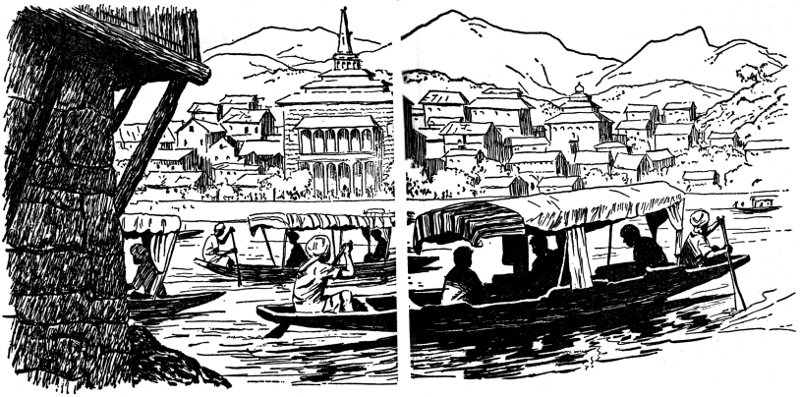
It was sunset along the Calcutta waterfront. The
reflection of the vivid tropical sky turned the murky
water of the Hooghly River into a rippling rainbow.
The river was alive with a variety of craft, including
native sailboats, side-wheel steamers that plied up and
down the Hooghly between Calcutta and the Bay of
Bengal, eighty miles south, as well as sturdy tugs,
launches, and lighters that served the ocean-going
ships moored in midstream along the strand.
Biff Brewster was standing at the bow of a big
freighter, the 10,000-ton Northern Star, which only
that afternoon had cast anchor in the Port of Calcutta.
Biff was a blond-haired youth of sixteen, with
broad, square shoulders and blue-gray eyes that were
as keen and expressive as his strong, well-formed features.
With Biff were two other boys, his companions
in previous adventures.
2
One was Kamuka, a Brazilian boy of Biff’s own
size and age. They had met at the headwaters of
the Amazon, where Biff had accompanied his father,
Thomas Brewster, in an adventurous search for a
fabulous gold mine. Kamuka, who had spent most of
his life on jungle rivers, was keenly interested in the
scenes he now was viewing along the Hooghly.
The other boy was slightly younger and smaller of
build, but quite as wiry and athletic as his two companions.
He was Likake Mahenili, a Hawaiian youth
known as “Li” to his friends. Li, a skilled diver, had
helped Biff crack the riddle of a vanished sloop when
they had teamed in a thrilling sea hunt off the Hawaiian
shores.
Now, all three were newly arrived in India, the
land of mystery. But there was no mystery as to why
and how they happened to be together. That was due
to a simple turn of events.
Months ago, Biff’s father had gone to India to open
long-neglected gold mines in some of the former
princely states that had been absorbed by the Indian
Republic. It had taken much longer than Mr. Brewster
expected—as many of his jobs did—so he had
arranged for the family to come by air to India and
join him there.
Meanwhile, Biff had invited Kamuka to come from
Brazil and spend his vacation in the United States. By
a quick switch of plans, Biff and Kamuka had flown
to San Francisco just in time to take last-minute passage
on the Northern Star, which cost less for both
than Biff’s trip would have by air.
3
The freighter had been scheduled to call at Honolulu,
so Biff had written ahead to Li, who had not
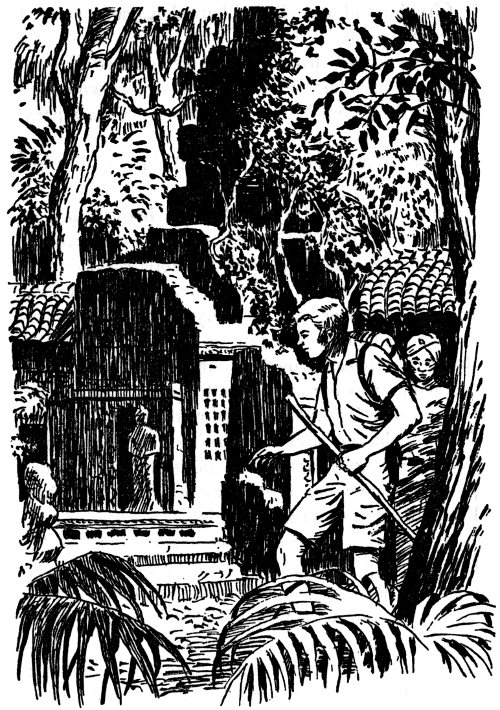
only met the ship there, but had decided to come
along on his own. They had broken the monotony of
the long voyage with brief stops at ports on the way,
but so far, it had been more of a sightseeing tour than
an adventure. They still had one more night to spend
on shipboard as the Northern Star had reached Calcutta
a day ahead of schedule.
“Tomorrow,” Biff declared, “Dad will be here to
meet us. By now, my mother and the twins should
have reached Darjeeling, so he may be bringing them
along to visit the gold fields.”
“I hope that Mr. Brewster shows us the Kolar
Mines at Mysore,” declared Li enthusiastically. “They
have shafts that go down two miles, the deepest in the
world.”
“Except for those in South America,” put in Kamuka
stoutly. “They are the world’s deepest. I
learned that at technical school in Brasilia.”
“And I suppose they taught you that South America
has the biggest mountains, too,” returned Li. “Just
wait until we see Mt. Everest. Those Himalayas will
make your Andes look like a lot of ant hills.”
“I shall wait until I see them before I judge,” said
Kamuka complacently. “But since you speak of ant
hills, the ones we have in Brazil are bigger than anywhere
else.”
“You can’t win, Li,” laughed Biff. “Kamuka has
an answer for everything.”
“You’re telling me?” returned Li, with a grin. “He
even answers questions before I ask them.”
4
This good-natured banter had been going on all
across the Pacific. In the friendly disputes between
Kamuka and Li, Biff had been called upon to act as
judge. So now he gestured toward the river, with the
comment:
“Let’s keep our minds on what we’re watching for—the
tidal bore coming up the river. I’d say it’s due
any moment now, the way those boats are getting
ready for it.”
Tugs and side-wheelers were bracing to buck the
incoming tide, while the native boats were hoisting
colorful sails and poising in midstream, ready to take
off up the river. Biff had his movie camera with him
and he began taking color pictures of the scene, including
activity along the shore, where tiny craft
were hastily shoving off.
“They’ll have to clear those piers,” Biff commented,
“or they may be smashed like eggshells when
the bore hits.”
The other boys nodded as they scanned the deepening
purple of the river. But even their keen eyes failed
to detect a motion on the darkened steps of an old
pier. There, a slim, furtive figure was crouched close
to the water, looking out toward mid-channel.
Carefully, the huddled watcher fingered a watertight
packet attached to a thin chain around his neck;
then, satisfied that it was safe, he slid his sleek, brown
form into the river and began swimming smoothly,
swiftly toward the Northern Star. He might have
been mistaken for a snout-nosed crocodile from the
delta of the Hooghly, or a floating log swirling in the
eddies of the changing tide. But no one noticed him,
least of all the boys high on the big freighter’s bow,
for their attention now was fully gripped by what
was happening downstream.
5
Distant whistles blared; their deep-throated signal
was relayed by other ships closer by. Tugs added
shrill blasts as a great crest of water came rushing upstream,
churning the muddy Hooghly into a whitish
foam. Tiny boats were tossed like match boxes by
the six-foot wave that swept from shore to shore.
Launches rocked, tugs jounced, and the sailing craft
caught the stiff wind that accompanied the tidal bore,
letting its billows carry them along.
While Biff and his companions were watching the
wave surge toward them, the sleek, brown swimmer
reached the bow of the Northern Star. If the arriving
wall of water didn’t overwhelm him, it seemed sure to
crush him against the side of the big ship. But as it
was almost upon him, his quick hands came up and
grabbed the freighter’s anchor chain. An instant later,
he was out of the water and while scrambling upward
like a monkey the white foam churned just beneath
him.
Clinging there, he waited while the freighter
strained at its moorings, because of the sudden lift.
Then, satisfied that the chain would not swing him
against the ship, he continued his climb, his dripping
figure scarcely visible.
On the deck above, the boys had gone to the starboard
side, where Biff was taking pictures of the boats
that were riding upstream. None of them noticed the
head and shoulders that appeared over the port rail. A
sleek figure followed, slid behind a row of crates, and
worked along to a companionway. There it darted
swiftly up the steps to the cabin deck above.
6
Biff had been following the bore with his camera,
until it faded, tiny sailing ships and all, beneath the
towering bulk of the Howrah Bridge, which spanned
the quarter-mile width of the Hooghly River.
“Well, what did you think of it?” Biff asked.
“We have bigger bores on the Amazon,” replied
Kamuka nonchalantly. “This was only six feet. Ours
are as high as sixteen.”
“And the way those sailboats took off was nothing,”
put in Li. “Not compared with the way we ride
the rollers with our surfboards at Waikiki.”
“It’s nice to hear you fellows agree on something,”
laughed Biff. As he spoke, a gong sounded from amidships.
“And there is something else you both like, the
first call to dinner. Wait while I put my camera in the
cabin; then I’ll join you.”
Biff had left the door of his cabin unlocked. When
he opened the door, he was conscious of a slight stir
within. Biff looked toward the porthole that served as
a window. Momentarily, it blacked out, then showed
plainly against the dimming sunset, as though a figure
had squirmed through. Biff stepped out, closing the
door, and called down to Li and Kamuka:
“Take a look over the port side and see if someone
is hanging on outside my cabin!”
7
A figure had been hanging on, but no longer. Pushing
off from the side of the ship, it straightened in
mid-air and plummeted down the side of the freighter,
punching the water with scarcely a splash. By the
time Li and Kamuka looked over the rail and Biff was
gazing from the porthole of the cabin, the lithe brown
swimmer was heading shoreward, unseen on the now
darkened surface of the river.
The cabin itself was empty. Of that, Biff felt sure
as he turned on the light, until a familiar voice spoke
almost at his elbow.
“Listen carefully, Biff,” the voice announced. “I
have something important to tell you—”
The effect was electric on Biff. “It’s Dad’s voice!”
he exclaimed. By then, the door of the cabin had
opened again, and Li and Kamuka were staring in,
both bewildered as the voice continued:
“I cannot meet you as I planned, so follow these
instructions exactly. Tomorrow morning, at ten
o’clock, be at the New India Bazaar in Calcutta—”
At this, Li exclaimed excitedly, “It’s Mr. Brewster’s
voice!” and Kamuka added, “But where is he? I
don’t see him?” Then, Biff was pointing, showing
them the answer. The voice was coming from a tape
recorder that was on a table in the corner, and was
connected with a lamp socket in the cabin wall.
“And there you will receive another message,” Mr.
Brewster’s voice declared. “Follow it exactly, and
you will meet a man we both can trust. He will have
more to tell you, so obey his orders to the letter, as if
they came from me.”
The tape ran on silently from that point. Biff
stopped the recorder as Li asked, in a puzzled tone, “Is
this a joke, Biff?” Kamuka, his eyes wide, was silently
asking the same question, but Biff shook his head.
8
“Far from it,” said Biff. “I never heard this tape
before, but it’s Dad’s voice, as you both know. He has
a recorder just like mine; in fact, I brought this one
along because Dad told me that if he had a special
message, he would put it on tape for me—just as he
has!”
With that, Biff strode to the porthole and looked
out over the black river, toward the thousands of
lights that were now gleaming from the vastness of
Calcutta, largest city in India, and the second greatest
metropolis of what had once been the British Empire.
“But who brought the message?” queried Li.
“And why?” added Kamuka.
“Those questions,” returned Biff, “will be answered
tomorrow, at the New India Bazaar!”
9
II The Boy and the Basket
The last call for dinner interrupted any further comments
on the mysterious message. Tonight was a big
event, for the chief steward of the Northern Star had
gone the limit to please the three youthful passengers
on the freighter. The meal consisted of specialties in
Brazilian, Hawaiian, and American dishes, with little
speeches in between.
But the boys found it difficult to share the spirit of
the other passengers and ship’s officers, who were
doing their best to entertain them on this last evening
together. Biff was sure that morning would bring
some confirmation of his father’s message, while Li
and Kamuka were wondering whether or not he had
sufficient reason to be that confident.
Early the next morning, the three boys were up
and on deck when a mail boat came to the Northern
Star. A uniformed Hindu handed a telegram to Captain
Peterson, the skipper of the freighter, who passed
it on to Biff with the comment:
“This is for you rather than for me.”
10
Li and Kamuka were peering over Biff’s shoulders
as he read the message aloud:
“NOTIFY BIFF BREWSTER HIS FATHER CANNOT
MEET HIM IN CALCUTTA. HE AND FRIENDS ARE
TO PICK UP PLANE RESERVATIONS FOR DARJEELING
AND JOIN HIS FAMILY THERE.”
The message was signed by the New Delhi representative
of the Ajax Mining Company, for which
Biff’s father worked. Captain Peterson told the boys
to let him know if they had any trouble finding their
plane reservations at the Grand Hotel, where the bus
left for the Calcutta Airport at Dum Dum. Biff and
his two companions said good-by and packed themselves
ashore.
They took a taxicab past the Maidan, the huge park
where hundreds of Hindus were asleep on the grassy
expanse. Still more were sprawled along the sidewalk
of Chowringhi Road, which brought them to the
Grand Hotel. There, they found that plane reservations
had been made for Darjeeling, but instead of
picking them up immediately, Biff inquired the way
to the New India Bazaar and found that it was a short
rickshaw ride from the hotel.
Soon the boys were riding swiftly through the
native quarter of Calcutta, in a two-wheeled, man-hauled
carriage that followed narrow streets flanked
by rows of old tenement houses and other crude
structures filled with the city’s teeming population.
11
At the New India Bazaar, they found rows of
small shops surrounding a busy square where shoppers
in Hindu attire carefully side-stepped a sacred
cow that was sprawled complacently on the sidewalk.
Barkers were babbling in Hindustani, trying to attract
trade and one youth, attired in shorts and loose white
jacket, was drumming up business by beating the ends
of a wooden keg, tom-tom style, drawing a crowd
along with him.
The Indian boy looked tall because he was thin,
even to his smiling face. He eyed Biff and the other
boys closely as he passed them, giving the drum a few
quick, extra beats as an invitation to come along. Biff
turned to his companions and ran his hand through
his shock of blond hair.
“Dad must have given his friend a good description
of me,” Biff told the others, “so I am sure to be
spotted soon. The more we circulate, the easier it will
be to find me, so we may as well see where this
drummer boy is leading us.”
They wound up at an open corner where some
buildings had been demolished to make way for one
of the wide new streets that were being cut through
the city’s congested areas. Temporarily, at least, it had
been turned into an outdoor theater, for a man in
baggy white clothes and a huge turban was beckoning
the crowd his way as he announced:
“I, Jinnah Jad, greatest jadoo wallah in Bengal. I
make jadoo with duck. You see.”
12
By “jadoo” Jinnah Jad meant “magic,” and the
term “wallah” signified that he performed it. The
jadoo wallah filled a small tub with water from a big
jar, then placed a miniature imitation duck in the tiny
pond thus formed. As Jinnah Jad made mystic passes
over the toy duck, it dived into the water, only to
come popping up again at his command.
As the boys moved closer with the interested
crowd, Jinnah Jad gestured them into a semicircle and
announced:
“I show you magic with mango. First I make tent
where it can grow—”
As he spoke, he set three sticks in the ground so
they formed a tripod about four feet high. He took a
cloth from a big heap and wrapped it around the
sticks, making a little tepee. He held up a mango seed,
about the size of a large pear, then pushed it in
through the opening of the tent, as though planting it.
Soon Jinnah Jad pulled away the cloth and showed
a little sprout instead of just a seed. He formed the
tent again, using a larger cloth. He piped a tune on a
hollow gourd that he used as a flute and pulled away
the cloth. There, spreading out from the tent, was a
small mango tree, with fruit on its branches!
As the crowd buzzed its admiration, Jinnah Jad
turned to the slender boy with the drum and said,
“Chandra, you bring me rupees, so I make more
jadoo.” The boy promptly picked up a wooden bowl
and started through the crowd, taking up a collection,
nudging people with the bowl and gesturing to their
pockets whenever they hesitated at contributing a
few coins.
13
Biff, meanwhile, was speaking in a low voice to his
companions. “Let’s spread out, so you two can watch
to see if anyone is watching me,” he suggested. “Then
no one will know that we are together.” To that, Li
and Kamuka agreed. As they moved away, they each
passed Chandra and added coins to the collection at
the Hindu boy’s urging. Then Chandra reached Biff
and asked politely, “You have rupees, maybe, sahib?”
Biff pulled two rupee notes from his pocket and
dropped them in the bowl. Chandra bowed and
brushed past, taking the bowl to Jinnah Jad, who
picked out the rupee notes and glowered his dissatisfaction
at the rest. Two men were passing by, carrying
a heavy basket that dangled by its handles from a long
pole. Jinnah Jad told them to set down their burden
and remove the bundles that it contained. Then:
“This boy is good for nothing,” declared Jinnah
Jad, indicating Chandra. “So I make him go for good.
You watch.”
Before Chandra could dart away, Jinnah Jad
grabbed him and thrust him into the basket, which
was roundish and bulging at the sides. Jinnah Jad
threw a cloth over the boy’s head and shoulders and
suddenly, Chandra’s form collapsed beneath it. Triumphantly,
Jinnah Jad jumped into the basket and
trampled the cloth there.
Chandra had vanished from the basket, and to
prove it, Jinnah Jad not only stamped his feet all
around, he squatted down in the basket, filling it with
his fat form, while he clucked like a happy hen seated
on a nest. Then, emerging from the basket, Jinnah
Jad snatched up a long sword, shouting, “I show you
boy is really gone!” With that, he stabbed the sword
through one side of the basket and out the other side.
14
While the crowd gasped, Jinnah Jad repeated the
thrust again and again, one direction, then another.
The jadoo wallah had worked himself into a frenzy
when the men who owned the basket stopped him and
babbled in a native dialect.
“They know the boy is gone,” translated Jinnah
Jad, for the benefit of the crowd. “They do not want
me to spoil their basket.” He waved to the basket and
told the two bearers, “All right, take it.”
Eagerly, the two natives piled their bundles into the
basket, thrust the pole through its handles and hoisted
it on their shoulders. By then, Jinnah Jad was in the
midst of another miracle. He was pouring rice from a
bowl into a square teakwood box that had a glass
front, while he stated:
“One time, in India, there was great famine, with
people everywhere needing rice. So a great yogi in
the Himalayas fill a box with rice like this—”
The throng was hushed, for Calcutta itself had
suffered from great famines, even in comparatively
recent years.
“So by magic, he sent rice everywhere, to everybody!”
Jinnah Jad gave the box a flip. Instantly, the
rice was gone from behind the glass and he was opening
the box wide, showing it to be totally empty.
“Yes, to everybody! To you—to you—to you.” Jinnah
Jad was jabbing his finger from person to person.
“So look in your pockets and find it! You, sahib—you,
babu—find rice!”
15
People were bringing fistfuls of rice from their
pockets. Biff smiled, thinking these were friends of
the jadoo wallah, until he saw total astonishment on
faces close by. Those included Li’s, for a dozen feet
away, the Hawaiian youth was bringing out two
handfuls of the tiny grains from each coat pocket.
Still skeptical, Biff thrust his hands into his own pockets
and brought them out—containing rice!
The deeper he dug, the more he found. Biff was
almost ready to accept the jadoo of Jinnah Jad as real
indeed, when he brought out something else, a crinkly
wad of paper, with more rice inside it. Puzzled, Biff
pulled it open and found it to be a penciled note that
stated:
Follow men who go with basket. Go alone. Tell
no one where you go. Important.
None of the other spectators had found a note like
that, for they were simply staring at the rice, while
Jinnah Jad moved through the crowd, taking up a
new collection in person. Biff looked for the basket
bearers and saw them starting slowly away, as if they
had waited just long enough for Biff to find the note.
So Biff started after them, working his way through
the crowd so that he went past Li. Quickly, Biff muttered:
“Don’t look now. Just find Kamuka and wait for
me here. I’ll be back—soon.”
16
III The Rajah’s Ruby
By the time the basket carriers had turned a few
corners, Biff was not so sure that he would rejoin his
companions as soon as he expected. The lazily moving
pair suddenly stepped up their pace and the narrow,
poorly paved streets looked so much alike that Biff
had no idea where they were leading him.
The streets were flanked by chawls or native houses
that were scarcely more than hovels. From the suspicious
glances that Biff received, and from the way the
buildings encroached upon the narrow alleys, he felt
as though a whole sea of humanity was closing in
upon him. He realized that he would need a compass
to find his way back. There was no telling by the
sun, which was out of sight even over the low roofs,
although the day was becoming so hot that Biff
wished he were back in a rickshaw instead of footing
it through these dismal, dirty streets.
17
Then they reached a better section, where the
buildings were higher, with occasional shop fronts.
There, the basket bearers slackened pace and turned
into a passage beneath an archway that bore the sign:
D. CHAND & BROS.
Import—Export Warehouse
Biff followed cautiously and saw the two men cross
a little courtyard and continue through another archway
well beyond. There they disappeared from view
but only long enough to set down the basket, because
one of them returned to the inner arch and closed a
big metal gate behind him. He then went to rejoin his
companion.
By then, Biff was moving into the courtyard himself.
He edged over to one side and gained a look
through the inner arch. Beyond the closed gate he
saw what appeared to be a large storeroom, for there
were many crates, boxes, and other bulky objects
stacked there. From his angle, Biff could see nothing
of the two men, so he moved cautiously toward the
inner arch, hoping to get a closer and more direct
view.
At that moment, a clang sounded behind him, and
Biff turned to see that another gate had closed in the
outer arch. A tall man in baggy white clothes had
stepped in from the street and was now locking the
gate behind him. Biff was trapped in the open space
between the archways. He looked quickly for an outlet,
and saw one on the other side of the courtyard, in
the form of an open doorway.
18
Biff hurried in that direction, only to stop short as a
man appeared in the doorway to meet him with a
polite, welcoming bow. The man was dressed in
European clothes, but his broad, bland face, with
fixed smile and bushy eyebrows above his large-rimmed
glasses, was definitely Asiatic. So was his
cool, even-toned pronouncement:
“I am Diwan Chand. I have been expecting you.
Come in.”
Then, as Biff hesitated, glancing back at the white-garbed
Hindu, who was coming from the outer gate,
Diwan Chand added a further introduction:
“This is Nathu, my special watchman. I thought it
best to have him lock the gate, so we cannot be disturbed.
He will wait here until we return.”
Chand said nothing about the pair who had gone
through the inner archway with the basket. Biff followed
the bland merchant through a room equipped
with a long row of vacant desks, like an old-fashioned
counting house.
“Our clerks work here,” explained Chand, “but they
have all gone out to lunch, so no one will know of
your visit.”
Whether that was good or bad, Biff wasn’t sure.
He felt a nervous tingling that seemed an instinctive
warning of some close danger; yet it might be that all
these precautions were for his benefit.
19
This seemed doubly so when they reached Chand’s
quiet private office at the rear of the long counting
room. There, the merchant closed the door, gestured
Biff to a chair, and opened a small safe that was cunningly
concealed in the elaborately carved woodwork
of the wall.
“You received your father’s message,” commented
Mr. Chand, “and now I have something for you to
take to him. This.”
Biff gasped at the object Mr. Chand placed on the
table before him. There, in a small case lined with
white velvet, gleamed the largest and most magnificent
gem that Biff had ever seen. It was a blood-red
ruby, with a touch of purple that gave it a glow like
living fire, even in the subdued light of the office. In
his study of mineralogy, Biff had viewed many fine
stones, but never one that even approached this ruby.
“A padmaraga,” Mr. Chand said. “A true Brahmin
ruby, not to be confused with those of lesser caste.
Whoever carries such a gem as this one can live in
perfect safety in the midst of many enemies, totally
without fear.”
At first, Biff thought that Mr. Chand was simply
repeating some Hindu legend concerning rubies, but
he soon saw that the merchant’s steady smile had
become very serious.
“For this I can vouch,” Mr. Chand continued. “The
Light of the Lama, as this ruby is known, brought
good fortune to the descendants of the rajah who
originally owned it. While I have been its custodian, I,
too, have prospered. There has been no trouble here,
despite riots and disturbances in other parts of Calcutta,
in fact, throughout India.”
Mr. Chand picked up the squarish jewel case and
started to place it in a chamois bag, as he added:
20
“And now good fortune goes with you. They say
that even the power of invisibility is granted to those
who hold this gem. Perhaps that is why danger has
passed me by.”
“But in that case,” Biff asked frankly, “why are
you giving it to me? Shouldn’t you keep it for yourself?”
“It is my duty to pass it along,” replied Mr. Chand
solemnly, “and besides, I have noticed that the Light
is losing some of its fire, which is a bad sign. See for
yourself!”
He moved the ruby closer to Biff, who saw now
that the gem was in a simple golden setting; but more
important, just as Mr. Chand said, its sparkle had
dwindled. Then, as Biff himself held the jewel, its
wine-red depth kindled with new flame, so suddenly
that Biff caught his breath.
“A good sign!” exclaimed Mr. Chand, closing the
little case and thrusting it into the bag. “That proves
it is in the hands where it belongs!” He pressed it into
Biff’s hands as he spoke. “So guard it well”—he
paused and his fixed smile became whimsical for once—“or
I should say, it will guard you well. We have
just seen proof of that.”
Evidently, Mr. Chand referred to the ruby’s sudden
glow, which was quite puzzling to Biff. But something
else puzzled him still more.
“Why must I take this ruby to my father?”
“He will tell you when you see him,” replied Mr.
Chand. “The less I say, the better, now that I no
longer have the ruby to protect me.”
21
“And where will I find my father now?”
“In New Delhi. Go there, but do not contact his
company except to ask for him by telephone. If he is
not there, go to the United States Embassy, but be
careful even then, as spies are watching everywhere.
Trust only your father’s voice as you did when you
received the taped message that I sent you.”
Biff nodded, recognizing the wisdom of all that.
Then, thoughtfully, he remarked:
“In that message, my father said I would meet a
man that he and I could both trust. I am sure he meant
you, Mr. Chand.”
If the merchant had beamed at the compliment, Biff
might have been suspicious, for he still felt the odd
sensation of some impending danger. But Mr. Chand
was modest.
“You can trust me,” he said simply, “but your
father meant another man, Barma Shah. He was the
contact who brought us together. I had hoped that he
would be here to meet you and go with you now, but
he is probably being watched.”
“By the same spies you mentioned, Mr. Chand?”
Biff inquired.
“Yes. Barma Shah told me he would stay away if
danger threatened here. That was a month ago and
shortly afterward, new riots broke out in Calcutta.
Some were rather close by, the nearest that they have
been. Naturally, Barma Shah did not come that day.
He has stayed away since—and wisely—so I sent
word to you myself, as was arranged for such a situation.”
22
Above Mr. Chand’s quiet voice, Biff thought he
heard a rising murmur, much like the approach of the
tidal bore along the Hooghly. Whether or not it was
his imagination, he felt more closed in than ever.
“The day of the riots,” Mr. Chand went on, “I
looked at the Light of the Lama and saw it had
clouded. I was afraid, not for myself, but for Barma
Shah. I was glad when he did not come here—”
The murmur was louder now, no longer like wave
beats, but more a human babble, with occasional muffled
shouts. Mr. Chand heard them, too, for he raised
his hand and exclaimed: “Listen!” Timed to the action
came a sudden pounding at the office door and the
excited voice of Nathu, the watchman:
“Master! There is danger! Another riot has started,
outside our very gate!”
As Chand unlocked the office door and opened it,
the babble rose to a bedlam of howls, shrieks, and the
clang of metal as the mob battered at the big gate.
At Chand’s mention of the ruby, Biff had thrust his
hand into his pocket to see if he still had the chamois
bag that he had placed there. It was safe, and as Biff
clenched it tensely, his palm seemed to burn as though
the gem were actually glowing through its wrappings.
There was a huge crash as the metal gate collapsed
and now, through the barred windows of the counting
room, Biff could see the milling figures of the
native rioters as they flooded the courtyard, swinging
clubs, slashing with knives, and hurling rocks at one
another. Some of those missiles smashed the glass in
the barred windows, adding to the crowd’s glee, for
they were eager to destroy property along with lives.
23
Mr. Chand showed surprising speed as he whisked
Biff back into the little office and through a door in
the opposite wall, at the same time saying excitedly,
“Go through the godown! It is your only way!”
Biff thought “godown” meant some steps, but instead,
Mr. Chand was referring to the storeroom. As
Biff started off among the crates, there was another
clang from the courtyard, where the rioters were
smashing at the inner gate leading into the storage
room itself.
“Not that way!” called Mr. Chand. “At the back,
you will find another darwaza—another gate! Turn
left on the back street until you reach the chowk—the
market place! You will be safe there.”
Mr. Chand turned back into his office to help
Nathu try to stem the attack, and Biff shoved his way
among the crates, clambering over boxes, until he
reached the rear exit that Mr. Chand had mentioned,
but too late. Already, the back street teemed with
rioters. Leering faces turned Biff’s way, and eager
fingers pointed at him through the bars of the rear
gate.
Then hands were bashing the gate itself as others
threw stones through the grillwork. Biff dodged back
among the crates, realizing hopelessly that he was
caught between two fires. A great crash told that the
gate from the courtyard had given way; and an echoing
clang from the other direction signified that the
rear gate had met the same fate.
24
What Biff’s own fate would be, the next few moments
would tell. Grimly, he found himself gripping
the chamois bag in his pocket, wondering if the Light
of the Lama could save him now. As if in answer,
something plucked his shoulder and Biff turned
quickly, bringing both fists up to fight off the first of
a hundred enemies.
Instead, he found himself looking into the face of
Chandra, the Indian boy who had vanished from the
basket back at the New India Bazaar. Above the
babble of the rioters came Chandra’s words:
“Quick! Come with me—this way!”
25
IV Biff Vanishes
Escape from the frenzied mob seemed impossible,
but at least Chandra was making a try as he pushed
Biff toward a deep corner of the big storeroom, the
only direction in which the invaders had not yet
spread. But there was no door, no outlet, nothing
except a solid stone wall beyond the last lot of crates.
Those offered no good hiding place, because the
rioters already were overturning or yanking open
chests and boxes which blocked them, while they kept
up an excited shout, “Farangi! Farangi!”
That was one word that Biff knew. It meant “European”—which
in his case could be translated as
“American”—and it signified that they were definitely
after Biff, though probably they would attack
any Farangi that they encountered. And now, Biff and
Chandra were practically in the corner, with no way
to turn, except one, which looked like the worst trap
of all.
26
Just ahead stood a tall, rather bulky cabinet shaped
in the form of a pagoda, with half a dozen sides and a
pair of front doors that were partly open. Quickly,
Chandra thrust Biff inside and pushed him to the back,
saying, “In there—keep quiet—do not move!” Then
he pressed an inner door shut, and Biff found himself
alone in pitch darkness, clamped in a space so tight
that Chandra’s admonition not to move was quite
unnecessary.
Chandra was gone by then, dodging off among the
crates, perhaps to save his own sleek hide at the expense
of Biff’s. For Biff, realizing now that he was
really boxed, was beginning to regret that he had
trusted the Indian youth so completely. Chandra, a
native himself, probably had friends among the mob.
Maybe he had even told them that he would lure Biff
here.
Until now, Biff had had a chance either for fight or
flight. Those were both gone, and if he didn’t suffocate
in this bandbox, he would probably be yanked
out and torn apart before he could even make a move.
He was so tightly jammed, he couldn’t even reach into
his pocket and find the ruby, which he felt was the
real cause of his misfortune, despite the soft talk
Diwan Chand had given him.
Even now, Biff heard voices: “Farangi—we find
him—look there....” And he could hear crates being
turned over close by. Next, the shouters were clambering
in and out of the cabinet itself, for Biff could
feel it shake and the hoarse, snarly voices were almost
at his elbow. They were even pulling the pagoda out
from the wall, for its platform was set on wheels; and
they were literally spinning it about, with Biff still
inside it, yet for some reason, they passed by him in
the blackness.
27
More shouts, louder crashes were suddenly punctuated
by pistol shots, leading to a last round of tumult
that soon died. Biff heard receding footsteps; then
came a deadly silence, which was even worse. Biff
felt totally helpless and abandoned, unable to move,
afraid even to call for help. He was drenched in perspiration,
and why he hadn’t suffocated or been found
he couldn’t understand, until a sharp click interrupted
his numbed thoughts.
Biff lurched forward, found the front doors and
stepped shakily from the pagoda cabinet to find one
person in the dim light of the warehouse waiting,
grinning, to receive him. That was Chandra.
Briefly, the Indian boy explained things.
“They took a good look for you, all right,” he said.
“Some of them did, anyway, while the rest kept fighting
each other. They looked a lot, but they didn’t find
you—or me.”
“But where did you go, Chandra?”
“Back in basket that brought me here,” replied
Chandra, widening his grin. He reached past a crate,
pulled out the basket, squatted in it and suddenly
squirmed from sight, as if the basket were bottomless.
Biff looked in and was amazed to see nothing except a
heap of old cloth.
Then, the heap stirred, and Chandra twisted into
view from the basket’s bulging sides where he had
artfully coiled his thin, agile body.
28
“So that’s how you vanished!” exclaimed Biff.
“Why, you were still in the basket when the two men
took it away!”
“How else could I get here so quick?” retorted
Chandra. “They are friends of Jinnah Jad, who show
up with basket at the right time. This godown is
where Jinnah Jad keeps all his tricks, like the new
pagoda he built to make people vanish. So I put you
there.”
“And I was thinking—”
Biff cut himself short, but Chandra picked him up.
“You think maybe the big ruby made you invisible,”
declared Chandra, “as it is supposed to do. But
no, it was the pagoda trick. It hid you, the basket hid
me.”
Biff was cooler now, and he felt an actual shudder
as he looked around at the wreckage and saw some
silent human figures lying near the gate to the courtyard.
Otherwise, the warehouse was deserted, except
for Biff and Chandra.
“But where did they all go, Chandra?” Biff asked.
“You heard shooting?” returned Chandra. “That
was the police. They came to help Diwan Chand.
Lucky they didn’t use tear gas, which they do a lot.
We would have gotten it, too.”
Chandra was looking around at the broken boxes.
He saw one that interested him and beckoned Biff
that way.
“We must get out before police come back and ask
us to be witnesses,” declared Chandra. “But the people
who are after the ruby will be watching for you. So
you must wear other clothes—like these.”
29
Chandra was picking some native garments from
those that had been dumped from an overturned
chest. Studying Biff, Chandra noted the deep tan that
Biff had acquired during his long voyage on the
Northern Star.
“Your face is dark enough,” decided Chandra, “but
your light hair will have to be hidden. So we will
make you into a Sikh. A Sikh always wears a turban.
That will fool everyone.”
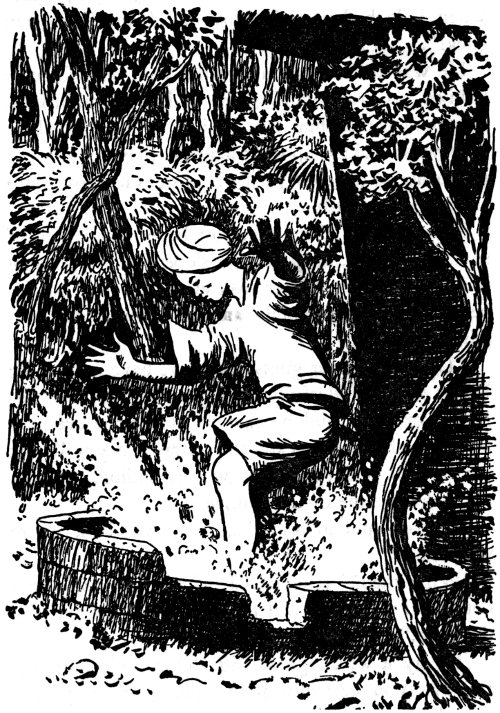
Soon, Biff was attired in a costume that made him
feel top-heavy. It consisted of shorts, shirt, and jacket,
and a huge turban, which completely covered Biff’s
ears as well as his head, after Chandra helped him
wrap it. They bundled up Biff’s clothes along with
some other garments and went out by the rear gate.
It was fortunate that both were in native garb, because
Biff could sense that eyes were watching them
as they followed the street to the market place. Chandra
knew it too, for he said, “Don’t look around.
They will suspect us if you do.”
There were natives in the market place, gathered in
little clusters, discussing the recent riot. They glanced
at the boys as they passed, but that was all. Chandra
gave a pleased chuckle, then added cautiously, “It
looks good now, but still we play it safe. We go the
long way, past the thana.”
By thana, Chandra meant police headquarters, a
place that suspicious characters would avoid. After
passing it, the boys were satisfied that they were not
being followed, so they doubled back to the New
India Bazaar, where they saw Li and Kamuka studying
the passersby from the doorway of a sporting goods shop.
30
It was Biff’s move now. He eased up to Li, tapped
him on the shoulder, and said, “Salaam, Sahib.” Li
turned and blinked puzzled at the face beneath the
turban until Biff could no longer restrain a grin.
“Biff!” exclaimed Li. “But where—and why—”
“We can’t talk here,” interposed Biff. “Meet me
around the corner and bring Kamuka.”
Chandra was with Biff when the other boys arrived.
After introducing the Indian youth, Biff said:
“I must go to New Delhi. If Chandra can go with
me, it is up to him to decide who can accompany us.”
“I can go,” Chandra assured him, “and Kamuka,
too. But not Li.” He turned to the Hawaiian youth.
“Too many people saw you with Biff while you were
watching Jinnah Jad make jadoo. You might be recognized,
one because of the other.”
Before Li could even show the disappointment that
he felt, Biff softened the situation.
“Somebody will have to go up to Darjeeling,” he
reminded his friend, “to tell the family where I’ve
gone. Canceling those extra plane reservations and
handling our luggage is a tough job, too. It looks like
you’re elected, Li.”
Li not only was elected; he did his job well. He
went to the Grand Hotel and returned by taxi, rejoining
the group at a restaurant that Chandra had specified.
Li had canceled the air reservations without
difficulty; he had brought hiking packs for Biff and
Kamuka, and he had arranged for shipment of the
excess baggage.
31
After a substantial meal, Li returned to the hotel by
cab, to catch the Darjeeling plane. The other boys
boarded a big bus for Howrah, across the river. Biff
and Kamuka looked down from the tremendous cantilever
span and viewed the muddy Hooghly, hoping
to spot the Northern Star moored in the dim distance.
They were talking about it—in English, unfortunately—when
Chandra hissed for silence.
They realized then that they were an odd group as
it was—too odd to be using English as a common
language. Biff, whose features didn’t properly match
his Sikh’s costume; Kamuka, who might have come
from an upcountry tribe, but was wearing European
clothes; Chandra, who with his dhoti and jacket,
looked like a jadoo wallah’s boy, which was exactly
what he was, and therefore the most outlandish of the
trio.
In short, they were attracting too much attention.
Biff and Kamuka promptly subsided. Biff, particularly,
felt that he should show some dignity, so he did, by
looking squarely at the other passengers, until he
caught the eye of a distinguished-looking man across
the aisle.
32
The man had a large beard and a huge turban,
which marked him as a Sikh, and a genuine one. He
was studying Biff with sharp eyes that continued their
piercing probe until the bus reached Howrah Station.
Then, as they were stepping from the bus, the bearded
Sikh suddenly spoke to Biff in what was their own
common language, except that Biff couldn’t understand
a word of it.
All that saved Biff was a surge of the crowd, with
people pushing one way, then another, cutting him
off from the bearded Sikh. Next, Biff was on the outskirts
of the milling throng, and Chandra was yanking
him away, along with Kamuka.
“Thanks, Chandra!” Biff gasped. “If you hadn’t
dragged me out of that jam, the Sikh would have
known I was a fake—”
“That wasn’t why!” returned Chandra. “That
wouldn’t have bothered us. Maybe you’re a fake, but
he’s a bigger one. I saw his beard close enough to
know.”
Biff looked back and saw that Chandra was right.
Caught in the crowd, the man with the big turban
wasn’t trying to follow the three boys; in fact, he
couldn’t even see them. The reason was that his false
beard had been pulled up over his eyes, and he was
madly trying to straighten it.
Hand in his pocket, Biff was gripping the packet
that he had transferred from his own clothes, wondering
if the Light of the Lama again had saved him from
an enemy!
33
V Danger at Dawn
Right then, Biff’s one hope was that he and his two
companions could lose themselves in another and bigger
crowd and thus dodge the disguised stranger who
was so intent upon following them.
They couldn’t have chosen a better place than the
Howrah Station. It seemed five times bigger than any
other railway station Biff had ever seen, and it contained
ten times as many people. The afternoon had
reached its peak of stifling heat, so they had come in
here and sprawled over the acres of cool marble floors
in preference to the Calcutta sidewalks.
The boys had to step around prostrate bodies or
clamber over them, as did hundreds of other travelers
who were thronging the great depot. Practically all
of those travelers were natives, and many of them
were carrying huge bundles that contained most of
their worldly possessions.
34
Chandra explained that many of Calcutta’s three
million citizens were constantly on the move, due to
lack of food or jobs; but that as fast as they left town,
others poured in to replace them. He added that the
population was still shifting between India and Pakistan,
which accounted for more travel, particularly
since the East Pakistan border was so near Calcutta.
He also mentioned that many were pilgrims bound
for Benares and other places holy to Hindu cults.
While the boys picked their way through the immense
station, Chandra pointed out examples of each
group. He also called attention to occasional Europeans
and well-dressed Indians, including Hindus of
high caste.
“Those few,” declared Chandra, “go first- or second-class.
Always, some talk English and ask too
much about everybody’s business. I know, because I
have gone second-class with Jinnah Jad. So we will go
third-class and talk just to each other.”
That satisfied Biff and Kamuka. It wasn’t a matter
of saving money, for they had pooled their cash and
had more than enough to travel in luxury, with Chandra
included. But getting to New Delhi unnoticed was
essential, and the train trip, which required more than
twenty-four hours, was the sort that promised complications,
so the more they avoided, the better.
Chandra had a bright idea on that score, too. Biff
gave him enough money to buy three third-class tickets,
but when Chandra rejoined the other boys, he
returned half the cash.
35
“I only buy tickets halfway,” he stated, “so nobody
will know we are going to New Delhi. They will
think maybe we are going to Benares or Allahabad,
but instead we will go on to a little village where my
uncle lives and start again from there.”
“You’re the boss of this expedition, Chandra,” Biff
assured him. “Anything that will cover our trail is a
good idea.”
Breaking the trip also seemed a good idea when
Biff saw the accommodations that the third-class carriages
offered. Biff had been afraid that he might be
noticed on the station platform, the way he had been
on the bus, but that worry soon was over. The platform
was thicker with milling humanity than the station
itself. People would have been pushed onto the
track, if the train hadn’t been there to receive them.
Many were crowding into first- and second-class
compartments, only to be pushed out and ordered
back to where they belonged, in third class. Amid the
commotion, Chandra found one third-class compartment
that looked full, but wasn’t, because the occupants
had simply spread their luggage in a haphazard
way. Chandra began piling them together like so many
bundles of wash, until he had made room for all three
boys, including their own luggage.
The seats in the compartment were little better
than benches, but Biff gladly drew himself into the
deepest and most uncomfortable corner, rather than
be observed too closely when members of the train
crew closed the doors, for some of them were genuine
Sikhs who might have seen through his thin disguise.
36
The platforms were still crowded when the train
pulled out—as many people had come to the station
simply to see the others off. Then the train was rolling
into the open country, what little Biff could see of it.
The rattle of wheels mixed with swirls of dust and
blended with the smell of garlic and spices, for everyone
was bringing out native food, bowls of rice,
bananas, and other fruit. Biff’s appetite was suddenly
roused.
“Think of all that rice Jinnah Jad wasted,” Biff said
to Kamuka, “when he did that trick! I could eat some
of it now.”
“He didn’t waste it,” reminded Kamuka. “He put it
in our pockets, remember? We should have kept it.”
“Say, that was a neat trick.” Biff turned to Chandra.
“How did Jinnah Jad work that part of it? Or don’t
you know?”
Chandra grinned broadly.
“That is one trick I do know,” he declared. “Remember
when I went through the crowd, tapping
people’s pockets, asking for rupees, like this?” He
tapped Biff’s pocket, then Kamuka’s, and they both
nodded. “While I do that,” Chandra went on, “I use
my other hand to put rice in other pockets. So later,
the people find it there.”
“So that was it!” Almost instinctively, Biff thrust
his hand in his other pocket, then brought it out in
amazement, with a pair of candy bars. Kamuka,
reaching into his own pocket, found himself staring at
a handful of loose peanuts.
“You must have bought these when you went for
the tickets,” said Biff to Chandra, “and then you
slipped them into our pockets while you were telling
us how you did it! Candy for me—peanuts for Kamuka—”
37
“And now you have peanuts, too,” put in Chandra,
“in the pocket where you keep the big ruby.”
Again Chandra was right, and Biff’s amazement at
the Indian boy’s skill was complete. They ate their
chocolate bars and peanuts along with some fruit that
Chandra had also brought them. Then, when the
other passengers were no longer noticing them, Chandra
remarked:
“Remember how the big man with the fake beard
got tangled in the crowd, when we were leaving the
bus?”
Biff and Kamuka nodded.
“I do that too,” declared Chandra proudly. “I push
one person like this”—he nudged Biff forward—“and
another like that”—he gave Kamuka a backward
push—“and pretty soon all are in each other’s
way.”
Biff smiled at that, too; then he turned solemn.
“We’ve been watched,” he declared, “and that’s for
sure. So let’s be still more careful from now on.”
At various stops, the train disgorged many passengers
who filled up water jars that they had brought
along and returned to the train before it started. Biff
and Kamuka let Chandra handle that job for their
party, rather than show themselves on station platforms.
38
Occasionally, though, Kamuka waved from the
compartment window to fruit sellers who also supplied
milk and soft drinks. At such stops, first- and
second-class passengers went ahead to the dining car
or had attendants bring choice dishes to their compartments;
but third-class travelers didn’t rate such
service.
It was turning dark when the train reached the
great coal fields in western Bengal. That part of the
trip interested Biff most, because of the mining activity.
But there was little to be seen, and soon, despite
the rattle and jouncing of the train and the discomfort
of the stuffy corner, Biff began dozing off.
Once, Chandra nudged him and whispered, “Watch
your turban! Keep it on straight!” and Biff woke
sufficiently to realize that he had one ear out of the
cumbersome headgear. He worked it into place, saw
Chandra nod approval, and then went back to sleep.
Again, Chandra woke both Biff and Kamuka, who
was sleeping, too, telling them, “Watch out, now!
New passengers coming on board. Don’t let them
look at you too close.”
So Biff and Kamuka kept their heads together and
engaged in low conversation until the new passengers
gave up looking at them and fell asleep themselves.
That gave Biff and Kamuka the right to do the same.
This time, Biff’s sleep was sound, undisturbed by the
joltings of the train or the blare of the locomotive
whistle as it rushed on through the thick night.
It was a dream that wakened Biff. He imagined that
he was clutching the big ruby, while hands were trying
to snatch it from him. He was confronted by
bearded Sikhs and as he clawed wildly at their faces,
their beards came away, until he saw only one smooth
face and opened his eyes to find that the dream, in a
sense, was real.
39
Biff was clutching the bag that contained the ruby,
but his hand was deep in his jacket pocket. The hands
that were clutching him were Chandra’s, shaking him
awake; and the smooth face, too, was Chandra’s.
Quickly, the Indian boy put his finger to his lips for
silence.
The train was standing still. All was silent in the
compartment except for the snores of other passengers.
The lights looked dimmer than before, because
it was no longer pitch dark outside. Faint streaks of
dawn were reddening the sky beyond low-lying hills.
The compartment at last seemed slightly cool.
Biff risked a whisper. “Where are we?”
“At an engine-changing station,” Chandra whispered
back. “Our own is farther on, but we cannot
wait until then.”
He gestured toward Kamuka, who was still asleep.
Between them, Biff and Chandra shook Kamuka and
roused him instantly. Like a team, the three boys gathered
their packs and stepped carefully past the knees
and over the legs of sleeping passengers. Moments
later, they were on a weather-beaten platform alongside
the long, silent train. A few dozen human figures
were stretched on the station platform, with white
sheets of cloth drawn completely over their motionless
forms, like shrouds.
“Railroad workers, mostly,” whispered Chandra,
“waiting for the next shift. No one else gets on or off
here, at least, not often.”
40
“But why are they covered over?” asked Biff, impressed
by the weird appearance of the figures.
“Because the night was cool for them,” replied
Chandra, “but not too cool for the insects. Soon, now,
the covering over their heads will keep the sun from
waking them.”
The boys stole across the platform past a square-shaped
station where more such figures lay asleep.
Kamuka, looking back at the train, put the next
query:
“But why did we get off here?”
“Too many passengers changed places in the
night,” replied Chandra. “I saw new faces; then later,
I recognized some of the old again. If we had gotten
off at a crowded station, we could easily have been
followed. Here, no one else can leave the train without
our seeing them.”
Chandra was right. The boys had reached a road
that led at an angle from the tracks. Looking back,
they could see the full length of the brightly colored
train, as they continued on their way. In the gathering
daylight, their keen eyes would surely note any motion
on the steps of any of the cars. Ahead, the road
led through a grove of trees. Once there, the boys
themselves would be out of sight.
41
There was just one spot the boys’ roving eyes did
not cover; that was the portion of the platform obscured
by the squatty station. There, three white-shrouded
shapes were rising like ghosts in the gray
dawn. They dropped away their sleeping sacks, revealing
limber figures clad in dark clothes that
blended with the background of the station wall, as
well as the trees beyond.
One man gave an order in a native dialect and
like human bloodhounds, the stealthy trio stalked off
along the very road that the three boys had taken!
42
VI The Cry of Death
When the dawn had broadened into full daylight,
the change was not too noticeable, for by now the
boys were trudging along a narrow, winding road that
was flanked by vivid tropical foliage and thick, overhanging
tree boughs that cut off much of the sunlight.
To Kamuka, this was intriguing indeed, for it carried
him back to his own jungle life in Brazil, especially
when he caught the chatter of the monkeys
from the higher branches. But to Chandra, who was
familiar with it all, such sounds were an annoyance as
he tried to explain his plans to Biff.
“This road will take us to the Grand Trunk Road,”
stated Chandra, “which we will follow until nightfall
to reach the village of Supari, where my uncle is
patwari—”
“Patwari?” interposed Biff. “What is that?”
“The same as karnam or kulkarni or talati—I have
heard it called by all those names—but it means in
English, the man who keeps the village accounts.”
43
“That would be the town clerk in America.” Biff
nodded. “So your uncle is an important man. Go on.”
“On the Grand Trunk Road,” continued Chandra,
“we will look like everybody else, because all India is
there. You will see hathi, oont, ekka—”
“Wait now, Chandra,” put in Biff. “Hathis are elephants,
that I know. And oonts are camels. But I
never heard of ekkas. What are they?”
“Pony carts,” returned Chandra seriously, “and
you will also see bicycles and jeeps.”
“It sounds good,” decided Biff. “But what if we
were being watched on the train. Do you think they
will catch up with us?”
“They cannot catch up,” returned Chandra, “because
they have gone ahead. If they talked to ticket
agent or to the man who took our tickets, they know
where we should get off and will look for us there.”
“When does the train reach our station?” Kamuka
asked.
“Not for about an hour,” calculated Chandra,
“counting change of engines. Before they come back
to look for us, we will be on the Grand Trunk Road.”
Despite his assurance, Chandra was moving rather
cautiously, but for another reason. He was looking
from side to side, for they were in the jungle now and
there was no telling what night creatures might still
be on the prowl. Chandra knew this from occasional
experience in such a setting, as any Indian boy would
who had lived in a native village like Supari. But Kamuka,
the boy from Brazil, recognized it instinctively,
for he was jungle born and bred, though in the opposite
hemisphere.
44
“Remember, Biff?” queried Kamuka. “The time the
big jaguar jumped at you?”
“I remember,” replied Biff, “because it was you
who stopped it, Kamuka.”
“I just helped,” said Kamuka. “But this jungle reminds
me of jaguars. Do they have them here?”
“They have cheetahs, leopards, and tigers. Those
should be enough—and more.”
“And big sucuria, too?”
“Yes, they have those.” Biff turned to Chandra.
“He means a boa constrictor. We ran into a big one
up the Amazon, a snake the size of your python.”
“What about Macu?” demanded Kamuka.
“Head hunters,” translated Biff to Chandra. “He
wants to know if you have them, too.”
“We have something much worse,” declared Chandra
solemnly. “We have thugs, or stranglers, who ride
on trains with us. They are after your ruby, Biff, if
you still have it.”
Anxiously, Biff brought the bag from his pocket,
opened it and held the Light of the Lama in his palm,
where it caught the glint of the sunlight and reflected
it with a vivid crimson sparkle that seemed to dye
Biff’s entire hand. The great ruby was larger than the
biggest walnut, and as Biff turned it in the light, its
flattened surfaces, or facets, rivaled one another with
their fiery glow.
Chandra, who had been around the gem markets of
Calcutta and other Indian cities, and Kamuka, who had
seen the finest of South American stones during his
studies in Brazil—both were swept with awe.
45
“Never have I seen such fire!” exclaimed Chandra.
“The red ruby, like the blue sapphire, is often beautiful
in color, yet very dull.”
“This one loses its sparkle sometimes,” Biff declared.
“And according to Mr. Chand, it’s a bad sign
when it does.”
“It gives us a good sign now,” observed Kamuka.
“In South America, we have the finest of all gems,
the green emerald from Colombia. They say it glows
brighter than any red ruby, but now I am not so sure.”
Biff smiled, as he recalled Kamuka’s debates with Li
while they were on the freighter voyage. For Kamuka
to admit that a product of South America could
be matched by those of any other continent, was a
concession indeed.
“That ruby,” calculated Chandra, “must be worth
ten lakhs at least, ten times a hundred thousand rupees.
But that is not why your father wants it. He
needs it for some special purpose; that was why he
went to New Delhi. That much I have heard Mr.
Chand tell Jinnah Jad.”
“So it was through Jinnah Jad,” inquired Biff, “that
my father’s message reached me?”
“It was more through me,” returned Chandra
proudly. “I swam out to the ship, carrying the tape in
this.” He produced a watertight bag on a neck chain.
“I looked for the cabin with the tape recorder. I put
on the tape, the way Mr. Chand showed me. Then I
heard you coming, so I went out through porthole
quick, and dropped straight down.”
46
“A neat trick,” complimented Biff. “I’d like to see
you do it some time. Tell me, Chandra, did you ever
meet my father?”
“Yes, I see Sahib Brewster twice, when I was there
at Chand and Brothers, with Jinnah Jad.”
“And did you meet his friend, Barma Shah?”
“No, never. He came only to see Mr. Chand in
secret. He is what you call undercover. He stayed
away on purpose, when others began to find out that
the ruby was there. Like thugs I speak about.”
They were trudging along the road again, and now
Biff recalled that it was Chandra’s mention of thugs,
or stranglers, that had caused him to stop and make
sure that he still had the priceless ruby safely tucked
away.
“These thugs,” questioned Biff, “do they want the
ruby because of its value?”
“They want it because of the goddess Kali,” replied
Chandra. “That is why they started riot outside of
Chand and Brothers. They would have strangled Mr.
Chand, but they found the ruby gone—”
“So they were looking for me because I had it, and
they would have killed me for it!” Biff explained.
“That is right. But thugs will strangle almost anybody
if they find suitable time and place, because they
believe in Kali.”
Biff was putting the ruby back into its bag. Chandra
paused to hand him the chain with the waterproof
bag, suggesting that he put the packet in that, which
Biff decided was a good idea. As they started on again,
Biff urged:
“Tell us more about this Kali business, Chandra.”
47
“People say Kali was a great goddess who killed a
huge monster that wanted to destroy the world,”
Chandra related. “But each drop of monster blood
sprang up into a new monster. So Kali taught men to
strangle monsters with a special cloth called rumal,
about this long”—Chandra spread his hands approximately
a yard apart—“and after monsters were all
gone, men began to strangle men in the same way,
never shedding any blood. And so they do today.”
“But all that was stopped a hundred years ago—”
“You mean the time when British Raj said there
should be no more thugee? Look there”—Chandra
stopped abruptly and pointed to an anthill at the side
of the road—“and you see white ants. They are dangerous,
like thugs, so I stamp them out.” Roughly,
Chandra trampled the anthill and the insects teeming
around it. “But are they all stamped out? No, some
have gone under—how do you say it?”
“Underground,” returned Biff.
“That is it,” nodded Chandra. “That is the way the
thugs went. Underground. Now they have come up
again.”
“But why do they want the ruby for Kali?”
“Because they think that rubies are drops of demon
blood that will become new demons unless Kali stops
them. Your ruby would make biggest demon of all,
so they want it most. So Jinnah Jad tells me.”
“How many thugs do you think were on the train
with us, Chandra?” Biff asked.
48
“There always must be three,” declared Chandra.
“Two to use the rumal while the third holds the person
they strangle. Always, they pick some quiet place.
Often they work in many secret bands, so they have a
special call, which Jinnah Jad has heard and warned
me against. It goes like this—”
Stopping short, Chandra tilted his head back and
gave a long, weird howl, “Hyyyyaaaaahhhh!” that
sent shivers up Biff’s spine, despite the increasing
warmth of the morning. Biff pulled off his big turban
and mopped his forehead.
Kamuka, too, was impressed. Never in the jungle of
his own native Amazon had the Brazilian boy heard a
cry as strange as that. It was a curious cross between a
human shriek for help and an animal’s anguished wail.
In jungle or village, it would strike a familiar, yet
fearful note.
But as Biff and Kamuka stared in silence, Chandra’s
own face turned suddenly tense. From beyond the
bend in the narrow road behind them came a distant,
echoing answer:
“Hyyyyaaaaahhhh!”
It was Biff who broke the grim hush.
“Try it again, Chandra. Let’s see how close they
are.”
Chandra repeated the call in a louder wail that must
have carried farther, for now the answer came, not
from behind them, but from the jungle reaches up
ahead. To the startled boys, their plight was all too
grimly plain.
On a forgotten road, walled on both sides by solid
jungle, they were trapped between two murderous
bands of approaching thugs!
49
VII The Temple of Kali
As the boys stood rooted, the strange cries came
again; first from one direction, then the other. But
now there was a change in their weird tones. They
trailed longer, as though the thugs were telling each
other something, perhaps that they had helpless victims
caught between.
Both Kamuka and Chandra sensed it. Kamuka was
for taking to the jungle, a setting that he knew so well,
even though it meant facing creatures different from
those in Brazil. Chandra was willing to go along with
that, but Biff overruled them with a single vote.
“They’d start beating the brush for us,” he argued,
“and that would only drive us deeper. It’s not going
into the jungle that I mind; it’s our chance of ever
coming out.”
50
He was beckoning the other boys along the road as
he added: “We must keep ahead of that bunch behind
us, because they are really hot on our trail. Those
up front are farther away, even though they are coming
toward us. We may still have time to find a clearing
where we can hide, or better still, some jungle
path.”
Tensely, the boys quickened their pace. The road
here was winding more sharply, for it was veering in
among the low-lying hills. As they passed a turn in
the road, Biff pointed ahead to a gap in the thick
jungle, exclaiming, “That may be it!”
Again, long trailing cries came from both directions
as though taunting Biff’s hopes. The call from in back
was still as far behind, but the one ahead was much
closer. Gritting his teeth, Biff muttered for his own
benefit, “This will have to be a path—or else!”
It was a path, but a rocky one, leading up a steep
slope that flanked the road. But the boys took to it
eagerly, climbing rapidly despite their packs, so as to
reach the first spot where the path itself made a sharp
turn amid the thick foliage.
Once there, they were out of sight from the road
below, so they paused for a breather while they dipped
water from a little stream that tumbled down among
the rocks beside the zigzag path.
Biff asked Chandra, “Any idea where this path may
take us?”
“Maybe nowhere,” responded Chandra glumly. “It
may just be an old stream gone dry.”
“I don’t think so.” Kamuka studied the course of
the stream with a practiced eye. “Look at the smooth
rocks here in the stream, yet all those on the path are
rough. If water came up there a lot, they would be
smooth, too.”
51
Chandra still was doubtful until Kamuka pointed
far up the path.
“See where the path takes a short cut over the little
hump of ground?” he said. “The stream would go
around that, even in the wet season. This is a path,
all right.”
“And we’d better be using it,” Biff put in, “before
those thugs get the same idea.”
Low calls of “Hyyaahh” from both directions
down on the road below indicated that the pursuing
groups were close together, probably closing what
they thought were the jaws of a trap. Now that they
had regained their wind, the boys lost no time in resuming
their climb, this time at a steady, even speed
that they were sure would keep them well ahead.
Kamuka was correct about the path. It was a real
one, for soon it veered away from the stream entirely
and brought the boys to a jutting promontory that
gave them a good view over the green wave of the
jungle slope below. There they rested again, while
Biff traced the course of the road that they had left.
“If we could only cut across and strike the road a
few miles up the line,” he said, “we would really
shake off those thugs. But no such luck, I guess. We’d
never hack our way through all that growth. Let’s
stick to the path.”
Sticking to the path meant further climbing, but it
proved short, as the top of the hill was only a little
way above. As they reached the final hump and
emerged from the thick foliage, the boys stopped in
surprise. Perched on the summit was a ruined temple,
its white marble steps showing through the tangled
underbrush, which was climbing up the battered pillars
and weather-worn walls.
52
Perched on the summit was a ruined temple
53
A corner of the tiled roof had fallen in and a tree
projected there instead of a small dome, one of a
group surrounding a larger central dome, which was
also in a battered state. As the boys reached the steps,
there was a sudden chatter from within the ruined
temple, and troupes of monkeys scampered out
through the holes in the roof and the long window
slits in the walls.
“A good hiding place,” decided Chandra, “if the
monkeys have been using it as their home.”
“Then we can lie low here,” Biff said, “until after
the thugs have gone.”
They were entering through a fancifully tiled archway
as Biff spoke. Chandra extended a restraining
hand as Biff turned toward an inner corner, where a
battered stone railing marked a stairway leading to a
floor below.
“Be careful where you lie low,” warned Chandra.
“These old places are alive with deadly cobras.”
“But how can the monkeys live with the snakes?”
“They don’t. Monkeys stay up there”—Chandra
pointed to a balcony where tiny faces and quick little
eyes were peering through what was left of a once
ornamental railing—“and the cobras live in the pits
below.”
54
Biff saw that the stairway was blocked by broken
chunks from the floor, but he eased away on the
chance that a poisonous snake might be lurking in the
rubble. Kamuka, meanwhile, had crossed the floor to
a small domed platform that was reached by steps
leading up from three sides. Kamuka called:
“Biff,” he called. “Come look! See who is here!”
Biff joined Kamuka and stared up at the most hideous
idol he had ever seen. It was carved from a dark
wood and had white, glaring eyes formed of tiny
pearls with a jet-black stone in the center. Larger
pearls formed the teeth of an open mouth, from which
a carved, red-painted tongue extended.
The ferocious image had four arms extended from
its body. One hand held an actual knife with jeweled
handle and long curved blade, as though ready for a
downward stroke. Another hand was raised in a warning
gesture. The third dangled a carved human head.
The fourth hand was thrust slightly forward and was
cupped, but empty.
From the idol’s neck hung a chain of human skulls,
forming a huge, grotesque necklace. Biff had already
guessed the identity of the carved horror, when Chandra
arrived and gasped the name: “Kali!”
Biff stared at Chandra, wondering why he was so
shaken. In a frightened tone, Chandra exclaimed:
“This temple is old and broken, but the idol is a new
one! We can’t hide here! This is where the thugs
themselves meet to worship Kali. They have driven
us up into their trap, and they will come here to hunt
us down. See that hand, Biff, the one like a cup? It is
supposed to hold blood, so it is waiting for the big
ruby that you carry!”
55
An odd fascination had gripped Biff as he studied
the hideous figure of Kali. He snapped out of it now.
“What are we waiting for?” he demanded. “Let’s
get out of here!”
They couldn’t go out the way they had come in.
Already, a long-drawn cry was sounding from the
path leading up to the temple. It was answered almost
from the doorway, and the boys realized now
that other members of the Kali cult must have been
lurking in the fringes of the jungle, watching their
arrival.
Kamuka, quick as ever, pointed out a corner stairway
leading up to a stone balcony in the rear wall, just
above the Kali statue. Sunlight shone through a slitted
window that was located there. Grabbing their belongings,
the boys raced up the steps, then along the
balcony, where they jumped its broken gaps. They
reached the window slit and squeezed themselves
through to a narrow outer ledge, where they pressed
their backs against the wall and stared downward
hopelessly.
They were high up in the temple now, the equivalent
of about three floors in an ordinary building.
There, a full thirty feet below, was a stone court at
the rear of the temple wall. The paving was cracked,
but as hard as ever—anything but a happy landing.
Close to the wall was the circular rim of a stone
well, but it was built up only a few feet from the
courtyard. Not a slit, not an opening showed in the
wall itself, as the boys studied it cautiously, except
for a few irregular cracks that would afford no hold
whatever.
56
If they had arrived here sooner, they could have
planned some way to lower themselves to the courtyard,
but that was too late for Biff and his companions
now.
Already, high-pitched cries of glee were sounding
from within the very walls of the crumbling temple
that the thugs had turned into a trap baited with their
idol, Kali.
57
VIII “Move along, Biff—just a little—”
Chandra, crouched on the ledge, was holding a
chunk of stone in his extended hand as he pressed Biff
slightly to one side. Chandra dropped the stone, and
Biff watched it plummet downward into the courtyard
well, where it struck with a splash that sent
ripples spreading like a bull’s eye.
“Now watch me,” said Chandra. He tossed his pack
down into the courtyard and stood straight up at the
exact spot where he had crouched. “My feet are here,
by this mark. I step off to there”—he extended his
arm again—“and bring hands at sides, feet together....”
Chandra finished by doing just that. He stepped out
into space, hands at sides, brought his other foot forward
and arrowed straight downward! Biff and Kamuka
watched amazed, expecting a crash landing. Instead,
Chandra followed the exact path of the stone
that he had dropped. The circular well seemed to
spread its opening wide to receive him as he hit the
water with a sharp plunk and vanished.
58
Then, after what seemed interminable seconds,
Chandra popped up from the surface, reached his arms
wide and pulled himself out of the well, which Biff
was pleased to see was larger in diameter than it
looked. That, Biff realized, was the real mental hazard.
“Either look straight ahead, Kamuka,” he told his
friend, tossing his pack-kit and his Sikh turban down
into the court, “or just shut your eyes the way I am
going to do. Anyway, stand right on Chandra’s mark”—Biff
took that position as he spoke—“step off, bring
your feet together—”
With that, Biff, too, dropped. Never before had he
known a split second to divide itself into as many
moments as those. All the way down, he was wondering
if his step had been too long or too short, or
whether he had let his body waver. Thirty feet seemed
like thirty years, until Biff punched the water squarely
and went deep, deep, deep, then came upward faster,
faster, and hauled himself out the way Chandra had.
Before Chandra could extend congratulations to
Biff, another pack-kit hit the paving beside them. Kamuka
was ready to take off, and for the first time,
Chandra expressed the worry that he really felt.
“Climb up quick, Biff!” he said, from his side of
the well. “If Kamuka misses—if he wiggles—we must
keep him from hitting stones too hard!”
Biff came up on the opposite side, ready to help
break Kamuka’s fall, but it proved unnecessary. A
lithe brown form streaked feet first between the ready
hands that Biff and Chandra extended and was gone
as the water sprayed up from the well.
59
Chandra popped up from the surface and reached his arms wide
60
“Gone!” exclaimed Chandra. “Like Jinnah Jad says
when I do basket trick. Now watch me bring him
back!”
He waved his hands above the well, and Kamuka
bobbed up grinning. Chandra and Biff grabbed his
arms and hauled him out, anxious to get started on
their way. Picking up their luggage, they cut off to a
far corner of the courtyard where steps led down into
another jungle path.
Minutes later, they were lost beneath a lattice of
spreading green, descending a slope that was leading
them away from danger instead of into it. Chandra
began to chuckle happily and finally exploded into
mirth.
“They will never guess where we have gone,” the
Indian boy said gleefully. “They will wait, those followers
of Kali, thinking that we will come creeping
back like the monkeys and the cobras. They will look
for us and will think that we are hiding, waiting,
somewhere in the ancient temple.”
“Maybe,” put in Kamuka, “they will look where
we jumped.”
“What then?” rejoined Chandra. “They will find
nothing. Everything will be dry around the well by
that time.”
“I’ll say it will,” agreed Biff. “Our clothes are dry
already. You certainly found the quick way out,
Chandra.”
“Like I did from the porthole in your cabin,” reminded
Chandra. “You said it was a good trick, so I
showed you.”
61
“But where did you learn it?”
“From my great-great-great-grandfather, up near
Delhi. He still dropped into an eighty-foot well when
he was eighty years old.”
Biff had heard of the famous well jumpers, who
for centuries had performed their amazing feat of
dropping straight down an eighty-foot shaft that was
only eight feet wide. That dated back to when the
Great Moguls had ruled India and the skill had been
handed down from father to son for generations until
the British government had forbidden it as too dangerous.
“But I thought they stopped well jumping—”
Biff caught himself, afraid that he would offend
Chandra, but the Indian boy took it in good humor.
“You mean like they stop thugee?” laughed Chandra.
“They tried, but thugs go underground so we
still go under water. The big difference”—Chandra
turned serious now—“was that thugs hurt other people
and should be stopped, but well jumpers hurt nobody
but themselves and even then, not very often.”
“I guess not,” agreed Biff, “or your great-great-grandfather
wouldn’t have been in the game at
eighty.”
“My great-great-great-grandfather.”
“My mistake,” said Biff. “So your people still kept
on jumping down wells?”
“No, we obey the law,” returned Chandra. “We
stop. But we practice in open pools, just like other
people dive. Sometimes at night, we take full moon
as target. We drop a stone from a high riverbank,
where the moon shows in the water. Then we step
off like we three just did.”
62
“It’s lucky you showed us how, Chandra,” Biff said.
“We never would have tried it on our own. Would
we, Kamuka?”
Kamuka shook his head emphatically. “I should say
not!” he responded.
Fortunately, Biff, who was a good diver, had often
stepped off springboards or diving platforms as a stunt.
Kamuka, too, had used the same technique from the
edge of high piers on the Amazon, when boats were
moored too close to allow a normal dive. So they had
been ready and able to copy Chandra’s well jump
without hesitation, when the time had called for instant
action.
A few hours of steady plodding along the gradually
descending path brought the boys to a level clearing
studded with the remains of a long-abandoned town.
Piles of ancient bricks represented the walls of houses,
though enough were still standing to mark the lines
of streets and market squares. A slightly higher clearing
showed a row of sculptured stone pillars, remains
of an ancient temple. From another such space loomed
the ruins of what must have been a maharajah’s palace,
for its walls gleamed like alabaster in the sunlight.
“I have heard of this place,” nodded Chandra.
“They have been making excavations here. Down a
road we will come to a waterfall, then we will go
past big quarries, then finally we will reach the Grand
Trunk Road.”
63
Though the boys were practically sure that they
had outdistanced any pursuit, they still were taking no
chances. They found the road that Chandra mentioned,
and though it was scarcely more than wheel
ruts, the hiking was good along it. After a few miles
they came to the waterfall, which tumbled from a
rocky ledge amid the massed green foliage, forty feet
above. Its sheer descent ended in a rock-rimmed pool,
which brought a whimsical comment from Kamuka.
“Looks like the waterfall is trying a well jump itself.
Maybe we should go up and drop down with it,
no?”
“No,” agreed Biff. “But that pool looks deep
enough for a good swim. What’s stopping us?”
Nothing was stopping them. By now, they were
drenched with perspiration after their steady hike, so
a swim was in order. Soon they were cavorting in
the cool water, which was even deeper than they
had thought, and swimming close enough to the foot
of the falls to catch its spray, yet avoiding the pounding
mass of falling water.
As Biff climbed out, Chandra called to him from
the pool:
“Maybe you go back to your American clothes,
hey? Nobody we meet will guess who you are. You’ll
find them in my pack.”
That was the best idea yet, for Biff was tired of his
Sikh costume, particularly the bothersome turban.
While Chandra and Kamuka were finishing their swim,
Biff dressed in his own clothes. Then he strolled over
to look at an ancient stone platform that someone had
uncovered from the jungle roots.
64
The floor of burnt-clay bricks was set with colorful
tiles that formed a broken pattern and from the six-sided
shape of the platform, Biff decided it must have
been a summerhouse frequented by the maharajah’s
courtiers. Some of the broken tiles had been stacked
at the edge of the platform, and Biff picked them up
to examine them.
They looked like some form of terra cotta, though
they showed no traces of a glaze. Biff was stooping to
replace them, when he heard a hiss behind him. Instantly,
Biff wheeled about and instinctively voiced a
sharp, warning cry, even before he saw the thing that
he knew would be there.
Swelling up from the rubble was a scaly, bulbous
neck, with odd, heart-shaped markings that gave it the
look of a face with leering eyes and grinning lips. But
the creature’s own small head and beady eyes were
above that puffed-out neck that came rising higher,
as token of its deadly rage.
The hissing menace was a cobra, one of the most
venomous snakes in India. Rearing to a height of
nearly two feet, the cobra was within striking distance
of Biff’s leg, and poised, ready to deliver death from
its dreaded fangs!
65
IX The Man in the Jeep
Biff had given his quick cry as a warning to the other
boys, though he was the one who needed help. Fortunately,
it worked both ways, for Chandra, who had
come from the pool and was putting on his clothes,
turned quickly in Biff’s direction when he heard that
sharp call.
Chandra didn’t have to see the cobra to know that
it was there. Often before, he had seen and heard people
react the way Biff had. In response, Chandra automatically
voiced a warning of his own:
“Don’t move, Biff! Stay right where you are!”
That was about all that Biff could do. His quick
spin had brought him back against the stack of old
bricks and tile. He would trip over them, if he tried
to retreat farther.
66
The cobra’s mood was in a sense defensive, which
made it all the more dangerous. Biff had disturbed the
snake; that was why it had risen to action. Now it
was waiting for some further motion to guide its
deadly stroke. The chance fall of a loose tile, the
passing shadow of a bird in flight might be enough.
Unless something could completely divert the snake,
Biff’s chances of getting clear seemed almost nil.
Grimly, Biff wished that their equipment included
a shotgun, but the boys had no firearms among them.
Chandra was approaching, but all he held was a little
stick no longer than an ordinary ruler. Biff heard him
say to Kamuka:
“Get tree branch—with lots of leaves—have it
ready when I reach for it.”
Biff groaned inwardly. A tree branch to fight off a
cobra! Then Chandra had placed the stick to his lips
and was piping a tune. The stick was a little flute!
Edging Biff’s way, Chandra crouched until his shoulders
were level with Biff’s waist. Facing the cobra,
Chandra swayed slowly back and forth. As if captivated
by the tune, the cobra’s hood began to bob in
the same rhythm!
Never, at the end of a swing, did Chandra give the
cobra time to strike. Playing the flute with one hand,
Chandra reached over his far shoulder with the other
and gripped a leafy tree branch that Kamuka gave
him. Still swaying, Chandra carried the snake’s attention
more and more toward the extended branch.
Deftly, Chandra thrust the branch forward and
downward. The cobra struck with all its deadly purpose,
but its fangs met twigs and leaves, nothing more.
Chandra had dropped the branch and flung himself
in the opposite direction, jolting Biff away from danger
in case the cobra turned and tried to strike anew.
67
Kamuka, by then, was peppering the snake with
stones that he had gathered while bringing the tree
branch. Under that barrage, the cobra hastily sought
refuge in the rubble, where Biff, after his close shave
with death, was very glad to see it go. “Whew!” he
said, wiping perspiration from his forehead. “Thanks,
fellows! You’re good men to know! How did you
learn to charm snakes, Chandra?” he asked. “Did
Jinnah Jad teach you that, too?”
“In a way, yes,” Chandra acknowledged. “Jinnah
Jad and I watched snake charmers often. He told me
how they do their tricks.”
The boys gathered their packs and resumed their
hike along the rutted road.
“But how can music make snakes dance?” Kamuka
asked abruptly. “In Brazil, our snakes hear nothing
except a big loud noise, when somebody shoots a
gun or whacks water with a paddle.”
“In that case,” said Biff, “it’s probably more a matter
of the snake sensing a vibration than any keen
hearing. Maybe that’s why the flute music sways
them.” He turned to Chandra. “Or is it?”
Chandra grinned. “Flute music makes me sway,” he
said, “so it makes the cobra sway.”
“Because it watches you,” Biff said, “not because
it hears the music? So actually, you don’t need the
flute, do you?”
“But I do need it,” insisted Chandra seriously.
“Without it, I move too slow or too fast.” He swung
his head lazily, then bobbed it in jerky fashion. “But
with music, I sway just right.”
68
He brought out the flute and began to play it, giving
his head and shoulders the easy, rhythmic weave
that they had followed before.
“You’ve convinced us, Chandra, so put it away,”
Biff said. With pretended anxiety, he looked back over
his shoulder. “Next thing, you’ll have a pack of cobras
following us!”
More such banter spiced the hike until they reached
the quarries, where Biff called a halt because he
wanted to study them. They were sandstone quarries,
dating back many centuries, and they were still being
worked, which interested Biff immensely. The road
was much better from then on, because it had to be
kept in shape for the trucks that hauled the stone. The
boys passed a few of those trucks as they continued
on their way.
It was afternoon when they reached the Grand
Trunk Road, which lived up to expectations. The hiking
was pleasant and easy, for there were many shade
trees planted along the famous highway, some so tall
that they arched across the road. The boys saw elephants
and camels, but ox-carts were more common
and seemed to be a highly popular mode of travel.
There were cars, too, and an occasional bus, but
these modern vehicles were badly handicapped by
flocks of sheep that were in no hurry to get off the
road. There were throngs of pilgrims also, who added
to the traffic tangle. Most exasperating of all were the
cows, which were held in such high esteem that there
was no rushing them at all. They just took their own
sweet time and let motorists chafe.
69
Biff and his companions were specially aware of
this when they overtook the same jeep no less than
three times. It was driven by a man who wore a blue
beret, a pair of sunglasses, and a white shirt with short
sleeves. He first went whizzing by the boys as though
he intended to burn up the road for miles ahead, but
they soon caught up with him, following patiently
behind an assortment of pilgrims, ox-carts, and sheep.
On foot, the boys could work their way through that
medley, but the jeep couldn’t.
Again, after the jeep had passed them, they came
upon it parked beside a tea stand. The boys themselves
stopped later at a village inn, for by this time
they were ravenously hungry. It was there that the
jeep roared by the second time. But when they caught
up with it again, stalled behind a herd of sacred cows,
the driver had taken off his beret and glasses and was
asleep behind the wheel, as if he didn’t care.
Chandra, by then, was worried over their own problems.
Their long detour by jungle paths had delayed
them more than he had anticipated, and their heavy
hiking of the morning had caused them to loiter, once
they were on the Grand Trunk Road. Now, all three
were tired and showing it.
“We won’t make Supari tonight,” declared Chandra.
“Not at this rate.”
“Does it matter?” asked Biff. “I saw other people
camping in a mango grove, so why can’t we?”
“It would not be safe for us,” insisted Chandra. “We
were marked once; we may be marked again.”
“Maybe we can get a hitchhike—”
70
Biff was interrupted by the honking of horns from
two cars that had come up behind the jeep. The man
behind the wheel awoke with a start, saw that the
cows were ambling off the road ahead and that the
other cars were anxious to go through. Apparently he
was still sleepy, for he pulled the jeep aside and let the
traffic pass. Mopping his forehead with a big blue
handkerchief, the man looked from behind the wheel
and saw the three boys with their packs. He called in
English:
“Wait, there! Can any of you chaps drive a
jeep?”
“Yes,” replied Biff, stepping over to the jeep. “I
can.”
“Then pile your packs on board,” the man invited,
“and take the wheel. I’m dog-tired and I need some
sleep, but I still have to get somewhere tonight.”
Despite the man’s English speech and manner, he
had something of an Oriental look, and when Biff met
his gaze, he felt a fleeting recollection of having seen
the man before. Then Biff was smiling at the way he
had let his own memory trick him. Naturally, he’d
seen the man before—twice when they’d caught up
with the jeep—three times when it had gone by Biff
and his companions.
The man was already moving from behind the
wheel, so Biff took over and waved for Chandra and
Kamuka to get in back, which they did, packs and all.
Neatly, Biff zigzagged the jeep in among the dispersing
cows and stepped up to a twenty-mile-an-hour
rate that seemed a break-neck speed after a day of
plodding on foot. The owner of the jeep evidently
approved of Biff’s driving, for he promptly drifted
into a satisfied doze.
71
Slowdowns and halts were frequent, of course, and
during those intervals, Biff took a closer look at the
sleeping man. He noted that the man’s hair was dark
and shocky, his complexion tawny, his features broad
but smooth, except when he let his chin slump down
too far; then, his jowls looked heavy. Most noticeable
were his ears, which spread out quite widely from his
head. Otherwise, he was handsome, in a rugged way,
and he looked vigorous for his age, which Biff placed
somewhere in the forties.
Before an hour was up, Chandra spoke from the
back seat. “We are getting near Supari now!” he said.
At the sound of the strange voice, the broad-faced man
woke up and was immediately alert. Only for an instant
did he appear puzzled at seeing Biff at the wheel
of the jeep. Then, with a broad smile, he said. “Supari.
That is not far from Keewal, the place where I am
going.”
“You are going to the old game preserve?” inquired
Chandra politely.
“Yes,” the man replied. “The head shikari has invited
me to a tiger hunt there.” He turned to Biff.
“Take the next side road, and I will drop you off
near Supari. I can then go on to Keewal.”
72
It was more than a mile to the side road, and Biff
would have missed it if Chandra hadn’t pointed it out,
for it was merely ruts, like the road they had followed
earlier in the day. And such ruts! At times they disappeared
in grass so thick that Biff had to guide the jeep
by the clearing in the low, scrubby trees ahead.
All the while, the broad-faced man smiled approvingly
at the way Biff handled the jeep, while Biff himself
was glad that he was not driving a more conventional
type of car. At one place, the ruts reappeared,
to turn themselves into a bridge consisting of two
tree trunks, smoothed to form treadways only about a
foot in width. But Biff rode over them perfectly, although
the slightest sideslip would have dumped the
jeep and its occupants into a ten-foot gully.
Then the ruts became an actual road, which was
alternately a series of rocky ledges which made the
jeep jump, or dust so deep that the car wallowed to
its axles. Yet the man with the broad, rugged face
never spoke a word, but left the driving up to Biff, as
did the boys in back. It was only when Biff made a
sharp turn into a slightly smoother but still dusty
stretch that Chandra spoke up:
“We get off here to go to Supari.”
It wasn’t yet sunset, and they had made it! The huts
of the village showed across the open fields, a mile
away, with clumps of thick woods forming a colorful
background. As Biff stepped from the jeep, the broad-faced
man moved over behind the wheel and clapped
his hand on Biff’s shoulder in approval.
“Look me up at Keewal,” the stranger said. “I can
use you as an alternate driver on my next trip. The
head shikari will tell you where to find me.”
73
He was sliding the jeep into gear as Biff and the
other boys stood there, shouldering their packs.
“May I ask your name, sir?” Biff inquired.
The rugged man smiled broadly, as he gave it:
“Just ask for Barma Shah.”
With that, the jeep was off in a cloud of its own dust
and Biff was echoing in amazement: “Barma Shah!”
74
X The Tiger Hunt
All the way across the fields to the village, Biff was
brimming with excitement because they had met
Barma Shah, the secret agent mentioned by Diwan
Chand, and the all-important contact to Biff’s father.
But Biff’s enthusiasm was marred by disappointment.
“If I’d only told him who I was!” he exclaimed.
“All the while I was driving the jeep, I was holding
back on that, thinking that to say anything to anybody
might be giving ourselves away.”
“Barma Shah is very smart,” reminded Chandra.
“Perhaps he knew who you were.”
“What makes you think that, Chandra?”
“We kept seeing jeep over and over. It went past
us—we went past it—as if it was keeping watch on
us.”
“But that was due to all the traffic—”
“Traffic did not hold us up after Sahib Shah let you
drive his jeep. Next thing, we were practically here
at Supari.”
75
“You may be right, Chandra,” Biff agreed.
They had reached the actual village now, a mass of
closely built huts with mud walls and tiled roofs, surrounded
by yapping, nondescript dogs. It was almost
sundown, and from this central point, the fields and
trees looked dark and gaunt against the spreading purple
of the sky. Now people, mostly in native costumes,
were flocking out, first in alarm, then in a wild welcome
when they recognized Chandra.
Biff and Kamuka were included in the villagers’
enthusiasm, and then Chandra’s uncle, the patwari, was
greeting them and introducing them, in turn, to the
patel, or head man of the village. The boys were supplied
with cups of rich, delicious milk, and later they
were taken to a modern building that served as school
and community house, a symbol of the new India.
There, they feasted on tasty curry and rice, followed
by fruits and cakes. Chandra, meanwhile, kept
up a running chatter with his uncle and other villagers,
mixing English with Hindi and the local native dialect.
From the tone of the talk, Biff and Kamuka gathered
that something quite serious was afoot. Chandra
finally supplied the details.
“You will meet Barma Shah very soon,” Chandra
told Biff, “because my uncle tells me that the head
shikari at Keewal has asked the village people to help
trap a tiger tomorrow night.”
“Aren’t tigers usually hunted in the daytime?”
76
“Not this kind,” declared Chandra. “This tiger is
a cattle stealer, and lately he has prowled near the
village, killing people after dark. That is why there
was so much excitement when we arrived close to
nightfall.”
As they left the community house, Biff heard the
incessant barking of the dogs on the fringe of the
town. Watchmen with big spears were on patrol.
Many lanterns were aglow, showing that the village
was tense and alert. Wisps of grayish smoke coiled
from the chimneys and wavered, like fading ghosts,
against the vast blackness of the starlit sky.
But when they entered the snug hut which Chandra
smilingly termed their daulat-khana, or “palace,” Biff
felt that the outside world was far away. His bed was
a simple charpoy—tapes strung to its frame instead of
springs or mattress—but Biff was so tired that nothing
could have been more comfortable. The calls of the
patrolling watchmen, the distant barking of the dogs,
simply lulled him off to solid sleep.
It was nearly noon when Biff awoke. He and Kamuka
followed Chandra around the village, where
they saw weavers, shoemakers, carpenters, and blacksmiths
at work. Chandra explained that they were paid
off in crops raised by the farmers who made up most
of the community. But today, the carpenters and metal
workers were combining their efforts in constructing
huge wooden frames that were set with heavy bars of
iron.
“Why, that looks like a big portable cage!” Biff
exclaimed.
Chandra’s uncle, the patwari, was standing by. He
smiled and responded, “It is exactly that. Tonight, we
use it to trap the killer tiger.”
77
“You mean he may walk right into it?”
“No, no!” The patwari shook his head. “The bars
are to keep the tiger out, so the living bait will be
safe inside the cage.”
“But don’t you just stake out some animal?” asked
Biff. “So the tiger will think it is loose?”
“Usually we do that with a pig or buffalo,” replied
Chandra’s uncle, “but this tiger has tasted human
blood. So tonight we will try human bait. That is the
purpose of the cage.”
“And the bait,” put in Chandra proudly, “will be
Kamuka and myself. We are going in with Thakur,
the head watchman and chief hunter of the village.”
“We are sorry to leave you out, Biff,” added Kamuka
in explanation. “You were still asleep when they
asked us, and it was only after we said, ‘Yes,’ that we
found they only had room for two.”
Biff thought at first that his friends were joking,
but it turned out they were quite in earnest. The
cage had been specially designed for Thakur and two
lookouts, preferably boys. But the village youths had
become so tiger-conscious that they were seeing jungle
cats every time a leaf stirred in the underbrush.
So Chandra and Kamuka had been recruited for the
job instead.
Biff put on a show of disappointment, if only to
impress Chandra’s uncle and the other villagers.
“Maybe Barma Shah, the man with the jeep, will
want me to help him,” Biff said. “I’ll ask him when I
see him.”
78
Late in the afternoon, the barred frames were ready,
and they were hauled by ox-cart to a shola, or patch
of jungle not far from the town. That was where the
tiger had attacked and slain its victims, so the villagers
had shunned the place for the past few days.
During that period, Matapar, the head Shikari from
Keewal, had put up platforms in surrounding trees,
covering the open area where the tiger liked to prowl.
By now, he hoped the tiger would be used to it, but
the cage idea did not appeal to Matapar. That had
been thought up by Thakur, the village huntsman.
So Matapar and the other shikaris watched silently,
almost glumly, while Thakur and his helpers set up
the cage close to a thicket that they thought would be
inviting to the tiger. They were fixing the frames together
with crude bolts when Barma Shah drove up in
his jeep, wearing his pulled-down beret and dark sun
glasses.
Biff walked over to meet him and as Barma Shah
nodded a greeting, Biff announced, “I am Biff Brewster.”
“I was sure of that,” rejoined Barma Shah, extending
his hand in greeting, “but because of your mission
I thought it best to introduce myself first and let you
make the next move.”
“I’m doing that now,” stated Biff. “Sir—what have
you heard from my father? Where is he?”
Despite himself, Biff betrayed anxiety in his tone.
Barma Shah noticed it and put reassurance into his
reply.
79
“I haven’t heard from him,” he said, “but I know
that he went to Kashmir and that he has probably—gone
on from there. His mission was there, mine was
in Calcutta.”
Barma Shah paused and glanced about to make sure
that no one was close enough to hear. Then he inquired:
“You have the ruby Diwan Chand gave you?”
Biff fingered the bag beneath his shirt collar and
nodded. “Right here,” he said.
“Good. Your father will be needing it. We can talk
more of this tomorrow.”
Barma Shah was carrying a modern rifle with what
appeared to be a large telescopic sight mounted on
top of the barrel. That reminded Biff of an important
request.
“The other boys are going into the cage with
Thakur,” he stated. “Could you post me on a platform
or somewhere, sir?”
Barma Shah paused a moment, then nodded. “I have
the perfect job for you. I need a driver for the jeep,
which I am keeping in reserve with two shikaris, in
case anything goes wrong. By turning it over to you,
I can post myself on one of the platforms.”
By sundown, the scene was set. Thakur was in the
cage, gripping a big shotgun and flanked by Chandra
and Kamuka, each armed with a spear. Barma Shah
had picked himself a platform up in a tree. Matapar
and other shikaris were up on their platforms, all at
ideal range. Biff was as far off in the jeep as space
would allow, down at the end of a long, smooth gully
that practically formed a roadway to the clearing. In
the back seat, two more shikaris sat ready with their
rifles.
80
But as dusk gathered, tension grew. The cage was
the focal spot. If the tiger approached too close, Thakur
was to drive him back with quick shots. Then
Barma Shah, Matapar, and the rest would open fire
with their rifles, covering practically the entire clearing.
Biff’s job was to come up with the jeep, only
when needed—early, if anything went badly wrong;
later, if all went well.
From the way things had been planned, they seemed
likely to go well, but that depended partly on the
tiger. Usually, he picked his victims just before dark,
but this evening he was wary. Chandra and Kamuka
gave occasional calls, putting a frightened tremolo
into their voices, hoping to coax the striped terror
into seeking them. But the darkness thickened and
then became almost total in the clearing, before the
cunning cat decided to strike.
Then it happened, like the surge of an invisible
fury. Sharp-eyed though they were, neither Chandra
nor Kamuka caught the slightest glimpse of the five-hundred-pound
tiger until its ten feet of furred lightning
landed squarely on the cage with the destructive
force of a living thunderbolt. The cage buckled, hurling
the occupants on their backs. Thakur’s shotgun
spouted straight upward, missing the tiger entirely,
as the creature, somewhat jolted, recoiled to the
ground in front.
81
Thakur, coming to his knees, aimed at the spot
where the tiger crouched, but as he fired the second
barrel, the furred fury made another high, hard spring,
clearing the path of aim. Again, the cage was jarred,
and now Thakur, desperate, grabbed a spear from
Chandra and jabbed wildly through the bars, blindly
trying to drive off the snarling killer that he could
not see.
Given time, Thakur might have made a telling
thrust; but meanwhile, the tiger threatened to maul
the cage apart. The framework was splintering under
the fierce stroke of its claws. With each new
spring, the iron bars were loosened. Barma Shah and
the others on the platforms could not open fire with
their rifles, for Thakur, so far, had failed to drive the
tiger back. In the darkness, their shots would be more
likely to hit Thakur or the boys.
The clanging echoes carried far down the gully,
where Biff was puzzled by the lack of rifle fire, but
not for long. Biff realized what must be going on,
when the clashing sounds continued; and so did the
men in back. Their grunts practically said, “Get going!”
as did the clicks from their rifles, when they released
the safety catches.
Biff got going, as he had been told to do in such an
emergency. He gunned the jeep into life, shot it
straight up the gully, guiding by the outline of the
clearing against the starry sky. The speeding jeep wallowed
in the gully’s slopes, then reached the open
ground as Biff clicked on the lights and jammed the
brakes.
82
The sudden glare outlined the whole front of the
cage, showing the tiger turning, snarling at the sound
of the jeep’s approaching roar. Briefly, the tiger was
blinded and helpless, giving the men in the jeep their
opportunity. They sprang out, dodged over toward
the brush, and opened fire. One shot grazed the tiger;
another clipped him, as he bounded away from the
cage, spun in the air and sprawled beyond the light.
The shikaris from the jeep started over to examine
their prize, but paused when warning shouts came
from both the cage and the tree platforms. Half-stunned,
the tiger picked itself up, snarled at the two
shikaris as they dived away from the light. Then the
tiger itself took to the darkness on the other side, but
not in flight.
It had another purpose. It wanted to claw, to rip
apart its real tormentor, the thing with the blazing
eyes that had interrupted the tiger’s efforts to reach
its caged prey. That thing was the jeep. In the darkness,
the wounded tiger turned suddenly upon it.
Biff raised a shout as he heard an approaching snarl.
The jeep heaved upward, sideward as the tiger’s bulk
hit it between hood and windshield. In the dim glow
from the dashlight, Biff could see the monstrous, clawing
shape of the man-killer as it gathered itself for a
final spring upon the new prey it had so unexpectedly
found.
Through Biff’s stunned mind ran the freakish notion
that whatever luck the Light of the Lama had
brought him, the ruby’s charm had lost its power by
now.
83
XI A Thief in the Night
In their half-wrecked cage, Chandra and Kamuka
realized all too thoroughly how the prospect of sure
death had switched from them to Biff. After their experience,
his frantic shout told them everything. It was
pitch dark in back of the jeep’s headlights. The marksmen
in the trees couldn’t even guess the tiger’s location,
let alone stop it with a chance shot.
But it wasn’t a chance shot that came. From one of
the platforms, a sharp beam of light cut a thin path
through the blackness, turning a brilliant spotlight on
the open jaws and glittering eyes of the great beast
that was already mashing the jeep’s windshield with
its mammoth paw.
That sudden shaft of light was a bull’s-eye in itself.
Now, if a rifle muzzle could only score an identical
hit! As that hope sprang to the boys who watched
from the cage, it was answered in a realistic way. A
rifle crackled. The tiger’s big head jolted back, and its
snarl broke.
84
Biff saw that happen as he looked up from behind
the wheel. Now, the tiny circle of light was focused
just behind the tiger’s ear. Again, the rifle spoke. The
tiger’s whole body came forward, but not in a lunge.
Instead, its quarter-ton of dead weight landed across
the jeep’s hood, crushing it down upon the motor.
Then the striped body rolled to the ground, where
the sharp beam picked it out again, probing it from
head to tail.
No further shots were necessary. Biff came up shakily
behind the wheel, found that the jeep would still
run, and backed it so the headlights shone full on the
tiger. The creature not only was motionless; its odd,
distorted pose proved that life had left it.
Barma Shah came down from his platform, bringing
the rifle with the thing that looked like a telescopic
sight above the barrel. Only it wasn’t a telescopic
sight; it was a special flashlight powered by multiple
batteries and focused down to almost a needle-beam.
“I knew I might need this,” declared Barma Shah,
“so I tested it last night, at just the right range. The
light is the rifle’s sight.” He lifted the gun, pointed it
up into the trees and picked out the top step leading
to the platform that he had just left. “Just spot your
target, pull the trigger, and that’s it.”
“That was it,” complimented Biff, “but it took a
good cool hand and steady nerves to do it.”
85
Barma Shah’s ragged features spread into a broad
smile. He suggested that instead of going back to the
village, the boys accompany him to the hunting lodge
at Keewal. Biff accepted the invitation, but Chandra
wanted to return to Supari to give the villagers a first-hand
account of his harrowing experience in the cage.
Naturally, he needed Kamuka to support his testimony,
so Barma Shah agreed to pick them up at Supari
in the morning.
The Keewal hunting lodge impressed Biff immensely,
as it was equipped with all modern conveniences
including air conditioning. It also had a telephone,
to which Barma Shah gestured, as soon as he
and Biff were alone. Then, with a broad, pleased
smile, he declared:
“I talked with Calcutta by long distance this afternoon.
You will be glad to know that Diwan Chand
and his gatekeeper, Nathu, came out all right. Nobody
was after them.”
Biff grinned, then became serious. “I know that,”
he said. “They were after me—and this.”
Biff brought out the watertight container. From it,
he took the chamois bag, then the jewel case, finally,
the huge, glowing ruby. He handed the jewel to
Barma Shah, who studied it as though he had seen it
often. Then, as the stone’s glint suddenly became
more vivid, Biff added, “Diwan Chand said its sparkle
showed that the charm was working well. But you
had a lot to do with that tonight.”
“Tonight, perhaps, yes.” Barma Shah returned the
gem to Biff and shook his head. “But the other day,
if I had known you would run into that trouble at
Chand’s, I would have gone there myself, instead.”
“But Mr. Chand said that you were marked.”
“True. But so were you, as it turned out.”
86
“Yes,” agreed Biff, “but Chandra helped me out
fast enough. Our real trouble was with the thugs on
the road.”
“Thugs? On the road? Tell me about that.”
Biff detailed the incidents of the train trip, the detour
by the old abandoned temple, and their final
arrival on the Grand Trunk Road. As he concluded
the account, Barma Shah shook his head again.
“And to think that I let you go through all that,” he
said, “while I was waiting for you on the Grand
Trunk Road.”
“But how,” queried Biff, “did you know that we
were coming that way?”
“From your father,” explained Barma Shah. “He
told me all about Chandra, the boy who worked for
Jinnah Jad. That is why I came here to Keewal, so I
would be near the village of Supari, where Chandra’s
uncle lives. Naturally, Chandra would bring you
there.”
“But how did we happen to come along just when
you were here for a tiger hunt and the villagers were
so terribly excited over it?”
“They are always tiger hunting here at Keewal,”
replied Barma Shah with a smile, “and the people in
Supari are easily excited. If Matapar cries, ‘Tiger!
Tiger!’ he knows that Thakur will bring out the
villagers as beaters by day and even as bait by night.”
“I never thought of that.”
“And I never realized that the thugs were so active
again,” commented Barma Shah. “The way the Kali
cult took over that old temple is surprising indeed. I
shall notify the local authorities and have them investigate
it. Perhaps it is more widespread than it appears.”
87
The next day, Barma Shah and Biff drove over to
the village and picked up Chandra and Kamuka. They
continued on their way, laughing over the fact that
of all the party, the one that had taken the worst
beating from the tiger hunt was the jeep. However,
the staunch vehicle was in good running order, and
the boys began to enjoy their tour with Barma Shah.
A tour it actually became, for Barma Shah decided
it should be that way. He even insisted that Chandra
put on European clothes similar to what Biff and Kamuka
were wearing. So they stopped at the first important
town on the Grand Trunk Road and bought
Chandra his new outfit.
Chandra was amazed when he studied himself in a
big mirror at the clothing store.
“This is better than any jadoo,” decided Chandra.
“If Jinnah Jad should put me in the basket wearing
my old clothes and bring me out in new, like these,
people would think I was a different boy.”
“You’d have to make jadoo yourself,” returned Biff.
“It would take real magic for you to change clothes
while you are curled around the inside of that basket.”
Chandra laughed at that, and then the laugh was
turned on Biff when Barma Shah picked out a woven
straw hat with a rounded, dome-shaped crown and
broad, sharply down-turned brim. He placed it on
Biff’s head, saying, “Try this on for size.” The hat
was so big that it came clear down over Biff’s eyes,
the brim hiding his face almost to the jawline.
88
“Looks like Biff is trying the basket trick himself,”
observed Chandra merrily. “Where did he go, Kamuka?”
“I don’t know,” replied Kamuka. “Last I saw, he
was climbing into a basket that looked like a hat. Now
he is vanished. Complete.”
Biff whipped off the hat, somewhat red-faced and
flustered, only to enjoy a laugh himself when he saw
Chandra and Kamuka peering over counters and
behind racks as though they were trying to find where
he had gone. Then Barma Shah was handing Biff
some smaller hats of the same style, and among them,
Biff discovered one that was just his size.
“Very good,” approved Barma Shah. “That brim
still comes low enough to hide your hair rather well,
and the sun visor helps too.”
The visor was of dark, transparent plastic set in the
front of the hat brim, and it added somewhat to the
depth of Biff’s tan. It proved helpful, too, when Biff
was driving the jeep, for Barma Shah decided to travel
along secondary highways that lacked the shade provided
by the Grand Trunk Road.
Traffic, too, was less, but rough stretches of road
slowed their trip. There were delays, too, at rivers
where there were no bridges, only ferries that looked
like tiny floats or rafts, the sort that might tip the
jeep into the first current they encountered. But the
rafts were well balanced, and the natives were skillful
with their poles and oars. Each crossing was
made without incident.
89
Barma Shah had brought sleeping bags and bedding
so that they could stop at dak bungalows, or rest
houses, along the way. To all appearances, Barma
Shah might have been a private tutor taking some
privileged scholars on an educational tour of the Indian
byroads; and in fact, the boys were learning a lot.
Biff was especially impressed by the monkeys. He
thought he had already seen a lot of them in India,
but now they were boldly jumping over the jeep
whenever it stopped and ready to snatch up whatever
they saw and wanted. Chandra said there were a hundred
million monkeys in India. Biff was ready to
believe it when they stopped at a dak bungalow near
Agra and had to slam doors in the faces of the creatures
to keep them from coming in the bedrooms.
That afternoon they drove into Agra to see the
famed Taj Mahal on the bank of the Jamuna River.
One of the world’s most beautiful buildings, it impressed
Biff as a dream brought to reality in living
marble. Later, they went to a telegraph office where
Biff sent a wire to his mother, which simply stated:
ALL WELL. STILL ON WAY. LOVE TO YOU AND TWINS.
Barma Shah decided that the telegram told enough,
yet not too much. He smiled when Biff also showed
him a postcard with a picture of the Taj Mahal,
which had the printed statement: India’s most priceless
jewel, for you to hold in memory. Under that,
Biff had written, “And I really am holding it, bag and
all. Biff.” He had addressed the card to Likake Mahenili
at Darjeeling.
90
“Send it,” decided Barma Shah. “Only your Hawaiian
friend will know that you mean the ruby rather
than the Taj Mahal.”
After dinner at a restaurant in Agra, they drove
back to view the Taj by moonlight, when its graceful
marble dome and slender minarets were softened into
an incomparable silvery whiteness, a striking contrast
to its splendor by day.
They were still talking about the Taj when they
arrived back at the rest house, where they reduced
their tones to whispers rather than rouse the monkeys,
which apparently had gone to sleep in the trees. But
when Biff himself was dozing off, he heard occasional
patter on the roof and scratchy sounds outside his
window, indicating that some of the creatures were
about.
In his dreams, Biff could see monkeys swarming
over everything, even the Taj Mahal, until oddly,
they seemed to be clambering over the cot itself. Still
half asleep, yet aware of where he was, Biff could feel
their breath on his face, their pesky hands clutching
at the bag containing the ruby.
Then Biff’s eyes came open. He made a convulsive
grab with both hands. In the filtering moonlight
from the window, he saw a face that was human in
size and form, yet leering like a monkey’s. He caught
hands that were human, too, but long, thin-fingered,
and as writhing in their touch as a snake’s coils.
Swiftly, expertly, those hands had grabbed the
pouch that contained the great ruby and were twisting
its chain around Biff’s neck like a strangle cord!
91
XII A Double Surprise
The struggle that followed was frantic but brief. It
couldn’t have lasted long, for Biff was unable to
wrench the attacker’s hands from the chain that they
so cruelly twisted. It was already cutting off Biff’s
breath and blood supply, so that his eyes were seeing
black spots in the moonlight.
Biff shifted his grip to his attacker’s throat, but it
didn’t help. If anything, it made him twist the chain
harder. Biff couldn’t call for help, though the walls of
the bungalow were thin enough for even a gargly cry
to be heard. But there was a way to make people hear.
As he lashed about, Biff managed to shove the cot
away from the wall. Then, wrenching himself to a
new position, he began kicking the wall with his feet,
pounding a terrific drum beat. There was a muffled,
excited cry from the next room, then answering
shouts above the din that Biff was raising. The whole
dak bungalow was aroused.
92
Right then, Biff was hoping to jab his attacker’s
neck nerves, judo style, which would have turned the
tables completely. But his squirmy foe didn’t wait.
He managed to yank the ruby bag clear from its
chain. Gripping his prize, he twisted away, turned,
and bounded for the window.
Biff beat him there, by rolling over on his hands
and knees, then blocking the fugitive with a headlong
dive. The squirmy man turned and darted toward the
door, just as it burst open and Barma Shah came
driving in. He met the attacker and snatched for the
bag, which came open, spilling out the ruby. By then,
Biff was piling into the fray. He and Barma Shah
both grabbed for the gleaming gem, while the
squirmy man took off empty-handed.
It was Barma Shah who saved the ruby with one
hand, while he held Biff back with the other. Chandra
and Kamuka were already taking up the chase from
their rooms, as were other guests. Coolly, Barma Shah
told Biff:
“Leave it to them. We don’t want people to know
what the fellow was after. Here is the ruby, so put it
away again.”
The advice was good, so Biff accepted it. For
the moment, he wondered if they’d really regained
the ruby, for it looked as dull as a lump of coal, there
in Barma Shah’s hand. But as Biff took it, all the gem’s
luster returned and it scintillated in the moonlight
with a vivid fire that seemed to throw off living
sparks. Satisfied, Biff put the ruby back in its bag.
93
The excitement roused hundreds of monkeys from
their tree bunks, and with all their jumping and chatter,
no one was able to catch up with Biff’s attacker.
The khansama who kept the dak bungalow was all
apologies when an examination showed that Biff’s window
screen had been loosened—by whom, no one
knew. Barma Shah, as spokesman for the boys, dismissed
it as a trifling matter.
But in the morning, Barma Shah went into Agra
to talk to the police. He returned in time for an early
lunch which the khansama, who was cook as well as
innkeeper, had specially prepared. It consisted of dalmoth,
or fried lentils with thin shavings of lentil paste;
and it was followed by a dish of petha, a crystallized
melon served in slices.
When Barma Shah and the boys pulled away in the
jeep, he had made no further mention of the near-robbery
of the night before. But as they rode along
the highway toward Delhi, Barma Shah discussed the
matter with the boys.
“The police weren’t impressed,” Barma Shah declared.
“They say there is nothing to this talk of
thugee coming back in the form of a Kali cult. People
are simply confusing them with roving bands of
thieves, like the old pindaris. Other countries have
gangsters, why not India?”
“But we saw the Kali statue—” Biff began.
“I know. Well,” declared Barma Shah, “whether
that man last night was a petty thief or a thug playing
a lone hand to deceive us, we won’t take more
chances.”
94
Barma Shah’s method was simple. They drove on to
Delhi and pulled into the old city after dark. There,
Barma Shah let the boys off on a quiet street and
continued on alone in the jeep toward Simla. He had
given them an address where they could find him.
Only a block from where they were dropped off,
the boys came to a rooming house that Barma Shah
had mentioned. They stayed there overnight and began
planning their next step, which was to reach the
American Embassy without attracting special notice.
“See what you can find out, Chandra,” suggested
Biff. “Say that you’re a student who would like to
know about the United States. Remember, there are a
lot of American nations, so be sure to specify the
United States. Maybe we can slide you in there to
pave the way for me.”
All this was in keeping with advice from Diwan
Chand in Calcutta, which Barma Shah in his turn had
stressed even more; namely, that spies might be
watching every move that Biff made. Events along
the line had definitely underlined the need for caution.
So Chandra, still wearing his European clothes, set
out on a hired bicycle, the most popular type of
transportation in India’s capital city of New Delhi,
which adjoined the old Mogul capital of Delhi.
A few hours later, Chandra rejoined the other boys
in a colorful bazaar where he had left them.
“I have good news,” he exclaimed. “Every week,
students go by special bus to meet and talk with ambassadors
from other countries.”
“That sounds like a United Nations proposition,”
commented Biff.
95
“No, no,” returned Chandra. “I checked that. They
go to a different country’s embassy every week. So I
look at the list, and what do you think is next? United
States! Tomorrow!”
“Nice work,” approved Biff. “That sounds like our
ticket, all right.”
“It is our ticket, all right.” Chandra grinned.
“Three tickets for bus tomorrow. I ask and I get
them. So we go along with big crowd, and nobody
will guess who we are.”
Since the students were all from Indian schools
located in New Delhi and elsewhere, Chandra and
Kamuka decided to stay in their European clothes;
but Biff, somewhat to his annoyance, had to switch
back to his Sikh costume. Otherwise he would be
spotted for an American and perhaps for himself, Biff
Brewster, if some keen observer happened to be looking
for him.
“I suppose any Sikh students will be wearing their
native garb, too,” commented Biff, “like the railroad
guards on the train. So don’t let them spot me for a
phony the way that man with the fake beard did on
the Howrah bus.”
“Funny thing,” said Chandra, “I keep thinking
about him every now and then, I don’t know just why.
But don’t worry. Kamuka and I will talk to people so
they won’t bother you.”
96
The bus tickets were simply cards that said Student
in English and its equivalent in Hindi characters.
They were accepted without question, and the boys
took seats well back in the bus, which was nearly full
when it started. All was fine until they stopped at a
building where Biff looked up and saw a flag with
three vertical stripes—red, white, and green.
“You’ve made a mistake, Chandra,” Biff groaned.
“This can’t be the American Embassy. That’s not the
United States flag.”
“It must be,” argued Chandra. “Lots of countries
change their flags. Maybe your country changes its
flag, too.”
“No, we don’t change the United States flag.”
From the bus window, Biff saw the flag flutter
slightly, and now he noticed the emblem of an eagle
on the white stripe.
“That’s the Mexican flag,” exclaimed Biff. As a sudden
thought struck him, he asked, “Just what did that
list say, Chandra?”
“It said students would pay visit to the embassy of
the United States of—of—”
“The United States of Mexico!”
“Yes, that was it.”
“It’s my fault, Chandra,” conceded Biff. “I forgot
that Mexico is officially known as the United States
of Mexico. I should have told you the United States
of America. Then you’d have checked on the American
Embassy.” He turned to Kamuka. “Dumb of me,
wasn’t it?”
“Maybe I was dumb, too,” returned Kamuka. “If I
had told Chandra to look for United States of Brazil,
he would have brought us to the Brazilian Embassy.
I could tell our story there.”
97
“You’re right, Kamuka,” acknowledged Biff. “We
had two chances out of three and we missed. Well, we
can’t sit here. We will have to follow the crowd.”
Follow the crowd they did. As the last three off
the bus, Biff and his companions tagged on into the
Mexican Embassy and slid into a rear corner of the
reception room where the students were seated. Members
of the Mexican diplomatic corps proceeded to
hold open forum with the students of New India, exchanging
views on their respective countries. After an
hour’s session was completed, the students started out,
shaking hands with the Embassy staff as they went.
Again, Biff and his companions held back. They
were able to ease along behind the students, who were
so interested in exchanging their own views that they
did not notice the dragging trio. Biff particularly, was
glad to avoid the handshakes. The diplomats showed
interest in a few genuine Sikh students, and Biff was
afraid he would be asked embarrassing questions.
There was just one greeter they could not avoid.
Outside the reception room, a Mexican youth of
about Biff’s age had come up to shake hands with the
students and was chatting briefly with them. Fortunately,
his back was partly turned, so Biff saw a way
to avoid him.
“You shake hands with him first, Kamuka,” Biff
whispered, “but keep moving or he may guess that
you are a Brazilian. You crowd in fast, Chandra, and
keep him talking while I slide by—”
98
They had reached the youth by then, and Kamuka’s
handshake was over too quickly. Chandra, caught off
stride, could not think what to say, so the young
Mexican politely bowed him on with a brief shake;
then turned with perfect poise to meet the last departing
visitor, Biff.
The Mexican’s expression was momentarily quizzical
as he studied the face beneath the Sikh turban.
Chandra and Kamuka, glancing back, were sure Biff
was getting by with his disguise when, to their horror,
Biff himself gave the game away. As though
suddenly gone crazy, Biff flung away his turban,
sprang forward, grabbed the Mexican boy’s shoulders,
and began shaking the poise right out of him.
The surprised youth gasped and grabbed at Biff as
if in self-defense. Chandra and Kamuka turned to
ward off any students who might come back to mix
in the fray, only to see that they were all alone. That
was when they heard Biff shout:
“Mike Arista!”
Then Chandra and Kamuka realized that it wasn’t
a fight at all, but just a genuine, heartfelt form of
mutual recognition, as the Mexican boy exclaimed:
“Biff Brewster!”
99
XIII Biff’s Mission
The excitement of the meeting over, Biff realized
that introductions were in order. He turned to Chandra
and Kamuka.
“This is Miguel Arista—Mike to us,” Biff said. “He
and I met in Mexico, where we went hunting for a
lost Aztec treasure. We had some tough adventures
together.” Biff turned to Mike.
“This is Kamuka,” Biff continued. “I told you once
about the trip that I took up the Amazon with him.
And this is Chandra, the newest member of the team.
He steered us through a lot of trouble from Calcutta
to New Delhi.”
“And I am glad he did,” returned Mike. “We’ve
been watching for you everywhere, that is, for you
and Kamuka, Biff. We hadn’t heard about Chandra.
We alerted the American and Brazilian Embassies in
case you turned up there. So, of all things, you walked
into the Mexican Embassy, the last place we expected
to see you. How did that happen?”
100
“That,” replied Biff with a smile, “was Chandra’s
idea.”
“It looks like I picked the right United States,” put
in Chandra. He turned to Biff and Kamuka. “You had
chance number one and two. That gave me chance
number three. I hit it right.”
“You sure did,” Biff agreed. He turned to Mike.
“But how do you come to be in India? How do you
know about all this?”
“You remember my uncle, the judge in Mexico
City?”
“Of course.”
“I came here with him on a visit, and we happened
to meet your father. My uncle can tell you about it,
better than I can.” Mike paused a moment, then asked:
“Do you have the ruby?”
For answer, Biff looked around and saw that he and
his friends were alone. Then he brought out the priceless
packet, opened it, and displayed the Light of the
Lama. It took Mike’s breath away. Never before, perhaps,
had the rare gem flashed more vividly, more
dramatically, than at that moment. That was all Mike
needed to see.
“Put it away,” he said. “We’ll go over to my
uncle’s hotel and talk to him.”
Mike arranged for a cab, and they went to the
hotel. There they met Judge Felix Arista, a quiet man
with a white beard and flowing hair that gave him a
very austere expression. But the kindly welcome that
he gave to Biff put Chandra and Kamuka completely
at their ease.
101
Then Judge Arista went further. He spoke to Kamuka
in Portuguese, then to Chandra in Hindi, so fluently
that both boys were quite overwhelmed. Judge
Arista also assured Biff that all was well with his
father, the last they had heard from him. Next, Judge
Arista introduced a middle-aged man of military
bearing named Colonel Gorak, who evidently held
some key position with the government of India. Both
were keenly interested in the ruby when Biff produced
it. Then Judge Arista turned to the boys and
said, “Tell us all that has happened.”
Though Biff was eager to hear more about his
father, he realized that Judge Arista was following
proper procedure—learning the facts so that he and
Colonel Gorak could weigh them. Biff related the
events from the time the Northern Star had docked
in Calcutta. Judge Arista encouraged Kamuka and
Chandra to add their impressions. Chandra, especially,
came in for questioning regarding Jinnah Jad, Diwan
Chand, and Barma Shah.
All three boys had much to say about Barma Shah
and their adventures with him, including how he had
saved Biff’s life during the tiger hunt and had later
responded to Biff’s call when a thug had tried to steal
the ruby at the dak bungalow. Judge Arista finally
turned to Colonel Gorak and said:
“I am sure that we can trust these other boys as
well as Biff. So I think they should all hear what you
have to tell him about Señor Brewster.”
Colonel Gorak bowed acknowledgment, then spoke
to Biff in an even, methodical tone.
102
“Your father came here to India to open some old
gold mines,” related Colonel Gorak. “We were hopeful
that investors would supply money to work them.
Among these mines were some that once belonged
to the Rajah of Bildapore, a small domain that was
absorbed by a larger princely state, though the Rajah’s
family still owned the mines until the Indian government
finally acquired them.
“When miners went down into the old shafts, they
met with inexplicable accidents. They claimed that
the mines were haunted by ghosts and demons, but
we blamed it on outside factions. However, Mr. Brewster
found there was some basis for the superstition,
as it was part of a legend dating back five hundred
years.”
As Colonel Gorak paused, Kamuka exclaimed despite
himself, “Five hundred years! That is a long,
long time!”
“Not in India,” put in Chandra promptly. “Here it
is very short.”
“Quite true,” agreed Colonel Gorak seriously.
“Five hundred years ago, the ruling Rajah of Bildapore
received a magnificent ruby from the Grand
Lama of Chonsi, a lost city near the border of India
and Tibet. The saying was, ‘While the Light of the
Lama shines, so will the Star of the Rajah’—and that
proved true, for the mines showed steady profits and
were finally sold at a good price.
103
“Part of those profits were invested in gems which
the Rajah’s family promised to give to the Chonsi
Lama in return for the luck the ruby had brought
them. That was to be done if ever the Rajah’s descendants
disposed of their holdings, which they finally
did. But Mr. Brewster learned that the gems had
been hidden by loyal servants of the Rajah’s family,
because outsiders were seeking them.”
As Colonel Gorak paused, Biff asked, “By outsiders,
do you mean the Kali cult, sir?”
“For one, yes. For another, there is an international
spy ring, run by an adventurer named Bela Kron. We
know little about him, except that he will sell out to
the highest bidder. Fortunately, Mr. Brewster located
the gems and brought them here to New Delhi.”
“And as I was here,” added Judge Arista, “he came
to see me first. I realized that this was an international
matter, so I pressed it through proper channels, and
Colonel Gorak was assigned to the case. He has done
admirably with it.”
Colonel Gorak shook his head to that.
“The real credit goes to Mr. Brewster,” he insisted.
“His story was fantastic, but he had the gems to prove
it and Judge Arista to vouch for him. So we had him
go to Ladakh in Eastern Kashmir, where he contacted
secret messengers from the Grand Lama. They took
him to Chonsi where he delivered the jewels with
the compliments of our government. There was just
one problem. The Light of the Lama was not among
the gems.”
With that, Colonel Gorak gestured to the huge
ruby that was glowing in the sunlight as though its
ruddy fire held all the secrets of the past centuries.
Never had its sparkle been more vivid. No one could
wonder why this was the most prized gem of all.
104
“We should have thought of that beforehand,” declared
Judge Arista. “But we had not then seen the
Light of the Lama.” He studied the gem again, then
turned to Colonel Gorak. “I can understand why the
Chonsi Lama wants it,” he said.
Colonel Gorak nodded. “So can I!” he agreed.
“Then the Lama is keeping my father in Chonsi?”
asked Biff anxiously. “Until he gets the ruby—like a
ransom?”
“Not exactly,” replied Colonel Gorak. “Your
father is still in Chonsi, yes—”
“Because they won’t let him go?”
“No, no.” It was Judge Arista who replied to Biff’s
anxious question. “I am sure that he could leave at any
time, but his mission would not have been completed.”
“He wants to deliver the ruby, too,” explained
Colonel Gorak, “and he was sure that Barma Shah
would be able to locate it, because they had been
working on it together, your father and Barma Shah.”
That calmed Biff immediately. His mind flashed
back to the tiger hunt, when Barma Shah had delivered
that perfect shot while the shikaris were wondering
what to do. Then he thought of the dak
bungalow and the way Barma Shah had rescued him
there. Chandra must have realized what was in Biff’s
mind.
“It is all right, Biff,” Chandra said encouragingly.
“Your father and Barma Shah—they are a team.”
Biff brightened as he turned to Judge Arista.
105
“You mean that I’m to go with Barma Shah?” the
boy asked. “That he will be there, too, when we deliver
the ruby?”
“Exactly that,” acknowledged Judge Arista. “We
are counting on both of you. Your father said that he
had arranged for you to receive the ruby and that
Barma Shah would do the rest.”
“I have arranged for our trip to Chonsi,” added
Colonel Gorak. “We can notify Barma Shah to meet
us in Srinagar, the capital of Kashmir. From there, we
will fly to Leh, the capital of Ladakh, where our
equipment has been ordered and is waiting for us.”
Two thoughts swam through Biff’s mind. In flying
anywhere, he would like to be in a plane piloted by
his uncle, Charles Keene, who—to Biff’s thinking—was
the greatest pilot ever. Next to his father, Uncle
Charlie was the man he would most like to see right
now. The other thought was—what was happening in
Darjeeling? He felt concerned about his mother and
the twins. And he was worried about Li, who by now
probably was worried about him.
“Su Tio Carlos,” said Judge Arista, as though he
had read Biff’s mind. “Your Uncle Charles. We
reached him in Burma and asked him to fly from there
to Darjeeling, so he would be ready to take off for
Leh, to join your party there. He is in Darjeeling
now.”
With that, Judge Arista picked up the telephone
and handed it to Biff, adding with a kindly smile, “We
have put in a long distance call to your family in
Darjeeling. You can talk to them right now.”
106
XIV The Valley of Doom
Biff was right about Li being worried. From the
time he had arrived in Darjeeling, after a ride in from
the airport at Bagdogra, Li’s worries had begun and
stayed with him. He was wondering constantly how
much he could tell the Brewsters if they asked him
point-blank about Biff.
Biff’s mother, Martha Brewster, had met Likake
Mahenili in Hawaii at the time Biff and Li had gone
on their thrilling sea hunt together. The Brewster
twins, eleven-year-old Ted and Monica, had met Li,
too, and they were bubbling with delight at seeing
him again.
Of course, they wanted to see their big brother,
too, so they peppered Li with so many rapid-fire
questions about Biff that Li hadn’t time to answer any
of them, which turned out for the best. In a slightly
reproving tone, Mrs. Brewster had suggested that the
twins give their guest a chance to speak for himself.
107
Thanks to that breather, as Biff would have termed
it, Li was able to state simply that Biff and Kamuka
had gone directly to New Delhi in response to a message
from Mr. Brewster.
“We heard from New Delhi, too,” Mrs. Brewster
said. “Mr. Brewster’s company wired that he would be
delayed and that Biff was being notified what to do.”
“I’ll bet Dad has taken Biff to see some super-special
gold mines!” exclaimed Ted. “I wish he’d asked
me along.”
“That must be it,” added Monica, “because Kamuka
has been studying mining in Brazil. I’d like to have
gone, too.”
“It’s nice to hear you two agree on something,”
was Mrs. Brewster’s smiling comment, “but please
notice that Likake isn’t sulking because he wasn’t
taken on the trip. That’s the way a real grownup
would act.”
Li didn’t mention that Biff had also received a wire
from the Ajax Mining Company. He merely said that
he was sure they would hear from Biff as soon as he
reached New Delhi. As the days passed, the twins had
a wonderful time with Li. Among other things, they
went on a picnic to Tiger Hill, where they viewed
Mt. Everest, the world’s highest peak, which towered
more than 29,000 feet.
To Li, it was no more impressive than the 28,000-foot
summit of Kanchenjunga, which could be seen
from Darjeeling. But he reserved opinion on that
and almost everything else, rather than start the twins
speculating on what their brother Biff might think
about it. The next step then would be—why hadn’t
they heard from Biff, a question Li couldn’t answer.
108
Li was relieved when Biff’s wire came from Agra,
because he honestly didn’t know why Biff had stopped
there. But Li knew nothing yet of the postcard,
which was still on its way when Mrs. Brewster’s
brother, Charles Keene, flew in from Burma and
stated that he had been summoned to Darjeeling by an
official call from New Delhi.
With Charles Keene in the twin-engine Cessna was
a burly, red-haired mechanic known as Muscles, who
hailed from the State of Kentucky and was proud of
it. The plane also brought a Burmese boy named
Chuba, who had guided Biff across the border into
China, to rescue Biff’s uncle when he had been a prisoner
there. Biff had detailed those adventures to Li,
who already regarded Chuba as an old friend.
So after a brief but hearty get-acquainted session,
Li decided to confide in Chuba. They had taken a
stroll to look at Kanchenjunga, which Li stated was
the third highest mountain in the world. When Chuba
asked what two were bigger, Li told him: Everest
and K 2—known as Mt. Godwin-Austen—which was
far north in Kashmir. Chuba shrugged at that.
“To me, Minya Konka looks bigger,” he asserted.
“That’s the mountain Biff and I saw in China. Perhaps
that is because we got a look at it from lower down.”
“Kamuka would say that about the Andes,” laughed
Li. “To him, they would look bigger.” Seriously, he
added, “That was while you were hunting for Biff’s
Uncle Charlie?”
Chuba nodded.
109
“We may have to start a search for Biff’s father,”
continued Li. “Biff only heard from him indirectly.”
Noting Chuba’s keen interest, Li told him all that
had happened in Calcutta. He also mentioned his
worry about whether or not he should inform Biff’s
family as to those facts, or wait until he received direct
word from Biff. Chuba promptly solved that problem.
“You have trouble,” Chuba told Li, “and Sahib
Keene is trouble-shooter. If you don’t hear from Biff
by tomorrow, I’ll talk to Sahib Keene. Then he will
talk to you.”
They didn’t have to talk with Charles Keene the
next day, for they talked to Biff himself instead. That
was when the long distance call came from Judge
Arista in New Delhi. Biff talked to his mother first,
explaining the situation briefly. Then Judge Arista
came on the wire, assuring Mrs. Brewster that all was
probably well with her husband.
At the same time, Judge Arista stated that the trip
to Chonsi was not only urgent but dangerous. Colonel
Gorak confirmed that when he spoke both to Biff’s
mother and his Uncle Charlie. But all agreed that the
mission was imperative, and since it was necessary
for Biff to accompany the party, the other boys
should have their choice in the matter, too.
Their choice was unanimous. They all said they
would go. Li and Chuba talked to Biff and told him
that. Then Biff introduced Kamuka and Chandra to
Chuba; and finally, he had Mike Arista on the line,
having him meet both Li and Chuba. It was Uncle
Charlie who ended that round robin.
110
“Let me get my instructions,” he insisted, taking
the telephone from the boys at his end, “before the
Indian government has to dig another gold mine to
pay for this long distance call.”
Uncle Charlie not only took instructions; he was
filled in on all the details of the Rajah’s ruby, otherwise
known as the Light of the Lama, as well as Biff’s
adventures since leaving Calcutta. Uncle Charlie went
into all that for the benefit of the breathless listeners,
who included his nephew Ted and his niece Monica.
Then:
“We’re taking off today,” Charles Keene stated,
“by way of Katmandu, the capital of Nepal. Then a
big hop over to Leh. If bad weather delays us, we
can meet the party somewhere between Leh and the
Tibetan border. They’ve given me a list of locations
where they will stop. So let’s get ready to go.”
That was meant for Li and Chuba, but Ted and
Monica thought that they were included, for they
jumped up and were rushing off to pack when their
Uncle Charlie called them back.
“No, small fry!” he said. “You’re staying here!”
“Oh, no!” the twins wailed in one voice. “We
both voted to go!”
“That vote was for teenagers only,” returned
Uncle Charlie. “Somebody has to stay here and look
after your mother. Besides, the Cessna only carries
five passengers and we have four already: Li, Chuba,
Muscles, and myself.”
“But if we’re small fry,” argued Monica, “the two
of us would only count as one—”
111
“Or maybe you don’t want girls along,” interrupted
Ted, “so in that case you can take just me.”
Monica turned on Ted at that and was pounding
him to show how tough her fists could really be,
when Uncle Charlie moved in and separated them as
he said:
“Break it up! Muscles is so big he counts for two,
so that makes five passengers already. Sorry, no more
room!”
When they reached the airfield, Muscles had the
plane all ready for the flight. The massive mechanic
was standing guard and glaring suspiciously at any
workers who came near the plane.
“That is Muscles’ way,” Charles Keene said approvingly.
“With an international spy ring haunting
an old gold mine and thugs trying to steal a ruby as a
gift for the goddess Kali, almost anything could happen
to any of us, anywhere!”
Then, with Charles Keene at the controls, the plane
was climbing from the runway in the direction of the
snow-capped Himalayas, where dozens of magnificent
peaks seemed to grow into sight, to match huge
Kanchenjunga and even more distant Everest.
The higher the plane rose, the more the mountains
loomed above it. Avoiding those vast peaks, Charles
Keene worked the plane above valleys and passes that
formed openings in the massive barrier. The ranges
rose skyward like great steps until the plane reached
the fertile Katmandu Valley near the center of Nepal,
a great green oasis in a vast desert of rocky crags and
the perpetual snow of the surrounding Himalayas.
112
Katmandu was a colorful city of temples, pagodas,
and palaces that rose from among lesser buildings and
great open squares. The altitude was a little more
than four thousand feet, and Charles Keene made a
landing at the airfield to check on weather reports,
while Muscles gave the plane another going over.
From there, the plane took off westward, passing
south of the great twin peaks of Annapurna and
Dhaulagiri, gigantic sentinels twenty miles apart, with
a deep valley tapering down to a river gorge between
their five-mile summits.
“It’s too soon to head north,” decided Charles Keene,
“even though that gap does look inviting. It would
take us into Tibet, and we might have problems
picking a course over into Kashmir. We’ll do better
this way.”
This way took them out of Nepal, and soon they
were flying over India again. There, Biff’s uncle finally
swung to the north, and again the Himalayas
loomed ahead. Then they were knifing through fleecy
clouds at two hundred and fifty miles an hour, straight
toward the disputed Tibetan border.
“This course will bring us into Leh,” Charles Keene
declared, as the clouds began to thicken, “but we’d
better get more altitude.”
A gigantic mass of solid, snowy white rose through
a rift in the clouds. As the plane skimmed over it,
they all drew a relieved breath.
“We nearly scraped frosting off cake,” Chuba said.
Charles Keene smiled, but a bit grimly, as he studied
his chart again. Then:
113
“If that was Nanda Devi,” he declared, “we are
away off course.” He turned to Muscles. “Is the altimeter
right?” he asked.
“It was when I checked it last.”
“Then we aren’t climbing as we should.”
The plane droned on, in and out of cloud banks,
above valleys filled with mist. Fortunately, no more
mountains rose into their path, but clouds were thickening
up ahead and the plane was not responding
properly.
“We’re almost over the northern range,” Uncle
Charlie said. “But tackling those cloud banks would be
risky, and turning back would be worse. We’ll do
better making a forced landing in one of those forgotten
valleys.”
“Provided the visibility is good enough at landing
level,” put in Muscles. “We may encounter ground
fog.”
“That’s the chance we take,” Uncle Charlie conceded.
“But I don’t think it has settled deeply yet.”
Coolly, Charles Keene zoomed over two low-lying
mountain ranges, then banked his plane toward a wide
space where a trace of green showed deep beneath
the gathering mist. The white blanket thickened as he
approached it, and the plane, as it descended, was
swallowed completely in those swirling folds. The
roar of the motor was muffled; then it, too, faded
entirely.
Silence reigned again above the mist-filled valleys
of the Himalayas, the strange, mysterious stillness that
the mightiest of mountains had known since the dawn
of time.
114
XV The Caravan Halts
“So this is Srinagar!”
Biff Brewster spoke from the bow of a narrow,
rakish craft known as a shikara, as two turbaned oarsmen
propelled it along the River Jhelum through
the heart of Kashmir’s capital city. Between Biff and
the stern, where both paddlers were seated, was a
large canopy mounted on ornamental poles. Reclining
beneath it were Chandra, Kamuka, and Mike Arista.
The front of the canopy bore the boat’s name,
Happy Daze, for these gondolas of the Himalayan
Venice were particularly popular with American
visitors. As they swept along beneath the ancient
wooden bridges that spanned the Jhelum, the boys
waved to passengers in passing shikaras with signs
bearing such varied titles as Hot Dog, The Big Mo,
and Chattanooga Choo Choo.
Picturesque buildings flanked both sides of the
waterway, and beneath their balconies were native
craft called dungas, on which whole families lived.
Far more pretentious were the lavish houseboats occupied
by Europeans and Americans. These were
more in evidence after the shikara brought them to
the Dal Gate, the outlet for Dal Lake.
115
From there, they followed more canals to the lake
itself, where they wove among actual floating gardens
to the five-mile stretch of open water beyond.
Sunset was tingeing Dal Lake with a deep crimson
that purpled the blue lake and its surrounding foliage
against the magnificent backdrop of the snow-clad
Himalayas.
“Fine sunset,” Kamuka appraised it. “Much better
than on the Hooghly.”
“And all we need,” commented Biff, studying the
mirrored sunset in the placid water, “is for a bore to
come roaring down the lake. This water buggy would
really wind up in a happy daze.”
Even that imaginary menace was ended when they
reached their destination, a houseboat named Pride of
the Deodars. This was a stout ship in its own right,
measuring 120 feet from “stem to stern” as Biff put
it, with a width or beam of 16 feet. Before taking off
from New Delhi, Colonel Gorak had engaged the
Pride of the Deodars for their overnight stay in Srinagar
and had come directly here while the boys were
taking their river trip.
116
Smilingly, the colonel showed them through an actual
floating mansion, for the Pride, as the boys
promptly called it, had a huge living room and a sizable
dining room, each with a fireplace, plus three
bedrooms with private baths. A native chef served a
tasty dinner from the ample kitchen. After the meal,
the boys went to the living room. They were seated
in front of the fireplace, when a light glimmered
cautiously from the water close by, and they heard a
shikara scrape alongside the Pride.
“Barma Shah,” stated Colonel Gorak. “I contacted
him at the address in Simla.” Gorak turned to Biff.
“I have never met him, so you can introduce us.”
117
When Barma Shah entered, he was wearing his
beret and tinted glasses, as excellent a disguise as ever,
for when he removed them, his complexion changed
in color and his face seemed to broaden, probably because
of his widespread ears. His high forehead and
short-clipped hair were deceptive, too, for the beret
had hidden them well. Colonel Gorak nodded his approval.
“I can understand why you have managed to stay
undercover,” Gorak declared. “I have dozens of reports
from men who have contacted you at one time
or another”—the colonel gestured to an attaché case
on the table—“but not one could give more than a
vague description of you.”
118
“Unfortunately, most of those who knew me best
are gone,” returned Barma Shah, in a regretful tone.
“They were marked for death, as I have been.”
“I know that,” nodded Colonel Gorak. “All of you
were in constant danger from all sides when you tried
to quell those riots between rival factions, especially
in Calcutta.”
“The danger still is great,” declared Barma Shah,
“and that is why I show myself so seldom. During
the past year or more, only two men really met me
face to face, so far as learning my identity. One was
Diwan Chand; the other, Thomas Brewster. Recently,
of course”—he gestured toward Biff and his companions—“I
told these boys who I was, because once
I was clear of Calcutta, I felt the need for secrecy
was gone. So now”—Barma Shah finished with a bow—“we
meet at last, Colonel Gorak.”
“And the meeting is a timely one,” returned Gorak,
“because you are the man who can help us most.”
The colonel spread a large map of Kashmir on the
table, ran his finger from Srinagar eastward to Leh,
the principal city of Ladakh. Then he inched it, zig-zag
fashion, toward the boundary between India and
Tibet, which was marked with a dotted line, indicating
its uncertainty.
“Charles Keene will meet you in Leh,” explained
Colonel Gorak, “or at one of your later stopping
points. When you reach the vicinity of Chonsi—wherever
it may be—you will be contacted and
guided to that lost city.”
119
Barma Shah looked up, slightly puzzled. “You
aren’t coming with us, Colonel Gorak?” he asked.
“No. This is not a military mission, nor even an
official expedition. Mr. Brewster went there on his
own and personally promised to deliver the Rajah’s
ruby to the Chonsi Lama, once the gem was found.
Since the descendants of the Rajah were supposed to
deliver it to the successor of the Lama, tradition demands
that Mr. Brewster’s promise be fulfilled by his
son.
“Again, in keeping with tradition, the boy should
be accompanied by someone close of kin, so we have
chosen his Uncle Charles for that purpose. And
since you, Barma Shah, played the vital part in recovering
the lost ruby, you are entitled to go along as
its temporary guardian.”
As Colonel Gorak finished, Barma Shah smiled.
“You should have picked Diwan Chand for my
job,” he said, “but as for going along, I don’t think
Diwan Chand would have. So I guess I’ll have to do.”
“You will do very well. Any more questions?”
“Just one, Colonel. What about the Chonsi Lama?
Have you any reports on him?”
“Nearly twenty years ago,” stated Colonel Gorak,
“the Chonsi Lama visited Leh and received a tremendous
ovation. He was then a man in his early
thirties and impressed all who met him with his great
vigor and his keen mind. In the years since, the Chonsi
Lama has preserved the balance of the border. He has
refused to listen to the demands of dictators who have
tried to curb his power. They are unable to oust him
because they cannot find him.”
120
“And all the while his influence has increased?”
Barma Shah inquired.
“Yes. Today, the Chonsi Lama is regarded as one of
the wisest men in the East and, without a doubt, the
most mysterious. No one has seen him since that time
in Leh, but he has been heard from often, and his
well-weighed decisions have increased his fame. Now
in his early fifties, he is probably at the peak of his
career—that is, if Lamas have careers. When one dies,
his spirit is supposed to be reincarnated in an infant
born at that same time, who then continues on as a
Living Buddha.”
Biff and the other boys wanted to hear more on that
intriguing subject, but Barma Shah asked:
“Will anyone block us between Leh and Chonsi?”
“One man will if he can,” returned Gorak grimly.
“That is Bela Kron, who heads the international spy
ring. Have you ever run across him here in India?”
“No, but I would like to.” Barma Shah gritted his
teeth and clenched his fists. “I would repay him in
kind for the way he tortured some of my friends.”
“I know.” Colonel Gorak tapped the attaché case
significantly. “The reports are all in here. But would
you recognize Bela Kron if you saw him?”
“No, because I could not possibly have met him.
Brewster may have, around those mines in Bildapore,
but Bela Kron would have been very wary, any time
he came to Calcutta.”
121
That ended the conference for the evening. Tingling
with excitement, the boys found it difficult to go
to sleep, even in the luxurious houseboat. When they
finally did drop off, the night seemed very short indeed,
for Colonel Gorak woke them early for their
morning flight to Leh.
The five-hundred-mile trip was interesting, for below,
the boys saw samples of the rugged terrain that
they would have to cover later on. The nearest thing
to a road was a crude trail that led through mountain
passes twelve thousand feet in altitude, where the plane
flew low between the hemming Himalaya ranges.
There were occasional squatty villages and Buddhist
monasteries perched high upon the mountainsides.
These gave an idea of what Chonsi would be like if
ever they found the place.
The immediate objective was Leh, and it proved interesting
when they landed there. Though a town of
only a few thousand inhabitants, its bazaars showed a
mingling of many races including tribes in outlandish
costumes, for this was the trade center where goods
came in from Tibet by caravan. Biff and his companions
found the equipment ready and the arrangements
all made for their trek to the border. But Charles
Keene and his Cessna had not yet arrived.
For two full days they waited, with the strain continually
increasing. The only news was a roundabout
report from Katmandu, stating that the Cessna had
put down there and then resumed its flight, on the
very day that Biff and his companions had flown from
New Delhi up to Srinagar. On the third day, Colonel
Gorak, who had come along this far, decided that the
caravan must start. Barma Shah agreed.
122
“There is still a chance that your uncle’s plane made
a safe landing,” Gorak told Biff. “But by now he will
suppose that you have left Leh, so there is no need
of staying here.”
“In fact, it would be a mistake,” declared Barma
Shah, “for your uncle has our schedule and may be
expecting us at one of the stopping posts. We are already
a day late, but the first two stages are short, so
we can make them in a single day.”
Paced by plodding, heavily laden yaks, they made
the required distance by nightfall. Their course was
toward the glistening mountains to the south, but the
whiteness that worried Biff was not the snow upon the
Himalayan summits. The thick clouds surrounding
the lower levels were the menace. They filled the
passes and the valleys beyond, the only places where
the plane could have made a landing.
By morning the clouds were heavier still, and Barma
Shah was anxious to make an early start because of
the threatening snow. Biff pleaded with him to wait,
so they did for another hour, studying the increasing
snow clouds.
“It’s no use,” Barma Shah decided finally. “We can
hardly see the slopes now. Anyone coming through
those passes would have to turn back.”
Biff nodded hopelessly. But as he took one last look
through a pair of field glasses, he was sure he detected
motion in the distant haze. Then, against the
snowy background, he saw three figures. One paused
as they struggled forward and waved his arms in a
characteristic gesture.
Excitedly, Biff exclaimed, “Uncle Charlie!”
123
XVI The Bamboo Bridge
Biff and the three boys with him started forward on
the run to meet Charles Keene and his companions.
They soon saw that one of the pair was Li, and since
the other was about his size, it only took one guess
for Biff to name him: “Chuba!” But by the time the
two groups met, Biff had another name in mind as
well. The first words he put were:
“Where’s Muscles? Wasn’t he along with you?”
“Muscles is all right,” Charles Keene assured him.
“We are, too, but we had to speed up our pace the last
few miles, otherwise we wouldn’t have made it. When
I get a cup of hot coffee, I’ll tell you all about it.”
Li and Chuba were just too winded to talk at all.
When they reached the caravan, Barma Shah decided
to delay the start until they had rested. That gave
Charles Keene time to tell their story. He related how
clouds had enveloped their plane high in the Himalayas.
124
“Rather than hit a mountain,” he said, “we chanced
a landing in a valley. Fortunately it was a deep one,
and the fog hadn’t fully settled. All of a sudden, green
fields smacked right up at us. We banged up the
plane some, but not too badly. What happened next
was the odd part.”
Charles Keene paused to drink half his cup of coffee
in one long, grateful swallow. Meanwhile, Li and
Chuba couldn’t wait to pick the story up from there.
“A lot of natives wearing goat skins came rushing
up to the plane,” declared Li. “We thought they were
going to mob us.”
“They were shouting ‘Yeti! Yeti!’ over and over,”
put in Chuba, “but before we could find out what
they meant, Muscles went after them. You should
have seen them run.”
Charles Keene laid aside his empty cup.
“Later, they came creeping back,” he said, “and we
made friends with them. So we didn’t ask what they
meant by shouting—”
He stopped suddenly, as Barma Shah made frantic
gestures for silence. A Ladakhi porter was standing
by, staring with dark, narrowed eyes. Barma Shah
told the man to bring some more hot coffee. Then,
when he was gone, Barma Shah confided:
“Don’t mention the word Yeti to these people. You
have heard of the giant ape-man of the Himalayas,
haven’t you? The creature they call the Abominable
Snowman? That’s their name for it: Yeti—”
“I remember now!” exclaimed Charles Keene. “I
was sure I’d heard the word before. But I thought
that yarn was spiked long ago.”
125
“Not in these mountains,” rejoined Barma Shah.
“Here in Ladakh, as well as Kashmir, Sikkim, Bhutan,
Nepal, Tibet, and even as far away as Yarkand, the
Yeti is very real. The natives will run away if they
even think such a creature is around.”
“And we thought they meant the plane!” exclaimed
Li.
“Yes, because we came down from the sky like a
big bird,” added Chuba. “Bigger than they ever saw
before.”
“They may have blamed the Yeti for bringing
such a monster,” commented Barma Shah. “But here
comes the porter with the coffee. So let us avoid the
word from now on.”
“But where is Muscles?” queried Biff.
“Back in the valley, looking after the plane,” explained
his uncle. “Some of the tribesmen—Sherpas
they call themselves—guided us over to the mountain
pass and then returned to their valley. We miscalculated
slightly or we would have been here sooner.”
Despite the delay, the caravan completed its next
stage ahead of the impending snowstorm. The patient
yaks, creatures that resemble both the ox and the
American buffalo, with long hair like the fleece of a
sheep, responded to continued prodding as though
they recognized the need for hurry. Tikse, the chief
porter and head yak driver, had a comment on that
score.
“Listen and you hear yak grunt,” he told the boys.
“That means two things.”
“And what are those?” asked Biff.
126
“One thing, yak like what happen, yes. Other thing,
yak do not like what happen, no.”
“And how,” queried Mike, “do you tell the grunts
apart?”
“No way to tell,” replied Tikse. “Yak grunt the
same exactly, whichever way he feel. But it is important
just the same.”
“And what makes it so important,” demanded Li,
“if you don’t know the difference?”
“You do know the difference,” returned Tikse.
“When yak give grunt, he feel one way or other,
maybe both. When yak do not give grunt, yak do
not care.”
“But why,” asked Chuba, “should yaks feel both
good and bad?”
“These yaks feel good,” explained Tikse, “because
they know they get to shelter ahead of snow. They
feel bad because we make them hurry. So they say
both things with one grunt. Simple.”
It looked simple indeed when they reached the
day’s goal, a small patch of grazing ground where
dried grass spread to the foot of rocky slopes. There
were stone huts for the members of the party and
similar shelters for the yaks. The reason stones had
been used in the construction was because there were
plenty of them lying around; and nothing else. The
roofs of the buildings were made of rough boards,
covered with thatched leaves. They weren’t nailed
down because they didn’t have to be. The builders
had simply placed big stones on the roofs.
127
The boys turned in early and slept late, snug in
their sleeping bags and shoulder to shoulder in their
huts. In the morning it took three of them to ram the
door open, the snow was so deep. But the yaks were
up, ready and grunting—some because they liked
snow; others because they hated it.
The yaks pulled the party through. They bulldozed
their way through the snow, chest deep, clearing it
like living snowplows, so that the people had no
difficulty following them. Oddly, as the trail climbed
higher, it led to barren ground, totally free from
snow. Apparently, the storm clouds hadn’t managed
to gain that altitude.
Early that afternoon, the party halted at a roaring
mountain stream and stared at the remnants of a crude
wooden bridge that had been washed away by the
flood. Sadly, Tikse petted one yak after another, while
the porters relieved the stolid beasts of their burdens.
The boys watched Tikse turn the yaks over to two
other Ladakhis, who promptly drove them off along
the trail. Barma Shah explained the situation.
“We’ll have to make a footbridge,” he stated, “before
the water rises too high. So Tikse is sending the
yaks on to another shelter. From now on, the porters
will carry our packs.”
All the while, Biff could hear a chopping sound
from a short way up the narrow, turbulent stream.
There was a sudden crash, and a tree came toppling
down to bridge the raging torrent. Chandra appeared
from the brush, carrying a heavy hand-axe.
“Bridge already set,” reported Chandra. “It just
needs one thing more—”
128
A dozen steps and Biff was over
129
“It needs much more.” The interruption came from
a squatty, broadly built porter named Hurdu, as he
tested the tree with a clumsy foot. “We need ten
more trees like this.”
“We need a rail for the bridge,” declared Chandra
calmly. “Can somebody bring me a rope?”
Biff supplied a rope, and Chandra hitched one end
around a tree. Like a monkey, he scrambled across
the fallen tree, carrying the free end of the rope with
him. A single slip and Chandra would have gone into
the flood, which probably would have pleased Hurdu,
who was watching intently. But Chandra was across
in no time and promptly hitched the rope to a tree on
the opposite bank, drawing it taut as he did.
“Now, walk across log bridge,” called Chandra,
“and hold on to rope rail.”
Biff shouldered a pack and followed instructions,
keeping his eyes fixed straight ahead, not on the furious
current, which would have distracted him. With
one hand on the rope, it was simple to steady himself
while he advanced one foot, then the other. A dozen
steps and he was over. Now the other boys were
following his example. That was all the porters
needed. They hoisted their full burdens, eighty pounds
to a man, and stalked across Chandra’s simple bridge
in regular procession.
Charles Keene and Barma Shah followed, as did
Tikse and Hurdu, though the last two exchanged
glares before they started and after they had crossed.
Now that the yaks had gone their way, a dispute appeared
to be in the making as to who was the chief
guide of the party. Both Tikse and Hurdu wanted
that honor.
130
The narrow path made a steep ascent up the side of
a high cliff, and before the porters were out of sight
of Chandra’s crude bridge, they saw the surging
stream carry it away. Time had been the all-important
factor, where that crossing was concerned. But an
hour later, the party came to something much more
formidable.
The trail swung along the fringe of a tremendous,
steep-walled gorge a thousand feet in depth and a
hundred or more across. Down below, a river thundered
like a hungry dragon, ready to devour any human
prey. Chandra was pleased to see that this chasm
was already bridged, for he could have done nothing
with his hand-axe.
The bridge was of a suspension type, so crude and
flimsy of construction that it seemed to hover in midair.
Yet it evidently was strong enough, for Barma
Shah, who was up in front, started across without
hesitation. Tikse and Hurdu were close behind him,
followed by the long procession of porters with their
heavy packs. As Biff paused to look for the other
boys, he found Chuba close beside him. As usual,
Chuba had a saying to fit the situation.
“Tikse and Hurdu agree on something at last,” declared
Chuba. “Wise man never argue when it prove
another man right.”
“You’ve got something there,” laughed Biff, as he
watched Tikse and Hurdu practically crowd each
other across the bridge. “Neither could afford to
hesitate, or he’d be admitting that the other was boss.”
131
“From the look of that bridge,” observed Li, “both
were lucky to get across. The same goes for us—if
we make it.”
Considering that the bridge’s cables were composed
of twisted strands of bamboo and rattan, with hanging
vines dangling like ropes to support the roadway, Li
had a point. But the other boys didn’t agree. They
had seen and crossed many such primitive bridges:
Chuba in Burma, Chandra in India, Kamuka in Brazil,
and Mike in Mexico. Though the porters crossed at a
safe distance apart, they didn’t begin to tax the bridge
to its capacity.
That was proven when the boys reached the bridge
and saw that its runway, fashioned from strips of bamboo
laid crosswise, was wide enough to drive a yak
across. As the boys crossed the bridge two abreast,
Biff spoke to Chandra, who was beside him.
“Now I see why Hurdu wanted to chop down more
trees back at the little stream. We could have brought
the yaks along. Why wasn’t Tikse in favor of that?”
“I saw Tikse pet the yaks and say good-by,” returned
Chandra. “He made grunts, like yak, saying he
was both glad and sorry. Sorry because yaks had to
go. Glad because it gave jobs to porters instead.”
“You’re right!” exclaimed Biff. “Colonel Gorak said
the bearers were not to receive full pay until they
actually took over.”
132
The tremendous roar of water echoed up from the
steep-walled gorge, drowning further conversation
until the boys were across. It might have been imagination,
but Biff felt that the bridge quivered as he left
it, so he turned to look back while Chandra, still beside
him, was laying his pack on solid ground. They
had come between a pair of upright posts that served
as tower for the bridge; now they were close by the
big stakes to which the rope cables were moored.
There, porters were stacking their packs by dozens
and sitting down to rest.
There were still several porters on the bridge, all
well spaced. Behind them came Li and Chuba, for
those two boys had stayed back to wait for Charles
Keene, who was bringing up the rear. Biff’s uncle had
taken on that duty to “keep the parade moving” as
he styled it, which meant that he had been encouraging
straggling porters in his own cheery, breezy way.
Li and Chuba were past the halfway mark and
Uncle Charlie was almost there when Biff saw the
swaying bridge give a sudden shudder. Biff thought
for an instant that it was an earth tremor. Then he
noticed that the porters near him were chatting, quite
unconcerned. Biff gave a warning shout, too late.
With a snap like a rifle report, the rope parted from
the stake at Biff’s right. With it, the entire cable
slipped on that side of the bridge, tilting the runway
downward. In a single second, Charles Keene, Li,
Chuba, and a pair of porters were sprawling on the
slippery bamboo slats, which had suddenly become
a chute to certain doom in the abyss below!
133
XVII The Monster of the Mountains
In the harrowing moments that followed, Biff saw
two shapes go slithering off the slanted bridge and
continue spinning, tumbling in huddled helpless fashion
into the gaping jaws of the roaring gorge. Biff
shut his eyes as they disappeared, and his mind flashed
back to those tiny figures that he had seen against the
snowy background of the mountain pass.
Uncle Charlie, Li, and Chuba. The boys were two
of a size, like those two forms that had just plunged
from the collapsing bridge. So they must be Li and
Chuba—or else the two porters. But no, not the porters;
those somersaulting shapes weren’t big enough.
Biff tightened his fists grimly as he opened his eyes
for one last hopeless look.
Biff was right: It wasn’t the porters.
At the first warning quiver of the bridge, they had
dropped their heavy burdens and made a desperate
dive for safety. Nearly across, first one, then the
other, had managed to grab the high edge of the
canted runway and scramble to the ground beyond.
But as Biff looked past them, his eyes opened really
wide.
134
It wasn’t Li or Chuba either!
Both boys were still there, near the center of the
bridge, with Uncle Charlie!
The moment the bridge had tilted one way and
they had felt themselves sliding with it, all three had
made a frantic grab in the other direction. Instinctively,
they had gripped the upper side and the slender
grass ropes that supported it. They were still hanging
on.
What Biff had seen tumble into the gorge were the
bulky packs that the porters had flung aside. Those
bulging burdens, when falling, had looked exactly
like a pair of huddled humans. Now, Uncle Charlie
and the two boys were lightening weight by letting
their own packs follow the path of the others.
That still didn’t guarantee them safety. The whole
weight of the bridge was now swaying on a single
rope cable. Sooner or later it was sure to snap; then
all hope of rescue would be gone. Now, chunks of
the runway were breaking loose from the dangling
ropes, which no longer bore their proportionate
shares of the weight. That produced a new dilemma.
It was impossible for Uncle Charlie, Li, and Chuba
to work their way along that upper edge, because of
the gaps. They would have to reach the one remaining
cable, climb it to the top of the tower post and
come down to the ground. Li and Chuba might manage
it; but not Charles Keene, with all his weight.
135
Chandra had the answer. He had brought along
the rope from his log bridge. He tossed one end to
Biff, saying, “Hang on tight!” Then, carrying the
other end, Chandra scrambled up the lone cable and
practically slid from the post top out to where Li and
Chuba clung. There, Chandra, Li, and Chuba tied
their rope end to the cable; while Biff, Mike, and
Kamuka hauled the rope taut and hitched the other
end around the tower post.
That filled the gaps along the level route to safety.
Chandra went first, pausing to tie dangling liana
strands to the new rope to keep it from sagging. Li
and Chuba followed, stopping to wait for Charles
Keene, even when he twisted one arm in the rope and
waved them on with his other hand. If Biff’s uncle
tired, they hoped to help him; but what Uncle Charlie
lacked in agility, he made up for in endurance.
After minutes that proved long and nerve-racking
for Biff and his watching companions, the other boys
reached solid ground with Charles Keene right behind
them. A moment later, Biff and the rest were
swarming around Uncle Charlie and congratulating
him, while Barma Shah spoke approvingly.
“That was very good, indeed. And just in time, too.
The wind is getting brisker from the gorge. What is
left of the bridge will soon be gone.”
At a combined order from Tikse and Hurdu, the
bearers gathered their packs. Then they were on their
way again. As they veered away from the gorge,
Biff took a last look back. The remains of the bridge
were swinging like a hammock now, its single strand
due to snap at any moment.
136
Chandra, who was walking beside Biff, touched his
arm. “The rope, Biff,” he said in a low voice. “Somebody
cut it!”
Biff stared at him. “Are you sure?” he gasped.
When Chandra nodded, Biff said soberly, “Then that
means there’s an enemy right in our own party.”
That evening, when they pitched their tents in the
shelter of some trees on the rim of a rugged valley,
Charles Keene remarked:
“Losing a few packs didn’t hurt us, because we
were short on porters anyway.”
“Short on porters?” inquired Barma Shah. “How?”
“We had sixty yesterday morning, but there were
only fifty-four when I counted them as they crossed
the log bridge. That’s why I brought up the rear, to
see that no more of them skipped.”
That news brought a grim expression to Barma
Shah’s face. In response, he said:
“They may have heard our talk of Yeti. What is
more, I saw some big tracks in the snow before we
broke camp yesterday. I obliterated them, but perhaps
some of the porters saw them first.”
That night it snowed again, though only lightly. In
the morning, Biff awoke to hear the camp babbling
with excitement. He crawled from his sleeping bag
and emerged from the tent, where he promptly ran
into Chandra, who told him:
“Yeti tracks again. Hurdu found them on the hill.”
137
Biff joined Charles Keene and Barma Shah up near
some barren rocks. The tracks were much larger than
a man’s foot, but clumsy and roughly formed. They
led in from the rocks, then back again, as though
some creature had come down from the craggy hill
toward the camp, only to return to its lair.
Some of the Ladakhi bearers were gabbing among
themselves and repeating, “Yeti—Yeti,” much too often,
as they walked along beside the big footprints
and compared them with their own smaller tracks.
Back at camp, Barma Shah conferred with Tikse, who
gave the porters a pep-talk in a mixture of Hindi
and Ladakhi. They responded in grunts of half-agreement
as they gathered up their packs.
“Those sound like yak grunts,” declared Chuba.
“Good and bad. They don’t want to go along, but
anyway, they go.”
“That is right,” stated Chandra, who had caught
the meaning of the speech. “Tikse says they have to
go along because they can’t go back, as there is no
bridge across the gorge.”
That night, the porters pitched their tents much
closer together when they camped. There was another
light snow, and in the morning Hurdu found
new Yeti tracks beside a rocky slope nearby. Charles
Keene was frankly skeptical about them.
“Anybody could have made them with a piece of
brushwood,” Biff’s uncle declared, “or in half a dozen
other ways. But I guess Tikse can’t convince his
crowd of that.”
“Tikse thinks they are Yeti tracks himself,” returned
Barma Shah. “That is the real trouble.”
138
All day the Ladakhi porters kept watching the barren
ground above the tree line, for that was the high
altitude at which the Yeti supposedly dwelled. They
quickened their pace and reached the next campsite
well before dusk. There, trouble seemed over, for
this was a valley where two trails crossed, and already
a nomadic tribe was camped there. They greeted
the party from Leh and gladly sold them fresh provisions.
That night, there was music and mirth around the
campfires. The morning dawned crisp but pleasant,
for there was no sign of any snow. Nor was there
any sign of Tikse and his Ladakhi porters. They had
pulled out at dawn, taking the other trail the long
way back to Leh, leaving only Hurdu and a dozen
others who were not Ladakhi.
That automatically promoted Hurdu to chief guide,
and when he suggested hiring some of the nomad
tribesmen as porters, Barma Shah favored the idea,
but asked for approval from Charles Keene, as joint
leader of the expedition. Biff’s uncle was all for
Hurdu’s suggestion.
“They look to me like Sherpas,” he declared. “Like
those friendly chaps we met in the valley where we
landed our plane.”
“They are not Sherpas,” put in Chuba politely. “I
listen to their talk, Sahib Keene. They call themselves
Changpas. They do not come from the south, but
from the north.”
“That means that they are not Nepalese,” stated
Barma Shah, “but Tibetans. They are accustomed to
these high altitudes perhaps better than those who live
in Ladakh or Nepal. What is more”—he lowered his
voice—“they have probably heard less about the
Yeti.”
139
“Then let’s hire them quickly,” returned Charles
Keene, with a knowing smile, “before they can change
their minds.”
Hurdu hired the Changpa bearers, and the march
was resumed. But the nomads, though sturdier than
the old crew from Leh, lacked their steady-going qualities.
They paused frequently to rest and eat, even
hinting that they might drop their packs and quit. So
Barma Shah told Hurdu to cut the day’s trek short as
soon as they reached a suitable campsite.
That went on for three days, which pleased Biff
and the other boys, as it gave them more time to
roam at large. They had found little to talk about
with the porters from Leh, but this Changpa crew
were mostly hunters. They had brought throwing
spears as well as bows and arrows, and at every halt,
they let the boys try the weapons.
On the fourth morning, Biff awoke to find more
snow on the ground. Nobody else was up, for the
carefree Changpas were late risers. Glancing off beyond
the camp, Biff saw something that riveted him.
Going back into the tent, Biff wakened the nearest
boy, who happened to be Chandra. Motioning for
silence, Biff whispered: “Yeti tracks! Come on!”
Chandra came, bringing his trusty hand-axe. Biff
nodded approval and promptly “borrowed” a throwing
spear that was standing outside a Changpa tent.
He then led Chandra to the first of the marks that he
had noticed in the snow. They looked like footprints
and big ones, half the size of snowshoe tracks. Breathless,
Chandra gestured back toward the camp.
140
“Maybe we better call others?”
“Not yet,” returned Biff. “Let’s see where these
lead. Then we can plan ahead, before everybody gets
excited.”
The tracks led up the slope, but instead of ending
there, they followed a snow-covered ledge. Beyond
that was a huge, chunky rock, and as Biff glanced in
that direction, he saw a great tawny figure with a
shock of thick, black hair, as it bounded from cover.
Then it was gone, among another cluster of rocks.
Biff was after it, beckoning Chandra along, and they
saw the thing again, as it sprang to another snowy
ledge. There it dropped to all fours, and by the time
the boys reached the ledge, it was gone again, but its
footprints showed in the patchy snow. The two boys
passed a slight turn where the rocks rose like jagged
steps, tufted with snow. As Chandra started in that
direction, Biff noticed an arched gap in the jagged wall
that rose beside the ledge itself.
Biff turned and called, “Wait, Chandra. There’s a
cave here—maybe that’s where he went—”
Chandra looked back, and his face froze with horror.
He was too startled even to shout a warning, but
the look in his eyes, which were staring straight past
Biff, told enough. Instinctively, Biff wheeled about,
then recoiled as he turned his eyes upward.
141
From the cleft in the rocky wall loomed a tremendous
hulk of reddish brown. Tiny eyes were glaring
above wide-open, long-toothed jaws, while massive,
sharp-clawed paws clamped downward, inward,
toward the boy’s dodging form.
Biff Brewster was all but in the grip of a gigantic
Tibetan bear, one of the most dangerous creatures
that roved those rocky heights!
142
XVIII The Frozen Waterfall
All that saved Biff at that moment was the Changpa
spear that he had snatched from outside a tent. He had
the weapon in his hand, and as he dodged, he jabbed
the spear point at the creature from the cave. It was
puny compared to the bear’s bulk, but it bothered the
big beast. Clumsily, the bear batted aside the jabs, and
that diverted its action.
Biff now had time to dive away. He flung the spear
as he went, but it flew wide. Hardly had it clattered
on the rocks before another weapon whizzed past
the bear’s head: Chandra’s hand-axe. Like Biff, Chandra
timed his throw too late. The bear was already
dropping on all fours, about to lope after Biff. Biff
saw that in a glance and began thinking fast.
143
Bears, though clumsy, could move swiftly and
would attack if angered, which this one evidently
was. Tibetan bears were death on yaks and sheep;
that Biff had also heard. Maybe they’d keep coming
after them on ledges like this, so there was no use
acting like a sheep or a yak. Biff halted suddenly and
flattened himself against the rocky wall, ready to reverse
direction if the bear came bounding past.
On the contrary, if it reared, Biff intended to be off
again; and while waiting that moment of decision, he
took a quick look down toward the campsite. That
proved smart indeed. Instead of the area being all but
deserted, with everyone asleep, it literally teemed with
action. Uncle Charlie and Barma Shah were coming
up the slope armed with rifles and followed by half
a dozen Changpa tribesmen, all with bows and arrows.
All the other boys were coming, too, apparently
shouting as loudly as they could, but the wind was
against them, which was why Biff hadn’t heard them.
They were gesturing, though, and that he understood.
Wildly, all were waving for him to keep going
along the ledge. That Biff would have done anyway,
for just now, the bear had arrived and was rearing
for another lunge. So Biff took off again, hoping that
the ledge would lead somewhere.
That wasn’t necessary. From behind him came the
ping of bullets as they hit the ledge, followed by the
boom of the actual gunshots from below. Biff darted
another quick look and saw arrows coming down
from the sky, with the rearing bear as their target. The
bear hadn’t budged from its last position, except to
set itself up for the marksmen. Suddenly bristling
with arrows, it toppled, rolled sideways, and fell from
sight over the ledge.
144
Everybody took credit for the kill, which they had
a right to do. Uncle Charlie had fired half a dozen
shots and was sure that at least two had landed. Barma
Shah quietly showed Biff his rifle, which still had a
special gadget fitted above the barrel.
“This time,” Barma Shah confided, “it was a telescopic
sight. I only use the flashlight beam at night.”
As for the Changpa marksmen, there were six of
them, and there were six arrows in the dead bear.
They knew which arrow was whose, because all had
identifying marks. They chattered among themselves,
each claiming that his shaft had been the best. They
were still at it after their comrades had carved the
bear into steaks for the evening dinner at the next
campsite.
That pleased Barma Shah, because nobody was interested
in the Yeti tracks any more. He mentioned
this fact to Hurdu, who interpreted it to the Changpas
thus:
“You see what fools the Ladakhi are? Day after
day, they see tracks in the snow and think they are
Yeti footprints. Instead, they are just bear tracks. The
big bear followed, hoping people have yaks that bear
can kill and eat. Instead, people kill bear and eat it.
But people who kill bear are Changpas, not Ladakhi!”
When they stopped for a noonday meal, the
Changpa bowmen were still arguing whose arrow had
killed the big bear. While the other boys were watching
and quietly getting a wallop out of the pantomime,
Chandra drew Biff aside and asked:
“Who do you think really killed the bear?”
“Uncle Charlie fired a lot of shots,” replied Biff,
“And he may have made some hits. After all, we didn’t
dig the bullets out of the carcass. But I know—and
you know—that Barma Shah is a terrific marksman—”
145
“This is true,” interposed Chandra. “But Barma
Shah did not kill the bear. The Yeti did.”
Biff stared amazed.
“We saw Yeti,” said Chandra. “Didn’t we?”
“We saw something go hopping up to the ledge,”
conceded Biff, “but when we got there, out popped
the big bear.”
“From the cave, yes, but I saw Yeti keep going up
by rocks above.”
“So you said, Chandra. But are you sure?”
“Sure I am sure. Because the number one shot that
killed the bear, it came from up there. Afterward,
there was much shooting. But first, the bear had gone
like this.”
Chandra gave a perfect imitation of the way the
bear had stiffened on the cliff. So Biff decided not to
argue it.
“You may be right,” he told Chandra, “but let’s
keep it to ourselves. The Yeti is supposed to be right
smart, maybe more man than ape. But to class him as a
expert rifleman, well, people just wouldn’t go for it.”
“You go for it, Biff?”
“I might go for anything, Chandra.”
Biff let it go at that, because his own recollections
of what had happened on the ledge were somewhat
confused, so he could allow for a few mistakes on
Chandra’s part. Besides, there were more important
things to think about. The most important of all was
brought up in an odd way when they pitched camp
late that same afternoon. Biff heard Li and Kamuka
begin one of their old arguments, while the other
boys gleefully listened in.
146
“Well, Kamuka,” commented Li in an indulgent
tone, “now that you’re high in the Himalayas, how do
the Andes stack up?”
“Still bigger,” returned Kamuka. “Anyway, they
look bigger. That’s what’s most important.”
Kamuka looked for someone to agree, and he received
an approving nod from Chuba.
“But there are things here that you won’t find in
the Andes,” Li went on. “For instance”—he caught
himself when Biff gave him a warning glance. Instead
of mentioning Yetis, Li made a quick switch.
“For instance, we have Lamas. You don’t have people
like that in the Andes.”
“Sure we do,” rejoined Kamuka. “Only they don’t
look like people. They look like yaks.”
That brought a laugh from Biff, in which Mike
joined. Chandra and Chuba were still puzzled, so Biff
explained:
“Li means a Lama, spelled with one ‘L’ like Li. The
Lamas are important people. We are on our way to see
one now. But Kamuka is talking about llamas, spelled
with a double ‘l.’ They are animals that carry packs
in the Andes, as yaks do here.”
Biff left it to Mike to go into further details on the
subject while he went over to talk to Uncle Charlie
and Barma Shah. Biff put a simple question.
“How are we going to find Chonsi?” Biff asked
them. “When will we hear from the Grand Lama, the
wisest man in the East?”
147
“I don’t know,” began Barma Shah, “unless—”
His eyes narrowed as he spoke. He was looking off
toward the nearest mountain pass, and Biff, following
his gaze, saw a tiny figure coming toward them at a
jog-trot.
“What is it?” Biff asked anxiously. “Not—not a
Yeti?”
“No, no.” Barma Shah had raised a pair of binoculars
and was studying the approaching man. “It is a
longompa, a special kind of runner, who carries messages
from one Lama to another. A longompa can
keep up that pace all day.”
“And he may have a message for us?”
“Very possibly.”
The rangy longompa never slackened speed until
he pulled into the camp. There, in some uncanny
fashion, he picked out the leaders of the party. But
when he approached Barma Shah and Charles Keene,
he did not hand them the envelope he carried. Instead,
he gave it to Biff. Then, with a faraway stare,
the runner started off again, oblivious to everything—including
the weather, for despite the freezing temperature,
he wore only a simple goat skin and a pair
of open sandals.
Biff opened the envelope and brought out a sheet
of parchment which proved to be a map. He showed
it to Uncle Charlie and Barma Shah. Together, they
studied it in the firelight, for it was now dusk. The
map puzzled them completely until Charles Keene declared:
“I don’t get it. Somebody has drawn what
looks like a streak of lightning—”
148
“That’s it! The Place of Living Thunder!” Barma
Shah exclaimed.
He brought out another map and spread it in the
firelight. It showed the whole course that the party
had followed. Near the present campsite was a zig-zag
line, exactly like the one on the parchment, but on a
smaller scale.
“It is a chasm a mile deep,” explained Barma Shah,
“but only half that distance across. Nobody has ever
gone there, because it is supposed to be impassable.”
He traced a dotted line on the longompa’s chart. “It
must lead to the Lost City of Chonsi. No wonder no
one has ever found it! We’ll start for there tomorrow.”
They were off to an early start the next morning
and soon were among scenes of grandeur that surpassed
any so far encountered. Narrow valleys filled
with odd, colorful flowers formed a contrast to the
snow-topped peaks that loomed high above. Then,
abruptly, the trail reached the brim of a deep, granite-walled
canyon. Nearby was a cluster of trees indicated
on the parchment map. A dotted line began from
there, so the party moved into the grove. There they
were halted by a big rock until the boys probed the
underbrush around it and found stone steps leading
downward.
149
Soon, the whole procession was following a dizzy
trail chiseled in the canyon wall. Barma Shah had been
right regarding its depth: it was at least a mile and
perhaps more. The vast gulch followed a zigzag as
shown on the map, and as they steadily descended,
the brim of the gorge was totally lost from view, due
to the narrowing of the walls.
Then, the zigzag sharpened, and on their own side
of the gorge, they saw a fascinating sight. Through
an opening in the granite poured what looked like a
mammoth waterfall, except that it was utterly motionless.
At the bottom, half a mile beneath, was a
vast, glassy mass, pock-marked by thousands of huge
stones.
“An icefall!” exclaimed Charles Keene. “A stream
of water, frozen solid, pouring down to a glacier below!”
As he spoke, they saw a chunk of ice and rock
drop from the brink and slide out along the graceful,
frozen curve until it dropped straight down and struck
the glacier. Then came a rising echo that reverberated
through the gorge like a long roll of thunder. When
the sound finally died away, Barma Shah said coolly:
“That is why they call it the Place of Living Thunder.
People have heard that roar from the brink
above, but we are the first to see what caused it—except
for those who live in the valley.”
Their course brought them to the huge icefall. This
time Charles Keene and Barma Shah led the way together,
followed by Hurdu and the Tibetan bearers,
with Biff and the boys bringing up the rear. The path
seemed a very safe one, being hewn in the solid rock.
Granite steps took them upward to the overhanging
curve of the giant icefall. Above that, a bridge of
large steppingstones crossed the whitish flowing mass.
150
Biff, in the lead, leaped to the first stone and felt it
quiver. He should have turned back, but instead, he
tried to jump on to the next. The first stone suddenly
went from under him, spilling Biff backward. Mike,
who had reached the top of the steps, grabbed for
Biff’s hand and caught it with both of his own. Then
Mike was swept off balance by the force of Biff’s
slide. Both would have gone skimming over the
brink, except that Chuba and Kamuka, coming next,
were in time to catch Mike’s ankles and hold them.
They hadn’t the strength to pull the pair back, and
Biff, from his precarious position, realized why. That
curving brink of perpetual ice was so smooth that it
offered nothing in the way of a hold, not even the
slightest amount of friction. Slowly, surely, the drag
would bring all four along, unless someone’s hold
gave out.
In any case, Biff Brewster would be the first to slide
out over that fatal curve and plunge the half mile to
the glacier below!
151
XIX The Lost City
From his hopeless perch, Biff heard Kamuka and
Chuba shouting up above. “Come on, you fellows!”
they yelled. “Lend a hand!” They were calling to Li
and Chandra, who were still coming up the granite
steps, but it was useless. Biff and Mike represented
too much dead weight, even for all four.
Mike had Biff’s wrist in a powerful grip. They were
face to face as Biff looked up and said, “You’ll have
to let go, Mike. They may be able to haul you back,
but not both of us.”
“It’s both,” gritted Mike, “or neither!”
“But you’ll only be dragging the others along, too.
Can’t you understand?”
“No.” Mike grinned grimly as he was jolted upward.
Then, as he slipped back downward, he added,
“Yes.”
Mike realized that Li had joined Chuba and
Kamuka; that with Li’s helping hand, they had managed
a temporary lift, only to lose what little they
had gained. But Mike still gripped Biff.
152
“Chandra will be helping them next,” Mike said reassuringly.
“With four pulling, it will make a difference.”
“Yes, they’ll manage to hold on a little longer,”
groaned Biff, “but it can’t change things, Mike. They
still can haul you up, if you’ll only let go.”
“Only I won’t let go!”
A sharp sound was beating through Biff’s brain. It
came, “Crack—crack—crack—” in deadly monotone.
He imagined he heard a new voice too, Chandra’s
voice, saying, “I’ll be there, Biff!” Then came the
“Crack—crack—” and again, “I’ll be there—” closer,
it seemed, and just below. For the first time, Biff
steeled his nerve and looked down.
Chandra was there! On the curving brink itself,
hanging to the ice where it was steeper than the spot
where Biff himself was stretched. In his hand, Chandra
held his axe, which he had retrieved after hurling it
at the bear. With it, he was chopping into the ice,
making those “Crack—crack—” sounds. Chandra
hadn’t gone up the steps to join the boys above. Instead,
he had hacked steps of his own into the fringe
of the icefall!
He’d made enough to gain hand and toeholds for
himself. Working up from those at an outward angle,
he had literally chopped a slanted ladder, climbing it
as he did. Now he was denting the ice beside Biff’s
right ankle. That done, he shoved Biff’s right foot
into place. Biff shifted his weight in that direction.
Instantly the strain on Mike lessened just enough for
him to open his half-closed eyes and stare downward
in wonder.
153
Crack—crack—crack—
There was a toehold for Biff’s left foot now. That
really eased the strain, for Mike’s body immediately
moved up a bit, pulled by the boys above. Chandra
kept hacking, more steps, higher; Biff kept climbing
the new ones, leaving the old to Chandra, who
promptly followed. Then suddenly, Mike was up to
safety and they were hauling Biff up, too, when he
gasped:
“Wait! I’m bringing Chandra, too!”
So Biff was, for by now Chandra was tiring. He
clung to Biff’s leg with one hand and kept chopping
steps with the other, just enough to work himself up.
Then hands from above gripped Chandra, and he and
Biff were hauled up side by side.
Kamuka found a board from an old catwalk and
used it to bridge the gap across the missing steppingstone.
One by one, the boys crossed the frozen stream
above the mammoth icefall. They found steps on the
other side and descended for nearly half a mile before
they overtook the party. Charles Keene, Barma Shah,
Hurdu, and all the rest were waiting on a great, wide
lookout platform, viewing a stupendously breathtaking
scene.
154
There, set in a tremendous niche across the mile-deep
gorge, was the Lost City of Chonsi. There were
small stone huts in the foreground. These, if seen
from straight above, would look like nothing more
than rock heaps. But the pride of Chonsi, the palace
of the Grand Lama, rose above a towering array of
great stone steps and castellated walls forming tier
after tier of magnificent buildings to a height of
nearly five hundred feet, only to be dwarfed by the
more tremendous mass of the cliff that overhung it.
From the top of the great gorge it would be impossible
even to glimpse this hidden wonder of the Himalayas
in the massive hollow that had been hewn to
contain it. Yet its relation to the gorge was such that
sunlight streamed down into this secret setting during
a good proportion of the day.
Barma Shah summed it up when he stated:
“There is an old saying: ‘As long as the Himalayas
stand, so will Chonsi.’ Now I understand its meaning.
If that cliff should tumble, the city would fall, too.”
Amazed at the sight of the stupendous citadel, Biff
did not tell his Uncle Charlie and Barma Shah about
his near-plunge from the icefall. Instead, he reminded
them of his mission:
“The sooner we get over there, the quicker we
will find my father.”
Both men agreed, but Barma Shah added, “You
will have to see the Grand Lama first.”
That was the part that worried Biff most, though
he didn’t say so. Now that he was practically at his
goal, he felt shakier than ever, for the Chonsi Lama
now represented power on a vast scale, considering
the size of his secret stronghold.
The party continued down the granite trail, which
zigzagged to the bottom of the canyon and there
crossed a deep but narrow stream on a bridge of
simple logs. At the other side, they came to a great
wall, where gates were being swung wide to receive
them. They were ushered in by lesser lamas and other
dignitaries, all wearing robes and costumes of an ancient
day.
155
There, across the mile-deep gorge, was the
Lost City of Chonsi
156
With Hurdu and the porters following, they were
conducted up outer steps, then deep beneath a portico
and up more steps until they reached a magnificently
tiled inner courtyard, where they were bowed to
rows of benches. An elderly lama approached and
gestured to Biff, as he said, “You may come.”
Next, he addressed Charles Keene and Barma Shah.
“You two may follow.” Then, to the boys, “And you
next.” Pausing, he looked toward the porters and
asked, “Any of these?”
Barma Shah decided to bring Hurdu and three
others. So, in the order as arranged, they entered
another portico and climbed a short flight of gilded
steps into a reception room also decorated in gold.
There, Biff was told that he was to enter the throne-room
of the Grand Lama alone, while Charles Keene
and Barma Shah were to be ready when summoned.
Golden doors were opening when Uncle Charlie
whispered to Biff, “Remember, you’re meeting one of
the wisest men in the East, as I can now believe. Pay
close attention.” To that, Biff nodded. Then, as trumpets
blared, he was ushered through the doors, clutching
the ruby that he had carried all along as his final
passport to the Grand Lama’s presence.
157
Then Biff reached a throne where a figure in great
golden robes and peaked hat awaited him. On each
side stood a solemn dignitary, each in similar robes.
One asked in a droning tone, “You have brought the
Light of the Lama?” Then as Biff solemnly replied,
“Yes,” the other dignitary ordered, “Give it to the
Great One.”
No promises, no conditions, no mention of Biff’s
father. Just hand over the ruby and hope for the
best. With a bow, Biff produced the magnificent red
gem, which was glowing more vividly than ever. He
placed it in the Chonsi Lama’s outstretched left hand.
Then, hoping to ask the obvious question, he looked
up at the Great One.
Biff gasped despite himself. Instead of viewing the
austere visage of a man in his mid-fifties, he was looking
into the smiling, friendly face of a boy no older
than himself. Still weighing the ruby in his left hand,
the Chonsi Lama extended his right in greeting, as he
said:
“Thank you, Biff!”
158
XX The Master Spy
Before Biff could recover from his astonishment,
the Chonsi Lama nodded to one of the men beside
him. A moment later, a door opened in the side of the
room and Mr. Brewster entered, as brisk and smiling
as when Biff had last seen him. A glad meeting followed.
Then, with his arm around Biff’s shoulder,
Mr. Brewster approached the throne, where the youthful
Lama handed him the ruby, saying, “I know you
would like to see this, after all you have done to
bring it here.”
Biff suddenly felt very much at home with this boy
who was so friendly toward his father.
“The ruby is sparkling now,” said Biff, “but it
changes sometimes and turns dull. That worried Diwan
Chand.”
“Due probably to the setting,” observed Mr. Brewster
with a smile. “If moisture gets beneath the gem,
it detracts from the sparkle, but only temporarily.”
159
“I am glad to hear that.” The Chonsi Lama smiled,
as he took back the ruby. “I notice that its glow has
lessened, and I do not care for bad omens.”
As he placed the ruby in his robe, the Chonsi Lama
turned to Biff again.
“Your father told me much about you,” he said.
“That was one reason why I wanted you to bring the
ruby, as it was a good way to meet you. But we
weren’t quite ready to tell the world that I am now
the Chonsi Lama. At last we can declare it.”
He turned to one of the robed dignitaries.
“Usher in the others,” he ordered. Then, as an
afterthought, he added, “Bring the boys in first.”
As Biff and his father stepped to one side, Mr.
Brewster quietly explained that the former Chonsi
Lama had died a few years after his visit to Leh, some
twenty years before.
“He gave orders to keep his death a secret,” explained
Biff’s father, “until times became less troubled.
So a boy who was born at the time the old Lama died
was chosen to succeed him. He grew up on the throne,
and there he is now. I was as much surprised as you
when I met him.”
More surprises were due. As Biff’s friends were
ushered in, they looked as awed as Biff had been when
he approached the throne. Awe turned to amazement
when the boy Lama greeted them each by name
and gave them the same winning smile that he had
shown Biff.
160
“Bring in the others,” the Chonsi Lama ordered,
referring to Charles Keene and Barma Shah. He
turned to Mr. Brewster. “I shall now officially announce
that your mission is complete,” he said. “The
Light of the Lama has been returned. Since it was
restored by the present government of India, I shall
ally myself with that nation for our mutual advantage.
As for the trouble you encountered at the gold mines,
it still has puzzling factors—”
The Chonsi Lama broke off to greet the newcomers
who were being ushered in. To Charles Keene, he
said cordially, “I know you must be Biff’s uncle.”
Then, turning to the other man, he added, “And you
are Barma Shah—”
Mr. Brewster was coming forward in quick interruption
to confront the bland man with the broad
face and the wide ears. Biff, accustomed to his father’s
calm, was surprised to hear Mr. Brewster exclaim
excitedly, “Wait! This man is not Barma Shah. He is
an impostor! I have never seen him before!”
“No, I am not Barma Shah,” the impostor stated.
“But are you sure we haven’t met? Don’t you remember—”
He drew his hands over his ears, pursed his lips and
narrowed his eyes to thin slits as he leered mockingly
at Biff’s father. His complete change of appearance
was startling.
“The spy we nearly trapped down at the mine!”
Mr. Brewster exclaimed. “You are Bela Kron, the man
who was after the ruby!”
“Yes, I am Bela Kron,” the master spy answered,
smiling. “And I took the place of your friend Barma
Shah after he was killed in a Calcutta riot of a month
ago. Now, I am taking over here!”
161
Kron, the pretended Barma Shah, was drawing a
revolver from his pocket. He had raised his voice and
it must have carried beyond the golden doors, for
they suddenly burst open to admit Hurdu and the
three men with him. No longer were the Changpas
carrying bows and arrows. Hurdu had a revolver, and
the others were similarly armed.
Efficiently, Kron motioned the robed dignitaries to
one corner of the throne room, Thomas Brewster and
Charles Keene to another, Biff and the boys to a
third. That left the youthful Chonsi Lama still on his
throne—for how long was a question, though he took
the situation calmly.
Pleased by the way he and his picked crew had
taken over, Bela Kron decided to enlarge upon it.
“I started the trouble at the mines,” he bragged. “I
wanted to acquire the Rajah’s ruby as a passport to
bring me to this hidden citadel, so I could either make
my own terms with the Chonsi Lama, or else notify
certain foreign factions just where they could find
him. Brewster beat me here, but when I learned his
son was bringing the ruby, I decided to come along
with him.”
With a mocking look toward Biff, Kron swept his
hand around his head, turban fashion, then downward
from his chin to indicate a beard.
“Remember that Sikh in the bus?” he demanded.
“The one with the false beard? I was that Sikh. That’s
how I picked up your trail. I saw Chandra buy the
tickets, and I purposely crossed your path later.
162
“For other reasons, I had helped stir the Kali cult
into making trouble, but I didn’t know they were hot
after you. So from then on, I looked out for you,
knowing that as Barma Shah, your father’s friend and
contact, you would bring me here. I saved your life
during the tiger hunt, and again, when the bear was
after you. I tried to get rid of your uncle on the
bridge, because I didn’t want him in the way. So I had
Hurdu cut the cable.”
Kron glanced at Hurdu, who shrugged apologetically.
“Hurdu was slow that time,” declared Kron, “but
he did a good job faking Yeti tracks to scare Tikse
and his crew clear back to Leh, so we could hire the
Changpas, who were waiting in the valley where the
trails met.”
It seemed that Bela Kron, the master spy, had called
every possible turn. But he had a still bigger trick to
play.
“My men are stationed in the courtyard below,” he
declared. “I shall have Hurdu send two of his men
down and bring the rest up.” He waved toward the
door, and Hurdu promptly started the two men on
their way. “Then we shall leave, taking you with us.”
Kron approached the Chonsi Lama as he spoke. “It
will take all the wealth of this hidden city to make the
first payment on your ransom.”
Calmly, the youthful Lama studied Kron, then
smiled as though ready to accept whatever fate decreed.
Kron responded with a glare, then swung to
view the others in the same ugly fashion.
163
“I’ll soon decide what to do with the rest of you,”
Kron began. “In fact—” he paused as a heavy rap
sounded on the golden door—“I’ll decide right now,
because Hurdu’s men are back. Let them in, Hurdu.”
Hurdu turned and opened the door. As he did, he
came flying back as though a tornado had hit him.
Hurdu’s gun scaled from his hand as he landed hard
and flat. The one man still with Hurdu was jumping
in to help him, only to be sprawled in the same efficient
fashion.
Now, Biff saw the man with the double-barreled
fists who had played the part of a human whirlwind.
Biff raised a shout that the other boys echoed:
“Muscles!”
164
XXI Secret of the Snows
Bela Kron, though standing ready with his gun,
was caught flatfooted by the speed and power that
Muscles showed. Kron was a crack shot, but he had to
wait until Hurdu and the other husky guard were out
of the way before he could open fire. In his eagerness
to concentrate on Muscles, Kron forgot two others.
Those two were Thomas Brewster and Charles
Keene. Knowing exactly how far Muscles could carry
his drive, Biff’s father and uncle acted accordingly. At
the crucial moment, they launched a double drive of
their own. Kron, coming to deliberate aim as Muscles
hulked up as a target, was suddenly overwhelmed
before he could pull the trigger of his gun.
Excitedly, Biff and the other boys were pointing
to the outer room where more figures were appearing,
but Muscles motioned for them to be calm. Then,
through the doorway, came Tikse and half a dozen
of his Ladakhi crew. Amiably, Muscles waved them
out, saying, “Never mind, boys, you won’t be needed.”
165
The men from Leh realized suddenly that they were
in the presence of the Chonsi Lama, and that in itself
accomplished results. Bowing low, they backed out
through the golden doors. Gravely, the Chonsi Lama
returned their bows until they were gone. Then he
turned to Biff and said, “If you introduce your friend
Muscles, I will grant him an audience. Then he can
tell his story of how he turned the tables.”
Biff introduced Muscles, who responded characteristically.
“Everything’s under control,” he said, “so I can
take time out to talk. It seems like talking is getting
to be the best thing I do. Those Sherpas we landed
among thought I was what they called a Yeti, but I
talked them out of it.
“Then they were so glad, they were ready to do
anything I wanted, so I talked them into coming
over this way and catching up with the party that
was on its way here, just on the chance I might be
needed.
“We tried to take a short cut and whom did we
run into?” Muscles turned to Biff. “Your whole crew
of porters, heading back to Leh. When they told me
they’d been seeing Yeti tracks, I figured somebody
had been faking them.”
“Somebody was,” returned Biff. “Hurdu.”
The Chonsi Lama was becoming more and more intrigued.
He expressed the eagerness felt by all the
boys when he suddenly urged, “Go on, Muscles, tell
us more!”
166
“Well, your honor,” Muscles resumed, suddenly impressed
by the youthful Lama’s robe, “I did some
more talking to Tikse and his friends. I told them that
there weren’t any such things as Yetis, and that having
been mistaken for one, I was somebody who
should know. So they turned right around and came
along with me.
“Then, to convince them further, I rigged myself
up in an old yak hide and wrapped old towels around
my shoes, so I could scare Hurdu and his tribe into
thinking they were really looking at a Yeti and not
just his footprints.”
“So you were the thing we saw go bounding up
the ledge!” exclaimed Biff.
“That’s right,” said Muscles. “I kept on going, too,
clear up beyond a big rock pile.”
Chandra turned to Biff. “You see? I was right.”
“It was dark when I started out,” continued Muscles,
“so I brought a rifle with me. I’d left it up behind
the rock pile, and when I saw you tangling with
that big bear, I up and clipped him, first shot. There
was other shooting coming from down your way, so
I had my chance to clear out and did.”
“And you followed us from then on?” queried
Biff.
“Sure did,” returned Muscles. “We saw you go into
a woods and disappear, so we did the same and found
the steps that brought us down here. They let us in
when I said I was with you, Biff, so I guess you’re
pretty important around here.”
“Biff is important here,” declared the Chonsi Lama.
“Very important.”
167
“I decided to take over,” Muscles went on, “when
we found a lot of Hurdu’s men down in the courtyard.
We jumped them before they knew what to
expect. They knew, though, when they got it. I came
on up and ran into a couple of Hurdu’s men coming
down. So I bagged them and turned them over to my
crew. Then I walked in here, and you saw the rest.”
It was time now for the Chonsi Lama to hold a conference
with his advisers, so he politely bowed his
visitors and rescuers out. On the way down from the
throne room, Biff said to Muscles, “So you don’t believe
there are such things as Yetis?”
“I didn’t when I came here,” returned Muscles,
“but after one look at this place, I am ready to believe
anything.”
They left Bela Kron, Hurdu, and a few of his men
in the custody of the palace guards, a dozen men in
garish red-and-yellow uniforms whose chief business
was blowing trumpets, opening doors, and participating
in ceremonies generally. The guards were armed
with brass muskets that looked like models of ancient
Chinese cannon and probably hadn’t been fired since
the day gunpowder was invented.
The guards were good custodians, however, for the
massive buildings forming the foundations of the slant-walled
palace were honeycombed with secret passages
and hidden cells. Escape was impossible, even for Bela
Kron, the master spy, and his principal followers.
168
As for the rest, they were simply Changpa tribesmen
who had been coaxed in from remote Tibet by
Hurdu, just as Muscles had brought in the visiting
Sherpas from Nepal. By now, Sherpas and Changpas
were becoming friends, rather than one group having
the other in its charge. The Ladakhi, too, were fraternizing
with both groups and all were so overwhelmed
by the importance of the Chonsi Lama that they were
ready to follow his commands. So they were given
the freedom of the fabulous city until the time should
come for them to return to their native climes.
Mr. Brewster sat in on the conferences held by the
Chonsi Lama and his advisers, with Charles Keene an
occasional participant in the deliberations. During
breaks in the session, they chatted with Biff and the
other boys, who were lodged in special guest quarters
with Muscles.
“When the previous Lama died,” Mr. Brewster
stated, “he saw to it that his successor would be educated
in modern ways as well as those of ancient days.
Your friend, the young Lama, had an English tutor
and is versed in other modern languages as well. He
is now just sixteen years old and has two more years
to go until he is of age.
“The two men you saw with him were the Acting
Regent and the Prime Minister, who have been keeping
Chonsi as it was, until the new Grand Lama takes
full power. But now that the Rajah’s ruby has been
returned to become again the Light of the Lama, they
have decided that this is their day of decision. All
agree that Chonsi no longer should be the Lost City.”
169
That became official the next day. The natives of
Chonsi were told that they were free to visit the outer
world without restriction. The Chonsi Lama entrusted
Mr. Brewster with state despatches to be taken to
New Delhi, so that the boundaries of tiny Chonsi
could be defined and its status determined through
international negotiations. Bela Kron, Hurdu, and a
few others were to be turned over to the government
of India, as they were wanted for crimes committed
within the jurisdiction of that nation.
Biff and the boys had a last pleasant visit with
the Chonsi Lama and then were on their way. All
Chonsi was out to wave farewell to the departing
visitors. From the distance came booming sounds like
a parting salute, but not from guns. Those were the
reverberations from the crashing masses of rock and
ice that so frequently toppled from the granite walls
that flanked this narrow land, the Place of Living
Thunder.
All the porters and native tribesmen made the return
climb from the mile-deep chasm and back
through the mountain passes beyond. There were no
serious incidents along the way, as the expedition no
longer was troubled with plotters such as Bela Kron
and Hurdu. Instead of returning to Leh with the
Ladakhi, Biff and his father and the rest of the party
continued south to the ranges where the Sherpas lived.
There, Charles Keene and Muscles put the plane in
flying order, and after a few pleasant days in the
fertile valley, the first group took off for New Delhi.
Charles Keene was at the controls. With him were Mr.
Brewster, Biff, Chandra, and Kamuka, all of whom
could give first-hand evidence concerning the double
dealings of the notorious Bela Kron.
170
Charles Keene was then to fly back to the Sherpa
valley and pick up Muscles, Li, Chuba, and Mike
Arista, to bring them on to New Delhi, where all
the boys would meet again. But as the plane climbed
high above the mountain pass, thoughts of a more
immediate reunion flashed through Biff’s mind and
brought an anticipatory smile to his lips.
By the time they reached New Delhi, Biff’s mother
would be there from Darjeeling, with the twins. Eyes
half closed, Biff could already picture the eager
faces of Ted and Monica as his brother and sister
waited breathlessly to hear the full story of his latest
adventures!
Transcriber’s Notes
Copyright notice provided as in the original—this e-text is public domain in the country of publication.
Provided a cover based on elements from the book, provided for free and unrestricted use with this eBook.
Silently corrected palpable typos; left non-standard spellings and dialect unchanged.
In the text versions, delimited italics text in _underscores_ (the HTML version reproduces the font form of the printed book.)