EXPLANATORY HYPOTHESES—THEORIES AND DOCTRINES—CONCLUSIONS OF THE AUTHOR
It is quite in the fashion, as a general thing, to profess absolute
scepticism regarding the phenomena which form the subject of the present
work. In the opinion of three-quarters of the citizens of our planet all
unexplained noises in haunted houses; all displacements without contact of
bodies more or less heavy; all movements of tables, pianos, or other
objects produced in the experiments styled Spiritualistic; all
communications dictated by raps or by unconscious writing; all
apparitions, partial or total, of phantom forms—are illusions,
hallucinations, or hoaxes. No explanation is needed. The only rational
opinion is that all "mediums," professional or not, are imposters, and the
participators in a séance are imbeciles.
Sometimes one of these eminent judges consents, not to cease tipping the
wink and smiling in his royal competency, but to condescend to be present
at a séance. If, as only too frequently happens, no response to the
command of the will is obtained, the illustrious observer retires, firmly
convinced that, by his extraordinary penetration, he has discovered the
cheat and blocked everything by his clairvoyant intuition. He at once
writes to the journals, shows up the fraud, and sheds humanitarian
crocodile tears over the sad spectacle of men, apparently intelligent,
allowing themselves to be taken in by impostures, detected by him at the
first blush.
This first and easy explanation, that everything in the manifestations is
fraud, has been so often exposed, discussed, and refuted during the course
of this work that my readers probably consider it (at least I hope they
do) as entirely, absolutely, and definitely decided and thrown out of the
ring.
However, I advise you not to speak too freely of these things at table, or
in a drawing room if you do not like to have people making fun of you,
more or less discreetly. If you air your views in public, you will produce
the same effect as those eccentric fellows of the time of Ptolemy, who
dared to speak of the movement of the earth and excited such
inextinguishable laughter in respectable society that the echoes ring with
it still in Athens, Alexandria, and Rome. It is only a repetition of what
took place when Galileo spoke of the spots on the sun, Galvani of
electricity, Jenner of vaccine, Jouffroy and Fulton of the steamship,
Chappe of the telegraph, Lebon of gas-lighting, Stephenson of railways,
Daguerre of photography, Boucher de Perthes of the fossil man, Mayer of
thermodynamics, Wheatstone of the transatlantic cable, etc. If we could
gather up all the sarcasms launched at the heads of these "poor
crazy-wits," we should get a fine basket of venerable blunders, moldy as a
remainder biscuit after a voyage.
So let us not speak too much of our mysteries—unless it amuses us, in our
turn, to ask some questions of the prettiest dolls in the company. One of
them inquired in my presence, yesterday evening, what the man named
Lavoisier did, and whether he was dead. Another thought that Auguste Comte
was a writer of songs and asked if any one knew one of them which would
suit a mezzo-soprano voice. Another was astonished that Louis XIV had not
built one of the two railway stations of Versailles nearer the palace.
Moreover, on my balcony, a member of the Institute, who saw Jupiter
shining in the southern sky at the meridian point, over one of the cupolas
of the Observatory, obstinately maintained in my presence that this
luminary was the polar star. I did not dispute the point with him too
long!
There are not a few people who believe at once in the value of universal
suffrage and in that of titles of nobility. Of course, we will not force
these Janus-faced wise men to vote upon the admissibility of psychic
phenomena into the sphere of science.
But we will henceforth consider this admissibility as something granted,
and, tossing back to the laughing sceptics, to the habitués of clubs and
cliques, the general opinion of the world, of which I have just spoken,
begin here our logical analysis.
We have had under consideration during the course of this work several
theories by scientific investigators which are worthy of attention. Let us
first of all sum these up.
In the opinion of Gasparin, these unexplained movements are produced
by a fluid, emanating from us under the action of our will.
Professor Thury thinks that this fluid, which he calls psychode, is
a substance which forms a link between the soul and the body; but
there may also exist certain wills external to ourselves, and of
unknown nature, working side by side with us.
The chemist Crookes attributes the phenomena to psychic force, this
being the agent by which the phenomena are produced; but he adds that
this force may well be, in certain cases, seized upon and directed by
some other intelligence. "The difference between the partisans of
psychic force and those of Spiritualism," he writes, "consists in
this: we maintain that it is not yet proved that there exists a
directing agent other than the intelligence of the medium and that
presence and actions of the spirits of the dead are felt in the
phenomena, while, on the contrary, the Spiritualists accept as an
article of faith, without demanding more proofs thereof, that these
spirits are the sole agents in the production of the observed facts."
Albert de Rochas defines these phenomena as "an externalization of
motivity," and considers them to be produced by the fluidic double,
"the astral body" of the medium, a nerve-fluid able to act and
perceive at a distance.
Lombroso declares that the explanation must be sought simply in the
nervous system of the medium, and that we have in the phenomena
transformation of forces.
Dr. Ochorowicz affirms that he has not found proofs in favor of the
Spiritualistic hypothesis, any more than he has in favor of the
intervention of external intelligences, and that the cause of the
phenomena is a fluidic double detaching itself from the organism of
the medium.
The astronomer Porro is inclined to admit the possible action of
unknown spirits, of living forms different from our own, not
necessarily the souls of the dead, but psychical entities to be
studied. In a recent letter he wrote me that the theosophic doctrine
appeared to him to approach the nearest to a solution.[82]
Prof. Charles Richet thinks that the Spiritualistic hypothesis is far
from being demonstrated, that the observed facts relate to an entirely
different order of causes, as yet very difficult to disentangle and
that in the present state of our knowledge no final conclusion can be
agreed on.
The naturalist Wallace, Professor Morgan, and the electrician Varley
declare, on the other hand, that sufficient proof has been given them
to warrant them in accepting without reserve the Spiritualistic
doctrine of disembodied souls.
Prof. James H. Hyslop, of the University of Columbia, who has made a
special study of these phenomena, in the Proceedings of the London
Society for Psychical Research, and in his works Science and a Future
Life and Enigmas of Psychical Research, thinks that there are not
yet enough severely critical verifications to warrant any theory.
Dr. Grasset, a disciple of Pierre Janet, does not admit displacement
of objects, or levitation, or the greater part of the facts described
in this book as proved, and thinks what is called Spiritualism is a
question of medical biology, of "the physiopathology of the nervous
centres," in which a celebrated cerebral polygon with a musical
conductor named O, plays an automatic rôle of a very curious
description.
Dr. Maxwell concludes from his observations that the greater part of
the phenomena, the reality of which cannot be doubted, are produced by
a force existing in us, that this force is intelligent, and that the
intelligence manifested comes from the experimenters. This would be a
kind of collective consciousness.
M. Marcel Mangin does not adopt this "collective consciousness," and
declares that it is certain that the being, in the séances, who
asserts that he is a manifestation is "the sub-consciousness of the
medium."
The foregoing are some of the principal opinions. It would take a whole
book to discuss in writing the proposed explanations, but that is not my
object. My aim was to focus the question on what concerns THE
ADMISSIBILITY OF THE PHENOMENA INTO THE SPHERE OF POSITIVE SCIENCE.
However, now that this is done, we cannot but ask ourselves, what
conclusions may be drawn from all these observations.
If we wish to obtain, after this mass of verifications, a satisfactory
rational explanation, it seems to me we must proceed gradually, classify
the facts, analyze them, and only admit them in proportion to their
absolute and demonstrated certainty. We live in a very complex universe,
and the most singular confusion has arisen among phenomena which are very
distinct one from another.
As I said in 1869, at the tomb of Allan Kardec, "The causes in action are
of several kinds, and are more numerous than one would suppose."
Can we explain the observed phenomena, or at least any portion of it? It
is our duty to try. For this purpose I shall classify them in the order of
increasing difficulties. It is always advisable to begin with the
beginning.
May I hope that the reader will have got a clear idea in his mind of the
experiments and observations set forth in the previous pages of this work?
It would be a little insipid to refer every time to the pages where the
phenomena have been described.
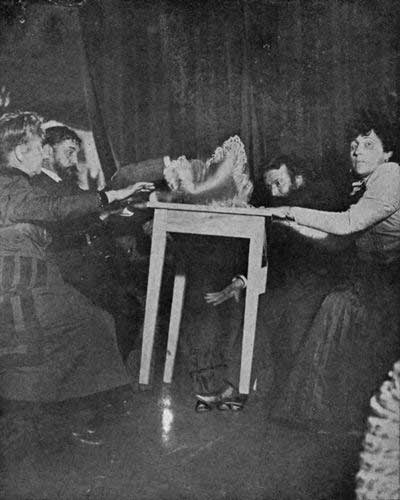
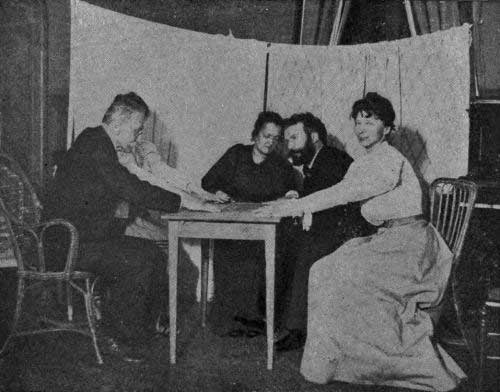
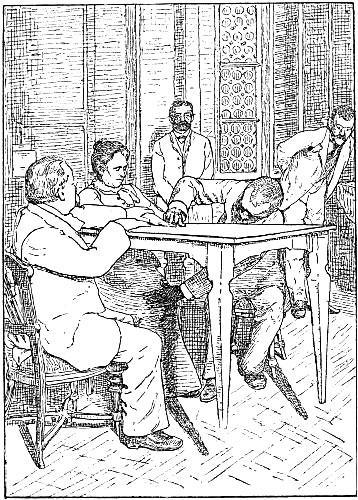
1. Rotation of the table, with contact of the hands of a certain
number of operators.
This rotation can be explained by an unconscious impulse given to the
table. All that is necessary is that each one push a little in the
same way, and the movement will take place.
2. Movement of the table, the hands of the experimenters resting upon
it.
The operators push and the table is led along without their knowing
it, each one acting in a greater or less degree. They think they are
following it, but they are really leading it along. We have in this
only the result of muscular efforts, generally of a rather slight
nature.
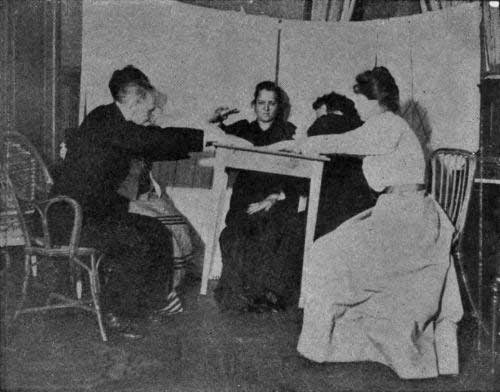
3. Lifting of the table on the side opposite to that upon which the
hands of the principal actor are placed.
Nothing is more simple. The pressure of the hands upon a centre-table
with three legs suffices to produce the lifting of the leg the
farthest removed, and thus to strike all the letters of the alphabet.
The movement is less easy in the case of a table with four legs; but
it can also be obtained.
These three movements are the only ones, it seems to me, which can be
explained without the least mystery. Still, the third is only
explicable in case the table is not too heavy.
4. Imparting life to the table.
Several experimenters being seated around the table, and forming the
chain with the desire of seeing it rise, the waves of a kind of
vibrations (light at first) are perceived to be passing through the
wood. Then balancings are noticed, some of which may be due to
muscular impulses. But already something more is now mingled in the
process. The table seems to be set in motion of itself. Sometimes it
rises, no longer as if moved by a lever, or by pressure on one side,
but under the hands, as if it were sticking to them. This levitation
is contrary to the law of gravitation. Hence we have here a discharge
of force. This force emanates from our organism. There is no
sufficient reason to seek for anything else. Nevertheless, what we
have detected is a thing of prime importance.
5. Rotation without contact.
The table being in rapid rotation, we can remove our hands from it,
and see it continue the movement. The velocity or momentum acquired
may explain the momentary continuation of this movement and the
explanation given in the case of No. 1 may suffice. But there is more
in it than this. Rotation is obtained by holding the hands at a
distance of some inches above the table, without any contact. A light
layer of flour dusted over the table is found to be untouched by a
single finger. Hence the force emitted by the operators must penetrate
the table.
The experiments prove that we have in us a force capable of acting at
a distance upon matter, a natural force, generally latent, but
developed in different degrees in different mediums. The action of the
force is manifested under conditions as yet imperfectly determined.
(See pp. 81, 248 et seq.) We can act upon brute matter, upon living
matter, upon the brain and upon the mind. This action of the will is
shown in telepathy. It is shown more simply still by means of a
well-known experiment: at the theatre, in church, when hearing music,
a man accustomed to the exercise of will-power, and sitting several
rows of seats behind a woman, say, compels her to turn around in less
than a minute. A force emanates from us, from our spirit, acting
undoubtedly by means of etherwaves, the point of departure of which is
a cerebral movement.
And there is nothing very mysterious in this. I bring my hand near a
thermometer, and ascertain that something invisible is escaping from
my hand, and, at a certain remove, making the column of mercury rise.
This something else is heat; that is to say, aërial waves in movement.
Then why might not other radiations emanate from our hands and from
our whole being?
But, nevertheless, there is a very important scientific fact to be
established.
This physical force is greater than that of the muscles, as I am going
to prove.
6. Lifting of weights.
A table is loaded with sacks of sand and with stones weighing
altogether from 165 to 176 pounds. The table lifts each of its three
legs several times in succession. But it succumbs under the load and
is broken. The operators ascertain that their muscular force would not
have sufficed to produce the observed movements. The will acts by a
dynamic prolongation.
7. Liftings without contact.
The hands forming the chain some inches above the side of the table
which is to be lifted, and all wills being concentrated on the one
idea, the lifting of each of the legs in succession takes place. The
liftings are more readily obtained than rotations without contact. An
energetic will seems to be indispensable. The unknown force passes
from the experimenters to the table without any contact. If the table
is dusted over with flour, as I said, not the slightest finger-touch
is seen to be imprinted on it.
The will of the sitters is in play. The table is ordered to make such
and such a movement and it obeys. This will seems to be prolonged
beyond the bodies of the operating experimenters in the shape of a
force that is quite intense.
This power is developed by action. The balancings prepare for the
rising and the latter for complete levitation.
8. Reducing the weight of the table or other objects.
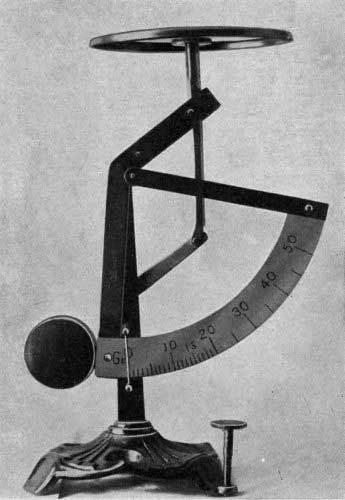
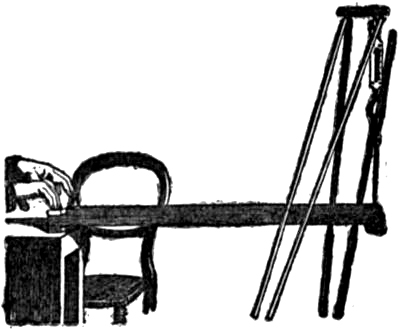
A quadrangular table is suspended by one of its sides to a dynamometer
attached to a cord which is held above by some kind of a hook. The
needle of the dynamometer, which, in a state of rest, indicates 35
kilograms, gradually descends to 3, 2, 1, 0 kilograms.
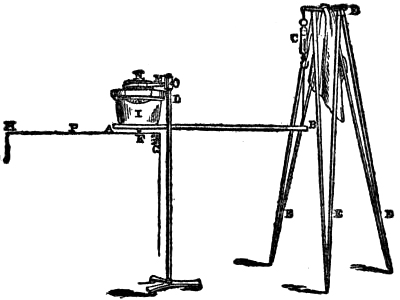
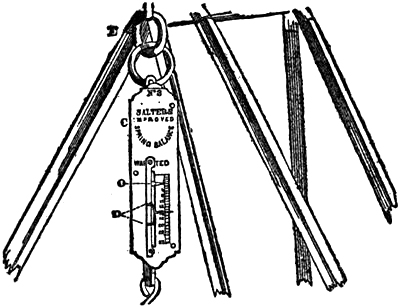
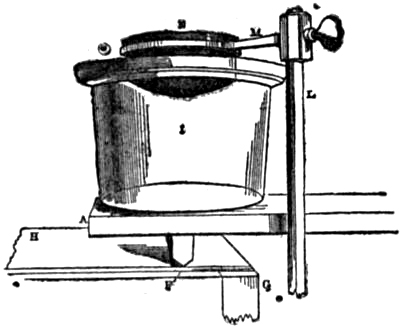
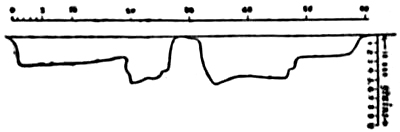
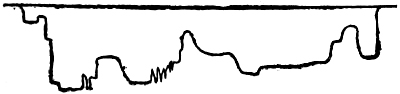
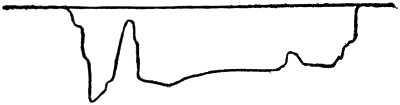
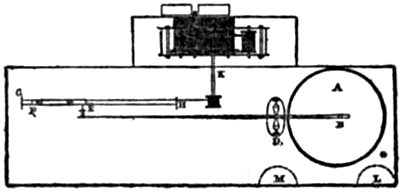
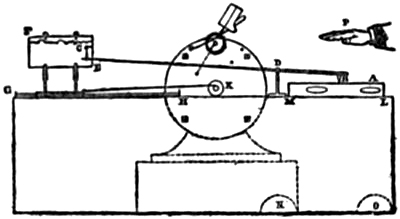
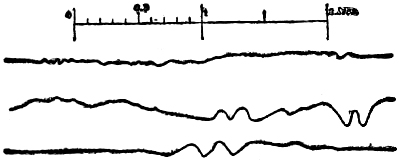
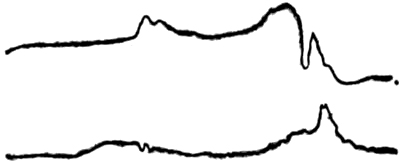
A mahogany board is placed horizontally, and hung by one end to a
spring balance. This balance (or scales), has a point which touches a
pane of glass blackened by smoke. When this pane of glass is put in
movement, the needle traces a horizontal line. During the experiments,
this line is no longer straight, but marks reductions and increments
of weight, produced without any contact of hands. In the experiments
of Crookes we saw that the weight of a board increased almost 1¼
pounds.
The medium places his hands upon the back of a chair and lifts the
chair.
9. Augmentation of the weight of a table or other objects.—pressures
exerted.
The dynamometric experiments that we have just recalled themselves go
to show this augmentation.
I have more than once seen, in other circumstances, a table become so
heavy that it was absolutely impossible for two men to lift it from
the floor. When they succeeded in doing so, in a measure, by means of
quick jerks, it still seemed to stick to the floor as if held by glue
or india rubber, which immediately pulled it back to the floor after
it had been slightly displaced.
In all these experiments, there is proof of the action of an unknown
natural force emanating from the chief experimenter or from the
collective powers of the group, an organic force under the influence
of the will. It is not necessary to suppose the presence of superhuman
spirits.
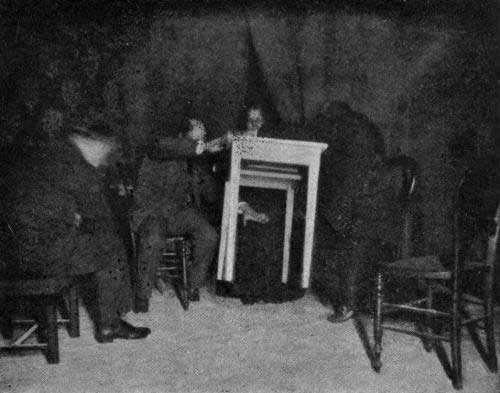
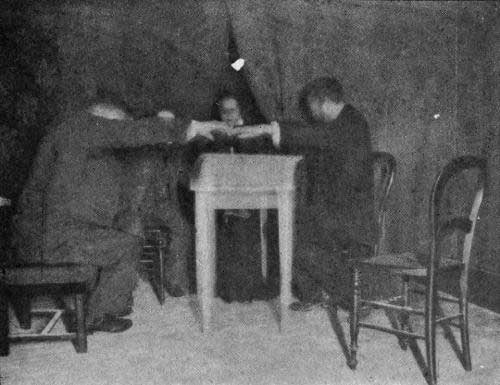
10. The complete lifting up, or levitation of the table.
As there may be confusion in applying the word "lifting" to a table
which only rises on one side at a certain angle, while still touching
the floor, it is expedient to apply the word "levitation" to the case
in which it is completely separated from the floor.
Generally, in levitation, it rises from six to eight inches from the
floor, for some seconds only, and then falls back. It moves up in a
balancing, undulating, hesitating way, with effort, and then falls
straight down. While resting our hands upon it, we have the sensation
of a fluid resistance, as of it were in water,—the kind of fluid
sensation we experience when we bring a piece of iron into the field
of force of a magnet.
A table, a chair or other movable article sometimes rises, not merely
a foot or so, but almost to the height of one's head, and even as high
as the ceiling.
The force brought into play is considerable.
11. Levitation of human bodies.
This case is of the same order as the preceding. The medium may be
raised with his chair and placed upon the table, sometimes in unstable
equilibrium. He may also be lifted alone (without the chair).[83]
In this case the Unknown Force does not seem to be simply mechanical:
intention is mingled with the act, and ideas of precaution, which,
however may proceed from the mentality of the medium himself, aided
perhaps by that of the sitters. This fact seems to us to contravene
known scientific laws. It is the same case as that of the cat which
knows how to turn of itself, without any outside support or leverage,
when it falls from a roof, and always falls on its feet, a fact
contrary to the principles of mechanics taught in every university in
the world.
12. Lifting of very heavy pieces of furniture.
A piano weighing more than 750 pounds rises up off of its two front
legs, and it is ascertained that its weight varies. The force with
which it is animated arises from the proximity of a child eleven years
old, but it is not the conscious will of this child which acts.—A
heavy oak dining-table may rise so high that its under side can be
inspected during the levitation.
13. Displacement of objects without contact.
A heavy easy-chair moves about of its own accord in the room. Heavy
curtains reaching from the ceiling to the floor are forcibly swelled
out as if by a gust of wind, and envelop as with a hood the heads of
persons seated at a table, at a distance of three feet and more. A
centre table persists in the endeavor to climb upon the
experiment-table—and gets there. While a sceptical spectator is
bantering the "spirits," the table about which the experiments are
taking place makes a move towards the incredulous person, drawing the
sitters along with it, and pins him to the wall until he begs for
mercy.
As in the preceding cases, these movements may represent the
expression of the will of the medium, and may not necessarily indicate
the presence of a mind external to his own. Nevertheless—?
14. Raps and typtology.
In tables, in pianos, and other pieces of furniture, in the walls, in
the air, raps are heard, and their vibrations perceived by the touch.
They somewhat resemble the sounds obtainable by tapping against a
piece of wood with the joint of the bent finger. The question arises,
Whence come these noises? The question is asked aloud. They are
repeated. The request is made that a certain number of strokes be
rapped. The raps are heard. Well-known airs are accompanied by raps
beaten in perfect time with them and identifiable as the counterpart
of the airs. When bits of music are played, the accompaniment is
rapped out. Things take place as if an invisible being were listening
and acting. But how could a being without acoustic nerve and without a
tympanum hear? The sonorous waves must strike something in order to be
interpreted. Is this a mental transmission?
These raps are made. Who makes them? And how? The mysterious force
emits radiations of wave-lengths inaccessible to our retina, but
powerful and rapid, without doubt more rapid than those of light, and
situated beyond the ultraviolet. Besides, light impedes their action.
In proportion as we advance in the examination of the phenomena, the
psychic, intellectual, mental element is more and more mingled with
the physical and mechanical element. In the case we are considering we
are forced to admit the presence, the action, of a thought. Is this
thought simply that of the medium, of the chief experimenter, or the
resultant of the thoughts of all the sitters united?
Since these raps or those made by the legs of the table, on being
interrogated, dictate words and phrases and express ideas, there is
something more in the matter than a simple mechanical action. The
unknown force, the existence of which we have been obliged to admit in
the preceding observations, is in this case at the service of an
intelligence. The mystery grows complicated.
It is owing to this intellectual element that I proposed (before 1865;
see p. xix) to give the name "psychic" to this force, a name
proposed anew by Crookes in 1871. We saw also that, as early as the
year 1855, Thury had proposed the name "psychode" and "ecteneic"
force. From this on, it would be impossible for us in our examination
not to take into consideration this psychic force.
Up to this point, Gasparin's fluid might suffice, just as unconscious
muscular action sufficed for the first three classes of facts. But
starting from this fourteenth class, the psychic order plainly
manifests itself (and even in the preceding class we begin already to
divine its presence).
15. Mallet-blows.
I have heard—as have all other experimenters—not only sharp light
raps upon a table, like those of which I have just been speaking, but
mallet-blows, or blows of the fist upon a door, capable of knocking
down a man if he had received them. Generally, these tremendous blows
are a protestation against a denial on the part of one of the sitters.
There is in them an intention, a will, an intelligence. They may also
be due to the medium, who is indignant, or who is amusing himself or
herself. The action is not muscular; for the hands and feet of the
medium are held, and the rapping may occur some distance away from him
or her.
16. Touchings.
Fraud can explain those which take place within the reach of the
medium's hands, for they only occur in the darkness. But they have
been felt at a certain distance beyond this reach as if the hands of
the medium were prolonged.
17. Action of invisible hands.
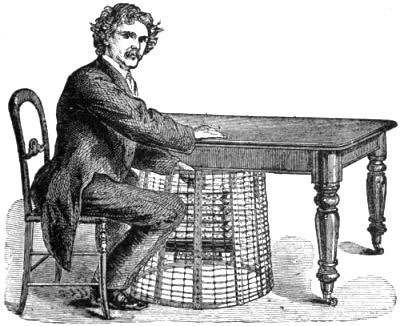
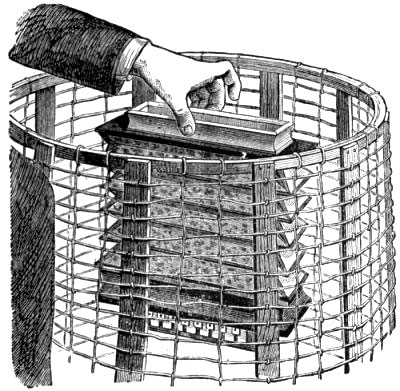
An accordion in an open-work case, or cage, which keeps any other hand
from touching it, is held in one hand by the end opposite the keys.
Presently the instrument begins to lengthen and shorten of itself and
plays various melodies. An invisible hand with fingers (or something
like them), must therefore be acting. (Experiment of Crookes with
Home.) As the reader has seen I repeated this experiment with Eusapia.
Another time, a music-box, the handle of which was turned by an
invisible hand, played in perfect time with the music movements that
Eusapia was making upon my cheek.
An invisible hand forcibly snatched from my hand a block of paper
which I was holding out with extended arm at the height of my head.
Invisible hands removed from M. Schiaparelli's head his spectacles
(furnished with a spring), which were firmly fastened behind his ears,
and that so nimbly and with such light touch that he did not perceive
it until afterwards.
18. Apparitions of hands.
The hands are not always invisible. Sometimes semi-luminous ones are
seen to appear in the dim light,—hands of men, hands of women, hands
of children. Sometimes they have clear-cut outlines. They are
generally firm and moist to the touch, sometimes icy cold. At times
they melt away in the hand. For my part I was never able to grasp one.
It was always the mysterious hand that took mine,—often feeling
through a curtain, or sometimes by nude contact, or pinching my ear,
or running its fingers through my hair with great rapidity.
19. Apparitions of heads.
For my part, I have only seen two: the bearded silhouette at
Monfort-l'Amaury, and the head of a young girl with high-arched
forehead, in my drawing-room. In the case of the first I had believed
that there was a mask held at the end of a rod. But at my own home,
there was no possibility of an accomplice, and at present I am not
less sure of the first instance than of the other. Moreover, the
testimony of other observers is so precise and so often given that it
is imperative that it be classed with my own.
20. Phantoms.
I have never seen any of these nor photographed them, but it seems to
me impossible to be sceptical about that of Katie King, observed for
three consecutive years by Crookes and others who experimented with
the medium Florence Cook. One can scarcely doubt, also, the reality of
the phantoms seen by the committee of the Dialectical Society of
London. We have seen that trickery plays a frequent rôle in this sort
of apparitions; but, in the experiments just mentioned, the
observations were really conducted with such perspicacity that they
are safe from all objection, and have on them the stamp of a purely
scientific character.
These phantoms, like the heads and the hands mentioned, seem to be
condensations of fluids produced by the powers of the medium, and do
not prove the existence of independent spirits.
When the hand is stretched out, the rubbing of a beard can be felt
upon it. This happened to me, as well as to others. Did the beard
really exist, or was it only a case of tactual and visual sensations?
The case here immediately following pleads in favor of its reality.
21. Impressions of heads and of hands.
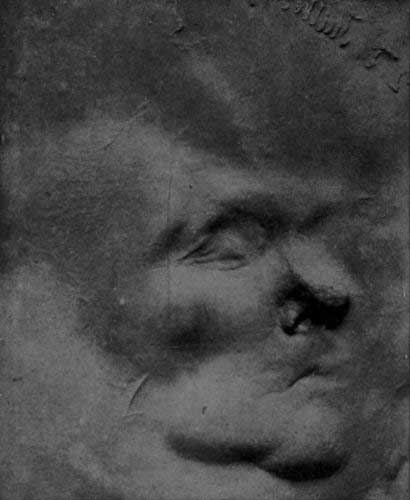
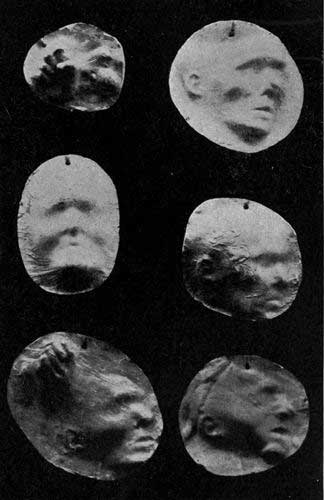
The heads and the hands formed are sufficiently dense to leave a mould
of their features and shape imprinted in the putty or the clay.
Perhaps the most curious thing is that it is not necessary that these
weird formations, these forces, be visible in order to produce
impressions. We have seen a vigorous gesture imprint itself at a
distance in clay.
22. Passing of matter through matter.—Transfers, or the bringing in
of objects.
A book has been seen passing through a curtain. A bell has passed from
a library-room, locked with a key, into a drawing-room. A flower has
been seen passing perpendicularly downward through a dining-room
table. Some have thought they had ocular proof of the mysterious
appearance of plants, of flowers, of fruits, and other objects, which
(as the claim went) had passed through walls, ceilings, doors.
The latter phenomenon took place several times in my presence. But I
was never able to get certain proof of it under unimpeachable
conditions; and I have ferreted out many a trick.
The experiments of Zöllner (a wooden ring entering into another wooden
ring, a string tied at the two ends making a knot, etc.) would, of
course, be a thing of exceptional interest if the medium Slade had not
the bad reputation of being just a skilful prestidigitator,—a
reputation probably only too well merited. I should think that there
is good reason to suppose that the experiments of Crookes are
authentic.
Has space only three dimensions? We will set this question aside.
23. Manifestations directed by an intelligence.
These have been already glimpsed in a certain number of the preceding
cases. The forces in action here are of the psychical as well as the
physical class. The question is to know whether the intellect of the
medium and of the sitters is sufficient to explain everything.
In all the cases I have previously mentioned, this intellect seem to
suffice, but only by attributing to it occult faculties of prodigious
potency.
In the present state of our knowledge, it is impossible for us to
understand the way in which mind, conscious or unconscious, can lift a
table, make raps in wood, form a hand or a head, stamp an imprint. The
modus operandi is absolutely unintelligible to us. Future science
will perhaps discover it. But all these actions never overpass the
limits of man's capacities, and let us admit, the capacity required is
not an extraordinary one.
The hypothesis of spirits of another order than that of living human
beings does not seem to be necessary.
The hypothesis of the doubling of the psychic personality of the
medium is the most simple. Is it sufficient to entirely satisfy us?
Hard blows on the table like those of a fist, contrasting with gentle
taps, may have this origin, in spite of appearance.
It is the same with apparitions of the hands, of heads, of spectral
forms. We cannot declare this origin of the phenomena to be
impossible; and it is more simple than to assume that they are due to
wandering spirits.
The conveying of objects over the heads of the experimenters in
complete darkness, without touching either chandelier or heads, is
scarcely comprehensible. But do we understand any better how a spirit
can have hands? And if it did, might it not amuse itself thus?
Spectacles are taken from a face without the act being perceived; a
handkerchief is removed from the neck, then snatched from between the
teeth that are holding it; a fan is transferred from one pocket to
another. Do latent faculties of the human organism suffice to explain
these intentional actions? It is right for us neither to affirm nor to
deny.
I have thus passed in review the whole series of phenomena to be
explained, at least all those within the limits of the plan of this work.
A first, and obviously safe, conclusion is that man has in himself a
fluidic and psychic force whose nature is still unknown, but which is
capable of acting at a distance upon matter and of moving the same.
This force is the expression of our will, of our desires; I mean as it
appears in the first ten cases of the preceding classifications. For the
other cases we must add the unconscious, the unforeseen, wills different
from our conscious wills.
The force is at once physical and psychical. If the medium puts forth a
force of twelve or fourteen pounds to lift a table, his weight undergoes a
corresponding increase. The hand which we see forming near him is able to
grasp an object. The hand really exists, and is then reabsorbed. Might we
not compare the force which brings it into existence with that
building-force of nature, which reproduces a claw for the lobster and a
tail for the lizard? The intervention of spirits is not all
indispensable.[84]
In mediumistic experiments things happen as if an invisible being were
present, able to transport the different objects through the air, usually
without striking against the heads of the persons who are sitting in
various parts of the room in almost complete darkness; capable also of
acting upon a curtain like a strong wind, pushing it far out, able to
fling this curtain over your head, giving you a Capuchin hood or coiffure,
and pressing strongly against your body, as if with two nervous arms, and
touching you with a warm and living hand. I have perceived these hands in
the most unmistakble way. The invisible being can condense itself
sufficiently to become visible, and I have seen it passing in the air. To
suppose that I, as well as other experimenters, was the dupe of an
hallucination is an hypothesis which cannot be maintained for a single
moment and would simply show that those who entertained the idea were far
more likely to have an hallucination than we were, or else that they
entertained the most inexcusable prepossession and prejudice. We were in
the best possible condition for observing and analysizing any phenomena
whatever and no sceptic will make us believe anything different on this
point.
There is certainly an invisible prolongation of the organism of the
medium. This prolongation may be compared to the radiation which leaps
from the loadstone to reach a bit of iron and put it into movement.
We can also compare it with the effluvium which emanates from electrified
bodies.[85]
I also compared it some pages back to calorific waves.
When a medium makes a gesture of striking the table with his closed fist,
but stops short at a distance of from eight to twelve inches, and when, at
every gesture, a sonorous stroke of the fist echoes in the table, we see
in that the proof of a dynamic prolongation of the arm of the medium.
When she pretends to imitate on my cheek the rotation of the crank of a
music-box, and when this box keeps time with the imitated movement, stops
when the fingers stop, plays the tune faster when the finger accelerates
its circular tracings, goes slower when it goes slower, etc., we have here
again proof of dynamic action at a distance.
When an accordion plays of its own will, when a bell begins to ring of
itself, when a lever indicates such and such a pressure, there is a real
force in action.
We must therefore admit, first of all, this prolongation of the muscular
and nervous force of the subject. I am keenly sensible of the fact that
this is a bold proposition, almost incredible, most strange and
extraordinary; but after all the facts are there, and whether the matter
irks us or not is a small matter.
This prolongation is real, and only extends to a certain distance from the
medium, a distance which can be measured, and which varies according to
circumstances. But is it sufficient to explain all the observed phenomena?
We are forced to admit that this prolongation, usually invisible, and
impalpable, may become visible and palpable; take, especially, the form of
an articulated hand, with flesh and muscles; and reveal the exact form of
a head or a body. The fact is incomprehensible; but after so many
different observations, it seems to me impossible to see in this curious
phenomenon only trickery or hallucination. Logic lays its laws upon us and
commands our respect.
A fluidic and condensable double has therefore the power of gliding
momentarily out from the body of the medium (for his presence is
indispensable).
How can this double, this fluidic body have the consistency of flesh and
of muscles? We do not understand it. But it would neither be wise nor
intelligent to admit only that which we can comprehend. It must be
remembered that, for the greater part of the time, we imagine we
comprehend things because we can give an explanation of them; that is all.
Now this explanation rarely has any intrinsic value. It is only a
framework of words tacked together. Thus you fancy you understand why an
apple falls from the top of the tree, because you say that the earth
attracts it. This is pure simple-mindedness. For in what does the
attraction of the earth consist? You know nothing about it; but you are
satisfied, because the fact is a common one.
When the curtain is inflated as if pushed out by a hand, and when you feel
you are pinched in the shoulder by a hand at the moment the curtain
touches you, you have the impression that you are the dupe of an
accomplice hidden behind the curtain. There is some one there who is
playing a practical joke on you. You draw aside the curtain. Nothing!
Since it is impossible for you to admit a trick of any kind, because you,
and you alone, hung that curtain between the two walls; and since you know
that there is no person behind it because you are close by it and have not
lost it out of your sight; and since the medium is seated near you with
his, or her, hands and legs held, you are forced to admit that a
temporarily materialized being has touched you.
It is certain that these facts may be denied and that they are denied.
Those who have not personally verified them are excusable. It is not a
question of ordinary events which take place every day and which everybody
can observe. It is evident, as a general proposition, that, if we admit
only what we have ourselves seen, we shall not get very far. We admit the
existence of the Philippine Islands without having been there, of
Charlemagne and of Julius Cæsar without having seen them, of total
eclipses of the sun, volcanic eruptions, earthquakes, etc., as facts of
which we have not ourselves been eye-witnesses. The distance of a star,
the weight of a planet, the composition of one of the heavenly bodies, the
most marvelous discoveries of astronomy, do not excite scepticism, except
in the minds of wholly uncultivated persons, because people in general
appreciate the value of astronomic methods. But undoubtedly, in these
psychical matters, the phenomena are so extraordinary that one is
excusable for not believing them.
Nevertheless, if anyone will give himself the trouble to reason he will
positively be compelled to recognize that, in following on this trail, he
is inevitably brought to a stand in face of the following dilemma: either
the experimenters have been the dupes of the mediums, who have uniformly
cheated, or else these stupefying facts actually exist. Now since the
first hypothesis is eliminated, we are forced to admit the reality of the
occurrences.
A fluidic body is formed at the expense of the medium, emerges from his
organism, moves, acts. What is the intelligent force that directs this
fluidic body and makes it act in such or such a way? Either it is the mind
of the medium, or it is another mind that makes use of this same fluid.
There is no escape from this conclusion. I may remark that the
meteorological conditions, fine weather, agreeable temperature,
cheerfulness, high spirits, favor the phenomena; that the medium is never
wholly out of touch with the manifestations, and frequently knows what is
going to take place; that the cause escapes the mental grasp and is
fugitive and capricious; and that the apparitions fade away like a dream
as silently as they are formed.
Note also that, in important manifestations, the medium suffers,
complains, groans, loses an enormous amount of force, exhibits an
astonishing nervous energy, experiences hyperæsthesia, and at the apogee
of the manifestation, seems for an instant to be absolutely prostrated.
And, in truth, why should not his mind as well as his fluidic force be
haled out of his body and be exhausted in external work? The psychical
force of a living human being is able, then, to create "material"
phenomena—organs, spectral figures.
But what is matter?
My readers know that matter does not exist as it is perceived by our
senses. These only give us incomplete impressions of an Unknown Reality.
Analysis shows us that matter is only a form of energy.
In the work called A Propos d'Eusapia Paladino, which sums up his
experiments with this medium, M. Guillaume de Fontenay ingeniously tries
to explain the phenomena by the dynamic theory of matter. It is probable
that this explanation is one of those that make the nearest approach to
the truth.
According to this theory, the quality which seems to us characteristic of
matter—solidity, stability—is no more substantial than the light which
strikes our eyes, or the sound which enters our ears. We see; that is to
say, we receive upon the retina rays which affect it. But around and on
every side of the retina undulate countless other rays that leave no
impression upon it. It is the same with the other senses.
Matter, like light, like heat, like electricity, seems to be the result of
a species of movement. Movement of what? Of the primitive monistic
substance, quickened by manifold vibrations.
Most assuredly, matter is not that inert thing that we commonly suppose.
A comparison will aid in comprehending this. Take a carriage-wheel. Place
it horizontally on a pivot. While the wheel is motionless, let a rubber
ball fall between its spokes. This ball will almost always pass through
between the spokes. Now give a slight movement to the wheel. The ball will
be pretty often hit by the revolving spokes, and will rebound. If we
increase the rotation, the ball will now no longer pass through the wheel,
which will have become for it a wholly impenetrable disc.
We can try a similar experiment by arranging the wheel vertically and
shooting arrows through it. A bicycle-wheel will serve the purpose very
well, owing to the slenderness of its spokes. When not in movement, the
arrows will pass through it nine times out of ten. In movement, it will
produce in the arrows deviations more or less marked. With increase in the
speed, it would be made impenetrable, and all the arrows would be broken
as if against the steel plating of an armored ship.
These comparisons allow us to understand how matter is really only a mode
of motion, only an expression of force, a manifestation of energy. It will
disappear (it must be borne in mind) on analysis, which ends by taking
refuge in the intangible, invisible, imponderable, and almost immaterial
atom. The atom itself which was regarded as the basis of matter fifty
years ago, has now disappeared, or rather has been metamorphosed and
reappears as a hypothetical, impalpable vortex.
I will allow myself to repeat here what I have said a hundred times
elsewhere: The universe is a dynamism.
The difficulty we have in explaining to ourselves apparitions,
materializations, when we try to apply to them the ordinary conception of
matter, is considerably lessened the moment we conceive that matter is
only a mode of motion.
Life itself, from the most rudimentary cell up to the most complicated
organism, is a special kind of movement, a movement determined and
organized by a directing force. According to this theory, momentary
apparitions would be less difficult to accept and to comprehend. The vital
force of the medium might externalize itself and produce in a point of
space a vibratory system which should be the counterpart of itself, in a
more or less advanced degree of visibility and solidity. These phenomena
can with difficulty be reconciled with the old hypothesis of the
independent and intrinsic existence of matter: They better fit that of
matter as a mode of motion—in a word, simple movement, giving the
sensation of matter.
There is, of course, only one substance, the primitive substance, which
antedates the original nebula—the womb from which all bodies in the
universe have issued. The substances which the chemists take to be simple
bodies—oxygen, hydrogen, azote, iron, gold, silver, etc.—are mineral
elements which have been gradually formed and differentiated, just as,
later, the vegetable and animal species were differentiated. And not only
is the substance of the world one, but it also has the same origin as
energy, and these two forms are mutually interchangeable. Nothing is lost,
nothing is created, everything is transformed.[86]
The unique substance is immaterial and unknowable in its essence. We see
and touch only its condensations, its aggregations, its arrangements; that
is to say, forms produced by movement. Matter, force, life, thought, are
all one.
In reality, there is only one principle in the universe, and it is at once
intelligence, force, and matter, embracing all that is and all that
possibly can be. That which we call matter is only a form of motion. At
the basis of all is force, dynamism, and universal mind, or spirit.
Visible matter, which stands to us at the present moment for the universe,
and which certain classic doctrines consider as the origin of all
things—movement, life, thought—is only a word void of meaning. The
universe is a great organism controlled by a dynamism of the psychical
order. Mind gleams through its every atom.
The environment or atmosphere is psychic. There is mind in every thing,
not only in human and animal life, but in plants, in minerals, in space.
It is not the body which produces life: it is rather life which organizes
the body. Does not the will to live increase the viability of enfeebled
persons, just as the giving up of the wish to live may abridge life and
even extinguish it?
Your heart beats, night and day, whatever be the position of your body. It
is a well-mounted spring. Who or what adjusted this elastic spring?
The embryo is formed in the womb of the mother, in the egg of the bird.
There is neither heart nor brain. At a certain moment the heart beats for
the first time. Sublime moment! It will beat in the child, in the
adolescent, in the man, in the woman, at the rate of about 100,000
pulsations a day, of 36,500,000 a year, of 1,825,000,000 in fifty years.
This heart that has just been formed is going to beat a thousand millions
of pulsations, two thousand millions, three thousand millions, a number
determined by its inherent force; then it will stop and the body will fall
into ruins. Who or what wound up this watch once for all?
Dynamism, the vital energy.
What sustains the earth in space?
Dynamism, the velocity of its movement.
What is it in the bullet that kills?
Its velocity.
Everywhere energy, everywhere the invisible element. It is this same
dynamism that produces the phenomena we have been studying. The question
at present resolves itself into this: Does this dynamism belong wholly to
the experimenters? We have so little real knowledge of our mental nature
that it is impossible for us to know what this nature is capable of
producing, even in certain states of unconsciousness—in fact especially
in these. The directing intelligence is not always the personal, normal,
intelligence of the experimenters or of any one whatever among them. We
ask the entity what its name is, and it gives us a name which is not ours;
it replies to our questions, and usually claims to be a discarnate soul,
the spirit of a deceased person. But if we drive the question home, this
entity finally steals away without having given us sufficient proofs of
its identity. There results from this the impression that the "medium," or
principal subject of the experiment, has responded for himself, has
reflected himself, without knowing it.
Moreover, this entity, this personality, this spirit, has his individual
will, his caprices, his cantankerousness, and sometimes acts in opposition
to our own thoughts. He tells us absurd, foolish, brutal, insane things,
and amuses himself with fantastic combinations of letters, real
head-splitting puzzles. It astonishes and stupefies us.
What is this being?
Two inescapable hypotheses present themselves. Either it is we who produce
these phenomena or it is spirits. But mark this well: these spirits are
not necessarily the souls of the dead; for other kinds of spiritual beings
may exist, and space may be full of them without our ever knowing anything
about it, except under unusual circumstances. Do we not find in the
different ancient literatures, demons, angels, gnomes, goblins, sprites,
spectres, elementals, etc? Perhaps these legends are not without some
foundation in fact. Then we cannot but remark that, in our mediumistic
studies and experiments, in order to succeed we always address an
invisible being who is supposed to hear us. If this is an illusion, it
dates from the very origin of Spiritualism, from the raps produced
unconsciously by the Fox sisters in their chambers at Hydesville and at
Rochester in 1848. But once more, this personification may pertain to our
own being or it may represent a mind external to ourselves.
In order to admit the first hypothesis we must admit at the same time that
our mental nature is not simple, that there are in us several psychic
elements, and that one at least of these elements may act unknown to
ourselves, make raps in a table, move any piece of furniture, lift a
weight, touch us with a hand that seems real, play an instrument, create a
spectral figure, read hidden words, answer questions, act with a personal
will—and all this, I repeat, without our own knowledge.
This is tolerably complicated; but it is not impossible.
That there are in us psychic elements, obscure, unconscious, capable of
acting outside of the sphere of our normal consciousness, this is
something we can notice every night in our dreams; that is to say, during
a quarter, or a third part of our life. Scarcely has sleep closed our
eyes, our ears, all our senses, than our thoughts begin to work just the
same as during the day, though without rational direction, without logic,
under the most incoherent forms, freed from our customary conceptions of
space and time, in a world entirely different from the normal world. The
physiologists and psychologists have for centuries been trying to
determine the mechanism of the dream without having yet obtained any
satisfactory solution of the problem. But the proved fact that we see
sometimes, in our dreams, occurrences which take place at a distance,
proves that we have in us unknown powers.
Again, it is not rare for each of us to experience, sometimes (all our
faculties being on the alert), the play of an interior power, distinct
from our dominant reason. We are on the point of pronouncing words that
are not a part of our habitual vocabulary, and ideas suddenly traverse and
arrest the course of our thoughts. During the reading of a book which
seemed interesting to us, our soul spreads her wings and flies to other
realms, while our eyes continue in vain the mechanical act of reading. We
are discussing certain projects in our mind, as if we were so many judges;
and then, one would like to know in all simplicity, whence comes this
distraction?
In his tireless researches, the great investigator of psychic phenomena,
Myers, to whom we owe synthetic studies upon the subliminal consciousness,
reached the conviction, with Ribot, that "the me is a co-ordination."
These supernormal phenomena (writes this competent and learned
inquirer) are due not to the action of the spirits of deceased
persons, as Wallace believes, but, for the most part, to the action of
an incarnate spirit, either that of the subject himself or of some
agent or other.[87]
The word "subliminal" means what is beneath the threshold (limen) of
the consciousness,—the sensations, the thoughts, the memories, which
remain at the bottom, and seem to represent a kind of sleeping me. I
do not pretend to affirm (adds the author) that there always exists in
us two me's correlative and parallel: I denote rather by the
subliminal me that part of the me which ordinarily remains latent,
and I admit that there may be not merely co-operation between these
two quasi-independent currents of thoughts, but also changes of level
and alternations of personality.[88] Medical observation (Félida,
Alma) proves that there is in us a rudimentary supernormal faculty,
something which is probably useless to us, but which indicates the
existence, beneath the level of our consciousness, of a reserve of
latent unsuspected faculties.[89]
What is it that is active in us in telepathic phenomena? We may
recall the case of Thomas Garrison (Society for Psychical Research,
VIII, p. 125) who, while sitting with his wife at a religious service,
suddenly gets up in the middle of the sermon, goes out of the church,
and, as if impelled by an irresistible impulse, walks twenty miles
afoot to go to see his mother, whom he finds dead on his arrival,
although he did not know that she was ill and although she was
relatively young (fifty-eight years). I have a hundred observations
similar to this in writing before me. It is not our normal habitual
nature that is in action in such a case as this.
There is probably in us, more or less sentient, a sub-conscious
nature, and it is this which seems to be at work in mediumistic
experiences. I am pretty much of the opinion Myers expresses in the
following paragraph:[90]
Spiritualists attribute the movement and the dictations at their
séances to the action of disembodied intelligences. But if a table
execute movements without being touched, there is no reason to
attribute these movements to the intervention of my deceased
grandfather, rather than to my own proper intervention; for if I do
not see how I could have done it myself, it is not clear to me how the
effect could have been produced by the action of my grandfather. As
for dictations, the most plausible explanation seems to me to be for
us to admit that they do not come from the conscious me, but from
that profound and hidden region where fragmentary and incoherent
dreams are elaborated.
This explanatory hypothesis is held, with an important modification, by a
distinguished savant to whom also we owe long and patient researches into
the obscure phenomena of normal psychology; I mean Dr. Geley, who thus
sums up his own conclusions:
A certain amount of the force, intelligence, and matter of the body
may perform work outside of the organism,—act, perceive, organize,
and think without the collaboration of muscles, organs, senses and
brain. It is nothing less than the uplifted sub-conscious portion of
our being. It constitutes, in truth, an externalizable sub-conscious
nature, existing in the me with the normal conscious nature.[91]
This sub-conscious nature does not seem to depend upon the organism. It is
probably anterior to it, and will survive it. It seems to be superior to
it, endowed with powers and acquirements very different from the powers
and acquirements of the normal, supernormal, and transcendent
consciousness.
Assuredly, there is in this view of the case more than one mystery still,
were it only the feat of performing a material act at a distance, and that
(not less strange) of apparently having nothing to do with that kind of an
act.
The first rule of the scientific method is first to seek explanations in
the known before having recourse to the unknown, and we should never fail
to comply with this rule. But if this method of sailing does not bring us
to port, it is our duty to confess it.
I very much fear that that is what is the matter here. We are not
satisfied. The explanation is not clear, and is floating a little too much
at random in the waves—and the wavering uncertainty—of the hypothesis.
At the point at which we have now arrived in this chapter of explanations
we are precisely in the position of Alexander Aksakof when he wrote his
great work, Animism and Spiritualism, in reply to the book of Dr. von
Hartmann on Spiritualism. Hartman claimed to explain all of these
psychical phenomena by the following hypothesis.
A nervous force producing, outside of the limits of the human body,
mechanical and plastic effects.
Duplicate hallucinations of this same nervous force, and producing
also physical and plastic effects.
A latent somnambulistic consciousness, capable (the subject being in
his normal state) of reading in the intellectual background of another
man, his present and his past, and being able to divine the future.
Akaskof tried to see if these hypotheses (the last of which is a pretty
bold one) are sufficient to explain everything, and he concludes that they
are not. That is also my opinion. There is something else. This something
else, this residue at the bottom of the crucible of experiment, is a
psychic element, the nature of which remains still wholly hidden from us.
I think that all the readers of this book will share my conviction.
Anthropomorphic hypotheses are far from explaining everything. Besides,
they are only hypotheses. We must not hide from ourselves that these
phenomena introduce us into another world, into an unknown world, one that
is still to be explored in its whole extent.
As to beings different from ourselves,—what may their nature be? Of this
we cannot form any idea. Souls of the dead? This is very far from being
demonstrated. The innumerable observations which I have collected during
more than forty years all prove to me the contrary. No satisfactory
identification has been made.[92]
The communications obtained have always seemed to proceed from the
mentality of the group, or, when they are heterogeneous, from spirits of
an incomprehensible nature. The being evoked soon vanishes when one
insists on pushing him to the wall and having the heart out of his
mystery. And then my greatest hope has been deceived, that hope of my
twentieth year, when I would so gladly have received celestial light upon
the doctrine of the plurality of worlds. The spirits have taught us
nothing.
Nevertheless, the agents seem sometimes to be independent. Crookes
mentions having seen Miss Fox write automatically a communication for one
of her sitters while another communication upon another subject was given
to her for a second person by means of the alphabet and by raps, and all
the while she was chatting with a third person upon another subject
totally different from the other two. Does this remarkable fact prove with
certainty the action of a spirit other than that of the medium?
The same scientist mentions that, during one of his séances, a little rod
crossed the table, in full light, and came and rapped his hand, giving him
a communication by following the letters of the alphabet spelled out by
him. The other end of the rod rested on the table at a certain distance
from the hand of the medium Home.
This case seems to me, as well as to Crookes, more conclusively in favor
of an exterior spirit, so much the more since the experimenter having
asked that the raps be given by the Morse telegraphic code, another
message was thus rapped out. I also remember that the learned chemist
mentions that the word "however" hidden by his finger, upon a newspaper,
and unknown even to himself, was rapped out by a little rod.
Wallace also mentions a name written upon a piece of paper fastened by him
under the central leg of the experiment table; Joncières, a water-color
correctly painted in complete darkness, and a musical theme written with a
pencil; M. Castex Dégrange, the announcement of a death, and the place
where a lost object might be found. We have also seen sentences dictated
either backwards or in such a way that every other letter only must be
read to get the sense, or else by strange combinations showing the action
of an unknown intellect. We have a thousand examples of this kind.
But if the mind of the medium may liberate itself and appear in an
extra-normal state, why might it not be this mind which acts? Do we not
have several distinct personalities in our dreams? If they could
dynamically appear, would they not act somewhat in this way?
We ought not to lose sight of the fact that these phenomena are of a
mixed character. They are at once physical and psychical, material and
intellectual, are not always produced by our conscious will, and are
rather the subject of observation than experiment.
It is expedient to insist on this characteristic. I one day, (January 31,
1901) heard E. Duclaux, member of the Institute, director of the Pasteur
Institute, express the following confused idea (an idea held by so many
physicists and so many chemists), in a company which was yet quite
competent to discuss these phenomena: "There is no scientific fact except
a fact which can be reproduced at will."[93] What a singular reasoning!
The witnesses of the fall of a meteor bring us an aërolite which has just
fallen from the sky and been dug up, all hot, from the hole it had made in
the ground. "Error! illusion!" we ought to reply: "We shall only believe
when you repeat the experiment."
They bring to us the body of a man killed by a stroke of lightning,
stripped of his clothes, and shaved as if with a razor. "Impossible!" we
ought to reply; "pure invention of your deluded senses." A woman sees
appear before her, her husband, who has just died nearly two thousand
miles away. We are asked to believe that this is not so, and will not be
so until the apparition appears a second time.
This confusion between observation and experiment is a very strange thing
as coming from cultivated men.
In psychical phenomena there is a voluntary, capricious, incoherent,
intellectual element.
I repeat, we must learn to comprehend that everything cannot be explained
and resign ourselves to waiting for an extension of our knowledge. There
is intelligence, thought, psychism, mind, in these phenomena. There is
still more in certain communications. Can the observations be confirmed
and justified by assuming the mind of the living merely as the active
agents? Yes, perhaps, but only by attributing to us unknown and
supernormal faculties. Yet it must be remembered that this is only an
hypothesis. The Spiritualistic hypothesis of communication with the souls
of the dead remains also as a working hypothesis.
That souls survive the destruction of the body I have not the shadow of a
doubt. But that they manifest themselves by the processes employed in
séances the experimental method has not yet given us absolute proof. I add
that this hypothesis is not at all likely. If the souls of the dead are
about us, upon our planet, the invisible population would increase at the
rate of 100,000 a day, about 36 millions a year, 3 billions 620 millions a
century, 36 billions in ten centuries, etc.,—unless we admit
re-incarnations upon the earth itself.
How many times do apparitions, or manifestations occur? When illusions,
auto-suggestions, hallucinations, are eliminated, what remains? Scarcely
anything. Such an exceptional rarity as this pleads against the reality of
apparitions.
We may suppose, it is true, that all human beings do not survive their
death, and that, in general, their psychical entity is so insignificant,
so wavering, so ineffectual, that it almost disappears in the ether, in
the common reservoir, in the environment, like the souls of animals. But
thinking beings who have the consciousness of their psychical existence do
not lose their personality, but continue the cycle of their evolution. It
would seem natural therefore to see them manifest themselves under certain
circumstances. Persons condemned to death, in consequence of judicial
errors, and executed, should they not return to protest their innocence?
Would it not be reasonable to suppose that persons put to death in such a
way that violence was not suspected would return to accuse the assassins?
Knowing the characters of Robespierre, of Saint-Just, of
Fouquier-Tinville, I should like to have seen them revenge themselves a
little on those who triumphed over them. The victims of '93, should they
not have returned to disturb the sleep of the conquerors? Out of the
twenty thousand citizens shot by fusillades during the time of the Commune
of Paris I should like to have seen a dozen unceasingly harassing the Hon.
M. Theirs, who was really too puffed up and vain-glorious over his having
first permitted the organization of that insurrection and then punished
it.
Why do not children whose death is lamented by their parents ever come to
console them? Why do our dearest attachments seem to disappear forever?
And how about last wills and testaments stolen away, and the last will of
the dead ignored and their intentions purposely misinterpreted?
"It is only the dead that do not return," says an old proverb. This
aphorism is not of absolute application, perhaps; but apparitions are
rare, very rare, and we do not understand their precise nature. Are they
actual apparitions of the dead? It is not yet demonstrated.
Up to this day, I have sought in vain for certain proof of personal
identity through mediumistic communications. And then one does not see why
spirits, if they exist around us, should have need of mediums at all, in
order to manifest themselves. They surely must form a part of nature, of
the universal nature which includes all things.
Nevertheless, it seems to me that the Spiritualistic hypothesis should be
preserved by the same right as those I have summed up in the immediately
preceding pages, for the discussions have not eliminated it.[94]
But why are there manifestations the result of the grouping of five or six
persons around the table? That this should be a sine qua non is not a
very likely thing either.
It may be, it is true, that spirits exist around us, and that it is
normally impossible for them to make themselves visible, audible, or
tangible, not being able to reflect rays of light accessible to our
retina, or to produce sonorous waves, or to effect touches. Therefore,
certain conditions present in mediums might be necessary for their
manifestation. Nobody has the right to deny this. But why so many puzzling
incoherences and solecisms?
I have on a bookshelf before me several thousand communications dictated
by "spirits." In the last analysis, a dim obscurity remains hanging over
the causes. Unknown psychic forces: fugitive entities; vanishing figures;
nothing solid to grasp, even for the thought. These things do not yield us
the consistency of a definition of chemistry or of a theorem in geometry.
A molecule of hydrogen is a granite cliff in comparison.
The greater part of the phenomena observed,—noises, movement of tables,
confusions, disturbances, raps, replies to questions asked,—are really
childish, puerile, vulgar, often ridiculous, and rather resemble the
pranks of mischievous boys than serious bona-fide actions. It is
impossible not to notice this.
Why should the souls of the dead amuse themselves in this way? The
supposition seems almost absurd.
We know that an ordinary man does not change his intellectual or moral
value from day to day, and, if his spirit continues to exist after the
death of his body, we may expect to find it such as it was before. But why
so many oddities and incoherences?
However these things may be, it behooves us not to have any preconceived
idea, and our bounden duty is to seek to prove the facts as they present
themselves to us.
The unknown natural force brought into play for the lifting of a table is
not the exclusive property of mediums. In different degrees it forms a
part of all organisms, with different coefficients, 100 for organisms such
as those of Home, or Eusapia, 80 for others, 50 or 25 for less favored
individuals. But I should hold it as certain that it never drops in any
case to 0. The best proof of this is that, with patience, perseverance,
and the exercise of the will, almost all the groups of experimenters who
have seriously occupied themselves with these researches have succeeded in
obtaining, not merely movements, but also complete levitations, raps, and
other phenomena.
The word "medium" scarcely has any longer a reason for being, since the
existence of an intermediary between the spirits and us is not yet proved.
But still the word may be preserved, logic being the rarest of things in
grammar and in everything else that is human. The word "electricity" has
had no connection for a long time with amber (ἠλεκτρον), nor the
word "veneration" with the genitive case of Venus (Veneris), nor the (at
first astrological) term "disaster" with aster (star), nor the word
"tragedy" with goat-song (τράγος, ᾠδή). But this does not hinder
these words from being understood in their habitual sense.[95]
As respects explanatory hypotheses, I repeat, the field is open to all. It
is to be noted that communications dictated are closely related to the
condition of mind, the ideas, the opinions, the beliefs, the knowledge,
and even the literary culture, of the experimenters. They are like a
reflection, or counterpart, of this ensemble of ideas and faculties.
Compare the communications noted down in the house of Victor Hugo in
Jersey, those of the Phalansterian Society of Eugéne Nus, those of
astronomical meetings, those of religious believers,—Catholics,
Protestants, etc.
If the hypothesis were not so bold as to seem unacceptable to us, I should
dare to think that the concentration of the thoughts of psychic
experimenters creates a momentary intellectual being who replies to the
questions asked and then vanishes.
Reflection, reflex action? That is perhaps the true expression.
Everybody has seen his image reflected in a mirror, and nobody is
astonished by it. However, analyse the thing. The more you look at this
optical being moving there behind the mirror, the more remarkable the
image appears to you. Now suppose looking-glasses had not been invented.
If we had not knowledge of those immense mirrors which reflect whole
apartments and the visitors in them, if we had never seen anything of the
kind, and if someone should tell us that images and reflections of living
persons could thus manifest themselves and thus move, we should not
comprehend, and should not believe it.
Yes, the ephemeral personification created in Spiritualistic séances
sometimes recalls the image that we see in a mirror, which has nothing
real in itself, but which yet exists and reproduces the original. The
image fixed by the photograph is of the same kind, only durable. The
potential image formed at the focus of the mirror of a telescope,
invisible in itself, but which we can receive on a level mirror and study,
at the same time enlarging it by the microscope of the eye-piece, perhaps
approaches nearer to that which seems to be produced by the concentration
of the psychical energy of a group of persons. We create an imaginary
being, we speak to it, and in its replies it almost always reflects the
mentality of the experimenters. And just as with the aid of mirrors we can
concentrate light, heat, ether-waves, electric waves, in a focus, so, in
the same way, it seems sometimes as if the sitters added their psychic
forces to those of the medium, of the dynamogen, condensing the waves, and
helping to produce a sort of fugitive being more or less material.
The sub-conscious nature, the brain of the medium, or his astral body, the
fluidic mind, the unknown powers latent in sensitive organisms, might we
not consider these as the mirror which we have just imagined? And might
this mirror also not receive and reproduce impressions, or influence, from
a soul at a distance?
But we must not generalize partial conclusions which we have already had
much trouble in defining.
I do not say that spirits do not exist: on the contrary, I have reasons
for admitting their existence. Even certain sensations expressed by the
animals,—by dogs, by cats, by horses,—plead in favor of the unexpected
and impressive presence of invisible beings or agents. But, as a faithful
servant of the experimental method, I think that we ought to exhaust all
the simple, natural hypotheses, already known, before having recourse to
others.
Unfortunately, a large number of Spiritualists prefer not to go to the
bottom of things, or analyse anything, but to be the dupes of nervous
impressions. They resemble certain worthy women who tell their beads while
believing that they have before them Saint Agnes or Saint Filomena. There
is no harm in that, says some one. But it is an illusion. Let us not be
its dupes.
If the elementals, the élémentaires, the spirits of the air, the gnomes,
the spectres of which Goethe speaks (following Paracelsus in this), exist,
they are natural and not supernatural. They are in nature, for nature
includes all things. The supernatural does not exist. It is then the duty
of science to study this question as it studies all others.
As I have already remarked, there are in these different phenomena several
causes in action. Among these causes the ones that supposes the action to
proceed from disembodied spirits, the souls of the dead, is a plausible
hypothesis which ought not to be rejected without examination. It seems
sometimes to be the most logical; but there are weighty objections to it,
and it is of the highest importance to be able to demonstrate it with
certainty. Its partisans ought to be the first to approve the severity of
the scientific methods which we apply in our studies of the phenomena,
for Spiritualism will receive thereby so much the more solid a foundation
and will have so much the more value. The illusions and the artless faith
of simple souls cannot give it any more solid and substantial basis. The
religion of the future will be the religion of science. There is only one
kind of truth.
Sometimes authors are made to say that which they have never said. For my
part, I have had frequent proof of this, notably in the case of
Spiritualism. I should not be surprised if certain interpretations of the
pages which precede should come to light, shaped into the opinion that I
do not believe in the existence of spirits. Yet it will be impossible to
find any affirmation of this kind in this work, or in any other published
by me. What I say is that the physical phenomena studied in these pages
do not prove the existence of spirits, and may probably be explained
without them,—that is, by unknown forces emanating from the
experimenters, and especially from mediums. But these phenomena indicate,
at the same time, the existence of a psychical atmosphere or environment.
What is this environment? It is indeed very difficult to get a true idea
of it, since we are not able to apprehend it by any of our senses. It is
also very difficult not to admit it in view of the multitude of psychical
phenomena. If we admit the survival of individual souls, what becomes of
these souls? Where are they? It may be replied that the conditions of
space and of time in which our material senses exist do not represent the
real nature of space and time, that our estimates and our measures are
essentially relative, that the soul, the spirit, the thinking entity, does
not occupy space. Still, we may consider also that pure spirit does not
exist, that it is attached to a substance occupying a certain point. We
may also consider that all souls are not equal; that there is a superior
and inferior class; that certain human beings are scarcely conscious of
their existence; that superior souls, being self-conscious, as well after
death as during life, preserve their entire individuality, have the power
of continuing their evolution, of voyaging from world to world and adding
to their moral and intellectual growth by successive reincarnations. But
the others, the unconscious souls, are they more advanced the day after
death than the day before? Why should death bestow upon them any
perfection? Why should it make a genius out of an imbecile? How could it
make a good man out of a bad one? Why should it turn an ignoramus into a
wise man? How could it make a shining light out of an intellectual nobody?
These unconscious souls,—that is to say, the multitude,—do they not
disappear at death into the surrounding ether, and do they not constitute
a kind of psychic atmosphere, in which a subtle analysis can discover
spiritual as well as material elements? If the psychic force performs an
action in the existing order of things, it is as worthy of consideration
as the different forms of energy in operation in the ether.
Without, then, admitting the existence of spirits to be demonstrated by
the phenomena, we feel that these do not all belong to a simply material
order,—physiological, organic, cerebral,—but that there is something
else involved, something else inexplicable in the actual state of our
knowledge.
But a something else of the psychical order. Perhaps we shall be able to
go a little farther, some day, in our independent impartial researches,
guided by the experimental scientific method, denying nothing in advance,
but admitting whatever is proved by sufficient observation.
To sum up: In the actual state of our knowledge it is impossible to give
a complete, total, absolute, final explanation of the observed phenomena.
The Spiritualistic hypothesis ought not to be dismissed. Still, we may
admit the survival of the soul without necessarily admitting a physical
communication between the dead and the living. But then all the observed
facts leading up to the affirmation of this communication are worthy of
the most serious attention of the philosopher.
One of the chief difficulties in the way of these communications seems to
be the condition itself of the soul freed from bodily senses. It would
have other ways of perceiving. It would not see, hear, touch. How then can
it enter into relation with our senses?
There is a whole problem in that which is not to be neglected in the study
of any psychical manifestations whatever.
We take our ideas to be realities. This is a mistake. For example, to our
senses the air is not a solid body; we pass through it without effort,
while we cannot pass through an iron door. The converse is true of
electricity: it passes through iron, and finds the air to be a solid
impassible body. To the electrician, a wire is a canal leading electricity
across the solid rock of the air. Glass is opaque to electricity and
transparent to magnetism. The flesh is transparent to the X-rays, while
glass is opaque, etc.
We feel the need of explaining everything, and we are driven to admit only
the phenomena of which we have had an explanation; but that does not prove
that our explanations are valid. Thus for example, if some one had
affirmed the possibility of instantaneous communication between Paris and
London, before the invention of the telegraph, people would have regarded
the assertion as utopian. Later it would not have been admitted, except on
condition of the existence of a wire between the two stations, and any
communication without the medium of an electric wire would have been
declared impossible. Now that we have wireless telegraphy we can apply
this discovery to the explanation of the phenomena of telepathy. But it is
not yet proved that this explanation is the true one.
Why do we wish to explain these phenomena at all hazards? Because we
naïvely imagine that we are able to do so in the present state of our
knowledge.
The physiologists who claim to see daylight in this matter are like
Ptolemy persisting in accounting for the movements of the heavenly bodies
by holding to the idea of the immobility of the earth; or Galileo
explaining the attraction of amber by the rarefaction of the surrounding
air; or Lavoisier seeking (with the common people) the origin of aërolites
in thunder storms or denying their existence; or Galvani, who saw in his
frogs a special organic electricity. I put my physiologists in good
company, surely, and they have nothing of which to complain. But who does
not feel that this natural propensity to explain everything is not
justified, that science progresses from age to age, that what is not known
to-day will be known later, and that we ought sometimes to know how to
wait?
The phenomena of which we are speaking are manifestations of the universal
dynamism, with which our five senses put us very imperfectly in relation.
We live in the midst of an unexplored world, in which the psychical forces
play a role still very insufficiently investigated.
These forces are of a class superior to the forces usually analyzed in
mechanics, in physics, in chemistry: they are of the psychical order, have
in them something vital and a kind of mentality. They confirm what we know
from other sources,—that the purely mechanical explanation of nature is
insufficient and that there is in the universe something else than
so-called matter. It is not matter that rules the world: it is a dynamic
and psychic element.
What light will the study of these still unexplained forces shed upon the
origin of the soul and upon the conditions of its survival? That is
something that the future has to teach us.
The truth that the soul is a spiritual entity distinct from the body is
proved by other arguments. These arguments are not made for the purpose of
injuring this doctrine; but while confirming it and while putting in clear
light the application of psychic forces, they still do not solve the great
problem by the material proofs that we should like to have.
However, if the study of these phenomena has not yet yielded all that is
claimed for it, nor all that it will in the future yield, we still cannot
help recognizing that it has considerably enlarged the sphere of
psychology, and that the knowledge of the nature of the soul and of its
faculties has been once for all expanded under grander and deeper skies
and wider horizons.
There is in nature, especially in the domain of life, in the manifestation
of instinct in vegetables and animals, in the general soul of things, in
humanity, in the cosmic universe, a psychic element which appears more and
more in modern studies, especially in researches in telepathy, and in the
observation of the unexplained phenomena which we have been studying in
this book. This element, this principle, is still unknown to contemporary
science. But, as in so many other cases, it was divined by the ancients.
Besides the four elements fire, water, air and earth, the ancients
admitted a fifth, belonging to the material order, which they named
animus, the soul of the world, the animating principle, ether.
"Aristotle" (writes Cicero, Tuscul. Quaest. I. 22), "after having
mentioned the four kinds of material elements, believes that we ought to
admit a fifth kind from which the soul proceeds; for, since the soul and
the intellectual faculties cannot reside in any of the material elements,
we must admit a fifth kind, which had not yet received a name and which he
styles entelechy; that is to say, eternal and continued movement." The
four material elements of the ancients have been dissected by modern
analysis. The fifth is perhaps more fundamental.
Citing the philosopher Zeno, the same orator adds that this wise man did
not admit this fifth principle, which might be compared to fire. But, from
all the evidence, fire and thought are two distinct things.
Virgil has written in the Æneid (Book VI) these admirable verses which
are known to everybody:
Principio cœlum ac terras camposque liquentes
Lucentemque globum Lunae Titaniaque astra
Spiritus intus alit, totamque infusa per artus
Mens agitat molem, et magno se corpore miscet.
Martianus Capella, like all the authors of the first centuries of
Christianity, mentions this directive force, also calling it the fifth
element, and furthermore describes it under the name "ether."
A Roman emperor, well known to the Parisians, since it was in their city
(in the palace built by his grandfather near the present Thermes, or old
Roman baths) that he was proclaimed emperor in the year 360 (I mean
Julian, called the Apostate), celebrates this fifth principle in his
discourse in honor of the "The Sun, the Monarch,"[96] styling it sometimes
the solar principle, sometimes the soul of the world, or intellectual
principle, sometimes ether, or the soul of the physical world.
This psychical element is not confounded by the philosophers with God and
Providence. In their eyes, it is something which forms part of nature.
One more word before closing. Human nature is endowed with faculties as
yet little explored, that the observations made with mediums, or
dynamogens, bring to light—such as human magnetism, hypnotism, telepathy,
clairvoyance, and premonition. These unknown psychic forces are worthy of
being embraced within the scope of scientific analysis. At present they
have been almost as little studied as in the time of Ptolemy, and have not
yet found their Kepler, and their Newton, yet fairly obtrude themselves
upon our notice, and cry out to be examined.
Many another unknown force will be revealed. The earth and the planets
were circling about the sun in their harmonious orbits while astronomical
theories saw in them only a complicated whirl of seventy-nine crystalline
shells. Magnetism was encircling the earth with its currents long before
the invention of the mariner's compass which reveals them to us. The waves
of wireless telegraphy existed long before they were arrested in their
flight. The sea was moaning along its shores ages before the ear of any
being had come to hear it. The stars were darting their rays through the
ether before any human eye had been raised to them.
The observations set forth in this work prove that the conscious will, or
desire, on the one hand, and the subliminal consciousness on the other
hand, exert an influence, or perform work, beyond the limits of our body.
The nature of the human soul is still a deep mystery to science and to
philosophy.
It seems rather remarkable that the conclusions drawn from my labors here
are the same as those of my work The Unknown, which were founded upon
the examination of the phenomena of telepathy, apparitions of the dying,
communications at a distance, premonitory dreams, etc. Indeed, the
following deductions were drawn at the close of that volume:
1. The soul exists as a real entity independent of the body.
2. It is endowed with faculties still unknown to science.
3. It is able to act at a distance, without the intervention of the
senses.
The conclusions of the present work concord with those of the former, and
yet the subjects studied in this are entirely different from the
subject-matter of that.
I may sum up the whole matter with the single statement that there exists
in nature, in myriad activity, a psychic element the essential nature
of which is still hidden from us. I shall be happy for my part, if I have
helped to establish by these two works the above important principle,
exclusively based upon the scientific verification of certain phenomena
studied by the experimental method.
INDEX
Academy of Sciences, its scepticism xvi, 19, investigates Angelica Cottin, 224 et seq.
Acoustic Mediumistic Phenomena,—Cases of, 71, 73, 89, 96, 112, 121, 144, 163, 167, 183, 274, 292, 299, 369, 373, 374, 378, 380.
Aksakof, Alexander, 63, 151, 178;
cited, 55, 66, 188, 435;
his account of alleged spirit communication regarding satellites of Uranus, 50-52.
Albert the Great, xxi.
Alcofribaz Nazier, anagram signature of Rabelais, q.v.
Alterations in weight of bodies in mediumistic phenomena (including variations in scales without contact), 88, 153, 173, 199, 354, 413, 414.
Animism vs. Spiritism, 187 et seq.
Antoniadi, M., report on E. Paladino, 109-111.
Apparitions, 419.
See also, Materializations.
Apports (objects brought in from outside the séance room), 99, 112, 186, 187, 292, 373, 378, 380.
Arago, 178;
investigates Angelica Cottin, 223;
alleged spirit communication from, 389.
Aristotle, quoted, 450.
Armelin G., report on E. Paladino, 103-109.
Ascensi M., 143.
Astral body, 166.
Astronomical discoveries, xvi.
Automatic writing and drawing, theories of, 26-30, 58 et seq.;
—methods of, 28;
by Victorien Sardou, 25, 46;
—by Camille Flammarion, 26, 47-49;
reflect the thoughts of the experimenter, 49 et seq.;
by children, 274;
other cases, 384-387.
Azam, Dr., 141;
—— Felida's case, 59.
Babinet, M., 266;
report on Angelica Cottin, 224-227;
de Gasparin's criticisms of, 260-265.
Baclé, Louis ("Louis Elbé"), 368.
Baschet, Réné, 34, 98, 101, 103, 128;
arms partial materialization, 131.
Basilewska, M. and Mme., 98, 101.
Bianchi, M., 147.
Binet, Alfred, 188.
Bisschofsheim, Mme., 101.
Blech family, hold sittings with E. Paladino, 63-84, 173.
Bloch, Andre, 84, 93, 101.
Bois, Jules, 84, 103, 128, 203.
Boisseaux, Mme., 173.
Boissier, Edmond, 27.
Bourrer, M., 141.
Boutigny, M., 114.
Brédif, C., medium, 196.
Brisson, Adolphe, 95, 98, 101, 103, 114, 128, 200, 203;
report on E. Paladino.
Brisson, Mme. A., 93, 95, 101, 103, 114.
Buffern, Prof., 151.
Buguet, medium, 196.
Burot, 141.
Cactoni, M. and Mme., 368.
Calonne, xvi.
Castex-Dégrange, M., 437;
reports of mediumistic phenomena, 381-393.
Charcot, Dr., 4.
Chardon, Dr. Beaumont, notes on Angelica Cottin, 223.
Chevigny, Countess de, 101.
Chevreul, M., 266.
Chiaia, Prof. E., first obtains impressions in clay through Paladino, 78;
challenges Lombroso to investigate Paladino, 136.
Cicero, quoted, 450.
Claretie, Jules, 45, 98;
report on E. Paladino, 98-101.
Coleman, Benjamin, 334.
Cook, Florence, medium (afterwards Mrs. Elgie Corner), remarkable case of materialization, 334;
investigated by Crookes, 335-347.
Cottin, Angelica, the Electric Girl, 219;
Dr. Tanchou's report of, 220-222;
notes of M. Hebert, 222;
Dr. Beaumont Chardon, 223;
Academy of Sciences investigates, 224-227.
Coues, Dr. and Mrs. Elliott; report on mediumistic phenomena, 401-405.
Crookes, Sir William, 65, 121, 196, 297, 305, 358;
his experiments in psychical research, 306-347;
his mechanical contrivances for testing such phenomena, 308, 318, 319, 322, 323;
his views in 1898, 347-351;
his theory regarding such phenomena, 408.
Crystal vision, 292.
Cumberlandism, 171.
Curie, Pierre, 360.
Daguerre, an anecdote of, 11.
Dariex, Dr., 63, 173, 218, 368;
cited, 3, 210;
his opinion of fraud in mediums, 203-205.
D'Arsouval, Prof., 360.
Darkness as a factor in psychical phenomena, 10-13, 68, 89.
Davenport Brothers, the, xi, xiii, xiv, xxi.
Delanee, G., 84, 98, 101, 375.
Delfour, Abbe, cited, 398.
Delgaiz, Raphael, Husband of Eusapia Paladino, 67.
Desbeaux, Emilie, 173.
Dialectical Society of London, its organization, 289;
its experiments in psychical research, 291-302;
Huxley declines to join, 290;
Flammarion's letter to, 302-304.
Divination of Numbers, 240, 249 et seq.
Double Personality, an hypothesis for spiritistic communication, 58 et seq.;
Dr. Pierre Janet's studies in, 60.
Drayson, Gen. A. W., on solution of scientific problems by Spirits, 50 et seq.;
errors of, 53, 55.
Duclaux, E., 438.
Du Prel, Dr. Charles, 151.
Dusart, Dr., 289.
Dynamic theory of matter, 427.
Eglington, medium, 196.
Ephrussi, M., 101.
Ermacora, Dr., 151.
Faith not a necessity in psychic phenomena, 279.
Faraday, 188, 259, 262, 266.
Felida, case of double personality, 59.
Finzi, M., 151.
Flammarion, Camille, some scientific researches of, vi;
early writings on Unknown Natural Forces, xi;
experiments with Eusapia Paladino, 5-23, 63-134;
acquaintance with Allan Kardec, 24 et seq.;
automatic writing by, 26;
delivers funeral oration of Kardec, 30;
experiments with Mme. Huet, 36 et seq.;
letter to London Dialectical Society, 302-304;
his "General Inquiry" concerning unexplained phenomena, 376;
some specimen cases, 377-405.
Fluidic action, theories of, 166, 179, 253, 258, 282, 422, 427.
Fluidic projection of limbs, etc. See Materializations.
Fontenay, Guillaume de, 3, 21, 84, 95, 368;
participates in Paladino sittings, 69-83, 123;
his dynamic theory of matter, 427-431.
Foucault, M., 264.
Fourth dimension, 420.
Fourton, Mme., 93, 95, 98, 101, 103, 114, 128, 202.
Fox sisters, case of the, 34.
Fox, Miss, automatic communication by, 437.
Fraud in mediums, 194, et seq.
Frauenhofer, cited, 19.
Fremy, M., cited, xix.
Fresnel, 190.
Fulton's invention of steamboat, xvi.
Gagneur, Mme., 98, 101.
Galileo, alleged spiritistic communication from, 26, 47-49;
his erroneous theory for frictional attraction, 188, 189.
Galvani's experiments in electricity, xvi.
Gasparin, Count Agenor de, 305;
experiments with moving tables, 229-253;
his hypotheses, 253-258, 408;
his rejoinder to Babinet's negations, 258-265;
Prof. Thury's comments on, 268, 273, 276, 279, 282 et seq.
Geley, Dr., his hypothesis of subliminal consciousness, 434.
Gerosa, Prof., 151.
Gigli, M., 143.
Girardin, Mme. de, 61.
Gramont, Count de, 173.
Grasset, Dr., his opinion on pyschical phenomena, 409.
Grove, quoted, xix.
Guerronnan, A., 173.
Gully, Dr., 334.
Hallucination, collective, does not satisfactorily account for phenomena, 130, 179.
Harrison, William, 334.
Hartman, Dr. von, 435.
Hebert, M., note on Angelica Cottin, 322.
Herschel, William, 50.
Herschel, Sir John, cites, 50.
Hodgson, Dr. Richard, 305.
Home, Daniel Dunglas, 195, 437;
experiments with an accordion, 121;
Crooke's investigation of, 307-322;
324-334;
declares Miss Cook an impostor, 343.
Huet, Mme., mediumistic experiments with, 36 et seq.
Hugo, Leopoldine, alleged spirit communication of, 212, et seq.
Hugo, Victor, 61, 212, 443.
Husson, M., 263.
Huxley, T. H., his letter declining to join in psychical research, 290.
Hyslop, Prof. James H., 305;
his opinion on phenomena, 409.
Impressions in plastic substances, 420;
photographs of, 76, 138;
cases of, 22, 74-78, 158, 163, 184.
Institute, its disregard of papers on table-movements, 263.
Invisible hands, action of, 418.
See also, Acoustic phenomena, and Materializations (tactile).
Intelligence manifested in mediumistic phenomena, 421.
James, Prof. William, 305.
Janet, Dr. Pierre, 60, 188.
Joncières, Victorin, 437;
reports mediumistic phenomena, 378-381.
Joubert, M., 37, 42.
Jouffroy's invention of the steamboat, xvi.
Julian the Apostate, cited, 451.
Jupiter, Sardou's drawings of landscapes in, 25, 45.
Kardec, Allan, his society for spiritualistic study, 24;
death of, 30;
his funeral oration by Flammarion, 30-32.
Kepler, 55.
King, John, alleged spirit control of E. Paladino, 71, 78, 141, 169;
a psychic double of Paladino, 166.
King, Katie, a materialized spirit, 141;
appears to Florence Cook and others, 334;
investigated by Crookes and other scientist, 335-346;
Home's opinion of her, 343.
Labadye, Countess de, 103.
Lacroix, medium, 196.
Laplace, 51.
Lateau, Louise, stigmata of, 20.
Laurent, M., 101.
Lebel, M., 218.
Le Bocain, M., 114;
report on E. Paladino, 116-118.
Le Bou, Dr. Gustave, report on E. Paladino, 101-103.
Lemerle, M., 368.
LeVerrier, 213.
Leymarie, Paul, 218.
Levitations, 5-8, 33, 79, 80, 118, 414-416;
photographs of, 6, 83, 156, 368;
denied by one sitter, 132;
the flour test of 1. without contact, 247, 248;
cases of, 6, 17, 70, 73, 74, 83, 88, 91, 93, 94, 96, 99, 104, 105, 111, 113, 114, 144-147, 154-156, 160, 164, 167, 174, 180, 183-87, 204, 229, 232, 236, 238, 239, 240-248, 292, 354, 357, 364, 368-370, 373, 379, 380, 403.
Lévy, Arthur, 200;
report on E. Paladino, 86-92.
Lévy, Mme. A., 200.
Levy, J. H., 289.
Lewes, George Henry, 290.
Lifting of weights, etc., 413.
See also, Levitation.
Lamoncelli, M., 147.
Lodge, Sir Oliver, 63, 65, 305;
his opinion of Paladino's phenomena, 167.
Lomatsch, J., 372.
Lombroso, Cesare, 63, 151, 178, 188;
Prof. Chiaia invites examination of Paladino, 136;
investigates Paladino, 143-150;
his theories regarding the phenomena, 150, 409.
Louis XIV, a fable of, 43.
Lubbock, Sir John, 289.
Luminous mediumistic phenomena, cases of, 74, 97, 105, 108, 125, 148, 186, 198, 371.
Luxmore, Mr., 334, 335.
Luys, Dr., 4.
Mairet, M., 98.
Mangin, Marcel, 162, 173, 218;
his opinion on psychical phenomena, 410.
Marcianus Capella, cited, 451.
Marks produced at a distance, 167.
Mars, discovery of satellites of, 55.
Martelet, Adele, relates an incident of Alfred de Musset, 398.
Materializations, theory of fluidic projection of limbs, etc., 121 et seq., 166, 198, 208.
Cases of:
(a) Tactile:—of hands or arms, 71, 72, 89, 97, 98, 101, 106-108, 111, 113, 116-118, 124, 146, 148, 160, 167, 174, 181, 186, 292, 371, 374;
of heads, 73, 89, 115, 161, 177, 187, 371.
(b) Visible:—of hands and arms, 10, 73, 116, 159, 175, 185, 292;
of heads and busts, 21, 72, 115, 128, 177, 185, 366;
of complete figure, "Katie King," 334-346.
Mathieu, Georges, 93, 101, 200;
report on E. Paladino, 111-114.
Mathieu, P. F., 37.
Matter passing through matter, see Solid.
Maxwell, Dr. Joseph, 63, 172, 173.
Extracts from his investigations, 360-368;
his opinions, 410.
Mediums, cheating of professional, 3, 207;
their conscious and unconscious deception, 4;
use of the word, 5;
their will and health as factors, 14;
pecuniary temptations of, 157.
See also, Brédif, Florence Cook, Angelica Cottin, Davenport brothers, Eglington, Fox sisters, Daniel D. Home, Mme. Huet, Allan Kardec, A. Politi, E. Paladino, Anna Rothe, Sambor, Slade, Mrs. Williams, Mme. X.
Mediumistic Phenomena, a chapter in physics, 2;
effects of antipathy of by slanders, 15;
genuineness of, 21, 184;
reflections upon those of Paladino, 118 et seq.;
experiments with an accordion, 121 et seq.;
confirmatory of magnetism rather than hypnotism, 166;
always of psycho-physical nature, 166;
hypothesis of fluidic double (astral body), 166, 179;
fraud in, 194 et seq.;
agency is in the person, not in the object, 254;
mechanical tests of, by Prof. Thury, 269 et seq.;
by Sir William Crookes, 306 et seq.;
unconscious muscular action considered, 280;
no indications of electricity in, 281;
experiments of London Dialectical Society, 291-303;
Sir William Crookes' experiments, 306-347;
his opinions of, 347-351;
investigations of Alfred Russel Wallace, 353-359;
of Dr. J. Maxwell, 359-368;
of other scientists, 368-375;
popular ignorance of, 406 et seq.;
recapitulation of scientist's theories regarding, 408;
recapitulation of phenomena with Flammarion's comments, 411-423 et seq.;
subliminal consciousness as a factor in, 433 et seq.;
Dr. von Hartmann's hypothesis, 435;
Aksakof's reply, 435;
of mixed character, 438.
See also, Acoustic phenomena, Alteration in weight, Apparitions, Apports, Automatic writing, Fluidic Action, Impressions, Invisible hands, Levitations, Luminous phenomena, Materializations, Movement of objects, Ordeals, Predictions, Raps, Solid passing through solid, Spirit communications, Spiritualism, Thermal radiations, Typtology, Touchings, Writing produced at a distance.
Méry, Gaston, 84, 95, 375.
Miller, American medium, 375.
Milési, Prof., 368.
Mind, action of, upon matter, 283 et seq., 365.
Molière, xiv., quoted, 264, 265.
Montaigne, 1.
Morgan, Prof., 297-359;
accepts Spiritistic theory, 409.
Morselli, Prof. Enrico, 188;
investigates E. Paladino, 177-192.
Mouchez, Admiral, 197, 213.
Mouzay, Countess de, 211.
Movements of natural objects, in mediumistic phenomena, 411-416;
cases of, 9, 17, 70-74, 88, 90, 91, 93, 95-99, 105, 106, 108, 109, 111-114, 125, 126, 144, 147, 148, 156, 157, 163, 165, 167, 175, 176, 181-183, 185, 187, 234, 237, 271, 274, 275, 293, 295, 297, 299-301, 353, 354, 358, 359, 369, 370, 371, 373, 378, 382, 383, 398, 399, 403.
Musset, Alfred de, 398.
Myers, F. W. H., 63, 162, 305, 350;
on Subliminal Consciousness, 433, 434.
Newton, cited, 19.
Nus, Eugène, 61, 443.
Ochorowicz, Dr. Julien, 63, 162, 188;
his studies of Eusapia Paladino, 76-78;
his conclusions, 166, 409;
condemns the rejection of Paladino by English scientists, 168;
his explanation of her substitution of hands, 170.
Ordeals, 292.
Ostwald, Dr., arranges séance with E. Paladino, 15.
Paladino, Eusapia (Mme. Raphael Delgaiz), 2, 3;
her exhaustion after phenomena, 7;
her fraud (conscious and unconscious), 10;
influence of her health on experiments, 15;
darkness demanded for best results, 10, 68, 89;
her personality and history, 67, 86, 87, 140;
Flammarion's estimate of the comparative authenticity of her phenomena, 70;
unknown natural forces evidenced, 80, 152;
investigated by Flammarion, 5-23, 63-134;
by Lombroso, 143-150;
by Enrico Morselli, and François Porro, 177-192;
by other scientists, at Milan, 151 et seq.;
at other places, 162 et seq.;
M. Antoniadi considers her phenomena fraudulent, 109-111;
unsuccessful attempt to photograph fluidic hand, 123;
M. L—— denies levitations, 132;
Professor Chiaia challenges Lombroso to investigate, 136;
photographs of facial imprints, 76, 136;
her spiritualistic education, 141;
her symptoms during the production of phenomena, 142;
her sensations, 143;
Ochorowicz's apparatus to control feet, 164;
results of sympathetic trance of a sitter, 165;
detected in fraud at Cambridge, 168;
an incident at Ochorowicz's home, 168 et seq.;
her deceptions, their reasons and their relevance to phenomena, 194-211;
Dr. Dariex's opinion of them, 206;
her sensitiveness to suggestion, 207.
Reports on her phenomena by Dr. Julien Ochorowicz, 76-78, 166;
by Prof. Chiaia, 78, 136-140;
by Arthur Lévy, 86-92;
Adolph Brisson, 93, 94;
Victorien Sardou, 95-98;
Jules Claretie, 98-101;
Gustave Le Bon, 101-103;
G. Armelin, 103-109;
M. Antoniadi, 109-111;
M. Mathieu, 111-114;
M. Palotti, 114-116;
M. Le Bocain, 116-118;
A. de Rochas, 140-143, 174-176;
M. Ciolfi's account of Lombroso's séances, 143-150;
the Milan scientists, 151-161;
M. de Siemradski, 163, 164;
Sir Oliver Lodge, 167;
Sully-Prudhomme, 176;
François Porro's reports of séances with Morselli, 177-192.
Recorded cases of her phenomena.
(a) Raps (including typtological communications), 8, 13, 17, 70, 75, 80, 105, 114, 144, 145, 147, 175, 203.
(b) Movements of natural objects (see also (d) apports), 9, 17, 70-74, 88, 90, 91, 93, 95-99, 105, 106, 108, 109, 111-114, 125, 126, 144, 147, 148, 156, 157, 163, 167, 175, 176, 181-183, 185, 187-203, 209, 210.
(c) Levitations, 6, 16, 70, 73, 74, 83, 88, 91, 93, 94, 96, 99, 104, 105, 111, 113, 114, 144-147, 154-156, 160, 164, 167, 174, 180, 183-187, 204, 364.
(d) Apports (objects brought in from outside the room), 99, 112, 186, 187.
(e) Alteration in weight of bodies and variation in weighing apparatus without contact, 88, 153, 173, 191.
(f) Thermal radiations, 115, 117, 125, 186.
(g) acoustic phenomena (sounds other than raps q.v.), 71, 73, 89, 96, 112, 144, 163, 167, 183, 209, 210.
(h) writing and marks produced at a distance, 167.
(i) impressions in plastic substances, 22, 74-78, 158, 163, 184;
photographs of, 76.
(j) luminous phenomena, 74, 97, 105, 108, 125, 148, 186, 199.
(k) trance speaking, 71, 160.
(l) Materializations.
(I) Tactile,—of hands and arms, 71, 72, 89, 97, 98, 101, 106-108, 111, 113, 116-118, 124, 146, 148, 160, 167, 174, 181, 186;
of heads, 73, 89, 115, 161, 177, 187.
(II) visible,—of hands of arms, 10, 73, 116, 159, 175, 185;
of heads and busts, 21, 72, 115, 128, 177, 185, 366.
(m) a solid passing through a solid substance, 107, 128.
(n) cases apparently produced by fraud, 200.
Palotti, M., report on E. Paladino, 114-116.
Palotti, Mme., 114.
Pelletier, M., 220.
Penta, Dr., 147.
Phaedrus, quoted, xx.
Phalansterians, the, 61, 443.
Phantoms, 419,
see also Materializations.
Plautus, xiv.
Politi, Auguste, mediums, his phenomena, 368-371.
Poggenpohl, M. de, 373, 374.
Porro, François, report on E. Paladino, 177-192;
his theories, 409.
Predictions, 293, 384, 385.
Psychical research, utility of, v, viii, 2, 30-32;
the sceptic's attitude toward, vii;
ignorance of critics of, xii, xv;
scientists unwilling to recognize phenomena, 18-20;
value of cumulative testimony in, 191;
necessity of eliminating fraud in, 194;
society for, 305.
Psychological Institute invites E. Paladino to Paris, 3.
Rabelais, 1;
alleged spirit communications from, 38-40.
Radioculture, vi.
Raps (see also, Typtology), their connection with sitters, 22;
hypotheses for, 35;
Dr. J. Maxwell's Studies of, 360-364;
recapitulation of, 416-418;
cases of, 8, 13, 17, 75, 105, 144, 145, 147, 175, 232, 244, 292, 297-301, 353, 357.
Ravachol, alleged spirit communication from, 213.
Regnard, quoted, 101.
Ribero, M., 218.
Richet, Dr. Charles, 3, 63, 65, 84, 93, 95, 151, 162, 178, 202, 305;
his experiments in Algiers, 375;
his theory, 409.
Rochas, Count Albert de, 63, 84, 95, 162, 203, 289, 368;
cited, 3, 135, 179, 188, 198;
his theories, 409.
Rodiere, Mme., medium, 196.
Rothe, Anna, medium, 217.
Rothschild, Ed. de, 101.
Roure, Lucien, cited, 398.
Sabatier, A., 63, 173.
Sambor, Russian medium, his phenomena, 371-374.
Sardou, Victorien, 178, 203, 208;
early mediumistic experiences of, 25;
letter to Jules Claretie, 45;
report on E. Paladino, 95-98;
participates in Paladino sittings, 123, 124.
Sayn-Wittgenstein, Prince, 334.
Schiaparelli, 4, 63, 82, 151, 178, 194;
letter regarding E. Paladino, 64.
Secondary personality, see Double Personality.
Sergines, M. de, 101.
Sexton, Dr., 334.
Sidgwick, Prof. Henry, 305.
Siemiradski, M. de, 162;
quoted, 163.
Simmons, Mr. and Mrs. Franklin, 368.
Sivel the aëronaut, alleged spirit communication from, 213.
Slade, Henry, medium, 66, 420;
his fraud, 196.
Socrates, vii.
Solid passing through a solid, cases of, 107, 128, 372;
—a natural parallel, 130.
Solovovo, Petrovo, describes Sambor's phenomena, 371-374.
Soul, the, xx, 82, 178, 188, 439, 452.
Spirit communications, 384-389;
erroneous, 51, 52, 57;
see also, Automatic writing, Raps, Trance-speaking.
Spiritualism (spiritism), 194;
its immateriality in psychical research, xx, 80;
has never taught anything new, 26, 436;
not proven by Paladino phenomena, 166;
dilemma between animism and, 188, 435;
Porro's opinion of its relation to Paladino, 190 et seq.;
de Gasparin's arguments against, 285;
Thury's comments on, 285 et seq.;
spiritistic hypothesis accepted by Cromwell Varley, 305, 409, by Wallace, 409, by Prof. Morgan, 409;
spirits not necessarily souls of dead, 431;
still a working hypothesis, 439, 447;
arguments against its probability, 439 et seq.
Squanquarillo, Joseph, 368.
Stewart, Prof. Balfour, 305.
Stock, Georges, 50.
Subliminal consciousness, Myers on, 433, 434;
Dr. Geeley's hypothesis, 434;
does not depend upon organism, 435.
Sully-Prudhomme, 173.
Syamour, Mme., 101.
Table movements, 411-413.
See also, Levitation and Movements of Natural Objects.
Taine, quoted, 58.
Tamburini, M., 144.
Tanchou, Dr., report on Angelica Cottin, 219-222.
Tapp, Mr., 345.
Taton, M., 368.
Telekinesis, 61.
Thermal radiations (sensations of heat or cold in mediumistic phenomena), 115, 117, 125, 186.
Thury, Marc, his researches into physical phenomena, 266-287;
his experiments, 269-276;
his theories, 276-287, 408.
Touchings in mediumistic phenomena, 418.
See also, Materializations (tactile).
Trance speaking, cases of, 71, 160, 293.
Typtology (intelligible communications by raps), code for, 8;
results generally tally, knowledge of the experimenters, 14, 37, 57;
apparently an extension of hand and brain, 33;
received through Mme. Huet, 37 et seq.;
answers to unknown questions evidently guess-work, 240;
specimens of, 38-43, 70, 80, 114, 147, 203, 212, 237, 292, 293, 297-301, 355, 356, 380, 403, 437.
See also, Raps.
Unknown natural forces, v, xvii, 1-23, 2, 18;
extracts from Flammarion's monograph on, xi-xxi;
evinced in E. Paladino's phenomena, 80, 192;
hypotheses regarding, 81, 406 et seq.;
danger of too great scepticism against recognition of, 188 et seq.;
not the exclusive property of mediums, 442.
Uranus, the satellites of, spiritistic communications regarding, 50-57.
Vacquerie, Charles, 213.
Varennes, M. and Mlle. de, 95.
Varley, Cromwell F., 291, 297, 359;
accepts spiritistic hypothesis, 305, 409.
Vignon, Louis, 98, 101.
Virchow, cited, 20.
Virgil, quoted, 451.
Vizioli, M., 143.
Voltaire, 1.
Wagner, Prof., 162.
Wallace Alfred Russel, 65, 290, 297, 437;
accepts spiritistic theory, 409.
Watteville, Baron de, 63, 173, 218;
—his investigations of mediumistic phenomena, 353-359.
Weber, A., 372.
Wellemberg, M., 218.
Will, the, its influence upon phenomena, 273 et seq., 365.
Williams, Mrs., medium, 218, 219.
Wolf, M., 218.
Writing and marks produced at a distance, 167, 356, 371, 373, 379.
X., Mme., mediumistic séance with, 211-216.
Zeno, cited, 450.
Zöllner, Prof., 66, 178, 196, 420.
Footnotes:
[1] Sosie is a character in Plautus and Molière. Hermes takes Sosie's
form, and, when the latter sees his double, he almost doubts his own
identity. So the word came to mean a counterpart, a double, one's alter
ego.—Trans.
[2] This seems to be a reference to the wardrobe used by the early
Spiritualists as a cabinet in their demonstrations in public
halls.—Trans.
[3] The cock scratching for grain finds a pearl.
[4] In order that I may at once place before the eyes of my readers
documentary evidence of these experiments, I reproduce here (Pl. I) a
photograph taken at my apartments on the 12th of November in 1898. Any one
can perceive by the horizontality of the arms, as well as by the distance
between the feet of the table and the floor, that the elevation is from
six to eight inches. The precise distance is marked on the figure
itself,—a measurement taken the next day by propping up the table, with
the aid of books, in the same position as it was. The medium has her two
feet wholly under my right foot, while at the same time her knees are
under my right hand. Her hands are upon the table grasped by my left hand
and by that of the other critical observer or "control" (contrôleur),
who has just placed a cushion before her to shield her very sensitive eyes
from the flash of the magnesium light, and thus save her from a
disagreeable nervous attack.
These photographs, taken rapidly by magnesium light, are not perfect, but
they are records.
[5] See L'Inconnu, pp. 20-29.
[6] Certain book-shops in Paris.—Trans.
[7] Oration delivered at the grave of Allan Kardec, by Camille Flammarion,
Paris, Didier, 1869, pp. 4, 17, 22.
[8] The author means, of course, by this phrase (milieu ambiant), the
totality of psychic force present, the psychological atmosphere, the total
mind-energy radiated by the several more or less sensitive or mediumistic
members of the company.—Trans.
[9] This communication is given in English by the author.—Trans.
[10] Alcofribaz Nazier is well known as Rabelais' anagram, formed from his
own name. It was the signature under which he published his
Pantagruel.—Trans.
[11] A piece of typtological dictation of the same kind has been recently
sent to me. Here it is:
Iutptuoloer
eirfieuebn
ssoagprsti
Read successively, from top to bottom, one letter of each line, beginning
on the left, and the sense will appear as follows: "Je suis trop fatiguê
pour les obtenir." ("I am too tired to obtain them.")
[12] This and the next dictation are rhymed verse in the original
French.—Trans.
[13] In rhymed verses in the original.—Trans.
[14] A word of recent origin, meaning ambitious or pretentious people who
want "to arrive," the would-be's. The word forms the title of a recent
French novel, L'Arriviste, and (translated) of an English one called
The Climber.—Trans.
[15] So in the original. Possibly M. Sardou was under the mistaken
impression that Gulliver was a nom-de-plume for Dean Swift.—Trans.
[16] This inclination is really 82°, reckoning from the south, or 98° (90
+ 8°), counting from the north (see Fig. A).
[17] I have just found in my library a book which was sent to me in 1888
by the author, Major-General Drayson, the title of which is Thirty
Thousand Years of the Earth's Past History, Read by Aid of the Discovery
of the Second Rotation of the Earth. This second rotation would take
place about an axis the pole of which would be 29° 25' 47" from the pole
of the daily rotation, about 270 right ascension, and would be
accomplished in 32,682 years. The author seeks to explain it by the
glacial periods and variations of climate. But his work is full of
confusions most strange and even unpardonable in a man versed in
astronomical studies. The truth is that this General Drayson (who died
several years ago) was not an astronomer.
[18] Intelligence, Vol. I., preface, p. 16, edition of 1897. The first
edition was published in 1868.
[19] All those who occupy themselves with these questions are acquainted,
among other cases, with that of Felida (studied by Dr. Azam). In the story
of this young girl she is shown as endowed with two distinct personalities
to such an extent that, in the second state, she becomes amorous ... and
enceinte, without knowing anything about it in her normal condition. These
states of double personalities have been methodically observed for thirty
years.
[20] Psychological Automatism, p. 401-402.
[21] See Pl. IV. and V. I preserve with care a plaster cast of this
imprint.
[22] A. de Rochas, The Externalization of Motivity, fourth edition,
1906, p. 406.
[23] The reports of the sittings at Montfort-l'Amaury form the subject of
a remarkable work by M. Guillaume de Fontenay, Apropos of Eusapia
Paladino, one vol., 8vo. illustrated, Paris, 1898.
[24] The respective places of the persons were not always those of the
photographs. Thus, at the time of the production of the imprint, M. G. de
Fontenay was at the right of Eusapia, and M. Blech at the same end of the
table.
[25] In the following sitting, of November 12, M. Antoniadi writes (with
an excellent corroborative sketch): "Phenomenon observed with absolute
certainty; the violin was thrown upon the table, twenty inches above the
head of Eusapia."
[26] This is absolutely true, says my son, who is reading over these
lines.
[27] During the correction of the proofs of these sheets (Oct., 1906), I
received from Dr. Gustave Le Bon the following note:
"At the time of her last sojourn in Paris (1906), I was able to obtain
from Eusapia three séances at my house. I besought one of the keenest
observers that I know, M. Dastre,—a member of the Academy of Science and
professor of physiology at the Sorbonne,—to be kind enough to be present
at our experiments. There were present also my assistant, M. Michaux, and
the lady to whose kind offices I owe the presence of Eusapia.
"Besides the levitation of the table, we several times, and almost in full
light, saw a hand appear. At first it was about two inches and a half
above Eusapia's head, then at the side of the curtain which partly covered
her, about twenty inches from her shoulder.
"We then organized, for the second séance, our methods of control. They
were altogether decisive. Thanks to the possibility of producing behind
Eusapia an illumination which she did not suspect, we were able to see one
of her arms, very skilfully withdrawn from our control, move along
horizontally behind the curtain and touch the arm of M. Dastre, and
another time give me a slap on the hand.
"We concluded from our observations that the phenomena observed had
nothing supernatural about them.
"As to the levitation of the table,—an extremely light one, placed before
Eusapia, and which her hands scarcely left,—we have not been able to
formulate any decisive explanation. I will only observe that Eusapia
admitted that it was impossible for her to displace the slightest one of
the very light objects placed upon that table."
After writing this note, M. G. Le Bon said to me verbally that, in his
opinion, everything in these experiments is fraud.
[28] To these eight séances I might add a ninth, which took place on the
succeeding December 5, in the study of Prof. Richet. Nothing remarkable
occurred, unless it was the inflation, in full light, of a window curtain,
which was about twenty-four inches from Eusapia's foot, my foot and leg
being between it and her. The observation was absolutely accurate.
[29] To what cause may we attribute the levitation of the table? We have
undoubtedly not yet discovered the secret. The action of gravity may be
counterbalanced by movement.
You can amuse yourself, while at breakfast or dinner, by toying with a
knife. If you hold it vertically in your tightly closed hand, its weight
is counterbalanced by the pressure of the hand and it does not fall. Open
your hand, still holding the knife grasped by the thumb and index finger,
and it will slide as if it were in a too large tube. But move the hand by
a rapid see-saw movement, from left to right, from right to left: you will
thus create a centrifugal force which holds the object in vertical
suspension, and which may even toss it above your hand and project it into
the air, if the movement is rapid enough.
What, then, sustains the knife, annihilates its weight? Force. Might it
not be that the influence of the experimenters seated around the table
puts in special movement the molecules of the wood? They are already set
in vibration by variations of temperature. These molecules are particles
infinitely small which do not touch each other. Might not a molecular
movement counterbalance the effect of gravity? I do not present this as an
explanation, but as an illustrative suggestion (comme une image).
[30] M. Chiaia has sent me photographs of these prints. I reproduce some
of them here (Pl. VII).
[31] The word "trance" has been given to the peculiar state into which
mediums fall when they lose the consciousness of their environment. It is
a kind of somnambulistic sleep.
[32] Annales des sciences psychiques, 181, p. 326.
[33] However, some doubt may remain. In my photographs, also (Pl. I. and
VI.), the foot of the table at the left of the medium is concealed. As I
myself was at this very place, I am sure that the medium was unable to
lift the table with her foot, for this foot was held under mine, not by
a rod or by any support whatever; for I had a hand upon her legs, which
did not move. The objection is moreover refuted by the experiment which I
made on the 29th of March, 1906 (see p. 6), of a levitation, with Eusapia
standing,—an experiment which had been made before on the 27th of July,
1897, at Monfort-l'Amaury (see p. 82), the feet, very naturally, being
visible. Hence there can be no doubt whatever about the complete
levitation of the table floating in space. Aksakof obtained a levitation,
in the séances at Milan, after having tied Eusapia's feet with two
strings, the ends of which were short and had been sealed to the floor
very near each foot.
Farther on the reader will be given proof of other undeniable instances,
among others, at pp. 164, 165.
[34] I hear very often the following objection: "I shall only believe in
mediums who are not remunerated; all those who are paid are under
suspicion." Eusapia belongs to these last. Being without fortune, she
never visits a city unless her travelling and hotel expenses are paid. She
also loses her time, and is submitted to a not very agreeable inquisition.
For my part, I do not admit the above objection at all. The physical and
intellectual faculties have nothing in common with money-getting. It will
be said that the medium is interested in deceiving and tricking: it
increases her fees. But there are a good many other temptations in the
world. I have seen unpaid mediums, men and women of society, cheat without
any scruple, from pure vanity, or for a purpose still less fit to be
avowed,—for the mere pleasure of trapping some one. The séances of
Spiritualism have been made to serve useful and agreeable ends in
fashionable society—and more than one marriage has originated there.
We must be as sceptical about one class of mediums as about another.
[35] These reports were published in detail in the work of M. de Rochas on
The Externalization of Motivity, 4th edition, 1906, p. 170.
[36] I will add, for the benefit of those who wish to try some of these
psychic experiments, that the best conditions for success are to have a
homogeneous, impartial, and sincere group, free from every preconceived
idea, and not exceeding five or six persons in number. It is absurd to
object that, in order to obtain the phenomena, one must have faith. But,
while positive belief is not necessary, it is yet advisable not to
exercise any hostile influence during a séance.
[37] A very curious experiment made with a letter-weigher took place at
l'Agnélas. In response to an impromptu suggestion made by M. de Gramont,
Eusapia consented to try whether, by making vertical passes with her hands
on each side of the tray of the letter-weigher (going as high as fifty
grams), she could not lower it. She succeeded in doing so several times in
succession, in the presence of five observers placed about her, who
testified that she did not have in her fingers either thread or hair to
press upon the tray.
[38] Published by C. de Vesme in his Revue des Études psychiques, 1901.
[39] Eusapia, as has been said, is unable either to read or write.
[40] Arago, in 1846, with the "electric girl"; Flammarion, in 1861, with
Allan Kardec, then afterwards with different mediums; Zöllner, in 1882,
with Slade; Schiaparelli, in 1892 with Eusapia; Porro, in 1901, with the
same medium (Revue des Études psychiques).
[41] Notably in Uranie, in Stella, in Lumen, in L'Inconnu. See
also above, p. 30 in my Oration at the Grave of Allen Kardec.
[42] Slade was sentenced to three months of hard labor, in London, for
swindling. He died in a private hospital, in the State of Michigan, in
September, 1905.
[43] Annales des sciences psychiques, 1896, p. 66.
[44] We have already noticed (see p. 149) the practical joke of Professor
Bianchi in a meeting of the most serious investigators.
[45] See Annales, 1896. The report is very rich in records. The door of
the wardrobe opened and closed of itself, several times in succession, in
synchronism with the movements of the medium's hands, which were at about
a yard's distance. A toy piano weighing about two pounds was moved about,
and played several airs all alone, etc.
[46] A Parisian Anarchist executed for dynamiting the houses of the Judges
Benoit and Bulot. The popular chanson of the Anarchists called La
Ravachole originated in this man's deeds and personality. See Alvan
Sanborn's Paris and the Social Revolution, Boston, 1905.—Trans.
[47] See also Enquête sur l'authenticité des phénomènes electriques
d'Angelique Cottin. Paris, Germer Ballière, 1846. Also L'Exteriorisation
de la motricité, by Albert de Rochas.
[48] Lafontaine, who also studied Angelica's case, says that "when she
brought her left wrist near a lighted candle, the flame bent over
horizontally, as if continually blown upon." (L'art de magnetiser, p.
273).
M. Pelletier observed the same thing in the case of some of his subjects,
when they brought the palm of the hand near a candle.
Specialists call these points "hypnogenic points," from which fluidic
streams radiate.
[49] Arago.—Trans.
[50] Études et lectures sur les sciences d'observations, vol. II., 1856.
[51] Des Tables tournantes, du Surnaturel en général, et des Esprits, par
le comte Agénor de Gasparin, Paris, Dentu, 1854.
[52] The lady who soon after was styled "the medium."
[53] This was the only table with casters that the operators made use of.
[54] The allusion is to Faraday's explanation of Arago's discovery in the
magnetism of rotation. Faraday showed that a rotating disk of non-magnetic
metal would draw after it in similar rotation a magnetic needle suspended
over it, and even a heavy magnet. See Professor Tyndall's Faraday as a
Discoverer, pp. 25, 26.—Trans.
[55] The long scene from which this is taken in Molière is so full of
Italian, Old French, and dog Latin, that it has not been translated by Van
Laun. All but the last word (juro) of each stanza is spoken by the
big-wigs in this mock examination of a baccalaureate medical student; that
word is his:
"Do you swear that in all consultations you will be of the ancient
opinion, whether it be good or bad?"—"I swear it."—"To never make use of
any remedies except those of the learned faculty of medicine, even should
the patient burst and die of his disease?"—"I swear it."—Trans.
[56] "Les Tables tournantes," considérés au point de vue de la question
de physique générale qui s'y rattache. Genève, 1855.
[57] The dynamic force necessary to produce this uplift, if we admit
that it was developed and accumulated during the five or ten minutes of
playing that preceded the phenomenon, would not, on the other hand, be
beyond the strength of the child; it would remain even much beneath the
limit of his powers. In general, the force expended, in these phenomena of
the tables, if one may judge by the degree of fatigue experienced by the
operators, much surpasses what would be required to produce the same
effects mechanically. There is, therefore, in this respect, no reason for
admitting the intervention of a force foreign to the boy's own
nature.—(Thury.)
[58] In the first experiments of Thury, eight persons remained an hour and
a half standing, and then seated, around a table, without obtaining the
least resulting movement. Two or three days after, on their second trial,
the same persons, at the end of ten minutes, made a centre-table revolve.
Finally, on the 4th of May, 1853, at the third or fourth trial, the
heaviest tables began to move almost immediately.
[59] In the case of difficult tests, when they took place on cold days, a
warm spread was stretched over the table, and removed at the moment of the
experiment. The operators themselves, before acting, held their hands open
for a moment before a stove.
[60] Report on Spiritualism of the Committee of the London Dialectical
Society, London: 1871.
[61] In one vol. 8vo. Paris: Leymarie, 1900.
[62] See, for example, the January number, 1876: Sidereal Astronomy.
[63] Especially at Nice, in 1881 and 1884. Home died in 1886. He was born
in 1833, near Edinburgh.
[64] Sir William Huggins, an astronomer well known for his discoveries in
spectrum analysis.
[65] Edward William Cox.
[66] Experimental Investigation on Psychic Force, by William Crookes, F.
R. L., etc., London, Henry Gilman, 1871. The brochure was translated into
French by M. Alidel, Paris. Psychical Science Publishing House, 1897.
[67] The quotation occurs to me—"I never said it was possible, I only
said it was true."
[68] Katie King, The Story of her Appearances. Paris, Leymarie, 1899. I
thought I would not reproduce these photographs here, because they did not
seem to me to have come from Mr. Crookes himself. Florence Cook died in
London on the 2d of April, 1904.
[69] On Miracles and Modern Spiritualism, London, 1875, French
translation, Paris, 1889 (the English word spiritualism is always used
here in the sense of spiritism).
[70] Les Phénomènes psychiques. One vol. 8vo. Paris, 1903.
[71] As I said on a previous page, psychic forces have as much reality as
physical and mechanical ones.
[72] This is the same thing that I observed at Monfort-l'Amaury. See p. 73.
[73] The Italian journals reproduced a picturesque photograph of the table
lifted almost to the height of the ceiling, at the moment it had passed
over the heads of the sitters and was turning over (see A. de Rochas,
Extériorisation de la motricité, 4th ed.). I do not reproduce it,
because it does not seem to me to be authentic. Besides, the observers
declared that they did not verify this phenomenon until after its pro
[74] Annales des Sciences psychique, 1902.
[75] Several observations published in that work are however, connected in
subject with the present one. For instance: a piano playing alone (p.
108), a door opening of itself (p. 112), curtains shaken (p. 125),
extravagant gambols of pieces of furniture (p. 133), raps (p. 146), bells
ringing (p. 168), and numerous examples of unexplained disturbing noises
coinciding with deaths.
[76] The word used here by M. Castex-Dégrange is tête de Turc, a thing
like the leather-covered bags in our gymnasiums, and used in fairs in
France, to be pummelled by those wishing to try their strength.—Trans.
[77] I had considerable acquaintance with him at the Nice Observatory,
where, in 1884 and 1885, I made with him spectroscopic observations on the
rotation of the sun.—C. F.
[78] In the séances of which I spoke in the early part of this book
(second chapter), when the word "God" was dictated the table beat a
salute.—C. F.
[79] Goupil, Pour et Contre, p. 113.
[80] It has been my desire to give in this place the result of the
personal experience of a large number of men anxious to know the truth;
above all to reply to ignorant journalists who invite their readers to
indulge in supercilious scorn of these researches and experimenters. At
the very moment when I was correcting the proofs of these last pages I
received a journal, Le Lyon républicain, of the 25th of January, 1907,
which has for its leading article a quite preposterous diatribe against me
signed "Robert Estienne." The performance shows that the author does not
know what he is talking about nor the man of whom he is treating.
There is evidently no reason in the nature of things why the city of Lyons
should be more disposed to error than any other point on the globe. But
mark the coincidence: I received, at the same time, a number of
L'Université catholique, of Lyons, in which a certain Abbé Delfour
speaks of "supernatural contemporary facts" without understanding a word
of the subject.
No, the trouble is not with the city of Lyons merely. There are blind
people everywhere. You can read a dissertation ejusdem farinæ, signed by
the Jesuit Lucien Roure, in Les Études religieuses, published at Paris,
with critical judgments worthy of a traveling salesman.
In this connection, you can read in the Nouveau Catèchisme du diocèse de
Nancy: "Q. What must we think of the demonstrated facts of Spiritualism,
somnambulism, and magnetism?—A. We must attribute them to the devil, and
it would be a sin to take part in them in any way whatever."
[81] Newton, as is well known, declares, in his letter to Bentley, that he
can only explain gravitation by supposing the existence of a medium which
transmits it. Yet, to our senses, the ether would not be a material thing.
But, however that may be, celestial bodies do certainly act at a distance
one upon another.
[82] The initiated know that according to this doctrine the terrestrial
human being is composed of five entities: the physical body; the ethereal
double, a little less gross, surviving the first for some time; the astral
body, still more subtile; the mental body, or intelligence, surviving the
three preceding; and finally the Ego, or indestructible soul.
[83] These observations may be compared with a little social diversion
which is rather popular, and is particularly described in one of the first
works of Sir David Brewster (Letters to Walter Scott upon Natural Magic)
in the following terms:
"The heaviest person of the company lies down on two chairs, the shoulders
resting on one and the legs on the other. Four persons, one at each
shoulder and one at each foot, try to lift him, and at first find the
thing difficult to do. Then the subject of the experiments gives two
signals by clapping his hands twice. At the first signal, he and the four
others inhale deeply. When the five persons are full of air he gives the
second signal, which is for the lifting. This takes place without the
least difficulty, as if the person lifted were as light as a feather."
I have frequently performed the same experiment upon a man in a sitting
posture by placing two fingers under his legs and two under his arm-pits,
the operators inhaling all together uniformly.
This is undoubtedly a case of biological action. But what is the essential
nature of gravitation? Faraday regarded it as an "electro-magnetic" force.
Weber explains the movement of the planets around the sun by
"electro-dynamism." The tails of comets, always turned away from the sun,
indicate a solar repulsion coincident with the attraction. We know no more
to-day than in the time of Newton what gravitation really is.
[84] It is not indispensable, even in certain cases in which it seems to
be so. Let us take an example. At a séance in Genoa (1906), with Eusapia,
M. Youriévich, general secretary of the Psychological Institute of Paris,
besought the spirit of his father, who asserted that he was present before
him in ghostly form, to give him a proof of identity by producing in the
clay an impression of his hand, and above all of a finger the nail of
which was long and pointed. The request was made in Russian, which the
medium did not understand. Now this impression was sure enough obtained
several months after, with the mark of the nail referred to. Does this
fact prove that the soul of the father of the experimenter actually
performed the act with his hand? No. The medium received the mental
suggestion for producing the phenomenon, and did in fact produce it. The
Russian language did not make any difference. The suggestion was received.
Besides, the hand was much smaller than that of the man whose spirit was
evoked.
The experimenter next asks his deceased father to give him his blessing,
and he perceives a hand which makes the sign of the cross before him (in
the Russian style, the three fingers together) upon the forehead, the
breast, and the two sides. The same explanation is applicable here.
It was a mistake to say that this ghost and his son conversed together in
the Russian tongue, as the published account said. M. Youriévich only
heard some unintelligible sounds. People always exaggerate, and these
exaggerations work the greatest possible harm to the truth. Why amplify?
Is there not enough of the unknown in these mysterious phenomena?
[85] In certain countries (Canada, Colorado), a gas-jet can be lighted by
holding out the finger toward it.
[86] See what I formerly wrote on this subject in Lumen, in Uranie, in
Stella, and in my Discours sur l'unité de force et l'unité de
substance, published in l'Annuaire du Cosmos, for 1865.
[87] The Human Personality, p. 11.
[88] Id., p. 23.
[89] Id., p. 63.
[90] The Human Personality, p. 313.
[91] The Subconscious Nature, p. 82.
[92] See my remarks in The Unknown, pp. 290-294.
[93] See Bulletin of the Psychological Institute, Vol. I. pp. 25-40.
[94] Quite recently I saw an account of some phenomena which rather plead
in its favor than otherwise (Bulletin of the Society for Psychical
Studies of Nancy, Nov.-Dec., 1906). Out of the eleven instances
mentioned, the first and the second may have been taken from a cyclopedia,
the third and the fourth from public journals; but, in the case of the
seven others, the admission of the identity of apparitions with the
originals they purported to represent is surely the best explanatory
hypothesis.
[95] As a forestalling of judgment on what is yet to be demonstrated, the
word "medium" is a wholly improper term. It takes it for granted that the
person endowed with these supra-normal psychic faculties is an
intermediary between the spirits and the experimenters. Now while we may
admit that this is sometimes the case, it is certainly not always so. The
rotation of a table, its tipping, its levitation, the displacement of a
piece of furniture, the inflation of a curtain, noises heard—all are
caused by a force emanating from this protagonist of the company, or from
their collective powers. We cannot really suppose that there is always a
spirit present ready to respond to our fancies. And the hypothesis is so
much the less necessary since the pretended spirits do not impart any new
facts to us. For the greater part of the time, it is undoubtedly our own
psychic force that is acting. The chief personage and principal actor in
these experiments would be more accurately called a dynamogen, since he
(or she) creates force. It seems, to me that this would be the best term
to apply in this case. It expresses that which is proved by all the
observations.
I have known mediums very proud of their title, and sometimes found them a
bit jealous of their fellows. They were convinced that they had been
chosen by Saint Augustine, Saint Paul, and even Jesus Christ. They
believed in the grace of the Most High and claimed (not without reason
too) that, coming from other hands, these signatures were to be suspected.
There is no sense in these rivalries.
[96] See the Complete Works of the Emperor Julian, Paris, 1821. Vol. I.
p. 375.
Transcriber's Notes:
Footnote 73 is incomplete in the original text.