Origin of Police—Definitions—First Police in France—Charles
V.—Louis XIV.—The Lieutenant-General of Police—His Functions and
Powers—La Reynie—His Energetic Measures against Crime—As a
Censor of the Press—His Steps to check Gambling and Cheating at
Games of Chance—La Reynie’s Successors: the d’Argensons, Hérault,
d’Ombréval, Berryer—The Famous de Sartines—Two Instances of his
Omniscience—Lenoir and Espionage—De Crosne, the last and most
feeble Lieutenant-General of Police—The Story of the Bookseller
Blaizot—Police under the Directory and the Empire—Fouché—His
Beginnings and First Chances—A Born Police Officer—His Rise and
Fall—General Savary—His Character—How he organised his Service
of Spies—His humiliating Failure in the Conspiracy of General
Malet—Fouché’s return to Power—Some Views of his Character.
WHEN men began to congregate in communities, laws for the good
government and protection of the whole number became a necessity, and
this led to the creation of police. The word itself is derived from
πὁλις (“city”), a collection of people within a certain area: a
community working regularly together for mutual advantage and defence.
The work of defence was internal as well as external, for since the
world began there have been dissidents and outlaws, those who declined
to accept the standard of conduct deemed generally binding, and so set
law at defiance. Hence the organisation of some force taking its mandate
from the many to compel good conduct in the few; some special
institution whose functions are to watch over the common weal, and act
for the public both in preventing evil and preparing or securing good.
From this the police deduces its claim to such interference with every
citizen as is necessary to maintain order and ensure obedience to the
law. It is easy to see that by excessive development the police system
may become too paternal, and that under the great despotisms it may be
and often is a potent engine for the enslavement of a people.
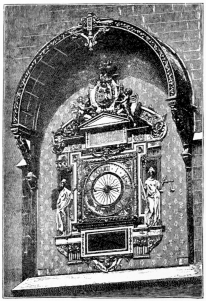 CLOCK AT THE PALAIS DE JUSTICE, PARIS, PRESENTED BY
CHARLES V. IN 1370.
CLOCK AT THE PALAIS DE JUSTICE, PARIS, PRESENTED BY
CHARLES V. IN 1370.
These ideas, perfect enough in the abstract, are contained in the
definitions of police as found in dictionaries and the best authorities.
The Imperial Dictionary calls it “a judicial and executive system in a
national jurisprudence which is specially concerned with the quiet and
good order of society; the means instituted by a government or community
to maintain public order, liberty, property, and individual security.”
Littré defines police as “the ordered system established in any city
or state, which controls all that affects the comfort and safety of the
inhabitants.” “Police,” says a modern writer, “is that section of public
authority charged to protect persons and things against every attack,
every evil which can be prevented or lessened by human prudence.” Again:
“To maintain public order, protect property and personal liberty, to
watch over public manners and the public health: such are the principal
functions of the police.” Although we English people were slow to adopt
any police system on a large or uniform scale, the principle has ever
been accepted by our legists. Jeremy Bentham considered police necessary
as a measure of precaution, to prevent crimes and calamities as well as
to correct and cure them. Blackstone in his Commentaries says: “By
public police and economy I mean the due regulation and domestic order
of the kingdom, whereby the individuals of the State, like members of a
well-governed family, are bound to conform their general behaviour to
the rules of propriety, good neighbourhood, and good manners; to be
decent, industrious, and inoffensive in their respective stations.”
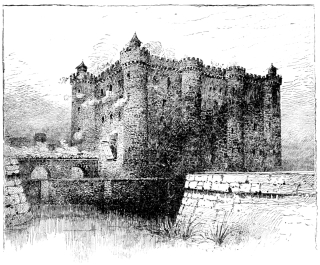 THE BASTILLE.
(From an old Print.)
The French kings were probably the first, in modern times, to establish
a police system. As early as the fourteenth century Charles V., who was
ready to administer justice anywhere, in the open field or under the
first tree, invented a police “to increase the happiness and security of
his people.” It was a fatal gift, soon to be developed into an engine
of horrible oppression. It came to be the symbol of despotism, the plain
outward evidence of the king’s supreme will, the bars and fetters that
checked and restrained all liberty, depriving the people of the
commonest rights and privileges, forbidding them to work, eat, dress,
live, or move from place to place without leave. Louis XIV., on his
accession, systematised and enormously increased the functions and
powers of the police, and with an excellent object, that of giving
security to a city in which crime, disorder, and dirt flourished
unchecked. But in obtaining good government all freedom and independence
was crushed out of the people.
The lieutenant of police first appointed in 1667, and presently advanced
to the higher rank of lieutenant-general, was an all-powerful
functionary, who ruled Paris despotically henceforward to the great
break-up at the Revolution. He had summary jurisdiction over beggars,
vagabonds, and evil-doers of all kinds and classes; he was in return
responsible for the security and general good order of the city. Crimes,
great and small, were very prevalent, such as repeated acts of fraud and
embezzlement; for Fouquet had but just been convicted of the
malversation of public moneys on a gigantic scale. There were traitors
in even the highest ranks, and the Chevalier de Rohan about this period
was detected in a plot to sell several strong places on the Normandy
coast to the enemy. Very soon the civilised world was to be shocked
beyond measure by the wholesale poisonings of the Marchioness of
Brinvilliers, Voisin, and other miscreants. In the very heart of Paris
there was a deep gangrene, a sort of criminal Alsatia—the Cour des
Miracles—where depredators and desperadoes gathered unchecked, and
defied authority. The streets were made hideous by incessant
bloodthirsty brawls; quarrels were fought out then and there, for
everyone, with or without leave, carried a sword—even servants and
retainers of the great noblemen—and was prompt to use it. The
lieutenant-general was nearly absolute in regard to offences, both
political and general. In his office were kept long lists of suspected
persons and known evil-doers, with full details of their marks and
appearance, nationality and character. He could deal at once with all
persons taken in the act; if penalties beyond his power were required,
he passed them on to the superior courts. The prisoners of State in the
royal castles—the Bastille, Vincennes, and
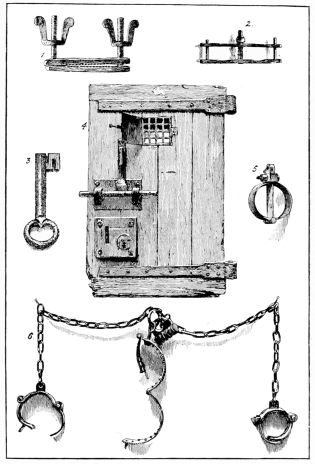 RELICS OF THE BASTILLE AND OTHER FRENCH PRISONS.
(In the possession of Madame Tussaud & Sons, Limited.)
1. Hand Crusher. 2. Thumb-screw. 3. Key of the Bastille. 4. Dungeon Door
from the Abbey Prison, Paris. 5. Handcuffs. 6. Wrist and Neck-irons.
the rest—were in his charge; he interrogated them at will, and might
add to their number by arresting dangerous or suspected persons, in
pursuit of whom he could enter and search private houses or take any
steps, however arbitrary. For all these purposes he had a large armed
force at his disposal, cavalry and infantry, nearly a thousand men in
all, and besides there was the city watch, the chevaliers de guet, or
“archers,” who were seventy-one in number.
The first lieutenant-general of police in Paris was Gabriel Nicolas (who
assumed the name of la Reynie, from his estate), a young lawyer who had
been the protégé of the Governor of Burgundy, and afterwards was taken
up by Colbert, Louis XIV.’s Minister. La Reynie is described by his
contemporaries as a man of great force of character, grave and silent
and self-reliant, who wielded his new authority with great judgment and
determination, and soon won the entire confidence of the autocratic
king. He lost no time in putting matters right. To clear out the Cour
des Miracles and expel all rogues was one of his first measures; his
second was to enforce the regulation forbidding servants to go armed.
Exemplary punishment overtook two footmen of a great house who had
beaten and wounded a student upon the Pont Neuf. They were apprehended,
convicted, and hanged, in spite of the strong protests of their masters.
La Reynie went farther, and revived the ancient regulation by which
servants could not come and go as they pleased, and none could be
engaged who did not possess papers en règle. The servants did not
submit kindly, and for some time evaded the new rule by carrying huge
sticks or canes, of which also they were eventually deprived.
The lieutenant-general of police was the censor of the Press, which was
more free-spoken than was pleasing to a despotic government, and often
published matter that was deemed libellous. The French were not yet
entirely cowed, and sometimes they dared to cry out against unjust
judges and thieving financiers; there were fierce factions in the
Church; Jesuit and Jansenist carried on a bitter polemical war; the
Protestants, unceasingly persecuted, made open complaint which brought
down on some of their exemplary clergy the penalty of the galleys. The
police had complete authority over printers and publishers, and could
deal sharply with all books, pamphlets, or papers containing libellous
statements or improper opinions. The most stringent steps were taken to
prevent the distribution of prohibited books. Philosophical works were
most disliked. Books when seized were dealt with as criminals and were
at once consigned to the Bastille. Twenty copies were set aside by the
governor, other twelve or fifteen were at the disposal of the higher
officials, the rest were handed over to the paper-makers to be torn up
and sold as waste paper or destroyed by fire in the presence of the
keeper of archives. Many of the books preserved in the Bastille and
found at the Revolution were proved to be insignificant and inoffensive,
and to have been condemned on the general charge of being libels either
on the queen and royal family or on the Ministers of State. Prohibited
books were not imprisoned until they had been tried and condemned; their
sentence was written on a ticket affixed to the sack containing them.
Condemned engravings were scratched and defaced in the presence of the
keeper of archives and the staff of the Bastille; and so wholesale was
the destruction of books that one paper-maker alone carried off 3,015
pounds weight of fragments. Seizures were often accompanied by the
arrest of printers and publishers, and an order to destroy the press and
distribute the bookseller’s whole stock.
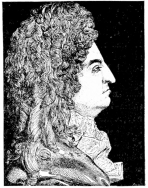 LOUIS XIV.
(From an old Print.)
Although la Reynie used every effort to check improper publications, he
was known as the patron and supporter of legitimate printing. Under his
auspices several notable editions issued from the press, and their
printers received handsome pensions from the State. He was a collector,
a bibliophile who gathered together many original texts; and he will
always deserve credit for having caused the chief manuscripts of the
great dramatist Molière to be carefully preserved.
Society was very corrupt in those days, honeycombed with vices,
especially gambling, which claimed the constant attention of a paternal
police. La Reynie was most active in his pursuit of gamblers. The rapid
fortunes made by dishonest means led to much reckless living, and
especially to an extraordinary development of play. Everyone gambled,
everywhere, in and out of doors, even in their carriages while
travelling to and fro. Louis XIV., as he got on in life, and more
youthful pleasures palled, played tremendously. His courtiers naturally
followed the example. It was not all fair play either; the temptation of
winning largely attracted numbers of “Greeks” to the gaming tables, and
cheating of all kinds was very common. The king gave frequent and
positive orders to check it. A special functionary who had jurisdiction
in the Court, the grand provost, was instructed to find some means of
preventing this constant cheating at play. At the same time la Reynie
sent Colbert a statement of the various kinds of fraud practised with
cards, dice, or hoca, a game played with thirty points and thirty
balls. The police lieutenant made various suggestions for checking these
malpractices; the card-makers were to be subjected to stringent
surveillance; it was useless to control the makers of dice, but they
were instructed to denounce all who ordered loaded dice. As to hoca,
it was, he said, far the most difficult and the most dangerous. The
Italians, who had originated the game, so despaired of checking cheating
in it that they had forbidden it in their own country. La Reynie’s
anxiety was such that he begged the Minister to prohibit its
introduction at the Court, as the fashion would soon be followed in the
city. However, this application failed; the Court would not sacrifice
its amusements, and was soon devoted to hoca, with lansquenet,
postique, trou-madame, and other games of hazard.
The extent to which gambling was carried will be seen in the amounts
lost and won; it was easy, in lansquenet or hoca, to win fifty or
sixty times in a quarter of an hour. Madame de Montespan, the king’s
favourite, frequently lost a hundred thousand crowns at a sitting. One
Christmas Day she lost seven hundred thousand crowns. On another
occasion she laid a hundred and fifty thousand pistoles (£300,000) upon
three cards, and won. Another night, it is said, she won back five
millions which she had lost. Monsieur, the king’s brother, also gambled
wildly. When campaigning he lost a hundred thousand francs to other
officers; once he was obliged to pledge the whole of his jewels to
liquidate his debts of honour.
Nevertheless the games of chance, if permitted at Court, were prohibited
elsewhere. The police continually harried the keepers of gambling hells;
those who offended were forced to shut up their establishments and
expelled from Paris. The king was disgusted at times, and reproved his
courtiers. He took one M. de Ventadour sharply to task for starting
hoca in his house, and warned him that “this kind of thing must be
entirely ended.” The exact opposite was the result: that and other games
gained steadily in popularity, and the number of players increased and
multiplied. The king promised la Reynie to put gambling down with a
strong hand, and called for a list of all hells and of those who kept
them. But the simple measure of beginning with the Court was not tried.
Had play been suppressed among the highest it would soon have gone out
of fashion; as it was, it flourished unchecked till the collapse of the
ancien régime.
It would be tedious to trace the succession of lieutenants-general
between la Reynie and de Crosne, the last, who was in office at the
outbreak of the French Revolution. One or two were remarkable in their
way: the elder D’Argenson, who was universally detested and feared; who
cleared out the low haunts with such ruthless severity that he was known
to the thieves and criminals as Rhadamanthus, or the judge of the
infernal regions; his son, D’Argenson the younger, who is held
responsible for the law of passports which made it death to go abroad
without one; Hérault, who persecuted the Freemasons, and was so noted
for his bigotry and intolerance. Of him the following story is told. In
one of his walks abroad he took offence at the sign at a shop door which
represented a priest bargaining about goods at a counter, with this
title, “L’Abbé Coquet.” Returning home, he despatched an emissary to
fetch the Abbé Coquet, but gave no explanation. The agent went out and
picked up a priest of the name and brought him to Hérault’s house. They
told him the Abbé Coquet was below. “Mettez-le dans le grenier” was
Hérault’s brief order. Next day the abbé, half-starved, grew furious at
his detention, and Hérault’s servants reported that they could do
nothing with him. “Eh! Brulez-le et laissez-moi tranquille!” replied
the chief of police, whereupon an explanation followed, and the Abbé
Coquet was released.
D’Ombréval, again, was a man of intolerant views. He especially
distinguished himself by his persistent persecution of the mad fanatics
called the convulsionnaires,[10] whom he ran down everywhere, pursuing
them into the most private places, respecting neither age nor sex, and
casting them wholesale into prison. Two of these victims were found in
the Conciergerie in 1775 who had been imprisoned for thirty-eight years.
The convulsionnaires successfully defied the police in the matter of a
periodical print which they published secretly and distributed in the
very teeth of authority. This rare instance of baffled detection is
worth recording. The police were powerless to suppress the Nouvelles
Ecclésiastiques, as the paper was called. A whole army of active and
unscrupulous spies could not discover who wrote it or where it was
printed. Sometimes it appeared in the town, sometimes in the country. It
was printed, now in the suburbs, now among the piles of wood in the Gros
Caillou, now upon barges in the River Seine, now in private houses. A
thousand ingenious devices were practised to put it into circulation and
get it through the barriers. One of the cleverest was by utilising a
poodle dog which carried a false skin over its shaved body; between the
two the sheets were carefully concealed, and travelled safely into the
city. So bold were the authors of this print that on one occasion when
the police lieutenant was searching a house for a printing press several
copies of the paper still wet from the press were thrown into his
carriage.
Berryer, a later lieutenant-general, owed his appointment to Madame de
Pompadour, whose creature he was, and his whole
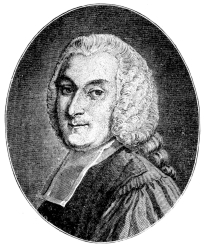 DE SARTINE.
(From the Engraving by Littret.)
aim was to learn all that was said of her and against her, and then
avenge attack by summary arrests. At her instance he sent in a daily
statement of all the scandalous gossip current in the city, and he lent
his willing aid to the creation of the infamous Cabinet Noir, in which
the sanctity of all correspondence was violated and every letter read as
it passed through the post. A staff of clerks was always busy; they took
impressions of the seals with quicksilver, melted the wax over steam,
extracted the sheets, read them, and copied all parts that were thought
likely to interest the king and Madame de Pompadour. The treacherous
practice was well known in Paris, and so warmly condemned that it is
recorded in contemporary memoirs: “Dr. Quesnay furiously declared he
would sooner dine with the hangman than with the Intendant of Posts” who
countenanced such a base proceeding.
Perhaps the most famous and most successful police Minister of his time
was M. de Sartines, whose detective triumphs were mainly due to his
extensive system and to the activity of his nearly ubiquitous agents.
Two good stories are preserved of de Sartines’ omniscience.
One of them runs that a great officer of State wrote him from Vienna
begging that a noted Austrian robber who had taken refuge in Paris might
be arrested and handed over. De Sartines immediately replied that it was
quite a mistake, the man wanted was not in Paris, but actually in
Vienna; he gave his exact address, the hours at which he went in and out
of his house, and the disguises he usually assumed. The information was
absolutely correct, and led to the robber’s arrest.
Again, one of de Sartines’ friends, the president of the High Court at
Lyons, ventured to deride his processes, declaring that they were of no
avail, and that anyone, if so disposed, could elude the police. He
offered a wager, which de Sartines accepted, that he could come into
Paris and conceal himself there for several days without the knowledge
of the police. A month later this judge left Lyons secretly, travelled
to Paris day and night, and on arrival took up his quarters in a remote
part of the city. By noon that day he received a letter, delivered at
his address, from de Sartines, who invited him to dinner and claimed
payment of the wager.
A great coup was made by this adroit officer, but the interest of the
affair attaches rather to the thieves than to the police. It was on the
occasion of the marriage of Louis XVI. and Marie Antoinette in 1770.
During the great fêtes in honour of the event an extraordinary tumult
arose in the Rue Royale, where it joins the modern Champs Élysées. A
gang of desperadoes had cunningly stretched cords across the street
under cover of the darkness, and the crowds moving out to the fêtes fell
over them in hundreds. The confusion soon grew general, and a frightful
catastrophe ensued. Men, women, and children, horses and carriages, were
mixed up in an inextricable tangle, and hundreds were trampled to death.
Some desperate men tried to hack out a passage with their swords,
children were passed from hand to hand over the heads of the
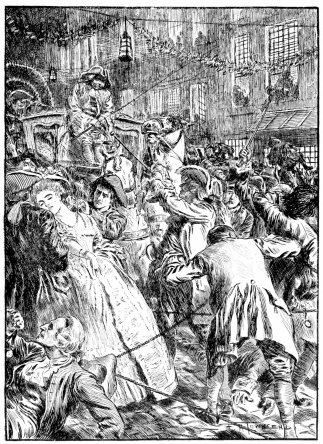 TUMULT CAUSED BY THIEVES AT THE MARRIAGE FESTIVITIES OF
MARIE ANTOINETTE.
TUMULT CAUSED BY THIEVES AT THE MARRIAGE FESTIVITIES OF
MARIE ANTOINETTE.
crowd, too often to fall and be swallowed up in the struggling gulf
below. No fewer than 2,470 people are said to have perished in this
horrible mêlée. It was, of course, a time of harvest for the thieves.
Apparently only one of the confraternity suffered from the crush, and on
him fifty watches were found and as many chains, gold and silver. Next
day de Sartines and his agents made wholesale arrests. Some three or
four hundred noted thieves were taken up and sent to the Conciergerie,
where they were strictly searched. Large quantities of valuables were
secured—watches, bracelets, rings, collars, purses, all kinds of
jewels. One robber alone had two thousand francs tied up in his
handkerchief.
De Sartines kept a few criminals on hand for the strange purpose of
amusing fashionable society. It became the custom to have thieves to
perform in drawing-rooms. De Sartines, when asked, would obligingly send
to any great mansion a party of adroit pickpockets, who went through all
their tricks before a distinguished audience, cutting watch-chains,
stealing purses, snuffboxes, and jewellery.
This famous chief of police was the first to use espionage on a large
scale, and to employ detectives who were old criminals. When reproached
with this questionable practice, de Sartines defended it by asking,
“Where should I find honest folk who would agree to do such work?” It
was necessary for him to protect these unworthy agents by official
safe-conducts, which were worded as follows:—
“In the King’s Name.
His Majesty, having private reasons for allowing —— to conduct his
affairs without interruption, accords him safe conduct for six
months, and takes him under especial protection for that period.
His Majesty orders that he shall be exempt from arrests and
executions during that time; all officers and sergeants are
forbidden to take action against him, gaolers shall not receive him
for debt, under pain of dismissal. If notwithstanding this he
should be arrested he must be at once set free, provided always
that the safe-conduct does not save him from condemnations
pronounced on the King’s behalf.”
Lenoir, who succeeded de Sartines, carried espionage still farther, and
employed a vast army of spies, paid and unpaid. Servants only got their
places on the condition that they kept the police informed of all that
went on in the houses where they served. The hawkers who paraded the
streets were in his pay. He had suborned members of the many existing
associations of thieves, and they enjoyed tolerance so long as they
denounced their accomplices. The gambling-houses were taken under police
protection; with the proviso that they paid over a percentage of profits
and reported all that occurred. People of good society who had got into
trouble were forgiven on condition that they watched their friends and
gave information of anything worth knowing. One fashionable agent was a
lady who entertained large parties and came secretly by a private
staircase to the police office with her budget of news. This woman was
only paid at the rate of £80 a year.
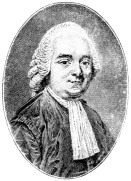 LENOIR.
(From a Contemporary Print.)
Thiroux de Crosne was the last lieutenant-general of police, and the
revolutionary upheaval was no doubt assisted by his ineptitude, his
marked want of tact and intelligence. While the city was mined under his
feet with the coming volcanic disturbances he gave all his energies to
theatrical censorship, and kept his agents busy reporting how often this
or that phrase was applauded. He was ready to imprison anyone who dared
offend a great nobleman, and was very severe upon critics and
pamphleteers. The absurd misuse of the censorship was no doubt one of
the contributing causes of the Revolution. The police were so anxious to
save the king, Louis XVI., from the pollution of reading the many libels
published that they allowed no printed matter to come near him. In this
way he was prevented from gauging the tendency of the times, or the
trend of public opinion. At last, wishing to learn the exact truth of
the vague rumours that reached him, he ordered a bookseller, Blaizot, to
send him everything that appeared. He soon surprised his Ministers by
the knowledge he displayed, and they set to work to find how it reached
him. Blaizot was discovered and sent to the Bastille. When the king,
wondering why he got no more pamphlets, inquired, he learnt that
Blaizot had been imprisoned by his order!
The monarchical police was quickly swept away by the French Revolution.
It was condemned as an instrument of tyranny; having only existed,
according to the high-sounding phrases of the period, to “sow distrust,
encourage perfidy, and substitute intrigue for public spirit.” The open
official police thus disappeared, but it was replaced by another far
more noxious; a vast political engine, recklessly handled by every
bloodthirsty wretch who wielded power in those disastrous times. The
French Republicans, from the Committee of Public Safety to the last
revolutionary club, were all policemen—spying, denouncing, feeding the
guillotine. Robespierre had his own private police, and after his fall
numerous reports were found among his papers showing how close and
active was the surveillance he maintained through his spies, not only in
Paris alone, but all over France.
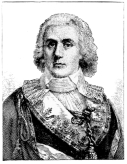 BARRAS.
(From the Engraving by Allais.)
Under the Directory the office of a Minister of Police was revived, not
without stormy protest, and the newly organised police soon became a
power in the Republic as tyrannical and inquisitorial as that of Venice.
It had its work cut out for it. Paris, the whole country, was in a state
of anarchy, morals were at their lowest point, corruption and crime
everywhere rampant. The streets of the city, all the high roads, were
infested with bands of robbers with such wide ramifications that a
general guerilla warfare terrorised the provinces. We shall see more of
this on a later page, when describing the terrible bandits named
Chauffeurs, from their practice of torturing people by toasting their
feet before the fire until they gave up their hidden treasure.
Nine police Ministers quickly followed each other between 1796 and 1799,
men of no particular note; but at last Barras fixed
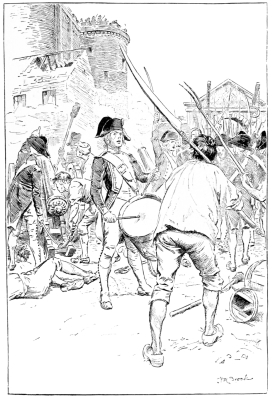 ATTACK UPON THE BASTILLE, DURING THE FRENCH REVOLUTION.
upon Fouché as a person he imagined to be well qualified for the
important post. He thus gave a first opening to one whose name is almost
synonymous with policeman—the strong, adroit, unscrupulous manipulator
of the tremendous underground forces he created and controlled, the man
who for many years practically divided with Napoleon the empire of
France. The emperor had the ostensible supremacy, but his many absences
on foreign wars left much of the real power in his Minister’s hands.
Fouché’s aptitudes for police work must have been instinctive, for he
had no special training or experience when summoned to the post of
Police Minister. He had begun life as a professor, and was known as le
Père Fouché, a member of the Oratory, although he did not actually take
religious orders. Born in the seaport town of Nantes, he was at first
designed for his father’s calling—the sea; but at school his favourite
study was theology and polemics, so that his masters strongly advised
that he should be made a priest. Something of the suppleness, the quiet,
passionless self-restraint, the patient, observant craftiness of the
ecclesiastic remained with him through life.
The Revolution found him in his native town, prefect of his college of
Nantes, married, leading an obscure and blameless life. He soon threw
himself into the seething current, and was sent to the National
Convention as representative for La Nièvre. It is needless to follow his
political career, in which, with that readiness to change his coat which
was second nature to him, he espoused many parties in turn, and long
failed to please any, least of all Robespierre, who called him “a vile,
despicable impostor.” But the Directory was friendly to him, and
appointed him its minister, first at Milan, then in Holland, whence he
was recalled by Barras, whom he had obliged in various matters, to take
the Ministry of Police. He had always been in touch with popular
movements, knew men and things intimately, and, it was hoped, would
check the more turbulent spirits.
Fouché saw his chance when Bonaparte rose above the horizon. He was no
real Republican; all his instincts were towards despotism and arbitrary
personal government. It may well be believed that he contributed much to
the success of the 18th Brumaire; this born conspirator could best
handle all the secret threads that were needed to establish the new
power. He has said in his Memoirs that the revolution of Saint-Cloud
must have failed but for him, and he was willing enough to support it.
“I should have been an idiot not to prefer a future to nothing. My ideas
were fixed. I deemed Bonaparte alone fitted to carry out the changes
rendered imperatively necessary by our manners, our vices, our errors
and excesses, our misfortunes and unhappy differences.” When the
Consulate was established, Fouché was one of the most important
personages in France. He had ample means at his disposal, and he did not
hesitate to use them freely to strengthen his position; he bought
assistance right and left, had his paid creatures everywhere, even at
Bonaparte’s elbow, it was said, and had bribed Josephine and Bourrienne
to betray the inmost secrets of the palace. The strength and extent of
his system—created by necessity, perfected by sheer love of
intrigue—was soon realised by his master, who saw that Fouché united
the police and all its functions in his own person, and might easily
prove a menace to his newly acquired power.
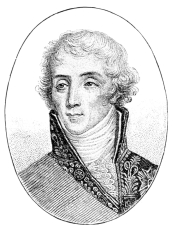 FOUCHÉ.
(From the Engraving by Couché.)
So Fouché was suppressed, but only for a couple of years, during which
nearer dangers, conspiracies threatening the very life of Napoleon, led
the emperor to recall the astute, all-powerful Minister, who meanwhile
had maintained a private police of his own. Fouché had his faithful
agents abroad, and showed himself better served, better informed, than
the emperor himself. He proved this by giving Napoleon an early copy of
a circular by the exiled Bourbon king about to be issued in Paris, the
existence of which was unknown to the official police. When Fouché
returned to the Prefecture, it was to stay. For some eight years he was
indispensable. The emperor seemed to rely upon him entirely, passing
everything on to him. “Send it to Fouché; it is his business,” was the
endorsement on innumerable papers of that time. The provincial préfets
looked only to Fouché; the Police Minister was the sole repository of
power, the one person to please; his orders were sought and accepted
with blind submission by all. He might have remained in office to the
end of the imperial régime but that he became too active and meddled
with matters quite beyond his province; and his downfall was hastened by
a daring intrigue to bring about a secret compact with England and
secure peace.
Fouché’s successor was General Savary, one of Napoleon’s most devoted
and uncompromising adherents, an indifferent soldier and a conceited,
self-sufficient man. He will always be stigmatised as the executioner of
the Duc d’Enghien, one ready to go any lengths in blind obedience to his
master’s behests. His appointment as chief of the police caused
universal consternation; it was dreaded as the inauguration of an epoch
of brutal military discipline, the advent of the soldier-policeman,
whose iron hand would be heavy upon all. Wholesale arrests,
imprisonments, and exiles were anticipated. Savary himself, although
submissively accepting his new and strange duties, shrank from executing
them. He would gladly have declined the honour of becoming Police
Minister, but the emperor would not excuse him, and, taking him by the
hand, tried to stiffen his courage by much counsel. The advice he freely
gave is worth recording in part, as expressing the views of a monarch
who was himself the best police officer of his time.
“Ill-use no one,” he told Savary as they strolled together through the
park of Saint-Cloud. “You are supposed to be a severe man, and it would
give a handle to my enemies if you were found harsh and reactionary.
Dismiss none of your present employees; if any displease you, keep them
at least six months, and then find them other situations. If you have to
adopt stern measures, be sure they are justified, and it will at least
be admitted that you are doing your duty.... Do not imitate your
predecessor, who allowed me to be blamed for sharp measures and took to
himself the credit of any acts of leniency. A good police officer is
quite without passion. Allow yourself to hate no one; listen to all, and
never commit yourself to an opinion until you have thought it well
over.... I removed Monsieur Fouché because I could no longer rely upon
him. When I no longer gave him orders, he acted on his own account and
left me to bear the responsibility. He was always trying to find out
what I meant to do, so as to forestall me, and, as I became more and
more reserved, he accepted as true what others told him, and so got
farther and farther astray.”
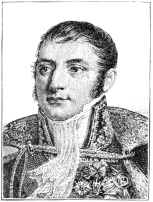 SAVARY.
(From the Engraving by Sixdeniers.)
Savary, on assuming the reins of office, found himself in a serious
dilemma. He could hardly have anticipated that Fouché would make his
task easy for him, but the result was even worse than he had expected.
He had been weak enough to allow Fouché three weeks to clear out of the
Ministry, and his wily predecessor had made the best use of his time to
burn and destroy every paper of consequence that he possessed. When he
finally handed over his charge, he produced one meagre document
alone—an abusive memorandum, two years old, inveighing against the
exiled House of Bourbon. Every other paper had disappeared. He was no
less malicious with regard to the secret staff of the office. The only
persons he presented to the new chief were a few low-class spies whom he
had never largely trusted; and although Savary raised some of them to
higher functions he was still deprived of the assistance of the superior
agents upon whom Fouché had so greatly relied. Savary solved this
difficulty cleverly. He found in his office a registry of addresses for
the use of the messengers who delivered letters. This registry was kept
by his clerks, and, not wishing to let them into his design, he took the
registry one night into his private study and copied out the whole list
himself. He found many names he little expected; names which, as he has
said, he would have expected sooner to find in China than in this
catalogue. Many addresses had, however, no indication but a single
initial, and he guessed—no doubt rightly—that these probably related
to the most important agents of all.
Having thus gained the addresses, Savary proceeded to summon each person
to his presence by a letter written in the third person, and transmitted
by his office messengers. He never mentioned the hour of the interview,
but was careful never to send for two people on the same day. His secret
agents came as requested, generally towards evening, and before they
were ushered in Savary took the precaution to inquire from his groom of
the chambers whether they came often to see Monsieur Fouché. The servant
had almost invariably seen them before, and could give many interesting
particulars about them. Thus Savary knew how to receive them; to be warm
or cold in his welcome as he heard how they had been treated by his
predecessor. He dealt in much the same way with the persons known only
under an initial. He wrote also to them at their addresses, and sent the
letters by confidential clerks who were known personally to the
concierges of the houses where the agents resided. The Parisian
concierge was as much an inquisitive busybody in those days as now;
curious about his lodgers’ correspondence, and knowing exactly to whom
he should deliver a letter with the initial address. It required only a
little adroitness to put a name to these hitherto unknown people when
they called in person at his office. It sometimes happened that more
than one person having the same initial resided in the same house. If
the concierge made the mistake of handing two letters to one
individual, Savary, when he called, explained that his clerks had
inadvertently written to him twice. In every case the letter of summons
contained a request that the letter might be brought to the office as a
passport to introduction. Savary adopted another method of making the
acquaintance of the secret personnel. He ordered his cashier to inform
him whenever a secret agent called for his salary. At first, being
suspicious of the new régime, very few persons came, but the second
and third month self-interest prevailed; people turned up, merely to
inquire, as they said, and were invariably passed on to see the chief.
Savary took the visit as a matter of course, discussing business, and
often increasing voluntarily their rates of payment. By this means he
not only re-established his connection, but greatly extended it.
Savary’s system of espionage was even more searching and comprehensive
than Fouché’s, and before long earned him the sobriquet of the “Sheik of
Spies.” He had a whole army at his disposal—the gossips and
gobe-mouches of the clubs, the cabmen and street porters, the workmen
in the suburbs. When fashionable Paris migrated to their country houses
for the summer and early autumn, Savary followed them with his spies,
whom he found among their servants, letter-carriers, even their guests.
He also reversed the process, and actually employed masters to spy on
their servants, obliging every householder to transmit a report to the
police of every change in their establishments, and of the conduct of
the persons employed. He essayed also to make valets spy on those whom
they served, so that a man became less than ever a hero to his valet.
It followed, naturally, that Savary was the most hated of all the
tyrants who wielded the power of the police prefecture. He spared no
one; he bullied the priests; he increased the rigours of the wretched
prisoners of war at Bitche and Verdun; and exercised such an irritating,
vexatious, ill-natured surveillance over the whole town, over every
class—political, social, and criminal—that he was soon universally
hated. He was a stupid man, eaten up with vanity and self-importance;
extremely jealous of his authority, and ever on the look out to
vindicate it if he thought it assailed. Never perhaps did more inflated,
unjustifiable pride precede a more humiliating fall. Savary’s
pretensions as a police officer were utterly shipwrecked by the
conspiracy of General Malet, a semi-madman, who succeeded in shaking
Napoleon’s throne to its very foundations and making his military Police
Minister supremely ridiculous.
This General Malet was a born conspirator. He had done little as a
soldier, but had been concerned in several plots against Napoleon, for
the last of which he had been cast into the prison of La Force. During
his seclusion he worked out the details of a new conspiracy, based upon
the most daring and yet simplest design. He meant to take advantage of
the emperor’s absence from Paris, and, announcing his death, declare a
Provisional Government, backed by the troops, of whom he would boldly
take command. It all fell out as he had planned, and, but for one
trifling accident, the plot would have been entirely successful. Paris
at the moment he rose was weakly governed. Cambacères represented the
emperor; Savary held the police, but, in spite of his espionage, knew
nothing of Malet, and little of the real state of Paris below the
surface; Pasquier, prefect of police, was an admirable administrator,
but not a man of action. The garrison of Paris was composed mainly of
raw levies, for all the best troops were away with Napoleon in Russia,
and the commandant of the place, General Hullin, was a sturdy
soldier—no more: a mere child outside the profession of arms.
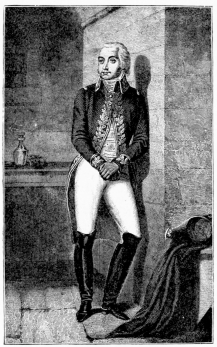 MALET IN PRISON.
(From the Drawing by A. Lacauchie.)
Malet had influence with Fouché, through which, before that Minister’s
disgrace, he had obtained his transfer from La Force to a “Maison de
Santé” in the Faubourg St. Antoine. In this half asylum, half place of
detention, the inmates were suffered to come and go on parole, to
associate freely with one another, and to receive any visitors they
pleased from outside. In this convenient retreat, which sheltered other
irreconcilable spirits, Malet soon matured his plot. His chief
confederate—the only one, indeed, he fully trusted—was a certain Abbé
Lafone, a man of great audacity and determination, who had already been
mixed up in Royalist plots against the empire. The two kept their own
counsel, alive to the danger of treachery and betrayal in taking others
into their full confidence; but Malet could command the services of two
generals, Guidal and Laborie, with whom he had been intimate at La
Force, but who never knew the whole aim and extent of the conspiracy.
About 8 p.m. on the 23rd of October, 1812, Malet and the Abbé left the
Faubourg St. Antoine, and Malet, now in full uniform, appeared at the
gates of the neighbouring barracks, where he announced the news,
received by special courier, of the emperor’s death, produced a
resolution from the Senate proclaiming a Provisional Government, and
investing him with the supreme command of the troops. Under his orders,
officers were despatched with strong detachments to occupy the principal
parts of the city, the barriers, the quays, the Prefecture, the Place
Royal, and other open squares. Another party was sent to the prison of
La Force to extract Generals Laborie and Guidal, the first of whom, when
he joined Malet, was despatched to the prefecture and thence to the
Ministry of Police, to seize both the préfet and Savary and carry them
off to gaol. Guidal was to support Laborie. Malet himself, with another
body of troops, proceeded to the Place Vendôme, the military
headquarters of Paris, and proposed to make the Commandant Hullin his
prisoner.
The arrest of the heads of the police was accomplished without the
slightest difficulty about 8 a.m. on the 24th of October, and they were
transported under escort to La Force. (Savary ever afterwards was
nicknamed the Duc de la Force.) Malet meanwhile had roused General
Hullin, to whom he presented his false credentials. As the general
passed into an adjoining room to examine them, Malet fired a pistol at
him and “dropped” him. Then the Adjutant-General Dorcet interposed, and,
seizing his papers, instantly detected the forgery. Malet was on the
point of shooting him also, when a staff-officer rushed up from behind,
and, backed by a handful of his guard, easily overpowered Malet. From
that moment the attempt collapsed. The Police Minister and the préfet
were released from prison; the conspirators were arrested. Yet for a few
hours Malet had been master of Paris.
Napoleon was furiously angry with everyone, and loaded the police in
particular with abuse. He did not, however, remove Savary from his
office, for he knew he could still trust him, and this was no time to
lose the services of a devoted friend. The insecurity of his whole
position had been clearly manifested. One man, a prisoner, had, by his
own inventive audacity, succeeded in suborning or imposing upon superior
officers and securing the assistance of large bodies of troops, in
forcing prison doors, arresting Ministers and high officials, and
seizing the reins of power. No one had stood against him; the powers
wielded by authority were null and void; chance alone, a mere accident,
had spoilt the enterprise.
At the restoration of the Bourbons the police organisation was revised,
but still left in much the same hands—ex-Napoleonists, such as Beugnot
and Bourrienne, who were director-general and prefect respectively. The
latter distinguished himself by a fruitless attempt to arrest his old
enemy Fouché, who was living quietly in Paris, holding aloof from
affairs as he had done through the closing days of the Empire. Fouché
escaped from the police officers by climbing over his garden wall, and
then went into hiding. He was thus thrown back into the ranks of the
Imperialists, and, on the return from Elba, was at once nominated to his
old office of chief of police, where he made himself extremely useful to
Napoleon. But he played a double part, as usual; had friends in both
camps, and, after giving the emperor much valuable information as to the
movements of the Allies before Waterloo, went over to the victors after
the battle. Fouché was extraordinarily busy in shaping events at the
final downfall of Napoleon, and he was one of the first to approach
Wellington with suggestions as to the emperor’s disposal. He seems to
have gained the Duke’s goodwill, and Wellington urged Louis XVIII. to
appoint him afresh, as the person who could be best trusted to maintain
public order, to the directorship of the police. Fouché had many friends
in high places; he had also the knack of seeming to be indispensable. It
was a severe blow to the king that Fouché should be forced upon him.
When the order of appointment was placed before him for signature, he
glanced at it, and let it lie upon the table, and the pen slipped from
his hand; he long sat buried in sad thought before he could rouse
himself to open relations with the man who had been hitherto the
implacable foe of his family.
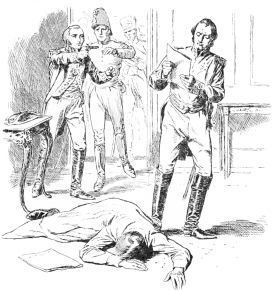 “MALET WAS ON THE POINT OF SHOOTING HIM ALSO” (p. 216.)
Fouché gained his point; but where all knew, all watched, and none
trusted him, he needed all his sang froid, all his tact, to hold his
position. But in his long career of conspiracy and change he had learnt
the lesson of dissimulation and self-restraint. Yet he was still the
focus and centre of intrigue, to whom everyone flocked—his old
associates, once his friends and now his hardly concealed enemies; the
men who had been his enemies and were now on the surface his friends.
His antechamber showed the most mixed assemblage. “He went among them,
from one to the other, speaking with the same ease as though he had the
same thing to say to all. How often have I seen him creeping away from
the window where he had been talking apart with some old
comrade—Thibaudeau, for example, the ancient revolutionist—on the most
friendly, confidential terms, to join us, a party of royalists, about an
affair concerning the king. A little later Fouché inserted Thibaudeau’s
name in the list of the proscribed.”[11]
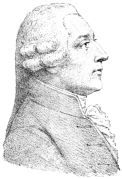 THIBAUDEAU.
(From a Contemporary Print.)
Fouché has been very differently judged by his contemporaries. Some
thought him an acute and penetrating observer, with a profound insight
into character; knowing his epoch, the men and matters appertaining to
it, intimately and by heart. Others, like Bourrienne, despised and
condemned him. “I know no man,” says the latter, “who has passed through
such an eventful period, who has taken part in so many convulsions, who
so barely escaped disgrace and was yet loaded with honours.” The keynote
of his character, thought Bourrienne, was great levity and inconstancy
of mind. Yet he carried out his schemes, planned with mathematical
exactitude, with the utmost precision. He had an insinuating manner;
could seem to speak freely when he was only drawing others on. A
retentive memory and a great grasp of facts enabled him to hold his own
with many masters, and turn most things to his own advantage. He did not
long survive the Restoration, and died at Trieste in 1820, leaving
behind him a very considerable fortune.
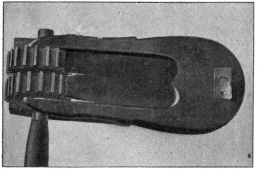 A “CHARLIE’S” RATTLE, IN THE BLACK MUSEUM.
Early Police in England—Edward I.’s Act—Elizabeth’s Act for
Westminster—Acts of George II. and George III.—State of London
towards the end of the Eighteenth Century—Gambling and Lottery
Offices—Robberies on the River Thames—Receivers—Coiners—The
Fieldings as Magistrates—The Horse Patrol—Bow Street and its
Runners: Townsend, Vickery, and others—Blood Money—Tyburn
Tickets—Negotiations with Thieves to recover stolen
Property—Sayer—George Ruthven—Serjeant Ballantine on the Bow
Street Runners compared with modern Detectives.
IF a century or more ago France and other Continental countries were
generally over-policed, England, as a free country, long refused to
surrender its liberties. Until quite recent years there was no organised
provision for public safety, for the maintenance of good order, the
prevention of crime, or the pursuit of law-breakers. Good citizens
co-operated in self-defence; the office of constable was incumbent upon
all, but evaded by many on payment of substitutes. One of the earliest
efforts to establish a systematic police was the statute 13th Edward I.
(1285), made for the maintenance of peace in the city of London. This
ancient statute was known as that of Watch and Ward, and it recognised
the above principle that the inhabitants of every district must combine
for their own protection. It recites how “many evils, as murders,
robberies, and manslaughters,
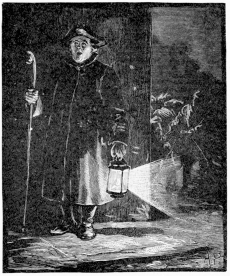 “ONE O’CLOCK AND A SHINY NIGHT!”
have been committed by night and by day, and people have been beaten and
evilly entreated”; it is enjoined that “none be so hardy as to be found
going or wandering about the streets of the city with sword or buckler
after curfew tolled at St. Martin’s Le Grand.” It goes on to say that
any such should be taken by the keepers of the peace and be put in the
place of confinement appointed for such offenders, to be dealt with as
the custom is, and punished if the offence is proved. This Act further
prescribed that as such persons sought shelter “in taverns more than
elsewhere, lying in wait and watching their time to do mischief,” no
tavern might be allowed to remain open “for sale of ale or wine” after
the tolling of curfew. Many smaller matters were dealt with so as to
ensure the peace of the city. It was enacted that, “forasmuch as fools
who delight in mischief do learn to fence with buckler,” no school to
teach the art of fencing should be allowed within the city. Again, many
pains and penalties were imposed on foreigners who sought shelter and
refuge in England “by reason of banishment out of their own country, or
who, for great offence, have fled therefrom.” Such persons were
forbidden to become innkeepers, “unless they have good report from the
parts whence they cometh, or find safe pledges.” That these persons were
a source of trouble is pretty plain from the language of the Act, which
tells how “some nothing do but run up and down through the streets more
by night than by day, and are well attired in clothing and array, and
have their food of delicate meats and costly; neither do they use any
craft or merchandise, nor have they lands and tenements whereof to live,
nor any friend to find them; and through such persons many perils do
often happen in the city, and many evils, and some of them are found
openly offending, as in robberies, breaking of houses by night, murders,
and other evil deeds.”
Another police Act, as it may be called, was that of 27th Elizabeth
(1585) for the good government of the city and borough of Westminster,
which had been recently enlarged. “The people thereof being greatly
increased, and being for the most part without trade or industry, and
many of them wholly given to vice and idleness,” and a power to correct
them not being sufficient in law, the Dean of Westminster and the High
Steward were given greater authority. They were entitled to examine and
punish “all matters of incontinences, common scolds, and common
annoyances, and to commit to prison all who offended against the peace.”
Certain ordinances were made by this Act for regulating the domestic
life of the city of Westminster; the bakers and the brewers, the
colliers, wood-mongers, and bargemen were put under strict rule; no
person was suffered to forestall or “regrate” the markets so as to
increase the price of victuals by buying them up beforehand; the cooks
and the tavern-keepers were kept separate: no man might sell ale and
keep a cookshop at the same time; the lighting of the city was imposed
upon the victuallers and tavern-keepers, who were ordered to keep one
convenient lanthorn at their street doors from six p.m. until nine a.m.
next morning, “except when the moon shall shine and give light.” Rogues
and sturdy beggars were forbidden to wander in the streets under pain of
immediate arrest. Many other strict regulations were made for the health
and sanitation of the burgesses, such as the scavenging and cleansing
of the streets, the punishment of butchers, poulterers, and fishmongers
who might sell unwholesome food, the strict segregation of persons
infected with the plague. It is interesting to note that Sir William
Cecil, the great Lord Burleigh, was the first High Steward of
Westminster, and that the regulations above quoted were introduced by
him.
These Acts remained in force for many centuries, although the powers
entrusted to the High Steward fell into great disuse. But in the 10th
George II. (1737) the Elizabethan Act was re-enacted and its powers
enlarged. This was an Act for well-ordering and regulating a night watch
in the city—“a matter of very great importance for the preservation of
the persons and properties of the inhabitants, and very necessary to
prevent fires, murders, burglaries, robberies, and other outrages and
disorders.” It had been found that all such precautions were utterly
neglected, and now the Common Council of the city was authorised to
create a night watch and levy rates to pay it. The instructions for this
night watch were issued through the constables of wards and precincts,
the old constitutional authority, who were expected to see them
observed. But the night-watchmen could act in the absence of the
constable when keeping watch and ward, and were enjoined to apprehend
all night-walkers, malefactors, rogues, vagabonds, and disorderly
persons whom they found disturbing the public peace, or whom they
suspected of evil designs.
Forty years later another Act was passed, 14th George III. (1777), which
again enlarged and, in a measure, superseded the last-mentioned Act. It
is much more detailed, prescribing the actual number of watchmen, their
wages, and how they are to be “armed and accommodated,” which means that
they were to carry rattles and staves and lanterns; it details minutely
the watchman’s duty: how he is to proclaim the time of the night or
morning “loudly and as audibly as he can”; he is to see that all doors
are safe and well secured; he is to prevent “to the utmost of his power
all murders, burglaries, robberies, and affraies; he is to apprehend all
loose, idle, and disorderly persons, and deliver them to the constable
or headborough of the night at the watch-houses.” It may be stated at
once that this Act, however excellent in intention and carefully
designed, greatly failed in execution. The watchmen often proved
unworthy of their trust, and it is recorded by that eminent
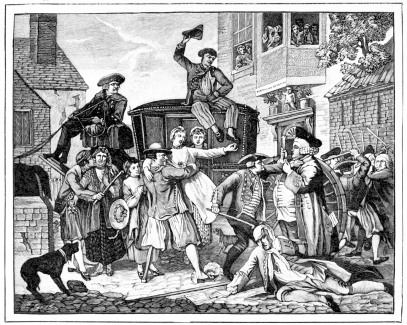 A RESCUE; OR, THE TARS TRIUMPHANT,” SHOWING PEACE
OFFICERS IN 1768.
A RESCUE; OR, THE TARS TRIUMPHANT,” SHOWING PEACE
OFFICERS IN 1768.
(After the Picture by R. Collett.)
police magistrate, Mr. Colquhoun, “that no small portion of those very
men who are paid for protecting the public are not only instruments of
oppression in many instances, by extorting money most unwarrantably, but
are frequently accessories in aiding and abetting or concealing the
commission of crimes which it is their duty to detect and suppress.” It
is but fair to add that Sir John Fielding, who was examined in 1772 as
to the numerous burglaries committed in the metropolis, stated that the
watch was insufficient, “that their duty was too hard and their pay too
small.”
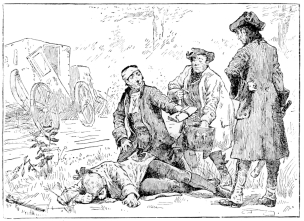 A HIGHWAY ROBBERY.
Beyond question the state of the metropolis, and, indeed, of the country
at large, at the end of the eighteenth century was deplorable. Robbery
and theft from houses and on the highway had been reduced to a regular
system. Opportunities were sought, intelligence obtained, plans prepared
with the utmost skill and patience. Houses to be forced were previously
reconnoitred, and watched for days and weeks in advance. The modern
burglar could have taught the old depredator little that he did not
know. Again, the gentleman of the road—the bold highwayman—used
infinite pains in seeking out his prey. He had his spies in every
quarter, among all classes, and the earliest certain intelligence of
travellers worth stopping when carrying money and other valuables; he
could count upon the cordial support of publicans and ostlers, who
helped him in his attack and covered his retreat. The footpads who
infested the streets were quite as daring; it was unsafe to cross open
spaces, even in the heart of the town, after dark. These lesser thieves,
so adroit in picking pockets by day, used actual violence by night. The
country was continually ravaged by other depredators: horse and cattle
stealers, thieves who laid hands upon every kind of agricultural
produce. The farmers’ fields were constantly plundered of their crops,
fruit and vegetables were carried off, even the ears of wheat were cut
from their stalks in the open day. It was estimated that one and a half
million bushels were annually stolen in this way. The thieves boldly
took their plunder to the millers to be ground, and the millers,
although aware that fields and barns had been recently robbed, did not
dare object, lest their mills should be burnt over their heads.
No doubt the general level of morality was low. Gambling of all kinds
had increased enormously. There were gaming-houses and lottery offices
everywhere. Faro banks and E. O. tables, and places where hazard,
roulette, and rouge-et-noir could be played, had multiplied exceedingly.
Six gaming-houses were kept in one street near the Haymarket, mostly by
prize-fighters, and persons stood at the doors inviting passers-by to
enter and play. Besides these, there were subscription clubs of
presumably a higher class, and even ladies’ gaming-houses. The public
lotteries were also a fruitful source of crime, not only in the stimulus
they gave to speculation, but in their direct encouragement of fraud. A
special class of swindlers was created—the lottery insurers, the
sharpers who pretended to help the lottery players against loss by
insuring the amount of their stakes. Offices for fraudulent lottery
insurance existed all over the town. It was estimated that there were
400 of them, supporting 2,000 agents and clerks, and 7,500 “morocco
men,” as they were called—the canvassers who went from door to door
soliciting insurances, which they entered in a book covered with red
morocco leather. It was said that these unlicensed offices obtained
premiums of nearly two millions of money when the English and Irish
lotteries were being drawn, on which they made a profit of from 15 to 25
per cent. It was proved by calculating the chances that they were some
33 per cent. in favour of the insurers. Even in those days the principle
of profiting by the gambling spirit of the public was strongly
condemned, but lotteries survived until 1826, since when the law has
dealt severely with any specious attempts to reintroduce them under
other names.
At this time the plunder of merchandise and naval stores in the River
Thames had reached gigantic proportions. Previous to the establishment
of the Thames river police in 1798 the commerce of the country, all the
operations of merchants and shipowners, were grievously injured by these
wholesale depredations, which amounted at a moderate computation to
quite half a million per annum. There were, first of all, the river
pirates, who boarded unprotected ships in the stream. One gang of them
actually weighed a ship’s anchor, hoisted it into their boat with a
complete new cable, and rowed away with their spoil. These villains hung
about vessels newly arrived and cut away anything within reach—cordage,
spars, bags of cargo. They generally went armed, and were prepared to
fight for what they seized. There were the “heavy horsemen and the light
horsemen,” the “game watermen,” the “game lightermen,” the “mudlarks and
the scuffle-hunters,” each of them following a particular line of their
own. Some of these, with the connivance of watchmen or without, would
cut lighters adrift and lead them to remote places where they could be
pillaged and their contents carried away. Cargoes of coal, Russian
tallow, hemp, and ashes were often secured in this way. The “light
horsemen” did a large business in the spillings, drainings, and
sweepings of sugar, coffee, and rum; these gleanings were greatly
increased by fraudulent devices, and were carried off with the
connivance of the mates, who shared in the profit. The “heavy horsemen”
were smuggled on board to steal whatever they could find—coffee, cocoa,
pimento, ginger, and so forth, which they carried on shore concealed
about their persons in pouches and pockets under their clothes. The
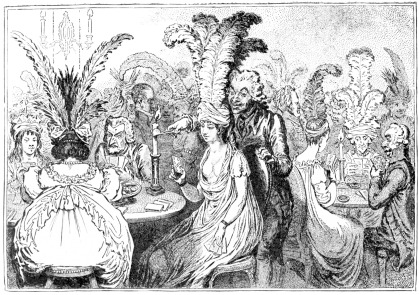 GAMBLING IN SOCIETY.
(From a Print by Gillray, published in 1796.)
“game watermen” worked by quickly receiving what was handed to them when
cargoes were being discharged, and this they conveyed at once to some
secret place; the “game lightermen” were of the same class, who used
their lighters to conceal stolen parcels of goods which they could
afterwards dispose of.
A clever trick is told of one of these thieves, who long did a big
business in purloining oil. A merchant who imported great quantities was
astonished at the constant deficiency in the amounts landed, far more
than could be explained by ordinary leakage. He determined to attend at
the wharf when the lighters arrived, and he saw that in one of them all
the casks had been stowed with their bungs downwards. He waited until
the lighter was unloaded, and then, visiting her, found the hold full of
oil. This the lightermen impudently claimed as their perquisite; but the
merchant refused to entertain the idea, and, having sent for casks,
filled nine of them with the leakage. Still dissatisfied, he ordered the
deck to be taken up, and found between the timbers of the lighter enough
to fill five casks more. No doubt this robbery had been long practised.
“Mudlarks” were only small fry who hung about the stern quarters of
ships at low water to receive and carry on shore any pickings they might
secure. The “scuffle-hunters” resorted in large numbers to the wharves
where goods were discharged, and laid hands upon any plunder they could
find, chiefly the contents of broken packets, for which they fought and
“scuffled.”
Before leaving this branch of depredation mention must be made of the
plunder levied on his Majesty’s Dockyards, the Naval Victualling and
Ordnance Stores, which were perpetually pillaged, as were the warships,
transports, and lighters in the Thames, Medway, Solent, and Dart. Over
and above the peculations of employees, the frauds and embezzlements in
surveys, certificates, and accounts, there was nearly wholesale pillage
in such articles as cordage, canvas, hinges, bolts, nails, timber,
paint, pitch, casks, beef, pork, biscuit, and indeed all kinds of
stores. No definite figures are at hand giving the value of these
robberies, but they must have reached an enormous total.
The extensive robberies described above were, no doubt, greatly
facilitated by the many means that existed for the disposal of the
stolen goods. Never did the nefarious trade of the “receiver” flourish
so widely as then. This, the most mischievous class of criminal, without
whom the thief would find his calling hazardous and unproductive, was
extraordinarily numerous at this period. There were several thousands in
the Metropolis alone, a few of them no more than careless, asking no
questions about the property brought to them for purchase, but the bulk
of them distinctly criminal, who bought goods well knowing them to be
stolen. Many had been thieves themselves, but had found “receiving” a
less hazardous and more profitable trade; they followed ostensibly some
reputable calling—kept coalsheds, potato warehouses, and chandler’s
shops—some were publicans, others dealt in secondhand furniture, old
clothes, old iron, and rags, or were workers and refiners of gold and
silver. These were the rank and file, the retailers, so to speak, who
passed on what was brought to them to the wholesale “receivers,” of whom
at that time there were some fifty or sixty, opulent people many of
them, commanding plenty of capital. These high-class operators had their
crucibles and their furnaces always ready for melting down plate; they
had extensive connections beyond sea for the disposal of valuables,
especially of jewels, which were taken from their settings to prevent
recognition.
These great “fences”—the cant name for “receivers”—worked as large and
lucrative a business as do any of their successors to-day. A wide
connection was the first essential. Often enough the thieves arranged
with the “receivers” before they entered upon any new job, and thus the
latter kept touch with the operators, who gladly parted with their
plunder at easy prices, being unable to dispose of it alone. It was a
first principle with the “receiver” that the goods he purchased should
not be recognisable, and until all marks and means of identification
were removed he would not admit them into his house. He would not even
discuss terms until the thieves had taken this precaution. Various
methods were employed. In linen and cloth goods the head and fag-ends
were cut off, and occasionally the list and selvedge, if they were
peculiar. The marks on the soles of boots and shoes were obliterated by
hot irons, and the linings, if necessary, removed. Gold watches were
sent off to agents in large towns or on the Continent, their outward
appearance having first been changed; the works of one were placed in
the case of another. Where the proceeds of the robbery were banknotes,
or property whose identity could not be destroyed, they were sent off to
a distance to foreign marts, and all traces of them lost. It was
essential that the “receiver” on a large scale should have an army of
agents and co-partners—persons following the same nefarious traffic,
who could be trusted, for their own sakes, to be cautious in their
proceedings.
The general crime of this period was enormously increased by the
extensive fabrication of false money. Coining was extraordinarily
prevalent, and a wide, far-reaching system had been created for
distributing and uttering the counterfeits, not only at home but on the
Continent. All England, all Europe, was literally deluged with false
money, the largest proportion of which was manufactured in this country.
Not only was the current coinage of the realm admirably
counterfeited—guineas, half-guineas, crowns, half-crowns, shillings,
sixpences, and coppers, but the coiners could turn out all kinds of
foreign money—louis d’ors, Spanish dollars, sequins, pagodas, and the
rest, so cleverly imitated as almost to defy detection. So prosperous
was the business that as many as forty or fifty private mints were
constantly at work in London and various country towns fabricating false
money; as many as 120 workpeople were engaged, and the names of some 650
known coiners were registered at the Royal Mint. There was a steady
demand for the base coin; it went off so fast that the manufacturers
seldom had any stock on hand. As soon as it was finished it was sent
off, here, there, and everywhere, by every kind of conveyance. Not a
coach nor a carrier left London without a parcel of bad money consigned
to country agents. It was known that one agent alone had placed five
hundred pounds’ worth with country buyers in a single week. Some idea of
the profits may be gathered from the fact that Indian pagodas, worth
8s., could be manufactured for 1½d. apiece; and that the middleman
who bought them at 5s. a dozen retailed them at from 2s. 3d. to 5s.
each. The counterfeiting of gold coins was the least common, owing to
the expense of the process and the necessary admixture of at least a
portion of the precious metal. It was different with silver. It was
stated that two persons alone could manufacture between two and three
hundred pounds’ worth (nominal value) of spurious silver in six days.
There were five kinds of base silver, known in the trade as flats,
plated goods, plain goods, castings, and “pig things.” The first were
cut out of flattened plates of a material part silver, part copper; the
second were of copper only, silvered over; the third were of copper,
turned out of a lathe and polished; the fourth were of white metal, cast
in a mould; the “pig things” were the refuse of the rest converted into
sixpences. Copper coins were also manufactured largely out of base
metal.
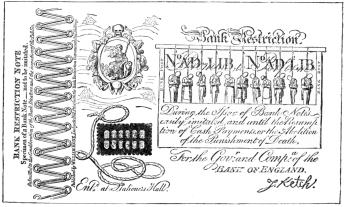 IMITATION BANKNOTE ETCHED BY GEORGE CRUIKSHANK IN 1818,
SATIRISING THE INFLICTION OF CAPITAL PUNISHMENT FOR FORGERY.
IMITATION BANKNOTE ETCHED BY GEORGE CRUIKSHANK IN 1818,
SATIRISING THE INFLICTION OF CAPITAL PUNISHMENT FOR FORGERY.
Frauds on the currency were not limited to counterfeiting the coinage.
Banknotes were systematically forged, although the penalty was death.
This crime had been greatly stimulated by the suspension of specie
payments and the issue of paper money. The Bank of England had been thus
saved at a great financial crisis, when its reserve in cash and bullion
had shrunk to little more than a million, and it had issued notes for
values of less than five pounds. Note forgery at once increased to a
serious extent, and as the Bank was implacable, insisting on rigorous
prosecution, great numbers of capital convictions followed. The most
minute and elaborate provisions existed, prescribing the heaviest
penalties not only for the actual manufacture and uttering, but for the
mere possession of banknote paper, plates, or engraving tools. The
infliction of the extreme sentence did not check the crime. Detection,
too, was most difficult. The public could not distinguish between true
and false notes. Bank officials were sometimes deceived, and clerks at
the counter were known to accept bad paper, yet refuse payment of what
was genuine. Some account will be given on a later page of Charles
Price, commonly called “Old Patch,” from his favourite disguise of a
patch on one eye. He was a most extraordinarily successful forger of
banknotes, who did all but the negotiation of them himself: he made his
paper with the correct watermark, engraved his plates, and prepared his
own ink. He had several homes, many aliases, used many disguises, and
employed an army of agents and assistants, some of them his wives (for
he was a noted bigamist), to put off the notes.
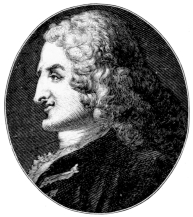 HENRY FIELDING, NOVELIST AND MAGISTRATE.
An early and commendable attempt had been made in the middle of the
eighteenth century to grapple with this all-prevailing, all-consuming
crime. When Henry Fielding, the immortal novelist, was appointed a
Middlesex magistrate towards the close of his somewhat tempestuous
career, he strove hard to check disorders, waging unceasing warfare
against evil-doers and introducing a well-planned system of prevention
and pursuit. Although in failing
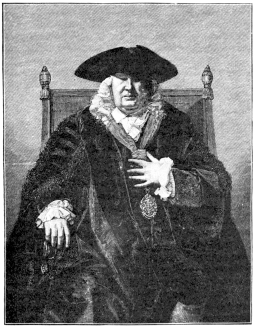 SIR JOHN FIELDING, THE BLIND BOW STREET MAGISTRATE.
(From the Portrait by M. W. Peters, R.A.)
health, he laboured incessantly. He often sat on the bench for sixteen
hours out of the twenty-four, returning to Bow Street after a long day’s
work to resume it from seven p.m. till midnight. He did a great public
service in devising and executing a plan for the extirpation of robbers,
although the benefit was but temporary. This was in 1753, when the whole
town seemed at the mercy of the depredators. The Duke of Newcastle, at
that time Secretary of State, sent for Fielding, who unfolded a scheme
whereby, if £600 were placed at his disposal, he engaged to effect a
cure. After his first advance from the Treasury he was able to report
that “the whole gang of cut-throats was entirely dispersed, seven of
them were in actual custody, and the rest driven, some out of the town,
the rest out of the kingdom.” He had nearly killed himself in the
effort. “Though my health was reduced to the last extremity ... I had
the satisfaction of finding ... that the hellish society was almost
entirely extirpated”; that, instead of “reading about murders and street
robberies in the newspapers every morning,” they had altogether ceased.
His plan had not cost the Government more than £300, and “had actually
suppressed the evil for a time.”
It was only for a brief space, however; and his brother, blind Sir John
Fielding, who succeeded him at Bow Street, frankly confessed that new
gangs had sprung up in place of those recently dispersed. But he bravely
set himself to combat the evil, and adopted his brother’s methods. He
first grappled with the street robbers, and in less than three months
had brought nine of them to the gallows. Next he dealt with the
highwaymen infesting the road near London, “so that scarce one escaped.”
The housebreakers, lead-stealers, shoplifters, and all the small fry of
pickpockets and petty larcenists were increasingly harried and in a
large measure suppressed. He organised a scheme for protecting the
suburbs, by which the residents subscribed to meet the expense of
transmitting immediate news to Bow Street by mounted messengers, with
full particulars of articles stolen, and the description of the robber;
the same messenger was to give information at the turnpikes and
public-houses en route, and thus a hue and cry could be raised and the
offender would probably soon be captured. At the same time a notice
would be inserted in the Public Advertiser warning tavern-keepers,
stable-keepers, and pawnbrokers, the first against harbouring rogues,
the second against hiring out horses to the persons described, the third
against purchasing goods which were the proceeds of a robbery.
Sir John Fielding (he was knighted in 1760) was a most active and
energetic magistrate, and he was such a constant terror to evil-doers
that his life was often threatened. There were few crimes reported in
which he did not take a personal interest, promptly visiting the spot,
taking information, and setting his officers on the track. When Lord
Harrington’s house was robbed of some three thousand pounds’ worth of
jewellery, Sir John repaired thither
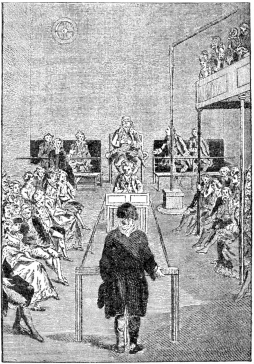 SIR JOHN FIELDING OFFICIATING AT BOW STREET.
(From a Drawing by Dodd.)
at once, remaining in the house all day and the greater part of the
night. It was the same in cases of highway robbery, murder, or riot.
Everyone caught red-handed was taken before him, and his court was much
frequented by great people to hear the examination of persons charged
with serious crimes—such as Dr. Dodd, Hackman, who murdered Miss Reay,
the brother-forgers the Perreaus, and Sarah Meteyard, who killed her
parish apprentice by abominable cruelty. One well-known nobleman, “a
great patron of the arts,” given also to visiting Newgate in disguise in
order to stare at the convicts under sentence of death, would constantly
take his seat on the bench.
Sir John Fielding’s appearance in court and manner of conducting
business have been graphically described by the Rev. Dr. Somerville of
Jedburgh. He speaks in his diary of Sir John’s “singular adroitness. He
had a bandage over his eyes, and held a little switch or rod in his
hand, waving it before him as he descended from the bench. The sagacity
he discovered in the questions he put to the witnesses, and the marked
and successful attention, as I conceived, not only to the words but to
the accents and tones of the speaker, supplied the advantage which is
usually rendered by the eye; and his arrangement of the questions,
leading to the detection of concealed facts, impressed me with the
highest respect for his singular ability as a police magistrate.”
Sir John Fielding was undoubtedly the originator of the horse patrol,
which was found a most useful check on highway robbery. But it was not
permanently established by him, and we find him beseeching the Secretary
of State to continue it for a short time longer “as a temporary but
necessary step in order to complete that which was being so happily
begun.” He was satisfied from “the amazing good effects produced by this
patrol that outrages would in future be put down by a little further
assistance of the kind.” This patrol was reintroduced by the chief
magistrate of Bow Street about 1805, either Sir Richard Ford or Sir
Nathaniel Conant. It was a very efficient force, recruited entirely from
old cavalry soldiers, who were dressed in uniform, well armed, and well
mounted. They wore a blue coat with brass buttons, a scarlet waistcoat,
blue trousers and boots, and they carried sword and pistols. Their
duties were to patrol the neighbourhood of London in a circuit of from
five to ten miles out, beginning at five or seven p.m. and ending at
midnight. It was their custom to call aloud to all horsemen and
carriages they met, “Bow Street patrol!” They arrested all known
offenders whom they might find, and promptly followed up the
perpetrators of any robbery that came under their notice. Very marked
and satisfactory
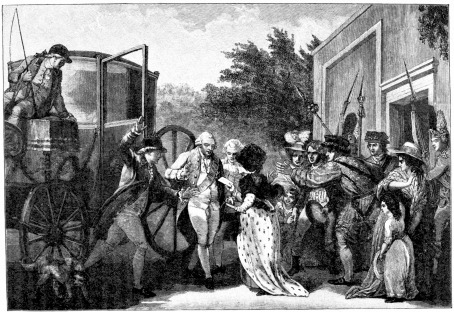 MARGARET NICHOLSON’S ATTEMPT TO ASSASSINATE GEORGE III.
IN 1786 (p. 238).
MARGARET NICHOLSON’S ATTEMPT TO ASSASSINATE GEORGE III.
IN 1786 (p. 238).
(From the Painting by R. Smirke.)
results were obtained by this excellent institution; it almost
completely ended highway robbery, and if any rare case occurred, the
guilty parties were soon apprehended.
Bow Street may be called the centre of our police establishment at that
time; it was served by various forces, and especially by eight officers,
the famous Bow Street runners of that period, the prototype of the
modern detective. They were familiarly known as the “robin redbreasts,”
from the scarlet waistcoat which was practically their badge of office,
although they also carried as a mark of authority a small bâton
surmounted by a gilt crown. The other police-offices of London were also
assisted by officers, but these were simply constables, and do not
appear to have been employed beyond their own districts. The Bow Street
runners, however, were at the disposal of the public if they could be
spared to undertake the pursuit of private crime. Three of them were
especially appropriated to the service of the Court. The attempt made by
Margaret Nicholson upon George III., and other outrages by mad people,
called for special police protection, and two or more of these officers
attended royalties wherever they went. They were generally MacManus,
Townsend, and Sayer, Townsend being the most celebrated of the three. He
has left a self-painted picture in contemporary records, and his
evidence, given before various police committees, shows him to have been
a garrulous, self-sufficient functionary. It was his custom to foist his
opinions freely on everyone, even on the king himself. He boasted that
George IV. imitated the cut of his hat, that the Dukes of Clarence and
of York presented him with wine from their cellars; he mixed himself up
with politics, and did not hesitate to advise the statesmen of the day
on such points as Catholic Emancipation and the Reformed Parliament. It
generally fell to his office to interrupt duels, and, according to his
own account, he stopped that between the Duke of York and Colonel
Lennox. His importance, according to his own idea, was shown in his
indignant refusal to apprehend a baker who had challenged a clerk; he
protested that “it would lessen him a good deal” after forty-six years’
service, during which period he had had the honour of taking earls,
marquises, and dukes.
No doubt these runners were often usefully employed in the pursuit of
criminals. Townsend himself when at a levée arrested the man who had
boldly cut off the Star of the Garter from a nobleman’s breast. The
theft having been quickly discovered, word was passed to look out for
the thief. It reached Townsend, who shortly afterwards noticed a person
in Court dress who yet did not seem entitled to be there. Fearing to
make a mistake, he followed him a few yards, and then remembered his
face as that of an old thief. When taken into custody, the stolen star
was found in the man’s pocket.
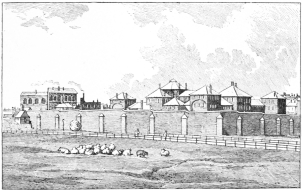 COLDBATH FIELDS PRISON IN 1814.
(From a Drawing in the Crace Collection.)
Vickery was another well-known runner, who did much good work in his
time. One of his best performances was that of saving the post-office
from a serious robbery. The officials would not believe in the existence
of the plot, but Vickery knew better, and produced the very keys that
were to pass the thieves through every door. He had learnt as a fact
that they had twice visited the premises, but still postponed the coup,
waiting until an especially large amount of plunder was collected.
Another case in which Vickery exhibited much acumen was the clever
robbery effected from Rundell and Bridges, the gold jewellers on Ludgate
Hill. Two Jews, having selected valuables to the amount of £35,000,
asked to be permitted to seal them up and leave them until they returned
with the money. In the act of packing they managed to substitute other
exactly similar parcels, and carried off the jewels in their pockets. As
they did not return, the cases were opened and the fraud discovered.
Vickery was called in, and soon traced the thieves to the Continent,
whither he followed them, accompanied by one of the firm, and tracked
them through France and Holland to Frankfort, where quite half of the
stolen property was recovered.
Vickery subsequently became jailer at Coldbath Fields Prison. One of the
prisoners committed to his custody was Fauntleroy the banker; and a
story has been handed down that this great forger all but escaped from
custody. A clever plot had been set on foot, but timely information
reached the authorities. On making a full search, a ladder of ropes and
other aids to breaking out of prison were laid bare. No blame seems to
have attached to Vickery in this, although some of his colleagues and
contemporaries were not always above suspicion. They were no doubt
subject to great temptations under the system of the time. It was the
custom to reward all who contributed to the conviction of offenders.
This blood-money, as it was called, was a sum of £40, distributed
amongst those who had secured the conviction. No doubt the practice
stimulated the police, but it was capable of great perversion; it gave
the prosecutor a keen interest in securing conviction, and was proved,
at times, to have led persons to seduce others into committing crime. It
is established beyond question that at the commencement of the
nineteenth century persons were brought up charged with offences to
which they had been tempted by the very officials who arrested them.
It must be admitted that the emoluments of the police officers were not
extraordinarily high; a guinea a week appears to have been the regular
pay, to which may be added the share of blood-money referred to above,
which, according to witnesses, seldom amounted to more than £20 or £30 a
year. Besides this, the officers had the privilege of selling Tyburn
tickets, as they were called, which were exemptions from serving as
constables or in other parish offices—an onerous duty from which people
were glad to buy exemption at the price of £12, £20, or even £25. Again,
a runner employed by other public departments or by private persons
might be, but was not always, handsomely rewarded if successful. He had,
of course, his out-of-pocket expenses and a guinea a day while actually
at work; but this might not last for more than a week or a fortnight,
and, according to old Townsend, people were apt to be mean in
recognising the services of the runners. These officers were also the
intermediaries at times between the thieves and their victims, and
constantly helped in the negotiations for restoring stolen property; it
could not be surprising that sometimes the money stuck to their fingers.
The loss incurred by bankers, not only through the interception of their
parcels, but by actual breakings into their banks, led to a practice
which was no less than compounding felony: the promise not to prosecute
on the restitution of a portion of the stolen property. It was shown
that the “Committee of Bankers,” a society formed for mutual protection,
employed a solicitor, who kept up communication with the principal
“fences” and “family men.” This useful functionary was well acquainted
with the thieves and their haunts, and when a banker’s parcel—known in
cant language as a “child”—was stolen, the solicitor entered into
treaty with the thieves to buy back the money.
In this fashion a regular channel of communication came to be
established, offers were made on both sides, and terms were negotiated
which ended generally in substantial restitution. Many bankers objected
to the practice, and refused to sanction it. Still it prevailed, and
largely; and several specific cases were reported by the Select
Committee on the Police in 1828. Thus, two banks that had each been
robbed of notes to the amount of £4,000, recovered them on payment of
£1,000. In another case Spanish bonds, nominally worth £2,000, were
given back on payment of £1,000; in another, nearly £20,000 was restored
for £1,000; and where bills had been stolen that were not easily
negotiable, £6,000 out of £17,000 was offered for £300. Sometimes after
apprehension proceedings were stopped because a large amount of the
plunder had been given up. The system must have been pretty general,
since the committee stated that they knew of no less than sixteen banks
which had thus tried to indemnify themselves.
A strong suspicion was entertained that Sayer, a Bow Street runner
already mentioned, had feathered his nest finely with a portion of the
proceeds of the Paisley Bank robbery at Glasgow. He was an acquaintance
of the Mackoulls,[12] and it was he who proposed to the bank that
£20,000 should be restored on condition that all proceedings ceased.
When Sayer reached the bank with Mrs. Mackoull the notes produced
amounted to no more than £11,941. Whether Sayer had impounded any or not
was never positively known; but when he died, at an advanced age, he was
worth £30,000. And it has been said that shortly before his death he
pointed to the fireplace and a closet above it, using some incoherent
words. This was probably the receptacle of a number of notes, which were
afterwards found in the possession of one of his relatives, notes that
were recognised as part of the Paisley Bank plunder. He must either have
got them as hush-money or have wrongfully detained them, and then found
it too dangerous to pass them into circulation. Probably he desired to
have them destroyed, so that the story might not come out after his
death. The runners must have found it difficult to resist temptation.
The guilt of one of them—Vaughan—was clearly established in open
court, and he was convicted as an accessory in a burglary into which he
had led others; he was also proved to have given an unsuspicious sailor
several counterfeit coins to buy articles with at a chandler’s shop.
When the sailor came out, Vaughan arrested him and charged him with
passing bad money. Vaughan absconded, but was afterwards discovered and
brought to trial.
Townsend tells of a case in his own glorification—and there is no
reason to deny him the credit—in which he arrested a notorious old
pickpocket, one Mrs. Usher, who had done a very profitable business for
many years. She was said to be worth at least £3,000 at the time of her
arrest, and when Townsend appeared against her he was asked in so many
words whether he would not withdraw from the prosecution. The Surrey
jailer, Ives by name, asked him, “Cannot this be ‘stashed’?” Townsend
virtuously refused, and still would not yield, although Mrs. Usher’s
relations offered him a bribe of £200. He also tells how he might have
got a considerable sum from Broughton, who had robbed the York mail, but
he steadfastly refused to abandon the prosecution. As much as a thousand
pounds had been offered to keep back a single witness.
These runners were often charged with being on much too intimate terms
with criminals. It was said that they frequented
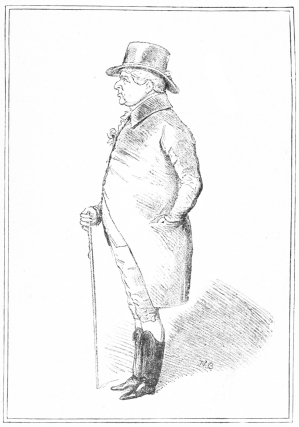 SKETCH OF TOWNSEND of Bow Street.
(Drawn by Richard Doyle.)
low taverns and flash houses, and that thus thieves’ haunts were
encouraged as a sort of preserve in which the police could, at any time,
lay hands on their game. The officers on their side declared that they
could do little or nothing without these houses—that, being so few in
number, it would be impossible for them to keep in touch with the great
mass of metropolitan criminality. Vickery spoke out boldly, and said
that the detection of offenders was greatly facilitated, for they knew
exactly where to look for the men they wanted. Townsend repudiated the
idea that the officer was contaminated by mixing with thieves. The flash
houses “can do the officer no harm if he does not make harm of it.”
Unless he went there and acted foolishly or improperly, or got on too
familiar terms with the thieves, he was safe enough. But the houses were
undoubtedly an evil, and the excuse that they assisted in the
apprehension of offenders was no sufficient justification for them. To
this day, however, the free access to thieves’ haunts is one of the most
valuable aids to detection, and the police-officer who does not follow
his prey into its own jungle will seldom make a large bag.
On the whole, it may be said that the old Bow Street runner was useful
in his generation, although he rarely effected very phenomenal arrests.
He was bold, fairly well informed, and reasonably faithful. Serjeant
Ballantine, who knew some of the latest survivors personally, had a high
opinion of them, and thought their methods generally superior to those
of the modern detective. We may not go quite that length—which, after
all, is mere assertion—but it seems certain, as I shall presently show,
that they were missed on the establishment of the “New Police,” as the
existing magnificent force was long called. They mostly disappeared,
taking to other callings, or living out their declining years on
comparatively small pensions. George Ruthven, one of the last, died in
1844, and a contemporary record speaks of him as follows: “He was the
oldest and most celebrated of the few remaining Bow Street runners,
among whom death has lately made such ravages, and was considered as the
most efficient police officer that existed during his long career of
usefulness. He was for thirty years attached to the police force, having
entered it at the age of seventeen; but in 1839 he retired with a
pension of £220 from the British Government, and pensions likewise from
the Russian and Prussian Governments, for his services in discovering
forgeries to an immense extent connected with those
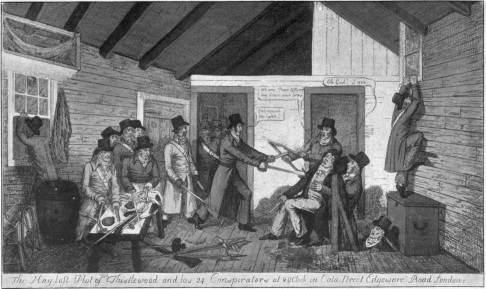 CAPTURE OF THE CATO STREET CONSPIRATORS.
(From a Contemporary Print.)
countries. Since 1839 he has been landlord of the ‘One Tun Tavern,’
Chandos Street, Covent Garden, and has visited most frequently the spot
of his former associations.... He was a most eccentric character, and
had written a history of his life, but would on no account allow it to
meet the public eye. During the last three months no less than three of
the old Bow Street officers—namely, Goodson, Salmon, and Ruthven—have
paid the debt of nature.”
Among the captures to be credited to Ruthven is that of the Cato Street
conspirators, in 1820. These desperadoes, headed by Arthur Thistlewood,
had formed a plot to murder Lord Castlereagh and the rest of the
Ministers at a dinner at Lord Harrowby’s town house in Grosvenor Square.
They were arming themselves for the purpose in a stable in Cato Street,
near the Edgware Road, when Ruthven and other runners burst in. A fight
ensued, in which Smithers, one of the officers, was killed. Several of
the conspirators were taken, but Thistlewood contrived to escape, only,
however, to be arrested next morning. He and four others were hanged,
while five more were transported for life.
Serjeant Ballantine, as I have said, paid the Bow Street runners the
high compliment of preferring their methods to those of our modern
detectives. They kept their own counsel strictly, he thought,
withholding all information, and being especially careful to give the
criminal who was “wanted” no notion of the line of pursuit, of how and
where a trap was to be laid for him, or with what it would be baited.
They never let the public know all they knew, and worked out their
detection silently and secretly. The old Serjeant was never friendly to
the “New Police,” and his criticisms were probably coloured by this
dislike. That it may be often unwise to blazon forth each and every step
taken in the course of an inquiry is obvious enough, and there are times
when the utmost reticence is indispensable. The modern detective is
surely alive to this; the complaint is more often that he is too chary
of news than that he is too garrulous and outspoken.
The “New Police” introduced by Peel—The System supported by the
Duke of Wellington—Opposition from the Vestries—Brief Account of
the Metropolitan Police, its Uses and Services—The River
Police—The City Police—Extra-police Services—The Provincial
Police.
THE necessity for a better police organisation in London much exercised
the public mind during the early decades of the nineteenth century. At
length, in 1830, Sir Robert Peel introduced a new scheme, the germ of
the present admirable forces. In doing so he briefly recapitulated the
shortcomings and defects of the system, or want of system, that then
prevailed; he pointed out how many glaring evils had survived the
repeated inquiries and consequent proposals for reform. Parliamentary
Committees had reported year after year from 1770 to 1828, all of them
unanimously of opinion that in the public interest, to combat the steady
increase of crime a better method of prevention and protection was
peremptorily demanded. Yet nothing had been done. The agitation had
always subsided as soon as the immediate alarm was forgotten. So this
opulent city, with its teeming population and abounding wealth, was
still mainly dependent upon the parochial watch: the safe-keeping of
both was entrusted to a handful of feeble old men, an obsolete body
without system or authority. That crime had increased by “leaps and
bounds” was shown by the figures. It was out of all proportion to the
growth of the people. In 1828 as compared with 1821 there had been an
increase of 41 per cent in committals, as against 15½ per cent in
population, and the ratio was one criminal to every 822 of the
population. This was in London alone. In the provinces the increase was
as 26 per cent of crime against 11½ per cent of population.
Unquestionably the cause of all this was the inefficiency of the
police. The necessary conditions, unity of action of the whole and
direct responsibility of the parts, could never be assured under such
arrangements. Each London parish worked independently, and while some
made a fairly good fight, others by their apathy were subjected to
continual depredation. The wealthy and populous district of Kensington,
for instance, some fifteen square miles in extent, depended for its
protection upon three constables and three headboroughs—none of the
latter very remarkable for steadiness and sobriety. It was fairly urged
that three drunken beadles could effect nothing against widespread
burglary and thieving. In the parish of Tottenham, equally unprotected,
there had been nineteen attempts at burglary in six weeks, and sixteen
had been entirely successful. In Spitalfields, at a time not long
antecedent to 1829, gangs of thieves stood at the street corners and
openly rifled all who dared to pass them. In some parishes, suburban and
of recent growth, there was no police whatever, no protection but the
voluntary exertions of individuals and the “honesty of the thieves.”
Such were Fulham—with 15,000 inhabitants—Chiswick, Ealing, Acton,
Edgware, Barnet, Putney, and Wandsworth. In Deptford, with 20,000,
constantly reinforced by evil-doers driven out of Westminster through
stricter supervision, there was no watch at all. Then the number of
outrages perpetrated so increased that a subscription was raised to keep
two watchmen, who were yet paid barely enough to support existence, much
less ensure vigilance. Watchmen, indeed, were often chosen because they
were on the parish rates. The pay of many of them was no more than
twopence per hour.
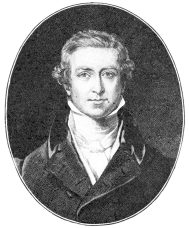 Sir Robert Peel.
(After the Painting by J. Wood.)
The Duke of Wellington, who was the head of the Administration when Peel
brought forward his measure in 1829, supported it to the full, and
showed from his own experience how largely crime might be prevented by
better police regulations. He mentioned the well-known horse-patrol,[13]
which had done so much to clear the neighbourhood of London of
highwaymen and footpads. His recollection reached back into the early
years of the century, and he could speak from his own experience of a
time when scarcely a carriage could pass without being robbed, when
travellers had to do battle for their property with the robbers who
attacked them. Yet all this had been stopped summarily by the mounted
patrols which guarded all the approaches to London, and highway robbery
had ceased to exist. The same good results might be expected from the
general introduction of a better preventive system.
It is a curious fact that the Duke incurred much odium by the
establishment of this new police, which came into force about the time
that the struggle for Parliamentary reform had for the moment eclipsed
his popularity. The scheme of an improved police was denounced as a
determination to enslave, an insidious attempt to dragoon and tyrannise
over the people. Police spies armed with extraordinary authority were to
harass and dog the steps of peaceable citizens, to enter their houses,
making domiciliary visitations, exercising the right of search on any
small pretence or trumped-up story. There were idiots who actually
accused the Duke of a dark design to seize supreme power and usurp the
throne; it was with this base desire that he had raised this new
“standing army” of drilled and uniformed policemen, under Government,
and independent of local ratepayers’ control. The appointment of a
military officer, Colonel Rowan, of the Irish Constabulary, betrayed the
intention of creating a “veritable gendarmerie.” The popular aversion to
the whole scheme, fanned into flame by these silly protests, burst out
in abusive epithets applied to the new tyrants. Such names as “raw
lobsters” from their blue coats, “bobbies” from Sir Robert Peel, and
“peelers” with the same derivation, “crushers” from their heavy-footed
interference with the liberty of the subject, “coppers” because they
“copped” or captured his Majesty’s lieges, survive to show how they were
regarded in those days.
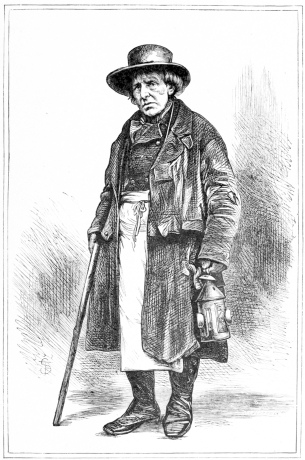 WILLIAM ANTHONY, “THE LAST OF THE CHARLIES.”
Yet the admirable regulations framed by Sir Richard Mayne, who was soon
associated with Colonel Rowan, did much to reassure the public. They
first enunciated the judicious principle that has ever governed police
action in this country: the principle that prevention of crime was the
first object of the constable, not the punishment of offenders after the
fact. The protection of person and property and the maintenance of peace
and good order were the great aims of a police force. A firm but
pleasant and conciliatory demeanour was earnestly enjoined upon all
officers, and this has been in truth, with but few exceptions, the
watchword of the police from first to last. “Perfect command of temper,”
as laid down by Sir Richard Mayne, was an indispensable qualification;
the police officer should “never suffer himself to be moved in the
slightest degree by language or threats.” He is to do his duty in a
“quiet and determined manner,” counting on the support of bystanders if
he requires it, but being careful always to take no serious step without
sufficient force at his back. He was entrusted with certain powers,
though not of the arbitrary character alleged: he was entitled to arrest
persons charged with or suspected of offences: he might enter a house in
pursuit of an offender, to interfere in an affray, to search for stolen
goods.
 POLICEMAN, OLD STYLE.
(From a Drawing by Leech.)
They went their way quietly and efficiently, these new policemen, and,
in spite of a few mistakes from over-zeal, soon conquered public esteem.
The opposition died hard; dislike was fostered by satirical verse and
the exaggerated exposure of small errors, and in 1833 the police came
into collision with a mob at Coldbath Fields, when there was a serious
and lamentable affray. But already the London vestries were won over.
They had been most hostile to the new system, “as opposed to the free
institutions of this country, which gave parish authorities the sole
control in keeping and securing the peace.” They had denounced the new
police as importing espionage totally repugnant to the habits and
feelings of the British people, and subjecting them to “a disguised
military force.” These protests formed part of a resolution arrived at
by a conference of parishes, which also insisted that those who paid the
cost should have the control. Yet a couple of years later these same
vestries agreed that “the unfavourable impression and jealousy formerly
existing against the new police is rapidly diminishing ... and that it
has fully answered the purpose for which it was formed....” This
conclusion was supported by some striking statistics. Crime appreciably
diminished. The annual losses inflicted on the public by larcenies,
burglaries, and highway robberies, which had been estimated at about a
million of money, fell to £20,000, and at the same time a larger number
of convictions was secured.
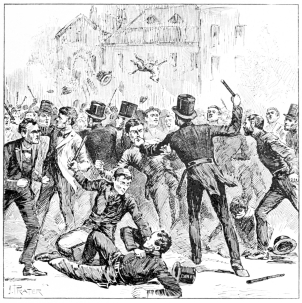 FIGHT BETWEEN POLICE AND MOB AT COLDBATH FIELDS IN 1833
(p. 250.)
FIGHT BETWEEN POLICE AND MOB AT COLDBATH FIELDS IN 1833
(p. 250.)
It is beyond the limits of this work to give a detailed account of the
growth and gradual perfecting of the Metropolitan Police
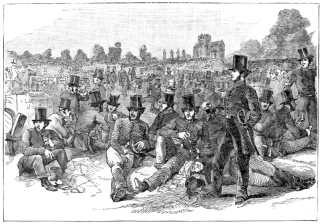 THE POLICE FORCE ON BONNER’S FIELDS DURING THE CHARTIST
DISTURBANCES IN 1848.
THE POLICE FORCE ON BONNER’S FIELDS DURING THE CHARTIST
DISTURBANCES IN 1848.
(From an Engraving in “The Illustrated London News.”)
into the splendid force that watches over the great city to-day. The
total strength now, according to the last official returns, is nearly
16,000 of all ranks, and it has about quintupled since its first
creation in 1829. The population of London at that date was just one
million and a half; the area controlled by the new police not half the
present size. Now not far short of 6,000,000 souls are included within
the area supervised by our present Metropolitan force, measuring 688
square miles of territory, or some thirty miles across from any point of
the circumference of a circle whose centre is at Charing Cross.
Throughout the whole of this vast region, which constitutes the greatest
human ant-heap the world has ever known, ever growing, too; the
blue-coated guardian of the peace is incessantly on patrol, the total
length of his beats reaching to about 850 miles. He is unceasingly
engaged in duties both various and comprehensive in behalf of his
fellow-citizens. By his active and intelligent watchfulness he checks
and prevents the commission of crime, and if his vigilance
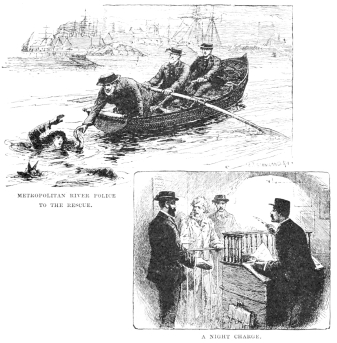 METROPOLITAN RIVER POLICE TO THE RESCUE.
A NIGHT CHARGE.
is unhappily sometimes eluded it is not because he is not eager to
pursue and capture offenders. He is exposed to peculiar dangers in
protecting the public, but accepts them unhesitatingly, risking his life
gladly, and facing brutal and often murderous violence as bravely as any
soldier in the breach. In the Whitechapel division, where roughs abound,
a fifth of the police contingent in that quarter are injured annually on
duty; 9 per cent. of the whole force goes on the sick list during the
year from the result of savage assaults. A recent return of officers
injured shows a total of 3,112 cases, and these include 2,717 assaults
when making arrests, 89 injuries in stopping runaway, horses, 158 bites
from dogs, and many injuries sustained in disorderly crowds or when
assisting to extinguish fires. The regulation of street traffic is,
everybody knows, admirably performed by the police, and they ably
control all public carriages. The Lost Property Office is a police
institution that renders much efficient service, and in a recent year
over 38,000 articles which had been dropped, forgotten, or mislaid were
received, and in most cases returned to their owners. They made up a
very heterogeneous collection, and included all kinds of birds and live
stock—parrots, canaries, larks, rabbits, dogs, and cats; there were
books, bicycles, weapons, perambulators, mail carts, golf clubs, sewing
machines, and musical instruments. In minor matters the police constable
is a universal champion and knight errant. He escorts the softer sex
across the crowded thoroughfare as gallantly as any squire of dames; it
is a touching sight to watch the lost child walking trustfully hand in
hand with the six-foot giant to some haven of safety. If in the West End
the man in blue is sometimes on friendly terms with the cook, he is
always alert in the silent watches of the night, trying locks and giving
necessary warning; in poorer neighbourhoods he is the friend of the
family, the referee in disputes, the kindly alarum clock that rouses out
the early labourer. It may truly be said that London owes a deep debt of
gratitude to its police.
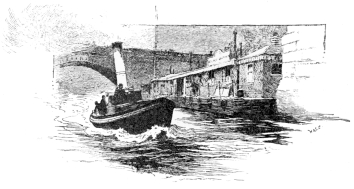 A POLICE LAUNCH AT THE FLOATING RIVER STATION, WATERLOO
BRIDGE.
A POLICE LAUNCH AT THE FLOATING RIVER STATION, WATERLOO
BRIDGE.
No account, however brief and meagre, of the Metropolitan force would be
complete which did not include some reference
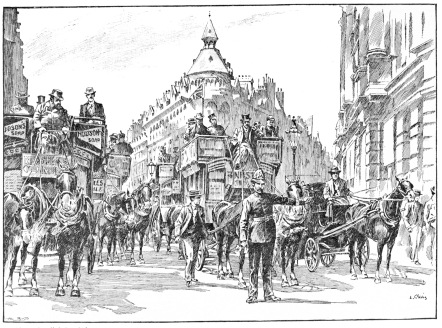 A CITY POLICEMAN REGULATING TRAFFIC AT THE MANSION HOUSE.
Photo: Cassell & Co., Ltd.
to the river and dockyard police. I have already described on earlier
pages[14] the systematic depredations that went on amid the Thames
shipping in earlier days. This called imperatively for reform, and a
marine police was established to watch over our ships and cargoes and
guard the wharves and quays. Regular boat patrols were always on the
move about the river, and the police, who carried arms, had considerable
powers. This Thames branch was not immediately taken over by Peel’s new
police, but it is now part and parcel of the Metropolitan force, and a
very perfect system obtains. The river police has its headquarters in
the well-known floating station at Waterloo Bridge, formerly a steamboat
pier, with a cutter at Erith, and it also has the services of several
small steam launches for rapid transit up and down the river. There is
very little crime upon the great waterway, thanks to the vigilance of
the Thames police, who also do good work in preventing suicides, while
they have many opportunities of calling attention to possible foul play
by their recovery of bodies floating on the stream.
What is true of the Metropolitan force applies equally to the City
Police. The City forms an imperium in imperio, one square mile of
absolutely independent territory interpolated in the very heart and
centre of London. The City Police was formed at the same time as the
Metropolitan, but the great municipality claimed the right to manage its
own police affairs, declining Government subsidies as resolutely as it
resisted Government control. The House of Commons in 1839 frankly
acknowledged that the City was justified in its pretensions, and that it
was certain to maintain a good and efficient police force. That
anticipation has been fully borne out, and the City Police is admitted
on all hands to be a first-class force, well organised and most
effective, filled with fine men who reach a high standard both of
intelligence and of physique. It has lighter duties by night, when the
City empties like a church after service, but during the day it has vast
cares and responsibilities, the duty of regulating the congested street
traffic in the narrow City thoroughfares being perhaps the most onerous.
Like their comrades beyond the boundary, the City police are largely
employed by private individuals; banks, exchanges, public offices, and
so forth, gladly put themselves under official protection. It should
have been mentioned, when dealing with the Metropolitan Police, that
some 1,800 officers of all ranks, from superintendents to private
constables, are regularly engaged in a variety of posts outside ordinary
police duty. Every great department of State is guarded by them; the
Sovereign’s sacred person, the princes of the blood, the royal palaces,
all public buildings, museums and collections, many of the parks and
public gardens, the powder factories, are among the institutions
confided to their care. Going farther afield, it is interesting to note
that great tradesmen, great jewellers, great pickle-makers, great
drapers, great card-makers, the co-operative stores, great fruit-growing
estates, the public markets—all these share police services with
Coutts’ and Drummond’s Banks, Holland House, Roehampton House, and so
on. The whole of our dockyards are under police surveillance; so are the
Albert Hall, Brompton Cemetery, and many other institutions.
It is impossible to leave this subject without adverting to the
excellent provincial police now invariably established in the great
cities and wide country districts, who, especially as regards the
former, have an organisation and duties almost identical with those
already detailed. The police forces of Liverpool, Manchester,
Birmingham, Edinburgh, Glasgow, and the rest yield nothing in demeanour,
devotion, and daring to their colleagues of the Metropolis. In the
counties, where large areas often have to be covered, great
responsibility must be devolved upon officers of inferior rank, and it
is not abused. These sergeants or inspectors, with their half-dozen men,
are so many links in a long-drawn chain. Much depends upon them, their
energy and endurance. They, too, have to prevent crime by their constant
vigilance on the high roads, and by keeping close watch on all
suspicious persons. For the same reason special qualities are needed in
the county chief constable and his deputy; the task of superintending
their posts at wide distances apart, and controlling the movements of
tramps and bad characters through their district, calls for the exercise
of peculiar qualities, the power of command, of rapid transfer from
place to place, of keen insight into character, of promptitude and
decision—qualities that are most often found in military officers, who
are, in fact, generally preferred for these appointments.
The Spy System under the Second Empire—The Manufacture of
Dossiers—M. Andrieux receives his own on being appointed
Prefect—The Clerical Police of Paris—The Sergents de Ville—The
Six Central Brigades—The Cabmen of Paris, and how they are kept in
Order—Stories of Honest and of Dishonest Cabmen—Detectives and
Spies—Newspaper Attacks upon the Police—Their General Character.
SOME account of the police arrangements in two or three other capitals,
and also in India, may now be given by way of contrast and comparison.
The police of Paris has already been dealt with in its early beginnings,
and under the First Empire. After the Bourbon Restoration, and during
the days of the revived monarchy, the least valuable feature of the
French police had the chief prominence. Every effort was made, by means
of the police, to check opposition to the reigning power, and suppress
political independence. But it was at this period that the detection of
crime was undertaken for the first time as a distinct branch of police
business, and it will be seen in a later chapter how Vidocq did great
things, although often by dishonest agents and unworthy means. In the
Second Empire the secret police over-rode everything; Napoleon III. had
been a conspirator in his time, and he had an army of private spies in
addition to the police of the Château, and these spies watched the
regular police at a cost of some fourteen millions of francs. At the
fall of the Second Empire there were half a dozen different secret
police services in Paris. There was the Emperor’s, already mentioned;
the Empress had hers; M. Rouher, the Prime Minister, and M. Piétri, the
Prefect, each had a private force, so had other great officials. Most of
these agents were unknown to each other as such, and so extensive was
the system of espionage that one-half of Paris was at that time said to
be employed in watching the other half. This system produced the
dossiers, the small portfolios or covers, one of which appertained to
each individual, high or low,
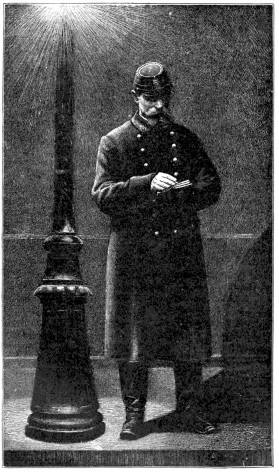 A “GARDIEN DE LA PAIX.”
innocent or criminal, and was carefully preserved in the archives of the
Prefecture. There were thousands and thousands of these, carefully
catalogued and filed for easy reference, made up of confidential and
calumniating reports sent in by agents, sometimes serious charges, often
the merest and most mendacious tittle-tattle. The most harmless
individuals were often denounced as conspirators, and an agent, if he
knew nothing positive, drew liberally on his imagination for his facts.
Great numbers of these dossiers were destroyed in the incendiary fires
of the Commune; some of its leaders were no doubt anxious that no such
records should remain. The criminal classes also rejoiced, but not for
long. One of the first acts of the authorities when order was
re-established was to reconstitute the criminal dossiers, a work of
immense toil, necessitating reference to all the archives of prisons and
tribunals. Within a couple of years some five million slips were got
together, and the documents filled eight thousand boxes. It is to be
feared that the secret police is still active in Paris, even under a
free Republic; secret funds are still produced to pay agents; among all
classes of society spies may be found even to-day; in drawing-rooms and
in the servants’ hall, at one’s elbow in the theatre, among journalists,
in the army, and in the best professions. That this is no exaggeration
may be gathered from the fact that the dossiers are still in process
of manufacture. M. Andrieux, a former prefect, who has published his
Reminiscences, describes how on taking office the first visitor he
received was his chief clerk who, according to the regular custom, put
his dossier into his hands. “It bore the number 14,207,” M. Andrieux
tells us, “and I have it now in my library, bound, with all the gross
calumnies and truculent denunciations that form the basis of such
documents.”
The regular police organisation, that which preserves order, checks
evil-doing, and “runs in” malefactors, falls naturally and broadly into
two grand divisions, the administrative and the active, the police “in
the office” and the police “out of doors.” The first attends to the
clerical business, voluminous and incessant, for Frenchmen are the
slaves of a routine which goes round and round like clockwork. There is
an army of clerks in the numerous bureaus, hundreds of those patient
Government employees, the ronds de cuir, as they are contemptuously
called, because they sit for choice on round leather cushions, writing
and filling in forms
 A “GARDE DE PARIS.”
for hours and hours, day after day. The active army of police out of
doors, which constitutes the second half of the whole machine, is
divided into two classes: that in uniform and that in plain clothes.
Every visitor to Paris is familiar with the rather theatrical-looking
policeman, in his short frock coat or cape, smart képi cocked on one
side of his head, and with a sword by his side. This agent, sergent
de ville, gardien de la paix—he is known by all three titles—has
many excellent qualities, and is, no doubt, a very useful public
servant. He is almost invariably an old soldier, a sergeant who has left
the army with a first-class character, honesty and sobriety being
indispensable qualifications. Our own Metropolitan Police is not thus
recruited: the Scotland Yard authorities rather dislike men with
military antecedents, believing that army training, with its stiff and
unyielding discipline, does not develop that spirit of good-humoured
conciliation so noticeable in our police when dealing with the public.
Something of the same kind is seen in Paris; for it is said that it
takes two or three years to turn the well-disciplined old soldier into
the courteous and considerate sergent de ville. His instructions are,
however, precise; he is strictly cautioned to use every form of
persuasion before proceeding to extremities, he is told to warn but not
to threaten, very necessary regulations when dealing with such a highly
strung, excitable population as that of Paris. The same sergents de
ville are stationed in the same quarter of the town, so that they
become more or less intimately acquainted with their neighbours and
charges. They are thus often enabled to deal with them in a friendly
way; a little scolding is found more effective than intimidation, and
strong measures may be avoided by tact and forbearance.
The uniformed police are not all employed in the streets and
arrondissements. There is a large reserve composed of the six central
brigades, as they are called, a very smart body of old soldiers, well
drilled, well dressed, and fully equipped: armed, moreover, with rifles,
with which they mount guard when employed as sentries at the doors or
entrance of the Prefecture. In Paris argot the men of these six
central brigades are nicknamed “vaisseaux” (vessels), because they
carry on their collars the badge of the city of Paris—an ancient
ship—while the sergeants in the town districts wear only numbers: their
own individual number, and that of the quarter in which they serve.
These vaisseaux claim to be the élite of the force; they come in
daily contact with the Gardes de Paris, horse and foot, a fine corps of
city gendarmerie, and, as competing with them, take a particular pride
in themselves. Their comrades in the quarters resent this pretension,
and declare that when in contact with the people the vaisseaux make
bad blood by their arrogance and want of tact. The principal business of
four at least of these central brigades is to be on call when required
to reinforce the out-of-doors police at special times. They are ready to
turn out and preserve order at fires, and will, no doubt, be the first
in the fray if Paris is ever again convulsed with revolutionary
troubles.
Of the two remaining central brigades, one controls public carriages,
the other the Halles, that great central market by which Paris is
provided with a large part of its food. The cabmen of Paris are not
easily controlled, but they are probably a much rougher lot than the
London drivers, and they, no doubt, need a much tighter hand. Every
cab-stand is under the charge of its own policeman, who knows the men,
notes their arrival and departure, and marks their general behaviour.
Other police officers of the central brigades superintend the street
traffic, but not so successfully as do our police; indeed, parties of
the French police
 PARISIAN PRISON WARDERS.
 “EVERY CAB-STAND IS UNDER THE CHARGE OF ITS OWN
POLICEMAN” (p. 262.)
“EVERY CAB-STAND IS UNDER THE CHARGE OF ITS OWN
POLICEMAN” (p. 262.)
have from time to time been sent to London for instruction in this
difficult branch of police business, but have hardly benefited by their
teaching. Parisian cabmen are forbidden to rove in search of fares, or
hang about in front of cafes and at street corners, the penalty being
imprisonment without the option of a fine. Indeed, a special quarter in
one of the Paris prisons is known as the “cabmen’s,” and is often full
of them. Yet the drivers are honest enough, and many curious stories are
told of the self-denial shown by these hard-worked, poorly paid servants
of the public. A rich Russian who had won ten thousand francs one night
at his club left the whole sum behind him in a cab in which he had
driven home. He was so certain that he had lost it irreparably that he
returned to St. Petersburg without even inquiring whether or not it had
been given up. Some time later he was again in Paris, and a friend
strongly urged him at least to satisfy himself whether or not the
missing money had been taken to the lost property office. He went and
asked, although the limit of time allowed to claim the lost property
was almost expired. “Ten thousand francs lost? Yes, there it is,” and
after the proper identification the money was restored to him. “What a
fool that cabman must have been!” was the Russian’s only remark. Again,
a certain jeweller in the Palais Royal left a diamond parure worth
80,000 francs (£3,200) in a cab, and the police, when he reported the
loss, gave him scant hope of recovery. He did not know the number of the
cabman—he had picked him up in the street, not taken him from the rank;
and, worse than all, he had quarrelled with the driver, the reason why
he had abruptly left the cab. The case seemed quite hopeless, yet the
cabman brought back the diamonds of his own accord. The quaintest part
of the story is to come. When told at the Prefecture to ask the jeweller
for the substantial reward to which he was clearly entitled, he replied
with intense indignation: “No, not I; he was too rude. I hope I may
never see him or speak to him again.”
All cabmen are not so honest, however; and now and again the fraudulent
cabman gets caught. It was so in the case of a tortoiseshell fan, which
was deposited under a wrong description and eventually, after the legal
interval, handed over to the cabman who had found it. Soon afterwards a
lady turned up to claim it, and as she described it exactly he was
ordered to restore it to the lady, whose name was communicated to him.
“But she has no right to it,” protested the cabman. “She is a thief. I
know the real owner. I have known her from the first. It is Mdlle. ——,”
and he named a popular actress, thus confessing his own misconduct. The
actress was then summoned, and did in fact identify the fan as the one
she had lost. But it was proved satisfactorily that the other lady also
had lost a fan that was curiously similar.
The vicissitudes of treasure-trove might be greatly multiplied. The most
curious chances happen, the strangest articles are brought to the police
authorities. Everything found in the streets and highways, in omnibuses,
theatres, cabs, railway stations, is forwarded to the Prefecture. In one
case an immigrant who had made his fortune in Canada and carried it in
his pocket, in the shape of fifty notes of ten thousand francs each
(£20,000), dropped his purse as he climbed on to the outside of an
omnibus. The conductor picked it up and restored it; he was rewarded
with £500, and richly he deserved it for resisting so great a
temptation. Beds, brooches, boots, sheets even, are brought into the
Prefecture. A mummy was once among the trouvailles; there are
umbrellas without end. Hogier Grisons, a French writer, from whom many
of these incidents are taken, says that a friend of his declares that
whenever he finds himself without an umbrella he goes straight to the
Prefecture, describes some particular one, according to his fancy, with
such and such a handle, a certain colour, and so on, when he always has
the exact article handed over to him.
 PARIS POLICE VANS.
So much for the police in uniform. That in plain clothes, en
bourgeois, as the French call it, is not so numerous, but it fulfils a
higher, or at least a more confidential, mission. Its members are styled
inspectors, not agents, and their functions fall under four principal
heads. There is, first of all, the service of the Sûreté—in other
words, of public safety—the detective department, employed entirely in
the pursuit and capture of criminals, of which more anon; next comes the
police, now amalgamated with the Sûreté, that watches over the morals
of the capital in a fashion that would not be tolerated in this country,
and possesses arbitrary powers under the existing laws of France; then
there is the brigade de garnis, the police charged with the
supervision of all lodging-houses, from the commonest “sleep-sellers’
shop,” as it is called, to the grandest hotels. Last of all there is the
brigade for inquiries, whose business it is to act as the eyes and ears
of the Prefecture—in plain English, as its spies.
There are many complaints in Paris that the police are short-handed,
especially in the streets. The average is sixteen to a quarter
inhabited by 30,000 to 40,000 people, so that the beats are long and the
patrol work severe, especially at night, though the numbers of the
sergents de ville are then doubled. Some say that the streets of Paris
are more unsafe in the more remote districts than those of any capital
of Europe. The police are much abused, too, by the Radical and
Irreconcilable Press. It is not uncommon to read in the daily papers
such headlines as the following: “Crimes of the Police,” “Police
Thieves,” “Murder by a Sergent de Ville”—generally gross
exaggerations, of course. The truth, no doubt, is that the police of
Paris, taken as a whole, are a hard-working, devoted, and generally
estimable body of public servants.
 A VISIT FROM THE DETECTIVES.
Greater New York—Despotic Position of the Mayor—Constitution of
the Police force—Dr. Parkhurst’s Indictment—The Lexow Commission
and its Report—Police Abuses: Blackmail, Brutality, Collusion with
Criminals, Electoral Corruption, the Sale of Appointments and
Promotions—Excellence of the Detective Bureau—The Black Museum of
New York—The Identification Department—Effective Control of
Crime.
NEW YORK, by its latest charter of government, takes in the whole of the
outlying suburban districts, and has become the second city in the
world. It is known now as Greater New York, and its present municipal
constitution is curiously at variance with the democratic traditions of
a nominally free people. Supreme power, the absolute autocratic
authority, is vested in a single individual, elected, it is true, by the
popular voice, but, while he holds office, as despotic as any Czar. The
only check on the Mayor of Greater New York is that of public opinion,
expressed through a vigilant, often outrageously plain-speaking, Press,
but a Press at times influenced, even to the point of silence, by party
spirit. Holding his mandate on these terms, the head of the municipal
executive in New York can, as a matter of fact, do as he pleases. The
whole business of municipal administration is absolutely in his hands.
He is assisted by eighteen boards, each controlling a separate
department, but all of them except one, that of finance, composed of
members whom he personally appoints. The first Mayor elected on these
lines was Mr. Van Wyck, who, when he took up his office, was said to be
as much master of New York as Napoleon III. was of Paris and France when
he became President by virtue of the plebiscite.
All this would be beyond the scope of my subject were it not that the
government of New York, past and present, is intimately bound up with
its police. The Mayor, as the chief of executive power, is the head of
the force by which it ought to be protected, and peace and good order
maintained. Not long since, that police was attacked by many reputable
citizens and declared to be a disgrace to modern civilisation. The
situation had grown up under the shadow of Tammany Hall, that strange
product of modern democracy, an organisation, originally political,
which grew with steadily increasing, irresponsible power till it
overshadowed and overawed the city of New York, ruling it with barefaced
chicanery and imposing an outrageous despotism. In 1894 the power of
Tammany was temporarily overborne by an outburst of popular indignation.
But it was scotched, not killed. The almost irresponsible power wielded
by the Chief Magistrate under the latest charter is working again for
ill. There is no guarantee for its wise and temperate exercise; and a
new Commission, known as the Mazet Commission, presided over by Mr.
Moss, has conducted an inquiry which revealed that some of the old evils
were again in the ascendant.
Until 1896 the outside public was apt to regard the police of New York
as “the best and finest in the world.” The eulogistic words are those of
its own champions, who claimed for it that “its services have been
great, the bravery of some of its members conspicuous in life-saving and
yet more in quelling riot and disturbance.” It has always been a
tradition in America that the police may be trusted with considerable
powers; a free people, feeling that law in a new country must sternly
check license, has not unwillingly permitted its constituted guardians
to use the strong arm on occasion, and in a way that would not be
tolerated in slow-going, sober old England. To “loose off his revolver”
at the fugitive he cannot catch, or who has slipped through his fingers,
is no uncommon practice with the American policeman, what though he may
hit the innocent pigeon and miss the offending crow. I can call to mind
the summary finish of a prolonged strike of “street-car” employees which
I witnessed in one of my various visits to New York. A force of
policemen in plain clothes and armed to the teeth were sent “down town”
on a street-car with orders to fight their way through, which they did
“handsomely.” In other words, they shot down all opposition. The number
of casualties was never publicly reported.
Let us consider first the constitution of the force. The whole body of
police is small compared with that of other large cities, and in
proportion to the mixed, turbulent public it controls—only one to 500
souls; it is governed by a Board of four Commissioners appointed by
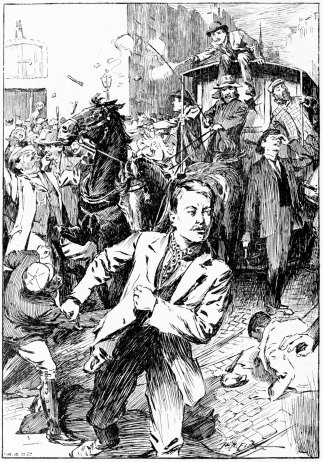 “THEY SHOT DOWN ALL OPPOSITION” (p. 269.)
the Mayor for a term of six years. Particular duties are allocated to
the several members of the Board. Thus, the senior Commissioner and
president ex officio is entrusted with the higher discipline of the
force; he deals with all charges of misconduct, and decides whether
offending constables shall or shall not be sent before the public
tribunals. Another Commissioner controls repairs and supplies, examining
and passing all bills for work done, after satisfying himself that it
has been completed. A third supervises the Pension Fund, and disposes of
applications for retirement, and also of applications from widows and
children of police officers for relief. The fourth Commissioner is the
Treasurer of police funds.
Immediately next to the Board stands a Superintendent of Police, who is
chief of the executive, the responsible head of the personnel, of the
rank and file of the force. He is the intermediary between the four
Inspectors, who come next in the hierarchy, and the supreme Board, the
channel communicating the Board’s will and the agent to enforce its
execution. The Superintendent holds all the threads of general control,
and is responsible for and charged with the enforcement of the law
throughout the city. Three Inspectors supervise each a separate
district, being responsible for the preservation of the peace within its
limits and security to life and limb; the fourth is the head of the
detective branch. After the Inspectors rank the Captains of “precincts,”
of which there were thirty-four previous to the enlargement of the city,
each “precinct” being analogous to a French arrondissement or a police
“division” in London. The Captain is an officer of great influence and
importance in his precinct, which he rules more or less despotically,
but nominally in the best interests of the public. He has a large force
of men at his disposal, and is expected to use it for the comfort and
protection of good citizens, as well as the pursuit and capture of
criminals. The rank and file of the force serving under the Captains are
classed as follows: first the Sergeants, from whom the Captains are
commonly selected; next the Roundsmen; then the Patrolmen, synonymous
with our ordinary blue-coated constables; last of all the Doormen, who
are out of uniform and employed at stations, lock-ups, and in offices,
performing many and various functions of administration.
In theory, to all outward seeming this organisation, so perfect, so
symmetrical, so accurately planned, might be supposed to justify the
encomiums passed upon it as the best and finest police force in the
world. Yet some of those for whose service it existed denounced it as an
intolerable tyranny, supported by corruption and wielding arbitrary
authority. Revolt was threatened, and it broke out ere long, only to be
crushed in its first efforts, but, unabashed by failure, to renew its
strenuous efforts. The moving spirit, the apostle of reform, was Dr.
Parkhurst, the incumbent of the Madison Square church, who, after ten
years of active ministration, began in 1890 to preach against Tammany
from his pulpit with a persistent courage that survived every attempt to
put him down. He took office next year as president of the Society for
the Prevention of Crime, and at once adopted as his watchword the cry of
“Down with the police.” He denounced the whole administration of law and
justice as criminally corrupt; all officers, lawyers, judges depending
on Tammany worked hand in hand with crime. “It is simply one solid gang
of rascals, half of the gang in office, the other half out, and the two
halves steadily catering to each other across the official line.”
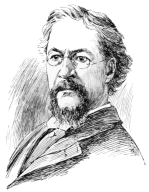 Photo: Sarony, New York.
THE REV. DR. PARKHURST.
For this bold language Dr. Parkhurst was summoned before the Grand Jury
of New York and solemnly reproved. He was not to be silenced; but,
anxious to formulate no fresh attack until he could speak to facts from
his own knowledge, he made a sad and weary pilgrimage through the worst
purlieus of the city, and obtained abundant proof that the law was
continually and flagrantly violated under the eyes of the police, and in
collusion and complicity with them. He returned to the charge,
inveighing with redoubled vigour against the police, telling how he had
“gone down into the disgusting depths of this Tammany-debauched town.”
He was again summoned before the Grand Jury, but now he had his answer,
and so far from rebuking him afresh, the Grand Jury agreed with him as
to the corruption of the New York police.
Now the forlorn hope Dr. Parkhurst had led was followed by a strong
column of assault, and although Tammany fought hard to shield its
creatures, and Dr. Parkhurst was vilified, accused, even arrested and
prosecuted upon trumped-up charges, the city rose to back him. A
memorial was presented to the State Senate praying for a full public
inquiry into the state of the police department. Tammany still fought;
its nominee, Governor Flower, Governor of the State of New York, refused
to approve the inquiry, on the ground that it was needless. “No city in
the State has a lower tax rate than New York,” he said; “no city has a
better police regulation; no city has a lower ratio of crime; ... a
better health department, better parks, better schools, better
credit.... No city is so comfortable a place to live in. That bad men
sometimes get into office there is true; that ideal municipal government
has not yet been attained there is true; but these things are equally
true of every city in the world, they are truer of other cities of our
State than they are of New York.”
Despite all opposition, a Committee was appointed and soon commenced a
searching investigation. It was presided over by Senator Lexow, and is
still known as the Lexow Commission. How exhaustively it dealt with the
business may be seen from the fact that 678 witnesses were examined on
oath, that the evidence filled 10,576 pages of printed matter, and that
nine months elapsed before it could present its first provisional
report.
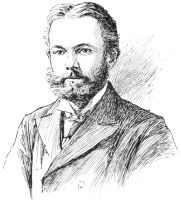 SENATOR LEXOW.
Photo copyrighted (1894) by G. Prince, New York.
Immense difficulties were experienced in obtaining evidence. The
influence of the police was paramount; and it was, no doubt, in
consequence of the reluctance of witnesses to speak against the police
that the Lexow Committee reported so strongly. It is necessary to bear
this in mind, since it may be that the police prejudiced their own case
at this point or at that by efforts to keep back the facts. The
Committee found that the witnesses they called before them were
subjected to outrage if they dared to state what they knew. “They were
abused, clubbed, and imprisoned, even convicted of crimes on false
testimony by policemen and their accomplices. Men of business were
harassed and annoyed in their affairs ... people of all degrees seemed
to feel that to antagonise the police was to call down upon themselves
the swift judgment and persecution of an invulnerable force.... The
uniform belief was that if they spoke against the police, had helped the
Committee, or had given information, their business would be ruined,
they would be hounded from the city, and their lives even jeopardised.”
The Committee therefore came to the conclusion that the police formed a
separate and highly privileged class, armed with the authority and the
machinery for oppression and punishment, but practically free themselves
from the operation of the criminal law.
This indictment was based upon clear proof of the irregularities
practised by certain members of the New York police. They may be
summarised under four principal heads, with each of which I will deal in
turn.
(1) Blackmail.—A tariff was fixed under which a tax was imposed upon
disorderly houses, drinking shops, gambling places, and so forth, and
was paid, no doubt cheerfully, for immunity from police interference.
This tax varied from twenty dollars (£4) to five hundred dollars (£100)
per month. The moneys were collected by detectives and other constables,
who received a commission upon the sums raised. These extortions were
not limited to the caterers for vice, mostly native American citizens.
The poor, ignorant, and friendless foreigner, who was seeking a new home
in the New World, was constantly and wantonly plundered. If he dared to
protest he was beaten and maltreated. A wretched Italian shoeblack, who
had cleaned an officer’s boots for a month on credit, was half-killed
when he dared to ask for his money. A Russian Jewess who had opened a
small tobacco shop got into the black books of certain detectives by
refusing to supply them for nothing, was arrested on a false charge, and
heavily fined.
(2) Brutality.—These charges cover a wide range. The Lexow Committee
stigmatised the police-stations as “slaughter-houses,”
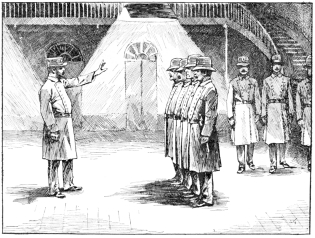 SQUAD OF AMERICAN POLICE DRILLING.
where “prisoners, in custody of officers of the law and under the law’s
protection, were brutally kicked and maltreated almost within view of
the judge presiding in the court.” Numbers of witnesses testified to the
severe assaults made upon them at the station-houses. It was a word and
a blow with the policeman, often no previous word. A significant story
was told to the Committee by Mr. Costello, an Irishman attached to the
staff of the New York Herald. His work took him much to the police
headquarters, and he was apparently on good terms with most of the
officers. The experience he thus gained led him to produce a book called
“Our Police Protectors,” which had a good sale, under the patronage of
the police, until one of the officers brought out a book, which drove
Costello’s out of sale. Costello, accepting his disappointment, produced
another book about the Fire Department. Again he met with competition
from a man protected by the fire and police authorities. He endeavoured
to fight for his own hand, but soon got to loggerheads with the police.
He was arrested on a trumped-up charge, and when taken to the
station-house was knocked down by an officer—“brass-knuckled,” for the
ruffian’s fist was armed with brass knuckles. Then he was brutally
kicked as he lay half-stunned in the muddy gutter. Another still more
brutal case was that of a gentleman who interposed in a fight and was
attacked by a policeman who rushed into the mêlée. The officer,
striking out wildly with his club, caught the well-meaning gentleman on
the face and knocked his eye out. Another officer attacked a man who was
dissatisfied with the shell-fish he bought at an oyster stand, the
keeper of which had paid for police protection. The custodian of order
forthwith exerted his authority on the side of his friend and smashed in
the teeth of the discontented customer. Another witness appeared before
the Committee bleeding and disfigured, just as he had come out of police
hands. This man had been robbed of four dollars while asleep on a
doorstep, and his whole offence was in having appealed to the police for
assistance in recovering his money.
In all these and similar cases the victims could not hope for redress.
The police were above the law, and were not held responsible for
offences, not even for such felonious assaults as those described, which
would have entailed upon ordinary citizens a sentence of four or five
years’ imprisonment. The policeman, even if charged and convicted, was
certain to be let off with a small fine. But, as a general rule, the
sufferers knew too well that it was useless to take proceedings. Mr.
Costello, already mentioned, was asked why he had not done so. In answer
he used the well-known saying, “It is no use going to law with the devil
when the court is in hell.” The gentleman who lost his eye because he
was so weak as to interfere in a street fight preferred to pay a lawyer
to bribe his assailant not to appear against him, although the boot was
entirely on the other leg and the offender was the policeman. In the
case of the Italian shoeblack his mates raised money enough to pay a
lawyer, but could never get the case brought into court. In considering
these charges of brutality, however, it is but fair to bear in mind the
dangerous character of certain classes of the population with which the
New York police have to deal, and the readiness with which resort is had
to lethal weapons. To expect from them the patience and forbearance that
we look for from the English police would be obviously unreasonable.
(3) Collusion with Crime and Criminals.—This was another grave
allegation proved against certain of the New York police. It was shown
that they were hand-in-glove in one nefarious practice at least—that
known as the “green goods trade,” a species of confidence trick played
upon the unwary fool, and a very profitable game to the side which
invariably won. “Green goods” are forged or counterfeit banknotes,
passed off as genuine and sold for a song on one of two pretences to
those who would buy them. The first, that there had been over-issue of
paper currency by the Treasury, and the notes were, therefore at a
discount; the second, that the plates from which the notes were struck
had been stolen from the Government, hence they could be offered cheap.
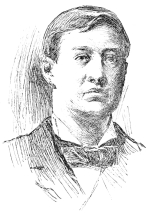 JAMES MCNALLY, INVENTOR OF THE “GREEN GOODS TRADE.”
The business, which seems to have been invented by one McNally, commonly
called “King McNally,” was so ingenious that some account of it may be
given here. Seven principal actors were needed, and they were:
(i.) The “Backer,” or capitalist, who was wanted to supply genuine notes
to a large amount, which had to be produced when the swindle was started
and the fish was on the hook.
(ii.) The “Writer,” who sent out the circulars which constituted the
bait.
(iii.) The “Bunco Steerer,” who was despatched, often to a considerable
distance, to get the nibbling victim in tow.
(iv.) The “Old Man,” a personage of benign and most respectable aspect,
who had to sit in the room when the fraud was being carried out.
(v.) The “Turner,” who did the bargaining and sold the bogus notes.
(vi.) The “Ringer,” a sleight-of-hand artist who effected the exchange,
at a given moment, between the genuine notes displayed and the shams
palmed off on the fool.
(vii.) The “Tailer,” a species of bully employed to get rid of any dupe
who, having discovered the swindle, returned to expose it.
A first step was to procure directories and lists of addresses, by which
means vast numbers of circulars were distributed through the country. It
was the business of No. 2, the “writer,” a mere clerk, to send these
out, enclosing in each envelope forged cuttings from newspapers
(printed, of course) which set forth the extraordinary advantages
offered by those who had “green goods” for sale. At the same time a slip
was inserted giving an address to which anyone might telegraph so as to
secure the offer before it was too late. The address was always bogus,
some number in a street of a house that did not exist, or an entirely
vacant lot of ground. The telegrams were, however, delivered by the
telegraph companies to the swindlers in person, a service for which a
substantial fee was paid.
It was supposed that as many as 10,000 circulars a day were despatched.
One or two at most would meet with a response. Then the “bunco steerer”
went off forthwith to bring the victim in; to hand him over to the
rogues waiting to despoil him in some low tavern or opium shop where
they consorted together, with the direct permission of the police. The
“guy,” or the “come-on,” as the victim was styled in the swindlers’
argot, when he appeared was handled in various ways. The first step was
to make a price, and that was generally at the rate of 10,000 dollar
bills for 650 dollars paid down. Smaller sums were also negotiated, and
the process was not always quite the same. Either the good bills were
counted over and deposited in a box, which by some sleight-of-hand was
exchanged for another filled with waste paper, or the bills were
arranged in packages with a good note on top and bottom, the intervening
notes being bogus. This latter dodge was used with any suspicious
customer, a “hard” victim, as he was called. There was another plan
carried out with a private carriage; it was called the “carriage
racket,” and the transfer was made by means of a couple of bags or
satchels. In one the genuine notes were deposited by a confederate, who
entered the carriage with the victim, and sat by his side. The worker of
the fraud, after filling the satchel, would kindly offer to accompany
the victim back to the station, and en route the exchange was made
with another—bogus—bag.
In all cases the railway station played a principal part in the fraud;
it was essential that the victim should be a stranger who came from a
distance, and was returning home after the deal. He was cunningly
debarred from examining the box or the satchel, whichever was employed.
In the case of the box he was given a key which would not fit the lock;
and in the case of the satchel he was told to cut the leather through
when he got to his journey’s end. The idea in both cases was that he
should not detect the fraud before leaving New York; that would, of
course, have been inevitable directly he opened the receptacle. As he
was doing a shady, fraudulent thing in buying the notes, he would
generally fall into the trap, realising the necessity for great caution
and secrecy.
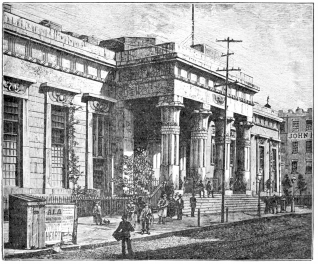 THE OLD TOMBS PRISON, NEW YORK, NOW REBUILT.
Now and again a victim discovered the trick, and refused to leave the
city till he had exposed it. This case was met by the “tailer,” who was
in waiting at the railway station disguised as a policeman. When he
came on the scene he met the complaint made with an immediate threat of
arrest, and the victim, knowing his intention had been dishonest, was
only too glad to get off. But sometimes the “guy” was swindled in a
different way. He paid his money, but got no notes. They were to be sent
to his address; when they failed to arrive he would come back to
inquire, and probably buy more, which were also to follow, but never
did. This trick was often carried out three or four times. At last the
parcel would be handed into the “express” or parcel office before his
eyes, but to a confederate, who, when the notes were missing, was
accused of having stolen them, and was not, of course, to be found.
Not only did certain members of the police connive at this nefarious
traffic, which flourished exceedingly, but they actually co-operated in
it. A police captain provided the “joint” or place of meeting where the
thieves beat the victim or swindled him. The proprietor was in the swim,
and received his commission, and if superior officials interfered, as
sometimes happened, the “joint” was transferred, then and there to a new
place. The “green goods” man always had timely notice when any police
raid was in contemplation; the police were also most useful in taking
charge of the “come-backs,” the “guys” or victims who would not submit
to extortion, and it was often possible to take them in hand when they
applied at the detective bureau so as to nullify their proceedings, or
at worst give the hint to the swindlers to make themselves scarce. The
police were also kind enough to assist “King McNally” in the discipline
of his subjects. Whenever a “writer,” who was the medium by which the
profits were shared after the first half had been monopolised by the
capitalist, was behindhand with his payments, the police were informed,
and the defaulter arrested. The profits of this nefarious business were
very high. It was said that McNally often took as much as £1,600 in a
single day. Some of the capitalists or “backers” made large fortunes,
£20,000, £30,000, even £40,000 apiece.
Another species of illegitimate revenue was that drawn from the gaming
houses, the policy shops and pool rooms which are apparently very
numerous in New York. This particular traffic appears to have originated
the slang epithet “pantata,” which was the familiar title for the police
official who gave his
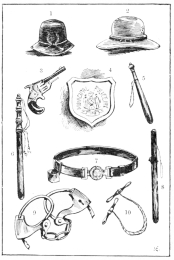
EQUIPMENTS OF THE NEW YORK POLICE.
1. Winter Helmet.
2. Summer Hat.
3. Revolver.
4. Shield.
5. Day Stick.
6. Rosewood Baton for Parade.
7. Belt and Frog.
8. Night Stick.
9. Handcuffs (new style).
10. Nippers.
countenance to vice and crime. Its derivation is said to be Bohemian,
and the word was originally used in Austro-Hungary, where the
Emperor-King Francis Joseph was called the “Pantata of his people.” The
exact meaning of the word is father-in-law, and the New York pantata was
thus esteemed the head of the criminal family. It was proved before the
Lexow Commission that there were at that time no less than six hundred
policy shops in active operation in the city working openly under police
protection, and that they paid a fixed tariff of fifteen dollars per
shop per month. The number of pool rooms was still larger, and they
remained unmolested in consideration of payments amounting to a total of
some three hundred dollars a month. The gaming that went on in the pool
rooms appears to have been much akin to the Continental lottery system,
and any sum could be staked, from one cent upwards. Another form of
revenue raised by dishonest members of the police force was in levying
commission upon the owners of property who had been robbed of valuables
and were willing to pay to have them restored. The practice which
obtained in this country during the earlier part of the present century
is still in force in New York; it is possible to come upon the track of
stolen property, and pawnbrokers or “fences” are prepared to hand it
over on repayment of the advances made on it. But in carrying out the
arrangements the police, of course, took toll, and were paid either
commission or substantial gratuities by the owners they obliged.
4. Yet another indictment brought against the New York police was that
of active interference with the purity of election. It was alleged to
be the agent of a political party, its duty being to secure the return
of the proper candidates, those of Tammany Hall. In carrying this out
members of the force sometimes arrested and ill-treated the opposition
voters; they canvassed for their own side, and, neglecting their proper
functions as guardians of the peace, they became the agents of Tammany
Hall. The ballot boxes were tampered with, and such frauds as
personation and the repeated appearance of the same voter were winked
at.
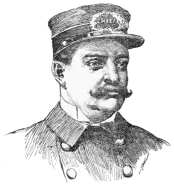 SUPERINTENDENT WILLIAM S. DEVERY, OF THE NEW YORK
POLICE.
SUPERINTENDENT WILLIAM S. DEVERY, OF THE NEW YORK
POLICE.
It was little likely that a force recruited and administered as regards
promotion on corrupt lines would act otherwise than as has been set
forth. In early days first appointments were not to be purchased for
money, but the practice soon became general, and no one could be
appointed a constable unless he paid for it, or had political friends.
One Commissioner admitted that from 85 to 90 per cent. of all the
appointments he made were at the instance of Tammany Hall. Yet there was
at this time a Civil Service rule that all officers were to be appointed
by open competition. It came to be a custom at last that every candidate
should produce 300 dollars to a go-between, who passed it on to the
police authorities; after this payment the examinations were made easy.
The same rule as to payment was enforced for promotion. It cost 1,600
dollars to become a sergeant, and for a captaincy 15,000 dollars were
paid. One witness, who was a police sergeant, told a remarkable story of
his examination for one of these latter appointments. He had passed the
prescribed examination three times in succession, and yet was no nearer
nomination. His friends told him that this was simply waste of time, but
he persisted for four years, trusting that his merits would be
recognised, still steadfastly declining to bribe his superiors. Finally
he consented, and was told that his promotion could be had for 12,000
dols. This money was subscribed by his friends, but then the price was
raised to 15,000 dollars. Again it was subscribed, but became a bone of
contention amongst the officials. At one time it looked as though even
bribery would fail to secure the promotion, but they appeared at last to
have divided the plunder to their mutual satisfaction, and the witness
now became a captain.
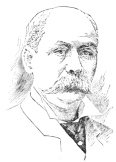 INSPECTOR BYRNES.
It is only fair to the police of New York to credit them with
considerable success in dealing with crime. Whatever suspicion may have
rested on their good faith where offenders have been able to purchase
their connivance, there is no doubt that a large number of crimes have
always been detected and avenged in New York. They have to deal with
cosmopolitan rogues drawn to the happy hunting ground of the New World,
and with a large mass of indigenous crime of the most serious kind. The
unlawful taking of life is very prevalent in the United States, where
the percentage of murders is larger than anywhere in the world, but
these crimes do not go largely unpunished. Again, the American “crook,”
the bank robber, the burglar, the counterfeit-money maker, and the
wholesale forger are to be met with in large numbers across the
Atlantic, and the warfare against them is unceasing. It is true that the
detective forces of the country are very much in private hands: agencies
like Pinkerton’s have a fine record; the triumphs achieved by the
breaking up of some of the Secret Societies in the south, such as the
Molly McGuire and the Kluklux clans, are feats deserving the warmest
recognition. At the same time, the detective bureau, composed of
officers of Mulberry Street, has done excellent service, and Inspector
Byrnes, its chief, has earned a high reputation in thief-taking.
The Detective Bureau of New York “has attained national importance,”
says a writer who knows it and its services well. He instances
especially the protection given to the great business centre of Wall
Street at the time when the “down town” district was specially favoured
of thieves and depredators. Robbery from the person, burglarious
entrance to banking and other premises, the abstraction of money, bonds,
and valuable papers used to be of constant occurrence. More recently the
presence of a “crook” below a line drawn, say, through Fulton Street was
primâ facie evidence against him, and he was then and there arrested,
and called upon to give account of himself. Unless he could show good
cause for venturing within the peculiar precincts of finance and
commerce he was relegated to gaol. The detectives are always “on the
spot,” ever keen and active in coping with the evil-doer. A dozen are
always on duty at the Stock Exchange, where it is boasted that not a ten
cent stamp has been stolen by a professional thief for years.
The ways of the New York detective are like those of the famous Ah Sing,
“childlike and bland,” but no less astute and successful. They aim at
prevention, and trust to it even more than to the pursuit subsequent to
the commission of crime. It is an axiom with them to know their game by
heart; they study the thoughts and idiosyncrasies, the plans and
proceedings, of the criminal classes so closely that they can predicate
what will be done under any particular circumstances, how the thief will
act when planning, when executing, and, above all, when covering up his
tracks after he has made his coup. One method followed with marked
success is to keep their spies and assistants in the heart of the
enemy’s camp. It is well known that criminals have little or no fidelity
to each other, that “honour among thieves” is a mendacious adage
provided any of them can see substantial profit in betraying his
associates. The best officers make a point of keeping in touch with the
“crooks,” visiting them frequently in their favourite resorts, and
hearing all the movements and the news. Matters in progress, the
activity or otherwise of well-known practitioners, are thus ascertained,
for the high-flyer in crime generally knows what others of his class are
about, and is willing to pass it on for a consideration, or to stand
well with the police.
New York possesses its Black Museum, its treasure-house of criminal
relics akin to that which may be viewed at the headquarters
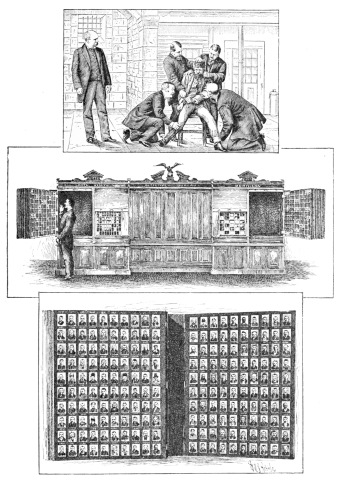 1. PHOTOGRAPHING A CRIMINAL FOR THE “ROGUES’ GALLERY”
(NEW YORK). 2. CABINET IN WHICH AMERICAN CRIMINALS ARE REGISTERED. 3.
TWO LEAVES OF THE “ROGUES’ GALLERY.”
1. PHOTOGRAPHING A CRIMINAL FOR THE “ROGUES’ GALLERY”
(NEW YORK). 2. CABINET IN WHICH AMERICAN CRIMINALS ARE REGISTERED. 3.
TWO LEAVES OF THE “ROGUES’ GALLERY.”
of our Metropolitan Police at New Scotland Yard. A brief summary of the
exhibits in this strange depository is, in its way, an epitome of
contemporary crime. Every item, even the most insignificant, tells of
some flagitious act. The sledge hammers, drills, jemmies, masks, and
powder flasks tell their own story, so do the marvellously ingenious
burglar’s implements manufactured by high-class mechanical skill, and
hired out to executive agents on a percentage of results. Here are the
bogus gold bricks of some famous confidence trick, the well-named vol à
l’Americain, lithographic stones from which thousands and thousands of
counterfeit notes have been struck off, the curious devices used for
opening combination locks, the rope ladders, lanterns, revolvers that
have figured in various notable operations.
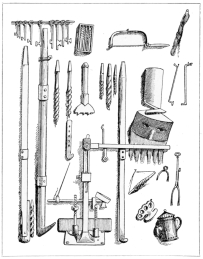 COMPLETE SET OF AN AMERICAN BURGLAR’S TOOLS.
Another branch well worked by the New York police is its identification
department, which is now fully served by the Bertillon method of
measurement, and it has always been rich in photographic portraiture.
The famous “Rogues’ Gallery,” which forms the basis of Mr. Inspector
Byrnes’ book on American criminals, is a marvellous record of rascality.
Each picture is backed with a brief history of ancestry and antecedents,
so that the influences at work, whether congenital or accidental, evil
traits transmitted from parents, or the growth of bad example acting on
weak moral fibre, may be seen at once. As has been said, the United
States offers many attractions to wrong-doers, and in this police
gallery will be found the portraits of such great criminal practitioners
as “Hungry Joe,” the ex-Governor of South Carolina; Franklin J. Moses,
“Big Bertha,” Annie Riley, an accomplished linguist; Max Shinburn, and
the rest.
It is a part of the case against the New York police that it fails to
control crime effectively, but it can nevertheless show results at least
as good under this head as those achieved in European countries. In some
respects indeed its operations are marked by a cleverness and smartness
which it would be hard to match in the best of the police forces of the
Old World.
Mr. Sala’s Indictment of the Russian Police—Their Wide-reaching
Functions—Instances of Police Stupidity—Why Sala Avoided the
Police—Von H—— and his Spoons—Herr Jerrmann’s
Experiences—Perovsky, the Reforming Minister of the Interior—The
Regular Police—A Rural Policeman’s Visit to a Peasant’s House—The
State Police—The Third Section—Attacks upon Generals Mezentzoff
and Drenteln—The “Paris Box of Bills”—Sympathisers with Nihilism:
an Invaluable Ally—Leroy Beaulieu on the Police of Russia—Its
Ignorance and Inadequate Pay—The Case of Vera Zassoulich—The
Passport System—How it is Evaded and Abused—Its Oppressiveness.
FORTY years ago a well-known writer summed up the Russian police in the
following scathing words: “As grand-masters of the art and mystery of
villainy, as proficients in lying, stealing, cruelty, rapacity, and
impudence, I will back the Russian police against the whole world of
knavery.”
This tremendous indictment seems to be fully justified by past
experience, and it is to be feared that many of the worst charges can be
still maintained. Recent writers tell new stories that fall little short
of the old. Russia is still absolutely given over to the police. It is
the most police-ridden country in the world; not even in France in the
worst days of the Monarchy were the people so much in the hands of the
police. From first to last the Russian citizen is deemed incapable of
looking after himself. Not only is he forbidden to take an active part
in the management of public affairs, but in the most private matters he
must submit to the interference of the police. “The Russian police has a
finger in every pie,” wrote the acute observer quoted above.[15] “They
meddle not only with criminals, not only with passports, but with
hotels, boarding and lodging houses, theatres, balls, soirees, shops,
boats, births, deaths, and marriages. The police take a Russian from his
cradle and never lose sight of him till he is snugly deposited in a
parti-coloured coffin in the great cemetery of Wassily Ostrow. Surely to
be an orphan must be a less terrible bereavement in Russia than in any
other country; for the police are father and mother to
everybody—uncles, aunts, and cousins too.”
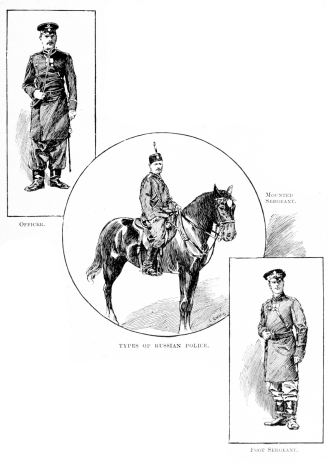 TYPES OF RUSSIAN POLICE.
Officer.
Mounted Sergeant.
Foot Sergeant.
Nothing can be done in Russia without police permission. A person cannot
build a bathroom in his house without leave. A physician cannot practise
without it; he must have leave even to refuse to attend to night calls;
he cannot prescribe anæsthetics, narcotics, or poisons without special
permission; and no chemist would make up a prescription containing any
of these drugs unless the doctor’s name were on his special list. No new
journal can be established without permission, no printing office, no
bookshop, no photograph gallery; special police leave is needed to sell
newspapers in the streets; a reader at one of the public libraries who
wishes to consult standard works on social subjects must be armed with a
permit; no concert for charitable purposes can be organised without
leave from the police, and the proceeds must be handed over to them to
be passed on to the recipients or embezzled on the way. All freedom of
movement within the empire is checked by the police. A native Russian
must have leave if he wishes to go fifteen miles from home. A foreign
traveller is forbidden to enter the country without leave, he must have
leave if he wishes to remain more than six months, and must ask for
leave to go away again; every change of residence must be notified to
the police. The passport system, although at times unevenly and
unequally administered, is a potent weapon in the hands of the police,
by means of which they can control the movements of everyone within the
empire.
To give some idea of the wide-reaching functions of the police, the
power assumed in matters momentous and quite insignificant, we may quote
from the list of circulars issued by the Minister of the Interior to the
Governors of the various provinces during four recent years. The
Governors were directed to regulate religious instruction in secular
schools, to prevent horse-stealing, to control subscriptions collected
for the Holy Places in Palestine, to regulate the advertisements of
medicines and the printing on cigarette papers, to examine the quality
of quinine sold, and overlook the cosmetics and other toilet
articles—such as soap, starch, brilliantine, tooth-brushes, and insect
powder—provided by chemists. They were to issue regulations for the
proper construction of houses and villages, to exercise an active
censorship over published price-lists and printed notes of invitation
and visiting-cards, as well as seals and rubber stamps. All private
meetings and public gatherings, with the expressions of opinion and the
class of subjects discussed, were to be controlled by the police. In a
word, quoting one high authority,[16] the Russian police collect
statistics, enforce sanitary regulations, make searches and seizures in
private houses, keep thousands of “suspects” constantly under
surveillance, reading all their correspondence, and, of course,
violating the sanctity of the post office. They take charge of the
bodies of persons found dead; they admonish those who neglect their
religious duties and fail to partake of the Holy Communion; they enforce
obedience to thousands of diverse orders and regulations supposed to
promote the welfare of the people and guarantee the safety of the State.
There are 5,000 sections relating to police in a Russian code of laws,
and it is hardly an exaggeration to say, as Mr. Kennan puts it, that in
the peasant villages, away from the centres of education and
enlightenment, the police are the omnipresent and omnipotent regulators
of all human conduct—a sort of incompetent bureaucratic substitute for
Divine Providence.
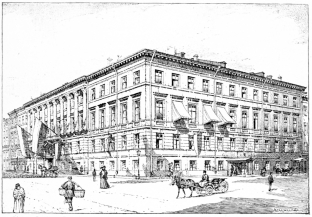 PREFECTURE OF POLICE, PETERSBURG.
Photo: Daziaro, Petersburg.
Before, however, dealing further with the Russian police of to-day, it
will be interesting, for purposes of comparison, to look back for a
moment into some of the less recent stories of police proceedings.
Travellers who visited the country fifty years ago or more give it as
their deliberate opinion that the Russian police was “more stupid, more
dishonest and corrupt than can well be conceived.” Even in those days
they had enormous powers; everything was submitted to their
superintendence, and they carried out their orders just as seemed good
to them. Their too literal interpretation of the letter of the law was
often productive of the most serious consequences. Thus it was a strict
rule that no one might pass the Neva when the breaking up of the ice had
set in, and police were stationed on the banks to insist upon its
observance. But the rule was also made to apply to any unfortunate
persons who were already on the ice when the thaw began; no one was
allowed to cross, and therefore no one could be allowed to land. The
humane intention of saving life was thus set at naught by the intense
stupidity of subordinates, and many accidents happened.
A worse case occurred at the burning of the Lehmann Theatre, about 1840,
during the Carnival, a period of great festivity known as Maslinizza. At
the time in question the most popular of the many entertainments was
that of a German pantomime company, which performed in a temporary
theatre erected upon the Admiralty Square, St. Petersburg. This
pantomime was the rage, and the theatre was constantly crammed. At one
morning performance the alarm of fire was raised, almost instantly
flames burst out from behind the scenes, and the whole edifice, of wood,
was in a blaze. The audience, wild with terror, rushed to the doors, and
found exit altogether forbidden. These doors opened inwards, and the
pressure of the frantic crowd closed them as effectually as if they had
been barred. A workman, who was on the far side, and who had assisted in
the erection of the theatre, called for an axe, saying that he knew what
was wrong, and that a way must be cut open for the crowd. But there was
a policeman on duty, and he refused to allow any steps to be taken
without superior authority. When, at last, his fatal obstinacy was
overcome, and admission was gained, it was found to be too late. The
whole of the densely packed audience, men, women, and children, were
dead; they had been stifled by the smoke that filled the building, and
not a single soul was saved.
The extortions of the Russian police have been at all times unblushing.
Their rapacity knows no bounds, and it appears to be exhibited by every
rank, from the highest to the lowest. George Augustus Sala, in his
“Journey Due North,” admirably summed up the situation in his day. He
had been struck by the appearance of a man in uniform, seated in an
admirably appointed droschky behind a priceless stepper, driven by a
resplendent coachman, and he thought that he was gazing upon the Czar
himself. The master was not, perhaps, of prepossessing appearance; he
was stout and flabby, with pale, trembling cheeks, and close-cropped,
shiny black hair, but he was in a smart uniform, with a double-eagled
helmet, buckskin gloves, and patent-leather boots. “Who is it?” Sala
asked of a Russian friend. “Field-Marshal? Prince Gortschakoff? General
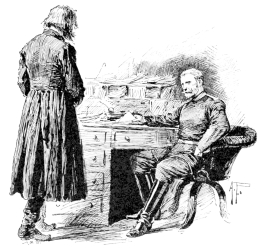 “THE MAJOR ... SITS AT THE RECEIPT OF CUSTOM.”
Todleben?” “No, he is a Major of Police.” “Has he enormous pay or a
private fortune?” “That dog’s son,” replied the Russian, “has not a
penny of his own, and his full pay all told is a sum of £40 a year.”
“But the private carriage, the horse, the silver-mounted harness, the
luxury of the whole turn-out?” “Il prend; he takes.” And later on Sala
proceeds to tell us how the “taking” is done. The Major in his handsome
office sits at the receipt of custom; everybody must bribe him—all
those who seek for licenses, for privileges. As we have seen, police
permission is needed for everything under the sun, and all who come
seeking it must pay. They bribe the Major, his employees, even the
private policeman at the doors. “It is a continual and refreshing rain,”
says Sala, “of grey fifty-rouble notes to the Major, of blue and green
fives and threes to the employees, of fifty-copeck pieces to the
grey-coats.” And then the writer goes on to give specific instances of
robbery on a large scale, telling us how this police body, “organised to
protect the interests of citizens and watch over public order and
morals, to pursue and detect and take charge of criminals ... simply
harasses, frightens, cheats, and plunders honest folk.”
During the course of a one month’s residence in St. Petersburg Sala was
robbed four times; first of a cigar-case, then of a purse, fortunately
not very well lined, next of an overcoat, and lastly of a drawerful of
nondescript articles, including shirts, cigars, and a pair of
opera-glasses. This last robbery had been effected by breaking through a
seemingly secure lock, and the victim suspected a certain chambermaid
who attended to his room. He was on the point of laying the whole case
before the police when a friend, a Frenchman who knew Russia by heart,
interposed and strongly advised Sala to accept his loss; he would
certainly recover nothing, and would as certainly be obliged to spend
more than double the value of the property stolen, with the additional
inconvenience of being nearly worried to death. The gist of this shrewd
advice was that he should grin and bear it, buy new articles, but never
complain. “Complaints will lead to your being replundered fourfold,
hardly to the recovery of your possessions.”
This was no new experience. An earlier traveller, Herr Jerrmann, gives a
curious instance of the extraordinary faculty the Russian police
exhibited of retaining what came into their hands. It was always
considered, he said, that the person robbed had never less chance of
recovering his property than when the police had actually got the thief.
The general feeling, in fact, was strong that thefts would be seldom if
ever reported were it not that the law imperatively requires it to be
done.
A certain nobleman, Von H——, lost some plate, silver spoons, knives
and forks, which were abstracted from his plate-chest. A few weeks later
one of his servants came and told him that he had seen the stolen
property exhibited for sale in a pawnbroker’s shop. Von H—— went and
identified his plate, then, calling the police in, required the
silversmith to produce the goods. There could be no doubt as to
ownership, for Von H——’s arms and initials had not been erased. The
silversmith willingly admitted Von H——’s claim, and would have
surrendered the property to him at once. But the police interposed, and
declined to allow him to take away his property until he had formally
proved his ownership. For this it was necessary to draw up a formal
statement of the case, and submit it to the lieutenant of police,
accompanied by a specimen article from his plate-chest in corroboration
of his claim. While this was being done the police took charge of the
pieces that had been stolen, and soon acquired more. Von H—— was
apparently a novice then, for, in order to recover the few articles he
had lost, he submitted the whole contents of his plate-chest for police
inspection at the police bureau. From that time he never saw a single
article again!
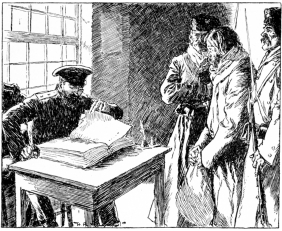 UNDER EXAMINATION IN A RUSSIAN POLICE OFFICE.
Jerrmann tells another story within his own experience. A silver
table-spoon was stolen from his kitchen; his suspicions fell upon the
baker who brought him bread, and the same day the thief was captured,
and the spoon traced to a receiver’s shop. Justice was prompt in its
action; the thief was duly punished, the receiver’s shop was closed. But
the police took possession of the spoon! Herr Jerrmann valued the spoon,
which was a christening gift, and he was determined to spare no pains to
recover it. He was, however, referred from one person to another, hunted
from place to place in the most vexatious way, and all without result.
At last a commissary who was the custodian of the spoon asked him
frankly why he was so persevering; the value of the spoon was trifling,
and he must have spent more money in droschkies than the thing was
worth, while he might confidently expect to be much more out of pocket
still before he got back his property. Jerrmann, seeing how the land
lay, suddenly decided upon a daring ruse. He told the commissary that he
meant to have the spoon the very next day, and when he was asked
mockingly what he proposed to do, he answered simply that he was going
to dine that evening with Perovsky, the Minister of the Interior. “And I
mean,” added Jerrmann, “to ask him a riddle, namely, how to recover
one’s property when it is temporarily held by the police. If you will
come to breakfast with me to-morrow morning I promise you that you shall
make use of that very spoon. But whether you wear uniform or not will
entirely depend upon how Perovsky deals with my riddle.” The commissary
again laughed, but a little uneasily. He accepted the invitation to
breakfast, and when he came the spoon was on the table; he had sent it
in anticipation. The best part of this story is that the dinner with
Perovsky was purely imaginary. But that famous Minister’s name was ever
a terror to faithless officials.
This Perovsky, a man of singular ability and of the most straightforward
character, had been appointed head of the police by the Czar Nicholas I.
when that sovereign was roused to the consciousness that his police was
a shame and a scandal to the empire. Perovsky did something, no doubt,
towards reforming the most crying abuses, but he met with the most
determined opposition from the great army of police officials, who
bitterly resented his interference. Many stories are told of his methods
of calling his subordinates to account. There was one occasion when he
drew the attention of the chief of police to a certain mansion where
gambling at prohibited games of chance was constantly carried on. He
desired the police to surround the house and to depute two of their
number to enter it. The officers were to make their way to a room
indicated, and if they there found a party of gamesters at a faro table
arrests should be made. All fell out as planned; the gamblers were
caught in flagrante with piles of gold upon the table, sufficient
proof of what was going on. But just as the players were about to be
removed to the police
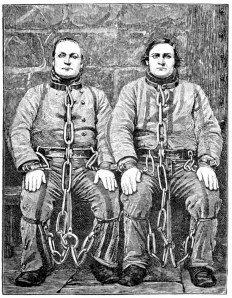 CONVICTS IN A RUSSIAN PRISON.
(From a Photograph.)
station one of them took the police officers aside and assured them that
it was all a mistake, that they were not playing for the gold upon the
table, which merely served as markers. Still, if the police officers
cared to try their skill at écarté for a thousand roubles a game, some
of those present would be glad to give them a chance of winning the
money. This was only another excuse for making it a present to the
officers of the law, who presently withdrew with their pockets well
lined to inform their chief that there was nothing wrong in the house
they had visited. This report was carried in due course to Perovsky, who
summoned the two police agents before him, and, assuring them that he
was not their dupe, opened another door and disclosed to view the very
same gamblers of the night before sitting at a green table in the same
order, playing the same, prohibited game. The whole affair was an
artfully executed plot to entrap the police.
The police, it has been contended, is an indispensable wheel in the
organisation of absolute monarchy. That power pretends to be paternal as
well as repressive, and as long as it forbids the people to share in
government, or express opinions on current events, it must be aided by
some organ that replaces the public voice, speaking either in elective
assemblies or in the Press. The police, acting for the central power, is
supposed to control everything, to criticise conduct, to protect as well
as correct, and it thus becomes possessed of very considerable power. In
Russia, under Nicholas I., the police was well styled the mainspring of
the State machinery; and although under Alexander II. more liberal
principles obtained, the growth of Nihilism led to reaction, and the
police recovered all its old authority. Great pains have been taken to
perfect its processes, to give it increased strength and enlarge its
action. With this in view an organisation was planned which lasted for
some years, and which consisted mainly in the separation of all police
into two principal and distinct branches—
1. The ordinary, everyday, regular police.
2. The political, or State, and for the most part secret police.
Let us consider these in turn.
1. The regular police is on the whole organised as in many other
European countries, with the difference that the police officer often
predominates in Russia over other local functionaries. For purposes of
illustration it may be noted that where in France a sous-prèfet would
act under the prefect of a department, the official in Russia next to
the Governor is the ispravnik, with whom lesser members of the police
hierarchy are in direct relations.
A great army of unofficial and unpaid attachés assists the regular
police of the towns. This force was obtained through the clever device
of enlisting the services of every house porter, the Russian dvornik,
who answers to the French concierge and the German Hausknecht, and
discharges much the same functions in an emphasised and more arbitrary
fashion. The dvornik is bound to see and examine the papers and
passports of all inmates of the house he serves, and especially of all
visitors and new arrivals. The police regulation requires every
dvornik to carry the passport to the police station within three days
of the arrival of a new person, and to lodge it there in exchange for a
ticket of residence. The same process is followed on departure. Thus the
dvornik becomes a sort of permanent detective; he has not only to
watch over all in the house, but he is held responsible that no
revolutionary proclamations are posted on the external walls, no
dangerous articles thrown out of the windows, and he is expected to lend
a hand to the police if they make an arrest or give chase to a fugitive.
Although he gets no pay from Government, he is expected to give much
service under irksome conditions. He is forbidden to leave his post at
any time during the long night watch, sixteen hours, from 4 p.m. to 8
a.m. next day, and he is liable to severe punishment if he fail in these
duties. For all this the house proprietor really pays, and he may be
still further mulcted, for he is held responsible for all illicit acts
committed in his house, which may be sequestrated on proof of secret
meetings held within it, or on any discovery of weapons, ammunition,
explosives, or forbidden literature.
The police in the provinces is represented by a force of 5,000 or more,
who were first appointed in 1878, were armed, mounted, given good pay
and many rights. Each officer had his own beat, in which he ruled
supreme, and he was thought quite a delightful institution. But within a
year or two the police had developed into abominable petty tyrants, who
held the country folk at their mercy, a prey to their exactions and
brutality. They became, in fact, a perfect scourge in their districts,
and even governors and high officials denounced them as brigands. It
became clear that a bad police was worse than no police at all. Thus, an
institution intended to help and protect the people soon degenerated
into a new and terrible instrument of vexation and oppression. No name
was too bad for the rural policeman, the uriadniki, who were nicknamed
the kuriatniki, or “chicken stealers,” by the peasants, and likened by
the better informed to the dread bodyguard of Ivan the Terrible.
A graphic picture has been painted by the famous Vera Zassoulich, in her
Memoirs, of the visit of a rural policeman to a peasant’s house in
company with the tax collector of the district. Vera, a young lady of
high birth and much beauty, spent, in pursuit of the Nihilistic
propaganda she was preaching, long periods under the roofs of villagers,
and she was working as an ordinary seamstress in one house when a
descent was made upon it. “I was sitting,” she writes, “at the door of
the one room of the hut when the policeman appeared, accompanied by an
old soldier in a dirty grey greatcoat, and followed by two peasants....
I was called upon to give my name, produce my passport, and state how
long I meant to reside in that place.... Then, in reply to my questions,
I was told that the police had come to back up the tax gatherer, and I
saw what happened if the payments were in default. The stove of the hut
was smashed, then smeared with tar, so were the walls, the furniture and
wearing apparel; after that every piece of crockery in the place was
broken and the pieces thrown out of the window. The horse and cow were
taken out of the stalls and carried off to be sold.”
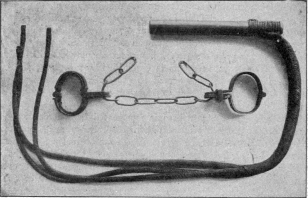 WHIP AND MANACLES USED IN RUSSIAN CONVICT PRISONS.
(In Possession of H. de Windt, Esq.)
2. The political or State police was the invention of Nicholas I.
Alexander I. had created a Ministry of the Interior, but it was Nicholas
who devised the second branch, which he designed for his own protection
and the security of the State. After the insurrection of 1865 he created
a special bulwark for his defence, and invented that secret police
which grew into the notorious “Third Section” of the Emperor’s own
chancery. It has been said, with reason, that no Russian, in the days of
its most dreaded activity, could mention its name without a shudder. It
has been likened to that other secret tribunal, that so long oppressed
Venice, the Council of Ten. It was the most powerful instrument an
absolute Government ever called to its aid. The terrors it inspired were
heightened by the mysterious silence that overshadowed its proceedings.
It worked secretly, but struck with unerring severity; its methods were
dark and devious; it was unjust, unfair, illegal, respecting neither
caste nor sex. Women, ladies of rank and beauty and fashion, were said
to have been seized ruthlessly by its unscrupulous agents, tried in
secret conclave, and punished then and there with the whip. Many people
were hurried away to Siberia without any form of trial at all—the first
application of the system known as “administrative process,” which
became very common in after years, when the publicity of the Courts
would have been inconvenient, or convictions uncertain in due course of
law. The Third Section, while it lasted, was the most dreaded power in
the empire. It was practically supreme in the State, a Ministry
independent of all other Ministries, placed quite above them, and
responsible only to the Czar himself.
The Third Section had its prototype in the privileged bodyguard of Ivan
the Terrible, which laid the whole country under contribution. Another
Czar, Alexis, had his secret police, and his son, Peter the Great,
invented a police system of a most formidable kind. It was known as the
Preobrajenski, from the place where it had its headquarters, and was in
fact a modern civil Inquisition, more terrible, more powerful even than
the religious Inquisition of Spain. Peter the Great very likely felt
that, with the many changes he introduced into national life, which so
often roused the most obstinate resistance, he ought to have ready to
his hand an instrument of coercion supported by espionage. It was in
effect the Third Section, as we have seen it since, and although it was
solemnly suppressed by Peter III. in 1762, it survived in that Third
Section, just as the latter survives in the existing organisation of the
Russian police.
For many years, under Alexander II., the Third Section was much more
than a State police; it was a power apart in the Government, exercising
independent authority, having many privileges, placed
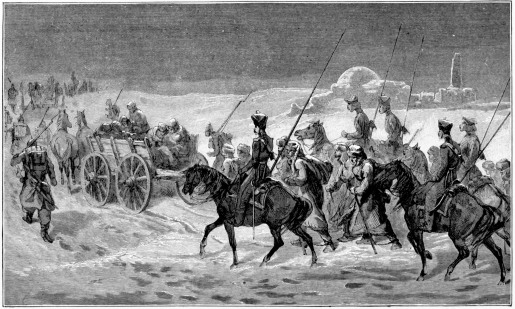 HOW PRISONERS USED TO BE DEPORTED TO SIBERIA.
outside and above the laws. Its chief, who was also called the Head of
the Gendarmerie, was by right a member of the Council, and he was the
most confidential servant of the Emperor, with whom he was ever in the
most intimate relations. He exercised something like absolute power; his
veto could in effect control all appointments, because he could adduce
police reasons based on police knowledge against any person. He had, in
fact, complete control over everyone and everything in the empire; he
could arrest, lock up, exile, cause anyone he liked to disappear.
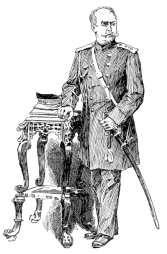 Photo: Bergamasco, Petersburg.
COUNT SCHOUVALOFF, CHIEF OF THE “THIRD SECTION.”
Under the enlightened régime of Alexander II., it seemed for a while
as though the Third Section had lost much of its authority. But the
first attempt upon the Czar’s life in 1866 at Kara Kossoff restored it
to full activity, and one of the most prominent men in the empire,
Schouvaloff, was placed at its head, thus restoring it to its ancient
prestige, for the chief of the Third Section had invariably been a
person of great consequence, as indeed the important functions he
exercised demanded. But the revival of the Third Section was not
justified by any subsequent success; in the years immediately following
it proved itself singularly inefficient, unable either to prevent or to
put down the outrages committed in broad day. It showed itself useless
at St. Petersburg, at Kieff, at Odessa, at Karkoff, in all the great
cities; it neither was able to defend itself against the conspiracies,
nor could it detect or capture the conspirators. The first acts of the
new revolution had been directed against the Third Section, and these
attacks preceded those upon the Czar and his throne. The two last
chiefs, General Mezentzoff and General Drenteln, fell victims to the
Nihilists. The first was stabbed by some unknown person in the streets
of St. Petersburg, the second was fired at in broad daylight by a young
man on horseback, who was not arrested for a number of years. These
attempts are to be placed to the credit of Nihilism, for they
practically ended the Third Section.
Nominally this redoubtable office was abolished, but that did not mean
that the arbitrary surveillance of the police was ended. Alexander II.
hoped, perhaps, that he was wiping out a symbol of despotism, but he
retained the substance while discarding the shadow. The change meant no
more than the fusion of his private palace police with the ordinary
public police. There was no longer a head of the Third Section, but
there was a Minister of the Interior; it was the consolidation and
concentration of power in one hand, and there it has remained.
There was good reason for the change; the various classes of police,
instead of helping, hampered and interfered with each other. There were
three police forces in the capital and all large cities; that of the
Minister of the Interior, the city police, and the Third Section,
already described. They were perpetually getting in each other’s way,
and it was said that the State confided to their care was in as bad a
way as the baby with five nurses. Often enough, like the famous
detectives of the French farce, Tricoche et Cacolet, policemen hunted
policemen; they were all suspicious of people who seemed too much on the
alert, and the consequence was that much time and trouble was wasted in
mutual surveillance. Sometimes it happened that the agents of the Third
Section, fancying they had made an important arrest, found to their
chagrin that they had only caught their comrades; meanwhile, the
Nihilists had a practically free hand and terrorised the whole country.
The absolute incompetence of his protectors appears to have been brought
home to Alexander II. by the incident known as the “Paris box of pills.”
A parcel arrived one morning labelled “Pills for asthma and rheumatism:
Dr. Jus, Paris.” It was addressed direct to the Czar, who was reported
to be suffering from these complaints. Alexander handed the box over to
his private physician for examination, and the moment it was opened one
of the pills exploded. More care was shown in verifying the remaining
pills, and it was found that they were filled with dynamite.
There have been times when the police of Russia were stirred to the
utmost activity. After the murder of General Mezentzoff in broad
daylight and in one of the principal squares of St. Petersburg, such
profound dismay prevailed that the police were unceasingly on the qui
vive. The perpetrators of the deed, nevertheless, had disappeared,
leaving no trace, and the police in their frenzied eagerness turned the
city upside down. Searches innumerable of all suspected houses were
made, and the most arbitrary arrests took place on the slightest whisper
of anything wrong. Reports at the time put the numbers taken into
custody at quite a thousand.
Yet “illegal” or “irregular” people, as they were styled by the officers
of the law, came and went, moving about with impunity under the very
noses of the police, and, as a rule, escaping scot-free. They found
shelter in houses of friends and sympathisers—persons of all classes,
some of them least likely on the face of it to assist the Nihilists.
Stepniak tells us in his “Underground Russia” that these likrivateli,
as they are called in Russian, or “concealers,” were to be found among
the highest aristocracy as well as in the ranks of Government officials,
including even members of the police, all of them people who, for some
reason or other, hesitated to give active support to the conspiracy, but
who were nevertheless well disposed towards it, and proved this by
hiding individuals for whom there was a hue-and-cry. Stepniak describes
various types of this very numerous and varied class.
One of these sympathisers with Nihilism was known among the conspirators
as the dvornik, because in his anxious care for the safety of his
companions he ruled them as tyrannically as the doorkeeper, whose
functions as an unpaid assistant of the police have been already
described. This man made it his business to impress caution on his
comrades, and so strictly, that when anyone was known to be under
surveillance he would arrange for his concealment, and insist constantly
on changing the hiding-place. The dvornik was quite a specialist in
the business of circumventing the police. He knew them by heart and all
their ways. On one occasion he hired an apartment exactly opposite the
house in which the chief of the secret police lived, and watched it so
closely day after day that he became acquainted with numbers of persons
employed by the Police. He knew half the spies in St. Petersburg by
sight, and had made a study of their peculiar methods, their manner of
watching, the way they started on a hunt, how they pursued their quarry.
After a time he could “spot” any new spy, could penetrate the cleverest
disguises of the old hands and detect small signs that betrayed them to
him, but were quite unseen by others. In the same way he had thoroughly
mastered St. Petersburg: he knew his way all over the city, was
acquainted with all sorts of places of refuge and with every house that
had two outlets, so that he was invaluable in helping anyone to escape.
A fugitive placed under his guidance could be conveyed with absolute
safety from one part of the city to another, so clever was he in
covering up his tracks.
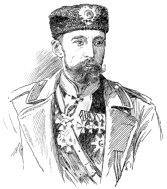 Photo: Bergamasco, St. Petersburg
GENERAL BARANOF
Speaking on the general question, Leroy Beaulieu in his monumental work
on Russia says: “The police has been at all times a sink of abuses and
extortions, because, of all departments, it enjoys the greatest
facilities for indulging in them. In spite of the particular attention
of which it has always been the object, this department, on which all
the rest lean for support, has always been so far one of the most
defective. In the cities, especially in the capitals, where they are
under the eyes of the highest authorities, the force
leave—externally—little to be desired. They are attentive, courteous,
helpful, if not always honest. A foreigner who, in St. Petersburg,
judged them from the outside only, would think the service perfect. Yet
the long unpunished daring of the Nihilists has revealed only too
clearly its incompetence and carelessness. The astounding powerlessness
which the police displayed on these occasions is traceable chiefly to
the habitual vices of Russian administration: ignorance, indolence,
venality.”
General Baranof in 1881, when head of the police, found that a great
number of his men could not sign their names correctly. Many more, even
those of high grades, were supremely ignorant of the laws and
regulations they were called upon to administer. The general tone was
low, and the force was recruited from a very inferior class, for the
police and their work are much despised by respectable citizens. The
pay has always been ridiculously small, thereby directly encouraging the
dishonest practices, the more or less enforced contributions levied on
the public in every direction, by which it has been eked out. The
members of a force, driven by extreme penury into illicit earnings,
could hardly be loyal, and it has been always easy for the
revolutionists to buy relaxed watchfulness, and even complicity. So
ineffective was the official police that in 1881 the city of St.
Petersburg was invited to reinforce it by electing a council to
co-operate in watching over the personal safety of the Czar. It was not
the first time that well meaning loyal subjects had desired to assist
the Government in the pursuit of its foes. The idea of the droujina,
an ancient secret society, was revived. It was a sort of Vigilance
Society composed of special police volunteers, acting with the official
police, but unpaid, and with no recognised status. The promoters thought
that the best method of combating conspiracy was to meet conspirators on
their own ground and with their own arms. Its organisation and action
were secret. Among other measures it offered rewards to peasants and
workmen who would inform the authorities of any plots in progress;
another idea was to meet outrage by anticipation, to face the Nihilists
with their own weapons, and blow them up with dynamite before they could
use it to subvert existing authority. The droujina rejoiced in the
epithets of “holy” and “life-saving,” but it achieved nothing tangible.
It had the command of considerable funds, freely subscribed, and was
carried on by a number of zealous persons, but it is not on record that
they arrested a single conspirator, though, like the police, they
sometimes took up the wrong people.
The well-known case of Vera Zassoulich showed conclusively how little
the police were able to protect themselves. It was she who resolved,
like a second Charlotte Corday, to call General Trépoff, the Prefect of
civil police in St. Petersburg, to account for his cruel ill-usage of a
prisoner, one Bogoli Ouboff. This man at one of Trépoff’s inspections
did not remove his hat when the General passed. Trépoff not only struck
him with his stick, but ordered him to be flogged. Corporal punishment
had been abolished, and the order was therefore illegal; it caused great
indignation in St. Petersburg, and nearly produced a serious outbreak in
the prison. The story travelled far and wide, finally reaching the ears
of Vera Zassoulich in a far-off province, that of Penza, seven months
later. She started at once for St. Petersburg, and obtained admission to
Trépoff’s presence on pretence of presenting a petition. But directly
she saw him she drew a pistol from her pocket and fired at him
point-blank. Trépoff was badly wounded in the side, but eventually
recovered. Vera was seized and removed, but her demeanour was calm and
self-possessed, and she only asked to be allowed to put on her shawl,
which she had left in the waiting-room. It was thought that Vera’s
attack was a part of a general conspiracy, but there seems to be little
doubt that she acted altogether alone and on her own motion.
The sequel was curious, and showed how generally Trépoffs arbitrariness
was condemned. Vera was brought before an ordinary tribunal, tried, and
acquitted. Her friends then very judiciously got her out of the country,
fearing, and with good reason, that this decision would not be allowed
to stand. They were perfectly right, for the Government overruled the
verdict, although given by a legally constituted tribunal, and ordered
Vera to be re-arrested. Happily for her, she was already safe in
Switzerland. After this the Government decreed by ukase that all
political offences should be tried, not by a jury, but by a specially
constituted tribunal. They were, in fact, to be brought before a
court-martial having the same powers as in war-time, and inflicting
penalties under the military code, which included deportation and the
loss of civil rights.
The passport, by which every individual is, or ought to be, held and
ticketed so as to be recognised and easily followed wherever he goes, is
a terrible burden on a people half of whom are compelled by the climate
and the poorness of the soil to spend six months of every year away from
home. To be obliged to take out a passport before leaving home is at
once a hindrance to movement and a tax upon the pocket. To abolish the
passport would be a first great step towards according freedom to the
whole population. As it is, no one can choose his own residence, nor
follow his profession as he pleases; still less can people collect and
group themselves in places where the productiveness of the soil would
naturally encourage them to do so. Yet the obligation is by no means
effective; it is constantly evaded. The fabrication of false passports
is a very flourishing trade, which has been of immense service to the
revolutionists in covering up their movements and concealing from the
eyes of justice those “wanted.”
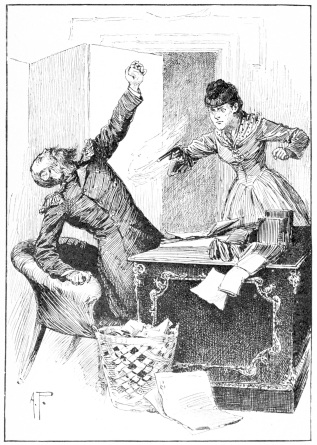 VERA ZASSOULICH SHOOTING GENERAL TRÉPOFF
A story is told of a Russian gentleman who was in a hurry to leave
Odessa and travel to the shores of the Mediterranean. Not choosing to
waste time in presenting himself at the Passport Bureau, he accepted the
services of a commissionaire, who promised to get him the passport for a
comparatively small sum, a little under £4. The would-be traveller
accepted the offer, and next day started from home with the passport all
in proper form.
Nor have the passport regulations reduced the number of vagrants for
ever on the tramp, who can show no papers, and yet are seldom interfered
with. When the authorities awoke suddenly to the need for enforcing the
rules in some of the more remote towns, such as Tiflis and Odessa, there
was a general exodus of the working population, and the well-to-do
people were left without the servants, small tradespeople, and others
who had ministered to their wants.
The passport regulations oppress all classes. The well-to-do Russian who
would go abroad must pay for the privilege; the tax is at present ten
roubles (about thirty shillings), but in the days of Nicholas I. it was
five hundred roubles, and some are in favour of reviving this costly
tariff. When the police are stirred up by some Nihilist outrage, a high
price must be paid to obtain a travelling passport, but it can be got,
as can almost anything in Russia, for money. The burden, however, weighs
heaviest on the poorer classes, who are constantly liable to be bullied
by the police to produce passports, and imposed upon by the communal
authorities when renewal is sought. Passports are often lost by their
holders, more often stolen from them. When this happens, the loser, if
he is a stranger from a rural district residing in a city on sufferance,
may find himself in sore straits. It is an expensive and tedious
business to obtain another passport, and to be without one is to run
perpetual risk of trouble with the police. The man without a passport is
thus often thrown into the arms of the revolutionary party, who, if he
will accept their tenets, readily obtain him a false passport, and find
him the work he could not get without its production. Again, it is known
that many peasants residing in towns suffer from the dilatoriness or
unconcern of the authorities whose duty it is to renew their passports.
Cases are on record where the fear of police persecution while
passportless has driven men to suicide. A village girl killed herself in
1879 because she could not get her papers renewed and the family in
which she was working would not re-engage her.
The passport arrangements appear to be more stringent in connection with
natives than with visitors, but the latter are denied the comparative
freedom they once enjoyed. At one time a visitor might remain a month in
the country without inquiry or interference; now it is necessary to
register the passport for a stay of anything over three days; the
document is lodged at the police office, and the hotel-keeper, landlord,
or host becomes responsible for the traveller. It is the same with any
driver of a post-chaise in the country districts, who has to produce his
passenger at every station. Letters are only delivered after
registration of the passport, and then on a certificate filled in by the
chief of police of the district. Passports are taxed, and bring in a
considerable revenue to the Government; at one time a visitor paid £12
for registration, but the fee has been considerably reduced. During the
reign of Nicholas I. it rose as high as £40.
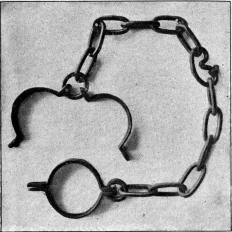 LEG IRONS WORN BY RUSSIAN CONVICTS.
(In Possession of H. de Windt, Esq.)
The New System Compared with the Old—Early Difficulties Gradually
Overcome—The Village Police in India—Discreditable Methods under
the Old System—Torture, Judicial and Extra-judicial—Native
Dislike of Police Proceedings—Cases of Men Confessing to Crimes of
which they were Innocent—A Mysterious Case of Theft—Trumped-up
Charges of Murder—Simulating Suicide—An Infallible Test of
Death—The Paternal Duties of the Police—The Native Policeman
Badly Paid.
THE regular police of India, as it is now constituted, dates from the
disappearance of the East India Company. Under the old system, taking
Bengal for our example, the district magistrate, a member of the Civil
Service, was the head of the district police. He had under his orders a
certain number of constables, fifty or more, who were called
burkundazes; they were distributed among the various stations or
thannahs, each of which was under a thannadar, who was more commonly
called a darogah, and was practically a police superintendent. This
officer was responsible to the magistrate only, just as the magistrate
was directly responsible to the supreme Government. But after 1859 the
police throughout the province of Bengal, and eventually throughout
India, was constituted into a special department; the regular force
became a species of Government constabulary, under the central authority
of an Inspector-General seated at Calcutta, with Deputy-Inspectors and
Superintendents in charge of divisions and districts respectively. The
senior police official in every district, generally a military officer,
was associated with and subject to the orders of the magistrate in all
executive duties, such as the repression of crime and the maintenance of
peace and good order; but as regards administration, in all questions of
pay, clothing, promotion, and so forth, the chief police officer looked
to his police superior, the Inspector-General.
Nevertheless, the character of the new police was as little military as
 A COURT OF JUSTICE IN THE JUNGLE.
it could be made consistently with the control and discipline of a large
body of men. Constables learnt the rudiments of drill, and wore uniform,
but were seldom armed except when employed in gaols or to guard
treasuries. As a general rule supervision was entirely entrusted to
Europeans, but there was a superior grade of native officer fairly well
paid. Yet the service was not generally popular, owing to persistent
local prejudices, and good material was not always available either for
sub-officers or for constables. Natives preferred to enter the fiscal
and administrative departments.
At first the new force did not work very smoothly. The military
superintendents were not always acceptable to the civilian magistrates,
and no doubt many thought more of drill than of their more important
functions in preventing and detecting crime. Numbers of the old order of
police hated the “new-fangled notions” and resigned, with the result
that the force was recruited hastily with inexperienced, often
unsuitable men, many of them old soldiers, and few, if any, fitted to
deal with intricate and complicated police investigations. Colonel
Lewin, one of the first-appointed district superintendents, has frankly
recorded his want of experience and his mis-directed zeal when first
called to police work; but he also hints at the difficulties and
obstacles thrown in his way by magistrates who hated the change.
Gradually, however, the steady, settled action of the well-organised,
well-governed body of earnest workers has made itself felt, and the
regular Indian police of to-day is not inferior to any in the whole
world.
Another form of police has existed from time immemorial in India, the
rural or village police, and it has still a certain limited power. These
functionaries hold office by a quasi-hereditary tenure; they are not
appointed by the State nor paid from the public treasury, but they have
a recognised position; their clearly defined duties, as well as their
emoluments, drawn from the villages, are fixed and controlled by
authority. These village watchmen, and they are little more, although
distinct and separate from the regular police by constitution, are yet
allied to them, being expected to report to them, without fail, all
criminal and extraordinary occurrences, and at the same time to take
their orders and execute them punctually. This local, unofficial police
is not in the highest state of efficiency, perhaps, but much has been
done of late to bring its members into good order, and to exact from
them a punctual performance of their duties. The worst that could be
alleged against them was that they might at times work with evil-doers
who were their friends and neighbours, or that they might yield to the
threats or temptations of the larger landowners around when these were
criminally disposed.
It has been said by all who know India well that the deceit inherent in
the character of its people must tend to interfere with the course of
justice. Witnesses will not speak freely, or will say too much; they
conceal facts or over-colour them just as their interests suggest; some
can be bought, others intimidated, while the most independent chafe at
police inquiries which are apt to be wearisome and irritating, and
though not always personally hostile, will say anything or nothing
merely to get rid of the police. “They would condone even grievous
wrongs,” says Sir Richard Temple,[17] “disavow the losses of property
which they had suffered, and withhold all assistance from their
neighbours in similar plights, rather than undergo the trouble of
attending at police offices and the criminal courts.”
Police methods under the old system were often most discreditable. The
native officers charged with detection had but one thought—to make the
case complete. For this they would invent facts, manufacturing evidence
from witnesses inspired by themselves. “The police,” an eminent Indian
judge once said from the Bench, “will never leave a case alone, but must
always prepare it and patch it up by teaching the witnesses to learn
their evidence off by heart beforehand, and to say more than they know.”
In another case a judge gave it as his opinion that certain prisoners
confessed to a burglary merely to screen others whom the police
befriended, and that in the prosecution there was not a single fact on
which he could with confidence rely. Again, a darogah, or village
official, was so impressed with the necessity for succeeding where his
colleagues had failed, in a murder case, that he used the most
unjustifiable means to create evidence: witnesses were forced under
threats and ill-treatment to depose to facts which had never occurred.
Another reprehensible practice was that of drugging prisoners before
their appearance in court so that they could make no defence. One was
given a hookah to smoke, and remembered nothing of what he said or had
to say. Still worse remains, for it is a well-authenticated fact,
attested by all who have personal experience, that where evidence of the
right sort was not forthcoming it was obtained by intimidation or actual
torture.
Of the survival of torture in India as a judicial process, secret and
unavowed, but undoubtedly practised, there can be no doubt. It was the
subject of constant regret to conscientious English officials, who were
yet unable entirely to check it. Cases of cruel maltreatment were
continually brought to light, and met with exemplary punishment. Thus in
1855 a darogah and his men were convicted in the Court of the
“Twenty-four Pergunnahs” of having tortured a man into confession by
tying his hands behind him and then hoisting him by his wrists to a beam
in the roof. Another case consisted in tying a prisoner’s hands and feet
together and introducing a stick below the knees, after which the
police, holding each end of the stick, dashed him violently against the
door.
As late as 1866, after the introduction of the new system, an inspector
and sub-inspector trussed up four recalcitrant prisoners upon the roof
of a house and left them there to starve. In the same year another
sub-inspector was transported for life for having caused the death of a
suspected thief by ill-usage. In this case the victim was stripped on a
cold February night, whipped, then water was poured upon his naked body,
and a fan was used to keep down the temperature. Again, in the same
year, a high official, Colonel Pughe, reports twelve cases in which the
police were accused of torturing prisoners, and out of the twelve cases
seven convictions were secured. He relates in the same document that
soon after the establishment of the new police, a sub-inspector of the
old school ordered a man to be tied up and flogged to extort confession
from him, and this in open day in the middle of a large bazaar in the
Hooghly district! “So little was the occurrence thought of,” writes
Colonel Pughe, “that no complaint was made by the sufferer, and it was
by the merest accident that the circumstance came to notice.” The custom
till then was apparently too common to attract attention. The people of
Bengal had become accustomed to be flogged, just as the fakir grew so
fond of his bed studded with pointed nails that he could not sleep
comfortably on any other. As late as 1870 the editor of a respectable
periodical in Bengal expressed his belief that the flogging of supposed
delinquents had been so long practised with impunity that the natives
took it as a matter of course.
 INDIAN POLICE AND THEIR METHODS (p. 316.)
It may be interesting to make a short digression here and recount some
of the modes of extra-judicial torture that have prevailed throughout
India. There is abundant evidence that this atrocious custom was, and
probably still is, common among all sects and classes of natives in
India. Dr. Cheevers gives it as his opinion that “the poor practise
torture upon each other; robbers on their victims, and vice versâ;
masters upon their servants; zemindars upon their ryots; schoolmasters
upon their pupils; husbands upon their wives; and even parents upon
their children.” “The very plays of the populace,” says another
authority, “excite the laughter of many a rural audience by the
exhibition of revenue squeezed out of a defaulter coin by coin through
the appliance of familiar provocatives.” Colonel Lewin, already quoted,
details some of the devices which he discovered had been in use among
the old police. They would fill the nose and ears of a prisoner with
cayenne pepper; stop the circulation of the blood with tight ligaments;
suspend their victim head downwards in a well; and in cases of great
obstinacy immerse the body repeatedly in the water until insensibility,
but not death, was produced.
Dr. Cheevers has been at great pains to collect details of the various
processes. They are torture by heat—by a lighted torch or red hot
charcoal or burning tongs, or by boiling oil, which sometimes was poured
into the ears and nose; torture by cold; suspension by the wrists, by
the feet, by the hair, by the moustache; confinement in a cell
containing quicklime; blinding by the bhela nut; placing on a bed of
thorns; rubbing the face on the ground; employing the stocks; tying the
limbs in constrained postures; placing stinging or annoying insects upon
the skin; flogging with stinging nettles; sticking pins or thorns or
slithers of bamboo under the nails; beating the ankles and other joints
with a soft mallet—a devilish invention from Madras. The list is long
and horrible, but before leaving the subject we may mention milder
methods, as they seem, because the ill-treatment leaves no mark, but in
which the agony is nevertheless extreme. Exposure to the sun is one of
these, starvation another, pinching a third, and “running up and down” a
fourth, as practised in Madras till quite recently, according to a
report under date 1870, where the police, unable to obtain evidence,
made it their business to “walk the prisoner about.” This was not done,
as was pretended, out of mere wantonness, but with the ostensible
purpose of obliging him to show where certain stolen property was
hidden. The police relieved each other every two hours or so, but the
prisoners were kept perpetually in motion. After a night’s unceasing
promenade the craving for rest and sleep becomes imperative, especially
in a native who is always ready to sleep, and is often awake for no more
than eight hours out of the twenty-four. Other refinements of torture
are the infliction of degradation and mental suffering by breaking
caste, and by exposing the victims to various indignities.
Police action in India is often complicated, impeded, and even
neutralised by the peculiar conditions of the country, where long
prevailing, more or less ineradicable custom is supreme. The average
native does not pause to balance right or wrong; he likes to do just as
his forefathers did through the centuries, and fails to see why an act
honoured by long prescription should be called wrong-doing. Offences
that the present rulers of India have put down with a strong hand, such
as suttee (widow burning), leper burying, and suicide, the natives are
still reluctant to call crimes. Thuggee, the cowardly murder and robbery
of inoffensive and unsuspicious travellers, was part of its
perpetrators’ religion; theft is to thousands a sport or a profession, a
habit or family tradition inherited from ancestors who were all
gang-robbers. While thus tradition and custom continue to make even
serious crime appear venial to the ordinary intelligence, the
investigation is continually hampered, and the actual fact often
concealed. Many natives, as I have said, detest police proceedings,
afraid of their being unduly prolonged, of their wasting time, of their
imposing the inconvenient presence of officers charged with the inquiry.
Others forbear to speak, either fearing the enmity of the friends or
neighbours they may implicate or with a mistaken tenderness for their
honour. Yet again, timidity, venality, or stupidity has led to
concealment. Witnesses whose testimony was damaging have often been
bought off, having been found ready to perjure themselves for quite
small sums.
 MADRAS POLICEMAN.
The police themselves have been known to hush up crimes, having been
bribed to silence, and it has been discovered later that some mysterious
murder had been no secret to them from the first. They have been known
on sufficient payment to transport a victim’s corpse to another
jurisdiction, so that they might evade all responsibility for its
presence. Suspicion of foul play was once aroused (it was in the old
days) by the fact that certain persons who had but just dug a well for
the irrigation of their fields had, for no plausible reason, filled it
up again. Police officers were ordered to reopen the well, and they
reported that they had done so, finding nothing wrong. But the
magistrate of the district heard presently that a woman had been seen in
the neighbourhood of the well just about the time it had been filled up,
and that she had disappeared. Rumour said she had been murdered for the
sake of some golden ornaments which she wore. The well was now dug out
under the official’s own eye, and it was clear that a female corpse had
been buried within; a quantity of long hair was found, but the body had
been removed, probably by the police.
The dishonest vagaries of the Indian police are nearly endless. The
police when baffled in detection will try to create a criminal and
manufacture a crime. Higher officials must always be on their guard
against such frauds. It is essential, for example, to watch
identification closely. A case is on record where the headless body of a
woman was found in a well, and suspicion fell upon certain Rajpoots
whose sister was known to be missing. They were arrested, and confessed
most circumstantially that they had in truth murdered her. Conviction
followed, and they would have been executed but for the unexpected
reappearance of the missing woman herself. She had eloped with a man
who, having heard of the charge brought against her brothers, produced
her in court. The accused men, thus saved at the eleventh hour,
explained their false confession by their fears that they could not
prove their innocence, so strong was the presumption of their guilt. It
should be added that the headless corpse was never identified.
One more case of the same kind. A corpse bearing marks of violence was
found floating on the Teesta river, and a murder was surmised. The
head-constable proceeded to investigate, and found a woman ready to
declare that her adopted father, Oootum by name, was missing. She could
not identify the body at first, but was eventually persuaded to do so.
Corroboration was now needed, and after that the discovery of the
perpetrators of the crime. Aided by the woman, the constable fixed upon
four men, who were forced (probably in the usual manner) to confess that
they had murdered Oootum. Fortunately, at the first inquiry into the
case the missing Oootum turned up before the district magistrate. For
this the head-constable and three associates were very rightly sentenced
to five years’ imprisonment.
 Photo: Bourne & Shepherd, Calcutta.
INDIAN PROVINCIAL POLICE.
A curious case of theft which was never explained, although the supposed
thief was arrested, convicted, and sentenced to imprisonment, is told by
a Bengal civilian. It appears that a Mr. and Mrs. Phillips were on a
visit to the Lieutenant-Governor of Bengal, and that one evening the
lady missed a diamond ring. Information was at once lodged with the
police, and a native detective was employed, who entered the Governor’s
service disguised as a kitmutgar (butler). Suspicion from the first
had rested upon an ayah, or female servant, and it was to be the
detective’s duty to worm himself into her confidence. The police officer
was successful, as it seemed, for the woman presently admitted that she
had stolen the ring. She was anxious to dispose of it, but did not dare.
However, she picked out one diamond and handed it over to him to sell,
promising him others if he succeeded. The police officer produced the
diamond, which was identified by Mrs. Phillips as one belonging to her
ring. On this evidence the ayah was tried and convicted. She appealed,
but the conviction was upheld.
Not long afterwards Mr. and Mrs. Phillips moved up country, and on
unpacking their goods the missing ring was found jammed into an
inkstand, with all the diamonds intact. The case was immediately
reopened, and it was recommended that the ayah should be forthwith
released. One of the judges protested, however, that the conviction was
legal, on the ground that the prisoner’s friends had inserted a diamond
in the place of the one removed, and had put the ring where it was
certain to be found. Nevertheless the ayah was pardoned. The theory
held was that the detective, eager to get the credit of having
discovered the thief, had fabricated the whole story and gone to the
expense of purchasing a diamond in support of it. He still stuck to it
that the woman had given him the diamond, which, as has been seen, was
one more than the ring contained. Now another strange fact cropped up.
Mrs. Phillips discovered that a diamond was missing from a locket she
possessed, and when this locket was produced the surplus diamond
appeared to fit into the vacant space. From this a new theory was
started—that the ayah had really stolen the ring, but, distrusting
the disguised kitmutgar, had also picked out the diamond from the
locket to test his willingness to serve her. When, later, the case had
gone against her, her friends had intervened in the manner described,
replacing the ring in the hope of obtaining her pardon. Jewellers who
were consulted gave it as their opinion that the surplus diamond was
very similar to those in the locket, but no one could swear that it was
one of the same. There the matter rested, and the mystery has never been
solved.
Attempts to defeat the ends of justice are very often made in India by
the natives themselves on their own motion, to satisfy some personal
animosity. Many cases might be cited of conspiracy to advance false and
malicious charges against an enemy. In one case wounds were fabricated
on a body already dead to support an accusation of murder. An old man
was found with his head nearly separated from his body and other deep
wounds in both shoulders, besides cuts on the back. Yet there had been
no considerable effusion of blood, no retraction of the muscles, and
medical opinion was emphatic that all these injuries had been inflicted
after death, which had undoubtedly occurred from long-standing
tubercular disease. It was presently shown that the whole case had been
trumped up to support a charge of murder against an unpopular neighbour.
 A RELIGIOUS MENDICANT.
A monstrous case is recorded by Mr. Arthur Crawford, whose
“Reminiscences” have been several times quoted in these pages, in which
a son was on such bad terms with his father that he elaborated a great
plot to involve him in disgrace and suffering, if not to convict him of
his own (the son’s) murder. The father was an aged and most respectable
Brahmin in the South Konkan, Madhowrao by name, described as a kindly,
courtly native gentleman, with intellectual, well-cut features, and
spare and active in body. He had this one son, Vinayek, a constant
trouble to him, chiefly on account of his wandering habits. He often
absented himself for months together, and roamed the country as a
gosai, or religious mendicant. After an unusually protracted absence,
the father offered the police a reward if they would trace and find his
son. The matter was taken up by a local constable, and he had no sooner
commenced his investigations than he received an anonymous letter
through the post charging the father with having made away with his son.
The story was told most circumstantially: how Madhowrao, assisted by his
widowed sister, who acted as his housekeeper, had strangled Vinayek in
the dead of night, and had then employed two servants to throw the body
to the alligators, at the foot of a torrent hard by the village. These
servants came forward and described how they had seen the corpse with
protruding eyes and tongue, the cord still round its neck, then how they
had stripped it, and, tying it to a heavy stone, had thrown it into the
water. The constable searched the house, and found hidden away a bundle
of clothes with a pair of sandals. Moreover, he fished up a great heap
of bones from the alligators’ pool. The whole party were arrested, and
the servants, the chief witnesses, were examined. They stuck to their
story, declared that they had acted solely to oblige their master, who,
they saw, was in great distress, and said that was all they knew.
But Madhowrao himself stoutly denied his guilt, repeating always that
his son was alive, but was only keeping out of the way until his father
was hanged. Closer inquiry was in the father’s favour, for it was
clearly proved that the bones found in the water were those of a
bullock, and also that there was no sort of attempt to conceal Vinayek’s
clothes. Nevertheless, the High Court, to which the matter had been
referred, pressed for the committal of the prisoners.
Meanwhile, the head constable, a very keen-witted and indefatigable
officer, had gone away on a journey. Pleading ill-health, he had sought,
and obtained, three months’ sick leave, which he had spent to very good
purpose in searching for the missing Vinayek. He ran him down at length
at a great distance, somewhere in the territory of the Nizam, and
brought him back in person, to be confronted with his father, who was
still lying under the charge of compassing his death. A very dramatic
scene followed; Vinayek was brought into court almost noiselessly behind
Madhowrao, who was desired to turn round; at sight of his son he fell
down flat on his face insensible, while his sister went off into
hysterics. Now Vinayek made full confession of the plot, in which he had
been assisted by a young cousin. He was to disappear, as he did, and
after an interval the other was to denounce the murderers; the two
servants were suborned by the promise of a good reward when Vinayek came
into his estate, and they very properly shared the punishment which was
inflicted on the chief conspirators.
 FATHER AND SON CONFRONTED.
In these cases it was vindictiveness and animosity that led to the plot,
which was only unmasked by the astuteness and perseverance of the
police. But greed also is a potent incentive to false accusation of
crime, and thus it was with Khan Beg. Coveting the inheritance of a rich
relative, Ibrahim Beg, whose heir he was, he laid a deep scheme to
secure it without waiting for Ibrahim’s death. Khan Beg was a dissolute
wastrel who had been reduced to poverty by his own extravagance, and who
knew that he might expect no further help from his kinsman. Ibrahim was
married to a young and handsome wife, Chumbelee, with whom he did not
live on the very best of terms, due mainly to the lying stories of a
confidential servant, an accomplice of Khan Beg’s. One day in a fit of
fury he forgot himself so far as to raise his hand against Chumbelee.
The woman, goaded by pain and disgrace, screamed aloud in the full
hearing of neighbours and servants. Next morning she was gone, and
information was laid at the nearest police station by the manservant
above mentioned that Chumbelee had been murdered. Officers proceeded at
once to Ibrahim Beg’s house, and searched the premises. It was soon seen
that some earth in the courtyard had been recently moved; on digging,
the headless body of a woman was found a little way down. The body was
identified by the manservant, who swore to a bangle found upon one arm,
remembering that he had once taken it for his mistress to be mended. A
slave-girl who did the household work also declared that the body was
Chumbelee’s.
Ibrahim Beg was, of course, apprehended, and locked up, vainly
protesting his innocence. His own story was that he had been stupefied,
he knew not how, by some narcotic, and after his violent quarrel with
his wife, which he did not deny, he had fallen asleep until a late hour
the following morning. His jealousy and ill-treatment of his wife were
notorious, and told greatly against him; the seclusion in which he had
always kept her also militated against him now. So few people had seen
her that there was no more evidence of identity than that already
adduced. All that could be said in his favour was that without the head,
absolute recognition was impossible. Ibrahim Beg himself stoutly denied
that the corpse was Chumbelee’s. The trial proceeded, and ended in his
conviction; the case was referred to a superior court, which deemed the
evidence conclusive; the sentence of death passed was about to be
executed, and Khan Beg was on the point of obtaining his ends and
acquiring considerable wealth.
But now came the slip. An anonymous letter was received by a young
English civilian who had charge of the district, informing him that
Chumbelee was still alive, actually residing within twenty miles of the
scene of her supposed murder. The magistrate, knowing it to be a case of
life and death, straightway rode to the place indicated, a certain tomb
occupied by a gang of fakirs, men of evil repute, whom it was necessary
to approach with caution. The magistrate, summoning the village police
to his aid, cautiously surrounded the tomb, then broke in, and searched
the whole place. He came upon Chumbelee at last in an underground
apartment.
She was, of course, forthwith taken out and brought back to her
husband’s house. The whole plot was now laid bare by the manservant,
anxious to save his own skin. He had long been in the power of Khan Beg,
and agreed to assist him the moment a body could be found to be palmed
off as Chumbelee’s. A widower at last consented to sell the corpse of
his recently deceased wife, which they took and decapitated. It was the
manservant who had administered the drug to Ibrahim; he made the
slave-girl prisoner, and then carried off Chumbelee in a blanket to the
fakirs’ tomb. Ibrahim Beg, when he recovered next morning from the
effects of the drug, gave the police no information of his wife’s
disappearance, for he believed that she had eloped and left him of her
own accord. The whole of this pernicious plot was admirably planned, but
it failed, as such plots often do, through the avarice of the principal
personage. Khan Beg had refused to pay a sum promised to one of his
subordinate helpers, and the latter had written the anonymous letter.
 A FAKIR.
In no country is it so essential that the body, in the case of a
supposed crime, should be not only produced, but identified, as in
India. An Englishman who was ascending the Hooghly nearly suffered the
extreme penalty of the law through ignorance of this axiom. He had left
his ship at Diamond harbour and hired a native boat to take him on to
Calcutta. The boatmen greatly exasperated him by their laziness, and he
applied his stick to them so vigorously that three jumped overboard.
Their comrades declared that they were drowned, and burst into loud
lamentations. On reaching shore they charged him with murder. He was
arrested forthwith, and committed to gaol. Ere long he was duly
arraigned, and on the oath of the boatmen who had been eye-witnesses of
his offence he was convicted without the slightest hesitation. While he
lay in gaol, however, under sentence of death, he was visited by a
native, who promised him that on the payment of a substantial sum the
drowned boatmen should be brought to life. The money was gladly paid,
and next day the charge of murder entirely broke down by the
reappearance of the missing men. It seemed that they were expert divers,
and having gone at once to the bottom they rose again at a considerable
distance from the boat, and swam ashore. Their comrades were fully aware
of the fact, and the conspiracy was formed so that the English stranger,
when in peril of his life, might be induced to pay a large ransom to
escape. It is clear from such cases as these that the police of India
have to be always on their guard against being led into traps.
Another trick which the police have to guard against is the simulation
of death by suicide. This is a very ancient imposture. Captain Bacon, in
his “First Impressions in Hindustan,” describes how he saw a corpse
bearing three wounds on the chest and many marks of violence brought to
a magistrate’s house, with the idea of fixing an accusation of murder on
a certain man. The magistrate, having his doubts, was about to examine
the body, when he was implored by those who carried it not to pollute it
by touch before the rites of sepulture had been performed. He did no
more, therefore, than thrust the sharp end of his billiard cue once or
twice into the side with such force that the point of the cue penetrated
between the ribs. Upon this the muscles of the supposed corpse quivered,
and there was a barely perceptible movement of the head. The natives
around were now told that life could not be yet extinct, but they
persisted in declaring that the man had been dead since cock-crow.
Whereupon, a kettle of hot water was produced and a small stream poured
upon the foot of the corpse, which there and then jumped up from the
litter and ran away at full speed! The same test was applied by a young
officer when the body of a native, who was supposed to have been
murdered by sepoys, was brought to his tent. There was no more evidence
than the existence of the corpse, but the officer was at breakfast, and
had the kettle handy. At the first touch of the scalding fluid “the
murdered remains” started up and scampered away. Boiling water, by the
way, is no doubt a generally satisfactory test of whether life is
actually extinct. But there is a better, as practised by a French doctor
in a Lyons hospital. He applied the flame of a candle for some seconds
to one digit of the hand or foot. A vesicle formed, as it will
invariably; if this vesicle contains serous fluid, there is life; if
vapour only, death has certainly supervened.
On the whole, the modern Indian police system may be said to operate
well. The police have numerous duties over and above those of the
prevention and detection of crime. A Government so paternal as that of
India finds the machinery of the police exceedingly useful in keeping in
touch with the great masses of the population. The constable is the
agent through whom the Government issues its orders or conveys its
wishes. If the people are wanted in any large numbers, such as for the
identification of bodies found, and if foul play is suspected, it is the
police who beat the drum and call them in. When supplies are needed,
such as carts, camels, bullocks, or forage, for any military expedition,
it is the police who work upon the men of the villages and gather in
what is required. When a high functionary had discovered a cure for
snake bites, it was the police who were entrusted with its distribution
through the districts most troubled with poisonous reptiles. The
particular panacea was liquid ammonia, which had to be applied at once
and in a particular way. It was not only necessary, therefore, to issue
supplies of the useful drug, but all the headmen of villages had to be
taught how to use it; this was the duty of the police. Again, when the
Government once seriously attempted to exterminate snakes, and offered a
reward for every dead reptile brought in, the machinery of the police
was at once set in motion to encourage natives to hunt up and kill the
snakes, and afterwards to distribute the rewards. When the plague of
locusts overran the length and breadth of the land, the police were sent
out to organise beaters and instruct the villagers how to destroy the
terrible pest. Another plague, that of rats, the jerboa rat, which
travels like a kangaroo by leaps and bounds and eats up everything it
meets, was to be grappled with by the police, and though they do not
seem to have been very effective in destroying the pest, it became their
business to pay out the rewards for all the vermin killed. An
interesting detail in Government methods may be mentioned in this
connection. The rats, when destroyed, were buried or burnt, but the
tails were first cut off and tied up into neat little bundles like
radishes, which were produced as vouchers for the numbers destroyed. A
police official records that the travelling police superintendents were
called upon to make entries in their diaries such as: “Visited
Bangalpore, counted 10,000 rats’ tails, paid the reward, burnt the
tails.”
The police have also rendered very valuable services during famines,
when their labours increase ten-and twenty-fold. Not only does crime
multiply in these dread seasons, but the force is actively employed in
helping to establish relief camps, in hunting up and bringing in the
starving population, in passing on supplies of grain from the railway
stations to the out-districts, and so forth.
Yet with all this the Indian native policeman is but indifferently paid,
much less than a soldier or other subordinate members of the public
departments. Ordinary labour even is better paid. The horsekeeper, the
gardener, the cowman is better off, even the coolie despises the
pittance of the policeman, who has no advantages but those of a remote
pension and the respect he inspires as a man clothed with a little
authority.
 JERBOA RATS.
The Detective in Fiction and in Fact—Early Detection—Case of Lady
Ivy—Thomas Chandler—Mackoull, and how he was run down by a Scots
Solicitor—Vidocq: his Early Life, Police Services, and End—French
Detectives generally—Amicable Relations between French and English
Detectives.
THE detective, both professional and amateur, since Edgar Allan Poe
invented Dupin, has been a prominent personage in fiction and on the
stage. He has been made the central figure of innumerable novels and
plays, the hero, the pivot on which the plot turns. Readers ever find
him a favourite, whether he is called Hawkshaw or Captain Redwood, Grice
or Stanhope, Van Vernet or Père Tabaret, Sherlock Holmes or Monsieur
Lecocq. But imagination, however fertile, cannot outdo the reality, and
it is with the detective in the flesh that I propose to deal. I propose
to take him in the different stages of his evolution—from the thief
reformed and become a thief-taker, down to the present honourable
officer, the guardian of our lives and property, the law’s chief weapon
and principal vindicator.
In times past the detection of crime was left very much to chance; but
now and again shrewd agents, both public officials and private persons,
contributed to the discovery of frauds and other misdeeds. Long ago, in
France, as I have shown, there was an organised police force which often
had resort, both for good and evil, to detective methods. Here in
England the office of constable was purely local, and his duties were
rather to make arrests in clear cases of flagrant wrong-doing than to
follow up obscure and mysterious crime. The ingenious piecing together
of clues and the following up of light and baffling scents was generally
left to the lawyers and those engaged on behalf of the parties injured
or aggrieved.
One of the first cases on record of a fraud on a very large scale
cleverly planned and not less cleverly detected was the claim raised by
a Lady Ivy, in 1684, to a large estate in Shadwell. It was based on
deeds purporting to be drawn more than a hundred years previously, in
the “2nd and 3rd Philip and Mary of 1555-6, under which deeds the lands
had been granted to Lady Ivy’s ancestors.” The case was tried before the
famous, or, more correctly, the infamous Judge Jeffreys, and the lawyers
opposed to Lady Ivy proved that the deed put forward had been forged. It
was discovered that the style and titles of the king and queen as they
appeared in the deed were not those used by the sovereigns at that
particular date. Always in the preambles of Acts of Parliament of 1555-6
Philip and Mary were styled “King and Queen of Naples, Princes of Spain
and Sicily,” not, as in the deed, “King and Queen of Spain and both the
Sicilies.” Again, in the deed Burgundy was put before Milan as a
dukedom; in the Acts of Parliament it was just the reverse. That style
did come in later, but the person drawing the deeds could not foretell
it, and as a fair inference it was urged that the deeds were a forgery.
Evidence was also adduced to show that Lady Ivy had forged other deeds,
and it was so held by Judge Jeffreys: “If you produce deeds made in such
a time when, say you, such titles were used, and they were not so used,
that sheweth your deeds are counterfeit and forged and not true deeds.
And there is digitus Dei, the finger of God in it, so that though the
design be deep laid and the contrivance skulk, yet truth and justice
will appear at one time or other.”
Accordingly, my Lady Ivy lost her verdict, and an information for
forgery was laid against her, but with what result does not appear.
Fifty years later a painstaking lawyer in Berkshire was able to unravel
another case of fraud, which had eluded the imperfect police of the day.
It was an artful attempt to claim restitution from a certain locality
for a highway robbery said to have been committed within its boundaries:
a robbery which had never occurred.
On the 24th March, 1747, according to his own story, one Thomas
Chandler, an attorney’s clerk, was travelling on foot along the high
road between London and Reading. Having passed through Maidenhead
Thicket, and while in the neighbourhood of Hare Hatch, some thirty miles
out, he was set upon by three men, bargees, who robbed him of all he
possessed, his watch and cash, the latter amounting to £960, all in
bank-notes. After the robbery they bound him and threw him into a pit by
the side of the road. He lay there some three hours, till long after
dark, he said, being unable to obtain release from “his miserable
situation,” although the road was much frequented and he heard many
carriages and people passing along. At length he got out of the pit
unaided, and, still bound hand and foot, jumped rather than walked for
half a mile uphill, calling out lustily for anyone to let him loose. The
first passer-by was a gentleman, who gave him a wide berth, then a
shepherd came and cut his bonds, and at his entreaty guided him to the
constable or tything-man of the hundred of Sunning, in the county of
Berks.
Here he set forth in writing the evil that had happened to him, with a
full and minute description of the thieves, and at the same time gave
notice that he would in due course sue the Hundred for the amount under
the statutes. All the formalities being observed, process was duly
served on the high constable of Sunning, and the people of the Hundred,
alarmed at the demand, which if insisted upon would be the “utter ruin
of many poor families,” engaged a certain attorney, Edward Wise, of
Wokingham, to defend them.
Mr. Wise had all the qualities of a good detective: he was ingenious,
yet patient and painstaking, and he soon pieced together the facts he
had cleverly picked up about Chandler. Some of these seemed at the very
outset much against the claimant. That a man should tramp along the high
road with nearly £1,000 in his pockets was quite extraordinary; not less
so that he should not escape from the pit till after dark, or that his
bonds should have been no stronger than tape, a length of which was
found at the spot where he was untied. He seemed, moreover, to be little
concerned by his great loss. After he had given the written notices to
the constable, concerning which he was strangely well informed, having
all the statutes at his fingers’ ends, as though studied beforehand, he
ordered a hot supper and a bowl at the Hare and Hounds in Hare Hatch,
where he kept up his carousals till late in the night. Nor was he in any
hurry to return to town and stop payment of the lost notes at the banks,
but started late and rode leisurely to London.
It was easy enough to trace him there. He had given his address in the
notices, and he was soon identified as the clerk of Mr. Hill, an
attorney in Clifford’s Inn. It now appeared that Chandler, for a client
of his master, had negotiated a mortgage upon certain lands in the
neighbourhood of Devizes for £509, far more, as was proved, than their
value. An old mortgage was to be paid off in favour of the new, and
Chandler had set off on the day stated to complete the transaction,
carrying with him the £500 and the balance of £460 supposed to be his
own property, but how obtained was never known. His movements on the
previous day also were verified. He had dined with the mortgagee, when
the deed was executed and the money handed over in notes. These notes
were mostly for small sums, making up too bulky a parcel to be
comfortably carried under his gaiters (the safest place for them, as he
thought), and he had twice changed a portion, £440 at the Bank of
England for two notes, and again at “Sir Richard Hoare’s shop” for three
notes, two of £100 and one of £200. With the whole of his money he then
started to walk ninety miles in twenty-four hours, for he was expected
next day at Devizes to release the mortgage.
Mr. Hill had kept a list of his notes in Chandler’s handwriting, which
Chandler was anxious to recover when he got back, in order, as he said,
to stop payment of them at the banks. His real object was to alter the
numbers of three notes of Hoare’s, all of which he wished to cash and
use, and he effected this by having a fresh list made out in which these
notes were given new and false numbers. Thus the notes with the real
numbers would not be stopped on presentation. He did it cleverly,
changing 102 to 112, 195 to 159, 196 to 190, variations so slight as to
pass unnoticed by Mr. Hill when the list as copied was returned to him.
These three notes were cashed and eventually traced back to Chandler.
Further, it was clearly proved that he had got those notes at Hoare’s in
exchange for the £200 note, for that note presently came back to Hoare’s
through a gentleman who had received it in part payment for a captain’s
commission of dragoons, and it was then seen that it had been
originally received from Chandler.
While Mr. Wise was engaged in these inquiries the trial of Chandler’s
case against the Hundred came on at Abingdon assizes in June, and a
verdict was given in his favour for £975, chiefly because Mr. Hill was
associated with the mortgage, and he was held a person of good repute.
But a point of law was reserved, for Chandler had omitted to give a full
description of the notes, as required by statute, when advertising his
loss.
But now Chandler disappeared. He thought the point of law would go
against him; that the mortgagee would press for the return of the £500
which he had recovered from the Hundred; that his master, Mr. Hill, had
now strong doubts of his good faith. The first of these fears was
verified; on argument of the point of law the Abingdon verdict was set
aside. There was good cause for Chandler’s other fears also. News now
came of the great bulk of the other notes; they reached the bank from
Amsterdam through brokers named Solomons, who had bought them from one
“John Smith,” a person answering to the description of Chandler, who in
signing the receipt “wrote his name as if it had been wrote with a
skewer.” The indefatigable Mr. Wise presently found that Chandler had
been in Holland with a trader named Casson, and then unearthed Casson
himself.
All this time Mr. Hill was in indirect communication with Chandler,
writing letters to him by name “at Easton in Suffolk, to be left for him
at the Crown at Ardley, near Colchester, in Essex.” Thither Mr. Wise
followed him, accompanied by the mortgagee, Mr. Winter, and the “Holland
trader,” Mr. Casson, who was ready to identify Chandler. They reached
the Crown at Ardley, and actually saw a letter “stuck behind the plates
of the dresser,” awaiting Chandler, who rode in once a fortnight, from a
distance, for “his mare seemed always to be very hard rid.” There was
nothing known of a place called Easton; but Aston and Assington were
both suggested to the eastward, and in search of them Mr. Wise with his
friends rode through Ipswich as far as Southwold, and there found
Easton, “a place washed by the sea,” where he halted, “being thus pretty
sure of going no farther eastward.” But the scent was false, and
although they ran down a young man whom they proposed to arrest with the
assistance of “three
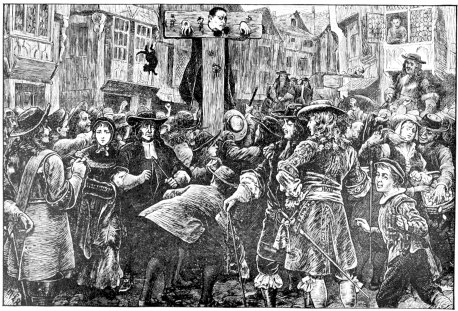 PUNISHMENT BY PILLORY.
fellows from the Keys, who appeared to be smugglers, for they were
pretty much maimed and scarred,” the person was clearly not Chandler.
So, finding they had been “running the wrong hare,” they “trailed very
coolly all the way back to Ipswich.”
Travelling homeward, they halted a night at Colchester, and called at an
inn, the Three Crowns, or the Three Cups, where Chandler had been seen a
few months before. Here, as a fact, after overrunning their game near
fourscore miles, “they got back to the very form,” yet even now they
lost their hare. This inn was kept by Chandler himself, in partnership
with his brother-in-law, who naturally would not betray him, and
carefully concealed the fact that Chandler was at that very time in the
house.
After this Chandler thought Colchester “a very improper place for him to
continue long in.” There were writs out against him in Essex, Suffolk,
and Norfolk, so he sold off his goods and moved to another inn at
Coventry, where he set up at the sign of the Golden Dragon under the
name of John Smith. Now, still fearing arrest, he thought to buy off
Winter, the mortgagee, by repaying him something, and sent him £130. But
Winter was bitter against him, and writs were taken out for
Warwickshire. Chandler had in some way secured the protection of Lord
Willoughby de Broke; he had also made friends with the constables of
Coventry, and it was not easy to compass his arrest. But at last he was
taken and lodged in the town gaol. Two years had been occupied in this
pertinacious pursuit, prolonged by trials, arguments, journeyings to and
fro, and Mr. Wise was greatly complimented upon his zeal and presented
with a handsome testimonial.
Chandler, who was supposed to have planned the whole affair with the
idea of becoming possessed of a considerable sum in ready money, was
found guilty of perjury, and was sentenced to be put in the pillory next
market day at Reading from twelve to one, and afterwards to be
transported for seven years.
A curious feature of the trial was the identification of Chandler as
John Smith by Casson, who told how at Amsterdam he (Chandler) had
received payment for his bills partly in silver—£150 worth of ducats
and Spanish pistoles—which broke down both his pockets, so that the
witness had to get a rice-sack and hire a wheelbarrow to convey the coin
to the Delft “scout,” where it was deposited in a chest and so conveyed
to England.
Detailed reference has been made in previous pages to the Bow Street
runners, to Vickery, Lavender, Sayer, Donaldson, and Townsend, whose
exploits in capturing criminals were often remarkable. None of them did
better, however, than a certain Mr. Denovan, a Scots officer of great
intelligence and unwearied patience, who was employed by the Paisley
Union Bank of Glasgow to defend it against the extraordinary pretensions
of a man who had robbed it and yet sued it for the restoration of
property which was clearly the bank’s and not his. For the first and
probably the only time known in this country, an acknowledged thief was
seen contending with people in open court for property he had stolen
from them.
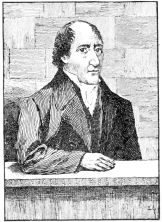 JAMES MACKOULL.
(From a Contemporary Drawing.)
The hero of this strange episode was one James Mackoull, a hardened and,
as we should say nowadays, an “habitual” criminal. He was one of the
most extraordinary characters that have ever appeared in the annals of
crime. His was a clear case of heredity in vice, for his mother had been
a shoplifter and low-class thief, who had married, however, a
respectable tradesman; all her children—three sons and two
daughters—had turned out badly, becoming in due course notorious
offenders. One of them, John Mackoull, was well educated, and the author
of a work entitled “The Abuses of Justice,” which he brought out after
his acquittal on a charge of forgery; another brother, Ben Mackoull, was
hanged for robbery in 1786.
James Mackoull began early, and at school stole from his companions. He
studied little, but soon became an expert in the science of
self-defence, and, being active and athletic, took rank in due course as
an accomplished pugilist. His first public theft was from a cat’s-meat
man, whom he robbed by throwing snuff in his eyes; while the man was
blinded, he cut the bag of coppers fastened to the barrow and bolted.
Henceforth he became a professional thief, and with two noted
associates, Bill Drake and Sam Williams, did much business on a large
scale.
One of his most remarkable feats was his robbery from the person of a
rich undertaker, known as “The Old Raven,” who was fond of parading
himself in St. James’s Park, London, dressed out in smart clothes and
wearing conspicuously exposed a fine gold watch set with diamonds.
Mackoull knew that on most days “The Old Raven” entered the park from
Spring Gardens at 4 p.m., so he timed himself to arrive a little
earlier. He waited till the undertaker had passed him, then pushed on in
front, when he turned round suddenly, and, clutching the watch with one
hand, knocked his victim’s hat over his eyes with the other. Fearing
detection for this theft, which caused considerable noise, Mackoull
thought it prudent to go to sea. He entered the Royal Navy, and served
for two years on board H.M.S. Apollo as an officer’s servant. His
conduct was exemplary, and he was presently transferred to H.M.S.
Centurion, on which ship he rose to be purser’s steward. He was
discharged with a good character after nine years’ service afloat, and
returned to London about 1785 with a considerable sum of money, the
accumulations of prize-money and pay.
The moment he landed he resumed his evil courses. Having rapidly wasted
his substance in the ring, in the cockpit, and at the gaming-table, he
devoted himself with great success to picking pockets. He gave himself
out as the captain of a West Indiaman, and being much improved in
appearance, having a genteel address and fluent speech, he was well
received in a certain class of society. At the end of a debauch he
generally managed to clear out the company. He was an adept in what is
known as “hocussing,” and this served him well in despoiling his
companions of their purses and valuables.
It was at this time that he gained the sobriquet of the “Heathen
Philosopher” among his associates. He owed it to a trick played upon a
master baker, whom he encountered at an election at Brentford. This
worthy soul affected to be learned in astronomy, and
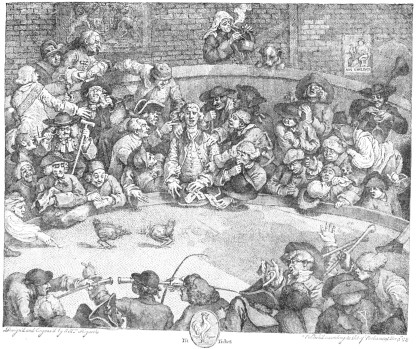 Pit Ticket
THE COCKFIGHT BY HOGARTH.
Mackoull approached him, courteously advising him to have a look at the
strange “alternating star” to be seen that night in the sky. As soon as
the baker was placed to view the phenomenon, Mackoull deftly relieved
him of his pocket-book, which he knew to be well lined. Then, as the
baker could not see the star properly and went home to use his
telescope, Mackoull promptly decamped, returning to town in a
postchaise.
Now Mackoull married a lodging-house keeper, and went into the business
of “receiving.” At first he stored his stolen goods in his mother’s
house, but as this became insecure he devised a receptacle in his own.
He chose for the purpose a recess where had formerly been a window, but
which had been blocked up to save the window-tax. It was on that account
called “Pitt’s picture.” But the hiding-place was discovered, and as
Mackoull was “wanted,” he escaped to the Continent, where he frequented
the German gambling-tables and learnt the language. He visited Hamburg,
Leipsic, Rotterdam, and is said to have often played billiards with the
Grand Duke of Mecklenburg-Schwerin, whom he relieved of all his
superfluous cash.
Again he had to fly, but being afraid to return to London he travelled
north, and landed at Leith in 1805. Thence he went to Edinburgh, and
lodged in the Canongate, devoting himself to his old pursuits at
taverns, “calling himself a Hamburg merchant and making many friends.” A
theft at the theatre was nearly fatal to him. He was caught by a police
officer in the act of picking a gentleman’s pocket, and, after running
for his life, was at last overtaken. Having no assistance at hand, the
“town officer” struck him on the head with his “batoon.” Mackoull fell
with a deep groan, and the officer, fearing he had killed him, made off.
As the result of this encounter Mackoull was long laid up, and he
carried the scar on his forehead to his dying day.
As time passed he grew more daring and more truculent, and it is
believed he was the author of the well-known murder of Begbie, the
porter of the British Linen Company Bank—a crime never brought home to
him, however, the murder remaining a mystery to the last. This victim,
returning from Leith carrying a large parcel of bank-notes, was stabbed
in the back at the entrance of Tweeddale’s Court. Several persons were
suspected, apprehended, and discharged for want of evidence. Yet the
most active measures were taken to detect the crime. “Hue-and-cry”
bills were thrown off during the night, and despatched next morning by
the mail-coaches to all parts of the country. It was stated in this
notice that “the murder was committed with a force and dexterity more
resembling that of a foreign assassin than an inhabitant of this
country. The blow was directly to the heart, and the unfortunate man
bled to death in a few minutes.” Through Mr. Denovan’s investigations
many facts were obtained to implicate Mackoull, but the proof of his
guilt was still insufficient.
One of the most suspicious facts against him was that later on he was
often seen in the Belle Vue grounds, and here, in an old wall, many of
the notes stolen from the murdered porter were presently discovered.
They were those of large value, which the perpetrator of the crime would
find it difficult to pass. Reports that they had been thus found, and in
this particular wall, were in circulation some three weeks before they
were actually unearthed, and it is believed the story was purposely put
about to lead to their recovery. It is a curious fact that the
stonemason who came upon the notes in pulling down the wall resided
close to the spot where the murder had been committed. But for the good
luck that he was able to prove clearly that he was not in Edinburgh at
the time of the murder, he might have been added to the sufficiently
long list of victims of circumstantial evidence.
Mackoull at this time passed to and fro between Edinburgh and Dublin,
and was popular in both capitals, a pleasant companion, ever ready to
drink and gamble and join in any debauchery. He became very corpulent,
and it was said of him that he did not care how he was jostled in a
crowd. This was necessary as a matter of business sometimes, but one
night at the Edinburgh theatre he got into trouble. Incledon, the famous
vocalist, was singing to full houses, and Mackoull in the crowded lobby
picked a gentleman’s pocket. He was caught in the act, but escaped for a
time; then was seized after a hot pursuit and searched, but with no
result, for he had dropped his booty in the race. They cast him into the
Tolbooth, but he was released for want of proof after nine months’
detention. As the story is told, the gentleman robbed was much
displeased at Mackoull’s release and complained of this failure of
justice. The judge before whom the thief had been arraigned admitted
that he ought to have been hanged. “He went to the play-house to steal
and not to hear music; and he gave a strong proof of this, Mr. P., when
he preferred your notes to Mr. Incledon’s.”
Mackoull, retiring south after his liberation, lay low for a time, but
he made one expedition to Scotland for the purpose of passing forged
notes, when he was again arrested, but again evaded the law. Another
enterprise in Chester failed; the luck was against him for the moment.
But now, having sought out efficient confederates, he laid all his plans
for the robbery of some one or other of the great Scottish banks. He was
well equipped for the job, had secured the best men and the finest
implements.
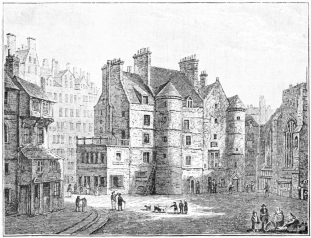 THE TOLBOOTH, EDINBURGH.
He was assisted by two confederates, French and Huffey White, the latter
a convict at the hulks, whose escape Mackoull had compassed on purpose.
They broke into the Paisley Bank at Glasgow on Sunday night, July 14,
1811, with keys carefully fitted long in advance, and soon ransacked the
safe and drawers, securing in gold and notes something like £20,000. Of
course, they left Glasgow at once, travelling full speed in a
postchaise and four, first to Edinburgh and then viâ Haddington and
Newcastle southward to London. In the division of the spoil which now
took place Mackoull contrived to keep the lion’s share. White was
apprehended, and to save his life a certain sum was surrendered to the
bank; but some of the money, as I have said elsewhere,[18] seems to have
stuck to the fingers of Sayer, the Bow Street officer who had negotiated
between Mackoull and the bank. Mackoull himself had retained about
£8,000.
In 1812, after a supposed visit to the West Indies, he reappeared in
London, where he was arrested for breach of faith with the bank and sent
to Glasgow for trial. He got off by a promise of further restitution,
and because the bank was unable at that time to prove his complicity in
the burglary. An agent who had handed over £1,000 on his account, was
then sued by Mackoull for acting without proper authority, and was
obliged to refund a great part of the money. Nothing could exceed his
effrontery. He traded openly as a bill broker in Scotland under the name
of James Martin; buying the bills with the stolen notes and having
sometimes as much as £2,000 on deposit in another bank. At last he was
arrested, and a number of notes and drafts were seized with him. He was
presently discharged, but the notes were impounded, and by-and-by he
began a suit to recover “his property”—the proceeds really of his theft
from the bank. His demeanour in court was most impudent. Crowds filled
the court when he gave his evidence, which he did with the utmost
effrontery, posing always as an innocent and much-injured man.
It was incumbent upon the bank to end this disgraceful parody of legal
proceedings. Either they must prove Mackoull’s guilt or lose their
action—an action brought, it must be remembered, by a public depredator
against a respectable banking company for daring to retain a part of the
property of which he had robbed them. In this difficulty they appealed
to Mr. Denovan, well known as an officer and agent of the Scottish
courts, and sent him to collect evidence showing that Mackoull was
implicated in the original robbery in 1811.
Denovan left Edinburgh on January 8, 1820, meaning to follow the exact
route of the fugitives to the south. All along his road he came upon
traces of them in the “post books” or in the memory of innkeepers,
waiters, and ostlers. He passed through Dunbar, Berwick, and Belford,
pausing at Belford to hunt up a certain George Johnson who was said to
be able to identify Mackoull. Johnson had been a waiter at the Talbot
Inn, Darlington, in 1811, but was now gone—to what place his parents,
who lived in Belford, could not say. “Observing, however, that there was
a church behind the inn,” writes Mr. Denovan, “a thought struck me I
might hear something in the churchyard on Sunday morning;” and he was
rewarded with the address of Thomas Johnson, a brother of George’s, “a
pedlar or travelling merchant.” “I immediately set forth in a postchaise
and found Thomas Johnson, who gave me news of George. He was still
alive, and was a waiter either at the Bay Horse in Leeds or somewhere in
Tadcaster, or at a small inn at Spittal-on-the-Moor, in Westmorland, but
his father-in-law, Thomas Cockburn, of York, would certainly know.”
Pushing on, Denovan heard of his men at Alnwick. A barber there had
shaved them. “I was anxious to see the barber, but found he had put an
end to his existence some years ago.” At Morpeth the inn at which they
had stopped was shut up. At Newcastle the posting book was lost, and
when found in the bar of the Crown and Thistle was “so mutilated as to
be useless.” But at the Queen’s Head, Durham, there was an entry,
“Chaise and four to Darlington, Will and Will.” The second “Will” was
still alive, and remembered Mackoull as the oldest of the party, a
“stiff red-faced man,” the usual description given of him. The landlady
here, Mrs. Jane Escott, remembered three men arriving in a chaise who
said they were pushing on to London with a quantity of Scottish
bank-notes. At the Talbot Inn, Darlington, where George Johnson had
lived, the scent failed till Denovan found him at another inn, the
King’s Head.
His evidence was most valuable, and he willingly agreed to give it in
court at Edinburgh. He had seen the three men at Durham, the oldest, “a
stiff, stout man with a red face, seemed to take the management, and
paid the postboys their hire.” He had offered a £20 Scottish note in
payment for two pints of sherry and some biscuits, but there was not
change enough in the house, and White was asked for smaller money, when
he took out his pocket-book stuffed full of bank notes, all too large,
so the first note was changed by Johnson at the Darlington bank.
Johnson was sure he would know the “stiff man” again amongst a hundred
others in any dress.
There was no further trace now till Denovan got to the White Hart,
Welwyn, where the fugitives had taken the light post-coach. At Welwyn,
too, they had sent off a portmanteau to a certain address, and this
portmanteau was afterwards recovered with the address in Mackoull’s
hand. At Welwyn also Mr. Denovan heard of one Cunnington who had been a
waiter at the inn in 1811, but had left in 1813 for London, and who was
said to know something of the matter. The search for this Cunnington was
the next business, and Mr. Denovan pushed on to London hoping to find
him there. “In company with a private friend I went up and down Holborn
inquiring for him at every baker’s, grocer’s, or public house,” but
heard nothing. The same at the coaching offices, until at last a guard
who knew Cunnington said he was in Brighton. But the man had left
Brighton, first for Horsham, then for Margate, and had then gone back to
London, where Mr. Denovan ran him down at last as a patient in the
Middlesex Hospital.
Cunnington was quite as important a witness as Johnson. He declared he
should know Mackoull among a thousand. He had seen the three men
counting over notes at the White Hart; Mackoull did not seem to be a
proper companion for the two; he took the lead, and was the only one who
used pen, ink, and paper. Cunnington expressed his willingness to go to
Edinburgh if his health permitted.
Since Denovan’s arrival in London he had received but little assistance
at Bow Street. The runners were irritated at the unorthodox way in which
the case had been managed. Sayer, who had been concerned in the
restitution, flatly refused to have anything to do with the business, or
to go to Edinburgh to give evidence. This was presently explained by
another runner, the famous Townsend, who hinted that Sayer’s hands were
not clean, and that he was on very friendly terms with Mackoull’s wife,
a lady of questionable character, who was living in comfort on some of
her husband’s ill-gotten gains. Indeed, Sayer’s conduct had caused a
serious quarrel between him and his colleagues, Lavender, Vickery, and
Harry Adkins, because he had deceived and forestalled them. Denovan was,
however, on intimate terms with Lavender, and succeeded in persuading
him to assist, and through him he came upon the portmanteau sent from
Welwyn, which had been seized at the time of Huffey White’s arrest.
Huffey had been taken in the house of one Scoltop, a blacksmith in the
Tottenham Court Road, the portmanteau and a box of skeleton keys being
also seized. Both were now found in a back closet in the office at Bow
Street, “under a singular collection of rubbish, and were actually
covered by Williams’s bloody jacket, and the maul and ripping iron with
which the man Williamson had been murdered in Ratcliff Highway.” The
portmanteau contained many papers and notes damaging to Mackoull, and in
the box were housebreaking implements, punches, files, and various
“dubs” and “skrews,” as well as two handkerchiefs of fawn colour, with a
broad border, such as the three thieves often wore when in their
lodgings in Glasgow immediately before the robbery.
How Mr. Denovan found and won over Scoltop is a chief feather in his
cap. His success astonished even the oldest officers in Bow Street.
Scoltop was the friend and associate of burglars, and constantly engaged
in manufacturing implements for them. He had long been a friend of
Mackoull’s and had made tools for him, among them those used for the
robbing of the Paisley Union Bank, a coup prepared long beforehand, as
we have seen. The first set of keys supplied had been tried on the bank
locks and found useless, so that Scoltop had furnished others and sent
them down by mail. These also were ineffective, as the bank had “simple
old-fashioned locks,” and Mackoull came back from Glasgow, bringing with
him “a wooden model of the key hole and pike of the locks,” which
enabled Scoltop to complete his job easily. “I wonder,” said Scoltop to
Mr. Denovan, “that the bank could have trusted so much money under such
very simple things.” Scoltop would not allow any of this evidence to be
set down in writing, but he agreed to go down to Edinburgh and give it
in court, and to swear also to receiving the portmanteau addressed in
the handwriting of Mackoull.
But Denovan’s greatest triumph was with Mrs. Mackoull. She kept a house
furnished in an elegant manner, but was not a very reputable person.
“She was extremely shy at first, and as if by chance, but to show that
she was prepared for anything, she lifted up one of the cushions on her
settee, displaying a pair of horse pistols that lay below,” on which he
produced a double-barrelled pistol and a card bearing the address
“Public Office, Bow Street.” Then she gave him her hand and said, “We
understand each other.” But still she was very reticent, acting, as Mr.
Denovan was firmly convinced, under the advice of the not incorruptible
Sayer. She was afraid she would be called upon to make a restitution of
that part of the booty that had gone her way. Denovan strongly suspected
that she had received a large sum from her husband and had refused to
give it back to him—“the real cause of their misunderstanding,” which
was, indeed, so serious that he had no great difficulty in persuading
her also to give evidence at Edinburgh.
 “ON WHICH HE PRODUCED A DOUBLE-BARRELLED PISTOL AND A
CARD” (p. 346.)
“ON WHICH HE PRODUCED A DOUBLE-BARRELLED PISTOL AND A
CARD” (p. 346.)
Such was the result of an inquiry that scarcely occupied a month. It was
so complete that the celebrated Lord Cockburn, who was at that time
counsel for the Bank, declared “nothing could exceed Denovan’s skill,
and that the investigation had the great merit of being amply sustained
by evidence in all its important parts.” When the trial of the cause
came on in February, and Denovan appeared in court with all the
principal witnesses, Johnson, Cunnington, Scoltop, and Mrs. Mackoull,
the defendant—it was only a civil suit—was unable to conceal his
emotion, and fainted away. This was, practically, the throwing up of the
sponge. Soon afterwards he was indicted for the robbery of the bank, and
on conviction sentenced to death. He was greatly cast down at first, but
soon recovered his spirits, and while awaiting execution received a
number of visitors in the condemned cell. Among them was his wife, who
provided him with the means of purchasing every luxury. She also applied
for and obtained a reprieve for him. But though he might escape the
gallows, he could not evade death. Within a couple of months of his
sentence he fell into imbecility, his hitherto jet-black hair grew
white, and his physical faculties failed him. Before the year was ended
he had gone to his account.
The first regular organisation of detective police may be said to have
been created by Vidocq, the famous French thief, who, having turned his
own coat, found his best assistants in other converted criminals.
Vidocq’s personal reminiscences have been read all the world over, and
need hardly be recounted here. It was at the end of a long career of
crime, of warfare with justice, in which he had been perpetually
worsted, that he elected to go over to the other side. He would cease to
be the hare, and would, if permitted, in future hunt with the hounds. So
he offered his services to the authorities, who at first bluntly refused
them. M. Henri, the functionary at the head of the criminal department
of the Prefecture, sent him about his business without even asking his
name.
This was in 1809, during the ministry of Fouché. Vidocq, rebuffed,
joined a band of coiners, who betrayed him to the police, and he was
arrested, nearly naked, on the roof as he was trying to escape. He was
taken before M. Henri, whom he reminded of his application and renewed
his offers, which were now accepted, but coldly and distrustfully. The
only condition he had made was that he should not be relegated to the
galleys, but held in any
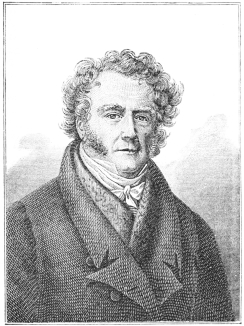 VIDOCQ, THE CELEBRATED FRENCH DETECTIVE.
(From the Engraving by Mlle. Coignet.)
Parisian prison the authorities might choose. So he was committed to La
Force, and the entry appears on the registry of that prison that he was
nominally sentenced to eight years in chains; it was part of his compact
that he should associate freely with other prisoners and secretly inform
the police of all that was going on. He betrayed a number of his
unsuspecting companions, and seems to have been very proud of his
treacherous achievements. No prisoner had the slightest suspicion that
he was a police spy, nor had any of the officials, except the
gate-keeper. In this way he earned the gratitude of the authorities, who
thought he might be more useful at large. In order to give a plausible
explanation of his release, it was arranged that he should be sent from
the prison of La Force to Bicêtre and permitted to escape by the way.
Vidocq has given his own account of his escape: “I was fetched from La
Force and taken off with the most rigorous precaution, handcuffed, and
lodged in the prison van; but I was let out on the road.” The report of
this daring escape, as it was supposed, was the talk of all Paris, and
the cause of great rejoicing in criminal circles, where Vidocq’s health
was drunk with many wishes for his continued good fortune.
Vidocq made excellent use of his freedom. He entered freely into all the
low haunts of the city, and was received with absolute confidence by
every miscreant abroad. Through him, although he kept carefully in the
background, innumerable arrests were made; one of the most important was
that of the head of a gang of robbers named Guenvive, whose acquaintance
he made at a cabaret, where they exchanged some curious confidences.
Guenvive was very anxious to put him on his guard against “that villain
Vidocq,” who had turned traitor to his old friends. But Guenvive assured
Vidocq that he knew him intimately and there was nothing to be feared
while he was by. Together they went to attack Vidocq, each carrying
handkerchiefs loaded with two-sous pieces, and watched for him at his
front door. For obvious reasons Vidocq did not come out, but his ready
concurrence in the scheme made him Guenvive’s most intimate friend. The
robber was willing to enrol Vidocq in his band, and proposed that he
should join in a grand affair in the Rue Cassette. Vidocq agreed, but
took no part in the actual robbery on the pretence that he could not
safely be out in the streets, as he had no papers. When the party,
having successfully accomplished their coup, carried their plunder
home to Guenvive’s quarters, they were surprised by a visit of the
police, during which Vidocq, who was present, concealed himself under
the bed. The end of this business was the conviction of the robbers and
their condemnation to travaux forcés, but they appear to have
succeeded in discovering how and by whom they had been betrayed.
Vidocq brought about another important arrest in the person of Fossard,
a notorious criminal, who was to become yet more famous by his
celebrated theft of medals from the Bibliothèque Royale. Fossard was a
man of athletic proportions and desperately brave; he had escaped from
the Bagne of Brest and was supposed to be prepared to go any lengths
rather than return there; he was always armed to the teeth, and swore he
would blow out the brains of anyone who attempted to take him. He lived
somewhere near the Rue Poissonnière; the neighbourhood was known, but
not the house or the floor; the windows were said to have yellow silk
blinds, but many other windows had the same; another indication was that
Fossard’s servant was a little humpbacked woman, who also worked as a
milliner. Vidocq found the hunchback, but not her master, who had moved
into another residence over a wineshop at the corner of the Rue Duphot
and the Rue St. Honoré. He at once assumed the disguise of a
charcoal-seller, and verified the lodging, but waited for an opportunity
to take the criminal. Although he was armed and no coward, he realised
that the only safe way to secure Fossard would be in his bed.
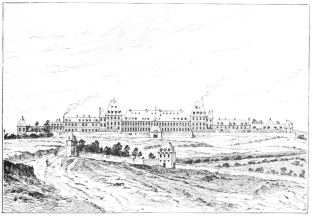 THE BICÊTRE IN 1710.
(After Gueroult.)
Vidocq now took the tavern-keeper into his confidence, warned him that
he had under his roof a very dangerous robber, and that this lodger was
only waiting a favourable chance to rob his till. The first night that
the receipts had been good the ruffian would certainly lay hands upon
the money. The tavern-keeper was only too glad to accept the assistance
of the police, and promised to admit them whenever required. One night,
when Fossard had returned home early and gone to bed, Vidocq and his
comrades were let in during the small hours, and the following trick was
arranged. The tavern-keeper had with him a little nephew, a child of
ten, precocious and ready to earn an honest penny. Vidocq easily taught
him a little tale. The child was to go upstairs to Fossard’s door in the
early morning, and ask Fossard’s wife for some eau-de-cologne, saying
his aunt was unwell. The child played his part well; he went up, closely
followed by the police in stockinged feet; he knocked, gave his message,
the door was opened to him, and in rushed the officers, who secured
Fossard before he was well awake.
In these later days of the First Empire the police, as we have seen,
were more actively engaged in political espionage than in the detection
of crime, and Paris was very much at the mercy of criminals. There were
whole quarters given up to malefactors—places, particularly beyond the
Barrier, which offered a safe retreat to convicts, thieves, the whole
fraternity of crime, into which no police-officer was bold enough to
enter. Vidocq volunteered to clear out at least one of them, a tavern
kept by a certain Desnoyez, always a very favourite and crowded resort.
Accompanied by a couple of police officers and eight gendarmes, he
started off to execute a job for which his superiors declared that he
needed a battalion at least. But on reaching the tavern he walked
straight into the salon, where a Barrier ball was in progress, stopped
the music, and coolly looked around. Loud cries were raised of “Turn him
out!” but Vidocq remained imperturbable, and exhibiting his warrant,
ordered the place to be cleared. His firm aspect imposed upon even the
most threatening, and the whole company filed out one by one past
Vidocq, who stationed himself at the door. Whenever he recognised any
man as a person wanted or a dangerous criminal, he marked his back
adroitly with a piece of white chalk as a sign that he should be made
prisoner outside. This was effected by the gendarmes, who handcuffed
each in turn, and added him to a long chain of
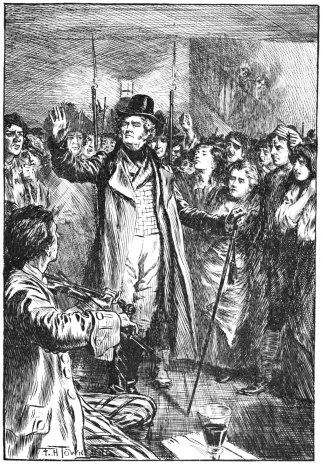 VIDOCQ STOPS THE MUSIC (p. 352.)
prisoners, who were eventually conducted in triumph to the Prefecture.
Vidocq’s successes gained him a very distinct reputation in Paris; he
had undoubtedly diminished crime—at least he had reduced the number of
notorious criminals who openly defied justice; it was decided,
therefore, to give him larger powers, and in 1817 he was authorised to
establish a regular body of detectives, the first “Brigade de Sûreté,”
which was composed of a certain number of agents devoted entirely to the
detection of crime. They were no more than four in number at first, but
the brigade was successively increased to six, twelve, twenty, and at
last to twenty-eight. In the very first year, between January and
December, 1817, Vidocq had only twelve assistants; yet among them they
effected 772 arrests, many of them of the most important character.
Fifteen of their captives were murderers, a hundred and eight were
burglars, five were addicted to robbery with violence, and there were
some two hundred and fifty thieves of other descriptions. Such good work
soon gained Vidocq detractors, and the old, official, clean-handed
police, not unnaturally jealous, charged him with actually preparing
crime in order that he might detect it. The police authorities were
privately informed by these other employees that Vidocq abused his
position disgracefully, and carried on widespread depredation on his own
account. In reply they were told that they could not be very skilful, or
they would have caught him in the act. Having failed to implicate Vidocq
himself, they fell upon his assistants, most of them ex-thieves, who
they declared now carried on their old trade with impunity. Vidocq soon
heard of these accusations, and, to give a practical denial of the
charge, ordered all his people invariably to wear gloves. To appear
without them, he declared, would be visited with instant dismissal. The
significance of this regulation lay in the fact that a pocket can only
be picked by a bare hand.
Certainly Vidocq and his men were neither idle nor expensive to
maintain; their hours of duty were often eighteen out of the
twenty-four; sometimes they were employed for days together without a
break. The chief himself was incessantly active; no one could say how he
lived or when he slept. Whenever he was wanted he was found dressed and
ready, with a clean-shaven face like an actor, so that he might assume
any disguise—wigs, whiskers, or moustaches of any length or colour;
sometimes, it is said that he changed his costume ten times a day. He
was a man of extraordinarily vigorous physique, strong and squarely
built, with very broad shoulders; he had fair hair, which early turned
grey, a large thick nose, blue eyes, and a constant smile on his lips.
He always appeared well-dressed, except when in disguise, and was
followed everywhere he went, but at a slight distance, by a cabriolet,
driven by a servant on whom he could rely. He always went armed with
pistols and a long knife or dagger. His worst points were his
boastfulness and his insupportable conceit.
M. Canler, afterwards chief of the detective police, tells an amusing
story in his Memoirs of how Vidocq was fooled by one of his precious
assistants. In choosing between candidates, the old thief sought the
boldest and most impudent. One day a man he did not know, Jacquin,
offered himself, and Vidocq, to try him, sent him to buy a couple of
fowls in the market. Jacquin presently brought back the fowls and also
the ten francs Vidocq had given him to pay for them. He was asked how he
had managed. It was simple enough. He had gone into the market carrying
a heavy hod on his shoulder, and, when he had bargained for the fowls,
he asked the market woman to place them for him on the top of the stones
on the hod. While she obliged him, he picked her pocket of the ten
francs he had paid her. Jacquin acted the whole affair before Vidocq,
whom he treated just as he had treated the owner of the fowls. When the
séance was over, he had robbed Vidocq of his gold watch and chain.
After ten years of active work Vidocq resigned his post. He was at cross
purposes, it was said, with his superiors; M. Delavau, the new prefect,
had no sympathy with him, and was so much under priestly influence as to
abhor Vidocq, who perhaps foresaw that he had better withdraw before he
was dismissed. But the real reason was that he had feathered his nest
well, and was in possession of sufficient capital to start an industrial
enterprise—the manufacture of paper boxes. To this he presently added a
bureau de renseignements, the forerunner of our modern private inquiry
office, for which, from his abundant and varied experience, he was
peculiarly well fitted. He soon possessed a wide clientèle, and had as
many as 8,000 cases registered in his office. At the same time his brain
was busy with practical inventions, such as a burglar-proof door and a
safety paper—one that could not be imitated and used for false
documents.
His private inquiry business prospered greatly, but got him into serious
trouble. There seems to have been no reason to charge him with
dishonesty, yet he was arrested for fraud and “abuse of confidence” in
some two hundred instances; he was mixed up in some shady transactions,
among them money-lending and bill-discounting. He was also accused of
tampering with certain employees in the War Office, and his papers were
seized by the police. Some idea of the extent of his business may be
gathered from the description of his offices, which were extensive,
sumptuously furnished, and organised into first, second, and third
divisions, like a great department of State, each served by a large
staff of clerks. A little groom in livery, with buttons bearing Vidocq’s
monogram, ushered the visitor into his private cabinet, where the great
“Intermediary,” as he called himself, sat at his desk, surrounded by
fine pictures (for one of which, it was said, he had refused £2,800) and
many other signs of luxury and good taste.
Nothing came of this arrest, which Vidocq took quite as a joke, although
he was detained in the Conciergerie for three months and his business
suffered. Yet, afterwards, the police would not leave him alone. Old
animosities had never disappeared, and they were revived when Vidocq
occasionally turned his hand to his old work and caught someone whom the
regular police could not find. He had started a sort of “trade
protection society,” by which, on payment of a small annual fee, any
shopkeeper or business man could obtain particulars concerning the
solvency of new clients. The number of subscribers soon exceeded 8,000,
and Vidocq, in one of his published reports, fixed the amount he had
saved his customers at several thousands of pounds. A fresh storm burst
over him when he unmasked and procured the arrest of a long-firm
swindler, before the police knew anything of the case.
Once more he was arrested, in 1842; his papers were impounded, there
were rumours of tremendous disclosures, family scandals, crimes
suppressed—all manner of villainies. No doubt he had made himself the
“intermediary” in matters not quite savoury, but the worst things
against him were an unauthorised arrest and a traffic in decorations
very much on the Grévy-Wilson lines of later days. The prejudice against
him must have been strong, and the case
 THE CONCIERGERIE, PALACE OF JUSTICE, PARIS.
ended in a sentence of eight years’ imprisonment, which was, however,
reversed on appeal. He was much impoverished by his lawsuits, and one of
his last proceedings was to appear before a London audience dressed,
first as a French convict in chains, then in the various disguises he
had used in following up malefactors. Although his lecture was in
French, he seems to have attracted large audiences at the Cosmorama. Sir
Francis Burdett was a great patron and supporter of Vidocq, and was in
the habit, whenever he visited Paris, of inviting the old thief-taker
to dine with him at the Trois Frères Restaurant in the Palais Royal.
Vidocq died in penury in 1857 at a very advanced age.
Vidocq’s mantle, after his resignation of his official post, fell upon
one of his own young men, for the fallacious idea still held that to
discover thieves it was necessary to have been a thief. The choice fell
upon one Coco-Latour, who had been a robber of the housebreaking class,
and was much esteemed for his enterprise in that particular branch of
crime. He now took over Vidocq’s offices and staff, with much the same
results. Arrests were constantly made, numbers of depredators were
brought to justice, but again and again in court there were some
discreditable scenes; fierce recriminations between the dock and the
witness-box, little to choose between the accused criminal and the man
who had captured him. Public feeling was revolted by these exhibitions,
and at last the authorities resolved to abolish the system. M. Gisquet,
who was prefect of police, broke up Coco-Latour’s band of ex-brigands
and ordered that in future the work should be done by persons of
unblemished character. Any who had been once convicted were declared
ineligible. New and respectable offices were installed under the wing of
the Prefecture, replacing the old dens in low streets which had been no
better than thieves’ haunts infested by the worst characters.
From 1832, when this salutary change took effect, until the present day
the French detective has won well-deserved credit as an honourable,
faithful public servant, generally with natural aptitude, trained and
developed by advice and example. “A man does not become a detective by
chance; he must be born to it”; he must have the instinct, the flair,
the natural taste for the business—qualities which carry him on to
success through many disheartening disappointments and seeming defeats.
The best traditions of the Paris Prefecture have been worthily
maintained by such men as Canler, Claude, Macé, Goron, and Cochefert.
Their services have been conspicuous, their methods good, and they are
backed by useful, if arbitrary, powers, such as the right to detain and
interrogate suspected persons, which our police, under the jealous eye
of the law, have never possessed. This might seem to give the French
police the advantage as regards results, yet it is the fact that, with
all their limitations, the English police can compare favourably with
that of our French neighbours, and, as has been said, if we have at
times to reproach our servants with failure, there are also many
undetected crimes, cases “classed,” or put by as hopeless, in France.
 PALACE OF JUSTICE AND PREFECTURE OF POLICE, PARIS.
A few stories may be inserted here illustrating the more prominent
traits of the French detectives, their patience, courage promptitude,
and ingenuity. No pains are too great to take; a clue is followed up at
all costs and all hazards. The French detective is equal to any labours,
any hardships, any emergency, any dangers. The words “two pounds of
butter,” written on a scrap of paper found on the theatre of a great
crime, led Canler and his officers to visit every butterman’s shop in
Paris, till at last the man who had sold and the criminal who had bought
the butter were found. In the same way a knife picked up was shown to
every cutler until it was identified and the purchaser traced. A
murdered man had been seen in company with another the day before the
crime; the latter was described to the police, who got on his track
within twenty-four hours, checked the employment of his time, and found
the tailor who had sold him his clothes; within another day his lodging
was known, on the fourth he was arrested and the crime brought home to
him. Two men on the watch for a criminal held on three days and nights
out of doors, in December, almost without food, and, to justify their
presence in the high road, pretended to be navvies working at repairs.
Four detectives, in pursuit of five murderers, divided the business
among them: one played the flute at a hall often visited by their men,
another sold pencils in the street, a third worked in brickfields
frequented by their quarry, a fourth kept the men wanted constantly in
view.
 FRENCH DETECTIVES PLAYING THE PART OF NAVVIES.
Another detective disguised himself as a floor polisher, simply to get
on friendly terms with a man of the same calling, who was an assassin.
The disguises assumed are various and surprising, and this may be taken
as fact in spite of statements to the contrary. A detective has been
seen in a blue blouse distributing leaflets in the street, and has been
recognised (by a friend) in correct evening dress at a diplomatic
reception. There was once attached to the Prefecture a regular wardrobe
of all sorts of costumes, and a dressing-room as in a theatre, with wigs
and all facilities for “making up.” This is now left to the individual
himself, but not the less does he disguise. So sedulous are these
detectives in playing assumed parts, that it is told of two who were
employed in a high-class case, one as master, the other as valet, that
after the job was done, the master had so identified himself with his
part as to check his comrade afterwards for his familiarity in
addressing him!
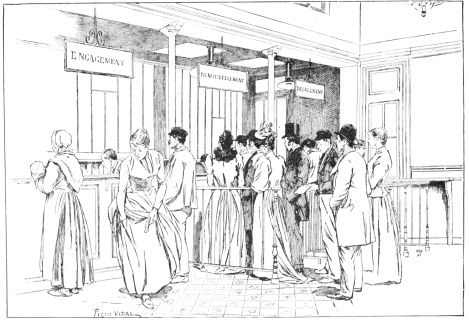 IN THE RUE CAPRON BRANCH OF THE MONT DE PIETÉ
French detectives often show great tact and promptitude. One of them one
day recognised a face without being able to put a name to it, and
followed his man into a ’bus. “Don’t arrest me here,” said the other.
“I’ll come with you quietly when we leave the omnibus.” It proved to be
a prisoner who had escaped that very morning from the dépôt of the
Prefecture, and whom the police officer had only seen for a moment in
the passage. Perpetual suspicion becomes second nature with the
detective; he has to be constantly on the alert, his imagination active;
he must readily invent tricks and dodges when the occasion demands.
There is a positive order that an arrest must be made quietly, if
possible unobserved, and not in any café, theatre, or public place. This
obliges him to have recourse to artifice to entrap his prey.
Fortunately, most criminals are simplicity itself, and readily give
themselves away. It is enough to send a message for the man wanted, and
he will appear at the wineshop round the corner, bringing, say, his
tools to do some imaginary job. But courage is also a quality constantly
shown. It was a French detective who shared the cell with the infamous
Troppmann, and got him to confess the crime when off his guard. The
murderer would certainly have tried to destroy his companion on the
slightest suspicion of his real character.
It is satisfactory to know that very amicable relations exist between
London and Paris detectives, and that they are at all times willing to
assist each other. I have heard that the French greatly admire the
completeness of our Metropolitan Police machinery, its extensive
ramifications, the “informations” or budget of facts and police
circumstances issued four times daily from Scotland Yard, and the
facility with which news is circulated and action started in all—even
in the most remote—parts. Our people have made many famous captures for
the French: François, to wit, and other anarchists; Arton, the Panama
scapegoat, and many more. Not long ago the French police were deeply
anxious to know the exact whereabouts of a certain individual, and sent
over his photograph and description by a trusted agent for distribution
among our police divisions. It so happened—a little aided by good
fortune, perhaps—that the French agent was enabled to put his hand on
the man he wanted the very first afternoon of the search. Maxime du Camp
tells a story of a visit paid to the head of the French police by three
Englishmen, two of them jewellers, the third a London detective, who
were in hot pursuit of an employee who had “looted” the jewellers’ shop.
Directly they had told their story the French official quietly said, “I
know all about it; wait one moment.” A message was sent downstairs to
the prison cells below, and the thief in person was brought up. Then the
jewel boxes with their contents were produced, and one of the jewellers,
overcome with joy, fainted away on the spot. The affair seemed
miraculous, and yet it was perfectly simple. Information had reached the
French police that a young Englishman, but just arrived in Paris, and
staying at one of the best hotels, had pawned five pieces of valuable
jewellery at the Mont de Piété, the great public pawnshop, and out of
curiosity they paid him a domiciliary visit. He was found in his room
surrounded with portmanteaux crammed full of gems, and was detained
pending inquiry.
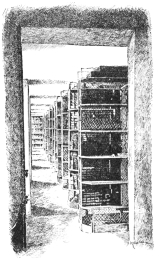 JEWELLERY DÉPÔT, MONT DE PIÉTÉ.
English Detectives—Early Prejudices against them Lived Down—The
late Mr. Williamson—Inspector Melville—Sir C. Howard Vincent—Dr.
Anderson—Mr. Macnaughten—Mr. McWilliam and the Detectives of the
City Police—A Country Detective’s Experiences—Allan Pinkerton’s
first Essay in Detection—The Private Inquiry Agent and the Lengths
to which he will go.
ALTHOUGH the old Bow Street runner either retired from business or set
up what we should now call private inquiry offices, the new organisation
did not include any members specially devoted to the detection of crime.
The want of them caused much inconvenience, and after an existence of
fifteen years the Metropolitan Police was strengthened by the employment
of a few constables in plain clothes, charged with the particular duty
of, so to speak, secretly safeguarding the public. The plan was first
adopted by Sir James Graham, when Home Secretary, and only tentatively,
for the old distrust and suspicion of secret spies and underhand police
processes lingered. There was something unpleasant, people said, in the
idea of a disguised police: personal freedom was in danger; and the
system was therefore tried on a very small scale.[19] No more than a
round dozen were appointed at first—three inspectors and nine
sergeants, but very shortly six constables were added as “auxiliaries,”
and gradually the total became 108, though this was only a small
proportion of the total 6,000 which then made up the whole force.
The real intention and use of the “plain clothes” police was that they
should be ever on the alert, ever at the heels of wrong-doers, and ready
to follow up clues or track down criminals unperceived. They quickly
overcame the early prejudice against them, and began by their
substantial services to win popular esteem. Charles Dickens may be said
to have discovered the modern detective. His papers in Household Words
were a revelation to the public, and the life portraits he drew of some
of the most notable men employed in this comparatively new branch of
criminal pursuit did much to turn suspicion into admiration.
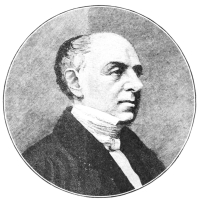 SIR JAMES GRAHAM, FOUNDER OF THE DETECTIVE SYSTEM.
A few words may fitly find place here concerning some of our later
developments of this most useful and not always sufficiently appreciated
class. I should be glad to do justice to the memory of one who spent a
lifetime at Scotland Yard, and was long the very centre and heart of the
detective department—the late Mr. Williamson. Starting as a private
constable and ending as chief constable, he was, from first to last, one
of the most loyal, intelligent, and indefatigable of the many valuable
public servants who have deserved well of their fellow-citizens. Yet to
the outside world he was probably little more than a name through all
his long years of arduous and uncompromising service. Few but the
initiated recognised the redoubtable detective in this quiet,
unpretending, middle-aged man, who walked leisurely along Whitehall,
balancing a hat that was a little large for him loosely on his head, and
often with a sprig of a leaf or flower between his lips. He was by
nature very reticent; no outsider could win from him any details of the
many big things he had “put through.” His talk, for choice, was about
gardening, for which he had a perfect passion; and his blooms were
famous in the neighbourhood where he spent his unofficial hours. Another
favourite diversion with him, until increasing pressure of work denied
him any leisure, was boating. He was very much at home on the Thames, a
powerful sculler, and very fond of the exercise. He never missed till
the very last a single Oxford and Cambridge boat-race, seeing it for
choice from the police steam-launch—the very best way indeed of going
to the race, but a pleasure reserved for the Home Secretary, the police
officials, and a few of their most intimate friends. The police boat is
the last to go down the course, and the first to follow the competing
eights.
One or two especially trying circumstances helped to break Williamson
down rather prematurely. He took very much to heart, as was natural, the
misconduct of his comrade detectives in the notorious de Goncourt turf
frauds. He was at that time practically the head of his branch, and some
of the blame—but, of course, none of the disgrace—was visited upon
him, as it was argued that his men had been allowed too free a hand.
This may have been the case; but he had to deal with men of uncommon
astuteness, who were the more unscrupulous because he trusted them so
implicitly, with the trust of a loyal nature, true to those above him,
and counting upon fidelity from his subordinates.
Mr. Williamson’s active career was also chequered by the diabolical
nature of the crimes which kept him most busily employed. Fenianism
might have been found written on his heart, like Calais on Queen Mary’s,
and, closely interwoven with it, anarchism and nihilism in all their
phases. He knew no peace when foreign potentates were the guests of our
royalties; Scotland Yard was, in fact, held responsible for the safety
of Czar and Emperor, and the police authorities depended chiefly on
Williamson, with his consummate knowledge and long experience of exotic
crime. It
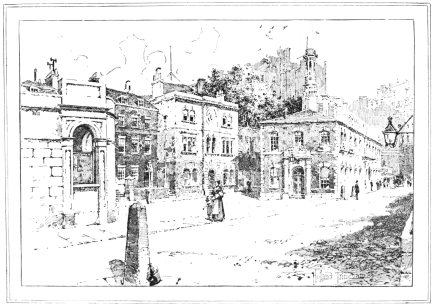 OLD SCOTLAND YARD.
was Williamson who was first on the scene when infernal machines had
exploded, or might be expected to explode at any moment.
To him the officer who is nowadays our chief mainstay and defence
against these outrages, Inspector Melville, owes much of his insight
into the peculiar business of the “special section,” as this important
branch of criminal investigation is called. The latter not long ago
disposed very ingeniously of a case which might have led to serious
mischief. Fertility of resource with great promptitude in action are
among Mr. Melville’s strongest and most valuable traits. Well, on one
occasion, during the visit to England of a foreign Sovereign,
information was received that one of his subjects residing in this
country, and by no means loyal to him, intended to do him an injury the
first time he could get near him in public. It happened that at that
moment the imperial visitor was on the point of joining in a great
procession, which had either actually started, or would start in the
course of an hour or so. The malcontent was employed as cellarman to a
wine and spirit merchant or publican with large wine vaults. There was
no time to lose, and Melville made the best of his way to the place, saw
the proprietor, and inquired for a certain brand of champagne he wished
to purchase. The master called his man and sent them down together into
the cellars. The cellarman went first with a light; at the bottom of the
staircase he unlocked the wine cellar and went in—still first.
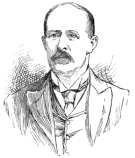 INSPECTOR MELVILLE.
“What wine is that over yonder?” asked Melville carelessly, and the man
crossed over to the far end of the vault to look before he answered.
This was all the astute officer wanted. Instantly seizing the
opportunity, he stepped back out of the cellar, closed the door promptly
and locked it. The irreconcilable cellarman was a prisoner, and was left
there perfectly safe from any temptation to carry out the fell purpose
of which he was suspected. After the procession was over he was set
free.
Most of the prominent detectives of to-day learnt their work under
Williamson—Butcher, the chief inspector, who is as fond of flowers as
was his master, and may be known by the fine rose in his buttonhole;
Littlechild, who earned his first reputation in unravelling and exposing
long-firm and assurance office frauds; Neald, the curator of the Black
Museum, a sturdy, self-reliant, solid detective officer, who, among
other great cases, worked to a successful issue the “Orrock” murder, in
which the syllable “rock” scratched upon a chisel led ultimately to
detection.
The exposure of the detectives’ misdeeds in 1876 brought a superior
official to Scotland Yard, and the first head of the newly named
Criminal Investigation Department was Colonel Howard Vincent. His
appointment was a surprise to many, and his fitness for the post was not
immediately apparent. He was young, comparatively speaking, unknown,
inexperienced in police matters, with no previous record but a brief
military service, followed by a call to the Bar. But he was energetic,
painstaking, a man of order, with some power of organisation; above all,
a gentleman of high character and integrity. His reign at Scotland Yard
may not have been marked by any phenomenal feats in detection; in the
pursuit of criminals he was dependent upon his able subordinates, and it
was his rule to summon the most experienced of them to advise him in all
serious cases. In the more subtle processes of analysis and deduction,
of working from effect to cause, from vague, almost impalpable
indications to strong presumption of guilt, Howard Vincent did not
shine; nor did he always, perhaps, fully realise the value of reticence
in detective operations; but he did good work at Scotland Yard by
raising the general tone and systematising the service.
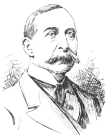 Photo: H. S. Mendelssohn, Pembridge Crescent, W.
SIR HOWARD VINCENT, M.P.
Dr. Anderson, who was chief of the Investigation Department until 1901,
when he resigned, was an ideal detective officer, with a natural bias
for the work, and endowed with gifts peculiarly useful in it. He is a
man of the quickest apprehension, with the power of close, rapid
reasoning from facts, suggestions, or even impressions. He could seize
on the essential point almost by intuition, and was marvellously ready
in finding the real clue or indicating the right trail. With all this he
was the most discreet, the most silent and reserved of public
functionaries. Someone said he was a mystery even to himself. This, to
him, inestimable quality of reticence is not unaided by a slight, but
perhaps convenient, deafness. If he is asked an embarrassing question,
he quickly puts up his hand and says the inquiry has been addressed to
his deaf ear. But I shrewdly suspect that he hears all that he wishes to
hear; little goes on around him that is not noted and understood;
without seeming to pay much attention, he is always listening and
drawing his own conclusions.
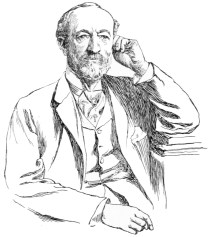 Photo: H.S. Mendelssohn, Pembridge Crescent, W.
DR. ANDERSON.
The chief of the Investigation Department has, of course, to be in close
touch with all his subordinates; from his desk he can communicate with
every branch of his department. The speaking tubes hang just behind his
chair. A little farther off is the office telephone, which brings him
into converse with Sir Edward Bradford, the Chief Commissioner, or with
colleagues and subordinates in more distant parts of the “house.” He is,
and must be, an indefatigable worker, since the labours of his
department are unceasing, and often of the most anxious, even
disappointing, character.
Dr. Anderson’s successor is Colonel Henry, for many years
Inspector-General of Police in Bengal, and more recently employed on
special police duty at Johannesburg. He has been chosen for the post
not alone because of his long police experience, but also because he is
an expert in matters of identification, especially in regard to the
“finger-prints” system and the Bertillon system of anthropometry. Mr.
Macnaughten, the Chief Constable, or second in command of the
Investigation Department, is essentially a man of action. A man of
presence is Mr. Macnaughten—tall, well-built, with a military air,
although his antecedents are rather those of the public school, of
Indian planter life, than of the army. His room, like his chief’s, is
hung with speaking tubes, his table is deep with reports and papers, but
the walls are bright with photographs of officials, personal friends,
and of notorious criminals which Mr. Macnaughten keeps by him as a
matter of business. Some other and more gruesome pictures are always
under lock and key; photographs, for instance, of the victims of Jack
the Ripper, and of other brutal murders, taken immediately after
discovery, and reproducing with dreadful fidelity the remains of bodies
that have been mutilated almost out of human semblance. It is Mr.
Macnaughten’s duty, no less than his earnest desire, to be first on the
scene of any such sinister catastrophe. He is therefore more intimately
acquainted, perhaps, with the details of the most recent celebrated
crimes than anyone else at New Scotland Yard.
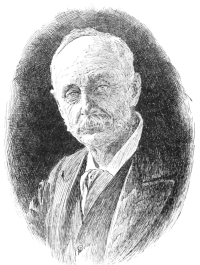 Photo: Byrne & Co., Richmond.
SIR EDWARD BRADFORD.
Nor can the detective officers of the City Police be passed by without
an acknowledgment of their skill and their devotion to the public
service, especially Mr. McWilliam, who has long been chief of the
department. He has repeatedly shown himself a keen, clear-headed, highly
intelligent official, and he has gained especial fame in the unravelling
of forgeries and commercial frauds. The sixth of the so-called
Whitechapel murders, that of Mitre Square, was perpetrated within the
City limits, and brought the additional energies and acumen of the City
detectives to the solution of a perplexing mystery.
 Photo: Maull & Fox, Piccadilly, W.
MR. MELVILLE T. MACNAUGHTEN.
Under such chiefs as these the rank and file of our detectives labour,
assiduously utilising the qualities which really serve them
best—patience and persistence, following the hints and suggestions
given them by their leaders. The best detective is he who has that
infinite capacity for taking pains which has been defined as the true
test of genius. It is not by guesses or sensational snapshots that
crimes are unearthed, but by the slow process of routine, almost
commonplace inquiry, after the most minute and painstaking investigation
of the traces—often of the most minute character—left upon the theatre
of the deed.
 MR. MCWILLIAM.
People whom business or chance has brought much into contact with
detectives must have been struck with their ubiquity. All who have a
good memory for faces or the vision to penetrate disguises will have had
many opportunities of recognising them in strange places and at
unexpected times. The police officer is to be met with in railway
trains, on board steamboats, in hotels, at all places of public resort.
He may
 NEW SCOTLAND YARD.
1. Commissioner’s Room.
2. View from the River (Photo: York & Son, Notting Hill, W.).
3. Principal Entrance.
4. The Western Façade.
be seen in “the rooms” at Monte Carlo, retained by “the administration”
of the casino to keep his eye on the company, or engaged on business of
his own, “shadowing” some criminal or suspect. I have given my coat and
hat to a detective at a great London reception in an historic house,
where many of the guests were titled or celebrated people, but into
which others, unbidden and extremely undesirable, had been known to
insinuate themselves in the prosecution of their nefarious trade. I have
met detectives at a wedding breakfast, at a big dinner, at balls during
the season, and I can safely assert that these “professionals,” in
manners or in costume, were certainly not the least gentlemanlike of the
guests assembled.
There is no better company than a good detective, if he can only be
persuaded to talk—no easy matter, for reticence is a first rule of
conduct in the profession, and he is seldom communicative except on
perfectly safe ground. It was my good fortune once to be thrown with a
well-known member of one of those provincial forces which include many
first-rate detective practitioners. It was some years back, and I am
committing no breach of confidence in recounting some of his
experiences.
“Never let go, sir: that’s the only rule. I like to keep touch of ’em
when once I’ve got ’em,” he began, and he spoke pensively, as though his
mind were busy with the past, and he rubbed his hand thoughtfully over
his chin.
A man dressed quietly but well; his brown greatcoat not cut in the very
last fashion, perhaps, but of glossy cloth and in good style; a pearl
pin in his black silk scarf; and his boots, although thick-soled and
substantial, neatly made. His face was hard, shrewd, but not unkindly,
and there was a merry twinkle in his penetrating grey eyes, which seemed
to see through you in a single glance. Although very quiet and
unobtrusive in manner, he was evidently a man of much determination of
character; it was to be seen in his slow, distinct way of speaking, and
in the firm lines of a mouth which the clean-shaven upper lip fully
showed.
“But I’ve had luck, I won’t deny that. There was that case of them
sharpers down in the eastern counties. It wasn’t till all others had
failed that they put me on to the job. I didn’t know the chap wanted,
not even by sight; and yet I was certain that he knew me. He’d been
doing the confidence trick with a young man of this town, and had
robbed him of over a hundred pounds. He made tracks out of the place—no
one knew where. He was a betting man, and I hunted for him high and low,
at all the racecourses of the country, but couldn’t come upon him. We
were in London, last of all, and it was rather a joke against me at
Scotland Yard, where I had been, as usual, for help. They’d ask me if I
knew my man, and I was obliged to say ‘No.’ And if I thought I knew
where to find him, and I had to say ‘No’ to that too; and they always
laughed at me whenever I turned up. I was just about to travel
homewards, when I thought I’d try one more chance. There happened to be
a sporting paper on the coffee-room table, and I took it up. I saw two
race meetings were on for that day—Shrewsbury and Wye. I’d go for one,
but which? I shied up a shilling, and it came down Wye. So to the Wye
Races I went, with the young man who had been duped.
“The course was very crowded as we drove on. A couple with a great
lottery machine caught my eye; one was taking the money, the other
turning the handle, which ground out mostly blanks. ‘Sergeant,’ whispers
the young fellow to me all at once, ‘that’s him!’ pointing to the man
who was taking the money. But how was I to take him? I got down, and
sent the trap to the other side of the tents, then stepped up to my man
and asked him plump for change for a five-pound note. He knew me
directly, and showed fight. I collared him, and moved him on towards the
trap, when the roughs raised a cry of ‘Rouse, rouse!’—rescue, that is,
you know—and mobbed me. I held on—never let go, sir, as I said before,
that’s the motto; but they broke two fingers of my right hand in the
shindy, and it was all I could do to force the fellow into the trap, but
I did it with my left, while I kept off the crowd with the other arm.
But I nearly lost him again on the way, all through being a soft-hearted
fool. His wife came after us, and at the station begged hard to be
allowed to go down with us. I agreed; what’s more, I took the cuffs off
him, and let them talk together in the corner of the carriage. They
nearly sold me. It was in the —— tunnel, dark as pitch, and the train
making a fine rattle, when the wife put down the window all of a sudden,
and he bolted through. I caught him by the leg, in spite of my game
fingers, but only just in time; and after that I handcuffed him to
myself—his wrist to mine.
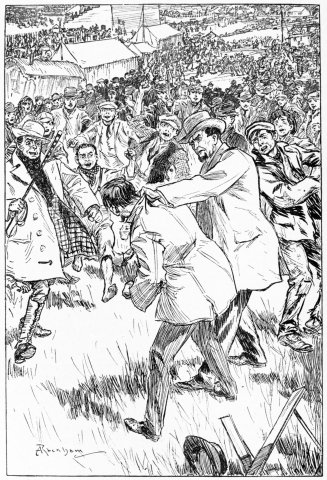 “THE ROUGHS RAISED A CRY OF ‘ROUSE! ROUSE!’ ” (p. 375.)
‘Now,’ says I, ‘where you go, I go.’ And that’s the rule I’ve always
followed since.
“The London police have no very high opinion of country talent, but we
beat them sometimes, all the same—not that I want to say a word against
the Metropolitans. They’ve such opportunities, and so much knowledge.
Now there was Jim Highflyer; he’d never have been ‘copped’ but for a
couple of London detectives. He was a first-class workman was Highflyer,
and he once spent a long time in this town—not in his own name. While
he was here there were no end of big burglaries, and we never could get
at the rights of them. One of the worst of the lot was a plate robbery
from a jeweller’s in Queen Street. A man with a sack had been tracked by
one of the constables a long way that night into the yard of a house,
and there he was lost. The house belonged to one of the town
councillors, Mr. T—— by name, a most respectable man, very free with
his money, and popular. We searched the yard next morning, and found a
lot of the plate in a dust-heap. Mr. T—— gave us every assistance. It
was quite plain how it had come there. There was no suspicion against
Mr. T——, of course; and do what we could, we couldn’t pick up the man
we wanted. By-and-by the town councillor went away for a long spell; the
house was shut up—not let, as he was coming back, he said, and did once
or twice. After he left the burglaries stopped, and I’d have thought
very little more about it all if it hadn’t been that I heard a man, who
had been arrested for an assault, and was in ——shire Gaol, had been
recognised by two London detectives as a notorious burglar, Jim
Highflyer. He’d got a knife upon him, and the name of the maker was a
cutler in this town; also a silver pencil-case, with the name of the
jeweller in Queen Street. I went over to the gaol, and identified the
man at once. It was the town councillor himself, Mr. T——. We searched
his house here after that, and found it crammed full of stolen goods.
You see, there it was the Metropolitans did the job. Highflyer would
have got off with a few weeks for the assault, but they knew him and all
about him. He was ‘wanted’ just then for several other affairs. He got
ten years, did Master Jim.
“But the neatest and about the longest job I ever was concerned in was
young Mr. Burbidge’s case, and that I did in London without any help
from the London police. He was in the theatrical profession; a smart
young chap, greatly trusted by his manager, who employed him as a
confidential secretary, and allowed him to keep the accounts and all the
cash. No one checked one or counted t’other. One fine morning he went
off with a big sum. He’d been to the bank and drawn a cheque to pay the
weekly wages; but he bolted instead, leaving the treasury empty and the
whole company whistling for their ‘screws.’ The manager was half mad,
and he came at once to the police. The chief sent for me. ‘It’s a bad
business, thoroughly bad, and we must get him,’ he said. ‘Spare no
pains—spend what money you like, only catch him, if you can.’ In jobs
of this sort, sir, time goes a long way. Burbidge had got a good start,
several hours or more; it was no use my rushing off after him in a
hurry, particularly as I did not know which way to rush. So I set myself
to think a little before I commenced work. The ‘swag’ stolen was large.
The thief would probably try to make tracks out of the country as soon
as he could; but which way? To Liverpool, perhaps, and by one of the
ocean steamers to the States; or to Hull, and so to Sweden and Norway;
or London, and so to France and Spain. I sent one of my men to the
railway station to make inquiries, and another to wire to the police at
the ports and to Scotland Yard to watch the Continental trains.
“The job I kept for myself was to find out what I could about young
Burbidge’s ways. It’s the only way to get a line on a man who’s made off
in a hurry and left no clue. So I called at his rooms. He lived in
comfortable apartments over a tobacconist’s, and was a good customer to
his landlord, to judge by the number of pipes I saw over the
mantelpiece, all of which were as well coloured as a black-and-tan. The
rooms were just as he left them—he might really have been coming back
in half-an-hour, only he didn’t quite intend to, not if he knew it. The
chest of drawers was full of clothes; there were boots already polished;
brush and comb on the dressing-table. In the sitting-room the slippers
were on the hearth, books, acting-plays lying on the sofa and about the
floor, a writing-desk, but not a single scrap of paper—not a letter, or
an envelope, or even an unreceipted bill. He’d made up his mind to bolt,
and he’d removed everything which might give us the smallest notion of
which way he’d gone.
“It was just the same at the theatre. He’d had a sort of dressing-room
there, which he’d used as an office, with a desk in it, and pigeon-holes
and a nest of drawers. It was all left ship-shape enough. Files of
play-bills, of accounts receipted and not, ledgers, and all that; but
not a paper of the kind I looked for. I made a pretty close search, too.
I took every piece of furniture bit by bit, and turned over every scrap
of stuff with writing on it or without. I forced every lock, and
ransacked every hiding-place, but I got nothing anywhere for my pains.
The manager was with me all the time, and he didn’t half like it, I can
tell you. No more did I, although I wouldn’t for worlds show that I was
vexed. I tried to keep him up, saying it’d come all right—that patience
in these things never failed in the long run; and I got him to talk
about the young chap, to see if I could come upon his habits that way.
‘Who were his friends, now?’ I asked. ‘He’d none in particular—not in
the company, at least, or out of it.’ ‘Ah! who might this be?’ I said
quietly, as I drew out of the blotting-paper a photograph of a young
lady: a fair-haired little bit of a thing, with a pretty, rather modest,
face, which I felt I should know again.
“The carte de visite had the photographer’s name on it, and his
address, that of a good street. This was my line, of course. I made up
my mind to follow on to London at once. Then one of my men came in to
say that Burbidge had been seen taking a ticket—to London? No; only to
Shrivelsby—a long way short of it. It was some game, I felt certain. He
might have gone to London, and paid excess fare; but I wired to
Shrivelsby, and also to town. No one like him had been seen at
Shrivelsby; he hadn’t got out there, that was clear. Only one person
did, and it wasn’t Burbidge; at least, the person did not answer to his
description. It was only a man in a working-suit—a mechanic on the
look-out for work. Nor had he been seen at Euston; but that was a big
place, and he might easily have been missed. So I started for London at
once, taking the photograph and another of Burbidge, whom I had never
seen in my life. It is not difficult to hunt out who owns to a carte de
visite, particularly when the portrait’s that of a theatrical. I got
upon the track of the lady fast enough, directly I went into the
photographer’s place. There was a likeness of her in his album, in the
very same dress, and her name to it, Miss Jessie Junniper. I soon found
out more too. Before night I knew that she was playing at the Royal
Roscius, and that she lived in a street of little villas down
Hammersmith way. I took lodgings myself in the house just opposite, and
set up a close watch. In the morning, early, Miss Jessie came out, and I
followed her to the Underground Railway. She took a ticket for the
Temple Station. So did I, and I tracked her down to the theatre.
Rehearsal, of course. Three hours passed before she came out again. Then
a man met her at the stage door, a very old gentleman, who leant on a
stick, and seemed very humpty-backed and bent. They went down the Strand
together to Allen’s, the great trunk-maker, and through the windows I
saw them buy a couple of those big trunks, baskets covered with black
leather, such as ladies take on their travels. ‘ ’Um,’ thought I, ‘she’s
on the flit.’
“I was only just in time. Then they went down to Charing Cross Station,
and so back to Hammersmith. The old gentleman went into the house with
Miss Junniper, and stayed an hour or two, and then took his leave. Next
day Miss Junniper did not go out. The boxes arrived, and towards midday
an oldish lady—a middle-aged, poorly-dressed, shabby-genteel
lady—called and stayed several hours. But no Burbidge, and nobody at
all like him. I began to feel disappointed. The third day Miss Junniper
went out again to rehearsal; the old gentleman met her as before, and
the two drove in a cab to the City. I followed them to
Leadenhall-street, where they went into the offices of the White Star
Line. I did not go upstairs with them, and somehow I lost them when they
came out. I ought to have guessed then what I did not think of till late
that night. Of course, the old gentleman was Burbidge himself. He was an
actor, and a nipper, therefore, at disguises. He’d been play-acting all
along. He was the mechanic at Shrivelsby, the shabby-genteel old lady,
and the old man most of all. I won’t tell you how I cursed myself for
not thinking of this sooner. It was almost too late when I did. My gent.
had left the villa (to which they had returned), and he did not come
back next day, nor yet the day after; and I was nearly wild with the
chance I’d lost. He’d got ‘the office,’ that’s what I thought, and I was
up a tree. But the third day came a telegram for the young lady. I saw
the boy deliver it and go off, as though there was no answer. Then she
came out, and I followed her to the telegraph-office. I saw her write
her message and send
 “A MAN MET HER AT THE STAGE DOOR, A VERY OLD GENTLEMAN”
(p. 380.)
“A MAN MET HER AT THE STAGE DOOR, A VERY OLD GENTLEMAN”
(p. 380.)
it off. I’d have given pounds to read it, but I couldn’t manage it; the
clerk—it’s their duty—wouldn’t let me. I was countered again, and I
was almost beat, and thinking of writing home to say so, when I saw Miss
Junniper’s message in the compartment where she had been writing. She’d
done it with a hard pencil, which showed through. There was the address
as plain as ninepence—no mystery or circumlocution—‘Burbidge, King’s
Head Hotel, Kingston.’ I was there the same evening, just before his
dinner. I asked if Mr. Burbidge was there. Sure enough. He wasn’t a bit
afraid of being took, I suppose, so far off the line of pursuit, so he’d
stuck to his own name, and was not even disguised. He gave in without a
word. The tickets were on him, and in his bag upstairs a lot of the
cash he’d stolen; likewise a wardrobe of clothes—the old gentleman’s
suit, and all the rest.”
Our American cousins are, as I have said, well served by their official
detectives, but private agents do much of the business of pursuit and
detection, and of these semi-official aids to justice one firm has
gained a world-wide celebrity. Some account of the chief and first of
the Pinkertons may be introduced here.
Allan Pinkerton began life as a cooper, and was doing a thriving
business at Dundee, some thirty-eight miles north-west of Chicago, about
1847. The times were primitive; barter took the place of cash payments
in the absence of a currency. To remedy this inconvenience, a bank was
started in Milwaukee, which throve and had many branches, doing such a
good business that its notes passed everywhere, and were extensively
counterfeited. A gang of the forgers had been discovered by Allan
Pinkerton on a small island in the Fox River near Dundee. Wanting poles
and staves for his trade, he had gone to cut them in the woods, when he
came upon the embers of camp-fires, and signs that the island was
secretly frequented by tramps and others. Pinkerton informed the
sheriff, and active steps were taken by which a large confederacy of
horse thieves, “cover-men,” and counterfeiters was broken up.
The trade still flourished, however, and some of the reputable citizens
of Dundee begged Allan Pinkerton to do further service to his town in
trying to check it. A suspicious stranger had just come to Dundee,
asking for “old man Crane”; this Crane was known as a “hard character,”
the associate of thieves and evil-doers, and an agent, it was thought,
for the distribution of bogus notes. The villagers generally gave him a
wide berth, and when the counterfeit money reappeared in the shape of
many forged ten-dollar bills, this “old man Crane” was credited with
being the centre of the traffic. Any friend or acquaintance of his came
equally under suspicion, and Allan Pinkerton was set to discover what he
could about this new arrival. He proved to be a hale, strong man,
advanced in years, who rode a splendid horse. Pinkerton found him
waiting at the saddler’s, where some repairs were being made to his
saddle, and easily got into conversation with him. The stranger wanted
to know where “old man Crane” lived, and when informed, casually
mentioned that he often had some business with him. Pinkerton seemed to
understand, and the other suddenly asked, “Do you ever deal, any?”
“Yes, when I can get a first-rate article,” promptly replied Pinkerton.
Whereupon the stranger said he had some that were “bang up,” and pulled
out a bundle of notes, which he handed over for Pinkerton’s inspection,
believing him to be a “square man.”
The stranger proved to be one John Craig, who had long been engaged with
a nephew, Smith, at Elgin, in the fabrication of false notes. Pinkerton
said afterwards that he had never seen anything more perfect than these
spurious notes; they were exact imitations, almost without a flaw. They
were indeed so good that they even passed muster at the bank on which
they were counterfeited, and were received over the counter, and had
been paid in and out more than once without discovery. Craig, who
appears to have been a singularly confiding person, went on to tell
Pinkerton, of whom he knew nothing, that “old man Crane” had once acted
extensively for him, but was now slackening off, and that a new and more
enterprising agent was much required. Then he offered Pinkerton the job
to work the entire “western field,” and said he could supply him with
from 500 to 1,000 forged bills, for which he need only pay 25 per cent.
of their face value.
Pinkerton agreed to these terms; he was to raise the necessary cash and
meet Craig by appointment in Elgin, the place of rendezvous being the
basement of the Baptist chapel. Craig said that he never carried any
large quantity of the notes about with him; it was too dangerous. His
regular place of residence, too, was near the Canadian frontier at
Fairfield, Vermont, whence he could quickly make tracks if threatened
with capture. He kept two engravers of his own constantly employed in
counterfeiting and printing; he showed Pinkerton other samples, and
seemingly gave himself quite away. After this, they parted in Dundee,
but the “trade” was soon afterwards completed in Elgin town. Pinkerton
proceeded on foot, taking with him the necessary cash provided by his
friends in Dundee. He met his new confederates at the Baptist chapel and
received the forged bills in exchange for the good money.
Allan Pinkerton, in telling this story, frankly admits that he was
sorely tempted to take up the nefarious traffic. He had in his hand a
thousand ten-dollar notes, representing a couple of thousand
pounds—spurious money, no doubt, but so admirably counterfeited that
they were almost as good as gold. He would have no difficulty in
passing them, and with this capital he might lay the foundation of his
fortune. Pinkerton put aside the evil thought, but he never forgot how
nearly he had yielded, and always sympathised with those who had been
seduced into crime.
 CRAIG UNDERGOING SEARCH (p. 385.)
Pinkerton now lent all his energies to securing the arrest of Craig.
Appointing to meet him again, he offered to buy him out and take over
his whole business. If Craig would only give him time to raise the
necessary funds, he would carry on the concern on large lines. Craig had
no objection, and promised to furnish Pinkerton with a full
stock-in-trade. Another appointment was made for a few days later in a
Chicago hotel, and now Pinkerton arranged for Craig’s capture. A warrant
and the services of a couple of officers were obtained. Craig came, and
the pair entered into business at once. Craig was ready with four
thousand bills and would deliver them within an hour; but Pinkerton
objected, and would not hand over the cash without seeing the bills.
Craig resented this, and, becoming distrustful, broke up the conference,
but on going out he told Pinkerton he would think the matter over and
see him by-and-by.
Craig did in fact return, but when Pinkerton asked him if he meant to
complete the bargain, he denied all knowledge of it, and, indeed, of
Pinkerton. Nothing was to be gained by delay, and the officers at once
arrested Craig, who was taken to a room in the hotel and searched. But
not a dollar in counterfeit money was found upon him, and when taken
before the magistrate he was released on bail. He appears to have used
his money freely in obtaining bail, and soon bolted, gladly forfeiting
his recognisances rather than “face the music.” His disappearance
cleared the neighbourhood of counterfeiters for some years.
It can hardly be said that Allan Pinkerton showed any marvellous acumen
in this detection. But it was a first attempt, and it was soon followed
by more startling adventures.
A special product of modern times is the private inquiry agent, so much
employed nowadays, whose ingenuity, patient pertinacity, and
determination to succeed have been usefully engaged in unravelling
intricate problems, verging upon, if not actually included within, the
realm of crime. I knew one who was employed by a famous firm of
solicitors in a very delicate operation, which he terminated
successfully, but in a way to show that he did not stick at trifles in
securing his end. It was the sequel to a divorce case. The decree nisi
had been granted, and against the wife, who had been refused the custody
of the one child born of the marriage. The husband was anxious to secure
possession of the child, but the wife, like so many more of her sex, was
much too sharp to be forestalled. She had a friend waiting at the court
who, directly the decree was pronounced, started off in a hansom to the
lady’s residence, where the child was, laid hands on it, and brought it
down to Victoria Station just in time for the night mail to the
Continent, by which lady and child travelled together to the south of
France. A detective was at once despatched in pursuit by the husband’s
lawyer, and his orders were at all costs to recover possession of the
child. He soon got upon the lady’s track. She had not gone further than
Monte Carlo. The detective found it impossible to kidnap the child, so
he managed to make friends with the mother, gradually grew very
intimate, paid her devoted attention, and eventually married her. When
he was her husband he had no difficulty in completing his commission,
and—possibly with the lady’s full consent—he soon sent the child home.
I never heard how his marriage—all in the way of business!—turned out.
Another story is, perhaps, more dramatic. A married man of considerable
property, strictly entailed, died childless in India. The estates went
to the next-of-kin, but he, just as he was entering into their
enjoyment, was startled by a telegram from his relative’s widow,
preparing him for the birth of a posthumous child. He at once consulted
his lawyer, who, after warning him that much time and money would
probably be spent in the process, promised to expose the fraud, if fraud
there was, or, at any rate, prove that it was a bonâ-fide affair.
A year passed, and yet the next-of-kin had heard nothing of the case. At
last he went to his lawyers and insisted upon knowing how it stood. He
was told that the matter was now ripe; the lady had arrived with her
infant son. She was actually at that moment at a private hotel in the
West End.
“Go and call on her, and insist upon seeing the child. If there’s any
difficulty about it, go out on the landing and call out ‘Bartlett!’ A
man will come down and explain everything.”
The lady did not produce the child when asked; she said it was out in
the park with the nurse, and tried all sorts of excuses, so Bartlett was
summoned.
“I want to see the child,” said the next-of-kin.
“This lady’s? She has no child. I have been with her now for six months,
and she has asked me repeatedly to get her one—anywhere, in Cairo, at
the Foundling in Malta, here in London.”
“Who are you, then?” both inquired, astonished beyond measure.
And “Bartlett,” having completed his mission, quietly informed the lady,
whom he had been watching, and the next-of-kin, who was really his
employer, that he was the detective engaged to unravel the case.
With such men as this on the side of law and justice, long-continued
fraud, however astutely prepared, becomes almost impossible. The private
inquiry agent is generally equal to any emergency.