MYRA: THE CHILD OF ADOPTION. A ROMANCE OF REAL LIFE. — CHAPTER I. MOTHER AND CHILD.
Transcriber’s Note:
The cover image was created by the transcriber and is placed in the public domain.
Published Semi-Monthly
128 Pages.]
[Complete.
BEADLE’S
The Choicest Works of the Most Popular Authors.
MYRA
THE
CHILD OF ADOPTION.
BY MRS. ANN S. STEPHENS.
New York:
IRWIN P. BEADLE & CO., 141 WILLIAM ST.
Ross & Tousey, General Agents.
Entered according to Act of Congress, in the Year 1860,
by Irwin P. Beadle & Co., in the Clerk’s Office of the District Court of the United States for the Southern District of New York.
BEADLE’S DIME NOVELS, No. 9.
THE SLAVE SCULPTOR;
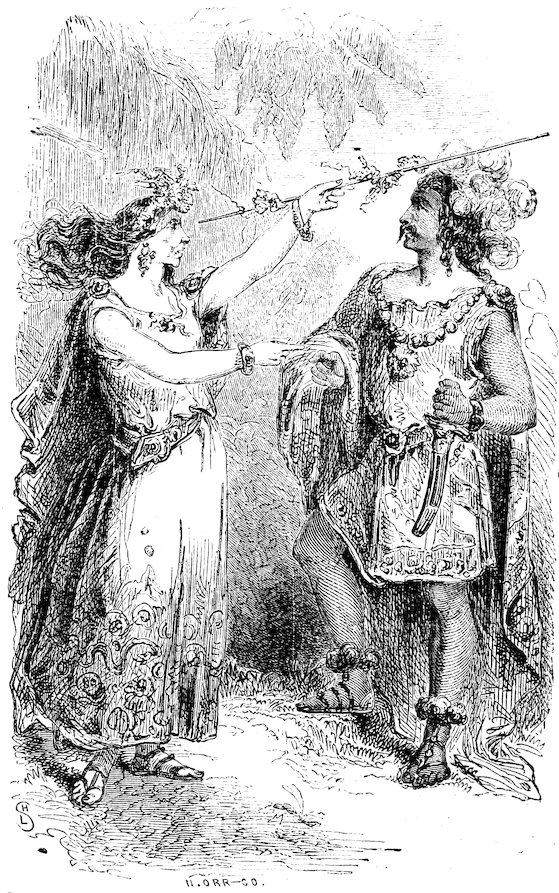
OR, THE PROPHETESS OF THE SECRET CHAMBERS.
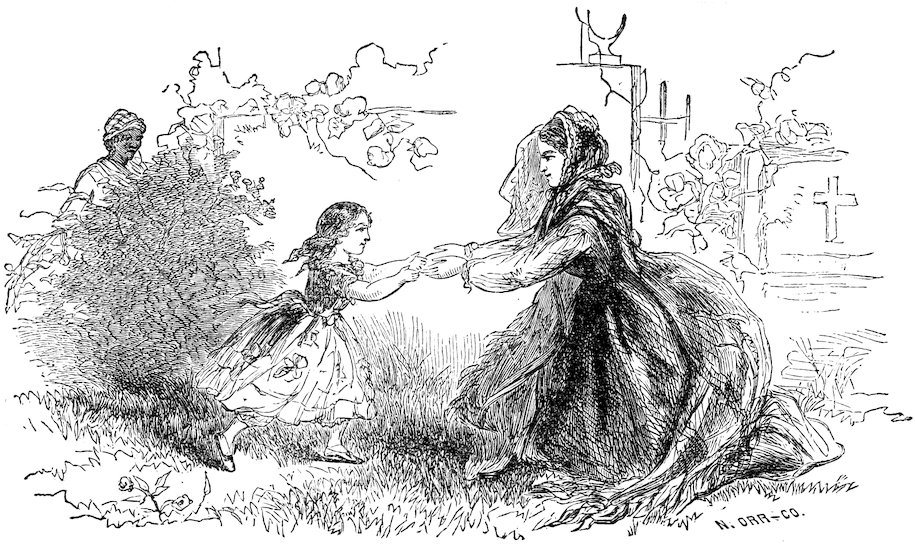
MYRA MEETING HER MOTHER.
BY MRS. ANN S. STEPHENS.
NEW YORK:
IRWIN P. BEADLE AND COMPANY,
141 William St., corner of Fulton.
Entered according to Act of Congress, in the Year 1860, by
IRWIN P. BEADLE & CO.,
In the Clerk’s Office of the District Court of the United States for the Southern District of New York.
Pudney & Russell, Printers,
79 John Street, N. Y.
MYRA,
THE
CHILD OF ADOPTION.
5
“One look upon thy face ere thou depart!
My daughter! it is soon to let thee go!
My daughter! with thy birth has gushed a spring
I knew not of—filling my heart with tears,
And turning with strange tenderness to thee—
A love, O God! it seems so—that must flow
Far as thou fleest, and wrap my soul and thee.
Henceforth thy love must be a yearning charm
Drawing me after thee. And so farewell!”—Willis.
The windows were all open, but shaded fold after fold with
muslin transparent as dew drops, and snowy as the drifts of a
summer cloud. The floor was spread with East India matting,
and in a corner of a chamber stood a couch shaded with clouds
of delicate lace and clad in snow white even to the floor—a
great easy chair, covered with chaste dimity, stood close by
the bed, and further off a miniature couch, snow white also,
save where the soft rose tints of an inner curtain, light and silken,
broke through the waves of snowy gossamer that flowed over
it. Upon the pillow of this pretty couch lay a bouquet of flowers
tied loosely by an azure-colored ribbon, and more beautiful
still a sleeping infant, with one tiny hand resting like a torn peach-blossom,
on its little bosom and its sweet lips parted smilingly, as a
bud uncloses to the warm sunbeam. There, in its snowy nest,
with the fragrant flowers sending their breath in and out through
6the misty draperies, and half smothered in delicate lace, lay the
beautiful infant; and a little way off, upon the larger couch reposed
another being in the first bud and bloom of womanly beauty,
not asleep, but with her large eyes wandering tenderly toward
the infant, and from that to a bouquet of orange-blossoms and
moss-roses that, feebly clasped in her delicate fingers, was yet
falling apart and dropping its blossoms over the counterpane.
An air of gentle languor lay upon this young creature, and
there was something more than that affectionate tenderness
with which a mother regards her young child, in the look that
she, from time to time, cast upon the slumbering infant—a
shade of sadness, that but for her feeble state, might have taken
the strength of passionate regret, seemed ready to break
from her eyes in a flood of tears, whenever they dwelt longer
than usual upon the babe. But when her grief was ready to
break forth, she would allow her eyes to droop toward the
flowers that seemed to have some pleasant association connected
with their fragrance, and a sweet smile—not the less
sweet that there was sadness in it—would part her lips while
a faint sigh floated through them.
All at once the infant began to nestle in its crib, and opening
its large brown eyes, turned them upon the recumbent female.
As if her tears lay so near the surface as to require
only this motion to set them flowing, the young mother, as
she encountered the infantile glance, shuddered faintly, and
large drops gathered in her eyes, and fell one by one over her
full but pale cheeks.
“I must not look at it, I must not learn to love it so,” she
murmured, turning her head away, and shading her tearful
eyes with one hand. “Ah! why should I, a mother so young,
and with a husband like him, always find every feeling, every
impulse shackled as it springs from my heart? Why was
there no one to shield my youth from the blight, that I feel,
too surely, will cling around me to the end?”
The infant began to cry, and there came into the room a
colored woman, tall and with that superb luxuriance of form
that so frequently characterizes the dusky-hued woman of the
South. She approached the crib and took the child in her
arms, hushing it with a sort of cajoling attempt at tenderness,
that seemed to annoy the young mother not a little.
7“Give the babe to me!” she said, feebly reaching forth her
arms.
“Better not, better not, missus,” replied the woman, pressing
her full lips upon the velvet cheek resting on her bosom—a
most unnatural pillow, as the unhappy mother felt all too
keenly. “Nurse said last night that young missus must be
kept quiet, and the baby not left to fret her so much.”
“Fret me! my child fret me! Give it to me, I say,” cried
the young mother so passionately that the color broke over
her pale cheek, like the abrupt opening of a rose-bud. “It is
cruel, it is unkind, thus to keep a babe from its mother’s bosom.
He never ordered it. I know well enough it is not his wish
that I should be tortured in this manner.”
“Take the child to its mother. Why do you hesitate in
obeying your mistress?” cried a firm and manly voice from the
door; and with his lofty step somewhat subdued, a gentleman
entered the chamber, whose air of authority awed the negress
at once. He approached the young female, who had started
eagerly up from her pillow, with every manifestation of deep
tenderness in her voice and manner.
“Have you been waiting for me, Zulima?” he said, bending
down to kiss the fair forehead of his wife. “I was kept longer
than usual at the counting-house this morning.”
“Oh! I knew that you would be here soon,” replied the
young wife, taking his hand between both hers, and kissing it
with a degree of passionate tenderness that thrilled through
her feeble frame, till, in her weak state, excess of feeling became
almost painful.
“What! because I scattered my path to your bedside with
the flowers you have been wasting?” was the smiling reply.
“They were welcome and very sweet, for they told me that
you were soon to follow,” said the young wife, gathering the
scattered flowers together with her hand. “See! your little
daughter has kept hers in better condition. She is not old
enough to tear her flowers to pieces the moment they come
within reach!”
“Like her mother, ha! Zulima!” said the gentleman, shaking
his head, but smiling fondly all the time. “She must have
more patience and less pride than her mother, this pretty
child—or she will be”—
8“As unfortunate and as unhappy as her mother has been,”
said the young wife, and her eyes filled with tears.
“I only hope she will be as lovely and as innocent, whatever
her lot may prove, and as truly beloved, Zulima,” he added,
after a moment’s pause; and with an expression of deep
feeling, mingled with a shade of sadness, the proud husband
gazed upon his wife and child till the tears clouded his own
fine eyes.
For a moment there was silence between the husband and
wife. Both were gazing upon the infant, and both were occupied
with thoughts where pain and tenderness were almost
equally blended. Pride, stern and lofty pride, tinged the
sweet current of his reflections, and she—impulsive young creature—thought
of nothing but her sufferings, her passionate love
for him, and of the beautiful child she was sheltering upon her
bosom with one fairy arm, from which she had impatiently flung
back the loose sleeve of her night-dress, as if detesting the delicate
lawn for coming between her and that little form.
“You will not send her away!” said the young creature,
lifting her eyes to the face of her husband, which was becoming
more and more thoughtful each moment. “Ah! if you
knew how much I love her!”
“I know—I know, Zulima,” said the husband, interrupting
the beautiful pleader with an accent which, though not unkind,
told how the slightest opposition chafed his proud nature.
“It is natural. You must love the child; who could
help it? but do you not love me better?—do you not love its
future fame? its father’s fame?—your own reputation, well
enough to relinquish her for a time?”
“I have thought of it all—I know what the world will say
of me—but I cannot give her up—indeed, indeed I cannot.”
The young mother rose in the bed, and with her child folded
to her bosom with one arm, cast the other round the proud
man’s neck, and drew his face down till it touched the infant,
as she covered his forehead with kisses. “You will keep us
both—you will not take our child from me!”
“Zulima, it must be,” said the husband, drawing gently
back, and freeing himself from her fond embrace, while his
fine features bespoke the terrible pain which it cost him to be
firm. “While the man who has once claimed you for his
9wife remains unpunished, I cannot acknowledge you mine,
legally, innocently mine, as in the sight of Heaven you are.”
“I do not ask it. Let the world think of me as it likes. I
will submit to reproach—to suspicion—any thing—but leave
my child—never!”
“Zulima!” was the firm and almost reproachful reply; “do
you think that your reputation is separate from mine? Shall
I cast a stain upon my wife which no after time can efface,
and then produce her, wronged and sullied, to society? Listen
to me, Zulima; cease weeping and listen! The man is yet
alive who has called you wife”—
“I know—I know!” cried the poor young creature, shuddering
from head to foot, and burying her face in the pillows;
“Oh say no more! I will give up the child—but spare me
that subject!”
“No, Zulima. Let us speak of it this once, and then it
shall be banished our lips forever. Think you that it is not
painful to me as to you?”
How painful it was might be guessed by the colorless cheeks
and the quivering of that proud man’s lips while he was speaking.
“While a mere child you became the dupe and victim of
this vile man, De Grainges. He wronged your confidence,
wronged your love”—
“No, no! I did not love him—I was a child—I knew not
what love was!” broke in passionate murmurs from the pillow
where Zulima’s face was buried. “Do not say I loved that
man!”
“My poor wife! I know that you did not love him. I
know quite as well that you do love me. Look up, sweet
child! I would give worlds that I could speak of all this without
distressing you thus. Bear with me only a minute longer.
My only wish is to reconcile you, if possible, to the inevitable.”
“I will listen,” replied the tortured young mother.
“I know, Zulima, that you were deceived by this bad man—that
he wedded you while his wife was living, and that you
fled from his home the moment this truth was made known.
Of all this I was thoroughly convinced before you became my
wife; but until this man is convicted in open court and before
the whole world, how can I convince society of that which to
10me is a sacred truth? how, before the fact of his previous marriage
is thus publicly substantiated, can I proclaim the union
which has made me more than happy? Zulima, I am a proud
man—sensitive to public opinion—careful of my standing in
the world. Were a breath of suspicion to rest upon the fame
of my wife, I should never be happy again. You are young—supposed
to be unmarried—living here under the roof of my
dearest friend, who, with one exception, is alone in my confidence.
In a few months this man, now in prison, will receive
the punishment of his crime. Do you not see the peril of
keeping this child with you till after that event enables me to
claim my wife before the world? Zulima! look up—say that
you forgive me the pain I am causing—say, that, for my sake,
you will submit to have this little one sent from you for a season—only
for a season.”
Subdued and touched to the heart by the depth of feeling
with which this appeal was made, Zulima arose from the pillow
where she had been striving to subdue her grief, and taking
the infant in her trembling arms, motioned her husband to
receive it. The moment she was relieved from the sweet burden,
the young creature fell back, and closing her eyes, tried
to check the grief that, however suppressed, still clamored at
her heart. It was all in vain: the tears gushed like shattered
diamonds though the thick and silky lashes, and she grasped
the counterpane nervously with one hand, in a terrible strife
to force back the agony that was choking her. Poor young
mother! she felt with that keen intuition, which is like a prophecy,
that she was not parting from her child for a season, but
forever.
“You consent, Zulima? You will give up our little one
with no anger, and without all this bitter grief?” cried the
strong man, pale as death, and bending over the young mother,
with the child pressed to his bosom.
“I will, I do,” burst from those pale and trembling lips.
The husband turned away; his limbs trembled, his eyes
were blinded with moisture, and the weight of that little babe
seemed to bend and sway his strong frame, as if he had been
a reed. He looked back upon the mother. There she lay,
the wet eyelids closed and quivering—her white lips pressed
together, and so pale, that but for the agitation of her features
11she might have seemed stricken dead in the midst of her anguish.
He returned to the couch.
“Zulima, would you kiss the babe before it goes!”
“I dare not—I dare not,” broke from those pale lips; then
Zulima held back her sobs, for his footsteps were departing—a
door closed—husband and child both were gone. Then the
mother’s anguish broke forth, her arms were flung upward,
her quivering hands clasped wildly together—a moment and
they fell heavily upon the orange flowers that still littered the
bed, crushing them in her utter insensibility.
Then, while the young wife lay so pale and deathly there stole
toward the bed that negro woman, who bent down till the
bright Madras ’kerchief turbaning her forehead mingled with
the chestnut tresses that lay scattered over the shoulder and bosom
of the sufferer. She listened a moment, as if to make herself
quite certain that what seemed so deathly was not death
itself, and then glided from the chamber.
The negress stole softly through the open hall, and into a
spacious garden; a row of small white buildings stood at the
farther extremity, gleaming in snowy patches through the
vines and trees that embowered that portion of the garden.
These were the slave-dwellings belonging to a rich plantation
some three miles from New Orleans—belonging to the husband
of Zulima, and occupied for a season by his bosom friend that
the infancy of his child might be honorably sheltered. And
here in a little whitewashed room of the slave dwelling this bosom
friend was impatiently watching the approach of the female
slave whom he had placed—a dark spy—in the bed-chamber
of that helpless young wife. With his face close to one of
the four panes of glass that admitted light to the humble room,
he watched the fiery colors of the Madras turban, which the
woman always wore, as it glided like some gorgeous bird
through the thick foliage, nearer and nearer to the den where
he had for two hours been waiting for news from the sick-chamber.
The slave entered her dwelling, and sat down before
her master, full of that consequential assumption that a little
power is certain to call forth in one of her ignorant and degraded
class.
“Well, Louisa,” said the master, with a show of careless indifference,
for he was of a cool and subtle temperament, with
12passions slow and calculating, but all the more grasping for
the deliberation, with which, like well-trained hounds, they
were let free from the leash of his strong will; “Well, Louisa,
how is the lady this morning?”
“Oh, she am about de same, Massa Ross—no danger of her
going off dis bout anyhow,” replied the negress, turning her
head on one side and moving a palm-leaf fan before her face,
with an air of self-conceit that made her auditor smile, spite of
his preoccupation.
“She just had a little fainting spell when I come out, but it
won’t last long—no danger!”
“Has she had any visitors this morning—has he been there,
Louisa?”
“Dar, now, you ask me dat, Massa Ross, just as if he didn’t
come ebery morning of him life.”
“Then he has been there,” rejoined the man, “and left her
fainting. Tell me, Louisa,—oh here is the Napoleon that I
promised.”
“There, that am something like Massa Ross,” and the negress
tied the gold in a corner of her handkerchief, and thrust it
into her bosom. “Yes, he was there a long time.”
“Well,” interrupted Ross, evidently getting impatient, “tell
me all that passed, word for word; do not forget a look or a
syllable—and another gold piece is ready when you have
done.”
And the negress, thus stimulated, told him all. That scene of
tender anguish—the struggle of love and pride which she had
witnessed in the sick chamber—all was related; and oh! how
its exquisite pathos, its touching dignity was desecrated by the
vulgar mind and coarse speech of that slave woman!
Ross listened to it all, his face changing with every sentence;
for, with only that coarse witness, he did not think it necessary
to control his features with the dissimulation that had become
a habit. He listened, and as he felt, thus the evil man looked.
When the woman ceased speaking the exultation of a fiend
was in the smile that curled his lip.
“And he was determined—spite of her caresses, spite of her
tears. I knew that it would be so. He is not a man to
waver, having once taken a resolution—but the child, Louisa?
I have recommended a woman up the river to take charge of
13it, but you, my good Louisa, must still be its nurse. It seems
a feeble little thing; do you not think so, Louisa?”
“Feeble! Lor a massa! No; it’s the best-natured, healthy
little thing I ever see,” was the reply, and Louisa agitated her
palm-leaf fan with considerable violence.
“But away from you, Louisa, with some one less kind, it
may become sickly in a very little time, you know.”
“Sure enough!” and Louisa half suspended the action of
her fan, as she fell into a fit of profound contemplation.
“With you to give it medicine and superintend, if it were
ill, I should feel quite safe,” said Ross, and a strange, fiendish
smile crept over his lips. “Of course, I should come and see
you very often.”
“Oh! you would. Well, den, I haven’t nothing to say
against going with the baby.”
“Wherever I send you, Louisa?”
“Well, yes, I don’t care, if it isn’t so far off that you can’t
come once a week or so to see us, Massa Ross; but I won’t
go far, now I tell you.”
“Well, now, go to your charge. I will see you again to-morrow.”
The negress arose, and with an insolent twist of her head to
the left shoulder, stood in the door-way fanning herself.
“Well,” said Ross, impatiently, “well, what are you waiting
for now!”
“Dis piece of gold in my bosom, Massa Ross,” and the negress
placed a plump ebony hand upon her heart. “It is ’gun
beginning to feel lonesome.”
“Oh! I had forgotten; here, here.”
Louisa drew forth the pocket handkerchief, which, from its
embroidery and exquisite lace, must have been purloined from
her mistress, and a second Napoleon was nested in her bosom.
“Stop,” said Ross, as she was going out; “You said that
the lady was fainting—that he took the child forth in his arms.
Where is it now?”
“How should I know? I s’pose he took the baby to your
wife. She was in the back parlor, and he turned that way.”
“There he is now. Go back into the room, Louisa, go
back!” Ross seized his hat as he spoke, and leaving the
slave-house, wound through a grove of fruit trees that sheltered
14him from sight, and taking a serpentine path, came leisurely
forth into that part of the garden, where he had seen Mr.
Clark. The proud man was walking hurriedly forward, his
arms folded, and one white aristocratic hand thrust into the
bosom of his black dress. He was very pale, and his finely
cut features bore traces of great internal anguish. He saw
Ross, and turned quickly toward him.
“It is over, my friend; it is all over,” he said, grasping the
hand which Ross extended, and wringing it hard. A smile,
full of proud anguish, broke the firm and classical beauty of
his mouth, and his eyes spoke volumes of suffering.
“What is over? what has happened?” inquired Ross, startled
and turning almost as white as his friend.
“My wife! my child!”
“What of them? what has happened to them, my friend?”
“Nothing but that which was inevitable. But Zulima, my
poor, poor wife! It would wring your heart to see how she
suffers from the separation from her child.”
“But the child; is it yet with her?”
“Hark!” said the other, lifting his hand. “Do you not
hear?”
It was the sound of a carriage driving rapidly from the
house. Mr. Clark seemed listening to the sound as if his life
was departing with it—fainter and fainter from his bosom.
There was something in his countenance which Ross dared
not disturb, though his soul was burning with curiosity to
know why the common sound of carriage-wheels grinding
through the gravelly soil should so profoundly agitate his
benefactor. The sound grew distant, and died away before
another word was spoken, then Mr. Clark turned toward his
false friend, his nerves hitherto drawn to their most rigid tension
relaxed, and his eye met the gaze with which Ross was
curiously regarding him with an appeal for sympathy, that
would have touched a heart for stone.
“It is gone!” he said, in a broken voice. “My child is
gone!”
“Your child gone? when, where?” cried Ross, fearfully
excited. “Surely you have not sent the infant from its
mother so abruptly—and—and without consulting—I mean
without informing your best friend.”
15“That carriage—you heard it—bore away Zulima’s child!”
said the unhappy father, mournfully.
“But where has it gone? With whom is it placed?”
“It is placed with one whom I have long known, the
noble and childless wife of an old and dear friend. Myra will
be to them as an own child, till I claim her again.”
“And may I not know the people, and the place?” inquired
the false friend. “The child of my benefactor is dear to me
as my own.”
“I have pledged myself to secrecy in this. It was the desire
of my friend,” repeated Mr. Clark; “but for that you should
know every thing. All this concealment will soon be over; a
few weeks and this man must be sentenced. Then wife and
child shall take possession of their home before the world. In
this you can help me. I can not well appear in person to
press forward this man’s conviction, but you, my friend, will
use every effort to relieve me from this painful position. My
poor wife scarcely suffers more than I do!”
“I will do every thing that you desire. Indeed, the commonest
gratitude should insure that,” said Ross, pressing his
patron’s hand, but with restless and nervous haste in his manner.
“Shall I set out for the city at once?”
“No, no; seek your wife first; tell her to comfort my poor
Zulima. I can not see her now; without wishing to reproach
me, she could not help it. I tell you, Ross, I would rather
encounter a squadron of armed men, than the look of those
soft eyes, as they followed her child this morning, when I took
it from her. It was the glance of a wounded fawn, as we
have often seen it, turned upon the hunter.”
“I will see my wife at once,” replied Ross, unable with all
his duplicity to conquer the disappointment that was consuming
him; “then I will depart for the city, and make a strong
effort to bring De Grainges to his trial.”
“It is strange,” said Mr. Clark; “but some influence that
I can not fathom seems to keep back this man’s sentence.
The court, as if it were trifling with his case only to perpetuate
my troubles, keeps putting off his sentence from day to
day with cruel pertinacity. But now I am resolved that it
shall be more prompt; this hidden influence must and shall
be revealed.”
16Ross listened to the first portion of this speech with a cold
and crafty smile playing and deepening about his mouth, but
at the close this smile died away, and with it every vestige of
color—his eyes wandered rapidly from object to object, avoiding
the face of his benefactor, and when Mr. Clark would have
spoken again, he forgot all the habitual deference of his manner
and interrupted him.
“Have no trouble about this man, De Grainges; I will attend
to him at once. The cause of this unaccountable delay
in the court shall be ascertained and remedied. Now that I
see how deeply your happiness is involved, no effort shall be
wanting on my part to bring the trial to an issue. To this
end, I must start for the city at once.”
Ross held out his hand, and grasped that of his patron.
“Accomplish this for me, Ross, and no being ever lived
more grateful than I shall be,” said the generous man. “I depend
on you.”
“You may, most positively,” was the emphatic reply; and
wringing the hand he held, Ross left the garden. He met a
servant in the hall, and accosted him with the sharp command
to have a horse saddled. Then, passing into the inner room,
he spoke a few hasty words, not to his wife, but to the black
woman, Louisa, and then hurried to the stable.
With the sluggish habits of his race, the negro was lazily
dragging forth a saddle from its repository, when his master
came up booted, and with a riding whip in his hand.
“Walk quick, you scoundrel!” he said, laying the whip
over the sleek negro with a force that made the old fellow
start into something resembling haste; but even this unheardof
activity did not satisfy the master; he snatched the saddle,
flung it over the horse, and set his teeth firmly together, as he
buckled the girth. Sharply ordering the man out of his way,
he sprang upon the horse and dashed toward the city, at first
in a light canter; but the moment he was out of sight, the
high-spirited animal was put to the top of his speed, and horse
and man flew like lightning along the road.
At each turn of the road, Ross would lean forward on his
saddle and take a new survey of the distance, muttering his
disappointment in half-gasped sentences, as he sped along.
“Oh, if I could but overtake the carriage before it reaches
17the city! A single glimpse of it might be enough—nothing
should take me from the track; nothing, nothing. Ha! that
is it—no, only a sugar-cart. Why did I let him keep me? I
must, I will know who these people are—no, no, I am foiled
at last!”
This exclamation was followed by a sharp check to the
horse, who was still bounding forward at the top of his speed.
The city lay before him; but along the winding highway,
over which his eye ran like lightning, there was no carriage
at all resembling the one that Louisa had described to him as
that which had borne her young charge away.
At a slow pace, but with his horse reeking with the effects
of his former hot speed, Ross rode into the city. He took a
circuitous route, to his own counting-house, and held a long
consultation with a young man whom he found there. This
lasted several hours; and then the two walked arm-in-arm
toward the city prison.
Through the gloomy labyrinths of this prison the two men
made their way, conversing together in low voices; a turnkey
went before them, humming a tune to himself, and sometimes
raising an accompaniment by playfully dashing a huge iron
key, which he held in one hand, against the door of some
prisoner’s cell, smiling grimly as he heard the poor inmate
spring forward, in the vain hope that some friend had come
to break the gloom of his bondage. From time to time, the
two visitors seemed to study this man’s face with close scrutiny;
and as some new manifestation of character broke forth
in his manner or his song, they would exchange glances that
were full of meaning.
“Offer him gold!” whispered Ross to his companion; “say
that is for his trouble; we can judge something by the manner
in which he receives it.”
“True,” was the emphatic but whispered reply, “it will be
a sure test.”
The officer paused at the entrance of a cell, and placed his
key in the lock. “This is De Grainges’ cell, gentlemen; how
long will you wish to stay with him?”
“We may wish to remain so long that you will suffer some
inconvenience,” said Ross’s companion, dropping his hand into
a pocket with that easy grace which renders the most singular
18acts of some men perfectly natural in their seeming. “Here
is something to repay the trouble we may occasion.”
The turnkey reached forth his hand eagerly for the silver
coin which he supposed the stranger was about to offer him,
but when he saw a bright piece of gold glittering in his palm,
the sudden joy of his heart broke with a sort of gloating ferocity
over his face, and with a low chuckle he folded his other
hand over the gold, and began to rub the palms together, with
the coin between them in a warm clasp, as if he thought
thus to infuse some portion of the precious metal into his own
person.
Ross and his companion had stepped within the cell, and
thus, clouded with semi-darkness themselves, watched the
man, whose face was fully revealed in the broadly-lighted
corridor.
“It will do,” whispered Ross, smiling, “it will do.”
“Yes,” said the other thoughtfully; “he is one of those
who would sell his soul for money.”
The man said this with the air of one who reflected sadly
upon the infirmities of human nature, and really felt shocked
at the gross cupidity that himself had tempted; and so it was.
He did not reflect that he himself was there for no purpose on
earth, but to barter his own soul for the very yellow dross,
only in a larger amount; that he was ready to yield to this
man’s bartered treachery; that all the difference between himself
and the man he tempted, lay in the price which each set
upon his integrity. But the great villain despised the lesser
sincerely, and sighed that human nature could be so degraded.
So it is all over the world. Those who shroud their crimes
in purple and fine linen, ever do and ever will look down
with benign contempt on those who fold lesser crimes scantily
in poverty and rags; so scantily that the world sees them as
they are, coarse, rude, and glaring.
Thus, shaking their heads and sighing over the degeneracy
of the human heart, these two arch-villains entered the cell of
De Grainges, the bigamist, leaving the officer without to gloat
over his piece of gold.
A tall man, pale from confinement, and yet possessed of a
certain air of languid elegance, sat within the cell writing. He
looked up, as the two visitors entered, and regarded them with
19an expression of nervous surprise, but observing that they were
gentlemen in appearance, arose courteously, and placed the
chair, in which he had been sitting, for Ross. The cell contained
but two seats, and the prisoner stood up with his arms
folded, and leaning in a position that had much grace in it
against the wall.
“You have come, gentlemen,” said the prisoner, in a low,
sad voice—“you have doubtless come to tell me that the time
of my sentence has arrived?”
“No,” said Ross; “that would be a painful task, and one
from which we are happily saved. We come, as friends, to
ask some questions regarding this singular case. Perhaps we
may have the power—we certainly have the will—to serve
you.”
“It is too late,” replied the prisoner, sadly. “My trial is
over. Why they have not sentenced me before this is incomprehensible.”
“To you, perhaps, but not to us. You have strong friends
outside; those who have done something in keeping back the
sentence, and may do more—obtain, for instance, a new
trial.”
“To what end?” questioned the prisoner. “I am guilty.
I have confessed it. In the wild delirium of a passion that
was never equaled in the heart of man, I married the most
confiding and lovely creature that ever lived. The fraud was
detected. My wife—my living wife forced herself into the
home where I had sheltered my falsely-won bride. Zulima
would not love the villain who had wronged her. She left
me; and without her I care very little whether it is to a
prison or a grave.”
“But what if Zulima loved you yet? What if she only
desired that in this trial your right to her could be established?”
The prisoner shook his head.
“I only say,” continued Ross, “if this were the case; if a
new trial were granted, if there was no lack of funds to pave
the way through court, would you not, having a new trial,
suppress the proofs of this former marriage? Might not your
wife herself be persuaded to aid in clearing you?”
“No,” replied the prisoner, firmly. “It could not be. My
20wife pursues me with that strong hate which is born of baffled
passion. Zulima ceased to love me.”
“Because she believed her marriage unlawful,” said Ross.
“It was unlawful. I have acknowledged it again and
again. Zulima had nothing left—nothing but her freedom
from the man that had wronged her to hope for. I would
not deprive her of that.”
“And if the means were before you? If you could obtain
a new trial, this first marriage, you are certain, would be proven
against you?”
“I am very certain,” replied the prisoner.
“Remember, if they fail to prove the first marriage, you are
free forever, and Zulima is your lawful wife. Is not this
worth an effort?”
The unhappy man clasped his hands, and for a moment
there broke through his sad eyes a luster that was perfectly
dazzling.
“Worth an effort!” he said. “Oh, heavens! I would die
but to see her look upon me again with love for a single moment.”
“Then why not make the effort?”
“Because I know that Zulima has ceased to love me. She
is young, beautiful. I feel that she has brought me here, not
for revenge, but that herself may attain honorable freedom. I
would not raise my hand to thwart her in the just object.”
The two men looked anxiously at each other. They were
astounded by the strange magnanimity of the prisoner.
“I tell you,” said Ross, earnestly “this thing can be brought
about. Your counsel have seen the witnesses. Gold is a
potent agent. Even your wife yields; she will not appear.
You can be cleared of this charge; you can claim Zulima as
your lawful wife. We pledge ourselves to accomplish all that
we have proposed.”
“Gentlemen, you seem kind, and I thank you; but I know
that the wrong which I inflicted on that young girl has been
followed by her aversion; she has told me so. She is not my
lawful wife; without her love—her firm, earnest love, I would
not claim her if she were. All that she desires is freedom;
that she shall have, though it cost my life instead of a few
years’ imprisonment.”
21Ross arose and went into the corridor, where he conversed
in a low voice and very earnestly with the turnkey. Meantime
the prisoner sat down in the empty chair, and burying
his face in his hands, seemed to be lost in bitter thought.
When Ross returned he arose and stood up, but his face was
haggard, and he seemed to suffer much from the struggle that
had been aroused in his breast.
“Then you are determined not to claim a new trial?”
“I am,” was the reply.
“Perhaps it is as well; but we are the friends of Zulima.
She suffers, she shrinks from the thought of your imprisonment.
This new appeal may be impossible, but there is another
way. Your trial has done all for Zulima that can be
accomplished; it sets her free. Now she would give that to
you, which your self devotion will secure to her—freedom.
To-night, De Grainges, the means of escape will be provided;
at daybreak, to-morrow, a vessel sails for Europe; you must
become one of her passengers.”
“And does she desire this?” asked the prisoner, aroused all
at once from the stubborn resolve of self-sacrifice that had
possessed him.
“She does; we are her messengers.”
“To-night—this is sudden! and she desires it? She deems
the trial that has taken place sufficient for her emancipation
from the hateful bonds that made her mine. You are certain
of this?”
“Most certain.”
“And the means of escape?”
“Leave that to us. The time, midnight; be ready. That
is all we desire of you.”
“I will be ready,” said the young man, falling into the
chair which Ross had just left, and overcome with a sudden
sense of freedom—freedom given by the woman whom he had
so deeply wronged. His nerves, hitherto so firm, began to
tremble, and covering his face with both hands, he burst into
tears. When he looked up the two strangers had left the cell.
The next morning, when Ross entered his counting-room,
he found the turnkey talking with his partner. Just then
Mr. Clark entered also, but with a harassed and anxious expression
of countenance.
22“My friend,” said Ross, advancing toward him, “you have
come at the right moment to hear this man’s news from his
own lips. I fear it will give you pain. No, I had better tell
it myself; he is a stranger, and knows nothing of your interest
in the mother. Step this way, sir.”
“What is this? For what would you prepare me? Zulima—”
“Is well, and becoming reconciled to her loss; but De
Grainges—”
“What of him, sir? what of that unhappy man?” inquired
Mr. Clark, sternly.
“He has broken prison; he escaped last night.”
Mr. Clark staggered. The color left his lip, and he leaned
heavily on the back of a chair. “My poor, poor wife! will
her trials never have an end?” he exclaimed with deep feeling,
and, turning hastily, he left the counting-room.
“It will be some time before he acknowledges her now,” said
Ross, in a low voice, to his partner. “See how his step
wavers.”
“That may waver, but his pride never will,” was the low
reply.
“Never!” said Campbell.
And he was right. Poor, poor Zulima!
CHAPTER II.
23
Trifles, light as air,
Are, to the jealous, confirmations strong
As proofs of holy writ.—Othello.
It was spring-time in the South—that rich, bright season
more luxurious in foliage and profuse in fragrance than our
warm and mellow summers ever are. The orange-trees were
all in flower; carnations blushed warm and glowing upon the
garden banks; the grass was mottled with tiny blossoms, gorgeous
and sweet as the air they breathed. All around the
house which Zulima occupied was hedged in with honeysuckles
and prairie-roses, that sheltered the grounds and leaped
up here and there among the magnolia-trees, lacing them
together in festoons and arcades of fantastic beauty.
Poor, poor Zulima! With this beautiful paradise to wander
in, with the sweet air, the warm sky, and all that world of
flowers, how unhappy she was! Alone—utterly alone!—her
child slept in the bosom of another; her husband had been
months away in the far North; an unacknowledged wife, a
bereaved parent, how could she choose but weep? Weeks
had gone by and no letter reached her; at first her husband
had written every day; and with his letters, eloquent of love,
lying against her heart, she could not be wholly miserable;
thinking of him she sometimes forgot to mourn for her child.
At first she had been greatly distressed by the impediments
which the flight of De Grainges had multiplied against the acknowledgment
of her marriage, but this event had in no degree
shaken the holy trust which that young heart placed in
the object of its love. Singularly unambitious in her desires,
but impetuous in feeling, she only felt the continued secrecy
maintained regarding her marriage, because it separated her
from the babe she had learned to love so intensely. True, it
served as a restraint upon her husband, and frequently deprived
24her of his presence, but with her imaginative nature,
the slight romance of this privacy only served to keep her
affections more vivid and her fancy more restless. She was
all impulse, all feeling, and sometimes, like a caged bird, she
grew wild and restive under the restraints that necessity had
placed upon her.
Weeks went by, one after another, and now Zulima grew
wild with vague fears. Why was he silent? where could he
be wandering thus to forget her so completely? Her nights
were sleepless; her eyes grew bright and wild with feverish
anxiety. That young heart was in every way prepared for
the poison which was to be poured into it drop by drop, till
jealousy, that most fierce and bitter of all the passions, should
break forth in its might and change her whole being.
Zulima had gone forth alone, not into the garden to sigh
among its wilderness of blossoms, but away, with an aching
heart and pale forehead, to suffer among the wild nooks of
the neighboring hollows. Here nature started to life in harsher
beauty, and sent forth her sweets with a sort of rude waywardness,
forming a contrast to the voluptuous air and over
cultivation that closed in her home, as it were, from the rough
and true things of the world.
Another day was to be passed in that agony of impatience
which none but those of a highly imaginative nature can ever
dream of—a weary night had been spent, the morning had
come—surely, surely that day must bring a letter from the
absent one.
The air of her chamber—that chamber where her child had
slept in her bosom, where he had been so often—she would
not wait there; all the associations were so vivid, they goaded
her on to keener impatience. She could not draw a deep
breath in that room, thinking of him and it.
So, as I have said, Zulima stole forth and wandered away
where all was wild as her own feelings, and a thousand times
more tranquil. Ross had promised her to return very early
from the city that day, when he hoped—the villain could not
look into her eyes as he said it—when he hoped to bring a
letter that would make his sweet guest smile again.
Zulima knew a place near the highway which led to the
city, and yet sheltered from any traveler that might
25pass, by the broken banks of a rivulet. Thick trees fell over
it, and in some places the water was completely embowered
by their branches. She could hear the tread of a horse from
the spot, should one pass up from the city; and so, with a
cheek that kindled and a heart that leaped to each sound, the
young creature sat down to wait. To wait! oh, how hard a
task for her untamed spirit, her eager wishes! Never till her
marriage with Mr. Clark had Zulima’s vivid nature been fully
aroused; never before had she been capable of the exquisite
joy, the intense suffering that marked every stage of her attachment
to that lofty and singular man. As she sat then by
the lonely brook, the young creature gave herself up to a
reverie that embraced all her life, for life with her seemed to
have commenced only since she had met him. She drew
forth his letters and read them again and again; tears blinded
her sometimes, but she swept them away with her fingers,
and read on, kissing here and there a line that spoke most
eloquently to her heart. She came to the last letter; that
was more ardent in its language, and warmer in its expression
of love, than any of the others had been. Why was this the
last? What had happened to check a pen so eloquent, to
chill a heart so warm? Was he dead? This was Zulima’s
thought; she never doubted his faith or distrusted his honor
for a single moment. When the serpent jealousy reaches
a heart like hers, it comes with a fling, striking his fang suddenly
and at once. Zulima was not jealous, but that fierce
pain lay coiled close by her heart, ready to make a leap that
should envenom her whole being. More than once Zulima
had started from her seat at some slight sound, which proved
to be only a bird rising from the overhanging bank, or a rabbit
leaping across the thick sward, and thus, between hope and
despondency, dreams and thoughts of the stern real, the time
crept by till noon. A wooden bridge scarcely lifted above
the water, spanned the brook only a few yards from where
Zulima was sitting. Here the bank fell abruptly, giving descent
to a pretty cascade half swept by a sheet of pendant
willow-branches. Their delicate shadows, broken with long
gleams of sunshine falling aslant the water, told Zulima that
the time of Ross’s return was fast drawing near. Now she
became cruelly restless. Like some bright spirit sent down
26to trouble the waters at her feet, she wandered along the
broken bank, gathered quantities of wild-flowers but to cast
them away at the least noise, and frightening the ground-birds
from their nests with reckless inattention to their cries,
always listening, and half the time holding her breath with
impatient longing for something to break the entire solitude
that encompassed her.
It came at last—the distant tread of a horse—more than
one—Zulima’s quick ear detected that in an instant. Still she
could not be mistaken in the hoof-tread; she had heard it a
hundred times when her heart was beating tumultuously as
then, but without the sharp anxiety that now sent the blood
from her cheek and lips while she listened. Ross had ridden
her husband’s horse to the city that day, and she would have
been sure of his approach though a troop of cavalry had
blended its tramp with the well-known tread.
Zulima started from her motionless attitude, and springing
up the bank, stood sheltered by the willow-branches, waiting
for Ross to pass the bridge, when she would demand her letter.
There she stood, trembling with keen impatience, eager
and yet afraid of the sharp disappointment that might follow.
How leisurely those two horsemen rode toward the bridge!
They were conversing earnestly, and the animals they rode
moved close together, as if the riders were intent on some
subject to which they feared giving full voice even in that
profound solitude. They crossed the bridge at a walk, and
without seeming quite conscious how it happened, the two
men checked their horses close by the willows, and continued
their conversation.
With one foot strained back and the other just lifted from
the turf, ready to spring forward, Zulima had watched them
coming, but somehow her heart sunk as they drew near, and
without knowing it, she allowed that eager foot to sink heavily
on the turf again, and shrinking timidly within her shelter,
she waited with a beating heart for the conversation to be
checked, that she might come forward without intrusion.
“Zulima!” they had used that name once, twice, before her
agitation permitted the fact to convey any impression to her
mind. But with that name was coupled another that would
almost have aroused her heart from the apathy of death itself.
27“We must convey it to her gradually; she must be subdued
by degrees,” said Ross, smoothing the mane of his horse
with one hand.
“Yes,” replied the other—the same man who had accompanied
Ross on his visit to De Grainges’ cell—“with her inexperience
and impetuous temper, there is no judging what
extravagance she might enact. She might even start off in
search of him, and then—”
Here a sensation of faintness came over Zulima, and she
lost a few words. When the mist cleared from her brain,
Ross was speaking.
“He would not see her. You do not know the man—see!”
Ross took a letter from his pocket, and the two held it between
them, while Ross once or twice pointed out a paragraph
with his finger and commented on it in a voice so low that
Zulima could only gather what he said from the expression
of his face.
The first words that she could distinguish were:
“This silence has already driven her wild; you will have
a fine time of it when she hears this gossip about a rival.”
“It may not reach her; indeed, how can it?”
“These things always reach head-quarters sooner or later,”
was the reply, so far as it reached Zulima, for that moment
the horse which Ross rode became tired of inaction and shied
around suddenly; his rider with difficulty secured the letter,
which was crushed in his hand, as he hastened to draw the
curb, while an envelope, which had contained it, fluttered to
the ground.
“Let it go, let it go. I have all that is important,” cried
Ross, checking his companion, who was about to dismount,
and reining in his impatient steed with difficulty.
The next instant they were both out of sight.
Scarcely had they gone, when Zulima sprang from her covert
and seized the envelope. It was her husband’s writing,
addressed to Ross, the post-mark Philadelphia—a letter from
her husband and not to her! Zulima held her breath;
she looked wildly around, as if in search of something that
could explain this mystery; then her eyes fell to the writing
again. Tears, that seemed half fire, flashed down upon the
28paper; her lips began to quiver, she covered the fragment of
paper with passionate kisses, and then cast it from her, exclaiming
wildly, “Not to me—not to me!”
Zulima returned home that day as she had never done before.
The slow, creeping pace, so eloquent of depression and
baffled hope, that had previously marked her return home,
was exchanged for a hurried tread and excited demeanor.
She was fully aroused to a sense of wrong, to a knowledge
that some mystery existed which involved her own future.
All her suspicions were vague and wildly combined with such
facts as lay before her, but not the less powerful and engrossing.
She found Ross in the hall, standing by the back-door,
which opened to the garden, and talking to his traveling companion.
The conference was checked as she came up, and
she heard Ross say, quickly, “Hush! hush! she is here!”
Then the two stepped out and sauntered slowly along the
garden-walk. Zulima followed their footsteps, and with the
wild fire of excitement burning in her cheeks and eyes.
Ross turned to meet her. His look was calm, his voice
compassionate.
“We have heard nothing. There was no letter,” he said,
interpreting the question that hung on her lips.
“No letter to any one?”
Ross looked at her keenly. It was a strange question, and
startled him. Could the young creature suspect that he was
in correspondence with her husband? She might conjecture,
but could not know. With this thought he answered her:
“He seems to have forgotten all his friends, for even upon
business Mr. Clark communicates with no one.”
Zulima parted her lips to answer, but checking herself, she
turned away and went to her room. Her previous distrust
of Ross was fully confirmed by the false answer that he had
given; henceforth she resolved to act for herself.
There was a storm that night; the orange-trees and the
thick lime-groves were swept by a hurricane that rocked the
old mansion house like a cradle. The rain came down in
torrents, dashing against the windows, and sweeping out with
the wind in waves of dusky silver. All night long the lightning
and the winds wrangled and caroused around the house,
kindling up the chamber of Zulima every other moment with
29a torrent of white flame. She was writing—always writing,
or with impatient hands tearing up that which she had done,
dissatisfied that language could not be made more eloquent.
She lifted her pale face as the lightning came in, sweeping
over her loosened hair and her long white robe, and longed
to dip her pen in the flame, that it might burn the feelings
that were heaving her bosom upon the paper, and kindle like
feelings in the soul of her husband. Sometimes the lightning
found tears upon her cheek, trickling down from her long
eyelashes and raining over her paper in torrents that would
have quenched the fiery words she so longed to write; sometimes
it found a smile parting her lips, and a gleam of ineffable
affection glowing in her eyes. Changeful as the storm was
that beautiful face, where the tumult of her feelings was written
plainly as the tempest could be traced upon the sky.
At last Zulima became wholly absorbed in that which she
was writing. Her pen flew across the paper, her eyes grew
luminous with ardent light. She no longer startled at some
new outbreak of the storm; when the lightning flashed over
her, she only wrote the faster, as if inspired by the flame. A
great magnolia-tree near the window, with all its garniture of
leaves, its massive branches and broad white blossoms, was
uprooted and hurled down upon the house, shaking it furiously
in every timber. That instant Zulima was placing her
name to the letter, which in all this whirl of the elements she
had written to her husband. She dropped the pen with a
scream, and darted toward the window. The sash was
broken and choked up by a great branch of the magnolia,
through whose dark leaves and white blossoms, crushed and
broken together, the lightning shot like a storm of lurid arrows.
The broken glass, the rent foliage, white and green,
fell around Zulima as she thrust aside the massive bough with
both hands, and looked forth. It was completely uptorn, that
fine old tree! The fresh earth, matted to its roots, rose high
in the air, dripping with rain, and its great trunk crushed the
wicker garden-seat into atoms, where she and her husband
had sat together the evening before his departure. Heart-sick
and faint, Zulima drew back. The letter to her husband lay
upon the table, and near it the taper flared, throwing a jet of
flame over the delicate writing.
30Pale and trembling, for the fall of that old magnolia had
terrified her like a prophecy, Zulima folded the paper and directed
it. But how her hand shook; the name of her husband
was blurred as she wrote it, and with a deep sigh she
took up the sealing-wax and held it in the half-extinguished
light. Her hand was very unsteady, and a drop or two of
the hot wax fell upon her palm and wrist, burning into the
delicate flesh like a blood-spot. Still, in her sad preoccupation,
Zulima felt nothing of the pain, but sealed her letter just
as her light flared out, and sat down in the gloom to wait for
morning.
Two weary hours she spent in that dark stillness, for the
hurricane having done its work, passed off as suddenly as it
had arisen, leaving the night hushed and still, like a giant
lying down to rest after a hard fight.
When the morning came, with its sweet breath and rosy
light, Zulima arose. Hastily binding up her hair, and changing
her dress, she took up her letter and left the house. All
around the old mansion was littered with vestiges of the
storm. She was obliged to make her way through branches
heavy with drenched blossoms and young fruit; fragments of
lusty vines that had cast their grateful shade around the dwelling
but a day before; oak boughs wrenched away from the neighboring
groves, and masses of torn foliage that lay heaped upon
the door-step and along the walk, she was compelled to traverse
on her passage to the highway.
Scarcely heeding the ruin around her, Zulima walked on
toward the city; her delicate slippers were speedily saturated
with wet, and at another time that tenderly-nurtured frame
must have yielded to the discomfort and fatigue of her unusual
exertion. But she had an object to attain—an object which
depended wholly upon herself; and when a woman’s heart
and soul is in an effort, when was her strength known to
give way? The old cathedral clock was striking six when
Zulima entered New Orleans; a few negroes were abroad, going
to or from the markets, and around the wharves arose a
confused sound as of a hive of bees preparing to swarm. At
another time Zulima might have been startled at finding herself
the only white female abroad in a great city, but now she
only drew the folds of black lace more closely over her bonnet
31and walked on. With her own hands she mailed the letter
which conveyed, as it were, her soul to the husband who
seemed to have forgotten her. A sigh broke up from her
heart as the folded paper slid from her hand into the yawning
mail-bag, and then, with a feeling of relief born of her own
exertions, she turned away.
“I have trusted no one; he will get my letter now,” she
murmured over and over again during her rapid walk home,
and with that vivid reaction so common to imaginative natures,
she became almost happy in the sweet hopes that this
reflection aroused to life again. Oh, it is so difficult for the
young to feel absolute despair or absolute resignation; both
are the fruit of good or evil old age.
Unmolested, as she had left it, Zulima stole back to her
chamber. Weary, and yet with a heart more free than it had
been for weeks, she flung off her damp garments, and lying
down, slept sweetly for an hour. Zulima dreamed that she
was sitting with her husband beneath the great magnolia-tree;
her babe lay upon the turf laughing gleefully, and, with
its little hands in the air, grasping after the summer insects as
they flashed overhead. All at once a whirlwind rushed out,
as it were, from the depths of the sky, overwhelming her
with its violence. She strove to reach her child, but fell upon
her face to the earth, shrieking wildly to her husband to save
her and it. Then fell upon her one of those dark, fantastic
clouds that make our dreams so fragmentary. She felt the
magnolia upheave under her, and scatter down the fresh earth
from its roots till she was half buried. Husband and child
both were gone, leaving her prostrate and almost dead, to battle
her way through the storm alone—alone! Zulima awoke
with these words upon her lips.
It was but a dream. Louisa had entered the chamber and
was examining the wet garments that her mistress had flung
off, muttering suspiciously to herself as she saw the soiled
slippers and other evidences of an early walk.
“What am de meaning ob all dis? What can de missus
be about?” she muttered, casting down the raiment that had
excited her distrust. The candle almost burned out, the drops
of wax on the table, torn fragments of paper on the floor,
were new objects of comment. The torn paper was all written
32upon, and had been gathered up in a grasp and wrenched
asunder. The pieces were large, and might be easily combined.
The negress could not read, but, with the quick cunning
of her race, she saw that something unusual had happened,
with which these fragments were connected, so gathering
the papers in her apron, she bore them to her master,
whose spy she was.
It was the noise that Louisa made going out which aroused
Zulima from her wretched vision. The young creature started
up, thanking God that it was but a dream. In moving about
the room, she approached a window opening upon the garden
just in time to see Ross follow her woman, Louisa, into the
little slave-dwelling which we described in our last chapter.
Zulima lingered by the window. It was half an hour before
Ross came forth again; he was followed by the slave
woman, and stood conversing with her some time in one of
the retired walks. Soon after, the young man who had been
Ross’s companion from the city the previous day came up,
and Louisa seemed to be dismissed. Still the two men conversed
earnestly together, and, after a time, slowly retired into
the slave-dwelling.
Since the previous day Zulima had grown suspicious, and
she remarked all these movements with keen interest. Well
she might, for that day and hour, in the low slave-dwelling,
was written a letter destined to cast black trouble upon her
whole life. There, two fiends, fashioned like men, sat down
and concocted a foul slander against that innocent young
woman which was to cling around her for years, and which
her full strength might struggle against in vain. The very
mail which carried out Zulima’s passionate and tender epistle
to her husband, bore also a wicked slander framed by these
two base men. The pleading words, the endearing expressions,
that she had folded up fresh from her innermost soul,
that he might know how truly she loved him, went jostling
side by side with the fiendish assertion that she, Zulima Clark,
had been unfaithful to his love.
And these two letters reached the husband in one package
lying close to each other. He read the slander first.
Zulima waited, but no answer ever came to her letter.
Week after week she lived upon that painful hope which
33hangs upon the morrow, and still hope mocked her. Then
she grew desperate. One day, when Ross came back from
the city empty-handed as usual, Zulima had left his house
with the avowed intention of seeking her husband in the
North.
“Let her go,” said the fiend, coolly folding the letter she
had left behind. “The mail travels faster than she can; my
pretty bird shall find all things prepared for her coming.”
Again Ross sat down and wrote to the husband of Zulima,
telling him that she fled from his house at night to escape the
vigilant watch which had been placed upon her actions. The
letter reached its destination and performed its evil work.
Zulima had taken passage for the North, but the brig must
lie at its wharf a few hours, and the unhappy young creature
was far too restless for confinement in the close cabin. A
yearning desire possessed her to go and search for her infant.
Though enjoined to caution and strict secresy, the place of
her child’s residence had been intrusted to her, and she had
found means to see it unsuspected, from time to time, before
her husband’s departure. Now, when she was going in agony
of spirit to seek the father, she could not depart without embracing
his child once more, and, with its little hands around
her neck, praying God to bless her mission. Urged by these
keen desires, Zulima threw a scarf around her, and drawing
down her vail, entered the streets of New Orleans. The
house where her child lived was in the suburbs, and she was
obliged to cross the city. With a quick step she threaded
the streets, heedless of observation and only desirous of reaching
her child before the brig was ready to sail.
Was it fate, or was it that sublime intuition that belongs to
the higher order of feelings, which led poor Zulima by one of
those large Catholic burial-places in New Orleans which seem
to open the way to eternity through a paradise of flowers?
It must have been the spiritual essence in her nature, for as
the young mother passed this beautiful place of death, she
looked eagerly through the gates, and something impelled her
to enter. A wilderness of tombs, draped and garmented with
vines all in blossom, and shrubs that exhaled perfume from
every leaf, lay before her, and at that moment death looked so
34pleasant to poor Zulima that she longed to lie down and let
her heart stop beating where so many had found quiet rest.
These reflections brought tears to her eyes; she felt them
dropping fast beneath her vail, and entered the inclosure that
no one might witness her grief. Slowly and sadly she wandered
on, forgetful of her purpose and possessed of a vague
idea that her errand led no farther. A strange and dreamy
sensation crept over her, the vigor of her limbs gave way, and
sweeping the purple clusters of a passion flower from one of
the marble slabs, she sat down. Zulima put aside her vail,
and began to read the inscription upon the tomb while listlessly
passing her finger through the deeply-cut letters.
It was an infant’s tomb. A child eighteen months old lay
beneath the marble. Eighteen months—that was the age of
her child, little Myra. She started up. It seemed as if her
weight upon the marble could injure the little sleeper. Carefully
drawing the passion-vine over the stone again, she turned
away and was about to depart. But that instant there
came bounding along the vista of a neighboring walk a young
child, evidently rejoicing over its escape from some person
who might have controlled its actions. In and out through
the flowery labyrinth it darted, its chestnut curls floating on
the wind, and its blue sash, loose at one end, sweeping the
tombs at every turn. The child, at last, felt evidently quite
secure from pursuit, for, leaning forward upon one tiny foot,
she peered roguishly through the branches and burst into a
clear ringing laugh that sounded amid the stillness like the
sudden gush of a fountain.
Through and through Zulima’s heart rang that silvery
shout; eye, lip, and cheek lighted up to the sound; she reached
forth her arms—“Myra! Myra!”
The child heard her name and turned like a startled fawn,
still laughing, but afraid that the black nurse had found her.
When she saw only a beautiful woman with eyes brimful of
tears, and outstretched hands, the laugh fled from her lips, and
fixing her large brown eyes wonderingly on the strange face for
a moment, she drew timidly toward the tomb by which Zulima
stood.
“My child! my own dear child!” broke from the lips of
that young mother, and sinking upon her knees, she snatched
35the little girl to her bosom, covering her lips and forehead
with kisses.
“Do you love me? Myra, do you love me?” she cried,
holding back the face of the infant between both her trembling
hands, and gazing fondly on it through her tears; “Do you
love me, Myra?”
At first the little girl was startled by the passionate tenderness
of her mother, and she struggled to get away from the
bosom that heaved so tumultuously against her form; but, as
this touching cry for affection broke from Zulima’s lips, the
child ceased to struggle, and lifting her clear eyes with a look
of wondering pity, she clasped her little hands over her
mother’s neck, and to her trembling lips pressed that little
rosy mouth.
“Don’t cry so, I do love you!” lisped the child, in its
sweet imperfect language.
These pretty words unlocked a flood of tender grief in the
mother’s heart. She arose, with the child in her arms, and
sat down upon the tomb. Smiles now broke through her
tears, and during fifteen minutes it seemed to Zulima as if she
had passed through that place of tombs into paradise, so sweet
was the love that flooded her heart with every lisping tone of
her child. But for the poor mother there was no lasting happiness.
While her bosom was full of these sweet maternal
feelings, there came tearing through the shrubbery a negro
woman, panting with haste, and shouting in a coarse voice
the name of little Myra.
“We must part, my child!” murmured Zulima, turning pale
as the woman caught sight of her charge from a tomb which
she had mounted to command a view of the grounds, and
with a degree of self-command that was wonderful even to
herself, she arose and led the little girl forward.
“Oh, Miss Myra, Miss Myra!” cried the negress, snatching
up the little girl and kissing her with a degree of eagerness
that made poor Zulima shudder; “what should I have done
if you had been lost in earnest?”
Myra struggled to get away, and held out her arms to Zulima.
How pale the poor mother was! Her eyes sparkled
though at this proof of fondness in the child, and taking her
from the woman, she kissed her forehead, and leading her a
36little way off, bent down with a hand upon those bright ringlets,
and called down a blessing from God upon her daughter.
Ah! these blessings, what holy things they are! The sunshine
they pour forth, how certain it is to flow back to the
source and fill it with brightness! If “curses are like chickens
that always come home to roost,” are not blessings like
the ringdoves that coo most tenderly in the nest that shelters
their birth? For many a day, while tossed upon the waters,
Zulima was the happier for having seen and blessed her child.
CHAPTER III.
37
Oh, she was like a fawn, chased to the plain,
Half blind with grief and mad with sudden pain
That plunges wildly in its first despair,
To any copse that offers shelter there.
It was near midsummer when one of the city postmen of Philadelphia
entered a large warehouse in the business part of that
city. He approached the principal desk with a bundle of papers
and letters on one arm, from which he drew a single letter bearing
the New Orleans post-mark. A young man who stood at
the desk writing what appeared to be business notes, of which
a pile, damp with ink, lay at his elbow, took the letter, and
thrusting his pen back of one ear, prepared to open it. There
was an appearance of great and even slovenly haste about this
letter. The paper was folded unevenly. The wax had been
dropped upon it in a rude mass, and was roughly stamped
with a blurred impression which it would have been difficult
to make out. The address was blotted, and every thing about
it bore marks of rough haste. The young merchant broke
open the seal with some trepidation, for the singular appearance
of the letter surprised him not a little. He read half a
dozen of the first lines, then looking over his shoulder as if
afraid some one might see that which he had read, he turned
his back to the desk and was soon wholly absorbed in the
contents of the epistle. As he turned over the page, you
would have seen the color gradually deepen upon his cheeks,
and even flush up to the forehead, as if there was something
in the epistle which did not altogether please him. After a
little he folded the letter, compressing his lips the while, and
fell into deep thought. The service which this letter required
of him was one against which every honest feeling of his
heart revolted; but his worldly prospects, his hopes of advancement
in life, all depended upon the writer. Ross had
been his friend; had placed him in the Philadelphia branch
38of a great commercial house; and to thwart one of his wishes
might prove absolute ruin.
Ross had omitted in that epistle nothing that could persuade
or reason into wrong. It was doubtful, he said, even if Clark
ever had been married to Zulima; or, being so, if he would
not deem it a good service in his friends to relieve him of the
obligations imposed by that union. Bitter and cruel were the
accusations urged against that poor young wife; and with his
interests all with her enemies, joined to a lively desire to
think ill of her, in order to justify his conduct to his own
heart, this weak and cruel man yielded himself to become the
tool of a deeper and far more unprincipled villain than himself.
Again and again he perused that letter, and at length
put it carefully away in his breast-pocket, close to a heart
which its evil folds were doomed to harden against the secret
whisperings of a conscience that would not be entirely hushed.
Perhaps, had James Smith been given time for after reflection,
he might have become shocked with the part that he was
called upon to perform; but the letter which opened this wicked
scheme to him had been delayed and carried in a wrong direction
by the mail, and nearly two weeks had been thus lost
after the time when it should have reached him.
Smith had scarcely turned from his desk with the evil letter
in his bosom, when another man entered the warehouse and
placed a little rose-tinted note in his hand. A vague idea
that this note had some connection with the slovenly epistle
that he had just read took possession of him, before he broke
the drop of pale-green wax that sealed it.
The conjecture proved real—Zulima had written that note.
She was in Philadelphia, and hoped through her husband’s
protege to hear some news of him. Smith had no time for
reflection; he was called upon to act at once. He went to
the hotel where Zulima was staying. Smith entered the hotel
hurriedly, as one who has a painful task to accomplish and
wishes it over. He was not villain enough to act with deliberation,
or with that crafty coldness which fitted Ross so
singularly for a domestic conspirator. When he found himself
in the presence of this helpless young mother; when he
gazed upon her beauty, dimmed—it is true, by all that she had
suffered, but obtaining thereby a soft melancholy that was far
39more touching than the glow of youth in its full joy can ever
be,—his heart smote him for the wrong it had meditated
against her. He sat down by her side, trembling and almost
as anxious as she was.
“My husband,” said Zulima, turning her eloquent eyes
upon his downcast face; “you know him, sir—he is your
friend; tell me where he is to be found.”
“Your husband, madam! of whom do you speak?”
“Of Mr. Clark—Daniel Clark—your benefactor and my
husband,” said Zulima.
“Daniel Clark, lady?”
“I wish to see him—I must see him—tell me where he is
to be found.” Zulima was breathless with impatience; her
large eyes brightened, her cheeks took a faint color. She was
determined that nothing should keep her from the presence of
her husband.
“And you—you are the young lady that went South with
him the last time he was here?” said Smith, bending his eyes
to the floor and faltering in his speech.
“Yes, I went with him—I was his wife!”
Smith shook his head; a faint smile crept over his mouth;
he seemed to doubt her assertion.
Zulima saw it, and her face kindled with indignant passion.
“I am his wife!” she said.
“The marriage—was it not secret? was it not almost without
witness?”
“Secret? yes; but not entirely without witnesses. I can
prove my marriage.”
“You can prove that some ceremony took place; but can
you prove that it was a real marriage ceremony? Indeed,
have you never had reason to doubt that it was such?”
“You were very young, very confiding,” replied Smith.
“Yet you had some experience in the perfidy of man: this
should have made you cautious.”
“Oh, my experience! it had been bitter—terrible!” murmured
Zulima, clasping her hands, and gazing on the face of
her visitor with a look of wild excitement.
“And yet you trusted again!”
Zulima stood up; her face grew white as death. “Do you
40mean to say, sir, that my husband—that Daniel Clark deceived
me like the other?”
“I mean to say nothing,” replied Smith; “nothing, save
that from my heart I pity you, sweet lady. So much beauty,
so trusting; who could help pitying you?”
“You pity me? Oh, Father of mercies!” cried the excited
young creature, bending like a reed and raising her locked
hands to her eyes; “if this thing should be true!” She fell
upon a chair; her slight figure waved to and fro in the agony
of her doubts.
“Has he written—did he send for you?” questioned Smith,
steeling himself against her grief.
“No, no!”
“Is he aware of your coming?”
“No; I shall surprise him; I wished to surprise him!”
cried the wretched young creature, dropping her hands.
“I am afraid you will surprise him, and unpleasantly, too!”
said Smith.
Zulima turned her dry eyes upon him; her lips parted, but
she had no power to utter the questions that arose in her
heart. A thousand black doubts possessed her. “Why—why—?”
It was all she could say.
Smith hesitated; he was reluctant to consummate the last
act of villainy required of him. It seemed like striking down
a lamb, while its soft, trusting eyes were fixed upon his. But
he had gone too far, he could not recede now.
“It is rumored,” he said—“it is rumored that Mr. Clark is
soon to be married!”
A sort of spasmodic smile parted Zulima’s pale lips, till her
white teeth shone through. She did not attempt to speak,
but sat perfectly still gazing upon her visitor.
“Had your marriage been real, Mr. Clark would not thus
openly commit himself.”
“Where is Mr. Clark?” said Zulima, sharply, and starting,
as if from a dream.
“He is in Baltimore now.”
“And—and the lady?”
“She, too, is in Baltimore.”
“And I—I will go there also!”
“You! and after that which you know?”
41“If these things are true, I will have them from the lips of
my—of Daniel Clark. If they are not true—Oh, Father of
heaven! then will his wife lie down and die at his feet—die
of sorrow that she has ever doubted him.”
Smith was startled; he had not anticipated this resolute
strength in a creature so young and child-like. Did she see
Daniel Clark, he knew that all was lost to those whose interest
it was to keep the husband and wife asunder. He attempted
to dissuade Zulima from her plan, but this he saw
only excited her suspicion without in the slightest degree
changing her. All the answer that she made to his arguments
was, “I will see my husband; I must have proof of these
things!”
Smith would have urged his objections further, but they
were interrupted. The room in which they sat was a parlor
to which others might claim admission. Just then the door
opened, and a young gentleman entered with the easy and
confidential air of an old acquaintance. He cast a glance at Zulima,
seemed surprised by the terrible agitation so visible in
her face, and then fixed his penetrating eyes searchingly upon
Smith.
“You do not seem well,” he said, approaching Zulima, and
Smith could detect that in his voice which ought to have
startled Zulima long before. “Has any thing gone amiss?”
and he cast a stern look on Smith.
“I am not well!” said Zulima, and tears came into her eyes.
“But you seem worse than ill—you look troubled.”
Zulima lifted her eyes up with a painful smile, but made
no answer.
The young man looked distressed; he stood a moment before
Zulima, and then walking toward a window, began to
drum on the panes with his fingers, now and then casting
furtive glances toward the sofa where Zulima and Smith were
sitting.
Smith arose to go. A new gleam of light had broken upon
him—he saw and understood more than that fated young
creature had even guessed at.
“Then you are determined to undertake this journey?” he
said, in a low voice.
“Yes!”
42“When will you set out?”
“To-morrow!”
“Alone?”
Zulima unconsciously glanced toward the young man; he
had been very kind to her, and it seemed hard to start off
utterly alone.
“I don’t know,” she faltered; “yes, I shall take the journey
alone.”
“Your health seems delicate, you are so young,” urged
Smith, reading her thoughts and hoping that she would be
guided by the first imprudent impulse.
“I am young—I am not well—but I shall go alone,” she
answered, with gentle firmness.
The young man at the window seemed restless. He walked
toward a table, and taking up two or three books, cast
them back again with an air of impatience. Smith observed
this, and smiled quietly within himself, as he went out. Zulima
saw nothing: she only knew that she was very, very
wretched, and casting her arms over the back of the sofa,
buried her face upon them and groaned in bitter anguish.
Zulima was so lost in the agony of her feelings, that
she did not know when the young man placed himself by her
side. She was quite unconscious of his approach till her
hand was in his, and his voice uttered her name in tones that
made her nerves thrill from head to foot. Tenderness had
given to that voice an intonation startlingly like the low tones
of Daniel Clark when love most softened his proud nature.
She started and looked wildly at the young man, her hand
trembling in his—her lips parted in a half smile—the delusion
had not quite left her.
“Zulima, what is it that troubles you? Oh, if you only knew,
if you could but guess, how—how it wrings my heart to see
you thus! What has the man been saying to wound you?”
“To wound me?” repeated Zulima, recovering from the
sort of dream into which his voice had cast her, and drawing
her hand away. “Oh, everybody says things to wound me,
I think!”
“But I never have.”
“No, I believe not,” replied Zulima, listlessly; “I believe
not.”
43“And never will,” urged the young man, regarding her with
a look of deep tenderness.
“I don’t know,” was the faint reply, and Zulima’s face fell
back on her folded arms again.
The young man arose and began to pace up and down the
room; many a change passed over his features meanwhile,
and he cast his eye from time to time upon the motionless
figure of Zulima, with an expression that revealed all the hidden
love, the wild devotion with which he regarded her. He
sat down again and took her passive hand. She did not attempt
to withdraw it. She did not even seem to know that
it was in his.
“Do you know how I love you—how, with my whole life
and strength, I worship you, Zulima?” he said. “There is
nothing on earth that I would not do, could it give you a moment’s
happiness.”
Zulima slowly unfolded her arms, and lifting her head,
looked earnestly in his face with her eyes. She did not seem
to understand him.
“Oh, you must have seen how I love you,” he said passionately.
Zulima smiled—oh, what a mocking smile! how full of
wild anguish it was! “Another!” she said; “so now another
loves me.”
“No human being ever loved as I love you, Zulima,” said
the young man, in that pure, sweet voice, which had so affected
her before.
“That is a marvel,” said Zulima, with a bitter smile. “Others
have loved me so well. You do not know how others
have loved me.”
“I do not wish to know any thing except how I can make
you happier than you are, Zulima.”
“If you wish to make me happy, do not even mention love
to me again. The very word makes me faint,” said Zulima.
“I am ill—I suffer. Do not, I pray you, talk this way to me.
I can not bear it.”
“I will say nothing that can distress you,” replied the
young man gently, but with a look of grief.
Zulima reached forth her hand. It was cold and trembling.
“Farewell!” she said, very kindly; “I shall go away to-morrow.
Farewell!”
44He would not release her hand.
“You are not going far—you will return in a few days?
Promise me that you are not saying farewell forever.”
“I do not know—the Father in heaven only knows what
will become of me; but you have been kind to me—very.
You have respected my unprotected lot. You did not know
how wrong it was to love me. I can not blame you. When
I say farewell thus, I much fear that it is to the only true
friend that I have in the world. You could not wish me to
feel more regret than I do. Is it not casting away all the
unselfish kindness—all the real friendship that I have known
for a long, long time?”
“But this love—this idolatry, rather?” persisted the young
man; “must it be forever hopeless? Shall I never see you
again?”
“It is wrong, therefore should be hopeless,” replied Zulima.
“You do not know what trouble it would bring upon you.”
“Why wrong?—why should it bring trouble upon me?”
“Should we ever meet again, you will know. Everybody
will know why it is wrong for you to love me. Now I must
go.”
Zulima drew away her hand, using a little gentle force;
and while the young man was striving to fathom the meaning
of her words, she opened the door and disappeared.
Every way was poor Zulima beset. The false position in
which the concealment of her marriage had placed her, made itself
cruelly felt at all times. She had taken a long journey, alone
and entirely unprotected. Young and beautiful—to all appearance
single—she was naturally exposed to all those attentions
that a creature so lovely and unprotected was sure to receive,
even against her will. In the young man whom she had just
left, those attentions gradually took a degree of tender interest
which, but for her state of anxious preoccupation, she must
have observed long before, as others less interested had not
failed to do. But she had literally given the devotion, so apparent
to others, no thought. Knowing herself to be bound
by the most solemn ties to the man who seemed to have forgotten her, she never reflected that others knew nothing of
this, or that she might become the object of affectionate, nay,
passionate regard, such as the man had just declared.
45Now it only served to add another pang to the bitterness
of her grief; heart-wounded, neglected as she had been, it
was not in human nature to be otherwise than flattered and
very grateful for devotion which soothed her pride, and which
in its possessor was innocent and honorable. But even these
feelings gained but a momentary hold upon her; they were
followed by regret and that shrinking dread which every new
source of excitement is sure to occasion where the heart has
been long and deeply agitated. She went away then with a
new cause of grief added to those that had so fatally oppressed
her.
Zulima reached Baltimore in the night. Weary with travel
and faint with anxiety, she took a coach at the stage-house
and went in search of the hotel where she learned that her
husband was lodged. As she drove up to the hotel a private
carriage stood at the entrance; a negro in livery was in the
seat, and another stood with the carriage door in his hand,
watching for some one to come down the steps; the door
opened, and by the light that streamed through, Zulima saw
her husband richly dressed as if for some assembly. One
white glove was held loose in his hand with an embroidered
opera-cap, which he put upon his head as he came quickly
down the steps.
Zulima was breathless; she leaned from the window of her
hackney-coach, and would have called to him aloud, but her
tongue clove to her mouth; she could only gaze wildly on
him, as just touching the step of his carriage with one foot
he sprung lightly in. The door closed with a noise that went
through Zulima’s heart like an arrow. She saw the negro
spring up behind the carriage; the lamps flashed by her eyes,
and while every thing reeled before her, the coachman of her
own humble hack had opened the door.
“No, no, I do not wish to get out,” she said, pointing toward
the receding lamps with her finger. “Mount again and
follow that carriage.”
The man hastily closed the door, and mounting his seat,
drove rapidly after Mr. Clark’s carriage. Zulima was now
wild with excitement; the blood seemed to leap through her
heart—her cheeks burned like fire. She gasped for breath,
46when a turn in the streets took those carriage-lamps an instant
from her sight.
They came in sight of a fine old mansion house, standing
back from the street and surrounded by tall trees; an aristocratic
and noble dwelling it was, with the lights gleaming
through its windows, and those rare old trees curtaining its
walls with their black branches, now gilded and glowing with
the golden flashes of light that came through all the windows.
The house was evidently illuminated for a party—one of
those pleasant summer-parties that are half given in the open
air. A few lamps hung like stars along the thick branches
that curtained the house, and glowed here and there through
a honeysuckle arbor, or in a clump of bushes, just lightly
enough to reveal the dewy green of the foliage, without breaking
up the quiet evening shadows that lay around them. Mr.
Clark’s carriage stopped before this noble mansion, and Zulima
saw him pass lightly into the deep old-fashioned portico while
her vehicle was yet half a block off.
“Do you wish to get out here?” said the coachman, going
again to the door; “the carriage that you ordered me to follow
does not seem to be going any farther.”
“I know, I see,” said Zulima; “not now, I will wait.
Draw off to the opposite side of the street, and then we shall
be in nobody’s way.”
The man expressed no surprise at her strange orders, but
drove back to the shadowy side of the street and waited,
standing by the door a moment, to learn if she had any further
directions to give. Zulima bent from the window; she
was terribly agitated and her voice trembled.
“Whose house is this?” she said, hurriedly.
The man told the owner’s name. It was one celebrated in
the history of our country; and Zulima remembered with a
pang that the daughters of that house were among the most
lovely and beautiful women of America. Smith had told her
that her husband was about to be married. Was it in that
stately old mansion house that she must search for a rival?
How her cheek burned, how her lip trembled, as she asked
herself the question!
“Did you know,” she said, addressing the man; “did you
know the gentleman who just went in yonder?”
47“Oh yes, everybody here knows Mr. Clark,” said the man.
“I guessed well enough where his carriage was driving to,
when it started from the hotel. He is going to marry one
of the young ladies; at least the papers say so.”
Zulima drew back into the carriage; it seemed as if she
would never breathe again; she sat like a famished bird, gazing
on the house without the wish or power to move.
There seemed to be a large party assembled; gayly-dressed
people were constantly gliding before the window, and she
could see the gleam of rich wines and trays of fruit, as they
were borne to and fro by the attendants. Sometimes a couple
would saunter out into the deep old portico, where she could
see more distinctly by the wreath of colored lamps, festooned
with trumpet-flowers, roses, and honeysuckles that fell like a
curtain overhead. Zulima saw one couple after another glide
into the flowery recess, and away again, as if the music that
came pouring through doors and windows were too exciting
for a prolonged tête-à-tête. Still she kept her eyes fixed upon
the spot; she was certain that Mr. Clark would be among
those who haunted that flower nook, so like a cloud of butterflies.
She knew his tastes well. Sure enough, while her
eyes were fixed on the open doors, through which the background
of the portico was flooded with golden light, she saw
Mr. Clark come slowly down the hall, not alone—oh, how she
had hoped for that—but with a beautiful woman leaning on
his arm—leaning heavily with that air of languid dependence
which so often marks the first development of passion. His
head was bent, and he seemed to be addressing her in a low
voice; and though he smiled while speaking, Zulima could
see that in repose his face was grave, almost sad. It only
lighted up when those large blue eyes were lifted toward him.
They sat down in the portico, and seemed to converse earnestly—ten
minutes—half an hour, and hours—thus long did
the two sit side by side under that canopy of lighted blossoms,
and then Zulima could watch them no longer; a heavy faintness
crept over her, and in a dull, low voice she asked the
coachman to drive her back to the hotel.
Poor Zulima! she hoped to see her husband alone in that
portico, if it was only for one minute. How long, how patiently
had she waited, and that beautiful woman never left
his side for a moment. It was very cruel.
48When Zulima left her room early the next morning, she found
Mr. Smith, who seemed to have just left the stage-coach. She
knew him at once, and he recognized her with great cordiality.
“I have come,” he said, in a low, friendly voice—“I have
come in hopes of seeing you with Mr. Clark. He is in the
hotel, I hear.”
“He is,” said Zulima. “I saw him last night!”
Mr. Smith turned pale; but there was a deep depression in
Zulima’s voice and manner, that re-assured him the interview
could not have been a happy one, to leave that cheek so hueless,
the eyes so heavy—he was not yet too late.
“I saw him,” said Zulima, “but he did not know it; to-day,
within another hour, I shall know why he has treated
me thus; tell me how I can get a message conveyed to him.”
“I will convey it; I will urge your cause.”
“Only tell him I am here; I want no one to plead for me
with him. Only do that, and I will thank you much.”
“I will do that, and more,” said Smith, bowing.
What influence was it that kept Mr. Clark so wakeful on
the night when Zulima, his young wife, slept beneath the
same roof with himself? He knew nothing of her presence—he
felt not the bitter tears that almost blistered her pale
cheek, as she tried to stop thinking of him—the sobs that
shook her frame till the bed trembled under it—none of them
reached his ear. It was not any remembrance of the lovely
young being who had hung upon his arm, and sat beside him
in that flower-lit portico but a short time before: her beauty
had pleased him, her conversation had wiled away a little of
that time which was often spent in bitter thoughts, since he
had begun to receive the letters of Ross and to yield credence
to the reports regularly sent him of the estrangement and
faithlessness of his young wife.
She had fled now—fled from his friend’s roof, and come
northward no doubt to obtain greater freedom, and escape the
vigilance of those he had placed about her. Thus ran the
last letter that Clark had received from his friend.
Clark read the letter over, after he returned home that
night, for something seemed constantly whispering of Zulima;
he could not drive her from his mind. It seemed to him as
49if some great mistake had arisen, as if he had not read the
letters of his friend aright. No; when he perused this letter
again, it was clearly written; nothing ambiguous was there,
nothing hinted; his wife had ceased to love him; she had
fled. Still there was something at his heart that would not
be thus appeased; the mysterious presence of this young
creature seemed to haunt his room, haunt the innermost chambers
of his heart; he thought of the letter she had written
him, and which he had burned while under the terrible influence
of his friend’s epistle. He began to regret now, to wish
that he had at least seen the contents of that letter; still his
friend was dispassionate, just—why should this calm report
be doubted? a report evidently wrung from him by a strong
sense of duty.
Mr. Clark slept little that night; his better angel was
abroad. Zulima, too, was weeping beneath the same roof; he
knew it not, but still he could not sleep!
In the morning Smith came to the chamber where Mr.
Clark was sitting at breakfast. His face was sad; he seemed
ill at ease.
“I thought it best to come and bring this news to you
first; it might save you from great embarrassment.”
“What news?—what embarrassment?” said Clark, who
had no idea that Smith knew any thing of Zulima, or her
connection with him. “Surely nothing has gone wrong in
the business?”
“No; but the young lady who says she knew you in New
Orleans—that she has claims upon you!”
Mr. Clark turned deathly white; this sudden mention of
his wife unnerved him.
“And is she in Philadelphia?—where is she?—how came
she to find you out?”
“I do not know; she sent me a note, and I went to her
hotel.”
“Was she alone—was she alone?” questioned Mr. Clark,
starting up.
“No, not quite alone,” replied Mr. Smith, with a meaning
smile; “I saw only one person with her, a young and remarkably
handsome man.”
Mr. Clark sunk to his chair as if a bullet had passed through
50his heart. “Go on,” he said, after a moment; “go on, I am
listening.”
“This lady, sir, seemed determined to see you; she came
on here—she is now in Baltimore.”
“And her companion?” said Mr. Clark, with a ghastly smile.
“No,” replied Smith; “I think she would not do that.
She wishes to see you; I do not know what her object is,”
“I will not see her; I will never see her again,” said Mr.
Clark, and his face looked like marble. “If she needs any
thing, supply her; she is, sir, the mother of my child; she is—but
I will not talk of it; let her want for nothing—she is
my wife.”
“You will not see her then?”
“No, it is enough.” Mr. Clark rang the bell—a man entered.
“Have my carriage brought up at once; I shall set
out for Washington. Mr. Smith, you know how to act. Save
me from a repetition of this: you see how it tortures me. I
loved that young creature—I thought, fool, madman, that I
was—but she seemed to love me.”
Mr. Clark went into another room; he could not endure
that other eyes should witness his emotion. The coachman
now came up; his proud master understood that every thing
was ready, and without speaking a word, left his apartments.
He stepped into his carriage; he was gone—gone without
hearing the wild shriek that broke from the lips of that poor
young wife, who had caught one glimpse of him from her
window. She shook the sash—she strove to call after him;
but her arms trembled—her voice was choked; with all her
effort she made but little noise; those in the next room heard
nothing of it, till she fell heavily on the floor. Mr. Smith
found her there, lying like a corpse rigid and insensible. Then
his heart smote him—then would he have given worlds that
the falsehoods which brought all this misery had not been
uttered. He had tried to think ill of his victim, to believe
that between her and her husband there was neither love nor
sympathy; how had the last hour undeceived him. Maddened
by doubt and jealousy, his benefactor had not even attempted
to conceal the anguish occasioned by what he deemed
the perfidy of his wife; and she—was she not there, cold as
marble, white as death, prostrate at his feet?
51But he could not go back—his evil work must be fully accomplished;
now to shrink or waver, would be to expose
himself; that he could not contemplate for a moment. Zulima
became sensible, at last. It was a long time, but finally
she opened her eyes and sat up. “He is gone,” she said lifting
her heavy eyes to Smith, “he is gone without a word of
explanation.”
“What could he explain, but that which he would not wish
to say face to face with his victim? He has deceived you
with a mock marriage. I knew that it would prove so. You
are free, you are wealthy, if you choose. Be resigned; there
is no redress.”
“No redress!” Zulima repeated the word over and over
again. “No redress! I thought myself his wife; I am the
mother of his child; O God! Myra, Myra, my poor, poor
child—” * * * *
They were parted—Zulima solemnly believed that she had
never been the wife of Daniel Clark, that she was free—oh,
how cruelly free—and another loved her. Wounded in her
pride, broken in spirit, outraged, humiliated, utterly alone;
was it strange that the poor torn heart of that young creature
at length became grateful for the affection that her grief and
her desolation had excited? She told him all, and still that
young man loved her, still he besought her to become his
wife; and she, unhappy woman—consented.
There was to be no secresy—no private marriage now; in
the full blaze of day—robed in satin, glossy and white as the
leaves of a magnolia, her magnificent tresses bound with white
roses, her bridal vail looped to the curls upon her temple with
a snowy blossom, and falling over her, wave after wave, like
a cloud of summer mist. Thus went Zulima Clark forth to
her last bridal. It was a mournful sight; that young girl so
beautiful, so fated, standing before the altar, her large eyes surcharged
with sorrowful remembrances of the past, and her
poor heart heaving with a wild presentiment of coming evil,
till the rose upon her bosom, and the pearls upon her throat,
trembled as if a wind were passing over them. It was a
mournful, mournful wedding; for there, Zulima, the wife of
Daniel Clark, sealed the perfidy of her enemies. Beautiful
bride, innocent woman, thine was a hard destiny!
CHAPTER IV.
52
Once again they met,
And then they saw, each in the other’s heart,
And the black falsehood that had sever’d them
Rose palpable and hideous to the thought.
Hot tears were shed—sad blessings mutely given!
They met, and parted—he went to meet his death,
And she to weep o’er bitter memories!
Zulima made her home in the South, and there also, after
years of wandering, came Daniel Clark—weary with excitement,
and unhappy with a sense of bitter loneliness. In the
first moments of his anger against Zulima, he had made his
will, giving all his vast possessions to an aged relative, and
making the false friends who had caused his misery executors
of that will. And this was the deep game for which these
men had staked their souls—these possessions and the control
over them. No matter though the fair wife was crushed to
the earth; no matter though that beautiful child, in all her infant
unconsciousness, was despoiled of her just inheritance.
It was for this they had toiled in darkness; it was for this
they had heaped falsehood upon falsehood, wrong upon
wrong.
But Clark had returned to New Orleans, not to pass a week
and away again, as before, but to control his own business—and
in New Orleans was Zulima. They might meet, still it
was unlikely, for she was proud and sensitive as ever, and
lived in the bosom of a new family, and was girded around by
new and powerful affections. Looking upon Clark as a heart-traitor,
one who had betrayed her unprotected state, and trifled
alike with her reputation and her love, she shrank from a
thought of the past. The wrong that she believed to have
been practiced upon her was so terrible, that she shuddered at
the retrospection. Without one shadow of hate or hope of
revenge, to perpetuate the struggle that had been so heartrending
53at first, the only effort that she made was to obtain
forgetfulness.
Zulima knew not that Clark had arrived at New Orleans,
but a strange inquietude came over her. Thoughts of the
sweet and bitter past made her restless day and night; she
was haunted by a constant desire to see her child—the child
of Daniel Clark; from this innocent creature, wrong and absence
in the father had failed to alienate her love.
A little out from New Orleans was a pretty country-house,
surrounded by ornamental grounds and embowered in tropical
trees. It was a small dwelling, secluded and beautiful as a
bower; works of art, rare books, and light furniture, befitting
the climate, gave an air of refinement and grace within; passion-flowers,
briery roses, and other clinging vines draped the
cottage without. An avenue of orange and lime trees led to
the front door, and behind was a small garden, cooled by the
rain that fell perpetually from a fountain near the center, and
glowing with tea-roses, lilies, and a world of those blossoms
that grow most thrifty and fragrant in the warm South.
Among these beautiful grounds little Myra Clark had been
at play since the breakfast-hour. She had chased the humming-birds
from their swarming places in the arbors and rose-hedges;
she had gathered golden-edged violets from the
borders, and leaping up with a laugh to the orange-boughs
that drooped over the gravel-walk, had torn down the white
blossoms and mellow fruit to crowd with the flowery spoil
that she had gathered in the skirt of her muslin dress. And
now with her lap full of broken flowers, fruit, torn grass, and
pebble-stones, the child cast herself on the rich turf that swelled
up to the brink of the fountain, and pressing her dimpled
hands and warm cheek upon the marble, lay in smiling idleness,
watching the gold-fish, as they darted up and down the
limpid waters, her soft brown eyes sparkling with each new
flash of gold or crimson that the restless little creatures imparted
to the waters. Now she would cast a broken rose-bud
or a tuft of grass into the fountain, and her laugh rang out
wild and clear above the bell-like dropping of the water in the
marble basin, if she could detect some fish darting up like a
golden arrow to meet her pretty decoy. Thus lay the child;
thus fell the bright water-drops around; and thus, a little way
54off, drooped the fruit and flower laden boughs, when the sweet
tranquillity was disturbed by a footstep. Down one of the
gravel-walks came a man, bearing upon his noble features an
air of proud sadness, his very step denoting habitual depression,
as he moved quietly and at a slow pace toward the
fountain. It was not a look of ill-health that stamped so
forcibly the air and demeanor of this man. His frame was
still strongly knit, his step firm as iron, but upon his brow
was that deep-settled shadow which a troubled heart casts
up to the face, and the locks that shaded it were sprinkled
with the premature snow which falls early over a brain tortured
with unspoken regrets. Thus sorrowful, but still unbowed
in his spirit, appeared Daniel Clark, as he moved
quietly toward the fountain where his child was at play.
Myra was busy with her gold-fish, laughing and coquetting
with them through the waves. She saw nothing but their
golden flash, she heard nothing but the light drops, that dimpled
and clouded the water around them. Thus for several
minutes the proud and saddened man stood gazing upon his
daughter.
She saw him at last; and then with a faint cry the little
creature cast away the contents of her frock, and sprang up.
Half in joy, half in timid surprise, she stood gazing upon his
face. The pupils of her eyes dilated till they were almost
black, her white arms seemed trembling with restraint, as if
the suddenness of his appearance had checked the first quick
impulse. She was only waiting for one smile to spring like a
bird to his bosom.
“Myra!”
The firm voice of Daniel Clark gave way as he uttered the
name of his child. His eyes grew dim with tears, and he
reached forth his trembling arms. She sprang with a single
bound to his embrace, she wreathed his neck strongly with
her arms, and pressed upon his lips, his cheeks, and his moist
eyes, kisses that, from the lips of a beautiful child, seem like
the pouring of dew and sunshine from the cup of a flower.
“Oh, you are come again!” she said, placing her warm
hands on each side his face, and looking with the smiling confidence
of childhood into his eyes. “They told me that you
would not come to see us any more for a long, long time.”
55“And are you glad to see me, darling?” said Mr. Clark,
drawing his hand caressingly down the disheveled brightness
of her hair. “You seem glad, my little Myra?”
“Seem—why—I am glad—so very, very glad, my own,
own—” the child hesitated.
“Papa—will you not call me papa, this once?” said the
agitated father, and upon his pale cheek there came a flush,
as he said this to the child.
“Oh, but they tell me that you are my godfather, and that
is not a papa, you know,” said the child, shaking her head
with an air of pretty thoughtfulness.
“Perhaps it is as well,” murmured the father, and his look
grew sad.
Myra bent down and looked into his eyes, smiling.
“Don’t look so sorry,” she said; “I will call you papa, if
you like. Papa! dear papa! there, now!”
But even the childish caress, accompanied as it was by a
voice and look of the most winning sweetness, failed to dispel
the sadness that had fallen upon the father’s heart. Perhaps
the very loveliness of the child did but deepen that sadness,
by reminding him of its mother. Let this be as it may, Mr.
Clark sat down by the fountain with the little girl in his arms,
but he remained silent, thus chilling the little creature whose
arms were about his neck, and she too became hushed, as it
were, by the gloom into which he fell. During several minutes
the father and child remained thus wrapped in silence.
At last he spoke in a low and troubled voice, kissing the forehead
of the child:
“Myra, do you love me?”
“Indeed, indeed I do,” said the little girl, laying her cheek
to his. “Better almost than anybody else in the wide world,
if you are only my godfather.”
“And whom—” here Mr. Clark’s voice faltered—“and
whom can you love better, Myra?”
“Oh,” said the child, shaking her head with a pretty mysterious
air, “there is somebody that I love so much, a pretty,
beautiful lady, who comes to me so often, and so strangely,
just like one of the fairies nurse tells me about. Sometimes
she will be a long, long time, and not come at all. Then,
while I am playing among the trees, she will be close to me
56before I think of it. She kisses me just as you do, and once—that,
too, was so like—” the child paused, and seemed pondering
over something in her mind.
“What was so like, Myra?” said Mr. Clark, in a faint voice,
for his heart misgave him.
“Why, I was just thinking,” said the child thoughtfully;
“this pretty lady wanted me to call her mamma, just as you
wanted me to call you papa, you know, only in fun.”
“And did you call her that?”
“Yes, but I never will again—no, never in the world; for,
do you think, she began to cry like any thing the moment I
put my arms round her neck and said ‘Mamma!’ You can’t
think how she did cry, and after asking me, too.”
Mr. Clark turned away his head; the child’s earnest look
troubled him.
“She knew well enough that it was all fun,” persisted the
child, “and yet she kept on crying all I could do.”
“Oh, such words are bitter, bitter fun,” muttered Mr. Clark,
tortured by the innocent prattle of the child.
“I did not mean any harm; the lady asked me to call her
‘Mamma,’ but I never will again,” said Myra, drooping under
what seemed to her the displeasure of her best friend.
“Oh yes, Myra, you must love this lady; you must call
her any thing she pleases,” said Mr. Clark, with a burst of
emotion that startled the little girl. “Be good to her; be
gentle and loving as if—as if it was not fun when you call
her ‘Mamma.’ You will be good to her; promise me, my
darling, that you will.”
“But she will not ask me again. It is a long, long time
since the lady has been here,” answered the child thoughtfully.
“Perhaps she will not come any more.”
“Perhaps,” said Mr. Clark, with a voice and look of painful
abstraction.
A slight noise in a distant part of the garden drew the
child’s attention. She started, and bending eagerly forward
looked down a winding path sheltered by the orange-trees.
“See!” cried the child, pointing down the path with her
finger, while her eyes sparkled like diamonds; “didn’t I say
that she always came like a fairy? Didn’t I tell you so?”
Clark followed the child’s finger with his eyes, and there,
57coming up the path rapidly, and with eager haste in her look
and manner, he saw Zulima, the wife of his bosom, the mother
of his child. For the world, that proud man could not have
risen to his feet; his strength utterly forsook him; he attempted
to remove Myra’s arm from his neck, but even that
he failed to accomplish, so profound was his astonishment, so
overpowering was his agitation.
A tree stood close by the fountain, overrun and shadowed
by the convolutions of a passion-flower vine, that fell like a
curtain around it, concealing the father and child as Zulima
came up. Thus it happened that without any preparation,
the wronged wife and the deceived husband stood face to face,
breathless and pale as statues in a graveyard. The child
clung to her father’s neck. Her large eyes dilated, and her
face grew crimson with fear. She was frightened by the
terrible pallor of Zulima’s face.
Mr. Clark arose pale as death; and trembling in every
limb, he placed the child gently on the grass, and approaching
Zulima held forth his hand.
She took it, but her fingers were like marble; and like
marble was the cold smile that went in a spasm of pain across
her lips.
“Zulima, will you not speak to me?”
Oh, what a flood of bitter waters did that gentle voice unlock
in Zulima’s heart. Her limbs began to shake, her hands
quivered like aspen leaves, and a look of unutterable distress
fell upon her face.
“To what end should I speak?” she said, in a low and
husky voice. “I have no wish to reproach you, and what but
reproaches can you expect from me.”
A bitter smile disturbed the pallor of Daniel Clark’s face,
and a bitter intonation was blended with the mournful cadence
of his voice.
“Reproaches, Zulima, are for slight wrongs; but slight or
deep, I deserve none at your hands. While you—oh, woman,
woman, how have you betrayed the deep love, the honor which
I gave you in holy trust. Neither will I reproach; but when
I look upon your face, still young, full of beauty, and bearing
the old look of innocence, it forces me to think of the vows you
have broken, the mockery you have cast upon our marriage.”
58“Our marriage,” repeated Zulima. Again her lips were distorted
with a smile mournful and bitter, and clasping her
hands she wrung them nervously together.
“Why do you smile thus? Why do you repeat thus bitterly
the words that I have spoken?” said Clark, regarding
her wild agitation with wonder. “When I speak of our
marriage, you do not shrink or tremble as one who has profaned
a holy rite, but your eye is full of scorn, your lips curl
with bitter smiles. Zulima, are you indeed so lost that the
mention of ties that bound us once, and that legally bind us
yet, ties that you, unhappy woman, have broken and dishonored,
can only awake a smile of scorn?”
Zulima stood motionless, her hands clasped, her eyes dilating;
the truth was struggling to her heart.
“Speak to me, speak to me again,” she cried, extending her
locked hands imploringly. “That marriage, you know, you
know well, it was all false, all a deception. I never was your
wife!”
Mr. Clark drew back—he breathed with difficulty: the truth
was breaking upon his soul also—the cruel, terrible truth.
“Speak to me, speak to me,” cried Zulima, in a voice of
thrilling anguish; “I never was your wife!”
“The God of heaven, at whose altar we were united, can
answer that you were my lawfully wedded wife, that you are
so now!”
A sharp cry broke from Zulima, she staggered forward a
pace, and sat down upon the grass close by her child; covering
her face with both hands, she bent it down to her knees,
and remained thus motionless and absolutely without breath.
Clark stood gazing upon her, every nerve in his body quivering;
the horror that her face had exhibited, that sharp cry,
the utter prostration of her energies, all these things were fast
unsealing his eyes. He sat down by the unhappy woman and
attempted to remove one of the pale hands clasped over her
eyes, but she resisted him with a faint shudder, and then
through those lashed fringes gushed a flood of tears.
“Zulima, try and compose yourself, make one effort; for,
on earth, I feel that this must be our last interview. Shrink
not thus! I have never wronged you, or if it prove so, not
knowingly or wilfully.”
59Zulima shook her head, and sobbed aloud. “There has
been wrong, deep, black wrong, somewhere,” she said; “I
was told that you also had deceived me by a false marriage,
that the ceremony we went through was a fraud, and I your
victim, not a wife.”
“And who told you this infamous falsehood?” said Clark,
clasping his hands till the blood left them, in the agony of his
impatience.
“Ross hinted it; Smith told me so in Philadelphia and in
Baltimore. They told me, also, that you were about to marry
another; I saw you together with my own eyes. You refused
to see me; but for that I had never believed them!”
“And Smith told you this; Ross hinted it,” cried Clark,
locking his teeth with terrible anger. “These two men whom
I have fed, whom—” he paused; the violence of his emotion
was too great for words.
But why should we further describe the harrowing scene?
It was long before these two unhappy beings could speak with
calmness, but at length all was told—the fraud that had kept
back their mutual letters, the slow and subtle poison that had
been instilled so assiduously into each proud and passionate
nature—all. For the first time, Clark learned the sufferings,
the passionate love, that had sent his young wife in search of
him, her struggles, her despair. Then his own haughty reserve
gave way; he laid open his whole heart before her, its
history and its anguish. He told her of his wanderings, of the
deep and harrowing love; which not even a belief in her faithlessness
could wring from his heart; he told her all, and then
these proud beings sat again, side by side, looking in each
other’s faces, and yet separated, oh, how irrevocably!
Then came the time for parting. Zulima must go back to
her home, and he—where could he seek shelter from the grief
of that terrible moment?
They both arose, and face to face, stood gazing on each
other for the last time; neither of them doubted that it was
for the last time, on this side the grave. A look of mournful
despondency was on their features, their hands were clasped
for an instant, and then Zulima turned away, and tottering
feebly in her walk, passed from the garden. He stood watching
her till the last flutter of her garments disappeared under
60the orange-boughs, then he turned away and went forth, a
broken-hearted man. Mother and father both went away,
leaving the child alone. Terrified by the scene of anguish
passing before her, the little creature had neither moved nor
spoken, and in the agony of that last parting she was forgotten.
She had no heart for play then. The fish turned up their
golden sides in vain, the humming-birds flashed by her quite
unheeded; she was gazing after her father, and her eyes were
full of tears. All at once, she saw him coming back, walking
rapidly; tears were in his eyes also, and, taking her to his
bosom, he kissed her forehead, her hair, and her little hands.
Myra began to sob piteously. She could feel the swelling of
his heart against her form; the hot fever of his lips as they
touched her forehead, made her tremble, and cling closer to
him; it seemed as if the little creature knew that this was the
last time that noble heart would ever beat against hers—as if
she felt in her whole being that he was her father. Thus, after
a brief struggle, the parent and child parted, and forever.
That night Daniel Clark spent under the roof of his friend,
Ross, the very roof that had sheltered his bridal life with
Zulima and the birth of her child. He met his false friend
calmly, and without any outbreak of the terrible sense of
wrong that ached at his heart. He said truly, that reproaches
are for slight wrongs, only his were too mighty for words.
He never once hinted to the traitor that he was aware of his
treachery. Perhaps the footsteps of coming death were pressing
too heavily upon him, even then, for he whispered to his
heart more than once that day, “Vengeance is mine, saith the
Lord, and I will repay it.”
There was no vengeance in Daniel Clark’s thoughts; for
death was there already, and he felt that the little time given
him on earth would scarcely be sufficient to right the wronged.
In the very chamber where Zulima had sat, amid the storm,
writing her last soul-touching letter to her husband, was that
husband at midnight, writing eagerly as she had been. His
face was deathly pale one minute, and the next there spread
over it a warm red hue, that seemed burning hotly through
the flesh. He wrote on, sheet after sheet, linking the pages
together as he completed them, with a black ribbon; and,
notwithstanding the anguish that shook, and the fever that
61burned him, the writing, as it flowed from his pen, was firm
and even as print.
Toward daylight the document was finished. Two black
seals were placed at the last page, then the whole was folded
up and carefully sealed. Weary and haggard was Daniel
Clark, as he arose from his task; the bed stood in a corner of
the chamber, cool and inviting, but he approached it not.
With a heavy and wavering step, he reached the open window,
and folding his arms upon the sill, turned his face to the
soft night air, with a faint groan, and thus he remained till
morning.
The next day, Daniel Clark rode into the city, and was
closeted with several of his old and intimate friends. In the
house of one of these friends the others met by appointment,
and there Daniel Clark read his last will and testament, making
his child, Myra Clark, the heiress to his vast possessions,
and there he solemnly declared his marriage with Zulima, that
child’s mother. After this he sat down in the presence of his
friends and chosen executors, and placed his signature to the
will that his own hands had written.
When Mr. Clark left them that day, his friends observed
that the hand with which he clasped theirs was burning, and
that his eyes looked heavy and swollen. They remarked, too,
that he had never once smiled during the whole interview;
but the occasion was a solemn one, and so they merely gave
these things a passing thought, deeming them but the result of
some undue excitement.
At nightfall Mr. Clark reached the dwelling of Ross. It
had been Zulima’s residence, and he yearned to lie down in
the room that she had occupied, and to press the same pillow
that she had wept upon. All the deep tenderness of his early
love for that wronged woman came back to him with a knowledge
of her blamelessness. Pride, the great sin of his nature,
had been prostrated with the knowledge that he, with all his
haughty self-reliance, all his splendor of intellect, had been influenced
by base and ungrateful men to wrong the being
dearest to him in life. All the manifestation of displeasure
that he displayed toward Ross was a desire to avoid his presence,
but even that awoke the ever-vigilant suspicion of the
man. He had placed menial spies on the steps of Zulima, but
62in hunting down the sterner game Ross played the spy himself.
The plantation which Ross occupied was the property of his
patron, and in the dwelling Mr. Clark had always kept his
own separate apartments. On returning home that night he
entered a little library belonging to these apartments, and
opening an escritoir had taken from thence an ebony box, in
which were his most valuable papers. After placing the
will therein he had carefully locked the escritoir and the
room before retiring to his chamber for the night.
At two o’clock the next morning there shone in this library
a faint light. By the escritoir stood Ross softly trying a key
in the lock, and behind him upon a table rested a dark lantern,
so placed that all its rays fell in one direction, leaving
most of the room in darkness. Noiselessly the key was
turned, and without a sound was the escritoir opened, and
the ebony box dragged forth.
The will was the first paper that presented itself on opening
the box. Ross took it up, seated himself in Mr. Clark’s
easy chair, and began to read; nervously glancing over the
pages, and starting from time to time if the slightest sound
reached his ear.
“As I thought!” he said, in a stern, low voice, dashing his
hand against the paper till the sheets rustled loud enough to
make him start. “Thus has one day undone the work of
years. I knew that something had warped his heart against
me!”
Thoughtfully, and with a frowning brow, Ross folded up
the will, laid it in its depository, and secured it as before. At
first he was tempted to take the light from his lantern, and
consume it at once, but the rash thought was abandoned after
a moment’s reflection, for there was danger at any hour that
Mr. Clark might detect the fraud and place another will beyond
his reach. With his duplicate key and ready access to
all the apartments, there was little to dread while the will
remained under that roof.
The moment every thing was safe, Ross closed his lantern,
and sat for more than an hour musing in the darkness. When
he came forth, there was a deep and gloomy cloud upon his
brow; the pale moonbeams fell upon it through the windows,
as he passed to his own room, but the moonbeams failed to
63reveal the black thought that lay hidden beneath that frown.
There was more than fraud in that hideous thought.
Mr. Clark slept in Zulima’s chamber, upon the couch her
delicate limbs had pressed, and upon the pillow where her
head had found its sweetest slumbers. Perhaps the fever-spirit
grew riotous and strong on the memory which these
objects aroused, or it might have been that, without all these
reminiscences, the illness that came upon him that night would
have proved more painful still. The morning found the
heart-stricken man faint and strengthless as a child. A vague
dreaminess hung about him, which did not quite amount to
delirium, and yet it could not have been said that he was quite
conscious of passing events. He talked in a low voice of his
wife and child: there was something sad and broken-hearted
in every word that he uttered, totally at variance with his
usual proud and lofty reserve. He seemed to take little interest
in those about him, but murmured gently to himself, and
always of them. If this was delirium—and it must have been,
so totally was it at variance with his previous manner—there
was something exceedingly touching and mournful in it, for
the death-bed of that noble and strong man seemed marked
by a degree of solemn tenderness that might have befitted the
death-pillow of a loving woman.
At first the disease seemed scarcely more than an attack
of nervous fever, such as often follows violent excitement.
The spirits of heaven who guarded that death-bed alone can
tell if neglect or irritation, or deeper and darker causes combined
to terminate that slight illness in death. Ross was his
attendant; constant and unceasing was the assiduity of his
watch. No physician, no friend entered the sick-room, and
for three days that noble man lay struggling with death, in the
presence of his bitterest enemy, and one faithful old body-servant,
who could only watch and weep over the master who
was to him almost more than mortal.
Then came the third night, and still the failing man was
alone with that one old negro, who would not be sent away;
and over him bent the household viper, whose sting had been
worse than death. A dim lamp was in the room, and through
the open windows came the night air, in soft, sweet gushes,
making the muslin drapery tremble in the flaring lamplight.
64Daniel Clark turned upon his pillow; his eyes opened wide,
and he moved his hands in the air, as if seeking to grasp
at something. Ross bent over and spoke to him, but the
dying man closed his eyes and motioned the traitor away with
his hand. The old negro came up, choking back the tears,
and bent his gray head gently over his master. Again Clark
opened his eyes; a sudden light came into them, and a smile
stole over the whole face.
“Bend down,” he whispered, “bend close to me, my old
servant, for I am dying.”
The old man bent his head still lower, holding his breath,
and checking the tears that swelled his faithful heart. “Dear
master, I listen.”
Clark lifted his hand, and grasped that of the old man with
a feeble hold.
“My wife—my child! See that no wrong is done them.”
The old man looked down upon that ashen face with surprise.
“This must be delirium,” he thought, “for my poor
master had neither wife nor child.”
The eyes of the dying man were misty, but he saw the
doubt in his servant’s face. A look of distress passed over
his own, and he made a vain effort to collect the power of
speech. But he could only say, “The will—that must tell
you—it is below, take it into your own hands the moment I
am dead; and take it to—to—”
“To Master Ross?” said the old man, observing that his
master’s voice was sinking.
“No! no!” These words broke from the dying man with
his last breath; he fell back upon the pillow; his hands wandered
upward for an instant, and then fell heavily upon the
bed. Still his eyes were open—still they were fixed with
mournful intensity on the old man’s face.
“He is gone!” murmured Ross, bending his ashen face over
the ashen face of the dead.
“He is gone!” cried the poor old servant, wringing his
hands and sobbing aloud; “he is gone, and without taking
the old man with him!” Then the faithful old creature cast
himself upon his knees, and taking the pale hand of the dead
between his ebony palms, lifted up his voice and wept. While
the voice of his grief filled the room, while his faithful heart
65seemed pouring itself out in tears, Ross turned softly and stole
from the room.
A few brief minutes the old negro gave to his sorrow. Then
amid his tears he remembered the last words of the dead. He
did but pause to close, with reverent hands, the eyes that still
seemed regarding him with earnest command. He did but
compose the lifeless limbs, and draw the sheet over those
loved features, before he went down to obey the last behest
of the dead. The poor old man went forth from the deathchamber,
guided by the gray dawn. His tread was slow and
mournful. You could scarcely hear him as he passed along,
for it seemed to him that the faintest sound might disturb his
master.
He reached the library; his hand was upon the latch; he
turned it with a cautious regard to sound, not with premeditation,
but because the death-scene he had witnessed made the
least noise appear to him like sacrilege. But the door remained
firm. It was evidently locked within, for through the
keyhole streamed a faint light, and with the light came an
indistinct sound of rustling papers and the cautious tread of a
footstep. The old man bent his eye to the keyhole and looked
in. Directly within the range of his vision stood Mr. Clark’s
escritoir wide open, and by it was Ross searching among the
papers in an ebony box, which the old man knew as the repository
of his master’s most valuable documents. Ross took
from this box a voluminous parcel, thrust it in his bosom,
and carefully locking the escritoir, held up the light and looked
timidly around as if fearful of the very silence. Then,
with a quick, noiseless tread, he passed across the room. His
face was deathly pale, and the old negro saw that the lamp
shook and swaled in his hand. There was a fireplace in the
room, but the door commanded no view of it, and the old
man strained his sight in vain to secure further knowledge of
what was passing within the library. But if his eye was
baffled his ear remained keen, and that was directly startled
by the sharp rustle of papers apparently torn apart in haste;
then the whole room was filled with a glare of light. There
was a sudden and faint crackle as of some hastily kindled
flame passing up the chimney. Then all was dark and hushed
once more. The lamp seemed extinguished; a little smoke,
66a faint smell of burnt paper, and that was all the poor old
negro ever saw of his master’s will.
The old man went back to the chamber, knowing too well
that his mission was at an end. He knelt down by that
death-couch trembling like a culprit, and heart-sick from a
consciousness of his own impotence. “Oh, master, master!
forgive me—forgive me!” cried the gray-headed old servant,
bending his wrinkled forehead to the hands he had clasped
upon the death-couch. “Forgive me that I stayed to cry
when I should have obeyed the last order you can ever give
the old man. I have seen, I have heard—but who will believe
me, master? Am I not a slave?”
“A slave? Yes; go hence, and forever!” cried a stern
voice in the room; “you who have no more discretion than
thus to talk with the dead.”
The old man arose and stood up; his keen eyes dwelt
firmly upon Ross, and with his right hand he drew the covering
from the dead. There was something noble in the look
and attitude of that old gray-headed negro as he confronted
the false friend, the household traitor, who might yet have almost
the power of life and death over him.
“He is my master; I will not leave him,” said the old man
firmly. “You may whip me, you may kill me, but I will
never leave him till he is buried. I rocked him in his cradle,
I will lay him in his grave. Then sell me, if you like; no
matter what becomes of the old man when his master is in
the grave.” And turning away with a look of unutterable
woe, the old servant cast himself by the death-couch, crying
out, “My master! oh, my master!”
A few weeks after, the old man was sold and sent away to
a far-off plantation, for he was a part of the property which
Daniel Clark had left, and according to the old will, the only
one ever found, Ross was the executor of the estate, and had
a right to sell the poor old man.
CHAPTER V.
67
A being of beauty she fell to her dreaming—
Thought flitted in gleamings of light through her brain,
In the depths of her eye it was constantly gleaming,
Still lighting her soul with soft visions again.
The will of Daniel Clark was never found, and the vast inheritance
that should have been his child’s, became the spoil
of those who had crept like vipers along his life-path, poisoning
every pure blossom that sprang up to bless him on his
way to the grave. His wife was bereft of every thing but her
sorrowful memories. His child had not even these. To her,
father, mother, all was a dream—an idea that had floated
through her infant memory and was gone.
Years went by—many years—and then in one of the most
splendid mansions of Philadelphia, lay a fair young girl, half arrayed
in her morning costume, and but partially aroused from
one of those sweet dreams that of late had made her sleep a
vision of love. While lifting the wealth of her brown hair between
both her small hands in dressing before her mirror that
morning, she had been taken with one of those rich gleams of
thought that are the poetry of youth, and allowing the tresses to
fall over her slight person again, where, in their wonderful and
bright abundance, they fell almost to her feet, she had stolen
thoughtfully to a couch in her boudoir and cast herself upon
the crimson cushions. There, with some loose drapery gathered
around her, one fair cheek resting in the palm of her
hand, and the white arm half vailed by those loosened tresses,
pressed deep in the silken cushions, the young girl fell into a
reverie. Perhaps the dream from which she had just been
aroused still haunted her mind, but it would have been difficult
for Myra herself to have said what were the strange and
sweet fancies that floated through her mind at that moment;
for her own thoughts were a mystery, her feelings vague as
they were pure. These sort of day-dreams, when they come
68to our first youth, have much of heaven in them; if they could
only endure through life always bright, always enveloped in
the same rosy mist,
“Man might forget to dream of heaven,
And yet have the sweet sin forgiven.”
Myra was aroused from her day-dream, not rudely as some of
our sweetest fancies are broken, but by a light footfall, and a
soft voice that called her name from the inner room. The
young girl started up—
“Mother—mother, is it you—am I very late this morning?”
“Oh, you are here, daughter,” said a middle-aged and gentle
lady as she entered the boudoir. “No, not very late, but do
you know that your father has just arrived and is inquiring
for you?”
“My father here, and I not half ready to go down!” cried
Myra, eagerly gathering up her hair, while, with the wonderful
mobility natural to her features, the whole tone of her face
changed. The dreamy, almost languid expression vanished in
an instant. The warm glow of her affectionate nature broke
through every feature like flame hidden in the heart of a
pearl. Her cheek, her mouth, her white forehead were full
of animation; her brown eyes sparkled with delight. With
her whole being she loved the man whom she believed to be
her father, and for the gentle woman who stood gazing upon
her with so much affection as her toilet was completed, Myra’s
devotion was almost more than the natural love of a child for
its mother. Scarcely a minute elapsed before the young girl
was ready to go down. Another minute and she was in the
arms of a fine and noble-looking man who stood by the breakfast-room
door eagerly watching for her. During many weeks
he had been absent from his home, and he could not feel
thoroughly welcomed back again while Myra was not by to
greet him.
It was a joyous family party that gathered around the
breakfast-table that morning. The eyes of that gentle wife
wandered, with a look of grateful affection, from the noble
face of her husband to meet the sparkling glance of her child;
for Myra was more than a child to her. Rejoiced to be once
more in the bosom of his family, Mr. D. was more than usually
animated and agreeable. There was not a hidden thought
or a disunited feeling in the little family group.
69“And whom have you had to visit you since I went away,
Myra? What new conquest have you made? Tell me all
about it, child,” said Mr. D., smiling, as he received the coffee-cup
of Sevres china from the hands of his wife.
Myra laughed—a clear, ringing laugh, that had more of
hearty glee in it than any thing you ever heard.
“Oh, we have had crowds of visitors, gallants without number.
Ladies like a swarm of humming-birds, and—and—oh,
yes; we had one very singular and romantic person, a namesake
and intimate friend of yours, papa. I wrote you about
him, but you never mentioned him at all in your reply.”
“Oh, yes; I remember,” said Mr. D.; “a grave, gentlemanly
old man, with just gray hairs enough to make him interesting,
and the most winning manners. He carried a little
Bible with a gold clasp in his bosom—I remember the description
well. What of him, Myra? You lost your heart,
of that the letter told me;—but who was this mysterious person?
Pray, enlighten me.”
Myra and her mother exchanged glances. A faint crimson
broke over the elder lady’s face, and the young girl looked a
little puzzled.
“Why, papa, how strangely you talk. This gentleman
knows you well; he is a member of the legislature, and his
seat is close by yours in the house,” said Myra.
“Nonsense, child; there is but one man of my name in the
house, and he has not been absent from Harrisburg a day during
the session; besides, he has not a white hair in his head,
and never carries small Bibles with gold clasps to exhibit to
young ladies. You have had some impostor here. What did
the interesting gentleman want?”
“He had lost a portmanteau that contained his money and
clothes,” faltered Myra.
“All but the little Bible!” cried her father with a laugh.
“And so,” continued the young girl, blushing, “as he was a
friend of yours and out of money, he only desired mamma to
advance him a small sum.”
“And she did it—I’ll be sworn she did it!” cried Mr. D.,
enjoying the blushes of his wife. “The scoundrel carried off
my wife’s purse and my daughter’s heart at one fell swoop.”
“It was not much, only twenty-four dollars,” said the lady
struggling to bear up against her husband’s raillery.
70“But I—I told him he could have fifty just as well,” said
Myra, joining in her father’s laugh; “who could suspect him
with his gentle manners—”
“And little Bible?” interrupted Mr. D.
“And gray hairs? Indeed, papa, it was worth the money
to be cheated so gracefully. You have no idea with what an
air the man took his leave—the tears absolutely stood in his
eyes.”
“The fellow was a fool not to take your fifty dollars, Myra,
that is all I have to say about him—so now on with your list.
What other interesting stranger have you entertained in my
absence?”
Myra hesitated, her eyes drooped for an instant, and the
damask of her cheek deepened to crimson. For the first time
in her life she felt embarrassed in the presence of her father.
What if papa should pronounce him an impostor also? she
thought; and her heart was in a glow at the very idea. She
felt that the eyes of her father were fixed on her inquiringly,
and this deepened her confusion.
“We have received one other stranger here,” she said at
length, making an effort to look up; “a very talented and
agreeable gentleman, whom I met by accident when out on
an excursion.”
“Indeed; and who is he?” inquired Mr. D. in a grave tone,
and casting a glance at his wife that had a shade of displeasure
in it.
“He seems a most estimable young man, full of talent and
generous feeling,” said Mrs. D., anxious to save her child from
the embarrassment of an answer.
“He seems—who is he?” demanded the husband; his voice
was stern and his look suspicious. “Myra, who is this man?”
“His name is Whitney,” replied the young girl, resuming
something of her natural courage. “I have made no further
inquiries; but he is no impostor, papa, I am very sure of that.”
Mr. D. arose from the table, evidently much annoyed.
Myra’s heart beat quick. Why should she tremble, why
should every nerve in her slight frame thrill so, if the stranger
were no more to her than a hundred others had been? Why
was it that the laugh died on her lip, and all her courage fled,
when she saw the displeasure so strongly marked in her
71father’s face? Was the young girl awaking from her dream?
did she begin to feel how truly, how ardently she loved? or
was the rosy vail but half lifted from her heart? She cast a
supplicating glance at her mother, and her look was answered
by one of sweet and undisturbed affection. That feminine
and lovely woman could sympathize far better with the sweet,
wild feelings that broke so eloquently, that moment, through
the troubled eyes of her child, than with the stern displeasure of
her husband. She arose from the breakfast-table and glided
from the room, making a sign for her daughter to follow.
“Stay,” said the master of the house, addressing Myra, as
she was turning toward her own room. “I would ask a single
question, and then let us have done with this impostor,
for, doubtless, he is such.”
“No, father, no; I would pledge my life for his honor; he
is no impostor,” exclaimed Myra, as her father led the way to
a little study that opened from the breakfast-room.
“As you would have done for the gentlemanly old man
with the Bible, I dare say,” was the half-humorous, half-ironical
rejoinder. “But answer my question, Myra: has this
young man ever presumed to lift his eyes to you as an equal?
has he ever uttered a word that might lead you to suppose
that he thinks of you save as a stranger?”
“Indeed, papa, he never has—far, far from it. When other
young men have overwhelmed me with flatteries; when, as
your heiress, homage of every kind has been lavished upon
me, he alone has been silent. Always respectful, always kind,
he has never, for one moment, taken the attitude often assumed
by other young men who could not boast a tithe of his
merit. He has seldom spoken to me of himself—never has
the word love passed between us.”
“You are eloquent, Myra, alike in the praise and in the
defence of this stranger.”
“I speak but the truth, papa”
“Well, I am glad of it. The whole affair can be more
readily dismissed than I supposed. Now go to your chamber
and think no more about it.”
“Think no more about it;” truly it was a request easily
made, but how impossible to obey. Why, the very thought
of that stranger youth had henceforth the power of an angel
72spirit which might steal down and trouble the still waters
of her heart forever. Myra knew not even yet that this
spirit took the form of love. She entered her boudoir again
and flung herself upon the couch, but how changed were her
feelings—the sweet dream, so tranquil, so full of rosy content,
was swept away like a cloud. Her heart was in a tumult,
her cheek burned, her eyes filled with tears. She felt indignant
that her father should, for one moment, hold a doubt of
the being in whom she put such perfect trust.
Thus musing with herself, the young girl spent an hour of
disquiet, when her reverie was disturbed by a servant, who
informed her that Mr. Whitney was in the drawing-room.
Her first sensation was a thrill of joy, such as had long, unconsciously,
followed his approach. The next was a feeling
of reserve, a shy, half distrustful sensation, such as had never
possessed her warm, frank nature before. She went down,
not, as had been her wont, with the step of a gazelle, and with
a glad smile sparkling in her eyes and on her lip, but with a
lingering tread and eyes vailed by their snowy lids and dark
lashes. She entered the drawing-room so gently that its occupant
did not at first observe her. He stood by a marble
table, near the window, turning over some books that lay
upon it. The light which fell over him was subdued by
many a glowing fold of damask that swept over the windows,
thus giving the dim look of marble to features so perfectly
classical in their outline, that but for the thick waving hair,
and the glow of life that pervaded them, the head might have
been taken for that of some antique statue. To these manly
attractions were added a figure, tall beyond the ordinary
standard, sinewy, athletic, and yet full of subtle grace.
While he thought himself alone a look of tranquil repose
lay upon young Whitney’s features, but the moment he lifted
his head and saw the fair girl who stood hesitating by the
door, the whole character of his face changed; a glow of animation
lighted up his face, and he came forward with all the
eager cordiality that her previous frank bearing had always
warranted.
Myra hesitated before she reached forth her hand, and when
she did place it in his, it quivered like an aspen. The young
man looked earnestly in her changing face, and then led her
73to a seat, himself a prey to all the quick apprehension that her
unusual restraint was calculated to inspire. A few commonplace
words were spoken, then both became silent and preoccupied.
At length Myra observed that her father had returned
home that morning, but she blushed while saying it,
as if the young man could have guessed at the conversation
that had given so much pain to herself.
A vague idea of the truth did evidently flash across the
young man’s mind, for he turned another long and earnest
look upon her face, which was now glowing crimson to her
temples, and when he turned his eyes away, the faintest possible
smile stole over his lips.
“It is,” he said, with a faint sigh—“it is now more than
two months since I arrived in Philadelphia. All that time
your kind mamma has received me as a guest. Perhaps I
should not have accepted this hospitality without first convincing
her that I was not unworthy of it; but I found it so
sweet to be taken on trust, so flattering to be valued for myself
alone, that I had almost forgotten the reasonable demands
of society. I ought long since to have convinced her that it
was no impostor to whom her kindness had been extended.”
“Impostor!” exclaimed Myra, with a smile that told how
impossible she thought it that even suspicion should be attached
to him.
“What if I were to be suspected as such?” added Whitney
with an answering smile.
“I would not believe it—I would believe no wrong of you,
though your own lips asserted it!” was the generous reply.
The color swept over young Whitney’s face, and there was
something in his eyes that deepened the crimson on Myra’s
cheek; but he only answered in a low and earnest voice:
“I thank you; with my whole heart I thank you for this
confidence.”
Then, after a moment’s hesitation, he took from his pocket
several letters which, with a hand that trembled somewhat,
he presented to the young girl. She took them to the window,
and, half shaded by the curtains, began to read, rejoicing
in the obscurity, for she felt a terror that the quick beating of
her heart might become visible.
The letters were from several of the first men in America-men
74whose autographs had become familiar to Myra upon the
public records of the land. Nothing could have been more
ample than the testimonials that these men gave of the high
worth, talent, and position sustained by young Whitney.
Myra read these letters with a feeling of proud triumph.
Her trust in him was sustained; she had never distrusted his
worth, and in her hand she held the proud power of crushing
every doubt that her father might have had. Merit to which
the highest and purest in the land bore such testimony could
never again become subject of dispute. She returned to Mr.
Whitney. The generous enthusiasm that wholly possessed
her beamed in every lineament of a face lovely in itself, but
most remarkable for a quick and brilliant expression seldom
equaled in the human countenance.
“Mr. Whitney, may I retain these only a short time? My
father—he will be pleased to see them.”
Myra was petite and slight in her person, almost as a fairy.
As she stood clasping the letters between her hands, and with
her eyes uplifted toward him, those eyes, so brilliant with
every feeling of the heart, a prettier contrast with his tall and
stately form could not well be imagined.
“Certainly; do with them as you please,” he said; “but
you must not allow your father to suppose that I exhibit them
from ostentation.”
“Oh, he will not think that!” cried Myra, extending her
hand, for her guest was about to take his leave. “He will
never think any thing that is not noble and good of you, I
am sure.”
“To-morrow, then—to-morrow I will call for the letters.”
“Yes, to-morrow,” replied Myra; and while a servant
opened the door for her guest, she entered her father’s study.
Mr. D. was seated by his escritoir, reading some papers.
He looked up as Myra entered, and smiled kindly upon her.
“What visitor have you had?” he inquired, folding up the
paper in his hand. “Did I not hear some one go out a moment
since?”
“Yes, sir; it was Mr. Whitney.”
Mr. D. tossed the paper he held upon the escritoir, and
his brow contracted.
“Mr. Whitney again! Have I not told you, Myra, that
75no man of whose character I am not well informed, shall
visit my house? How can you thus receive a person of whom
you know nothing?”
“But, papa, I do know all about him, now, and so may
you; only read these letters, and you will find that his family
is as good as ours; his character irreproachable; his position
every thing that can warrant the acquaintance he has sought.”
Mr. D. took the letters very coldly, and without another
word proceeded to read them. Myra watched his countenance
with a palpitating heart. The frown remained immovable on
his forehead, and his mouth relaxed nothing of its stern expression.
Coldly and deliberately he read the letters through;
laid them down one by one, and then placing his hand upon
the parcel, turned to his daughter.
“What proof have we that these are not forgeries?” he
said.
Myra’s heart swelled indignantly. She could hardly force
herself to answer. It seemed as if her father had determined
to receive no evidence in favor of the man, against whom he
had taken a prejudice that, to her warm nature, seemed most
unjust and causeless.
“The handwriting, the autographs, are they not genuine?
are they not sufficient?”
Mr. D. took up one of the letters and examined it closely.
“The letters may be genuine; but what proof have we that
this young man came by them honorably—in short, that his
name is Whitney, or that he is at all the person for whom he
represents himself?”
“Oh, papa, this is too much! Only see this young gentleman
yourself, and then judge if he can be suspected of obtaining
those letters by dishonorable means!”
Myra grew pale, and tears started to her eyes as she spoke.
Mr. D. regarded her for a moment, then placing the letters in
his escritoir, he turned the key. Myra waited for some answer
to her appeal, but he coldly took up the paper that he had been
reading as she came in, and seemed to cast the subject of
conversation from his mind. Myra went to her chamber
with a heavy heart; she felt chilled and hurt by her father’s
coldness: perhaps, too, there was in her heart a feeling of disappointment
regarding Whitney also. In the slight mystery
76that had, up to that day, enveloped him, her ardent fancy had
found something for the imagination to dwell upon. In the
generosity of her youth she had rather hoped that he might
prove one of those rare geniuses that struggle from an obscure
origin and through poverty, to the intellectual and moral eminence
which alone she prized, and which she was certain he
had attained. Perhaps some vague fancy of relieving his
poverty by the wealth which, as her father’s heiress, she must
one day possess, had formed part of the day-dreams which of
late had haunted her. Certain it is that a sensation of regret
mingled with the sadness that her father’s settled disapprobation
had cast upon her spirits. She felt almost grieved by the
proof that, even as a friend—for she had not allowed her
thoughts to range beyond that gentle character—Whitney,
from his worldly position, would never require a sacrifice from
her.
The next day Whitney called again—called to take leave.
He was about returning to his native State, and had only a
moment in which to utter thanks and farewell to the friends
whose kindness he should never cease to remember with gratitude.
In a few months—it might be weeks—he would again
visit Philadelphia, and to renew the acquaintance he had
made would be one of his sweetest hopes till then.
Myra heard all this with that quiet and gentle dignity
which no surprise could wholly conquer. She saw that her
guest was agitated, that he was not taking leave of her with
the indifference of a common acquaintance; and with that
deep trust which true affection gives to the heart, her thoughts
turned to the future. A few broken sentences passed between
them, and then Myra went to her father for the letters that he
had locked in his escritoir the day before.
“I will bring the letters myself,” was the cold reply which
was given to her request, and Myra returned to the drawing-room
pale and agitated, for there was something in her father’s
manner that filled her with vague apprehension.
A few moments elapsed, and then measured footsteps in
the hall made the young girl’s heart beat quick as she listened.
They approached the drawing-room door; it was opened, and
with a cold and stately politeness Mr. D. entered, holding the
letters in his hand. He approached Mr. Whitney, who had
77risen to receive him, and now resumed his seat. “Sir,” he
said, gravely drawing a chair and seating himself opposite to
the young man, “there are the letters with which you have
honored me; they are perfectly satisfactory.”
There was something so chill and cutting in the measured
tones and unbending courtesy with which this was said, that
it had all the effect of an insult without yielding an excuse
for resentment.
Whitney took the letters, and the color mounted to his
temples. “I trust,” he said, “that there was nothing in the
letters, or in the manner of presenting them, that could give
offence?”
Before answering, Mr. D. turned his eyes upon Myra, who
sat pale and dismayed in a corner of the sofa, and made a
motion of the head that she should leave the room.
The young girl arose trembling in every limb, and left the
room; but while she stood upon the threshold struggling for
strength to move on, her father spoke. “May I ask you, sir,
why those letters were presented to my daughter?”
Whitney’s voice was low but firm, as he answered:
“I have received much kindness from your family, sir,
within the last two months, and could not leave the city, as I
am about to do, without giving Mrs. D. and your daughter all
the proof in my power that their hospitality had not been unworthily
bestowed.”
“And was this your only motive, sir?”
“It was my only motive.”
“And have you not presumed to place yourself on an
equality with my daughter? Have you not taken advantage
of her youth and my absence to ingratiate yourself in her
favor? In short, sir, have you not presumed upon the hospitality
awarded by my wife, and offered address to my child,
every way distasteful to her family?”
“No, sir, no, I have not thus presumed.”
Myra heard no more—a sharp sense of humiliation, a thousand
confused thoughts flashed through her brain, and with a
pang at her heart such as she had never dreamed of before,
she darted up the stairs. White and gasping for breath, she
paused at the top, made a grasp at the baluster for support,
and, for the first time in her life, fainted upon the floor.
78Humiliating and bitter, indeed, were the thoughts that flowed
through the young girl’s mind, when she awoke from her
swoon and found the sweet face of her mother bending over
her; proud and keenly sensitive, she felt as if the dignity of
her self-respect had been irretrievably outraged. Never in his
life had young Whitney spoken to her of love, and in all her
thoughts of him, the idea of passion had never once mingled.
But now she felt in her innermost heart that something
stronger and more powerful than mere friendship had driven
the blood from her heart when she heard him so cruelly arraigned
for feelings and hopes that he had never breathed,
perhaps had never felt. This knowledge of her own heart,
thrust so rudely on the young girl, was but another pang
added to her outraged pride, and for days not even the sweet
and soothing care of her mother had power to console her.
In this state of feeling, Mr. D. left his child and returned to
his legislative duties. The very day after his departure from
home, there came a letter for Myra—a letter from the man
who now occupied her every thought. She broke the seal in
the presence of her mother, and read such words as made her
heart thrill and her pale cheek glow again.
“Nothing but the harsh words of your father would have
given me confidence to address you so,” the letter said; “but
there was something in those words, cruel and cold as they
were, that gave me the first gleam of hope I have dared to
entertain—hope that the great love I feel for you might be returned.
Say only that this hope—it is faint and humble—will
not be thought presumptuous, and surely some means can be
found by which the prejudice which your father exhibits
against me will be removed.”
She loved, she was beloved. The weight that had bowed
down her pride was swept away by that letter, like mists before
a glowing sun. A hopeful and joyous creature was Myra,
and her light heart shook off the trouble that had oppressed it
as a wild blossom casts the dew from its petals. She answered
the letter. Modestly and with sensitive reserve, she vailed the
affection that thrilled at her heart as she wrote to him for the
first time, but still Myra answered her lover’s first letter, and
in all this her confident was that loving and gentle mother.
“Let us hope for the best, my child,” the fond woman
79would say. “When your father knows his worth as we do,
and is satisfied that you love him truly, then he will relent.
We have but to wait.”
They did wait, and in the mean time letter after letter came
and went, thus linking those two young hearts more and more
firmly together.
Mr. D. came home at length, and now the true reason of
his dislike to Whitney became manifest. Myra was intended
for another. Wealth and station, every thing that could win
the sanction of a proud man, was in favor of her father’s
choice, and on the very day of his return he explained his intentions
and his wishes to the young girl.
“You shall have a noble fortune, my child,” he said. “Few
ladies in America shall give so fine a property to a husband.”
“Father!” answered Myra, and it was wonderful how mild
and firm the young girl remained, knowing, as she did, how
powerful were the interests she opposed, with her fragile
strength—“Father, I can not marry this man. I do not love
him, and will never commit the sin of wedding without
affection.”
The young girl was very pale, but there was a mild firmness
in her eye that revealed all the pure strength that sustained
her. She paused, drew a deep breath, and while her
father stood gazing upon her, dumb with astonishment, she
added:
“I will never marry any man but Mr. Whitney, for while he
lives I can never love another.”
And now that it was over, Myra began to tremble; for
there was something terrible in the fierce and pallid rage that
held her father for a time mute and motionless before her.
At length his lips parted, and his eyes flashed.
“Whitney! the ingrate, the impostor, you love!—you
would marry him against my consent?”
“No, I will never marry any man against your consent,
papa,” replied Myra, bursting into tears; for her strength had
been taxed to the utmost, and she was not one to brave a
parent’s wrath unmoved. “I can remain single, and will, if
you desire it; but with the feelings that I have for Mr. Whitney,
it would be a sin should I give one thought to another.”
Mr. D. gazed on the pale, earnest face of his child as she
80spoke, but there was no relenting in his face. Anger, scorn,
a thousand wrathful passions broke through its pallor, and he
answered in a voice of cutting scorn:
“And this man, you told me, had never breathed a word
of love to you in his life.”
Myra was about to acknowledge the letters that had passed
between Whitney and herself, for there was a seeming justice
in the proud man’s taunt that cut her to the heart; but she
thought of her mother, of the self-sacrificing mother who had
so generously risked the displeasure of her husband in sanctioning
the letters her child had received, and she only answered,
“I can never love another, papa.”
Mr. D. turned away, and began to pace the room. His lips
were pressed forcibly together, and uncontrollable passion
seemed burning in every vein of his body.
“Thank God!” he muttered, turning furiously upon the
terrified girl—“Thank God, no drop of my blood runs in your
veins.”
“Papa! O papa! this is terrible. Why, in your anger
against me, say things that are as cruel as they are without
foundation?” cried Myra, starting to her feet, and approaching
her father.
“Without foundation! It is true, girl, I say it is true.
You are not my child!”
She did not believe him. How could she, poor girl; with
the household links of many a happy year clinging about her
heart? One word could not tear them away so readily, but
the very thought made her pale as a corpse, and every nerve
of her delicate frame trembled. A reproachful smile quivered
over her lips, and she laid her hand upon the stern man’s
arm.
“O father! I know that you are only angry; but this is
too much. It would kill me to hear you say that again.”
Mr. D. turned. Anger was fierce within him still, and he
took no pity on that pale and tortured girl.
“As there is a heaven above, you are not my child! I can
prove it—have papers in the house that you shall see.”
A faint cry burst from Myra’s lips. She staggered back
and fell upon a chair, her eyes distended, and fixed wildly
upon the stern man, as if she searched in those angry features
81for a contradiction of the words he had spoken. She saw
nothing there to relieve the doubt that ached at her heart.
“Not my father? mamma not my mother?” she murmured,
and the tears began to rain over her white cheeks. She suddenly
clasped her hands and stood up.
“Then whose child am I?”
Mr. D. sat down; the angry fire was fast going out from
his heart, and it could sustain him no longer. Regret, keen
and self-accusing, took possession of him then. Love, pity,
every tender feeling that had so long enlinked that young girl
to his heart, all came back like birds to a ravaged nest. He
would have given worlds for the power to annihilate those ten
minutes of his life, when one fierce gleam of anger had unlocked
the hoarded secret of years. He turned his eyes almost
imploringly on the trembling girl. His proud lip quivered,
his hand shook as he rested it on his knee. Myra crept
toward him, heart-broken and wretched, beyond all her
previous ideas of wretchedness. She laid her hand upon his
shoulder, and bent her face to his as she had done many a
time in her childhood, when some small trouble oppressed
her. But oh, how unlike her sweet childhood were those
agonized features!
“Father—father!” she said, and her voice bespoke in its
low and thrilling tones all the anguish he had inflicted—“Father,
tell me, whose child am I?”
“To-morrow, to-morrow!” said Mr. D.; “I can go through
no more to-day.”
“But is it true that I am not your child?” said Myra, still
hoping against hope.
“It is true!” he answered; and rising from his seat with
an unsteady step he entered his study.
A moment after, Mrs. D. met Myra on the stairs. One
glance in her face was enough. “Myra, daughter!” she exclaimed;
“what is this? You are white as death—you tremble.”
“Mother—mother!” burst from the lips of the young girl,
almost with a shriek; “they tell me that I am not your
child!”
Mrs. D. was struck motionless. Marble could not have
been more coldly white than her face and hands.
82“And who—who has told you this?” she faltered.
“He told me himself—papa—he has the proofs. Mother,
mother, say in mercy that he is only angry—that it is not so!”
With a wild gesture, and a burst of passionate tears, the
unhappy girl cast herself into her mother’s arms. The poor
lady trembled beneath the weight of that fragile form. She
wove her arms around it; she pressed kiss after kiss upon
that forehead with her cold and quivering lips. She strove,
by the warmth and passion of her maternal love, to charm
away the pain and the truth from her daughter’s heart, but
she said not in words, “Myra, you are my child,” and the
young girl arose from her bosom utterly desolate.
The morrow came, and Myra stood by her father in his
study, for he was still a father to her. The escritoir was
open before them, and a large pocket-book, with the seal
wrenched apart, lay upon the lid. Mr. D. sat with his head
bent and shading his troubled forehead with one hand. Myra
held a letter in her shaking grasp—a letter addressed to the
man whom she had always deemed her parent, and signed by
Daniel Clark. She could not read; the words swam before
her eyes, but she laid her finger on the signature and said in
a low and husky voice, “This name—Daniel Clark—he was
my godfather.”
“He was your father!” replied Mr. D. “Read, read for
yourself.”
Myra forced her nerves to be still. With desperate resolution
she kept her eyes upon the writing. Every word of
that letter contained proof that went to her heart. She was
the daughter of Daniel Clark.
CHAPTER VI.
83
She left the parent roof, and left in grief,
Not from an idle passion vain and light,
But in her heart there lived a firm belief,
That duty call’d and honor urged her flight.
Little by little, as her shattered nerves could bear it, the
truth was revealed to Myra. It was a sad, sad trial, the uprooting
of her pure domestic faith, the tearing asunder of those
thousand delicate fibers that had so long woven, and clung,
and rooted themselves around the parents who had adopted
her. Love them she did, now, as it seemed, more intensely
than ever, but there was excitement in her heart, a sort of
wild, unsettled feeling, that destroyed all the sweet faith and
tranquillity of affection. It was no longer the quiet and serene
love which had clung around her from infancy, naturally and
without effort, as wild blossoms bud upon a bank where the
sunshine sleeps longest—but something of unrest and pain
mingled with it all. In the history of her parents she found
much to excite her imagination, her deep and sorrowful interest.
It opened upon her with all the vividness of a
romance, that kindled her fancy, while it pained her to the
soul. Then came other thoughts and more thrilling anxieties.
The beloved one, the man of her choice, whom she had
dreamed of endowing with riches, from which she now seemed
legally dispossessed—how would he receive the news of her
orphanage—of her dependent state? Alas, how were all her
proud and generous visions swept away! And yet, did she
doubt his love or his pure disinterestedness? Never for a
moment. Loyal, lofty, and unselfish as her own pure heart,
she knew the beloved of that heart to be. She felt assured
that his faith to the dowerless orphan would be kept more sacred
than his pledge to the heiress. Full of this high trust,
she wrote to Whitney and told him the whole.
84“You sought me,” said the letter, “and loved me as the
heiress of great wealth, as the only daughter of a proud and
rich man. All at once, as if a flash of lightning had swept
across the horizon of my life, revealing the truth with a single
fiery gleam, I find myself the orphan of a great and good
man, whom I remember only as the shade of a vision—and
of a woman, lovely as she has been unfortunate—alive still,
but kept from her child by bonds that have yet proved too
strong, even for the yearnings of maternal love. I know that
Daniel Clark, my father, was supposed to possess great wealth,
but I am told that he died insolvent, and that in his will
neither wife nor child was mentioned. Therefore am I an
orphan, dependent upon those who are strangers to me in
blood for the love that shelters me, for the wealth that has
hedged me in with comforts from my cradle up. * * * *
I am not the person whom you loved—not the person whom,
two short days ago, I believed myself to be. Should Myra
Clark, orphaned and without inheritance—her very birth
loaded with doubt, and her hold on any living thing uncertain—still
claim the faith pledged to Myra D., the heiress? No;
like the rest, I resign this last and most precious hold on the
past. You are free—honorably free, from all responsibility
arising from the faith you plighted. Of all my past life, I
have nothing left but the simple name of Myra.”
This is but an extract of Myra’s letter to Mr. Whitney, but
it was enough to satisfy her delicate sense of honor. It set
him free. It relinquished all claim upon his faith or his
honor. Much there was in the letter to melt and touch a
heart like his, for with a great secret swelling in her breast,
she found consolation in pouring out the feelings that oppressed
her, where she was certain of sympathy.
And Whitney answered the letter. He had not loved the
heiress or the lofty name—but Myra, the noble-minded, the
lovely, the beautiful. If she was an orphan, so much the
better; he would be family, wealth, the world to her. He
grieved for her sorrow, but seemed to revel and rejoice in the
idea of having her all to himself. This was the tenor of
Whitney’s reply, and Myra felt no longer alone—her elastic
nature gathered up its strength again. She became proud of
the pure and holy love, which only grew brighter with adversity,
and this beautiful pride rekindled all her energies.
85Among the fine scenery which lies upon the upper portions
of the Delaware Bay, there is a splendid old mansion house,
large, massive, and bearing deeper marks of antiquity and
aristocratic ownership, than are usually found in a country
where dwellings that have withstood the ravages of a hundred
years are seldom to be found. It was a superb countryplace,
uplifted above the bay, and commanding one of the
finest prospects in the whole country. Picturesque and
broken scenery lay all around. Portions of this scenery were
wild, and even rude, in their thrifty luxuriance, while close
around the dwelling reigned the most perfect cultivation.
Park-like groves, lawns fringed with choice shrubberies, and
glowing with a profusion of flowers, might be seen from every
window of the dwelling. The stables, lodges, and other buildings,
all in excellent repair, bespoke a degree of prosperous
wealth, and a luxurious taste, seldom found in our primitive
land. A spacious veranda that ran along the front, commanded
a beautiful view of the distant bay and all the broken
shore, for miles and miles on either hand. In the whole
State of Delaware could not have been found, at that day, a
gentleman’s residence more perfect in itself, or more luxurious
in its appointments. To this house Mr. D. took his family to
spend the summer months, and Myra entered it, for the first
time in her life, with a feeling of profound loneliness. This
noble mansion was to have been her inheritance; she had
spent all her girlhood in the shadows of its walks; she had
learned to love every tree and flower and shady nook that
surrounded it—to love them as the home of her parents, the
home that should hereafter shelter her and her children. Now
she entered it sadly, and with a feeling of cold desolation.
Transient, certainly, but very painful were these natural regrets.
But amid all the shadows that hung around her path, there
was one gleam of golden sunshine. His love was left to her—his
faith still remained firm and perfect.
With the visitors who came with Mr. D. to his country
dwelling, was a distant relation of the family, his wife, and
two lovely children. To these persons the secret of Myra’s
birth was made known, and to the lady, young and apparently
amiable, Myra sometimes fled for counsel and sympathy.
86But to these persons the secret of Myra’s parentage opened
new and selfish hopes that forbade all genuine friendship for
the confiding girl. Myra, severed by all ties of blood from
the family that had adopted her, now seemed only an obstacle
in the way of their own interests. The excessive love still
expressed for her both by Mr. D. and his angelic wife, seemed
so much defrauded from the rights of their own offspring, and
those who had flattered and fawned abjectly on the daughter
and the heiress, now returned the touching confidence of the
orphan with treachery and dislike.
Thus surrounded by secret enemies and those sad regrets
which hopes so suddenly crushed could not fail to excite, the
young girl yielded her whole being up to the one sweet hope
still left to her, undimmed and brightening each day—a lone
star in the clouded sky of her life. The love, that under other
circumstances might have been diversified by many worldly
fancies, now concentrated itself around her whole being, and
in its pure intensity became almost sublime.
Mr. D. in revealing the secret of Myra’s birth had, as it
were, thrown off all claims to her filial obedience, but the generous
girl took no advantage of this most painful freedom;
her great desire was still to win his consent to her union with
the man she loved, her penniless union, for Myra neither
hoped nor wished for any thing more than the love of those
who had protected her infancy to carry as a marriage dower
to her husband. Under the sanction of her gentle mother—for
such Mrs. D. was ever to Myra—the young girl had still
carried on a correspondence with Mr. Whitney, and it was
decided that he should write to Mr. D. and again request permission
to visit the young creature, who, without a daughter’s
right, had no desire to evade a daughter’s obedience.
Believing the acquaintance between Myra and her lover
broken off by his own firm opposition, Mr. D. had not given
up her union with another, which had for many years been a
favorite object with him. His astonishment and indignation
may, therefore, be imagined, when the mild and respectful
letter of Mr. Whitney reached him at D. Place, some few
weeks after the retirement of his family to their country mansion.
It was early in the morning when this letter came,
and Mr. D. was alone with his relative and guest when he
87broke the seal. The anger that shook the proud man’s nerves,
the sharp exclamation that sprang from his lips, were heard
by Mrs. D. as she passed into the breakfast-parlor. She saw
the handwriting crushed angrily between the fingers of her
husband, and filled with dread that Myra’s private correspondence
had been betrayed, she left the room and hastened
to her daughter’s chamber.
“O Myra! I fear—I fear that your papa has in some way
obtained one of Mr. Whitney’s letters,” cried the generous
lady, with a face that bespoke all the anxiety that preyed
upon her.
Myra turned a little more pallid than usual, for her father’s
anger was a terrible thing to brave,—of that she was well
aware; but, after a moment, her natural courage returned,
and she answered with some degree of firmness:
“Dear mamma, do not look so terrified. Let his anger fall
on me; sit down. That pale face must not tell him that you
have ever known of these letters.”
Mrs. D. sank to a seat, striving to regain some degree of
composure, and Myra went down-stairs, very pale, but making
an effort to sustain with dignity the reproaches that she felt
to be prepared for her.
“Here, young lady!” said Mr. D. as Myra entered the
room; “here is a letter from that Whitney again—a letter to
me—asking permission to visit you.”
Myra drew a deep breath; in her agitation she had forgotten
that this letter might be expected, and so long as her
father’s anger had only this source, she could withstand it.
“Well, papa, and you will answer it?” said the young girl,
gently, but still with some tremor of the voice.
“I will!” was the angry reply; “I will answer it as such
presumption deserves!”
“Surely—surely, papa, you will not forget that Mr. Whitney
is a gentleman, and deserving of courteous treatment?”
“I forget nothing!” was the curt reply; and without further
argument Mr. D. left the room, and in half an hour after an
old colored man was galloping toward Wilmington, with a
letter, directed to Mr. Whitney, in his pocket. What that
letter contained might have been guessed from the hasty and
blotted address, had it not been written black as night on the
88angry forehead of Mr. D. when he sat down to breakfast
that morning.
A few days went by—days of keen anxiety to poor Myra
and her gentle mother; then was the young girl summoned
once more to the presence of Mr. D. She found him white
with rage—deeper and more terrible rage than his fine features
had ever exhibited before; a letter was clenched tightly in
his hand; his fingers worked convulsively around the crushed
paper as he addressed the trembling girl.
“Twice—twice in my life have I been insulted, girl! By
your father once—by your lover now. He is coming here!
He will be in Wilmington in a few days, will he! Let him
come; but as I live—as I live, girl, he shall never leave that
place alive! This insult shall be atoned then and there.”
“O father!” was all poor Myra could say.
“If he is a gentleman, he shall answer this as a gentleman.
If he is what I suppose, then I will chastise this insolence as
I would a menial. When once we meet, one or the other
will never return alive.”
Myra shuddered, her pale lips refused to utter the words
that sprang to them, and she stood before the angry man with
her hands clasped, but motionless as a statue. At length she
gathered strength to utter a single sentence.
“Father, you will not challenge Mr. Whitney? It would
be terrible; it would kill me.”
“If he comes within my reach, if he dares to intrude his
presence even into the neighborhood, he shall answer it with
his life or mine!” was the stern reply.
Myra turned away trembling and heart-sick; she knew
that this was no idle threat, no mere burst of vivid passion
that would die within the hour. Her lover would be in Wilmington
in a few days; it was a firm but courteous announcement
to this effect that had so exasperated the man whom she
had just left.
“Mother—mother, he will not do this thing—he will not
meet Mr. Whitney with a challenge!” cried the harassed
young creature, throwing herself into the arms of Mrs. D.,
who stood in the chamber of her child, where she had retired
from the angry storm below.
“I fear it, alas! he deems himself braved and insulted,”
89said the good lady, weeping bitterly. “O Myra! why did
we permit Whitney to write—why consent to his coming to
the neighborhood?”
“Why, why, indeed! if it is but to meet his death?” cried
the poor girl, wringing her hands. “But, mother, this can
not be; my father will relent!”
Mrs. D. shook her head. “Not where he deems his honor
or authority contemned, my poor child!”
“Oh, what can we do—what can we do?”
“His anger is so terrible—if you could but give up all
thoughts of the man; if you only could, my child.”
Myra withdrew from her mother’s arms, her slight form
seemed to dilate and nerve itself for some great effort. The
tears hung unshed upon her eyelashes, and her lips were
pressed firmly together. The thoughts that swept across her
sweet face were quick and painful; she scarcely seemed to
breathe, so intense was the struggle within that motionless
bosom.
“Mother,” she said, in a low and husky voice, so low that
it was almost a whisper—“mother, I will give him up. It is
to save his life or the life of your husband; I will give him
up!”
While the unhappy lady stood wondering at the strange
calmness with which these words were spoken, Myra passed
down-stairs once more, and stood in her father’s presence,
calm, resolute, but very sorrowful.
“Father, I love the man whom you would challenge, whom
you would force to the extremities of life or death. How
dearly, how wholly I love him, you can never believe, or this
agony would have been spared me. Father, you know of his
coming; he is already on the way; thus it is out of my
power to prevent that which so offends you. Let him come;
let him depart in peace, and here I solemnly promise never to
speak to him again. Father, I give him up, but it is to save
his life or yours!”
The young girl ceased speaking; the words she had uttered
were pronounced hurriedly and with firmness, but the white
lips, the heavy trouble that clouded her eyes with something
more touching than tears, revealed all the heroism of her sacrifice.
You could see that to save a human life, she had
90given up all that made her own life valuable. It was strange
to see so much heroism in a form so gentle and so frail; it
was strange that this beautiful spirit of self-sacrifice should
prove powerless to curb the wrathful spirit that possessed the
proud man before whom she pleaded, but his answer was relentless.
“No!” he replied. “That which I have said is immutable!
If this man comes so near my house as the next town, he
shall answer for the presumption with his life, or I will sacrifice
mine!”
Myra stood for a moment looking in that frowning face,
and as she gazed her own became painfully calm.
“My father, once again—once again reflect, it is more than
life that I offer you for this!” she said, and her voice grew
softer, as if tears were swelling in its tones once more.
“That which I have said I abide by!” was the stern reply.
Myra pleaded no longer, but turned gently and left the
room. In the upper hall she met her mother.
“Does he relent—will he accept the sacrifice of your offer?”
questioned the anxious lady.
“No, mother, he refuses; he seems athirst for the life of this
noble young man; but I will save him, I will save them
both.”
“How, my child? how can you, so frail and so helpless,
struggle against the strong will of your father?”
“I will leave the house. I will no longer remain where
innocent and honorable love leads to scenes like this.”
“What, leave your mother—your own fond, too fond
mother? Myra, my child, my child!”
“Hush! mother; dear, dear mother; these tears, they make
me weak as an infant. If you weep and cling to me thus,
mother, my strength may fail; and do you not know that
death may follow—death to your husband or to mine, for is
he not my husband before God, do you think, sweet mother?”
But Mrs. D. only wept, and clung more fondly to her
daughter. Myra withdrew herself gently from that warm
clasp, and went away. On the morrow Mr. Whitney would
be in Wilmington, and before then the young girl had much
to accomplish—much to suffer.
All that day Myra avoided the family, above all the gentle
91mother, whose tears she feared far more than the anger of her
proud father. She had formed a resolution that required all
her courage, and more strength than seemed to animate that
slender form. She shrunk, therefore, from encountering the
tears of that sweet and loving woman.
There was an old servant in the family, with whom Myra
from her childhood had been a sort of idol. Indeed, in all
that large household there was not a dependant who did not
reverence and love the young creature. This man, early in
the afternoon, might have been seen riding toward Wilmington
at a brisk trot, and with some little anxiety in his manner.
When he reached the town the old man entered a dwelling
where he was received by two bright and joyous-looking
young ladies, who greeted him eagerly, and inquired for news
of his young mistress, while the old negro was searching in
his pockets for a hastily folded billet, which he, at length,
produced with no little mysterious importance. One of the
young ladies tore open the billet, and began to read.
“Sit up for me to-night, dear girls,” thus the billet commenced,
“sit up till morning, unless I come before; you will
certainly see me during the night; then I will explain this
hasty message. It may storm; no matter, I shall surely be
with you.
Myra.”
The young ladies looked at each other, wholly at a loss to
guess the reason of this singular message, but Myra had promised
to explain all, and so they allowed the old man to depart
unquestioned.
Long before the faithful messenger returned, Myra was standing
in the humble dwelling of an out-door dependent in whom
she could trust.
“And you are determined, Miss Myra,” was the man’s question
as he stood, hat in hand, by the door.
“Yes; obey my directions exactly as they are given, that
is all I require of you.”
“We would do any thing—any thing on earth for you,” said
the wife of this man, coming forward; “you know we would,
Miss Myra, even though it may be our ruin should your father
know that we aided you against his will!”
“But he never can know; nothing shall tempt me to
92inform him, and the secret will rest with us alone,” was the
prompt reply.
“We will be punctual, never fear,” said the man; “but it
looks like a storm.”
“Well,” said Myra, casting her eyes toward the heavens,
which did indeed bear indications of a mustering tempest, “it
does not matter, be ready all the same. Remember to come
by the old carriage route, not along the new road—you might
meet company there.”
“I will be cautious, dear young lady; I will be cautious as
you could wish.”
“I am sure of it,” was the mild and grateful reply; and
with a beating heart Myra went back to the house which was
soon to be her home no longer.
The relation whom we have mentioned was still at D. Place,
and his wife, with her two beautiful children, occupied a room
near that appropriated to Myra, and to this room the young
girl betook herself after returning from the visit to her humble
friends. A spirit of unrest was upon her; she longed for
action, for sympathy, for some being to whom she could pour
forth the anguish which beat like a fever in every vein of her
delicate body.
Myra found her father’s guest in an easy chair near the
window. She was a quiet, tranquil woman, devoid of strong
passions, but selfish in the extreme, and possessing a sort of
gentle craft that from its very want of active spirit was calculated
to deceive. She knew that discontent and disunion
were active in the dwelling, and after her usual inert manner
was waiting for some result that might prove beneficial to herself
and her children. When she saw Myra enter her room
with a glow upon her cheek, but pale as death about the
mouth and temples, this woman drooped her eyelids to conceal
all expression of the joy this agitation kindled in her
bosom, but her look was tranquil, her voice was full of sympathy
as she addressed the young girl.
“You look anxious, nay, ill, my sweet friend,” she said,
taking Myra’s hand, which fell over the back of her chair.
“You know,” answered Myra, in a sad voice, “you know
what has passed to-day in this house; tell me—for much depends
on your answer, and I can hold counsel with no one
93else beneath this roof—tell me, do you believe that if Mr.
Whitney should arrive in Wilmington to-morrow, my father
would find him out and put his cruel threat into execution.”
“You know Mr. D. Is he not determined; did he ever
swerve from a resolution once formed?” was the mild and
sinister reply.
“Then you honestly believe that he would challenge Mr.
Whitney?” was the anxious rejoinder.
“Has he not said it, Myra?”
“Then if you think so—you who always look on events so
still and passionless—I have but to go on,” said Myra, in
accents that bespoke all the grief this conviction fastened on
her young heart.
“What do you mean, Myra—what is it you contemplate?”
said the confidant, with a gleam of satisfaction in her downcast
eyes.
“I am going from this house to-night. Before Mr. Whitney
reaches Wilmington, I will see him and prevent this
meeting.”
“You, Myra! you—what will your father say? What will
the world think?”
“It is to save life!” answered Myra. “My own soul tells
me that I am right.”
The wily confidant dropped her head upon her hand, when
she fell into a moment’s thought. With all her apparent apathy,
she knew well how to excite the resolution of a generous
and ardent nature like Myra’s, while seeming to oppose it.
The arguments that she used appealed entirely to those selfish
considerations which were sure to be cast away with disdain
by the young creature on whom they were urged, and Myra
went out from the interview more impressed than ever with
the necessity of putting her project into immediate operation.
The storm that had been threatening all day, came on at
nightfall with all the rush and violence of a tempest, but this
scene suited well with the excitement and wild wish for action
which swelled in the young girl’s heart, even as the elements
heaved and struggled without. She sat by the window, gazing
upon the storm; the trees tossing their branches to and
fro like giants reveling in the wind; the rain sweeping downward
in wreaths and sheets of silvery water whenever the lightning
94glared over it; and afar off the distant bay, heaving into
sight, as it were, from the very bosom of darkness, and sinking
back again when the lightning withdrew the sweep of its
fiery wing.
Mr. D., full of unrest as the elements, was pacing the veranda—his
face was unnaturally pale in the gleams of lightning,
and he paced up and down, unconscious or heedless of the
water-drifts that now and then swept over him. Poor Myra
sat watching him; the storm within her own breast and the
tempest without, imparted to her spirit a wild and reckless
courage. She stepped out on the veranda; the rain beat in
her pale face, the lightning glared across her eyes, already
more than brilliant; she met her father in his walk, and
touched his arm with her cold hand.
“Father, father! you have reflected. Oh, say that you will
not provoke Mr. Whitney into this death-strife when he comes.”
Mr. D. paused for one moment, a shade of irresolution swept
across his features, but it left them more pale, more resolute
than before; he turned away without a word of answer, and
Myra disappeared.
That night, close upon the hour of twelve, two people, a
man and a woman, stood near a back entrance of Mr. D.’s
dwelling. The female held an umbrella, dripping and drenched
with rain; the man stood with his ear bent to the door,
listening.
At last, amid the storm, he heard a key turn and a bolt
withdrawn; then the door swung open, and Myra appeared,
wrapped in a large shawl, and standing by a little trunk
which the slender girl had dragged step by step down the
lofty staircase.
“Carry it carefully; there is neither lock nor key; it was
the only one I could reach,” she whispered, dragging her
humble burden toward the man, who swung it to his shoulders
and disappeared in the darkness.
Myra drew close to the woman, and sheltered by the dripping
umbrella, followed after. A walk of some distance
brought them to a carriage which stood waiting back of the
stables; the steps were down, the horses and vehicle all
drenched with rain, and furiously shaken by the wind, stood
ready to receive her. She sprang, pale and breathless, into
95the frail shelter. Her faithful friend was about to mount
the seat.
“One word,” said Myra, bending her white face into the
storm; “the turnpike gate—you may be known there if the
man sees you. The storm rages so fiercely he may not be
aroused, but if he is, make no answer; your voice, my good
friend, would betray you, and this kindness to me might be
your ruin with my father. If this man calls, do not speak;
the gate is old, the horses good, the carriage strong; be resolute,
and drive on as if nothing were in the way. Do you
understand? trample the old gate down, and that without a
word. It will open your way back again.”
“I will drive through the gate; never fear,” was the prompt
reply, and the man sprang to his seat.
One grateful shake of the hand, a smothered “God bless
you, Miss Myra,” from the good woman who had risked so
much for her, and Myra fell back in the carriage.
The man was obliged to drive very slowly, for the night
was intensely dark, and he only kept the road by the gleams
of lightning that ever and anon flashed over it. At length
they came to the turnpike gate that stretched its sodden timbers
in a dark line across the road. The tempest was high,
and every precaution was made to avoid the least noise, but
the old toll-gatherer had a well-trained and most acute ear.
Just as the driver was dismounting to try the lock of his gate,
out came the old man, half-dressed, and with a candle in his
hand that flared out the moment it felt a breath of the tempest.
“Halloa! who goes there?” shouted the old fellow.
Myra leaned from the carriage: “Not a word—use the whip—down
with the gate—but not a single word.”
A firm sweep of the whip followed—a plunge—a crash—and
then over the broken boards and through the black storm, the
carriage was swept away. Along the dark road it toiled,
pelted with rain, half-overturned every instant by a sweep of
the wind, that kept rising stronger and higher, till on every
hand rose the black, gaunt shadow of many a darkened dwelling,
and in their midst a single light gleamed like a star.
“They are up—they are waiting!” exclaimed Myra, with a
burst of grateful joy, as she saw this light. “Now, my friend—my
good, kind friend—you must go no farther; even they
96must not see you. Stop here; set my trunk on the walk; I
will find the way myself, now!”
The man would have protested against this, but Myra was
firm, and there in that wild storm she stood till the carriage
was out of sight. Then she seized the trunk by the handle,
and straining every nerve in her delicate frame by the effort,
dragged it toward a window where she saw two fair, young,
beautiful faces peering anxiously out, as if they were searching
for some loved object in the darkness.
All at once those faces disappeared, a sound of glad welcome
came toward the door, and the next instant Myra, panting
with fatigue, white as death, and drenched through and
through, till the rain dripped like a rivulet from her garments,
was folded in the arms of those noble-hearted girls.
CHAPTER VII.
97
Like a bird in the air,
Like a boat on the sea,
Like a fawn from its lair,
The maiden must flee.
While Myra was exchanging her drenched garments, and
partaking of those refreshments which her late and comfortless
ride rendered so necessary, she related to her young friends
the cause of this sudden abandonment of her home; and they,
with all the warm enthusiasm and vivid romance of youth,
entered into her feelings and plans. There was no sleep for
any of the pretty group that night, but closeted in a little bedroom,
with a bright fire flashing and glowing over their lovely
and eager faces, the young girls plotted and held council
together, sometimes laughing at the miserable plight in which
Myra had presented herself at the door; sometimes listening
with a start, as if amid the rush and pause of the storm, they
yet feared to detect the tread of some person in pursuit of the
beautiful fugitive.
“And now,” said Myra, after all had been told, “let us deliberate
on the best step. At daylight I must start for New
Castle, and thence to Baltimore in time to prevent Mr. Whitney
taking the boat. He must not approach Wilmington.
Who will go with me? Where can I rest for a few hours in
secresy?”
“Who will go with you? why, father, of course,” exclaimed
one of the young girls, entering heart and soul into the interests
of her friend. “Where can you rest? Have we not a
brother married and settled at New Castle, who knows and
loves you, even as we do? His wife will receive you, and
joyfully enough.”
Myra arose, her sweet face animated and sparkling with
gratitude; she threw her arms around the young girl and
kissed her.
“Oh, what friends you are; how I love you,” she said, in
her own frank, joyous way, turning to the other sister and
98pressing her forehead with lips that glowed with generous
feeling. “It is worth while having a little trouble, if it were
only to prove such hearts as yours. I shall never forget this
night; never to my dying day.”
“Oh, it is quite like a romance, Myra,” exclaimed the
younger of the girls, shaking back her ringlets, with a light
laugh. “Here we had been for hours and hours watching at
the window, with the rain beating and pelting on the glass
close to our faces, and exactly like two characters in a novel.
Then, between the flashes of lightning and the rain that absolutely
came down in sheets—I never saw any thing like it in
my life—you come toiling up to the door, like some poor little
fairy shut out in the storm—your face so wet and pale, and
your eyes floating like diamonds, and your black curls all
dripping with rain. Upon my word, Myra, there was something
unearthly about it all.”
“Perhaps it was best,” said Myra, smiling at the vivid fancy
of her young friend. “Had the night been calm and every
thing quiet, I should have felt it more. The storm gave me
courage. It seemed as if the very rushing and outbreak of
the elements excited a sort of heroism in my heart. Had
it been a soft moonlight evening, when I could have seen the
old trees, the flowers, and all those sweet objects that poor
mamma and I have loved to look upon so often when the
moonlight was on them, I could hardly have found strength
to leave them all. Poor, poor mamma, how she will grieve;
it will be a sad morning for her.”
Myra bowed her head as she spoke, and her dark eyes filled
with tears. The young girls gazed upon her with saddened
countenances. This sorrow, so natural, so true, it was something
to chill all their light ideas of romance.
Myra still sat with her face bowed down, lost in painful
thought. Her heart was once more in its old home. She
thought of the mother, the kind, gentle woman, who had
taken her, like a young bird from the parent nest, and up to
that very day had warmed her as it were with the pulses of
her own heart into life and happiness. She thought of the
proud old man, proud but full of strong affections; self-willed
but generous; who was dignified and grand even in his errors—of
the old man who had loved her so long and so well. She
99thought of him, too, and the tears rolled fast and heavily down
her cheeks. It was a terrible romance to her, poor thing.
Nothing but a firm sense of right could have induced her to
proceed a step further in it. She was no young heroine, but
a noble, strong-minded woman, suffering keenly, but firm because
she believed herself to be in the right. There was
silence for a time, for the young girls respected the grief of
their friend, then the eldest arose and leaning over Myra’s
chair, began with gentle delicacy to smooth and arrange the
light tresses that had been so completely disordered by the
storm.
“And when you have found Mr. Whitney, Myra, when you
have prevented the meeting, how will it all end? In a wedding,
and a reconciliation at the great house, no doubt,” said
the sweet girl, anxious to draw her friend from the painful
reverie into which she had fallen.
“No,” answered Myra, brushing the tears from her eyes,
“I expect nothing like a reconciliation. When I abandoned
D. Place last night, it was with no thoughts of return. I gave
up every thing then.”
“Every thing but love; every thing but the man who
loves you,” whispered her friend.
“Even love—even him—I gave up all. Do you think
that I have a dream of marrying him now? That I intend
to surround myself with the vulgar eclat of a ‘runaway match?’
It was to save his life that I left my home. I will meet him
on the way, warn him of my father’s hatred, and free him of
all the engagements that have existed between us.”
“And where will you go then, dear friend?”
“I have relatives in the West Indies, as I have been told,
and I had resolved to seek their protection before leaving
home.”
“Then there will be no wedding after all, and we shall lose
you altogether,” cried the young girl, half in tears at the
thoughts of this abrupt separation.
“Not forever; I am sure we shall meet again,” answered
Myra, casting an anxious glance through the window, for the
conversation was arousing old feelings too keenly within her.
“But it will soon be daylight.”
“I have just aroused father, and told him all; he will go
100with you to New Castle,” said the younger girl, who had been
absent from the room. “The stage starts by daybreak.”
Daybreak! The gray of morning was in the sky even
then. Instantly there was a bustle of preparation in that
little bedroom. Myra’s garments, that had been drying by
the fire, were hastily crowded into the trunk; a fathom or two
was cut from the bed-cord, that her ill-secured luggage might
have the best protection their means afforded, and at the
appointed time all was ready for Myra’s departure. Amid
tears and affectionate embraces Myra parted with her young
friends, and before the deep blue of night had fairly left the
sky, she was on her route to New Castle.
The stage had no passengers except Myra and her kind
attendant, so in the stillness of the morning she had nothing
to distract her thoughts from the mournful channel into which
they naturally turned. The storm had swept over the earth,
leaving only freshness and beauty behind. The trees that
bent over the road were vivid with moisture, over which the
rising sun fell with sparkling and genial warmth. Every spire
of grass bent as if with the weight of a diamond at its point.
The vines and creeping shrubs that grew along the fences
seemed blossoming with gems, so thick were the water-drops
among their leaves; so bright were the sunbeams that kindled
them into beauty. The atmosphere was full of cool, rich fragrance,
and every gush of air, as it swept through the ponderous
vehicle that bore Myra from her home, was delicious to
breathe.
Ever and anon, as the stage followed the windings of the
highway, Myra could obtain a view of her former home; silent,
stately, and refreshed, as it were, by the night storm, it rose
before her tearful eyes. The proud old mansion, lifted on a
terrace of hills above the level on which she traveled, could be
seen for miles and miles around, and thus at every turn the
noble features of all that she had given up were spread out
before her gaze as if to mock her loneliness, or with their
grandeur tempt her return.
But Myra scarcely thought of the stately old mansion. Her
affectionate heart penetrated beyond its walls; she saw, as in
a vision, one pale and gentle head asleep on its pillow, dreaming
of scenes that would never be again. It was a memory
101of the slumbering household abandoned in its unconsciousness,
that filled the eyes of poor Myra with tears. She felt no
regret for the noble property that she had rendered up without
a sigh. But the household links that she had broken still
quivered about her heart, and Myra, as she cast her eyes back
on her stately old home, could not choose but weep.
Our young traveler found her friends at New Castle willing
to aid her, as the generous girls in Wilmington had been. It
was arranged that an old gentleman, father of the lady whose
roof had given shelter to the young girl, should proceed with
her to Baltimore, and with this most unexceptionable escort
Myra set forth. With the gentleman whose house she had
left, she intrusted a note which was to be delivered to Mr.
Whitney, should he by chance have taken passage in the boat
expected in a few hours from Baltimore.
Anxious, hurried, and half ill with excitement, Myra and
her companion reached Baltimore just in time to learn that a
gentleman bearing the name of Whitney had taken passage in
a boat which had passed them on their way.
Agitated by fresh fears, and wild with dread that the meeting
between her father and her lover might take place in spite
of all her efforts, the poor girl had no resource but to return
with her companion, in the wild hope that her note might
reach Mr. Whitney at New Castle, and thus prevent his proceeding
on his route. By the return boat they reached the
home of their generous friends once more, and there to her
astonishment and dismay Myra found that a person of like
name, but not the Mr. Whitney whom she sought to preserve
from periling his life, had passed through New Castle.
It was now beyond the day appointed for her lover’s arrival,
and, without any knowledge of the time when he would pass
through Baltimore, Myra had no better means of meeting him
on the way than by remaining quietly with her friends till he
should reach New Castle. The kind clergyman, who had so
kindly given his protection to the adventurous girl, arranged
that a strict watch should be kept at the landing. Thus day
after day passed by, during which poor Myra suffered all the
irksome pains of suspense, hoping, yet dreading the appearance
of her lover, and haunted with a fear that her incensed parent
might find out her place of shelter, and thus render all her
102efforts to prevent mischief of no avail. But thus harassed and
worn out, she had only one resource. To wait—wait. To a
nature ardent and impetuous as hers, this was a weary trial.
So long as she had any thing to do, the excitement of action
kept up her courage, but this life of inactive expectation wore
upon her nerves, and she began to droop like a bird fettered
in its cage. Thus she had lingered three days, imprisoned by
her own free will, in the solitude of her chamber, when the
event which she had most feared brought new agitation to her
already overtaxed spirit. After days of vain and anxious
search her parents had found out the place of her retreat.
It often happens that persons of strong and powerful organization
become the slaves of their own will, and act in opposition
to their best feelings and cool judgment, merely because
that will has been expressed. Pride, stern, commanding pride,
such as must have been the characteristic of a man like Mr.
D., shrinks from the confession of fallibility, which a change
of purpose too surely acknowledges. Imperious from nature
and from that right of command which is so readily yielded
to the rich even in our republican country, he had expressed
his dislike and opposition to Mr. Whitney, and maintained it,
not that he believed his suspicions of unworthiness just, but
because they had been once expressed; and he, though generous,
noble, affectionate, and filled with love for his adopted
child, was the slave of his own will—that which he had said
must be.
Upon the night of the storm this man had walked hours
upon the veranda in front of his house, with the thunder
booming and clashing overhead, and with the fierce lightning
glaring across his pale face—and why? Not that he did not
feel his heart tremble with every roar of the thunder, not that
each blaze of lightning did not take away his breath. He
was afraid of lightning, and for that very reason chose to
brave it. Even the fear that was constitutional, that had
grown and strengthened with him from childhood must yield
to his will.
After that night of storm, when the strong man had wrestled
with his better feelings as he had wrestled with his fear, to
conquer both, he awoke to find his daughter gone. Like the
lightning, she had disappeared, leaving him nothing to contend
103against. At first he would not believe the truth; even the
wild anguish of his wife, who had lost her child, and refused
to be comforted, seemed groundless. He would not believe in
the effect of his own violence; but when the day passed by,
when messenger after messenger returned, bearing no tidings
of his daughter, the anguish which he endured could no longer
be held under control. Strong as his pride of authority,
deep and earnest as his nature, was his love for the young
girl just driven from beneath his roof. Why had she been
forced to go? Even to his own heart he could give no
answer, save that he had willed her to love according to his
wishes, and found her unable to wrestle with her affections as
he had wrestled with the lightning. And now all the injustice
of this obstinate adhesion to his own will became palpable to
him, as it had long been to those who had suffered by it.
With the impulse of a heart really capable of great magnanimity,
he longed to make reparation to his child. The half
of his great possessions he would have given for the privilege
of holding her once more to his bosom, without the painful
necessity of explanation. But a sleepless night was again
followed by search and disappointment. It was strange how
lonely and desolate that spacious house seemed when Myra
was away. He missed the silvery ring of her laugh as he
passed from room to room. Her empty seat at the table
seemed to reproach him. He missed her light tread at night
when she no longer came like a child, as she still was at
heart, to ask for the good-night kiss. The tears and pale sorrow
of his wife distressed him more keenly even than the void
which Myra had left in that lordly dwelling. Altogether it
was a mournful family—mournful as if a funeral had just
passed from its midst.
Thus day followed day, and at length the suspense, which
had become terrible to bear, was relieved: Myra’s retreat at
New Castle was made known to Mr. D.
It seems a matter of astonishment that high-minded and
strong men should so often become dupes and victims to persons
every way inferior, intellectually and morally; but when
we reflect that the wise and generous are not only incapable
of the low cunning and low motives which belong to the low
of heart and mind, we can not marvel so much that they are
104incapable, also, of believing in the existence of these things,
and thus from an unbelief in evil, leave themselves unguarded
to the insidious meanness they can not recognize as a portion
of humanity.
We have said, that in the house of Mr. D. there was a relative
and guest, to whom the departure of Myra from her
home opened hopes of influence and ultimate gain, which
were strong enough to arouse all the cupidity of his nature.
This man had, with insidious meekness, reanimated the disquiet
of the household, and with his soft words and silky manner,
poured oil on the wrath of Mr. D., when he saw it yielding
to the generous dictates of affection. He had excited the fears
which drove Myra from her home, through the soft duplicity
of his wife, and now it was his great desire to prevent an
interview, or the least chance of reconciliation between the
young girl and her parents. This man had found little difficulty
in tracing Myra from the first, but his knowledge was
kept secret until he found that Mr. D. was certain to hear of
her movements from other sources; then he openly claimed
the merit of great exertions in finding out her place of shelter,
and volunteered, with the most disinterested air imaginable,
his influence in persuading the young girl to return home.
Glad to save himself the humiliation and pain of entreaties,
from which his proud nature revolted, Mr. D. was well pleased
to accept the friendly offer, and it was this man’s arrival at
New Castle, that startled Myra from the little repose she had
been enabled to obtain. Mr. D. had authorized his messenger
to induce Myra’s return by gentle persuasion, by frank and
generous promises that all should be forgiven, all forgotten.
He made no stipulation, no reserve. All that he desired was
the love and confidence of his child. To this was added
many an affectionate message from the mother, whom Myra
loved so fondly, and these were more than enough to have
won the warm-hearted girl back to the bosom of her family.
Myra saw this man, and he gave Mr. D.’s message faithfully,
even the caressing words of Mrs. D. were not withheld; but
when he saw tears swell up and fill the fine eyes which Myra
turned upon him as he gave the message—when he saw a
gush of passionate tenderness sweep across her face, the man
changed gradually in his manner. His eye, his downcast look,
105the compression of his mouth, all told that something had
been kept back. He seemed struggling with himself and
Myra saw that all was not as it should be. The young girl
had no doubt of this man’s sincerity—she had always believed
him to be her friend. How then was she to reconcile this
restless manner, this sort of caution that gleamed in his eyes
and spoke in every feature of his face, with the frank message
of which he was the bearer?
After much anxious questioning the man consented to speak,
but it was only out of the deepest and most self-sacrificing
friendship to her. It was periling the favor of Mr. D. forever,
but still he would speak. He would not urge a creature so
young and lovely to rush blindfold into the power of a man
exasperated as Mr. D. was against her. True, all these
promises had been sent; but in reality, the hate of her father
had only been aggravated against Mr. Whitney by her flight.
Mr. D. was implacable as ever, and instead of receiving his
child with kindness, his sole desire was to win her by false
protestations into his power again, and then punish her with
all his haughty strength.
All this was repeated with the most perfect appearance of
sincerity. The truth seemed to have been wrested from this
man’s heart, only by the solemn obligations of friendship.
Myra was very grateful for this friendly warning, and the
traitor left her strengthened in her purpose, but with an aching
and desolate heart.
Not an hour after this interview, Mr. Whitney arrived at
New Castle. Various reasons for delay had kept him behind
his appointment, but Myra’s agent had been vigilant, and her
note reached him as he left the boat. He came directly to
the residence of her friend, ignorant of all that had transpired
to drive Myra from the protection of her own home.
Mr. Whitney had left the young girl gay, blooming, and
brilliant, with joyous anticipations—she met him now pale and
drooping, her eyes heavy with tears, her form swayed by the
weight of her grief, like the stalk of a flower on which the
dew has fallen too heavily.
“And now,” he said, when she had told him all, “there is
but one course for us to pursue, and that, thank Heaven, is
one to secure our happiness. This man is not your father, and
106has no legal authority over you. I will not speak of his injustice
to me—of his harshness to you—for in former years I
know that he has been kind.”
Myra’s eyes filled with grateful tears. There was something
in this gentle forbearance that touched her deeply.
“Let us be united now, Myra; no one has authority over
you. I am, in all things, independent!”
It was hard to resist that pleading voice, those eyes so full
of hopeful tenderness, but Myra drew away her hand with an
air of gentle dignity, and a painful smile parted her lips.
“No,” she said, “no; I am here of my own will, unsolicited,
unexpected. It must not be said that your wife ran away
from her father’s roof only to be married.”
The proud delicacy with which this was spoken—so earnest
in its simplicity—left no room for a doubt. Mr. Whitney did
not plead with her, though greatly disappointed; he merely
took her hand, with a smile, and said:
“But this seems like rejecting me altogether. Surely there
is too much of pride here. Would you suffer thus to save a
life, and then render that life valueless, Myra?”
The color came and went upon Myra’s pale cheek. Now
that he was by her side, her hand in his, those eyes upon her
face, the poor girl felt how impossible it was to part from him
forever.
“I have friends—relatives in the West Indies,” she said;
“let me go to them. Come to me there, with the frank and
full consent of your parents to our union, and I will be your
wife.”
“No, not there, not so far. In Philadelphia—let me place
you under the protection of your friends there. I will visit
my parents—their presence and full consent shall sanction our
marriage. Will not this arrangement satisfy even your delicacy,
beloved?”
Again the warm rose tinge came and went on Myra’s cheek,
and the tears that still swam in her eyes grew bright as
diamonds with the smile that broke through them.
“Yes,” she said, “this is enough.”
Three hours from that time Myra and her lover were on
their way to Philadelphia, but the good clergyman and his
wife went with them from New Castle, and left their sweet
107charge with her friends, while Mr. Whitney proceeded to the
home of his parents.
And now, when the necessity for resistance was gone, the
reaction of all this wild excitement swept over and prostrated
her. Like a plant that keeps green so long as the frost is in
its leaves, but withers and droops with the first glow of sunshine,
her strength gave way, and there was a time when her
very life seemed in jeopardy.
Thus weak and feeble, poor Myra lay upon her couch in
the quiet gloom of her sick-chamber, and shrinking from the
slightest sound, with that sensitive dread which was itself a
pain, she heard a noise upon the stairs. It seemed like the
hesitating tread of a man, blended with the eager and suppressed
remonstrance of some person who desired to check his
progress. Myra began to tremble, for even this was enough
to shake every nerve of her slight frame. She lifted her pale
hand, put back the tresses from her temple, and made a faint
effort to lift her head from the pillow, but in vain.
“My child—my child refuse to see her father? I will not
believe it!”
“Father! father!” broke from the lips of that pale girl, and
she sank on her pillow gasping for breath.
All was hushed then, the door opened softly, and through
the gloom which hung around her couch, Myra saw the stately
form of the old man who had so long been her father. His
face was pale, and tears stood upon his cheek, as he bent
down and kissed her forehead. Myra smiled, and drawing a
deep breath closed her eyes, and then opened them with a
look of touching love.
“Father!”
“My child!”
The old man sat down with her hand in his, and began
smoothing the slender fingers with his other palm, as he had
done so often in her childhood. This little act brought a
world of pleasant old memories back to Myra’s heart, one after
another, like drops of cool dew upon a half-blighted flower.
She turned gently, and placed her other hand in the old
man’s palm.
He bent down and kissed the two little hands he clasped
in his.
108“And mamma!” whispered Myra.
“Your mamma has been pining for her child, Myra, and I
am here to take you home again.”
“But you hate him—you—you—” The poor girl broke
off with a shudder.
“No, I will like him for your sake, love!” was the kind
reply.
Myra closed her eyes, and tears broke through the dark
lashes.
The old man now smiled, as he saw the tremulous joy his
words had brought to that pale face.
“We will have the wedding at D. Place, and when you go
away again, Myra, it must not be without a blessing.”
“Oh, papa, I am so happy,” whispered the poor girl, drawing
a deep breath. She did not unclose her eyes again, but a
sweet placidity stole over her face, and she fell into a calm
sleep, the first that had visited her eyelids in many a long
day and night.
Never had D. Place looked more beautiful than it appeared
on the day when Myra returned to it, with her happy father.
The fine old building, with all its surrounding trees, was bathed
in a flood of sunshine, that hung over the whole landscape
like the mist of a bridal vail. The servants were all out to
receive their young mistress as she alighted from the carriage;
even the hunting dogs came whining and yelping from their
kennels, riotous with joy, as so many politicians the day after
an election. Myra had smiles for all; but as her eyes fell
upon the gentle mother, who had loved her so devotedly, the
young girl broke away, her cheeks glowing, her eyes full of
tears, and threw herself into the arms that were joyously
opened to receive her.
“Oh, mamma, I never expected to be so happy again!” she
cried, shaking back her curls, and gazing upon the face of her
mother with a look of thrilling affection. “But you are pale,
mamma!”
“No, not now; but I am very, very happy, Myra.”
“But I have only brought her home that she may leave us
again,” said Mr. D., with a frank smile, as his wife held out
one hand to welcome him, while the other still clung to her
child.
109“I know, I know; but that is quite a different thing,” answered
the happy mother, drawing Myra into the house.
As Myra passed up to her old room she met the household
traitor, who had so deliberately misrepresented his friend.
The man held out his hand.
“No,” said Myra, drawing back with quiet contempt; “for
your children’s sake I have not exposed your baseness, but
there can be no friendship between us in future.”
“So because your father has changed, I am to be censured
for misrepresentation,” answered the man with consummate
self-possession. “But this is the usual reward of an honest
endeavor to serve.”
Myra passed on, without reply.
Mr. D. was not a man to make partial atonement for an
error. A prompt and urgent request was forwarded to Mr.
Whitney and his parents, that they should make D. Place, and
not Philadelphia, the destination of their journey. Meantime
every arrangement was commenced for the wedding, and thus
Myra’s path of life lay among blossoms and in the sunshine
again. It was a pleasant thing to wait then, for a world of
happiness seemed dawning for her in the future.
Mr. Whitney came at last, and with him the revered parent,
whose consent to his son’s marriage had been frankly given.
After all their trials and adventures, the young couple were
to be married quietly at last under the shelter of home, surrounded
by those who knew and loved them best.
You should have seen Myra Clark as she came down the
massive staircase in her bridal dress that wedding-night. Her
petite figure, graceful as a sylph, was rendered still more
ethereal by the misty floating of her bridal vail. The fragrance
of a few white blossoms floated through her ringlets, and her
small foot, clad in its slipper of snowy satin, scarcely seemed
to touch the stairs as she descended.
Whitney stood by the open door ready to receive his bride.
With her own peculiar and feminine grace she met him; the
glow upon her cheek took a deeper rose-tint as she laid her
small hand in his. She trembled a little, just enough to give
a flower-like tremor to the folds of her vail, and for one instant
the shadow of deep thought swept over her face.
The bridegroom was very tall, and this gave to Myra a
110look still more feminine and child-like, as she stood by his
side.
“Are you ready, dearest?” he said, bending gently over
her.
She gave a faint start, and lifted her large brown eyes to
his with a smile of such deep love and holy trust, as seldom
looks up from a soul merely human. That smile was answer
enough. The next moment they stood within the broad light
that flooded the drawing-room. A few words—a few murmured
blessings—perchance a few tears—for the tears of affectionate
regret are sometimes the brightest jewels that can be
cast at the feet of a bride—and then Myra Clark became a
wife.
CHAPTER VIII.
111
“Pain! pain! art thou wrestling here with man,
For the broken gold of his wasted span?
Art thou straining thy rock on his tortured nerve,
Till his firmest hopes from their anchor swerve,
Till the burning tears from his eyeballs flow,
And his manhood yields in a cry of woe?
“Death! death! do I see thee with weapon dread—
Art thou laying thy hand on his noble head?
Lo! the wife is here, with her sleepless eye,
To dispute each step of thy victory.
She doth fold that form in her soul’s embrace,
And her prayer swells high from its resting-place.”
In a quiet village of New York, Myra Whitney made her
home with the man who had won her against so much opposition
and amid so many trials. She had cast off the splendor
of her old life, and, sharing the fortunes of her husband, began
a new and still more noble existence; but directly came
one to the little Eden with news that would henceforth and
forever more drive quiet away from her home.
A man who was well acquainted with the frauds that had
been practiced on the infant heiress, sought out the young
bride and told her of the vast wealth illegally withheld from
her by the executors of Daniel Clark’s estate—told her of that
which stirred the proud blood in her veins more warmly than
any idea of wealth could have done—the doubt that had been
craftily thrown on her own legitimacy, and thus on the fair
fame of her mother.
From that day all hope of repose fled from her happy home.
A stern duty was before her—that of retrieving the wrongs
heaped on her mother, and of wresting the honorable name of
a father, whom she worshiped even in his memory, from the
odium that had been fastened upon his actions. Joined to
all this, was the natural ambition of a high-spirited and proud
young woman to claim her true position in the world, and to
112endow the man of her choice with wealth justly her own, but
of which he had been all unconscious at the time of their
marriage; and now commenced that stern strife between
justice and fraud which has for more than twenty years made
the romance of our courts. With her young husband Myra
went to New Orleans, and there gathered up those threads of
evidence which laid the iniquity, which had darkened her
whole life, bare before the world. There she found Madame
De Gordette, her mother, the Zulima of our true story, and
there, for the first time, she learned all the domestic romance
of her own history. The anguish that had followed her
mother, the remorse and solemn restitution that had marked
the closing hours of her father’s life.
To a being ambitious and imaginative as Myra, this interview
with her mother was calculated to make a painful and
solemn impression. The one great idea of her life became a
firm resolve; to that she was ready to sacrifice domestic
peace and all those feminine aims which spring from highly
cultivated tastes. Still womanly in all her acts, she took
upon herself the research and duties of a man, not alone, but
hand in hand with the husband whose happiness and aggrandizement
would be secured by these exertions.
But the vast property of Daniel Clark had been scattered
far and wide by the men who had taken it in trust. The
personal property had melted away first, then tract after
tract of land, block upon block of real estate had followed,
till the claimants, most of them innocent purchasers, might be
counted by hundreds. But the greater the obstacles that
presented themselves, the more resolute became this young
creature in the advocacy of her own just cause. All necessary
evidence of the existence of a last will and of its destruction
was secured; witnesses of Zulima’s marriage with Daniel
Clark in Philadelphia still existed. The mother herself,
though shrinking from the cruel publicity of her wrongs, gave
such aid as her naturally shrinking nature, now rendered almost
timid by suffering, would permit. Men of influence,
struck by the sublime spectacle of a fair young creature, with
scarcely the physical strength of a child, entering courageously
on a battle where such fearful odds prevailed against her, came
generously to her support. The great fight of her life opened
113hopefully; victory might be distant, but she would not doubt
that it would come at last.
But in the midst of her first struggle she had forgotten to
be prudent, indeed precaution was scarcely natural to that
early period of her life. By adoption she had become a child
of the North, but the warm genial glow of her blood still sympathized
with the sunny climate to which she had moved, fearlessly,
with her little children at the most dangerous season
of the year.
But her husband was a northern man by birth, and he did
not assimilate readily to the hot, moist climate of New Orleans.
The excitement into which he was thrown doubtless
added to the causes which oppressed him; in the midst of his
struggles, in the full bloom and force of his manly youth, Whitney
was stricken down among the first victims that the yellow
fever seized upon that year.
They were living at an hotel in the heart of the city, with
no home comforts around them, and surrounded by a crowd
of enemies—such as spring from hotly-contested law-suits
where many persons are interested in the defence. To all
those persons who had in any way attained a claim on the
property of Daniel Clark, his daughter was, of course, held as
an aggressive enemy,—a woman who had come with her ambition
and her doubtful claims to disturb the tranquillity of a
great city. Many of these persons, having bought the property
they possessed in good faith, really felt her action to be
a great wrong—they had no means of knowing the facts of a
case over which so many legal minds have struggled, and
naturally sided with their own visible interests against the fair
claimant. Thus the yellow fever that struck her husband
down in a single hour, found Myra in the midst of enemies
such as few women have ever encountered.
All day Myra had been lonely and sad, her children felt
the heavy effects of the climate, and her own bright energies
seemed yielding themselves to the enervating influences that
surrounded them. Sometimes in the great struggle that she
had commenced so bravely, Myra felt the painful reaction
which springs from a long strain upon the energies. That
day she had been thinking of her pretty home in the North,
of its quietude, its cool thickets, and the great forest-trees that
114overshadowed it. Near the house was a spring of water—one
of those natural outgushes of crystal waves which children
love to play near, and whose flow is remembered as the sweetest
music in the world afterward. In the heat and closeness
of her room, Myra’s thoughts had been constantly going back
to this spring. The children also had prattled about it between
themselves, and once had joined in a pretty petition to
the languid mother that they might go back again and play
out-of-doors.
Myra felt the tears come to her eyes as she answered them;
there was no real cause for this depression, but it had fallen
heavily upon her all day; she felt like snatching up her little
ones and fleeing with them to the northward, where they
might all breathe and laugh freely.
While the young wife was in this strange mood, the door
opened and her husband came in. She glanced up in his face
smiling a welcome, but his eyes were heavy, and a hot crimson
burning on either cheek startled her.
She put the children aside, and seizing his hand gave another
terrified look in his face. He tried to smile, but instantly
lifted a hand to his forehead and groaned aloud.
“What is this, my husband—are you ill, or have you been
walking in the hot sun?”
He withdrew his hot hand from her clasp, and sharply ordered
the children back as they came laughing toward him.
The little ones began to cry, but Myra would not be repulsed,
she was no child to shrink away from a sharp word, though
it was the first she had ever known him give her darlings.
“Ah! now I am sure you must be ill,” she said, hushing
the children; “who ever saw you cross before, my Whitney,
above all things, to them?”
“They must not come near me—send them away, and go
yourself,” he said, huskily.
“What! I—I go away?” cried the young wife, with a groan
of indignation breaking up through her terror; “what can
you think of me, Whitney?”
“For their sake—for your own, Myra,” he said, pushing her
away; “child—child, it is the fever that is upon me.”
She looked at him eagerly, almost wildly; her pale lips fell
apart and her cheek grew cold as snow.
115“Take the children away,” she said, motioning backward
with her hand to a mulatto girl who stood looking on. “Take
them quite away into your own room, Agnes, and be still.”
The little ones went reluctantly and with tears standing in
their wild eyes. It was so strange for them to be sent away
when papa came in—then he looked so odd and stood so unsteadily
on the floor, besides mamma was beginning to cry—they
would go back and ask her what it was all about.
But no, the firm little maid held them tight and forced them,
struggling, through the door. She knew what those symptoms
foreboded, and a sudden dread seized upon her. Yes, she
would save the little ones—that was all she could hope for—and
away she dragged them into her own little room which
was distant from the infected chamber.
Myra forgot her children, forgot every thing in the frightful
symptoms that burned on her husband’s face, and shot fire
into the hands she clasped and wrung in her own.
“O husband! my husband, it is not that—not the fever,
God help us! You have been in the heat—you are tired out;
a glass of ice-water and a little rest will drive this headache
away.”
“Oh, it is terrible, Myra, my temples seem splitting with
the pain,” he murmured, holding his head between both hands
and reeling to and fro.
“But it is the heat—it is the heat!” she persisted, determined
to believe herself.
“It is death!—O Myra! I fear it is death!”
She began to tremble in all her limbs, a wild terror broke
into her brown eyes, giving them an unearthly brightness.
“Oh, don’t—don’t! the bare idea kills me,” she pleaded,
flinging her arms around him.
He struggled and tried to force her away, but the fire of
disease and the power of her great love was stronger than
his confused will. She drew him toward the bed and forced
him down to the pillows, praying him to be quiet and to try
and sleep.
While he lay moaning on the pillows, she ran for ice-water
and gave it to his hot lips, bound his forehead with wet napkins,
and strove, in her sweet feminine way, to assuage the
pain which had seized so fiercely upon him. To have seen
116that slight creature acting as a nurse to the being she most
loved, you would hardly have believed it possible that she
possessed sufficient energy to take a controlling lead in one of
the most important law-cases that ever astonished our country—that
she had breasted difficulties and outlived discouragements,
before which strong men might have retreated, without
a forfeiture of courage. In that sick-room she was gentle as
childhood, but quick as lightning to seize upon any means of
mitigating the pain that held that young man as in the embrace
of a fiend.
Hour after hour she watched in that sick-chamber. The
doctor came, ordered the usual remedies, and went away
again, with a heart that felt little and a face that told nothing
at all. His course of practice was unvaried—the same medicines
in almost every case—copious bleeding—vague, wild
hopes in the loving hearts that ached around the bed—then
the last fatal symptom and death—thus it went day after day.
Poor Myra! how she searched that man’s leaden eyes for
some little gleam of hope when he came into that sick-chamber!
how eagerly she strove to read features that never
changed to a thought or a feeling, even when death stood
close by! Still she would not despair; had not every obstacle
given way to the force of her own will so far in her life,—was
she to be baffled and conquered now? To her warm heart
it seemed impossible that death could strike a form so full of
manly strength, or that she could live an hour after him if the
great calamity did come.
Alas! with all her experience and force, Myra was yet to
learn how difficult it is for a human heart to break of grief, or
exhaust itself with trouble. If a wish to die could induce the
dark destroyer to strike, many a breathing—nay, blooming
form would be lying low, which is now doomed to run its
course to the end.
One day, it was less than a week after the first attack,
Myra was called to the bedside of her husband. A great and
terrible change had come upon that splendid form; the flesh
had seemed to melt away from his limbs like mist from the
uplands; his eyes were hollow; the skin upon his forehead a
yellowish brown.
“Myra, my poor wife.”
117She bent down and kissed the fever-stained forehead.
“My husband! you are better; there, the brightness is
coming back to your eyes.”
“No, Myra, no; I feel strangely but not better.”
A movement of impotent sorrow revealed the struggle with
which the poor woman strove to disprove this truth to her
heart.
“Don’t say that—you don’t understand; wait till the doctor
comes, he will tell you that I am right.”
The sick man moved his hand feebly on the pillow, and a
moan broke from his lips.
Just then the doctor came in from his rounds in the infested
city. The young wife appealed to him, with her mournful
eyes trembling with an awful dread as his fingers touched the
pulse.
“O doctor! is he better?”
“Yes, undoubtedly.”
Myra burst into tears; the invalid brightened a little, then
turned his face on the pillow, and great tears rolled down his
cheeks.
“No, doctor,” he murmured, “no!”
“It is my opinion we have every thing to hope here,
madam. Let us take a little more blood, and all will go on
well.”
Bandages were brought; the sharp lancet bit its way a
third time into those hot veins, and directly a servant bore
out a great white toilet-bowl frothing over with the red life
drawn from a frame already exhausted with its battle against
the fever.
“There, madam,” said the doctor, laying the wounded arm
of his patient tenderly on the counterpane. “He will do well
now, have no fear; I will drop in this evening; follow the
old directions and keep him quiet.”
“O doctor! I can not speak my thankfulness, my heart is
so full.”
“There is no necessity of words,” said the doctor, complacently;
“or for gratitude either, so far as I am concerned.”
Myra followed the man, whom she looked upon as something
more than human, into the hall.
“Ah, doctor, are you sure that he is better—it was not done
118to cheer him up?” she cried, while her poor lips began to
quiver with the fear that crept over her.
“Nothing of the sort, dear lady. He is doing well enough;
but take care of yourself.”
Myra smiled on him through her tears. “God bless you
for this comfort,” she said, leaning over the baluster.
After he was gone, Myra ran into the room where her children
were kept safe from contagion, and gathering them to
her bosom, lavished rapturous caresses on their smiling faces.
“He is better—he is better, my darlings; he, your blessed,
blessed papa. Kiss me a thousand times, and when I am gone
go down on your knees so, with these angel faces lifted to
heaven, and thank God—do you understand, children?—thank
God, that papa is better and will live.”
The children obeyed her, and dropping on their knees, lifted
their pretty faces heavenward, like the cherubs we see in
Raphael’s pictures, looking the prayers they had no language
to utter.
Then Myra, having subdued her great joy, went back to the
sick-room again. How still and deathly he lay under the
white cloud of sunshine that brooded over the bed! Myra
held her breath, and listened for some sign of improvement.
His eyes were closed, and his lips shrunk together and closed
motionless in their golden pallor. How the heart of that fond
woman cheated itself. His languid stillness was a good sign
to her.
“Yes,” she whispered, sitting down by the bed, and softly
clasping his feeble hand. “There is no pain now; he rests
sweetly.”
He heard her and clasped her fingers with feeble recognition,
but did not speak or attempt to utter a word. Still the great
tears rolled down his face, and she knew he was conscious.
Thus two or three hours passed and then the fever grew
rampant again, and fell upon that weak form like a vampyre,
drinking up all the life that the lancet had left. Myra began
to be frightened, and hoped impatiently for the doctor to come.
There was something in the case that she could not understand;
doubtless, it was all right, but the look of that haggard
face was appalling.
At last the physician came slowly, and with that slow
119method which is so irksome to an impatient heart. He came
to the bed, felt of the patient’s pulse, laid the hand gently
down, and turned away muttering that she might go on as
before, there were no fresh directions to give.
Now the patient opened his eyes, and fixed them with
mournful reproach on the doctor’s face; he did not attempt to
speak, but the great tears gathered slowly in his eyes, and the
dark lashes closed again.
As usual Myra followed the doctor out of the room.
“Tell me,” she said; “he is no worse—he is getting well;
there is no danger now.”
The doctor drew on his glove, smoothing it to the hand,
while she was speaking.
“There is no hope, my dear madam; not a gleam. He
must die before morning; did you not observe the black on
his lips.”
“Die before morning—my husband. Oh, no! you want to
see if I have all the courage people talk about; but you see,
doctor, I am a poor little coward. One does not fight with
death. Don’t you see how I tremble? Don’t, don’t carry
this any further. I’m not very strong, and—and—oh, my
God! my God! why don’t you speak to me?”
“Indeed, my poor lady, I have nothing more to say; it
would give me great satisfaction to give you hope if I had
any myself. But the last fatal symptom has come, no skill
on earth can save him; it is but a question of time now—hardly
that, in fact.”
The doctor was going down-stairs as he spoke, for he
would gladly have avoided the anguish that came like a storm
into that white face, but Myra sprang after him, seizing hold
of his arm.
“O doctor! O doctor!” she cried, gasping for breath; “is
this true?”
“Indeed, I regret to say it, but nothing could be more
certain.”
Her hand dropped from his arm, her whole being grew
cold till the icy chill penetrated to her heart. She watched
him, as he glided down the stairs, with a strained and wild
look. Then she turned and went into the chamber where her
husband lay dying.
120When Myra came forth again she was a widow. In one
of those cemeteries hemmed in by moss-grown walls and filled
with gloomy verdure, they laid the young husband down to
his long rest. A pale little woman with two fair children
wondering at their black crape dresses, stood by silent and
filled with a dreary wonder that it took so little time to render
a human life desolate. There was no noisy grief in that
solemn inclosure; the little children held their breath in vague
awe. The mother looked on as if those strange men were
burying her heart which she could never rescue back from
the grave.
Years went by—life made its inevitable claims, and the
great battle of the law went on, which Myra fought out in
behalf of the parents who were dead and the children of her
husband. In the course of this struggle, a brave old man,
one who had served his country well and stood at the head
of its armies, laid his heart and his well-earned fame at Myra’s
feet, and she became his wife. A few years and he, in the
very city which had proved so fatal to her first love, lay
down amid his ripe honors, and died, blessing her with his last
word on earth. And now she still—indomitable still—untiring
fights the great battle alone, and another year will prove
that the life-struggle of Myra Clark Gaines has not been
without its victory, and that energy, even in a delicate woman,
can at last overtake justice.
TRANSCRIBER’S NOTES
Silently corrected obvious typographical errors and variations in spelling.
Retained archaic, non-standard, and uncertain spellings as printed.