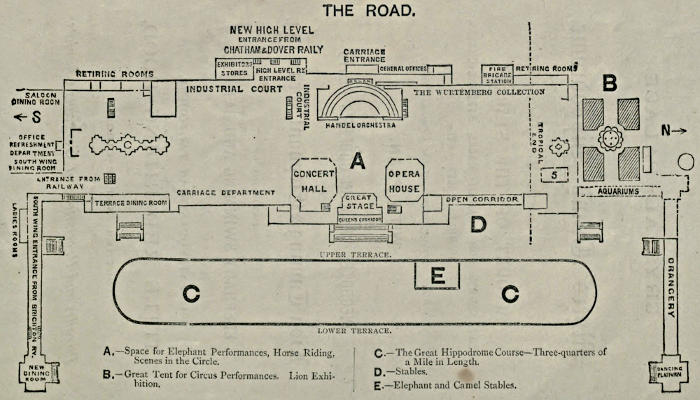
Mr. J. W. Myers, the proprietor of the largest Hippodrome
in the world, was born in New York in 1828.
Though still in the prime of life, he is a veteran in his
profession, having commenced his public career at the
early age of nine by apprenticing himself as an equestrian
to Aaron Turner and Sons, partners of the celebrated
Barnum. Ex nihilo nihil fit, and Mr. Myers thus early
recognised the truth of the proverb by taking care to
be provided with the small though substantial capital
of one halfpenny, with which, as the nucleus of fortune,
he fled from his home. He made rapid progress in his
calling, and soon distinguished himself as being the first
who ever did a double somersault over horses. A
few years’ experience placed him foremost among
equestrians, and at the age of twenty-one he started
a Circus and Menagerie of his own, with which he
travelled over the United States for seven years. He
then sold his property to Mr. John Wilson (whose
establishment was at the time the largest of its kind in
America) and came to England, having, shortly after
his arrival, the distinguished honour of performing
before Her Majesty the Queen and the late Prince
Consort, at Windsor Castle.
Mr. Myers was for seventeen months engaged with
Messrs. Howes and Cushing, and at the expiration of
that time he again formed a company of his own, and
performed with great success at Birmingham and other
English towns. Leaving England for the Continent
he commenced the career which has culminated in
the formation of an establishment of unprecedented
magnitude.
The Mecca of Mr. Myers’ long pilgrimage was, of
course, Paris; and a Paris journal gives a characteristic
account of the interview in which the entrepreneur
acquired possession of the Magasins Réunis, which he
has transformed into the vast establishment which has
been the sensation of the capital of the world of pleasure
during the last six months. The Paris Figaro states
that on a certain day in last autumn the proprietor of
the Magasins Réunis, Baron E——, was visited by a
stranger who expressed his desire to hire the structure,
till then a drug in the market. Baron E—— was
startled for a moment, but, soon recovering his self-possession,
replied that he was willing to let, but only
on a twenty years’ lease. “Be it so,” answered the
applicant. The owner believed himself the sport of a
dream, and could only feebly articulate “75,000 francs
(£3,000) a year.” “I’ll give you 75,000 francs a year,”
answered the visitor, “and here’s a year’s rent in
advance.” The bargain was struck, and the applicant
announced himself as Mr. J. W. Myers, the proprietor
of a peripatetic hippodrome. Mr. Myers set himself
with all possible speed to adapt his new acquisition to
his purposes, and the great range of warehouses at the
Château d’Eau was in a very few weeks transformed, at
an outlay of not less than a million of francs, into a place
of entertainment which has been one of the wonders of
Paris since December 19, 1875, when it was first opened
to the public. The great circus into which the central
court was converted accommodates an audience of more
than 8,000 persons, and the establishment is described
by La France as a complete world in itself. In fact,
the Paris press is singularly unanimous in pronouncing
it to be not only the greatest hippodrome which has
ever visited Paris, but (what is perhaps synonymous)
the greatest in the world, unparalleled in grandeur
and magnificence.
For the Hippodrome of Mr. Myers has attained
its present unequalled proportions by gradual and steady
growth. There is an eclecticism even in Circus business,
and Mr. Myers has excelled the doings of his predecessors
and contemporaries, not merely by employing nine
elephants where they used to employ one performer and
three or four “dummies”; by doubling the usual number
of the band, of the horses, and other component parts of
such an establishment: but he has taken care that his
horses shall be the best bred; that his elephants shall
be the most highly trained; that his equestrians shall be
the most finished and daring; that his clowns shall be
the most amusing; that his acrobats shall be the most
graceful that have ever been seen in public. If the patronage
of the great ones of the earth be a test of merit,
Mr. Myers may claim to possess that merit in a supereminent
degree. The Emperor William of Germany,
the Empress Augusta, the Emperor Francis Joseph
and the Empress of Austria, King Victor Emmanuel
of Italy, King Alfonso of Spain, the King and Queen
of the Belgians, the King and Queen of the Netherlands,
the King and Queen of Saxony, the Queen of Greece,
the Khedive of Egypt, the President of Switzerland,
the late Emperor Napoleon III., the Empress Eugenie,
the ex-Queen Isabella of Spain, the King and Queen
of Hanover, and the unfortunate Abdul Aziz of Turkey,
have all, at various times and places, honoured Mr.
Myers with their presence at his performances. Lyons,
Bordeaux, Toulon, Dijon, Nimes, St. Étienne, Nice,
Grenoble, Avignon, Toulouse, and all the great towns
in France; Berlin, Hamburg, Frankfort, Breslau,
Dresden, Königsberg, Leipsic, Cologne, Mayence,
Vienna, Nuremberg, Munich, Bremen, Dantzic, Stettin,
Regensburg, Strasburg, Metz, in Germany; Rome,
Turin, Milan, Florence, Genoa, Verona, Venice, Padua,
in Italy; Amsterdam, Rotterdam, the Hague, Utrecht,
in Holland; Brussels, and other towns in Belgium;
Berne, Aarau, Schaffhausen, Zurich, Lausanne, Geneva,
Zug, Basle, St. Gallen, in Switzerland, have all been
visited by Mr. Myers; and the press of these places
has been unanimous in its laudatory notices of his
establishment and its performances.