I am off in the morning for Southampton,
miserable and depressed. Crowds—the
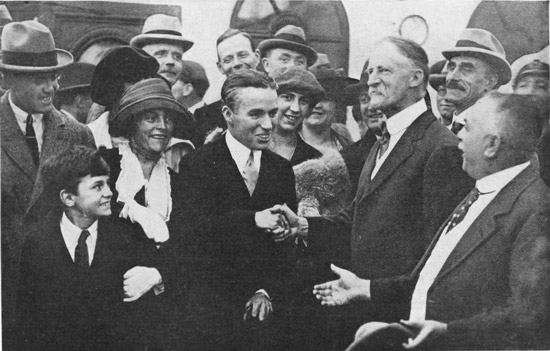
same crowds that saw me come—are there.
But they seem a bit more desirable. I am leaving
them. There are so many things I wish I had
done. It is pleasant to be getting this applause on
my exit.
I do not doubt its sincerity now. It is just as
fine and as boisterous as it was when I arrived.
They were glad to see me come and are sorry I am
going.
I feel despondent and sad. I want to hug all of
them to me. There is something so wistful about
London, about their kind, gentle appreciation.
They smile tenderly as I look this way, that way,
over there—on every side it is the same. They
are all my friends and I am leaving them.
Will I sign this? A few excited ones are shoving
autograph books at me, but most of them are
under restraint, almost in repose. They feel the
parting. They sense it, but are sending me away
with a smile.
My car is full of friends going with me to Southampton.
They mean little at the moment. The
crowd has me. Old, old friends turn up, friends
that I have been too busy to see. Faithful old
friends who are content just to get a glimpse before
I leave.
There's Freddy Whittaker, an old music-hall
artist with whom I once played. Just acquaintances,
most of them, but they all knew me, and had
all shared, in spirit, my success. All of them are at
the station and all of them understand. They know
that my life has been full every minute I have been
here. There had been so much to do.
They knew and understood, yet they had come
determined just to see me, if only at the door of my
carriage. I feel very sad about them.
The train is about to pull out and everything is
excitement. Everyone seems emotional and there
is a tenseness in the very atmosphere.
"Love to Alf and Amy," many of them
whisper, those who know my manager and his wife.
I tell them that I am coming back, perhaps next
summer. There is applause. "Don't forget,"
they shout. I don't think I could forget.
The trip to Southampton is not enjoyable. There
is a sadness on the train. A sort of embarrassed
sentimentality among my friends. Tom Geraghty
is along. Tom is an old American and he is all
choked up at the thought of my going back while
he has to stay on in England. We are going back
to his land. We cannot talk much.
We go to the boat. Sonny is there to see me off.
Sonny, Hetty's brother.
There is luncheon with my friends and there are
crowds of reporters. I can't be annoyed. There is
nothing for me to say. I can't even think. We
talk, small talk, joke talk.
Sonny is very matter-of-fact. I look at him and
wonder if he has ever known. He has always been
so vague with me. Has always met me in a joking
way.
He leans over and whispers, "I thought you
might like this." It is a package. I almost know
without asking that it is a picture of Hetty. I am
amazed. He understood all the time. Was always
alive to the situation. How England covers up her
feelings!
Everybody is off the boat but the passengers.
My friends stand on the dock and wave to me. I
see everything in their glowing faces—loyalty, love,
sadness, a few tears. There is a lump in my throat.
I smile just as hard as I can to keep them from
seeing. I even smile at the reporters. They're
darn nice fellows. I wish I knew them better.
After all, it's their job to ask questions and they
have been merely doing their job with me. Just
doing their jobs, as they see it. That spirit would
make the world if it were universal.
England never looked more lovely. Why didn't
I go here? Why didn't I do this and that? There
is so much that I missed. I must come back again.
Will they be glad to see me? As glad as I am to
see them? I hope so. My cheek is damp. I turn
away and blot out the sadness. I am not going to
look back again.
A sweet little girl about eight years of age, full
of laughing childhood, is coming toward me with a
bubbling voice. Her very look commands me not
to try to escape. I don't think I want to escape
from her.
"Oh, Mr. Chaplin," gurgled the little girl,
"I've been looking for you all over the boat.
Please adopt me like you did Jackie Coogan. We
could smash windows together and have lots of
fun. I love your plays."
She takes my hand and looks up into my face.
"They are so clever and beautiful. Won't you
teach me like you taught him? He's so much like
you. Oh, if I could only be like him."
And with a rapt look on her little face she prattles
on, leaving me very few opportunities to get in a
word, though I prefer to listen to her rather than
talk.
I wave good-bye to my friends and then walk
along with her, going up and looking back at the
crowd over the rail.
Reporters are here. They scent something interesting
in my affair with the little girl. I answer
all questions. Then a photographer. We are
photographed together. And the movie men are
getting action pictures. We are looking back at
my friends on shore.
The little girl asks: "Are they all actors and in
the movies? Why are you so sad? Don't you like
leaving England? There will be so many friends
in America to meet you. Why, you should be so
happy because you have friends all over the
world!"
I tell her that it is just the parting—that the
thought of leaving is always sad. Life is always
"Good-bye." And here I feel it is good-bye to
new friends, that my old ones are in America.
We walk around the deck and she discusses the
merits of my pictures.
"Do you like drama?" I ask.
"No. I like to laugh, but I love to make people
cry myself. It must be nice to act 'cryie' parts,
but I don't like to watch them."
"And you want me to adopt you?"
"Only in the pictures, like Jackie. I would love
to break windows."
She has dark hair and a beautiful profile of the
Spanish type, with a delicately formed nose and a
Cupid's bow sort of mouth. Her eyes are sensitive,
dark and shining, dancing with life and
laughter. As we talk I notice as she gets serious
she grows tender and full of childish love.
"You like smashing windows! You must be
Spanish," I tell her.
"Oh no, not Spanish; I'm Jewish," she
answers.
"That accounts for your genius."
"Oh, do you think Jewish people are clever?"
she asks, eagerly.
"Of course. All great geniuses had Jewish
blood in them. No, I am not Jewish," as she is
about to put that question, "but I am sure there
must be some somewhere in me. I hope so."
"Oh, I am so glad you think them clever. You
must meet my mother. She's brilliant and an
elocutionist. She recites beautifully, and is so
clever at anything. And I am sure you would like
my father. He loves me so much and I think he
admires me some, too."
She chatters on as we walk around. Then suddenly.
"You look tired. Please tell me and I
will run away."
As the boat is pulling out her mother comes
toward us and the child introduces us with perfect
formality and without any embarrassment. She is
a fine, cultured person.
"Come along, dear, we must go down to the
second class. We cannot stay here."
I make an appointment to lunch with the little
girl on the day after the morrow, and am already
looking forward to it.
I spend the greater part of the second day in
reading books by Frank Harris, Waldo Frank,
Claude McKay, and Major Douglas's "Economic
Democracy."
The next day I met Miss Taylor, a famous
moving-picture actress of England, and Mr. Hepworth,
who is a director of prominence in Great
Britain. Miss Taylor, though sensitive, shy, and
retiring, has a great bit of charm.
They are making their first trip to America, and
we soon become good friends. We discuss the
characteristics of the American people, contrasting
their youthful, frank abruptness with the quiet, shy,
and reserved Britisher.
I find myself running wild as I tell them of this
land. I explain train hold-ups, advertising signs,
Broadway lights, blatant theatres, ticket speculators,
subways, the automat and its big sister, the
cafeteria. It has a great effect on my friends and
at times I almost detect unbelief. I find myself
wanting to show the whole thing to them and to
watch their reactions.
At luncheon next day the little girl is the soul of
the party. We discuss everything from Art to
ambitions. At one moment she is full of musical
laughter, and the next she is excitedly discussing
some happening aboard ship. Her stories are
always interesting. How do children see so much
more than grown-ups?
She has a great time. I must visit her father,
he is so much like me. He has the same temperament,
and is such a great daddy. He is so good to
her. And she rattles on without stopping.
Then again she thinks I may be tired. "Sit
back now." And she puts a pillow behind my head
and bids me rest.
These moments with her make days aboard pass
quickly and pleasantly.
Carl Robinson and I are strolling around the top
deck the next day in an effort to get away from
everyone, and I notice someone looking up at a
wire running between the funnels of the ship.
Perched on the wire is a little bird, and I am
wondering how it got there and if it had been there
since we left England.
The other watcher notices us. He turns and
smiles. "The little bird must think this is the
promised land."
I knew at once that he was somebody. Those
thoughts belong only to poets. Later in the evening
he joins us at my invitation and I learn
he is Easthope Martin, the composer and pianist.
He had been through the War and it had left its
stamp on this fine, sensitive soul. He had been
gassed. I could not imagine such a man in the
trenches.
He is very frail of body, and as he talks I always
imagine his big soul at the bursting point with a
pent-up yearning.
There is the inevitable concert on the last night
of the voyage. We are off the banks of Newfoundland,
and in the midst of a fog. Fog horns must
be kept blowing at intervals, hence the effect on the
concert, particularly the vocal part, is obvious.
We land at seven in the morning of a very windy
day, and it is eleven before we can get away.
Reporters and camera men fill the air during all
that time, and I am rather glad, because it shows
Miss Taylor and Mr. Hepworth a glimpse of what
America is like. We arrange to meet that night at
Sam Goldwyn's for dinner.
Good-byes here are rather joyous, because we
are all getting off in the same land and there will be
an opportunity to see one another again.
My little friend comes to me excitedly and gives
me a present—a silver stamp box. "I hope that
when you write your first letter you take a stamp
from here and mail it to me. Good-bye."
She shakes hands. We are real lovers and must
be careful. She tells me not to overwork. "Don't
forget to come and see us; you must meet daddy.
Good-bye, Charlie."
She curtsies and is gone. I go to my cabin to
wait until we can land. There is a tiny knock. She
comes in.
"Charlie, I couldn't kiss you out there in front
of all those people. Good-bye, dear. Take care of
yourself." This is real love. She kisses my cheek
and then runs out on deck.
Easthope Martin is with us that night at Goldwyn's
party. He plays one of his own compositions
and holds us spellbound. He is very grateful for
our sincere applause and quite retiring and unassuming,
though he is the hit of the evening.
Following the dinner I carried the English movie
folk on a sight-seeing trip, enjoying their amazement
at the wonders of a New York night.
"What do you think of it?" I asked them.
"Thrilling," says Hepworth. "I like it. There
is something electrical in the air. It is a driving
force. You must do things."
We go to a café, where the élite of New York
are gathered, and dance until midnight. I bid them
good-bye, hoping to meet them later when they
come to Los Angeles.
I dine at Max Eastman's the next night and meet
McKay, the negro poet. He is quite handsome, a
full-blooded Jamaican negro not more than twenty-five
years of age. I can readily see why he has been
termed an African prince. He has just that
manner.
I have read a number of his poems. He is a
true aristocrat with the sensitiveness of a poet and
the humour of a philosopher, and quite shy. In
fact, he is rather supersensitive, but with a dignity
and manner that seem to hold him aloof.
There are many other friends there, and we discuss
Max's new book on humour. There is a controversy
whether to call it "Sense of Humour"
or "Psychology of Humour." We talk about my
trip. Claude McKay asks if I met Shaw. "Too
bad," he says. "You would like him and he would
have enjoyed you."
I am interested in Claude. "How do you write
your poetry? Can you make yourself write? Do
you prepare?" I try to discuss his race. "What
is their future? Do they——"
He shrugs his shoulders. I realise he is a poet,
an aristocrat.
I dine the next evening with Waldo Frank and
Marguerite Naumberg and we discuss her new
system. She has a school that develops children
along the lines of personality. It is a study in individuality.
She is struggling alone, but is getting
wonderful results. We talk far into the morning on
everything, including the fourth dimension.
Next day Frank Harris calls and we decide to
take a trip to Sing Sing together. Frank is very
sad and wistful. He is anxious to get away from
New York and devote time to his autobiography
before it is too late. He has so much to say that
he wants to write it while it is keen.
I try to tell him that consciousness of age is a
sign of keenness. That age doesn't bother the
mind.
We discuss George Meredith and a wonderful
book he had written. And then in his age Meredith
had rewritten it. He said it was so much
better rewritten, but he had taken from it all the
red blood. It was old, withered like himself. You
can't see things as they were. Meredith had
become old. Harris says he doesn't want the same
experience.
All this on the way to Sing Sing. Frank is a
wonderful conversationalist. Like his friend Oscar
Wilde. That same charm and brilliancy of wit,
ever ready for argument. What a fund of knowledge
he has. What a biography his should be.
If it is just half as good as Wilde's, it will be
sufficient.
Sing Sing. The big, grey stone buildings seem
to me like an outcry against civilisation. This huge
grey monster with its thousand staring eyes. We
are in the visiting room. Young men in grey shirts.
Thank God, the hideous stripes are gone. This
is progress, humanity. It is not so stark.
There is a mite of a baby holding her daddy's
hand and playing with his hair as he talks with her
mamma, his wife. Another prisoner holding two
withered hands of an old lady. Mother was written
all over her, though neither said a word. I felt
brutal at witnessing their emotion.
All of them old. Children, widows, mothers—youth
crossed out of faces by lines of suffering and
life's penalties. Tragedy and sadness, and always
it is in the faces of the women that the suffering is
more plainly written. The men suffer in body—the
women in soul.
The men look resigned. Their spirit is gone.
What is it that happens behind these grey walls that
kills so completely?
The devotion of the prisoners is almost childish
in its eagerness as they sit with their children, talking
with their wives, here and there a lover with his
sweetheart—all of them have written a compelling
story in the book of life. But love is in this room,
love unashamed. Why are sinners always loved?
Why do sinners make such wonderful lovers?
Perhaps it is compensation, as they call it. Love is
paged by every eye here.
Children are playing around the floor. Their
laughter is like a benediction. This is another improvement,
this room. There are no longer bars
to separate loved ones. Human nature improves,
but the tragedy remains just as dramatic.
The cells where they sleep are old-fashioned,
built by a monster or a maniac. No architect could
do such a thing for human beings. They are built
of hate, ignorance, and stupidity. I understand
they are building a new prison, more sane, with far
more understanding of human needs. Until then
these poor wretches must endure these awful cells.
I'd go mad there.
I notice quite a bit of freedom. A number of
prisoners are strolling around the grounds while
others are at work. The honour system is a great
thing, gives a man a chance to hold self-respect.
They have heard that I am coming, and most of
them seem to know me. I am embarrassed.
What can I say? How can I approach them? I
wave my hand merely. "Hello, folks!"
I decide to discard conversation. Be myself.
Be comic. Cut up. I twist my cane and juggle
my hat. I kick up my leg in back. I am on comic
ground. That's the thing.
No sentiment, no slopping over, no morals—they
are fed up with that. What is there in common
between us? Our viewpoints are entirely different.
They're in—I'm out.
They show me a cup presented by Sir Thomas
Lipton, inscribed, "We have all made mistakes."
"How do we know but what some of you
haven't?" I ask, humorously. It makes a hit.
They want me to talk.
"Brother criminals and fellow sinners: Christ
said, 'Let him who is without sin cast the first
stone.' I cannot cast the stone, though I have
compromised and thrown many a pie. But I
cannot cast the first stone." Some got it. Others
never will.
We must be sensible. I am not a hero worshipper
of criminals and bad men. Society must
be protected. We are greater in number than the
criminals and have the upper hand. We must
keep it; but we can at least treat them intelligently,
for, after all, crime is the outcome of society.
The doctor tells me that but a few of them are
criminals from heredity, that the majority had been
forced into crime by circumstances or had committed
it in passion. I notice a lot of evil-looking
men, but also some splendid ones. I earnestly
believe that society can protect itself intelligently,
humanly. I would abolish prisons. Call them
hospitals and treat the prisoners as patients.
It is a problem that I make no pretence of solving.
The death house. It is hideous. A plain, bare
room, rather large and with a white door, not green,
as I have been told. The chair—a plain wooden
armchair and a single wire coming down over it.
This is an instrument to snuff out life. It is too
simple. It is not even dramatic. Just cold-blooded
and matter of fact.
Some one is telling me how they watch the
prisoner after he is strapped in the chair. Good
God! How can they calmly plan with such
exactness? And they have killed as many as seven
in one day. I must get out.
Two men were walking up and down in a bare
yard, one a short man with a pipe in his mouth,
walking briskly, and at his side a warden. The
keeper announces, shortly, "The next for the
chair."
How awful! Looking straight in front of him
and coming toward us, I saw his face. Tragic and
appalling. I will see it for a long time.
We visit the industries. There is something
ironical about their location with the mountains for
a background, but the effect is good, they can get
a sense of freedom. A good system here, with the
wardens tolerant. They seem to understand. I
whisper to one.
"Is Jim Larkin here?" He is in the boot
department, and we go to see him for a moment.
There is a rule against it, but on this occasion the
rule is waived.
Larkin struts up. Large, about six feet two
inches, a fine, strapping Irishman. Introduced, he
talks timidly.
He can't stay, mustn't leave his work. Is happy.
Only worried about his wife and children in Ireland.
Anxious about them, otherwise fit.
There are four more years for him. He seems
deserted even by his party, though there is an
effort being made to have his sentence repealed.
After all, he is no ordinary criminal. Just a political
one.
He asks about my reception in England. "Glad
to meet you, but I must get back."
Frank tells him he will help to get his release.
He smiles, grips Frank's hand hard. "Thanks."
Harris tells me he is a cultured man and a fine
writer.
But the prison marked him. The buoyancy and
spirit that must have gone with those Irish eyes are
no more. Those same eyes are now wistful, where
they once were gay. He hasn't been forgotten.
Our visit has helped. There may be a bit of hope
left to him.
We go to the solitary-confinement cell, where
trouble makers are kept.
"This young man tried to escape, got out on
the roof. We went after him," says the warden.
"Yes, it was quite a movie stunt," said the
youngster. He is embarrassed. We try to relieve
it.
"Whatever he's done, he's darn handsome," I
tell the warden. It helps. "Better luck next
time," I tell him. He laughs. "Thanks. Pleased
to meet you, Charlie."
He is just nineteen, handsome and healthy.
What a pity! The greatest tragedy of all. He is
a forger, here with murderers.
We leave and I look back at the prison just once.
Why are prisons and graveyards built in such
beautiful places?
Next day everything is bustling, getting ready
for the trip back to Los Angeles. I sneak out in
the excitement and go to a matinée to see Marie
Doro in "Lilies of the Field," and that night to
"The Hero," a splendid play. A young actor,
Robert Ames, I believe, gives the finest performance
I have ever seen in America.
We are on the way. I am rushing back with
the swiftness of the Twentieth Century Limited.
There is a wire from my studio manager. "When
will I be back for work?" I wire him that I am
rushing and anxious to get there. There is a brief
stop in Chicago and then we are on again.
And as the train rushes me back I am living again
this vacation of mine. Its every moment now
seems wonderful. The petty annoyances were but
seasoning. I even begin to like reporters. They
are regular fellows, intent on their job.
And going over it all, it has been so worth while
and the job ahead of me looks worth while. If I
can bring smiles to the tired eyes in Kennington
and Whitechapel, if I have absorbed and understood
the virtues and problems of those simpler
people I have met, and if I have gathered the least
bit of inspiration from those greater personages who
were kind to me, then this has been a wonderful trip,
and somehow I am eager to get back to work and
begin paying for it.
I notice a newspaper headline as I write. It tells
of the Conference for Disarmament. Is it
prophetic? Does it mean that War will never stride
through the world again? Is it a gleam of
intelligence coming into the world?
We are arriving at Ogden, Utah, as I write.
There is a telegram asking me to dine with Clare
Sheridan on my arrival in Los Angeles. The prospect
is most alluring. And that wire, with several
others, convinces me that I am getting home.
I turn again to the newspaper. My holiday is
over. I reflect on disarmament. I wonder what
will be the answer? I hope and am inclined to
believe that it will be for good. Was it Tennyson
who wrote:
When shall all men's good
Be each man's rule, and universal peace
Shine like a shaft of light across the lane,
And like a layer of beams athwart the sea?
What a beautiful thought! Can those who go to
Washington make it more than a thought?
The conductor is calling:
"Los Angeles."
"Bye."
THE END.
PRINTED BY THE FIELD PRESS LTD., WINDSOR HOUSE,
BREAM'S BUILDINGS, LONDON, E.C. 4.
BOOKS WHICH are BEING REQUIRED
By JAMES JAMES
Honeymoon Dialogues
In crown 8vo, cloth, 4s. 6d. net. Thirteenth Edition
By JAMES JAMES
Lola of the Chocolates
In crown 8vo, cloth, 3s. 6d. net. Second Edition
By JAMES JAMES
Guide Book to Women
In crown 8vo, cloth, 3s. 6d. net. Third Edition
"It is as amusing as it is audacious."—Daily Chronicle.
By BEATRICE POWELL
Gleanings from the Writings of Gertrude Page
In pocket size, cloth gilt, with photogravure portrait of Gertrude Page
5s. net.
"A book for the shelf nearest one's elbow. A little book of riches."—Yorkshire Post.
By GERTRUDE PAGE
Two Lovers and a Lighthouse
In small crown 8vo, daintily bound and printed on special paper, 3s. 6d.
net. One of the most beautiful love stories ever written
By JEROME K. JEROME
The Passing of the Third Floor Back
A new acting edition of the great play
In crown 8vo, cloth, with frontispiece, 3s. 6d. net. In strong paper cover,
2s. 6d. net