One mornin’, not long after Miss Bobbet’s visit, I
was a doin’ up my mornin’s work. I had been a
little belated, for my companion Josiah, while fodderin’,
had been took in his back sudden and violent
with a stitch.
He is subject to such stitches, but they are very
painful and inconvenient. All the way he could walk
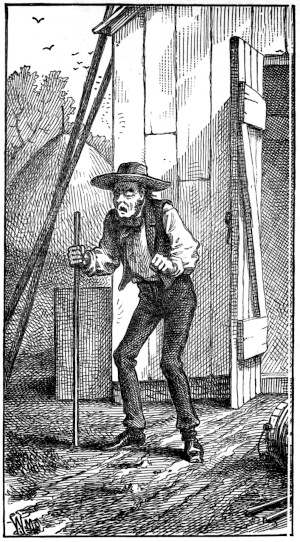
round the house was by leanin’ upon a broom-stick.
He found the broom-handle in the barn, and come in
leanin’ heavy on it, and groanin’ powerful and frequent.
It skairt me awfully.
I never hinted to him that I thought more’n as
likely as not that stitch was sent as a judgment; no, I
held firm, and kep’ my tongue still with almost giant
force. That day, when the sun had rose up clear and
lofty in the heavens, was the time I had calculated to
tackle him. But I was too honorable to tackle a pardner
who was down with a stitch.
No, I treated him well, bathed his back in linament,
400and he was a lyin’ behind the stove on the lounge, as
comfortable as anybody could be in his situation of
back and conscience.
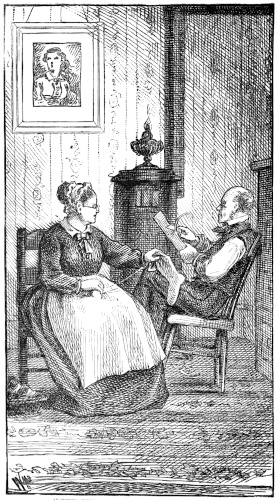
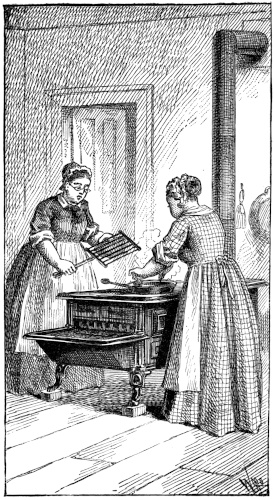
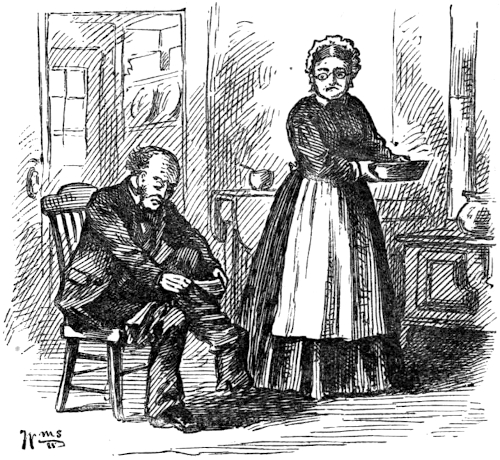
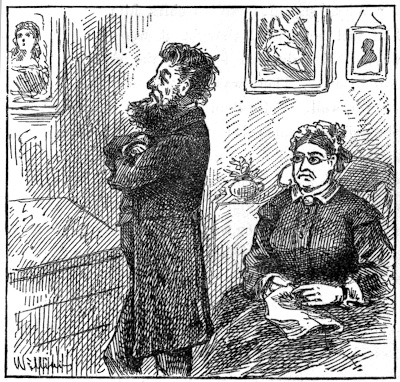
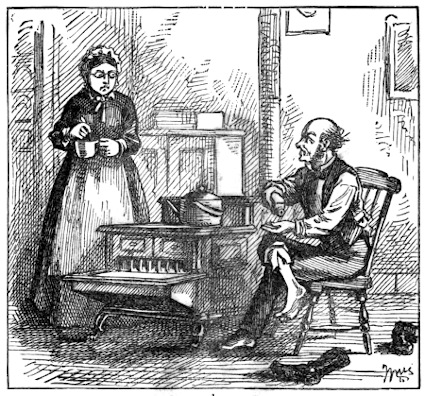
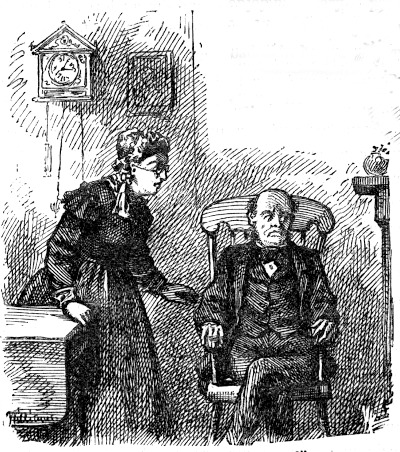
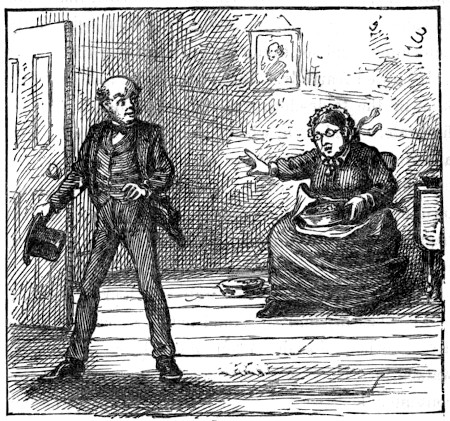
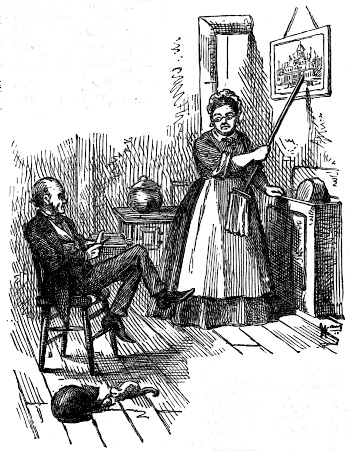
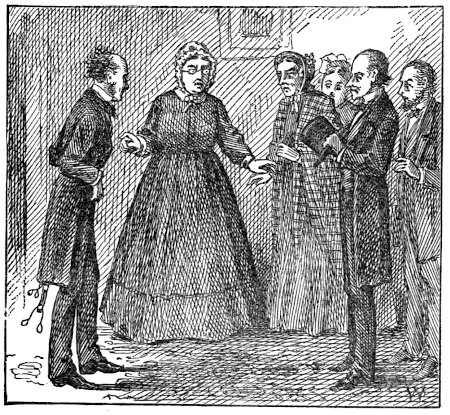
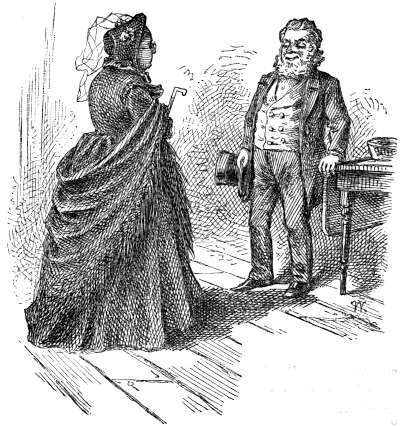
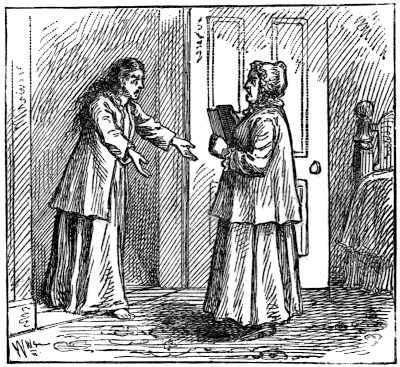
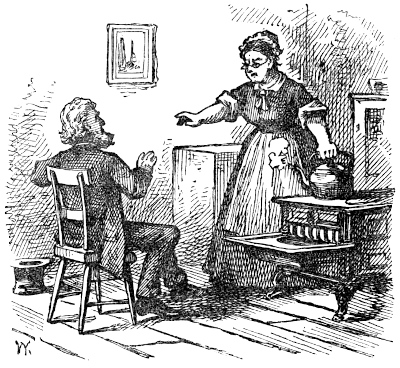
As I said, I was a washin’ up my dishes in the buttery,
when all of
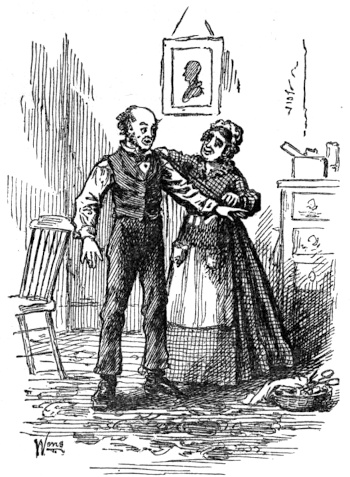
a sudden in walked
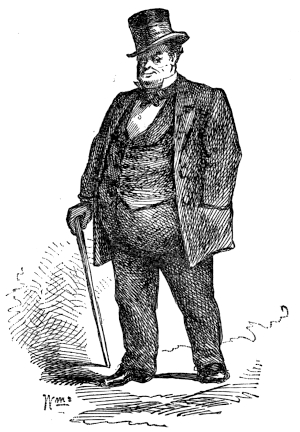
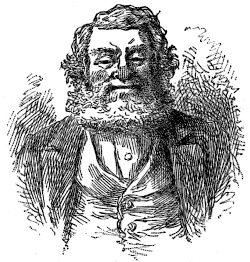
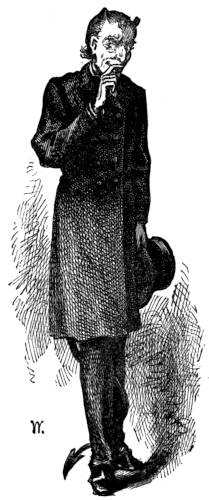
Elder Judas
Wart. The door
was open, it bein’
a pleasant mornin’,
and he jest
rapped at the side
of the door, and
walked in.
I guess he
didn’t see Josiah,
the lounge bein’
kinder behind the door; but he seemed dretful tickled to
see me—tickleder fur than I was. Though, havin’ my
mission in view, I used him well, and sot him a chair.
But little did I think what was before me; little did I
think what the awfulness of his first words to me
would be. He hadn’t been in that house five minutes,
for I know I had only jest hung up my dish-cloth (for
knowin’ what a tussle of principle was ahead of me,
and feelin’ as if I should need all my strength in the
conflict, I left the heaviest of my dishes to wash at
noon, for the first time in over fourteen months).
Wall, if you can believe it, jest as I got that dish-cloth
401hung up, that man, with no phraseoligies or excuses
or anything, that man up and says:
“I have heard, and I see for myself, that you are a
very smart woman, and you could do wonders in the
true church if you was married to some leadin’ man,—to
me, for instance,” says he, bold as brass, “or was
sealed to me,” says he, spittin’ hard onto the floor.
But that man hadn’t hardly got that seal and that
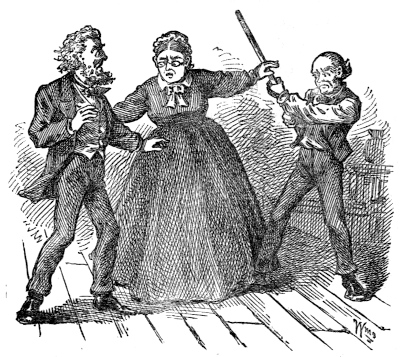
tobacco-juice out of his mouth, when Josiah Allen
sprung up and leveled that broom-stick at him with a
deadly aim. I sprung forward and threw the end of
the broom-stick up jest in time to save the Elder’s life.
402I forced him to desist, I and the stitch; for truly the
effort was too much for him. The stitch griped him
awful, and he sunk back with a agonizin’ groan.
I wanted Josiah to stay his hand and the broom-stick
for two reasons. One was, I didn’t want the
Elder killed quite so quick—not till after I had had a
chance to convert him. And another reason was, I
thought of my deep agony and a Widder Bump, and
thinkses I to myself, though the medicine is fearful to
administer, as gaulin’ and bitter as wormwood and
sicuta biled down in tar and vinegar, still I felt it was
what my companion needed to show him the nefariousness
and heniousness of Mormonism, in its true light.
I wouldn’t in his present weakness of mind and
back, throw the Widder Bump in his face, as I might
have done. Some pardners would have jest turned
round on him, as he lay there on that lounge, and
throwed that woman full and square in his face. But
I didn’t. I see he was a sufferin’ enough without
that. He was takin’ the matter to himself like a blister,
as anybody has got to, in order to feel the smart.
A blister don’t draw half so powerful, nor feel half so
bad, when it is on somebody else’es back, as it does
when it is on our’n. He was a meditatin’ how it
would seem to his heart to lose the companion of his
youth and middle age. He was a eatin’ of that sass
which ganders think is quite good for geese to eat.
He was seein’ now how it would relish to a gander. I
403pitied him from the bottom of my heart, his looks was
such.
But Elder Judas Wart had no such feelin’s of pity
and sympathy, and bein’ excited by Josiah’s ragin’
wrath, and maddened by the broom-stick, he spoke out,
in a angry, sarcastical tone:
“Your husband felt different on this subject last
spring. He seemed almost inclined at one time to take
to himself another helpmate. There was a certain
widder, there”—
“You lie, sir!” says Josiah, springin’ up to his feet.
“There wuzn’t no widder there, and I never was there.”
“Never was where?” says I, in a awful voice; for
curiosity and various other emotions was a hunchin’
me, as hard as ever a woman was hunched by ’em.
“I never was anywhere! I never was to their
meetin’s, nor to nowhere else.”
“Where wuz you, then?” says I, in that same
strange voice.
“I told you I wuzn’t nowhere, didn’t I?” he yelled
out in fearful axents.
But Elder Judas Wart went right on a talkin’ to me,
stiddy as fate, and as hard to be turned round as she.
“He seemed then to look at the Widder”—
“I never looked at a widder! I never see none! I
never see a widder in my life!”
Says I: “Josiah Allen, be calm!”
“I tell you I won’t be calm! And I tell you there
hain’t no widders there—nor hain’t never been any—nor
nowhere else—nor I never heard of any.”
404He was delerious, and I see that he was. But Elder
Judas Wart kep’ right on, with a haughty, proud
axent:
“He seemed then to look favorably upon the widder
I have lately espoused. The Widder Bump; don’t you
remember her?”
“No! I don’t remember no such widder, and I don’t
believe there was any by that name.”
“Why,” says I, “Josiah Allen, she made that coat
you have got on. Don’t you remember it?”
“No! I don’t! She didn’t make it! It wuzn’t
made! I never had none.”
“Why, Josiah Allen,” says I, “what will become of
you if you tell such stories?”
“There won’t nothin’ become of me, nor never will;
there never has nothin’ become of me.”
But jest as he said this, the stitch ketched him agin
powerful and strong, and he sunk down on the lounge,
a groanin’ violent.
I see he was delerious with pain of body, and fur
deeper, more agonizin’ pain of mind, contrition, shame,
remorse, and various other emotions.
And then, oh, the strength and power of woman’s
love! As that man lay there, with all his past weakness
and wickedness brought out before me, stricken
with agony, remorse, and stitches, I loved him, and I
pitied him. I felt that devoted, yearnin’, tender feelin’
for him to that extent that I felt in my heart that if it
were possible I could take that stitch upon me, and
405bear it onward myself, and relieve my pardner.
Women’s love is a beautiful thing, a holy thing, but
curious, very.
I reviled my pardner not, but covered him tenderly
up with my old woolen shawl, sot the broomstick up
against the lounge, and he lay there and never said
another word, only at intervals—when a pain of uncommon
size would ketch him in his back or conscience,
he would groan loud and agonizin’. But I see
it was no use to argue with him then about the Widder
Bump.
But if you’ll believe it, I can’t make him to this day
say nothin’ different. I have had a great many talks
with him on the subject, but, he says, “She is a woman
he never see.”
And the nearest I ever made him own up to it was
once when I had talked real good to him, talked to
him about his past wickedness and tottlin’ morals, and
told him how I knew his morals was straightened and
propped up now, good and sound, and his affections
stabled and firm sot where they should be sot. I
talked awful good to him, and he seemed to be sort o’
melted down. And he owned up “that it did seem to
him as if he had heard, when he was a child, of a
woman by that name, that lived somewhere near here.
It was either that name, or Bumper—he couldn’t for
his life tell which.”
And I gin up then. Truly there are strange pages
406in a man’s nater, filled with curious language, curiouser
than conundrums: who can read ’em?
As I said, havin’ the aim in my mind that I did have,
havin’ a desire to let Josiah Allen get a full taste of
that sass that he, as well as other ganders, find is fur
different to eat themselves, and to stand haughtily on
one leg (to foller out the gander simely) and see their
mates eat it. Havin’ a desire to let him get a full
glimpse of the awful depth and blackness and horrer
of the abyss he had suspended himself over, I did not
rebuke Elder Judas Wart as I should, had it not been
for that. I merely told him, when he said sunthin’
agin about my bein’ sealed to him—I merely said to
him, with dignity and firmness:
Says I, “If you say that word seal to me agin, I’ll
seal you in a way you won’t never want to be sealed!”
Says I, in still more awful tones, glancin’ at the bilin’
teakettle, “If you say that word to me agin in my
house, I’ll scald you, if it is the last work I ever do in
my life, and I am hung for it the next minute.”
My face was red; I was fearfully excited with my
almost giant efforts to control myself. To think that
he should dare to approach me! me! Josiah Allen’s
wife! with his infamous offer. He see that my looks
was gettin’ terrible and scareful, and he hastened to
say:
“I meant it in a religious way.”
And I was that excited and mad, that I spoke right
up and says, “Wall! I’ll scald you in a religious way;”
407and I added, in a firm, low tone, “But I’ll bet a cent
you won’t never want to be scalded agin as long as you
live.”
Says he, in a sort of a apologizin’, meachin’ way, “It
is my religion to marry various wives.”
“Wall,” says I, still clingin’ to my simely, as great
oriters always do, “It is my religion to scald you, if
you don’t stop your insultin’ talk instantly and to once!
You can’t talk no such stuff in the house of her who
was once Smith,” says I, glancin’ agin at the teakettle,
and steppin’ up a little nearer to it.
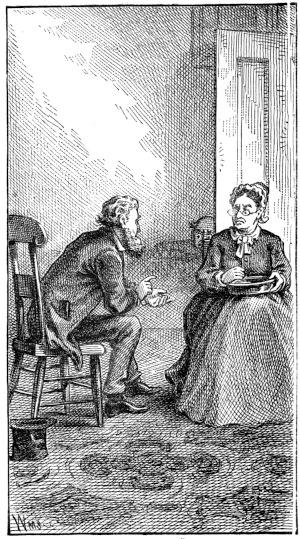
“Be composed, mum,” says he, a hitchin’ up his
408chair a little nearer the door; “Be composed! I was
speakin’ in a strictly religious sense.”
Says I, “You can’t never make me think a crime
can be committed religiously.” And agin I looked
longin’ly at that teakettle.
“Compose yourself down, mum, and let us argue for
a brief spell,” says he.
His tone was sort o’ implorin’ and beseechin’. And
he took a plug of tobacco out of his coat-pocket, and
bit a great chew off’en it, and put it into his mouth,
I s’pose to try to show off and make himself attractive.
But good land! how foolish it was in him. He
didn’t look half so well to me as he did before, and
that hain’t sayin’ but a very little, a very little indeed.
He wadded the tobacco all up on one side of his
mouth, till his cheek stood out some like a wen, and
the tobacco-juice started and run down on each side of
his chin. And so, havin’ fixed himself, I s’pose, so his
looks suited him, he says agin:
“Less argue the subject.”
I see that here was the chance I had wanted to convince
him of his iniquity. I see that Duty was leadin’
a war-horse up in front of me all saddled and bridled,
ready for me to mount and career onward nobly on
the path of Right.
I see that Duty was holdin’ in this charger by the
martingills with one hand, and with the other she was
holdin’ out a pair of spurs to me. And though never,
never, did a war-horse look so prancin’ and dangerous
411to me, and never did spurs look so heavy and sharp
and tejus to my achin’ heels, yet Josiah Allen’s wife
is not one to turn her back to Duty’s call—no, my
desire to battle with the wrong, my martyrous spirit
curbed me in and let me hear him talk.
And he went on to tell me that in the first place he
wanted to lay before me the rise, progress, and glory
of the Mormon Church. Says he, “In the first place,
you know, mum, that God made a distinct revelation
to us. Our bible was found written on plates of gold.
Them plates”—
I am naturally very well-bread. And thinkin’ mebby
it would influence him towards the right, I didn’t lay
out to interrupt him, or disturb his arguments, till he
had got through presentin’ of ’em. But the idee of
such imposture—imposture in the name of God—so
worked on me, that I spoke right out, in a firm, dignified
tone, but very solemn:
“Elder Judas Wart, you jest pass them plates.”
Says he: “Why should I pass ’em? The revelation
of God is written on ’em.”
“Revelation!” says I. “I should jest as soon go
into my buttery, and read my meat plates and platters,
as to read ’em. I should find jest as much of a revelation
on ’em.” And agin I says, with dignity: “You
pass them plates.”
Says he: “I wont pass ’em.” And he begun agin,
in a sort of a boastin’ way: “September 22, 1827, the
412angel Moroni placed in Joseph Smith’s hand our Mormon
bible, or that is, the plates, that”—
Says I: “Hain’t I told you to pass them plates?
Your bible is a romance writ by Solomon Spaulding
jest for fun, jest to see how near he could write like
the bible. And it is a powerful lesson to me, and
should be to everybody, of the terrible harvest that
may spring up from one careless, thoughtless deed.
The awful consequences, the sin, and the woe that followed
that one irreverent, thoughtless act might well
make us all more thoughtful, more mindful of the terrible
responsibility that follows all our acts, the smallest
as well as the greatest. We can’t shake off that
personal responsibility. It follers us tight as our
shadders even into our hours of recreation, showin’ us
that we should not only work nobly, but recreate nobly
and innocently and reverently.”
“But,” says he “them plates”—
But I was so rousted up with my emotions, that I
waved out my right hand with awful dignity, and says
I:
“You shall pass them plates.”
And I held firm, and made him pass ’em. And he
went to bringin’ up the miracles that had been done
by the early church—curing the lame and deaf, healing
the sick, and et cetery, and so forth. Says he: “I
have heard that you are a woman that loves reason and
fair play,” and says he, “you can’t get over those miracles,
can you?”
413Says I candidly: “I don’t want to get over no miracles,
and hain’t tried to. But I can say with the poet,
that so far as believin’ of ’em is concerned, miracles is
sunthin’ I had rather see done myself than to hear of
’em. Howsumever, I hain’t a goin’ to say that you
hain’t done ’em. As to healin’ the sick, the wonderful
power and magnetism one strong mind can exert over
a weaker one, when the weaker one has perfect faith
in it, has a great many times performed deeds that
looked miracilas, out of the Mormon church, and most
probable in it. But even if you have raised the dead,
which I don’t think you claim you have done, it would
make me no more a believer in mormonism; for we
read of a woman not religious, who did that. And I
never hankered after keepin’ company with Miss Endor,
or wanted to neighbor with her, or appear like her.”
“You are unreasonable, mum,” says he.
“I don’t mean to be,” says I. “I have allowed all
you want me to, and more too. What more can you
want?”
“You deride our holy church. Our church foundered
on the Commandments of God.”
“Which one?” says I enquirin’ly.
“Which one?” says he haughtily. “Every one of
’em; every one of ’em.”
“Wall,” says I calmly and reasonably, but with
quite a lot of dignity, “we’ll see.” And I was risin’
up to go and get the Bible offen the stand, for I was
determined he should see ’em in black and white, when
he spoke out haughtily and proudly:
414“Keep your seat, mum; keep your seat. I have the
Bible here in my breast pocket. Our church bein’
foundered on the Commandments, leanin’ up aginst
’em as we do for all our strength and safety, I don’t
depend on Bibles layin’ round loose on stands, and so
forth. I carry a copy all the time right over my heart,
or pretty near over it—on the left side of my vest,
anyway.”
Says I: “There is different ways of carryin’ things
in the heart. But that is a deep subject, and I will
not begin to episode upon it, for if I should begin, no
knowin’ how fur I should episode to, but will merely
say that there is other ways of carryin’ things in your
heart besides carryin’ ’em in your vest pocket. But
howsumever, read off the first one.” And he read it:
“Thou shalt have no other Gods before me.”
He read it off jest like a text. And the minute he
stopped I begun to talk on it a good deal like preachin’,
only shorter; but with jest about the same dignity and
mean that preachers have.
Says I, in that firm, preachin’ tone: “You have
made Brigham Young a God. Your preacher, whom
you call a ‘model saint,’ openly avowed that he was
God. You have pretended to believe, and have taught
to the people his blasphemus doctrine that he had
power to save souls in the heavenly kingdom, or to
shut ’em out of it.” Says I: “I could spread out this
awful idee, and cover hours with it, and then not make
it very thin, either; there is so much that could be
415said on the awfulness of it. But I have got nine more
jobs jest like it ahead on me to tackle, so enough, and
suffice it to say, fetch on your next one.
He was goin’ to branch out and say sunthin’, but I
held to my first idee, and wouldn’t let him. I told
him if I argued with him at all, he had got to read
those Commandments off jest like texts, and let me
preach on ’em. I told him after I had got through
with ’em, then he could rise up and explain his mind,
and talk; but jest at present it was the commands of
God I wanted to hear—not the words of Elder Judas
Wart. And I held firm, and made him. And when
he would begin to argue I would call for another one,
and kep’ him at it.
“Thou shalt not make unto thee any graven image
* * * * thou shalt not bow down to them, nor
serve them”—
Says I: “You have done that and worse. You have
worshipped and revered an image of clay—rather weak
clay, too, though held up by a mighty will and ambition.
Why, most anybody would say that a graven
image would be sounder than he was—more sort o’
solid and substantial. Anyway, it wouldn’t wobble
round as he wobbled, preachin’ one thing to-day, and
denyin’ it to-morrow, jest as his own interests dictated.
And the graven image wouldn’t have been so selfish
and graspin’ and unscrupulus. It would have been
fur honester, and wouldn’t have wanted more’n a hundred
wives. But that image of clay, such as it was,
you sot up and worshipped, and you needn’t deny it.”
416He didn’t try to. He knew it wouldn’t be no use to,
and says he:
“Thou shalt not take the name of the Lord thy God
in vain.”
Says I, in a firm, awful axent, “You have taken it
in vain, the weakest kind of vanity, and you have
taken it wickedly, the wickedest kind of wickedness,
in darin’ to commit this sin in the name of God.”
Says he, “Remember the Sabbath day to keep it
holy.”
Says I, “You have kept it holy, by teachin’ this
unholy sin. By assemblin’ at the tabernacle to listen
to words so low, and vulgar, and weak that they would
be contemptible, if they were not so wicked and blasphemous.”
Says he, “Honor thy father and thy mother.” He
spoke up awful quick and some haughty. He felt
what I had said, I knew it by his mean, and he seemed
to read this with a air as if this was sunthin’ he could
lean aginst hard, and nobody could hender its bein’ a
support to him. He looked sort o’ independent and
overbearin’ at me as he finished readin’ it, and he spit
on the floor in a sort of a proud way.
But I went right on, in a deep and impressive axent,
and says I, “You have made that commandment impossible
for your children to follow. You have wickedly
deprived your children of one of the holiest and
most sacred things in life. A child’s right to honor
the parents they love, and feel it their duty to reverence.
417But how can anybody, unless he is a fool or a
luny, honor what hain’t honorable? How can a child
honor a parent whose hands are stained with innocent
blood, who is enriched by theft and rapine, who is
living in open
shame—in open
defiance to the
commonest rules
of morality—who
breaks all the
commandments of God, and calls it religion?”
Says he, “Thou shalt not kill.”
Says I, “The teachers of your religion say, Thou
shalt kill, if it is for the safety and enrichment of the
Mormon church. And, following their commands
instead of God’s, you killed one hundred and 20 innocent
418men, wimmen, and children in one day. And how
many other murders have been committed by orders
of your church, in those lonely deserts and mountain
roads and canyons, will never be known till the
searchin’ light of the great day of doom reveals all
secret things. Why,” says I, “Brigham Young taught
that Mormons should shed each other’s blood for the
remission of sins.”
He looked meachin’, very. He didn’t try to argue
on this—he couldn’t, for he knew I could prove what I
had said. And he looked meachiner yet, as he read
the next one:
“Thou shalt not commit adultery.”
Says I, “The hull Mormon church is built up on the
ruins of this broken commandment, and you know it.
And you teach this doctrine, that the more pieces you
break this commandment into, the higher it is goin’ to
boost you up into heaven. The meaner and lower you
be on earth, the higher place you will have in the
heavenly kingdom—”
Says he, interruptin’ of me with a look of fearful
meach restin’ on his eyebrow, and speakin’ up dretful
quick:
“Thou shalt not steal.”
Says I, “Your church teaches, ‘thou shalt steal.’
And you have to do it too, and you know it.”
Says he, “Thou shalt not bear false witness against
thy neighber.”
Says I, “Ask the unhappy Gentiles who have incurred
419the displeasure or aroused the cupidity of the
Mormon church, whether the Mormon commandment,
‘Thou shalt bear false witness against thy neighber,’
has not been followed, and followed, too, to the death.”
“Thou shalt not covet”—and he said over the hull
on ’em—wife, property, and maidservant.
Says I, “Your church teaches thou shalt covet ’em,
every one of ’em, and get ’em, too, the hull on ’em—wife,
property, and maidservant, ’specially the maidservant.”
He quailed. And right there, while he was a quailin’,
I spoke, and says coldly:
“Now, Elder Judas Wart, you have read off the
commandments of God, one by one, and I have
preached on ’em; now tell me, and tell me plain,
which one do you lean on the hardest?”
Says he, “As it were—that is, you know—”
“No!” says I, with dignity, “I don’t know, nor you
don’t, nuther.”
Says he, “I—that is—you—you are unreasonable,
mum.” And he looked curious, and spit fiercely onto
the stone hearth and the floor.
“I don’t mean to be,” says I. “I sot out in this
talk with principles as hefty as I ever hefted in my life,
and if I hain’t a good judge of the common heft of
principles, nobody ever was. Why,” says I, “the
rights and wrongs of my sect has for years been held
nearer to my heart than any earthly object, exceptin’
my Josiah. And I can tell you, and tell you plain,
420that I have laid awake nights a thinkin’ over what my
sect has endured a settin’ under that Mormon church.
And daytimes I have sot a knittin’ and thought of the
agonies of them female wimmen till there wuzn’t a
dry eye in my head, and I couldn’t tell for my life
whether I was a seamin’ or a knittin’ plain, or what
I was a doin’. For of all the sufferin’s my sect has
suffered from the hands of man, this doctrine of
polygamy is the very crown, the crown of thorns.
Other wrongs and woes have spilte earth for her time
and agin, but this destroys her hope of heaven. When
other sorrows and wrongs broke her heart, killed her,
she could still look to the time when she could take the
hand of Death, the Healer, and he would lead her into
Repose, give her the peace earth had denied her. She
could think that all her burdens of sorrows and wrongs
would drop from her into the grave; and in that land
where all tears are wiped away—that land of eternal
beauty—of sweet consolation for the weary—she could
find rest. But this last hope of the broken-hearted,
your accursed doctrine has destroyed. Your infamous
belief teaches that if a woman won’t do wrong, won’t
submit to man’s tyrannical will on earth, commit sin
for his sake, he won’t let her go to heaven! Good
land!” says I, “it makes me sweat to think on’t.”
And I wiped my forward on my apron.
Says he: “As it were, you know.”
“No, I don’t know it,” says I warmly. “Nor I
never shall know it.”
421Says he: “And so forth, and so on.”
He acted embarassed and skairt, and well he might.
Why, the abomination of their doctrine is so abominable,
that when it is presented to ’em in a eloquent, high-toned
way by a woman who talks but little, but that
little earnest and deep; when she places it before ’em
in the axent she always handles when talkin’ on principle,
and with the soarin’, deep look of her spectacles
she always uses on them occasions—why, it is enough
to skair anybody to death.
But in a moment or so he sort o’ rousted up, and
says he:
“If you think so much of female wimmen as you say
you do, I should think you would think about what the
position of these plural wives would be if polygimy
were abolished. What would they be thought of?
What would they be?”
Says I, in awful tones: “What be they now?”
“Wall,” says he, “if they should be divorced they
wouldn’t be looked upon as they are now.”
“No,” says I, “that is very true; they wouldn’t, not
at all, not by me.”
Says he: “They would be looked down upon more.”
Says I, with dignity: “Stoppin’ sinnin’ hadn’t ort
to make anybody thought less on,” says I. “That“That
hain’t accordin’ to my creed or my skripter.”
Says he: “If they was divorced their situation
would be very painful and humiliatin’.”
Says I, very dryly: “It is now, in my estimation.”
422Says he: “Look at the position of the childern of
these unions, that would be left fatherless. What a
sad scene it would be; helpless infancy made a mark
for contumely and sneers; babyhood blamed, scorned.”
Says I: “They wouldn’t be scorned, not by anybody
whose scorn would be worth havin’. Nobody but a
fool or a luny is in the habit of blamin’ folks for
doin’ what they can’t help doin’, and bein’ what they
can’t help bein’. Blame the childern! Why, good
land!” says I, “I should jest as soon set out and scold
a mornin’-glory or a white violet for the looks of the
ground they sprung from. God’s own purity is writ
in the clear eyes of babyhood, and in the blue heart of
them mornin’-glories. Blossoms of light, mornin’-glories,
springin’, God knows how or why, out of the
black mould, out of darkness and decay. Who could
look scoffin’ly or irreverently on ’em, or on them other
blossoms of innocence, springin’ as mysteriously from
as dark a soil, and touched by the hand of God with
as pure and divine a beauty.”
“Unpractical, unpractical female, led away as females
ever are by sympathies and views of right and
wrong. Oh! thank Heaven! thank Heaven! such
dangerous qualities are not incorporated into politics.
I should tremble for the nation if it were so.”
And agin he looked fiercely at the stove-hearth.
“Unpractical female, what would become of the
childern left, as it were, fatherless?”
Says I: “If the parents of the childern are rich
423enough, let ’em support ’em; and the poor ones—I
know a man who will adopt the hull lot, and be glad
of the chance,” says I proudly. “It is a uncle of mine,
a uncle I am proud to own. Samuel is his name, and
nobility and generosity is his nater.” Says I: “Let
these childern and the wimmen, if necessary, be took
care of by the government, and let the evil end with
this generation.”
“But what would the position of these wimmen be
in society; what would they be?”
“What be they now?” says I agin. And I snapped
out that “now” considerable snappish, for I was gettin’
a good deal wore out with him. Says I: “You seem
to think it would be the death-blow to their reputation
to stop sinnin’, stop livin’ in wickedness; but there is
where you and I differ. I should think as much agin
of ’em.”
And says I: “If a evil is a goin’ to stop, it has got
to begin to stop sometime, or else it won’t never get
stopped. More of these unholy unions have taken
place durin’ the past year than ever before in the same
length of time. Powerful efforts are bein’ made to
strengthen and extend the power of the system. And
it must either be stopped, or else go on widening and
spreading, and destroying this beautiful new world as it
destroyed so many other strong, proud nations that were
glorious in the past.” Says I: “Can I set still and
see it go on, and can Josiah set still, and other female
424pardners, and other Josiahs, and not long to lift a hand
to turn back this flood of woe and desolation?”
Here Josiah groaned aloud. He had his thoughts
there on that lounge, though he lay middlin’ still. His
thoughts goared him worse than that stitch did, ten
times over. And I felt sorry for him, my feelin’s for
him are such; and I brought his name in in a friendly
way, just because my love for him was so strong, and
I forgive him so.
Says I: “Elder Judas Wart, I won’t take you back
to the old Jewish nations, round by Italy, Spain, and
other roundabout ways, as I might do, and as some
wimmen who are more talkative than I be probable
would, and show you all the way the ruins of the
nations ruined by this crime of polygimy. But I am
a woman who says but little, but that little I mean, and
I will merely hold up Turkey before you. And while
I am holdin’ up that Turkey, I will merely mention the
fact to you, that you and everybody else knows, and
that Turkey knows it well, and if it should speak up
and own the truth it would say that it was the effects
of this system that made it so weak and impotent.
Weaker as a nation than our old turkey-gobbler; fur
weaker than a hen-turkey. (I make use of the gobbler
as a poetical metafor, and would wish to be so understood.)
“Will not America and Josiahs heed these warnin’s?”
says I, lookin’ right up at the ceilin’, in a
rapped way. “Will they not listen to the voice of
425doom that rises from the ruins of other nations,
glorious and proud and strong in the past, that has
crumbled into ashes from the effects of this sin? Will
they not,” I went on in a still more rapped, eloquent
way, “will they not bend down their ears and hear the
wail of warnin’ that seems to float along over the dust
of the desert from old Babylon herself, warnin’ to this
new, fresh, western world to escape this enervatin’,
destroyin’ sin, and escape her doom? Will not America
and Josiahs take warnin’warnin’ by the fate of these
nations? or will they go on in careless merriment and
feastin’, unheedin’ those terrible words ‘mean! mean!’
writ up in the blue vault above, till it is too late; till
the land is given to the enimy; till weakness, ruin, and
decay take the septer from Columbia’s tremblin’,
shakin’ grasp, and rain over this once strong, lovely
land.”
I sithed, I almost wept—I was so fearfully agitated—and
says I: “If this threat’nin’ doom that threatens
our beloved land is to be averted, if this evil is to be
stopped, when is there a better time than the present
to stop it in, now,” says I, wipin’ my eyes on my
apron, “now, while America has got me to help her?”
And agin I sithed, and agin I almost shed tears, and
wept.
He see my agitation, and took advantage of it. Says
he: “You seem to be tender-hearted, Josiah Allen’s
wife, and to have a great affection for the female sect,
and yet you don’t seem to think of the hearts that
426would be wrung by the agony of seperation. Why,”
says he, “if they should part with their companions,
they would be unhappy.”
Says I, lookin’ out of the open window, fur away
over the tree-tops, over the blue lake beyond—and
beyond—
My spectacles seemed to look very fur off. They
had a very deep and sort o’ soarin’ look to ’em, somewhat
happy, and somewhat sorrowful and solemn.
And says I:
“I don’t know as there has any law ever been made,
in Heaven or on earth, that we had got to be happy.
There is a law made that we should do right, should
not do evil, but not that we must be happy. Why,
some paths we have to foller lead right away from happiness.”happiness.”
And says I, still lookin’ fur off, in that same
sort of a solemn, deep way:
“That path always leads to something better, more
beautiful, more divine.”
“What can be better than happiness?” says he, in
a enquirin’ way.
“Blessedness!” says I. “The two hain’t to be compared
no more than a flower growin’ out of earthly
soil is to be compared to one springin’ up in the valleys
of God. One is lit with earth’s sun, and the other is
shinin’ with Heaven’s own light. One is mortal, the
other immortal.”
Says he, still follerin’ up his old theme, still tryin’
to head me off in some way:
427“Wouldn’t you be sorry for these females, Josiah
Allen’s wife?”
Says I firmly: “If they suffered from the wrenchin’
away of old ties, I should be sorry for ’em to that
extent that there wouldn’t be a sithe left in my breast,
nor a dry eye in my head. At the same time, if they
made the sacrifice willin’ly, from a sense of duty, for
the ransom of their people, for the deliverance of the
land from peril, my very soul would kneel in reverence
to them, and they should be honored by all as those
who come out of great tribulations.
“But,” says I, in a slower, more thoughtful way,
“there is different kinds of tribulations. And you can
look at subjects with the sentimental eye of your
specks, and then agin you can turn the other eye onto
’em. And in lookin’ through that other eye at ’em,
you might possibly see that the married life of these
plural wives is wretched—full of jealousies, divisions,
and sizms.
“Woman’s love, when it has room to grow, is a tremendous
thing to spread itself. But (still lookin’
through that common sense eye of our specks) we
would say that the divine plant of love can’t grow so
thrifty in one-twentieth part of a man’s heart as it
could in a more expanded and roomy place. We
would say (still lookin’ through that eye) that it was
too cramped a spot—some like growin’ a oak in a bottle.
You can make it sprout; but there can’t be so
deep roots nor so strong a strength to it, and it
428wouldn’t take nigh so much of a pull to wrench it up
by the roots.
“And so, to foller up the simely, as simelys ort to
be follered, we would think that the first wife is the
one who would suffer most; she who thought she was
marryin’ a hull man, who dwelt for awhile in a hull
heart, and whose affections, therefore, had naturally
took deep root, and spread themselves. We would say
(still lookin’ through that eye of the speck, and still
follerin’ up simelys) that she is the one who would be
most wrung with agony.”
“Wall,” says Elder Judas Wart, seemin’ly ketchin’
holt of the first argument that presented itself in front
of his mind, for truly he didn’t seem to care how
crooked his argument was, nor how wobblin’. Says
he:
“Sufferin’ is a divine agent to draw souls heavenward.”
“Yes, heaven-sent sufferin’,” says I, “will draw our
hearts up nearer to the heavenly home it come from.
But when sufferin’ comes up from below, from another
place, scented with brimstone, and loaded with iniquity,
it will do its best to draw us down to it where it come
from.”
“Pain sometimes teaches divine lessons,” says Elder
Judas Wart. And I never see a mouth puckered and
twisted down into a more hypocritical pucker than
hisen was.
Says I: “Don’t you s’pose I know that?” And
429then I went on awful eloquent, and grew eloquenter
and eloquenter all the time for as much as five minutes
or more, entirely unbeknown to me, not thinkin’
who was there, or who I was a talkin’ to, or where, or
when:
“Don’t I know,” says I, “that no soul has reached
its full might, no soul has ever really lived, till it has
learned to bless God for the divine ministry of sorrow?
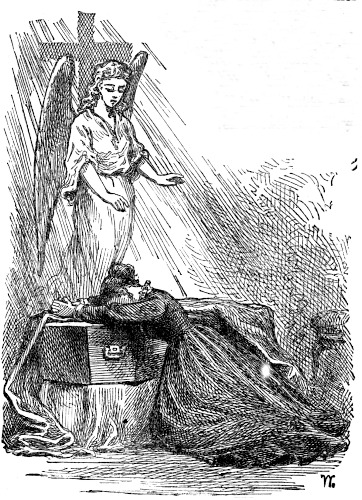
Don’t I certainly know that of all God’s angels the
one who brings us divinest gifts is the blessed angel
of Pain?”
And I went on again, in that fearfully eloquent way
of mine, when I get entirely rousted up in eloquence,
and know not where I am, or who is hearin’ of me, or
why, or which:
“If we bar this angel from our door, resist her gentle
voice pleadin’ at our heart, woe be to us; for she
can come as a avenger, a destroyer. But if we greet
her as indeed a heavenly visitant, believe that God sent
her, hold her in our weak arms close to our hearts, she
gives us divinest strength.
“Though we turn away, and fear her greeting, we
find that the touch of her lips on our burning brow
leaves calm. She lays on our throbbing, aching hearts
soft hands of peace. Her eyes have a sorry look for
us, that make our tears flow, and then we see that
those sad, sweet eyes are looking up from earth to
where our own, tear-blinded, are fain to follow—up
beyond the vail, into that beautiful city where our
treasures and our hopes are.
430
To no other angel has God given the power to so
reveal to us the glory and the mystery of life and
of death. No other
hand but hers has
such power to unlock
the very doors of heaven
and send down
into our hearts heaven’s
peace and glory.
Don’t I know this? don’t I know that in the hour of
our bitterest sorrow, our deepest affliction, when the
431one that made our world lies silent before us, deaf for
the first time to our tears and our sorrow; when all
the world looks black and desolate, and hatred and
envy and malice seem to surround us, and our human
strength is gone, and human help is vain; don’t I
know that this divine angel of Pain opens the very
doors of Heaven, and lets down a perfect flood of glory
into our soul—not happiness, but blessedness.
“Yes, the crosses this angel brings us from a lovin’
Father we will bear in God’s name. But,” says I,
firmly, “other folks must do as they are a mind to;
but I never will, not if I know it, bend my back, and
let old Belzebub lay one of his crosses acrost my
shoulder-blades. No, I will throw off that cross, and
stamp onto it. And this cross of Mormonism is one
of hisen, if he ever had one. It is made out of Belzebub’s
own timber, nailed together by man’s selfishness
and brutality and cruelty, the very worst part of his
nature. It is one of the very heaviest crosses ever
tackled by wimmen, and bore along by ’em, wet with
their blood and sweat and tears. And Samantha will
do her best to stamp onto ’em, every one of ’em, and
break ’em up into kindlin’-wood, and build fires with
’em to burn up this putryfyin’ crime of polygimy, root
and branch; make a cleansin’ blaze of it to try to
purify God’s sweet air it has defiled.”
“Oh!” says Elder Judas Wart, with a low deep
groan, “oh! how unpractical females always are.
Females are carried away by their sympathies and
432religious feelings and sense of right and duty, making
them a most dangerous element in politics, a very
striking and unwholesome contrast to the present
admirable system of government, if they were ever
incorporated into the body politic; in short, if they
ever vote. Let us look on the subject in a practical
light.”
And I was so beat out by my eloquent emotions
(such emotions are beautiful to have by you, but
fatiguin’ to handle, as I handle ’em, and I can’t deny
it); and bein’ also almost completely out of wind, I sot
still, and let him go on.
And he talked, I should judge, well on to a quarter
of a hour about Communism, Socialism, its principles,
its rise, and progress; and I let him go on, and didn’t
hardly say a word, only I would merely throw in little
observations occasionally, such as, when he argued
that everybody should own the same amount of property,
and there should be no rich and no poor.
I merely threw in this question to him: Whether he
thought shiftlessness and laziness should have the
same reward as industry and frugality?
And when he was a goin’ on about everybody bein’
educated the same so one could not be intellectually
superior to the other, I simply asked him whether he
thought Nature was a Socialist.
Says he: “Why?”
“Oh!” says I, “I was a thinkin’ if she was one,
she didn’t live up to her belief. She didn’t equalize
brains and thrift and economy.”
433“Wall, as I was a sayin’” says he, “as it were, you
know”—
“No,” says I, coldly, “I don’t know it, nor I never
did. I know,” says I, lookin’ keen at him, “that some
are born almost fools, and keep on so; and some,”
says I, with a sort of modest, becomin’ look, “some
are very smart.”
He kep’ perfectly still for a minute, or mebby a
minute and a ½. he seemed to collect his strength
agin, and broke out, in a loud, haughty tone:
“The fault of our old civilization is that property is
controlled by the few. How can a man have the same
love for his home, for his hearth-stone, if he works the
land of some great landed proprietor? In case of war,
now, foreign invasion, if each man owned property of
his own, if each man was a Mormon, in fact, he would
be fighting for his own interest; not for the interest of
some great landed lord. He would be fightin’ for his
own hearth-stone; the sacred and holy hearth-stone.”
Says I, in reasonable axents: “I hain’t a word to
aginst the sacredness of the hearth-stun. I hain’t a
word to say aginst the stun. But wouldn’t it be apt to
take off a little of the sacredness of the stun to have
thirty or forty wimmen a settin’ on it; each claimin’ it
as her own stun? Wouldn’t it have to be a pretty large
stun, and a pretty firm one, to stand the gusts and whirlwinds
of temper that would be raised round it? And
to tell the plain truth, Elder Judas Wart, don’t you
believe that every man that owned such a stun, and 30
434or 40 wimmen a settin’ on it, and childern accordin’ly,
don’t you believe that such a man instead of discouragin’
war would do all in his power to welcome and
encourage it, so he could go forth into the battle-field,
and find a little peace and repose; that is, if he was a
gentle, amiable man, who loved quiet?”
He never said one word in answer to this deep argument,
he see it was too deep and sound for him to
grapple with; but he kep’ right on, and says, thinkin’
mebby it would skair me, says he:
“Our order was founded by Thalos of Chalcedon.”
“Wall,” says I, “Mr. Thalos is a man that I hain’t
no acquaintance with,—I, nor Josiah; so I can’t form
any opinion what sort of a character he has got, or
what for a man he would be to neighbor with.”
Says he, in a still prouder and haughtier way:
“Plato believed in it.”
“How do you know?” says I. “He never told me
that he did. If he had, I should have argued sound
with him.” And says I, lookin’ keen and searchin’ at
him:
“Did he tell you that he believed in it?” says I.
“You can hear most anything.”
“Why, no,” says he, “he didn’t tell me. He died
twenty-two hundred years ago.”
“Wall,” says I, coolly, “I thought you got it by
hearsay. I didn’t believe you got it from the old
gentleman himself, or from any of his relations. I
remember Mr. Plato myself, now. I have heard
435Thomas J. read about him frequent. A sort of a
schoolmaster, I believe—a man that travelled a good
deal—and had considerable of a noble mean. If I
remember right, I have seen him myself on a bust.
But as I was a sayin’, s’posen Mr. Plato did believe in
it. Don’t you s’pose that old gentleman had his faults?
He was a nice old man, and very smart. His writings
are truly beautiful and inspirin’.
“Why some of his dialogues are almost as keen and
sensible and flowery as them that have taken place
between a certain woman that I won’t mention the
name of, and her pardner Josiah. Why, jest the fact
that he got sold once for talkin’ so plain in the cause
of Right, endeared him to me. And the fact that he
didn’t fetch only twenty minnys (and we all know
what small fish they be) didn’t make him seem any
the less valuable to me. No, not at all so; it wouldn’t,
if he hadn’t fetched more than one little chub.
“Them views of his’en, them witherin’ idees aginst
tyrany that he was preachin’ to a tyrent, whales
couldn’t lug, nor sharks. They was too big and hefty
to be bought or sold. But because Mr. Plato was all
right in some things, we mustn’t think he was in all.
We are apt to think so, and we are apt to think that
that because a gulf of a thousand or two years lay
between us and a certain person, that it seperates them
from all our mortal errors and simplicities.
“But it hain’t so. That old man had other human
weaknesses besides writin’ poetry. I persume Miss
436Plato had to deal real severe with him lots of times,
jest as I do with Josiah. I dare persume to say she
had hard work to get along with him more’n half the
time. And if he believed in Mormonism,
he believed in sunthin’
wicked and abominable, and if I
had been on intimate terms with him and her, I should
have talked to him like a sister, right before her, so she
would feel all right about it, and not get oneasy and
jealous. I should have talked powerful to him, and if
he is the man I take him to be, I could have convinced
him in ten minutes, I know I could.”
437“Wall,” says he, “bringin’ the history of our church
down to Christ’s day: He was a believer in it.”
I riz right up in a awful dignity and power, and I
says, in a tone that was fearful to hear, it was so
burnin’ indignant:
“You say that agin in my house, if you dare.”
He dassent, my tone was such. He never said a
word, but sot kinder scroochin’ and meachin’ on his
chair, and I went on, resumin’ my seat agin, knowin’
as I did that my principles was so hefty I had better
save myself all the extra weariness that I could.
Says I:
“You dare to say that He, the Deliverer of His
people from sin and evil—He, the Teacher of all
purity, morality, honesty, and all Christian virtues,
who came bringin’ peace on earth, good will to men—He,
who taught that a man should have one wife,
and be tender and constant to her, even as He loved
the Church and gave Himself for it—He, whose life
was so pure and self-denyin’ and holy that it brought
the divine down to the comprehension of the human—the
love and purity of God manifest in the flesh—how
dare you tell me that He was a Mormon?”
He dassent say it agin. He dast as well die as to
say it. I s’pose, in fact I know, from my feelin’s
which I was a feelin’, that my mean was awfuler and
more majesticker than it had been for years and years.
Says he, “As it were—” and then he stopped short
off, seemin’ly to collect his thoughts together, and then
438he kinder coughed, and begun agin— “And so forth,
and so on,” says he. He acted fairly afraid. And I
don’t wonder at it a mite. My looks must have been
awful, and witherin’ in the extreme.
But finally he says, “We read of this sect in the
Bible, anyway. The Essenes was Mormons, or sort o’
Mormony,” says he, glancin’ at me and then at the
teakettle, in a sort of a fearful way.
But says I, coldly, “We read in the Bible of droves
of swine that was full of evil spirits; and we read in
it of lunaticks, and barren fig-trees, and Judas, and
the—the David—callin’ him David, as a Methodist and
member of the meetin’-house, who does not want to
say Satan if she can possibly help it.
“Now,” says I, “you have brought up every commandment
of God, and I have preached on ’em, and
you find every one of ’em is aginst you—the old law,
and the divine new law made manifest in Christ.
Now,” says I, coolly, leanin’ back in my chair, full of
martyrdom and eloquence and victory and everything,
“bring on your next argument, bring it right here, and
let me lay holt of it, and vanquish it, and overthrow
it”
“Wall,” says he, “I hold that the perfect faith that
thousands have in our religion and its founder, is one
of the very strongest proofs of its divine origin.”
“I don’t think so,” says I. “Faith is the substance
of things hoped for, but things don’t always turn out
to be what you hoped they was. Now, there is hash,
439for instance: and in order to enjoy hash, you have got
to have perfect confidence in it and its maker. But
still you may have that perfect confidence in it, and
eat it in faith, believin’ it is good beef and pork, while
at the same time there may be ingredients in it that
you know not of, such as Skotch snuff, lily white, hairpins,
and etcetery. Hash is a great mystery, and often
deceivin’ to the partaker, no matter how strong his
faith in it may be.
“And I might foller up this strikin’ simely of hash
into other eloquent metafors, such as pills, preachin’,
wimmen’s complexion, and etcetery. Some is good
and true, and some hain’t good and true, but they all
find somebody to believe in ’em.
“This is a very deep subject, and solemn, if handled
solemnly. I have handled it only in a light parable
way, showin’ that them that do honestly believe in this
Mormon doctrine, if there are any, are partakin’ (unbeknown
to them) of a hash that is full of abomination
and uncleanness, full of humiliation, sorrow, and
degradation. Oh!” says I, fallin’ back on the side of
the subject nearest to my heart, “when I think of the
woes of my sect there in Utah, I feel feelin’s that never
can be told or sung. No, there never could be a tune
made mournful and solemn enough to sing ’em in.”
Says he, bold as brass, and not thinkin’ how he was
a wobblin’ round in his argument, “They enjoy it.”
Says I, firm as Bunker Hill, and as lofty, “They
don’t enjoy it.”
440Says he, “They do.”
Says I, “Elder Judas Wart, you tell me that agin,
and I’ll know the reason why.”
“Why,” says he, “they have petitioned Congress to
not meddle with the laws.”
Says I, “Can you tell me, Elder Judas Wart, can
you tell me honestly that there wasn’t man’s influence
lookin’ right out of that petition?”
“No, mum, there wuzn’t. They done it of their
own wills and acords.”
Says I, firmly, “I don’t believe it. And if I did, it
would only show to me the blightin’, corruptin’, influence
of your belief.”
“Why,” says he, “some of our wimmen are the
most active in our church—full of religious zeal.”
Says I, coolly, “All kinds of zeal hain’t religious
zeal.” Says I, “The kind that makes a mother throw
her child into the Ganges, and burn herself with the
dead body of her husband—you can call it religious
zeal, if you want to, but I call it fanatical frenzy.”
Says he, “They are perfectly happy in their belief.”
Says I, “You needn’t never say that agin to me,
thinkin’ I will believe it, for before Mormonism was
ever made, human nature was made, wimmen’s hearts
was made. And when you show me a man who would
enjoy havin’ his right hand cut off, or his eyes plucked
out of his head, then I will show you a woman, a
womanly woman, who enjoys sharin’ the love of the
man she worships—enjoys seein’ it passin’ away from
441her, given to another. Why, it is aginst nater, as
much as it is for the sun to shine at midnight.
Blackness and despair
and gloom is
what rains when the
sun of love is gone
down—it’s nater,
and can’t be helped,
no more than
the sun can, or the
moon, or anything.
No woman ever enjoyed
this wretched
doctrine—that is, no
442good woman, no pure, tender-hearted, affectionate
woman.”
“Why,” says he, “I s’posed you thought all wimmen
was perfect.”
“No, I don’t, sir, no sir. A woman can lose all
that is sweet and lovely in her nature—all the traits
that make her so attractive, her tenderness, her affection,
her constancy, her modesty, her purity. She can
get very low down in the scale of being, lower, I think,
than a man can get. You know the further up any one
is, the worse it hurts ’em to fall.
“Now the angels that fell down from heaven, I
s’pose it changed ’em, and disfigured ’em, and spilte
’em as bad agin as it would to fall down suller.
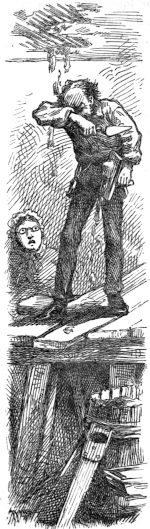
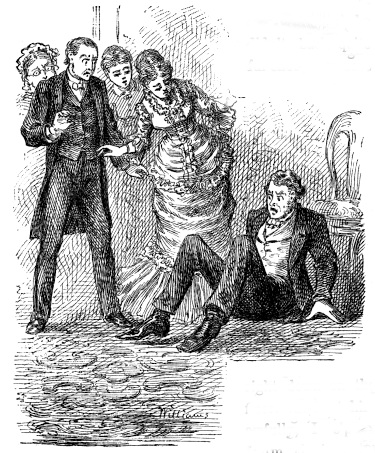
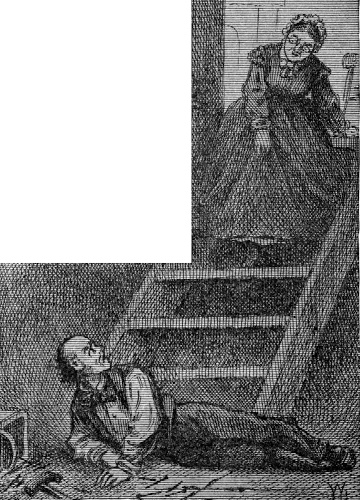
Josiah fell a week ago last Wednesday night, with a
hammer in one hand, and a box of nails in the other.
He was fixin’ up a cupboard for me in the sullerway.
He fell flat down and lay his hull length on the suller
bottom. Skairt me awfully. Skairt him, too, and
sort o’ madded him, as it always will a man when they
fall. I was gettin’ the supper onto the table, and I
started on the run for the suller door, and says I, in
agitated axents, and weak as a cat with my emotions:
“Did it hurt you, Josiah?”
Says he, sort o’ surly, “It didn’t do me any good.”
But he got up, and was all right the next day.
I have used this poetical simely, of its hurtin’ anybody
worse to fall down from such a lofty height than to
fall down the sullerway, to show my meanin’ that a
443pure woman’s nature is naturally very pure and lofty,
and if she loses it she falls very low indeed.
“Lose it she can—all
that makes her sweet
and lovely and lovable;
but while she keeps her
woman’s heart and nature,
her life, in your
religion, must be a constant
martyrdom, and
must be in its nature demoralizin’
and debasin’,
dealin’ the morals fearful
and totterin’ blows.
“Why, don’t you s’pose I can take it to myself?
Now, Home is the most heavenly word we know. We
444hain’t learnt the heavenly alphabet yet, none of us,
and so can’t spell out the word Heaven as it ort to be
spelt. We are children that hain’t learnt God’s language
yet. But Home in its true meanin’ is sunthin’
as near heaven as we can translate and spell out below.
Home, when it is built as any home must be in order
to stand, on a true love, and in the fear of God, such a
home is almost a heaven below. I know it, for a certain
home was built on these very foundations upwards
of 20 years ago, and not a j’int has moved, not a sleeper
decayed. Such a home means delight, rest, comfort.
I know it, and my Josiah knows it.
“But let Josiah Allen bring home one more wife, let
alone a dozen or fifteen of ’em—let him bring home one
small wife besides Samantha, and I should find that
home meant sunthin’ very different from peace and
rest and happiness. And Josiah Allen would find out
that it did, too. He would, if I know my own heart,
and am not deceived in myself. And when I think of
it, think of what my own sect are a sufferin’ right here
in our own land, it makes my blood bile up in my
vains, and the tears jest start to every eye in my head,
and if I had two dozen eyes I could cry and weep with
every one of ’em, a thinkin’ how I should feel under
them circumstances—a thinkin’ of the desecration of
all that is holiest, and purest, and most blessed.
Thinkin’ of the agony of remembrance, and regret, and
despair that would sweep over me—remembrance of
the old, happy days when I was blest with the love that
445had gone from me—regret for all the happy days,
happy words of love and tenderness, happy hours of
confidence and affection—mine once, gone forever.
Despair, utter, black despair that all was past.
“And besides this sufferin’, think of the ravages it
would make in my morals, as well as his’en. I know
jest how much my morals can stand, I know to a inch
jest how much strain I can put onto ’em. And I know,
jest as well as I know my name was once Smith, that
another wife would make ’em totter. And, to be perfectly
plain and truthful, I know that wife would make
’em fall perfectly flat down, and break ’em all into
pieces, and ruin ’em. I shouldn’t have a single moral
left sound and hull, and I know it. I should be ugly.”
Says I, with a added eloquence and bitterness of
tone, as my mind roved back onto a certain widder:
“To have another woman come a snoopin’ into my
house and my pardner’s heart—why, language hain’t
made mean enough to tell what my meanness would
be under the circumstances. And her morals, too—why,
don’t you s’pose her morals would be flat as a
pancake? Yea, verily. And where would my Josiah’s
morals be? He wouldn’t have none, not a moral,
nor a vestige of any. And there would be three likely
persons spilte, entirely, and eternally spilte. And do
you s’pose we three persons are so different from any
other three persons? No, human nature (man human
nature, and woman human nature) is considerable the
same all over the world.”
446And agin as that fearful scene presented itself to
my imagination, of another woman enterin’ into my
Josiah’s heart, I sithed powerful, and went on with
renewed eloquence. I was fearfully eloquent, and
smart as I could be; deep.
Says I, “One man’s heart hain’t of much account,
viewed in a permiscus way, but to the woman that
loves him it’s a good deal, it is all. Wimmen are foolish
about some things, and this is one of ’em. Her
love is to her the very breath she breathes—it is the
best part of her. Men don’t feel this way as a general
thing (my Josiah duz, but he is a shinin’ exception).
But as a general thing love is to them a sort of a side-show,
a tolerable good entertainment, but it hain’t the
hull circus.
“No, a man’s heart hain’t none too large for one
woman to dwell in, especially if she is hefty, not at all
too large, quite the reverse. And I can tell you, Elder
Judas Wart, and tell it firm and solemn, that when it
comes to dividin’ up that heart that was a tight fit in
the first place, and lettin’ one woman after another
come a troopin’ in, a pushin’ the lawful owner out of
the way, jammin’ her round, bruisin’ of her, and in the
end crowdin’ her completely out in the cold, I say, may
God pity such a woman, for human pity can’t be made
pitiful enough to reach her.”
Says Elder Judas Wart, “Men that hain’t Mormons
sometimes has more than one woman inside of their
hearts.”
447“I know it,” says I. “But the law gets right onto
such a man and stamps onto him. And public sentiment
sets down on him hard. And I can tell you that
when the hull community and law and religion and
everything are all a settin’ on a man, and settin’ heavy,
that man finds it is a pretty tuckerin’ business; he
gets sick of it, and is glad to do better and be let up.
But you make the iniquity lawful. You make law and
religion and public sentiment all get under such a man,
and boost him up—make out that the more crimes a
man commits, the more wives he has, the higher place
he will have in heaven. Why,” says I, “when I think
it over, it hain’t no wonder to me that the Mormon
leaders, before they let loose this shameful doctrine
and putrifyin’ sin of polygamy, they settled down by
a salt lake. I should have thought they would have
needed salt. But salt never was made salt enough
to save ’em, and they’ll find out so.”
He quailed a very little, or, that is, it looked like
quail, though it might have been meachin’ness strong
and severe. Powerful meach looks some like quail,
at a first look. But he recovered himself in half a
moment, and went on, in the haughtiest, impudentest
tone he had used as yet:
“Wall, whether salt has helped us, or whatever did,
we have flourished—nobody can deny that. We have
made the desert blossom like a rose. We are industrious,
stiddy, prudent, equinomical, hard-working.
448You can’t deny the good we have done in that way.
We are full of good qualities, brim full of ’em.”
Says I, coldly, almost frigidly, “No amount of white-wash
can cover up a whited sepulker so that my specks
can’t see through it, and see the sepulker. Good store
clothes can’t cover up a bad soul worth a cent. A blue
satin vest, or even a pink velvet one, buttoned up over
a bad heart, can’t make that heart none the purer.
The vest might look well, and probable would. But
when you know the bad heart beats under it, vile and
wicked beats, why, that vest don’t seem no better to
you, nor seem to set the man off no more, than if it
was calico, with leather buttons. Material good can
never make up for moral degradation.
“And your good qualities only make your sinful
practices more dangerous, more successful in luring
souls to destruction. It is like wreathin’ a sword with
flowers, for folks to grip holt of and get their hands
cut off (morally). It is like coverin’ a bottomless
gulf with blossoming boughs, for folks to walk off on,
and break their necks (as it were).”
“Wall,” says he proudly, “we have flourished, and
are flourishin’ and are goin’ to still more. We are
goin’ to extend our doctrine of polygamy further and
further. We are goin’ to carry it into Arizona and all
the other new territories—”
I riz right up, I was so agitated, and says I: “You
shan’t carry it, not one step.”
Says he, firmly: “We will!”
449Says I: “I tell you agin that you shan’t; and if you
do I’ll know the reason why. I tell you that you shall
drop it right there, by that salt lake, and let it lay
there. It needs brine if anything ever did. You
shan’t make no move to carry it a step further. You
shall not carry this godless crime, a disgrace to religion
and civilization, into new territories. The green
turf of them lands is too fresh and bright to be blood-stained
by the feet of weepin’ wimmen, bearin’ this
heaviest of crosses that was ever tackled by ’em. You
shall not darken the sunny skies and pollute the sweet
air of new lands with this moral pestilence.”
Says he: “We will!”
Says I, firmly and sternly: “You won’t; and when
I say you won’t, I mean it.”
“Wall,” says he, with a proud mean, “how are you
goin’ to help yourself?”
Says I, in loud, excited axents: “If I can’t stop you
myself, I know who can, and I will go to Uncle Sam
myself. I’ll have a plain talk with that good old man.
I’ll jest put it into his head what you are a tryin’ to
do, and I’ll hunch him up, and make him stop you.”
Says he: “Don’t you s’pose sin and sorrow will
ever be carried into the territories only as they are
carried in by Mormons?”
“Yes, I do,” says I. “I s’pose that whenever
humanity is sot down under the light of the Eternal,
it will forevermore, as it has forever in the past, be
followed by two shadows, the joyful and the sorrowful.
450Human nature can’t help itself; the Eternal Soul above
will shine on, and the human nature below will throw
its shadows—the dark one and the light one, first one
and then the other,
unbeknown to us,
followin’ us all the
time, and will follow
us till the darkness
of the human is all
lost in the light of
the divine. There
hain’t no territories
been discovered distant
enough for the
human soul to escape
from itself—from
the shadow of
sorrow. I hain’t
said there wuz.
Neither have I said
it could escape from
sin. I s’pose the
old man in human
nature won’t never
be wholly drove out
of it this side of
Eternity; and I
s’pose wherever that
old man is there will
451be caperin’ and cuttin’ up and actin’. But, as I have
said more’n forty times, you ort to whip that old man,
make him behave himself as well as you possibly can,
be awful severe with him, and keep him under. But
you don’t try to. You jest pet that old man, and
humor him, and encourage him in his caperin’s. You
try to make sin and cuttin’ up and actin’ respectable;
protect it by the law.
“Why, sin is what all good men and wimmen must
fight aginst; educate public sentiment aginst it; make
it obnoxious; or what will become of everybody and
the world if they don’t? Why, they will be ondone,
they and the hull world, if they don’t. I will,” says I
firmly, “I will see Uncle Sam about it at once.”
“Oh,” says he, in a impudent, pert tone, “Uncle
Sam won’t do nothin’ to hinder us. He has always
protected us. He has done well by us. He has let us
do about as we was a mind to.”
“I know it,” says I, “but I’ll tell you,” says I, ontyin’
my apron-strings in a absent-minded sort of a
mechanicle way, and then tyin’ ’em up agin in the
same way (or about the same), “I’ll tell you what,”
says I, for I was fairly determined to find some excuse
for Samuel, if I possibly could, “the fact is, that old
man hain’t been well for quite a number of years. He
has seemed to be sort o’ runnin’ down; his constitution
hain’t seemed right to me. And he has had miserable
doctors; or that is, he has got help in some
directions, good help, and in others he has had the
452poorest kind of physic. But,” says I, firmly, “that
old man means well; there hain’t a well-meanin’er,
conscientiouser old creeter on the face of the earth
than that old man is.”
“Yes,” says he, “he has done well by us. We
hain’t no fault to find with him.”
Oh! how that madded me. But I was determined
to find all the excuses for Samuel that I could (though
I was at my wit’s end, or pretty nigh there, to find
’em, and I can’t deny it). Says I,
“That old man has been more than half crazy for a
number of years back. What with fightin’ and bloodshed
right in his own family, amongst his own childern—and
the injins screechin’ and warhoopin’ round
his frontiers, and the Chinamen a cuttin’ up behind
his back, and his neighbors a fightin’ amongst themselves,
and jabbin’ at him every chance they got; and
congressmen and everybody a stealin’ everything they
could, right under his nose, and cuttin’ up and actin’.
It is a wonder to me that the old man hain’t gin up
long ago, and died off. I guess lots of folks thought,
a number of years ago, that he wouldn’t live a year.
And it wasn’t nothin’ but his goodness and solid
principles that kep’ him up, and everybody knows it.
He’s had enough to bear to kill a ox.”
“We ort to speak well of him,” says he agin. “He
has done first-rate by us. He has seemed to like us.”
“Shet up!” says I. “I won’t hear another word
from you aginst that old man. Your doin’s has worried
453Samuel almost to
death—I know it has. I
wouldn’t be afraid to bet
(if I believed in bettin’)
that it has wore on him
more than all the work
he has done for years.
“He wants to do right,
that old Uncle does.
He would be jest as glad
to get rid of all of you,—Mormons,
454Oneida Communities, Free Lovers, and the
hull caboodle of you,—as our old mare would be glad to
get rid of flies in fly-time. But the thing of it is, with
Samuel and the mare, how to go to work to do it. He
can’t see to everything without help. I know what he
needs. He needs a good, strong friend to help him.
He wants to have somebody tell him the plain truth,
to get his dander completely up; and then he wants to
have that same female stand right by him, with a cast-iron
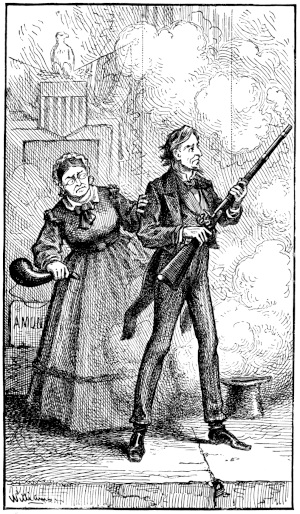
determination, and hand him bullets and cartridges,
while he aims his old revolutionary musket,
and shoots down iniquities on every side of him.
“Why, where would Josiah Allen be, if it wuzn’t
for me? He would come to nothin’, morals and all, if
it wuzn’t for me to hunch him up. And Samuel has
as much agin to worry him as Josiah has.
“Why, there is no tellin’ how many things that old
man has to plague him and torment the very life out
of him. Little things, too, some of ’em, but how
uncommon little things will worry anybody, ’specially
in the night. Curious things, too, some of ’em, that
has worried me most to death way off here in Jonesville,
and what feelin’s I should have felt to have had
it a goin’ on right under my nose, as Samuel did.
“Now, when they made that new silver dollar, right
there in his house I s’pose they done it, or in his wood-shed
or barn—anyway, it was right where he could see
it a goin’ on, and worry over it—you know they put onto
it, ‘In God we trust.’ And it has fairly hanted me
457to find out what the government really meant by it—whether
they meant that God wouldn’t let ’em get
found out in their cheatin’ seven cents on every dollar,
or trusted He would let ’em cheat fourteen cents on the
next ones they made.
“Why, it has worried me awfully, and how Samuel
must have felt about it. And that is only one little
thing.
“There is the trade dollars we made on purpose to
cheat China with, and sent over in the same ship we
sent missionaries to convert ’em. I persume to say
that old man has laid awake nights a worryin’ over
what the heathens would think about it—about our
sendin’ religion and robbery over to ’em in the same
ship—about our sendin’ religious tracts, exhortin’ ’em
to be honest, or they would certainly go to that bad place
which I do not, as a Methodist, wish to speak of, and
send these dollars to cheat ’em with in the same box—sendin’
458eloquent and heartrendin’ tracts provin’ out to
’em that no drunkard can possibly go to Heaven,
packed side by side with barrels of whiskey to teach
’em how to get drunk, so they will be sure not to go
there. I know it has wore on him, so afraid that the
heathens would be perfectly disgusted with a religion
taught by professed followers of Him who come down
to earth bearing peace, good-will to men, and then,
after 1800 years of professed loyalty to Him, and His
pure and exalted teachings, bore to their shores such
fruit as cheating, falsehood, and drunkenness.

“It has hanted Samuel, I know it has. Hantin’ me
as it has, it must have hanted him fur worse. He has
had severe trials, that old gentleman has, and he has
needed somebody to hunch him up, and lock arms with
him, and draw him along on the path of Right. And
I tell you when I talk with him I shan’t spare no pains
with him. I shall use my eloquent tone freely. I
shan’t be savin’ of gestures or wind. I shall use sharp
reason, and, if necessary, irony and sarcasm. And I
shall ask him (usin’ a ironicle tone, if necessary) how
he thinks it looks in the eyes of the other nations to
see him, who ort to be a model for ’em all to foller,
allow such iniquity as Mormonism to flourish in his
borders. To let a regular organized band of banditty
murder and plunder and commit all sorts of abominations
right under his honest old nose. And how it
must look to them foreign nations to see such a good,
moral old gentleman as he is lift his venerable old eyewinker
459and wink at such crime and sin. How insignificant
and humiliatin’ it must look to ’em to see him
allow a man in Congress to make laws that will
imprison a man for havin’ two wives when the same
man has got four of ’em, and is lookin’ round hungry
for more.
“And I shall hunch him up sharp about sellin’
licenses to do wrong for money—licenses to make
drunkards, and unfit men for earth or heaven—licenses
to commit other crimes that are worse—sellin’ indulgences
to sin as truly as ever Mr. Pope did.
“I don’t s’pose, in fact, I know, that Sam hain’t
never thought it over, and took a solemn, realizin’
sense of how bad he was a cuttin’ up (entirely unbeknown
to him). And, if necessary, to convince him
and make him see his situation, I shall poke fun at
him (in a jokin’ way, so’s not to get him mad). And
I shall ask him if he thinks it is any nobler for him to
set up in his high chair at Washington and sell indulgences
to sin, than it was in Mr. Pope to set up in his
high chair in Vatican village and sell ’em.
“And I shall skare him mebby, that is, if I have to,
and ask him in a impressive, skareful tone that if he
can’t be broke in any other way, if he don’t think he
ort to be brought down to a diet of Worms.
“It will go aginst my feelin’s to skare the excellent
old gentleman. But I shall feel it to be my duty to
not spare no pains. But at the same time I shall be
very clever to him. I shall resk it. I don’t believe
460he will get mad at me. He knows my feelin’s for him
too well. He knows there hain’t a old man on the face
of the earth I love so devotedly, now father Smith is
dead, and father Allen, and all the other old male
relatives on my side, and on his’en. I’ll bet a cent I
can convince him where he is in the wrong on’t.”
Here I paused for a moment for wind, for truly I
was almost completely exhausted. But I was so full
and runnin’ over with emotions that I couldn’t stop,
wind or no wind. And I went on:
“He hain’t realized, and he won’t, till I go right
there and hunch him up about it, how it looks for him
to talk eloquent about the sanctity of home. How the
household, the Christian home, is the safeguard, the
anchor of church and state, and then make his words
seem emptier and hollower than a drum, or a hogsit,
by allowin’ this sin of Mormonism to undermind and
beat down the walls of home.”
And then (this theme always did make me talk
beautiful), as I thought of home and Josiah, and the
fearful dangers that had threatened ’em both, why, as
I thought of this, I begun to feel eloquenter far than I
had felt durin’ the hull interview, and I don’t know as
the feelin’s I felt then had been gone ahead of by me
in five years. Why, I branched out perfectly beautiful,
and very deep, and says I:
“Home! The Christian home! The mightiest
power on earth for good. Each home seperate and
perfect in itself, like the little crystal drops of water,
461each one on ’em round and complete and all floatin’ on
together, unbeknown to them, makin’ a mighty ocian
floatin’ right into that serene bay into which all our
hopes and life dreams empty. That soundless sea that
floats human souls right up to the eternal city.
“The love of parents, wives, and children, like
golden rings, bindin’ the hearts to the happy hearth-stone,
and then widenin’ out in other golden rings,
bindin’ them hearth-stones to loyalty and patriotism,
love of country, love of law and order, and love of
Heaven, why, them gold rings within rings, they all
make a chain that can’t be broke down; they twist all
together into a rope that binds this crazy old world to
the throne of God.
“And,” says I, lookin’ at Elder Judas Wart, with a
arrow in each eye (as it were): “This most wholesome
restraint, this strongest of ropes that is stretched firm
and solid between safety and old Error, you are tryin’
to break down. But you’ll find you can’t do it. No
sir! You may all get onto it,—the whole caboodle of
you, Mormons, Oneida Communities, Free Lovers, the
hull set on you,—and you’ll find it is a rope you can’t
break! You’ll find that the most you can do is to
teter and swing on it, and stretch it out a little ways,
mebby. You can’t break it! No sir! Uncle Samuel
(after I have hunched him up) will hold one end of it
firm and strong, and Principle and Public Sentiment
the other end of it; and if necessary, if danger is at
hand, she that was Samantha Smith will lay holt of it,
462too; and I’d love to see any shacks, or set of shacks,
a gettin’ it out of our hands then.”
Oh, how eloquent I had been. But he wuzn’t convinced.
I don’t s’pose anybody would hardly believe
that a man could listen to such talk, and not be proselyted
and converted. But he wuzn’t. After all my
outlay and expenditure of eloquence and wind and
everything, he wuzn’t convinced a mite. And after he
had got his hat all on to go, he jest stood there in front
of me, with his hands in his pockets, and says he, bold
as brass, and as impudent as brass ever was:
“I am a goin’, mum, and I don’t never expect to see
you agin. I never shall see you in the kingdom.”
“I am afraid you won’t,” says I, givin’ him a awful
keen look, but pityin’. “I am afraid if you don’t turn
right square round, and stop actin’, you won’t be
there.”
“I shall be there,” says he, “but you won’t.”
Says I, “How do you know I won’t?”
Says he, “Because I do know it.”
Says I, with dignity, “You don’t know it.”
“Why,” says he, comin’ out plain with his biggest
and heftiest argument, the main pillow in the Mormon
church, “a woman can’t be saved unless some man
saves ’em, some Mormon. That is one reason,” says
he, “why I would have bore my cross, and married
you; obtained an entrance for you in the heavenly
kingdom. But now it is too late. I won’t save you.”
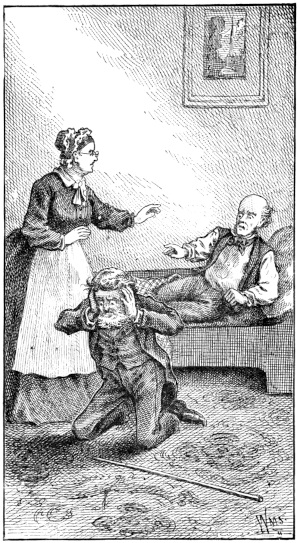
JOSIAH ENDS THE ARGUMENT.
“You won’t save me?” says I, lookin’ keen at him,
465as he stood there before me, with his red bloated face,
a face that had that low, disipated, animal expression
lookin’ out so plain under the sanctimonious, hypocritical
look he had tried to cover it with. “You won’t
save me! Won’t take me into the heavenly kingdom!
Wall, I rather think you won’t.”
I was so engaged and bound up in my indignant
emotions and principles and everything that I didn’t
see what was goin’ on behind me. But there was a
fearful scene ensuin’ and goin’ on there. A awful
scene of vengeance and just retribution. For my
faithful pardner, maddened by the terrible insult to
his Samantha, jest lifted himself up on one elbo, his
righteous anger liftin’ him up for the moment above
stitches and all other earthly infirmities, and he threw
that broom-handle at Elder Judas Wart with terrific
force, and aimed it so perfect that it hit him right on
the nap of the neck. It was a fearful blow. I s’pose
it come jest as near breakin’ his neck as anything ever
did and miss.
And it skairt him fearfully, too; for Josiah had been
so still for a spell that he thought he was asleep. And
it had come onto him as swift and severe as a judgment
right out of the heavens. (Not that I would
wish to be understood that broom-handles are judgments,
and should be handled as such; not as a general
thing. I am speakin’ in a poetical way, and would
wish to be took poetically.)
But oh! how fearful Elder Judas Wart looked. It
466squshed him right down for a minute where he ort to
be squshed—right onto his knees. He couldn’t get
up for a number of minutes, bein’ stunted and wild
with the blow and the fearful horrow of his skare.
And oh! how Josiah Allen did converse with him, as
he knelt there helpless before him; hollered! it wasn’t
conversation, it was hollerin’; loud, wild holler! almost
a beller!
He ordered him out of the house, and threatened
him with instant and immediate execution on the galluses.
Though he knew we hadn’t no gallus built,
and no timber suitable to build one; and he disabled
with a stitch, and nobody but me to do anything. But
he vowed, in that loud, skareful axent, that he would
hang him in five minutes’ time; and chop his head off
with a broad-axe; and gulotine him; and saw his neck
off with our old cross-cut saw; and shoot him down
like a dog; and burn him to the stake; and scalp him.
Why, Josiah ort to have known that one of these
punishments was enough for any man to bear, and
more than any man could stand up under. And he
knew we hadn’t the conveniences by us for half of
these punishments. But he didn’t think of that. He
didn’t think of nothin’, nor nobody, only jest anger
and vengeance. He was more delerious and wild in
his conversation and mean than I had ever known him
to be during our entire aquaintenship. It was a fearful
scene. It was harrowin’ to me to see it go on.
And Elder Judas Wart, as quick as he could get up,—started
467off on a quick run, almost a canter. I s’pose,
I have heerd sense, and then I could see from his looks
and actions, that a skairter man never lived. And
well he might be. I don’t blame him for it a mite.
I blame him for lots of things, but not for that; for
the words and mean of Josiah was enough to apaul a
iron man, or a mule.
But as I told Josiah afterwards, after the crazy
delerium begun to disperse off of his mean, says I,
468“Why is it any more of a insult to me than it is to
them other poor wimmen who have to endure it?”
Says I, “You feel awfully to have that doctrine jest
throwed at your pardner, as you may say. And look
at the thousands of wimmen that have to submit to
the humiliation and degredation of this belief, live in
it, and die in it.”
“Wall,” says he, chucklin’, “I jest choked old Wart
off of it pretty sudden. I brought him down onto his
knees pretty suple. He won’t talk about savin’ wimmen’s
souls agin right away. He won’t till his neck
gets well, anyway.” And he chuckled agin.
I don’t believe in fightin’, and am the last woman
to encourage it; but I could not help sayin’, in fervid
axents:
“Oh! if Uncle Samuel, that dear, blunderin’, noble
old man, would only hit old Polygamy jest another
such a blow, jest as sudden and unexpected, and bring
him down on his polluted old knees in front of the
nation. Oh! what a day that would be for America
and Samantha. What feelin’s we should feel, both on
us.”
“Yes,” says Josiah, “I wish it could be did.” In
the case of Josiah Allen my powerful talk (aided by
previous and more late occurrences) had fell on good
ground, I knew. The seed was springin’ up strong.
I knew it was by the way he threw that broom-handle,
and I knew also by his looks and axents.
He was perfectly and entirely convinced of the
469awfulness and vile horrors of Mormonism. I knew
he was. He looked so good and sort o’ noble at me.
And his tone was so sweet and kind of affectin’, somehow,
as he added, in gentle and plaintive axents:
“I believe, Samantha, I could relish a little briled
steak and some mashed-up potatoes.”
Says I, “So could I, and I will get dinner to once.”
And I did.
470

A CRISIS WITH KELLUP.
The very next day after I gin the Elder such a
talkin to, Cassandra and Nathan Spooner come
to our house a visitin, or that is, Nathan brought Cassandra
up as far as there for a drive, in the mornin’,
and I made ’em come in and stay to dinner, Cassandra
not bein’ very strong. They have got a young
babe, a boy, five weeks old that very day. Wall, while
they was there, while I was a gettin’ dinner, I had a
letter from Kitty. Kitty had gone home two weeks
before, unexpected. A letter bein’ had by her from
her mother, to that effect.
I never shall forget the day Kitty went. Never.
Josiah had hitched up to take her to say good bye to
the children, and they hadn’t been gone more’n
several moments, when Kellup Cobb come. He had
heerd the news of her goin’ home, and he looked
anxious and careworn. And his hair and whiskers
and eyebrows bein’ a sort of a dark mournful color
that day, made him look worse. He had been foolin’
with logwood and alum, and a lot of such stuff.
471He said, “he was fairly beat out a layin’ awake the
night before.”
“What ails you?” says I. “What is the matter?”
“Wimmen is what ails me!” says he with a bitter
look. “Wimmen is what is the matter! Why,” says
he, “wimmen make such fools of themselves about
me, that it is a wonder that I get any sleep at all; I
shouldn’t,” says he firmly, “I know I shouldn’t, if I
didn’t get so sleepy and sort o’ drowse off.”
“Well,” says I reasonably, “I don’t s’pose we
should any of us get much sleep, if it wasn’t for that.”
Says he, speakin’ out firm and decided, “I want to
do right. I want to do the fair thing by wimmen.
But there it is. How can I? Now here is Kitty
Smith goin off droopin’ and low-sperited, I s’pose, jest
on my account. And situated as I be, how be I goin’
to help myself, or chirk her up before she goes?
“I think my eyes of that girl. And I jest about
made up my mind, last night, in the dead of night
(for I don’t believe I slept a wink before ten o’clock),
I jest about made up my mind that marry her I would,
and let the rest of the wimmen live or die, jist as they
was a mind to.
“Why, I think so much of that girl, that it jest
about kills me to think of her goin off home, as them
without hope. But what can I do? I dassent say right
out that I will marry her, till I look round and see
what would foller. I want to see the doctor! I want
to see what he thinks, if he thinks the effects of such
472a terrible blow onto the fair sect would be worse at
this time of the year. It is a sickly time. Mebby
they would stand it better some other time of the year.
“But,” says he, “this I think I may safely promise
you; this, I think, will chirk her up a good deal: I
will write to her. I will kinder watch things, and
enquire ’round, and see what I can do—see how they
would seem likely to stand it, and if I see it haint
likely to kill ten or fifteen, I will try to get round and
marry her. You tell her so from me. And tell her I
will write to her, anyway. My very heart-strings
seemed wrapped round that girl,” says he, sithin’ hard,
“and how I am a goin’ to stand it is more than I can
tell, to think of her bein’ way off there alone, a sufferin’
and droopin’ round, on my account.
“But this letter will probable be the greatest comfort
she can have next to havin’ me myself. You will be
apt to write to her?” says he anxiously.
“Yes,” says I, “most probable I shall.”
“Wall,” says he, “I will put in a letter with you
when you write. It haint the postage that is the stick
with me, it haint the 3 cents I mind. But if I can’t,
after all my efforts, see my way clear to marry her, it
would seem more cruel and cold-blooded in me, to have
gin her the encouragement of sendin her a letter by
myself, all stamped and paid for by me, than it would
to send it in with somebody else.” Says he, “Don’t
you think so?”
473Says ISays I in a sort of a blind way, “I think of a
great many things that it wouldn’t do to tell of.”
“Yes,” says he, “you probable pity me, and realize
the situation I am placed in, more than you feel free
to tell. You probable think that sympathy would
break me down—make me feel worse.”
“Yes,” says I firmly, “I don’t feel free to tell my
opinion of you. It would be apt to make you feel
worse.”
“You are a woman of principle, Josiah Allen’s wife,
and a woman of strong sense. You realize my situation—you
feel for the condition of my heart.”
“Yes, and your head too,” says I; “I realize jist
what has ailed you, ever sense you was born. But,”
says I, wantin’ to turn the subject, for I was sick of it,
sick as a dog. Says I “you wuzn’t to meetin’ last
night wuz you?” Says I, “We wimmen talked it
over after the meetin’, and we are goin to take up a
collection to make Miss Bamber a present of a new
black dress. We are goin’ to ask each church-member
to give jest one sixpence, and one sixpence apiece
from the 250 members will get her a good bumbazeen
dress, or a very nice alpacka. And so,” says I, “I
thought I would ask you for your sixpence.”
Knowin’ it is Kellup’s duty to be tackled for the
good of the meetin-house, I will, no matter whether
he will give anything or not, I will insist on tacklin’
him.
Says I, “You know Miss Bamber has lost her
474mother-in-law and wants to mourn for her—wants to
the worst kind, and can’t.”
“Why can’t she mourn?” says Kellup.
“Why,” says I, “She can’t mourn, because she
haint got no dress suitable to mourn in, thats why
Miss Bamber feels like death about it. She knows it
is her duty to mourn, and she wants to, like a dog, but
can’t.”
Says Kellup, lookin stingy, awful unwillin’ to give
anything, “She can mourn jest as bad in one dress as
another, or without any.”
“Wall,” says I reasonably, “So I think. But
everybody has their little different ways and excentricities,
and it don’t look well for us to meddle with ’em.
Now that feller by the name of Procrustes, at Attica
village. Now, I always thought he went too far. He
had a iron bedstead, and he used to make everybody
that traveled his way lay down on it, and if their legs
was too short, he would stretch ’em out to fit that bedstead,
and if they was too long, he would saw ’em off.”
Now Mr. Procrustes wuzn’t doin’ exactly the fair
thing. What earthly business was it of his, if other
folks’es legs was too long to be convenient, or too
short? It wuzn’t his place to trim ’em off, or stretch
’em.
And I always thought that if I had had business in
his neighborhood, and been travelin’ that way, and he
had tried to fit me or Josiah to that bedstead, why, I
475always thought he would have seen trouble. I should
have gin him a awful talkin’ to, and kicked.
Mr. Procrustes is dead. Yes, I believe old Thesius,
a neighber of his’en, killed him upon some mountain
or other. I presume he got to stretchin’ old Thesius’es
legs out, or begun to saw ’em off, and got the
old man mad, and he jest laid to and killed him.
Yes, I believe old Mr. Procrustes hain’t livin’ at the
present time, but he left a large, a very large family.
And every one of ’em inherits the old gentleman’s
traits and disposition. I have seen lots of ’em that, if
they dast, would have every leg in the world jest the
length of their’n. If they dast, they would tackle you
in a minute with a saw or a broad-axe.
476“But I never felt that way. Now, as fur as my own
feelin’s are concerned, I think memories can haunt
anybody, and hearts can ache jest as severe under a
white dress as a black one, and visey versey. Hearts
can beat gay and triumphant aginst bumbuzeen bodist
waists and crape trimmin’s. But Miss Bamber feels
different. She feels that she can’t mourn without certain
conveniences. And feelin’ in that way, and
feelin’ that it would be a duty and a privilege for her
to mourn for her mother-in-law, I say that woman
shall have the wherewith to do it with. I say she
shall mourn if she wants to; she shall be helped to a
black dress. There hain’t a member of the meetin’-house
but what can give a six-pence without feelin’ it.
We want to keep it all still from Miss Bamber, and
get it, and get it all made for her before she knows a
thing about it. And,” says I, “mebby you had better
give me the six-pence to-day, as we have got it about
all collected, and want to get the dress right away.”
Says he, “Hain’t there nobody else whose duty it is
to get the dress? Her relations? I should think it
was their duty to help.”
Never did I ask a stingy human creeter for help for
the poor, or help for the meetin’-house, but what this
argument was dragged up by ’em. Tryin’ to shirk off
their own duty onto somebody else.
“No,” says I, “her family is all dead. She hain’t
got but one relation in the world, and that is an aunt
477of her grandmother’s; and she is supported by the
town.”
“Wall,” says he, cheerfully, “mebby the town would
feel like gettin’ this dress.”
I jest give him a look, and never said another word,—only
jest that look. But I s’pose that look spoke
louder and awfuler than words, for he hastened to say,
in a apologizin’ way:
“I didn’t know but the town would want to—would
feel it a privilege to—”
I still didn’t say nothin’, only jest that awful look.
And agin he says, in a apologizin’ way:
“I would advance the six-pence to you, I would try
to raise it some way for you, but the hard times we
have had, and are havin’, have depressed all sorts of
business so, we have suffered terribly financially as
well as the other public. We have got a great deal of
money to make out this fall—over 10 dollars. Father
hain’t a bit well; my health hain’t what it once was;
our expenses are enormious—taxes, household expenses,
clothin’; and takin’ all these things into consideration,
together with the public debt, the withdrawal
of funds by foreign capitalists, the almost total
stagnation of public enterprize, the total lack of public
confidence, the total—”
Says I, “Put in total selfishness and total meanness,
and keep your six-pence.”
I don’t believe I have been more wore out in over
seven months,—and mad.
478“Wall,” says he, lookin’ relieved, “if you will
excuse me, I won’t make no move towards raisin’ the
money for you. It would probable cramp me considerable
to raise the sum jest at this present time.”
And then he begun about Kitty agin. Says he,
knittin’ up his eyebrow hard, and lookin’ gloomy:
“I never calculated to fall in love with a poor girl.
It never used to pass my mind that I ever should
select such a one out of the hundreds that stand round
me, hankerin’ to marry me. But I have done it. Why,
sometimes I think I couldn’t love that girl any more
if she was worth two hundred and 50 dollars. I think
so much of her that it is as hard for me as loosin’ a
limb, almost like loosin’ my pocket-book, to think of
her bein’ way off there a pinin’ for me, and bein’ on a
perfect rack, not knowin’ whether she will get me or
not.
“When I think of that side of the question, Josiah
Allen’s wife, I feel jest like leavin’ word here with you
for her, that I will marry her, whether or no. But
then, jest like a blow aginst the side of my head, comes
the thought of them other wimmen, that had hopes
before she come to Jonesville that they would get me.
I believe, anyway, it will be safe to leave word here for
her to keep up good courage, and try not to get too
cast down and melancholy; to hope for the best; and
I’ll do everything I can. I’ll enquire round about the
wimmen, see the doctor, and try to arrange things for
her good and happiness; try to get round and marry
479her. At the same time,” says he, with a cautious
look, “I would feel it my duty to warn her to not get
so bound up in me that the disappointment would kill
her, if she should lose me.”
“Wall,” says I, bein’ wore almost completely out,
“I must go and skim the milk for the calves.”
And he took the hint and started off, and glad
enough was I to see him go. But jest as he went
down the steps, and I turned to go into the buttery, I
see a paper of indigo that Marier Burpey had left here
that very day. She had forgot it, and I knew she was
in a hurry a colorin’; so I jest carried it to the door,
and asked Kellup if he would carry it to her, knowin’
he had to go right by her door.
“No,” says he, firmly, “I dassent do it.” And he
looked anxious and skairt as he said it. “I’d be glad
to, but I dassent,” says he. “I have to make my
demeanor perfectly stunny towards that girl, in order
to keep her affection anywhere within bounds. She
don’t show it any by her looks or actions—she has got
almost marble self-control; but I see right through it.
I see that she almost worships me. I see that I am
makin’ her perfectly unhappy; and when I think of
Sofier’s fate, I tremble for Marier. I am careful; I am
a careful feller; I am on my guard. And at the present
time, situated as I be in regard to Kitty, I feel that
I ort to be doubly careful. But at any and every time
a young man like me can’t be too careful when they
are round amongst wimmen.”
480“Nobody wouldn’t mistrust you was makin’ such
havock,” says I, mechanically, for I really didn’t know
what to say.
“Yes, if a young man like me is unprincipled enough
to go headlong into wimmen’s company without lookin’
where he is goin’, without actin’ offish and cold to ’em,
why, before that man knows it, he is a wadin’ through
goar. Bleedin’ hearts lay round him on every side a
481bleedin’. Why don’t other young men think of these
things? Why hain’t they more careful, more offish?”
Says I, with feelin’, “That’s so, why hain’t they?
The offisher some men be, the more I think on ’em.”
And I looked longin’ly at the path down to the gate,
and the road to Jonesville.
“Yes, you know what actin’ on principle means.
That is why I respect you, confide in you.”
“Then you don’t think you can carry the indigo?”
says I, turnin’ to go in.
“No,” says he, firm as marble, and as sot as that
stun. “I’d love to accommodate you, but I dassent.
When I think of the fate of Sofier, when I think of the
deadly blows my conscience dealt to me every minute,
as I drove her hearse to the buryin’-ground—then I
feel as if I had almost ruther lose ten cents than go
through it agin with Marier. I feel that I must not be
resky, and do anything to ensnare her affections.”
“Good land!” says I, “indigo won’t be likely to
ensnare ’em, will it?”
“Other men might handle it safe, men with less
attractions than I have got, but I can’t, I dassent.”
And I wouldn’t demean myself by urgin’ him another
word. And I went into the house, and he
started off.
Wall, as I was a sayin’, Kitty had been gone two
weeks, the day Nathan and Cassandra visited me, and
this letter from her, brought in to me while I was
a gettin’ the dinner onto the table, brought news that
482was startlin’ and agitatin’ in the extreme. I was jest
a stirrin’ some sweet cream and butter together over
the stove, havin’ a fresh salmon trout for dinner, and
Josiah bein’ fond of that kind of gravy to eat with it,
and Nathan bein’ such a clever creeter, offered to stir
it for me, while I read the letter. And I was so
anxious to git the news, that I let him do it, though,
the stove bein’ so hot, take it with that and his
burnin’ blushes, it made a pretty hot time for him.
But the news was this: Kitty was married. But the
curiousest and most agitatin’ part of the news was, the
old gentleman, Mark’s father, had got after Kitty’s
mother. He went to give her a scoldin’, and fell in
love with her on the spot. Like Hamen, he got hung
on his own gallowses—went to smite her, and got smit
himself, awful. So he courted her up violent and
powerful, and they all got married the same day.
It was very pleasant and agreeable news to me, and
to Josiah. And Cassandra and Nathan acted well
about it. They said they was glad it all turned out so
well, but their minds didn’t seem to be on the news so
much as they was on their babe. And it is a very
good-lookin’ child, and appears middlin’ well for a
child of its age. Takes after its father some—sort o’
sandy, with red hair. It don’t look much, as little
Samantha Jo did, nor it don’t have that noble, beautiful
appearance she had at that age. But then you can’t
expect that any other child is ever goin’ to look and
act like her. I do despise people bein’ so bound up in
483their own childern and grandchildern that they can’t
see no good qualities in any other childern. Thank
fortune that hain’t my way, nor never was. And I
say, and I always shall say, that Cassandra’s babe
hain’t a babe to be ashamed of, and feel above, not by
any means.
Bein’ so awful bashful, Nathan don’t probable associate
with it so much, and act on such intimate terms
with it as he would if it wuzn’t for that. But in a
mild, sheepish way, he seems to think the world of it,
and seems to want to do everything he can to make it
feel to home with ’em, and happy. But he don’t come
out openly and express his admiration and affection, as
he would if it wuzn’t for that drawback.
Now, he dassent hold it much, or that is, he don’t
seem to dast. But Cassandra bein’ proud-spirited, and
wantin’ Nathan to show off some, would once in a
while put the babe in his lap.
He never would make any move to stop her. He
never would refuse to take it. He would set and hold
it jest as long as she felt disposed to leave it there.
But he would look down on it in a skairt, wonderin’,
breathless way, as if the child got there in his lap
through some mysterious and inscrutable decree of
Providence, and it wuzn’t for him to resist. But he
suffered intensely at such times, I could see.
And every little while Cassandra (bein’ determined
to make Nathan show off) would tell him to say sunthin’
to the babe, talk baby-talk to it. And he would
484always try to. He would always do jest as Cassandra
told him to (a cleverer critter never walked). His
face would be as red as a red handkerchief, but he
would ask the babe, up in a little, high, fine voice:
“DO YOU WANT A PAIR OF BOOTS?”
“Do you want a pair of boots?”
He never made any other remark to the child that
I heard, only jest that. I heard him say that to it
487more’n 20 times, I dare persume to say. For Cassandra,
bein’ so anxious to have him show off, kep’
tellin’ him to talk to it. And it seemed as if that
remark was all he could think of that would be agreeable
to the child. But Josiah said, as we was talkin’
it over afterwards, that he heard him say two or three
times to it:
“Yes, it shall have a pair of boots.”
But it must have been when I was out a gettin’ dinner.
For if I was under oath I would say that I didn’t
hear him say a single thing to it, only jest this:
“Do you want a pair of boots?”
They started for home jest after dinner, Nathan
havin’ left some work that must be done. And Josiah
hitched up and went to Jonesville to mill. And I
s’pose he told the news about Kitty there. But it
wuzn’t till the next afternoon that I heard what the
effects of that news wuz in a certain place and to a
certain feller.
And though it hain’t always best to mention names,
and come right out plain and talk, yet it probable
won’t do no hurt to mention that you might expect
Kellup Cobb, under any circumstances, would act like
a fool.
I was down to the creek lot, pickin’ a few berries
for supper, when Josiah told me on’t. It had got a
little later than I thought for, and Josiah had come
down after me, bein’ worried about me. It was only
a little ways from the house. I had put the tea-kettle
488on, and sot the table, before I had come out, and the
tea-kettle was a bilin’, so Josiah said, after he told me
the news. The news was thrillin’ and agitatin’ in the
extreme. He said Kellup Cobb had disappeared the
night before, after the news of Kitty’s marriage had
got abroad in Jonesville. They said that he felt so
that he disappeared, he and the hearse and Elder
Judas Wart—the hull three on ’em. Kellup had been
on intimate terms with Judas Wart for some time; and
some think that Kellup bein’ so cut down by Kitty’s
marriage, and the Elder bein’ so cut down by my witherin’
eloquence and Josiah’s broom-handle, that they
both got into the hearse, and drove off in it to Utah to
jine the Mormons. And some think that they sold the
hearse, and took the money, and went to Salt Lake by
rail. Which last way, I told my Josiah, when he mentioned
it, was the proper way to go there, if it wuz the
right kind of a rail. But anyway, they had gone, the
hull three on ’em, and there hain’t been a word heard
from ’em sense in Jonesville.
Josiah said old Cobb felt awfully.
Says I, “To lose Kellup?”
“No,” says he, “to lose the hearse.”
But I jest repeated this line of poetry to my pardner.
Says I:
“Poetry, Josiah, will somehow express the feelin’s
of the soul better than you can express them yourself.”
And says I, “Josiah, as for Elder Judas Wart and
489Kellup, I say with the poet, good riddance to bad rubbidge.”
“Wall,” says Josiah, with a sort of a dreamy look,—that
man loves poetry, though he seldom quotes it—“don’t
you s’pose, Samantha, that you have got about
enough berries for supper, for I am gettin’ hungry as
a bear.”
“Yes,” says I, “because I have got stewed peaches
and cold chicken and everything else good for supper
besides them. But,” says I, lookin’ sort o’ longin’ly
at some berries that was a hangin’ over the water,
“there is a few extra big and ripe ones that do look
too good to leave.”
“Wall,” says he, sweetly (for his mean sense I told
him what we was goin’ to have for supper had looked
perfectly beautiful), “you set down and rest, Samantha,
and I will pick ’em for you.”
And so he took my little tin pail, and with a happy
frame bent down to pick ’em. And I, bein’ tired, sot
down, and looked into the water. And I see that
everything was reflected in it. The trees, the nodding
red sumac feathers, my Josiah and me, gay golden-rod
and wild blue china-oysters, the berry bushes, the
thorny stalks and the ripe fruit, fresh posys, and withered
leaves; all imaged there in the water; and the
water was a runnin’ swift.
And out on the end of a slender bush that hung over
the water, a bird swayed and swung to and fro, and
sung out a dretful sort of a sweet song, yet sad like.
490Some as if it was practicin’ over a farewell song to its
home, its happy nest, before it sailed away south in
search of a balmier climate.
So the bird sailed back and forth on that slender
twig, over the deep waters, a singin’ about a happier
country, sweet and sad, sweet and low. And my pardner
picked the ripe berries, and I sot there peaceful
and serene (though some sweaty), a thinkin’ how, over
all that was pictured on the changing face of the
waters, the changeless blue heavens was reflected,
shining down over all, the old and the new, the mournful
and the sorrowful; over all, and beneath all. That
thought was perfectly beautiful to me, and dretful
comfortin’. And I sot there a thinkin’ of that, and a
thinkin’ how swift the water was a runnin’ towards
the sea.
491HAVE YOU READ
MY OPINIONS
AND
BETSEY BOBBET’S
By JOSIAH ALLEN’S WIFE?
AUTHOR OF
“SAMANTHA AT THE CENTENNIAL,” AND “MY WAYWARD PARDNER.”
IF NOT GET IT THE FIRST OPPORTUNITY.
This book is one of those indescribable ones, of which little can be
said except that it is rich and spicy throughout, readable and fascinating,
brimfull of humor and sharp things—yet not a line in it, that does
not point a moral, and teach a lesson. It will create a sensation whenever
read, and no one will enjoy it better than the ladies, although it
deals with them in a plain way. The men will like it, the children
will like it, all will like and laugh over it, and remember its teachings
long afterwards.
The Public will make no mistake in purchasing this book, as it
is full of good things, which will at once arrest and rivet the attention
of the reader.
Never was a character’s lines drawn more distinctly than that of
Josiah’s wife, and her originals will be found among the acquaintances
of many. Cute, wise, shrewd and observing, with a vein of
strong common sense, yet simple and innocent as a child, she will
keep the reader crammed with sharp hits and funny observations.
Betsey Bobbet’s opinions act upon Josiah’s wife’s, as settings
do upon diamonds: adding to their brightness and resplendency.
The book contains 432 Pages, and is filled with Pictures, put
in, as the author says, to explain the text.
| Price in Fine English Morocco Cloth, |
|
$2.50 |
| ” ” ” ” ” |
Gilt Edges, |
3.00 |
| ” ” Half Turkey Morocco, |
” |
4.00 |
The book can be had by addressing
AMERICAN PUBLISHING CO.,
AGENTS WANTED. HARTFORD CONN.
492JOSIAH ALLEN’S WIFE’S
AS A
P. A. and P. I.
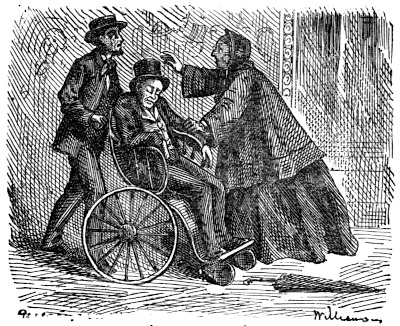
JOSIAH’S FIVE HOURS’ RIDE.
Samantha at the Centennial.
By the Author of
“MY OPINIONS AND BETSEY BOBBET’S,” AND “MY WAYWARD PARDNER.”
This book the writer sends forth to the world, expecting it
will (as did other martyrs: John Rogers and etcetery) tread
on the hot coals of public opinion; be briled on the gridiron
old bigotry keeps to brile her enemies on; be scalded by the
melted lead of old custom; and be burnt up on the stake of
opposition; yet still, upheld by firm principle and lofty emotions,
she is able to say: “I am happy in the thought.”
A kind and noble Artist has risked his fame by
drawing a few pictures for the book.
This Volume Contains 580 Pages,
25 Full-Page and 50 other Engravings
Prices: In Fine English Cloth, $2.50; do. do., Gilt Edge, $3.00;
Half Turkey Morocco, $4.00.
The book can be had by addressing
AMERICAN PUBLISHING CO.,
AGENTS WANTED. HARTFORD CONN.
The Table of Contents had several errors in pagination, briefly off by
two pages. These have been corrected.
On p. 198, a lengthy (and literally) parenthetic remark begins in mid-sentence
and finishes with the following paragraph.
Errors deemed most likely to be the printer’s have been corrected, and
are noted here. The references are to the page and line in the original.
The following issues should be noted, along with the resolutions.
| ix.6 |
How he Courted Cassandr[i]a |
Removed. |
| 52.16 |
it cannot long [h/b]e hid |
Replaced. |
| 61.15 |
if I was in his place.[”] |
Removed. |
| 62.10 |
for I may not marry at all.[’/”] |
Replaced. |
| 72.3 |
I am most afraid it is resky then.[”] |
Added. |
| 103.18 |
my tooth-brush.[”] |
Removed. |
| 103.19 |
the tooth[ /-]brush |
Replaced. |
| 113.6 |
[“]Says I: |
Removed. |
| 114.17 |
but it se[mede/emed] as |
Transposed. |
| 210.5 |
poke at [’]em |
Added. |
| 240.7 |
[“]And superintendents |
Added. |
| 243.1 |
and not fatigue [your-]yourself |
Removed. |
| 248.8 |
we was a marchin[’] round |
Added. |
| 383.5 |
Tamer Moony,[’/”] says I, |
Replaced. |
| 426.15 |
right away from happiness.[”] |
Added. |
| 473.1 |
[“]Says I, in a sort of a blind way, |
Removed. |