INTRODUCTORY — CONTENTS — LIST OF ILLUSTRATIONS — MY SPANISH YEAR — PART I.—SUMMER — CHAPTER I
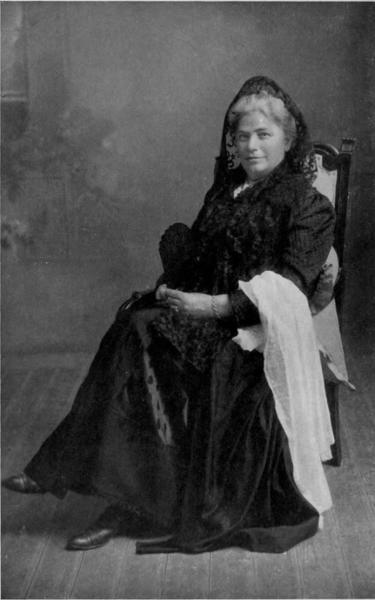
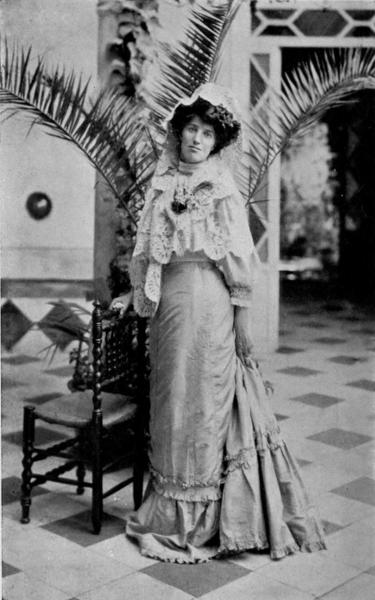
“DOÑA ELENA.”
MY SPANISH YEAR
BY Mrs. BERNHARD WHISHAW
AUTHOR (WITH BERNHARD WHISHAW) OF
“ARABIC SPAIN”
WITH TWENTY ILLUSTRATIONS
MILLS & BOON, LIMITED
49 RUPERT STREET
LONDON, W.
Published 1914
To the foreigner visiting Spain for the first time so
many things seem topsy-turvy that, unless a philosophical
spirit be cultivated, one’s temper might suffer
serious damage. But there is one way not only to
endure, but actually to enjoy the minor discomforts,
absence of consistency, and utter lack of common
sense forced upon one at every turn in this most
original country; and that is to regard them all
from the standpoint of comic opera. So many
people expect to find Spain merely an enlarged
edition of Bizet’s Carmen that it ought not to be
difficult for them to smile when comic-operatic
incidents are enacted before them in daily life; and
yet one often sees the impatient traveller exhausting
himself in furious denunciations of tough beef, bad
butter, unpunctual trains, faulty postal services,
retrograde hotels, and so on ad infinitum, instead
of thanking his lucky stars that there is still one
country in Europe which remains much as God made
it, instead of being recast in the mould preferred by
the tourist agencies.
No doubt when we get express trains flying from
Irun to Madrid and from Granada to Seville at sixty
miles an hour, with a chain of cosmopolitan hotels
all along the road, those tourist agencies will be able
to do far better business. But their clients will not
then travel in Spain but in Cosmopolitania, and the
last stronghold of romance left in Western Europe
will have gone the way of Switzerland and Italy,
where in some towns it is almost the exception to
hear the language of the native spoken in the streets.
Thank Heaven, Spain has not yet awakened to the
commercial advantages of moulding her national
characteristics into the groove of the common-place,
and her soul has not yet been cut out and thrown
away in the pursuit of filthy lucre.
Meanwhile, the traveller who follows the beaten
track has really very little to complain of, for during
the last ten years great progress has been made both
in the train service and the hotel accommodation;
and when you have grumbled and slept and scolded
through the eight or ten or twelve or twenty hours’
railway journey from one provincial capital to
another, and take your place at the table d’hôte
in one of the big new hotels, you might almost
imagine yourself in London or Paris or New York.
One thing, however, reminds you that you are in
Spain: the anxious solicitude of the waiters, who
watch your every mouthful as if it were a matter of
personal consequence to them that you should be
pleased with your dinner, and press fresh dishes
upon you if you do not eat as much as they think
you ought, assuring you that they are very excellent
and that you must keep up your strength in order to
enjoy the beautiful monuments that you are going
to visit to-morrow. This interest of the mozo in his
master’s client is genuine, not inspired by the anticipation
of favours to come. He feels it as a reflection
upon the credit of the house if you refuse to take
every course, and finds it difficult to understand that
abstinence may mean satiety, not dissatisfaction with
the viands. I doubt if anywhere else one seems of
quite so much importance in the eyes of the establishment
as in Spain, for these attentions begin with
your first meal in the hotel and are continued
throughout your stay; and can anything make you
more at home in an hotel than a cordial interest in
your appetite?
If you complain of the interminable time that
you have spent on the journey, you will be met with
the grave assurance that it is safer to travel slow
than fast, and that Spain has far fewer railway
accidents than England or the United States. You
may reply that she has far fewer trains, but we don’t
trouble ourselves about the law of averages in Spain,
and the Spaniard solemnly assures you that nothing
is gained by the alarming rapidity of Anglo-Saxon
life except more speedy arrival at the grave.
If you dispute an hotel bill, longer than would
be made out at the Ritz, for an entertainment which
it would be complimentary to describe as mediocre,
the landlord justifies his charges by explaining how
much you get for your money in these days of
progress, compared with what you lacked when life
in Spain was cheaper, and after all what can a dollar
or an esterlina (£) more or less matter to so great a
lord as yourself, who must evidently be a millionaire
to be able to travel so far from home merely for his
own pleasure. You must also take into account, he
says, that the tourist season only extends over a
couple of months in the spring, thanks to the general
ignorance abroad of the charms of the winter climate
in that particular part of Spain. And how, he asks,
is a poor man to keep his hotel open all the year
round for the convenience of the English lord in the
spring, unless the English lord pays enough when he
comes to save him from bankruptcy during the other
ten months of the year? And if these arguments—in
the course of which the exorbitant items under
discussion have been skilfully left out of the conversation—do
not remove your objections to an extortionate
bill, only one of two courses remains open to
you. Either shake the dust of Spain off your feet
and depart to some other land where the innkeepers
realise that one contented guest will bring more
money into their coffers than ten who depart in
anger; or come with me right off the beaten track,
and learn to know the real Spain, and to love, as I
do, the real Spaniard.
Will he exploit the foreigner? He would rather
give you the coat off his back than take a penny
from you that he has not honestly earned; and he
will do you all sorts of services with the native grace
which has created the tradition that “every Spaniard
is a gentleman.” That class of Spaniard does not
frequent the large cities, nor is he to be found by
foreigners who seek him with the aid of an interpreter.
Indeed, he is not worth the interpreter’s
powder and shot, for he cannot pay a commission on
purchases made by the guileless traveller through
the agency of his guide: he has nothing to sell save
his honour and courtesy, and those are not marketable
commodities. So he is left undisturbed in his
beautiful mountain fastnesses or in his fertile plains,
where only a select few will take the trouble to seek
him out. And long may he remain there!
But when he is sought and found by the traveller
who is not content to form his opinion of the whole
country on his observations from the window of an
hotel, then indeed it becomes evident that the heart
of Spain beats strong and true beneath the froth of
political passion and greed of gain which disfigure
her outward semblance; and the veil of romance
woven about her by the poet and the artist will
enwrap that traveller, and he will return to Spain
again and again, until he, like the writer, finds that
into the web are woven some of his own heartstrings.
Then all the minor discomforts will become but
mere matter for laughter, with an arrière-pensée of
satisfaction at the barrier they set up against the
flood of cheap trippers which, but for them, might
overwhelm our Peninsula. And if sometimes we hear
a note of tragedy beneath the light chorus of our
opera, it does but deepen the music, as the purple
shadows in an Andalucian street throw up the golden
glow that bathes the white-washed houses basking
in the sun.
One word more. My readers may perhaps be
surprised to find a “heretic” on good terms with
many ecclesiastics in Spain, for there seems to be an
impression abroad that this is a bigoted land where
foreign non-Catholics are given the cold shoulder,
if nothing worse.
Of course there are many Spaniards who feel
strongly on the subject of their religion, and no
doubt any one who publicly showed disrespect to
objects of worship here would have cause to regret
his lack of good manners. But so long as he
behaves decently in sacred places, and observes a
certain amount of discretion in conversation, the
“heretic” need fear no discourtesy either from priests
or people. Nor will he meet with any oppressive
zeal in the direction of proselytising. The most
embarrassing effort in that direction that I have
known was the gentle remark from a nun: “You are
so good already that you ought to be a little better.
I pray daily that you may become a good Catholic.”
And an entertaining experience was that of a
member of our family whom a distinguished divine
announced his desire to convert—
“We will begin with a game of chess,” said he,
“and after that we will discuss dogmas.”
The game of chess proved so engrossing that it
lasted till bedtime, when the divine took his leave
in a hurry, forgetting all about the dogmas.
The accusation of bigotry now—whatever may
formerly have been the case—is as undeserved as
many other unkind things that have been said about
Spain.
“We are very much misrepresented by foreign
writers,” an intelligent young officer said to me one
day; “if ever you write a book about Spain, I hope
you will speak of us as you find us, so that for once
we may have a little justice from a friend.”
With this rather pathetic appeal in mind I have
tried my best to describe Spain as I have found it,
and I must maintain that I have done my Spanish
friends no more than justice, even though those who
do not know them write me down a prejudiced
Hispanophil.
⁂ The accents marked on the Spanish words in the text are in
most cases added merely as a guide to the pronunciation, for those
who do not know the language.
Life in the patio—Locked doors and lovers—The uses of the
grated gate—Courting under difficulties: the keyhole and
the crack—Manolo and Carmencita, a romance in real life.
The great event to which the whole creation moves
in the eyes of a Spanish señorita—not being a
resident in Madrid—is the annual fair in the
capital town of her province. This generally takes
place in the spring, and therefore, for her, the
spring is the end and not the beginning of the
year, looked forward to with increasing excitement
through autumn and winter, while to that young
lady summer is but the beginning of the long year
which has to be lived through until spring and
LA FERIA, in capital letters, comes round again.
I, like the Spanish señorita, will begin my
Spanish year with the summer, if not exactly for
the same reason, for one akin to it. The great
heat of summer, with its dust, mosquitoes, and
flies, is the most trying time in all the twelve
months in this country, as the spring is the most
enjoyable; and wise people keep the best to the
last.
Let it not be supposed, however, that summer
in Spain has no compensations. They are many
and various, and not the least among them is the
life of the patio, which begins in June and ends
in September.
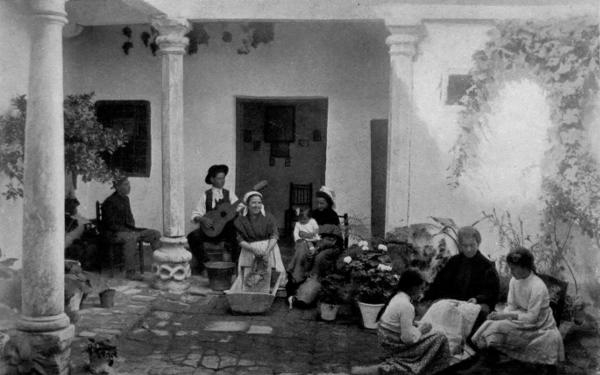
The patio is always spoken of as one of the
peculiar charms of southern Spain, but how many
of my readers, who have not visited the country,
know exactly what it is? I myself, before I came
here, had a vague idea that it was something in
the nature of a yard, and I remember that on
seeing a huge corral for cattle, attached to a farmhouse
near Tarifa and so large as to be visible from
the steamer as we approached Gibraltar, I asked
whether that was a patio!
The Andalucian house of to-day is in essentials
the direct descendant of the house built by the
Greeks who colonised Andalucia, or Tartessus, as
they called it, some six or seven centuries B.C.
The pylon, now called the zaguan, is the vestibule
leading from the street door direct into the peristyle,
the open courtyard round which the house is
built, now known as the patio. In the daytime
the zaguan is open to the street, but entrance to
the patio is barred by a large iron grille, which can
only be opened from within. The Romans continued
the Greek form of house, with slight
structural modifications, and added the solarium,
an open gallery or arcade intended for basking in
the sun. This feature is common in the older
houses of Andalucia to-day, although those of more
modern construction lack it, and the inmates when
they wish to sun themselves go up to the azotea,
the flat brick roof on which the family washing is
usually hung out to dry. The names azotea and
zaguan are both Arabic, showing, were demonstration
needed, that neither the Visigoths nor the Arabs
made any essential alterations in the structure of
the houses they found when they respectively
conquered Andalucia.
The patio is a central court off which numerous
rooms open, always including the summer dining-room
and the summer kitchen, their winter counterparts
being on the floor above. There is also a sala
or reception-room, and in old houses this may have
beautifully carved Arabic roof-beams, filled in with
fine fifteenth- or sixteenth-century lustre tiles: for
while the upper stories are frequently modernised and
sometimes brought quite up to date in the matter
of bathrooms, ample windows, and effective ventilation,
the patio with the dark rooms surrounding
it is very seldom reconstructed. It is only used
as a refuge from the summer heat, and the architects
of to-day wisely refrain from interfering with the
shadowy lights and cool refreshing temperature
which make life enjoyable even when the thermometer
outside stands at 110 or more in the shade.
Great doors—sometimes of mahogany, cedar, or
lignum-vitæ four inches thick, studded with large
brass or iron nails, and adorned with corner pieces,
lock, key, and knockers, all richly wrought to match—shut
off the zaguan from the street. All day
long these stand open, as though inviting the passer-by
to step in and admire the patio within, the whole
of which can be seen through the cancela or iron
grille already mentioned: but at night they are
closed and secured with a huge iron bolt, often
two or three feet long. The noise made by the
closing of these doors at night, and the shrieks of
the great bolts, which are never by any chance oiled,
can be heard one after the other all along the
street, and are liable to interfere a good deal with
the beauty sleep of the stranger. But, unless there
is a velada or a tertulia going on, the noise is
all over by 11 p.m. or earlier, because custom
requires that respectable houses should present
blank faces to the moonbeams a full hour before
midnight.
If you ask how this can be when every one
knows that Spanish gentlemen make a practice of
turning night into day at their cafés and clubs,
I must call your attention to the postigo, a little
low wicket opening in one of the great doors. The
stern father, forgetful of his own youthful escapades,
or determined that his son shall not follow in his
footsteps, may order the door to be locked at eleven
every night; but there is always a corruptible
servant or a tender-hearted sister on the watch
to lift the latch of the postigo and screen the young
scapegrace from the paternal ire.
We may take it for granted that when the sister
connives at her brother’s late hours, it is not to
enable him to gamble at his club or drink more
than is good for him at the café. It must be a
love affair that enlists pretty Amparo’s sympathies
and keeps her out of her bed to all hours. She
has probably been listening to the professions of
devotion of her own forbidden lover until long
after midnight, and thus all her sympathies are with
Manolo, who also has lost his heart without permission
from the parents.
In these cases the soft nothings have to be
breathed between the bars of the stout iron gratings
which are placed outside every ground-floor window,
not only as a precaution against malefactors, but,
as a young Spaniard once told me, “to keep the
girls in and the boys out.” To English ideas this
seems a poor enough way to make love, but in some
country towns even the grating is not considered
sufficient protection for the youth and beauty within,
and I know of one case in which the grandfather,
a blue-blooded old aristocrat and a good deal of
a martinet, had wire netting fixed all over the
ground-floor windows to prevent his granddaughters
being kissed between the bars! Such are the
difficulties attendant on pelando la pava (plucking
the turkey) or comiendo hierro (eating iron), as
these grating courtships are called.
In old houses, no matter how large, it is not
unusual to see only a single window, with its inevitable
grating, on the ground floor of the street front—a
survival of the Oriental idea of the seclusion of
women, for down to the sixteenth century, in southern
Spain, no windows at all opened on to the street.
This one window, which generally lights the porter’s
lodge, will be appropriated by the daughter of the
house if she encourages a secret admirer. The
servants are always on the side of romance, and will
not hesitate to aid the lovers by every means in
their power, so the old porter, who is supposed by
his mistress to see that no illicit interviews go on
after dark, finds no difficulty in taking a nap in
his rocking-chair in the patio, while la niña,
whom he has known and spoilt from her cradle,
sits at his window and listens to the passionate
whispers of her admirer in the street.
Meanwhile the maid-servants have their own
sweethearts to attend to, and, failing a second
window, it might seem difficult to get into communication,
for the daughters of the respectable
poor are as strictly chaperoned as the señoritas,
and a girl would lose her character if she had an
“evening out,” unless under the wing of her mother
or some female friend of mature years. But love
laughs at locksmiths, and a friend of mine told me
how he learnt by personal experience the way in
which the courting is managed in such cases, after
the street door is closed.
He was going home along the main street of the
country town in which his father lived. The night
was dark and the street lamps few and dim, and
he stumbled over something soft lying along the
pavement in front of the door of a large house.
A sibilant whispering relieved his first fear that an
assassin’s knife had been at work. It was a young
man lying full length on the ground, with his lips
at the crack under the door, talking to his sweetheart,
who lay on the floor inside, while another
maid-servant and her lover had possession of the
keyhole, and the señorita in the grated window
modestly pulled the curtain to hide herself from
my friend’s glance when she heard his footsteps
approach.
These be the amenities of summer. In winter
fewer lovers are to be seen about the streets, because
bad colds and stiff necks are apt to be caught by
young men—even though wrapped in the voluminous
cloak so dear to romance—who stand for
many hours out of doors “eating iron” with their
feet in a puddle, staring up at the beloved in the
balcony of the first floor whereon she resides from
October to June. Indeed, I know of one love affair
that was broken off, never to be renewed, because
the girl took offence at the prolonged absence of
her admirer, who, poor fellow, was in bed with
influenza and unable to get the sad intelligence
conveyed to his goddess at her window.
In this case the mother’s opposition had reached
an acute stage, and the love-sick Manolo’s explanation
fell into the wrong hands. Intimation was sent,
as from Carmencita, that her legitimate fiancé was
offended by Manolo’s attentions, and that they were
therefore unwelcome: and as the unfortunate youth
on his sick-bed had no means of getting into direct
communication with his charmer, he had to sigh
with such patience as he might until the weather
improved and he could return to the window bars,
and demand an explanation of that cruel message.
Meanwhile Carmencita was told that Manolo’s
absence was due to the attractions of a new novia:
in which, seeing that these loves of the grating are
taken up and dropped as easily as a travelling
acquaintance, there was nothing inherently improbable.
So she wept profusely at his supposed inconstancy,
and when she learnt the truth adopted the
last resource open to the heart-broken señorita—hysterics,
and threats to refuse food (a mode of
coercing the authorities in vogue among revolting
daughters here long before it was adopted by the
suffragettes), and to fling herself from the azotea
into the patio below, unless she were allowed to
write to Manolo and assure him of her undying
devotion.
But alas! Manolo, although of good family, had
no money and no prospects, whereas the distinguished
Señor Conde de las Patillas Blancas,[1]
although he had begun life as an assistant in a
grocer’s shop, had gone to Cuba before the war with
America had destroyed that mine of riches for
Spaniards who knew how to make their account out
of it, and having returned wealthy had revived a
title to which he may or may not have had a legal
claim. Thus he was now in every respect a most
desirable parti for the fair Carmencita.
So Manolo rose from his bed of sickness to read
in the local paper that “the aristocratic and affluent
Señor Conde de las Patillas Blancas had asked the
hand of the exquisitely beautiful young Señorita
Carmen Perez y Dominguez, daughter of the
Marquises[2] of Campos Abandonados”—literally
“deserted fields,” but perhaps best paraphrased into
the familiar English title of Bareacres.
As Manolo well knew, this was the end. For
not only is the mother in Spain absolute mistress
in the matter of her daughter’s marriage, but
Carmencita herself, once she had shed the conventional
tears over the loss of her lover, was perfectly
well aware on which side her bread was buttered.
Both these young people were intimate friends of
mine, and if I had consented to act as go-between
when I went to congratulate Carmencita on her
engagement, and incidentally provoked a torrent of
tears by remarking on Manolo’s fortunate recovery,
it is just possible that she might have made a fresh
effort to get her own way. But it is the part of
wisdom not to meddle with Spanish love affairs,
which are seldom or never quite what they seem,
and in her inconstant little heart Carmencita certainly
thanked me for refusing to carry any messages.
As for Manolo, he consoled himself by marrying an
heiress a year or so after, and disappears from this
veracious history.
CHAPTER III
Social life in a mountain town—Moslem traditions—The
etiquette of betrothal—Wedding presents—The trousseau—Little
tragedies of Spain—Dramatic Carmencita—Compensations
for the Countess.
If I were to describe the scene of the wedding where
it actually took place, it is just possible that some
of those concerned, if they happened to see this
book, might recognise themselves. I will therefore
transfer it to the picturesque mountain town of
Ronda, which, although frequented by tourists, and
boasting two really comfortable hotels, still preserves
some peculiar local customs.
Of these perhaps the most noticeable is the
Moslem tradition of the separation of the sexes.
The numerous travellers, both native and foreign,
who spend a day in the town on their way to or from
Algeciras in the spring or autumn, have as yet made
no impression on the conservatism of the Rondeños,
and one has only to stroll up and down the Paseo
de la Merced on a Sunday night in summer to see
that social customs in Ronda are quite unaffected by
contact with the outer world.
The heat of the day being over, and a cool west
wind rustling the leaves of the avenues of planes, the
purple peak of La Liba, which forms the clou of a
charming picture, is suddenly blotted out as the
electric light is switched on. In the matter of street
lighting Spain is by no means behind the age. The
Spanish love for a blaze of light out of doors probably
accounts for the strides made by the electric
lighting industry during the last few years. It is true
that often even well-to-do people are still content to
illuminate their houses with a cheap paraffin lamp,
or even with a candil of brass with its tiny wick fed
with olive oil. But once these lovers of display
realised that a few arc lamps hung along the Paseo
turned night into day, and that electricity would
enable the gilded youth to display his new straw hat
of the English shape, his beautiful red tie, and his
shiny brown boots at least as well at midnight as at
noon, the towns found money for street lighting
without apparent difficulty, and now there is hardly
a village, even in the plains where there is no water-power
available, that is not lit by electricity. I
have seen electric lamps at every street corner in a
place to which there is no means of access save a
mule track, and no contact with the outer world
save a visit from the postman on his donkey two or
three times a week, if there happen to be any letters
to deliver.
Ronda with its wonderful Tajo, through which
the Guadalevin rushes in a torrent during the winter
rains, was provided with electric light when I first
visited it ten or eleven years ago. At that time
the power used to fail ignominiously in the summer,
at which season all the water of the shrunken river
has to be turned into the irrigation channels, as has
been the legal right of the numerous market gardeners
in the valley from Arabic times. Now steam has been
brought in to supplement the water-power, and the
lighting of the principal hotels, and above all of the
Paseo, is as brilliant as any one can desire.
In summer it is too hot to stroll about with
comfort in the daytime, and the youth of both
sexes had little opportunity of contemplating each
other’s charms at that season until artificial light
came to the rescue. Now, especially on a Sunday
night, the whole town crowds into the Paseo, where
under powerful arc lights the young people can
admire each other to their hearts’ content.
One of the curious customs of the place is that
all the pretty girls march up and down, from two
to six or seven together, while their portly mothers
and aunts sit and fan themselves on the stone benches
and chairs ranged along both sides of the walk. The
young men also march up and down, also in groups,
but carefully confining themselves to either side of
the broad space in the centre occupied by the girls.
Each town in Spain is socially a law to itself, and
it seems to be contrary to Ronda etiquette for the
men to walk with the girls under any condition
whatever, although in other places the presence of
a duenna makes it quite correct.
Engaged couples may enter the Paseo together
(of course properly chaperoned) but they must not
join in the promenade. They may only sit under
the trees with the mother or the aunt, and console
themselves for their enforced retirement by squeezing
each other’s hands under cover of the shadows
cast by the overhanging boughs. But if the girl
happens to come late, her fiancé gets a chance to
show himself. Then he may walk up and down as
much as he pleases in the midst of the swarm of girls,
pretending to be looking for his sweetheart. I watched
Carmencita’s elderly lover at this performance one
Sunday night, and every time he got well into
the focus of one of the arc lamps he stopped short
with the light full on him, glancing this way and
that with assumed anxiety as to the whereabouts
of the lady, although he knew, and she knew, and
all their friends and acquaintances knew, that his
charmer would not appear till the band began to
play at ten o’clock.
Carmencita’s wedding was fixed for July, partly
because the summer, when the boys are home from
school and university, is the gayest time here, but
mainly because propriety demands that the religious
ceremony shall take place within quite a few weeks
of that known as “asking for the hand”—in other
words, the signing of the marriage contract. The
noviazgo, which is not strictly speaking an engagement,
but rather a protracted courtship which may
or may not end in a wedding, sometimes goes on for
years and is then broken off, without any blame
attaching to the jilt, be he male or female. It is
quite an understood thing that there is no moral
obligation to marry as long as the hand of the lady
has not been formally “asked.” But once this has
been done, not by the lover but by some relative of
the elder generation, the marriage is regarded as the
necessary consequence, and a man or woman who
declined to fulfil the engagement after that ceremony
had been gone through would be mal mirado—badly
looked at—which is more or less equivalent
to being sent to Coventry.
So when I heard that Carmen was finally engaged
I knew it would not be long before I received
an invitation to the wedding, which came in due
course, printed in silver on a highly glazed card.
It was not strictly speaking an invitation at all, for
it merely set out at full length the names and titles
of the bride and bridegroom and their parents (and
Spanish names and titles are as long as a Presbyterian
sermon), and announced the day and hour of the
wedding without “requesting the pleasure of my
company.” The opposite side of the card contained
an identical announcement on the part of the bridegroom.
On the day before the wedding I went, by Carmencita’s
special request, to see her trousseau, which
to the Andalucian bride is even more exciting than
the wedding presents.
She received me in a dainty bata, a garment
which is a cross between a tea-gown and a pinafore,
with her hair loose and falling below her waist, and
her eyes were so bright and her laugh so gay that
I felt sure she was as contented as were her parents
with the affluent future before her. She took me
to the winter reception-rooms upstairs, which looked
as if they were prepared for a sale of work. On a
number of tables and chairs were displayed the
presents—innumerable sofa cushions, embroidered
night-dress cases, crocheted table-covers, antimacassars,
lace d’oyleys, and so forth; with the
more solid offerings of glass, china and plate from
older relatives half lost to sight among the hand-made
gifts from Carmencita’s schoolfellows and girl friends.
But the presents were completely eclipsed by the
far more important personal outfit of the little bride.
Trestle tables filled the middle of the long room
from end to end, and looked something like reefs
under the froth of breaking waves, so covered were
they with house and table linen, towels and side-cloths
edged with wonderfully complicated fleco
morisco (“Arabic fringe”), and a fluff and foam of
personal wear of fine lawn, lace, and muslin enough
to last a lifetime, all made by Carmencita and her
sisters and her friends, and all exquisitely embroidered
with her initials in an endless variety of interlacing
monograms. The wealthiest English or American
bride might be proud to wear such lingerie as I saw
there.
As soon as her tiny hands can hold a needle, the
Spanish señorita is taught by the nuns at her school
to sew in this dainty fashion, and from her earliest
childhood she devotes the fruits of her labours to
furnishing her trousseau; for here the bride brings
all the house linen as part of her dowry, and long
before she is old enough to have a lover her careful
mother will provide the huge quantities of fine
linen and lace, and the pounds of embroidery silk
and cotton which are required for the proper plenishing
of one of those great carved chests in which the
daughters of the house have stored their wedding
outfits for centuries past.
If the daughter passes out of her teens without
being married the chest will be full long before it is
required, and indeed sometimes it is never needed
at all; for unless a girl is rich, or of distinguished
family, or, if poor, remarkably beautiful, it is quite
likely that no one will ever ask for her hand.
And sometimes poverty descends on the family,
and the daughters, orphaned and penniless when
already past their youth and unable to earn any
sort of a living, are reduced to selling one by one
all the produce of so many years of industry to
satisfy the claims of hunger, or, if the old house has
been sold, to pay the rent of some wretched little
room which in their prosperous days they would
hardly have given to a maid-servant. I have witnessed
pathetic scenes when ladies of gentle birth
have come to me in the dusk of evening to ask if I
will buy some dainty embroidery or delicate pillow
lace “to help a friend who has lost her money.”
And to the end they will try to salve their hurt
pride by keeping up this transparent fiction, holding
the bedspread or pillow-case upside down, in the
hope that until they have left with the money in
their pockets I may not notice that the initials
worked on it are their own.[3]
But these are the little tragedies that lie beneath
the surface, and we must not dwell on them, for
we have not done yet with the trousseau of our
Carmencita.
She was only seventeen when her fate was
decided, so her chest was not quite full; but fortunately
there were enough nearly finished sheets
and pillow-cases and so forth in those of her younger
sisters to supply all deficiencies; and every afternoon
through the weeks before the wedding the
three little marquesitas and their girl friends had
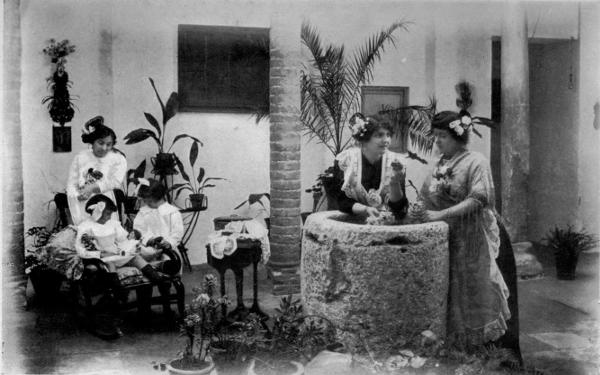
sat together in their cool patio under the orange
and palm trees in the shade of the heavy canvas
awning, stitching away for dear life, amid an
incessant prattle about clothes and lovers, and a
continual munching of chocolates flavoured with
cinnamon.
Space for the unknown bridegroom’s initials had
as usual been left on all the house linen when it was
made, but in this case only the Count’s coronet had
to be worked, and a heavy strain on girlish invention
was thus avoided, for there is not much variety
about a coronet, while it takes a good deal of imagination
to vary an initial several dozen times.
Oddly enough, my admiration of some beautiful
stitching in this heraldic ornament seemed to upset
Carmencita’s equanimity, and in an instant her
sunny smile and gay chatter turned into a tempest
of sobs and tears.
“You are cruel, barbarous, Doña Elena, to remind
me of all I am losing! How can you dream
that I am consoled by being a rich Countess for the
loss of the wealth of love lavished upon me by my
adored Manolo? I am a martyr, a victim to the
ambition of my parents! Even now at the last
moment I think I shall declare that my heart is
Manolo’s and I will never marry any but him!
Madre mia de mi alma! how terrible is this life!
Better that I had flung myself from the roof, as I
wanted to do when they forbade me to see my
Manolo: then I should have been spared this torment,
this broken heart which will end by dragging
me into the grave!”
I was pretty sure that the theatrical outburst
was provoked by a more or less conscious desire to
play up to the situation and to be consistent to the
last: for Carmencita, as I have hinted, had already
made me her confidante, and Spaniards are born
actors. She would feel better all her life for having
dramatically rounded off the play to her audience of
one, and I would not spoil the climax by any lack
of sympathy.
“True, true, my child,” I answered, “you are
indeed a martyr, but it is to duty. Think of the
season in Madrid that you will be able to share with
your sisters—the theatres, the receptions, the dances!
With your birth and the Count’s wealth you will
certainly be received at Court, and what higher
destiny could be offered to you than to take Pura
and Dolores away from this dreary village into all
the delights of the capital? Have courage, my
noble girl, and crush the dictates of your heart for
their sake, and, believe me, happiness will be yours.”
“True, Doña Elena; how beautiful an ideal you
put before me! And I hear that Manolo has gone
away and will not be back for six months, so what
should I gain by refusing to marry the Count?
And it would make a terrible scandal. And then,
have you seen my wedding dress? It is too lovely
for words! Do you know, it has a train two yards
long! Cesar insisted; he says I am so little I must
have a train to give me presence. I have never
worn a long dress in my life, and I am so afraid I
shall stumble over it. How dreadful if I made
myself ridiculous in the church, before all Ronda!
Doña Elena, did you have a train two yards long to
your wedding dress, and did you find it difficult to
manage?”
The melodrama was over, Carmencita was once
more all smiles and merriment, and my suggestion
that she should put the wedding dress on and
practise walking up and down the patio in it for my
benefit sent her and all her companions into screams
of laughter. She had made her little oblation to the
god of love, and now was ready to enjoy to the full
the material fruits of her sacrifice.
She made me promise that I would come to her
house and accompany the wedding party to the
church, which is only a few yards from the ancestral
home of the Campos Abandonados. I told her she
had better let me efface myself in the back of the
church, because I had no wedding garment in my
suit-case and should do the party no credit.
“Don’t be absurd,” she retorted, kissing me affectionately.
“You look like a Duchess with a black
mantilla over your white hair, and if you haven’t
got yours here, Mamma shall find one for you.”
Who could resist the pretty creature? And she
meant every word of it, at any rate while she was
speaking. But she really was sincere in her desire
that I should be there as an intimate friend, not
a mere acquaintance, and when I arrived shortly
before two o’clock on the eventful afternoon I found
little ten-year-old Lola, otherwise Dolores, waiting
for me at the door, having been ordered by the
bride to see that I was taken special care of, “because
being a foreigner I might not know exactly where to
go, and thus might fail to enjoy myself.”
Such consideration really surprised me. Carmen
might well have been excused for forgetting, on
this great day of her life, that one of her guests
was a foreigner; yet she had not only planned for
my pleasure, but, as I found, had asked more than
one of her old friends to look out for me and see
that I was placed where I could have a good view of
the ceremony before the side altar of the Virgen del
Carmen, at which she had worshipped throughout
her short life.
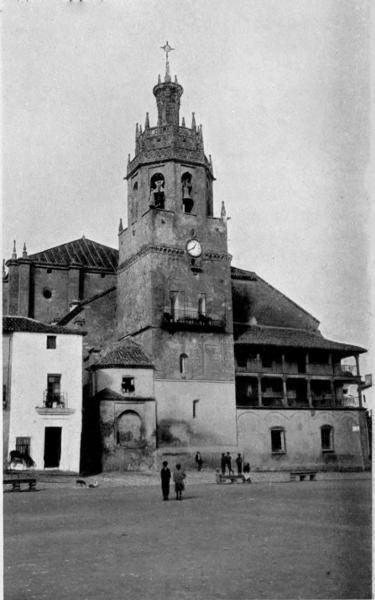
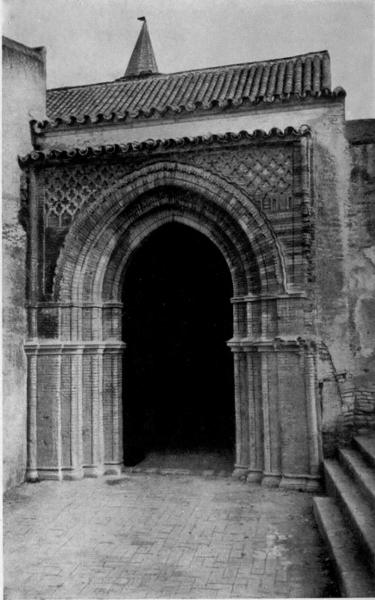
THE CHURCH WHERE CARMENCITA WAS MARRIED.
CHAPTER IV
The wedding—Our Lady of the Carmen: her lady-in-waiting—The
ancestral house of the Campos Abandonados—The kissing
habit in Spain—Muscatel and Manzanilla—Arabic
sweetmeats—King Alfonso and the convent yemas—The
bride’s dance—Mantillas and a hat—Good-bye to Carmencita.
This image of the Virgin of the Carmen has no
particular artistic merit, but Carmencita was promoted
to being her “lady-in-waiting” when she
left school, and had taken great pride in keeping
“her” Virgin’s wardrobe in perfect order; and to-day
she had gone very early to Mass and had
dressed the image, for the last time, in the festival
robe of eighteenth-century brocade and the tulle
veil she had herself embroidered to present to her
Virgin on her first communion. She had also filled
the silver vases with the tall stiff bouquets which
are so much admired here, and had offered quite a
number of gilded wax candles for a blessing on her
marriage.
And now she stood before the altar—her own
altar—with her first long dress trailing behind her
(she had not stumbled over it, but had made a
most dignified entrance) and placed her helpless-looking
little white hand in that of the stout,
common-place man, over thirty years her senior,
whose word was henceforth to be her law (for a
married woman in Spain has practically no civil
rights), and who had already made it evident that
he would be a jealous husband. It may, however,
be remarked that marital jealousy is regarded by
many Spanish wives as rather a compliment than
otherwise, as showing that their husbands think
them worth being jealous of.
The ceremony was soon over, and while the bride
and bridegroom, the bride’s parents and godparents,
and her brothers and next sister, went into the
sacristy with the priest to sign and witness the
register, little Lola slipped her hand into mine.
“Carmencita told me to take you to our house
now,” she said. “I am too little to witness for
her, and she was afraid you would go away, and
she wants you to see her dance in her wedding
dress before she leaves with Cesar.”
She led me out of the church and along the
badly paved street, which was lined with spectators
anxious to see the new Countess whom they had
known from a baby.
“There are only two carriages,” said Lola,
“mamma’s and Cesar’s. Can you believe it?
Carmencita has to come home all alone with Cesar
in his carriage! She cried last night, and so did
Pura and I, we all cried together. Fancy having
to be left all alone with that horrid old man! Do
you know, she is afraid he will kiss her, and his
ugly blue nose will disarrange her hair. That is
the only thing she is afraid of—being alone with
him.”
A Spanish girl is never, under any circumstances,
left alone with her fiancé, until she is
actually married to him. There is always a mother,
or an aunt, or some other female relative present to
superintend the love-making. Small wonder that
stolen interviews at the grating, with no listeners
but the moon, have their charm. And perhaps the
happiest marriages are those which come to pass,
sometimes after years of parental opposition, between
lovers whose courtship began thus. They at
least have a chance of getting to know each other,
free from the restraint of the chaperone whose
attentive ear makes all real confidence impossible.
The house of the Campos Abandonados in Ronda
is one of the most perfect examples of its kind in
Spain. To the right of the spacious zaguan, as
large as many a patio, are the stables, empty now,
save for the Marchioness’s mules. The sixteen
mangers are pure Arabic work, built into the wall,
with a cusped arch over each. Passing these we
get to the “modern” part of the house, which was
renovated and “restored” in the prosperous sixteenth
century, when gold poured into Spain from her new
colonies across the Atlantic. Beyond this patio, the
walls of which are covered with roses, jessamine, and
other creepers planted in the ground, we get a
glimpse of the inner one, cool and shady under its
white awning. This is the summer sitting-room,
furnished with easy-chairs and lounges all gay with
bright calico covers, tables with work-baskets,
photographs, and knick-knacks, and the other trifles
which ladies of gentle birth all the world over
collect about them, books and newspapers only excepted,
for it is a rare thing to see anything to read
in a Spanish lady’s sitting-room.
This inner patio is all just as it was when the
Arabs ruled in Ronda: columns, capitals, carved
beams, round arches—nothing has been altered since
the conquest of the old town by the Catholic kings.
In the mountains it is the fashion to paint every
brick within reach with a solution of red ochre, and
the maids, in their desire to add a touch of extra
glory to the place for the wedding, had painted the
arches as well as the brick floors. On one side of
the arch nearest the staircase is a stone roughly
carved and springing from a base very much older
than the Arab invasion, and this was left of its own
yellow stone colour, so that its extreme age was
apparent. For this is one of those Græco-Roman
houses of which I have spoken, and each of the
successive races who have inhabited it used the
remains of their predecessors’ building and carving
when they in their turn added to it. There was
a third patio beyond this, from which one looked
sheer down into the ravine 500 feet below, past
arched openings giving light and air to subterranean
chambers under the house, which are often said to
be prison cells, but are in fact mazmorras for the
storage of corn, wine, and oil. Indeed, there still
exist in one of these cellars, half built, half cut out
of the rock, a number of enormous oil-jars, quite
large enough for the Forty Thieves to hide in.
When I reached the house with Lola I found
the inner patio transformed. Everything movable
had been taken away, and the arcades on all four
sides had been filled with chairs: the piano had
been pushed to one side, the whole centre of the
court was bare, and the blind organist of one of the
churches, a couple of guitarists and a man with a
bandurria (a tenor guitar) were busy tuning up, to
the accompaniment of the shrill whistling of half
a dozen canaries and the excited screams of the
Marchioness’s pet parrot.
Two great seventeenth-century mirrors in handsome
carved frames painted red and gold had been
brought downstairs and hung on two pillars opposite
each other, and Lola made straight for one of these
the moment we came in, to see, she said, if they
reflected properly, but really to study her own
appearance.
“Carmencita was determined to have them
brought down,” she told me: “Papaito [diminutive
of Papa] objected because he says they are so
old that the frames might get broken, and they
have never been moved since they were made; but
Carmen said she must see what she looked like,
dancing seguidillas in her satin train, and Mamma
said of course she should have what she wanted,
now that she had been so good and obedient about
marrying the Conde. Ay de mi de mi alma! I
wonder what my husband will be like when my
turn comes! I do hope he won’t be quite so old
and ugly as Cesar.”
Her further confidences were cut short by the
arrival of her father and mother in their ancient
family coach, with leather curtains in place of
windows, drawn by two great black mules whose
bells jingled so loudly and the brass of whose harness
was so bright as almost to hide the deplorable state
of the leather. The portly Marchioness had barely
time to recover her breath after the exertion of
getting out, and to take up her post of honour in
the patio, before the bride and bridegroom appeared,
he almost as fat and short-winded as his mother-in-law,
she looking extremely pretty with a flush on
her olive cheeks and her usually sombre heavy-lidded
eyes alight with excitement and pleasure at
the openly expressed admiration of the crowd all
along the road from the church.
The instant they came in the whole place burst into
life, for every corner was invaded by the number of
guests who had been invited and the still greater
number of those who had not. The well-to-do friends
and relations were followed by the poor ones, then
came the household servants, old and young, with
their friends and relations, and then everybody,
without distinction, who wanted to see the bride
and wish her joy. And as these last seemed to be
half the town, for a short time we were packed like
sardines, while the new little Condesa, standing at
her mother’s side, was receiving resounding kisses
on both cheeks from every woman, child, and old
man in the crowd, the young men being apparently
the only ones who might not claim the privilege.
The amount of kissing done in Spain is extraordinary.
Children as a matter of course put up
their faces to the merest stranger who speaks to
them, middle-aged ladies on notoriously bad terms
would think it a grave breach of courtesy not to
kiss loudly on meeting and parting in an afternoon
call, young girls embrace effusively in the most
public places, fathers sit with their babies on their
knees, mumbling their fat little hands by the hour
together, and all the servants expect to be kissed
by the ladies of the family when they start on or
return from a journey—a most embarrassing custom
if the mistress is an Englishwoman. More than
once I have been in a shop when a woman has
come in and put her baby on the counter, whereupon
the shopman has left me to go and kiss the
child, whom he probably had never seen before.
Strangers will often stop short before a nice-looking
child, and exclaim “Qué mono!” (what a pretty
little thing) and bestow on it a couple of kisses that
can be heard all down the street. Of late an attempt
has been made in Madrid, at the instigation of the
Queen, to stop this promiscuous kissing, and for
one season at least it was the fashion to hang a
label round the babies’ necks when out walking,
on which was written, “Please don’t kiss me.”
But there is no diminution of embraces outside of
the capital.
As soon as every claimant to the cheeks of
Carmencita had been satisfied, the uninvited guests
went away almost as suddenly as they had come in,
and the rest of the gathering moved on into the
inner court, and turned their attention to tobacco,
wine, and sweet cakes. The sons of the house and
their friends carried round a tray of glasses in one
hand and a bottle of Malaga, Manzanilla, or Muscatel
in the other, and each guest was expected to empty
his glass at once and replace it on the tray for
the use of his neighbour. Then came the bride’s
sisters and their friends with trays full of sweetmeats
and pastry made of almond paste, cocoa-nut
paste, chocolate, custard with a variety of flavourings,
and other sweets of Arabic origin, with untranslatable
names, the recipes for making which
are carefully preserved in a few convents, whose
inmates sometimes have little left to live on save
what they can earn by the sale of their cakes.
Among these there is a popular kind called yemas,
because made from the yolks of eggs (yemas).
They look like the yolk of a hard-boiled egg, and
are covered with transparent caramel of a surprising
stickiness.
And here I cannot refrain from digressing to tell
a little tale about King Alfonso.
The first time that he and the Queen came to
Seville was when their first baby, the little Prince of
Asturias, was a few months old. The King, whose
active habits and disregard of ceremony are well
known, went out on the morning after their arrival
for a walk through what is called the “Moorish”
quarter of the old town, a maze of narrow streets
little visited by sight-seers. Here he stopped at a
certain convent famous for its sweets, and asked the
“mother” who opened the little grille in the
street door for “a packet of yemas for his wife and
child.” The good nun hesitated: she had not the
remotest idea who her customer was, and the
Mother Superior, she knew, had set aside all the
best of the last batch to send as an offering to
the baby Heir to the Throne.
“Pardon me, Señor,” she stammered, divided
between her desire not to lose a possible peseta and
the difficulty of reconciling a refusal with her
natural courtesy; “I fear—to-day—it is impossible—we—we,”
and then, with a brilliant inspiration,
“we do not sell to foreigners.”
“Oh, that’s all right,” said the King, “I am a
Spaniard by birth and education, and my present
address is the Alcazar of Seville.”
The conclusion of the purchase may be left to
the imagination.
I have never been able to manage more than
two of these luscious sweets at a time, and little
Lola became quite distressed when her sixth
invitation to eat more and still more of the sugary
delicacies proved unavailing.
“I know what you will like,” she said at last,
“I am sure you will like that, for our North
American friend[4] said it was the best thing in
Ronda. It is time to hand those trays now, so I
will run and get mine for you.”
And the next moment Lola was at my side
again, pressing upon me slices of raw smoked ham,
to be offered and eaten with the fingers, just as
is done with dainties at wedding parties in Constantinople
and Beyrout to-day.
Undoubtedly the Andalucian acorn-fed hams
are excellent, but it was rather a shock to have to
start upon ham, and raw ham at that, when one had
already eaten too many sweetmeats.
“Don’t you like ham?” said poor Lola, her
mouth drooping with disappointment. And then a
brilliant idea struck her. She dumped her tray
down on a vacant chair and ran off to the kitchen,
returning in triumph with half of one of those iron-hard
rolls known as roscas. This she thrust into
my hand and planted a slice of ham on the top of
it, saying with a sigh of relief—
“I know that is what you want, for the North
American lady never would eat ham without bread.
I am so glad I thought of it, because only a few
minutes ago Carmencita told me to be sure and
get you everything you like until she has time to
come and talk to you. But now we are going
to dance, so she won’t have any time to spare
yet.”
To eat raw ham with one’s fingers, as all the
ladies round me were doing quite simply and
naturally—throwing the fragments that remained
on the floor under their chairs—may seem peculiar
to our notions of table etiquette; but nobody
would laugh at these “country manners” who
saw, as I did, the innate courtesy that lay beneath.
That the bride at a fashionable wedding should
have told off one of her sisters to show special
attention to an elderly lady of no particular importance,
simply and solely because “being a foreigner
she might feel strange,” illustrates the traditional
courtesy of well-bred Spaniards. And perhaps this
funny little incident will explain to some of my
readers why I love the real Spain and the real
unconventionalised Spaniard.
Now the piano, the guitars, and the bandurria
struck up the seguidillas, whereupon Carmen and
her sister Pura at once stood up to dance. The
object of the two mirrors became apparent, for at
every turn of the dance the bride was able to see
herself in a fresh attitude, and her childlike delight
in the folds of her long train, as she watched it
sweeping after and around her, was a pretty sight.
She had the reputation of being the best dancer in
her native town, and loud cries of Muy bien and Olé
greeted the conclusion of the performance.
All these dances consist of what are called coplas
(couplets), because the movements of the dance were
originally interludes in the singing of verses, often
traditional, among which extempore references to the
happenings of the moment are introduced. Thus
when the girls dance without any singing, a series
of movements follow in sequence, lasting twenty
minutes or more, according to the number of coplas
that they may perform. To the uninitiated all the
dances, and still more all the coplas, seem to be
pretty much alike, when danced by girls only. But
when one sees these dances performed professionally
by a man and a woman together, one realises that
every step, every turn of the head, and every movement
of the body and arms, has had its origin in a
drama of passion, of coquetry, or of courtship. One
also realises why it is not permissible for youths
and girls to dance them together, save in the intimacy
of a family gathering, and why even then
the man must, so to speak, only play at taking part,
snapping his fingers in response to the rattle of the
castanets as the girl waves them over his head, and
holding himself rigidly upright while his partner
sways and bends as she whirls before and round
him.
The whole thing is essentially Oriental, and it
needs only the glance of an eye or the turn of a
hand to convert the graceful movements of ladies in
a drawing-room into an exposition of sensuality.
One understands therefore why Spanish ladies
are so careful how they allow their daughters to
dance even the apparently harmless seguidillas with
men instead of girls for their partners.
The usual form of concerted performance is for
the men to sing the coplas and the girls to dance
between each of them; and when Carmencita had
finished her performance, the guitarists struck up
the rattling chords that preface the Peteneras.
After much pressing on the part of the girls, Carmencita’s
eldest brother Paco, otherwise Francisco, was
induced to sing, and here is a translation of his first
and last verses, which he sang to the strange quavering
air without tune or rhythm, and full of the odd
intervals and curious turns and flourishes peculiar
to this kind of music, while the spectators accompanied
him with a fusillade of hand-clapping and
shouts of applause which burst out at every pause.
“My novia has deserted me,
Child of my heart;
Thinking that I should grieve for her,
Child of my heart.
I am not sure whether I shall take another sweetheart now,
Or wait and look about me through the summer.
When I am on my death-bed,
Child of my heart,
Seat thyself at my bed-head,
Child of my heart.
Bring me a good veal cutlet,
Two fowls and a nice beefsteak,
And if this does not seem to thee enough
Bring me anything else that occurs to thee.”
The wedding party thought this screamingly
funny, and there were shouts of Otra copla! Otra
copla! (another verse) when he had finished. But
he made a sign to his second sister Pura, and another
to the musicians, and the dancing began again.
The peteneras are more dramatic and crisper in
movement than the seguidillas, and the brother and
sister did a great deal of rhythmical hand-clapping
and stamping, curiously at variance with the sentimental
refrain of the song. When it was over, Pura
dropped into the nearest seat, panting and fanning
herself vigorously, while Paco slipped away to join
the men, who from first to last sat in the outer patio
and seemed to take no interest in the proceedings
within, except when occasionally one of them planted
himself in the entrance to commend some girl whose
dancing he admired.
Proceedings became increasingly lively as the
afternoon advanced, though the decorum was never
relaxed. It got hotter and hotter, and the air grew
suffocating under the awning, but there was no pause
in the dancing. As soon as one couple of girls ended
another stepped out, and sometimes half a dozen
were dancing together. All the grown-up girls wore
high combs and white mantillas, which never seemed
to become disarranged, and quantities of natural
flowers on their heads and breasts, chiefly jessamine
blossoms pulled off their stems and fastened together
to form large rosettes—another survival of Arabic
customs. One would have expected to see the floor
strewn with the flowers as the dancing went on, but
I knew that every girl had spent at least an hour
arranging her head-dress before she started for the
wedding, and had taken good care that everything
was firmly fixed. And then, however lively the
dancing may be, it is always graceful, and there is
never a jerky or violent movement, which accounts
for these elaborate head-dresses being as neat at the
end as they are at the beginning.
Everything must finish some time, and presently
the bridegroom, who had never come near the ladies
since he and his wife entered the house, appeared at
the entrance of the inner patio, his nose rather bluer
than usual, and smelling strongly of smoke, to tell
Carmencita that it was time to change her dress for
the train.
“Por Dios!” exclaimed the girl, “I had quite
forgotten that I was going away. Come, Pura;
come, Lola, one more set of seguidillas: who knows
when we shall dance together again!”
Sixteen-year-old Pura in her first mantilla, Lola
with streaming hair and scanty petticoats little below
her knees, and Carmencita with her two yards of
train, made a very ill-assorted trio; but they did
not concern themselves about the general effect.
They danced no less than six coplas together, the
last including some odd little jumps off the floor
with both feet, quite the least graceful performance
I had yet seen, and most inappropriate to a long
train. And then, to a chorus of Olé’s the three
stopped dancing, flung their arms round each other,
burst into floods of tears over the imminent parting,
and were all borne away sobbing by their mother
and various sympathetic friends.
The two younger sisters were still crying when
they came downstairs an hour later with the bride
in her travelling dress, a really charming arrangement
of white muslin and blue ribbons, but Carmencita’s
face was almost hidden under an overwhelming
straw hat covered with immense roses.
Now she was once more all smiles, and beamed
impartially on everybody as she moved towards the
great doors amid a perfect fusillade of explosive
kisses. How they managed to reach her face under
that hat I could not understand, but I heard her
say several times, “Cuidado con mi sombrero”
(Mind my hat), while she moved towards me; and
as she embraced me I discovered why she was leaving
her home smiling instead of in a flood of hysterical
tears, as Spanish brides usually do.
“Isn’t my hat enchanting?” she whispered in my
ear; “you know it is the first hat I ever had in
my life, and Cesar actually ordered it for me from
Gibraltar! Isn’t he an angel? And we are going
to Madrid, and then to Paris, and he is going to buy
me ever so many more! But don’t tell anybody; I
want to pretend I am quite accustomed to wearing
a hat.”
The fascinating novelty carried her through all
the adieux and safe into the carriage with her bridegroom,
and the last we saw of Carmencita was her
laughing face as she straightened the monstrosity,
which she had almost knocked off against the carriage
door as she got in.
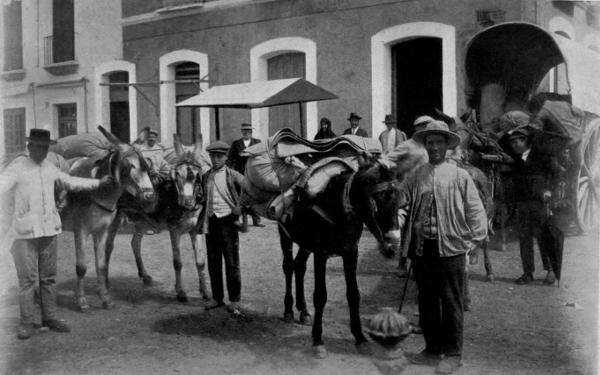
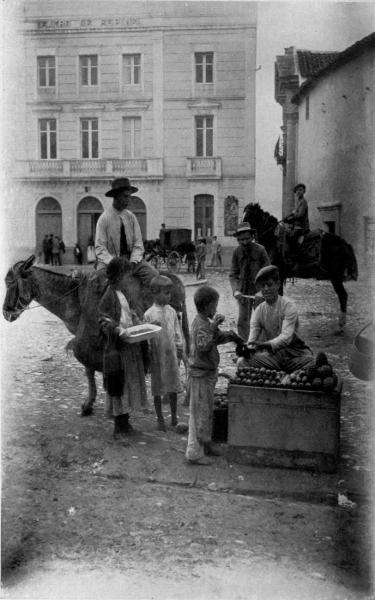
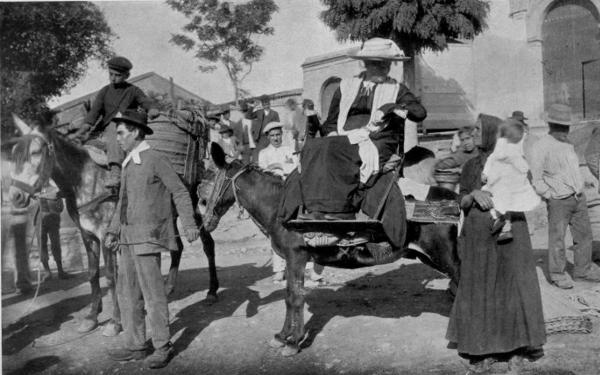
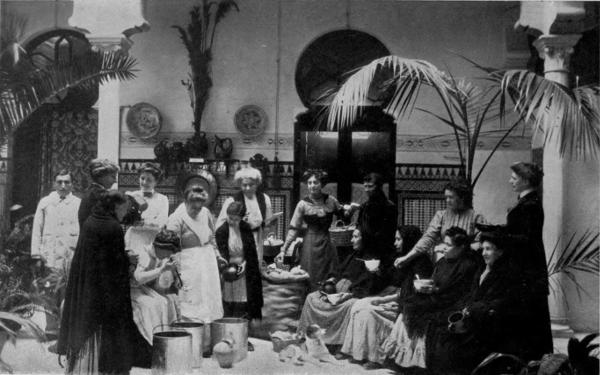
IN THE FLOUR MARKET.
CHAPTER V
The “season of the baths”—Furnished apartments without beds—The
amenities of the Balneario—Sea views at a discount—Bathing
costumes: flounces and frills—The force of example—Happy
swimmers.
The “season of the baths,” as the summer holidays
are here called, is a very serious business indeed. In
the fashionable seaside resorts such as San Sebastian,
Santander, Malaga, etc., it is possible to get a comfortably
furnished villa or flat for a few weeks,
though only at a ruinous cost; but in the smaller
places it was until lately difficult to get any accommodation
at all outside of the Balneario or Hotel
for Bathers, unless one took a so-called furnished
house and sent the missing necessaries from one’s
own home by carrier or train; for the furnishing in
such houses generally consisted mainly of more or
less rickety chairs.
Personal luggage, of course, goes with the traveller,
but things which do not come into that category,
and they are many, must be booked and paid for
separately. What exactly constitutes personal luggage
varies a good deal with the taste and fancy of
the booking-clerk. At one station, for instance,
they flatly refused to take my jamugas (a folding
donkey saddle described on p. 66), and at another
an obliging porter tied them on to my suit-case and
they went through without difficulty. But speaking
generally, nothing but portmanteaus, bags, and such
like are admitted, with one notable exception. About
bedding there is never any trouble. A mattress for
each member of the party, with its pillows, sheets,
and blankets, will all go as personal luggage, though,
as the limit of weight is only 60 lbs. per head, you
may have to pay a considerable sum for excess.
You can also book your bed and bedding (which it
is just as well to take with you to a “furnished
house” at any of the smaller seaside places) together
with other immediate necessaries, by grande vitesse,
when it is supposed to travel by the same train as
yourself, and to be accessible immediately on arrival.
But if there happens to be a crowd at the departure
station, it is as likely as not that the things booked
by grande vitesse will be left behind.
This happened to some Spanish acquaintances of
mine one summer. They had booked everything
except the children’s lunch and such trifles as they
could take in their hands, and they arrived at the
village where they and we were to spend the holidays
late at night and dead tired, without any luggage at
all. The neighbours set to work and improvised
beds for the smallest children, and the mothers,
aunts, and sisters sat in rocking-chairs all night.
“What else is to be done?” they said philosophically;
“this sort of thing always happens if you
go to the baths in the fashionable season, when
everybody wants to be there at once.”
None of them were at all cross or depressed,
although they were very grateful when we provided
a mattress or two for the tired babies to be put to
bed on.
Travellers who want to see the Spanish bathing
season in full swing may put up at the Balneario
with which every little seaside resort is provided.
But they must be prepared to get no sleep or rest
as long as they stay there, for the noise is inconceivable.
There will be anything from fifty to two
hundred men, women, and children—but chiefly
children—of all ages, and all agog to make the most
of the seven, fourteen, or twenty-one days of bathing
prescribed by the family physician. For be it known
that we don’t bathe as we please in Spain, but under
medical orders and strictly for the good of our health,
and many people believe that all the virtue in salt
water would be lost did they take one bath too many
or too few. And from the moment they wake in
the morning until the last frequenter of the hotel
bar goes to bed some time in the small hours, the
din of voices and the clatter of feet on the brick
floors never ceases for one instant.
Most Spaniards have extraordinarily loud voices.
Of course it is usual in any country to shout at a
foreigner under the impression that he will understand
better if you deafen him to begin with. But
in Spain it is not only the foreigner who is bawled
at, for Spaniards all shout at each other in the
bosoms of their families to such a degree that when I
first came to live here I got the impression that they
were continually quarrelling. Men and women alike
have this unpleasant habit, and although many of
them are aware what a noise they make and remark
that it is a bad custom, they seem constitutionally
incapable of lowering their voices.
When I am almost driven crazy with the strain
on my ears I pretend to be puzzled at what is said,
and politely remark—
“I am stupidly ignorant of Castilian, but I shall
understand better if you will kindly talk a little
slower.”
“Slower” (mas despacito) is a euphemism for
“lower,” and the request never fails to elicit a
pleasant smile and a comment on the shrillness of
Spanish voices, in a half whisper. But in two
seconds habit holds sway again, and the din rises
higher and higher until one feels that one’s only refuge
is flight unless one wishes to qualify for Bedlam.
The children of the well-to-do—unlike those of
the poor—are quite undisciplined, and are allowed
to shriek and scream as they please. Their noise
does not worry their parents, who take it as a
matter of course, and it never occurs to them that
it can annoy any one else. When dozens of children
of all ages are collected together in a Balneario,
the racket is such as might have inspired Dante
with an idea for a tenth circle in his hell. If you
suggest that some white-faced, heavy-eyed creature
of two or three years old would be better in bed
than in the hall of an hotel blazing with electric
light at ten or eleven at night, its parents merely reply
“No quiere” (He doesn’t want to), which is considered
an entirely sufficient reason for letting their sickly
infant sit up to all hours.
The children mostly dine at the table d’hôte of
the Balneario in small towns, and when the endless
meal is at last over some one begins to thump dance
tunes on a cracked piano, and the little girls from
six to fourteen swarm into the general sitting-room
and start dancing. When midnight approaches and
the children drop asleep from sheer weariness, filling
the benches and flopping across their parents’ knees,
the grown-up young ladies and their attendant
swains take the floor, and keep the fun going till
2 or 3 a.m. This is not one night but every night,
and not in one Balneario but in every Balneario,
throughout the month of August.
I once spent a day and a night in one of these
hotels, which are often pretty and sometimes have
beautiful sea views and other advantages which
should make them really attractive out of the season,
did they not all close as soon as it is over. For
my sins I was at the Balneario of Our Lady of the
Rosary in the height of the summer. I fled by
the earliest train I could get next morning, and the
landlord was most willing for me to go, for he had
a married couple with three children ready to pack
themselves into the tiny room I had engaged, which
contained nothing in the way of furniture save a
looking-glass, one chair, a small enamelled wash-basin,
and one huge bed.
The last thing Spaniards seem to care about in
the bathing season is the sea. The Balneario of
Our Lady of the Rosary looked out right over the
Atlantic, whose blue waves washed the foot of the
low cliff on which the village stood. I never saw
anything more lovely than the sunset over the sea
the evening I was there, and the hotel dining-room
opened on to a broad terrace supplied with numbers
of chairs and tables at which people sat and sipped
refrescos—a mild beverage consisting largely of
sugar and water. Of all the people thus engaged
I was the only one who turned to look at the
sunset. And when after dinner I went out to the
post office I found all the occupants of all the nice
new houses built by themselves to live in during
the brief bathing season, seated on uncomfortable
chairs on the footway in the narrow, dirty street,
and all with their backs to the sea. Their houses
all had terraces running out to the edge of the
water at high tide, like that of the Balneario, but
as I strolled back to the hotel in the moonlight
along the shore I noticed that there was not a
single human being to be seen on any of these
terraces. I had never imagined such a waste of
opportunity, or such a strange idea of enjoying the
sea. But I have been at a good many Spanish
bathing-places since then, and have always been
regarded as a harmless lunatic on account of my
preference for sitting with my face to the sea
instead of at my street door watching the passers-by.
PINE CONES AND PRICKLY PEARS.
The bathing at that village was excellent, the
best, I think, that I have ever known, though a
trifle dangerous for any but strong swimmers when
a stormy day left a heavy roll and undertow. The
Balneario, which had a monopoly of the bathing-houses
for about half a mile of beach, provided a
sufficiency of buoyed ropes, and a leaky old boat
was anchored a hundred yards out all the summer
in case of accidents. This boat was only accessible
by swimming, there being no other anywhere within
range, and it had no oars, so its precise use on an
emergency does not appear. It filled and sank
whenever the sea got up, but it was always dragged
out, emptied, and replaced in position by the men
in attendance, by the time the sea was calm enough
for the visitors to bathe again.
Although we never stayed at the Balneario, we
spent several summers in the village, where we took
a little cottage and furnished it with what our
Spanish friends thought very bad taste, for it contained
plenty of books and tables and not a single
pier-glass. Here we attracted a good deal of
attention by sitting out at all hours, when the
sun was not too blazing hot, under an awning rigged
up on a sandhill facing the sea, where we watched
with an amusement equal to their astonishment at
our eccentricities, the amenities of Spanish families
taking their baths.
The first year we were there the women all wore
heavy serge gowns right down to their feet, mostly
edged with a broad frill of the same material.
Strange to say, one of them managed to swim, and
to swim well, in this most unsuitable garment. Her
husband, who was lame and could only walk with
a stick, also swam well. He used to fling his stick
ashore as soon as he was in the water to his waist,
and he and his wife would swim out to the old
boat, her flowing robe ballooning largely behind
her. Later on we came to know them and their
family, and the eldest son, a nice boy of about
sixteen, told us as politely as he could how dreadfully
shocked the Spanish ladies had been that
first summer at our indelicate bathing garments,
consisting of blouses with short sleeves, knickers,
and a skirt to the knees. No doubt our by no
means modern bathing dresses surprised them,
although we had no idea of it at the time, for that
year even the men wore long trousers, sometimes
trimmed with little frills round the ankles, while
coats covered their arms to the wrists. True, the
men so attired did not attempt to swim, but bobbed
up and down with their wives and daughters, all
holding on to the rope for dear life and never
moving an inch from where the bathing-man had
put them, until he returned, when he thought they
had been in long enough, with sheets to envelop
the ladies and bring them to shore again.
Yes, all the ladies were carefully wrapped in
sheets when they came out, although no human
eye could discern the form so carefully hidden under
their voluminous draperies. The only creatures who
were allowed to expose any part of their anatomy
to direct contact with the water were the babies.
They, poor little miseries, were carried down stark
naked to the water’s edge and handed over to the
bathing-men. These, no doubt with the best
intentions, would take the screaming mite in one
hand and dip it head first into a good big wave,
using their free hand to disengage the frantic clutch
of the terrified creatures when they came up in an
agony of fright from their ducking and found themselves,
choked and blinded by the salt water, turned
upside down for a second dip. Three times was
this brutality repeated every day, and if the piteous
cries grew less the third time, the parents, watching
the proceedings from the shore, would congratulate
themselves that the child was beginning to enjoy
his bath.
To me it seemed more likely that he was beginning
to die from it, and indeed a summer rarely
passes without at least one or two small children
coming to an untimely end at the Balnearios. But
nothing can convince the mothers that such treatment
is too violent for babies. They themselves
took their first sea baths under those conditions,
and so did their parents before them, and therefore
it must be the right thing and produce good results
in the long-run, no matter how the little one may
suffer in health and nerves at the moment.
Infant mortality is always high in Spain. In
summer, I understand, it is higher than at any
other time, and I do not wonder at it.
That first summer the lame Don Basilio and
his wife were the only swimmers except ourselves.
But the next year several schoolgirls begged him
to teach them to swim, and as the season went on
and they made progress in the new accomplishment
the flowing skirts were exchanged for trousers, and
the trousers gradually grew shorter until a reasonable
amount of bare leg was displayed. One or
two of the girls managed to swim out to the boat
before their twenty-one baths came to an end, and
indeed the mystic number was treated with unusual
disrespect that year, and the limit often far
exceeded.
And the following year, when we arrived rather
later in the summer than usual, we found all the
girls wearing bathing costumes which gave their
limbs free play as they swam, and the old boat was
the daily rendezvous of a crowd of laughing and
chattering young people, scrambling on board and
diving off again with as much energy as if they had
been English.
I always maintain that Spaniards only want a
lead to induce them to adopt modern customs and
conveniences, for no people are quicker or cleverer
at imitating new modes once they see that they
are an improvement on the old. The only difficulty
is to make them see that any such novelty is an
improvement, and that, I admit, is a difficulty.
The Andalucians have a saying against themselves,
that they are “muy amarrados à la cola
del borrico”—very fast tied to the donkey’s tail—meaning
that they go along in a stupid rut of
inherited convention which they find it very hard
to get out of.
I think, however, that the speedy adoption of
swimming knickers in place of flowing skirts, and
the rapid shortening of these same knickers as soon
as practical experience proved their convenience,
argue that the rising generation have more common
sense and less conventionality than their elders,
and promise well for the future of athletic sports
in Spain. But all the same the young people,
although they have learnt how to enjoy mixed
bathing in the sea on summer mornings, still sit
with their parents at their ugly street doors after
dinner, turning their backs on the beauty of the
sea, the sunset, and the moon, while they watch
the passers-by and talk of lovers and frocks.
PART II.—AUTUMN — CHAPTER VI
Travelling in Spain: four grades of trains but only one price—Ten
miles an hour—Dangerous speed—Amusing the
villagers—A slow night journey—Suppressing a raconteur—“Shall
we go?”—Hot water while we wait—The paralytic—Taking
a photograph—The beauty at the window—A discourteous
custom—Empty minds—The toothpick—A gentleman
of the old school—Hospitality at Antequera—A Spanish
dinner table—Delightful memories.
Travelling in this country is really a trial to the
patience. It is true that the main lines have now
been made comfortable, with corridor carriages,
well-cushioned seats, and good lighting on the night
trains; but the unpunctuality and the purposeless
delays all along the line make even a short journey
tiresome and a long one intolerable, unless one
resolutely determines only to look at the comic side
of things.
There are four classes of passenger trains, and
we may take the journey from Madrid to Seville
as typical of the rest. This line is used by the
King, the Court, and the governing classes generally,
and is travelled by nearly every tourist who comes
to Spain, for every one wants to see Seville,
Cordova, and Granada, while naturally the capital,
with its superlative picture gallery, is the objective
of all foreigners interested in art.
AN ANCIENT GATEWAY.
The slowest of these trains is the mixto, a sort
of cross between a passenger and a luggage train.
The distance from Madrid to Seville is 358 miles,
and the mixto does the journey in twenty-four hours
and twenty minutes, or at the rate of nearly fifteen
miles an hour, if it gets in punctually, which it
seldom or never does. Next we have the correo or
mail train, which nominally takes eighteen hours
one way and nineteen the other—the more rapid
journey being rather under twenty miles an
hour. Then comes the expreso, which takes
eleven and a half hours one way and twelve the
other, travelling at the rate of about thirty miles
an hour; and then the expreso de lujo, which does
the journey in eleven hours and forty minutes,
being a shade faster than the expreso. Both these
last are trains de luxe, with dining-car and the
wagon-lits Company’s carriages, and are usually
pretty punctual. These trains, be it remembered,
are running on one of the chief main lines of Spain.
On the branch lines nothing like these speeds
are attained. On one of these, as I was told by
a friend who often had to travel by it, the usual
rate was ten miles an hour, and the district petitioned
the railway to reduce the speed, which was considered
highly dangerous. The petition was refused,
on the ground that if the train went any slower
it would come too expensive, on account of the
increased coal consumption.
With true Spanish inconsistency the same fares
are charged for all these trains except the trains
de luxe, for which an excess of ten per cent. is
levied on the first-class fares. On these trains
there is no second-class, and on one of them only
a single third-class carriage. The mixto is horribly
uncomfortable, and the carriages of all classes are
usually dirty, but one need not fear any rudeness
or roughness from one’s fellow-travellers.
It was once my fate to travel by a mixto from
a wayside station where I had missed the express
after a long donkey ride across country. My
men had never been there, but when it became
evident that by no possibility could I catch the
train I had intended, they declared, in their desire
to reassure me, that there was a decent posada
close to the station where I could comfortably spend
the night. We arrived to find not even a cottage,
but only a choza or hovel, built of stones and
thatched with reeds, and a canteen consisting of
the bar and a tiny room off it, where the railway
people took their meals, for it was a junction of
some importance, and several men were employed
there. I had no alternative but to go on by the
mixto, and I sat for seven mortal hours in that
train, travelling in all eighty-four miles. It was
about three in the morning when I reached a town
which gave reasonable promise of possessing some
sort of hotel, and at least half of that time we
spent at stations, all lighted up and all crowded
with villagers, just as if it were day.
I am bound to say that although the seats were
so hard and so grimy, and the jolting of the train
so incessant that sleep was impossible, I neither
heard nor saw anything offensive, although my
fellow-travellers were all men, and there was not
one gentleman, in the conventional sense of the
term, among the lot. One man, it is true, began
a funny story which it was probably just as well
that I did not understand, but before he came to
the point his friends hushed him up, on the ground
that they had heard it all before, whereupon the
facetious person so promptly dropped asleep that
I guessed he had been looking too long on the wine-cup
before he started. Nothing was said to me,
but I quite understood that the raconteur was
silenced out of consideration for my presence.
The correo on the main lines is much better than
the mixto; the first and second class even have
corridor carriages, and these are roomy and comfortably
cushioned. If time were absolutely no
object—as indeed seems to be the case in Spain—one
need not complain of the correo at all. But to
people who prefer getting to their journey’s end to
sitting in the train, the endless delays and the purposeless
dawdling are intensely irritating. The train
stops at every little station, apparently to amuse
the villagers, for often no one gets either in or out,
though there will be from twenty to a hundred
loafers on the platform. After long waiting a guard
is heard to inquire, “Shall we go?” (Vamonos?);
some other official says, “Let’s go!” (Vamonos!); a
third rings a bell and shouts, “My lords the travellers
to the train!” (Señores viajeros, al tren!); some
one blows a horn, the engine whistles two or three
times, and we drift out as vaguely as we drifted in,
ten, twenty, or thirty minutes before.
At one station on a very dull journey which I
often have occasion to make, an extra delay seems
to have been arranged to enable the wives of the
stationmaster, the canteen keeper, and the one porter
to obtain a supply of hot water from the engine
boiler, for every time I travel that way I see a group
of these ladies filling cans and buckets from a steaming
jet which certainly is not let off anywhere else.
At another station we spend an interminable
time watering the engine. This station is only half
an hour from a junction where the train waits,
according to schedule, for thirty minutes, and why
the water cannot be taken in then, the demon of
dilatoriness that presides over Spanish railways
alone knows. This, like the distribution of hot
water, does not occur only once in a way. I have
been over the line eight times, for my sins, and have
seen the same incidents every time.
Once our train waited an extra ten minutes while
a poor paralysed old woman was conveyed in front
of the engine from a train alongside of ours to the
exit from the station, where a donkey awaited her.
The porter carried her slung over his shoulder like
a sack of potatoes, head downwards. We all thought
she was dead until we saw her hands waving and
heard her shrill voice bidding the man shift her into
an easier position, which he did, by no means unkindly.
She was a very poor woman, and her old
husband trudged after her, bearing a couple of worn
pillows and a bag of food. It was clear that there
was no money wherewith to tip that porter. No
one grumbled at the time lost by our train, which
was already close on an hour late, although she might
just as well have been carried behind it and thus
let us go on. They only said, “Poor creature! She
seems very ill.” On the other hand, no one thought
of producing pesetas or even coppers to alleviate her
sufferings, though probably if I had been ready-witted
enough to suggest it, most of my travelling
companions would have contributed. Spaniards are
curiously destitute of imagination in such cases, but
when I have had the presence of mind to propose
some such obvious charity as the above they have
quickly followed suit, expressing admiration of our
English initiative.
The funniest example of official indifference to
the time table that I have seen occurred on a journey
from Algeciras to Bobadilla. During a long pause
at a wayside station one of our party got out to
photograph a group of picturesque beggars—for on
the Andalucian railways beggars are chartered libertines,
permitted to climb up to the windows and
pester the travellers for money. Before he had
finished the bell rang for the train to start, but
seeing how he was engaged the stationmaster
politely turned to the guard.
“Wait a moment longer,” he said; “do you not
see that the gentleman is taking a photograph?”
Let it not be supposed, however, that Spanish
travellers find their slow trains such a trial as we do.
The men chat, smoke, eat, drink, and sleep, and the
women eat and sleep—the elder ones, that is. The
younger ones spend most of their time standing at
the window. This is a very favourite occupation
of all Spanish travellers in first-class compartments.
Directly the train slows into a station every window
of the corridor carriage will be occupied by a more
or less portly person of either sex, who thrust their
heads and bodies out as far as they will go, to stare
up and down at the exceedingly uninteresting crowd
assembled to see the train come in. Except on Sundays
and holidays, when the station is to the village
what the fashionable promenade is to the town, the
people who loaf on the platform are by no means the
pick of the population, being merely those who have
nothing else to do. But this does not seem to
diminish the Spanish traveller’s interest in them,
and he will block the windows till the very last
minute, watching the village idiot or the diseased
beggar until he is quite out of sight, as if all his
hopes of happiness depended on getting the very
last glimpse of the unpleasing spectacle.
The girls who travel have, it must be admitted,
another object in planting themselves at the window
while the train is in a station. They want not so
much to see as to be seen, and faute de mieux, the
open admiration of the village loafer helps to pass
the time. On one occasion I travelled for many
hours in company with the wife and daughter of a
man whose office under the Government argued a
good social position and a certain amount of cultivation.
The mother talked of nothing but the excellence
of the food in the town we had both been
visiting, and the girl never spoke at all save to ask
me at intervals where we were and how much behind
time the train was now. At every station she planted
herself in the window, and as she was strikingly
handsome with unusually brilliant colouring, a group
of yokels never failed to collect in front of our compartment,
staring at her for all they were worth.
“I cannot imagine,” the mother once remarked
to me, “why so many people stand there.”
“Well,” I said with perfect sincerity, “they
probably do not often have any one so pretty as your
daughter to look at.”
The mother bridled and smiled, and immediately
told the girl what I had said.
After that our young beauty never left the window
at all—presumably lest some admirer should miss
the opportunity of gazing on her charms—from the
moment the train drew into any station until it left
again; and I calculated afterwards that she had stood
three solid hours on end in the corridor, only varying
her position to move to my window at the opposite
end of the compartment when we stopped at a
station where the platform was on that side.
This discourteous habit, common to men and
women alike, of blocking the first-class carriage
windows regardless of the comfort and convenience
of the other passengers, is in some ways the most
unpleasant feature of travelling in Spain. It is
practically confined, however, to the well-to-do, and
I am bound to say that on short journeys, where
a little fatigue does not matter, I often prefer to
travel second or even third class, so that I may get
my fair share of the view and the air, which is impossible
when travelling with Spaniards who can
afford to pay the higher fares. On the other hand,
as they seem quite unable to amuse themselves in
other ways (for very few of them ever read in the
train, or indeed in their own houses), perhaps one
ought not to grudge them the delightful distraction
and the wide enlightenment to be obtained by
looking out of the carriage window.
In other ways many little courtesies are shown.
Food, for instance, is always offered, even though
you are at the moment unpacking your own lunch
basket. This is as a rule a form, which means no
more than the offer of his house, at such a number
of such a street, which your travelling acquaintance
will make you when he gets out at his station, well
knowing that you and he will never meet again in
this world. But sometimes the offer to share with
you is quite genuine, as in the case of a stout Catalan
commis-voyageur, who, after I had politely declined
three times over to divide his lunch, having just
finished my own before his eyes, took two elegant
celluloid toothpicks out of his pocket, and laid one
upon my knee, saying, “That at least you will
accept!”
He afterwards told me that he “travelled” for
a German firm which made celluloid ornaments, and
I always regret that I returned his toothpick without
reading the advertisement printed on it. I
thought he might want it, and I knew I did not,
but I believe he really did wish me to accept his
gift—and take a note of his firm.
When one has the luck to make the acquaintance
of a Spanish gentleman of the old school, one realises
what a loss is inflicted on society by his retirement
from the world, for men of his kind dislike the new
aristocracy of wealth, and shrink from competing
with the cursileria of the large towns as much as
Don Quixote himself would have done.
On my way to Granada one lovely May day I
had the rare good luck to travel with one of these
gentlemen. I was accompanied by an old friend
whom I had not seen for many years, and we congratulated
ourselves on finding an empty compartment
when we got into the train. Just before we
started, however, a slim well-dressed man of forty
or so clambered up the precipitous steps into the
carriage, with a pot of carnations under each arm.
This alone would have prepossessed one in his
favour, for the male Spaniard of any class above the
labourer usually thinks it degrading to be seen carrying
anything in his hands, and leaves the parcels to be
borne by his wife if there is no servant handy. Our
man not only carried his own carnations, but was a
great deal more careful of them than of his smart
personal luggage, and finally, after asking permission,
he wedged them up in the rack between his
valise and mine, explaining that he had bought
them at the last moment to take to his wife, and
was anxious that they should come to no harm.
The ice thus broken, we soon got into conversation,
and when he found that we were going to stop
the night at Antequera he seemed quite delighted.
“That is my own town,” he said, “I can assure
you that it is worth a visit, and I wish more
foreigners knew how beautiful is the situation, and
how many objects of interest it contains. There is
also a quite passable hotel, and the people of Antequera
have good manners, and do not worry tourists
in the streets, although they see comparatively few
English ladies, or—what is even of greater interest
to them—English ladies’ hats.”
Most unluckily, he said, he would only be at
home himself for quite a few hours, as he had to go
on to Malaga early next morning, but he was deeply
interested in archæology, and on finding that my
tastes lay in that direction, he said that, no matter
what business he had to set aside, he must have the
pleasure of showing me some very curious capitals
of columns, recently unearthed from a fourteenth-century
convent wall, the period of which he found
himself unable to determine. I accepted the invitation
with delight, for not only did I know by
experience that great interest often attaches to
objects “found in the convent walls,” but I knew
it was the chance of a lifetime for my friend to see
the interior of a Spanish gentleman’s country house.
Having fixed the hour for our call and given
us his address, our friend proceeded to spread his
belongings over three seats, for we were approaching
a junction, and he explained that he did not mean
anyone else to get in, as he had slept badly over-night
and wanted a good nap.
The station was crowded and many people came
and looked into our compartment, shook their heads
at the much-engaged seats, and went off to stow
themselves in the packed compartments elsewhere.
Our friend smiled pleasantly, showing beautiful
white teeth under a short fair moustache—for he
was as blond as a Dane, with brown hair and blue
eyes—and suggested that the stationmaster should
put on another carriage when an insistent lady with
several children tried, in vain, to force her way in
against his polite resistance.
And when we were safe out of the station he
pulled out his three seats to form a sofa, as is done
when these compartments are converted into sleeping
carriages at night, and calmly slumbered until
we got to Bobadilla some three hours later. This
is the Clapham Junction of southern Spain, and it
was impossible for our fellow-traveller, for all his fine
manners and general grand air, to appropriate our
whole compartment any longer; but, as he remarked,
he had had his sleep and now no longer required the
extra seats. So other travellers were welcome to
come in, and the more so because we should all
three be getting out at the next station but one.
“You will require half an hour to secure your
rooms at the hotel, and half an hour to rest,” he said
as we parted, we in one omnibus and he in another,
with many apologies for not being able to offer us
his carriage, because his return was unexpected, and
no one had come to meet him. “But I hope you
will be able to reach my house conveniently by six
o’clock, that I may present my wife and children to
you, and show you my capitals in a good light.”
He had, of course, given us his card, but the name
told us nothing except that he was not a man of
title. So in the omnibus we took the opportunity
of obtaining a little information about him. We
found he was the Alcalde, or Mayor, which means
that he was little short of a king in the town, for
the Alcalde here holds a position social, political, and
municipal, considerably higher than that of any Lord
Mayor in England. In fact we have at home no
authority with which the Spanish Alcalde can be
compared, for he is appointed by the Government,
and can make and unmake at will any of the
numerous paid officials under him. Alcaldes therefore
generally have as many enemies as friends
during their term of office, but our Alcalde of
Antequera seemed to have gained the affections of
his townspeople, not by political favouritism, but by
his personal qualities.
“He is the richest and the best man in the town,”
said the respectable tradesman with whom we talked
in the omnibus; “and I should not say that if it
was not true, for he is a Conservative and I am a
Liberal, and I lost my job at the Town Hall when
they made him Alcalde, so I’ve kept a sharp look
out for any mistakes he might make.”
At six o’clock, according to promise, we made
our way to the Alcalde’s house, and were ushered by
a smiling servant, evidently on the look out for us,
across a patio blazing with geraniums and heavy
with the scent of roses, heliotrope, and jessamine,
through a long shady gallery with fine eighteenth-century
furniture ranged along the walls, into a
charming little reception-room, furnished with light-painted
wood, and adorned with the usual window
blinds, chair-backs, and table-covers of exquisite
needlework, edged and inset with fine lace and
embroidery.
To us here appeared our Alcalde leading his
handsome wife and followed by his two good-looking
children. We were a little late, and he
apologised for the family being at dinner; but if we
would come into the dining-room and “accompany”
them at their meal, without ceremony and as
friends, he and the Señora would soon have done
eating and be ready to take us round their—and
our—house and show us any little object of interest
which might repay us for the trouble of looking
at it.
Of course we agreed, while apologising for our
unpunctuality, and regretting the disturbance we
were causing in the family.
But when we entered the large and well-furnished
dining-room, we found that the whole
thing had been planned by our hospitable acquaintance
in order to induce us to dine with him; for
places had been laid for us and they had not even
begun their dinner. So we had no alternative but
to sit down and accept the admirably cooked dishes
that were set before us, or feel that by not eating
with the family we were compelling our friends to
swallow their food in haste while they kept us
uncomfortably waiting.
The table was well furnished with good silver
and glass, and china bearing the Alcalde’s arms. A
vase of choice roses stood in the centre, and family
portraits hung round the walls. We really might
have been at an English dinner party, save for the
unceremonious attendance of women servants with
silk kerchiefs on their shoulders and flowers in their
hair, who casually strolled in and out with large
dishes, which they always offered first to their
master, then to their mistress, and afterwards to
the guests. This is etiquette in old Spain, dating
from the times when the food might perhaps be
poisoned, and the host helped himself first to show
that it could safely be eaten.
The dishes too, though tempting and well-cooked,
were somewhat different from ours. First came a
white soup thickened with vermicelli and having a
strong flavour of fowl. Then a dish of frituras,
a mass of milk sauce thickened with flour and
minced ham, allowed to cool, then shaped into the
form of pears, rolled in fine bread-crumbs, and
fried with a skill which makes a dish of this kind
one of the most appetising in the Spanish menu.
Then came cold boiled fish, fresh from Malaga,
served with a sauce made of yolk of egg and oil,
and garnished with raw tomatoes, raw onions, and
green and red pimientos, a kind of capsicum without
any heat. A fowl followed, whose lack of flavour
showed that it had been boiled in the soup; then
the inevitable puchero or cocido, also boiled in the
soup, and consisting of garbanzos, ham, bacon fat,
beef, haricot beans, and the stems of an edible
thistle. Then an excellent concoction of custard
with tiny meringues floating on the top. After
this, biscuits, fruit, quince cheese, fresh goat-milk
cheese, and various sweetmeats. Red and
white wine were on the table, and last of all came
a cup of capital black coffee. This was the everyday
fare of the Alcalde’s family, but not of the
Alcalde. He told us that his stomach was delicate,
and took nothing but a couple of poached eggs
and a glass of hot milk—which amply accounted
for his elegant slenderness, so unlike the enormous
obesity that afflicts most Spaniards of his wealth
and position after twenty years or so of the feeding
above described.
What was most noteworthy in his house,
however, was the daintiness and luxury of the
dining-room appointments, for it is not unusual to
find, even in the homes of well-to-do people, only
just enough knives, forks, and plates to go round
once, while flowers on the table or anywhere else in
the house are unheard of. Perhaps the excessive
scantiness of the cutlery and crockery have much
to say to the absence of those invitations to lunch
and dinner which are the current social coin with us.
The idea that a pretty and well-found table adds to
the comfort and refinement of life at home never
seems to have occurred to the mass of middle-class
Spain; and of course where the family share a
tumbler and eat three or four courses off the same
plate, a visitor at meals is not likely to be welcome.
No doubt there are many people in the position
of our Alcalde who live as elegantly as he does,
but it is a great exception to find oneself invited to
take one’s place as a guest at their table; and his
hospitality, the beauty of the town, the glorious
mountain views all round, the wealth of wild
flowers on the hills, and the many remains of
ancient buildings, all combined to mark Antequera
with a white stone in my friend’s and my memories.
We see now that, although the “offer of the
house” on the part of a travelling acquaintance has
become in ninety-nine cases out of one hundred
degraded into the merest empty compliment, the
root whence grew this flower of a fine courtesy
thrives in the soil to which it is native. For there
are still Spanish gentlemen whose hospitality is as
graceful as it is instinctive, and who, when they
tell you that at such-and-such a number of such-and-such
a street “you have your house and a friend,”
really hope and expect that if occasion offers you
will take them at their word and accept their frank
invitations.
IN THE KEEP OF ARCOS CASTLE.
CHAPTER VII
A saddle for femininity—September fairs—Three kinds of
hostelries—A night at the street door—Buñolitos—Mosquitoes
and holy water—All the fun of the fair—The
etiquette of mendicancy—A Spanish circus—A cinematograph—Drunk
but still courteous—The diligence.
There are three perfect months for exploring the
mountains and visiting remote hills, valleys, and
villages in the leisurely way only to be done on
horse, mule, or donkey back. One is April, but
then one ought to be in Seville for the most typical
fair in Western Europe; another is May, but then
one must be in Granada for the nightingales and
the roses which make the Alhambra a dream of
delight; the third is September, when grapes,
peaches, and melons are in their prime, when the
weather though brilliantly sunny is no longer
oppressively hot, and the high roads are gay with
swarming herds of creatures moving from fair to
fair, and forming with their owners a series of
living pictures which make the longest journey
enjoyable.
For a woman no longer young, a donkey with
jamugas and a pack mule is the ideal mode of
transit over the mountains. If you possess your
own jamugas, as I do, with the leathern straps that
support them on three sides fitted to your measure,
there is no more comfortable riding seat. But
perhaps I ought to explain what the jamugas
consist of, for they are rarely seen nowadays
except in mountain towns, and unless seen are not
easily imagined.
According to the dictionary of the Spanish
Academy the word is derived from the Basque
zamucac, “a seat intended for femininity to mount
on any kind of beast of burden.” But although
the name may have been originally Basque, the
apparatus is Oriental, for one sees just the same sort
of thing in Morocco and in the East, only there it is
hooded to hide all the femininity from curious eyes.
The basis is simply a folding trestle, like that for
a table, with cross-straps to prevent the trestle from
opening too wide. This is placed on the aparejo
of the beast of burden, the aparejo being a stout
pad of straw used to prevent the jamugas or the
panniers, as the case may be, from galling the
animal’s back. It is fixed firmly with innumerable
twists and turns of tightly knotted cord, and a
folded blanket is laid across the donkey’s back to
make your seat soft. As a matter of fact you
generally feel the cord through the blanket, but
to obviate this you can use a pillow, which is
supplied if desired with the donkey, pillow-case and
all. For the information of my fellow-femininity
I may add that I personally take a cushion of my
own to sit upon, and have the pillow tied to the
strap which forms the back of the jamugas, and
thus save myself from jolts and jars on rough
ground, no small advantage on a long journey.
Between the blanket and the cushion a gaily
coloured cotton cloth covers the aparejo and most
of the donkey, and streams out behind and around
when you meet the wind. The oldest and most
delicate femininity can ride in this arm-chair, for
it amounts to that, and I have travelled all day long
on my jamugas up hill and down dale, and my
sure-footed little donkey has never tripped or
turned a hair.
It is slow progress, certainly, but what of that,
when at every fresh step fresh beauty is revealed,
and all your way your guide, as he leads the sumpter
mule with your inappropriate modern “grip” or
suit-case in its panniers, entertains you with his
discourse, or wakes the echoes with his song, for he
sings most of the way, “to bring good luck.”
The worst of it is that nowadays one has to go
a long way by rail and road before one reaches
country remote enough for jamugas: one is lucky
if half a charming tour can be covered on a donkey.
Such was my fortune one sunny September, and I
never felt more sorry than when I had to come
back to the railway after a fortnight spent on the
hills. But the first part of the journey was not
without incident, as I will now relate.
I left the train at Jerez, the sherry city with its
huge bodegas full of valuable wine, its cosmopolitan
hotel, and its numerous millionaires. From there to
Arcos, thirty kilometres distant along a mountain
road continually increasing in beauty, a motor bus
takes one in about two hours. Arcos is a town of
20,000 inhabitants, perched on the steepest of hills,
with a Tartessian-Roman-Arabic castle on the very
top, altered and restored like many others in this
country by the great Dukes of Arcos, who in the
fifteenth century were the rivals in wealth and
political power of the Medina Sidonia family.
From an Arabic loggia, here called mirador,
which means literally “view place,” we obtain a
marvellous panorama of the mountains, with a bird’s-eye
view of a fertile valley in the foreground,
encircled by the winding Guadalete. It is truly
a bird’s-eye view, for the vega, as the cultivated
valley is called, lies fully five hundred feet below the
sheer cliff on which the castle stands, and people
walking on it look about six inches high. The cliff
is so steep that in many places even the ubiquitous
cactus cannot take hold, and here vultures and
eagles build their nests in security, for no little boy
can throw stones anywhere near them. Even the
goats can only clamber up a little way at the base,
where the detritus of ages has formed a sharply
sloping rise extending fifty or sixty feet up from
the river and the new high road which leads from
Arcos to El Bosque. That view alone is worth a
stop at Arcos, but it is by no means the only
“sight,” for the ancient town is full of Roman,
Arabic, and Renaissance remains, and the fourteenth-century
mother church contains a wonderful gold
chalice given by one of the ducal family when the
church was built—a relic which no one interested
in goldsmith’s work should miss. This church,
which the people call their cathedral, overlooks a
square at the foot of the castle, and that square in
May is a mass of golden mimosa. I have never
seen such a glow of colour or smelt such overpowering
sweetness from trees of that kind.
Part of the castle was granted to the Town
Council for their hall in the sixteenth century, and
in one of the rooms, which was the chapel of the
Dukes of Arcos, are preserved no less than eleven
grants to the city bearing the signature of Alfonso
the Learned, who won it from the Almohad Moors in
1284 with the help of his ally Al Ahmar, the Arab
king of Granada.
The Dukes of Arcos held sway here for over two
hundred years, until all memory of the friendship
of Alfonso and his father St. Ferdinand with the
Moslems of Granada was forgotten in the ambition
of the “Catholic Kings,” Ferdinand and Isabella,
to make a united kingdom of Spain. Then, when
Andalucia was all a-fire with ruthless war, Arcos
fell on evil days, for lying as she does on the frontier
of the kingdom of Granada (hence her full name,
which is Arcos de la Frontera), the Moslems naturally
seized the opportunity to try again and again to
recover this strong outpost of their former dominion.
Until nearly the end of the war the castle held out,
but in 1484 the Moslems possessed themselves of
the city, and the Duchess, who was defending the
castle, was so hard pressed that surrender seemed
inevitable. The Duke was away besieging Alhama
by the Queen’s orders, and although the Duchess
contrived to send a message to her husband telling
him of her straits, Isabella could not spare him and
his troops even to rescue his wife.
The only knight who could help was the Duke
of Medina Sidonia, who was known to be somewhere
in the district, on his way from Seville with reinforcements
for the Queen. But Medina Sidonia and
Arcos had been at daggers-drawn for generations.
It was almost as bitter and prolonged a feud as that
of the Guelphs and Ghibellines, and none of the
Arcos faction dreamed of appealing to Medina
Sidonia for help.
Medina Sidonia, however, was a very chivalrous
gentleman. The tidings of the lady’s plight reached
him as he lay before Setenil (so called, according to
local etymology, because the Romans besieged it
seven times—septem = sete—and took nothing—nil!)
some twenty miles from Arcos. He turned back at
once with half of his troops, drove the Moslems out
of the town, left a strong guard with the rescued
lady, and then returned to continue the siege of the
still stronger fortress of Setenil, and to play his
part in the taking of Alhama.
If Medina Sidonia had not brought the feud
between the two families thus dramatically to an
end Arcos would have had to capitulate, as its
neighbour Zahara had already done, and once the
Moslems had recovered the four strategic points,
Arcos, Zahara, Setenil, and Ronda, the war against
Granada might have had a different ending.
We do not find this story in the published
histories of Ferdinand and Isabella, but it is written
in the archives of the city of Arcos and in those of
the Arcos family, now, alas! mouldering in a locked
room in one of the great towers of the castle, which
is falling to ruin because its owners cannot afford to
keep it up.
With regret I tore myself away from the
castle, whose once warlike keep is now a garden
of roses, orange trees, jessamine, and geraniums
grown into bushes with age. But I had to get
on to Bornos and Villamartín on the way to Algodonales,
where I was to change the diligence for
the donkey.
Of that stage of the road the less said the better.
Much of it was dull, all of it was dusty, and the
diligence was packed to its utmost capacity, for it
was the eve of the Villamartín September Fair,
and the rattling old shandridan, built to carry eight
or ten passengers in all, had five horses instead of
three, and no less than twenty-seven people were
stowed inside, on the box, and on the roof. Every
one declared that it was excessively dangerous, and
made a great joke of the fact; and as Spanish
drivers make a point of whipping up their horses
when they near the bottom of a hill, in order to
take the next rise on the run, and the over-loaded
machine rocked like a ship in a storm on every
such occasion, it was little short of a miracle that
we arrived at Villamartín alive.
Arrive we did, however, and at once found
ourselves in all the fun of the fair.
The only fonda in the place looked out on
the main square. The polite name for fonda (the
Arabic fondak) in English is hotel, and the fonda
professes to provide food and beds for its customers;
unlike the parador (stopping-place), which only
gives beds to travellers providing their own food,
and the posada (rest-house), which is really little
more than a stable for animals with some sort of
shelter attached for the people who belong to them.
Our Villamartín “hotel” only had three or four
bedrooms and no sitting-room at all, the food being
served in a passage through which one passed from
the street to the staircase, or one might rather say
step-ladder, leading up to an open gallery containing
one of the convenient and comfortable folding bedsteads
called catres, minus a mattress; one broken-backed
chair, and nothing else. From this a narrow
door led into a tiny bedroom which just held a bed
and a washstand.
We had no choice but to stay here. The humble
Spanish friends with whom I was travelling to
their home at Algodonales—a mother and son—insisted
on my taking the bedroom, although they
gladly accepted my invitation to share the washstand.
The mother said she could sleep on the
catre with a pillow from my bed, and the boy on
the floor alongside, with his head on my travelling-bag.
Every other corner in the house was full for
the fair, and even this modest accommodation could
only be had for one night. Poor as it was, the
bedding and the linen were clean, and we thought
ourselves lucky to get a room at all.
But we rashly arranged a pillow and rug for
Rosario on the catre before going out to see the
town, and when we got back, the catre, the pillow,
and even the broken-backed chair had been carried
off for another customer, and my poor friends had
just to sit downstairs at the street door and amuse
themselves as best they could till it was time to
start. This, however, was not quite the hardship it
sounds, for all Spaniards love to turn night into
day; and their main concern was lest I should be
uncomfortable.
We were to start by diligence for Algodonales,
our final destination, at 3 a.m., and pretty Rosario
had agreed to let me sleep till two—if I could, which
seemed doubtful in view of the incessant noise in the
main street on which my tiny window looked. I
did sleep, notwithstanding the noise, and woke to
find the sun streaming in, and the town alive with
goatherds and their flocks, donkeys loaded with fruit
and vegetables, women with baskets of eggs and
live fowls tied together by the legs and distressfully
clucking, and a continual stream of ponies, mules,
cows, calves, pigs, sheep, and oxen coming in from
the country to the fair; while all along the footwalks
little canvas-covered sweet-stalls had sprung
up like mushrooms in the night. I had slept
through all the riot of the small hours, and the
diligence had either not gone at 3 a.m. or had gone
without me.
I sprang up and opened my door, wondering if
Rosario had also overslept the appointed hour.
There she was with a cup of coffee for me, smiling
as brightly as ever, but her curly hair was ruffled
and she had a generally dishevelled appearance.
The diligence had not gone. Something was wrong
with the wheels, or the harness, or the horses, or the
driver, no one knew exactly what; but Rosario
thought that the truth was probably that the driver
wanted to do some business in the fair. Anyhow
the diligence did not start, and Rosario and her
boy had sat all night long in their chairs, with
various other visitors to the town, who like themselves
could get no beds.
Relieved of their anxiety lest I should be vexed
at the delay, the mother and son quickly brightened
up, and we agreed that as we had to stay there all
day we would get all the fun we could out of it.
Rosario after a wash and a brush in my room looked
as fresh as if she had slept in her own comfortable
bed, and as for the boy, he was at an age to enjoy
anything.
The innkeeper flatly declined to provide us with
coffee or anything else for breakfast, so we went
out and ate buñolitos, a peculiar dainty largely in
evidence at these country fairs, where booths are set
up entirely for their sale. My friends took me to
the largest and gayest of the two tents already
opened, which had white muslin curtains tied together
in the middle with streamers of red and
yellow calico, just like the sweet-stalls in Syria.
An overpowering smell of boiling oil greeted our
nostrils as we approached, and such was the frizzling
and the smoke that we could hardly see the
buñolera, a stout lady in a brown skirt, white
apron, and blue cross-over, with a red handkerchief
picturesquely knotted round her head. She saw us,
however, and promptly turned to serve us with the
odd product of her cooking—a mixture of flour and
water squeezed through a funnel into a vast frying-pan
and coiled round and round as it fried, until
the whole was deftly thrown out unbroken on the
dish. Buñolitos are crisp and tempting and really
delicious to eat, provided only that the oil be good
and of last year’s milling; for the new oil has an
abominable smell and taste which only a native can
endure.
This was good oil, and the buñolera was an
artist. We ate all we could, and be it observed that
I fell little short of my companions in the quantity
consumed. We paid a penny a piece for our breakfast,
and then strolled up the hill to the Parish
Church, for it was Sunday and a festival Mass was in
progress.
Very few people were present. A couple of
nuns, a few ladies shrouded in black gauze veils
falling over their shoulders and down to their knees,—a
graceful Oriental survival which lends dignity to
the stoutest old dowager,—two or three peasants
with handkerchiefs on their heads, and the usual
group of beggars about the door.
I got past these last without trouble by using
the accepted formulas, “Pardon me, brother, for
God’s sake,” or “May God support you”; both of
which mean that one consigns them to the mercy of
Providence because one has no mercy of one’s own
for them. And if this seems rather hard-hearted,
let me point out that in remote places, where
foreigners are never seen from one year’s end to
another, the gift of a penny to a single beggar will
be a sowing of the dragon’s teeth to raise up as
by magic a swarm of from twenty to fifty more,
who pursue one with pitiful appeals that change to
imprecations and even stone-throwing, unless one
proceeds to dole out pennies all round. One may
therefore be thankful that the ceremonious response
above quoted seldom fails of its effect, it being a
matter of etiquette in Spanish mendicant circles
politely to accept the time-worn courtesy in lieu of
coin of the realm. It has often acted like a charm
in my own experience, and I can call to mind
brutal-looking men with some affliction or other
which by no means hampered their physical power
for violence, who stopped short and turned away
with a gentle “Go with God” instead of a rude
retort, when I answered their petitions with
Perdóneme, hermano.
The Mass ended a few minutes after we went in,
and as I stood by the main door studying the not
very interesting architecture of the church, I suddenly
felt a wet finger on my forehead. It was one
of the nuns, who, noticing that I had failed to cross
myself with holy water, was doing it for me. I
appreciated her good intention, but did not appreciate
that particular holy water, for the marble
vessel was alive with mosquito grubs, whose progenitors
swarmed round us where we stood. I knew
the holy water was seldom changed in these country
churches, but never had I seen any quite so dirty as
that.
A clamour of brass instruments drew us out. It
was the town band making a round of the chief
streets to announce that the fair had begun. It
was a much better band than we should find in
many English country towns of a similar size, and
indeed the level of the brass bands is rather high
here—a fact I cannot explain, for among amateurs
one practically never hears any concerted music at
all, and even when two performers sing together on
the stage in the minor theatres, it is as often as not
in unison. This band had already woke the town
on its first round at 6 a.m., when the church bells
were ringing for early Mass, and now as soon as its
performance came to an end, a sort of blaring roar
from a merry-go-round began and continued at
intervals throughout the rest of the day. I had
never imagined, far less heard, anything like the
noise of that fair in the daytime; but worse was
reserved for the night.
Many hours were yet to pass, however, before
night fell, and I must say they did not hang heavily,
for the people and their animals formed a series of
moving pictures which it would need the brush of a
Sorolla or a Zuloaga to do justice to. One especially
took my fancy. Two pretty girls (and the mountain
people are as a rule remarkably handsome), dressed
in beautifully laundered print gowns with flowers in
their sleek black hair, rode together on a white horse
covered with the brilliantly embroidered trappings
familiar to us in pictures of the last century and still
in common use in the Sierras. One girl sat facing
one way and the other the other, with their arms
round each other’s waists, and a slim lad in a round
Cordovese hat, a brown velvet jacket, and richly
embroidered leather overalls,[5] led the horse by a
purple-and-white halter made of twisted aloe fibre.
On a donkey alongside were slung the girls’ worldly
goods, consisting of a box almost as large as the
donkey, brilliantly yellow with new paint that
gleamed golden in the morning sun, balanced by
a large bundle tied up in a crimson wrapper, and
topped by a sheaf of pale maize stalks, which would
be the donkey’s provender during the fair. It was
a riot of youth and beauty and colour and gaiety
which would have been the chance of a lifetime for
a painter, but sad to say no painter was there to
immortalise the scene.
In the afternoon we went to see a circus in the
Bull Ring, and in company with the rank and fashion
of the town we paid one peseta apiece for what was
described on the programme as a “stall.” The
“stalls” were honest reed-seated chairs, such as are
sold new for two pesetas, but were borrowed on this
occasion from the kindly neighbours and brought in
by half-dozens at a time, as the aristocratic part of
the audience increased.
The show was advertised for five o’clock, but did
not begin till about six, by which time the shady
side of the ring was crowded, and the stalls had
almost surrounded the very small circle railed in
and sanded for the performers. We first had a
tumbler with a week’s beard, dressed in crimson
satin and red cotton stockings, who usually came
to grief in his feats, but never failed to draw applause.
Followed a highly coloured young lady whom we
had seen at the door taking tickets, and who now
juggled with knives and cubes of wood, which invariably
landed on the ground instead of on the
table; a clown, in the same crimson satin and red
cotton stockings, who played the fiddle quite nicely,
but was interrupted by another clown with a feather
brush, who always stopped the music by tickling the
violinist’s nose at the third or fourth bar, to the
intense delight of the audience; and then another
highly rouged lady, past her first youth, who exhibited
three rather sad little performing dogs.
An acrobat, again in the crimson satin and red
cotton stockings, now came on, after great preparations
and testing of wires, to perform a trapeze act.
There seemed to be some sort of hitch about starting,
which was explained when the acrobat with a sweet
smile indicated that we had been seated by the
attendants immediately under his taking-off platform,
as indeed we were, unknown to ourselves.
So we and our immediate neighbours picked up our
chairs and retired, while the acrobat did some rather
pretty swinging.
The unshaven tumbler then reappeared, now
dressed in a pilot coat and brown trousers, but still
unshaven, and we discovered that what the advertisements
called an “automovil race” was about to
take place. It was in fact a terribly gimcrack
“loop-the-loop” affair, and the performer looked
haggard with nervousness as he examined his wires
and pulleys.
In retiring from the trapeze we had unconsciously
planted ourselves just where the “automovil” must
inevitably smash into us all; no attempt having
been made to indicate a danger zone. No one
waited to be asked to retire this time. As soon as
we saw the bold chauffeur climb his scaffold and
realised what was going to happen, we just got up
and bolted like rabbits, all quite as frightened as the
chauffeur looked. We did not, however, omit to
carry our chairs with us. The band struck up an
inappropriate gipsy dance, the performer whirled
down, and we settled into our seats with a sigh of
relief that he and we had escaped with our lives.
But even this was not the last time we were
moved on, for the finale was a play in pantomime,
in which the middle-aged lady played the heroine,
in a long train which she carefully held up all the
time; the other lady played the young lover in
yellow tights and a red cloak; the tumbler, the
clowns, and the manager, all wearing Russian caps
and blouses trimmed with rabbit-skin over their
workaday trousers, interfered each after his manner
with the course of true love; and the stout acrobat
with a scarlet-horned hood over the inevitable
crimson satin and red stockings, appeared as a
friendly devil and made all the stage furniture
dance to distract the attention of the rest of the
company from the antics of the lovers. The devil
ended by letting off a lot of fireworks right in front
of the “stalls,” and this time we got up and ran,
regardless of our chairs. It was not as dangerous
as it looked, however, for the fireworks promptly
fizzled out, and I for one was so weak with laughter
by then that I could not even start when a cracker
went off under my nose.
The whole centre of the ring had been invaded
by a swarm of young men and lads of the peasant
class, who obviously had not paid a peseta for the
privilege. The manager, wearing a monstrous Emperor
William moustache fiercely curling up to his
eyebrows, had at intervals blandly requested them
to retire and not incommode the ladies. They
always retired with perfect politeness, to return
again the moment his back was turned. When the
circus was over this portion of the audience at once
blocked the only exit, and gave us time to observe
the back of the scenery of the pantomime, which
was remarkable. A sheet of painted canvas stood
on end, held in place by some mysterious law of
cohesion, for visible supports it had none; and how
the red devil, who must have weighed a good fifteen
stone, contrived to jump in and out of the window
without bringing the whole thing down will always
be for me an insoluble mystery.
The fonda was less of an hotel than ever this
evening, and we were warned that we must, willy-nilly,
leave by the night diligence, because a viajante
(commis-voyageur) had engaged my room and would
want to go to bed when the Fair meeting of the
Commercial Club closed about 2 a.m. But the fun
of the Fair was not yet over for us, and the little
window overlooking the main square now became
for me a kind of Royal Box at the opera, music
and all.
At nine o’clock the band took up its position
under my window, and the fireworks began.
Another point I have never quite understood is why
Spanish fireworks even in remote little towns like
Villamartín are always good; and how it is that
every remote little town manages to keep its own
firework-maker. But the profusion of devices in
interlacing circles of arabesques leads me to suspect
an Arabic origin for this as for so many other
popular junkets in Spain.
The Villamartín fireworks were beautiful, differing
from those of the big towns only in quantity,
not at all in quality, and the set pieces were quite
the most attractive to the crowd, whose inherited
instincts are all for the arabesque in art.
After the fireworks came a cinematograph, still
accompanied by the band, whose repertoire consisted
of six pieces, very well played, which they had been
repeating at intervals all day. The people grew
wildly enthusiastic over the moving pictures, and
shouted and laughed and clapped like children, at
the runaway who upsets every one he meets as
he evades his pursuers, at the illicit lover who
hides under the dinner-table and turns it over so
as to spill the soup into the lady’s lap, and at all
the other stale old jokes which seemed to be brand-new
to these unsophisticated southerners. There
was no risk at all of our going to sleep and forgetting
our diligence now. No one but a deaf mute
could have closed an eye in the main square of
Villamartín that night.
After midnight, when the cinematograph closed,
I laid me down fondly imagining I might get a
little sleep; but the clamour of the voices in no
way diminished. On the contrary, as the night
wore on it began to rise louder and louder, until
it became a perfect roar. Now and then it would
die down for a few minutes, until a boyish voice
shouted something that I could not catch, when it
began again worse than ever, still good-natured,
but sounding ever more impatient, as if the self-restraint
of the crowd were rapidly becoming
exhausted.
At last, about half-past one, a distant noise
like thunder made itself heard above all the human
din, and then the crowd seemed to go perfectly
mad, yelling and shouting like Bedlam let loose.
It was time to get ready to leave anyhow, so I
rose from my sleepless bed and went to the window.
Then I saw what it all meant. It was the
encierro, the bringing in of the bulls for the bull-fight
next day. In this case they were not full
grown bulls; only year-old bullocks, and of these
there were but two, the rest of the future victims
being heifers. For fighting bulls cost a good deal
of money, and Villamartín is a small town and
not particularly rich: so the sportsmen of the
ring here have to content themselves with the inexpensive
heifer and “yarlin’,” as they say in
Devon.
To hear the yells of delight raised when they
came in sight, one would have thought that all
Villamartín was out to receive the bullocks and
their decoy: but as a matter of fact all Villamartín
except the dregs had long gone home to bed, and
the howling mob consisted entirely of a few men
of mature years, financially interested in the bull-ring,
and a crowd of boys and lads, the rag-tag
and bobtail of the working classes, for the respectable
working men and their families do not approve
of the “sport.” These two elements in the Spanish
social system nowadays form the immense majority
of those who still support what is called “the
national sport.” Yet tourists seem to imagine that
they represent the nation! So well is it recognised
by the governing classes that the bull-fight has
ceased to appeal to any save the riff-raff and those
to whom, in one capacity or another, it is a source
of income, that legislative attempts have been made
to forbid the bull-fights on Sunday, because if they
only took place on week-days the aforesaid dregs
of the working classes would find it difficult to
attend at the cost of a day’s wages, and the whole
brutal concern would soon come to an end. But
the vested interests are tremendously strong, and
capital has great power in Spain; so the bull-fight
still goes on, and the tourists go to see it, and
Spanish social reformers shrug their shoulders when
they are told by foreigners that the first step to
social reform in Spain must be the suppression of
the bull-ring, which the foreigners’ entrance money
largely helps to keep going, and of which their
mere presence is supposed by amateurs to express
approval.
But this is another of the tragedies of Spain,
and Rosario and her boy, who hate the very name
of bull-fight, though they are mere peasants and
never heard of the Society for the Prevention of
Cruelty to Animals, did not talk about it that night
with me as we watched the tumultuous passage
of a particularly lively heifer across the square
under my window. Setting aside humanitarian
considerations, it was a picturesque sight enough,
for the victims of the morrow, surrounded and
steered by half a dozen stolid old cows with bells
on their necks, were preceded and followed by the
garrochistas, those herders of the wild cattle, with
the high-peaked saddles and great square stirrups
and long poles with iron points, which form so
effective a group on post-cards purporting to
represent the everyday life of Spain. Some of the
rabble had gone out to meet the procession with
torches, and these still flared as the crowd surged
by, making curious yellow cross-lights when they
fell on the glare of the arc lights of the town.
I have been told that it was once proposed to
start a branch of the Society for Prevention of
Cruelty to Animals at Madrid, and that in order
to obtain funds a great bull-fight was organised.
I do not know whether Ben Trovato is responsible
for this story, but I have myself met a member of
that Society, an English lady of mature years, who
refused to subscribe to an entertainment in Spain
because it was to take place on a Sunday, and then
quarrelled violently with her husband because he
refused to take tickets for her for the bull-fight
on Easter Day! This is a true story, though the
well-known Italian raconteur might be proud to
father it. I remember also a British curate of
extreme evangelical opinions, who gave at a
luncheon party a full, true, and particular account,
with realistic details, of the disembowelling of
a horse and the wounding of a torero that he
had witnessed, embellished with the usual expressions
of horror at the innate degradation of
a nation which supported such barbarities. Some
unkind person present remarked that it was believed
that the Bishop of Gibraltar objected to his chaplains
attending the bull-fight; to which the ingenuous
curate replied: “Ah, but you see I went in without
my clerical collar”—the fatuous immorality of
which remark closed the conversation.
I was not altogether sorry when the time came
to start for Algodonales. I had never heard such
prolonged and uncontrolled noise made by human
beings before, and much though the whole thing
had amused me I do not care if I never hear such
a noise again. When we made our way out into
the brilliantly lighted square most of the crowd
appeared to be drunk, but riff-raff though they
might be, they were civil to the last, and good-naturedly
lurched aside in a bunch to make room
for us to pass into the comparative darkness of the
street where the diligence awaited us, we, needless
to say, being the only passengers who wished to
leave the town just then.
A PREHISTORIC WEIR.
CHAPTER VIII
Mountain philosophy—A Rembrandt mother and child—Egyptian
cotton fields—The Khalif and the cañeria—My lodging in
a bakery—Embarrassing hospitality—An Arabic banner—Subterranean
reservoirs—The Way of the Cross.
It was pitch dark, and the sky was clouded when we
started from Villamartín, and the creaking and jolting
of the crazy vehicle down the sharp slope from
the town to the bridge over the Guadalete would
have brought my heart into my mouth had I not
been too tired and sleepy to care what happened.
Rosario smiled at my terrors. Being a Serrana
(mountain woman) by birth, she was not in the least
alarmed when the diligence seemed to be diving
head-foremost to perdition. “Even if we upset,”
she said, “we should come to no harm, for the road
was so narrow and the banks so steep that we could
not fall far.” She also told me that there was a much
better road on the other side, but as we were starting
late and were a light load, the driver, an old acquaintance
of hers, had chosen a short cut which in
winter is a water-course.
Protected by the Providence which looks after
fools, we presently landed with a final bone-shaking
jerk on the high road, and thence proceeded for
several miles in comparative comfort, so much so
indeed that we all three went to sleep, and the boy
so soundly that he hardly woke till we got within
hail of his native village: for this is the King’s
highway, and well looked after, as are all of its class,
by Government road-menders. I, however, was
roused by a stop and voices at a wayside venta, a
peasant drinking-place with a deep porch and vine-bowered
poles set up in front to give shelter from the
sun. Finding that we were to be there ten minutes,
while the driver refreshed himself with aguardiente
(his offer of which, as it is a fierce spirit largely
made in its cheaper forms from potatoes, I politely
declined), I got down to warm my chilled limbs by
movement, for we were now pretty high up and the
air was cold.
Behind us, already a long way off, the lights of
Villamartín still twinkled as gaily as if the night
were yet young. The black clouds had broken, and
the young moon stuck one slender horn out from
their midst, while near at hand a patch of burning
weeds cast a Rembrandtesque glow on a handsome
young woman seated before a choza built of bamboos
and maize stalks, with an infant at her breast. One
wondered why in the world she was awake and up
at four in the morning, but a voice at my elbow
explained it:—
“Señora, por Dios, una perilla pa’ pan!”
[“Lady, for God’s sake a little dog (½d.) for
bread!”]
The ubiquitous beggar, in this case a ragged child
eight or nine years old, was on the watch for a
possible penny from some weary traveller who might
give the coin in order to be freed from the unmusical
professional whine.
I weakly gave the perilla. No other beggars
were near to see, and the picture was worth it. I
continually regret as I travel in Spain that I was
not born a painter.
It was another nuit blanche for me after that.
Any one who knows the joy and the glory of daybreak
and sunrise over the hills will understand that
one would not willingly lose a moment of the glowing
change from darkest shadow to glowing dawn. It
is not fully light in these latitudes before six in
September, and the beauty of the morning does not
culminate till nearly eight. The boy slept dreamlessly,
and poor tired Rosario dozed with her head
on his shoulder, but I sat and gazed till my eyes
were dazzled by the splendour of the sun on the
everlasting hills.
About 7.30 we came to a venta by a fine new
bridge with one arch spanning the river. It was
only built a few years ago, when the high road was
extended to Algodonales. Until then this thriving
village, with some 7000 inhabitants and a large trade
in fruit and vegetables and walnut wood, had no
communication with the outer world save by a mule
track. Now it is on one of the main roads from
Ronda to Jerez, and I hear that since I was there it
has been provided with a motor-service from Jerez.
From the bridge to Algodonales is a shady climb,
the scenery growing more beautiful at every turn;
and Algodonales itself is one of the prettiest villages
I have seen in Spain, all orchards and walnut groves,
with the music of running waters wherever one
goes.
It still retains its Arabic name, the meaning of
which is “cotton-fields,” and the tradition of cotton
grown there “en tiempos antiguos.” One can
understand that cotton-growing might have been
a staple industry among the Arabs who came here
from Egypt, for the valleys around are well sheltered,
and an inexhaustible supply of water is brought from
the hills above and distributed through an Arabic
fountain with fourteen mouths. In the hottest
summer it never fails, and the town and the huertas
are still supplied according to irrigation laws dating
from Arabic times, in a strict order of precedence
which no one ever dreams of disputing.
I was shown the tiny garden of a poor old man,
rich with green vegetables and ripening fruit, and
told how, when he brought a complaint against a
flour mill recently erected by a rich man, for taking
his water, the case was immediately decided in his
favour, because his little huerta was on the old
cañeria (irrigation system), and therefore held rights
inalienable for all time. It reminded me of the
story of a poor man at Cordoba to whom the great
Khalif Abderrahman III. paid an enormous price for
a few feet of land alongside of the river, because the
poor man showed that if he lost that land the water
rights of his huerta would be interfered with.
All along the cañerias, which everywhere except
in the streets are open to the air, maidenhair fern
grows in masses, and all the banks are green with
wild vegetation. One sees here, as in many other
places, that Spain needs nothing but irrigation to
become one of the richest corn- and fruit-producing
countries in Europe, for in this climate, once you
have water, one crop succeeds another all the year
round.
Rosario’s coming had been announced beforehand,
and it seemed to me that the whole village was
waiting to welcome her. It was pretty to see the
care she and her friends took that I should not feel
left out in the cold, and before I knew where I was
I found myself installed as a guest in the house of
the youngest but most prosperous of her sisters, and
quite unable, without actual discourtesy, to seek as
I had intended a couple of rooms in the main street,
whence I should get a view of the walnut trees, the
huertas, and the hills.
The sister’s husband was the leading baker of
the place, and his ancient bakery of Arabic construction,
with its vast dark granaries and cavernous
ovens, seemed to cover about an acre of ground.
They had arranged their own bedroom for me, with
beautifully embroidered linen on their own handsome
brass bedstead, and the only wash-basin in the
house, a very small one of enamelled iron, planted
on one of the numerous chairs which form the chief
furniture of a Spanish bedroom, whether rich or
poor. They apologised for not having cleared out
the drawers for me, as they were full of the children’s
clothes, and they had not ventured to assume that
I would honour them by accepting their hospitality
until I saw whether I could put up with so poor a
house.
I only had two objections to it. The first was
that the spacious entrance was the favourite meeting-place
of all the women of the neighbourhood, with
their babies, who cried a good deal; and the second
was that the one little window of the bedroom
opened on to a pigsty. This Rosario apologised
for, saying that she knew English ladies did not like
smells, but if I could otherwise be comfortable here,
the pigsty should be cleaned out every day during
my visit, instead of—as was customary—once a
month.
I really did not like that pigsty, but it was
impossible to wound the susceptibilities of an entire
family so full of genuine hospitality by declining the
room, and I knew that I should see more of peasant
life as an inmate of the tahona[6] than I possibly
could in a lodging apart from Rosario. So I
graciously permitted pretty blue-eyed Dolores to
make up beds for herself, her husband, and her
children on the floor of the granary, and induced
her as a favour not to clear out her one chest of
drawers for me.
And there I slept for a week, with the pigs in
front, the poultry behind, and a pony in a stable
to my right, which got loose regularly every night
and compelled me to call my hosts to catch him,
lest he should break his knees over a stone feeding-trough
and water-vessel left in the yard by a
forgotten generation. For I knew that if they had
not given me their room they would hear the noise
for themselves, and I could not let their pony come
to grief, because they were too hospitable to me.
By closing my window and its shutters I was able
to exclude most of the smell of the pigs, and there
was no lack of air, because the heavy door had
dragged itself half off its hinges with age, and
would not close within six inches. It had to be
fixed with a chair, but, as Rosario pointed out, I
need not be in the least nervous if it opened of
itself any time, “because I was among friends; not
in a fonda, where one never knew who might come
along and try one’s door at night.”
It is usual for whole families of Spaniards, even
of a much richer class, to use one dressing-table and
washstand in common. Indeed, at a furnished flat
which we took at a high rent one summer at the
seaside, we found only one small washstand supplied
for our whole party, consisting of three adults and
a servant. Thus it never occurred to Rosario or
Dolores that I could mind washing with my door
half open, and I got over the slight inconvenience
by hanging my dressing-gown over the gap, while
my host and his apprentices sat and smoked just
outside.
The one thought of the family seemed to be
how to secure me the most enjoyment possible, and
each day expeditions were planned. The whole
village used to turn out to see us start: I on my
jamugas, with my host leading the donkey, Rosario
on another donkey or a mule led by her son, seated
on the top of the serón (panniers) containing our
food for the day and my tools and photographic
apparatus; for (although this is somewhat off the
point) the primary object of my mountain expeditions
is archæological, and I am always on the
look out for ruined castles or other interesting
remains worth digging in. This makes one’s
luggage rather heavy, but it is a solid satisfaction
to pretend that one’s pleasure trips are undertaken
in the cause of science.
One of our jaunts from Algodonales was to
Zahara, the strong fortress of which I have already
made mention. My host’s name was Salvador Malo
(Wicked Saviour!), and he loved to be told that
although wicked by name he was not so by nature.
I pressed this brilliant jeu de mots on him at
Zahara, where he pulled me up to the very top of
the ruined castle by main force. It seems to have
been destroyed by an earthquake, the masses of
fallen masonry are so split up and tumbled about.
The Christians are said to have surrendered Zahara
through lack of water during the Granada war, and
one can well believe it, for they never seemed to
have grasped the necessity of keeping up the
admirable Arabic systems either of storing water
or irrigation; and once they let the great subterranean
aljibes[7] get into disrepair, the garrison
of Zahara must have been at the mercy of the
enemy, since the only springs are outside the old
town walls, two or three hundred feet below the
fortress.
The view from the crumbling towers is superb,
and the little town climbing up the precipitous hill
is full of interesting remains, the most important
of which is perhaps a square yard of red silk of
Arabic manufacture called tafetán, with the remains
of some Arabic characters in white. This was the
banner of the Moslems, surrendered after the fall
of Granada to Ferdinand and Isabella. It is now
regarded as a religious relic, and is carried once a
year in procession through the streets after the
image of the patron saint of Zahara. I must not
forget to mention that the only access to Zahara,
with its 1700 inhabitants, is a bridle-path. Very
neat woodwork in walnut is done here, as also at
Algodonales, but the Zahara style is more distinctly
Arabic, and I saw some brackets and a spice box
carved with “stalactite” ornamentation which might
have come out of a mosque. They had been made
by the village carpenter as a wedding gift to his
wife.
Longer trips were planned for me, always to
places inaccessible to wheeled vehicles, such as
Grazalema, perched under the shadow of San
Cristóbal, the highest peak in the Sierra de Ronda.
Here admirable cloth is still woven by hand, and
fetches a good price in all the country round, for
it has the reputation of being indestructible. The
once flourishing town has now dwindled to a village,
and many of its fine houses are in ruins.
Most of my stay at Algodonales was, however,
spent in the immediate neighbourhood, which is so
richly wooded and so well watered as to present
a most picturesque contrast to the grim mountain,
which the natives say towers 700 metres above the
village. I do not think it is as high as that—in
fact, I should guess that the frowning cliff which
springs straight up from the level of my pigsty into
the blue sky above, does not really measure from
the pigsty to the top more than 400 or 500 feet.
But the villagers think they ought to know, for on
that barren crag are perched three iron crosses, and
every year the young men and maidens toil up a
path which seems fit only for goats, in the performance
of the religious exercise known as the
Way of the Cross. The older people and the
children are excused, for only active youth can
safely surmount that stony way, and for them
there is a humble altar set up half-way, whereat
they worship while the priest says a Mass for the
safe return of the adventurous pilgrims.
The street leading to this mountain path is called
Calvary, and the whole ceremony is a survival of
bygone days, when the Passion Play took place in
every mountain town, with living actors instead of
the images now carried in procession, and every
penitent must walk on his bare and bleeding feet
along the Way of the Cross before he could hope
to be shriven of his sins.
“A SADDLE FOR FEMININITY.”
CHAPTER IX
Fancy bread and sun-worship—Prehistoric sandals—A bower of
oleanders—An Andalucian St. John—Fashion and footpaths—The
mauvais pas—The midday rest—A mountain storm—Thunder,
lightning, and flood—Kind-hearted donkey-drivers—A
welcome shelter.
All too soon my allotted time came to an end,
and I found myself at seven o’clock of a glorious
September morning bidding farewell to my kind
friends, as I started for a ride of 30 kilometres
over the mountains to the railway station at Morón
de la Frontera. My host as a parting gift presented
me with some curious bread of his own making, in
what is called a caracól design—a primitive sun-symbol
of Egyptian origin, had he only known it.
I asked him where he got the design, and he said,
“From his father: it was nothing, but as I liked
cosas antiguas (old things) it had occurred to him
to make it.” I have since found that this form
of “little bread” is peculiar to Algodonales, and my
parting gift is preserved in a glass case with other
interesting survivals of sun-worship in the Tartessus
of the Greeks, the Baetica of the Romans, and the
Andalucia of to-day.
This was one of the longest and most beautiful
rides I have ever taken, as also the most adventurous.
I had indeed cut my visit short by a few days
because there were indications that the weather
was likely to break up, and this mountain path—often
no more than a goat-track—is impassable
after rain, when parts of it may be washed away
into the river Guadálporcón hundreds of feet below.
We climbed up and up for a couple of hours,
until vines and olive groves were left behind, and
forests of evergreen oaks, covered with acorns, took
their place. This oak, which grows almost up to
the line where snow sometimes lies till June, is only
second in value to the olive on mountain estates,
for it costs very little in labour, and its acorns are
the best food that can be given to the droves of
brown long-haired pigs which haunt these lofty
solitudes.
On we went, sometimes up the hill, sometimes
down under the shade of the oaks, sometimes along
a water-course through thickets of brambles and pink
oleanders, which in this climate grow almost into
trees when their roots can reach a stream. Over
one such thicket a wild vine, growing from a rock
above, had spread its tangled branches, and the
goatherds had cut and trained it to form a shelter
impervious to the sun. A flock of goats was browsing
around, guarded by a man and a boy wearing
wide straw hats, blue cotton jackets, and short
trousers with striped socks and sandals made of
twisted esparto grass, just like those in use three
thousand years or more ago among their Tartessian
progenitors. They lay half asleep under their bower
of vine leaves and oleander blossom, but rose at our
approach and insisted on my sitting down to rest in
the shade, while they chatted outside in the sun
with José. It was so cool and pretty that I would
gladly have stopped there for the noonday siesta,
but it was still too early for that, and we had many
miles yet to travel.
A cry of distress from a nannygoat broke the
sunny calm round us, and the boy ran up the hill
like a hare to see what had happened to his charges.
The last I saw as I rode away was the little goat-herd
standing on a rock far above us, waving a hand
in adieu, with an injured kid slung round his neck.
One constantly meets with incidents of this kind,
and of course one is inevitably reminded of the boy
St. John with his lamb. In a recent country fair I
saw two men taking turns to carry a full-sized goat
in their arms, she having somehow hurt a leg on the
journey into the town. It was less picturesque than
a kid on the shoulders, but the spirit was the same;
for the goat could still walk, so that not necessity
but kindness dictated the action.
We met few people in those beautiful but
desolate hills. José told me that in the course of a
few weeks, when the acorns ripened, a number of
families would come from the villages round and
live in chozas during the harvest. The chozas of
the Sierra are very different from those of the plains.
They are built of stones laid dry one on the other,
and roofed with esparto grass from the streams, and
they almost always have some sort of a chimney, for
the cold here on autumn nights and on wet days
is considerable. But these stone-built huts can be
made very snug and warm, by mortaring the walls
within and roofing with something more durable
than reed, and I can imagine no more delightful
summer holiday than one spent in a well-made choza
among these glorious mountains—provided that the
choza lay within reach of a Tartessian castle or
necropolis wherein to excavate in the intervals of
enjoying the view.
The few people we did meet always appeared at
inconvenient moments. A fat young lady riding a
very small donkey with very wide jamugas, and
carrying a beautiful flounced silk parasol, suddenly
came into the picture half-way down a precipitous
hill, so steep and so strewn with boulders that I,
feeling discretion to be the better part of valour,
had got off my donkey to walk. Indeed I very
often did get off to walk downhill on that journey,
for in many places I felt that the only way to avoid
diving over the donkey’s head would be to hold on
to his tail, and it seemed on the whole safer as well
as more dignified to trust to my own feet. The
young lady with the parasol was coming up as I
went down, but I am sure she would have held on
to the donkey’s tail any number of times rather than
get off once had our situations been reversed, for I
never saw a more confirmed expression of bland
laziness than hers. She was too sleepy even to
respond to the “Go with God” with which we
greeted her, and that is a breach of good manners
that nothing but the torpor of extreme fatness could
condone. I am not very clear how we managed to
pass her and her convoy of servants and baggage
donkeys: I only remember that I had to climb on to
the top of the nearest boulder and stand there for
a long time to be out of the way while the train
went by.
She was the daughter of a neighbouring landowner,
who lived in a fine house built on the ruins
of a castle round the spur of a hill to our left, as
José informed me. He could not remember the
name either of the family or the castle, and I was
not particularly anxious to know either. What
interested me was the notion of a rich landowner
building himself a fine house on the slope of a hill
to which no road could be made. It was for the
olives and the cork trees, said José: that caballero
owned thousands and thousands of them, and
came out to the Sierra from Arcos with all his family
to “take the mountain air” when the crops were
coming in.
Our next rencontre was a more exciting one. We
had to cross the side of a steep hill sloping sharply
down to the river far below, by a path just wide
enough for the donkey and the mule to put one foot
before the other, and no more. This in itself would
have been nothing, had the slope been clothed with
vegetation like the rest of the mountain. But it was
the “bad step” of the pass, José said, the place
which after a storm even of summer rain is not only
dangerous but impossible, for the hillside here is of
a shaly sort of slate, and a very little water is
enough to send the whole path slithering down to
the river. It was perfectly safe now, said José, for
there had been no rain for three months, and everything
was dust-dry. But my honour would well
understand, seeing the bad step with her own eyes,
why he could not have attempted to take her the
journey to Morón, much as he delighted in pleasing
her, had the dreaded thunderstorm come up last
night, as he had been a little afraid it might.
“My honour” did indeed understand, and
looked back rather anxiously at the hills behind,
where a lovely but ominous background of purple-blue
clouds threw the gorgeous sunshine around
us into strong relief. Did José think the storm
would come up during the day? Had we not better
press on towards some house where we could shelter
if we were caught in the rain?
My honour must free herself from anxiety. In
no case could we hasten here, where a false step
would be fatal, and there was no house within many
miles. And the storm was still distant, on the other
side of San Cristóbal: may be, if God pleased, it
would not overtake us; and at the worst we should
be well over the pass before it came.
As a rule I tie the halter round my donkey’s
neck and let it pick its own way, but here José led
it, leaving the pack mule to follow as best it could.
It was clear that he felt a little anxious, and he
explained that some heavily loaded animal must
have had a slip at one spot, where the path disappeared
altogether, and we had to make a detour
above. For some minutes we had heard a voice
singing, and just at this point a lad riding a donkey
appeared. That boy proceeded with the utmost
nonchalance to make a new path across the loose
shale, rather than take the trouble to go off the
direct line as we had done. He shouted to his
donkey, kicked it hard with his heels, encased in the
usual esparto sandals with soles an inch thick, and
took the dangerous bit at a trot! It was not done
for effect, as one might have imagined, for he paid
no attention at all to us, and we heard him gaily
singing as he rode on, apparently unaware that he
had risked a sudden and terrible death by his foolhardy
performance.
After this our way led downwards, and at one
o’clock, as the clouds seemed to have dispersed, we
ventured to stop for a rest under two fine walnut
trees which had sown themselves above the bank of
the river, now beginning to assume respectable proportions,
but still a good way below us. José unharnessed
his animals, fixed up a sort of tent with
the blanket from under my jamugas and the cloth
from his mule, to give us shade, and after we had
lunched he lay down with his head on my hold-all
and I with mine on my riding-cushion, and we both
slept soundly for over an hour. More than that
we could not allow, he had said, if I was to catch the
five o’clock train at Morón, for we were already
behindhand owing to my frequent pauses to enjoy
the scenery, and we still had a very long way to go.
While we slept the clouds came up, and I awoke
to find a thundery suffocating heat in the air, the
sun obscured, and not a breath of wind anywhere.
José looked grave, and devoutly thanked God that
we were over the pass. Had we been caught by
this weather on the other side we should have had
no alternative but to return to Algodonales, and the
Señora would not have crossed this pass before next
summer.
As he talked he was hurriedly saddling the
animals and packing the lunch basket, etc., into the
panniers, while I unstrapped my hold-all and got
out umbrella and mackintosh, which undoubtedly
I should very soon need.
“There is no alternative,” said José, “I must take
your honour to shelter in the Venta del Albercón.
It is only half a league out of the way, but if we do
not find shelter we shall be drowned. What a fool
I was to allow your honour to leave Algodonales, but
I did it for the best, and Salvador agreed that the
storm would not come up before to-morrow.”
Long before we got to the venta we were wet
to the skin. The rain fell in one unbroken sheet,
through which streaks of lightning dazzled us at
appallingly frequent intervals, accompanied by
peals of thunder which sounded perfectly terrific in
their reverberations among the hills.
As soon as possible José led the way down to
the banks of the stream, and dragged the animals
across at the risk of breaking their legs among the
rough stones that filled the bed. Already the
biggest stones were almost covered, and José said
that if we delayed to cross till we got to the ford
the river would be up to our necks. Thence we
made our way, I hardly know how, through the
oleanders and brambles to what was really only a
goat-track some twenty feet or so up the bank, and
by this time the situation was so critical that José
ceased to apologise, for all his energies were devoted
to urging on the terrified beasts. Fortunately they
knew and loved him, and his caressing voice soothed
even the mule, which was young and got half wild
with terror when the lightning flashed in its eyes.
We passed the ford where the Algodonales track
crossed a by-road from Olvera to Villamartín,
leaving it on our left. It was already a raging
torrent eight to ten feet deep and rising higher
every minute, and all the little tributary water-courses
which had been stony wastes when we
started were now turbid streams, rushing down to
swell the flood. I have never seen anything to
equal the rapidity with which the waters gathered,
and I really began to wonder whether José and I
would ever be seen again by our respective families,
for it seemed as if at any moment we might be
overwhelmed by an avalanche of stones and shale
tumbled down from the peaks above us by those
nightmare torrents which had suddenly sprung into
being where an hour ago all was dust-dry. It also
crossed my mind that my family, who were away in
England, had not the remotest idea where I was,
my trip having been a sudden inspiration of which
I had not informed them; and I pictured my
friend Rosario distractedly seeking my corpse in
company with the widow and children of José (I
learnt afterwards that he was a bachelor) and wildly
telegraphing to break the news, hampered by having
no notion of my family’s address.
Fortunately these gloomy forebodings were not
fulfilled. A peal of thunder that seemed to shake
the whole world, and a flash of lightning so close
over our heads that we were almost blinded,
heralded our arrival at the venta, and in a moment
I found myself lifted off the donkey and half carried
into the cottage by the kindly people within, while
José slipped the panniers—which would not pass
through the door—off his mule, and led the two
poor, frightened, half-drowned beasts through a clean
white-washed kitchen into a roomy stable beyond,
where he patted and soothed them until they were
quite quiet and happy, before he gave a thought
to his own comfort. The storm had come up so
suddenly that although he had dragged out an
extra wrap for me, he had been unable or unwilling
to stop and put on his own blanket, which was in
the panniers under my luggage, and all my persuasions
had failed to induce him to take mine,
which had been thrown over the luggage, when we
started, to protect my camera from the sun.
There is an impression abroad that Spaniards
are not kind to their animals, but this is a great
mistake.
“How should we not do the best we can for our
donkeys, when we depend on them for our livelihood?”
one of my arrieros remarked on my
praising his tender care of an injured mule.
True one often sees even quite young and
active mules and donkeys in the villages of the
Sierra with their knees badly broken; but when
one realises that most of their work has to be done
on tracks such as I have endeavoured to describe—for,
thanks to the neglect of the governing classes,
there are thousands of villages in Spain which can
only be reached by such paths—one has to admit that
it is a wonder that the condition of the beasts of
burden is no worse. And indeed I know for a fact
that many poor men working on the land never
let their donkeys go hungry while they have a bite
of bread for themselves, so that my heart often
aches to see the animals thin and out of condition,
knowing it means there is want in the home.
Having all my luggage with me (a further
advantage of travelling on donkey-back) I was able
to get out of my wet clothes at once, and while I
changed in a roomy loft over the kitchen, where
the family slept and kept their corn, beans, winter
melons, and other stores, the pretty daughter of the
ventera told me that although autumn and winter
storms were frequent enough on these hills, they
had never known one come up so suddenly or with
such rapidity so early in the season. We learnt
afterwards that it was indeed rather a cyclone than
an ordinary thunderstorm, and that it did terrible
damage on the other side of the range of mountains,
flooding an entire village on a river bank, and
drowning an unfortunate gipsy family encamped
under a bridge in the bed of the stream, which no
one expected any water to reach until at least a
month later.
CHAPTER X
Rustic humour—The haunted venta—Prehistoric graves—A
deferred journey—More mountain hospitality—The end
of my ride—A lost train—A night in a posada—Chivalrous
José—Mixed company—Good-bye to the hills.
The rain poured in torrents, and the clouds were
so black that at three in the afternoon we sat in
semi-darkness; but the time did not hang heavy
on our hands, for I was entertained by watching
the amenities of my pretty girl and her lover, a
shy youth with an odd lock of white hair over
his forehead. And there was a wizened old fellow
picturesquely clad in a short brown jacket
strengthened in the decorative style of the province
at the elbows, wrists, collar, and seams, with black
cloth cut in a design, and wearing really handsome
embroidered leather overalls reaching from his
waist to his knees, who had a sly humour that
brought forth peals of laughter from the company.
He sharpened his wits upon Mariquita and her
Rafael, but I took care not to understand these
jokes, knowing that they are apt to embarrass a
modest British matron; and as soon as I could I
turned the conversation by asking if it was true
that there was a susto (fright), miedo (fear), or
duende (ghost) haunting the river, as I had heard
tell in Algodonales. It was not strictly true that
I had heard such a tale, but I know by experience
that an inquiry of the kind, if made sympathetically,
often brings forth some interesting folk-lore.
RUSTIC LOVERS.
It did so in this case, and the story proved so
strange that I must tell it in full.
I learnt that the venta is haunted by the ghost
of a white cat, which appears outside the door and
vanishes up the gully in the direction of a place
called Las Cuevas.
How did they know it was a ghost, and not a
real cat?
Because there was no white cat on the premises,
and because it answered when spoken to. Many
people had seen it, and if they said
“Gatito, gatito, porque tan flaquito?”
(Little cat, little cat, why art thou so thin, or feeble?)
The cat would answer
“Porque ’tamo’ li’to’,”
which is the peasant pronunciation of “estamos listos.”
The correct meaning of this is “Because we are
ready,” or “clever” (listo has both meanings), but
they here gave “listo” the meaning of “finished” or
“done with.”
But why did the cat go up to the Cuevas (caves)?
And what caves did it go to? And who were
referred to as “finished”?
Well, it went there because there were other
ghosts there, many of them animals in all sorts
of shapes; but the cat was the only one that spoke.
There always had been a susto in that gully. The
cuevas? Well, they were just caves, like any other
caves in the Sierra. The gipsies slept in them on
their way from one fair to another, and shepherds
too were glad enough to take shelter there from
storms like the present one. Would my honour
like to see them? The storm was passing over now,
and they could take me up there in a moment,
before I continued my journey.
José was quite willing to accompany me to
Las Cuevas, but pointed out that it was already
so late that we could not hope to catch the five
o’clock train at Morón, as the road, although quite
safe for the rest of the way, would be muddy in
places and make our progress slow. The Señora
must understand that it would be night before we
arrived, and Señoras seldom liked riding at night,
although he had observed that day that English
Señoras, if they were all like me—the first specimen
of the race that he had come across—were much
more valiant than those of his own country.
The ventera’s family, now quite determined to
overcome all difficulties in the way of a visit which
would “give importance” to their ghosts, flung
themselves into the breach. Why should I not
stay the night in their house? True, it was only
a house of poor people, but I should have a catre
in the kitchen, and the mattress of Mariquita, and
the bed-linen from her chest, all quite new for
her approaching wedding. And then I could go
on next day at my ease for the afternoon train,
for certainly it would be fine to-morrow after the
storm, and the mud would have dried up; while
as for food, if I would condescend to share the
family puchero, it would be very rich to-day, for
they had killed a fowl to put in it, and there
were fresh eggs and goat cheese, and plenty of
wine.
Who could resist such an offer? Certainly no
archæologist on the track of caves and ghosts.
And now comes the really strange part of my
story. I found the Cuevas to be a series of
chambered tombs, more or less destroyed by the
wind and the rain of ages, but unmistakably
sepulchral, the necropolis of a race which still used
implements of stone, as many remains of such
lying in the débris around testified. And on the
morrow, with the aid of José and the sons of the
widowed ventera, I set to work to open one as yet
untouched, and found, as I expected, a human
skeleton extended full length on the ground, and
with it sherds of broken pottery which enabled
me to astonish my peasant friends by making a
vague guess at the tens of centuries that had elapsed
since “those dead men” were buried here.
I saw at a glance that the Cuevas had a scientific
importance, for close at hand I found the relics of
a remarkable temple to the sun, with its stone
altar for, I fear, human sacrifices, and a stone seat
for the priests. It was beyond my power to neglect
such a chance for research, and I sent José back
to his own village while I lingered on for a week
at the venta, digging at the tombs all day. And
I slept, attended by Mariquita, in a tiny two-roomed
cottage built near her mother’s house for
her to live in when she married, and shared the
simple but excellent meals of the family, who most
considerately suppressed the garlic as long as I
stayed with them.
And now for the point of my long story. Until
the tombs were opened and the skeletons discovered,
no one in the neighbourhood had the remotest idea
that there had ever been burials in Las Cuevas.
How then did the place get the reputation of being
haunted? The susto was of old standing, for the
ventera was far from young, and she remembered
hearing her grandfather say that his grandfather,
like himself, had seen the white cat in the doorway
of the venta, which the same family had owned for
generations.
Upon examination I found that the present
house, rebuilt when the actual owner was married
some twenty-five years ago, stood on the ruins of
a Tartessian construction, the walls of which, over
a yard thick, were still visible, forming the boundary
of a paved floor on which tables and benches were
set out for the wayfarers frequenting the place.
Previous to the rebuilding, the ruined walls had
enclosed a tank or reservoir for winter rains, about
ten feet deep. It had been filled up with stones
from the hillside, because the stagnant water proved
unhealthy; but the place retained its ancient name,
the Venta of the Albercón or tank. There was no
doubt about it, those ruined walls were pre-Roman, for
I had to work for days to get through the fellow
to them which sealed the entrance to one of my
chamber tombs; and the mortar was crystallised
with age.
Why, I ask again—for I am quite unable to
answer the question myself—do these unlettered
Andalucian peasants think they see the ghost of
a white cat come out of a modern house and disappear
into a burial-place, which may have dated
from somewhere near the period when the people
of ancient Egypt worshipped a cat, among other
animal deities? The only thing I can certainly say
is that the legend is one of which no one can tell
the origin, and that no one would be more
astonished than these ghost-seers to learn that
a cat was something more than a cat when those
tombs were first dug out of the rock. From a
certain jealousy concerning my discovery, with
which any archæologist will sympathise, I have
slightly misdescribed the locale of the haunted
caves. But every word of the story is strictly
true, and I am quite willing to give full particulars
to any one who takes a scientific interest
in the matter. He will not, however, hear anything
about the cat ghost unless he speaks Spanish freely
and adopts an attitude of awed credulity, for no
Spanish peasant will talk of ghosts if he thinks he
is being laughed at.
When I finally left the venta I had to charter an
extra donkey to carry the load of sherds of pottery,
bricks, stones, and mortar that I had gathered in
the neighbourhood of Las Cuevas, to say nothing of
skulls, jaw-bones, and teeth, which Mariquita shuddered
at and refused to touch when I was packing
them. But the rest of the journey to Morón was
accomplished in perfect weather, and nothing worthy
of note happened on the way.
I missed my train, owing to my inveterate habit
of stopping to study stones on the road. And the
result was that I had to spend the night in a tiny
and far-from-clean room over the posada where
José stabled his beasts, because the only houses of
call were full of viajantes and I could find nowhere
else to sleep. José himself waited on me, for a
posada provides no service, although a modest tip
produced a pair of nice clean sheets from the landlady
of the stable. He brought me hot strong coffee
from the café which is always to be found even in
small Spanish villages, coaxed hot water from some
unknown place, for there is never a kettle in a
posada, and slept with his head on my baggage at
the foot of the stairs leading up to my room.
“It was no place for a lady,” he said, “but at
least he knew the people to be honest, and I could
feel quite safe (as indeed I did) with himself close
at hand.”
I only caught three fleas in my bed, which I
thought a moderate allowance for a room over a
stable, and when I was awakened by the chumping
and stamping of the numerous animals below me I
smiled to think of my family’s horror could they
have seen my quarters that night. They have
accustomed themselves, by force of circumstances,
to the idea of my sleeping on straw mattresses in
country cottages, but this was my first introduction
to a posada.
I do not know that I yearn to repeat the experiment,
but it was worth while for once. The discomfort
was atoned for by the picturesqueness of
the stable through which I had to pass to get in and
out of my room, with the animals and their owners
dimly outlined in the light of two or three ancient
olive-oil lamps hung here and there on the walls.
A Madonna-like young mother with a baby at her
breast, resting against a pair of panniers which her
husband had backed up with a load of straw and
covered with a gay striped rug, formed a pretty
contrast to a grey-haired old man who was cooking
his supper on a blackened brick stove in a corner
near by. And the people of the house, fat and comely
and pleasant-looking, sat on a queer little landing
half-way upstairs, sewing and chatting under a two-candle-power
electric bulb hanging from a wire so
thick with flies that it looked like a hempen rope.
They seemed quite indifferent to those around, but
I saw that they were keeping a watchful eye on the
comings and goings below, ready to secure their
money at any moment from the customer whose
movements indicated an early departure with his
donkey. The gallery gave on to a tiny kitchen,
where they cooked their own meals, although declining,
as the law permits, to cook mine. It was
hung with brightly polished brass utensils, and a
few bits of coarse pottery adorned the chimney shelf.
Among these was a curious old plate of local manufacture,
which they sold to me for a few pence when
I took my leave in the morning.
And so ended that trip in the Sierra. A chill
in the air told me that winter was approaching as
I rode down to the station, escorted to the very
carriage door by the faithful José; and with a sigh
of regret I saw my jamugas consigned to the luggage
van, knowing that they would now have to lie idle
at home for many weeks to come.
A FUNERAL VESTMENT OF THE FIFTEENTH CENTURY.
CHAPTER XI
Mourning customs—“Keening” the dead—The night before the
funeral—Sympathetic friends—“Accompanying” the mourners—A
verbal error—Black masks at a dance—A black-draped
house—The locked piano—Three years’ seclusion—The
mourning of the poor—Black shirts but laughing faces—“Killed
in action”—The heroism of Rosa—“My Papa”—Why
Paz will be an old maid.
Mourning in Spain is a serious feature of family
and social life. Even in the larger towns one sees
but a slight tendency to move with the times, and
away from Madrid, Seville, or Barcelona the rigid
observance of ancient customs is, like the customs
themselves, quite Oriental.
I remember being kept awake almost all one
night in a large town by an extraordinary concert
of lamentable sounds which issued from a tenement
house next door. First came a long tenor wail,
rising and falling in a minor key, then a precisely
similar wail in a deep contralto, and then in a shrill
treble, evidently from a child. I learnt next morning
that an infant had died in the house in question,
and that the father, the mother, and a small brother
had been “keening” the dead all night long. This
demonstration of grief is not so common now as it
was a few years ago, even among the least educated
classes, but other peculiarities hardly more in accordance
with modern ideas are to be observed among
mourners of all ranks.
Of these one of the strangest, to our ideas, is the
custom of holding what might be called a wake over
the corpse the night after death. The funeral has
to take place within twenty-four hours, an excellent
sanitary regulation which we English might adopt
with advantage. But, as a young lady in deep
mourning for her adored mother calmly remarked
to me, “It is true that in the cold climate of
England dead persons do not decompose so rapidly
as here.” It is also true that twenty-four hours amply
suffice to put the family into mourning in a country
where every woman has, as a matter of course, a suit
of black in her wardrobe all the year round, so that
no time is lost in making clothes for the funeral, and
on the night after a death has taken place all the
most intimate friends are ready to sit round in token
of sympathy.
A great deal of very real kindness is shown in
cases of severe illness. Trained nurses are seldom
or never called in, but the friends take turns to sit
up with the family and the patient, and, if they are
not rich, keep them supplied with chickens, eggs,
and whatever else may be of use in the sick-room.
The custom of “accompanying” the sufferer is, however,
sometimes embarrassing to foreigners. On one
occasion, when a member of my family was supposed
to be in articulo mortis, his most intimate Spanish
friend almost insisted on sharing my night-watches;
and when at length I persuaded him that even his
sympathetic presence might prove injurious to one
for whom absolute quiet was the only chance, he
said with intense conviction—
“At least you must promise to send for me at
any moment of the day or night when you know the
last hour is at hand, that I may witness the ascent
of so noble a soul to heaven!”
My appreciation of what I knew was meant for
the truest kindness hardly mitigated my repugnance
to the mere suggestion of such an intrusion on one’s
privacy at such a time. Happily for Don Antonio’s
feelings as well as for mine, the illness took a favourable
turn, and our friend’s tears of delight at the
good news quickly obliterated the jar he had all
unconsciously inflicted on one’s susceptibilities at
the time of crisis. Another friend, out of sheer
courtesy and goodness of heart, contrived to shock
still more our British ideas: he came post-haste, on
hearing that the patient was given up, to offer his
services in the arrangements for the funeral!
Our ideas of keeping the sick-room free from
movement or noise, and our refusal to receive at the
bedside all the kind Spanish friends who came to
inquire, struck them as very strange indeed, for with
them sympathy is necessarily expressed by providing
plenty of company “to cheer the sufferer” and those
near and dear to him. I remember on one occasion
being pressed by a friend to go and call on the
mother of a girl who was desperately ill with meningitis—a
complaint which (if correctly diagnosed)
seems curiously common among the well-to-do in this
country. I demurred, on the ground that my very
slight acquaintance with the lady hardly justified
my intruding on her grief and anxiety.
“But she is my cousin, and you are my friend,
and she will certainly notice your absence if you do
not go.”
I went. I counted twelve women and girls in
the patient’s room, for I was obliged to go upstairs
and look at the poor girl through the open door, or
be regarded as cruelly unkind by the mother.
She died, as was to be expected, a few days later,
and I had to appear at the house of mourning on
the evening of the funeral, accompanied by the one
member of our family belonging to the dead girl’s
generation. I had a black dress, but my girl had
only a white one, and we had hoped that this might
be accepted as an excuse for her non-appearance.
By no means. The cousin and her two daughters
came in person, swathed in black silk shawls from
head to foot, to insist on our both going with them
to “dar el pésame,” to express sympathy with the
mourner.
It was one of the most distressing experiences I
have had in Spain. We elder people all sat round
the room on chairs, sofas, and settees too heavy
to move an inch from their appointed places, and
one by one we were led into a small inner room
where the mother, blind with crying, sat hunched
up with her elbows on her knees and her head on
her hands, giving loud utterance to her unrestrained
grief.
“Oh, my daughter, my dear companion! Oh, my
daughter, my dear companion!” she moaned over and
over again in a voice hoarse with sobbing, and not
in the least knowing what she was saying.
We had to sit down and kiss her tear-drenched
cheek and say what a beautiful and charming girl
her Belén had been, and offer a conventional prayer
for divine consolation, and then some one else came
in to take our place, amid a fresh burst of sobs and
moans. The poor soul had worked herself into a
state of hysterics, but through it all was conscious
that she was fulfilling her friends’ expectations and
doing the right thing by her daughter in thus proving
herself helplessly broken down by her trouble.
Self-restraint on such an occasion is considered to
show coldness of heart and a lack of respect and
affection for the dead.
When I came out after my painful interview with
the mother, I found all the young cousins and companions
of poor Belén in shrieks of laughter, and
they all turned on me exclaiming—
“Oh Doña Elena, how funny your Olivita is!
What amusing things she says! And what strange
customs you have in your country!”
It appeared that my “Olivita” had been trying
to explain in her still imperfect Spanish that in
England young men and maidens were allowed to
go out walking together, unchaperoned as here by
“Mamma” on one side and “my aunt” on the other.
And in mistake for pasear, to go out walking, she
had used the word besar, which means to kiss. So
that our mourners took her to say that it was the
custom in England for the men and girls to kiss each
other whenever they met in the street, and their
amusement at the idea had completely blotted out of
their minds for the time being the melancholy reason
for their meeting.
The elder ladies took it all as a matter of course.
“Poor children,” they remarked; “they are very
tired, and they laugh easily. It is quite natural, and
generally happens on these sad occasions.”
As may be imagined, such vociferous grief does
not long endure; but well as I thought I understood
the Spanish temperament, I was rather shocked when
on one occasion two girls in black masks and dominoes
accosted me at a Carnival dance, and revealed
themselves as the sisters of a youthful bride who had
died, with her baby, less than a month before.
They threw themselves on my mercy, fearing that
I might recognise them, and begged me not to betray
their escapade to their mother, who believed them
to be spending the evening with a sick friend, and
whose consent had been with difficulty obtained for
them to go out even on that errand, so soon after
their sister’s death. I think this was an exceptional
instance of “quick frost, long thaw,” but one often
finds women in deep mourning speaking bitterly of
the restrictions imposed by custom on their social
and even their home life when a near relative dies.
I have heard of the whole house, from the street
door to the ladies’ boudoir, being hung with black
draperies for the nine days of rigorous mourning
after the sudden death of the master of the house,
and during all that time the women had to sit
in semi-darkness, morning, noon, and night. The
daughters were not allowed to touch the piano for
three full years after their father’s death. A friend
of theirs and mine told me that the girls, who were
very fond of music, and good pianists, moped themselves
into actual illness, so keenly did they feel the
loss of their favourite occupation after their first grief
had worn off, but nothing would induce the mother
to have the piano unlocked. They were fresh young
girls in their teens when the father died, full of life,
of good social position, and with plenty of money to
gratify every whim. When I saw them after their
three years’ seclusion they were pale, thin, and
melancholy, and looked like women nearer thirty
than twenty in their enveloping chiffon veils, for
although they had left off crape they were still clad
in black from head to foot.
The friend in question, a young married woman
with a devoted husband and two pretty little girls,
had herself just emerged from a year’s strict retirement
after losing her mother. She told me she was
looked on by the older generation as an unnatural
creature, because she had now begun to play her
beloved piano again.
“You cannot tell how I have longed for music
sometimes, as I grew accustomed to my loss,” she
said, “but I could not bring myself to play. It
would have seemed so dreadful to my friends and
relations. I have often been terribly sad. I have
sometimes almost gone mad with depression. My
husband has begged me to travel with him, to play
the piano, to do anything in the world that would
tend to lessen my sadness. But as I never obey him
when I am happy, you may guess how little attention
I paid to his wishes when I was mourning for my
mother. Now it is a year since she died, and I cannot
help it if my neighbours criticise me. I must
begin to live again.”
The strange thing about this shocking exaggeration
of the outward semblance of grief is that while
almost every woman one meets complains of its
absurdity, its evil effects on the health, its cruel inroads
on youth and happiness, none of them have
the courage actively to rebel.
Poor people, while of necessity rousing themselves
speedily to go out in search of the day’s wage,
are just as strict as the rich in their mourning garb.
When a parent dies, everything has to be black:
black facings are stitched on to the men’s shirt
fronts and cuffs, black cotton coats are worn, black
neckties in place of collars, and black felt hats, even
in the height of summer. The women for their part
wear black underclothes beneath their black dresses,
and tie up their heads in black handkerchiefs, sometimes
pawning all their coloured clothes to pay for
the conventional garments of woe. Beneath these
gloomy trappings one often sees beaming smiles and
eyes full of life and fun; for the workers are nothing
if not sincere, and when they feel happy they show
it. But when the country is in trouble whole towns
and villages seem to feel it; as, for instance, during
the Moroccan War of 1909. The massacre of some two
thousand soldiers in the death-trap of the Gurugú
at Melilla threw a great number of poor families
into mourning; and again in 1913, during the
campaign of Larache, as it was here called, mourning
was widespread. Every day brought news that
one or two or ten or twenty men had fallen in the
guerilla war carried on against Spain by the arch-bandit
El Raisuli: and here not only the immediate
family of the dead man wears black for him, but
mourning is de rigueur among all the collateral
relations even to second and third cousins.
This was brought home to me one day when I
wanted to photograph a stream where women and
girls were washing, for every one of them that day
wore black. We finally gave up the attempt, and
waited for another occasion, for, as I remarked to my
photographer, we ought to introduce in the brilliant
sunshine at least one girl dressed in colours.
“Very true,” was his answer, “but there is a
great deal of mourning about. You see there are
so many soldiers dying in Morocco just now.”
And many officers too, was my mental addition,
for his words sent my thoughts with a painful rebound
to a scene of domestic tragedy which I had
witnessed not long before.
A lad of twenty-one, fresh from the Military
Academy at Toledo, had been killed in his first action,
within a week of landing in Africa. His younger
brother and sister were driving to attend the Jura
de la Bandera (oath to the colours) of the new recruits
on the parade-ground outside the town where
they lived. They bought a morning paper and read
in it the news of their brother’s death, “which he
gloriously met in the endeavour to save a wounded
private.” Their father, who was an army doctor, was
away from home; their mother, an invalid suffering
from heart trouble, never read a paper. The two
poor children, for they were nothing more, determined
to conceal from her what had happened until their
father’s return. He meanwhile, to break the blow,
telegraphed to her that their Antonito was wounded,
and she jumped to the conclusion that he was bringing
the young man home to be nursed, and for three
mortal days Julian and Adelita kept their secret and
watched their mother preparing the bedroom and
making cooling drinks and strengthening broths for
the boy who was already in his grave.
My girl, who was a great friend of theirs, told
me that Adela and her brother broke down completely
when they were with her and out of their
mother’s sight, but they contrived somehow or other
to pull themselves together and bear brave faces
before her, even when she called them straight from
the condolences of sympathetic friends in the cancela
to ask their opinion of this or that arrangement she
had made for the comfort of their lost brother. They
thought that their father, being a doctor, would
know how to tell her what had happened without
danger to her health, when he came home, and that
gave them strength to play their parts.
Poor children and poor mother! When on the
third day the cab drove up and the father got out
alone, Doña Ramona needed no telling of the truth.
She cried out, “My son is dead! I knew it all the
time,” and fell fainting on the floor. And even then
Adela and Julian subdued their own grief, while
they helped to carry her upstairs and lay her on the
bed which she did not leave again for many weeks.
And here I should like to tell another little story,
also of brave self-restraint in the face of death,
though of a different character.
Whatever may be the attitude of certain classes
of Spaniards towards their religion and their priests,
it is certain that most ladies of gentle birth believe
implicitly in the dogmas and teaching of their Church.
And of these one tenet of the truth of which they
are absolutely convinced is that a soul which leaves
the body unshriven will suffer doubly in purgatory,
unless Supreme Unction is omitted owing to wilful
obstruction on some one else’s part. In such a case
the one who interferes with the last rites must
bear the penalty, which here, in the belief of a
strict Catholic, amounts to little less than eternal
damnation.
A girl friend of mine saw her mother suddenly
struck down with pneumonia, and the doctors told her
that the case was quite hopeless, and that death must
supervene within three days. None of the family
had had the slightest idea that there was any danger,
and when Rosa returned to the sick-room after hearing
the verdict, her mother reproached her for being
so long away.
“I heard you talking,” she said; “who were you
with, and what was all the conversation about?”
“It was the—the—laundress,” said Rosa, “you
know how careless she is.”
Her great-aunt, a stern old lady who ruled Rosa
and her sister with a rod of iron, here called the girl
out of the room.
“Not a moment must be lost,” she said. “We
must immediately send for the priest, lest your
mother should suddenly die without the Holy
Oils.”
And now Rosa, a plump, placid, and hitherto
seemingly characterless person, showed what filial
love is capable of. I will finish the story in her
own words, as she related it to me a few months
later.
“I knew that if the priest came it would frighten
my mother terribly. She was not at all frightened
then, and was she to spend her last days on earth in
a state of panic? ‘I will not send for the priest,’ I
told my great-aunt, for it was my duty to send in
the absence of my father, because I was the elder of
the children and a nearer relation than my great-aunt.
She was very angry. ‘You know what this
means?’ she asked, and I said ‘Yes.’ I knew what
my punishment would be, and I was willing to
remain for ever in purgatory to spare my mother
the fear and pain of knowing that she must leave
us all. I was very frightened, but I would not give
way, and my father is a free-thinker, so when he
came home he said I had done well. But after my
mother was dead (she died quite peacefully, thinking
she was only falling asleep) my conscience troubled
me very much, and I went and told what I had
done to our confessor. And he was very gentle to
me. He said: ‘Child, there are moments when
what seems a mortal sin is only a lesser sin.’ And
he gave me only a little penance, for he said he
knew I had suffered very much.”
I am generally very careful to refrain from
expressing any sort of opinion regarding the rites
and rules of a religion which is not my own; but
on this occasion I forgot myself. I told Rosa she
had behaved nobly, and kissed her on both cheeks
as heartily as if I had been a Spanish lady. With
immense difficulty I had induced the father and the
terrible great-aunt to let Rosa come with me to the
seaside, for she had been ailing ever since her
mother’s death, and it was considered impossible for
her to leave the house in her own town, even for
the walks which the doctor had recommended as
necessary exercise.
“Dear Doña Elena, you are too good to me,” she
said, returning my embrace with effusion; “how glad
I am Papa let me come to stay with you. Paz and I
were both getting so dreadfully fat sitting indoors
all day, and oh! so triste. My mother liked society
and amusement, as you know, and she took us out
every day to the Promenade or to pay visits, and
now we can never go out at all, except to Mass, and
we were getting fatter and fatter. Paz has her
novio, but I had nothing to distract me till you
brought me here. If it were not for my dear Papa
I should like to stop with you all the summer.”
Her “dear Papa” was a distinguished-looking
man who earned a good income in a Government
office, but having perpetrated a poem or two when
younger, went through life posing as a soul astray
in a desert of uninteresting fact. He wore rather
long hair thrown back from his forehead in picturesque
disarray. The picturesqueness was, however,
somewhat discounted by my simple Rosa, who,
seeing a bottle of a favourite Spanish hair-wash on
my table, naïvely observed—
“My Papa is using this. His hair has got thin
on the top of his head, and he is so worried about
it! Do you think this stuff is any good? Paz and
I take turns to rub it on his scalp every night for
half an hour before he goes to bed, but I don’t see
much difference.”
“My Papa” was by no means a disconsolate
widower. While the women of the family carry
their mourning to the exaggerated lengths I have
described, the men resume their usual habits a very
short time after the funeral. Thus Papa’s daughters
would often have to sit up very late at night to
attend to his hyacinthine locks before he went to
bed, but they took it all as a matter of course, and
would have been extremely surprised had I hinted
that Rosa’s delicate health and over-strained nerves
might be a sufficient excuse for her release from
these nocturnal duties. This is another aspect of
the Oriental tradition—the inability of both men
and women to realise that the husband or the father
has not the right, simply because he is the husband
or the father, to demand from his women-folk the
service of slaves at all hours of the day or night,
regardless of their convenience, happiness, or health.
When their mother had been dead a year, and
Rosa and Paz had recovered their natural spirits
and were ready to enjoy life again, their father had
an attack of influenza, and both the girls got into a
panic lest they were to be left doubly orphaned.
He was not seriously ill, but very sorry for himself,
and for months afterwards, whenever he caught the
slightest cold or felt the least little indigestion, he
would come home from his office and go straight to
bed, and then he expected both his daughters to be
ready to wait upon him. Paz always had to prepare
his meals, because she knew better than the cook
how he liked them flavoured; and Rosa had to be
on hand to sit with him, read to him, and generally
anticipate his every requirement. And as they
never knew when he might feel unwell and come
home to bed, and as he, of course, never dreamed of
sending them notice beforehand from his office, it
ended in his daughters literally never daring to go
out at all after lunch.
I was shocked when I discovered the life they
were leading. The novio of Paz had broken off the
engagement, nominally because she could not pay
her weekly duty calls on his mother, who was a
stickler for etiquette and had no sympathy with
“my Papa’s” hypochondria, and the only gleam of
brightness on the poor girls’ horizon was the
appearance of a lover for Rosa, the quiet one of the
sisters, who had never attracted attention like handsome
Paz. It was quite useless to ask them out,
to suggest their taking turns in keeping Papa
company, to make impromptu calls on the way to
cinematographs or theatres on the chance of finding
them free. Papa always either had just gone to
bed or was just expected home to dinner; their
duty to him had become an obsession, and the
obsession was encouraged by him from purely selfish
motives, and by the old aunt because in her view
the girls would be committing a grave breach of
decorum in going into society so soon (well over a
year!) after their mother’s death. And worst of all,
papa, from pure jealousy, objected to Rosa’s lover and
forbade him the house, professing to have discovered
that his means were uncertain, and announcing that
he had no intention of spending his own hard-earned
money on the support of an idle son-in-law.
But for once Papa met his match. The lover
was neither idle nor impecunious, but a man of
strong character and good position, and he was
genuinely attached to our placid Rosa. So one fine
morning the lovers met at Mass, and got married
after a fashion peculiar, I believe, to Spain.
Just before the Mass ended they stepped forward,
declared themselves man and wife, and asked for a
blessing on their union. The priest may object, but
he cannot refuse, for he must pronounce the benediction
after saying Mass, and that serves as the
blessing which sanctions these stolen marriages.
So Rosa went away with her husband and was
happy, and soon fined down to her normal soft but
shapely plumpness, while poor Paz stayed at home
and pandered to her father until she came to weigh
something like two hundredweight.
I met her quondam novio shortly after Rosa’s
marriage, and gently reproached him for deserting
the girl whom he had “pretended to” for so long.
“Don’t blame me,” he said; “it’s all her father’s
fault for not letting her take enough exercise to keep
her fat down. I am not tall (he was about five feet
high, a slim little pocket Adonis), and I haven’t the
courage to make myself ridiculous by marrying a
woman who will make two of me before she is thirty.”
I could not help feeling that there was something
to be said on his side; but once again the
cruel results of this branch of Spanish etiquette
became apparent. If Paz had been able to lead a
natural life, walking by day and dancing by night,
as she did while her mother was living, she would
not have lost either her figure or her lover, for
before they went into mourning she and Rosa were
among the merriest and most active of all the girls
in their set. And now one can anticipate for her
no brighter future than to be the maiden aunt to
Rosa’s children, a sort of household drudge and
mother’s help for life;—beloved, it is true, by the
nephews and nieces, who will regard her with an
affection almost if not quite equal to that bestowed
on their mother herself, but always just “my aunt,”
a woman in a subordinate position, given a home
for the sake of her services as nurse while the
children are young, and as duenna when the girls
grow up. She will always be cheerful and philosophical,
for Paz is made that way, and she will
always be practical and helpful in the house. But
she will be an old maid, a good wife spoiled, and
she will feel it to the end. And all because when
she was yet in her teens she was compelled to sit
indoors for a year after her mother’s death, and
therefore grew so fat that her lover was frightened
away. Poor Paz! She is one of many victims to
a ridiculous and indefensible custom and a mistaken
sense of duty.
PART III.—WINTER — CHAPTER XII
Entertaining in town and country—Critical guests—A subscription
ball—Le dernier cri from London—Dancing in a bog—Why
the ladies went home—The search for Spanish gaiety—A
disappointed artist—Afternoon calls—Arab hospitality—Ladies
at work—Spanish unpunctuality—A new winter
coat—Maria’s compliment—Open house to old servants—Carmen
the cigarrera.
It does not cost much to entertain in Spain, at any
rate in the smaller towns. In the large towns
things are otherwise, and it may be as well to begin
by relating an incident that I heard of in connection
with some very pleasant friends who lived in one of
the “capitals,” which means the chief town of the
great provinces into which Spain is divided. Here
there is a great deal of cursileria—a slang term
best translated as “snobbishness”—and as every
lady who gives a party wishes to spend more than
any other lady, and as pride is everywhere more
plentiful than pesetas, little hospitality is shown to
or by people who are not rich.
POSED FOR THE PHOTOGRAPHER.
An heiress had married the head of an old and
noble family who himself possessed hardly anything
beyond the family estate in Castile. Just when
her eldest girl put on her first long frock and was
about to be presented at Court, my friend lost
almost all her money through some unfortunate
speculation on the part of her husband—for the
husband, be it observed, is absolute master of his
wife’s property in Spain. After the first shock the
Condesa removed to a smaller house, and arranged
her mode of life to suit her altered circumstances,
while the Conde, a Colonel in the King’s Guard,
went to Madrid as usual to fulfil his duty at Court.
One of the things saved from the wreck was a
grand piano, for the Condesa was a first-rate musician,
and on Salud’s eighteenth “name-day” a party
was arranged with the double object of “offering
the new house” to their large circle of acquaintance,
and giving the girl a little amusement at home,
since it was now out of the question for her to have
a season at Madrid. The three daughters set to
work and made paper flowers—a pretty accomplishment
in which Spanish ladies excel—and garlands
of leaves to adorn the patio. The Condesa herself
superintended the preparation of various dainty
little refreshments for her guests, and everything on
the eventful night was as bright and attractive as
good taste and willing hands could make it.
But there were no ices, no champagne, no set
supper, and no band, the girls of the house taking
turns to play endless seguidillas, rigodones, and
valses for their guests. And when the dance was
over and the Condesa and her daughters stood in
the patio saying good-bye to those whom they had
done their best to entertain, they heard one
aristocratic dame remark to another of her kind—
“Were you ever before invited to anything
quite so shabby? Really, if Maria de las Nieves
could not afford something better than that, she
had no business to invite us at all!”
But this specimen of aristocratic courtesy was
displayed in a “capital,” and things fortunately are
very different in more out-of-the-way places.
In these I have seen young people meet together
to talk and laugh and dance for hours, quite satisfied
with no more costly refreshment than a bottle of
water with a single glass from which they all drank
in turn; while a lady who held weekly receptions
to which we were invited once for the whole year,
was regarded as quite a liberal hostess because she
provided weak coffee and biscuits ad lib.
It was in a country town that I had the pleasure
of attending my first and only subscription ball
in Spain. The King’s approaching marriage had
brought everything English very much into fashion,
and we were received on entering the theatre,
where the ball was held, by the young gentleman
who had got us the tickets, dressed as a Pierrot
but wearing a bowler hat from Christie’s, whose label
was displayed by an ingenious turn of the hand as
he led me into the dancing-room, otherwise the
auditorium of the theatre.
It was Carnival, and most of the dancers were
in fancy dress. The place was prettily decorated,
and the boxes and dress circle were crowded with
spectators. All the elder ladies were wearing black
or white mantillas or Manila shawls, and one ought
to have received an impression of smartness or even
of elegance. But something was wrong somewhere
to our English eyes, and instead of admiring the
coup d’œil one cast about to see why one felt as if
one had accidentally intruded upon a festivity in
Whitechapel.
“Will you dance with me?” asked the Pierrot of
a girl of our party, who, by the way, wore a realistic
beggar’s dress, all red and yellow rags, which her
Spanish friends thought very absurd because it had
cost only a few pesetas. And as the couple moved
off together I suddenly discovered why the scene
reminded me of a London coster dance. Every
young man and many of the old ones wore a hat—generally
a bowler—and even if he took it off to
valse, which not many of them did, he carried it
carefully under his arm as he danced, regardless of
the inconvenience to his partner.
“What do you think of our ball?” asked an
acquaintance, who was smoking a cigarette as well
as wearing his hat.
I was tactless enough to say that it looked odd
to us to see so many hats about, and I noticed that
the young man’s face fell. I learnt afterwards that
the bowler from Christie’s was believed to be
absolutely the dernier cri in England, and that
being so, it was considered as appropriate to the
ballroom as to the street.
The entertainment was got up by the rank and
fashion of the town, so everybody behaved with
great dignity, and there was none of the rollicking
fun we expected to see at a Carnival ball. The
ladies in the boxes continually threw serpentinas
and confetti at the dancers, until the floor was inches
deep in them, and an Irish girl in our party said
she felt as if she was dancing in one of her native
bogs. But no one got excited, and an English artist
on the look out for local colour began to bewail the
absence of the light and life that he had believed
inseparable from Spanish society.
A little before 1 a.m. there was a universal
move towards the centre of the theatre, and at a
given signal the heavens seemed to open and a
mass of paper flowers, confetti, and bonbons concealed
behind the garlands draping the ceiling,
showered down on our heads, while a number of
white pigeons were let loose and flew about in
terror; but still nobody got excited. When this
was over the Pierrot in charge of our party called
the eldest of the Englishmen aside and asked him
to take his ladies home, “because other ladies would
be coming now”—a gentle hint, on which all the
English and most of the Spanish dames hastily took
their departure. The artist was the only one of us
who stayed, hoping that with the advent of the
“other ladies” he might see something of the
celebrated animation which he wanted to introduce
into his pictures of Spanish life. He told us next
day that he had stopped till 4 a.m., and then came
home escorted by half the Spanish army and all the
Spanish navy—as represented at the ball—most of
them rather and some of them very drunk, but
solemn to the last.
“Spanish gaiety is a fraud,” he indignantly
declared, and departed in dudgeon, shaking the dust
of our town off his feet.
But when I came to know more of Spanish
society I understood why all the ladies and many
of the men were so solemn on that occasion. Being
at a subscription and thus a semi-public ball, they
considered that it would be infra dig. to show that
they were amused. I never went to another such
dance, for I prefer natural fun among young people
at a party, but I would not have missed that one
for the world; it was so delightfully unlike anything
else of the kind one had ever seen.
Afternoon calling in Spain is very different from
the quarter-of-an-hour duty visit or the formal leaving
of cards which is customary in England—or was
when I left my native country ten years or so ago.
Here it is a serious matter for those who have
any sort of occupation, for one is expected to stay
never less than an hour, and indeed your intimate
friends are hurt if you don’t remain the whole
afternoon.
It is absolutely contrary to etiquette to go out
when you have visitors, no matter how important
an engagement you may have made before the
uninvited guests appeared. I have known friends
fail to arrive when expected to a ceremonious dinner
at our house, and the all-sufficient reply to my
reproaches has been, “I was very sorry, but what
was I to do? We had visitors.”
This exaggerated regard for the duties of hospitality
in your own house, coupled with a calm disregard
of any obligation imposed by an engagement
to visit your neighbours, is another of the innumerable
survivals of Arabic tradition, and as such must
be respected by all who would enjoy the friendship
of Spaniards. It is stronger in the south than in
the north, where the Oriental influence was comparatively
ephemeral and made no lasting impression
on the natives. And it is even said that in
Barcelona the Catalans sometimes turn up punctually
when they have made a business engagement. This,
I am credibly informed, is one of the causes, as well
as an effect, of Cataluñan prosperity. But the
Catalans are reputed to make a boast of their
virtues, and this ridiculous regard for punctuality
and the rest is one of their many offences in the
eyes of e.g. the Andalucians, who are to the Catalans
as oil to water, and never will agree with them on
any single question to the crack of doom.
The extraordinary indifference of Spaniards to
fixed hours and previously made engagements caused
me no little trouble in connection with the photograph
facing the head of this chapter. I wanted to
take a pretty group formed day after day by the
friends with whom I was staying, as they sat at
work in their charming old patio, with some small
nieces playing about them, and a typically Spanish
air of ease and comfortable négligé pervading the
whole scene. So I asked them to be in their usual
rocking-chairs on a certain day, fixed by themselves,
and arranged with the photographer to come at
three o’clock on that afternoon, this being the time
when my friends were always sitting there with
their needlework, and the one hour in the whole day
when the light in the patio, which was shadowed
by a large orange tree, admitted of successful
photography.
At three o’clock the patio was empty, save for a
baby niece and her nurse. The girls, I was told,
were dressing for the occasion. At three-thirty the
photographer came. By that time the baby niece,
badly bored, had begun to cry, and she continued
to cry until at last she had to be taken away. She
was a pretty baby, and I did not want to lose her
from the picture. At four o’clock, when the light
in the patio was already bad, the girls at last
appeared, not, as had been arranged, in their everyday
dresses prepared to sit down for a couple of
hours’ needlework, but in the costume of peasant
girls got up for the fair, and quite obviously ladies
in fancy dress. Nor was this the only disappointment
to a writer who wanted a picture of Spanish
ladies at home, for the sight of the camera had
attracted all the children of my friends’ friends
within range, and I was told by my hostess that
great offence would be given if they were not
allowed to figure in the photograph.
As it was evidently useless now to attempt to
get the sort of group I wanted, I gave way with such
grace as I could command. The weeping baby was
brought back, still weeping and refusing to be comforted
even by some artificial flowers offered by its
mother, who had put on a beautiful Manila shawl
as an appropriate garment for sewing in the patio.
The children from over the way planted themselves
as seemed good to them, and the grown ladies settled
themselves as the photographer recommended.
When all was ready half an hour or so later, the sun
went behind a cloud, the baby gave an extra howl,
my particular friend stepped out of focus, and the
photograph was of course hopelessly spoiled.
When the superfluous children had run away
thinking it was all over, and most of the ladies
had taken their leave, the sun reappeared, and the
photographer hastily snapped the two prettiest girls,
with the baby’s mother pretending to be the nurse
of the elder nieces, who yawned violently and informed
us that their dolls had gone to sleep.
All things considered, I think the result was fairly
good, but it is not a picture of Spanish ladies sitting
at home with their sewing in the reposeful attitudes
characteristic of the land where one hour is as good
as another. I gave that up after wasting a whole
afternoon and a certain amount of money in the
manner here described. Neither the ladies nor the
photographer seemed at all concerned at the fiasco,
nor were the former at all contrite at having caused
it by their unpunctuality. Indeed one of them,
adding insult to injury, informed me that if I had
had Señor Fulano instead of Don Mengano to take
those photographs I should have obtained better
results. And I think it should be counted to me
for righteousness that I refrained from pointing out
what admirable pictures my photographer produced
when he had not to deal with society ladies.
The subjects of conversation at these friendly
sewing parties are apt to be somewhat limited in
scope, but one that never fails to please is dress in
all shapes and forms.
The day after the photograph fiasco was the
saint’s day, or name-day, of Maria de las Mercédés,
one of the two señoritas pretending to be a peasant
at the well in the patio. And in the afternoon I
was invited to eat cakes and drink wine, and be
introduced to various callers who had come to offer
the usual congratulations. Mercédés had received,
as a name-day present from her brother, a new
winter coat of the latest fashion, and first she had
to put it on to exhibit to every woman and girl who
called, and then every girl who called had to take
the coat and try it on for herself. How they could
do this I can’t imagine, for it was a blazing hot day
of St. Martin’s summer, and in deference to a lady
who had a cold we were all together in a small sitting-room
with the windows shut. But one after the
other of Mercédés’ young friends slipped into the
garment, studied her appearance in the mirrors with
which every Spanish sala is plentifully provided,
suggested improvements in this or that detail, and
invariably ended by asking how much the coat cost
and telling the owner that it was a wonderful
bargain.
If the señoritas had brought gifts themselves,
there might have been some excuse for their insatiable
curiosity as to the price of the brother’s
present; but no: on Spanish name-days (which are
equivalent to our birthdays) it is the heroine of the
day who makes offerings, represented by cakes and
wine, instead of receiving them. I trust that my
readers will not cry “enough of King Charles’s head”
if I again remark that this is an Oriental tradition,
just as many of the cakes themselves are made after
Oriental recipes.
The custom of asking the price of whatever they
admire is universal here, and is not in the least
considered bad manners. The first Spanish lady
whose acquaintance we made in Spain asked us what
we were paying at the hotel we were staying at.
When we took a house we were always asked what
rent we paid, and when finally we bought the house
in which we hope to end our days, all our Spanish
friends asked us what the price was, and held up
their hands in congratulatory amazement, exclaiming,
“How cheap!” It is always a compliment to say
you have made a good bargain, and if you wish to
annoy, you have only to remark, “How they have
cheated you!”
An old servant who lived with us for a good
many years hoarded all her wages and spent nothing
beyond the “tips” she received from visitors.
To my certain knowledge she never bought a new
dress for herself all the time she was with us, but
wore my cast-off clothes when doing her work, and a
brown, or as she called it, “Carmelite” cloth skirt,
given her by a visitor, for Mass and the street, year
in year out, until some one else gave her a blue serge
which she turned and made to look like new. She
was under a vow from her childhood never to wear
any colour out of doors but brown, in honour of Our
Lady of Carmel; but the vow somehow slipped into
the background when she received the blue serge,
and this will probably last her till she dies, for she
is well over seventy.
This old lady, the first time she saw me in a
new (and rather expensive) dress, came up and
fingered the silk very carefully, and walked round
and round me with expressions of enthusiastic
admiration, such as—
“Señora, how beautiful! How handsome you
are in your new costume! Never have I seen you
look so well and so fat!” (As in the East, stout
women are greatly admired here.)
And to finish up with, she said—
“Señora, the material is excellent. What did
you pay for the dress, and where did you get it?
To-morrow I shall go to the shop and buy myself
just such another!”
I am afraid I did not receive this proposal with
enthusiasm; but after a while I became used to talk
of the kind, for I discovered that old Maria had no
more idea of copying my clothes than she had of
making a trip to England, and merely intended to
suggest that sincerest form of flattery which is found
in imitation.
I have met with many odd incidents showing
how in certain ways the most complete familiarity
prevails between master and servant, although in
others there is a gulf fixed which seems to be
impassable.
Servants, male and female, who have been
engaged in a house even for a short time, especially
in the country, are made more or less free of it for
the rest of their lives. They may go away to other
situations, or marry and set up their own homes,
but always when they come to see their former
mistress they walk in as if the house belonged to
them, and are treated as if they had a perfect right
to be there. A laundress or charwoman will arrive
with three or four small children at her heels, and
these will sit about in the laundry or the patio all
day, while the mother does her work. I am bound
to say that the little things generally behave very
well, being trained in the hard school of necessity,
and as soon as they can walk and talk they begin
to run errands for the household. They soon become
useful in this way, for errands are innumerable here.
Save in big country houses which depend largely
on their own farms and fruit gardens for provisions,
it is the exception to have a storeroom, and every
pennyworth of household sundries, down to salt,
pepper, and spices, is bought from day to day. As
no attempt is made to furnish a list of requirements
for the day’s meals when the cook goes to market,
every item used in the cooking has to be got when
it is found to be wanted—a system which accounts
for much of the unpunctuality of meals in Spanish
houses, and for the resultant national tendency to
various forms of dyspepsia.
This of course does not apply to the poor, whose
food is of the simplest. They eat bread and morcilla
or chorizo (varieties of dried sausage highly flavoured
with garlic) for their lunch, and puchero or cocido—of
which more later on—for their dinner. In the
towns they buy everything by the day, like their
employers. But in the country they largely live
on what they grow themselves, unless the whole
family is engaged on the farm at a wage which
includes food. And they thrive on bread, morcilla,
and water, not even coffee being drunk by country
cottagers, as I have discovered when accepting their
hospitality on my archæological excursions. Thus
they have no need to be continually running to
the comestibles shop, like their town friends, which
is just as well when the nearest town may be
anything from two to ten miles away.
To return to the manners of Spanish servants.
I was sitting one evening with friends over the
after-dinner coffee when a picturesque creature in
a purple garment of penitence, with a white handkerchief
on her head, and a pair of twins in her arms,
strolled in to tell the family that she had had a
letter from her brother, a soldier in Morocco. They
were all obviously interested, and while I listened
to their sympathetic inquiries about the young
man’s health and happiness, I finished my coffee
and handed my cup for a fresh supply. The bearer
of the twins broke off short in her talk on noticing
that I refused sugar.
“Is it possible that the Señora drinks coffee
without sugar? Never have I heard of such a thing.
Is it not very unpleasant to the taste?”
And then and there she shifted both babies on to
one arm, took the unused spoon from my saucer,
dipped it into my cup, and proceeded to try for
herself what coffee without sugar tasted like.
I had much ado to refrain from laughing, the
woman’s simple unconsciousness of offence was so
funny. One of my friends asked me in English—
“What do you think of Spanish impudence?”
but no one else took any notice.
This particular act was unusual, because everybody
takes sugar in their coffee, so that few
opportunities arise for a servant to sample the
unsweetened coffee in her master’s cup. But the
licensed familiarity that underlay it is widespread.
Sometimes, however, an excess of familiarity
brings about condign punishment, as in a case that
occurred in the hotel in which we stayed on our
first arrival in Spain.
I was alone in our little sitting-room one day,
strumming on a guitar, when the door suddenly
opened and in marched a large blowsy woman with
big black eyes, a wilted rose in her hair, and a cigarette
in her mouth. She plumped herself down on the
only easy-chair in the place, took the guitar from
my unresisting hands, remarked “I can play better
than that at any rate!” and struck up the twanging
chords which preface every south-Spanish song.
It was perfectly true that she played better than
I did, though that was not saying much, for she
could hardly have played worse. And I was so
much amused at her calm assurance that I just sat
and laughed, while she twanged the guitar and
beat on the floor with her slippered foot preparatory
to bursting into song. But the concert was quickly
brought to an end by the entrance of an indignant
chambermaid, who seized the guitar and soundly
cuffed the guitarist with an Anda! Vete tu!(“Go!
Get out!”) full of wrath and indignation.
“She seems fond of music,” said I deprecatingly,
for the whole scene had been as good as a play to me.
“Fond of music! Ca!” retorted the chambermaid.
“She’s the washerwoman, and she’s drunk!”
Further inquiry elicited that the washerwoman
was a cigarrera by profession—hence the cigarette,
for respectable women in Spain do not smoke. And
her name was Carmen! Shades of Bizet and his
“toreador”! Alas! The landlady dismissed her
next morning, and I never had another scene from
that play enacted before me. Incidentally I may
remark that drunkenness among women is extremely
rare in Spain, and I can only remember coming
into direct contact with one other old lady the
worse for aguardiente in all the years I have
lived here.
CHAPTER XIII
A December festival—The “Mystery”—A holy war—The
story of the Seises and their Dance—The Triduum of
Carnestolendas—The real Don Juan—The Dancers of
Corpus Christi—The defeat of Don Jaime de Palafox—The
Christmas Ship—Marzapan and Polvorón—The Cock’s Mass
on Christmas Eve—“Nativities”—The midnight “lunch”
in the mansion—The “Good Night” of the poor.
Probably every one who takes any interest at all
in Spain has heard of the famous Dance of the
Seises before the high altar of Seville Cathedral
on certain festivals, i.e. that of the Immaculate
Conception of Our Lady in December, the Carnival
in February, and Corpus Christi in June. But no
one either in Spain or out of it can give definite
information with chapter and verse about the origin
of the dance, still less of the name.
THE DANCE OF THE SEISES IN SEVILLE CATHEDRAL.
(From the picture by Gonzalo Bilbao. By permission
of the owner, the Earl of Rosebery, K.G.)
In Spanish the word seises, plural of seis, means
“sixes,” and it is usual to conclude that the name
was given because six little boys performed the
curious old-world movements known as the “dance.”
But as a matter of fact ten little boys take part,
and one seventeenth-century writer speaks of twelve
and another of seven, and although my impression
is that these two figures were slips of the copyists,
there is no evidence that the number ever was
precisely six, as it must have been for that to be
the origin of the name. It looks, therefore, as if
the assumption that seises here means sixes (and
why not Six instead of Sixes as if they were dice?)
were one of those hasty philological generalisations
based upon sound alone which constantly crop up
to puzzle the conscientious historian.
Those who pin their faith to the obvious translation
of the word as written to-day, suggest that
originally there were only six dancing boys, and
that the other four were the attendants of the
Archbishop, placed by way of ornament at the
four corners of the carpet on which the dance
takes place—and a very beautiful old carpet it is,
by the way. But here we meet with the objection
that, whereas the corner boys are the tallest of
the ten, those who attend the Archbishop are the
smallest, and moreover that two and not four follow
in his train. To us who know how great is the
force of tradition in southern Spain, it is inconceivable
that the Dean and Chapter, or the Archbishop,
or even the Pope himself, should arbitrarily
and for no apparent purpose, at a time which is not
stated in any record, have added four more to the
six boys whose number is supposed to have given
the name to their dance. Nor is it probable that
this particular dance should have been made numerically
more important when all over Christendom the
religious dances of the Middle Ages were dying
out or were being deliberately suppressed by the
Church.
The most rational explanation appears to be that
of a friend of mine, a distinguished Orientalist, who
propounded a theory that the dance is a survival of
the Mozarabic ritual, and that the little “Seises”
were originally the sais, or attendants on the priests,
at the time when Arabic was the only language used
in Seville, not only by the Moslems in their mosques,
but by the Arabicised Christians who maintained
their own forms of worship although they had forgotten
their own tongue. Two little sais are seen
in one of the illuminations of the Cántigas of
Alfonso the Wise (1252) in attendance upon a priest
who is worshipping the image of Our Lady of the
See (Sede—now over the high altar in the
Cathedral), and they were provided with rations and
education by a Bull of Pope Eugene IV. in 1438.
But nowhere do we find any mention of their
number, as we could hardly fail to do had it been
limited to six; whereas nothing would seem more
natural than the conversion of the Arabic sais into
the Spanish seis, when Castilian was made the
language of reconquered Andalucia by law of
Alfonso the Wise.
But for the loss of the deeds and archives relating
to the faithful Mozarabs of this diocese and their
metropolitan Church of Saint Mary during the
troubled half-century between 1200 and the reconquest
in 1248, we might have known something
about the true origin of the Seises, of the mediæval
fresco of “Our Lady of the Old Time,” and others of
Mozarab tradition, of the celebrated Guilds and
Brotherhoods which come out in procession in Holy
Week, and of other curious details of Sevillian ritual
touched upon in a later chapter.
I will take the festivals enlivened by the Dance
of the Seises in their order, beginning with the
Octave of the Immaculate Conception of the Blessed
Virgin (to give the feast its full official title), for
this not only comes first in point of time, its vigil
being on 7th December, when winter weather has
hardly yet begun in this favoured clime, but it is
in point of fact the greatest festival in the whole
ecclesiastical year in Seville, which city from first
to last was the self-constituted champion of this
“Mystery.”
No one seems to know when the belief that
Mary as well as her Son was born without human
agency first began to gain ground in Seville, but
Don Manuel Serrano, who has spent most of his life
in the study of Sevillian Church history and art,
believes he has evidence that her “sinless birth” was
venerated from the fourth century onwards, and that
St. Isidore, the “learned doctor” of Seville, found
it in the primitive rite and transferred it to his own
liturgy not very long before the Moslem invasion.
And since the Isidorian or Sevillian ritual (Rito
hispalense) was the one used here by the Mozarabs
throughout the dominion of Islam until San Fernando
replaced it by the Roman rite in 1248,
Sevillian archæologists have some ground for claiming
that this see was par excellence “the land of
the Blessed Virgin” (tierra de Maria Santisima)
throughout its chequered history. At any rate, some
evidence in favour of their claim is that the feast of
the Immaculate Conception of the Virgin does not
figure in the Mozarab ritual of Toledo before the
year 1300, whereas it seems to have been in full
swing here in 1248, for Alfonso the Wise in his
Chronicle refers to the use in Seville of the ritual of
“Saint Isidre é de San Leadre” (SS. Isidore and
Leander), which contains this feast.
The belief in the “Mystery” was by no means
universally accepted after the reconquest even in
Seville, whatever may have been the case among the
faithful Mozarabs, but feeling did not wax really hot
over it until the seventeenth century. Then the
Franciscans and Jesuits combined to work for its
acceptance by the whole Church, while the Dominicans
controverted it, and Seville took the lead in
what became almost a holy war. Extraordinary
acts of devotion were witnessed, among the most
remarkable being the selling of himself back into
slavery by a freed slave, who gave the price of his
own flesh and blood to the cult of the “Most Pure.”
He and his fellow-negroes maintained an altar to the
Conception in the church of Our Lady of the Angels,
and it was for this that the freed slave desired to
raise money. And a priest in an excess of ecstasy
actually had the A.M. (Ave Maria) branded on his
face.
The burning of a Dominican monastery was considered
an intervention of Providence against those
who “insulted” Our Lady by denying her miraculous
birth, and it gave rise to serious rioting, only
quelled at last by the ecclesiastical authorities
placing over the door of the monastery the inscription,
“Mary, conceived without sin.” To this
period of storm and stress are to be assigned the
numerous repetitions of the monogram A.M. (Ave
Maria) seen over the doors of old houses in almost
every town and village in Andalucia and other
provinces where the controversy raged, and from
this century dates the addition of an image of the
Virgin to almost every one of the Holy Week processions,
with its accompanying banner called the
Sin Pecado, because embroidered with those words
in testimony to Mary’s immaculate conception.
And of this period too is a remarkable festival cope
in the church of San Lorenzo at Seville, made of
white brocade woven all over with the monogram
A.M. and the initials S.P.O., so that on every fold
it reads “Hail Mary! Born without original sin”
(Ave Maria, Sin Pecado Original).
And now the ancient Dance of the Seises became
one of the most brilliant features in the festival of
the Conception. Hitherto, one gathers, no special
pains had been bestowed upon the costumes of the
boys, but in 1654 it was thought desirable to bring
them “up to date.” One would give a good deal to
know how they were dressed before this, for probably
the costumes were traditional and centuries old
in style if not material. But the wealthy and pious
Sevillians had then as now but scant regard for
relics of the past. The Chapter which thought it a
great deed to remove the robes in which San Fernando
was buried in 1252 and replace them with
the costume of their own day (in which costume the
embalmed corpse of the great general and saintly
monarch is still displayed to the gaze of his worshippers
three times in every year)—such a Chapter
would be incapable of seeing anything worth preservation
in the dancing-boys’ dress of, say, the
thirteenth century. And they readily found a
devout old couple to present a complete new set of
“ornaments” for the festival of the Conception in
the Cathedral, including costumes for the Seises.
The benefactors were Don Gonzalo Nuñez and
his wife, Doña Mercia, who had recently returned
from the Indies with a handsome fortune. He was
old and crippled with gout and other ailments, but
he was borne into the Cathedral on a carrying-chair
to attend the octave of the feast from the 7th to
the 14th of December 1654, and thus he was able to
witness “the incredible delight of the entire city”
at the splendid trappings provided for the popular
ceremony by his own and his wife’s munificence.
No less than 150,000 ducats, or £40,000 of our
money, did the pious pair set aside to endow the
Feast of the Immaculate Conception, “in order to
make it as splendid as that of Corpus Christi,” and
they gave the money in their lifetime too, instead
of bequeathing it by will so as to enjoy it themselves
as long as they lived. There were new blue and
white vestments for the priests, blue and white
draperies for the pulpit, the reading-desk, and the
Archbishop’s throne, blue and white banners, even
cushions of blue and white for the Archbishop to
kneel on in the choir and before the high altar.
Now for the first time the little boys were given
vestments of blue and white, “colours of the
Mystery,” and so comprehensive was the scheme
laid down by the generous Don Gonzalo that, as the
archive says, “even the Singing Children called
Seises” had “all their borders and fringes of equal
cost and richness” with those of the Dean himself.
Nor were women entirely left out in this endowment,
for it was ordered that “certain poor maidens”
should be provided with dowries out of the £40,000,
and these maidens were to walk in the processions
throughout the Octave clad to match the Seises in
white robes and hooded mantles of blue, such as
Murillo was depicting then in his representations of
the Virgin. Doña Mercia for her part endowed the
Capilla de las Doncellas (Chapel of the Maidens) in
the cathedral, and here until recent years the dowries
provided by her husband and herself were annually
distributed, and here portionless girls even now go to
pray for good husbands, although unfortunately most
of the endowment funds mysteriously disappeared in
the last quarter of the nineteenth century.
One of the interesting details in this donation is
the light it throws on the condition of the silk weaving
industry of Seville in the seventeenth century.
All the vestments, of whatever class, the altar and
other hangings, the costumes of the Seises, and the
dresses for the maidens, were to be “of the finest
possible materials,” and they were “to be woven for
the purpose in the city of Seville, which in such
weaving does not give place either to Milan or
Naples.” Such is the wording of the deed of gift.
Had Don Gonzalo himself been a silk merchant we
might have suspected prejudice in favour of his own
manufactures; but not so, he had made his fortune
as a general trader with the New World.
The silk industry of Seville dated from Arabic
times, and appears to have been at its height in the
eleventh century under the beneficent rule of the
Abbadite kings, who brought civilisation and luxury
here to a greater height than ever was attained in
Cordova, always more distinguished for literature
and science than for arts or industries. The Beni
Abbad were Yemenite Arabs, and their family with
many others of Yemenite descent (contrary to what
is generally supposed) had peacefully established
themselves side by side with the Christian natives
in the eighth century. They had a full appreciation
of the benefits of commerce and industry, for the
Yemenites were not nomads like many other Arabs,
but had developed, with the aid of their conquerors
the Persians, a remarkable civilisation and art in
their beloved capital, Sana, the traditional glories
of which were still the theme of their poets several
centuries after the Arab occupation of Spain. Thus
we find in the silks, damasks, and brocades manufactured
in Seville right down to the seventeenth
century a curious Egypto-Persian influence in design,
an influence which, strange to say, even now persists
in the beautiful work done by Andalucian women,
whether lace, embroidery, or drawn thread, and in
the naïve traditional birds and beasts painted on the
pottery of Triana. So characteristic are these designs
that it is easy to recognise the Seville school of art
from the earliest Arabic times down to the present
day, while the productions of the seventeenth century
can be dated with tolerable accuracy by a new
feature which then appeared, as a result of the
Sevillian devotion to the “Immaculate.”
New, however, is hardly the correct word, for it
had its root in the sacred lotus of Egypt, whose
pointed leaves symbolised the flame of life, worshipped
from prehistoric ages.
As far back as the thirteenth century this lotus
or lily (azucena) had been adopted as their heraldic
device by the knightly Order of Our Lady of Old
Time, and in 1400 when they began to rebuild the
Cathedral of Seville it was assumed as the heraldic
arms of the Chapter. Now, in consequence of the
general devotion to the “Mystery,” the device became
known as the “Heraldic Arms of the Virgin,”
and henceforth the jar or vase, with the two-branched
lily springing from it, is ubiquitous in Andalucian
design. The calix of the lotus flower turned into
the vase, while the stamens and pistils grew into the
two branches. Some artists indeed went so far as
to paint the Virgin sitting on a water-lily with two
stems, one of which had its root in the breast of
St. Anna, her mother, and the other in that of St.
Joachim, her father. We can hardly imagine that
an idea so foreign to Western hagiology would have
sprung up spontaneously after the Mozarab rite had
been suppressed in favour of the Roman on the reconquest
of Seville, whereas it would only be natural
that the art of the Mozarabic Church should be
influenced by Eastern ideas at the time when the
members of that Church were in intimate contact
with the Arabic civilisation and were practically
isolated from the rest of Christendom. As for the
Egyptian (or Coptic) tradition, the Yemenite Arabs
would have brought it with them in the eighth
century, when they came to Spain after their conquest
of Egypt, and it would be reinforced by the
close intimacy which existed in the eleventh century
between the Fatimite Khalifs and the Abbadite court
in Seville.
Thanks to Don Gonzalo Nuñez the celebration
of the Immaculate Conception has been observed in
Seville since 1654 with greater magnificence than
anywhere else. The columns of the transepts and
nave are draped from top to bottom with crimson
velvet curtains, for which the merchants of Seville
subscribed £17,000 towards the close of the century,
the whole of the reredos and the high altar are
covered with plates of chased silver, and the pyx is
placed in a shrine of gold surrounded by a coronal
of blazing diamonds, each as large as a small pea.
This is raised high above the actual altar, and gleams
dazzlingly through the dim light of the candles
placed round it. When the bell rings for the Elevation,
after the dance of the Seises is over, the red
velvet curtains screening the Host are slowly drawn
back; soft orchestral music fills the air; the Cardinal
Archbishop steps forward to give the benediction,
and the thousands of worshippers kneel in silent
adoration. Then indeed one realises the extraordinary
hold that the “Mystery” has taken upon the imagination
of the people of Seville.
The little Seises, no matter what imps of mischief
they may be at other times, comport themselves
with great gravity on this occasion. Filled with
honourable pride, convinced that their dance is the
event towards which moves all the magnificent ritual
of the whole Cathedral year, each small boy feels
that everything depends on the perfection of his
own performance. Should a single Seis err in the
minutest detail, the whole stately dance would break
up in confusion. For this “dance” is in truth a
series of complicated arabesques traced by small feet
upon a velvety carpet, each movement growing out
of and depending upon those before and after.
There are over two hundred musical settings, but
there is only one rule for the dance, and a choir boy,
however clever, has to practise it for a whole year
before he can be promoted to the dignity of a Seis,
the summit of his ambition. Indeed to be a Seis is
something like winning a scholarship, for when he
outgrows his costume and his voice begins to break,
his future is taken care of by the Chapter, who train
him for the priesthood if he has a bent that way, or
apprentice him to some trade whereby he may eventually
earn his living, unless, as frequently is the
case, he be the son of parents able to give him a
professional career.
Their dresses are still made after the seventeenth-century
fashion, though somewhat modified,
and, alas! no longer of “the best materials” to be
obtained in Seville. The trunks of an earlier day
have degenerated into knickerbockers down to the
knee, but we still see the white shoes and the white
stockings which once were trunk-hose, the round
hats turned up at one side with feathers, doublets of
white satin with strips of blue edged with gold, and
streamers to match hanging from the shoulders, as
once did the elegant cloaks of which these are the
modest survival. For all the changes and diminished
glories of their dress, the little Seises strike a ringing
note from the past as they hurry across the broad
aisle to the choir before their dance begins, eight of
them passing along the railed-off gangway leading
from the choir to the high altar, while the two
smallest place themselves one on either side of the
great carved reading-desk with its immense old
missals, ready to take their place of honour behind
the Cardinal-Archbishop when he moves from his
throne to the altar. The tiny blue and white figures
constitute an enchanting touch of childish insouciance
among the sombre purples of the canons’ robes and
the rich brown of the carved cedar stalls, the top of
which they can hardly look over, for they are only
seven or eight years old; and they stand first on
one foot and then on the other through the long
vespers intoned by the choir-men and the beneficed
clergy, trying in vain to behave as if they were big
boys not at all tired by the drone of phone and
antiphone over their small heads.
At last evensong is over and their moment of
moments comes. Preceded by the Pertiguero
with his silver wand of office, in tie-wig, wide falling
collar, and sixteenth-century robe of black serge, the
Chapter marches in solemn procession down the
railed gangway from the choir to the high altar,
the Cardinal-Archbishop in his magnificent scarlet
robe with a Seis at each side bringing up the rear.
The dignitaries all kneel down beside broad wide-armed
sixteenth-century chairs placed to the right
at the foot of the altar steps, and remain on their
knees throughout the dance; the orchestra strikes
up and the Hymn of the Seises begins. It is never
accompanied by the organ, but always by a string
band composed of laymen, placed opposite the seats
of the dignitaries, to the left of the altar steps.
And this lay band suggests that the dance was
initiated before organs were used in the primitive
Spanish Church.
There is nothing Oriental either in the hymn or
in the music of the dance which follows it; all is
sweet, tender, and reverent as a religious ceremony
performed by children in a church should be. But
at the close of each couplet we are suddenly reminded
of the East by the rattle of castanets held
all this time hidden in the palms of the boys’ hands,
and now played by them with a mastery of crescendo
and diminuendo, that shows how the castanets
may be made instruments of music, not merely of
rhythmical noise. Here strikes the note of tradition
once again, for the castanets are Oriental and must
have been introduced into the Cathedral service,
like the dance itself, by the Arabicised Christians of
Seville under Islam.
The hymn has two verses and the dance is gone
through twice; then the ten little boys run lightly
up the steps, five on either side of the altar, make
their reverence to the Elements shut away from
sight in the golden pyx above the image of “Mary
most pure”—a fine sculpture in wood by Martinez
Montañes—and disappear into the sacristy at the
back of that wealth of silver and brocade provided
by the long-forgotten Don Gonzalo. But before
the music of the Benediction begins half the congregation
seated in the transept rise and hastily
make their way to the Door of the Poles under the
Giralda tower, for that is the way the Cardinal goes
out to his palace across the square, and the pious
Sevillians think an especial blessing will be their
portion if they can intercept his passage and kiss
his beautiful amethyst ring as he leaves the Cathedral
after the Dance of the Seises in the Octave of the
Immaculate Conception of Our Lady.
The next time the boys dance is during the
three days of Carnival, and if we ask why this very
secular occasion be chosen, the archives of the
Chapter give us the explanation.
In 1682 there died in Seville one Don Francisco
de Contreras de Chaves, Knight of the Order of
Santiago, Gentleman of the King, Familiar of the
Holy Order of the Inquisition, and one of the
Veintecuatros (twenty-four), an order of nobility
granted to Seville and Seville alone, in the thirteenth
century. This distinguished individual was distressed
at the vain and worldly amusements indulged
in during the Carnestolendas (the Latin
carnis tollendus), which are the three days in which
meat is eaten in preparation for the forty of abstinence
beginning with Ash Wednesday; and he
fondly hoped that by introducing the Dance of the
Seises into the Cathedral services of those three
days, the tide of profane entertainment might be
stemmed. So he willed that after his wife’s death
all his “large fortune” should be bestowed on “the
triduum of Carnestolendas” in order that these days
should be celebrated in the Cathedral with as much
pomp and magnificence as the Conception and
Corpus Christi.
When his estate came to be cleared up it was
found that thirteen thousand pesos escudos de plata
(about £1260) were available for the purpose, and
in testimony of gratitude to their generous benefactor
the Chapter ordered all the minor clergy and
dependants of “the holy House” to attend his
funeral, half of them bearing yellow candles and
half white, while the bier was covered with the pall
used at interments of prebendaries. Further, a
requiem Mass was celebrated in the church of San
Francisco (now the Town Hall) where the defunct
Inquisitor was buried, and the Chapter attended
this in copes and birettas, and the Cathedral
musicians sang the Mass, which was recited by three
dignitaries, the sermon being preached by a fourth.
“In such wise,” says a contemporary writer,
“the Chapter did honour to Don Francisco de
Contreras for having left all his fortune to improve
the worship of God, from whom he will have received
his reward.”
Don Francisco died the same year as Murillo,
but we are not told that the Chapter bestowed any
such funeral honours upon him. Presumably they
thought that having paid for his pictures they had
done their duty by the artist, although he had
devoted his life to the service of religion, painted
thirty-two pictures of the Conception, and turned
his back upon worldly honours and rewards lest he
should offend the Holy Office by producing works
other than religious.
The dresses provided for the Seises by the bequest
of Don Francisco are of the same style and
materials as those worn for the Conception, but
where the latter are blue the Carnival garb is red,
and these red and white costumes are worn also
at Corpus Christi, which takes place early in June.
There is, however, a notable difference between this
ceremony and the two former ones, for whereas they
take place within the Cathedral, that procession of
Corpus goes out with the Host into the streets,
passes the Town Hall where all the rank and fashion
of the town assemble to receive it, on stands erected
for the occasion, and makes a long round through
the heart of the oldest part of Seville before returning
with its sacred burden to the Mother Church.
The feast of Corpus Christi, although officially
instituted in the thirteenth century, and probably
a survival of one of those pagan ceremonies which
the early Fathers, instead of quarrelling over, so
wisely adapted to Christian worship, was not
developed in its full splendour until 1613, and then
the benefactor who endowed it was none other than
that interesting historical character, Don Mateo
Vazquez de Leca, Archdeacon of Seville, known in
poetry and romance as “Don Juan.”
The only child of wealthy parents who died when
he was yet a youth, he became a priest and was
given a high place in the Chapter at the early age
of twenty-three. It was not to be wondered at that,
as a contemporary puts it, “as his age was short
and his rents were long, his steps were not so well
balanced as his ecclesiastical state demanded.” His
palatial mansion indeed was conducted on lines
more befitting a plutocrat than a priest, and his
licentious life was the scandal of the town. But
when he was thirty “Heaven pleased to warn him
of the peril he was in,” by a miraculous intervention
which has been erroneously attached to the
name of Don Juan Mañara, a contemporary of
Murillo who gave much gold to the Hospital of the
Caridad in Seville, and ordered “Here lies the worst
man that ever lived,” to be inscribed upon his tombstone
in the church of the Hospital. Thanks to this
exhibition of posthumous humility, the adventure
of Don Mateo has been attributed by the romancists
to Don Juan Mañara, instead of to the real hero,
the Archdeacon, who really was a far more picturesque
personality.
The year was 1600, the day that of the feast of
Corpus Christi—and we need have no fear of error
in the date, for the event figures in the archives of
the Chapter. Don Mateo, more intent upon his
personal elegance than his holy office, arrayed
himself for the occasion in a beautiful brocade under-dress,
trusting that its brilliancy of silk and gold
thread would gleam through the diaphanous silk of
his soutane and the transparent lace of his rochet.
For he had his mind and his eye fixed upon a
mysterious lady whom he had observed of late
among the congregation in the Cathedral, and he
hoped his handsome face and richly clad figure
might win her favour on this day of religious and
secular cheer. All through the protracted ceremony
in the Cathedral and the slow progress of the long
procession, he contrived to keep her in view, and
when at length he was free to divest himself of his
ecclesiastical garb and go where he would, he found
her waiting for him outside the sacred building, and
immediately tried to address her.
But the lady was very coy, notwithstanding her
coquettish glances at the Archdeacon during the
ceremony, and when he approached her she moved
away so fast that he could not obtain even a glimpse
of her face beneath the long black veil wrapped
round her head and shoulders, nor could he overtake
her although he followed her all through the centre of
the town, into the Macarena and out round the city
walls until she led him back again into the Cathedral.
Within the building it was now twilight, for the
whole afternoon had been consumed in the pursuit,
and the lady flitted from chapel to chapel, and altar
to altar, until at length she paused before that of
Our Lady of the Old Time. Don Mateo trembled,
for this image had always been his especial devotion.
But the flesh after so many years of self-indulgence
was too strong for the spirit. He clasped the lady
in his arms, forgetful of the sacred spot on which
he stood, and tore off her veil, intent on seeing the
lovely features of the woman who had defied him
so long. One word was breathed into his ear, like
a sigh from another world.
“Eternity!” was the word he heard, and
down the long empty aisles it seemed to float away,
only to rise again and roll out louder—louder until
it sounded like thunder on the ears of the wretched
priest.
And then with a horrible rattle of dry bones,
the warm living body he held in his arms sank into
a shapeless heap on the floor. That for which he
had committed sacrilege was nothing but a withered
and disintegrated skeleton.
From that moment the Archdeacon led a new
life, and in his deep repentance he became the most
devout of all the priests in the Chapter. He left his
magnificent mansion and moved to a mean house
in the alley of Santa Marta, under the shadow of
the Cathedral; he devoted his whole fortune to
pious and charitable uses; and he endowed with
large rents for ever the feast of Corpus Christi,
because on that day God had seen fit to rescue him
from his life of sin. He gave for the feast no less
than an hundred silver candlesticks, hangings and
canopy for the high altar, and silver altars to carry
in the procession through the streets. He gave a
complete set of white vestments to be used only on
that day, for all the Chapter, the minor clergy, the
singers, musicians, and servants of the altar, including
of course the Seises. He gave altar-frontals for
the portable altars, hangings for the pulpit and the
Cathedral cross, curtains for the silver shrine, and
rich draperies for the platform on which the shrine
with the pyx within is carried through the town.
And he endowed the preachers, bell-ringers, illuminations,
and procession—in short, everything relating
to the festival, not excepting the Guild of Our Lady
of the Pomegranate, which maintains an altar in
the Chapel of la Granada (pomegranate) under the
Giralda, and still preserves the weighty poles on
which until recent times they carried the platform
with the shrine, in the genuine old Arabic fashion.
From the earliest times the procession of Corpus
Christi had been attended not only by the little
Seises in their gala dress, but also by groups of men
and women dancers similar in idea to the Giants and
Bigheads which figure in the festival of Our Lady
of the Pillar at Zaragoza, as described in Chapter
XVII. These have now been suppressed for so
long that few know what they once were, but I find
a mention of the Giants in the year 1690, when the
Civil Governor or Asistente, as he was then called,
combined with the Archbishop, Don Jaime de Palafox,
in a determined attempt to put down celebrations
which they considered inconsistent with the dignity
of the Church.
They knew very well that if the public became
aware beforehand of what was intended it would be
impossible to carry out their scheme, so nothing
was said until six o’clock in the morning of the
festival. Then the announcement was made that
no group of Dancers should enter the Cathedral on
pain of a fine of one hundred ducats for the leader
of any such party, and fifty ducats and four years’
imprisonment for the bearer of any one of their
banners. But the Archbishop and the Asistente
reckoned without their host, for although the people,
stupefied by this unexpected interference with their
immemorial rights, remained quiet as if stunned by
the blow, the lawyers of the Town Council (which
provided funds for the “Dancers”) went straight
to the Court of Justice, and presently the Archbishop
was informed that he had no legal status in
the matter, that the “Dancers” were immediately
to take their accustomed places in the procession
within the Cathedral, and the ceremony was to proceed
in the usual order.
The Archbishop, furious at his authority being
disputed, ordered that if the Dancers entered the
Cathedral the procession should be at once withdrawn,
and the Host in its magnificent silver
Custodia (a replica in miniature of that erected in
the “Monument” during Holy Week) should be
taken back to its own place. But now the priests,
friars, and other ecclesiastics turned against him,
saying that they had been invited by the Chapter
to attend the carrying forth of the Host among the
people, and they could not leave the Cathedral until
this sacred duty had been fulfilled.
Meanwhile the public, angry and disappointed,
saddened by a quarrel over what they held sacred,
and terrified lest the divine wrath should descend
upon the city because the feast-day was not being
honoured according to the ritual of their forefathers,
collected in the Plaza de San Francisco, and
clamoured for the procession to start, while the
gentler and more timorous spirits knelt down all
along the streets and prayed to God to remove the
difficulties which had so suddenly and unexpectedly
arisen.
At long last the Archbishop withdrew, his place
being taken by a lesser dignitary, and the procession
came out of the Cathedral with the Dancers in their
usual places, followed by the Brotherhood of the
Tailors (of whom more anon), the Capuchins, Mercenaries,
Augustines, and Carmelite friars, the
Tribunal of the Inquisition, the canons, and the
Asistente, who could not dissimulate his indignation
at the defeat of himself and the Archbishop,
over which the whole town was rejoicing all along
the route.
Don Jaime de Palafox then appealed to the King
and the Pope, but all he got was an order that
women should be excluded from the Dances and that
no masks or other disguises should be worn by the
Dancers in the Cathedral, no attempt being made to
put a stop to the dances themselves, because “this
kind of festival had always continued in Seville.”
The Archbishop was charged neither to impede nor
to embarrass the entry of the Dancers into the
Cathedral, and he got a rap over the knuckles from
the King for having tried “to introduce novelties.”
Don Jaime de Palafox was not the man to own
himself beaten, and ten years later came the turn of
the Seises. On June 18th of the year 1700 he got
an order from the Pope to the Chapter to “suppress
the abuse of the dances of the Seises,” apparently
thinking he would thereby put an end to that traditional
performance. The Dean, however, was as stout
a fighter as Don Jaime himself. He represented to
the Holy Father that the Hymn and the Dance of
the Seises could not be fairly judged of by hearsay but
must be seen to be understood, and he reminded the
Pope that the first principle of the Council of Trent
was that no judgment should be given in any
dispute until both sides of the case had been heard.
He stuck to his point until he obtained permission
to take the Seises, costumes, castanets, and all, to
Rome to dance before the Pope, and the final result
was that the dance remained a recognised part of the
ritual of the Cathedral of Seville, and has been
performed at its appointed seasons without intermission
ever since.
Thus it survives to-day, to the pious delight of
all good Sevillians. But, as said the chronicler of
the attempt to suppress it, “Only he who sees it can
comprehend it, and it is worth seeing. For it is
performed with the greatest seriousness and composure,
with the result that it is one of the most
remarkable things in this Holy Church, very far
removed from irreverence, but rather an example of
an especial respect to the Lord.”
About a week before Noche Buena—the Good
Night—which is Christmas Eve, the grocers’ shops
in Seville blossom out into still-life pictures, generally
with a huge ship of wicker-work as the centre, having
oars of Bologna sausages, a great ham as a sail, and
a cargo of gold in the shape of oranges. Silver is
represented by Tangerine oranges wrapped in lead
paper, and vacant corners are filled up with a variety
of sweetmeats, while the rigging consists of tinsel
streamers. A banner of the national colours, of more
or less expensive silk, flies of course over the whole,
and this “flagship” is flanked by a squadron of lesser
fry in every shape and form, but always of wicker-work.
The whole fleet and its constituent parts are
offered for sale at exaggerated prices, and the crew
in every case consists of one or more bottles of wine.
These baskets of provender are bought for
Christmas gifts, and if we may judge from the
absence of any special attractions in other shops,
they are the most popular kind of present, except
marzapan cakes. Of these the confectioners offer
a considerable variety, the majority in the form of
bulls or dragons, but some representing the beloved
ham, which is so favourite an article of food, while
some, but these are the minority, are made in pretty
and artistic rounds, diamonds, or floral forms. All
consist of the same rich almond paste, and all are
adorned with preserved fruits and bonbons. Several
varieties of a kind of nougat called turrón also
appear at Christmas and on two or three other great
festivals, and some of them are delicious.
The marzapan cakes, like the turrón and the
baskets of groceries, are all very expensive, which
is not surprising in a country where even the locally
made beetroot sugar is so heavily taxed that the
consumer has to pay 70 centimes a pound for it.
Thus the above dainties are only for the rich. The
Christmas cake of the poor is called polvorón, and
consists of a curious dry substance like extra short
short-cake, made chiefly of almond flour, sugar, and
white of egg. The Christmas polvorón is a large
round cake, about half an inch thick, and it generally
has a preserved orange in the middle, into which an
artificial flower is stuck. It is always sold on a
cardboard tray, because its consistency is such that
it would otherwise fall to pieces of its own weight.
Although it costs a mere trifle compared to the
marzapan and turrón eaten in well-to-do houses, it
is nevertheless of excellent flavour.
Indeed I doubt whether the workers do not
prefer their polvorón to marzapan, if only because
they get so much more of it for their money. It
is customary to give a cake to your servants for
Christmas, and I recollect that on one occasion, when
talking over a projected kitchen-party with my cook,
she politely gave me to understand that much as
they had enjoyed the beautiful marzapan dragon of
the previous Christmas, they would really prefer a
polvorón this time, as the same expenditure on that
class of cake would allow all their friends to cut and
come again, instead of being limited to a mere
mouthful, as had been the case with the five-dollar
dragon of last year.
Whatever be the cake you give to the ménage,
the best part of it will be set aside to offer to the
master and mistress and their family. If it be a
bull, the head and horns will be kept; if a dragon,
the head and tail; and on the evening after the
servants’ party, when your dinner is over, the cook
will hastily don a white apron and knot her best
silk handkerchief round her head, and will march
into the dining-room bearing the remains of the cake
with all its inedible decorations carefully rearranged
to hide what has gone. This she will courteously
offer to every one at table, pressing them to taste and
see how rich a dish the Señores have provided for
the delectation of those in their employ. And as
often as not some talented member of the household
will stand at the door meanwhile, and sing at the
top of his or her voice an improvised couplet setting
forth the generosity and amiability of his employers.
Of the actual giving of Christmas parties there
is very little. Christmas trees are, of course, quite
foreign to the soil, and I have never heard of a
Christmas dance, outside of Madrid, save those
given by foreign residents. But Christmas Eve is
celebrated by high and low, and rich people at this
time spend a good deal of money in what seems to
us a singular and unpractical method of displaying
their religious fervour. This consists in setting up
a Nacimiento (Nativity), or representation of the
birth of Christ, which is prepared in the private
chapel of the house, if there is one, or in a principal
reception-room, in as elaborate a form as the means
of the family permit.
Even the poorest try to procure something of
the kind for their children, and the necessary figures
for it are sold in the streets and in the shops for
a week or so before the great day, at prices varying
from one centime to hundreds of pesetas. I have
bought the whole scene modelled in coarse crudely
painted clay by the vendor, for a peseta. The
stable of such a Nacimiento has three little walls
and no roof, the Virgin and St. Joseph kneel on
either side of the Babe, two tiny plumes of pampas
grass and some cocks and hens represent the rural
surroundings which these artists imagine to be appropriate,
and, regardless of the Bible story, the
beloved St. John as a grown man will be found somewhere
in the background. One cannot please a
poor family more than by presenting them with a
Nacimiento of this class. It will be set up in the
place of honour on the chest of drawers, whose top
is always devoted to their “saints”—appallingly
bad images, as a rule—and family photographs;
while, if the exiguous wages permit, one or more
candles will be lighted in front of the treasure every
night until the “Day of the Kings,” which is our
Twelfth Night, a far greater festival to Spanish
children than Christmas or New Year’s Day. And
the smallest infant is taught that no sacrilegious
finger is to be laid on the sacred toy.
The Nacimientos in rich houses are put up with
an absolute disregard of cost (I remember seeing one
of which a single figure cost £4), but the idea is
the same—a plastic representation of the Nativity.
Here, however, it is made the occasion of a social
function, and it is curious to read in the papers
on Christmas Day how a magnificent Nacimiento
was set up over-night in the gorgeous chapel of
the splendid mansion of the Dukes of Mengano
or the Counts of Fulano, and how, after the
Reverend Bishop of this or the learned Canon of
that had read the Office and delivered an inspired
address, the whole family adjourned to the dining-room
at 1 a.m. and were regaled with “a succulent
lunch,” which was “made the more agreeable by
abundance of champán.”
In this country the press reports of functions
of this kind are not sparing in their adjectives.
The accounts are paid for like any other advertisement,
and the rich hosts of the “new” nobility
like to have value for their money just as much
as do the wealthy merchants and financiers. As
for the old rural nobility, they are mostly too much
reduced in fortune for display at Christmas or any
other time, and if they are still well off, their tastes
and traditions are averse from newspaper celebrity,
so that reporters have little chance of getting inside
their grave old houses, still less of obtaining fees
for advertisements in the shape of adulatory
narratives of their religious observances.
In Seville all old customs still keep an extraordinary
hold on the popular imagination. Of these
one of the most curious is a religious ceremony
called the “Cock’s Mass” (Misa del Gallo), which
takes place on Christmas Eve. So strange is it and
so archaic that at one time efforts were made to
get the Pope to prohibit it; but the Franciscan
Friars of the Monastery of San Buenaventura
appealed to him in person; permission was given
for a commission of the Brothers to perform the
Cock’s Mass at the Vatican, and after hearing it for
himself the Pope gave a special licence for its
continuance in a slightly modified form.
San Buenaventura is the church to go to on
Christmas Eve in Seville if one would hear the
Cock’s Mass in its most refined form, with good
singing and organ-playing; but for real local colour
and a passionate fervour which overflows all the
bonds of self-restraint, we must find standing-room,
if we can, in the little chapel of San Antonio Abad,
in the street called Alfonso XII., for this is the
chosen resort of the poor, to whom their religion
is as real as their daily bread.
The Mass begins on the stroke of midnight, but
hours before that the little church will be occupied
by silent worshippers, who kneel on the floor
praying, with their eyes fixed on the high altar.
Here is displayed the Nativity, and prominent
among the figures is a donkey, the pride and glory
of the congregation, because it is the only life-sized
model of the kind to be seen in any church
in Seville.
People drop in every minute or so to look at
the Nacimiento, kneel for a short time in prayer,
and then go out again to meet their friends and
pass the time till the Mass begins. The streets are
crowded, and every café and restaurant is full, for
people go from one church to another to see the
different Nacimientos, and few of them will get
to bed before two or three in the morning; so the
system must be sustained with coffee and cakes,
or wine and ham, or aguardiente and crab claws,
or cold water and roasted chestnuts or acorns,
according to personal taste and depth of purse.
At midnight the Mass begins at San Antonio
Abad with a clash of barbaric sounds, the small
organ being reinforced by guitars, tambourines,
castanets, triangles, and an Oriental instrument
called a zambomba, which must be an inheritance
from the most primitive times of Arabic music.
This is made of coarse clay, and is in shape something
like a flower-pot, with a waist in the middle
and with no bottom. The wider end is covered
with a tightly stretched parchment, through which
is thrust a thin piece of cane, tightly tied underneath.
The “music” is produced by wetting the
hand and then rubbing the cane up and down, and
the noise it makes is indescribable. If one can
imagine a drum bellowing like a cow that has lost
her calf, one would come somewhere near the sound
of the zambomba: but it must be heard to be
appreciated. The Andalucians love it, and if they
can’t afford to buy a zambomba for the Noche Buena
they will make one of a flower pot with a wet cloth
stretched over it instead of the skin—a substitute
which produces even weirder noises than the
legitimate vessel.
This instrument of torture is not now often
to be heard in the churches, and it is to be feared
that even in San Antonio Abad it will soon cease
to delight the Christmas Eve congregation; but
when we first went to Seville it was still an essential
part of the orchestra.
The whole of the Cock’s Mass is but a gradual
leading up to the crowning act of the “Good Night”—the
presentation of the Babe to be kissed by the
worshippers. In most of the churches this is a
solemn ceremony, and one feels how intensely in
earnest are those who file past the altar steps to
kneel before the image of the infant Saviour. The
blazing lights that surround the image, the gorgeous
vestments of the priests, the dim light of the side
aisles whence the veiled worshippers glide out, kneel
to kiss the foot of the little figure, and then disappear
into the darkness again,—all this combines
to make the Cock’s Mass in many of the churches
a picturesque and emotional spectacle. In such
churches there is only the organ, or perhaps a string
band, and there is nothing archaic in the traditional
Cock’s Mass save the name.
But in San Antonio Abad and other minor
churches frequented mainly if not entirely by the
poor, the Mass has quite another character.
In some of these the music begins as early as
eleven, soft and low at first, and gradually increasing
in tone and cheerfulness as time goes on and the
church fills more and more. And the spirits of the
people rise with the music, until some piece with a
strongly marked rhythm strikes up, and the congregation
seem to lose their heads altogether. They
sway from side to side, keep time with their heads
and hands, and finally break into step with their
feet, completely carried away by excitement as the
“Good Night” draws nearer and nearer to its
climax.
They recover themselves when the bell rings for
the elevation of the Host, and all kneel down,
although they are so tightly packed that it is a
gymnastic feat to get up again. There is a pause,
as if they were taking breath, during the Benediction,
and then, as the head priest takes his seat
on the altar steps with the image of the Infant
on his knee, the music bursts out again, organ,
guitars, tambourines, zambombas, in a triumphant
medley of sound without any particular form or
rhythm, and the whole crowd moves simultaneously
towards the Nativity, one step at a time, without
the least pushing or shoving, but all resolved to
adore their Christ, to see and touch “The Child”
who is also “The Lord.”
It means a good deal to some of them: nothing
less, indeed, than an augury for good or ill for the
year to come. I heard one woman in the crowd tell
another as they left the church one Christmas Eve
that she would have good fortune now, for El Niño
had looked up at her and smiled as she knelt to
worship Him: and her naïve confidence in the happy
omen explained much that would otherwise have
puzzled me in the demeanour of the crowd during
the Cock’s Mass.
THE BRIDEGROOM’S DOOR.
CHAPTER XIV
The Columbus country—The way to Moguer—A rickety bridge—An
historical family—Blue eyes and honourable hearts—Fifteenth-century
iron work—Martin Alonso Pinzón, the
friend of Columbus—His history as told by his descendant—Palos
de la Frontera—The castle of the Pinzóns—The
church of St. George—The Virgin of Columbus—The
bridegroom’s door—La Rabida: what it is and what it
might be.
February in southern Spain is already spring as a
rule, but I visited the Columbus country in 1912,
and in that unusual year the winter ran on well into
the middle of February, a month which generally
carpets the fields with blue iris, golden buttercups,
and scarlet poppies. So my trip to Moguer, Palos
de la Frontera, and La Rabida may come under the
heading of Winter Sketches, and perhaps my readers
will like to know that it is possible to explore these
remote villages even in showery weather.
I started with the intention of doing a few days’
digging in a buried town on the banks of the Rio
Tinto, on my way to the Tharsis copper mines,
away up in the Sierra de Huelva, where I was going
to see a little museum of objects found by the Company
in their various shafts. But the weather,
perfect when I left Seville, changed in the night,
and I woke next morning to see a downpour of rain
which put excavations out of the question—the
more so because to reach my site I had to cross the
Rio Tinto by a ford which is impassable after rain.
So I left my jamugas and tools in the charge of
the amiable landlady of the uncomfortable rooms I
had been compelled to engage because there was no
other within many miles of the ruins, and went on
to Moguer, furnished with an introduction to the
family of Pinzón, lineal descendants of Martin
Alonso Pinzón, who with his two brothers accompanied
Columbus on his epoch-making voyage from
Palos de la Frontera to the Bahamas.
I left the train in a heavy shower at the
wretched little station of San Juan del Puerto, a
poverty-stricken village lying on the mud-flats of
the Rio Tinto near its junction with the Odiel. This
is the nearest station to Moguer, and people who
want to see the district, which is very pretty as well
as full of historical interest, should not be misled by
the guide-books into taking any other route to La
Rabida, for reasons which I will presently explain.
Moguer is only about a mile and a half from the
station, and a diligence meets every train. It is
true that it is not a luxurious conveyance, and
sometimes if one does not rush to secure a seat one
may find oneself left behind. So unless the trip is
a sudden thought, as mine was, it is well to write
to the landlady of the Fonda Almirante Pinzón at
Moguer, and she will not only send a carriage to the
station, but reserve one of her few bedrooms for you,
and add an extra dish to her simple dinner in view
of your arrival. It is always advisable, when
possible, to give notice of your coming to modest
little hostelries like this.
The diligence was not crowded the day I first
went to Moguer. In fact it contained, besides myself,
only an old doctor and his young wife, and the
village idiot from San Juan, who rode on the step
outside until he realised that nothing was to be got
out of the doctor or me by his whines, and then he
dropped off and strolled back in the rain to his own
place.
Not far out of San Juan there is a long low
wooden bridge on trestles across the Rio Tinto,
which here is very wide. It creaked and groaned a
good deal as we crossed it, and the doctor remarked
that it had been condemned long ago as unsafe by
the Inspector of Roads, and every time he crossed it
he wondered whether it would hold up till he got to
the other side.
“Oh, Cayetano! How can you say so, when we
have to return by the same road to-morrow!”
shrieked his wife.
I looked at the turbid yellow water, already
swollen with the rain. A bath in it would be highly
unpleasant, even if it were nothing worse than a
bath. But we got safely across, and rattled up a
gentle rise into the pretty little town, where at
every turn one meets reminders of the wealth and
splendour that it enjoyed in the sixteenth century,
when the gold that poured in from America enriched
every one connected with those who adventured in
the New World.
The Fonda del Almirante Pinzón is established
on the ground floor of the house belonging to the
Admiral’s grandson, and when I was there the
family, reduced in means like so many of the old
nobility, were living on the floor above. Ever since
the great days of their voyages with Columbus the
head of the Pinzóns has been a sailor, and the
Admiral whose name is given to the hotel distinguished
himself in the Peninsular War, and quite
recently a cruiser was sent to convey his remains to
the national pantheon of illustrious mariners at San
Fernando. And his son upheld and his grandson still
upholds the traditions of a family which Charles V.
honoured with a grant of nobility, and the same
arms as those given to Columbus himself—the three
historic caravels and the motto—
“A Castilla y à Leon
Nuevo mundo dió Pinzón.”
(To Castile and to Leon
A new world was given by Pinzón.)
But the proudest boast of the Pinzóns, who
were wealthy when their great ancestor first set
sail for the unknown west, is that they have
never soiled their hands with ill-gotten gains, and
that one Admiral Pinzón after another has held
high posts under Government and has left office
no richer than when he entered it. Honesty such
as this, in a country where politics and office are
universally regarded as a short road to a fortune,
argues a standard of morality as lofty as it is rare.
Sigismund Moret, the Liberal statesman who was
three times intrigued out of the Premiership because
he would not buy party support, died a poor man,
and all the Spanish press united to proclaim the
fact as the highest honour they could pay him. As
yet it is vain to hope for the honest administration
of public money, but we must trust that in the
long-run the example of the Pinzóns and the Morets
and their like will prevail. For it is one of the
tragedies of Spain that her natural wealth, mineral
and agricultural, is immense, and she only needs
honest and common-sense administration to become
one of the richest, instead of the poorest country in
Europe.
This digression is excusable because in the
Columbus country you meet the Pinzóns at every
turn, and it is they and their like who some day
will leaven the lump. It is usual to say that Spain
will never rise because the dead weight of egoism
and self-seeking lying on the top of the good dough
underneath will prevent any sound morality from
getting to the top. But qui vivra verra. I,
personally, believe that cracks are spreading in
the crust of administrative selfishness, and I hope
before I die to see some such awakening here as
took place in my own country when I was young,
and English society suddenly began to realise that
it had not fulfilled its whole duty to the poor by
giving them blankets and beef-tea.
The little fonda with its grand name is not a
place one wants to stay long at, for although clean
the beds are somewhat hard, and the food is such
as might be expected for five pesetas a day tout
compris. But in the modest patio there is a
large painting of the Virgin of Montemayor which
belonged to the Admiral and his forbears. And in
the simply furnished dining-room there is a beautiful
wrought-iron well-head dating from the fifteenth
century, in style and design identical with the
pulpit in the little church of Palos de la Frontera,
whence was read the decree of Isabel the Catholic
calling on her lieges of the port to man and furnish
the ships Santa Maria and Niña for the expedition
into the unknown. These ships, according to the
Pinzóns, were the property of Martin Alonso Pinzón
and his brothers, although in the lawsuit brought
many years after by Diego, the son of Columbus,
against the State a different account was given.
The papers relating to that long quarrel have been
the basis for much of what has been written about
Columbus’ first expedition, so if my readers find
the family traditions widely varying from popular
histories of the period, they must remember that
the Pinzón point of view naturally differs from that
of the other side in an unhappy lawsuit, and they
may choose for themselves which story they will
believe.
The day after my arrival at Moguer was bright
and sunny, and the Señora de Pinzón, after studying
my credentials, allowed her young daughter Conchita
(otherwise Maria de la Concepción) to join me in
my expedition to La Rabida. This was really a
great favour, for Spanish mothers never like to let
their girls out of their sight until they are safely
married. But Conchita had been educated by the
Irish nuns of the Loretto at Gibraltar, and the
Señora could not resist her appeal to be allowed to
spend the day with me to practise her English,
which she said she was afraid of forgetting. It
seemed to make the dry bones of history curiously
alive to go over the ground with that bright young
creature and hear her continual references to “my
ancestor Martin Alonso” as we drove along a pretty
lane to the famous Palos, greeted by every man,
woman, and child we met with a cordiality which
showed in what esteem the family are held here.
“We never were very rich,” said Conchita,
“although our vineyards and olive orchards formerly
brought in a good deal more than they do now, so
it was not our money that made my family popular
here. No, it is what my ancestor did for Spain
that is never forgotten. You see he lived here all
his life, while Columbus was only a foreign visitor,
who came to find ships and went away again. It
is no wonder that the people remember my ancestor
better than him.”
The intense pride of my little friend in her
family history shone through every word she spoke.
She expressed it more openly, perhaps, than an
English girl would have done in her place, but I
am bound to say I cordially sympathised with her.
I am proud enough of my own ancestors, whose
deeds made but the faintest mark on the history of
their time. If they had helped to discover America
there would have been no holding me!
Palos, the once famous port about half-way
between La Rabida and Moguer, now lies high and
dry, with a strip of pasturage between the village
and the estuary. Even the little caravels of 1483
could now not anchor anywhere near the ruined
castle, and the whole place seems to sleep away
the days, resting on its fame in the past.
“The castle belonged to my ancestor,” said
Conchita, pointing out a ruined wall on a slight
eminence behind the little church. “There was
only a tower left when Columbus came, and my
ancestor’s residence was at Moguer. But the
Pinzóns kept their vessels here, and it was here
that Columbus came to look for Martin Alonso and
talk to him about the voyage he wanted to make.
He had made Martin Alonso’s acquaintance in Rome,
where they were both studying navigation. You
know it was a favourite study in those days with
rich men who loved the sea. How ridiculous it is
to say that Columbus came here by chance! You
see what an out-of-the-way place it is. And if he
had wanted to get to Huelva to visit his brother-in-law,
as Washington Irving says, he would have been
a fool to go to La Rabida, to which there is no
road at all except this, while Huelva was on the
main road. It says in our family papers that
Columbus came to look for his friend Martin Alonso
Pinzón and discuss with him plans for the voyage,
and Martin Alonso went with him to La Rabida.
The story of his asking for food and drink at La
Rabida is silly. As if my ancestor would have let
him leave his house without giving him and his
child a good dinner! It makes me angry to see
that absurd picture at La Rabida of the porter
giving bread and water to his little boy. It is
quite modern and not at all well painted, I am glad
to say!”
We had climbed up to investigate the ruined
wall, melancholy relic of the strong fortress that
gave Palos its importance as a frontier town (de la
frontera) during the civil war between Moslems
and Mozarabs in the ninth century, when all this
district was in the hands of descendants of King
Witiza, the last legitimate monarch of the Goths,
whom for twenty-five years the Sultans of Cordova
sought in vain to dislodge. From this eminence I
could see that, before it silted up, the little harbour
of Palos would have been a safe and convenient
shelter from the west winds sweeping up the broad
estuary.
“Two of the ships belonged to the Pinzóns,” said
Conchita, “but the family were out of favour with
the Catholic Kings—we have never found out why—and
they could not lend them to Columbus without
asking leave of the Queen, who had put an embargo
on them by way of punishment for some unknown
offence. When Columbus and my ancestor had well
talked over the proposed adventure, they went to
La Rabida to ask the Prior, Juan Perez de Marchena,
to use his influence with Isabella to remove
the embargo, so that Martin Alonso and his brothers
might lend Columbus their ships. The Pinzóns
could not go to the Court themselves, because they
were in disgrace. I wish we knew why. The family
papers tell us nothing, and there is only a vague
tradition that it was something to do with religion.
I cannot imagine what it could be, for the Pinzóns
have always been good Catholics, and they had not
long before restored or rebuilt part of this church,
which as you see is very old indeed.”
While we talked we were sitting on a bench in
the little church of St. George. On our left was the
wrought-iron pulpit whence the call for volunteers
was read; on the right was the ancient image of
the Virgin which local tradition claims as the one
which Columbus took with him on board the Santa
Maria.
It is by no means improbable that local tradition
is correct, for the image is mediæval, and as such
would have been the object of special adoration by
the people of Palos then as now. Thus Martin
Alonso Pinzón, the lord of Palos, could do no
greater honour to his friend Columbus, and find no
surer way to calm the fears of the families of their
crews, than by taking this venerated image as the
patroness of the expedition. The ships were bound
to come safe home again, the people of Palos would
say, having their beloved Virgin on board.
Traditions about the patron image of a town do
not grow up spontaneously, although as the centuries
go by the original story becomes adorned and overlaid
with the additions made to it by one generation
after another. Without some foundation in fact, it
is most unlikely that the statement that this was
the image in question should have been made and
accepted, and thenceforth handed on as a tradition
by the people of Palos. Little was seen of Columbus
at Palos after his return from his first voyage. The
Pinzóns attribute this to the early death of Martin
Alonso, said by historians to be due to his disappointment
that Columbus should have obtained more
honour and rewards than himself after his “base
desertion” of the Admiral at Cuba. The family
naturally ignore, if indeed they are not now ignorant
of, all that was alleged against their ancestor in the
lawsuit of Diego Colon. For them Martin Alonso’s
death was brought about by the hardships he suffered
and the illness he contracted when through stress of
weather his ship was separated from that of Columbus,
whom he never saw again until both the great
navigators returned to Palos, one in the morning
and the other in the evening of 15th March 1493,
seven months and a half after they had left the
little port together. Be this as it may, it must be
admitted that Pinzón and his brothers played an
important part in the discovery of the New World,
and that it was their great misfortune to be under a
cloud at Court when favours and rewards were being
showered upon the man whom they had so materially
aided at the outset.
Perhaps if I had visited Palos with a descendant
of Columbus instead of a daughter of the other
house, the part played by Pinzón would assume
smaller proportions in my retrospect of that far-off
time. But as things were, I felt as if I had got the
story from the very actors themselves, and I could
no more doubt that this was indeed the patron
image which watched over the adventurers from the
chapel set up on the Santa Maria by her owner,
Martin Alonso Pinzón, when he handed his ship
over to Columbus as commander of the “fleet,” than
I could doubt that Martin Alonso was more sinned
against than sinning in the reports that were spread
of his disappearance on the coast of Cuba.
And when Conchita took me out round the west
end and down a flight of steps to the north door of
the church, which is decorated with red and white
brickwork of the style called “Mozarabic,” and told
me that it was known as the “Door of the Bridegrooms”
when the Pinzóns lived at the castle, and
was only opened to admit the eldest son of the family
on his wedding-day, I found myself quite able to
accept her statement, regardless of various inherent
improbabilities which afterwards suggested themselves.
Having thoroughly taken in the beauty and the
tradition of this architectural gem, with its fortress-like
outer walls, its strangely dwarfed nave, and its
lofty Gothic transepts, we resumed our triumphal
progress along the road travelled by Columbus four
hundred and twenty-eight years before—I say triumphal
advisedly, for all down the one narrow ill-paved
street of Palos, Conchita was bowing and smiling
like a young princess at the people who ran out to
greet her when they caught the sound of our approaching
wheels. One understood that not many
carriages drive through the village nowadays, but
mere curiosity would not account for the cordiality
of her reception.
From Palos to La Rabida the road is good and
well kept, and at one point it is really very pretty,
winding through a pine wood, between the trees of
which we see the Arabic Tapia of the monastery
walls gleaming rosy pink in the afternoon sun on
their eminence above the estuary.
The inherent lack of common sense which characterises
all Spanish administration is exemplified
by the very existence of this road. In 1893 the
fourth centenary of the discovery of America was
marked by a tremendous celebration organised by
what is called the Columbian Society of Huelva.
The monastery was proclaimed a “national monument,”
which means that its upkeep is henceforth a
national charge, and no further voluntary effort to
preserve it will ever be made, or even expected. An
overpowering column with a statue of Columbus on
top was set up at a cost, I have been told, of 80,000
pesetas (£3200)—a large sum to be raised by subscription
in Spain—which was designed and erected
by the architect to the Government. A landing-stage
was built on the bank of the estuary for
holiday-makers coming from Huelva, and a broad
road, wide enough for half a dozen carriages to drive
abreast, was made from the landing-stage up to the
monastery, and carried on thence to join the road to
Palos, as I have said. Extensive repairs and restorations
were begun in the building, and the slopes
round it were laid out as gardens, which were to be
a glory of indigenous and American flowers and
foliage—as well they might in a climate where
everything grows at such a rate that the blossoming
of Aaron’s rod would hardly be a miracle here.
But alas! the great column, ludicrously out of
place alongside of the monastery walls, all weathered
and mellowed by time, has never been finished; and
worse than that, it was jerry built with what may
have been left, after the celebration was concluded, of
the 80,000 pesetas subscribed by a confiding public,
and now, twenty-one years after the first stone was
laid, this national monument to Spain’s greatest hero
is surrounded by a rough paling labelled in large
letters Peligro (Danger), and one passes it hastily
by, wondering whether the statue of Columbus will
fall on one’s innocent head from the lofty height
which makes its details indiscernible.
A peal at the monastery door—the door by
which Columbus entered—brings forth an unshaven
porter, who turns one loose to wander at will in the
empty cloisters, but reappears in search of his
pourboire when he hears one’s steps returning. No
photographs or even picture post-cards are to be
obtained here, no printed papers or books relating
to the building, there are no seats to be found in
the whole of the monastery save some tiled recesses
in the chapel walls—all is empty and desolate, with
the unmistakable air of a place seldom visited and
quickly left.
The broad new road down to the water serves
no possible purpose, for no conveyance of any kind
can be procured nearer than Moguer, and for visitors
with time and energy to make the journey there on
foot a path from the landing-stage to Palos would
have served every purpose. A forlorn rowing-boat
was moored to the steps where we went down, but
its owner could not be found. It was kept there,
our coachman told us, in case any one wanted to
row to Huelva, several miles away up the mouth of
the Odiel. “But,” he added scornfully, “who
wants to row to Huelva when they have come in
a carriage from Moguer?”
La Rabida is a monument of misspent public
money. I was told that in summer people make
up water parties from Huelva, but they must all
bring their own refreshments, for not so much as
a cup of coffee can be got at the monastery. One
thought what a Mecca for Americans, and indeed
for all other pilgrims, this spot could be made,
were it in hands more appreciative and more
sensible than those of the Spanish bureaucracy.
One pictured a gay little hotel down below, far
enough removed from the monastery not to jar on
its old-world peace, but near enough to offer comfort
and convenience to the pilgrim, whether he
came by land or sea. One provided the sunny
refectory, now empty save for those inferior fancy
pictures of Columbus which annoyed Conchita
Pinzón, with a library of books dealing with the
history of the place and of the voyages of Columbus
and his companions; one saw the friars’ cells, now
closed and smelling of shut windows, furnished and
available for students to live and work in; and
one installed a service of motors from Seville and
Huelva to the landing-stage, so that every tourist
who came to Seville might take a day’s run to
Moguer, Palos, and La Rabida, as a necessary part
of his Andalucian trip.
But alas! a heavy shower woke me from my
dream of what ought to be in this lovely corner of
a lovely land. The sky had darkened while we
were exploring the melancholy monastery, and
depressed, silent, and grieving over its wasted
opportunities I drove away from La Rabida, my
last glimpse of Columbus on his shaky monument
showing us the Admiral tottering to a fall, as sad
and gloomy as the gathering clouds banked up over
the Atlantic whose conquest he achieved.
THE FIFTEENTH-CENTURY BANNER OF OUR LADY OF GRANADA.
CHAPTER XV
The Convento de la Luz—The Poor Clares and the Conceptionists—Our
Lady of Montemayor—A fortified religious house—The
ribats of Spain—The ancient refectory—Arabic inscriptions
in the Nun’s Chapel—The Portocarreros—Family
tombs—A night at San Juan—The shyness of the nun—An
early start—Mossen Bethancourt and the Canary Isles—The
beginning of the floods.
“You who are so interested in everything old
should not leave Moguer without seeing the Convento
de la Luz,” said Conchita as we drove back
from La Rabida. “I will take you there to-morrow
morning if you like, before you start for the train.
Formerly no one except the clergy could enter any
part of the convent, for it belonged to the Poor
Clares, and you know how rigidly closed the Order
is. But now they are all dead, and the convent
has been sold or let or lent by the Duke of Alba to
the Conceptionists—the teaching branch, not the
closed one—and the Reverend Mother lets me take
in visitors at any time. All the aristocracy of
Moguer send their daughters to be educated there,
and they have free classes for the poor as well. It
enlivens our circle having the Conceptionist nuns
there instead of the Poor Clares.”
She went on to tell me that the convent had
become hopelessly impoverished, though it was
once one of the wealthiest in the district. The
Clares seem to have lived like private ladies, each
with her little suite of rooms, bedroom, sitting-room,
and kitchen, and even her own share of the walled
garden. Each had her own woman servant, who
lived not in the convent but in the town, coming
in and out daily to attend to her mistress’s wants.
Anything less like the accepted idea of monastic life
I never heard of; and when I saw the bright sunny
little flats partitioned off by the nuns for their
private convenience, I wondered still more how such
a conception of asceticism could have lasted down
to the end of the first decade of the twentieth
century.
“Reverend Mother says,” pursued Conchita,
“that the one Poor Clare who still lived when the
Archbishop of Seville sanctioned the transfer to the
Conceptionists, was the tiniest creature she ever
saw, quite imbecile from age, and withered and
shrunk up just like a doll. They had been gradually
dying off one by one, until this little old woman
was the only inhabitant of the convent, which is so
large that it contains a dormitory a hundred feet
long, while the central patio is a hundred feet square.
There are many beautiful objects of art there even
now, and they say that formerly it was a perfect
treasure-house. No one knows when it was built,
but the Pinzóns’ ancestors, the Portocarreros, whose
monuments you will see there, were very rich, and
they always protected the convent. What date was
that? Oh, I don’t know, but it was before the
discovery of America; and of course after that,
when everybody grew rich, the convent got more
gifts than ever. But you can fancy what went on
in later years, when the Poor Clares were getting
older and more helpless every day, and more
dependent on their servants. They say that those
women never went in without securing some
valuable work of art to carry off and sell, though
where they sold them no one knows, for they were
never offered in Moguer. Of course not! No one
here would buy valuables robbed from the nuns.
Well, that is all over now, and no one will steal
what is left. The Conceptionists are not poor at
all (though of course they always want money for
their free classes) and they take great care of the
pictures and tiles, and everything else that those
bad servants could not carry away.”
Truth to tell, I did not expect to find much that
would interest me in the Convento de la Luz,
imagining from Conchita’s account that it would
be a fifteenth-century building of the type so
frequently found in this part of Spain. The wealthy
and powerful families of Arcos and Medina Sidonia
set the fashion at that time of lavishing their riches
on building and restoring convents and monasteries,
and of course every great noble with plenty of
money followed their example. Too often the gold
which poured into Andalucia after the discovery
of America was spent on barbaric display of carved
and gilded woodwork, chased silver, and costly
draperies, more conspicuous for their money value
than for their beauty: and I confess that I rather
disliked the idea of spending a couple of my few
hours at Moguer in visiting such a monument, when
I might have driven out to the hermitage of Our
Lady of Montemayor. For Our Lady of Montemayor
had been worshipped as far back as the
ninth century, when Palos de la Frontera was an
outpost of the Spanish Christians, who, although
they forgot their language during the many centuries
of Moslem rule, steadily maintained their religious
beliefs.
But it was impossible to refuse the invitation
of my kind and courteous little friend, and I agreed
to go with her to the convent next morning instead
of making an expedition into the country.
What then was my delight at finding in the
Convento de la Luz an almost perfect survival of
the fortified religious houses which the Moslems
called ribats—outposts built to defend the frontier,
and garrisoned by men of a semi-religious order,
sworn to this particular form of military service.
Whether the Order was originally instituted in
Andalucia by the Christians (Mozarabs) who remained
in occupation of their lands and castles when
Spain was conquered by the Mohammedans, no one
seems to know, though the existence of La Rabida
itself, and of various other places bearing the same
name, in which Mozarabic remains are seen, suggests
that ribats were established here long before the
Almoravides founded their empire over Morocco and
Spain, in a ribat on the river Niger in the first
half of the twelfth century.
Be that as it may, I saw at once that the
Convento de la Luz was built for such a fortress,
while the church with its massive walls and buttressed
ramparts could never have been intended
for other than Christian worship.
So much for the outside. The only break in
the enclosing walls is where an opening has been
made to give easier access from the street. One
sees that formerly the nuns had to come out and
cross a courtyard to speak with callers at the gate,
and one can understand that this would hardly
suit the comfort-loving old ladies who were the last
of this branch of their Order.
A Sister opened a heavy door giving on a cloister
which borders all four sides of the great central
court, and led us through an archway six feet deep
into a large hall. This was the refectory in the
days when a hundred Poor Clares occupied the convent,
but now it is the nuns’ reception-room, and
here the mothers of pupils, rich and poor, sit and
discuss with the Superior and the heads of the classes
the tastes, talents, and idiosyncrasies of their girls.
It is a very lofty, chapel-like hall, whose vaulted
roof would suggest a thirteenth-century architect,
but for the tiny windows, placed so high up that
one sees that the first thought of the builder was
security against attack. And we know that after
1257, when this district was conquered by Alfonso X.,
there was no need to build fortified religious houses.
We sat on brick benches left in the thickness
of the wall and faced with iridescent tiles of the
rich green colour introduced by the Arabs out
of compliment to Mahomet’s banner; and as I
watched a ray of sun from one of those lofty
windows lighting up the gilded halos in a fifteenth-century
painting of the Last Supper, I wished the
walls could speak and tell us the true history of
the convent. Even the origin of its name is lost.
The townspeople call it de la Luz, but they do not
know why, and the earliest mention of it in
Andalucian history, which is in 1349, describes it
as “The convent of Santa Clara at Moguer.”
More than one of the earliest crucifixes existent
in Andalucia is known as “Nuestro Señor Cristo de
la luz” (Our Lord Christ of light), and such works
of art, be it remembered, are necessarily Mozarabic,
because the Mozarabs were the only Christians in
this part of Spain previous to 1248. There is a
fine one in the Nuns’ Chapel of this convent, the
advocation of which has been forgotten. Perhaps
the last little Poor Clare, had she not been in her
dotage when the convent was taken over by its
present occupants, could have told them that this
was “Our Lord of Light,” whose prototype had
been worshipped here for about a thousand years.
This may seem a bold statement to those who
suppose that the Christians suffered persecution
during the rule of Islam in Spain. But recent
research has proved that so far from this being
the case, the Christians as a rule were treated with
kindness and consideration, as long as they refrained
from showing open disrespect for the alien religion.
And here in Moguer is the material corroboration
of conclusions deduced from scattered references
to the condition of the Mozarabs which are found
in the writings of the time, both Arabic and
Christian. For the walls of the Nuns’ Chapel
(screened off by a stone grille with Arabic tracery
from the church restored by the Portocarreros) are
lined with ancient wooden choir stalls, on each arm
of which is carved a lion’s head and an Arabic
inscription in Kufic characters of the style used in
Cordova in the tenth century. These certainly were
not placed here after 1257, at which date the
African character was in use all over Moslem Spain,
and as certainly such stalls never were used in
Moslem worship.
It was interesting to retrace the course of history
from that time to this. Here was the evidence
of the upholding of their faith by the native
Christians for century after century, during the
whole of which they were practically cut off from
Rome and isolated from their co-religionists elsewhere.
A painting of the Virgin of Guadalupe,
surrounded by worshippers in thirteenth-century
costumes, seemed to bring us into direct contact
with the period when Andalucia was conquered by
San Fernando of Castile, and her “few remaining
loyal priests” were confirmed in their houses and
offices by that wise monarch. In the church were
life-size alabaster effigies of the noble family of
Portocarrero, nine men and women in fifteenth-century
dress, at the foot of the high altar. Burial
in that sacred spot was the privilege granted to
Don Pedro Portocarrero, Lord of Moguer, his wife
Doña Elvira Alvarez, and their heirs for ever, in
acknowledgment by a grateful Church of their benefactions
to the convent of Santa Clara and the
monastery of San Francisco, which last comparatively
modern edifice is now falling into ruin
in the shadow of the imperishable walls of the
Mozarabic foundation. Above us hung a lamp
made of silver brought from the New World by
Martin Alonso Pinzón, although his tomb, as
Conchita regretfully admitted, is not to be found
here. And by my side was the young daughter
of those ancient houses, who proudly told me that
she too inherited the right to be buried at the foot
of the high altar when her time came.
Truly this Columbus country has more than
ordinary interest for the traveller in Spain, and
as I remarked at the beginning of my attempt to
describe it, it is a pity to be misled by the guide-books
into visiting La Rabida by boat from Huelva
instead of by diligence from San Juan del Puerto.
Because, in the first place, if the weather be bad you
cannot get to La Rabida by water at all, and, in
any case, as the estuary there is very wide and
much exposed to wind and to the Atlantic waves,
a trip of two hours each way is apt to be unpleasant
to all except first-rate sailors. And because, in the
second place, even though you are a good sailor
and get to La Rabida in ideal weather, you will
certainly not have time to go on to Palos and
Moguer and get back to Huelva before nightfall,
since you will have no option but to walk from
La Rabida. And, as I hope I have shown, Palos
and Moguer have attractions for the artist and the
archæologist, as well as for the pilgrim to the shrine
of Columbus.
For my own part, although I was obliged to
catch the afternoon train from San Juan in order to
go on to the mines of Tharsis on the day that
Conchita first introduced me to the Convent de la
Luz, I shamelessly threw over all my other engagements
on the return journey, and went straight
back to Moguer.
Not quite straight back, though, come to think
of it, for the diligence was crowded when I reached
San Juan, and as it was impossible to get any other
conveyance, or even a donkey to ride, I had to spend
the night there, since it was pouring with rain and
I dared not attempt the walk to Moguer in the
dark, through mud up to my ankles.
The only room I could get was at the one inn in
the place, an establishment consisting of two rooms
and my bedroom, which opened off the kitchen. It
literally opened off it, for the door had no kind of
fastening, and the landlady’s niece put a chair
against it on the outside, as the only means of
preventing my toilet operations being performed in
public. The whole place was streaming with damp,
and flood-marks were plainly to be seen on the
walls of my bedroom. There was no food to be
had except puchero, and the landlady was quite
grateful when I told her I could dine off the remains
of the excellent lunch provided by my hosts at
Tharsis, for she had no one to send out for supplies.
The poor little place was clean, the people
inspired me with such confidence that the keyless
door did not trouble me in the least, and I slept
from the time I went to bed till 6 a.m. Then I got
up and dressed by the light of a candle, for the
diligence was to start at seven, and I intended to
walk on and cross the trestle bridge before it picked
me up. Heavy rains had swollen the rivers everywhere,
and I reflected with dismay on the remarks
of my travelling companion on the condition of that
bridge when we drove over it the week before.
It was still almost dark when I left the village
behind me, and through the gloom a blazing wood
fire shone invitingly alongside of the railway line,
from the cottage of a family in charge of the level
crossing. The wife ran out and begged me to come
in and warm myself, full of wonder and commiseration
at the hard fate—whatever it might be—that
compelled a señora de edad (“a lady advanced in
years”) to take the road on foot so early in the
morning.
I had to explain that the English of all ages
have a curious fancy for walking in the dark, and
after a few minutes’ pause, filled up by the family’s
ejaculations at my remarkable activity, I pursued
my way across the rickety bridge, watching a pale
yellow gleam gradually appearing in the east, and
wondering whether it meant that the sun would
come out presently. The river was higher than
ever. As a rule the Rio Tinto is a stream of
wonderful colours, coppery green and bronze and
orange, which turn to molten gold in the sunshine;
but now the flood-water had so completely swamped
the rest that it looked more like a sea of liquid mud
than the “dyed river.” It seemed to me doubtful
whether the bridge would hold up another twenty-four
hours, and I knew that the part of wisdom
would be to turn round and go back to Seville by
the next train. But I was bent upon another visit
to the convent at Moguer, and still more bent upon
getting the photographs which the Mother Superior
had given me leave to take, and I could only
hope that the yellow streak in the east might
mean a day without rain and a diminished flood
to-morrow.
I got my photographs, between showers, and one
of them would have been made quite charming by
the graceful figure of the nun who showed me round,
leaning over the well-head to raise the bucket from
the water far below. But when she realised that
she was in the picture she fled behind the camera,
and nothing would induce her to pose for me.
“Por Dios!” she cried; “I cannot go out into
the world in a photograph!”
The rain began again in the evening, and I
heard it pelting on the windows as I sat with the
Señora de Pinzón and her daughter round the cosy
camilla, talking of friends in common. We are apt
to think a brazier rather an insufficient means of
warming a room on a chilly night, but when we
have sat an hour or so with our toes under the round
petticoated table close to the pan of charcoal, we
find ourselves suffused from head to foot with a
warm glow which is by no means to be despised. It
was late when I took my leave of the family to
whom I owed so much of the enjoyment of my trip,
and I had to get up about 4 a.m. to catch the early
diligence to the station. I was anxious to get across
the estuary as soon as possible, and I had given
special orders to secure my seat in the bus beforehand.
“You will not mind letting yourself out,” said
the landlady cheerfully, when I bade her good-night.
“I have told the driver to send a man down for
your luggage at five o’clock. He will tap at your
window when he comes, and you will find the key
in the door. We do not get up so early if we can
help it, and we know you are a lady who can be
trusted to shut the street door after her.”
I don’t suppose there was much to steal in the
fonda, but whatever there was I could have taken
it had I chosen, when I left Moguer next morning,
and I thought it was just as well that the Señora de
Pinzón had a stout iron grille at the entrance to her
apartments upstairs, with all their valuable historical
contents, if this was the usual way of speeding the
parting guest. I got up at four, boiled water to
wash in on my spirit stove, drank hot coffee out of
my thermos flask, and packed my things ready to
start at five. But five struck, and 5.15, and 5.30,
and no one came from the diligence, and at last in
despair I unlocked the street door, left it on the
latch, and hurried up the hill in the rain and darkness
to the coach office. There was the coach ready
to start, and the driver was taking his early
aguardiente in the drink shop hard by, but there
was no one to fetch my luggage, and when I got
hold of the coachman he said he had heard nothing
about it, and had no one to send.
“But the landlady told me she gave special
orders last night, and that you promised to have me
fetched at five o’clock.”
“She didn’t tell me, for I was not at the office.
Had she told me I should have been at the fonda
before now. She must have told the other driver,
who takes turns with me to go to the station.
What is to be done? Can you not carry your own
bag to the coach if I wait here for you?”
“I certainly can not. And meanwhile the
fonda door is open for thieves to enter, and the
inmates may be murdered in their beds. Why not
fetch it yourself and earn my peseta instead of my
giving it to some one else who does not deserve it
half so much? I should be greatly obliged to you,
and you will get your tip at the station just the
same, besides your peseta now.”
“Andando! (Come along!) Certainly I can do
with a pesetita as well as another man.”
And, telling an old woman in the shop to mind
his meek and dejected horses, he set off with me to
the inn, shouldered my belongings, shouted a “good-morning”
outside the landlady’s room which must
have roused everybody within from the sleep they
were so desirous of prolonging, and banged the street
door as we went out with a noise loud enough to
wake the town.
“They thoroughly deserve it,” said he as we
hurried off together. “What disgraceful discourtesy
to allow a lady like your honour to leave the fonda
unattended! Gracias à Dios that I was on the spot
to make good their short-comings. You will send
for me next time you come to Moguer, Señora,
and you shall not have to complain of negligence
again!”
I certainly shall remember him, for I never saw
a prompter “quick change act” from supine indifference
to my plight to eager courtesy than was effected
by him on the mention of the magic word “peseta.”
It continued to rain heavily; we ploughed in
pitch darkness through a sea of mud, and the
diligence rocked and rolled in the ruts all down the
long hill to the river. But I was so well entertained
by the conversation of my only fellow-passenger
that we got into San Juan and pulled up at the
station before I realised that we had crossed the
perilous bridge safe and sound.
He was, he said, going to meet a connection of
his family recently arrived in Seville, Señor Bethancourt,
who held a high diplomatic position in one of
the South American republics. His relative’s career,
said the homely-looking countryman, had been most
romantic. He came of a very old family of French
origin, had left his home in Moguer when quite a
lad, had been shipwrecked and cast up on the estate
of a wealthy man who took him into his employ, and
eventually made him a partner in the business and
allowed him to marry his only daughter.
“But he has never forgotten his family at
Moguer,” concluded my friend, “and although I am
only related to him through my wife, he has lately
written to me saying that he was coming to Spain,
and inviting me to meet him in Seville.”
I may not have got the details of the romance
quite right, but there was no doubt about the great
man’s loyalty to those he had left behind him, and
all through the drive the name of Bethancourt rang
in my ears, while I tried in vain to recall what I had
previously known of the family.
On looking them up among the multifarious
notes which I have a genius for making and forgetting,
I found that here was another of Moguer’s
links with Spanish history.
In 1344 Pope Clement VI. gave the Lordship of
the Canaries, then known as the Fortunate Isles, to
Don Luis de la Cerda, a grandson of Alfonso X., with
the title of Prince, and instructions to conquer and
Christianise them. One would have thought that
the islands should be conquered before they were
given away, but it seems to have been the custom
for the Popes to give away what they did not
possess. Some historians assert that Alfonso XI.,
sovereign lord of the islands, was not best pleased
at their being presented to his cousin, and wrote a
letter to the Pope which to the frivolous modern
eye seems to have been couched in a somewhat
satirical vein, for he “thanked His Holiness for
having made the gift, although it was in his (the
writer’s) sovereign dominion.”
Don Luis de la Cerda, however, did not benefit
by the somewhat dubious rights conferred on him,
for he went off to France, his mother’s native land,
and was there killed in battle two years later, never
having visited the Canaries at all; and the next we
hear of the Fortunate Isles is that after some vicissitudes
they came in the course of a business transaction
into the hands of “Mossen Juan de Betancur,”
a French gentleman who carried out his enterprise
to such good purpose that the people gave him the
title of king.
This was in 1417, and meanwhile a good deal of
highly profitable traffic had been going on between
the “idolaters” of the islands and Seville and other
Andalucian ports, including, it would seem, our little
Palos and Moguer. Efforts were again being made
to convert them, some Franciscan friars had
established themselves there, and now Pope Martin
V. appointed “Mossen” Bethancourt’s cousin, Don
Mendo, as Bishop of the Rubicon, which seems to
have been the name given to the diocese, and he
came to Seville to swear obedience, as his suffragan,
to the Archbishop.
Twenty years later, the commerce with the
Canaries becoming presumably more and more
lucrative, it was discovered that a great mistake
had been made in allowing a Frenchman to acquire
the lordship of the islands, and an armed force was
sent over from Spain to dispossess Mossen Juan’s
son, who now reigned in his stead, on the pretext of
misgovernment and disrespect to the friars, who
were busy making “new Christians” of “Mossen
Menaute” Bethancourt’s subjects.
Mossen Menaute, according to the chroniclers,
was not strong enough to fight the Spaniards, but
he came pretty well out of the business, for he sold
his rights, lock, stock, and barrel, to the Count of
Niebla, one of the Medina Sidonia family, and with
the proceeds he established himself at Moguer.
When his guiding hand was removed, the prosperous
trade which had aroused the cupidity of the powers
in Spain so quickly declined that the Canary Isles
became a source of expense rather than of profit, and
changed hands time after time in the next half-century;
while “Mossen Betancur” flourished on
his new estate, and founded the family with which
my travelling companion was so pleased to claim
connection.
I got back to Seville none too soon, for the rain
which drove me away from Moguer continued and
increased, until all the Andalucian rivers overflowed.
The railway from Seville to Huelva was under water,
and the Columbus country isolated. In the matter
of the shaky bridge, however, good came out of evil,
for it became so much shakier in consequence of the
floods that the authorities were forced at last to take
action, and now pilgrims to La Rabida may drive
there viâ Moguer and Palos with quiet minds, for
there is no longer any imminent danger of the
diligence toppling over into the river.
PART IV.—SPRING — CHAPTER XVI
The Guadalquivir—Arabic gardens—“Bird’s milk”—Wild
camels—Tartessian cattle—The city of Hercules—The
foundations of Tharsis—Subterranean galleries—The “Labyrinth”—A
careful father—The potters’ suburb—The City of
the Poles—Triana under flood—Rising wells—A tower of
refuge—Villages under water—Humours of the inundated—Governmental
neglect—A night of terror—The gallant priest—King
Alfonso feeds the hungry—The “Economical
Kitchen”—Honours for the English ladies.
The Guadalquivir seems to be known to the English
chiefly by Byron’s references to it, and unluckily he
rhymes it with “river,” which was convenient for
him, but not for the tourist who takes Byron for his
guide to the pronunciation. For the Guadalquivir is
the Wady al kabir of the Arabs (the great river)
and the name is still pronounced with the accent,
as in Arabic, on the last syllable. Thus when the
traveller asks his way to the “Gwaddlequiver,” the
native is at a loss for his meaning. Baedeker might
usefully see to this; and while he is about it he
might also mention that Granáda has the accent on
the second syllable. For when a traveller in a hurry
asks for the train to “Grannader” the porters are
apt to get confused and put him into the first train
for any town the name of which is accented on the
first syllable—e.g. Málaga. This actually happened
in the case of an acquaintance of ours, who was
rather deaf and did not know a word of Spanish.
He found himself at Málaga instead of “Grannader,”
and his language was vigorous and picturesque. All
this waste of time, temper, and money might have
been avoided had Baedeker instructed his readers
how to pronounce the Spanish for pomegranate.
“THE ENGLISH ECONOMICAL KITCHEN.”
Since time began Seville seems to have been the
victim of floods. The catchment area of the Guadalquivir
is enormous, since with its tributaries it drains
practically the whole of Andalucia, from the Sierra
Morena in the north to the Sierra Nevada in the
south. From Cordova the river runs through vast
plains, mostly alluvial soil of great fertility. So rich
is this soil that the Arabs used to say that bird’s
milk could be got from the gardens round Seville,
meaning that there is nothing that will not grow
there with sufficient care and attention. The Arabic
historians assure us that, nine centuries ago, there
were twenty thousand farms and villages between
Cordova and Seville, all living by agriculture and
gardening; and although the number is obviously
exaggerated, there can be no doubt that the whole
of the riparian plain was highly cultivated. At that
time the great river and its tributaries were so carefully
dyked and dammed for purposes of milling and
irrigation, that floods were far less frequent than now.
But the local archives show that within a century
after the Christians became rulers of Seville the
irrigation system was falling into decay, and the
bed of the river was rapidly silting up. Now hardly
a trace remains of the system of hydraulics inherited
from Egypt, or perhaps inherited from Tartessus,
for the Tartessians too constructed admirable water-works.
To-day, chiefly for lack of water, most of
the valley of the Guadalquivir is a waste of rough
pasture, a swamp in winter and a desert in summer,
ranged over by herds of half-wild cattle when the
spring and autumn showers have raised a crop of
coarse grass; the resort of birds of every description,
the dwelling-place of boar, deer, hares, and other
wild creatures, great and small, and the safe refuge
of a herd of wild camels, never approached and
seldom seen unless by the passenger or crew of some
river steamer when they come down to the water at
dawn. Thus they were once observed by a friend
of mine, who took them for cattle until the sun rose
suddenly and she saw their humps. After that she
was always on the look out for them, and saw them
again not long after, near enough and for long
enough to count sixteen of them, old and young.
The origin of this herd of wild camels is unknown,
but it seems clear that they have a good deal of
vitality. For generations the marsh men used to
shoot the young and sell their flesh as venison in
the towns; yet the herd continued to breed in its
secret places in the wilds, and now that the shooting
of them is strictly prohibited it is increasing—a
testimony to the immense extent of the waste lands
as well as to the mild climate of this province. What
the camels do when the valley is flooded no one
knows, but they must go to some place of refuge,
for every one knows what happens to the cattle if
they are caught by the flood.
Some years ago a ten months’ drought was
broken by a terrific thunderstorm which in one
night raised the Guadalquivir many feet. A friend
of ours had some eight hundred cattle herded on
the Isla Mayor, a large island in the river about half-way
between Seville and San Lucar. They were
caught by the flood water, although it did not rise
high enough to sweep them away. Next morning
over four hundred of them lay dead, not from drowning
but from the sudden chill, which their frames,
weakened by the long drought and by struggling
against the rush of water, were unable to resist.
In Tartessian times the cattle of the famous
breed of Geryon, afterwards dedicated to the new
deity adopted by the Tartessians and known as
Hercules, used to feed in the valley of the Guadalquivir,
or river Tartessus. But their pasturage area
cannot have been anything as large as it is now, for
we are told that the river was like a great lagoon
then, and contained a chain of islands, great and
small, on which the Tartessian cattle fed and bred,
to the great profit of their owners. There must
have been, however, plenty of shallows and elevations
formed by the ever-growing alluvial deposits of the
river, for Strabo tells us that twice every day, when
the tide came up from the sea, the Tartessian cattle
of their own accord left the lower pastures and took
refuge on the higher ground of the islands.
In the annals of a sixteenth-century Sevillian
writer I find a note to the effect than when Hercules
first came up the Guadalquivir he discovered Seville
itself lying on an island in the middle of the river,
and called it the City of Poles, because it was built
on piles. Afterwards, say our non-critical chroniclers,
Hercules and his “brother” Atlas decided to build
the “great city” on the highest point of the same
islands, and replaced the “poles” by more solid
material.
Down to the seventeenth century these ingenuous
legends were so firmly believed by the Sevillians
that no sceptic dared risk a broken head by disputing
them. And indeed to this day we see three
granite monoliths on the precise spot indicated as
that chosen by Hercules, after consultation with
Atlas, for the erection of his temple. They are still
commonly known as the Columns of Hercules, although
half a century or so ago an intelligent municipality,
for no apparent reason, elected to change the name
of the street to Marmoles, which means not granite
but marbles.
With the gradual spread of knowledge the legend
of Hercules and the city he built here became discredited,
until after the seventeenth century it was
dismissed as a ridiculous myth without any foundation.
But the silly “common” people went on
calling their monoliths “The Pillars of Hercules,”
because, as they could not read or write, the antiquarian
discussions of the Sevillian professors did
not affect their traditional beliefs.
And now comes the point of my story. Three
or four years ago a worthy man of business, who
knew nothing and cared less for any of the theories
of the learned gentlemen who decided what was or
was not to be believed in Seville, began to dig for
his own purposes near the place which tradition
marks as chosen by Hercules for the site of his
city. And to his annoyance he found one layer of
ancient buildings below another, until he had got
some twenty-seven feet down below the level of the
present street of Marmoles, in his search for firm
foundations on which to build new shops. Here he
found subterranean galleries, man high and wide
enough for two men to walk abreast, built of stone
and of that indestructible cement which seems to
have been the secret of Tartessus, together with
small broken columns of the same granite and the
same cutting as those three of Hercules, twenty of
whose forty feet still project from the top of this
same hill. And now it seems clear that this was
the lost city of Tharsis, whose site has so long been
a mystery.
Subterranean galleries, the purpose of which has
not yet been discovered, are found beneath all this
quarter of Seville. One begins to see that the
sixteenth-century Heraclean legend may have had
some foundation in fact, and that the worshippers
of Hercules or his forerunner Geryon may literally
have substituted these galleries of masonry for the
perishable foundations of the prehistoric “lake-dwellings”
built on poles. This view is supported
by Don Carlos Cañal, Deputy to Cortes, who wrote
a book on Prehistoric Seville twenty years or more
ago, before the discoveries in Crete had revolutionised
the science of archæology.
Some portions of the Tartessian galleries still
exist in a state of perfect preservation; but these
are under the highest part of the town, where floods
could never have come, and I think must have been
built for some of the mysteries of the Tartessian sun-worship,
relics of which one finds elsewhere. Others,
at a lower level, seem as if they must have been intended
to afford free passage to the water of the river.
One most interesting and perfectly accessible
gallery is unluckily private property, and it is
exceedingly difficult to get permission to visit it.
I have done so three times, thanks to the insistence
of a priest as keen about archæology as I am. But
it was sorely against the grain of the owner.
He is a middle-aged gentleman who has never
in his life ventured down the staircase which was
built to give access to the labyrinth, as it is called,
when it was accidentally discovered in the sixteenth
century. On my first visit I went down the twenty-seven
feet to the floor level of the galleries with the
owner’s son, an intelligent lad keenly interested in
the strange place. Although it is pitch dark, it is
perfectly ventilated through invisible openings to
the upper air, the outlets of which have long been
lost sight of, and we easily made our way from one
circular chamber to another by the light of candles
along the barrel-shaped passages, which are of
convenient width and more than a man’s height,
and I was delighted at finding such an opportunity
for study at my own door, as it were.
But alas! I had reckoned without my host.
Before we had been there ten minutes that gentleman
began to shout from the head of the stairs for us
to come back—
“You have been down there quite long enough.
You will get lost in the dark. You will catch
pneumonia in the cold and the damp. Come up!
Come up! I insist! I command! My son, why
do you not obey me? I will not have you catch
pneumonia. You have had more than time to see
everything. There is nothing to see. For thirty
years I have lived here and I have never gone down.
The place is of no importance whatever. You must
come up at once.”
Not for a moment did he stop shouting. At
first the boy told me to pretend I did not hear, and
to pay no attention to his father’s protestations, but
very soon he said he dared not remain longer, and
that if I would come up now he would take me
down again the day after to-morrow, by which time
he would talk his father over into letting us stay
below as long as we wished.
Again, alas! With much protest I was allowed
to go down again the day after to-morrow, as
arranged, but the shouts to “come up!” were more
continuous and more insistent than ever, and little
work could be done.
Once more, some months later, I wrung a
reluctant permission from the owner to take down
a distinguished architect, but the only time we
were allowed to enter the sacred precincts was at
eight in the morning, when the friendly son, uninformed
of our visit, was safe in bed. Two ancient
female servants were sent down to see that we did
not get into mischief, while for a whole hour the
owner shouted that if we had any regard for our
health we would not linger in that dangerous
darkness.
When next I saw the boy, who was anxious to
have the place scientifically studied, he told me
that his father was determined to refuse all further
applications for permission to visit this almost unique
survival of a vanished civilisation.
“And to make quite sure that I shall not open
the door when he is out of the way,” said the lad,
“he now keeps the key in his pocket all day and
sleeps with it under his pillow.”
Such is the encouragement given to archæologists
in Seville.
It seems clear that the inhabitants of a town
built on the principle of a prehistoric lake-dwelling,
but having solid stone galleries instead of piles for
its foundations, would have little to fear from floods.
And it is the case that from the dawn of Spanish
history until after the reconquest in 1248 we find
nothing to suggest any serious trouble of the kind.
But from then onwards we hear more and more of
the increasing ravages wrought by the water, and
these can only be attributed to persistent neglect
of the hydraulic engineering works which the Seville
Arabs and Mozarabs had carried to such perfection.
Triana, the potters’ suburb of Seville from time
immemorial, although now to some extent protected
by wharves, lies considerably below the level of
even a moderate flood. Probably in old times it
was all built on galleries and arcades, and even
now the main street has ancient arcades on either
side for some little distance. The road between has
risen so much that one column, perhaps Roman, is
only three or four feet high, and when the floods
come the water quickly fills the ground-floor rooms
to the ceilings. It is possible that this is an actual
relic of the “City of the Poles,” although of course
rebuilt again and again until only the idea of the
primitive part remains.
Triana is always the first quarter to be flooded
and the last to be cleared when the river overflows,
for the sewer outfalls are below the flood-level, and
it seems impossible to close them against the weight
of the flood water—moreover, when they are closed,
the rain has no outlet and pools in the streets.
Some day perhaps the petition of the 10,000
Trianeros, repeated year after year for goodness
knows how long, will be attended to by the
authorities in Madrid, and then the old river-bed
(la madre vieja), which has been silted up for
centuries, will be cleared out and used to carry off
the flood water. But this obvious remedy has not
yet been applied by the wisdom of the Ministers
who rule Spain, and the terror that seizes upon all
who live below the flood-level when heavy rains set
in is a thing to be remembered.
In February 1912 we were living in a modern
house in a low-lying part of Seville, some little way
from the river. The ground floor of the house had
been artificially raised about five feet above the
level of the street, but if the river had risen two or
three inches above the twenty-seven feet that it
had reached the night before it began to go down,
the whole street would quickly have been flooded,
and we, like Triana, would have had to be fed by
boat. All that night a violent thunderstorm raged,
to add the finishing touch to our panic; for there
was nothing now between Seville and the river save
some improvised barriers hastily erected with sixty
hours of incessant labour by the soldiers of the
garrison, and against these the water was already
streaming with force.
But our case, though serious enough, was
nothing like so critical as that of many others, for
it was at any rate not likely that the water would
actually come into our house. A friend of mine,
like scores of residents in Seville, has in her house
a well of brackish water, and all these wells are fed
in some way from the river bed. My friend knows
that it is only the walls of the new wharves, built
during the last twenty years or so, that keeps her
well from overflowing whenever the river rises even a
few feet. And once the wells in that part of the
town overflow from the river, nothing can check
the ingress of the water, for the whole district lies
far below flood-level. Day and night for a week
she kept on taking soundings, until during the last
night, that of the thunderstorm, the water in the
well at last began to rise, one metre ... two metres ... three
metres.... By daybreak, notwithstanding
all her prayers and vows to the Virgin, it was within
six feet of the top, and was still rising rapidly.
“And then,” said she, “at the last moment
Our Lady answered my prayers.”
The storm ceased, the sun came out, and before
the tide turned at midday the flag was flying on
the Torre del Oro to tell panic-stricken Seville that
the river was going down. Indeed the change came
only just in time, for the flood was within an ace of
overlapping the frail temporary barriers which alone
kept the water out of the main part of the town.
By that time Triana, on the opposite bank, had
been for six days under water, with from six to nine
feet of it in every single house. The whole of the
river valley, from Cordova down to the mouth, was
one vast inland sea. In the riverside villages
hardly a house was above water. Algaba, the first
village above Seville, was entirely submerged, and
about 750 out of the 800 inhabitants, having nowhere
else to go, were huddled together in the ancient
tower which, the villagers say, was built expressly
as a refuge when the river rises. Imagine 750
people shut up for a week in one small tower! As
soon as it was possible to row against the subsiding
stream, I went up with a boat-load of good
Samaritans to carry help to some families we knew,
and I shall never forget what I saw.
The fields were feet deep in silt, the spring crops
ruined, the streets a mass of indescribable filth, the
poor cottages, generally trim and sweet with frequent
whitewash, were banked up with stinking mud.
But the blazing February sun was streaming down
on all the misery; gay-coloured clothes, blankets,
mats, curtains, beds and bedding, were hung
out to dry, the women were all hard at work with
their whitewash and scrubbing pails, and an
astonishing spirit of courage and philosophy pervaded
the whole place.
From the moment they could get across the
ferry, three families had been tramping into Seville—about
a mile and a half of road, mostly under
water—to get rations from the “English” soup
kitchen, and it was to verify their incredible tales
of distress that we had rowed up.
“Yes, it was quite true that there was hardly
anything to eat. It was also true that there was
no work at present, and thus the supplies of rice,
garbanzos, and haricot beans given by the Señores
were more welcome than words could say. But
the good sun was shining and everything would
soon dry up, and then the rich Señors Fulano and
Mengano, who owned all the land round about,
would have to employ every hand they could get
to sow the fields over again, for they certainly would
not lose a whole season’s crops, and they would
have to pay good wages too, for there would be
work for every able-bodied man from Seville to
Cordova. And thus, if God pleased, good might
soon come out of their present misery.”
One of the more prosperous women, who had a
loft above her cottage—a great rarity in this single-storeyed
village—and thus had been able to save
her furniture, insisted on giving us hot coffee before
we left, and indignantly refused to be paid for it.
“It was the least she could do when we had been
so good to them,” she said, and she had a brazier
burning so that we should not feel the damp of the
room, which she had just finished whitewashing
before we came.
We felt ashamed to demur at sitting for ten
minutes in the kitchen, reeking with damp, where
the family had to live, but we were shivering with
cold before we could decently take our leave, and
since then I have always wondered why the whole
village did not die of fever and ague, instead of
being noted for their excellent health.
The cheerfulness with which the disaster was
met at Algaba was even more striking at Triana.
Here those whose houses had two or three storeys
all took refuge on the upper floors, and were fed
from boats for the six days during which the suburb
was under water. Rations for all were provided by
the authorities, and no one here need have starved,
although the organisation of supplies for some ten
thousand people in this quarter alone, besides several
thousands more in flooded streets on the outskirts
of the town itself, was a task of no small difficulty.
Every one fared alike, getting only bread and the
plainest fare, but in sufficient quantities to keep
body and soul together if each took no more than
his fair share. Very few could get ferried through
the flooded streets to the bridge into Seville, and
indeed for a day or two wheeled traffic over the
single bridge was forbidden, save to convey food,
for the water was nearly up to the top of the arch,
and the whole structure was threatened. Had the
bridge gone, all Triana must have starved, for no
boat could cross that raging torrent.
Few lives were lost, though house after house
in the oldest and poorest quarters fell in, and in one
case a whole family was shut up in an old building
without a window to the street, and when they
were discovered three days later two of the children
were dead from cold and hunger. For it was very
cold during those grey, sunless days. But the
rescue work was as well organised as the commissariat,
and the young vicar of the parish, Don
Bernardo Guerra, who was working like a man,
became the hero of the imprisoned Trianeros. He
himself seemed quite unaware of his popularity;
indeed, he said his people were angry with him because,
“although he was working at relief so many
hours a day that he had hardly time to eat or drink
or sleep or pray, it was impossible to supply a
hundredth part of their needs.”
“But now that the sun is shining again, things
are going better,” he said. “Indeed, even during
the worst of the bad week it was surprising how a
fitful gleam of sunshine enlivened the inundated
people. The Trianeros have a gaiety of spirit peculiarly
their own, which never deserts them for long,
and it was curious to see how it came out among
the hundreds of refugees housed in our new school
buildings. It was also very noticeable how the
women preserved even there their habits of cleanliness
and decency. None of them had more privacy
than they could obtain by hanging up shawls and
sheets to separate one family from another, and yet
most of them contrived to keep their own little
places tidy and comparatively comfortable. The
gipsies, it is true, looked as if they were picnicking
in a rag fair, but they kept together at one end of
the big class-rooms, apart from the other refugees.
And you would have smiled to see the girls dressing
their hair as if for a fiesta, and even dancing while
the young men sang to a guitar which one of them
had saved from the wreck of his home. It was
difficult to believe—when the sun shone for a few
moments—what desolation there was outside. But
when night fell the suffering was at its worst. The
authorities managed to keep water, gas, and electric
light going in the streets, but in the houses the
fittings were all under water, and the darkness
accentuated the distress. And then the pistol shots
going off for help, and the difficulty of locating the
sound along the flooded streets, and the fear of
arriving too late to save lives ... it was an experience
one would not forget in a century.”
Don Bernardo stopped speaking, with a look in
his liquid-brown eyes as of one who sees a nightmare.
“But you did always get there in time?” I
gently prompted; “what about the affair in the
Calle Evangelio? I saw it mentioned in the papers.
They said you got an ovation.”
“The papers talk a lot of nonsense,” said the
priest, smiling once more. “It was nothing, and
what credit there was is not mine. Now about those
mattresses? How many more can you provide from
the English Relief Fund? We are to get fifteen
hundred from the Government grant, they tell me,
but not until the money is paid, and I am wondering
if it will come before next summer. Meanwhile the
hundred sent by the English ladies have been a great
boon, and there were also sixteen from a Spanish
lady. But we want a thousand at once, for families
who have lost everything and now are sleeping on
the floors of houses which were under water a week
ago. Ay de mi de mi alma! And all this suffering
would have been prevented if the Government had
agreed to the protective work on the old river bed
last year!”
“But I want to know about the affair in the
Calle Evangelio,” I persisted, and Don Bernardo,
always courteous, could not refuse to tell me.
“It was nothing—there were many such
incidents. I was in bed. Tired? Well, perhaps;
we do not sleep much just now. Suddenly I heard
pistol shots, several, fired quickly one after the
other, so I knew the danger was imminent. I ran
to my window to call the boatman, who was
supposed to be at my service day and night, but the
poor fellow was tired out, and a long way off, at the
far end of this long street. I could make out his
boat, tied to a balcony. I guessed he had fallen
asleep, or perhaps, for we are all human, was inside
the house getting a drink. Do not blame him. Those
who had stayed out all day in the cold wind and
soaking rain knew well how pardonable was his
lapse from duty. If there had been a cart or even
a donkey I should have taken it without asking
permission. But it was the middle of the night. I
dared not wade; I am not tall, and the water was
over three feet deep in my street. And then one of
my neighbours, excellent fellow, roused like myself
by the shots, offered to take me on his back. He is
a fisherman, strong in the legs and much taller than
I. Understand that he asked no reward; indeed,
he refused payment from the funds that I hold for
relief. He carried me on his shoulders to the boat,
and the boatman came out quickly, very much
ashamed. My fisherman began to rate him, but I
said, ‘Save your breath to help row, for I fear we
may arrive too late.’ We all three rowed very hard,
and the current seemed like a giant’s hand dragging
back our boat. You see the embankment of the
railway to Huelva causes the flood water to eddy
in our streets. I do not understand engineering,
but every one in Triana knows that the embankment
is our ruin. It was planned by engineers in
Madrid, and the protest of those who knew the river
was not attended to. The poor people of Triana
curse the embankment every time there is a flood,
and this time they would have gone and torn it
down with their own hands if they could have got
to it without being drowned on the way. Well, we
reached the Calle Evangelio at last. The shots were
fired from a house with two storeys, and all the
inhabitants had been living on the upper one since
the flood began. The water was six feet deep in the
street, and it was quite dark. We got them all into
the boat from a balcony, except one man. He had
to jump, for just as he was ready to climb over the
rail the whole front of the house seemed to melt away.
It had been undermined by the water, and fell in all
at once. Yes, I suppose the poor people might all
have been drowned, had the good God not woke the
fisherman in time to go to their rescue. I was
responsible in a certain sense, but I could not have
got there in time but for him. Therefore, such credit
as there was, should have been given by the papers
to him, not to me.”
On the last and worst day of the floods the King
came to Seville with the Minister of Public Works;
and then the poor Trianeros were glad they had not
pulled down the railway embankment, for the first
thing His Majesty did was to steam off along that
line, across the waste of waters, to visit a village
which lay with little more than its roofs above the
flood. I watched the engine with its single carriage
crawl over the bridge and along the embankment,
very slowly, for there was no knowing what unseen
damage might have been done by the turbid yellow
flood below the rails and sleepers.
Everybody thought that as the King and the
Minister had now seen for themselves the intolerable
injury that the piece of bad engineering was inflicting
on Seville, the necessary authority for the work on the
old river bed would be given immediately. That was
a year and nine months ago, and Don Bernardo and
his colleagues have been making ceaseless efforts ever
since to get the matter attended to. But we have
had three different Ministries in power during these
twenty-one months, and none of them has had time
to think of such trifles as protecting the third most
important port in Spain from devastating inundations.
During November 1913 the port had twice
to be closed to navigation, owing to the height of
the flood water, and it would not be difficult to
calculate how much money has thus been lost to the
town, though no one who has not seen Triana flooded
can estimate the cost in fear and anxiety to the
fathers who cannot earn bread for their children,
and the mothers who watch in hourly dread of the
irremediable ruin of their homes.
But no one blames the King. They know it is
no fault of his, for they saw him in Triana that
February day in 1912, going from house to house
in a cart or a boat and hoisting up provisions with
his own hands, in baskets slung down from the
balconies, and they watched him standing ankle
deep in water at the rise of the bridge, insisting on
visiting the streets that had suffered most.
“God knows no one street had suffered more
than another,” said the journeyman potter who told
me this, “for all were under water alike. ‘What
a terrible disaster!’ said the King. His gentlemen
tried to hold him back, for they had to follow where
he led, and they did not want to get their feet wet.
But they might as well have tried to hold the river
back. He is a King! He gave two thousand
pesetas then and there, and he sent twenty thousand
more from Madrid as soon as he got back. But
the best thing of all was the King’s Kitchen. He
ordered free hot meals to be served at his expense
every day and all day as long as the flood lasted,
to every Trianero who chose to ask for them—no
recommendations required, no religious conditions.
The King said no one was to be asked a question:
everybody who was hungry was to have a meal
in his kitchen. It saved many lives. True, we
all had bread from the Town Council, but we fathers
could not take our share while the children were
hungry, and we were weak from long fasting, for
you must understand that many of us had been out
of work for a month, owing to bad weather, before
the river overflowed. What a bad time God gave
us this winter! But, thank God, there is work for
all Triana now, for there are so many houses to
be repaired and rebuilt that we cannot make bricks
fast enough, and the masters have had to raise our
wages.”
Soup kitchens, or as the Sevillians call them,
“Economical kitchens” (cocinas economicas), are
little used here in times of public distress. It never
seems to occur to the wealthy Sevillian ladies that
with a very little trouble and organisation they
could easily start private soup kitchens in their
own houses, if only for the friends and relations
of their numerous ménages. Of course, when the
floods came, a soup kitchen was the first idea that
occurred to some members of the English colony,
and within twenty-four hours of the inundation of
Triana, Mr. Keyser, our Consul, together with myself
and a few other ladies, had collected enough money
among our personal friends to supply two hundred
rations a day for a fortnight.
The distribution took place in our house,
because our patio happened to be the most convenient
for the purpose, and all our servants, like
those at the Consulate, worked double tides throughout
the fortnight, so that none of the Relief Fund
should be spent on extra hands. At first we only
intended to feed families connected with the English
business houses, but we soon found that it was
impossible to lay down hard-and-fast rules. One
afternoon a man who had been waiting an hour
for what might remain after the privileged people
were fed, dropped in a dead faint on the floor, and
it took half an hour to bring him round. After
that we ladled out our soup as fast as we could
to every white-faced shivering creature that presented
himself, without asking for his subscriber’s
card, not wishing for a repetition of the fright that
seized us when the man fainted, for on that occasion
it looked for a while as if our very small amount
of red tape was to cost a life.
We got up to five hundred rations a day before we
closed our soup kitchen, and even then had money left
to buy the hundred mattresses and pillows that were
so useful to the Triana priest—and all for a little
over £60 in English money. True, the mattresses
were very cheap, for a maker of them contributed
to the relief by selling us all that we asked for
considerably below cost price—a practical form of
charity that greatly appealed to the people. But
if we had spent £6000 instead of £60 we could not
have met with more gratitude. It was not so much
the quantity or the quality of the soup, our parish
priest explained. It was having it ready at the
precise moment when it was wanted, for the thing
was put in hand very promptly, and we got in
ahead even of the King’s Kitchen. Strange though
it may seem to English people, accustomed to
organised charity, no other private individual or
private association in Seville adopted this simple
means of providing hot meals at a minimum of
cost.
But we had no idea of the fame we were acquiring—indeed,
we had no time to think of how
our modest effort might strike the public. So we
were surprised and amused when the editor of a
local weekly paper sent round his photographer
to get an illustration for an article on the “noble
initiative of the English ladies.” We told him we
preferred to remain in retirement with our kettles.
But he pointed out that a photograph of our truly
“economical” kitchen would encourage the ladies
of Seville to go and do likewise when another
occasion should arise; and after that we could not
of course refuse to be immortalised with our tin
pots about us, if only to show how easily five hundred
people could be fed from a dozen petroleum tins boiled
on gas rings. And having got his photograph and
published his little article, our philanthropic editor
proceeded to offer each of our helpers a copy of the
photograph at three times the market price!
Another pretty speech brought further evidence,
were it wanted, of the popular feeling towards the
young Queen. We set aside a little of our money
to redeem pawn-tickets in the case of two or three
families who had been comparatively well-to-do
before the floods and now only needed respectable
clothing to obtain good employment again, and, of
course, this was to be obtained much more cheaply
by taking their own garments out of the Mont de
Piétè than by buying new for them.
One of the poor women said with tears in her
eyes as she handed me a sheaf of the depressing
little papers—
“Oh, Señora Elena, you are like the Queen!”
I smiled at the remark, for although it has long
been the fashion for Spanish gallants to tell English
girls they resemble the Queen when they want to
offer the greatest flattery, I could not imagine how
even the most fervent gratitude could find any
resemblance between an old woman with white hair
and the beautiful young Queen.
“Not in face, Señora, although you too are
muy guapa (very attractive), but in generosity with
the pawn-tickets. Have you not heard what the
Queen did in that way? A very poor woman of
Triana threw a whole bundle of tickets into the
Queen’s carriage one day when she was driving
through Triana, and instead of being vexed, the
Queen sent down to Juana’s house after she got
back to the palace to see if it was true that she
had sold everything. And it was quite true, and
the Queen redeemed her tickets and afterwards many
more for other women, when she learnt of cases
of great distress for which the women were not to
blame. I wish the rich knew how helpful it is
to redeem our pawn-tickets, for many of our clothes
and especially our boots are very good when we
‘put them away,’—indeed, if they are not good
the Mont de Piétè will not give us anything for
them.”
Nor was this the end of the compliments paid
us; for a few days later our man-servant came to tell
me that he had been asked for the full names,
family and baptismal, of all the English ladies who
had helped to serve the soup, the same having been
requested by a popular performer of “Flamenco”
songs at a certain music-hall.
“But I refused to tell him,” said our man
proudly. “Having been in England with the
Señores and knowing English customs, I informed
him that compliments in your country had to be
paid in a roundabout way, and that if your names
were mentioned he would offend instead of pleasing.”
“But what in the world did he want to know
our names for?” I asked, completely mystified.
“Por Dios, Señora! Don’t you know that a
couplet in praise of the English economical kitchen
is sung every night at the Blankblankblank, along
with one about the King’s Kitchen and the brave
deeds of Don Bernardo Guerra? Señora! That
song has been the most popular item in the programme
for many nights past, and for that reason
Pepito wanted to improvise a second couplet giving
all the ladies’ names. But don’t be anxious: I
assure you I refused with quite sufficient coldness to
make him understand that he was taking a liberty.”
The joke of it was that the Blankblankblank is
a well-known café chantant in Seville which has
been for years a stone of offence to Mrs. Grundy,
both the English and the Spanish variety, and well-behaved
members of society like ourselves would
not have set foot inside it for worlds. Of course our
disapproval, even if they had been aware of it, would
not have troubled the café chantant people at all,
but we felt rather as if those black sheep were heaping
coals of fire on our respectable heads, when we
learned that songs about our civic virtues were
delighting crowded houses every night. But at any
rate we were in good company, with the King on
one side and the parish priest on the other.
And thus on a note of comedy closed our part in
the tragedy of the greatest floods ever known in the
long annals of the devastation wrought century after
century by the Guadalquivir.
CHAPTER XVII
Popular monarchs—King Alfonso and the washerwoman—Royal
charity—No bull-fight required—Reaction against the bull-ring—A
monarchical republican—The guardian of the polo
ground—The King introduces the Queen—A loyal old
gardener—The grief of Enriqueta—The King at Ronda—A
lucky donkey-driver—Careful rioters—Viva el Rey!
I am often asked by visitors whether the English
Queen is popular in Spain, and I always wonder
why such a question should occur to them. How
could she fail to be popular, with youth, beauty, and
a kind heart to give an extra gilding to her crown?
As a matter of fact, the longer one lives in Spain
and the more one sees of the peasantry and the working
classes in general, the more delightful tales one
hears of the private dealings of the King and Queen
and the rest of the royal family with the “common”
people; and as very few of these have been published
in the English papers, it seems worth while to put
them on record before they are forgotten. I do not
vouch for their literal truth, but I hardly think such
stories would be current coin unless they had some
foundation in fact, and in any case the people believe
them to be true, and thus they illustrate the popular
feeling towards the Royalties.
GOING HOME FROM THE MARKET.
Perhaps the story of King Alfonso and the
washerwoman is already a chestnut, although I have
never seen it in print. It dates from the days when
motors were comparatively in their infancy, and the
young King kept his entourage in a state of chronic
nervousness by his devotion to the new machine,
which in the opinion of the timid might run away or
blow up at any moment. One winter afternoon the
King did not return at the time he was expected,
and there were serious thoughts of sending out a
detachment of the Civil Guard with an ambulance
in search of the errant motor. When His Majesty
appeared, his lateness was explained by his having
picked up a lame old laundress laden with clean
linen, some little way out of Madrid, and taken her
in his motor to the residence of her employers before
he came home.
Possibly this may be one of Ben Trovato’s stories,
but I can myself quite believe it, having heard at
first hand of many other incidents showing the same
impulsive kindness to the poor and lowly, and the
same disregard of convention and regal state.
Not only the King and Queen, but also the
Queen-Mother and other members of the royal family
have at one time or another picked up unfortunates
who had met with accidents in the streets, and conveyed
them to their homes or to a hospital. On
one occasion Queen Christina sat for half an hour on
a bench in the park at Madrid, while her motor took
an unlucky cyclist to hospital. He was a student
who had cut his head badly, and the Queen herself
directed her servants to lay him as comfortably as
possible on the cushions, after binding up his wounds
with her own hands.
The Infanta Isabel, aunt of King Alfonso,
recently delighted the crowd by an action which is
less common now than it was a century ago. True,
the vehicle was a fashionable motor, instead of a
great royal coach as formerly, but the inspiration
was the same.
The Princess on her afternoon drive met a procession
carrying the Viaticum from one of the minor
churches to a dying person. She got out of her
motor, made the priest get in with his sacred burden,
and herself walked to the sick man’s house in the
procession behind the Host, carrying a lighted
candle. She is a great favourite in Spain, especially
among the amateurs of the bull-ring, for her devotion
to the national sport is so warm as to compensate
them for the unconcealed distaste of some
other members of her family.
The King and Queen seldom go to a bull-fight,
although when they do appear at one the fact is so
freely advertised, and photographs of their Majesties
are so widely circulated by those interested in maintaining
the “sport,” that probably the outside world
believes that they are devoted to it. It is of course
impossible that those who love horses and are themselves
skilled in horsemanship should have any sympathy
with an entertainment in which the mangling
of horses is an essential feature, although a King and
Queen may sometimes have apparently to condone
what they cannot approve. But their real feeling
may be judged from a little incident which I had
from an excellent authority—the private secretary
of the man to whom the King spoke.
The occasion was a visit from their Majesties to
a certain town which is renowned for its bull-fights,
and has the reputation of producing the best toreros
in Spain. The Alcalde presented his programme of
festivities for the King’s approval, and, pointing out
one or two vacant dates, asked—
“When would you like to have the bull-fight,
sir?”
The King replied that he and the Queen had
come for a holiday, and did not wish to have every
day filled up in advance; “and therefore,” said his
Majesty, “when I want a bull-fight I will ask for it.”
The Court spent a whole month in that town,
and no bull-fight took place.
Of course this, like everything else in Spain, is a
political question. The Reactionaries, true to their
principles, support existing institutions, while the
Conservatives, Liberals, Radicals, Republicans, both
reforming and revolutionary, Socialists, etc., all
combine to denounce what they regard as one of
the main factors in the atraso de España (the
backwardness of Spain).
Foreigners who object to the bull-fight must
bear in mind that an immense amount of money is
sunk in it, by the owners of large estates who breed
the bulls, in the building and upkeep of the bull-rings,
and in the very costly apparatus of the show,
and it is only natural that capitalists should fight for
the institution in which their money is invested.
When foreigners indignantly ask why the King does
not put a stop to the barbarous “sport,” if it be
true that he dislikes it, they do not realise that a
constitutional King, however radical a reformer he
may be, cannot by a stroke of the pen destroy the
vested interests of a great and powerful section of
the community. To suggest that King Alfonso
should arbitrarily close all the bull-rings would be
something like proposing that the King of England
should, propio motu, close all the music-halls, regardless
of the rights of the shareholders. And the
bull-fights can at any rate plead a venerable antiquity.
Their origin is not certainly known, but it is
possible that they date from the days of the Liby-Tartessians,
when Minos ruled and encouraged bull-fights
in Crete.
What is new is the reaction against the ring,
which is spreading with encouraging rapidity. One
of the greatest virtues of Isabel II., in the opinion of
her time, was that she “was very fond of the bulls,”
and even now old ladies and gentlemen of that
unlucky Queen’s generation speak of her affection
for the bull-fight as one of her redeeming qualities.
Whereas not the least of King Alfonso’s acknowledged
claims on the respect and sympathy of the
Radical and Republican sections of his subjects (and
these include the mass of the working classes) is his
obvious preference for other and more manly forms
of sport.
The republicanism of the peasant is a curious
and interesting study, and I always love to draw
him out on the subject. One day when I was
digging in the mountains a heavy shower came on,
and I took shelter with my workmen in a chambered
tomb that we had been clearing. How the subject
of the Monarchy came up between them I did not
notice, for I was absorbed in a dramatic shifting of
the storm-scene as I saw it framed by a rough
opening in the rock where a fallen stone had revealed
the existence of our burial cave. The hills had
been purple, almost black, against the thunderclouds,
when suddenly there was a rift in the overcast
sky, a streak of sunshine shot out, and through
the pouring rain a great sheet of silver appeared like
magic on the distant hillside, where an instant
before all had been unrelieved gloom. It was only
a patch of grey rock, but it was transformed by a
cascade of rain-water from the peaks above into a
thing of ethereal beauty which vanished as quickly
as it had appeared.
A small boy—a goat-herd in his Sunday best on
his way to a fair in the neighbouring town—had
taken shelter with us in the cave, and at the men’s
request had been singing the local songs in a shrill
treble for my benefit; and when my thoughts began
to wander from the company to that glorified hillside,
he was wailing a love-song of which I could
not make out a word. It was rather a shock to me
to be brought back to earth by hearing the gentlest
and most courteous of my two diggers remark that
he wished he had the King and the Alcalde of the
town together in the cave, so that he might throttle
them both.
He explained that the Town Council owed him a
considerable sum of money for a contract carried out
by his father (recently dead) and himself, and his
view was that if the King really was up to his work
he would long ago have made an end of corruption
and jobbery, and would have replaced the existing
bureaucracy with honest men, who would pay poor
labourers what they owed them instead of buying
motors for their private amusement. And as the
King had not done this, let him be throttled, or if
not that, at least let us have a republic and make
him the President of it.
Poor Ramón! He was suffering from a bad
attack of political indigestion, and no wonder, for
the unpaid bill, amounting to some hundreds of
pesetas, meant a very heavy loss to a young man
who had to support a widowed mother and various
young brothers and sisters. I gave him a note of
recommendation to the Alcalde, whom I knew to be
rather better than most of his class, and I hope he
got his money when the next pay-day came. But I
sadly pondered over the state of Spain, administered
on a system which poisons every limb of the body
politic and makes it almost impossible for the
local authorities to pay their workers and at the
same time meet the demands of the blood-suckers
who live without working, while they pull the
strings that make the office-holders dance to their
piping.
In a country where politics permeate and pollute
everything it is not easy to keep clear of them, but
I have heard many little anecdotes of the King and
Queen which fortunately are free from that taint;
and if most of them relate to Seville, my excuse
must be that most of my life in Spain has been spent
in that city.
About a mile outside the town there is a large
expanse of meadow land alongside the Guadalquivir,
known as the Tablada, which has played a part many
times in Andalucian history.
Here grazed the long-horned Tartessian cattle
mentioned in the last chapter. Here Julius Cæsar
reviewed the native militia when the natives of
Hispalis enlisted under his banner after refusing to
open their gates to Varro, the lieutenant of Pompey.
Here the offspring of Witiza, the last legitimate
King of the Visigoths, grew rich as they cultivated
the fertile plain and built ships to carry on that
profitable trade with the East which made Ishbiliyah
rich under the rule of Witiza’s descendants, who
amicably intermarried with Arab princes and ruled
the land under nominal subjection to the Sultans of
Cordova. Here the Northmen, ten centuries ago,
after sailing up the river, were repulsed when they
tried to set fire to the town. Here Saint Fernando
set up his camp when he besieged Seville in 1248
and spent a year and a half in the vain endeavour
to effect an entrance through the imperishable walls
which were first built somewhere about the time that
Minos brought bull-fighting into fashion.
True the Carthaginians conquered Tharsis, sacked
and destroyed the city of their rivals the Greco-Tartessians
(who in recent centuries had twice possessed
themselves of Cadiz), and even deprived
Tharsis of its name, adding it to that of Cadiz by
way of an extra jewel in the Gaditanian crown. But
the encircling wall defied their vengeance, and
although they may have made a breach here and
there they could not destroy it, for the “cob” of
pre-Roman Spain is as hard as stone, and luckily for
posterity the Carthaginians did not know the uses
of dynamite.
Unless aided from within, none of her enemies
ever got into Seville until the walls fell into disrepair.
Even Marshal Soult would hardly have
found the siege of Seville such a farce as he did, but
for the ruinous condition into which Spanish neglect
had allowed the fortifications to decline. True he
did not have to encamp on Tablada to starve the
town into surrender, as did Saint Fernando, but the
inhabitants had time to hide a good many of their
treasures, artistic and other, in the subterranean
vaults and galleries which have existed since Tharsis
was built, before the French general battered down
their gates.
The plain of Tablada is now a busy place, for
right across it a great canal is in course of construction,
which, coupled with a further deepening of the
channel of the river, will open Seville, some fifty
miles inland, to steamers of over 10,000 tons and
make it the principal port in Spain, except perhaps
Barcelona.
But part of this plain is devoted to sport of
different sorts, and here a polo ground is laid out
when the Court comes to Seville. Thus here, as in
Moguer, my little anecdotes are linked to a thread
of history, and this long digression has more object
than at first appears.
A certain old man had been appointed gatekeeper
to the entrance to the Tablada sports ground, because
his son, a torero, had been killed in a bull-fight and
the bulls destined to die in the Seville ring are
always enclosed in a field at Tablada a day or two
before the fight. He was a conscientious old man
and never deserted his post, even when all the town
turned out to receive the King and Queen on their
arrival from Madrid. They had an exceptionally
enthusiastic reception that year, because King
Alfonso had recently granted a large piece of ground
from the Alcazar gardens to give access, light, and
air to a poor quarter packed away behind the lofty
walls of the palace; and it was a good deal of a
sacrifice on the part of the old man to go out to
Tablada at the usual time instead of shouting Vivas
with his friends at the station first: but he had his
reward in a little-expected shape.
A few days after the arrival of the Court, word
was sent to our friend that he must be extra careful
to admit no unauthorised persons to the enclosure,
because their Majesties would be driving out in the
course of the afternoon to see the polo ground preparatory
to a match fixed for the next day. So
when a young man whom he did not know galloped
up, slightly dishevelled from riding fast in a stiff
wind, the gatekeeper flatly refused to open the gate,
saying in explanation that the King and Queen were
coming.
“Do you know the King?” inquired the rider.
“No; nor the Queen either,” answered the old
man, “and I only wish I did, for my grandchildren
plague the life out of me every day asking whether
I have seen her and whether she is as beautiful as
everybody says.”
“Well, now you will be able to tell them,” said
the horseman, “for here she comes.”
Up drove the Queen, and the old man thereupon
became aware that his interlocutor—as of course my
readers have guessed—was the King himself, for he
proceeded to tell her of the conversation in a way
that made her laugh heartily.
“And now that you have seen the Queen, what
shall you tell your grandchildren? Is she as beautiful
as everybody says?” asked the King in the best
of humours, for, as all the world knows, nothing
pleases him more than these spontaneous evidences
of the admiration bestowed on his wife.
“More, more, a thousand times more,” stammered
the old man, quite abashed.
The royal cortége waited while the Queen asked
about the children, how many there were, what were
their ages, and why they lived with their grandfather.
And on hearing how they had been orphaned and
were dependent on his modest earnings at the gate,
the King gave him a bank-note—which could not
have been less than twenty-five pesetas, for that is
the smallest paper money, and may have been more—telling
him to let the children have a feast of
cakes and chocolate by which to remember the
Queen.
It is pretty to see the real affection inspired by
this brilliant young couple even in the humblest of
their entourage.
While the piece of ground given to the town was
being cut off from the palace gardens, there was for
a week or more a long space by the new road which
was open to the world at large, for although the
work was pressed on with all speed, a high and
strong wall had to be built, and that could not be
run up in a moment. It was January, and very
cold for Seville, and one day when I walked round
the gardens I missed the oldest of the gardeners,
who with his chubby, cheerful daughter are particular
friends of mine.
It appeared that old Toro was crippled with a
serious chill, and could only just hobble across from
his cottage to the place where the building was
going on, where he was acting as watchman until
the new wall was finished.
“How has he managed to get ill just now?” I
asked, for he was a sturdy old fellow whom no
amount of work ever seemed to tire.
“It is because he has been up for several nights,
keeping guard over there,” explained his daughter.
“The Town Council put on two extra policemen,
but my father thought they were not enough to
make sure that no bad characters got in in the dark,
for it is a long piece of road as you see, and he was
not going to have bad characters in His Majesty’s
garden if he could help it.”
“Well done, Toro,” said I; “I know how loyal
he is to the King, and I hope he will get a handsome
tip for his extra care.”
“Oh no, he didn’t do it for that, it is purely
voluntary; and anyhow he won’t get anything,
because the Señor Marqués (the Governor of the
Alcazar) doesn’t know anything about it. You may
be sure my father is not going to tell him. And
please, Doña Elena, don’t say anything to my father
about it, for he would be angry with me for telling
you. He feels he is only doing his duty.”
One admires the King whose kindness to his
employés secures such unselfish affection, and one
admires the high ideal of duty which leads an old
man nearer seventy than sixty to stop out of doors
all night for a week at a stretch to guard his royal
master’s garden. I do not know if Toro’s devotion
ever reached the King’s ears, but I fear not, for the
last time I saw chubby Enriqueta she was in tears
because, owing to extensive alterations in that same
garden, the house she and her father had lived in
for so many years was to be pulled down and they
had to seek a new abode outside of the precincts.
She cheered up, however, as I led her back to
talk about the royal family, always her favourite
subject of conversation.
She adores the little Prince of Asturias, and
related with pride how she had long ago heard him
talking in English to his pony. “He was hardly
four years old, and yet he could already talk in a
language I did not understand!”
But her most cherished recollection relates to a
day of alarms and excursions when, owing to some
political crisis, the Court left Seville at a few hours’
notice, a day or two earlier than had been intended.
“I have never been employed inside the palace,”
said Enriqueta, “only to wash table linen and such-like
here in our own laundry. But that day every
one was so busy that we were all called to help with
the packing. There are certain things that the
Queen herself directs the packing of, and one of
her ladies told me to carry a tray of silver and
spoke rather sharply because I was slow with it,
being unused to such delicate work. And a voice
behind said in the kindest tone, ‘Don’t scold the
poor girl; I am sure she is doing her best.’ And
there was the Queen herself, who had come to see
if the silver was ready! We would all go down on
our knees to serve their Majesties, who have kind
words for everybody, and it is a deep grief to me
that when we live away from the palace I shall
have no chance of serving the Queen even by
washing her table linen.”
I heard a pleasant story of the King at Ronda,
which he visited a year or so ago on his way from
a military review at Algeciras.
The Alcalde, although of noble birth, was very
old and had not been to Court for so long that he
had even forgotten how to address his King. He
began by taking the seat of honour in the carriage,
and when the King asked him the depth of the
Tajo—that tremendous cleft in the rock through
which flows the Guadelevín—he replied that he
did not know. The Tajo is the pride and glory
of all good Rondeños, for the gorge has a sheer
drop of between five hundred and six hundred feet,
and great was the indignation of the town when
the Alcalde’s indifference to those all-important local
statistics became known.
The King was driven up to the new hotel, the
Reina Victoria, on the crest of a hill where the Tajo
opens out into a fertile valley. And here the Alcalde
seems to have set his royal guest down and left him
to his own devices, without so much as having a
glass of wine set before him.
Later in the day a poor muleteer, toiling up the
winding path which leads from the flour mills below
to the “old town” on the top of the hill, was
accosted by a strange young gentleman who, with
a companion, was beginning the ascent. No one
is more responsive to a pleasant greeting than the
Andalucian peasant, and the arriero at once slipped
off his donkey in order to carry on the conversation
more comfortably on foot.
“I suppose you gentlemen, being strangers, got
a sight of the King this morning,” said he. “They
say he is very simpático, and very good to the
poor.”
“I am glad to hear that,” said one of the
strangers, “but haven’t you seen him yourself?”
“Not I,” said the arriero; “I can’t afford to
lose my day’s wage merely to enjoy myself, and I
have no chance of seeing His Majesty unless he
comes down into the Tajo to look for me.”
They climbed on up the stony zigzag path, and
presently the young man asked the arriero if the
donkey could carry his weight, for he found walking
up the almost vertical hill rather hard work.
“Of course he could get on the donkey, and
welcome. Castaño often carried two hundredweight
of potatoes up to the town, and the Señor certainly
did not weigh that. He, Castaño’s owner, thought
very little of climbing the hill several times a day
when there was a lot of produce to take to market,
but he could understand that a forastero [stranger—any
one not belonging to the speaker’s native place]
who was not used to the Tajo might find it heavy
walking.”
So the gentleman got on the donkey, sitting on
the panniers with his long legs dangling on each
side of the beast’s neck in true country fashion, and
in this wise the little procession reached the new
road recently made through a breach in the town
walls to give an easy approach for motors.
Here the “stranger” dismounted and gave a
gratuity to the arriero which left him speechless
with surprise and delight, for it was more than a
week’s wages that he found in his hand.
“Thank you for my pleasant ride,” said the
gentleman. “And you can tell your friends that
the King not only went to see you at the bottom
of the Tajo, but was very glad to borrow your
donkey to come up again.”
When he left that evening King Alfonso is
reported to have said that he would never forget
Ronda, for it was the first place he had been to in
all his life where he was neither offered nor asked
for anything.
These are but a few of the many stories we hear
of the King, the Queen, and their people, but they
will suffice to show the estimation in which their
Majesties are held, as well as some of the reasons for
it. And to end the chapter I will add one incident
in very modern history, which occurred as recently
as November 1913, and is significant, it seems to
me, of the present state of Spanish politics.
The tax known in France as the octroi and in
Spain as the consumos, because it is levied on
nearly everything that is consumed in the use,—i.e.
food and firing,—bears heavily on the poor and
causes more discontent than any other detail of
local administration. It is very harshly enforced
in many places, every box, basket, or bundle that
enters the town being examined with irritating
and unnecessary thoroughness. Every traveller has
suffered from it on arrival at the railway station,
and what is worse, one often sees weary labourers
forced to unload and reload again their tired donkeys
on their way home from work, because the consumista
chooses to imagine that some article of food
may be concealed under a hundredweight of charcoal
or firewood. I have myself been detained in pouring
rain at the entrance to a town after a long day on
the hills, while a surly official poked and prodded
the panniers of a mule laden with nothing more
dutiable than ancient tiles, bricks, and such-like
from my excavations. A shocking accident occurred,
in connection with this tax, at a seaside village
where we spent one summer; for a poor woman
had put her sleeping infant in the panniers of her
donkey, and the consumista, assuming without
inquiry that they contained vegetables, ran the
baby through with the long sharp spike used for
testing the contents of a load that is not unpacked
before them, and killed it on the spot.
At election times, when the whole country is
greatly excited, the consumos grievance is always
prominent, and the popular indignation is apt to
explode in plain language about the Town Councils,
for these have a legal right to substitute some other
local tax for the consumos, if they choose to do so.
Naturally the poor feel that they, in whose starvation
wages every farthing is of importance, suffer more
by a direct tax on food than do the rich, and thus
it has become a class question, needing extremely
delicate handling at critical moments.
In a modest village of two or three thousand
inhabitants, in the province of Huelva, called
Bolullos del Candado, feeling about the consumos
had risen to boiling-point before the 1913 municipal
elections began, and some mismanagement at
the Town Hall led the malcontents to believe—perhaps
justifiably—that the voting would not be
fairly conducted. In less than no time some five
hundred people collected outside the Town Hall,
and the authorities, alarmed at their menacing
aspect, locked the doors and ordered the Civil Guard
to fire on the crowd. Infuriated by being shot at
when they had done nothing wrong or illegal, the
people burst in the doors, and a free fight ensued.
When it ended they were masters of the situation,
and then they sacked the Town Hall and made a
bonfire of the furniture in the village square.
But before a hand was laid on the municipal
property, one of the “rioters” took down a picture
of the King, which hung in the council-room, and
a detachment of them conveyed it to a place of
safety, while the whole crowd shouted Viva el
Rey!
It was the triumph of King Alfonso’s personality
over political passion, and shows, I think, that there
is not much fear of a popular revolution against the
Monarchy in Spain.
A REST AT THE FORD.
CHAPTER XVIII
Music and the people—Arabic instruments—The saetas of
Andalucia—The tango in the theatre—A working-class
wedding—A drama in a dance—The alarmed widow lady—The
Jota of Aragón—Our Lady of the Pillar—Spaniards in
Morocco—Moors, savage and civilised—The Sultan and his
prisoners—The tragedy of the Wolf’s Gorge—After the
retreat—The salvation of a regiment—The power of
the guitar.
The influence of the traditional popular music on
the life of the people is perhaps in some ways more
marked here than in any other country. It may
seem strange to us that this should be the case, for
Western ears find it difficult to catch the tuneless
songs, with their curious intervals and lack of tonality
and rhythm, which are another of Spain’s
legacies from the time when her arts and sciences
were all Oriental. But the strange and to us pointless
cadences of the Guajiras, Malagueñas, Granadinas,
Sevillanas, and the rest offer no difficulties to the
Andalucian, though even cultivated foreign musicians
find them almost impossible of reproduction.
During the time of the Moslem rule in Spain,
Seville was noted for its devotion to music; so
much so that in the palmy days of the Khalifate,
when for nearly a century Seville and Cordova were
on good terms with each other, it was usual, when
a rich man died in Cordova, to send his musical
instruments to Seville for sale. But during the
Moslem period music was cultivated everywhere in
Spain, as is shown by treatises on the art existing
in the library of the Escorial, and by the long list
of instruments in use among the Arabs, some of
which, or their counterparts, exist to-day, although
others are now unknown. Among these were
flutes made of bone and elegantly decorated with
carved designs, an almost perfect specimen of which
was found in a tomb at Malaga, besides fragments
of two others in an excavation at Seville. Possibly
the skill of the Andalucian on the military bugle is
a legacy from those times, as also his fondness for
drum and fife bands. The drum or tambor is of
Oriental origin, and I have already described a
variety of it known as the zambomba.
It is only to be expected that Arabic music
should persist in the repertoire of the people of
Andalucia, as indeed it does. But the most curious
survival is not in the music of the theatre or the
home, but in improvised hymns sung in the streets
by fervent devotees when the images of Our Lord
and His Mother are carried in procession during
great religious festivals, such as those of Holy
Week, Corpus Christi, or the patron saint of the
locality.
The curious fact about these hymns is that while
the music is Oriental, the name, saeta, is not. It
means “an arrow” (Lat. sagitta), and the Spanish
dictionary gives the other meaning, “a short hymn
to excite devotion,” without explanation. I think
myself it must date from early Christian times,
before the Arab conquest, for one can hardly
suppose that the name was applied to these erotic
outbursts or the hymns themselves composed after
the reconquest of Seville. One has only to compare
the hymns sung elsewhere at that period with
the saetas, to see how widely they differ in feeling.
Here are two lines from a thirteenth-century hymn
by “Brother Henry of Pisa”:—
“Christ divine, Christ of mine,
Christ the Lord and King of all.”
And here are two lines from a saeta to Our Lady, of
the traditional style improvised anew every year
all over Andalucia when the people turn out to see a
religious procession:—
“Thou art the passion flower
That opens for thy Son.”
Even more exotic than the words is the ecstasy
thrown into them by the singer. Suddenly in the
midst of the reverential silence which falls on the
laughing, chattering throng as the Santos are
carried past, rises the pathetic minor cadence with
which every saeta is prefaced, and as long as the
hymn lasts those around stand still and listen.
When it is over (it never extends beyond four or
five lines) the singer is vigorously applauded, and
the crowd again becomes mundane. The singer,
who for a brief moment seemed absolutely lost to
the things of earth, uplifted into unconsciousness of
everything save the object of his adoration, his
head thrown back, his eyes fixed on the image,
and his whole body tense with pious emotion, comes
straight down to earth again, and smilingly accepts
the compliments of his friends.
The saeta is always a solo: not necessarily
because it is improvised, for there are a few traditional
couplets that everybody knows, but because
no one attempts to sing a saeta unless and until the
spirit moves him. And, the effusion being so short,
it is all over before his hearers could catch and
join in the air, even if they wished to do so.
It is not the least curious feature of these saetas,
considering how infectious religious emotion has
always been, that they are never turned into
choruses by the crowd. Perhaps this is due to the
Arabic strain in the people, for there seems to be
nothing to indicate that the Moslem musicians combined
their instruments to produce orchestral effects,
and at the present time there is singularly little
feeling for concerted music of any kind in Spain
compared with other European countries. But the
sympathy of the crowd with the singer, and still
more with the subject of his song, is shown by the
breathless hush with which they follow every trill
and shake of the interminable recitative, so harsh
and unmusical to our ears, but so beautiful to theirs.
To turn to another branch of Spanish popular
music. The so-called Argentine tango is of course
perfectly familiar here, and the echoes which have
reached Spain of the animated discussion in the
English press as to its morality or the reverse have
caused a good deal of amusement; for as every one
here knows, the propriety or otherwise of the tango—whether
“Argentine” or Andalucian—depends
entirely on the performer. It can be a graceful and
inoffensive drawing-room dance, or it can be made
an exhibition indecent enough to put a Solomon
islander to the blush.
Of its Oriental origin there can, of course, be
no doubt whatever, apart from the references in
Spanish or Spanish-Arabic history to its parent the
zambra, against which the Church more than once
fulminated, apparently with very little effect. As
for the improvised verses which in Andalucia
accompany the tango, they are as changeable as
are the movements of the dancer; but among the
numerous printed couplets in my possession there is
not a word which could offend the most squeamish.
I first saw the tango danced by a handsome
gipsy at a public performance, and I am bound to
say I never witnessed anything less graceful or more
disgusting. That was in the early days of our
residence in Spain, and we had stopped to see the
end of the entertainment, unaware that everything
that might offend the proprieties is always reserved
to the last, and that the offence is likely to be considerable
in the final scenes of a late function.
It is easy to avoid these when one knows the
ropes, for theatrical shows are generally of the
“triple bill” variety, and ladies may attend the
pieces put on before eleven o’clock quite comfortably.
Popular comediettas, musical or otherwise, are given
from night to night at different hours, and varied
to suit all tastes, being carefully Bowdlerised for the
earlier audiences. A play called Las Bribonas (The
Impostors—female) had an immense success one
winter, and I went with a party to a performance
which began at ten. It was amusing and well acted,
but there was one scene which was decidedly vulgar,
although not actually indecent. I happened to
speak of it afterwards to two English friends who
had seen it on different occasions. One, who went
to an eight o’clock performance, found it food for
babes; the other unfortunate lady, who in her
ignorance had gone to the latest one, was almost
too shocked to talk about it. The tango, it is
hardly necessary to say, was one of the chief features
in the doubtful scene in Las Bribonas.
The most amusing tango I ever saw was danced
at the wedding of a servant of ours, who had
politely fixed the day to suit the convenience of
her Señores, so anxious was she to have the great
event graced by our presence.
The mother was a well-to-do laundress who
rented the whole of the ground floor of a small
tenement house, and the guests overflowed from the
patio into the bridal sala and alcoba. The alcoba
or alcove is a recess curtained off from the sitting-room
and furnished with a bed, which, in the homes
of the poor, generally completely fills it. The same
arrangement also obtains in the houses of the rich,
and here it is usual for the mistress’s bedroom to
open out of the drawing-room, with the doors
between thrown back and the curtains drawn aside
to display the elegant appointments of the marital
chamber. Although the other bedrooms are often
lacking in what we should call common necessaries,
this one is always furnished at least as handsomely
as its corresponding sala, forming a striking contrast
to the rest of the private rooms. The explanation
is that, when a child is born, the mother receives
her whole family, her husband’s relatives, and all
her intimate friends in her bedroom when the
infant is twenty-four hours old; thus this room
has to be at least as well furnished as the drawing-room;
and the same custom prevails in all classes
of society. It never seems to occur to the doctors
or any one else that these social celebrations have
anything to do with the excessive mortality among
young wives and their babies, and I have often
been pressed to go and sit with some unfortunate
acquaintance, seriously ill after a bad confinement,
when I have called to inquire for her and her child,
on the ground that she had had only a few callers
that day and as she was very weak my company
would cheer her up.
The alcoba of Carolina, the laundress’ daughter,
just held the bedstead and a table with her Santos—a
chromo-lithograph of a Murillo Virgin, flanked
by a St. Anthony of Padua and a “San Juan de
Dios,” before which were placed vases of artificial
flowers and, on this great occasion, a couple of
lighted candles. All the rest of the bedroom
furniture was in the sala. Here we were invited
by the bride to drink Manzanilla, and as the guests
of honour we (more fortunate than at Carmencita’s
wedding) each had a glass to ourselves. It was
all clean and bright and gay, and when we went
out into the patio Carolina’s girl friends began
dancing seguidillas.
It was a pretty sight to see them dancing under
the February sky, with a brilliant moon irradiating
the old courtyard and blending its beams with those
of an electric bulb hanging from the crazy balcony,
which was all the light a generous landlord provided
for his twenty or thirty tenants. The thrumming
of the single guitar was completely drowned by
the hand-clapping and foot-stamping with which
the spectators accompanied the dancers, but we did
not miss it. Indeed, it would be a powerful instrument
that could have made itself heard above all
that rhythmical clatter. Personally I find the
palmas, as this hand-clapping is called, very trying,
for the noise is overwhelming; but that is because
I have no Eastern blood in my veins. To Andalucians
of whatever class, noise of any kind seems
to be sheer delight.
Things gradually grew more lively as the slight
restraint caused by our arrival wore off, although
the guests were always perfectly well-mannered and
decorous; and presently Carolina came to tell me
that Juanillo Carrera, a famous singer and dancer,
would perform the tango in her mother’s kitchen,
if the Señores would care to see him.
“Why would he not dance in the patio?” I
asked, for I was enjoying the picture made by the
moonlight.
“Oh, that would not suit the girls, who wanted
to go on dancing themselves. But if we would step
into the kitchen and would kindly not mind standing
for a few minutes, Juanillo would dance on the
table, so that the señora viuda (the widow lady)
who came with the Señora, and so much likes
Andalucian dancing, would see him to the best
advantage.”
Juanillo was a thin pock-marked man of forty
or so, without a redeeming feature in his face save
a pair of brilliant deep-set black eyes. He wore a
striped cotton blouse and trousers with a black sash
wound many times round his waist, and bright
yellow boots with long pointed toes. I thought he
looked an unfortunate specimen of the Andalucian
dancer, but I soon found that appearances were
deceptive in this as in so many other cases.
The widow lady, although no longer in her first
youth, was tall, handsome, and very well dressed.
She had been for days past expressing her desire
to see this tango of which she had heard so much
before she came to Spain, and I am afraid she rather
hoped to be shocked by it. I saw the moment she
came in that Juanillo admired her, and heard him
remark to Carolina that she was guapisima, meaning
extremely attractive. Carolina rapped him over the
knuckles, unaware that I was watching, and told
him to behave himself and remember that the tango
was to be performed for distinguished ladies and
must have nothing of the corral (low-class tenement
house) about it; but I rather wondered what was
going to happen.
He sprang on to the table with the graceful
agility of a cat, and began the tapping with one
foot which prefaces all these dances, his eyes meanwhile
fixed on the widow, who as yet had not
realised that she was his objective. Then suddenly,
regardless of the din of voices, palmas, and stamping
in the patio, he burst into song.
I could not catch all the words, but I heard
enough to grasp their tenor. The rascal was addressing
a passionate declaration of love to the
American widow; and now his cavernous eyes began
to light up, and even she, unconscious as she was
of the meaning of his song, realised that he was
looking very hard at her. And when he began
the dance not only she but every one else in the
room was made fully aware that the entire performance
was wholly and solely addressed to her. I
never saw a cleverer pantomime of devotion, jealousy,
scorn, pride, humility, and final despair than the
impudent scamp contrived to act by his movements
in this tango. And all without moving from the
middle of the kitchen-table on which he danced—indeed,
if he had not kept to the dead centre of it
he would inevitably have come down with a crash,
for it did not measure over three feet any way.
The whole thing was dramatic to a degree: one’s
attention was caught at the outset by the expression
of his eyes, and he never allowed his hold on us
to relax for an instant. His ugly face, shabby
dress, and hideous yellow boots all fell into the
picture, which was none the less effective because
the only light was a flaring petroleum lamp held
up by the bridegroom, whose delight in his friend’s
performance caused him to wave it about dangerously
in his efforts to keep it, like the lime-light at a
theatre, always on the dancer’s face.
“I never saw anything so horrible in my life,”
murmured the widow in my ear when the tango
came to an end. “Do let us go; I am quite
frightened! The man looks as if he could commit
a murder. No more tangos for me, thank you! I
felt as if he might stick a knife into me at any
moment.”
She was really frightened, and, humour not being
her strong point, I felt that it would be useless to
try to make her see the joke of it. Dramatic expression
comes naturally to the Andalucian, and I
knew that Juanillo had taken her as the heroine of
his pantomime simply because she was the most
noticeable member of our party, expecting her to be
as gratified as a Spanish Señorita would have been at
the compliment. During the remainder of her stay
the lady ceased from troubling me with demands to
be taken to see the local dances; but when her
nerves had recovered from the shock it became
evident that not the least pleasing of her recollections
of Spain would be the little comedy of admiration
played by Juanillo. In that version of the
tango there was nothing to bring the blush of shame
to the cheek of modesty, but I imagine that it is not
quite what is danced in London or Paris.
Another dance with its accompanying song,
which is known, at any rate by repute, outside
Spain, is the Jota of Aragón, the music of which
does not seem to be of Oriental origin. No one
attempts to decide when it first came into being, but
the probability is that, like the “war dance” of the
Basques, it dates from prehistoric times, when
women were won not by favour but by force. Be
this as it may, the Jota now is the hymn of Aragón
as well as her national dance, and has the same
extraordinary religious influence over the Aragonese
as the saeta has over the Andalucians. Fully to
appreciate its swing and dash one must hear it sung
by a native of the province, but wherever and by
whomsoever performed it sets the blood dancing
when the refrain bursts out—
“À la jota, jota,
Que viva Aragón
Y la Pilaríca
De mi corazón.”
(Sing to the jota,
Long live Aragón
And the Pilarica
Of my heart.)
The patron saint of Zaragoza, the capital of
Aragón, is Our Lady of the Pillar (Nuestra Señora
del Pilár), who is said to have come down from
heaven when St. James was converting Spain, to
encourage him in his holy labours. She sat, so the
story goes, on a pillar while he said Mass before
her, and he, as a good saint should, founded the
Cathedral of Zaragoza on that spot, with the pillar
of Our Lady as its shrine.
Zaragoza has two Cathedrals, one dedicated to
N. S. del Pilár, and the other to Our Lord of the
Seo (Aragonese for a cathedral church). The people
will assure you that that of the Pilár is much the
older of the two, regardless of their architectural
styles, and it is quite possible that the black image
of Our Lady is older than anything in the Seo,
although when it comes to relics of the Mozarabic
Church in Spain it is never wise to dogmatise about
dates. Indeed, there are cases in which popular
tradition has received material confirmation from
unexpected sources long after it had been pronounced
mere fantasy by the learned. The Cathedral
of the Pilár, or as her adoring Aragonese love
to call her, the Pilarica, is quite modern, whereas
parts of the Seo date from before the twelfth century.
But the actual image of Our Lady of the Pillar, with
the column on which it stands, are of immemorial
antiquity. The column had been so worn away by
the kisses of the faithful that it is now protected by
a case of silver and crystal. One may imagine the
many centuries of devotion which must have gone
by ere a stone could be thus impressed by the touch
of human lips alone.
A singular performance takes place in Zaragoza
every year on the 12th of October, the festival of
the Pilarica, in which certain strange figures called
gigantes y cabezudos take a prominent part. The
giants represent a man, a woman, and a negro (not
a Moor), while the big-heads (cabezudos), worn by
men of ordinary height, seem to have no special
meaning. I have tried in vain to discover the origin
of this festival. It must date from before the
reconquest of Zaragoza (which took place about 1120),
for the negro would certainly have been a Moor had
it been introduced after Zaragoza was incorporated
with the dominions of the King of Aragón, but no
convincing record exists. A replica of the Pilarica
is borne through the streets, and the gorgeous procession
of the Cathedral Chapter, the military, civil,
and municipal authorities, all in their gala dress,
the town band, and the devout of both sexes, carrying
candles, is wound up by these singular survivals
of some forgotten and probably pagan festivity.
One of the fascinations of Spain is this intimate
connection between the present and the past, with
its picturesque and quite unintelligible jumble of the
sacred and profane.
It is only natural that the love of the Pilarica,
which is so bound up with the religion of the
Aragonese, should colour every action of their daily
life; and an incident that took place during the war
in Morocco in 1909 is a good illustration of this.
The Aragonese are good fighting men, and make
excellent soldiers, although it is true that the same
may be said of all the Spaniards. But there are
times in every war when the martial spirit droops
before human pain and the sorrow of seeing comrades
cut down in the flower of their youth. Such a day
came to the Spanish troops at Melilla when the
fatal attack upon the mountain of Gurugú was
made, to which I have already referred in connection
with mourning customs.
So little was heard about it in England at the
time, owing to the rigorous censorship, that I may
be excused for briefly relating what I heard from
one of those engaged in it, who was himself severely
wounded.
When the trouble with Morocco began, the
Spanish Government made the common mistake of
underestimating the strength of the enemy. They
had to deal with scattered tribes, some of them
barbarians of the most savage description, others
gentle, comparatively civilised, and quite ready to
take advantage of the commercial and educational
facilities afforded by contact with European nations.
Although they have no connection with the
Pilarica and the Jota of Aragón, it may be of interest
to tell two little stories which illustrate the wide
difference between these two classes of Moors, for
the facts speak for themselves.
In the summer of 1913 a Spanish gun-boat, the
General Concha, went ashore in a fog on the Moorish
coast, and a hostile tribe attacked the wreck. They
shot down some of the sailors who tried to swim
ashore, and after a plucky defence led by a junior
officer, the captain and the senior lieutenant having
been killed by the first volley, they got on board,
looted the vessel, and took the survivors prisoners.
To make matters worse, they had begun by pretending
that they belonged to a friendly tribe, and
thus had managed to get within close range of the
boat without opposition, opened fire from the cliffs
above, and shot down the two officers and several
men before the crew could get the guns to work.
Naturally the gravest fears were entertained for
the fate of the prisoners, but two or three weeks
later it became known that through the influence of
a friendly chief they had been taken to the house of
one of his friends, where they were well treated and
eventually aided to escape to a small boat hidden
on the beach a few miles from their prison. The
friendly Moors, besides guiding them to the boat,
helped to row them out to a Spanish man-of-war
which had been sent to bombard the coast villages.
Not only had they been provided with the necessaries
of life as long as they remained with the friendly
Moors, but the women had done their best to cure
the wounded, and thanks to them, only one—a case
for amputation—failed to recover. And the Moors
carried those who were unable to walk some twelve
miles across the enemy’s country to the boat,
although they well knew that there would be short
shrift for them and for the prisoners were the flight
discovered.
So much for the “civilised” Moors. Now for
the reverse of the medal.
A Spanish officer told me that he had himself
seen the following incident, which was only one out
of many that occurred during the eight years that
he was quartered at Ceuta, whence in times of peace
his work took him to various parts of the country.
The father of the present Sultan, who was
opposed to any sort of change in his methods of
government, used to make an annual “royal progress”
from Fez to Morocco, and picked troops went
before him to remove any possible source of danger
to the monarch. He paid these men a dollar for a
live prisoner and two for a dead one, so, said my
friend, “you may imagine that more were brought
in dead than alive.” Any one who could be even
remotely suspected of disaffection was promptly
beheaded and his property confiscated. In a word,
the “royal progress” was in fact a murderous raid,
the loot of which paid for the upkeep of the troops
and saved some collecting of extra taxes.
On one occasion my friend, in his official capacity,
met the Sultan at a place where two hundred
prisoners were marshalled in a row, each with a
wooden collar round his neck, tied with a rope to
that of the next man. As the Sultan rode up a
poor woman flung herself on the ground before him,
and clasped his horse’s knees with such force that it
could not move, crying that her son who was among
the prisoners was innocent, and imploring that the
collar be taken off his neck. The Sultan turned to
the two negro executioners who accompanied him
everywhere.
“Take off her son’s collar,” he said, “and his
head with it, and give them to the woman.”
And this was done on the spot.
“You will understand,” said the officer who told
me the story, “why we who have seen such things
feel that we cannot abandon our civilising mission
in Morocco, although it may be years before we get
any material return for the blood and money it is
costing us now. But,” he went on to say, “every
year we are making more friends among the tribes,
and since 1909 we have been getting on very hopefully
with our Spanish-Arabic schools and hospitals
and colleges of agriculture and commerce, while our
native troops are already the pride of our army in
Morocco.”
But to return to the Jota, after this long digression.
In the summer of 1909 things were going
very badly indeed, and the Government, true to the
time-honoured Spanish rule of directing a distant
war from the arm-chairs of Ministerial offices in
Madrid, ordered the General in command to make
a frontal attack on the Gurugú, the peak which
towers over Melilla. This was intended partly to
dislodge, once for all, the hornet’s nest of sharp-shooters
who were worrying the Spanish garrison,
but mainly to silence by a brilliant victory the
growing murmurs of the nation against a campaign
which popular orators declared to have been begun
in the interest of a few wealthy capitalists owning
valuable mines in the immediate neighbourhood of
Melilla.
The General, Marina, a good officer and able
strategist, protested in vain. The orders were explicit.
Public opinion was dangerously excited, and
a brilliant and decisive action had to be fought at
once. The attack was accordingly attempted, with
the result that one of the infantry regiments was
caught in an ambush, and a whole battalion of the
Cazadores de las Navas was practically wiped out.
Considerably over a thousand officers and men of
that and other regiments fell in the Wolf’s Gorge of
the Gurugú, and so complete was the defeat that for
three months the bodies of those martyrs to duty
and a preposterous governmental system could not
be recovered.
On the night of the catastrophe the Colonel of
the Cazadores went to offer what cheer he could to
the few survivors of his ill-fated regiment. Heart-broken
himself, he found no words to say to the
heart-broken men who hardly had spirit enough to
stand up and salute him—half their comrades dead,
their soldierly pride humbled, their demoralisation
seemingly beyond repair. But as he stood among
them, silent and grief-stricken as themselves, he saw
that one of the men, hardly conscious what he was
doing, had picked up his guitar and was lightly
touching the strings. It must here be explained
that although the Cazadores de las Navas is a
Catalan regiment, it is mostly recruited in Aragón.
“A gleam of hope entered my heart,” said the
Colonel, when many days after he related what had
taken place. “If only he would play loud enough
to be heard he would save us; I know what their
music means to the men of Aragón. I dared not
speak, I was so afraid of putting him off, for if he
had known I was there he would have dropped the
guitar to stand at attention. But he went on, a
little louder and a little louder, and another man
took up the air, and then another, until at last all
the regiment—all that was left of it—followed suit,
and all began singing—
“Very softly they sang at first, as if it were a
dirge for their dead friends, but when they came to
the chorus their voices rang out as bravely and
gaily as if all were well with us—
“‘À la jota, jota,
Que viva Aragón,
Y la Pilaríca
De mi corazón.’
“Then,” said the Colonel, “I quietly slipped
away. They no longer needed consolation from me,
for they remembered that, whatever they had lost,
they still had the Pilarica, the beloved of all hearts.”
When the Gurugú was finally taken, an English
newspaper correspondent commented on the extraordinary
lightness of heart and irresponsible gaiety
of these Spanish soldiers, saying that he had actually
seen one of them carrying a guitar under his arm as
he scrambled up the precipitous slopes that had been
the scene of disaster three months earlier. The newspaper
man jumped too hastily to his conclusion, for
which, however, he may be forgiven, for he could
hardly know what the Jota, played on the guitar,
may mean to the men of Aragón.
THE COLUMBUS MONUMENT.
CHAPTER XIX
Holy Week in Seville—What not to see—The Blessing of the
Palms—Cathedral dignitaries—The Cardinal and the
children—The Dean’s smile—The Cathedral steps—The
Entry into Jerusalem—Light in dark places—Mozarabic
ritual—The Display of the Banner—Our Lady of the Old
Time—Mozarabic art—The Banner of the Menestrales—A
portrait of San Fernando—The Roman eagles—The Entombment—The
silver shrine and its golden key—Wheeled
traffic forbidden—Brotherhoods, rich and poor.
I suppose My Spanish Year would be incomplete
without a chapter about the Holy Week ceremonies
and the Seville Fair; but so much has already been
written on these subjects from the tourist’s point
of view that, if I am to say anything about them,
I must try to describe some characteristic features
which are apt to pass more or less unnoticed.
Every one knows that during Holy Week
numerous Brotherhoods and Guilds pervade the
streets of Seville and other Andalucian towns in
procession, the original intention of which was to
show images representing events in the Passion of
Our Lord, in order to bring home to the illiterate
people the tragedy of the Crucifixion. And every
one who sees these processions in Seville remarks
on the artistic merit of many of the images, the
magnificent dresses, and the picturesque effects produced
in the streets and in the Cathedral by the
innumerable candles flickering round the platforms
on which the images are borne.
These are the common-places of Holy Week in
Seville. They catch the eye of every visitor who
has the slightest knowledge of or feeling for art;
but long before the week is out, those who come
merely to see something new are sick to death
of the eternal repetition of the same thing—the
“Brothers” or the “Nazarenes” in their voluminous
robes and tall peaked hoods, the brass bands, the
Civil Guard, the first paso draped with velvet or
satin, and surrounded with silver candelabra and
vases of flowers, with an image of Our Lord in the
centre; more Brothers or Nazarenes, more music,
more Civil Guards, and then the paso of Our Lady,
which closes every procession save some which were
instituted before the Immaculate Conception of the
Virgin became a dogma of the Roman Church.
When one has seen between twenty and thirty
of the pasos, all creeping along at a snail’s pace,
with a pause every few yards for the bearers to rest
and the people to admire, one does begin to get a
thought weary of certain features in them. But we
who know Seville have learnt what to see and what
to avoid, and we are careful not to exhaust ourselves
physically and mentally by attempting to watch the
slow progress of a dozen pasos past the same point on
the same day, for indeed the processions are but one
feature in the manifold ceremonies of Holy Week,
and if you set about it the right way you may vary
your emotions almost every hour of the day.
Therefore I, who have often felt sorry to see my
compatriots enduring the maximum of fatigue to see
the minimum of what is most interesting in these
curious survivals of the early Church, will try to
indicate a few incidents in the long programme of
ecclesiastical ceremonies which do not figure in the
official account of what are incongruously described
as las fiestas de Semana santa.
The Blessing of the Palms on Palm Sunday is
one of the most beautiful of all the Cathedral
ceremonies. I go early—not later than 8 a.m.,
and as much earlier as I find convenient, and when
the early Mass is over I go across to the Columbus
monument in front of the south door, and there get
a perfect view of the procession on its stately march
down the long aisle to the door of San Miguel.
First goes the bearer of the Cathedral cross, its
brass gleaming above the curious round frame here
used to drape the parish crosses with the ritual
colour for the day. Then follow the minor clergy in
black soutanes and stiffly starched rochets with flowing
sleeves; the censer-bearers in beautiful dalmatics
of old brocade, swinging chased silver censers worthy
of a place in a museum; the choir boys in scarlet
soutanes and white rochets; the beneficed clergy—recently
granted, as a special favour to the Cardinalate
of Seville, permission to wear red silk linings to
their black silk cloaks (capa corál); the portly
canons in purple silk, the officiant and his servers
in magnificent embroidered vestments centuries old,
and then, supported by the Dean and the Arch-priest
of the diocese, the Cardinal-Archbishop.
He is already very stout although hardly past
middle life, but his unwieldy figure is counterbalanced
by a strong face with a powerful jaw and
friendly humorous grey eyes, and he looks magnificent
in his white fur hood and robe of scarlet silk,
with a train four yards long, borne behind him by
two of the Seises, whose history has already been
related. He has only been here four years, and
came after a long interregnum due to two
sudden deaths in the episcopate, but the way in
which he has stirred up the diocese is surprising.
The Cathedral music, from being the worst, now
ranks among the best in Spain, the services begin
punctually instead of at any hour that happened to
be convenient, and above all, he has put a stop to
the illicit sale by parish priests, monks, and nuns of
objects of artistic value belonging to their churches.
Formerly a brisk trade was carried on in such, but
our energetic Cardinal has had every picture, carving,
and church ornament in his diocese inventoried,
and now not so much as a painted tile can be
touched without a licence from the palace.
Yet he is a kindly man, this vigorous prelate.
I once followed in his train at a charitable affair in
which I had the privilege of presenting to him some
twenty small children of the working class whom I
had put into fancy dress, to their and my own great
enjoyment. And for every child the Cardinal, as
he gave them his ring to kiss, had a smile and a
kind and a witty remark on their costume or the
historical character it represented; so that all the
little faces beamed behind him as he made his progress
round the hall where they stood to attention. Kissing
episcopal rings is hardly in my line, but Cardinal
Almaraz’s kindness to the children always makes me
remember my share in that ceremony with pleasure.
Next in gorgeousness of vestment to the Cardinal
comes the Dean, a most courteous gentleman not
much over forty, and blessed, like his Bishop, with a
strong sense of humour. On one memorable Palm
Sunday, as the procession passed the Columbus
monument, the Dean caught sight of me standing
there with a tall English girl, whose broken Castilian
he had been helping out at a dinner party at our
house a few weeks before, and his eyes began to
twinkle and his fingers instinctively went up to give
us an Andalucian salute. He recovered his gravity
in an instant, and with great presence of mind converted
his salute into a motion which the public
would take for a blessing. But the deed had been
done. When next we met outside the Cathedral we
thanked him for his “blessing,” and now he can
never look at us in the crowd during a procession without
a twinkle in his eyes and a visible compression of
his lips, lest he should indecorously smile at us again.
The attitude of a Spanish congregation during
the Mass is remarkably reverent compared with the
behaviour in many foreign Cathedrals: one really
finds here an atmosphere of sincere devotion. But
the processions are regarded from a different standpoint.
The dignitaries there are in the midst of the
crowd, and the crowd, although perfectly respectful,
does its best to win a sign of recognition from its
friends and acquaintances in the long lines of clergy,
choir-men, and monocillos (little monkeys), as the
singing-boys are familiarly called.
The door of San Miguel—opposite to the College,
or cloister of that name, in which dwelt all the
Mozarabic priests who still survived when San
Fernando entered Seville—is thrown wide open as
the procession approaches, and a wonderful shimmering
effect of light and shade is produced when the
waving palms borne by the clergy move out from
the dimness of the Cathedral into the blazing sunshine
of the street. But I never follow the palms;
one only gets lost in the crowd, and misses all the
best of the picture. As soon as the last gleam of the
Cardinal’s scarlet disappears through the door, I turn
round and go to meet the procession on its way back.
One has time to go out by the door of the Bells
(campanillas), where formerly bells were rung to
call loiterers to Mass, and walk round to that of los
Palos—so-called because it once opened on to a
grove of trees (poles, palos, now long cut down)—getting
a good view of the procession as it comes
round outside the Orange Court on the broad terrace
raised by six steps above the level of the road. This
terrace is a relic of the half-century during which
the ancient Visigothic Cathedral was converted to
Moslem uses. Every Mozarabic church that was
used as a mosque has a raised terrace on one or
more sides, like that of the mosque of Cordova. It
was originally intended to accommodate the overflowing
congregations during Ramadan, but after
the reconquest the Christians allowed it to degenerate
into a meeting-place for merchants to transact
business, like the money-changers in the Temple,
until the scandal became too great, and the Casa
Lonja (now containing the archives of the Indies)
was built in the seventeenth century. The terrace
forms a fine vantage-ground for those who want to
see the Holy Week processions, the recent widening
of the Calle Canovas del Castillo giving an uninterrupted
view from the door of San Miguel, where they
enter the Cathedral, right away to the Town Hall.
Just as the Palm Sunday procession reaches the
door of the Palos it is closed, and the whole procession
comes to a stop, while the Master of the
Cathedral Ceremonies raps on it three times. This,
with the palms and olive branches strewed before
the Cardinal, represents the entry of Our Lord into
Jerusalem. A verse is intoned and then in the
midst of a dead silence the doors slowly open, and
the many-coloured procession with its waving palms
fades into the twilight within, while women and
children try to secure an olive twig, for they, like
the palms, are blessed. A palm branch hung on the
balcony protects the house from lightning, and the
olive branch brings peace and contentment if carried
home and placed before your “Saints.”
Palm Sunday evening is devoted to the first of
the street processions. These are late ones, reaching
the stands of reserved seats in front of the Town
Hall when night is falling. It is wise to get one’s
first impressions from the Sunday evening pasos
after their candles are lighted, so that the images of
the Passion and of Our Lady convey the beautiful
symbolical idea of carrying with them light into
dark places. Formerly all the street lamps were
extinguished on the line of march, so that the way
of the people was literally lighted by their “Saints”;
but that was a long time ago, and now we can only
imagine how impressive the old custom was, from
the glow that floods the street of Sierpes before the
procession itself comes into sight.
It is impossible to compress into a single chapter
all the interesting and beautiful ceremonies of Holy
Week in this Cathedral, apart from their historic
aspect. Seville does not retain the actual Mozarabic
or Visigothic ritual in any of her chapels, as does
Toledo, for when San Fernando got here the Popes
for over a century and a half had been trying to
suppress the rite of the Church, which from force of
circumstances had been so long cut off from and
almost independent of Rome, and therefore the rite
was not retained after the reconquest. But it is
clear that the sainted king permitted the faithful
Mozarabic priests of the College of San Miguel to
take a leading part in the offices of the transformed
mosque when it once more became the Cathedral of
Seville, for the Oriental survivals we see to-day could
never have been introduced in the middle of the thirteenth
century by priests and bishops from Castile.
Many such survivals are mere details, more
interesting to ecclesiastical archæologists than to
laymen. But others are so striking that no visitor
of intelligence should miss them.
One of these is the so-called “Rending of the
White Veil” after the nine o’clock Mass on the Wednesday
of Holy Week. This is represented by drawing
apart immense curtains of beautiful old white tafetán,
a fine soft silk of the kind worn by Moslem
princes when Seville was celebrated for her manufacture
of velvets, brocades, and satins, all of which
were lined with this filmy tafetán. No one knows
exactly why the White Veil is rent on this day,
though I am told that it is another heritage from
the Mozarabs. It is torn from the rod on which it
hangs, so that when divided one curtain falls in a
heap on either side of the altar, whence they are
drawn into the sacristy by the Seises.
At 3.30 on Tuesday in Holy Week we have
what is known as the Display of the Banner, another
ceremony foreign to the ritual of Rome. Two priests
kneel on the altar steps, while a third waves over
them a voluminous banner of the same soft gauzy
tafetán as the White Veil. The banner is of a dark
green, so dark as to appear black in the dim Cathedral,
where all the painted windows are shrouded with
black curtains during this season of penitence.
Formerly the two priests used to prostrate themselves;
now they only kneel. No one can explain the
ceremony, which takes place four times in all, from the
eve of Passion Sunday to Holy Tuesday, but it is
supposed to have some connection with the Mozarabic
Virgen de la Antigua, a twelfth-century fresco in the
chapel of that name, whose history is worth relating.
When the Almohade Moors took Seville and
appropriated the old Gothic Cathedral for their new
mosque, this mural painting of Our Lady was left in
its place. Alfonso X. in his Cántigas de la Virgen
Maria (Hymns of the Virgin) says that more than
once the fanatic Almohades wished to destroy the
image, but such a glory shone from it as to dazzle
their eyes and they retreated, afraid to touch it.
The truth probably was that the Almohade ruler,
who was dependent on Sevillian artists for his
alterations and additions to his mosque and his
Alcazar,[9] did not venture to risk a revolt among his
Mozarab subjects, for the Christian community was
always more numerous here than anywhere else in
Moslem Spain. Therefore, although he appropriated
or perhaps bought the old Cathedral, as Abderrahman
I. had done with that of St. Vincent in Cordova,
he left this venerated image and its chapel to the
Christians, who made an entrance to it from the
street and closed the former door, which otherwise
would communicate with the mosque.
It is related in the same Cántigas that when
San Fernando was besieging Seville, he was miraculously
admitted one night through the Jerez
gate—the nearest to the Cathedral—into the Chapel
of N’ra Señora de la Antigua (Our Lady of the Old
Time), and being discovered there by the Moors he
hardly escaped with his life. Tradition suggests that
Our Lady of the Old Time was walled up after this
by the Moslems, probably from indignation at what
must have seemed to them treachery on the part of the
Mozarabs within the walls, for they alone could have
admitted the Christian king into their own chapel.
The city surrendered not many weeks later, and
there is at present nothing to show when the picture
was uncovered. But reference is made to it from
the thirteenth century onwards, and my own impression
is that the chapel was reopened immediately,
for there had certainly not been time to forget its
situation, as happened elsewhere in the case of
images buried to save them from desecration.
In the sixteenth century the fresco was removed
from the wall on which it was painted to the altar
of the present chapel, which had been built to
receive it. It was at that time unfortunately
“restored,” “renovated,” and “beautified” as well
as removed, as a contemporary account tells us, and
much of its mediæval character was thus lost. But
the Child still has the characteristic round bullet
head with stiff black curls, which is seen in all the
Mozarab work in this region, and is in every case so
curiously inferior in technique to that of the Mother
that one can only accept it as a type, venerated and
copied from one generation to another from primitive
times. The Virgin, on the other hand, as in all the
work of the twelfth century, is beautiful in technique
as well as in feature, and her strange drapery with its
stiff diagonal folds is singularly reminiscent of the
drapery of some of the Egypto-Tartessian figures
found in the Cerro de los Santos several years ago,
and now in the Archæological Museum at Madrid.
Long and bitter have been the quarrels of local
art critics over the period and origin of this fresco,
but once the history of the Christians of Seville
under Islam has been made clear, all combines to
show that Our Lady of the Old Time was here when
San Fernando came, and that the image was worshipped
by the Mozarabs throughout the Almohade
occupation. And in the light of present knowledge
it seems highly probable that the Display of the
Banner is a reminiscence of some act of humiliation
imposed on the faithful priests who, even after their
last Bishop fled in 1239, still lived in the Cloister
of San Miguel and continued to exercise the rites
of their religion. The Moors may perhaps have made
the ceremony a condition of the retention by the
Christians of their chapel within the precincts of the
mosque; and it is by no means impossible that something
conclusive on the subject may come to light one
day, when the mass of unexamined documents in the
Cathedral archives are at length sorted and read.
Though so little is known about it as yet, the
interest of this curious Display of the Banner is
seen to be great when one realises that it is a direct
link with the Moslem dominion in Seville, taking
us back six centuries to the time when the splendid
ritual which now delights the eyes and ears of
thousands was represented in this ancient basilica
by a few poor priests who said Mass in the Chapel
of La Antigua, perhaps at the risk of their lives.
Most of the remaining ceremonies of Holy Week
are the same as in Rome and elsewhere, save in
minor details which need not be described here.
But the processions in the streets date from the thirteenth
century, and we can hardly doubt that they
too have survived from the early Christian Church.
San Fernando himself gave a banner with his
portrait embroidered on it to the Brotherhood of
the Menestrales (Mechanics: the Guild was of
working tailors); and that too must have existed
before the reconquest, for the King died only four
years later, and we are not told that he founded the
Brotherhood in the interval. Indeed, if he had done
so it would have been very carefully recorded in
their annals, as was his gift of the banner. They,
as the oldest of the Brotherhoods and favoured by
the King, were given the privilege of watching
beside his coffin when he died, and they maintained
their right to this place of honour on the anniversary
of his death until their Guild dissolved for lack of
funds not many years since. Another and richer
Guild tried to oust them two or three centuries
ago, but the Menestrales went to law and won their
case. The banner given by San Fernando now
hangs in a glass case in the church of St. Isidore.
Very little is left of the portrait, and what little
there is was hidden in the sixteenth century by an
embroidered head of Charles V. which was sewn
over it. This was removed for examination a few
years ago, and the thirteenth-century portrait was
found beneath. Although, like the banner of San
Fernando in the Town Hall, it has been so much
repaired and restored that very little of the original
remains, enough can be seen to convince any expert
in embroidery that it is Mozarabic work of the
period in question.
The strongest evidence of the early origin of the
Brotherhoods lies in the fact that the Roman eagles
and a standard with S.P.Q.R. are borne in advance
of every paso, while “Roman soldiers” ride after
some few of them. These cannot have been “put
on the stage” in the thirteenth century, for
illuminated MSS. of that period, including the exceedingly
valuable contemporary works of Alfonso X.,
all depict sacred characters in the costumes of the
day. Nor were they introduced in the fourteenth
century, for there is a missal of that date in which
the Roman soldiers at the Crucifixion wear the
dress of the fighting-men of Alfonso XI., and one of
the men casting lots for the coat of Our Lord is
dressed in parti-coloured hose with cap and bells,
like a court jester.
The consecration of the Holy Oils, the great
procession with the Host to the “Monument”
erected at the west end of the Cathedral (over the
tomb of the Columbus family), the washing of the
feet of twelve poor men by the Cardinal-Archbishop
in the Cathedral, the dinner given to them in the
Archbishop’s palace, the Miserere on the night of
Holy Thursday, the Adoration of the Cross, when
the clergy and the Dean and Chapter walk barefoot
round the nave, the consecration of the Paschal
candle, which weighs about 70 lb., and the Rending
of the Black Veil, when the Host is returned to the
high altar—all these things are described in the
programmes hawked about the streets, and only
one of them calls for notice here.
This is the ceremony of Holy Thursday, when the
Host is taken to the “Monument,” symbolising the
burial of Our Lord. In silence the pyx is removed,
its shrine is left open, and the cloth is dishevelled
in careless folds across the altar, to show that the
sacred elements are gone from it. The procession,
all clad in funeral vestments, moves slowly and
silently down the nave to the west end, where the
sixteenth-century “Monument” towers almost to
the roof, its white and gold columns supporting life-sized
saints and angels, while beneath its tall dome
gleams the great silver Custodia in which the Host
is to lie until the day of Resurrection. This shrine,
which is ten feet high, is one of the master-pieces
of that master of Spanish silversmiths, Juan de
Arphe, and the idea of its representing the tomb of
Christ is one more among many anomalies. The
golden pyx is placed in the Custodia, the doors are
closed and locked with a golden key, and the key
is handed to the Civil Governor, who hangs it on
a gold chain round his neck. It will remain in his
keeping until Easter Eve, because, so we are told,
the body of Christ was laid in unconsecrated ground
after the Crucifixion; and therefore, while the Host
is within the tomb, the Chapter transfers the care of
it to the lay authority.
During Holy Thursday and Good Friday the
lights on the “Monument” are kept burning day
and night. Then on the Saturday morning the
gold key is returned to the priests, the Custodia is
opened, and the Host is taken out and carried in
procession back to the altar. And the moment the
pyx is replaced in the shrine the organ peals out, all
the bells are rung, and guns are fired.
It will be noticed that the Church in Seville
anticipates both the Crucifixion and the Resurrection
by a day, celebrating the former on Thursday and
the latter on Saturday. The Sevillian divines
profess to explain this, but I am bound to say I
could never understand their explanation, which
connects it in some way with the mystery of the
Eucharist. The people have their own account of
the matter. They say that “in old times” the fast
was kept from Wednesday until Easter morning,
during which days no wheeled traffic was permitted
in the streets, the shops were closed, and all business
was suspended. After a time the four days’ fast
was found so inconvenient that it was reduced to
three, and in order to make this possible it was
arranged that the Resurrection should be celebrated
on Easter Eve instead of on Easter Day! Many
people implicitly believe this, and the explanation
was given to me in such good faith that I actually
accepted it at first, although it seemed a strange
way out of the difficulty. Wheeled traffic is still
forbidden in the streets on Holy Thursday and Good
Friday even in “modern” Seville, and in other
places in Andalucia not so much as a donkey can be
hired at any price on Good Friday.
“I should be mal mirado” (sent to Coventry),
said a village arriero to me one Good Friday, “if I
took money for my beast on the day Our Lord
died. On that day rich and poor alike must walk in
penitence, no matter how tired they may become.”
In Seville people do not trouble so much about
being mal mirado on ecclesiastical grounds, and
strenuous efforts were made one year by the Radical
party to induce the authorities to withdraw the
prohibition of driving, even at the cost of altering
the route of the processions. But such an outcry
was raised by the public at the proposal that it had
to be dropped; for Seville business people know
very well that any interference with the processions
would injure trade by diminishing the influx of
tourists, who flock here every year for Holy Week,
far more than is done by closing the central streets
to cabs and tram-cars during the two days.
Indeed, the slightest change in the time-honoured
regulations stirs up sentiments which are anything
but pious, as I have already shown in regard to the
Corpus Christi festival.
For years past there has been a latent enmity
between a wealthy Brotherhood, whose name it is
kinder to suppress, and a very poor one. The hours
of their respective appearance at the “Stations” (as
the route taken is called, because in former days the
progress of the processions represented the Stations
of the Cross) are fixed by the Dean and Chapter,
for if two processions meet at any “Station,” hopeless
confusion results; and the two Brotherhoods
in question have long been liable to meet if the
first is unpunctual. Two years ago the rich Brotherhood
arrived an hour late at one of the “Stations,”
and were met by the poor one from the other side
of the town. The poor Brothers were in the right
of it, for this was the hour at which their paso was
due to cross that street, but the others were
determined to take precedence, as they would
naturally have done had they started at the proper
time. These particular Brothers are largely of
the aristocracy, and expect to be obeyed without
question by their inferiors in worldly position.
Their leader autocratically commanded the poor men
to stand back and make room for him and his
followers to pass. But the poor men refused, as
they had every right to do in the circumstances,
whereupon the aristocrat, regardless of his gorgeous
velvet mantle and satin hood, forgot all the
penitence and humility he was supposed to be
feeling, and attacked the other man with his fists.
What might have happened had the leader of
the poor procession hit back, no one can say; but
the belligerent “noble” was quickly brought to his
bearings, for the “Elder Brother” of the poor Guild
with presence of mind laid their great processional
cross on the ground before the feet of the would-be
fighters. No Sevillian, however angry, would dream
of desecrating the cross, so the irate aristocrat had to
retire, while the other procession passed on. Pride,
I fear, swelled the hearts of the Brothers under the
homely calico habits, bought out of their poor wages
at the cost of long thrift and self-denial, which thus
for once took precedence of their wealthy rivals.
Personally I find the poor Brotherhoods far
more interesting than the rich, for they all have
history behind them, and sometimes modest pasos
whose Brothers are dressed in cheap calico, are
draped with ancient damask and brocade more
valuable and far more beautiful than the stiff new
gold-embroidered mantles with which the modern
Brotherhoods deck their “Virgins,” regardless of cost.
Some day I shall write a book about the stories of
the pasos, grave and gay, but I must not begin upon
them here, for I have already dwelt too long perhaps
on these aspects of Holy Week in Seville.
DRESSED FOR THE FAIR.
FOOTNOTES
The April Fair—From the harem to the caseta—The Prado of
San Sebastian—The Inquisition—Conscripts and the Flag—Spanish
football clubs—Buying votes—The cattle at the
Fair—Harnessed à la Jerez—The Sevillian élégante: fourteen
dresses for three days—The afternoon drive—Dancing at
night—The marriage market—Mantillas, velos, and Paris
hats—Midnight in the Fair—The curtained casetas of the
clubs—Manila shawls—The Queen and the mantilla—“John-a-Dreams”
and the national dress—Three engagements and a
marriage—The year ends in Paradise.
The true history of the April Fair at Seville, like
so much else in Spain, is lost in the mists of ages;
but old prints and pictures combine with tradition
to show that it was at first merely a cattle fair,
where dealers coming from a distance set up tents
in which to sleep and transact business, attended
by the itinerant gipsies who flock to fairs of every
kind in every country. Gradually the tents of the
dealers became a meeting-place for their families and
their friends from the town, and then refreshments
had to be provided, and amusements such as music,
dancing, and singing soon followed. Now the
Seville Fair on the Prado de San Sebastian almost
suggests, in some respects, a show at Earl’s Court
or Olympia, with the important difference that it
is a living reality, not a scenic representation for
which one takes a ticket at the gate.
The most curious feature about this three days’
riot of festivity is its extraordinary contrast to the
daily life of Spain. I have already referred to the
seclusion of women, the extreme privacy of domestic
life, typified by the lace curtains which shroud every
window on the street and are never drawn aside,
the darkness of the rooms thus guarded from the
intrusion alike of the sun and of the stranger’s eye,
the strict surveillance exercised over young girls
not only in the street but in their own homes—in
short, the persistence of the Oriental tradition that
the women belong to their men, not to themselves,
and that no stranger has a right to look at and
admire them.
This is the mode of life imposed on the women
throughout the whole year. But when April comes
and the Fair begins, all these restrictions are thrown
to the winds, the mothers escort their daughters to
the Prado, and there, seated in the “reception-room”
of a caseta or booth, with its wooden floor
raised three feet above the ground to give a better
view, they look on while their girls dance in full
view of the public, hour after hour and night after
night, for all the world as if they were professionals
at a theatre. The whole thing is an anomaly
without explanation, unless indeed one takes it as
an unconscious protest of the Sevillian women
against their lifelong imprisonment in a home
which in respect of its seclusion is not very different
from a harem.
The visible result, however, is quite charming.
There are whole streets of canvas booths, large and
small, luxurious and the reverse, simple, artistic, and
fantastic; handsome buildings of brick and iron set
up by the fashionable clubs; ephemeral representations
of favourite corrales and ventas, beloved of
artists, who paint their typical casetas with their
own hands; there are acres of canvas covering
hundreds of toy and sweetmeat stalls, drinking
stalls, Aunt Sallies or their Spanish equivalents, and,
above all, stalls for the sale of the ever-popular
buñolitos described in an earlier chapter. The
casetas—a name given without distinction to every
erection in the Fair—make in all directions boundary-lines
between the carriage ways and the ground
occupied by the cattle, of which there are thousands
upon thousands, crowded together over the great
plain, herd by herd, without any sort of partition
between them, donkeys cheek by jowl with pigs,
sheep rubbing shoulders with mules, all peacefully
lying or standing in their appointed places.
Here San Fernando encamped for a time when
he was besieging Seville, and here later on stood
the Quemadero, the burning-place of the Inquisition.
Now, except during the great fair in April and the
lesser one at Michaelmas, the Prado is the exercise-ground
for the troops of the garrison. Here the
annual batches of new recruits are drilled, and here
takes place the interesting ceremony of the Jura
de la Bandera, when thousands of conscripts, all
kneeling together, swear fealty to their God, their
Flag, and their King. Here, too, the football clubs,
of which there are several, play on Sundays all the
year round, even in the heat of summer. I don’t
think many Englishmen would care to watch, far
less to play, football with the thermometer at 100
in the shade; yet the “Sevilla Balompié” plays right
through the summer, beginning their matches at
6 a.m. when the afternoons get too hot for running.
And the more praise is due to these energetic lads
because they get no support either in money or
approval from those in a higher social position.
What their financial difficulties are I learnt last
summer from an English clerk who umpires for one
of the clubs. He told me that now the weather
was getting so hot they wanted to start cricket
instead of football, but they had no money to buy
the cricket things and knew no one who would help
them to raise funds! And yet at election times,
whether parliamentary or municipal, there is always
plenty of money to buy votes, and one of these
same footballers told me that he had been offered
up to fifteen pesetas during a hotly contested election
to go and personate a voter who was safe in his
decent grave! It has never yet occurred to
candidates that a subscription to football clubs and
the like would be a more respectable form of bribery
than offering money to a half-back.
But during the Fair nobody pays any attention
to football, politics, or anything else of a serious
nature. We are out to enjoy ourselves, and we
do it.
A drive through the actual cattle fair surprises
those who think that Spaniards are cruel to animals.
Sheep, goats, pigs, donkeys, mules, horses, cattle,
are all herded together, quite tame and happy, most
of them loose and kept from wandering only by the
voice of the herdsman and the bark of his dog;
troops of young horses and young mules are enclosed
only by an impromptu rail consisting of a rope tied
to iron stakes driven into the ground; great long-horned
oxen and bulls lie on the ground without
any sort of tether or fence. The only animals
really shut in are the well-bred riding and carriage
horses, which occupy wooden stables on the farther
side of the Reál de la Feria. This is the street
where are the fashionable casetas, where the fireworks
are let off at night, and where horsemen and
women display their skill in a game which may
be called threading the maze, among the countless
motors and carriages of all sorts and kinds, private
and hired, most of which contain daughters in white
mantillas and mothers in black, all intent on seeing
and being seen by the crowd.
Many of the horses in this medley of conveyances
are harnessed à la Jerezana—a heavy collar and
saddle, and rope traces covered with leather where
they touch the horses, with many tinkling bells and
innumerable balls and tassels of gay-coloured wool
tied on wherever possible, and especially to the
headpiece. I do not know why this harness is
called “Jerez fashion,” for I have seen far more
animals thus decorated in the Sierra than I ever
saw at Jerez. But even the most persistent seeker
after information is fain to put aside his notebook
here, and merely enjoy the picturesqueness and old-world
air of these family coaches with their Goya-like
occupants, and the life, colour, and animation
of the whole scene. For in spite of the exhilaration
produced by the pure fresh April air with its brilliant
sunshine, and the universal atmosphere of enjoyment,
one never quite loses the feeling that it is a play,
even though oneself be one of the players, and that
all too soon the curtain will ring down on one of
the prettiest scenes to be found in Spain if not in
Europe.
I have been told that the really smart young
lady has fourteen new dresses every year for the
Fair. How she contrives to wear them all I don’t
know, unless she puts one on over the other, for she
can only change her frock three times a day, because
all the rest of the day and night she is en evidence.
In the morning she puts on the latest hat from Paris
to drive round and look at the cattle, hiding her
almond eyes and her pretty arched eyebrows with
some horrible “creation” utterly unsuited to her
style. Few Spanish women can put on a hat—very
likely from want of practice, for it is only in the last
twenty years or so that the mantilla or velo has
ceased to be the universal wear.
When our élégante shows herself in the afternoon
in her second new dress, with her hair done very
high, a mass of carnations resting against it and the
immense comb of pierced tortoiseshell which she has
inherited from her great-grandmother, and with the
soft folds of a white silk mantilla floating about her
face as she drives (or motors—dreadful anachronism!)
up and down the Reál, we hardly know her for the
same girl who looked so dull and heavy under that
Paris monstrosity this morning. Her eyes flash, her
white teeth gleam, and one begins to understand
what poets mean when they talk about the sparkling
brilliance of an Andalucian beauty.
By this time the casetas are full of dancers,
mostly schoolgirls and children as yet, for coquettes
of sixteen and upwards are well aware that they will
show to more advantage after nightfall, in the
brilliant artificial light. The older girls, unless they
own carriages or have the entrée to the fashionable
clubs, stroll up and down with their friends of both
sexes, criticising the “carriage folk” and thinking
no doubt how much better they themselves would
grace those expensively appointed vehicles. At six
o’clock, when the bull-fight ends and the spectators
come to the Prado, the already crowded drive, nearly
a mile long with carriages four deep, becomes so
congested that nothing can move beyond a foot’s
pace, and nervous pedestrians can only cross the
Reál and the intersecting roads at the entrance to
the Fair by a sort of diminutive Eiffel Tower erection
which was built some fifteen years ago for this
particular purpose.
At night the Eiffel Tower, or Pasadera, as it is
called, is illuminated from top to bottom, the whole
of the Reál is arched over with garlands of coloured
electric bulbs, and every caseta vies with its neighbours
in the lighting of the reception-rooms in which
the girls, in their third new frocks, are to dance. For
the display of youth and beauty is the main object
of the social side of the Fair, which is in point of
fact the marriage market of Seville. It is said that
more young people come to an understanding during
these three days than in all the rest of the year, and
it is easy to believe it, for we know that all the world
over spring is the prettiest ring-time, and the young
man’s fancy in particular lightly turns to thoughts
of love at that season here in Seville.
Dancing goes on from nine o’clock till two or three
in the morning. Whether it be good or bad, the sight
of waving arms and bending heads in seguidillas
and peteneras never fails to attract the passers-by.
Often as many as a couple of hundred people will
collect in front of a fashionable caseta where half a
dozen Señoritas are dancing together, although only
the first row of the crowd, pressed against the steps
leading up from the footpath, can see anything
beyond faces draped in white lace or black
madroños, and white hands waving be-ribboned
castanets.
The greater the crowd in front, the better the
dancers are pleased; indeed, I remember some girls
telling me one year that they had had a tremendous
success over-night, “for there were so many people
watching them that some of the invited guests had
tried to get through to the caseta no less than three
times in vain.” And these are the girls who would
lose their reputations if they were seen in the street
alone in the daytime, or even two sisters together,
without a chaperone! Mysterious indeed are the
social customs of Spain!
I have already written of fireworks. If these
are good even in villages, it may be supposed that
they are considerably better in wealthy Seville. The
only wonder is that the whole street of the Reál is
not set alight every night of the Fair, for the fireworks
always end with the dangerous traca, a chain
of crackers laid from tree to tree the whole length of
the canvas street, and the crackers seem to explode
actually into the casetas. And alongside of the
footpath is a double or treble row of carriages,
whose horses seem to be merely bored with the
squibs and other noisy and fiery arrangements which
explode under their noses. It is sheer good luck
that no terrible accident has yet occurred. But no
one protests, although every year people mildly
remark that it is horribly dangerous and very disagreeable
to have sparks falling all over the footpaths.
In the matter of fireworks Andalucian
laissez faire is peculiarly apparent.
At midnight the fun of the Fair is in full swing.
Merry-go-rounds are numerous and highly popular,
and each one has its steam organ or mechanical piano
grinding out popular airs long since done to death
in the streets. There is one in particular, called
“Serafina,” which for years has had a vogue equal
to that of “Ta-ra-ra-boom-de-ay” in England when
we were young, and it is just as fatuous a tune with
even more fatuous words, if that be possible. This
nightmare pursues us all along the street of the
gipsies, and that of the toy stalls, and that of the
bourgeois casetas to the right of the Reál. The only
place where it is not heard is at the top of the Reál,
where are the casetas of two of the principal clubs.
Here all the curtains are carefully closed lest any
profane eye should see the glories within, and
military bands play valses and rigodones—a quite
peculiarly dull form of quadrille—for the amusement
of the alta aristocracia.
Why these clubs should go to the trouble of
receiving guests behind drawn curtains in the Prado
instead of in their handsome club-houses in the town
does not appear. There certainly is nothing in these
entertainments of the traditional spirit of the Fair,
the essence of which is that all the amusement should
go on in full view of the public. One of their
morning receptions is, however, quite delightful.
This is the children’s ball, which begins at 10 a.m.
and ends before lunch. It is attended by a crowd
of fascinating babies in fancy dress, all Spanish—the
boys as toreros, majos (the Andalucian “nut” of a
bygone day), bandits, and what not, the girls in
miniature mantillas, Manila shawls, or gipsy dress,
and their innocent vanity makes the Reál charming
when they drive up and down after the party in
their mothers’ carriages, pretending to be quite
grown up.
A Manila shawl is the gala dress of every
working woman who can manage to buy or hire
one for the Fair. In some cases they are heirlooms,
handed down from mother to daughter. Just as
the mantilla is the survival of the Moslem veil
among the well-to-do, so this shawl, like the black
one worn every day, is the survival of the veil
among the poor. As late as the seventeenth
century, Spanish women still covered their faces;
indeed, in the Provinces of Cadiz, Malaga, and
Granada there are even now villages where the
women leave only one eye exposed when they
go out, especially to Mass. Decrees were issued
by more than one king, forbidding this “pagan”
veiling of the female face, on the ground that it
tended to immorality by rendering the charms thus
concealed irresistible to the opposite sex. The
ladies retaliated by refusing to come out of their
houses at all if they were compelled to expose themselves
in that “indecent” fashion (I quote from
contemporary writers); but at last a compromise
was arrived at. They still covered their faces when
they appeared in the street, but it was with transparent
embroidery and lace, thus observing the
letter of the law but most effectually violating the
spirit. We owe a certain debt of gratitude to those
ladies, whose strong sense of propriety gave birth
to the mantilla, the prettiest head-dress ever invented
by woman.
When we first came to Spain in 1902 fashionable
ladies were doing their best to suppress the mantilla,
on the ground that it was ridiculous to keep up a
“national costume” in Spain when all civilised
countries had adopted Paris fashions; and at one
time it really seemed as if it would soon cease to
be worn by any woman who had money enough
to buy a hat. Fortunately, however, these women
were in a minority, for here hats are only bought
by the rich, and are very expensive. The simpler
form of lace head-dress known as the velo, which
is worn for the Mass, and by middle-aged women
out of doors, had happily not begun to fall into
disuse outside of Madrid and Barcelona, even among
the well-to-do, notwithstanding the crusade against
the more conspicuous mantilla. And then at the
psychological moment came the young English
Queen, with all a foreigner’s admiration of the
beautiful head-dress. The first portrait of her that
was sold at a price within the means of the masses
showed her beauty enhanced by the typical drapery
of exquisite lace, and “She puts it on as if she were
a Spaniard,” said the people, for the arrangement
of the mantilla is subject to strict rules, and no
foreigner can hope to penetrate those mysteries
unaided. This saved the mantilla. It soon became
apparent that Her Majesty intended to wear it on
every suitable occasion, and naturally all fashionable
female Spain followed suit, to the delight of everybody
except the milliners.
In the last Seville Fair there were more mantillas
than hats, and if it was a shock to artistic sensibilities
to see them in motors, it was at any rate
a great deal better than not seeing them at all,
as was almost the case six or seven years ago. One
year about that time we had a caseta, to which
came a good number of English and American
visitors. All these ladies wore mantillas, and were
delighted to have the chance (for the mantilla, it
should be said, is only worn en grande tenue), and
our Spanish friends agreed to stand aloof from the
then prevailing fashion and leave their hats at home
when they came to dance in the caseta de los
ingleses. If there was a little self-consciousness
among the Englishwomen—one or two of them said
the first day that they felt rather like being at a
fancy ball—it disappeared when we read the local
papers next morning. For there in large type was
an article on the decline of the mantilla and a
poetical paragraph thanking, in almost pathetic
terms, the foreign ladies for wearing “with peculiar
grace” the lovely head-dress which Andalucians now
seemed to despise.
We never found out who the writer was; he
called himself “John-a-dreams” and begged us not
to try to pierce his incognito when we wrote to
invite him to the caseta he had been good enough
to praise. But we were pleased to find that our
adoption of the mantilla was regarded as a compliment
to Spain, and now we and our friends follow
the Queen’s example and wear it as often as we can.
Apart from all other considerations, the festival
mantilla and its humbler relative the velo, for
common wear, are not only universally becoming,
but are also very economical, for although a good
piece of lace costs as much money as a Paris hat
to begin with, it lasts for years and never goes out
of fashion.
Our caseta that year fulfilled its duty well. We
had the light carefully arranged to fall becomingly
on the girls’ faces, and we had a platform raised
extra high for them to dance on. We said that
if the object of the caseta was to show off the
Señoritas we might as well set the stage with special
regard to its purpose. And no less than three
engagements were the outcome, one of which at
least has led to what seems to be a very happy
marriage.
As for me, I have come back to the point from
which I started. The summer, autumn, and winter
are past, and the April Fair has come and gone.
My Spanish year is over and the bride’s new year
has begun, with the scent of roses, jessamine, and
orange blossom, the murmur of fountains, and the
warble of the nightingales among the elms up the
hillside at Granada. For that is where girls who
wear mantillas go for their honeymoon, and where
good tourists go when they die.
[1] Count of the White Whiskers. There are many such titles
among the Spanish nobility, dating from the thirteenth and
fourteenth centuries, when royalty often bestowed titles referring
to personal peculiarities.
[2] The wife in Spain, from the Queen downwards, merges her
identity in that of her husband when they are spoken of together,
and we have los Reyes, the Kings, instead of the King and
Queen; los Duques, the Dukes, instead of the Duke and Duchess;
and so on down the whole gamut of society. The practical convenience
of this abbreviation is so obvious that I make no apology
for adopting it.
[3] As the use of their surnames by Spanish wives is confusing
to a foreigner, it may be well to explain that both men and
women use the family name of the father and the mother.
Thus Antonio Lopez marries Maria Garcia, and his children’s
family name is Lopez y Garcia. One of his sons marries Luisa
Ramirez, and his children are called Lopez y Ramirez, and so on.
A married woman keeps her maiden name. Thus if Maria
Garcia y Perez marries Antonio Lopez y Rodriguez, she will be
described in formal documents—a will, for instance—or in an
announcement of death, as Maria Garcia y Perez, esposa de
Antonio Lopez y Rodriguez, although her acquaintances speak of
her as La Señora de Lopez, or more shortly, La de Lopez.
Until they get well on into middle life, women, married or single,
are always addressed by their Christian name without any prefix,
even by men on a first introduction.
[4] To Spaniards “America” means Spanish America: the
inhabitants of the U.S. are always Norteamericanos or Yanquis.
[5] These garments, which are commonly worn by the peasants,
are merely a kind of divided apron of leather, covering the front
of the body from the waist to the feet.