A certain book exists of which only 110 copies
have been printed, and these have been carefully
distributed among those who were unlikely to
mislay them.
This book, of which I deplore the fact that a greater
number of copies were not printed, contains all the
evidence concerning Niederfullbach, and the various
judgments against my claims. Such as it is, and for the
sake of what it contains and does not contain, I should
be glad to see this book in the colleges and schools of Law
throughout the world. It would be both useful and suggestive.
Also if it were under the eyes of the general
public it would doubtless be consulted with great
interest.
What reflections would it not inspire, not only amongst
jurists, but still more amongst deep thinkers, historians
and writers, to see documents which throw new light on
a century, a people and a man.
What would not be found hidden in high-sounding
words and enormous figures! What a prodigious part is
played in this book by a gifted spirit surrounded by
collaborators devoted to his greatness so long as he lived,
but who, enriched and satisfied, forgot his work and his
name when once he was dead.
"Gratitude," said Jules Sandeau, "is like those perfumes
of the East which retain their strength when kept
in vessels of gold, but lose it when placed in vessels
of lead."
There are few golden vessels amongst men. There
are vases which seem to glow with this precious metal, but
which are really made of the worst kind of lead. Appearances
are mostly deceitful.
The book which I should like to see more widely circulated,
is a large volume bound in green cardboard,
printed at Brussels under the title, "The Account of The
Inheritance of His Majesty Leopold II—Documents
published by the Belgian State."
One of the best-known French lawyers wrote to me
concerning this work:
"It is a great treasure, an inexhaustible mine. Some
day lovers of Right, the young and old of every country,
will publish essays and works inspired by the documents
concerning the estate of King Leopold II. They are
priceless. Here are to be found a glowing romance of
business, of magnificent conceptions, of astonishing forms
of contracts, of statutes and entails, and finally a marvellous
judicial discussion where morality and immorality
are at variance. The whole terminates in a fantastic
judgment, preceded and followed by stupefying transactions.
"It was thought that this lawsuit was finished. It will
recommence and perhaps continue for a hundred years,
under various forms and under certain conditions which
cannot be foretold. It is impossible that the menace by
Belgian justice against natural rights will be accepted and
remain unchallenged."
If, as will be seen presently, it is indisputable that the
King freely made over the Congo to Belgium, a possession
which originally was secured by his money and under his
direct superintendence, Reason must admit that such a gift
could not have been accepted without Belgium, on her
side, incurring some indebtedness to the family of the
Sovereign, principally to his children.
That the donor may have wished to exclude his
daughters from his real estate is not to be disputed, but
that he could do so in justice is not presumable, and this
action will never be admitted. To agree to such an iniquity
would mean a conflict with that sacred principle which
forms the basis of the continuity of the family.
I will now quote the opinion of a lawyer. His brother
lawyers who read these lines will know him. I could quote
a thousand opinions. But one will suffice: that of a Belgian
lawyer, who was powerful enough to obtain "in the
name of the State" what can only be called a sacrilegious
judgment.
On the evening before the judgment which settled in
my person the defeat of Law and Justice, one of my
principal lawyers at Brussels was so sure of success
that he telegraphed to one of my counsel, whose
advice had been of great value: "Congratulations in
anticipation."
How could this be doubted? The public prosecutor,
a real lawyer, had summed up in my favour. He was an
honest man. He saved the honour of Belgian justice on
this eventful day.
My leading Belgian counsel was so convinced of not
being beaten that he was opposed to a compromise, which
was then perhaps possible, and I agreed. For I (who had
appeared so many times before the courts) had a horror of
legal proceedings. Here, as elsewhere, I have been seized
and crushed in a fatal cogwheel. It would be easy to
prove it. But the interest does not lie there; it lies in the
extraordinary struggle which I have had to sustain, almost
alone, in the lawsuit concerning the King's estate.
My sister Clémentine, who perhaps had not read
Hippolyte Taine, yielded to dynastic illusions, and unhesitatingly
sacrificed her claims. She accepted from the
Belgian Government that which the State was pleased to
offer her. She did not take into consideration the fact
that she ought to join forces with her sisters. The Belgian
motto is "Union is strength." This motto is not applicable
to all Belgian families!
My sister Stéphanie at first sided with me, then she
backed out, then she came in with me, and again she
backed out....
I remained firm in my mistake—if it be thought a mistake.
I knew at least what I wanted. My younger sister
was not so sure. That is her affair. It cannot be counted
against me that my cause, being that of the right, was not
always hers.
I trust that I may be believed; I only struggled for
justice. Nobody can possibly say what I should have done
had I won.
As regards the Congo, it was never my intention to
pretend that my sisters and I could possibly dispute the
wishes of the King and the laws passed in Belgium for
taking over the colony. But, between the conflict of certain
points at issue and the acceptance of a disinheritance
against nature and against legality, a space existed which
could have been, and should have been, bridged by an
honourable settlement.
The Belgian State had one proposition to make, which
it timidly outlined. My leading counsel did not consider
this sufficient. The Belgian people, left to themselves,
would have known better how to act, and how to honour
the memory of Leopold II, but this duty was delegated
to those who, to this day, have wilfully and lamentably
failed.
Let us consider Belgium as a human being, endowed
with honour and reason, and jealous of the judgment of
history and the esteem of the world; mistress of millions
of Congolese and of other millions of colonial treasure. As
a reasoning being, would she have considered herself free
from all obligations towards the unfortunate children of
the giver of these gifts? Most assuredly not.
If she thought otherwise she would be without honour,
without reason, a cruel cynic, justly mistrusted by all
right-minded people. All the decrees in the world would
never make her otherwise.
I have reasoned this out, and I still adhere to my view
I was not alone in this opinion. My Belgian lawyers had
other opinions besides mine, and believed them to be
conclusive.
If I have not succeeded in proving my case I have
had, at least, the satisfaction of knowing that my lawyers
have lost nothing.
My case brought them luck. They eventually became
Ministers, men to be envied in every way, who are proud
of having defended me.
But let us turn to the written words; they are more
eloquent than any of mine. I only wish to be sincere.
Here, as elsewhere, I say exactly what I think. I do not
gloss over or twist things round. I only restrain myself
from being too vehement. You see me as I am.
I express myself as if I were standing in the presence
of the King. I wish to reach my father's spirit, commune
with his soul, and convince him in the invisible world that
my claims were just.
At the commencement of these pages I have placed
his name, which has remained dear to my respect as a
daughter. I was never able, and I never dared discuss
matters with this father who was so deceived and misinformed
about me.
* * * * *
On December 18, 1909, the Moniteur published the
following statement:
"The Belgian nation has lost its King!
"The son of an illustrious sovereign, whose memory will
remain for ever as a venerated symbol of constitutional
monarchy, Leopold II, after a reign of forty-five years, has
died in harness, having, up to his last hour, devoted the best
of his life and strength to the aggrandizement and prosperity
of the country.
"On December 17, 1865, before the reunited Chambers,
the King pronounced these memorable words, which since then
have often been recalled:
"'If I do not promise Belgium either a great reign like that
of the King who founded her independence, or to be a noble
King like him whom we now lament, I promise at least that
I will prove myself a King whose whole life will be devoted
to the service of Belgium.'
"We know with what powerful energy he has kept and
even exceeded this solemn promise.
"The creation of the African State which to-day forms the
Belgian Colony of the Congo was the personal work of the
King, and constitutes a unique achievement in the annals of
history.
"Posterity will say that his was a great reign, and that he
was a great King.
"The country now mourning his loss must worthily honour
one who has died leaving such a splendid record behind him.
"The country places all its hopes in the loyal co-operation,
already so happily manifested, of the Prince who has been
called to preside over the destiny of Belgium.
"He will be inspired by the illustrious examples of those
who became, by the help of Providence, the benefactors of
the Belgian people.
"The Council of Ministers:
F. Schollaert, Minister of the Interior and of Agriculture.
Leon de Lantsheere, Minister of Justice.
J. Davignon, Minister of Foreign Affairs.
J. Liebaert, Minister of Finance.
Bon Descamps, Minister of Science and Art.
Arm. Hubert, Minister of Industry and Labour.
M. Delbeke, Minister of Public Works.
G. Hellepute, Minister of Railways, Posts and Telegraphs.
J. Hellepute, Minister of War.
J. Renkin, Colonial Minister."
Of the signatories of this moving proclamation some
are dead, others are still living.
To those who are no more, and to those who are still
alive, I say:
"You have written and attested that the creation of
the African State was the personal work of the King. In
his person, then, you have recognized the man, the head
of the family—and therefore the family itself; otherwise
the word personal is without meaning.... And, as a matter
of fact, it has suddenly lost its meaning. The King, now
an entity without terrestrial chains, has enriched Belgium
to the exclusion of his children, who are declared non-existent.
"And how, with or without you, has he been
honoured?
"In continuing the endowment of Niederfullbach and
other creations of this gifted benefactor?
"Ah! In no way whatever!
"You have liquidated, realized, destroyed and abandoned
all that he conceived and ordered. I do not wish
to describe in detail all that has passed, and I have no
desire to touch on the sadness connected with the secrets
of Niederfullbach and other works of the King, from the
day when they ceased to be under his direction. I will
take my stand on the ground of the sin against morality
which most concerns me.
"Eleven years have passed since the death of the
'Great King.' Where is the monument erected to his
memory?
"The people of Ostend, who owe to him the prosperity
and beauty of their town, have not even dared to show an
example of their gratitude. They are afraid of vexing
the ungrateful people of Brussels, who prefer silence."
His wishes with respect to the Congo and his heirs are
in three documents, which I append below:
First:
(I) An explanatory letter of the King, dated June 3,
1906, in testamentary form.
(Attached to exhibit No. 36 in the collection published
by the Belgian Government.)
"I undertook, more than twenty years ago, the work of
the Congo in the interests of civilization and for the benefit
of Belgium. It was in the realization of this double aim that
I annexed the Congo to my country in 1889.
"Cognizant with all the ideas which governed the foundation
of the independent State, and which inspired the Act of Berlin,
I am anxious to specify, in the interests of the nation, the
wishes expressed in my will.
"The title of Belgium to the possession of the Congo is
due to my double initiative, namely the rights which I acquired
in Africa, and the uses which I have made of these rights in
favour of my country.
"This situation imposed on me the obligation of ensuring,
in accordance with my initial and dominant idea, that my
legacy should prove useful in the future to civilization and to
Belgium.
"In consequence thereof I wish to make the following points
clear—points which are in perfect harmony with my immutable
wish to assure to my beloved country the fruits of the work
which I have pursued for long years in the continent of Africa,
with the general consent of most of my subjects:
"Upon taking possession of the sovereignty of the Congo,
with all the benefits, rights and advantages attached thereto,
my legatee will assume, as is only just and necessary, the
obligation of respecting all the engagements of the State
assigned to third parties, and likewise to respect all acts which
I have established touching the privileges of the natives for
donations for land, for the endowment of philanthropic or
religious works, for the foundation of the domain of the Crown,
for the establishment of the natural domain, as well as the
obligation not to lessen by any measure the rights of the
revenues of these various institutions without giving at the
same time an equivalent compensation. I consider the observation
of these rules as essential to assure to the sovereignty of
the Congo the resources and the power indispensable for the
accomplishment of the task.
"In voluntarily surrendering the Congo and the benefits
derived therefrom in favour of Belgium, I must, without adding
to the national obligation, strive to ensure to Belgium the perpetuity
of the benefits which I bequeath her.
"I wish to state definitely that the legacy of the Congo
to Belgium should always be maintained by her in its integrity.
In consequence, the territory bequeathed will be inalienable
under the same conditions as Belgian territory.
"I do not hesitate to specify this inalienability, for I know
how great is the value of the Congo, and I have, in consequence,
the conviction that this possession will never cost the
Belgian nation any lasting sacrifice.
"(Signed) Leopold.
"Brussels, June 3, 1906."
Having read this, no really right-minded person can
deny that the King speaks of the Congo as private property
which he surrenders voluntarily to Belgium, which
he was quite at liberty to do, and which Belgium was
equally at liberty to accept as a Royal gift.
But there is no right without duty.
I ask whether it was right of the Belgian Government
to ruin me, an exile and a prisoner, calumniated and mistrusted;
to deny me my Belgian nationality, and to
sequestrate the little money left me in Belgium?
This, I have said before, was, I believe, the fatal result
of a general measure, misinterpreted perhaps by an inexpert
official.
But let it go!!
I only ask whether the Belgian Government can assert
to-day that it has fulfilled the conditions imposed on it by
its benefactor, and especially "the obligation to respect
the integrity of the revenues of the various institutions"
established by the King in favour of the Congo.
I await an answer. I now come to the question of the
Will.
Will of the King. (Document No. 42.)
"This is my will.
"I inherited from my parents fifteen millions. These fifteen
millions I have scrupulously kept intact, in spite of many
vicissitudes.
"I possess nothing else.
"After my death these fifteen millions become the property
of my heirs and must be made over to them by the executor
of my will, to be divided between them.
"I die in the Catholic religion, to which I belong; I wish
no post-mortem to be made; I wish to be buried without pomp
in the early morning.
"Except my nephew Albert and the members of my household,
no person is to follow my remains.
"May God protect Belgium, and may He in His goodness
be merciful to me.
"(Sgd.) Leopold.
"Brussels, November 20, 1907."
A great deal has been written about this Will. The
statement "I possess nothing" except the declared fifteen
millions caused the ink to flow.
The statement itself was proved untrue on the death of
the King, since in the abundance of wealth of all sorts
which was found, the Belgian Government was obliged
to specify as "litigious" certain shares and moneys which
it could not take over, and which it left to my sisters and to
myself. These shares and moneys have nearly doubled
the fortune bequeathed us by our father.
Let no one say: "The fortune was considerable." As
a statement it is true. But it must not be forgotten that
everything is comparative, and that if I explain a point of
succession which is unique in history it is not because I am
avaricious. It is because I must insist, as a question of
principle, to defend what I consider right, and to enlighten
the public on a hitherto entangled and obscure
discussion.
The second Will, reproduced below, merely states
precisely the intention of the first:
The Other Will of the King. (Document No. 49.)
"I have inherited from my mother and my father fifteen
millions.
"I leave those to be divided amongst my children.
"Owing to my position and the confidence of various people,
large sums have at certain times passed through my hands
without belonging to me.
"I do not possess more than the fifteen millions mentioned
above.
"(Sgd.) Leopold.
"Laeken, October 18, 1908."
In this document the King said no more about having
"scrupulously" saved the fifteen millions. A great deal
has been written about this, because elsewhere the King
often declared in his most formal manner that not only
had he used his own fortune, but also that of my aunt,
the Empress Charlotte, in the Congo enterprise.
He might have lost all. If this had been the case,
would Belgium have indemnified his children at his death?
Certainly not! Fortunately Belgium has been the gainer.
Is it logical that the King's children should be objects
of indifference to him?
To finish with the question of the fifteen millions, one
fact remains which I cannot pass over, and which will
suffice to invalidate the characteristic declaration of the
King, if the discovery had not already been made at his
death.
About this well-known fact everyone will guess beforehand
what I could say....
It is not wise to enlarge on this subject. Age is excusable
in its errors, and the disposal of sixty millions will
find many willing helpers.
But, truly, whom does one deceive, and by whom is one
deceived? Virtuous airs are strangely a matter of circumstance
with certain people who lend themselves to an
astonishing favouritism, to the detriment of the natural
heirs of the King.
However, let us forget this. Let us only remember
the material point, which was that the King wished to
disinherit his daughters.
Was it right and moral of Belgium to associate herself
with this inhuman error and this illegality?
Ought she not to have assumed another line of conduct
on behalf of myself and my sisters?
I ask it of the King as if he were alive and in the
entire possession of his faculties; I ask this of the King
who is now enlightened by death.
I ask it of my brave compatriots.
I ask it of the jurists of the entire world.
I ask it of history.
Let us put aside the millions of future generations and
the hundreds of millions of the past.
I have renounced expectations and the promises of
fairy tales more easily than most people. I would have
liked to have made many people happy, to have helped
beautiful works, to have created useful institutions. God
knows all my dreams. He has decided that they should
not be fulfilled, and I am resigned.
I have only wished to defend a principle and to obtain
for myself a minimum of the possibilities of a free and
honourable existence in accordance with my rank.
Was my action then unjustifiable?
What do certain documents—which it is easy to consult—establish,
but which I cannot reproduce here without
giving to these pages a different character from that I wish
to give?
These documents prove that the personal fortune of the
King had attained a minimum of twenty millions at the
time of his last illness.
On the decease of the Sovereign this fortune, or the
greater portion of it, had disappeared. My sisters and I
had a round figure of twelve millions.
But what of the rest?
It has been said to us, and to me especially:
"What? You are complaining? By the terms of your
father's will you should only have five millions. You
have twelve millions, and you are not satisfied. You
argue, you accuse, you incriminate! You are always at
war with someone."
I am not at war with any particular person in this affair.
I have simply upheld the right, and I believe it to be my
duty.
The Government, the judge and the party opponents
have told me, in fine-sounding sentences, that I was wrong.
Would they agree to submit their judgments to the final
verdict of a tribunal composed of jurists from countries
friendly to Belgium?
I renounce in advance the benefit of their decision if
it should be in my favour.
Would they agree to accept an inquiry into the subject
of the real and personal fortune of the King at the time of
his death and what has become of it?
I know beforehand. These indiscreet questions will
only meet with profound silence.
What consoles me in my misfortunes is the knowledge
that the men in the confidence of the King have become
wonderfully enriched. If my father could only leave
fifteen millions I am confident that they, at any rate,
will be able to leave much more. I am very pleased
to think that this is so, as I find it only natural that merit,
valour, conscientiousness and fidelity should be recompensed
on earth.
I only regret one thing, which is common to human
nature. Money, alas! does not tend to improve it. Instead
it seems to harden the hearts of those who possess it.
How can the King's faithful servants and those of my
family be at ease in palaces, where everything breathes
comfort and luxury, when I am reduced to living as I am
now obliged to live, practically from hand to mouth, uncertain
to-day where to look to-morrow for sustenance,
although within the grasp of two fortunes: one already
mine by right of inheritance, and the other which I have
every anticipation of inheriting?
People may say that instead of complaining I could
continue to defend my rights, and it avails nothing to abuse
the injustice of men. I do not ignore the fact that I have
only to attack the Société des Sites, and the French property
which the King has given to Belgium, for French
justice, which is worthy of the name of justice, to condemn
a fictitious society, whose so-called existence is not unwelcome
to a Parisian lawyer and the servants of my family
who have lent their name as circumstances required.
Law is law for everyone in France, and when the
Société des Sites was founded in Paris, it was done with
the most flagrant disregard of French legality.
I do not forget that the German law would equally
condemn what transpired between Belgium and the administrators
of Niederfullbach, if I were to attack these
persons before the Justice of Germany, as I could easily
do. The two Germans who are included in the list of
administrators have sensed danger so strongly, owing to
their properties and positions being in Germany, that, in
face of possible dangerous retaliations, they have
sheltered themselves behind the Belgium State by the
"arrangement" which they have accepted, and which has
robbed my sisters and myself of considerable sums.
I also know that the Royal Gift of 1901 is open to an
attack in Belgium, based on the material error committed
over the question of the disposable share of the King's
property. But, really, it is too painful for me to think about
this and to go into these details. I only give certain
of them in order to show that I have resisted, and I shall
still resist, assuring myself that if I have not found
justice in Belgium I shall find it elsewhere.
To speak with perfect frankness, I have suffered
cruelly, and I still suffer on account of the strife in which
I have been involved.
When I occasionally re-read the pleadings of the
talented lawyers who defended or attacked me over the
question of the King's inheritance, a sort of faintness overcomes
me. Before so many words, in the face of so many
reasons for and against, I feel that all things except equity
can be expected of mankind.
It is positively stupefying for me to realize that three
of my lawyers are Ministers, or are on the point of becoming
Ministers, as I write these pages. I have only to take
up their "pleadings" to hear the voice of their conscience
proclaiming the justice of my cause, and accusing the
State in which they are embodied to-day of collusion and
fraud—in one word, of unqualified actions.
Do they not remember what they said, wrote and published?
I listen in vain for some words from them....
Nothing ... never a word. I am dead, so far as they are
concerned.
I am unhappy. They know it, and they keep silence.
Never a thought, a memory for one who confided in
them. They are in power—and I am in misery; they are
living in their own country—I am an exile. They are
Men, and I am a Woman. Oh, pettiness of the human
soul!
I think again of all that has been said and written
against me in the land of my birth for which I was sacrificed.
What errors, what exaggerations, what passions,
what ignorance concerning my real self! Nevertheless,
taken as individuals, those who attack me and defame me
are really good and brave men at heart. But they rend
one's soul. Do they not understand what they do?
Has Belgium no conscience? She ranks so high to-day
in the opinion of the world, that it seems impossible for
her to expose herself to the diminution of her moral glory
which will inevitably follow when History goes into the
vexed question of the King's Inheritance, and its results
in my own case. Can she rightly and peacefully enjoy
that which has been unjustly obtained, or more or less
greedily seized by her? History will find, as I find, certain
ineffaceable words in the address to the Sénat by M. de
Lantsheere, Minister of State, touching the Royal Gift of
1901, which all that was best in the Belgian soul then
found inacceptable.
I reproduce these words for the contemplation and
consideration of all honest men.
M. de Lantsheere spoke as follows in the Belgian Sénat
on December 3, 1901, to contest the acceptance by the
Chambre des Représentants of the King's Gift, and all that
had privately enriched the King:
"I intend to remain faithful to a principle which King
Leopold I always upheld and from which he never departed,
one which I also upheld twenty-six years ago with M. Malou,
M. Beernaert, and M. Delcour, Members of the Cabinet of
which I had the honour to be a member—which MM. Hubert
Dolez, d'Anethan and Notcomb, chief of those preceding me,
who, like others after me, have equally upheld. This principle,
which it has been reserved for the law to abandon for the
first time, can be summed up in few words. The common law
is an indispensable support of the Royal Patrimony. The present
project offends Justice.... Two of the Royal princesses
are married. From these marriages children have been born.
Therefore families have been founded. These children have
married in their turn, and have founded new families. These
families may very reasonably have expected that nothing
detrimental could happen to the hereditary rights which the
Code declares unalienable from the descendants.... If, owing
to some aberration of which you will give the first example ...
you do not respect the laws by which families are founded,
... one universal voice will be heard in Belgium which will
curse the dominions which have enriched the nation at the
expense of the King's children....
"Do you not think that it will look very disgraceful for
Royalty to be exposed to the suspicion of wishing (under
the cloak of liberality towards a country) to reserve the means,
if not of disinheriting its descendants, at least of depriving
them of that to which they are legally and morally entitled?
I venture to believe that those persons will serve the interests
of the State much more faithfully who insist that she must
remain firm in her acceptance of the rights of Common Law,
than those persons who uphold the acceptance of the disastrous
gift of an unlimited authority. I wish to ignore the possibility
of any of these ulterior motives having entered the mind
of His Majesty; you must ignore them if they have not already
occurred to you; but I know that man's will is variable and
certain laws are made in order to prevent possible injustice.
"If at the time of the King's death a point had been made
of encroaching on the disposable funds, you would not have
had the courage to lay the hand upon this patrimony. Why,
then, do you forge weapons which, when the moment is ripe,
you will blush to use?
"Therefore, Sirs, the uselessness of the project again reveals
itself, as well as its equally odious and dangerous character ...
it is a juridical monstrosity.... It must never be said that in
the Kingdom of Belgium any poor girl possesses more legal
rights in her father's inheritance than the King's daughters
now possess in the inheritance of their father."...
CHAPTER XIX My Sufferings during the War
I was at Vienna when war was declared, and until
actual hostilities commenced I could hardly believe
such a thing was possible. The idea that the Emperor
Francis Joseph, already with one foot in the grave, contemplated
appearing as a combatant, after invariably suffering
defeat, seemed sheer madness to me. It is true that a
camarilla, acting under orders from Berlin, used the weakly
old man as a tool. But that Berlin really wished to embark
on a war which could not fail to cause a universal
conflagration was incredible. It was worse than madness—it
was a crime.
But the desire to kill carried away those in power at
Berlin. I had a presentiment of a mysterious fatality which
had laid its spell on Berlin and Vienna.
I wondered what would become of me. And each
possible solution became more and more difficult. If,
according to the views of my Belgian countrymen, I am
unfortunate enough not to have regained my nationality
in spite of the good sense and approval of the King my
father, and once more denied the rights of justice and
humanity, an action against which I protest most strongly,
I was regarded from the first day of the war as an "enemy
subject" by the Court of Vienna, which was doubtless
pleased to be able to hurt me in some new way.
I was asked to leave the Dual Monarchy as soon as
possible. The Chief of the Police came in person to notify
me of this decision. This distinguished functionary was in
many respects courteous, but the order was extremely
precise and formal.
I left for Belgium. But certain events detained me
at Munich. The German Army barred the road, and my
devoted country was soon to know the horrors of which the
first responsibility rests with Prussia.
Until August 25, 1916, I was able to live in the capital
of Bavaria, as a Belgian princess, without having to experience
many of the inconveniences to which my position
exposed me. The Bavarian Government was certainly indulgent.
I was even allowed to retain a French maid who
had been long in my service. The count—that devoted
knight, whose proximity in my sad life had brought me
consolation and unfailing support—was also allowed to be
a member of my entourage.
But the German victories convinced my pitiless enemies
that I should soon be at their mercy. They at once
arranged their new plan of campaign!
I am proud to write this—proud to admit that the sufferings
of Belgium were my own. She was oppressed. I
was also the victim of oppression. She had lost all. I
had also lost everything.
From day to day my resources became straitened, and
the atmosphere, at first compassionate, became hostile. I
tried to efface myself as much as possible, and to submit
myself patiently to the exigencies of my delicate situation.
It was well known with whom my heart was in sympathy!
Worries and harshness soon assailed me.
My son-in-law, Duke Gunther of Schleswig-Holstein,
did not ignore—and with good reason—the difficulties I
had to overcome. He lost no time in letting it be known
that he considered I ought to agree to be placed under his
guardianship, and forced to receive my last morsel of bread
at his hands.
I do not wish to enlarge on the actions of this gentleman.
If I were to publish the documents and the legal
papers which I have kept, I should only add to the remorse
and confusion which I should like to think have overcome
my unhappy daughter. But, in duty to myself, I must
relate a little of what transpired. Nothing else will suffice
to show the drama which has enveloped me since the day
when I represented the possible loss of a fortune to my
family.
Duke Gunther of Schleswig-Holstein, from the very
moment when Germany thought herself mistress of Belgium,
occupied himself in ascertaining what might accrue
to me from the inheritance of my father. Rather more
than four and a half millions had been deposited in the
bank, assigned for the benefit of my creditors, by arbitration
of the tribunal which had been formed on the eve of
hostilities.
This sum of money was the object of the touching
solicitude of my son-in-law. I leave it to others to relate
his efforts to obtain possession of it and divert it into
a different channel from the one for which it was
intended.
Nevertheless, these four and a half millions were only
a drop in the ocean compared with the promise of the past.
My dear country can therefore rejoice, and I rejoice with
her, that, by the victory of the Entente, she has escaped a
revision of the lawsuit touching the Royal inheritance, one
which would have been in direct opposition to the Divine
and human right, at least as soon as the decree had been
issued.
What crime would not then have been committed in my
name in favour of the final triumph of German arms if,
threatened with the pangs of starvation, I had signed
certain renunciations which were extorted from me at
Munich, and had thereby lost my personality and abandoned
my rights to my children in consideration of a
miserable pittance?
They now saw themselves likely to be compensated in
some measure for all that had previously prevented them
from acquiring the King's inheritance. They had also
the certainty of possessing the thirty millions which
represent my share of the fortune of Her Majesty the
Empress Charlotte, when my unfortunate aunt succumbs
beneath the burden of her advanced age.
My children—from the hour when they became aware
of the frightful state of destitution to which I was reduced
during the war—have only pursued one end: without
troubling to see me or to approach me directly, they have
endeavoured by the mediation of paid agents to force me to
sign a renunciation of my expectations.
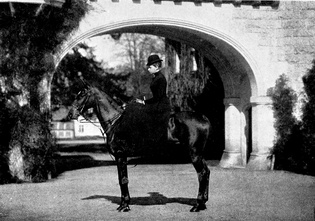
THE DUCHESS GUNTHER OF SCHLESWIG-HOLSTEIN
In direct defiance of the law I was ordered to sign my
name to a document by which I relinquished my future
inheritance from the Empress to my children. At last,
worn out with sufferings, I was on the point of consenting
for a consideration of an annual payment of a sum of
six thousand marks, in exchange for which I was to be reduced
to isolation and slavery, and to be further plundered
of all that might belong to me.
I will say nothing here to the Duke of Holstein, this
soldier financier; but to my daughter Dora, the fruit of my
body, whom I have fed at my breast, and whom I have
brought up, I say this:
"You may possess all the outward appearances of
respectability. You may enjoy the benefits of a fortune
of which I know the source, you may experience neither
shame nor remorse, you may even dare to pray. But God
can never be deceived. No wickedness, no guilty complicity,
no action contrary to Nature will escape His
justice. Sooner or later He will judge all men according
to their works."
Before I conclude my account of the machinations of
these human vultures who attempted to assail my liberty
and my rights, when once I had been unfortunate enough
to ask help from my children, I must not forget to mention
that later, when I regained the captaincy of my
soul, I appealed to Justice at Munich. The courts there
declared the renunciations extracted from me in my
misery and frenzy when I was starving and homeless to
be invalid.
During the war I have often actually not known where
I should sleep, or of what my next meal would consist.
I write this frankly, without a particle of false shame—firm
in the approval of my own conscience.
I have never willingly injured anyone. I have suffered
in silence. I am speaking to-day in my own defence,
bringing as evidence a family drama which touches contemporary
history. I speak with candour, but I am not
actuated by feelings of hatred. Wickedness has diminished.
But my personal sufferings have in nowise
lessened. I was born a king's daughter, I shall die a
king's daughter. I have certainly pleaded for assistance,
but more on behalf of my attendants than for myself. I
could not bear to see these devoted creatures, my comfort
and support in my misery, weep and grow pale during
these dark days.
The count had been obliged to leave Munich. On the
morning of August 25, 1916, his room was suddenly invaded
by the police. He was put in prison, then taken
to Hungary, and afterwards interned near Budapest. He
was by birth a Croatian and therefore regarded as a subject
of the Entente, even before the defeat which united Croatia
and Servia. Human justice is really only a word!
On the same day Olga, my principal attendant, an
Austrian who had always shown me an invaluable and
long-standing devotion, was also arrested. She was afterwards
released. But I understood the significance of this—the
order had come from the highest authority to
alienate everyone who cared for me. I will describe what
followed.
My French maid, whose care of me was so disinterested,
was interned. If my faithful Olga had not come out of
prison, and if I had not had the means to keep her, I should
have been completely isolated.
But, shortly after this, I really did not know how to
supply my daily needs. My last jewels had been sold.
I was now as poor as the poor souls who implored my
charity.
What should I decide to do, what should I attempt?
If I appealed to my daughter I knew that I should be up
against the Duke of Holstein. He was absolutely pitiless.
All this happened in July, 1917.
Providence now threw in my way an honourable
man, a Swiss professor, who was terribly distressed at
my fate.
He generously offered to help me to reach Silesia,
where my daughter was in residence at one of her castles.
This castle is not far from Breslau. I therefore left
Munich, with Olga, in the hope of seeing my child and
obtaining from her some temporary shelter.
But when I reached my journey's end I tried in vain
to be received, listened to, and assisted by Dora.
I was therefore stranded in a little village in the
Silesian mountains, where my last few marks soon
disappeared.
The count had tried to send me the wherewithal to
exist. Without any warning, the German postal authorities
retained the money and returned his letters.
The little inn where I had taken refuge was kept by
kindly folk who were, however, unable to let me stop
unless I could pay. I saw myself faced with the most
extreme misery. The innkeeper seemed frightened of me.
He told me that he had been ordered to render an account
of my doings to the police, and that I was kept well under
observation, although I might not be aware that this was
the case.
He was mistaken. I and Olga had both noticed that
our slightest movements were watched. Even in our walks
in the open country we continually met some peasant or
some pedestrian who appeared not to notice us, but who
actually spied on us more or less unsuccessfully.
I felt the influence of an implacable force that wished
to immure me in some new gaol, madhouse or prison, or
which would perhaps even make me contemplate self-destruction.
In this extremity Heaven once again came to my rescue.
On the very day which I thought would be the last I
should be allowed to stay at the inn, I sat down, miserably,
on a bench in front of the house. I asked myself in despair
what was to become of me. Suddenly a carriage appeared—a
rare sight in that unfrequented region. The coachman
signalled to me, and I saw, sitting in the carriage, a
large, important-looking person who seemed looking for
something or somebody.
He was looking for me!
I was soon acquainted with the fact that this gentleman
had come from Budapest on behalf of the count, and
wished to speak to me.
At these words I felt myself lifted out of the abyss of
despair. But my trials were not over.
The count's confidential agent had been charged with
the mission of helping me to leave Germany. In order
to do this, it would be necessary to cross Austria into
Hungary, where I could rely upon active sympathy being
shown me.
Things and people had already changed in the Austro-Hungarian
Monarchy!
But, what possibilities such a journey presented!
First, I had no official papers. The revelation of my name
and title would alone suffice to impede my progress; I
should be instantly detained.
But although, thanks to the count's messenger, my bill
at the inn was settled, I had only very limited means at
my disposal. Austria, it is true, was not far away. We
could go there across the mountains by way of Bohemia,
but the envoy declared that, owing to his shortness of
breath and his troublesome legs, he could not possibly
follow me over the goat tracks which we should most
assuredly have to pass. He decided that our best plan
was to make for Dresden, and from there to choose the
easiest route.
When evening fell our host metaphorically closed his
eyes to my departure. He waited until the next day to
notify my disappearance to the authorities.
By the time he did so I was in Saxony. But here
again it was too dangerous to go near Lindenhof in a
kingdom where my misfortunes had been the subject of so
much publicity. At last we remembered a little village
close to the frontier, on the side nearest Munich, where
the regime was less rigorous than in the vicinity of
Dresden, and we arrived there without anything untoward
happening.
The present difficulty was not so much in crossing
Germany. It chiefly consisted in solving the question of
the possibility of my being able to stay in some retired spot
without my identity being discovered and notified, and
afterwards to cross the frontier without a passport and
gain safety at Budapest.
This Odyssey alone would make a volume. It terminated
in a Bavarian village where I breathed freely
once more. A good woman extended the kindest hospitality
towards me and my faithful Olga.
The count's messenger still continued to watch over my
welfare, and found accommodation for himself in the
vicinity.
From my window I could see the church steeple of
the Austrian village through which I must pass in order
to reach Salzburg, Vienna and Hungary. I was now on
the borders of the Promised Land. A little wood separated
me from it, at the extremity of which flowed a brook
well known to the contrabandists, since it separated
Bavaria from Austria, and served them by night as a means
of transit.
I dared not risk it! It would be necessary for me to
cross a bridge constantly guarded by a sentry. But once
over the bridge I should have left Germany behind me!
When I happened to be near Munich, I had regained
possession of two favourite dogs. My love of dogs is well
known. I did not wish to be separated from these, and
I had an intuition that they would be of use to me in my
flight. I thought tenderly of the clever Kiki, now a
prisoner at Bad-Elster. His successors, like himself,
would surely bring me luck! One was a big sheep-dog,
the other a little griffon.
At first I hesitated to go near the bridge for fear lest
I should be recognized. Then I reflected that it would
seem suspicious to a sentry on duty if I always remained
some distance away. My best method would be not to
hide from the sentries, but to walk constantly with my
dogs in their proximity. The soldiers (the same ones
were always on duty) would soon get accustomed to seeing
me, and in their eyes I should only represent an inoffensive
inhabitant of the village.
The count's envoy begged me to hasten my departure.
I refused. He advised a nocturnal flight. I did not agree
with him. I said: "I shall go when I see fit, at my own
time, when I feel that the propitious moment has arrived."
It is curious, but it is nevertheless true, that I always
experience a weird kind of intuition under difficulties. It
is exactly as if some inner voice advised me what course
to pursue. And whenever I have obeyed this intuition I
have always been right.
One morning I awakened under the domination of my
unseen guide.
"You must leave at noon to-day."
I sent at once to the count's messenger. Thanks to his
official papers he was able to cross the frontier with Olga
without any difficulty. They therefore went on in advance.
I arranged to meet them at the foot of the belfry in the
Austrian village—so near and yet so far.
If the sentry stopped me and questioned me, I should
be a prisoner!...
Towards noon I strolled along by the side of the brook,
my big dog jumping round me, the tiny griffon in my
arms. The autumnal sun was quite fierce, and the sentry
was standing in the shade a little distance from the bridge.
I sauntered across the bridge, as if it were a matter of
course. The soldier took no notice. I walked away
unconcernedly, but my heart was beating furiously! I was
in Austria at last! Upon reaching the village I rejoined
my "suite." A carriage was waiting. I drove to Salzburg,
and put up at a small hotel where I knew I
should be in temporary security.
I waited three days for the arrival of my Viennese
counsel, M. Stimmer, who had been secretly advised of my
return to Austria, and of my wish to proceed to Budapest
under his protection.
M. Stimmer responded to my appeal. He waived all
the legal difficulties which might arise from the situation.
The voice of humanity spoke more strongly than the voice
of obedience to the order which had banished me from
Austria, and given me over to the power of Germany,
where I should inevitably have succumbed to misery and
persecution.
But in Hungary I should stand a chance of knowing
happier days. M. Stimmer decided to accompany me
thither.
I had reached the limit of my endurance when my
wanderings came to an end at Budapest, and I found
myself in a comfortable first-class hotel. The authorities
saw nothing compromising in my presence. At my urgent
request the count was allowed to leave the small town
where he was interned, and remain near me for several
days in order to discuss my affairs.
Unfortunately the war was hopelessly prolonged.
Life gradually became more and more difficult. Austria
and Hungary were no longer the victims of illusion. Enlightened
by the knowledge of defeat, they cursed Berlin
as the author of their misfortunes. Budapest was in a
state of ferment.
All at once everything collapsed. The wind of
Bolshevism swept furiously over the Dual Monarchy. I
now became familiar with the commissaries and soldiers
of the Revolution. I experienced visits of inspection,
perquisitions, interrogations. But suddenly my misfortunes
disarmed even the savage leaders of Hungarian
Communism. I have already mentioned how one of these
men remarked when he saw to what poverty I was reduced:
"Here is a king's daughter who is poorer than I am."
If I were to live for centuries, I should still experience
in thought those poignant emotions which I underwent
during the time of torment which overthrew thrones and
threw crowns to the four winds of heaven. Past ages have
never witnessed such an upheaval.
On the banks of the Danube, between the east and
the west, the downfall of Prussian power and the prestige
of Monarchy was felt perhaps more keenly than
elsewhere.
I often wondered whether I was actually alive in the
world I had formerly known, or if I was not the victim of
a long-drawn-out nightmare.
Our troubles, our worries, our own individuality are as
naught in the whirlpool of human passions. I felt myself
carried away with everything which surrounded me into
the unknown country of a New Era.
CHAPTER XX In the Hope of Rest
And now that I have said all that I think is indispensable,
perhaps my readers will make excuses
for me if I have expressed myself badly in
narrating the story of my sufferings.
They will, perhaps, also make excuses for my having
broken the silence which I have hitherto maintained.
There has been endless discussion concerning me and
my affairs. I have not wished it, I have not inspired it. It
has arisen solely through force of circumstances.
We are powerless against circumstances. Our lives
seem to be influenced more by others than by ourselves,
and the fatality which often orders our actions and our
days is not our choice.
A moment's folly can wreck a whole life. This has
been my personal experience. But I think that at first I
was the person deceived, because I was not old enough to
judge rightly and to see clearly.
Can I grow old without obeying the duty to defend
the truth, which has been so outraged by my enemies?
Can I go down to the grave, misunderstood and
slandered?
My life represents a succession of fatalities of which
I was powerless to avert the final dénouement.
I have already said, and I repeat, I do not hold myself
guiltless of errors, faults and wrongdoings. But one
must, in justice, seek their primary cause in my disastrous
marriage.
My parents—particularly the Queen—saw nothing
wrong in giving me to the Prince of Coburg when I was
hardly more than a child.
The King saw in this marriage the possibility of certain
influences and a political union which would be
useful to himself and to Belgium.
The Queen was overjoyed at the thought that I was
to make my home in Austria and Hungary, whence she
had herself come, and where I should remember her, and
at the same time further my country's glory and the King's
ambitions.
I have been sacrificed for the good of Belgium, and
Belgium now includes Belgians who reproach me for the
gift of my youth and happiness essentially destined for
their benefit! Belgians to-day regard me as a German,
a Hungarian—a foreigner—and worse even than
that! Alas for human gratitude!
Be that as it may, am I guilty of having voluntarily
abandoned my country or of ceasing to love it?
The whole of my being protests against this vile
accusation.
Of what then am I guilty? Of having left my husband
and my children?
I lived for twenty years at the most corrupt Court of
Europe. I never yielded to its temptations or its follies.
I gave birth to a son and a daughter, I suckled them at my
breast, and I reposed all my hopes of a mother in my
children. My son's fate and how he left me is common
knowledge. It is also well known how my daughter, influenced
by her husband and her environment, has
treated me.
Of what was I actually guilty? It is true that finding
myself at the end of my courage, and suffocating in the
atmosphere of a home which for me was detestable, I was
about to succumb....
I was rescued at this crisis, and I dedicated my life to
my deliverer. And, in consequence, my saviour was
branded as a forger, and by dint of monetary persecutions
and fines it was sought to annihilate him.
Both of us have escaped from the murderers who
desired our destruction.
Am I guilty of having struggled, of having remained
faithful to fidelity, and of having resisted the efforts to
overthrow me?
The judgments of error and hatred matter little to me.
I have remained the woman that I promised my sainted
mother I would become—the idealist, who has lived on
the heights.
Am I guilty in the real meaning of morality and freedom?
Many women who consider themselves in a position
to cast the first stone at me have far more with which to
reproach themselves!
What remains to be said?
This.... I believed, I believed in common with the
greatest legal minds, that in the ordinary course of events
I should inherit a fortune from my father. My inheritance
was considerably encumbered and reduced owing to
fraudulent schemes and wrongful judgments, which have
been universally condemned.
Am I guilty for having been deceived and plundered?
Again it is said that my family was not united. Is
this my fault?
I always loved my flesh and blood more than myself.
Have I been found wanting in affection and respect
towards my parents? Was I not to my sisters the adoring
eldest sister who loved and cherished them?
Am I guilty of the errors of the King and the Queen,
the latter convinced by my persecutors of the gravity of
my "illness," the former irritated—not by my independence,
but by the scandal that it created?
Am I guilty of the selfishness of my sisters—one the
victim of narrow-mindedness, the other the victim of
political schemes?
I freely admit this: I have certainly rebelled against
disloyalty and restraint. But for what motives? For what
ends?
My real crime has consisted in my effort to get my own
property, in waiting for a fortune which I have not
handled.
The world only admires the victorious, no matter by
what means they achieve victory.
I have been a victim ever since my girlish feet were
led into devious paths; I have always suffered defeat.
When the battle was over I did not ask pardon of
untruth, injury, theft, or persecution.
I might have been alone, I might have fallen under the
burden of infamy and violence. But I would not yield
because I was not fighting for myself alone.
God has visibly sustained me, by animating my heart
with feelings of esteem and gratitude for a chivalrous soul
whom I have never heard utter a word of complaint, no
matter how atrocious the intrigues and the cruelties which
encompassed him.
A base world has judged his devotion and my
constancy from the lowest standpoint.
Let such a world now realize that beings exist who
are far above the sordid instincts to which humanity
abandons itself, beings who, in a common aspiration to a
lofty ideal, rise superior to all earthly weaknesses. The
last lines of this short sketch of a life, the details of which
would fill many volumes, must be a recognition of my
gratitude towards Count Geza Mattachich.
I have not said a great deal about him, because he
will think that even a little is too much. This silent man
only appreciates silence.
"Silence alone is strong, all the rest is weakness."
Thus wrote Alfred de Vigny, and this line is the motto
of the strong.
But you know, Count, that unlike you I cannot force
myself to be silent. I wish to invoke the vision of the
hour when you first spoke those words which penetrated
my conscience and cleansed and illumined it. From
that hour, this light has been my guide. I have sought in
suffering the road towards spiritual beauty. But you preceded
me thither, and in the dark depths of the madhouse
I looked towards your prison cell, and in so doing I
escaped the horrors of insanity.
We have had to submit to the assaults of covetousness
and hypocrisy.
We have struggled in the mire; we have been
separated in wild lands. The world has only seen the
splashes of mud and the tattered banner of our combat.
It has ignored the cause, and its malevolence has never
pardoned us for emerging from the fight as victims.
All this was very bitter at the time, but I never
regret! My sufferings are dear to me because you,
Count, have shared them, after having tried so ardently
to spare me.
There is always a certain joy in bearing unmerited
afflictions in the spirit of sacrifice.
This spirit of sacrifice is peculiarly your own. I never
possessed it. But you have endowed me with it. No gift
has ever been so precious to my soul, and I shall be grateful
to you on this side of the tomb and beyond it!
I, who alone know you as you really are, and know
the adoration that has given you a reason for living, I
thank you, Count, in the twilight of my days for the
nobility which you have always shown in this adoration.
Shall I ever know, will you ever know, the meaning of
rest otherwise than the last rest which is the lot of
mankind?
Will earthly justice ever render unto us the hoped-for
reparations?
Will it be possible for us to remain outlawed from the
truth, and crushed by the abuse of power and human
wickedness?
Let it be as God wills!


