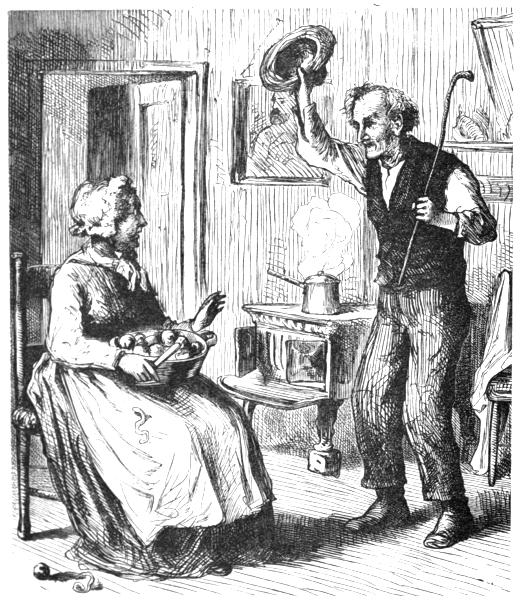
It was with a beatin’ heart that I stood at the door
of the shop where Horace’es papers are made. And
though he haint printed ’em alone since he was run
up, as he did more formally, they told me I would be
apt to find him at his old office.
I was jest a goin’ to knock when a boy came out,
and says I,
“Bub, I want to see Horace.”
“Horace who?” says he.
“Horace Greeley,” says I.
“Wall,” says he, “I will take up your card.”
I see then that he was a tryin’ to empose upon me.
I haint naturally warlike, but I can stand up on my
dignity, straight as a cob when I set out. Says I,
“I’ll have you know that I am a member of the
Methodist meetin’ house.” Says I, warmly, “I don’t
know one card from another, and I’m glad I don’t.”
Says I, “I presume there are wimmin here in the
village, as old as I be, that set up to play cards till 9
or 10 o’clock at night. But thank fortin’ I haint one
of ’em.” Says I, “Young man, I detest card playin’,
it ends in gamblin’. Now,” says I firmly, “you
jest tell me where Horace is, or I’ll know the reason
why!”
He see I wasn’t to be trifled with, any more. He
muttered somethin’ about his not bearin’ the blame.
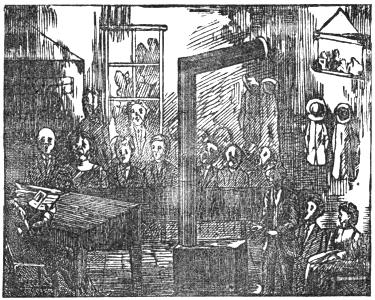
But he went up stairs, and we followed tight to his
heels, and the minute he opened the door we went in.
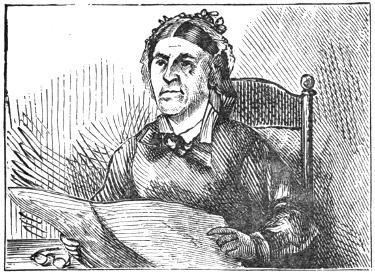
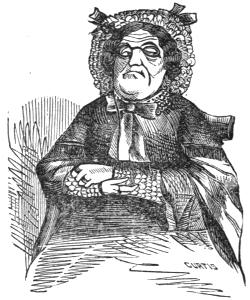
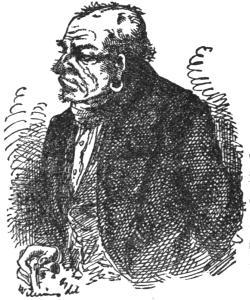
Horace hadn’t dressed up much, for I spose he didn’t
expect us. But if he had been dressed up in pink
silk throughout, it wouldn’t have made no difference
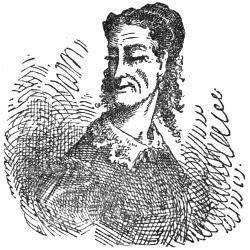
to my feelin’s as I ketched sight of that noble and
benign face, that peaceful innocent mouth, that high
forward, with the hair a curlin’ round the sides of it,
like thin white clouds curlin’ round the side of a
mountain in Ingun summer.
I use that figger of speech, because his face looked
on the mountain plan, firm, and grand and decided.
And I put in the Ingun summer, because you know
jest how a mountain will look standin’ a considerable
ways above you on the first of October—kind o’ mellow
and peaceful and benign. But you realize all the
time, that under all the green and shady growth
of its mosses and evergreens, it has been growin’
gradual but stiddy through the centuries. Under all
that viel of shinin’ blue gawze, wove out of mist one
way, with a warp of sunshine, under all the mellow
colerin’ the time of the year has give it, there is a
good strong back bone of solid rock in the old mountain,
that couldn’t be broke by all the hammers in
creation.
That was jest my idee of his face, a mountain in
Indgun summer, facin’ the sunrise. Standin’ up so
high that it ketches a light on its forward before the
world below gets lit up. Firm, solid principles with
the edge took off of ’em, and kinder topped off with
the experiences, and gradual convictions and discoveries
of a noble life. And all softened down by the
calmness and quiet of the time of day, and the fall of
the year. That was the way Horace Greeley’s face
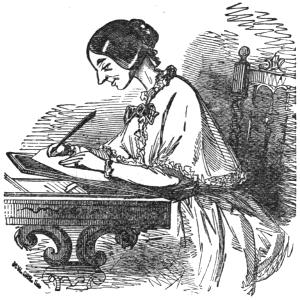
looked to me as I got a full view of it as he set to his
desk a writin’.
In the dead of night on my own peaceful goose
feather bed at home, I had made a speech all up in
my mind for that glorious occasion, when 2 firm and
true principled minds should meet—which was Horace’s
mind and mine. For though we conflict in some
things, the good of the Human Race is as dear as our
apples is, in our eyes. But at the first sight of that
noble face, my emotions got up and overpowered me
so, that I forgot every word of my speech, and all I
could say was, in thick tones of feelin’ and principle,
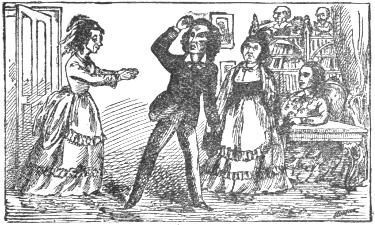
“Horace, I have come.”
His face grew almost black with fear and anger.
He sprang up, and waved me back with his right
hand and shouted to me,
“It is in vain madam! you are the 94th woman
who has been here to-day after office. Female lobsteress
depart! Get thee behind me Sa—female!”
Says I with deep emotion, “Horace you don’t know
me! I am not a female lobsteress! I am Josiah
Allen’s wife.”
He came forward and shook hands with me, and
says he, “I know you will excuse my vehemence,
when I tell you, I am almost devoured by office seekers!”
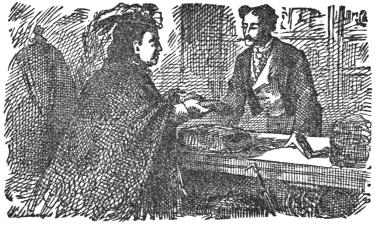
He cleared a path through the papers on the
floor to some chairs, but as we set down, he continued
in tremblin’ tones, for it seemed as if he couldn’t forget
his troubles,
“Foxes and woodchucks have holes, but a candidate
for the Presidency can’t find none small enough
to hide in. I did,” says he sithin deeply, “I did
have a few peaceful, happy hours in the suller of my
dwellin’ house;” he paused, overcome by sad recolections,
and says I, deeply sympathizin’ and interested,
“What broke it up Horace?”
“They found the out door suller way; so,” says he
sithin agin, “I lost that peaceful haven.”
“Wall,” says I, tryin’ to soothe his agitation,
“You’re one in a high, noble place, Horace.”
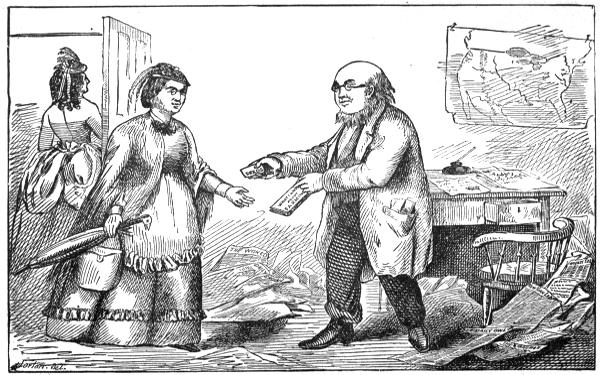
INTERVIEW WITH HORACE
“Yes!” says he, “but it places anybody under a
very strong light—a very strong light. I have never
done anything out of the way sense I was first born,
but what I have seen it in the papers. I tore my
pantaloons once,” says he, gloomily, “in gettin’ over
the fence at the early age of 2 and a half, and I bit
my mother once at the age of 7 months a nursin’, I
could wish these two errors of my past to be forgotten
by the world and overlooked, but in vain. I am
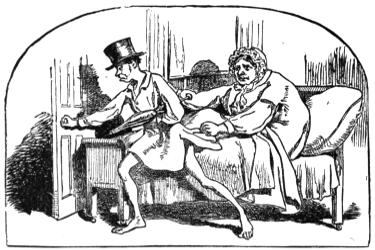
taunted with ’em on every side. I never threw a boot
jack at a tom cat in the dead of the night, but what
my picture has been took in the act, I never swore a
oath to myself in the depths of my own stomach, but
what I have seen that unspoken oath in the papers. I
never jawed Mrs. Greeley about my shirt buttons,”
he continued, sadly, “in the depths of our secluded
chamber, but what it has been illustrated with notes.”
As he spoke of jawin’ about shirt buttons, I says to
myself, “How much! how much human nature is
alike in all men,” and I says aloud,
“How much you remind me of Josiah.”
“Of Josiah!” says he, and that name seemed to
make him remember himself, and to come nobly out
of his gloomy reflections. “Josiah, he is your husband!
Oh yes, Josiah Allen’s wife! I am glad to
meet you, for although I couldn’t comply with the
request your letter contained, yet it convinced me
that you are a sincere friend to the human race.”
“Yes,” says I, “Horace, I am, and I want you to
consider my request over agin.”
But he interrupted me hurriedly, seemin’ to want
to turn my mind from that subject.
“What do you think of Fourier’s system, Josiah
Allen’s wife?” says he, lookin’ at me languidly over
his specks.
Says I, “I never see Mr. Fourier. How can I tell
you any thing about the old man’s health, whether his
system is all right, or whether he is enjoyin’ poor
health. Horace, I come to talk with you on more
important things.”
But he continued placidly, hopin’ to draw my mind
off,
“What do you think of Darwin’s idees?”
“Darwin who?” says I. “Darwin Gowdey? I don’t
know any other Darwin, and I never mistrusted that
he had any idees, he is most a natural fool.”
Says he, “about our descendin’ from a monkey?”
Says I, with dignity, “I don’t know how it is with
you, but I know that I couldn’t descend from a monkey,
never bein’ on one’s back in my whole life.”
Says I, “I never looked well in the saddle any way
bein’ so hefty. But,” says I, in a liberal way, “if you,
or anybody else wants to ride monkeys, you have the
privilege, but I never had no leanin’ that way.” And
agin, says I, in agitated tones, “you needn’t try to
take my mind oft’en the deep and momentous subject
on which it is sot, by talkin’ about ridin’ monkeys.
Horace I have come clear down here to the village on
purpose to ask you to examine your platform, and see
if there hain’t no loose boards in it where some of the
citizens of the United States, such as wimmen can fall
through. Platforms, that are built over the deep
waters, ought to be sound, and every board ought to
be nailed down tight, so that nobody—not even the
smallest and weakest—can fall through and get drownded.”
Says I, “Your door step is most all good solid
timber, but I feel there is one old, mouldy, worm
eaten board that is loose in it.” And with emotion
renderin’ my voice weak as a cat, says I, “Horace, I
want you to examine your door step and lay down a
new board, and I will help you do it. I come a purpose
to.”
He see it was vain to turn the current of my
thoughts round, and says he in a decided way,
“You must have become aware of my views from
the contents of my letter. You got my letter?” says
he in a enquirin’ tone.
“Yes,” says I, “we have framed it and got a glass
over it, jest because it was your writin’, but there
seemed to be a mistake in it; it seemed to be wrote
to Josiah.”
Says he, “What did you make it out to be?”
Says I, “it seemed to run as follers—‘I don’t want
to purchase any more shoats.’
“Josiah did have a uncommon kind of pigs, and we
thought mebby you had heard that Josiah wanted to
sell you one, though it was a mistake, for he swapped
a couple with Deacon Gowdey for a yearlin’ heifer,
and he didn’t have no more left than he wanted to
keep over.”
He said we didn’t read it right. It read, ‘I don’t
approve of any wimmen’s votes.’ And says he, leanin’
back in his chair, “That is the ground I take, I don’t
believe in Wimmen’s Rights. I don’t see what rights
they want—more’n they have now.”
Then I dove right into the subject that was the
nearest to my heart (with the exception of Josiah) and
says I, “Horace, we want the right of equal pay for
equal laber. The right of not bein’ taxed without
representation. The right of not bein’ compelled, if
she is a rich woman, of lettin’ her property go to support
public men, who are makin’ laws that are ruinin’
them she loves best, such as givin’ licences to ruin
body and soul. The right to stand by the side of all
good and true soles in the nation, and tryin’ to
stop this evil spirit of intemperance and licentiousness
that is runnin’ rampant through the land. The right
to—”
I don’t know how much longer I should have gone
on, but in the noble forgetfulness of yourself that
always accompanies genius, I had riz up, and by an
unguarded wave of my right hand a wavin’ in eloquence
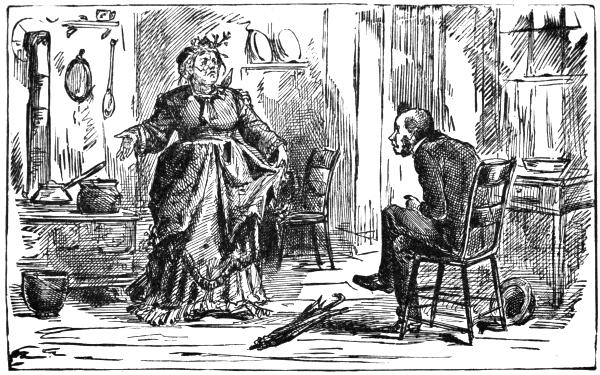
I tipped over my umberell. Horace picked it
up (he is a perfect gentleman at heart) and says he,
“Set down Josiah Allen’s wife, don’t fatigue yourself
too much.”
Rememberin’ myself, I sot down, and Horace,
pensively wipin’ his brow with his lead pencil, went
on to say,
“I admit there is some truth in what you say, Josiah
Allen’s wife. I admit, as a truthful man should, that
whatever wimmen has laid thier hands to, such as
churches, hospital work, foreign missionary work,
ragged schools, Sunday schools, charity balls and
fairs, and Good Templars, they have done more
than men in thier efforts and good influence. They
are more patient than men; they are not so strong,
but they are more persistent. When they once get a
plan in thier heads, they are awful to hold on—if they
can’t accomplish it in one way, they will take
another.”
Says I, “that is jest what Josiah says. He says, ‘I
always have my own way.’”
“I admit, that whenever wimmen have been admitted
in any public affairs, they have had a puryfyin’,
and softnin’ and enoblin’ influence. But I deny that
votin’ and havin’ a voice in public affairs is goin’ to
better the condition of either wimmen or the nation.”
Says I, “Horace, the old White House needs puryfyin’
more than any horsepittle or meetin’ house in
creation.” And says I, “Let wimmen lay to, and help
clean house.” Says I, “let her try her hand for one
year, and see what she can do.”
Says Horace, goin’ on placidly with his own
thoughts, “It is not the change that would be wrought
in public affairs I dread, so much as the change in the
wimmen themselves, if they should mingle in the wild
vortex of political life. I have two daughters, and
rather than have them lose all thier delicacy, and enter
political life and mount the rostrum, I would lay them
in thier grave. I don’t believe,” says he, with great
decision, “I don’t believe in wimmen leadin’ off into
politics, and mountin’ the rostrum.”
I interupted him with a earnest tone; “you needn’t
twit me of that, no more Horace. I don’t want to
mount no rostrum. I had ruther give Josiah 20 curtain
lectures than to give half of one to the public,
there would be more solid satisfaction in it. But as
far as indelicacy is concerned, it is no more immodest
for a woman to lead off in politics than to lead off one
of your indecent German waltzes with a man.” Says
I, “you men think it hain’t indelicate for wimmen to
go with you to balls, and to theatres, and into the
wild vortex of the ocean a bathin’ with you—and to
post offices, and to fires, and fairs, and horse races,
and to church, and to heaven with you. But it is
awful to go and drop a little slip of white paper into
a box, once a year with you.”
Says Horace wavin’ off that idee, “Woman holds
in her arms a more powerful ballot than she can in
her hands. Let her mould her baby boy, so that in
the future his mother will vote through him.”
Horace looked noble as he said this. His silver
mounted spectacles shone with pure feelin’ and principle.
“But,” says I, in a reasonable tone,
“How can wimmen mould children, if she haint
got any to mould? I haint got any of my own, and
lots of wimmen haint.” Says I, “such talk is unreasonable,
how can she go to mouldin’, when she
haint got the materials?”
“Let them influence thier husbands then,” says he,
“the influence of wimmen over men, is wonderful,
and they can in this way wield a almost sovereign
power. And they do in many instances exert this
indirect power in an eminent degree.”
Says I, finally, “I don’t believe in no underhand
proceedin’, I never did. The idee of wimmen bein’
underhand, and go to mouldin’ men on the sly, I don’t
believe in it.” Says I, “accordin’ to your own story
Horace, wimmen have a influence in politics now.”
“Wall—yes—a sort of a indirect influence in thier
families, as it were.”
Says I, “Horace can you look me straight in the
spectacles and deny that there is wimmen’s influence
in politics at Washington to-day?” Says I, “look at
them female lobsteresses there.” Says I, “one handsome,
brilliant, unprincipled bad woman will influence
14 common men where a modest humbly well wisher
of her sect will one.” And says I, warmly, for the
thought of these female lobsteresses always madded
me—“I should be ashamed if I was in some of them
Senators’ places, makin’ laws about the Mormans.”
I see my deep principle was a floatin’ me off into a
subject where as a female I didn’t want to go, and so
I choked back the words I was about to utter which
was, “I had jest as lives jine a Morman, as to jine
one of them.” I choked it back, and struggled for
calmness, for I was excited. But I did say this,
“I think good wimmen ought to have a chance
with bad ones in political affairs. For there is more
good wimmen in the land than there is bad ones, but
now the bad ones have it all thier own way.”
Horace wiped his brow gently with his lead pencil,
and said in a thoughtful accent,
“There may be some truth in what you say Josiah
Allen’s wife. I confess I never looked at it in exactly
this light before.”
Says I, in a triumphant glad tone, “That is jest
what I told Josiah.” Says I, “Josiah, Horace is all
right, there never was a better meanin’ man on the
face of the earth than Horace is. All he wants is to
have some noble principled woman to set him right in
this one thing.”
I see in a minute that I had made a mistake. Men
hate to be dictated to by a woman, they hate to, like
a dog. I see by his lowery brow that I had put the
wrong foot forrerd. For the time bein’ the sage and
the philosifer sunk down in his nature, and the man
spoke in the usual manlike way.
“I say wimmen’s brains are too weak to grasp public
matters. They have remarkable intuitions I grant.
A woman’s insight or instinct or whatever you may
term it, will, I grant, fly over a mountain and discover
what is on the other side of it, while a man is gettin’
his gunpowder ready to make a tunnel through it.
But they are not logical, they have not the firm grasp
of mind, the clear comprehension requisite to a voter.”
Says I, “Horace, which has the firmest grasp—the
clearest comprehension, a earnest intellegent christian
woman, or a drunken Irishman?” Says I, “Understand
me Horace, I don’t ask which would sell thier
votes at the best lay, or vote the most times in one
day—I dare say the man would get ahead of the woman
in these respects, bein’ naturally more of a speculator—and
also bein’ in practice. You know practice
makes perfect. I don’t ask you this. But I ask you
and I want you to answer me Horace, which would
be in the best condition for votin’, Elizabeth Cady
Stanton gettin’ up off of her religious knees in the
mornin’ after family prayers, and walkin’—with the
Constitution in one hand and the Bible in the other—coolly
and sensibly to the pole, or Patrick oh Flanegan
comin’ out of a drunken wake, and staggerin’ up
against the pole with a whisky bottle in one hand and
a club in the other, when he didn’t know nothin’ in
the first place, and then had lost half or 3 quarters of
that, in the liquer some clear minded, logical man give
him, for votin’ a few dozen times for him?”
At this question Horace quailed a very little. But
it was not the quail of a weak man, there was principle
in that quail, and a determination to argue to the
end, which is one of the charicterestics of that great
and good man. She that was Samantha Smith also
possesses some of this spirit.
“Set down, Josiah Allen’s wife and don’t fatigue
yourself too much,” says Horace, for almost carried
away by my emotions, I had riz’ up and stood on my
feet agin.
And he went on, “You put the case in a very
strong light Josiah Allen’s wife. That is one of the
peculiar weaknesses of your sect. You don’t possess
sufficient moderation. You exaggerate too much.”
Says I, “publishin’ a daily paper for 20 years, has a
tendency to make any man a good judge of exaggeration,
and if you see by my symptoms that I have
got it, I haint a goin’ to deny it. But you haint answered
my question yet Horace.”
Says he “Josiah Allen’s wife, my mind is firmly
made up on this subject. And nothin’ upon earth
will ever change it. I am fully convinced that
woman’s enterin’ into public duties would result in
makin’ her coarse and unfeminine, and make her lose
her love for home and husband. And then, suppose
she were eligible for public offices; imagine a lady
blacksmith! a lady constable! a lady president! it is
absurd, Josiah Allen’s wife.”
Says I, “Horace, you are too smart a man to bring
up such poor arguments. You don’t see a little sickly,
literary, consumptive, broken backed blacksmith or
constable. Men choose the occupations most congenial,
and suitable for them, and wimmen would do
the same, anyway. Rosa Bonheur chooses to live out
doors half the time among cattle and horses, and I
presume she haint half so afraid of ’em as Mr. A.
Tennyson would be. I have heerd Thomas Jefferson
read about ’em both. I don’t suppose any woman
would be compelled to be made a constable of, though
if they was, I presume men would submit to be incarcerated
by ’em as quick as they would by a male man.
“As for the idee of a lady president, I don’t know
as it would be any more absurd than a lady queen.
Victory sets up pretty easy in her high chair, there
don’t seem to be anything very absurd about the Widder
Albert. You say public duties makes a woman
coarse, and forgetful of home and husband. Horace,
look for one minute at the Widder Albert. Where
will you find among your weak fashionable wimmen,
so lovin’ a wife, so devoted a mother? Where will
you find a bigger housefull of children, brought up
better than hern? She has had more public duties to
perform than goin’ once a year by the side of her husband,
and votin’ for Justice and Temperance. But
did these public duties, that she performed so well,
wean her from her husband?” Says I, “did they take
up her mind so that she didn’t almost break her heart
when he died?” says I, “Do you think a honest desire
to live a full life—to use every power that God
has given you—to do your very best for God and humanity,
do you think that this desire modestly and
consistently carried into action, will make a woman
coarse and unwomanly, any more than this present
fashionable education, to flirt and simper and catch a
rich husband?”
Says I, “You seem to think that votin’ is goin’ to
be such a weight onto a woman that it will drag her
right down from her home into public and political
affairs and leave her there. Such talk is simple, for
love and domestic happiness will be the other weight
to the steelyards, as long as the world stands, and
keep a woman’s heart and mind jest as straight as a
string. Votin’ haint a goin’ to spile any woman at
all, be she married, or be she single, and there is a
class at the mercy of the world, fightin’ its hard battle
alone—it will help them. The idee of its hurtin’ a
woman to know a little somethin’, is in my mind
awful simple. That was what the slaveholders said
about the black Africans—it would hurt ’em to know
too much. That is what Mr. Pope says to-day about
his church members. But I say that any belief, or
custom that relies on oppression and ignorance and
weakness to help it on in any degree, ought to be exploded
up. Beautiful weakness and simplicity, haint
my style at all in the line of wimmen. I have seen
beautiful simplicities before now, and they are always
affected, selfish critters, sly, underhanded, their minds
all took up with little petty gossip and plottin’s.
Why they can’t set a teacup on the table in a open-hearted
noble way. They have to plot on some
byway to get it there, unbeknown to somebody.
Their mouths have been drawed so into simpers, that
they couldn’t laugh a open generous laugh to save
their lives. Always havin’ some spear ready under
their soft mantilly, to sweetly spear some other woman
in the back. Horace, they haint my style.
Beautiful weakness and simplicity may do for one
evenin’ in a ball room. But it don’t wear well for all
the cares and emergencies that come in a life of from
40 to 50 years. Was George Washington’s mother
any the less a industrious equinomical and affectionate
wife and mother, because she took a interest in public
affairs?” And says I, with a lower and more modest
tone, “Is Josiah Allen’s wife on that account any the
less devoted to Josiah?”
He knew I was perfectly devoted to that man.
He set mewsin’ silently for a time seemin’ly on somethin’
I had said heretofore, and finally he spoke up.
“The case of Victory is very different. A crown
that descends on a hereditary head is a different thing.”
“So ’tis,” says I, “But the difference is on the
wrong side, for sposin’ it descends onto the head of a
hereditary fool—or a hereditary mean woman. If a
woman was voted for it would be for goodness, or
some other good quality.”
Says Horace, wavin’ off that idee and pursuin’ after
his own thoughts, “Man is sometimes mistaken in
his honest beliefs, but Nature makes her laws unerringly.
Nature intended the male of every species to
take the preeminence. Nature designed man to be at
the head of all public affairs. Nature never makes
any mistakes.”
“Nature made queen bees Horace. Old Nature herself
clapped the crown on to ’em. You never heard
of king bees, did you? Industrious equinomical critters
the bees are too. The public duties of that female
don’t spile her, for where will you find house-work
done up slicker than hern? Where will you
find more stiddy, industrious, equinomical orderly
doin’s through a whole nation than she has in hern?
All her constituents up to work early in the mornin’,
home at night too, jest as stiddy as the night comes.
No foreign spys can come prowlin’ ’round her premises—speculators
on other folks’es honey haint encouraged,—tobacco
is obnoxious to ’em. Only one thing I
don’t approve of, if food is skurce, if the females don’t
get honey enough to last the whole hive, all winter,
they slaughter the male bees in the fall to save honey.
I don’t approve of it; but where will you find a great
nater that haint got its peculiar excentricities? This is
hern. She wants to dispose of the drones as they call
the lazy husbands of the workin’ wimmen, and she
thinks killin’ is the easiest way to dispose of ’em. I
say plainly I don’t approve of it, it don’t seem exactly
right to kill a husband to save winterin’ him, it would
seem better to me to get divorces from ’em and set
’em up in business in a small way. But as I said,
where is there a nater that haint got a weakness?
this is hern. But aside from this where will you find
a better calculator than she is? No dashin’ female
lobsteresses pullin’ the wool over the eyes of her
Senators. No old men bees gaddin’ ’round evenin’s
when their confidin’ wives think they are a-bed
dreamin’ about their lawful pardners—no wildcatishness,
and smokin’ and drunkenness, and quarellin’ in
her Congress. You can’t impeach her administration
no how, for no clock work ever run smoother and
honester. In my opinion there has a great many
men set up in their high chairs that would have done
well to pattern after this Executive female.”
As I finished, flushed with several different emotions,
Horace rose up and grasped me by the hand,
and says almost warmly,
“I am glad to have met you, Josiah Allen’s wife,
you have presented the subject in a new, and eloquent
light. I admire eloquence wherever I meet it.”
The praise of this great, and good man was like
manny to an Isrealitess. My breast almost swelled
with proud and triumphant emotions. But even then,
in that blissful moment, I thought of Josiah, no rock
was ever firmer than my allegience to that man, I
withdrawed my hand gently from his’en, and I said
to him, with a beamin’ face,
“You grasped holt of my hand, Horace, with the
noblest and purest of feelin’s, but I don’t think Josiah
would like to have me shake hands so often with any
man.”
Says he, “I honor your sentiments, Josiah Allen’s
wife, I think you are a firm principled woman, and a
earnest, well wisher of your sect. But I do think you
are in a error, I honestly think so. The Creator
designed woman for a quiet, home life, it is there she
finds her greatest happiness and content. God gave
her jest those faculties that fit her for that life. God
never designed her to go rantin’ round in public,
preachin’ and lecturin’.”
Says I, “Horace, I agree with you in thinkin’
that home is the best place for most wimmen. But
you say that wimmen have great influence, and great
powers of perswasion, and why not use them powers
to win men’s soles, and to influence men in the cause
of Temperance and Justice, as well as to use ’em all
up in teasin’ thier husbands to buy ’em a summer
bunnet and a pair of earrings? And take such wimmen
as Anna Dickinson—what under the sun did the
Lord give her such powers of eloquence and perswasion
for, if He didn’t calculate to have her use ’em?
Why you would say a human bein’ was a fool, that
would go to work and make a melodious piano, a calculatin’
to have it stand dumb forever, holdin’ back all
the music in it not lettin’ any of it come out to
chirk folks up, and make ’em better. When a man
makes a cheese press, he don’t expect to get music out
of it, it hain’t reasonable to expect a cheese press to
play Yankee Doodle, and old Hundred. I, myself,
wasn’t calculated for a preacher.
“I believe the Lord knows jest what He wants of his
creeters here below from the biggest to the littlest.
When He makes a grasshopper, He makes it loose
jinted, on purpose to jump. Would that grasshopper
be a fullfillin’ his mission and doin’ God’s will, if he
should draw his long legs up under him, and crawl
into a snail’s house and make a lame hermit of himself?”
Says Horace, in reasonable accents, “No, Josiah
Allen’s wife, no, he wouldn’t.”
“Wall,” says I, “likewise with birds, if the Lord
hadn’t wanted the sing to come out of thier throats,
He wouldn’t have put it into ’em. And when the
Lord has put eloquence, and inspiration, and enthusiasm
into a human sole, you can’t help it from breakin’
out. I say it is right for a woman to talk, if she has
got anything to say for God and humanity. I have
heard men and wimmen both, talk when they hadn’t
nothin’ to say, and it is jest as tiresome in a man, as it
is in a woman in my opinion. Now I never had a
call to preach, or if I had, I didn’t hear it, only to
Josiah, I preach to him considerable, I have to. I
should feel dreadful curious a standin’ up in the desk,
and takin’ my text, I don’t deny it, but,” says I, in
deep tones, “if the Lord calls a woman to preach—let
her preach, Horace.”
“Paul says it is a shame for a woman to speak in
public,” says Horace.
Oh what a rush of idees flowed under my foretop
as Horace said this, but I spoke pretty calm, and
says I,
“I hain’t nothin’ aginst Mr. Paul, I think he is a
real likely old bachelder. But I put the words, and
example of Jesus before them of any man, be he married,
or be he single.”
“Men will quote Mr. Paul’s remarks concernin’ wimmen
not preachin’, and say he was inspired when he
said that, and I say to ’em, “how is it about folks not
marryin’, he speaks full as pinted about that?” “Oh!”
they say, “he wazzn’t inspired when he said that,”
and I say to ’em, “how can you tell—when a man is 18
or 19 hundred years older than you be—how can you
tell when he was inspired and when he wazzn’t, not
bein’ a neighbor of his’en.” And after all, Mr. Paul
didn’t seem to be so awful set on this subject, for he
went right on to tell how a woman’s head ought to be
fixed when she was a prayin’ and a prophecyin’. But
in my opinion, all that talk about wimmen was meant
for that church he was a writin’ to, for some reason
confined to that time, and don’t apply to this day, or
this village—and so with marryin’. When a man was
liable to have his head cut off any minute, or to be
eat up by lions, it wazzn’t convenient to marry and
leave a widder and a few orphans. That is my opinion,
other folks have thiern. But let folks quarell all
they have a mind to, as to whether Mr. Paul was
inspired when he wrote these things, or whether he
wazzn’t, this we know, that Jesus is a divine pattern
for us to follow, and He chose a woman to carry the
glad tidin’s of His resurrection to the bretheren.
There was one woman who received her commission
to preach right from the Almighty.
“How dare any man to try to tie up a woman’s
tongue, and keep her from speakin’ of Him, when she
was His most tender and faithful friend when He
was on earth. It was wimmen who brought little
children that He might bless ’em. Did He rebuke
’em for thus darin’ to speak to Him publicly? No;
but He rebuked the men who tried to stop ’em.
“It was a women who annointed His feet, wet ’em
with her tears, and wiped ’em with the hairs of her
head. It was very precious ointment—but none too
precious for Him she loved so. Some logical clear
minded men present, thought it was too costly to
waste on Him. And again Jesus rebuked ’em for
troublin’ the woman. It was in comfortin’ a woman’s
lovin’ achin’ heart that Jesus wept. It was wimmen
that stood by the cross to the very last and who
stood by his grave weepin’, when even Joseph had
rolled a great stun aginst it and departed. And it
was wimmen who came to the grave agin in the
mornin’ while it was yet dark. And it was a woman
that He first revealed Himself to after He rose.
What if Mary had hung back, and refused to tell of
Him, and the glory she had seen. Would He have
been pleased? No; when God calls a woman to tell
of the wonders of His love and glory that He has revealed
to her out of the darkness of this life, in the
Lord’s name let her answer. But let her be certain
that it is the Lord that is callin’ her, there is lots of
preachers of both sects in my opinion that pretend
the Lord is a callin’ ’em, when it is nothin’ but their
own vanity and selfishness that is hollerin’ to ’em.”
For pretty near ½ or ¾ of a minute, Horace set
almost lost in deep thought, and when he broke out
agin it was on the old theme. He said “wedlock
was woman’s true spear. In the noble position of wife
and mother, there lay her greatest happiness, and her
only true spear.” He talked pretty near nine minutes,
I should think on this theme. And he talked
eloquent and grand, I will admit, and never did I see
spectacles shine with such pure fervor and sincerity
as his’en. It impressed me deeply. Says he in conclusion,
“Marriage is God’s own Institution. To be
the wife of a good man, and the mother of his children,
ought to be a woman’s highest aim, and purest
happiness. Jest as it is man’s highest happiness to
have a woman entirely dependant on him. It rouses
his noblest and most generous impulses, it moves his
heart to do and dare and his arm to labor—to have a
gentle bein’ clingin’ to his manly strength.”
His eloquence so impressed me, that I had no words
to reply to him. And for the first time sense I had
begun to foller up the subject, my mind wavered back
and forth, as Bunker Hill monument might, in a eloquent
earthquake. I says to myself, “mebbe I am
mistaken, mebbe marriage is woman’s only true
spear.” I didn’t know what to say to him, my spectacles
wandered about the room, and happened to
light onto Betsey—(I had been so took up with my
mission to Horace that I had forgot to introduce her)
and as they lit, Horace, who saw I was deeply impressed,
repeated something about “clingin’” and I
says to him in a foolish and almost mechanical tone,
“Yes Horace, I have seen clingers, here is one.”
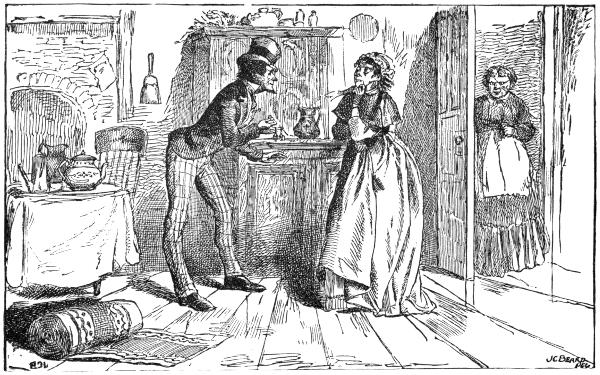
Betsey riz right up, and come forrerd, and made a
low curchy to him, and set down tight to him, and
says she,
“Beloved and admired Mr. Horace Greeley, I am
Betsey Bobbet the poetess of Jonesville, and you
speak my sentiments exactly. I think, and I know
that wedlock is woman’s only true speah. I do not
think wimmen ought to have any rights at all. I do
not think she ought to want any. I think it is real
sweet and genteel in her not to have any rights. I
think that to be the clinging, devoted wife of a noble
husband would be almost a heaven below. I do not
think she ought to have any other trade at all only
wedlock. I think she ought to be perfectly dependent
on men, and jest cling to them, and oh how sweet
it would be to be in that state. How happyfying to
males and to females that would be. I do not believe
in wimmen having their way in anything, or to set
up any beliefs of their own. For oh! how beautiful
and perfectly sweet a noble manly mind is. How I
do love your intellect, dearest Mr. Horace Greeley.
How is your wife’s health dear man? Haint I read in
the papers that her health was a failing? And if she
should drop off, should you think of entering again
into wedlock? and if you did, should you not prefer
a woman of genius, a poetess, to a woman of clay?”
Her breath give out here, and she paused. But oh
what a change had come over Horace’s noble and
benign face, as Betsey spoke. As she begun, his
head was thrown back, and a eloquent philosofical
expression set onto it. But gradually it had changed
to a expression of dread and almost anger, and as she
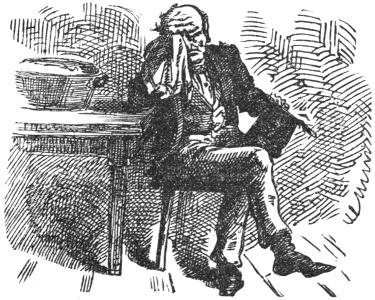
finished, his head sunk down onto his breast, and he
sithed. I pitied him, and I spoke up to Betsey, says
I, “I haint no more nor less than a clay woman, but
I know enough to know that no man can answer 25
or 26 questions to once. Give Horace time to find
and recover himself.”
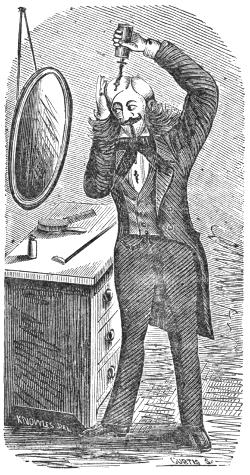
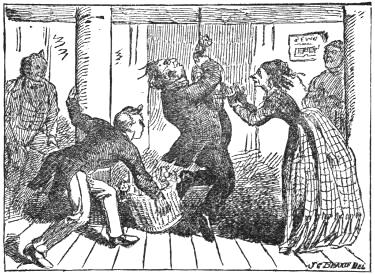
Betsey took a bottle of hartshorn and a pair of
scissors, outen her pocket, and advanced onto him,
and says she in tender cooin’ tones. “Does your intellectual
head ache? Let me bathe that lofty forwerd.
And oh! dearest man, will you hear my one request
that I have dreampt of day and night, will you—will
you give me a lock of your noble hair?”
Horace rose up from his chair precipitately and
come close to me and sot down, bringin’ me between
him and Betsey, and then he says to her in a fearless
tone, “You can’t have a hair of my head, I haint
got much as you can see, but what little I have got
belongs to my wife, and to America. My wife’s
health is better, and in case of her droppin’ off, I
shouldn’t never marry agin, and it wouldn’t be a
poetess! though,” says he wipin’ his heated forwerd,
“I respect ’em as a Race.”
Betsey was mad. Says she to me, “I am a goin.
I will wait for you to the depott.” And before I
could say a word, she started off. As the door closed
I says in clear tones, “Horace, I have watched you for
years—a laberin’ for truth and justice and liftin’ up
the oppressed, I have realized what you have done
for the Black African. You have done more for that
Race than any other man in America, and I have respected
you for it, as much as if I was a Black African
myself. But never! never did I respect you as I do
this minute.” Says I, “if every married man and
woman had your firm and almost cast iron principles,
there wouldn’t be such a call for powder and bullets
among married folks as there is now. You have riz
in my estimation 25 cents within the last 7 or 8
minutes.”
Horace was still almost lost in thought, and he
didn’t reply to me. He was a settin’ about half or 3
quarters of a yard from me, and I says to him mildly,
“Horace, it may be as well for you to go back now
to your former place of settin’, which was about 2 and
a half yards from me.” He complied with my request,
mechanically as it was. But he seemed still to be
almost lost in thought. Finally he spoke—as he wiped
the sweat off that had started out onto his eye brow—these
words,
“I am not afraid, nor ashamed to change my mind,
Josiah Allen’s wife, when I am honestly convinced
I have been in an error.” Says he, “It is cowards
only that cling outwardly to thier old mouldy beliefs,
for fear they shall be accused of being inconsistent
and fickle minded.”
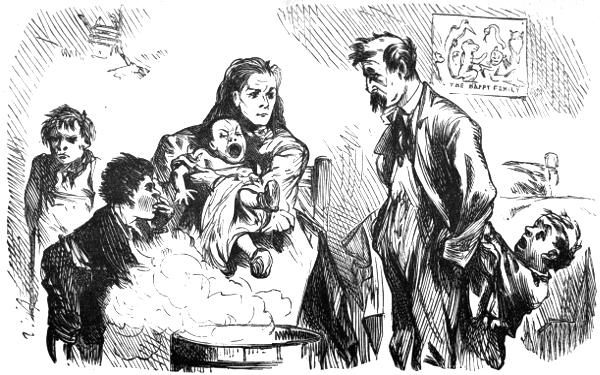
FILLIN’ WOMAN’S SPEAH UNDER DIFFICULTIES.
Says I, “That is just my opinion Horace! I have
been cheated by pickin’ out a calico dress in the evenin’.
Things look different by daylight, from what
they do by candle light. Old beliefs that have looked
first rate to you, may look different under the brighter
light of new discoveries. As you rise higher above
the earth you see stars you couldn’t ketch sight of in a
suller way. And the world’s cry of fickle mindedness,
may be the angels’ war whoop, settin’ us on to
heavenly warfare’.”
Horace seemed agin to be almost lost in thought,
and I waited respectfully, for him to find and recover
himself. Finally he spake,
“I have been sincere Josiah Allen’s wife, in thinkin’
that matrimony was woman’s only spear, but the
occurances of the past 25 or 30 minutes has convinced
me that wimmen may be too zealous a carryin’ out
that spear. I admit Josiah Allen’s wife, that any
new state of public affairs that would make woman
more independent of matrimony, less zealous, less
reckless in handlein’ that spear, might be more or
less beneficial both to herself, and to man.”
Here he paused and sithed. He thought of Betsey.
But I spoke right up in glad and triumphant tones,
“Horace, I am ready to depart this minute for
Jonesville. Now I can lay my head in peace upon
my goose feather pillow.”
I riz up in deep emotion, and Horace he riz up too.
It was a thrillin’ moment. At last he spoke in agitated
tones, for he thought still of what he had jest
passed through.
“My benefactor, I tremble to think what might
have happened had you not been present.” And he
ran his forefinger through his almost snowy hair.
“My kind preserver, I want to give you some little
token of my friendship at parting. Will you accept
as a slight token of my dethless gratitude, ‘What I
know about Farming,’ and two papers of lettice seed?”
I hung back, I thought of Josiah. But Horace
argued with me, says he, “I respect your constancy to
Josiah, but intellect—spoken or written—scorns all the
barriers of sex and circumstance, and is as free to all,
as the sunshine that beats down on the just and the
unjust, the Liberal Republicans and the Grant party,
or the married and the single.” Says he, “take the
book without any scruples, and as for the lettice seed,
I can recommend it, I think Josiah would relish it.”
Says I, “On them grounds I will accept of it, and
thank you.”
As we parted at the door, in the innocence of
conscious rectitude, we shook hands, and says I,
“Henceforth, Horace you will set up in a high chair in
my mind, higher than ever before. Of course, Josiah
sets first in my heart, and then his children, and then
a few relations on my side, and on his’en. But next
to them you will always set, for you have been
weighed in the steelyards, and have been found not
wantin’.”
He was to agitated to speak, I was awful agitated
too. Our silver mounted spectacles met each other
in a last glance of noble, firm principled sadness, and
so Horace and I parted away from each other.