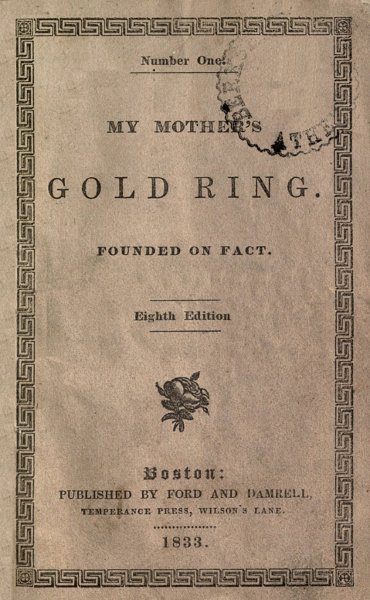
I have one of the kindest husbands: he is
a carpenter by trade, and our flock of little
children has one of the kindest fathers in
the county. I was thought the luckiest girl
in the parish, when G—— T—— made me
his wife: I thought so myself. Our wedding-day—and
it was a happy one—was but an
indifferent sample of those days of rational
happiness and uninterrupted harmony, which
we were permitted to enjoy together, for
the space of six years. And although, for
the last three years of our lives, we have
been as happy as we were at the beginning,
it makes my heart sick to think of those long
dark days and sad nights, that came between;
for, two years of our union were years of
misery. I well recollect the first glass of
ardent spirit that my husband ever drank.
He had been at the grocery to purchase a
little tea and sugar for the family; there
were three cents coming to him in change;
and, unluckily, the Deacon, who keeps the
shop, had nothing but silver in the till; and,
as it was a sharp, frosty morning, he persuaded
my good man to take his money's worth of
rum, for it was just the price of a glass. He
came home in wonderful spirits, and told me
he meant to have me and the children better
dressed, and, as neighbor Barton talked of selling
his horse and chaise, he thought of buying
them both; and, when I said to him,
"George, we are dressed as well as we can
afford, and I hope you will not think of a
horse and chaise, till we have paid off the
Squire's mortgage," he gave me a harsh look
and a bitter word. I never shall forget that
day, for they were the first he ever gave me
in his life. When he saw me shedding tears,
and holding my apron to my face, he said he
was sorry, and came to kiss me, and I discovered
that he had been drinking, and it
grieved me to the heart. In a short time after,
while I was washing up the breakfast
things, I heard our little Robert, who was
only five years old, crying bitterly; and, going
to learn the cause, I met him running towards
me with his face covered with blood.
He said his father had taken him on his
knee, and was playing with him, but had
given him a blow in the face, only because
he had said, when he kissed him, "dear
papa, you smell like old Isaac, the drunken
fiddler." My husband was very cross to us
all through the whole of that day; but the
next morning, though he said little, he was
evidently ashamed and humbled; and he
went about his work very industriously, and
was particularly kind to little Robert. I
prayed constantly for my good man, and that
God would be pleased to guide his heart
aright; and, more than a week having gone
by, without any similar occurrence, I flattered
myself, that he would never do so again.
But, in a very little time, either the Deacon
was short of change, as before, or some
tempting occasion presented itself which my
husband could not resist, and he returned
home once more under the influence of liquor.
I never shall forget the expression of his
countenance, when he came in, that night.
We had waited supper a full hour, for his
return: the tea-pot was standing at the fire,
and the bannocks were untouched upon the
hearth; and the smaller children were beginning
to murmur for their supper. There
was an indescribable expression of defiance
on his countenance, as though he were conscious
of having done wrong, and resolved to
brave it out. We sat down silently to supper,
and he scarcely raised his eyes upon any
of us, during this unhappy repast. He soon
went to bed and fell asleep; and, after I had
laid our little ones to rest, I knelt at the foot
of the bed, on which my poor misguided
husband was sleeping, and poured out my
very soul to God, while my eyes were scalded
with the bitterest tears I had ever shed.
For I then foresaw, that, unless some remedy
could be employed, my best earthly friend,
the father of my little children, would become
a drunkard. The next morning, after breakfast,
I ventured to speak with him upon the
subject, in a mild way; and, though I could
not restrain my tears, neither my words nor
my weeping appeared to have any effect, and
I saw that he was becoming hardened, and
careless of us all. How many winter nights
have I waited, weeping alone, at my once
happy fireside, listening for the lifting latch,
and wishing, yet dreading, to hear his steps
at the door!
After this state of things had continued, or
rather grown worse, for nearly three months,
I put on my bonnet one morning, after my
husband had gone to his work, and went to
the Deacon's store; and, finding him alone,
I stated my husband's case, and begged him
earnestly to sell him no more. He told me it
would do no good, for, if he did not sell it,
some other person would sell it; and he
doubted if my husband took more than was
good for him. He quoted Scripture to show,
that it was a wife's duty to keep at home,
and submit herself to her husband, and not
meddle with things, which did not belong to
her province. At this time, two or three customers
called for rum, and the Deacon civilly
advised me to go home, and look after my
children.
I went out with a heavy heart. It seemed
as if the tide of evil was setting against
me. As I was passing farmer Johnson's, on
my way home, they called me in. I sat
down and rested myself for a few minutes, in
their neat cottage. Farmer Johnson was
just returning from the field; and when I
saw the little ones running to meet him at
the stile, and the kind looks, that passed between
the good man and his wife; and when
I remembered that we were married on the
very same day, and compared my own fortune
with theirs, my poor heart burst forth
in a flood of tears. They all knew what I
was weeping for, and farmer Johnson, in a
kind manner, bade me cheer up, and put my
trust in God's mercy, and remember that it
was often darkest before daylight. The farmer
and his wife were members of the temperance
society, and had signed the pledge; and
I had often heard him say, that he believed
it had saved him from destruction. He had,
before his marriage, and for a year after, been
in the habit of taking a little spirit every day.
He was an industrious, thriving man; but,
shortly after his marriage, he became bound
for a neighbor, who ran off, and he was
obliged to pay the debt. I have heard him
declare, that, when the sheriff took away all
his property, and stripped his little cottage,
and scarcely left him those trifles, which are
secured to the poor man by law; and when
he considered how ill his poor wife was, at
the time, in consequence of the loss of their
child, that died only a month before, he
was restrained from resorting to the bottle, in
his moments of despair, by nothing but a
recollection of the pledge he had signed.
Farmer Johnson's minister was in favor of
pledges, and had often told him, that affliction
might weaken his judgment and his moral
sense, and that the pledge might save him
at last, as a plank saves the life of a mariner,
who is tost upon the waves.
Our good Clergyman was unfortunately of
a different opinion. He had often disapproved
of pledges: the Deacon was of the
same opinion: he thought very illy of pledges.
Month after month passed away, and our
happiness was utterly destroyed. My husband
neglected his business, and poverty began
to stare us in the face. Notwithstanding
my best exertions, it was hard work to
keep my little ones decently clothed and sufficiently
fed. If my husband earned a shilling,
the dram-seller was as sure of it as if it
were already in his till. I sometimes thought
I had lost all my affection for one, who had
proved so entirely regardless of those, whom
it was his duty to protect and sustain; but,
when I looked in the faces of our little children,
the recollection of our early marriage
days, and all his kind words and deeds soon
taught me the strength of the principle, that
had brought us together. I shall never cease
to remember the anguish I felt, when the
constable took him to jail, upon the dram-seller's
execution. Till that moment, I did not
believe, that my affection could have survived,
under the pressure of that misery, which
he had brought upon us all. I put up such
things, of the little that remained to us, as I
thought might be of use, and turned my back
upon a spot, where I had been very happy
and very wretched. Our five little children
followed, weeping bitterly. The jail was situated
in the next town. "Oh George,"
said I, "if you had only signed the pledge,
it would not have come to this." He sighed,
and said nothing; and we walked nearly a
mile, in perfect silence. As we were leaving
the village, we encountered our Clergyman,
going forth upon his morning ride. When I
reflected, that a few words from him would
have induced my poor husband to sign the
pledge, and that, if he had done so, he might
have been the kind father, and the affectionate
husband that he once was, I own, it cost me
some considerable effort to suppress my emotions.
"Whither are you all going?" said
the holy man. My husband, who had always
appeared extremely humble, in presence
of the minister, and replied to all his inquiries
in a subdued tone of voice, answered, with
unusual firmness, "to jail, reverend sir."
"To jail!" said he, "ah, I see how it is; you
have wasted your substance in riotous living,
and are going to pay for your improvidence
and folly. You have had the advantage
of my precept and example, and you
have turned a deaf ear to the one, and neglected
the other." "Reverend sir," my
husband replied, galled by this reproof, which
appeared to him, at that particular moment,
an unnecessary aggravation of his misery,
"reverend sir, your precept and your example
have been my ruin; I have followed
them both. You, who had no experience of
the temptations to which your weaker brethren
are liable, who are already addicted to
the temperate and daily use of ardent spirits,
advised me never to sign a pledge. I have
followed your advice to the letter. You admitted,
that extraordinary occasions might
justify the use of ardent spirit, and that, on
such occasions, you might use it yourself. I
followed your example; but it has been my
misfortune never to drink spirituous liquors,
without finding that my occasions were more
extraordinary than ever. Had I followed
the precept and example of my neighbor
Johnson, I should not have made a good wife
miserable, nor my children beggars." While
he uttered these last words, my poor husband
looked upon his little ones, and burst
into tears; and the minister rode slowly
away, without uttering a word. I rejoiced,
even in the midst of our misery, to see that
the heart of my poor George was tenderly
affected; for it is not more needful, that the
hardness of wax should be subdued by fire,
than that the heart of man should be softened
by affliction, before a deep and lasting impression
can be made. "Dear husband,"
said I, "we are young; it is not too late; let
us trust in God, and all may yet be well."
He made no reply, but continued to walk on,
and weep in silence. Shortly after, the Deacon
appeared, at some distance, coming towards
us on the road; but, as soon as he
discovered who we were, he turned away
into a private path. Even the constable
seemed somewhat touched with compassion,
at our situation, and urged us to keep up a
good heart, for he thought some one might
help us, when we least expected it. My
husband, whose vein of humor would often
display itself, even in hours of sadness,
instantly replied, that the good Samaritan
could not be far off, for the priest and the
Levite had already passed by on the other
side. But he little thought—poor man—that
even the conclusion of this beautiful parable
was so likely to be verified. A one-horse wagon,
at this moment, appeared to be coming
down the hill behind us, at an unusually rapid
rate, and the constable advised us, as the road
was narrow, to stand aside, and let it pass. It
was soon up with us; and, when the dust had
cleared away, it turned out, as little Robert
had said, when it first appeared on the top of
the hill, to be farmer Johnson's gray mare
and yellow wagon. The kind-hearted farmer
was out in an instant, and, without saying
a word, was putting the children into it,
one after another. A word from farmer
Johnson was enough for any constable in the
village. It was all the work of a moment.
He shook my husband by the hand, and
when he began, "Neighbor Johnson, you
are the same kind friend"—"Get in," said
he, "let's have no words about it; I must be
home in a trice, for," turning to me, "your old
school-mate, Susan, my wife, will sit a crying
at the window, till she sees you all safe
home again." Saying this, he whipped up
the gray mare, who, regardless of the additional
load, went up the hill faster than she
came down, as though she entered into the
spirit of the whole transaction.
It was not long before we reached the
door of our cottage. Farmer Johnson took
out the children; and, while I was trying to
find words to thank him for all his kindness,
he was up in his wagon and off, before I
could utter a syllable. Robert screamed after
him, to tell little Tim Johnson to come
over, and that he should have all his pinks
and marigolds. When we entered the cottage,
there were bread, and meat, and milk,
upon the table, which Susan, the farmer's
wife, had brought over, for the children. I
could not help sobbing aloud, for my heart
was full. "Dear George," said I, turning
to my husband, "you used to pray, let us
thank God for this great deliverance from
evil." "Dear Jenny," said he, "I fear God
will scarcely listen to my poor prayers, after
all my offences; but I will try." We closed
the cottage door, and he prayed with so
much humility of heart, and so much earnestness
of feeling, that I felt almost sure, that
God's grace would be lighted up in the bosom
of this unhappy man, if sighs, and tears,
and prayers, could win their way to heaven.
He was very grave, and said little or nothing
that night. The next morning, when I woke
up, I was surprised, as the sun had not risen,
to find that he had already gone down. At
first, I felt alarmed, as such a thing had become
unusual with him, of late years; but
my anxious feelings were agreeably relieved,
when the children told me their father had
been hoeing for an hour, in the potato field,
and was mending the garden fence. With
our scanty materials, I got ready the best
breakfast I could, and he sat down to it, with
a good appetite, but said little; and, now and
then, I saw the tears starting into his eyes. I
had many fears, that he would fall back into
his former habits, whenever he should meet
his old companions, or stop in again at the
Deacon's store. I was about urging him to
move into another village. After breakfast,
he took me aside, and asked me if I had not
a gold ring. "George," said I, "that ring
was my mother's: she took it from her finger,
and gave it to me, the day that she died. I
would not part with that ring, unless it were
to save life. Besides, if we are industrious
and honest, we shall not be forsaken." "Dear
Jenny," said he, "I know how you prize
that gold ring: I never loved you more than
when you wept over it, while you first told
me the story of your mother's death: it was
just a month before we were married, the
last sabbath evening in May, Jenny, and we
were walking by the river. I wish you
would bring me that ring." Memory hurried
me back, in an instant, to the scene, the
bank upon the river's side, where we sat together,
and agreed upon our wedding-day.
I brought down the ring, and he asked me,
with such an earnestness of manner, to put it
on his little finger, that I did so; not, however,
without a trembling hand and a misgiving heart.
"And now, Jenny," said he, as he rose to
go out, "pray that God will support me."
My mind was not in a happy state, for I felt
some doubt of his intentions. From a little
hill, at the back of our cottage, we had a fair
view of the Deacon's store. I went up to
the top of it; and, while I watched my husband's
steps, no one can tell how fervently I
prayed God to guide them aright. I saw
two of his old companions, standing at the
store door, with glasses in their hands; and,
as my husband came in front of the shop, I
saw them beckon him in. It was a sad moment
for me. "Oh George," said I, though
I knew he could not hear me, "go on; remember
your poor wife and your starving
children!" My heart sunk within me, when
I saw him stop and turn towards the door.
He shook hands with his old associates: they
appeared to offer him their glasses: I saw
him shake his head and pass on. "Thank
God," said I, and ran down the hill, with a
light step, and seizing my baby, at the cottage
door, I literally covered it with kisses, and
bathed it in tears of joy. About ten o'clock,
Richard Lane, the Squire's office-boy, brought
in a piece of meat and some meal, saying
my husband sent word, that he could not be
home, till night, as he was at work, on the
Squire's barn; Richard added, that the Squire
had engaged him for two months. He came
home early, and the children ran down the
hill to meet him. He was grave, but cheerful.
"I have prayed for you, dear husband,"
said I. "And a merciful God has supported
me, Jenny," said he. It is not easy to measure
the degrees of happiness; but, take it altogether,
this, I think, was the happiest evening
of my life. If there is great joy in
heaven, over a sinner that repenteth, there
is no less joy in the heart of a faithful wife,
over a husband, that was lost, and is found.
In this manner the two months went away.
In addition to his common labor, he found
time to cultivate the garden, and make and
mend a variety of useful articles about the
house. It was soon understood, that my
husband had reformed, and it was more generally
believed, because he was a subject for
the gibes and sneers of a large number of the
Deacon's customers. My husband used to
say, let those laugh that are wise and win.
He was an excellent workman, and business
came in from all quarters. He was soon
able to repay neighbor Johnson, and our families
lived in the closest friendship with each
other. One evening, farmer Johnson said to
my husband, that he thought it would be
well for him to sign the temperance pledge;
that he did not advise it, when he first began
to leave off spirit, for he feared his strength
might fail him. "But now," said he, "you
have continued five months without touching
a drop, and it would be well for the cause,
that you should sign the pledge." "Friend
Johnson," said my husband, "when a year
has gone safely by, I will sign the pledge.
For five months, instead of the pledge, I have
in every trial and temptation—and a drinking
man knows well the force and meaning of
those words—I have relied upon this gold
ring, to renew my strength, and remind me
of my duty to God, to my wife, to my children,
and to society. Whenever the struggle
of appetite has commenced, I have looked
upon this ring: I have remembered that
it was given, with the last words and dying
counsels of an excellent mother, to my wife,
who placed it there; and, under the blessing
of Almighty God, it has proved, thus far, the
life-boat of a drowning man."
The year soon passed away; and on the
very day twelvemonth, on which I had put
the ring upon my husband's finger, farmer
Johnson brought over the Temperance book.
We all sat down to the tea-table together.
After supper was done, little Robert climbed
up and kissed his father, and, turning to farmer
Johnson, "Father," said he, "has not
smelt like old Isaac, the drunken fiddler,
once, since we rode home in your yellow wagon."
The farmer opened the book: my
husband signed the pledge of the society, and,
with tears in his eyes, gave me back—ten
thousand times more precious than ever—MY
MOTHER'S GOLD RING.