The peacock, picking his stilted way along the
lower terrace walk, conscious of his magnificence
with the sunshine on his burnished breast, rejoiced
at the sound of approaching steps: here, at last, was
some one to see and to admire.
But in vain did Juno’s bird spread and parade,
advance and retreat, and display for the newcomers
the glories of his outspread tail, which defied the
sun with its fifty iridescent eyes. The elder of
the two young men interrupted but for a second an
emphatic speech to cast an indifferent glance upon
the strutting splendour; while the younger poked
at it idly with the stock of his whip. Offended,
and with discordant protest, the peacock flapped on
to the stone lion that heraldically guarded the terrace
stairs and swept over their heads the fall of his
unappreciated train.
Lionel Ratcliffe, the emphatic speaker, turned to
survey with sullen eyes the scene which spread away
beneath the balustrade of the Peacock Walk. It
was the ripest hour of an early June day. The
wood-crowned slopes, dropping down from the
garden, were bathed in mellow light. Farther
away, rich pastures, gently swelling into knolls,
melted into purple haze, until they were gathered
into the distant amethystine moors. Almost as far
as the eye could reach, the land and all that stood
on it—timber, meadow, homestead, hamlet—belonged
to Rockhurst, fit appanage to those massy
castle walls that rose clear-cut against the blue air,
in all the majesty of ancient power. And as he
gazed, Lionel Ratcliffe’s heart grew sombre even as
his glance. A keen-faced man, old-looking for his
thirty years, somewhat below the middle height,
with marked features, cold blue eyes and thin lips
that betrayed the working of an intellect as sharp
as the steel that hung by his side.
His companion was of vastly different stamp.
Country bumpkin was written on the face of Edward
Hare, on every seam of his oversmart suit; country
wits stared from his prominent eye, were heralded
by the laugh ever ready upon his mouth—a mouth,
one dared swear, that had known no better taste in
life than the rim of an ale can, the hard cheek of
some bouncing Dorcas.
Waking from his abstraction, Ratcliffe wheeled
upon his cousin, and resumed his indictment:—
“It is even as I tell you,” quoth he. “They are
both as apt as tinder: it needs but a spark now to
set the glow. ’Slife, Ned, I little thought thine
would be the hand to strike flint!”
“Mine, Cousin Lionel?” broke in the other,
whining. “Nay, nay—”
But the first, flinging out an accusing forefinger,
bore down the plaintive interruption:—
“Then why didst bring her over here to-day?—Come
now, ’tis plain enough. Dost favour my suit,
or young Rockhurst’s?”
“Why, you know I’ll have none but you,” bellowed
Edward Hare. “Harry Rockhurst …?”
he cried. “Phew!”
He snapped his fingers and blew through them,
threw himself into an attitude of defiance and, so
doing, stumbled into his new-fangled sword which,
carry it at whatever angle he tried, seemed ever in
his way. Ratcliffe steadied his kinsman, then,
still holding him by the elbow, drew him toward the
stone bench, overhung by climbing roses. Having
jerked his companion down upon it, he let himself
subside beside him, crossed his legs and proceeded,
contemptuously, good-humoured yet incisive:—
“If I wed Mistress Harcourt, your sister, is’t
not a bargain? Shalt not continue to have bed and
board and bottle beneath her roof? Aye, and many
more of old Harcourt’s round pieces to chirp in thy
pockets at cockfight and hammer fair? And when
we go to Whitehall …” He paused impressively.
Edward Hare was touched; his soft face became
moved as by not distant tears.
“Good Lionel … dear coz! Odd’s babers!
Do I not tell thee thou shalt have her?”
Ratcliffe resumed, casting his words into space
with a sidelong watchfulness as to their effect.
“Whereas, mark, if Diana wed another, what of
thee, then, my cock? ’Tis back to the bare ancestral
acres with Sir Edward Hare. ’Tis farthing toss and
small ale. For thou art poor, lad, damned poor!
And a poor baronet—fie!”
The poor baronet made a wry face. He pushed
his plumed hat off his forehead to scratch his perplexed
head.
“Aye, small ale, plague on it! Farthing toss—pooh!”
“’Twill ne’er do, eh, Ned!” laughed the other.
“No, split me, ’twill ne’er serve a man like me!”
Sir Edward Hare rose, in his indignation, and
promptly tripped again over his sword. Somewhat
abashed, and trying the comfort of a new angle,
he dropped his high tone once more for one of
plaint:—
“But, Lord, coz, what can I do? Di is like the
bay filly: she’ll neither lead nor drive. Ain’t I
always a-singing your praises? ‘There’s the husband
for you, Di,’ say I. ‘There’s the lad for me,’
say I, twenty times a day.”
Ratcliffe cursed his cousin in secret, as, rising in his
turn, he clapped him affectionately on the shoulder.
“I marvel at you,” he bantered. “And will you
walk your filly to the gate and expect her to take it on
the standstill? Is that the way to deal with a woman?
Shouldst say to her: ‘Hast noticed Cousin Lionel’s
squint?… Prithee, sister, have ne’er a thing to
do with Cousin Lionel: ’tis a sad bad man! Ah,
there are tales, sister, terrible tales!’”
Edward gaped.
“Oh, and what will she do then?”
“Why, look into mine eyes the very next time;
and, not finding the squint, perhaps find something
else, something in them she never marked before.”
The young oaf nodded portentously.
“Aye,” cried he, “and then—”
“And then—Why, I see you take me. Hast
sharp wits, coz!—Then will she begin to ponder
on those dark deeds of mine, and wonder about
Cousin Lionel, and think him a very different man
after all from the kinsman who played with her and
teased her all her life. But, zounds, man, such a
cock of the walk as thou art need not be lectured on
the art of love! Why, when we get that figure of
thine to Court, what a stir will there be among the
beauties!”
The poor youth made no attempt to disguise his
flattered emotion.
“Ecod,” he smirked, looking down at his legs,
“I’ll not say but I can hold my own among the
petticoats. He, he—a word in thine ear, Lionel:
Moll, you know—” he whispered into his cousin’s
curls, laughing immoderately. “And little Prudence
Prue, down at the Red Lion—” Here he whispered
again and guffawed: “Odd’s babers, she did! But
Di must not hear of it.”
With immovable gravity, the elder man submitted
to these boisterous confidences; then, holding
his cousin from him at arm’s length, surveyed him
with an irony which must have pierced through
anything less thick-skinned:—
“What a blade you are! There will be no holding
you at Whitehall!”
He suddenly sighed, dropped his hands, shook his
head, and assumed a tone of melancholy:—
“Heigho, but we must get thee to Court first!
And these adieus will undo all. ’Slife, man, she’s
ripe for love. ’Tis rebound, ’tis nature. After the
cold fit, the hot one. After old Harcourt, the old
husband promptly and happily demised, Harry
Rockhurst the stripling, live and young!…
After eighty, eighteen.…”
“Nay,” interrupted Edward, sapiently. “Harry
Rockhurst is twenty.”
“Aye,” mused Lionel, “and so is our pretty Di.
Lord! your worthy mother had scarce called out,
‘Oh,’ of Diana, before my Lady Rockhurst began
her, ‘Ah,’ of that young whelp! Well, by this time,
these babes will have plighted their troth, if the
gods interfere not.” He turned on Hare, his fierce
temper escaping him for an unguarded moment:
“Why the foul fiend did you let her ride over here
to-day?”
Ned swelled with dudgeon.
“I? How could I prevent it, pray?”
“Poor numskull, how couldst thou?” echoed the
other, half aside.—“Well, well, I fear me, I am
caught in my own springe! They might have
philandered all summer and naught have come of
it.… But I must needs work upon Grandam
Chillingburgh, persuade her to summon the naughty
grandchild in all haste from a bad match—and
’tis the parting will ruin all!”
He paused, biting his lip over vexed thoughts.
Then his alert ear caught the fall of distant footsteps.
“Ah!” he cried, starting, “yonder they come!
Let us to the upper terrace, Ned, and watch them
from above.”
Sir Edward, who had been endeavouring to hit
a bumblebee with his whip, and was lost in the
excitement of the sport, burst into a roar of self-applause
at an unexpectedly successful stroke:—
“Saw you that? I hit him. I hit him!… A
great bumblebee!”
Ratcliffe clenched his hand, exasperated. Then,
recalling his self-control, shrugged his shoulders,
caught his cousin by the arm, and marched him
determinedly toward the upper terrace stairs.
The two whose doings were exciting so much
interest in Lionel Ratcliffe’s mind, came slowly
along the Peacock Walk and halted beneath the
watchers: a pair so well-matched in youth and
looks as well to justify apparently the jealous kinsman’s
fears.—Harry Rockhurst, stripling just
hardening into manhood, keeping some of his boy
graciousness in the virility of the newer stage, sunburnt,
vigorous; with brown curls tossed back from
a broad forehead, and brilliant hazel eyes, keen and
bold of vision, as should be those of the noted follower
of hounds and hawk: by his side, as tall
nearly as her cavalier, Diana Harcourt, the young
widow, radiant with the sun on her auburn hair!
As her lover spoke to her, she listened, not unwillingly,
and her glance rested on his face with
pleasure. Yet there was something well-nigh maternal
in this complacence which might have bidden
him pause.
“Diana,” the boy cried passionately, “you must
hear me; I will speak.”
She moved a pace from him and, sitting down on
the bench, drew a hanging branch of wild rose to
the wild rose of her cheek.
“The last of my country flowers,” she murmured.
“Stay,” he exclaimed. “Let me pluck you a
posy!”
High over their unconscious heads, Lionel Ratcliffe,
peering cautiously over the balustrade, had a
sneer for the childish eagerness. But Diana took
the flowers with a simple grace.
“Thank you, and thank you.… Nay, how
sweet they are! And to think that to-morrow
evening we shall be so far away. ’Tis hard to leave
the garden for the town.”
(“Mark you, now,” whispered Ratcliffe overhead,
nipping Hare by the arm, “and take a lesson
in Dan Cupid’s ways. ’Twill be: ‘Think of me,
and do not forget me!’ And a prate of hopes, and
a whisper of pledges. And then the word will hop
out like a hot coal, Love! and their little world will
be all ablaze—And ’twill be Love … Love …
Love, and everything lost if some one be not at hand
to spray cold water at the right moment.”
“The garden can?” suggests the practical Ned,
in a mouthing undertone.
“Hush! lad,” murmured the other, “hast yet to
learn metaphor. Nay—hark! Not a breath, on
thy life.”)
“I shall dream, I think, of the gardens of Rockhurst,”
Diana was saying.
“The gardens?” echoed Harry. He was leaning
against the wall, by the bench, looking down at her,
bending close. “Gardens? Is that all you regret,
Mistress Harcourt?”
“Fie,” smiled she, “I am not so ungrateful.
Shall I not regret my friends, my neighbours, good
Mistress Rockhurst, and yourself?”
The boy drew back and straightened himself,
galled to the quick.
“My aunt—and me! Truly, I am, madam, I
am proud.” He flung himself away, his shoulder
turned ostentatiously on Diana. She laughed with
indulgence; then sighed. And, in heart-broken
fashion, Harry caught up the sigh.
(“First stage, sighs,” reflected the watcher.
“’Tis most harmless.”)
Young Rockhurst’s dudgeon was not of long
duration. He edged along the wall to the bench and
bashfully took seat.
“So ends the year,” he said softly, “that brought
me the happiness of paradise—Diana.”
“Master Rockhurst.…”
“Must it end thus?” Suddenly bold, he tried to
take the fair hand idly clasping the posy.
“Take care, sir,” she cried mischievously, “there
are thorns here.”
“Ah,” he breathed, “so that I might gather the
roses.…”
(And above their heads, Lionel Ratcliffe: “Second
stage: hand-clasps and protestations. Next
will come kneeling work, and next the lips.—Wary
now, for it goes rapidly!”)
“Pray you, pray you, Harry!” Diana chid,
endeavouring gently to free her hand.
But the boy had slipped the leash of his ardour
and was not to be hushed.
“O my sweet life, hear me, hear me!”
“I vow,” she said, half rebuking, “I never knew
you in this mood!”
“Ah, I am bold,” he panted. “Must I not be
bold indeed for that I dare to love you!” Saying
which, he fell on both knees before her.
(“Is’t not time to stop them?” whispered Hare
into Ratcliffe’s ear. “I could drop a little stone on
sister Di’s head.”
“Soft,” interposed the other, with his contemptuous
patience. “Let the children play a little while
longer; ’twill be the finer sport to slip in ’twixt cup
and lip!”)
In truth, Ratcliffe was beginning to suspect that
he had overrated Harry Rockhurst’s influence. If he
knew women, his fair cousin, below yonder, had
given no real response. He had caught the note of
indulgence which the wooer himself was too inexperienced
to mark in her accents. True, there
might lurk some danger even in this; yet not such
as to call for indiscreet interference. He smiled
sardonically as the lover’s pleading rose passionately
in the air.
“Give me hope, Diana—one word. Ah, madam,
give me hope!”
But Mistress Harcourt rose and disengaged herself
with some decision from the young man’s
grasp.
“Stay, Master Rockhurst, how can I listen to
you? In truth, dear lad, you are over young to
dream of such matters yet. Why, and what would
my Lord Rockhurst say, could he but hear? Indeed,
Harry, ’tis undutiful of you, without your
noble father’s sanction—I dare swear without even
his knowledge.”
“My father!” cried the boy, as if the words had
struck him. “Alack,” he added despairingly, “this
sudden departure, upon which you have resolved,
has thwarted all my plans. Yet, madam, you are
wrong; my father does know. I have writ him all
my heart.”
Diana turned the pale, fresh beauty of her face full
in surprise upon the speaker.
“Aye—have you, indeed?” cried she. “And
what says his lordship?”
The youth, emboldened afresh, pressed forward;
but she kept him sweetly at arm’s length, menacing
him with her posy.
“He has not answered yet—could not have
answered yet, madam. Natheless, I am his only
child; he loves me: there can be but one answer.
Diana, if that be all that stands between us—”
“Nay,” she teased, “and shall I tell you your
father’s answer? ‘Ah, Harry’ (will his lordship say),
‘have I kept thee secluded in the country, that thou
mightest grow strong in health and virtuous in mind’—for
these, we are told, are my Lord Rockhurst’s
reasons—‘and hast seen a young gentlewoman
for the first time? Pack up, lad, pack and ride with
me to London town; and in a week will’t have
forgotten her very existence!’”
“How little you know my father … how
little you know me!” exclaimed the lover, with
dignity.
“Alas, child, this is country innocence. Do I not
know something of the ways of the great world!
Your education has not yet begun, all respect to his
lordship’s judgment. When he has shown you the
Court, the town, the quality—”
Harry Rockhurst interrupted her with a vexed
laugh:—
“The Court, the town, the quality—why,
madam, he will not even tell me of them. ’Tis only
his duty as Captain of the King’s Yeomen and Constable
of the Tower that keeps him from living here
among us—the only life he deems worthy of a true
gentleman: that of the owner on his estates. London,
he says, is contamination. Therefore keepeth
he me here, though it part him and me.”
She smiled and shook her head:—
“And how shall I find favour in the eyes of this
strict gentleman?” she said, in the same fond tone
of mockery. “I who am gay, and think not so ill
of the town, and have no mind for sad faces and dull
clothes! I fear me, Harry, your father is at heart a
puritan!”
“My lord a puritan,” cried the boy, in fine scorn—“the
King’s own private friend in exile, the hero
of Worcester’s evil day … why, Diana, villainous
Noll set a higher price on my father’s head than upon
any other in England, save his most gracious
Majesty’s own—sweet Mistress Harcourt, if that
were your only fear—”
Greatly daring, he flung out his arm to encircle
her. Swayed by his artless passion, Mistress Harcourt
suffered the embrace, but it was with a kind of
friendly tolerance.
A loud shout from above drove them apart.
“Cousin Di!—where can she be? Cousin Di,
Master Rockhurst…!”
There was Lionel Ratcliffe, on the terrace above
them, shouting into space through the hollow of
his hands; and beside him Edward Hare, consumed
with laughter.
Young Rockhurst stamped his foot; but Diana
(not displeased, perhaps, at the interruption) glanced
calmly up.
“Here I am, Cousin Lionel—and here, as you
can see, is Harry.”
Ratcliffe leant across the balustrade, wiping his
face as though heated.
“Oh, how I have sought for you!” he called.
“So it seems,” retorted she, ironically, “with
apparently never a thought to cast a glance over the
wall.”
He grinned. She was the dearer to him for her
sharp wits, and for a tongue that was even a match
for his own. But what answer he would have made
was lost in a new interruption: the sound of a postboy’s
horn rose swelling through the quiet airs,
and almost immediately the bell clanged from the
castle’s gate. Then came calls, shouts, and rumours.
Ratcliffe straightened himself from his
leaning posture:—
“What have we here?” he cried. “Ha—Mistress
Alicia!”
A stout, elderly lady appeared at the head of the
terrace steps.
“Pardon me, madam, a moment,” said Harry to
Diana, and ran to meet his aunt. The lady was
beckoning with great energy:—
“News, lad, news from your noble father, from
my dear brother!” She turned on the second step
and raised her voice (never a soft one) in vigorous
expostulation to some hidden person: “Hither,
fellow, hither, thou laggard, and commend thee for
a lazy loon!”
Stirred by these expostulations the postboy, covered
with dust and sweat, emerged upon the terrace
above at a limping run. Harry bounded up the steps
to snatch a letter from his hands. He broke the
seal and gave a cry of joy:—
“These are news indeed! My father will be with
us to-night, nay, toward the fifth hour afternoon,
so he writes.—Rascal, you have tarried indeed!—In
good truth, these are news!”
His joyful exclamations were lost in a deep outburst
of lamentation from Mistress Rockhurst.
“To-day!” quoth she, clapping her palms together.
“Murrain take me, if these be not the ways
of men! Gilian! Basil!—get thee to the buttery,
knave!—Robin! … Robin! the flag!”
But the excellent housewife was not of those who
waste their energies upon mere speech. As hastily
as her bulk would permit, she was already hying
her way back toward the castle. And the clamour
of her voice was lost behind the yew hedges. Harry
bent over the parapet, calling to Diana, who stood
pensively where he had left her.
“Give me joy, madam; my father will be here
instantly!”
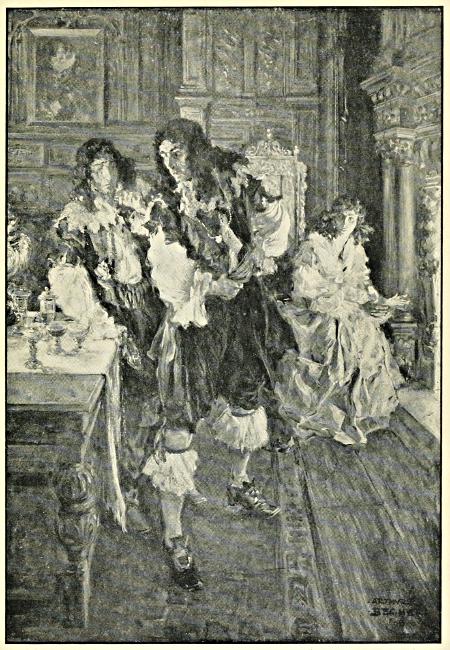
Ratcliffe brushed past him and came down the
steps toward his kinswoman. He laid a hand
upon her arm, and looking toward his host:—
“Then,” cried he, “shall we leave you to your
filial transport.” He dropped his voice, to continue
maliciously, in the young widow’s ear: “Di, what
says’t thou? Shall we not ride instantly? Gad,
were it but a meeting ’twixt lover and mistress
’twere something to wait for—but this business!
‘My worthy father.… My beloved son!’ ’Twas
ever a feast of cold veal, since the days of the prodigal—Though
faith,” he laughed, “’tis the father, here,
comes from the husks to seek the calf at home!”
And while Diana gazed upon his sharp face with
wonder and disfavour, Ratcliffe hailed Rockhurst
once more: “Therefore, I say, good Master Harry,
pray you bid them call up our horses.”
Young Rockhurst protested. But Diana, to
Ratcliffe’s surprise and greatly to his satisfaction,
instantly backed the request:—
“Indeed, Lionel is right; our presence is out of
place at this meeting.”
“Nay,” implored Harry, and ran headlong down
into the Peacock Walk again to catch her hand, “for
pity’s sake … no and indeed no, madam.”
The lady disengaged herself, settled her roses,
gathered her gloves and whip from the bench and
looped her riding skirts. Then she turned, and,
smiling, courtesied:—
“Indeed and indeed, yes, sir! And since farewell
it must be, why, then, farewell!”
She wafted a kiss from her roses toward him.
“Ah, no!” he implored, still endeavouring to arrest
her.
“’Slife!” cried Lionel, impatiently looking up.
“There rises the flag … there flies the noble
blazon! Let it be the signal for us. Come Di—go,
hurry the horses, Ned!” he shouted to Hare, who,
astride on the upper balustrade, sat gaping down at
them. “Blessings upon the Rakehell,” he muttered
to himself, as Diana motioned Harry on one side with
decisive gesture.
“Nay, it is good-by,” she was saying.
The boy caught her fingers and the roses together:—
“Oh, madam, will you turn all my joy into sorrow?”
Here the gate-bell clanged again.
“My father,” cried Harry, starting toward the
steps.
“Farewell,” said Diana, “and—”
“Ah, no,” cried the poor lover, distractedly, and
ran back to fling himself once more before her.
“But a few minutes, dearest Diana!”
She hesitated before his distress. Lionel irritably
seized her arm.
“Nay, child, you must come!” The touch, the
tone were overmasterful. She flashed a haughty
look upon him.
“Must! Cousin Lionel?”
Harry, seeing his advantage, pressed it ardently.
“Delay but for five minutes! Sure, ’tis not much
to ask!”
“You foolish lad!” said Diana, gently. Then,
smiling into the passionate eyes, “Yet I would not
seem churl to you. And I will even wait these five
minutes in the rose garden yonder. Your arm so
far, an it please you, Lionel. But, I pray you,
remember that there must be no musts from you to
me.”
She moved away with a very stately grace, Lionel,
biting his lips upon a bitter smile, walking at her
side. Harry stood gazing after her as one lost in a
dream.
My Lord Rockhurst approached the wall of the
upper terrace and looked down upon his son. His
countenance, naturally grave, and stamped now with
the pallor and fatigue of his lengthy ride, grew
graver as he watched. Beside him, his sister threw
up scandalised hands. But, as she was about to
give voice to her feelings, he arrested her with a
gesture, and went slowly to the top of the stairs.
There he paused and called,—
“Harry!”
The boy started, wheeled round, rushed up the
steps, and dropped on one knee before his father.
“My lord … my dear father!”
Lord Rockhurst raised him, looked a second
keenly at the young face; then laying his hand upon
his shoulder, walked down with him toward the
bench, where, still without speaking, he took seat.
Shaking her head at her nephew, Mistress Rockhurst
followed them at some distance.
“Oh, sir,” cried Harry, impetuously, “’tis ten
months and two days since I last beheld your countenance!”
So saying, he was about to cast himself upon his
father’s breast; when, with the faintest motion of
the hand, Rockhurst restrained him.
“And yet, didst show, even now, no undue haste
to greet me. ’Tis the first time, Harry,” he proceeded
in softer tones, “that thou hast failed to welcome
me before the gates.… I had looked forward to
that moment.”
“And indeed, nevvy,” added Mistress Alicia, as
she halted, panting, before him, “’twas not pretty
acted. ‘Where’s Harry?’ says his lordship. And
’twas old Giles held the stirrup, which had been thy
privilege, Harry, since thou wert five years old.”
Blushes chased each other over the boy’s face.
He could but stammer:—
“Oh, sir … oh, father!”
“Nay, no excuses!” bade the Lord Constable.
His son’s cheek grew a darker crimson still.
“The lady, sir,” he murmured, “the lady I wrote
of—”
Mistress Rockhurst snorted with increased indignation,
but Lord Rockhurst was now smiling
dreamily.
“A lady! sayst thou?… Boy Harry and his
lady! Nay, then, a petticoat is like charity and must
needs cover a multitude of sins!”
“Petticoats, indeed,” ejaculated under her voice
the irate dame—“The hussy!”
Lord Rockhurst had no thought to spare for his
sister’s opinions just now. Holding Harry at arm’s
length, he surveyed him with shining eyes.
“Thou art grown a goodly lad. In faith, well-nigh
a man!”
He drew him into his embrace and held him close
a second. Then, releasing him, fell back with a
sigh of ease upon the bench; flung off his mantle
and unbuckled his sword, both of which Harry
respectfully received from his hand.
The traveller sighed, took off his hat, and ran his
fingers through his hair with the gesture of contented
weariness.
“Another drop of cordial, my lord,” cried his
sister, rising, all eager for service.
“Nay,” said he, motioning her back; “I have all
the cordial I need here, Alicia. Come close, Harry.
Dost know,” proceeded the Lord Constable, as his
son knelt beside him, “dost know I have ridden two
hundred miles these days, with scarce as many
minutes’ rest, to put order into thy business? That
to-morrow I must e’en be jogging back again, for
his Majesty has need of me? Thou presumptuous
rogue!” He struck the lad on the shoulder as he
spoke, and seriousness underlay his tone of banter.
“Wouldst plot to make a grandsire of me already?
Mark those pleading eyes, sister.… Even so
did they look up at me when he stood no higher
than my knee, and it was: ‘Father, John blacksmith
has so fair a pony to sell,’ or ‘Giles vows he
will drown the red setter pup! O father, I want it!’
Aye, child, thou hast a father, and ’tis well for thee!”
His mouth twisted with a light contempt under the
upturned moustache. “A widow!” he said.
“Aye,” put in Aunt Alicia vindictively, “and a
delicate, fine lady to boot.—Ah, nephew, did I not
tell thee his lordship would set order here? What
doth Mistress Harcourt care for still-room or buttery?
Could she brew a bottle of gilly water? Nay—much
less turn thee a pasty—?”
“Peace, peace, sister,” rebuked his lordship.
“Harry—” he turned tender, relentless eyes upon
his son’s quivering face, “thou, who wouldst get
thee to begetting heirs already, what dost thou
know of life?”
The youth rose to his feet, withdrew a pace, and
looked earnestly at him.
“As much, my lord,” he answered then, “as you
have allowed me to know.”
A moment the elder man seemed struck. He
gazed down at his linked hands and reflected.
Then he, too, got up. It was with an air of
finality:—
“Faith, aptly replied! Therefore, son—” he
took the lad’s arm, “thou must still believe my will
best for thee.”
Harry caught up his father’s hand.
“Nay, my lord, God forbid I should even question
the wisdom of your dealings with me! Truly, I
have never hankered after the town; and, if I
have seen you ride forth alone with a heavy heart,
it has only been because of the longing for your
gracious company. But, father—” he clasped his
other hand over the gloved one he held, “she
loves the country, too, let Aunt Alicia say what
she will.” He shot a flaming look of reproach at
the buxom lady. “And … and, we should be
full content to dwell here forever if we were
married, sir.”
“Married!” echoed Rockhurst. He pulled his
hand from his son’s clasp and passed it caressingly
over the beardless chin. “Aye, there’s a cheek for
a husband, truly!” (Mistress Alicia broke into
good-humoured laughter and struck her knees in
applause.) “When thy beard is grown, we’ll talk
of such matters again.”
“Oh, my lord,” pleaded the lover. “What of
my age?—since you yourself were married when
no older than I am, as our Bible leaf shows. Say
nothing, at least, till you have seen her! She is
here, father, even now, in the rosary! Alack, she
has ridden hither to bid farewell, for to-morrow she
sets out for London town. And, oh, father, may
I not escort her?”
“To London!” exclaimed the father. His face
grew dark with a heavy frown. “To London!
No, sir, not within fifty miles of the Babylon! How
now, art grown so bold?”
“I thought not of the town,” stammered Harry;
“I thought but of the perils of the road for her.”
Then, gaining assurance, he proceeded: “Even
here there is talk of Claud Du Vall and such bold
ruffians. Sir Edward, her brother … Sir Edward,
in truth, is a poor fool, my lord—And Mr.
Ratcliffe, her cousin, who rides with them, him I
mightily mistrust. You have given me your blood,
father—will you blame me now because it
will not run obediently when I think of danger
to my lady?”
“Nay, if thy body kept pace with thy spirit,”
mocked Rockhurst, “what a beard wouldst soon
have, my callow son!” Yet, though he mocked,
anger had fled from his glance to be replaced by
fatherly pride.
The tears rose to Harry’s eyes. The young can
endure severity better than irony.
“Indeed, I am a child no longer,—I am ever your
dutiful son, sir,—but I cannot give up Diana. My
lord, do but see her; see her now…!”
“Now?” cried the other, surprised. Then recollecting
himself: “True, didst say she was in the
garden.” His eye grew ever more indulgent. “See
her, lad,” he went on, “aye, truly. For what other
purpose had I ridden all these weary miles?”
With the youth, all was once more sunshine,
where, before, there had been but clouds.
“Ah, father, I knew your indulgence would never
fail me. Nay, I will conduct her to you, on the
instant.”
He started to run, as he spoke. Rockhurst
watched the figure out of sight, then laughed low to
himself and turned to his sister.
“I will conduct her to you, on the instant,” he
repeated. “Aha—and doubtless the pretty widow
will come as meekly at his bidding to display herself
as ever heifer to the fair. O rustica simplicitas!”
And laughing, he came back to the bench and sat
down.
“Indeed, my lord,” said Mistress Alicia, with as
much disapproval as she dared to show to the head
of the house, “here is no matter for laughing. ’Tis
an excellent thing, my lord, that you should forbid
Harry from marrying the Widow Harcourt. And
truly, as you say, he’s not fit to wed for some four
or five years to come. And, of a certainty, she’s
scarce the woman to manage a household like this,
brother; not such as I should care to trust with the
keys. And I think you’ll not refuse me the credit
to say, brother, that I have become them well these
five years. Since, with his Majesty’s most happy
Restoration, your lordship also has come to
your own again, and placed me at the head of
your house—I trust, I say, I have become the
charge.”
“Indeed, none better,” said Rockhurst, absently.
The lady glanced at him sidelong. Her comely
face took an air of indecision, almost of timidity,
foreign to the massive severity of its lines. Something
she had on her mind, that yet she feared to
utter. But lack of courage could never be the
failing of a Rockhurst.
“And, indeed, my lord, so long as you keep the
lad mewed up here, as if he were a girl, ’tis not to be
expected that he should get rid of such like maggots
in his head. Why, the town’s the place for a gallant
young gentleman like Harry. Your only son, my lord,
your heir! Think on it. Why, Court’s the place
for him, and you so rarely in his Majesty’s favour!
He’d sing another song there, I warrant you.”
Once again the father’s face grew dark.
“’Tis my bird, sister; I’ll have him sing the song
I choose.”
“But surely, brother,” argued the doughty lady,
scarlet in the face, “with you to watch over him,
with your example—”
“With my example!” He turned suddenly and
fiercely on his sister: “No, by the Lord, not even
with such valuable aid as that, will I trust my fine
lad into that sink—that charnel-house—that pit!
Ah, you think yourself so wise, and prate of what
you know not—poor innocent old country virgin.
I tell thee, woman, the taint is in the very air. Eyes,
ears, nay, every pore, are channels for the poison—”
“Brother!” ejaculated Mistress Rockhurst, huffed
and startled.
But Rockhurst proceeded, his eyes fixed more as if
talking to himself than to her:—
“There, shame grows dearer than merit—vice
becomes as a cloak, warm and soft, in which a man
takes comfort. At the mere thought of cold virtue,
of stern duty, of naked purity, ugh! we shiver and
hug ourselves—”
His sister gave a faint, shocked cry, and flung out
her hand:—
“But not you, not you, my lord! Surely these are
strange words.”
“Harry shall be a man of better stuff,” the father
cried. “He’s wholesome now, body and soul, and
by the Lord, I say, I’ll keep him so! How now,
Alicia, shall I not have pure-blooded, pure-hearted
grandchildren, an I have the mind?”
For some unknown reason the excellent lady took
deep umbrage at this last remark.
“Surely, surely!” she repeated, tossing her head,
so that her grey curls danced.
“So let it be, then,” bade her brother. Then, in
a changed voice he exclaimed:—
“Hush, now, here comes the country widow.
Faith, the lad hath taste.”
But here he fell suddenly silent and sprang up.
Mistress Rockhurst, surveying him in some anxiety,
marked the extraordinary change that came over his
countenance.
“As I am a sinful woman” (she afterward told
her special gossip), “his lordship turned whey-white.
And I do assure you, madam, his eyes blazed in his
head—the like of which I have never seen before.
’Twas almost as if he and she had known each other
and had never dreamed to meet again. And as for
my fine young madam, she came along with her eyes
on the ground—nay, the most bashful thing between
this and York City. But when she looks up and
sees my lord, as white as he went, she goes rosy, and,
please you, gives a kind of cry with both her hands
outstretched. That may have been artfulness.
And if so, my lord met it even as I could have wished;
for he but made her a deep bow, and, says he presently,
in his very grand way, ‘It gives me pleasure,
madam, to make your acquaintance.’ At which
you should have seen how was taken aback the
widow! ‘Make your acquaintance’ (mark me),
says he, which shows he could not have known her
before, after all.”
Harry, who had brought his lady in such pride
beneath his father’s glance, stood somewhat dashed
in the silence that followed Lord Rockhurst’s ceremonious
greeting. By nature the most unsuspicious
of youths, in his simple existence he had
never felt the necessity of studying inner motives in
those around him. He knew the tricks of bird and
beast, but the secrets of his fellow-creatures he
guessed not at. And so all the tokens that his
aunt’s shrewd eye had noted were lost upon him.
His father had been a trifle over-ceremonious toward
a fair neighbour, let alone the mistress of his
son’s heart. And she, his dear love, had blushed
and grown pale, as was but natural.
“Well, sir,” he cried at last, anxiously, “now that
you have seen Mistress Harcourt, do you not give
me some reason?”
His father turned a singular glance upon him.
“Reason enough, lad,” he said, under his breath,
“reason enough for any folly!”
Diana’s clear cheek had now resumed its usual
pretty tint; but as her young lover spoke, it deepened;
and at Rockhurst’s words, faded again slightly.
“Nay, my lord,” said she, speaking for the first
time—her voice was low and troubled—“I know
not what Master Harry hath been saying of me. It
is his kindness that he will think so well of me,
and—nay, I must say it, Harry—’tis his foolishness
that he will not understand that he is over-kind.”
Rockhurst took Diana’s hand from his son’s
hold, where it still rested unconsciously. Many
thoughts were in his mind, as strangely conflicting
as the forces in his nature. His keen knowledge
of women and their ways told him that no woman
who loved a man would have let her fingers lie so
listlessly in his grasp. “My poor lad—she has
no heart for him,” cried the father in him. But the
man in him, as yet unsubdued by years or sorrow,
rejoiced. Here was one who, nameless to him, had
yet shone like a star in his troubled sky this many a
month, for the sake of one hour, snatched, sweet,
pure, sacred, out of an unworthily spent life. With
all that was best in him, he had wished to keep her
unknown, unattainable; and here she was, brought
back by fate into his path!
No one could have guessed at the storm seething
within him after his moment of self-betrayal. His
usual polished composure governed face, voice, and
gesture.
“My son has told me much about you, madam,
truly,” he was saying; “and yet I see how little he
has been able to tell me.”
’Twas the merest idle compliment. The words
were as artificial as the tone. Diana courtesied in
silence. Not thus did she remember her grave,
chivalrous protector in an hour of doubt and peril.
Nay, then, that memory had best be effaced from
her mind, since it was his pleasure to deny it. Perchance
(and the thought was more galling to her
pride!) though she had so fondly kept his image
in the deep recesses of her soul, hers had already
faded from his thoughts.
“Indeed, my lord,” she began, rallying her spirits,
“I too—” but she paused, for her brother and Lionel
Ratcliffe were approaching, the latter with his cool
air of indifference, the other all agape with
curiosity.
Harry instantly took the younger man by the arm
to present him to his father.
“One moment,” rebuked Rockhurst; “the lady
is speaking. Pray, madam?”
“Oh, my lord,” said she, with formal grace,
“the poor sentence was, certes, never worth such
courteous attention. I was but about to say that I,
too, have heard of your lordship often.”
“Aye? From what source?” he asked, and a
shadow fell on his face.
But she was smiling.
“From this source,” she answered him, waving
her roses toward Harry.
“Ah,” cried Rockhurst, laughing upon a sigh,
“no doubt the rogue has full wearied you with the
subject.”
“Alas,” she responded quickly, “must I not take
this reproach to myself?”
Lionel Ratcliffe pulled young Rockhurst by the
sleeve.
“What, all agaze and bewildered, Harry? Never
fear, these are but Court wits in a friendly bout.
Clink, clink, the sparks fly. But, hark to you,
beware an unfoiled weapon.”
The boy withdrew from his touch with disfavour,
and Rockhurst turned upon the whisperer a haughty
look of enquiry.
“Well met again, my lord,” cried Ratcliffe,
swaggering a step forward and saluting with a cavalier
sweep of his hat.
Rockhurst returned the courtesy with a ceremonious
inclination.
“Have we met before, sir?” he enquired.
No whit abashed, Ratcliffe replaced his felt with
the very latest twist of the wrist.
“Does your lordship make it a practice, then, of
not taking your memory out of town? To be sure,
memory is a mighty inconvenient chattel at times.
Natheless, ’tis a fact your lordship and my humble
self have met at the same board. Did I not share
with your lordship, last winter, the privilege of being
the guest of the pretty Mantes?”
“Enough—I remember you, sir,” said his lordship.
“Egad,” laughed Ratcliffe, with elaborate geniality,
“I, sure, did take special note of your lordship,
that night, seeing you with the nymph, our hostess,
whom, I mind me, you had but just whisked from
under the very nose of Jove. Nay, not the first
time (if report spoke truly) that Old Rowley has been
cut out by the Rake—”
The words were arrested on his lips by a look as
sharp as a sword:—
“You have too long a memory, sir. Shorten it.—My
son,” added the speaker, turning his shoulder
upon Ratcliffe, “you were about to introduce the
young gentleman to me.”
“My brother, Sir Edward Hare, my lord,” said
Diana, forestalling her lover.
The interlude with Ratcliffe had perturbed the
group; and with gracious instinct she sought to
cover her cousin’s insolence and young Rockhurst’s
rising anger at insinuations incomprehensible to
country dwellers, yet the hostile intent of which
was but too transparent. Sir Edward, however,
was far from assisting her purpose.
“Nay, brother, brother,” she whispered, as the
bumpkin nodded sulkily. “Doff thy hat.”
“I tell thee, Di,” murmured the injured youth,
“’tis he owes me two bows and a scrape. Ecod:
‘the lady’s speaking,’ quotha! And I with my best
leg already drawn out for him!”
“Your lordship must excuse our rustic manners,”
said Diana, with a pretty glance, half humorous,
half pleading.
Rockhurst looked at her a second musingly.—Yes,
grace, youth, sweetness, all were hers! And
fate had so worked that it was she who was to embody
his son’s young love dream! Dear lad …
small blame to him! He gave an unconscious sigh.
To his countenance came back that air of kindness
which Harry had missed in it so singularly since the
meeting with Diana.
“Of your leave, my son,” said he, then, “I will
have a few minutes’ converse with Mistress Harcourt
apart.”
Harry pressed his father’s hand in delighted response.
He leant back against the sunny wall and
watched his mistress go in grace beside the stately
figure of the great Lord Rockhurst. Lionel took
place beside him, and from narrowed lids looked
smilingly at the young man’s happy countenance.
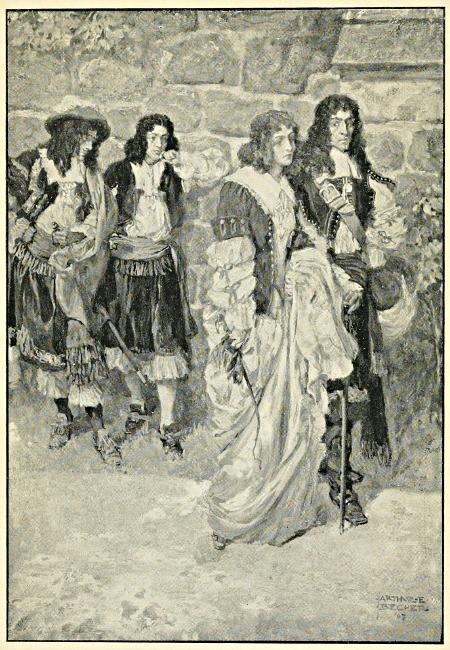
Lionel took place beside him and from narrowed lids looked
smilingly at the young man’s happy countenance.
Mistress Rockhurst, who, solemnly seated at the
end of her bench, had been a silent yet mightily
observant witness of the whole scene, now, suddenly
struck by the discontented expression of Edward
Hare’s visage, addressed the youth:—
“What ails ye, Sir Edward?”
“I’m sick at stomach,” growled the candid
baronet. “I hate a peacock.”
“Yet peacock is light fare,” said the lady, with a
twinkle in her shrewd blue eye. “Sick at stomach,
say you? There’s nothing better than a cup of
marjoram water.”
Sir Edward flung the suggestion from him:—
“Water? Ugh!”
“When I say water,” amended she, “’tis strong
water, aqua vitæ.”
“Aye,” quoth he, then, “that’s another matter.
I’m not saying but a tass of it would warm the
innards.”
She despised him heartily for a monstrous poor
scion of a noble family; yet the housewife was too
strong in her to resist the pleasure of ministering
out of her store, even to an unworthy guest. She
rose, chuckling, jingling her keys:—
“Oh, surely, surely,” she exclaimed, “this small
comfort shall not be denied you here, Sir Edward.
Come but with me.”
Rockhurst and Diana, at the extreme end of the
terrace, stood alone in the sunshine, with the June
roses about them.—How much more apart now than
on that night in the snow between the black fir trees
and the waste heath! She flung a sudden, eager
look at him; but before the smooth courtesy with
which he turned to her, drew back into herself,
once more checked and puzzled. It was to be as if
they had only met in a dream? So be it! Then
the thought that he must now regard her as his
son’s choice broke upon her in a flash of revelation—and
anger. Why had she dallied with such folly?
With an involuntary movement she loosened her
grasp on Harry’s roses and they fell round her feet.
“Why, madam,” said Rockhurst, with a forced
smile and a perfunctory solicitude, “your posy,
madam, all in the dust! Nay, permit me to cull
another for you.”
The man of the world had superseded all else. To
place his years in rivalry with his son’s youth, the
King’s Lord Constable against the country lad?
Preposterous!
Lionel Ratcliffe stood attentively watching his
kinswoman from afar. Beside him, Harry sat,
dreaming, his young eyes fixed on God knows
what golden vision. All at once the elder man
tapped his companion stealthily on the arm.
“What is it?” cried Harry, starting from his
muse and glancing round none too pleasantly.
“What is it now?” quoth he, frowning.
“Look, look yonder, Master Rockhurst. Your
roses.”
Harry’s glance followed the direction of the
pointing finger. He saw Diana stand, a radiant
vision in the amber light, with empty hands outstretched
toward the flower that Rockhurst was in
the act of gathering, a deep crimson rose that glowed
like a ruby in the sun-rays. And about her feet the
pale, sweet blossoms chosen for her with such love,
but an hour ago! The red rose was carried to Diana’s
cheek; and then she fastened it in her bosom. His
flowers had not been so honoured. He could not
think or reason; he could only look and suffer.
Again Lionel tapped him on the shoulder. He was
smiling. Harry came back to his senses at sight of
that odious smile.
“Well, sir, and what of it?” he cried, measuring
Ratcliffe with a defiant look.
“What of it? More than you think.—What were
you about, young man,” his voice sunk to a whisper,
“when you invited Rakehell Rockhurst to come and
view your lady?”
“Rakehell Rockhurst…!” echoed Harry in
utter amazement. Then, fury leaping to his voice
and eye, he wheeled fiercely upon Ratcliffe: “Of
whom, sir, are you speaking?”
The latter proceeded, unmoved save for a trifle
more of emphasis in his silky tone:—
“Did you not know that a single breath of his
lips is enough to tarnish the virtue of the purest
woman in England?”
The younger man fell back a step, and measured
the speaker:—
“Of whom are you talking, I have asked you.”
There was more self-control in his demeanour,
but more danger. It was tense with menace, like
a bent bow. A second Ratcliffe paused. He had
not given the lad credit for so much real manliness.
The more reason for him to precipitate the crisis
for which he was working; the crisis which might
rid him of two rivals at once—for the courtly
Rockhurst was indeed a rival to be reckoned with.
And there was no affectation in the passion with
which he now broke out:—
“Of whom, good lad? Of whom?——”
(Edward Hare, strolling out of the dim coolness
of the buttery into the sunshine again, heard the
sound of loud voices rising from the terrace below.
Grinning, he advanced on tiptoe and bent over the
parapet to listen. Cousin Ratcliffe and young
Harry were at it at last! Even to his dull wits it
had been evident that the quarrel that had long
been smouldering between them was bound to break
into open flame. Better than a wench or a bottle,
better even than cockpit or bear-bait, Sir Edward
loved the sight of a fight between his fellow-men.
He chuckled as he hearkened.)
“Of whom, good lad, of whom—but the most
noble Viscount, in town the incomparable libertine,
his Majesty’s merry friend, known by Whitehall as
Rakehell Rockhurst—in the country, thy sainted
father! Aye, but, town or country, let Rockhurst
get to windward of a pretty woman, and the devil
will soon show his—”
Harry had stood a moment petrified, but before the
last words were out he had struck Lionel on the
lips:—
“Liar!”
Lionel staggered back; a narrow streak of blood
was running down his chin. In a second he had
whipped out the light riding sword that hung by his
hip, and without a word made a deadly rush. Harry,
however, strong country lad, trained by all the sudden
accidents of sport and chase, had his wits about him.
He stepped aside from the onslaught, caught up
the cloak which lay on the balustrade, and flung
it across the blade.
“Now, if you please,” said he, shaking his father’s
sword free of the scabbard, whilst Ratcliffe, almost
foaming at the mouth, struggled with the encumbering
folds as if it had been his enemy himself, “let
us continue the argument.”
It was a prettier fight than ever it had been Edward
Hare’s luck to behold at feast or fair. In an
ecstasy he hung over the parapet, jumping from one
foot to the other.
“Sh! Sh!” he shouted, “at it, good dogs!
Ecod, I would not have missed this for forty crowns!
Ha, well pushed, cousin!”
Young Harry staggered, waved his sword aimlessly,
then dropped it, pivoted on himself, and fell. He
lay, face downward, and after a moment a coil
of blood, like a slender serpent, began to move
sinuously into the grey of the gravel.
The peacock, from his perch, peered down on the
scene with stupid eyes, cocking its tufted head
inanely from side to side.
The approving smile was petrified on Edward
Hare’s face. He clapped his hand over his mouth
like a frightened child.
“Dead, ecod!” he whispered to himself. Then,
hanging further over the wall, he hailed Ratcliffe
in a quavering shout:—
“Hist, coz—hast never killed him?”
The victor, leaning on his weapon, gazing in
sombre abstraction at the prostrate form, started
and looked up. He smiled hideously with his
swollen lip.
“Be it mortal?” mouthed Edward again.
Ratcliffe answered stonily:—
“Mortal? I trust so. The affront was mortal.”
Then he slowly wiped his blade upon the cloak,
sheathed it with care, and walked steadily away,
along the path that led to the valley.
Hare watched him go, till the dark laurel bushes
received and hid him. Then he looked over again
at the motionless figure, and in a panic, sent loud
calls ringing into the air: “Help here! Hoy—Hello!
Master Rockhurst hurt, ill,—dead! Help!”
Rockhurst was the first to hear the cry. In a
trice he was back in the Peacock Walk, kneeling by
the bench. Hare was at his heels, gabbling his tale.
Half his words went unheeded, but some found
their mark in the father’s heart:—
“And Lionel says: ‘Rakehell Rockhurst’ (he,
he!). ‘A devil with the women!’ says he. And
Harry hits him across the mouth. ‘Liar!’ says
Harry. Oh, ’twas a pretty quarrel. ’Twas a
cracking slap!—”
As Rockhurst lifted his boy and supported him in
his arms, light came back to the eyes so dark in the
white face, and, stretching himself, Harry returned
to consciousness and smiled up at his father like a
waking child. Rockhurst tore the stained clothing
apart with fierce hands, then drew a deep sigh of
relief. His experience in such matters took stock
of the wound—an ugly tear in truth, long, laying
bare the ribs, but not deep.
“’Tis not vital—thank God! Go, call for help,
man!” cried he sharply, looking up at the staring
Edward. And off trotted the lout. Now came
Diana, hastening, bewildered.
Lovers have quick ears: through the dimness of
his returning consciousness Harry caught the sound
of her steps. He tried to raise himself in his father’s
embrace. There was a sudden shame upon him that
he had done so womanish a thing as to swoon,
this day when, of all days, he had so much reason to
play the man.
“’Tis a mere scratch, my lord,” he murmured.
Then, with an anxious glance on his father’s face,
he added, stammering: “Master Lionel was showing
me a new French pass, and I—I slipped—” He
broke off; never before had he seen tears in his
father’s eyes.
With a flutter like that of a settling bird, Diana
sank on her knees beside them. With a soft cry,
full of ruth, she took her boy lover’s hand. As
he had passed her, running on Lord Rockhurst’s
errand, her brother had bellowed his tidings:—
“A pretty quarrel! About you, sister! Ecod—there
was talk about your virtue—and Master
Harry’s slap, and Coz Lionel out with his tuck—”
As with the sting of arrows the words drove her
forward. Ah, she needed no further telling to conjure
up the scene: her kinsman had spoken lightly
of her and her young lover had struck back the
insult. Her boy lover! His youth, that had been
his disability in her eyes, now became eloquent to
plead for him. To see him lie there, pale and blood-stained,
a mere lad.—After the way of women, on
the moment her heart melted all to him.
“Harry, Harry! …” she cried, and the words
were tender as a caress.
Harry turned his languid head.
“And now I cannot ride with you to-morrow—not
even did my lord so permit! Father…!”
Faintness was creeping over him again, but he made
an effort. His voice rang out: “Father, will you
escort her? My Diana!”
It was at once a supreme declaration of confidence
and a solemn charge. The father bowed
his head.
“Your Diana, lad, so be it—I accept the trust.”
Over the poor wounded body the eyes of Rakehell
Rockhurst met those of Diana. There was a steady
sweetness of renunciation in his, that she had seen
there once before. Hers were quickly veiled again,
lest they betray the singular, sharp pain that filled
her heart.
At her swiftest gait, important, yet showing no
alarm, Mistress Rockhurst advanced, followed by a
couple of wenches, bearing varied paraphernalia.
She had lived through the wars—it were a parlous
wound indeed she could not cope with. In her
own hands she carried a flask of renowned cordial.
None too soon, it seemed, for the colour on the pretty
boyish head lying between Rockhurst and Diana
was fading fast again.
THE KING’S CUP