It will be seen, by the first chapter, how fortuitous
though inevitable was the writing of this little book,
begun before the American troops came to France; yet
it happens to concern that part of the war zone wherein
our men are preparing themselves for battle, and which
will be quickened with their blood.
The time has scarcely come to write of the world war;
indeed, it is only between wars that one can write of
them, when wisdom, with accompanying imagination,
looks down the great perspectives; now men’s utmost
energies are concentrated upon deeds of passion performed
in hope or in despair.
Oliver’s Ordeal by Battle of 1915 remains the most
scholarly and philosophic of the war books; Masefield’s
Gallipoli the most artistic. But even these, and the
many, many others, give not so much a sense of inadequacy
as of impossibility.
Letters from strong souls undergoing supreme emotions
have emanated from the trenches or the air. We
have mourned young perished singers: Rupert Brooke,
Alan Seeger. But for the most part, and so it must be,
war books are limited to the relation of personal deeds
and sufferings, and descriptions of localities where they
have taken place, colored more or less by the temperament
of each—even as I, “en passant par la Lorraine,”
wrote these pages.
Edith Coues O’Shaughnessy.
33 rue de l’Université, Paris, January 19, 1918.
PART I
CHAPTER I HOW ONE MAY HAPPEN TO GO TO THE FRONT
Paris, Thursday, June 7, 1917.
Even personal events have their outriders, and this
is how an unexpectant lady, still fiancée to Mexico,
received from Destiny various indications that she was
to go there where men, ten thousand upon ten thousand,
lay down their lives pro patria. Like everything, it was
simple when it had happened.
At the Foire Saint-Sulpice, where I was serving at the
tea-stall, I met E. M. C., whom I thought in California.
After greetings (we had not seen each other since the
fatal month of October, 1916) she said to me:
“You must come down to Lunéville where I have a
house, and visit the village of Vitrimont, that mother is
rebuilding.”
I answered: “My dear, I’m still tied to Mexico, and
I can see my publishers frowning all the way across the
ocean if the second much-promised, long-delayed book
doesn’t arrive. I oughtn’t even to peep at anything else
for the moment.”
Then, tea victims beginning to crowd in, “business as
usual” engaged us and we parted.
When I got home I found that Joseph Reinach, met
but once—Polybe of the delightful Commentaires—had
sent me his brochure, Le Village Reconstitué. I still
didn’t hear the outriders galloping down the street.
In the evening I dined chez Laurent with Mr. C.,
known in Mexico. When I got there I found that his
sister, Madame Saint-R. T., Présidente de La Renaissance
des Foyers, was going into Lorraine, to Lunéville
itself, the next day; conversation was almost entirely of
the practical work to be done in the devastated districts,
and the deeply engaging philosophie de la guerre, of how
one had not only to rebuild villages, but to remake souls
and lives.
A quoi bon donner des chemises? Give tools and implements,
or a brace of rabbits, that nature may take
its course and the peasant can say, “Soon I will have a
dozen rabbits, and twenty-five francs that I have
earned.”
Some one observed that it really would be the rabbits,
however—it is any living, productive thing that is
of account, beyond all else, in the dead and silent places
of devastation, and gifts of twelve chickens and one
cock are demanded rather even than shoes.
As we were pleasantly dining in the garden, and
philosophizing sometimes with tears, sometimes smiles,
a terrific thunder-storm broke over Paris, and we all
crowded into the big central room, with piles of hastily
torn-off, muddy table-linen. We sat talking, however,
till they turned both ourselves and the lights out. As
we parted, Madame Saint-R. T.’s last words were,
“But try to come down to Lunéville.”
I thought to myself that night, “Things are getting
hot.” I believe in signs from heaven, and signs from
heaven are not to be neglected.
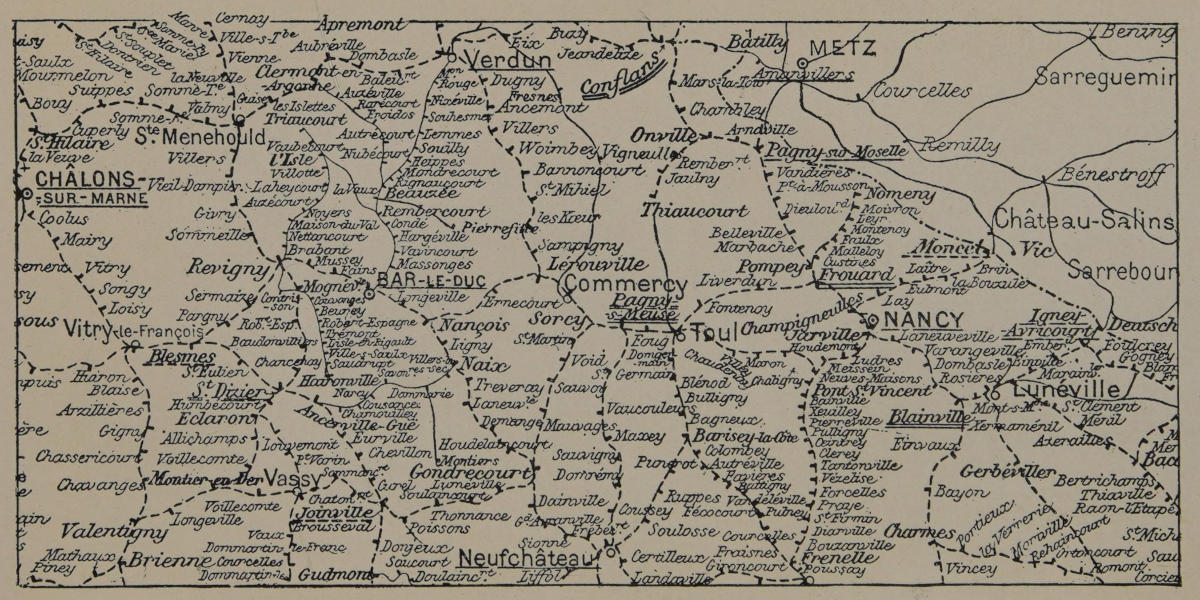
VERDUN AND VICINITY
On Saturday, when E. M. stopped by for me to go
again to the Foire, I said:
“I believe I will go to Lunéville. What does one do
about papers?”
We straightway went to the Rue François Premier,
not being in the mañana class, either of us, and found
there a charming specimen of jeunesse dorée, intellectual,
“sicklied o’er with the pale cast of thought,” but doing
his bit. Shears for the cutting of red tape were
liberally applied, and my papers were promised in an
unprecedented three days.
As we “swept” out I said to E. M., “You don’t
think we were too strenuous?”
She said, “Oh, they are used to us now, though it was
a thrilling moment when you ripped your photograph
(such a photograph!) from the duplicate of your passport!”
The aforementioned charming specimen, M. de P.,
had said a photograph was essential; it was Saturday
afternoon, the next day was Sunday, and for some unexplained
reason photographers don’t seem to work in
France on Mondays, at least not in war-time.
It was about this time that E. M. said, in a dégagé
way: “I am going down to Verdun with a friend. It’s
awfully difficult, and the women who have been there
can be counted on one’s fingers. I wish you could go,
too.”
I said, “That’s out of the question.” But I thought
to myself, “We will see what Fate decides.” It’s a great
thing to keep astride of her, anyway.
On account of Sunday coming in between, my papers
could not be ready in time for me to leave with her on
Tuesday (they have to be sent to the Quartier-Général
to be stamped), but they were promised for Wednesday
that I might start for Lunéville on Thursday. I went
to see E. M. at her aunt’s, the Princess P.’s, on Monday
night for a few last words and injunctions. I found
her after passing through some lovely dove-gray rooms
with priceless old portraits of Polish great, hanging on
silvery walls, and rare bibelots and porcelains discreetly
scattered on charming tables rising from gray carpetings.
She greeted me by saying, “It’s all arranged for you to
go to Verdun, too.”
“Verdun!” I cried. “Glory and sorrow of France!”
I didn’t ask how, but thought of the harmonious
working of chance that brings as many gifts as blows
in its train.
Thursday, June 14th, 10.30 a.m.
We slipped out of the station, flooded with waves of
blue-clad men, at eight o’clock, and since then there
has been a constant stopping of the train in green, glade-like
places to let troop-trains pass. A while ago I found
myself looking out on a river, and a shiver went over
me. It was the jade-colored, slow-flowing Marne.
White morning-glories are thick on every hedge, and
wild roses such as grow in New England lanes, and there
are many thistles, soft and magenta-colored; lindens,
acacias, and poplars abound and hang delicately over
the banks of the river.
Lying open on my lap is the Revue de Paris of June
1st, but I can’t read even the beautiful “Lettres d’un
Officier Italien”—(Giosué Borsi[1]), breathing a deep
spirit of conformity to the will of God and showing the
evolution that many an intellectuel catholique of his
generation has gone through in Italy. In his dugout
were Dante, Homer, Ariosto, the Gospels, St. Augustine,
Pascal, and Le Manuel du Parfait Caporal et les Secours
d’Urgence. And he loved his mother and let her know it.
All along the route are villages and peaceful country
houses, near the train, bowered in acacia and linden;
elder-bushes are in full bloom, too, and we pass many
green kitchen gardens. Women are shaking blankets
out of windows, and looking at the train going to the
front, thinking, who shall say what thoughts?
Later.
Big movement of troops is delaying us, and it has been
a morning spent among emerald-green hills, pale, like
Guatemalan or Bolivian emeralds, not like the deep-colored
gems of the Rue de la Paix. Everywhere are
patches of blue-clad men, marching down white roads
between green fields melting into the blue sky at the
point of the eyes’ vision. Still others are bathing in the
pale, warm Marne or resting on its banks. Trains go
past loaded with battered autos, camions and guns
coming from the front, or others with neatly covered,
newly repaired machines of death, going out.
All were silent in the train at first. “Méfiez-vous, les
oreilles ennemies vous écoutent” is the device placarded
everywhere. In my coupé some one feeling slightly,
very slightly, facetious, had rubbed out the first two
letters of oreilles, changed the first “e” into an “f,” so
that it read, “Méfiez-vous, les filles ennemies vous écoutent.”
The ruling passion strong in death!
We pass Epernay, whose little vine-planted hills had
run red, before the treading out of its 1914 wine, with the
blood of English and French heroes.
At last we began to talk, a dark-eyed colonel of infantry
with the Grand’ Croix de la Légion d’Honneur
having reached down my bag for me.
It is a historic date for France and for ourselves.
The night before, General Pershing arrived in Paris,
with his guerdon of help, mayhap salvation. All the
newspapers had pictures of him and his staff, their
reception at the station, the crowd before the Hôtel
Crillon. One officer told the story of the woman in the
crowd who was so little that there wasn’t the slightest
chance of her seeing anything or anybody. When asked
why she was there she answered, “Mais j’aurai assisté,”
and that, it seems to me, is the epitome and epitaph of
the generation whose fate it is to see with their eyes
the world war.
In the Station, Châlons-sur-Marne, 2.30 p.m.
Extreme heat. Train four hours late on account of
the movement of troops. Wave after wave of horizon
blue undulates through the station. They are lying
about, standing about, sitting about—the poilus. Half
hidden by their equipment, their countless bundles tied
around their waists, slung on their shoulders, under their
arms, they seem indescribably weary and dusty, turned
toward the blazing front where the best they can hope is
la bonne blessure—theirs not to reason why. Sometimes
30,000 pass through Châlons in a day.
Now it comes to me that our men—our fresh, eager,
beautiful young men, such as I saw disembark at Vera
Cruz—will pass through this same station to that same
blazing front....
By my window, on the siding, is passing an endless
train of box-cars, with four horses in the ends of each
car. Between the horses’ forefeet, pale-blue groups of
men are crowded; no room to lie, scarcely to sit—cramped,
hot, with their eternal accoutrement. One
bent group was playing cards, the horses’ heads above
them. But mostly they are looking out at people who
are not called upon to die.
Later.
Pangs of hunger began to assail me as the train pulled
out. I went into the dining-car and had a modest,
belated repast of œufs sur le plat, cheese and fruit.
At the tables were groups of uniformed men talking in
low voices of what had been and what might have been.
As I looked out of the window, while waiting, my eyes
fell upon the first band of prisoners I had seen—tall,
stalwart men, wearing the round white cap with its
band of red—at work on the roads, those veins and arteries
of France.
An officer, once the most civilian of civilians, looking
like the pictures of Alexandre Dumas fils on the
covers of cheap editions of La Dame aux Camélias, with
bushy hair parted on one side, mustache, and stubby
Napoleon, broad face and twinkling eyes, pointed out
Sermaize, the first of the devastated villages we passed,
which has been rebuilt by the English Society of Friends.
“Conscientious objectors” don’t intend to let the sons
of Mars do everything, but they can’t keep pace with
the destruction. In Le Village Reconstitué M. Reinach
speaks of the ugliness of the models proposed to the
victims, which pass understanding, and says that even
the vocabulary of Huysmans would not suffice to give
the least idea of them. What the peasant wants is
“mon village,” which doesn’t at all resemble what the
commis voyageur en laideur proposes.
Revigny, 4.30 p.m.
I have seen the first black crosses in a green field
bounded by clumps of poplar against the clear sky.
Revigny is a mass of ruins, roofless houses, heaps of mortar,
and endless quantities of blue-clad, heavily laden
men coming and going in the station—the eternal waiting,
waiting for transit. Revigny is on the road to
Verdun, Alexandre Dumas fils told me. He gets out at
Bar-le-Duc, which is now the point of departure to the
fateful fortress. Groups of yellow Annamites are working
at the roads. They are imported for that purpose,
being of little use when the cannon sounds.
Awhile ago two young Breton under-officers, colonials,
came into the compartment. They had been at school
together and had not met for ten years until just now
on the train. They watched together the shifting scenery;
one was coming from a young wife, the other from
a fiancée.
Gondrecourt.
Two symmetrical fifteenth-century towers pierce a
pale-blue sky. One of the young Bretons tells me that
for some time the train has been making a great détour,
as the straight line to Nancy would take it through
Commercy, daily bombarded by the enemy.
Pagny, 5.30 o’clock p.m.
Here we pick up the Meuse—and there still follows
us the pink-and-gray ribbon of willow-fringed canal that
links the Marne to the Rhine, and which all day long
has looked like the marble the Italians call cipollino.
But I remember that its greenness has been but lately
colored with a crimson dye.
Toul (where we thread up the Moselle), 5.50.
We have just passed Toul. Great barracks are near
the station, and on the opposite hill is the fortress, high
against the sky, bound to Verdun by an uninterrupted
series of forts. It is a place de guerre de première classe.
The Romans had an encampment here, and Vauban
made the fortifications of his time.
And because the mind is not always held to the
thing in view, even though it be of great moment, I
thought how Toul was the town where Hilaire Belloc
did his military service, “was in arms for his sins”;
from here it was that he set out upon the “path to
Rome” in fulfilment of his vow. Other things laid long
away in memory came to mind, and I was only jerked
back as my eye was caught by a group of German
prisoners being marched past the station, one soldier,
with a pointed bayonet, in front of them and another
behind.
And at Nancy we are to knit up the river Meurthe.
CHAPTER II NANCY
Nancy, a dream of the eighteenth century, with the
réveillé of twentieth-century guns.
We arrived at Nancy five hours late, at seven o’clock.
No sign of E. M., no sign of anything familiar. Fortunately
I was flanked by Brittany, and a stout heart
did the rest. When we found that the next train for
Lunéville would leave at nine o’clock, I asked them to
dine with me and take a little walk about the town.
Our luggage—we were all traveling light, I with a hand-bag
and flat straw valise, they with two iron helmets—was
given to the consigne and, after my sauf-conduit had
been stamped in three separate places, we departed.
The square before the station was surging with the
usual pale-blue waves, and as we crossed it the odor
of leather and tired feet and hot men was a good deal
stronger than the linden scent. We passed a very banal
statue of Thiers, Libérateur du Territoire, and some horrors
of art nouveau. A construction with colored-glass
windows and unnatural cupolas and gilding and mushy
outlines protruded from a corner, and its name, for its
sins, was Hôtel Excelsior. But we were searching for
the celebrated Place Stanislas. After asking a passer-by,
we were directed to a street whose name I have forgotten,
and we started down its rather distinguished
length of gray, well-built houses of another century,
many of them having the double Lorraine cross in red
to indicate cellar accommodations, with the number they
could shelter.
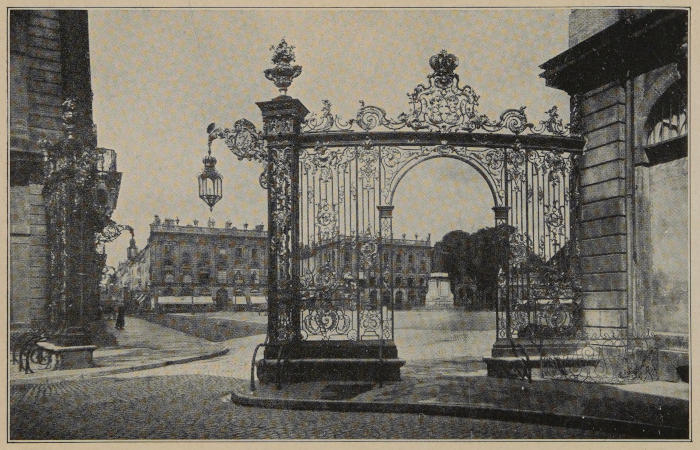
PLACE STANISLAS, NANCY
When, suddenly, we stepped into the Place Stanislas,
I almost swooned with joy. I was in full eighteenth
century, in the midst of one of its most perfect creations,
with the low boom of the twentieth-century guns in the
distance.
Quickly my spirit was ravished from the world of
combat into the still, calm, beautiful world of art, within
the enchantments of the grilles of Jean Lamour. A
sensation sweet, satisfying, unfelt since the beginning of
the war, invaded me. I gazed entranced upon that delicate
tracery of wrought iron, like some rich guipure, at the
four corners of the square of buildings, its lovely gilding
reflecting a soft light; and, outlined against a heaven
colored especially for them—pale blue, with threads of
palest pink, and a hint of gray and yellow—were urns
and torches and figures, half human, half divine, supporting
them. The beautiful fountains in the corners
were banked with sand-bags, but their contours were in
harmony with the other grilles, and one was surmounted
by an Amphitrite, the other by a Neptune. It was all
a symbol of a state of mind, a flowering of feeling, to
which had been vouchsafed a perfection of expression.
There is an Arc de Triomphe, put up by Stanislas at
one end, in honor of his kingly son-in-law, in front of
the Hôtel de Ville, and a statue of Stanislas himself in
the middle, bearing the name “Stanislas,” the date
of 1831, and “La Lorraine Reconnaissante.” In looking
about, my eye fell on the Restaurant Stanislas, dans la
note, certainly, and I decided to dine there. We found
that we had time to investigate a little further, and
turned down by the café into a most lovely linden-scented
square called Place de la Carrière. Through the
double lines of trees between the fountains at the farther
end was visible an old palace, and the square was flanked
by houses that courtiers only could have lived in. It
all cried out, “Stay with me awhile.” An old park was
at one side, with trees planted en quinconce[2]—chestnuts,
ash, trembling poplars—and everywhere was the
penetrating fragrance of the lindens. It was so sweet
and loosening under the shade, after the long hot day
in the train, that the young officers began to talk, one
of his fiancée waiting in Les Landes, the other of his
wife of a year, seen only twice seven days. And then
again we were silent, and under the flowering trees I
was seized with a great longing for the beautiful and
calm, for the arts and ways of Peace. It seemed to me
I could not longer think of this, that, or the other “offensive,”
but that I must see before my eyes, hear with
my ears, feel with my touch, the lovely, the melodic,
the benign. O bon Jésus! Not of the battle-fields, not
of réformés, of limbless, sightless men, not of starving,
frightened children, not of black-robed women, not of
lonely deaths, not of munition-factories. What is this
world we are in?
I don’t know how long we were silent, but at last one
of the young men said, “We must think of the hour.”
Then came a glancing at wrist watches, rattling of
identity disks, and we went back to the café and got a
table by the window, where we could look out on the
lovely, calm ensemble and the fading sky. The menu
was brought; it was a meatless day, but with a snap of
the eye the waiter recommended œufs à la gelée. We
understood later, when we found, concealed in the bottom
of each little dish under the egg, a thick, round
piece of ham. Fried perch, new potatoes, salad, strawberries
and cream, with the celebrated macarons of
Nancy—des Sœurs Macarons, as the little piece of paper
underneath each says—made a delicious menu. A certain
petit vin gris du pays had been recommended us
with another snap of the eye.
As we sat waiting, one of the officers exclaimed at a
giant, lonely, priestly figure passing through the Place:
“Le voilà, l’aumônier du 52ème.”
I said, “Do run after him and ask him for dinner,
too.”
He came back with the young man and we had a
most enjoyable repast. The chaplain knew all the
things about Nancy that we didn’t. He was a huge,
bearded man, who might have been with the hosts of
Charlemagne, and was a native of Commercy, where
Stanislas used to go with his court. The two Bretons
were very Catholic and very royalist; when I remarked
upon it, they said, simply, “Oh, we are all that way, par
là,” and they spoke names of great men born in Brittany,
and the aumônier told tales of near yesterdays surpassing
those of the heroic age. The gayest of the Bretons, he who
had not just left his young wife and his child unborn,
began to sing, “Voici un sône tout nouveau,” and suddenly
it was a quarter before nine and we had time only
for a dash to the station d’une bonne allure militaire,
which left me breathless. The nine-o’clock train didn’t,
however, leave till ten, as it was waiting for the Paris
train, which didn’t arrive at all. Finally, in a strange
heat, vagaries of lightning without thunder or rain—the
thunder we did hear wasn’t the old-time, pleasant,
celestial sort, but something with an easily traceable,
regular, decisive sound—we pulled out of the station,
I not knowing where I was going—no address in the
town of Lunéville.
A thick, heavy, soft, enveloping night was about us.
Groups of soldiers were lying, sitting, standing in the
little stations. We stopped every few minutes, and I
could distinguish them by the light of cigarette or
lantern on their guns and equipment, waiting for motors
to take them to the trenches. At one place I had to
descend to show my sauf-conduit; it was inspected and
stamped by the flickering light of a blue-veiled lantern,
and I climbed in again. I was beginning to feel a bit
tired, and the end was not in sight.
We descended at Lunéville in complete darkness, a
motley crowd of military and civilians. My companions
were due at different points at dawn—Baccarat
and the Forest of Parroy. As I write, they are in the
trenches. They put me into the hands of a commissaire
who said he lived opposite E. M.’s. I waited, standing
by the door, while he locked up the station, looking
out on the silhouette of a gutted, roofless house, showing
dimly against the soft night sky. At last there was a
sound of rattling of keys and the commissaire picked me
and my luggage up. We started forth, the only human
beings visible, in what seemed a deserted town—no
lights in streets or houses.
As we passed a wide open space the scent of flowering
lindens enveloped me, and with me walked the ghosts
of lovely and too-amiable ladies, of witty rulers loving
the arts as well as women—Duke Léopold and Madame
de Craon, King Stanislas and Madame de Boufflers, and
Voltaire and Madame du Châtelet.
We walked seemingly through the entire town toward
a freshness of parks, and in darkness we arrived before
a garden gate; silence, and the bell nowhere to be
found. After looking for it in the light of various
matches—vainly, of course—the commissaire had the
brilliant idea of going to the house next door, la maison
de M. le Maire, the celebrated M. Keller. A woman
came out and showed the bell where nobody would ever
have thought of looking for it, and, furthermore, masked
by vines. The door was finally opened by a tall, slender,
white-robed figure with two black braids showing over
her shoulders and a floating scarf. I thought it a vision
of Isolde, but it proved to be Miss P., who cried:
“We had given you up! We waited at Nancy till
the train came in, and then had to motor back as quickly
as possible on account of the lights.”
I went in, to find E. M. in a most becoming, slinky,
pale-blue satin négligé, also with braids on her shoulders.
I’d rather have found them both in paniers, shaking the
powder out of their hair. However, I can’t complain;
it was all pretty good as regards the stage-setting. We
embraced. I explained that various zealous guardians
of the gates of Nancy had stamped my sauf-conduit,
and, as I was certainly the only one of my species arriving
by that train, they should have given news of me
when asked concerning une Américaine. Then, as the
only healthy rooms in Lunéville in 1917 are on the
ground floor, I departed to one that had been retained
for me at the Hôtel des Vosges. Again through the
soft-scented night, guided by my commissaire, to a room
of extreme cleanliness and a most comfortable bed.
It is 2 A.M. I am too tired to sleep. My mind is
jacked up by all the twists and turns of the day. I
have been reading the Cour de Lunéville, by Gaston
Maugras, found in my room, belonging to E. M.
Three o’clock. Soft, very soft booming of cannon,
and a deep-toned bell. But no “poppy throws around
my bed its lulling charities.”
CHAPTER III LUNÉVILLE
Lunéville, a dream of fair women of old and new
times, linden scents, and circling Taubes and little
white puffs of shrapnel against blue skies.
Hôtel des Vosges, June 15th, 8 a.m.
Have just breakfasted to the gentle accompaniment
of firing on a Taube.
Dear old village life began at an early hour, but of
course the Taube put the cocks and the carts and the
geese and all the other usual auroral sounds quite in
the background.
My breakfast service is decorated with the same
double cross of Lorraine that I saw on various houses
in Nancy indicating comfortable cellar accommodation.
The cross with the chardon lorrain (Lorraine thistle) is
everywhere.
Popping and cannonading going on at a lively rate,
and whir of aero wheels; a beautiful day. Some little
white puffs of shrapnel visible from my window; I
must get dressed and investigate.
Cannonading just stopped. I don’t know whether he
got off or was got.
The hotel is discreet and clean, avec un petit air.
It has been a good house of the good epoch, and over
each window are diverse and charming eighteenth-century
motifs in gray stone.
6.30 p.m.
Just home from Vitrimont in a blinding blaze of
sun, in a motor driven by E. M., and bearing in
large letters the words “Commission Californienne pour
la Reconstruction des Villages Dévastés,” a sort of
“open sesame,” and everywhere bayonets were lowered
to let us pass. Nerves a-quiver with another day’s impressions.
Tried lying down, but it didn’t go, so I am
in an arm-chair looking out of my Lorraine window in
full eighteenth century as regards setting, but with a
very definite tide of twentieth-century warfare sweeping
through it all. Meant to go to church, where there
are special prayers to be offered up, at Benediction, for
the needs of Lorraine, but, though the spirit was willing,
the rest of me was like lead after the hot, full day and
two hours in one spot too tempting.
This morning, before I was dressed, E. M. and
Mrs. C. P., also staying in the hotel, appeared, so I
hastily harnessed up for the day and sallied forth with
them. We went first to the charming old house of
Mlle. Guérin, and, going in through a wide hallway,
stepped out into a large garden, where, under some
trees, several ladies were sitting, one of them Madame
Saint-R. T. We embraced cordially, in the very evident
fulfilment of destiny. Madame Saint-R. T. was
reading Pierre Boyé’s Cour de Lunéville, which I matched
with Gaston Maugras’s, and then I looked about me.
The house, gray and long and low, was, until a hundred
years ago, a Capuchin monastery, when it came
into the hands of Mlle. Guérin’s family. There are old
linden-trees in the garden, and some tall cedars and
roses not doing very well; and masses of canterbury-bells
and geraniums. At one end of the garden, against
the wall, is an ancient statue of the Virgin, dark, moss-grown,
against still darker walls; we placed the flowers
we had gathered on her breast and in the hands of the
Child. Avions were humming above in the perfect sky,
and against the faultless blue was a very white crescent
moon just discernible.
After accepting an invitation for dinner that night,
we walked out through the town toward the Château,
once the haunt of witty rulers, philosophers, and of the
fair and evidently too-amiable ladies beloved by them.
However, when we got into the great square of the
palace I forgot about them, for, looking up at the statue
of Lasalle, born in Metz, 1775, and fallen at the battle
of Wagram, 1807, were two Senegalese whom we looked
at as the Lunéville populace might once have looked at
the camels the young Duke Léopold brought back with
him from his wars with the Turks. The juxtaposition
was as strange. One of the Senegalese had on a
blue cap, the other a red. We gave each one a franc
for cigarettes, received large-mouthed, white-toothed
smiles, and proceeded to look at the remains of a German
avion which had fallen beside the statue the day before,
the most complete wreck possible. The aviator had
been killed and his broken wings were being removed to
the Museum. It made me quite still—there was something
so complete about it all, the great Château in the
background, the statue of Lasalle, the two Senegalese,
the shattered Taube!
We walked on rather quietly over the bridge of the
Vesouze to the Place des Carmes—the Place Brûlée, as
it is now called. The big Carmelite convent which
formed the square had been used as a barracks for a
generation or so, and one side had been burned with
incendiary bombs when the Germans left, while the
other side was untouched. In the middle was the statue
of L’Abbé Grégoire (who made the mistake of being
ahead of his time), and on the pedestal are the words,
“J’ai vécu sans lâcheté, je veux mourir sans remords.”
We stopped only a moment at the church—eighteenth
century, of course; fine old choir, delicate baroque designs
on the great wooden doors, and dominating towers
in a lovely reddish stone, with charming motifs of urn
and scroll, and flying angels against the sky, or rather
in it.
We began to have that “gone” feeling about this
time, and turned back through the town to E.M.’s
house, where we were to lunch. It was cool and charming
as we stepped in out of the sun-flooded garden,
stripped of the mystery of the night before, but quite
lovely. In old Lunéville china vases were masses of
pink and purple canterbury-bells. It had been hastily
but charmingly got ready for occupancy with old furniture
that nice people in the provinces can put at the
disposition of their friends, and I saw again Miss P.,
the Isolde of the dim, scented garden of the night
before. After lunch we sat in an arbor jutting into a
corner of the ancient park, drinking our coffee, and
eating some Mirror candies just out from New York—all
to the continued hum of avions and the rather soft
crack of guns. Then the motor was announced, or,
to be faithful to reality, somebody said, “We’d better
be off.” We put on our veils, got into the motor, which
E.M. cranked herself, and started off to Vitrimont without
any male assistance of any kind.
CHAPTER IV VITRIMONT
A merciless blaze of sun as we passed out through
the town, badly battered at the end, through the
Place Brûlée, leading to the road to Vitrimont, some
three kilometers distant, running through green fields
with their little groups of black crosses. All is softly
green and gently rolling. Vitrimont, and around about
it, was the scene of some of the fiercest fighting of that
first August of the war, and Vitrimont itself was taken
and lost at the point of the bayonet seven times in one
day as gray German floods kept rolling in over the green
eastern hills. The village is charmingly placed on a little
eminence; sloping down from it are very fertile
meadows, then other thickly wooded hills slope up
against the sky.
We passed through encumbered streets of devastated,
roofless houses, going first to Miss P.’s little dwelling,
that she has lived in during all these months of the
superintending of the reconstruction work. It consists
mostly of one perfectly charming room done up in yellow
chintz with a square pattern of pink roses, and
some good bits of old furniture, books, and flowers.
She took down from the wall a violin made by a convalescing
soldier out of a cigar-box and drew from it a
few soft and lovely tones. The rest of the house, where
she has installed herself with a woman servant, is
typical of the Lorraine peasant houses: a very wide
door to let the harvest-wagons in, a narrow one for human
beings, a narrow hall leading into a kitchen, then
the bigger living-room giving into it, now so charming
in its yellow chintz. From the kitchen some steep stairs
lead up into an attic which Miss P. has converted into
a medical dispensary.
Outside, across the street, is a little pergola effect
made of boarding, where one can sit and look out across
the softly rolling, wooded hills. In it are a table and a
few chairs and some pots of flowers. We deposited our
tea-things there, and were starting out to make the
tour of the village, when the mayor, in shirt sleeves,
loose suspenders, and slipping trousers (his wife was
killed in the 1915 bombardment of Lunéville and his
son fell in the 1914 fighting in Vitrimont), came to welcome
us and do the inevitable stamping of our safe-conducts.
We then proceeded to the old church, one of the first
things to be restored, so that its delicious fifteenth-century
vaultings and window-tracings would be beyond
further damage from exposure to the weather. One of
the things not hurt was the dado running around the
interior in the form of painted cloth folds by a misguided
nineteenth-century curé. War, with its usual
discriminating touch, had left that. In the vestibule
are some small, perfect Louis XV holy-water fonts in
the form of shells upheld on angels’ heads. A celebrated
baptismal font was removed to Paris.
We then went to the maison forte, as the peasants
call what had been a sort of château, the dwelling of the
“first family” of the place. Its medieval tower was
battered beyond repair, and the house itself pretty well
damaged, while some of the rooms still had charming
bits of paneling, and the locks and latches of the doors
were perfect examples of eighteenth-century wrought-iron
work. In one of the large rooms, whose ceiling was
broken in by a shell, was a lovely old fireback under a
marble mantel with the arms of the Counts of Vitrimont.
By a north window was sitting a woman
working at an embroidery screen with a brilliant
green and silver design; an old man with palsied head
was near.
The school also has been rebuilt. A rosy-faced young
schoolmistress received us, and two little boys kept
to do their pensums told us the name of the President
of the United States, and showed us Washington and
San Francisco on the map hanging in the room. This
having been satisfactorily gone through with, the
punished little boys, with the usual luck of the wicked,
were given chocolates by E. M. and dismissed; then we
walked out into the little cemetery, approached by a
narrow pathway of arching sycamores. It looks out
toward the ancient forest of Vitrimont; in between are
more green, undulating fields ripening with the 1917
harvest. The walls of the cemetery are battered and
broken and monuments and gravestones are overturned.
There was furious hand-to-hand fighting there, and in
those first August days the long dead again mingled
with the living. I passed down by broken, sun-baked
walls, reading the names on the crosses as I went, and
these are some of them:
A notre fils, Charles Diebolt, mort pour la Patrie 1895-1914,
26ème Infanterie—
Charles Carron, Musicien; Souvenir d’un camarade,
mort au Champ d’Honneur 31 août 1914—
A rude wooden cross bears the words:
“Ci-gît Edouard Durand, fusillé le 25 août 1914 par
des lâches.”
As one goes out is the tomb of a young girl; “Hélène
Midon, 18 ans, victime du 1er septembre 1915—une
prière—la plus jolie fille du village.” A white and virginal
rose has been planted where she lies. In this
cemetery lie, too, the wife and son of the mayor.
The first upspringing of early flowers is everywhere—asters,
goldenrod, wild roses—and the hot sun extracted
from each its soft, peculiar perfume. I picked
a seemingly perfect rose from the grave of un soldat
inconnu. Its petals immediately fell to the ground.
Everything grows with an almost ironical luxuriousness
on the shallow, hastily dug graves. All over Lorraine
is this same flowering; it has been and will be, but there
was no time to ponder on the fate of frontier lands, for
we were next to call on the officer commanding the
detachment quartered at Vitrimont, who was housed
in a reconstructed building and who had been waked
from slumber to receive us. When I gave him my
boxes of cigarettes for his men he said that he had
received some before for the soldiers who had the Croix
de Guerre. I promptly told him mine were for the
soldiers who had not got it. Mrs. C. P. brought bundles
of illustrated papers and postal cards.
Soldiers are everywhere helping to get in the hay;
sweet odors of freshly cut grass float about on the
warm air to the sound of distant cannonading. However,
in spite of everything, it is already l’après-guerre
here, and the delivered population is breathing again,
but it all gives the sensation of something prostrate that
needs the help of strong, fresh hands before it can arise.
Mrs. Crocker’s work is on such a generous, imaginative,
sliding scale, and Miss P., untiring and executive, is
of immense tact in dealing with the Lorraine peasant,
a peculiar type demanding peculiar handling. There
are numberless psychological situations needing adjustment
in the human as well as material affairs of devastated
villages. Miss P. meets all difficulties with
understanding plus determination. Some are content,
some not, with what is done for them. One woman
whose house was completed, and who was evidently
dazzled by the result, said, “It isn’t a house to live in,
but to rent.”
Another, however, when we went into the grange
behind her house, pointing to the posts sustaining the
hay-lofts, said: “Will they hold? The old ones were
twice the size.”
Sanitary improvements have been worked out as far
as possible, but when you try to tamper with a peasant’s
pile of fumier, it’s like tampering with his purse—and
that’s impossible. Quite a good deal of live stock has
been put into Vitrimont.
A soldier stationed with the Vitrimont detachment
cranked the motor for us. His home was near by, and
he told us with shining eyes that he had just bought
for ninety francs two pigs. Somebody observed it was
the premier pig qui coûte. However that may be, the
purchase marked the remaking of his home.
One is appalled at the time and energy and money
necessary for the rebuilding of this single village—a
million francs is the cost estimated—and materials and
workmen are increasingly difficult to get. One thinks
of the hundreds that aren’t being rebuilt. Vitrimont
has certainly been smiled on by heaven and Mrs. C.
As we drove home, fleecy, delicately tinted clouds
were pinned together with mother-of-pearl cross-shaped
brooches. It is in the air alone that there is any “war
beauty.”
Soldiers are passing under my window, some in the
blue trench-helmets, with their equipment; some in their
fatigue caps, swinging their arms, free of their eternal
burdens; and there are officers afoot or on horseback,
and colonials—marines, we call them—in many kinds of
uniforms.
The poster on the old garden wall opposite says:
Alice Raveau viendra jouer “Werther,” dimanche, le 17
juin, 1917, en matinée.
Charlotte might have lived in the house behind the
wall on which it is pasted, a gray, smooth-façaded house
with a good eighteenth-century door, and a chestnut
and a linden in full bloom. At the café on the corner
soldiers are sitting, laughing and talking, humming, drinking
their bocks, reading their papers, or throwing words to
women who pass by, and I thought of the men who pass
through these villages, leaving to women an inexorable
burden and an untransmittable joy. Many swallows are
flying about, and above it all, in the colorful afternoon
air, avions are humming. On the wings of the French
airplanes are stamped a great circle of color like an eye
with red pupil, white retina, and a blue outer rim. After
the hot day, something lovely and cool begins to come
in at the window, and I know soldiers all over Lorraine
are resting after the heat and burden of the day, though
in the distance the dull, muffled sound of cannon continues.
Now I must “dress”—that is, put on my other
dress—for the eight-o’clock dinner at Mlle. Guérin’s.
CHAPTER V MONSIEUR KELLER
Lunéville, Saturday, 16th June, 8 a.m.
As I put out my light and opened wide my window
last night a rush of warm, linden-scented air came
in, also the thick, soft, meridional voice of some soldier
singing “En passant par la Lorraine.” I, too, was passing
through Lorraine, and I got the sleep I didn’t get
the night before.
This morning more whirring of aeroplanes, but peaceful.
The Taube got off yesterday; all the events of
Friday were accompanied by that constant low-flying
of aeroplanes, making one feel one was being looked after.
Dinner at Monsieur Guérin’s. Monsieur Keller, the
celebrated mayor of Lunéville, whose tact, courage, and
good sense saved Lunéville many tragedies at the time
of the German entry, took me out. He has a lively, perceptive
eye, and, all in all, life seems not to have been
unkind to him, though he has been invaded, and his
parents before him. He received the Germans and said
adieu to them all in that month of August. His fine
old dwelling, where the treaty of peace was signed in
1801 between France and Austria, is next to E. M.’s,
and housed at one time one hundred German soldiers,
and the general and his staff were quartered in it. He
was, of course, the bright particular hostage during the
occupation, and was followed about by two officers and
four soldiers wherever he went.
“I kept them moving,” he added, with a snap of his
perceptive eye.
At Lunéville one hundred and thirty houses were destroyed
and there was much loss of life among civilians.
The mayor has, or rather had, a property near Vitrimont,
called Léomont, on a hill where there was formerly
a Roman temple to the moon, and from this
Lunéville is supposed to take its name. The great farm
and its ancient buildings were destroyed during the
bombardments of Lunéville and Vitrimont.
“It’s only a war monument now,” he added, philosophically.
It’s the atmosphere of Lunéville that’s so charming
to me—this drop into full eighteenth century, with the
boom of twentieth-century cannon in the distance. In
spite of the sound of guns, there is some peace they
can’t destroy. I knew nothing about the French provinces
till I got to Lunéville, and I suppose it’s their
immemorial and quite special atmosphere that I have
received. Here the war seems to be a thing of the past;
they think of their secteur only, and of themselves as
libérés, and talk of the war in the past tense, and it
might be 1814 just as well as 1914.
A heavenly evening. We walked in the dim old garden
smelling of linden. No lights anywhere, of course,
and, though the stars were beautiful, they didn’t seem
to light up anything terrestrial; the only things blacker
than the night were the giant cedars. At dinner was a
youngish, much-decorated general, coming back for a
night from the front; though born in Lunéville it was the
first time he had been here since the war—always fighting
in other parts of France. Besides the general there
were Madame Saint-R. T., E. M., and Miss P., who
appeared in some sort of dull-red tunic that she ought
always to wear; the mayor and his wife (she is Gasconne,
and very animated, though she said twenty years of
Lunéville had somewhat calmed her); two or three
women with husbands at the front bringing daughters;
several young officers; and M. Guérin and his daughter—the
usual war-time composition of dinner-parties in
the provinces, I imagine. Excellent and very lavish
repast, maigre, of course, but everything else except
meat in profusion. I didn’t get to bed till after eleven.
M. Guérin walked back to the hotel with us, and, while
he and Mrs. C. P. talked, again I was accosted by ghosts
of dead rulers and lovely ladies and philosophers as we
crossed the vast, dim Place Léopold. They, too, had
crossed it and been amorous and witty, pleased or having
vapeurs, enveloped by linden scent, and the changeless
stars had controlled their destinies.
Later.
This morning we visited the military hospital in one
of the most charming edifices I have ever seen, an
eighteenth-century convent-building. The first entry
on the tableau in the hallway giving the names of the
benefactors was 1761; the last, 1913. It is a two-storied,
cloistered, rambling edifice, with several wide
courtyards planted with trees and flowers, a fountain in
the middle of one; in another a statue of the Virgin;
beyond it a sun-baked vegetable garden; and still
farther, behind a hedge, the inevitable little cemetery.
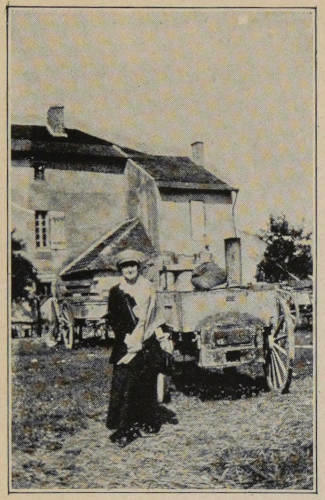
AUTHOR AT VITRIMONT
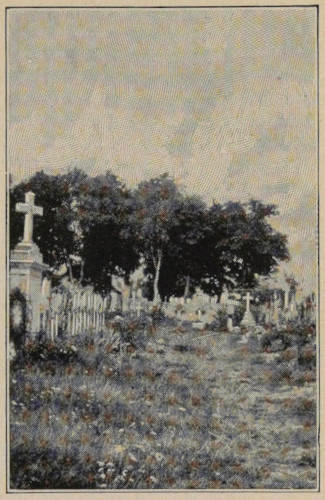
CEMETERY, VITRIMONT
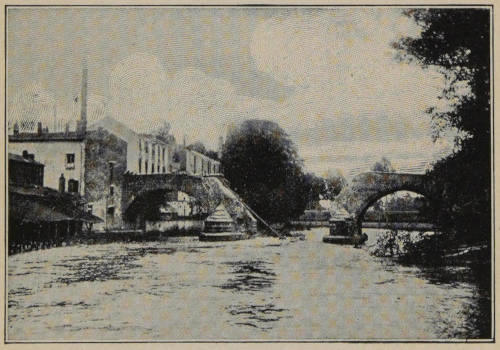
THE BRIDGE AT LUNÉVILLE
We went through the wards of the hospital, high-ceilinged,
spotless, airy, with the médecin-chef, talking
with the wounded and distributing cigarettes.
One of the doctors, also mayor of Gerbéviller, said to
us, when we told him we were going there in the afternoon,
“But don’t you want to see the young German
aviator?”
Thinking it quite “in the note,” we went up-stairs
again. He unlocked the door of a large corner room.
At a table by a window looking out on another little
tree-planted court was the young eaglet with fractured
“wing”—arm and shoulder—in plaster. He got up
with the military salute as we came in. I begged permission
to address him in German, and when I asked
him where he was zu Hause, he answered, “Posen,”
and that it was far. He said he was very comfortable,
but, with a longing glance at the patch of sky, added
that he was dreadfully bored. I suppose he was, after
being a bird in the blue ether and breaking into secular
silences. He had been there a month, but was still very
thin under the cheek-bones and dark about the eyes,
and very young. He turned to the doctor with an entirely
different expression—a sort of shutting down of
iron shutters over the youthful look—on being asked
in German if he had all he needed.
“Why have I had no answer to the post-cards I have
written my mother?” he asked, adding, “we also have
mothers.”
The médecin-chef said: “You know you can only write
once a month; but write another, all the same, and I
will see it is sent off.”
He had a worn French grammar on the table and had
been diligently studying verbs when we entered. The
doctor was so nice with him.
There is no bitterness at the front; the more one sees
of it the more one realizes that bitterness is the special
prerogative of non-combatants far from the field. I
heard an American woman say to an officer just back
from the front, so newly back that “the look” was
still in his eyes:
“I’d like to see you at Cologne, destroying the cathedral.
It would serve the Boches right.”
He looked at her and made answer: “Ce n’est pas
comme ça, madame. Enough has been destroyed in the
world. Think rather of reconstruction.”
Ah! les civils!
Coming out, we met Mlle. des Garets and went with
her to her evacuation hospital near the station, which
was a triumph of turning heterogeneous spaces into a
single purpose. Two old railway sheds had been converted
into receiving-rooms, douche-rooms, refectories,
and several eighteenth-century cellars had been so arranged
that in case of bombardment they could stow
away fifteen hundred wounded. This seems a simple
enough statement, but just think what stowing away,
suddenly, fifteen hundred wounded means! Mlle, des
Garets, a daughter of General des Garets, has been marvelous
in her devotion and practicality since the beginning
of the war.
I hear the motor-horn....
CHAPTER VI GERBÉVILLER AND LA SŒUR JULIE
We started out for Gerbéviller in a blinding sun,
over a road leading through pleasant green
meadows. That is one of the strange things of Lorraine—everywhere
destroyed villages and everywhere
well-planted fields, almost as if planted by the ghostly
throngs of heroes who lie within. For in nearly every
field there are the little clusters of black crosses, hung
with flowers or the tricolor badge, or quite bare—with
the number of men who lie within, or a date, scarcely
ever a name.
We went into the village, very ancient, that owes
its name, Ville des Gerbes, to a miracle performed there
by St.-Mansuy, past the completely destroyed château
of the Lambertye family, and, going up a winding street,
reached the house of Sister Julie, the heroine of August,
1914. On every side were gutted houses and piles of
mortar and stones; one enterprising individual of the
fair sex had installed against a resisting wall Le Café
des Ruines, and some soldiers and civilians were sitting
on bits of stone and masonry, drinking their bocks and
reading newspapers. The convent-building is in the
principal street, and it was unharmed save for a little
peppering of rifle-fire and a bit of cornice knocked off—par
la grâce de Dieu, as Sister Julie afterward told us.
Up three steps, and one finds oneself in a narrow, ancient
stone hallway. Turning to the right, one enters
a cool, peaceful room of the convent-parlor type—a
large crucifix, lithographs of the last three popes, horsehair
furniture, white crocheted doilies, everything spotless.
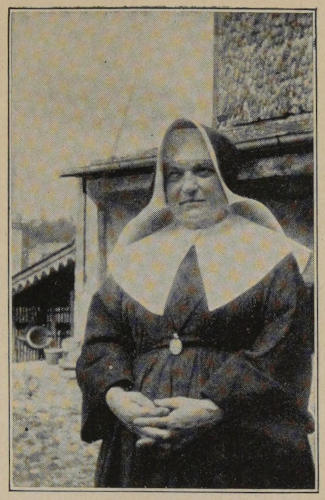
In a moment Sister Julie came in. Her flashing
eyes, her determined jaw, show her always to have been a
woman of parts, and yet her whole life is really crowded
into those few eventful days of the latter part of August,
when “they” entered the town. For the rest, the quiet,
useful routine of the nursing and teaching order of St.
Charles de Nancy, which had been chassé at the time of
the French Revolution; a few nuns managed to remain
hidden, and the order has been preserved. She is evidently
a responsive soul, for she immediately began to
enact the story of the arrival of the Germans, with a
certain art in the presentment of the tragedy of the
little town, gained, no doubt, by many recitals.
The Germans came into the town on the 27th of
August, after the heroic defense of the bridge over the
Mortagne by a detachment of fifty-four men of the
2d Chasseurs from sunrise to sunset, who held up during
hours the brigade of the Bavarian General Clauss.
Finally, at five o’clock the gray hosts got through and
passed in with a great sound of tramping feet and ringing
hoof, and, after the manner of invaders, mettant le
feu et le sang dans le village. Sister Julie thought her
hour also had come. In the room where we were sitting
she had placed her thirteen wounded men, brought in
at intervals during the day. “Mes petits,” she called
them, and her eyes shone softly at the memory. She
sent the other sisters up to the attic, and remained alone
to face the enemy and to beg that the house be spared.
She went out on the little step, not knowing what fate
awaited her, and found four immense officers on horseback,
with their horses’ heads facing her.
“They thought they were Charlemagnes, immense
men, with light hair and light-blue eyes and arched
noses and gallooned uniforms. I was like a dwarf in
comparison, and I am not small.” To tell the truth,
she is indeed a “muscular Christian.”
Then began the interrogatory, the ranking officer
demanding of her:
“Sie sprechen Deutsch?”
She said to us, with a smile:
“I did speak it in my youth, but it wasn’t the moment
to recall my studies, and I didn’t answer, and we
remained for a few seconds looking at each other comme
des chiens de faïence.[3] I so little on the house-step,
and they so tall on their big horses, and with poignards
drawn from their breast pockets, pas le beau geste de
tirer l’épée du côté,” she finished, disdainfully.
Finally, the silence was broken by the ranking officer,
whose next words were in French: “Nous ne sommes pas
des barbares; you have soldiers and weapons concealed
in your house. Lead the way.”
Then the four officers dismounted and, with pistols
in one hand and poignards in the other, followed Sister
Julie into the little room where the thirteen wounded
men were lying. Their helmets touched the ceiling as
they looked about them. Standing by the first bed
nearest the door, an officer pulled down the covers.
“You have arms concealed.”
“We have nothing. You will find only men lying in
their blood.”
By this time Sister Julie was not only talking, but
acting the scene, indicating where the beds were, where
she had stood, where the four chefs had entered, and
how the eyes of the wounded men followed her. The
officers made the rounds of the beds, pulling down each
stained cover, Sister Julie following to re-cover the men,
who were expecting, as was she, the order to burn the
house.
She continued: “They were Bavarians, and when I
said: ‘You see, we have nothing. Leave me my
wounded, in the name of Mary most Holy,’ the commanding
officer began to look at the point of his shoe
as men do when they are embarrassed. I have seen
surgeons do just that when they are in doubt about an
operation,” she added. “Then he suddenly turned without
a word and went out, followed by the other three,
pistols and poignards in hand. They passed up the
street with their detachment, ‘mettant le feu et le sang au
village; et moi, restée avec mes petits, à remercier le bon
Dieu—et de leur donner à boire.’”
We gave our little offerings into her generous hands,
and sniffed the scent of freshly baked bread that permeated
the corridor. E. M. photographed her standing on
her historic steps, and we went out into the hot, cobble-stoned
street, to the completely ruined Lambertye
château, standing in the midst of a park whose gardens
were designed by Louis de Nesle. Two large and very
beautiful porphyry basins near the house were untouched—not
a nick or a scratch. On the great marble fireplace
of what had been the big central hall, now uncovered
to the day, we could still read the words:
Charles de Montmorency
Duc de . . . . mbourg,
Maréchal de France.
Afterward E. M. took some more photographs, and
we sped homeward to pack our belongings and dash
into Nancy to get the eight-o’clock train from there for
Bar-le-Duc, to be ready for the high adventure of
Verdun early the next morning.
CHAPTER VII BAR-LE-DUC
Bar-le-Duc, Sunday, June 17th, 2 a.m.
Scribbling in an indescribable brown-upholstered
room, where one lies on the outside of a
dark and menacing bed covered by one’s own coat, a
strong odor of stable coming in at the window and a
horrid black cat wandering about. It’s no night to
sleep. Two o’clock has just softly sounded from some
old bell. I didn’t hear one o’clock, I am thankful to
say. I was in a sort of trance of fatigue when we got
here at eleven.
Miss P. motored us into Nancy, straight into the
setting sun. My eyes were so tired that I didn’t try
to pierce the hot glaze, but there’s a memory of running
through green fields, with black crosses, saline installations
(Rosières aux Salines), manufacturing towns (Dombasle-sur-Meurthe),
and Gothic towers (St. Nicholas du
Port), and a dash through the new factory suburbs of
Nancy into the delicate and perfect loveliness of the
Place Stanislas. Neither E. M. nor I had a permit to
go to Bar-le-Duc, the point of departure for Verdun,
but Mrs. P. had, so she was deputed to order dinner at
the Café Stanislas, while we went to the Hôtel de Ville
to try to find the Secrétaire Général, Mr. Martin, a special
friend of E. M.’s, and do what I call “cutting barbed
wire.” It seemed at one time as if the high adventure
of Verdun might have to be abandoned, as the Secrétaire
Général, who alone could give us the necessary permission,
had been called to Pont-à-Mousson to investigate
the results of a raid of German avions there and
at Pompey that morning. However, when fate has
made up its mind that things shall happen, any deadlock
is cleared up by the puppets themselves, literally
on a string this time, for as we were standing there in
the room with the impotent substitute of the Secrétaire
Général, the telephone rang, and who was it but the
so desired gentleman calling up about something on the
long-distance wire. E. M. literally grabbed the receiver,
explained the situation, and he gave the necessary
authority to his substitute, and we in turn gave the
oft-repeated story of our lives from the cradle to the
present moment, and finally could depart with papers
in order for dinner at the Café Stanislas. Again as we
walked across the lovely Place my soul was stirred with
memories of peace, love, and the arts of peace. I
seemed to understand anew those words, “The arts of
peace,” and in a half-dream I looked up at the heavens.
Again pale, charming faded tints of blues and grays and
pinks were the background for the urns and figures of
the sky-line of the pure and lovely buildings that surround
it, and a crescent moon with something untouched
and virginal flung a last charm about it all.
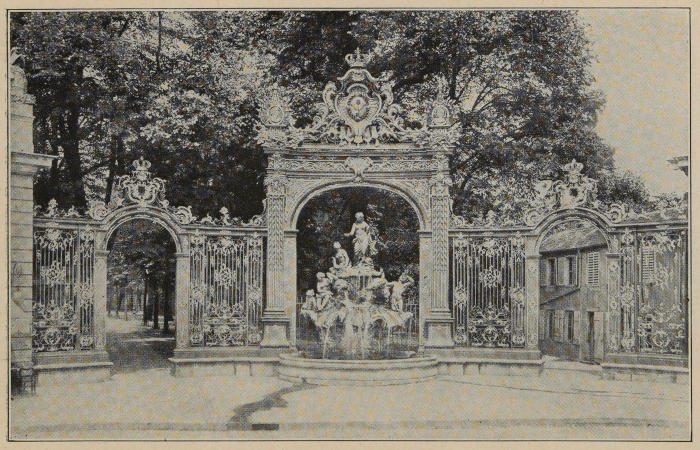
FOUNTAIN OF AMPHITRITE BY JEAN LAMOUR,
PLACE STANISLAS, NANCY
We found Mrs. C. P. waiting at the same table at
which I had sat two nights before with the sons of Mars
and the man of God. We were just beginning our dinner
when, looking out of the window, we saw something
strange and for a moment unclassifiable, in an almost
impossible juxtaposition of ideas. No one’s mind would
be sufficiently mobile to grasp what it was without blinking
a bit. The great, portentous black cross on its wings
was what started the mind working properly. It was
the Taube brought down at Pont-à-Mousson that
morning, being drawn on a camion through the delicious,
delicate tracery of Jean Lamour’s wrought-iron gate!
1755-1917!
We dashed out; a crowd was already gathering. A
young French aviator with a curious look in his eyes
was watching it being set up. Having espied the wings
on his uniform, we asked “what and where and how”
and are “they” dead or prisoners? Some one said,
“C’est lui,” indicating the young man, who did not
answer our questions, but continued to stand quite still
in some sort of dream or détente of nerves. But a man in
the crowd said:
“He brought it down at Pont-à-Mousson, and they are
prisoners.” We were standing by the statue of Stanislas
le Bienfaisant, Stanislas le Bon, his reign le règne des
talents, des arts et des vertus (these last not as we know
them in 1917), and he was looking on strange things!
We went back to the café, consumed in haste and distraction
the very nice little dinner, topped off by strawberries
and cream and the celebrated macarons des
Sœurs Macarons, and again I found myself dashing to
the station, which one thinks is near and isn’t, accompanied
by my two fair friends, all going at the same allure
militaire that I had taken forty-eight hours before with
the two Breton officers and the Chaplain of the 52d.
Wild dash at the station for our hand-luggage; and
stampings of safe-conduct, then a hunt for the porter,
who, with an excess of zeal (and hope), had reserved a
coupé for us and put up the fateful words dames seules.
Now there is no such thing as dames seules at the front.
Many officers were standing in the corridor, one on
crutches, so we tore the forbidding words from the windows,
and the compartment automatically, though
courteously, filled.
Among them two immense, dark-bearded men from
the Midi, with accents to defeat the enemy, and a pale
officer from near the Swiss frontier, as we afterward
discovered. He smiled when I said to the dark one
sitting by me, after the greetings and thanks:
“You come from Marseilles?” (He came from a little
place five miles from there.)
The officer on crutches stretched his leg with a contraction
of the face and a sigh of relief. They were all
en route for home, from the same regiment, the seven
precious days of permission counting from the hour
they reach their homes till the hour they leave them,
after months in the field. They had fought in Belgium,
on the dunes, these men of the south, those first eighteen
months, up to their waists in water, often for weeks at
a time. They found the Lorraine landscape that so
soothed my soul only fairly pretty, and spoke soft
praises of le Midi.
They all had the strange, bold, hard, shining look about
the eyes, with a deeper suggestion of sadness, that men
just returning from action have. It is the warrior look—one
kills or one is killed, one conquers or is conquered;
there is no via media.
The pale officer from Savoy said: “There should never
be any war; c’est trop terrible; but, once given the fact
that war exists, all means to victory are justifiable.”
And the bright, hard look deepening on his face made
me suddenly think of Charles Martel and Charlemagne,
and I knew it was the way French warriors have looked
through the ages, but, oh! France. “Oh doux pays!”
At Bar-le-Duc, dating from the Merovingians, at
least, we descended (our bags passed out of the windows
by the officers), and went through a dark, silent, linden-scented
town, obliged to drag our own belongings through
an interminable street, over a bridge across tree-bordered
black water, till we got to this abode, known to men
by the name of Hôtel de Metz et du Commerce. What
the devils call it I don’t know; I have just chased the
black cat out, and if I don’t get some sleep I shall not
get to Verdun. There’s no linden scent coming in at
my window here.
Bar-le-Duc, eight o’clock a.m.
Waiting in the sandy-floored dining-room of the hotel.
All three of us very cross. At dawn not only the light,
but the sounds of chopping of wood, emptying of pails,
and invectives of various sorts came in at the dreadful
windows. At seven the maid mounted to know if we
wanted the water in the tea or the tea in the water.
That tea “threw” them. Not a sign of the famous
Bar-le-Duc jellies that one has eaten all one’s life, even
outre-mer. We compared notes of furry, rumpled sheets,
dented pillows, dark coverlets, dreadful scents, and
unmistakable sounds. We are now somewhat restored
by hot and very good café au lait, and Mrs. C. P. is looking
out of the door for signs of Mr. de Sinçay, who
has just stepped out of his motor.
CHAPTER VIII VERDUN
Verdun! The sound is like a clarion call. Verdun!
It is shorty but gravely harmonious. It is satisfying
to the ear, it is quickening to the soul. Verdun! It is for
France the word of words; in it lies the whole beauty of
her language and of her martial glory as well.
Who shall say it is but a fortuitous collection of letters,
this word Verdun, beautiful as a chalice, that holds the dearest
blood of France? It would not have been the same
mystically, perhaps not actually, had it been Toul or Epinal
or even that other melodic sound, Belfort. Verdun! It is
the call through red days and nights, and everywhere the
sons of France rallying to it with great hurryings lest mayhap
one be there before the other, to dye with deeper color
the crimson of high deeds. Verdun, ear and tongue relinquish
you regretfully.
Verdun, glory and sorrow of France, I salute you,
Verdun! Verdun!
Night, silence, and memory turning over the events
of the day.
I stopped writing this morning as a gentleman of
supreme personal distinction entered the little sandy-floored
café, a gentleman who should always be arriving
in a dark-red, sixty-horse-power Panhard, or receiving
on a terrace with a castle behind him, or sitting
in a library of first editions only, in soft but gorgeous
bindings. It was M. de S., and we shortly all got into
the big auto, we three women on the broad back seat,
M. de S. in front with the military chauffeur. Even
the bend of his long back was l’élégance suprême. He
said the motor had seen three years of war-service, but
certainly there was something unfatigued about it as
it started out through the ancient streets of Bar-le-Duc,
on the white road to the fateful fortress. The arrow on
the first Verdun sign-post gave a feeling of having shot
itself into one’s heart, as well as pointing the way.
Almost immediately we met a long convoy bringing
men back from the front, ourselves and everything else
enveloped in a white plaster-of-Paris-like cloud of dust.
It seemed an endless line, with their camouflaged canvas
tops and sides, painted in great splashes of green and
brown. In some of them the men were singing the
chansons de route that soldiers so love, and many of
them had green branches stuck in the sides as a slight
protection against the sun and the shifting white dust.
The grass and flowers of the wayside were as if dipped
in whitewash, but the road, like all the roads of France—those
veins of her body of death and life—was in
excellent condition. Next we met a great line of Red
Cross convoys, and all the time we were swinging
through ruined villages.
At the entrance to X. the guard stopped us with his
bayonet. Our papers being in archi condition, we
passed through the little village of the Quartier-Général
without further hindrance. In front of the Mairie there
is a quaint old fountain with its statue of three women
holding up a motif of flowers in a basket; near by there
is an old hostelry, Le Raisin Blanc, in front of which
soldiers were sitting, drinking their bocks and reading
newspapers. Turning out again on the white road,
we pass settlements of Red Cross barracks and munition
parks, looking for all the world like mining camps in
Western towns at home.
We arrived at Dugny at ten o’clock and descended
to look about for a suitable place for the installing of a
canteen, which was partly our reason for being where
we were. There is an old country house in the middle
of the little town, with a coat of arms above the
door and lions crouching on its gates; behind is a lovely
ancient park with linden and elder trees in full blossom,
and under them quiet, shady walks. It is used as an
ambulance station, and convalescing men were sitting
or lying about on the ground. We met the médecin-chef,
who, however, like all doctors, didn’t care twopence
for well soldiers, and was but platonically interested
in the canteen matter—just as the military count
out the sick and wounded soldiers. It’s all in the point
of view.
As we stood talking a German aeroplane flew high
above Dugny outlined in a perfect sky. Little white
clouds of shrapnel from the vertical guns began to
burst about it in the clear blue, and there was a louder
sound of cannonading as the avion disappeared in some
far and upper ether. E. M.’s brother had been once
stationed here for months, and she told the story of his
meeting unexpectedly his cousin Casimir. They were
going different ways with different detachments, and
they “held up the war” while they embraced! Smart
officers, ahorse and afoot, convoys going to the trenches
with rations, great carts full of bread, and ambulating
soup-kitchens filled the little street. Verdun was but
seven kilometers distant, and the road lay straight before
us as we left Dugny. On the horizon the outline
of the citadel and the towers of the cathedral showed
against the sky. Another endless convoy of ambulances
and camions enveloped us in a choking white dust.
This is the lining of the front, and it is quite easy to
see where the war billions go.
We passed into Verdun under the Porte de France,
and then went immediately up to the citadel through
the old drawbridge, all dating from the days of Louis
XIV and Vauban, and it was at Verdun that the sons
of Louis the Debonair met to divide the empire of
Charlemagne.[4]
We got out by the demolished barracks, and M. de
S. went to pay his respects to the colonel, who was expecting
him. As I descended I saw at my feet a beautiful
tiny bird’s nest, which I picked up with a clutching
at the heart. The birds went away that first terrible
spring of 1916, the colonel afterward told me, but they
had come back in great numbers in 1917, and were
everywhere building their nests, in spite of the continual
bombardments. The citadel was a desolate mass
of mortar, stones, rusty barbed-wire entanglements,
blackened and broken tree stumps, but everywhere, too,
were quantities of undiscourageable new green.
We met a young doctor coming across the Place, and
fell into conversation with him. He had been at the
front since the beginning, and he was sad-eyed in spite
of his youth. When I spoke of the near-by tenth-century
tower toppling and half-demolished, all that
was left of the ancient church, and the celebrated abbey
of Saint-Vannes, and said what a pity it was that the
beautiful things of the old days had to go, he answered,
with a gesture of complete indifference:
“Qu’est-ce que celà fait? A nous qui restons de faire
de nouvelles choses, et mieux, que n’en out fait nos aïeux.
All the comrades I loved in the beginning are gone—and
what remains, or perishes, of brick and mortar
is of little account beside the sum of living things that
is lost.”
Just at this moment M. de S. appeared with the
colonel, and the young philosopher touched his cap.
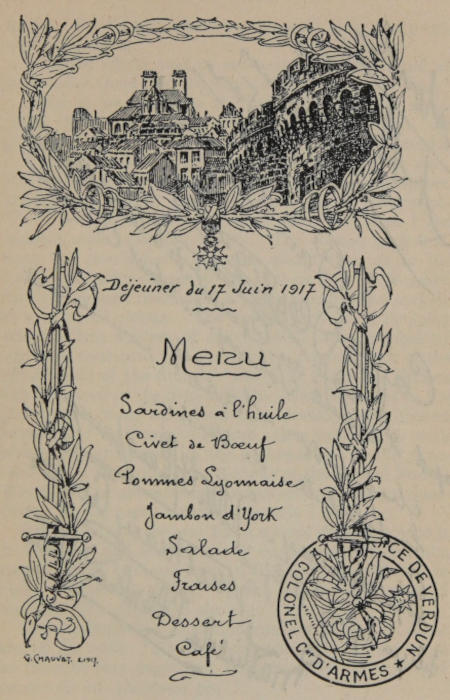
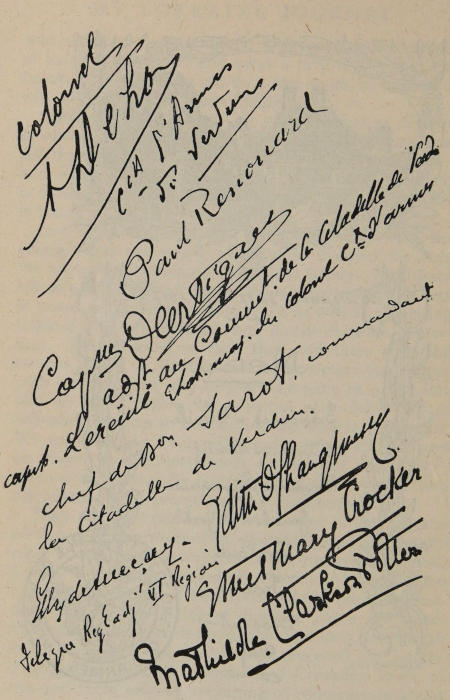
We were then introduced to Colonel Dehaye, a brilliant
officer and delightful homme du monde, loving the arts
of peace, as I afterward discovered, as well as practising
those of war. In his hands now lie the destinies of Verdun.
He presented us each then and there with the
famous medal of Verdun and an accompanying paper
with his signature, and furthermore gave us an invitation
to lunch, which we accepted with delight after
delicate references to sandwiches and wine in the motor.
We spent half an hour walking about the citadel, and
he showed us the most recent damage—of yesterday—when
a very especially precise aim of the Germans had
destroyed nearly everything that had been left.
Then we descended really into the bowels of the
earth, cemented, white-tiled, electric-lighted, artificially
aired bowels, to the very depths of the great fortress.
To get to the mess-room of the colonel and his staff we
had to pass through a long room where perhaps a hundred
officers were sitting at dinner. There was something
deeply impressive about the dim, long, low length
of it, and those groups of men prepared for battle.
Thoughts of Knights Templar and Crusaders came to
me, and there seemed something of consecration about
it all. Behind the tables on the walls were hung helmets
and arms.
A young officer said to me once, “We don’t tell all
our stories there and we don’t often laugh very loud.”
From it we got into the small, well-lighted mess-room,
where kings and presidents and premiers and
generalissime, too, have dined in the past few months.
The staff and Paul Renouard, the painter, were waiting,
and we sat down immediately to an excellent dinner,
though the colonel said it was entirely à l’improviste.
There were flowers on the table, too, but these I did
suspect were specially for us. The colonel remarked,
with the hors-d’œuvre, that he would take us to the
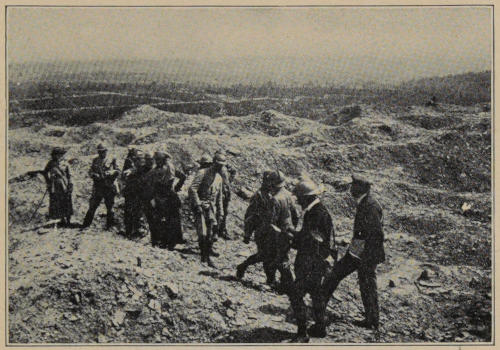
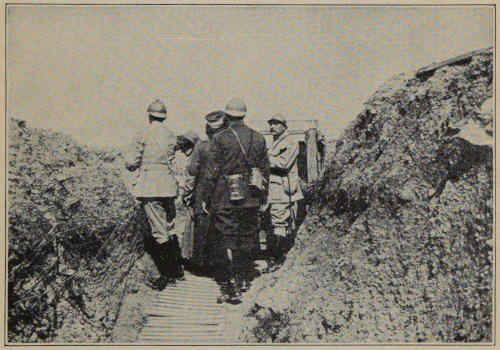
battle-field after dinner, to the famous Fort de Souville,
and the repast, instead of a meal, became the prelude
to a supreme climax. The arrival of General Pershing
was the first subject of conversation, accompanied by
the most courteous and appreciative remarks; one of the
officers told of the first day when the Stars and Stripes
had appeared in the field with the other flags, and of the
cheers that went up. And they drank to the United
States, and we drank to France; they praised the work
of women, and spoke of the immense moral and practical
aid of the entry into the war of the United States.
Whether it would shorten the conflict was another question.
To the captain sitting opposite I said:
“If the soul of the war has a special dwelling-place it
is Verdun,” and told him how the thought of America
turned about it those days of February and March of
1916. “But,” I added, “there was a time when I
thought they might get through.”
The commandant answered quickly from the other
end of the table: “Ah, madame, there was a time when
we thought they might get through, mais ‘ils n’ont pas
passé—ils ne passeront pas.’”
And then I quoted the beautiful phrase of the Commentaires
de Polybe:[5]
“Et Verdun y en ruines, avec ses soldats, debouts, toujours
dans la tempête, comme il n’y en a jamais eu de plus
beaux ... avec Nivelle, et avec Pétain, avec l’image de
Raynal qui vient roder la nuit dans les décombres de
Vaux et avec le paraphe de Castelnau sur cet autre Couronné....”
We ended a most pleasant repast, with its great under
throb, by coffee and tilleul and a little glass of cassis
(black-currant cordial), the native liqueur.
Then, on into a room where we pulled up our coat-collars
so no white would show, slung the bags containing
the gas-masks across our chests, left our flowers,
parasols, and other impedimenta, and went out through
the long, dim now empty hall to get into the autos. We
waited half an hour for ours, which had performed the
seemingly impossible feat of getting lost in Verdun.
The officers began to get impatient, and M. de S. to
make bitter remarks about his chauffeur; the colonel to
walk up and down. The commandant said, “Du calme,”
and the colonel answered that only sous-lieutenants
savent avoir du calme. “Ils sont étonnants,” said another
officer with four stripes on his arm.
Finally our man appeared, with a story no one listened
to, Colonel Dehaye getting in with us, the other
officers leading the way in his auto.
It was two o’clock, and a white, burning sun was
shining on a white, burning earth as we drove through
the crumbling streets, through houses in every stage of
ruin, to the great plain of La Woèvre, toward the dreadful,
scarred battle-field, where the chariot of God rides
the ridges.
Verdun is built to reinforce the natural rampart of
the Côtes de Meuse, to bar the passage of the river’s
valley, and cover the Argonne.
As we passed out of the town on one side was a cemetery
where sleep four thousand, on another side sleep
twenty thousand—and these are but a handful to the
numbers that lie everywhere in the white, scarred
earth around Verdun. The colonel named various battered
places as we passed—Fleury, Tavannes, etc., and
finally we climbed a steep hillside near the celebrated
Fort de Souville, where we left the motors. The abomination
of desolation over which we passed once had
been a green, smiling, wooded, gently rolling hillside.
The village of Tavannes was but a spot of white horror,
even with the ground. The hills of Douaumont and
Thiaumont had on their blanched sides only a few
blackened stumps of trees that will not leaf again. To
the left as we looked about were the fateful summits of
Le Mort Homme and Hill 304 with a white ribbon of
road running between. We walked along, stumbling
over heaps of water-bottles, haversacks, helmets, cartridge-belts,
belonging alike to the invader and the
invaded—bones, skulls, rusty rolls of barbed wire, remains
of obus, and mixed with what lies in the earth
of fair and brave and dear are myriads of unexploded
shells. The country round Verdun, despite the rich
blood that could render it so fertile, can’t be cultivated
for years on account of the vast quantities of shells
buried in it. A man pulls a piece of wire, and he loses
his hand, another tries to clear away bits of something
round, and his head is blown off. One of the
officers told us of societies for the demineralization of
battle-fields, but the work is slow and costly.
Yet a winter’s snows had lain upon it all and spring
had breathed over it since the first awful combats of
February, 1916. I knew suddenly some complete
“heartbreak over fallen things” as I stumbled, and,
looking down, saw at my feet a helmet, and by it a
skull with insects crawling in and out the eyes, and a
broken gun-stock.
Great and gorgeous patches of scarlet poppies in a
profusion never seen before splash themselves like something
else red against the white earth, or fill great
shell hollows and spill and slop over the fields....
The Germans had been shelling a near-by 75 battery
that very morning, and fresh bits of warm shrapnel
were lying all about as we twisted in and out of the
boyaux. I brought away but a small bit with me, having
early discovered that a small piece is as good a
reminder as a big bit, and much easier to carry. We
passed the grave of a soldier buried where he had fallen,
a few hours before. His shallow grave, with its little
cross, was running red, but he was mayhap already in
his Father’s house of many mansions.
In many places under the feet scarcely buried bodies
gave an elastic sensation....
We first visited the emplacement of a great gun
worked by the most complicated electric machinery,
something that seemed built as strongly as the Pyramids,
revolving on its great axis, at a touch fulfilling
that which it was cast into being to perform. When
we came out, we climbed some last white scarred heights
that the colonel called “Les Pyrénées,” and there,
stretched out, was the whole great and fateful panorama
of Verdun—“par où ils n’ont pas passé.” I thought of the
men I had known who had been engaged in those dreadful
attacks, whose mothers and wives had looked upon
them again, and of others still whose wives and mothers
would behold them no more. And I had again a breaking
of the heart over the vast tangle, and cried within
myself, “Shall all the world be a valley of dry bones?”
OUR PARTY ON THE BATTLE-FIELD AT VERDUN,
JUNE 17, 1917
IN THE BOYAUX, VERDUN, JUNE 17, 1917
Then we hid ourselves in some boyaux well out of
sight, for we were nearing a camouflaged battery, two
of whose guns had been silenced that very morning.
In dark woods over beyond Tavannes the Germans
were intrenched, and their shells were also falling thickly
over Douaumont and Thiaumont. It was the front
indeed. It was at Tavannes that in a dreadful moment,
in a moment such as can happen anywhere, artillery
fire had been trained on thousands of men who were
rushing to the top in a great charge. And yet I kept
thinking of the words of a dead hero, “Nothing but good
can befall the soldier, so he plays his part well.”[6]
At that moment the enemy began to send an unwonted
number of shells, which were exploding just
behind Thiaumont, so the colonel told the captain of
artillery—who had joined our party at the gun emplacement—to
answer, and he climbed down a steep
decline to his masked battery. In a few minutes, as we
lay hidden in the boyau, twenty discharges sounded;
but shells that go up, come down, and on the other
side of the hill we were watching, who shall say what
agony? I am so constituted that I cannot think of the
passage of any soul into the next life other than with
awe.
We then descended into the Fort of Souville, down
850 feet, where men live and breathe and have their
being in dimly lighted, damp, narrow spaces. But it
seemed temporarily like heaven to be out of the glare
and the heat. Preceded by lanterns, an officer in front
of each one of us, we crept or felt our way up and down,
stumbling through vault-like passages, where we would
come upon men lying asleep in damp, dim places, or
writing by the light of lanterns, or preparing meals in
their kitchen, or waiting at the little dispensary, and
then we stumbled up again into the heat, reverberating
from the white hills.
On the way back we passed a little chapel installed
in an old cemented dugout. On the altar were many
flowers. I bent and peered into the dimness, and, as
I knelt, it seemed to me that never had I so understood
the words Introibo ad Altare Dei. I thought of the
Lamb of God, and martyrs new and old, and the catacombs
and the primitive Church.... Again men in
stress were worshiping in the bowels of the earth.
We were photographed against a particularly sinister
group of blackened trees, and we picked up some helmets
and bits of obus. As I write, the couronne of one,
quite evenly exploded, lies on the little table by my side.
Just before getting into town the colonel ordered the
motor to stop, and we got out, and, walking through a
field of deep, waving grass, found ourselves in the largest
of the cemeteries with its long, even lines of broad graves
where lie, in a last co-mingling, the brothers of France,
and I repeated to myself in a quiver of feeling, “Scio
quod Redemptor meus vivit et in novissime die resurrecturus
sum et in carne mea videbo Deum Salvatorum meum.”
All was in beautiful order. The crosses bore sometimes
a name, but oftener a number only: 140 soldats,
or 85 soldats. The round tricolor badge hung from
every cross. There were a few graves of officers who
could be identified, their bodies having been brought
in by friends or faithful orderlies. How anything could
live on those fire-swept hills is the wonder, not that
any one died. Suddenly, again, a great sadness fell upon
me, and as the colonel pointed out the grave of an especially
dear comrade—Colonel Dubois, I think his
name was—dead in some heroic manner, I could look
no more.
We finally got back into the green freshness of Verdun,
whose normal state, I see, is to be vine-bowered,
tree-shaded, grass-carpeted. After the scarred and
blazing battle-field, and in spite of the ruined streets,
the roofless houses, I had a feeling of refreshment, coming
from those heights where “all the round world is
indeed a sepulcher” ... and near the station is the
monument to the heroes fallen at Verdun, in 1870.
Of the Cercle Militaire on the right bank of the Meuse
little is left except the walls, but it is no loss architecturally,
and messieurs les officiers are otherwise engaged.
The banks of the Meuse are a pitiful sight. The old
houses that reach over the water are roofless, bits of
mattress hang from broken windows, and heaps of mortar
are falling into the river. The great Porte Chaussée
of the fifteenth century, with its two huge gray towers,
is unharmed. We stopped at the theater for a moment.
A big shell last month had made a sort of pudding of
it. We crept in through a large aperture, to find the
orchestra stalls precipitated onto the stage, and the
loges sagging, ready to fall. We then went up into the
old, high part of the town, and Colonel Dehaye, a true
lover of the arts, in sadness showed us the cathedral and
the charming old buildings that surround it. The huge
church constructed according to Germanic traditions
has two equal transepts, with high and beautiful vaulting,
which is now so damaged that the roof at any
time may fall. Inside were masses of débris, and
nothing was left of the famous stained-glass windows
except powdery bits of color on the floor. The colonel
had rescued some old Spanish Stations of the Cross,
and had put in safety a few other portable things of
value. We passed out through the sacristy, which was
a scene of disorder, bits of vestment, torn altar-cloths,
and books lying about on the floor.
“But,” I said, “the Germans didn’t get here?”
“Oh,” answered one of the officers, with a smile,
“ce sont nos bons français.”
Then we descended into the crypt, the remains of the
church that Pope Eugene III built in the twelfth century.
Leading down to it is an old winding stair, with
a delicious eighteenth-century wrought-iron railing. An
artist in a white blouse, sent to restore some frescoes
dating from the twelfth century, was rescuing from too
complete destruction a beautiful figure of Christ with
something stern and immutable in His look, reminding
me of the Christ in the church of San Cosmo and San
Damiano in the Roman Forum. We then went into
the cloisters, with lovely and diverse motifs on their
vaultings, very much damaged in parts, a big shell
having landed in the courtyard which they inclose.
M. Renouard had stationed himself there with his
easel, before a beautiful arrangement of trees and grass
and enchanting old statues on mossy pedestals. In
front of him was a great heap of fallen masonry, and a
beautiful bit of toppling vaulting that the colonel had
had propped up by beams, though he said: “Demain ou
après-demain cela ne sera plus—it’s all at the mercy of
a shot.” A sculptured Holy Family, somewhat the
worse for war, is plastered into one side, dating from the
fourteenth century.
From there we passed into what had been a seminary
until 1914, and one of the rooms with rows of lavabos
(not of the eighteenth century, as the colonel observed)
looked out on the great plain of La Woèvre, and again
the fateful panorama was unrolled before us. In what
had been a council-room there was an old choir high up
over the door, with a little balcony giving a Spanish
effect.
Coming out, at the north side of the church, an ancient
Romanesque statue of Adam and Eve on the
outer hemicycle of the apse and some little windows,
also of pure Romanesque, were pointed out to us. In
the ground underneath the statue of Adam and Eve
a great shell had opened up a Roman foundation and
walls, formed of immense square blocks of stone, hidden
during ages.
Near the church is the great Cour d’Honneur, once
the house of the bishop, a very perfect example of Louis
XIV, making me think of Versailles; but it, too, has
received many a blow in its lovely heart. One longed
so to bandage up all those wounds of war, preserve in
being those lovelinesses of another age.
We then visited the house of Pope Julius II (I forget
what he was doing at Verdun), which, fortunately, has
not suffered much up to now, though it, too, is at the
mercy of a shot—to-night, to-morrow, or the next day.
It would make a perfect museum, with its beautiful
old door, bearing inscription and date, through which
one passes into a tiny V-shaped court with a flowering
linden-tree, and there are two romantic winding stone
stairways, with something Boccaccioesque about them,
leading to the upper stories.
Though it wasn’t an occasion in which to think how
one felt, the flesh was weary by this time, and we went
gladly back to the colonel’s mess-room, where we had
tea, or rather, to be exact, some ice-cold champagne
coupé d’eau, and some sort of madeleine, a specialty
of Verdun, which gave us the little flip-up that we needed.
Another specialty of Verdun is the dragées (hard,
sugared almonds), but the factory, so one of the officers
said, had been destroyed the year before in one of the
bombardments. Generations of tourists having broken
their teeth on them, however, we wasted no regrets.
The colonel begged us to stay for dinner, and the
cinematograph representation after, but we were obliged
to regretfully decline, as we had to pay our respects
to the general at Y——, to whose courtesy M. de S.
owed the safe-conducts to Verdun. As we passed by
we looked into the long, narrow hall where the representations
are given, the sight of which the colonel
offered as further inducement. It would have ennobled
for me forever that most boresome of modern things,
had I assisted at one underneath the citadel of Verdun.
The hall was hung with flags of the Allies. With sudden
tears I saluted, ours waving among them.
We thanked a thousand times the colonel and his
group of officers standing by the auto at the entrance to
the subterranean passage, and though I had a consciousness
of the uncertainty of their lives, I thought
again “Nothing but good can befall the soldier, so he
plays his part well.”
Now comes to mind a conversation I had before I
ever dreamed of going to Verdun, when I talked for three
hours of battles and scars with a young hero wounded
on Hill 304, June 9, 1916. He is a flashing-eyed, straight-featured,
tall, slim-waisted young hero who knows what
it is to have made, and with astounding ease, the sacrifice
of the life that he loves so, and drinks in full
bumpers. And this is part of what we said, one of a
thousand, of ten thousand, of a hundred thousand
happenings, of which Verdun is the golden frame:
De G.—“There was something hanging about Verdun;
‘Ils ne passeront pas, et ils ne sont pas passés.’ If
the enemy could have but known how thinly, poorly, in
so many places it was defended! It was seemingly the
will of Heaven rather than the strength of mortals that
they were not to pass, not man, not artillery, but the
high destiny of nations.
“When I lay during those hours at the poste d’observation
on Hill 304, in front of the French army, signaling
‘shell square 17,’ or 16, or whatever it might be, I could
see clearly the havoc in the German ranks as the shells
would fall. Great groups of men would be blown to
atoms and new formations would press in to take their
place. The whole horror was there before me, mapped
out in numbered squares.
“I dismissed all my men except my orderly of the
fourth Zouaves, who wouldn’t have gone, anyway. It
was a work I could do alone, lying with a sand-bag
against my head, my field-glasses in my hand, and before
me my field map held down by four sticks. We
lay there just under the crest of the hill from two o’clock
in the morning until the next afternoon, watching seven
attacks. Toward three o’clock I was wounded, and
I knew it was only a question of time and chance
when I would lie like the dead man at my side, that
Dueso had been pressing his feet against, and whose
place I had been sent to take. Almost at the same moment
I caught sight of Dueso spinning around, holding
his elbows to his side, and crying out: ‘Nom de Dieu!
Nom de Dieu! I’ve got it in the arm!’—but trying
with the other hand to undo his cravate.
“Two jets of blood were now spurting like two
faucets from my leg, the big artery was cut. Ça y est.
In five minutes I’ll be dead, I thought, and there came
a fainting away and a thinking not on God, but on still
untasted joys of the flesh and life—not even on my
mother’s grief; and waking up after years, it seemed,
and calling for water, and Dueso bending over me,
after a frantic twisting at his cravate, and a frantic
pulling and tightening of it about my leg, with one
hand and his teeth, and then a pleasant, happy fainting
away. A delicious sensation of ease invaded me, and
I said to myself, ‘Ce n’est que ça, mourir?’ (‘Is death
only this?’) I have seen so many men die, and whatever
their agonies, if long or short, minutes or hours or
days, as it may happen, just before dying something
gentle and simple takes place.”
E. O’S.—“The inevitable dust to dust, the natural
law fulfilling itself?”
De G.—“It may be. This rictus de la mort, I haven’t
seen it, though I have heard men screaming and cursing
and praying in the trenches as they got their blow, and
watched their agonies, but before death something else,
softer, always happens. Unless it comes too suddenly.
I remember once being on the dunes in Belgium, and
against the yellow sand men were sitting in red trousers
and chechias, and one was telling a tale of laughter
when a shell burst. In a moment the blood of his
brains was flowing red upon the yellow sand, and then
it got blue, and then it sank and was no more, like the
laughing man himself from whom it flowed, and his tale
of laughter.... About nine o’clock we were brought in.
Dueso had been lying with his head under my armpit,
and his feet still on the dead man, and we would both
come out of a faint from time to time and ask for water.
“Dueso! ah, Dueso! for a human being il est plus
chic que moi. He had been in jail for various reasons
not very chic, and I was warned against him when I
took him for my orderly, but to him I owe my life.
Now he is in Salonique, cité à l’armée, knows how to live
in those regions, hard as nails, originally from Tunis; a
dark man, with dark mustache and very big white teeth.”
E. O’S.—“One thinks so often how little the common
soldier, defending honors and riches that he doesn’t
share, has to gain. There is nothing for him, in fact,
except to step out into anonymous death; at a given
moment to make the sacrifice of his life, or his eyes or
his limbs, knowing nothing of war except its horror,
rarely any glory, sometimes a mention or a medal,
oftener not. But,” I continued, after we had sat silent
for a while, “who will carry it all on? Few like yourself
are left, and it is not enough. France is bleeding white—France,
whose sons are heroes, not fathers!”
De G.—“What does it matter if we do go? There
are the little ones coming on. It will be like something
out of which a whole piece has been cut and the ends
must be sewed together. The very old, and the very
young, the children, are these ends. We shall have done
what we were born to do. This is the immortal history
of France that we have made, her chant du cygne, too,
the most beautiful of her epics and it is enough to have
lived for that. To others the carrying on of the generations....”
A pale rose light begins to come in at the window,
but sleep cometh not. Fortunately, if need be, I can
do without it, but I must close my eyes now. He, too,
watching over Israel, slumbers not nor sleeps....
CHAPTER IX CHÂLONS.—CHÂTEAU DE JEAN D’HEURS.—REVIGNY, THE “LINING” OF THE FRONT
Each, on comparing notes, was found to have spent
the night on the outside of the bed. One of the
party, who naturally wishes to remain anonymous,
found a cafard, the classic cockroach, in her ear toward
dawn, and Aurora was welcomed by no hymn of praise
from her.
Now we are sitting drinking lemonade on the pavement
in front of the abode of iniquity. We have been
twice through the hot town, which consists of a modern
town around the station, and a picturesque old one on
a hill at the back, to find the proper authorities for the
stamping of our papers with the military permis to go
to the château of Jean d’Heurs, belonging to Madame
Achille Fould, for luncheon. We caught the major by
a hair’s breadth; he was disappearing around the corner
by the military commandature on his bicycle. Then to the
préfecture for permission to telephone to Châlons for
rooms that night; on returning, found Miss M. and
Miss N. awaiting us. They have been working at the
“Foyer des Alliés” near the station. They want now to
get a much-needed canteen in shape at Châlons, and are
asking us to help. The word from the colonel of Verdun
is an “open sesame,” and we will investigate en
route to Paris.
Châlons-sur-Marne, 10 o’clock p.m.
It’s been as long as to Tipperary since the scrawl at
Bar-le-Duc.
At 11.30 we got into the comfortable motor Madame
Fould sent to bring us to Jean d’Heurs’ for lunch. It’s
a beautiful old château of the eighteenth century, given
by Napoleon to the Maréchal Oudinot, and in the Fould
family since those days, though not lived in until the
war by the present generation. It made us feel quite
like “folks” as a side-whiskered, highly respectable,
rather aged majordomo received us and led us up a
broad stairway and showed us into a big library where
Madame Fould, her seven infirmières, and a young officer
were waiting. After that, a perfect lunch in the way of
each thing being of the freshest and most delicate and
tasting of itself. The young officer was recovering from
a wound received at Verdun last September, followed by
a trepanning, evidently highly successful, as, in addition
to all his senses, he had a thick mat of hair.
The library, to which we returned for coffee, was
lined with the most precious books in the most precious
bindings, one whole side containing first editions only
from Voltaire and J.-J. Rousseau to Châteaubriand and
Taine. And I ran my fingers with such a friendly feeling
over some soft and lustrous bindings.
The vast spaces of the château are now made into
wards, and relays of several hundred men are cared for
in them. White hospital beds are pushed against
elaborately frescoed walls and Empire gildings. Everything
in spotless order. Afterward we went out into
the beautiful old park, where convalescent men were
sitting or lying about under the great trees. The park
is now closed to visitors, the fair sex from neighboring
villages having been too generous in their offerings on
the altar of Priapus. It’s a lovely spot, and Madame
Fould has had her hospital going since the beginning of
the war.
At two o’clock we motored into Revigny, accompanied
by the handsome young trepanned officer, who
deposited us at the military headquarters for the stamping
of our safe-conducts. Mrs. C. P., who can put her
head through a stone wall, without injuring it, as neatly
as any one I ever saw, proceeded to perform the feat,
with the result that the major in command gave us all
permission for the next étape, Châlons. Then Mrs.
C. P.’s young son, serving with the American Ambulance,
met us, motoring over from Z——; a friend came
with him, originally from Swarthmore, Pennsylvania,
rather discouraged at the quiet of the secteur in which
he was stationed. But all he has to do is to wait.
Everybody at the front eventually gets what’s “coming
to him.” Mrs. C. P.’s boy had on his Croix de Guerre,
got for fearless ambulance work at Verdun during one
of the big attacks.
Revigny seen from the inside is a hole of holes—but
through it defile continually the blue-clad men of
France. Twelve thousand had already passed through
that day. In the carrefour of the road by the station is a
ceaseless line of convoys coming from or going to Verdun.
This once banal little village has come to have something
symbolic about it, though looking, as one passes by, like
dozens of other destroyed villages. But inside it is the
lining of the war—that thing of dust, fatigue, thirst,
hunger, sadness, fear, despondence, hopelessness, running
up and down the gamut of spiritual and physical
miseries. “Theirs not to reason why.” ...
The English canteen is the only bright spot in the
whole place. Those sad-eyed men, like us, love and
regret, and are beloved and regretted; women have let
them go in fear and dread; and all over Europe it is
the same, east, west, north, and south—all they love
they lay down at the word of command. I watched for
an hour the blue stream of heavily laden men as they
passed in, coming up to the counter with their battered
quart cups, drinking their coffee standing, in haste, that
the comrade following might be sure to get his drink,
the sweat dripping from their faces. Fifteen minutes
later a great thunder-storm broke, and thousands of
sad-eyed men were huddled together, shelterless, like
sheep, suddenly soaked; the hateful dust became the
still more hateful mud. I left it all in complete desolation
of spirit, and wondering, Is God in His heaven?
Revigny was worse to my spiritual sense almost than
the battle-field—there all was consummated. Here the
men are still passing up to sacrifice.
CHAPTER X MONT FRENET.—LA CHAMPAGNE POUILLEUSE.—THE RETURN
Châlons, 10 p.m.
We dashed into the train at Revigny during the
hail-storm, an infernal kind that didn’t cool the
air, and arrived at Châlons at six o’clock. No cabs, at
least none for us, so we begged two Quaker women with
the red-and-white star in the little black triangle on
their sleeves, who were getting into the only visible
conveyance, to take our luggage and deposit it for us
at the Hôtel de la Haute Mère Dieu, whose name so
appealed to me. We paid our share of the cab, and all
and everything departed, we on foot. Châlons seems
quite without character as one passes through the streets,
though I caught sight of several old churches and, alone,
would have lingered on the busy bridge that spans the
Marne. We got to the Hôtel de la Haute Mère Dieu
and interviewed the female keeper of that special paradise,
who said she had nothing for us, had received no
telephone message from the préfet at Bar-le-Duc or any
other préfet from any other place. Then Mrs. C. P.—the
Verdun day and the Bar-le-Duc nights having somewhat
stretched our nerves—began to get annoyed; the
desk-lady finally asked us, did we belong to the Westinghouse
Commission, which we didn’t. We then betook
ourselves to the streets. Nothing at the Hôtel
d’Angleterre, nothing at the Hôtel-Restaurant du
Renard. We finally asked a large, beady-eyed, determined-looking
female, standing at a door, if she had
accommodations or knew of any one who had. She
proved to be the sage-femme of the quarter and eyed us
askance.
Just then appeared a very comme il faut, pretty young
woman with an expression at once so charming and so
modest that we did not hesitate to accost her and tell
her of our plight—that it looked as if we should be
passing the night à la belle étoile if some one didn’t do
something for us. She hesitated, looked at us, hesitated
again. Smashed down on her head at a smart
angle was the identical hat that Mrs. C. P. was wearing,
blue with a twisting of gray, from Reboux. I think
that hat crystallized things, for she ended by saying,
sweetly:
“I have a room that I sometimes offer to friends;
only,” she added, “there is a horrible stairway leading
to it.”
We turned our backs on the sage-femme, doubtless
naturally good, but soured by the constant witnessing
of the arrival on the scene of apparently superfluous
human beings (I say “apparently,” for who shall decide
which souls are precious?), and followed those neatly
clad, small feet and slim ankles up a winding stairway
that might have been of any epoch—except the nineteenth
or twentieth century, and found ourselves in a
charming little interior, spotlessly clean. “C’est à votre
disposition,” she said, and then a servant appeared, a
refugee from Tahure, as we afterward learned, a garrulous
refugee. I beat my breast later on when I heard
the loud bassoon, telling Mrs. C. P. that I even hated
refugees and that that one would have, if possible, to
contain her tale till I had had a night’s sleep. At the
moment I hated her with all the unreasoning hatred of
the beneficiary for the benefactor.
Well, to make a long story short, closets were opened,
the freshest of embroidered linen sheets, the largest of
towels, were got out, and were left to us in the handsomest
of ways with the refugee, the owner departing
to her country house. The refugee managed to get in
part of the story of her life and she brought hot water;
she was from Tahure and left on the run with an aged
husband, just before the entry of the enemy.
Then we looked about the pleasant room. The first
object I espied was a pair of manly brown kid gloves,
the next a blue gas-mask bag, and a cigarette-case, with
a crest, lying near a volume of Alfred de Vigny. (Can’t
you see them reading it together?) And there was such
a comfortable chaise-longue for him to rest on, and an
expensive, very “comfy” rug and many cushions. As
the refugee from Tahure proceeded to make up the bed
and sofa she interspersed the story of her life with remarks
concerning her mistress, like: “Allez, elles ne
sont pas toutes comme cela, elle a un cœur d’or”; “Moi,
qui vous le dis, elle n’a pas une mauvaise pensée.”
At this juncture we delicately asked, But where does
she live? “Oh, he has given her a little château in the
environs.” This was a convenient town apartment with
the one big room giving on the Place de la République;
at the back a dining-room and little kitchen. Having
removed the dust of travel, hot water being produced
in a jiffy from the gas-stove on the kitchen range, we
descended to take dinner at one of the restaurants near
by. We were so tired about this time that the decalogue
wasn’t much to us, neither the Law nor the Prophets,
but be it remembered of us, we did love our neighbor
as ourselves.
When we came back after supper the sofa was spread
with large, crisp, spotless linen sheets, the bed the same,
the refugee gone, and here we are in this clean, low-ceilinged
room with eighteenth-century wood-panelings
and charming door-handles of the same period. There
is a crayon of the present tenant reflecting her sweet
and candid expression over the mantelpiece, on which
are two Dresden-china figures and a small white-marble
“Young Bacchus”; furthermore an etching by Hellu
of the Duchess of Marlborough, which made one feel
quite poised. In fact, there is nothing demi about it.
The Place de la République is full of soldiers coming
and going, and there are several ambulances of the
Scottish Ambulance Corps drawn up by a big fountain
representing three women (typifying the Marne, the
Moselle, and the Agne). Over the soft, warm night is
borne the low boom of cannon. The guard has just
called out: “Faites attention! Lumière au troisième
étage”—so I must stop.
Tuesday, 9.30 a.m.
Sitting in the Place de la République on chairs borrowed
from a little lace-shop, and waiting for the cab
to come to take us to General Goïgoux, to whom
Madame Fould had given us a letter of introduction.
Just opposite is the inhospitable Hôtel de la Haute
Mère Dieu, and I have been telling Mrs. C. P., who has
gone to buy some fruit, of the story of Voltaire and
Madame du Châtelet passing through Châlons en route
from Versailles to Lunéville. At Châlons Madame du
Châtelet thought she’d like to have a bouillon at the
Hôtel de la Cloche d’Or, where they stopped to change
horses. (It still exists and is the only one we didn’t
try last night.) It was brought them to their carriage
by the aubergiste herself, who had learned from the indiscreet
postilion the identity of the illustrious travelers.
When Longchamp, the valet of Voltaire, asks to pay,
she firmly demands a louis d’or for the bouillon. “La
divine Emilie” protests, the woman insists that at her
hotel the “price of an egg, a bouillon, or a dinner is a
louis”; then Voltaire gets out and tries by amiable processes
to explain that in no country in the world did a
bouillon ever cost a louis; more cries and reproaches; a
crowd gathers; Voltaire, strong in his right, doesn’t
want to give way. Madame du Châtelet points out the
gathering crowd, now quite noisy. Finally they pay,
Voltaire commending to all the devils the hospitable
town of Châlons-sur-Marne; they depart to the accompaniment
of the gibes of the amiable inhabitants.
It may be autre temps, but not autres mœurs; it’s just
like the woman at the desk at the Hôtel de la Haute
Mère Dieu, who wouldn’t take us in, in any sense, last
night.
The most awful-looking cab has just drawn up in
front of “our” house, and a smart American ambulance
officer is trying to get in.
In the Train en Route for Paris.
The first quiet breath I have drawn, and very comfortable
it is to sink into the broad seats, out of the
glare of the setting sun, and feel there is nothing to inspect
save the flying aspect of nature for the next three
hours.
The handsome officer this morning proved to be Mr.
B., and he didn’t get that cab, which, however, we
promised to send back to him once we were deposited
at the general’s headquarters.
General Goïgoux is most agreeable. When he asked
us where we were lodged, we threw a stone at the Hôtel
de la Haute Mère Dieu and told him of our Good Samaritan.
He gave a grin, if generals are supposed to
grin, when we said that we had not disturbed her to any
great extent, as she had, in addition, a country place
where she really lived. We then told him of our meeting
with Miss N. and Miss M., who had asked us to
investigate the canteen prospects on our way back to
Paris. The installing of one has long been the idea of
General Goïgoux, who loves his poilus, and he immediately
rang the bell on his table—among his books was a
German Baedeker of eastern France—and in a moment
a captain with a sad face and a black band on his arm
appeared, and we departed in a huge military auto to
the station to investigate the great railway shed that
the general has requisitioned for canteen purposes.
Going through the streets, we were held up for a
moment by a detachment of prisoners in various uniforms
and from various regiments, but all with P.G.
(prisonnier de guerre) marked in large letters on their
backs. A tall, upstanding set with ringing tread,
not at all unhappy-looking, despite a something set
about their expression, seemingly in very good physical
condition.
Statues of the top-hatted, frock-coated political men
of nineteenth-century France have banalized the public
places of every town in the doux pays. They simply
can’t compete with the saints and kings and warriors of
the artistic periods—it’s too bad they have tried.
At 12.30 we got back to our pleasant quarters, to
find our hostess there, in a very smart dark-blue serge
dress from Jeanne Hallé. In addition to the château,
the shop down-stairs, called “Aux Alliés,” where all
sorts of edible delicacies are sold, belongs to her together
with a tall and beautiful red-haired Frenchwoman.
This is her up-stairs resting-place during the day. We
sank on bed and sofa, exhausted by the heat, the visit
to the station to inspect the canteen facilities, which
seemed most promising, visits to two churches, and
luncheon in the crowded Restaurant du Renard. In the
church of St.-Alpin white-bloused experts were busy
removing the beautiful sixteenth-century stained-glass
windows. “If ’twere done, ’twere well ’twere done
quickly.” That continued booming of guns made one
realize at once their fragility and their beauty.
Shortly after, a handsome young officer came in, a
gentleman, and speaking beautiful English. It wasn’t
“he,” however, but a friend of his, and we did a little
“society” talk—the weather, the necessity of learning
the languages young, the theater, that Réjane was getting
old, and “L’Elévation” was bad for the morals,
and fashions, if the skirts could get shorter—but nothing
of the war.
At two o’clock another military auto was announced,
which the general had sent with a doctor to take us to
Mont Frenet, four kilometers from Suippes and six
from the German lines. The young officer departed;
we veiled and gloved ourselves and descended, and got
into the motor, where we found a large, dark, military
man inclining to embonpoint, who thought he was good-looking,
and started out. The first thing we met as we
got out of town on the dusty, blazing highroad was a
little funeral cortége, preceded by a priest. The body
of the soldier was draped in the tricolor, and following
to his last rest, close behind, was his camarade, with head
bared. He had doubtless expired in the big hospital
near by, one of those lonely hospital deaths that hundreds
of thousands have suffered before transfiguration.
We were in the great plain of the Champagne Pouilleuse
that leads to Suippes, Sainte-Ménehould, and
stretches out to Reims—a plain with great, white,
chalky scars of quarries, interspersed with fields and
dark patches of pine woods. I asked the doctor about
the site of the ancient camp of Attila and the battle
of the Catalonian fields, but his knowledge of the matter
was vague and his interest perfunctory. I thought
afterward he might have had a more personal afternoon
planned than that of taking two objective-minded ladies
to Mont Frenet. There was once a great Roman road
from Bar-le-Duc to Reims, and all about are little
churches of the twelfth and thirteenth centuries, mostly
touched up in the eighteenth.
After three-quarters of an hour we found ourselves
nearing what might have been a modern mining settlement.
It is the great front hospital of Mont Frenet.
A model establishment organized and conducted by a
man of heart and brain, Doctor Poutrain. Young,
élancé, alert, he took us the rounds of his little world,
from the door where the ambulances deposit their
wounded, their dying, and oft their dead, where they
are sorted out, through the numberless wards, even to
the model wash-houses and the places where the garments
of those brought in are scientifically separated
from their inevitable and deadly live stock.
As we passed through one of the wards, I saw the
doctor’s eye change, and, following it, I perceived, as
he quickly went to the bedside, a face with the death
look already on it; and in a moment, with a slight sigh,
a soul had breathed itself out—en route to the heaven
of those who die pro patria.
And I thought in great awe, “All I know or ever
will know of that human being is his supreme hour.”
And so fortuitous, so sudden was it all that I had not
even time to breathe a word of prayer, nor even to
reach out for his hand. And I, come from so far, so
unrelated to him, was thus the destined witness of his
passing. I can’t get it out of my mind.
Doctor Poutrain loves his broken men, and he said,
“I want no man who has been severely wounded or
mutilated to leave my hospital without his decoration.”
He had tears in his eyes as he stood by a bed where a
bright-eyed, thin-faced boy was lying with a hip fracture.
“He brought a comrade in, under fire, who was
shot off his back as he was carrying him in.”
In one of the beds an aviator was lying, brought in
three days before; the eyes, the mouth, the whole face
had still the peculiar look of strain. Indeed, three faces
stand out in one’s mind—the captivity face, the hard,
shining face and eyes of unwounded men just from the
combat, and the faces of wounded aviators. About
this time I noticed the gloomy look deepening on the
face of our accompanying Esculapius, and it suddenly
occurred to me “he is one of those who support with
difficulty the praises of another.” For we had been
very explicit in praise of Doctor Poutrain’s wonderful
installation.
It was a slack day, and according to the record in the
antechamber there had only been 517 brought in that
day.
We have tea with the directrice of the gardes-malades
(ten or twelve women only), a friend of Madame Fould’s.
As we sat there talking I discovered that the eager
médecin-chef had had, before the war, as hobby, archeology
and ethnology, especially of the prehistoric races
of Mexico; that he also possessed one of the few Aztec
codices existing—all of which we discussed to the sound
of the German guns and the whirring of their airplanes.
We finally made our adieux, came home over the hot,
unspeakably dusty road of the Champagne Pouilleuse,
unreasonably disappointed that nobody would give us
permission to make a little détour by Suippes, then
under fire. We got back to our headquarters, packed
our belongings, and diffidently brought up the subject
of remuneration, which the belle châtelaine firmly refused.
I was traveling light, without a single thing
approaching the superfluous, but Mrs. P. had a breakfast-cap
and her tortoise-shell toilet things and trees
for her shoes, and she also found among her belongings
a lovely amber box, which she presented in
token of our gratitude. We could make the garrulous
refugee from Tahure not only happy, but speechless,
which was more to the point; and here we are, looking
out on a darkening world, and there are soldiers bathing
in the river, near stacked guns, and everywhere little
detachments are marching down dim roads, and there
are the eternal troop- and equipment-trains going to
the front—and I feel an immense regret at leaving it
all....
Paris.
As we were sitting in the dining-car, idly wondering
how on earth we were going to get from the station to
our respective abodes once the train had deposited us
at the Gare de l’Est, or planning to spend the night
there, the Marquis de M. passed through the car. His
motor was to meet him, and he gallantly offered transit,
that can be above rubies and pearls par le temps qui
court.
When we got to Paris at 10.30 we saw in the dim
light, as we stepped into the big motor, voyagers departing
with luggage on their backs, or, preparing to
await the dawn, sitting on it. We got into the motor
with Comte de ——, the Marquis himself sitting outside,
“for the air,” as he said, and also because there
was no more room inside.
As we rolled along through the dimly lighted streets,
the air dense and hot, a terrific hail- and thunder-storm
suddenly deluged the town, and especially the generous
Marquis outside, well punished (as usual) for his kind
act. When, slipping and skidding, we finally pulled
up at my hotel, a very wet gentleman, but remembering
his manners, said, “Au plaisir de vous revoir, madame.”
(He must really have wished me to all the devils, where
he would never meet me a second time, hoping it was
a last as well as a first meeting.) I had to laugh, also
he, the pleasure was so evidently doubtful. It ended
by his betaking his soaking person into the auto, and I
came up-stairs to find my lamps trimmed and burning
and my beloved mother awaiting me to hear “all about
it.”
So may one go to the front and return....
PART II
CHAPTER I BY THE MARNE
Gare de l’Est, Wednesday, July 25th.
No, it isn’t possible, even for one whose business is
not that of stopping bullets, to go toward the combat
a second time without a thrill.
Few soldiers in the station; they are mostly at the
front, at Craonne and Le Chemin des Dames and other
sacrificial places, and in a week or two the empty beds
in the hospitals will be full again. Some officers are
hastening back from their permissions with pasteboard
boxes and other unwar-like accoutrements. One is sitting
by me, a straight-featured young man with dark-ringed
eyes, his Croix de Guerre and fourragère,[7] reading
Brin de Lilas. In forty-eight hours he may be dead.
Another officer is reading Cœur d’Orpheline, and Le Pays.
Miss N., with something of serene yet brooding in
her being, plus a sense of humor, arrives with a telegraphic
pass from army headquarters at Châlons, which
may or may not “pass” the train conductor.
Later.
Chelles, where the arts of peace in the form of a vermicelli-factory
testify to the arts of war by having every
pane of glass broken; and once there was a celebrated
abbey at Chelles which was destroyed, with a tidy
amount of other things beautiful, at the time of the
French Revolution.
Farther along much thinning out of the woods, the
beautiful warmth-giving, shade-giving forests of France.
In one place there is a planting of young, slender trees,
and I thought on those other children of France who
must grow to manhood, remake her soul, transmit her
immortality. The first harvest is stacked and yellow,
and nature is densely, deeply green where it had been
pale and expectant. Even the Marne, which we caught
up here, has a deeper color than in June, as it reflects
the lush green.
Meaux, with its cathedral rising from the center of
the town, untouched except by time. Meaux has now
come to be a sort of joke (“de deux maux choisir le
moindre”) which few can resist—I’ve even heard it at
the Théâtre Français—and it’s supposed to be the heart’s
desire of the embusqué, far enough from the front not
to get hurt, and far enough from Paris to be out of
sight.
Château Thierry, with its first vintage of white grapes,
and I bethought me how the whole of France is one
vast wine-press—“He is trampling out the vintage
where the grapes of wrath are stored.”
Epernay, with its peculiar church tower. The great
building of the champagne Mercier firm near the station
has every window-pane broken, and part of it is serving
as a Red Cross station. The wave of invasion pressed
hard through Epernay that August of 1914.
In the dining-car we sat at a table with two officers—an
airman, tall, deep-eyed, some sort of tic nerveux disturbing
his face, with the Grand’ Croix de la Légion
d’Honneur among other decorations; and a captain of
infantry, who had been months at Arras, and at Verdun
the terrible March of 1916.
About the time that the cross-eyed waiter (it was
easy, poor soul, to see why he wasn’t wanted in the
trenches) threw the last set of plates with a deafening
crash down the line of diners (the captain of infantry
said it was just like the first-line trenches), the airman,
whose nerves couldn’t stand it, pursued, rather
irritably:
“You don’t even read the communiqués any more, I
wager. Oh, les civils!”
“I can’t truthfully say I do, always,” I answered,
feeling called on to defend the sacrés civils. “After three
years of it we are fatigued and bewildered by the spectacularness
of it, the great, dazzling, hideous mass of it,
and you who perish on the battle-field but perform an
act that all must some day perform, only different in
that it is far better done—dulce et decorum—but, after all,
the same act that we must perform against our will, at
the mercy of some accidental combination. It’s the
same outcome, ‘and one’s a long time dead.’”
After a pause and a deep look, perhaps it is the look
men have when alone in the secular spaces, he answered:
“Choisir et aimer sa mort, c’est un peu comme choisir
sa bien-aimée,” and suddenly a flash illuminated my
soul, showing me something of the dulce as well as the
decorum of dying for country.
And then we looked out of the window, and there
came into my mind a completely commonplace event
that caught my attention in the first wonderment and
horror of the world war. Accompanied by her daughter,
an elderly woman, one August evening of 1914, took
the Fifth Avenue motor-bus to get some fresh air, and
they placed themselves on top. At that epoch, instead
of going straight up the Avenue, which was being repaved
around about Thirty-fifth Street, the omnibus took a
turn into Madison Avenue and reappeared again at
the north side of Altman’s. Now the roof of the porte-cochère
of Altman’s has a motif of bronzework. The
omnibus lurched just at this point; the head and hair
of the old lady were caught in it; she was lifted up from
the top of the omnibus, remained suspended in air for
an instant of time, then dropped to the pavement,
where she breathed out her soul. Doubtless there
are those who will understand why this completely
unimportant matter has remained in my mind—even
why I thought of it at that moment.
Châlons-sur-Marne, 36 rue du Port de Marne.
An 1860 house requisitioned by the military authorities
for the Dames de la Cantine.
6.30 p.m.
Sitting in a little glass-inclosed veranda even with
the ground. The side against the house, in between
the doors and windows, is painted in a crisscross pattern
of dark green against light green, and the woodwork
is that favorite but uninspiring shallow brown;
a large, empty, double-decker cage for birds is in a
corner. The veranda leads into two low-ceilinged rooms
with parquet flooring and little squares of Brussels carpet.
In the first is a writing-table, some arm-chairs,
and a horsehair sofa is across a corner; brown wallpaper
ornamented with the inevitable oil-paintings of
“near” Corots, and “farther” Guido Renis—everything
distinctly early Victorian, and something soothing in its
atmosphere after three lustrums of art nouveau. After
all we’ve been through in art lately, early Victorian
isn’t as bad as we once thought.
I looked for a moment into the walnut bookcase and
found bound volumes of La Semaine des Familles, 1850-60;
Le Musée des Familles of the same dates: Le
Magasin d’Education, of the eighties; and the curious
part is that here beside the Marne it doesn’t seem of
any special country, but of a special period.
The kitchen leads out of the dining-room (which
latter is the spiritual twin of the salon), and has an
old, unused fireplace with a high masonried shelf above
it and a beautiful ancient fireback with coat of arms.
Near the high window is a little range and the inevitable
gas-stove. I put my valise in the sitting-room
and went out into the old garden, untouched since the
winter’s sleep and the spring’s awakening. It looks
out on the road; beyond is a raised walk along the
river, and across the stream, just opposite, is the station
and the evacuation hospital.
But I was feeling uneasy as I looked about, for I was
separated from my carnet rouge,[8] which has been unnecessarily
reft from me by a too-zealous station individual.
Miss Mitchell had met us, smiling and
waving, which ought to have been a patent of respectability,
from the other side of a bayonet, the side we
wanted to be on; but the man had a dullish eye and
didn’t see that we were birds of a feather, and, anyway,
had just been put in authority and was enjoying
his full powers, after the usual manner of the unaccustomed.
So I departed, and got sopping wet in my only suit
(am traveling lighter even than the first time), and my
garments were furthermore ravaged by falling pollen
from a linden-tree under which I had confidingly stood
during the downpour. I was a sight, but I had to get
that carnet rouge. Any one who has been in la zone des
armées and has been separated from it will understand
the orphaned and anxious feeling that possessed me.
Later.
A pale brightening of the western sky after the
heavy rain. Two avions de chasse passing swiftly to
the northeast. I wandered out of the garden, past some
modern houses (this part of Châlons, for some reason,
is called Madagascar), taking the little raised earth-walk
by the Marne. The river, always slow-flowing,
has an almost imperceptible movement in front of our
house, and there are many grasses and reeds; the banks
are weedy and little green boats are made fast to them,
and nature is a bit motley and untidy. A soldier is
fishing on the opposite side near the station. An officer
and a black-robed woman pass. Farther down, the
banks are thickly wooded and the trees glisten after the
rain; even the great railway station is a-shine, where tens
of thousands of men pass daily, together with millions
of francs of war material, and it all looks like some not
very sharp wood-cut of the sixties—the kind you
wouldn’t buy if you were looking over a lot; but, somehow,
lived in, it is charming. Then I found myself on
a path by the river, with a lush border of trees, poplar,
willow, white birch, ash, hawthorn, and clematis-twined,
wild-grape-vined bushes. On the other side were ripe
wheat-fields. Near a sycamore a man and a woman
were locked in an embrace, whether of greeting or farewell
I know not. Neither was very young—this much
I saw before I turned my eyes and went on; but when
I passed there again they were as before, their eyes
still closed; and I suddenly knew them for true lovers,
who count not moments, but were lost in some infinity;
and for all I know they may be there yet, and if not
they, then others, for the spaces of love are never empty.
To some it may be nonsense that I am talking, but there
are those who will know. All the while there was a dull
boom of cannon, and other men who could love women
were giving up their lives; and I seemed to understand
little or nothing, but did not need to understand, for I
had a full heart, which is better than a full brain. And
I cried, as I walked back, “Domine Deus, Rex Celestis,
Pater omnipotens,” and left it all—the soft love and
the hard death—where it belongs. And I was glad
to have walked for a few moments alone by the green
Marne.
When I got back I found Joseph of the 71st Chasseurs
à pied sitting with Miss N. Joseph thinks we are friends;
he knows we are friends, so different from “world’s”
people, who are suspicious and think nobody loves
them, or fatuous and think everybody does.
We sat in the 1860 dining-room. There is a pressed-bronze
clock on the mantelpiece, representing a mild and
smiling Turk with a drawn sword—and there is a sideboard
you could find in Barnesville, Maryland, or
Squedunk (I forget where Squedunk is), and the extremely
“distant” Guido Renis decorate the brown
walls, without, however, enlivening them.
And this is Joseph’s story—Joseph of the grateful
heart, Joseph with two years and a half of service,
Joseph who won’t be twenty till December, Joseph with
his young, round face and flat nose, dark under his
pleasant eyes, and a bit hollow under his cheek-bones,
and with decorations on his chest:
“I never knew my parents; the Fathers brought me
up. I have had only good from them, and when they
were chassés I was taken with them to Pisa. I was
going to continue my studies, mais la guerre, que voulez-vous?
They call me ‘le gosse,’ I was the youngest in
the regiment. Now I am alone in the world since my
brothers were killed, one at Verdun three weeks ago,
the other last year on the Somme. I miss the letters,”
he added, simply.
“But, Joseph, tell us how you got your Croix de
Guerre.”
“Oh, I only happened to save the life of my captain
at Verdun. We were making a reconnaissance, and he
fell with a ball in the hip. I started to bring him in,
with a comrade who was hit by a piece of shrapnel in
the head and killed instantly. I caught ‘mine’ in the
arm, but I was still able to drag my captain in by his
feet. It was quite simple, and since then he is very
good to me.”
Joseph is en perm, his regiment is at Reims, but he
spits blood and his voice is hoarse—he was gassed a
few weeks ago.
“It smelt of violets,” he said, “and we didn’t know
that anything was the matter till an officer rushed toward
us. Eight of us never got up. I’ll never speak
clearer than this.”
Joseph stayed to supper with us—a supper of soupe
à l’oseille, scrambled eggs, and salad, but the brown,
dull, little room gradually seemed to fill with a sifted
glory, and we left our meal and went out to find the
whole world dipped in transparent pink, and the great
Light of Day about to disappear, a reddish ball, in a
mass of color of an intenser hue. The delicate willows
were like silver candelabra reflected in the Marne,
which now was a satiny pink. The wheat-fields were
seas of burnished gold.
Over all a terrific boom of cannon was borne on the
damp evening air. It seemed impossible to do other
than walk magnetically on and on toward the dreadful
sound, out of that world of surpassing beauty toward
those supreme agonies, toward Mourmelon and Reims,
where men were laying down their lives, even as we three
women walked the fields at the sunset hour. I remembered
suddenly a picture known and loved years ago—a
woman kneeling by such a river-bank, her hair falling,
her face buried in her hands, called “Hymnus an die
Schönheit,” but over the pink-and-silver beauty of my
sunset world I heard the deep and dreadful tones of
their cannon, and the answer of the 75’s, which Joseph
likened to the miaulement d’un chat—and all the world
seemed askew, and I looked through tears at a golden
half-moon that was rising in the pink to add an unbearable
beauty to it all.
In my room, 10.30 p.m.
The cannon still booming.
My room also has a dark-brown paper with great
white flowers on it—some cross between peonies and
dahlias, if such union is possible—and heavy mahogany
furniture; a few books which I immediately investigated,
on a gimp and tasseled trimmed shelf, for a clue
to the one-time dwellers. Among them were two by
Victor Tissot, Le Pays des Milliards and Les Prussiens
en Allemagne; the dates were 1873 and 1875,
and they told of that other war; and I looked at Germany
through the eyes of forty years ago as I turned
the pages of Le Pays des Milliards, listening to the
1917 guns. History was not only repeating itself, but
tripping itself up!
Joseph is sleeping in the garden in the steamer-chair.
I hear his gas-cough, a cross between a croupy cough
and a whooping-cough. We wanted him to sleep inside,
but he said “J’étouffe,” and took the steamer-chair
out under the spreading chestnut-tree, and sleeps the
sleep of youth, even though weary and gassed.
Thursday, 26th July, 1.30 p.m.
Sitting in the garden, after lunch, where we have had
coffee under the spreading chestnut, ready to go to
Bar-le-Duc. Avions are whirring in the perfect blue,
and we plainly hear the cannon. We are to take night
shift at the little Foyer des Alliés. When I say that we
carry nothing with us, not more than if we were going
to take a stroll about town, one sees that the journey
will be fairly elemental.
Many white butterflies with an unerring instinct for
beauty are flying in and out of the little white ash-tree.
And in spite of the boom of cannon there straightway
came to me a dear and fugitive realization that beauty
is the first thing sought by instinct, its earliest and its
last love, its imperishable means and its end. And how
every other seeking of instinct comes after perpetuation,
conservation, survival of the strong, and how it
accompanies and pushes the soul toward its transfiguration.
Suddenly, under the rustling chestnut, all about me
the murmur of the gently stirring garden, I found I
was mad for beauty, and some liquid, long, unrepeated
lines came to me, I know not why:
When you’re not carrying anything with you except
your money and your safe-conduct, you can dream till
it’s time to take the train.
CHAPTER II THE CANTEEN AT BAR-LE-DUC
Epitaphe
Bénis ceux qui sont morts simplement: en victimes,
Et n’ayant de la guerre éprouvé que l’horreur.
Bénis ceux qui sont morts sans nourrir en leur cœur
La haine et tous ses maux, la gloire et tous ses crimes.
Bénis ceux qui sont morts comme ils avaient vécu:
Assidus noblement à de modestes tâches.
Bénis ceux qui, n’étant ni très braves, ni lâches,
N’ont su que résigner leur corps pauvre et vaincu.
Bénis ceux qui sont morts pour servir et défendre
Des honneurs et des biens dont ils n’ont point leur part.
Bénis ceux qui se sont donnés sans rien attendre
De leur postérité, de l’histoire ou de l’art.
Bénis ceux qui, luttant seulement pour la vie,
Ont ignoré les lois qui reposent sur eux,
Mais compris en mourant qu’ils sont les malheureux
En qui depuis toujours Jésus se sacrifie.
Bénis, ils le sont tous, et saints entre les morts,
Ceux qu’on ne pleure guère et que nul ne renomme:
Car, devant les héros, ils ne sont rien que l’Homme;
Car, parmi tant de gloire, ils fondent le remords;
Car leur don si naïf, ce don de tout leur être,
Mêle aux vertus du sol les grâces d’un sang pur,
Pour composer, avec tout l’or du blé futur,
Les moissons d’un esprit dont l’Amour sera maître.
Georges Pioch.
Châlons, 27th July.
Half past four. Half an hour ago, alerte, sirènes.
We hastily arose from resting, and have just come up
from a really charming cellar, with nice vaulting, evidently
much older than the house itself.
Returned from Bar-le-Duc this morning rather sketchy
in my mind, blurred with fatigue, in a compartment with
five silent, dead-tired officers. It’s a great human
document, night shift in a canteen. From ten o’clock
till six I watched the poilus fill the Foyer des Alliés, in
and out, in and out. From time to time the voice of
the station-master called out some fateful destination.
I was thankful for any momentary slackening of the
rush, so that when one gives coffee, chocolate, or bouillon
one can also give a word, the precious word, where
all is so anonymous. Between three and four there was
a lessening, and a short, haggard, deep-eyed, scraggy-mustached
man of forty-six, leaning on the counter,
said to me, “I am father of five,” and, showing his
blue trousers tucked in his boots, added, “I am of the
attacking troops.” He then shifted his accoutrement
and dug out from his person the photographs of the
five children and his épouse, and I think more and more,
“it is for the young to fight.” I can’t bear the look on
the faces of the middle-aged going up to battle.
The poilu trying to find his purse or the photographs
of his family, among everything else in the world that
he carries on his person, pressed tightly against other
men carrying the same, feels doubtless the way a sardine
trying to turn over would feel!
The next with whom I spoke was a gaillard with a
glancing blue eye, reddish mustache and high color, from
Barcelona, of French parents, and he insisted on speaking
Spanish with me. His brother is professor at Saint-Nazaire.
“Every time he writes me it is about Mr. Lloyd George
instead of about the family.”
This is a delicate tribute to my supposed English
nationality.
“Do you think we are going to win, señorita?”
“Of course,” I answer, “with the help of God. Dios
y victoria,” I add, piously.
But as he tosses off his coffee he says, with a gleam,
“Victoria y Dios,” and then gives way to a comrade
who was at Craonne in April.
He was a man with a softish eye and full-lipped mouth
and was probably naturally flesh-loving, and wanted
his coffee very hot, and looked approvingly at me as I
said:
“Mon ami, I know all about it, if coffee isn’t too hot,
it isn’t hot enough.”
He ended a conversation about an engagement he
had been in by saying: “The most awful sensation is
to see the dust raised by the mitrailleuses and to know
that you have got to walk into it and to see the men
ahead of you stepping with strange steps—and some
falling.”
As I said, he was naturally ease-loving and pain-fearing,
yet that is the way his dust may be called on to
return to dust.
There are many jokes about shrapnel and shells,
but nobody ever jokes about a bullet. It’s a thing
with a single purpose—and you may be it.
Our headquarters are at ——, not far away, and it
was at Bar-le-Duc that I first saw our own men among
the French for the same strange purpose. Something
stirred deeply in my heart, with an accompanying searing,
scorching consciousness of what an elemental thing they
have come across the seas to do—quite simply kill or
be killed. It’s all to come, for “He hath loosed the
fateful lightning of His terrible swift sword,” and it is
for the young to fight.
At 3.30 they come into the canteen and ask for eighteen
fried eggs; they are oozing with money, and they
aren’t feeling sentimental. One of the four young
spread-eagles (he proved to be from Texas, and was
changing a big plug of tobacco from one side of his
mouth to the other) said, with an appraising look at the
counter, that he could “buy us out,” and a second
added, “And more, too.”
“How about those coming in later?” I suggest, and
then I ask how long they’ve been here.
“Been here? Just five hundred years,” a small one
answers, promptly, “and the next time the ‘Call’ comes
they won’t get me. They can take the house and the
back fence, too, but they won’t get little Joe. This
loving another country’s one on me!”
“Don’t listen to him, lady; he’s homesick. We’re
out to can the Kaiser, and he’ll take some canning
yet, but I say next July he will be about as welcome as
a skunk at a lawn-party.”
And then even the homesick one cheered up. The
simile made me think of summer evenings in New England,
but I only asked when they were to go back to ——.
“We ought to have been there at 10.15.”
I gave a stern glance at the big canteen clock. The
hands pointed to 3.30. They were then five and a
quarter hours late.
“You don’t know ‘Guncourt.’ It’s a fierce place,”
said one, in answer to the look.
“Aren’t you busy?”
“Holy smoke! She says are we busy! Why, we dig
ourselves in all day, and we dig ourselves out all night,
and somebody after you all the time. I don’t call this
war. We’re out for real trouble.”
“Well, you’ll get it when you see your officer,” I remarked,
unfeelingly.
Just then a poilu whom they seemed to know approached
with his ten centimes. One of the Sammies
knocks it out of his hand onto the counter, points to
his own chest, says, “On me, a square meal,” and
opens his bursting purse for me to take whatever is
necessary.
The poilu, hearing the chink of coin and rustle of
paper, says to me, with eyes the size of saucers, “Sont-ils
tous millionaires?” ...
Apart from his “private resources,” which seem unlimited,
the American receives just twenty times a day
what the Frenchman does.
But how my heart goes out to them, so young, so
untried, so generous—and a sea of blood awaiting them!
Toward morning, when a chill was in the air, a thin-faced,
dark-eyed man with glasses shiveringly drinks his
hot chocolate. “It’s too long, the war,” he says, “two
years—even three—mais cela traîne trop, nos bonnes
qualités s’usent et se perdent.”
“What were you before the war?”
“My father has a book-shop at Chartres, j’adorais les
livres et une bonne lampe,” he added, so simply.
And then a trench-stained comrade came up to him
and they talked after this fashion—one couldn’t have
done better oneself—while I mopped up the counter and
refilled my jugs:
“This country pleases me. I will come back and
take a turn about after the war.”
“Mon vieux, one should never return to a place where
one has been happy; one is apt to find only regrets and
disillusions. You are thinking of the young boulangère
here, but she herself will leave the town after the hostilities!
And then what? Un seul être vous manque et
tout est dépeuplé! But nothing, however, counsels one
to return to a place where one has suffered.”
From this point of view one must say that the life
of the poilu is ideal, for when he will have tried all the
fronts, including those of the Orient, the war will perhaps
be over.
And then they slung everything except the kitchen
stove on their persons, and, thanking me, went out to
be killed, or, in the very best event, to get la bonne
blessure.
One in a thousand, one in ten thousand gets it, la
bonne blessure, indeed, not disfiguring, not incapacitating,
and afterward, sometimes, decorations, honors. On
the other side they say, “Glück muss der Soldat haben.”
A strange, intense blue, like some outer curtain to
the windows, announced the coming of dawn, and out
of it appeared nine men shivering.
“Why are you so cold?” I ask.
“Il fait du brouillard,” said one, with a beard in a
point and wearing a béret, such a man as would have gone
into an inn of Rabelais’s time, en route for some seat of
war; and as he drank his big bowl of chocolate he
added, “Cela console; toward dawn one’s courage is
low.”
Then a young, stone-deaf man with blue eyes and delicate,
pink-skinned face came in with something vague
and searching in his look. I didn’t realize in the first
moment what was the matter, as I asked, did he want
coffee or chocolate, but a comrade pointed to his ears
and said, “Verdun.” He himself smiled, a dear young
smile, but sudden tears came to my eyes and I slopped
the coffee.
A little before six we closed the canteen, which is
always swept and garnished between six and seven, and
went back to the house where Miss Worthington, who
so admirably runs it in conjunction with Miss Alexander,
lives.
I lay me on a sofa with my shoes unlaced—my feet
by that time were feeling like something boneless and
bruised, mashed into something too small.
Seven-thirty a great knocking at the door.
“L’alerte! A la cave, madame!”
I was then in a state where a bomb couldn’t hurry
me, but, the knocks continuing, I finally got up and
went down-stairs to find the lower floor full of people,
too blasé to go into the vaulted cellar below.
“Quelle comédie!” said one woman. “Moi, je m’en vais.”
“Quelle tragédie, si c’est pour vous cette fois,” answered
another, pressing her baby to her breast.
“The bits of shrapnel from the anti-aircraft guns
firing at the aeroplanes make more victims than the
bombs,” said another.
Miss Worthington appeared at that moment, but
decided, however, to go back to bed. I went out into
the hot streets; the early sun was shining in a faultless
sky. The Foyer des Alliés had been hastily evacuated
at the alerte, according to orders, so I asked for the
nearest church, where I could sit down in peace, or comparative
peace, out of the glare and the heat, not to
mention the enemy airplanes. I was directed up the
principal street, told to turn down by the river, and
was proceeding under the dusty poplars to the church
of St.-Jean, when suddenly some beauty of the morning
touched my face and a feeling almost of joy succeeded
the fatigue of the night. I was turned from
thoughts of men going to their doom, and destruction
coming from the lovely sky, and I could receive only the
morning light, and the glory of the shining river and the
rolling hills was for the moment mine; and I saw how
“dying, they are not dead.” ...
Mass was over when I got to church, but I sat
down, crossed myself, and commended, with a suddenly
quiet heart, the world of battle to its God,
and then, instead of unlacing my shoes in the
sanctuary, I proceeded to lace them up, having
walked from my abode with the laces tied about
my ankles; it wasn’t as sloppy as it sounds, considering
what was going on overhead. But I found
myself thinking of praying-carpets, and rows of
sandals outside of dim mosques, and things and ways
far from Bar-le-Duc.
After twenty minutes of a somewhat hazy contemplation
of other than war mysteries, I went back to
the canteen.
Betwixt the time I had left it and my return a bomb
had fallen between it and the station; a large piece of
roof had been removed from the station, and a very neat
nick had been made in the corner of the canteen where
we kept our hats and coats and hung up our aprons.
The street in between looked like an earthquake street.
I stood quite still for a second of time—not thinking—you
don’t think on such occasions. The Barrisiens, or,
in plain English, the Bar-le-Dukites, were engaged in
business as usual.
I then began the cutting up and buttering of endless
large slices of bread, with a Scotchwoman, who has unmodifiable
opinions about Americans—any and all
Americans. Even when she only remarks, “I saw two
new people in town yesterday, very American-looking,
very,” you feel there’s something the matter with the
States, and if you had time you’d get argumentative,
even perhaps annoyed.
Soldiers were coming in again. To one tired, deep-eyed
man, sitting listlessly, with the heavy load slipping,
I said:
And he answered, suddenly, as if the words had been
ejected by a great force from his soul:
“Je monte demain—and I can’t bear the sound the
bayonet makes going in.”
I answered, “A hot cup of coffee and you will feel all
right again.” But to myself I said, “There’ll be trouble
for him; he can’t any more.”
And then a huge Senegalese, all spinal column and
hip, waving a generous five-franc note in his hands,
came along and wanted to know if there was anybody
bas mariée among the ministrants, as he had a day off.
The service is quite variegated, as will be seen from
these random specimens.
Last night we walked up the hill of the ancient town.
A yellow half-moon, hanging behind the fourteenth-century
tower, further decorated the scene. We sat on
immemorial steps, in a little V-shaped place that framed
the valley and the town, and talked of war and wars.
I thought how the legendary Gaul had wandered over
these hills and these wooded stretches, with his battle-ax
and skin about him, and long-haired women had
waited his return, and children had played in front of
caves. As the clock on the tower struck nine a woman
appeared, waving her arms and calling out, “Une incendie!”
and we went higher up the steps and saw masses
of smoke and flames on one of the hills. It was the
huge barracks for refugees that was burning, and the
flames were blowing toward the near-by encampment
for German prisoners. Then we went down the ancient
roadway through the dim, warm, summer streets to the
canteen overflowing with blue-clad men, singing, drinking,
disputing. A blue mist of smoke and breath hung
about them, with a smell of hot wool and worn leather—and
it was the war. As I put on my apron I found
myself repeating the words:
Bénis ceux qui sont morts simplement: en victimes,
Et n’ayant de la guerre éprouvé que l’horreur.
Bénis ceux qui sont morts sans nourrir en leur cœur
La haine et tous ses maux, la gloire et tous ses crimes.
CHAPTER III THEATRICALS AND CAMOUFLAGE
27th July, evening.
This afternoon Lieutenant Robin fetched us to the
theatrical representation the Division Marocaine
was to give.
Generals thick as leaves in Vallombrosa were there
in a hemicycle about the stage, pressed close by the
flood of poilus. Terrible heat in the great, glass-roofed
auditorium, a slanting afternoon sun pouring itself in
like hot gold. Some thousands of spectators; thick
odor of poilu; blind being led in; groups of one-legged
men naturally gravitating to one another; groups of
one-armed the same. A few gardes-malades from the
hospitals, and ourselves the only women in the audience.
We were presented at the door with some copies of
a charming, really literary newspaper, L’Horizon, Journal
des poilus, and there was a little paragraph, “Hiérarchie
française qu’on trouve au Théâtre des Armées,”
which also described the protocol of seating, “In the
first row near the stage wounded men are lying, immediately
behind them wounded men are sitting, then
come ladies, if there are any—and then come officers!”
General Goïgoux and General Abbevillers sat near us.
While waiting we looked at L’Horizon and laughed
with General Goïgoux over a paragraph showing the
philosophy of a son of Mars under certain circumstances,
and it was the following:
Nature is kind. She places the remedy near the ill and often
cures, as one has seen, evil by evil.
A woman, too much loved, sent me a letter so cruel that I didn’t
even have the strength to tear it up, but carried it around in my
pocket for weeks.
One night, being quartered in a stable, I took my coat off and
hung it up.
The next day, no letter. A cow had eaten it. Nature is kind.
When General Gouraud, first in command, entered,
the “Marseillaise” sounded, a thrill went through the
vast assemblage, and we all arose. Le Lion d’Orient is
tall, intensely straight, his whole thin, khaki-clad body
on parallel lines with his perpendicular armless right
sleeve. Long, straight, brown hair en brosse, bronzed
skin. His entry was a thing not to be forgotten. I
wondered “Is it the East that stamps great chiefs with
such majesty, that can give them such calm?” and I
thought of Gallipoli—blue seas, battles, wounds, hospital
ships. Then the curtain rose on one of the most
delightful theatrical representations I have ever seen,
screamingly funny, and quite chaste.
But all that entrain, all that life, to be snuffed out to-morrow
or the next day, or the next? At Craonne or
Reims or Verdun or wherever it may be? And how
natural that they should sing of love and women, and
say witty things concerning food and raiment and the
government, till the end!
After the performance, during which nobody had
ever been so hot before, the sun moving across the hall
and grilling each row in turn, we passed out in a great
jam of poilus. One huge man, with the thickest of
meridional accents and red cheeks, and eyes like two
black lanterns, and a coal-black beard, was gesticulating
at a small, hook-nosed, blond man.
“Le Midi, le Midi—qu’est-ce que tu en sais, toi, bêta?
Les Anglais t’ont déjà pris ton trou de Calais, aussi je
te demande, sale type, what army corps took the plateau
de Craonne” and he burst into a great laugh of triumph.
Then, borne on the blue waves, we found ourselves in
the open air and realized what we had been breathing.
General Goïgoux presented us to General Gouraud
standing by his motor with several other generals, while
a squad of German prisoners, looking out of the corners
of their eyes, were being marched by. His mien was
dignity itself, and out under the sky one was even more
conscious of that harmony of browns and straight lines,
that something remote yet majestic in his being. As we
turned to go I saw him speaking to a blind zouave, and
he pressed his hand lingeringly on the man’s shoulder.
Oh, enfants de la patrie!
Saturday, July 28th, 10.30 a.m.
All last night the strange, recurring, sinister sound of
the sirènes over the plain of Châlons, and it seemed to
me like cries of men of the Stone Age.
These two days I have been haunted by ghosts of
beings of the twilight ages; elusive emanations, dim suggestions
of their psychologies have at moments possessed
me in this city of the Catalaunian Plains.
Rested in my pink-silk wrapper, dead tired—too tired
to care whether “they” got here or not—and stayed in
bed during the alertes, but I thought of airmen, attackers
and defenders, in the soft summer sky, a golden half-moon
lighting a dim heaven.
Dreamed, but only in snatches, of peace and the
ways of peace.
At 4.30 I heard Joseph’s gas-bark and knew he was
again with us, stretched out on the chaise-longue under
the chestnut-tree.
As I stood at the window my thoughts went twisting
about the stars of the gorgeous night that was so soon
to give way to another summer day, and I suddenly
saw human beings, only as tiny specks, everywhere
going forth at some word of command to their doom.
There was a flinging back of my thoughts upon me, and
I turned from my window, as suddenly the chill of early
dawn and the boom of cannon came in, and I could see
nothing for tears and I knew the beauteous earth for
what it is—the abode of mad horrors.
Later.
Paid my respects to General Goïgoux for an instant
of time (I can always get out quickly) in the old gray
house of the Rue Grande Étape, and found him as always,
distingué, human, untired, cordial. Officers passing
in and out of his room, and the walls tapestried with
maps. Later Colonel Rolland of the 1st Zouaves, very
jaunty in his red fez, adoring his men and adored by
them, and flicking his leg with a short cane having a
deadly knife on a spring in the top, took us to the railroad
station, to inspect the great, dreary sheds that with
time, labor, and much energy are to become La Cantine
Américaine. Blue-clad men were lying around like
logs in inert bundles on the earthen floor. One had to
step over legs and motley equipment to get anywhere.
A dreadful sound of hammering was echoing through the
vast spaces, without, however, seeming to disturb the
slumbers of those men, and I dare say was as a lullaby
in comparison to the first-line trenches.
We stepped into the kitchen. A smiling, twinkling-eyed
cuistot[11] who probably had something awful the
matter with him—flat-foot or hernia or something of the
kind, or he wouldn’t have been there—with pride asked
us to partake of some of his coffee. He proceeded to
dip it from a great, steaming caldron, pouring it
into worn tin cups carefully wiped first on his much-used
apron. My soul responding to echoes of fraternity
enabled me to drink with a smile, which, though it
started out rather sickly, behaved all right as I returned
the cup with compliments. The cuistot said he
hoped the cantine would soon be in order, and as he
looked through the small opening through which he
shoved the cups to the poilus, rendered still smaller by
piles of bread and festoons of sausage, he added, “Les
têtes de ces dames seront plus consolantes que la mienne.”
He was a nice, human cuistot, though no lover of water
except for making coffee, and then, as we fell into conversation,
he added, “Si la guerre pouvait finir; mais il
y a un fossé de dignité et personne des deux côtés n’ose le
sauter.” These poilus are astounding!
We then visited Lieutenant Tonzin, who is going to
decorate the cantine as never cantine was decorated.
He was at the camouflage grounds. As one knows,
camouflage is de l’art de la guerre le dernier cri, but the
grounds were discreetly veiled from public gaze, and we
were directed into a little garden, green-treed and sun-flecked.
In it was a trestle with a large, very clever,
plaster cast of a camion taking poilus somewhere; they
were hanging from every possible place except the
wheels, just such a sight as one constantly sees on the
roads near the front.
The gayest sounds of whistling and singing issued from
the rather coquet sun-flooded house behind the garden.
Several other young artists appeared on hearing women’s
voices, loving life, adoring art with a new adoration,
and who with something of wonder and much of thankfulness
found themselves for a sweet, brief space in
charge of the camouflage work, with brush and chisel
again in hand instead of bayonets.
We looked at the designs for the cantine decorations,
quite charming—but we delicately suggested suppressing
the figure of a too fascinating “mees” that was to
embellish the entrance and point to the poilus the way
to those delights. We feared some confusion of
thought.
Afterward went to church at Notre Dame, and, sitting
there, drew my first quiet breath in Châlons, out
of the hot streets. Beautiful music rolling through the
gray, antique vaulting. A white bier near the altar;
some beloved child was being laid away from sight and
hearing and touch and earthly hope. As I looked about
the lovely gray spaces I remembered how in La Cathédrale
Huysmans says the length symbolizes the patience
of the Church during trials and persecutions;
the width, that love which dilates the heart; and the
height, our aspirations and our hopes—and some speechless
gratitude overflowed my soul because of being one
of the enduring community to whom, through the gorgeous,
terrible ages, nothing human is foreign. I had
a strange, complete sensation of brotherhood and I
saw us all of the great laughing, weeping caravan, winding
through the desert, and the Church compassionate
the spot of living waters. And how “men must endure
their going hence, even as their coming hither. Ripeness
is all.” ...
On the same site had once been a pagan temple, and
on its altar was the figure of a Virgin, and at her feet
were graven the words, “Virgini Parituri” (“to the
Virgin who shall bring forth”). And it had come to
pass.
The most precious of the old windows have lately
been put out of harm’s way, but the ogival tops remain
with their jewels of medieval reds and blues; and on
each side, as one looks through the lovely gray vaulting,
are delicate windows of a later epoch, with designs in
fawn and green and yellow.
As I came out behind the mourners following the little
white bier, I noticed again with a sinking of the heart
the revolutionary defacement of the splendid portals.
Men in all ages have had seasons of madness, wherein
they destroyed whatever mute and unresisting beauty
was within their reach.
Again through the hot streets—an epic in themselves
of war, dust, sun, blue-clad men, blue-gray automobiles,
gallooned officers, and I realized among other things
that without uniforms war would be impossible.
Bought Le Champ de Bataille de l’Epopée, also Le
Mannequin d’Osier, out of a huge stock of Anatole
France’s books, who is evidently a favorite here. I
passed through the old courtyard of the museum, hermetically
sealed depuis la campagne, as the porter told
me when I sought his lodge, from which the most savory
of noonday smells was issuing. Uninteresting and entirely
beside the point, Buddhist sculptures fill one side
of the court, and then, passing through the portal of a
seventeenth-century church, transported there when
the church itself was being done away with, one finds
oneself in a narrow passage on the walls of which are
hung quaint old fire-backs, plaques de foyer. The first
is of the eighteenth century, “l’amour désarmé” (love was
nearly always disarmed in those days), and this one
represented Cupid supporting a languorous lady. “Le
retour du marché” of Louis XVI depicted a housewife returning
with a full basket on her arm, and evoked the odor
of the porter’s pot-au-feu. A French soldier wounded
in the Crimea, 1855, with his colonel bending over
him, might have been any one of a hundred thousand
scenes of to-day. On one were the arms of the King
of Spain, and the date 1608, and on another those of
Maria Theresa and her consort, Francis III, Duke of
Lorraine. Their origins were as diverse as the history
of Lorraine itself, and I glimpsed family groups sitting
about hearths, looking at them through the flames.
Later.
Met to-day two Englishwomen coming out of the hospital.
One, nearing sixty, had something ardent in her
charming blue eyes and under austerely brushed whitening
hair; there was a suggestion of banked fires—banked
under ashes of circumstance, probably, as well
as time. The other, somewhat younger, in the full grip
of l’âge dangereux, had something inexorable in her regard.
When we passed on I asked who they were, and
found they were daily doers of acts of mercy and devotion,
and then I found myself looking for eternal reasons
in transient things, under the impression made by those
two women—met only in passing, but whose emanations
I suddenly caught. And I thought: Among the innumerable
phenomena of the war are these women of
various ages (though the phenomenon is most apparent
between thirty-five and sixty), brought for the first time
into personal contact with man, other than father or
brother, ministering to his wants, witness of his agonies,
awed spectator of his continual apotheosis, and all the
daily transmutations of the definite and ordinary into
the infinite and divine. The world war gives the one
chance for the twisting of conventional fives, lived along
the straightest of fines, into completely unexpected
shapes. They come from abodes of hitherto unescapable
virginities, these elemental women of indescribable
innocence, with that warm, wondering look, or
sometimes that determined and inexorable look, upon
their faces, these unchosen and unmated, to become
part of the strange lining of the war, part of the vast
patchwork. Not the least strange are these pale, thin
bits, sewn into something riotous, reckless, multicolored,
heroic. It’s a far cry from Shepherd’s Bush or Clapham
Junction or Stepney Green to battle-fields, hospitals,
vanishings, potent reminders of forces withdrawn forever
from the world-sum, or, still more, of convalescences
and evocations of returning forces, but not re-established
order.
Everywhere the subtle but deathless emanation of
the male—his heroisms, his agonies, his needs, his weakness,
and his strength.
Can one wonder at the mighty tide obeying nameless
natural laws, like other tides, that flood the areas where
the manhood of the world is concentrated?
Very hot. Out there in the Champagne Pouilleuse
men are marching in the white dust, resting in the white
dust, giving up their lives in the white dust. Am sitting
under the chestnut-tree. A soldier, in civil life a gardener,
has been sent to tidy up our garden, and its belle
patine will soon give way to spick-and-spanness. I
sensed such a passion of tenderness in the way he
handled his rake that I went over to speak to him, and
this is his history. He is from Cette—une ville si jolie—and
he speaks with the heavy accent of his part of the
world. He is a territorial and forms part of the État-Civil
des Champs de Bataille (civilian workers on the
battle-fields). This doesn’t sound bad, but it really
means that since he was called, eighteen months ago,
he, who all his life has planted flowers, has been digging
up dead bodies, hunting in a literal “body of death”
to find the plaques, and then identifying by means of
a map the place where they are found.
“Madame, je rien pouvais plus. It was too terrible.
I am forty-seven years old, but I asked to be put among
the attacking troops. They refused, but sent me here.
Now in this garden I have found heaven again.” And
his eyes, his soft, suffering eyes, filled with tears.
I asked him about his family—one son is fighting in
the Vosges.
“He is six feet four and he so resembles Albert I that
they call him le roi des Belges. I lost my daughter a
few months ago—a beautiful girl with curling blond
hair. After her fiancé fell at Verdun, she went into a
decline. My other son is young, seventeen, but his
turn is near. I had a beautiful family.” The gardener
himself is straight-featured and straight-browed, caught
up how terribly in the wine-press of the war. “All my life
I have been gardener in great houses,” he added, with
a shudder. “The work they gave me là-bas is the most
terrible of all. On n’y résiste pas à la longue. O les
pauvres restes qu’on trouve! O, Madame!”
I asked him to bring me the photographs of his family,
and his face brightened for a moment as he stood with
his head uncovered. One speaks to any chance person,
and immediately one gets a story that is fit only to be
handled by some master of that incomparable thing,
French prose.
Later.
A while ago investigated the house. Up-stairs is a
little room toward the north, papered in a yellow-and-white
pin-stripe design of forty or fifty years ago. In
it is a yellow baroque niche with a shell design at the
top, having a temple or altar-like suggestion, in spite
of the too-large, ugly, marble-topped mahogany wash-stand
that fills it. Above the mahogany bed is a carved
wooden holy water font, a little shelf in the corner for
books, and another for a lamp, and there is a window
looking out on small gardens cut up into bits for flowers
and vegetables. As I entered it I seemed to know that
some spirit rare and strong enough to project emanations,
sensible even to a stranger long after, had lived,
perhaps died, in it. I settled down immediately in a
really not comfortable, too-small, brown, upholstered
arm-chair, sloping forward, and felt somehow as if I
were in choice company, and began to turn the pages
of Bordeaux’s Dernier jour du Fort de Vaux, which I
had in my hand as I entered. But something unseen
held my attention, not the book. The room was gently,
softly haunted, and the world of spirits was sensibly
about me.... Anyway, the plain of Châlons gives me
the creeps.
Joseph, reappearing this afternoon, brought the news
that there had been another air raid on Bar-le-Duc at
noon, and they had dropped pounds of leaflets telling
of the Russian defeat, Rumanians retreating, in danger
of being enveloped. The leaflets wound up by saying
the Germans were sick of the war—they supposed the
French were—and why not have peace?
CHAPTER IV THE BURIAL OF PÈRE CAFARD
Châlons, Sunday, 29th.
Telegram that M. de Sinçay may be passing
through. I would like to see his grand seigneur
contour decorate our 1860 establishment. Go to the
Bureau de la Place, and nothing less than a general
(Abbevillers) grasps the receiver and telephones for me
to Bar-le-Duc—but without result. They are all in
“our” secteur “of a courtesy”!
Twelve-o’clock mass at Notre Dame. Again rolling
music, and the green vestment of the priest especially
beautiful at the end of that high gray Gothic vista.
Many, many military. I thought of an English officer
who said to me not long ago:
“See how the soldier is exalted in the New Testament.
It is certainly not the man of law, the money-changer,
the man of politics, nor governors. When Christ has
an especial lesson to show, how often He shows it
through the soldier, even unto the servant of the centurion.”
On returning, found Mrs. S. and Miss E. arrived from
the village of the fifteenth-century towers,[12] and the khaki-clad
sons of Mars from over the seas, their hearts filled
with patriotism and their tank with American essence.
Coffee under the chestnut-tree, lovely sun filtering
through, and the little white butterflies flying about the
little white ash-tree; and we told stories, being all of
us souls that laugh, which we did, till we couldn’t
breathe, at the story of the woman’s-preparedness
meeting in a certain transcendental town where the
head of the assembly in solemn accents besought as
many as felt drawn to such work to become automobilists—“and
the moment the Germans set foot in New York
rush the virgins to the West, preferably Kansas City.”
In the town of brotherly love, where a like assemblage
was held, an immediate position was available, March,
1917, with a commission of major-general, to look after
dead soldiers’ widows for another blinking female. Oh!
là, là!—and when one thinks we’ve got to win the war!
Later.
Have just laid down Le Mannequin d’Osier, completely
dazzled by that first chapter, so monstrously clever, so
diabolically lucid, so icily logical, so magnetically cynical,
and I said to myself, after all, “one can only write
of war in between wars.” I long for a friend to read
with me the pages where M. Roux, on short leave during
his years’ military service, says to M. Bergeret, “Il y a
quatre mois que je n’ai pas entendu une parole intelligente,”
to the paragraph where M. Bergeret says, “Mais
nous sommes un peuple de héros et nous croyons toujours
que nous sommes trahis.” It stimulated a desire for the
discussion of things as they are, over against what one
idiotically hopes they may be, with a bit of imagination
concerning the future thrown in.
July 29th, evening.
In the afternoon we all went to another theatrical
representation in the big hall, given by the 1er Régiment
de Marche des Zouaves. Again immense concourse.
Again the “Marseillaise,” and again the Lion d’Orient
made his majestic entry, and dozens of generals and high
officials followed him, and again all sat forming their
glittering hemicycle in front of the stage. Again a few
nurses, some wives of officers, and the thousands of
poilus.
A great poster read: “Vous êtes priés d’assister au
convoi, service, et enterrement du Père Cafard, assassiné
par le Communiqué.
“Le deuil sera conduit par le Pinard, le Jus, la Gniole,
le Tabac, et tous les membres du Chacal hurlant.”
It appears that those of the 1st Zouaves still in hospital
had had a rise in temperature at the thought that
their representation might not equal that of the Moroccan
Division of Friday. The Compère was made to look as
much as possible like Colonel Rolland—adored by his
men. “On R’met Ca!” has been given in the trenches
all over the front, and was just as funny and amusing
as the other, but there was a strange intermezzo about
three o’clock, when the dreadful sun, shining through
the glass panes of the sides (on the roof great squares of
canvas had been spread), began to get fainter. It was
like being in the hot-room of a Turkish bath. Suddenly
a darkness fell, accompanied by a deafening and
terrifying noise of a heavy rattling on the roof and a
beating in at the sides; the voices and music were
completely drowned and the performance had to be
suspended. Even the officers were beginning to look
about—when the lights suddenly went out and we found
ourselves in Stygian blackness at 4.30 of a summer
afternoon, the terrific noise continuing, with the under-note
of the stirring of the thousands assembled. A
nameless fear, or something akin to it, went through
the vast assemblage. Finally we realized that it was
heaven, not the enemy, bombarding us, as hailstones,
even by the time they had gone through many hot hands,
as big as turkey eggs, were passed about. There was
the sound of breaking glass, water began to rush in, the
heavy canvas, spread on the roof as protection against
the sun, and also to prevent the light from being seen
from the air, alone prevented the roof from breaking in.
Finally the lights reappeared and the performance proceeded
to the diminishing sound of heavy rain—but it
was a strange experience. Even those generals of Olympic
calm had begun to “think thoughts” at one moment.
It would have been a big “bag,” had anything
been doing, and we all knew it.
Mrs. S. and Miss E. have been persuaded to stay at
the house by the Marne, rather than at La Haute Mère
Dieu, and we have arranged to double up.
I am to motor back to Paris with them to-morrow.
CHAPTER V A PROVIDENTIAL FORD
Paris, July 31st.
Yesterday, at 8.30 in the damp morning, Lieutenant
Robin appeared with my military pass to
return by auto instead of by train, and I said a special
farewell to the gardener, carrying our bags out to the
motor in a passionate tenderness of courtesy. Miss
Nott and Miss Mitchell bade us Godspeed, and we
passed over the Marne and out of town. At the consigne
examination of our papers, our charming chauffeuse
excited much attention. An officer standing there with
pasteboard box and leather bag asked if we would give
him a lift. The road was unusually empty and he had
been awaiting an act of Providence for two hours. We
were it.
He would be in ordinary times a Frenchman of the
stereotyped banal sort, and he was entirely without
charm, though I dare say he is known as a beau garçon
in Lyons, where before the war he was marchand de
bois. But the war transmutes everything it touches,
and he, too, had undergone the subtle change. He said,
quite simply for a man naturally fatuous, “Je ne retrouverai
jamais ma vie d’autre fois.” I seemed to see
what that life had been. Small but good business transactions;
some success with women, as I said he would
be considered as handsome; the theater; reading newspapers
in a café; talking of the happenings of his quarter
of the town—and the lamp of his soul burning only
dimly. But even he has been caught up in the “chariot
that rides the ridges” and must partake of la haine et tous
ses maux, la gloire et tous ses crimes. We drop him at a
crossroad and he takes a muddy side-path to the village
where his regiment is billeted.
At another crossway just out of the village of Vertus
another officer was waiting. We called out, “Is this
the road to Epernay?” And then, “Do you want a
lift?” This time it was a dark-eyed young man with
a kindling glance and something responsive and mercurial
in his being, giving a sensation of personality,
awake, running, a-thrill. He had twenty-four hours’ permission
to go to Paris to see his mother, and had arrived
to see the train pulling out of the little station. He
also was waiting Fate at the crossroads, and crossroads
in war-time are a favorite abode of Fate. He had been
wounded near Suippes, lay twenty-four hours in a shell-hole,
and was finally brought in by some man he didn’t
know, whose head was blown off as he was pulling him
into the trench. Something deep rustled in my heart
at the vision of the splendor of that anonymity. Six
months in hospital, six months of convalescing, and then
a hunger for the front—quorum pars fuit.
We were passing through a beautiful country of vineyards,
Vertus, Mesnil, Avize, in the loveliness of graded
greens, malachite, beryl, emerald, jasper, and stretches
of aquamarine where the grapes had been powdered
with the mélange de Bordeaux. Everywhere were little
sharp, steep hills, their plantings taking all kinds of
lights as they turned to east or west or south.
At Epernay we wound about the streets till we came
to the Hôtel de l’Europe, marked with a star in the guide;
but you see no stars when you get into its encumbered,
dull little courtyard—as slightly modern as possible—ask
for luncheon, any kind of luncheon, and find one
can’t have it or anything till twelve, the only fixed
thing, except the consigne, I have discovered in the war
zone. We went across the square to the Café de la
Place, where we had œufs sur le plat, a yard and a half
of thin, crusty bread, a thick pat of yellow butter, and a
bottle of Chablis, that poured out pinky into our glasses.
After which, reinforced and most cheerful, we went to
the Place du Marché, where were many signs of the campaign
of August and September, 1914. Among débris
of bombarded buildings the fruit-market was being
held. Plums, peaches, and apricots were of the most
delicious, and we got pounds of them, which later were
to be smashed and mashed and to ruin our dressing-bags
and our clothes and the motor seats as we bumped
along. It all came from Paris except the tiny, sweet,
white grapes.
Epernay seems banal, driving through it, but if one
thinks a bit, all sorts of things flash into the mind. It
has a Merovingian past, and has been pillaged innumerable
times by innumerable hosts. It belonged to the
Counts of Champagne, to Louise of Savoy; Henry IV
besieged it in person, and Maréchal de Biron fell by his
side. Now thinking of its great champagne industry,
into mind come memories of dinner-tables around which
sat white-vested, decorated statesmen, even unto the
kind that did not prevent war, and lovely women,
and the toss of repartee, and flash of jewel and white
throat, and all the once-accustomed things no longer
ours.
As we got out of Epernay a terrible temptation assailed
us. Three law-abiding women, by reason of
original sin, I suppose, were drawn to take the forbidden
road to Reims—Reims, the scarred, the pitiful—Reims,
whose cannon sounded even now in our ears—rather
than the straight path of duty and sauf-conduits to
Paris.
“After all, we’re not here to go joy-riding in the war
zone,” said one, virtuously; and then prudence, most
dismal of virtues, triumphed, bolstered up by a look
at a well-guarded bridge, and I told the inspiring story
of the principal of the school my mother went to, whose
last words to every graduate class were, “What is duty,
young ladies?” And the young ladies were expected to
respond, “A well-spring in the soul.” It isn’t (and
never has been), and our eyes kept sweeping the hill
between the Epernay road and that great plain of Champagne
in the midst of which is set the broken jewel of
France. A military auto passed as we stood there, and
an officer waved us onward. We let that hand pointing
us to Paris decide. It was the triumph of prudence—plus
a lively sense of favors to come. Some one muttered,
“Had we been going to take the boat on Saturday,
oh, then mayhap, mayhap....”
Dormans. Several kilometers before we got into Dormans
little crosses began to show themselves along the
roadside. All through here was heavy fighting during
the battle of the Marne. The first grave we stopped by
bore on its little cross the words, “Trois Allemands,”
and it was neatly fenced up with black sticks and wire.
We started to climb the hill, and among the malachite,
the beryl, the emerald, the jasper, and the aquamarine
vines were many other graves. Sometimes it would be
“20 Français,” the red-and-white-and-blue cocarde
decorating the cross. Once it was “30 Allemands.”
On another was the name “Lastaud, le 3 septembre,
1914, souvenir d’un ami.” I thought how friendship has
been glorified in this war.
But mostly it was the continuous gorgeous anonymity
of the defenders of the land that clutched the heart
and with them the invaders, pressing their bayonets
and their wills into a land not theirs. I was once more
again before the awful tangle of the world as I looked
at these resting-places. Over beyond the crest of the
hill and the forest was Montmirail. Just a hundred
years before, Napoleon had put these names upon the
scrolls of history, and again and then again they had
resounded to marching feet, the terrors of invasion, the
heroisms of defense. One of a group of soldiers passing
called out as we stood by one of the German graves:
“I came through here in 1914.”
“But you still walk the earth,” I answered.
“I got a ball in the hip, all the same, on the top of
that hill,” and he pointed across the road. “Mais j’ai
eu de la chance.” And a look of a strange and pitiful
wonder that he was above the earth, not under it,
flashed for a moment over his young face; then he
touched his cap and went singing down the road with
his companions, and I caught the refrain, “Ces mots
sacrés, ces mots sacrés, gloire et patrie, gloire et patrie.”
And somehow, after Dormans, we were all quiet. I
only remember long, gray villages, mostly eighteenth
century, and many blue soldiers walking about their
broad, central streets, and signs of billetings, “30
hommes, 2 officiers,” “5 hommes, 2 chevaux,” black-robed
women coming out of little Gothic churches, and children
playing, and in between the villages great avenues of
poplar and plane trees. Then we lost the Marne and
picked up the Seine, and passed La Ferté, and Meaux,
seen from the inside, preserved its flavor of “autres temps,
autres mœurs,” in spite of the 1917 soldiers billeted there,
walking hand in hand with girls who don’t have a ghost
of a chance, in military towns, to get through the war
as they began it.
Entered Paris in a fine drizzle of rain at 6.30. Our
charming chauffeuse dead tired after the long day, but
steering us so prudently and yet so quickly through
the wet, crowded streets. Give me a good woman
chauffeur any day!—not simply when coming from the
front! She takes no chances, but she makes good time
and she gets you there. But somehow one leaves one’s
heart at the front, and I thought to myself as I got to
the hotel door, “It’s not so good, after all, to feel just
safe and to be comfortable.”
PART III LORRAINE IN AUTUMN
“L’élégante et mélancolique Lorraine”
CHAPTER I NANCY AND MOLITOR
1.30 p.m., Tuesday, October 9th.
Passing Meaux. Square gray tower of its cathedral
against a gray sky, the gray hemicycle of its lovely
apse cutting in against reddish-gray roofs; gray houses
with old towers built into them; yellowing acacia and
plane and willow trees; level corn-fields stripped of
their harvest, pheasants and magpies pecking in them;
golden pumpkins; and betteraves showing red and vermilion
roots bursting out of the ground; everything
wet—wet.
Ligny-en-Barrois.
Two American soldiers walking up a muddy village
street in the dusk; rain falling; a cinnamon-colored
stream slipping by; and a quantity of shabby, wet
foliage and wetter meadows.
Gondrecourt, 5.40.
In the extreme point of the angle where the Nancy
train seems to turn back to Paris and where many
American soldiers are billeted. Cheerless, dimly lighted
station. Groups of our men standing about, high piles
of United States boxes, marked “Wizard Oats.” Some
persuasion of black-frock-coated “sky pilot” walking
up and down and humming, “Pull for the shore, sailor,
pull for the shore” (there was a lot of water about!),
and then in the darkness the train slipped out. There
and in all the dim, wet Lorraine villages about are damp,
puzzled, homesick, forlorn, brave, determined, eager
young Americans.
Hôtel Excelsior et d’Angleterre, Nancy, Tuesday evening.
Cabs at station, hot water, writing-paper, meat,
warmth, all sorts of things you don’t always get on Tuesday
in Paris. Everything, in fact, except light. Dining-room
full of officers. Chic atmosphère de guerre began
to envelope me, not yet experienced that day.
Started from Paris tired and not particularly receptive,
but was conscious of a slow quickening of sensibility as
the hours passed, drawing me within the zone of armies.
This “chic war atmosphere” is like nothing else.
Impersonal and larger lungs are needed to breathe it.
We no longer, so many of us, read of their battles, but
they still fight them, these blue-clad men out here. In
the coal-black evening, stumbling from the station, one
realizes it all once more—and there is some lighting of
the soul.
October 10th.
Nancy in rain and storm, and all night the sound of
cannon and gun and mitrailleuse turned against sweet
flesh and blood, the sons of women dying in agony hard
as their mother’s pain, and no way out. Never were the
imaginations of men less elastic; little groups everywhere
are hourly setting this cold grind in motion with
a word or a gesture, around green tables or bending
over maps—in a few small spaces deciding the agonies
of millions.
An avion almost tapped at my window once toward
morning and reminded me of a young aviator with
whom we talked in the train last night, his face a-twitch,
strange eyes, gloomy, set mouth, once jeunesse dorée.
A hard look as he answered:
“Avion de chasse, il n’y a que cela.” He had been
“resting” in the cavalry, where there was little movement,
and he couldn’t stand it. As for the trenches—
“O les tranchées! Être avec des gens que je ne connais
pas, sous des conditions indescriptibles; non, je n’en peux
plus.”
“Better to fall from the heavens?” I asked him.
And then I realized the disarray of nerves, the complete
unfitting of the being to an earthly habitat, in the
knowledge that life is measured by an almost countable
number of hours or days, scarcely weeks, and rarely,
rarely months, and the calling on help from the flower
of sleep to fit one for acts impossible to normal being.
I must say this very evidently “made-in-Germany”
hotel is most comfortable. Jugend-Stil designed bed,
exquisitely clean; great white eiderdown; a munificence
of brass electric-light fixtures representing leaves, with
frosted shades running from pale pink to pale green,
and giving plenty of light; the iron shutters tightly
pulled down, of course. Large wash-stand with a huge
faucet for hot water, bearing the name “Jacob”; the
heating apparatus by Rückstuhl; the telephone, “Berliner-system”;
electric light and lift the familiar
“Schindler.” Wardrobe and mirror over wash-stand
have, like the bed, a design, not of conventionalized
flowers, but of flowers devoid of life. The inexpressibly
sloppy mollesse of art nouveau is in such contrast to the
beautiful precision of touch of the eighteenth century.
At 9.30 E. M. came into my room and said, “We’d better
doll up and be off.” I leave it to the gentlest of
readers to surmise what we did before being off, and I
would like to say here that one doesn’t always “doll
up” for others; the process gives to one’s own being a
sense of completeness most sustaining. It comes after
that of having one’s clothes put on properly.
En route to the Prefect’s we met the tall, good-looking
blond young son of Jean de Reszke, “très chic, cherchant
le danger”; “en voilà un qui n’a pas froid aux yeux,” the
only and adored child of his parents. It’s not a very
promising situation for them. But again I thought,
“Nothing but good can befall the soldier, so he play
his part well,” and started to ponder on the incalculable
growth of filial piety, and of the love of mothers, and
their griefs, when, suddenly walking along the gray
streets of Nancy, the scene shifted, and it was the
Metropolitan Opera House that I saw—the lights, the
red glow, the boxes, the jewels; the warmth, the stir
of the orchestra, the quiet of the listening house, were
about me. It seemed to be the second act of “Tristan
and Isolde” after the duo, when King Mark makes his
noble entry and in those unforgetable accents begins
his broken-hearted apostrophe to Tristan, “Tatest du’s in
Wirklichkeit, wähnst du das?” And all that unsurpassed
and unsurpassable art of the great Polish brothers
was again evoked; one now gathered to his rest in stress
of war, the other knowing a greater fear than for himself.
Then I found myself in the Place Stanislas under
gray morning skies, instead of the gleaming twilight
web. I felt suddenly and acutely the turning of the
seasons and the inexorable advent of winter through
which unsheltered flesh and blood must pass. That
ravishing of the spirit I knew in the warm June sunset
was mine no more.
Later.
Waiting for the motor to drive to Lunéville.
Went with Madame Mirman, the wife of the Préfet
de la Meurthe et Moselle, to visit Molitor. It is a huge
collection of barrack-buildings which for three years
has contained that terrible precipitation of old men,
women, and children from the devastated districts
around about. They are received in every conceivable
condition of hunger, dirt, disease, and distress of soul.
They had been living in the woods and fields that first
summer, and the children running the streets of half-ruined
towns, before being brought to Molitor.
SISTER JULIE
BAS-RELIEF OF THE REFUGEES
As they passed at Evian—but typical of any group anywhere.
We went first to the school-building, and into the
kindergarten room where rows of children were making
straight lines with beans on little tables. Very hot and
stuffy in the hermetically sealed room, every child sniffling
and sneezing and coughing. There are always
faces that stand out, and in this room, as the children
rose and sang a song with patting of the hands, there
was one child of five with gestures so lovely and movements
of the body so rhythmic that one realized afresh
the eternal differences in the seasoning of the human
pâte. She was between two clumsy, wooden-faced children,
one with a peaked forehead, the other with a heavy
jaw.
We then went up-stairs to a class-room of older boys,
and after we had spoken to the schoolmaster I noticed
a handsome boy with shining eyes and a firm mouth.
The master, who was new and wished to become acquainted
with his pupils, had written the following questions
on the blackboard: “Whence do you come?
What was the occupation of your parents? Are you
happy at Molitor?” etc. Well, that little boy of eleven,
when asked what he had written, turned out to be a
sort of cross between Demosthenes and Gambetta, and
read from his slate an impassioned apostrophe about
“le flot envahisseur des barbares, quand délivrera-t-on la
France martyrisée de la main destructrice de l’ennemi?”
and to the question, “Are you happy at Molitor?” the
answer was, “Oui, on est bien à Molitor, mais rien ne
remplace le foyer; quand on a perdu cela, on a tout perdu.”
The face of the master showed some embarrassment
at any restrictions on happiness at Molitor, but the
boy, whose eyes had begun to flame, continued: “O
quand viendra le jour de la Revanche, le jour sacré de la
délivrance?” and wound up with something about his
blood and the blood of his children. His father, who
was dead, had been employed in the customs at Avricourt,
and his mother now cooked in one of the Molitor
buildings. Then we passed through a room where
some fifty women were sorting and stemming hops; the
strong, warm odor enveloped us and the eyes of the
women followed us.
Then out across the immense courtyard to one of the
dormitory buildings. Rows of beds, and above them,
around the walls, a line of shelves on which is every
kind of small article that could be carried in flight, from
trimmings for Christmas trees to shrines and little
strong-boxes.
As we entered the first room, Madame Mirman said
to an old woman with deep, soft eyes:
“Comment ça va-t-il aujourd’hui?”
And with such grace she answered:
“Oh, Madame, c’est la vieillesse, et on n’en guérit pas.”
Another woman, nursing a rheumatic knee, when
asked about her son, who had been at Molitor on a
three days’ permission, put her cracked old hand over
her heart and said, “Voir un peu sa personne fait oublier
tout.”
In all the big rooms near the long windows women
sit bent over embroidery and passementerie frames.
One of them, with thin hair and horny hands, was working
with extreme rapidity on a bright pailleté strip for
an evening gown, a design of silver lilies on white tulle,
in such contrast to her worn face and bent figure.
Many were working at lovely and intricate tea-cloths,
with designs of the Lorraine cross, and
thistle, oak and acorn designs, that had been handed
down through generations. Some of the work Madame
Mirman is able to dispose of directly, while some is
contracted for with big shops.
When we came down-stairs there was a great sound
of young feet and voices and various noises of well-cared-for
children, just dismissed from the seats of
learning, coming up the stone stairway to their dinner.
It’s the threading up of all these destinies, this web
of the France to be, that is the great problem. And
oh, how terrible is this uptearing of human beings, this
ghastly showing of the roots! I have seen it wholesale,
east and west. I remember especially the first two
evacuations of Czernowitz and the adjacent towns and
villages during the Russian advance through Galicia.
They would flood the streets of Vienna by the tens of
thousands, in pitiful groups, always the same—old men,
women, and children; and it’s all alike, it’s war, the
ruthless, the indescribable, and everywhere the children
paying most heavily. Could the war-book of children
be written no eyes could read it for tears....[13]
We went back to luncheon at the Prefecture, where I
met M. Mirman, one of the most striking figures of the
war. Since the 12th of August, 1914, when he took
up his duties as Préfet de la Meurthe et Moselle, his handsome,
straight-featured face has figured at every gathering
of sorrow or relief. As he sat at his table, surrounded
by his six children, he talked of those first days when
Nancy was in danger and it was not known if le Grand
Couronné on which Castelnau had flung his paraphe
could protect them, and then he told of many urgent
present needs.
After lunch we drove with Madame Mirman to her
favorite good work, l’école ménagère.
When we got there the elementary class, girls of thirteen
to fourteen, were chopping herbs and onions to
make seasoning for soups in winter, and putting it up
in stone pots. Another class was kneading and rolling
out dough. Then we went into the great sewing-room
and turned over the books of miniature sample pieces
of underclothing. When the girls become expert they
are given material and make their own trousseaux.
With a sigh Madame Mirman said: “But I am sad
for these girls. The men who might have been their
husbands lie dead on the field of honor, and there will
be no homes for them.”
Something chill and inexorable laid its hand on me as
I thought: only graves, and they leveled out of memory
by time; except in the hearts of mothers, to whom voir
un pen sa personne is the supreme joy, and the knowledge
that it can be no more the supreme sorrow.
Hôtel des Vosges, Lunéville, 11.30 p.m.
A long day. Many pages of the book of life and
death turned. Just before leaving Nancy, made a little
tour of the battered station. Scarcely a pane of glass
left anywhere, but in and out of it is the ceaseless movement
of blue-clad men. A few flecks of a strange, dull
amber in a pale-pink sky, the true sunset sky of Nancy.
A bishop with a military cap and a chaplain in khaki
pass, lines of camions and Red Cross ambulances. Suddenly,
beyond the station, a dark-winged thing against
the sky is seen to drop, right itself for a moment, then
a column of smoke goes up from it, then a flame, then
there is a falling of something black just behind the twin
Gothic towers of St.-Léon. The streets filled instantly,
“C’est un des nôtres,” said a man with field-glasses,
and then, death in the sky not being unusual here, they
went about their business, and the long, delicate towers
of St.-Léon got black as ink against the flaming sky.
But a man’s soul was being breathed out in some distant
beet-root field or in the forest of Haye. Peace to
him!
The next thing I saw, that has become a familiar sight
in the last months, was an American soldier on some sort
of permission, and hanging from his arm, neatly bound,
was a pretty little “dictionary”—from whom, however,
came sounds of broken English. The British Expeditionary
Force saved the classics from destruction at one
time; now “salvage” seems to be rather the turn of
the American forces. One can only philosophize on the
indestructibility of matter.
The Place Stanislas was a bit out of our way, but when
I saw the lovely Louis XV knots of pink that the orb
of day was tying in the sky before he quite departed
I begged for three minutes in its pale loveliness. Against
the delicate ribbons of the sky were urns and figures,
urns with stone flames arising from them, softly glowing,
or stone flower-twisted torches held by winged beings,
children and youths or angels I knew not—but I did
know in a flash just how and why the Place Stanislas
came into being.
In the gray streets were blue-clad, heavily laden men,
and the chill autumn twilight was falling about them.
Oh, Nancy! dream of the past and yet with so much
of the hope of the present within your gates!
As we sped out of town, through the vast manufacturing
suburbs, I turned and saw a bank of orange glory
in the west, cut into browns and reds, with little threadings
of gray and green and blue, for all the world like
an ancient Cashmere shawl with light thrown on it.
Night was falling as we passed through St.-Nicolas du
Port. The two immense towers of the church, which
dominate the landscape, were cutting black and cypress-like
into the sky. The streets were full of dim figures—soldiers,
overalled men, and many trousered women
coming from munition-factories, with baskets and clinging
children, hurrying home to get the evening meal.
We two American women found ourselves threading
our way through it all in a Ford which E. M. was
driving herself, the Ford which in the afternoon had
allowed itself caprices only permissible to lovelier objects,
and there, close behind the French lines, we talked
of love and marriage, and the Church. And these things
had been and are for one, and for the other all to come.
Among its various imperfections, the Ford was one-eyed,
and our little light did not cast its beams very far.
We got tangled up into a long line of camions, with
blinding headlights, quite extinguishing us as we hugged
the right side of the road. Finally we reached the outpost
of Lunéville, where the guard stopped us, dark and
disreputable-looking as we were, flashed his lantern,
saw the lettering on the auto. We cried, “Vitrimont,”
and then passed on. The chill night had completely
fallen, but in the dark fields rose darker crosses that
only one’s soul could see. Peace to them that lie beneath!
Into town safe; drew up at the door of the house
that was once an old Capuchin monastery, groped our
way through a dark garden to find a warm welcome from
Mademoiselle Guérin, a shining tea-table, an open fire,
many books, things seemed too well with us.
CHAPTER II EIGHTEENTH-CENTURY EMANATIONS
October 11th, 7.30.
Awakened at five o’clock to the sound of cavalry
passing under my windows. I have three, and
got the full benefit of the hoofs. I looked out into a
bluish, late-night sky; endless shadowy lines of men
that I knew were blue-clad were defiling, and there was
a faint booming of cannon. Everything that the pitchy
blackness of the streets of Lunéville prevents the inhabitants
from doing between 5 and 8 P.M. they do between
5 and 8 A.M. The hour was set back on the 7th,
which is why we have suddenly so much morning and
these chopped-off afternoons. It makes the streets of
the old town “hum” in the early hours. No Taubes;
the sky too threatening. Again chic atmosphère de guerre.
My big room is charming. The doors have panelings
of the great epoch of Lunéville, but on the walls is a
fresh papering of a pinkish toile de Jouy design, in such
good taste, an abyss between it and the Jugend-Stil of
the “Hôtel Excelsior et d’Angleterre”; over each door
is a lunette containing a faded old painting.
The pink-curtained windows have deep embrasures;
a fresh, thick, pale-gray carpet quite covers the floor;
on the mantelpiece is a bronze clock, a large Europa
sitting on a small bull. I suspect it is 1830. In one
corner a commodious Louis XV armoire. On one of
its doors is carved a peasant’s house and a hunter aiming
at a deer half-hidden in some trees. On the other
is a fishing scene and a bridge, and in the distance a
château. The panels are inclosed in charming Pompadour
scrolls, and there is an elaborate wrought-iron
lock of the same period. It seemed to epitomize the
life of Lorraine, as well as “the reign of the arts and
talents.” Discovered last night that the electric light
is in the right place, so that a lady can dress for dinner
or read in bed with equal facility. There is all the hot
water one could wish, an open fireplace, but it was with
a sigh that I said, as I heard the cannon, “Rien ne
manque.” The maid, who had been in England, put
our things out last night with a dainty touch, the ribbons
on top; my pink satin négligé was placed with
art across the chair by my bed. In E. M.’s room,
equally comfortable, her pale-blue one was also tastefully
displayed. Somehow, all the physical comfort is
so insistently in contrast with what is being gone through
with a few kilometers away, and though my soul can
be supremely content without any of it, I looked for
the moment with a new appreciation on this flicker of
comfort behind that dreadful front.
Again we groped through the Place Léopold after dinner
at Mlle. Guérin’s, feeling our way slowly under completely
remote stars, Jupiter so gorgeous that for a moment
my heart was afraid. Then I became sensible of
ghostly and lovely companions, the amiable secrets of
whose amiable lives have been revealed to me in many
a tome since I crossed that square in those linden-scented
nights of June. Did linden scent, on which a
long chapter could be written, have anything to do with
their morals, I wonder? However that may be, I
thought of Duke Léopold going from the château through
the park to the house in the rue de Lorraine to see the
Princesse de Craon, who bore twenty children here in
Lunéville, preserving her beauty and her husband’s
love, and that of Duke Léopold as well, evidently having
the secret of squaring the circle without breaking it
(unknown in the twentieth century, when everything
“goes bang” if it is but breathed upon). Then of the
wild and witty Chevalier de Boufflers, painting and
making verses, loving and forgetting, whose mother,
beloved of “Stanislas, Roi de Pologne et Duc de Lorraine
et de Bar,” was the bright particular star of Stanislas’s
Court, as his grandmother had been of Léopold’s. And
how often La divine Emilie and Voltaire passed through
the Place Léopold in their coach to be put up at the
Palace and contribute to the gaiety of nations. They
and many others filled the square, and I was thinking
of discreet sedan-chairs coming from rendezvous rather
than of the uncompromised and uncompromising lamp-post
that finally got me, minus the light.
Now I quite dislike getting up from this literally
downy couch, with its dainty pink-lined, lace-trimmed,
white-muslin covered eiderdown and its heaps of soft
pillows, to investigate further their amours, and in
general the arts et talents of the eighteenth century, but
so I willed it, and so it must be done. For some reason
nervous energy is at a low ebb. There are moments
when I throw my life out of the window, when nothing
seems impossible and most things quite easy, but to-day
the gray world outside, l’élégante et mélancolique Lorraine,
I would consider well lost for converse with a beloved
friend by my fireside.
October 12th.
Nothing to be found in Lunéville on an October night
except your soul, and if you don’t keep it fairly bright,
you won’t find even that. Oh, woe is me! about six
o’clock mine was suddenly too dark and sad for words,
so I betook me to the downy couch of the morning,
with a batch of letters and various books given me by
M. Guérin at lunch, some old, some new, concerning
l’élégante et mélancolique Lorraine. The Hôtel des
Vosges is ahead of any Ritz that was ever built, and,
what’s more, in it your soul’s your own, even if it is
a poor and dark and trembling thing.
My “Symphonie Pastorale” letter to —— returned
to me. Have just reread it and pinned it into the
Journal. It’s all part of the same.
Aix-les-Bains, vendredi, 27 août, 1917.
... The orchestra, pale, emasculated, having the minimum
of strings—the musicians of France are dead or
in the trenches—seemed without accent during the first
part of the program. “La Chasse du Jeune Henri” of
Méhul, “Les Eolides” of César Franck, something of
Grétry, Dukas, Saint-Saëns, enfin, one of the usual war-time
programs. But then followed the “Symphonie
Pastorale” and the master’s voice suddenly swelled the
thin sounds, triumphant in the beauty of his order and
splendor.
A.—(Sensations agréables en arrivant à la Campagne.
Allégro ma non troppo.) I felt myself invaded by a
familiar but long-untasted delight as my ear received the
gorgeous consonances, and the lovely theme of the violins
drew me to an interior place. My fancy was set
a-wandering in a world of green glades, and broad
meadows covered with asphodel and belladonna and
fringed by dark plantings of pines, such as the master
had wandered in, and “upon my eyes there lay a tear
the dream had loosened from my brain.” In deep
serenity I found myself thinking on appearances of
“things wise and fair,” feeling myself in some way included
in a company of paradisaical beings.
Suddenly an almost unbearable spiritual exasperation
succeeded the delight, and I saw a scarred and dreadful
scene, like to the lunar landscape of the battle-field of
Verdun, and I knew that my dwelling-place was a world
of blood-madness. I tried to beat off the invading horror.
Hot tears of protest came to my eyes, a feeling
of suffocation clutched my throat, and a something
burning wrapped my soul. Delight was dead.
B.—(Au bord du Ruisseau. Andante molto moto.)
The master spoke again, in a voice of purling water over
smooth stones and through soft grasses; the music of
the lower strings, monotonous, hypnotic, possessed my
fancy. Again the joy with which he was looking on the
beauty of the exterior world tried to communicate itself
to me. But my eyes fell on a white-haired man
seated near me, a black band about his arm, dozing or
dreaming, I knew not which. He awakened with a
start and groan, and was doubtless thinking on combat
and empty places and “heroes struggling with heroes
and above them the wrathful gods.”
And I thought of Veiled Destinies and high and nameless
sacrifices and children at evening and silent firesides,
and broken loves and other visible and invisible
things.
C.—(Joyeuse réunion de Paysans. Allégro.) Expressing
the master’s deep belief in the goodness of humanity,
its deathless adorations, its inextinguishable hopes.
But the houses of the peasants are empty, even here
in Savoy, and husbands and fathers and sons will cross
their thresholds no more. “The ancients have ceased
from the gates, the young men from the choir of the
singers.”
I sat by the stream among the peasants and remembered
suddenly two combatants, an Austrian and a
Serb, visited in a hospital in Vienna that first winter of
the war. One had lain by a frozen brook across a fallen
log for two days, his hands and feet alone touching the
ground, and when he was brought in they were black
and swollen, and as I saw him he was but a trunk of a
man with dull eyes. And the other, the Serb, with
something wild and burning in his look, and restless
hands, had fallen with his feet in a stream, and he, too,
would walk no more; and so one thinks of brooks and
sweet, moving waters these days.
(Orage—Tempête. Allégro.) The sudden D flat, the
world in noise and horror and protesting hate, and hard,
bright-eyed men meeting from East and West, the sons
of the world falling for the sins of the world; and
there is no way out, for all words save that of peace
may be spoken. And I thought on the loneliness of the
mind, and knew it for as great or greater than that
of the heart, for mostly humanity lives by its personal
throbs, its desires and its hopes and fears, and these
are of such abundance that there are always contacts.
But the loneliness of the mind is a world where there is
scarcely any sound of footsteps, few voices call, and
sometimes it is deathly cold, and that is why I write to
you to-night.
I listened again. (Joie et sentiments de reconnaissance
après l’orage. Allegretto.) And I suddenly realized how
unsubstantial, for all their thickness, are the towers
wherein each dwells isolated from some near happiness,
shut off from some close beatitude, that for a dissolving
touch might be his own. And I found that the completed
harmonies of the lovely finale, “Herr, wir danken
Dir,” were seeking my mortal ear, and my soul was being
regained to tranquillity. My mind was turned from untimely
vanishings, or the despair of men of middle life
who go up to battle, and from all the company of those
who “have wrapped about themselves the blue-black
cloud of death,” and I saw again visions, felicities, progressions,
accomplishments. Then, not bearing less
beneficent harmonies, I went out, and Hope, with
lovely, veiled, outcast, undesired Peace, accompanied
me through the warm Savoyan night. But they left
me at the door of my dwelling, as the one-armed concierge
saluted me, and the one-legged lift-man (symbols
of my real world) took me up-stairs. Now I am alone
with thoughts of him who gave to melody its eternal
fashion and to music itself its furthest soul, and would
that you had listened with me!... You who will not,
Peace!...
M. Guérin’s book-loving, artistic, perceptive son, en
permission, with a dreadful cold, was at lunch, Colonel
——, and several other men. Mr. G., whose family have
been part owners of the Lunéville porcelain-factories for
one hundred and fifty years, is charming, erudite, and
afterward, over our coffee by his library fire, we talked
politics and literature and music. I had just been reading
Madame de Staël’s De l’Allemagne, not at all in
favor just now, which I had picked up on her centenary.
“Une exaltée,” said one of the officers.
“That is not enough to say of one who always had
the courage of her convictions,” I answered, and recalled
the conversation between her and Benjamin Constant
when under the Consulate he threw himself into the
opposition.
“Voilà,” he said, “votre salon rempli de personnes qui
vous plaisent; si je parle demain, il sera désert; pensez-y.”[14]
And she answered, “Il faut suivre sa conviction.”
“She certainly followed out her convictions; but what
did Madame de Staël know of the Germans?” pursued
the colonel. “She saw them in the quite factitious
setting of the Weimar Court, and was intoxicated by
the play of mind. Those beaux esprits presented the
character and the future of their race, through rose-colored
clouds of Romanticism, to one of the most
charming and gifted women another race had ever produced,
et puis elle rentre et elle écrit de l’Allemagne!
Cela serait comique si ce n’était pas si triste.”
“Don’t you think both sides played up,” I asked,
“at those Weimar suppers? She was under the charm
of philosophers and musicians, and they under the
charm of her wit and appreciation. I keep thinking
how they all enjoyed it—and how those black eyes
flashed under the heavy red-and-gold turban.”
“Without doubt it was more than agreeable. I only
complain that she was in a position to mislead succeeding
generations, and did so. She seems to have had no
flair, and because she got the personal enthusiasm, the
hot striking of mind against mind, that was at once her
gift and her delight, she glorifies a nation that later
makes furious attempts to destroy hers.”
I then remarked, but a bit warily: “Talking of
centenaries, I have just had in my hands the discourse
of Wagner on the centenary of Beethoven. It has fire.”
“We won’t talk of Wagner, the mere memory of a
phrase scorches one’s ear. Beethoven, yes, for all time,
but we French can’t listen to Wagner now. He’s like
a hot iron on seared flesh—or a rake in a wound. We
want nothing more to do with the Lohengrins and the
Tannhäusers and the Siegfrieds. I only wish they had
been annihilated with their Walhalla.”
“These beings, however, were potential in the German
race. Madame de Staël got their projections, together
with the metaphysics of Goethe and his contemporaries,
and carried away with her the memory of
a blue-eyed people lost in metaphysical dreams, passionately
loving poetry and music.”
“Yes, and presented them to us as an example of all
the social virtues. Look at history,” said another officer,
with a gesture toward the east.
One can talk of other things besides the booming of
cannon, even in Lunéville—but not with complete
pleasure.
Then E. M. and I departed to take a tournée about
the country. But the Ford reposing in the Guérins’
garage was completely unresponsive; it might have been
dead. It appears it hates cold weather. A dozen
officers are billeted in the Guérins’ house; two of
their orderlies and the butler tried to crank it. The
only signs of life were in the handle, which from time
to time flew round with extraordinary rapidity. We
called out to one not-over-cautious soldier, “Be careful;
you will break your arm.”
He only answered:
“If that happens I shall have two or three months
of tranquillity.” And that’s how he felt anent the
breaking of his arm!
At last we found ourselves on the road bounded by
the meadows of the silent crosses, skirting the hill of
Léomont, with its great scars of 1914 shell-holes, beneath
which is a little village with the strange name of
Anthelupt. The Romans were all about here and it
was once “Antelucus” (before the sacred grove), and
afterward was a dependence of the priory of Léomont
built on the site of the ancient temple to the moon.
Then we found ourselves on the broad ridge of road leading
to Crévic. Great stretches of Lorraine, l’élégante
et mélancolique Lorraine, were flung out before us under
rain-clouds and sunbursts—lovely stretches, with fields
of mustard greedy for the light, blowing patches of
red-stemmed osier, and everywhere fields of beet-root
in which women and old men and little children were
working, piling high red-white mounds or separating
the wilted leaves into greenish-yellow piles.
Crévic is shot to bits. Of the château of General
Lyautey[15] but a few crumbling walls remain. Though
the piles of stones and mortar are covered with the
green of three summers’ growth, still the cannon are
booming to the east and north. The perfectly banal
church is intact. People were walking about the streets
and improvised roofs cover some sort of homes, and
there seemed many very little children. We passed out
over an old bridge in a dazzling sunburst, while a great
curtain of rain hung to the west near Dombasle, the
smoke-columns of whose hundred chimneys caught and
held and reflected the gorgeous afternoon light, and
there were other great stretches of unspeakable beauty,
soft, rolling, and radiant—crying out about the generations
that have bent over them.
The great village of Haraucourt has a lovely destroyed
church of pure Gothic that workmen are at last
roofing over; but three winters have already passed
over its beauty, unsheltered and unguarded. We go
out through the village in the direction of Dombasle,
and suddenly against some gorgeous masses of clouds
we see an avion de chasse, “type Nieuport,” as E. M.,
who has ample reason to be expert in things aerial, tells
me. There is a moment when it is a great silver brooch
pinning two gray velvety curtains together, where a
ray of blinding light falls. Then it makes a series of
marvelous vrilles, and I say to her, “How can men who
do that love finite woman?” A great observation
balloon, saucisse, hung in the sky, and another broad
shaft of light lay on the far hills behind which lie intrenched
gray-clad men with pointed helmets.
At this moment a panne. The only thing in sight is
a long line of war-supply wagons drawn by tired horses,
and women and old men and children bending over their
eternal piles of beet-root. But E. M. said, “Sooner
than change that tire, I’ll bury the Ford by the road.”
So we bumped and crawled along till we met a line of
camions. The first was driven by a handsome, tall,
very small-handed, extremely polite Frenchman, who
knew Fords, having been four months with Piatt Andrew
at the Field Service Ambulance in the rue Raynouard,
and who agreed to change it for us.
A hail-storm, like a pelting of diamonds, as sudden
bursts of light caught it, came up in the middle of the
operation, which was finally completed with expressions
of mutual satisfaction. The shining storm was withdrawn
like a curtain, showing the sun on the great
stretches, and Dombasle with the smoke of its hundred
chimneys was a thing of inexpressible beauty, while behind
it were the great towers of St.-Nicolas du Port,
for which we decided to make a dash. We got into it,
through Dombasle, as a perfect rainbow rose from the
Meurthe and disappeared into the horizon, where the
gray-clad men with the pointed helmets are intrenched.
“For luck,” said E. M.
But I asked, “Whose luck?” the rainbow evidently
being neutral.
We had some difficulty in finding anything but the
towers of the church. There is no square in front;
tiny streets encircle it on all sides. But we at last got
into the narrow street in front of the cathedral, which
is called “Des Trois Pucelles,” in memory of the three
young girls to whom St.-Nicolas gave a dot. I was not
alone in remembering that he is the patron saint of
those contemplating matrimony.
The church is of the fifteenth and sixteenth centuries,
and among the largest of the Gothic churches of Lorraine.
Swelling-breasted pigeons with gorgeous pink and red
and green and purple upon their throats were nestled
against the beautiful carvings of the gray portals, and
much soft cooing was going on. Above the central
door, in the trumeau, is a statue of the saint said to
have been done by the brother of Ligier Richier, and I
thought of the lovely Gothic fireplace by Ligier Richier
himself taken from St.-Mihiel, and now at Ochre Court
in Newport.
Noble interior, though the pillars have had the beautiful
sharpness of their chiseling blunted by much painting
and whitewashing. There are remains of early
frescoes on some of the croisillons, and near a door I
found a tiny, ancient painting representing scenes in
the life of St.-Nicolas, inclosed in glass in a modern
varnished wooden frame. Somewhere in the pavement
of the church is a certain potent slab, and she who steps
upon it is married within the year. Its exact position
is not known, but I told E. M. to take an exhaustive
walk about and commend herself to heaven and the
saint.
When we came out into the ancient streets the western
sky was aflame and there were translucent pale greens
ahead of us. We turned again toward the open road and
Dombasle, named after a monk of the fifth century.
Hermits brought the first civilization to these forests,
followed by the great bishops and the builder-monks,
who constructed the immense abbeys and the churches
of Lorraine. Dombasle from some mysterious wilderness
had become what I saw it that afternoon. From
the chimneys of its munition-factories, against the amber
sky, there poured and twisted a wonder of gray and
white and deep brown and violet smoke. The darkening,
soot-blackened streets were overflowing with human
energies spilling themselves into the greedy war-machine.
There are vast monotonous workingmen’s
quarters, and everywhere children, little children, being
trampled in the wine-press....
It was dark when we drew up in front of the house of
the maire, Mr. Keller, the celebrated house where the
Prince de Beauvau was born, where the beautiful
Princesse de Craon had most of the twenty children,
where the Treaty of Lunéville was signed in 1801, and
where, in 1914, the maire lodged the generals of the
German army. Madame was still at her hospital, so
we left our cards and came back to the hotel.
Now I must leave the almost Capuan delights of this
pleasant room to motor a hundred kilometers. Nancy,
Toul, the antique Tullum, and back, is the program.
It’s raining, it’s hailing, it’s blowing, but I bethink me
of St.-Mansuy and St.-Epvre, the great Bishop of Toul,
and those other saints, St.-Eucarius and St.-Loup, starting
out in all kinds of weather, and of the œuvre that we
are to visit, founded last summer for children gathered
in 1917 from villages where there had been bad gas
attacks. The history of Lorraine piles high about me—the
cannon boom. What a day to lie with your life’s
blood flowing from you in wet beet-root fields....
The motor horn sounds.
CHAPTER III TOUL
October 13th.
We lunched at the Café Stanislas yesterday after
the wildest of drives into Nancy, the Ford
seeming like an autumn leaf in the high wind. We did
ourselves well, even I, who care not a farthing what I
eat except to “stoke the engine.” The proprietor, who
left Alsace as a boy after 1870, stood and talked to us,
as we ate our œufs au beurre noir, as French people alone
can talk. He said “they” came only with fire and
sword; the great Napoleon, who came with the same,
had also his “Code” in his pocket. Then he spoke of
the marvelous administration of Germany, the order
and the use made of each one’s capacities, which was
why they could tenir.
“We only ask for a leader here in France, to be bien
menés. All other things we have in abundance. But
if a department is to be organized or reconstructed, it
seems always to be given into the hands of some one
knowing nothing about it.”
In between I kept looking out where against gray
skies beings half child, half angel hold up stone flames,
and panaches leaning one against the other. The gilding
of the grilles has a dull gleam through the wet. The
statue of Stanislas le Bienfaisant was black and big.
Everybody was talking about the unexpected visit of
the German avion in the bad weather the night
before.
The station was further devastated, a train moving out
was wrecked and many permissionnaires killed, a house
near the Hôtel Excelsior et d’Angleterre was totally
demolished, the avion flying very low, not more than
twenty-five meters above the town at one time. After
lunch we went over to the prefect’s house, from where
we were to motor with him to Toul. He could not go
with us, as he was out investigating the damage of the
night before, but one of his daughters was waiting for
us in the Prefecture motor.
Le Grand Couronné was but a ridge of mist and clouds
as we passed out of town, but it was there that the
Germans were held up and Nancy was saved that first
September of the war, there that was written the
paraphe de Castelnau, and from there the German Emperor
had looked into France.
I never should have known Lorraine if I had not seen
it gray and wet under its autumn skies, bands of lemon
and amber at sunset finishing the garb of its gray days.
As we sped along I could just distinguish the landscape—villages
lost in the immense stretch of the plains, and
great forests of beech and oak in which are strange,
mysterious ponds (étangs), and before my mind passed
for an instant images of those solitaries of the twilight
centuries, slipping through them with staff and scrip,
after the Romans, and bringing to the land the things
Rome tried to destroy.
A beautifully kept straight road leads to Toul. From
time to time one sees rusty barbed-wire entanglements
and camouflaged trenches, for, on this road, had the
Germans taken Nancy, they would have come to Toul,
as they did in 1870. Outside the town are double ramparts,
where the guard stopped us, but the military
chauffeur cried the magic words, “Monsieur le Préfet,”
and we passed in through the Porte de Metz, dating from
the time of Vauban, then skirted the town, to get to the
barracks of Luxembourg, where hundreds of little children,
first gathered together by Madame Mirman, are
now being taken care of by the American Red Cross.
It is conducted by Doctor Sedgwick, unfortunately in
Paris. It seemed a dreary spot that afternoon, and it
has since been confided to me that the weather is always
dreadful there. The barracks are after the new model
of groups of one-storied houses, which, it appears, have
also disadvantages, as well as the large buildings they
superseded.[16]
It was raining and hailing and blowing as we made
blind dashes from one to the other with the French
directors. A consolation to find oneself in the dormitories
where many blessed tiny babies lay asleep (or
howling!) in little cots or perambulators, out of the
horrid cold.
They are not always orphans, but their mothers work
in the fields of Lorraine or in the munitions-factories.
Doctor Peel, second in charge, came at last from a distant
building, and met us in the school-room, out of which
a hundred noisy, warm, well-fed children were scuffling.
Tea was offered us, but we came away; time was short
and I was a-hungered, after the cold, windy, wet desolation
of the Luxembourg barracks, for a sight of the
beautiful cathedral.
Some one said, “Why ‘sight-seeing’?” but I said, “It’s
soul-seeing.” And there was some lifting of the being
as we stepped into the loveliness of the pale-gray vaulting
of the church of St.-Étienne. At the end of the
apse was an immense, high, narrow, blue window, and
it reminded me of Huysmans’s phrase about the cathedral
of Chartres, “Une blonde aux yeux bleus.” We
stepped over worn pierres tombales, and as I stood on
one of them, whose date, scarcely decipherable, was
fifteen hundred and something, I looked up and saw in
the wall a new marble plaque, and it was to the memory
of “Jean Bourhis, aviateur-pilote, chevalier de la Légion
d’Honneur, Croix de Guerre, né 1888.... Mort glorieusement
pour la Patrie, le 22 mars, 1916.” And so one’s
thoughts are jerked from the past into the dreadful,
sacramental present.
Close by the cathedral is the Hôtel de Ville, once
the Episcopal Palace, a gem of the eighteenth century.
We stepped from the little square in front of the church
into the wet, wind-swept garden. At one end is a flat,
round fountain, and behind it is a moss-grown statue of
a woman in contemplation, and one side of the garden
is hedged in by the flying buttresses and gargoyles of
the cathedral. Broad, low steps lead down to its gravel
walks from the terrace of the Palace, onto which open
long windows, forming a great hemicycle. I did not need
to see it under warm, sunset skies, with the linden-trees
of the garden in full blossom, to be possessed of its
charm.
An American soldier was coming out of the cathedral
as we issued from the garden in a gust of wind which
blew my umbrella wrong side out, and when I and it
were righted he was gone. But it’s all a part of
history.
We went for a moment to St.-Gengoult, the old
Gothic church in the rue Carnot. (Like every town in
Lorraine and in the whole of France there is a rue Carnot,
and it’s horribly monotonous when your soul is
aflame.)
As we entered, a thick rich light came through the
ancient windows.
A black-robed woman was sobbing before a grave and
pitying statue of St.-Anne—sixteenth or seventeenth
century, I didn’t know which—and a pale, tiny child
with a frightened look was standing by her. Again I
thought on the oceans of fear children have passed
through in this war, and again I besought God to take
care of His world.
As I passed up the central aisle I saw two American
soldiers kneeling before the high altar. That spot of
khaki and its young, unmistakable silhouette under the
gray vaulting of that old church suddenly seemed
momentous beyond anything I had ever seen. It was
the country of my birth and my love pursuing its gigantic
destiny down an endless vista, crowded with uncountable
khaki-clad forms, men with souls. The two
anonymous soldiers became typical of each and every
Miles Gloriosus since the world began, and as they knelt
there on the altar steps I knew that they had been
laid on that other dreadful altar of the world’s sin....
An open door showed us the way to a lovely Gothic
cloister of the sixteenth century, surrounding a tree- and
flower-planted court. It had a few fresh chippings on
its belle patine, the results of a bomb which fell in it
a few months ago.
Long lines of soldiers’ socks were hung on strings
across one corner of it, and soldiers were sitting in a
little room-like corridor, leading I know not where,
reading newspapers, whistling and writing. Then, out
through a delightful sixteenth-century door into the
streets, the loveliness of Toul imagined rather than
really perceived, for the rain was falling again. Khaki-clad
men of the Division marocaine, together with blue-clad
companions, were threading their way through the
narrow streets, and there were few women and children.
I thought how I had seen the two towers of the church
shining from afar as I passed by in the train that June
evening with the two Bretons whose fate I shall never
know.... Did the one from Nantes return to hold his
first-born in his arms? Or the fiancé return to consummate
his nuptials?
Then I caught sight of my own two soldiers standing
at the door of a little tobacco-shop. I suppose it was
the nearest resemblance to anything familiar in Toul,
and they were rather cuddling up to it. They smiled
broadly when they heard themselves addressed in what
they termed the “blessed lingo,” and called it “some
luck.”
“I was just thinking, ‘me for the coop,’” genially
continued the biggest, raw-boned, lantern-jawed one who
had a bad bronchial cold and wore a muffler about his
throat. He turned out to be from Omaha; the smaller
one was from Hackensack, N.J. (with an emphasis on the
N.J.). We talked about simple and unglorious matters,
what they had for breakfast, among other things,
and it was, in parenthesis, what any Frenchman would
call a dinner—ham and eggs and oatmeal and white
bread (which none save American soldiers get in
France these days) and jam and coffee. They were
from Pagny-sur-Meuse near by—pronounced “Pag-ni”
by the Omaha man. The Hackensack man avoided it.
He quite simply wanted “the war to begin,” so that
he might “show the Germans how.”
“We’re sure to lick ’em in the spring,” the one with
the cold said, “but it’s a long time waiting for the fun
to begin, and I haven’t been warm since I got here.”
I asked them how they came into France.
“All I know is that after we got off the boat we were
three days in some sort of a milk-train; there wasn’t
room to sit, let alone lie. We drew lots and I got the
baggage-rack; but what saved us was that we could
get out at every station, and, believe me, the fellows
that got drunk were the only ones that pulled in all
right—the others were sent up to hospital soon as they
arrived.”
In the best and most persuasive of Y.M.C.A. manners
I said to this special Miles Gloriosus:
“It isn’t a remedy, however, that you could really
count on.”
“But I say,” answered the Omaha man, “you’ll own
up that it’s worth trying.”
It was getting late and, the Omaha man having the
best of it, we parted with smiles of mutual appreciation.
It’s all so simple—and so momentous.
Then back to Nancy, running swiftly over a white
road, the gray sky very low, and on either side green
and yellow and brown fields, and the oak and beech
forest of Haye. The Grand Couronné for a moment was
divested of its mists, and some brightening of the western
sky touched its ridge with a subdued splendor; and
then we got into Nancy and were deposited at the Prefecture,
where we made our adieux. We proceeded to
the garage of a stoutish, blond man of pronounced Teuton
type and accent, with an uncertain smile—and a
coreless heart, I think—who cranked la Ford (by the
way, Fords change their sex in France), and we started
out through the town that night was enveloping, with
but one dull eye to light us to Lunéville. We thought
the trip might prove fairly uncertain, but didn’t know
how much so till there was an impact, in the crowded
suburb, and a horse’s form with legs in air, looking
as big as a monster of the Pliocene age, showed for an
instant on our radiator, then fell to the ground. A
crowd immediately gathered, while the driver of the
cart proceeded to tell us what he thought of us in particular
and women drivers in general. But, though unfortunate,
we felt blameless, as the horse had been tied
behind the wagon standing at the curb and there was
no light, except something very dim coming from a green-grocer’s.
We departed to the commissaire de police with
the man and a couple of gendarmes, explained that we
were willing to do anything and everything if he would
only let us proceed to Lunéville, gave the magic name
“Commission Californienne,” and equally potent reference
to the Préfet de la Meurthe et Moselle whose house
we had just left. Then with beating hearts and a
chastened outlook on life—I use the word “outlook”
rather wildly; we couldn’t see anything—we passed out
through the great manufacturing district. Every now
and then our feeble ray was swallowed up by the great
lamps of a military auto or the large round headlight
of a camion. As we passed through St.-Nicolas du Port
and Dombasle the blue of the soldiers’ tunics took on
a strange ghoul-like color, a white incandescent sort of
gray, and the moving forms seemed twice their natural
size. We couldn’t see the streets at all, and the only
thing we wanted to do in all the world was to get to
Lunéville and run la Ford into the garage of M. Guérin.
When that was accomplished we decided to say good-by
to the proud world, sent regrets to Mlle. Guérin, and
had a much more modest repast served in my room by
the deft maid, whose husband got typhoid fever in the
trenches and died at Epinal last year. Later the mistress
of the house came up to know if we were comfortable,
and told us her husband, too, had died of it in
hospital at Toul. And then I read Les Vieux Châteaux
de la Vesouze, a modern Etude lorraine, and Promenades
autour de Lunéville, printed in 1838, to the accompaniment
of rattling windows and the heavy boom of distant
cannon. All else was quiet. Near my room is a
device plastered on the wall, Qui tient à sa tranquillité sait
respecter celle des autres. Isn’t it nice? It makes one
steal in at night, get into slippers immediately, and ring
gently in the morning.
It is still raining, hailing, blowing—dreadfully discouraging
weather to investigate the amours of the
eighteenth century, and I have a couple of twentieth-century
idyls right under my eyes, too. I had planned
a stroll in the park to trace the steps of Léopold and
Stanislas to the doors of the fairest of ladies, and Panpan
and St.-Lambert and the Chevalier de Boufflers,
and all the other charmeurs. I’ll either have to leave
them out of the Journal or do them in some half-dream
when I’m back in Paris and warm! What they did in
this sort of weather I don’t know, except that when they
knocked at a door or tapped at a window they were sure
of tender welcomes, they and the easy verses that accompanied
them.
CHAPTER IV A STROLL IN NANCY
October 15th.
I spent yesterday a-wandering in the old streets of
Nancy, between gusts of wind and rain and great
bursts of sun. After much coaxing, la Ford was cajoled
into taking the road at 9.30, but as we got to Nancy and
into the Place Stanislas suddenly her front wheels
spread apart. E. M. gave one glance, but not at all
the glance of despair she would have given had it
happened on the road, and then flew to seek her waiting
bridegroom at the Hôtel Excelsior et d’Angleterre, while
I, less enthusiastically, sought the blond chauffeur of
the coreless heart. He seemed quite human, as, unscrewing
the bar in front, which crumbled softly like a
piece of bread, he held up a piece and said, “C’était fait
pour vous casser le cou.”
Seeing the American flag flying from the ground-floor
window of one of the beautiful old buildings of the Place
Stanislas, I went in to find Mrs. Dawson installed in
charge of the Nancy branch of the “American Fund for
French Wounded.” It was another novelty for Stanislas
to look upon out of his right eye! He’s been kept busy,
these past three years, looking about him. The large
room was filled with furniture M. Mirman is collecting
for refugees—wardrobes, tables, chairs, in and on which
were piles of shirts, vests, sweaters, cachenez, handkerchiefs,
all from over the ocean. And really, when one
investigates the comfort-bags filled by too-generous
American hands, one has a cupidous feeling. There is
a lavishness in the matter of Colgate’s tooth-paste, for
instance, which one can rarely get for love, and not
at all for money, in Paris!
I came away in a gray, slanting rain that made the
Place Stanislas look as if Raffaello had done it over and
framed it beautifully in gray. Great scratchings of
rainfall, and soldiers and women hurrying through it.
But le geste is not like the days when Raffaello painted—there
are no skirts to lift up, or, rather, none that
need lifting.
Then I crossed over to the Place de la Carrière,
where souvent en ces aimables lieux des héros et des demi-dieux
had held their tournaments, and then into the
church of St.-Epvre to get a Mass. The stained-glass
windows, modern and very expensive-looking, were
crisscrossed with broad stripes of paper on the side
toward the railway, where the shocks from the frequent
bombing of the station are especially felt. Everywhere
in Nancy the windows are broken, or crisscrossed
with paper, or both. The church was blue with
military.
Afterward I walked through the Grande Rue. The
ducal palace of the early sixteenth century, begun by
René II, has its door scaffolded and sandbagged. It is
the celebrated Musée Lorrain, whose treasures are now
removed further from the frontier. It is here that the
body of Charles III lay in such magnificence that there
arose the saying in the sixteenth century that the three
most gorgeous ceremonies in the world were the consecration
of a king of France at Reims, the crowning of
an emperor of Germany at Frankfort, and the obsequies
of a duke of Lorraine at Nancy.
I continued down the Grande Rue between groups of
poilus, officers, and the usual Sunday population coming
from Mass, or getting in last dinner provisions, to the
Porte de Graffe of the fourteenth century, beyond which
is the Porte de la Citadelle, and then the garrison. As
one walks along, the snatches of talk one overhears are
“Bombardé deux fois,” “Pas un vitre qui reste,” “Volant
très-bas,” etc.
I came back through the park. In it is a modern
iron bandstand, fortunately copied after the delicious
designs of Jean Lamour—only he would have done something
to relieve the heavy iron roof. And he quite
certainly caught his inspiration musing about the park
one autumn day, for everywhere I saw charming repetitions
of his grilles in that delicate tracery of yellow leaf
against gray trunk and branch.
Old houses give on the park, where one might dream
dreams, and find the world—perhaps well lost. Many
windows broken, and more crisscrossing with bands of
paper.
It was getting to be 12.30 when, having been as much
of an angel as the three dimensions permit, I emerged
on to the Place Stanislas to see E. M. approaching
with a young blue-clad aviator, with something distinguished
yet modest in his bearing, of whom I instantly
thought he is one of those qui cherche sa récompense
plutôt dans les yeux de ses hommes que dans les
notes de ses chefs—and so it proved to be. He didn’t
even wear the brisquets of his years of service on his
arm.
“Tout le monde sait que je n’ai pas été trois ans sans
rien faire,” he said, later, during lunch, which we took
in the Café Stanislas, crowded with gallooned and decorated
officers. Several red-and-white marked autos of
the General Staff were waiting before the door, where
Stanislas also could see them, and those beings, half
human, half divine, of the sky-line, framed it all. Afterward
I again removed my three dimensions, hunting for
M. Pierre Boyé, the great authority on all things of
Lorraine, M. Guérin having given me a letter to him.
On arriving at the house, through quiet gray streets,
there was no answer to my numerous ringings of the
bell, so I came back, drawn irresistibly to the Place
Stanislas. By this time it was aglow in the afternoon
light; great masses of clouds even at 3.30 were tinted
with yellow and orange, and every inch of gilding caught
the light. I hailed an antique cab and drove out where
I could look over rolling stretches of country, along the
road to Toul. The brown and yellow fields were aglow,
the bronzing forests, too; above were piled the high and
splendid clouds of autumnal Lorraine, and I saw where
Claude le Lorrain had got his masses. The cocher then
proceeded to bring me back to town by a perfectly hideous
road, called Quai Claude le Lorrain—on one side
the blackened railway, on the other modern claptrappy
houses with their windows shattered and their roofs
damaged.
I then told him to take me to the church of the Cordeliers,
where I stepped suddenly, not only into its late
afternoon dimness, but into the dimness of past ages.
A shaft of light from a high window showed me a dull,
rich bit of color on an ancient pillar, in a sort of chapel;
and then my eye fell on what I had come to see, the
tomb of the Duchesse Philippe de Gueldre, widow of
René II, bearing the incomparable stamp of the genius
of Ligier Richier.
I tiptoed toward the stone slab where that great lady
of another age is lying asleep, clad in the dark robe of
the Poor Clares. Her hands, folded downward, are
clasped at her waist. Under the cowl the pale head is
turned gently, as if in sleep.[17] She is an enduring image
of resignation, not alone for herself, but for all of us
who live and die, we don’t quite know how or why, and
who must “endure our going hence even as our coming
hither.”
The church was constructed by her husband, René
II, Duke of Lorraine, to commemorate the deliverance
of Nancy and the defeat of Charles the Bold, Duke of
Burgundy, in 1477. Duke René himself had a glorious
reign; for him the arts and letters were the ornament of
victory. I discovered a commemorative monument of
my friend Duke Léopold, flanked rather flamboyantly
by unquiet, yet charming, statues of Faith and Hope!
Also an elaborate statue of Katerina Opalinska, the
consort of Stanislas, who, though he had been somewhat
forgetful of her in life, had done really all that a wife
could wish in the matter of the tomb. But some virtue
more mystic than the decorative Faith and Hope of the
eighteenth century exhaled from the quiet figure of
Philippe de Gueldre.
Near the high altar is the Chapelle Ronde begun
by Charles III, the grandson of René, in 1607, intended
as a sepulcher for the princes of Lorraine, and in a
beautiful grille are entwined the arms of Lorraine and
Austria. Then the sacristan came in to light the candles
of the high altar, the church got suddenly quite dark,
from the organ came the strains of “O quam suavis est,
Domine,” and people began to come in to Benediction.
The blue and vermilion and gold of the mausoleum of
René II faded and one saw only vague outlines of saints
and angels, and a figure of the Eternal Father. It cried
out of that other deliverance of Nancy; but when the
world war is over will his widow, Philippe de Gueldre,
conjunx Piissimi, still be sleeping quietly, her brown cowl
over her head and her crown at her feet? Her soul
“conducted to Paradise by angels, where martyrs received
her and led her into the Holy City Jerusalem.”
The church got quite full, the organist continued to
play early Italian music, and the “Pietà, Signor” of
Pergolese rose as I knelt by Philippe de Gueldre. The
great cope of the priest shone, the smell of incense pervaded
the dim spaces, the “Tantum Ergo” sounded,
and I bowed my head....
Then out into a world of fading light, found the
cocher in the exact attitude I had left him, and begged
him to drive quickly (which was impossible) to the
Hôtel Excelsior et d’Angleterre, bethinking me of the
5.30 train to Lunéville. As we went through the dim,
charming streets I remembered an old verse I had
found in one of M. Guérin’s books, by an unreservedly
admiring individual, who said that if he had one foot
in Paradise and the other in Nancy, he would withdraw
the one in Paradise, that both might be in Nancy!
I found waiting at the door of the hotel E. M., the
distingué young aviator, and Don Kelley, en permission
for twenty-four hours from Gondrecourt, strong and
eager, since a week at Gondrecourt, since a month in
France for the first time in his life.
The young men took us to the station and deposited
us in the train and made their adieux. For very special
reasons at that moment I said to E. M.:
“If you are going back to Lunéville on my account,
don’t!”
The guard had closed the door of the compartment,
had sounded his whistle, but I caught the look in her
eye and out we jumped, returning to the hotel, where we
gave what we hoped was a pleasant surprise party.
Dîner à quatre at seven o’clock. About a dozen Americans
en permission were dining among many Frenchmen,
and we amused ourselves investigating the multicolored
intricacies of the various uniforms, aviators,
cavalry, infantry, artillery, and the many “grades.”
Then again a dash for the station—Count de L. had to
get to Paris, and Don Kelley to Gondrecourt. The
latter said, as we stood in the dark, battered station:
“I am where I would most want to be in the world,
and, though I am an only son, I am where my parents
would most wish me to be. When I get back to Gondrecourt
and get into that long, dark shed and see the men
rolled up, and if it is raining, the water dripping in, I
shall know it is the real thing, and those of my generation
who have known it and those who have not will
be forever divided.”
Permissions not being among things safely trifled with,
we then saw them into their train, which was leaving
first, and crossed the rails to where ours, dark, filled
with returning officers, was waiting; and so out into
the night with all curtains carefully drawn, the stars
shining. It was a nuit à boches, one of the officers said,
continuing, “It’s often an obsession with them—for a
long time they won’t come near Nancy or Lunéville,
and then every night when it is at all clear they appear.”
The inhabitants can choose (in their minds) between
good weather and avions or bad weather and safety.
Trains from Nancy to Lunéville seem to have a way
of hunting up stations, threading them up, and what
one does easily in three-quarters of an hour in a motor
takes an hour and a half to three, according to the
stops. At Blainville we descended to show our sauf-conduits,
the guard standing just behind a convenient
puddle that every one splashed into and then stepped
out of. Finally, Lunéville, night-enveloped, lighted
only with flashes from electric pocket-lamps, like great
fireflies. And coming through the night from Nancy,
I kept thinking how France had done enough, more than
enough, the impossible, and what a cold and dreadful
grind the war had become, and of untried young Americans
sleeping in dim villages so near. And many other
things that it is bootless to record. Nous sommes dedans.
CHAPTER V VITRIMONT IN AUTUMN
Out of Lunéville over the muddy Vesouze, through
the Place Brûlée, and onto a pasty road, E. M.
driving, and, on the back seat, newly wedded love. As
we left the town a dwarf made a face at us and then
turned his back on us with a not over-elegant gesture,
for all the world like the tales of the famous dwarf
Bébé, during years the delight of the Court of Stanislas.
Mustard and osier plantings became the intensest
yellow or red, as the sun fell on them through rifts in
dark clouds, and many women, old men, and children
were working in wet beet-root fields, among little groupings
of black crosses....
We got into Vitrimont through streets deep in mud.
Such a change! Before reaching it, instead of the skeleton
outline of homes one now sees orderly rows of red
roofs. The work that had seemed almost stationary,
pursued with so much difficulty by Comtesse de B.
(Miss Polk), had got suddenly to a point where it began
to show, though the finished houses will be too damp
for habitation this winter, and, like a lot of other things,
must await the spring.
Everywhere in the streets the busy work of reconstruction
is proceeding. Soldiers billeted in Vitrimont
are coming and going, helping with masonry, bringing
in great wagons of beet-root, as if they had always lived
there; not en passant par la Lorraine. It’s a very human
document, this billeting of soldiers; though, as
far as they are concerned, when they leave a village
they only change their residence. For the women the
thing is much more serious. They get a change of regiment.
However, I have no time to muse on this detail
of the war. Things in Vitrimont were simply taking
their inevitable course. Nothing is held back for long,
with the generations pressing thick and fast. Black-aproned
children with books on their backs, to whom
E. M. gave little slabs of chocolate, were coming
from the new school-house. Old men were hobbling
about, and women bending over embroidery frames,
in houses often half destroyed and hastily roofed over.
In the old days Lorraine furnished beautiful damasks
and gold galloons and laces to Paris and Versailles.
We stopped by a window where a thin-faced woman
was just taking from its frame a beautiful beaded bag
such as one would buy very, very dear in the Rue de la
Paix. Near her sat an old woman, her mother, the
light falling on her pale, withered face, wearing a great
black-bowed head-dress, a yellow cat in her lap. It was
an intérieur that would have done honor to any great
museum.
We visited Mlle. Antoine, living in a reconstructed
street named after a Polish prince. She escaped to
Lunéville with her servant on the day of the entry of
the Germans into the village, August 23, 1914, fleeing
through the ancient forest, but returned to her Lares
and Penates a few days afterward with German passes.
She represents culture in the village, and is clear-eyed,
sweet-voiced, but with two red spots on her cheeks—she
is fighting off consumption by living out of doors
with her chickens and live stock, in sabots and apron
and shawl. A beautiful old desk was in her living-room,
and there was a discussion as to whether it was Louis
XVI or Directoire, but under any name one would have
loved to possess it. The windows looked out onto the
inevitable dung-heap, but beyond were bronzing forests,
and, in between, fields the color of semi-precious stones.
MISS POLK’S WEDDING
The Comtesse de Buyer (Miss Polk) on the arm of Monsieur Mirman,
Prefect of the Meurthe et Moselle, after her wedding at Vitrimont,
September, 1917.
Hearing the sound of music as we passed the church,
we went in and found some young girls were practising
a “Credo,” clustered about the little organ, and wearing
brooches with a device of thistle and double Lorraine
cross that Madame de Buyer had given them on her
wedding-day. I looked again upon the lovely old fifteenth-century
vaulting, fully restored, shifting my eye
hurriedly from the hideous but seemingly imperishable
dado with its design of painted folds of cloth. At the
door the little holy water fonts, formed of shells held
upon two heads of seraphim, gave me a thrill of joy—and
sadness, too, that beauty is so perishable.
Then I turned to the cemetery. The little pathways
were muddy beneath the leafless trees. Bead crosses
and wreaths and a few stunted chrysanthemums decorated
the wet graves. All seasons are the same to the
dead. I stood by a breach in the wall near the grave
of “Charles Carron, musicien, souvenir d’un camarade,
31 août, 1914,” looking out toward the forest of Vitrimont.
Its autumn garb was soft, discreet, and lovely;
more jasper and amethyst and Chrysoprase and cornelian
fields rolled gently in between it and me. There was
the band of yellow like a Greek border to a garment in
the western sky—only that and nothing more, yet some
beauty and sadness chained me to the spot. Quail and
woodcock, gray pheasant and larks, were flying about,
and some strongly marked black-and-white magpies were
pecking at something in the nearest field. I asked
myself again, “What is it that stamps Lorraine with
such beauty?” General de Buyer told me that when
Pierre Loti came to Vitrimont he said, “C’est trop vert,”
and perhaps, after Stamboul and Egypt and the Grecian
Isles, it would seem too green. But I saw, returning
there in autumn, that the soul of Lorraine, l’élégante et
douleureuse, is like unto tarnished silver, with its grays,
yellows, browns, and purples; that soul that has suffered,
hoped through the generations, whose abiding-places
have been devastated and rebuilt through the centuries.
And I knew that one must see it in autumn, beneath the
wasteful splendors of gray clouds, with their hints of
color, red, brown, yellow, and purple, or with sky and
rain melting into one, curtaining the brown, mysterious
earth—and, in between, the beat of the human heart.
It all seemed to show itself through some dissolving
light of ages. Those secular beeches, that I had first
seen in their tenderest green, had become a brilliant
yellow, and were turned to the south. The great bronze
oaks looked to the north, obeying laws as inviolable as
those of the human beings passing beneath them. In
all these forests round about Vitrimont, Parroy, and
Mondon the legendary lords of the country hunted; the
roads of Gaul disappeared under the great Roman highways
which traversed Lorraine from Langres to Trèves,
from Toul to Metz, and again from Langres to Strasburg.
The name Lunéville emerges out of the night
of the tenth century in the person of Étienne, Bishop
of Toul, successor of St.-Gérard, and Folmar I, Count
of Lunéville, was married to Sparhilde, descended from
Charlemagne. (To this day I notice that almost any
one who respects himself in these parts talks quite
casually of being descended from Charlemagne, or
Charles the Bald, or René the Victorious, as a Boston
man might of the Pilgrim Fathers.) Folmar’s hunting-lodge
was by the muddy Vesouze, over which one passes
to get from Lunéville to Vitrimont. In time it was
transformed into a château, and around it grew a village,
which in turn became a fortified town, then the
capital of Léopold and Stanislas.
I stood for a long time by that 1914 breach in the
wall, and the grave of Charles Carron, musicien, looking
out over the rolling fields in the late October afternoon,
migrating birds passing against the amber sky, red
vines floating from the yellowing branches of oaks and
beeches; near me was a tangle of wild-plum bushes,
stiffened blackberry-vines, and dried ramie. All except
the deeds of men seemed sweet. Everything was in
sinuous lines, inclosing the jasper, amethyst, chrysoprase,
russet, jewels of the fields, through which flow the slow
rivers, slipping between bushes of osier and plum, and
somewhere there is a slower, nigrescent canal scarcely
a-move between willows and poplars. And those men
who are out there where that dull thunder is!...
I thought how often in her history the men that
hunted in her forests or tilled her fields had reddened
them with their blood, or, buried in them, had increased
the harvests, fighting now against one invader, now
another, being continually thrown back from power to
power like a ball, with nothing changeless save the
changelessness of their changing destiny—and its
unescapableness.
And how, under Godefroy de Bouillon, a Lorraine
prince, the Crusades began, and under a duke of Lorraine,
Charles V, they ended. And of the holy glory
of Jeanne d’Arc. And now, after the lapse of centuries,
of the covenant of our own men.
I realized that the beauty of Lorraine is not entirely
of the natural world.
As we drove back there was a sudden flaming up of
that band of lemon. The western sky became a vast
ocean of pink with great white clouds afloat in it. The
red roofs of Lunéville were transfigured, a crimson glow
was flung about the Pompadour towers of the church,
outlined against a blue-white eastern sky. But only
for a few minutes. The streets of Lunéville were already
dim as we passed in through the battered suburbs.
We stopped for tea at the house of Madame —— on
the outskirts of the town. It had been occupied by the
Germans that first August, and in one of the salons
was a large hole in the wall, stopped up, but not replastered
or papered. “They” had rolled up her rugs
and given them to her, and she and her four young
daughters had lived in the upper stories during the occupation,
and seen war very close from their windows.
The only really valuable picture, a Claude Lorrain, I
think, was missing. In the cellars and in the garden,
whose walls are still breached and broken, dead and
wounded, living and fighting, Germans and French, had
lain.
The usual conjunction of elderly officers and young
aviators were there for tea. Then E. M. and I, closely
linked, threaded the black streets to the Hôtel des Vosges.
And there is great sadness in Lorraine in autumn.
CHAPTER VI AT THE GUÉRINS’
October 16th.
In the park of the château, sitting on an old stone
bench under yellowing chest nut-trees.
Soldiers are coming and going. The château has been
for many years a barracks. One guardian of the park,
of the now so-despised race of gendarmes, has walked
by three times, for I have my little note-book in my lap
and my pencil in my hand and I am plainly not of
Lunéville. He is just passing me again, and I say
“C’est beau, le parc.”
He answers, “Perhaps in summer,” evidently not
stirred by autumnal Lorraine, and then, “Madame est
en visite?”
I answer, “Yes, with Miss Crocker.”
That name being magic in these parts, he salutes and
passes on.
Of the lovely old bosquets where Stanislas combined
his jets d’eau, his grottes, his Chinese pavilions, and his
parterres, the long avenue and the great flat basin of the
fountain, in which black swans are floating, are all that
remain. From the end of this avenue can be seen
the aviation field with its great hangars. The low terraces
have borders of autumn flowers, dahlias, chrysanthemums,
red vines, dead leaves, and moss-grown
and charming statues of ancient love-making gods,
who came into their own again in those amorous days.
There is a statue to M. Guérin’s poet son born and dead
between two invasions, but a lovely eighteenth-century
statue of a veiled woman renders mou and without accent
the flat, white-marble shaft that commemorates
his earthly span (1874-1908). The statue of Erckmann
is also in the nineteenth-century manner. Is the human
race as uncharming as modern sculptors would make
it? One feels apologetic toward the ages to come, and
one wants to cry out that we weren’t so bad, after
all, and that seemingly soulless individual in a frock-coat
and baggy trousers and top-hat, looking so unattractive
in white marble, was really a delightful person,
an imaginative lover, a perceptive intellectual, and
witty to boot. He would have been the first to protest
against his memorial; and how he would have hated
the geraniums and begonias planted at his base, and the
wire fencing!
Beyond the park, where the trees have been cleared
away, is the brown, reedy Vesouze, a little border of old
houses on its banks. Beyond is the rolling stretch of
forest-covered hills and russet and jasper and topaz
fields, and above it all the sunless and gray, but strangely
luminous, noonday heaven of autumnal Lorraine.
Later.
Wandered about the town. Everywhere charming
bits of autrefois arrest the eye. Over one doorway, between
two angels’ heads of pure Louis XV, was written,
“Fais bien, laisses dire.” A little farther along, under
a figureless niche, “Si le cœur t’en dit un ave pour son
âme.” In the window of a pharmacy near by, occupying
a good old house with flat, gray façade, is a big
Lunéville porcelain jar bearing the words “Theriaca
celestis,” interwoven among flowered scrolls, and I
thought of eighteenth-century servants going in for
herbs and various cures for masters and mistresses
having “vapors.”
The portal of the church reminds me, with its rich,
wine-colored tones, of the tezontle of the Mexican houses
of the viceregal period. The words over the door are
“Au Dieu de Paix,” the God that this torn borderland
seldom receives, and still rarely keeps, and above is a
figure of Chronos, or the Almighty, I don’t know
which.
A large black marble slab without name or date is
near the door as one passes in; underneath lie the remains
of Voltaire’s divine Emilie.[18] Having loved much,
let us hope much was forgiven her. The choir, pulpit,
and confessionals are very pure Louis XV. Over the
organ-loft are the words “Laudate Deum in chordis et
organo,” painted in among Pompadour knots which have
been democratically colored red, white, and blue, near
blue and gold fleurs-de-lys of another epoch.
Against the wall of the façade is a marble urn that
once contained the heart of Stanislas, who was very
devout, and left no stone unturned, though he continued
to love not alone the arts, to placate the final
judge. He was very fond of music while dining, but
on Friday never permitted any except that of the harp,
considered less earthly than violin and clavecin. He
never missed Mass; he was merciful to the poor and
appreciative of the things of the mind. Not a bad showing;
one hopes he’s happy somewhere.
In one of the side altars is a Pietà and three long lists
of those just dead for France, whose
graves are all too young as yet
To have outgrown the sorrow which consigned
Its charge to each;
and then, as I sat quietly thinking upon the passing of
heroes, Shelley’s immortal words kept sounding in my
ears:
And if the seal is set,
Here, on one fountain of a mourning mind,
Break it not thou!...
From the world’s bitter wind
Seek shelter in the shadow of the tomb.
What Adonaïs is, why fear we to become?
Lunched at the Guérins’. La Ford being the only
means of locomotion in Lunéville, not even an old horse
remaining to pull a cab, we had to give up the trip to
Baccarat, and indeed any trip anywhere. Delighted to
be able to flâner in the old streets without my umbrella
being turned wrong side out.
Overhead the avions were thick; we counted twelve
at one time, some of them flying so low that we could
hear words. Observation airplanes, bombarding airplanes,
the swift avions de chasse, going in the direction
of the forest of Parroy, where the Germans are intrenched
since the retreat from Lunéville, September, 1914.
Parroy and all that part of the country was completely
laid waste in 1636 by Richelieu, who sent the cheerful
report to Louis XIV that “Lorraine was reduced to
nothing, and the inhabitants dead for the most part.”
That conquest of the unsubstantial air seems the
greatest of all man’s achievements. And as I walked
along there was an almost perceptible flinging of my
soul into the heavenly spaces and I thought not on
battles and wrecks nor even of hungry children, but
rather of the discoverers of nature’s secrets, the disciples
of philosophers, the undiscourageable lovers of the arts,
who everywhere are in the minority, and everywhere
reach the heights, and everywhere in the end control
the hosts, even of battle. And at the sudden dropping
of the sun over the lovely Lorraine fields, become blue
with scarcely a hint of the green and brown and amethyst
of a moment ago, the band of yellow fringing the
horizon—though with me walked the ghosts of men who
at the word of command invaded or defended—I was
not sad. A lean, brown, unexpectant urchin entered
the town with me. I gave him a two-franc piece and
a blessing, Pax tibi, which last, from the look in his
eyes, some part of him understood. Then I turned
into the beautiful old house of the mayor where goûter
and bridge had been arranged for us. I rapped with
a large and very bright wrought-iron knocker bearing the
date 1781, and, entering, found myself in a great hallway;
to the left is the escalier d’honneur, with its beautiful
wrought-iron balustrade. I mounted it, and
passed through many rooms of noble yet thoroughly
livable dimensions. They were filled with officers,
some women came from their hospital service in nursing
garb, groups of bright-eyed “filles à marier,” and a few
young aviators. The large salon has beautiful panelings,
with heavy gilt motifs of tambour, torch, helmet
and shield in the corners. In it was signed the celebrated
Traité de Lunéville, 1801, and it is all very
seigneurial.
I found myself seated at a table with the mayor,
General —— and Mme. de C., in nursing garb. I investigated,
during a couple of hours, the surprises of
the erratic yet brilliant bridge of the maire de
Lunéville, whose delight was to mystify his partner
as well as the adversary, and who, without in the least
deserving it, won every rubber. I had a few bad “distractions,”
but who would not, under that roof so rich
in memories?
During the occupation in 1914 the German generals
and high officers entering the town were lodged on the
second floor of the old house. The same thing had
happened in 1870.
We came away in pitch darkness at 7.30, but I
can now skip and bound about the dark streets, with
the best of them, no more feeling around for curbs,
which seem again to be placed where they are to be
expected.
Afterward, dinner at M. Guérin’s. General and Mme.
de Buyer, General ——, M. Guérin’s two sons, one a
mitrailleuse officer for the moment near by at Blainville
la Grande, the other the student and lover of the
arts of whom I spoke, and whose every instinct is remote
from killing. I sometimes wonder at the stillness of
men like that—except that there is nothing to be done
about it. General de Buyer told us of lances-flamme, of
flamme-snappes, of the obus asphyxiants, which burst
without odor or smoke, but are deadly, all the same.
Then the conversation turned on le conflit historique
entre la race germanique et la nation gauloise which had
begun before the Roman conquest. M. Guérin told us
of places where still may be seen colossal walls and
thick, crumbling towers, mysterious witness of those
legendary conflicts, just as the Place des Carmes, or
Place Brûlée, is witness of those of 1917.
The younger Guérin son was preparing to go into
diplomacy when the war broke out. I said, “Perhaps
we will sometime be en poste together,” and a strange
look that the pleasant dinner scene did not allow me
to interpret immediately came over his face.
“Peut-être,” he answered, slowly.
I knew a moment afterward that that young man
who loves his life was thinking, “if I am alive.” He
has seen so many fall. And suddenly came into my
mind the lines of his poet brother, born and dead between
two invasions:
Nous sommes, ô mon Dieu, plusieurs dans la cité,
A porter haut le lys de la mysticité, ...
And for an infinitesimal moment, in spite of the pleasant
evening meal, my thoughts, too, turned to invisibilities—his
and my last end, and our veiled destinies.
CHAPTER VII ACROSS LORRAINE
Lunéville, Tuesday, October 16th.
One last look at the church, whose warm and lovely
towers with their motifs of urn and scroll and
angel were shining pinkly in the morning light. Then
through the door of the Hôtel de Ville, built on the site
of the ancient abbey of St.-Rémy, founded in the last
years of the tenth century by Folmar de Lunéville for
the repose of his soul and of his wife’s, and completely
done over in the eighteenth century. As I turned in at
the passageway leading through to the other street, old
houses on one side, and on the other plantings of holly
against the church walls, I thought of the saying of the
Middle Ages, “Il fait bon vivre sous la crosse” (“It is
good to live under the bishops”), and how the peasants
would come in from their hamlets, through the fields
and forests, with their tithes. The monks generally
springing from the people showed themselves more
understanding of their wants and their miseries, and
were less apt to overtax them, having fewer needs, than
the lords with their wars, their ambitions, and their
grandeurs.
Then one finds oneself in the garden of the Hôtel
de Ville, where one doesn’t think of the Middle Ages,
for in it is a figure of a weeping woman, and on the
statue’s base are inscribed the names of young men
fallen in 1870. Life becomes suddenly without
reason.
At the station. L’abri de bombardement pour permissionnaires
is in an old convent having a deep cellar, across
the railway. We carry our own luggage, resembling
almost any poilu, and with grateful hearts think of
what we left behind.
Mont-sur-Meurthe. Flooding sun, many soldiers, no
room in the train. The famous and now classic refrain,
“Faut pas s’en paire,”[19] floats about and makes one think
how those who wait also serve, and in waiting learn
patience, this new virtue of the Gaul. In regard to
virtues, the French seem to have all those we thought
they had, in addition to others we never suspected them
of having.
A man completely bent with grief follows two men
carrying a coffin. He himself carries a huge bead
wreath, and his head is bared. Whatever his sorrow,
it is gone out into the eternal, the immeasurable Wisdom,
which I thought, in sudden fear, completely conceals
that which it receives.
Dombasle, with its busy station and its great munitions-factories.
Columns of smoke, from purest white to
darkest brown, were rising to the shining heavens, and
women in trousers, mothers and mothers-to-be, were
going to work in the factories.
At Rosières immense camouflage works, and then the
railway skirts the great canal. A thin, heavy-haired,
very young girl is drawing a huge canal-boat. Her
arms are crossed over her breast; above them is the
broad band by which she tows that behemoth, a
thousand times her size. In accord with some law of
matter it is just possible. One thinks of the building
of the Pyramids, and of the unborn.
Nancy, 1.15.
Lunching at the Café Stanislas and eating my fifth
macaroon, “for remembrance.” The gold guipure of
the wrought-iron work makes the square seem to me
like some lovely handkerchief thrown down as a challenge
to memory. And I will not forget.
Later.
At the station, waiting for the train to pull out. An
old man attended to our luggage; he liked his tip and
became talkative as he straightened our impedimenta in
the racks. Three sons killed in the war. Two at Verdun,
the last and youngest at the Chemin des Dames
this summer. His toothless old mouth trembled, and I
thought to myself in sudden horror, “God, is this
France?”
Liverdun, 3 o’clock.
A vision of transfigured beauty in the afternoon light.
Its high promontory aglow, every window a-dazzle. Its
ancient walls, its old château, its church, all seemingly
made of something pink, unsubstantial, shining. At the
foot of the town flows the Moselle and there is a second
shining moiré ribbon—the great canal leading from the
Marne to the Rhine.
Toul. The gorgeous towers of the cathedral are
a-shine, too, above the outline of the great barrack
buildings. The vast station is a sea of blue-clad washing
in and out of trains.
At Pagny we pick up the Meuse, la Meuse aux lignes
nonchalantes.
At Sorcy, wide, shallow expanses of inundation, and
reeds and trees grow out of shining spaces, and meadow-bounded
flat horizons stretch away, and suddenly it
seems Oriental, Japanese, in the pink light—what
you will—anything but a historic river of the European
war, flowing through the elegant and sorrowful Lorraine.
And then we find ourselves at Gondrecourt in the
tip of the acute angle, for still, to go the straight road
between Nancy and Châlons, we would have to pass
Commercy, daily bombarded by big German guns.
At Gondrecourt, about a dozen American soldiers
standing on the platform, several seeming to have just
left their mothers’ knees. We wanted to speak to the
nearest one, but feared we might represent l’autre danger.
Great packing-boxes piled everywhere with “U.S.
Army” stamped on them—and how fateful a destination
is this little Lorraine town!
At Demanges-aux-Eaux more Americans. An old
church, quite mauve, rises up seemingly from bronze
waters, the houses of the surrounding village, blue and
gray. Americans are billeted in these wide-doored
Lorraine peasant houses, or in big stables whose entrances
are high enough for great hay-wagons to pass
through.
A talkative military person in the compartment with
us. I thought at first he was a secret agent, he seemed
to know so little about the country; then I realized that
he was only rather stupid. And he had an uncontrollable
provincial curiosity about small things, and was quite
intrigué about his traveling companions, who seemed
to know all the things he didn’t know. He was en
permission, coming from the forest of Parroy, the other
side of Lunéville, where the French and Germans sit
within a few yards of each other. He was quite uninteresting
about it all, but it wasn’t his fault, merely
the way he was made. He showed me his map and
the zigzagging German and French lines in the forest,
and then I got suddenly bored and stood in the corridor,
and watched the Meuse get pink and then purple
and then a strange glinting black. Down the streets of
little villages would come blue-clad men, smoking and
talking, or getting water and stores for evening meals.
And then the sun disappeared behind the yellow poplars,
and a cold, clear night began to fall. Bridges were
guarded by sentries with bayoneted rifles, and old men
and women and children came in from dim beet-root
fields, and more khaki-clad Americans were standing
about village streets, or cycling in the dusk, behind
reeds in water, and there were deepening forests, and
black ridges against the last pale lemon glow, and
then another little town, Laneuville, and two American
patrols marching up and down with rifle on shoulder.
And the talkative officer, who had bought newspapers
at Gondrecourt, tells of the pretty spy dancer,
Mata Hari, shot that morning in the prison of Vincennes
with warning pomp and circumstance, and of Bolo Pasha
and l’affaire Turmel, but as soon as he touches a subject
it loses all vestige of human interest.
“Ce que nous avons vu d’Anglais parterre à Combes,”
or, “Qu’il faisait froid la nuit où nous cédions la ligne
aux Anglais,” or, “Je suis toujours là où on cède la ligne,
they say now the Americans will take the line at Parroy.”
He has been through the whole war without a scratch—Verdun,
the Somme, the Aisne—and now he spends
cold, dark nights listening for Germans in the forest of
Parroy, and it hasn’t helped a bit; and he is one that
will get through, when so much of wise and fair will
have been gathered to the Lord. In an unwonted
pause I asked him what he was in civil life, and he
answered, “Fabricant de brosses à dent.” I know it’s all
right, and there must be tooth-brushes, but we had just
come from gallooned generals, prefects, mayors, smart
young aviators, and men living in the world of books.
Blue mists came up from the meadows and slipped
between the hills, and everywhere black trees grew out
of gold water.
Ligny-en-Barrois.
The end of our line at the north, and there is a Gothic
church of the thirteenth century called Notre Dame des
Vertus, and in it is the tomb of the Maréchale de Luxembourg,
dead in 1695.
Nançois-Tronville.
More blue meadow mists along gold waters, and soft
dark fringes of willows.
Longeville.
The evening star and spirals of smoke from little
houses, and blue-clad men melting into the twilight,
and the canal a golden band, with stampings of deepest
purple where tree shadows cut across it. Two American
soldiers standing at a road-crossing looking up at the
sign-post. Everywhere the Lorraine twilight is shot
with khaki-colored threads from over the seas—and the
three gray sisters spin the inexorable web.
Bar-le-Duc, looking sick and sorry for itself. Station
full of broken glass, dirt, and piles of demolished masonry.
The evening star hangs above the older town on the hill.
No time to get out to see how the canteen work is going
on; but two obliging station employees gave me news.
A whole quarter of the town by the river, near the Hôtel
du Commerce et de Metz, of unsanctified memory, was
destroyed ten days ago, by an air raid.
I asked if anything had happened to the church of
St.-Peter, for I thought of the chef-d’œuvre of Ligier Richier,
René de Châlons,[20] standing in its dim space, holding
his heart aloft in his left hand, eternal offering to his
first wife, Louise of Lorraine. How his widow, Philippe
de Gueldre, felt about this before she was laid out in
the garb of the Poor Clares I don’t know.
No longer any night work in the canteen, no lights
being permitted. Our train unlighted, too. New and
larger signs indicating cellars and shelters everywhere.
Black moving shapes of camions along the road, and the
evening star following us along the top of the hill of
Bar. A squad of Annamites quitting their work on the
road.
En ces armées singulières
Où l’Annam casse des pierres
Sur la route de Verdun.
Revigny.
Portentous dark shapes of roofless houses and detachments
of blue-clad men going down a winding road,
one with the blue twilight. The station dim, the town
completely dark, and the vine-planted hills only soft
masses; the evening star still following us, though she
is so close to the ridge that in a few minutes she will
drop behind it. Oh, this passing of the evening star in
a war—autumn behind French hills!
Vitry-le-François, 5.45.
Founded by François Premier near the old town which
was burned with its church full of worshipers, in a fit of
anger by Louis VII during his war with the Count of
Champagne. To expiate this crime he undertook the
Second Crusade. Much black ribbon of canal knotted
about, one end of which leads from the heart of France
to the Rhine. An endless train of troops going to the
front, men pressed together, sardine- and herring-like,
in each compartment—it made my soul sick—just human
masses weighed down by accoutrement and literally
wedged in. A lively dispute between a thick-set poilu
and one of the station employees on behalf of a slight,
blond, very young soldier.
“Quoi, vous osez engueuler un poilu de quinze ans?”
And the following crescendo mounts to the broken
panes of the station roof, “Embusqué, cochon, salaud,
vache!”[21]
There was no answer of protest from the official.
And Vitry-le-François is where Napoleon almost took
prisoner the Emperor of Russia, the King of Prussia,
and the Austrian General Schwarzenberg in 1814, and
in 1914 it was bombarded by the Germans, and now
American troops pour through it.
CHAPTER VIII THE CHÂLONS CANTEEN
Hôtel de la Haute Mère Dieu, Châlons, October 17th, 1.30 a.m.
Lodged at last with the “High Mother of God.”
On arriving, dined in a low-ceilinged, dingy, dowdy
room, but the acetylene lights, the uniforms and decorations
of the officers, made something brilliant, which half
veiled the knowledge of the dark night outside, the approaching
winter, the continuing war.
Afterward, I slipped out with my little electric lamp,
through the Place de la République, almost empty; low
and splendid stars hung over the town. In the rue
des Lombards, St.-Alpin was a dark mass, and from
its tower the hour was striking a quarter to nine
o’clock.
I turned into the long, perfectly black rue de Marne.
Not a single light, nor any passer-by. I flashed my little
lamp to find the curb. There came a click of wooden-soled
shoes from a side street, and a thick voice said,
“Ah, la dame, pourquoi si vite?” I passed on like the
wind, trembling, down the deserted street, but when I
flashed the lamp to find another curb, something heavy
and stumbling got nearer. And then I didn’t dare to
turn the light on, and I took the wrong turning, and
found myself in what seemed a wilderness of mud and
trees, with the click of those following wooden-soled
feet behind, and any woman who has been terrified,
she scarcely knows why, will understand. Finally I
stopped behind a dark mass of trees, with something
sucking about in the mud, and mumbling half-suspected
words, and finally retreating.
At that moment a soldier appeared, a gigantic shadow
of himself as he struck a match to light his cigarette,
and I asked:
“Is this the rue du Port de Marne?”
He answers, “You have missed your way; you are
by the canal,” and he puts me onto the road again,
and then I turn and grope my way to the little house
by the Marne.
Neither Miss Nott nor Miss Mitchell is there, so I depart
again, going over the great Marne bridge to the
station. Though I can see nothing, I hear the regular
practised tread of a marching squad, and when I
flash my lamp to find the curb, a little detachment looms
up unmeasurably big and distorted, and the horizon
blue becomes that ghostly gray.
In the canteen a thousand men at least. Am quite
dazzled by the splendor of the installation. Warm welcome
from Miss Nott and Miss Mitchell, with the light
of a very understandable pride in their eyes. Go behind
the long counter, then through the kitchen to the
little dressing-room; take off my hat, put on a long
apron, twist my pale-blue chiffon scarf about my head
and am ready. As I look out over the big room I
feel that in the whole world it is the only place to be.
Around me surged those blue waves; the light caught
helmets and drinking-cups; there was the mist of
breath and smoke; the familiar sound of laughing, disputing,
humming. That strange atmosphere of fatality
hung over each and every one, yet with a merciless confusing
of destinies in the extreme anonymity of it all.
Came away at 11.30 enveloped in a strange sidereal
light, the stars still more splendid as the night deepened.
Even the memory of tropical constellations
vaulting high altitudes was dimmed. The Great Bear
lay over the left of the Marne bridge, and on the other
horizon, over the Promenade du Jard, where I suddenly
remembered that St.-Bernard had preached the crusade
in presence of Pope Eugene and Charles VII, was Orion,
so bright that he alone could have lighted the town of
the Catalaunian fields, and Jupiter seemed like a distant
sun, under the soft blur of the Pleiades. The river
was mysterious, yet personal with its new mantle of
history wrapping it sadly, yet tenderly, and with much
glory.
Then I was again in the still, dark, long street; no
passers-by, no lights from any window, the clock of
St.-Alpin striking midnight, and Orion concealed to
his belt by the houses of the Place de la République.
There was some deep stirring of my heart as I turned in
at the door of La Haute Mère Dieu, leaving the gorgeous
heavens to stretch over the wide plain of Châlons,
where the hosts of Attila were defeated, where the great,
misty, tragic, glorious history of Champagne and Lorraine
rolls itself out. Now above it all is the whir of
aeros de chasse, and a faint, very faint booming of cannon.
The Châlons plain continues to give me the
“creeps.” It is haunting and suggestive in the same
way that the Roman Campagna is haunting and suggestive,
though the great bare stretch, with its bald,
chalky scarrings, its dull spots of pine woods, its dust
or mud, has none of the material beauty of the Campagna.
Doubtless I’m within the folds of the mantle
of the concentrated, continuous human passions that
cover it.
I trod as lightly as I could through a resounding
corridor, having a profound regard for all sleeping things,
past many leather leggings and spurred boots outside of
silent doors.
When I left the canteen, the guard, in answer to my
cry, “Sentinelle!” said, as he opened the gate, “Ce n’est
pas comme à Verdun, où l’on ne passe pas”; and then,
“Bonsoir, Mees.” It was so easily and gracefully said
in the inimitable French way.
October 17th, 7.30 a.m.
Tea, a lukewarm pale-gray beverage, with some still
crisp leaves afloat on the top. I would have been ungrateful
if I had not thought of the Hôtel des Vosges.
Mrs. Church, fresh and strong as the morning, though
just back from night shift, boiled some water for me
and I blessed her. The bleakness of this room is indescribable.
Two lithographs of the “Angelus” and
“Les Glaneurs” but add to the desolation. A red-and-yellow
striped paper on the walls; on the floor a worn
square of Brussels carpet; brown woolen curtains;
shutters with slats askew; a large mahogany chest of
drawers; a grayish dimity cover to the feather bed,
with machine-stitched motifs showing its ugly yellow
case underneath; linen sheets, large, thick, and clean—and
you have almost any room of La Haute Mère Dieu.
Except Mrs. C.’s with its extraordinary bed, painted
cream-color, having large “Empirish” corners formed
by pale green and gilt Egyptian unduly voluptuous
Sphinx-like figures, and a brownish-red plush baldaquin
from which depend some yellowish-brown curtains; the
brown carpet with purplish flowers is a protest between
the two, and the rest of the room a riot of gilt mirrors.
It’s a room one couldn’t forget, and why provincial
hotels cling so to brown upholstery I don’t know. They
give the effect of being old and dirty even when they
are—perhaps—new.
The corridor has been a sounding-board since dawn,
and all during the night camions were being driven over
the cobblestones, and motor horns rent the darkness.
My room looks out over an old garden. A tall, dead
tree-trunk has immemorial ivy clinging to it, and there
is an old round well, half covered, and beyond the gate,
with ivy and moss-grown urns, is a street that would
have been quiet except for the camions; and I can see
a row of distinguished-looking, plain-façaded gray houses
of another century, opposite.
The German General Staff was lodged here before the
battle of the Marne, the chambermaid told me, with a
reminiscential gleam in her eyes.
But you see how any one’s personal history, his little
wants, his little habits, are ground out into something
quite different by the war-machine. The only thing
any one asks is strength to get through what he has to
do. He doesn’t demand to get through in any special
way—just get through—where so many don’t. Not to
be so cold that you can’t use your hands or your mind,
not to be so tired that you can’t stand, not to be so
hungry that you are faint and useless, not to go without
sleep till you don’t care what happens to anybody,
especially yourself. Life is fairly simple, and somehow
very satisfactory, on such a basis.
11.30 p.m.
A long day, with the exception of luncheon at the
house on the Marne and a talk in the garden, where
Mrs. Corbin and I sat for a while under the yellow
chestnut-tree, looking out on the brimming, jade-colored,
slow-flowing Marne, talking of destinies, and the illusion
of free will, by which, however, all these high deeds
which we witness are done. And it seems to me the
thing called Destiny resides somewhere. It isn’t a purely
subjective affair, created out of the combination of
qualities and opportunities of each, rather something
definite and operative and immutable; but that may
only be the way I feel about it now. I am overcome
all the time by the relativity of everything, even of
truth.
The little white birch-tree has no leaves, the butterflies
are gone, and winter is close upon the war-world.
The gardener has been returned to his home. What
of his sons, I wonder? He has a tender heart.
Miss Stanton lives in the little yellow room with the
niche and the emanations. Now she looks out on yellowing
trees; yellow pumpkins lie in the little wet
garden; there is a border of yellow and red nasturtiums
and dahlias. It’s all like some stage-setting. When I
said to her, “I hear you have the little room with the
emanations,” she answered, “There must be something
about it; for in spite of the fact that I am not comfortable,
I don’t dislike it.”
I wondered again what soul had inhabited within
those four walls and if the niche had been an altar,
and to what god, as I walked along in a sudden cold
mist that began to envelope Châlons.
Since 10 o’clock.
I have been swept about by varying tides of blue-clad
men. Some thought the cantine épatante, others
thought sadly and remarked loudly that so much money
being spent on an installation meant that the war was
going to last indefinitely. “C’est trop long” one thin,
blond man, with deep-set eyes and bright spots on his
cheeks, kept repeating, till one of his friends in unrepeatable
poilu terms told him to “leave the camp.”
Concert in the afternoon, the usual number of extremely
good diseurs. In the Salle de Récréation, where
it was held, are reclining-chairs and writing-tables.
When I told one not very young poilu that there was
such a heaven, he, too, answered, “Alors la guerre va
durer longtemps, si l’on fait tout cela pour ceux qui
restent.”
Lieutenant Tonzin has converted those old railway
sheds into something most artistic. The walls are
painted cream with strips of pale blue; conventionalized
fruit-filled baskets and designs of flowery wreaths decorate
them at intervals. The great roof has drapings
of white muslin, and square, engarlanded shades make
the light shine softly on the blue-clad men coming and
going, coming and going.
On the counter are small green bushes. One homesick-eyed
gardener poilu from Marseilles, having felt
them, wondered what they would do if watered. “Les
pauvres! Chez nous sont grands comme ça,” and he
raised his hand toward the roof.
“Toi, grand serin,” remarked his comrade; “tu vois
tout toujours dix fois grandeur naturelle.”
Whereupon they began the inevitable dispute. I
heard the words “gueuleton,” “qu’est-ce que t’as au bec,”
and the Marseillais finally calling out, as they retreated,
that he thanked God he hadn’t been born at
Caen.
All is so orderly and the jokes mostly relatable. Only
when they are somewhat allumés do they get on the
subject of the eternal feminine, and then the dots are
put on the i’s, regarding her rôle on the natural plane.
But even then there is generally some copain to say,
“Ferme ta gueule,” or “Que veux-tu que les mees sachent
de tout cela?” The legend being that the canteens are
served almost exclusively by vestals.
When holding out their “quarts,” they often ask,
longingly, “Pas de cogneau; pas de gniole?”[22] When I
answered once, “Pas de pinard[23] ici,” the poilu cried
back, “Mais le ‘whisk’! Vous en avez toujours chez
vous!” Another delicate Anglo-Saxon reference.
Late, in between one of the train rushes, two men
came in, violently disputing as they stood at the
counter:
“C’est une guerre diplomatique, je te dis, cochon, va.”
“Qu’est-ce que tu dis là, moi, je te dis, sale type, que c’est
une guerre qui ne mène à rien!”
“C’est la même chose, nom de—— —nom de—— —t’es
bête, espèce d’acrobate,” etc., etc.
Another comes in saying, loudly:
“Cette sacrée guerre, cette sacrée guerre! Qu’est-ce que
cela me fait que je sois boche ou Français? Suis de Roubaix,
moi, il me faut manger du pain sec le reste de mes jours—moi
et ma femme et mes cinq enfants.”
When I gave him his cup of steaming jus (coffee), he
poured into it, from his bidon, a few drops of gniole, and
by the time he got to the door he was singing the well-known
refrain:
Je fus vacciné,
Inoculé,
Quatr’ fois piqué ...
Then a train arrived, the great room was flooded
again, and no time for anything except to ask, “Avez-vous
votre quart?” (the tin cup) our bowls having given out
during the rush; or, “Prenez votre billet à la caisse,” or, in
order to relieve the congestion at la caisse, one takes
their ten centimes and pours and pours and pours, or
indicates the end of the counter, where the repas complet,
consisting of soup, meat, vegetable, and salad, is served.
Boudin with potatoes (a hundred yards of this dark
“blood-sausage,” curled up in boxes before being cooked,
is an awful sight), or hash with potatoes, they love, but
one and all hate macaroni with a deep hatred. Sometimes
it is served when the potatoes give out, and they
don’t conceal their distaste. They get too much cold
macaroni in the trenches.
It’s always the ones who speak English who have the
worst manners. One rather nice-looking individual
came up to the repas complet counter, saying: “I’m in
a ’urry. Got no waiters? Step live.’” No uncorrupted
Frenchman, even half-seas over, would dream of such
a form of address!
Lots of tiny, yellow Annamites in to-day, sounding just
the way they look and looking just the way they sound.
One brought back his salad-plate (accidents will happen
in the best canteens) with a little worm a-move upon its
edge, and he made some unintelligible sounds. When
I thoughtlessly asked a poilu what he was saying, the
poilu, quite unembarrassed, proceeded to tell me, but
I can’t tell you! It must go no further.
Lunched at the house by the Marne, where we talk
American politics for a change, then back. One goes,
one returns, and still they flood the vast room, and one
continues the book of the cantine, bound in its horizon
blue, with its blood-stained, tear-sealed pages.
A quite peculiar warming of the heart when one’s own
khaki-clad men come in. Early in the afternoon an
American appeared at the counter, accompanied by a
French corporal. He had completely forgotten the
name of his town, was driving a camion, and said, with
a distressed air, “If I could only find a certain spot in
town, I could get back”; and then added, with a grin,
“I suppose you think I’m like the doctor that could
cure fits; but I’ve got to get the fits before I can do
anything else, and I’m late already,” he finished, anxiously.
After giving various descriptions of various
localities I hit on the Place de la République, “with a
fountain with three women?” and as I explained to the
under-officer, he said, “You’ve saved little Willie’s
life,” and hurried out.
The names seem the difficult part. One of them,
when I asked where he was billeted, said:
“That’s one on me; it’s got three names; but”—and
he beckoned to a poilu standing near—“this is a pal of
mine. When I give him three knocks on the shoulder
he gives the name.”
The poilu didn’t wait for even the first knock before
he said, “Demanges-aux-Eaux,” and then the American
treated him to chocolate and offered him a “Lucky
Strike” cigarette and began some exotic pronunciation
of Demanges-aux-Eaux.
There’s always one special thing in every situation in
life that comes hard. Now I must confess that whenever
I have to take a damp, dark-brown cloth in my hand
and mop up puddles of spilled chocolate and coffee from
the tiled counter, I feel an invincible repugnance. To-day
four Americans came in together. A nice, tall,
evidently perceptive one said, unexpectedly:
“Just give me that rag.”
As I gratefully surrendered the clammy thing he
continued:
“I will be here all the afternoon and you’ll find me
mopping any time you like.” He subsequently ordered
four fried eggs apiece for himself and a poilu, and then
took a whole box of the little sweet round biscuits that
we were selling rather gingerly by twos and threes, came
back from time to time for bowls of chocolate, when he
would cheerfully mop the counter for me. Finally I said:
“What is your name?”
And he answered: “Smith. There’re a few of us,”
he added, and then with a twinkle, “but I’m John.
Now what do you say to a swap?”
“I’m Mrs. O’Shaughnessy.”
“I bet I spot you. I was in Mexico last summer.
Say, wasn’t your husband mixed up with old Huerta?”
I had to answer “yes” to this version of history.
“I wasn’t much on dust when I was down there, but
there’s too much water here. However,” he continued,
cheerfully, “we’ve got to tin the Teut or he’ll tin us.”
Then he added, in a confidential voice: “What do you
think of the war? I get mixed sometimes.”
I had noticed a small amethyst ring in the shape of
a pansy on one of his large fingers as he was mopping,
so, after disposing of his question in the briefest and
most effective way by remarking that it was “up to
us all” to do every bit we could to win the war, to
which he agreed, I asked:
“Are you engaged?”
“To one beaut,” he answered, without an instant’s
hesitation. “Met her in San Antonio last summer,
but I guess she’s the kind that waits. Gee! they were
around her like flies, but I shoo’d ’em all off.”
And he pulled out the picture of a girl with large dark
eyes half hidden in love-locks, and showing a lot of
white teeth between pleasure-ready lips. What appeared
of her person was clad in the most “peek-a-boo”
of blouses, and there was a twist of white tulle
about it all. I wondered if she was the “kind that
waits.” I had a sudden affection for John Smith, thinking,
however, as he passed out of the door, that his
identification disk would be more definite than his
name, and then, for an instant, I pondered on the
supremely elemental thing he’s come for.
Damp, cold night had fallen on Châlons, but the
canteen was warm and cheery, and the men who knew
little of warmth and cheer were sitting about in a moment’s
comfort, and there came to mind a canteen I
know (oh, far away!) which is presided over by a lady
with a mustache like a majordomo, and there are no
night hours in her canteen. She rings an inexorable
bell at the chaste hour of 9.30, and, rainy or dry, warm
or cold, out they go, the poilus. Some one with a compassionate
heart remarked to one of the men on a pouring
night, as the bell was ringing, “I am sorry you must
go.” He answered, with a glance at the ringer and a
twist of his mustache: “It’s well to choose them that
way. It quiets us.” And he went off singing, “Depuis
le jour où je me suis donnée.” It was too funny....
Friday, October 19th.
A tightening of the heart at leaving that flooding
hall—going out again to pick up the personal life, inconsequential
as it now seems. One is hypnotized by
the stream of humanity, drawn into its vortex, finally
rushing along with it, who knows whence or whither.
I jerked myself back by saying, “This is not my bit,”
and, “Each one to his own.” There are many ways of
helping win the war.
I saw for a moment General Goïgoux, just back from
his permission, so solicitous for the welfare of his men,
so pleased with the results of the canteen, smiling as he
said to me:
“Eh bien, Madame, cela a fait des progrès depuis votre
dernière visite.”
There is a quite wonderful entente, and appreciation,
on both sides in Châlons.
I went back into the canteen, and found some poilus
in fits of laughter over a black cat. Now what a black
cat evokes in the mind of the poilu I can only suspect;
I don’t quite know. Anyway, it’s something that
“makes to laugh”; and our black cat, strayed in weeks
ago from who knows where, and perched near a devoted
lady of unmistakable respectability, lately arrived
to help “save France,” furthermore enveloped in a
gray sweater (it’s cold and draughty where she sits behind
the small aperture selling tickets for coffee, chocolate,
and repas complets), and not in her nature playful,
seems somehow suggestive to the poilu. Even when it
perches on the counter by the coffee-jugs it’s the same.
We don’t like to get rid of it; it’s supposed to bring
good luck. However, enough, or perhaps too little,
about the black cat.
There is a surveillant supposed to keep order. He is
rarely needed, and if he does say anything, he gets an
“Embusqué!” thrown at him, between the eyes. It’s
not the day of the civilian employee. This one spends
a good deal of time eating and not paying, and nobody
loves him. There is a favorite story of the poilu saluting
a common or garden variety of policeman, thinking
he was a corporal; and when telling of his mistake afterward
he called it “le plus malheureux jour de mavie.”
A hitch in the serving of the complete repasts. I
looked into the kitchen to see if things couldn’t be hurried
up. The group that met my eyes, of the cook
and her assistant wrestling with yards of blood-sausage,
could have been the female pendant to the Laocoön.
It was awful. As I turned back to the counter I heard
this bit of conversation between two poilus waiting for
their meal:
“Tu sais, when a Canadian sees wood he goes wild.
He’ll chop up anything from a roadside cross to a baby-carriage.
They say it is because of his forests. At
—— last spring they took the balusters out of the house
where they were quartered, and that pretty Jeanne
you’ve heard about—un amour, je te dis—fell down in
the dark and was killed.”
“Each one has his manie,” answered his friend, in
perfect tolerance. “Mais moi, je ne toucherais pas à
une croix.” And he proceeded to cross himself at the
bare thought.
A colonel whose name I don’t remember took me into
the garden to see the kiosks that I had so often indicated
when the men asked for pinard or tabac. The guignol
that I had seen at the camouflage grounds in July was
in place; beyond was the huge bomb-proof shelter built
by German prisoners to contain 2,000 men in case of
avion attack. We took a few steps into its black, moist
intricacies. As I came up I found myself close to a
group of some thirty German prisoners being marched
past to work on a cement emplacement for a gun, the
large P.G.[24] stamped on their backs, and wearing their
small round caps with the red stripe, and any kind of
clothes. I felt for a moment like an illustration for
Cæsar’s Commentaries, or some sort of a Roman watching
northern prisoners being marched by.
The officer who showed me about was one of the
twenty-seven men who escaped from the Fort de Vaux,
and had lost his only child on Hill 304.
“I was wounded, and I’m not yet worth much, which
is why I am here. My boy was only twenty-one—mais
c’était une personne faite—a leader of men. All,
with those qualities, go; I am not alone, alas! in my
douleur.”
And that is one of the beautiful things of this sorrowful
epoch. Each thinks upon the others’ grief....
And then I left it all.
The jade-colored Marne is flat, eddyless, brimming
over with its autumn rains, the reeds have disappeared,
the trunks of the willows are hidden. Over the gray
bridge flows, unabated, that other stream of war and
life. Camions, ambulances, smart red-and-white-marked
staff automobiles, soldiers in every conceivable state
of soul and body, “enduring their going hence even as
their coming hither.” English, Americans, Senegalese,
Annamites—a dozen races swell this Gallic flood, and
the Gray Sisters never so busy since the world began.
Paris, January 7th, 1918.
I am waiting to know from one of the most charming
of the sons of Gaul, who has promised to be my intercessor
before the powers that be, whether I am to go to
my front—our front—now or not. If, as Amiel says, “Être
prêt, c’est partir,” then I am already off.
FINIS
FOOTNOTES
[1] Killed 10th November, 1915, at Zagora, at the head of his battalion.
[2] Planted so that any vista represents the Roman numeral V.
[4] Verdun, the Virdunum of the Romans. In the third century a bishopric
was founded there with Saint Saintin as first bishop; 843, the treaty
of Verdun; after the battle of Fontanet the three sons of Louis the
Debonair, Lothair, Louis of Bavaria, and Charles the Bald, divided the
empire of Charlemagne, with the result that not only was France
separated from Germania, but her natural boundaries, the Alps and the
Rhine, were lost; 1792, the Prussians besieged it in force and it was
obliged to capitulate after two days; 1870, a heroic defense lasting
nearly three months ending in capitulation; 1916, Ils n’ont pas passé, ils
ne passeront pas.
[10] In L’Horizon I found these lines from Verlaine, with a few added,
concerning le Cafard, by “Bi Bi Bi”:
Quelle est cette douleur
Qui pénètre mon cœur?
C’est bien la pire peine
De ne savoir pourquoi
Sans amour et sans haine
Mon cœur a tant de peine.
En effet, cher Verlaine,
C’est bien la pire peine
Que ta fameuse peine
Et les poilus sans art
La nomment le Cafard.
But le Cafard differs from Verlaine’s peine in that it is a very special
kind of world-pain, and very complete; for those in its grip know why,
as well as not why, they suffer. The memory of loved and early things,
very probably not to be known again, is part of it. The consciously unreasonable
hope that all will be well in an extremely uncertain future
is another part of it—and underlying it is crushing physical fatigue,
sleeplessness, hunger, cold, heat, the whole smeared in the blood of
brothers and foes, the dull reaction after killing, or escape from being
killed—one can’t feel that there is anything vague about le Cafard.
[12] Gondrecourt, the first American encampment in Lorraine.
[13] During the closing days of February, 1918, the air raids on Nancy
were so continuous and so disastrous that Molitor had to be evacuated
and the inmates, the aged and the children, were redistributed in other
parts of France. These words are quite simple to write and to read.
Their significance is beyond expression.
March, 1918, E. O’S.
[14] She received ten refusals for the dinner she was giving the next night;
among them one from Talleyrand, which caused a permanent rupture in
their relations.
[16] The American Red Cross Asylum at Luxembourg (Toul), now under
the very able management of Dr. Maynard Ladd, has accommodations
for nearly a thousand children, well and ill, and a maternity hospital.
The American forces hold the line to the northwest of Toul.
[17] Her epitaph, written by herself, is to the effect that underneath lies a
rotting worm, giving to death the tribute of nature, the earth her only
covering, and begging her sisters, the Poor Clares, to say for her a Requiescat
in pace.
Ci-gist un ver tout en pourriture,
Donnant à mort le tribut de la nature.
Sœur Philippe de Gueldre fust Royne du passé,
Terre soulat pour toute couverture.
Sœurs, dites-lui une requiescat in pace.
MDXLVII.
[18] Madame du Châtelet, around whose death-bed three men met in fraternal
tolerance, Voltaire, St.-Lambert, and her husband, was buried here
September 11, 1749. In 1793 the tomb was profaned, the lead coffin
stolen, the bones scattered. In 1858 they were gathered up and put in a
modern coffin in which they now repose. She said of herself: “J’ai reçu
de Dieu une de ces âmes tendres et immuables qui ne savent ni déguiser ni modérer
leurs passions; qui ne connaissent ni l’affaiblissement ni le dégoût, et dont
la ténacité sait résister à tout, même à la certitude de n’être pas aimée....
Mais un cœur aussi tendre, peut-il être rempli par un sentiment aussi paisible
et aussi faible que l’amitié?”
[19] “Faut pas s’en faire” is one of the most famous phrases of the
French army, and has been described as a combination of two slang expressions,
“To keep your hair on, de ne pas se faire des cheveux,” and
“not to hurt your digestion by undue worry, de ne pas se faire de la bile.”
[20] René de Châlons, Prince of Orange, killed in 1544, at the siege of St.-Dizier.
The genius of Ligier Richier has represented him according to
his wish, as his body might have appeared three years after death.