Larger versions of most illustrations may be seen by right-clicking them
and selecting an option to view them separately, or by double-tapping and/or
stretching them.
The Transcriber added the Table of Contents directly below.
NEW YORK: SHELDON AND COMPANY, 677 BROADWAY, AND 214 & 216 MERCER STREET, Under Grand Central Hotel. 1874.
Entered according to Act of Congress, in the year 1874, by SHELDON & Co.,
In the Office of the Librarian of Congress, at Washington.
Electrotyped by Smith & McDougal, 82 Beekman St., N. Y.
LIFE ON THE PLAINS.
I
As a fitting introduction to some of the personal incidents and sketches
which I shall hereafter present to the readers of “The Galaxy,” a
brief description of the country in which these events transpired may not be
deemed inappropriate.
It is but a few years ago that every schoolboy, supposed to possess the rudiments
of a knowledge of the geography of the United States, could give the
boundaries and a general description of the “Great American Desert.” As to
the boundary the knowledge seemed to be quite explicit: on the north bounded
by the Upper Missouri, on the east by the Lower Missouri and Mississippi, on
the south by Texas, and on the west by the Rocky Mountains. The boundaries
on the northwest and south remained undisturbed, while on the east civilization,
propelled and directed by Yankee enterprise, adopted the motto, “Westward
the star of empire takes its way.” Countless throngs of emigrants
crossed the Mississippi and Missouri rivers, selecting homes in the rich and
fertile territories lying beyond. Each year this tide of emigration, strengthened
and increased by the flow from foreign shores, advanced toward the setting
sun, slowly but surely narrowing the preconceived limits of the “Great
American Desert,” and correspondingly enlarging the limits of civilization.
At last the geographical myth was dispelled. It was gradually discerned that
the Great American Desert did not exist, that it had no abiding place, but that
within its supposed limits, and instead of what had been regarded as a sterile
and unfruitful tract of land, incapable of sustaining either man or beast, there
existed the fairest and richest portion of the national domain, blessed with a
climate pure, bracing, and healthful, while its undeveloped soil rivalled if it
did not surpass the most productive portions of the Eastern, Middle, or Southern
States.
Discarding the name “Great American Desert,” this immense tract of country,
with its eastern boundary moved back by civilization to a distance of nearly
three hundred miles west of the Missouri river, is now known as “The Plains,”
and by this more appropriate title it shall be called when reference to it is
necessary. The Indian tribes which have caused the Government most anxiety
and whose depredations have been most serious against our frontier settlements
and prominent lines of travel across the Plains, infest that portion of the
Plains bounded on the north by the valley of the Platte river and its tributaries,
on the east by a line running north and south between the 97th and 98th
meridians, on the south by the valley of the Arkansas river, and west by
the Rocky Mountains—although by treaty stipulations almost every tribe with
which the Government has recently been at war is particularly debarred from
entering or occupying any portion of this tract of country.
Of the many persons whom I have met on the Plains as transient visitors from
the States or from Europe, there are few who have not expressed surprise that
their original ideas concerning the appearance and characteristics of the country
were so far from correct, or that the Plains in imagination, as described in
books, tourists’ letters, or reports of isolated scientific parties, differed so widely
from the Plains as they actually exist and appear to the eye. Travellers,
writers of fiction, and journalists have spoken and written a great deal concerning
this immense territory, so unlike in all its qualities and characteristics
to the settled and cultivated portion of the United States; but to a person familiar
with the country the conclusion is forced, upon reading these published descriptions,
either that the writers never visited but a limited portion of the country
they aim to describe, or, as is most commonly the case at the present day, that the
journey was made in a stage-coach or Pullman car, half of the distance travelled
in the night time, and but occasional glimpses taken during the day. A
journey by rail across the Plains is at best but ill adapted to a thorough or satisfactory
examination of the general character of the country, for the reason
that in selecting the route for railroads the valley of some stream is, if practicable,
usually chosen to contain the road-bed. The valley being considerably
lower than the adjacent country, the view of the tourist is correspondingly limited.
Moreover, the vastness and varied character of this immense tract could
not fairly be determined or judged of by a flying trip across one portion of it.
One would scarcely expect an accurate opinion to be formed of the swamps of
Florida from a railroad journey from New York to Niagara.
After indulging in criticisms on the written descriptions of the Plains, I
might reasonably be expected to enter into what I conceive a correct description,
but I forbear. Beyond a general outline embracing some of the peculiarities
of this slightly known portion of our country, the limits and character of
these sketches of Western life will not permit me to go.
The idea entertained by the greater number of people regarding the appearance
of the Plains, while it is very incorrect so far as the latter are concerned,
is quite accurate and truthful if applied to the prairies of the Western
States. It is probable, too, that romance writers, and even tourists at an earlier
day, mistook the prairies for the Plains, and in describing one imagined
they were describing the other; whereas the two have little in common to the
eye of the beholder, save the general absence of trees.
In proceeding from the Missouri river to the base of the Rocky Mountains, the
ascent, although gradual, is quite rapid. For example, at Fort Riley, Kansas,
the bed of the Kansas river is upward of 1,000 feet above the level of the sea,
while Fort Hays, at a distance of nearly 150 miles further west, is about 1,500
feet above the level of the sea. Starting from almost any point near the central
portion of the Plains, and moving in any direction, one seems to encounter
a series of undulations at a more or less remote distance from each other, but
constantly in view. Comparing the surface of the country to that of the ocean,
a comparison often indulged in by those who have seen both, it does not require
a very great stretch of the imagination, when viewing this boundless
ocean of beautiful living verdure, to picture these successive undulations as gigantic
waves, not wildly chasing each other to or from the shore, but standing
silent and immovable, and by their silent immobility adding to the impressive
grandeur of the scene. These undulations, varying in height from fifty to
five hundred feet, are sometimes formed of a light sandy soil, but often of different
varieties of rock, producing at a distance the most picturesque effect.
The constant recurrence of these waves, if they may be so termed, is quite puzzling
to the inexperienced plainsman. He imagines, and very naturally too,
judging from appearances, that when he ascends to the crest he can overlook
all the surrounding country. After a weary walk or ride of perhaps several
miles, which appeared at starting not more than one or two, he finds himself
at the desired point, but discovers that directly beyond, in the direction
he desires to go, rises a second wave, but slightly higher than the first, and
from the crest of which he must certainly be able to scan the country as far as
the eye can reach. Thither he pursues his course, and after a ride of from five
to ten miles, although the distance did not seem half so great before starting,
he finds himself on the crest, or, as it is invariably termed, the “divide,” but
again only to discover that another and apparently a higher divide rises in his
front, and at about the same distance. Hundreds, yes, thousands of miles may
be journeyed over, and this same effect witnessed every few hours.
As you proceed toward the west from the Missouri, the size of the trees diminishes
as well as the number of kinds. As you penetrate the borders of
the Indian country, leaving civilization behind you, the sight of forests is no
longer enjoyed, the only trees to be seen being scattered along the banks of the
streams, these becoming smaller and more rare, finally disappearing altogether
and giving place to a few scattering willows and osiers. The greater portion of
the Plains may be said to be without timber of any kind. As to the cause of
this absence scientific men disagree, some claiming that the high winds which
prevail in unobstructed force prevent the growth and existence of not only
trees but even the taller grasses. This theory is well supported by facts, as,
unlike the Western prairies, where the grass often attains a height sufficient to
conceal a man on horseback, the Plains are covered by a grass which rarely,
and only under favorable circumstances, exceeds three inches in height. Another
theory, also somewhat plausible, is that the entire Plains were at one
time covered with timber more or less dense, but this timber, owing to various
causes, was destroyed, and has since been prevented from growing or spreading
over the Plains by the annual fires which the Indians regularly create, and
which sweep over the entire country. These fires are built by the Indians in
the fall to burn the dried grass and hasten the growth of the pasturage in the
early spring. Favoring the theory that the Plains were at one time covered
with forests, is the fact that entire trunks of large trees have been found in a
state of petrifaction on elevated portions of the country, and far removed from
streams of water.
While dwarfed specimens of almost all varieties of trees are found fringing
the banks of some of the streams, the prevailing species are cottonwood and
poplar trees (Populus monilifera and Populus angulosa). Intermingled with
these are found clumps of osiers (Salix longifolia). In almost any other portion
of the country the cottonwood would be the least desirable of trees; but to
the Indian, and, in many instances which have fallen under my observation,
to our troops, the cottonwood has performed a service for which no other tree
has been found its equal, and that is as forage for horses and mules during the
winter season, when the snow prevents even dried grass from being obtainable.
During the winter campaign of 1868–’69 against the hostile tribes south of the
Arkansas, it not unfrequently happened that my command while in pursuit of
Indians exhausted its supply of forage, and the horses and mules were subsisted
upon the young bark of the cottonwood tree. In routing the Indians
from their winter villages, we invariably discovered them located upon that
point of the stream promising the greatest supply of cottonwood bark, while
the stream in the vicinity of the village was completely shorn of its supply of
timber, and the village itself was strewn with the white branches of the cottonwood
entirely stripped of their bark. It was somewhat amusing to observe an
Indian pony feeding on cottonwood bark. The limb being usually cut into
pieces about four feet in length and thrown upon the ground, the pony, accustomed
to this kind of “long forage,” would place one fore foot on the limb in
the same manner as a dog secures a bone, and gnaw the bark from it. Although
not affording anything like the amount of nutriment which either hay
or grain does, yet our horses invariably preferred the bark to either, probably
on account of its freshness.
The herbage to be found on the principal portion of the Plains is usually
sparse and stunted in its growth. Along the banks of the streams and in the
bottom lands there grows generally in rich abundance a species of grass often
found in the States east of the Mississippi; but on the uplands is produced what
is there known as the “buffalo grass,” indigenous and peculiar in its character,
differing in form and substance from all other grasses. The blade under
favorable circumstances reaches a growth usually of from three to five inches,
but instead of being straight, or approximately so, it assumes a curled or waving
shape, the grass itself becoming densely matted, and giving to the foot, when
walking upon it, a sensation similar to that produced by stepping upon moss or
the most costly of velvet carpets.
Nearly all graminivorous animals inhabiting the Plains, except the elk and
some species of the deer, prefer the buffalo grass to that of the lowland; and it
is probable that even these exceptions would not prove good if it were not for
the timber on the bottom land, which affords good cover to both the elk and
the deer. Both are often found in large herds grazing upon the uplands, although
the grass is far more luxuriant and plentiful on the lowlands. Our
domestic animals invariably choose the buffalo grass, and experience demonstrates
beyond question that it is the most nutritious of all varieties of wild
grass.
The favorite range of the buffalo is contained in a belt of country running
north and south, about two hundred miles wide, and extending from the Platte
river on the north to the valley of the Upper Canadian on the south. In migrating,
if not grazing or alarmed, the buffalo invariably moves in single file,
the column generally being headed by a patriarch of the herd, who is not only
familiar with the topography of the country, but whose prowess “in the field”
entitles him to become the leader of his herd. He maintains this leadership
only so long as his strength and courage enable him to remain the successful
champion in the innumerable contests which he is called upon to maintain.
The buffalo trails are always objects of interest and inquiry to the sight-seer on
the Plains. These trails made by the herds in their migrating movements are
so regular in their construction and course as to well excite curiosity. They
vary but little from eight to ten inches in width, and are usually from two to
four inches in depth; their course is almost as unvarying as that of the needle,
running north and south. Of the thousands of buffalo trails which I have seen,
I recollect none of which the general direction was not north and south. This
may seem somewhat surprising at first thought, but it admits of a simple and
satisfactory explanation.
The general direction of all streams, large and small, on the Plains, is from
the west to the east, seeking as they do an entrance to the Mississippi. The
habits of the buffalo incline him to graze and migrate from one stream to another,
moving northward and crossing each in succession as he follows the
young grass in the spring, and moving southward seeking the milder climate
and open grazing in the fall and winter. Throughout the buffalo country are
to be seen what are termed “buffalo wallows.” The number of those is so
great as to excite surprise; a moderate estimate would give from one to three
to each acre of ground throughout this vast tract of country. These wallows
are about eight feet in diameter and from six to eighteen inches in depth, and
are made by the buffalo bulls in the spring when challenging a rival to combat
for the favor of the opposite sex. The ground is broken by pawing—if an
animal with a hoof can be said to paw—and if the challenge is accepted, as it
usually is, the combat takes place; after which the one who comes off victorious
remains in possession of the battle-field, and, occupying the “wallow” of
fresh upturned earth, finds it produces a cooling sensation to his hot and gory
sides. Sometimes the victory which gives possession of the battle-field and
drives a hated antagonist away is purchased at a dear price. The carcass of the
victor is often found in the wallow, where his brief triumph has soon terminated
from the effects of his wounds. In the early spring, during the shedding season,
the buffalo resorts to his “wallow” to aid in removing the old coat. These
“wallows” have proven of no little benefit to man, as well as to animals other
than the buffalo. After a heavy rain they become filled with water, the soil
being of such a compact character as to retain it. It has not unfrequently been
the case when making long marches that the streams would be found dry,
while water in abundance could be obtained from the “wallows.” True, it was
not of the best quality, particularly if it had been standing long and the buffalo
had patronized the wallows as “summer resorts”; but on the Plains a
thirsty man or beast, far from any streams of water, does not parley long with
these considerations.
Wherever water is found on the Plains, particularly if it is standing, innumerable
gadflies and mosquitoes generally abound. To such an extent do
these pests to the animal kingdom exist, that to our thinly-coated animals, such
as the horse and mule, grazing is almost an impossibility, while the buffalo with
his huge shaggy coat can browse undisturbed. The most sanguinary and determined
of these troublesome insects are the “buffalo flies”; they move in myriads,
and so violent and painful are their assaults upon horses that a herd of
the latter has been known to stampede as the result of an attack from a swarm
of these flies.
But here again is furnished what some reasoners would affirm is evidence
of the “eternal fitness of things.” In most localities where these flies are
found in troublesome numbers, there are also found flocks of starlings, a species
of blackbird; these, more, I presume, to obtain a livelihood than to become
the defender of the helpless, perch themselves upon the backs of the animals
when woe betide the hapless gadfly who ventures near, only to become a choice
morsel for the starling. In this way I have seen our herds of cavalry horses
grazing undisturbed, each horse of the many hundreds having perched upon
his back from one to dozens of starlings, standing guard over him while he
grazed.
One of the first subjects which addresses itself to the mind of the stranger
on the Plains, particularly if he be of a philosophical or scientific turn of mind,
is the mirage, which is here observed in all its perfection. Many a weary mile
of the traveller has been whiled away in endeavors to account for the fitful and
beautifully changing visions presented by the mirage. Sometimes the distortions
are wonderful, and so natural as to deceive the most experienced eye.
Upon one occasion I met a young officer who had spent several years on the
Plains and in the Indian country. He was, on the occasion alluded to, in command
of a detachment of cavalry in pursuit of a party of Indians who had been
committing depredations on our frontier. While riding at the head of his command
he suddenly discovered, as he thought, a party of Indians not more than
a mile distant. The latter seemed to be galloping toward him. The attention
of his men was called to them, and they pronounced them Indians on
horseback. The “trot” was sounded, and the column moved forward to the
attack. The distance between the attacking party and the supposed foe was rapidly
diminishing, the Indians appearing plainer to view each moment. The
charge was about to be sounded, when it was discovered that the supposed
party of Indians consisted of the decayed carcasses of half a dozen slain buffaloes,
which number had been magnified by the mirage, while the peculiar motion
imparted by the latter had given the appearance of Indians on horseback.
I have seen a train of government wagons with white canvas covers moving
through a mirage which, by elevating the wagons to treble their height
and magnifying the size of the covers, presented the appearance of a line of
large sailing vessels under full sail, while the usual appearance of the mirage
gave a correct likeness of an immense lake or sea. Sometimes the mirage
has been the cause of frightful suffering and death by its deceptive appearance.
Trains of emigrants making their way to California and Oregon have, while
seeking water to quench their thirst and that of their animals, been induced to
depart from their course in the endeavor to reach the inviting lake of water
which the mirage displayed before their longing eyes. It is usually represented
at a distance of from five to ten miles. Sometimes, if the nature of the
ground is favorable, it is dispelled by advancing toward it; at others it is like
an ignis fatuus, hovering in sight, but keeping beyond reach. Here and there
throughout this region are pointed out the graves of those who are said to have
been led astray by the mirage until their bodies were famished and they succumbed
to thirst.
The routes usually chosen for travel across the Plains may be said to furnish,
upon an average, water every fifteen miles. In some instances, however, and
during the hot season of the year, it is necessary in places to go into what is
termed “a dry camp,” that is, to encamp where there is no water. In such
emergencies, with a previous knowledge of the route, it is practicable to transport
from the last camp a sufficient quantity to satisfy the demands of the people
composing the train, but the dumb brutes must trust to the little moisture
obtained from the night grazing to quench their thirst.
The animals inhabiting the Plains resemble in some respects the fashionable
society of some of our larger cities. During the extreme heat of the summer
they forsake their accustomed haunts and seek a more delightful retreat. For,
although the Plains are drained by streams of all sizes, from the navigable
river to the humblest of brooks, yet at certain seasons the supply of water in
many of them is of the most uncertain character. The pasturage, from the
excessive heat, the lack of sufficient moisture, and the withering hot winds
which sweep across from the south, becomes dried, withered, and burnt, and is
rendered incapable of sustaining life. Then it is that the animals usually
found on the Plains disappear for a short time, and await the return of a
milder season.
Having briefly grouped the prominent features of the central Plains, and as
some of the incidents connected with my service among the Indian tribes occurred
far to the south of the localities already referred to, a hurried reference
to the country north of Texas, and in which the Wichita mountains are located,
a favorite resort of some of the tribes, is here made. To describe as one
would view it in journeying upon horseback over this beautiful and romantic
country, to picture with the pen those boundless solitude—so silent that their
silence alone increases their grandeur—to gather inspiration from nature and
to attempt to paint the scene as my eye beheld it, is a task before which a much
readier pen than mine might well hesitate.
It was a beautiful and ever-changing panorama which at one moment excited
the beholder’s highest admiration, at the next impressed him with speechless
veneration. Approaching the Wichita mountains from the north, and after
the eye has perhaps been wearied by the tameness and monotony of the unbroken
Plains, one is gladdened by the relief which the sight of these picturesque
and peculiarly beautiful mountains affords.
Here are to be seen all the varied colors which Bierstadt and Church endeavor
to represent in their mountain scenery. A journey across and around
them on foot and upon horseback will well repay either the tourist or artist.
The air is pure and fragrant, and as exhilarating as the purest of wine; the
climate entrancingly mild; the sky clear, and blue as the most beautiful sapphire,
with here and there clouds of rarest loveliness, presenting to the eye
the richest commingling of bright and varied colors; delightful odors are constantly
being wafted by; while the forests, filled with the mocking bird, the
colibri, the humming bird, and the thrush, constantly put forth a joyful chorus,
and all combine to fill the soul with visions of delight and enhance the perfection
and glory of the creation. Strong indeed must be that unbelief which can
here contemplate nature in all her purity and glory, and, unawed by the sublimity
of this closely-connected testimony, question either the Divine origin or
purpose of the beautiful firmament.
Unlike most mountains, the Wichita cannot properly be termed a range or
chain, but more correctly a collection or group, as many of the highest and
most beautiful are detached, and stand on a level plain “solitary and alone.”
They are mainly composed of granite, the huge blocks of which exhibit numerous
shades of beautiful colors, crimson, purple, yellow, and green predominating.
They are conical in shape, and seem to have but little resemblance to
the soil upon which they are founded. They rise abruptly from a level surface—so
level and unobstructed that it would be an easy matter to drive a carriage
to any point of the circumference at the base; and yet so steep and broken
are the sides that it is only here and there that it is possible to ascend them.
From the foot of almost every mountain pours a stream of limpid water, of
almost icy coldness.
If the character given to the Indian by Cooper and other novelists, as well
as by well-meaning but mistaken philanthropists of a later day, were the true
one; if the Indian were the innocent, simple-minded being he is represented,
more the creature of romance than reality, imbued only with a deep veneration
for the works of nature, freed from the passions and vices which must accompany
a savage nature; if, in other words, he possessed all the virtues which his
admirers and works of fiction ascribe to him, and were free from all the vices
which those best qualified to judge assign to him, he would be just the character
to complete the picture which is presented by the country embracing the Wichita
mountains. Cooper, to whose writings more than to those of any other
author are the people speaking the English language indebted for a false and
ill-judged estimate of the Indian character, might well have laid the scenes of
his fictitious stories in this beautiful and romantic country.
It is to be regretted that the character of the Indian as described in Cooper’s
interesting novels is not the true one. But as, in emerging from childhood
into the years of a maturer age, we are often compelled to cast aside many of
our earlier illusions and replace them by beliefs less inviting but more real,
so we, as a people, with opportunities enlarged and facilities for obtaining
knowledge increased, have been forced by a multiplicity of causes to study and
endeavor to comprehend thoroughly the character of the red man. So intimately
has he become associated with the Government as ward of the nation,
and so prominent a place among the questions of national policy does the much
mooted “Indian question” occupy, that it behooves us no longer to study this
problem from works of fiction, but to deal with it as it exists in reality.
Stripped of the beautiful romance with which we have been so long willing
to envelop him, transferred from the inviting pages of the novelist to the localities
where we are compelled to meet with him, in his native village, on the
war path, and when raiding upon our frontier settlements and lines of travel,
the Indian forfeits his claim to the appellation of the “noble red man.” We
see him as he is, and, so far as all knowledge goes, as he ever has been, a
savage in every sense of the word; not worse, perhaps, than his white brother
would be similarly born and bred, but one whose cruel and ferocious nature
far exceeds that of any wild beast of the desert. That this is true no one who
has been brought into intimate contact with the wild tribes will deny. Perhaps
there are some who, as members of peace commissions or as wandering agents
of some benevolent society, may have visited these tribes or attended with them
at councils held for some pacific purpose, and who, by passing through the villages
of the Indian while at peace, may imagine their opportunities for judging
of the Indian nature all that could be desired. But the Indian, while he can
seldom be accused of indulging in a great variety of wardrobe, can be said to
have a character capable of adapting itself to almost every occasion. He has
one character, perhaps his most serviceable one, which he preserves carefully,
and only airs it when making his appeal to the Government or its agents for
arms, ammunition, and license to employ them. This character is invariably
paraded, and often with telling effect, when the motive is a peaceful one.
Prominent chiefs invited to visit Washington invariably don this character, and
in their “talks” with the “Great Father” and other less prominent personages
they successfully contrive to exhibit but this one phase. Seeing them under
these or similar circumstances only, it is not surprising that by many the Indian
is looked upon as a simple-minded “son of nature,” desiring nothing beyond
the privilege of roaming and hunting over the vast unsettled wilds of the West,
inheriting and asserting but few native rights, and never trespassing upon the
rights of others. This view is equally erroneous with that which regards the
Indian as a creature possessing the human form but divested of all other attributes
of humanity, and whose traits of character, habits, modes of life, disposition,
and savage customs disqualify him from the exercise of all rights
and privileges, even those pertaining to life itself. Taking him as we find him,
at peace or at war, at home or abroad, waiving all prejudices, and laying
aside all partiality, we will discover in the Indian a subject for thoughtful
study and investigation. In him we will find the representative of a race
whose origin is, and promises to be, a subject forever wrapped in mystery; a
race incapable of being judged by the rules or laws applicable to any other
known race of men; one between which and civilization there seems to have
existed from time immemorial a determined and unceasing warfare—a hostility
so deep-seated and inbred with the Indian character, that in the exceptional
instances where the modes and habits of civilization have been reluctantly
adopted, it has been at the sacrifice of power and influence as a tribe, and the
more serious loss of health, vigor, and courage as individuals.
II.
If the character of the Indian is enveloped in mystery, how much more so is
his origin. From his earliest history to the present time learned men
have striven to unravel this mystery, and to trace the genealogy of the red man
to its original source. But in spite of all study and the deepest research capable
of being brought to bear on this subject, it is to-day surrounded by a darkness
almost as deep and impenetrable as that which enfolded it centuries ago. Various
writers of ability have attempted to prove that the Indians came from
eastern Asia; others trace them to Africa, others to Phœnicia, while another
class believes them to be autochthones. In favor of each of these beliefs strong
circumstantial evidence can be produced. By closely studying the customs,
costumes, faith, and religious traditions of the various tribes, a striking homogeneity
is seen to exist. At the same time and from the same sources we are
enabled to discover satisfactory resemblances between certain superstitions and
religious rites practised among the Indian tribes and those which prevailed at
one time among the ancient Persians, the Hebrews, and the Chaldeans. They
who adhere to the belief of disparity of origin may readily adduce arguments in
refutation of an opposite theory. The apparent similarity found to exist in the
customs, dress, and religious rites of different tribes may be partially accounted
for by their long intercourse under like circumstances, the effect of which would
necessarily be an assimilation in beliefs and usages to a greater or less degree.
The preponderance of facts inclines strongly in favor of that theory
which does not ascribe unity of origin to the Indian tribes. Passing down
the Mississippi to Mexico, and from Mexico to Peru, there once existed an unbroken
chain of tribes, which, either in a peaceful or warlike manner, maintained
a connection and kept up an intercourse with each other. In various
ways proofs have been discovered that at one time the most northern tribes
must have held intercourse with the civilized nations of Peru and Mexico. These
evidences have been seized upon by certain savants to support the theory that
the Indian tribes of North America are descendants of the Aztecs and other kindred
nations of the south—arriving at this conclusion from the fact of an apparent
similarity in history, psychology, traditions, and customs. But by studying
the migrations and tendencies of ancient nations, and making allowance for such
modifications as climatic influences, intermarriage, contact with civilization,
and an altered mode of living would necessarily produce upon any branch of
the human race—remembering, too, that in the vast majority of cases relating
to our subject we must be guided by tradition rather than history—it is not difficult
to establish a strong typical likeness between the tribes of American Indians
and some of the nations of most remote antiquity. When or in what exact
manner they first reached this continent is a problem difficult of solution.
This theory necessarily involves the admission of emigration to this continent
centuries before the landing of Columbus. Upon this point there is much
that may be inferred, and not a little susceptible of strong proof.
When civilization made its first inroads within the borders of this continent,
numerous tribes, each powerful in numbers, were found inhabiting it. Each
tribe had its peculiar customs, whether of war, the chase, or religion. They
exhibited some close resemblances as well as widely different traits of character.
That they sprang from different nations rather than from a single source
seems highly probable. It is said that when the Spaniards conquered Yucatan
a number of intelligent Indians declared that by traditions from their ancestors
they had learned that their country had been peopled by nations coming from
the east, whom God had delivered from their enemies by opening a road for
them across the sea.
Few persons will deny that the existence of America was believed in if not
positively known centuries before its discovery by Columbus. Even so far
back as the time of Alexander the Great, a historian named Theopompus, in
giving a dialogue that took place between Midas and Silenus, credits the latter
with saying that Europe, Asia, and Africa were only islands, but that a vast fertile
continent existed beyond the sea. This continent was peopled by a race of
powerful men, and gold and silver were abundant on its surface. Hanno, eight
hundred years before Christ, made a voyage along the coast of Africa, and
sailed due west for thirty days. From the account which he afterward wrote
of his voyage, it is probable that he saw portions of America or some of the
West India islands. Reference is also made by Homer and Horace to the existence
of islands at a long distance west of Europe and Africa. Diodorus
speaks of an immense island many days’ sail to the west of Africa; immense
rivers flowed from its shores; its inhabitants resided in beautiful mansions;
its soil was fruitful and highly cultivated. The description corresponds
with that given of Mexico by the Spaniards who first discovered it. Aristotle
makes mention of it in the following terms: “It is said that the Carthaginians
have discovered beyond the Pillars of Hercules a very fertile island, but which
is without inhabitants, yet full of forests, of navigable rivers, and abounding in
fruit. It is situated many days’ journey from the mainland.” After the discovery
of America Europeans were surprised to find in villages in Guatemala
inhabitants wearing the Arabian masculine costume and the Jewish feminine
costume. Travellers in South America have discovered Israelites among
the Indians. This discovery strengthens the theory given by Garcia, a Spanish
writer, that the Indians are the descendants of the tribes of Israel that were led
captive into Assyria. Many of the Indian customs and religious rites closely
resemble those of the Israelites. In many tribes the Indians offer the first
fruits of the earth and of the chase to the Great Spirit. They have also certain
ceremonies at stated periods. Their division of the year corresponds with the
Jewish festivals. In some tribes the brother of a deceased husband receives
the widow into his lodge as his legitimate wife. Some travellers claim to have
seen circumcision practised among certain tribes. Another analogy between
the Jews and the Indians is seen in their purifications, baths, anointings, fasts,
manner of praying, and abstaining from certain quadrupeds, birds, and reptiles
considered impure. In general Indians are only permitted to marry in their
own tribe. Some tribes are said to carry with them an ark similar to the one
mentioned in Holy Writ. I know that all tribes with which I have been brought
in contact carry with them a mysterious something which is regarded with the
utmost sacredness and veneration, and upon which the eye of no white man at
least is ever permitted to rest. Then again the “medicine man” of the tribe,
who is not, as his name implies, the physician, but stands in the character of high
priest, assumes a dress and manner corresponding to those of the Jewish high
priest. Mr. Adair, who spent forty years among the various northern tribes,
and who holds to the idea that the Indian is descended from the Hebrew, asserts
that he discovered an unmistakable resemblance between various Indian
words and the Hebrew intended to express the same idea. He further asserts
that he once heard an Indian apply the following expression to a culprit:
“Tschi kaksit canaha”—Thou art like unto a Canaanite sinner.
Numerous evidences and various authorities go to prove that prior to the
discovery of America by Columbus a series of voyages had been made from
the old to the new continent. The historical records of the Scandinavians, describing
their migratory expeditions, fix not only the dates of such excursions,
but also the exact points on the American coast at which landings were made
and colonies established. In 1002, Thorwald Ericsson, following the example
of his countrymen, began a voyage, during which he landed near Cape Cod.
He was afterward slain in an encounter with the natives. Other expeditions
were undertaken by the Scandinavians at subsequent periods down to the early
part of the fifteenth century, when, owing to various causes of decline, including
savage wars and disease, these early explorers lost their foothold on
the American continent and disappeared from its limits. But from the ninth
to the fifteenth century it is easily proved by their historical records and traditions
that the American continent had been visited and occupied by pioneers
from the Scandinavians. From the great number of inscriptions, antique utensils,
arms, bones, and monuments discovered in the New England States, it is
fair to presume that these adventurers had occupied a larger portion of the
new continent than their manuscripts would lead us to suppose. At the same
time the discoveries in the Western States and territories of mounds containing
human bones, earthen vessels, and weapons whose form and structure prove
that their original owners belonged to a different people from any with which
we are acquainted at the present day, should be received as evidence strongly
confirmatory of the early migrations claimed to have been made by the Scandinavians
and other nations. Admitting that there are certain physiological attributes
common to nearly all the Indian tribes, sufficiently decided and clear
to enable them to be classed together as one branch of the human family, yet
an intimate study of all the tribes of North America will develop physical diversities
sufficiently ample to justify the belief that the various tribes may have
sprung from different nationalities. We find them, although generally of a
copper color, presenting all shades of complexion from a deep black to a shade
of white. Some tribes are of powerful stature, others are dwarfed. So marked
are these differences that a person accustomed to meeting the various tribes can
at a glance distinguish the individuals of one from the other. Almost every
tribe possesses a language peculiarly its own, and what seems remarkable is
the fact that no matter how long or how intimately two tribes may be associated
with each other, they each preserve and employ their own language, and
individuals of the one tribe rarely become versed in the spoken language of
the other, all intercommunication being carried on either by interpreters or in
the universal sign language. This is noticeably true of Cheyennes and Arrapahoes,
two tribes which for years have lived in close proximity to each other,
and who are so strongly bound together, offensively and defensively, as to
make common cause against the enemies of either, particularly against the
white man. These tribes encamp together, hunt together, and make war together,
yet but a comparatively small number of either can speak fluently the
language of the other. I remember to have had an interview at one time with
a number of prominent chiefs belonging to five different tribes, the Cheyennes,
Kiowas, Osages, Kaws, and Apaches. In communicating with them it was
necessary for my language to be interpreted into each of the five Indian
tongues, no representatives of any two of the tribes being able to understand the
language of each other; yet all of these tribes were accustomed to more or less
intimate association. Between the tribes which inhabited the Eastern States
and those originally found on the Plains a marked difference is seen to exist.
They have but little in common, while a difference equally marked is discovered
between the Indians of the Plains and those of the mountain regions further
west, as well as the tribes of both Old and New Mexico.
Inseparable from the Indian character, wherever he is to be met with, is
his remarkable taciturnity, his deep dissimulation, the perseverance with which
he follows his plans of revenge or conquest, his concealment and apparent lack
of curiosity, his stoical courage when in the power of his enemies, his cunning,
his caution, and last, but not least, the wonderful power and subtlety of his senses.
Of this last I have had most interesting proof, one instance of which will be
noted when describing the Washita campaign. In studying the Indian character,
while shocked and disgusted by many of his traits and customs, I find
much to be admired, and still more of deep and unvarying interest. To me Indian
life, with its attendant ceremonies, mysteries, and forms, is a book of unceasing
interest. Grant that some of its pages are frightful, and, if possible, to
be avoided, yet the attraction is none the weaker. Study him, fight him, civilize
him if you can, he remains still the object of your curiosity, a type of man
peculiar and undefined, subjecting himself to no known law of civilization, contending
determinedly against all efforts to win him from his chosen mode of
life. He stands in the group of nations solitary and reserved, seeking alliance
with none, mistrusting and opposing the advances of all. Civilization may
and should do much for him, but it can never civilize him. A few instances to
the contrary may be quoted, but these are susceptible of explanation. No tribe
enjoying its accustomed freedom has ever been induced to adopt a civilized
mode of life, or, as they express it, to follow the white man’s road. At various
times certain tribes have forsaken the pleasures of the chase and the excitement
of the war-path for the more quiet life to be found on the “reservation.” Was
this course adopted voluntarily and from preference? Was it because the Indian
chose the ways of his white brother rather than those in which he had been
born and bred?
In no single instance has this been true. What then, it may be asked, have
been the reasons which influenced certain tribes to abandon their predatory,
nomadic life, and to-day to influence others to pursue a similar course? The
answer is clear, and as undeniable as it is clear. The gradual and steady decrease
in numbers, strength, and influence, occasioned by wars both with other
tribes and with the white man, as well as losses brought about by diseases
partly attributable to contact with civilization, have so lowered the standing
and diminished the available fighting force of the tribe as to render it unable
to cope with more powerful neighboring tribes with any prospect of success.
The stronger tribes always assume an overbearing and dominant manner toward
their weaker neighbors, forcing them to join in costly and bloody wars or
themselves to be considered enemies. When a tribe falls from the position of
a leading one, it is at the mercy of every tribe that chooses to make war, being
forced to take sides, and at the termination of the war is generally sacrificed to
the interests of the more powerful. To avoid these sacrifices, to avail itself of
the protection of civilization and its armed forces, to escape from the ruining
influences of its more warlike and powerful neighbors, it reluctantly accepts
the situation, gives up its accustomed haunts, its wild mode of life, and
nestles down under the protecting arm of its former enemy, the white man,
and tries, however feebly, to adopt his manner of life. In making this change
the Indian has to sacrifice all that is dear to his heart; he abandons the only
mode of life in which he can be a warrior and win triumphs and honors worthy
to be sought after; and in taking up the pursuits of the white man he does that
which he has always been taught from his earliest infancy to regard as degrading
to his manhood—to labor, to work for his daily bread, an avocation suitable
only for squaws.
To those who advocate the application of the laws of civilization to the
Indian, it might be a profitable study to investigate the effect which such application
produces upon the strength of the tribe as expressed in numbers. Looking
at him as the fearless hunter, the matchless horseman and warrior of the
Plains, where Nature placed him, and contrasting him with the reservation
Indian, who is supposed to be revelling in the delightful comforts and luxuries
of an enlightened condition, but who in reality is grovelling in beggary, bereft
of many of the qualities which in his wild state tended to render him noble,
and heir to a combination of vices partly his own, partly bequeathed to him
from the pale-face, one is forced, even against desire, to conclude that there is
unending antagonism between the Indian nature and that with which his well-meaning
white brother would endow him. Nature intended him for a savage
state; every instinct, every impulse of his soul inclines him to it. The white
race might fall into a barbarous state, and afterwards, subjected to the influence
of civilization, be reclaimed and prosper. Not so the Indian. He cannot be
himself and be civilized; he fades away and dies. Cultivation such as the
white man would give him deprives him of his identity. Education, strange
as it may appear, seems to weaken rather than strengthen his intellect.
Where do we find any specimens of educated Indian eloquence comparing with
that of such native, untutored orators as Tecumseh, Osceola, Red Jacket, and
Logan; or, to select from those of more recent fame, Red Cloud of the Sioux,
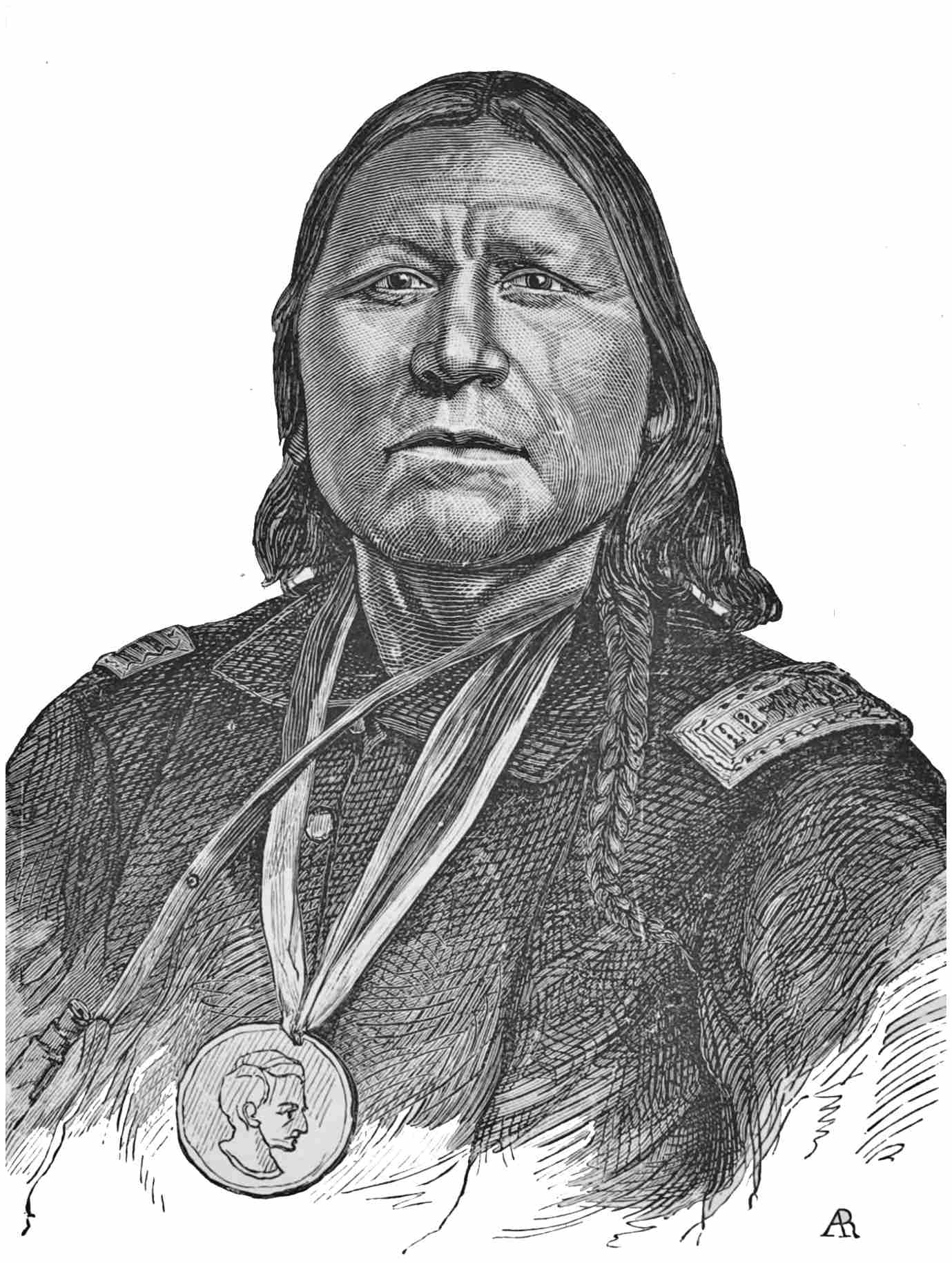
or Sa-tan-ta of the Kiowas? Unfortunately for the last-named chief, whose
name has been such a terror to our frontier settlements, he will have to be judged
for other qualities than that of eloquence. Attention has more recently been
directed to him by his arrest by the military authorities near Fort Sill, Indian
Territory, and his transportation to Texas for trial by civil court for various
murders and depredations, alleged to have been committed by him near the
Texas frontier. He has since had his trial, and, if public rumor is to be credited,
has been sentenced to death. Reference will be made to this noted chief
in succeeding pages. His eloquence and able arguments upon the Indian
question in various councils to which he was called won for him the deserved
title of “Orator of the Plains.” In his boasting harangue before the General
of the Army, which furnished the evidence of his connection with the murders
for which he has been tried and sentenced, he stated as a justification for
such outrages, or rather as the occasion of them, that they were in retaliation for
his arrest and imprisonment by me some three years ago. As there are two
sides to most questions, even if one be wrong, when the proper time arrives
a brief account of Sa-tan-ta’s arrest and imprisonment, with the causes leading
thereto, will be given in these sketches. One of the favorite remarks of
Sa-tan-ta in his orations, and one too which other chiefs often indulge in, being
thrown out as a “glittering generality,” meaning much or little as they may
desire, but most often the latter, was that he was tired of making war and desired
now “to follow the white man’s road.” It is scarcely to be presumed that
he found the gratification of this oft-expressed desire in recently following the
“white man’s road” to Texas, under strong guard and heavily manacled, with
hanging, to the Indian the most dreaded of all deaths, plainly in the perspective.
Aside, however, from his character for restless barbarity, and activity in
conducting merciless forays against our exposed frontiers, Sa-tan-ta is a remarkable
man—remarkable for his powers of oratory, his determined warfare
against the advances of civilization, and his opposition to the abandonment of
his accustomed mode of life, and its exchange for the quiet, unexciting, uneventful
life of a reservation Indian. If I were an Indian, I often think that I would
greatly prefer to cast my lot among those of my people who adhered to the free
open plains, rather than submit to the confined limits of a reservation, there to be
the recipient of the blessed benefits of civilization, with its vices thrown in
without stint or measure. The Indian can never be permitted to view the question
in this deliberate way. He is neither a luxury nor necessary of life. He
can hunt, roam, and camp when and wheresoever he pleases, provided always
that in so doing he does not run contrary to the requirements of civilization
in its advancing tread. When the soil which he has claimed and hunted
over for so long a time is demanded by this to him insatiable monster, there
is no appeal; he must yield, or, like the car of Juggernaut, it will roll mercilessly
over him, destroying as it advances. Destiny seems to have so willed
it, and the world looks on and nods its approval. At best the history of our
Indian tribes, no matter from what standpoint it is regarded, affords a melancholy
picture of loss of life. Two hundred years ago it required millions
to express in numbers the Indian population, while at the present time less
than half the number of thousands will suffice for the purpose. Where and
why have they gone? Ask the Saxon race, since whose introduction into and
occupation of the country these vast changes have been effected.
But little idea can be formed of the terrible inroads which diseases before
unknown to them have made upon their numbers. War has contributed its
share, it is true, but disease alone has done much to depopulate many of the Indian
tribes. It is stated that the small-pox was first introduced among them by
the white man in 1837, and that in the short space of one month six tribes lost
by this disease alone twelve thousand persons.
Confusion sometimes arises from the division of the Indians into nations,
tribes, and bands. A nation is generally a confederation of tribes which have
sprung from a common stock or origin. The tribe is intended to embrace all
bands and villages claiming a common name, and is presided over by a head chief,
while each band or village is presided over by one or more subordinate chiefs,
but all acknowledging a certain allegiance to the head or main village. This
division cannot always be accounted for. It arises sometimes from necessity,
where the entire tribe is a large one, and it is difficult to procure game and
grazing in one locality sufficient for all. In such cases the various bands are
not usually separated by any great distance, but regulate their movements so
as to be able to act in each other’s behalf. Sometimes a chief more warlike
than the others, who favors war and conquest at all times, and refuses to
make peace even when his tribe assents to it, will separate himself, with those
who choose to unite their fortunes with his, from the remainder of the tribe,
and act for the time independently. Such a character produces endless trouble;
his village becomes a shelter and rendezvous for all the restless spirits of
the tribe. While the latter is or pretends to be at peace, this band continues
to make war, yet when pressed or pursued avails itself of the protection of
those who are supposed to be peaceable.
Having hurriedly sketched the country in which we shall find it necessary to
go, and glanced at certain theories calculated to shed some light on the origin
and destiny of the Indian tribes, the succeeding pages will be devoted to my
personal experience on the Plains, commencing with the expedition of Major-General
Hancock in the spring of 1867.
III.
“There are two classes of people who are always eager to get up an
Indian war—the army and our frontiersmen.”
I quote from an editorial on the Indian question, which not long since appeared
in the columns of one of the leading New York daily newspapers.
That this statement was honestly made I do not doubt, but that instead of being
true it could not have been further from the truth I will attempt to show.
I assert, and all candid persons familiar with the subject will sustain the assertion,
that of all classes of our population the army and the people living on the
frontier entertain the greatest dread of an Indian war, and are willing to make
the greatest sacrifices to avoid its horrors. This is a proposition, the assertion
of which almost carries its proof with it.
Under the most auspicious circumstances, and in time of peace with the Indians,
the life of an army officer on the Plains or along our frontier is at best
one involving no little personal discomfort, and demanding the sacrifice of
many of the luxuries and benefits which he could obtain were he located within
the limits of civilization. To many officers, service in the West amounts
almost to social exile. Some can have their families with or near them.
There is a limited opportunity for social intercourse; travel from the States, to
and across the Plains, either for business or pleasure, is uninterrupted, and mail
facilities with friends and relations in the States are maintained. An Indian war
changes all this. The troops must prepare to take the field. Provided with
but few comforts, necessarily limited in this respect by the amount of transportation,
which on the Plains is narrowed down to the smallest practicable,
the soldier bids adieu—often a final one—to the dear ones of home, and with his
comrades in arms sets out, no matter how inclement the season, to seek what?
fame and glory? How many military men have reaped laurels from their Indian
campaigns? Does he strive to win the approving smile of his countrymen?
That is indeed, in this particular instance, a difficult task. For let him
act as he may in conducting or assisting in a campaign against the Indians, if
he survives the campaign he can feel assured of this fact, that one-half of his
fellow-citizens at home will revile him for his zeal and pronounce his success,
if he achieves any, a massacre of poor, defenceless, harmless Indians; while
the other half, if his efforts to chastise the common enemy are not crowned with
satisfactory results, will cry “Down with him. Down with the regular army,
and give us brave volunteers who can serve the Government in other ways besides
eating rations and drawing pay.”
An unsuccessful campaign, under which head nineteen out of twenty may
reasonably be classed, satisfies no portion of the public, and greatly dissatisfies
that portion of the Western population whose knowledge of the murders and
depredations committed by the Indians is, unlike that of the people of the States
further east, of too recent origin to be swept away by false notions of clemency.
During the continuance of the campaign both officers and soldiers are
generally cut off from all communication with the friends left behind. Couriers,
sent as bearers of a few despatches and letters, are sometimes under cover of
the night enabled to make their way back to the forts; but even these fail
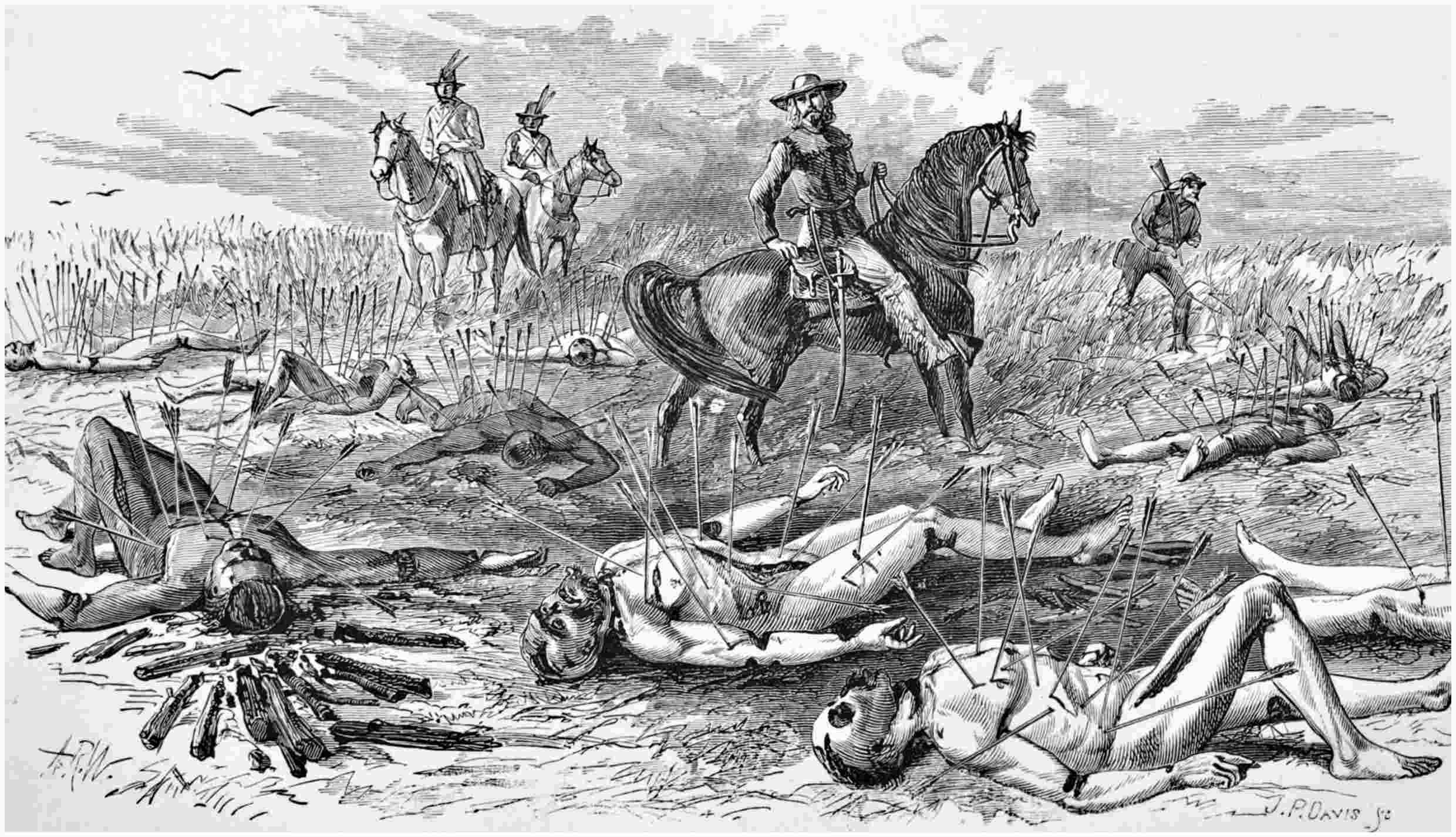
sometimes. I now recollect the circumstance of two trusty scouts being sent
with despatches and a small mail, to make their way from the southern portion
of Kansas to Fort Dodge on the Arkansas. When we saw them again we
beheld their lifeless, mangled remains, their bodies pierced with numerous arrows,
and mutilated almost beyond recognition—our letters scattered here and
there by the savages, who had torn open the little canvas mail-bag in search
of plunder. The Indians had surrounded these faithful fellows when within
about ten miles of the end of their perilous journey. The numerous empty
cartridge shells which lay around and near the bodies of the two men, proved
how persistently and bravely they had struggled for their lives.
The opening of an Indian campaign is also the signal for the withdrawal of
all privileges and enjoyments, such as leaves of absence, visits from Eastern
friends, hunting and pleasure parties of all kinds. The reception from the
East of all luxuries and delicacies for the table and of all current literature,
such as the numerous railroads being constructed in the West, particularly the
two Pacifics, render easy of procurement, ceases; and not only the private soldier
but the officer is limited in his mess fare to an indifferent portion of the
ordinary ration. Is it probable or reasonable that these objects and results,
the principal ones generally, so far as the army as individuals is concerned,
would be considered sufficient to render either officers or soldiers “eager to
get up an Indian war”? I have yet to make the acquaintance of that officer
of the army who, in time of undisturbed peace, desired a war with the Indians.
On the contrary, the army is the Indian’s best friend, so long as the latter desires
to maintain friendship. It is pleasant at all times, and always interesting,
to have a village of peaceable Indians locate their lodges near our frontier
posts or camps. The daily visits of the Indians, from the most venerable chief
to the strapped pappoose, their rude interchange of civilities, their barterings,
races, dances, legends, strange customs, and fantastic ceremonies, all combine
to render them far more agreeable as friendly neighbors than as crafty, bloodthirsty
enemies.
As to the frontiersman, he has everything to lose, even to life, and nothing to
gain by an Indian war. “His object is to procure a fat contract or a market
for his produce,” adds the journal from which the opening lines of this chapter
are quoted. This seems plausible and likely enough. But does that journal, and
do the people who believe on this question as it does, know that there are two
reasons—more are not required—why its statement is a very great error? First,
our frontier farmers, busily employed as they are in opening up their farms, never
have any produce to dispose of, but consider themselves fortunate if they have sufficient
for their personal wants. They are never brought in contact with the Indian
except when the latter makes a raid or incursion of at least hundreds of
miles, and attacks the settlements. It is another case of Mohammed and the
mountain. The frontiersman never goes beyond the settlements. The Indian
forsakes his accustomed hunting-grounds when ambitious of obtaining scalps or
plunder, and visits the settlements. The only ground upon which the frontiersman
can be accused of inspiring or inciting a war with the Indian is, that when
applied to by the latter to surrender his life, family, and property, scalp thrown
in, he stoutly refuses, and sometimes employs force to maintain this refusal. I
have shown that this abused class of the pioneers of civilization have no hand in
the fat contracts. Who are the fortunate parties? With but rare exceptions
our most expensive expeditions against the Indians on the Plains have been
supplied by contracts made with parties far inside the limits of civilization,
who probably never saw a hostile Indian, and who never even visited the Indian
country. The supplies are purchased far from the frontiers, in the
rich and thickly settled portions of the States, then shipped by rail and boat to
the most available military post, from which point they are generally drawn
by huge trains of army wagons, or carried on pack animals.
Of the many important expeditions organized to operate in the Indian
country, none, perhaps, of late years has excited more general and unfriendly
comment, considering the slight loss of life inflicted upon the Indians, than the
expedition organized and led in person by Major-General Hancock in the spring
of 1867. The clique generally known as the “Indian ring” were particularly
malevolent and bitter in their denunciations of General Hancock for precipitating,
as they expressed it, an Indian war. This expedition was quite formidable
in appearance, being made up of eight troops of cavalry, seven companies
of infantry, and one battery of light artillery, numbering altogether about 1,400
men. As General Hancock at the time and since has been so often accused of
causelessly bringing on an Indian war, a word in explanation may not be
amiss.
Being in command of the cavalry connected with the expedition, I had ample
and frequent opportunities for learning the true purposes and objects of
the march into the heart of the Indian country. I know no better mode of
explaining these than by quoting the following extract from letters written by
General Hancock to the agents of the various tribes with which we expected
to be brought in contact: “I have the honor to state for your information that
I am at present preparing an expedition to the Plains, which will soon be ready
to move. My object in doing so at this time is, to convince the Indians within
the limits of this department that we are able to punish any of them who may
molest travellers across the Plains, or who may commit other hostilities
against the whites. We desire to avoid if possible any troubles with the Indians,
and to treat them with justice, and according to the requirements of our
treaties with them; and I wish especially in my dealings with them to act
through the agents of the Indian Department as far as it is possible so to do....
If you as their agent can arrange these matters satisfactorily
with them, we will be pleased to defer the whole subject to you. In case of
your inability to do so, I would be pleased to have you accompany me when
I visit the country of your tribes, to show that the officers of the Government
are acting in harmony. I will be pleased to talk with any of the chiefs whom
we may meet.”
Surely there was no hostile intent here expressed. In another communication
to the agents of different tribes, General Hancock, in referring to certain
murders which had been recently committed, and which had been traced to
the tribes in question, said: “These cases will now be left entirely in the hands
of the Indian Department, and I do not expect to make war against any of the
Indians of your agency unless they commence war against us.”
It may be asked, What had the Indians done to make this incursion necessary?
They had been guilty of numerous thefts and murders during the preceding
summer and fall, for none of which had they been called to account. They
had attacked the stations of the overland mail route, killed the employees,
burned the station, and captured the stock. Citizens had been murdered in
their homes on the frontier of Kansas; murders had been committed on the
Arkansas route. The principal perpetrators of these acts were the Cheyennes
and Sioux. The agent of the former, if not a party to the murder on the Arkansas,
knew who the guilty persons were, yet took no steps to bring the murderers
to punishment. Such a course would have interfered with his trade and
profits. It was not to punish for these sins of the past that the expedition was
set on foot, but rather by its imposing appearance and its early presence in the
Indian country to check or intimidate the Indians from a repetition of their
late conduct. This was deemed particularly necessary from the fact that the
various tribes from which we had greatest cause to anticipate trouble had during
the winter, through their leading chiefs and warriors, threatened that as
soon as the grass was up in spring a combined outbreak would take place along
our entire frontier, and especially against the main routes of travel. To assemble
the tribes for the desired council, word was sent early in March to the
agents of those tribes whom it was desirable to meet. The agents sent runners
to the villages inviting them to meet us at some point near the Arkansas
river.
General Hancock, with the artillery and six companies of infantry, reached
Fort Riley, Kansas, from Fort Leavenworth by rail the last week in March;
here he was joined by four companies of the Seventh Cavalry and an additional
company of the Thirty-seventh Infantry. It was at this point that I joined
the expedition. And as a very fair sample of the laurels which military men
may win in an Indian campaign by a zealous discharge of what they deem their
duty, I will here state, in parenthesis, that after engaging in the expedition,
some of the events of which I am about to relate, and undergoing fatigue,
privations, and dangers equal to those of a campaign during the Rebellion, I
found myself at the termination of the campaign again at Fort Riley in arrest.
This is not mentioned in a fault-finding spirit. I have no fault to find. It is
said that blessings sometimes come in disguise. Such proved to be true in
this instance, although I must say the disguise for some little time was most
perfect.
From Fort Riley we marched to Fort Harker, a distance of ninety miles,
where our force was strengthened by the addition of two more troops of cavalry.
Halting only long enough to replenish our supplies, we next directed our
march toward Fort Larned, near the Arkansas, about seventy miles to the
southeast. A march from the 3d to the 7th of April brought us to Fort Larned.
The agent for the Comanches and Kiowas accompanied us. At Fort Larned
we found the agent of the Cheyennes, Arapahoes, and Apaches; from the latter
we learned that he had, as requested, sent runners to the chiefs of his
agency inviting them to the council, and that they had agreed to assemble near
Fort Larned on the 10th of the month, requesting that the expedition would
remain there until that date. To this request General Hancock acceded.
On the 9th of April, while encamped awaiting the council, which was to be
held the following day, a terrible snow-storm occurred, lasting all day until
late in the evening. It was our good fortune to be in camp rather than on the
march; had it been otherwise, we could not well have escaped without loss of
life from the severe cold and blinding snow. The cavalry horses suffered seriously,
and were only preserved by doubling their ration of oats, while to prevent
their being frozen during the intensely cold night which followed, the
guards were instructed to keep passing along the picket lines with a whip, and
to keep the horses moving constantly. The snow was eight inches in depth.
The council, which was to take place the next day, had to be postponed until,
the return of good weather. Now began the display of a kind of diplomacy
for which the Indian is peculiar. The Cheyennes and a band of the Sioux
were encamped on Pawnee Fork, about thirty miles above Fort Larned. They
neither desired to move nearer to us nor have us approach nearer to them. On
the morning of the 11th they sent us word that they had started to visit us, but
discovering a large herd of buffalo near their camp, they had stopped to procure
a supply of meat. This message was not received with much confidence, nor
was a buffalo hunt deemed of sufficient importance to justify the Indians in
breaking their engagement. General Hancock decided, however, to delay another
day, when, if the Indians still failed to come in, he would move his command
to the vicinity of their village and hold the conference there.
Orders were issued on the evening of the 12th for the march to be resumed
on the following day. Later in the evening two chiefs of the “Dog Soldiers,”
a band composed of the most warlike and troublesome Indians on the Plains,
chiefly made up of Cheyennes, visited our camp. They were accompanied
by a dozen warriors, and expressed a desire to hold a conference with General
Hancock, to which he assented. A large council fire was built in front of
the General’s tent, and all the officers of his command assembled there. A
tent had been erected for the accommodation of the chiefs a short distance from
the General’s. Before they could feel equal to the occasion, and in order to
obtain time to collect their thoughts, they desired that supper might be prepared
for them, which was done. When finally ready they advanced from
their tent to the council fire in single file, accompanied by their agent and
an interpreter. Arrived at the fire, another brief delay ensued. No matter
how pressing or momentous the occasion, an Indian invariably declines to engage
in a council until he has filled his pipe and gone through with the important
ceremony of a smoke. This attended to, the chiefs announced that
they were ready “to talk.” They were then introduced to the principal officers
of the group, and seemed much struck with the flashy uniforms of the few
artillery officers who were present in all the glory of red horsehair plumes,
aigulets, etc. The chiefs seemed puzzled to determine whether these insignia
designated chieftains or medicine men. General Hancock began the conference
by a speech, in which he explained to the Indians his purpose in coming
to see them, and what he expected of them in the future. He particularly
informed them that he was not there to make war, but to promote peace. Then
expressing his regret that more of the chiefs had not visited him, he announced
his intention of proceeding on the morrow with his command to the vicinity
of their village and there holding a council with all of the chiefs. Tall Bull,
a fine, warlike-looking chieftain, replied to General Hancock, but his speech
contained nothing important, being made up of allusions to the growing
scarcity of the buffalo, his love for the white man, and the usual hint that a
donation in the way of refreshments would be highly acceptable; he added
that he would have nothing new to say at the village.
Several years prior to the events referred to, our people had captured from
the Indians two children. I believe they were survivors of the Chivington
massacre at Sand Creek, Colorado. These children had been kindly cared for,
and were being taught to lead a civilized mode of life. Their relatives, however,
made demands for them, and we by treaty stipulation agreed to deliver
them up. One of them, a little girl, had been cared for kindly in a family
living near Denver, Colorado; the other, a boy, had been carried East to the
States, and it was with great difficulty that the Government was able to learn
his whereabouts and obtain possession of him. He was finally discovered, however,
and sent to General Hancock, to be by him delivered up to his tribe. He
accompanied the expedition, and was quite a curiosity for the time being. He
was dressed comfortably, in accordance with civilized custom; and, having been
taken from his people at so early an age, was apparently satisfied with the life
he led. The Indians who came to our camp expressed a great desire to see
him, and when he was brought into their presence they exhibited no emotion
such as white men under similar circumstances might be expected to show.
They evidently were not pleased to see him clothed in the white man’s dress.
The little fellow, then some eight or ten years of age, seemed little disposed to
go back to his people. I saw him the following year in the village of his
tribe; he then had lost all trace of civilization, had forgotten his knowledge of
the English language, and was as shy and suspicious of the white men as any
of his dusky comrades. From older persons of the tribe we learned that their
first act after obtaining possession of him was to deprive him of his “store
clothes,” and in their stead substitute the blanket and leggings.
Rightly concluding that the Indians did not intend to come to our camp as
they had at first agreed to, it was decided to move nearer to their village. On
the morning following the conference held with the two chiefs of the “Dog
Soldiers,” our entire force therefore marched from Fort Larned up Pawnee
Fork in the direction of the main village, encamping the first night about
twenty-one miles from the fort. Several parties of Indians were seen in our
advance during the day, evidently watching our movements; while a heavy
smoke, seen to rise in the direction of the Indian village, indicated that something
more than usual was going on. This smoke we afterwards learned
arose from the burning grass. The Indians, thinking to prevent us from encamping
in their vicinity, had set fire to and burned all the grass for miles in
the direction from which they expected us. Before we arrived at our camping-ground
we were met by several chiefs and warriors belonging to the Cheyennes
and Sioux. Among the chiefs were Pawnee Killer of the Sioux, and White
Horse of the Cheyennes. It was arranged that these chiefs should accept our
hospitality and remain with us during the night, and in the morning all the
chiefs of the two tribes then in the village were to come to General Hancock’s
headquarters and hold a council. On the morning of the 14th Pawnee Killer
left our camp at an early hour, for the purpose, as he said, of going to the village
to bring in the other chiefs to the council. Nine o’clock had been agreed
upon as the hour at which the council should assemble. The hour came, but
the chiefs did not. Now an Indian council is not only often an important but
always an interesting occasion. And, somewhat like a famous recipe for making
a certain dish, the first thing necessary in holding an Indian council is to
get the Indian. Half-past nine o’clock came, and still we were lacking this
one important part of the council. At this juncture Bull Bear, an influential
chief among the Cheyennes, came in and reported that the chiefs were on their
way to our camp, but would not be able to reach it for some time. This was
a mere artifice to secure delay. General Hancock informed Bull Bear that as
the chiefs could not arrive for some time, he would move his forces up the
stream nearer to the village, and the council could be held at our camp that
night. To this proposition Bull Bear gave his assent.
At 11 A. M. we resumed the march, and had proceeded but a few miles
when we witnessed one of the finest and most imposing military displays, prepared
according to the Indian art of war, which it has ever been my lot to behold.
It was nothing more nor less than an Indian line of battle drawn directly
across our line of march; as if to say, Thus far and no further. Most of
the Indians were mounted; all were bedecked in their brightest colors, their
heads crowned with the brilliant war-bonnet, their lances bearing the crimson
pennant, bows strung, and quivers full of barbed arrows. In addition to these
weapons, which with the hunting-knife and tomahawk are considered as
forming the armament of the warrior, each one was supplied with either a
breech-loading rifle or revolver, sometimes with both—the latter obtained
through the wise foresight and strong love of fair play which prevails in the
Indian Department, which, seeing that its wards are determined to fight, is
equally determined that there shall be no advantage taken, but that the two sides
shall be armed alike; proving, too, in this manner the wonderful liberality of
our Government, which not only is able to furnish its soldiers with the latest
improved style of breech-loaders to defend it and themselves, but is equally
able and willing to give the same pattern of arms to their common foe. The
only difference is, that the soldier, if he loses his weapon, is charged double price
for it; while to avoid making any such charge against the Indian, his weapons
are given him without conditions attached. In the line of battle before us there
were several hundred Indians, while further to the rear and at different distances
were other organized bodies acting apparently as reserves. Still further
were small detachments who seemed to perform the duty of couriers, and
were held in readiness to convey messages to the village. The ground beyond
was favorable for an extended view, allowing the eye to sweep the plain for
several miles. As far as the eye could reach small groups or individuals
could be seen in the direction of the village; these were evidently parties of
observation, whose sole object was to learn the result of our meeting with the
main body and hasten with the news to the village.
For a few moments appearances seemed to foreshadow anything but a peaceful
issue. The infantry was in the advance, followed closely by the artillery,
while my command, the cavalry, was marching on the flank. General Hancock,
who was riding with his staff at the head of the column, coming suddenly
in view of the wild fantastic battle array, which extended far to our right and
left and not more than half a mile in our front, hastily sent orders to the infantry,
artillery, and cavalry to form line of battle, evidently determined that if
war was intended we should be prepared. The cavalry, being the last to form
on the right, came into line on a gallop, and, without waiting to align the ranks
carefully, the command was given to “draw sabre.” As the bright blades
flashed from their scabbards into the morning sunlight, and the infantry brought
their muskets to a carry, a most beautiful and wonderfully interesting sight was
spread out before and around us, presenting a contrast which, to a military eye,
could but be striking. Here in battle array, facing each other, were the representatives
of civilized and barbarous warfare. The one, with but few modifications,
stood clothed in the same rude style of dress, bearing the same patterned
shield and weapon that his ancestors had borne centuries before; the other
confronted him in the dress and supplied with the implements of war which
the most advanced stage of civilization had pronounced the most perfect.
Was the comparative superiority of these two classes to be subjected to the
mere test of war here? Such seemed the prevailing impression on both sides.
All was eager anxiety and expectation. Neither side seemed to comprehend the
object or intentions of the other; each was waiting for the other to deliver the
first blow. A more beautiful battle-ground could not have been chosen. Not
a bush or even the slightest irregularity of ground intervened between the two
lines which now stood frowning and facing each other. Chiefs could be seen
riding along the line as if directing and exhorting their braves to deeds of
heroism.
After a few moments of painful suspense, General Hancock, accompanied
by General A. J. Smith and other officers, rode forward, and through an interpreter
invited the chiefs to meet us midway, for the purpose of an interview.
In response to this invitation Roman Nose, bearing a white flag, accompanied
by Bull Bear, White Horse, Gray Beard, and Medicine Wolf on the part of the
Cheyennes, and Pawnee Killer, Bad Wound, Tall Bear that Walks under the
Ground, Left Hand, Little Bear, and Little Bull on the part of the Sioux, rode
forward to the middle of the open space between the two lines. Here we shook
hands with all of the chiefs, most of them exhibiting unmistakable signs of
gratification at this apparently peaceful termination of our rencounter. General
Hancock very naturally inquired the object of the hostile attitude displayed
before us, saying to the chiefs that if war was their object we were ready then
and there to participate. Their immediate answer was that they did not desire
war, but were peacefully disposed. They were then told that we would continue
our march toward the village, and encamp near it, but would establish
such regulations that none of the soldiers would be permitted to approach or
disturb them. An arrangement was then effected by which the chiefs were to
assemble at General Hancock’s headquarters as soon as our camp was pitched.
The interview then terminated, and the Indians moved off in the direction of
their village, we following leisurely in rear.
A march of a few miles brought us in sight of the village, which was situated
in a beautiful grove on the banks of the stream up which we had been
marching. The village consisted of upwards of three hundred lodges, a small
fraction over half belonging to the Cheyennes, the remainder to the Sioux.
Like all Indian encampments, the ground chosen was a most romantic spot,
and at the same time fulfilled in every respect the requirements of a good
camping-ground; wood, water, and grass were abundant. The village was
placed on a wide, level plateau, while on the north and west, at a short distance
off, rose high bluffs, which admirably served as a shelter against the cold winds
which at that season of the year prevail from these directions. Our tents were
pitched within half a mile of the village. Guards were placed between to prevent
intrusion upon our part. A few of the Indian ponies found grazing near
our camp were caught and returned to them, to show that our intentions were
at least neighborly. We had scarcely pitched our tents when Roman Nose,
Bull Bear, Gray Beard, and Medicine Wolf, all prominent chiefs of the Cheyennes,
came into camp, with the information that upon our approach their
women and children had all fled from the village, alarmed by the presence of
so many soldiers, and imagining a second Chivington massacre to be intended.
General Hancock insisted that they should all return, promising protection and
good treatment to all; that if the camp was abandoned he would hold it responsible.
The chiefs then stated their belief in their ability to recall the fugitives,
could they be furnished with horses to overtake them. This was accordingly
done, and two of them set out mounted on two of our horses. An agreement
was also entered into at the same time that one of our interpreters, Ed. Gurrier,
a half-breed Cheyenne who was in the employ of the Government, should
remain in the village and report every two hours as to whether any Indians were
leaving the village. This was about seven o’clock in the evening. At half
past nine the half-breed returned to headquarters, with the intelligence that all
the chiefs and warriors were saddling up to leave, under circumstances showing
that they had no intention of returning, such as packing up such articles as
could be carried with them, and cutting and destroying their lodges, this last
being done to obtain small pieces for temporary shelter.
I had retired to my tent, which was located some few hundred yards from
that of General Hancock, when a messenger from the latter awakened me with
the information that General Hancock desired my presence at his tent. Imagining
a movement on the part of the Indians, I made no delay in responding
to the summons. General Hancock briefly stated the situation of affairs, and
directed me to mount my command as quickly and as silently as possible, surround
the Indian village, and prevent the departure of its inhabitants. Easily
said, but not so easily done. Under ordinary circumstances, silence not being
necessary, I could have returned to my camp, and by a few blasts from the
trumpet placed every soldier in his saddle almost as quickly as it has taken
time to write this sentence. No bugle calls must be sounded; we were to
adopt some of the stealth of the Indian—how successfully remains to be seen.
By this time every soldier, officers as well as men, was in his tent sound asleep.
How to awaken them and impart to each the necessary order? First going to
the tent of the adjutant and arousing him, I procured an experienced assistant
in my labors. Next the captains of companies were awakened and orders imparted
to them. They in turn transmitted the order to the first sergeant, who
similarly aroused the men. It has often surprised me to observe the alacrity
with which disciplined soldiers, experienced in campaigning, will hasten to
prepare themselves for the march in an emergency like this. No questions are
asked, no time is wasted. A soldier’s toilet, on an Indian campaign, is a simple
affair, and requires little time for arranging. His clothes are gathered
up hurriedly, no matter how, so long as he retains possession of them. The
first object is to get his horse saddled and bridled, and until this is done his own
toilet is a matter of secondary importance, and one button or hook must do
the duty of half a dozen. When his horse is ready for the mount the rider
will be seen completing his own equipment; stray buttons will receive attention,
arms be overhauled, spurs restrapped; then, if there still remain a few
spare moments, the homely black pipe is filled and lighted, and the soldier’s
preparation is completed.
The night was all that could be desired for the success of our enterprise.
The air was mild and pleasant; the moon, although nearly full, kept almost
constantly behind the clouds, as if to screen us in our hazardous undertaking.
I say hazardous, because there were none of us who imagined for one moment
that if the Indians discovered us in our attempt to surround them and their village,
we would escape without a fight—a fight, too, in which the Indians, sheltered
behind the trunks of the stately forest trees under which their lodges
were pitched, would possess all the advantage. General Hancock, anticipating
that the Indians would discover our approach, and that a fight would ensue, ordered
the artillery and infantry under arms, to await the result of our moonlight
venture. My command was soon in the saddle, and silently making its
way toward the village. Instructions had been given forbidding all conversation
except in a whisper. Sabres were so disposed of as to prevent clanging.
Taking a camp-fire which we could see in the village as our guiding point, we
made a detour so as to place the village between ourselves and the infantry.
Occasionally the moon would peep out from behind the clouds and enable us to
catch a hasty glance at the village. Here and there under the thick foliage we
could see the white, conical-shaped lodges. Were their inmates slumbering,
unaware of our close proximity, or were their dusky defenders concealed, as
well they might have been, along the banks of the Pawnee, quietly awaiting
our approach, and prepared to greet us with their well-known war-whoop?
These were questions that were probably suggested to the mind of each individual
of my command. If we were discovered approaching in the stealthy,
suspicious manner which characterized our movements, the hour being midnight,
it would require a more confiding nature than that of the Indian
to assign a friendly or peaceful motive to our conduct. The same flashes
of moonlight which gave us hurried glimpses of the village enabled us to
see our own column of horsemen stretching its silent length far into the dim
darkness, and winding its course, like some huge anaconda about to envelop
its victim.
The method by which it was determined to establish a cordon of armed
troopers about the fated village, was to direct the march in a circle, with the
village in the centre, the commanding officer of each rear troop halting his
command at the proper point, and deploying his men similarly to a line of
skirmishers—the entire circle, when thus formed, facing toward the village,
and distant from it perhaps a few hundred yards. No sooner was our line
completely formed than the moon, as if deeming darkness no longer essential
to our success, appeared from behind her screen and lighted up the entire
scene. And a beautiful scene it was. The great circle of troops, each individual
of which sat on his steed silent as a statue, the beautiful and in some
places dense foliage of the cotton trees sheltering and shading the bleached,
skin-clad lodges of the red man, while in the midst of all murmured undisturbedly
in its channel the little stream on whose banks the village was located,
all combined to produce an artistic effect, as beautiful as it was interesting.
But we were not there to study artistic effects. The next step was to determine
whether we had captured an inhabited village, involving almost necessarily a
fierce conflict with its savage occupants, or whether the red man had again
proven too wily and crafty for his more civilized brothers.
Directing the entire line of troopers to remain mounted with carbines held
at the “advance,” I dismounted, and taking with me Gurrier, the half-breed,
Dr. Coates, one of our medical staff, and Lieutenant Moylan, the adjutant, proceeded
on our hands and knees toward the village. The prevailing opinion
was that the Indians were still asleep. I desired to approach near enough to the
lodges to enable the half-breed to hail the village in the Indian tongue, and if
possible establish friendly relations at once. It became a question of prudence
with us, which we discussed in whispers as we proceeded on our “Tramp,
tramp, tramp, the boys are creeping,” how far from our horses and how near
to the village we dared to go. If so few of us were discovered entering the
village in this questionable manner, it was more than probable that, like the
returners of stolen property, we should be suitably rewarded and no questions
asked. The opinions of Gurrier, the half-breed, were eagerly sought
for and generally deferred to. His wife, a full-blooded Cheyenne, was a resident
of the village. This with him was an additional reason for wishing a
peaceful termination to our efforts. When we had passed over two-thirds of
the distance between our horses and the village, it was deemed best to make
our presence known. Thus far not a sound had been heard to disturb the
stillness of the night. Gurrier called out at the top of his voice in the Cheyenne
tongue. The only response came from the throats of a score or more of
Indian dogs which set up a fierce barking. At the same time one or two of
our party asserted that they saw figures moving beneath the trees. Gurrier
repeated his summons, but with no better result than before.
A hurried consultation ensued. The presence of so many dogs in the village
was regarded by the half-breed as almost positive assurance that the Indians
were still there. Yet it was difficult to account for their silence. Gurrier in a
loud tone repeated who he was, and that our mission was a friendly one. Still
no answer. He then gave it as his opinion that the Indians were on the alert,
and were probably waiting in the shadow of the trees for us to approach nearer,
when they would pounce upon us. This comforting opinion induced another
conference. We must ascertain the truth of the matter; our party could
do this as well as a larger number, and to go back and send another party in
our stead could not be thought of.
Forward was the verdict. Each one grasped his revolver, resolved to do
his best, whether it was in running or fighting. I think most of us would have
preferred to take our own chances at running. We had approached near
enough to see that some of the lodges were detached some distance from the
main encampment. Selecting the nearest of these, we directed our advance
on it. While all of us were full of the spirit of adventure, and were further
encouraged with the idea that we were in the discharge of our duty, there was
scarcely one of us who would not have felt more comfortable if we could have
got back to our horses without loss of pride. Yet nothing, under the circumstances,
but a positive order would have induced any one to withdraw. The
doctor, who was a great wag, even in moments of greatest danger, could not
restrain his propensities in this direction. When everything before us was being
weighed and discussed in the most serious manner, he remarked: “General,
this recalls to my mind those beautiful lines:
Backward, turn backward, O Time, in thy flight,
Make me a child again just for one night—
this night of all others.”
We shall meet the doctor again before daylight, but under different
circumstances.
IV.
Cautiously approaching, on all fours, to within a few yards of the nearest
lodge, occasionally halting and listening to discover evidence as to
whether the village was deserted or not, we finally decided that the Indians had
fled before the arrival of the cavalry, and that none but empty lodges were before
us. This conclusion somewhat emboldened as well as accelerated our
progress. Arriving at the first lodge, one of our party raised the curtain or
mat which served as a door, and the doctor and myself entered. The interior
of the lodge was dimly lighted by the decaying embers of a small fire built in
the centre. All around us were to be seen the usual adornments and articles
which constitute the household effects of an Indian family. Buffalo robes were
spread like carpets over the floor; head-mats, used to recline upon, were arranged
as if for the comfort of their owners; parfleches, a sort of Indian band-box,
with their contents apparently undisturbed, were to be found carefully
stowed away under the edges or borders of the lodge. These, with the door-mats,
paint-bags, rawhide ropes, and other articles of Indian equipment, were
left as if the owners had only absented themselves for a brief period. To complete
the picture of an Indian lodge, over the fire hung a camp-kettle, in which,
by means of the dim light of the fire, we could see what had been intended
for the supper of the late occupants of the lodge. The doctor, ever on the
alert to discover additional items of knowledge, whether pertaining to history
or science, snuffed the savory odors which arose from the dark recesses
of the mysterious kettle. Casting about the lodge for some instrument to aid
him in his pursuit of knowledge, he found a horn spoon, with which he began
his investigation of the contents, finally succeeding in getting possession of a
fragment which might have been the half of a duck or rabbit, judging merely
from its size. “Ah!” said the doctor, in his most complacent manner, “here
is the opportunity I have long been waiting for. I have often desired to test
and taste of the Indian mode of cooking. What do you suppose this is?” holding
up the dripping morsel. Unable to obtain the desired information, the
Doctor, whose naturally good appetite had been sensibly sharpened by his recent
exercise à la quadrupède, set to with a will and ate heartily of the mysterious
contents of the kettle. “What can this be?” again inquired the doctor.
He was only satisfied on one point, that it was delicious—a dish fit for a king.
Just then Guerrier, the half-breed, entered the lodge. He could solve the mystery,
having spent years among the Indians. To him the doctor appealed for
information. Fishing out a huge piece, and attacking it with the voracity of a
hungry wolf, he was not long in determining what the doctor had supped so
heartily upon. His first words settled the mystery: “Why, this is dog.” I
will not attempt to repeat the few but emphatic words uttered by the heartily
disgusted member of the medical fraternity as he rushed from the lodge.
Other members of our small party had entered other lodges, only to find
them, like the first, deserted. But little of the furniture belonging to the lodges
had been taken, showing how urgent and hasty had been the flight of the owners.
To aid in the examination of the village, reinforcements were added to
our party, and an exploration of each lodge was determined upon. At the
same time a messenger was despatched to General Hancock, informing him of
the flight of the Indians. Some of the lodges were closed by having brush or
timber piled up against the entrance, as if to preserve the contents. Others
had huge pieces cut from their sides, these pieces evidently being carried away
to furnish temporary shelter to the fugitives. In most of the lodges the fires
were still burning. I had entered several without discovering anything important.
Finally, in company with the doctor, I arrived at one, the interior
of which was quite dark, the fire having almost died out. Procuring a lighted
fagot, I prepared to explore it, as I had done the others; but no sooner had I entered
the lodge than my fagot failed me, leaving me in total darkness. Handing
it out to the doctor to be relighted, I began feeling my way about the interior
of the lodge. I had almost made the circuit when my hand came in contact
with a human foot; at the same time a voice unmistakably Indian, and
which evidently came from the owner of the foot, convinced me that I was not
alone. My first impression was that in their hasty flight the Indians had gone
off leaving this one asleep. My next, very naturally, related to myself. I
would have gladly placed myself on the outside of the lodge, and there matured
plans for interviewing its occupant; but unfortunately to reach the entrance of
the lodge I must either pass over or around the owner of the before-mentioned
foot and voice. Could I have been convinced that among its other possessions
there was neither tomahawk nor scalping-knife, pistol nor war-club, or any similar
article of the noble red man’s toilet, I would have risked an attempt to escape
through the low narrow opening of the lodge; but who ever saw an Indian
without one or all of these interesting trinkets? Had I made the attempt,
I should have expected to encounter either the keen edge of the scalping-knife
or the blow of the tomahawk, and to have engaged in a questionable struggle
for life. This would not do. I crouched in silence for a few moments, hoping
the doctor would return with the lighted fagot. I need not say that each succeeding
moment spent in the darkness of that lodge seemed like an age. I
could hear a slight movement on the part of my unknown neighbor, which did
not add to my comfort. Why does not the doctor return? At last I discovered
the approach of a light on the outside. When it neared the entrance I called
to the doctor and informed him that an Indian was in the lodge, and that he
had better have his weapons ready for a conflict. I had, upon discovering the
foot, drawn my hunting-knife from its scabbard, and now stood waiting the
dénouement. With his lighted fagot in one hand and cocked revolver in the
other, the doctor cautiously entered the lodge. And there, directly between
us, wrapped in a buffalo robe, lay the cause of my anxiety—a little Indian
girl, probably ten years old; not a full-blood, but a half-breed. She was terribly
frightened at finding herself in our hands, with none of her people near.
Why was she left behind in this manner? Guerrier, our half-breed interpreter,
was called in. His inquiries were soon answered. The little girl, who at
first was an object of our curiosity, became at once an object of pity. The Indians,
an unusual thing for them to do toward their own blood, had wilfully
deserted her; but this, alas! was the least of their injuries to her. After being
shamefully abandoned by the entire village, a few of the young men of the
tribe returned to the deserted lodge, and upon the person of this little girl
committed outrages, the details of which are too sickening for these pages.
She was carried to the fort and placed under the care of kind hands and warm
hearts, where everything was done for her comfort that was possible. Other
parties in exploring the deserted village found an old, decrepit Indian of the
Sioux tribe, who also had been deserted, owing to his infirmities and inability
to travel with the tribe. He also was kindly cared for by the authorities of the
fort. Nothing was gleaned from our search of the village which might indicate
the direction of the flight. General Hancock, on learning the situation of
affairs, despatched some companies of infantry to the deserted village, with orders
to replace the cavalry and protect the village and its contents from disturbance
until its final disposition could be determined upon. Starting my
command back to our camp near General Hancock’s headquarters, I galloped
on in advance to report the particulars to the General. It was then decided
that with eight troops of cavalry I should start in pursuit of the Indians at early
dawn on the following morning (April 15). There was no sleep for my command
the remainder of the night, the time being fully occupied in preparation
for the march, neither the extent nor direction of which was known.
Mess kits were overhauled, and fresh supplies of coffee, sugar, flour, and the
other articles which go to supply the soldier’s larder, were laid in. Blankets
were carefully rolled so as to occupy as little space as possible; every useless
pound of luggage was discarded, for in making a rapid pursuit after Indians,
much of the success depends upon the lightness of the order of march.
Saratoga trunks and their accompaniments are at a discount. Never was the
old saying that in Rome one must do as Romans do more aptly illustrated than
on an Indian campaign. The Indian, knowing that his safety either on offensive
or defensive movements depends in a great measure upon the speed and endurance
of his horse, takes advantage of every circumstance which will favor
either the one or the other. To this end he divests himself of all superfluous dress
and ornament when preparing for rapid movements. The white man, if he hopes
for success, must adopt the same rule of action, and encumber his horse as little
as possible. Something besides well-filled mess chests and carefully rolled blankets
is necessary in preparing for an Indian campaign. Arms must be reëxamined,
cartridge-boxes refilled, so that each man should carry about one hundred
rounds of ammunition “on his person,” while each troop commander must
see that in the company wagon there are placed a few boxes of reserve ammunition.
Then, when the equipment of the soldier has been attended to, his
horse, without whose assistance he is helpless, must be looked after; loose
shoes are tightened by the driving of an additional nail, and to accomplish
this one may see the company blacksmith, a soldier, with the few simple
tools of his kit on the ground beside him, hurriedly fastening the last shoe
by the uncertain light of a candle held in the hands of the rider of the horse,
their mutual labor being varied at times by queries as to “How long shall we
be gone?” “I wonder if we will catch Mr. Lo?” “If we do, we’ll make
it lively for him.” So energetic had everybody been that before daylight
everything was in readiness for the start. In addition to the regularly organized
companies of soldiers which made up the pursuing column, I had with
me a detachment of white scouts or Plainsmen, and one of friendly Indians,
the latter belonging to the tribe of Delawares, once so famous in Indian wars.
Of the Indians one only could speak English; he acted as interpreter for the
party. Among the white scouts were numbered some of the most noted of
their class. The most prominent man among them was “Wild Bill,” whose
highly varied career was made the subject of an illustrated sketch in one of
the popular monthly periodicals a few years ago. “Wild Bill” was a strange
character, just the one which a novelist might gloat over. He was a Plainsman
in every sense of the word, yet unlike any other of his class. In person
he was about six feet one in height, straight as the straightest of the warriors
whose implacable foe he was; broad shoulders, well-formed chest and limbs,
and a face strikingly handsome; a sharp, clear, blue eye, which stared you
straight in the face when in conversation; a finely-shaped nose, inclined to be
aquiline; a well-turned mouth, with lips only partially concealed by a handsome
moustache. His hair and complexion were those of the perfect blond. The
former was worn in uncut ringlets falling carelessly over his powerfully formed
shoulders. Add to this figure a costume blending the immaculate neatness
of the dandy with the extravagant taste and style of the frontiersman, and
you have Wild Bill, then as now the most famous scout on the Plains. Whether
on foot or on horseback, he was one of the most perfect types of physical manhood
I ever saw. Of his courage there could be no question; it had been
brought to the test on too many occasions to admit of a doubt. His skill in the
use of the rifle and pistol was unerring; while his deportment was exactly the
opposite of what might be expected from a man of his surroundings. It
was entirely free from all bluster or bravado. He seldom spoke of himself
unless requested to do so. His conversation, strange to say, never bordered
either on the vulgar or blasphemous. His influence among the frontiersmen
was unbounded, his word was law; and many are the personal quarrels and
disturbances which he has checked among his comrades by his simple announcement
that “this has gone far enough,” if need be followed by the ominous
warning that when persisted in or renewed the quarreller “must settle it with
me.” “Wild Bill” is anything but a quarrelsome man; yet no one but himself
can enumerate the many conflicts in which he has been engaged, and which
have almost invariably resulted in the death of his adversary. I have a personal
knowledge of at least half a dozen men whom he has at various times
killed, one of these being at the time a member of my command. Others have
been severely wounded, yet he always escapes unhurt. On the Plains every
man openly carries his belt with its invariable appendages, knife and revolver,
often two of the latter. Wild Bill always carried two handsome ivory-handled
revolvers of the large size; he was never seen without them. Where this is
the common custom, brawls or personal difficulties are seldom if ever settled
by blows. The quarrel is not from a word to a blow, but from a word to the
revolver, and he who can draw and fire first is the best man. No civil law reaches
him; none is applied for. In fact there is no law recognized beyond the frontier
but that of “might makes right.” Should death result from the quarrel,
as it usually does, no coroner’s jury is impanelled to learn the cause of death,
and the survivor is not arrested. But instead of these old-fashioned proceedings,
a meeting of citizens takes place, the survivor is requested to be present
when the circumstances of the homicide are inquired into, and the unfailing
verdict of “justifiable,” “self-defence,” etc., is pronounced, and the law
stands vindicated. That justice is often deprived of a victim there is not
a doubt. Yet in all of the many affairs of this kind in which “Wild Bill” has
performed a part, and which have come to my knowledge, there is not a
single instance in which the verdict of twelve fair-minded men would not
be pronounced in his favor. That the even tenor of his way continues to
be disturbed by little events of this description may be inferred from an item
which has been floating lately through the columns of the press, and which
states that “the funeral of ‘Jim Bludso,’ who was killed the other day by
‘Wild Bill,’ took place to-day.” It then adds: “The funeral expenses were
borne by ‘Wild Bill.’” What could be more thoughtful than this? Not only
to send a fellow mortal out of the world, but to pay the expenses of the
transit. Guerrier, the half-breed, also accompanied the expedition as guide
and interpreter.
Everything being in readiness to move, the column began its march, and
reached the vicinity of the village before day had fully dawned. Here a
brief halt was necessary, until the light was sufficient to enable our scouts to
discover the trail of the Indians. When they finally set to discover this, their
method was highly interesting, and resembled not a little the course of a
thorough sportsman, who, with a well-trained pointer or setter, thoroughly
“ranges” and “beats” the ground in search of his coveted game. The Indians had
set out on their flight soon after dark the preceding night; a heavy frost covered
the ground and rendered it difficult to detect the trail from the many pony
tracks which are always found in the vicinity of a village. We began to grow
impatient at the delay, when one of the Indians gave the “halloo” as the signal
that the trail was discovered, and again the column marched forward. Our
order of march was for the Indian and white scouts to keep a few hundred
paces in advance of the troops, so that momentary delays upon the part of
those watching and following the trail should not extend to the troops. The
Indians on leaving the village had anticipated pursuit and had adopted measures
to mislead us. In order to prevent their trail from being easily recognizable,
they had departed in as many detachments or parties almost as there
were families or lodges in the village, each party taking a different direction
from the others, having personally agreed, of course, upon the general direction
and place of reuniting. Once being satisfied that we were on the right trail,
no difficulty was found in following it as rapidly as our horses could walk.
The Indians had nearly twelve hours the start of us, but being encumbered by
their families, we hoped to overhaul them before many days. Our first obstacle
was encountered when we struck Walnut creek, a small stream running
east and west some thirty miles north of the Arkansas at that point. The
banks were so high and abrupt that it was impossible to reach the water’s edge,
let alone clamber up the opposite bank. A few of the Indians had been able to
accomplish this feat, as was shown by the tracks on the opposite side; but the
main band had moved up stream in search of a favorable crossing, and we were
compelled to do likewise. Here we found that the Indians had called a halt,
built fires, and cooked their breakfast. So rapidly had we gained upon them
that the fires were burning freshly, and the departure of the Indians had been
so abrupt that they left several ponies with their packs tied to trees. One of
the packs belonged to a famous chief, “Roman Nose,” who was one of those
who met us at the grand gathering just before we reached their village a few
days before. One of our Delawares who made the capture was very proud
of the success, and was soon seen ornamenting his head-dress with the bright
crimson feathers taken from the wardrobe of “Roman Nose.” Encouraged
by our progress, we continued the pursuit as rapidly as a due regard for our
horses would permit. Thus far, neither myself nor any of the soldiers had
caught sight of any Indians; but our Delaware scouts, who were constantly
in the advance and on our flanks, taking advantage of the bluffs to reconnoitre,
frequently reported that they saw small parties of Indians observing our movements
from a distance. From positive evidences, familiar to those accustomed
to the Plains, we were convinced that we were rapidly gaining upon the Indians.
The earth upturned by the feet of their ponies and by the ends of the
trailing lodge-poles, was almost as damp and fresh as that disturbed by the
horses of the command. Soon we discovered additional signs of encouragement.
The route now became strewn with various lodge-poles and other obstacles
peculiar to an Indian’s outfit, showing that they were “lightening up”
so as to facilitate their escape. So certain did we feel of our ability to out-trail
them, that the only question now was one which has often determined the success
of military operations. Would darkness intervene to disappoint us? We
must imitate the example of the Indians, and disembarrass ourselves of everything
tending to retard our speed. The troops would march much faster, if
permitted to do so, than the rate at which our wagons had forced themselves
along. It was determined to leave the wagons, under escort of one squadron,
to follow our trail as rapidly as they could, while the other three squadrons
pushed on in pursuit. Should darkness settle down before overtaking the Indians,
the advantage was altogether against us, as we would be compelled to
await daylight to enable us to follow the trail, while the Indians were free to
continue their flight, sheltered and aided by the darkness. By three o’clock
P. M. we felt that we were almost certain to accomplish our purpose. No obstacle
seemed to stand in our way; the trail was broad and plain, and apparently
as fresh as our own. A half hour, or an hour at furthest, seemed only
necessary to enable us to dash in upon our wily enemy. Alas for human calculations!
The Indians, by means of the small reconnoitring parties observed
by our scouts, had kept themselves constantly informed regarding our
movements and progress. They had first risked their safety upon the superior
speed and endurance of their ponies—a safe reliance when favored by the
grass season, but in winter this advantage was on our side. Failing in their
first resource, they had a second and better method of eluding us. So long as
they kept united and moved in one body, their trail was as plainly to be seen
and as easily followed as if made by a heavily-laden wagon train. We were
not called upon to employ time and great watchfulness on the part of our
scouts to follow it. But when it was finally clear to be seen that, in the race
as it was then being run, the white man was sure to win, the proverbial
cunning of the red man came to his rescue and thwarted the plans of his pursuers.
Again dividing his tribe, as when first setting out from the village, into
numerous small parties, we were discouraged by seeing the broad well-beaten
trail suddenly separate into hundreds of indistinct routes, leading fan-shape in
as many different directions. What was to be done?
The general direction of the main trail, before dissolving into so many small
ones, had been nearly north, showing that if undisturbed in their flight the Indians
would strike the Smoky Hill overland route, cross it, then pursue their
way northward to the headwaters of the Solomon or Republican river, or further
still, to the Platte river. Selecting a central trail, we continued our pursuit,
now being compelled often to halt and verify our course. The trail gradually
grew smaller and smaller, until by five o’clock it had become so faint as
to be followed with the greatest difficulty. We had been marching exactly
twelve hours without halting, except to water our horses. Reluctantly we
were forced to go into camp and await the assistance of daylight. The Delaware
scouts continued the pursuit six miles further, but returned without accomplishing
anything. The Indians, after dividing up into small parties, kept
up communication with each other by means of columns of signal smoke.
These signal smokes were to be seen to the west, north, and east of us, but
none nearer than ten miles. They only proved to us that we were probably
on the trail of the main body, as the fires were in front and on both sides of us.
We had marched over thirty-five miles without a halt. The Delawares having
determined the direction of the trail for six miles, we would be able next
morning to continue that far at least unaided by daylight. Our wagons over
took us a few hours after we reached camp. Reveille was sounded at two
o’clock the next morning, and four o’clock found us again in the saddle, and
following the guidance of our friendly Delawares. The direction of our march
took us up the valley and almost dry bed of a small stream. The Delawares
thought we might find where the Indians had encamped during the night, by
following the upward course of the stream, but in this we were disappointed.
The trail became more and more indistinct, until it was lost in the barren
waste over which we were then moving. To add to our annoyance, the water-course
had become entirely dry, and our guides were uncertain as to whether
water could be procured in one day’s march in any direction except that from
which we had come. We were, therefore, forced to countermarch after reaching
a point thirteen miles from our starting-place in the morning, and retrace
our steps until the uncertain stream in whose valley we then were would give
us water enough for our wants.
Here I will refer to an incident entirely personal, which came very near
costing me my life. When leaving our camp that morning I felt satisfied that
the Indians, having travelled at least a portion of the night, were then many
miles in advance of us, and there was neither danger nor probability of encountering
any of them near the column. We were then in a magnificent
game country, buffalo, antelope, and smaller game being in abundance on all
sides of us. Although an ardent sportsman, I had never hunted the buffalo up
to this time, consequently was exceedingly desirous of tasting of its excitement.
I had several fine English greyhounds, whose speed I was anxious to
test with that of the antelope, said to be—which I believe—the fleetest of animals.
I was mounted on a fine large thoroughbred horse. Taking with me
but one man, the chief bugler, and calling my dogs around me, I galloped
ahead of the column as soon as it was daylight, for the purpose of having a
chase after some antelope which could be seen grazing nearly two miles distant.
That such a course was rashly imprudent I am ready to admit. A stirring
gallop of a few minutes brought me near enough to the antelope, of which
there were a dozen or more, to enable the dogs to catch sight of them. Then
the chase began, the antelope running in a direction which took us away from
the command. By availing myself of the turns in the course, I was able to
keep well in view of the exciting chase, until it was evident that the antelope
were in no danger of being caught by the dogs, which latter had become blown
from want of proper exercise. I succeeded in calling them off, and was about to
set out on my return to the column. The horse of the chief bugler, being a
common-bred animal, failed early in the race, and his rider wisely concluded to
regain the command, so that I was alone. How far I had travelled from the
troops I was trying to determine, when I discovered a large, dark-looking animal
grazing nearly a mile distant. As yet I had never seen a wild buffalo, but
I at once recognized this as not only a buffalo, but a very large one. Here was
my opportunity. A ravine near by would enable me to approach unseen until
almost within pistol range of my game. Calling my dogs to follow me, I
slowly pursued the course of the ravine, giving my horse opportunity to gather
himself for the second run. When I emerged from the ravine I was still several
hundred yards from the buffalo, which almost instantly discovered me, and
set off as fast as his legs could carry him. Had my horse been fresh the race
would have been a short one, but the preceding long run had not been without
effect. How long or how fast we flew in pursuit, the intense excitement
of the chase prevented me from knowing. I only knew that even the greyhounds
were left behind, until finally my good steed placed himself and me
close alongside the game. It may be because this was the first I had seen, but
surely of the hundreds of thousands of buffaloes which I have since seen, none
have corresponded with him in size and lofty grandeur. My horse was above
the average size, yet the buffalo towered even above him. I had carried my
revolver in my hand from the moment the race began. Repeatedly could I
have placed the muzzle against the shaggy body of the huge beast, by whose
side I fairly yelled with wild excitement and delight, yet each time would I
withdrawn the weapon, as if to prolong the enjoyment of the race. It was a
race for life or death, yet how different the award from what could be imagined.
Still we sped over the springy turf, the high breeding and mettle of my horse
being plainly visible over that of the huge beast that struggled by his side.
Mile after mile was traversed in this way, until the rate and distance began to
tell perceptibly on the bison, whose protruding tongue and labored breathing
plainly betrayed his distress. Determined to end the chase and bring down
my game, I again placed the muzzle of the revolver close to the body of the
buffalo, when, as if divining my intention, and feeling his inability to escape by
flight, he suddenly determined to fight, and at once wheeled, as only a buffalo
can, to gore my horse. So sudden was this movement, and so sudden was the
corresponding veering of my horse to avoid the attack, that to retain my control
over him I hastily brought up my pistol hand to the assistance of the other.
Unfortunately as I did so my finger, in the excitement of the occasion, pressed
the trigger, discharged the pistol, and sent the fatal ball into the very brain of
the noble animal I rode. Running at full speed he fell dead in the course of
his leap. Quick as thought I disengaged myself from the stirrups and found
myself whirling through the air over and beyond the head of my horse. My
only thought, as I was describing this trajectory, and my first thought on reaching
terra firma, was, “What will the buffalo do with me?” Although at
first inclined to rush upon me, my strange procedure seemed to astonish him.
Either that, or pity for the utter helplessness of my condition, inclined him to
alter his course and leave me alone to my own bitter reflections.
In a moment the danger into which I had unluckily brought myself stood
out in bold relief before me. Under ordinary circumstances the death of my
horse would have been serious enough. I was strongly attached to him; had
ridden him in battle during a portion of the late war; yet now his death, except
in its consequences, was scarcely thought of. Here I was, alone in the heart
of the Indian country, with warlike Indians known to be in the vicinity. I was
not familiar with the country. How far I had travelled, or in what direction
from the column, I was at a loss to know. In the excitement of the chase I
had lost all reckoning. Indians were liable to pounce upon me at any moment.
My command would not note my absence probably for hours. Two of
my dogs overtook me, and with mute glances first at the dead steed, then at me,
seemed to inquire the cause of this strange condition of affairs. Their instinct
appeared to tell them that we were in misfortune. While I was deliberating
what to do, the dogs became uneasy, whined piteously, and seemed eager to
leave the spot. In this desire I sympathized with them, but whither should I
go? I observed that their eyes were generally turned in one particular direction;
this I accepted as my cue, and with one parting look at my horse, and
grasping a revolver in each hand, I set out on my uncertain journey. As long
as the body of my horse was visible above the horizon, I kept referring to it as
my guiding point, and in this way contrived to preserve my direction. This resource
soon failed me, and I then had recourse to weeds, buffalo skulls, or any
two objects I could find on my line of march. Constantly my eyes kept scanning
the horizon, each moment expecting, and with reason too, to find myself
discovered by Indians.
I had travelled in this manner what seemed to me about three or four miles,
when far ahead in the distance I saw a column of dust rising. A hasty examination
soon convinced me that the dust was produced by one of three causes:
white men, Indians, or buffalo. Two to one in my favor at any rate. Selecting
a ravine where I could crawl away undiscovered should the approaching
body prove to be Indians, I called my dogs to my side and concealed myself as
well as I could to await developments. The object of my anxious solicitude
was still several miles distant. Whatever it was, it was approaching in my direction,
as was plainly discernible from the increasing columns of dust. Fortunately
I had my field-glass slung across my shoulder, and if Indians I could
discover them before they could possibly discover me. Soon I was able to see
the heads of mounted men running in irregular order. This discovery shut
out the probability of their being buffaloes, and simplified the question to white
men or Indians. Never during the war did I scan an enemy’s battery or approaching
column with half the anxious care with which I watched the party
then approaching me. For a long time nothing satisfactory could be determined,
until my eye caught sight of an object which, high above the heads of
the approaching riders, told me in unmistakable terms that friends were approaching.
It was the cavalry guidon, and never was the sight of stars and
stripes more welcome. My comrades were greatly surprised to find me seated
on the ground alone and without my horse. A few words explained all. A
detachment of my men, following my direction, found my horse and returned
with the saddle and other equipments. Another horse, and Richard was himself
again, plus a little valuable experience, and minus a valuable horse.
In retracing our steps later in the day, in search of water sufficient for
camping purposes, we marched over nine miles of our morning route, and at
two P. M. of April 16 we went into camp. From this point I wrote a despatch
to General Hancock and sent it back by two of my scouts, who set out on their
journey as soon as it was dark. It was determined to push on and reach the
Smoky Hill route as soon as possible, and give the numerous stage stations
along that route notice of the presence of warlike Indians. This was before
the Pacific Railroad or its branches had crossed the Plains. Resting our animals
from two until seven P. M., we were again in the saddle and setting out
for a night march, our only guide being the north star. We hoped to strike
the stage route near a point called Downie’s Station. After riding all night
we reached and crossed about daylight the Smoky Hill river, along whose
valley the stage route runs. The stations were then from ten to fifteen miles
apart; if Indians had crossed this line at any point the station men would be
informed of it. To get information as to this, as well as to determine
where we were, an officer with one company was at once despatched on this
mission. This party had scarcely taken its departure and our pickets
been posted, before the entire command of tired, sleepy cavalrymen, scouts,
and Delawares had thrown themselves on the ground and were wrapped in
the deepest slumber. We had slept perhaps an hour or more, yet it seemed
but a few moments, when an alarm shot from the lookout and the startling
cry of “Indians!” brought the entire command under arms.
V.
Although in search of Indians and supposed to be always prepared to
encounter them, yet the warning shot of the sentry, followed as it was
by his cry of “Indians!” could not but produce the greatest excitement in
camp. Where all had been quiet before—men sleeping and resting after their
long night march, animals grazing unsuspectingly in the midst of the wagons
and tents which thickly dotted the Plain here and there—all was now bustle
if not confusion. Herders and teamsters ran to their animals to conduct them
inside the limits of camp. The troopers of one platoon of each company hastened
to secure the cavalry horses and provide against a stampede, while
those of the remaining platoons were rapidly marshalled under arms by their
troop officers, and advanced in the direction from which the lookout reported
the enemy to be approaching.
All this required but a few moments of time. Recovering from the first
shock of surprise, we endeavored, one and all, to discover the number and purpose
of the foes who had in so unceremonious a manner disturbed our much-needed
slumbers.
Daylight had just dawned, but the sun was not yet high enough to render a
satisfactory view of the country possible. This difficulty was aggravated, too,
by a dull heavy mist, which hung like a curtain near the horizon. Yet in spite
of all these obstructions we could clearly perceive, at a distance of perhaps a
mile, the dim outlines of numerous figures—horsemen evidently—approaching
our camp, not as if simply on the march, but in battle array. First came a deployed
line of horsemen, followed in rear, as we could plainly see, by a reserve,
also mounted and moving in compact order.
It required no practised eye to comprehend that be they who or what they
might, the parties advancing in this precise and determined manner upon us
were doing so with hostile purpose, and evidently intended to charge into our
camp unless defeated in their purpose. No time was to be lost. Dispositions to
meet the coming attack were rapidly made. To better observe the movements
and determine the strength of the approaching parties, an officer
ascended the knoll occupied by the lookout.
We had often heard of the high perfection of some of the Indian tribes in
military evolutions and discipline, but here we saw evidences which went far
to convince us that the red man was not far behind his more civilized brother
in the art of war. Certainly no troops of my command could have advanced a
skirmish line or moved a reserve more accurately than was done in our presence
that morning.
As yet we had no means of determining to what tribe the attacking party
belonged. We were satisfied they must be either Sioux or Cheyennes, or both;
in either case we should encounter troublesome foes. But for the heavy mist
we could have comprehended everything. Soon we began receiving reports
from the officer who had ascended the lookout. First, there were not more
than eighty horsemen to be seen. This number we could easily dispose of.
Next, the attacking parties seemed to have changed their plan; a halt was
ordered, and two or three horsemen seemed to be advancing to the front as if
to parley, or reconnoitre our position. Then the skirmishers were suddenly
withdrawn and united with the reserve, when the entire party wheeled about
and began to move off. This was mystifying in the extreme, but a couple of
young cavalry officers leaped into their saddles and taking a few mounted
troopers with them dashed after our late enemies, determined to learn more
about them than they seemed willing we should.
A brisk gallop soon cleared away the mystery, and furnished another proof of
the deceptive effects produced by the atmosphere on the Plains. Those who have
read the preceding article will remember that at the termination of the night
march which brought us to our present camp, an officer was despatched with one
troop of cavalry to find the nearest stage station on the overland route, near which
we knew we must then be. Our camp lay on the Smoky Hill river. The stage
route, better known as the “Smoky Hill route,” was known to be but a few miles
north of us. To determine our exact locality, as we had been marching by compass
over a wild country and in the night-time, and to learn something regarding
the Indians, this officer was sent out. He was selected for this service because
of his professed experience on and knowledge of the Plains. He had set out
from our camp an hour or more before daylight, but losing his bearings had
marched his command in a semicircle until daylight found him on the side of
our camp opposite that from which he had departed. The conical Sibley tent
used in my command, resembling the Indian lodge from which it was taken,
seen through the peculiar and uncertain morning atmosphere of that region,
had presented to his eyes and to those of his men the appearance of an Indian
village. The animals grazing about our camp might well have been taken for
the ponies of the Indians. Besides, it was well known that large encampments
of Indians were in the part of the country over which we were marching.
The bewilderment of this detachment, then, was not surprising considering the
attending circumstances. Had the officer in command been young and inexperienced,
his mishap might have been credited to these causes; but here was
an officer who had grown gray in the service, familiar with the Plains and with
Indians, yet so completely misled by appearances as to mistake his camp,
which he had left but an hour before, for an Indian village.
Few officers laboring under the same impression would have acted so creditably.
He and his men imagined they had discovered the camp of the Indians
whom we had been pursuing, and although believing their enemies outnumbered
them ten to one, yet their zeal and earnestness prompted them, instead
of sending to their main camp for reinforcements, thereby losing valuable time
and probable opportunities to effect a surprise, to make a dash at once into the
village. And it was only the increasing light of day that enabled them to discover
their mistake and saved us from a charge from our own troopers. This
little incident will show how necessary experienced professional guides are in
connection with all military movements on the Plains. It was a long time before
the officer who had been so unlucky as to lose his way heard the last of
it from his brother officers.
The remainder of his mission was completed more successfully. Aided by
daylight, and moving nearly due north, he soon struck the well-travelled overland
route, and from the frightened employés at the nearest station he obtained
intelligence which confirmed our worst fears as to the extent of the Indian
outbreak. Stage stations at various points along the route had been attacked
and burned, and the inmates driven off or murdered. All travel across
the Plains was suspended, and an Indian war with all its barbarities had been
forced upon the people of the frontier.
As soon as the officer ascertaining these facts had returned to camp and
made his report, the entire command was again put in motion and started in
the direction of the stage route, with the intention of clearing it of straggling
bands of Indians, reopening the main line of travel across the Plains, and establishing
if possible upon the proper tribes the responsibility for the numerous
outrages recently committed. The stage stations were erected at points along
the route distant from each other from ten to fifteen miles, and were used solely
for the shelter and accommodation of the relays of drivers and horses employed
on the stage route. We found, in passing over the route on our eastward
march, that only about every fourth station was occupied, the occupants
of the other three having congregated there for mutual defence against the Indians,
the latter having burned the deserted stations.
From the employés of the company at various points we learned that for
the few preceding days the Indians had been crossing the line, going toward
the north in large bodies. In some places we saw the ruins of the burned
stations, but it was not until we reached Lookout Station, a point about fifteen
miles west of Fort Hays, that we came upon the first real evidences of an Indian
outbreak. Riding some distance in advance of the command, I reached
the station only to find it and the adjacent buildings in ashes, the ruins still
smoking. Near by I discovered the bodies of the three station-keepers, so
mangled and burned as to be scarcely recognizable as human beings. The Indians
had evidently tortured them before putting an end to their sufferings.
They were scalped and horribly disfigured. Their bodies were badly burned,
but whether before or after death could not be determined. No arrow, or
other article of Indian manufacture, could be found to positively determine what
particular tribe was the guilty one. The men at other stations had recognized
some of the Indians passing as belonging to the Sioux and Cheyennes, the
same we had passed from the village on Pawnee Fork.
Continuing our march, we reached Fort Hays, from which point I despatched
a report to General Hancock, on the Arkansas, furnishing him all the
information I had gained concerning the outrages and movements of the Indians.
As it has been a question of considerable dispute between the respective
advocates of the Indian peace and war policy, as to which party committed the
first overt act of war, the Indians or General Hancock’s command, I quote from
a letter on the subject written by Major-General Hancock to General Grant, in
reply to a letter of inquiry from the latter when commanding the armies of the
United States. General Hancock says:
“When I learned from General Custer, who investigated these matters on
the spot, that directly after they had abandoned the villages they attacked and
burned a mail station on the Smoky Hill, killed the white men at it, disembowelled
and burned them, fired into another station, endeavored to gain admittance
to a third, fired on my expressmen both on the Smoky Hill and on
their way to Larned, I concluded that this must be war, and therefore deemed
it my duty to take the first opportunity which presented to resent these hostilities
and outrages, and did so by destroying their villages.”
The first paragraph of General Hancock’s special field order directing the
destruction of the Indian village read as follows:
“II. As a punishment for the bad faith practised by the Cheyennes and
Sioux who occupied the Indian village at this place, and as a chastisement for
murders and depredations committed since the arrival of the command at this
point, by the people of these tribes, the village recently occupied by them,
which is now in our hands, will be utterly destroyed.”
SATANTA, SECOND CHIEF OF THE KIOWAS.
From these extracts the question raised can be readily settled. This act of
retribution on the part of General Hancock was the signal for an extensive pen
and ink war, directed against him and his forces. This was to be expected.
The pecuniary loss and deprivation of opportunities to speculate in Indian
commodities, as practised by most Indian agents, were too great to be submitted
to without a murmur. The Cheyennes, Arrapahoes, and Apaches had
been united under one agency; the Kiowas and Comanches under another.
As General Hancock’s expedition had reference to all of these tribes, he had
extended invitations to each of the two agents to accompany him into the Indian
country, and be present at all interviews with the representatives of these
respective tribes, for the purpose, as the invitation states, of showing the Indians
“that the officers of the Government are acting in harmony.”
These agents were both present at General Hancock’s headquarters. Both
admitted to General Hancock in conversation that Indians had been guilty of
all the outrages charged against them, but each asserted the innocence of the
particular tribes under his charge, and endeavored to lay their crimes at the
door of their neighbors. The agent of the Kiowas and Comanches declared to
the department commander that “the tribes of his agency had been grossly
wronged by having been charged with various offences which had undoubtedly
been committed by the Cheyennes, Arrapahoes, and Apaches, and that these
tribes deserved severe and summary chastisement for their numerous misdeeds,
very many of which had been laid at the doors of his innocent tribes.”
Not to be outdone in the profuse use of fair words, however, the agent of
the three tribes thus assailed informed General Hancock that his three tribes
“were peacefully inclined, and rarely committed offences against the laws, but
that most unfortunately they were charged in many instances with crimes
which had been perpetrated by other tribes, and that in this respect they had
suffered heavily from the Kiowas, who were the most turbulent Indians of the
Plains, and deserved punishment more than any others.”
Here was positive evidence from the agents themselves that the Indians
against whom we were operating were guilty, and deserving of severe punishment.
The only conflicting portion of the testimony was as to which tribe
was most guilty. Subsequent events proved, however, that all of the five
tribes named, as well as the Sioux, had combined for a general war throughout
the Plains and along our frontier. Such a war had been threatened to our
post commanders along the Arkansas on many occasions during the winter.
The movement of the Sioux and Cheyennes toward the north indicated that the
principal theatre of military operations during the summer would be between
the Smoky Hill and Platte rivers. General Hancock accordingly assembled
the principal chiefs of the Kiowas and Arrapahoes in council at Fort Dodge,
hoping to induce them to remain at peace and observe their treaty obligations.
The most prominent chiefs in council were Satanta, Lone Wolf, and Kicking
Bird of the Kiowas, and Little Raven and Yellow Bear of the Arrapahoes.
During the council extravagant promises of future good conduct were made by
these chiefs. So effective and convincing was the oratorical effort of Satanta,
that at the termination of his address the department commander and staff
presented him with the uniform coat, sash, and hat of a major-general. In return
for this compliment Satanta, within a few weeks after, attacked the post at
which the council was held, arrayed in his new uniform. This said chief had
but recently headed an expedition to the frontier of Texas, where, among other
murders committed by him and his band, was that known as the “Box massacre.”
The Box family consisted of the father, mother, and five children, the
eldest a girl about eighteen, the youngest a babe. The entire family had been
visiting at a neighbor’s house, and were returning home in the evening, little
dreaming of the terrible fate impending, when Satanta and his warriors dashed
upon them, surrounded the wagon in which they were driving, and at the first
fire killed the father and one of the children. The horses were hastily taken
from the wagon, while the mother was informed by signs that she and her four
surviving children must accompany their captors. Mounting their prisoners
upon led horses, of which they had a great number stolen from the settlers,
the Indians prepared to set out on their return to the village, then located hundreds
of miles north. Before departing from the scene of the massacre, the
savages scalped the father and child, who had fallen as their first victims. Far
better would it have been had the remaining members of the family met their
death in the first attack. From the mother, whom I met when released from
her captivity, after living as a prisoner in the hands of the Indians for more
than a year, I gathered the details of the sufferings of herself and children.
Fearing pursuit by the Texans, and desiring to place as long a distance as
possible between themselves and their pursuers, they prepared for a night
march. Mrs. Box and each of the three elder children were placed on separate
horses and securely bound. This was to prevent escape in the darkness.
The mother was at first permitted to carry the youngest child, a babe of a few
months, in her arms, but the latter, becoming fretful during the tiresome night
ride, began to cry. The Indians, fearing the sound of its voice might be heard
by pursuers, snatched it from its mother’s arms and dashed its brains out
against a tree, then threw the lifeless remains to the ground and continued
their flight. No halt was made for twenty-four hours, after which the march
was conducted more deliberately. Each night the mother and three children
were permitted to occupy one shelter, closely guarded by their watchful enemies.
After travelling for several days this war party arrived at the point where
they rejoined their lodges. They were still a long distance from the main village,
which was near the Arkansas. Each night the scalp of the father was
hung up in the lodge occupied by the mother and children. A long and weary
march over a wild and desolate country brought them to the main village.
Here the captives found that their most serious troubles were to commence.
In accordance with Indian custom, upon the return of a successful war party, a
grand assembly of the tribe took place. The prisoners, captured horses, and
scalps were brought forth, and the usual ceremonies, terminating in a scalp
dance, followed. Then the division of the spoils was made. The captives
were apportioned among the various bands composing the tribe, so that when
the division was completed the mother fell to the possession of one chief, the
eldest daughter to that of another, the second, a little girl of probably ten
years, to another, and the youngest, a child of three years, to a fourth. No two
members of the family were permitted to remain in the same band, but were
each carried to separate villages, distant from each other several days’ march.
This was done partly to prevent escape.
No pen can describe the painful tortures of mind and body endured by this
unfortunate family. They remained as captives in the hands of the Indians
for more than a year, during which time the eldest daughter, a beautiful girl
just ripening into womanhood, was exposed to a fate infinitely more dreadful
than death itself. She first fell to one of the principal chiefs, who, after robbing
her of that which was more precious than life, and forcing her to become
the victim of his brutal lust, bartered her in return for two horses to another
chief; he again, after wearying of her, traded her to a chief of a neighboring
band; and in that way this unfortunate girl was passed from one to another of
her savage captors, undergoing a life so horribly brutal that, when meeting her
upon her release from captivity, one could only wonder how a young girl, nurtured
in civilization and possessed of the natural refinement and delicacy of
thought which she exhibited, could have survived such degrading treatment.
The mother and second daughter fared somewhat better. The youngest,
however, separated from mother and sisters, and thrown among people totally
devoid of all kind feeling, spent the time in shedding bitter tears. This so enraged
the Indians that, as a punishment as well as preventive, the child was
seized and the soles of its naked feet exposed to the flames of the lodge fire
until every portion of the cuticle was burned therefrom. When I saw this little
girl a year afterward, her feet were from this cause still in a painful and
unhealed condition. These poor captives were reclaimed from their bondage
through the efforts of officers of the army, and by the payment of a ransom
amounting to many hundreds of dollars.
The facts relating to their cruel treatment were obtained by me directly
from the mother and eldest daughter immediately after their release, which
occurred a few months prior to the council held with Satanta and other chiefs.
To prove something of the character of the Cheyennes, one of the principal
tribes with which we were at war, I will give the following extract from an
official communication addressed by me to General Hancock prior to the surrender
of the little Indian boy of whom mention was made in a former article.
My recommendation was not deemed practicable, as it had been promised by
us in treaty stipulation to return the boy unconditionally.
“Having learned that a boy belonging to the Cheyenne tribe of Indians is
in the possession of the military authorities, and that it is the intention of the
Major-General commanding the department to deliver him up to the above-named
tribe, I would respectfully state that a little white girl aged from four
to seven years is held captive by the Cheyenne Indians, and is now in the possession
of ‘Cut Nose,’ a chief of said tribe.
“The child referred to has been in the hands of the Indians a year or more.
She was captured somewhere in the vicinity of Cache la Poudre, Colorado. The
parents’ name is Fletcher. The father escaped with a severe wound, the
mother and two younger children being taken prisoners. The Indians killed
one of the children outright, and the mother, after subjecting her to tortures too
horrible to name.
“The child now held by the Indians was kept captive. An elder daughter
made her escape and now resides in Iowa. The father resides in Salt Lake
City. I have received several letters from the father and eldest daughter and
from friends of both, requesting me to obtain the release of the little girl, if possible.
I would therefore request that it be made a condition of the return of the
Indian boy now in our possession, that the Cheyennes give up the white child
referred to above.”
This proposition failing in its object, and the war destroying all means of
communication with the Indians and scattering the latter over the Plains,
all trace of the little white girl was lost, and to this day nothing is known of
her fate. At the breaking out of the Indian difficulty “Cut Nose” with his band
was located along the Smoky Hill route in the vicinity of Monument Station.
He frequently visited the stage stations for purposes of trade, and was invariably
accompanied by his little captive. I never saw her, but those who did
represented her as strikingly beautiful; her complexion being fair, her eyes
blue, and her hair of a bright golden hue, she presented a marked contrast to
the Indian children who accompanied her. “Cut Nose,” from the delicate
light color of her hair, gave her an Indian name signifying “Little Silver
Hair.” He appeared to treat her with great affection, and always kept her
clothed in the handsomest of Indian garments. All offers from individuals to
ransom her proved unavailing. Although she had been with the Indians but
a year, she spoke the Cheyenne language fluently, and seemed to have no
knowledge of her mother tongue.
The treatment of the Box and Fletcher families is not given as isolated instances,
but is referred to principally to show the character of the enemy with
whom we were at war. Volume after volume might be filled in recounting
the unprovoked and merciless atrocities committed upon the people of the
frontier by their implacable foe, the red man. It will become necessary, however,
in making a truthful record of the principal events which transpired
under my personal observation, to make mention of Indian outrages surpassing
if possible in savage cruelty any yet referred to.
As soon as General Hancock had terminated his council with the Kiowas
and Arrapahoes, he marched with the remaining portion of the expedition across
from the Arkansas to Fort Hays, where my command was then encamped, arriving
there on the third of May. Here, owing to the neglect or delay of the
officers of the Quartermaster’s Department in forwarding the necessary stores,
the cavalry was prevented from undertaking any extensive movement, but
had to content itself for the time being in scouting the adjacent country.
The time, however, was well employed in the preparation of men and animals
for the work which was to be assigned them. Unfortunately, desertions
from the ranks became so frequent and extensive as to cause no little anxiety.
To produce these, several causes combined. Prominent among them was
the insufficiency and inferior quality of the rations furnished the men. At
times the latter were made the victims of fraud, and it was only by the zealous
care and watchfulness of the officers immediately over them, that their wants
were properly attended to.
Dishonest contractors at the receiving depots further east had been permitted
to perpetrate gross frauds upon the Government, the result of which
was to produce want and suffering among the men. For example, unbroken
packages of provisions shipped from the main depot of supplies, and which it
was impracticable to replace without loss of time, were when opened discovered
to contain huge stones for which the Government had paid so much per pound
according to contract price. Boxes of bread were shipped and issued to the
soldiers of my command, the contents of which had been baked in 1861, yet this
was in 1867. It is unnecessary to state that but little of this bread was eaten,
yet there was none at hand of better quality to replace it. Bad provisions were
a fruitful cause of bad health. Inactivity led to restlessness and dissatisfaction.
Scurvy made its appearance, and cholera attacked neighboring stations. For
all these evils desertion became the most popular antidote. To such an extent
was this the case, that in one year one regiment lost by desertion alone
more than half of its effective force.
General Hancock remained with us only a few days before setting out with
the battery for his headquarters at Fort Leavenworth. Supplies were pushed
out and every preparation made for resuming offensive movements against the
Indians. To find employment for the few weeks which must ensue before
breaking up camp was sometimes a difficult task. To break the monotony and
give horses and men exercise, buffalo hunts were organized, in which officers
and men joined heartily. I know of no better drill for perfecting men in the
use of firearms on horseback, and thoroughly accustoming them to the saddle,
than buffalo-hunting over a moderately rough country. No amount of riding
under the best of drill-masters will give that confidence and security in the
saddle, which will result from a few spirited charges into a buffalo herd.
The command, consisting of cavalry alone, was at last in readiness to move.
Wagons had been loaded with reserve supplies, and we were only waiting the
growth of the spring grass to set out on the long march which had previously
been arranged. On the first of June, with about three hundred and fifty men
and a train of twenty wagons, I left Fort Hays and directed our line of march
toward Fort McPherson, on the Platte river, distant by the proposed route two
hundred and twenty-five miles. The friendly Delawares accompanied us as
scouts and trailers, but our guide was a young white man known on the
Plains as “Will Comstock.” No Indian knew the country more thoroughly
than did Comstock. He was perfectly familiar with every divide, water-course,
and strip of timber for hundreds of miles in either direction. He knew the
dress and peculiarities of every Indian tribe, and spoke the languages of many
of them. Perfect in horsemanship, fearless in manner, a splendid hunter, and
a gentleman by instinct, as modest and unassuming as he was brave, he was
an interesting as well as valuable companion on a march such as was then before
us. Many were the adventures and incidents of frontier life with which
he was accustomed to entertain us when around the camp-fire or on the march.
Little did he then imagine that his own life would soon be given as a sacrifice
to his daring, and that he, with all his experience among the savages, would
fall a victim of Indian treachery.
VI.
It had been decided that my command should thoroughly scout the country
from Fort Hays near the Smoky Hill river, to Fort McPherson, on the
Platte; thence describe a semicircle to the southward, touching the head
waters of the Republican, and again reach the Platte at or near Fort Sedgwick,
at which post we would replenish our supplies; then move directly south to
Fort Wallace, on the Smoky Hill, and from there march down the overland
route to our starting-point at Fort Hays. This would involve a ride of upwards
of one thousand miles.
As is usually the case, the first day’s march was not to be a long one. The
troops, under charge of the officer second in command, Colonel Wickliffe
Cooper, left camp and marched up the valley of Big Creek a distance of eighteen
miles, and there encamped. Two companies of cavalry and a small force
of infantry were to constitute the garrison to remain behind. When the troops
composing my command left, it became necessary to rearrange the camp and
provide new dispositions for defence. My wife, who always accompanied me
when in camp or on the march except when I was engaged in active pursuit of
Indians, had rejoined me soon after my arrival at Fort Hays. She was accompanied
by a young lady friend from the East, a schoolmate, who had been
tempted by the novelties of wild Western life to make her a visit in camp. As
there were other ladies in camp, wives of officers who were to remain with the
garrison, my wife and friend decided to remain and await our return, rather
than go back to the protection and luxuries of civilization. To arrange for
their comfort and superintend the locating of their tents, I remained behind my
command, intending to wait until after midnight, and then, guided by the moonlight,
ride on and overtake my command before it should commence its second
day’s march. I retained with me two soldiers, one scout, and four of the Delawares.
As soon as the command moved, the portion to remain at Fort Hays was
drawn in near the few buildings which constituted the fort. All of the cavalry
and a portion of the infantry were to encamp in the valley and not far from
the stream. For three-quarters of a mile on either side the valley consisted of
a level unbroken plain; then a low bluff was encountered, succeeded by a second
plain of less extent. This was bordered by a higher and more broken
bluff than the first. Fortunately, in selecting the ground on which the tents
intended for the ladies were to stand, I had chosen a little knoll, so small as
to be scarcely perceptible, yet the only elevated ground to be found. It was
within a few steps of the bank of the stream, while the main camp was located
below and nearer the bluff. For safety a few soldiers were placed in camp
a short distance above. In ordinary times the banks of Big Creek are at this
point from twenty-five to forty feet above the water, and a person accustomed
to the slow and gradual rise and fall which prevails along the beds of streams
in the Eastern States, can with difficulty realize the suddenness with which the
deep and narrow channels of watercourses on the Plains become filled to overflowing.
In proportion to the surface of the country or the watersheds, the
watercourses or channels are few, too few to accommodate the drainage necessities
during the wet season. The bank on which the little knoll stood was, by
actual measurement, thirty-six feet above ordinary water mark. The knoll
was probably three or four feet above the level of the valley. Surely this
location might be considered well enough protected naturally against the
rainy season. So I thought, as I saw the working party putting the finishing
touches to the bright white canvas house, which to all intents and purposes
was to be to me, even in absence, my army home.
I confidently expected to return to this camp at the termination of my
march. I will be pardoned if I anticipate events and terminate its history
now. A few days after my command had marched, a heavy storm set in, the
rain pouring down in a manner resembling a waterspout. The immediate
effect of the heavy shower was not at once noticeable near the camp at Fort
Hays, as the heaviest rainfall had occurred far above that point. But in the
night-time, after the entire camp except the guards had long since retired and
fallen asleep, the stream, overcharged by the rushing volumes from above,
soon became transformed from a mild and murmuring brook into an irresistible,
turbulent torrent. So sudden and unexpected had been the rise, that before
the alarm could be given the thirty-six feet which had separated the surface of
the water from the top of the banks had been overcome, and in addition the
water began now sweeping over the entire plain. After overflowing the natural
banks of the creek, the first new channel ran in such a manner as to surround
the tents occupied by the ladies as well as that occupied by the few
soldiers stationed up the stream, but still leaving communication open between
the main camp and the bluff toward the mainland. The soldiers, as
well as the officers and their families in the main camp, hastened to the bluff
to escape being swept down before the huge torrent which each instant became
more fearful.
To add to the embarrassment of the situation, the blackest darkness prevailed,
only relieved at times by vivid gleams of lightning, while the deep sullen roar
of the torrent, increasing each moment in depth and volume, was only drowned
at intervals by the fierce and more deafening uproar of the thunder, which
sounded like the applause of some huge fury watching this struggle between
the elements.
When Mrs. Custer and her young lady companion were awakened by the
storm, they discovered that their tents were surrounded by the new channel,
and that all efforts to reach the main camp would prove unavailing. They had
with them at this time only a colored female servant. They did not even know
the fate of the other portion of the camp. In the midst of this fearful scene,
they heard the cries of men in despair near their tent. The cries came from the
soldiers who had been in camp above them, but were now being carried off in
the darkness by the rising current. No assistance could reach them. It is doubtful
if they could have been saved even had they been found by daylight. There
were seven in all. One of them, as he was being swept by the tent, contrived,
through accident no doubt, to grasp the branch of a small bush which grew on
the bank. It was from him that the cries of distress principally proceeded.
Aided by the dim light of a camp lantern, the ladies were enabled to see this
unfortunate man clinging, as it were, between life and death. With commendable
presence of mind, considering the fate staring them in the face, a rope was
procured, and after a few failures one end was thrown to the unfortunate man,
and by the united strength of the two ladies and their servant he was pulled to
shore and, for the time being at least, his life was saved. His six less fortunate
companions were drowned.
Two of the officers, Brevet Major-General A. J. Smith, and his Adjutant-General,
Colonel Weir, with a view to rescuing the ladies, had succeeded in
making their way across the new channel made by the torrent to the knoll;
but when attempting to return on horseback to the mainland, they found the
current too deep and swift for them to succeed. They were compelled then
to await their fate. The water continued to rise until the entire valley from
the natural channel to the first bluff, a distance of a quarter of a mile, was
covered by an unfordable river. The only point still free from water was
the little knoll which I had been so fortunate as to select for the tents. But
the rise in the water continued until it finally reached the edge of the tent. At
this rate the tents themselves must soon be swept away. As a last resort, a
Gatling gun which stood near the entrance of the tent, and which from its great
weight would probably withstand the force of the current, was hauled closer to
the tent and ropes securely attached to the wheels; by these ropes it was proposed
to fasten the ladies and the servant to the gun, and in this way, should
the streams not rise too high above the knoll, their lives might be saved.
The colored girl, Eliza, who was devoted to her mistress, and who had been
amid scenes of great danger, was on this occasion invaluable. Eliza had
quite a history before she visited the Plains. Formerly a slave, but set free by
the war, she had accompanied me as cook during the last three years of the
war. Twice taken prisoner by the Confederates, she each time made her escape
and refound me. She was present at almost every prominent battle of
the Army of the Potomac, accompanied my command on all the raids and winter
marches, and upon more than one occasion during the progress of a battle
Eliza might be seen near the front earnestly engaged in preparing a cup of coffee
for the officers at headquarters, who but for her would have gone through
the day dinnerless. I have seen her remain by her camp cook fire when the
enemy’s shells were bursting overhead, to such an extent that men who were
similarly employed deserted their station and sought shelter in the rear. There
were few officers or soldiers in the cavalry corps, from General Sheridan down,
with whom Eliza was not a great favorite. All had a pleasant word for her,
and few had not at some time or other cause to remember her kindness.
When the water finally approached close to the tent, Eliza marked its progress
from time to time by placing small stakes at the water line. How anxiously
the gradual rise of the torrent must have been watched. At last, when
all hope seemed almost exhausted, the waters were stayed in their progress,
and soon, to the great joy of the little party besieged, began to recede. It was
still dark, but so rapidly did the volume of water diminish—as rapidly as it had
accumulated—that a few hours after daylight a safe passage was effected
to the mainland. With the exception of those of the six soldiers, no lives were
lost, although many narrow escapes were made.
In the morning, daylight showed the post hospital, a stone building, surrounded
by an unfordable stream, the water rushing through the doors and
windows. The patients had managed to climb upon the roof, and could be
seen by the officers and men on the mainland. No boats were to be had, but
no class of men are so full of expedients as soldiers. The beds of some government
wagons were hastily removed, the canvas covers were stretched
under the bottoms, and in this way a temporary kind of pontoon was constructed
which answered the desired purpose, and by means of which the beleaguered
patients were soon released.
The officer in command of the infantry, Major Merriam, was occupying a
tent with his wife near the main camp. Finding himself cut off from the mainland,
but before the water had attained its greatest depth, he took his wife in
his arms and forded the stream which ran between his tent and the bluff, and
in this manner reached a point of safety. It is remarkable, however, that
within two years from the date of this occurrence, this same officer with his
wife and child encountered a similar freshet in Texas, hundreds of miles
from this locality, and that the watery grave which was so narrowly avoided
in Kansas awaited the mother and child in Texas. Of the circumstances
of the storm at Fort Hays I was necessarily ignorant until weeks later.
* * * * *
Soon after midnight, everything being in readiness, and my little party having
been refreshed by a cup of good army coffee, it only remained to say adieu
to those who were to remain behind, and we were ready for our moonlight
gallop.
But little was said as we made our way rapidly over the plain in the direction
taken by the command. Occasionally, as we dashed across a ravine, we
would suddenly come upon a herd of antelopes or a few scattering buffaloes,
startling them from their repose and causing them to wonder what was the occasion
and who the strange parties disturbing the peaceful quiet of the night
in this unusual manner. On we sped, our good steeds snuffing the early morning
air and pressing forward as eagerly as if they knew their companions were
awaiting them in the advance.
Daylight had given us no evidence of its coming, when, after a ride of nearly
twenty miles, we found ourselves descending into a valley in which we knew
the command must be encamped. The moon had disappeared below the horizon,
and we were left to make our way aided by such light as the stars twinkling
in a clear sky afforded us. Our horses gave us unmistakable evidence
that camp was near. To convince us beyond all doubt, the clear ringing notes
of the bugle sounding the reveille greeted our ears, and directed by the sound
we soon found ourselves in camp.
A cavalry camp immediately after reveille always presents an animated
and most interesting scene. As soon as the rolls are called and the reports of
absentees made to headquarters, the men of the companies, with the exception
of the cooks, are employed in the care of the horses. The latter are fed, and
while eating are thoroughly groomed by the men, under the superintendence
of their officers. Nearly an hour is devoted to this important duty. In the
meanwhile the company cooks, ten to each company, and the officers’ servants,
are busily engaged preparing breakfast, so that within a few minutes after the
horses have received proper attention breakfast is ready, and being very simple
it requires but little time to dispose of it. Immediately after breakfast the
first bugle call indicative of the march is the “General,” and is the signal for
tents to be taken down and everything packed in readiness for moving. A
few minutes later this is followed by the bugler at headquarters sounding
“Boots and saddles,” when horses are saddled up and the wagon train put in
readiness for “pulling out.” Five minutes later “To horse” is sounded, and
the men of each company lead their horses into line, each trooper standing at
the head of his horse. At the words “Prepare to mount,” from the commanding
officer, each trooper places his left foot in the stirrup; and at the command
“Mount,” every man rises on his stirrup and places himself in his saddle, the
whole command presenting the appearance to the eye of a huge machine propelled
by one power. Woe betide the unfortunate trooper who through carelessness
or inattention fails to place himself in his saddle simultaneously with
his companions. If he is not for this offence against military rule deprived
of the services of his horse during the succeeding half day’s march, he escapes
luckily.
As soon as the command is mounted the “Advance” is sounded, and the
troops, usually in “column of fours,” move out. The company leading the advance
one day march in rear the following day. This successive changing
gives each company an opportunity to march by regular turn in advance.
Our average daily march, when not in immediate pursuit of the enemy, was
about twenty-five miles. Upon reaching camp in the evening the horses were
cared for as in the morning, opportunities being given them to graze before
dark. Pickets were posted and every precaution adopted to guard against surprise.
Our second day’s march brought us to the Saline river, where we encamped
for the night. From our camp ground we could see on a knoll some two miles
distant a platform or scaffold erected, which resembled somewhat one of our
war signal stations. Curious to discover its purpose, I determined to visit it.
Taking with me Comstock and a few soldiers, I soon reached the point, and
discovered that the object of my curiosity and surprise was an Indian grave.
The body, instead of being consigned to mother earth, was placed on top of the
platform. The latter was constructed of saplings, and was about twenty feet
in height. From Comstock I learned that with some of the tribes this is the
usual mode of disposing of the body after death. The prevailing belief of the
Indian is that when done with this world the spirit of the deceased is transferred
to the “happy hunting-ground,” where he is permitted to engage in the
same pleasures and pursuits which he preferred while on earth. To this end it
is deemed essential that after death the departed must be supplied with the
same equipment and ornaments considered necessary while in the flesh. In
accordance with this belief a complete Indian outfit, depending in extent upon
the rank and importance of the deceased, is prepared, and consigned with the
body to the final resting-place.
The body found on this occasion must have been that of a son of some important
chief; it was not full grown, but accompanied with all the arms and
adornments usually owned by a warrior. There was the bow and quiver full
of steel-pointed arrows, the tomahawk and scalping-knife, and a red clay pipe
with a small bag full of tobacco. In order that the departed spirit should
not be wholly dependent upon friends after his arrival at the happy hunting-ground,
he had been supplied with provisions, consisting of small parcels containing
coffee, sugar, and bread. Weapons of modern structure had also been
furnished him, a revolver and rifle with powder and ball ammunition for each,
and a saddle, bridle, and lariat for his pony. Added to these was a supply of
wearing apparel, embracing every article known in an Indian’s toilet, not excepting
the various colored paints to be used in decorating himself for war.
A handsome buckskin scalping-pocket, profusely ornamented with beads, completed
the outfit. But for fear that white women’s scalps might not be readily
obtainable, and desiring no doubt to be received at once as a warrior, who in
his own country at least was not without renown, a white woman’s scalp was
also considered as a necessary accompaniment, a letter of introduction to the
dusky warriors and chieftains who had gone before. As the Indian of the
Plains is himself only when on horseback, provision must be made for mounting
him properly in the Indian heaven. To accomplish this, the favorite war
pony is led beneath the platform on which the body of the warrior is placed at
rest, and there strangled to death.
No signs indicating the recent presence of Indians were discovered by our
scouts until we neared the Republican river, where the trail of a small war
party was discovered running down one of the tributaries of the Republican.
After following it far enough to determine the futility of pursuit, the attempt
was relinquished. Upon crossing the Republican we suddenly came in full
view of about a hundred mounted warriors, who, without waiting for a parley
of any kind, set off as fast as their horses could carry them. One squadron was
sent in pursuit, but was unable to overhaul the Indians. From the tracks
we learned that the Indians were mounted on horses stolen from the stage
company. These horses were of a superior quality, and purchased by the company
at a price about double that paid by the Government. This was the
only occasion on which we saw Indians before reaching the Platte river.
One of our camps was pitched on the banks of a small stream which had
been named Beaver Creek. Comstock informed us that here an opportunity
could be had of killing a few beavers, as they were very numerous all along
this stream, which had derived its name from that fact. We had gone into
camp about 3 P. M. The numerous stumps and fallen trees, as well as the
beaver dams, attested the accuracy of Comstock’s statement. By his advice
we waited until sundown before taking our stations on the bank, not far above
the site of our camp, as at that time the beaver would be out and on shore.
Placing ourselves under Comstock’s guidance, a small party proceeded to
the ground selected, where we were distributed singly at stations along the
stream and quietly awaited the appearance of the beaver. Whether the noise
from the camp below or the passing of hunting parties of soldiers in the afternoon
had frightened them, I know not. I remained at my station with my
rifle in hand ready to fire at the first beaver which should offer itself as a sacrifice,
until the sun had disappeared and darkness had begun to spread its heavy
mantle over everything around me. No living thing had thus far disturbed my
reveries. My station was on the immediate bank of the stream, on a path
which had evidently been made by wild animals of some kind. The bank
rose above me to a distance of nearly twenty feet. I was just on the point of
leaving my station and giving up all hope of getting a shot, when I heard the
rustling of the long dry grass a few yards lower down the stream. Cocking
my rifle, I stood ready to deliver its contents into the approaching animal,
which I presumed would be seen to be a beaver as soon as it should emerge
from the tall grass. It did not make its appearance in the path in which I
stood until within a few feet of me, when to my great surprise I beheld instead
of a beaver an immense wildcat. It was difficult to say which of us was most
surprised. Without delaying long to think, I took a hasty aim and fired. The
next moment I heard a splash which relieved my mind as to which of us
should retain the right of way on shore, the path being too narrow to admit
of our passing each other. I had either wounded or killed the wildcat, and
its body in the darkness had been carried down with the current, as the dogs
which were soon attracted from the camp by my shot were unable to find the
trail on either bank.
Nothing occurred to break the monotony of our march until we reached
Fort McPherson, on the Platte river. The country over which we had marched
had been quite varied in its character, and as we neared the Platte it became
very broken and abrupt. It was only by availing ourselves of Comstock’s superior
knowledge of the country that we found an easy exit from the deep
cañons and rough defiles which were encountered.
At Fort McPherson we refilled our wagons with supplies of rations and forage.
At the same time, in accordance with my instructions, I reported by telegraph
my arrival to General Sherman, who was then further west on the line
of the Union Pacific road. He did not materially change my instructions,
further than to direct me to remain near Fort McPherson until his arrival,
which would be in the course of a few days.
Moving my command about twelve miles from the fort, I arranged for a
council with Pawnee Killer and a few other Sioux chiefs, who had arrived at
the Platte about the same time my command had. My object was, if possible,
to induce Pawnee Killer and his band, with such other Indians as might choose
to join them, to bring their lodges into the vicinity of the fort, and remain at
peace with the whites. Pawnee Killer and his chiefs met me in council and
the subject was discussed, but with no positive conclusions. While protesting
strongly in favor of preserving peaceful relations with us, the subsequent conduct
of the chiefs only confirmed the suspicion that they had arranged the
council not to perfect a friendly agreement with us, but to spy out and discover,
if possible, our future plans and movements. In this they were disappointed.
Their numerous inquiries as to where we intended proceeding when we resumed
the march were unavailing. Desiring to leave nothing undone to encourage
a friendly attitude on their part, I gave the chiefs on parting with
them liberal presents of coffee, sugar, and other articles gratifying to the taste
of an Indian. They departed after giving utterance to the strongest expressions
of their desire to live at peace with their “white brothers,” and promised
to collect their families and bring them in under protection of the fort, and
thus avoid becoming entangled in the ravages of an Indian war which now
promised to become general throughout the Plains. Pawnee Killer and his
chiefs never attempted to keep their promises.
General Sherman arrived at my camp next day. He had no confidence in
the faith of Pawnee Killer and his band, and desired that a party be sent in
pursuit at once, and bring the chiefs back and retain a few of the prominent
ones as hostages for the fulfilment of their agreement. This was decided to be
impracticable. It was then judged best for me to move my command in a
southwesterly direction to the forks of the Republican, a section of country usually
infested by Indians, and there endeavor to find the village of Pawnee Killer, and
compel him, if necessary, to move nearer to the fort, so that we might distinguish
between those who were friendly and those who were not. Besides, it
was known that the Cheyennes and Sioux, whom we had pursued from the
Arkansas across the Smoky Hill river, had not crossed north of the Platte, and
they were rightly supposed to be located somewhere near the forks of the Republican.
I could reach this point in three days’ marching after leaving the
Platte river, on whose banks we were then encamped.
Owing to the rough and broken character of the bluffs which bound the
valley of the Platte on the south side, it was determined to march up the men
about fifteen miles from the fort and strike south through an opening in the
bluffs known as Jack Morrow’s cañon. General Sherman rode with us as far
as this point, where, after commending the Cheyennes and Sioux to us in his
expressive manner, he bade us good-by, and crossed the river to the railroad
station on the north side. Thus far we had had no real Indian warfare. We
were soon to experience it, attended by all its frightful barbarities.
VII.
Before leaving the Platte I employed two additional interpreters who
were familiar with the Sioux language. Both were white men, but,
following the example of many frontiersmen, they had taken unto themselves
Indian wives, and each had become the head of a considerable family of half-breeds.
Starting nearly due south from the Platte, and marching up the cañon, which
forms a natural gateway through the otherwise almost impassable barrier of
bluffs and deep ravines bordering the valley of the Platte river, we again set
out in search of Indians. The latter are sought after so frequently and found
so seldom, except when not wanted, that scouting parties, as a general thing, are
not overburdened with confidence on beginning an expedition. Most of us, however,
felt that we were destined to see Indians—an impression probably due to
the fact that we had determined to accomplish our purpose, if hard riding and
watchfulness could attain this result.
Our first day’s march brought us to a small stream, a tributary of the Republican
river, on whose banks we encamped for the night. Daylight the following
morning found us in the saddle and ascending from the valley to the
table-lands; we were still in the broken country. On reaching the plateau
overlooking the valley we found ourselves enveloped in a dense fog, so dense
that the sky was not visible, nor was an extended view of the country possible.
Had the surface of the plain been, as usual, level and unbroken, we could have
pursued our march guided by the unerring compass. But deep and impassable
cañons divided the country in all directions and rendered our further progress
impracticable. The sun, however, soon rose high enough to drive away
the mist, and permitted us to proceed on what might be truly termed our winding
way.
The afternoon of the fourth day we reached the forks of the Republican,
and there went into camp. We were then located about seventy-five miles
southeast of Fort Sedgwick, and about the same distance northeast of Fort
Wallace. Intending to scout the surrounding country thoroughly in search of
Indians, we selected our camp with reference to a sojourn of several days,
combining among its essentials wood, water, good grazing, and last, but not
least, facilities for defence.
When I parted from General Sherman the understanding was, that after
beating up the country thoroughly about the forks of the Republican river, I
should march my command to Fort Sedgwick, and there I would either see
General Sherman again or receive further instructions from him. Circumstances
seemed to favor a modification of this plan, at least as to marching
the entire command to Fort Sedgwick. It was therefore decided to send a
trusty officer with a sufficient escort to Fort Sedgwick with my despatch, and
to receive the despatches which might be intended for me. My proposed,
change of programme contemplated a continuous march, which might be prolonged
twenty days or more. To this end additional supplies were necessary.
The guides all agreed in the statement that we were then about equidistant
from Fort Wallace on the south and Fort Sedgwick on the north, at either of
which the required supplies could be obtained; but that while the country between
our camp and the former was generally level and unbroken—favorable
to the movement of our wagon train—that between us and Fort Sedgwick
was almost impassable for heavily-laden wagons. The train then was to go to
Fort Wallace under sufficient escort, be loaded with fresh supplies, and rejoin
us in camp. At the same time the officer selected for that mission could proceed
to Fort Sedgwick, obtain his despatch, and return.
Major Joel A. Elliot, a young officer of great courage and enterprise, was
selected as bearer of despatches to Fort Sedgwick. As the errand was one
involving considerable danger, requiring for the round trip a ride of almost
two hundred miles, through a country which was not only almost unknown but
infested by large numbers of hostile Indians, the Major was authorized to
arrange the details in accordance with his own judgment.
Knowing that small detachments can move more rapidly than large ones,
and that he was to depend upon celerity of movement rather than strength of
numbers to evade the numerous war parties prowling in that vicinity, the
Major limited the size of his escort to ten picked men and one of the guides,
all mounted on fleet horses. To elude the watchful eyes of any parties that
might be noting our movements, it was deemed advisable to set out from
camp as soon as it was dark, and by making a rapid night ride get beyond the
circle of danger. In this way the little party took its departure on the night
of the 23d of June.
On the same day our train of wagons set out for Fort Wallace to obtain
supplies. Colonel West with one full squadron of cavalry was ordered to
escort the train to Beaver Creek, about midway, and there halt with one of his
companies, while the train, under escort of one company commanded by Lieutenant
Robbins, should proceed to the fort and return—Colonel West to employ
the interval in scouting up and down Beaver Creek. The train was
under the special management of Colonel Cook, who on this occasion was
acting in the capacity of a staff officer.
While at Fort McPherson, and when under the impression that my command
upon arriving at Fort Wallace, after terminating the scouting expedition
we were then engaged upon, would remain in camp for several weeks, I
wrote to my wife at Fort Hays, advising her to meet me at Fort Wallace, provided
that travel between the two posts was considered safe. I expected her
to reach Fort Wallace before the arrival of the train and escort from my
camp, and under this impression I sent a letter to her by Colonel Cook, asking
her to come to our camp on the Republican under escort of the Colonel, who
was an intimate friend of the family. I am thus minute in giving these details,
in order that the events of the succeeding few days may appear in their
proper light.
After the departure of the two detachments, which left us in almost opposite
directions, our camp settled down to the dull and unexciting monotony of
waiting patiently for the time when we should welcome our comrades back
again, and listen to such items of news as they might bring to us.
Little did we imagine that the monotony of idleness was so soon and so
abruptly to be broken. That night our pickets were posted as usual; the
horses and mules, after being allowed to graze in the evening, were brought
in and securely tethered close to our tents, and the “stable guards” of the
different troops had been assigned to their stations for the night. At half-past
eight the bugler at headquarters sounded the signal for “taps,” and before
the last note had died away every light, in obedience to this command, disappeared,
and nothing remained to the eye, except here and there a faint glimpse
of a white tent, to indicate the presence of our camp.
It was just that uncertain period between darkness and daylight on the following
morning, and I was lying in my tent deep in the enjoyment of that perfect
repose which only camp life offers, when the sharp, clear crack of a carbine
near by brought me to my feet. I knew in an instant that the shot came
from the picket posted not far from the rear of my camp. At the same moment
my brother, Colonel Custer, who on that occasion was officer of the day,
and whose duties required him to be particularly on the alert, rushed past my
tent, halting only long enough to show his face through the opening and shout,
“They are here!”
Now I did not inquire who were referred to, or how many were included
in the word “they,” nor did my informant seem to think it necessary to explain.
“They” referred to Indians, I knew full well. Had I doubted, the brisk
fusillade which opened the next moment, and the wild war-whoop, were convincing
evidences that in truth “they were here!”
Ordinarily, I must confess to having sufficient regard for the customs and
courtesies of life to endeavor to appear in society suitably and appropriately
dressed. But when the alarm of “Indians” was given, and in such a startling
manner as to show they were almost in our midst, the question was not “What
shall I wear?” but “What shall I do?” It has become so common—in fact, almost
a law—to describe the costumes worn upon memorable occasions, that I
may be pardoned if I indulge in a description which I will endeavor to make as
brief as the costume itself. A modern Jenkins, if desiring to tell the truth, would
probably express himself as follows: “General Custer on this occasion appeared
in a beautiful crimson robe (red flannel robe de nuit), very becoming to his
complexion. His hair was worn au naturel, and permitted to fall carelessly
over his shoulders. In his hand he carried gracefully a handsome Spencer
rifle. It is unnecessary to add that he became the observed of all observers.”
My orderly, as was his custom, on my retiring had securely tied all the
fastenings to my tent, and it was usually the work of several minutes to undo
this unnecessary labor. I had no time to throw away in this manner. Leaping
from my bed, I grasped my trusty Spencer, which was always at my side
whether waking or sleeping, and with a single dash burst open the tent, and,
hatless as well as shoeless, ran to the point where the attack seemed to be concentrated.
It was sufficiently light to see our enemies and be seen. The first shot had
brought every man of my command from his tent, armed and equipped for
battle. The Indians, numbering hundreds, were all around the camp, evidently
intending to surround us, while a party of about fifty of their best mounted
warriors had, by taking advantage of a ravine, contrived to approach quite
close before being discovered. It was the intention of this party to dash
through our camp, stampede all our horses, which were to be caught up by the
parties surrounding us, and then finish us at their leisure.
The picket, however, discovered the approach of this party, and by firing
gave timely warning, thus frustrating the plan of the Indians, who almost invariably
base their hopes of success upon effecting a surprise.
My men opened on them such a brisk fire from their carbines that they
were glad to withdraw beyond range. The picket who gave the alarm was
shot down at his post by the Indians, the entire party galloping over his body,
and being prevented from scalping him only by the fire from his comrades, who
dashed out and recovered him. He was found to be badly though not mortally
wounded by a rifle ball through the body.
The Indians, seeing that their attempt to surprise us and to stampede our
horses had failed, then withdrew to a point but little over a mile from us, where
they congregated, and seemed to hold a conference with each other. We did
not fear any further attack at this time. They were satisfied with this attempt,
and would await another opportunity.
It was desirable, however, that we should learn if possible to what tribe our
enemies belonged. I directed one of our interpreters to advance midway between
our camp and the Indians, and make the signal for holding a parley, and
in this way ascertain who were the principal chiefs.
The ordinary manner of opening communication with parties known or
supposed to be hostile, is to ride toward them in a zigzag manner or to ride in
a circle. The interpreter gave the proper signal, and was soon answered by a
small party advancing from the main body of the Indians to within hailing distance.
It was then agreed that I, with six of the officers, should come to the
bank of the river, which was about equidistant from my camp and from the
point where the Indians had congregated, and there be met by an equal number
of the leading chiefs. To guard against treachery, I placed most of my
command under arms and arranged with the officer left in command that a
blast from the bugle should bring assistance to me if required.
Six of the officers and myself, taking with us a bugler and an interpreter,
proceeded on horseback to the designated point. Dismounting, we left our
horses in charge of the bugler, who was instructed to watch every movement
of the Indians, and upon the first appearance of violence or treachery to sound
the “advance.” Each of us took our revolvers from their leather cases and
stuck them loosely in our belts.
Descending to the river bank, we awaited the arrival of the seven chiefs.
On one side of the river the bank was level and covered with a beautiful green
sward, while on the opposite side it was broken and thickly covered by willows
and tall grass. The river itself was at this season of the year, and at this
distance from its mouth, scarcely deserving of the name. The seven chiefs
soon made their appearance on its opposite bank, and, after removing their
leggings, waded across to where we stood. Imagine our surprise at recognizing
as the head chief Pawnee Killer, our friend of the conference of the
Platte, who on that occasion had overwhelmed us with the earnestness of his
professions of peace, and who, after partaking of our hospitality under the guise
of friendship, and leaving our camp laden with provisions and presents, returned
to attack and murder us within a fortnight. This, too, without the slightest
provocation, for surely we had not trespassed against any right of theirs since
the exchange of friendly greetings near Fort McPherson.
Pawnee Killer and his chiefs met us as if they were quite willing to forgive
us for interfering with the success of their intended surprise of our camp in
the morning. I avoided all reference to what had occurred, desiring if possible
to learn the locality of their village and their future movements. All attempts,
however, to elicit information on these points were skilfully parried.
The chiefs in turn were anxious to know our plans, but we declined to gratify
them. Upon crossing to our side of the river, Pawnee Killer and his companions
at once extended their hands, and saluted us with the familiar “How.”
Suspicious of their intentions, I kept one hand on my revolver during the continuance
of our interview.
When we had about concluded our conference a young brave, completely
armed, as were all the chiefs, emerged from the willows and tall grass on the
opposite bank and waded across to where we were, greeting us as the others
had done. Nothing was thought of this act until a few moments after another
brave did the same, and so on until four had crossed over and joined our
group. I then called Pawnee Killer’s attention to the conditions under which
we met, and told him he was violating his part of the contract. He endeavored
to turn it off by saying that his young men felt well disposed toward
us, and came over only to shake hands and say “How.” He was told, however,
that no more of his men must come. The conversation was then resumed
and continued until another party of the warriors was seen preparing to cross
from the other side. The conduct of these Indians in the morning, added to
our opinions in general as regards treachery, convinced us that it would be in
the highest degree imprudent to trust ourselves in their power. They already
outnumbered us, eleven to seven, which were as heavy odds as we felt disposed
to give. We all felt convinced that the coming over of these warriors,
one by one, was but the execution of a preconceived plan whereof we were to
become the victims as soon as their advantage in numbers should justify them
in attacking us.
Again reminding Pawnee Killer of the stipulations of our agreement, and
that while we had observed ours faithfully, he had disregarded his, I told
him that not another warrior of his should cross the river to our side. And
calling his attention to the bugler, who stood at a safe distance from us, I told
him that I would then instruct the bugler to watch the Indians who were upon
the opposite bank, and, upon any of them making a movement as if to cross, to
sound the signal which would bring my entire command to my side in a few
moments. This satisfied Pawnee Killer that any further attempt to play us
false would only end in his own discomfiture. He at once signalled to the
Indians on the other side to remain where they were.
Nothing definite could be gleaned from the replies of Pawnee Killer. I
was satisfied that he and his tribe were contemplating mischief. Their previous
declarations of peaceful intent went for naught. Their attack on our
camp in the morning proved what they would do if able to accomplish their
purpose. I was extremely anxious, however, to detain the chiefs near my
camp, or induce them to locate their village near us, and keep up the semblance
at least of friendship. I was particularly prompted to this desire
by the fact that the two detachments which had left my command the previous
day would necessarily continue absent several days, and I feared that they
might become the victims of an attack from this band if steps were not taken
to prevent it. Our anxiety was greatest regarding Major Elliot and his little
party of eleven. Our only hope was that the Indians had not become aware
of their departure. It was fortunate that the Major had chosen night as the
most favorable time for setting out. As to the detachment that had gone
with the train to Fort Wallace we felt less anxious, it being sufficiently powerful
in numbers to defend itself, unless attacked after the detachment became
divided at Beaver Creek.
Finding all efforts to induce Pawnee Killer to remain with us unavailing, I
told him that we would march to his village with him. This did not seem satisfactory.
Before terminating our interview, the chiefs requested me to make them
presents of some sugar, coffee, and ammunition. Remembering the use they
had made of the latter article in the morning, it will not appear strange if
I declined to gratify them. Seeing that nothing was to be gained by prolonging
the interview, we separated, the officers returning to our camp, and the
Indians recrossing the river, mounting their ponies, and galloping off to the
main body, which was then nearly two miles distant.
My command was in readiness to leap into their saddles, and I determined
to attempt to follow the Indians, and, if possible, get near their village. They
were prepared for this move on our part, and the moment we advanced toward
them set off at the top of their speed. We followed as rapidly as our heavier
horses could travel, but the speed of the Indian pony on this occasion, as on
many others, was too great for that of our horses. A pursuit of a few hours
proved our inability to overtake them, and we returned to camp.
Soon after arriving at camp a small party of Indians was reported in sight
in a different direction. Captain Louis Hamilton, a lineal descendant of Alexander
Hamilton, was immediately ordered to take his troop and learn something
of their intentions. The Indians resorted to their usual tactics. There
were not more than half a dozen to be seen—not enough to appear formidable.
These were there as a decoy. Captain Hamilton marched his troop toward the
hill on which the Indians had made their appearance, but on arriving at its
crest found that they had retired to the next ridge beyond. This manœuvre
was repeated several times, until the cavalry found itself several miles from
camp. The Indians then appeared to separate into two parties, each going in
different directions. Captain Hamilton divided his troop into two detachments,
sending one detachment, under command of my brother, after one of the parties,
while he with twenty-five men continued to follow the other.
When the two detachments had become so far separated as to be of no assistance
to each other, the Indians developed their scheme. Suddenly dashing
from a ravine, as if springing from the earth, forty-three Indian warriors burst
out upon the cavalry, letting fly their arrows and filling the air with their wild
war-whoops. Fortunately Captain Hamilton was an officer of great presence
of mind as well as undaunted courage. The Indians began circling about the
troops, throwing themselves upon the sides of their ponies and aiming their
carbines and arrows over the necks of their well-trained war-steeds. Captain
Hamilton formed his men in order to defend themselves against the assaults of
their active enemies. The Indians displayed unusual boldness, sometimes
dashing close up to the cavalry and sending in a perfect shower of bullets and
arrows. Fortunately their aim, riding as they did at full speed, was necessarily
inaccurate.
All this time we who had remained in camp were in ignorance of what was
transpiring. Dr. Coates, whose acquaintance has been made before, had accompanied
Captain Hamilton’s command, but when the latter was divided the
doctor joined the detachment of my brother. In some unexplained manner the
doctor became separated from both parties, and remained so until the sound
of the firing attracted him toward Captain Hamilton’s party. When within
half a mile of the latter, he saw what was transpiring; saw our men in the
centre and the Indians charging and firing from the outside. His first impulse
was to push on and endeavor to break through the line of savages, casting his
lot with his struggling comrades. This impulse was suddenly nipped in the
bud. The Indians, with their quick, watchful eyes, had discovered his presence,
and half a dozen of them best mounted warriors at once galloped toward
him.
Happily the doctor was in the direction of camp from Captain Hamilton’s
party, and, comprehending the peril of his situation at a glance, turned his
horse’s head toward camp, and applying the spur freely set out on a ride for
life. The Indians saw this move, but were not disposed to be deprived of their
victim in this way. They were better mounted than the doctor, his only advantage
being in the start and the greater object to be attained. When the race
began he was fully four miles from camp, the day was hot and sultry, the country
rough and broken, and his horse somewhat jaded from the effects of the
ride in the morning. These must have seemed immense obstacles in the eyes
of a man who was riding for dear life. A false step, a broken girth, or almost
any trifle, might decide his fate.
How often, if ever, the doctor looked back, I know not; his eyes more probably
were strained to catch a glimpse of camp or of assistance accidentally
coming to his relief. Neither the one nor the other appeared. His pursuers,
knowing that their success must be gained soon if at all, pressed their fleet ponies
forward until they seemed to skim over the surface of the green plain, and
their shouts of exultation falling clearer and louder upon his ear told the doctor
that they were surely gaining upon him. Fortunately our domestic horses,
until accustomed to their presence, are as terrified by Indians as by a huge
wild beast, and will fly from them if not restrained. The yells of the approaching
Indians served no doubt to quicken the energies of the doctor’s horse,
and impelled him to greater efforts to escape.
So close had the Indians succeeded in approaching that they were almost
within arrow range, and would soon have sent one flying through the doctor’s
body, when, to the great joy of the pursued and the corresponding grief of his
pursuers, camp suddenly appeared in full view scarcely a mile distant. The
ponies of the Indians had been ridden too hard to justify their riders in venturing
near enough to provoke pursuit upon fresh animals. Sending a parting
volley of bullets after the flying doctor, they turned about and disappeared.
The doctor did not slacken his pace on this account, however; he knew that
Captain Hamilton’s party was in peril, and that assistance should reach him as
soon as possible. Without tightening rein or sparing spur, he came dashing
into camp, and the first we knew of his presence he had thrown himself from
his almost breathless horse, and was lying on the ground unable, from sheer exhaustion
and excitement, to utter a word.
The officers and men gathered about him in astonishment, eager and anxious
to hear his story, for all knew that something far from any ordinary event
had transpired to place the doctor in such a condition of mind and body. As
soon as he had recovered sufficiently to speak, he told us that he had left Captain
Hamilton surrounded by a superior force of Indians, and that he himself
had been pursued almost to the borders of camp.
This was enough. The next moment the bugle rang out the signal “To
horse,” and in less time than would be required to describe it, horses were saddled
and arms ready. Then “there was mounting in hot haste.” A moment
later the command set off at a brisk trot to attempt the rescue of their beleaguered
comrades.
Persons unfamiliar with the cavalry service may mentally inquire why, in
such an emergency as this, the intended reinforcements were not pushed forward
at a rapid gallop? But in answer to this it need only be said that we had
a ride of at least five miles before us in order to arrive at the point where Captain
Hamilton and his command had last been seen, and it was absolutely necessary
to so husband the powers of our horses as to save them for the real
work of conflict.
We had advanced in this manner probably two miles, when, we discerned
in the distance the approach of Captain Hamilton’s party. They were returning
leisurely to camp, after having succeeded in driving off their assailants and
inflicting upon them a loss of two warriors killed and several wounded. The
Indians could only boast of having wounded a horse belonging to Captain
Hamilton’s party.
This encounter with the Indians occurred in the direction taken by Major
Elliot’s detachment on leaving camp, and the Indians, after this repulse by
Captain Hamilton, withdrew in that direction. This added to our anxiety concerning
the safety of Major Elliot and his men. There was no doubt now that
all Indians infesting the broad belt of country between the Arkansas and Platte
rivers were on the war path, and would seek revenge from any party so unfortunate
as to fall in their way. The loss of the two warriors slain in the fight,
and their wounded comrades, would be additional incentives to acts of hostility.
If there had been any possible means of communicating with Major Elliot,
and either strengthening or warning him, it would have been done. He
left us by no travelled or defined route, and it was by no means probable that
he would pass over the same trail in coming from Fort Sedgwick as in going
to that point; otherwise reinforcements could have been sent out over his trail
to meet him.
On the 27th our fears for the safety of the Major and his escort were dispelled
by their safe return to camp, having accomplished a ride of nearly two
hundred miles through an enemy’s country. They had concealed themselves
in ravines during the daytime and travelled at night, trusting to the faithful
compass and their guide to bring them safely back.
Now that the Major and his party had returned to us, our anxiety became
centred in the fate of the larger party which had proceeded with the train to
Fort Wallace for supplies. The fact that Major Elliot had made his trip unmolested
by Indians, proved that the latter were most likely assembled south
of us, that is, between us and Fort Wallace. Wherever they were, their numbers
were known to be large. It would be impossible for a considerable force,
let alone a wagon train, to pass from our camp to Fort Wallace and not be
seen by the Indian scouting parties. They had probably observed the departure
of the train and escort at the time, and, divining the object which occasioned
the sending of the wagons, would permit them to go to the fort unmolested, but
would waylay them on their return, in the hope of obtaining the supplies they
contained. Under this supposition the Indians had probably watched the train
and escort during every mile of their progress; if so, they would not fail to discover
that the larger portion of the escort halted at Beaver Creek, while the
wagons proceeded to the fort guarded by only forty-eight men; in which case
the Indians would combine their forces and attack the train at some point between
Fort Wallace and Beaver Creek.
Looking at these probable events, I not only felt impelled to act promptly
to secure the safety of the train and its escort, but a deeper and stronger motive
stirred me to leave nothing undone to circumvent the Indians. My wife,
who, in answer to my letter, I believed was then at Fort Wallace, would place
herself under the protection of the escort of the train and attempt to rejoin me
in camp. The mere thought of the danger to which she might be exposed
spurred me to decisive action. One full squadron, well mounted and armed,
under command of Lieutenant-Colonel Myers, an officer of great experience
in Indian affairs, left our camp at dark on the evening of the day that Captain
Hamilton had had his engagement with the Indians, and set out in the direction
of Fort Wallace. His orders were to press forward as rapidly as practicable,
following the trail made by the train. Written orders were sent in his
care to Colonel West, who was in command of that portion of the escort which
had halted at Beaver Creek, to join Colonel Myers’s command with his own, and
then to continue the march toward Fort Wallace until he should meet the returning
train and escort. The Indians, however, were not to be deprived of
this opportunity to secure scalps and plunder.
From our camp to Beaver Creek was nearly fifty miles. Colonel Myers
marched his command without halting until he joined Colonel West at Beaver
Creek. Here the two commands united, and under the direction of Colonel
West, the senior officer of the party, proceeded toward Fort Wallace, following
the trail left by the wagon train and escort. If the escort and Colonel
West’s forces could be united, they might confidently hope to repel any attack
made upon them by Indians. Colonel West was an old Indian fighter, and too
thoroughly accustomed to Indian tactics to permit his command to be surprised
or defeated in any manner other than by a fair contest.
Let us leave them for a time and join the wagon train and its escort—the
latter numbering, all told, as before stated, forty-eight men under the immediate
command of Lieutenant Robbins. Colonel Cook, whose special duty connected
him with the train and its supplies, could also be relied upon for material
assistance with the troops, in case of actual conflict with the enemy.
Comstock, the favorite scout, a host in himself, was sent to guide the party to
and from Fort Wallace. In addition to these were the teamsters, who could
not be expected to do more than control their teams should the train be attacked.
The march from camp to Beaver Creek was made without incident. Here
the combined forces of Colonel West and Lieutenant Robbins encamped together
during the night. Next morning at early dawn Lieutenant Robbins’s
party, having the train in charge, continued the march toward Fort Wallace,
while Colonel West sent out scouting parties up and down the stream to search
for Indians.
As yet none of their party were aware of the hostile attitude assumed by
the Indians within the past few hours, and Colonel West’s instructions contemplated
a friendly meeting between his forces and the Indians should the
latter be discovered. The march of the train and escort was made to Fort
Wallace without interruption. The only incident worthy of remark was an
observation of Comstock’s, which proved how thoroughly he was familiar
with the Indian and his customs.
The escort was moving over a beautifully level plateau. Not a mound or
hillock disturbed the evenness of the surface for miles in either direction. To
an unpractised eye there seemed no recess or obstruction in or behind which
an enemy might be concealed, but everything appeared open to the view for
miles and miles, look in what direction one might. Yet such was not the case.
Ravines of greater or less extent, though not perceptible at a glance, might have
been discovered if searched for, extending almost to the trail over which the
party was moving. These ravines, if followed, would be found to grow deeper
and deeper, until, after running their course for an indefinite extent, they would
terminate in the valley of some running stream. These were the natural hiding-places
of Indian war parties, waiting their opportunities to dash upon unsuspecting
victims. These ravines serve the same purpose to the Indians of
the timberless plains that the ambush did to those Indians of the Eastern States
accustomed to fighting in the forests and everglades. Comstock’s keen eyes
took in all at a glance, and he remarked to Colonel Cook and Lieutenant Robbins,
as the three rode together at the head of the column, that “If the Injuns
strike us at all, it will be just about the time we are comin’ along back over this
very spot. Now mind what I tell ye all.” We shall see how correct Comstock’s
prophecy was.
Arriving at the fort, no time was lost in loading up the wagons with fresh
supplies, obtaining the mail intended for the command, and preparing to set
out on the return to camp the following day. No late news regarding Indian
movements was obtained. Fortunately, my letter from Fort McPherson to
Mrs. Custer, asking her to come to Fort Wallace, miscarried, and she did not
undertake a journey which in all probability would have imperilled her life,
if not terminated it in a most tragic manner.
On the following morning Colonel Cook and Lieutenant Robbins began
their return march. They had advanced one half the distance which separated
them from Colonel West’s camp without the slightest occurrence to disturb
the monotony of their march, and had reached the point where, on passing
before, Comstock had indulged in his prognostication regarding Indians;
yet nothing had been seen to excite suspicion or alarm.
Comstock, always on the alert and with eyes as quick as those of an Indian,
had been scanning the horizon in all directions. Suddenly he perceived, or
thought he perceived, strange figures, resembling human heads, peering over the
crest of a hill far away to the right. Hastily levelling his field-glass, he pronounced
the strange figures, which were scarcely perceptible, to be neither
more nor less than Indians. The officers brought into requisition their glasses,
and were soon convinced of the correctness of Comstock’s report. It was
some time before the Indians perceived that they were discovered. Concealment
then being no longer possible, they boldly rode to the crest and exposed
themselves to full view. At first but twenty or thirty made their appearance;
gradually their number became augmented, until about a hundred warriors
could be seen.
It may readily be imagined that the appearance of so considerable a body of
Indians produced no little excitement and speculation in the minds of the people
with the train. The speculation was as to the intentions of the Indians,
whether hostile or friendly. Upon this subject all doubts were soon dispelled.
The Indians continued to receive accessions to their numbers, the reinforcements
coming from beyond the crest of the hill on which their presence
was first discovered. Finally, seeming confident in their superior numbers,
the warriors, all of whom were mounted, advanced leisurely down the slope
leading in the direction of the train and its escort. By the aid of field-glasses,
Comstock and the two officers were able to determine fully the
character of the party now approaching them. The last doubt was thus removed.
It was clearly to be seen that the Indians were arrayed in full war
costume, their heads adorned by the brilliantly colored war bonnets, their faces,
arms, and bodies painted in various colors, rendering their naturally repulsive
appearance even more hideous. As they approached nearer they assumed a
certain order in the manner of their advance. Some were to be seen carrying
the long glistening lance with its pennant of bright colors; while upon the
left arm hung the round shield, almost bullet-proof, and ornamented with
paint and feathers according to the taste of the wearer. Nearly all were armed
with carbines and one or two revolvers, while many in addition to these weapons
carried the bow and arrow.
THE ATTACK UPON THE TRAIN.
When the entire band had defiled down the inclined slope, Comstock and
the officers were able to estimate roughly the full strength of the party. They
were astonished to perceive that between six and seven hundred warriors were
bearing down upon them, and in a few minutes would undoubtedly commence
the attack. Against such odds, and upon ground so favorable for the Indian
mode of warfare, it seemed unreasonable to hope for a favorable result. Yet
the entire escort, officers and men, entered upon their defence with the determination
to sell their lives as dearly as possible.
As the coming engagement, so far as the cavalry was concerned, was to be
purely a defensive one, Lieutenant Robbins at once set about preparing to receive
his unwelcome visitors. Colonel Cook formed the train in two parallel
columns, leaving ample space between for the horses of the cavalry. Lieutenant
Robbins then dismounted his men and prepared to fight on foot. The
led horses, under charge of the fourth trooper, were placed between the
two columns of wagons, and were thus in a measure protected from the assaults
which the officers had every reason to believe would be made for their
capture. The dismounted cavalrymen were thus formed in a regular circle
enclosing the train and horses. Colonel Cook took command of one flank,
Lieutenant Robbins of the other, while Comstock, who as well as the two officers
remained mounted, galloped from point to point wherever his presence
was most valuable. These dispositions being perfected, the march was resumed
in this order, and the attack of the savages calmly awaited.
The Indians, who were interested spectators of these preparations for their
reception, continued to approach, but seemed willing to delay their attack until
the plain became a little more favorable for their operations. Finally, the
desired moment seemed to have arrived. The Indians had approached to within
easy range, yet not a shot had been fired, the cavalrymen having been instructed
by their officers to reserve their fire for close quarters. Suddenly,
with a wild ringing war-whoop, the entire band of warriors bore down upon
the train and its little party of defenders.
On came the savages, filling the air with their terrible yells. Their first
object, evidently, was to stampede the horses and draught animals of the train;
then, in the excitement and consternation which would follow, to massacre the
escort and drivers. The wagon-master in immediate charge of the train had
been ordered to keep his two columns of wagons constantly moving forward
and well closed up. This last injunction was hardly necessary, as the frightened
teamsters, glancing at the approaching warriors and hearing their savage
shouts, were sufficiently anxious to keep well closed upon their leaders.
The first onslaught of the Indians was made on the flank which was superintended
by Colonel Cook. They rode boldly forward as if to dash over the
mere handful of cavalrymen, who stood in skirmishing order in a circle about
the train. Not a soldier faltered as the enemy came thundering upon them,
but waiting until the Indians were within short rifle range of the train, the
cavalrymen dropped upon their knees, and taking deliberate aim poured a volley
from their Spencer carbines into the ranks of the savages, which seemed to
put a sudden check upon the ardor of their movements and forced them to
wheel off to the right. Several of the warriors were seen to reel in their saddles,
while the ponies of others were brought down or wounded by the
effectual fire of the cavalrymen.
Those of the savages who were shot from their saddles were scarcely permitted
to fall to the ground before a score or more of their comrades dashed
to their rescue and bore their bodies beyond the possible reach of our men.
This is in accordance with the Indian custom in battle. They will risk the
lives of a dozen of their best warriors to prevent the body of any one of their
number from falling into the white man’s possession. The reason for this is
the belief, which generally prevails among all the tribes, that if a warrior
loses his scalp he forfeits his hope of ever reaching the happy hunting-ground.
As the Indians were being driven back by the well-directed volley of the
cavalrymen, the latter, overjoyed at their first success, became reassured, and
sent up a cheer of exultation, while Comstock, who had not been idle in the
fight, called out to the retreating Indians in their native tongue, taunting them
with their unsuccessful assault.
The Indians withdrew to a point beyond the range of our carbines, and
there seemed to engage in a parley. Comstock, who had closely watched every
movement, remarked that “There’s no sich good luck for us as to think them
Injuns mean to give it up so. Six hundred red devils ain’t agoin’ to let fifty
men stop them from gettin’ at the coffee and sugar that is in these wagons.
And they ain’t agoin’ to be satisfied until they get some of our scalps to pay
for the bucks we popped out of their saddles a bit ago.”
It was probable that the Indians were satisfied that they could not dash
through the train and stampede the animals. Their recent attempt had convinced
them that some other method of attack must be resorted to. Nothing
but their greater superiority in numbers had induced them to risk so much in
a charge.
The officers passed along the line of skirmishers—for this in reality was all
their line consisted of—and cautioned the men against wasting their ammunition.
It was yet early in the afternoon, and should the conflict be prolonged
until night, there was great danger of exhausting the supply of ammunition.
The Indians seemed to have thought of this, and the change in their method of
attack encouraged such a result.
But little time was spent at the parley. Again the entire band of warriors,
except those already disabled, prepared to renew the attack, and advanced as
before—this time, however, with greater caution, evidently desiring to avoid
a reception similar to the first. When sufficiently near to the troops the Indians
developed their new plan of attack. It was not to advance en masse, as
before, but fight as individuals, each warrior selecting his own time and method
of attack. This is the habitual manner of fighting among all Indians of the
Plains, and is termed “circling.” First the chiefs led off, followed at regular
intervals by the warriors, until the entire six or seven hundred were to be seen
riding in single file as rapidly as their fleet-footed ponies could carry them.
Preserving this order, and keeping up their savage chorus of yells, war-whoops,
and taunting epithets, this long line of mounted barbarians was guided in such
manner as to envelop the train and escort, and make the latter appear like a
small circle within a larger one.
The Indians gradually contracted their circle, although maintaining the full
speed of their ponies, until sufficiently close to open fire upon the soldiers. At
first the shots were scattering and wide of their mark; but, emboldened by the
silence of their few but determined opponents, they rode nearer and fought
with greater impetuosity. Forced now to defend themselves to the uttermost,
the cavalrymen opened fire from their carbines, with most gratifying results.
The Indians, however, moving at such a rapid gait and in single file, presented
a most uncertain target. To add to this uncertainty, the savages availed themselves
of their superior—almost marvellous—powers of horsemanship. Throwing
themselves upon the sides of their well-trained ponies, they left no part of
their persons exposed to the aim of the troopers except the head and one foot,
and in this posture they were able to aim the weapons either over or under
the necks of their ponies, thus using the bodies of the latter as an effective
shield against the bullets of their adversaries.
At no time were the Indians able to force the train and its escort to come to
a halt. The march was continued at an uninterrupted gait. This successful
defence against the Indians was in a great measure due to the presence of the
wagons, which, arranged in the order described, formed a complete barrier to
the charges and assaults of the savages; and, as a last resort, the wagons could
have been halted and used as a breastwork, behind which the cavalry, dismounted,
would have been almost invincible against their more numerous enemies.
There is nothing an Indian dislikes more in warfare than to attack a
foe, however weak, behind breastworks of any kind. Any contrivance which
is an obstacle to his pony is a most serious obstacle to the warrior.
The attack of the Indians, aggravated by their losses in warriors and ponies,
as many of the latter had been shot down, was continued without cessation
for three hours. The supply of ammunition of the cavalry was running
low. The “fourth troopers,” who had remained in charge of the led horses
between the two columns of wagons, were now replaced from the skirmishers,
and the former were added to the list of active combatants. If the Indians
should maintain the fight much longer, there was serious ground for apprehension
regarding the limited supply of ammunition.
If only night or reinforcements would come! was the prayerful hope of
those who contended so gallantly against such heavy odds. Night was still too
far off to promise much encouragement; while as to reinforcements, their coming
would be purely accidental—at least so argued those most interested in their
arrival. Yet reinforcements were at that moment striving to reach them.
Comrades were in the saddle and spurring forward to their relief. The Indians,
although apparently turning all their attention to the little band inside,
had omitted no precaution to guard against interference from outside parties.
In this instance, perhaps, they were more than ordinarily watchful, and had
posted some of their keen-eyed warriors on the high line of bluffs which ran almost
parallel to the trail over which the combatants moved. From these bluffs
not only a good view of the fight could be obtained, but the country for miles
in either direction was spread out beneath them, and enabled the scouts to discern
the approach of any hostile party which might be advancing. Fortunate
for the savages that this precaution had not been neglected, or the contest
in which they were engaged might have become one of more equal numbers.
To the careless eye nothing could have been seen to excite suspicion. But the
warriors on the lookout were not long in discovering something which occasioned
them no little anxiety. Dismounting from their ponies and concealing
the latter in a ravine, they prepared to investigate more fully the cause of their
alarm.
That which they saw was as yet but a faint dark line on the surface of the
plain, almost against the horizon. So faint was it that no one but an Indian or
practised frontiersman would have observed it. It was fully ten miles from
them and directly in their line of march. The ordinary observer would have
pronounced it a break or irregularity in the ground, or perhaps the shadow of
a cloud, and its apparent permanency of location would have dispelled any fear
as to its dangerous character. But was it stationary? Apparently, yes. The
Indians discovered otherwise. By close watching, the long faint line could be
seen moving along, as if creeping stealthily upon an unconscious foe. Slowly
it assumed a more definite shape, until what appeared to be a mere stationary
dark line drawn upon the green surface of the plain, developed itself to the
searching eyes of the red man into a column of cavalry moving at a rapid gait
toward the very point they were then occupying.
Convinced of this fact, one of the scouts leaped upon his pony and flew
with almost the speed of the wind to impart this knowledge to the chiefs in
command on the plain below. True, the approaching cavalry, being still several
miles distant, could not arrive for nearly two hours; but the question to be
considered by the Indians was, whether it would be prudent for them to continue
their attack on the train—their ponies already becoming exhausted by the
three hours’ hard riding given them—until the arrival of the fresh detachment
of the enemy, whose horses might be in condition favorable to a rapid pursuit,
and thereby enable them to overtake those of the Indians whose ponies were
exhausted. Unwilling to incur this new risk, and seeing no prospect of overcoming
their present adversaries by a sudden or combined dash, the chiefs decided
to withdraw from the attack, and make their escape while the advantage
was yet in their favor.
The surprise of the cavalrymen may be imagined at seeing the Indians, after
pouring a shower of bullets and arrows into the train, withdraw to the bluffs,
and immediately after continue their retreat until lost to view.
This victory for the troopers, although so unexpected, was none the less
welcome. The Indians contrived to carry away with them their killed and
wounded. Five of their bravest warriors were known to have been sent to the
happy hunting-ground, while the list of their wounded was much larger.
After the Indians had withdrawn and left the cavalrymen masters of the
field, our wounded, of whom there were comparatively few, received every
possible care and attention. Those of the detachment who had escaped unharmed
were busily engaged in exchanging congratulations and relating incidents
of the fight.
In this manner nearly an hour had been whiled away, when far in the distance,
in their immediate front, fresh cause for anxiety was discovered. At first
the general opinion was that it was the Indians again, determined to contest
their progress. Field-glasses were again called into requisition, and revealed,
not Indians, but the familiar blue blouses of the cavalry. Never was the sight
more welcome. The next moment Colonel Cook, with Comstock and a few
troopers, applied spurs to their horses and were soon dashing forward to meet
their comrades.
The approaching party was none other than Colonel West’s detachment,
hastening to the relief of the train and its gallant little escort. A few words
explained all, and told the heroes of the recent fight how it happened that reinforcements
were sent to their assistance; and then was explained why the
Indians had so suddenly concluded to abandon their attack and seek safety in
quietly withdrawing from the field.
VIII.
On the morning of the 28th the train, with its escort, returned to the main
camp on the Republican. All were proud of the conduct of those detachments
of the command which had been brought into actual conflict with the
Indians. The heroes of the late fights were congratulated heartily upon their
good luck, while their comrades who had unavoidably remained in camp consoled
themselves with the hope that the next opportunity might be theirs.
The despatches brought by Major Elliott from General Sherman directed
me to continue my march, as had been suggested, up the North Republican,
then strike northward and reach the Platte again at some point west of Fort
Sedgwick, near Riverside Station. This programme was carried out. Leaving
our camp on the Republican, we marched up the north fork of that river
about sixty miles, then turned nearly due north, and marched for the valley of
the Platte.
The only incident connected with this march was the painful journey under
a burning July sun, of sixty-five miles, without a drop of water for our horses
or draught animals. This march was necessarily effected in one day, and produced
untold suffering among the poor dumb brutes. Many of the dogs accompanying
the command died from thirst and exhaustion. When the sun
went down we were still many miles from the Platte. The moon, which was
nearly full at the time, lighted us on our weary way for some time; but even
this was only an aggravation, as it enabled us from the high bluffs bordering
the Platte valley to see the river flowing beneath us, yet many miles beyond
our reach.
Taking Lieutenant Moylan, Dr. Coates, and one attendant with me, and
leaving the command under temporary charge of Major Elliott, I pushed on,
intending after arriving at the river to select as good camping ground as the
darkness and circumstances would permit. We then imagined ourselves within
four or five miles of the river, so near did it appear to us. Mile after mile
was traversed by our tired horses, yet we apparently arrived no nearer our
journey’s end. At last, at about eleven o’clock, and after having ridden at a
brisk rate for nearly fifteen miles, we reached the river bank. Our first act
was to improve the opportunity to quench our thirst and that of our horses.
Considering the lateness of the hour, and the distance we had ridden since leaving
the command, it was idle to expect the latter to reach the river before daylight.
Nothing was left to us but to bivouac for the night. This we did by selecting
a beautiful piece of sward on the river bank for our couch, and taking
our saddle blankets for covering and our saddles for pillows. Each of us attached
his horse by the halter-strap to the hilt of his sabre, then forced the
sabre firmly into the ground. Both horses and riders were weary as well as
hungry. At first the horses grazed upon the fresh green pasture which grew
luxuriantly on the river bank, but fatigue, more powerful than hunger, soon
claimed the mastery, and in a few minutes our little group, horses and men,
were wrapped in the sweetest of slumber.
Had we known that the Indians were then engaged in murdering men
within a few minutes’ ride of where we slept, and that when we awakened in
the morning it would be to still find ourselves away from the command, our
sleep would not have been so undisturbed.
Daylight was beginning to make its appearance in the east when our little
party of slumbering troopers began to arouse themselves. Those unfortunate
persons who have always been accustomed to the easy comforts of civilization,
and who have never known what real fatigue or hunger is, cannot realize or
appreciate the blissful luxury of a sleep which follows a day’s ride in the saddle
of half a hundred miles or more.
Being the first to awake, I rose to a sitting posture and took a hasty survey
of our situation. Within a few feet of us flowed the Platte river. Our group,
horses and men, presented an interesting subject for a painter. To my surprise
I discovered that a heavy shower of rain had fallen during the night, but
so deep had been our slumber that even the rain had failed to disturb us. Each
one of the party had spread his saddle blanket on the ground to serve as his
couch, while for covering we had called into requisition the india-rubber
poncho or rubber blanket which invariably forms an important part of the
plainsman’s outfit. The rain, without awakening any of the party, had aroused
them sufficiently to cause each one to pull his rubber blanket over his face, and,
thus protected, he continued his repose. The appearance presented by this
sombre-looking group of sleepers strongly reminded me of scenes during the
war when, after a battle, the bodies of the slain had been collected for burial.
But this was no time to indulge in idle reveries. Arousing my comrades,
we set about discovering the circumstances of our situation. First, the duties of
a hasty toilet were attended to. Nothing, however, could be more simple. As
we had slept in our clothes, top boots and all, we had so much less to attend
to. The river flowing at our feet afforded a lavatory which, if not complete
in its appointments, was sufficiently grand in its extent to satisfy every want.
It was now becoming sufficiently light to enable us to see indistinctly for
almost a mile in either direction, yet our eyes failed to reveal to us any evidence
of the presence of the command. Here was fresh cause for anxiety, not
only as to our own situation, but as to the whereabouts of the troops. Saddling
up our horses, each person acting as his own groom, we awaited the
clearing away of the morning mist to seek the main body. We had not long
to wait. The light was soon sufficient to enable us to scan the country with
our field-glasses in all directions. Much to our joy we discovered the bivouac
of the troops about three miles down the river. A brisk gallop soon placed us
where we desired to be, and a few words explained how, in the darkness, the
column had failed to follow us, but instead had headed for the river at a point
below us, a portion not reaching the bank until near morning.
Breakfast disposed of, the next question was to ascertain our exact location
and distance from the nearest telegraph station. Fortunately Riverside
Station was near our camp, and from there we ascertained that we were then
about fifty miles west of Fort Sedgwick. The party obtaining this information
also learned that the Indians had attacked the nearest stage station west
of camp the preceding evening, and killed three men. This station was only
a few minutes’ ride from the point on the river bank where myself and comrades
had passed the night in such fancied security.
Believing that General Sherman must have sent later instructions for me to
Fort Sedgwick than those last received from him, I sent a telegram to the
officer in command at the fort, making inquiry to that effect. To my surprise
I received a despatch saying that, the day after the departure of Major Elliott
and his detachment from Fort Sedgwick with despatches, of which mention
has been previously made, a second detachment of equal strength, viz., ten
troopers of the Second United States Cavalry, under command of Lieutenant Kidder
and guided by a famous Sioux chief Red Bead, had left Fort Sedgwick
with important despatches for me from General Sherman, and that Lieutenant
Kidder had been directed to proceed to my camp near the forks of the
Republican, and failing to find me there he was to follow rapidly on my trail
until he should overtake my command. I immediately telegraphed to Fort
Sedgwick that nothing had been seen or heard of Lieutenant Kidder’s detachment,
and requested a copy of the despatches borne by him to be sent me by
telegraph. This was done; the instructions of General Sherman were for me
to march my command, as was at first contemplated, across the country from
the Platte to the Smoky Hill river, striking the latter at Fort Wallace.
Owing to the low state of my supplies, I determined to set out for Fort Wallace
at daylight next morning.
Great anxiety prevailed throughout the command concerning Lieutenant
Kidder and his party. True, he had precisely the same number of men that
composed Major Elliott’s detachment when the latter went upon a like
mission, but the circumstances which would govern in the one case had
changed when applied to the other. Major Elliott, an officer of experience
and good judgment, had fixed the strength of his escort and performed the
journey before it was positively known that the Indians in that section had entered
upon the war path. Had the attack on the commands of Hamilton,
Robbins, and Cook been made prior to Elliott’s departure, the latter would
have taken not less than fifty troopers as escort. After an informal interchange
of opinions between the officers of my command regarding the whereabouts
of Lieutenant Kidder and party, we endeavored to satisfy ourselves
with the following explanation. Using the capital letter Y for illustration, let
us locate Fort Sedgwick, from which post Lieutenant Kidder was sent with
despatches, at the right upper point of the letter. The camp of my command at
the forks of the Republican would be at the junction of the three branches of
the letter. Fort Wallace relatively would be at the lower termination, and
the point on the Platte at which my command was located the morning referred
to would be at the upper termination of the left branch of the letter.
Robbins and Cook, in going with the train to Wallace for supplies, had passed
and returned over the lower branch. After their return and that of Major
Elliott and his party, my entire command resumed the march for the Platte.
We moved for two or three miles out on the heavy wagon trail of Robbins and
Cook, then suddenly changed our direction to the right. It was supposed that
Kidder and his party arrived at our deserted camp at the forks of the Republican
about nightfall, but finding us gone had determined to avail themselves
of the moonlit night and overtake us before we should break camp next morning.
Riding rapidly in the dim light of evening, they had failed to observe
the point at which we had diverged from the plainer trail of Robbins and Cook,
and instead of following our trail had continued on the former in the direction
of Fort Wallace. Such seemed to be a plausible if not the only solution capable
of being given.
Anxiety for the fate of Kidder and his party was one of the reasons impelling
me to set out promptly on my return. From our camp at the forks of the
Republican to Fort Wallace was about eighty miles—but eighty miles of the
most dangerous country infested by Indians. Remembering the terrible contest
in which the command of Robbins and Cook had been engaged on this
very route within a few days, and knowing that the Indians would in all probability
maintain a strict watch over the trail to surprise any small party
which might venture over it, I felt in the highest degree solicitous for the
safety of Lieutenant Kidder and party. Even if he succeeded in reaching Fort
Wallace unmolested, there was reason to apprehend that, impressed with the
importance of delivering his despatches promptly, he would set out on his return
at once and endeavor to find my command.
Let us leave him and his detachment for a brief interval, and return to
events which were more immediately connected with my command, and which
bear a somewhat tragic as well as personal interest.
In a previous chapter reference has been made to the state of dissatisfaction
which had made its appearance among the enlisted men. This state of
feeling had been principally superinduced by inferior and insufficient rations,
a fault for which no one connected with the troops in the field was responsible,
but which was chargeable to persons far removed from the theatre of our
movements, persons connected with the supply departments of the army.
Added to this internal source of disquiet, we were then on the main line of
overland travel to some of our most valuable and lately discovered mining
regions. The opportunity to obtain marvellous wages as miners and the prospect
of amassing sudden wealth proved a temptation sufficiently strong to
make many of the men forget their sworn obligations to their government and
their duties as soldiers. Forgetting for the moment that the command to
which they belonged was actually engaged in war, and was in a country infested
with armed bodies of the enemy, and that the legal penalty of desertion
under such circumstances was death, many of the men formed a combination
to desert their colors and escape to the mines.
The first intimation received by any person in authority of the existence of
this plot, was on the morning fixed for our departure from the Platte. Orders
had been issued the previous evening for the command to march at daylight.
Upwards of forty men were reported as having deserted during the night.
There was no time to send parties in pursuit, or the capture and return of a
portion of them might have been effected.
The command marched southward at daylight. At noon, having marched
fifteen miles, we halted to rest and graze the horses for one hour. The men
believed that the halt was made for the remainder of the day, and here a plan
was perfected among the disaffected by which upwards of one third of the effective
strength of the command was to seize their horses and arms during the
night and escape to the mountains. Had the conspirators succeeded in putting
this plan into execution, it would have been difficult to say how serious
the consequences might be, or whether enough true men would remain
to render the march to Fort Wallace practicable. Fortunately it was decided
to continue the march some fifteen miles further before night. The necessary
orders were given and everything was being repacked for the march,
when attention was called to thirteen soldiers who were then to be seen rapidly
leaving camp in the direction from which we had marched. Seven of
these were mounted and were moving off at a rapid gallop; the remaining six
were dismounted, not having been so fortunate as their fellows in procuring
horses. The entire party were still within sound of the bugle, but no orders by
bugle note or otherwise served to check or diminish their flight. The boldness
of this attempt at desertion took every one by surprise. Such an occurrence as
unlisted men deserting in broad daylight and under the immediate eyes of their
officers had never been heard of. With the exception of the horses of the guard
and a few belonging to the officers, all others were still grazing and unsaddled.
The officer of the guard was directed to mount his command promptly, and if
possible overtake the deserters. At the same time those of the officers whose
horses were in readiness were also directed to join in the pursuit and leave no
effort untried to prevent the escape of a single malcontent. In giving each
party sent in pursuit instructions, there was no limit fixed to the measures
which they were authorized to adopt in executing their orders. This, unfortunately,
was an emergency which involved the safety of the entire command,
and required treatment of the most summary character.
It was found impossible to overtake that portion of the party which was
mounted, as it was afterwards learned that they had selected seven of the fleetest
horses in the command. Those on foot, when discovering themselves pursued,
increased their speed, but a chase of a couple of miles brought the pursuers
within hailing distance.
Major Elliott, the senior officer participating in the pursuit, called out to
the deserters to halt and surrender. This command was several times repeated,
but without effect. Finally, seeing the hopelessness of further flight, the deserters
came to bay, and to Major Elliott’s renewed demand to throw down
their arms and surrender, the ringleader drew up his carbine to fire upon his
pursuers. This was the signal for the latter to open fire, which they did successfully,
bringing down three of the deserters, although two of them were
worse frightened than hurt.
Rejoining the command with their six captive deserters, the pursuing party
reported their inability to overtake those who had deserted on horseback.
The march was resumed and continued until near nightfall, by which time we
had placed thirty miles between us and our last camp on the Platte. While
on the march during the day, a trusty sergeant, one who had served as a
soldier long and faithfully, imparted the first information which could be relied
upon as to the plot which had been formed by the malcontents to desert
in a body. The following night had been selected as the time for making the
attempt. The best horses and arms in the command were to be seized and
taken away. I believed that the summary action adopted during the day
would intimidate any who might still be contemplating desertion, and was
confident that another day’s march would place us so far in a hostile and dangerous
country, that the risk of encountering war parties of Indians would
of itself serve to deter any but large numbers from attempting to make their
way back to the settlements. To bridge the following night in safety was the
next problem. While there was undoubtedly a large proportion of the men
who could be fully relied upon to remain true to their obligations and to render
any support to their officers which might be demanded, yet the great difficulty
at this time, owing to the sudden development of the plot, was to determine
who could be trusted.
This difficulty was solved by placing every officer in the command on
guard during the entire night. The men were assembled as usual for roll-call
at tattoo, and then notified that every man must be in his tent at the signal
“taps,” which would be sounded half an hour later; that their company officers,
fully armed, would walk the company streets during the entire night, and
any man appearing outside the limits of his tent between the hours of “taps”
and reveille would do so at the risk of being fired upon after being once hailed.
The night passed without disturbance, and daylight found us in the saddle
and pursuing our line of march toward Fort Wallace. It is proper to here
record the fact that from that date onward desertion from that command
during the continuance of the expedition was never attempted. It may become
necessary in order “to perfect the record,” borrowing a term from the
War Department, to refer in a subsequent chapter to certain personal and official
events which resulted partially from the foregoing occurrences.
Let us now turn our attention to Lieutenant Kidder and his detachment.
The third night after leaving the Platte my command encamped in the vicinity
of our former camp near the forks of the Republican. So far, nothing had
been learned which would enable us to form any conclusion regarding the
route taken by Kidder. Comstock, the guide, was frequently appealed to for
an opinion which, from his great experience on the Plains, might give us
some encouragement regarding Kidder’s safety. But he was too cautious and
careful a man, both in word and deed, to excite hopes which his reasoning
could not justify. When thus appealed to he would usually give an ominous
shake of the head and avoid a direct answer.
On the evening just referred to the officers and Comstock were grouped
near headquarters discussing the subject which was then uppermost in the
mind of every one in camp. Comstock had been quietly listening to the
various theories and surmises advanced by different members of the group,
but was finally pressed to state his ideas as to Kidder’s chances of escaping
harm.
“Well, gentlemen,” emphasizing the last syllable as was his manner, “before
a man kin form any ijee as to how this thing is likely to end, thar are several
things he ort to be acquainted with. For instance, now, no man need tell
me any p’ints about Injuns. Ef I know anything, it’s Injuns. I know jest how
they’ll do anything and when they’ll take to do it; but that don’t settle the
question, and I’ll tell you why. Ef I knowed this young lootenint—I mean Lootenint
Kidder—ef I knowed what for sort of a man he is, I could tell you
mighty near to a sartainty all you want to know; for you see Injun huntin’
and Injun fightin’ is a trade all by itself, and like any other bizness a man has
to know what he’s about, or ef he don’t he can’t make a livin’ at it. I have
lots uv confidence in the fightin’ sense of Red Bead the Sioux chief, who is guidin’
the lootenint and his men, and ef that Injun kin have his own way thar is a
fair show for his guidin’ ’em through all right; but as I sed before, there lays
the difficulty. Is this lootenint the kind of a man who is willin’ to take advice,
even ef it does cum from an Injun? My experience with you army folks has
allus bin that the youngsters among ye think they know the most, and this is
particularly true ef they hev just cum from West P’int. Ef some of them
young fellars knowed half as much as they b’lieve they do, you couldn’t tell
them nothin’. As to rale book-larnin’, why I ’spose they’ve got it all; but the
fact uv the matter is, they couldn’t tell the difference twixt the trail of a war
party and one made by a huntin’ party to save their necks. Half uv ’em when
they first cum here can’t tell a squaw from a buck, just because both ride straddle;
but they soon larn. But that’s neither here nor thar. I’m told that the
lootenint we’re talkin’ about is a new-comer, and that this is his first scout.
Ef that be the case, it puts a mighty onsartain look on the whole thing, and
twixt you and me, gentlemen, he’ll be mighty lucky ef he gits through all right.
To-morrow we’ll strike the Wallace trail, and I kin mighty soon tell ef he has
gone that way.”
But little encouragement was to be derived from these expressions. The
morrow would undoubtedly enable us, as Comstock had predicted, to determine
whether or not the lieutenant and his party had missed our trail and taken that
leading to Fort Wallace.
At daylight our column could have been seen stretching out in the direction
of the Wallace trail. A march of a few miles brought us to the point of intersection.
Comstock and the Delawares had galloped in advance, and were
about concluding a thorough examination of the various tracks to be seen in
the trail, when the head of the column overtook them. “Well, what do you
find, Comstock?” was my first inquiry. “They’ve gone toward Fort Wallace,
sure,” was the reply; and in support of this opinion he added, “The trail
shows that twelve American horses, shod all round, have passed at a walk,
goin’ in the direction of the fort; and when they went by this p’int they were
all right, because their horses were movin’ along easy, and there are no pony
tracks behind ’em, as wouldn’t be the case ef the Injuns had got an eye on
’em.” He then remarked, as if in parenthesis, “It would be astonishin’ ef
that lootenint and his lay-out gits into the fort without a scrimmage. He may;
but ef he does, it will be a scratch ef ever there was one, and I’ll lose my confidence
in Injuns.”
The opinion expressed by Comstock as to the chances of Lieutenant Kidder
and party making their way to the fort across eighty miles of danger unmolested,
was the concurrent opinion of all the officers. And now that we had
discovered their trail, our interest and anxiety became immeasurably increased
as to their fate. The latter could not remain in doubt much longer, as two
days’ marching would take us to the fort. Alas! we were to solve the mystery
without waiting so long.
Pursuing our way along the plain, heavy trail made by Robbins and Cook,
and directing Comstock and the Delawares to watch closely that we did not
lose that of Kidder and his party, we patiently but hopefully awaited further
developments. How many miles we had thus passed over without incident
worthy of mention, I do not now recall. The sun was high in the heavens,
showing that our day’s march was about half completed, when those of us who
were riding at the head of the column discovered a strange-looking object lying
directly in our path, and more than a mile distant. It was too large for a
human being, yet in color and appearance, at that distance, resembled no animal
frequenting the Plains with which any of us were familiar. Eager to determine
its character, a dozen or more of our party, including Comstock and
some of the Delawares, galloped in front.
Before riding the full distance the question was determined. The object
seen was the body of a white horse. A closer examination showed that it had
been shot within the past few days, while the brand, U. S., proved that it was
a government animal. Major Elliott then remembered that while at Fort
Sedgwick he had seen one company of cavalry mounted upon white horses.
These and other circumstances went far to convince us that this was one of the
horses belonging to Lieutenant Kidder’s party. In fact there was no room to
doubt that this was the case.
Almost the unanimous opinion of the command was that there had been a
contest with Indians, and this only the first evidence we should have proving
it. When the column reached the point where the slain horse lay, a halt was
ordered, to enable Comstock and the Indian scouts to thoroughly examine the
surrounding ground to discover, if possible, any additional evidence, such as
empty cartridge shells, arrows, or articles of Indian equipment, showing that a
fight had taken place. All the horse equipments, saddle, bridle, etc., had been
carried away, but whether by friend or foe could not then be determined.
While the preponderance of circumstances favored the belief that the horse
had been killed by Indians, there was still room to hope that he had been
killed by Kidder’s party and the equipments taken away by them; for it frequently
happens on a march that a horse will be suddenly taken ill and be unable
for the time being to proceed further. In such a case, rather than abandon
him alive, with a prospect of his recovering and falling into the hands of the
Indians to be employed against us, orders are given to kill him, and this might
be the true way of accounting for the one referred to.
The scouts being unable to throw any additional light upon the question,
we continued our march, closely observing the ground as we passed along.
Comstock noticed that instead of the trail showing that Kidder’s party was
moving in regular order, as when at first discovered, there were but two or
three tracks to be seen in the beaten trail, the rest being found on the grass on
either side.
We had marched two miles perhaps from the point where the body of the
slain horse had been discovered, when we came upon a second, this one, like
the first, having been killed by a bullet, and all of his equipments taken away.
Comstock’s quick eyes were not long in detecting pony tracks in the vicinity,
and we had no longer any but the one frightful solution to offer: Kidder and
his party had been discovered by the Indians, probably the same powerful and
bloodthirsty band which had been resisted so gallantly by the men under Robbins
and Cook; and against such overwhelming odds the issue could not be
doubtful.
We were then moving over a high and level plateau, unbroken either by
ravines or divides, and just such a locality as would be usually chosen by the
Indians for attacking a party of the strength of Kidder’s. The Indians could
here ride unobstructed and encircle their victims with a continuous line of
armed and painted warriors, while the beleaguered party, from the even character
of the surface of the plain, would be unable to find any break or depression
from behind which they might make a successful defence. It was probably
this relative condition of affairs which had induced Kidder and his doomed
comrades to endeavor to push on in the hope of finding ground favorable to
their making a stand against their barbarous foes.
The main trail no longer showed the footprints of Kidder’s party, but instead
Comstock discovered the tracks of shod horses on the grass, with here
and there numerous tracks of ponies, all by their appearance proving that
both horses and ponies had been moving at full speed. Kidder’s party must
have trusted their lives temporarily to the speed of their horses—a dangerous
venture when contending with Indians. However, this fearful race for life
must have been most gallantly contested, because we continued our march several
miles further without discovering any evidence of the savages having
gained any advantage.
How painfully, almost despairingly exciting must have been this ride for
life! A mere handful of brave men struggling to escape the bloody clutches
of the hundreds of red-visaged demons, who, mounted on their well-trained
war ponies, were straining every nerve and muscle to reek their hands in the
life-blood of their victims. It was not death alone that threatened this little
band. They were not riding simply to preserve life. They rode, and doubtless
prayed as they rode, that they might escape the savage tortures, the worse
than death which threatened them. Would that their prayer had been granted!
THE KIDDER MURDER.
We began leaving the high plateau and to descend into a valley, through
which, at the distance of nearly two miles, meandered a small prairie stream
known as Beaver Creek. The valley near the banks of this stream was covered
with a dense growth of tall wild grass intermingled with clumps of osiers.
At the point where the trail crossed the stream, we hoped to obtain more definite
information regarding Kidder’s party and their pursuers, but we were not
required to wait so long. When within a mile of the stream I observed several
large buzzards floating lazily in circles through the air, and but a short distance
to the left of our trail. This, of itself, might not have attracted my attention
seriously but for the rank stench which pervaded the atmosphere, reminding
one of the horrible sensations experienced upon a battle-field when
passing among the decaying bodies of the dead.
As if impelled by one thought, Comstock, the Delawares, and half-a-dozen
officers, detached themselves from the column and, separating into squads of
one or two, instituted a search for the cause of our horrible suspicions. After riding
in all directions through the rushes and willows, and when about to relinquish
the search as fruitless, one of the Delawares uttered a shout which attracted
the attention of the entire command; at the same time he was seen to leap from
his horse and assume a stooping posture, as if critically examining some object
of interest. Hastening, in common with many others of the party, to his
side, a sight met our gaze which even at this remote day makes my very blood
curdle. Lying in irregular order, and within a very limited circle, were the
mangled bodies of poor Kidder and his party, yet so brutally hacked and disfigured
as to be beyond recognition save as human beings.
Every individual of the party had been scalped and his skull broken—the latter
done by some weapon, probably a tomahawk—except the Sioux chief Red
Bead, whose scalp had simply been removed from his head and then thrown
down by his side. This, Comstock informed us, was in accordance with a
custom which prohibits an Indian from bearing off the scalp of one of his own
tribe. This circumstance, then, told us who the perpetrators of this deed were.
They could be none other than the Sioux, led in all probability by Pawnee
Killer.
Red Bead, being less disfigured and mutilated than the others, was the
only individual capable of being recognized. Even the clothes of all the party
had been carried away; some of the bodies were lying in beds of ashes, with
partly burned fragments of wood near them, showing that the savages had put
some of them to death by the terrible tortures of fire. The sinews of the arms
and legs had been cut away, the nose of every man hacked off, and the features
otherwise defaced so that it would have been scarcely possible for even a relative
to recognize a single one of the unfortunate victims. We could not
even distinguish the officer from his men. Each body was pierced by from
twenty to fifty arrows, and the arrows were found as the savage demons had
left them, bristling in the bodies. While the details of that fearful struggle
will probably never be known, telling how long and gallantly this ill-fated
little band contended for their lives, yet the surrounding circumstances of
ground, empty cartridge shells, and distance from where the attack began,
satisfied us that Kidder and his men fought as only brave men fight when the
watchword is victory or death.
As the officer, his men, and his no less faithful Indian guide, had shared
their final dangers together and had met the same dreadful fate at the hands
of the same merciless foe, it was but fitting that their remains should be consigned
to one common grave. This was accordingly done. A single trench
was dug near the spot where they had rendered up their lives upon the altar
of duty. Silently, mournfully, their comrades of a brother regiment consigned
their mangled remains to mother earth, there to rest undisturbed, as
we supposed, until the great day of final review. But this was not to be so;
while the closest scrutiny on our part had been insufficient to enable us to detect
the slightest evidence which would aid us or others in identifying the body
of Lieutenant Kidder or any of his men, it will be seen hereafter how the
marks of a mother’s thoughtful affection were to be the means of identifying
the remains of her murdered son, even though months had elapsed after his
untimely death.
IX.
On the evening of the day following that upon which we had consigned
the remains of Lieutenant Kidder and his party to their humble resting-place,
the command reached Fort Wallace on the Smoky Hill route. From
the occupants of the fort we learned much that was interesting regarding
events which had transpired during our isolation from all points of communication.
The Indians had attacked the fort twice within the past few days, in
both of which engagements men were killed on each side. The fighting on
our side was principally under the command of Colonel Barnitz, whose forces
were composed of detachments of the Seventh Cavalry. The fighting occurred
on the level plain near the fort, where, owing to the favorable character of the
ground, the Indians had ample opportunity to display their powers both as
warriors and horsemen. One incident of the fight was related, which, its correctness
being vouched for, is worthy of being here repeated. Both parties
were mounted, and the fighting consisted principally of charges and counter-charges,
the combatants of both sides becoming at times mingled with each
other. During one of these attacks a bugler boy belonging to the cavalry
was shot from his horse; before any of his comrades could reach him, a powerfully
built warrior, superbly mounted on a war pony, was seen to dash at full
speed toward the spot where the dying bugler lay. Scarcely checking the
speed of his pony, who seemed to divine his rider’s wishes, the warrior grasped
the pony’s mane with one hand and, stooping low as he neared the bugler,
seized the latter with the other hand and lifted him from the earth, placing
him across his pony in front of him. Still maintaining the full speed of his
pony, he was seen to retain the body of the bugler but a moment, then cast it to
the earth. The Indians being routed soon after and driven from the field,
our troops, many of whom had witnessed the strange and daring action of
the warrior, recovered possession of the dead, when the mystery became
solved. The bugler had been scalped.
Our arrival at Fort Wallace was most welcome as well as opportune. The
Indians had become so active and numerous that all travel over the Smoky
Hill route had ceased; stages had been taken off the route, and many of the
stage stations had been abandoned by the employees, the latter fearing a repetition
of the Lookout Station massacre. No despatches or mail had been received
at the fort for a considerable period, so that the occupants might well
have been considered as undergoing a state of siege. Added to these embarrassments,
which were partly unavoidable, an additional and under the circumstances
a more frightful danger stared the troops in the face. We were over
two hundred miles from the terminus of the railroad over which our supplies
were drawn, and a still greater distance from the main dépôts of supplies. It
was found that the reserve of stores at the post was well-nigh exhausted, and
the commanding officer reported that he knew of no fresh supplies being on
the way. It is difficult to account for such a condition of affairs. Some one
must surely have been at fault; but it is not important here to determine who
or where the parties were. The officer commanding the troops in my absence
reported officially to headquarters that the bulk of the provisions issued to his
men consisted of “rotten bacon” and “hard bread” that was “no better.”
Cholera made its appearance among the men, and deaths occurred daily. The
same officer, in officially commenting upon the character of the provisions
issued to the troops, added: “The low state of vitality in the men, resulting
from the long confinement to this scanty and unwholesome food, will, I think,
account for the great mortality among the cholera cases; ... and I believe
that unless we can obtain a more abundant and better supply of rations
than we have had, it will be impossible to check this fearful epidemic.”
I decided to select upward of a hundred of the best mounted men in my
command, and with this force open a way through to Fort Harker, a distance
of two hundred miles, where I expected to obtain abundant supplies; from
which point the latter could be conducted, well protected against Indians by
my detachment, back to Fort Wallace. Owing to the severe marching of the
past few weeks, the horses of the command were generally in an unfit condition
for further service without rest. So that after selecting upward of a
hundred of the best, the remainder might for the time be regarded as unserviceable;
such they were in fact. There was no idea or probability that the
portion of the command to remain in camp near Fort Wallace would be called
upon to do anything but rest and recuperate from their late marches. It was
certainly not expected that they would be molested or called out by Indians;
nor were they. Regarding the duties to be performed by the picked detachment
as being by far the most important, I chose to accompany it.
The immediate command of the detachment was given to Captain Hamilton,
of whom mention has been previously made. He was assisted by two other
officers. My intention was to push through from Fort Wallace to Fort Hays,
a distance of about one hundred and fifty miles, as rapidly as was practicable;
then, being beyond the most dangerous portion of the route, to make the remainder
of the march to Fort Harker with half a dozen troopers, while Captain
Hamilton with his command should follow leisurely. Under this arrangement
I hoped to have a train loaded with supplies at Harker, and in readiness
to start for Fort Wallace, by the time Captain Hamilton should arrive.
Leaving Fort Wallace about sunset on the evening of the 15th of July, we
began our ride eastward, following the line of the overland stage route. At
that date the Kansas Pacific Railway was only completed as far westward as
Fort Harker. Between Forts Wallace and Harker we expected to find the
stations of the overland stage company, at intervals of from ten to fifteen
miles. In time of peace these stations are generally occupied by half a dozen
employees of the route, embracing the stablemen and relays of drivers. They
were well supplied with firearms and ammunition, and every facility for defending
themselves against Indians. The stables were also the quarters for
the men. They were usually built of stone, and one would naturally think
that against Indians no better defensive work would be required. Yet such
was not the case. The hay and other combustible material usually contained
in them enabled the savages, by shooting prepared arrows, to easily set them
on fire, and thus drive the occupants out to the open plain, where their fate
would soon be settled. To guard against such an emergency, each station
was ordinarily provided with what on the Plains is termed a “dug-out.”
The name implies the character and description of the work. The “dug-out”
was commonly located but a few yards from one of the corners of the
stable, and was prepared by excavating the earth so as to form an opening
not unlike a cellar, which was usually about four feet in depth, and sufficiently
roomy to accommodate at close quarters half a dozen persons. This opening
was then covered with earth and loopholed on all sides at a height of a few
inches above the original level of the ground. The earth was thrown on top
until the “dug-out” resembled an ordinary mound of earth, some four or five
feet in height. To the outside observer, no means apparently were provided
for egress or ingress; yet such was not the case. If the entrance had been
made above ground, rendering it necessary for the defenders to pass from
the stable unprotected to their citadel, the Indians would have posted themselves
accordingly, and picked them off one by one as they should emerge
from the stable. To provide against this danger, an underground passage was
constructed in each case, leading from the “dug-out” to the interior of the
stable. With these arrangements for defence a few determined men could
withstand the attacks of an entire tribe of savages. The recent depredations
of the Indians had so demoralized the men at the various stations that many
of the latter were found deserted, their former occupants having joined their
forces with those of other stations. The Indians generally burned the deserted
stations.
Marching by night was found to be attended with some disadvantages.
The men located at the stations which were still occupied, having no notice of
our coming, and having seen no human beings for several days except the war
parties of savages who had attacked them from time to time, were in a chronic
state of alarm, and held themselves in readiness for defence at a moment’s
notice. The consequence was, that as we pursued our way in the stillness
of the night, and were not familiar with the location of the various stations,
we generally rode into close proximity before discovering them. The station
men, however, were generally on the alert, and, as they did not wait to challenge
us or be challenged, but took it for granted that we were Indians, our first
greeting would be a bullet whistling over our heads, sometimes followed
by a perfect volley from the “dug-out.” In such a case nothing was left for
us to do but to withdraw the column to a place of security, and then for one
of our number to creep up stealthily in the darkness to a point within hailing
distance. Even this was an undertaking attended by no little danger, as by
this time the little garrison of the “dug-out” would be thoroughly awake and
every man at his post, his finger on the trigger of his trusty rifle, and straining
both eye and ear to discover the approach of the hateful redskins, who
alone were believed to be the cause of all this ill-timed disturbance of their
slumbers. Huddled together, as they necessarily would be, in the contracted
limits of their subterranean citadel, and all sounds from without being deadened
and rendered indistinct by the heavy roof of earth and the few apertures
leading to the inside, it is not strange that under the circumstances it would be
difficult for the occupants to distinguish between the voice of an Indian and
that of a white man. Such was in fact the case, and no sooner would the
officer sent forward for that purpose hail the little garrison and endeavor to
explain who we were, than, guided by the first sound of his voice, they would
respond promptly with their rifles. In some instances we were in this manner
put to considerable delay, and although this was at times most provoking,
it was not a little amusing to hear the description given by the party
sent forward of how closely he hugged the ground when endeavoring to establish
friendly relations with the stage people. Finally, when successful, and
in conversation with the latter, we inquired why they did not recognize us
from the fact that we hailed them in unbroken English. They replied that the
Indians resorted to so many tricks that they had determined not to be caught
even by that one. They were somewhat justified in this idea, as we knew
that among the Indians who were then on the war-path there was at least one
full blood who had been educated within the limits of civilization, graduated
at a popular institution of learning, and only exchanged his civilized mode of
dress for the paint, blanket, and feathers of savage life after he had reached
the years of manhood. Almost at every station we received intelligence of Indians
having been seen in the vicinity within a few days of our arrival.
We felt satisfied they were watching our movements, although we saw no
fresh signs of Indians until we arrived near Downer’s station. Here, while
stopping to rest our horses for a few minutes, a small party of our men, who
had without authority halted some distance behind, came dashing into our
midst and reported that twenty-five or thirty Indians had attacked them some
five or six miles in rear, and had killed two of their number. As there was a
detachment of infantry guarding the station, and time being important, we
pushed on toward our destination. The two men reported killed were left to be
buried by the troops on duty at the station. Frequent halts and brief rests
were made along our line of march; occasionally we would halt long enough
to indulge in a few hour’s sleep. About three o’clock on the morning of the
18th we reached Fort Hays, having marched about one hundred and fifty
miles in fifty-five hours, including all halts. Some may regard this as a rapid
rate of marching; in fact, a few officers of the army who themselves have
made many and long marches (principally in ambulances and railroad cars)
are of the same opinion. It was far above the usual rate of a leisurely made
march, but during the same season and with a larger command I marched
sixty miles in fifteen hours. This was officially reported, but occasioned no remark.
During the war, and at the time the enemy’s cavalry under General
J. E. B. Stuart made its famous raid around the Army of the Potomac in
Maryland, a portion of our cavalry, accompanied by horse artillery, in attempting
to overtake them, marched over ninety miles in twenty-four hours. A
year subsequent to the events narrated in this chapter I marched a small detachment
eighty miles in seventeen hours, every horse accompanying the detachment
completing the march in as fresh condition apparently as when the
march began.
Leaving Hamilton and his command to rest one day at Hays and then
to follow on leisurely to Fort Harker, I continued my ride to the latter post,
accompanied by Colonels Cook and Custer and two troopers. We reached
Fort Harker at two o’clock that night, having made the ride of sixty miles
without change of animals in less than twelve hours. As this was the first telegraph
station, I immediately sent telegrams to headquarters and to Fort Sedgwick,
announcing the fate of Kidder and his party. General A. J. Smith, who
was in command of this military district, had his headquarters at Harker. I at
once reported to him in person, and acquainted him with every incident worthy
of mention which had occurred in connection with my command since leaving
him weeks before. Arrangements were made for the arrival of Hamilton’s
party and for a train containing supplies to be sent back under their escort.
Having made my report to General Smith as my next superior officer, and
there being no occasion for my presence until the train and escort should be in
readiness to return, I applied for and received authority to visit Fort Riley,
about ninety miles east of Harker by rail, where my family was then located.
No movements against Indians of any marked importance occurred in General
Hancock’s department during the remainder of this year. Extensive preparations
had been made to chastise the Indians, both in this department and in
that of General Augur’s on the north; but about the date at which this narrative
has arrived, a determined struggle between the adherents of the Indian ring
and those advocating stringent measures against the hostile tribes, resulted in
the temporary ascendancy of the former. Owing to this ascendancy, the military
authorities were so hampered and restricted by instructions from Washington
as to be practically powerless to inaugurate or execute any decisive
measures against the Indians. Their orders required them to simply act on
the defensive. It may not be uninteresting to go back to the closing month
of the preceding year. The great event in Indian affairs of that month and
year was the Fort Phil Kearny massacre, which took place within a few miles
of the fort bearing that name, and in which a detachment of troops, numbering
in all ninety-four persons, were slain, and not one escaped or was spared to tell
the tale. The alleged grievance of the Indians prompting them to this outbreak
was the establishment by the Government of a new road of travel
to Montana, and the locating of military posts along this line. They
claimed that the building and use of this road would drive all the game out of
their best hunting-grounds. When once war was determined upon by them,
it was conducted with astonishing energy and marked success. Between
the 26th of July and the 21st of December of the same year, the Indians
opposing the establishment of this new road were known to have killed ninety-one
enlisted men, five officers, and fifty-eight citizens, besides wounding twenty
more and capturing and driving off several hundred head of valuable stock.
And during this period of less than six months, they appeared before Fort Phil
Kearny in hostile array on fifty-one separate occasions, and attacked every
train and individual attempting to pass over the Montana road. It has been
stated officially that at the three posts established for the defence of the Montana
road, there were the following reduced amounts of ammunition: Fort C.
F. Smith, ten rounds per man; Fort Phil Kearny, forty-five rounds per man,
and Fort Reno, thirty rounds per man; and that there were but twelve officers
on duty at the three posts, many of the enlisted men of which were raw recruits.
The force being small, and the amount of labor necessary in building
new posts being very great, but little opportunity could be had for drill or target
practice. The consequence was, the troops were totally lacking in the
necessary preparation to make a successful fight. As the massacre at Fort
Phil Kearny was one of the most complete as well as terrible butcheries connected
with our entire Indian history, some of the details, as subsequently made
evident, are here given.
On the 6th of December the wood train was attacked by Indians about two
miles from the fort. Colonel Fetterman, with about fifty mounted men, was
sent to rescue the train. He succeeded in this, but only after a severe fight
with the Indians and after suffering a loss of one officer (Lieutenant Bingham
of the cavalry) and one sergeant, who were decoyed from the main body into
an ambuscade. This affair seems to have given the Indians great encouragement,
and induced them to form their plans for the extensive massacre which
was to follow.
On the 21st the wood train was again assailed, and, as before, a party was
sent out from the fort to its relief. The relieving party consisted of infantry
and cavalry, principally the former, numbering in all ninety-one men with
three officers—Captain Brown of the infantry, Lieutenant Grummond of the
cavalry, and Colonel Fetterman of the infantry in command.
Colonel Fetterman sallied forth promptly with his command to the rescue
of the train. He moved out rapidly, keeping to the right of the wood road, for
the purpose, as is supposed, of getting in rear of the attacking party. As he advanced
across the Piney a few Indians appeared on his front and flanks, and
kept showing themselves just beyond rifle range until they finally disappeared
beyond Lodge Trail ridge. When Colonel Fetterman reached Lodge Trail
ridge the picket signalled the fort that the Indians had retreated, and that the
train had moved toward the timber. About noon Colonel Fetterman’s command,
having thrown out skirmishers, disappeared over the crest of Lodge
Trail ridge; firing at once commenced and was heard distinctly at the fort.
From a few scattering shots it increased in rapidity until it became a continuous
and rapid fire of musketry. A medical officer was sent from the post to
join the detachment, but was unable to do so, Indians being encountered on
the way. After the firing had become quite heavy, showing that a severe engagement
was taking place, Colonel Carrington, the commander of the post,
sent an officer and about seventy-five men to reinforce Colonel Fetterman’s
party. These reinforcements moved rapidly toward the point from which the
sound of firing proceeded. The firing continued to be heard during their advance,
diminishing in rapidity and number of shots until they had reached a
high summit overlooking the battle-field, when one or two shots closed all
sound of conflict. From this summit a full view could be obtained of the Peno
valley beyond, in which Fetterman’s command was known to be, but not a
single individual of this ill-fated band could be seen. Instead, however, the
valley was seen to be overrun by Indians, estimated to number fully three
thousand warriors. Discovering the approach of the reinforcements, the Indians
beckoned them to come on, but without awaiting their arrival commenced
retreating. The troops then advanced to a point where the savages had been
seen collected in a circle, and there found the dead naked bodies of Colonel
Fetterman, Captain Brown, and about sixty-five of their men. All the bodies
lay in a space not exceeding thirty-five feet in diameter. A few American
horses lay dead near by, all with their heads toward the fort. This spot was by
the roadside and beyond the summit of a hill rising to the east of Peno creek.
The road after ascending this hill follows the ridge for nearly three-quarters of a
mile, and then descends abruptly to Peno valley. About midway between the
point where these bodies lay and that where the road begins to descend was the
dead body of Lieutenant Grummond; and at the point where the road leaves the
ridge to descend to the Peno valley were the dead bodies of three citizens and a
few of the old, long-tried, and experienced soldiers. Around this little group
were found a great number of empty cartridge shells; more than fifty were found
near the body of a citizen who had used a Henry rifle; all going to show
how stubbornly these men had fought, and that they had fought with telling
effect on their enemies was evidenced by the fact that within a few hundred
yards in front of their position ten Indian ponies lay dead, and near by them
were sixty-five pools of dark and clotted blood. Among the records of the
Indian Department in Washington there is on file a report of one of the Peace
Commissioners sent to investigate the circumstances of this frightful slaughter.
Among the conclusions given in this report, it is stated that the Indians were
massed to resist Colonel Fetterman’s advance along Peno creek on both sides
of the road; that Colonel Fetterman formed his advanced lines on the summit
of the hill overlooking the creek and valley, with a reserve near where the
large number of dead bodies lay; that the Indians in large force attacked him
vigorously in this position, and were successfully resisted for half an hour or
more; that the command then being short of ammunition and seized with a
panic at this event and the great numerical superiority of the Indians, attempted
to retreat toward the fort; that the mountaineers and old soldiers,
who had learned that a movement from Indians in an engagement was equivalent
to death, remained in their first position and were killed there; that immediately
upon the commencement of the retreat the Indians charged upon
and surrounded the party, who could not now be formed by their officers and
were immediately killed. Only six men of the whole command were killed
by balls, and two of these, Colonel Fetterman and Captain Brown, no doubt inflicted
this death upon themselves, or each other, by their own hands, for both
were shot through the left temple, and powder was burnt into the skin and
flesh about the wound. These officers had often asserted that they would never
be taken alive by Indians.
The difficulty, as further explained by this commissioner, was that the
officer commanding the Phil Kearny district was furnished no more troops for
a state of war than had been provided for a state of profound peace. “In regions
where all was peace, as at Laramie in November, twelve companies were
stationed; while in regions where all was war, as at Phil Kearny, there were
only five companies allowed.” The same criticism regarding the distribution
of troops would be just if applied to a much later date.
The Indians invariably endeavored to conceal their exact losses, but they
acknowledged afterwards to have suffered a loss of twelve killed on the field,
sixty severely wounded, several of whom afterwards died, and many others
permanently maimed. They also lost twelve horses killed outright, and fifty-six
so badly wounded that they died within twenty-four hours.
The intelligence of this massacre was received throughout the country with
universal horror, and awakened a bitter feeling toward the savage perpetrators.
The Government was implored to inaugurate measures looking to their
prompt punishment. This feeling seemed to be shared by all classes. The
following despatch, sent by General Sherman to General Grant, immediately
upon receipt of the news of the massacre, briefly but characteristically expresses
the views of the Lieutenant-General of the Army.
St. Louis, Dec. 28, 1866.
General: Just arrived in time to attend the funeral of my Adjutant-General, Sawyer. I
have given general instructions to General Cooke about the Sioux. I do not yet understand
how the massacre of Colonel Fetterman’s party could have been so complete. We must
act with vindictive earnestness against the Sioux, even to their extermination, men, women,
and children. Nothing less will reach the root of the case.
(Signed) W. T. Sherman, Lieutenant-General.
The old trouble between the War and Interior Departments, as to which
should retain control of the Indian question, was renewed with increased vigor.
The Army accused the Indian Department, and justly too, of furnishing the
Indians arms and ammunition. Prominent exponents of either side of the
question were not slow in taking up their pens in advocacy of their respective
views. In the succeeding chapter testimony will be offered from those high
in authority, now the highest, showing that among those who had given the
subject the most thoughtful attention the opinion was unanimous in favor of the
“abolition of the civil Indian agents and licensed traders,” and of the transfer
of the Indian Bureau from the Interior Department back to the War Department,
where it originally belonged.
X.
The winter of 1867–’68 was a period of comparative idleness and quiet, so
far as the troops guarding the military posts on the Plains and frontier
were concerned. The Indians began their periodical depredations against the
frontier settlers and overland emigrants and travellers early in the spring of
1868, and continued them with but little interruption or hindrance from any
quarter until late in the summer and fall of that year.
General Sully, an officer of considerable reputation as an Indian fighter,
was placed in command of the district of the Upper Arkansas, which embraced
the Kansas frontier and those military posts on the central plains most intimately
connected with the hostile tribes. General Sully concentrated a portion of the
troops of his command, consisting of detachments of the Seventh and Tenth
Cavalry and Third Infantry, at points on the Arkansas river, and set on foot
various scouting expeditions, but all to no purpose. The Indians continued as
usual not only to elude the military forces directed against them, but to keep
up their depredations upon the settlers of the frontier.
Great excitement existed along the border settlements of Kansas and Colorado.
The frequent massacres of the frontiersmen and utter destruction of
their homes created a very bitter feeling on the part of the citizens of Kansas
toward the savages, and from the Governor of the State down to its humblest
citizen appeals were made to the authorities of the general government to
give protection against the Indians, or else allow the people to take the matter
into their own hands and pursue retaliatory measures against their hereditary
enemies. General Sheridan, then in command of that military department,
with headquarters at Fort Leavenworth, Kansas, was fully alive to the responsibilities
of his position, and in his usual effective manner set about organizing
victory.
As pretended but not disinterested friends of the Indians frequently acquit the
latter of committing unprovoked attacks on helpless settlers and others, who
have never in the slightest degree injured them, and often deny even that
the Indians have been guilty of any hostile acts which justify the adoption of
military measures to insure the protection and safety of our frontier settlements,
the following tabular statement is here given. This statement is taken
from official records on file at the headquarters Military Division of the Missouri,
and, as it states, gives only those murders and other depredations which
were officially reported, and the white people mentioned as killed are exclusive
of those slain in warfare. I am particular in giving time, place, etc., of
each occurrence, so that those who hitherto have believed the Indian to be a
creature who could do no wrong may have ample opportunity to judge of the
correctness of my statements. Many other murders by the Indians during
this period no doubt occurred, but, occurring as they did over a wide and
sparsely settled tract of country, were never reported to the military authorities.
TABULAR STATEMENT OF MURDERS, OUTRAGES, ROBBERIES, AND DEPREDATIONS COMMITTED
BY INDIANS IN THE DEPARTMENT OF THE MISSOURI AND NORTHERN TEXAS, IN 1868 (EXCLUSIVE
OF MILITARY ENGAGEMENTS), AND OFFICIALLY REPORTED TO HEADQUARTERS DEPARTMENT
OF THE MISSOURI.
b One of these three women was outraged by thirteen Indians, who afterward killed and
scalped her, leaving a hatchet stuck in her head. They then killed her four little children.
c Fifteen of these persons were burned to death by the Indians, who attacked the train to
which they belonged.
d These persons were Mr. Bassett, his wife, and child. The Indians having plundered and
burned Bassett’s house, took the inmates captive; but Mrs. Bassett, being weak and unable to
travel, was stripped, and, together with her child (two days old), left on the prairie. Mr. Bassett
is supposed to have been murdered.
e Mrs. Blinn and child, afterward murdered by the Indians during Custer’s attack on Black
Kettle’s camp.
C Additional murders and outrages committed by Indians, not heretofore enumerated, reported
by P. McCusker, U. S. Interpreter, and S. T. Walkley, Acting Indian Agent.
The mass of the troops being concentrated and employed along the branches
of the Upper Arkansas under General Sully, thus leaving the valleys of the
Republican, Solomon, and Smoky Hill rivers comparatively without troops, and
the valleys of the Upper Republican being, as we have in previous chapters
learned, a favorite resort and camping-ground for the hostile tribes of the upper
plains, General Sheridan determined that, while devoting full attention to
the Kiowas, Comanches, Apaches, Arapahoes, and Southern Cheyennes, to
be found south of the Arkansas, he would also keep an eye out for the Sioux,
Upper Cheyennes, and Arapahoes, and the “Dog Soldiers,” usually infesting
the valleys of the Upper Republican and Solomon rivers. The “Dog Soldiers”
were a band of warriors principally composed of Cheyennes, but made up of the
turbulent and uncontrollable spirits of all the tribes. Neither they nor their
leaders had ever consented to the ratification of any of the treaties to which their
brothers of the other tribes had agreed. Never satisfied except when at war
with the white man, they were by far the most troublesome, daring, and warlike
band to be found on the Plains. Their warriors were all fine-looking
braves of magnificent physique, and in appearance and demeanor more nearly
conformed to the ideal warrior than those of any other tribe. How they
came by their name, the “Dog Soldiers,” I never was able to learn satisfactorily.
One explanation is, that they are principally members of the Cheyenne tribe,
and were at first known as the Cheyenne soldiers. The name of the tribe
“Cheyenne” was originally Chien, the French word for dog; hence the term
“Dog Soldiers.”
To operate effectually against these bands General Sheridan was without
the necessary troops. Congress, however, had authorized the employment of
detachments of frontier scouts to be recruited from among the daring spirits
always to be met with on the border. It was upon a force raised from this
class of our western population that General Sheridan relied for material assistance.
Having decided to employ frontiersmen to assist in punishing the Indians,
the next question was the selection of a suitable leader. The choice, most
fortunately, fell upon General George A. Forsyth (“Sandy”), then Acting Inspector-General
of the Department of Missouri, who, eager to render his country
an important service and not loath to share in the danger and excitement
attendant upon such an enterprise, set himself energetically to work to raise
and equip his command for the field. But little time was required, under
Forsyth’s stirring zeal, to raise the required number of men. It was wisely decided
to limit the number of frontiersmen to fifty. This enabled Forsyth to
choose only good men, and the size of the detachment, considering that they were
to move without ordinary transportation—in fact were to almost adopt the
Indian style of warfare—was as large as could be without being cumbersome.
Last but not least, it was to be composed of men who, from their leader
down, were intent on accomplishing an important purpose; they were not
out on any holiday tour or pleasure excursion. Their object was to find Indians;
a difficult matter for a large force to accomplish, because the Indians
are the first to discover their presence and take themselves out of the way;
whereas with a small or moderate-sized detachment there is some chance, as
Forsyth afterwards learned, of finding Indians.
Among all the officers of the army, old or young, no one could have been
found better adapted to become the leader of an independent expedition, such
as this was proposed to be, than General Forsyth. This is more particularly
true considering the experiences which awaited this detachment. I had learned
to know him well when we rode together in the Shenandoah valley, sometimes
in one direction and sometimes, but rarely, in the other; and afterwards,
in the closing struggle around Petersburg and Richmond, when his chief had
been told to “press things,” General Forsyth, “Sandy” as his comrades familiarly
termed him, was an important member of the “press.” In fact, one of
the best terms to describe him by is irrepressible; for, no matter how defeat or
disaster might stare us in the face, and, as I have intimated, cause us to ride
“the other” way, “Sandy” always contrived to be of good cheer and to be
able to see the coming of a better day. This quality came in good play in the
terrible encounter which I am about to describe.
The frontiersmen of the Kansas border, stirred up by numerous massacres
committed in their midst by the savages, were only too eager and willing to
join in an enterprise which promised to afford them an opportunity to visit
just punishment upon their enemies.
Thirty selected men were procured at Fort Harker, Kansas, and twenty
more at Fort Hays, sixty miles further west. In four days the command was
armed, mounted, and equipped, and at once took the field. Lieutenant F. H.
Beecher, of the Third Regular Infantry, a nephew of the distinguished divine
of the same name, and one of the ablest and best young officers on the frontier,
was second in command; and a surgeon was found in the person of Dr. John
S. Movers, of Hays City, Kansas, a most competent man in his profession,
and one who had had a large experience during the war of the rebellion as
surgeon of one of the volunteer regiments from the State of New York.
Sharpe Grover, one of the best guides and scouts the Plains afforded, was the
guide of the expedition, while many of the men had at different times served
in the regular and volunteer forces; for example, the man selected to perform
the duties of First Sergeant of the detachment was Brevet Brigadier-General
W. H. H. McCall, United States Volunteers, who commanded a brigade at the
time the Confederate forces attempted to break the Federal lines at Fort Hell,
in front of Petersburg, in the early spring of 1865, and was breveted for gallantry
on that occasion. As a general thing the men composing the party
were just the class eminently qualified to encounter the dangers which were
soon to confront them. They were brave, active, hardy, and energetic, and,
while they required a tight rein held over them, were when properly handled
capable of accomplishing about all that any equal number of men could do
under the same circumstances.
The party left Fort Hayes on the 29th day of August, 1868, and, under special
instructions from Major-General Sheridan, commanding the department,
took a north-westerly course, scouting the country to the north of the Saline
river, crossed the south fork of the Solomon, Bow creek, north fork of the
Solomon, Prairie Dog creek, and then well out toward the Republican river,
and, swinging around in the direction of Fort Wallace, made that post on the
eighth day from their departure. Nothing was met worthy of notice, but there
were frequent indications of large camps of Indians which had evidently been
abandoned only a few days or weeks before the arrival of the command.
Upon arriving at Fort Wallace, General Forsyth communicated with General
Sheridan and proceeded to refit his command.
On the morning of September 10, a small war party of Indians attacked a
train near Sheridan, a small railroad town some eighty miles beyond Fort Wallace,
killed two teamsters and ran off a few cattle. As soon as information
of this reached Fort Wallace, Forsyth started with his command for the
town of Sheridan, where he took the trail of the Indians and followed it until
dark. The next morning it was resumed, until the Indians finding themselves
closely pursued, scattered in many directions and the trail became so obscure
as to be lost. Determined, however, to find the Indians this time, if they were
in the country, he pushed on to Short Nose creek, hoping to find them in that
vicinity. Carefully scouting in every direction for the trail and still heading
north as far as the Republican river, the command finally struck the trail of
a small war party on the south bank of that stream, and followed it up to the
forks of that river. This is familiar ground perhaps to some of my readers, as
it was here Pawnee Killer and his band attacked our camp early one morning
in the summer of ’67, and hurried me from my tent without allowing me time
to attend to my toilet. Continuing on the trail and crossing to the north bank,
Forsyth found the trail growing constantly larger, as various smaller ones entered
it from the south and north, and finally it developed into a broad and
well-beaten road, along which large droves of cattle and horses had been
driven. This trail led up the Arickaree fork of the Republican river, and constant
indications of Indians, in the way of moccasins, jerked buffalo meat, and
other articles, were found every few miles, but no Indians were seen. On the
evening of the eighth day from Fort Wallace, the command halted about five
o’clock in the afternoon and went into camp at or near a little island in the
river, a mere sand-spit of earth formed by the stream dividing at a little rift of
earth that was rather more gravelly than the sand in its immediate vicinity,
and coming together again about a hundred yards further down the stream,
which just here was about eight feet wide and two or three inches deep.
The watercourses in this part of the country in the dry season are mere
threads of water meandering along the broad sandy bed of the river, which
during the months of May and June is generally full to its banks, and at that
time capable of floating an ordinary ship, while later in the season there is not
enough water to float the smallest row-boat. In fact, in many places the stream
sinks into the sand and disappears for a considerable distance, finally making
its way up to the surface and flowing on until it again disappears and reappears
many times in the course of a long day’s journey.
Encamping upon the bank of the stream at this point—which at that time
was supposed by the party to be Delaware creek, but which was afterwards
discovered to be Arickaree fork of the Republican river—the command made
the usual preparations for passing the night. This point was but a few marches
from the scene of Kidder’s massacre. Having already been out from Fort
Wallace eight days, and not taking wagons with them, their supplies began to
run low, although they had been husbanded with great care. During the last
three days game had been very scarce, which fact convinced Forsyth and his
party that the Indians whose trail they were following had scoured the country
and driven off every kind of game by their hunting parties. The following
day would see the command out of supplies of all kinds; but feeling assured that
he was within striking distance of the Indians, Forsyth determined to push on
until he found them, and fight them even if he could not whip them, in order
that they might realize that their rendezvous was discovered, and that the
Government was at last in earnest when it said that they were to be punished
for their depredations on the settlements.
After posting their pickets and partaking of the plainest of suppers, Forsyth’s
little party disposed of themselves on the ground to sleep, little dreaming
who was to sound their reveille in so unceremonious a manner.
At dawn on the following day, September 17, 1868, the guard gave the
alarm “Indians.” Instantly every man sprang to his feet and, with the true
instinct of the frontiersman, grasped his rifle with one hand while with the
other he seized his lariat, that the Indians might not stampede the horses.
Six Indians dashed up toward the party, rattling bells, shaking buffalo robes,
and firing their guns. The four pack mules belonging to the party broke away
and were last seen galloping over the hills. Three other animals made their
escape, as they had only been hobbled, in direct violation of the orders which
directed that all the animals of the command should be regularly picketed to
a stake or picket-pin, firmly driven into the ground. A few shots caused the
Indians to sheer off and disappear in a gallop over the hills. Several of the
men started in pursuit, but were instantly ordered to rejoin the command,
which was ordered to saddle up with all possible haste, Forsyth feeling satisfied
that the attempt to stampede the stock was but the prelude to a general
and more determined attack. Scarcely were the saddles thrown on the
horses and the girths tightened, when Grover, the guide, placing his hand on
Forsyth’s shoulder, gave vent to his astonishment as follows: “O heavens,
General, look at the Indians!” Well might he be excited. From every direction
they dashed toward the band. Over the hills, from the west and north,
along the river, on the opposite bank, everywhere and in every direction they
made their appearance. Finely mounted, in full war paint, their long scalp
locks braided with eagles’ feathers, and with all the paraphernalia of a barbarous
war party—with wild whoops and exultant shouts, on they came.
There was but one thing to do. Realizing that they had fallen into a trap,
Forsyth, who had faced danger too often to hesitate in an emergency, determined
that if it came to a Fort Fetterman affair, described in a preceding chapter,
he should at least make the enemy bear their share of the loss. He ordered
his men to lead their horses to the island, tie them to the few bushes that
were growing there in a circle, throw themselves upon the ground in the same
form, and make the best fight they could for their lives. In less time than it
takes to pen these words, the order was put into execution. Three of the best
shots in the party took position in the grass under the bank of the river which
covered the north end of the island; the others formed a circle inside of the
line of animals, and throwing themselves upon the ground began to reply to
the fire of the Indians, which soon became hot and galling in the extreme.
Throwing themselves from their horses, the Indians crawled up to within a
short distance of the island, and opened a steady and well-directed fire upon
the party. Armed with the best quality of guns, many of them having the
latest pattern breech-loaders with fixed ammunition (as proof of this many
thousand empty shells of Spencer and Henry rifle ammunition were found on
the ground occupied by the Indians after the fight), they soon made sad havoc
among the men and horses. As it grew lighter, and the Indians could be
distinguished, Grover expressed the greatest astonishment at the number of
warriors, which he placed at nearly one thousand. Other members of the party
estimated them at even a greater number. Forsyth expressed the opinion that
there could not be more than four or five hundred, but in this it seems he was
mistaken, as some of the Brulés, Sioux, and Cheyennes have since told him that
their war party was nearly nine hundred strong, and was composed of Brulés,
Sioux, Cheyennes, and Dog Soldiers; furthermore, that they had been watching
him for five days previous to their attack, and had called in all the warriors
they could get to their assistance. The men of Forsyth’s party began covering
themselves at once, by using case and pocket knives in the gravelly sand, and
soon had thrown up quite a little earthwork consisting of detached mounds
in the form of a circle. About this time Forsyth was wounded by a Minié
ball, which, striking him in the right thigh, ranged upward, inflicting an exceedingly
painful wound. Two of his men had been killed, and a number of
others wounded. Leaning over to give directions to some of his men, who
were firing too rapidly, and in fact becoming a little too nervous for their own
good, Forsyth was again wounded, this time in the left leg, the ball breaking
and badly shattering the bone midway between the knee and ankle. About
the same time Dr. Movers, the surgeon of the party, who, owing to the hot fire
of the Indians, was unable to render surgical aid to his wounded comrades,
had seized his trusty rifle and was doing capital service, was hit in the temple
by a bullet, and never spoke but one intelligible word again.
Matters were now becoming desperate, and nothing but cool, steady fighting
would avail to mend them. The hills surrounding the immediate vicinity
of the fight were filled with women and children, who were chanting war songs
and filling the air with whoops and yells. The medicine men, a sort of high
priests, and older warriors rode around outside of the combatants, being careful
to keep out of range, and encouraged their young braves by beating a
drum, shouting Indian chants, and using derisive words toward their adversaries,
whom they cursed roundly for skulking like wolves, and dared to come out
and fight like men.
Meantime the scouts were slowly but surely “counting game,” and more
than one Indian fell to the rear badly wounded by the rifles of the frontiersmen.
Within an hour after the opening of the fight, the Indians were fairly frothing
at the mouth with rage at the unexpected resistance they met, while the scouts
had now settled down to earnest work, and obeyed to the letter the orders of
Forsyth, whose oft reiterated command was, “Fire slowly, aim well, keep
yourselves covered, and, above all, don’t throw away a single cartridge.”
Taken all in all, with a very few exceptions, the men behaved superbly.
Obedient to every word of command, cool, plucky, determined, and fully realizing
the character of their foes, they were a match for their enemies thus far
at every point. About nine o’clock in the morning the last horse belonging to
the scouts was killed, and one of the red skins was heard to exclaim in tolerably
good English, “There goes the last damned horse anyhow;” a proof that
some of the savages had at some time been intimate with the whites.
Shortly after nine o’clock a portion of the Indians began to form in a ravine
just below the foot of the island, and soon about one hundred and twenty
Dog Soldiers, the “banditti of the Plains,” supported by some three hundred
or more other mounted men, made their appearance, drawn up just beyond
rifle shot below the island, and headed by the famous chief “Roman Nose,”
prepared to charge the scouts. Superbly mounted, almost naked, although in
full war dress, and painted in the most hideous manner, with their rifles in
their hands, and formed with a front of about sixty men, they awaited the signal
of their chief to charge, with apparently the greatest confidence. Roman
Nose addressed a few words to the mounted warriors, and almost immediately
afterward the dismounted Indians surrounding the island poured a perfect
shower of bullets into the midst of Forsyth’s little party. Realizing that a crisis
was at hand, and hot work was before him, Forsyth told his men to reload
every rifle and to take and load the rifles of the killed and wounded of the party,
and not to fire a shot until ordered to do so.
For a few moments the galling fire of the Indians rendered it impossible for
any of the scouts to raise or expose any part of their persons. This was precisely
the effect which the Indians desired to produce by the fire of their riflemen.
It was this that the mounted warriors, under the leadership of Roman
Nose, were waiting for. The Indians had planned their assault in a manner
very similar to that usually adopted by civilized troops in assailing a fortified
place. The fire of the Indian riflemen performed the part of the artillery on
such occasions, in silencing the fire of the besieged and preparing the way for
the assaulting column.
Seeing that the little garrison was stunned by the heavy fire of the dismounted
Indians, and rightly judging that now, if ever, was the proper time
to charge them, Roman Nose and his band of mounted warriors, with a wild,
ringing war-whoop, echoed by the women and children on the hills, started
forward. On they came, presenting even to the brave men awaiting the
charge a most superb sight. Brandishing their guns, echoing back the cries
of encouragement of their women and children on the surrounding hills, and
confident of victory, they rode bravely and recklessly to the assault. Soon
they were within the range of the rifles of their friends, and of course the
dismounted Indians had to slacken their fire for fear of hitting their own warriors.
This was the opportunity for the scouts, and they were not slow to
seize it. “Now,” shouted Forsyth. “Now,” echoed Beecher, McCall, and
Grover; and the scouts, springing to their knees, and casting their eyes coolly
along the barrels of their rifles, opened on the advancing savages as deadly a
fire as the same number of men ever yet sent forth from an equal number of
rifles. Unchecked, undaunted, on dashed the warriors; steadily rang the clear,
sharp reports of the rifles of the frontiersmen. Roman Nose, the chief, is seen to
fall dead from his horse, then Medicine Man is killed, and for an instant the
column of braves, now within ten feet of the scouts, hesitates—falters. A
ringing cheer from the scouts, who perceive the effect of their well-directed
fire, and the Indians begin to break and scatter in every direction, unwilling to
rush to a hand-to-hand struggle with the men who, although outnumbered, yet
knew how to make such effective use of their rifles. A few more shots from
the frontiersmen and the Indians are forced back beyond range, and their first
attack ends in defeat. Forsyth turns to Grover anxiously and inquires, “Can
they do better than that, Grover?” “I have been on the Plains, General,
since a boy, and never saw such a charge as that before. I think they have
done their level best,” was the reply. “All right,” responds “Sandy”; “then
we are good for them.”
So close did the advance warriors of the attacking column come in the
charge, that several of their dead bodies now lay within a few feet of the intrenchments.
The scouts had also suffered a heavy loss in this attack. The
greatest and most irreparable was that of Lieutenant Beecher, who was mortally
wounded, and died at sunset of that day. He was one of the most reliable
and efficient officers doing duty on the Plains. Modest, energetic, and
ambitious in his profession, had he lived he undoubtedly would have had a brilliant
future before him, and had opportunity such as is offered by a great
war ever have occurred, Lieutenant Beecher would have without doubt achieved
great distinction.
The Indians still kept up a continuous fire from their dismounted warriors;
but as the scouts by this time were well covered by their miniature earthworks,
it did little execution. At two o’clock in the afternoon the savages
again attempted to carry the island by a mounted charge, and again at sunset;
but having been deprived of their best and most fearless leader by the
fall of Roman Nose, they were not so daring or impulsive as in the first charge,
and were both times repulsed with heavy losses. At dark they ceased firing,
and withdrew their forces for the night. This gave the little garrison on the
island an opportunity to take a breathing spell, and Forsyth to review the situation
and sum up how he had fared. The result was not consoling. His trusted
Lieutenant Beecher was lying dead by his side; his surgeon, Movers, was mortally
wounded; two of his men killed, four mortally wounded, four severely,
and ten slightly. Here, out of a total of fifty-one were twenty-three killed and
wounded. His own condition, his right thigh fearfully lacerated, and his left
leg badly broken, only rendered the other discouraging circumstances doubly
so. As before stated, the Indians had killed all of his horses early in the
fight. His supplies were exhausted, and there was no way of dressing the
wounds of himself or comrades, as the medical stores had been captured by
the Indians. He was about one hundred and ten miles from the nearest post,
and savages were all around him. The outlook could scarcely have been less
cheering. But Forsyth’s disposition and pluck incline him to speculate more
upon that which is, or may be gained, than to repine at that which is irrevocably
lost. This predominant trait in his character now came in good play. Instead
of wasting time in vain regrets over the advantages gained by his enemies,
he quietly set about looking up the chances in his favor. And, let the
subject be what it may, I will match “Sandy” “against an equal number” for
making a favorable showing of the side which he espouses or advocates. To
his credit account he congratulated himself and comrades, first upon the fact
that they had beaten off their foes; second, water could be had inside their
intrenchments by digging a few feet below the surface; then for food “horse
and mule meat,” to use Sandy’s expression, “was lying around loose in any
quantity;” and last, but most important of all, he had plenty of ammunition.
Upon these circumstances and facts Forsyth built high hopes of successfully
contending against any renewed assaults of the savages.
Two men, Trudeau and Stillwell, both good scouts, and familiar with the
Plains, were selected to endeavor to make their way through the cordon of Indians
and proceed to Fort Wallace, one hundred and ten miles distant, and report
the condition of Forsyth and party, and act as guides to the troops which
would be at once sent to the relief of the besieged scouts. It was a perilous
mission, and called for the display of intrepid daring, cool judgment, and unflinching
resolution, besides a thorough knowledge of the country, as much of
their journey would necessarily be made during the darkness of night, to
avoid discovery by wandering bands of Indians, who, no doubt, would be on
the alert to intercept just such parties going for relief. Forsyth’s selection of
the two men named was a judicious one. Stillwell I afterwards knew well,
having employed him as scout with my command for a long period. At the
time referred to, however, he was a mere beardless boy of perhaps nineteen
years, possessing a trim, lithe figure, which was set off to great advantage by
the jaunty suit of buckskin which he wore, cut and fringed according to the
true style of the frontiersman. In his waist-belt he carried a large-sized revolver
and a hunting knife. These, with his rifle, constituted his equipment. A
capital shot whether afoot or on horseback, and a perfect horseman, this beardless
boy on more than one occasion proved himself a dangerous foe to the wily
red man. We shall not take final leave of Stillwell in this chapter.
These two men, Trudeau and Stillwell, after receiving Forsyth’s instructions
in regard to their dangerous errand, and being provided with his compass
and map, started as soon as it was sufficiently dark on their long, weary
tramp over a wild, desert country, thickly infested with deadly enemies. After
their departure the wounded were brought in, the dead animals unsaddled, and
the horse blankets used to make the wounded as comfortable as possible. The
earthworks were strengthened by using the dead animals and saddles. A well
was dug inside the intrenchments, and large quantities of horse and mule meat
were cut off and buried in the sand to prevent it from putrefying. It began to
rain, and the wounded were rendered less feverish by their involuntary but
welcome bath.
As was expected, the night passed without incident or disturbance from the
savages; but early the next morning the fight was renewed by the Indians
again surrounding the island as before, and opening fire from the rifles of their
dismounted warriors. They did not attempt to charge the island as they had
done the previous day, when their attempts in this direction had cost them too
dearly; but they were none the less determined and eager to overpower the
little band which had been the cause of such heavy loss to them already. The
scouts, thanks to their efforts during the night, were now well protected, and
suffered but little from the fire of the Indians, while the latter, being more exposed,
paid the penalty whenever affording the scouts a chance with their
rifles. The day was spent without any decided demonstration on the part of
the red men, except to keep up as constant a fire as possible on the scouts, and
to endeavor to provoke the latter to reply as often as possible, the object, no
doubt, being to induce the frontiersmen to exhaust their supply of ammunition.
But they were not to be led into this trap; each cartridge they estimated as
worth to them one Indian, and nothing less would satisfy them.
On the night of the 18th two more men were selected to proceed to Fort
Wallace, as it was not known whether Trudeau and Stillwell had made their
way safely through the Indian lines or not. The last two selected, however,
failed to elude the watchful eyes of the Indians, and were driven back to the
island. This placed a gloomy look upon the probable fate of Trudeau and
Stillwell, and left the little garrison in anxious doubt not only as to the safety
of the two daring messengers, but as to their own final relief. On the morning
of the 19th the Indians promptly renewed the conflict, but with less energy
than before. They evidently did not desire or intend to come to close quarters
again with their less numerous but more determined antagonists, but aimed as
on the previous day to provoke a harmless fire from the scouts, and then, after
exhausting their ammunition in this manner, overwhelm them by mass of
numbers, and finish them with tomahawk and scalping knife. This style of
tactics did not operate as desired. There is but little doubt that some of
the Indians who had participated in the massacre of Fetterman and his party
a few months before, when three officers and ninety-one men were killed outright,
were also present and took part in the attack upon Forsyth and his
party; and they must have been not a little surprised to witness the stubborn
defence offered by this little party, which, even at the beginning, numbered but
little over fifty men.
About noon the women and children, who had been constant and excited
spectators of the fight from the neighboring hilltops, began to withdraw. It is
rare indeed that in an attack by Indians their women and children are seen.
They are usually sent to a place of safety until the result of the contest is
known, but in this instance, with the overwhelming numbers of the savages and
the recollection of the massacre of Fetterman and his party, there seemed to
the Indians to be but one result to be expected, and that a complete, perhaps
bloodless victory for them; and the women and children were permitted to
gather as witnesses of their triumph, and perhaps at the close would be allowed
to take part by torturing those of the white men who should be taken alive.
The withdrawal of the women and children was regarded as a favorable sign
by the scouts.
Soon after and as a last resort the Indians endeavored to hold a parley with
Forsyth, by means of a white flag; but this device was too shallow and of too
common adoption to entrap the frontiersman, the object simply being to accomplish
by stratagem and perfidy what they had failed in by superior numbers
and open warfare. Everything now seemed to indicate that the Indians had
had enough of the fight, and during the night of the third day it was plainly
evident that they had about decided to withdraw from the contest.
Forsyth now wrote the following despatch, and after nightfall confided it to
two of his best men, Donovan and Plyley; and they, notwithstanding the discouraging
result of the last attempt, set out to try and get through to Fort Wallace
with it, which they successfully accomplished:
On Delaware Creek, Republican River, Sept. 19, 1868.
To Colonel Bankhead, or Commanding Officer, Fort Wallace.
I sent you two messengers on the night of the 17th instant, informing you of my critical condition.
I tried to send two more last night, but they did not succeed in passing the Indian pickets,
and returned. If the others have not arrived, then hasten at once to my assistance. I have eight
badly wounded and ten slightly wounded men to take in, and every animal I had was killed save
seven which the Indians stampeded. Lieutenant Beecher is dead, and Acting Assistant Surgeon
Movers probably cannot live the night out. He was hit in the head Thursday, and has spoken but
one rational word since. I am wounded in two places, in the right thigh and my left leg broken
below the knee. The Cheyennes numbered 450 or more. Mr. Grover says they never fought so before.
They were splendidly armed with Spencer and Henry rifles. We killed at least thirty-five of
them and wounded many more, besides killing and wounding a quantity of their stock. They carried
off most of their killed during the night, but three of their men fell into our hands. I am on a
little island and have still plenty of ammunition left. We are living on mule and horse meat, and
are entirely out of rations. If it was not for so many wounded, I would come in and take the
chances of whipping them if attacked. They are evidently sick of their bargain.
I had two of the members of my company killed on the 17th, namely, William Wilson and
George W. Calner. You had better start with not less than seventy-five men and bring all the
wagons and ambulances you can spare. Bring a six-pound howitzer with you. I can hold out
here for six days longer, if absolutely necessary, but please lose no time.
Very respectfully, your obedient servant, (Signed) George A. Forsyth,
U. S. Army. Commanding Co. Scouts
P. S. My surgeon having been mortally wounded, none of my wounded have had their wounds
dressed yet, so please bring out a surgeon with you.
A small party of warriors remained in the vicinity watching the movements
of the scouts; the main body, however, had departed.
The well men, relieved of the constant watching and fighting, were now able
to give some attention to the wounded. Their injuries, which had grown very
painful, were rudely dressed. Soup was made out of horse-flesh, and shelters
were constructed protecting them from the heat, damp, and wind. On the
sixth day the wounds of the men began to exhibit more decided and alarming
signs of neglect. Maggots infested them and the first traces of gangrene
had set in. To multiply the discomforts of their situation, the entire party
was almost overpowered by the intolerable stench created by the decomposing
bodies of the dead horses. Their supply was nearly exhausted. Under these
trying circumstances Forsyth assembled his men. He told them “they knew
their situation as well as he. There were those who were helpless, but aid
must not be expected too soon. It might be difficult for the messengers to
reach the fort, or there might be some delay by their losing their way. Those
who wished to go should do so and leave the rest to take their chances.” With
one voice they resolved to stay, and, if all hope vanished, to die together.
At last the supply of jerked horse meat was exhausted, and the chances of
getting more were gone. By this time the carcasses of the animals were a
mass of corruption. There was no alternative—strips of putrid flesh were cut
and eaten. The effect of this offensive diet was nauseating in the extreme.
An experiment was made, with a view to improving the unpalatable flesh, of
using gunpowder as salt, but to no purpose. The men allayed only their extreme
cravings of hunger, trusting that succor might reach them before all
was over.
On the morning of September 25, the sun rose upon Forsyth and his famished
party with unusual splendor, and the bright colors of the morning horizon
seemed like a rainbow of promise to their weary, longing spirits. Hope,
grown faint with long waiting, gathered renewed strength from the brightness
of nature. The solitary plain receding in all directions possessed a deeper
interest than ever before, though it still showed no signs of life and presented
the same monotonous expanse upon which the heroic band had gazed for so
many trying days. Across the dim and indefinable distance which swept in
all directions, the eye often wandered and wondered what might be the revelations
of the next moment. Suddenly several dark figures appeared faintly on
the horizon. The objects were moving. The question uppermost in the minds
of all was, Are they savages or messengers of relief? As on such occasions
of anxiety and suspense, time wore heavily, minutes seemed like hours, yet
each moment brought the sufferers nearer the realization whether this was
their doom or their escape therefrom. Over an hour had elapsed since the objects
first came in sight, and yet the mystery remained unsolved. Slowly but
surely they developed themselves, until finally they had approached sufficiently
near for their character as friends or foes to be unmistakably established. To
the joy of the weary watchers, the parties approaching proved to be troops;
relief was at hand, the dangers and anxieties of the past few days were ended,
and death either by starvation or torture at the hands of the savages no longer
stared them in the face. The strong set up a shout such as men seldom utter.
It was the unburdening of the heart of the weight of despair. The wounded
lifted their fevered forms and fixed their glaring eyes upon the now rapidly
approaching succor, and in their delirium involuntarily but feebly reiterated
the acclamations of their comrades.
The troops arriving for their relief were a detachment from Fort Wallace
under command of Colonel Carpenter of the regular cavalry, and had started
from the fort promptly upon the arrival of Trudeau and Stillwell with intelligence
of the condition and peril in which Forsyth and his party were.
When Colonel Carpenter and his men reached the island they found its defenders
in a most pitiable condition, yet the survivors were determined to be
plucky to the last. Forsyth himself, with rather indifferent success, affected to
be reading an old novel that he had discovered in a saddlebag; but Colonel
Carpenter said his voice was a little unsteady and his eyes somewhat dim
when he held out his hand to Carpenter and bade him welcome to “Beecher’s
Island,” a name that has since been given to the battle-ground.
During the fight Forsyth counted thirty-two dead Indians within rifle range
of the island. Twelve Indian bodies were subsequently discovered in one pit,
and five in another. The Indians themselves confessed to a loss of seventy-five
killed in action, and when their proclivity for concealing or diminishing the
number of their slain in battle is considered, we can readily believe that their
actual loss in this fight must have been much greater than they would have us
believe.
Of the scouts, Lieutenant Beecher, Surgeon Movers, and six of the men
were either killed outright or died of their wounds; eight more were disabled
for life; of the remaining twelve who were wounded, nearly all recovered
completely. During the fight innumerable interesting incidents occurred,
some laughable and some serious. On the first day of the conflict a number
of young Indian boys from fifteen to eighteen years of age crawled up and shot
about fifty arrows into the circle in which the scouts lay. One of these arrows
struck one of the men, Frank Herrington, full in the forehead. Not being
able to pull it out, one of his companions, lying in the same hole with him, cut
off the arrow with his knife, leaving the iron arrowhead sticking in his frontal
bone; in a moment a bullet struck him in the side of the head, glanced across
his forehead, impinged upon the arrowhead, and the two fastened together fell
to the ground—a queer but successful piece of amateur surgery. Herrington
wrapped a cloth around his head, which bled profusely, and continued fighting
as if nothing had happened.
Howard Morton, another of the scouts, was struck in the head by a bullet,
which finally lodged in the rear of one of his eyes, completely destroying its
sight forever; but Morton never faltered, but fought bravely until the savages
finally withdrew. Hudson Farley, a young stripling of only eighteen, whose
father was mortally wounded in the first day’s fight, was shot through the
shoulder, yet never mentioned the fact until dark, when the list of wounded was
called for. McCall, the First Sergeant, Vilott, Clark, Farley the elder, and
others who were wounded, continued to bear their full share of the fight, notwithstanding
their great sufferings, until the Indians finally gave up and withdrew.
These incidents, of which many similar ones might be told, only go to
show the remarkable character of the men who composed Forsyth’s party.
Considering this engagement in all its details and with all its attendant circumstances,
remembering that Forsyth’s party, including himself, numbered all
told but fifty-one men, and that the Indians numbered about seventeen to one, this
fight was one of the most remarkable and at the same time successful contests in
which our forces on the Plains have ever been engaged; and the whole affair,
from the moment the first shot was fired until the beleaguered party was finally
relieved by Colonel Carpenter’s command, was a wonderful exhibition of daring
courage, stubborn bravery, and heroic endurance, under circumstances of
greatest peril and exposure. In all probability there will never occur, in our
future hostilities with the savage tribes of the West, a struggle the equal of
that in which were engaged the heroic men who defended so bravely “Beecher’s
island.” Forsyth, the gallant leader, after a long period of suffering and
leading the life of an invalid for nearly two years, finally recovered from the
effects of his severe wounds, and is now, I am happy to say, as good as new,
contentedly awaiting the next war to give him renewed excitement.
XI.
The winter of 1867–68 found me comfortably quartered at Fort Leavenworth,
Kansas, on the banks of the Missouri. A considerable portion
of my regiment had been ordered to locate at that post in the fall, and make
that their winter quarters. General Sheridan, then commanding that military
department, had also established his headquarters there, so that the post became
more than ever the favorite military station in the West. I had not been
on duty with my regiment since my rapid ride from Fort Wallace to Fort Harker
in July, nor was I destined to serve with it in the field for some time to
come. This, at the time, seemed a great deprivation to me, but subsequent
events proved most conclusively that it was all for the best, and the result
could not have been to me more satisfactory than it was, showing as it did that
the best laid plans of mice and men, etc. But I am anticipating.
Those who have read the tabulated list of depredations committed by the
Indians, as given in the article describing General Forsyth’s desperate fight on
Arickaree Fork, may have noticed the name of William Comstock in the column
of killed. Comstock was the favorite and best known scout on the central
plains. Frequent reference has been made to him in preceding numbers,
particularly in the description of the attack of the Indians on the detachment
commanded by Robbins and Cook. Strange as it may seem, when his thorough
knowledge of the Indian character is considered, he fell a victim to their
treachery and barbarity. The Indians were encamped with their village not
far from Big Spring station, in western Kansas, and were professedly at peace.
Still, no one familiar with the deceit and bad faith invariably practised by the
Indians when free to follow the bent of their inclinations, ought to have
thought of trusting themselves in their power. Yet Comstock, with all his
previous knowledge and experience, did that which he would certainly have
disapproved in others. He left the camp of the troops, which was but a few
miles from the Indian village, and with but a single companion rode to the
latter, and spent several hours in friendly conversation with the chiefs. Nothing
occurred during their visit to excite suspicion. The Indians assumed a most
peaceable bearing toward them, and were profuse in their demonstrations of
friendship. When the time came for Comstock and his comrade to take their
departure, they were urged by the Indians to remain and spend the night in
the village.
The invitation was declined, and after the usual salutations the two white
men mounted their horses and set out to return to their camp. Comstock always
carried in his belt a beautiful white-handled revolver, and wore it on this
occasion. This had often attracted the covetous eyes of the savages, and while
in the village propositions to barter for it had been made by more than one of
the warriors. Comstock invariably refused all offers to exchange it, no matter
how tempting. Months before, when riding together at the head of the
column, in pursuit of Indians, Comstock, who had observed that I carried a
revolver closely resembling his, remarked that I ought to have the pair, and
then laughingly added that he would carry his until we found the Indians, and
after giving them a sound whipping he would present me the revolver. Frequently
during the campaign, when on the march and while sitting around the
evening camp fire, Comstock would refer to his promise concerning the revolver.
After hunting Indians all summer, but never finding them just when we
desired them, Comstock was not unfrequently joked upon the conditions under
which he was to part with his revolver, and fears were expressed that if he
carried it until we caught and whipped the Indians, he might be forced to go
armed for a long time. None of us imagined then that the revolver which was
so often the subject of jest, and of which Comstock was so proud, would be
the pretext for his massacre.
Comstock and his companion rode out of the village in the direction of their
own camp, totally unconscious of coming danger, and least of all from those
whose guests they had just been. They had proceeded about a mile from the
village when they observed about a dozen of the young warriors galloping after
them. Still suspecting no unfriendly design, they continued their ride until
joined by the young warriors. The entire party then rode in company until,
as was afterward apparent, the Indians succeeded in separating the two white
men, the one riding in front, the other, Comstock, following in rear, each with
Indians riding on either side of them. At a preconcerted signal a combined
attack was made by the savages upon the two white men. Both the latter attempted
to defend themselves, but the odds and the suddenness of the attack
deprived them of all hope of saving their lives. Comstock was fatally wounded
at the first onslaught, and soon after was shot from his horse. His companion,
being finely mounted, wisely intrusted his life to the speed of his horse, and
soon outstripped his pursuers, and reached camp with but a few slight wounds.
The Indians did not seem disposed to press him as closely as is their usual custom,
but seemed only anxious to secure Comstock. He, after falling to the
ground severely wounded, was completely riddled by steel-pointed arrows, and
his scalp taken. The principal trophy, however, in the opinion of the savages,
was the beautifully finished revolver with its white ivory handle, and, as they
afterward confessed when peace was proclaimed with their tribe, it was to obtain
this revolver that the party of young warriors left the village and followed
Comstock to his death. Thoroughly reliable in his reports, brave, modest, and
persevering in character, with a remarkable knowledge of the country and the
savage tribes infesting it, he was the superior of all men who were scouts by
profession with whom I have had any experience.
While sitting in my quarters one day at Fort Leavenworth, late in the fall
of 1867, a gentleman was announced whose name recalled a sad and harrowing
sight. It proved to be the father of Lieutenant Kidder, whose massacre, with
that of his entire party of eleven men, was described in preceding pages. It
will be remembered that the savages had hacked, mangled, and burned the
bodies of Kidder and his men to such an extent that it was impossible to recognize
the body of a single one of the party; even the clothing had been removed,
so that we could not distinguish the officer from his men, or the men from
each other, by any fragment of their uniform or insignia of their grade. Mr.
Kidder, after introducing himself, announced the object of his visit; it was to
ascertain the spot where the remains of his son lay buried, and, after procuring
suitable military escort to proceed to the grave and disinter his son’s remains
preparatory to transferring them to a resting place in Dakota, of which territory
he was at that time one of the judiciary. It was a painful task I had to
perform when I communicated to the father the details of the killing of his
son and followers. And equally harassing to the feelings was it to have to
inform him that there was no possible chance of his being able to recognize
his son’s remains. “Was there not the faintest mark or fragment of his uniform
by which he might be known?” inquired the anxious parent. “Not
one,” was the reluctant reply. “And yet, since I now recall the appearance
of the mangled and disfigured remains, there was a mere trifle which attracted
my attention, but it could not have been your son who wore it.” “What was
it?” eagerly inquired the father. “It was simply the collar-band of one of
those ordinary check overshirts so commonly worn on the plains, the color
being black and white; the remainder of the garment, as well as all other
articles of dress, having been torn or burned from the body.” Mr. Kidder then
requested me to repeat the description of the collar and material of which it
was made; happily I had some cloth of very similar appearance, and upon exhibiting
this to Mr. Kidder, to show the kind I meant, he declared that the body
I referred to could be no other than that of his murdered son. He went on to
tell how his son had received his appointment in the army but a few weeks
before his lamentable death, he only having reported for duty with his company
a few days before being sent on the scout which terminated his life; and how,
before leaving his home to engage in the military service, his mother, with that
thoughtful care and tenderness which only a mother can feel, prepared some
articles of wearing apparel, among others a few shirts made from the checked
material already described. Mr. Kidder had been to Fort Sedgwick on the
Platte, from which post his son had last departed, and there learned that on
leaving the post he wore one of the checked shirts and put an extra one in his
saddle pockets. Upon this trifling link of evidence Mr. Kidder proceeded four
hundred miles west to Fort Wallace, and there being furnished with military
escort visited the grave containing the bodies of the twelve massacred men.
Upon disinterring the remains a body was found as I had described it, bearing
the simple checked collar-band; the father recognized the remains of his son,
and thus, as was stated at the close of a preceding chapter, was the evidence
of a mother’s love made the means by which her son’s body was recognized
and reclaimed, when all other had failed.
The winter and spring of 1868 were uneventful, so far as Indian hostilities or
the movements of troops were concerned. To be on the ground when its services
could be made available in case the Indians became troublesome, the
Seventh Cavalry left its winter quarters at Fort Leavenworth in April, and
marched two hundred and ninety miles west to a point near the present site of
Fort Hays, where the troops established their summer rendezvous in camp. It
not being my privilege to serve with the regiment at that time, I remained at
Fort Leavenworth some time longer, and later in the summer repaired to my
home in Michigan, there amid the society of friends to enjoy the cool breezes
of Erie until the time came which would require me to go west.
In the mean time, until I can relate some of the scenes which were enacted
under my own eye, and which were afterwards the subject of excited and angry
comment, as well as of emphatic and authoritative approval, it will not be uninteresting
to examine into some of the causes which led to the memorable
winter campaign of 1868–’69, including the battle of the Washita; and the
reader may also be enabled to judge as to what causes the people of the frontier
are most indebted for the comparatively peaceable condition of the savage
tribes of the plains during the past three years. The question may also arise
as to what influence the wild nomadic tribes of the West are most likely to yield
and become peaceably inclined toward their white neighbors, willing to forego
their accustomed raids and attacks upon the frontier settlements, and content to
no longer oppose the advance of civilization. Whether this desirable condition
of affairs can be permanently and best secured by the display and exercise of
a strong but just military power, or by the extension of the olive-branch on
one hand and government annuities on the other, or by a happy combination
of both, has long been one of the difficult problems whose solution has baffled
the judgment of our legislators from the formation of the government to the
present time. My firm conviction, based upon an intimate and thorough analysis
of the habits, traits of character, and natural instinct of the Indian, and
strengthened and supported by the almost unanimous opinion of all persons
who have made the Indian problem a study, and have studied it, not from a
distance, but in immediate contact with all the facts bearing thereupon, is that
the Indian cannot be elevated to that great level where he can be induced to
adopt any policy or mode of life varying from those to which he has ever been
accustomed by any method of teaching, argument, reasoning, or coaxing
which is not preceded and followed closely in reserve by a superior physical
force. In other words, the Indian is capable of recognizing no controlling
influence but that of stern arbitrary power. To assume that he can be guided
by appeals to his ideas of moral right and wrong, independent of threatening or
final compulsion, is to place him far above his more civilized brothers of the
white race, who, in the most advanced stage of refinement and morality, still
find it necessary to employ force, sometimes resort to war, to exact justice from
a neighboring nation. And yet there are those who argue that the Indian
with all his lack of moral privileges, is so superior to the white race as to be
capable of being controlled in his savage traits and customs, and induced to
lead a proper life, simply by being politely requested to do so. The campaign
of 1868–’69, under the direction of General Sheridan, who had entire command
of the country infested by the five troublesome and warlike tribes, the Cheyennes,
Arapahoes, Kiowas, Comanches, and Apaches, was fruitful in valuable results.
At the same time the opponents of a war policy raised the cry that the military
were making war on friendly Indians; one writer, an Indian agent, even asserting
that the troops had attacked and killed Indians half civilized, who had
fought on the side of the Government during the war with the Confederate
States. It was claimed by the adherents of the peace party that the Indians
above named had been guilty of no depredations against the whites, and had
done nothing deserving of the exercise of military power. I believe it is a
rule in evidence that a party coming into court is not expected to impeach
his own witnesses. I propose to show by the official statements of the officers
of the Indian Department, including some of those who were loudest and
most determined in their assertions of the innocence of the Indians after
prompt punishment had been administered by the military, that the Indian
tribes whose names have been given were individually and collectively guilty
of unprovoked and barbarous assaults on the settlers of the frontier; that they
committed these depredations at the very time they were receiving arms and
other presents from the Government; and that no provocation had been offered
either by the Government or the defenceless citizens of the border. In other
words, by those advocating the Indian side of the dispute it will be clearly
established that a solemn treaty had been reluctantly entered into between the
Indians and the Government, by which the demands of the Indians were complied
with, and the conditions embraced in the treaty afterwards faithfully carried
out on the part of the Government; and at the very time that the leading
chiefs and old men of the tribes were pledging themselves and their people
that “they will not attack any persons at home or travelling, or disturb any
property belonging to the people of the United States, or to persons friendly
therewith,” and that “they will never capture or carry off from the settlements
women or children, and they will never kill or scalp white men or attempt
to do them harm,” the young men and warriors of these same tribes, embracing
the sons of the most prominent chiefs and signers of the treaty, were
actually engaged in devastating the settlements on the Kansas frontier, murdering
men, women, and children, and driving off the stock. Now to the
evidence. First glance at the following brief summary of the terms of the
treaty which was ratified between the Government and the Cheyennes and
Arapahoes on the 19th of August, 1868, and signed and agreed to by all the
chiefs of these two tribes known or claiming to be prominent, and men of
influence among their own people. As the terms of the treaty are almost
identical with those contained in most of the treaties made with other tribes,
excepting the limits and location of reservations, it will be interesting for purposes
of reference.
First. Peace and friendship shall forever continue.
Second. Whites or Indians committing wrongs to be punished according
to law.
Third. The following district of country, to wit, “commencing at the point
where the Arkansas river crosses the 37th parallel of north latitude; thence
west on said parallel—the said line being the southern boundary of the State
of Kansas—to the Cimarron river (sometimes called the Red fork of the Arkansas
river); thence down said Cimarron river, in the middle of the main
channel thereof, to the Arkansas river; thence up the Arkansas river in the
middle of the main channel thereof to the place of beginning, is set apart for
the Cheyenne and Arapahoe Indians.”
Fourth. The said Indians shall have the right to hunt on the unoccupied
lands of the United States so long as game may be found thereon, and so long
as peace subsists among the whites and Indians on the border of the hunting
districts.
Fifth. Is a provision for the selection and occupation of lands for those of
said Indians who desire to commence farming on said reserve, and for expenditures
for their benefit.
Sixth. The United States further provides for an annual distribution of
clothing for a term of years.
The treaty with the Kiowa, Comanche, and Apache tribes, ratified August
25, 1868, embraced substantially the same provisions as those just quoted, excepting
that relating to their reservation, which was as follows: “Commencing
at a point where the Washita river crosses the 98th meridian west from
Greenwich, thence up the Washita river, in the middle of the main channel
thereof, to a point thirty miles west of Fort Cobb, as now established; thence
due west to the north fork of Red river, provided said line strikes said river
east of the 100th meridian of west longitude; if not, then only to said meridian
line, and thence south on said meridian line to the said north fork of Red river;
thence down said north fork, in the middle of the main channel thereof, from
the point where it may be first intersected by the lines above described, to the
main Red river; thence down said river, in the main channel thereof, to its
intersection with the 98th meridian of longitude west from Greenwich; thence
north on said meridian line to the place of beginning.”
To those who propose to follow the movements of the troops during the
winter campaign of 1868–’69, it will be well to bear in mind the limits of the
last named reservation, as the charge was made by the Indian agents that the
military had attacked the Indians when the latter were peacefully located within
the limits of their reservation.
To show that the Government through its civil agents was doing everything
required of it to satisfy the Indians, and that the agent of the Cheyennes
and Arapahoes was firmly of the opinion that every promise of the Government
had not only been faithfully carried out, but that the Indians themselves had
no complaint to make, the following letter from the agent to the Superintendent
of Indian Affairs is submitted:
Fort Larned, Kansas, August 10, 1868.
Sir: I have the honor to inform you that I yesterday made the whole issue of annuity goods,
arms, and ammunition to the Cheyenne chiefs [the Arapahoes and Apaches had received their portion
in July. G. A. C.] and people of their nation; they were delighted at receiving the goods,
particularly the arms and ammunition, and never before have I known them to be better satisfied
and express themselves as being so well contented previous to the issue. I made them a long
speech, following your late instructions with reference to what I said to them. They have now
left for their hunting-grounds, and I am perfectly satisfied that there will be no trouble with them
this season, and consequently with no Indians of my agency.
I have the honor to be, with much respect, your obedient servant,
E. W. Wynkoop, United States Indian Agent.
Hon. Thomas Murphy, Superintendent Indian Affairs.
The italics are mine, but I desire to invite attention to the confidence and
strong reliance placed in these Indians by a man who was intimately associated
with them, interested in their welfare, and supposed to be able to speak authoritatively
as to their character and intentions. If they could deceive him, it
is not surprising that other equally well-meaning persons further east should
be equally misled. The above letter is dated August 10, 1868. The following
extract is from a letter written by the same party and to the Superintendent
of Indian Affairs, dated at same place on the 10th of September, 1868, exactly
one month after his positive declaration that the Cheyennes “were perfectly
satisfied, and there will be no trouble with them this season.”
Here is the extract referred to: “Subsequently I received permission from
the Department to issue to them their arms and ammunition, which I accordingly
did. But a short time before the issue was made a war party had started
north from the Cheyenne village, on the war path against the Pawnees; and they,
not knowing of the issue and smarting under their supposed wrongs, committed
the outrages on the Saline river which have led to the present unfortunate
aspect of affairs. The United States troops are now south of the Arkansas
river in hot pursuit of the Cheyennes, the effect of which I think will be to
plunge other tribes into difficulty and finally culminate in a general Indian
war.” It will be observed that no justification is offered for the guilty Indians
except that had they been aware of the wise and beneficent intention of the
Government to issue them a fresh supply of arms, they might have delayed
their murderous raid against the defenceless settlers until after the issue.
Fears are also expressed that other tribes may be plunged into difficulty, but
by the same witness and others it is easily established that the other tribes referred
to were represented prominently in the war party which had devastated
the settlements on the Saline. First I will submit an extract of a letter dated
Fort Larned, August 1, 1868, from Thomas Murphy, Superintendent of Indian
Affairs, to the Hon. N. G. Taylor, Commissioner of Indian Affairs, Washington,
D. C.:
Sir: I have the honor to inform you that I held a council to-day with the Arapahoes and
Apache Indians, at which I explained to them why their arms and ammunition had been withheld;
that the white settlers were now well armed and determined that no more raids should be
made through their country by large bodies of Indians; and that while the whites were friendly
and well disposed toward the Indians, yet if the Indians attempted another raid such as they recently
made on the Kaw reservation, I feared themselves and the whites would have a fight, and
that it would bring on war.
The head chief of the Arapahoes, Little Raven, replied “that no more trips would be made by
his people into the settlements: that their hearts were good toward the whites, and they wished
to remain at peace with them.” I told him I would now give them their arms and ammunition;
that I hoped they would use them for the sole purpose of securing food for themselves and families,
and that in no case would I ever hear of their using these arms against their white brethren.
Little Raven and the other chiefs then promised that these arms should never be used against the
whites, and Agent Wynkoop then delivered to the Arapahoes one hundred pistols, eighty Lancaster
rifles, twelve kegs of powder, one and one-half kegs of lead, and fifteen thousand caps; and to
the Apaches he gave forty pistols, twenty Lancaster rifles, three kegs of powder, one-half keg of
lead, and five thousand caps, for which they seemed much pleased.... I would have remained
here to see the Cheyennes did I deem it important to do so. From what I can learn there
will be no trouble whatever with them. They will come here, get their ammunition and leave immediately
to hunt buffalo. They are well and peacefully disposed toward the whites, and, unless
some unlooked-for event should transpire to change their present feelings, they will keep their
treaty pledges.
This certainly reads well, and at Washington or further east would be regarded
as a favorable indication of the desire for peace on the part of the Indians.
The reader is asked to remember that the foregoing letters and extracts
are from professed friends of the Indian and advocates of what is known as the
peace policy. The letter of Superintendent Murphy was written the day of
council, August 1. Mark his words of advice to Little Raven as to how the arms
were to be used, and note Little Raven’s reply containing his strong promises of
maintaining friendly relations with the whites. Yet the second night following
the issue of arms, a combined war party of Cheyennes and Arapahoes, numbering
over two hundred warriors, almost the exact number of pistols issued at the
council, left the Indian village to inaugurate a bloody raid in the Kansas settlements;
and among the Arapahoes was the son of Little Raven. By reading the
speech made by this chief in the council referred to by Mr. Murphy, a marked resemblance
will be detected to the stereotyped responses delivered by Indian chiefs
visiting the authorities at Washington, or when imposing upon the credulous
and kind-hearted people who assemble at Cooper Institute periodically to listen
to these untutored orators of the plains. The statements and promises uttered
in the one instance are fully as reliable as those listened to so breathlessly
in the others. Regarding the raid made by the Cheyennes and Arapahoes,
it will be considered sufficient perhaps when I base my statements upon
the following “Report of an interview between Colonel E. W. Wynkoop,
United States Indian Agent, and Little Rock, a Cheyenne chief, held at Fort
Larned, Kansas, August 19, 1868, in the presence of Lieutenant S. M. Robbins,
Seventh United States Cavalry, John S. Smith, United States interpreter, and
James Morrison, scout for Indian agency.”
Question by Colonel Wynkoop: “Six nights ago I spoke to you in regard
to depredations committed on the Saline. I told you to go and find out
by whom these depredations were committed and to bring me straight news.
What news do you bring?”
Little Rock: “I took your advice and went there. I am now here to tell
you all I know. This war party of Cheyennes which left the camp of these
tribes above the forks of Walnut creek about the 2d or 3d of August, went out
against the Pawnees, crossed the Smoky Hill about Fort Hays, and thence proceeded
to the Saline, where there were ten lodges of Sioux in the Cheyenne
camp when this war party left, and about twenty men of them and four Arapahoes
accompanied the party. The Cheyennes numbered about two hundred;
nearly all the young men in the village went; Little Raven’s son was
one of the four Arapahoes. When the party reached the Saline they turned
down the stream, with the exception of twenty, who, being fearful of depredations
being committed against the whites by the party going in the
direction of the settlements, kept on north toward the Pawnees. The main
party continued down the Saline until they came in sight of the settlement;
they then camped there. A Cheyenne named Oh-e-ah-mo-he-a, a brother
of White Antelope, who was killed at Sand Creek, and another named Red
Nose, proceeded to the first house; they afterwards returned to the camp
and with them a woman captive. The main party was surprised at this action,
and forcibly took possession of her, and returned her to her house. The
two Indians had outraged the woman before they brought her to the camp.
After the outrage had been committed, the parties left the Saline and went
north toward the settlement of the south fork of the Solomon, where they were
kindly received and fed by the white people. They left the settlements on the
south fork and proceeded toward the settlements on the north fork. When
in sight of these settlements, they came upon a body of armed settlers, who
fired upon them; they avoided the party, went around them, and approached
a house some distance off. In the vicinity of the house they came upon a
white man alone upon the prairie. Big Head’s sonD rode at him and knocked
him down with a club. The Indian who had committed the outrage upon the
white woman, known as White Antelope’s brother, then fired upon the white
man without effect, while the third Indian rode up and killed him. Soon after
they killed a white man, and, close by, a woman—all in the same settlement.
At the time these people were killed, the party was divided in feeling, the majority
being opposed to any outrages being committed; but finding it useless
to contend against these outrages being committed without bringing on a strife
among themselves, they gave way and all went in together. They then went
to another house in the same settlement, and there killed two men and took
two little girls prisoners; this on the same day. After committing this last
outrage the party turned south toward the Saline, where they came upon a
body of mounted troops; the troops immediately charged the Indians, and
the pursuit was continued a long time. The Indians having the two children,
their horses becoming fatigued, dropped the children without hurting
them. Soon after the children were dropped the pursuit ceased; but the Indians
continued on up the Saline. A portion of the Indians afterward returned
to look for the children, but they were unable to find them. After they
had proceeded some distance up the Saline, the party divided, the majority
going north toward the settlements on the Solomon, but thirty of them started
toward their village, supposed to be some distance northwest of Fort Larned.
Another small party returned to Black Kettle’s village, from which party I got
this information.E I am fearful that before this time the party that started
north had committed a great many depredations.”
D Afterward captured by my command and killed in a difficulty with the guard at Fort Hays,
Kansas, in the summer of 1869.
E Little Rock was a chief of Black Kettle’s band of Cheyennes, and second in rank to Black
Kettle.
Question by Colonel Wynkoop: “Do you know the names of the principal
men of this party that committed the depredations, besides White Antelope’s
brother?”
Answer by Little Rock: “There were Medicine Arrow’s oldest son, named
Tall Wolf; Red Nose, who was one of the men who outraged the woman,
Big Head’s son named Porcupine Bear; and Sand Hill’s brother, known as the
Bear that Goes Ahead.”
Question by Colonel Wynkoop: “You told me your nation wants peace;
will you, in accordance with your treaty stipulations, deliver up the men whom
you have named as being the leaders of the party who committed the outrages
named?”
Answer by Little Rock: “I think that the only men who ought to suffer
and be responsible for these outrages are White Antelope’s brother and Red
Nose, the men who ravished the woman; and when I return to the Cheyenne
camp and assemble the chiefs and head men, I think those two men will be
delivered up to you.”
Question by Colonel Wynkoop: “I consider the whole party guilty; but
it being impossible to punish all of them, I hold the principal men, whom you
mentioned, responsible for all. They had no right to be led and governed by
two men. If no depredations had been committed after the outrage on the
woman, the two men whom you have mentioned alone would have been
guilty.”
Answer by Little Rock: “After your explanation I think your demand for
the men is right. I am willing to deliver them up, and will go back to the
tribe and use my best endeavors to have them surrendered. I am but one
man, and cannot answer for the entire nation.”
Other questions and answers of similar import followed.
The terms of the interview between Colonel Wynkoop and Little Rock
were carefully noted down and transmitted regularly to his next superior officer,
Superintendent Murphy, who but a few days previous, and within the
same month, had officially reported to the Indian Commissioner at Washington
that peace and good will reigned undisturbed between the Indians under
his charge and the whites. Even he, with his strong leaning toward the adoption
of morbid measures of a peaceful character, and his disinclination to believe
the Indians could meditate evil toward their white neighbors, was forced,
as his next letter shows, to alter his views.
Office Superintendent Indian Affairs, Atchison, Kansas, August 22, 1868.
Sir: I have the honor herewith to transmit a letter of the 19th inst. from Agent Wynkoop, enclosing
report of a talk which he had with Little Rock, a Cheyenne chief, whom he had sent to ascertain
the facts relative to the recent troubles on the Solomon and Saline rivers, in this State.
The agent’s letter and report are full, and explain themselves. I fully concur in the views expressed
by the agent that the innocent Indians, who are trying to keep, in good faith, their treaty
pledges, be protected in the manner indicated by him, while I earnestly recommend that the Indians
who have committed these gross outrages be turned over to the military, and that they be severely
punished. When I reflect that at the very time these Indians were making such loud professions
of friendship at Larned, receiving their annuities, etc., they were then contemplating and
planning this campaign, I can no longer have confidence in what they say or promise. War is
surely upon us, and in view of the importance of the case, I earnestly recommend that Agent
Wynkoop be furnished promptly with the views of the Department, and that full instructions be
given him for his future action.
Very respectfully, your obedient servant,
(Signed) Thomas Murphy, Superintendent Indian Affairs.
Hon. C. E. Mix, Acting Commissioner of Indian Affairs, Washington, D. C.
What were the recommendations of Agent Wynkoop referred to in Mr.
Murphy’s letter? They were as follows: “Let me take those Indians whom
I know to be guiltless and desirous of remaining at peace, and locate them
with their lodges and families at some good place that I may select in the vicinity
of this post (Larned); and let those Indians be entirely subsisted by the Government
until this trouble is over, and be kept within certain bounds; and let
me be furnished with a small battalion of United States troops, for the purpose
of protecting them from their own people, and from being forced by them into
war; let those who refuse to respond to my call and come within the bounds
prescribed, be considered at war, and let them be properly punished. By this
means, if war takes place—which I consider inevitable—we can be able to discriminate
between those who deserve punishment and those who do not; otherwise
it will be a matter of impossibility.”
This proposition seems, from its wording, to be not only a feasible one, but
based on principles of justice to all concerned, and no doubt would be
so interpreted by the theorizers on the Indian question who study its merits
from afar. Before acting upon Colonel Wynkoop’s plan, it was in the regular
order referred to General Sherman, at that time commanding the Military Division
of the Missouri, in which the Indians referred to were located. His indorsement
in reply briefly disposed of the proposition by exposing its absurdity:
Headquarters Military Division of the Missouri, St. Louis, Missouri, September 19, 1868.
I now regard the Cheyennes and Arapahoes at war, and that it will be impossible for our
troops to discriminate between the well-disposed and the warlike parts of these bands, unless an
absolute separation be made. I prefer that the agents collect all of the former and conduct them
to their reservation within the Indian territory south of Kansas, there to be provided for under
their supervision, say about old Fort Cobb. I cannot consent to their being collected and held
near Fort Larned. So long as Agent Wynkoop remains at Fort Larned the vagabond part of the
Indians will cluster about him for support, and to beg of the military. The vital part of these
tribes are committing murders and robberies from Kansas to Colorado, and it is an excess of generosity
on our part to be feeding and supplying the old, young, and feeble, while their young men
are at war.
I do not pretend to say what should be done with these, but it will simplify our game of war,
already complicated enough, by removing them well away from our field of operations.
I have the honor to be, your obedient servant,
(Signed) W. T. Sherman, Lieutenant-General, commanding.
Again, on the 26th of the same month, General Sherman, in a letter to General
Schofield, then Secretary of War, writes: “The annuity goods for these
Indians, Kiowas and Comanches, should be sent to Fort Cobb, and the Indian
agent for these Indians should go there at once. And if the Secretary of the
Interior has any contingent fund out of which he could provide food, or if he
could use a part of the regular appropriation for food instead of clothing, it
may keep these Indians from joining the hostile Cheyennes and Arapahoes.
The latter should receive nothing, and now that they are at war, I propose to
give them enough of it to satisfy them to their hearts’ content, and General
Sheridan will not relax his efforts till the winter will put them at our mercy.
He reports that he can already account for about seventy dead Indians, and his
forces are right in among these hostile Indians on the Upper Republican, and
on the head of the Canadian south of Fort Dodge.”
Still another letter from General Sherman to the Secretary of War argues
the case as follows: “All the Cheyennes and Arapahoes are now at war. Admitting
that some of them have not done acts of murder, rape, etc., still they
have not restrained those who have, nor have they on demand given up the
criminals as they agreed to do. The treaty made at Medicine Lodge is, therefore,
already broken by them, and the War Department should ask the concurrence
of the Indian Department, or invoke the superior orders of the President
against any goods whatever, even clothing, going to any part of the tribes
named, until this matter is settled. As military commander I have the right,
unless restrained by superior orders, to prevent the issue of any goods whatever
to Indians outside of these reservations; and if the agency for the Cheyennes
and Arapahoes be established at or near old Fort Cobb, the agent should
if possible be able to provide for and feed such as may go there of their own
volition, or who may be driven there by our military movements.... I
have despatched General Hazen to the frontier, with a limited amount of money
wherewith to aid the said agents to provide for the peaceful parts of those
tribes this winter, while en route to and after their arrival at their new homes.
No better time could be possibly chosen than the present for destroying or humiliating
those bands that have so outrageously violated their treaties and begun
a devastating war without one particle of provocation; and after a reasonable
time given for the innocent to withdraw, I will solicit an order from the
President declaring all Indians who remain outside of their lawful reservations
to be outlaws, and commanding all people, soldiers and citizens, to proceed
against them as such. We have never heretofore been in a condition to
adopt this course, because until now we could not clearly point out to these
Indians where they may rightfully go to escape the consequences of the hostile
acts of their fellows. The right to hunt buffaloes, secured by the treaties,
could also be regulated so as to require all parties desiring to hunt to procure
from the agent a permit, which permit should be indorsed by the commanding
officer of the nearest military post; but I think, the treaty having been clearly
violated by the Indians themselves, this hunting right is entirely lost to them,
if we so declare it.”
The foregoing extracts from letters and official correspondence which
passed between high dignitaries of the Government, who were supposed not
only to be thoroughly conversant with Indian affairs, but to represent the civil
and military phase of the question, will, when read in connection with the
statements of the superintendent and agent of the Indians, and that of the chief,
Little Rock, give the reader some idea of the origin and character of the difficulties
between the whites and Indians in the summer and fall of 1868. The
tabulated list of depredations by Indians, accompanying the chapter descriptive
of General Forsyth’s campaign, will give more extended information in a
condensed form.
While Forsyth was moving his detachment of scouts through the valleys of
the Republican, in the northwestern portion of Kansas, General Sheridan had
also arranged to have a well-equipped force operating south of the Arkansas
river, and in this way to cause the two favorite haunts of the Indians to be
overrun simultaneously, and thus prevent them when driven from one haunt
from fleeing in safety and unmolested to another. The expedition intended to
operate south of the Arkansas was composed of the principal portion of the
Seventh Cavalry and a few companies of the Third Regular Infantry, the entire
force under command of Brigadier-General Alfred Sully, an officer of long experience
among the Indians, and one who had in times gone by achieved no
little distinction as an Indian fighter, and at a later date became a partial advocate
of the adoption of the peace policy. General Sully’s expedition, after
being thoroughly equipped and supplied, under his personal supervision, with
everything needful in a campaign such as was about to be undertaken, crossed
the Arkansas river about the 1st of September, at Fort Dodge, and marching
a little west of south struck the Cimarron river, where they first encountered
Indians. From the Cimarron the troops moved in a southeasterly direction,
one day’s march to Beaver creek, the savages opposing and fighting them
during the entire day. That night the Indians came close enough to fire into
the camp, an unusual proceeding in Indian warfare, as they rarely molest
troops during the hours of night. The next day General Sully directed his
march down the valley of the Beaver; but just as his troops were breaking
camp, the long wagon train having already “pulled out,” and the rear guard
of the troops having barely got into their saddles, a party of between two and
three hundred warriors, who had evidently in some inexplicable manner contrived
to conceal their approach until the proper moment, dashed into the deserted
camp within a few yards of the rear of the troops, and succeeded in cutting
off a few led horses and two of the cavalrymen who, as is so often the
case, had lingered a moment behind the column. General Sully and staff
were at that moment near the head of the column, a mile or more from camp.
The General, as was his custom on the march, being comfortably stowed away
in his ambulance, of course it was impossible that he or his staff, from their
great distance from the scene of actual attack, could give the necessary orders
in the case.
Fortunately, the acting adjutant of the cavalry, Brevet Captain A. E.
Smith, was riding at the rear of the column and witnessed the attack of the
Indians. Captain Hamilton of the cavalry was also present in command of
the rear guard. Wheeling his guard to the right about, he at once prepared
to charge the Indians and to attempt the rescue of the two troopers who were
being carried off as prisoners before his very eyes. At the same time Captain
Smith, as representative of the commanding officer of the cavalry, promptly took
the responsibility of directing a squadron of cavalry to wheel out of column and
advance in support of Captain Hamilton’s guard. With this hastily formed
detachment, the Indians, still within pistol range, but moving off with their
prisoners, were gallantly charged and so closely pressed that they were forced
to relinquish possession of one of their prisoners, but not before shooting him
through the body and leaving him on the ground, as they supposed, mortally
wounded. The troops continued to charge the retreating Indians, upon whom
they were gaining, determined if possible to effect the rescue of their remaining
comrade. They were advancing down one slope while the Indians just across
a ravine were endeavoring to escape with their prisoner up the opposite ascent,
when a peremptory order reached the officers commanding the pursuing force to
withdraw their men and reform the column at once. Delaying only long enough
for an ambulance to arrive from the train in which to transport their wounded
comrade, the order was obeyed. Upon rejoining the column the two officers
named were summoned before the officer commanding their regiment, and,
after a second-hand reprimand, were ordered in arrest and their sabres taken
from them, for leaving the column without orders—the attempted and half
successful rescue of their comrades and the repulse of the Indians to the contrary
notwithstanding. Fortunately wiser and better-natured counsels prevailed
in a few hours, and their regimental commander was authorized to release
these two officers from their brief durance, their sabres were restored to
them, and they became, as they deserved, the recipients of numerous complimentary
expressions from their brother officers. The terrible fate awaiting
the unfortunate trooper carried off by the Indians spread a deep gloom throughout
the command. All were too familiar with the horrid customs of the savages
to hope for a moment that the captive would be reserved for aught but a
slow lingering death, from torture the most horrible and painful which savage,
bloodthirsty minds could suggest. Such was in truth his sad fate, as we learned
afterwards when peace (?) was established with the tribes then engaged in
war. Never shall I forget the consummate coolness and particularity of detail
with which some of the Indians engaged in the affair related to myself and
party the exact process by which the captured trooper was tortured to death;
how he was tied to a stake, strips of flesh cut from his body, arms, and legs,
burning brands thrust into the bleeding wounds, the nose, lips, and ears cut off,
and finally, when from loss of blood, excessive pain, and anguish, the poor,
bleeding, almost senseless mortal fell to the ground exhausted, the younger
Indians were permitted to rush in and despatch him with their knives.
The expedition proceeded on down the valley of Beaver creek, the Indians
contesting every step of the way. In the afternoon, about three o’clock, the
troops arrived at a ridge of sand-hills, a few miles southeast of the present site
of “Camp Supply,” where quite a determined engagement took place with the
savages, the three tribes, Cheyennes, Arapahoes and Kiowas, being the assailants.
The Indians seemed to have reserved their strongest efforts until the
troops and train had advanced well into the sand-hills, when a most obstinate
and well-conducted resistance was offered to the further advance of the troops.
It was evident to many of the officers, and no doubt to the men, that the troops
were probably nearing the location of the Indian villages, and that this last
display of opposition to their further advance was to save the villages. The
character of the country immediately about the troops was not favorable to the
operations of cavalry; the surface of the rolling plain was cut up by irregular
and closely located sand-hills, too steep and sandy to allow cavalry to move
with freedom, yet capable of being easily cleared of savages by troops fighting
on foot. The Indians took post on the hilltops and began a harassing fire
on the troops and train. Had the infantry been unloaded from the wagons
promptly, instead of adding to the great weight, sinking the wheels sometimes
almost in to the axles, and had they, with the assistance of a few of the dismounted
cavalry, been deployed on both sides of the train, the latter could
have been safely conducted through what was then decided to be impassable
sand-hills, but which were a short time afterward proved to be perfectly practicable.
And once beyond the range of sand-hills but a short distance, the
villages of the attacking warriors would have been found exposed to an easy
and important capture, probably terminating the campaign by compelling a satisfactory
peace. Captain Yates, with his single troop of cavalry, was ordered
forward to drive the Indians away. This was a proceeding which did not seem
to meet with favor from the savages. Captain Yates could drive them wherever
he encountered them, but it was only to cause the redskins to appear in increased
numbers at some other threatened point. After contending in this
non-effective manner for a couple of hours, the impression arose in the minds
of some that the train could not be conducted through the sand-hills in the face
of the strong opposition offered by the Indians. The order was issued to turn
about and withdraw. This order was executed, and the troop and train, followed
by the exultant Indians, retired a few miles to the Beaver, and encamped
for the night on the ground now known as “Camp Supply.”
Captain Yates had caused to be brought off the field, when his troop was
ordered to retire, the body of one of his men who had been slain in the fight
by the Indians. As the troops were to continue their backward movement
next day, and it was impossible to transport the dead body further, Captain
Yates ordered preparations made for interring it in camp that night; but knowing
that the Indians would thoroughly search the deserted camp-ground almost
before the troops should get out of sight, and would be quick with their watchful
eyes to detect a grave, and if successful in discovering it would unearth
the body in order to obtain the scalp, directions were given to prepare the
grave after nightfall, and the spot selected would have baffled the eye of any
one but that of an Indian. The grave was dug under the picket line to which
the seventy or eighty horses of the troops would be tethered during the night,
so that their constant tramping and pawing should completely cover up and
obliterate all traces of the grave containing the body of the dead trooper.
The following morning even those who had performed the sad rites of burial
to their fallen comrade could scarcely have been able to indicate the exact
location of the grave. Yet when we returned to that point a few weeks afterward
it was discovered that the wily savages had found the grave, unearthed
the body, and removed the scalp of their victim, on the day following the
interment.
Early on the morning succeeding the fight in the sand-hills General Sully
resumed his march toward Fort Dodge, the Indians following and harassing
the movements of the troops until about two o’clock in the afternoon, when,
apparently satisfied with their success in forcing the expedition back, thus relieving
their villages and themselves from the danger which had threatened
them, they fired their parting shots and rode off in triumph. That night the
troops camped on Bluff creek, from which point General Sully proceeded to
Fort Dodge, on the Arkansas, leaving the main portion of the command in
camp on Bluff creek, where we shall see them again.
XII.
In a late chapter I promised to submit testimony from those high in authority,
now the highest, showing that among those who had given the subject
the most thoughtful attention, the opinion was unanimous in favor of the
“abolition of the civil Indian agents and licensed traders,” and the transfer of
the Indian Bureau back to the War Department, where it originally belonged.
The question as to which cabinet minister, the Secretary of War or the
Secretary of the Interior, should retain control of the bureau regulating Indian
affairs, has long been and still is one of unending discussion, and is of far
more importance to the country than the casual observer might imagine. The
army as a unit, and from motives of peace and justice, favors giving this control
to the Secretary of War. Opposed to this view is a large, powerful, and
at times unscrupulous party, many of whose strongest adherents are dependent
upon the fraudulent practices and profits of which the Indian is the victim
for the acquirement of dishonest wealth—practices and profits which only exist
so long as the Indian Bureau is under the supervision of the Interior Department.
The reasons in favor of the War Department having the control of the
government of the Indians exist at all times. But the struggle for this control
seems to make its appearance, like an epidemic, at certain periods, and for
a brief time will attract considerable comment and discussion both in and out
of Congress, then disappear from public view. To a candid, impartial mind I
believe the reasons why the Indians should be controlled by the Department
of War, the department which must assume the reins of power when any real
control is exercised, are convincing. It may be asked, Then why, if the reasons
are so convincing, are not proper representations made to the authorities
at Washington and the transfer secured? This inquiry seems natural enough.
But the explanation is sufficiently simple. The army officers, particularly
those stationed on the frontier, have but little opportunity, even had they the
desire, to submit their views or recommendations to Congress as a body or to
members individually. When impressed with ideas whose adoption is deemed
essential to the Government, the usual and recognized mode of presenting
them for consideration is by written communications forwarded through the
intermediate and superior commanders until laid before the Secretary of War,
by whom, if considered sufficiently important, they are submitted to the President,
and by him to Congress. Having made this recommendation and furnished
the Department with his reasons therefor, an officer considers that he
has discharged his duty in the premises, and the responsibility of the adoption
or rejection of his ideas then rests with a superior power. Beyond the conscientious
discharge of his duty he has no interest, certainly none of a pecuniary
nature, to serve. In the periodical contests which prevail between
the military and civil aspirants for the control of the Indian Bureau, the military
content themselves as above stated with a brief and unbiassed presentation
of their views, and having submitted their argument to the proper tribunal,
no further steps are taken to influence the decision. Not so with those
advocating the claims of the civil agents and traders to public recognition.
The preponderance of testimony and the best of the argument rest with the
military. But there are many ways of illustrating that the battle is not always
to the strong nor the race to the swift. The ways of Congress are sometimes
peculiar—not to employ a more expressive term.
Under the Constitution of the United States there are but two houses of
Congress, the Senate and the House of Representatives, and most people residing
within the jurisdiction of its laws suppose this to be the extent of the
legislative body; but to those acquainted with the internal working of that important
branch of the Government, there is still a third house of Congress, better
known as the lobby. True, its existence is neither provided for nor recognized
by law; yet it exists nevertheless, and so powerful, although somewhat
hidden, is its influence upon the other branches of Congress, that almost any
measure it is interested in becomes a law. It is somewhat remarkable that
those measures which are plainly intended to promote the public interests are
seldom agitated or advocated in the third house, while those measures of
doubtful propriety or honesty usually secure the almost undivided support of
the lobby. There are few prominent questions connected with the feeble policy
of the Government which can and do assemble so powerful and determined
a lobby as a proposed interference with the system of civilian superintendents,
agents, and traders for the Indians. Let but some member of Congress
propose to inquire into the workings of the management of the Indians,
or propose a transfer of the bureau to the War Department, and the leaders
of the combination opposed raise a cry which is as effective in rallying their
supporters as was the signal of Roderick Dhu. From almost every State and
territory the retainers of the bureau flock to the national capital. Why this
rallying of the clans? Is there any principle involved? With the few, yes;
with the many, no. Then what is the mighty influence which brings together
this hungry host? Why this determined opposition to any interference with
the management of the Indians? I remember making this inquiry years ago,
and the answer then, which is equally applicable now, was: “There is too
much money in the Indian question to allow it to pass into other hands.” This
I believe to be the true solution of our difficulties with the Indians at the present
day. It seems almost incredible that a policy which is claimed and represented
to be based on sympathy for the red man and a desire to secure to
him his rights, is shaped in reality and manipulated behind the scenes with the
distinct and sole object of reaping a rich harvest by plundering both the Government
and the Indians. To do away with the vast army of agents, traders,
and civilian employees which is a necessary appendage of the civilian
policy, would be to deprive many members of Congress of a vast deal of
patronage which they now enjoy. There are few, if any, more comfortable
or desirable places of disposing of a friend who has rendered valuable political
service or electioneering aid, than to secure for him the appointment of
Indian agent. The salary of an agent is comparatively small. Men without
means, however, eagerly accept the position; and in a few years, at furthest,
they almost invariably retire in wealth. Who ever heard of a retired Indian
agent or trader in limited circumstances? How do they realize fortunes upon
so small a salary? In the disposition of the annuities provided for the Indians
by the Government, the agent is usually the distributing medium. Between
himself and the Indian there is no system of accountability, no vouchers given
or received, no books kept, in fact no record except the statement which the
agent chooses to forward to his superintendent.
The Indian has no means of knowing how much in value or how many
presents of any particular kind the Government, the “Great Father” as he
terms it, has sent him. For knowledge on this point he must accept the statement
of the agent. The goods sent by the Government are generally those
which would most please an Indian’s fancy. The Indian trader usually keeps
goods of a similar character. The trader is most frequently a particular friend
of the agent, often associated with him in business, and in many instances holds
his position of trader at the instance of the agent. They are always located
near each other. The trader is usually present at the distribution of annuities.
If the agent, instead of distributing to the Indians all of the goods intended
for them by the Government, only distributes one half and retains the
other half, who is to be the wiser? Not the Indian, defrauded though he may
be, for he is ignorant of how much is coming to him. The word of the agent
is his only guide. He may complain a little, express some disappointment at
the limited amount of presents, and intimate that the “Great Father” has
dealt out the annuities with a sparing hand; but the agent explains it by
referring to some depredations which he knows the tribe to have been guilty
of in times past; or if he is not aware of any particular instance of guilt, he
charges them generally with having committed such acts, knowing one can
scarcely go amiss in accusing a tribe of occasionally slaying a white man,
and ends up his charge by informing them that the “Great Father,” learning
of these little irregularities in their conduct and being pained greatly thereat,
felt compelled to reduce their allowance of blankets, sugar, coffee, etc., when
at the same time the missing portion of said allowance is safely secured in the
storehouse of the agent near by. Well, but how can he enrich himself in this
manner? it may be asked. By simply, and unseen by the Indians, transferring
the unissued portion of the annuities from his government storehouse to the
trading establishment of his friend the trader. There the boxes are unpacked
and their contents spread out for barter with the Indians. The latter, in gratifying
their wants, are forced to purchase from the trader at prices which are
scores of times the value of the article offered. I have seen Indians dispose
of buffalo robes to traders, which were worth from fifteen to twenty dollars
each, and get in return only ten to twenty cups of brown sugar, the entire
value of which did not exceed two or three dollars. This is one of the
many ways agents and traders have of amassing sudden wealth. I have
known the head chiefs of a tribe to rise in a council in the presence of other
chiefs and of officers of the army, and accuse his agent, then present, of these
or similar dishonest practices. Is it to be wondered at that the position of
agent or trader among the Indians is greatly sought after by men determined
to become rich, but not particular as to the manner of doing so? Or
is it to be wondered at that army officers, who are often made aware of the injustice
done the Indian yet are powerless to prevent it, and who trace many of
our difficulties with the Indians to these causes, should urge the abolishment
of a system which has proven itself so fruitful in fraud and dishonest dealing
toward those whose interests it should be their duty to protect?
In offering the testimony which follows, and which to those at all interested
in the subject of our dealings with the Indian must have no little weight, I
have given that of men whose interest in the matter could only spring from
experience and a supposed thorough knowledge of the Indian character, and
a desire to do justice to him as well as to the Government. At the present
writing a heavy cloud portending a general Indian war along our entire
frontier, from the British possessions on the north to the Mexican border on
the south, hangs threateningly over us. Whether it will really result in war
or in isolated acts of barbarity remains to be seen. But enough is known to
prove that the day has not yet arrived when the lawless savage of the plains
is prepared or willing to abandon his favorite pastime of war and depredation
upon the defenceless frontier, and instead to settle quietly down and study the
arts and callings of a quiet and peaceful life. It is impossible for the Indian
to comprehend the force of any law or regulation which is not backed up by
a power sufficiently strong to compel its observance. This is not surprising,
as a large proportion of their white brethren are equally obtuse. Lieutenant-General
Sheridan showed his thorough appreciation of the Indian character,
in an endorsement recently written by him upon a complaint relating to
Indian depredations, forwarded from one of his subordinates to the War Department.
General Sheridan writes, “We can never stop the wild Indians from
murdering and stealing until we punish them. If a white man in this country
commits a murder, we hang him; if he steals a horse, we put him in the penitentiary.
If an Indian commits these crimes, we give him better fare and
more blankets. I think I may say with reason, that under this policy the
civilization of the wild red man will progress slowly.”
As might naturally be expected, a massacre like that at Fort Phil Kearny,
in which ninety-one enlisted men and three officers were slain outright, and no
one left to tell the tale, excited discussion and comment throughout the land,
and raised inquiry as to who was responsible for this lamentable affair. The
military laid the blame at the door of the Indian Bureau with its host of
civil agents and traders, and accused the latter of supplying the Indians with
the arms and ammunition which were afterward turned against the whites.
The supporters of the Indian Bureau not only did not deny the accusation,
but went so far as to claim that all our difficulties with the Indians could
be traced to the fact that the military commanders, particularly Generals Hancock
and Cooke, had forbidden the traders from furnishing the Indians with
arms and ammunition. This was the official statement of the Commissioner
of Indian Affairs in the spring of 1867. It was rather a queer complaint upon
which to justify a war that, because the Government would not furnish the savages
with implements for murdering its subjects in approved modern method,
these same savages would therefore be reluctantly forced to murder and scalp
such settlers and travellers as fell in their paths, in the old-fashioned tomahawk,
bow and arrow style. The Commissioner of Indian Affairs, in his report
to the Secretary of the Interior in the spring of 1867, labored hard to find
a justification for the Indians in their recent outbreak at Fort Phil Kearny.
The withholding of arms and ammunition from the Indians seemed to be the
principal grievance. As the views of the Commissioner find many supporters
in quarters remote from the scene of Indian depredations, and among persons
who still cling to the traditionary Indian, as wrought by the pen of Cooper, as
their ideal red man, I quote the Commissioner’s words: “An order issued by
General Cooke at Omaha on the 31st of July last, in relation to arms and ammunition,
has had a very bad effect. I am satisfied that such orders are not
only unwise but really cruel, and therefore calculated to produce the very
worst effect. Indians are men, and when hungry will like others resort to
any means to obtain food; and as the chase is their only means of subsistence,
if you deprive them of the power of procuring it, you certainly produce great
dissatisfaction. If it were true that arms and ammunition could be accumulated
by them to war against us, it would certainly be unwise to give it to
them, but this is not the fact. No Indian will buy two guns. One he absolutely
needs; and as he has no means of taking care of powder, he necessarily
will take, when offered to him, but a very limited quantity. It is true that
formerly they hunted with bows and arrows, killing buffalo, antelope, and
deer with the same; but to hunt successfully with bow and arrows requires
horses, and as the valleys of that country are now more or less filled with
white men prospecting for gold and silver, their means of subsisting their
horses have passed away, and they now have but few horses. I mention these
facts so as to place before the country, as briefly as possible, the condition as
well as the wants of the Indians.”
Unfortunately for the Commissioner, his premises were entirely wrong, and
his conclusions necessarily so. It is a difficult task to prove that men whose
habits, instincts, and training incline them to deeds of murder, will be less apt
to commit those deeds, provided we place in their hands every implement and
facility for their commission; yet such in effect was the reasoning of the Commissioner.
Where or from whom he could have obtained the opinions he expressed,
it is difficult to understand. He certainly derived no such ideas from
a personal knowledge of the Indians themselves. How well his statements
bear examination: “If it were true that arms and ammunition could be accumulated
by them to war against us, it would certainly be worse to give it to
them, but this is not the fact. No Indian will buy two guns.”
On the contrary, every person at all familiar with the conduct of the Indians
knows that there is no plan or idea which they study more persistently
than that of accumulating arms and ammunition, and in the successful execution
of this plan they have collected, and are to-day collecting arms and ammunition
of the latest and most approved pattern. This supply of arms and ammunition
is not obtained for purposes of hunting, for no matter how bountifully
the Indian may be supplied with firearms, his favorite and most successful mode
of killing the buffalo, his principal article of food, is with the bow and arrow.
It is, at the same time, the most economical mode, as the arrows, after being
lodged in the bodies of the buffalo, may be recovered unimpaired, and be used
repeatedly. “No Indian will buy two guns!” If the honorable Commissioner
had added the words, provided he can steal them, his statement would be heartily
concurred in. From a knowledge of the facts, I venture the assertion that
there is scarcely an Indian on the plains, no matter how fully armed and
equipped, but will gladly barter almost anything he owns, of proper value, in
exchange for good arms and ammunition. Even if his personal wants in this
respect are satisfied, the Indian is too shrewd at driving a bargain to throw
away any opportunity of possessing himself of arms or ammunition, as among
his comrades he is aware that no other articles of trade command the prices
that are paid for implements of war. An Indian may not desire two guns for
his own use, but he will buy or procure one gun and one or more revolvers
as a part of his equipment for war, and there are few of the chiefs and warriors
of the plains who to-day are not the possessors of at least one breech-loading
rifle or carbine, and from one to two revolvers. This can be vouched for
by any officer who has been brought in contact with the hostile Indians of late
years. As to the Indian not having proper means to take care of his ammunition,
experience has shown that when he goes into action he carries a greater
number of rounds of ammunition than do our soldiers, and in time of peace he
exercises far better care of his supply than do our men. The army declared
itself almost unanimously against the issue of arms to the Indians, while the
traders, who were looking to the profits, and others of the Indian Bureau,
proclaimed loudly in favor of the issue, unlimited and unrestrained. General
Hancock, commanding at that time one of the most important and extensive
of the Indian departments, issued orders to his subordinates throughout the
Indian country, similar to the order referred to of General Cooke. The order
simply required post commanders and other officers to prevent the issue or
sale of arms and ammunition to any Indians of the plains. As we were then
engaged in hostilities with nearly all the tribes, it would have been simply assisting
our enemies not to adopt this course. A spontaneous outcry came from
the traders who were to be affected by this order—an outcry that did not
cease until it resounded in Washington. General Hancock reported his action
in the matter to his next superior officer, at that time Lieutenant-General Sherman.
General Sherman at once sent the following letter to General Hancock,
emphatically approving the course of the latter, and reiterating the order:
Headquarters Military Division of the Missouri, St. Louis, Missouri, January 26, 1867.
General: I have this moment received your letter of January 22, about the sale of arms and
ammunition to Indians by traders and agents. We, the military, are held responsible for the
peace of the frontier, and it is an absurdity to attempt it if Indian agents and traders can legalize
and encourage so dangerous a traffic. I regard the paper enclosed, addressed to Mr. D. A. Butterfield,
and signed by Charles Bogy, W. R. Irwin, J. H. Leavenworth, and others, as an outrage
upon our rights and supervision of the matter, and I now authorize you to disregard that paper,
and at once stop the practice, keeping the issues and sales of arms and ammunition under the rigid
control and supervision of the commanding officers of the posts and districts near which the Indians
are.
If the Indian agents may, without limit, supply the Indians with arms, I would not expose our
troops and trains to them at all, but would withdraw our soldiers, who already have a herculean
task on their hands.
This order is made for this immediate time, but I will, with all expedition, send these papers
with a copy of this, to General Grant, in the hope that he will lay it before the President, who
alone can control both War and Indian Departments, under whom, at present, this mixed control
of the Indian question now rests in law and practice.
Your obedient servant, W. T. Sherman, Lieutenant-General Commanding.
General W. S. Hancock, commanding Department of the Missouri.
This was before the peace policy had become supreme, or the appointment
of agents from the Society of Friends had been discovered as a supposed panacea
for all our Indian difficulties.
General Sherman, as stated in his letter, forwarded all the papers relating
to the arms question to the headquarters of the army. General Grant, then
in command of the army, forwarded them to the Secretary of War, accompanied
by the following letter, which clearly expresses the views he then held:
Headquarters Armies of The United States, Washington, D. C., February 1, 1867.
Sir: The enclosed papers, just received from General Sherman, are respectfully forwarded,
and your special attention invited. They show the urgent necessity for an immediate transfer of
the Indian Bureau to the War Department, and the abolition of the civil agents and licensed traders.
If the present practice is to be continued, I do not see that any course is left open to us but to withdraw
our troops to the settlements and call upon Congress to provide means and troops to carry
on formidable hostilities against the Indians, until all the Indians or all the whites on the great
plains, and between the settlements on the Missouri and the Pacific slope, are exterminated. The
course General Sherman has pursued in this matter, in disregarding the permits of Mr. Bogy and
others, is just right. I will instruct him to enforce his order until it is countermanded by the
President or yourself. I would also respectfully ask that this matter be placed before the President,
and his disapproval of licensing the sale of arms to Indians asked. We have treaties with
all tribes of Indians from time to time. If the rule is to be followed that all tribes with which we
have treaties, and pay annuities, can procure such articles without stint or limit, it will not be long
before the matter becomes perfectly understood by the Indians, and they avail themselves of it to
equip themselves for war. They will get the arms either by making treaties themselves or through
tribes who have such treaties.
I would respectfully recommend that copies of the enclosed communications be furnished to
the Military Committee of each house of Congress.
Very respectfully, your obedient servant, U. S. Grant, General.
Hon. E. M. Stanton, Secretary of War.
In response to a request from General Grant to furnish the Department
with a statement of his views on the question of a transfer of the Indian Bureau
from the Interior to the War Department, General John Pope, whose
great experience among and knowledge of the Indians of the plains eminently
qualified him to judge of the real merits of the question, wrote an able letter,
briefly stating the prominent reasons favoring the proposed change. As the
question of the transfer of the Indian Bureau from the control of the Interior to
that of the War Department is constantly being brought up, and after the failure
of the present policy is most likely to be raised again, the arguments advanced
by General Pope, being those generally maintained by the army, and
still having full force, are here given:
Washington, D. C., January 25, 1867.
General: In compliance with your suggestions, I have the honor to submit the following
leading reasons why the Indian Bureau should be retransferred to the War Department. The
views which I shall submit are by no means original, but are well-settled opinions of every officer
of the army who has had experience on the subject, and are and have been entertained for years
by nearly every citizen of the territories not directly or indirectly connected with the present system
of Indian management.
Under present circumstances there is a divided jurisdiction over Indian affairs. While the Indians
are officially at peace, according to treaties negotiated with them by the civil officers of the
Indian Bureau, the military forces stationed in the Indian country have no jurisdiction over the
Indians, and of consequence no certain knowledge of their feelings or purposes, and no power to
take any action, either of a precautionary or aggressive character. The first that is known of Indian
hostilities is a sudden report that the Indians have commenced a war, and have devastated
many miles of settlements or massacred parties of emigrants or travellers. By the time such information
reaches the military commander, the worst has been accomplished, and the Indians
have escaped from the scene of outrage. Nothing is left to the military except pursuit, and generally
unavailing pursuit. The Indian agents are careful never to locate their agencies at the military
posts, for reasons very well understood. It is not in human nature that two sets of officials,
responsible to different heads, and not in accord either in opinion or purpose, should act together
harmoniously; and instead of combined, there is very certain to be conflicting action. The results
are what might be expected. It would be far better to devolve the whole management of Indian
affairs upon one or the other department, so as to secure at least consistent and uniform policy.
At war the Indians are under the control of the military, at peace under the control of the
civil officers. Exactly what constitutes Indian hostilities is not agreed on; and, besides this, as
soon as the military forces, after a hard campaign, conducted with great hardship and at large expense,
have succeeded in forcing the Indians into such a position that punishment is possible, the
Indian, seeing the result and the impossibility of avoiding it, immediately proclaims his wish to
make peace. The Indian agent, anxious, for manifest reasons, to negotiate a treaty, at once interferes
“to protect” (as he expresses it) the Indians from the troops, and arrests the further prosecution
of the military expedition just at the moment when results are to be obtained by it, and the
whole labor and cost of the campaign are lost. The Indian makes a treaty to avoid immediate
danger by the troops, without the slightest purpose of keeping it, and the agent knows very well
that the Indian does not intend to observe it. While the army is fighting the Indians at one end of
the line, Indian agents are making treaties and furnishing supplies at the other end, which supplies
are at once used to keep up the conflict. With this divided jurisdiction and responsibility it
is impossible to avoid these unfortunate transactions. If the Indian department, as at present
constituted, were given sole jurisdiction of the Indians, and the troops removed, it is certain that a
better condition of things would be obtained than now exists, since the whole responsibility of Indian
wars, and their results to unprotected citizens, would belong to the Indian Bureau alone,
without the power of shifting the responsibility of consequences upon others. The military officer
is the representative of force, a logic which the Indian understands, and with which he does not
invest the Indian agent. It is a fact which can be easily authenticated, that the Indians, in mass,
prefer to deal entirely with military commanders, and would unanimously vote for the transfer of
the Indian department to the War Department. In this they are mainly influenced by the knowledge
that they can rely upon what the military commander tells or promises them, as they see he
has power to fulfil his promise.
The first and great interest of the army officer is to preserve peace with the Indians. His
home during his life is to be at some military post in the Indian country, and aside from the obligations
of duty, his own comfort and quiet, and the possibility of escaping arduous and harassing
field service against Indians at all seasons of the year, accompanied by frequent changes of station,
which render it impossible for him to have his family with him, render a state of peace with Indians
the most desirable of all things to him. He therefore omits no proper precautions, and does not
fail to use all proper means, by just treatment, honest distribution of annuities, and fair dealing,
to secure quiet and friendly relations with the Indian tribes in his neighborhood. His honest distribution
of the annuities appropriated to the Indians is further secured by his life commission in
the army, and the odium which would blast his life and character by any dishonest act. If dismissed
from the service for such malfeasance, he would be publicly branded by his own profession,
and would be powerless to attribute his removal from office to any but the true cause. The
Indian agent, on the other hand, accepts his office for a limited time and for a specific purpose,
and he finds it easy when he has secured his ends (the rapid acquisition of money) to account for
his removal from office on political grounds or the personal enmity of some other official of his
department superior in rank to himself. The eagerness to secure an appointment as Indian agent,
on a small salary, manifested by many persons of superior ability, ought of itself to be a warning
to Congress as to the objects sought by it. It is a common saying in the West that next to, if not
indeed before, the consulship to Liverpool, an Indian agency is the most desirable office in the gift
of the Government. Of course the more treaties an Indian agent can negotiate, the larger the appropriation
of money and goods which passes through his hands, and the more valuable his office.
An Indian war on every other day, with treaty-making on intermediate days, would be therefore
the condition of affairs most satisfactory to such Indian agents. I by no means say that all Indian
agents are dishonest. In truth I know some who are very sincere and honorable men, who
try to administer their offices with fidelity to the Government; but that the mass of Indian agents
on the frontier are true only to their personal and pecuniary interests, I am very sure no one
familiar with the subject will dispute. I repeat, then, that a condition of peace with the Indians
is above all things desirable to the military officer stationed in their country: something very like
the reverse to the Indian agent.
The transfer of the Indian Bureau to the War Department would at once eliminate from our
Indian system the formidable army of Indian superintendents, agents, sub-agents, special agents,
jobbers, contractors, and hangers-on, who now infest the frontier States and territories, and save
to the Government annually a sum of money which I will not venture to estimate. The army officers
detailed to perform duty in their places would receive no compensation in addition to their
army pay. Previous to the creation of the Interior Department and the transfer of the Indian
Bureau to that department, army officers performed well and honestly the duties of Indian
agents, and it is only necessary to refer to our past history to demonstrate that our relations at
that time with the Indians were far more friendly and satisfactory than they have been since....
The military are absolutely necessary in the Indian country to protect the lives and property of
our citizens. Indian agents and superintendents are not necessary, since their duties have been
and can still be faithfully and efficiently performed by the army officers stationed with the troops.
Harmonious and concerted action can never be secured while both parties are retained. The
military are necessary—the civil officers are not; and as it is essential that the one or the other be
displaced, I cannot see what doubt exists as to which party must give way. These are only the
general reasons for the retransfer of the Indian Bureau to the War Department—reasons which
are well understood by every one familiar with the subject.... In order that any policy
whatever may be consistently and efficiently pursued, a change in our present administration of
Indian affairs is absolutely essential. The retransfer of the Indian Bureau to the War Department
is believed to be the first step toward a reformation, and until that step is taken it is useless
to expect any improvement in the present condition of our Indian relations.
I am, General, respectfully your obedient servant, John Pope, Brevet Major-General U. S. Army.
General U. S. Grant, General-in-Chief, Washington, D. C.
General Grant was at that time so impressed with the importance of General
Pope’s letter that he forwarded it to the Secretary of War, with the request
that it might be laid before both branches of Congress.
It might be urged that the above letters and statements are furnished by
officers of the army, who are exponents of but one side of the question. Fortunately
it is possible to go outside the military circle and introduce testimony
which should be considered impartial and free from bias. At this particular
period in the discussion of the Indian question, Colonel E. S. Parker, a highly
educated and thoroughly cultivated gentleman, was asked to submit a plan
for the establishment of a permanent and perpetual peace, and for settling
all matters of difference between the United States and the various Indian
tribes.
Colonel Parker is well known as a distinguished chief of the once powerful
Six Nations, and since the time referred to has been better known as Commissioner
of Indian Affairs during the early part of the present administration.
Being an Indian, his sympathies must be supposed to have been on the side of
his own people, and in his endeavor to establish a permanent peace he would
recommend no conditions prejudicial or unjust to their interests. He recommended:
“First, the transfer of the Indian Bureau from the Interior Department
back to the War Department, or military branch of the Government,
where it originally belonged, until within the last few years. The condition
and disposition of all the Indians west of the Mississippi river, as developed in
consequence of the great and rapid influx of immigration by reason of the discovery
of the precious metals throughout the entire West, renders it of the utmost
importance that military supervision should be extended over the Indians.
Treaties have been made with a very large number of the tribes, and generally
reservations have been provided as homes for them. Agents, appointed
from civil life, have generally been provided to protect their lives and property,
and to attend to the prompt and faithful observance of treaty stipulations.
But as the hardy pioneer and adventurous miner advanced into the inhospitable
regions occupied by the Indians, in search of the precious metals, they
found no rights possessed by the Indians that they were bound to respect.
The faith of treaties solemnly entered into was totally disregarded, and Indian
territory wantonly violated. If any tribe remonstrated against the violation
of their natural and treaty rights, members of the tribe were inhumanly shot
down, and the whole treated as mere dogs. Retaliation generally followed,
and bloody Indian wars have been the consequence, costing many lives and
much treasure. In all troubles arising in this manner, the civil agents have
been totally powerless to avert the consequences, and when too late the military
have been called in to protect the whites and punish the Indians, when if,
in the beginning, the military had had the supervision of the Indians, their
rights would not have been improperly molested, or if disturbed in their quietude
by any lawless whites, a prompt and summary check to any further aggression
could have been given. In cases where the Government promises
the Indians the quiet and peaceable possession of a reservation, and precious
metals are discovered or found to exist upon it, the military alone can give the
Indians the needed protection, and keep the adventurous miner from encroaching
upon the Indians until the Government has come to some understanding
with them. In such cases the civil agent is absolutely powerless.
“Most of the Indian treaties contain stipulations for the payment to Indians
of annuities, either in money or goods, or both, and agents are appointed to
make these payments whenever Government furnishes them the means. I
know of no reason why officers of the army could not make all these payments
as well as civilians. The expense of agencies would be saved, and I think
the Indians would be more honestly dealt by. An officer’s honor and interest
are at stake, which impels him to discharge his duty honestly and faithfully,
while civil agents have none of these incentives, the ruling passion with them
being generally to avoid all trouble and responsibility and to make as much
money as possible out of their offices. In the retransfer of this bureau, I would
provide for the complete abolishment of the system of Indian traders, which in
my opinion, is a great evil to Indian communities. I would make Government
the purchaser of all articles usually brought in by Indians, giving them
a fair equivalent for the same in money, or goods at cost prices. In this way
it would be an easy matter to regulate the sale or issue of arms and ammunition
to Indians, a question which of late has agitated the minds of the civil and
military authorities. If the entry of large numbers of Indians to any military
post is objectionable, it can easily be arranged that only limited numbers shall
be admitted daily.”
Colonel Parker next quotes from messages of Washington and Jefferson,
showing that they had favored the exclusion of civil agents and traders. His
recommendation then proceeds: “It is greatly to be regretted that this beneficent
and humane policy had not been adhered to, for it is a fact not to be denied,
that at this day Indian trading licenses are very much sought after, and
when once obtained, although it may be for a limited period, the lucky possessor
is considered as having already made his fortune. The eagerness also
with which Indian agencies are sought after, and large fortunes made by the
agents in a few years, notwithstanding the inadequate salary given, is presumptive
evidence of frauds against the Indians and the Government. Many
other reasons might be suggested why the Indian department should altogether
be under military control, but a familiar knowledge of the practical working
of the present system would seem to be the most convincing proof of the propriety
of the measure. It is pretty generally advocated by those most familiar
with our Indian relations, and, so far as I know, the Indians themselves
desire it. Civil officers are not usually respected by the tribes, but they fear
and regard the military, and will submit to their counsels, advice, and dictation,
when they would not listen to a civil agent.”
In discussing the establishment of reservations, and the locating of the Indians
upon them, Colonel Parker says: “It may be imagined that a serious
obstacle would be presented to the removal of the Indians from their
homes on account of the love they bear for the graves of their ancestors.
This, indeed, would be the least and last objection that would be raised by any
tribe. Much is said in the books about the reverence paid by Indians to the
dead, and their antipathy to deserting their ancestral graves. Whatever may
have been the customs for the dead in ages gone by, and whatever pilgrimages
may have been made to the graves of their loved and distinguished dead,
none of any consequence exist at the present day. They leave their dead
without any painful regrets, or the shedding of tears. And how could it be
otherwise with a people who have such indefinite and vague ideas of a future
state of existence? And to my mind it is unnatural to assume or suppose that
the wild or untutored Indian can have more attachment for his home, or love
for the graves of his ancestors, than the civilized and enlightened Christian.”
I regret that I cannot, in this brief space, give all the suggestions and recommendations
submitted by this eminent representative of the red man, displaying
as they do sound judgment and thorough mastery of his subject. In
regard to the expense of his plan he says: “I believe it to be more economical
than any other plan that could be suggested. A whole army of Indian
agents, traders, contractors, jobbers, and hangers-on would be dispensed with,
and from them would come the strongest opposition to the adoption of this
plan, as it would effectually close to them the corrupt sources of their wealth.”
General Grant, then commanding the army, must have approved at that
time of the views of the distinguished Indian; for a few years later, on
entering upon the duties of President of the United States, he appointed him
Commissioner of Indian Affairs, thus giving Colonel Parker an opportunity to
inaugurate the system which he had urged as being most conducive to the
welfare of his people and tending to restrain them from acts of war. The influences
brought to bear by the exponents of the peace policy, as it was termed,
were too powerful to be successfully resisted, and Colonel Parker felt himself
forced to resign his position, for the reason, as stated by him, that the influences
operating against him were so great that he was unable to give effect to
the principles which he believed should prevail in administering the affairs of
his important bureau.
The latter part of the summer and fall of 1867 was not characterized by
active operations either upon the part of the troops or that of the Indians. A
general council of all the tribes infesting the southern plains was called to assemble
on “Medicine Lodge creek.” This council was called in furtherance
of a plan of pacification proposed by Congress with a view to uniting and locating
all the tribes referred to on a reservation to be agreed upon. Congress provided
that the tribes invited to the council should be met by a peace commission
on the part of the Government, composed of members of each house of
Congress, distinguished civilians, and officers of the army of high rank. At
this council all the southern tribes assembled; presents in profusion were distributed
among the Indians, the rule of distribution, I believe, being as usual
that the worst Indians received the greatest number of valuable presents; an
agreement was entered into between the Indians and the representatives of
the Government; reservations embracing a large extent of the finest portions
of the public lands were fixed upon, to the apparent satisfaction of all concerned,
and the promise of the Indians to occupy them and to keep away from
the settlements and lines of travel was made without hesitation. This was the
beginning of the promised era of peace. The lion and the lamb had agreed to
lie down together, but the sequel proved that when they got up again “the
lamb was missing.”
XIII.
Comrades, leave me here a little, while as yet ’tis early morn;
Leave me here, and when you want me, sound upon the bugle horn.
In this instance, however, the bugle whose summoning notes I was supposed
to be listening for was one of peculiar structure, and its tones could
only be rendered effective when prompted by the will of the director at Washington.
In other words, I was living in involuntary but unregretful retirement
from active service. I had spent the winter of 1867–’68 most agreeably
with many of my comrades at Fort Leavenworth, but in the spring was forced
to see them set out for their summer rendezvous for operations against the Indians,
and myself compelled by superior authority, or rather by “circumstances
over which I had no control,” to remain in the rear, a non-combatant in
every sense of the word; so much so that I might have been eligible to election
as honorary member of some one of those preponderous departments referred
to by General Hazen in “The School and the Army,” as “holding military
rank, wearing the uniform,” but living in complete “official separation from the
line,” except that I was not “divided from it in heart and sympathy.” It is a
happy disposition that can content itself in all phases of fortune by the saying
that “that which cannot be cured must be endured.” I had frequent recourse
to this and similar consoling expressions, in the endeavor to reconcile myself
to the separation from my command. For fear some of my readers may not
comprehend my situation at the time, I will briefly remark in parenthesis, and
by way of note of explanation, that for precisely what I have described in
some of the preceding chapters, the exact details of which would be out of
place here, it had apparently been deemed necessary that my connection with
certain events and transactions, every one of which has been fully referred
to heretofore, should be submitted to an official examination in order to determine
if each and every one of my acts had been performed with a due regard
to the customs of war in like cases. To enter into a review of the proceedings
which followed, would be to introduce into these pages matters of too personal
a character to interest the general reader. It will suffice to say that I
was placed in temporary retirement from active duty, and this result seemed
satisfactory to those parties most intimately concerned in the matter. When,
in the spring of 1868, the time arrived for the troops to leave their winter
quarters, and march westward to the Plains, the command with which I
had been associated during the preceding year left its station at Fort Leavenworth,
Kansas, and marched westward about three hundred miles, there to engage
in operations against the Indians. While they, under command of General
Sully, were attempting to kill Indians, I was studying the problem of how
to kill time in the most agreeable manner. My campaign was a decided success.
I established my base of operations in a most beautiful little town on
the western shores of Lake Erie, from which I projected various hunting, fishing,
and boating expeditions. With abundance of friends and companions,
and ample success, time passed pleasantly enough; yet withal there was a constant
longing to be with my comrades in arms in the far West, even while
aware of the fact that their campaign was not resulting in any material advantage
I had no reason to believe that I would be permitted to rejoin them until
the following winter. It was on the evening of the 24th of September, and
when about to “break bread” at the house of a friend in the little town referred
to that I received the following telegram:
Headquarters Department of the Missouri, In the Field, Fort Hays, Kansas, September 24, 1868.
General G. A. Custer, Monroe, Michigan:
Generals Sherman, Sully, and myself, and nearly all the officers of your regiment, have asked
for you, and I hope the application will be successful. Can you come at once? Eleven companies
of your regiment will move about the 1st of October against the hostile Indians, from Medicine
Lodge creek toward the Wichita mountains.
(Signed) P. H. Sheridan, Major General Commanding.
The reception of this despatch was a source of unbounded gratification to
me, not only because I saw the opportunity of being actively and usefully employed
opened before me, but there were personal considerations inseparable
from the proposed manner of my return, which in themselves were in the
highest degree agreeable; so much so that I felt quite forbearing toward each
and every one who, whether intentionally or not, had been a party to my retirement,
and was almost disposed to favor them with a copy of the preceding
despatch, accompanied by an expression of my hearty thanks for the unintentional
favor they had thrown in my way.
Knowing that the application of Generals Sherman and Sheridan and the
other officers referred to would meet with a favorable reply from the authorities
at Washington, I at once telegraphed to General Sheridan that I would
start to join him by the next train, not intending to wait the official order which
I knew would be issued by the War Department. The following day found
me on a railway train hastening to the plains as fast as the iron horse could
carry me. The expected order from Washington overtook me that day in the
shape of an official telegram from the Adjutant General of the Army, directing
me to proceed at once and report for duty to General Sheridan.
At Fort Leavenworth I halted in my journey long enough to cause my
horses to be shipped by rail to Fort Hays. Nor must I omit two other faithful
companions of my subsequent marches and campaigns, named Blucher and
Maida, two splendid specimens of the Scotch staghound, who were destined to
share the dangers of an Indian campaign and finally meet death in a tragic
manner—the one by the hand of the savage, the other by an ill-directed bullet
from a friendly carbine. Arriving at Fort Hays on the morning of the 30th,
I found General Sheridan, who had transferred his headquarters temporarily
from Fort Leavenworth to that point in order to be nearer the field of operations,
and better able to give his personal attention to the conduct of the coming
campaign. My regiment was at that time on or near the Arkansas river
in the vicinity of Fort Dodge, and about three easy marches from Fort Hays.
After remaining at General Sheridan’s headquarters one day and receiving his
instructions, I set out with a small escort across the country to Fort Dodge to
resume command of my regiment. Arriving at Fort Dodge without incident,
I found General Sully, who at that time was in command of the district in
which my regiment was serving. With the exception of a few detachments,
the main body of the regiment was encamped on Bluff creek, a small tributary
of the Arkansas, the camp being some thirty miles southeast from Fort
Dodge. Taking with me the detachment at the fort, I proceeded to the main
camp, arriving there in the afternoon. I had scarcely assumed command when
a band of Indians dashed close up to our camp and fired upon us. This was getting
into active service quite rapidly. I was in the act of taking my seat for dinner,
my ride having given me a splendid relish for the repast, when the shouts and
firing of the savages informed me that more serious duties were at hand.
Every man flew to arms and almost without command rushed to oppose the
enemy. Officers and men provided themselves with rifles or carbines, and
soon began delivering a deliberate but ineffective fire against the Indians.
The latter, as usual, were merely practising their ordinary ruse de guerre,
which was to display a very small venturesome force in the expectation of
tempting pursuit by an equal or slightly superior force, and, after having led
the pursuing force well away from the main body, to surround and destroy it
by the aid of overwhelming numbers, previously concealed in a ravine or ambush
until the proper moment. On this occasion the stratagem did not succeed.
The Indians, being mounted on their fleetest ponies, would charge in
single file past our camp, often riding within easy carbine range of our men,
displaying great boldness and unsurpassable horsemanship. The soldiers, unaccustomed
to firing at such rapidly moving objects, were rarely able to
inflict serious damage upon their enemies. Occasionally a pony would be
struck and brought to the ground, but the rider always succeeded in being carried
away upon the pony of a comrade. It was interesting to witness their
marvellous abilities as horsemen; at the same time one could not but admire
the courage they displayed. The ground was level, open, and unobstructed;
the troops were formed in an irregular line of skirmishers dismounted, the line
extending a distance of perhaps two hundred yards. The Indians had a rendezvous
behind a hillock on the right, which prevented them from being seen
or disturbed by the soldiers. Starting out singly, or by twos and threes, the
warriors would suddenly leave the cover of the hillock, and with war whoops
and taunts dash over the plain in a line parallel to that occupied by the soldiers,
and within easy carbine range of the latter. The pony seemed possessed
of the designs and wishes of his dusky rider, as he seemed to fly unguided by
bridle, rein, or spur. The warrior would fire and load and fire again as often
as he was able to do, while dashing along through the shower of leaden bullets
fired above, beneath, in front, and behind him by the excited troopers, until finally,
when the aim of the latter improved and the leaden messengers whistled
uncomfortably close, the warrior would be seen to cast himself over on the opposite
side of his pony, until his foot on the back and his face under the neck
of the pony were all that could be seen, the rest of his person being completely
covered by the body of the pony. This manœuvre would frequently deceive
the recruits among the soldiers; having fired probably about the time the warrior
was seen to disappear, the recruit would shout exultingly and call the attention
of his comrades to his lucky shot. The old soldiers, however, were
not so easily deceived, and often afterwards would remind their less experienced
companion of the terrible fatality of his shots.
After finding that their plan to induce a small party to pursue them did not
succeed, the Indians withdrew their forces, and, concealment being no longer
necessary, we were enabled to see their full numbers as that portion of them
which had hitherto remained hidden behind a bluff rode boldly out on the open
plain. Being beyond rifle range, they contented themselves with taunts and
gestures of defiance, then rode away. From the officers of the camp I learned
that the performance of the Indians which had occupied our attention on this
afternoon was of almost daily occurrence, and that the savages, from having
been allowed to continue in their course unmolested, had almost reduced the
camp to a state of siege; so true had this become that at no hour of the day was
it safe for individuals to pass beyond the chain of sentinels which enveloped
the immediate limits of the camp. Before it became known that the Indians
were so watchful and daring, many narrow escapes were made, and many
laughable although serious incidents occurred—laughable, however, only to
those who were not the parties most interested. Two of these serio-comic affairs
now recur to me. There was a beautiful clear stream of water, named
Bluff creek, running through camp, which supplied bathing facilities to the
officers and men, a privilege which but few allowed to pass unimproved.
Whether to avoid the publicity attending localities near camp, or to seek a
point in the bed of the stream where the water was fresh and undisturbed, or
from a motive different from either of these, two of our young officers mounted
their horses one day without saddles and rode down the valley of the stream
perhaps a mile or more in search of a bathing place. Discovering one to their
taste, they dismounted, secured their horses, and, after disposing of their apparel
on the greensward covering the banks, were soon floating and floundering
in the water like a pair of young porpoises. How long they had been
enjoying this healthful recreation, or how much longer they might have remained,
is not necessary to the story. One of them happening to glance toward
their horses observed the latter in a state of great trepidation. Hastening
from the water to the bank, he discovered the cause of the strange conduct
on the part of the horses, which was nothing more nor less than a party of about
thirty Indian warriors, mounted, and stealthily making their way toward the
bathing party, evidently having their eyes on the latter, and intent upon their
capture. Here was a condition of affairs that was at least as unexpected as it
was unwelcome. Quickly calling out to his companion, who was still in the
water unconscious of approaching danger, the one on shore made haste to unfasten
their horses and prepare for flight. Fortunately the Indians, who were
now within a few hundred yards of the two officers, were coming from the direction
opposite camp, leaving the line of retreat of the officers open. No sooner
did the warriors find that their approach was discovered than they put their
ponies to their best speed, hoping to capture the officers before the latter could
have time to mount and get their horses under headway. The two officers in
the meanwhile were far from idle; no flesh brushes or bathing towels were required
to restore a healthy circulation, nor was time wasted in an idle attempt
to make a toilet. If they had sought their bathing ground from motives of
retirement or delicacy, no such sentiments were exhibited now, for, catching up
their wardrobe from the ground in one hand and seizing the bridle rein with
the other, one leap and they were on their horses’ backs and riding toward
camp for dear life. They were not exactly in the condition of Flora McFlimsy
with nothing to wear, but to all intents and purposes might as well have
been so. Then followed a race which, but for the risk incurred by two of the
riders, might well be compared to that of John Gilpin. Both of the officers
were experienced horsemen; but what experienced horseman would willingly
care to be thrust upon the bare back of a flying steed, minus all apparel,
neither boots, breeches, nor saddle, not even the spurs and shirt collar which
are said to constitute the full uniform of a Georgian colonel, and when so
disposed of, to have three or four score of hideously painted and feathered savages,
well mounted and near at hand, straining every nerve and urging their
fleet-footed war ponies to their highest speed in order that the scalps of the experienced
horsemen might be added to the other human trophies which
grace their lodges? Truly this was one of the occasions when personal appearance
is nothing, and “a man’s a man for a’ that,” so at least thought our
amateur Mazeppas as they came dashing toward camp, ever and anon casting
anxious glances over their shoulders at their pursuers, who, despite every exertion
of the former, were surely overhauling their pale-faced brothers. To the
pursued, camp seemed a long way in the distance, while the shouts of the warriors,
each time seeming nearer than before, warned them to urge their steeds
to their fastest pace. In a few moments the occupants of camp discovered the
approach of this strangely appearing party. It was an easy matter to recognize
the warriors, but who could name the two who rode at the front? The
pursuing warriors, seeing that they were not likely to overtake and capture
the two knights of the bath, slackened their pace and sent a volley of arrows
after them. A few moments later and the two officers were safe inside
the lines, where they lost no time in making their way to their tents to attend
to certain matters relating to their toilet which the sudden appearance
of their dusky visitors had prevented. It was a long time before they ceased
to hear allusions made by their comrades to the cut and style of their riding
suit.
The other affair to which I have alluded occurred about the same time, but
in a different direction from camp. One of the officers, who was commanding
a troop, concluded one day that it would be safe to grant permission to a part
of his command to leave camp for the purpose of hunting buffalo and obtaining
fresh meat for the men. The hunting party, being strong enough to protect
itself against almost any ordinary war party of Indians that might present
itself, left camp at an early hour in the morning and set out in the direction in
which the buffalo were reported to be. The forenoon passed away, noon
came, and still no signs of the return of the hunters. The small hours of the
afternoon began to come and go, and still no tidings from the hunters, who
were expected to return to camp after an absence of two or three hours. The
officer to whose troop they belonged, and who was of an exceedingly nervous
temperament, began to regret having accorded them permission to leave
camp, knowing that Indians had been seen in the vicinity. The hunting party
had gone by a route across the open country which carried them up a long
but very gradual ascent of perhaps two miles, beyond which, on the level
plain, the buffalo were supposed to be herding in large numbers. Anxious to
learn something concerning the whereabouts of his men, and believing he
could obtain a view of the country beyond which might prove satisfactory, the
officer, whose suspense was constantly increasing, determined to mount his
horse and ride to the summit of the ridge beyond which his men had disappeared
in the morning. Taking no escort with him, he leisurely rode off,
guided by the trail made by the hunters. The distance to the crest proved
much further than it had seemed to the eye before starting. A ride of over
two miles had to be made before the highest point was reached, but once there
the officer felt well repaid for his exertion, for in the dim deceptions of a beautiful
mirage he saw what to him was his hunting party leisurely returning toward
camp. Thinking they were still a long distance from him and would
not reach him for a considerable time, he did what every prudent cavalryman
would have done under similar circumstances—dismounted to allow his horse
an opportunity to rest. At the same time he began studying the extended
scenery, which from his exalted position lay spread in all directions beneath
him. The camp, seen nestling along the banks of the creek at the base of the
ridge, appeared as a pleasant relief to the monotony of the view, which otherwise
was undisturbed. Having scanned the horizon in all directions, he
turned to watch the approach of his men; when, behold! instead of his own
trusty troopers returning laden with the fruits of the chase, the mirage had
disappeared, and he saw a dozen well-mounted warriors riding directly toward
him at full speed. They were still far enough away to enable him to
mount his horse and have more than an even chance to outstrip them in the
race to camp. But no time was to be thrown away; the beauties of natural
scenery had, for the time at least, lost their attraction. Camp never seemed
so inviting before. Heading his horse toward camp and gathering the reins
in one hand and holding his revolver in the other, the officer set out to make
his escape. Judgment had to be employed in riding this race, for the distance
being fully two miles before a place of safety could be reached, his
horse, not being high-bred and accustomed to going such a distance at full
speed, might, if forced too rapidly at first, fail before reaching camp. Acting
upon this idea, a tight rein was held and as much speed kept in reserve as
safety would permit. This enabled the Indians to gain on the officer, but at
no time did he feel that he could not elude his pursuers. His principal anxiety
was confined to the character of the ground, care being taken to avoid the
rough and broken places. A single misstep or a stumble on the part of his
horse, and his pursuers would be upon him before he could rise. The sensations
he experienced during that flying ride could not have been enviable.
Soon the men in camp discerned his situation, and seizing their carbines
hastened out to his assistance. The Indians were soon driven away and the
officer again found himself among his friends. The hunters also made their
appearance shortly after, well supplied with game. They had not found the
buffalo as near camp as they had expected, and after finding them were carried
by a long pursuit in a different direction from that taken by them in the
morning. Hence their delay in returning to camp.
These and similar occurrences, added to the attack made by the Indians on the
camp the afternoon I joined, proved that unless we were to consider ourselves
as actually besieged and were willing to accept the situation, some decisive
course must be adopted to punish the Indians for their temerity. No offensive
measures had been attempted since the infantry and cavalry forces of
General Sully had marched up the hill and then, like the forces of the king of
France, had marched down again. The effect of this movement, in which the
Indians gained a decided advantage, was to encourage them in their attempts
to annoy and disturb the troops, not only by prowling about camp in considerable
numbers and rendering it unsafe, as has been seen, to venture beyond
the chain of sentinels, but by waylaying and intercepting all parties passing between
camp and the base of supplies at Fort Dodge. Knowing, from my recent
interview with General Sheridan, that activity was to characterize the future
operations of the troops, particularly those of the cavalry, and that the sooner a
little activity was exhibited on our part the sooner perhaps might we be freed
from the aggressions of the Indians, I returned from the afternoon skirmish
to my tent and decided to begin offensive movements that same night, as soon
as darkness should conceal the march of the troops. It was reasonable to infer
that the war parties which had become so troublesome in the vicinity of camp,
and made their appearance almost daily, had a hiding place or rendezvous on
some of the many small streams which flowed within a distance of twenty
miles of the point occupied by the troops; and it was barely possible that if a
simultaneous movement was made by several well-conducted parties with a
view of scouting up and down the various streams referred to, the hiding
place of the Indians might be discovered and their forays in the future broken
up. It was deemed most prudent, and to promise greatest chance of success, to
make these movements at night, as during the hours of daylight the Indians
no doubt kept close watch over everything transpiring in the vicinity of camp,
and no scouting party could have taken its departure in daylight unobserved
by the watchful eyes of the savages. Four separate detachments were at once
ordered to be in readiness to move immediately after dark. Each detachment
numbered about one hundred cavalry well mounted and well armed. Guides
who knew the country well were assigned to each, and each party was commanded
and accompanied by zealous and efficient officers. The country was
divided into four sections, and to each detachment was assigned one of the sections,
with orders to thoroughly scout the streams running through it. It was
hoped that some one of these parties might, if in no other way, stumble upon a
camp-fire or other indication of the rendezvous of the Indians; but subsequent
experience only confirmed me in the opinion that Indians seldom, if ever, permit
hostile parties to stumble upon them unless the stumblers are the weaker party.
Before proceeding further in my narrative I will introduce to the reader a
personage who is destined to appear at different intervals, and upon interesting
occasions, as the campaign proceeds. It is usual on the plains, and particularly
during time of active hostilities, for every detachment of troops to be
accompanied by one or more professional scouts or guides. These guides
are employed by the government at a rate of compensation far in excess of
that paid to the soldiers, some of the most experienced receiving pay about
equal to that of a subaltern in the line. They constitute a most interesting as
well as useful and necessary portion of our frontier population. Who they
are, whence they come or whither they go, their names even, except such as
they choose to adopt or which may be given them, are all questions which
none but themselves can answer. As their usefulness to the service depends
not upon the unravelling of either of these mysteries but little thought is bestowed
upon them. Do you know the country thoroughly? and can you speak
any of the Indian languages? constitute the only examination which civil or
uncivil service reform demands on the plains. If the evidence on these two important
points is satisfactory, the applicant for a vacancy in the corps of scouts
may consider his position as secured, and the door to congenial employment,
most often leading to a terrible death, opens before him. They are almost invariably
men of very superior judgment or common sense, with education
generally better than that of the average frontiersman. Their most striking
characteristics are love of adventure, a natural and cultivated knowledge of
the country without recourse to maps, deep hatred of the Indian, and an intimate
acquaintance with all the habits and customs of the latter, whether pertaining
to peace or war, and last but most necessary to their calling, skill in
the use of firearms and in the management of a horse. The possessor of
these qualifications, and more than the ordinary amount of courage, may feel
equal to discharge the dangerous and trying duties of a scout. In concentrating
the cavalry which had hitherto been operating in small bodies, it was found
that each detachment brought with it the scouts who had been serving with
them. When I joined the command I found quite a number of these scouts
attached to various portions of the cavalry, but each acting separately. For
the purposes of organization it was deemed best to unite them into a separate
detachment under command of one of their own number. Being unacquainted
personally with the merits or demerits of any of them, the selection of a chief
had necessarily to be made somewhat at random. There was one among
their number whose appearance would have attracted the notice of any casual
observer. He was a man about forty years of age, perhaps older, over six feet in
height, and possessing a well-proportioned frame. His head was covered with
a luxuriant crop of long, almost black hair, strongly inclined to curl, and so
long as to fall carelessly over his shoulders. His face, at least so much of it
as was not concealed by the long, waving brown beard and moustache, was
full of intelligence and pleasant to look upon. His eye was undoubtedly handsome,
black and lustrous, with an expression of kindness and mildness combined.
On his head was generally to be seen, whether asleep or awake, a huge
sombrero or black slouch hat. A soldier’s overcoat with its large circular
cape, a pair of trousers with the legs tucked in the top of his long boots,
usually constituted the outside make-up of the man whom I selected as
chief scout. He was known by the euphonious title of “California Joe”;
no other name seemed ever to have been given him, and no other name
ever seemed necessary. His military armament consisted of a long breech-loading
Springfield musket, from which he was inseparable, and a revolver
and hunting-knife, both the latter being carried in his waist-belt. His mount
completed his equipment for the field, being instead of a horse a finely-formed
mule, in whose speed and endurance he had every confidence. Scouts usually
prefer a good mule to a horse, and wisely too, for the reason that in making
their perilous journeys, either singly or by twos or threes, celerity is one principal
condition to success. The object with the scout is not to outrun or overwhelm
the Indians, but to avoid both by secrecy and caution in his movements.
On the plains at most seasons of the year the horse is incapable of
performing long or rapid journeys without being supplied with forage on the
route. This must be transported, and in the case of scouts would necessarily
be transported on the back of the horse, thereby adding materially to the weight
which must be carried. The mule will perform a rapid and continuous march
without forage, being able to subsist on the grazing to be obtained in nearly
all the valleys on the plains during the greater portion of the year. California
Joe was an inveterate smoker, and was rarely seen without his stubby,
dingy-looking brierwood pipe in full blast. The endurance of his smoking
powers was only surpassed by his loquacity. His pipe frequently became exhausted
and required refilling, but California Joe seemed never to lack for material
or disposition to carry on a conversation, principally composed of personal
adventures among the Indians, episodes in mining life, or experience in
overland journeying before the days of steam engines and palace cars rendered
a trip across the plains a comparatively uneventful one. It was evident
from the scraps of information volunteered from time to time, that there was
but little of the Western country from the Pacific to the Missouri river with
which California Joe was not intimately acquainted. He had lived in Oregon
years before, and had become acquainted from time to time with most of the
officers who had served on the plains or on the Pacific coast. I once inquired
of him if he had ever seen General Sheridan? “What, Gineral Shuridun?
Why, bless my soul, I knowed Shuridun way up in Oregon more’n fifteen
years ago, an’ he wuz only a second lootenant uv infantry. He wuz quartermaster
of the foot or something uv that sort, an’ I hed the contract uv furnishin’
wood to the post, and, would ye b’leve it? I hed a kind of a sneakin’
notion then that he’d hurt somebody ef they’d ever turn him loose. Lord, but
ain’t he old lightnin’?” This was the man whom upon a short acquaintance I
decided to appoint as chief of the scouts. This thrust of professional greatness,
as the sequel will prove, was more than California Joe aspired to, or, considering
some of his undeveloped traits, was equal to; but I am anticipating.
As the four detachments already referred to were to move as soon as it was
dark, it was desirable that the scouts should be at once organized and assigned.
So, sending for California Joe, I informed him of his promotion and what
was expected of him and his men. After this official portion of the interview
had been completed, it seemed proper to Joe’s mind that a more intimate acquaintance
between us should be cultivated, as we had never met before. His
first interrogatory, addressed to me in furtherance of this idea, was frankly put
as follows: “See hyar, Gineral, in order that we hev no misonderstandin’, I’d
jest like to ask ye a few questions.” Seeing that I had somewhat of a character
to deal with, I signified my perfect willingness to be interviewed by
him. “Are you an ambulance man ur a hoss man?” Pretending not to discover
his meaning, I requested him to explain. “I mean do you b’leve in
catchin’ Injuns in ambulances or on hossback?” Still assuming ignorance, I
replied, “Well, Joe, I believe in catching Indians wherever we can find them,
whether they are found in ambulances or on horseback.” This did not satisfy
him. “That ain’t what I’m drivin’ at. S’pose you’re after Injuns and really
want to hev a tussle with ’em, would ye start after ’em on hossback, or would
ye climb into an ambulance and be haulded after ’em? That’s the pint I’m
headin’ fur.” I answered that “I would prefer the method on horseback
provided I really desired to catch the Indians; but if I wished them to catch
me, I would adopt the ambulance system of attack.” This reply seemed to
give him complete satisfaction. “You’ve hit the nail squar on the hed. I’ve
bin with ’em on the plains whar they started out after the Injuns on wheels,
jist as ef they war goin’ to a town funeral in the States, an’ they stood ’bout
as many chances uv catchin’ Injuns az a six-mule team wud uv catchin’ a pack
of thievin’ Ki-o-tees, jist as much. Why that sort uv work is only fun fur the
Injuns; they don’t want anything better. Ye ort to’ve seen how they peppered
it to us, an’ we a doin’ nuthin’ a’ the time. Sum uv ’em wuz ’fraid the mules
war goin’ to stampede and run off with the train an’ all our forage and grub,
but that wuz impossible; fur besides the big loads uv corn an’ bacon an’ baggage
the wagons hed in them, thar war from eight to a dozen infantry men
piled into them besides. Ye ort to hev heard the quartermaster in charge uv
the train tryin’ to drive the infantry men out of the wagons and git them into
the fight. I ’spect he wuz an Irishman by his talk, fur he sed to them, ‘Git
out uv thim wagons, git out uv thim wagons; yez’ll hev me tried fur disobadience
uv ordhers fur marchin’ tin min in a wagon whin I’ve ordhers but
fur ait!’”
How long I might have been detained listening to California Joe’s recital
of incidents of first campaigns, sandwiched here and there by his peculiar
but generally correct ideas of how to conduct an Indian campaign properly,
I do not know; time was limited, and I had to remind him of the fact to
induce him to shorten the conversation. It was only deferred, however, as
on every occasion thereafter California Joe would take his place at the
head of the column on the march, and his nearest companion was made the
receptacle of a fresh instalment of Joe’s facts and opinions. His career as
“chief scout” was of the briefest nature. Everything being in readiness, the
four scouting columns, the men having removed their sabres to prevent clanging
and detection, quietly moved out of camp as soon as it was sufficiently dark,
and set out in different directions. California Joe accompanied that detachment
whose prospects seemed best of encountering the Indians. The rest
of the camp soon afterward returned to their canvas shelter, indulging in all
manner of surmises and conjectures as to the likelihood of either or all of the
scouting parties meeting with success. As no tidings would probably be received
in camp until a late hour of the following day, taps, the usual signal
from the bugle for “lights out,” found the main camp in almost complete
darkness, with only here and there a stray glimmering of light from the candle
of some officer’s tent, who was probably reckoning in his own mind how
much he was losing or perhaps gaining by not accompanying one of the scouting
parties. What were the chances of success to the four detachments which
had departed on this all night’s ride? Next to nothing. Still, even if no Indians
could be found, the expeditions would accomplish this much: they would
leave their fresh trails all over the country within a circuit of twenty miles of
our camp, trails which the practised eyes of the Indians would be certain to
fall upon in daylight, and inform them for the first time that an effort was being
made to disturb them if nothing more.
Three of the scouting columns can be disposed of now by the simple statement
that they discovered no Indians, nor the remains of any camps or lodging
places indicating the recent presence of a war party on any of the streams visited
by them. The fourth detachment was that one which California Joe had
accompanied as scout. What a feather it would be in his cap if, after the failure
of the scouts accompanying the other columns to discover Indians, the
party guided by him should pounce upon the savages, and by a handsome fight
settle a few of the old scores charged against them!
The night was passing away uninterrupted by any such event, and but a
few hours more intervened before daylight would make its appearance. The
troops had been marching constantly since leaving camp; some were almost
asleep in their saddles when the column was halted, and word was passed
along from man to man that the advance guard had discovered signs indicating
the existence of Indians near at hand. Nothing more was necessary to
dispel all sensations of sleep, and to place every member of the command on
the alert. It was difficult to ascertain from the advance guard, consisting of a
non-commissioned officer and a few privates, precisely what they had seen.
It seemed that in the valley beyond, into which the command was about to descend,
and which could be overlooked from the position the troops then held,
something unusual had been seen by the leading troopers just as they had
reached the crest. What this mysterious something was, or how produced, no
one could tell; it appeared simply for a moment, and then only as a bright flash
of light of varied colors; how far away it was impossible to determine in the
heavy darkness of the night. A hasty consultation of the officers took place at
the head of the column, when it was decided that in the darkness which then
reigned it would be unwise to move to the attack of an enemy until something
more was known of the numbers and position of the foe. As the moon would
soon rise and dispel one of the obstacles to conducting a careful attack, it was
determined to hold the troops in readiness to act upon a moment’s notice, and
at the same time send a picked party of men, under guidance of California
Joe, to crawl as close to the supposed position of the Indians as possible, and
gather all the information available. But where was California Joe all this
time? Why was he not at the front where his services would be most likely
to be in demand? Search was quietly made for him all along both flanks of
the column, but on careful inquiry it seemed that he had not been seen for
some hours, and then at a point many miles from that at which the halt had
been ordered. This was somewhat remarkable, and admitted of no explanation—unless,
perhaps, California Joe had fallen asleep during the march
and been carried away from the column; but this theory gained no supporters.
His absence at this particular time, when his advice and services might prove
so invaluable, was regarded as most unfortunate. However, the party to approach
the Indian camp was being selected when a rifle shot broke upon the
stillness of the scene, sounding in the direction of the mysterious appearance
which had first attracted the attention of the advanced troopers. Another
moment, and the most powerful yells and screams rose in the same direction,
as if a terrible conflict was taking place. Every carbine was advanced ready
for action, each trigger was carefully sought, no one as yet being able to divine
the cause of this sudden outcry, when in a moment who should come charging
wildly up to the column, now dimly visible by the first rays of the moon, but
California Joe, shouting and striking wildly to the right and left as if beset
by a whole tribe of warriors. Here, then, was the solution of the mystery.
Not then, but in a few hours, everything was rendered clear. Among the
other traits or peculiarities of his character, California Joe numbered an
uncontrollable fondness for strong drink; it was his one great weakness—a
weakness to which he could only be kept from yielding by keeping all intoxicating
drink beyond his reach. It seemed, from an after development of the
affair, that the sudden elevation of California Joe, unsought and unexpected
as it was, to the position of chief scout, was rather too much good fortune to be
borne by him in a quiet or undemonstrative manner. Such a profusion of
greatness had not been thrust upon him so often as to render him secure from
being affected by his preferment. At any rate he deemed the event deserving
of celebration—professional duties to the contrary notwithstanding—and before
proceeding on the night expedition had filled his canteen with a bountiful supply
of the worst brand of whiskey, such as is only attainable on the frontier.
He, perhaps, did not intend to indulge to that extent which might disable him
from properly performing his duties; but in this, like many other good men
whose appetites are stronger than their resolutions, he failed in his reckoning.
As the liquor which he imbibed from time to time after leaving camp began
to produce the natural or unnatural effect, Joe’s independence greatly increased
until the only part of the expedition which he recognized as at all important
was California Joe. His mule, no longer restrained by his hand, gradually
carried him away from the troops, until the latter were left far in the rear.
This was the relative position when the halt was ordered. California Joe,
having indulged in drink sufficiently for the time being, concluded that the
next best thing would be a smoke; nothing would be better to cheer him on
his lonely night ride. Filling his ever present brierwood with tobacco, he next
proceeded to strike a light, employing for this purpose a storm or tempest
match; it was the bright and flashing colors of this which had so suddenly attracted
the attention of the advance guard. No sooner was his pipe lighted
than the measure of his happiness was complete, his imagination picturing him
to himself, perhaps, as leading in a grand Indian fight. His mule by this
time had turned toward the troops, and when California Joe set up his unearthly
howls, and began his imaginary charge into an Indian village, he was
carried at full speed straight to the column, where his good fortune alone prevented
him from receiving a volley before he was recognized as not an Indian.
His blood was up, and all efforts to quiet or suppress him proved unavailing,
until finally the officer in command was forced to bind him hand and foot, and
in this condition secured him on the back of his faithful mule. In this sorry
plight the chief scout continued until the return of the troops to camp, when
he was transferred to the tender mercies of the guard as a prisoner for misconduct.
Thus ended California Joe’s career as chief scout. Another was
appointed in his stead, but we must not banish him from our good opinion
yet. As a scout, responsible only for himself, he will reappear in these
pages with a record which redounds to his credit.
Nothing was accomplished by the four scouting parties except, perhaps,
to inspire the troops with the idea that they were no longer to be kept
acting merely on the defensive, while the Indians, no doubt, learned the
same fact, and at the same time. The cavalry had been lying idle, except
when attacked by the Indians, for upward of a mouth. It was reported that
the war parties, which had been so troublesome for some time, came from the
direction of Medicine Lodge creek, a stream running in the same general direction
as Bluff creek, and about two marches from the latter in a northeasterly
direction. It was on this stream—Medicine Lodge creek—that the great
peace council had been held with all the southern tribes with whom we had
been and were then at war, the Government being represented at the council
by Senators and other members of Congress, officers high in rank in the
army, and prominent gentlemen selected from the walks of civil life. The
next move, after the unsuccessful attempt in which California Joe created
the leading sensation, was to transfer the troops across from Bluff creek to
Medicine Lodge creek, and to send scouting parties up and down the latter in
search of our enemies. This movement was made soon after the return of the
four scouting expeditions sent out from Bluff creek. As our first day’s march
was to be a short one, we did not break camp on Bluff creek until a late hour
in the morning. Soon everything was in readiness for the march, and like a
travelling village of Bedouins, the troopers and their train of supplies stretched
out into column. First came the cavalry, moving in column of fours; next
came the immense wagon train, containing the tents, forage, rations, and extra
ammunition of the command, a very necessary but unwieldy portion of a
mounted military force. Last of all came the rear guard, usually consisting
of about one company. On this occasion it was the company commanded by
the officer whose narrow escape from the Indians while in search of a party
of his men who had gone buffalo hunting, has been already described in this
chapter. The conduct of the Indians on this occasion proved that they had
been keeping an unseen but constant watch on everything transpiring in or
about camp. The column had scarcely straightened itself out in commencing
the march, and the rear guard had barely crossed the limits of the deserted
camp, when out from a ravine near by dashed a war party of fully fifty well-mounted,
well-armed warriors. Their first onslaught was directed against the
rear guard, and a determined effort was made to drive them from the train,
and thus place the latter at their mercy, to be plundered of its contents. After
disposing of flankers, for the purpose of resisting any efforts which might be
made to attack the train from either flank, I rode back to where the rear
guard were engaged, to ascertain if they required reinforcements. At the
same time orders were given for the column of troops and train to continue
the march, as it was not intended that so small a party as that attacking us
should delay our march by any vain effort on our part to ride them down, or
overhaul them, when we knew they could outstrip us if the contest was to be
decided by a race. Joining the rear guard, I had an opportunity to witness
the Indian mode of fighting in all its perfection. Surely no race of men,
not even the famous Cossacks, could display more wonderful skill in feats
of horsemanship than the Indian warrior on his native plains, mounted on
his well-trained war pony, voluntarily running the gauntlet of his foes, drawing
and receiving the fire of hundreds of rifles, and in return sending back a
perfect shower of arrows, or, more likely still, well-directed shots from some
souvenir of a peace commission, in the shape of an improved breech-loader.
The Indian warrior is capable of assuming positions on his pony, the latter at
full speed, which no one but an Indian could maintain for a single moment
without being thrown to the ground. The pony, of course, is perfectly trained,
and seems possessed of the spirit of his rider. An Indian’s wealth is most
generally expressed by the number of his ponies. No warrior or chief is of any
importance or distinction who is not the owner of a herd of ponies numbering
from twenty to many hundreds. He has for each special purpose a certain
number of ponies, those that are kept as pack animals being the most inferior
in quality and value; then the ordinary riding ponies used on the march or
about camp, or when visiting neighboring villages; next in consideration is the
“buffalo pony,” trained to the hunt, and only employed when dashing into the
midst of the huge buffalo herds, when the object is either food from the flesh
or clothing and shelter for the lodges, to be made from the buffalo hide; last,
or rather first, considering its value and importance, is the “war pony,” the
favorite of the herd, fleet of foot, quick in intelligence, and full of courage. It
may be safely asserted that the first place in the heart of the warrior is held
by his faithful and obedient war pony.
Indians are extremely fond of bartering, and are not behindhand in catching
the points of a good bargain. They will sign treaties relinquishing their
lands, and agree to forsake the burial ground of their forefathers; they will
part, for due consideration, with their bow and arrows, and their accompanying
quiver, handsomely wrought in dressed furs; their lodges even may be
purchased at not an unfair valuation, and it is not an unusual thing for a chief
or warrior to offer to exchange his wife or daughter for some article which
may have taken his fancy. This is no exaggeration; but no Indian of the
plains has ever been known to trade, sell, or barter away his favorite “war
pony.” To the warrior his battle horse is as the apple of his eye. Neither love
nor money can induce him to part with it. To see them in battle, and to witness
how the one almost becomes a part of the other, one might well apply to
the warrior the lines—
But this gallant
Had witchcraft in ’t; he grew into his seat,
And to such wondrous doing brought his horse,
As he had been encorps’d and demi-natur’d
With the brave beast; so far he passed my thought
That I, in forgery of shapes and tricks,
Come short of what he did.
The officer in command of the rear guard expressed the opinion that he
could resist successfully the attacks of the savages until a little later, when it
was seen that the latter were receiving accessions to their strength and were
becoming correspondingly bolder and more difficult to repulse, when a second
troop of cavalry was brought from the column, as a support to the rear guard.
These last were ordered to fight on foot, their horses, in charge of every fourth
trooper, being led near the train. The men being able to fire so much more
accurately when on foot, compelled the Indians to observe greater caution in
their manner of attack. Once a warrior was seen to dash out from the rest in
the peculiar act of “circling,” which was simply to dash along in front of the
line of troopers, receiving their fire and firing in return. Suddenly his pony,
while at full speed, was seen to fall to the ground, showing that the aim of at
least one of the soldiers had been effective. The warrior was thrown over and
beyond the pony’s head, and his capture by the cavalry seemed a sure and easy
matter to be accomplished. I saw him fall, and called to the officer commanding
the troop which had remained mounted to gallop forward and secure the
Indian. The troop advanced rapidly, but the comrades of the fallen Indian
had also witnessed his mishap, and were rushing to his rescue. He was on his
feet in a moment, and the next moment another warrior, mounted on the fleetest
of ponies, was at his side, and with one leap the dismounted warrior placed
himself astride the pony of his companion; and thus doubly burdened, the gallant
little steed, with his no less gallant riders, galloped lightly away, with
about eighty cavalrymen, mounted on strong domestic horses, in full cry after
them. There is no doubt but that by all the laws of chance the cavalry should
have been able to soon overhaul and capture the Indians in so unequal a race;
but whether from lack of zeal on the part of the officer commanding the pursuit,
or from the confusion created by the diversion attempted by the remaining
Indians, the pony, doubly weighted as he was, distanced his pursuers and landed
his burden in a place of safety. Although chagrined at the failure of the pursuing
party to accomplish the capture of the Indians, I could not wholly suppress
a feeling of satisfaction, if not gladness, that for once the Indian had
eluded the white man. I need not add that any temporary tenderness of feeling
toward the two Indians was prompted by their individual daring and the
heroic display of comradeship in the successful attempt to render assistance
to a friend in need.
Without being able to delay our march, yet it required the combined
strength and resistance of two full troops of cavalry to defend the train from
the vigorous and dashing attacks of the Indians. At last, finding that the command
was not to be diverted from its purpose, or hindered in completing its
regular march, the Indians withdrew, leaving us to proceed unmolested.
These contests with the Indians, while apparently yielding the troops no decided
advantage, were of the greatest value in view of future and more extensive
operations against the savages. Many of the men and horses were far
from being familiar with actual warfare, particularly of this irregular character.
Some of the troopers were quite inexperienced as horsemen, and still
more inexpert in the use of their weapons, as their inaccuracy of fire when attempting
to bring down an Indian within easy range clearly proved. Their
experience, resulting from these daily contests with the red men, was to prove
of incalculable benefit, and fit them for the duties of the coming campaign.
Our march was completed to Medicine Lodge creek, where a temporary camp
was established, while scouting parties were sent both up and down the
stream as far as there was the least probability of finding Indians. The party,
consisting of three troops, which scouted down the valley of Medicine Lodge
creek, proceeded down to the point where was located and then standing the
famous “medicine lodge,” an immense structure erected by the Indians, and
used by them as a council house, where once in each year the various tribes of
the southern plains were wont to assemble in mysterious conclave to consult
the Great Spirit as to the future, and to offer up rude sacrifices and engage in
imposing ceremonies, such as were believed to be appeasing and satisfactory
to the Indian Deity. In the conduct of these strange and interesting incantations,
the presiding or directing personages are known among the Indians as
“medicine men.” They are the high priests of the red man’s religion, and in
their peculiar sphere are superior in influence and authority to all others in the
tribe, not excepting the head chief. No important step is proposed or put in
execution, whether relating to war or peace, even the probable success of a
contemplated hunt, but is first submitted to the powers of divination confidently
believed to be possessed by the medicine man of the tribe. He, after a
series of enchantments, returns the answer supposed to be prompted by the
Great Spirit, as to whether the proposed step is well advised and promises
success or not. The decisions given by the medicine men are supreme, and
admit of no appeal. The medicine lodge just referred to had been used as
the place of assembly of the grand council held between the warlike tribes and
the representatives of the Government, referred to in preceding pages. The
medicine lodge was found in a deserted but well-preserved condition. Here
and there, hanging overhead, were collected various kinds of herbs and plants,
vegetable offerings no doubt to the Great Spirit; while, in strange contrast
to these peaceful specimens of the fruits of the earth, were trophies of the war
path and the chase, the latter being represented by the horns and dressed skins
of animals killed in the hunt, some of the skins being beautifully ornamented
in the most fantastic of styles peculiar to the Indian idea of art. Of the trophies
relating to war, the most prominent were human scalps, representing all
ages and sexes of the white race. These scalps, according to the barbarous
custom, were not composed of the entire covering of the head, but of a small
surface surrounding the crown, and usually from three to four inches in diameter,
constituting what is termed the scalp lock. To preserve the scalp from
decay, a small hoop of about double the diameter of the scalp is prepared
from a small withe, which grows on the banks of some of the streams in the
West. The scalp is placed inside the hoop, and properly stretched by a network
of thread connecting the edges of the scalp with the circumference of the
hoop. After being properly cured, the dried fleshy portion of the scalp is ornamented
in bright colors, according to the taste of the captor, sometimes the
addition of beads of bright and varied colors being made to heighten the effect.
In other instances the hair is dyed, either to a beautiful yellow or golden, or to
crimson. Several of these horrible evidences of past depredations upon the defenceless
inhabitants of the frontier, or overland emigrants, were brought back
by the troopers on their return from their scout. Old trails of small parties of
Indians were discovered, but none indicating the recent presence of war parties
in that valley were observable. The command was then marched back to
near its former camp on Bluff creek, from whence, after a sojourn of three or
four days, it marched to a point on the north bank of the Arkansas river,
about ten miles below Fort Dodge, there to engage in earnest preparation and
reorganization for the winter campaign, which was soon to be inaugurated, and
in which the Seventh Cavalry was to bear so prominent a part. We pitched
our tents on the banks of the Arkansas on the 21st of October, 1868, there to
remain usefully employed until the 12th of the following month, when we
mounted our horses, bade adieu to the luxuries of civilization, and turned our
faces toward the Wichita mountains in the endeavor to drive from their winter
hiding places the savages who had during the past summer waged such
ruthless and cruel war upon our exposed settlers on the border. How far and
in what way we were successful in this effort, will be learned in the following
chapter.
XIV.
In concluding to go into camp for a brief period on the banks of the Arkansas,
two important objects were in view: first, to devote the time to refitting,
reorganizing, and renovating generally that portion of the command
which was destined to continue active operations during the inclement winter
season; second, to defer our movement against the hostile tribes until the last
traces of the fall season had disappeared, and winter in all its bitter force
should be upon us. We had crossed weapons with the Indians time and again
during the mild summer months, when the rich verdure of the valleys served
as bountiful and inexhaustible granaries in supplying forage to their ponies, and
the immense herds of buffalo and other varieties of game roaming undisturbed
over the Plains supplied all the food that was necessary to subsist the war
parties, and at the same time allow their villages to move freely from point to
point; and the experience of both officers and men went to prove that in attempting
to fight Indians in the summer season we were yielding to them the
advantages of climate and supplies—we were meeting them on ground of their
own selection, and at a time when every natural circumstance controlling the
result of a campaign was wholly in their favor; and as a just consequence the
troops, in nearly all these contests with the red men, had come off second best.
During the grass season nearly all Indian villages are migratory, seldom remaining
longer than a few weeks at most in any one locality, depending entirely
upon the supply of grass; when this becomes exhausted the lodges are
taken down, and the entire tribe or band moves to some other point, chosen
with reference to the supply of grass, water, wood, and game. The distance
to the new location is usually but a few miles. During the fall, when the buffaloes
are in the best condition to furnish food, and the hides are suitable to be
dressed as robes, or to furnish covering for the lodges, the grand annual hunts
of the tribes take place, by which the supply of meat for the winter is procured.
This being done, the chiefs determine upon the points at which the
village shall be located; if the tribe is a large one, the village is often subdivided,
one portion or band remaining at one point, other portions choosing localities
within a circuit of thirty or forty miles. Except during seasons of the
most perfect peace, and when it is the firm intention of the chiefs to remain on
friendly terms with the whites at least during the winter and early spring
months, the localities selected for their winter resorts are remote from the military
posts and frontier settlements, and the knowledge which might lead to
them carefully withheld from every white man. Even during a moderate
winter season, it is barely possible for the Indians to obtain sufficient food for
their ponies to keep the latter in anything above a starving condition. Many
of the ponies actually die from want of forage, while the remaining ones become
so weak and attenuated that it requires several weeks of good grazing in
the spring to fit them for service—particularly such service as is required from
the war ponies. Guided by these facts, it was evident that if we chose to
avail ourselves of the assistance of so exacting and terrible an ally as the frosts
of winter—an ally who would be almost as uninviting to friends as to foes—we
might deprive our enemy of his points of advantage, and force him to engage
in a combat in which we should do for him what he had hitherto done for us;
compel him to fight upon ground and under circumstances of our own selection.
To decide upon making a winter campaign against the Indians was certainly
in accordance with that maxim in the art of war which directs one to do
that which the enemy neither expects nor desires to be done. At the same time
it would dispel the old-fogy idea, which was not without supporters in the
army, and which was confidently relied on by the Indians themselves, that the
winter season was an insurmountable barrier to the prosecution of a successful
campaign. But aside from the delay which was necessary to be submitted
to before the forces of winter should produce their natural but desired effect
upon our enemies, there was much to be done on our part before we could be
ready to coöperate in an offensive movement.
The Seventh Cavalry, which was to operate in one body during the coming
campaign, was a comparatively new regiment, dating its existence as an organization
from July, 1866. The officers and companies had not served together
before with much over half their full force. A large number of fresh horses
were required and obtained; these had to be drilled. All the horses in the
command were to be newly shod, and an extra fore and hind shoe fitted to each
horse; these, with the necessary nails, were to be carried by each trooper in
the saddle pocket. It has been seen that the men lacked accuracy in the use
of their carbines. To correct this, two drills in target practice were ordered
each day. The companies were marched separately to the ground where the
targets had been erected, and, under the supervision of the troop officers, were
practised daily in firing at targets placed one hundred, two hundred, and three
hundred yards distant. The men had been previously informed that out of the
eight hundred men composing the command, a picked corps of sharpshooters
would be selected, numbering forty men, and made up of the forty best marksmen
in the regiment. As an incentive to induce every enlisted man, whether
non-commissioned officer or private, to strive for appointment in the sharpshooters,
it was given out from headquarters that the men so chosen would be regarded,
as they really would deserve to be, as the elite of the command; not
only regarded as such, but treated with corresponding consideration. For example,
they were to be marched as a separate organization, independently of
the column, a matter which in itself is not so trifling as it may seem to those
who have never participated in a long and wearisome march. Then again no
guard or picket duty was to be required of the sharpshooters, which alone was
enough to encourage every trooper to excel as a marksman. Besides these
considerations, it was known that, should we encounter the enemy, the sharpshooters
would be most likely to be assigned a post of honor, and would have
superior opportunities for acquiring distinction and rendering good service.
The most generous as well as earnest rivalry at once sprung up, not only between
the various companies, as to which should secure the largest representation
among the sharpshooters, but the rivalry extended to individuals of the
same company, each of whom seemed desirous of the honor of being considered
as “one of the best shots.”
To be able to determine the matter correctly, a record of every shot fired
by each man of the command, throughout a period of upwards of one month,
was carefully kept. It was surprising to observe the marked and rapid improvement
in the accuracy of aim attained by the men generally during this
period. Two drills at target practice each day, and allowing each man an opportunity
at every drill to become familiar with the handling of his carbine,
and in judging of the distances of the different targets, worked a most satisfactory
improvement in the average accuracy of fire; so that at the end of the
period named, by taking the record of each trooper’s target practice, I was enabled
to select forty marksmen in whose ability to bring down any warrior,
whether mounted or not, who might challenge us, as we had often been challenged
before, I felt every confidence. They were a superb body of men, and
felt the greatest pride in their distinction. A sufficient number of non-commissioned
officers, who had proven their skill as marksmen, were included in
the organization—among them, fortunately, a first sergeant, whose expertness
in the use of any firearm was well established throughout the command. I remember
having seen him, while riding at full speed, bring down four buffaloes
by four consecutive shots from his revolver. When it is remembered that
even experienced hunters are usually compelled to fire half a dozen shots or
more to secure a single buffalo, this statement will appear the more remarkable.
The forty sharpshooters being supplied with their complement of sergeant
and corporals, and thus constituting an organization by themselves, only
lacked one important element, a suitable commander—a leader who, aside
from being a thorough soldier, should possess traits of character which would
not only enable him to employ skilfully the superior abilities of those who
were to constitute his command, but at the same time feel that esprit de corps
which is so necessary to both officers and soldiers when success is to be
achieved. Fortunately, in my command were a considerable number of young
officers, nearly all of whom were full of soldierly ambition, and eager to grasp
any opportunity which opened the way to honorable preferment. The difficulty
was not in finding an officer properly qualified in every way to command
the sharpshooters, but, among so many who I felt confident would render a
good account of themselves if assigned to that position, to designate a leader
par excellence. The choice fell upon Colonel Cook, a young officer whose acquaintance
the reader will remember to have made in connection with the
plucky fight he had with the Indians near Fort Wallace the preceding summer.
Colonel Cook, at the breaking out of the rebellion, although then but a lad of
sixteen years, entered one of the New York cavalry regiments, commencing
at the foot of the ladder. He served in the cavalry arm of the service throughout
the war, participating in Sheridan’s closing battles near Richmond, his services
and gallantry resulting in his promotion to the rank of lieutenant-colonel.
While there were many of the young officers who would have been
pleased if they instead of another had been chosen, there was no one in the
command, perhaps, who did not regard the selection as a most judicious one.
Future events only confirmed this judgment.
After everything in the way of reorganization and refitting which might be
considered as actually necessary had been ordered, another step, bordering on
the ornamental perhaps, although in itself useful, was taken. This was what
is termed in the cavalry “coloring the horses,” which does not imply, as might
be inferred from the expression, that we actually changed the color of our
horses, but merely classified or arranged them throughout the different squadrons
and troops according to the color. Hitherto the horses had been distributed
to the various companies of the regiment indiscriminately, regardless of
color, so that in each company and squadron horses were found of every color.
For uniformity of appearance it was decided to devote one afternoon to a general
exchange of horses. The troop commanders were assembled at headquarters
and allowed, in the order of their rank, to select the color they preferred.
This being done, every public horse in the command was led out and
placed in line: the grays collected at one point, the bays—of which there was
a great preponderance in numbers—at another, the blacks at another, the sorrels
by themselves; then the chestnuts, the blacks, the browns; and last of all
came what were jocularly designated the “brindles,” being the odds and
ends so far as colors were concerned—roans and other mixed colors—the junior
troop commander of course becoming the reluctant recipient of these last, valuable
enough except as to color. The exchanges having been completed, the
men of each troop led away to their respective picket or stable lines their
newly-acquired chargers. Arriving upon their company grounds, another assignment
in detail was made by the troop commanders. First, the non-commissioned
officers were permitted to select their horses in the order of their
rank; then the remaining horses were distributed among the troopers generally,
giving to the best soldiers the best horses. It was surprising to witness
what a great improvement in the handsome appearance of the command was
effected by this measure. The change when first proposed had not been
greeted with much favor by many of the troopers who by long service and
association in times of danger had become warmly attached to their horses;
but the same reasons which had endeared the steed to the soldier in the one
instance, soon operate in the same manner to render the new acquaintances
fast friends.
Among the other measures adopted for carrying the war to our enemy’s
doors, and in a manner “fight the devil with fire,” was the employment of Indian
allies. These were to be procured from the “reservation Indians,”
tribes who, from engaging in long and devastating wars with the whites and
with other hostile bands, had become so reduced in power as to be glad to
avail themselves of the protection and means of subsistence offered by the reservation
plan. These tribes were most generally the objects of hatred in the
eyes of their more powerful and independent neighbors of the Plains, and the
latter, when making their raids and bloody incursions upon the white settlements
of the frontiers, did not hesitate to visit their wrath equally upon whites
and reservation Indians. To these smaller tribes it was a welcome opportunity
to be permitted to ally themselves to the forces of the Government,
and endeavor to obtain that satisfaction which acting alone they were powerless
to secure. The tribes against which we proposed to operate during the
approaching campaign had been particularly cruel and relentless in their
wanton attacks upon the Osages and Kaws, two tribes living peaceably and
contentedly on well-chosen reservations in southwestern Kansas and the
northern portion of the Indian Territory. No assistance in fighting the hostile
tribes was desired, but it was believed, and correctly too, that in finding the
enemy and in discovering the location of his winter hiding-places, the experience
and natural tact and cunning of the Indians would be a powerful auxiliary
if we could enlist them in our cause. An officer was sent to the village
of the Osages to negotiate with the head chiefs, and was successful in his mission,
returning with a delegation consisting of the second chief in rank of the
Osage tribe, named “Little Beaver,” “Hard Rope,” the counsellor or wise
man of his people, and eleven warriors, with an interpreter. In addition to the
monthly rate of compensation which the Government agreed to give them, they
were also to be armed, clothed, and mounted at Government expense.
Advices from General Sheridan’s headquarters, then at Fort Hays, Kansas,
were received early in November, informing us that the time for resuming
active operations was near at hand, and urging the early completion of all
preliminaries looking to that end. Fort Dodge, on the Arkansas river, was
the extreme post south in the direction proposed to be taken by us, until the
Red river should be crossed and the northwestern posts of Texas could be
reached, which were further south than our movements would probably carry
us. To use Fort Dodge as our base of supplies, and keep open to that point
our long line of communications, would have been, considering the character
of the country and that of the enemy to be encountered, an impracticable matter
with our force. To remedy this a temporary base was decided upon, to be
established about one hundred miles south of Fort Dodge, at some point yet
to be determined, from which we could obtain our supplies during the winter.
With this object in view an immense train, consisting of about four hundred
army wagons, was loaded with forage, rations, and clothing, for the supply of
the troops composing the expedition. A guard composed of a few companies
of infantry was detailed to accompany the trains and to garrison the point
which was to be selected as the new base of supplies. Everything being in
readiness, the cavalry moved from its camp on the north bank of the Arkansas
on the morning of the 12th of November, and after fording the river began its
march toward the Indian Territory. That night we encamped on Mulberry
creek, where we were joined by the infantry and the supply train. General
Sully, commanding the district, here took active command of the combined
forces. Much anxiety existed in the minds of some of the officers, remembering
no doubt their late experience, lest the Indians should attack us while
on the march, when, hampered as we should be in the protection of so large a
train of wagons, we might fare badly. The country over which we were to
march was favorable to us, as we were able to move our trains in four parallel
columns formed close together. This arrangement shortened our flanks and
rendered them less exposed to attack. The following morning after reaching
Mulberry creek the march was resumed soon after daylight, the usual order
being: the four hundred wagons of the supply train and those belonging to
the troops formed in four equal columns; in advance of the wagons at a
proper distance rode the advance guard of cavalry; a corresponding cavalry
force formed the rear guard. The remainder of the cavalry was divided into
two equal parts, and these parts again divided into three equal detachments;
these six detachments were disposed of along the flanks of the column, three
on a side, maintaining a distance between themselves and the train of from a
quarter to half a mile, while each of them had flanking parties thrown out opposite
the train, rendering it impossible for an enemy to appear in any direction
without timely notice being received. The infantry on beginning the
march in the morning were distributed throughout the train in such manner
that should the enemy attack, their services could be rendered most effective.
Unaccustomed, however, to field service, particularly marching, the infantry
apparently were only able to march for a few hours in the early part of the day,
when, becoming weary, they would straggle from their companies and climb into
the covered wagons, from which there was no determined effort to rout them.
In the afternoon there would be little evidence perceptible to the eye that infantry
formed any portion of the expedition, save here and there the butt of a
musket or point of a bayonet peeping out from under the canvas wagon-covers,
or perhaps an officer of infantry “treading alone his native heath,” or better
still mounted on an Indian pony, the result of some barter with the Indians
when times were a little more peaceable, and neither wars nor rumors of wars
disturbed the monotony of garrison life. Nothing occurred giving us any clue
to the whereabouts of Indians until we had been marching several days and
were moving down the valley of Beaver creek, when our Indian guides discovered
the trail of an Indian war party, numbering, according to their estimate,
from one hundred to one hundred and fifty warriors, mounted and moving
in a northeasterly direction. The trail was not over twenty-four hours
old, and by following it to the point where it crossed Beaver creek, almost the
exact numbers and character of the party could be determined from the fresh
signs at the crossing. Everything indicated that it was a war party sent from
the very tribes we were in search of, and the object, judging from the direction
they had been moving, and other circumstances, was to make a raid on the
settlements in Western Kansas. As soon as we had reached camp for the
night, which was but a short distance from the point at which we crossed the
Indian trail, I addressed a communication to the senior officer, who was commanding
the expedition, and, after stating the facts learned in connection with
the trail, requested that I might be permitted to take the cavalry belonging to
the expedition, leaving the trains to be guarded by the infantry, whose numbers
were ample for this purpose, and with the Indian scouts as trailers set
out early the next morning, following the trail of the war party, not in the
direction taken by them, as this would be an idle attempt, but in the direction
from which they came, expressing the conviction that such a course would
in all probability lead us direct to the villages of the marauders, which was the
ultimate object of the movement we were thus engaged in. By so doing we
might be able to strike a prompt blow against our enemies, and visit swift
punishment upon the war party, whose hostile purposes were but too evident.
In these views I was sustained by the opinions of our Indian allies, who expressed
confidence in their ability to take the trail and follow it back to the
villages. The officer to whom my application was submitted, and whose sanction
was necessary before I could be authorized to execute my proposed plan,
returned an elaborate argument attempting to prove that no successful results
could possibly attend the undertaking I had suggested, and ended with the
remark that it was absurd to suppose for one moment that a large military
force such as ours was, and accompanied by such an immense train of wagons,
could move into the heart of the Indian country and their presence remain undiscovered
by the watchful savages for even a single day. This specious reasoning
sounded well—read well—but it gave no satisfaction to the men and
officers of the cavalry, all of whom thought they saw a fine opportunity neglected.
However, we shall strike this trail again, but on different ground and
under different circumstances. Great as was our temporary disappointment
at being restrained, the result satisfied all of us that, for very different reasons
from those adduced to withhold us from making the proposed movement, all,
as the sequel proved, was for the best. On the sixth day after leaving our
camp on the north bank of the Arkansas the expedition arrived at the point
which was chosen as our future base, where the infantry were to remain and
erect quarters for themselves and storehouses for the military supplies. The
point selected—which was then given the name it now bears, Camp Supply—was
in the angle formed by Wolf and Beaver creeks, about one mile above the
junction of these two streams. These streams by their union form the north
fork of the Canadian river. The exact geographical location of the point referred
to is lat. 36 deg. 30 min., long. 99 deg. 30 min., being in the neighborhood
of one hundred miles in a southerly direction from Fort Dodge on the
Arkansas. We of the cavalry knew that our detention at this point would
be but brief. Within two or three days of our arrival the hearts of the entire
command were gladdened by the sudden appearance in our midst of strong
reinforcements. These reinforcements consisted of General Sheridan and staff.
Hearing of his near approach, I mounted my horse and was soon galloping
beyond the limits of camp to meet him. If there were any persons in the
command who hitherto had been in doubt as to whether the proposed winter
campaign was to be a reality or otherwise, such persons soon had cause to dispel
all mistrust on this point. Selecting from the train a sufficient number of the
best teams and wagons to transport our supplies of rations and forage, enough
to subsist the command upon for a period of thirty days, our arrangements
were soon completed by which the cavalry, consisting of eleven companies and
numbering between eight and nine hundred men, were ready to resume the
march. In addition we were to be accompanied by a detachment of scouts,
among the number being California Joe; also our Indian allies from the Osage
tribe, headed by Little Beaver and Hard Rope. As the country in which
we were to operate was beyond the limits of the district which constituted the
command of General Sully, that officer was relieved from further duty with
the troops composing the expedition, and in accordance with his instructions
withdrew from Camp Supply and returned to his headquarters at Fort Harker,
Kansas, accompanied by Colonel Keogh, Seventh Cavalry, then holding the
position of staff officer at district headquarters.
After remaining at Camp Supply six days, nothing was required but the
formal order directing the movement to commence. This came in the shape
of a brief letter of instructions from Department headquarters. Of course, as
nothing was known positively as to the exact whereabouts of the Indian villages,
the instructions had to be general in terms. In substance, I was to march
my command in search of the winter hiding-places of the hostile Indians, and
wherever found to administer such punishment for past depredations as my
force was able to. On the evening of November 22d, orders were issued to be
in readiness to move promptly at daylight the following morning. That night,
in the midst of other final preparations for a long separation from all means of
communication with absent friends, most of us found time to hastily pen a few
parting lines, informing them of our proposed expedition, and the uncertainties
with which it was surrounded, as none of us knew when or where we should
be heard from again once we bade adieu to the bleak hospitalities of Camp
Supply. Alas! some of our number were destined never to return. It began
snowing the evening of the 22d, and continued all night, so that when the
shrill notes of the bugle broke the stillness of the morning air at reveille on
the 23d, we awoke at four o’clock to find the ground covered with snow to a
depth of over one foot, and the storm still raging in full force. Surely this
was anything but an inviting prospect as we stepped from our frail canvas
shelters and found ourselves standing in the constantly and rapidly increasing
depth of snow which appeared in every direction. “How will this do for a
winter campaign?” was the half sarcastic query of the adjutant, as he came
trudging back to the tent through a field of snow extending almost to the top
of his tall troop boots, after having received the reports of the different companies
at reveille. “Just what we want,” was the reply. Little grooming
did the shivering horses receive from the equally uncomfortable troopers that
morning. Breakfast was served and disposed of more as a matter of form and
regulation than to satisfy the appetite; for who, I might inquire, could rally
much of an appetite at five o’clock in the morning, and when standing around
a camp fire almost up to the knees in snow? The signal, “The general,” for
tents to be taken down and wagons packed for the march, gave every one employment.
Upon the principle that a short horse is soon curried, and as we
were going to take but little with us in the way of baggage of any description,
the duties of packing up were soon performed. It still lacked some minutes
of daylight when the various commanders reported their commands in readiness
to move, save the final act of saddling the horses, which only arrested the
signal sounds of the chief bugler at headquarters. “Boots and saddles” rang
forth, and each trooper grasped his saddle, and the next moment was busily
engaged arranging and disposing of the few buckles and straps upon which the
safety of his seat and the comfort of his horse depended. While they were
thus employed, my horse being already saddled and held near by, by the orderly,
I improved the time to gallop through the darkness across the narrow
plain to the tents of General Sheridan, and say good-by. I found the headquarter
tents wrapped in silence, and at first imagined that no one was yet
stirring except the sentinel in front of the General’s tent, who kept up his lonely
tread, apparently indifferent to the beating storm. But I had no sooner
given the bridle-rein to my orderly than the familiar tones of the General
called out, letting me know that he was awake, and had been an attentive listener
to our notes of preparation. His first greeting was to ask what I thought
about the snow and the storm. To which I replied that nothing could be more
to our purpose. We could move and the Indian villages could not. If the
snow only remained on the ground one week, I promised to bring the General
satisfactory evidences that my command had met the Indians. With an earnest
injunction from my chief to keep him informed, if possible, should anything
important occur, and many hearty wishes for a successful issue to the campaign,
I bade him adieu. After I had mounted my horse, and had started to
rejoin my command, a staff officer of the General, a particular friend, having
just been awakened by the conversation, called out, while standing in the door
of his tent enveloped in the comfortable folds of a huge buffalo robe, “Good-by,
old fellow; take care of yourself!” and in these brief sentences the usual
farewell greetings between brother officers separating for service took place.
By the time I rejoined my men they had saddled their horses and were in readiness
for the march. “To horse” was sounded, and each trooper stood at his
horse’s head. Then followed the commands “Prepare to mount” and “Mount,”
when nothing but the signal “Advance” was required to put the column in
motion. The band took its place at the head of the column, preceded by the
guides and scouts, and when the march began it was to the familiar notes of
that famous old marching tune, “The girl I left behind me.”
If we had entered into solemn compact with the clerk of the weather—this
being before the reign of “Old Probabilities”—to be treated to winter in its
severest aspect, we could have claimed no forfeiture on account of non-fulfilment
of contract. We could not refer to the oldest inhabitant, that mythical
personage in most neighborhoods, to attest to the fact that this was a storm
unparalleled in severity in that section of country. The snow continued to descend
in almost blinding clouds. Even the appearance of daylight aided us
but little in determining the direction of our march. So dense and heavy were
the falling lines of snow, that all view of the surface of the surrounding country,
upon which the guides depended to enable them to run their course, was
cut off. To such an extent was this true that it became unsafe for a person to
wander from the column a distance equal to twice the width of Broadway, as
in that short space all view of the column was prevented by the storm. None
of the command except the Indian guides had ever visited the route we desired
to follow, and they were forced to confess that until the storm abated sufficiently
to permit them to catch glimpses of the landmarks of the country, they
could not undertake to guide the troops to the point where we desired to
camp that night. Here was a serious obstacle encountered quite early in the
campaign.
The point at which we proposed to encamp for the night was on Wolf
creek, only some twelve or fifteen miles from Camp Supply, it not being intended
that our first day’s progress should be very great. We had started,
however, and notwithstanding the discouraging statements of our guides it
would never do to succumb to opposition so readily. There was but one
course to pursue now that the guides could no longer conduct us with certainty,
and that was to be guided—like the mariner in mid-ocean—by the never-failing
compass. There are few cavalry officers but what carry a compass in some
more or less simple form. Mine was soon in my hand, and having determined
as accurately as practicable, from my knowledge of the map of the country, the
direction in which we ought to move in order to strike Wolf creek at the desired
camping ground, I became for the time guide to the column, and after
marching until about two P. M. reached the valley of Wolf creek, where a
resting place for the night was soon determined upon. There was still no sign
of abatement on the part of the weather. Timber was found along the banks
of the creek in ample quantity to furnish us with fuel, but so imbedded in
snow as to render the prospect of a camp fire very remote and uncertain. Our
march of fifteen miles through the deep snow and blinding storm had been
more fatiguing to our horses than an ordinary march of thirty miles would
have been. Our wagons were still far in rear. While they were coming up
every man in the command, officers as well as enlisted men, set briskly to work
in gathering a good supply of wood, as our personal comfort in camp in such
weather would be largely dependent on the quality and quantity of our firewood.
Fallen and partly seasoned trees were in great demand, and, when discovered
in the huge beds of snow, were soon transformed, under the vigorous
blows of a score of axes, into available fuel. It was surprising as well as gratifying
to witness the contentment and general good humor everywhere prevailing
throughout the command. Even the chill of winter and the bitterest
of storms were insufficient to produce a feeling of gloom, or to suppress the occasional
ebullition of mirthful feeling which ever and anon would break forth
from some Celtic or Teutonic disciple of Mars. Fires were soon blazing upon
the grounds assigned to the different troops, and upon the arrival of the wagons,
which occurred soon after, the company cooks were quickly engaged in
preparing the troopers’ dinner, while the servants of the officers were employed
in a similar manner for the benefit of the latter. While the cooks were so engaged,
officers and men were busily occupied in pitching the tents, an operation
which under the circumstances was most difficult to perform satisfactorily,
for the reason that before erecting the tent it was desirable, almost necessary,
to remove the snow from the surface of the ground intended to form the floor
of the tent; otherwise the snow, as soon as a fire should be started within the
tent, would melt and reduce the ground to a very muddy condition. But so rapidly
did the large flakes continue to fall that the most energetic efforts of two
persons were insufficient to keep the ground properly clear; such at least was
the experience of Lieutenant Moylan, the adjutant, and myself, in our earnest
endeavors to render our temporary abiding place a fit habitation for the night.
Tents up at last, dinner was not long in being prepared, and even less time
employed in disposing of it. A good cup of strong coffee went far toward
reconciling us to everything that had but a few moments before appeared
somewhat uninviting. By this time a cheerful fire was blazing in the centre
of our tent; my comfortable bed of buffalo robes was prepared on a framework
of strong boughs, and with my ever-faithful dogs lying near me, I was soon reclining
in a state of comparative comfort, watching the smoke as it ascended
through the narrow apex of the tent, there to mingle with the descending flakes
of snow. In regard to the storm still prevailing outside, and which in itself or
its effects we were to encounter the following morning and for an indefinite
period thereafter, I consoled myself with the reflection that to us it was as an
unpleasant remedy for the removal of a still more unpleasant disease. If the
storm seemed terrible to us, I believed it would prove to be even more terrible
to our enemies, the Indians. Promptly at the appointed hour, four o’clock the
following morning, camp was bustling and active in response to the bugle
notes of reveille. The storm had abated, the snow had ceased falling, but that
which had fallen during the previous twenty-four hours now covered the
ground to a depth of upward of eighteen inches. The sky was clear, however,
or, to adopt the expressive language of California Joe, “the travellin’ was
good overhead.” It is always a difficult matter, the first few days of a march,
to inculcate upon the minds of the necessary hangers-on of a camp, such as
teamsters, wagon-masters, etc., the absolute necessity of promptness and strict
obedience to orders, particularly orders governing the time and manner of
marching; and one or two days usually are required to be devoted to disciplining
these unruly characters. When the hour arrived which had been previously
designated as the one at which the command would begin the second
day’s march, the military portion were in complete readiness to “move out,”
but it was found that several of the teams were still unharnessed and the tents
of the wagon-masters still standing. This was a matter requiring a prompt
cure. The officer of the day was directed to proceed with his guard, and, after
hastening the unfinished preparations for the march, to arrest the wagon-masters
and most dilatory of the teamsters, and compel them to march on foot as
a punishment for their tardiness. This was no slight matter, considering the
great depth of the snow. So effective was this measure that not many hours
had elapsed before the deposed drivers and their equally unfortunate superiors
sent through the officer of the guard a humble request that they be permitted
to resume their places in the train, promising at the same time never to give
renewed cause for complaints of tardiness to be made against them. Their request
was granted, and their promise most faithfully observed during the remainder
of the campaign.
All of the second day we continued to march up the valley of the stream
we had chosen as our first camping ground. The second night we encamped
under circumstances very similar to those which attended us the first night,
except that the storm no longer disturbed us. The snow did not add to our
discomfort particularly, save by increasing the difficulty of obtaining good and
sufficient fuel. Our purpose was to strike the Canadian river in the vicinity of
“Antelope Hills,” which are famous and prominent landmarks in that region,
and then be governed in our future course by circumstances. Resuming
the march at daylight on the morning of the third day, our route still kept
us in the valley of Wolf creek, on whose banks we were to encamp for the
third time. Nothing was particularly worthy of notice during our third day’s
march, except the immense quantities of game to be seen seeking the weak
shelter from the storm offered by the little strips of timber extending along the
valleys of Wolf creek and its tributaries. Even the buffalo, with their huge,
shaggy coats—sufficient, one would imagine, to render the wearer indifferent
to the blasts of winter—were frequently found huddled together in the timber,
and so drowsy or benumbed from the effects of the cold as to not discover our
approach until we were within easy pistol range, when the Indian guides and
our white scouts who rode in advance would single out those appearing in
best condition, and by deliberate aim bring them down. Details of a few
troopers from each company were left at these points to cut up the butchered
game and see to its being loaded in the company wagons as the trains came
along. In this way a bountiful supply of good fresh meat was laid in, the weather
favoring the keeping of the meat for an indefinite period. Occasionally we
would discover a herd of buffaloes on the bluffs overlooking the stream. Then
would occur some rare scenes of winter sport: a few of the officers and men
would obtain permission to lead the column and join in the chase—an indulgence
that could be safely granted, as no fears were entertained that hostile Indians
were in our immediate vicinity. The deep snow was a serious obstacle
to exhibiting speed either in the buffalo or his pursuers. It was most laughable
to witness the desperate and awkward efforts of buffalo, horse, and rider,
in the frantic endeavor to make rapid headway through the immense fields of
snow. Occasionally an unseen hole or ditch or ravine covered up by the snow
would be encountered, when the buffalo or his pursuer, or perhaps all three—horse,
rider, and buffalo—would disappear in one grand tumble in the depths
of the snowdrifts, and when seen to emerge therefrom it was difficult to determine
which of the three was most badly frightened. Fortunately no accidents
occurred to mar the pleasure of the excitement. Seeing a fine herd of
young buffaloes a short distance in the advance, I determined to test the courage
of my stag-hounds “Blucher” and “Maida.” Approaching as near the
herd as possible before giving them the alarm, I managed to single out and
cut off from the main herd a fine yearling bull. My horse, a trained hunter,
was soon alongside, but I was unable to use my pistol to bring the young buffalo
down, as both the dogs were running close to either side, and by resolutely
attacking him endeavoring to pull him down. It was a new experience to
them; a stag they could easily have mastered, but a lusty young buffalo bull
was an antagonist of different calibre. So determined had the dogs become,
their determination strengthened no doubt by the occasional vigorous blows
received from the ready hoofs of the buffalo, that I could not call them off;
neither could I render them assistance from my pistol, for fear of injuring
them. There was nothing left for me to do but to become a silent although
far from disinterested participant in the chase. The immense drifts of snow
through which we were struggling at our best pace would soon vanquish one
or the other of the party; it became a question of endurance simply, and the
buffalo was the first to come to grief. Finding escape by running impossible,
he boldly came to bay and faced his pursuers; in a moment both dogs had
grappled with him as if he had been a deer. Blucher seized him by the
throat, Maida endeavored to secure a firm hold on the shoulders. The result
was that Blucher found himself well trampled in snow, and but for the latter
would have been crushed to death. Fearing for the safety of my dogs, I leaped
from my horse, who I knew would not leave me, and ran to the assistance of
the stag-hounds. Drawing my hunting-knife and watching a favorable opportunity,
I succeeded in cutting the hamstrings of the buffalo, which had the effect
to tumble him over in the snow, when I was enabled to despatch him
with my pistol.
On that afternoon we again encamped in the same valley up which we had been
moving during the past three days. The next morning, following the lead of
our Indian guides, who had been directed to conduct us to a point on the Canadian
river near the Antelope Hills, our course, which so far had been westerly,
now bore off almost due south. After ascending gradually for some hours to the
crest or divide which sloped on the north down to the valley of the stream we had
just left, we reached the highest line and soon began to gradually descend again,
indicating that we were approaching a second valley; this the Indians assured
us was the valley of the Canadian. Delayed in our progress by the deep snow
and the difficulty from the same cause always experienced by our guides in selecting
a practicable route, darkness overtook us before the entire command arrived
at the point chosen for our camp on the north bank of the Canadian.
As there is little or no timber found along the immediate banks of that river as
far up as we then were, we pitched our tents about one mile from the river,
and near a small fresh-water tributary whose valley was abundantly supplied
with wood. If any prowling bands or war parties belonging to either of the
tribes with which we were at war were moving across the Canadian in either
direction, it was more than probable that their crossing would be made at
some point above us, and not more than ten or fifteen miles distant. The season
was rather far advanced to expect any of these parties to be absent from
the village, but the trail of the war party, discovered by our Indian guides
just before the expedition reached Camp Supply, was not forgotten, and the
heavy storm of the past few days would be apt to drive them away from the
settlements and hasten their return to their village. We had every reason to
believe that the latter was located somewhere south of the Canadian. After
discussing the matter with Little Beaver and Hard Rope, and listening to the
suggestions of California Joe and his confrères, I decided to start a strong
force up the valley of the Canadian at daybreak the following morning, to examine
the banks and discover, if possible, if Indians had been in the vicinity
since the snow had fallen. Three full troops of cavalry under Major Joel H.
Elliot, 7th Cavalry, were ordered to move without wagons or otro impedimiento,
each trooper to carry one hundred rounds of ammunition, one day’s rations and
forage. Their instructions were to proceed up the north bank of the Canadian
a distance of fifteen miles. If any trail of Indians was discovered, pursuit was to
be taken up at once, at the same time sending information of the fact back
to the main command, indicating the number and character of the Indians as
determined by their trail, and particularly the direction in which they were
moving, in order that the main body of the troops might endeavor if possible to
intercept the Indians, or at least strike the trail by a shorter route than by following
the first detachment. A few of our Indian trailers were designated to accompany
the party, as well as some of the white scouts. The latter were to be employed
in carrying despatches back to the main command, should anything be
discovered of sufficient importance to be reported. In the mean time I informed
Major Elliot that as soon as it was fairly daylight I would commence crossing
the main command over the Canadian—an operation which could not be performed
hastily, as the banks were almost overflowing, the current being very
rapid and the water filled with floating snow and ice. After making the crossing
I would, in the absence of any reports from him, march up the bluffs forming
Antelope Hills and strike nearly due south, aiming to encamp that night on
some one of the small streams forming the headwaters of the Washita river,
where we would again unite the two portions of the command and continue
our march to the south.
Major Elliot was a very zealous officer, and daylight found him and his
command on the march in the execution of the duty to which they had been assigned.
Those of us who remained behind were soon busily occupied in making
preparations to effect a crossing of the Canadian. California Joe had been
engaged since early dawn searching for a ford which would be practicable for
our wagons; the troopers and horses could cross almost anywhere. A safe fording
place barely practicable was soon reported, and the cavalry and wagon
train began moving over. It was a tedious process; sometimes the treacherous
quicksand would yield beneath the heavily laden wagons, and double the
usual number of mules would be required to extricate the load. In less than
three hours the last wagon and the rear guard of the cavalry had made a successful
crossing. Looming up in our front like towering battlements were
the Antelope Hills. These prominent landmarks, which can be seen from
a distance of over twenty miles in all directions, are situated near the south
bank of the Canadian, and at 100 deg. W. longitude. The Antelope Hills form a
group of five separate hillocks, and are sometimes called Boundary Mounts.
They vary in height above the average level of the plains between one hundred
and fifty and three hundred feet. Two of the hills are conical and the
others oblong; they are composed of porous sandstone, and are crowned with
white and regular terraces about six yards in depth. From the summit of
these terraces one enjoys a most commanding view. On the left is to be seen
the red bed of the Canadian, whose tortuous windings, coming from the southwest,
direct their course for a while northwards, and finally disappear in a distant
easterly direction. The horizon is but an immense circle of snowy whiteness,
of which the centre is the point of observation. Here and there a few
acclivities rise above the plains, divided by rows of stunted trees, indicating a
ravine, or more frequently a humble brook such as that on whose banks we
camped the night previous to crossing the Canadian. It never occurred to
any of us, when folding our tents that bleak winter morning on the bank of
the Canadian, that there were those among our number who had bidden a last
and final adieu to the friendly shelter of their canvas-covered homes; that
for some of us, some who could but sadly be spared, the last reveille had
sounded, and that when sleep again closed their eyes it would be that sleep from
which there is no awakening. But I am anticipating.
One by one the huge army wagons, with their immense white covers, began
the long ascent which was necessary to be overcome before attaining the level
of the plains. As fast as they reached the high ground the leading wagons
were halted and parked to await the arrival of the last to cross the river. In
the mean time the cavalry had closed up and dismounted, except the rear
guard, which was just then to be seen approaching from the river, indicating
that “everything was closed up.” I was about to direct the chief bugler to
sound “To horse,” when far in the distance, on the white surface of the snow, I
descried a horseman approaching us as rapidly as his tired steed could carry
him. The direction was that in which Elliot’s command was supposed to be,
and the horseman approaching could be none other than a messenger from
Elliot. What tidings would he bring? was my first thought. Perhaps Elliot
could not find a ford by which to cross the Canadian, and simply desired instructions
as to what his course should be. Perhaps he has discovered an Indian
trail—a fresh one; but it must be fresh if one at all, as the snow is
scarcely three days old. If a trail has been discovered, then woe unto the luckless
Indians whose footprints are discoverable in the snow; for so long as that
remains and the endurance of men and horses holds out, just so long will
we follow that trail, until the pursuer and pursued are brought face to face, or
the one or the other succumbs to the fatigues and exhaustion of the race.
These and a host of kindred thoughts flashed in rapid succession through my
mind as soon as I had discovered the distant approach of the scout, for a scout
I knew it must be. As yet none of the command had observed his coming,
not being on as high ground as where I stood. By means of my field glass I
was able to make out the familiar form of “Corbin,” one of the scouts. After
due waiting, when minutes seemed like hours, the scout galloped up to
where I was waiting, and in a few hurried, almost breathless words, informed
me that Elliot’s command, after moving up the north bank of the
Canadian about twelve miles, had discovered the trail of an Indian war
party numbering upwards of one hundred and fifty strong; that the trail was
not twenty-four hours old, and the party had crossed the Canadian and taken a
course a little east of south. Elliot had crossed his command, and at once
token up the pursuit as rapidly as his horses could travel. Here was news, and
of a desirable character. I asked the scout if he could overtake Elliot if furnished
with a fresh horse. He thought he could. A horse was at once supplied
him, and he was told to rejoin Elliot as soon as possible, with instructions
to continue the pursuit with all possible vigor, and I would move with the main
command in such direction as to strike his trail about dark. If the Indians
changed their general direction, he was to inform me of the fact; and if I could
not overtake him by eight o’clock that night, Elliot was to halt his command
and await my arrival, when the combined force would move as circumstances
might determine. My resolution was formed in a moment, and as quickly put
in train of execution. The bugle summoned all the officers to report at once.
There was no tardiness on their part, for while they had not heard the report
brought in by the scout, they had witnessed his unexpected arrival and his
equally sudden departure—circumstances which told them plainer than mere
words that something unusual was in the air. The moment they were all assembled
about me I acquainted them with the intelligence received from Elliot,
and at the same time informed them that we would at once set out to
join in the pursuit—a pursuit which could and would only end when we
overtook our enemies. And in order that we should not be trammelled in
our movements, it was my intention then and there to abandon our train of
wagons, taking with us only such supplies as we could carry on our persons
and strapped to our saddles. The train would be left under the protection of
about eighty men detailed from the different troops, and under command of
one officer, to whom orders would be given to follow us with the train as
rapidly as the character of our route would permit. Each trooper was to
carry with him one hundred rounds of ammunition, a small amount of coffee
and hard bread, and on his saddle an equally small allowance of forage for
his horse. Tents and extra blankets were to be left with the wagons. We
were to move in light marching order as far as this was practicable. Then
taking out my watch, the officers were notified that in twenty minutes from
that time “the advance” would be sounded and the march in pursuit begun—the
intervening time to be devoted to carrying out the instructions just given.
In a moment every man and officer in the command was vigorously at work
preparing to set out for a rough ride, the extent or result of which no one
could foresee. Wagons were emptied, mess chests called upon to contribute
from their stores, ammunition chests opened and their contents distributed to
the troopers. The most inferior of the horses were selected to fill up the detail
of eighty cavalry which was to remain and escort the train; an extra amount
of clothing was donned by some who realized that when the bitter, freezing
hours of night came we would not have the comforts of tents and camp-fire to
sustain us. If we had looked with proper dread upon the discomforts of the
past three days, the severity of the storm, the deep snow, and our limited facilities
for withstanding the inclemencies of midwinter even when provided
with shelter, food, and fire, what was the prospect now opened before us when
we proposed to relinquish even the few comforts we had at command, and
start out on a mission not only full of danger, but where food would be very
limited, and then only of the plainest kind? Shelterless we should be in the
midst of the wide, open plains, where the winds blow with greater force, and
owing to our proximity to the Indians even fires would be too costly an aid
to our comfort to be allowed. Yet these thoughts scarcely found a place in
the minds of any members of the command. All felt that a great opportunity
was before us, and to improve it only required determination and firmness on
our part. How thoroughly and manfully every demand of this kind was responded
to by my command, I will endeavor to relate in the next chapter.
XV.
Before proceeding to narrate the incidents of the pursuit which led us to
the battle of the Washita, I will refer to the completion of our hasty
preparations to detach ourselves from the encumbrance of our immense wagon
train. In the last chapter it has been seen that the train was to be left behind
under the protection of an officer and eighty cavalrymen, with orders to
push after us, following our trail in the snow as rapidly as the teams could
move. Where or when it would again join us no one could foretell; in all
probability, however, not until the pursuit had terminated and we had met
and vanquished our savage foes, or had been defeated by them. Under
existing orders the guard for the protection of our train was each day under
the command of the officer of the day, the tour of duty of the latter continuing
twenty-four hours, beginning in the morning. On that day the duties of officer
of the day fell in regular routine upon Captain Louis McLane Hamilton,
Seventh Cavalry, a grandson of Alexander Hamilton. Of course this detail
would require him to remain behind with the train while his squadron, one of
the finest in the command, would move forward to battle under charge of another.
To a soldier of Hamilton’s pride and ambition, to be left behind in this
inglorious manner was galling in the extreme. He foresaw the situation at
once, and the moment that intelligence of the proposed movement reached
him he came galloping up from the rear in search of me. I was busily engaged
at the time superintending the hurried arrangements for commencing
the pursuit. Coming up to me, with a countenance depicting the most
earnest anxiety, his first words were to frame an inquiry as to whether I intended
him to remain behind. Fully appreciating his anxious desire to share
with his comrades the perils of the approaching conflict, and yet unable to
substitute, without injustice, another officer for him unless with the consent of
the former, I could not give him the encouragement he desired. The moment
that the plans for pursuit were being formed, I remembered that the
accidents of service were to deprive the pursuing column of the presence and
aid of one whose assistance in such an emergency could always be confidently
relied upon. Some of his brother officers had bethought themselves of the
same, and at once came to me with the remark that “we ought to have Hamilton
with us.” My only reply was that while my desires were all one way
my duty prescribed that Hamilton should remain with the guard and train,
it being his detail, and it also being necessary that some officer should remain
upon this important duty. I answered his repeated request, that while I desired
him in command of his squadron, particularly then of all times, I was
powerless to have it so without being unjust to some other officer. While
forced to admit this to be true, he added, “It seems hard that I must remain.”
Finally I said to him that all I could do would be to allow him to get
some other officer to willingly take his place with the train, adding that some
officer might be found in the command who, from indisposition or other causes,
did not feel able to undertake a rapid and tiresome pursuit such as we would
probably have, and under such circumstances I would gladly order the change.
He at once departed in search of some one who would assume his duties with
the train and leave him free to resume his post at the head of his splendid
squadron—that squadron in whose organization and equipment he had displayed
such energy and forethought, and whose superior excellency and efficiency
long bore the impress of his hand. I am thus minute in detailing these
circumstances affecting the transfer of Captain Hamilton from one duty to another,
as the sad sequel will show how intimately connected the destiny of
one of the parties was with the slight matter of this change. Hamilton had
been absent but a few minutes when he returned overflowing with joy, and
remarked that an officer had been found who consented to take his place, ending
with the question, “Shall I join my squadron?” To this I gladly assented,
and he galloped to another part of the field, where his men were, to hasten
and superintend their preparations for the coming struggle. The officer who
had consented to take Hamilton’s place with the train had that day been affected
with partial snow-blindness, and felt himself disqualified and unable to
join in the pursuit, and it was exceedingly proper for him under the circumstances
to agree to the proposed change.
During all this time Elliot with his three companies of cavalry was following
hard and fast upon the trail left by the Indians in the deep snow. By
being informed, as we were, of the direction in which the trail was leading,
and that direction being favorable to our position, the main command by moving
due south would strike the trail of the Indians, and of Elliot also, at some
point not far in rear perhaps of Elliot’s party. Everything being in readiness
to set out at the expiration of the allotted twenty minutes, “the advance” was
sounded and the pursuit on our part began. Our route carried us across the
broad, open plains, the snow over a foot in depth, with surface of course unbroken.
This rendered it exceedingly fatiguing to the horses moving in the
advance, and changes were frequently rendered necessary. The weather,
which during the past few days had been so bitterly cold, moderated on that
day sufficiently to melt the upper surface of the snow. After leaving the
wagon train, we continued our march rapidly during the remaining hours of
the forenoon and until the middle of the afternoon. Still no tidings from Elliot’s
party nor any sign of a trail. No halt was made during the day either
for rest or refreshment. Toward evening we began to feel anxious concerning
Elliot’s detachment. Could it be that the Indians had discovered that
they were pursued, and had broken up into smaller parties or changed the direction
of their trail? If so, could Elliot’s messengers reach us in time to make
the information valuable to us? We had hurried along, our interest increasing
with each mile passed over, until the sun was not more than one hour
high above the western horizon; and still, strain our eyes as we would, and scan
the white surface of the plains in every direction in our front, the snow seemed
unbroken and undisturbed as far as the eye could reach. Our scouts and
Indian guides were kept far out in front and on the proper flank, to discover,
if possible, the trail. At last one of the scouts gave the signal that the trail
had been discovered, and in a few moments the command had reached it, and
we were now moving with lighter and less anxious hearts. After studying
the trail our Osage warriors informed us that the Indians whose trail we were
pursuing were undoubtedly a war party, and had certainly passed where
we then were during the forenoon. This was encouraging, and a free reign
was given to our horses as we hastened along through the snow. The object
now was to overtake as soon as practicable the party of Elliot, which from the
heavy trail we could see was in advance of us. The almost level and unbroken
character of the country enabled us to see for miles in all directions,
and in this way we knew that Elliot must be many miles ahead of our party.
At the same time I could see that we were gradually descending into a valley,
probably of some stream, and far in advance appeared the dim outline of timber,
such as usually fringes the banks of many of the Western streams. Selecting
a few well-mounted troopers and some of the scouts, I directed them to
set out at a moderate gallop to overtake Elliot, with orders to the latter to halt
at the first favorable point where wood and water could be obtained, and await
our arrival, informing him at the same time that after allowing the men an hour
to prepare a cup of coffee and to feed and rest their horses, it was my intention
to continue the pursuit during the night—a measure to which I felt urged by
the slight thawing of the snow that day, which might result in our failure if
we permitted the Indians to elude us until the snow had disappeared. Satisfied
now that we were on the right course, our anxiety lessened, but our interest
increased. Soon after dark we reached the valley whose timbered surface
we had caught faint glimpses of hours before. Down this valley and through
this sparse timber the trail led us. Hour after hour we struggled on, hoping
to overtake the three troops in advance, for hunger, unappeased since before
daylight, began to assert its demands in the strongest terms. Our faithful
horses were likewise in great need of both food and water, as well as rest, as
neither had been offered them since four o’clock in the morning. So far had
Elliot pushed his pursuit that our scouts were a long time in reaching him,
and it was nine o’clock at night when the main command arrived at the point
where he and his three troops were found halted. A stream of good water
with comparatively deep banks ran near by, while the valley at this point was
quite heavily timbered.
To enable the men to prepare a cup of coffee, and at the same time give no
evidence of our presence to the Indians, who, for all we knew, might be not
far from us, advantage was taken of the deep banks of the creek, and by building
small fires down under the edge of the bank, they were prevented from
being seen, except at a small distance. At the same time the horses were relieved
of their saddles and unbitted, and a good feed of oats distributed to
each. Officers and men were glad to partake of the same quality of simple
fare that night, consisting only of a most welcome and refreshing cup of good
strong coffee and a handful of army crackers—“hard tack.” By waiting an
hour we not only gained by rest and refreshment, but the light of the moon
would then probably be sufficient to guide us on our night ride. When the
hour had nearly expired, we began our preparations in the most quiet manner
to resume the pursuit. No bugle calls were permitted, as in this peculiar country
sound travels a long distance, and we knew not but that our wily foes were
located near by. Before starting I conferred with our Indian allies, all of
whom were firmly convinced that our enemy’s village was probably not far
away, and most likely was in the valley in which we then were, as the trail
for some miles had led us down the stream on whose banks we halted. “Little
Beaver,” who acted as spokesman for the Osages, seemed confident that we
could overtake and surprise the Indians we had been pursuing, and most probably
follow them direct to their village; but, much to my surprise, Little Beaver
strongly advised that we delay further pursuit until daylight, remaining
concealed in the timber as we were at the time. When asked for his reasons
for favoring such a course, he could give none of a satisfactory nature. I then
concluded that his disinclination to continue pursuit that night arose from the
natural reluctance, shared by all Indians, to attack an unseen foe, whether concealed
by darkness or other natural or artificial means of shelter. Indians
rarely attack between the hours of dark and daylight, although their stealthy
movements through the country, either in search of an enemy or when attempting
to elude them, are often executed under cover of night.
As soon as each troop was in readiness to resume the pursuit, the troop
commander reported the fact at headquarters. Ten o’clock came and found
us in our saddles. Silently the command stretched out its long length as the
troopers filed off four abreast. First came two of our Osage scouts on foot;
these were to follow the trail and lead the command; they were our guides,
and the panther, creeping upon its prey, could not have advanced more cautiously
or quietly than did these friendly Indians, as they seemed to glide
rather than walk over the snow-clad surface. To prevent the possibility of the
command coming precipitately upon our enemies, the two scouts were directed
to keep three or four hundred yards in advance of all others; then came, in single
file, the remainder of our Osage guides and the white scouts—among the
rest California Joe. With these I rode, that I might be as near the advance
guard as possible. The cavalry followed in rear, at the distance of a quarter or
half a mile; this precaution was necessary, from the fact that the snow, which
had thawed slightly during the day, was then freezing, forming a crust which,
broken by the tread of so many hundreds of feet, produced a noise capable of
being heard at a long distance. Orders were given prohibiting even a word
being uttered above a whisper. No one was permitted to strike a match or
light a pipe—the latter a great deprivation to the soldier. In this silent manner
we rode mile after mile. Occasionally an officer would ride by my side and
whisper some inquiry or suggestion, but aside from this our march was unbroken
by sound or deed. At last we discovered that our two guides in front had
halted, and were awaiting my arrival. Word was quietly sent to halt the column
until inquiry in front could be made. Upon coming up with the two
Osages we were furnished an example of the wonderful and peculiar powers
of the Indian. One of them could speak broken English, and in answer to my
question as to “What is the matter?” he replied, “Me don’t know, but me
smell fire.” By this time several of the officers had quietly ridden up, and upon
being informed of the Osage’s remark, each endeavored, by sniffing the air, to
verify or disprove the report. All united in saying that our guide was mistaken.
Some said he was probably frightened, but we were unable to shake
the confidence of the Osage warrior in his first opinion. I then directed him
and his companion to advance even more cautiously than before, and the column,
keeping up the interval, resumed its march. After proceeding about
half a mile, perhaps further, again our guides halted, and upon coming up with
them I was greeted with the remark, uttered in a whisper, “Me told you so;”
and sure enough, looking in the direction indicated, were to be seen the embers
of a wasted fire, scarcely a handful, yet enough to prove that our guide
was right, and to cause us to feel the greater confidence in him. The discovery
of these few coals of fire produced almost breathless excitement. The distance
from where we stood was from seventy-five to a hundred yards, not in
the line of our march, but directly to our left, in the edge of the timber. We
knew at once that none but Indians, and they hostile, had built that fire.
Where were they at that moment? Perhaps sleeping in the vicinity of the fire.
It was almost certain to our minds that the Indians we had been pursuing
were the builders of the fire. Were they still there and asleep? We were too
near already to attempt to withdraw undiscovered. Our only course was to determine
the facts at once, and be prepared for the worst. I called for a few
volunteers to quietly approach the fire and discover whether there were Indians
in the vicinity; if not, to gather such information as was obtainable, as to their
numbers and departure. All the Osages and a few of the scouts quickly dismounted,
and with rifles in readiness and fingers on the triggers silently made
their way to the nearest point of the timber, Little Beaver and Hard Rope
leading the way. After they had disappeared in the timber they still had to
pass over more than half the distance before reaching the fire. These moments
seemed like hours, and those of us who were left sitting on our horses,
in the open moonlight, and within easy range from the spot where the fire was
located, felt anything but comfortable during this suspense. If Indians, as
then seemed highly probable, were sleeping around the fire, our scouts would
arouse them and we would be in fair way to be picked off without being in a
position to defend ourselves. The matter was soon determined. Our scouts
soon arrived at the fire, and discovered it to be deserted. Again did the skill
and knowledge of our Indian allies come in play. Had they not been with us
we should undoubtedly have assumed that the Indians who had had occasion to
build the fire and those we were pursuing constituted one party. From examining
the fire and observing the great number of pony tracks in the snow,
the Osages arrived at a different conclusion, and were convinced that we were
then on the ground used by the Indians for grazing their herds of ponies. The
fire had been kindled by the Indian boys, who attend to the herding, to warm
themselves by, and in all probability we were then within two or three miles
of the village. I will not endeavor to describe the renewed hope and excitement
that sprung up. Again we set out, this time more cautiously if possible
than before, the command and scouts moving at a greater distance in rear.
In order to judge of the situation more correctly, I this time accompanied
the two Osages. Silently we advanced, I mounted, they on foot, keeping at
the head of my horse. Upon nearing the crest of each hill, as is invariably
the Indian custom, one of the guides would hasten a few steps in advance and
peer cautiously over the hill. Accustomed to this, I was not struck by observing
it until once, when the same one who discovered the fire advanced cautiously
to the crest and looked carefully into the valley beyond. I saw him place
his hand above his eyes as if looking intently at some object, then crouch
down and come creeping back to where I waited for him. “What is it?” I
inquired as soon as he reached my horse’s side. “Heaps Injuns down there,”
pointing in the direction from which he had just come. Quickly dismounting
and giving the reins to the other guide, I accompanied the Osage to the crest,
both of us crouching low so as not to be seen in the moonlight against the
horizon. Looking in the direction indicated, I could indistinctly recognize the
presence of a large body of animals of some kind in the valley below, and at
a distance which then seemed not more than half a mile. I looked at them
long and anxiously, the guide uttering not a word, but was unable to discover
anything in their appearance different from what might be presented by a
herd of buffalo under similar circumstances. Turning to the Osage, I inquired
in a low tone why he thought there were Indians there. “Me heard dog
bark,” was the satisfactory reply. Indians are noted for the large number of
dogs always found in their villages, but never accompanying their war parties.
I waited quietly to be convinced; I was assured, but wanted to be doubly so.
I was rewarded in a moment by hearing the barking of a dog in the heavy
timber off to the right of the herd, and soon after I heard the tinkling of a
small bell; this convinced me that it was really the Indian herd I then saw,
the bell being one worn around the neck of some pony who was probably the
leader of the herd. I turned to retrace my steps when another sound was
borne to my ear through the cold, clear atmosphere of the valley—it was the
distant cry of an infant; and savages though they were, and justly outlawed
by the number and atrocity of their recent murders and depredations on the
helpless settlers of the frontier, I could not but regret that in a war such as
we were forced to engage in, the mode and circumstances of battle would
possibly prevent discrimination.
THE BATTLE OF THE WASHITA.
Leaving the two Osages to keep a careful lookout, I hastened back until I
met the main party of the scouts and Osages. They were halted and a message
sent back to halt the cavalry, enjoining complete silence, and directing
every officer to ride to the point we then occupied. The hour was then past
midnight. Soon they came, and after dismounting and collecting in a little
circle, I informed them of what I had seen and heard; and in order that they
might individually learn as much as possible of the character of the ground
and the location of the village, I proposed that all should remove their sabres,
that their clanking might make no noise, and proceed gently to the crest
and there obtain a view of the valley beyond. This was done; not a word
was spoken until we crouched together and cast our eyes in the direction of
the herd and village. In whispers I briefly pointed out everything that was
to be seen, then motioned all to return to where we had left our sabres; then,
standing in a group upon the ground or crust of snow, the plan of the attack
was explained to all and each assigned his part. The general plan was to
employ the hours between then and daylight to completely surround the village,
and, at daybreak, or as soon as it was barely light enough for the purpose,
to attack the Indians from all sides. The command, numbering, as has been
stated, about eight hundred mounted men, was divided into four nearly equal
detachments. Two of them set out at once, as they had each to make a circuitous
march of several miles in order to arrive at the points assigned them from
which to make their attack. The third detachment moved to its position
about an hour before day, and until that time remained with the main or fourth
column. This last, whose movements I accompanied, was to make the attack
from the point from which we had first discovered the herd and village.
Major Elliot commanded the column embracing G, H, and M troops, Seventh
Cavalry, which moved around from our left to a position almost in rear of the
village; while Colonel Thompson commanded the one consisting of B and F
troops, which moved in a corresponding manner from our right to a position
which was to connect with that of Major Elliot. Colonel Myers commanded
the third column, composed of E and I troops, which was to take position in
the valley and timber a little less than a mile to my right. By this disposition
it was hoped to prevent the escape of every inmate of the village. That portion
of the command which I proposed to accompany consisted of A, C, D,
and K troops, Seventh Cavalry, the Osages and scouts, and Colonel Cook with
his forty sharpshooters. Captain Hamilton commanded one of the squadrons,
Colonel West the other. After the first two columns had departed for
their posts—it was still four hours before the hour of attack—the men of the
other two columns were permitted to dismount, but much intense suffering was
unavoidably sustained. The night grew extremely cold towards morning;
no fires of course could be permitted, and the men were even ordered to desist
from stamping their feet and walking back and forth to keep warm, as the
crushing of the snow beneath produced so much noise that it might give the
alarm to our wily enemies.
During all these long weary hours of this terribly cold and comfortless
night each man sat, stood, or lay on the snow by his horse, holding to the
rein of the latter. The officers, buttoning their huge overcoats closely about
them, collected in knots of four or five, and, seated or reclining upon the snow’s
hard crust, discussed the probabilities of the coming battle—for battle we
knew it would be, and we could not hope to conquer or kill the warriors of an
entire village without suffering in return more or less injury. Some, wrapping
their capes about their heads, spread themselves at full length upon the snow
and were apparently soon wrapt in deep slumber. After being satisfied that
all necessary arrangements were made for the attack, I imitated the example
of some of my comrades, and gathering the cavalry cape of my greatcoat
about my head lay down and slept soundly for perhaps an hour. At the end
of that time I awoke, and on consulting my watch found there remained
nearly two hours before we would move to the attack. Walking about among
the horses and troopers, I found the latter generally huddled at the feet of the
former in squads of three and four, in the endeavor to keep warm. Occasionally
I would find a small group engaged in conversation, the muttered tones
and voices strangely reminding me of those heard in the death-chamber. The
officers had disposed of themselves in similar but various ways; here at one
place were several stretched out together upon the snow, the body of one being
used by the others as a pillow. Nearly all were silent; conversation had
ceased, and those who were prevented by the severe cold from obtaining sleep
were no doubt fully occupied in their minds with thoughts upon the morrow
and the fate that might be in store for them. Seeing a small group collected
under the low branches of a tree which stood a little distance from the ground
occupied by the troops, I made my way there to find the Osage warriors with
their chiefs Little Beaver and Hard Rope. They were wrapped up in their
blankets sitting in a circle, and had evidently made no effort to sleep during
the night. It was plain to be seen that they regarded the occasion as a momentous
one, and that the coming battle had been the sole subject of their conference.
What the views expressed by them were I did not learn until after
the engagement was fought, when they told me what ideas they had entertained
regarding the manner in which the white men would probably conduct
and terminate the struggle next day. After the success of the day was decided,
the Osages told me that, with the suspicion so natural and peculiar to
the Indian nature, they had, in discussing the proposed attack upon the Indian
village, concluded that we would be outnumbered by the occupants of the village,
who of course would fight with the utmost desperation in defence of their
lives and lodges, and to prevent a complete defeat of our forces or to secure a
drawn battle, we might be induced to engage in a parley with the hostile
tribe, and on coming to an agreement we would probably, to save ourselves,
offer to yield up our Osage allies as a compromise measure between our enemies
and ourselves. They also mistrusted the ability of the whites to make a
successful attack upon a hostile village, located—as this one was known to be—in
heavy timber, and aided by the natural banks of the stream. Disaster
seemed certain in the minds of the Osages to follow us, if we attacked a force
of unknown strength and numbers; and the question with them was to secure
such a position in the attack as to be able promptly to detect any move disadvantageous
to them. With this purpose they came to the conclusion that the
standard-bearer was a very important personage, and neither he nor his
standard would be carried into danger or exposed to the bullets of the enemy.
They determined therefore to take their station immediately behind my standard-bearer
when the lines became formed for attack, to follow him during the
action, and thus be able to watch our movements, and if we were successful
over our foes to aid us; if the battle should go against us, then they, being in a
safe position, could take advantage of circumstances and save themselves as
best they might.
Turning from our Osage friends, who were, unknown to us, entertaining
such doubtful opinions as to our fidelity to them, I joined another group near
by, consisting of most of the white scouts. Here were California Joe and several
of his companions. One of the latter deserves a passing notice. He was a low,
heavy-set Mexican, with features resembling somewhat those of the Ethiopian—thick
lips, depressed nose, and low forehead. He was quite a young man,
probably not more than twenty-five years of age, but had passed the greater
portion of his life with the Indians, had adopted their habits of life and modes
of dress, and had married among them. Familiar with the language of the
Cheyennes and other neighboring tribes, he was invaluable both as a scout
and interpreter. His real name was Romero, but some of the officers of the
command, with whom he was a sort of favorite, had dubbed him Romeo, and
by this name he was always known, a sobriquet to which he responded as
readily as if he had been christened under it; never protesting, like the original
Romeo,
Tut, I have lost myself; I am not here;
This is not Romeo, he’s some other where.
The scouts, like nearly all the other members of the command, had been
interchanging opinions as to the result of the movements of the following day.
Not sharing the mistrust and suspicion of the Osage guides, yet the present
experience was in many respects new to them, and to some the issue seemed
at least shrouded in uncertainty. Addressing the group, I began the conversation
with the question as to what they thought of the prospect of our having
a fight. “Fight!” responded California Joe; “I havn’t nary doubt concernin’
that part uv the business; what I’ve been tryin’ to get through my topknot all
night is whether we’ll run aginst more than we bargain fur.” “Then you do
not think the Indians will run away, Joe?” “Run away! How in creation
can Injuns or anybody else run away when we’ll have ’em clean surrounded
afore daylight?” “Well, suppose then that we succeed in surrounding the
village, do you think we can hold our own against the Indians?” “That’s
the very pint that’s been botherin’ me ever since we planted ourselves down
here, and the only conclusion I kin come at is that it’s purty apt to be one
thing or t’other; if we pump these Injuns at daylight, we’re either goin’ to
make a spoon or spile a horn, an’ that’s my candid judgment, sure. One thing’s
certain, ef them Injuns doesn’t bar anything uv us till we open on ’em at daylight,
they’ll be the most powerful ’stonished redskins that’s been in these parts
lately—they will, sure. An’ ef we git the bulge on ’em, and keep puttin’ it to
’em sort a lively like, we’ll sweep the platter—thar won’t be nary trick left
for ’em. As the deal stands now, we hold the keerds and are holdin’ over ’em;
they’ve got to straddle our blind or throw up their hands. Howsomever,
thar’s a mighty sight in the draw.”
California Joe continued in this strain, and, by a prolific use of terms connected
with other transactions besides fighting Indians, did not fail to impress
his hearers that his opinion in substance was that our attack in the morning
was to result in overwhelming success to us, or that we would be utterly
routed and dispersed—that there would be no drawn battle.
The night passed in quiet. I anxiously watched the opening signs of
dawn in order to put the column in motion. We were only a few hundred
yards from the point from which we were to attack. The moon disappeared
about two hours before dawn, and left us enshrouded in thick and utter darkness,
making the time seem to drag even slower than before.
At last faint signs of approaching day were visible, and I proceeded to collect
the officers, awakening those who slept. We were standing in a group
near the head of the column, when suddenly our attention was attracted by a
remarkable sight, and for a time we felt that the Indians had discovered our
presence. Directly beyond the crest of the hill which separated us from the
village, and in a line with the supposed location of the latter, we saw rising
slowly but perceptibly, as we thought, up from the village, and appearing in
bold relief against the dark sky as a background, something which we could
only compare to a signal rocket, except that its motion was slow and regular.
All eyes were turned to it in blank astonishment, and but one idea seemed to
be entertained, and that was that one or both of the two attacking columns
under Elliot or Thompson had encountered a portion of the village, and this
that we saw was the signal to other portions of the band near at hand. Slowly
and majestically it continued to rise above the crest of the hill, first appearing
as a small brilliant flaming globe of bright golden hue. As it ascended
still higher it seemed to increase in size, to move more slowly, while its colors
rapidly changed from one to the other, exhibiting in turn the most beautiful
combinations of prismatic tints. There seemed to be not the shadow of a
doubt that we were discovered. The strange apparition in the heavens maintained
its steady course upward. One anxious spectator, observing it apparently
at a standstill, exclaimed, “How long it hangs fire! why don’t it explode?”
still keeping the idea of a signal rocket in mind. It had risen perhaps
to the height of half a degree above the horizon as observed from our
position, when, lo! the mystery was dispelled. Rising above the mystifying
influences of the atmosphere, that which had appeared so suddenly before
us, and excited our greatest apprehensions, developed into the brightest and
most beautiful of morning stars. Often since that memorable morning have
I heard officers remind each other of the strange appearance which had so
excited our anxiety and alarm. In less perilous moments we probably would
have regarded it as a beautiful phenomenon of nature, of which so many are
to be witnessed through the pure atmosphere of the plains.
All were ordered to get ready to advance; not a word to officer or men
was spoken above undertone. It began growing lighter in the east, and we
moved forward toward the crest of the hill. Up to this time two of the officers
and one of the Osages had remained on the hill overlooking the valley
beyond, so as to detect any attempt at a movement on the part of the occupants
of the village below. These now rejoined the troops. Colonel West’s
squadron was formed in line on the right, Captain Hamilton’s squadron in
line on the left, while Colonel Cook with his forty sharpshooters was formed
in advance of the left, dismounted. Although the early morning air was freezingly
cold, the men were directed to remove their overcoats and haversacks,
so as to render them free in their movements. Before advancing beyond the
crest of the hill, strict orders were issued prohibiting the firing of a single shot
until the signal to attack should be made. The other three detachments had
been informed before setting out that the main column would attack promptly
at daylight, without waiting to ascertain whether they were in position or not.
In fact it would be impracticable to communicate with either of the first two
until the attack began. The plan was for each party to approach as closely
to the village as possible without being discovered, and there await the approach
of daylight. The regimental band was to move with my detachment,
and it was understood that the band should strike up the instant the attack
opened. Colonel Myers, commanding the third party, was also directed to
move one-half his detachment dismounted. In this order we began to descend
the slope leading down to the village. The distance to the timber in the valley
proved greater than it had appeared to the eye in the darkness of the
night. We soon reached the outskirts of the herd of ponies. The latter
seemed to recognize us as hostile parties and moved quickly away. The light
of day was each minute growing stronger, and we feared discovery before we
could approach near enough to charge the village. The movement of our
horses over the crusted snow produced considerable noise, and would doubtless
have led to our detection but for the fact that the Indians, if they heard it
at all, presumed it was occasioned by their herd of ponies. I would have
given much at that moment to know the whereabouts of the first two columns
sent out. Had they reached their assigned positions, or had unseen and unknown
obstacles delayed or misled them? These were questions which could
not then be answered. We had now reached the level of the valley, and began
advancing in line toward the heavy timber in which and close at hand
we knew the village was situated.
Immediately in rear of my horse came the band, all mounted, and each
with his instrument in readiness to begin playing the moment their leader,
who rode at their head, and who kept his cornet to his lips, should receive the
signal. I had previously told him to play “Garry Owen” as the opening
piece. We had approached near enough to the village now to plainly catch a
view here and there of the tall white lodges as they stood in irregular order
among the trees. From the openings at the top of some of them we could perceive
faint columns of smoke ascending, the occupants no doubt having kept
up their feeble fires during the entire night. We had approached so near the
village that from the dead silence which reigned I feared the lodges were deserted,
the Indians having fled before we advanced. I was about to turn in
my saddle and direct the signal for attack to be given—still anxious as to
where the other detachments were—when a single rifle shot rang sharp and
clear on the far side of the village from where we were. Quickly turning to
the band leader, I directed him to give us “Garry Owen.” At once the rollicking
notes of that familiar marching and fighting air sounded forth through
the valley, and in a moment were reëchoed back from the opposite sides by
the loud and continued cheers of the men of the other detachments, who, true
to their orders, were there and in readiness to pounce upon the Indians the moment
the attack began. In this manner the battle of the Washita commenced.
The bugles sounded the charge, and the entire command dashed rapidly into
the village. The Indians were caught napping; but realizing at once the dangers
of their situation, they quickly overcame their first surprise and in an instant
seized their rifles, bows, and arrows, and sprang behind the nearest trees,
while some leaped into the stream, nearly waist deep, and using the bank as
a rifle-pit, began a vigorous and determined defence. Mingled with the exultant
cheers of my men could be heard the defiant war-whoop of the warriors,
who from the first fought with a desperation and courage which no race of
men could surpass. Actual possession of the village and its lodges was ours
within a few moments after the charge was made, but this was an empty victory
unless we could vanquish the late occupants, who were then pouring in a
rapid and well-directed fire from their stations behind trees and banks. At
the first onset a considerable number of the Indians rushed from the village in
the direction from which Elliot’s party had attacked. Some broke through
the lines, while others came in contact with the mounted troopers, and were
killed or captured.
Before engaging in the fight, orders had been given to prevent the killing
of any but the fighting strength of the village; but in a struggle of this character
it is impossible at all times to discriminate, particularly when, in a hand-to-hand
conflict, such as the one the troops were then engaged in, the squaws are
as dangerous adversaries as the warriors, while Indian boys between ten and
fifteen years of age were found as expert and determined in the use of the pistol
and bow and arrow as the older warriors. Of these facts we had numerous
illustrations. Major Benteen, in leading the attack of his squadron
through the timber below the village, encountered an Indian boy, scarcely
fourteen years of age; he was well mounted, and was endeavoring to make
his way through the lines. The object these Indians had in attempting this
movement we were then ignorant of, but soon learned to our sorrow. This boy
rode boldly toward the Major, seeming to invite a contest. His youthful
bearing, and not being looked upon as a combatant, induced Major Benteen
to endeavor to save him by making “peace signs” to him and obtaining his
surrender, when he could be placed in a position of safety until the battle was
terminated; but the young savage desired and would accept no such friendly
concessions. He regarded himself as a warrior, and the son of a warrior, and
as such he purposed to do a warrior’s part. With revolver in hand he dashed
at the Major, who still could not regard him as anything but a harmless
lad. Levelling his weapon as he rode, he fired, but either from excitement or
the changing positions of both parties, his aim was defective and the shot
whistled harmlessly by Major Benteen’s head. Another followed in quick
succession, but with no better effect. All this time the dusky little chieftain
boldly advanced, to lessen the distance between himself and his adversary. A
third bullet was sped on its errand, and this time to some purpose, as it passed
through the neck of the Major’s horse, close to the shoulder. Making a final
but ineffectual appeal to him to surrender, and seeing him still preparing to
fire again, the Major was forced in self-defence to level his revolver, and despatch
him, although as he did so it was with admiration for the plucky spirit
exhibited by the lad, and regret often expressed that no other course under
the circumstances was left him. Attached to the saddle bow of the young Indian
hung a beautifully wrought pair of small moccasins, elaborately ornamented
with beads. One of the Major’s troopers afterward secured these
and presented them to him. These furnished the link of evidence by which
we subsequently ascertained who the young chieftain was—a title which was
justly his, both by blood and bearing.
We had gained the centre of the village, and were in the midst of the
lodges, while on all sides could be heard the sharp crack of the Indian rifles
and the heavy responses from the carbines of the troopers. After disposing
of the smaller and scattering parties of warriors, who had attempted a movement
down the valley, and in which some were successful, there was but little
opportunity left for the successful employment of mounted troops. As the Indians
by this time had taken cover behind logs and trees, and under the banks
of the stream which flowed through the centre of the village, from which
stronghold it was impracticable to dislodge them by the use of mounted men,
a large portion of the command was at once ordered to fight on foot, and the
men were instructed to take advantage of the trees and other natural means
of cover, and fight the Indians in their own style. Cook’s sharpshooters had
adopted this method from the first, and with telling effect. Slowly but steadily
the Indians were driven from behind the trees, and those who escaped the
carbine bullets posted themselves with their companions who were already
firing from the banks. One party of troopers came upon a squaw endeavoring
to make her escape, leading by the hand a little white boy, a prisoner in the
hands of the Indians, and who doubtless had been captured by some of their
war parties during a raid upon the settlements. Who or where his parents
were, or whether still alive or murdered by the Indians, will never be known,
as the squaw, finding herself and prisoner about to be surrounded by the
troops, and her escape cut off, determined, with savage malignity, that the triumph
of the latter should not embrace the rescue of the white boy. Casting
her eyes quickly in all directions, to convince herself that escape was
impossible, she drew from beneath her blanket a huge knife and plunged it
into the almost naked body of her captive. The next moment retributive justice
reached her in the shape of a well-directed bullet from one of the troopers’
carbines. Before the men could reach them life was extinct in the bodies of
both the squaw and her unknown captive.
The desperation with which the Indians fought may be inferred from the
following: Seventeen warriors had posted themselves in a depression in the
ground, which enabled them to protect their bodies completely from the fire
of our men, and it was only when the Indians raised their heads to fire that
the troopers could aim with any prospect of success. All efforts to drive the
warriors from this point proved abortive, and resulted in severe loss to our
side. They were only vanquished at last by our men securing positions under
cover and picking them off by sharpshooting as they exposed themselves to
get a shot at the troopers. Finally the last one was despatched in this manner.
In a deep ravine near the suburbs of the village the dead bodies of thirty-eight
warriors were reported after the fight terminated. Many of the squaws
and children had very prudently not attempted to leave the village when we
attacked it, but remained concealed inside their lodges. All these escaped injury,
although when surrounded by the din and wild excitement of the fight,
and in close proximity to the contending parties, their fears overcame some of
them, and they gave vent to their despair by singing the death song, a combination
of weird-like sounds which were suggestive of anything but musical
tones. As soon as we had driven the warriors from the village, and the fighting
was pushed to the country outside, I directed “Romeo,” the interpreter, to
go around to all the lodges and assure the squaws and children remaining in
them that they would be unharmed and kindly cared for; at the same time he
was to assemble them in the large lodges designated for that purpose, which
were standing near the centre of the village. This was quite a delicate mission,
as it was difficult to convince the squaws and children that they had anything
but death to expect at our hands.
It was perhaps ten o’clock in the forenoon, and the fight was still raging,
when to our surprise we saw a small party of Indians collected on a knoll a
little over a mile below the village, and in the direction taken by those Indians
who had effected an escape through our lines at the commencement of the
attack. My surprise was not so great at first, as I imagined that the Indians
we saw were those who had contrived to escape, and having procured
their ponies from the herd had mounted them and were then anxious spectators
of the fight, which they felt themselves too weak in numbers to participate
in. In the mean time the herds of ponies belonging to the village, on being
alarmed by the firing and shouts of the contestants, had, from a sense of imagined
security or custom, rushed into the village, where details of troopers
were made to receive them. California Joe, who had been moving about in a
promiscuous and independent manner, came galloping into the village, and
reported that a large herd of ponies was to be seen near by, and requested
authority and some men to bring them in. The men were otherwise employed
just then, but he was authorized to collect and drive in the herd if practicable.
He departed on his errand, and I had forgotten all about him and the ponies,
when in the course of half an hour I saw a herd of nearly three hundred ponies
coming on the gallop toward the village, driven by a couple of squaws,
who were mounted, and had been concealed near by, no doubt; while bringing
up the rear was California Joe, riding his favorite mule, and whirling about
his head a long lariat, using it as a whip in urging the herd forward. He had
captured the squaws while endeavoring to secure the ponies, and very wisely
had employed his captives to assist in driving the herd. By this time the
group of Indians already discovered outside our lines had increased until it
numbered upwards of a hundred. Examining them through my field glass, I
could plainly perceive that they were all mounted warriors; not only that, but
they were armed and caparisoned in full war costume, nearly all wearing the
bright-colored war-bonnets and floating their lance pennants. Constant accessions
to their numbers were to be seen arriving from beyond the hill on
which they stood. All this seemed inexplicable. A few Indians might have
escaped through our lines when the attack on the village began, but only a
few, and even these must have gone with little or nothing in their possession
save their rifles and perhaps a blanket. Who could these new parties be, and
from whence came they? To solve these troublesome questions I sent for “Romeo,”
and taking him with me to one of the lodges occupied by the squaws, I
interrogated one of the latter as to who were the Indians to be seen assembling
on the hill below the village. She informed me, to a surprise on my part
almost equal to that of the Indians at our sudden appearance at daylight, that
just below the village we then occupied, and which was a part of the Cheyenne
tribe, were located in succession the winter villages of all the hostile
tribes of the southern plains with which we were at war, including the Arrapahoes,
Kiowas, the remaining band of Cheyennes, the Comanches, and a portion
of the Apaches; that the nearest village was about two miles distant, and the
others stretched along through the timbered valley to the one furthest off,
which was not over ten miles.
What was to be done?—for I needed no one to tell me that we were certain to
be attacked, and that, too, by greatly superior numbers, just as soon as the Indians
below could make their arrangements to do so; and they had probably
been busily employed at these arrangements ever since the sound of firing
had reached them in the early morning, and been reported from village to village.
Fortunately, affairs took a favorable turn in the combat in which we
were then engaged, and the firing had almost died away. Only here and there
where some warrior still maintained his position was the fight continued.
Leaving as few men as possible to look out for these, I hastily collected and
reformed my command, and posted them in readiness for the attack which we
all felt was soon to be made; for already at different points and in more than
one direction we could see more than enough warriors to outnumber us, and
we knew they were only waiting the arrival of the chiefs and warriors from
the lower villages before making any move against us. In the meanwhile our
temporary hospital had been established in the centre of the village, where the
wounded were receiving such surgical care as circumstances would permit.
Our losses had been severe; indeed we were not then aware how great they
had been. Hamilton, who rode at my side as we entered the village, and whose
soldierly tones I heard for the last time as he calmly cautioned his squadron,
“Now, men, keep cool, fire low, and not too rapidly,” was among the first
victims of the opening charge, having been shot from his saddle by a bullet
from an Indian rifle. He died instantly. His lifeless remains were tenderly
carried by some of his troopers to the vicinity of the hospital. Soon afterwards
I saw four troopers coming from the front bearing between them, in a
blanket, a wounded soldier; galloping to them, I discovered Colonel Barnitz,
another troop commander, who was almost in a dying condition, having been
shot by a rifle bullet directly through the body in the vicinity of the heart.
Of Major Elliot, the officer second in rank, nothing had been seen since the attack
at daylight, when he rode with his detachment into the village. He, too,
had evidently been killed, but as yet we knew not where or how he had fallen.
Two other officers had received wounds, while the casualties among the
enlisted men were also large. The sergeant-major of the regiment, who was
with me when the first shot was heard, had not been seen since that moment.
We were not in as effective condition by far as when the attack was made, yet
we were soon to be called upon to contend against a force immensely superior
to the one with which we had been engaged during the early hours of the
day. The captured herds of ponies were carefully collected inside our lines,
and so guarded as to prevent their stampede or recapture by the Indians.
Our wounded, and the immense amount of captured property in the way of
ponies, lodges, etc., as well as our prisoners, were obstacles in the way of our
attempting an offensive movement against the lower villages. To have done
this would have compelled us to divide our forces, when it was far from certain
that we could muster strength enough united to repel the attacks of the
combined tribes. On all sides of us the Indians could now be seen in considerable
numbers, so that from being the surrounding party, as we had been in the
morning, we now found ourselves surrounded and occupying the position of
defenders of the village. Fortunately for us, as the men had been expending a
great many rounds, Major Bell, the quartermaster, who with a small escort was
endeavoring to reach us with a fresh supply of ammunition, had by constant exertion
and hard marching succeeded in doing so, and now appeared on the ground
with several thousand rounds of carbine ammunition, a reinforcement greatly
needed. He had no sooner arrived safely than the Indians attacked from the
direction from which he came. How he had managed to elude their watchful
eyes I never could comprehend, unless their attention had been so completely
absorbed in watching our movements inside as to prevent them from keeping
an eye out to discover what might be transpiring elsewhere.
Issuing a fresh supply of ammunition to those most in want of it, the fight
soon began generally at all points of the circle. For such in reality had our
line of battle become—a continuous and unbroken circle of which the village
was about the centre. Notwithstanding the great superiority in numbers of
the Indians, they fought with excessive prudence and a lack of that confident
manner which they usually manifest when encountering greatly inferior numbers—a
result due, no doubt, to the fate which had overwhelmed our first opponents.
Besides, the timber and the configuration of the ground enabled us
to keep our men concealed until their services were actually required. It
seemed to be the design and wish of our antagonists to draw us away from the
village; but in this they were foiled. Seeing that they did not intend to press
the attack just then, about two hundred of my men were ordered to pull down
the lodges in the village and collect the captured property in huge piles preparatory
to burning. This was done in the most effectual manner. When
everything had been collected the torch was applied, and all that was left of
the village were a few heaps of blackened ashes. Whether enraged at the
sight of this destruction or from other cause, the attack soon became general
along our entire line, and pressed with so much vigor and audacity that every
available trooper was required to aid in meeting these assaults. The Indians
would push a party of well-mounted warriors close up to our lines in the endeavor
to find a weak point through which they might venture, but in every
attempt were driven back. I now concluded, as the village was off our hands
and our wounded had been collected, that offensive measures might be adopted.
To this end several of the squadrons were mounted and ordered to advance
and attack the enemy wherever force sufficient was exposed to be a proper
object of attack, but at the same time to be cautious as to ambuscades. Colonel
Weir, who had succeeded to the command of Hamilton’s squadron, Colonels
Benteen and Myers with their respective squadrons, all mounted, advanced
and engaged the enemy. The Indians resisted every step taken by the troops,
while every charge made by the latter was met or followed by a charge from
the Indians, who continued to appear in large numbers at unexpected times
and places. The squadrons acting in support of each other, and the men in
each being kept well in hand, were soon able to force the line held by the Indians
to yield at any point assailed. This being followed up promptly, the
Indians were driven at every point and forced to abandon the field to us. Yet
they would go no further than they were actually driven. It was now about
three o’clock in the afternoon. I knew that the officer left in charge of the train
and eighty men would push after us, follow our trail, and endeavor to reach
us at the earliest practicable moment. From the tops of some of the highest
peaks or round hills in the vicinity of the village I knew the Indians could
reconnoitre the country for miles in all directions. I feared if we remained
as we were then until the following day, the Indians might in this
manner discover the approach of our train and detach a sufficient body of
warriors to attack and capture it; and its loss to us, aside from that of its
guard, would have proven most serious, leaving us in the heart of the enemy’s
country, in midwinter, totally out of supplies for both men and horses.
By actual count we had in our possession eight hundred and seventy-five
captured ponies, so wild and unused to white men that it was difficult to herd
them. What we were to do with them was puzzling, as they could not have
been led had we been possessed of the means of doing this; neither could we
drive them as the Indians were accustomed to do. And even if we could
take them with us, either the one way or the other, it was anything but wise
or desirable on our part to do so, as such a large herd of ponies, constituting so
much wealth in the eyes of the Indians, would have been too tempting a prize to
the warriors who had been fighting us all the afternoon, and to effect their recapture
they would have followed and waylaid us day and night, with every
prospect of success, until we should have arrived at a place of safety. Besides,
we had upwards of sixty prisoners in our hands, to say nothing of our wounded,
to embarrass our movements. We had achieved a great and important success
over the hostile tribes; the problem now was how to retain our advantage
and steer safely through the difficulties which seemed to surround our position.
The Indians had suffered a telling defeat, involving great losses in life
and valuable property. Could they succeed, however, in depriving us of the
train and supplies, and in doing this accomplish the killing or capture of the
escort, it would go far to offset the damage we had been able to inflict upon
them and render our victory an empty one.
As I deliberated on these points in the endeavor to conclude upon that
which would be our wisest course, I could look in nearly all directions and
see the warriors at a distance collected in groups on the tops of the highest
hills, apparently waiting and watching our next move that they might act accordingly.
To guide my command safely out of the difficulties which seemed
just then to beset them, I again had recourse to that maxim in war which
teaches a commander to do that which his enemy neither expects nor desires
him to do.
XVI.
The close of the last article left my command on the Washita, still surrounded
by a superior but badly defeated force of Indians. We were
burdened with a considerable number of prisoners and quite a number of our
own and the enemy’s wounded, and had in our possession nearly nine hundred
ponies which we had just captured from the enemy. We were far away—just
how far we did not know—from our train of supplies, and the latter with its
escort was in danger of capture and destruction by the savages if we did not
act to prevent it. We felt convinced that we could not, in the presence of so
large a body of hostile Indians, hope to make a long march through their
country, the latter favorable to the Indian mode of attack by surprise and
ambush, and keep with us the immense herd of captured ponies. Such a
course would only encourage attack under circumstances which would almost
insure defeat and unnecessary loss to us. We did not need the ponies, while
the Indians did. If we retained them they might conclude that one object of
our expedition against them was to secure plunder, an object thoroughly consistent
with the red man’s idea of war. Instead, it was our desire to impress
upon his uncultured mind that our every act and purpose had been simply to
inflict deserved punishment upon him for the many murders and other depredations
committed by him in and around the homes of the defenceless settlers
on the frontier. Impelled by these motives, I decided neither to attempt to
take the ponies with us nor to abandon them to the Indians, but to adopt the
only measure left—to kill them. To accomplish this seemingly—like most
measures of war—cruel but necessary act, four companies of cavalrymen
were detailed dismounted, as a firing party. Before they reluctantly engaged
in this uninviting work, I took Romeo, the interpreter, and proceeded to the
few lodges near the centre of the village which we had reserved from destruction,
and in which were collected the prisoners, consisting of upward of sixty
squaws and children. Romeo was directed to assemble the prisoners in
one body, as I desired to assure them of kind treatment at our hands, a subject
about which they were greatly wrought up; also to tell them what we should
expect of them, and to inform them of our intention to march probably all that
night, directing them at the same time to proceed to the herd and select therefrom
a suitable number of ponies to carry the prisoners on the march. When
Romeo had collected them in a single group, he, acting as interpreter, acquainted
them with my purpose in calling them together, at the same time assuring
them that they could rely confidently upon the fulfilment of any promises
I made them, as I was the “big chief.” The Indians refer to all officers
of a command as “chiefs,” while the officer in command is designated as the
“big chief.” After I had concluded what I desired to say to them, they signified
their approval and satisfaction by gathering around me and going
through an extensive series of hand-shaking. One of the middle-aged squaws
then informed Romeo that she wished to speak on behalf of herself and
companions. Assent having been given to this, she began the delivery of
an address which for wisdom of sentiment, and easy, natural, but impassioned
delivery, might have been heard with intense interest by an audience of cultivated
refinement. From her remarks, interpreted by Romeo, I gathered
much—in fact, the first reliable information as to what band we had attacked
at daylight, which chiefs commanded, and many interesting scraps of information.
She began by saying that now she and the women and children about
her were in the condition of captivity, which for a long time she had
prophesied would be theirs sooner or later. She claimed to speak not as a
squaw, but as the sister of the head chief of her band, Black Kettle, who had
fallen that morning almost the moment the attack was made. He it was who
was the first to hear our advance, and leaping forth from his lodge with rifle
in hand, uttered the first war-whoop and fired the first shot as a rally signal to
his warriors, and was almost immediately after shot down by the opening volley
of the cavalry. Often had she warned her brother of the danger the village,
with its women and children, was exposed to, owing to the frequent raiding
and war parties which from time to time had been permitted to go forth
and depredate upon the settlements of the white men. In the end it was sure
to lead to detection and punishment, and now her words had only proven too
true. Not a chief or warrior of the village in her belief survived the battle of
the forenoon. And what was to become of all these women and children, bereft
of everything and of every friend? True, it was just. The warriors had
brought this fate upon themselves and their families by their unprovoked attacks
upon the white man. Black Kettle, the head chief and the once trusted
friend of the white man, had fallen. Little Rock, the chief second in rank in
the village, had also met his death while attempting to defend his home against
his enemies; others were named in the order of their rank or prowess as warriors,
but all had gone the same way. Who was left to care for the women
and children who still lived? Only last night, she continued, did the last war
party return from the settlements, and it was to rejoice over their achievements
that the entire village were engaged until a late hour dancing and singing.
This was why their enemies were able to ride almost into their lodges before
they were aroused by the noise of the attack. For several minutes she
continued to speak, first upbraiding in the bitterest terms the chiefs and warriors
who had been the cause of their capture, then bewailing in the most plaintive
manner their sad and helpless condition. Turning to me she added, “You
claim to be a chief. This man” (pointing to Romeo) “says you are the big
chief. If this be true and you are what he claims, show that you can act like a
great chief and secure for us that treatment which the helpless are entitled to.”
After the delivery of this strongly melodramatic harangue there was introduced
a little by-play, in which I was unconsciously made to assume a more
prominent part than either my inclinations or the laws of society might approve.
Black Kettle’s sister, whose name was Mah-wis-sa, and whose address
had just received the hearty approval of her companions by their earnest expression
of “Ugh!” the Indian word intended for applause, then stepped into
the group of squaws, and after looking earnestly at the face of each for a moment,
approached a young Indian girl—probably seventeen years of age—and
taking her by the hand conducted her to where I was standing. Placing the
hand of the young girl in mine, she proceeded in the Indian tongue to the delivery
of what I, in my ignorance of the language, presumed was a form of
administering a benediction, as her manner and gestures corresponded with
this idea. Never dreaming of her purpose, but remembering how sensitive
and suspicious the Indian nature was, and that any seeming act of inattention
or disrespect on my part might be misunderstood, I stood a passive participant
in the strange ceremony then being enacted. After concluding the main portion
of the formalities, she engaged in what seemed an invocation of the Great
Spirit, casting her eyes reverently upward, at the same time moving her
hands slowly down over the faces of the young squaw and myself. By this
time my curiosity got the better of my silence, and turning to Romeo, who
stood near me, and who I knew was familiar with Indian customs, I quietly
inquired, “What is this woman doing, Romeo?” With a broad grin on his
swarthy face he replied, “Why, she’s marryin’ you to that young squaw!”
Although never claimed as an exponent of the peace policy about which so
much has been said and written, yet I entertained the most peaceable sentiments
toward all Indians who were in a condition to do no harm nor violate
any law. And while cherishing these friendly feelings and desiring to do all
in my power to render our captives comfortable and free from anxiety regarding
their future treatment at our hands, I think even the most strenuous and
ardent advocate of that peace policy which teaches that the Indian should be
left free and unmolested in the gratification of his simple tastes and habits,
will at least not wholly condemn me when they learn that this last touching
and unmistakable proof of confidence and esteem, offered by Mah-wis-sa and
gracefully if not blushingly acquiesced in by the Indian maiden, was firmly
but respectfully declined. The few reasons which forced me to deny myself
the advantages of this tempting alliance were certain circumstances over
which I then had no control, among which was a previous and already solemnized
ceremony of this character, which might have a tendency to render the
second somewhat invalid. Then, again, I had not been consulted in regard to
my choice in this matter—a trifling consideration, but still having its due influence.
I had not had opportunities to become acquainted with the family of
the young damsel who thus proposed to link her worldly fate with mine. Her
father’s bank account might or might not be in a favorable condition. No opportunity
had been given me to study the tastes, disposition, or character of
the young lady—whether she was fond of music, literature, or domestic duties.
All these were questions with which I was not sufficiently familiar to justify
me in taking the important step before me. I did not, however, like certain
candidates for office, thrice decline by standing up, and with my hand pressed
to my heart say, “Your husband I cannot be”; but through the intermediation
of Romeo, the interpreter, who from the first had been highly entertained
by what he saw was an excellent joke on the big chief, and wondering in
his own mind how I would extricate myself without giving offence, I explained
to Mah-wis-sa my due appreciation of the kindness intended by herself
and her young friend, but that according to the white man’s laws I was
debarred from availing myself of the offer, at the same time assuring them
of my high consideration, etc. Glad to get away to duties that called me elsewhere,
I left with Romeo. As soon as we had turned our backs on the group,
I inquired of Romeo what object could have been in view which induced
Black Kettle’s sister to play the part she did. “That’s easy enough to understand;
she knows they are in your power, and her object is to make friends
with you as far as possible. But you don’t believe anything she tells you, do
you? Why, that squaw—give her the chance, and she’d lift your or my scalp
for us and never wink. Lord, I’ve heerd ’em talk fine too often to be catched
so easy. To hear her talk and abuse old Black Kettle and the rest that I hope
we’ve done for, you’d think that squaw never had had a hand in torturin’ to
death many a poor devil who’s been picked up by them. But it’s a fact,
’taint no two ways ’bout it. I’ve lived with them people too long not to know
’em—root and branch. When she was talkin’ all that palaver to you ’bout
protectin’ ’em and all that sort of stuff, if she could ’a know’d that minute that
these outside Injuns was ’bout to gobble us up she’d ’a been the very fust one to
ram a knife smack into ye. That’s the way they allus talk when they want
anythin’. Do you know her game in wantin’ to marry that young squaw to
you? Well, I’ll tell ye; ef you’d ’a married that squaw, then she’d ’a told ye
that all the rest of ’em were her kinfolks, and as a nateral sort of a thing
you’d ’a been expected to kind o’ provide and take keer of your wife’s relations.
That’s jist as I tell it to you—fur don’t I know? Didn’t I marry a young
Cheyenne squaw and give her old father two of my best ponies for her, and it
wasn’t a week till every tarnal Injun in the village, old and young, came to my
lodge, and my squaw tried to make me b’lieve they were all relations of hern,
and that I ought to give ’em some grub; but I didn’t do nothin’ of the sort.”
“Well, how did you get out of it, Romeo?” “Get out of it? Why, I got out by
jist takin’ my ponies and traps, and the first good chance I lit out; that’s how
I got out. I was satisfied to marry one or two of ’em, but when it come to
marryin’ an intire tribe, ’scuse me.”
At this point Romeo was interrupted by the officer in command of the men
detailed to kill the ponies. The firing party was all ready to proceed with
its work, and was only waiting until the squaws should secure a sufficient
number of ponies to transport all the prisoners on the march. The troopers
had endeavored to catch the ponies, but they were too wild and unaccustomed
to white men to permit them to approach. When the squaws entered
the herd they had no difficulty in selecting and bridling the requisite number.
These being taken off by themselves, the work of destruction began on the remainder,
and was continued until nearly eight hundred ponies were thus disposed
of. All this time the Indians who had been fighting us from the
outside covered the hills in the distance, deeply interested spectators of
this to them strange proceeding. The loss of so many animals of value was
a severe blow to the tribe, as nothing so completely impairs the war-making
facilities for the Indians of the Plains as the deprivation or disabling of their
ponies.
In the description of the opening of the battle in the preceding chapter, I
spoke of the men having removed their overcoats and haversacks when
about to charge the village. These had been disposed of carefully on the
ground, and one man from each company left to guard them, this number being
deemed sufficient, as they would be within rifle-shot of the main command;
besides, the enemy as was then supposed would be inside our lines and sufficiently
employed in taking care of himself to prevent any meddling on his part
with the overcoats and haversacks. This was partly true, but we had not
calculated upon Indians appearing in force and surrounding us. When this
did occur, however, their first success was in effecting the capture of the overcoats
and rations of the men, the guard barely escaping to the village. This
was a most serious loss, as the men were destined to suffer great discomfort
from the cold; and their rations being in the haversacks, and it being uncertain
when we should rejoin our train, they were compelled to endure both cold and
hunger. It was when the Indians discovered our overcoats and galloped to
their capture, that one of my stag-hounds, Blucher, seeing them riding and
yelling as if engaged in the chase, dashed from the village and joined the Indians,
who no sooner saw him than they shot him through with an arrow.
Several months afterward I discovered his remains on the ground near where
the overcoats had been deposited on that eventful morning.
Many noteworthy incidents were observed or reported during the fight.
Before the battle began, our Osage allies, in accordance with the Indian custom,
dressed in their war costume, painting their faces in all imaginable colors,
except one tall, fine-looking warrior, who retained his ordinary dress.
Upon inquiring of the chief, Little Beaver, why this one did not array himself
as the others had done, he informed me that it was in obedience to a law among
all the tribes, under which any chief or warrior who has had a near relative
killed by an enemy belonging to another tribe, is not permitted to don the war
costume or put on war paint until he has avenged the murder by taking a scalp
from some member of the hostile tribe. A war party of the Cheyennes had
visited the Osage village the preceding summer, under friendly pretences.
They had been hospitably entertained at the lodge of the warrior referred to
by his squaw, he being absent on a hunt. When ready to depart they killed
his squaw and destroyed his lodge, and until he could secure a scalp he must
go on the war path unadorned by feathers or paint. After the battle had been
waged for a couple of hours in the morning, I saw this warrior approaching,
his horse urged to his highest speed; in his hand I saw waving wildly overhead
something I could not distinguish until he halted by my side, when I
perceived that it was an entire scalp, fresh and bleeding. His vengeance had
been complete, and he was again restored to the full privileges of a warrior—a
right he was not long in exercising, as the next time I saw him on the field his
face was completely hidden under the stripes of yellow, black, and vermilion,
the colors being so arranged apparently as to give him the most hideous visage
imaginable.
Riding in the vicinity of the hospital, I saw a little bugler boy sitting on a
bundle of dressed robes, near where the surgeon was dressing and caring for
the wounded. His face was completely covered with blood, which was trickling
down over his cheek from a wound in his forehead. At first glance I
thought a pistol bullet had entered his skull, but on stopping to inquire of him
the nature of his injury, he informed me that an Indian had shot him in the
head with a steel-pointed arrow. The arrow had struck him just above the
eye, and upon encountering the skull had glanced under the covering of the
latter, coming out near the ear, giving the appearance of having passed
through the head. There the arrow remained until the bugler arrived at the
hospital, when he received prompt attention. The arrow being barbed could
not be withdrawn at once, but by cutting off the steel point the surgeon was
able to withdraw the wooden shaft without difficulty. The little fellow bore
his suffering manfully. I asked him if he saw the Indian who wounded him.
Without replying at once, he shoved his hand deep down into his capacious
trousers pocket and fished up nothing more nor less than the scalp of an Indian,
adding in a nonchalant manner, “If anybody thinks I didn’t see him, I
want them to take a look at that.” He had killed the Indian with his revolver
after receiving the arrow wound in his head.
After driving off the Indians who had attacked us from the outside, so as to
prevent them from interfering with our operations in the vicinity of the village,
parties were sent here and there to look up the dead and wounded of both sides.
In spite of the most thorough search, there were still undiscovered Major
Elliott and nineteen enlisted men, including the sergeant-major, for whose
absence we were unable to satisfactorily account. Officers and men of the
various commands were examined, but nothing was elicited from them except
that Major Elliott had been seen about daylight charging with his command into
the village. I had previously given him up as killed, but was surprised that
so many of the men should be missing, and none of their comrades be able to
account for them. All the ground inside of the advanced lines held by the Indians
who attacked us after our capture of the village was closely and carefully
examined, in the hope of finding the bodies of some if not all the absentees,
but with no success. It was then evident that when the other bands attempted
to reinforce our opponents of the early morning, they had closed their
lines about us in such manner as to cut off Elliott and nineteen of our men.
What had been the fate of this party after leaving the main command? This
was a question to be answered only in surmises, and few of these were favorable
to the escape of our comrades. At last one of the scouts reported that soon
after the attack on the village began he had seen a few warriors escaping,
mounted, from the village, through a gap that existed in our line between the
commands of Elliott and Thompson, and that Elliott and a small party of troopers
were in close pursuit; that a short time after he had heard very sharp firing
in the direction taken by the Indians and Elliott’s party, but that as the firing
had continued for only a few minutes, he had thought nothing more of it until
the prolonged absence of our men recalled it to his mind. Parties were sent
in the direction indicated by the scout, he accompanying them; but after a
search extending nearly two miles, all the parties returned, reporting their
efforts to discover some trace of Elliott and his men fruitless. As it was now
lacking but an hour of night, we had to make an effort to get rid of the Indians,
who still loitered in strong force on the hills, within plain view of our position.
Our main desire was to draw them off from the direction in which our train
might be approaching, and thus render it secure from attack until under the
protection of the entire command, when we could defy any force our enemies
could muster against us. The last lodge having been destroyed, and all the
ponies except those required for the pursuit having been killed, the command
was drawn in and united near the village. Making dispositions to overcome
any resistance which might be offered to our advance, by throwing out a
strong force of skirmishers, we set out down the valley in the direction where
the other villages had been reported, and toward the hills on which were collected
the greatest number of Indians. The column moved forward in one
body, with colors flying and band playing, while our prisoners, all mounted on
captured ponies, were under sufficient guard immediately in rear of the advanced
troops. For a few moments after our march began the Indians on the
hills remained silent spectators, evidently at a loss at first to comprehend our
intentions in thus setting out at that hour of the evening, and directing our
course as if another night march was contemplated; and more than all, in the
direction of their villages, where all that they possessed was supposed to be.
This aroused them to action, as we could plainly see considerable commotion
among them—chiefs riding hither and thither, as if in anxious consultation
with each other as to the course to be adopted. Whether the fact that they
could not fire upon our advance without endangering the lives of their own
people, who were prisoners in our hands, or some other reason prevailed with
them, they never offered to fire a shot or retard our movements in any manner,
but instead assembled their outlying detachments as rapidly as possible,
and began a precipitate movement down the valley in advance of us, fully impressed
with the idea no doubt that our purpose was to overtake their flying
people and herds and administer the same treatment to them that the occupants
of the upper village had received. This was exactly the effect I desired,
and our march was conducted with such appearance of determination and rapidity
that this conclusion on their part was a most natural one. Leaving a
few of their warriors to hover along our flanks and watch our progress, the
main body of the Indians, able to travel much faster than the troops, soon disappeared
from our sight in front. We still pushed on in the same direction,
and continued our march in this manner until long after dark, by which time
we reached the deserted villages, the occupants—at least the non-combatants
and herds—having fled in the morning when news of our attack on Black Kettle’s
village reached them. We had now reached a point several miles below
the site of Black Kettle’s village, and the darkness was sufficient to cover our
movements from the watchful eyes of the Indian scouts, who had dogged our
march as long as the light favored them.
Facing the command about, it was at once put in motion to reach our
train, not only as a measure of safety and protection to the latter, but as a necessary
movement to relieve the wants of the command, particularly that portion
whose haversacks and overcoats had fallen into the hands of the Indians
early in the morning. By ten o’clock we reached the battle ground, but without
halting pushed on, following the trail we had made in striking the village.
The march was continued at a brisk gait until about two o’clock in the morning,
when I concluded it would be prudent to allow the main command to halt
and bivouac until daylight, sending one squadron forward without delay, to reinforce
the guard with the train. Colonel West’s squadron was detailed upon
this duty. The main body of the troops was halted, and permitted to build
huge fires, fuel being obtainable in abundance from the timber which lined the
valley of the Washita—our march still leading us up the course of this stream.
At daylight the next morning we were again in our saddles and wending
our way hopefully toward the train. The location of the latter we did not
know, presuming that it had been pushing after us since we had taken our
abrupt departure from it. Great was our joy and satisfaction, about ten
o’clock, to discover the train safely in camp. The teams were at once harnessed
and hitched to the wagons, and without halting even to prepare breakfast,
the march was resumed, I being anxious to encamp at a certain point
that night from where I intended sending scouts through with despatches to
General Sheridan. Early in the afternoon this camp was reached; it was near
the point where we had first struck the timbered valley, at the time not knowing
that it was the valley of the Washita. Here men and horses were given
the first opportunity to procure a satisfactory meal since the few hasty morsels
obtained by them during the brief halt made between nine and ten o’clock the
night we arrived in the vicinity of the village. After posting our pickets and
rendering the camp secure from surprise by the enemy, horses were unsaddled,
tents pitched, and every means taken to obtain as comfortable a night as
the limited means at our disposal and the severities of the season would permit.
After partaking of a satisfactory dinner, I began writing my report to
General Sheridan. First I sent for California Joe, and informed him that I
desired to send a despatch to General Sheridan that night, and would have it
ready by dark, so that the bearer could at once set out as soon as it was sufficiently
dark to conceal his movements from the scouts of the enemy, who no
doubt were still following and watching us. I told California Joe that I had
selected him as the bearer of the despatch, and he was at liberty to name the
number of men he desired to accompany him, as it was a most perilous mission
on which he was going. The exact distance he would have to ride in order
to reach General Sheridan’s headquarters at Camp Supply could not be
determined. The command had occupied four days in accomplishing it, but
California Joe, with his thorough knowledge of the country, and the experience
of our march, would be able to follow a much more direct route than a
large command moving with a train.
He did not seem in the least disturbed when told of his selection for this errand,
so full of danger. When informed that he might name the number of
men to accompany him, I supposed he would say about twelve or more, under
command of a good non-commissioned officer. Very few persons in or out of
the military service would have cared to undertake the journey with much less
than ten times that force, but he contented himself by informing me that before
answering that question he would walk down to where the scouts were in
camp and consult his “pardner.” He soon returned saying, “I’ve just been
talkin’ the matter over with my pardner, and him and me both concludes that
as safe and sure a way as any is for him and me to take a few extra rounds of
ammunition and strike out from here together the very minnit it’s dark. As for
any more men, we don’t want ’em, because yer see in a case of this ’ere kind
thar’s more to be made by dodgin’ an’ runnin’ than thar is by fightin’, an’ two
spright men kin do better at that than twenty; they can’t be seen half as fur.
Besides, two won’t leave as much of a trail for the Injuns to find. If my pardner
an’ me kin git away from here as soon as it is plum dark, we’ll be so fur
from here by daylight to-morrer mornin’ the Injuns never couldn’t tetch hide
nor har of us. Besides, I don’t reckon the pesky varmints ’ll be so overly keen in
meddlin’ with our business, seein’ as how they’ve got their han’s tolerable full
settin’ things to rights at home, owin’ to the little visit we’ve jist made ’em. I
rather s’pect, all things considerin’, them Injuns would be powerful glad to call
it quits for a spell any way, an’ if I ain’t off the trail mightily, some of them
’ere head chiefs as ain’t killed will be headin’ for the nighest Peace Commissioner
before they git the war paint clean off their faces. This thing of pumpin’
’em when the snow’s a foot deep, and no grass for their ponies, puts a new
wrinkle in these Injuns’ scalp, an’ they ain’t goin’ to git over it in a minnit
either. Wal, I’m goin’ back to the boys to see if I can borrer a little smokin’
tobacker. I may want to take a smoke on the way. Whenever you git yer
dockiments ready jist send your orderly down thar, and me and my pardner
will be ready. I’m mighty glad I’m goin’ to-night, for I know Gineral Sheridan
’ll be monstrous glad to see me back so soon. Did I tell yer I used to
know the Gineral when he was second or third lootenant and post quartermaster
in Oregon? That must ’a been afore your time.”
Leaving California Joe to procure his “tobacker,” I assembled all the officers
of the command and informed them that as there was but an hour or two
in which I was to write my report of the battle of the Washita, I would not
have time, as I should have preferred to do, to send to them for regular and
formally written reports of their share in the engagement; but in order that I
might have the benefit of their combined knowledge of the battle and its results,
each officer in response to my request gave me a brief summary of some
of the important points which his report would have contained if submitted in
writing. With this information in my possession, I sat down in my tent and
penned, in as brief manner as possible, a report to General Sheridan detailing
our movements from the time Elliott, with his three companies, discovered the
trail, up to the point from which my despatch was written, giving particularly
the main facts of our discovery, attack, and complete destruction of the village
of Black Kettle. It was just about dark when I finished this despatch and was
about to send for California Joe, when that loquacious personage appeared at
the door of my tent. “I’m not so anxious to leave yer all here, but the fact
is, the sooner me and pardner are off, I reckon the better it’ll be in the end.
I want to put at least fifty miles ’tween me and this place by daylight to-morrer
mornin’, so if yer’ll jest hurry up yer papers, it’ll be a lift for us.”
On going outside the tent I saw that the “pardner” was the scout Jack
Corbin, the same who had first brought the intelligence of Elliott’s discovery
of the trail to us at Antelope Hills. He was almost the antipodes of California
Joe in regard to many points of character, seldom indulging in a remark or
suggestion unless prompted by a question. These two scouts recalled to my
mind an amicable arrangement said to exist between a harmonious married
pair, in which one was willing to do all the talking and the other was perfectly
willing he should. The two scouts, who were about to set out to accomplish a
long journey through an enemy’s country, with no guides save the stars, neither
ever having passed over the route they proposed to take, and much of the ride
to be executed during the darkness of night, apparently felt no greater, if as
great, anxiety as to the result of their hazardous mission than one ordinarily
feels in contemplating a journey of a few hours by rail or steamboat. California
Joe was dressed and equipped as usual. About his waist and underneath
his cavalry greatcoat and cape he wore a belt containing a Colt revolver
and hunting knife; these, with his inseparable companion, a long Springfield
breech-loading rifle, composed his defensive armament. His “pardner,”
Jack Corbin, was very similarly arrayed except in equipment, his belt containing
two revolvers instead of one, while a Sharps carbine supplied the place
of a rifle, being more readily carried and handled on horseback. The mounts
of the two men were as different as their characters, California Joe confiding
his safety to the transporting powers of his favorite mule, while Corbin was
placing his reliance upon a fine gray charger. Acquainting the men with the
probable route we should pursue in our onward march toward Camp Supply, so
that, if desirable, they might be able to rejoin us, I delivered my report to
General Sheridan into the keeping of California Joe, who, after unbuttoning
numerous coats, blouses, and vests, consigned the package to one of the numerous
capacious inner pockets with which each garment seemed supplied,
with the remark, “I reckon it’ll keep dry thar in case of rain or accident.”
Both men having mounted, I shook hands with them, wishing them God-speed
and a successful journey. As they rode off in the darkness California Joe, irrepressible
to the last, called out, “Wal, I hope an’ trust yer won’t have any
scrimmage while I’m gone, because I’d hate mightily now to miss anything of
the sort, seein’ I’ve stuck to yer this fur.”
After enjoying a most grateful and comparatively satisfactory night’s rest,
the demands of hunger on the part of man and beast having been bountifully
supplied from the stores contained in our train, while a due supply of blankets
and robes, with the assistance of huge camp-fires, enabled the men to protect
themselves against the intense cold of midwinter, our march was resumed at
daylight in the direction of Camp Supply. Our wounded had received every
possible care and attention that a skilful and kind-hearted medical officer
could suggest. Strange to add, and greatly to our surprise as well as joy,
Colonel Barnitz, who had been carried into the village shot through the body
and, as all supposed, mortally wounded, with apparently but a few minutes
to live, had not only survived the rough jostling of the night march made
after leaving the village, but the surgeon, Dr. Lippincott, who was unceasing
in his attentions to the wounded, reported indications favorable to a prolongation
of life if not a complete recovery. This was cheering news to all the
comrades of Colonel Barnitz. I well remember how, when the Colonel was
first carried by four of his men, in the folds of an army blanket, into the village,
his face wore that pale deathly aspect so common and peculiar to those
mortally wounded. He, as well as all who saw him, believed his end near
at hand. But like a brave soldier, as he was and had proven himself to
be, death had no terrors for him. When asked by me, as I knelt at the side
of the litter on which he was gasping for breath, whether he had any messages
to send to absent friends, he realized the perils of his situation, and in half-finished
sentences, mingled with regrets, delivered, as he and all of us supposed,
his farewell messages to be transmitted to dear ones at home. And yet, despite
the absence of that care and quiet, not to mention little delicacies and
luxuries, regarded as so essential, and which would have been obtainable under
almost any other circumstances, Colonel Barnitz continued to improve, and
before many weeks his attendant medical officer was able to pronounce him
out of danger, although to this day he is, and for the remainder of life will be,
disabled from further active duty, the ball by which he was wounded having
severed one of his ribs in such a manner as to render either riding or the
wearing of a sabre or revolver too painful to be endured. By easy marches
we gradually neared Camp Supply, and had begun to descend the long slope
leading down to the valley of Wolf creek, the stream on which we had encamped
three nights when we first set out from Camp Supply in search of
Indians.
With two or three of the Osage guides and as many of the officers, I
was riding some distance in advance of the column of troops, and could indistinctly
see the timber fringing the valley in the distance, when the attention of
our little party was attracted to three horsemen who were to be seen riding
slowly along near the edge of the timber. As yet they evidently had not observed
us, the troops behind us not having appeared in view. We were
greatly at a loss to determine who the three horsemen might be; they were
yet too distant to be plainly visible to the eye, and the orderly with my field
glass was still in rear. While we were halting and watching their movements
we saw that they also had discovered us, one of their number riding up
to a small elevation near by from which to get a better view of our group.
After studying us for a few moments he returned at a gallop to his two companions,
when all three turned their horses toward the timber and moved
rapidly in that direction. We were still unable to determine whether they
were Indians or white men, the distance being so great between us, when my
orderly arrived with my field glass, by which I was able to catch a glimpse of
them just as they were disappearing in the timber, when whose familiar form
should be revealed but that of California Joe, urging his mule to its greatest
speed in order to reach the timber before we should discover them. They had
evidently taken us for Indians, and well they might, considering that two of
our party were Osages and the others were dressed in anything but the regulation
uniform. To relieve the anxious minds of California Joe and his companions,
I put spurs to my horse and was soon bounding down the plains leading
into the valley to join him. I had not proceeded over half way when the
scouts rode cautiously out from the timber, and California Joe, after shading
his eyes with his hand and looking for a few moments, raised his huge sombrero
from his matted head, and waving it above him as a signal of recognition,
pressed his great Mexican spurs deep into the sides of his humble-looking
steed, if a mule may receive such an appellation, and the three scouts were
soon galloping toward us.
The joy at the meeting was great on both sides, only dampened somewhat
on the part of California Joe by the fact that he and his comrades had taken
to the timber so promptly when first they discovered us; but he explained it
by saying, “I counted on it bein’ you all the time when I fust got my eye on
yer, until I saw two Injuns in the squad, an’ forgettin’ all about them Osages
we had along, I jumped at the conclusion that if thar war any Injuns around,
the comfortablest place I knowed for us three was to make fur the timber, and
there make a stand. We war gettin’ ready to give it to yer if it turned out yer
war all Injuns. Wal, I’m powerful glad to see yer agin, an’ that’s sure.”
From his further conversation we were informed that Jack Corbin and himself
had made their trip to General Sheridan’s headquarters without hindrance
or obstacle being encountered on their way, and that after delivering the despatches
and being well entertained in the mean time, they, with one other scout,
had been sent by the General to endeavor to meet us, bringing from him a
package of orders and letters.
While the column was overtaking us, and while California Joe, now in his
element, was entertaining the attentive group of officers, scouts, and Osages
who gathered around him to hear him relate in his quaint manner what he
saw, heard, and told at General Sheridan’s headquarters, I withdrew to one
side and opened the large official envelope in which were contained both official
and personal despatches. These were eagerly read, and while the satisfaction
derived from the perusal of some of the letters of a private and congratulatory
nature from personal friends at Camp Supply was beyond expression,
the climax of satisfaction was reached when my eye came to an official-looking
document bearing the date and heading which indicated department headquarters
as its source. We had but little further to go before going into camp
for that night, and as the command had now overtaken us, we moved down to
the timber and there encamped; and in order that the approving words of our
chief should be transmitted promptly to every individual of the command, the
line was formed and the following order announced to the officers and men:
Headquarters Department of the Missouri, in the Field, Depot on the North Canadian, at the Junction of Beaver Creek, Indian Territory,
November 29, 1868.
General Field Orders No. 6.—The Major General commanding announces to this command
the defeat, by the Seventh regiment of cavalry, of a large force of Cheyenne Indians, under
the celebrated chief Black Kettle, reënforced by the Arrapahoes under Little Raven, and the Kiowas
under Satanta, on the morning of the 27th instant, on the Washita river, near the Antelope
Hills, Indian Territory, resulting in a loss to the savages of one hundred and three warriors killed,
including Black Kettle, the capture of fifty-three squaws and children, eight hundred and seventy-five
ponies, eleven hundred and twenty-three buffalo robes and skins, five hundred and thirty-five
pounds of powder, one thousand and fifty pounds of lead, four thousand arrows, seven hundred
pounds of tobacco, besides rifles, pistols, saddles, bows, lariats, and immense quantities of dried
meat and other winter provisions, the complete destruction of their village, and almost total annihilation
of this Indian band.
The loss to the Seventh Cavalry was two officers killed, Major Joel H. Elliott and Captain
Louis McL. Hamilton, and nineteen enlisted men; three officers wounded, Brevet Lieutenant-Colonel
Albert Barnitz (badly), Brevet Lieutenant-Colonel T. W. Custer, and Second Lieutenant T.
Z. March (slightly), and eleven enlisted men.
The energy and rapidity shown during one of the heaviest snow-storms that has visited this
section of the country, with the temperature below freezing point, and the gallantry and bravery
displayed, resulting in such signal success, reflect the highest credit upon both the officers and
men of the Seventh Cavalry; and the Major-General commanding, while regretting the loss of such
gallant officers as Major Elliott and Captain Hamilton, who fell while gallantly leading their men,
desires to express his thanks to the officers and men engaged in the battle of the Washita, and his
special congratulations are tendered to their distinguished commander, Brevet Major-General
George A. Custer, for the efficient and gallant services rendered, which have characterized the
opening of the campaign against hostile Indians south of the Arkansas.
By command of Major-General P. H. Sheridan.
(Signed) J. Schuyler Crosby, Brevet Lieutenant-Colonel, A. D. C., A. A. A. General.
This order, containing as it did the grateful words of approval from our revered
commander, went far to drown the remembrance of the hunger, cold,
and danger encountered by the command, in the resolute and united effort
made by it to thoroughly discharge its duty.
Words like these, emanating from the source they did, and upon an occasion
such as this was, were immeasurably more welcome, gratifying, and satisfactory
to the pride of officers and men than would have been the reception
of a budget of brevets, worded in the regular stereotyped form and distributed
in a promiscuous manner, having but little regard to whether the recipient
had bravely imperilled his life on the battle-field in behalf of his
country, or had taken particular care to preserve that life upon some field far
removed from battle.
The last camp before we reached Camp Supply was on Wolf creek, about
ten miles from General Sheridan’s headquarters. The weather had now
moderated to the mildest winter temperature, the snow having melted and
disappeared.
From this point I sent a courier to General Sheridan soon after going into
camp, informing him of our whereabouts and the distance from his camp, and
that we would reach the latter at such an hour in the forenoon, when the officers
and men of my command would be pleased to march in review before him
and his staff as we finished our return march from the opening of the winter
campaign. Officers and men, in view of this, prepared to put on their best appearance.
At the appointed hour on the morning of December 2, the command
moved out of camp and began its last day’s march toward Camp Supply.
Considering the hard and trying character of the duty they had been engaged
in since leaving Camp Supply, the appearance of officers, men, and
horses was far better than might naturally have been expected of them.
When we arrived within a couple of miles of General Sheridan’s headquarters,
we were met by one of his staff officers with a message from the General, that
it would give him great pleasure to review the Seventh Cavalry as proposed,
and that he and his staff would be mounted, and take up a favorable position
for the review near headquarters. In approaching Camp Supply by the route
we were marching, a view of the camp and depot is first gained from the point
where the high level plain begins to descend gradually, to form the valley in
the middle of which Camp Supply is located; so that by having a man on the
lookout, to report when the troops should first make their appearance on the
heights overlooking Beaver creek, the General was enabled not only to receive
timely notice of our approach, but to take position with his staff to witness our
march down the long gradual slope leading into the valley. The day was all
we could wish—a bright sun overhead, and favorable ground for the manœuvring
of troops.
I had taken the precaution to establish the formation of the marching
column before we should appear in view from General Sheridan’s camp, so
that after our march began down the beautifully descending slope to the valley,
no change was made. In many respects the column we formed was unique
in appearance. First rode our Osage guides and trailers, dressed and painted
in the extremest fashions of war according to their rude customs and ideas. As
we advanced these warriors chanted their war songs, fired their guns in triumph,
and at intervals gave utterance to their shrill war-whoops. Next
came the scouts riding abreast, with California Joe astride his faithful mule
bringing up the right, but unable, even during this ceremonious and formal occasion,
to dispense with his pipe. Immediately in rear of the scouts rode the Indian
prisoners under guard, all mounted on Indian ponies, and in their dress,
conspicuous by its bright colors, many of them wearing the scarlet blanket so
popular with the wild tribes, presenting quite a contrast to the dull and motley
colors worn by the scouts. Some little distance in rear came the troops formed
in column of platoons, the leading platoon, preceded by the band playing “Garry
Owen,” being composed of the sharpshooters under Colonel Cook, followed in
succession by the squadrons in the regular order of march. In this order and
arrangement we marched proudly in front of our chief, who, as the officers
rode by giving him the military salute with the sabre, returned their formal
courtesy by a graceful lifting of his cap and a pleased look of recognition from
his eye, which spoke his approbation in language far more powerful than
studied words could have done. In speaking of the review afterwards, General
Sheridan said the appearance of the troops, with the bright rays of the
sun reflected from their burnished arms and equipments, as they advanced in
beautiful order and precision down the slope, the band playing, and the blue
of the soldiers’ uniforms slightly relieved by the gaudy colors of the Indians,
both captives and Osages, the strangely fantastic part played by the Osage
guides, their shouts, chanting their war songs, and firing their guns in air, all
combined to render the scene one of the most beautiful and highly interesting
he remembered ever having witnessed.
After marching in review, the troops were conducted across the plain to
the border of Beaver creek, about a quarter of a mile from General Sheridan’s
camp, where we pitched our tents and prepared to enjoy a brief period of
rest.
We had brought with us on our return march from the battle-ground of the
Washita the remains of our slain comrade, Captain Louis McLane Hamilton.
Arrangements were at once made, upon our arrival at Camp Supply, to
offer the last formal tribute of respect and affection which we as his surviving
comrades could pay. As he had died a soldier’s death, so like a soldier he
should be buried. On the evening of the day after our arrival at Camp Supply
the funeral took place. A little knoll not far from camp was chosen as the
resting place to which we were to consign the remains of our departed comrade.
In the arrangements for the conduct of the funeral ceremonies, no preliminary
or important detail had been omitted to render the occasion not only
one of imposing solemnity, but deeply expressive of the high esteem in which
the deceased had been held by every member of the command. In addition to
the eleven companies of the Seventh Cavalry, the regular garrison of Camp
Supply, numbering several companies of the Third Regular Infantry, the regiment
in which Captain Hamilton had first entered the regular service, was also
in attendance. The body of the deceased was carried in an ambulance as a
hearse, and covered with a large American flag. The ambulance was preceded
by Captain Hamilton’s squadron, commanded by Brevet Lieutenant-Colonel
T. B. Weir, and was followed by his horse, covered with a mourning
sheet and bearing on the saddle—the same in which Captain Hamilton was
seated when he received his death wound—the sabre and belt and the reversed
top-boots of the deceased. The pall-bearers were Major-General Sheridan,
Brevet Lieutenant-Colonels J. Schuyler Crosby, W. W. Cook, and T. W. Custer,
Brevet Major W. W. Beebe, Lieutenant Joseph Hall, and myself.
Our sojourn at Camp Supply was to be brief. We arrived there on the 2d
of December, and in less than one week we were to be in the saddle with our
numbers more than doubled by reinforcements, and again wending our way
southward over the route we had so lately passed over.
Before setting out on the last expedition, I had stated to the officers in a
casual manner that all parties engaged in the conduct of the contemplated
campaign against the Indians must reconcile themselves in advance—no matter
how the expedition might result—to becoming the recipients of censure and
unbounded criticism; that if we failed to engage and whip the Indians—labor
as we might to accomplish this—the people in the West, particularly along
and near the frontier, those who had been victims of the assaults made by
Indians, would denounce us in unmeasured terms as being inefficient or lukewarm
in the performance of our duty; whereas if we should find and punish
the Indians as they deserved, a wail would rise up from the horrified humanitarians
throughout the country, and we would be accused of attacking and killing
friendly and defenceless Indians. My predictions proved true; no sooner
was the intelligence of the battle of the Washita flashed over the country than the
anticipated cry was raised. In many instances it emanated from a class of persons
truly good in themselves and in their intentions, but who were familiar to
only a very limited degree with the dark side of the Indian question, and
whose ideas were of the sentimental order. There was another class, however,
equally loud in their utterances of pretended horror, who were actuated by
pecuniary motives alone, and who, from their supposed or real intimate knowledge
of Indian character and of the true merits of the contest between the Indians
and the Government, were able to give some weight to their expressed
opinions and assertions of alleged facts. Some of these last described actually
went so far as to assert not only that the village we had attacked and destroyed
was that of Indians who had always been friendly and peaceable toward the
whites, but that many of the warriors and chiefs were partially civilized and
had actually borne arms in the Union army during the war of rebellion. The
most astonishing fact connected with these assertions was not that they were
uttered, but that many well-informed people believed them.
The Government, however, was in earnest in its determination to administer
proper and deserved punishment to the guilty; and as a mark of approval
of the opening event of the winter campaign, the following telegram
from the Secretary of War was transmitted to us at Camp Supply:
Lieutenant-General Sherman, St. Louis, Mo.
War Department, Washington City, December 2, 1868.
I congratulate you, Sheridan, and Custer on the splendid success with which your campaign
is begun. Ask Sheridan to send forward the names of officers and men deserving of special mention.
(Signed) J. M. Schofield, Secretary of War.
It was impracticable to comply with the request contained in the closing
portion of the despatch from the Secretary of War, for the gratifying reason
that every officer and man belonging to the expedition had performed his full
part in rendering the movement against the hostile tribes a complete success.
XVII.
The close of the last chapter left my command in camp near General Sheridan’s
headquarters, at the point now known as Camp Supply, Indian
Territory. We had returned on the 30th of November from the campaign of
the Washita, well satisfied with the result of our labors and exposures; but we
were not to sit quietly in our tents or winter quarters, and give way to mutual
congratulations upon the success which had already rewarded our efforts.
The same spirit who, in the Shenandoah Valley campaign of 1864, had so successfully
inaugurated the “whirling” movement, was now present, and it was
determined that upon a slightly modified principle, reinforced by the biting
frosts of winter, we should continue to “press things” until our savage enemies
should not only be completely humbled, but be forced by the combined
perils of war and winter to beg for peace, and settle quietly down within the
limits of their reservation.
Such was the import of the closing sentences in the “Congratulatory Order”
published by General Sheridan to the Seventh Cavalry and quoted in the
preceding chapter. “The opening of the campaign against hostile Indians south
of Arkansas,” were the words used. We have seen the “opening;” if the
reader will accompany me, I will endeavor to relate that which followed, introducing
the principal events which, in connection with the battle of the
Washita, resulted in forcing all the “hostile Indians south of the Arkansas” to a
condition of comparative peace, and gave peace and protection to that portion
of our frontier which had so long suffered from their murderous and thieving
raids.
In less than one week from the date of our arrival at Camp Supply, we were
to be again in the saddle and wending our way southward toward the supposed
winter haunts of our enemies—this time, however, with more than
double our former numbers. So long had the thrifty and enterprising settlers
upon the frontier of Kansas, particularly those who had selected homes in the
fertile valleys of the Saline, Solomon, and Republican rivers, been subjected
to the depredations of the Cheyennes, Arrapahoes, Apaches, Kiowas, and
Sioux, and so frequent had the murder and capture of settlers by these Indians
become, that the citizens and the officials of the State felt forced to take measures
in their own defence, and for the purpose of uniting with the forces of the
General Government, in the attempt to give quiet and protection to life and
property to the inhabitants of the border settlements. The last needed impulse
to this movement on the part of the people of Kansas was given when
the Indians, late in the preceding summer, made two raids upon the settlements
in the Saline, Solomon, and Republican valleys, and, after murdering
many of the men and children, burning houses, and destroying or capturing a
vast amount of stock, carried off into captivity two young women or girls, both
belonging to highly respected families residing on the exposed border of the
State. Although one of the captives was married, her marriage to a farmer
having been celebrated less than one month prior to the day of her unfortunate
capture by the Indians, yet neither of them could scarcely be said to
have passed the line which separates girlhood from womanhood. Mrs. Morgan,
the bride, was but nineteen, while her companion in misfortune, Miss
White, was still her junior by a year or more. As they played no unimportant
part in subsequent operations against the Indians, the principal events attending
their capture may not be out of place. Neither knew the other, nor
had they ever seen each other until they met as captives in an Indian village
hundreds of miles from their frontier homes. One can readily imagine with
what deep interest and mutual sympathy the acquaintance of these two helpless
girls began. Miss White had been captured and carried to the Indian
village about one month before the capture of Mrs. Morgan occurred. The
brief story of the capture of the former is soon told. One day, her father being
at work in the field, she and a younger sister were engaged in the garden, when
she saw four Indians entering the house where her mother and the younger
children of the family were. Her first impulse was to fly, but seeing an Indian
on the opposite side of the garden she turned and entered the house. One or
two of the Indians could speak broken English; all of them assumed a most
friendly demeanor and requested something to eat. This request was met by
a most prompt and willing response upon the part of Mrs. White and her children.
With true Western hospitality they prepared for their unbidden guests as
bountifully as the condition of the larder would permit. No depredations had
been committed in that vicinity for some time, and as it was not an unusual
occurrence for small parties of Indians when engaged on hunting excursions
to visit the settlements, where they invariably met with kind treatment at the
hands of the settlers, it was hoped that after obtaining the desired meal the
party would quietly withdraw without committing any depredations. Such,
however, was not the intention of the savages. Already on that day their hands
had been dipped in the white man’s blood, and the peaceful procurement of something
to appease their hunger was merely the dropping of the curtain between
two acts of a terrible drama. Having satisfied the demands of their appetites,
it was then time for them to throw aside the guise of friendship, under which they
had entered the house and been treated as favored guests, and to reveal the true
object of their visit. Two stalwart warriors grasped Miss White in their arms
and rushed toward the door. Neither her shrieks nor the feeble resistance she
was able to offer retarded their movements. As she found herself being rapidly
carried from the house the last glimpse she obtained of those within revealed her
mother engaged in an unequal struggle with a powerful warrior, while another
of the savages had felled a younger sister to the floor and was then engaged in
destroying such articles of furniture or table ware as he could lay hands upon.
Her two captors hurried her from the house, hastened to the spot where they
had left their ponies, and after binding their captive upon the back of one of
their ponies, and being joined by the others of the party, began their flight from
the settlements, well knowing that the alarm would soon be given, and pursuit
by the enraged settlers would be the result. Amid the terrible surroundings
of her own situation, the anxieties of the fair captive to know the fate of
the dear ones left behind must have been unspeakable. I can scarcely imagine
a more deplorable fate than that to which this defenceless girl had become
the victim. Torn from her home amid scenes of heartrending atrocities, distracted
with anxious thoughts as to the fate which had befallen her mother and
sisters, she now found herself a helpless prisoner in the hands of the most
cruel, heartless, and barbarous of human enemies. Unable to utter or comprehend
a word of the Indian language, and her captors only being able to
express the most ordinary words in broken English, her condition was rendered
the more forlorn, if possible, by her inability to communicate with those
in whose power she found herself.
With war parties returning from a foray upon the settlements, the first
object is to place as long a distance as possible between themselves and
any party which may be in pursuit. To accomplish this, as soon as they
have completed the destruction and havoc of which the settlers are the
victims, the entire party, usually numbering from fifty to one hundred warriors,
collect at a point near the settlements previously agreed upon, and
at once begin their flight toward their village, probably located at least
two hundred miles from the scene of their attack. Being mounted, as all
war parties are, upon the fleetest of Indian ponies with extra animals driven
along, little or no rest for either pony or rider is taken during the first twenty-four
hours, by which time it is no unusual feat for a war party to traverse a
distance of one hundred miles.
During the early part of the flight every precaution is adopted to prevent
leaving a heavy trail, or one easily to be followed; to this end, instead of moving,
as is customary, in single file, thereby leaving a clearly defined path,
each warrior moves independently of his fellows, until all danger from pursuit
is safely passed, when the party falls into single file, and, with the chief at
the head, moves along in almost unbroken silence. If during an attack upon
the frontier settlements the Indians should encounter unexpected and successful
resistance, necessitating a premature withdrawal and flight on their part,
they still resort to stratagem in order to secure their safety. In accordance
with a plan previously formed and understood by each member of the party,
and specially provided for an emergency, the war party finding themselves
about to encounter successful resistance on the part of the frontiersmen beat a
hasty retreat; but instead of hiking their flight in a single direction and in one
party, thereby leaving an unmistakable clue for their pursuers, the entire
party breaks up into numerous smaller bands, each apparently fleeing in an
independent direction, a few of the best mounted usually falling behind to attract
the attention of the pursuers and give time to those of the party who are
burdened with prisoners and captured stock to make good their escape. In
such an emergency as this, a rendezvous for the entire party has been previously
fixed upon. Its location is usually upon or near some water-course or
prominent landmark, distant perhaps thirty or forty miles; thither all smaller
parties direct their course, each by a separate and usually a circuitous course.
Should either of these smaller parties find themselves closely pursued, or their
trail being followed and all efforts to throw the pursuers off prove unavailing,
they relinquish the plan of uniting with the others at the established rendezvous,
as that would imperil the safety of their comrades, and select a new
route leading neither in the direction of the rendezvous nor of the village, in
order not only to elude but mislead their pursuers. Then ensues a long
and tiresome flight, until, having worn out or outwitted their pursuers, of whose
movements they keep themselves thoroughly informed, they make their way
in safety to the village. At the latter, lookouts are constantly kept on some
prominent hill to watch the coming of the absent warriors, and give notice of
their approach. A war party returning from a successful raid into the settlements,
and bringing with them prisoners and captured stock, is an event of
the greatest importance to every occupant of the village. Having arrived
within a few miles of the village, and feeling safe from all danger from pursuit,
the chief in command of the war party causes a signal smoke to be sent
up from some high point along the line of march, well knowing that watchful
eyes near the village are on the alert and will not fail to observe the signal and
understand its meaning.
It is wonderful to what a state of perfection the Indian has carried this simple
mode of telegraphing. Scattered over a great portion of the plains, from
British America in the north almost to the Mexican border on the south, are
to be found isolated hills, or, as they are usually termed, “buttes,” which can
be seen a distance of from twenty to more than fifty miles. These peaks are
selected as the telegraphic stations. By varying the number of the columns of
smoke different meanings are conveyed by the messages. The most simple as
well as most easily varied mode, and resembling somewhat the ordinary alphabet
employed in the magnetic telegraph, is arranged by building a small fire
which is not allowed to blaze; then, by placing an armful of partially green
grass or weeds over the fire, as if to smother it, a dense white smoke is created,
which ordinarily will ascend in a continuous vertical column for hundreds of
feet. This column of smoke is to the Indian mode of telegraphing what the
current of electricity is to the system employed by the white man; the alphabet
so far as it goes is almost identical, consisting as it does of long lines and
short lines or dots. But how formed? is perhaps the query of the reader.
By the simplest of methods. Having his current of smoke established, the Indian
operator simply takes his blanket and by spreading it over the small pile
of weeds or grass from which the column of smoke takes its source, and properly
controlling the edges and corners of the blanket, he confines the smoke,
and is in this way able to retain it for several moments. By rapidly displacing
the blanket, the operator is enabled to cause a dense volume of smoke to
rise, the length or shortness of which, as well as the number and frequency
of the columns, he can regulate perfectly, simply by the proper use of the
blanket. For the transmission of brief messages, previously determined
upon, no more simple method could easily be adopted. As soon as the lookout
near the village discerns the approach in the distance of the expected
war party, the intelligence is at once published to the occupants of the village
through the stentorian tones of the village crier, the duties of which office are
usually performed by some superannuated or deposed chief. Runners mounted
upon fleet ponies are at once despatched to meet the returning warriors and
gather the particulars of the expedition—whether successful or otherwise;
whether they are returning laden with scalps and plunder or come empty-handed.
Have they brought prisoners and captured horses? and are their
own numbers unbroken, or do their losses exceed their gains? These
and similar questions are speedily solved, when the runners hasten back to
the village and announce the result, whereupon the occupants of the entire
village, old and young, sally forth to meet the returning warriors. If the
latter have been successful and have suffered no loss, they become the recipients
of all the triumph which a barbarous and excited people are capable of
heaping upon them. They advance toward the village painted and dressed in
full war costume, singing their war songs, discharging their firearms, and
uttering ever and anon the war-whoop peculiar to their tribe. Added to this,
every soul in the village capable of uttering a sound joins in the general rejoicing,
and for a time the entire population is wild with excitement. If, however,
instead of returning in triumph, the war party has met with disaster and
suffered the loss of one or more warriors, the scene witnessed upon their arrival
at the village is as boisterous as the other, but even more horrible. The
party is met as before by all the inhabitants of the village, but in a widely different
manner; instead of the shouts and songs of victory which greet the successful
warriors, only the screams and wails of an afflicted people are to be heard;
the war paint and bright colors give way to a deep black with which all the
mourners and friends of the fallen warriors besmear their faces, while the
members of the immediate family begin hacking and scarifying their faces,
arms, and bodies with knives, and give way to lamentations the most piercing
and horrible in sound. A not infrequent mode of disfiguring themselves, and
one which I have often seen, is for the mourner, particularly if the one mourned
is a wife or husband, to cut off the first joint of the little finger. This of course
is done without the slightest regard for the rules of surgery, of which the Indians
generally are wofully ignorant. The operation is simply performed by
taking a knife, often of questionable sharpness, and cutting through the flesh
and first joint of the little finger, leaving no “flap” of flesh to cover the exposed
bone. As a result, in healing the flesh withdraws from the mutilated portion
of the finger, and usually leaves nearly an inch of bone exposed, presenting
of course a most revolting appearance.
The village to which Miss White’s captors belonged was located at that
time south of the Arkansas river, and distant from her home at least three
hundred miles. How many girls of eighteen years of age possess the physical
ability to survive a journey such as lay before this lonely captive? Unprovided
with a saddle of any description, she was mounted upon an Indian
pony, and probably required to accomplish nearly, if not quite, one hundred
miles within the first twenty-four hours, and thus to continue the tiresome
journey with but little rest or nourishment. Added to the discomforts and
great fatigue of the journey was something more terrible and exhausting
than either. The young captive, although a mere girl, was yet sufficiently
versed in the perils attending frontier life to fully comprehend that upon her
arrival at the village a fate awaited her more dreadful than death itself. She
realized that if her life had been spared by her savage captors it was due to
no sentiment of mercy or kindness on their part, but simply that she might
be reserved for a doom far more fearful and more to be dreaded than death.
The capture of Mrs. Morgan occurred about one month later, and in the
same section of country, and the story of her capture is in its incidents
almost a repetition of that of Miss White. Her young husband was engaged
at work in a field, not far from the house, when the crack of a rifle from the
woods near by summoned her to the door. She barely had time to see her
husband fall to the ground when she discovered several Indians rushing
toward the house. Her first impulse was to seek safety in flight, but already
the Indians had surrounded the house, and upon her attempting to escape one
of the savages felled her to the ground by a blow from his war club, and she
lost all consciousness. When she recovered her senses it was only to find herself
bound upon the back of a pony which was being led by a mounted warrior,
while another warrior rode behind and urged the pony she was mounted upon
to keep up the trot. There were about fifty warriors in the party, nearly all
belonging to the Cheyenne tribe, the others belonging to the Sioux and Arrapahoes.
As in the case of the capture of Miss White, a rapid flight immediately
followed the capture.
It was the story oft repeated of outrages like these, but particularly of these
two, that finally forced the people of Kansas to take up arms in their own defence.
Authority was obtained from the General Government to raise a regiment
of cavalry, whose services were to be accepted for a period of six
months. So earnest and enthusiastic had the people of the frontier become
in their determination to reclaim the two captives, as well as administer justly-merited
punishment, that people of all classes and callings were eager to
abandon their professions and take up arms against the traditional enemy of
the frontier. The Governor of the State, Hon. S. J. Crawford, resigned the
duties of the Executive of the State into the hands of the Lieutenant-Governor,
and placed himself at the head of the regiment, which was then being organized
and equipped for service during the winter campaign. After the return
of the Seventh Cavalry from the Washita campaign, we were simply waiting
the arrival at Camp Supply of the Kansas volunteers before again setting out
to continue the campaign, whose opening had begun so auspiciously. Severe
storms delayed the arrival of the Kansas troops beyond the expected
time. They reached Camp Supply, however, in time for the 7th of December
to be fixed upon as the date of our departure. My command, as
thus increased, consisted of eleven companies of the Seventh United States
Cavalry; ten companies of the Nineteenth Kansas volunteer Cavalry, Colonel
S. J. Crawford commanding; a detachment of scouts under Lieutenant Silas
Pepoon, Tenth Cavalry; and between twenty and thirty whites, Osage and
Kaw Indians, as guides and trailers. As our ultimate destination was Fort
Cobb, Indian Territory, where we would obtain a renewal of our supplies after
the termination of our proposed march, and as General Sheridan desired to
transfer his headquarters “in the field” to that point, he decided to accompany
my command, but generously declined to exercise any command of the
expedition, merely desiring to avail himself of this opportunity of an escort
without rendering a detachment for that purpose necessary; and, as he remarked
when announcing his intention to accompany us, he simply wished to
be regarded as a “passenger.”
The day prior to our departure I was standing in front of my tent, when a
young man, probably twenty-one or two years of age, accosted me and began
a conversation by inquiring when I expected the expedition would move. Any
person who has had much to do with expeditions in the Indian country knows
how many and how frequent are the applications made to the commanding
officer to obtain employment as scouts or guides. Probably one in fifty of
the applicants is deserving of attention, and if employed would prove
“worthy of his hire.” Taking but a glance at the young man who addressed
me, and believing him to be one of the numerous applicants for employment,
my attention being at the time absorbed with other matters, I was in no mood
to carry on a conversation which I believed would terminate in an offer of services
not desired. I was disposed to be somewhat abrupt in my answers, but
there was something in the young man’s earnest manner, the eagerness with
which he seemed to await my answers, that attracted and interested me. After
a few questions on his part as to what portion of the country I expected to
march through, what tribes I might encounter, and others of a similar nature,
he suddenly said, “General, I want to go along with you.” This only confirmed
my first impression, although from his conversation I soon discovered
that he was not one of the professional applicants for employment as a scout
or guide, but more likely had been seized with a spirit of wild romance, and
imagined the proper field for its display would be discovered by accompanying
an expedition against the Indians. Many instances of this kind had previously
fallen under my observation, and I classed this as one of them; so I simply
informed him that I had already employed as many scouts and guides as were
required, and that no position of that character, or any other in fact, was open
to him. Not in the least discouraged by this decided refusal, he replied: “But
you do not understand me; I do not desire employment in your command, nor
any position requiring pay. I only ask permission to accompany your expedition.
I have neither arms nor horse; if you will furnish me these, and permit
me to go with you, I will serve you in any capacity I can, and will expect
no pay.”
My curiosity was now excited; I therefore pressed him to explain his motive
in desiring to accompany the expedition.
“Well, I’ll tell you; it’s a sad story. About four months ago the Indians attacked
my home, and carried off my only sister, a girl nineteen years of age.
Since that day I have heard not a word as to what has become of her. I know
not whether she is among the living or dead; but when I think of what must
be her fate if among the living, I am almost tempted to wish she was quietly
resting among the dead. I do not even know what tribe was engaged in her
capture, but hearing of your expedition I thought it might afford me the means
of getting some clue to my sister’s fate. You may have a council with some
of the chiefs, or some of the prisoners you captured at the battle of the Washita
may tell me something of her; or if I can only learn where she is, perhaps
you can exchange some of your prisoners for her; at any rate, the only chance
I have to learn anything concerning her is by being permitted to accompany
your expedition.”
Of course he was permitted to accompany the expedition; not only that,
but he was provided with a horse and arms, and appointed to a remunerative
position. I asked him why he had not informed me at first as to his object in
desiring to go with us. He replied that he feared that if it was known that
he was in search of a lost sister, and we should afterward have interviews
with the Indians, as we certainly would at Fort Cobb, he might not be as successful
in obtaining information as if the object of his mission was unknown.
The name of this young man was Brewster, and the lost sister in whose
search he was so earnestly engaged was Mrs. Morgan, whose capture has already
been described. From him I learned that Mrs. Morgan’s husband,
although shot down at the first fire of the Indians, was in a fair way to recover,
although crippled probably for life. But for his wounds, he too would
have joined the brother in a search for the sister and for his bride, whose honeymoon
had met with such a tragic interruption. Young Brewster remained
with my command during the entire winter, accompanying it, and every detachment
made from it, in the eager hope to learn something of the fate of his
sister. In his continued efforts to discover some clue leading to her he displayed
more genuine courage, perseverance, and physical endurance, and a
greater degree of true brotherly love and devotion, than I have ever seen combined
in one person. We will hear from him as the story progresses.
It was decided to send the captives taken at the Washita to Fort Hays,
Kansas, where they could not only be safely guarded, but be made far more
comfortable than at Camp Supply. Before the expedition moved I suggested
to General Sheridan that I should take with the expedition three of the
squaws who were prisoners in our hands, with a view to rendering their services
available in establishing communication with the hostile villages, if at
any time this should become a desirable object. General Sheridan approved
of the suggestion, and I selected three of the captives who were to accompany
us. The first was Mah-wis-sa, the sister of Black Kettle, whose acquaintance
the reader may have formed in the preceding chapter; the second was a
Sioux squaw, probably fifty years of age, whom Mah-wis-sa expressed a desire
to have accompany her, and who at times was disposed to be extremely communicative
in regard to the winter resorts of the various tribes, and other matters
connected with the purposes of the expedition. The third was the
daughter of Little Rock, the chief second in rank to Black Kettle, who had
been killed at the battle of the Washita. Little Rock’s daughter was an exceedingly
comely squaw, possessing a bright, cheery face, a countenance beaming
with intelligence, and a disposition more inclined to be merry than one
usually finds among the Indians. She was probably rather under than over
twenty years of age. Added to bright, laughing eyes, a set of pearly teeth,
and a rich complexion, her well-shaped head was crowned with a luxuriant
growth of the most beautiful silken tresses, rivalling in color the blackness of
the raven, and extending, when allowed to fall loosely over her shoulders,
to below her waist. Her name was Mo-nah-se-tah, which, anglicized, means
“The young grass that shoots in the spring.” Mo-nah-se-tah, although yet a
maiden in years and appearance, had been given in marriage, or, more properly
speaking, she had been traded in marriage, as an Indian maiden who
should be so unfortunate as to be “given” away would not be looked upon as
a very desirable match. In addition to her handsome appearance, both in
form and feature, and to any other personal attraction which might be considered
peculiarly her own, Mo-nah-se-tah, being the daughter of a chief high
in rank, was justly considered as belonging to the cream of the aristocracy,
if not to royalty itself; consequently the suitors who hoped to gain her hand
must be prepared, according to the Indian custom, to pay handsomely for an
alliance so noble. Little Rock, while represented as having been a kind and
affectionate father, yet did not propose that the hand of his favorite daughter
should be disposed of without the return of a due equivalent.
Among the young warriors of the tribe there were many who would
have been proud to call Mo-nah-se-tah to preside over the domestic destinies
of their lodge, but the price to be paid for so distinguished an alliance was
beyond the means of most of them. Among the number of young braves who
aspired to the honor of her hand was one who, so far as worldly wealth was
concerned, was eligible. Unfortunately, however, he had placed too much
reliance upon this fact, and had not thought that while obtaining the consent
of paterfamilias it would be well also to win the heart of the maiden; or perhaps
he had, in seeking her hand, also attempted to gain her heart, but not
meeting with the desired encouragement from the maiden of his choice, was
willing to trust to time to accomplish the latter, provided only he could secure
the first. According to Indian customs the consent of the bride to a proposed
marriage, while it may be ever so desirable, is not deemed essential. All
that is considered absolutely essential is, that the bridegroom shall be acceptable
to the father of the bride, and shall transfer to the possession of the latter
ponies or other articles of barter, in sufficient number and value to be considered
a fair equivalent for the hand of the daughter. When it is stated that
from two to four ponies are considered as the price of the average squaw, and
that the price for the hand of Mo-nah-se-tah, as finally arranged, was eleven
ponies, some idea can be formed of the high opinion entertained of her.
It proved, however, so far as the young warrior was concerned, an unsatisfactory
investment. The ponies were transferred to Little Rock, and all
the formalities were duly executed which, by Indian law and custom, were
necessary to constitute Mo-nah-se-tah the wife of the young brave. She was
forced to take up her abode in his lodge, but refused to acknowledge him as
her husband, or to render him that obedience and menial service which the
Indian husband exacts from his wife. Time failed to soften her heart, or to
cause her to look kindly upon her self-constituted but unrecognized lord and
master.
Here was a clear case of “incompatibility of disposition”; and within the
jurisdiction of some of our State laws a divorce would have been granted
almost unquestioned. The patience of the young husband having become
exhausted, and he having unsuccessfully resorted to every measure of kindness
deemed likely to win the love and obedience of his wife, he determined to
have recourse to harsher measures—if necessary, to employ force. Again he
mistook the character of her upon whose apparently obdurate heart neither
threats nor promises had produced the faintest effect. Mo-nah-se-tah had probably
been anticipating such a decision, and had prepared herself accordingly.
Like most Indian women, she was as skilful in the handling and use of weapons
as most warriors are; and when her husband, or rather the husband who had
been assigned to her, attempted to establish by force an authority which she
had persistently refused to recognize, she reminded him that she was the
daughter of a great chief, and rather than submit to the indignities which he
was thus attempting to heap upon her, she would resist even to the taking of
life; and suiting the action to the word, she levelled a small pistol which she
had carried concealed beneath her blanket and fired, wounding him in the
knee and disabling him for life.
Little Rock, learning of what had occurred, and finding upon investigation
that his daughter had not been to blame, concluded to cancel the marriage—to
grant a divorce—which was accomplished simply by returning to the unfortunate
husband the eleven ponies which had been paid for the hand of Mo-nah-se-tah.
What an improvement upon the method prescribed in the civilized
world! No lawyer’s fees, no publicity nor scandal; all tedious delays are avoided,
and the result is as nearly satisfactory to all parties as is possible.
Having sent a messenger to ask the three Indian women referred to to
come to my tent, I acquainted them with my intention of taking them with the
expedition when we moved in search of the hostile villages. To my surprise
they evinced great delight at the idea, and explained it by saying that if they
accompanied us they might be able to see or communicate with some of their
people, while by remaining with the other prisoners, and becoming further separated
from their own country and hunting-grounds, they could entertain little
or no hope of learning anything concerning the fate of other portions of their
tribe. They gladly acceded to the proposition to accompany the troops. I then
inquired of them in which mode they preferred to travel, mounted upon ponies,
as was their custom, or in an ambulance. Much to my surprise, remembering
how loath the Indian is to adopt any contrivance of the white man, they chose
the ambulance, and wisely too, as the season was that of midwinter, and the
interior of a closely covered ambulance was a much less exposed position than
that to be found on the back of a pony.
LONE WOLF, HEAD CHIEF OF THE KIOWAS.
XVIII.
Forage for the horses and mules, and rations for the men, sufficient of
both to last thirty days, having been loaded on the wagons, the entire
command, composed as previously stated, and accompanied by General Sheridan
and staff, left Camp Supply early on the morning of December 7, and
turning our horses’ heads southward, we marched in the direction of the
battle-ground of the Washita. Our march to the Washita was quiet and uneventful,
if we except the loquacity of California Joe, who, now that we were
once more in the saddle with the prospect of stirring times before us, seemed
completely in his element, and gave vent to his satisfaction by indulging in
a connected series of remarks and queries, always supplying the answer to
the latter himself if none of his listeners evinced a disposition to do so for him.
His principal delight seemed to be in speculating audibly as to what would be
the impression produced on the minds of the Indians when they discovered
us returning with increased numbers both of men and wagons.
“I’d jist like to see the streaked count’nances of Satanta, Medicine Arrow,
Lone Wolf, and a few others of ’em, when they ketch the fust glimpse of the
outfit. They’ll think we’re comin’ to spend an evenin’ with ’em sure, and hev
brought our knittin’ with us. One look’ll satisfy ’em thar’ll be sum of the
durndest kickin’ out over these plains that ever war heern tell uv. One good
thing, it’s goin’ to cum as nigh killin’ uv ’em to start ’em out this time uv year
as ef we hed an out an’ out scrummage with ’em. The way I looks at it they
hev jist this preference: them as don’t like bein’ shot to deth kin take ther
chances at freezin’.” In this interminable manner California Joe would pursue
his semi-soliloquies, only too delighted if some one exhibited interest sufficient
to propound an occasional question.
As our proposed route bore to the southeast after reaching the battle-field,
our course was so chosen as to carry us to the Washita river a few
miles below, at which point we encamped early in the day. General
Sheridan desired to ride over the battle-ground, and we hoped by a careful
examination of the surrounding country to discover the remains of Major Elliott
and his little party, of whose fate there could no longer be the faintest
doubt. With one hundred men of the Seventh Cavalry, under command of
Captain Yates, we proceeded to the scene of the battle, and from there dispersed
in small parties in all directions, with orders to make a thorough search
for our lost comrades. We found the evidences of the late engagement
much as we had left them. Here were the bodies, now frozen, of the seven
hundred ponies which we had slain after the battle; here and there, scattered
in and about the site of the former village of Black Kettle, lay the bodies of
many of the Indians who fell during the struggle. Many of the bodies, however,
particularly those of Black Kettle and Little Rock, had been removed
by their friends. Why any had been allowed to remain uncared for, could
only be explained upon the supposition that the hasty flight of the other villages
prevented the Indians from carrying away any except the bodies of the
most prominent chiefs or warriors, although most of those remaining on the
battle-ground were found wrapped in blankets and bound with lariats preparatory
to removal and burial. Even some of the Indian dogs were found loitering
in the vicinity of the places where the lodges of their former masters stood;
but, like the Indians themselves, they were suspicious of the white man, and
could hardly be induced to establish friendly relations. Some of the soldiers,
however, managed to secure possession of a few young puppies; these were
carefully brought up, and to this day they, or some of their descendants, are
in the possession of members of the command.
After riding over the ground in the immediate vicinity of the village, I
joined one of the parties engaged in the search for the bodies of Major Elliott
and his men. In describing the search and its result, I cannot do better
than transcribe from my official report, made soon after to General Sheridan:
“After marching a distance of two miles in the direction in which Major
Elliott and his little party were last seen, we suddenly came upon the stark,
stiff, naked, and horribly mutilated bodies of our dead comrades. No words
were needed to tell how desperate had been the struggle before they were
finally overpowered. At a short distance from where the bodies lay,
could be seen the carcasses of some of the horses of the party, which
had probably been killed early in the fight. Seeing the hopelessness of
breaking through the line which surrounded them, and which undoubtedly
numbered more than one hundred to one, Elliott dismounted his men, tied
their horses together, and prepared to sell their lives as dearly as possible. It
may not be improper to add that in describing, as far as possible, the details
of Elliott’s fight I rely not only upon a critical and personal examination
of the ground and attendant circumstances, but am sustained by the statements
of Indian chiefs and warriors who witnessed and participated in the fight, and
who have since been forced to enter our lines and surrender themselves up,
under circumstances which will be made to appear in other portions of this
report.
“The bodies of Elliott and his little band, with but a single exception, were
found lying within a circle not exceeding twenty yards in diameter. We
found them exactly as they fell, except that their barbarous foes had stripped
and mutilated the bodies in the most savage manner.
“All the bodies were carried to camp. The latter was reached after dark.
It being the intention to resume the march before daylight the following day,
a grave was hastily prepared on a little knoll near our camp, and, with the
exception of that of Major Elliott, whose remains were carried with us for interment
at Fort Arbuckle, the bodies of the entire party, under the dim light
of a few torches held by of sorrowing comrades, were consigned to one
common resting place. No funeral note sounded to measure their passage
to the grave. No volley was fired to tell us a comrade was receiving the
last sad rites of burial, that the fresh earth had closed over some of our truest
and most daring soldiers.
“Before interment, I caused a complete examination of each body to be
made by Dr. Lippincott, chief medical officer of the expedition, with direction
to report on the character and number of wounds received by each, as well as
to mutilations to which they had been subjected. The following extracts are
taken from Dr. Lippincott’s report:
“Major Joel H. Elliott, two bullet holes in head, one in left cheek, right
hand cut off, left foot almost cut off, ... deep gash in right groin,
deep gashes in calves of both legs, little finger of left hand cut off, and throat
cut.
“Sergeant-Major Walter Kennedy, bullet hole in right temple, head partly
cut off, seventeen bullet holes in back, and two in legs.
“Corporal Harry Mercer, Troop E, bullet hole in right axilla, one in
region of heart, three in back, eight arrow wounds in back, right ear cut off,
head scalped, and skull fractured, deep gashes in both legs, and throat cut.
“Private Thomas Christer, Troop E, bullet hole in head, right foot cut off,
bullet hole in abdomen, and throat cut.
“Corporal William Carrick, Troop H, bullet hole in right parietal bone,
both feet cut off, throat cut, left arm broken.
“Private Eugene Clover, Troop H, head cut off, arrow wound in right side,
both legs terribly mutilated.
“Private William Milligan, Troop H, bullet hole in left side of head, deep
gashes in right leg, ... left arm deeply gashed, head scalped, and
throat cut.
“Corporal James F. Williams, Troop I, bullet hole in back; head and both
arms cut off, many and deep gashes in back....
“Private Thomas Dooney, Troop I, arrow hole in region of stomach,
thorax cut open, head cut off, and right shoulder, cut by a tomahawk.
“Farrier Thomas Fitzpatrick, Troop M, bullet hole in left parietal bone,
head scalped, arm broken, ... throat cut.
“Private John Myres, Troop M, several bullet holes in head, scalped,
nineteen bullet holes in body, ... throat cut.
“Private Cal. Sharpe, Troop M, two bullet holes in right side, throat cut,
one bullet hole in left side of head, one arrow hole in left side, ...
left arm broken.
“Unknown, head cut off, body partially destroyed by wolves.
“Unknown, head and right hand cut off, ... three bullet and
nine arrow holes in back.
“Unknown, scalped, skull fractured, six bullet and thirteen arrow holes in
back, and three bullet holes in chest.”
I have quoted these extracts in order to give the reader an insight of the
treatment invariably meted out to white men who are so unfortunate as to fall
within the scope of the red man’s bloodthirsty and insatiable vengeance. The
report to General Sheridan then continues as follows:
“In addition to the wounds and barbarities reported by Dr. Lippincott, I
saw a portion of the stock of a Lancaster rifle protruding from the side of one
of the men; the stock had been broken off near the barrel, and the butt of it,
probably twelve inches in length, had been driven into the man’s side a distance
of eight inches. The forest along the banks of the Washita, from the
battle-ground a distance of twelve miles, was found to have been one continuous
Indian village. Black Kettle’s band of Cheyennes was above; then came
other hostile tribes camped in the following order: Arrapahoes under Little Raven;
Kiowas under Satanta and Lone Wolf; the remaining bands of Cheyennes,
Comanches, and Apaches. Nothing could exceed the disorder and haste with
which these tribes had fled from their camping grounds. They had abandoned
thousands of lodge poles, some of which were still standing, as when last
used. Immense numbers of camp kettles, cooking utensils, coffee-mills, axes,
and several hundred buffalo robes were found in the abandoned camps adjacent
to Black Kettle’s village, but which had not been visited before by
our troops. By actual examination, it was computed that over six hundred
lodges had been standing along the Washita during the battle, and within five
miles of the battle-ground, and it was from these villages, and others still
lower down the stream, that the immense number of warriors came who, after
our rout and destruction of Black Kettle and his band, surrounded my
command and fought until defeated by the Seventh Cavalry about 3 P. M. on
the 27th ult.... In the deserted camp, lately occupied by Satanta with
the Kiowas, my men discovered the bodies of a young white woman and child,
the former apparently about twenty-three years of age, the latter probably
eighteen months old. They were evidently mother and child, and had not
long been in captivity, as the woman still retained several articles of her
wardrobe about her person—among others a pair of cloth gaiters but little
worn, everything indicating that she had been but recently captured, and upon
our attacking and routing Black Kettle’s camp her captors, fearing she might
be recaptured by us and her testimony used against them, had deliberately
murdered her and her child in cold blood. The woman had received a shot
in the forehead, her entire scalp had been removed, and her skull horribly
crushed. The child also bore numerous marks of violence.”
At daylight on the following morning the entire command started on the
trail of the Indian villages, nearly all of which had moved down the Washita
toward Fort Cobb, where they had good reason to believe they would receive
protection. The Arrapahoes and remaining band of Cheyennes left the Washita
valley and moved across in the direction of Red river. After following the
trail of the Kiowas and other hostile Indians for seven days, over an almost
impassable country, where it was necessary to keep two or three hundred men
almost constantly at work with picks, axes, and spades, before being able to
advance with our immense train, my Osage scouts came galloping back on the
morning of the 17th of December, and reported a party of Indians in our front
bearing a flag of truce.
It is to this day such a common occurrence for Indian agents to assert in
positive terms that the particular Indians of their agency have not been
absent from their reservation, nor engaged in making war upon the white
men, when the contrary is well known to be true, that I deem it proper to introduce
one of the many instances of this kind which have fallen under my observation,
as an illustration not only of how the public in distant sections of the
country may be misled and deceived as to the acts and intentions of the Indians,
but also of the extent to which the Indian agents themselves will proceed
in attempting to shield and defend the Indians of their particular agency.
Sometimes, of course, the agent is the victim of deception, and no doubt conscientiously
proclaims that which he firmly believes; but I am forced by long
experience to the opinion that instances of this kind are rare, being the exception
rather than the rule. In the example to which I refer, the high character
and distinction as well as the deservedly national reputation achieved by the
official then in charge of the Indians against whom we were operating, will at
once absolve me from the imputation of intentionally reflecting upon the integrity
of his action in the matter. The only point to occasion surprise is how
an officer possessing the knowledge of the Indian character, derived from an
extensive experience on the frontier, which General Hazen could justly lay
claim to, should be so far misled as to give the certificate of good conduct
which follows. General Hazen had not only had superior opportunities for
studying the Indian character, but had participated in Indian wars, and at the
very time he penned the following note he was partially disabled from the effects
of an Indian wound. The Government had selected him from the large
number of intelligent officers of high rank whose services were available for
the position, and had assigned him with plenary powers to the superintendency
of the Southern Indian District, a position in which almost the entire control
of all the southern tribes was vested in the occupant. If gentlemen of
the experience and military education of General Hazen, occupying the intimate
and official relation to the Indians which he did, could be so readily and
completely deceived as to their real character, it is not strange that the mass
of the people living far from the scene of operations, and only possessing
such information as reaches them in scraps through the public press, and
generally colored by interested parties, should at times entertain extremely
erroneous impressions regarding the much-vexed Indian question. Now to
the case in point:
With the Osage scouts who came back from the advance with the intelligence
that a party of Indians were in front, also came a scout who stated that
he was from Fort Cobb, and delivered to me a despatch, which read as follows:
Headquarters Southern Indian District, Fort Cobb, 9 P. M. December 16, 1868.
To the Officer, commanding troops in the Field.
Indians have just brought in word that our troops to-day reached the Washita some twenty
miles above here. I send this to say that all the camps this side of the point reported to have been
reached are friendly, and have not been on the war path this season. If this reaches you, it would
be well to communicate at once with Satanta or Black Eagle, chiefs of the Kiowas, near where
you now are, who will readily inform you of the position of the Cheyennes and Arrapahoes, also
of my camp.
Respectfully,
(Signed) W. B. Hazen, Brevet Major-General.
This scout at the same time informed me that a large party of Kiowa warriors,
under Lone Wolf, Satanta, and other leading chiefs, were within less
than a mile of my advance, and notwithstanding the above certificate regarding
their friendly character, they had seized a scout who accompanied the
bearer of the despatch, disarmed him, and held him a prisoner of war. Taking
a small party with me, I proceeded beyond our lines to meet the flag of
truce. I was met by several of the leading chiefs of the Kiowas, including
those above named. Large parties of their warriors could be seen posted in
the neighboring ravines and upon the surrounding hilltops. All were painted
and plumed for war, and nearly all were armed with one rifle, two revolvers,
bow and arrow, some of their bows being strung, and their whole appearance
and conduct plainly indicating that they had come for war. Their declarations
to some of my guides and friendly Indians proved the same thing, and
they were only deterred from hostile acts by discovering our strength to be far
greater than they had imagined, and our scouts on the alert. Aside, however,
from the question as to what their present or future intentions were at that
time, how deserving were those Indians of the certificate of good behavior
which they had been shrewd enough to obtain? The certificate was dated December
16, and stated that the camps had not been on the war path “this season.”
What were the facts? On the 27th of November, only twenty-one days
prior to the date of the certificate, the same Indians, whose peaceable character
was vouched for so strongly, had engaged in battle with my command by
attacking it during the fight with Black Kettle. It was in their camp that the
bodies of the murdered mother and child were found, and we had followed day
by day the trail of the Kiowas and other tribes, leading us directly from the
dead and mangled bodies of our comrades, slain by them a few days previous,
until we were about to overtake and punish the guilty parties, when
the above communication was received, some forty or fifty miles from Fort
Cobb, in the direction of the Washita battle-ground.
This, of itself, was conclusive evidence of the character of the tribes we
were dealing with; but aside from these incontrovertible facts, had additional
evidence been needed of the openly hostile conduct of the Kiowas and Comanches,
and of their active participation in the battle of the Washita, it is
only necessary to refer to the collected testimony of Black Eagle and other
leading chiefs. This testimony was written, and was then in the hands of the
agents of the Indian Bureau. It was given voluntarily by the Indian chiefs
referred to, and was taken down at the time by the Indian agents, not for the
army, or with a view of furnishing it to officers of the army, but simply for
the benefit and information of the Indian Bureau. This testimony, making
due allowance for the concealment of much that would be prejudicial to the
interests of the Indians, plainly states that the Kiowas and Comanches took
part in the battle of the Washita: that the former constituted a portion of the
war party whose trail I followed, and which led my command into Black
Kettle’s village: and that some of the Kiowas remained in Black Kettle’s village
until the morning of the battle.
This evidence is all contained in a report made to the Superintendent of
Indian Affairs, by one Philip McCuskey, United States interpreter for the Kiowa
and Comanche tribes. This report was dated Fort Cobb, December 3, while
the communication from General Hazen, certifying to the friendly disposition
and conduct of these tribes, was dated at the same place thirteen days later.
Mah-wis-sa also confirmed these statements, and pointed out to me, when near
the battle-ground, the location of Satanta’s village. It was from her, too, that
I learned that it was in Satanta’s village that the bodies of the white woman
and child were found. As I pen these lines, the daily press contains frequent
allusions to the negotiations which are being conducted between the Governor
of Texas and the General Government, looking to the release of Satanta from
the Texas penitentiary, to which institution Satanta, after a trial before the
civil authorities for numerous murders committed on the Texas frontier, was
sent three or four years ago to serve out a life sentence.
After meeting the chiefs, who with their bands had approached our advance
under flag of truce, and compelling the release of the scout whom
they had seized and held prisoner, we continued our march toward Fort Cobb,
the chiefs agreeing to ride with us and accompany my command to that place.
Every assurance was given me that the villages to which these various chiefs
belonged would at once move to Fort Cobb, and there encamp, thus separating
themselves from the hostile tribes, or those who preferred to decline this
proposition of peace, and to continue to wage war; and as an evidence of the
sincerity of their purpose, some eighteen or twenty of the most prominent
chiefs, generally Kiowas, voluntarily proposed to accompany us during the
march of that day and the next, by which time it was expected that the command
would reach Fort Cobb. The chiefs only requested that they might send
one of their number, mounted on a fleet pony, to the villages, in order to
hasten their movement to Fort Cobb. How eager for peace were these poor,
confiding sons of the forest is the mental ejaculation of some of my readers,
particularly if they are inclined to be converts to the humanitarian doctrines
supposed to be applicable in the government of Indians. If I am addressing
any of this class, for whose kindness of heart I have the utmost regard, I regret
to be compelled to disturb the illusion.
Peace was not included among the purposes which governed the chiefs
who so freely and unhesitatingly proffered their company during our march to
Fort Cobb. Nor had they the faintest intention of either accompanying us or
directing their villages to proceed to the fort. The messenger whom they
seemed so anxious to despatch to the village was not sent to hasten the movement
of their villages toward Fort Cobb, as claimed by them, but to hasten
their movement in a precisely opposite direction, viz., towards the head
waters of Red river, near the northwestern limits of Texas. This sudden
effusion of friendly sentiments rather excited my suspicions, but I was unable
at first to divine the real intents and purposes of the chiefs. Nothing was to
be done but to act so as to avoid exciting their suspicion, and trust to time to
unravel the scheme. When we arrived at our camping ground, on the evening
of that day, the chiefs requested permission to despatch another messenger
to their people to inform them where we were encamped. To this proposition
no objection was made. That evening I caused an abundant supply of
provisions, consisting principally of beef, bread, coffee, and sugar, to be distributed
among them. In posting my pickets that night for the protection of
the camp, I arranged to have the reserve stationed within a short distance of
the spot on which the chiefs were to encamp during the night, which point
was but a few paces from my headquarters. Before retiring, I took Romeo,
the interpreter, and strolled down to pay a visit to the chiefs. The latter, after
the substantial meal in which they had just indulged, were seated, Indian
fashion, around a small fire, enjoying such comfort as was to be derived
from the occasional whiffs of smoke which each in proper turn inhaled from
the long-stemmed pipe of red clay that was kept passing from right to left
around the circle. Their greeting of me was cordial in the extreme, but, as
in the play—of “Richelieu,” I believe—they “bowed too low.” Through
Romeo I chatted on indifferent subjects with the various chiefs, and from nearly
all of them received assurances of their firmly fixed resolution to abandon
forever the dangers and risks of the war path, to live no longer at variance
with their white brothers, to eschew henceforth all such unfriendly customs
as scalp-taking, murdering defenceless women and children, and stealing stock
from the settlers of the frontier. All this was to be changed in the future.
It seemed strange, listening to these apparently “artless sons of nature” that
men entertaining the ardent desire for repose which they professed, had not
turned their backs on the war path long ago, and settled down to the quiet
enjoyment of the blessings of peace. But better that this conclusion should
be arrived at late than not at all. The curtain had fallen from their eyes,
and they were enabled to see everything in its proper light. To adopt their
own language, “their hearts had become good,” “their tongues had become
straight,” they had cast aside the bad ways in which they had so long struggled
unsuccessfully, and had now resolved to follow the white man’s road, to
adopt his mode of dress, till the soil, and establish schools for the education
of their children, until in time the white man and the red man would not
only be brothers in name, but would be found travelling the same road with
interests in common.
Had I been a latter-day Peace Commissioner, I should have felt in duty
bound to send a despatch to the chief of the proper bureau at Washington, in
terms somewhat as follows:
Hon John Smith, Secretary of the —— Department.
I have just concluded a most satisfactory council with the Kiowa and other
tribes, certain members of which have lately been accused of being more or
less connected with the troubles lately occurring upon our frontier. All the
prominent chiefs met me in council, and after a free interchange and expression
of opinions, I am happy to inform the Department that these chiefs, representing
as they do one of the most powerful and important of the southern
tribes, have voluntarily and solemnly agreed to cease all hostile acts against
the white men, to prevent raids or war parties from being organized among
their young men, to abandon for all future time the war path, and to come
within the limits of their reservation, there to engage in the peaceful pursuits
of civilized life. They express a warm desire to have educational facilities extended
them for the benefit of their children. As the season is far advanced,
rendering it too late for them to successfully cultivate a crop the present year,
they ask, and I recommend, that provisions sufficient for their subsistence the
present season be issued them. They also request that, owing to the scarcity
of game, a few breech-loading arms be furnished them, say one rifle and one
revolver to each male over fourteen years of age. I am satisfied that this is a
most reasonable request, and that the granting of it would go far to restore
confidence in the good intentions of the Government, as I am forced to remark
that some of the recent acts of the military, such as the occurrence on the
Washita, have done much to produce an unsettled feeling on the part of these
untutored wards of the nation. No further anxiety need be felt as to the complete
pacification of this tribe. I wish you might have shared with me the
pleasure of listening to these untaught chieftains, begging for such assistance
and guidance as would lead them in the paths of peace. I leave here on the
—th, to visit the neighboring tribes, provided the military commander at this
point will furnish me a suitable escort.
I have the honor to be your obedient servant, John Jones, Indian Agent.
P. S.—I have thought that if we could confer the ballot upon those of the
chiefs and warriors who show the greatest aptitude and desire for peace, it
might be a great step toward completing their civilization. Of course some
line of distinction or qualification would have to be drawn; for example,
confer the right of ballot upon all those who faithfully accept their rations from
the Government for a period of six months. I merely throw this out for the
consideration of the Department.
J. J.
Not being an orthodox Peace Commissioner, in good standing in that fraternity,
I did not send a despatch of this character. What I did, however, answered
every purpose. I went to the station of the guard near by and directed
the non-commissioned officer in charge to have his men keep a watchful
eye upon those same “untutored sons of the forest,” as I felt confident their
plans boded us no good. Romeo was also told to inform the chiefs that after
the camp had quieted down for the night, it would not be prudent for them to
wander far from their camp fire, as the sentries might mistake them for enemies
and fire upon them. This I knew would make them hug their fire closely
until morning. Before daylight we were again in the saddle and commencing
the last march necessary to take us to Fort Cobb. Again did it become
important, in the opinion of the chiefs, to despatch another of their number
to hurry up the people of their villages, in order, as they said, that the villages
might arrive at Fort Cobb at the same time we did. As the march
progressed these applications became more frequent, until most of the chiefs
had been sent away as messengers. I noticed, however, that in selecting
those to be sent, the chiefs lowest in rank and importance were first chosen, so
that those who remained were the highest. When their numbers had dwindled
down to less than half the original party, I saw that instead of acting in good
faith this party of chiefs was solely engaged in the effort to withdraw our attention
from the villages, and, by an apparent offer on their part to accompany
us to Fort Cobb, where we were encouraged to believe the villages would
meet us, prevent us from watching and following the trail made by the lodges,
which had already diverged from the direct route to Fort Cobb, the one
the villages would have pursued had that fort been their destination. It
became palpably evident that the Indians were resorting, as usual, to stratagem
to accomplish their purpose, which of course involved our deception.
Fortunately their purpose was divined in time to thwart it. As no haste was
necessary, I permitted the remaining chiefs to continue the march with us,
without giving them any grounds to suppose that we strongly doubted their
oft-repeated assertions that their hearts were good and their tongues were
straight. Finally, as our march for that day neared its termination and we
were soon to reach our destination, the party of chiefs, which at first embraced
upwards of twenty, had become reduced until none remained except
the two head chiefs, Lone Wolf and Satanta, and these no doubt were laughing
in their sleeves, if an Indian may be supposed to possess that article of apparel,
at the happy and highly successful manner in which they had hoodwinked
their white brethren. But had they known all that had been transpiring
they would not have felt so self-satisfied. As usual, quite a number of
officers and orderlies rode at the head of the column, including a few of General
Sheridan’s staff.
As soon as the scheme of the Indians was discovered, I determined to seize
the most prominent chiefs as hostages for the fulfilment of their promises regarding
the coming on of the villages; but as for this purpose two hostages
were as valuable as twenty, I allowed all but this number to take their departure
apparently unnoticed. Finally, when none but Lone Wolf and Satanta
remained, and they no doubt were prepared with a plausible excuse to bid us
in the most improved Kiowa au revoir, the officers just referred to, at a given
signal, drew their revolvers, and Lone Wolf and Satanta were informed through
Romeo that they were prisoners.
XIX.
Not even the proverbial stoicism of the red man was sufficient to conceal
the chagrin and disappointment recognizable in every lineament
of the countenances of both Satanta and Lone Wolf when they discovered
that all their efforts at deception had not only failed, but left them prisoners in
our hands. Had we been in doubt as to whether their intention had really
been to leave us in the lurch or not, all doubt would have been dispelled by a
slight circumstance which soon after transpired. As I before stated, we had
almost reached Fort Cobb, which was our destination for the time being.
The chiefs who had already made their escape now became anxious in regard
to the non-arrival in their midst of Satanta and Lone Wolf. The delay of
the last two could not be satisfactorily accounted for. Something must have
gone amiss.
Again was stratagem resorted to. We were marching along without interruption
or incident to disturb our progress, such of us as were at the
head of the column keeping watchful eyes upon our two swarthy prisoners,
who rode sullenly at our sides, and whose past career justified us in attributing
to them the nerve and daring necessary to induce an effort to secure
their liberty should there be the slightest probability of success. Suddenly
a mounted Indian appeared far away to our right, and approached us at a gallop
until almost within rifle range, when halting his well-trained pony upon a
little hillock which answered his purpose, he gracefully detached the scarlet
blanket he wore, and began waving it in a peculiar but regular manner.
Both chiefs looked anxiously in the direction of the warrior, then merely
glanced toward me as if to see if I had also observed this last arrival; but too
proud to speak or prefer a request, they rode silently on, apparently indifferent
to what might follow. Turning to Romeo, who rode in rear, I directed
him to inquire of the chiefs the meaning of the signals which the warrior was
evidently endeavoring to convey to them. Satanta acted as spokesman, and
replied that the warrior in sight was his son, and that the latter was signalling
to him that he had something important to communicate, and desired
Satanta to ride out and join him.
To have seen the innocent and artless expression of countenance with
which Satanta made this announcement, one would not have imagined that
the son had been sent as a decoy to cover the escape of the father, and that
the latter had been aware of this fact from the first. However, I pretended to
humor Satanta. Of course there was no objection to his galloping out to
where his son awaited him, because, as he said, that son was, and for good
reason perhaps, unwilling to gallop in to where his father was. But if Satanta
was so eager to see and communicate with his son, there should be no
objection to the presence of a small escort—not that there existed doubts in
my mind as to Satanta’s intention to return to us, because no such doubt existed.
I was positively convinced that once safely beyond our reach, the
place at the head of the column, which had known him for a few brief hours,
would know him no more forever. I told Romeo to say to Satanta that he
might ride across the plain to where his son was, and not only that, but several
of us would do ourselves the honor to volunteer as his escort.
The most careless observer would have detected the air of vexation with
which Satanta turned his pony’s head, and taking me at my word started to
meet his son. A brisk gallop soon brought us to the little hillock upon which
Satanta’s son awaited us. He was there, a tall, trimly built, warrior-like
young fellow of perhaps twenty, and bore himself while in our presence as if
he would have us to understand he was not only the son of a mighty chief,
but some day would wear that title himself. What was intended to be gained
by the interview did not become evident, as the presence of Romeo prevented
any conversation between father and son looking to the formation of
plans for escape. Questions were asked and answered as to where the village
was, and in regard to its future movements, but nothing satisfactory either to
Satanta or his captors was learned from the young warrior. Finally, I suggested
to Satanta that as we only intended to proceed a few miles further,
being then in the near vicinity of Fort Cobb, and would there encamp for
an indefinite period, his son had better accompany us to camp, where Lone
Wolf and Satanta would be informed what was to be required of them and
their people, and then, after conferring with each other, the two chiefs could
send Satanta’s son to the village with any message which they might desire
to transmit to their people. At the same time I promised the young warrior
good treatment, with permission to go and come as he chose, and in no manner
to be regarded or treated as a prisoner.
This proposition seemed to strike the Indians favorably, and much to my
surprise, knowing the natural suspicion of the Indian, the young warrior
readily consented to the plan, and at once placed himself in our power.
Turning our horses’ heads, we soon resumed our places at the head of the
column, the three Indians riding in silence, brooding, no doubt, over plans
looking to their freedom.
By way of a slight digression from the main narrative, I will here remark that
during the prolonged imprisonment of the two chiefs, Satanta’s son became
a regular visitor to our camp, frequently becoming the bearer of important
messages from the chiefs to their villages, and in time he and I, apparently,
became firm friends. He was an excellent shot with the rifle. Satanta said
he was the best in the tribe, and frequently, when time hung heavily on my
hands, and I felt a desire for recreation, he and I took our rifles, and, after passing
beyond the limits of camp, engaged in a friendly match at target practice,
a much more agreeable mode of testing our skill as marksmen than by
using each other as a target.
Satanta had exhibited no little gratification when I first engaged to shoot
with his son, and as the lodge in which he was kept a closely guarded prisoner
was on my route in returning from target practice to my tent, I usually stopped
a few moments in his lodge to exchange passing remarks. He was evidently
disappointed when informed as to the result of the first trial with our rifles,
that his son had come off only second best; and numerous were the explanations
which his fertile mind suggested as the causes leading to this result—a
result which in the eyes of the Indian assumed far greater importance than
would ordinarily be attached to it by white men. As we had agreed to have
frequent contests of this kind, Satanta assured me that his son would yet prove
himself the better man. Each meeting, however, only resulted as the first,
although by varying the distance every opportunity was given for a fair test.
Finally, when all other explanations had failed, Satanta thought he had discovered
the real obstacle to the success of his son, by ascribing superior qualities to
my rifle as compared with the one used by him. Fairness on my part then required
that I should offer the young warrior the use of my rifle, and that I
should use his in the next match; a proposition which was at once accepted,
and, as if to be better prepared to make an excellent score, my rifle was soon
in his hands and undergoing the critical inspection and manipulation of trigger,
sights, etc., which always suggest themselves the moment an experienced
marksman finds a new rifle in his hands. The following day we engaged as
usual in rifle practice, he with my rifle, I with his. I frankly confess that
having entered into the contest from the first with as much zest and rivalry as
even my dusky competitor could lay claim to, and having come off victor in
the preceding contests, I was not entirely free from anxiety lest the change in
rifles might also change the result, and detract, in the eyes of the Indians at
least, from my former successes. On this occasion, as on all previous ones,
we were alone, and consequently we were our own judges, umpire, and
referee. Greatly to my satisfaction, my good fortune enabled me to make
a better score than did my opponent, and this result seemed to settle his
opinion finally as to our relative merits as marksmen. I attached no little
importance to these frequent and friendly meetings between Satanta’s son and
myself. Any superiority in the handling or use of weapons, in horseback exercises,
or in any of the recognized manly sports, is a sure stepping-stone in
obtaining for the possessor the highest regard of the red man.
Upon our arrival at Fort Cobb, the day of the seizure of the two chiefs,
Lone Wolf and Satanta, we selected a camp with a view of remaining at that
point during the negotiations which were to be conducted with the various
tribes who were still on the war path. So far as some of the tribes were concerned,
they were occupying that equivocal position which enabled them to
class themselves as friendly and at the same time engage in hostilities. This
may sound ambiguous, but is easily explained. The chiefs and old men, with
the women and children of the tribe, were permitted to assemble regularly at
the agency near Fort Cobb, and as regularly were bountifully supplied with
food and clothing sufficient for all their wants; at the same time the young
men, warriors, and war chiefs of the tribe were almost continually engaged in
making war upon the frontier of northern Texas and southeastern Kansas.
Indeed, we established the fact, while at or near Fort Cobb, that while my
command was engaged in fighting the warriors and chiefs of certain tribes at
the battle of the Washita, the families of these same warriors and chiefs
were being clothed and fed by the agent of the Government then stationed at
Fort Cobb.
Surprising as this may seem, it is not an unusual occurrence. The same
system has prevailed during the past year. While my command was resisting
the attacks of a large body of warriors on the Yellowstone river last summer,
the families of many of these warriors, the latter representing seven
tribes or bands, were subsisting upon provisions and clothed in garments issued
to them at the regular Indian agencies by the Government. But of this
more anon.
The three tribes which became at that time the special objects of our attention,
and with whom we were particularly anxious to establish such relations
as would prevent in the future a repetition of the murders and outrages
of which they had so long been guilty, were the Kiowas, Cheyennes, and Arapahoes;
the object being to complete our work by placing these three tribes
upon reservations where they might be cared for, and at the same time be kept
under proper surveillance. The Washita campaign had duly impressed them
with the power and purpose of the Government to inflict punishment upon all
who chose to make war; and each tribe, dreading a repetition of the blow upon
themselves, had removed their villages to remote points where they deemed
themselves secure from further chastisement. Having Lone Wolf and Satanta,
the two leading chiefs of the Kiowas, in our hands, we thought that through
them the Kiowas could be forced to a compliance with the just and reasonable
demands of the Government, and with the terms of their treaty providing
for the reservation system.
All demands upon the Kiowas were communicated by me to Lone Wolf
and Satanta, under the instructions of General Sheridan, who, although on the
ground, declined to treat directly with the faithless chiefs. The Kiowas were
informed that unless the entire tribe repaired to the vicinity of the agency,
then located not far from Fort Cobb, the war, which had been inaugurated
with such vigor and effect at the Washita, would be renewed and continued
until the terms of their treaty had been complied with. This proposition was
imparted to Lone Wolf and Satanta, and by them transmitted to their tribe,
through the son of the latter, who acted as a sort of diplomatic courier between
the Kiowa village and our camp.
The Kiowas, while sending messages apparently in accord with the proposition,
and seeming to manifest a willingness to come in and locate themselves
upon their reservation, continued, after the manner of Indian diplomacy,
to defer from time to time the promised movement. There was every reason
to believe that, finding the military disposed to temporarily suspend active
operations, and resort to negotiation, the Kiowas had located their village
within a short distance of our camp, as Satanta’s son, in going and coming
with messages from one to the other, easily made the round journey in a
single day; so that had they been so disposed, the Kiowas could have transferred
their village to our immediate vicinity, as desired by the military authorities,
in one day. The truth was, however, that while manifesting an apparent
desire to conform to this requirement, as a precedent to final peace,
they had not intended at any time to keep faith with the Government, but, by
a pretended acquiescence in the proposed arrangement, secure the release of
the two head chiefs, Lone Wolf and Satanta, and then hasten, with the entire
village, to join forces with the other two tribes, the Cheyennes and Arapahoes,
who were then represented as being located somewhere near the source of
Red river, and on the border of the Llano Estacado, or Staked Plain, a region
of country supposed to be impenetrable by civilized man. Every promise of
the Kiowas to come in was always made conditional upon the prior release
of Lone Wolf and Satanta.
Their efforts to procrastinate or evade a fulfilment of their part of the
agreement finally exhausted the forbearance which thus far had prompted
none but the mildest measures on the part of the military authorities, in the
efforts of the latter to bring about a peaceful solution of existing difficulties.
It had become evident that, instead of intending to establish relations of permanent
peace and friendship with the whites, the majority of the tribe were
only waiting the release of Lone Wolf and Satanta to resume hostilities, or at
least to more firmly ally themselves with the extremely hostile tribes then occupying
the head waters of Red river.
Spring was approaching, when the grass would enable the Indians to recuperate
their ponies, which, after the famished condition to which winter
usually reduced them, would soon be fleet and strong, ready to do duty on the
war path. It was therefore indispensable that there should be no further delay in
the negotiations, which had been needlessly prolonged through several weeks.
General Sheridan promptly decided upon the terms of his ultimatum. Like
most of the utterances of that officer, they were brief and to the point. I remember
the day and the circumstances under which they were given. The
General and myself were standing upon opposite sides of a rude enclosure
which surrounded the space immediately about his tent, composed of a single
line of rough poles, erected by the unskilled labor of some of the soldiers.
The day was one of those bright, warm, sunshiny days so frequent in the
Indian Territory, even in winter. I had left my tent, which was but a few
paces from that of General Sheridan, to step over and report, as I did almost
daily, the latest message from the Kiowas as to their intention to make
peace. On this occasion, as on all former ones, there was a palpable purpose
to postpone further action until Lone Wolf and Satanta should be released by
us. After hearing the oft-repeated excuses of the Kiowas, General Sheridan
communicated his resolve to me in substance as follows: “Well, Custer,
these Kiowas are endeavoring to play us false. Their object is to occupy us
with promises until the grass enables them to go where they please and
make war if they choose. We have given them every opportunity to come in
and enjoy the protection of the Government, if they so desired. They are
among the worst Indians we have to deal with, and have been guilty of
untold murders and outrages, at the same time they were being fed and
clothed by the Government. These two chiefs, Lone Wolf and Satanta, have
forfeited their lives over and over again. They could now induce their people
to come in and become friendly if they chose to exert their influence in
that direction. This matter has gone on long enough, and must be stopped,
as we have to look after the other tribes before spring overtakes us. You
can inform Lone Wolf and Satanta that we shall wait until sundown to-morrow
for their tribe to come in; if by that time the village is not here, Lone
Wolf and Satanta will be hung, and the troops sent in pursuit of the village.”
This might be regarded as bringing matters to a crisis. I proceeded directly
to the lodge in which Lone Wolf and Satanta were prisoners, accompanied
by Romeo as interpreter. I found the two chiefs reclining lazily upon
their comfortable, if not luxurious couches of robes. Satanta’s son was also
present. After a few preliminary remarks, I introduced the subject which
was the occasion of my visit, by informing the chiefs that I had just returned
from General Sheridan’s tent, where the question of the failure of the Kiowas
to comply with their oft-repeated promises had been discussed, and that I had
been directed to acquaint them with the determination which had been formed
in regard to them and their people. At this announcement I could see that
both chiefs became instantly and unmistakably interested in what was being
said.
I had so often heard of the proverbial stoicism of the Indian character, that
it occurred to me that this was a favorable moment for judging how far this
trait affects their conduct. For it will be readily acknowledged that the communication
which I was about to make to them was one likely, at all events,
to overturn any self-imposed stolidity which was not deeply impregnated in
their nature. After going over the subject of the continued absence of the Kiowas
from their reservation, their oft-made promises, made only to be violated, I
told them that they were regarded, as they had a right to be, as the two leading
and most influential chiefs of the tribe; that although they were prisoners, yet so
powerful were they among the people of their own tribe, that their influence,
even while prisoners, was greater than that of all the other chiefs combined;
hence all negotiations with the Kiowas had been conducted through them, and
although they had it in their power, by a single command, to cause a
satisfactory settlement of existing difficulties to be made, yet so far they had
failed utterly to exert an influence for peace between their people and the
Government. The announcement then to be made to them must be regarded
as final, and it remained with them alone to decide by their action what the
result should be. In as few words as possible I then communicated to them
the fate which undoubtedly awaited them in the event of the non-appearance
of their tribe. Until sunset of the following day seemed a very brief
period, yet I failed to detect the slightest change in the countenance of either
when told that that would be the extent of their lives if their tribe failed to
come in. Not a muscle of their warrior-like faces moved. Their eyes neither
brightened nor quailed; nothing in their actions or appearance gave token
that anything unusual had been communicated to them. Satanta’s son alone
of the three seemed to realize that matters were becoming serious, as could
readily be told by watching his anxious glances, first at his father, then at Lone
Wolf; but neither spoke.
Realizing the importance of time, and anxious to bring about a peaceful as
well as satisfactory termination of our difficulties with the Kiowas, and at the
same time to afford every facility to the two captive chiefs to save their oft-forfeited
lives—for all familiar with their bloody and cruel career would grant
that they merited death—I urged upon them the necessity of prompt action
in communicating with their tribe, and pointed to Satanta’s son, who could be
employed for this purpose. Quickly springing to his feet, and not waiting to
hear the opinions of the two chiefs, the young warrior rushed from the lodge,
and was soon busily engaged in tightening the girths of his Indian saddle,
preparatory to a rapid gallop on his fleet pony.
In the mean time Lone Wolf and Satanta began exchanging utterances, at
first slow and measured, in tones scarcely audible. Gradually they seemed to
realize how desperate was the situation they were in, and how much depended
upon themselves. Then laying aside the formality which had up to that moment
characterized their deportment, they no longer appeared as the dignified,
reserved, almost sullen chiefs, but acted and spoke as would be expected
of men situated as they were. In less time than I have taken to describe
the action, Satanta’s handsome son appeared at the entrance of the lodge,
mounted and in readiness for his ride. Although he seemed by his manner
to incline toward his father as the one who should give him his instructions,
yet it was soon apparent that a more correct understanding existed
between the two captives. Lone Wolf was the head chief of their tribe,
Satanta the second in rank. The occasion was too important to leave anything
to chance. A message from Satanta might receive prompt attention; a
command from the head chief could not be disregarded; hence it was that Satanta
stood aside, and Lone Wolf stepped forward and addressed a few hasty
but apparently emphatic sentences to the young courier, who was all eagerness
to depart on his mission. As Lone Wolf concluded his instructions, and
the young warrior was gathering up his reins and lariat, and turning his pony
from the lodge in the direction of the village, Satanta simply added, in an energetic
tone, “Hoodle-teh, hoodle-teh” (make haste, make haste); an injunction
scarcely needed, as the young Indian and his pony were the next moment
flying across the level plain.
I then reëntered the lodge with Lone Wolf and Satanta, accompanied by
Romeo. Through the latter Lone Wolf informed me that he had sent orders
to the Kiowa village, which was not a day’s travel from us, to pack up and
come in as soon as the courier should reach them. At the same time he informed
them of what depended upon their coming. He had also sent for
Black Eagle, the third chief in rank, to come in advance of the village, bringing
with him a dozen or more of the prominent chiefs. I inquired if he
felt confident that his people would arrive by the appointed time? He almost
smiled at the question, and assured me that an Indian would risk everything
to save a comrade, leaving me to infer that to save their two highest chiefs
nothing would be permitted to stand in the way. Seeing, perhaps, a look of
doubt on my face, he pointed to that locality in the heavens which the sun
would occupy at two o’clock, and said, “Before that time Black Eagle and the
other chiefs accompanying him will be here; and by that time,” indicating in
a similar manner sunset, “the village will arrive.”
No general commanding an army, who had transmitted his orders to his
corps commanders, directing a movement at daylight the following morning,
could have exhibited more confidence in the belief that his orders would be
executed, than did this captive chief in the belief that, although a prisoner in
the hands of his traditional enemies, his lodge closely guarded on all sides by
watchful sentinels, his commands to his people would meet with a prompt and
willing compliance. After a little further conversation with the two chiefs, I
was preparing to leave the lodge, when Lone Wolf, true to the Indian custom,
under which an opportunity to beg for something to eat is never permitted to
pass unimproved, called me back, and said that the next day his principal
chiefs would visit him, and although he was a prisoner, yet he would be glad
to be able to entertain them in a manner befitting his rank and importance in
the tribe, and therefore I was appealed to to furnish the provisions necessary
to provide a feast for a dozen or more hungry chiefs and their retainers; in
reply to which modest request I made the heart of Lone Wolf glad, and called
forth, in his most emphatic as well as delighted manner, the universal word
of approval, “How,” by informing him that the feast should certainly be prepared
if he only would supply the guests.
The next day was one of no little interest, and to none more than to the
two chiefs, who expected to see the first step taken by their people which
would terminate in their release from a captivity which had certainly become
exceedingly irksome, not to mention the new danger which stared them in
the face. Lone Wolf, however, maintained his confidence, and repeatedly assured
me during the forenoon that Black Eagle and the other chiefs, whom he
had sent for by name, would arrive not later than two o’clock that day. His
confidence proved not to be misplaced. The sun had hardly marked the hour
of one in the heavens, when a small cavalcade was seen approaching in the
distance from the direction of the Kiowa village. The quick eye of Satanta
was the first to discover it. A smile of haughty triumph lighted up the countenance
of Lone Wolf when his attention was called to the approaching party,
his look indicating that he felt it could not be otherwise: had he not ordered it?
On they came, first about a dozen chiefs, riding at a deliberate and dignified
pace, they and their ponies richly caparisoned in the most fantastic manner.
The chiefs wore blankets of bright colors, scarlet predominating, with
here and there a bright green. Each face was painted in brilliant colors, yellow,
blue, green, red, black, and combinations of all of them, no two faces
being ornamented alike, and each new face seeming more horrible than its
predecessor. The ponies had not been neglected, so far as their outward
make-up was concerned, eagle feathers and pieces of gaudy cloth being interwoven
in their manes and tails. Following the chiefs rode a second line,
only less ornamented than the chiefs themselves. These were warriors and
confidential friends and advisers of the chiefs in whose train they rode. In
rear of all rode a few meek-looking squaws, whose part in this imposing
pageant became evident when the chiefs and warriors dismounted, giving
the reins of their ponies to the squaws, who at once busied themselves in
picketing the ponies of their lords, and, in every sense of the word, masters,
wherever the grazing seemed freshest and most abundant. This being
done, their part was performed, and they waited, near the ponies, the return
of the chiefs and warriors. The latter, after forming in one group,
and in similar order to that in which they rode, advanced toward the lodge
outside of which, but within the chain of sentinels, stood Lone Wolf and Satanta.
The meeting between the captive chiefs and their more fortunate comrades
occasioned an exhibition of more feeling and sensibility than is generally
accredited to the Indian. A bevy of school girls could not have embraced
each other, after a twenty-four hours’ separation, with greater enthusiasm and
demonstrations of apparent joy than did these chieftains, whose sole delight is
supposed to be connected with scenes of bloodshed and cruelty. I trust no
gentle-minded reader, imbued with great kindness of heart, will let this little
scene determine his estimate of the Indian character; for be it understood,
not one of the chiefs who formed the group of which I am writing but had
participated in acts of the most barbarous and wanton cruelty. It was a portion
of these chiefs who had led and encouraged the band that had subjected
the Box family to such a horrible fate, of which Major-General Hancock made
full report at the time.
Immediately after greetings had been exchanged between the captives and
their friends, I was requested, by a message from Lone Wolf, to repair to his
lodge in order to hear what his friends had to say. As I entered the lodge
the entire party of chiefs advanced to meet me, and began a series of hand-shaking
and universal “Hows,” which in outward earnestness made up for
any lack of real sincerity, and to an inexperienced observer or a tender-hearted
peace commissioner might well have appeared as an exhibition of indubitable
friendship if not affection. After all were seated, and the ever-present long
red clay pipe had passed and repassed around the circle, each chief indulging
in a few silent whiffs, Black Eagle arose, and after shaking hands with me,
proceeded, after the manner of an oration, to inform me, what I had had reason
to expect, and what the reader no doubt has also anticipated, that the entire
Kiowa village was at that moment on the march, and would arrive in the vicinity
of our camp before dark. No reference was made to the fact that this
general movement on their part was one of compulsion, but on the contrary,
to have heard Black Eagle, who was an impressive orator, one might well
have believed that, no longer able to endure the separation from their brothers,
the white men, who, as Black Eagle said, like themselves were all descended
from one father, the Kiowas had voluntarily resolved to pack up their lodges,
and when they next should put them down it would be alongside the tents of
their white friends.
In nothing that was said did it appear that the impending execution of
Lone Wolf and Satanta had aught to do with hastening the arrival of their
people. At the termination of the conference, however, Black Eagle intimated
that as the tribe was about to locate near us, it would be highly agreeable
to them if their two head chiefs could be granted their liberty and permitted
to resume their places among their own people.
That evening the Kiowa village, true to the prediction of Lone Wolf, arrived,
and was located a short distance from our camp. The next morning
the family or families of Satanta appeared in front of headquarters and made
known their desire to see Satanta, to which, of course, no objection was made,
and the guards were instructed to permit them to pass the lines. Satanta’s
home circle was organized somewhat on the quadrilateral plan; that is, he had
four wives. They came together, and, so far as outward appearances enabled
one to judge, they constituted a happy family. They were all young and buxom,
and each was sufficiently like the others in appearance to have enabled
the lot to pass as sisters; and, by the way, it is quite customary among the
Indians for one man to marry an entire family of daughters as rapidly
as they reach the proper age. To those who dread a multiplicity of mothers-in-law
this custom possesses advantages. To add in a material as well
as maternal way to the striking similarity in appearance presented by Satanta’s
dusky spouses, each bore on her back, encased in the capacious folds
of a scarlet blanket, a pledge of affection in the shape of a papoose, the difference
in the extreme ages of the four miniature warriors, or warriors’ sisters,
being too slight to be perceptible. In single file the four partners of Satanta’s
joys approached his lodge, and in the same order gained admittance. Satanta
was seated on a buffalo robe when they entered. He did not rise—perhaps
that would have been deemed unwarriorlike—but each of his wives advanced
to him, when, instead of going through the ordinary form of embracing, with
its usual accompaniments, on such occasions considered proper, the papoose
was unslung—I know of no better term to describe the dexterous manner in
which the mother transferred her offspring from its cosey resting-place on her
back to her arms—and handed to the outstretched arms of the father, who
kissed it repeatedly, with every exhibition of paternal affection, scarcely deigning
to bestow a single glance on the mother, who stood by meekly, contenting
herself with stroking Satanta’s face and shoulders gently, at the same
time muttering almost inaudible expressions of Indian endearment. This
touching little scene lasted for a few moments, when Satanta, after bestowing
a kiss upon the soft, cherry lips of his child, transferred it back to its mother,
who passed on and quietly took a seat by Satanta’s side. The second wife
then approached, when precisely the same exhibition was gone through with,
not being varied from the first in the slightest particular. This being ended,
the third took the place of the second, the latter passing along with her babe
and seating herself next to the first, and so on, until the fourth wife had presented
her babe, received it back, and quietly seated herself by the side of the
third; not a word being spoken to or by Satanta from the beginning to the
end of this strange meeting.
The Kiowas were now all located on their reservation except a single band
of the tribe, led by a very wicked and troublesome chief, named Woman
Heart, although his conduct and character were anything but in keeping with
the gentleness of his name. He had taken his band and moved in the direction
of the Staked Plains, far to the west of the Kiowa reservation.
However, the Indian question, so far as the Kiowas were concerned, was
regarded as settled, at least for the time being, and it became our next study
how to effect a similar settlement with the Cheyennes and Arapahoes, who
had tied after the battle of the Washita, and were then supposed to be somewhere
between the Witchita mountains and the western border of Texas, north
of the head waters of Red river. It was finally decided to send one of the
friendly chiefs of the Apaches, whose village was then near the present site
of Fort Sill, and one of the three captive squaws whom we had brought with us.
All the chiefs of that region who were interested in promoting peace between
the whites and Indians were assembled at my headquarters, when I informed
them of the proposed peace embassy, and asked that some chief of
prominence should volunteer as bearer of a friendly message to the Cheyennes
and Arapahoes. A well-known chief of the Apaches, named Iron Shirt,
promptly offered himself as a messenger in the cause of peace. In reply to
my inquiry, he said he could be ready to depart upon his commendable errand
the following day, and estimated the distance such that it would be necessary
to take provision sufficient to last him and his companion three weeks.
Having arranged all the details of the journey, the assemblage of chiefs dispersed,
the next step being to decide which of the three squaws should accompany
Iron Shirt to her tribe. I concluded to state the case to them, and make the selection
a matter for them to decide. Summoning Mah-wis-sa, Mo-nah-see-tah,
and the Sioux squaw, their companion, to my tent, I, through Romeo, acquainted
them with the desire of the Government to establish peace with their people and
with the Arapahoes, and in order to accomplish this we intended despatching a
friendly message to the absent tribes, which must be carried by some of their
own people. After conferring with each other a few minutes, they concluded
that Mah-wis-sa, the sister of Black Kettle, should return to her people. Every
arrangement was provided, looking to the comfort of the two Indians who
were to undertake this long journey. A bountiful supply of provisions was
carefully provided in convenient packages, an extra amount of clothing and
blankets being given to Mah-wis-sa in order that she should not return to her
people empty-handed. To transport their provisions and blankets a mule was
given them to be used as a pack-animal. It was quite an event, sufficient to
disturb the monotony of camp, when the hour arrived for the departure of the
two peace commissioners. I had told Iron Shirt what he was to say to the chiefs
of the tribes who still remained hostile, which was in effect that we were anxious
for peace, and to that end invited them to come at once and place themselves
and their people on the reservations, where we would meet and regard
them as friends, and all present hostilities, as well as reckoning for past differences,
should cease; but if this friendly proffer was not accepted favorably and
at once, we would be forced to regard it as indicating their desire to prolong
the war, in which event the troops would be sent against them as soon as
practicable. I relied not a little on the good influence of Mah-wis-sa, who, as
I have before stated, was a woman of superior intelligence, and was strongly
impressed with a desire to aid in establishing a peace between her people and
the white men. Quite a group, composed of officers, soldiers, teamsters,
guards, and scouts, assembled to witness the departure of Iron Shirt and Mah-wis-sa,
and to wish them God-speed in their mission.
After Iron Shirt and Mah-wis-sa had seated themselves upon their ponies
and were about to set out, Mah-wis-sa, suddenly placing her hand on the neat
belt which secured her blanket about her, indicated that she was unprovided
with that most essential companion of frontier life, a mutch-ka as she expressed
it, meaning a hunting-knife. Only those who have lived on the
plains can appreciate the unpurchasable convenience of a hunting-knife.
Whether it is to carve a buffalo or a mountain trout, mend horse equipments,
or close up a rent in the tent, there is a constant demand for the services of a
good hunting-knife. Mah-wis-sa smiled at the forgetfulness which had made
her fail to discern this omission sooner, but I relieved her anxiety by taking
from my belt the hunting-knife which hung at my side and giving it to her,
adding as I did so that I expected her to return it to me before the change in
the moon, that being fixed as the extreme limit of their absence. When all
was ready for the start, Iron Shirt rode first, followed by the pack-mule, which
he led, while Mah-wis-sa, acting as a driver to the latter and well mounted,
brought up the rear.
As they rode away amid the shower of good wishes which was bestowed
upon them and their mission, many were the queries as to the probable extent
of their journey, their return, and whether they would be successful. For
upon the success or failure of these two Indians depended in a great measure
the question whether or not we were to be forced to continue the war; and
among the hundreds who watched the departing bearers of the olive branch,
there was not one but hoped earnestly that the mission would prove successful,
and we be spared the barbarities which a further prosecution of the war
would necessarily entail. Yet there are those who would have the public believe
that the army is at all times clamorous for an Indian war. I have yet
to meet the officer or man belonging to the army, who, when the question of
war or peace with the Indians was being agitated, did not cast the weight of
his influence, the prayers of his heart, in behalf of peace. When I next called
Mah-wis-sa’s attention to the mutch-ka (knife), it was far from the locality we
then occupied, and under very different circumstances.
After the departure of Iron Shirt and Mah-wis-sa, we were forced to settle
down to the dullest routine of camp life, as nothing could be done until their
return. It was full three weeks before the interest in camp received a fresh
impetus, by the tidings, which flew from tent to tent, that Iron Shirt had returned.
He did return, but Mah-wis-sa did not return with him. His story
was brief. He and Mah-wis-sa, after leaving us and travelling for several days
westward, had arrived at the Cheyenne and Arapaho villages. They delivered
their messages to the chiefs of the two tribes, who were assembled in
council to hear them, and after due deliberation thereon, Iron Shirt was informed
that the distance was too great, the ponies in too poor condition, to
permit the villages to return. In other words, these two tribes had virtually
decided that rather than return to their reservation they preferred the chances
of war. When asked to account for Mah-wis-sa’s failure to accompany him
back, Iron Shirt stated that she had desired to fulfil her promise and return
with him, but the chiefs of her tribe would not permit her to do so.
The only encouragement derived from Iron Shirt was in his statement
that Little Robe, a prominent chief of the Cheyennes, and Yellow Bear, the
second chief of the Arapahoes, were both extremely anxious to effect a permanent
peace between their people and the Government, and both had promised
Iron Shirt that they would leave their villages soon after his departure
and visit us, with a view to prevent a continuation of the war. Iron Shirt
was rewarded for his journey by bountiful presents of provisions for himself
and his people. True to their promises made to Iron Shirt, it was but a short
time before Little Robe and Yellow Bear arrived at our camp and were well
received.
YELLOW BEAR, SECOND CHIEF OF THE ARAPAHOES.
They reported that their villages had had under consideration the question
of accepting our invitation to come in and live at peace in the future, and that
many of their people were strongly in favor of adopting this course, but for
the present it was uncertain whether or not the two tribes would come in.
The two tribes would probably act in concert, and if they intended coming,
would make their determination known by despatching couriers to us in a few
days. In spite of the sincerity of the motives of Little Robe and Yellow Bear,
whom I have always regarded as two of the most upright and peaceably inclined
Indians I have ever known, and who have since that time paid a
visit to the President at Washington, it was evident that the Cheyennes and
Arapahoes, while endeavoring to occupy us with promises and pretences, were
only interested in delaying our movements until the return of spring, when
the young grass would enable them to recruit the strength of their winter-famished
ponies and move when and where they pleased.
After waiting many long weary days for the arrival of the promised couriers
from the two tribes, until even Little Robe and Yellow Bear were forced to
acknowledge that there was no longer any reason to expect their coming, it
occurred to me that there was but one expedient yet untried which furnished
even a doubtful chance of averting war. This could only be resorted to
with the approval of General Sheridan, whose tent had been pitched in our
midst during the entire winter, and who evidently proposed to remain on the
ground until the Indian question in that locality should be disposed of. My
plan was as follows:
We had some fifteen hundred troops, a force ample to cope with all the
Indians which could then, or since, be combined at any one point on the
plains. But in the state of feeling existing among those Indians at that time,
consequent upon the punishment which they had received at and since the Washita
campaign, it would have been an extremely difficult if not impracticable
matter to attempt to move so large a body of troops near their villages,
and retain the latter in their places, so fearful were they of receiving punishment
for their past offences. It would also have been impracticable to
move upon them stealthily, as they were then, for causes already given, more
than ever on the alert, and were no doubt kept thoroughly informed in regard
to our every movement.
It was thus considered out of the question to employ my entire command
of fifteen hundred men in what I proposed should be purely a peaceful effort
to bring about a termination of the war, as so large a force would surely
intimidate the Indians, and cause them to avoid our presence.
I believed that if I could see the leading chiefs of the two hostile tribes and
convince them of the friendly desire of the Government, they might be induced
to relinquish the war and return to their reservation. I have endeavored
to show that I could not go among them with my entire command,
neither was I sufficiently orthodox as a peace commissioner to believe what
so many of that order preach, but fail to practise, that I could take an olive
branch in one hand, the plan of a school-house in the other, and, unaccompanied
by force, visit the Indian villages in safety. My life would certainly
have been the price of such temerity. Too imposing a force would repel the
Indians; too small a force would tempt them to murder us, even though our
mission was a friendly one.
After weighing the matter carefully in my own mind, I decided that with
General Sheridan’s approval I would select from my command forty men, two
officers, and a medical officer, and, accompanied by the two chiefs, Little Robe
and Yellow Bear, who regarded my proposition with favor, I would set out
in search of the hostile camp, there being but little doubt that with the assistance
of the chiefs I would have little difficulty in discovering the whereabouts
of the villages; while the smallness of my party would prevent unnecessary
alarm or suspicion as to our intentions. From my tent to General Sheridan’s
was but a few steps, and I soon submitted my proposition to the General, who
from the first was inclined to lend his approval to my project. After discussing
it fully, he gave his assent by saying that the character of the proposed
expedition was such that he would not order me to proceed upon it, but if I
volunteered to go, he would give me the full sanction of his authority and
every possible assistance to render the mission a successful one; in conclusion
urging me to exercise the greatest caution against the stratagems or treachery
of the Indians, who no doubt would be but too glad to massacre my party in
revenge for their recent well-merited chastisement. Returning to my tent, I
at once set about making preparations for my journey, the extent or result of
which now became interesting subjects for deliberation. The first thing necessary
was to make up the party which was to accompany me.
As the number of men was to be limited to forty, too much care could not
be exercised in their selection. I chose the great majority of them from the
sharpshooters, men who, in addition to being cool and brave, were experienced
and skilful marksmen. My standard-bearer, a well-tried sergeant, was
selected as the senior non-commissioned officer of the party. The officers
who were to accompany me were my brother Colonel Custer, Captain Robbins,
and Dr. Renick, Acting Assistant Surgeon U. S. Army. As guide I had
Ne-va, a Blackfoot Indian, who had accompanied General Fremont in his explorations,
and who could speak a little English. Little Robe and Yellow
Bear were also to be relied upon as guides, while Romeo accompanied us as
interpreter. Young Brewster, determined to miss no opportunity of discovering
his lost sister, had requested and been granted permission to become one
of the party. This completed the personnel of the expedition. All were well
armed and well mounted. We were to take no wagons or tents; our extra
supplies were to be transported on pack-mules. We were to start on the evening
of the second day, the intervening time being necessary to complete our
preparations. It was decided that our first march should be a short one, sufficient
merely to enable us to reach a village of friendly Apaches, located a few
miles from our camp, where we would spend the first night and be joined
by Little Robe and Yellow Bear, who at that time were guests of the Apaches.
I need not say that in the opinion of many of our comrades our mission was
regarded as closely bordering on the imprudent, to qualify it by no stronger
term.
So confident did one of the most prudent officers of my command feel in
regard to our annihilation by the Indians, that in bidding me good-by he contrived
to slip into my hand a small pocket Derringer pistol, loaded, with the
simple remark, “You had better take it, General; it may prove useful to you.”
As I was amply provided with arms, both revolvers and rifle, and as a pocket
Derringer may not impress the reader as being a very formidable weapon to
use in Indian warfare, the purpose of my friend in giving me the small pocket
weapon may not seem clear. It was given me under the firm conviction that
the Indians would overwhelm and massacre my entire party; and to prevent
my being captured, disarmed, and reserved for torture, that little pistol was
given me in order that at the last moment I might become my own executioner—an
office I was not seeking, nor did I share in my friend’s opinion.
Everything being ready for our departure, we swung into our saddles,
waved our adieus to the comrades who were to remain in camp, and the next
moment we turned our horses’ heads westward and were moving in the direction
of the Apache village.
XX. — Transcriber’s Notes
The Apache village had been represented as located only five or six miles
from our camp, but we found the distance nearly twice as great; and although
we rode rapidly, our horses being fresh, yet it was quite dark before
we reached the first lodge, the location of the rest of the village being tolerably
well defined by the apparently countless dogs, whose barking at our approach
called forth most of the inhabitants of the village.
As our coming had been previously announced by Little Robe and Yellow
Bear, our arrival occasioned no surprise. Inquiring of the first we saw
where the stream of water was, as an Indian village is invariably placed
in close proximity to water, we were soon on our camp ground, which was
almost within the limits of the village. Our horses were soon unsaddled and
picketed out to graze, fires were started by the men preparatory to the enjoyment
of a cup of coffee, and every preliminary made for a good night’s
rest and early start in the morning. But here the officers of the party encountered
their first drawback. From some unexplained cause the pack-mule
which carried our blankets had with his attendant failed thus far to put in
an appearance. His head leader had probably fallen behind, and in the
darkness lost the party. The bugler was sent to a neighboring eminence to
sound signals with his bugle, in the hope that the absent man with his mule
might make his way to us, but all to no purpose. We were soon forced to
relinquish all hope of seeing either man, mule, or blankets until daylight,
and consequently the prospect of enjoying a comfortable rest was exceedingly
limited. Saddle blankets were in great demand, but I was even more
fortunate. A large number of the Apaches had come from their lodges out of
mere curiosity to see us, hoping no doubt too that they might secure something
to eat. Among them was one with whom I was acquainted, and to
whom I made known the temporary loss of my blankets. By promising him
a pint of sugar and an equal amount of coffee on my return to my camp, he
agreed to loan me a buffalo robe until morning. With this wrapped around
me and the aid of a bright blazing camp fire, I passed a most comfortable
night among my less fortunate companions, as we all lay stretched out on the
ground, using our saddles for pillows.
Early next morning (our pack animals having come up in the night) we
were in our saddles, and on our way ready and eager for whatever might be
in store for us. The route taken by the guides led us along the northern
border of the Witchita Mountains, our general direction being nearly due west.
A brief description of these mountains and of the surrounding scenery is contained
in the first chapter of “Life on the Plains.” As soon as it had become
known in the main camp that the expedition of which I now write was contemplated,
young Brewster, who had never relinquished his efforts or inquiries
to determine the fate of his lost sister, came to me with an earnest request
to be taken as one of the party—a request which I was only too glad to
comply with. No person who has not lived on the frontier and in an Indian
country, can correctly realize or thoroughly appreciate the extent to which a
frontiersman becomes familiar with, and apparently indifferent to the accustomed
dangers which surround him on every side. It is but another verification
of the truth of the old saying, “Familiarity breeds contempt.”
After getting well on our way I began, through Romeo, conversing with
the two chiefs Little Robe and Yellow Bear, who rode at my side, upon the
topic which was uppermost in the minds of the entire party: When and where
should we probably find their people? Before our departure they had given
me to understand that the villages might be found on some one of the small
streams flowing in a southerly direction past the western span of the Witchita
mountains, a distance from our main camp not exceeding sixty or seventy
miles; but I could easily perceive that neither of the chiefs spoke with a great
degree of confidence. They explained this by stating that the villages would
not remain long in one place, and it was difficult to say positively in what locality
or upon what stream we should find them; but that when we reached
the last peak of the Witchita mountains, which commanded an unlimited view
of the plains beyond, they would send up signal smoke, and perhaps be able to
obtain a reply from the village.
In the evening we reached a beautiful stream of water, with abundance
of wood in the vicinity; here we halted for the night. Our horses were fastened
to the trees, while the officers and men spread their blankets on the
ground, and in groups of twos and threes prepared for the enjoyment of a
good night’s rest. One sentry remained awake during the night, and in order
that the loss of sleep should be as little as might be consistent with our safety,
the relief, instead of being composed of three men, each of whom would have
to remain on duty two hours for every four hours of rest, was increased in
number so that each member thereof was required to remain on post but a
single hour during the night. While I felt confidence in the good intentions
of the two chiefs, I did not neglect to advise the guards to keep a watchful
eye upon them, as we could not afford to run any avoidable risks. Long after
we had sought the solace of our blankets, and I had dropped into a comfortable
doze, I was awakened by an Indian song. There was, of course, no occasion
for alarm from this incident, yet it was sufficient to induce me to get up
and make my way to the small fire, around which I knew the three Indians
and Romeo to be lying, and from the vicinity of which the singing evidently
came. As I approached the fire I found Neva, the Blackfoot, replenishing the
small flame with a few dried twigs, while Romeo and Yellow Bear were sitting
near by enjoying some well-broiled beef ribs. Little Robe was reclining,
in a half-sitting position, against a tree, and, apparently oblivious to the
presence of his companions, was singing or chanting an Indian melody, the
general tenor of which seemed to indicate a lightness of spirits. Young
Brewster—unable, perhaps, to sleep, owing to thoughts of his lost sister—had
joined the group, and appeared an interested observer of what was going on.
I inquired of Romeo why Little Robe had selected such an unreasonable hour
to indulge in his wild melodies. Romeo repeated the inquiry to Little Robe,
who replied that he had been away from his lodge for a long time, and the
thought of soon returning, and of being with his people once more, had filled
his heart with a gladness which could only find utterance in song.
Taking a seat on the ground by the side of young Brewster, I joined the
group. As neither Little Robe nor Yellow Bear could understand a word of
English, and Neva was busily engaged with his culinary operations, young
Brewster, with unconcealed delight, informed me that from conversations with
Little Robe, who appeared in a more communicative mood than usual, he felt
cheered by the belief that at last he was in a fair way to discover the whereabouts
of his captive sister. He then briefly detailed how Little Robe, little
dreaming that his listener was so deeply interested in his words, had admitted
that the Cheyennes had two white girls as prisoners, the date of the capture
of one of them and the personal description given by Little Robe closely
answering to that of Brewster’s sister. In the hope of gleaning other valuable
information from time to time, I advised the young man not to acquaint
the Indians with the fact that he had lost a sister by capture; else, becoming
suspicious, the supply of information might be cut off.
The tidings in regard to the captured girls were most encouraging, and spurred
us to leave no effort untried to release them from the horrors of their situation.
Before daylight the following morning we had breakfasted, and as
soon as it was sufficiently light to enable us to renew our march we set out,
still keeping almost due west. In the afternoon of that day we reached the
last prominent peak of the Witchita mountains, from which point Little Robe
and Yellow Bear had said they would send up a signal smoke.
I had often during an Indian campaign seen these signal smokes, on my
front, on my right and left—everywhere, in fact—but could never catch a
glimpse of the Indians who were engaged in making them, nor did I comprehend
at the time the precise import of the signals. I was glad, therefore, to
have an opportunity to stand behind the scenes, as it were, and not only witness
the modus operandi, but understand the purpose of the actors.
Arriving at the base of the mountain or peak, the height of which did
not exceed one thousand feet, we dismounted, and leaving our horses on the
plain below, owing to the rough and rocky character of the ascent, a small
portion of our party, including of course, the two chiefs, climbed to the summit.
After sweeping the broad horizon which spread out before us, and failing
to discover any evidence of the presence of an Indian village anywhere
within the scope of our vision, the two chiefs set about to make preparations
necessary to enable them to “call to the village,” as they expressed it.
I have alluded in a former article to the perfect system of signals in use
among the Indians of the plains. That which I am about to describe briefly
was but one of many employed by them. First gathering an armful of dried
grass and weeds, this was carried and placed upon the highest point of the
peak, where, everything being in readiness, the match was applied close to
the ground; but the blaze was no sooner well lighted and about to envelop
the entire amount of grass collected, than Little Robe began smothering it
with the unlighted portion. This accomplished, a slender column of gray
smoke began to ascend in a perpendicular column. This, however, was not
enough, as such a signal, or the appearance of such, might be created by
white men, or might rise from a simple camp fire. Little Robe now took his
scarlet blanket from his shoulders, and with a graceful wave threw it so as
to cover the smouldering grass, when, assisted by Yellow Bear, he held the
corners and sides so closely to the ground as to almost completely confine and
cut off the column of smoke. Waiting but for a few moments, and until he
saw the smoke beginning to escape from beneath, he suddenly threw the
blanket aside, and a beautiful balloon shaped column puffed upward, like the
white cloud of smoke which attends the discharge of a field piece.
Again casting the blanket on the pile of grass, the column was interrupted
as before, and again in due time released, so that a succession of elongated,
egg-shaped puffs of smoke kept ascending toward the sky in the most regular
manner. This beadlike column of smoke, considering the height from which
it began to ascend, was visible from points on the level plain fifty miles distant.
The sight of these two Indian chiefs so intently engaged in this simple but
effective mode of telegraphing was to me full of interest, and this incident
was vividly recalled when I came across Stanley’s painting of “The Signal,”
in which two chiefs or warriors are standing upon a large rock, with lighted
torch in hand, while far in the distance is to be seen the answering column,
as it ascends above the tops of the trees, from the valley where no doubt the
village is pleasantly located. In our case, however, the picture was not so
complete in its results. For strain our eager eyes as we might in every direction,
no responsive signal could be discovered, and finally the chiefs were
reluctantly forced to acknowledge that the villages were not where they expected
to find them, and that to reach them would probably involve a longer
journey than we had anticipated. Descending from the mountain, we continued
our journey, still directing our course nearly due west, as the two chiefs felt
confident the villages were in that direction. That day and the next passed
without further incident.
After arriving at camp on the second evening, a conversation with the
two Indian chiefs made it seem probable that our journey would have to be
prolonged several days beyond the time which was deemed necessary when we
left the main camp. And as our supply of provisions was limited to our supposed
wants during the shorter journey, it was necessary to adopt measures
for obtaining fresh supplies. This was the more imperative as the country
through which we were then passing was almost devoid of game. Our party
was so small in number that our safety would be greatly imperilled by any
serious reduction, yet it was a measure of necessity that a message should
be sent back to General Sheridan, informing him of our changed plans and
providing for a renewal of our stores.
I acquainted the men of my command with my desire, and it was not long
before a soldierly young trooper announced that he would volunteer to carry a
despatch safely through. The gallant offer was accepted, and I was soon
seated on the ground, pencil in hand, writing to General Sheridan a hurried
account of our progress thus far and our plans for the future, with a request to
forward to us a supply of provisions; adding that the party escorting them
could follow on our trail, and I would arrange to find them when required. I
also requested that Colonel Cook, who commanded the sharpshooters, should
be detailed to command the escort, and that California Joe might also be sent
with the party.
It was decided that the despatch bearer should remain in camp with us until
dark and then set out on his return to the main camp. Being well mounted,
well armed, and a cool, daring young fellow, I felt but little anxiety as to his
success. Leaving him to make his solitary journey guided by the light of the
stars, and concealing himself during the day, we will continue our search after
what then seemed to us the two lost tribes.
Daylight as usual found us in our saddles, the country continuing interesting
but less rolling, and (we judge by appearances) less productive. We saw
but little game along our line of march, and the importance of time rendered
delays of all kinds undesirable. The countenances of Little Robe and Yellow
Bear wore an anxious look, and I could see that they began to doubt their
ability to determine positively the locality of the villages. Neva, the Blackfoot,
was full of stories connected with his experiences under General Fremont, and
appeared more hopeful than the two chiefs. He claimed to be a son-in-law of
Kit Carson, his wife, a half-breed, being deceased. Carson, it appeared, had
always regarded Neva with favor, and often made him and his family handsome
presents. I afterwards saw a son of Neva, an extremely handsome boy
of fourteen, whose comely face and features clearly betrayed the mixture of
blood indicated by Neva.
Yellow Bear finally encouraged us by stating that by noon the following
day we would arrive at a stream, on whose banks he expected to find the Arapaho
village, and perhaps that of the Cheyennes. This gave us renewed hope,
and furnished us a topic of conversation after we had reached our camp that
night. Nothing occurred worthy of note until about noon next day, when Yellow
Bear informed me that we were within a few miles of the stream to which
he had referred the day before, and added that if the village was there his people
would have a lookout posted on a little knoll which we would find about a
mile from the village in our direction; and as the appearance of our entire
force might give alarm, Yellow Bear suggested that he, with Little Robe, Romeo,
Neva, myself, and two or three others, should ride some distance in advance.
Remembering the proneness of the Indians to stratagem, I was yet impressed
not only with the apparent sincerity of Yellow Bear thus far, but by
the soundness of the reasons he gave for our moving in advance. I assented
to his proposition, but my confidence was not sufficiently great to prevent me
from quietly slipping a fresh cartridge in my rifle, as it lay in front of me
across my saddle-bow, nor from unbuttoning the strap which held my revolver
in place by my side. Fortunately, however, nothing occurred to make it necessary
to displace either rifle or revolver.
After riding in advance for a couple of miles, Yellow Bear pointed out in
the distance the little mound at which he predicted we would see something
posted in the way of information concerning his tribe. If the latter was not in
the vicinity a letter would no doubt be found at the mound, which now became
an object of interest to all of us, each striving to be the first to discover the
confirmation of Yellow Bear’s prediction.
In this way we continued to approach the mound until not more than a mile
of level plain separated us from it, and still nothing could be seen to encourage
us, when, owing to my reason being quickened by the excitement of the occasion,
thus giving me an advantage over the chiefs, or from other causes, I
caught sight of what would ordinarily have been taken for two half-round
stones or small bowlders, just visible above the upper circle of the mound, as
projected against the sky beyond. A second glance convinced me that instead
of the stones which they so closely resembled, they were neither more nor less
than the upper parts of the heads of two Indians, who were no doubt studying
our movements with a view of determining whether we were a friendly or
war party.
Reassuring myself by the aid of my field-glass, I announced my discovery
to the chiefs and the rest of the party. Yellow Bear immediately cantered his
pony a few yards to the front, when, freeing his scarlet blanket from his
shoulders, he waved it twice or thrice in a mysterious manner, and waited
anxiously the response. In a moment the two Indians, the tops of whose
heads had alone been visible, rode boldly to the crest of the mound and answered
the signal of Yellow Bear, who uttered a quick, oft-repeated whoop,
and, at my suggestion, galloped in advance, to inform his people who we were,
and our object in visiting them. By the time we reached the mound all necessary
explanations had been made, and the two Indians advanced at Yellow
Bear’s bidding and shook hands with me, afterward going through the same
ceremony with the other officers. Yellow Bear then despatched one of the
Indians to the village, less than two miles distant, to give news of our approach.
It seemed that they had scarcely had time to reach the village, before
young and old began flocking out to meet us, some on ponies, others on
mules, and occasionally two full-grown Indians would be seen mounted on one
diminutive pony. If any of our party had feared that our errand was attended
with risk, their minds probably underwent a change when they looked around,
and upon all sides saw armed warriors, whose numbers exceeded ours more
than ten to one, and whose entire bearing and demeanor toward us gave
promise of any but hostile feelings.
Not deeming it best to allow them to encircle us too closely, I requested
Yellow Bear, in whose peaceable desires I had confidence, to direct his people
to remain at some distance from us, so as not to impede our progress; at
the same time to inform them that it was our purpose to pitch our camp immediately
alongside of theirs, when full opportunity would be given for interchange
of visits. This proposition seemed to meet with favor, and our route
was left unobstructed. A short ride brought us to the village, the lodges composing
which were dotted in a picturesque manner along the left branch of
Mulberry creek, one of the tributaries of Red river.
I decided to cross the creek and bivouac on the right bank, opposite the
lower end of the village, and within easy pistol range of the nearest lodge.
This location may strike the reader with some surprise, and may suggest the
inquiry why we did not locate ourselves at some point further removed from
the village. It must be remembered that in undertaking to penetrate the Indian
country with so small a force, I acted throughout upon the belief that if
proper precautions were adopted, the Indians would not molest us. Indians
contemplating a battle, either offensive or defensive, are always anxious to
have their women and children removed from all danger thereof. By our
watchfulness we intended to let the Indians see that there would be no opportunity
for them to take us by surprise, but that if fighting was intended, it
should not be all on one side. For this reason I decided to locate our camp as
close as convenient to the village, knowing that the close proximity of their
women and children, and their necessary exposure in case of conflict, would
operate as a powerful argument in favor of peace, when the question of peace
or war came to be discussed.
But right here I will do the Arapahoes justice, by asserting that after
the first council, which took place in my camp the same evening, and after
they had had an opportunity to learn the exact character and object of our
mission, as told to them by me, and confirmed by the earnest addresses of
Yellow Bear and Little Robe, they evinced toward us nothing but friendly
feeling, and exhibited a ready willingness to conform to the only demand we
made of them, which was that they should proceed at once, with their entire
village, to our main camp, within their reservation, and then report to General
Sheridan.
LITTLE RAVEN, HEAD CHIEF OF THE ARAPAHOES.
Little Raven, the head chief, spoke for his people, and expressed their
gratification at the reports brought to them by Yellow Bear and Little Robe.
They accepted with gladness the offer of peace, and promised to set out in
three days to proceed to our main camp, near the site of Fort Sill. As it was
quite late before the council concluded the discussion of questions pertaining
to the Arapahoes, no reference was made to the Cheyennes; besides, I knew
that Little Robe would be able to gather all possible information concerning
them.
Little Raven invited me to visit him the following day in his village, an invitation
I promised to accept. Before the chiefs separated, I requested Little
Raven to give notice through them to all his people, that after it became
dark it would no longer be safe for any of them to approach our camp, as, according
to our invariable custom, guards would be posted about camp during
the entire night; and as we could not distinguish friends from foes in the darkness,
the sentries would be ordered to fire on every object seen approaching
our camp. To this Little Raven and his chiefs promised assent. I then
further informed him that during our stay near them we should always be
glad, during the hours of daylight, to receive visits from him or from any of
his people, but to prevent confusion or misunderstanding, not more than twenty
Indians would be permitted to visit our camp at one time. This also was
agreed to, and the chiefs, after shaking hands and uttering the customary
“How,” departed to their village. Yellow Bear remained only long enough
to say that, his family being in the village, he preferred, of course, to be with
them, but assured us that his people were sincere in their protestations of
peace, and that we might sleep as soundly as if we were back among our
comrades, in the main camp, with no fears of unfriendly interruption.
After tethering our horses and pack mules securely in our midst, and posting
the guards for the night, each one of our little party, first satisfying himself
that his firearms were in good order and loaded, spread his blanket on the
ground, and, with his saddle for a pillow, the sky unobscured by tent or roof
above him, was soon reposing comfortably on the broad bosom of mother
earth, where, banishing from the mind as quickly as possible all visions of Indians,
peace commissioners, etc., sleep soon came to the relief of each, and we
all, except the guards, rested as peacefully and comfortably as if at home under
our mother’s roof; and yet we all, in seeking our lowly couches that
night, felt that the chances were about even whether or not we should be
awakened by the war whoop of our dusky neighbors. Nothing occurred, however,
to disturb our dreams or break our slumber, save, perhaps, in my own
case. From a greater sense of responsibility, perhaps, than rested on my comrades,
but not greater danger, I awoke at different hours during the night, and
to assure myself that all was well, rose up to a sitting posture on the ground,
and, aided by the clear sky and bright starlight, looked about me, only to see,
however, the dim outlines of my sleeping comrades as they lay in all manner
of attitudes around me, wrapped in their blankets of gray, while our faithful
horses, picketed in the midst of their sleeping riders, were variously disposed,
some lying down, resting from the fatigues of the march, others nibbling the
few tufts of grass which the shortness of their tether enabled them to reach.
That which gave me strongest assurance of safety, however, as I glanced
across the little stream, and beheld the conical forms of the white lodges of the
Indians, was the silent picture of the sentry as he paced his lonely post within
a few feet of where I lay. And when to my inquiry, in subdued tones, if all
had been quiet during the night, came the prompt, soldierly response, “All
quiet, sir,” I felt renewed confidence, and again sought the solace of my equestrian
pillow.
Breakfasting before the stars bade us good night, or rather good morning,
daylight found us ready for the duties of the day. As soon as the Indians
were prepared for my visit, Yellow Bear came to inform me of the fact, and to
escort me to Little Raven’s lodge. Romeo and Neva accompanied me, the
former as interpreter. I directed Captain Robbins, the officer next in rank, to
cause all men to remain closely in camp during my absence, and to be careful
not to permit more than the authorized number of Indians to enter; also to
watch well the Indian village, not that I believed there would be an attempt
at stratagem, but deemed it well to be on guard. To convince the Indians of
my own sincerity, I left my rifle and revolver with my men, a measure of not
such great significance as it might at first seem, as the question of arms or no
arms would have exercised but little influence in determining my fate had the
Indians, as I never for a moment believed, intended treachery.
Arrived at Little Raven’s lodge, I found him surrounded by all his principal
chiefs, a place being reserved by his side for me. After the usual smoke
and the preliminary moments of silence, which strongly reminded me of the
deep silence which is the prelude to religious services in some of our churches,
Little Raven began a speech, which was mainly a review of what had been
agreed upon the evening before, and closed with the statement that his people
were highly pleased to see white men among them as friends, and that the idea
of complying with my demand in regard to proceeding to our main camp had
been discussed with great favor by all of his people, who were delighted with
this opportunity of terminating the war. All questions affecting the Arapahoes
being satisfactorily disposed of, I now introduced the subject of the whereabouts
of the Cheyenne village, stating that my purpose was to extend to them
the same terms as had been accepted by the Arapahoes.
To this I could obtain no decisive or satisfactory reply. The Cheyennes
were represented to be moving constantly, hence the difficulty in informing me
accurately as to their location; but all agreed that the Cheyennes were a long
distance west of where we then were. Finally I obtained a promise from Little
Raven that he would select two of his active young warriors, who would
accompany me in my search for the Cheyenne village, and whose knowledge
of the country and acquaintance with the Cheyennes would be of incalculable
service to me. As the limited amount of provisions on hand would not justify
us in continuing our search for the Cheyennes, I decided to await the arrival
of Colonel Cook, who, I felt confident, would reach us in a few days.
In the meanwhile the day fixed for the departure of the Arapahoes came,
and the village was all commotion and activity, lodges being taken down and
packed on ponies and mules; the activity, I might mention, being confined,
however, to the squaws, the noble lords of the forest sitting unconcernedly by,
quietly smoking their long red clay pipes. I was sorry to lose the services of
Yellow Bear, but it was necessary for him to accompany his people, particularly
as he represented the peace element. I gave him a letter to General Sheridan,
in which I informed the latter of our meeting with the Arapahoes, the
council, and the final agreement. In view of the further extension of our journey,
I requested a second detachment to be sent on our trail, with supplies, to
meet us on our return. Everything being in readiness, the chiefs, commencing
with Little Raven, gathered around me, and bade me good-by, Yellow
Bear being the last to take his leave. This being ended, the entire village
was put in motion, and soon stretched itself into a long, irregular column.
The chiefs formed the advance; next came the squaws and children and
the old men, followed by the pack animals bearing the lodges and household
goods; after these came the herd, consisting of hundreds of loose ponies and
mules, driven by squaws; while on the outskirts of the entire cavalcade rode
the young men and boys, performing the part of assistants to the herders, but
more important as flankers or videttes in case of danger or attack. Nor must
I omit another important element in estimating the population of an Indian
village, the dogs. These were without number, and of all colors and sizes.
It was difficult to determine which outnumbered the other, the dogs or their
owners. Some of the former were mere puppies, unable to travel; these
were carefully stowed away in a comfortable sort of basket, made of willows,
and securely attached to the back of one of the pack animals, the mother
of the interesting family trotting along contentedly by the side of the latter.
After the excitement attending the departure of the Indians had passed,
and the last glimpse of the departing village had been had, our little party
seemed lonely enough, as we stood huddled together on the bank of Mulberry
creek. There was nothing to be done until the arrival of our expected supplies.
Little Robe, impatient at the proposed delay, concluded to start at once
in quest of his people, and if possible persuade them to meet us instead of
awaiting our arrival. He evidently was anxious to have peace concluded with
the Cheyennes, and thus enable his people to be placed on the same secure
footing with the Arapahoes. Instead of opposing, I encouraged him in the
execution of his plan, although loath to part with him. The two young Arapahoes
were to remain with me, however, and by concert of plan between
them and Little Robe we would be able to follow the trail.
It was agreed that if Little Robe should come up with his people and be able
to induce them to return, he was to send up smoke signals each morning and
evening, in order that we might receive notice of their approach and be able
to regulate our march accordingly. Giving him a sufficient supply of coffee,
sugar, and hard bread, we saw Little Robe set out on his solitary journey in
the character of a veritable peace commissioner.
I might fill several pages in describing the various expedients to which
our little party resorted in order to dispose of our time while waiting the arrival
of our supplies. How Romeo, by the promise of a small reward in case
he was successful, was induced to attempt to ride a beautiful Indian pony,
which we had caught on the plains, and which was still as wild and unbroken
as if he had never felt the hand of man. The ground selected was a broad
border of deep sand, extending up and down the valley. Two long lariats
were securely fastened to the halter. At the end of one was my brother. I
officiated at the end of the other, with the pony standing midway between us,
some twenty feet from either, and up to his fetlocks in sand, an anxious spectator
of what was going on. Everything being in readiness, Romeo, with
never a fear or doubt as to the result, stepped quietly up to the side of the
pony, who, turning his head somewhat inquiringly, uttered a few snorts indicative
of anything but gentleness. Romeo, who was as active as a cat, succeeded
in placing his hands on the pony’s back, and with an injunction to us
to keep firm hold on the lariats, he sprang lightly upon the back of the pony
and seized the mane. I have seen trained mules, the delight of boys who attend
the circus, and sometimes of persons of more advanced age, and have
witnessed the laughable efforts of the youngsters who vainly endeavor to ride
the contumacious quadruped once around the ring; but I remember nothing
of this description to equal or resemble the frantic plunges of the Indian pony
in his untrained efforts to free his back from its burden, nor the equally frantic
and earnest efforts of the rider to maintain his position. Fortunately for
the holders of the lariats, they exceeded the length of the pony’s legs, or his
heels, which were being elevated in all directions, and almost at the same
time, would have compelled us to relinquish our hold, and leave Romeo to his
fate. As both pony and rider seemed to redouble their efforts for the mastery,
the scene became more ludicrous, while the hearty and prolonged shouts of
laughter from the bystanders on all sides seemed only to add intensity to the
contest.
This may strike the reader as a not very dignified proceeding, particularly
upon the part of one of the lariat holders; but we were not studying how to
appear dignified, but how to amuse ourselves. So exhausted did I become
with unrestrained laughter, as I beheld Romeo in his lofty gyrations about a
centre which belonged to the movable order, that a much further prolongation
of the sport would have forced me to relinquish my hold on the lariat. But I
was spared this result. The pony, as if studying the problem, had indulged
in almost every conceivable form of leaping, and now, rising almost perpendicularly
on his hind legs, stood erect, pawing the air with his fore legs, and
compelling Romeo, in order to prevent himself from sliding off, to clasp him
about the neck with both arms. The pony seemed almost as if waiting this
situation, as with the utmost quickness, and before Romeo could resume his
seat, he descended from his elevated attitude, and the next moment his head
was almost touching the ground, and his heels occupied the space just vacated
by his head in mid air. This sudden change was too much for Romeo, and as
if projected from an ancient catapult, he departed from his place on the back
of the pony, and landed on the deep, soft sand, many feet in advance of his
late opponent. Three times was this repeated, with almost the same result,
until finally Romeo, as he brushed the sand from his matted locks, expressed
it as his opinion that no one but an Indian could ride that pony. As Romeo
was half Indian, the distinction seemed finely drawn.
Innumerable were the tricks played on each other by one and all; everything
seemed legitimate sport which tended to kill time. Three days after
the departure of the Arapaho village, the lookout reported that parties were
in sight some three or four miles in the direction taken by the village. This
created no little excitement in camp. Field-glasses were brought into immediate
requisition, and after a careful examination of the parties, who could be
plainly seen approaching us in the distance, we all came to the conclusion
that what we saw must be the escort with our supplies. A few horses were
soon saddled, and two of the officers, with some of the men, galloped out to
meet the advancing party. It proved to be Colonel Cook, with California Joe
and a dozen men, bringing with them several pack animals loaded with fresh
supplies.
I need not say how we welcomed their arrival. It was too late in the
day to make it desirable for us to set out on the trail of Little Robe, as it
was necessary to unpack and issue rations and repack the remainder; so that
it was concluded to remain until next morning, an additional reason in favor
of this resolution being that the horses of Colonel Cook’s party would have
the benefit of rest. The account given by Colonel Cook and California Joe
concerning their march was exceedingly interesting. It will be remembered
that it was the expectation that we would find the Arapaho village nearer
our main camp than we afterward did, and in my letter to General Sheridan
I had intimated that Colonel Cook would probably overtake us at a point not
far from the termination of the Witchita mountains.
Colonel Cook arrived at the designated point, but we, of course, had gone,
and not finding any letter or signal at our deserted camp, he became, not unnaturally,
anxious as to where we had gone. This will not be wondered at
when it is remembered that he had but thirteen men with him, and was then
in a hostile country, and far from all support. However, he had nothing to
do but to continue on our trail. That night will no doubt live long in the
memory of Colonel Cook.
After reaching camp with his little party, in a small piece of timber, he,
as he afterward related to me, began taking a mental survey of his situation.
For fear of misleading the reader, I will here remark, as I have indicated
in previous chapters, that fear, or a lack of the highest order of personal
courage, was not numbered among the traits of character possessed by this
officer. After seeing that the animals were properly secured for the night,
and his men made comfortable, he sat down by the camp fire awaiting the preparation
of his evening meal. In the mean time California Joe found him,
and entered into a discussion as to the probabilities of overtaking us soon,
and in a kind of Jack Bunsby style suggested, if not, why not?
The more Colonel Cook looked at the matter, the more trying seemed his
position. Had he known, as we then knew, that the Arapahoes had been
found, and a peaceful agreement entered into, it would have solved all his
difficulty. Of this he of course was ignorant, and thoughts ran through his
mind that perhaps my little party had been led on only to be massacred, and
his would follow blindly to the same fate. This recalled all former Indian
atrocities with which he was familiar, while prominent above them all rose
before him the fate of young Kidder and party, whose fate is recorded in a
former chapter.
In thinking of this, Colonel Cook was struck by a coincidence. Kidder’s
party consisted of almost the identical number which composed his own. Kidder
had a guide, and Cook had California Joe; all of which, without attaching
any importance to his words, the latter took pains to remind Colonel Cook
of. By the time supper was prepared Colonel Cook felt the responsibilities of
his position too strongly to have any appetite for food, so that when supper was
commenced he simply declined it, and invited California Joe to help himself—an
invitation the latter was not slow in accepting. Posting his guards for the
night, Colonel Cook felt that to sleep was impossible. He took his seat by
the camp fire, and with his arms by his side impatiently waited the coming of
dawn.
California Joe, who regarded the present as of far more importance than the
future, and whose slumber would have been little disturbed even had he known
that hostile Indians were soon to be encountered, disposed of Colonel Cook’s
supper, and then, wrapping himself up in his blanket, stretched himself under
a tree near the fire, and was soon sleeping soundly. His brief account of the
enjoyment he derived from Colonel Cook’s supper was characteristic: “Thar
I sot an’ sot a eatin’ uv that young man’s wittles, while he in his cavalry boots,
with his pistols in his belt, stood a lookin’ inter the fire.”
Early next morning, as soon as the light was sufficient to enable them to
follow our trail, Colonel Cook and his party were on their way. About noon,
as they were passing over a low ridge, yet sufficiently high to enable them to
see for miles beyond, the eyes of one of the party caught a view of a long
line of dark-looking objects miles in advance, yet directly in their path. Each
moment the objects became more distinct, until finally Colonel Cook, who was
studying them intently through his glass, pronounced the simple word, “Indians.”
“Ef that is so, Colonel, thar’s a many one uv ’em,” was the sober
response of California Joe, who rode at his side.
By this time the Indians could be plainly seen, although numbers of them
continued to gallop up from the rear. It was evident from their movements
that they had discovered Colonel Cook’s party almost as soon as he had seen
them, and that the entire body of Indians was directing its march toward the
little eminence from which the white men were now watching their movements.
“What do yer think about it now, Colonel?” said California Joe, at last
breaking the silence. “Well, Joe, we must do the best we can; there is no
use in running.” “You’re right,” replied Joe; “an Injun’ll beat a white man
runnin’ every time, so I ’spect our best holt is fitin’, but, Lor’ a’ mercy! look
at ’em; thar ain’t enuff uv us to go half round!”
Getting his little party collected in good order, and speaking words of encouragement
to all, Colonel Cook quietly awaited further developments. His
thoughts in the meanwhile must have been such as he probably never wishes to
indulge in again. All sorts of terrible visions and ideas flashed through his
mind; the most prominent as well as plausible being that the Indians had made
away with my party, and from Little Robe and Yellow Bear had learned of the
expected supplies, with their small escort, and were now in search of the latter.
Whatever varied thoughts of this character chased each other through
his brain, he at once came to the firm resolve that whatever fate was in store
for him, he would meet it like a soldier, and if the worst came he would fight
to the last.
By this time it was seen that a single Indian was galloping in advance of
the rest, as if hastening to reach the white men. “That’s a queer dodge,” remarked
California Joe; but the mystery was soon cleared away, as the Indian
began to draw near to the party without slackening his pace. Colonel Cook
and California Joe instinctively advanced to meet him, when to their great
joy and surprise it proved to be none other than the faithful Yellow Bear, who,
realizing the situation, had ridden in advance of his people in order to assure
the whites of their friendly character. His coming no doubt caused the hearts
of Colonel Cook and his party to beat lighter. Or, as California Joe expressed
it: “When I seed it wuz Yaller Bar I knowed we wuz all right.” From Yellow
Bear Colonel Cook learned where he might expect to find us, and thus another
cause of anxiety was lifted from his mind.
The morning after my party had been reinforced by the arrival just described,
we set out under guidance of Neva and the two young Arapaho warriors,
and followed the direction in which Little Robe had gone. It being one
of the winter months, the Indian ponies were still in unfit condition to make
long or rapid marches; for this reason the two Arapahoes had left their ponies
with the village, and were accompanying or rather preceding us on foot; an
undertaking which they seemed to have no difficulty in accomplishing. The
grazing became more indifferent each day as we journeyed toward the west,
until finally we ceased to rely upon it, but as a substitute fed our horses upon
the bark of the young cottonwood trees which are generally found fringing the
borders of the streams. In spite, however, of our utmost care, our horses and
pack animals, having exhausted their supply of forage, began to fail in strength
and condition under their cottonwood bark diet.
After reaching and crossing Red river at a point west of that at which the
survey of Marcy and McClellan crossed it, and failing to discover any indication
of the recent occupation of the ground by Indians, I had fears that if I prolonged
my journey much further our animals would not be able to reach the
main camp, so famished had they become in the last few days. I therefore,
after consultation with Neva and the two Arapahoes, decided to recross to the
north bank of Red river, and follow up its course until we should reach a small
tributary coming in from the northwest, and which Neva informed me would
furnish a good camp ground. In the meanwhile Neva, who was well mounted
on a hardy, active mule, was to take with him the two young Arapahoes, and
push on in advance in search of the Cheyenne village, the understanding being
that I should follow in his direction until the stream referred to was reached,
where I would await his return for three days. Should he fail to rejoin us in
that time, we would commence our return march to the main camp.
When it was known that this plan had been definitely settled upon, young
Brewster, who never for a moment had become discouraged as to his final success
in discovering his lost sister, came to me, and in the most earnest manner
asked permission to accompany Neva in his search for the Cheyenne village.
I did everything I could to dissuade him from so dangerous a project.
No arguments were of any avail. He felt satisfied that his sister was a
prisoner in the Cheyenne village, and this his last and only opportunity to gain
a knowledge of the fact; and even with the chances of death or torture staring
him in the face he preferred to risk all, and learn the truth, rather than live
longer in a state of horrible uncertainty. Against my judgment in the matter,
I was forced by his importunate manner to grant him permission to accompany
Neva.
Taking a suitable amount of supplies with them, the three Indians and young
Brewster set out, Neva being the only one of the party mounted. After they
had left us we moved in the same direction, with the intention of halting on
the stream indicated by Neva, there to await their return. While the reader
is also waiting their return, I will refer to an incident which should have appeared
in an earlier part of this chapter. It was neither more nor less than
what might, among fashionable notices in the Indian press—provided they had
one—have been termed an elopement in high life.
One evening after we had gone into camp, many long weary miles from
our point of starting, and when we supposed we had left all the Kiowas safely
in camp awaiting the release of their two chiefs, Lone Wolf and Satanta, we
were all surprised to see a young and handsome Kiowa warrior gallop into our
midst accompanied by a young squaw, who certainly could not have reached
the age which distinguishes the woman from the girl. In a few moments our
little party gathered about these two wayfarers, eager to learn the cause of
their sudden and unexpected visit. The girl was possessed of almost marvellous
beauty, a beauty so remarkable that my companions of that march refer
to her to this day as the most beautiful squaw they have ever seen. Her
graceful and well-rounded form, her clearly-cut features, her dark expressive
eyes, fringed with long silken lashes, cheeks rich with the color of youth, teeth
of pearly whiteness occasionally peeping from between her full, rosy lips, added
withal to a most bewitching manner, required not the romance of her story to
make her an object of deep interest in the eyes of the gallants of our party.
But to their story.
She was the daughter of Black Eagle, at that time the acting head chief of
the Kiowas. The young warrior who rode at her side was somewhat of a
young Lochinvar in disposition. It was the old, old story, only to be repeated
again by these representatives of the red man—mutual and determined love on
the part of the youngsters, opposition equally determined upon the part of
Black Eagle; not that the young warrior was objectionable, but unfortunately,
as is but too often the case, he was poor, and could not offer in exchange
for the hand of a chief’s daughter the proper number of ponies. Black Eagle
was inexorable—the lovers, constancy itself. There was but one thing for
them to do, and they did it.
Aware of our proposed expedition in search of the Cheyennes and Arapahoes,
they timed their affairs accordingly. Giving us time to get two days the
start, they slipped away from their village at dusk the evening of the second
day after our departure, and hastening unperceived to a thicket near by, where
the lover had taken the precaution to conceal two of the fleetest ponies of the
village already saddled, they were soon in their saddles and galloping for love
and life away from the Kiowa village. I say galloping for life, for by the Indian
law, if the father or relatives of the girl could overtake the lovers within twenty-four
hours, the life of the young woman would pay the forfeit.
They followed our trail in order to avail themselves of our protection by
travelling with us as far as our course might lead them in the direction of the
Staked Plains, on the borders of which a straggling band of Kiowas, under the
chief Woman Heart, was supposed to be, and which the lovers intended to
join, at least until the rage of paterfamilias should subside and they be invited
to return. This in brief was their story. I need not add that they found
a hearty welcome in our midst, and were assured that they need no longer
fear pursuit.
That evening, after the camp fires were lighted, the officers of our party,
with Romeo as interpreter, gathered about the camp fire of the bridal couple
and passed a pleasant hour in conversation. Their happiness and exultation
at their success in escaping from their village were too powerful to be restrained,
and in many delicate little ways the bride—for by Indian law twenty-four
hours’ absence from the village with her lover made her a bride—plainly betrayed
her exceeding fondness for him who had risked all to claim her as his
own.
After my return to the main camp I met Black Eagle, and informed him
that his daughter and her husband had been companions of our march. “Yes.
Why did you not kill him?” was his reply, which upon inquiry he explained
by saying that if some person had kindly put an end to the life of his son-in-law,
it would have benefited him to the value of several ponies; his difficulty
seeming to be in overcoming the loss of the ponies which should have been
paid for his daughter’s hand. I afterwards learned, however, that the haughty
chief became reconciled to the wilful lovers, and invited them to return to
his lodge, an invitation they were not tardy in accepting.
We pitched our camp at the point agreed upon between Neva and myself,
and prepared to await the return of his party. Neva had been informed that
our delay could not extend beyond three days, as our store of provisions and
forage was almost exhausted, and this fact alone would force us to retrace our
steps. I had hoped that during the time we were to spend in camp, hunting
parties might be able to bring in a sufficient amount of game to satisfy our
wants; but although parties were despatched in all directions, not an animal
or bird could be found. So barren was the country as to offer no inducements
that would attract game of any species.
Our last ounce of meat had been eaten, and the men, after one day’s deprivation
of this essential part of their rations, were almost ravenous. Our horses
had several days since eaten their last ration of grain, and the grass was so
sparse and indifferent as to furnish insufficient diet to sustain life. Resort was
had to cottonwood bark, to obtain which we cut down large numbers of the
trees, and fed our horses upon the young bark of the branches. Knowing
that in answer to my second request supplies of provisions both for men and
horses must be on their way and probably near to us, I determined to begin
our return march one day sooner than I had expected when Neva and his companions
left us, as they would be able on finding our camp to follow our trail
and overtake us.
We moved only a few miles, but even this short distance was sufficient to
demonstrate how weak and famished our horses had become, one of them dying
from starvation before we reached camp, the first day of our return march.
This circumstance, however, was turned to our advantage. Much has been
said and written in praise of the savoriness of horseflesh as a diet. Our necessities
compelled us to put this question to practical test, and the animal had
scarcely fallen, unable to rise again, when it was decided to prepare his carcass
for food. That evening the men treated themselves to a bountiful repast
made up of roasts, steaks, and broils, all from the flesh of the poor animal,
whose death was attributable to starvation alone. Judging, however, from the
jolly laughter which rang through camp at supper time, the introduction of
this new article of diet met with a cordial reception.
Soon after finishing our supper, we discovered in the distance and following
in our trail a horseman. We at once concluded that this must be Neva, a
fact rendered conclusive by the aid of a field-glass. Various were the surmises
indulged in by the different members of our party as to the success of Neva’s
mission. What had become of his companions, particularly young Brewster?
These and many other inquiries suggested themselves as we watched
his approach. We could almost read the answer on Neva’s face when he
reached us as to the success of his search for the Cheyennes. Disappointment,
hunger, and fatigue were plainly marked in his features as he dismounted and
shook hands with us. Knowing that one of the characteristics of the Indian
is to talk but little until the wants of the inner man have been fully attended
to, I at once ordered him a steak. One of the party, however, fearing that if
he knew the exact character of the diet offered him he might from some superstitious
cause decline it, suggested that Neva be asked if he would like a
nice buffalo steak, a deception which seemed somewhat justifiable under the
circumstances. To this Neva returned a hearty affirmative, when one of the
men placed before him a raw steak, whose dimensions would have amply gratified
the appetites of an ordinary family of half a dozen. Having held the
steak over the blazing fire until sufficiently done to suit his taste, Neva seated
himself on the ground near by and began helping himself liberally to the
dripping morsel. After he had indulged for some time in this pleasing entertainment,
and having made no remark, one of the officers inquired of him if he
was hungry.
“Yes,” was his reply, but added in his very indifferent English, “Poor buffano,
poor buffano.” None of us ever informed him of the little deception
which had been practised upon him.
His account of his journey was brief. He had travelled nearly due west,
accompanied by Brewster and the two young Arapahoes, and had discovered
a trail of the Cheyenne village some two weeks old, leading still further to the
west, and under circumstances which induced him to believe the village had
moved far away. Under these circumstances there was no course left to him
but to return. The Arapahoes decided to follow on and join the Cheyenne
village. Neva and young Brewster began their return together, but the latter,
being unable to travel as fast as Neva, fell behind. Neva, anxious to keep
his promise and rejoin us at the time and place indicated, pushed forward as
rapidly as possible. Young Brewster, however, manfully struggled along,
and reached our camp a few hours after Neva’s arrival.
The next morning we set out on our homeward or return march. During
the night one of our horses strayed away from camp, and as one of the men
thought he could find it before we made our start in the morning, he left camp
with that purpose. Failing to rejoin us at the proper time, I sent parties in
search of him, but they returned unsuccessful. We were compelled by our
necessities to move without further delay. Weeks and months elapsed, and
no tidings of the lost trooper reached us, when one day, while encamped near
Fort Hays, Kansas, hundreds of miles from the locality of which I am now
writing, who should step up to my tent but the man who was lost from us in
northwestern Texas. He had become bewildered after losing sight of our
camp, took the wrong direction, and was never able thereafter during his
wanderings to determine his course. Fortunately he took a southerly route,
and after nearly two months of solitary roaming over the plains of northern
Texas, he arrived at a military post south of Red river in Texas, and by way
of Galveston, the Gulf of Mexico, the Mississippi and Missouri rivers, rejoined
his regiment in Kansas.
As we gained the crest of the hill from which we obtained a view of the
white tents which formed our camp, there was no one of our little party who
did not enjoy a deep feeling of gratitude and thankfulness that our long and
trying journey was about to end under happier auspices than many might
have supposed when we began it. We had found the Arapahoes, and succeeded
in placing them on their reservation, where, from that date to the present
time, they have remained, never engaging as a tribe in making war or committing
depredations on the whites, so far as my knowledge extends.
We did not succeed so well with the Cheyennes, but we established facts
regarding their location, disposition, and intentions as to peace, which were
of invaluable service to us in determining future operations looking to the establishment
of peace with them.
Our arrival in camp created a sensation among our comrades, who
had seen us depart upon what they might well have considered an errand of
questionable prudence. Leaving my companions of the march to answer the
many queries of those who had not accompanied us, I galloped across the
narrow plain which separated General Sheridan’s tents from my camp, and was
soon greeted by the General and staff in terms of hearty welcome. Repairing
to the General’s tent, I soon recounted the principal incidents of my expedition,
with most of which the reader has been already made acquainted. I
found that the Arapahoes had kept their promise, made to me while I
was in their village, and that the village was then located near our main
camp. It might be proper here to remark that, although a period of several
years has elapsed since the Arapahoes were induced to accept the offer
of peace made to them, and promised to relinquish in the future their predatory
mode of life, yet to this day, so far as I know, they as a tribe have remained at
peace with the white men.
This remark may not, and probably does not, apply to particular individuals
of the tribe, but it is due to the tribe to state that their conduct, since
the events related in the preceding chapter, has been greatly to their credit, as
well as to the peace and comfort of the settlers of the frontier; results wholly
due to the Washita campaign and the subsequent events with which the reader
of these articles is familiar.
The conduct of the Cheyennes, however, in declining our proffers of
peace, left the Indian question in that section of country still unsettled; but
this only rendered new plans necessary, plans which were quickly determined
upon. Other events of great public importance rendered General Sheridan’s
presence necessary elsewhere at an early day.
It was therefore decided that he, accompanied by his escort of scouts under
Lieutenant Pepoon, should proceed northward to Camp Supply, while I,
with the Seventh Regulars and the Nineteenth Kansas Cavalry, and my Osage
scouts, a force numbering about fifteen hundred men, should move westward
in quest of the recalcitrant Cheyennes, and administer to them such treatment
as their past conduct might merit and existing circumstances demanded. Satanta
and Lone Wolf were still prisoners in our hands, a portion of their tribe
having failed thus far to comply with the terms of the agreement by which
they were to settle down peaceably on their reservation. As the greater portion
of the tribe, however, was then encamped near us, and as both Satanta and
Lone Wolf were loud in their protestations of peace, it was decided to release
them. Accordingly, after conference with General Sheridan, I went
to the lodge in which I kept the two chiefs closely guarded as prisoners,
and informed them of the decision which had been arrived at in their behalf,
the only response being a most hearty and emphatic “How” from the
two robust chieftains.
General Sheridan had up to this time declined all their requests for an
interview, but now deemed it best to see them and speak a few words of
warning and caution as to their future conduct. No peace commissioners
were ever entertained by promises of good behavior, peaceable intentions,
and regrets for past offences, which smacked of greater earnestness and
sincerity than those volunteered by Lone Wolf and Satanta when informed
that they were free to rejoin their people. According to their voluntary
representations, their love for their white brothers was unbounded; their
desire for peace, their hatred of war, ungovernable; and nothing would satisfy
them in future but to be permitted to lead their people “the white man’s
road,” by cultivating the soil, building schoolhouses and churches, and forever
eschewing a predatory or warlike life.
Alas, the instability of human resolutions—particularly of the human in
an Indian! and the resolutions are expressed—not formed—simply to obtain
a certain advantage, or, as is most usually the case, to tickle the fanciful
imagination of some thoroughly well-meaning but utterly impractical peace
commissioner, whose favorable influence is believed by the Indian to be all-potent
in securing fresh invoices of new blankets, breech-loading arms,
and provisions. Neither blankets, breech-loading arms, nor an unnecessary
amount of provisions were distributed by the military among the
adherents of Satanta and Lone Wolf.
Scarcely one year had elapsed, however, before Satanta defiantly informed
the General of the Army, then on a visit to Fort Sill, that he had just returned
from an expedition to Texas, during which he and his party had
murdered and robbed several white men. It was this confession which
led to Satanta’s trial, conviction, and sentence to death by the civil authorities
of Texas. Through the intercession of the General Government,
the Executive of Texas was induced to commute the punishment of Satanta
from hanging to imprisonment for life, a step which all familiar with Indians
and Indian management knew would result sooner or later in his release, and
that of his confederate, Big Tree.
Importuned constantly by the tender-hearted representations of the peace
commissioners, who could not be induced to look upon Satanta and Big Tree
as murderers, the Governor of Texas very unwisely yielded to their persistent
appeals, and upon the strength of promises solemnly made by the peace
commissioners, according to which not only Satanta and Big Tree were to
abstain from acts of bloodshed and murder in the future, but their entire
tribe was also to remain at peace and within their reservation limits, the two
chiefs who had unfortunately escaped the halter were again turned loose to
engage in acts of hostility against the whites; an opportunity they and their
treacherous people have not been slow to improve from that day to this.
The winter of 1868–’69 was rapidly terminating, acting as a forcible reminder
to us that if we hoped to operate in the field with any advantage over
the Cheyennes, the movement must be made before the spring grass should
make its appearance for the benefit of the Indian ponies. Accordingly, as
soon as our arrangements were perfected, our camp at the present site of Fort
Sill, Indian Territory, was broken up, and General Sheridan, accompanied by
his staff and escort, set out for Camp Supply in the north, while my command
faced westward and began its search for the Cheyennes, passing along
the southern base of the Witchita mountains, on the afternoon of inauguration
day, at old Camp Radziminsky, a station which had been occupied by our
troops prior to the war between the Northern and Southern States, and whose
name, no doubt, will recall pleasant reminiscences to many who afterwards
wore the blue or the gray.
On the morning of the first day after leaving the Witchita mountains behind
us, no little excitement was created throughout the command by the
discovery of a column of smoke directly on our course, and apparently about
fifteen or twenty miles in front of us. That Indians had originated the fire
was beyond a doubt, as we all knew that beyond us, in the direction of the
smoke, the country was inhabited by no human beings save hostile Indians.
I at once decided to push on with the command to the point from which the
smoke was ascending, and discover if possible some trace of the Indians. Be
it understood that neither I nor any members of my command supposed for
one moment that when we arrived at the desired point we would find the
Indians there awaiting our arrival, but we did hope to discover their trail.
Of the many experienced frontiermen embraced in the command, including
of course California Joe, there were none who judged the distance which
separated us from the smoke as greater than could be easily passed over by us
before three or four o’clock that afternoon.
It was evidently not a signal smoke—ascending from a single point and
regulated by human control—but appeared from our standpoint more like a
fire communicated to the prairie grass from an abandoned or neglected camp
fire. Pushing on as rapidly as our horses could travel, we were again reminded
from time to time of the deceptive character of the plains as regards
distances. When three o’clock arrived, and we had been marching steadily
for nine hours, the dense and changing columns of deep gray smoke, which
had been our guiding point all day, seemed as far distant as when our march
began in the morning. Except to water our animals, and once to enable the
men to prepare a cup of coffee, no halts were made from six o’clock in the
morning until we finally reached the desired locality—not at three or four
o’clock in the afternoon, but at two o’clock that night.
Our surmises proved correct. The fire had evidently been communicated
to the dry winter grass from some Indian camp fire. The Indians of course
had gone; but where? As this was a question that could not be solved until
daylight, and as all of us were glad enough of an opportunity to get a few
hours’ repose, the troops bivouacked in promiscuous order as they arrived.
Only those who have enjoyed similar experiences know how brief the preparation
required for sleep. As for myself, as soon as the necessary directions
had been given relating to the command, I unsaddled my horse, arranged
my saddle for my pillow, tethered my horse within easy reach, and in less
time than has been required to write these few lines, I was enjoying one of
those slumbers which only come as the reward of a day of earnest activity in
the saddle.
As soon as it was light enough for our purpose, we were in the saddle
and searching in all directions for the trail left by the Indians who had fired
the prairie. Our Osage scouts were not long in making the desired discovery.
The trail led westward, following the general course of a small valley
in which it was first discovered. The party was evidently a small one, numbering
not more than fifteen persons, but the direction in which they were
moving led me to hope that by following them carefully and with due caution
to prevent discovery of our pursuit, we might be led to the main village.
All that day our Osage scouts clung to the trail with the pertinacity of
sleuth hounds. The course led us up and across several different streams of
beautiful, clear water; but to our great disappointment, and to that of our
horses as well, we discovered, upon attempting to quench our thirst at different
times, that every stream was impregnated to the fullest degree with salt.
Later in the day this became a serious matter, and had we not been on an
Indian trail, I should have entertained earnest apprehensions as to whether or
not we were destined to find pure water by continuing further in the direction
we were then moving; but I felt confident that the Indians we were pursuing
were familiar with the country, and would no doubt lead us, unintentionally
of course, to streams of fresh water.
One of the streams we crossed was so strongly impregnated with salt that
the edges near the banks were covered with a border of pure white salt, resembling
the borders of ice often seen along rivulets in winter. This border
was from one to three feet in width, and sufficiently thick to support the
weight of a horse. Fortunately the Indian trail, as I had anticipated, led us
to a refreshing spring of pure, cold water near by. Here we halted to prepare
a cup of coffee before continuing the pursuit.
While halted at this point I observed a trooper approaching with an armful
of huge cakes of pure white salt, gathered from the salt stream just described,
and which flowed at the foot of the hill from which also bubbled forth the
spring of fresh water to which we were indebted for the means of preparing
our first meal on that day. Salt was not an abundant article with us at that
time, and the trooper referred to, aware of this fact, had, in behalf of himself
and comrades, collected from the literal “salt of the earth” a quantity ample
for all present need. After conveying his valuable load to the vicinity of the
cook fire, he broke the cakes of salt into small particles with an axe, and then
passing the fragments through a coffee-mill, he was in possession of table salt
whose quality would have satisfied a more exacting epicure than a hungry
cavalryman.
Finishing our meal, which not only was our breakfast for that day, but a
late dinner as well, we resumed the pursuit, observing before doing so that
the Indians had also made a brief halt at the same point, and had built a fire
and prepared their meal, as we had done after them.
Crossing a high ridge, or divide, the trail led us down into a beautiful open
valley. After following up the course of the latter several miles, the freshness
of the trail indicated that the Indians had passed over it that same day. As
it was not our purpose to overtake them, but to follow as closely as prudence
would allow, I determined to go into camp until the following morning.
Soon after resuming the pursuit next day rain began to fall, at first slowly, but
later in the day in copious showers. I knew the Indians would not travel in
the rain if they could avoid it, unless they knew they were pursued, and of this
fact I had reason to believe they were still ignorant, as evidences found all
along the trail indicated that they were moving very leisurely.
To avoid placing ourselves in too close proximity to them, I ordered a halt
about noon, and began preparation for camping for the night. Our wagons
were still in rear. In the mean time the horses were all unsaddled and picketed
out in the usual manner to graze. As was my usual custom upon halting
for the night, I had directed the Osage scouts, instead of halting and unsaddling,
to advance in the direction we were to follow next day, and examine
the country for a distance of a few miles. We had barely completed the unsaddling
of our horses and disposed of them over the grazing ground, when I
discovered the Osage scouts returning over the ridge in front of us as fast as
their ponies could carry them. Their story was soon told. Disliking to travel
in the rain, the Indians whom we were pursuing had gone into camp also, and
the Osage scouts had discovered them not more than a mile from us, the ridge
referred to preventing the Indians from seeing us or being seen by us.
Quickly the words “Saddle up” flew from mouth to mouth, and in a marvellously
brief time officers and men were in the saddle and, under the guidance
of the Osage scouts, were moving stealthily to surprise the Indian camp.
Passing around a little spur of the dividing ridge, there before us, at a distance
of but a few hundred yards, stood the half-erected lodges of the Indians,
while scattered here and there in the immediate vicinity were to be seen the
Indian ponies and pack animals, grazing in apparent unconsciousness of the
close proximity of an enemy. At a given signal the cavalry put spurs to their
steeds, drew their revolvers, and in a few moments were in possession of the
Indian camp, ponies and all—no, not all, for not a single Indian could be discovered.
The troops were deployed at a gallop in all directions, but failed to find
the trace of an Indian. Our capture was apparently an empty one. How the
occupants of the Indian camp had first discovered our presence and afterwards
contrived to elude us was a mystery which even puzzled our Osage scouts.
This mystery was afterwards explained, and in order to avoid detaining the
reader, I will anticipate sufficiently to state that in the course of subsequent
events we came face to face, under a flag of truce, with the late occupants of the
Indian camp, and learned from them that in this instance history had reproduced
itself. Rome was saved by the cackling of geese: the Indians owed
their safety to the barking of dogs—not the barking of dogs belonging to their
own camp, but to ours.
It seemed that during the haste and excitement attendant upon the discovery
of the close proximity of the Indian camp to ours, two of our dogs, whether
or not sharing in the bellicose humor of their masters, engaged in a quarrel,
the noise of which reached the quick ears of the Indians nearly one mile
distant. Comprehending the situation at once, the Indians, realizing the danger
of delay, abandoned their camp and ponies and fled on foot, the better to
effect concealment and elude pursuit.
On the following day we resumed the march. There being no longer any
trail for us to follow, we continued in the same direction, believing that the
small party we had been pursuing had been directing their course toward the
location of the main village, which was somewhere to the westward of us.
Day after day we travelled in this direction, hoping to discover some sign or
trail which might give us a clue to the whereabouts of the Cheyenne village.
We had left the Indian Territory far behind us, and had advanced into Texas
well toward the 102d meridian of longitude. Nearly all hope of discovering
the Indians had vanished from the minds of the officers and men, when
late in the afternoon the trail of a single lodge was discovered, leading in a
southwesterly direction. The trail was nearly if not quite one month old;
hence it did not give great encouragement. To the surprise of most of the
command, I changed the direction of our march at once, and put the Osages
on the trail, having decided to follow it.
This may seem to the reader an ill-advised move, but the idea under which
the decision was made was, that the owner of the lodge the trail of which we
had discovered had probably been absent from the main village in search of
game, as is customary for small parties of Indians at that season of the year.
In the spring, however, the entire tribe assembles at one point and determines
its plans and movements for the summer, whether relating to war or hunting.
There was a chance—a slight one, it is true—that the trail of the single lodge
just discovered might lead us to the rendezvous of the tribe. I deemed it
worthy of our attention, and a pursuit of a few days at furthest would determine
the matter.
Following our faithful Osages, who experienced no difficulty in keeping
the trail, we marched until near sundown, when we arrived at the banks of
a small stream upon which, and near a cool, bubbling spring, we discovered
the evidences of an Indian camp, which must have not only included the
lodge whose trail we had been following, but about a dozen others. Here
was a speedier confirmation of my hopes than I had anticipated. Here I determined
to encamp until morning, and while the cavalry were unsaddling
and pitching their tents, I asked Mo-nah-see-tah to examine the Indian camp
minutely and to tell me how long a time had elapsed since its occupation by
the Indians, how many constituted the party, and the character and probable
indications of the latter.
No detective could have set about the proposed examination with greater
thoroughness than did this Indian girl. The ashes of the camp fires were
raked carefully away and examined with all the scrutiny of a chemical analysis.
Bits of cloth or fragments of the skins of animals found within the limits
of the camp were lifted from their resting-places as tenderly as if they were
articles of greatest value. Here and there were to be seen the bones of deer
or antelope which had been obtained by the Indians as food. These Mo-nah-see-tah
examined carefully; then, shattering them between two stones, the
condition of the marrow seemed a point of particular importance to her as
tending to determine the length of time the bones had been lying on the
camp. After many minutes spent in this examination, during which I accompanied
her, a silent but far from disinterested spectator, she, apparently
like a judge who had been carefully reviewing all the evidence, gave me her
conclusions, communicating with me, through the medium of the sign language,
with a grace characteristic of the Indian race, and which added to the
interest of her statements.
Briefly summed up her conclusions were as follows: twelve lodges had
encamped at that point, probably constituting the band of some petty chief,
the different members of which, like the one whose trail we had that day discovered,
had been separated for purposes of hunting, but had been called together
at that point preparatory to joining the main village. The lodges had
left this camp not to exceed two weeks previous to that date, and in all probability
had moved to the rendezvous appointed for the main tribe, which would
without doubt be found by other small bands from time to time, until the village
would all be assembled at one point. Moving in this manner and at
this early season of the year, when grass was scarce and no enemy known to
be in the country, the Indians would make very short moves each day, passing
merely from one stream to another, not accomplishing in one day a greater
distance, probably, than the cavalry would in two or three hours.
This intelligence, of course, was most gratifying, and for encouragement
was soon communicated to the individual members of the command. The
trail was found to lead almost in a northerly direction, slightly inclining to
the east. Perhaps no one of the command experienced such a feeling of hope
and anxious suspense as the new discoveries gave rise to in the breast of
young Brewster, who now more than ever believed, and with reason too, that
he was soon to unravel or forever seal the fate of his lost sister, whose discovery
and release had been the governing impulses of his life for months
past.
With renewed interest the cavalry resumed the pursuit at daylight the
following morning. We had marched but a few miles before we reached a
second camping ground, which had been occupied not only by those whose
trail we were then following, but the number of fires showed that the strength
of the Indians had been increased by about twenty-five lodges, thus verifying
the correctness of the surmises advanced by Mo-nah-see-tah.
Continuing our progress, we had the satisfaction of seeing still further accessions
to the trail, until it was evident that at least one hundred lodges had
united and passed in one body on the trail. As we marched in one day over
the distance passed over in three by the Indians, and as the latter were moving
unsuspicious of the presence of an enemy in that section of the country,
the trail was becoming freshened as we advanced.
That night we encamped with every precaution calculated to conceal our
presence from the Indians. No fires were permitted until after dark, and then
but small ones, for fear the quick and watchful eye of the Indian might detect
the ascending columns of smoke. As soon as the men had prepared their suppers
the fires were put out. In the morning breakfast was prepared before
daylight, and the fires at once smothered by heaping damp earth over them.
Resuming the pursuit as soon as it was sufficiently light to follow the trail,
we soon arrived at the camp vacated by the Indians the previous day, the
extent of which showed that from three to four hundred lodges of Indians
had occupied the ground. In many places the decayed embers of the lodge
fires were still glowing; while the immense quantity of young cottonwood
timber found cut and lying throughout the camp stripped of its young bark,
showed that the Indian ponies were being mainly subsisted on cottonwood
bark, the spring grass not being sufficiently advanced to answer the purpose.
Nothing indicated that the Indians had departed in a precipitate manner, or
that they had discovered our approach. It was reasonable, therefore, to suppose
that we would come in contact with them that day, if not actually reach
the village.
All our plans were made accordingly. The Osages, as usual, were kept
in the advance, that their quick eyes might the sooner discover the Indians
should they appear in our front. In order to avail myself of the earliest information,
I, with Colonel Cook, accompanied the Osages. Two of the latter
kept in advance of all, and as they neared a ridge or commanding piece of
ground they would cautiously approach the crest on foot and peer beyond,
to ascertain whether an enemy was in sight before exposing our party to discovery.
This proceeding, a customary one with Indians, did not excite unusual
attention upon the part of Colonel Cook and myself, until once we saw
Hard Rope, the head warrior, who was in advance, slowly ascend a slight eminence
in our front, and, after casting one glimpse beyond, descend the hill and
return to us as rapidly as his pony could carry him. We almost anticipated
his report, so confident was everybody in the command that we were going
to overtake the village.
In a few words Hard Rope informed us that less than a mile beyond the hill
from which he had obtained a view, there was in plain sight a large herd of
Indian ponies grazing, being herded and driven by a few Indian boys. As
yet they had not seen us, but were liable to discover the column of troops
further to the rear. To judge of the situation I dismounted, and, conducted
by Hard Rope, advanced to the crest of the hill in front and looked beyond;
there I saw in plain view the herd of ponies, numbering perhaps two hundred,
and being driven in the opposite direction toward what seemed the valley
of a stream, as I could see the tops of the forest trees which usually border
the water courses.
The ponies and their protectors soon disappeared from view, but whether
they had discovered us yet or not I was unable to determine. Sending a
messenger back as rapidly as his horse could carry him, I directed the troops
to push to the front, and to come prepared for action. I knew the village must
be near at hand, probably in the vicinity of the trees seen in the distance. As
the country was perfectly open, free from either ravines or timber capable of
affording concealment to Indians, I took my orderly with me and galloped in
advance in the direction taken by the Indians, leaving Colonel Cook to hasten
and direct the troops as the latter should arrive.
After advancing about half way to the bluff overlooking the valley I saw
about half a dozen Indian heads peering over the crest, evidently watching
my movements; this number was soon increased to upwards of fifty. I was
extremely anxious to satisfy myself as to the tribe whose village was evidently
near at hand. There was but little doubt that it was the Cheyennes,
for whom we had been searching. If this should prove true, the two white
girls whose discovery and release from captivity had been one of the objects
of the expedition, must be held prisoners in the village which we were approaching;
and to effect their release unharmed then became my study, for I
remembered the fate of the white woman and child held captive by a band
of this same tribe at the battle of the Washita. I knew that the first shot
fired on either side would be the signal for the murder of the two white girls.
While knowing the Cheyennes to be deserving of castigation, and feeling assured
that they were almost in our power, I did not dare to imperil the lives
of the two white captives by making an attack on the village, although never
before or since have we seen so favorable an opportunity for administering
well-merited punishment to one of the strongest and most troublesome of the
hostile tribes. Desiring to establish a truce with the Indians before the troops
should arrive, I began making signals inviting a conference. This was done
by simply riding in a circle, and occasionally advancing toward the Indians on
the bluff in a zigzag manner. Immediately there appeared on the bluffs about
twenty mounted Indians; from this group three advanced toward me at a gallop,
soon followed by the others of the party. I cast my eyes behind me to
see if the troops were near, but the head of the column was still a mile or more
in rear. My orderly was near me, and I could see Colonel Cook rapidly approaching
about midway between the column and my position.
Directing the orderly to remain stationary, I advanced toward the Indians
a few paces, and as soon as they were sufficiently near made signs to them to
halt, and then for but one of their number to advance midway and meet me.
This was assented to, and I advanced with my revolver in my left hand, while
my right hand was held aloft as a token that I was inclined to be friendly.
The Indian met me as agreed upon, and in response to my offer exchanged
friendly greetings, and shook hands. From him I learned that the village of
the entire Cheyenne tribe was located on the streams in front of us, and that
Medicine Arrow, the head chief of the Cheyennes, was in the group of Indians
then in view from where we stood. Little Robe, with his band numbering
about forty lodges, was a short distance further down the stream. I asked
the Indian to send for Medicine Arrow, as I desired to talk with the head
chief. Calling to one of his companions, who had halted within hailing distance,
the latter was directed to convey to Medicine Arrow my message, to
do which he set off at a gallop.
At this juncture I perceived that the Indians, to the number of twenty or
more, had approached quite near, while some of the party seemed disposed to
advance to where I was. To this I had decided objections, and so indicated to
the Indian who was with me. He complied with my wishes, and directed his
companions to remain where they were. As a precaution of safety, I took
good care to keep the person of the Indian between me and his friends. Medicine
Arrow soon came galloping up accompanied by a chief.
While engaged in shaking hands with him and his companions, and exchanging
the usual salutation, “How,” with the new arrivals, I observed that
the Indians who had been occupying a retired position had joined the group,
and I found myself in the midst of about twenty chiefs and warriors. Medicine
Arrow exhibited the most earnest desire to learn from me the number of
troops following me. Whether this question was prompted by any contemplated
act of treachery, in case my followers were few in number, or not, I do
not know. But if treachery was thought of, the idea was abandoned when I
informed him that my followers numbered fifteen hundred men, the advance
guard being then in sight. Medicine Arrow then informed me that his village
was near by, and that the women and children would be greatly excited and
alarmed by the approach of so large a body of troops. To give assurance to
them he urged me to accompany him to his village in advance of the troops,
and by my presence satisfy his people that no attack upon them would be made.
This I consented to do.
By this time Colonel Cook had again joined me, also Dr. Lippincott. Leaving
the doctor with directions for the troops, and taking Colonel Cook with me,
I started with Medicine Arrow and a considerable party of his warriors to the
village, Medicine Arrow urging us to put our horses to the gallop. The reader
may regard this movement on my part as having been anything but prudent,
and I will admit that viewed in the ordinary light it might seem to partake
somewhat of a foolhardy errand. But I can assure them that no one could be
more thoroughly convinced of the treachery and bloodthirsty disposition of the
Indian than I am, nor would I ever trust life in their hands except it was to
their interest to preserve that life; for no class of beings act so much from
self-interest as the Indian, and on this occasion I knew, before accepting the
proposal of the chief to enter his village, that he and every member of his
band felt it to be to their interest not only to protect me from harm, but treat
me with every consideration, as the near approach of the troops and the formidable
number of the latter would deter the Indians from any act of hostility,
knowing as they did that in case of an outbreak of any kind it would be
impossible for a great portion of the village, particularly the women and children,
to escape. I considered all this before proceeding to the village.
As we were turning our horses’ heads in the direction of the village, I
caught sight of a familiar face in the group of Indians about me; it was that
of Mah-wis-sa, the squaw whom I had sent as peace commissioner from our
camp near Fort Sill, and who had failed to return. She recognized me at once,
and laughed when I uttered the word “Mutah-ka,” referring to the hunting-knife
I had loaned her as she was about to depart on her errand of peace. A
brisk gallop soon brought us to the village, which was located beneath the trees
on the bank of a beautiful stream of clear running water. The name of the
latter I found to be the Sweetwater; it is one of the tributaries of Red river, and
is indicated on the map as crossing the 100th meridian not far south of the Canadian
river.
Medicine Arrow hurried me to his lodge, which was located almost in the
centre of the village, the latter being the most extensive I had ever seen. As
soon as I had entered the lodge I was invited to a seat on one of the many
buffalo robes spread on the ground about the inner circumference of the lodge.
By Medicine Arrow’s direction the village crier, in a loud tone of voice, began
calling the chiefs together in council. No delay occurred in their assembling.
One by one they approached and entered the lodge, until fifteen of the leading
chiefs had taken their seats in the circle within the lodge in the order of their
rank. I was assigned the post of honor, being seated on the right of Medicine
Arrow, while on my immediate right sat the medicine man of the tribe,
an official scarcely second in influence to the head chief.
The squaw of Medicine Arrow built a huge fire in the centre of the lodge.
As soon as all the chiefs had assembled, the ceremonies, which were different
from any I ever witnessed before or since, began. The chiefs sat in silence
while the medicine man drew forth from a capacious buckskin tobacco pouch,
profusely ornamented with beads and porcupine quills, a large red clay pipe,
with a stem about the size of an ordinary walking-stick. From another buckskin
pouch which hung at his girdle he drew forth a handful of kinnikinic, and
placed it on a cloth spread on the ground before him; to this he added, in various
amounts, dried leaves and herbs, with which he seemed well supplied.
After thoroughly mixing these ingredients, he proceeded with solemn ceremony
to fill the pipe with the mixture, muttering at times certain incantations,
by which no doubt it was intended to neutralize any power or proclivity for
harm I may have been supposed to possess.
To all of this I was a silent but far from disinterested spectator. My interest
perceptibly increased when the medicine man, who was sitting close to
me, extended his left hand and grasped my right, pressing it strongly against
his body over the region of his heart, at the same time, and with complete devoutness
of manner, engaging in what seemed to me a petition or prayer to
the Great Spirit; the other chiefs from time to time ejaculating, in the most earnest
manner, their responses, the latter being made simultaneously. To the
Indians it was a most solemn occasion, and scarcely less impressive to me,
who could only judge of what was transpiring by catching an occasional
word, and by closely following their signs.
After the conclusion of the address or prayer by the medicine man, the
latter released my hand, which up to this time had been tightly grasped in his,
and taking the long clay pipe in both hands, it likewise was apparently placed
under an imaginary potent spell, by a ceremony almost as long as that which
I have just described. This being ended, the medicine man, first pointing
slowly with the stem of the pipe to each of the four points of the compass,
turned to me, and without even so much as saying, “Smoke, sir?” placed the
mouthpiece of the long stem in my mouth, still holding the bowl of the pipe
in his hand.
Again taking my right hand in his left, the favor or protecting influence of
the Great Spirit was again invoked in the most earnest and solemn manner,
the other chiefs joining at regular intervals with their responses. Finally, releasing
my hand, the medicine man lighted a match, and applying it to the
pipe made signs to me to smoke. A desire to conform as far as practicable to
the wishes of the Indians, and a curiosity to study a new and interesting phase
of the Indian character, prompted me to obey the direction of the medicine
man, and I accordingly began puffing away with as great a degree of nonchalance
as a man unaccustomed to smoking could well assume. Now being, as
I have just stated, one of that class which does not number smoking among
its accomplishments, I took the first few whiffs with a degree of confidence
which I felt justified in assuming, as I imagined the smoking portion of the
ceremony was to be the same as usually observed among Indians so devoted to
the practice, in which each individual takes the pipe, enjoys half a dozen
whiffs, and passes it to his next neighbor on his left. That much I felt equal
to; but when, after blowing away the first half dozen puffs of smoke from my
face, the medicine man still retained his hold of the pipe, with an evident desire
that I should continue the enjoyment of this Indian luxury, I proceeded
more deliberately, although no such rule of restraint seemed to govern the volubility
of the medicine man, whose invocation and chants continued with unabated
vigor and rapidity.
When the first minute had added to itself four more, and still I was expected
to make a miniature volcano of myself, minus the ashes, I began to
grow solicitous as to what might be the effect if I was subjected to this
course of treatment. I pictured to myself the commander of an important
expedition seated in solemn council with a score and a half of dusky chieftains,
the pipe of peace being passed, and before it had left the hands of the
aforesaid commander, he becoming deathly sick, owing to lack of familiarity
with the noxious weed or its substitutes. I imagined the sudden termination
of the council, the absurdity of the figure cut, and the contempt of the
chiefs for one who must, under the circumstances, appear so deficient in
manly accomplishments. These and a hundred similar ideas flashed through
my mind as I kept pulling vigorously at the pipe, and wondering when this
thing would terminate.
Fortunately for my peace of body as well as of mind, after a period
which seemed to me equal to a quarter of an hour at least, I felt relieved
by the medicine man taking the pipe from my mouth, and, after refilling it,
handing it to the head chief, sitting on my left, who, drawing three or four
long, silent whiffs, passed it to his next neighbor on his left; and in
similar manner it made the circle of the chiefs, until it finally returned to
the medicine man, who, after taking a few final whiffs, laid it aside, much to
my relief, as I feared the consequences of a repetition of my former effort.
Romeo, the interpreter, having been mounted upon an indifferent animal,
had fallen to the rear of the column during the march that day, and I was
deprived of his services during my interview with the chief. Colonel Cook,
during this time, was in an adjoining lodge, each moment naturally becoming
more solicitous lest upon the arrival of the troops there should be a
collision between the Indians and the excited volunteers. To the inquiries
of the chiefs I explained the object of our march, without alluding to the
two captive girls, the time not having arrived for discussing that subject.
Having resolved to obtain the release of the captives, all other purposes were
necessarily laid aside; and as I knew that the captives could not be released
should hostilities once occur between the troops and Indians, I became for
the time being an ardent advocate of peace measures, and informed the
chiefs that such was my purpose at the time. I also requested them to inform
me where I would find the most suitable camping ground in the vicinity
of the village, to which request Medicine Arrow replied that he would accompany
me in person and point out the desired ground.
When this offer was made I accepted it as a kindness, but when the chief
conducted me to a camp ground separated from the village, and from all
view of the latter, I had reason to modify my opinion of his pretended
kindness, particularly when coupled with his subsequent conduct. My
command soon came up, and was conducted to the camp ground indicated
by Medicine Arrow, the distance between the camp and the village not
exceeding three-fourths of a mile. I was still uncertain as to whether there
were any grounds to doubt that the two white girls were captives in Medicine
Arrow’s village. I anxiously awaited the arrival of Mo-nah-see-tah, who
could and would solve this question. She came with the main body of the
troops, and I at once informed her whose village it was alongside of which we
were located.
To my inquiry as to whether the two white girls were prisoners in Medicine
Arrow’s village, she promptly replied in the affirmative, and at the same
time exhibited a desire to aid as far as possible in effecting their release.
It was still early in the afternoon, and I did not deem it necessary, or even
advisable, to proceed with undue haste in the negotiations by which I expected
to bring about the release of the two captives. Although our camp, as
already explained, was cut off from a view of the village, yet I had provided
against either surprise or strategem, by posting some of my men on prominent
points near by, from which they obtained a full view of both our camp
and the village, and thus rendered it impossible for any important movement
to take place in the latter without being seen. I felt confident that
as soon as it was dark the entire village would probably steal away, and
leave us in the lurch; but I proposed to make my demand for the surrender
of the captives long before darkness should aid the Indians in eluding us.
From fifty to one hundred chiefs, warriors, and young men were assembled
at my headquarters, or about the camp fire built in front of headquarters.
Apparently they were there from motives of mere curiosity, but
later developments proved they had another object in view. Finally Medicine
Arrow came to my camp, accompanied by some of his head men, and
after shaking hands with apparent cordiality, stated that some of his young
men, desirous of manifesting their friendship for us, would visit our camp
in a few minutes, and entertain us by a serenade. This idea was a novel
one to me, and I awaited the arrival of the serenaders with no little curiosity.
Before their arrival, however, my lookouts reported unusual commotion
and activity in the Indian village. The herd of the latter had been called in,
and officers sent by me to investigate this matter confirmed the report, and
added that everything indicated a contemplated flight on the part of the Indians.
I began then to comprehend the object of the proposed serenade;
it was to occupy our attention while the village could pack up and take
flight. Pretending ignorance of what was transpiring in the village, I continued
to converse, through Romeo, with the chiefs, until the arrival of the
Indian musicians. These, numbering about a dozen young men, were
mounted on ponies which, like themselves, were ornamented in the highest
degree, according to Indian fashion. The musicians were feathered
and painted in the most horrible as well as fantastic manner. Their instruments
consisted of reeds, the sounds from which more nearly resembled
those of the fife than any other, although there was a total lack of harmony
between the various pieces. As soon as the musicians arrived they began
riding in a gallop in a small circle, of which circle our little group,
composed of a few officers and the chiefs, composed the centre. The display
of horsemanship was superb, and made amends for the discordant sounds
given forth as music.
During all this time reports continued to come in, leaving no room to
doubt that the entire village was preparing to decamp. To have opposed
this movement by a display of force on the part of the troops would have
only precipitated a terrible conflict, for which I was not yet prepared, keeping
in mind the rescue of the white girls. I did not propose, however, to relinquish
the advantage we then had by our close proximity to the village, and
permit the latter to place several miles between us.
Knowing that the musicians would soon depart, and with them perhaps
the chiefs and warriors then grouped about my camp fire, I determined to
seize the principal chiefs then present, permit the village to depart if necessary,
and hold the captured chiefs as hostages for the surrender of the white girls
and the future good behavior of the tribe. This was a move requiring not
only promptness but most delicate and careful handling, in order to avoid
bloodshed. Quietly passing the word to a few of the officers who sat near
me around the camp fire, I directed them to leave the group one by one,
and, in such manner as not to attract the attention of the Indians, proceed
to their companies and select quickly some of their most reliable men, instructing
the latter to assemble around and near my camp fire, well armed,
as if merely attracted there by the Indian serenade. The men thus selected
were to come singly, appear as unconcerned as possible, and be in readiness
to act promptly, but to do nothing without orders from me.
In this manner about one hundred of my men were, in an inconceivably
short space of time, mingled with the Indians, who, to the number of forty
or more, sat or stood about my camp fire, laughing in their sleeves (had they
not been minus these appendages), no doubt, at the clever dodge by which
they were entertaining the white men while their village was hastening preparations
for a speedy flight. When the musicians had apparently exhausted
their programme, they took their departure, informing us that later in the
evening they would return and repeat the performance; they might have added,
“with an entire change of programme.”
After their departure the conversation continued with the chiefs until, by
glancing about me, I saw that a sufficient number of my men had mingled
with the Indians to answer my purpose. Of the forty or more Indians in the
group, there were but few chiefs, the majority being young men or boys. My
attention was devoted to the chiefs, and acting upon the principle that for the
purposes desired half a dozen would be as valuable as half a hundred, I determined
to seize the principal chiefs then present, and permit the others to depart.
To do this without taking or losing life now became the problem. Indicating
in a quiet manner to some of my men who were nearest to me to be
ready to prevent the escape of three or four of the Indians whom I pointed out,
I then directed Romeo to command silence on the part of the Indians, and to
inform them that I was about to communicate something of great importance
to them. This was sufficient to attract their undivided attention. I then
rose from my seat near the fire, and unbuckling my revolver from my waist
asked the Indians to observe that I threw my weapons upon the ground, as an
evidence that in what I was about to do I did not desire or propose to shed
blood unless forced to do so. I then asked the chiefs to look about them and
count the armed men whom I had posted among and around them, completely
cutting off every avenue of escape. They had attempted, under pretence of a
friendly visit to my camp, to deceive me, in order that their village might
elude us, but their designs had been frustrated, and they were now in our
power. I asked them to quietly submit to what was now inevitable, and
promised them that if they and their people responded in the proper manner
to the reasonable demands which I intended to make, all would be well,
and they would be restored to their people.
The reader must not imagine that this was listened to in tame silence by
the thoroughly excited Indians, old and young. Upon the first intimation
from me regarding the armed men, and before I could explain their purpose,
every Indian who was dismounted sprang instantly to his feet, while those
who were mounted gathered the reins of their ponies; all drew their revolvers
or strung their bows, and for a few moments it seemed as if nothing could
avert a collision, which could only terminate in the annihilation of the Indians,
and an equal or perhaps greater loss on our part. A single shot fired,
an indiscreet word uttered, would have been the signal to commence. My
men behaved admirably, taking their positions in such manner that each Indian
was confronted by at least two men. All this time the Indians were gesticulating
and talking in the most excited manner; the boys and young men
counselling resistance, the older men and chiefs urging prudence until an understanding
could be had.
The powers of Romeo as interpreter were employed without stint, in repeating
to the chiefs my urgent appeals to restrain their young men and
avoid bloodshed. Even at this date I recall no more exciting experience with
Indians than the occasion of which I now write. Near me stood a tall, gray-haired
chief, who, while entreating his people to be discreet, kept his cocked
revolver in his hand ready for use, should the emergency demand it. He was
one of the few whom I had determined to hold. Near him stood another, a
most powerful and forbidding-looking warrior, who was without firearms, but
who was armed with a bow, already strung, and a quiver full of iron-pointed
arrows. His coolness during this scene of danger and excitement was often the
subject of remark afterward between the officers whose attention had been
drawn to him. He stood apparently unaffected by the excitement about
him, but not unmindful of the surrounding danger. Holding his bow in one
hand, with the other he continued to draw from his quiver arrow after arrow.
Each one he would examine as coolly as if he expected to engage in
target practice. First he would cast his eye along the shaft of the arrow,
to see if it was perfectly straight and true. Then he would with thumb and
finger gently feel the point and edge of the barbed head, returning to the
quiver each one whose condition did not satisfy him.
In this manner he continued until he had selected perhaps half a dozen
arrows, with which he seemed satisfied, and which he retained in his hand,
while his quick eye did not permit a single incident about him to escape
unnoticed. The noise of voices and the excitement increased until a movement
began on the part of the Indians who were mounted, principally the
young men and boys. If the latter could be allowed to escape and the chiefs
be retained, the desired object would be gained. Suddenly a rush was made.
But for the fact that my men were ordered not to fire, the attempt of the
Indians would not have been successful. I, as well as the other officers near
me, called upon the men not to fire. The result was that all but four broke
through the lines and made their escape. The four detained, however, were
those desired, being chiefs and warriors of prominence.
Forming my men about them in such impassable ranks that a glance was
sufficient to show how futile all further efforts to escape would prove, I then
explained to the four captive Indians that I knew the design under which
they had visited our camp; that I also knew that in their village were held as
captives two white girls, whose release the troops were there to enforce, and
to effect their release, as well as to compel the Cheyennes to abandon the war
path and return to their reservation, I had seized the four Indians as hostages.
To prove my sincerity and earnest desire to arrange these matters amicably,
and without resort to force, the Indians were told they might select
one of their number, whom I would release and send as a messenger of peace
to the village, the latter having left in indiscriminate flight as soon as the seizure
of the chiefs was made.
It became a matter of great difficulty, without the employment of forces
to induce the four Indians to give up their arms. I explained to them that
they were prisoners, and it was one of our customs to disarm all men held as
prisoners. Should they be released, however, I assured them their arms would
be restored to them. No argument could prevail upon them to relinquish
their arms until I stated to them that a persistence in their refusal would
compel me to summon a sufficient number of men to take the arms by force;
and it was even necessary to parade the men in front of them before the arms
were finally given up. After a lengthy conference with each other, they announced
that they had agreed upon one of their number who, in accordance
with my promise, should be released and sent to the tribe as bearer of my demands,
and of any messages they might desire to send to their people.
I accordingly caused bountiful presents of coffee and sugar to be given
the one so chosen, returned to him his pony and arms, and intrusted him with
verbal messages to his tribe, the substance of which was as follows: First, I
demanded the unconditional surrender of the two white girls held captive in
the village; hitherto surrenders of white captives by Indians had only been
made on payment of heavy ransom. Second, I required the Cheyenne village,
as an evidence of peaceable intentions and good faith on their part, to proceed
at once to their reservation, and to locate near Camp Supply, reporting to the
military commander at that station. Third, I sent a friendly message to Little
Robe, inviting him to visit me with a view to the speedy settlement of the
questions at issue, promising him unmolested transit coming and returning
for him and as many of his people as chose to visit me. In case of failure to
comply with the first two of my demands, hostilities would be continued, and
my command would at once commence the pursuit of the village, which, considering
its size and the poor condition of the ponies at that early season of the
year, would be unable to escape from the cavalry.
The Indian who was to go as bearer of these demands was also invited to
return, assured that whether the response of his people should prove favorable
or not, he should be granted a safe-conduct between the camp and the village.
Inwardly congratulating himself, no doubt, upon the good fortune
which gave him his liberty, the messenger of peace or war, as his tribe might
elect, took his departure for his village. With him went the earnest wishes
for success of every inmate of the camp; but if this was the feeling of the command
generally, who can realize the intense interest and anxiety with which
young Brewster now awaited the result of this effort to secure the freedom of
his sister? And if the two forlorn, helpless girls knew of the presence of
troops of their own race, what must have been the bitter despondency, the
painful relinquishment of all hope as they saw the village and its occupants
commencing a hasty flight, and no apparent effort upon the part of the troops
to effect their release?
What comfort it would have been to these ill-fated maidens could they have
known, before being hurried from the village, of the steps already taken to
restore them to home and friends, or better still, if one of them could have
known that almost within the sound of her voice, a brother was patiently
but determinedly biding the time that should restore his sister to his arms.
Relying upon the influence which I believed Little Robe would exert
upon his people, and knowing the pressure we were able to bring to bear
through the three chiefs we held as hostages, I felt confident that sooner or
later the Cheyennes would be forced to release the two white girls from their
captivity. Placing a strong guard over the three chiefs, and warning them not
to attempt to escape if they valued their lives, I returned to my tent after
having ordered every comfort possible to be provided for our prisoners consistent
with their position.
It was perhaps an hour or more after dark when an Indian voice was
heard calling from one of the hillocks overlooking the camp. I proceeded to
the guard fire near which the three chiefs were still seated engaged in conversation,
and through Romeo inquired who the parties were whose voices we
heard, and their object. They informed me that the voices were those of some
of their young men who were anxious to ascertain if their friends the captives
were still alive. Anxious that they should not only see that their friends were
alive, but well treated, I desired to induce them to come within our lines and
visit the captive chiefs. This was communicated to them through the chiefs,
who called to them in tones capable of being heard far beyond the point at
which the young Indians were posted. But this did not satisfy their suspicious
natures; they imagined some trap, and declined to accept the invitation. Romeo,
the only one who could converse freely in the Indian tongue, might have
been able to persuade them to come in, but it was not safe for him to venture
beyond the line of our pickets and trust himself in the power of the young Indians.
In this emergency I thought of Mo-nah-see-tah, in whom I had every confidence,
and who I believed might be successful in inducing her friends to come
in. Sending for her, I soon acquainted her with my plan, to which she gave
her ready assent, only expressing an apprehension that in passing our own
chain of sentries in the darkness, they might mistake her for an enemy and
fire upon her. This difficulty I removed by offering to escort her safely through
the line of pickets, and there await her return. Starting at once in the darkness,
she clinging to my hand with the natural timidity of a girl, we proceeded
to the picket station nearest to the point from which the sound of voices had
come, and after explaining to the sentry our purpose, passed beyond as far as
it was prudent to do, and then, bidding Mo-nah-see-tah to proceed on her mission,
I halted to await her return. A few moments later I heard her voice in
the darkness calling to her friends beyond; back came the quick response, and
soon after I could distinguish the tones of the assembled group as Mo-nah-see-tah
endeavored to convince them of their security in trusting to the promises
made them.
Her arguments finally prevailed over their suspicions, and in the dim light
of the stars I could see her returning, accompanied by four or five others. Not
caring to tempt them by meeting them alone so far from support, I slowly retired
until I was near the picket post. Here the Indians found me, and after
the form of an introduction by Mo-nah-see-tah and a general hand-shaking,
the entire party proceeded without hesitation to the guard fire, where they
joined their less fortunate chiefs.
It may strike the reader with some surprise that Mo-nah-see-tah, herself
a captive in our hands, should have voluntarily returned to us that night after
once being safely beyond our lines. But she only confirmed the confidence
that was placed in her. During her imprisonment, if her stay in our camp
without a guard may be termed imprisonment, she had become a great favorite
with the entire command; not only this, but she believed she would in due
time be given up to her own people, and that until then she would receive
kind treatment at our hands and be exposed to less personal danger and suffering
during hostilities than if with her village.
The visit of the young men to our camp that night could not but have a
beneficial influence upon the tribe, as they were enabled to see that the three
chiefs were being treated with the utmost consideration, and were being held,
as informed at first, simply as hostages, to enforce compliance with demands
which even an Indian’s ideas of right and wrong must pronounce just. After
a lengthy conversation between the captives and their friends, the latter took
their departure, charged with messages to the village, both from the captive
chiefs and me, similar to those transmitted through the chief who had been released
for that purpose.
The following day was passed without incident in awaiting the arrival of tidings
from the village. Early in the afternoon the pickets reported a small
body of Indians in sight. Upon a nearer approach the party appeared to consist
of about fifty mounted Indians. They rode steadily in the direction of the
camp, with no apparent wish to conceal their movements, thus indicating that
they were on an errand of peace. When within half a mile or less of camp
the entire party dismounted, and after picketing their ponies out to graze, advanced
on foot directly toward camp. So strange a proceeding, and at a time
when the excitement regarding our relations with the Indians ran high, was
sufficient to assemble nearly all the occupants of camp to watch the approach
of this delegation of Indians. The latter were apparelled in their best and
most highly colored clothes. As they came near, it was perceived that several
paces in advance of the main group strode two chiefs, evidently leaders of the
party; both advanced with uncovered heads. Suddenly I thought I detected
a familiar face and form in the taller of the two chiefs in front, and on more
careful scrutiny I recognized my former friend and guest Little Robe, who had
thus quickly responded to my invitation to cast aside all doubts and come and
visit me, with a view to bringing about more friendly relations between his
people and the whites.
As soon as I recognized him I advanced to meet him. He grasped my
hand and embraced me with what seemed to me real cordiality. Waiting until
the other members of his party came up, I shook hands with each individual,
and then invited them to my tent. As the tent would not accommodate the
entire party, Little Robe designated about a dozen of the most important, who
entered, while the others remained outside. I soon found that in Little Robe I
had a hearty coadjutor in the work before me. He admitted that the white
girls were held as captives in the Cheyenne village, which was the first positive
evidence received of this fact. He also stated, what I had no reason to
doubt, that he had at various times attempted to purchase them, with a view, if
successful, of returning them to the nearest military post; but his efforts in this
direction had always failed. He admitted the justice of my demands upon his
people, and assured me that to bring about a satisfactory condition of affairs he
would use every exertion and employ all the influence at his command. It
was to assure me of this desire on his part that he had hastened to visit me.
Knowing that the surest and speediest way to establish a state of good
feeling in an Indian is to provide liberally for the wants of his stomach, I ordered
a beef to be killed and distributed among the followers of Little Robe;
with this also were distributed the usual supplies of coffee, sugar, flour, etc., so
that the recipients were not only prepared to regard us as at least very kindly
disposed, but I knew the effect on the village, when the result of the visit, and
the treatment extended to our guests was described, would materially aid us in
our negotiations with the tribe.
Little Robe, while earnest in his desire to see the white girls returned to us,
frankly admitted that his influence was not supreme, and there were those who
would object to their release, at least without compensation; and it might be
that a satisfactory settlement of the question might be delayed for many days.
After partaking of a bountiful repast, Little Robe and his party set out for the
village, promising to send me word the following day as to his success. Another
day was passed in waiting, when the chief who had accompanied Little
Robe the previous day again visited us, but brought no decisive or satisfactory
reply. The substance of the reply was that the Cheyennes desired us to release
the three chiefs then held by us as hostages, after which they would be
prepared to consider the question of the release of the two white girls. To
this I sent back a reply that we would remain in the camp we then occupied
until the following day, when, if a favorable answer should not have been received,
we would follow on their trail and encamp nearer to the village, the
great distance then separating us, about twelve miles, being a hindrance in the
way of transmitting messages promptly from one to the other.
I knew that the village was in no condition for a rapid or extended flight,
and could be overhauled by the cavalry whenever desired; at the same time, to
allow as much freedom in their deliberations as possible, I had not been unwilling
that a few miles should separate us. No reply was received; consequently
we packed up and marched down the Sweetwater, on the trail of the
village, about ten miles, and went into camp. Here I received another visit
from the chief who had previously acted as diplomatic courier between the
camp and village, but the response of the Cheyennes was still unsatisfactory,
and exhibited a disinclination on their part to make any decided promises respecting
the release of the captive white girls. They insisted as preliminary
to such decision that the three chiefs held by us should be restored to liberty,
after which we might discuss the question relating to the release of the girls.
I will not weary the reader by describing the various subterfuges resorted
to by the Indians, by which they strove to avoid or delay the surrender
of the white girls without first, as had been customary, receiving a
ransom. Finally, after I had almost exhausted the patience of the troops,
particularly of the Kansas regiment which had been raised and organized
mainly to effect the recapture of the white girls, or else avenge the outrage
of which they had been the victims, I determined to force matters to an
issue without further quibbling on the part of the Indians.
I sent for a delegation of chiefs from the Cheyenne village to receive my
ultimatum. They came, and upon their arrival I assembled them in my tent,
the three captured chiefs being also permitted to be present, as the conference,
as will be seen, was to be of deep interest to them. After recounting to
the chiefs the incidents of our pursuit of the village, their surprise at being
overtaken, the stratagems by which they hoped to elude us, the steps we had
already taken to obtain the release of the white girls, and the delays interposed
by the Indians, I stated that I had but one other message to send to the
village; and upon the chiefs of the latter would rest the responsibility of peace
or war. Further delay would not be submitted to on our part. We knew
they had two of our race captives in the village, and we were there to demand
and enforce the demand for their release, cost what it might. I then
informed them that if by sunset the following day the two white girls were
not restored to our hands unharmed, the lives of the three chiefs would be
forfeited, and the troops would resume active hostilities. At the same time I
called attention to the fact that in the famished condition of their ponies they
could not expect to escape the pursuit of the cavalry. Every argument which
might have weight in influencing a favorable decision was stated to them. The
conference then broke up, and the three chiefs were remanded to the custody
of the guard. The delegation from the village, after a brief interview with
their captive comrades, took a hasty departure, and set out upon their return to
the village, deeply impressed, apparently, with the importance of promptness
in communicating to the chiefs at the village the decision which had been arrived
at regarding the captives.
The terms given to the Indians soon became known to every individual in
the command, and naturally excited the deepest interest. All hoped for a
favorable issue, but no one regarded the events then transpiring with the
intense interest and anxiety felt by young Brewster, who now saw that his
long-cherished hope to recover his sister was either about to be realized, or
forever sealed in disappointment.
The captive chiefs did not pretend to conceal their solicitude as to the part
they were involuntarily made to play in the events then transpiring. I did
not expect prompt action on the part of the chiefs in the village. I knew
they would practise every delay conceivable before complying with our demands;
but when the question was forced upon them as to whether they preferred
to deliver up the white girls to us or to force by their refusal the execution
of the three chiefs, their decision would be in favor of their people.
Three o’clock arrived, and no tidings from the village. By this time the officers
and men of the command had assembled near headquarters, and upon
the small eminences near by, eagerly watching the horizon in the direction
of the village, to catch the first glimpse of the messengers who must soon arrive
to avert the execution of the three chiefs. Even the three chiefs became
despondent as the sun slowly but surely approached the horizon, and no tidings
from the village reached them. Finally Romeo came to me and stated
that the three chiefs desired to see me. I repaired to their place of confinement
at once, and was asked by the younger of the three if it was my firm
purpose to make good my words in the event of the failure of their people
to release the white girls. I replied in the affirmative. The chief then attempted
a little Indian diplomacy, by assuring me that in the village and
among his own people he was a man of great consequence, and could exert
a wide influence; for this reason he requested me to release him, and he would
hasten to the village, obtain the release of the two girls, and return in time to
save his two companions.
When this proposition was first made I attributed it to fear that the chiefs in
the village might decline to restore the two girls to liberty, and the lives of
the three chiefs would be sacrificed thereby; but subsequent events proved
that while this consideration may have had its influence, the principal motive
which prompted the proposition was a desire to escape from our hands before
the white girls should be restored to us, as the chief referred to had been a
party to their capture and to the subsequent ill treatment they had received.
I replied to his proposal, that if he was of such importance in his tribe as
he claimed to be, he was the most proper person for me to retain possession
of, as his people would be more likely to accede to my demands to save his life
than that of a person of less consequence.
The sun was perhaps an hour high when the dim outlines of about twenty
mounted figures were discerned against the horizon, on a high hill, two or
three miles to the west of us. Instantly all eyes were directed to the party,
but the distance was too great to enable any of us to clearly define either
the number or character of the group. The eyes of the three chiefs perceptibly
brightened with hope. Securing my field glass, I carefully scanned the
party on the hill. Every one about me waited in anxious suspense the result
of my examination. Gradually, under the magnifying powers of the
glass, I was able to make out the figures in sight. I could only determine
at first that the group was, as might be imagined, composed of Indians, and
began counting them audibly, when I discovered two figures mounted upon
the same pony.
As soon as this was announced several of my companions at once exclaimed,
“Can they be the girls?” I could detect nothing, however, in their
appearance warranting such a conclusion, their dress apparently being the
same as that of the other individuals of the group. While endeavoring to make
out something more definite in regard to the party, I saw the two figures descend
from the pony, and, leaving the rest of the group, advance toward us on
foot. All this I reported to the anxious bystanders, who became now more
than ever convinced that the two figures approaching must be the two girls. I
began describing the appearance of the two as well as I could, with the aid of
the glass: “One seems to have a short, heavy figure; the other is considerably
taller and more slender.” Young Brewster, who stood at my side, immediately
responded, “The last one must be my sister; she is quite tall. Let me go
and meet them; this anxiety is more than I can endure.” But this I declined,
fearing that should one of the two now approaching us prove to be his sister,
seeing her in the forlorn condition in which she must be might provoke young
Brewster beyond control, and induce him to attempt to obtain revenge in a
manner not governed by either prudence or propriety. So I reluctantly declined
to permit him to advance beyond our lines. But by this time the two
figures had approached near enough to enable me clearly to determine that they
were really of white complexion, and undoubtedly the two girls whose release
we were so impatiently waiting for.
As the Kansas volunteers had left their homes and various occupations in
civil life to accomplish, among other results, the release of the two girls who
had been abducted from the frontier of their State, I deemed it appropriate
that that regiment should be the first to welcome the two released captives to
friends and freedom. Accordingly the three senior officers of the regiment
were designated to proceed beyond our lines and conduct the two girls to camp—a
duty whose performance carried its pleasure with it. The three officers
advanced to meet the two figures (I use the term figures, as the dress was of
that nondescript pattern which renders this term most appropriate). They had
passed one fourth of the distance, perhaps, when young Brewster, whom I had
detained at my side with difficulty, bounded away, and the next moment was
running at full speed to greet his long-lost sister. Dashing past the three officers,
he clasped in his arms the taller of the two girls. This told us all we
had hoped for. We awaited their approach, and as they drew near to the little
brook which flowed just beyond the point occupied by the group of officers
around me, I stepped forward, and extending my hands to the two girls, bade
them a hearty welcome to liberty. In a moment officers and men were struggling
about them upon all sides, eager to take them by the hand, and testify
the great joy felt at their deliverance from a life of captivity.
Men whom I have seen face death without quailing found their eyes filled
with tears, unable to restrain the deep emotion produced by this joyful event.
The appearance of the two girls was sufficient to excite our deepest sympathy.
Miss White, the younger of the two, though not beautiful, possessed a most interesting
face. Her companion would have been pronounced beautiful by the
most critical judge, being of such a type as one might imagine Maud Müller to
be.
Their joy at their deliverance, however, could not hide the evidences of
privation and suffering to which they had been subjected by their cruel captors.
They were clothed in dresses made from flour sacks, the brand of the
mills being plainly seen on each dress; showing that the Indians who had held
them in captivity had obtained their provisions from the Government at some
agency. The entire dress of the two girls was as nearly like the Indian mode
as possible; both wore leggings and moccasins; both wore their hair in two
long braids, and as if to propitiate us, the Indians, before releasing them, had
added to the wardrobe of the two girls various rude ornaments, such as are
worn by squaws. About their wrists they wore coils of brass wire; on their fingers
had been placed numerous rings, and about their necks strings of variously
colored beads. Almost the first remark I heard young Brewster make after
the arrival of the two girls was, “Sister, do take those hateful things off.”
Fortunately they were not the only white women in camp. I had a white
woman as cook, and to enable the two girls to improve their wardrobe a little
before relating to us the history of their capture and captivity, they were conducted
to the tent of the white woman referred to, from whose limited wardrobe
they were able to obtain enough to replace the dresses made of flour
sacks, and in a few minutes reappeared presenting a much more civilized appearance
than when they first entered camp.
In a previous chapter I have given the main incidents of their capture.
The story of their captivity was that of hundreds of other women and girls
whose husbands, fathers, or brothers take their lives in their hands and seek
homes on the frontier. There was much in their story not appropriate for
these pages. They described how great their joy was at encountering each
other for the first time as prisoners in the hands of the Indians. They had
been traded repeatedly from the hands of one chief to those of another, the
last transfer having been effected only two weeks prior to their release. Soon
after their first meeting, it was their good fortune, comparatively, to become
the property of one chief. This threw them into each other’s society, and
tended to lighten the horrors of their captivity. While thrown together in this
manner, they planned an escape. Their plan, it seems, was more the result of
desperation than of careful deliberation, as they had no idea as to what state or
territory the village was then in, nor in what direction to travel should they
escape from the village. Indeed, one of their first questions on entering our
lines was to ask in what part of the country we were.
Determining at all hazards, however, to flee from their captors at the first
opportunity, and trust to chance to lead them to the settlements or to some
military post, they escaped from the village one night and travelled for several
hours in a northerly direction. During this attempt to regain their liberty, they
reached a wagon road, over which wagons and horses had passed recently,
and were congratulating themselves upon the success of their effort, when a
bullet whistled past them, and in close proximity to them. Casting an anxious
look, they saw, to their horror and disappointment, their late captor or
owner riding at full speed in pursuit. Escape was impossible. Nothing remained
but to await the arrival of the chief, who came up excited with savage
rage at the idea of their attempt to escape him. Marching back on foot
to the village, they became the recipients of renewed insults and taunts. Nor
did it end here. The squaws of the village, always jealous of white women
when captives, took this opportunity to treat them with the greatest severity
for their attempt to regain their liberty. The old chief, also, decided upon
a change of programme. He had invested several ponies when he became
the possessor of the two girls, and he did not propose to risk the loss of this
property. So he determined to separate the two girls by selling one of them;
and the two friends in misfortune were torn from each other. Miss White, in
consideration of three ponies given in exchange, passed into the hands of
another chief, whose lodge was generally located some miles from that of
her late master.
The story of the two girls, containing accounts of wrongs and ill treatment
sufficient to have ended the existence of less determined persons, is
too long to be given here. Besides indignities and insults far more terrible
than death itself, the physical suffering to which the two girls were subjected
was too great almost to be believed. They were required to transport
huge burdens on their backs, large enough to have made a load for a beast
of burden. They were limited to barely enough food to sustain life; sometimes
a small morsel of mule meat, not more than an inch square, was their
allowance of food for twenty-four hours. The squaws beat them unmercifully
with clubs whenever the men were not present. Upon one occasion one of
the girls was felled to the ground by a blow from a club in the hands of one
of the squaws. Their joy therefore at regaining their freedom after a captivity
of nearly a year can be better imagined than described; while that of the
brother who had struggled so long and determinedly to regain his sister could
not be expressed in words.
After the momentary excitement consequent upon the safe arrival of the
girls in camp had subsided, officers, particularly of the Kansas volunteers,
came to me with the remark that when we first overtook the Cheyenne village
and I failed to order an attack when all the chances were in our favor,
they mentally condemned my decision as a mistake; but with the results accomplished
afterwards they found ample reason to amend their first judgment,
and frankly and cordially admit that the release of the two captives was far
more gratifying than any victory over the Indians could have been if purchased
by the sacrifice of their lives.
With this happy termination of this much of our negotiations with the Indians,
I determined to march in the morning for Camp Supply, Indian Territory,
satisfied that with the three chiefs in our possession, and the squaws and
children captured at the Washita still held as prisoners at Fort Hays, Kansas,
we could compel the Cheyennes to abandon the war path and return to their
reservation. The three chiefs begged to be released, upon the ground that
their people had delivered up the two girls; but this I told them was but one
of the two conditions imposed; the other required the tribe to return to their
reservation, and until this was done they need not hope for freedom; but in
the mean while I assured them of kind treatment at our hands.
Before dark a delegation of chiefs from the village visited camp to likewise
urge the release of the three chiefs. My reply to them was the same as
that I had given to the captives. I assured them, however, that upon complying
with their treaty obligations, and returning to their reservation, the
three chiefs would be restored to their people, and we would return to them
also the women and children captured at the Washita. Seeing that no modification
of these terms could be obtained, they finally promised to accede to
them, saying that their ponies, as I knew to be the fact, were in no condition
to travel, but as soon as practicable they would surely proceed with their entire
village to Camp Supply, and abandon the war path forever; a promise which,
as a tribe, they have adhered to, from that day to this, with strict faith, so far
as my knowledge extends.
I had not heard from General Sheridan since we separated at Fort Sill; he
to set out for Camp Supply, and I with my command to begin my present
movement. But when near Camp Supply a courier met me with despatches
from General Sheridan—who had been meanwhile summoned to Washington—informing
me in regard to the arrangements made for my command upon
its arrival at Camp Supply. The Kansas volunteers were to march to Fort
Hays, and there be mustered out of the service. The Seventh Cavalry was
also to proceed to the same point, and there await further orders, as the General
in his note stated that he had concluded to draw in the Seventh, and end
the campaign.
In reply to my letter, written subsequently from Camp Supply, giving him
a detailed account of our operations, including the release of the two white
girls, I received a letter of warm encouragement from the General, written
from Chicago, where he had just established his present headquarters. In that
letter he wrote: “I am very much rejoiced at the success of your expedition,
and feel proud of our winter’s operations and of the officers and men who have
borne its privations and hardships so manfully.... Give my kind regards
to the officers, and say how happy I should be to see them should any
of them come this way on leave.” These words of hearty sympathy and approval,
from one who had not only shared but appreciated at their true worth
our “privations and hardships,” were far more cheering and valued than the
empty honor contained in half a dozen brevets bestowed grudgingly, and recalled
in a moment of pique.
Making a brief halt at Camp Supply to rest our animals and replenish our
stores, my command continued its march to Fort Hays, crossing the Arkansas
river at Fort Dodge, Kansas. Upon our arrival at Fort Hays we were met by
the husband of young Brewster’s sister, who had learned of her restoration to
liberty from the published despatches which had preceded us to Fort Hays.
He was still lame from the effects of the bullet wound received at the time the
Indians carried off his bride, whom he had given up as dead or lost to him
forever. The joy of their meeting went far to smooth over their late sorrow.
They could not find language to express their gratitude to the troops for their
efforts in restoring them to each other. As the Indians had robbed them of
everything at the time of the attack, a collection was taken up among the
troops for their benefit, which resulted in the accumulation of several hundred
dollars, to be divided between the two captives. The time came for our guests
to leave us, and rejoin their people, or such of them as had survived the attack
of the Indians. Good-bys were spoken, and the two girls, so lately victims
of the most heartless and cruel captivity, departed, with husband, brother, and
friends, for their frontier homes, bearing with them the warm sympathies and
cordial good wishes of every soldier in the command.
Mo-nah-see-tah was anxious to visit her friends who were now captives at
Fort Hays, and who were kept in a large stockade at the post, our camp
being placed some two or three miles below the post. Accordingly she repaired
to the stockade, and spent several hours, relating, no doubt, the story
of our march since they had separated from each other. She preferred to
live in the cavalry camp, where she was allowed to roam without the restraint
of a guard; but it was deemed advisable soon after to place her with
the other women and children inside the stockade. The three captive chiefs
were also transferred to the same place for safe keeping. Here a most unfortunate
misunderstanding arose. The chiefs had been confined inside the
same enclosure with the women and children, but in separate tents. The commanding
officer of the post decided to remove them to rooms in the guard-house,
adjoining the stockade. This was decided upon as a measure of security.
There was no interpreter kept at the post; consequently there was
no way of communicating with the Indians except by rude signs, and even
this method was but indifferently understood by the infantry soldiers constituting
the garrison of the post. From accounts given me by the Indians afterwards,
it seems the men of the guard, in the execution of the order to transfer
the three chiefs, entered the stockade muskets in hand, and upon the failure
of the chiefs to comprehend what was required of them, the soldiers attempted
to push the chiefs from the stockade by force, pointing with their bayonets
to the outside. The chiefs, failing to understand a word spoken to them,
and with the natural suspicion of their race, imagined that they were being
led or driven forth to execution, and determined to die there and then. An
attack was at once made upon the guard with knives which they carried beneath
their blankets. The sergeant of the guard received a stab in the
back which almost proved mortal. This was the signal for a determined
fight between the three chiefs and the guard, the latter having the decided
advantage in numbers and weapons. The result could not be long doubtful.
One of the chiefs, Big Head, the young man who had proposed to proceed to
the village and obtain the release of the two white girls, fell dead at the first fire
of the guard. The oldest of the three, Dull Knife, received a bayonet wound
through the body which proved fatal in a few days. The third, Fat Bear, was
felled by a blow from the butt of a musket, but did not receive serious injury.
Knowing that I could converse with the Indians, and from my acquaintance
with them might be able to quiet the excitement among the remaining
prisoners, the commanding officer of the post sent to me for assistance.
Upon repairing to the stockade, I found the women and children in a state
of great excitement and huddled together inside their tents. Entering the
stockade, I soon learned their version of the affair, which did not vary materially
from that just given. Mo-nah-see-tah pointed to a bullet-hole in her
blanket, the effect of a stray shot fired during the mêlée. The affair was a
source of deep regret to all.
The Cheyennes, in accordance with their promise made to me, returned to
their reservation; and having thus far complied with the terms of the agreement
then made, it devolved upon the military authorities to return to them
their people whom we had, up to that time and since the battle of the Washita,
retained as prisoners of war. An order was accordingly issued releasing the
only surviving chief, Fat Bear, and the women and children then held at Fort
Hays. Wagons and subsistence were furnished them from Fort Hays to Camp
Supply, and a squadron of the Seventh Cavalry escorted them to the latter
point, where they were received by their own people. Mo-nah-see-tah, although
gladdened by the prospect of being restored to her people, exhibited
marked feelings of regret when the time for her departure arrived. She had
grown quite accustomed to the easy, idle life she had led among the troops,
as compared with that mere existence of toil and drudgery to which all tribes
of Indians consign their squaws.
Romeo, who had accompanied us throughout the events described in these
pages as interpreter, took unto himself a wife from the Cheyenne village, and
thereafter became a sort of trader between the whites and Indians. I believe
he is still acting in that capacity. Lone Wolf is still the leading chief of the
Kiowas; but if public and private advices are to be relied upon, he has acted
with extremely bad faith toward the Government, and even as these lines are
being penned is reported as absent from his reservation, leading a war party
of his people in committing depredations upon the people of the Texas frontier.
Satanta, since his release from the Texas State prison, has led a comparatively
quiet and uneventful life. How much of this is due to his incarceration
in prison for a short term of years can only be inferred. Little Raven
continues to exercise the powers of head chief of the Arapahoes, although
he is too old and infirm to exercise active command. My former friend and
companion, Yellow Bear, is the second chief in rank to Little Raven, and
probably will succeed to the dignities of the latter ere many years have rolled
around. Little Robe, of the Cheyennes, whose acts and words were always
on the side of peace, died some three years ago.
A few words in regard to one other character with whom the reader of
these sketches has been made acquainted, and I shall have disposed of the
principal personages, not included in the military, whom the reader has encountered
from time to time. California Joe accompanied my command to
Fort Hays, Kansas, on the Kansas Pacific railroad, when the troops were partially
disbanded and sent to different stations. California Joe had never seen
a railroad nor a locomotive, and here determined to improve his first opportunity
in these respects, and to take a trip in the cars to Leavenworth, distant
about four hundred miles. A few days afterward an officer of my command,
happening to be called to Leavenworth, thought he recognized a familiar
form and face in front of the leading hotel of the city. A closer scrutiny
showed that the party recognized was none other than California Joe.
But how changed! Under the manipulations of the barber, and through the
aid of the proprietor of a gentleman’s furnishing store, the long, curly locks
and beard of California Joe, both of which had avoided contact with comb,
brush, or razor for many years, had undergone a complete metamorphosis.
His hair and beard were neatly trimmed and combed, while his figure, a
very commanding one, had discarded the rough suit of the frontiersman, and
was now adorned by the latest efforts of fashion. If the reader imagines,
however, that these changes were in keeping with the taste of California Joe,
the impression is wholly incorrect. He had effected them simply for a sensation.
The following day he took the cars for the West, satisfied with the
faint glimpse of civilization he had had.
As I soon after left that portion of the plains in which these scenes are
laid, I saw no more of California Joe; but I often wondered what had become
of my loquacious friend, whose droll sayings and quaint remarks had often
served to relieve the tedium of the march or to enliven the group about the
camp-fire. I had begun, after a few years had passed without trace or tidings
from Joe, to fear that he had perhaps gone to that happy hunting ground to
which he no doubt had sent more than one dusky enemy, when a few weeks
ago I was most agreeably surprised to receive indubitable evidence that California
Joe was still in the land of the living, but exactly where I could not
determine, as his letter was simply dated “Sierre Nevade Mountains, California.”
Now as this range of mountains extends through the entire length and
embraces a considerable portion of the State of California, Joe’s address
could not be definitely determined. But as his letter is so characteristic of
the man, I here introduce it as the valedictory of California Joe:
Sierre Nevade Mountains, Calefornia, March 16, 1874.
Dear General after my respets to you and Lady i thought that i tell you that i am still on top of
land yit i hev been in the rockey mountain the most of the time sence last I seen you but i got on
the railroad and started west and the first thing I knew I landed in san Francisco so I could not
go any further except goin by water and salt water at that so i turned back and headed for the
mountains once more resolved never to go railroading no more i drifted up with the tide to sacramento
city and i landed my boat so i took up through town they say thar is 20 thousand people
living thar but it looks to me like to be 100 thousand counting chinaman and all i cant describe my
wolfish feeling but i think that i look just like i did when we was chasing Buffalo on the cimarone
so I struck up through town and i come to a large fine building crowded with people so bulged
in to see what was going on and when i got in to the counsil house i took a look around at the
crowd and i seen the most of them had bald heads so i thought to myself i struck it now that they
are indian peace commissioners so i look to see if i would know any of them but not one so after
while the smartess lookin one got up and said gentlemen i introduce a bill to have speckle mountain
trout and fish eggs imported to california to be put in the american Bear and yuba rivers—those
rivers is so muddy that a tadpole could not live in them caused by mining—did any body ever hear
of speckle trout living in muddy water and the next thing was the game law and that was very
near as bad as the Fish for they aint no game in the country as big as mawking bird i heard some
fellow behind me ask how long is the legislaturs been in session then i dropt on myself it wuzent
Indian commissioners after all so i slid out took across to chinatown and they smelt like a kiowa
camp in August with plenty buffalo meat around—it was gettin late so no place to go not got a red
cent so i happen to think of an old friend back of town that i knowed 25 years ago so i lit out and
sure enough he was thar just as i left him 25 years ago baching [leading the life of bachelor—G. A.
C.] so i got a few seads i going to plant in a few days give my respects to the 7th calvery and except
the same yoursly
California Joe.
The events described in this chapter terminated my service in the field on
what is known as the southern and middle plains, embracing all that portion
of the plains south of the Platte river. From and after the Washita campaign
the frontiers of Kansas have enjoyed comparative peace and immunity from
Indian depredations. No general Indian war has prevailed in that part of the
country, nor is it probable that anything more serious in this way than occasional
acts of horse-stealing will occur hereafter. Many of my friends have expressed
surprise that I have not included in “Life on the Plains” some of the
hunting scenes and adventures which have formed a part of my experience;
but I feared the introduction of this new feature, although probably the pleasantest
and in many respects most interesting of my recollections of border life,
might prolong the series of articles far beyond the length originally assigned to
them. I hope, however, at an early day to relate some of my experiences with
the large game so abundant on the plains, and in this way fill up a blank in these
articles which my friends who are lovers of sport have not failed to observe.
As I pen these lines, I am in the midst of scenes of bustle and busy preparation
attendant upon the organization and equipment of a large party for an
important exploring expedition, on which I shall start before these pages reach
the publishers’ hands. During my absence I expect to visit a region of country
as yet unseen by human eyes, except those of the Indian—a country described
by the latter as abounding in game of all varieties, rich in scientific
interest, and of surpassing beauty in natural scenery. Bidding adieu to civilization
for the next few months, I also now take leave of my readers, who I
trust, in accompanying me through my retrospect, have been enabled to gain
a true insight into a cavalryman’s “Life on the Plains.”
The End.
Punctuation, hyphenation, and spelling were made
consistent when a predominant preference was found
in the original book; otherwise they were not changed.
Spelling variations in dialect were retained.
Simple typographical errors were corrected; unbalanced
quotation marks were remedied when the change was
obvious, and otherwise left unbalanced.
Illustrations in this eBook have been positioned
between paragraphs and outside quotations. In versions
of this eBook that support hyperlinks, the page
references in the List of Illustrations lead to the
corresponding illustrations.
Text often refers to “Major Elliot” and “Major Elliott.”
Both spellings retained here.
Page 87: One entry in the table is not in chronological sequence.