“’Tis a pity ... that truth, Brother Toby, should shut herself up
in such impregnable fastnesses.”—Sterne.
It was a very comfortable feeling, to find myself one
of the circle that I had looked up to and envied so long,
but it did not appear to me that I was in any way a
different person to that which I had ever been. I mean
that I experienced none of that feeling of proud omnipotence
which I had always imagined to be part and
parcel of a master. Perhaps this was partly due to the
fact that my old crony Harry Owen was in port, preparatory
to sailing for Natal in command of a tug built
for the Company’s service. Certainly no one could be
serious for long in his company.
The Union, as she was called, was a peculiar craft, for
she had a propeller at each end, with a shaft extending
from one end to the other, the object being to prevent
racing on the short seas of Natal bar by always having
one propeller in the water. Bernard Copp, now Captain
Copp of Southampton, and one of the last of the old
crowd, was chief officer, and I think that the events of
that passage might have been chronicled with advantage
as they were related to me, in language of extreme
raciness. I passed her off Agullas on the next voyage,
and she arrived at Natal in safety after many vicissitudes.
It was no part of my business to grumble, but I felt
inclined to when I learned that we were to have ten days
at home and sail on Christmas Day of all days. It was
an outrage, for there was no necessity for it; it was just
one of those sardonic jokes that directors collectively at
times take a delight in. We were to carry no passengers,
but were to make a somewhat longer trip than usual,
for after going up to and down from Natal, we were to
make a trip to Zanzibar before returning home, in fact
it was to be a five months’ voyage. Never shall I forget
that Christmas morning. We were to leave at noon,
and every one seemed anxious to kick us out and go
back to their own firesides, also I had more than an idea
that several of the crew had not got quite over Christmas
Eve. I had a boatswain named Barrett, a good man, but
one who wanted some handling. We got outside the
Needles and found a stiff breeze blowing, with too much
wind to carry whole trysails, so the job was to put in
a reef and set them. By this time most of the crew were
asleep, and my chief officer was hardly the man physically
to get a move on them, so I proceeded in the first
place to the boatswain’s cabin. It was touch-and-go
how it went, but Barrett was sober enough to retain a
pride in his manhood, and after that there was no more
trouble. He was a man of powerful physique, so the
crew appeared in a twinkling, like bees from a disturbed
hive, and the work was soon done. The doctor, who
was named Ernest Walters and now practises in Essex,
proved himself a good useful man when occasion arose,
even outside his own work.
I had been trying to see what I could do to improve the
compasses in dock, with so unsatisfactory a result that
I did not feel sure whether I should make the Start or
Ushant going down Channel, for we were not to call at
Plymouth that trip. I had to replace a much-loathed
compensation at the first opportunity, but we did fairly
well on the whole, coming in for a fair dusting, however,
as we got off Finisterre. About this time there were
two schools of thought as to the best way to handle a
steamer in bad weather. One party maintained that
head on to the sea was the correct plan, the other people
varied in detail but agreed in denouncing the end-on
principle. On this occasion I tried the end-on plan,
but came to the conclusion, which I have since retained,
that almost any position is better in really bad weather;
of course the size of the vessel has a great deal to do
with it.
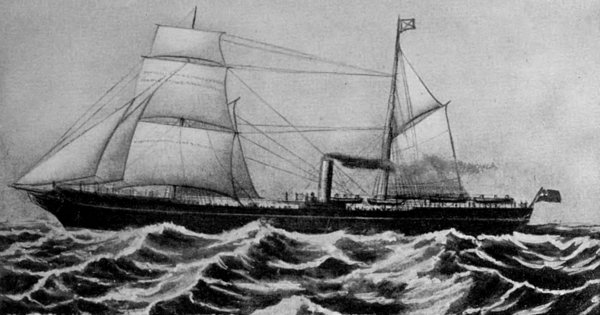
To the best of my belief we got to Cape Town and
docked on the morning of January 22, 1879, the day
on which the battle of Insandlwana was fought. We had
a good bit of cargo to land, and there was no great hurry.
That evening I was in town, gossiping at the club or
something of the sort about 11 p.m., when a rumour
was whispered of a great British defeat. All the
Company’s shore officials were in the country or in bed,
and it occurred to me that there were troops in Cape
Town who would have to be moved up to Natal, also
that I was the man to do it in a hurry. I made at once
for the office of the Cape Argus and, by dint of an exercise
of modesty, got hold of the Editor. I wish I could
remember his name. He was not popular, but on this
occasion showed me every courtesy. Without giving
particulars, he told me a disaster had happened, and
that reinforcements were urgently wanted at the Front.
That was enough for my purpose. I made straight for
Government House, from there to the Castle, and then
went down to the ship, knowing that I had secured the
job to take what troops there were to Natal. This was
all the more satisfactory because there were three or
four Currie ships in the dock that could have sailed at
short notice, but I doubt if they could have gone as fast
as we did. When daylight came in I set every one to
work to get the cargo out of the ’tween decks to make
room for the troops, and must say my fellows worked
like good ones. That afternoon I went up to see Sir
Gordon Sprigg, who was then Premier, and promised that
I would not anchor between the Cape and Natal. By
the courtesy of Captain A. D. W. Browne, Captain and
Adjutant of 2nd Battalion, The King’s Own Regiment,
I am able to quote from the regimental records.
“The detachment at Capetown (i. e. C, G, and half
E companies, with Major Elliott, Captains Knox and
Leggett, and Lieutenants Bonomi and Ridley) was
brought at a few hours’ notice to Maritzburg, sailing in
the s.s. African on January 23, and landing at Durban
on 26th.” I take leave, however, to doubt the absolute
accuracy of this record for the following reason. The
disaster happened on the 22nd. Certainly one day
elapsed, for it was in the afternoon of the 23rd that I
saw Sir Gordon Sprigg, and I have a distinct recollection
of going out of dock in a thick fog before breakfast,
and the caution of the port captain that there was a
big sailing ship at anchor very near the dock entrance.
This discrepancy, however, is of no great importance.
There was one little incident in the embarkation of the
troops that took my fancy very much. Said young
Bonomi, “Did you notice, major, when we left that the
barracks were on fire?” as if the matter were one of
the smallest importance only. If they were burning,
at all events they were soon extinguished.
We left Cape Town docks in a thick fog, which, however,
cleared when we got to the entrance of the Bay,
and we made the best of our way round the coast. We
had to call in at Algoa Bay, but I did not anchor, as I
had to do (though for a few minutes only) at East London,
and on the evening of the 26th we were all very thankful
to make the Bluff light at Natal where we anchored about
8 p.m. I should explain that by common report it was
one of the threats of Cetewayo that one night he would
come in and put out the big candle on the Bluff, meaning
the lighthouse, so that when we saw the light it gave us
relief, for we knew at all events that the worst had not
happened. It is an easy matter to think it over quietly
now, but at the time there was a great deal of uncertainty
as to what the Zulu power was really capable of, and
on the previous voyage I had heard Judge Lushington
Phillips, who knew the country thoroughly, make the
remark that if we tackled the Zulus we should have
many empty saddles before the affair was finished, which
unfortunately was a true forecast.
Captain Baynton was acting now as the Company’s
manager in Natal. He came off at the earliest moment
and disembarked the troops; he also gave me instruction
to land one of the African’s twelve pounder guns, with all
its necessary equipment, for the defence of the Pynetown
laager. This was done, and the gun was duly mounted,
though never used.
There is no doubt that at that time Durban was very
uncertain as to what would happen. A decision had
been come to that if the worst came to the worst they
would all have to take to the ships, and consequently
great wooden barricades had been hastily run up across
the Point to assist in resisting any victorious Impi that
might be out on that particular piece of business. Very
many of the stoutly built houses in Durban were loop-holed
with sandbags, and the entire male population was
being organised for the best resistance possible. On the
first evening I landed I went into some big hall, I forget
which it was, and saw the inspector of police, Alexander,
putting the townsmen through their drill with old
Snider rifles. There never was a more attentive class.
So far as my remembrance serves me, there was not at
this time any naval officer to superintend at the Point;
all that sort of thing came in the course of the next
month or so.
But although Rorke’s Drift had been fought and the
Zulu rush stayed, the ordinary trade had to be carried
on, and I was soon dispatched down the coast again.
It is wonderful in these cases of emergency what can be
effected by the display of pluck and experience. In all
the excitement which prevailed, Baynton was unmoved,
save with some little scorn, perhaps, for those who took
too seriously the normal reverses of war. The 24th
regiment, which was cut up at Isandlwana, was a great
favourite with every one, and I had known many of
the officers intimately, and enjoyed the hospitality of
their mess. To this day Pat Daley’s picture hangs in
my bedroom as a memento of one of the cherished
friendships of early days, for he was of the best of them,
but old Ted was sternly practical, and retailed for the
benefit of the uninitiated the lessons he had learned in
the Crimean War. As it happened, on the previous
voyage home I had with me, as passengers, wives and
children of officers who were killed, and the disaster
came to me with a great sense of personal loss.
It was found by experience that the Zanzibar mail
work could be better done by larger vessels than those
we had on the coast, and the African was to be the first
of our intermediates to make the trip. One of our
captains, H. De La Cour Travers, had been on shore on
the East Coast for some little time on Company’s
business, and he came up the coast with me. Nothing
of importance occurred, but our stay at Zanzibar was a
very pleasant one. Leaving that port there were two
passengers of interest. One was Archibald Forbes, the
other Lord William Beresford. Of the great war
correspondent there is little that is fresh to be said, but
the following anecdote may be permissible: I did not
like card-playing in the saloon on Sundays, and said so,
but when I was in my cabin dozing after dinner with one
eye open, some of the others came to Forbes, asking him
to play and to disregard me. “No,” said Forbes, “the
skipper isn’t a bad chap, and he doesn’t like it, so there
will be no play,” and there was not. This was the more
noticeable, for I had had to address a few unpleasant
remarks to him on a certain subject. With regard to
Lord William it was another matter. We most of us
have an idea of the energies of the Beresford family, but
here was the quintessence of it. I first met him jumping
down the steps of De Sousa’s shop, just as a child would
do, both feet together. We were soon on very good
terms, and I owe to him my introduction to Gordon’s
poems and some other things of a like nature. He was full
of romance, and in order to get a look in at the Zulu War
was taking letters from Lord Lytton, the Governor-General
of India, whose A.D.C. he had been. I never
saw him again after I said goodbye in Durban Club,
with the words “Luck and a V.C.” He got both.
Natal Roads was a different place in April to what it
had been in January or even March. There was a great
collection of steamships there, and the entire harbour
was very busy. We skippers found it a little awkward
to get on shore and come off again, for the Company’s
tug was almost the only reliable conveyance, and she
could not spare individual attention to our ship only.
Eventually the Curries got a tug of their own, and that
made matters better. The African was now bound
home, and things were working very smoothly. Sailing
from Cape Town, however, we stayed in the Bay for
some hours to pick up some celebrities who wished to
sail with us. Amongst these was the Rev. Charles
Clarke, the celebrated elocutionist. We became great
friends, and I enjoyed his society very much. The
saloon was full of passengers, and I well remember the
events of that sailing day. I had to deal with peppery
men standing up for their rights on the one hand, and
the supplications of beauty in distress on the other,
whilst looking on with calm serenity were the wonderful
eyes that years afterwards were to be my guiding stars.
I had to exercise considerable diplomacy to arrange
matters, but eventually it was done, and peace reigned
for the rest of the trip. Upon that occasion we had a
really live ship’s mother, and any one who has travelled
much knows what that means; but she was a charming,
good-natured soul, and her husband was the best
tempered man I think I ever met. In case they are
still alive and chance upon these lines, I should like to say
that the kindest remembrances of them remain, for we
were shipmates afterwards on more than one occasion.
There was a very fair spell at home that time, and I
had my first experience of playing expert witness in a
law case. It related to the loss of a vessel on Point
Padrone in Algoa Bay, and the fees we received were
grateful and comforting, but the masterly summing up
of the case by the then Master of the Rolls, Sir George
Jessel, was a thing to remember.
We were still on the direct Algoa Bay, Natal and Zanzibar
route, which was out to Natal—then to the Cape—then
Zanzibar and home via Cape Town. Calling at
Delagoa Bay on the outward trip we took on board H. E.
Governor Castilho, who was proceeding to Mozambique.
He was a naval officer by profession (Portuguese) and
had been well known for some years as Consul in Cape
Town. He was a man of very marked ability, and spoke
English perfectly. I once asked him how it was he
spoke our tongue with such purity. His reply was
“You learned to speak from your nurse. I learned my
English from the Spectator.” I quite recently had a
pleasant reminder of our old friendship, for he sent me
his photograph. He is now an admiral, and I have to
mention him more than once in these pages. There is
always a certain rivalry between seamen, and it was not
wanting in this case. Mozambique is a port that in
those days was not entered during the hours of darkness,
as there were no leading lights to ensure safe navigation.
It was dark before we made the light on St. George’s
Island, and Castilho observed to me that I should have
to anchor outside. The spirit of opposition made me
reply that I should go inside. To make a long story
short I turned in just a little too soon, and the port lead
gave “half four” just north of the Island light. It
was coral formation and that meant very close to the
bottom. Castilho, who was on the bridge said, “You are
on the north side,” but I knew better, ported the helm,
went full speed and was into safety once more. But
it was touch-and-go. However, by this time I had got
confidence on the bridge, and, thank Heaven, it never
left me. I left my friend the Governor at Mozambique,
for he told me he was going to the Cape en route for
home with me on the downward trip.
Need I say that there are times when masters of ships
are charged with delicate commissions? The trip under
notice was a case in point. The agent of a company, if
properly accredited, is supposed to exercise the powers
of the owners if need arises, but the master is also the
owners’ representative so far as his ship is concerned.
The point is a nice one, as to how far it lies in the power
of an agent to supersede the master’s authority, but the
problem is not perhaps now so difficult when there are
so many facilities for cabling information. In my time,
however, our masters were not taking more orders from
the smaller agencies than they could comfortably
manage. Our Zanzibar agent was a man rather awkward
to deal with, but he always consulted me before
deciding any point concerning any ship. When I left
Cape Town I was charged by our chief agent, afterwards
Sir T. E. Fuller, K.C.M.G. (as to whose authority there
was no doubt), to confer with the Zanzibar agent as to
the Company’s accounts, which were apparently in a
somewhat backward condition. This was rather a
delicate matter, but I did my best and the affair passed
off very well as I thought, and I received the assurance
that the accounts should be forthcoming without more
delay. H.M.S. London was the station ship at Zanzibar
for the suppression of the slave traffic, and naturally
we were on good terms with the various officers, and on
the morning we were to leave I went to the Sultan’s
levee with them. The preceding evening we had
illuminated the ship with blue lights, as it was Ramadan
time, and H.H. Seyyed Burghesh was kind enough to
compliment me on the appearance of the African, for
from his watch-tower he could see all that went on.
The levee was over by 10 a.m. and I went on board in
order to sail at noon.
About 12.30 the agent arrived with the ship’s papers,
and I casually observed that I was very fond of punctuality,
little dreaming of the mine I was setting fire to.
Amongst other things he said something about wishing
to send some particular sort of ox and a goat to Algoa
Bay. I judged that he had intended to do so, and
thought no more about it. We left the port and proceeded
through the pass all right. But unknown to me,
and while I was at the levee, the Sultan had sent on
board (as it turned out eventually as a present to me in
recognition of our fireworks) an ox and a goat, which
I imagined when I saw them were the ox and the goat
referred to by the agent to be landed in Algoa Bay.
There that matter can rest for the present, but there is
more to follow. At Mozambique we picked up both
the old and the new Governors of Delagoa Bay and a
Major Da Andrade who was to be landed at Quillimane.
I think he has since played an important part in Portuguese
East Africa. When we got to Quillimane there
was no sign of craft coming out, so, after long waiting,
we put the passengers, mails and specie on board an
Arab schooner anchored outside, and left for Delagoa
Bay. It may appear in these days a loose way of doing
business, but there was then no help for it.
About this time Delagoa Bay was in a very poor state
politically. There was government by an autocracy,
not always a wise one at that, and the management of
the natives was a source of considerable profit to the
so-called emigration agents. In fact, affairs were in bad
confusion and I scarcely think Castilho was sorry to turn
his back on the scene of his late governorship, for events
had been a little too hard to manage.
We got down to the shoals as it was getting dusk and
a heavy sea was breaking on many of the shoal patches.
There were no marks or lights, so I put her at one of the
dark patches of water and she came through all right,
in fact it was about as safe a plan as could have been
adopted. But I will admit it was rough-and-ready
navigation, adapted to the needs of the time and also
the circumstances of the case. We got to Cape Town in
due course on the way home. There, to my satisfaction,
I met my friend, Herbert Rhodes, and got up a little
luncheon party on board to celebrate the occasion. I
thought I had picked my party well, for I had Castilho
and Rhodes, who sat opposite one another and next to
me. There was F. St. Leger, “the Saint,” as the dear
old editor of the Cape Times was commonly called,
Peter van Breda, and others whose names do not now
occur to me. I was greatly surprised to find that
Castilho did not talk willingly to Rhodes, and that the
latter had some reason for mirth which he did not impart
to me at the time. When we left the table Castilho
observed to me, “If I could have have laid hold of your
friend in Delagoa Bay, he would have gone to jail for
a long time.” I was a bit astonished, but the party then
broke up. Here was the reason of it all. For some
years past there had been a lot of young Englishmen
coming to South Africa in search of adventure, and there
was very little that was too hot or too heavy for some of
them to tackle in one way or the other. Some were
soldiers, I remember Major Goodall and Captain Elton
in the early ’seventies; then there were young men such
as Dawnay, Reggie Fairlie, Campbell, and others like
Rhodes. They might be hunting, or transport riding,
or exploring, but one was fairly confident that no piece
of mischief was passed that could by any means be
negotiated. Now, some little way up the river that
runs into Delagoa Bay there lived a dusky potentate
whose soul thirsted for the possession of some piece of
artillery, be it ever so small, and as proof of his earnestness
offered in return a tumbler full of diamonds. I
never heard that they were to be of any fixed value,
but they ought to have been, for the Portuguese strictly
forbade the importation of artillery of any sort or kind,
and it would go hard with any one engaged in smuggling.
I am not certain who Rhodes’s companions were, but
some of those I have mentioned were surely in the job.
They chartered a little schooner at Natal, named the
Pelham, then got a six-pounder old brass gun, which they
smuggled on shore at Delagoa Bay one night and buried
in the mangrove bushes above the town. They got
their diamonds and, then, instead of getting on board
their craft as sensible, or older, men would have done,
they proceeded to paint Lourenço Marques red, in the
brightest coloured paint procurable. There was a
certain lady there with very sharp ears who, forming
a conclusion, gave the game away to the authorities, and
the young adventurers owed their freedom to the fact
that there did not happen to be a Portuguese gunboat
in Delagoa Bay, as there usually was. Doubtless, however,
that absence had been taken into consideration.
This was the last occasion but one on which I saw my
friend Rhodes. The last was when he came off to my ship
at Quillimane, a short time after this, to bring some
ivory tusks for home, to get some Eno’s fruit salt, and
if possible a toothbrush, and chiefly to see me. It seems
that he had got some great shooting concession from a
chief up country and was going the next day to take
possession of it. We had a long yarn about mutual
friends, and that was the last of him, for some accident
happened at the camp fire the next day, and he was so
burned that death in agony was the end of a man who in
my mind always stands as an embodiment of Charles
Ravenshoe.
About this time I had as passenger the late Arthur
Sketchly, of “Mrs. Brown” fame, going out to write
that lady’s adventures in South Africa. He was a
man of great bulk and moved slowly. One night at
dinner, some boys were very happy and jolly. He
turned to me, saying, “Young men! Young men! they
can run, jump, laugh, eat, make love, do anything.
Ugh, I hate ’em!”
On my next passage from home we got a very severe
dusting just south of the Bay of Biscay. I find by my
notes that we lost a lifeboat, got the bridge rails smashed,
man washed from the wheel, and various other damages;
but these things will happen at times. We got to Algoa
Bay on December 25, 1879, and there the fun began
concerning the ox and goat being landed in an unauthorised
manner, and I was liable for all sorts of fines.
Further, I was told that the Zanzibar agent had written
about a “buffalo and a calf,” and these were not as
described. Given these circumstances there can be lots
of correspondence and, as in this case, serious results.
About this time I was in severe domestic trouble, such
as shakes a man to his foundations, but fortunately,
perhaps, if you happen to be a cogwheel of a machine you
are kept grinding and so have less time to brood over
the workings of fate. I was thankful for the companionship
of two of my passengers, one Herbert De La Rue,
and the other Fred Struben, both of whom are now well-known
men. We got to Zanzibar, and there it was
reported to me that the agent had been spreading
reports concerning my sobriety when I left the port on
the previous voyage. I did not concern myself about
this until the agent made the statement to my chief
officer. It was all over the “ox and goat,” for the statement
was that I was told in good plain English by the
agent that they were a present to me from the Sultan,
but I was not in a fit state to comprehend what was said.
Now on the morning in question I had been, as I have
said, to the Sultan’s levee and had not touched intoxicants
at the time of leaving port. The inference that
coffee and sherbet had influenced me was of course
unbearable. However, as the statement was persisted
in there was no alternative but to take the matter before
the Consul. There were numbers of independent witnesses
from the shore to testify on my behalf, and the
agent was fined and mulcted in costs. They had a fine
expeditious way of doing business in that court, for a
defendant is ordered to appear “forthwith.” To close
the incident, there was some talk in the harbour about
the “cheek” of a master putting an agent in the court,
but I knew that unless I took immediate steps the lie
might have lasted my lifetime. The next time I faced
my board and the business came up, the chairman, Sir
Benjamin Phillips, said to me, “We think that you acted
quite rightly, sir,” and that was all that I required. I
should like also to put on record my sense of appreciation
of the kindness of Sir John and Lady Kirk, Sir John
being at that time Political Agent at Zanzibar. The
remainder of this voyage, so far as I was concerned, was
uneventful, save that I found it quite necessary to
really practise star navigation. I had then with me, as
chief officer, Franz K. Thimm, an old Worcester boy,
and he seconded my efforts by all the means in his power.
Between us we came to the conclusion that we could
be, if necessary, independent of daylight observations,
and that state of things was useful on a coast where
currents often run both strongly and in uncertain
directions. But, apart from its usefulness during the
whole of my sea career, I never lost a sense of wonderment
that man could compile such a book as the Nautical
Almanac. To step on deck, take three or four all-round
shots at stars, and then go in and place the ship to a
nicety, gives one cause for reflection and thankfulness
for the work of the great discoverers who have so
benefited those who came after them.
When we arrived home there were some changes made.
Wait, who I have explained was my senior in command
by a few days, was in port in the American, and there
was then building on the Clyde the Trojan, to which
it was necessary to appoint a master, to finally supervise
her fitting out, and bring her round to Southampton.
One day Wait was ordered to go north—and I to the
American, then Wait was ordered back to his old ship
and I to the Trojan. This was rather a fortunate thing
for me, as on the passage out, when on the line, the
American broke her screw shaft and sank. Fortunately
all hands were saved, to the infinite credit of her captain
and officers. Captain Hepworth, R.N.R., C.B., of the
meteorological office, was then chief officer, and my old
friend Jones of the Basuto was the second. I came to
hear of the accident in the following manner. I was in
my lodgings one afternoon when the office messenger,
Fancourt, came in with a face of great importance,
“Captain Dixon’s compliments, and he would like to
see you at once.” Those who have known Fancourt
will realise the manner in which the message was
delivered, for I really believe he thought he ran the
Company, in the same manner that the limelight man
dominates the stage. I went to the office of my chief,
who paid me a great compliment or else was pulling my
leg. The table was covered with charts, and he said,
“The American has sunk in lat. —— long. ——. All hands
saved in the boats. I want you to tell me where we
should look to find these boats, for I conclude you know
more about it than any of us.” As it happened I was
wrong in my estimate, for the boats were picked up by
ships, but the currents, both the Guinea and Equatorial,
might have played a part in their destination. Some
of the passengers had a second shipwreck in the vessel
that picked them up and there were fatalities. I cannot
quite remember how the news first reached home, but
several details stood out rather prominently. One was
that the theatre on the poop, where theatricals had
taken place the preceding evening, was conspicuous as
she sank, and also that the second officer had been seen
getting the butcher’s water-tank into his lifeboat. That
was typical of Jones, essentially a practical seaman.
I asked him afterwards to tell me about it, and whether
he had any trouble at all. “When I got down in the
boat,” he said, “to get things in order I chucked out
several bundles of things that were no use and took up
room, one of which belonged to the cook, who resented
my action. I just told him that if he said more I would
see that he followed his bundle, and there was no more
trouble.” It has always been a matter of congratulation
to me that I escaped being in that business. Captain
Wait was very justly highly complimented for his action,
and his officers, too, received their meed of recognition.
I duly went north to take over the Trojan. She was
a ship of something under four thousand tons, but that
was big for us in these days. Taken all round she was
one of the nicest little ships I ever had to do with, and
curiously enough she was the second ship that carried an
electric light. I fancy the City of Berlin was the first,
but the Trojan was the second. It was merely an arc
lamp in the saloon, and Captain Dixon referred to it as
“one of the chairman’s fads.” A special cabin also was
being fitted up to bring home the Empress Eugenie from
the Cape. She had travelled out in the German. I found
the two brothers Thompson, who built the ship, very
agreeable, and they did their best to make my stay
pleasant. Leaving Clydebank on the top of high water
we actually bridged the Clyde, by accident it was true,
but we might easily have been in a very awkward fix.
We went into the Gareloch to adjust our compasses, and
there I first had the pleasure of meeting Sir William
Thompson, afterwards Lord Kelvin. Seamen should
be eternally grateful to him, for in addition to a perfect
compass, he gave us also a sounding machine which, if
fairly used, is simply invaluable. I once asked him,
some years after this, for I am pleased to say that I
retained his friendship, why he could not give us a
reliable log that would register the ship’s speed
accurately. He replied that there would be no difficulty
in doing that, but as it would engender a false
confidence he thought it better left alone, for surface
currents that could not be accounted for would falsify
the correctness of any log. We did not run our official
trials in the north, but at Stokes Bay. On the way
round Captain Dixon was with us, and I learned that I
was to take the ship out. This, I thought at the time,
was a little too good to be true, for I knew some senior
would come along and hustle me out of her, and after
we had our speed trial in Stokes Bay, sure enough
Travers had managed to so work it that he came home
in the Asiatic and the exchange was duly effected. My
connection with the Trojan was not a long one, but for
many reasons it was eminently pleasant. For instance,
it had given me an opportunity to meet, unofficially as
it were, most of my directors, and it convinced me that
there were times when they could behave as human
beings. I should specially like to mention the unvarying
courtesy of Mr. Giles, who had succeeded to the chair.
He was then member for Southampton, and his dinner-parties
at Radleys, to which all our captains in port
were invited, were functions much appreciated by those
asked to attend.
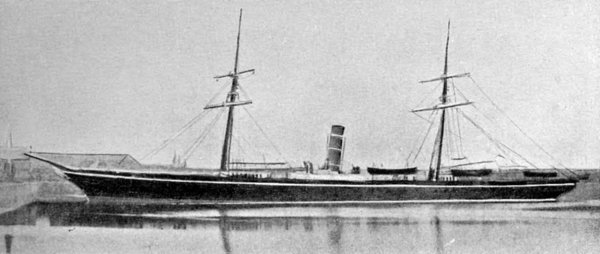
There have been many ugly ships afloat—the Basuto,
for instance—but for sheer naked ugliness and brutality
unashamed, the Asiatic must be given the palm. She
was built at some north-country port, and had a bow
like a circular haystack. When she was light and a
breeze was blowing, very nice handling was required
to prevent her taking charge herself. But she had her
good points: for one thing there was a decent compass,
and she handled well in fine weather; for the rest she
was comfortable enough at sea, but had not been well
attended to as regards her upkeep, and wore a slovenly
aspect altogether. This I at once set myself to remedy,
and she presented a vastly different appearance the next
time she came into Southampton. We of course were
on the intermediate service, but when we arrived at
Zanzibar for some reason there was great jollification
going on, in which we participated. I gave a dinner and
ball attended by every lady in the place, except two—the
French consul’s wife and sister. They were absent,
as the captain of a French man-of-war told me in strict
confidence, because the unmarried sister’s dress was
prettier than that of madam. The fact remains that
we mustered, I think, eight ladies, and they were very
well pleased. What was of more importance, however,
to my mind, was a shooting match got up between the
officers of the cable-laying ship, H.M.S. London, and
ourselves. The London found the rifles and the ammunition,
and P. G. VanderByl, one of the lieutenants, was
in charge of the London team. I had known his people
at the Cape for years past, and was afterwards shipmates
with him in the old Devastation. We sailed up the
harbour in one of the London’s sailing cutters; they had
several, and very fancifully named they were—after
the names then in vogue on the front pages of waltz
music. This one was called Olga, and she was navigated
and conned by VanderByl as if she had been a battleship.
It is, perhaps, needless to say that we were fairly well
provided also for a picnic. I had in my team a great big
hulking quartermaster whom I had seen do very well
on the range at home, and I was relying upon him and
some of my officers to make a good show. To make a
long story short, the Londons shot abominably, and we
did rather worse, the cable ship being a bad third. My
quartermaster was a distinct failure. The Londons
were delighted to find they were not beaten, for it turned
out afterwards that their captain would have been vexed
had they been. It was at this time that I made the
acquaintance of Captain Ouless, R.N., who was navigator
to the London. I always found navigating officers
most willing to help a shipmaster with the time, or any
information that may be at their disposal. I fancy it
was on this voyage also that I first met H. M. Stanley.
I was taken by one of the officers from the consulate, a
nice fellow named Holmwood, into a large, low, fairly
light room. A small white man was leaning against
the wall, and squatted all round the room were the men
Stanley was engaging for his trip to the interior. It was
a rather remarkable gathering, but if the truth be told,
neither then nor afterwards did he give me the impression
of being the remarkable man he in reality was. There
was also in the port that beautiful yacht the Lancashire
Witch, afterwards bought by the Admiralty for a surveying
craft. She was owned by Sir Thomas Hesketh, but
I do not remember making his acquaintance. The
Sultan’s forces were then under the command of a
British naval officer named Matthews, and it was very
remarkable the success that attended his efforts. His
men regarded him with immense respect and veneration,
and would have gone through fire and water for him.
It was quite a sight to see them drilling in the square in
front of the palace. I ought also to say that the Sultan
was most generous in providing horses for visitors who
wished to ride. He had a sort of a henchman called
Mahomet, who spoke very good English, but was not,
if my memory serves me, an unswerving Mohamedan,
for at times he admired the wines of France. Although
afflicted badly with elephantiasis, a very common
complaint there, he would always manage any little
matter that might be required on shore, but naturally
he liked his perquisites and saw that he got them. If
report spoke correctly, he could have told the tale as
to how the death of gallant Captain Brownrigg, R.N.,
was brought about, but as I cannot state facts it is little
use talking over that sad story.
There were quite a nice lot of passengers for the homeward
trip from Natal and the Cape, amongst them a
newly married couple, the bride being a very beautiful
Dutch girl. Before we left the Cape there was quite a
gay time. One day we started out in a drag for a picnic
at Newlands, but it came on to rain badly. There was
a man I knew lived near to where we were, named
Raphael Bensusan, and he was a good fellow, so we drove
up to the house. He was not in, but his brother, or a
male relative was, and he joined us in our picnic on the
floor of the dining-room, for as it happened the house
was half shut up. That was a very jolly afternoon, and
the day ended with one of those balls in the Exchange
Building that went far to make Cape Town one of the
pleasantest places to know.
The following story is absolutely true, and shows how
circumstances at times seem to try and assist the hangman
to put the rope round the victim’s neck. It was
my custom when in command to sleep in the afternoon,
and then remain about well into the middle watch. In
the Asiatic my cabin was at the fore end of the saloon
on the starboard side. One night, about half-past
twelve, I was sitting up with a Captain Le Breton, smoking
and yarning. The door was open, windows and ports
also, for the night was very warm. This was before the
time of electric lamps, and my cabin was lit by a
moderator lamp, and another one hung in the saloon,
for ordinary cabin lights were extinguished at 11 p.m.
save when by the doctor’s orders they were kept burning.
Suddenly in rushed a girl, yelling that some one was
looking into her cabin through the porthole, and asking
to be saved, flung herself down in a chair, and went off
into a faint. Just at that moment a puff of wind blew
my lamp out, a thing that had not happened before to
my knowledge. Then I went for the lamp in the saloon,
which also went out, after which I got the quartermaster’s
bull’s-eye, and went and called the stewardess, who took
the frightened girl back to her cabin and put things
straight once more. When I and my companion were
alone again I asked him, if he was on a jury, would he
believe in such a combination of circumstances, and he
gave an unhesitating No, and I can certainly say, Neither
would I.
The Asiatic got back to Southampton looking so
smart that she hardly knew herself. It’s really wrong
to make fun of my ship, but on her first voyage, when
she was commanded by Captain Coxwell, the commodore,
on her arrival in Algoa Bay he was chaffed by his
acquaintances upon his skill in bringing in his ship stern
first, for they pretended to believe that no vessel in
existence could have a bow like the Asiatic. They
might almost have been forgiven for the belief.
Back now once more to the African, for as far as
seniority went I was in my proper place there. The
directors had come to the conclusion that they would
run a monthly line to Hamburg, in connection with the
intermediate service to Zanzibar, and the African was
the first one to undertake this business. Our chairman,
Mr. Giles, who had carried out engineering work at
Cuxhaven, thought it fair to masters to send them over
first as passengers to let them see what the Elbe was like
before taking their ships there. This was a considerate
act, for a frozen river was a novel experience to me, if
not to others. I therefore took passage in one of the
General Steam Navigation ships. The Elbe was frozen
over, and it was curious to see the steamer charging a
great floe of ice and splitting and rending her way
through it all. The main difficulty, however, appeared
to be that the injection water occasionally froze, and
there they had to use a special contrivance for blowing
steam through the injection plate. I duly wired that
information home, but no notice was taken of it, and I
had just the same bother in the African. One could
not help being impressed by the iron order imposed upon
all and sundry in Hamburg. The people lived by rule,
and they lived well; the docks were in excellent order
and far better fitted than were ours, either in London or
Southampton. I was taken by the Company’s agent
to a ball where the admission was sixpence. It was
2 a.m. and there were about three thousand people of
the working class present, but not a sign of rowdiness
or any one the worse for drink. It was something of a
revelation, but there was a great deal more to be learned
than that. I suppose I, as most young Britons of the
period, had the idea firmly fixed in my mind that we
were the one people in the world, and that no one else
counted. Our agent was a very nice fellow, and we
never had the smallest friction, but somehow or other
he managed to convey to my mind that there was a
nation of Germans that intended to become, as they
thought themselves then, top dogs of the world. I have
mentioned an earlier instance of this already.
I saw all I could and went back to bring my ship over,
and if any one is under the impression that the North
Sea is a nice place to navigate they are welcome to their
belief. It is not mine. I suppose that in time those
trading there become accustomed to it, but it must make
seamen of them, and this factor should be taken into
consideration when appraising the worth of our Teutonic
cousins as possible rivals at sea.
It is undoubtedly a good thing to have a change of
route. Constantly trading between the same places
is pleasant in many ways, but you see little that is fresh,
and the mind has a tendency to run in a groove, which
is not healthy. And again, fresh faces and places sharpen
your wits, and remove the impression that you have
learned all that there is to know.
A first trip up the Elbe in the winter time was a fine
corrective for any feeling of stagnation. The Company
was kind enough to supply us with a North Sea pilot, a
shipmaster acquainted with those waters, but I had no
idea of letting him do aught else than consult me. In
this case he was not anxious to assume any responsibility,
but arriving one night after dark at the mouth
of the Elbe, we got on board as a pilot a little old man,
who gave one the idea of Rip Van Winkle. There was
a lot of ice coming down, and I was considerably surprised
when the pilot asked me to put the anchor down
with the ship making at least six knots through the
water. It was quite all right, however, and next day
we got to Hamburg.
My instructions were to give a dinner and entertainment
to some of the shipping magnates, and that I proceeded
to do, sending out invitations on the advice of
our agent. The eventful evening came round, and I
had had some doubt for a day or so as to the strict
sobriety of my chief steward. As dinner was proceeding
I looked backwards where I could see the pantry, and
then observed the steward in a helpless state of inebriety.
He caught a look from me that would have sufficed to
wither an anchor, but he was too far gone to be affected.
My own personal servant and the head waiter pulled us
through, however, all right. The dessert was hardly
on the table when one of the guests was on his feet
proposing the health of the Kaiser, and the rest got up
and yelled “Hoch” enough to lift the deck beams. I
sat fast and said nothing, for the situation was an awkward
one. I was host, but it was a British ship, and our
Queen had to come first, so when the national ebullition
had died down, I got on my feet as I said to propose the
first toast of the evening, “The Queen and the Kaiser.”
That was perhaps too great a concession, but it was
better than discord under the circumstances. It was
duly honoured and the rest was harmony, for I had
provided music. My servant at that time was a perfect
attendant; I scarcely needed to tell him anything, for
he had the faculty of anticipating my wishes. There
was one of the guests who was needlessly pro-German
throughout the evening, but at the end of it he had to
be put into a cab and sent home. I fancy that for his
final brandy and soda he must have had brandy and gin.
I gave no instruction or hint on the matter, but I had the
impression that honours were about easy at the finish.
A day or so afterwards he came to wish me bon voyage,
but he did not seem very well, and I doubt if he meant it.
It was so cold in Hamburg that the steam winches on
deck had to be kept moving all night when not in use,
to prevent them freezing, and as the ice-breaker was not
then properly at work we had to cut our own way through
the ice going down the river. When we got back to
Southampton the ship’s sides at the water line were
bare of paint, and the steel side was as bare as a knife
and the same colour.
When we reached Natal in the course of that voyage,
we heard of the outbreak of the first Boer war, which
commenced by the shooting down of one of our regiments
without any declaration of hostilities. I will only say
this, that the feeling between the Dutch and the British
was then, and for many years afterwards, so acute that
the last Boer war was the inevitable outcome of it, and
for this state of things I, in my own mind, have always
considered Mr. Froude and his friends responsible.
Left to themselves, the Boers would have accepted the
ruling of Sir Bartle Frere, had his administration in the
Transvaal been carried out as he intended it should be.
My chief officer in the African was a man I have
mentioned before, E. T. Jones, who wore an abnormally
large black beard, from which he had acquired the
soubriquet of “Black Jones.” I had the very highest
regard for him in every way. When we arrived home in
February 1881, as a matter of course I went to London
to see the directors. At that time the Roman had been
chartered to take out troops to Natal. There was then
no master appointed to her, and I was questioned as to
the ability of my chief officer, to which I replied that he
was as good a man as I was. But, said one director,
“is that the man with a black beard that looks like a
pirate?” and the conversation closed with a laugh,
and the intimation that they would come to Southampton
to see about it. When I returned that evening I
got hold of Jones, and much against his will took him
to a barber’s and had his beard off. It was a time for
heroic measures, for that use of the shears probably
decided the matter in his favour. As, however, it would
not do to send out troops with a man whose first voyage
it was in command, he took the African and I the Roman,
with orders to change again on the coast. As I write
this I have before me a letter signed by the officers who
travelled in the Roman, thanking me for a pleasant
passage. The first signature is Finch White, major
85th Light Infantry, commanding troops. It is followed
by F. Grenfell, lieutenant-colonel 60th rifles (now
Field-Marshal Lord Grenfell). Amongst many others
comes R. B. Lane, major rifle brigade (now General
Sir R. B. Lane), D. N. Stewart, 2nd lieutenant 92nd
Highlanders, who afterwards achieved honours in many
parts of the empire, and Charles E. Knox, captain
85th regiment, one of our best generals in the late
war. They were a pleasant crowd to travel with, and
the passage passed without a hitch, but so far as
I was personally concerned I had a little trouble, for
on the line I discovered that my carpenter had been
neglectful of his duties, and we had only one day’s
water on board. I said nothing about it but put
on the condenser night and day until we had refilled
our tanks. I then put an officer in charge of them, but
my chief engineer rose manfully to that occasion, for it
was not pleasant to have many hundreds of men depending
entirely upon condensed supplies. Major Lane and
I became very intimate. He had a wonderful personality
which attracted every one, and I doubt not he still
retains it. One evening he and I caught a booby, and
the question was the best use to put it to. Colonel
Grenfell was then asleep, and we thought it might be a
good idea to put the bird in his bunk. We put that
squawking beast on top of him as he lay, but he never
turned a hair, only said, “Ugh! take the beastly thing
away,” and we did. It was no small test of a man’s
nerve, however, since tried and verified in many a tight
corner. One thing struck me, however, on that trip,
and it was the great interest taken by the officers in
theological works of all sorts. There was a fine collection
on board, and I remember reading one called The
Approaching End of the Age, by Gratton Guinness, which
proved beyond the shadow of a doubt that the world
must end by 1894.
Going into Cape Town dock it was blowing a strong
south-easter and the ship was listing heavily to starboard.
We got the troops over to the port side and that
put her upright in a trice. It was very smartly done,
but they only wanted a word to do what was wanted.
Then we learned that the war was over. I fancy that
Lord Roberts had already arrived and returned, and
there were loud murmurs of discontent all round. We
went on to Natal, however, and landed our troops. The
late Admiral Andoe and Sir Edward Chichester were
there disembarking officers, and they gave me a very
nice certificate for the manner in which the entire job
had been performed. By the way, I had a bet with
Colonel Grenfell that the Government that made the
peace would not last six months, but I was wrong in the
sequel.
On the way back to the Cape I had with me as
passenger Sir J. H. De Villiers, the Lord Chief Justice,
who told me that had peace not been made the whole of
South Africa would have risen in revolt, so perhaps
things were as well as they were. I got back into my
own ship at Mossel Bay, and resumed regular work once
more.