MY LARGER EDUCATION BEING CHAPTERS FROM MY EXPERIENCE
Transcriber’s Note:
New original cover art included with this eBook is granted to the public domain.
MY LARGER EDUCATION
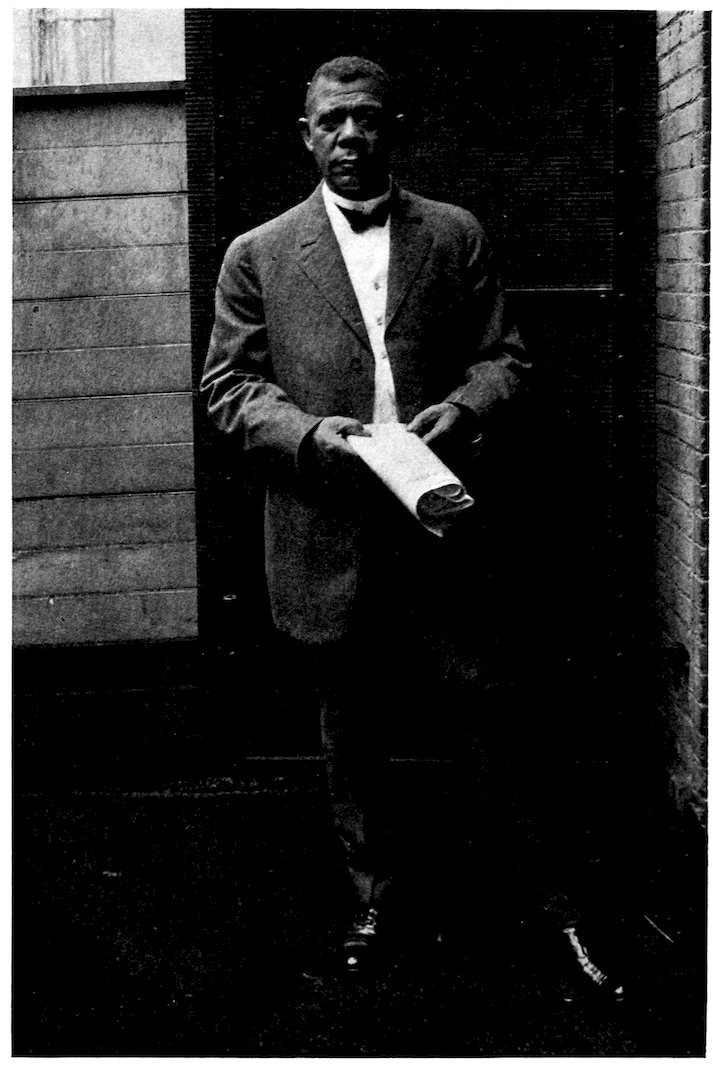
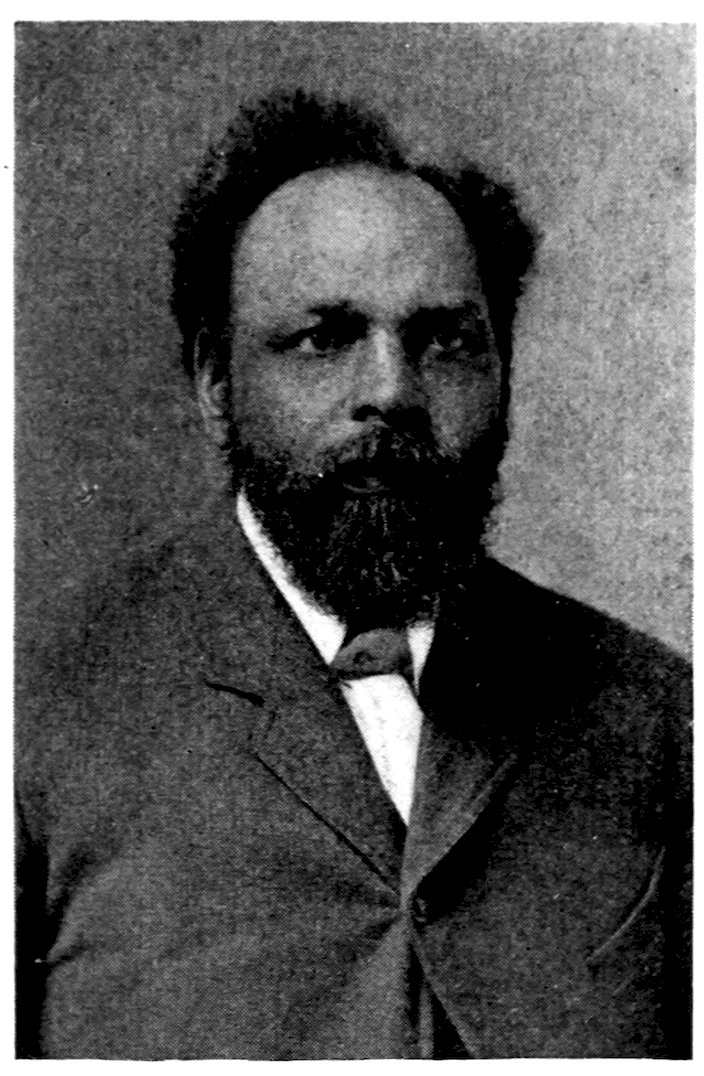
A NEW PORTRAIT OF MR. WASHINGTON
“When I had something to say about the white people I said it to the white people; when I had something to say about coloured people I said it to coloured people.”
BY
BOOKER T. WASHINGTON
Author of “Up From Slavery,” “The Story of the Negro,” “Character Building,” etc.
ILLUSTRATED FROM PHOTOGRAPHS
Garden CityNew York
DOUBLEDAY, PAGE & COMPANY
1911
ALL RIGHTS RESERVED, INCLUDING THAT OF TRANSLATION
INTO FOREIGN LANGUAGES, INCLUDING THE SCANDINAVIAN
It has been my fortune to be associated all my
life with a problem—a hard, perplexing, but
important problem. There was a time when
I looked upon this fact as a great misfortune. It
seemed to me a great hardship that I was born
poor, and it seemed an even greater hardship that
I should have been born a Negro. I did not like
to admit, even to myself, that I felt this way about
the matter, because it seemed to me an indication
of weakness and cowardice for any man to complain
about the condition he was born to. Later I came
to the conclusion that it was not only weak and cowardly,
but that it was a mistake to think of the
matter in the way in which I had done. I came to
see that, along with his disadvantages, the Negro
in America had some advantages, and I made up
my mind that opportunities that had been denied
4him from without could be more than made up by
greater concentration and power within.
Perhaps I can illustrate what I mean by a fact
I learned while I was in school. I recall my teacher’s
explaining to the class one day how it was that
steam or any other form of energy, if allowed to escape
and dissipate itself, loses its value as a motive
power. Energy must be confined; steam must be
locked in a boiler in order to generate power. The
same thing seems to have been true in the case of
the Negro. Where the Negro has met with discriminations
and with difficulties because of his
race, he has invariably tended to get up more steam.
When this steam has been rightly directed and controlled,
it has become a great force in the upbuilding
of the race. If, on the contrary, it merely spent
itself in fruitless agitation and hot air, no good has
come of it.
Paradoxical as it may seem, the difficulties that
the Negro has met since emancipation have, in
my opinion, not always, but on the whole, helped
him more than they have hindered him. For example,
I think the progress which the Negro has
made within less than half a century in the matter of
learning to read and write the English language has
been due in large part to the fact that, in slavery,
this knowledge was forbidden him. My experience
5and observation have taught me that people who
try to withhold the best things in civilization from
any group of people, or race of people, not infrequently
aid that people to the very things that they
are trying to withhold from them. I am sure that,
in my own case, I should never have made the efforts
that I did make in my early boyhood to get
an education and still later to develop the Tuskegee
Institute in Alabama if I had not been conscious
of the fact that there were a large number of
people in the world who did not believe that the
Negro boy could learn or that members of the Negro
race could build up and conduct a large institution
of learning.
A wider acquaintance with men in all the different
grades of life taught me that the Negro’s
case is not peculiar. The majority of successful
men are persons who have had difficulties to overcome,
problems to master; and, in overcoming those
difficulties and mastering those problems, they have
gained strength of mind and a clearness of vision
that few persons who have lived a life of ease have
been able to attain. Experience has taught me,
in fact, that no man should be pitied because, every
day in his life, he faces a hard, stubborn problem,
but rather that it is the man who has no problem
to solve, no hardships to face, who is to be pitied.
6His misfortune consists in the fact that he has nothing
in his life which will strengthen and form his
character; nothing to call out his latent powers, and
deepen and widen his hold on life. It has come home
to me more in recent years that I have had, just
because my life has been connected with a problem,
some unusual opportunities. I have had unusual
opportunities for example in getting an education
in the broader sense of the word.
If I had not been born a slave, for example, I
never could have had the opportunity, perhaps,
of associating day by day with the most ignorant
people, so far as books are concerned, and thus coming
in contact with people of this class at first hand.
The most fortunate part of my early experience
was that which gave me the opportunity of getting
into direct contact and of communing with and
taking lessons from the old class of coloured people
who have been slaves. At the present time few
experiences afford me more genuine pleasure than
to get a day or a half a day off and go out into the
country, miles from town and railroad, and spend
the time in close contact with a coloured farmer
and his family.
And then I have felt for a long while that, if I
had not been a slave and lived on a slave plantation,
I never would have had the opportunity to learn
7nature, to love the soil, to love cows and pigs and
trees and flowers and birds and worms and creeping
things. I have always been intensely fond of outdoor
life. Perhaps the explanation for this lies
partly in the fact that I was born nearly out of doors.
I have also, from my earliest childhood, been very
fond of animals and fowls. When I was but a child,
and a slave, I had close and interesting acquaintances
with animals.
During my childhood days, as a slave, I did not
see very much of my mother, since she was obliged
to leave her children very early in the morning to
begin her day’s work. The early departure of my
mother often made the matter of my securing breakfast
uncertain. This led to my first intimate acquaintance
with animals.
In those days it was the custom upon the plantation
to boil the Indian corn that was fed to the cows
and pigs. At times, when I had failed to get any
other breakfast, I used to go to the places where the
cows and pigs were fed and make my breakfast off
this boiled corn, or else go to the place where it was
the custom to boil the corn, and get my share there
before it was taken to the animals.
If I was not there at the exact moment of feeding,
I could still find enough corn scattered around the
fence or the trough to satisfy me. Some people
8may think that this was a pretty bad way in which
to get one’s food, but, leaving out the name and the
associations, there was nothing very bad about it.
Any one who has eaten hard-boiled corn knows
it has a delicious taste. I never pass a pot of
boiled corn now without yielding to the temptation
to eat a few grains.
I think that I owe a great deal of my present
strength and ability to work to my love of outdoor
life. It is true that the amount of time that I can
spend in the open air is now very limited. Taken
on an average, it is perhaps not more than an hour
a day, but I make the most of that hour. In addition
to this I get much pleasure out of the anticipation
and the planning for that hour.
When I am at my home at Tuskegee, I usually
find a way, by rising early in the morning, to spend
at least half an hour in my garden, or with my fowls,
pigs, or cows. As far as I can get the time, I like
to find the new eggs each morning myself, and when
at home am selfish enough to permit no one else
to do this in my place. As with the growing plants,
there is a sense of freshness and newness and of
restfulness in connection with the finding and handling
of newly laid eggs that is delightful to me.
Both the anticipation and the realization are most
pleasing. I begin the day by seeing how many eggs
9I can find, or how many little chickens there are
that are just beginning to peep through the shells.
I am deeply interested in the different kinds of
fowls, and, aside from the large number grown by
the school in its poultry house and yards, I grow at
my own home common chickens, Plymouth Rocks,
Buff Cochins and Brahmas, Peking ducks, and fantailed
pigeons.
The pig, I think, is my favourite animal. I do
not know how this will strike the taste of my readers,
but it is true. In addition to some common
bred pigs, I keep a few Berkshires and some Poland
Chinas; and it is a real pleasure to me to watch
their development and increase from month to
month. Practically all the pork used in my family
is of my own raising.
This will, perhaps, illustrate what I mean when
I say that I have gotten a large part of my education
from actual contact with things, rather than
through the medium of books. I like to touch
things and handle them; I like to watch plants
grow and observe the behaviour of animals. For
the same reason, I like to deal with things, as far as
possible, at first hand, in the way that the carpenter
deals with wood, the blacksmith with iron, and the
farmer with the earth. I believe that there is
something gained by getting acquainted, in the way
10which I have described, with the physical world
about you that is almost indispensable.
A number of years ago, in a book called, “Up
From Slavery,” I told a story of my early life, describing
the manner in which I got my early schooling
and the circumstances under which I came to
start the Tuskegee Normal and Industrial Institute.
At the time that school was organized I had read
very little, and, in fact, few books on the subject
of teaching, and knew very little about the science
of education and pedagogy. I had had the advantage
of going through an exceptional school at
Hampton and of coming in contact with an inspired
teacher in General Armstrong; but I had never attempted
to formulate the methods of teaching I
used in that school, and I had very little experience
in applying them to the new and difficult problems
I met as soon as I attempted to conduct a school of
my own. What I learned about the science of
education I learned in my efforts in working out
the plans for, and organizing and perfecting the
educational methods at, Tuskegee.
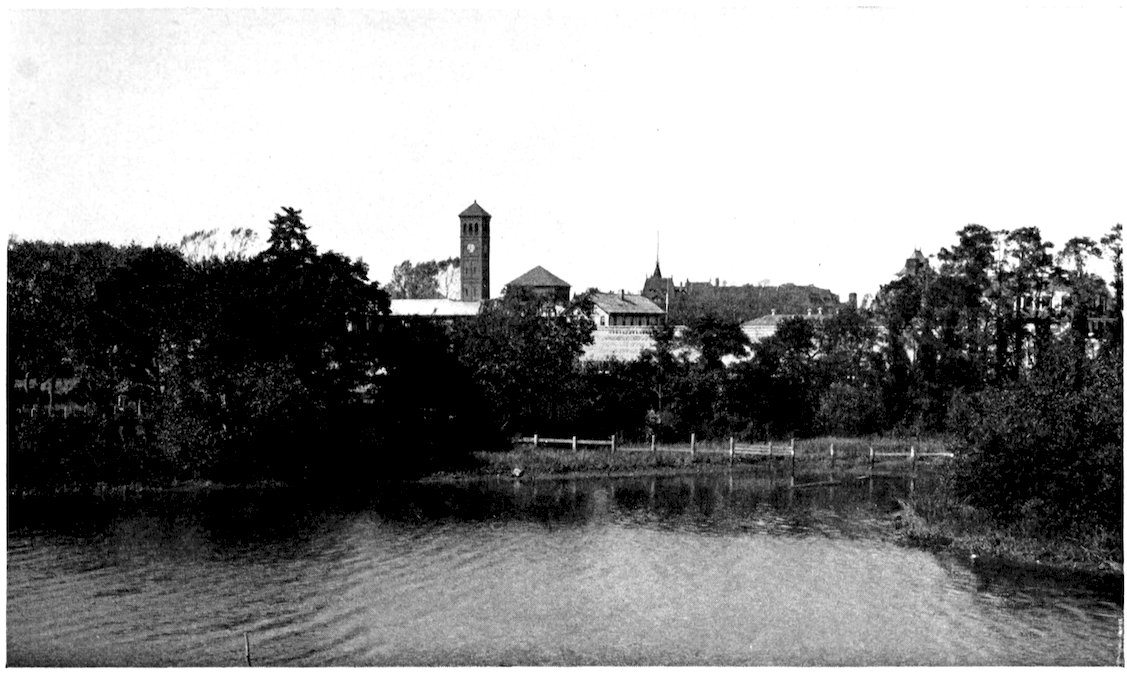
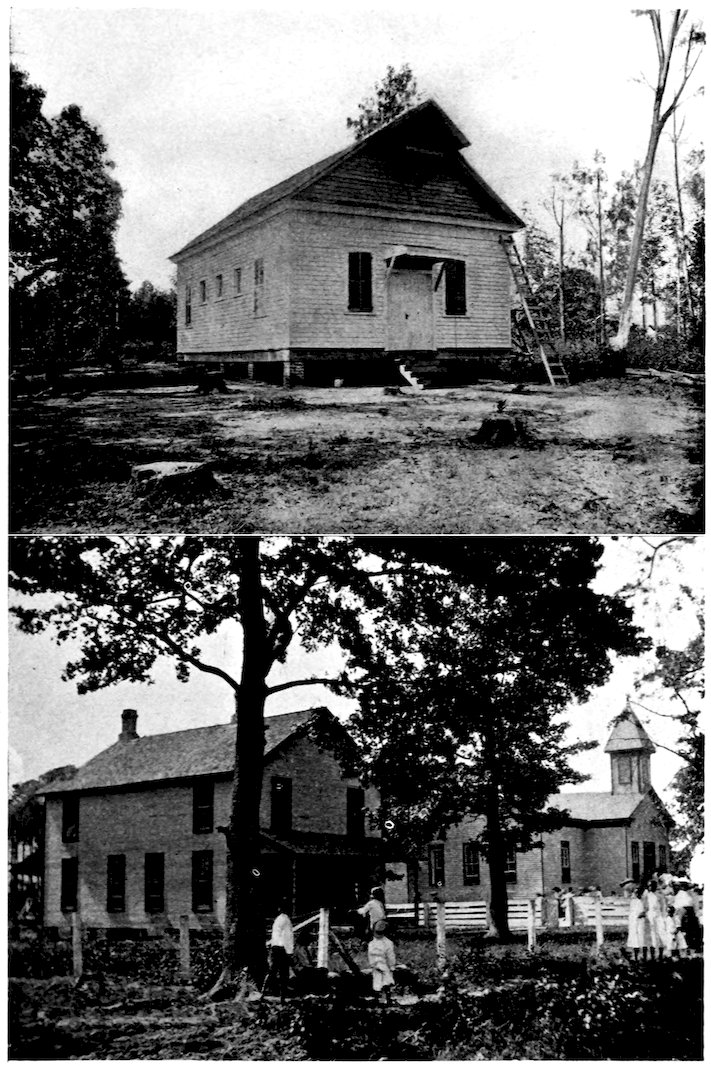
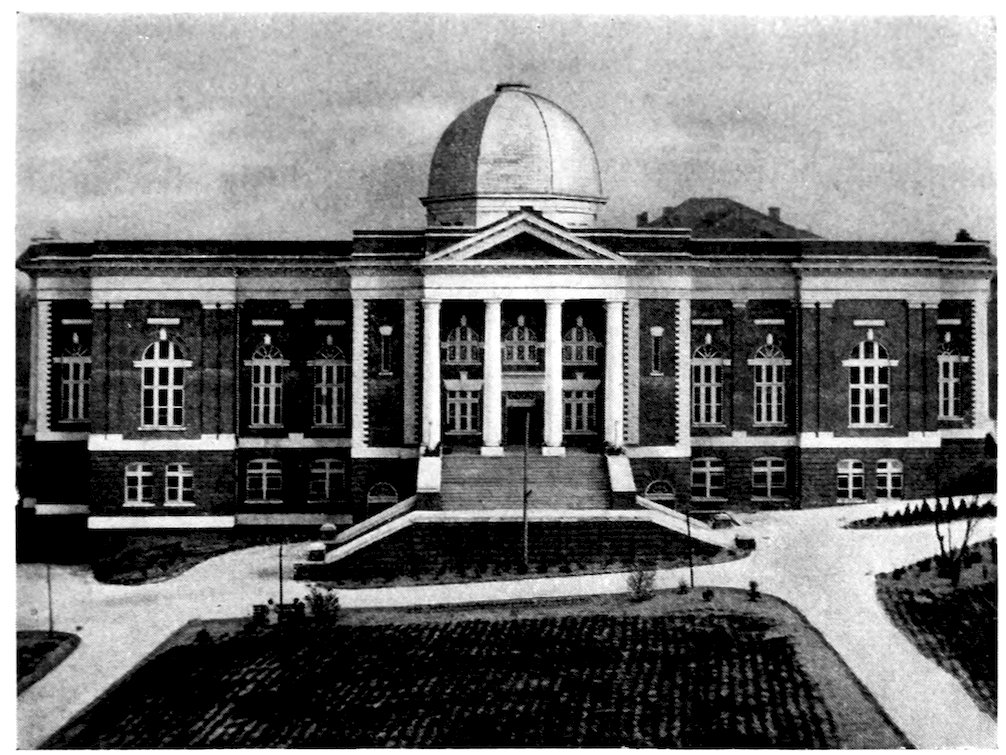
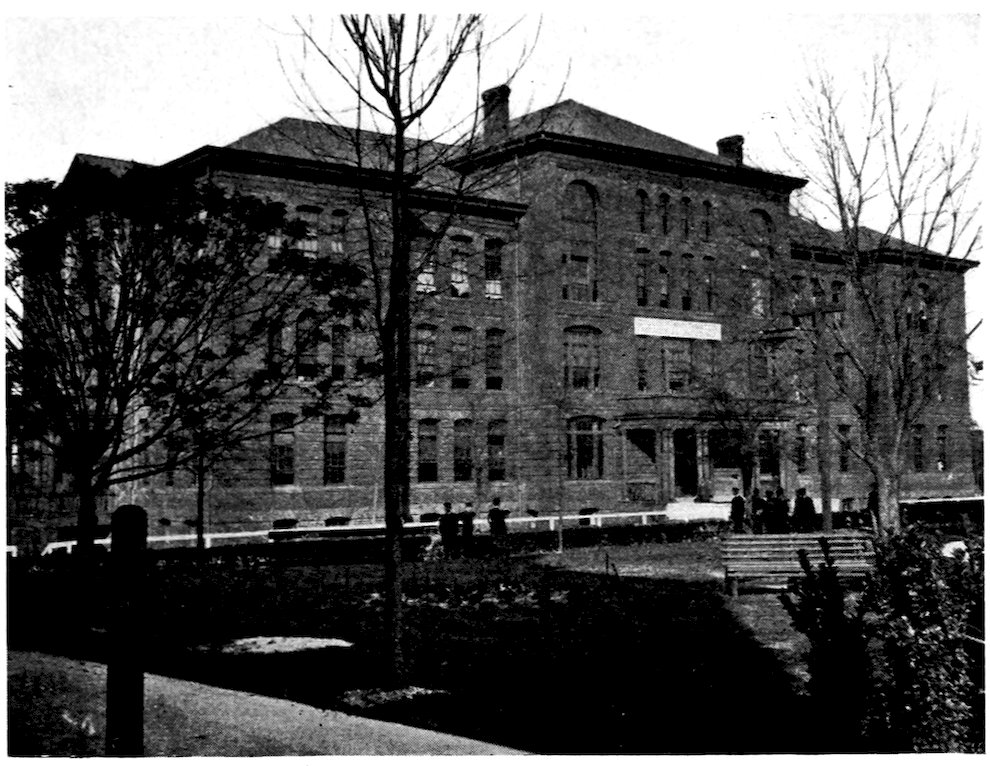
A PARTIAL VIEW OF HAMPTON INSTITUTE, VIRGINIA
Where Mr. Washington received a large part of the training and of the inspiration for his great work
11The necessity of collecting large sums of money
every year to carry on the work at Tuskegee compelled
me to travel much and brought me in contact
with all kinds of people. As soon as I began to meet
educated and cultivated people, people who had had
the advantage of study in higher institutions of
learning, as well as the advantages of much reading
and travel, I soon became conscious of my own disadvantages.
I found that the people I met were
able to speak fluently and with perfect familiarity
about a great many things with which I was acquainted
in only the vaguest sort of way. In speaking
they used words and phrases from authors
whom I had never read and often never heard of.
All this made me feel more keenly my deficiencies,
and the more I thought about it the more it troubled
and worried me. It made me feel all the more
badly because I discovered that, if I were to carry
on the work I had undertaken to do, if I was ever
going to accomplish any of the things that it seemed
to me important to do, I should never find time,
no matter how diligent and studious I might be,
to overtake them and possess myself of the knowledge
and familiarity with books for which I envied
those persons who had been more highly educated
than myself.
After a time, however, I found that while I was
at a certain disadvantage among highly educated
and cultivated people in certain directions, I had
certain advantages over them in others. I found
that the man who has an intimate acquaintance
with some department of life through personal experience
12has a great advantage over persons who
have gained their knowledge of life almost entirely
through books. I found also that, by using my personal
experience and observation; by making use of
the stories that I had heard, as illustrations; by
relating some incident that happened in my own
case or some incident that I had heard from some
one else, I could frequently express what I had to
say in a much clearer and more impressive way than
if I made use of the language of books or the statements
and quotations from the authors of books.
More than that, as I reflected upon the matter, I
discovered that these authors, in their books, were
after all merely making use of their own experiences
or expressing ideas which they had worked out in
actual life, and that to make use of their language and
ideas was merely to get life second hand.
The result was that I made up my mind that I
would try to make up for my defects in my knowledge
of books by my knowledge of men and things.
I said I would take living men and women for my
study, and I would give the closest attention possible
to everything that was going on in the world
about me. I determined that I would get my education
out of my work; I would learn about education
in solving the problems of the school as they
arose from day to day, and learn about life by learning
13to deal with men. I said to myself that I would
try to learn something from every man I met; make
him my text-book, read him, study him, and learn
something from him. So I began deliberately to
try to learn from men. I learned something from
big men and something from little men, from the
man with prejudice and the man without prejudice.
As I studied and understood them, I found that I
began to like men better; even those who treated
me badly did not cause me to lose my temper or
patience, as soon as I found that I could learn
something from them.
For example, some years ago, I had an experience
which taught me a lesson in politeness and liberality
which I shall long remember. I was in a
large city making calls on wealthy people in order
to interest them in our work at Tuskegee Institute.
I called at the office of a man, and he spoke to me
in the most abrupt and insulting manner. He not
only refused to give any money but spoke of my
race in a manner that no gentleman of culture ought
ever to permit himself to speak of another race.
A few minutes later I called on another gentleman
in the same city, who received me politely, thanked
me for calling upon him, but explained that he was
so situated that he could not help me. My interview
with the first man occupied about twice as
14much of his time and my time as was true of the
second gentleman. I learned from this experience
that it takes no more time to be polite to every
one than it does to be rude.
During the later years of my experience I have
had the good fortune to study not only white men
and learn from them, but coloured men as well.
In my earlier experiences I used to have sympathy
with the coloured people who were narrow and bitter
toward white people. As I grew older I began to
study that class of coloured people, and I found that
they did not get anywhere, that their bitterness and
narrowness toward the white man did not hurt the
white man or change his feeling toward the coloured
race, but that, in almost every case, the cherishing
of such feeling toward the white man reacted upon
the coloured man and made him narrow and bitter.
In the chapters which follow, I have given some
account of the way in which my work has brought
me in contact, not so much with plants and animals
and with physical objects, but rather with human
institutions, with politics, with newspapers, with
educational and social problems of various kinds
and descriptions, and I have tried to indicate in
every case the way in which I have been educated
through them.
One of the purposes in writing these later chapters
15from my experience is to complete the story of my
education which I began in the book, “Up From
Slavery”; to answer the questions I have frequently
been asked as to how I have worked out for
myself the educational methods which we are now
using at Tuskegee; and, finally, to illustrate, for the
benefit of the members of my own race, some of the
ways in which a people who are struggling upward
may turn disadvantages into opportunities; how
they may gain within themselves something that
will compensate them for what they have been
deprived of from without.
If I have learned much from things, I have learned
more from men. The work that I started to do
brought me early in contact with some of the most
generous, high-minded and public-spirited persons
in the country. In the chapters that follow I have
tried to indicate what I have learned from contact
with those men. Perhaps I can best indicate the
way in which I have been educated by my contact
with these men if I tell something of my relations
with one man from whom, after General Armstrong,
my first teacher, I learned, perhaps, more than
from any other. I refer to the late William H.
Baldwin, Jr.
I well remember my first meeting with Mr. Baldwin,
although the exact date has now slipped from
16my memory. He was at that time manager and
vice-president of the Southern Railway, with headquarters
in Washington, D. C. I had been given
a letter to him by his father, in Boston. I found him
one morning in his office and presented this letter,
which he read over carefully, as was his custom in
such matters. Then we began talking about the
school at Tuskegee and its work. I had been in the
room but a few minutes when the conviction forced
itself upon me that I had met a man who could thoroughly
understand me and whom I understood.
Indeed, I had the feeling that I was in the presence
of one in whose mind there was neither faltering nor
concealment, and one from whom it would be impossible
to hide a single thought or purpose. I never had
occasion, during all the years that I knew Mr.
Baldwin, to change the opinion formed of him at
my first visit, or to feel that the understanding
established between us then was ever clouded or
diminished.
Mr. Baldwin did not at first manifest any definite
interest in the work at Tuskegee. He said he
would come down and “look us over” and if he
found we were doing “the real thing,” as he
expressed it, he would do anything he could to
help us.
Within a few weeks after this first meeting, Mr.
17Baldwin fulfilled his promise to “look us over” and
see if we were doing “the real thing.” He spent
a busy day on the grounds of the institution, going
through every department with the thoroughness
of an experienced executive. He found, as a
matter of course, a great many deficiencies in the
details of the management and organization of the
school, but he saw what the institution was striving
to do and at once determined to help. In fact,
from that time he never lost an opportunity to
serve the institution in every possible way. He was
just as deeply and as practically interested in everything
that concerned the progress and reputation
of the school and its work as any one connected
with it. I think I never met any one who was more
genuinely interested than Mr. Baldwin in the success
of the Negro people. During his last visit to
Tuskegee I remember that Mrs. Washington said
to me one day that she would be glad when he went
away. She meant that he sympathized too deeply,
felt too profoundly the bigness of the task and the limitations
under which the school was labouring.
He was touched by everything he saw. The struggles
of individual students and teachers whom he
came to know weighed heavily on him and he needed
to get out of the atmosphere of the school and its
work, and rest. None of us realized at that time
18that the disease that finally took him away was already
doing its fatal work.
William H. Baldwin, Jr., understood, as few men
have, the Negro people, and, understanding them
as he did, he was in full sympathy with their ambition
to rise to a position of usefulness as large and as
honourable as that of any other race. Persons who
knew him only slightly, after hearing him express
himself on the race question, gained the impression
that he was not in full sympathy with the deepest
aspirations of the Negro people. But this impression
was mistaken. He was, before all, anxious that
the Negro people, in their struggle to go forward and
succeed, should not mistake the appearance for the
real thing. In his effort to have them avoid this
danger he sometimes seemed to go too far.
But I would do injustice to the memory of Mr.
Baldwin if, by anything I have written or said, I
should leave the impression that, because he was
interested in the welfare of the Negro, he was any
the less interested in the progress of the
white race in the South. He saw with perfect
clearness that both races were, to a certain extent,
hampered in their struggles upward by conditions
which they had inherited and for which neither was
wholly responsible. He saw, also, that in the long
run the welfare of each was bound up with that of
19the other. Much as he did for Negro education, he
never overlooked an opportunity to get money and
secure support for the education of the unfortunate
white people of the South.
Mr. Baldwin’s greatest service to Tuskegee Institute
was in the reorganization of the finances of
the institution. When he first became one of the
trustees, the business organization of the school,
its finances, and the system of keeping the accounts
were in a very uncertain and unsatisfactory condition.
He began at once to look into our investments
and to study the items of our annual budget. The
school was growing rapidly. The number of productive
industries carried on by the school, the large
amount of building we were engaged in, and the
large amount of business carried on between the
different departments made the accounts of the
school particularly complicated and the problem
of a proper business organization a most
important one.
As I look back over the years in which he and I
worked together, it seems to me that the most
pleasant and profitable hours I have ever known
were spent with Mr. Baldwin in his library in Brooklyn,
while we studied out together the problems
and discussed the questions which this work involved.
When I came to New York he would often
20invite me to his home and, as soon as dinner was
over, we would spend three or four hours in his library,
sometimes not breaking up our conference
until after midnight.
Among other things I learned from Mr. Baldwin
was that it is the smaller, the petty, things in life
that divide people. It is the great tasks that bring
men together. Any man who will take up his life
in a broad spirit, not of class nor sect nor locality,
but in the freer spirit which seeks to perform a work
simply because it is good, that man can have the
support and the friendship of the best and highest
people in the world.
As I have said before, I do not regret that I was
born a slave. I am not sorry that I found myself
part of a problem; on the contrary, that problem
has given direction and meaning to my life and has
brought me friendships and comforts that I could
have gotten in no other way.
CHAPTER II BUILDING A SCHOOL AROUND A PROBLEM
21
One of the first questions that I had to
answer for myself after beginning my
work at Tuskegee was how I was to deal
with public opinion on the race question.
It may seem strange that a man who had started
out with the humble purpose of establishing a little
Negro industrial school in a small Southern country
town should find himself, to any great extent, either
helped or hindered in his work by what the general
public was thinking and saying about any of the
large social or educational problems of the day.
But such was the case at that time in Alabama;
and so it was that I had not gone very far in my
work before I found myself trying to formulate clear
and definite answers to some very fundamental questions.
The questions came to me in this way: Coloured
people wanted to know why I proposed to teach
their children to work. They said that they and
22their parents had been compelled to work for two
hundred and fifty years, and now they wanted their
children to go to school so that they might be free
and live like the white folks—without working.
That was the way in which the average coloured
man looked at the matter.
Some of the Southern white people, on the contrary,
were opposed to any kind of education of
the Negro. Others inquired whether I was merely
going to train preachers and teachers, or whether
I proposed to furnish them with trained servants.
Some of the people in the North understood
that I proposed to train the Negro to be a mere
“hewer of wood and drawer of water,” and feared
that my school would make no effort to prepare
him to take his place in the community as a man
and a citizen.
Of course all these different views about the kind
of education that the Negro ought or ought not
to have were deeply tinged with racial and sectional
feelings. The rule of the “carpet-bag”
government had just come to an end in Alabama.
The masses of the white people were very bitter
against the Negroes as a result of the excitement
and agitation of the Reconstruction period.
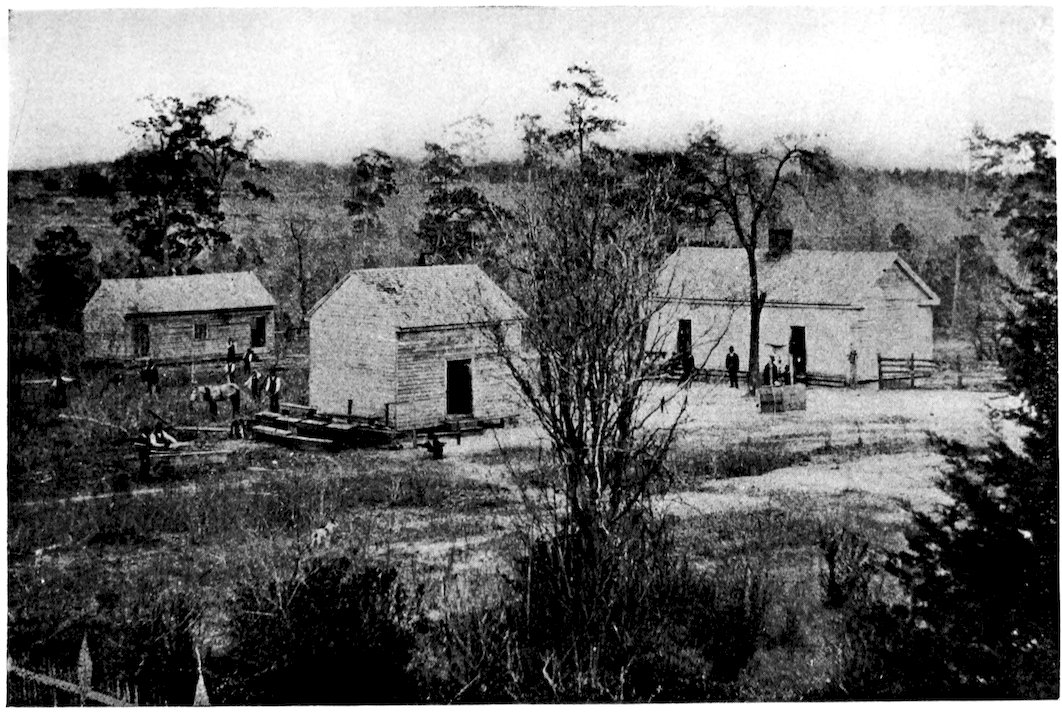
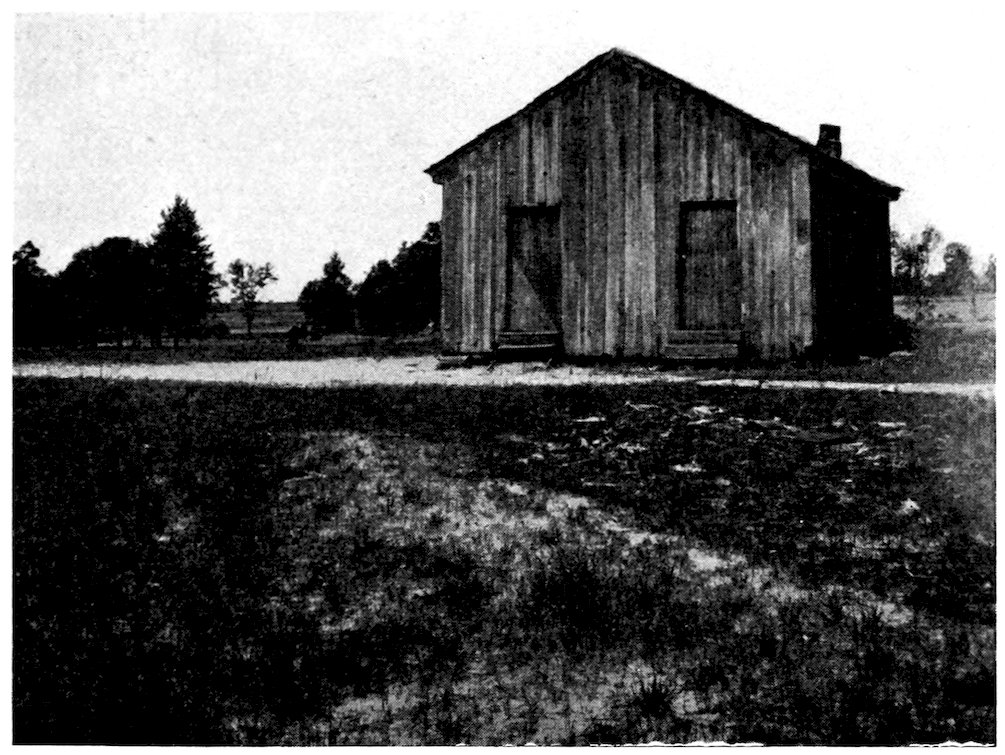
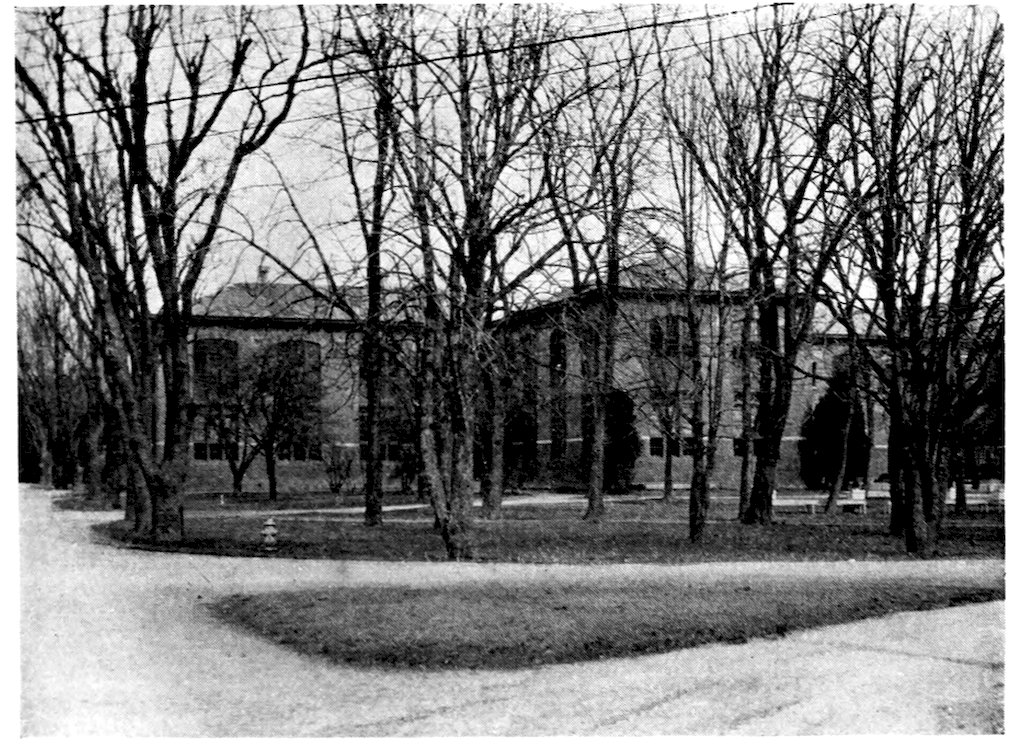
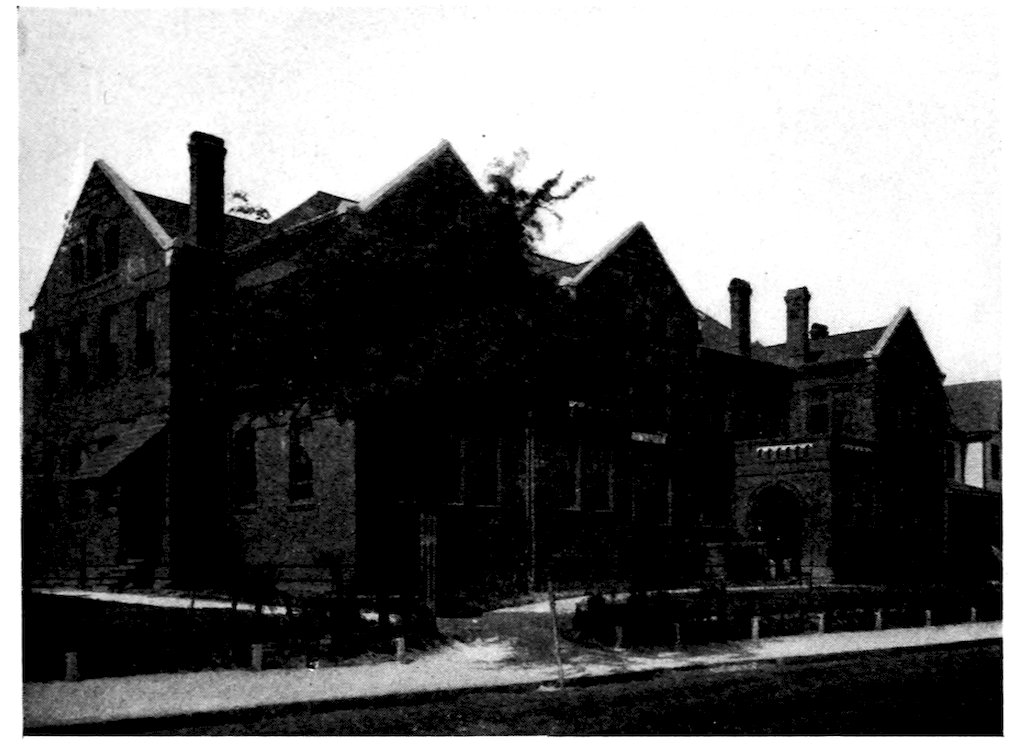
THE SITE OF TUSKEGEE INSTITUTE WHEN IT WAS FIRST BOUGHT
Two of the buildings are still in use as dormitories
23On the other hand, the coloured people—who
had recently lost, to a very large extent, their place
in the politics of the state—were greatly discouraged
and disheartened. Many of them feared that they
were going to be drawn back into slavery. At this
time also there was still a great deal of bitterness
between the North and the South in regard to anything
that concerned political matters.
I found myself, as it were, at the angle where
these opposing forces met. I saw that, in carrying
out the work I had planned, I was likely to be
opposed or criticised at some point by each of these
parties. On the other hand, I saw just as clearly
that in order to succeed I must in some way secure
the support and sympathy of each of them.
I knew, for example, that the South was poor and
the North was rich. I knew that Northern people
believed, as the South at that time did not believe,
in the power of education to inspire, to uplift, and
to regenerate the masses of the people. I knew
that the North was eager to go forward and complete,
with the aid of education, the work of liberation
which had been begun with the sword, and
that Northern people would be willing and glad to
give their support to any school or other agency
that proposed to do this work in a really fundamental
way.
It was, at the same time, plain to me that no
effort put forth in behalf of the members of my
24own race who were in the South was going to
succeed unless it finally won the sympathy and
support of the best white people in the South.
I knew also—what many Northern people did not
know or understand—that however much they
might doubt the wisdom of educating the Negro,
deep down in their hearts the Southern white people
had a feeling of gratitude toward the Negro race;
and I was convinced that in the long run any sound
and sincere effort that was made to help the Negro
was going to have the Southern white man’s support.
Finally, I had faith in the good common-sense of
the masses of my own race. I felt confident that,
if I were actually on the right track in the kind of
education that I proposed to give them and at
the same time remained honest and sincere in all
my dealings with them, I was bound to win their
support, not only for the school that I had started,
but for all that I had in my mind to do for them.
Still it was often a puzzling and a trying problem
to determine how best to win and hold the respect
of all three of these classes of people, each of which
looked with such different eyes and from such widely
different points of view at what I was attempting
to do. The temptation which presented itself
to me in my dealings with these three classes of
people was to show each group the side of the subject
25that it would be most willing to look at, and,
at the same time, to keep silent about those matters
in regard to which they were likely to differ with me.
There was the temptation to say to the white man
the thing that the white man wanted to hear; to
say to the coloured man the thing that he wanted
to hear; to say one thing in the North and another
in the South.
Perhaps I should have yielded to this temptation
if I had not perceived that in the long run I should
be found out, and that if I hoped to do anything
of lasting value for my own people or for the South
I must first get down to bedrock.
There is a story of an old coloured minister, which
I am fond of telling, that illustrates what I mean.
The old fellow was trying to explain to a Sunday-school
class how it was and why it was that Pharaoh
and his party were drowned when they were trying
to cross the Red Sea, and how it was and why it
was that the Children of Israel crossed over dry-shod.
He explained it in this wise:
“When the first party came along it was early
in the morning and the ice was hard and thick, and
the first party had no trouble in crossing over on the
ice; but when Pharaoh and his party came along the
sun was shining on the ice, and when they got on the
ice it broke, and they went in and got drowned.”
26Now there happened to be in this class a young
coloured man who had had considerable schooling,
and this young fellow turned to the old minister
and said:
“Now, Mr. Minister, I do not understand that
kind of explanation. I have been going to school
and have been studying all these conditions, and
my geography teaches me that ice does not freeze
within a certain distance of the equator.”
The old minister replied: “Now, I’se been
expecting something just like this. There’s always
some fellow ready to spile all the theology. The
time I’se talkin’ about was before they had any
jogerphies or ’quaters either.”
Now this old man, in his plain and simple way,
was trying to brush aside all artificiality and to
get down to bedrock. So it was with me. There
have always been a number of educated and clever
persons among my race who are able to make
plausible and fine-sounding statements about all
the different phases of the Negro problem, but I
saw clearly that I should have to follow the example
of the old preacher and start on a solid basis in order
to succeed in the work that I had undertaken.
So, after thinking the matter all out as I have
described, I made up my mind definitely on one or
two fundamental points. I determined:
27First, that I should at all times be perfectly frank
and honest in dealing with each of the three classes
of people that I have mentioned;
Second, that I should not depend upon any
“short-cuts” or expedients merely for the sake
of gaining temporary popularity or advantage,
whether for the time being such action brought me
popularity or the reverse. With these two points
clear before me as my creed, I began going forward.
One thing which gave me faith at the outset, and
increased my confidence as I went on, was the insight
which I early gained into the actual relations
of the races in the South. I observed, in the first
place, that as a result of two hundred and fifty years
of slavery the two races had become bound together
in intimate ways that people outside of the
South could not understand, and of which the
white people and coloured people themselves were
perhaps not fully conscious. More than that, I
perceived that the two races needed each other
and that for many years to come no other labouring
class of people would be able to fill the place occupied
by the Negro in the life of the Southern
white man.
I saw also one change that had been brought
about as a result of freedom, a change which many
Southern white men had, it seemed to me, failed
28to see. As long as slavery existed, the white man,
for his own protection and in order to keep the Negro
contented with his condition of servitude, was compelled
to keep him in ignorance. In freedom, however,
just the reverse condition exists. Now the
white man is not only free to assist the Negro in
his effort to rise, but he has every motive of self-interest
to do so, since to uplift and educate the
Negro would reduce the number of paupers and
criminals of the race and increase the number and
efficiency of its skilled labourers.
Clear ideas did not come into my mind on this
subject at once. It was only gradually that I
gained the notion that there had been two races
in slavery; that both were now engaged in a struggle
to adjust themselves to the new conditions; that
the progress of each meant the advancement of
the other; and that anything that I attempted to
do for the members of my own race would be of
no real value to them unless it was of equal value
to the members of the white race by whom they were
surrounded.
As this thought got hold in my mind and I began
to see further into the nature of the task that
I had undertaken to perform, much of the political
agitation and controversy that divided the North
from the South, the black man from the white,
29began to look unreal and artificial to me. It seemed
as if the people who carried on political campaigns
were engaged to a very large extent in a battle with
shadows, and that these shadows represented the
prejudices and animosities of a period that was
now past.
On the contrary, the more I thought about it,
the more it seemed to me that the kind of work
that I had undertaken to do was a very real sort
of thing. Moreover, it was a kind of work which
tended not to divide, but to unite, all the opposing
elements and forces, because it was a work of construction.
Having gone thus far, I began to consider seriously
how I should proceed to gain the sympathy of each
of the three groups that I have mentioned for the
work that I had in hand.
I determined, first of all, that as far as possible
I would try to gain the active support and coöperation,
in all that I undertook, of the masses of my
own race. With this in view, before I began my
work at Tuskegee, I spent several weeks travelling
about among the rural communities of Macon
County, of which Tuskegee is the county seat.
During all this time I had an opportunity to meet
and talk individually with a large number of people
representing the rural classes, which constitute
3080 per cent. of the Negro population in the South.
I slept in their cabins, ate their food, talked to them
in their churches, and discussed with them in their
own homes their difficulties and their needs. In
this way I gained a kind of knowledge which has
been of great value to me in all my work since.
As years went on, I extended these visits to the
adjoining counties and adjoining states. Then,
as the school at Tuskegee became better known, I
took advantage of the invitations that came to me
to visit more distant parts of the country, where I
had an opportunity to learn still more about the
actual life of the people and the nature of the
difficulties with which they were struggling.
In all this, my purpose was to get acquainted
with the masses of the people—to gain their
confidence so that I might work with them and
for them.
In the course of travel and observation I became
more and more impressed with the influence that
the organizations which coloured people have
formed among themselves exert upon the masses
of the people.
The average man outside of the Negro race is
likely to assume that the ten millions of coloured
people in this country are a mere disorganized
and heterogeneous collection of individuals, herded
31together under one statistical label, without head
or tail, and with no conscious common purpose.
This is far from true. There are certain common
interests that are peculiar to all Negroes, certain
channels through which it is possible to touch and
influence the whole people. In my study of the
race in what I may call its organized capacity, I
soon learned that the most influential organization
among Negroes is the Negro church. I question
whether or not there is a group of ten millions
of people anywhere, not excepting the Catholics,
that can be so readily reached and influenced through
their church organizations as the ten millions of
Negroes in the United States. Of these millions
of black people there is only a very small percentage
that does not have formal or informal connection
with some church. The principal church
groups are: Baptists, African Methodists, African
Methodist Episcopal Zionists, and Coloured Methodists,
to which I might add about a dozen smaller
denominations.
I began my work of getting the support of these
organizations by speaking (or lecturing, as they are
accustomed to describe it) to the coloured people
in the little churches in the country surrounding
the school at Tuskegee. When later I extended
my journeys into other and more distant parts of
32the country, I began to get into touch with the
leaders in the church and to learn something about
the kind and extent of influence which these men
exercise through the churches over the masses of
the Negro people.
It has always been a great pleasure to me to meet
and to talk in a plain, straightforward way with
the common people of my own race wherever I have
been able to meet them. But it is in the Negro
churches that I have had my best opportunities
for meeting and getting acquainted with them.
It has been my privilege to attend service in
Trinity Church, Boston, where I heard Phillips
Brooks. I have attended service in the Fifth
Avenue Presbyterian Church in New York, where
I heard the late Dr. John Hall. I have attended
service in Westminster Abbey, in London. I
have visited some of the great cathedrals in Europe
when service was being held. But not any of these
services have had for me the real interest that
certain services among my own people have had.
Let me describe the type of the service that I have
enjoyed more than any other in all my experience
in attending church, whether in America or Europe.
In Macon County, Ala., where I live, the coloured
people have a kind of church-service that is called
an “all-day meeting.” The ideal season for such
33meetings is about the middle of May. The churchhouse
that I have in mind is located about ten miles
from town. To get the most out of the “all-day
meeting” one should make an early start, say eight
o’clock. During the drive one drinks in the fresh
fragrance of forests and wild flowers. The church
building is located near a stream of water, not far
from a large, cool spring, and in the midst of a
grove or primitive forest. Here the coloured people
begin to come together by nine or ten o’clock in the
morning. Some of them walk; most of them drive.
A large number come in buggies, but many use
the more primitive wagons or carts, drawn by mules,
horses, or oxen. In these conveyances a whole
family, from the youngest to the eldest, make the
journey together. All bring baskets of food, for
the “all-day meeting” is a kind of Sunday picnic
or festival. Preaching, preceded by much singing,
begins at about eleven o’clock. If the building
is not large enough, the services are held out under
the trees. Sometimes there is but one sermon;
sometimes there are two or three sermons, if visiting
ministers are present. The sermon over, there is
more plantation singing. A collection is taken—sometimes
two collections—then comes recess
for dinner and recreation.
Sometimes I have seen at these “all-day meetings”
34as many as three thousand people present.
No one goes away hungry. Large baskets, filled
with the most tempting spring chicken or fresh
pork, fresh vegetables, and all kinds of pies and
cakes, are then opened. The people scatter in
groups. Sheets or table-cloths are spread on the
grass under a tree near the stream. Here old
acquaintances are renewed; relatives meet members
of the family whom they have not seen for months.
Strangers, visitors, every one must be invited by
some one else to dinner. Kneeling on the fresh
grass or on broken branches of trees surrounding
the food, dinner is eaten. The animals are fed and
watered, and then at about three o’clock there is
another sermon or two, with plenty of singing
thrown in; then another collection, or perhaps two.
In between these sermons I am invited to speak,
and am very glad to accept the invitation. At
about five o’clock the benediction is pronounced
and the thousands quietly scatter to their homes
with many good-bys and well-wishes. This, as I
have said, is the kind of church-service that I like
best. In the opportunities which I have to speak to
such gatherings I feel that I have done some of
my best work.
In carrying out the policy which I formed early,
of making use of every opportunity to speak to the
35masses of the people, I have not only visited country
churches and spoken at such “all-day meetings”
as I have just described, but for years I have made
it a practice to attend, whenever it has been possible
for me to do so, every important ministers’ meeting.
I have also made it a practice to visit town and city
churches and in this way to get acquainted with
the ministers and meet the people.
During my many and long campaigns in the
North, for the purpose of getting money to carry
on Tuskegee Institute, it has been a great pleasure
and satisfaction to me, after I have spoken in some
white church or hall or at some banquet, to go directly
to some coloured church for a heart-to-heart
talk with my own people. The deep interest that
they have shown in my work and the warmth and
enthusiasm with which coloured people invariably
respond to any one who talks to them frankly and
sincerely in regard to matters that concern the welfare
of the race, make it a pleasure to speak to them.
Many times on these trips to the North it has
happened that coloured audiences have waited
until ten or eleven o’clock at night for my coming.
This does not mean that coloured people may not
attend the other meetings which I address, but
means simply that they prefer in most cases to have
me to speak to them alone. When at last I have
36been able to reach the church or the hall where the
audience was gathered, it has been such a pleasure
to meet them that I have often found myself standing
on my feet until after twelve o’clock. No one
thing has given me more faith in the future of the
race than the fact that Negro audiences will sit
for two hours or more and listen with the utmost
attention to a serious discussion of any subject
that has to do with their interest as a people.
This is just as true of the unlettered masses as it
is of the more highly educated few.
Not long ago, for example, I spoke to a large audience
in the Chamber of Commerce in Cleveland,
Ohio. This audience was composed for the most
part of white people, and the meeting continued
rather late into the night. Immediately after this
meeting I was driven to the largest coloured church
in Cleveland, where I found an audience of something
like twenty-five hundred coloured people
waiting patiently for my appearance. The church
building was crowded, and many of those present,
I was told, had been waiting for two or three hours.
As I entered the building an unusual scene presented
itself. Each member of the audience had
been provided with a little American flag, and
as I appeared upon the platform, the whole audience
rose to its feet and began waving these flags. The
37reader can, perhaps, imagine the picture of twenty-five
hundred enthusiastic people each of whom is
wildly waving a flag. The scene was so animated
and so unexpected that it made an impression on
me that I shall never forget. For an hour and a
half I spoke to this audience, and, although the
building was crowded until there was apparently
not an inch of standing room in it, scarcely a single
person left the church during this time.
Another way in which I have gained the confidence
and support of the millions of my race has
been in meeting the religious leaders in their various
state and national gatherings. For example, every
year, for a number of years past, I have been invited
to deliver an address before the National Coloured
Baptist Convention, which brings together four or
five thousand religious leaders from all parts of the
United States. In a similar way I meet, once in
four years, the leaders in the various branches of
the Methodist Church during their general conferences.
Invitations to address the different secret societies
in their national gatherings frequently come to me
also. Next to the church, I think it is safe to say
that the secret societies or beneficial orders bring
together greater numbers of coloured people and
exercise a larger influence upon the race than any
38other kind of organization. One can scarcely shake
hands with a coloured man without receiving some
kind of grip which identifies him as a member of
one or another of these many organizations.
I am reminded, in speaking of these secret societies,
of an occasion at Little Rock, Ark., when, without
meaning to do so, I placed my friends there in a
very awkward position. It had been pretty widely
advertised for some weeks before that I was to visit
the city. Among the plans decided upon for my
reception was a parade in which all the secret and
beneficial societies in Little Rock were to take
part. Much was expected of this parade, because
secret societies are numerous in Little Rock, and
the occasions when they can all turn out together
are rare.
A few days before I reached that city some one
began to make inquiry as to which one of these
orders I belonged to. When it finally became known
among the rank and file that I was not a member
of any of them, the committee which was preparing
for the parade lost a great deal of its enthusiasm,
and a sort of gloom settled down over the whole
proceeding. The leading men told me that they
found it quite a difficult task after that to make
the people understand why they were asked to
turn out to honour a person who was not a member
39of any of their organizations. Besides, it seemed
unnatural that a Negro should not belong to some
kind of order. Somehow or other, however, matters
were finally straightened out; all the organizations
turned out, and a most successful reception was the
result.
Another agency which exercises tremendous power
among Negroes is the Negro press. Few if any
persons outside of the Negro race understand the
power and influence of the Negro newspaper.
In all, there are about two hundred newspapers
published by coloured men at different points
in the United States. Many of them have only a
small circulation and are, therefore, having a hard
struggle for existence; but they are read in their
local communities. Others have built up a national
circulation and are conducted with energy and intelligence.
With the exception of about three,
these two hundred papers have stood loyally by
me in all my plans and policies to uplift the race.
I have called upon them freely to aid me in making
known my plans and ideas, and they have always
responded in a most generous fashion to all the
demands that I have made upon them.
It has been suggested to me at different times
that I should purchase a Negro newspaper in order
that I might have an “organ” to make known my
40views on matters concerning the policies and interests
of the race. Certain persons have suggested
also that I pay money to certain of these papers
in order to make sure that they support my views.
I confess that there have frequently been times
when it seemed that the easiest way to combat
some statement that I knew to be false, or to
correct some impression which seemed to me peculiarly
injurious, would be to have a paper of my own
or to pay for the privilege of setting forth my own
views in the editorial columns of some paper which
I did not own.
I am convinced, however, that either of these
two courses would have proved fatal. The minute
it should become known—and it would be known—that
I owned an “organ,” the other papers would
cease to support me as they now do. If I should
attempt to use money with some papers, I should
soon have to use it with all. If I should pay for
the support of newspapers once, I should have to
keep on paying all the time. Very soon I should
have around me, if I should succeed in bribing them,
merely a lot of hired men and no sincere and earnest
supporters. Although I might gain for myself
some apparent and temporary advantage in this
way, I should destroy the value and influence of
the very papers that support me. I say this
41because if I should attempt to hire men to write
what they do not themselves believe, or only half
believe, the articles or editorials they write would
cease to have the true ring; and when they cease to
have the true ring, they will exert little or no
influence.
So, when I have encountered opposition or criticism
in the press, I have preferred to meet it
squarely. Frequently I have been able to profit by
these criticisms of the newspapers. At other times,
when I have felt that I was right and that those
who criticised me were wrong, I have preferred to
wait and let the results show. Thus, even when
we differed with one another on minor points, I
have usually succeeded in gaining the confidence
and support of the editors of the different papers
in regard to those matters and policies which seemed
to me really important.
In travelling throughout the United States I
have met the Negro editors. Many of them have
been to Tuskegee. It has taken me twenty years
to get acquainted with them and to know them
intimately. In dealing with these men I have not
found it necessary to hold them at arm’s-length.
On the contrary, I am in the habit of speaking with
them frankly and openly in regard to my plans.
A number of the men who own and edit Negro newspapers
42are graduates or former students of the
Tuskegee Institute. I go into their offices and I
go to their homes. We know one another; they
are my friends, and I am their friend.
In dealing with newspaper people, whether they
are white or black, there is no way of getting their
sympathy and support like that of actually knowing
the individual men, of meeting and talking with
them frequently and frankly, and of keeping them
in touch with everything you do or intend to do.
Money cannot purchase or control this kind of
friendship.
Whenever I am in a town or city where Negro
newspapers are published, I make it a point to see
the editors, to go to their offices, or to invite them
to visit Tuskegee. Thus we keep in close, constant,
and sympathetic touch with one another. When
these papers write editorials endorsing any project
that I am interested in, the editors speak with
authority and with intelligence because of our close
personal relations. There is no more generous and
helpful class of men among the Negro race in
America to-day than the owners and editors of
Negro newspapers.
Many times I have been asked how it is that I
have secured the confidence and good wishes of
so large a number of the white people of the South.
43My answer in brief is that I have tried to be perfectly
frank and straightforward at all times in
my relations with them. Sometimes they have
opposed my actions, sometimes they have not,
but I have never tried to deceive them. There
is no people in the world which more quickly
recognizes and appreciates the qualities of frankness
and sincerity, whether they are exhibited in a friend
or in an opponent, in a white man or in a black man,
than the white people of the South.
In my experience in dealing with men of my race
I have found that there is a class that has gained
a good deal of fleeting popularity for possessing
what was supposed to be courage in cursing and
abusing all classes of Southern white people on all
possible occasions. But, as I have watched the
careers of this class of Negroes, in practically every
case their popularity and influence with the masses
of coloured people have not been lasting. There
are few races of people the masses of whom are
endowed with more common-sense than the Negro,
and in the long run these common people see things
and men pretty much as they are.
On the other hand, there have always been in
every Southern community a certain number of
coloured men who have sought to gain the friendship
of the white people around them in ways that
44were more or less dishonest. For a number of years
after the close of the Civil War, for example, it
was natural that practically all the Negroes should
be Republicans in politics. There were, however,
in nearly every community in the South, one or
two coloured men who posed as Democrats. They
thought that by pretending to favour the Democratic
party they might make themselves popular
with their white neighbours and thus gain some
temporary advantage. In the majority of cases
the white people saw through their pretences and
did not have the respect for them that they had
for the Negro who honestly voted with the party
to which he felt that he belonged.
I remember hearing a prominent white Democrat
remark not long ago that in the old days whenever
a Negro Democrat entered his office he always took
a tight grasp upon his pocket-book. I mention these
facts because I am certain that wherever I have
gained the confidence of the Southern people I
have done so, not by opposing them and not by
truckling to them, but by acting in a straightforward
manner, always seeking their good-will,
but never seeking it upon false pretences.
I have made it a rule to talk to the Southern white
people concerning what I might call their shortcomings
toward the Negro rather than talk about45them. In the last analysis, however, I have succeeded
in getting the sympathy and support of so
large a number of Southern white people because
I have tried to recognize and to face conditions as
they actually are, and have honestly tried to work
with the best white people in the South to bring
about a better condition.
From the first I have tried to secure the confidence
and good-will of every white citizen in my
own county. My experience teaches me that if
a man has little or no influence with those by whose
side he lives, as a rule there is something wrong
with him. The best way to influence the Southern
white man in your community, I have found, is
to convince him that you are of value to that
community. For example, if you are a teacher,
the best way to get the influence of your white
neighbours is to convince them that you are teaching
something that will make the pupils that you educate
able to do something better and more useful
than they would otherwise be able to do; to show,
in other words, that the education which they get
adds something of value to the community.
In my own case, I have attempted from the
beginning to let every white citizen in my own town
see that I am as much interested in the common,
every-day affairs of life as himself. I tried to let
46them see that the presence of Tuskegee Institute
in the community means better farms and gardens,
good housekeeping, good schools, law and order.
As soon as the average white man is convinced that
the education of the Negro makes of him a citizen
who is not always “up in the air,” but one who can
apply his education to the things in which every
citizen is interested, much of opposition, doubt,
or indifference to Negro education will disappear.
During all the years that I have lived in Macon
County, Ala., I have never had the slightest trouble
in either registering or casting my vote at any election.
Every white person in the county knows
that I am going to vote in a way that will help
the county in which I live.
Many nights I have been up with the sheriff of
my county, in consultation concerning law and order,
seeking to assist him in getting hold of and freeing
the community of criminals. More than that,
Tuskegee Institute has constantly sought, directly
and indirectly, to impress upon the twenty-five
or thirty thousand coloured people in the surrounding
county the importance of coöperating with the
officers of the law in the detection and apprehension
of criminals. The result is that we have one of
the most orderly communities in the state. I
do not believe that there is any county in the state,
for example, where the prohibition laws are so
strictly enforced as in Macon County, in spite of
the fact that the Negroes in this county so largely
outnumber the whites.
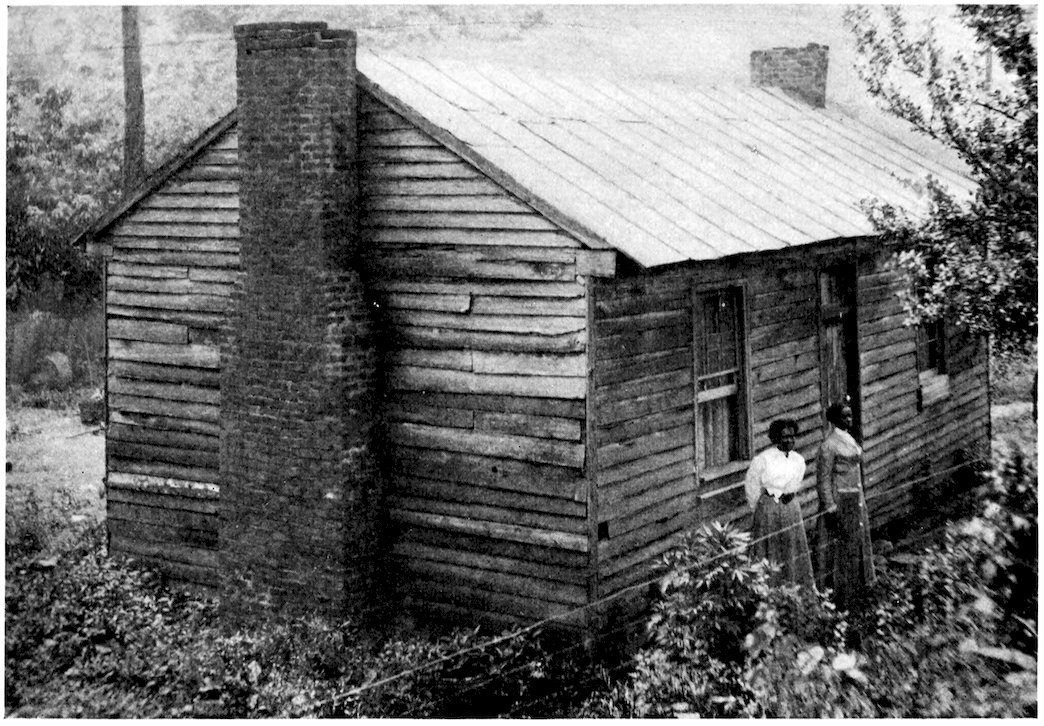
THE HOUSE IN MALDEN, W. VA., IN WHICH MR. WASHINGTON LIVED WHEN HE BEGAN TEACHING
47Whatever influence I have gained with the Northern
white people has come about from the fact,
I think, that they feel that I have tried to use their
gifts honestly and in a manner to bring about real
and lasting results. I learned long ago that in
education as in other things nothing but honest
work lasts; fraud and sham are bound to be detected
in the end. I have learned, on the other hand,
that if one does a good, honest job, even though it
may be done in the middle of the night when no
eyes see but one’s own, the results will just as surely
come to light.
My experience has taught me, for example, that
if there is a filthy basement or a dirty closet anywhere
in the remotest part of the school grounds
it will be discovered. On the other hand, if every
basement or every closet—no matter how remote
from the centre of the school activities—is
kept clean, some one will find it and commend
the care and the thoughtfulness that kept it clean.
It has always been my policy to make visitors
to Tuskegee feel that they are seeing more than
they expected to see. When a person has contributed,
48say, $20,000 for the erection of a building,
I have tried to provide a larger building, a better
building, than the donor expected to see. This I
have found can be brought about only by keeping
one’s eyes constantly on all the small details. I
shall never forget a remark made to me by Mr.
John D. Rockefeller when I was spending an evening
at his house. It was to this effect: “Always
be master of the details of your work; never have
too many loose outer edges or fringes.”
Then, in dealing with Northern people, I have
always let them know that I did not want to get
away from my own race; that I was just as proud
of being a Negro as they were of being white people.
No one can see through a sham more quickly,
whether it be in speech or in dress, than the hard-headed
Northern business man.
I once knew a fine young coloured man who nearly
ruined himself by pretending to be something that
he was not. This young man was sent to England
for several months of study. When he returned he
seemed to have forgotten how to talk. He tried
to ape the English accent, the English dress, the
English walk. I was amused to notice sometimes,
when he was off his guard, how he got his English
pronunciation mixed with the ordinary American
accent which he had used all of his life. So one
49day I quietly called him aside and said to him: “My
friend, you are ruining yourself. Just drop all
those frills and be yourself.” I am glad to say
that he had sense enough to take the advice in the
right spirit, and from that time on he was a different
man.
The most difficult and trying of the classes of
persons with which I am brought in contact is the
coloured man or woman who is ashamed of his or
her colour, ashamed of his or her race and, because
of this fact, is always in a bad temper. I have had
opportunities, such as few coloured men have had,
of meeting and getting acquainted with many
of the best white people, North and South. This
has never led me to desire to get away from my own
people. On the contrary, I have always returned to
my own people and my own work with renewed
interest.
I have never at any time asked or expected that
any one, in dealing with me, should overlook or
forget that I am a Negro. On the contrary, I
have always recognized that, when any special
honour was conferred upon me, it was conferred
not in spite of my being a Negro, but because I am
a Negro, and because I have persistently identified
myself with every interest and with every phase of
the life of my own people.
50Looking back over the twenty-five and more
years that have passed since that time, I realize,
as I did not at that time, how the better part of
my education—the education that I got after leaving
school—has been in the effort to work out those
problems in a way that would gain the interest and
the sympathy of all three of the classes directly
concerned—the Southern white man, the Northern
white man, and the Negro.
In order to gain consideration from these three
classes for what I was trying to do I have had to
enter sympathetically into the three different points
of view entertained by those three classes; I have
had to consider in detail how the work that I was
trying to do was going to affect the interests of all
three. To do this, and at the same time continue
to deal frankly and honestly with each class, has
been indeed a difficult and at times a puzzling
task. It has not always been easy to stick to my
work and keep myself free from the distracting influences
of narrow and factional points of view;
but, looking back on it all after a quarter of a century,
I can see that it has been worth what it cost.
CHAPTER III SOME EXCEPTIONAL MEN AND WHAT I HAVE LEARNED FROM THEM
51
There are some opportunities that come to
the boy or girl who is born poor that the
boy or girl who is born rich does not have.
In the same way there are some advantages in
belonging to a disadvantaged race. The individual
or the race which has to face peculiar hardships and
to overcome unusual difficulties gains an experience
of men and things and gets into close and intimate
touch with life in a way that is not possible to the
man or woman in ordinary circumstances.
In the old slavery days, when any of the white
folks were a little uncertain about the quality of a
new family that had moved into the neighbourhood,
they always had one last resource for determining
the character and the status of the new family.
When in doubt, they could always rely on old “Aunt
Jenny.” After “Aunt Jenny” had visited the new
family and returned with her report, the question
52was settled. Her decision was final, because “Aunt
Jenny” knew. The old-fashioned house servants
gained, through their peculiar experiences, a keen
sense for what was called the “quality.”
In freedom also the Negro has had special opportunities
for finding out the character and the quality
of the white people among whom he lives. If
there is a man in the community who is habitually
kind and considerate to the humblest people about
him, the coloured people know about that man.
On the contrary, if there is a man in that community
who is unfair and unjust in his dealings with them,
the coloured people know that man also.
In their own way and among themselves the
coloured people in the South still have the habit
of weighing and passing judgment on the white
people in their community; and, nine times out of
ten, their opinion of a man is pretty accurate. A
man who can always be counted on to go out of his
way to assist and protect the members of an unpopular
race, and who is not afraid or ashamed to
show that he is interested in the efforts of the coloured
people about him to improve their condition,
is pretty likely to be a good citizen in other respects.
In the average Southern community, also, it is
almost always the best people, those who are most
highly cultured and religious, who know the coloured
53people best. It is the best white people who
go oftenest into the Negro churches or teach in the
Negro Sunday-schools. It is to individual white
men of this better class that the average coloured
people go most frequently for counsel and advice
when they are in trouble.
The fact that I was born a Negro, and the further
fact that I have all my life been engaged in a kind
of work that was intended to uplift the masses of
my people, has brought me in contact with many
exceptional persons, both North and South. For
example, it was because I was a poor boy and a Negro
that I found my way to Hampton Institute, where I
came under the influence of General Armstrong, who,
as teacher and friend, has had a larger influence
upon my life than any other person I have ever
known, except my mother. As it was in my boyhood,
so it has been in a greater degree in my later
life; because of the work I was trying to do for the
Negro race I have constantly been brought into contact
with men of the very highest type, generous,
high-minded, enlightened, and free. As I have
already suggested, a large part of my education has
been gained by my personal contact with these
exceptional men.
There have been times in my life when I fear that
I should have lost courage to go forward if I had
54not had constantly before me the example of other
men, some of them obscure and almost unknown
outside of the communities in which they lived,
whose patient, unwavering cheerfulness and good-will,
in spite of difficulties, have been a continued
inspiration to me.
On my way to Tuskegee for the first time I met
one of the finest examples of the type of man I
have tried to describe. He was a railroad conductor
and his name was Capt. Isaiah C. Howard.
For many years he had charge of a train on the
Western Railroad of Alabama, between Montgomery
and Atlanta. I do not know where Captain
Howard got his education, or how much he had
studied books. I do know that he was born in the
South and had spent all his life there. During a
period of twenty years I rarely, if ever, met a higher
type of the true gentleman, North or South.
I recall one occasion in particular when I was on
his train between Atlanta and Montgomery during
the Christmas holiday season, when the rougher
and more ignorant of my race usually travel
in large numbers, and when owing to the
general license that has always prevailed during
the holiday season, a certain class of coloured
people are likely to be more or less under the influence
of whiskey.
55After a time a disturbance arose in the crowd
at the lower end of the car. When Captain Howard
appeared, some of the men who had been drinking
spoke to him in a way that most men, white or
black, would have resented. In the case of some
men, the language these Negroes used might easily
have furnished an occasion for a shooting, the consequences
of which it was not difficult for me to
picture to myself. I was deeply touched to see
how, like a wise and patient father, Captain Howard
handled these rough fellows. He spoke to them
calmly, without the least excitement in his voice or
manner, and in a few moments he had obtained
almost complete order in the car. After that he gave
them a few words of very sensible advice which at
once won their respect and gratitude, because they
understood the spirit that prompted it.
During all the time that I travelled with him I
never saw Captain Howard, even under the most
trying circumstances, lose his temper or grow impatient
with any class of coloured people that he
had to deal with. During the long trips that I
used to make with him, whenever he had a little
leisure time, he would drop down into the seat by
my side and we would talk together, sometimes
for an hour at a time, on the condition and prospects
of the Negro in the South. I remember
56that he had very definite ideas in regard to the
white man’s duty and responsibility, and more
than once he expressed to me his own reasons for
believing that the Negro should be treated with
patience and with justice. He used frequently
to express the fear that, by allowing himself to get
into the habit of treating Negroes with harshness,
the white man in the South would be injured more
than the Negro.
I have spoken of Captain Howard at some length
because he represents a distinct class of white
people in the South, of whom an increasing number
may be found in nearly every Southern community.
He possessed in a very high degree those qualities
of kindness, self-control, and general good breeding
which belong to the real aristocracy of the South.
In his talks with me he frequently explained that
he was no “professional” lover of the Negro; that,
in fact, he had no special feeling for the Negro or
against him, but was interested in seeing fair play
for every race and every individual. He said that
his real reason for wanting to give the Negro the
same chance that other races have was that he
loved the South, and he knew that there could be
no permanent prosperity unless the lowest and
poorest portion of the community was treated with
the same justice as the highest and most powerful.
57I count it a part of my good fortune to have been
thrown, early in my life in Alabama, in contact with
such a man as Captain Howard. After knowing
him I said to myself: “If, under the circumstances,
a white man can learn to be fair to my race instead
of hating it, a black man ought to be able to return
the compliment.”
In connection with my work in Alabama, I early
made the acquaintance of another Southern white
man, also an Alabamian by birth but of a different
type, a man of education and high social and
official standing—the late J. L. M. Curry.
It was my privilege to know Doctor Curry well
during the last twenty years of his life. He had
fought on the side of the Confederacy during the
Civil War, he had served as a college professor and
as United States Minister to Spain, and had held
other high public positions. More than that, he
represented, in his personal feelings and ways of
thinking, all that was best in the life of the Southern
white people.
Notwithstanding the high positions he had held
in social and official life, Doctor Curry gave his
latter years to the cause of education among the
masses of white and coloured people in the South,
and was never happier than when engaged in this
work.
58I met Doctor Curry for the first time, in a business
way, at Montgomery, Ala. While I was in
the Capitol building I happened to be, for a few
moments, in a room adjoining that in which Doctor
Curry and some other gentlemen were talking,
and could not avoid overhearing their conversation.
They were speaking about Negro education. One
of the state officials expressed some doubt about
the propriety of a Southern gentleman taking an
active part in the education of the Negro. While
I am not able to give his exact words, Doctor Curry
replied in substance that he did not believe that he
or any one else had ever lost anything, socially
or in any other way, on account of his connection
with Negro education.
“On the other hand,” Doctor Curry continued,
“I believe that Negro education has done a great
deal more for me than I have ever been able to do
for Negro education.”
Then he went on to say that he had never visited
a Negro school or performed a kindly act for a
Negro man, woman, or child, that he himself was
not made stronger and better for it.
Immediately after the Civil War, he said, he
had been bitterly opposed to every movement that
had been proposed to educate the Negro. After
he came to visit some of the coloured schools, however,
59and saw for himself the struggles that the
coloured people were making to get an education,
his prejudice had changed into sympathy and
admiration.
As far as my own experience goes—and I have
heard the same thing said by others—there is no
gentler, kindlier, or more generous type of man
anywhere than those Southern white men who,
born and bred to those racial and sectional differences
which, after the Civil War, were mingled with and
intensified by the bitterness of poverty and defeat,
have struggled up to the point where they feel
nothing but kindness to the people of all races and
both sections. It is much easier for those who
shared in the victory of the Civil War—I mean
the Northern white man and the Negro—to
emancipate themselves from racial and sectional
narrowness.
There is another type of white man in the South
who has aided me in getting a broader and more
practical conception of my work. I refer to the
man who has no special sentiment for or against
the Negro, but appreciates the importance of the
Negro race as a commercial asset—a man like
Mr. John M. Parker, of New Orleans. Mr. Parker
is the president of the Southern Industrial Congress,
and is one of the largest planters in the Gulf states.
60His firm in New Orleans, I understand, buys and
sells more cotton than any other firm in the world.
Mr. Parker sees more clearly than any white man
in the South with whom I have talked, the fact
that it is important to the commercial progress of
the country that the Negro should be treated with
justice in the courts, in business, and in all the
affairs of life. He realizes also that, in order that
the Negro may have an incentive to work regularly,
he must have his wants increased; and this can
be brought about only through education.
I have heard many addresses to coloured people
in all parts of the country, but I have never heard
words more sensible, practical, and to the point
from the lips of any man than those of an address
which Mr. Parker delivered before nearly a thousand
Negro farmers at one of the annual Negro Conferences
at the Tuskegee Institute. Mr. Parker
has for years been a large employer of Negro labour
on his plantation. He was thus able to speak to
the farmers simply and frankly, and, even though
he told them some rather unpleasant truths, the
audience understood and appreciated not only what
was said, but the spirit in which it was uttered.
The hope of the South, so far as the interests of
the Negro are concerned, rests very largely upon,
men like Mr. Parker, who see the close connection
61between labour, industry, education, and political
institutions, and have learned to face the race problem
in a large and tolerant spirit, and are seeking
to solve it in a practical way.
A quite different type of man with whom I have
been thrown in frequent contact is Col. Henry
Watterson, of the Louisville Courier-Journal.
Colonel Watterson seems to me to represent the
Southern gentleman of the old school, a man of
generous impulses, high ideals, and gracious manner.
I have had frequent and long conversations with
him about the Negro and about conditions in the
South. If there is anywhere a man who has
broader or more liberal ideas concerning the Negro,
or any undeveloped race, I have not met him.
A few years ago, when a meeting had been arranged
at Carnegie Hall, New York, in order to interest
the public in the work of our school at Tuskegee,
we were disappointed in securing a distinguished
speaker from the South who had promised
to be present. At the last moment the committee
in charge telegraphed to Colonel Watterson.
Although (because of the death of one of his children)
he had made up his mind not to speak again in
public for some time, Colonel Watterson went to
New York from Louisville and made one of the
most eloquent speeches in behalf of the Negro that
62I have ever heard. He told me at the time that
nothing but his interest in the work that we were
trying to do at Tuskegee would have induced him
to leave home at that time.
Whenever I have been tempted to grow embittered
or discouraged about conditions in the South,
my acquaintance with such men as Mr. Parker
and Colonel Watterson has given me new strength
and increased my faith.
I have been fortunate also in the coloured men
with whom I have been associated. There is a
class of Negroes in the South who are just as much
interested as the best white people in the welfare
of the communities in which they live. They are
just as much opposed as the best white people to
anything that tends to stir up strife between the
races. But there are two kinds of coloured people,
just as there are two kinds of white people.
There is a class of coloured people who are
narrow in their sympathies, short-sighted in their
views, and bitter in their prejudices against the white
people. When I first came to Alabama I had to
decide whether I could unite with this class in a
general crusade of denunciation against the white
people of the South, in order to create sympathy
in the North for the work that I was seeking to
carry on, or whether I would consider the real
63interests of the masses of my race, and seek to
preserve and promote the good relations that already
existed between the races.
I do not deny that I was frequently tempted,
during the early years of my work, to join in the
general denunciation of the evils and injustice that
I saw about me. But when I thought the matter
over, I saw that such a course would accomplish
no good and that it would do a great deal of harm.
For one thing, it would serve only to mislead the
masses of my own race in regard to the opportunities
that existed right about them. Besides that, I
saw that the masses of the Negro people had no
disposition to carry on any general war against the
white people. What they wanted was the help
and encouragement of their white neighbours in
their efforts to get an education and to improve
themselves.
Among the coloured men who saw all this quite
as clearly as myself was Rufus Herron, of Camp
Hill, Ala. He was born in slavery and had had
almost no school advantages, but he was not lacking
in practical wisdom and he was a leader in the
community in which he lived. Some years ago,
after he had harvested his cotton crop he called to
see me at the Tuskegee Institute. He said that
he had sold all of his cotton, had got a good price
64for it, had paid all his debts for the year, and had
twenty dollars remaining. He handed me ten dollars
and asked me to use it in the education of a
student at Tuskegee. He returned to his home and
gave the other ten to the teacher of the white
school in his vicinity, and asked him to use it in
the education of a white student.
Since that day I have come to know Rufus Herron
well. He never misses a session of the annual
Tuskegee Negro conference. He is the kind of
man that one likes to listen to because he always
says something that goes straight to the point,
and after he has covered the subject he stops. I
do not think that I have ever talked with him that
he did not have something to suggest in regard to
the material, educational, and moral improvement
of the people, or something that might promote
better relations between white people and black
people. If there is a white man, North or South,
that has more love for his community or his country
than Rufus Herron, it has not been my good fortune
to meet him. In his feelings and ambitions
he also is what I have called an aristocrat.
I have no disposition to deny to any one, black
or white, the privilege of speaking out and protesting
against wrong and injustice, whenever
and wherever they choose to do so. I would do
65injustice to the facts and to the masses of my people
in the South, however, if I did not point out how
much more useful a man like Rufus Herron has
made his life than the man who spends his time and
makes a profession of going about talking about
his “rights” and stirring up bitterness between the
white people and coloured people. The salvation
of the Negro race in America is to be worked out,
for the most part, not by abstract argument and
not by mere denunciation of wrong, but by actual
achievement in constructive work.
In Nashville there is another coloured man—a
banker, a man of education, wealth, and culture.
James C. Napier is about the same age as Rufus
Herron. I have been closely associated with him
for twenty years. I have been with him in the
North and in the South; I have worked with him
in conventions, and I have talked with him in private
in my home and in his home. During all the years
that I have known him I have never heard Mr.
Napier express a narrow or bitter thought toward
the white race. On the contrary, he has shown himself
anxious to give publicity to the best deeds of the
white people rather than the worst. During the
greater part of my life I have done my work in
association with such men as he. There is no part
of the United States in which I have not met some
66of this type of coloured men. I honour such men all
the more because, had they chosen to do so, they
could easily have made themselves and those about
them continually miserable by dwelling upon the
mean things which people say about the race or the
injustices which are so often a part of the life of
the Negro.
Let me add that, so far as I have been able to
see, there is no real reason why a Negro in this
country should make himself miserable or unhappy.
The average white man in the United States has
the idea that the average Negro spends most of
his time in bemoaning the fact that he is not a
white man, or in trying to devise some way by
which he will be permitted to mingle, in a purely
social way, with white people. This is far from the
truth. In my intercourse with all classes of the
Negro, North and South, it is a rare occurrence
when the matter of getting away from the race,
or of social intermingling with the white people,
is so much as mentioned. It is especially true
that intelligent Negroes find a satisfaction in social
intercourse among themselves that is rarely known
or understood by any one outside of the Negro
race. In their family life, in the secret societies
and churches, as well as other organizations where
coloured people come together, the most absorbing
67topic of conversation invariably relates to some enterprise
for the betterment of the race.
Among coloured farmers, as among white farmers,
the main topic of discussion is naturally the farm.
The Negro is, in my opinion, naturally a farmer,
and he is at his very best when he is in close contact
with the soil. There is something in the atmosphere
of the farm that develops and strengthens
the Negro’s natural common-sense. As a rule the
Negro farmer has a rare gift of getting at the sense
of things and of stating in picturesque language
what he has learned. The explanation of it is, it
seems to me, that the Negro farmer studies nature.
In his own way he studies the soil, the development
of plants and animals, the streams, the birds, and
the changes of the seasons. He has a chance of
getting the kind of knowledge that is valuable to
him at first-hand.
In a visit some years ago to a Negro farmers’
institute in the country, I got a lesson from an unlettered
coloured farmer which I have never forgotten.
I had been invited by one of the Tuskegee
graduates to go into the country some miles from
Tuskegee to be present at this institute. When I
entered the room the members of the institute
were holding what they called their farmers’ experience
meeting. One coloured farmer was asked
68to come up to the platform and give his experience.
He was an old man, about sixty-five years of
age. He had had no education in the book, but
the teacher had reached him, as he had others in the
community, and showed him how to improve his
methods of farming.
When this old man came up to the front of the
room to tell his experience, he said: “I’se never
had no chance to study no science, but since dis
teacher has been here I’se been trying to make
some science for myself.”
Thereupon he laid upon the table by his side six
stalks of cotton and began to describe in detail
how, during the last ten years, he had gradually
enriched his land so as to increase the number of
bolls of cotton grown upon each individual stalk.
He picked up one stalk and showed it to the audience;
before the teacher came to the community, he said,
and before he began to improve his land, his cotton
produced only two bolls to the stalk. The second
year he reached the point where, on the same land,
he succeeded in producing four bolls on a stalk.
Then he showed the second stalk to the audience.
After that he picked up the third and fourth stalks,
saying that during the last few years he had reached
a point where a stalk produced eight bolls.
Finally he picked up the last stalk and said:
69“This year I made cotton like dis”—and he showed
a stalk containing fourteen bolls. Then the old
fellow took his seat.
Some one in the audience from a distance arose
and said: “Uncle, will you tell us your name?”
The old fellow arose and said: “Now, as you ask
me for my name, I’ll tell you. In de old days, before
dis teacher come here, I lived in a little log-cabin on
rented land, and had to mortgage my crop every
year for food. When I didn’t have nothin’, in dem
days, in my community dey used to call me ‘Old
Jim Hill.’ But now I’se out o’ debt; I’se de deeds
for fifty acres of land; and I lives in a nice house
wid four rooms that’s painted inside and outside;
I’se got some money in de bank; I’se a taxpayer
in my community; I’se edicated my children. And
now, in my community, dey calls me ‘Mr. James
Hill.’”
The old fellow had not only learned to raise cotton
during these ten years, but, so far as he was
concerned, he had solved the race problem.
As one travels through the Southland, he is continually
meeting old Negro farmers like the one
that I have described. It has been one of the great
satisfactions of my life to be able from time to
time to go out into the heart of the country, on the
plantations and on the farms where the masses of
70the coloured people live. I like to get into the
fields and into the woods where they are at work
and talk with them. I like to attend their churches
and Sunday-schools and camp-meetings and revival
meetings. In this way I have gotten more material
which has been of service to me in writing and
speaking than I have ever gotten by reading books.
There are no frills about the ordinary Negro farmer,
no pretence. He, at least, is himself and no one
else. There is no type of man that I more enjoy
meeting and knowing.
A disadvantaged race has, too, the advantage
of coming in contact with the best in the North,
and this again has been my good fortune. There
are two classes of people in the North—one that
is just as narrow and unreasonable toward the white
man at the South as any Southern white man can
be toward the Negro or a Northern white man. I
have always chosen to deal with the other white
man at the North—the man with large and liberal
views.
In saying this I make an exception of the “professional”
friend of the Negro. I have little patience
with the man who parades himself as the “professional”
friend of any race. The “professional”
friend of the Chinese or Japanese or Filipino is
frequently a well-meaning person, but he is always
71tiresome. I like to meet the man who is interested
in the Negro because he is a human being. I like
to talk with the man who wants to help the Negro
because he is a member of the human family, and
because he believes that, in helping the Negro, he
is helping to make this a better world to live in.
During the twenty-five years and more that I
have been accustomed to go North every year to
obtain funds with which to build up and support the
Tuskegee Institute, I have made the acquaintance
of a large number of exceptional people in that
part of the country. Because I was seeking aid for
Negro education, seeking assistance in giving opportunities
to a neglected portion of our population,
I had an opportunity to meet these people in a
different and, perhaps, more intimate way than
the average man. I had an opportunity to see
a side of their lives of which many of their business
acquaintances, perhaps, did not know the existence.
Few people, I dare say, who were acquainted with
the late Mr. H. H. Rogers, former head of the
Standard Oil Company, knew that he had any
special interest or sympathy for the Negro. I remember
well, however, an occasion when he showed
this interest and sympathy. I was showing him
one day the copy of a little Negro farmers’ newspaper,
published at Tuskegee, containing an account
72of the efforts the people in one of our country communities
were making to raise a sum of money
among themselves in order that they might receive
the aid he had promised them in building a schoolhouse.
As Mr. Rogers read the account of this school
“rally,” as it was called, and looked down the long
list of names of the individuals who in order to
make up the required sum, had contributed out of
their poverty, some a penny, some five cents, some
twenty-five, some a dollar and a few as much as
five dollars, his eyes filled with tears. I do not
think he ever before realized, as he did at that
moment, the great power—and the great power for
good—which his money gave them.
During the last years of his life, Mr. Rogers was
greatly interested in the building of the Virginian
Railway, which was constructed upon his own plans
and almost wholly with his own capital, from Norfolk,
Va., to Deep Water, W. Va. One of the first
things he did, after this new railway was completed,
was to make arrangements for a special
train in order that I might travel over and speak
at the different towns to the coloured people along
the line and, at the same time, study their situation
in order that something might be done to improve
their condition. From his point of view, these
people were part of the resources of the country
73which he wanted to develop. He desired to see
the whole country through which this railway passed,
which, up to that time, had remained in a somewhat
backward condition, made prosperous and
flourishing and filled with thriving towns and with
an industrious and happy people. He died, however,
just as he seemed on the eve of realizing this
dream.
For a number of years before his death, I knew
Mr. H. H. Rogers intimately. I used to see him
frequently in his office in New York; sometimes I
made trips with him on his yacht. At such times
I had opportunity to talk over in detail the work
that I was trying to do. Mr. Rogers had one of
the most powerful and resourceful minds of any man
I ever met. His connection with large business
affairs had given him a broad vision and practical
grasp of public and social questions, and I learned
much from my contact with him.
In this connection I might name another individual
who represents another and entirely different
type of man, with whom I have frequently come
in contact during my travels through the Northern
states. I refer to Mr. Oswald Garrison Villard,
editor of the New York Evening Post. Mr. Villard
is not primarily a business man in the sense that
Mr. Rogers was, and his interest in the education
74and progress of the Negro is of a very different kind
from that of Mr. Rogers; at least he approaches
the matter from a very different point of view.
Mr. Villard is the grandson of William Lloyd
Garrison, the abolitionist. He is a literary man and
idealist, and he cherishes all the intense zeal for the
rights of the Negro which his grandfather before
him displayed. He is anxious and determined
that the Negro shall have every right and every
opportunity that any other race of people has in
this country. He is the outspoken opponent of
every institution and every individual who seeks
to limit in any way the freedom of any man or
class of men anywhere. He has not only continued
in the same way and by much the same
methods that his grandfather used, to fight the
battles for human liberty, but he has interested himself
in the education of the Negro. It is due to
the suggestion and largely to the work of Mr. Villard
that Tuskegee, at the celebration of its twenty-fifth
anniversary received the $150,000 memorial fund
to commemorate the name and service of Mr.
William H. Baldwin to Tuskegee and Negro education
in the South. Mr. Villard has given much of
his time and personal service to the work of helping
and building up some of the smaller and struggling
Negro schools in the South. He is a trustee of at least
75two of such institutions, being president of the board
of trustees in one case, and takes an active part in the
direction and control of their work. He has recently
been active and, in fact, is largely responsible for the
organization of the National Association for the
Advancement of the Coloured People, a sort of
national vigilance committee, which will watch
over and guard the rights and interests of the race,
and seek through the courts, through legislation,
and through other public and private means, to
redress the wrongs from which the race now suffers
in different parts of the country.
Perhaps I ought to add in fairness that, while I
sympathize fully with Mr. Villard’s purposes, I
have frequently differed with him as to the methods
he has used to accomplish them. Sometimes he
has criticised me publicly in his newspaper and
privately in conversation. Nevertheless, during all
this time, I have always felt that I retained his
friendship and good-will. I do not think there has
ever been a time when I went to him with a request
of any kind either for myself personally or to obtain
his help in any way in the work in which I was
engaged that he has not shown himself willing
and anxious to do everything in his power to assist
me. While I have not always been able to follow
his suggestions, or agree with him as to the methods
76I should pursue, I have, nevertheless, I think,
profited by his criticism and have always felt and
appreciated the bracing effect upon public sentiment
of his vigorous and uncompromising spirit.
I have learned also from Mr. Villard the lesson
that persons who have a common purpose may still
maintain helpful, friendly relations, even if they
do differ as to details and choose to travel to the
common goal by different roads.
Another man who has exercised a deep influence
upon me is Robert C. Ogden. Some months after
I became a student at Hampton Institute, Mr.
Robert C. Ogden, in company with a number of
other gentlemen from New York, came to Hampton
on a visit. It was the first time I ever saw him and
the first sight of a man of the physical, mental, and
moral build of Mr. Ogden—strong, fresh, clean,
vigorous—made an impression upon me that it is
hard for any one not in my situation to appreciate.
The thing that impressed me most was this: Here
was a man, intensely earnest and practical, a man
who was deeply engrossed in business affairs, who
still found time to turn aside from his business and
give a portion of his time and thought to the elevation
of an unfortunate race.
Mr. Ogden is a man of a very different type from
either Mr. Rogers or Mr. Villard. He does not
77look at the question of uplifting the Negro as
a question of rights and liberty exclusively: he does
not think of it merely as a means of developing one
of the neglected resources of the South. He looks
upon it, if I may venture to say so, as a question of
humanity. Mr. Ogden is intensely interested in
human beings; he cannot think of an unfortunate
individual or class of individuals without feeling
a strong impulse to help them. He has spent a
large portion of his time, energy, and fortune in
inspiring a large number of other people with that
same sentiment. I do not believe any man has
done more than Mr. Odgen to spread, among the
masses of the people, a spirit of unselfish service
to the interests of humanity, irrespective of geographical,
sectarian or racial distinction.
Perhaps I can in no better way give an idea of
what Mr. Ogden has accomplished in this direction
than by giving a list of some of the activities in
which he has been engaged. Mr. Ogden is:
President and only Northern member of the Conference for
Southern Education,
President of the Southern Education Board,
President of the Board of Trustees of Hampton Institute,
Trustee of Tuskegee Institute,
Trustee of the Anna T. Jeans Fund for Improvement of the
Negro Common School,
Member of the General Education Board.
78From this it will be seen that Mr. Ogden is
directly connected with almost every important
movement for education in the South, whether for
white people or for black people. In addition to
that he is president of the Board of Directors of
the Union Theological Seminary of New York,
member of the Sage Foundation Board, and of the
Presbyterian Board of Home Missions. In all
these different directions he has worked quietly,
steadily, without stinting himself, for the good of
the whole country. Many of the sentiments which
he has expressed in his annual addresses at the
meetings of these different organizations have in
them the breadth of view of a real statesman.
His idea was that in giving an equal opportunity
for education to every class in the community he
was laying the foundation for a real democracy.
He spoke of the educational conference, for instance,
as “a congress called by the voice of ‘democracy’”;
and again he said of this same institution, “Its
foundation is the proposition that every American
child is entitled to an education.”
In spite of what he has done in a multitude of
ways to advance education, I have heard Mr.
Ogden say, both in public and in private, that he
was not an educated man. Perhaps he has not gotten
so much education in the usual, formal, technical
79matter out of books as some other people.
But through the study of books, or men, or things,
Mr. Ogden has secured the finest kind of education,
and deserves to be classed with the scholars of the
world. So far as I have studied Mr. Ogden’s
career, it is of interest and value to the public in
three directions:
First: He has been a successful business man.
Second: More than any other one individual except Gen.
S. C. Armstrong, he has been the leader in a movement to educate
the whole South, regardless of race or colour.
Third: In many important matters relating to moral and
religious education in the North, Mr. Ogden is an important
leader.
I know of few men in America whose life can be
held up before young people as a model as can
Mr. Ogden’s life.
It would be difficult for me to describe or define
the manner and extent to which I have been influenced
and educated by my contact with Mr.
Ogden. It was characteristic of him, that the only
reason I came to know him is because I needed him,
needed him in the work which I was trying to do.
Had I not been a Negro I would probably never
have had the rare experience of meeting and knowing
intimately a man who stands so high in every
walk of life as Mr. Robert C. Ogden. Had Mr.
80Ogden been a weak man, seeking his own peace of
mind and social position, he would not have been
brave enough and strong enough to ignore adverse
criticism in his efforts to serve the unfortunate of
both races in the South, and in that case I should
probably not have made his acquaintance.
The men that I have mentioned are but types of
many others, men intellectually and spiritually great,
who, directly and indirectly, have given comfort,
help, and counsel to the ten millions of my race in
America.
CHAPTER IV MY EXPERIENCE WITH REPORTERS AND NEWSPAPERS
81
I have learned much from reporters and newspapers.
Seldom do I go into any city, or even
step out on the platform between trains, but
that it seems to me some newspaper reporter
finds me. I used to be surprised at the unexpected
places in which these representatives of
the press would turn up, and still more surprised
and sometimes embarrassed by the questions they
would ask me. It seemed to me that, if there was
any particular thing that I happened to know and
did not feel at liberty to talk about, that would be
the precise thing that the reporter who met me
wanted to question me about. In such cases, too,
the reporter usually got the information he wanted,
or, if he didn’t, I was sorry afterward, because if the
actual facts had been published they would have
done less damage than the half truths which he did
get hold of.
82I confess that when I was less experienced I used
to dread reporters. For a long time I used to look
upon a reporter as a kind of professional pry, a sort
of social mischief-maker, who was constantly trying
to find out something that would make trouble.
The consequence was that when I met reporters
I was likely to find myself laying plans to circumvent
them and keep them in the dark in regard to my
purposes and business.
A wide acquaintance with newspapers and newspaper
men has completely changed my attitude
toward them. In the first place I have discovered
that reporters usually ask just the questions that
the average man in the community in which the
newspapers are located would ask if he had the
courage to do so. The only difference is that the
reporter comes out squarely and plumply and asks
you the question that another person would ask
indirectly of some one else.
For my part, I have found it both interesting and
important to know what sort of questions the
average man in the community was asking, for
example about the progress of the Negro, or about
my work. The sort of questions the reporters in
the different parts of the country ask indicate
pretty clearly, not only what the people in the community
know about my work, but they tell me a great
83deal, also, about the feeling of the average man
toward the members of my race in that community
and toward the Negro generally. Not only do the
newspaper reporters keep me informed, in the way
I have described, in regard to a great many things
I want to know, but frequently, by the questions
that they ask, they enable me to correct false impressions
and to give information which it seems important
the public should have, in regard to the
condition and progress of the Negro.
One other consideration has changed my attitude
toward the reporters. As I have become better
acquainted with newspapers I have come to understand
the manner and extent to which they represent
the interests and habits of thought of the people
who read and support them. Any man who is engaged
in any sort of work that makes constant demands
upon the good-will and confidence of the
public knows that it is important that he should
have an opportunity to reach this public directly
and to answer just the sort of questions the newspapers
ask of him. As I have said, these inquiries
represent the natural inquiries of the average man.
If the newspaper did not ask and answer these questions,
they would remain unanswered, or the public
would get the information it wanted from some
more indirect and less reliable source.
84Several times, during the years that I have been
at Tuskegee, a representative from some Southern
paper or magazine has come to me to inquire in
regard to some rumour or report that has got abroad
in regard to conditions inside our school. In such
cases I have simply told the reporter to take as
much time as he chose and make as thorough an
examination of the school and everything about it
as he cared to. At the same time, I have assured
him that he was perfectly free to ask any questions
on any subject, of any person that he met on the
grounds. In other words, I have given him every
opportunity to go as far as he wanted, and to make
his investigation as thorough as he desired.
Of course, in every institution as large as ours,
there is abundant opportunity for a malicious or
ill-disposed person to make injurious criticism, or
to interpret what he learns in a way that would
injure the institution. But in every such case, instead
of printing anything derogatory to the school,
the newspaper investigation has proved the most
valuable sort of advertisement, and the rumours that
had been floating about have been silenced. There
is no means so effectual in putting an end to gossip
as a newspaper investigation and report. On the
other hand, I have found that there is no way of
so quickly securing the good-will of a newspaper
85reporter as by showing him that you have nothing
to conceal.
Frequently I have heard people criticise the newspapers
because they print and give currency to so
much that is merely trivial; in other words, what we
commonly speak of as gossip. What I know of the
newspapers convinces me that they do not print
one tenth of the reports that are sent in to them,
and that a large part of the time of every newspaper
man is spent in running down and proving the
falsity of stories and rumours that have gained currency
in the community as a result of the natural
disposition of mankind to accept and believe any
kind of statement that is sufficiently circumstantial
and interesting. My own experience leads me to
believe that if the newspaper performed no other service
for the community but that of rooting out of
the public mind the malice and prejudice that rest
upon misinformation and gossip, it would justify
its existence in this way alone.
In saying this, I do not overlook the fact that
daily papers are responsible for giving currency to
many statements that are false and misleading:
that too frequently the emphasis is placed upon the
things that are merely exciting, while important
matters—or, at least, matters that seem important
to some of us who are on the outside—are passed
86over in silence. To a very large extent the daily
newspapers have merely taken up the work that was
formerly performed by the village gossip, or by the
men who sat around in the village store, talked politics,
and made public opinion. The newspaper,
however, does that work on a higher plane. It
gives us a world-wide outlook, and it makes a commendable
effort to get the truth. Even if, like
the village gossip, it puts the emphasis sometimes
on the wrong things and spends a lot of time over
personal and unimportant matters, it at least brings
all classes of people together in doing so. People
who read the same newspaper are bound to feel
neighbourly, even though they may never meet one
another, even though they live thousands of miles
apart.
I have learned much from newspapers and from
newspaper men. I think I have met all kinds of newspaper
reporters, not only those who work on the conservative,
but also those on the so-called “yellow”
journals, and what I have seen of them convinces
me that no class of men in the community work
harder or more faithfully to perform the difficult
tasks to which they are assigned or, considering
all the circumstances, perform their work better.
I confess that I have grown to the point where I
always like to meet and talk with newspaper men,
87because they know the world, they know what is
going on, and they know men. I have frequently
been amazed, in talking with newspaper men, to
learn the amount of accurate, intimate, and inside
information that they had about public and even
private matters, and at the insight they showed in
weighing and judging public men and their actions.
One thing that has interested me in this connection
has been the discovery that practically every
large newspaper in the country has in its office a
vast array of facts which, out of charity for the individuals
concerned or because some public interest
would be injured by their publication, never get
into print. I am convinced that much more frequently
than is supposed newspaper men show
their interest in individuals and in the public welfare
by what they withhold from publication rather than
by what they actually do print. Considering
that, under the conditions in which modern
newspapers are conducted, any fact which
would interest and excite the community has
become a kind of commodity which it is the
business of the newspaper to gather up and sell,
it is surprising that these publications are as discriminating
and as considerate as they are.
It seems to me, also, that there has been a noticeable
improvement, in recent years, in the method
88of getting and preparing newspaper reports. I am
not sure whether this is due more to the improvement
in the class of men who represent the papers
or whether it is due to a better understanding on the
part of the public as to the methods of dealing with
reporters; to a more definite recognition on the part
of both the public and the newspapers of the responsible
position which the modern newspaper
occupies in the complex organization of modern social
life. Both private individuals and public men
seem to have recognized the fact that, in a country
where the life of every individual touches so closely
the life of every other, it is in the interest of all that
each should work, as it were, in the open, where all
the world may know and understand what he is
doing.
On the other hand, newspapers have discovered
that the only justification for putting any fact in a
newspaper is that publication will serve some
sort of public interest, and that, in the long
run, the value of a piece of news and the reputation
of a newspaper that prints it depend upon
the absolute accuracy and trustworthiness of its
reports.
I have learned something about newspapers and
newspaper men from my own experience with them,
but I have learned much, also, from the manner in
89which some of the best known men in this country
have been accustomed to deal with them.
On several occasions when I was at the White
House, during the time that Colonel Roosevelt was
President, I saw him surrounded by half a dozen
reporters—representing great daily papers. I was
greatly surprised on those occasions to observe
that the President would talk to these reporters
just as frankly and freely about matters pertaining
to the government, and his plans and policies, as
one partner in business would talk to another partner.
While these men, as a result of the interview,
would telegraph long despatches to their papers,
I am sure I am safe in saying that the President’s
confidence was rarely, if ever, betrayed.
It was largely through such frank interviews,
taking the whole country into his confidence, as it
were, that President Roosevelt was able, in so large
a degree, to carry the whole country along with
him. Ever since I have known Colonel Roosevelt,
one of the things that I have observed in his career
has been his ability and disposition to keep in close
personal touch with the brightest newspaper men
and magazine writers of the country. The newspaper
men like him because he understands the
conditions under which they work and at the same
time recognizes the important part that they and
90their reports play in the actual, if not in the official,
government in a democratic country like ours.
Another noted man whom it has been my privilege
to see a good deal of, in connection with newspapers,
is Mr. Andrew Carnegie. Not long ago I
heard the question asked why it was that, while so
many rich men were unpopular, Andrew Carnegie
held the love and respect of the common people.
From what I have seen of Mr. Carnegie I ascribe a
good deal of his popularity to the candour and good
sense with which he deals with reporters and newspapers.
Mr. Carnegie has something of Mr. Roosevelt’s
disposition to take reporters into his confidence.
Both Colonel Roosevelt and Mr. Carnegie have
known how to use newspapers as a means of letting
the world know what they are doing and, in both
cases, I believe that the popularity of these men is
due, in very large part, to their ability to get into
a sort of personal touch with the masses of the people
through the newspapers.
In saying this I do not mean that either Colonel
Roosevelt or Mr. Carnegie has made use of the
newspapers merely for the sake of increasing their
personal popularity. The man who is known,
and has the confidence of the public, can, if he does
not allow himself to be fooled by his own popularity,
accomplish a great deal more, perform a much
91greater public service, than the man whose name
is unknown.
In the case of both Colonel Roosevelt and Mr.
Carnegie, the names of private individuals have,
in each case, become associated in the public mind
with certain large public interests. They have come
to be, in a very real sense, public men because they
have embodied in their persons and their lives certain
important public interests. Although, so far as I
know, he has never held public office of any kind,
Mr. Carnegie is nevertheless a public man. Mr.
Roosevelt has not ceased to be identified with certain
important public interests; nor has he lost, to
any great extent, political power because he is no
longer President of the United States. The power
which these men exercise upon the minds and hearts
of the masses of their fellow countrymen is largely
due to the fact that they were able to make the acquaintance
of the public through the newspapers.
I have always counted it a great privilege that my
name became associated, comparatively early in
my life, with what has always seemed to me a great
and important public interest, namely, a form of
education which seems to me best suited to fit a recently
enfranchised race for the duties and responsibilities
of citizenship in a republic. The fact that I
have been compelled to raise the larger part of the
92money for establishing this kind of education by
direct appeals to the public has made my name
pretty generally known. I am glad that this is
true, for through the medium of the newspapers I
have been able to get in touch with many hundreds
and thousands of persons that I would never have
been able to reach with my voice. All this has
multiplied my powers for service a hundredfold.
Of course it is just as true that a man who has
become well known and gained the confidence of
the public through the medium of the press can
use that power for purely selfish purposes, if he
chooses, as that he can use it for the public welfare.
I have no doubt that nearly every man who has in
any way gained the confidence of the public has
every year many opportunities for turning his popularity
to private account.
Several times in the course of a year, for example,
some one makes me a present of shares of stock in
some new concern, and, on several occasions, I have
had deeds of lots in some land scheme or new town
presented to me. I have made it a rule to promptly
return every gift of that kind, first of all for the good
business reason that it would not pay me to have
my name connected with any enterprise, no matter
how legitimate it might be, for which I could not be
personally responsible, and the use of my name,
93under such circumstances, so far as it influenced any
one to invest in the scheme, would be a fraud.
A second reason is my desire to keep faith with
the public, if I may so express it. In order to do that,
I have never been able to see how I could afford
to give any of my time or attention to any enterprise
or any kind of work that did not have to do
specifically and directly with the work of Negro
education, in the broad spirit in which I have
interpreted it.
I have already said that, in my early experience
with newspaper reporters, I used to think it was
necessary to be very careful in letting them know
what my ambitions and aims in regard to my work
were. But I have learned that it is pretty hard to
keep anything from the newspapers that the newspapers
think the public wants to know. As a result
of what I have learned I try to be perfectly frank
with newspaper men. For some years I have made
it my custom to talk with them concerning all my
plans and everything of a public nature in which
I am interested. I talk with them just the same as
I would with one of my friends or business acquaintances.
When a reporter comes to interview me I
tell him what I wish he might publish, and what I
wish he would not publish. Frequently I have
discovered that the newspaper man understood
94better than I how to state things in a way that
should give the right impression to the public.
This seems to be especially true of the Washington
correspondents of the great dailies, who, considering
the many important matters which they have to
handle, exercise, it seems to me, a remarkable discretion
as to what should, and should not, be printed.
Let me give an illustration: When Colonel
Roosevelt was President, he invited me to come to
the White House to read over an important part of
one of his annual messages to Congress. The
passage of his message in regard to which he consulted
me referred to a subject upon which there was
great interest at that time, and the newspaper reporters
in Washington, and especially those on duty
at the White House, had some inkling as to the subject
that the President wished to discuss with me.
I was with the President for a considerable time.
When I came out of the President’s office I was at
once surrounded by half a dozen newspaper men
who wished me to tell them, in detail, just what I
had discussed with the President. After some hesitation
I made up my mind to try the experiment of
being perfectly frank with them. I gave them an
outline of what was in the message and went into
some detail in regard to our discussion of it. After
I had given them the facts, I said to them: “Now,
95gentlemen, do you think that this is a subject that
I ought to give out to the public at this time through
the newspapers?”
Each one of them promptly replied that he did
not think it was a matter that I ought to give out
to the public. The result was that the next day
not a single newspaper represented in this conversation
had a line concerning the matter which had
called me to the White House. This is an example
of an experience which I have frequently had in
dealing with reporters. If I had tried to hide something
from them, or to deceive them, I suspect that
some garbled report or misstatement of the facts
would have been given to the public in regard to the
matter.
There is always a question with me, and I presume
there is with most public speakers, as to what is the
best form of preparing and delivering a public address,
and of getting the gist of it correctly and properly
reported through the newspapers. When I
first began speaking in public I used to follow the
plan to a great extent of committing speeches to
memory. This plan, however, I soon gave up.
At present I do not commit speeches to memory,
except on very important occasions, or when I am
to speak on an entirely new subject.
The plan of writing out one’s speech and reading
96it has its advantages, but it also has its disadvantages.
A written speech is apt to sound stiff and
formal; besides, if one depends upon a manuscript,
he will not be able to adapt himself to the occasion.
Writing out a speech, however, has the advantage
of enabling one to give out something to the newspapers
that will be absolutely accurate.
After trying both the plan of committing to memory
and of writing out my addresses, I have struck
upon a compromise which I find, in my case, answers
the purpose pretty well. The plan which I
now follow is this: I think out what I want to say
pretty carefully. After having done that, I write
head lines, or little suggestions that will call my attention
to the points that I wish to make in covering
my speech. After having thought out the general
line of my speech, and then having prepared my
head lines, I have for a number of years been accustomed
to dictate my speech to a stenographer. By
long practice, I have found that, after dictating my
speech, I can take my head lines or memorandum
sheet and follow the dictation almost exactly when
I deliver my address. I give out all or a portion
of the dictated address to the newspapers in advance.
This the reporters consider an accommodation to
them. It insures accuracy and at the same time
leaves me free while speaking to throw aside the
97stiffness and formality that would naturally be necessary
in reading an address or in delivering an address
that had been committed to memory, and to
take advantage of any local interests that would
give a more lively colour to what I have to say.
Another disadvantage of a written address, or
of one committed to memory, is that it is difficult
to adapt it to the interests of the immediate audience.
To me, talking to an audience is like talking
to an individual. Each audience has a personality
of its own, and one can no more find two audiences
that are exactly alike than he can find two
individuals that are exactly alike. The speaker
who fails to adapt himself to the conditions, surroundings,
and general atmosphere of his audience
in a large degree fails, I think, as a speaker. I have
found that the best plan is, as I have stated, to
study one’s subject through and through, to saturate
himself with it so that he is master of every detail,
and then use head lines as a memorandum.
One of the questions which I suppose, every
man who deals with the public has to meet sooner
or later is how to deal with a false newspaper
report. I have made it a rule never to deny
a false report, except under very exceptional circumstances.
In nine cases out of ten the denying
of the report simply calls attention to the original
98statement in a way to magnify it. Many people
who did not see the original false report will see the
denial and will then begin to search for the original
report to find out what it was. And then, unfortunately,
there are always some newspapers that
will spread a report that is not justified by facts,
for the purpose of securing a denial or of exciting a
discussion. My experience is that it always gives a
certain dignity and standing to a slander or a falsehood
to deny it. Every one likes a fight, and a controversy
will frequently lend a fictitious interest and
importance to comparatively trivial circumstances.
During a long period of years in dealing with the
public I have been deceived only once in recent
years by a newspaper reporter. This was the case
of a man on a New York paper who got aboard a
train with me, took a seat by my side, and began
the discussion of a question which was much before
the public at that time. He gave me the impression
that he was a man engaged in business and was only
incidentally interested in the subject under discussion.
I talked with him pretty freely and frankly,
as I would with any gentleman. My suspicions
were not aroused until I noticed that suddenly and
unceremoniously he left the train at a way station.
I at once made up my mind that I had been talking,
not to an individual, but to the public. The next
99morning a long report of this interview appeared in
his paper. I at once informed the managing editor
of what had occurred.
I am not sure that anything definite came of my
letter, but I believe that one way to improve the
methods of the newspapers in dealing with individuals
is to protest when you think you have been
badly treated.
The important thing, it seems to me, about the
newspaper is that it represents the interest and
reflects the opinions and intelligence of the average
man in the community where the paper is published.
The local press reflects the local prejudice. Its
failings are the common human failings. Its faults
are the faults of the average man in the community,
and on the whole it seems to me best that it should
be so. If the newspapers were not a reflex of the
minds of their readers, they would not be as interesting
or as valuable as they are. We should not
know the people about us as well as we do. As long
as the newspaper exists we not only have a means
of understanding how the average man thinks and
feels, but we have a medium for reaching and influencing
him. People who profess to have no respect
for the newspapers as a rule, I fear, have very little
understanding or respect for the average man.
The real trouble with the newspapers is that while
100they frequently exhibit the average man at his
worst, they rarely show him at his best. In order
to read the best about the average man we must
still go to books or to magazines. The newspaper
has the advantage that it touches real things and
real persons, but it touches them only on the surface.
For that reason I have found it safe never to give
too much weight to what a newspaper says about
a man either good or bad.
Nevertheless I have learned more from newspapers
than I have from books. In fact, aside from what
I have learned from actual contact with men and
with things, I believe I have gained the greatest
part of my education from newspapers. I am sure
this is so if I include among the newspapers those
magazines which deal with current topics. Certainly
I have been stimulated in all my thinking
more by news than I have by the general statements
I have met in books. In this, as in other matters,
I like to deal at first-hand with the raw material and
this I find in the newspapers more than in books.
Frequently I have heard persons speak of the
newspaper as if its only purpose in making its reports
was to tear down rather than build up. It is certainly
true that newspapers are rather ruthless
in the way in which they seem to bring every
man, particularly every public man, to the bar
101of public opinion and make him explain and justify
his work.
Nevertheless it is important that every man
who is in any way engaged, directly or indirectly,
in performing any kind of public service should
never be permitted to forget that the only title to
place or privilege that any man enjoys in the community
is ultimately based on the service that he
performs. I believe that any man, public or private,
who meets newspaper men and deals with the newspaper
in that spirit will find himself helped immensely
in his work by the press rather than injured.
For my own part I feel sure that I owe much of
such success as I have been able to achieve to the
sympathy and interest which the newspaper press,
North and South, has shown in the work that I
have been trying to do. Largely through the medium
of the newspapers I have been able to come into
contact with the larger public outside of my community
and the circle of my immediate friends and,
by this means, to make the school at Tuskegee, not
merely a private philanthropy, but in the truest
sense of that word a public institution, supported
by the public and conducted not in the interest of
any one race or section, merely, but in the interest
of the whole country.
CHAPTER V THE INTELLECTUALS AND THE BOSTON MOB
102
It makes a great deal of difference in
the life of a race, as it does in the life of
an individual, whether the world expects
much or little of that individual or of that race. I
suppose that every boy and every girl born in
poverty have felt at some time in their lives the
weight of the world against them. What the people
in the communities did not expect them to do
it was hard for them to convince themselves that
they could do.
After I got so that I could read a little, I used
to take a great deal of satisfaction in the lives of
men who had risen by their own efforts from poverty
to success. It is a great thing for a boy to be able
to read books of that kind. It not only inspires
him with the desire to do something and make something
of his life, but it teaches him that success depends
upon his ability to do something useful, to
perform some kind of service that the world wants.
103The trouble in my case, as in that of other coloured
boys of any age, was that the stories we read
in school were all concerned with the success and
achievements of white boys and men. Occasionally
I spoke to some of my schoolmates in regard to
the characters of whom I had read, but they invariably
reminded me that the stories I had been
reading had to do with the members of another
race. Sometimes I tried to argue the matter with
them, saying that what others had done some of
us might also be able to do, and that the lack of a
past in our race was no reason why it should not
have a future.
They replied that our case was entirely different.
They said, in effect, that because of our colour
and because we carried in our faces the brand of a
race that had been in slavery, white people did not
want us to succeed.
In the end I usually wound up the discussion by
recalling the life of Frederick Douglass, reminding
them of the high position which he had reached
and of the great service which he had performed for
his own race and for the cause of human freedom
in the long anti-slavery struggle.
Even before I had learned to read books or newspapers,
I remember hearing my mother and other
coloured people in our part of the country speak
104about Frederick Douglass’s wonderful life and
achievements. I heard so much about Douglass
when I was a boy that one of the reasons why I
wanted to go to school and learn to read was that
I might read for myself what he had written and
said. In fact, one of the first books that I remember
reading was his own story of his life, which Mr.
Douglass published under the title of “My Life
and Times.” This book made a deep impression
upon me, and I read it many times.
After I became a student at Hampton, under
Gen. Samuel C. Armstrong, I heard a great deal
more about Frederick Douglass, and I followed all
his movements with intense interest. At the same
time I began to learn something about other prominent
and successful coloured men who were at
that time the leaders of my race in the United States.
These were such men as Congressman John M.
Langston, of Virginia; United States Senator Blanche
K. Bruce, of Mississippi; Lieut.-Gov. P. B. S.
Pinchback, of Louisiana; Congressman John R.
Lynch, of Mississippi; and others whose names were
household words among the masses of the coloured
people at that time. I read with the greatest
eagerness everything I could get hold of regarding
the prominent Negro characters of that period, and
was a faithful student of their lives and deeds.
Later on I had the privilege of meeting and knowing
all of these men, but at that time I little thought that
it would ever be my fortune to meet and know any
of them.
HON. P. B. S. PINCHBACK
OF LOUISIANA
Lieutenant-Governor 1871–72, and afterward Congressman
MAJOR JOHN R. LYNCH, U. S. A.
Who served as a member of Congress from Mississippi
BLANCHE K. BRUCE
OF MISSISSIPPI
Who was born a slave, but was the first Negro to become a member of the United States Senate
CHARLES BANKS
“He has taught me the value of common-sense in dealing with conditions as they exist in the South”
105On one occasion, when I happened to be in Washington,
I heard that Frederick Douglass was going
to make a speech in a near-by town. I had never
seen him nor heard him speak, so I took advantage
of the opportunity. I was profoundly impressed
both by the man and by the address, but I did not
dare approach even to shake hands with him. Some
three or four years after I had organized the Tuskegee
Institute I invited Mr. Douglass to make a visit
to the school and to speak at the commencement
exercises of the school. He came and spoke to a
great audience, many of whom had driven thirty
or forty miles to hear the great orator and leader of
the race. In the course of time I invited all of the
prominent coloured men whose names I have mentioned,
as well as others, to come to Tuskegee and
speak to our students and to the coloured people
in our community.
As a matter of course, the speeches (as well as
the writings) of most of these men were concerned
for the most part with the past history, or with the
present and future political problems, of the Negro
race. Mr. Douglass’s great life-work had been
106in the political agitation that led to the destruction
of slavery. He had been the great defender
of the race, and in the struggle to win from
Congress and from the country at large the
recognition of the Negro’s rights as a man and
a citizen he had played an important part. But
the long and bitter political struggle in which
he had engaged against slavery had not prepared
Mr. Douglass to take up the equally difficult task
of fitting the Negro for the opportunities and responsibilities
of freedom. The same was true to
a large extent of other Negro leaders. At the time
when I met these men and heard them speak I
was invariably impressed, though young and inexperienced,
that there was something lacking in
their public utterances. I felt that the millions
of Negroes needed something more than to be
reminded of their sufferings and of their political
rights; that they needed to do something more than
merely to defend themselves.
Frederick Douglass died in February, 1895. In
September of the same year I delivered an address
in Atlanta at the Cotton States Exposition.
I spoke in Atlanta to an audience composed of
leading Southern white people, Northern white
people, and members of my own race. This seemed
to me to be the time and the place, without condemning
107what had been done, to emphasize what ought
to be done. I felt that we needed a policy, not of
destruction, but of construction; not of defence,
but of aggression; a policy, not of hostility or surrender,
but of friendship and advance. I stated,
as vigorously as I was able, that usefulness in the
community where we resided was our surest and most
potent protection.
One other point which I made plain in this speech
was that, in my opinion, the Negro should seek
constantly in every manly, straightforward manner
to make friends of the white man by whose side
he lived, rather than to content himself with seeking
the good-will of some man a thousand miles
away.
While I was fully convinced, in my own mind,
that the policy which I had outlined was the correct
one, I was not at all prepared for the widespread
interest with which my words were received.
I received telegrams and congratulations from all
parts of the country and from many persons whose
names I did not know or had heard of only indirectly
through the newspapers or otherwise. Very soon
invitations began to come to me in large numbers
to speak before all kinds of bodies and on all kinds
of subjects. In many cases I was offered for my
108addresses what appeared to me almost fabulous
sums. Some of the lecture bureaus offered me as
high as $300 and $400 a night for as long a period
as I would speak for them. Among other things
which came to me was an offer from a prominent
Western newspaper of $1000 and all expenses
for my services if I would describe for it a famous
prize-fight.
I was invited, here and there, to take part in
political campaigns, especially in states where the
Negro vote was important. Lecture bureaus not
only urged upon me the acceptance of their offers
through letters, but even sent agents to Tuskegee.
Newspapers and magazines made generous offers
to me to write special articles for them. I decided,
however, to wait until I could get my bearings.
Apparently the words which I had spoken at Atlanta,
simple and almost commonplace as they were,
had touched a deep and responsive chord in the
public mind.[1] This gave me much to think about.
109In the meantime I determined to stick close to my
work at Tuskegee.
1. The following is copied from the official history of the exposition:
“Then came Booker T. Washington, who was destined to make a national
reputation in the next fifteen minutes. He appeared on the programme by
invitation of the directors as the representative of the Negro race. This would
appear to have been a natural arrangement, if not a matter of course, and it
seems strange now that there should have been any doubt as to the wisdom
or propriety of giving the Negro a place in the opening exercises. Nevertheless,
there was, and the question was carefully, even anxiously, considered before
it was decided. There were apprehensions that the matter would encourage
social equality and prove offensive to the white people, and in the end unsatisfactory
to the coloured race. But the discussion satisfied the board that this
course was right, and they resolved to risk the expediency of doing right.
The sequel showed the wisdom of their decision. The orator himself touched
upon the subject with great tact, and the recognition that was given has greatly
tended to promote good feeling between the races, while the wide and self-respecting
course of the Negroes on that occasion has raised them greatly in
the estimation of their white fellow-citizens.”
In introducing the speaker, Governor Bullock said: “We have with us to-day
the representative of Negro enterprise and Negro civilization. I have the
honour to introduce to you Prof. Booker T. Washington, principal of the
Tuskegee Normal and Industrial College, who will formally present the Negro
exhibit.”
Professor Washington was greeted with applause, and his speech received
marked attention.
One of the most surprising results of my Atlanta
speech was the number of letters, telegrams, and
newspaper editorials that came pouring in upon me
from all parts of the country, demanding that I
take the place of “leader of the Negro people,”
left vacant by Frederick Douglass’s death, or assuming
that I had already taken this place. Until
these suggestions began to pour in upon me, I
never had the remotest idea that I should be selected
or looked upon, in any such sense as Frederick Douglass
had been, as a leader of the Negro people. I
was at that time merely a Negro school teacher in
a rather obscure industrial school. I had devoted
all my time and attention to the work of organizing
and bringing into existence the Tuskegee Institute,
and I did not know just what the functions and
110duties of a leader were, or what was expected of him
on the part of the coloured people or of the rest of
the world. It was not long, however, before I
began to find out what was expected of me in the
new position into which a sudden newspaper notoriety
seemed to have thrust me.
I was not a little embarrassed, when I first began
to appear in public, to find myself continually referred
to as “the successor of Frederick Douglass.”
Wherever I spoke—whether in the North or in
the South—I found, thanks to the advertising
I had received, that large audiences turned out to
hear me.
It has been interesting, and sometimes amusing,
to note the amount and variety of disinterested
advice received by a man whose name is to any
extent before the public. During the time that my
Atlanta address was, so to speak, under discussion,
and almost every day since, I have received one or
more letters advising me and directing my course
in regard to matters of public interest.
One day I receive a letter, or my attention is
called to some newspaper editorial, in which I am
advised to stick to my work at Tuskegee and put
aside every other interest that I may have in the
advancement of my race. A day or two later I
may receive a letter, or read an editorial in a newspaper,
111saying that I am making a mistake in confining
my attention entirely to Tuskegee, to Negro
education, or even to the Negro in the United States.
It has been frequently urged upon me, for example,
that I ought, in some way or other, to extend the
work that we are trying to do at Tuskegee to Africa
or to the West Indies, where Negroes are a larger
part of the population than in this country.
There has been a small number of white people
and an equally small number of coloured people
who felt, after my Atlanta speech, that I ought to
branch out and discuss political questions, putting
emphasis upon the importance of political activity
and success for the members of my race. Others,
who thought it quite natural that, while I was in
the South, I should not say anything that would be
offensive, expected that I would cut loose in the
North and denounce the Southern people in a way
to keep alive and intensify the sectional differences
which had sprung up as a result of slavery and the
Civil War. Still others thought that there was
something lacking in my style of defending the
Negro. I went too much into the facts and did
not say enough about the Rights of Man and the
Declaration of Independence.
When these people found that I did not change
my policy as a result of my Atlanta speech, but
112stuck to my old line of argument, urging the importance
of education of the hand, the head, and
the heart, they were thoroughly disappointed. So
far as my addresses made it appear that the race
troubles in the South could be solved by education
rather than by political measures, they felt that I
was putting the emphasis in the wrong place.
I confess that all these criticisms and suggestions
were not without effect upon my mind. But, after
thinking the matter all over, I decided that, pleasant
as it might be to follow the programme that
was laid out for me, I should be compelled to stick
to my original job and work out my salvation along
the lines that I had originally laid down for myself.
My determination to stand by the programme
which I had worked out during the years that I
had been at Tuskegee and which I had expressed
in my Atlanta speech, soon brought me into conflict
with a small group of coloured people who sometimes
styled themselves “The Intellectuals,” at other
times “The Talented Tenth.” As most of these
men were graduates of Northern colleges and made
their homes for the most part in the North, it was
natural enough, I suppose, that they should feel
that leadership in all race matters should remain,
as heretofore, in the North. At any rate, they were
opposed to any change from the policy of uncompromising
113and relentless antagonism to the South
so long as there seemed to them to be anything in
Southern conditions wrong or unjust to the Negro.
My life in the South and years of study and effort
in connection with actual and concrete problems of
Southern life had given me a different notion, and
I believed that I had gained some knowledge and
some insight which they were not able to obtain
in the same degree at a distance and from the study
of books.
The first thing to which they objected was my
plan for the industrial education of the Negro.
It seemed to them that in teaching coloured people
to work with the hands I was making too great a
concession to public opinion in the South. Some of
them thought, probably, that I did not really believe
in industrial education myself; but in any
case they were opposed to any “concession,” no
matter whether industrial education was good
or bad.
According to their way of looking at the matter,
the Southern white man was the natural enemy
of the Negro, and any attempt, no matter for what
purpose, to gain his sympathy or support must be
regarded as a kind of treason to the race.
All these matters furnished fruitful subjects for
controversy, in all of which the college graduates
114that I have referred to were naturally the leaders.
The first thing that such a young man was tempted
to do after leaving college was, it seems, to start
out on a lecturing tour, travelling about from one
town to another for the purpose of discussing what
are known as “race” subjects.
I remember one young man in particular who
graduated from Yale University and afterward
took a postgraduate course at Harvard, and who
began his career by delivering a series of lectures
on “The Mistakes of Booker T. Washington.”
It was not long, however, before he found that he
could not live continuously on my mistakes. Then
he discovered that in all his long schooling he had
not fitted himself to perform any kind of useful
and productive labour. After he had failed in
several other directions he appealed to me, and I
tried to find something for him to do. It is pretty
hard, however, to help a young man who has started
wrong. Once he gets the idea that—because he
has crammed his head full with mere book knowledge—the
world owes him a living, it is hard for
him to change. The last I heard of the young man
in question, he was trying to eke out a miserable
existence as a book agent while he was looking about
for a position somewhere with the Government as a
janitor or for some other equally humble occupation.
115When I meet cases, as I frequently do, of such
unfortunate and misguided young men as I have
described, I cannot but feel the most profound
sympathy for them, because I know that they are not
wholly to blame for their condition. I know that,
in nine cases out of ten, they have gained the idea
at some point in their career that, because they are
Negroes, they are entitled to the special sympathy
of the world, and they have thus got into the habit
of relying on this sympathy rather than on their
own efforts to make their way.
In college they gave little thought or attention
to preparing for any definite task in the world, but
started out with the idea of preparing themselves
to solve the race problem. They learned in college
a great deal about the history of New England freedom;
their minds were filled with the traditions of
the anti-slavery struggle; and they came out of
college with the idea that the only thing necessary
to solve at once every problem in the South was
to apply the principles of the Declaration of
Independence and the Bill of Rights. They
had learned in their studies little of the
actual present-day conditions in the South
and had not considered the profound difference
between the political problem and the educational
problem, between the work of destruction and of
116construction, as it applies to the task of race
building.
Among the most trying class of people with whom
I come in contact are the persons who have been
educated in books to the extent that they are able,
upon every occasion, to quote a phrase of a sentiment
from Shakespeare, Milton, Cicero, or some
other great writer. Every time any problem arises
they are on the spot with a phrase or a quotation.
No problem is so difficult that they are not able,
with a definition or abstraction of some kind, to
solve it. I like phrases, and I frequently find them
useful and convenient in conversation, but I have
not found in them a solution for many of the
actual problems of life.
In college they studied problems and solved
them on paper. But these problems had already
been solved by some one else, and all that they had
to do was to learn the answers. They had never
faced any unsolved problems in college, and all that
they had learned had not taught them the patience
and persistence which alone solve real problems.
I remember hearing this fact illustrated in a very
apt way by a coloured minister some years ago.
After great sacrifice and effort he had constructed
in the South a building to be used for the purpose
of sheltering orphans and aged coloured women.
117After this minister had succeeded in getting his
building constructed and paid for, a young coloured
man came to inspect it and at once began pointing
out the defects in the building. The minister
listened patiently for some time and then, turning
to the young man, he said: “My friend, you have
an advantage over me.” Then he paused and
looked at the young man, and the young man looked
inquiringly at the minister, who continued: “I am
not able to find fault with any building which you
have constructed.”
Perhaps I ought to add, in order that my statements
may not be misleading, that I do not mean
to say that the type of college man that I have described
is confined to the members of my own race.
Every kind of life produces its own peculiar kind of
failures, and they are not confined to one race. It
would be quite as wrong for me to give the impression
that the description which I have given applies
to all coloured graduates of New England or other
colleges and to none others. As a matter of fact,
almost from the beginning we have had men from
these colleges at Tuskegee; I have come into contact
with others at work in various institutions of the
South; and I have found that some of the sanest
and most useful workers were those who had
graduated at Harvard and other New England
118colleges. Those to whom I have referred are the
exception rather than the rule.
There is another class of coloured people who
make a business of keeping the troubles, the wrongs,
and the hardships of the Negro race before the
public. Having learned that they are able to make
a living out of their troubles, they have grown into
the settled habit of advertising their wrongs—partly
because they want sympathy and partly because
it pays. Some of these people do not want
the Negro to lose his grievances, because they do
not want to lose their jobs.
A story told me by a coloured man in South Carolina
will illustrate how people sometimes get into
situations where they do not like to part with their
grievances. In a certain community there was a
coloured doctor of the old school, who knew little
about modern ideas of medicine, but who in some
way had gained the confidence of the people and had
made considerable money by his own peculiar methods
of treatment. In this community there was
an old lady who happened to be pretty well provided
with this world’s goods and who thought that she
had a cancer. For twenty years she had enjoyed
the luxury of having this old doctor treat her for
that cancer. As the old doctor became—thanks
to the cancer and to other practice—pretty
119well-to-do, he decided to send one of his boys to a
medical college. After graduating from the
medical school, the young man returned home, and
his father took a vacation. During this time the
old lady who was afflicted with the “cancer” called
in the young man, who treated her; within a few
weeks the cancer (or what was supposed to be the
cancer) disappeared, and the old lady declared
herself well.
When the father of the boy returned and found
the patient on her feet and perfectly well, he was
outraged. He called the young man before him
and said: “My son, I find that you have cured that
cancer case of mine. Now, son, let me tell you
something. I educated you on that cancer. I
put you through high school, through college, and
finally through the medical school on that cancer.
And now you, with your new ideas of practising
medicine, have come here and cured that cancer.
Let me tell you, son, you have started all wrong.
How do you expect to make a living practising
medicine in that way?”
I am afraid that there is a certain class of race-problem
solvers who don’t want the patient to
get well, because as long as the disease holds
out they have not only an easy means of
making a living, but also an easy medium through
120which to make themselves prominent before the
public.
My experience is that people who call themselves
“The Intellectuals” understand theories, but they
do not understand things. I have long been convinced
that, if these men could have gone into the
South and taken up and become interested in some
practical work which would have brought them
in touch with people and things, the whole world
would have looked very different to them. Bad
as conditions might have seemed at first, when they
saw that actual progress was being made, they
would have taken a more hopeful view of the
situation.
But the environment in which they were raised
had cast them in another world. For them there
was nothing to do but insist on the application of
the abstract principles of protest. Indignation
meetings in Faneuil Hall, Boston, became at one
time so frequent as to be a nuisance. It would not
have been so bad if the meetings had been confined
to the subjects for which they were proposed; but
when “The Intellectuals” found that the Southern
people rarely, if ever, heard of their protests and,
if they did hear of them, paid no attention to them,
they began to attack the persons nearer home.
They began to attack the people of Boston because
121they said that the people of Boston had lost interest
in the cause of the Negro. After attacking the
friends of the Negro elsewhere, particularly all those
who happened to disagree with them as to the exact
method of aiding the Negro, they made me a frequent
and favourite object of attack—not merely
for the reasons which I have already stated, but
because they felt that if they attacked me in some
particularly violent way it would surprise people
and attract attention. There is no satisfaction in
holding meetings and formulating protests unless
you can get them into the newspapers. I do not
really believe that these people think as badly of the
person whom they have attacked at different times
as their words would indicate. They are merely
using them as a sort of sounding-board or megaphone
to make their own voices carry farther. The
persistence and success with which these men sought
this kind of advertising has led the general public
to believe the number of my opponents among
the Negro masses to be much larger than it
actually is.
A few years ago when I was in Boston and the
subject of those who were opposing me was under
discussion, a coloured friend of mine, who did not
belong to the so-called “Talented Tenth,” used
an illustration which has stuck in my mind. He was
122originally from the South, although he had lived
in Boston for a number of years. He said that he
had once lived in Virginia, near a fashionable hotel.
One day a bright idea struck him and he went to
the proprietor of the hotel and made a bargain
to furnish him regularly with a large number of
frogs, which were in great demand as a table delicacy.
The proprietor asked him how many he could furnish.
My friend replied that he felt quite sure
that he could furnish him with a cart-load, if necessary,
once a week. The bargain was concluded.
The man was to deliver at the hotel the following
day as large a number of frogs as possible.
When he appeared, my friend had just six frogs.
The proprietor looked at the frogs, and then at
my friend.
“Where are the others?” he said.
“Well, it is this way,” my friend replied; “for
months I had heard those bull-frogs in a pond near
my house, and they made so much noise that I
supposed there were at least a million of them
there. When I came to investigate, however, I
found that there were only six.”
Inspired by their ambition to “make themselves
heard,” and, as they said, compel the public to
pay attention to their grievances, this little group
kept up their agitation in various forms and at different
123places, until their plans culminated one night
in Boston in 1903. To convince the public how deep
and sincere they were in their peculiar views, and
how profoundly opposed they were to every one
who had a different opinion, they determined to
do something desperate. The coloured citizens
of Boston had asked me to deliver an address before
them in one of their largest churches. The
meeting was widely advertised, and there was a
large audience present. Unknown to any of my
coloured friends in Boston, this group, who, as I
have stated, were mostly graduates of New England
colleges, organized a mob to disturb the meeting
and to break it up if possible. The presiding officer
at the meeting was the Hon. William H. Lewis,
a graduate of Amherst College and of the Harvard
Law School. Various members of the group were
scattered in different parts of the church. In
addition to themselves there were present in the
audience—and this, better than anything else,
shows how far they had been carried in their fanaticism—some
of the lowest men and women from
vile dens in Boston, whom they had in some way
or other induced to come in and help them disturb
the meeting.
As soon as I began speaking, the leaders, stationed
in various parts of the house, began asking questions.
124In this and in a number of other ways they tried
to make it impossible for me to speak. Naturally
the rest of the audience resented this, and eventually
it was necessary to call in the police and arrest the
disturbers.
Of course, as soon as the disturbance was over,
most of those who had participated in it were
ashamed of what they had done. Many of those
who had classed themselves with “The Intellectuals”
before, hastened to disavow any sympathy with
the methods of the men who had organized the
disturbance. Many who had before been lukewarm
in their friendship became my closest friends.
Of course the two leaders, who were afterward
convicted and compelled to serve a sentence in
the Charles Street Jail, remained unrepentant.
They tried to convince themselves that they had
been made martyrs in a great cause, but they did
not get much encouragement in this notion from
other coloured people, because it was not possible
for them to make clear just what the cause was for
which they had suffered.
The masses of coloured people in Boston and in
the United States endorsed me by resolution and
condemned the disturbers of the meeting. The
Negro newspapers as a whole were scathing in their
criticism of them. For weeks afterward my mail
was filled with letters from coloured people, asking
me to visit various sections and speak to the
people.
A type of unpretentious cabin which an Alabama Negro formerly occupied and the modern house in which he now lives
125I was intensely interested in observing the results
of this disturbance. For one thing I wanted to find
out whether a principle in human nature that I
had frequently observed elsewhere would prove
true in this case.
I have found in my dealings with the Negro race—and
I believe that the same is true of all races—that
the only way to hold people together is by means
of a constructive, progressive programme. It is
not argument, nor criticism, nor hatred, but work
in constructive effort, that gets hold of men and
binds them together in a way to make them rally
to the support of a common cause.
Before many weeks had passed, these leaders
began to disagree among themselves. Then they
began to quarrel, and one by one they began to
drop away. The result is that, at the present time,
the group has been almost completely dispersed
and scattered. Many of “The Intellectuals” to-day
do not speak to one another.
The most surprising thing about this disturbance,
I confess, is the fact that it was organized by the
very people who have been loudest in condemning
the Southern white people because they had suppressed
126the expression of opinion on public questions
and denied the Negro the right of free speech.
As a matter of fact, I have talked to audiences
in every part of this country; I have talked to
coloured audiences in the North and to white
audiences in the South; I have talked to audiences
of both races in all parts of the South; everywhere
I have spoken frankly and, I believe, sincerely
on everything that I had in my mind and heart to
say. When I had something to say about the white
people I said it to the white people; when I had
something to say about coloured people I said it
to coloured people. In all these years—that is
the curious thing about it—no effort has been
made, so far as I can remember, to interrupt or
to break up a meeting at which I was present until
it was attempted by “The Intellectuals” of my own
race in Boston.
I have gone to some length to describe this incident
because it seems to me to show clearly the
defects of that type of mind which the so-called
“Intellectuals” of the race represent.
I do not wish to give the impression by what I
have said that, behind all the intemperance and
extravagance of these men, there is not a vein of
genuine feeling and even at times of something like
real heroism. The trouble is that all this fervour
127and intensity is wasted on side issues and trivial
matters. It does not connect itself with anything
that is helpful and constructive. These crusaders,
as nearly as I can see, are fighting windmills.
The truth is, I suspect, as I have already suggested,
that “The Intellectuals” live too much in the past.
They know books but they do not know men. They
know a great deal about the slavery controversy,
for example, but they know almost nothing about
the Negro. Especially are they ignorant in regard
to the actual needs of the masses of the coloured
people in the South to-day.
There are some things that one individual can
do for another, and there are some things that one
race can do for another. But, on the whole, every
individual and every race must work out its own
salvation. Let me add that if one thing more than
another has taught me to have confidence in the
masses of my own people it has been their willingness
(and even eagerness) to learn and their disposition
to help themselves and depend upon themselves
as soon as they have learned how to do so.
CHAPTER VI A COMMENCEMENT ORATION ON CABBAGES
128
One of the advantages of a new people or a
new race—such as, to a very large extent,
the American Negroes are—consists in
the fact that they are not hampered, as other
peoples sometimes are, by tradition. In the matter
of education, for example, Negroes in the South
are not hampered by tradition, because they have
never had any worth speaking of. As a race we are
free, if we so choose, to adopt at once the very
latest and most approved methods of education,
because we are not held back by any wornout
tradition; and we have few bad educational habits
to be got rid of before we can start in to employ
newer and better methods.
I have sometimes regarded it as a fortunate circumstance
that I never studied pedagogy. If I
had done so, every time I attempted to do anything
in a new way I should have felt compelled to reckon
with all the past, and in my case that would have
129taken so much time that I should never have got
anywhere. As it was, I was perfectly free to go
ahead and do whatever seemed necessary at the
time, without reference to whether that same thing
had ever been done by any one else at any previous
time or not.
As an illustration of the way in which too much
learning will hamper a man who finds himself in
the presence of a new problem—one not in the
books—I recall the fate of the young Harvard
graduate who was a teacher at Tuskegee for one or
two sessions several years ago. This young man
had very little practical experience as a teacher,
but he had made a special study of the subject
of education while he was in college; largely because
of his high scholarship, he was given a position as
teacher of education at Tuskegee.
I am afraid that, until he arrived, we knew very
little about pedagogy at Tuskegee. He proceeded to
enlighten us, however. He lectured and preached to
us about Comenius, Rousseau, Pestalozzi, and all the
others, and what he said was very interesting. The
trouble was that he made a complete failure in his
own classes. But that was not all. We were trying
to fit our students to go out as teachers in the rural
districts. I pointed out to him that if he were
going to help them to any great extent it would
130be necessary for him to study the conditions of the
country people and to get acquainted with some of
the actual problems of a small, rural Negro community.
He did not seem to regard that as important,
because, as he said, the principles were the
same in every case and all that was necessary was to
apply them.
I told him, then, that I thought we had worked
out at Tuskegee a number of definite methods of
dealing with the problems of these rural communities,
and suggested to him that if he wanted to
teach the general principles he ought to work out a
theory for these methods, so that the teachers and
students might understand the principles under
which they were actually working. He did not
seem to take this suggestion seriously. It seemed
absurd to him that any one should come down to
the Black Belt of Alabama to look for anything new
in the matter of education. In short, his mind
was so burdened with the traditions and knowledge
of other systems of education that he could not
see anything in any kind of education that seemed
to break with these traditions. In fact, he seemed
to feel, whenever he did discover anything new or
strange about the methods that we employed,
that there must be something either wrong or
dangerous about them.
131My own early experience was, I suppose, like that
of most other teachers; I picked up quite naturally
those methods of teaching that were in vogue around
me or that seemed to be prescribed by the text-books.
My method consisted in asking pupils
to learn what was in the book, and then requiring
them to recite it.
I shall long remember the time when the folly
and uselessness of much of the old-time method
of teaching first fairly dawned upon me. I was
teaching a country school near my old home in
West Virginia. This school was located near a
piece of land that was wet and marshy, but nevertheless
beautiful in appearance. It was June and
the day was hot and sultry; when the usual recess
or playtime came, I was as anxious as the children
were to get outside of the close and stuffy school
room into the open air. That day I prolonged the
playtime to more than twice the usual period.
The hour previous to recess had been employed
by me in trying to get a class of children interested
in what proved to be a rather stupid geography
lesson. I had been asking my pupils a lot of dull
and tiresome questions, getting them to define
and name lakes, capes, peninsulas, islands, and so
forth. Naturally the answers of the children were
quite as dull and stupid as the questions.
132As soon as the children were out of doors at
playtime, however, they all, as if by common instinct,
scampered off into the marshes. In a few
seconds they were wading in the cool water, jumping
about in the fragrant grass, and enjoying themselves
in a way that was in striking contrast to the dull
labour of the geography lesson. I soon became
infected with the general fever; and in a few minutes
I found myself following the children at a rapid
rate and entering into the full enjoyment of the
contrast between the dull, dead atmosphere of the
school room and the vivid tingling sense of the
living out-doors.
We had not been out of the school house and away
from the old geography lesson long before one of
the boys who had been among the dullest in his
recitation in the school room became the leader
of a sort of exploring party. Under his leadership
we began to discover, as we waded along the stream,
dozens of islands, capes, and peninsulas, with here
and there a little lake or bay, which, as some of
the pupils pointed out, would furnish a safe harbour
for ships if the stream were only large enough.
Soon every one of the children was busy pointing
out and naming the natural divisions of land and
water. And then, after a few days, we got pieces
of wood and bark and let them float down the
133stream; we imagined them to be great ships carrying
their cargoes of merchandise from one part of
the world to another. We studied the way the
stream wandered about in the level land, and noticed
how the little sand bars and the corresponding
harbours were formed by the particles of sand and
earth which were rolled down by the stream. We
located cities on these harbours, and tried to find
water-power where we might build up manufacturing
centres.
Before long I discovered that, quite unconsciously,
we had taken up again the lessons in the school
room and were studying geography after a new
fashion. This time, however, we found a real joy
and zest in the work, and I think both teacher and
pupils learned more geography in that short period
than they ever learned in the same space of time
before or since.
For the first time the real difference between
studying about things through the medium of books,
and studying things themselves without the medium
of books, was revealed to me. The children in this
recess period had gained more ideas in regard to the
natural divisions of the earth than they would have
gained in several days by merely studying geography
inside the school room. To be sure, they
had not learned the names, the locations, nor the
134definitions of the capes, bays, and islands, but
they had learned what was more important—to
think capes, islands, and peninsulas. From that
time on they found no difficulty and were really
greatly interested in recognizing the natural divisions
of land and water wherever they met them.
The lesson that I learned thus early in my experience
as a teacher I have never forgotten. In all
my work at Tuskegee Institute I have lost no opportunity
to impress upon our teachers the importance
of training their students to study, analyze, and
compare actual things, and to use what they have
learned in the school room and in the text-book,
to enable them to observe, think about, and deal
with the objects and situations of actual life.
Not long ago I visited the class room of a new
teacher at Tuskegee, who was conducting a class
in measurements. This teacher had insisted that
each member of the class should commit to memory
the tables of measurement, and when I came in
they were engaged in reciting, singsong, something
that sounded like a sort of litany composed of feet,
yards, rods, acres, gills, pints, quarts, ounces,
pounds, and the rest. I looked on at this proceeding
for a few minutes; then a happy thought
occurred to me and I asked the teacher to let me
take the class in hand. I began by asking if any
135one in the class had ever measured the class room
in which they were sitting. There was a dumb
silence. Then I asked if any one had ever marked
off an acre of actual land, had ever measured a
gill of water, or had ever weighed an ounce or a
pound of sugar. Not a hand was raised in reply.
Then I told the teacher that I would like to take
charge of the class for a few days. Before the week
was over I had seen to it that every member of the
class had supplied himself with a rule or a measure
of some sort. Under my direction the students
measured the class room and found what it would
cost to paint the walls of the room.
From the class room we went to a part of the
farm where the students were engaged in planting
sweet potatoes. Soon we had an acre of sweet
potatoes measured off. We computed the number
of bushels raised on that acre and calculated the
cost and profit of raising them.
Before the week was over the whole class had
been through the boarding department, where they
had an opportunity to weigh actual sugar. From
the steward we obtained some interesting figures
as to how much sugar was used a day; then we
computed how much was used by each student.
We went to the farm again and weighed a live pig,
and I had the class find out the selling price of pork
136on that particular day, not in Chicago, but in
Alabama. I had them calculate the amount that—not
an imaginary pig or a pig in Chicago—the
pig that they had weighed would bring that
day in the local market. It took some time to go
through all these operations, but I think that it
paid to do so. Besides, it was fun. It was fun
for me, and it was a great deal more fun for the
students. Incidentally the teacher got an awakening
and learned a lesson that I dare say he has never
forgotten.
At the present time all teachers in the academic
studies are expected to make a careful study of
the work carried on by the students in the industries.
Nearly every day, for example, some class in mathematics,
goes under the charge of a teacher, into
the shops or the dairy or out on the farm to get its
problems in mathematics at first hand. Students
are sent from the English classes to look up the
history of some trade, or some single operation
performed by students in the shop, and to write
out an account of that trade or that operation
for the benefit of the other members of the class.
In such cases attention is paid not merely to the
form in which the report is written, but more especially
to the accuracy and clearness of the statement.
The student who prepares that kind of paper is
137writing something in which other students have a
practical interest, and if students are not accurate
there are always one or more students in the class
who know enough about the subject to criticise and
correct the statements made. The student in this
case finds himself dealing with live matters, and he
naturally feels responsibility for the statements
that he makes—a responsibility that he would
not feel if he were merely putting together facts
that he had gathered from some encyclopædia or
other second-hand source of information.
In emphasizing the importance of studying things
rather than books, I do not mean to underrate the
importance of studying history, general literature,
or any of the other so-called cultural studies. I
do think, however, that it is important that young
men and young women should first of all get clear
and definite ideas of things right about them,
because these are the ideas by which they are going
to measure and interpret things farther removed
from their practical interests. To young, inexperienced
minds there seems to be a kind of fatal
charm about the vague, the distant, and the
mysterious.
In the early days of freedom, when education
was a new thing, the boy who went away to school
had a very natural human ambition to be able to
138come back home in order to delight and astonish
the old folks with the new and strange things that
he had learned. If he could speak a few words in
some strange tongue that his parents had never
heard before, or read a few sentences out of a book
with strange and mysterious characters, he was
able to make them very proud and happy. There
was a constant temptation therefore for schools
and teachers to keep everything connected with
education in a sort of twilight realm of the mysterious
and supernatural. Quite unconsciously they
created in the minds of their pupils the impression
that a boy or a girl who had passed through
certain educational forms and ceremonies had been
initiated into some sort of secret knowledge that
was inaccessible to the rest of the world. Connected
with this was the notion that because a
man had passed through these educational forms
and ceremonies he had somehow become a sort of
superior being set apart from the rest of the world—a
member of the “Talented Tenth” or some other
ill-defined and exclusive caste.
Nothing, in my opinion, could be more fatal
to the success of a student or to the cause of education
than the general acceptance of any such ideas.
In the long run it will be found that neither black
people nor white people want such an education
139for their children, and they will not support schools
that give it.
My experience has taught me that the surest way
to success in education, and in any other line for
that matter, is to stick close to the common and
familiar things—things that concern the greater
part of the people the greater part of the time.
I want to see education as common as grass, and
as free for all as sunshine and rain.
The way to open opportunities of education for
every one, however, is to teach things that
every one needs to know. I venture to say that
anything in any school, taught with the object
of fitting students to produce and serve food, for
example, will win approval and popularity for the
school. The reason is simple: every human being
is interested, several times a day, in the subject of
food; and a large part of the world is interested,
either directly or indirectly, in its production
and sale.
Not long ago I attended the closing exercises
of a high school in a community composed mainly
of people in the humble walks of life. The general
theme of the graduating addresses was “An Imaginary
Trip to Europe.” Of course the audience was
bored, and I was not surprised that a number of
people went to sleep. As a matter of fact, I do
140not think that the parents of a single student who
delivered one of these addresses had ever been to
Europe or will have an opportunity to go at any
time in the near future. The thing did not touch
a common chord. It was too far removed from all
the practical, human interests of which they had any
experience. The average family in America is
not ordinarily engaged in travelling through Europe
for any large part of the time. Besides that, none
of the members of this graduating class had ever
been to Europe; consequently they were not writing
about something of which they had any real
knowledge.
Some years ago, in an effort to bring our rhetorical
and commencement exercises into a little closer
touch with real things, we tried the experiment at
Tuskegee of having students write papers on some
subject of which they had first-hand knowledge.
As a matter of fact, I believe that Tuskegee was the
first institution that attempted to reform its commencement
exercises in this particular direction.
Ordinarily, at the closing exercises of a high
school, graduates are expected to stand up on the
platform and, out of all their inexperience, instruct
their elders how to succeed in life. We were fortunate
at Tuskegee, in the thirty-seven industries
carried on there and in the thousand acres of land
141that are cultivated, to be able to give our students,
in addition to their general education, a pretty good
knowledge of some one of the familiar trades or
vocations. They have, therefore, something to talk
about in their essays in which all of the audience
are interested and with which all are more or less
familiar.
Instead of having a boy or girl read a paper on
some subject like “Beyond the Alps Lies Italy,”
we have them explain and demonstrate to the
audience how to build a roof, or the proper way to
make cheese, or how to hatch chickens with an incubator.
Perhaps one of the graduates in the nurses’
training school will show how to lend “first aid to
the injured.” If a girl is taking the course in
dairying, she will not only describe what she has
learned but will go through, on the platform, the
various methods of operating a modern dairy.
Instead of letting a boy tell why one ought to do
right, we ask him to tell what he has learned about
the feeding of pigs, about their diseases, and the
care of them when they are sick. In such a case
the student will have the pig on the platform,
in order to illustrate the methods of caring for it,
and demonstrate to the audience the points that
he is trying to make.
One of our students, in his commencement oration
142last May, gave a description of how he planted
and raised an acre of cabbages. Piled high upon the
platform by his side were some of the largest and
finest cabbages that I have ever seen. He told
how and where he had obtained the seed; he described
his method of preparing and enriching the
soil, of working the land, and harvesting the crop;
and he summed up by giving the cost of the whole
operation. In the course of his account of this
comparatively simple operation, this student had
made use of much that he had learned in composition,
grammar, mathematics, chemistry, and agriculture.
He had not merely woven into his narrative
all these various elements that I have referred to,
but he had given the audience (which was made up
largely of coloured farmers from the surrounding
country) some useful and practical information in
regard to a subject which they understood and were
interested in. I wish that any one who does not
believe it possible to make a subject like cabbages
interesting in a commencement oration could have
heard the hearty cheers which greeted the speaker
when, at the close of his speech, he held up one of
the largest cabbages on the platform for the audience
to look at and admire. As a matter of fact, there
is just as much that is interesting, strange, mysterious,
and wonderful; just as much to be learned
143that is edifying, broadening, and refining in a
cabbage as there is in a page of Latin. There is,
however, this distinction: it will make very little
difference to the world whether one Negro boy, more
or less, learns to construe a page of Latin. On the
other hand, as soon as one Negro boy has been
taught to apply thought and study and ideas to
the growing of cabbages, he has started a process
which, if it goes on and continues, will eventually
transform the whole face of things as they exist
in the South to-day.
I have spoken hitherto about industrial education
as a means of connecting education with life.
The mere fact that a boy has learned in school to
handle a plane or that he has learned something
about the chemistry of the soil does not of itself
insure that he has gained any new and vital grip
upon the life about him. He must at the same time
learn to use the knowledge and the training that
he has received to change and improve the conditions
about him.
In my travels I have come across some very
interesting and amusing examples of the failures of
teachers to connect their teaching with real things,
even when they had a chance right at hand to do
so. I recall visiting, not long since, a somewhat
noted school which has a department for industrial
144or hand training, concerning which the officers
of the school had talked a great deal. Almost
directly in front of the building used for the so-called
industrial training—I noticed a large brick building
in process of erection. In the construction of this
building every principle of mechanics taught in
the manual-training department of this institution
was being put into actual use. Notwithstanding
this fact, I learned upon inquiry that the teacher
had made no attempt to connect what was taught
in the manual-training department with the work
on the brick building across the way. The students
had no opportunity to work on this building; they
had not visited it with their teacher; they had made
no attempt to study the actual problems that had
arisen in the course of its construction. As far
as they were concerned, there was no relation
whatever between the subjects discussed in the
class room or the operations carried on in the school
shops and the work that was going on outside.
All that they were getting in the school was, as far
as I was able to learn, just as formal in its character,
just as much an educational ceremony, as if
they were engaged in diagraming a sentence in
English or reciting the parts of a Latin verb.
My experience in the little country school in West
Virginia first taught me that it was possible to take
145teaching outside of the text-book and deal with
real things. I have learned from later experience
that it is just as important to carry education
outside of the school building and take it into the
fields, into the homes, and into the daily life of the
people surrounding the school.
One of the most important activities of our school
at Tuskegee is what we call our Extension Work,
in which nearly all the departments of the Institute
coöperate. In fact, at the present time more attention,
energy, and effort are directed to this work
outside the school grounds than to any other branch
of work in which the school is engaged.
It would be impossible to describe here all the
ramifications or all the various forms which this
extension work has taken in recent years. The
thing that I wish to emphasize, however, is that we
are seeking in this work less to teach (according to
the old-fashioned notion of teaching) than to improve
conditions. We are trying to improve the
methods of farming in the country surrounding the
school, to change and improve the home life of the
farming population, and to establish a model
school system—not only for Macon but for several
other counties in the state.
Perhaps I can best illustrate what I mean when I
say that education should connect itself with life,
146by describing a type of rural school which we have
worked out and are seeking to establish in Macon
County. There are several schools in our county
which might be called, in a certain sense, model
country schools. There are nearly fifty communities
in which, during the last four or five years, new
school buildings have been erected and the school
terms lengthened to eight and nine months, largely
with funds collected from the Negro farmers
under the direction and inspiration of the Tuskegee
Institute.
THE “RISING STAR” SCHOOLHOUSE
With which the community was once satisfied
THE “RISING STAR” SCHOOLHOUSE
That the changed conditions have produced
147The school that I have in mind is known as the
“Rising Star.” That is the name that the coloured
people gave to their church, and that is now the
name which has become attached to the little farming
community surrounding it. The “Rising Star”
community is composed of some score or more of
hard-working, thrifty, successful Negro farmers,
the larger number of whom own their land.
There is no wealth in this community; neither is
there much, if any, actual want. When I first
made the acquaintance of “Rising Star,” soon after
beginning my work in Alabama, the church which
gave the neighbourhood its name was an old,
dilapidated building, located in a wornout field.
It was about the worst looking building that I had
ever seen, up to that time, in which to carry on the
work of saving men’s souls. The condition of the
farmhouses, the farms, and the school was in keeping
with the condition of the church. This was true
also of the minister. He was run down and dilapidated.
I used frequently to go Sunday afternoons
to hear him preach. His sermons usually held on
for about an hour and a half. I remember that
I used to study them carefully from week to week
in the hope that I might hear him utter, at some
time or other, a single sentence that seemed to me
to have any practical value to any man, woman, or
child in his congregation. I was always disappointed,
however. Almost without exception, his sermons
related to something that is supposed to have
taken place two or three thousand years ago, or
else they were made up of a vivid description of
the horrors of hell and of the glories of heaven.
Nor far from the church, in another old field,
there was a little broken-down, unsightly building
which had never been touched by paint or whitewash.
This was the school. The teacher went
with the minister. He had about fifty or sixty
children in his school, but the things that he taught
them had no more relation to the life of that community
than the preacher’s sermons had. The
weakness and poverty of this little Negro settlement
gave me, however, the chance that I wanted. I
148determined to try there the experiment of building
up a model school, one that should actually seek
to articulate school life into every-day life. I
cannot give here a detailed history of this experiment,
but I will briefly describe conditions as they exist
to-day.
In place of the old building to which I have referred,
there is now a comfortable five-room house,
resembling in style and general appearance the
cottages of the more prosperous farmers of the
neighbourhood. In this building, surrounded by
its garden, with its stable and outbuildings adjoining,
the teachers (a man and his wife) live and
teach school. All of the rooms, as well as the garden
and the stable, are used at different times in
the day for teaching pupils the ordinary household
duties of a farmer and his wife in that part of the
country. Here the children learn to make the beds
and to clean, dust, and arrange the sitting room.
At noon they go into the kitchen, where they are
taught to cook, and into the dining room, where
they are taught to lay the table and serve a farmer’s
meal. The flowers in the front yard are cared for
by the children of the school. The vegetables in
the garden are those which have been found best
adapted to the soil and the needs of the community,
and all are planted and cared for by the teachers
149and students. There is a cow in the barn, and near
by are pigs and poultry. The children are taught
how to keep the cow house, the pig sty, and the
poultry house clean and attractive.
The usual academic studies of a public school
are taught in the sitting room. There is, however,
this difference: the lessons in arithmetic consist
for the most part of problems that have to do with
the work that is going on at the time in the house,
the garden, or on the farms in the surrounding community.
As far as possible, all the English composition
work is based on matters connected with the
daily life of the community. In addition to the
ordinary reading book, pupils in this school spend
some time every week reading a little local agricultural
newspaper which is published at Tuskegee
Institute in the interest of the farmers and schools
in the surrounding country.
It is interesting to observe the effect of this teaching
on the fathers and mothers of the children who
attend this school. As soon as fathers discovered
that their boys were learning in school to tell how
much their pigs, cotton, and corn were worth, the
fathers (who had been more or less disappointed
with the results of the previous education) felt that
the school was really worth something after all.
When the girls began to ask their mothers to let
150them take their dresses to school so that they might
learn to patch and mend them, these mothers began
to get an entirely new idea of what school meant.
Later, when these girls were taught to make simple
garments in the school room, their mothers became
still more interested. They began to attend the
mothers’ meetings, and before long there was a
genuine enthusiasm in that community—not only
for the school and its teachers, but for the household
improvement that they taught. The teachers
used their influence with the pupils first of all to start
a crusade of whitewashing and general cleaning-up.
Houses that had never known a coat of whitewash
began to assume a neat and attractive appearance.
Better than all else, under the inspiration of this
school and of the other schools like it, the whole
spirit of this community and the others throughout
the county improved.
In a short time a little revolution has taken place
in the material, educational, moral, and religious
life of “Rising Star.” The influence of the school
has extended to the minister and to the church.
At the present time the sermons that are preached
in the church have a vital connection with the moral
life of the community. I shall not soon forget one
of my recent visits to the church. The minister
chose for his text: “The earth is full of Thy riches,”
151and, to illustrate his sermon, he placed on the platform
beside the pulpit two bushels of prize corn
which he himself had grown on his farm. When
he came to expound his text he pointed with pride
to his little agricultural exhibit as an indication
of the real significance of this sentence from the
Bible, which had never before had any definite
meaning for him.
Education, such as I have attempted to describe,
touches the life of the white man as well
as that of the black man. By encouraging Negro
farmers to buy land and improve their methods
of agriculture, it has multiplied the number of small
landowners and increased the tax value of the land.
Recent investigations show that the number of
Negro landowners in Macon County has grown more
in the last five or six years than in the whole previous
period since the abolition of slavery. Land that
was selling for two and three dollars an acre five
years ago is now worth fifteen and twenty dollars
an acre. In many parts of the county large plantations
have been broken up and sold in small
tracts to Negro farmers. At the last annual meeting
of the Coloured State Teachers’ Association,
at Birmingham, one teacher from Macon County
reported that during the previous year she had organized
a club among the farmers through which
152six hundred acres of land had been purchased in
her community.
The struggles of the Negro farmer to lengthen
the school term, and the competition among different
local communities in the county in the work
of building and equipping school buildings, has had
the effect of leading the coloured people to think
about all kinds of matters that concern the welfare
of their local communities. For example, Law and
Order Leagues have been organized throughout
Macon County to assist in enforcing the prohibition
law. I do not believe that there is a county in
the state where these laws are better enforced than
they are in our county at the present time. At
the last sitting of the grand jury, only seventeen
indictments for all classes of offences were returned.
The next session of the criminal court will have, I
am told, the smallest docket in its history. I am
convinced that there is not a county in that state
with so large a Negro population that has so small
a number of criminals.
Silently and almost imperceptibly, the work of
education has gone on from year to year, slowly
changing conditions—not only in Macon County,
but, to a greater or less extent, in other parts of
Alabama and of the South. Education of the kind
that I have described has helped to diminish the
cost of production on the farm and, at the same time,
has steadily increased the wants of the farmers.
In other words, it has enabled the Negro farmer to
earn more money, and at the same time has given
him a reason for doing so.
TWO TYPES OF COLOURED CHURCHES
153Farmers have learned to plant gardens, to keep
hogs and chickens, and, as far as possible, to raise
their own food and fodder. This has led them to
increase and sometimes double the annual amount
of their labour. Under former conditions, the
Negro farmer did not work more than one hundred
and fifty days in the year. Merely to plant and
harvest the cotton crop—he did not need to do so.
In learning to raise his own provisions, the Negro
farmer is no longer dependent to the same extent
that he formerly was upon the landlord or the
storekeeper. Under the old system the Negro
farmer obtained his provisions (or “advances”
as they are called) from the storekeeper on credit.
In order to carry him through the year until the
cotton crop was harvested, the storekeeper borrowed
from the local banker. The local banker borrowed,
in turn, from the bankers in the city, who, perhaps,
obtained a portion of their money from the large
money centres of the North. Every time this
money passed from one hand to the other, the man
who loaned collected toll from the man who borrowed.
154At the bottom, where the system connected
up with the Negro farmer, the planter or storekeeper
added something to the costs which had already
accumulated—as a sort of insurance, and to pay
the expenses of looking after his tenant and seeing
that he did his work properly. All this sum, of
course, was finally paid by the man on the soil.
The farmer who has become independent enough
to raise his own provisions, or a large portion of
them, does not need the supervision of his landlord
in his farming operations. At the present time
the majority of the Negro farmers in Macon County
get their money directly from the bank and pay
cash for their provisions. A number have money
on deposit in the local banks. The bankers’
capital and deposits have increased so that they
are not so dependent as they once were upon foreign
capital to aid them in carrying on the farming
operations in the county.
I do not mean to say that all this has been effected
as a direct result of education; I merely wish to
point out how intimately the kind of education
that we are trying to introduce does, in fact, touch
all the fundamental interests of the community.
Naturally the influences that I have referred to
do not end with the effects that I have already
described. The results obtained have had a reflex
155influence upon the schools themselves. From the
very beginning of my work at Tuskegee I saw that
our problem was a double one. We had at first
to work out a kind of education which would meet
the needs of the masses of the coloured people.
We had, in the second place, to convince the white
people that education could be made of real value
to the Negro.
There are many sincere and honest men in the
South to-day who do not believe that education
has done or will do the race any good. In my
opinion, Negro education will never be an entire
success in the South until it gets the sympathy and
support of these men. Arguments will not go far
toward convincing men like these. It is necessary
to show them results.
The people in Macon County are not exceptional
in this respect. Until a few years ago I think that
I should have described the attitude of a majority
of the white people in that county as indifferent.
To-day I believe that I am safe in saying that nine
tenths of the people of Macon County believe in
Negro education.
Let me speak of some of the ways in which this
attitude of the white people has manifested itself.
In the first place, when a school house is to be
built or some improvements to be made in the
156community where the white man lives, he contributes
money toward it. One white man in Macon
County recently gave $100 toward the erection of
such a school. A number of white planters, who
a few years ago were indifferent on the subject
of Negro education, give annual prizes to the
coloured people on their plantations. I know one
planter who gives an annual prize to the Negro
farmer who raises the largest number of bushels
of corn on an acre of land. He gives another prize
to the coloured family which keeps its children in
the public school the greatest number of days
during the year. He gives another prize to the
woman who keeps her front yard in the best
condition.
One of the white bankers in Macon County has
established an annual prize to be given to the Negro
farmer who raises the best oats on a given plot of
land. The editor of the county paper gives an
annual prize to the school in the county that has
the best spelling class, the contest to take place
at the annual Macon County Coloured Farmers’
Fair. At these fairs exhibitions are made of
vegetables and grain raised by the children on the
school farms. There are also exhibitions of cooking
and sewing done by the children in the public schools
of the county. Many of the white merchants and
157white farmers offer prizes for the best exhibition of
agricultural products at this fair.
Gradually, as I have said, improved methods of
educating the Negro are extending the same influences
throughout the state of Alabama and the
South. In fact, wherever a school is actually teaching
boys and girls to do something that the community
wants, it is seldom that that school fails to enlist
the interest and coöperation of all the people in
that community, whether they be black or white.
This is, as definitely as I can express it, my own
experience of the way in which educators can and
do solve the race problem.
CHAPTER VII COLONEL ROOSEVELT AND WHAT I HAVE LEARNED FROM HIM
158
Some years ago—and not so very many,
either—I think that I should have been
perfectly safe in saying that the highest
ambition of the average Negro in America was to
hold some sort of office, or to have some sort of
job that connected him with the Government.
Just to be able to live in the capital city was a sort
of distinction, and the man who ran an elevator
or merely washed windows in Washington (particularly
if the windows or the elevator belonged to the
United States Government) felt that he was in
some way superior to a man who cleaned windows
or ran an elevator in any other part of the country.
He felt that he was an office-holder!
There has been a great change in this respect in
recent years. Many members of my race have
learned that, in the long run, they can earn more
money and be of more service to the community
159in almost any other position than that of an employé
or office-holder under the Government. I
know of a number of recent cases in which Negro
business men have refused positions of honour and
trust in the Government service because they did
not care to give up their business interests. Notwithstanding,
the city of Washington still has a
peculiar attraction and even fascination for the
average Negro.
I do not think that I ever shared that feeling of
so many others of my race. I never liked the atmosphere
of Washington. I early saw that it was
impossible to build up a race of which the leaders
were spending most of their time, thought, and
energy in trying to get into office, or in trying to
stay there after they were in. So, for the greater
part of my life, I have avoided Washington; and
even now I rarely spend a day in that city which
I do not look upon as a day practically thrown
away.
I do not like politics, and yet, in recent years, I
have had some experience in political matters.
However, no man who is in the least interested in
public questions can escape some sort of connection
with politics, I suppose, even if he does not want a
political position. As a matter of fact, it was just
because it was well known that I sought no political
160office of any kind and would accept no position with
the Government, unless it were an honorary one,
that brought my connection with politics about.
One thing that has taught me to dislike politics
is the observation that, as soon as any person or
thing becomes the subject of political discussion,
he or it at once assumes in the public mind an importance
out of all proportion to his or its real merits.
Time and time again I have seen a whole community
(sometimes a whole county or state) wrought up
to the highest pitch of excitement over the appointment
of some person to a political position paying
perhaps not more than $25 or $50 a month. At
the same time I have seen individuals secure important
positions at the head of a manufacturing
house or receive an appointment to some important
educational position that paid three or four times
as much money (or perhaps purchase a farm), where
just as much executive ability was required, without
arousing public attention or causing comment
in the newspapers. I have also seen white men and
coloured men resign important positions in private
life where they were earning much more than they
could get under the Government, simply because
of the false and mistaken ideas of the importance
which they attached to a political position. All
this has given me a distaste for political life.
161In Mississippi, for example, a coloured man and
his wife had charge, a few years ago, of a post-office.
In some way or other a great discussion was started
in regard to this case, and before long the whole
community was in a state of excitement because
coloured people held that position. A little later
the post-office was given up and the coloured man,
Mr. W. W. Cox, started a bank in the same town.
At the present time he is the president of the bank
and his wife assists him. As bankers they receive
three or four times as much pay as they received
from the post-office. The bank is patronized by
both white and coloured people, and, when last I
heard of it, was in a flourishing condition. As
president of a Negro bank, Mr. Cox is performing
a much greater service to the community than he
could possibly render as postmaster. There are,
no doubt, a great many people in his town who
would be able to fill the position of postmaster, but
there are very few who could start and successfully
carry on an institution that would so benefit the
community as a Negro bank. While he was postmaster,
merely because his office was a political
one, Mr. Cox occupied for some time the attention
of the whole state of Mississippi; in fact, he (or
rather his wife) was for a brief space almost a national
figure. Now he is occupying a much more
162remunerative and important position in private
life, but I do not think that he has attracted
attention to amount to anything outside of the
community in which he lives.
The effect of the excitement about this case has
been greatly to exaggerate the importance of holding
a Government position. The average Negro
naturally feels that there must be some special
value to him as an individual, as well as to his race,
in holding a position which white people don’t
want him to hold, simply because he is a Negro.
It leads him to believe that it is in some way more
honourable or respectable to work for the Government
as an official than for the community and himself
as a private citizen.
Because of these facts, as well as for other reasons,
I have never sought nor accepted a political position.
During President Roosevelt’s administration I was
asked to go as a Commissioner of the United Sates
to Liberia. In considering whether I should accept
this position, it was urged that, because of the work
that I had already done in this country for my own
people and because my name was already known to
some extent to the people of Liberia, I was the person
best fitted to undertake the work that the Government
wanted done. While I did not like the job
and could ill spare the time from the work which I
163was trying to do for the people of my own race in
America, I finally decided to accept the position.
I was very happy, however, when President Taft
kindly decided to relieve me from the necessity of
making the trip and allowed my secretary, Mr.
Emmett J. Scott, to go to Africa in my stead.
This was as near as I ever came to holding a Government
job. But there are other ways of getting
into politics than by holding office.
In the case of the average man, it has seemed
to me that as soon as he gets into office he becomes
an entirely different man. Some men change for
the better under the weight of responsibility; others
change for the worse. I never could understand
what there is in American politics that so fatally
alters the character of a man. I have known men
who, in their private life and in their business, were
scrupulously careful to keep their word—men
who would never, directly or indirectly, deceive
any one with whom they were associated. When
they took political office all this changed.
I once asked a coloured hack-driver in Washington
how a certain coloured man whom I had known
in private life (but who was holding a prominent
office) was getting on. The old driver had little
education but he was a judge of men, and he
summed up the case in this way:
164“Dere is one thing about Mr. ——; you can
always depend on him.” The old fellow shook
his head and laughed. Then he added: “If he
tells you he’s gwine to do anything, you can always
depend upon it that he’s not gwine to do it.”
This sort of change that comes over people after
they get office is not confined, however, to the
Negro race. Other races seem to suffer in the same
way. I have seen men who, in the ordinary affairs
of life, were cool and level headed, grow suspicious
and jealous, give up interest in everything, neglect
their business, sometimes even neglect their families;
in short, lose entirely their mental and moral
balance as soon as they started out in quest of
an office.
I have watched these men after the political microbe
attacked them, and I know all the symptoms
of the disease that follows. They usually begin by
carefully studying the daily newspapers. They
attach great importance to the slightest thing that
is said (or not said) by persons who they believe
have political influence or authority. These men
(the men who dispense the offices) soon come to
assume an enormous importance in the minds of
office-seekers. They watch all the movements of
the political leaders with the greatest anxiety, and
study every chance word that they let drop, as if
it had some dark and awful significance. Then,
when they get a little farther along, the office-seekers
will, perhaps, be found tramping the streets,
getting signatures of Tom, Dick, and Harry as a
guarantee that they are best qualified to fill some
office that they have in view.
“LITTLE TEXAS” SCHOOLHOUSE, ALABAMA
Which has been replaced by a $600 building
“WASHINGTON MODEL SCHOOL,” ALABAMA
With dwelling for its two teachers
165I remember the case of a white man who lived
in Alabama when President McKinley was first
elected. This man gave up his business and went
to Washington with a full determination to secure
a place in the President’s cabinet. He wrote me
regularly concerning his prospects. After President
McKinley had filled all the places in his cabinet,
the same individual applied for a foreign ambassadorship;
failing in that, he applied for an auditor-ship
in one of the departments; failing in that, he
tried to get a clerkship in Washington; failing in
that, he finally wrote to me (and to a number of
other acquaintances in Alabama) and asked me to
lend him enough money to defray his travelling
expenses back to Alabama.
Of course, not all men who go into politics are
affected in the way that I have described. Let
me add that I have known many public men and
have studied them carefully, but the best and
highest example of a man that was the same in
political office that he was in private life is Col.
166Theodore Roosevelt. He is not the only example,
but he is the most conspicuous one in this respect
that I have ever known.
I was thrown, comparatively early in my career,
in contact with Colonel Roosevelt. He was just
the sort of man to whom any one who was trying
to do work of any kind for the improvement of
any race or type of humanity would naturally go to
for advice and help. I have seen him and been in
close contact with him under many varying circumstances
and I confess that I have learned much
from studying his career, both while he was in office
and since he has been in private life. One thing
that impresses me about Mr. Roosevelt is that I
have never known him, having given a promise, to
overlook or forget it; in fact, he seems to forget
nothing, not even the most trivial incidents. I
found him the same when he was President that he
was as a private citizen, or as Governor of New York,
or as Vice-President of the United States. In fact,
I have no hesitation in saying that I consider him
the highest type of all-round man that I have
ever met.
One of the most striking things about Mr.
Roosevelt, both in private and public life, is his
frankness. I have been often amazed at the absolute
directness and candour of his speech. He does
167not seem to know how to hide anything. In fact,
he seems to think aloud. Many people have referred
to him as being impulsive and as acting
without due consideration. From what I have
seen of Mr. Roosevelt in this regard, I have reached
the conclusion that what people describe as impulsiveness
in him is nothing else but quickness of
thought. While other people are thinking around
a question, he thinks through it. He reaches his
conclusions while other people are considering the
preliminaries. He cuts across the field, as it were,
in his methods of thinking. It is true that in doing
so he often takes great chances and risks much.
But Colonel Roosevelt is a man who never shrinks
from taking chances when it is necessary to take
them. I remember that, on one occasion, when
it seemed to me that he had risked a great deal in
pursuing a certain line of action, I suggested to
him that it seemed to me that he had taken a great
chance.
“One never wins a battle,” he replied, “unless
he takes some risks.”
Another characteristic of Colonel Roosevelt, as
compared with many other prominent men in
public life, is that he rarely forgets or forsakes a
friend. If a man once wins his confidence, he
stands by that man. One always knows where to
168find him—and that, in my opinion, accounts to
a large degree for his immense popularity. His
friend, particularly if he happens to be holding a
public position, may become very unpopular with
the public, but unless that friend has disgraced
himself, Mr. Roosevelt will always stand by him,
and is not afraid or ashamed to do so. In the long
run the world respects a man who has the courage
to stand by his friends, whether in public or private
life, and Mr. Roosevelt has frequently gained
popularity by doing things that more discreet
politicians would have been afraid to do.
I first became acquainted with Mr. Roosevelt
through correspondence. Later, in one of my talks
with him—and this was at a time when there
seemed little chance of his ever becoming President,
for it was before he had even been mentioned for
that position—he stated to me in the frankest
manner that some day he would like to be President
of the United States. The average man, under
such circumstances, would not have thought aloud.
If he believed that there was a remote opportunity
of gaining the Presidency, he would have said that
he was not seeking the office; that his friends were
thrusting it on him; that he did not have the ability
to be President, and so forth. Not so with Colonel
Roosevelt. He spoke out, as is his custom, that
169which was in his mind. Even then, many years
before he attained his ambition, he began to outline
to me how he wanted to help not only the
Negro, but the whole South, should he ever become
President. I question whether any man ever went
into the Presidency with a more sincere desire to be
of real service to the South than Mr. Roosevelt
did.
That incident will indicate one of the reasons
why Mr. Roosevelt succeeds. He not only thinks
quickly, but he plans and thinks a long distance
ahead. If he had an important state paper to write,
or an important magazine article or speech to prepare,
I have known him to prepare it six or eight
months ahead. The result is that he is at all times
master of himself and of his surroundings. He does
not let his work push him; he pushes his work.
Practically everything that he tried to do for the
South while he was President was outlined in conversations
to me many years before it became
known to most people that he had the slightest
chance of becoming President. What he did was
not a matter of impulse but the result of carefully
matured plans.
An incident which occurred immediately after
he became President will illustrate the way in which
Mr. Roosevelt’s mind works upon a public problem.
170After the death of President McKinley I received
a letter from him, written in his own hand, on the
very day that he took the oath of office at Buffalo
as President—or was it the day following?—in
which he asked me to meet him in Washington.
He wanted to talk over with me the plans for helping
the South that we had discussed years before.
This plan had lain matured in his mind for months
and years and, as soon as the opportunity came,
he acted upon it.
When I received this letter from Mr. Roosevelt,
asking me to meet him in Washington, I confess
that it caused me some grave misgivings. I felt
that I must consider seriously the question whether
I should allow myself to be drawn into a kind of
activity that I had definitely determined to keep
away from. But here was a letter which, it seemed
to me, I could not lightly put aside, no matter
what my personal wishes or feelings might be.
Shortly after Mr. Roosevelt became established in
the White House I went there to see him and we
spent the greater part of an evening in talk concerning
the South. In this conversation he emphasized
two points in particular: First, he said
that wherever he appointed a white man to office
in the South he wished him to be the very highest
type of native Southern white man—one in whom
171the whole country had faith. He repeated and
emphasized his determination to appoint such a
type of man regardless of political influences or
political consequences.
Then he stated to me, quite frankly, that he did
not propose to appoint a large number of coloured
people to office in any part of the South, but that
he did propose to do two things which had not been
done before that time—at least not to the extent
and with the definite purpose that he had in mind.
Wherever he did appoint a coloured man to office
in the South, he said that he wanted him to be not
only a man of ability, but of character—a man who
had the confidence of his white and coloured neighbours.
He did not propose to appoint a coloured
man to office simply for the purpose of temporary
political expediency. He added that, while he
proposed to appoint fewer coloured men to office
in the South, he proposed to put a certain number
of coloured men of high character and ability in
office in the Northern states. He said that he
had never been able to see any good reason why
coloured men should be put in office in the Southern
states and not in the North as well.
As a matter of fact, before Mr. Roosevelt became
President, not a single coloured man had ever been
appointed, so far as I know, to a Federal office in
172any Northern state. Mr. Roosevelt determined
to set the example by placing a coloured man in a
high office in his own home city, so that the country
might see that he did not want other parts of the
country to accept that which he himself was not
willing to receive. Some months afterward, as a
result of this policy, the Hon. Charles W. Anderson
was made collector of internal revenues for the second
district of New York. This is the district in
which Wall Street is located and the district that
receives, perhaps, more revenue than any other in the
United States. Later on, Mr. Roosevelt appointed
other coloured men to high office in the North and
West, but I think that any one who examines into
the individual qualifications of the coloured men
appointed to office by Mr. Roosevelt will find, in
each case, that they were what he insisted that they
should be—men of superior ability and of superior
character.
President Taft happily has followed the same
policy. He has appointed Whitefield McKinlay, of
Washington, to the collectorship of the port of
Georgetown, a position which has never heretofore
been held by a black man. He had designated J. C.
Napier, cashier of the One-Cent Savings Bank of
Nashville, Tenn., to serve as register of the United
States treasury; and he has recently announced the
173appointment of William H. Lewis, assistant United
States district attorney, Boston, Mass., to the
highest appointive position ever held by a black
man under the Federal Government, namely, to
a place as assistant attorney general of the United
States.
Back of their desire to improve the public service,
Mr. Roosevelt and Mr. Taft have had another purpose
in appointing to office the kind of coloured
people that I have named. They have said that
they desire the persons appointed by them to be men
of the highest character in order that the younger
generation of coloured people might see that men
of conspicuous ability and conspicuous purity of
character are recognized in politics as in other
walks of life. They have hoped that such recognition
might lead other coloured people to strive
to attain a high reputation.
Mr. Roosevelt did not apply this rule to the
appointments of coloured people alone. He believed
that he could not only greatly improve the
public service, but to some extent could change
the tone of politics in the South and improve the
relations of the races by the appointment of men
who stood high in their professions and who were
not only friendly to the coloured people but had
the confidence of the white people as well. These
174men, he hoped, would be to the South a sort of
model of what the Federal Government desired
and expected of its officials in their relations with
all parties.
During the first conference with Mr. Roosevelt
in the White House, after discussing many matters,
he finally agreed to appoint a certain white man,
whose name had been discussed, to an important
judicial position. Within a few days the appointment
was made and accepted. I question whether
any appointment made in the South has ever attracted
more attention or created more favourable
comment from people of all classes than was true
of this one.
During the fall of 1901, while I was making a
tour of Mississippi, I received word to the effect
that the President would like to have a conference
with me, as soon as it was convenient, concerning
some important matters. With a friend, who was
travelling with me, I discussed very seriously the
question whether, with the responsibilities I already
had, I should take on others. After considering
the matter carefully, we decided that the only
policy to pursue was to face the new responsibilities
as they arose, because new responsibilities bring
new opportunities for usefulness of which I ought
to take advantage in the interest of my race. I
175was the more disposed to feel that this was a duty
because Mr. Roosevelt was proposing to carry out
the very policies which I had advocated ever since
I began work in Alabama. Immediately after
finishing my work in Mississippi I went to Washington.
I arrived there in the afternoon and went to
the house of a friend, Mr. Whitefield McKinlay,
with whom I was expected to stop during my stay
in Washington.
This trip to Washington brings me to a matter
which I have hitherto constantly refused to discuss
in print or in public, though I have had a great
many requests to do so. At the time, I did not care
to add fuel to the controversy which it aroused,
and I speak of it now only because it seems to me
that an explanation will show the incident in its
true light and in its proper proportions.
When I reached Mr. McKinlay’s house I found
an invitation from President Roosevelt asking
me to dine with him at the White House that evening
at eight o’clock. At the hour appointed I went
to the White House and dined with the President
and members of his family and a gentleman from
Colorado. After dinner we talked at considerable
length concerning plans about the South which
the President had in mind. I left the White House
almost immediately and took a train the same night
176for New York. When I reached New York the next
morning I noticed that the New York Tribune
had about two lines stating that I had dined with
the President the previous night. That was the
only New York paper, so far as I saw, that mentioned
the matter. Within a few hours the whole
incident completely passed from my mind. I
mentioned the matter casually, during the day, to
a friend—Mr. William H. Baldwin, Jr., then
president of the Long Island Railroad—but spoke
of it to no one else and had no intention of doing
so. There was, in fact, no reason why I should
discuss it or mention it to any one.
My surprise can be imagined when, two or three
days afterward, the whole press, North and South,
was filled with despatches and editorials relating
to my dinner with the President. For days and
weeks I was pursued by reporters in quest of interviews.
I was deluged with telegrams and letters
asking for some expression of opinion or an explanation;
but during the whole of this period of agitation
and excitement I did not give out a single interview
and did not discuss the matter in any way.
Some newspapers attempted to weave into this
incident a deliberate and well-planned scheme on
the part of President Roosevelt to lead the way in
bringing about the social intermingling of the two
177races. I am sure that nothing was farther from the
President’s mind than this; certainly it was not in
my mind. Mr. Roosevelt simply found that he
could spare the time best during and after the dinner
hour for the discussion of the matters which both
of us were interested in.
The public interest aroused by this dinner seemed
all the more extraordinary and uncalled for because,
on previous occasions, I had taken tea with Queen
Victoria at Windsor Castle; I had dined with the
governors of nearly every state in the North; I had
dined in the same room with President McKinley
at Chicago at the Peace-jubilee dinner; and I had
dined with ex-President Harrison in Paris, and with
many other prominent public men.
Some weeks after the incident I was making a
trip through Florida. In some way it became
pretty generally known along the railroad that I
was on the train, and the result was that at nearly
every station a group of people would get aboard
and shake hands with me. At a little station near
Gainesville, Fla., a white man got aboard the train
whose dress and manner indicated that he was
from the class of small farmers in that part of the
country. He shook hands with me very cordially,
and said:
“I am mighty glad to see you. I have heard
178about you and I have been wanting to meet you
for a long while.”
I was naturally pleased at this cordial reception,
but I was surprised when, after looking me over, he
remarked: “Say, you are a great man. You are
the greatest man in this country!”
I protested mildly, but he insisted, shaking his
head and repeating, “Yes, sir, the greatest man in
this country.” Finally I asked him what he had
against President Roosevelt, telling him at the same
time that, in my opinion, the President of the
United States was the greatest man in the country.
“Huh! Roosevelt?” he replied with considerable
emphasis in his voice. “I used to think that Roosevelt
was a great man until he ate dinner with
you. That settled him for me.”
This remark of a Florida farmer is but one of
the many experiences which have taught me something
of the curious nature of this thing that we
call prejudice—social prejudice, race prejudice,
and all the rest. I have come to the conclusion
that these prejudices are something that it does
not pay to disturb. It is best to “let sleeping dogs
lie.” All sections of the United States, like all
other parts of the world, have their own peculiar
customs and prejudices. For that reason it is the
part of common-sense to respect them. When one
179goes to European countries or into the Far West,
or into India or China, he meets certain customs
and certain prejudices which he is bound to respect
and, to a certain extent, comply with. The same
holds good regarding conditions in the North and
in the South. In the South it is not the custom
for coloured and white people to be entertained
at the same hotel; it is not the custom for black
and white children to attend the same school. In
most parts of the North a different custom prevails.
I have never stopped to question or quarrel
with the customs of the people in the part of the
country in which I found myself.
Thus, in dining with President Roosevelt, there
was no disposition on my part—and I am sure
there was no disposition on Mr. Roosevelt’s part—to
attack any custom of the South. There is,
therefore, absolutely no ground or excuse for the
assertion sometimes made that our dining together
was part of a preconcerted and well-thought-out
plan. It was merely an incident that had no
thought or motive behind it except the convenience
of the President.
I was born in the South and I understand thoroughly
the prejudices, the customs, the traditions
of the South—and, strange as it may seem to
those who do not wholly understand the situation,
180I love the South. There is no Southern white man
who cherishes a deeper interest than I in everything
that promotes the progress and the glory of
the South. For that reason, if for no other, I will
never willingly and knowingly do anything that,
in my opinion, will provoke bitterness between the
races or misunderstanding between the North and
the South.
Now that the excitement in regard to it is all
over, it may not be out of place, perhaps, for me to
recall the famous order disbanding a certain portion
of the Twenty-fifth Infantry (a Negro regiment)
because of the outbreak at Brownsville, Texas,
particularly since this is an illustration of the trait
in Mr. Roosevelt to which I have referred. I
do not mind stating here that I did not agree with
Mr. Roosevelt’s method of punishing the Negro
soldiers, even supposing that they were guilty.
In his usual frank way, he told me several days
prior to issuing that order what he was going to
do. I urged that he find some other method of
punishing the soldiers. While, in some matters,
I was perhaps instrumental in getting him to change
an opinion that he had formed, in this case he told
me that his mind was perfectly clear and that he
had reached a definite decision which he would not
change, because he was certain that he was right.
181At the time this famous order was issued there
was no man in the world who was so beloved by
the ten millions of Negroes in America as Colonel
Roosevelt. His praises were sung by them on
every possible occasion. He was their idol. Within
a few days—I might almost say hours—as a
consequence of this order, the songs of praise of
ten millions of people were turned into a chorus
of criticism and censure.
Mr. Roosevelt was over and over again urged
and besought by many of his best friends, both
white and coloured, to modify or change this order.
Even President Taft, who was at that time Secretary
of War, urged him to withdraw the order or modify
it. I urged him to do the same thing. He stood
his ground and refused. He said that he was convinced
that he was right and that events would
justify his course.
Notwithstanding the fact that I was deeply
concerned in the outcome of this order, I confess
that I could not but admire the patience with
which Mr. Roosevelt waited for the storm to blow
over. I do not think that the criticisms and denunciation
which he received had the effect of swerving
him in the least from the general course that he
had determined to pursue with regard to the coloured
people of the country. He was just as
182friendly in his attitude to them after the Brownsville
affair as before.
Months have passed since the issuing of the
order; the agitation has subsided and the bitterness
has disappeared. I think that I am safe in saying
that, while the majority of coloured people still
feel that Colonel Roosevelt made a mistake in issuing
the order, there is no individual who is more
popular and more loved by the ten millions of
Negroes in America than he.
CHAPTER VIII MY EDUCATIONAL CAMPAIGNS THROUGH THE SOUTH AND WHAT THEY TAUGHT ME
183
Several years ago, in company with a few
personal friends, most of them Negro business
men of Little Rock, Ark., I made a
week’s journey through Arkansas and Oklahoma,
visiting most of the principal cities, speaking,
wherever I had time and opportunity along the
route, to audiences of both races.
In order to cover as much ground as possible in
the eight days we had allotted to the trip, and in
order to make the journey as comfortable as possible,
we secured a special car in St. Louis and on the night
of November 17, 1905, I think it was, we started
out on what was one of the most interesting and
memorable journeys I have ever made.
For several years my friend, Mr. John E. Bush,
receiver of public moneys at Little Rock, and at
that time head of the local Negro Business League
in that city, had been urging me to come and see for
184myself the progress which Negroes were making
in Little Rock and the neighbouring city of Pine
Bluff. After I had finally decided to accept his
invitation, I made up my mind that I would take
advantage of the opportunity to see something,
also, of the progress Negroes were making in the
neighbouring state of Oklahoma and in what was
then the Indian Territory.
At that time thousands of Negroes were pouring
into this new country from the South. Some of my
own students were either in business or teaching
school in different parts of the present state of Oklahoma
and from them, and from other sources, I had
heard much of the progress that coloured people
were making, particularly at Muskogee and in the
booming little Negro town of Boley, where, within
a few years, a flourishing little city, controlled entirely
by Negroes, and without a single white inhabitant,
had sprung into existence.
In the course of my journey I visited not only
Little Rock and Pine Bluff, Ark., but Oklahoma
City, Guthrie, Muskogee, South McAlester, and
several other towns in Oklahoma, and I confess that
I was surprised to note the enterprise which these
coloured immigrants had shown and the progress
they were making, particularly in material and
business directions. I met successful farmers, who,
185having sold their farms in Texas or in Kansas at a
considerable advance, had come out into this new
country to re-invest their money. I made the acquaintance
in nearly every part of the state, of
successful merchants, bankers, and professional
men. At South McAlester I stayed at the home
of E. E. McDaniels, a successful railway contractor,
the first Negro I ever happened to meet who was
engaged in that business. At Oklahoma City I
remember meeting Albert Smith, who is known out
there as the “Negro cotton king” because he gained
the prize at the Paris Exposition in 1900 for the best
bale of cotton. It was a great satisfaction to me to
be able to talk with these men, to hear from their
own lips the stories of their struggles, of their difficulties,
mistakes, and successes. It seemed to me
that, after talking with them around the fireside
and in the close and intimate way I have suggested,
I gained a deeper insight into the forces that were
making for the upbuilding of my race than I could
have possibly gained in any other way.
One thing that particularly impressed me was the
difference between the condition of the coloured people
who were pouring into this new portion of the
Southwest and the condition of those who some
thirty years before had poured into Kansas at the
time of the famous “exodus.” At that time some
186forty thousand bewildered and helpless coloured
people, coming for the most part from the plantations
of Louisiana, Arkansas, and Mississippi, made
their way to Kansas in the hope of finding there
greater opportunity and more freedom. It was people
from these same regions who, with much the
same purpose, were at this time pouring into Oklahoma.
The difference was that these later immigrants
came with a definite notion of where they
were going; they brought a certain amount of capital
with them, and had a pretty clear idea of what
they would find and what they proposed to do when
they reached their destination. The difference
in these two movements of the population seemed
to me the most striking indication I had seen of the
progress which the masses of the Negro people had
made in a little more than thirty years.
MR. WASHINGTON ADDRESSING AN AUDIENCE OF VIRGINIA NEGROES
187During the next five years, in company with different
parties of Negro business and professional
men, I made similar journeys of observation through
Mississippi, Tennessee, South Carolina, North
Carolina, Delaware, and portions of Virginia and
West Virginia. In several instances we made use
of special trains to make these trips, and this enabled
us to cover longer distances and make the journey
practically on our own time. On each of these
journeys I took advantage of my opportunities,
not only to meet and talk with the people individually,
but also to speak to large audiences of white
and coloured people about many matters which
concerned the interests of both races and particularly
about the importance, to both races, of increasing
the efficiency of the Negro schools. In
fact, I had not made more than two or three of these
trips before they came to be regarded by both white
and coloured people as the beginning, in each of the
states I visited, of a movement or campaign in the
interest of Negro education.
Perhaps I can best indicate the character of these
campaigns and the sort of information and insight
that they gave me in regard to the condition of the
coloured people in the states I visited by giving a
more extended account of my journey in Mississippi
in 1908. As an indication of the general
interest in the purpose and the success of my
visit I ought to say that, while the journey was
made under the direction of the Negro Business
League of Mississippi, representatives of nearly
every important interest among Negroes in the
state either accompanied the party for a portion
of the journey or assisted in making the meetings
successful at the different places at which we
stopped. For instance, as I remember, there were
not less than eight presidents of Negro banks and
188many other successful business men in the course
of the eight-day trip. Among them were Charles
Banks, president of the Negro Business League
of Mississippi, and one of the most influential
coloured men of the state. It was he who was more
directly responsible than any one else for organizing
and making a success of our journey. Not only
the business men, but the representatives of different
religious denominations and of the secret organizations,
which are particularly strong in Mississippi,
united with the members of the business league
to make the meetings which we held in the different
parts of the state as successful and as influential as
it was possible to make them.
It is a matter of no small importance to the success
of the people of my race in Mississippi that
business men, teachers, and the members of the
different religious denominations are uniting disinterestedly
in the effort to give the coloured children
of the state a proper and adequate education,
and that they are using their influence to encourage
the masses of the people to get property
and build homes.
Dr. E. C. Morris, for instance, who was a member
of the party, represents the largest Negro organization
of any kind in the world—the National
Baptist Convention, which has a membership of
189more than two millions; J. W. Straughter, as a member
of the finance committee of the Negro Pythians,
represented an organization of about seventy thousand
persons, owning about three hundred and
twenty-two thousand dollars’ worth of property.
The African Methodist Episcopal Review, of which
Dr. H. T. Kealing, now president of the Negro
college at Quindaro, Kan., is editor, is probably
the best-edited and one of the most influential
periodicals published by the Negro race. It has
been in existence now for more than twenty-five
years.
I have mentioned the names of these men and
have referred to their positions and influence among
the Negro people as showing how widespread at
the present time is the interest in the moral and
material upbuilding of the race.
I had heard a great deal, indirectly, before I
reached Mississippi, of the progress that the coloured
people were making there. I had also heard a great
deal through the newspapers of the difficulties under
which they were labouring. There are some portions
of Mississippi, for instance, where a large
part of the coloured population has been driven
out as a result of white-capping organizations.
There are other portions of the state where the white
people and the coloured people seem to be getting
190along as well as, if not better than, in any other
portion of the Union.
After leaving Memphis, the first place at which
we stopped was Holly Springs, in Marshall County.
Holly Springs has long been an educational centre
for the coloured people of Mississippi. Shortly after
the war the Freedman’s Aid and Southern Educational
Society of the Methodist Church established
here Rust University. Until a few years ago the
State Normal School for Training Negro Teachers
was in existence in Holly Springs, when it was
finally abolished by former Governor Vardaman.
The loss of this school was a source of great disappointment
to the coloured people of the state, as
they felt that, in vetoing the appropriation, the
governor was making an attack upon the Negro
education of the state. Under the leadership of
Bishop Cottrell, a new industrial school and theological
seminary has grown up to take the place of
the Normal Training School and do its work. During
the previous two years Bishop Cottrell had succeeded
in raising more than seventy-five thousand dollars,
largely from the coloured people of Mississippi, in
order to erect the two handsome modern buildings
which form the nucleus of the new school. In this
city there had also been recently established a Baptist
Normal School, which is the contribution of the
191Negro Baptists of the state in response to the abolition
of the State Normal School.
The enthusiasm for education that I discovered
at Holly Springs is merely an indication of the similar
enthusiasm in every other part of the state that
I visited. At Utica, Miss., I spoke in the assembly
room of the Utica Institute, founded October 27,
1903, by William H. Holtzclaw, a graduate of Tuskegee.
After leaving Tuskegee he determined to
go to the part of the country where it seemed to him
that the coloured people were most in need of a
school that could be conducted along the lines of
Tuskegee Institute. He settled in Hinds County,
where there are forty thousand coloured people,
thirteen thousand of whom can neither read nor
write. In the community in which this school
was started the Negroes outnumber the whites
seven to one. He began teaching out in the forests.
From the very first he succeeded in gaining the
sympathy of both races for the work that he was
trying to do. In the five years since the school
started he has succeeded in purchasing a farm of
fifteen hundred acres. He had at that time erected
three large and eleven small buildings of various
kinds for school rooms, shops, and homes. On the
farm there were one large plantation house and
about thirty farm houses. He told me that a conservative
192estimate of the property which the school
owned would make the valuation something more
than seventy-five thousand dollars. In addition
to this, he has already started an endowment fund
in order to make the work that he is doing there permanent,
and to give aid by means of scholarships
to worthy students who are not fully able to pay
their own way.
At Jackson, Miss., there are two colleges for
Negro students. Campbell College was founded
by the African Methodist Episcopal Church; Jackson
College, which had just opened a handsome new
building for the use of its students, was established
and is supported by the Baptist denomination.
At Natchez I was invited to take part in the dedication
of the beautiful new building erected by the
Negro Baptists of Mississippi at a cost of about
twenty thousand dollars.
Perhaps I ought to say that, while there has been
considerable rivalry among the different Negro
churches along theological lines, it seems to me that
I can see that, as the leaders of the people begin to
realize the seriousness of the educational problem,
this rivalry is gradually dying out in a disinterested
effort to educate the masses of the Negro children
irrespective of denominations. The so-called denominational
schools are merely a contribution of the
193members of the different sects to the education of
the race.
Nothing indicates the progress which the coloured
people have made along material lines so well as
the number of banks that have been started by
coloured people in all parts of the South. I have
made a special effort recently to learn something
of the influence of these institutions upon the mass
of the coloured people. At the present time there
are no less than fifty-six Negro banks in the United
States. All but one or two of them are in the Southern
States. Of these fifty-six banks, eleven are
in the state of Mississippi. Not infrequently I
have found that Negro banks owe their existence
to the secret and fraternal organizations. There
are forty-two of these organizations, for example,
in the state of Mississippi, and they collected
$708,670 in 1907, and paid losses to the amount of
$522,757. Frequently the banks have been established
to serve as depositories for the funds of these
institutions. They have then added a savings
department, and have done banking business for
an increasing number of stores and shops of various
kinds that have been established within the last
ten years by Negro business men.
A special study of the city of Jackson, Miss.,
made shortly before I visited the city, showed that
194there were ninety-three businesses conducted by
Negroes in that city. Of this number, forty-four
concerns did a total annual business of about three
hundred and eighty-eight thousand dollars a year.
But, of this amount of business, one contractor
alone did one hundred thousand dollars’ worth.
As near as could be estimated, about 73 per cent. of
the coloured people owned or were buying their
own homes. It is said that the Negroes, who make
up one half of the population, own one third of the
area of the city of Jackson. The value of this property,
however, is only about one eleventh of the
taxable value of the city.
As nearly as could be estimated at that time,
Negroes had on deposit in the various banks of the
city almost two hundred thousand dollars. Of
this amount, more than seventy thousand was in
the two Negro banks of the city. I learned that
most of these businesses had been started in the previous
ten years, but, as a matter of fact, one of the
oldest business men in Jackson is a coloured man,
with whom I stopped during my visit to that city.
H. T. Risher is the leading business man in his
particular line in Jackson. He has had a bakery
and restaurant in that city, as I understand, for
more than twenty years. He has one of the handsomest
of the many beautiful residences of coloured
195people in Jackson, which I had an opportunity
to visit on my journey through the state.
Among the other business enterprises that especially
attracted my attention during my journey
was the drug store and offices of Dr. A. W. Dumas,
of Natchez. His store is located in a handsome
two-story brick block, and although there are a
large number of Negro druggists in the United
States, I know of no store which is better kept and
makes a more handsome appearance.
According to the plan of our journey, I was to
spend seven days in Mississippi, starting from Memphis,
Tenn., going thence to Holly Springs, Utica,
Jackson, Natchez, Vicksburg, Greenville, Mound
Bayou, and then, crossing the Mississippi, to spend
Sunday in the city of Helena, Ark. As a matter of
fact, we did stop at other places and I had an opportunity
to speak to audiences of coloured people and
white people at various places along the railroad,
the conductor kindly holding the train for me to
do this at several points, so that I think it is safe to
say that I spoke to forty or fifty thousand people
during the eight days of our journey. Everywhere,
I found the greatest interest and enthusiasm among
both the white people and coloured people for the
work that we were attempting to do. In Jackson,
which for a number of years had been the centre of
196agitation upon the Negro question, there was some
opposition expressed to the white people of the town
attending the meeting, but I was told that among the
people in the audience were Governor Noel; Lieutenant-Governor
Manship; Major R. W. Milsaps, who
is said to be the wealthiest man in Mississippi; Bishop
Charles B. Galloway, of the Methodist Episcopal
Church (South), who has since died; United States
Marshal Edgar S. Wilson; the postmaster of Jackson,
and a number of other prominent persons.
At Natchez the white people were so interested
in the object of the meeting that they expressed a
desire to pay for the opera house in which I spoke,
provided that the seating capacity should be equally
divided between the two races. At Vicksburg I
spoke in a large building that had been used for
some time for a roller-skating rink. I was informed
that hundreds of people who wished to attend the
meeting were unable to find places. At Greenville
I delivered an address in the court-house; and there
were so many people who were unable to attend the
address that, at the suggestion of the sheriff, I
delivered a second one from the steps of the court-house.
The largest and most successful meeting of the
trip was held at Mound Bayou, a town founded and
controlled entirely by Negroes. This town, also,
197is the centre of a Negro colony of about three thousand
people. Negroes own thirty thousand acres
of land in direct proximity to the town. Mound
Bayou is in the centre of the Delta district, where
the coloured people outnumber the whites frequently
as much as ten to one; and there are a number of
Negro settlements besides Mound Bayou in which
no white man lives. My audience extended out
into the surrounding fields as far as my voice could
reach. I was greatly impressed with the achievements
and possibilities of this town, where Negroes
are giving a striking example of success in self-government
and in business.
From what I was able to see during my visit to
Mississippi, and from what I have been able to
learn from other sources, I have come to the conclusion
that more has been accomplished by the coloured
people of that state during the last ten years than
was accomplished by them during the whole previous
period since the Civil War. To a large extent
this has been due to the fact that the coloured people
have learned that in getting land, in building homes,
and in saving their money they can make themselves
a force in the communities in which they live. It
is generally supposed that the coloured man, in
his efforts to rise, meets more opposition in Mississippi
than anywhere else in the United States, but
198it is quite as true that there, more than anywhere
else, the coloured people seem to have discovered
that, in gaining habits of thrift and industry, in
getting property, and in making themselves useful,
there is a door of hope open for them which the
South has no disposition to close.
As an illustration of what I mean, I may say that
while I was in Holly Springs I learned that, though
the whites outnumbered the blacks nearly three
to one in Marshall County, there had been but one
lynching there since the Civil War. When I inquired
of both white people and coloured people
why it was that the two races were able to live on
such friendly terms, both gave almost exactly the
same answer. They said that it was due to the fact
that in Marshall County so large a number of
coloured farmers owned their farms. Among other
things that have doubtless helped to bring about
this result is the fact that the treasurer of the
Odd Fellows of Mississippi, who lived in Holly
Springs, frequently had as much as two hundred
thousand dollars on deposit in the local banks.
My purpose in making the educational campaigns
to which I have referred was not merely to see the
condition of the masses of my own people, but to
ascertain, also, the actual relations existing between
the races and to say a word if possible that would
199bring about more helpful relations between white men
and black men in the communities which I visited.
Again and again in the course of these journeys
I noticed that, almost invariably, as soon as I began
to inquire of some coloured school teacher, merchant,
banker, physician, how it was he had gotten his
start, each one began at once to tell me of some
prominent white man in their town who had befriended
them. This man had advised them in their
business transactions, had, perhaps, loaned them
money, or had pointed out to them where they
could invest their savings to advantage, and in this
way had managed to get ahead. In some cases the
very men who had privately befriended these individual
coloured men were persons who in their public
life had the reputation, outside of the community
in which they lived, of being the violent opponents
and enemies of the Negro race.
These experiences have been repeated so often
in my journeys through the South that I have
learned that public speeches and newspaper reports
are a very poor indication of the actual relations
of the races. Somehow when a Southern politician
gets upon a platform to make a public speech it
comes perfectly natural to him to denounce the
Negro. He has been doing it so long that it is
second nature.
200Now one of the advantages of the educational
campaigns I have described is that they have given
an opportunity to Southern men to stand up in
public and say what was deep down in their hearts
with regard to the Negro, to express a feeling
toward the Negro that represents another and higher
side of Southern character and one which, as a result
of sectional feelings and political controversies,
has been too long hidden from the world.
After returning from my last educational trip
through North Carolina I received letters from
prominent people in all parts of the state expressing
their approval of what I had said and of the work
that my visit was intended to accomplish. These
letters came from business men, from men who were
or had been in public life, as well as from school
superintendents. For example, Charles L. Coon,
superintendent of public schools at Wilson, N. C.,
whose paper before the educational conference in
Atlanta, in 1909, was the most convincing plea for
the Negro schools I have ever read, wrote as follows:
I write to express my personal appreciation of your visit and
its effects here in Wilson. You had a good audience representing
all classes of our white and coloured population. Numbers
of the best white people in town have told me that your address
was the very best ever made here. Many of them say you must
come back. Some want to get a warehouse so that everybody
can hear you.
201The Negro school here is stronger in the affections of the
coloured people, the white people are prouder of it, than before
you came. I was delighted that we had a school building in
which you could speak. The Negro school will get better each
year. It is not doing nearly all it ought to do, but we are
moving forward. There will be slight opposition from now on.
I am more than ever convinced that white people will believe
in and stand for the education of the Negro children, if the
matter is put to them in the right shape. Our Negro school
has more coloured than white opposition. In fact, the last
white man in town who counts one was converted by you!
I rejoice over this sinner’s making his peace with me.
I have quoted Superintendent Coon’s letter
because it represents the attitude toward Negro
education and toward the Negro of an increasing
number of thoughtful and earnest men of the
younger generation in the South. Perhaps I can
give no better idea of how many of the older generation
of the Southerners feel toward the Negro
than by quoting the words of Judge Bond, of
Brownsville, Tenn., in the course of a few remarks
he made at the close of my address in his city.
Judge Bond said, according to a short-hand report
taken at the time and afterward published in the
Boston Transcript:
I was born and reared here in the South and have been
associated all my life with Negroes. I feel that as a Southern
white man I owe a debt to the Negro that I can never pay, that
no Southern white man can ever pay. During the war the
Southern white man left his home, his wife, and his children to
202be taken care of by the Negroes, and I have yet to hear of a
single instance where that trust was betrayed or where they
proved unfaithful; and ever since that time I have sworn by
the Most Divine that I shall ever be grateful to the coloured
people as long as I shall live, and that I shall never be unfair
to that race. I have always since thought that a white man is
not a man who does not admit that he owes a duty in the sight
of God to the coloured people of this country; he is not a man if
he is not willing at all times and under all circumstances to do
all he can to acquit himself of that duty. If there was ever a
people in this country who owed a debt to any people, it is the
Southern white man to the Southern coloured man. The
white man who lives on the other side of the Ohio River owes
him a debt, too, but, by my honest conviction in the sight of
God, his obligation is nothing compared to that of the Southern
white man to the coloured people, and I have often wondered
what will be the judgment on the Southern white man and his
children and his grandchildren in failing to discharge his duty
toward the old Negro, his children, and his grandchildren for
their many years’ faithful and true service.
My mother died at my birth. Now I am growing old. An
old black mammy, who, thank God, is living to-day, took me in
her arms and nursed me and cared for me and loved me until
I grew strong and to manhood; and there has never been a day
since that she has not been willing to do the same for my wife
and children, even in spite of her years.
I remember some time ago very well, when I was sitting in a
darkened room nursing my youngest child, who was confined
with the dreaded disease small-pox, my wife in a most distressing
manner appeared at the head of the stairs (we had been separated
because of our little girl’s condition and we were kept from
the rest of the family upstairs). My wife called down to me
and informed me that she feared another of our children had
fallen victim to the small-pox. We were in a predicament, you
203may easily see. It was necessary at once to remove the child
from the rest, but there still remained a doubt as to her being
a victim, so we could not bring her into the room in which we
were and it was also necessary that she be taken out of the room
in which she was. She must be kept in a separate room and
neither was it safe for her mother or myself to be in the room in
which she would be taken. She must remain in this room all
night without care or attention from either, but just about that
time the old black mammy, this same black mammy who nursed
and cared for me, appeared. Black mammy was heard from.
“Small-pox or no small-pox, that child cannot stay in that room
by herself to-night or no other night, even if I takes the small-pox
and dies to-morrow”; and she did go into that room and
stayed in that room until morning, and was willing to stay there
as long as it was necessary. God bless her old soul!
I am glad to see Mr. Washington here and to have him speak
to us. He is a credit to his race, and would be a credit to any
race. I wish we had many more men like him all over this
country.
Mr. Washington, I pray to God that the Spirit may ever
guide you in your purpose to lift up your people and that you
may inspire all Southern white men as well as Southern coloured
men to lift up and elevate your race.
These expressions of interest in the welfare of my
race and of hearty sympathy with work which others
and myself have been trying to do for the upbuilding
of the Negro have come to me in recent years from
every part of the South. Almost from the beginning
of my work in Alabama, however, I have
had the support and the encouragement, both public
and private, not only of my neighbours, but of
204the best white people everywhere in the South who
were acquainted with what I was trying to do.
When I have been inclined to be discouraged, the
expressions of good-will have given me faith. They
have taught me—in spite of wrongs and injustices
to which members of my race are frequently subjected—to
look with confidence to the future and
to believe that the Negro has the power within
himself to become an indispensable part of the life
of the South, not feared and merely tolerated, but
trusted and respected by the members of the white
race by whom he is surrounded.
CHAPTER IX WHAT I HAVE LEARNED FROM BLACK MEN
205
No single question is more often asked me
than this: “Has the pure blooded black
man the same ability or the same worth
as those of mixed blood?”
It has been my good fortune to have had a wide
acquaintance with black as well as brown and even
white Negroes. The race to which I belong permits
me to meet and know people of all colours
and conditions. There is no race or people who have
within themselves the choice of so large a variety
of colours and conditions as is true of the American
Negro. The Japanese, as a rule, can know intimately
human nature in only one hue, namely, yellow. The
white man, as a rule, does not get intimately acquainted
with any other than white men. The Negro,
however, has a chance to know them all, because
within his own race and among his own acquaintances,
he has friends, perhaps even relatives, of
every colour in which mankind has been painted.
206Perhaps I can answer the question as to the relative
value of the pure Negro and the mixed blood
in no better way than by telling what I know concerning,
and what I have learned from, some four
or five men of the purest blood and the darkest
skins of any human beings I happen to know—men
to whom I am indebted for many things, but most
of all for what they have done for me in teaching
me to value all men at their real worth regardless
of race or colour.
Among those black men whom I have known, the
one who comes first to my mind is Charles Banks,
of Mound Bayou, Miss., banker, cotton broker,
planter, real-estate dealer, head of a hundred-thousand-dollar
corporation which is erecting a cottonseed
oil mill, the first ever built and controlled by
Negro enterprise and Negro capital, and, finally,
leading citizen of the little Negro town of Mound
Bayou.
I first met Charles Banks in Boston. As I remember,
he came in company with Hon. Isaiah
T. Montgomery, the founder of Mound Bayou,
to represent, at the first meeting of the National
Negro Business League in 1900, the first and at
that time the only town in the United States
founded, inhabited, and governed exclusively by
Negroes. He was then, as he is to-day, a tall,
207big-bodied man, with a shiny round head, quick, snapping
eyes, and a surprisingly swift and quiet way of
reaching out and getting anything he happens to
want. I never appreciated what a big man Banks
was until I began to notice the swift and unerring
way in which he reached out his long arm to pick
up, perhaps a pin, or to get hold of the buttonhole
and of the attention of an acquaintance. He
seemed to be able to reach without apparent effort
anything he wanted, and I soon found there was a
certain fascination in watching him move.
I have been watching Banks reach for things that
he wanted, and get them, ever since that time. I
have been watching him do things, watching him
grow, and as I have studied him more closely my
admiration for this big, quiet, graceful giant has
steadily increased. One thing that has always
impressed itself upon me in regard to Mr. Banks
is the fact that he never claims credit for doing anything
that he can give credit to other people for doing.
He has never made any effort to make
himself prominent. He simply prefers to get a job
done and, if he can use other people and give them
credit for doing the work, he is happy to do so.
At the present time Charles Banks is not, by any
means, the wealthiest, but I think I am safe in
saying that he is the most influential, Negro business
208man in the United States. He is the leading Negro
banker in Mississippi, where there are eleven Negro
banks, and he is secretary and treasurer of the
largest benefit association in that state, namely, that
attached to the Masonic order, which paid death
claims in 1910 to the amount of one hundred and
ninety-five thousand dollars and had a cash balance
of eighty thousand dollars. He organized and has
been the moving spirit in the state organization
of the Business League in Mississippi and has been
for a number of years the vice-president of the
National Negro Business League.
Charles Banks is, however, more than a successful
business man. He is a leader of his race and a
broad-minded and public-spirited citizen. Although
he holds no public office, and, so far as I know,
has no desire to do so, there are, in my opinion,
few men, either white or black, in Mississippi to-day
who are performing, directly or indirectly, a more
important service to their state than Charles Banks.
Without referring to the influence that he has
been able to exercise in other directions, I want
to say a word about the work he is doing at Mound
Bayou for the Negro people of the Yazoo Delta,
where, in seventeen counties, the blacks represent
from seventy-five to ninety-four per cent. of the
whole population.
209As I look at it, Mound Bayou is not merely a
town; it is at the same time and in a very real sense
of that word, a school. It is not only a place where
a Negro may get inspiration, by seeing what other
members of his race have accomplished, but a
place, also, where he has an opportunity to learn
some of the fundamental duties and responsibilities
of social and civic life.
Negroes have here, for example, an opportunity,
which they do not have to the same degree elsewhere,
either in the North or in the South, of entering
simply and naturally into all the phases and
problems of community life. They are the farmers,
the business men, bankers, teachers, preachers.
The mayor, the constable, the aldermen, the town
marshal, even the station agent, are Negroes.
Black men cleared the land, built the houses,
and founded the town. Year by year, as the
colony has grown in population, these pioneers have
had to face, one after another, all the fundamental
problems of civilization. The town is still growing,
and as it grows, new and more complicated
problems arise. Perhaps the most difficult problem
the leaders of the community have to face now is
that of founding a school, or a system of schools,
in which the younger generation may be able to
get some of the kind of knowledge which these
210pioneers gained in the work of building up and
establishing the community.
During the twenty years this town has been in
existence it has always had the sympathetic support
of people in neighbouring white communities.
One reason for this is that the men who have been
back of it were born and bred in the Delta, and they
know both the land and the people.
Charles Banks was born and raised in Clarksdale,
a few miles above Mound Bayou, where he and his
brother were for several years engaged in business.
It was his good fortune, as has been the case with
many other successful Negroes, to come under the
influence, when he was a child, of one of the best
white families in the city in which he was born. I
have several times heard Mr. Banks tell of his early
life in Clarksdale and of the warm friends he had
made among the best white people in that city.
It happened that his mother was cook for a prominent
white family in Clarksdale. In this way he
became in a sort of a way attached to the family.
It was through the influence of this family, if I
remember rightly, that he was sent to Rust University,
at Holly Springs, to get his education.
In 1900 Mr. Banks, because of his wide knowledge
of local conditions in that part of the country, was
appointed supervisor of the census for the Third
211district of Mississippi. In speaking to me of this
matter Mr. Banks said that every white man in
town endorsed his application for appointment.
Since he has been in Mound Bayou, Mr. Banks
has greatly widened his business connections. The
Bank of Mound Bayou now counts among its
correspondents banks in Vicksburg, Memphis, and
Louisville, together with the National Bank of
Commerce of St. Louis and the National Reserve
Bank of the City of New York. One of the officers
of the former institution, Mr. Eugene Snowden,
in a recent letter to me, referring to this and another
Negro bank, writes: “It has been my pleasure to
lend them $30,000 a year and their business has been
handled to my entire satisfaction.”
Some years ago, in the course of one of my educational
campaigns, I visited Mound Bayou, among
other places in Mississippi. Among other persons
I met the sheriff of Bolivar County, in which Mound
Bayou is situated. Without any suggestion or
prompting on my part, he told me that Mound
Bayou was one of the most orderly—in fact, I
believe he said the most orderly—town in the Delta.
A few years ago a newspaper man from Memphis
visited the town for the purpose of writing an article
about it. What he saw there set him to speculating,
and among other things he said:
212Will the Negro as a race work out his own salvation along
Mound Bayou lines? Who knows? These have worked out
for themselves a better local government than any superior
people has ever done for them in freedom. But it is a generally
accepted principle in political economy that any homogeneous
people will in time do this. These people have their local
government, but it is in consonance with the county, state,
and national governments and international conventions, all in
the hands of another race. Could they conduct as successfully
a county government in addition to their local government and
still under the state and national governments of another race?
Enough Negroes of the Mound Bayou type, and guided as they
were in the beginning, will be able to do so.
The words I have quoted will, perhaps, illustrate
the sort of interest and sympathy which the Mound
Bayou experiment arouses in the minds of thoughtful
Southerners. Now it is characteristic of Charles
Banks that, in all his talks with me, he has never
once referred to the work he is doing as a solution
of the problem of the Negro race. He has often
referred to it, however, as one step in the solution
of the problem of the Delta. He recognizes that,
behind everything else, is the economic problem.
Aside from the personal and business interest
which he has in the growth and progress of Mound
Bayou, Mr. Banks sees in it a means of teaching
better methods of farming, of improving the home
life, of getting into the masses of the people greater
sense of the value of law and order.
213I have learned much from studying the success
of Charles Banks. Before all else he has taught me
the value of common-sense in dealing with conditions
as they exist in the South. I have learned from him
that, in spite of what the Southern white man may
say about the Negro in moments of excitement,
the sober sentiment of the South is in sympathy
with every effort that promises solid and substantial
progress to the Negro.
Maj. R. R. Moton, of Hampton Institute, is
one of the few black men I know who can trace
his ancestry in an unbroken line on both sides back
to Africa. I have often heard him tell the story,
as he had it from his grandmother, of the way in
which his great-grandfather, who was a young African
chief, had come down to the coast to sell some
captives taken in war and how, after the bargain
was completed, he was enticed on board the white
man’s ship and himself carried away and sold, along
with these unfortunate captives, into slavery in
America. Major Moton is, like Charles Banks, not
only a full-blooded black man, with a big body and
broad Negro features, but he is, in his own way, a
remarkably handsome man. I do not think any one
could look in Major Moton’s face without liking him.
In the first place, he looks straight at you, out of big
friendly eyes, and as he speaks to you an expression
214of alert and intelligent sympathy constantly flashes
and plays across his kindly features.
It has been my privilege to come into contact
with many different types of people, but I know few
men who are so lovable and, at the same time, so
sensible in their nature as Major Moton. He is
chock-full of common-sense. Further than that, he
is a man who, without obtruding himself and without
your understanding how he does it, makes you
believe in him from the very first time you see him
and from your first contact with him, and, at the
same time, makes you love him. He is the kind of
man in whose company I always feel like being,
never tire of, always want to be around him, or
always want to be near him.
One of the continual sources of surprise to people
who come for the first time into the Southern States
is to hear of the affection with which white men
and women speak of the older generation of coloured
people with whom they grew up, particularly the
old coloured nurses. The lifelong friendships that
exist between these old “aunties” and “uncles”
and the white children with whom they were raised
is something that is hard for strangers to understand.
It is just these qualities of human sympathy and
affection that endeared so many of the older generation
215of Negroes to their masters and mistresses
and which seems to have found expression, in a
higher form, in Major Moton. Although he has
little schooling outside of what he was able to get
at Hampton Institute, Major Moton is one of the
best-read men and one of the most interesting men
to talk with I have ever met. Education has not
“spoiled” him, as it seems to have done in the case
of some other educated Negroes. It has not embittered
or narrowed him in his affections. He has
not learned to hate or distrust any class of people,
and he is just as ready to assist and show a kindness
to a white man as to a black man, to a Southerner
as to a Northerner.
My acquaintance with Major Moton began, as
I remember, after he had graduated at Hampton
Institute and while he was employed there as a
teacher. He had at that time the position that I
once occupied in charge of the Indian students.
Later he was given the very responsible position he
now occupies, at the head of the institute battalion,
as commandant of cadets, in which he has charge
of the discipline of all the students. In this position
he has an opportunity to exert a very direct and
personal influence upon the members of the student
body and, what is especially important, to prepare
them to meet the peculiar difficulties that await
216them when they go out in the world to begin life
for themselves.
It has always seemed to me very fortunate that
Hampton Institute should have had in the position
which Major Moton occupies a man of such kindly
good humour, thorough self-control, and sympathetic
disposition.
Major Moton knows by intuition Northern white
people and Southern white people. I have often
heard the remark made that the Southern white
man knows more about the Negro in the South than
anybody else. I will not stop here to debate that
question, but I will add that coloured men like
Major Moton know more about the Southern white
man than anybody else on earth.
At the Hampton Institute, for example, they have
white teachers and coloured teachers; they have
Southern white people and Northern white people;
besides, they have coloured students and Indian
students. Major Moton knows how to keep his
hands on all of these different elements, to see to
it that friction is kept down and that each works in
harmony with the other. It is a difficult job, but
Major Moton knows how to negotiate it.
This thorough understanding of both races which
Major Moton possesses has enabled him to give
his students just the sort of practical and helpful
217advice and counsel that no white man who has not
himself faced the peculiar conditions of the Negro
could be able to give.
I think it would do any one good to attend one of
Major Moton’s Sunday-school classes when he is
explaining to his students, in the very practical way
which he knows how to use, the mistake of students
allowing themselves to be embittered by injustice
or degraded by calumny and abuse with which every
coloured man must expect to meet at one time or
another. Very likely he will follow up what he
has to say on this subject by some very apt illustration
from his own experience or from that of
some of his acquaintances which will show how
much easier and simpler it is to meet prejudice
with sympathy and understanding than with hatred;
to remember that the man who abuses you because
of your race probably hasn’t the slightest knowledge
of you personally, and, nine times out of ten, if
you simply refuse to feel injured by what he says,
will feel ashamed of himself later.
I think one of the greatest difficulties which a
Negro has to meet is in travelling about the country
on the railway trains. For example, it is frequently
difficult for a coloured man to get anything to eat
while he is travelling in the South, because, on the
train and at the lunch counters along the route,
218there is often no provision for coloured people. If
a coloured man goes to the lunch counter where
the white people are served he is very likely, no
matter who he may be, to find himself roughly
ordered to go around to the kitchen, and even there
no provision has been made for him.
Time and again I have seen Major Moton meet
this situation, and others like it, by going up directly
to the man in charge and telling him what he wanted.
More than likely the first thing he received was a
volley of abuse. That never discouraged Major
Moton. He would not allow himself to be disturbed
nor dismissed, but simply insisted, politely and good-naturedly,
that he knew the custom, but that he
was hungry and wanted something to eat. Somehow,
without any loss of dignity, he not only invariably
got what he wanted, but after making the
man he was dealing with ashamed of himself, he
usually made him his friend and left him with a
higher opinion of the Negro race as a whole.
I have seen Major Moton in a good many trying
situations in which an ordinary man would have
lost his head, but I have never seen him when he
seemed to feel the least degraded or humiliated.
I have learned from Major Moton that one need
not belong to a superior race to be a gentleman.
RUFUS HERRON
OF CAMP HILL, ALA.
“If there is a white man, North or South, that has more love for his community or his country than Rufus Herron, it has not been my good fortune to meet him”
PROFESSOR GEORGE WASHINGTON CARVER
“One of the most thoroughly scientific men of the Negro race”
MAJOR ROBERT RUSSA MOTON
“It has been through contact with men like Major Moton that I have received a kind of education no books could impart”
BISHOP GEORGE W. CLINTON
“He is the kind of man who wins everywhere confidence and respect”
219It has been through contact with men like Major
Moton—clean, wholesome, high-souled gentlemen
under black skins—that I have received a kind of
education no books could impart. Whatever disadvantages
one may suffer from being a part of
what is called an “inferior race,” a member of such
a race has the advantage of not feeling compelled
to go through the world, as some members of other
races do, proclaiming their superiority from the
house tops. There are some people in this world
who would feel lonesome, and they are not all of
them white people either, if they did not have some
one to whom they could claim superiority.
One of the most distinguished black men of my
race is George W. Clinton, of Charlotte, N. C., bishop
of the A. M. E. Zion Church., Bishop Clinton was
born a slave fifty years ago in South Carolina. He
was one of the few young coloured men who, during
the Reconstruction days, had an opportunity to
attend the University of South Carolina. He prides
himself on the fact that he was a member of that
famous class of 1874 which furnished one Negro
congressman, two United States ministers to Liberia—the
most recent of whom is Dr. W. D. Crum—five
doctors, seven preachers, and several business
men who have made good in after life. Among
others was W. McKinlay, the present collector of
customs for the port of Georgetown, D. C.
220Bishop Clinton has done a great service to the
denomination to which he belongs and his years of
service have brought him many honours and distinctions.
He founded the African Methodist Episcopal
Zion Quarterly Review and edited, for a time,
another publication of the African Methodist Episcopal
Zion denomination. He has represented his
church in ecumenical conferences at home and
abroad, is a trustee of Livingstone College, chairman
of the publishing board, has served as a member of
the international convention of arbitration and is
vice-president of the international Sunday-school
union.
Bishop Clinton is a man of a very different type
from the other men of pure African blood I have
mentioned. Although he says he is fifty years of
age, he is in appearance and manner the youngest
man in the group. An erect, commanding figure,
with a high, broad forehead, rather refined features
and fresh, frank, almost boyish manner, he is the
kind of man who everywhere wins confidence and
respect.
Although Bishop Clinton is by profession a minister,
and has been all his life in the service of the
Church, he is of all the men I have named the
most aggressive in his manner and the most soldierly
in his bearing.
221Knowing that his profession compelled him to
travel about a great deal in all parts of the country,
I asked him how a man of his temperament managed
to get about without getting into trouble.
“I have had some trouble but not much,” he
said, “and I have learned that the easiest way to
get along everywhere is to be a gentleman. It is
simple, convenient, and practicable.
“The only time I ever came near having any
serious trouble,” continued Bishop Clinton, “was
years ago when I was in politics.” And then he
went on to relate the following incident: It seems
that at this time the Negroes at the bishop’s home
in Lancaster, S. C., were still active in politics. There
was an attempt at one time to get some of the better
class of Negroes to unite with some of the Democrats
in order to elect a prohibition ticket. The fusion
ticket, with two Negroes and four white men as
candidates, was put in the field and elected. It
turned out, however, that a good many white people
cut the Negroes on the ticket and, at the same
time, a good many Negroes cut the whites, so that
there was some bad blood on both sides. A man
who was the editor of the local paper at that time
had accused young Clinton of having advised the
Negroes to cut the fusion ticket.
“As I knew him well,” said the bishop, “I went
222up to his office to explain. Some rather foolish
remark I made irritated the editor and he jumped
up and came toward me with a knife in his hands.”
The bishop added that he didn’t think the man
really meant anything “because my mother used
to cook in his family” and they had known each
other since they were boys, so he simply took hold
of his wrists and held them. The bishop is a big,
stalwart, athletic man with hands that grip like a
vise. He talked very quietly and they settled the
matter between them.
Bishop Clinton has told me that he has made
many lifelong friends among the white people of
South Carolina, but this was the only time that
he ever had anything like serious trouble with a
white man.
I first made the acquaintance of Bishop Clinton
when he came to Tuskegee in 1893 as representative
of the African Methodist Episcopal Zion Church,
at the dedication of the Phelps Hall Bible training
school. The next year he came to Tuskegee as one
of the lecturers in that school and he has spent some
time at Tuskegee every year since then, assisting in
the work of that institution.
Bishop Clinton has been of great assistance to us,
not only in our work at Tuskegee, but in the larger
work we have been trying to do in arousing interest
223throughout the country in Negro public schools.
He organized and conducted through North Carolina
in 1910 what I think was the most successful educational
campaign I have yet been able to make in
any of the Southern States.
Although he is an aggressive churchman, Bishop
Clinton has found time to interest himself in everything
that concerns the welfare of the Negro race.
He is as interested in the business and economic as
he is in the intellectual advancement of the race.
One of the most gifted men of the Negro race
whom I ever happened to meet is George W. Carver,
Professor Carver, as he is called at Tuskegee, where
he has for many years been connected with the
scientific and experimental work in agriculture
carried on in connection with the Tuskegee Institute.
I first met Mr. Carver about 1895 or 1896
when he was a student at the State Agricultural
College at Ames, Ia. I had heard of him before
that time through Hon. James Wilson, now secretary
of agriculture, who was for some time one of Mr.
Carver’s teachers. It was about this time that
an attempt was made to put our work in agriculture
on a scientific basis, and Mr. Carver was induced
to come to Tuskegee to take charge of that work
and of the state experiment station that had been
established in connection with it. He has been
224doing valuable work in that department ever since
and, as a result of his work in breeding cotton and
of the bulletins he has prepared on experiments in
building up wornout soils, he has become widely
known to both coloured and white farmers throughout
the South.
When some years ago the state secretary of
agriculture called a meeting at Montgomery of
the leading teachers of the state, Professor Carver
was the only coloured man invited to that meeting.
He was at that time invited to deliver an address
to the convention and for an hour was questioned
on the interesting work he was doing at the experiment
station.
Professor Carver, like the other men I have mentioned,
is of unmixed African blood, and is one of the
most thoroughly scientific men of the Negro race
with whom I am acquainted. Whenever any one
who takes a scientific interest in cotton growing, or
in the natural history of this part of the world,
comes to visit Tuskegee, he invariably seeks out
and consults Professor Carver. A few years ago
the colonial secretary of the German empire, accompanied
by one of the cotton experts of his department,
travelling through the South in a private
car, paid a visit of several days to Tuskegee largely
to study, in connection with the other work of the
225school, the cotton-growing experiments that Professor
Carver has been carrying on for some years.
In his book, “The Negro in the New World,”
Sir Harry Johnston, who has himself been much
interested in the study of plant life in different parts
of the world, says: “Professor Carver, who teaches
scientific agriculture, botany, agricultural chemistry,
etc., at Tuskegee, is, as regards complexion and
features, an absolute Negro; but in the cut of his
clothes, the accent of his speech, the soundness of
his science, he might be professor of botany, not
at Tuskegee, but at Oxford or Cambridge. Any
European botanist of distinction, after ten minutes’
conversation with this man, instinctively would
treat him as a man on a level with himself.”
What makes all that Professor Carver has accomplished
the more remarkable is the fact that he
was born in slavery and has had relatively few
opportunities for study, compared with those which
a white man who makes himself a scholar in any
particular branch of science invariably has.
Professor Carver knows but little of his parentage.
He was born on the plantation of a Mr. Carver in
Missouri some time during the war.
It was a time when it was becoming very uncomfortable
to hold slaves in Missouri and so he and his
mother were sent south into Arkansas. After the
226war Mr. Carver, the master, sent south to inquire
what had become of his former slaves. He learned
that they had all disappeared with the exception
of a child, two or three years old, by the name of
George, who was near dead with the whooping-cough
and of so little value that the people in Arkansas
said they would be very glad to get rid of him.
George was brought home, but he proved to be
such a weak and sickly little creature that no attempt
was made to put him to work and he was
allowed to grow up among chickens and other animals
around the servants’ quarters, getting his living
as best he could.
The little black boy lived, however, and he used
his freedom to wander about in the woods, where
he soon got on very good terms with all the insects
and animals in the forest and gained an intimate
and, I might almost say personal, acquaintance with
all the plants and the flowers.
As he grew older he began to show unusual aptitude
in two directions: He attracted attention,
in the first place, by his peculiar knack and skill
in all sorts of household work. He learned to cook,
to knit and crochet, and he had a peculiar and delicate
sense for colour. He learned to draw and, at
the present time, he devotes a large part of his
leisure to making the most beautiful and accurate
227drawings of different flowers and forms of plant life
in which he is interested.
In the second place, he showed a remarkable
natural aptitude and intelligence in dealing with
plants. He would spend hours, for example, gathering
all the most rare and curious flowers that were
to be found in the woods and fields. One day some
one discovered that he had established out in the
brush a little botanical garden, where he had gathered
all sorts of curious plants and where he soon
became so expert in making all sorts of things grow,
and showed such skill in caring for and protecting
plants from all sorts of insects and diseases that he
got the name of “the plant doctor.”
Another direction in which he showed unusual
natural talent was in music. While he was still
a child he became famous among the coloured
people as a singer. After he was old enough to
take care of himself he spent some years wandering
about. When he got the opportunity he worked
in greenhouses. At one time he ran a laundry;
at another time he worked as a cook in a hotel. His
natural taste and talent for music and painting,
and, in fact, almost every form of art, finally attracted
the attention of friends, through whom he
secured a position as church organist.
During all this time young Carver was learning
228wherever he was able. He learned from books when
he could get them; learned from experience always;
and made friends wherever he went. At last he found
an opportunity to take charge of the greenhouses of
the horticultural department of the Iowa Agricultural
College at Ames. He remained there until he was
graduated, when he was made assistant botanist. He
took advantage of his opportunities there to continue
his studies and finally took a diploma as a postgraduate
student, the first diploma of that sort that
had been given at Ames.
While he was at the agricultural college in Iowa
he took part with the rest of the students in all the
activities of college life. He was lieutenant, for
example, in the college battalion which escorted
Governor Boies to the World’s Fair at Chicago.
He began to read papers and deliver lectures at the
horticultural conventions in all parts of the state.
But, in spite of his success in the North, among
the people of another race, Mr. Carver was anxious
to come South and do something for his own race.
So it was that he gladly accepted an invitation to
come to Tuskegee and take charge of the scientific
and experimental work connected with our department
of agriculture.
Although Professor Carver impresses every one
who meets him with the extent of his knowledge
229in the matter of plant life, he is quite the most
modest man I have ever met. In fact, he is almost
timid. He dresses in the plainest and simplest
manner possible; the only thing that he allows in
the way of decoration is a flower in his buttonhole.
It is a rare thing to see Professor Carver any time
during the year without some sort of flower on the
lapel of his coat and he is particularly proud when
he has found somewhere in the woods some especially
rare specimen of a flower to show to his friends.
I asked Professor Carver at one time how it was,
since he was so timid, that he managed to have
made the acquaintance of so many of the best white
as well as coloured people in our part of the country.
He said that as soon as people found out that he
knew something about plants that was valuable he
discovered they were very willing and eager to talk
with him.
“But you must have some way of advertising,”
I said jestingly; “how do all these people find out
that you know about plants?”
“Well, it is this way,” he said. “Shortly after
I came here I was going along the woods one day
with my botany can under my arm. I was looking
for plant diseases and for insect enemies. A lady
saw what she probably thought was a harmless old
coloured man, with a strange looking box under his
230arm, and she stopped me and asked if I was a peddler.
I told her what I was doing. She seemed delighted
and asked me to come and see her roses, which
were badly diseased. I showed her just what to
do for them—in fact, sat down and wrote it out
for her.
“In this,” he continued, “and several other ways
it became noised abroad that there was a man at
the school who knew about plants. People began
calling upon me for information and advice.”
I myself recall that several years ago a dispute
arose down town about the name of a plant. No
one knew what it was. Finally one gentleman spoke
up and said that they had a man out at the normal
school by the name of Carver who could name any
plant, tree, bird, stone, etc., in the world, and if he
did not know there was no use to look farther. A
man was put on a horse and the plant brought to
Professor Carver at the Institute. He named it
and sent him back. Since then Professor Carver’s
laboratory has never been free from specimens of
some kind.
I have always said that the best means which the
Negro has for destroying race prejudice is to make
himself a useful and, if possible, an indispensable
member of the community in which he lives. Every
man and every community is bound to respect the
231man or woman who has some form of superior knowledge
or ability, no matter in what direction it is. I
do not know of a better illustration of this than
may be found in the case of Professor Carver.
Without any disposition to push himself forward
into any position in which he is not wanted, he has
been able, because of his special knowledge and
ability, to make friends with all classes of people,
white as well as black, throughout the South. He is
constantly receiving inquiries in regard to his
work from all parts of the world, and his experiments
in breeding new varieties of cotton have
aroused the greatest interest among those cotton
planters who are interested in the scientific investigation
of cotton growing.
There are few coloured men in the South to-day
who are better or more widely known than
Dr. Charles T. Walker, pastor of the Tabernacle
Baptist Church of Augusta, Ga. President William
H. Taft, referring to Doctor Walker, said that he
was the most eloquent man he had ever listened to.
For myself I do not know of any man, white or
black, who is a more fascinating speaker either in
private conversation or on the public platform.
Doctor Walker’s speeches, like his conversation,
have the charm of a natural-born talker, a man who
loves men, and has the art of expressing himself
232simply, easily, and fluently, in a way to interest
and touch them.
On the streets of Augusta, his home, it is no
uncommon thing to see Doctor Walker—after the
familiar and easy manner of Southern people—stand
for hours on a street corner or in front of a
grocery store, surrounded by a crowd who have
gathered for no other purpose than to hear what
he will say. It is said that he knows more than
half of the fifteen thousand coloured people of
Augusta by name, and when he meets any of them
in the street he is disposed to stop, in his friendly
and familiar way, in order to inquire about the
other members of the family. He wants to know
how each is getting on and what has happened to
any one of them since he saw them last.
If one of these acquaintances succeeds in detaining
him, he will, very likely, find himself surrounded
by other friends and acquaintances and, when once
he is fairly launched on one of the quaintly humorous
accounts of his adventures in some of the
various parts of the world he has visited, or is discussing,
in his vivid and epigrammatic way, some
public question, business in that part of the town
stops for a time.
Doctor Walker is a great story teller. He has
a great fund of anecdotes and a wonderful art in
233using them to emphasize a point in argument or to
enforce a remark. I recall that the last time he was at
Tuskegee, attending the Negro conference, he told us
what he was trying to do at the school established
by the Walker Baptist Association at Augusta for
the farmers in his neighbourhood. From that he
launched off into some remarks upon the coloured
farmer, his opportunities, and his progress. He
said Senator Tillman had once complained that
the coloured farmer wasn’t as ignorant as he pretended
to be, and then he told this story: He said
that an old coloured farmer in his part of the country
had rented some land of a white man on what is
popularly known as “fourths.” By the term of
the contract the white man was to get one fourth
of the crop for the use of the land.
When it came time to divide the crop, however, it
turned out that there were just three wagon loads of
cotton and this the old farmer hauled to his own barn.
Of course the landlord protested. He said:
“Look here, Uncle Joe, didn’t you promise me a
fourth of that cotton for my share?”
“Yes, cap’n,” was the reply, “Dat’s so. I’se
mighty sorry, but dere wasn’t no fort’.”
“How is that?” inquired the landlord.
“There wasn’t no fort’ ’cause dere was just
three wagon loads, and dere wasn’t no fort’ dere.”
234Doctor Walker is not only a fascinating conversationalist,
a warm-hearted friend, but he is, also,
a wonderfully successful preacher. During the
time when he was in New York, as pastor of the
Mt. Olivet Baptist Church, his sermons and his
wonderful success as an evangelist were frequently
reported in the New York papers.
Doctor Walker is not only an extraordinary pulpit
orator, but he is a man of remarkably good sense.
I recall some instances in particular in which he
showed this quality in a very conspicuous way.
The first was at a meeting of the National
Convention of Negro Baptists at St. Louis in 1886.
At this meeting some one delivered an address on
the subject, “Southern Ostracism,” in which he
abused the Southern white Baptists, referring to
them as mere figureheads, who believe “there were
separate heavens for white and coloured people.”
Later in the session Doctor Walker found an
opportunity to reply to these remarks, pointing
out that a few months before the Southern Baptist
Convention had passed a resolution to expend
$10,000 in mission work among the coloured Baptists
of the South. He formulated his protest
against the remarks made by the speaker of the
previous day in a resolution which was passed by
the convention.
A MEETING OF THE NEGRO MINISTERS OF MACON COUNTY, ALABAMA
235His speech and the resolution were published in
many of the Southern newspapers and denominational
organs and did much to change the currents
of popular feeling at that time and bring
about a better understanding between the races.
Dr. Charles T. Walker was born at the little
town of Hepzibah, Richmond County, Ga., about
sixteen miles south of his present home, Augusta.
His father, who was his master’s coachman, was
also deacon in the little church organized by the
slaves in 1848, of which his uncle was pastor.
Doctor Walker comes of a race of preachers. The
Walker Baptist Association is named after one
of his uncles, Rev. Joseph T. Walker, whose freedom
was purchased by the members of his congregation
who were themselves slaves. In 1880, upon a
resolution of Doctor Walker, this same Walker Association
passed a resolution to establish a normal
school for coloured children, known as the Walker
Baptist Institute. This school has from the first
been supported by the constant and unremitting
efforts of Doctor Walker.
Meanwhile he has been interested in other good
works. He assisted in establishing the Augusta
Sentinel, and in 1891, while he was travelling in
the Holy Land, his accounts of his travels did much
to brighten its pages and increase its circulation.
236In 1893 he was one of a number of other coloured
people to establish a Negro state fair at Augusta,
which has continued successfully ever since. Another
of his enterprises started and carried on in
connection with his church is the Tabernacle
Old Folks’ Home. He has taken a prominent
part in all the religious and educational work of the
state and has even dipped, to some extent, into
politics, having been at one time a member of the
Republican state executive committee.
Aside from these manifold activities, and beyond
all he has done in other directions, Doctor Walker
has been a man who has constantly sought to take
life as he found it and make the most of the opportunities
that he saw about him for himself and his
people. He has not been an agitator and has done
more than any other man I know to bring about
peace and good-will between the two sections of the
country and the races. It is largely due to his
influence that in Augusta, Ga., the black man and
the white man live more happily and comfortably
than they do in almost any other city in the
United States.
The motto of Doctor Walker’s life I can state in
his own words. “I am determined,” he has said,
“never to be guilty of ingratitude; never to desert
a friend; and never to strike back at an enemy.”
237It is because of such men as Doctor Walker and
many others like him that I have learned not only
to respect but to take pride in the race to which I
belong.
In seeking to answer the question as to the relative
value of the man of pure African extraction
and the man of mixed blood I have referred to five
men who have gained some distinction in very
different walks of life. There are hundreds of
others I could name, who, though not so conspicuous
nor so well known, are performing in their
humble way valuable service for their race and
country. I might also mention here the fact that
at Tuskegee, during an experience of thirty years,
we have found that, although perhaps a majority of
our students are not of pure black blood, still the
highest honours in our graduating class, namely,
that of valedictorian, which is given to students who
have attained the highest scholarship during the
whole course of their studies, has been about equally
divided between students of mixed and pure
blood.
For my own part, however, it seems to me a rather
unprofitable discussion that seeks to determine in
advance the possibilities of any individual or any
race or class of individuals. In the first place,
races, like individuals, have different qualities and
238different capacities for service and, that being the
case, it is the part of wisdom to give every individual
the opportunities for growth and development
which will fit him for the greatest usefulness.
When any individual and any race is allowed to
find that place, freely and without compulsion, they
will not only be happy and contented in themselves,
but will fall naturally into the happiest possible
relations with all other members of the community.
In the second place, it should be remembered that
human life and human society are so complicated
that no one can determine what latent possibilities
any individual or any race may possess. It is
only through education, and through struggle and
experiment in all the different activities and relations
of life, that it is possible for a race or an
individual to find the place in the common life in
which they can be of the greatest value to themselves
and the rest of the world.
To assume anything else is to deny the value
of the free institutions under which we live and
of all the centuries of struggle and effort it has cost
to bring them into existence.
CHAPTER X MEETING HIGH AND LOW IN EUROPE
239
I have gotten an education by meeting all
classes of people in the United States. I
have been fortunate in getting much education
by coming into contact with different classes of
people in Europe.
In the course of my journey across Europe I
visited, in the fall of 1910, the ancient city of
Cracow, the former capital of Poland. It was
evening when we reached our destination, and,
as we had been travelling all day without sighting
an American or any one who spoke English, I began
to feel more at sea than I had ever felt before in
my life. I was a little surprised, therefore, as I
was getting out of the omnibus, to hear some one
say in an unmistakable American accent: “Excuse
me, but isn’t this Booker T. Washington?”
I replied that it was, and added that I was very
glad to hear that kind of a voice in this remote corner
of Europe. In a few minutes I was exchanging
240notes with a man who once lived, he said, in the
same part of the country I came from, in West
Virginia. He had come originally from Poland
and was, I suspect, a Polish Jew, one of that large
number of returned immigrants whom one meets
in every part of Eastern and Southern Europe.
The next day I met a very intelligent American
lady, though of Polish origin, who turned out to
be the wife of the Polish count who was the owner
and proprietor of the hotel. It was this lady who
advised me to go and visit, while I was in Cracow,
the tomb of the Polish patriot, Kosciuszko, whose
name I had learned in school as one of those revolutionary
heroes who, when there was no longer any
hope of liberty for their own people in the old world,
had crossed the seas to help establish it in the new.
I knew from my school history what Kosciuszko
had done for America in its early struggle for independence.
I did not know, however, until my attention
was called to it in Cracow, what Kosciuszko
had done for the freedom and education of my
own people.
After his second visit to this country in 1797
Kosciuszko, I learned, made a will in which he
bequeathed part of his property in this country
in trust to Thomas Jefferson to be used for the
purpose of purchasing the freedom of Negro slaves
241and giving them instruction in the trades and
otherwise.
Seven years after his death a school of Negroes,
known as the Kosciuszko school, was established
in Newark, N. J. The sum left for the benefit of
this school amounted to thirteen thousand dollars.
The Polish patriot is buried in the cathedral at
Cracow, which is the Westminster Abbey of Poland,
and is filled with memorials of the honoured names of
that country. Kosciuszko lies in a vault beneath
the marble floor of the cathedral. As I looked
upon his tomb I thought how small the world is
after all, and how curiously interwoven are the
interests that bind people together. Here I was
in this strange land, farther from my home than I
had ever expected to be in my life, and yet I was
paying my respects to a man to whom the members
of my race owed one of the first permanent schools
for them in the United States.
When I visited the tomb of Kosciuszko I placed
a rose on it in the name of my race.
A few days later I took a day’s journey by train
and wagon into a remote part of the country districts
of Poland in order to see something of the
more primitive peasant life of that region. Away
up in the mountains we stopped at a little group of
thatched-roof cottages. As I wanted to see what
242their homes looked like inside, I knocked at the
door of one of them and made some inquiry or other
in English, not expecting to get a reply that I could
understand. I was surprised to hear a man answer
me in fairly good English. He told me that he
had lived for a long time in Detroit, Mich. My
companion, Dr. Robert E. Park, who had also lived
in that city, was soon talking familiarly with him
about a famous rebel priest, Kolisinski, who had
been a leader of the Polish colony in that city.
A week before that I had visited, in the wildest
part of Sicily, the sulphur mines of Campo Franco.
In the deepest part of these mines I discovered a
man who had been a miner in West Virginia, in
the same region in which, years before, I had myself
learned to mine coal.
These incidents were characteristic of a kind of
experience I had everywhere in Europe. In the
most remote parts of the country, where I expected
to meet people who had, perhaps, never heard of
America, I found people who not only spoke my own
language, but welcomed me almost as a fellow countryman.
All this led me to realize, as I had not
been able to do before, the close and intimate way
in which the life, the problems, and the people of
Europe were touching and influencing America.
But it led me also to notice and study the curious
243and to me surprising reflex influence of America
on Europe.
I have made in all three visits to Europe. On
my first visit, a number of years ago, I made the
journey with no very definite purpose in mind.
I kept in the main line of travel and saw what I
may call the polite and official side of life in England
and some portions of the continent. In London,
for example, I was entertained by the American
ambassador, Hon. Joseph H. Choate, had the
privilege of attending one of the queen’s luncheons
at Windsor Castle, and made the acquaintance of
Hon. James Bryce, the present ambassador to the
United States, besides meeting a number of distinguished
men whose names were familiar to me
in connection with some important phase of the
world’s work in which they were engaged.
On my last trip I made up my mind to leave, as
far as possible, the main highways of travel and
see something of the condition of the poorer people,
whose lives are neither polite nor picturesque nor
pleasant to look at. My purpose in making this
trip was to compare, as far as I was able, the condition
of the masses of my own people in this country
with the masses of the people in Europe, who are
in relatively the same situation in political and
economic opportunity. I believed that if the black
244people in America knew something of the burdens
and difficulties under which the masses of the people
in Europe live and work they would see that their
own situation was by no means so hopeless as they
have been sometimes taught to believe.
I had another reason for desiring to get acquainted
with the situation of people at the bottom in Europe.
For a number of years I have been convinced that
there is a very intimate relation between the work
I have been trying to do at Tuskegee Institute
for the masses of the Negroes in the South and the
work that was being done for the poorer classes of
the people in the different parts of Europe. Different
as has been the history of the black man in the
South and the white man in Europe, there were, I
was convinced, many points in which the life of
the one would compare with the life of the other.
In the case of the Negro we have a black people
struggling up from slavery to freedom: in the other
case we have a white man making his way upward
through a milder form of subjection and servitude
to a position of political and economic independence;
and, in each case, the means by which the long
journey has been made, in the one instance by a
race, in the other by a class, has been, in many
respects, the same.
But aside from all that, I was interested in these
245people for their own sake. An individual or a
race that has come up from slavery cannot but feel
a peculiar interest and sympathy with any other
individual or race that has travelled that same
journey or any part of it.
I arrived in London in the late summer. At that
time all the polite world, all the distinguished and
all the wealthy people, were away in some other
part of the world upon their vacations, and the
city, as far as these people were concerned, was
like a winter residence which had been closed for
the summer. But the other six million, whose
acquaintance I had determined to make upon this
trip, were there.
In one way or another I saw a good deal of the
life of the poorer classes, particularly in that vast
region inhabited almost wholly by people of the
poorer and working classes, which goes under the
name of East London. I tramped about at night,
visiting the darkest corners of the city I could find.
One night I interviewed, on the Thames Embankment,
those dreary outcasts of the great city who
wander up and down the bank of the river all day
and sleep upon the pavement at night. At another
time I visited the alehouses and the bar-rooms,
where men and women of the poorer classes congregate
at night to drink and gossip. I went several
246times to the police courts in some of the poorer
parts of the city, where I had a chance to observe
the methods by which the police courts of London
deal with the failures and unfortunates of the city
who in one way or other fall into the hands of the
police.
It had been my plan to give as large a part of my
time as possible to getting acquainted with the
working classes in the farming regions of Austria,
Italy, and Denmark.
To a certain extent the condition of the urban
labourers in London connected itself in my mind
with the condition of the rural population in other
countries I have mentioned, since London represents
the largest city population in the world, and England
is the country in which the masses of the people
have been most completely detached from the
land, while Austria, Italy, and Denmark are distinctly
agricultural countries, and leaving out Russia,
represent the parts of Europe where the people,
to a greater extent than elsewhere, live close to
the soil.
It is impossible for me to describe in detail what
I learned in regard to the condition of the masses
of the people in the different parts of Europe I
visited. As a rule I suppose the man on the soil
has always represented the most backward and
247neglected portion of the population. This class
has everywhere, until recent years, had fewer opportunities
for education than the similar classes in
the cities and, where the people who tilled the soil
have not succeeded in getting possession of the soil—as
is especially true in certain parts of Austria-Hungary
and lower Italy—they have remained in a
condition of greater or less subjection to the landowning
classes. In lower Italy, where the masses
of the farming population have neither land nor
schools, they have remained in a position not far
removed from slavery. In Denmark, on the contrary,
where the farming class is, for the most part,
made up of independent landowners, not only has
agriculture been more thoroughly developed and
organized than elsewhere, but farmers are a dominating
influence in the political life of the
country.
In England, which is the home of political liberty,
the working classes have all the political privileges
of other Englishmen, although the bulk of the land
is in the hands of a comparatively few landowners.
On the other hand, the majority of the labourers
in the cities have not increased their economic independence.
In fact, the English city labourer, from
all that I could observe, seemed to be in a position
of greater dependence upon his employer and upon
248the capitalist than is true of any other country I
visited.
I recall one incident of my stay in London which
emphasized this fact in my mind: I noticed one
day a man who was standing, with his hands in
his pockets, looking vaguely into the street, one
of those types of the casual labourer of whom one
meets so many examples in London. I asked if
work was plentiful about this time of the year.
“No,” he replied. “It is hard to get anything
to do, so many people are out of town.”
This man looked to me like a dock labourer.
I met him somewhere, I think, on or near Mile End
Road, in the East End, which is in the centre of a district
of over a million inhabitants made up entirely
of working people. I told him I could not understand
how the absence of a few hundred or a few
thousand individuals from a great city like London
could make much difference to him. “It makes a
great difference, sir,” he replied. “Everything seems
to stop when they go away.”
This man was, to be sure, a casual labourer, one
who had, perhaps, been crowded out by competition
from the regular avenues of employment. But there
is an enormous number of these casual labourers in
England. They seem to be a product of the system.
TOMPKINS MEMORIAL HALL, HAMPTON INSTITUTE
In the Tompkins Memorial Hall 1700 students during the school term take their meals three times daily. The building cost approximately $175,000, and is the largest building on the Institute Grounds.
TRADE SCHOOL AT HAMPTON INSTITUTE
249A week or ten days later I met at Skibo Castle
in the Highlands of Scotland, Lord John Morley,
at that time secretary of state for India. During
the time that I was there the question of the condition
of the labouring classes was several times
touched upon in conversation and some reference
was made to the condition I have referred to. I
recall that Lord Morley listened to the discussion
for some time without making any comment. Then
he said very positively that, in spite of all that had
been said, the English labourer was, in his opinion,
in a greatly better position to-day than he had ever
been before in his history. I was the more impressed
with this statement because it came from a man
who has a world-wide reputation as a scholar and
a writer, and who is at the same time a member
of what is the most democratic government that
has ever ruled in England, a government, also,
that has sought to do more than any other to improve
the living conditions of the labouring
classes.
The experience I had among the poorer classes in
London helped me to realize, as I had not done before,
the opportunity that the Negro, in spite of the discriminations
and injustices from which he suffers,
has in America to-day, and particularly in the
Southern States, where there is still opportunity
to get land, to live in God’s open country and in
250contact with simple, natural things, compared with
that of the people in the crowded English cities,
where hundreds of thousands of them live practically
from hand to mouth and where one tenth of
the population, according to an investigation some
years ago, are living either in poverty or on the edge
of destitution.
At the present moment the national government,
in conjunction with the city of London, is
spending immense sums of money in laying out
parks, in building public baths, model tenements
and lodging houses in some of the poorer quarters
of the city. Better than all else, they are building
out in the suburbs, on some of the vacant land outside
the city, beautiful garden cities, rows and rows
of model houses, each with its little garden in front
of it, and each provided with every convenience that
modern invention and science can suggest to make
it healthful, convenient, and comfortable. As a
result of this improvement, thousands of working
people are being removed every year from the dark,
gloomy, and unhealthy regions of the overcrowded
city to these free, open spaces, where they have an
opportunity to get in contact with God’s free air
and sunlight.
I confess that I marvelled at the time and interest
and money that have been expended not only
251by the government, but by the philanthropic people
of London, in attempting to ameliorate and to raise
the level of life among the poorer working classes.
I am convinced that if one half or one tenth of the
money, interest, and sympathy that have been expended
for the education and uplifting of the poorer
classes in London were spent upon the Negro in
the South, the race problem in our country would
be practically solved.
After visiting London, I went, as I have said, to
Austria and spent some time in the city of Prague,
in Bohemia; in Vienna, Austria, and Budapest,
Hungary. While there I had opportunity several
times to go out into the country districts and see
something of the condition of the farm labourers.
From there I went to Sicily. I saw something of
the condition of the small farmers in the region of
Palermo. I visited the sulphur mines at Campo
Franco in the mountainous region of the interior.
I passed several days at Catania and saw the grape
harvest and the men bare-legged treading the wine
in the same way I have read in the Bible. From
there I returned and passed several days in Austrian
Poland and visited the salt mines. I went out into
the country districts and saw the condition of the
people in the small country towns in the region
around Cracow. I crossed the frontier into Russian
252Poland and visited a Russian village. From there
I went to Copenhagen and gained new acquaintance
with the wonderful things that have been accomplished
in the way of organizing and developing
agricultural life in that little state.
In thinking over all that I saw and learned during
my trip abroad, it seemed to me that I could clearly
discern, in all those parts of Europe where the people
are most backward, the signs of a great, silent revolution.
Everywhere, with perhaps the exception of
lower Italy and Sicily, I thought I could see that
the man at the bottom was making his way upward
and, in doing so, was lifting the level of civilization.
Directly and indirectly this revolution has, to
a very considerable extent, been brought about
through the influence of the United States. For
example, one of the results of the opening up of
the great grain fields in the central part of the United
States was to break up the whole system of agriculture
in every part of Europe where the products
of American agriculture come in competition with
those of Europe. It was this same competition
with American agriculture that provoked the
immigration from Austria, Hungary, and southern
Italy. I found that wherever the condition of farm
labour was particularly bad in Southern Europe
the emigration from that part of Europe to America
253was especially large and increasing. On the other
hand, in Denmark, where the agricultural crisis
had been overcome by more intensive and intelligent
methods of farming, emigration to the United
States had almost ceased.
A secondary effect has been to bring about a
reorganization of agriculture in such a way as to
improve the condition of the farmer. In several countries
efforts have been made to break up the large
estates and increase the number of small landowners.
There has been a very general improvement in the
character of the rural schools. The states of Europe,
having discovered that their rural population is
one of the most important of the natural resources,
have begun to take practical measures to educate
and improve the neglected masses.
To a large extent it seemed to me that the older
civilization had been built up on the ignorance and
the oppression of the masses of the people who were
at the bottom. The welfare of the few was obtained
at the expense of the many. On the other hand,
at the present time, wherever any of these countries
are successful and are making progress, they are
seeking to do so, not by oppressing and holding
down the masses of the people, but by building them
up, making them more intelligent, more independent,
better able to think and care for themselves.
254It was, first of all, the competition with America
which brought this result about. It was, in the
second place, the contact of the masses of the people
with life in America which has made the change.
I met everywhere in Southern Europe, among the
labouring classes of the people, those who had been
to America and who had returned. Frequently
they had returned with money which they had
earned at common labour in America, and had
bought and improved property. The number of
small landowners has increased greatly in Hungary,
Poland, and in southern Italy as the result of the
emigration to America. These people came back,
sometimes with money, but always with new ideas
and new ambitions. They refused to work for the
same wages that they had previously worked for.
The result was that the price of farm labour has
greatly increased, both in Italy and in other parts of
Southern Europe.
On the other hand, this compelled the greater
use of farm machinery, compelled more intensive
and rational methods of agriculture. But nowhere
did I find, as some people had expected, that this
emigration had had a deterrent effect upon the
development of the country. For the labouring
masses, particularly in the rural parts of Southern
Europe, the journey to America has been a sort of
255higher education; it has taught them not only to
work better and more efficiently, but to have confidence
in themselves and to hope and believe in a
better future for themselves and their children.
In this way the silent revolution to which I refer
in Europe has come about.
Now if there is any lesson to be drawn from these
facts, it seems to me it is this: that more and more,
at the present day, education must take the place
of force in the affairs of men. The world is changing.
The greatest nation to-day is not the nation
with the greatest army, not the nation that can
destroy the most, but the nation with the most
efficient labourers and the most productive machinery;
the nation that can produce the most.
But if labour is to be efficient, it must be trained
and it must be free. The school teacher to-day is more
important to the state than the soldier, and the aim
of the highest statesmanship should be the improvement
not so much of the army as of the school.
Although I started out on my last visit to Europe
with the determination of getting acquainted with
the people at the bottom and made that my main
business while I was there, I did, incidentally, have
opportunity to see something, also, of the people
at the top. In fact, some of the pleasantest and most
profitable moments I had during my stay in Europe
256were those spent in conversation with people who
were either interested or actively engaged in some
kind of public service which connected itself with
the work that I have been trying to do for my own
people in America.
For example, I made the acquaintance through
my friend, Mr. Jacob Riis, of Mr. V. Cavling,
the editor of one of the most important papers in
Denmark, the Politiken. It was largely through
him that I was able to see and learn as much as I
did, during the short time that I was there, of the
life of the country people and of the remarkable
schools that have been established for their benefit
in the country districts. While I was in Copenhagen
I was introduced by the American ambassador,
Mr. Maurice F. Egan, to the king and queen of
Denmark. I learned to my surprise that their
majesties were perfectly familiar with the work
that we are doing at Tuskegee and I found them anxious
to talk with me about the possibility of a similar
work for the Negroes in the Danish West India
Islands, where there are about thirty thousand
people of African descent. The queen told me that
she had read not only my earlier book “Up From
Slavery,” but the volume I had just completed,
“The Story of the Negro.” What surprised me
most was to find the king and queen of Denmark
257so much better informed in regard to the actual
condition and progress of the Negro in America
than so many Americans I have met.
At another time I was the guest of Mr. Andrew
Carnegie at his summer home in Scotland. Three
of the most interesting and restful days I have ever
had were spent at Skibo Castle. Although Skibo
is situated in the wildest and most Northern part of
Scotland, farther removed from the world, it seemed
to me, than any other place I had ever visited, I
never felt nearer the centre of things than I did
while I was there.
All kinds of people find their way to Skibo Castle,
and apparently any one who has something really
valuable to contribute to the world’s welfare or
progress finds a welcome there.
Naturally, among guests of that sort, conversation
and discussion took a wide range. For three
days I had an opportunity of hearing great world
questions discussed familiarly by men who knew
them at first hand. At the time that I met Lord
John Morley at Skibo Castle he was still secretary
of state for India. I had never been able to get
any definite conception, from what I had read in
the newspapers, of the actual situation as between
the two races in India, the English and the native
Indians, and I was very glad to hear Lord Morley
258comment on that puzzling and perplexing problem.
What he said about the matter was the more interesting
because he was able to draw parallels between
racial conditions in the Eastern and the Western
world, between the Indians in India and the Negroes
in the United States.
After I returned from the south of Europe I made
two addresses in London, one under the auspices of
the Anti-slavery and Aborigines Protection Society,
and the other at the National Liberal Club. At these
meetings I had an opportunity to see face to face
people who, as missionaries, writers, or government
officials, had, both in Africa and at home, laboured
for the welfare and the salvation of the members
of my race in parts of the world I had never seen.
For example, at the luncheon given me under
the auspices of the Anti-slavery and Aborigines
Protection Society, Sir T. Folwell Buxton, grandson
of the noted abolitionist and statesman who
did so much for the abolition of slavery in the
British West Indies, was the presiding officer.
It happened that, at this time, the Society of
Friends, which has been from the beginning to the
present day, both in England and America, the
best friend the Negro has ever had, was holding its
annual meeting, and many of the members of this
sect were present the day I spoke. Among others
259I remember who have distinguished themselves by
what they have done for the Negro in Africa were
Sir Harry H. Johnston, the noted African explorer;
Sir Arthur Conan Doyle, Mr. E. D. Morel, and Rev.
J. H. Harris, secretary of the Anti-slavery and
Aborigines Protection Society, all of whom have
had so large a part in the struggle to bring about
reform in the Congo Free State.
Among the many pleasant surprises of this luncheon
were a large number of letters from distinguished
persons who were unable to be present.
Among them, I remember, was a very cordial note
from the Prime Minister of England, the Rt. Hon.
Herbert Henry Asquith, and among others were two
from distinguished personal friends which expressed
so generous an appreciation of the work I have attempted
to do that I am tempted to reproduce them
here. These letters were addressed to John H. Harris,
secretary of the Anti-Slavery and Aborigines Protection
Society, and were as follows:
Skibo Castle,
Dornech
Sutherland,
Sept. 19th, 1910.
Dear Mr. Harris:
I regret exceedingly to miss any opportunity of doing
honor to one of the greatest men living, Booker Washington.
Taking into account his start in life, born a slave, and now the
260acknowledged leader of his people, I do not know a parallel
to the ascent he has made. He has marched steadily upward
to undisputed leadership, carrying with this the confidence and
approval of the white race, and winning the warm friendship
of its foremost members—a double triumph.
Booker Washington is to rank with the few immortals as
one who has not only shown his people the promised land, but
is teaching them to prove themselves worthy of it—a Joshua
and Moses combined.
Very truly yours,
(Signed) Andrew Carnegie.
The other letter, from the Archbishop of Canterbury,
was as follows:
‘It is a great disappointment to me that paramount engagements
far away from London render it impossible for me to be
present at the gathering which is to give greeting and Godspeed
to Mr. Booker T. Washington’s acquaintance, and I share
with all those who know the facts, the appreciation of the services
he has rendered and is rendering to the solution of one of
the gravest and most perplexing problems of our time. He is a
man who, in every sense, deserves well of his contemporaries,
and I believe that, when hereafter the story is written of Christian
people’s endeavor in our day to atone for and to amend the
racial wrongdoing of the past, Mr. Booker T. Washington’s
name will stand in the very forefront of those for whom the
world will give thanks.’
It was a great pleasure and satisfaction to me to
meet and speak to these distinguished people and
the many others whom I met while I was in London.
What impressed me through it all was the wide
261outlook which they had upon the world and its
problems. Questions which we in America are
inclined to look upon as local and peculiar to our
own country assume in the eyes of Englishmen whose
interests are not confined to any single country or
continent the character of world problems. I
learned in England to see that the race problem in
the United States is, as Mr. Herbert Samuels, the
English postmaster-general said, “a problem which
faces all countries in which races of a widely divergent
type are living side by side.”
The success of the Negro in America and the
progress which has been made here in the solution
of the racial problem gained wider and deeper
meaning for me as a result of my visit to Europe.
CHAPTER XI WHAT I LEARNED ABOUT EDUCATION IN DENMARK
262
On the railway train between Copenhagen,
Denmark, and Hamburg, Germany, I fell
into conversation with an English traveller
who had been in many parts of the world and who,
like myself, was returning from a visit of observation
and study in Denmark. We exchanged
traveller’s experiences with each other. I found
that he had had opportunity to study conditions
in that country a great deal more thoroughly than
was true in my case and he gave me much information
that I was glad to have about the condition
of agriculture and the life of the people.
In return I told him something of the places I
had visited before going to Denmark and of the way
I had attempted to dig down, here and there in
different parts of Europe, beneath the crust and see
what was going on in the lower strata of social life.
I said to him, finally, that, after all I had seen, I
had come to the conclusion that the happiest country
263in Europe, perhaps the happiest country in the world,
is Denmark. Then I asked him if he knew any
part of the world where the people seemed to come
so near to solving all their problems as in Denmark.
He seemed a little startled and a little amused
at that way of putting the matter, but, after considering
the question, he confessed that he had never
visited any other part of the world that seemed to
be in a more generally healthy and wholesome condition
than this same little country which we were just
leaving behind us.
Denmark is not rich in the sense that England
and the United States are rich. I do not know what
the statisticians say about the matter, but I suppose
that in Denmark there are few if any such great
fortunes as one finds in England, in the United
States, and in many parts of Europe. In fact, there
is hardly room enough in this little land for a multimillionaire
to move about in, as it is less than one
third the size of the state of Alabama, although it
has one third more population.
Denmark is an agricultural country. About
two fifths of the whole population are engaged in
some form or other of agriculture. The farms in
Denmark have been wonderfully prosperous in
recent years. I doubt, however, whether as much
money has been made or can be made in Denmark
264as has been made on the farms in the best agricultural
districts in America. The soil is not particularly
rich. A large section of the country is, or has been
until recent years, made up of barren heath like
that in northern Scotland. Within the past few
years, as a result of one of the most remarkable
pieces of agricultural engineering that has ever
been attempted, large tracts of this waste have been
made over into fruitful farm land.
In spite of disadvantages, however, the country
has greatly prospered for a number of years past.
People have been coming from all over the world
to study Danish agriculture and they have gone
away marvelling at the results. I am not going
to try to tell in detail what these results were or
in what manner they have been obtained. I will
merely say that it seems to be generally conceded
that, both in the methods of culture and in the
marketing of the crops, Denmark has gone farther
and made greater progress than any other part of
the world. Furthermore, there is no country, I
am certain, not even the United States or Canada,
where the average farmer stands so high or exercises
so large an influence upon political and
social life as he does in Denmark at the present
time.
“What’s back of the Danish farmer?” I said to
265my English friend. “What is it that has made
agriculture in this country?”
“It’s the Danish schools,” he replied.
I had asked the same question before and received
various replies, but they all wound up with
a reference to the schools, particularly the country
high schools. I had heard much of them in America;
I heard of them again in England; for 90 per cent.
of Denmark’s agricultural exports goes to England.
It was not, however, until I reached Denmark,
saw the schools themselves, and talked with some of
the teachers—not, in fact, until after I had left
Denmark and had an opportunity to look into and
study their history and organization—that I began
to comprehend the part that the rural high schools
were playing in the life of the masses of the Danish
people, and to understand the manner in which they
had influenced and helped to build up the agriculture
of the country.
There are two things about these rural high schools
that were of peculiar interest to me: First, they
have had their origin in a movement to help the
common people, and to lift the level of the masses,
particularly in the rural district; second, they have
succeeded. I venture to say that in no part of the
world is the general average intelligence of the
farming class higher than it is in Denmark. I was
266impressed in my visits to the homes of some of the
small farmers by the number of papers and magazines
to be found in their homes.
In recent years there has sprung up in many
parts of Europe a movement to improve the condition
of the working masses through education.
Wherever any effort has been made on a large scale
to improve agriculture, it has almost invariably
taken the form of a school of some sort or other.
For example, in Hungary, the state has organized
technical education in agriculture on a grand scale.
Nowhere in Europe, I learned, has there been such
far-reaching effort to improve agriculture through
experimental and research stations, agricultural
colleges, high schools, and common schools. There
is this difference, however: Hungary has tried to
improve agriculture by starting at the top, creating
a body of teachers and experts who are expected
in turn to influence and direct the classes below them.
Denmark has begun at the bottom.
One of the principal aims of the Hungarian
Government, as appears from a report by the
Minister of Agriculture, was “to adapt the education
to the needs of the different classes and take
care, at the same time, that these different classes
did not learn too much, did not learn anything that
would unfit them for their station in life.”
267I notice, for example, that it was necessary to
close the agricultural school at Debreczen, which
was conducted in connection with an agricultural
college at the same place, because, as the report
of the Minister of Agriculture states, “the pupils
of this school, being in daily contact with the first-year
pupils of the college, attempted to imitate their
ways, wanted more than was necessary for their
social position, and at the same time aimed at a
position they were unable to maintain.”
All this is in striking contrast to the spirit and
method of the Danish rural high school, which
started among the poorest farming class, and has
grown, year by year, until it has drawn within its
influence nearly all the classes in the rural community.
In this school it happens that the daughters
of the peasant and of the nobleman sometimes
sit together on the same bench, and that the sons
of the landlord and of the tenant frequently work
and study side by side, sharing the personal friendship
of their teacher and not infrequently the
hospitality of his home.
The most striking thing about the rural high
school in Denmark is that it is neither a technical
nor an industrial school and, although it was created
primarily for the peasant people, the subject of
agriculture is almost never mentioned, at least not
268with the purpose of giving practical or technical
education in that subject.
It may seem strange that, in a school for farmers,
nothing should be said about agriculture, and I
confess that it took some time for me to see the
connection between this sort of school and Denmark’s
agricultural prosperity. It seemed to me,
as I am sure it will seem to most other persons,
that the simplest and most direct way to apply
education to agriculture was to teach agriculture
in the schools.
The real difference between the Hungarian and
the Danish methods of dealing with this problem
is, however, in the spirit rather than in the form.
In Hungary the purpose of the schools seems to be
to give each individual such training as it is believed
will fit him for the particular occupation which
his station in life assigns him, and no more. The
government decides. In other words, education
is founded on a system of caste. If the man below
learns in school to look to the man in station above
him, if he begins to dream and hope for something
better than the life to which he has been accustomed—then,
a social and political principle is violated,
and, as the Commissioner of Agriculture says, “the
government is not deterred from issuing energetic
orders.”
BRICKLAYING AT HAMPTON INSTITUTE
BLACKSMITHING AT HAMPTON INSTITUTE
269Of course, the natural result of such measures
is to increase the discontent. Just as soon as any
class of people feel that privileges granted to others
are denied to them, immediately these privileges—whether
they be the opportunities for education,
or anything else—assume in the eyes of the people
to whom they are denied a new importance and
value.
The result of this policy is seen in emigration
statistics. I doubt, from what I have been able
to learn, whether all the efforts made by the Hungarian
Government in the way of agricultural
instruction have done very much to allay the discontent
among the masses of the farming population.
Thousands of these Hungarian peasants
every year still prefer to try their fortune in America,
and the steady exodus of the farming population
continues.
The rural high school in Denmark has pursued
just the opposite policy. It has steadily sought
to stimulate the ambitions and the intellectual
life of the peasant people. Instead, however, of
compelling the ambitious farmer’s boy, who wants
to know something about the world, to go to America,
to the ordinary college, or to the city, the schools
have brought the learning of the colleges and the
advantages of the city to the country.
270The most interesting and remarkable thing about
these high schools is the success that they have had
in presenting every subject that an educated man
should know about in such a form as will make it
intelligible and interesting to country boys and
girls who have only had, perhaps, the rudiments
of a common school education.
The teachers in these country high schools are
genuine scholars. They have to be, for the reason
that the greater part of their teaching is in the
form of lectures, without text-books of any kind,
and their success depends upon the skill with which
they can present their subjects. In order to awaken
interest and enthusiasm, they have to go to the
sources for their knowledge.
Most of the teachers whom I met could speak
two or three languages. I was surprised at the
knowledge which every one I met in Denmark, from
the King and Queen to the peasants, displayed in
American affairs, and the interest they showed in
the progress of the Negro and the work we have
been doing at Tuskegee. As an illustration of the
wide interests which occupy the teachers in these
rural schools, I found one of them engaged in translating
Prof. William James’s book on “Pragmatism”
into the Danish language.
I have heard it said repeatedly since I was in
271Denmark that the Danish people as a whole were
better educated and better informed than any other
people in Europe. Statistics seem to bear out this
statement; for, according to the immigration figures
of 1900, although 24.2 per cent. of all persons over
fourteen years of age coming into the United States
as immigrants could neither read nor write, only
.8 per cent. of the immigrants from Scandinavia
were illiterate. Of the Germans, among whom
I had always supposed education was more widely
diffused than elsewhere in Europe, 5.8 per cent.
were illiterate.
Before I go farther, perhaps, I ought to give
some idea of what these rural high schools look like.
One of the most famous of them is situated about
an hour’s ride from Copenhagen, near the little
city of Roskilde. It stands on a piece of rolling
ground, overlooking a bay, where the little fisher
vessels and small seafaring craft are able to come
far inland, almost to the centre of the island. All
around are wide stretches of rich farm land, dotted
here and there with little country villages.
There is, as I remember, one large building with
a wing at either end. In one of these wings the
head master of the school lives, and in the other is
a gymnasium. In between are the school rooms
where the lectures are held. Everything about
272the school is arranged in a neat and orderly manner—simple,
clean, and sweet—and I was especially
impressed by the wholesome, homelike atmosphere
of the place. Teachers and pupils eat together
at the same table and meet together in a social
way in the evening. Teachers and students are
thus not merely friends; they are in a certain sense
comrades.
In the school at Roskilde there are usually about
one hundred and fifty students. During the winter
term of five months the young men are in school;
in the summer the young women take their turn.
Pupils pay for board and lodging twenty crowns, a
little more than five dollars a month, and for tuition,
twenty crowns the first month, fifteen the second,
ten the third, five the fourth, and nothing the fifth.
These figures are themselves an indication of the
thrift as well as the simplicity with which these
schools are conducted. Twenty years ago, when
they were first started, I was told the pupils used
to sleep together, in a great sleeping room on straw
mattresses, and eat with wooden spoons out of a
common dish, just as the peasant people did at
that time. This reminds me that just about this
same time, at Tuskegee, pupils were having similar
hardships. For one thing, I recall that, in those
days, the food for the whole school was cooked in
273one large iron kettle and that sometimes we had to
skip a meal because there wasn’t anything to put
in the kettle. Since that time conditions have
changed, not only in the rural high schools of Denmark,
but among the country people. At the present
day, if not every peasant cottage, at least every
coöperative dairy has its shower-bath. The small
farmer, who, a few years ago, looked upon every
innovation with mistrust, is likely now to have his
own telephone—for Denmark has more telephones
to the number of the population than has any other
country in Europe—and every country village has
its gymnasium and its assembly hall for public
lectures.
I have before me, on my desk, a school plan
showing the manner in which the day is disposed
of. School begins at eight o’clock in the morning
and ends at seven o’clock in the evening, with two
hours rest at noon. Two thirds of the time of the
school is devoted to instruction in the Danish
mother-tongue and in history. The rest is given
to arithmetic, geography, and the natural sciences.
It is peculiar to these schools that most of the
instruction is given in the form of lectures.
There are no examinations and few recitations.
Not only the natural sciences, but even the higher
mathematics, are taught historically, by lectures.
274The purpose is not to give the student training in
the use of these sciences, but to give him a general
insight into the manner in which different problems
have arisen and of the way in which the solution
of them has widened and increased our knowledge
of the world.
In the Danish rural high school, emphasis is
put upon the folksongs, upon Danish history and
the old Northern mythology. The purpose is to
emphasize, in opposition to the Latin and Greek
teaching of the colleges, the value of the history
and the culture of the Scandinavian people; and,
incidentally, to instil into the minds of the pupils
the patriotic conviction that they have a place and
mission of their own among the people of the world.
There are several striking things about this
system of rural high schools, of which there are now
120 in Denmark. The first thing about them that
impressed me was the circumstances in which they
had their origin. In the beginning the rural high
schools were a private undertaking, as indeed they
are still, although they get a certain amount of
support from the State. The whole scheme was
worked out by a few courageous individuals, who
were sometimes opposed, but frequently assisted
by the Government. The point which I wish to
emphasize is that they did not spring into existence
275all at once, but that they grew up slowly and are
still growing. It took long years of struggles to
formulate and popularize the plans and methods
which are now in use in these schools. In this
work the leading figure was a Lutheran bishop,
Nicolai Frederick Severen Grundvig, who is often
referred to as the Luther of Denmark. The rural
school movement grew out of a non-sectarian religious
movement and was, in fact, an attempt to
revive the spiritual life of the masses of the people.
Rural high schools were established as early as
1844, but it was not until twenty years later, when
Denmark, as a result of her disastrous war with
Prussia, had lost one third of her richest territory,
that the rural high school movement began to gain
ground. It was at that time, when affairs were
at their lowest ebb in Denmark, that Grundvig
began preaching to the Danish people the gospel that
what had been lost without, must be regained within;
and that what had been lost in battle must be gained
in peaceful development of the national resources.
Bishop Grundvig saw that the greatest national
resource of Denmark, as it is of any country, was
its common people. The schools he started and
the methods of education he planned were adapted
to the needs of the masses. They were an attempt
to popularize learning, put it in simple language,
276rob it of its mystery and make it the common
property of the common people.
Another thing peculiar about these schools is that
they were not for children, but for older students.
Eighty per cent. of the students in the rural high
schools are from eighteen to twenty-five years of
age; 12 per cent, are more than twenty-five years of
age and only 8 per cent. are under eighteen. These
schools, are, in fact, farmer’s colleges. They presuppose
the education of the common school. The
farmer’s son and the farmer’s daughter, before
they enter the rural high school, have had the
training in the public schools and have had practical
schooling in the work of the farm and the home.
At just about the age when a boy or a girl begins
to think about leaving home and of striking out in
the world for himself; just at the age when there
comes, if ever, to a youth the desire to know something
about the larger world and about all the
mysteries and secrets that are buried away in books
or handed down as traditions in the schools—just
at this time the boys and girls are sent away to
spend two seasons or more in a rural high school. As
a rule they go, not to the school in their neighbourhood
but to some other part of the country. There
they make the acquaintance of other young men and
women who, like themselves, have come directly
277from the farms, and this intercourse and acquaintance
helps to give them a sense of common interest
and to build up what the socialists call a “class
consciousness.” All of this experience becomes important
a little later in the building up of the coöperative
societies, coöperative dairies, coöperative
slaughter houses, societies for the production and
sale of eggs, for cattle raising and for other purposes.
The present organization of agriculture in Denmark
is indirectly but still very largely due to the
influence of the rural school.
The rural high school came into existence, as I
have said, as the result of a religious rather than of
a merely social or economic movement. Different
in methods and in outward form as these high
schools are from the industrial schools for the Negro
in America, they have this in common, that they
are non-sectarian, but in the broadest, deepest
sense of that word, religious. They seek, not merely
to broaden the minds, but to raise and strengthen
the moral life of masses of the people. This peculiar
character of the Danish rural high school was defined
to me in one word by a gentleman I met in
Denmark. He called them “inspirational.”
It is said of Grundvig that he was one of those
who did not look for salvation merely in political
freedom. In spite of this fact, the rural high schools
278have had a large influence upon politics in Denmark.
It is due to them, although they have carefully
abstained from any kind of political agitation, that
Denmark, under the influence of its “Peasant
Ministry,” has become the most democratic country
in Europe. It is certainly a striking illustration of
the result of this education that what, a comparatively
few years ago, was the lowest and the most
oppressed class in Denmark, namely the small
farmer, has become the controlling power in the
State, as seems to be the case at the present time.
I have gone to some length to describe the plans
and general character of the rural high schools
because they are the earliest, the most peculiar
and unusual feature in Danish rural life and education,
and because, although conducted in the same
spirit, they are different in form and methods from
the industrial schools with which I have been mainly
interested during the greater part of my life.
The high schools, however, are only one part of
the Danish system of rural schools. In recent
years there has grown up side by side with the rural
high school another type of school for the technical
training in agriculture and in the household arts.
For example, not more than half a mile from the
rural high school which I visited at Roskilde, there
has recently been erected what we in America would
279call an industrial school, where scientific agriculture,
as well as technical training in home-keeping
are given. In this school, young men and
women get much the same practical training that is
given our students at Tuskegee, with the exception
that this training is confined to agriculture and
housekeeping. Besides, there is, in these agricultural
schools, no attempt to give students a general
education as is the case with the industrial schools
in the South. In fact, schools like Hampton and
Tuskegee are trying to do for their students at one
and the same time, what is done in Denmark through
two distinct types of school.
I found this school, like its neighbour the high
school, admirably situated, surrounded by beautiful
gardens in which the students raised their own
vegetables. In the kitchen, the young women
learned to prepare the meals and to set the tables.
I was interested to see also that, in the whole organization
of the school there was an attempt to
preserve the simplicity of country life. In the furniture,
for example, there was an attempt to preserve
the solid simplicity and quaint artistic shapes
with which the wealthier peasants of fifty or a
hundred years ago furnished their homes. Dr.
Robert E. Park, my companion on my trip through
Europe, told me when I visited this school that he
280found one of the professors at work in the garden
wearing the wooden shoes that used to be worn
everywhere in the country by the peasant people.
This man had travelled widely, had studied in Germany,
where he had taken a degree in his particular
specialty at one of the agricultural colleges.
Perhaps the most interesting and instructive part
of my visit was the time that I spent at what is
called a husmand’s or cotter’s school, located at
Ringsted and founded by N. J. Nielsen-Klodskov
in 1902. At this school I saw such an exhibition
of vegetables, grains, and especially of apples, as I
think I had never seen before, certainly not at
any agricultural school.
I wish I had opportunity to describe in detail
all that I saw and learned about education and the
possibilities of country life in the course of my visit
to this interesting school. What impressed me most
with regard to it and to the others that I visited,
was the way in which the different types of schools
in Denmark have succeeded in working into practical
harmony with one another; the way also, in
which each in its separate way had united with the
other to uplift, vivify, and inspire the life and work
of the country people.
For example, the school at Ringsted, in addition
to the winter course in farming for men and the
281summer school in household arts for women, offers,
just as we do at Tuskegee, a short course to which
the older people are invited. The courses are
divided between the men and the women, the
men’s course coming in the winter and the women’s
course in the summer. During the period of instruction,
which lasts eleven days, these older people
live in the school, just as the younger students do
and gain thus the benefit of an intimate association
with each other and with their teachers. To
illustrate to what extent this school and the others
like it have reached and touched the people, I
will quote from a letter written to me by the founder.
He says: “The Keorehave Husmandskole (cotter’s
school) is the first of its kind in Denmark. It is
a private undertaking and the buildings erected
since 1902 are worth about 400,000 crowns
($100,000). During the seven years in which it
has been in operation 631 men and 603 women have
had training for six months. In addition 3,205
men and women have attended the eleven-day
courses.”
In addition to the short courses in agriculture
and housekeeping, offered by the school at Ringsted,
some of the rural high schools hold, every fall, great
public assemblies like our Chautauquas, which last
from a few days to a week and are attended by men
282and women of the rural districts. At these meetings
there are public lectures on historical, literary
and religious subjects. In the evening there are
music, singing, and dancing, and other forms of
amusement. These annual assemblies, held under
the direction of the rural high schools, have largely
taken the place of the former annual harvest-home
festivals in which there was much eating and drinking,
as I understand, but very little that was educational
or uplifting. In addition to these yearly
meetings, which draw together people from a distance,
there are monthly meetings which are held
either in the high school buildings, or in the village
assembly buildings, or in the halls connected with
the village gymnasiums. In the cities these meetings
are sometimes held in the “High School Homes”
as they are called, which serve the double purpose of
places for the meetings of young men’s and young
women’s societies and at the same time as cheap
and homelike hotels for the travelling country
people.
In this way the rural high schools have extended
their influence to every part of the country, making
the life on the farm attractive, and enabling Denmark
to set before the world an example of what a
simple, wholesome, and beautiful country life can
be.
283No doubt there are in the country life of Denmark,
as of other countries, some things that cast
a shadow here and there on the bright picture I
have drawn. New problems always spring up out
of the solution of the old ones. No matter how
much has been accomplished those who know conditions
best will inevitably feel that their work has
just been begun. However that may be, I do not
believe there will be found anywhere a better illustration
of the possibilities of education than in the
results achieved by the rural schools of Denmark.
One of the things that one hears a great deal of
talk about in America is the relative value of cultural
and vocational education. I do not think that I
clearly understood until I went to Denmark what
a “cultural” education was. I had gotten the idea,
from what I had seen of the so-called “cultural” education
in America, that culture was always associated
with Greek and Latin, and that people who
advocated it believed there was some mysterious,
almost magical power which was to be gotten from
the study of books, or from the study of something
ancient and foreign, far from the common and
ordinary experiences of men. I found, in Denmark,
schools in which almost no text-books are used,
which were more exclusively cultural than any I
had ever seen or heard of.
284I had gotten the impression that what we ordinarily
called culture was something for the few people
who are able to go to college, and that it was somehow
bottled up and sealed in abstract language
and in phrases which it took long years of study
to master. I found in Denmark real scholars
engaged in teaching ordinary country people, making
it their peculiar business to strip the learning
of the colleges of all that was technical and abstract
and giving it, through the medium of the common
speech, to the common people.
Cultural education has usually been associated
in my mind with the learning of some foreign language,
with learning the history and traditions of
some other people. I found in Denmark a kind of
education which, although as far as it went touched
every subject and every land that it was the business
of the educated man to know about, sought especially
to inspire an interest and enthusiasm in the
art, the traditions, the language, and the history
of Denmark and in the people by whom the students
were surrounded. I saw that a cultural education
could be and should be a kind of education that
helps to awaken, enlighten, and inspire interest,
enthusiasm, and faith in one’s self, in one’s race
and in mankind; that it need not be, as it sometimes
has been in Denmark and elsewhere, a kind of education
285that robs its pupils of their natural independence,
makes them feel that something distant,
foreign, and mysterious is better and higher than
what is familiar and close at hand.
I have never been especially interested in discussing
the question of the particular label that should
be attached to any form of education; I have never
taken much interest, for example, in discussing
whether the form of education which we have been
giving our students at Tuskegee was cultural, vocational,
or both. I have been only interested in
seeing that it was the kind that was needed by the
masses of the people we were trying to reach, and
that the work was done as well as possible under
the circumstances. From what I have learned in
Denmark, I have discovered that what has been
done, for example, by Dr. R. H. Boyd in teaching
the Negro people to buy Negro instead of white
dolls for their children, “in order,” as Dr. Boyd
says, “to teach the children to admire and respect
their own type”; that what has been done at Fisk
University to inspire in the Negro a love of folksongs;
that what has been done at Tuskegee in our
annual Negro Conferences, and in our National
Business League, to awaken an interest and enthusiasm
in the masses of the people for the common
life and progress of the race has done more good,
286and, in the true sense of the word, been more cultural
than all the Greek and Latin that have ever been
studied by all Negroes in all the colleges in the
country.
For culture of this kind spreads over more ground;
it touches more people and touches them more
deeply. My study of the Danish rural schools has
not only taught me what may be done to inspire
and foster a national and racial spirit, but it has
shown how closely interwoven are the moral and
material conditions of the people, so that each man
responds to and reflects the progress of every other
man in a way to bring about a healthful, wholesome
condition of national and racial life.
CHAPTER XII THE MISTAKES AND THE FUTURE OF NEGRO EDUCATION
287
During the thirty years I have been engaged
in Negro education in the South my work
has brought me into contact with many
different kinds of Negro schools. I have visited
these schools in every part of the South and have
had an opportunity to study their work and learn
something of their difficulties as well as of their
successes. During the last five years, for example,
I have taken time from my other work to make extended
trips of observation through eight different
states, looking into the condition of the schools and
saying a word, wherever I went, in their interest.
I have had opportunities, as I went about, to note
not merely the progress that has been made inside
the school houses, but to observe, also, the effects
which the different types of schools have had upon
the homes and in the communities by which they
are surrounded.
288Considering all that I have seen and learned of
Negro education in the way I have described, it has
occurred to me that I could not do better in the
concluding reminiscences of my own larger education
than give some sort of summary statement, not
only of what has been accomplished, but what seems
to be the present needs and prospects of Negro education
in general for the Southern States. In view
also of the fact that I have gained the larger part of
my own larger education in what I have been able
to do for this cause, the statement may not seem
out of place here. Let me then, first of all,
say that never in the history of the world has a
people, coming so lately out of slavery, made such
efforts to catch up with and attain the highest and
best in the civilization about them; never has
such a people made the same amount of progress
in the same time as is the case of the Negro people
of America.
At the same time, I ought to add, also, that never
in the history of the world has there been a more generous
effort on the part of one race to help civilize
and build up another than has been true of the American
white man and the Negro. I say this because
it should be remembered that, if the white man in
America was responsible for bringing the Negro here
and holding him in slavery, the white man in America
289was equally responsible for giving him his freedom
and the opportunities by which he has been able
to make the tremendous progress of the last forty-eight
years.
In spite of this fact, in looking over and considering
conditions of Negro education in the South to-day,
not so much with reference to the past as to the future,
I am impressed with the imperfect, incomplete,
and unsatisfactory condition in which that education
now is. I fear that there is much misconception,
both in the North and in the South, in regard
to the actual opportunities for education which the
Negro has.
In the first place, in spite of all that has been said
about it, the mass of the Negro people has never
had, either in the common schools or in the Negro
colleges in the South, an education in the same sense
as the white people in the Northern States have had
an education. Without going into details, let me
give a few facts in regard to the Negro schools of
so-called higher learning in the South. There are
twenty-five Negro schools which are ordinarily
classed as colleges in the South. They have, altogether,
property and endowments, according to the
report of the United States commissioner of education,
of $7,993,028. There are eleven single institutions
of higher learning in the Northern States, each
290of which has property and endowment equal to or
greater than all the Negro colleges in the South.
There are, for instance, five colleges or universities
in the North every one of which has property and endowments
amounting to more than $20,000,000;
there are three universities which together have
property and endowments amounting to nearly
$100,000,000.
The combined annual income of twenty-four
principal Negro colleges is $1,048,317. There are
fifteen white schools that have a yearly income of
from one million to five million dollars each. In
fact, there is one single institution of learning in the
North which, in the year of 1909, had an income,
nearly twice as large as the combined income of the
one hundred and twenty-three Negro colleges, industrial
schools, and other private institutions of
learning of which the commissioner of education
has any report. These facts indicate, I think, that
however numerous the Negro institutions of higher
learning may be, the ten million Negroes in the
United States are not getting from them, either
in quality or in quantity, an education such as they
ought to have.
Let me speak, however, of conditions as I have
found them in some of the more backward Negro
communities. In my own state, for example,
291there are communities in which Negro teachers are
now being paid not more than from fifteen dollars
to seventeen dollars a month for services covering
a period of three or four months in the year. As
I stated in a recent open letter to the Montgomery
Advertiser, more money is paid for Negro convicts
than for Negro teachers. About forty-six dollars
a month is now being paid for first-class, able-bodied
Negro convicts, thirty-six dollars for second-class,
and twenty-six dollars for third-class, and this is for
twelve months in the year. This will, perhaps,
at least suggest the conditions that exist in some of
the Negro rural schools.
I do not mean to say that conditions are as bad
everywhere as these that I refer to. Nevertheless,
when one speaks “of the results of Negro education”
it should be remembered that, so far as concerns
the masses of the Negro people, education has never
yet been really tried.
One of the troubles with Negro education at the
present time is that there are no definite standards
of education among the different Negro schools.
It is not possible to tell, for instance, from the name
of an institution, whether it is teaching the ordinary
common school branches, Greek and Latin, or carpentry,
blacksmithing, and sewing. More than that,
there is no accepted standard as to the methods
292or efficiency of the teaching in these schools. A
student may be getting a mere smattering, not
even learning sufficient reading and writing to be
able to read with comfort a book or a newspaper.
He may be getting a very good training in one subject
and almost nothing in some other. A boy entering
such a school does not know what he is going
for, and, nine times out of ten, he will come away
without knowing what he got. In many cases, the
diploma that the student carries home with him
at the conclusion of his course is nothing less than a
gold brick. It has made him believe that he has
gotten an education, when he has actually never
had an opportunity to find out what an education is.
I have in mind a young man who came to us
from one of those little colleges to which I have
referred where he had studied Greek, Latin, German,
astronomy, and, among other things, stenography.
He found that he could not use his Greek and Latin
and that he had not learned enough German to be
able to use the language, so he came to us as a stenographer.
Unfortunately, he was not much better
in stenography and in English than he was in German.
After he had failed as a stenographer, he
tried several other things, but because he had gone
through a college and had a diploma, he could never
bring himself to the point of fitting himself to do
293well any one thing. The consequence was that he
went wandering about the country, always dissatisfied
and unhappy, never giving satisfaction to himself
or to his employers.
Although this young man was not able to write
a letter in English without making grammatical
errors or errors of some kind or other, the last time
I heard of him he was employed as a teacher of
business, in fact, he was at the head of the business
department in one of the little colleges to
which I have referred. He was not able to use his
stenography in a well-equipped office, but he was
able to teach stenography sufficiently well to meet
the demands of the business course as given in the
kind of Negro college of which there are, unfortunately,
too many in the South.
Now, there was nothing the matter with this
young man—excepting his education. He was
industrious, ambitious, absolutely trustworthy, and,
if he had been able to stick at any one position long
enough to learn to do the work required of him well,
he would have made, in my opinion, a very valuable
man. As it was, his higher education spoiled him.
In going through college he had been taught that he
was getting an education when, as a matter of fact,
he really had no education worth the mention.
One of the mistakes that Negro schools have frequently
294made has been the effort to cover, in some
sort of way, the whole school curriculum from the
primary, through the college, taking their students,
as a friend of mine once said, “from the cradle to the
grave.” The result is that many of the Negro colleges
have so burdened themselves with the work of
an elementary grade that they are actually doing
no college work at all, although they still keep up the
forms and their students still speak of themselves
as “college students.”
In this way nearly every little school calling itself
a college has attempted to set up a complete school
system of its own, reaching from the primary grade
up through the university. These schools, having
set themselves an impossible task, particularly in
view of the small means that they have at their
command, it is no wonder that their work is often
badly done.
I remember visiting one of these institutions in
the backwoods district of one of the Southern States.
The school was carried on in an old ramshackle building,
which had been erected by the students and
the teachers, although it was evident that not one
of them had more than the most primitive notion
of how to handle a saw or a square.
The wind blew through the building from end to
end. Heaps of Bibles, which had been presented
295to the school by some friends, were piled up on the
floor in one corner of the building. The dormitory
was in the most disorderly condition one could possibly
imagine. Half of the building had been burned
away and had never been rebuilt. Broken beds
and old mattresses were piled helter-skelter about
in the rooms. What showed as well as anything
the total incompetency of everybody connected with
the school were the futile efforts that had been made
to obtain a supply of drinking water. The yard
around the school, which they called the “campus,”
was full of deep and dangerous holes, where some one
had attempted at different times to dig a well but
failed, because, as was evident enough, he had not
the slightest idea of how the work should have been
done.
At the time I was there the school was supplied
with water from an old swamp in the neighbourhood,
but the president of the college explained to me an
elaborate plan which he had evolved for creating
an artificial lake and this enterprise, he said, had the
added advantage of furnishing work for the students.
When I asked this man in regard to his course of
study, he handed me a great sheet of paper, about
fifteen inches wide and two feet long, filled with
statements that he had copied from the curricula
of all sorts of different schools, including theological
296seminaries, universities, and industrial schools.
From this sheet, it appeared that he proposed to
teach in his school everything from Hebrew to
telegraphy. In fact, it would have taken at least
two hundred teachers to do all the work that he had
laid out.
When I asked him why it was that he did not confine
himself within the limits of what the students
needed and of what he would be able to teach, he
explained to me that he had found that some people
wanted one kind of education and some people
wanted another. As far as he was concerned, he
took a liberal view and was willing to give anybody
anything that was wanted. If his students wanted
industrial education, theological education, or college
education, he proposed to give it to them.
I suggested to him that the plan was liberal
enough, but it would be impossible for him to carry
it out. “Yes,” he replied, “it may be impossible
just now, but I believe in aiming high.” The pathetic
thing about it all was that this man and the people
with whom he had surrounded himself were perfectly
sincere in what they were trying to do. They
simply did not know what an education was or what
it was for.
We have in the South, in general, five types of
Negro schools. There are (1) the common schools,
297supported in large part by state funds supplemented
in many cases by contributions from the coloured
people; (2) academies and so-called colleges, or
universities, supported partly by different Negro
religious denominations and partly by the contributions
of philanthropic persons and organizations;
(3) the state normal, mechanical, and agricultural
colleges, supported in part by the state and in part
by funds provided by the Federal Government;
(4) medical schools, which are usually attached to
some one or other of the colleges, but really maintain
a more or less independent existence; (5)
industrial schools, on the model of Hampton and
Tuskegee.
Although these schools exist, in many cases, side
by side, most of them are attempting to do, more or
less, the work of all the others. Because every
school is attempting to do the work of every other,
the opportunities for coöperation and team work
are lost. Instead one finds them frequently quarrelling
and competing among themselves both for
financial support and for students. The colleges
and the academies frequently draw students away
from the public schools. The state agricultural
schools, supported in part by the National Government,
are hardly distinguishable from some of the
theological seminaries. Instead of working in
298coöperation with one another and with the public
authorities in building up the public schools, thus
bringing the various institutions of learning into
some sort of working harmony and system, it not
infrequently happens that the different schools are
spending time and energy in trying to hamper and
injure one another.
We have had some experience at Tuskegee of this
lack of coöperation among the different types of
Negro schools. For some years we have employed
as teachers a large number of graduates, not only
from some of the better Negro colleges in the South,
but from some of the best colleges in the North as
well. In spite of the fact that Tuskegee offers a
larger market for the services of these college graduates
than they are able to find elsewhere, I
have yet to find a single graduate who has come to
us from any of these colleges in the South who has
made any study of the aims or purposes of industrial
education. And this is true, although some of
the colleges claim that a large part of their work
consists in preparing teachers for work in industrial
schools.
Not only has it been true that graduates of these
colleges have had no knowledge or preparation
which fitted them for teaching in an industrial
school, but in many cases, they have come to us
299with the most distorted notions of what these industrial
schools were seeking to do.
Perhaps the larger proportion of the college graduates
go, when they leave college, as teachers into
the city or rural schools. Nevertheless, there is the
same lack of coöperation between the colleges and
the public schools that I have described as existing
between the colleges and the industrial schools.
It is a rare thing, so far as my experience goes, for
students in the Negro colleges to have had an opportunity
to make any systematic study of the actual
condition and needs of the schools or communities
in which they are employed after they graduate.
Instead of working out and teaching methods of
connecting the school with life, thus making it a centre
and a source of inspiration that might gradually
transform the communities about them, these colleges
have too frequently permitted their graduates
to go out with the idea that their diploma was a
sort of patent of nobility, and that the possessor of
it was a superior being who was making a sacrifice
in merely bestowing himself or herself as a teacher
upon the communities to which he or she was called.
One of the chief hindrances to the progress of
Negro education in the public schools in the South
is in my opinion due to the fact that the Negro
colleges in which so many of the teachers are prepared
300have not realized the importance of convincing
the Southern white people that education makes
the same improvement in the Negro that it does in
the white man; makes him so much more useful in
his labour, so much better a citizen, and so much
more dependable in all the relations of life, that it
is worth while to spend the money to give him an
education. As long as the masses of the Southern
white people remain unconvinced by the results of
the education which they see about them that education
makes the Negro a better man or woman, so
long will the masses of the Negro people who are
dependent upon the public schools for their instruction
remain to a greater or less extent in
ignorance.
COLLIS P. HUNTINGTON MEMORIAL BUILDING
Tuskegee Institute
THE OFFICE BUILDING
In which are located the administrative offices of the school, the Institute Bank and the Institute Post Office
301Some of the schools of the strictly academic type
have declared that their purpose in sticking to the
old-fashioned scholastic studies was to make of their
students Christian gentlemen. Of course, every
man and every woman should be a Christian and, if
possible, a gentleman or a lady; but it is not necessary
to study Greek or Latin to be a Christian.
More than that, a school that is content with merely
turning out ladies and gentlemen who are not at the
same time something else—who are not lawyers,
doctors, business men, bankers, carpenters, farmers,
teachers, not even housewives, but merely ladies
and gentlemen—such a school is bound, in my
estimation, to be more or less of a failure. There is
no room in this country, and never has been, for
the class of people who are merely gentlemen, and,
if I may judge from what I have lately seen abroad,
the time is coming when there will be no room in
any country for the class of people who are merely
gentlemen—for people, in other words, who are
not fitted to perform some definite service for the
country or the community in which they live.
In the majority of cases I have found that the
smaller Negro colleges have been modelled on the
schools started in the South by the anti-slavery
people from the North directly after the war.
Perhaps there were too many institutions started
at that time for teaching Greek and Latin, considering
that the foundation had not yet been laid in a
good common school system. It should be remembered,
however, that the people who started these
schools had a somewhat different purpose from that
for which schools ordinarily exist to-day. They
believed that it was necessary to complete the emancipation
of the Negro by demonstrating to the world
that the black man was just as able to learn from
books as the white man, a thing that had been frequently
denied during the long anti-slavery controversy.
302I think it is safe to say that that has now been
demonstrated. What remains to be shown is that
the Negro can go as far as the white man in using his
education, of whatever kind it may be, to make
himself a more useful and valuable member of society.
Especially is it necessary to convince the
Southern white man that education, in the case of
the coloured man, is a necessary step in the progress
and upbuilding, not merely of the Negro, but of the
South.
It should be remembered in this connection that
there are thousands of white men in the South who
are perfectly friendly to the Negro and would like
to do something to help him, but who have not yet
been convinced that education has actually done the
Negro any good. Nothing will change their minds
but an opportunity to see results for themselves.
The reason more progress has not been made in
this direction is that the schools planted in the South
by the Northern white people have remained—not
always through their own fault to be sure—in
a certain sense, alien institutions. They have not
considered, in planning their courses of instruction,
the actual needs either of the Negro or of the South.
Not infrequently young men and women have gotten
so out of touch during the time that they were in
these schools with the actual conditions and needs
303of the Negro and the South that it has taken years
before they were able to get back to earth and find
places where they would be useful and happy in
some form or other of necessary and useful labour.
Sometimes it has happened that Negro college
students, as a result of the conditions under which
they were taught, have yielded to the temptation
to become mere agitators, unwilling and unfit to do
any kind of useful or constructive work. Naturally
under such conditions as teachers, or in any other
capacity, they have not been able to be of much use
in winning support in the South for Negro education.
Nevertheless it is in the public schools of the South
that the masses of the Negro people must get their
education, if they are to get any education at all.
I have long been of the opinion that the persons
in charge of the Negro colleges do not realize the
extent to which it is possible to create in every part
of the South a friendly sentiment toward Negro
education, provided it can be shown that this education
has actually benefited and helped in some
practical way the masses of the Negro people with
whom the white man in the South comes most in
contact. We should not forget that as a rule in
the South it is not the educated Negro, but the masses
of the people, the farmers, labourers, and servants,
with whom the white people come in daily contact.
304If the higher education which is given to the few
does not in some way directly or indirectly reach
and help the masses very little will be done toward
making Negro education popular in the South or
toward securing from the different states the means
to carry it on.
On the other hand, just so soon as the Southern
white man can see for himself the effects of Negro
education in the better service he receives from the
labourer on the farm or in the shop; just so soon as
the white merchant finds that education is giving
the Negro not only more wants, but more money
with which to satisfy these wants, thus making him
a better customer; when the white people generally
discover that Negro education lessens crime and
disease and makes the Negro in every way a better
citizen, then the white taxpayer will not look upon
the money spent for Negro education as a mere sop
to the Negro race, or perhaps as money entirely
thrown away.
I said something like this some years ago to the
late Mr. H. H. Rogers and together we devised a
plan for giving the matter a fair test. He proposed
that we take two or three counties for the purpose of
the experiment, give them good schools, and see
what would be the result.
We agreed that it would be of no use to build these
305schools and give them outright to the people, but
determined rather to use a certain amount of money
to stimulate and encourage the coloured people in
these counties to help themselves. The experiment
was started first of all in Macon County, Ala., in
the fall of 1905. Before it was completed Mr. Rogers
died, but members of his family kindly consented
to carry on the work to the end of the term that
we had agreed upon—that is to say, to October,
1910.
As a result of this work forty-six new school
buildings were erected at an average cost of seven
hundred dollars each; school terms were lengthened
from three and four to eight and nine months, at an
average cost to the people themselves of thirty-six
hundred dollars per year. Altogether about twenty
thousand dollars was raised by the people in the
course of this five-year period. Similar work on a
less extensive scale was done in four other counties.
As a result we now have in Macon County a model
public-school system, supported in part by the county
board of education, and in part by the contributions
of the people themselves.
As soon as we had begun with the help of the coloured
people in the different country communities
to erect these model schools throughout the county,
C. J. Calloway, who had charge of the experiment,
306began advertising in coloured papers throughout the
South that in Macon County it was possible for a
Negro farmer to buy land in small or large tracts
near eight-months’ schools. Before long the Negro
farmers not only from adjoining counties, but from
Georgia and the neighbouring states, began to make
inquiries. A good many farmers who were not able
to buy land but wanted to be near a good school
began to move into the county in order to go to
work on the farms. Others who already had property
in other parts of the South sold out and bought
land in Macon County. Mr. Calloway informs me
that, during the last five years, he alone has sold
land in this county to something like fifty families
at a cost of $49,740. He sold during the year 1910
1450 acres at a cost of $21,335.
I do not think that any of us realized the full
value of this immigration into Macon County until
the census of 1910 revealed the extent to which the
dislocation of the farming population has been going
on in other parts of the state. The census shows,
for example, that a majority of the Black Belt
counties in Alabama instead of increasing have lost
population during the last ten years. It is in the
Black Belt counties which have no large cities that
this decrease has taken place. Macon County, although
it has no large cities, is an exception, for
307instead of losing population it shows an increase
of more than ten per cent.
I think that there are two reasons for this: In the
first place there is very little Negro crime and no
mob violence in Macon County. The liquor law
is enforced and there are few Negroes in Macon
County who do not coöperate with the officers of the
law in the effort to get rid of the criminal element.
In the second place, Macon County is provided not
only with the schools that I have described, but
with teachers who instruct their pupils in regard to
things that will help them and their parents to improve
their homes, their stock, and their land, and
in other ways to earn a better living.
When the facts brought out by the census were
published in Alabama they were the subject of considerable
discussion among the large planters and in
the public press generally. In the course of this discussion
I called attention, in a letter to the Montgomery
Advertiser, to the facts to which I have
referred.
In commenting upon this letter the editor of The
Advertiser said:
The State of Alabama makes liberal appropriations for education
and it is part of the system for the benefit to reach
both white and black children. It must be admitted that there
are many difficulties in properly spending the money and properly
308utilizing it which will take time and the legislature to correct.
The matter complained of in the Washington letter could be
easily remedied by the various county superintendents and it is
their duty to see that the causes for such complaint are speedily
removed. Negro fathers and mothers have shown intense
interest in the education of their children and if they cannot
secure what they want at present residences they will as soon as
possible seek it elsewhere. We commend Booker Washington’s
letter on this subject to the careful consideration of all the
school officials and to all citizens of Alabama.
The value of the experiment made in Macon
County is, in my opinion, less in the actual good that
has been done to the twenty-six thousand people,
white and black, who live there, than it is in the
showing by actual experiment what a proper system
of Negro education can do in a country district
toward solving the racial problem.
We have no race problem in Macon County;
there is no friction between the races; agriculture
is improving; the county is growing in wealth. In
talking with the sheriff recently he told me that there
is so little crime in this county that he scarcely finds
enough to keep him busy. Furthermore, I think I
am perfectly safe in saying that the white people in
this county are convinced that Negro education
pays.
What is true of Macon County may, in my opinion,
be true of every other county in the South.
309Much will be accomplished in bringing this about
if those schools which are principally engaged in preparing
teachers shall turn about and face in the
direction of the South, where their work lies. My
own experience convinces me that the easiest way
to get money for any good work is to show that you
are willing and able to perform the work for which
the money is given. The best illustration of this is,
perhaps, the success, in spite of difficulties and with
almost no outside aid, of the best of the Negro medical
colleges. These colleges, although very largely
dependent upon the fees of their students for support,
have been successful because they have prepared
their students for a kind of service for which
there was a real need.
What convinces me that the same sort of effort
outside of Macon County will meet with the same
success is that it has in fact met with the same success
in the case of Hampton and some other schools
that are doing a somewhat similar work. On “the
educational campaigns” which I have made from
time to time through the different Southern States
I have been continually surprised and impressed at
the interest taken by the better class of white people
in the work that I was trying to do. Everywhere
in the course of these trips I have met with a cordial,
even an enthusiastic, reception not only from
310the coloured people but from the white people
as well.
For example, during my trip through North Carolina
in November of 1910, not only were the suggestions
I tried to make for the betterment of the
schools and for the improvement of racial relations
frequently discussed and favourably commented
upon in the daily newspapers, but after my return
I received a number of letters and endorsements
from distinguished white men in different
parts of the state who had heard what I had had
to say.
I was asked the other day by a gentleman who
has long been interested in the welfare of the coloured
people what I thought the Negro needed most after
nearly fifty years of freedom. I promptly answered
him that the Negro needed now what he needed
fifty years ago, namely, education. If I had
attempted to be more specific I might have added
that what Negro education needed most was not so
much more schools or different kinds of schools as an
educational policy and a school system.
In the last analysis, the work of building up such
a school system as I have suggested must fall upon
the industrial normal schools and colleges which
prepare the teacher, because it is the success or
failure of the teacher which determines the success
311of the school. In order to make a beginning in the
direction which I have indicated, the different
schools and colleges will have to spend much less
time in the future than they have in the past in
quarrelling over the kind of education the Negro
ought to have and devote more time and attention
to giving him some kind of education.
In order to accomplish this it will be necessary
for these schools to obtain very much larger sums
of money for education than they are now getting.
I believe, however, if the different schools will put
the matter to the people in the North and the
people in the South “in the right shape,” it will be
possible to get much larger sums from every source.
I believe the state governments in the South are
going to see to it that the Negro public schools get
a much fairer share of the money raised for education
in the future than they have in the past. At
the same time I feel that very few people realize the
extent to which the coloured people are willing and
able to pay, and, in fact, are now paying, for their own
education. The higher and normal schools can
greatly aid the Negro people in raising among themselves
the money necessary to build up the educational
system of the South if they will prepare their
teachers to give the masses of the people the kind
of education which will help them to increase their
312earnings instead of giving them the kind of education
that makes them discontented and unhappy
and does not give them the courage or disposition
to help themselves.
In spite of all the mistakes and misunderstandings,
I believe that the Negro people, in their
struggle to get on their feet intellectually and find
the kind of education that would fit their needs, have
done much to give the world a broader and more
generous conception of what education is and should
be than it had before.
Education, in order to do for the Negro the thing
he most needed, has had to do more and different
things than it was considered possible and fitting
for a school to undertake before the problem of educating
a newly enfranchised people arose. It has
done this by bringing education into contact with
men and women in their homes and in their daily
work.
The importance of the scheme of education which
has been worked out, particularly in industrial
schools, is not confined to America or to the Negro
race. Wherever in Europe, in Africa, in Asia, or
elsewhere great masses are coming for the first time
in contact with and under the influence of a higher
civilization, the methods of industrial education that
have been worked out in the South by, with, and
313through the Negro schools are steadily gaining
recognition and importance.
It seems to me that this is a fact that should not
only make the Negro proud of his past, brief as it
has been, but, at the same time, hopeful of the future.
TRANSCRIBER’S NOTES
Typos fixed; non-standard spelling and dialect retained.