Several of us had remained rather late that evening about the cheerful
fire in front of my hut,—for the nights were still chilly, although it
was May, and the dreadful winter passed,—discussing the improved
condition of our troops, the rigid discipline of Baron de Steuben, and
speculating on what would probably be attempted now that Sir Henry
Clinton had succeeded to the command of the forces opposing us. I
remember Maxwell joined us, together with Knox of the artillery, each
man with a different theory of campaign, but alike agreeing that, in
spite of all we had endured during those months of suffering and
privation at Valley Forge, the time to strike once again was near at
hand, although our numbers were barely half that of the enemy.
It must have been midnight when I crept into a bunk, and, even then,
found sleep absent, my eyes gazing out through the open door to where
the embers of the fire glowed red, and a sentinel paced back and forth
in regular monotony. Suddenly he halted, and challenged hoarsely,
flinging forward his gun. There was an indistinguishable answer, and, as
I straightened up, the figure of a man blotted out the doorway.
"Major Lawrence?"
"Yes. What is it?" I swung to the floor, unable to recognize the voice.
The man's hand rose to salute.
"I am Colonel Gibbs' orderly. General Hamilton wishes you to report at
once at headquarters."
"The Potts house?"
"Yes, sir."
I dressed hastily, my pulses throbbing with eagerness. Whatever the
message meant, there was certainly some purpose of vital importance in
sending for me at this unusual hour, and I was boy enough still to
welcome any form of active service. No duty of the war had so tried me
as the long winter of waiting. Yet, rapidly as I moved, the orderly had
disappeared before I got outside, and I picked my way as best I could
alone through the darkness, along the rear of McIntosh's huts, until I
reached the low fence surrounding the Potts house. Here a sentinel
challenged, calling the corporal of the guard, and in his company I
trudged up the path to the front door. There was a light showing
through a window to the left, although the shade was closely drawn, and
a guard stood within the hall. At the first sound of our approach,
however, a side door was flung open, letting forth a gleam of
illumination, and I perceived the short, slight figure of Hamilton, as
he peered forward to get a better glimpse of my face.
"All right, Corporal," he said tersely, gripping my hand. "Come in,
Major; your promptness would seem to indicate a readiness to get into
service once more."
"I had not yet fallen asleep," I explained, "but we are all eager enough
for action of any description."
He smiled cheerily.
"You will soon be busy, never fear." He closed the door behind us, and,
with a glance, I viewed the room and its occupants. It was a small, low
ceilinged apartment, containing a table, a dozen chairs, and a high
commode. A few coals glowed in the wide fireplace, and the walls were
dingy with smoke. Three candles, already burning low, gave fitful
illumination, revealing four occupants, all known to me. At an open door
to the right stood a sweet-faced woman, glancing back curiously at my
entrance, and I whipped off my hat bowing low. Once before I had seen
her, Mistress Washington, and welcomed the gracious recognition in her
eyes. Colonel Gibbs stood before the fireplace motionless, but my
glance swept past him to the calm, uplifted face above the pile of
papers littering the table. He was not looking at me, but his eyes were
turned toward his wife.
"It is not necessary for you to retire," he said quietly. "We shall not
detain this gentleman except for a few moments."
"It is not because of the Major's coming I withdraw," she replied
pleasantly, "but the hour is late, and I am very tired. Good-night,
all."
Washington's eyes were upon the door until it closed; then he turned
slightly, facing me. Before he spoke again, Hamilton broke in:
"This is the officer, sir, recommended by General Maxwell—Major
Lawrence of the Maryland Line."
I bowed silently, and the commander rose to his feet, extending his
hand.
"No doubt we have met before," he said slowly. "You have been with us
for some time?"
"My first action was at Harlem, sir."
"You could not have been at Valley Forge during the past winter,
however?"
"I was with the Marquis de la Fayette at Albany."
"Ah, yes," his face clouding at the recollection. "A young officer,
Hamilton, but capable, no doubt. You have used him before, you said?"
"Yes, at Long Island, and he entered New York once at my request."
Washington's gray eyes were still on my face.
"Lawrence is a Massachusetts name."
"Not exclusively," I returned, "as our branch are Virginians."
The stern lines about the mouth relaxed into a smile.
"Indeed; from the Eastern shore then. I recall now having once met a
Judge John Lawrence, whose wife was a Lee."
"My father, sir."
His hand rested firm on my shoulder, as his glance turned to Hamilton.
"I require no further commendation, Colonel. You will find the papers in
the second drawer. Please explain all the details carefully to Major
Lawrence."
He bowed toward me, and sank back once more into his chair, one hand
shading the eyes that still regarded us. Hamilton opened the drawer
designated, extracted an official document, and addressed me rapidly in
lowered voice.
"This is a simple duty, Major, but may prove a dangerous one. You have
been selected because of previous successful efforts of a similar
nature, but the Commander-in-chief does not order your going; we seek a
volunteer."
"Without asking the nature of the service," I answered sincerely, "I
rejoice at the privilege."
"I knew that, Lawrence," heartily. "That answer accords with your well
earned reputation throughout the army. I will explain briefly the
situation. Early this evening our pickets—or rather some partisan
scouts near Newtown—captured a British officer, in field uniform, on
his way from New York to Sir William Howe in Philadelphia. The prisoner
was brought here, and on examination proved to be Lieutenant Edgar
Fortesque of the 42nd Regiment of Foot. These troops came over with the
last detachment, and arrived in New York less than a month ago. On
searching Fortesque's clothing we found this despatch," holding out the
sealed paper, "which we opened. It is not of any great military
importance, being merely an order for Howe to proceed at once to New
York, taking with him certain officers of his staff, and placing a naval
vessel at his disposal."
He paused, turning the paper over in his hands.
"However," he went on slowly, "it affords us the opportunity we have
long been seeking of getting a competent military observer into
Philadelphia. Now that Sir Henry Clinton is in command of the British
forces directly opposing us, it is necessary that we know accurately
their number, state of discipline, guns, and any point of weakness in
the defences of the city. We require also information regarding the
division of troops under Sir Henry's command—the proportion of British,
Hessians, and Tories, together with some inkling as to Clinton's
immediate plans. There is a rumor abroad that Philadelphia is to be
evacuated, and that the British forces contemplate a retreat overland to
New York. Civilian fugitives drift into our camp constantly, bearing all
manner of wild reports, but these accounts are so varied as to be
practically valueless. We must possess accurate details, and to gain
these a man would need to be in the city several days, free to move
about, observe, and converse with the officers of the garrison. Do I
make myself clear?"
"Yes, sir; you propose forwarding the despatch by an officer who shall
impersonate this captured Lieutenant."
"Exactly. Fortesque is a young fellow about your age, and build. He has
been in the army only eight months, and in this country less than thirty
days. It is scarcely probable he is known personally to any of the
present Philadelphia garrison. There is a risk, of course, but in this
case it would seem to be small." He picked up a paper from off the
table. "Here is an officer's roster of the 42nd Regiment. It might be
well for you to familiarize yourself with a few of the names."
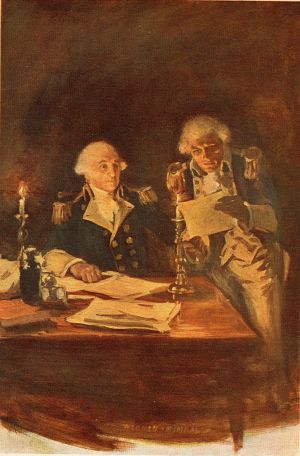
I studied the list a moment, bending down closer to the nearest candle,
while rapidly reviewing in my own mind the duty required. I had no
thought of refusal, yet appreciated to the full the possible danger of
the venture, and felt anxious to make no serious mistake. I had achieved
a reputation for reckless daring, yet this kind of service was hardly to
my liking. To wear British uniform meant my condemnation as a spy, if
discovered, and a death of disgrace. I had been within the lines of the
enemy often before, but always as a scout, wearing the homespun of the
Maryland Line, but this was to be a masquerade, a juggling with chance.
I was not greatly afraid of being unmasked by the officers of the
garrison, but there were those then in Philadelphia who knew
me—loyalists, secret sympathizers with our cause, and not a few
deserters from the army—whom I might encounter at any turn in the road.
The prospect was not alluring, yet a glance aside at the profile of
Washington, now bending low over a mass of papers, instantly stiffened
my resolve. It was work I had no excuse to shirk—indeed no
inclination—so I returned Hamilton's glance of inquiry frankly.
"You wish me to go at once?"
"I studied the list a moment, bending down closer to the nearest candle"
"The
earlier the better. I will furnish passports through our lines, and
hard riding will put you across the neutral ground by daylight."
"One moment, Major," interrupted Washington quietly. "You were doubtless
acquainted with our late Inspector-General?"
"Yes," my face darkening.
"He is now in Philadelphia, and it might be safer were you to avoid
meeting him."
"General Washington," I said frankly, "I have been loyal to you through
all this controversy, but, nevertheless, have retained my friendship
with General Conway. I believe the misunderstanding between you is
entirely personal, and in no way affects his loyalty to the cause.
Whatever his present relations may be with the British commander, I have
the utmost faith that he would not betray me to either death, or
imprisonment."
"I am glad to hear your words," and the kindly face instantly
brightened. "This entire controversy has been most unfortunate, with
wrong no doubt upon both sides. Unquestionably you are right, yet I felt
it my duty to warn you of his presence at Clinton's headquarters. God
bless you, my boy, good-bye."
I grasped the hand extended across the table, and followed Hamilton from
the room, Gibbs still standing motionless and silent before the
fireplace.
CHAPTER II — WITHIN THE ENEMY'S LINES
A long cavalry cape concealing the British uniform I wore, my horse and
myself were ferried across the Schuylkill, just below the mouth of
Valley Creek, and there, amid the silence and darkness of the eastern
shore, I parted with Hamilton, who had accompanied me thus far,
whispering final words of instruction. My horse was a fresh one, chosen
from the stables of the Life Guard, but the trappings were of the
British service. Within five minutes I was out of sight of the picket
fire on the river bank, riding steadily southeast through the night,
every nerve alert. An hour's riding found me well beyond our outermost
pickets, yet, in fear that I might encounter some body of irregulars,
scouting the neutral ground, I held on to my passport until I perceived
the first flush of dawn in the east. Then, convinced of close proximity
to the British guard-lines, I tore the paper into fragments. Avoiding
all roads, and seeking every bit of concealment possible, it was already
sunrise before I plunged suddenly into a Hessian picket-post, the
distant smoke of the Philadelphia chimneys darkening the sky ahead.
Unable to speak German, my uniform won sufficient courtesy, so that I
was escorted back under guard to an outpost of the Queen's Rangers,
where I explained my presence and rank to a red-faced Captain in Tory
green, so insolent in manner as to be insulting, until I exhibited the
sealed despatch, and demanded to be escorted at once to Sir William
Howe. This brought results, and I entered the city under escort of a
dozen horsemen, their green coats faced with dingy white, cocked hats
flapping as they rode.
It was thus we came to Callowhill, and the encampment of British
grenadiers, an officer of the 55th Regiment volunteering to guide me to
Howe's quarters in High Street. He was a genial fellow, and pointed out
various places of interest, as we rode more slowly through the streets
close along the river-side, questioning me often upon affairs in New
York, to which I returned such vague answers as pleased me, paying small
heed to the truth. I had never known Philadelphia well, but now it was
so strange as to be peculiarly interesting, many of the houses deserted,
with doors and windows boarded; several of the churches made over into
barracks, or riding-schools; the market closed; the State House filled
with lounging officers; and the streets thronged, even at this early
hour, by a varied uniformed soldiery, speaking Cockney English, the
jargon of the counties, Scottish Gaelic, or guttural German, as they
elbowed their passage, the many scarlet jackets interspersed with the
blue of artillery and cavalry, the Hessian red and yellow, the green of
the rifle-corps, or the kilts of the Highlanders. Lancers and Huzzars,
Grenadiers, Light Dragoons and Queen's Rangers mixed, and commingled,
apparently enjoying holiday. There was scarcely a woman to be seen; the
few who did appear being of the lower sort. All along the river were
redoubts, well garrisoned, with black gun muzzles pointing out across
the water. Many houses had been razed, and their débris, together with
the fire ruin of the past winter, gave to everything a look of
desolation. Much artillery was parked in the State House yard, and
several vessels of war were lying at anchor in the stream, while the
entire shore line was filled with barges, decorated as for a fête, a
large force of men laboring about them. My companion, observing my
interest attracted in that direction, reined up his horse to explain.
"Those are the galleys being made ready for the Mischianza, Fortesque,"
he said, waving his hand. "You came to us at a lucky hour."
"The Mischianza?" I asked, puzzled by the strange term. "Some festival,
you mean?—some gala day?"
"'Tis an Italian word, they tell me, signifying medley. The officers
give it in farewell to Sir William, who will sail to-morrow. A pretty
penny it costs. See, there is Major O'Hara now, one of the managers;
there are three others, Sir John Wrottlesly, Major Gardiner, and the
chief engineer, Montresor. Do you know them? No? Oh, I had forgotten you
have only just arrived. You will know them 'ere long, however, for they
are the leaders in such affairs. That is Captain André there with
O'Hara." He waved his hand, and the younger officer lifted his cocked
hat in acknowledgment. "Let us spur over there, Lieutenant, until I get
you a ticket of invitation."
I followed, careless of the loss of time so I could both see and hear.
"André, this is Lieutenant Fortesque just in from New York with
despatches for Howe. I have promised him a ticket for to-night."
The young officer laughingly extended a hand.
"The more the merrier, Craig. With the 42nd I see, sir; knew your
Colonel well. You'll find America isn't so bad, after you get used to
it. We've had a gay time here, eh, O'Hara? The best of liquor, and the
prettiest of girls, and now we'll show the town something it won't
forget in a hurry." He held out a card to me. "Rather ornate,
considering the printers in these colonies; designed it myself."
It was certainly a handsome souvenir, perhaps six inches by four in
size, engraved as in a shield, yielding a view of the sea, with the
setting sun, and on a wreath the words, "Lucco discendens, ancto
splendore resurgam," while at the top was the General's crest, bearing
the words, "Vive Vale." I have it yet, but as I looked at it then,
sitting my horse on the river bank, and listening to the careless
laughter of those about me, I could think only of that other
half-starved army in whose camp I had been the evening before, and of
those scenes of suffering witnessed during the past winter at Valley
Forge—the shoeless feet, the shivering forms, the soldiers dying from
cold and hunger, the snow drifting over us as we slept. What a contrast
between this foolish boy's play, and the stern man's work yonder.
Somehow the memory stiffened me to the playing of my own part, helping
me to crush back bitter words that I might exhibit the same spirit of
recklessness shown by those about me.
"A fine conceit, indeed," I confessed, "and if the pageant be equal to
its promise 'twill be well worth the seeing. What is the purpose,
gentlemen?"
"To give Sir William fit farewell," returned André, pleased at my
unstinted praise. "And now that the Lord has sent us a fine day, I can
promise a festival worthy the herald. But, Fortesque, if you would have
audience with Howe, I advise you to get on, for he will have few spare
moments between now and day-dawn to-morrow."
We parted with much bowing, Craig and I guiding our horses through the
crowded streets, being kept too busy avoiding accidents to exchange
conversation. Howe's headquarters on High Street were not pretentious,
and, except for a single sentinel posted at the door, were unguarded. I
was admitted without delay, being ushered into a large room containing
merely tables and chairs, the latter littered with papers. An aide took
my name, and within a very few moments Sir William himself entered
through a rear door, attired in field uniform. He was of imposing
figure, fully six feet in height, well proportioned, and with a
thoughtful, kindly face. He greeted me with much affability, glancing
hastily over the papers handed him, and then into my face.
"These do not greatly change my former plans," he said, "but I am glad
to know I can retain my present staff. There was no special news in New
York, Lieutenant?"
"None of particular importance, I believe, sir. We landed only a short
time ago."
"Yes. I understand. You were fortunate to get through here so
easily—the Jerseys are a hotbed of rebellion. Do you return with me by
water?"
"I believe that was left to my own discretion. I should be glad of a day
or two in Philadelphia."
"Easily arranged. While I shall leave the city to-morrow so as to give
Clinton a fair field, I shall remain on Lord Howe's flag-ship for some
little time previous to final departure for New York. You had better
mess here with my staff. Mabry," turning to the aide, "see that
Lieutenant Fortesque has breakfast, and procure him a pass good
indefinitely within our lines. You will pardon my withdrawal, as the
officers of the garrison promise me an exceedingly busy day. We will
meet again, no doubt."
He clasped my hand warmly, and withdrew, leaving me alone with the aide,
half-ashamed, I confess, of having been compelled to deceive. Yet the
very ease of it all stimulated endeavor, and I conversed lightly with
Mabry over the mess table, and, when the orderly returned with the
necessary pass, I was keen to start upon my round of inspection, utterly
forgetful of having been up, and in saddle, all night. Mabry could not
leave his duties to accompany me, but courteously furnished a fresh
horse, and assigned a private of dragoons to guide me about the city. By
ten o'clock we were off, my only fear being the possible meeting with
some acquaintance.
In this, however, I was happily disappointed, as there were few
civilians on the streets, the throngs of soldiers, off duty for a
holiday, with all discipline relaxed, being boisterous, and considerably
under the influence of liquor. Quarrels between them were frequent, the
British regulars and Loyalists seldom meeting without exchange of words
and blows. The uniform worn, together with my dragoon guard, saved me
from trouble, and I found the fellow sufficiently intelligent to be of
value. I dare not make notes, and yet recall clearly even now the
stations of the troops, together with a clear mental outline of the main
defences of the city. I made no attempt to pass beyond the limits, but,
from statements of the dragoon, and various officers with whom I
conversed, mapped in my mind the entire scheme of defence. Briefly
stated, the line of intrenchments from the Delaware to the Schuylkill
extended from the mouth of Conoquonaque Creek, just above Willow Street,
to the Upper Ferry, nearly on a line with Callowhill Street. These
consisted of ten redoubts, connected with strong palisades, all redoubts
well garrisoned by seasoned troops, the Queen's Rangers being at the
extreme right. Within the city proper were the reserves, so scattered in
various encampments as to be easily mobilized, and yet kept separated.
To the north were the Hessians, and next to these came three regiments
of British Grenadiers, with a body of Fusileers. Eight regiments of the
line occupied the slight eminence known as Bush's Hill, while close to
the Ferry was another encampment of Hessians. The Yagers, horse and
foot, were upon another hill near the river, and below them a large body
of infantry of the line. The Light Dragoons and three infantry regiments
were near a small pond. At the Middle Ferry was the 71st Regiment, and a
body of Yagers were at the Point House, opposite Gloucester. Many of
these locations were then outside the city, which extended at that time
from Christian Street on the south, to Callowhill on the north, being
widest between Arch and Walnut, where it expanded from Delaware to
Ninth. However, I visited a number of these encampments, finding in each
merely a small guard retained for the day, the majority of the troops
being off on liberty. Soon after noon these began to throng the water
front, eager to view the coming spectacle. I was, myself, in the Yager's
camp, finishing a late lunch, with a few officers, when the announcement
came that the water procession had started.
CHAPTER III — THE FÊTE OF THE AFTERNOON
I confess that up to this time I had experienced little interest in the
affair. After Valley Forge it was hard for an American soldier to admire
such boy's play, or to enter into the spirit of British fun making.
Besides the danger of my position, the fear of some slip of tongue
betraying me, the knowledge that I was in the very heart of the enemy's
camp, with grim, stern duties to perform and a return journey to
accomplish, kept me nerved to a point where I thought of little else
than my task. But now I dared not remain indifferent, and, indeed, the
enthusiasm of my companions became contagious, and I joined with them
eagerly, as they hurried forth to the best point of view. Once there the
sight revealed aroused me to an enthusiasm scarcely less than that of
those crowding about. Few, indeed, have ever witnessed so gorgeous a
spectacle as that river presented, and I have found many since who have
questioned my description. Yet I write down here only what I saw with my
own eyes, little understanding at the time its importance to my future
life.
Well out in the stream lay the vessels of war—the Fanny, Roebuck,
and Vigilant—together with a long line of transports, stretching as
far as the eye could see, flags flying, and decks crowded with
spectators. At the fore-mast head of the Roebuck fluttered the
Admiral's flag, and the shoreline was jammed with soldiery, the varied
uniforms a maze of colors. The pageant came down with the tide, moving
in three divisions to the inspiring music of several bands, the oars of
galleys and barges keeping exact intervals. These were decked out with
all manner of colors and streamers, and above fluttered the division
flag. As they passed us, the officers beside me named the various
occupants, but I recall now only the first and last, because of my
interest in those aboard. In the leading galley were Sir William, Lord
Howe, Sir Henry Clinton, the officers of their suites, and some ladies.
Lord Howe was facing the other way, but I noticed that Clinton was short
and fat, with a full face and prominent nose. In the last of the boats
stood General Knyphausen, the Hessian commander, very much of a German
in appearance, not tall, but slender and straight. Between these were
flat-boats, covered with green cloth, loaded with ladies and gentlemen,
or else containing bands. Six barges, darting here and there, kept open
space amid the swarms of small boats. Everywhere the eye swept over a
riot of color, and the ear caught a babel of sound. As the last barge
glided by, the man next me growled in disgust:
"Those are lucky dogs off duty to-day." His eye caught mine. "Why don't
you go after them, Fortesque? There will be plenty of fun afoot yonder
where they land."
"Where is that?"
"At the old fort; follow the crowd, and you'll not go astray. Have you a
ticket?"
"Captain André honored me with one this morning."
"Then you are good for the first row. Don't miss it, man," with
enthusiasm. "'T will be such a sight as has not been witnessed since the
Field of the Cloth of Gold."
"A passage at arms, you mean?"
"Ay! as gorgeous as those of the old-time knights; a fair conceit as I
read the programme. I'd be there now but for the damned orders that hold
me here. If you ride hard you can make the spot before they come
ashore."
There was no reason I should not go, and much in the glittering prospect
appealed to me. Five minutes later I was trotting out of the Yager
camp, pressing passage through the crowds, already headed southward, the
dragoon riding silently at my heels. Mounted men that day were few, and,
doubtless believing we were connected with the pageant, the jam sullenly
parted, and gave us opening, so we reached the site of the old fort as
the barges began discharging their occupants. A glance about, however,
convinced me as to where the lists were to be run, and I headed my horse
in that direction, anxious to gain some point of vantage, before the
throng poured in. Yet, Heaven knows, there were enough present even
then, the green sward overrun, and the few stands crowded. Quite a
considerable space, leading back from the river landing, had been roped
off, and Light Dragoons rode along the lines to keep out invaders;
others guarded the main platform until the more distinguished guests
were seated. Few Philadelphia residents were present, although I saw
some black coats, the crowd being mostly composed of soldiers bent upon
frolic. In the occupied stands, however, were loyalists in plenty, with
a considerable sprinkling of ladies, gaily attired. I saw all this while
striving to spur my horse forward toward where a band played "God save
the King," but should have failed to make it, had not Major O'Hara
caught glimpse of my face above the press. A moment he stared at me in
perplexity, and then with a dab of his spur forced the black horse he
rode against the ropes.
"Damn me if I knew you, Fortesque," he exclaimed cordially. "But come on
through; there's a gate yonder. Fall back now, lads, and let the officer
pass. That's it; ride 'em down if they won't make way. Here's a spot
where you can seen the whole field from the saddle."
I was somewhat to the right of the big stand, the restive heels of my
horse keeping the crowd away, and with a clear view as far as the river
bank. O'Hara was too busy to stop long, but I was not sorry, as there
was sufficient occurring to rivet attention. It was, maybe, four hundred
yards down a gentle slope to the water's edge, where the line was
forming. This passageway was lined with onlookers, held back by numerous
guards, while to my left extended a square lawn, perhaps one hundred and
fifty yards each way, surrounded by a double rank of grenadiers, the
bayonets gleaming on their guns. This open space was equipped with
everything needed for the coming tourney, and on three sides were tiers
of raised seats. I had barely observed all this when the guns of the
Roebuck, echoed by those of the Vigilant, began to boom a salute,
and the head of the column of marchers began slowly mounting the slope.
All the bands of the garrison were in front, followed by the managers,
richly attired, with badges of blue and white ribbon on their breasts.
Behind these appeared, in full dress uniform, gleaming with decorations
and medals, the three specially honored guests, the two generals and the
admiral, the others of the gay party following two by two in long,
interesting procession. The costumes worn were as varied as those of a
masquerade, representing all the changes since the days of chivalry. The
whole line glowed with color, and gleamed with steel.
Like some great serpent, glittering in the sun, this procession passed
under the triumphal arches, and disappeared as its members took
prescribed positions on the stands, or in the pavilions bordering the
field of contest. As thus arranged the grouping of colors was most
brilliant. In the front of each pavilion were seven young ladies,
attired picturesquely in Turkish costume, wearing in their turbans those
favors with which they meant to reward the knights contending in their
honor. Behind these, and occupying all the upper seats, were the maidens
representing the two divisions of the day's sports—ladies of the
Blended Rose, and ladies of the Burning Mountain. The first wore a white
silk, called a polonaise, forming a flowing robe, open to the waist; the
pink sash was six inches wide, and filled with spangles; the shoes and
stockings were also spangled, and, above all, arose a towering
head-dress, filled with a profusion of pearls and jewels; the veil was
spangled, and edged with silver lace. The ladies of the Burning Mountain
were similarly dressed, except that they wore white sashes, edged with
black, and all their trimmings were of that color. As the veils were
thrown back, and I looked on the bright, animated faces, I thought I had
never before seen such an array of beauty. From the crowd surging around
I heard name after name mentioned, as famous Philadelphia belles were
pointed out, not a few familiar to me, through remembrance of our own
former occupancy of the city—Miss Craig, the Misses Chew, Miss Redmond,
Miss Bond, the Misses Shippen, and others, all of loyalist families, yet
content to play the game of hearts with both armies. Even as I gazed
upon that galaxy of beauty, half angry that Americans should take part
in such a spectacle of British triumph, the field was cleared for the
lists, and a sound of trumpets came to us from a distance.
Out into the opening rode the contending knights, attended by esquires
on foot, dressed in ancient habits of white and red silk, and mounted on
gray horses. From the other direction appeared their opponents, in black
and orange, riding black steeds, while to the centre advanced the herald
loudly proclaiming the challenge. I knew not who they all were, but
they made a gallant show, and I overheard many a name spoken of soldiers
met in battle—Lord Cathcart, Captain André, Major Tarlton, Captain
Scott. Ay! and they fought well that day, those White and Black Knights
on the mimic field, first charging together, shivering their spears; the
second and third encounters discharging pistols; and in the fourth
attacking with swords in most gallant combat. At last the two
chiefs—Lord Cathcart for the Whites, and Captain Watson, of the Guards,
for the Blacks—were alone contending furiously, when the marshal of the
field rushed in between, and struck up their weapons, declaring the
contest done, the honor of each side proven. As the company broke up,
flowing forward to the great house beyond, the vast crowd of onlookers
burst through the guard-lines, and, like a mighty torrent, swept over
the field. It was a wild, jubilant, yelling mass, so dense as to be
irresistible, even those of us on horseback being pressed forward,
helpless chips on the stream.
I endeavored to press back, but my restive animal, startled by the dig
of the spur, the yells, the waving of arms, refused to face the tumult,
and whirled madly about. For a moment I all but lost control, yet, even
as he plunged rearing into the air, I saw before me the appealing face
of a woman. How she chanced to be there alone, in the path of that mob,
I know not; where her escort had disappeared, and how she had become
separated from her party, has never been made clear. But this I saw,
even as I struggled with the hard-mouthed brute under me—a slender,
girlish figure attired as a lady of the Blended Rose, a white,
frightened face, arms outstretched, and dark blue eyes beseeching help.
Already the front of the mob was upon her, unable to swerve aside
because of the thousands pushing behind. In another moment she would be
underfoot, or hurled into the air. Reckless of all else I dug in my
spurs, yelling to the Light Dragoon beside me, even as my horse leaped.
I felt the crush of bodies, hands gripped my legs; soldiers were hurled
right and left, cursing as they fell. I must have hurt some, but had no
thought except to reach her before it was too late. I was struck twice
by missiles, yet burst through, my horse, by this time, frenzied with
fear. I scarcely know what happened, or how it was accomplished—only I
had the reins gripped in my teeth, both my hands free. That instant I
caught her; the next she was on my arm, swung safely to the saddle, held
to me with a grip of steel, the animal dashing forward beneath his
double burden into the open field. Then the Dragoon, riding madly,
gripped the bit, and the affair was over, although we must have galloped
a hundred yards before the trembling horse was brought to a stand.
Leaving him to the control of the soldier, I sprang to the ground,
bearing the lady with me. We were behind one of the pavilions, facing
the house, and she reeled as her feet touched the earth, so that I held
her from falling. Then her lashes lifted, and the dark blue eyes looked
into my face.
"You must pardon my roughness," I apologized, "but there was no time for
ceremony."
She smiled, a flood of color coming back into the clear cheeks, as she
drew slightly away.
"I appreciate that, sir," frankly, shaking out her ruffled skirts, "and
you have made knighthood real."
"Then," I ventured, "may I hope to receive the reward, fair lady?"
She laughed, a little tremor of nervousness in the sound, but her eyes
full of challenge.
"And what is that?"
"Your name; the hope of better acquaintance."
Her eyes swept my uniform questioningly.
"You are not of the garrison?"
"No; a courier just arrived from New York."
"Yet an officer; surely then you will be present to-night?"
"The privilege is mine; if sufficiently tempted I may attend."
"Tempted! How, sir?"
"By your pledging me a dance."
She laughed again, one hand grasping the long silken skirt.
"You ask much—my name, a better acquaintance, a dance—all this for
merely saving me from a mob. You are not a modest knight, I fear.
Suppose I refuse?"
"Then am I soldier enough to come unasked, and win my welcome."
"I thought as much," the long lashes opening up to me the depths of the
blue eyes. "I promise nothing then, nor forbid. But there is Captain
Grant seeking me. If I do not speak of gratitude, it is nevertheless in
my heart, sir," she swept me a curtsey, to which I bowed hat in hand,
"and now, Au revoir."
I stood as she left me, staring while she crossed the lawn and joined a
dark-faced officer of Rangers. Once she glanced back over her shoulder,
and then disappeared in the crowd of revellers.
CHAPTER IV — THE MISCHIANZA
I had not intended to remain in Philadelphia through the night. Already
I had secured the information sought, and now must consider the safest
and quickest method of escape. It seemed to me this night, given up to
revelry, afforded the best possible opportunity for my safely passing
the British guard-lines. To-morrow discipline would be resumed, the
soldiers would return to their posts and the citizens of the city would
again appear on the streets. This would greatly intensify my danger,
for, at any moment, I might encounter some one who knew me, who might
denounce me to the authorities.
That this was the exact truth of the situation could not be denied, yet,
now, every reckless impulse of my disposition urged me to remain; the
invitation of those laughing blue eyes, the challenge I read in the
lady's fair face, the unsolved mystery of her identity, all combined in
a temptation I found it impossible to resist. As I rode slowly
northward, out of the denser crowd into the almost deserted streets, the
shades of evening already closing about me, the memory of the girl I
had encountered so strangely, and parted with so suddenly, became more
and more alluring, more and more vivid. My thoughts dwelt upon the arch
face, the red lips, smiling to reveal the white teeth, the flushing
cheeks, the mass of soft brown hair revealed beneath the turban, the
mocking laughter in the depths of the blue eyes, and the straight, lithe
figure, as she moved swiftly away to rejoin her friends. Who was she,
this lady of the Blended Rose? this girl with the dignity of rank, and
the carelessness of youth? I must know the answer; it was not in young
blood to run away. Certain facts regarding her were at least clear
already—she must be the daughter of a loyalist, or else related to some
of the English officers; her very presence proved this, while her
selection as one of the ladies of honor, was evidence of high standing
socially. And she had dared me, challenged me with her eyes, to remain,
and learn more. There was no promise, no word spoken I could construe
into a pledge, and yet there was invitation, a suggestion, vague but
comprehended, which youth could not easily ignore. My veins throbbed
with anticipation—already was my arm about the slender waist, my eyes
looking into her own. For a dance with her, a possible understanding, I
was willing to venture life itself.
I turned about and glanced at the Dragoon riding behind, half tempted to
question him, but I refrained, not willing to make her the subject of
camp-fire gossip. It would be a more manly course to work this out
myself, and surely I should meet officers at the ball who would gladly
present me to the lady. I should be compelled to attend in field
uniform, yet circumstances would excuse that, and what little I had seen
of her convinced me she was no stickler for conventionality. The duty
soldier was more apt to interest such a personality than any dandy on
dress parade. With a word I dismissed my companion, and turned in to the
camp of the Yagers, sure of a welcome at their mess-table, and a chance
to brush up my soiled clothes.
It must have been nearly nine o'clock when, in company with a young
cornet, I rode up to the house given up to festivities, and, turning
over our horses to the care of cavalry grooms, climbed the wide steps to
the door leading into the hall. Interested as I was in observing faces,
fearful of possible discovery by some one in the crowd, I failed to note
definitely the many decorations, yet I remember how the wide hall was
hung in green and white, each room opening from it possessing a distinct
color scheme, and how, under the gleaming clusters of lights, and
sparkling of glass chandeliers, the gay uniforms of the officers and
the brilliant gowns of the ladies appeared resplendent. The vista of
those great rooms, reflected by numerous mirrors, was a scene of
confusing beauty, with flowers everywhere, soft, glowing carpets
underfoot, and the surging crowds passing back and forth. There was
scarcely a black coat present, to yield touch of sombreness to the
picture, but scarlet and blue, green and white, glowing with profusion
of gold lace, and glittering with medals, together with gleaming
shoulders, ruffles of white lace, and shimmering skirts of silk. All was
a riot of color, rich, bewildering, with smiling faces, and laughing
lips everywhere. In such a spot, amid such surroundings, war seemed a
dream, a far-off delirium.
Drawn thither by the music, we climbed the broad stairs toward the
ball-room, passing as we did so, in the upper hall, four drawing-rooms
containing sideboards with refreshments. The ball-room itself was a
picture of Oriental magnificence—the walls were delightfully decorated,
the ground-work pale blue, panelled with a small, gold bead, the
interior filled with drooping festoons of flowers in their natural
colors. Below the surface the ground was of rose pink, the drapery
festooned with blue. The effect of these decorations was vastly
increased by nearly a hundred mirrors, decked out with rose-pink ribbons
and artificial flowers, while in the intermediate spaces were
thirty-four branches with wax lights similarly ornamented. No pen of
memory can describe the scene, nor picture in the gallant company,
resplendent in coloring, now moving back and forth in the evolutions of
the minuet.
My companion disappeared, and, to escape the pressure of those surging
back and forth through the wide doorway, I found passage close to the
wall, and half circled the room, finally discovering a halting place in
the recesses of a window, where, partially concealed myself by flowing
curtains, I could gaze out over the brilliant assemblage. Half ashamed
of the plainness of my own attire, and feeling a stranger and an alien,
I was yet consciously seeking the one face which had lured me there. I
saw fair ladies in plenty, and more than once my heart leaped, only to
discover its mistake. There were so many ladies of the Blended Rose on
the floor as to be confusing, and with their similarity of dress, and
powdered hair, I was never sure until they turned their faces toward me
that my patient search was still unrewarded. Yet if she was indeed upon
the floor I saw her not, and my heart grew heavy with delay. But in this
survey I discovered others—of both sexes—whose names had been
mentioned that afternoon, and recognized the faces of a few officers
whom I had met during my wanderings. Surely some of these would present
me to the lady of my dreams could I but see her, learn her name. Before
the music ceased I was convinced she was not among the dancers; I would
search the side rooms, and the apartments below, yet, even as the
company sought seats, soldiers crossed the floor, extinguishing the
lights, and amid laughter, and repartee, the throng surged toward me,
hemming me in closely, as they gathered in eager bunches about the open
windows.
Enough conversation reached me to disclose a promised display of
fireworks on the lawn, and almost immediately, a magnificent bouquet of
rockets shot up into the black sky, illuminating everything with a glare
of fire. This was followed by the lighting up of the triumphal arch, and
the bursting of balloons high overhead. Attracted by the spectacle, I
was staring out at the dazzling scene, when a voice spoke at my
shoulder.
"'Tis a relief to see even one soldier present ready for duty."
I turned to look into a pair of steady blue eyes, with a bit of mocking
laughter in their depths, the face revealed clearly in the glare of the
rockets.
"Necessity only," I managed to reply. "I can be as gorgeous as these
others, had I brought a bag with me."
"No doubt; every British regiment tries to outdo the others in ribbons,
and gold lace. Really they become tiresome with such foppery in war
times. See how they play to-night, like children, the city practically
unguarded from attack," she waved an ungloved hand toward the dark
without. "I venture there are men out yonder, sir, who are not dancing
and laughing away these hours."
My cheeks burned.
"You mean Washington's troops?"
"Aye! I saw them here in Philadelphia before Sir William came," her
voice lowered, yet earnest, "and they are not playing at war; grim,
silent, sober-faced men, dressed in odds and ends, not pretty to look
at; some tattered and hungry, but they fight hard. Mr. Conway was
telling us yesterday of how they suffered all winter long, while we
danced and feasted here, Washington himself sleeping with the snow
drifting over him. You do not know the Americans, for you are not long
across the water, but they are not the kind to be conquered by such
child's play as this."
"You are an American then?"
"By birth, yes," unhesitatingly. "We are of those loyal to the King,
but—I admire men."
It was with an effort I restrained my words, eager to proclaim my
service, yet comprehending instantly that I dare not even trust this
plain-spoken girl with the truth. She respected the men, sympathized
with the sacrifices of Washington's little army, contrasted all they
endured with the profligacy of the English and Hessian troops, and yet
remained loyal to the King's cause. Even as I hesitated, she spoke
again.
"What is your regiment?"
"The 42nd British Foot."
"You have not yet been in action in America?"
"No, but I have just crossed the Jerseys with despatches."
She shook her head, her cheeks glowing.
"My home was there when the war began," she explained simply. "Now it is
hate, pillage, and plunder everywhere. We fled to Philadelphia for our
lives, and have almost forgotten we ever had a home. We loyalists are
paying a price almost equal to those men with Washington. 'Tis this
memory which makes me so bitter toward those who play amid the ruins."
"Yet you have seemed to enter into the gay spirit of the occasion," and
my eyes swept over her costume.
"Oh, I am girl enough to enjoy the glitter, even while the woman in me
condemns it all. You are a soldier—a fighting soldier, I hope—and
still you are here also seeking pleasure."
"True; I yielded to temptation, but for which I should never have come."
"What?"
"The dare in your eyes this afternoon," I said boldly. "But for what I
read there I should be out yonder riding through the night."
She laughed, yet not wholly at ease, the long lashes drooping over her
eyes.
"Always the woman; what would you do without my sex to bear your
mistakes?"
"But was this a mistake? Did I read altogether wrong?"
"Don't expect a confession from me, sir," demurely. "I have no memory of
any promise."
"No, the barest suggestion was all your lips gave; it was the eyes that
challenged."
"You must have dreamed; perhaps you recall the suggestion?"
"I took it to mean that you would not be altogether averse to meeting me
again through the kindness of some mutual friend."
"No doubt you have found such a friend?"
"I have scarcely seen a face I know to-night," I pleaded. "I cannot even
guess from what place of mystery you appeared so suddenly. So now I
throw myself upon your mercy."
"I wonder is it quite safe!" hesitatingly. "But, perhaps, the risk is
equally great on your part. Ah! the lights go on again."
"And the band plays a Hungarian Waltz; how better could we cement
friendship than to that measure?"
"You think so? I am not so sure, and there are many names already on my
card—"
"Do not look," I interrupted swiftly, "for I claim first choice since
this afternoon."
"You do?" and her eyes laughed into mine provokingly. "And I had
forgotten it all; did I, indeed promise you?"
"Only with your eyes."
"Oh, my eyes! always my eyes! Well, for once, at least, I will redeem
even that visionary pledge," and her glance swept the room hastily. "But
I advise that you accept my surrender quickly, sir—I am not sure but
this was Captain Grant's dance, and he is coming now."
CHAPTER V — THE BEGINNING OF TROUBLE
Her hand was in mine, my arm already around her waist, when the officer
bowed before us. He had been but a dim figure in the afternoon, but now
I saw him for a tall, slender man, somewhat swarthy of face, with black
hair and moustache, and a keen eye, attired in the green and white of
the Queen's Rangers. He smiled, but with a sarcastic curl to the upper
lip not altogether pleasant.
"Your pardon, Mistress Claire," he said boldly, sweeping me with a
supercilious glance, "but am I mistaken in believing this waltz was
pledged to me?"
"By mistake, Captain," her lips smiling, her eyes steady. "It seems I
had overlooked a promise made during the afternoon."
"Oh, indeed," he turned toward me, staring insolently. "The hero of the
rescue, I presume."
I felt the restraining pressure of her hand upon my sleeve, and her
voice replied calmly, before I succeeded in finding words.
"This is the gentleman who protected me from the mob, if that be what
you mean. Permit me to present Captain Grant of the Queen's Rangers,
Lieutenant—pardon my having already forgotten your name."
"Fortesque," I stammered, intensely hating the necessary deception.
"Ah, yes—Lieutenant Fortesque, of the 42nd British Foot."
We bowed coldly, neither extending a hand, the Captain twisting his
moustache as he continued staring at me.
"Fortesque," he repeated slowly. "Fortesque; not of this garrison, I
believe."
"No, from New York," coolly. "I regret having interfered with your
programme."
"Don't mention it; there are other ladies present, and, no doubt, your
gallant act was worthy the reward; a pleasant evening, sir," and he drew
aside, stiffly military. Eager to lose as little as possible of the
measure I swung my partner forward, catching glimpse again of the man's
face as we circled.
"Pleasant disposition," I ventured, without meaning to be uncivil.
"Oh, very," and her eyes met mine frankly. "But you must not quarrel
with him; that is his one specialty, you know."
"Is the warning on your account, or my own?"
"Both, perhaps. Captain Grant's family and mine are neighbors—or were
before war intervened—and between our fathers exists a life-long
friendship. I could never consent to be the cause of his quarrelling
with any one, and I have reason to know how quick tempered he is."
"I have little use for any man who swaggers about seeking trouble," I
returned, as she hesitated. "It has been my experience that there is
usually cowardice back of such a disposition."
"Not in this case," earnestly. "Captain Grant's courage has been
sufficiently tested already. I warn you not to presume on your theory so
far as he is concerned. I advise the safer course."
"What is that?"
Her eyes met mine, smiling slightly, and yet grave enough in their
depths.
"To let this one dance prove sufficient reward for your act of rescue."
"You request this?"
"Oh, you must not place the entire burden of decision on me, sir. I can
only suggest."
"Has Captain Grant any authority to dictate who shall be your partner?"
Her lashes lifted, and then fell before my gaze.
"He at least assumes the power, and generally with fair success. I must
ask to be excused from discussing this matter further now, but—but,"
her voice trembled to a whisper, "I—I am sure your safety depends upon
your leaving me."
Astonished by these words, suddenly wondering if she suspected me,
scarcely comprehending what she meant, I stared into her face, as we
circled the room. Grant stood stiffly against the wall where we left
him, his eyes fastened moodily on the crowd; I realized his presence,
yet my whole thought was concentrated on the girl, the strands of her
hair brushing my lips, her steps lightly following the music, her eyes
downcast. Into the cheeks there came a flush of pink, and she glanced up
to read the surprise in my face.
"Do I need to say more?"
"Yes, you must," I insisted, "you can never believe I would leave you
because of personal fear."
"I did not know—at first. Now I realize it will require a higher motive
to influence you; not love of life, but love of country."
I felt the closer clasp of her fingers on my guiding hand, and knew I
took a deep breath of surprise.
"Lean your head just a little closer," she whispered. "I—I know you,
Major Lawrence, and—and I wish you well."
How I kept to the measure I cannot now imagine, for, in an instant, all
my house of cards crumbled into nothingness. She knew me, this blue-eyed
girl; knew me, and sought to aid my mission, this daughter of a
loyalist, this lady of the Blended Rose. It was inconceivable, and yet a
fact—my name had been whispered by her lips.
Suddenly she looked up laughing, as though to make others feel that we
conversed lightly. We passed Grant, even as I held my breath, almost
afraid to venture with words. Yet they would not be restrained.
"You certainly startled me; how do you know this? Surely we have never
met before?"
"I refuse to be questioned, sir; it means nothing how I know—the fact
that I do should be sufficient."
"But Mistress Claire—"
"Rather Mistress Mortimer."
"Yet the Captain called you Claire."
"And we were children together—you can scarcely claim such
familiarity."
"I warrant you can name me."
"Allen, is it not, sir?"
What was it the witch did not know! This was no guess-work, surely, and
yet how could her strange knowledge be accounted for? Sweet as the face
was, greatly as it had attracted me, there was nothing to awaken a
throb of memory. Surely I could never have seen her before, and
forgotten; that would have been impossible. The music ceased, leaving us
at the farther extremity of the hall.
"And now you will go?" she questioned eagerly.
"Do you mean, leave here?"
"Yes; you said once to-night, that but for me you would be riding
yonder. I realized all you meant, and you must not remain. The
guard-lines are slack to-night, and you can get through, but if you wait
until to-morrow it may be too late. Believe me, I am your friend, a
friend of your cause."
"I do believe you; I could not connect you with deceit, but I am
bewildered at this sudden exposure. Does Captain Grant also suspect my
identity?"
"I think not—not yet, at least, for if he did you would be under
arrest. But there are others here who would recognize you just as I
have. There is no mystery about it. I was in Philadelphia when the
Continental troops were here, and you were pointed out to me then. No,
we have never met, yet I was sure I recognized you this afternoon."
"I was pointed out to you by whom?"
"My brother—my twin brother on the staff of General Lee."
"Did you not inform me your family were loyalists?"
"Yes; it is true," earnestly, her foot tapping the floor, as though
annoyed at such persistent questioning. "I have a father and brother in
the King's service—but one is a renegade, and I—I—"
"You are what?"
"I am merely a woman, sir, unable to determine whether to finally become
loyalist or rebel."
I looked gravely into her eyes until they fell, veiling their revelation
of truth behind long lashes.
"Mistress Mortimer," I murmured, bending so close to her pink ear, I
felt the soft touch of her hair on my lips, "you dissemble so charmingly
as to even puzzle me. But if I leave you now, as you request, I must
first have promise of welcome again."
"Then you mean to return—a prisoner? I am always merciful to the
suffering."
"No; we are coming back to Philadelphia victors, and soon. I am not
afraid to tell you. I have learned much to-day, and go back to report to
Washington that the exchange of British commanders means the early
evacuation of this city. When we meet again you will not be a lady of
the Blended Rose, nor will I be wearing this uniform."
Her eyes sparkled brightly into mine, then dropped demurely.
"I—I rather like the colors you are wearing now, and am sure this dress
is most becoming. I—I have a passion for masquerade."
"I recognize that, but have already discovered where I can read the
truth beyond the masque—what is occurring now?"
She turned to look, attracted as I had been by the change and bustle
about us. A few feet from where we stood conversing, large folding
doors, previously concealed by draperies, were suddenly flung wide open,
revealing a magnificent dining-hall. Before the crowd could recover from
its first surprise, and surge that way, my eyes had taken in the full
effect of the disclosure. It was a vast saloon, as I have since been
informed, measuring two hundred and ten feet by forty, with a height of
twenty-two feet, having three large alcoves on each side. The ceiling
was the segment of a circle, the sides painted a light straw color, with
vine leaves and festoons of flowers, some in bright, others in dark
green. More than fifty large pier-glasses extended from floor to
ceiling, reflecting the glitter of the tables, while a hundred branches
of three lights each, and eighteen clusters of twenty-four, illumined
the immense apartment, aided by three hundred wax tapers upon the snowy
tables. These were already prepared for service, set with nearly five
hundred covers, a large company of black slaves, attired in Oriental
fashion, awaiting the coming of the guests. Sir William and his brother
already led the way, the others pouring in as rapidly as the wide doors
would permit. Dazzled by the magnificent spectacle I turned to my
companion, unable to resist temptation. She must have instantly read the
purpose in my face, for she grasped my sleeve.
"No; you must not think of remaining a moment longer. There will be a
seat reserved for me, and Captain Grant is coming this way now.
Something is wrong, I am sure; I have no time to explain, but promise me
you will leave here at once—at once."
Her eyes, her words, were so insistent I could not refuse, although as I
glanced about I felt convinced there was no danger in this assemblage,
not a familiar face meeting mine. At the instant Grant came up, elbowing
his way through the press, and staring insolently into my eyes, even as
he bowed politely to the lady beside me.
"At least this is my privilege," he insisted, "unless there be another
previous engagement of which I am ignorant."
"Oh, no," and she rested her hands on the green sleeve, smiling from his
face into mine. "We were waiting for you to come. Good-night, Lieutenant
Fortesque."
They had taken a step or two, when Grant halted, holding her arm tightly
as he glanced back to where I stood.
"Would Lieutenant Fortesque spare me a moment after I have found the
lady a seat?" he questioned politely.
"Gladly, if you do not keep me waiting too long."
"Then there will be no delay. Shall we say the parlor below?"
I bowed, conscious of the mute appeal in the lady's face, yet with no
excuse for refusal.
"As well there as anywhere, sir."
Once again we bowed with all the punctilious ceremony of mutual dislike,
and he whispered something into her ear as they disappeared in the
stream of people. My cheeks burned with indignation at his cool
insolence. What could it mean? Was he merely seeking a quarrel? or was
there something else concealed behind this request? In either case I
knew not how to act, and yet felt no inclination to avoid the meeting.
Studying over the situation I pushed my way through the crowd across the
floor of the ball-room. There were a few people still lingering on the
stairs, but, except for the servants, the parlors below were deserted. I
walked the length of one of the great rooms, and halted in front of a
fireplace to await Grant's coming. I was eager to have this affair
settled, and be off. I comprehended now the risk I had assumed by
remaining so long, and began to feel the cords of entanglement drawing
about me. There was a door opposite where I stood, and, staring toward
it, I saw it open slightly, and, back in the darkness, the beckoning of
a hand. Startled, yet realizing that it must mean me, I stepped closer,
gripping the hilt of my sword, half suspecting treachery.
"Quick," and I recognized the deep contralto of the voice. "Don't stop
to question; there is not a moment to lose."
CHAPTER VI — THE THREAT OF SWORDS
Stepping from the glare of those gleaming parlor lights into the gloom
of that narrow passage, blinded me for the instant, yet a moment later,
I became aware of the distant glimmer of a candle, the faint reflection
revealing the girl's face.
"Please do not talk; do not ask anything—yet," she urged hurriedly,
noiselessly closing the door at my back, and as instantly gripping my
sleeve. Her breath came quickly; her voice trembled from suppressed
excitement. "Come with me, beyond the light yonder."
I followed her guidance, bewildered, yet having every confidence the
reason for this mysterious occurrence must be fully justified. The
passage curved slightly, terminating at a closed door. Scarce a
reflection of the candle reached us here, yet my eyes were by now
sufficiently accustomed to the gloom so that I could trace the outlines
of her face. A vague doubt took possession of me.
"You are causing me to run away from Grant," I protested blindly. "You
are making me appear afraid to meet him."
"No, it is not that," swiftly. "He was not coming to you personally at
all—you were to be arrested."
"What! He knew me then?"
"I am not sure—some one did, and mentioned his suspicions. Captain
Grant was glad enough of an excuse, no doubt, but he," the soft voice
faltering, "he made a mistake in twitting me for being friendly toward
you."
"And you came to warn, to save me!" I exclaimed, pressing her hand.
"That was nothing; I could do no less. I am only glad I knew the way."
"You mean how you might reach me first?"
"Yes; it came to me in a flash when he first left me alone, only I was
not certain in which parlor you would be waiting. I ran through the
kitchen and down the back stairs; I helped the officers plan their
decorations, and in that way learned of this private passage beneath the
stairs. It was easy, but—oh, listen! they are in there now!"
We could hear voices through the intervening wall clearly enough to even
distinguish words, as the speakers exercised little restraint. I felt
the girl's slender figure press against me in the narrow space where we
stood, and I clung to her hand, both remaining motionless and silent.
"The fellow has run, Grant," boomed some one hoarsely, "either afraid,
or else what you say he is. See here, boy, did you see any one in here
lately in scarlet jacket?"
"I don' just 'member, sah," answered a negro, hesitatingly. "I was busy
over dar' cleanin' de side-boa'd."
"Well, he's not here now, that's certain," broke in Grant impatiently,
"and we've been in all the parlors? What next, MacHugh?"
"Try to head him off before he can get out of the city, of course.
That's his game, probably. Osborne, have Carter come here at once. Why
didn't you nab the fellow upstairs, Captain? Fool play that, sending him
down here."
"I didn't wish to create a row in the ball-room; he was with Claire
Mortimer—"
"Oh, I see," laughing coarsely. "Something besides military duty
involved, eh?"
"I'll trouble you to be a trifle more careful, MacHugh," Grant said
stiffly. "The fellow did her a small service in the afternoon, and she
couldn't refuse dancing with him, as he was in uniform, and apparently
all right. I advise you to drop that part of the affair. Here's Carter
now."
I could hear the click of the newcomer's spurs as he crossed the room.
MacHugh chuckled.
"Touchy about it just the same, I see; however we'll pass up the lady.
Carter, there has been a spy in here to-night, calling himself
Lieutenant Fortesque, of the 42nd Regiment. He came through the lines
this morning with despatches for Howe, I understand. Did you meet him?"
"No, sir, but one of my men was riding about with him all day—Watts; I
heard him telling about it an hour ago."
"Is that so? Where'd they go?"
"Covered everything, I judge, from Callowhill to the Lower Battery.
Watts said he asked questions of everybody they met, but he didn't take
any notes. He liked the fellow, but thought he was mighty inquisitive.
Where is he now, sir?"
"The devil knows, I don't, and you'll have to find out. He'll head
northwest likely; he'll never try to cross the river here. How many men
have you?"
"Twenty."
"Scatter them to every north post. The fellow had no horse, and your
troopers can easily get ahead of him. Hurry up now." Carter departed
with click of steel, and MacHugh evidently turned to his companion.
"We'll catch the lad all right, Grant. Some of those outposts will nab
him before daylight. No use our waiting around here; let's go back
upstairs."
The girl's nervous grasp on my arm tightened, her lips pressed close to
my ear.
"I—I must get back to my place at the table," she whispered. "Surely
you know what to do; this is a rear door; there are stables a hundred
feet away; you must get a horse, and ride fast—you—you will do this!"
"Yes, of course—but how can I thank you?"
"Don't try; don't ever even think of it again. I hardly know what mad
impulse sent me here. Now I have but one thought—to hurry you away, and
get safely back myself—you will go?"
"Yes—but—"
"Not now! there is no time for explanation, promises, anything. You
heard what they said; every avenue of escape will be blocked within an
hour. If you go at once you can outride them—please, please go!"
She held out her hand, and I grasped it warmly, unable longer to war
against the pitiful appeal in her voice.
"Yes, I'll go, at once. But I take away with me a memory which will
never permit me to be satisfied until we meet again. We have been
together so short a time—"
"Had it been longer," she interrupted, "you would know me better, and
care less, perhaps. I am a sham; a cheat," a trifle of bitterness in the
tone. "You will learn all that some day, and laugh at yourself. Oh, I
know you will; so not another word, sir. I am going; then, perhaps, you
will."
There was a slight pressure of her fingers, and she had vanished so
quickly I could only stare blindly along the deserted passage. Yet, an
instant later, the peril of my predicament flashed back upon my mind,
and I faced the immediate necessity for action. What her strange words
might mean could not be interpreted; I made no attempt to comprehend.
Now I must find means of escape, and learn the truth later. I opened the
door cautiously, and stepped without, every nerve taut, every muscle
braced for action. It was a star-lit night, and the numerous rear
windows of the mansion cast a glare of light for some distance. The dark
shadow of a high fence alone promised concealment, and, holding my sword
tightly, I crept in that direction, breathing again more freely as I
reached its protection unobserved. There was a guard stationed before
the stable door—a Grenadier, from the outline of his hat—and
others, a little group, were sitting on the grass a dozen feet away. If
they had not been already warned I might gain a horse by boldness, but
the probability was that here was where Carter had mounted his squad,
and I would merely walk forward into a trap. I had better chance the
possibility that some visitor had left a horse tied in front, or to one
of the stands. With this possibility in mind I turned, and skirted the
house, making myself as inconspicuous as possible. There were soldiers
on the outside steps; I heard their voices without seeing them, and was
thus driven to run swiftly across an open space, memory guiding me
toward the opposite pavilion. Breathless, with heart beating fast, I
crouched low in the shadow, endeavoring to make out my more immediate
surroundings. There were no horses there, but I could clearly
distinguish the stomping of restless hoofs somewhere to the right. As I
straightened up, determined upon discovering an empty saddle if
possible, the figure of a man suddenly loomed directly in front,
advancing toward me. In startled surprise I took one step backward, but
was too late. Already the eyes of the newcomer had perceived my
presence, and he sprang forward, tugging at his sword.
"Hold on there! hold on!" he commanded shortly. "Who are you? What the
devil are you skulking about out here for?"
It was Grant beyond a doubt; I would recognize the peculiar snarl of
that voice in a thousand. He had not gone upstairs then; had not
rejoined the lady in the dining-room. What would she think of his
absence? What would she do when she realized its probable meaning?
Someway I was not frightened, at thus meeting him, but glad—if those
others would only keep away, and let us settle the affair between us.
Here was his test—a coward would cry out an alarm, summon the guard to
his assistance, but, if the fellow's nerve only held, or if he hated me
badly enough, he'd fight it out alone. All this came to me in a flash,
and the words of challenge spoken before he even grasped the thought of
who I was.
"So I have discovered you, have I? Why did you fail to keep our
appointment within?"
He drew up sharply, with an oath, peering at me through the dark,
bewildered by my speech.
"The spy! Ye gods, what luck! Do you mean to insinuate I ran away, sir?"
"How else could I interpret it?" I questioned coolly, determined to
taunt him to action. "I waited where you told me till I was tired.
Perhaps you will oblige me by explaining your purpose."
He muttered something, but without comprehending its purport I went on
threateningly:
"And I think you made use of the word spy just now. Did you mistake me
for another?"
"Mistake you? No; I'd know you in hell," he burst forth, anger making
his voice tremble. "I called you a spy, and you are one, you sneaking
night rat. You never waited for me in the parlor; if you had you'd now
be under arrest."
"Oh, so that was the plan?"
"Yes, that was it, Mister Lieutenant Fortesque."
"Well, Grant," I said sternly, "I've got just one answer to make you.
You can call your guard, or you can fight it out with me here. Whichever
you choose will depend upon whether you are a man, or a cur." I took a
step nearer, watching him as best I could in the dark. "You are an
unmitigated liar, sir," and with sudden sweep of the arm I struck him
with open hand. "Probably you will realize what that means."
For an instant he remained so still I doubted him, even held him cheap;
then the breath surged through his clinched teeth in a mad oath. He
surged toward me, but my sword was out, the steel blocking his advance.
"You—you actually mean fight?"
"Why not? Isn't that cause enough? If not I will furnish more."
"I do not fight spies—"
"Stop! That silly charge is merely an excuse. You do not believe it
yourself. You wanted a quarrel yonder in the ball-room. The expression
of your eyes was an insult. Don't evade now. I am here, wearing the
uniform of the British army. I have every right of a gentleman, and you
will cross swords, or I'll brand you coward wherever there is an English
garrison."
The fellow was certainly not afraid, yet he hesitated, not quite clear
in his own mind what he had better do. I might be a spy, and I might
not; he possessed no doubt a moment before, yet the very boldness of my
words had already half convinced him there might be some mistake. Should
he call to the men on the steps yonder, denounce me, and turn me over to
the guard? That was the easiest way for him, the greater disgrace to me.
Yet if, by any chance, I proved later innocent of the charge, then he
would become the laughingstock of the army. I heard his teeth grate
savagely as he realized his dilemma, and laughed outright.
"You do not seem altogether pleased, my friend; what are you, a toy
soldier?"
"Hell's acre! I'll show you what I am."
I saw the sudden flash of his drawn blade, and flung up my own in guard.
"Wait; not here, Captain," I insisted quickly. "We're far too near your
watchful friends yonder; besides the light is poor. Let's try our
fortunes beyond the pavilion, where it can be simply man to man."
He turned without a word, and I followed, eager enough to have done with
the business. The stars gleamed on the naked weapons held in our hands,
but we exchanged no words until we had rounded the corner, and come
forth into the open space beyond.
CHAPTER VII — THE ONE HOPE
As he stopped and faced about, I as instantly halted.
"Perhaps this spot may satisfy your requirements," he said
sarcastically. "'Tis far enough away at least, and the light is not so
bad."
"It will do," I replied, and threw my scarlet jacket on the grass.
"Strip to the white, sir, and then we can see fairly well where to
strike. That's better. On guard!"
Neither of us had mentioned the lady, preferring to base our quarrel on
other grounds, yet I fully comprehended that some unreasonable jealousy
on his part had led up to all this. Whatever the relations between them
might be, his desires were clear enough, as well as his methods for
keeping others away. This knowledge merely nerved me to steadiness; she
would hear of it all later and understand. The fellow's right to resent
the small attentions I had shown to Mistress Mortimer I questioned
greatly—she had plainly enough denied the existence of any relationship
between them other than family friendship,—and I meant to teach this
loyalist bully that I was not the sort to be driven away by loud words,
or the flash of a sword.
He came at me fiercely enough, confident of his mastery of the weapon,
and, no doubt, expecting me to prove an easy victim of his skill. His
first onslaught, a trick thrust under my guard, caused me to give back a
step or two, and this small success yielded him the over-confidence I
always prefer that an opponent have. I was young, agile, cool-headed,
instructed since early boyhood by my father, a rather famous swordsman,
in the mysteries of the game, yet I preferred that Grant should deem me
a novice. With this in mind, and in order that I might better study the
man's style, I remained strictly on defence, giving way slightly before
the confident play of his steel, content with barely turning aside the
gleaming point before it pricked me. At first he mistook this for
weakness, sneering at my parries, as he bore in with increasing
recklessness.
"A club would be more in your line, I take it, Mr. Lieutenant
Fortesque," he commented sarcastically, "but I'll play with you a while
for practice—ah! that was a lucky turn of the wrist! So you do know a
trick or two? Perhaps you have a parry for that thrust as well! Ah! an
inch more and I'd have pricked you—your defence is not bad for a boy!
By all the gods, I tasted blood then—now I'll give you a harder nut to
crack!"
I was fighting silently, with lips closed, husbanding my breath,
scarcely hearing his comments. Every stroke, every thrust, gave me
insight of his school, and instinctively my blade leaped forth to turn
aside his point. He was a swordsman, stronger than I, and of longer
reach, yet his tricks were old, and he relied more on strength than
subtlety of fence. Our swords gleamed against each other in the glitter
of the stars, both content with thrust and parry, as we circled,
watchful for some opening. Then, confident I had gauged my man, I began
to drive in upon him, returning thrust for thrust, and trying a trick or
two of my own. He countered with skill, laughing and taunting me, until
his jeers made me fight grimly, with fresh determination to end the
affair.
"By God! you have a right pretty thrust from the shoulder," he
exclaimed. "Been out before, I take it. But I'll show you something you
never learned. Odds, I'll call your boy's play!"
"Better hold your breath, for you'll need it now," I replied shortly.
"The boy's play is over with."
Step by step I began sternly to force the fighting, driving my point
against him so relentlessly as to hush his speech. Twice we circled,
striking, countering, fighting, our blades glittering ominously in the
starlight, our breathing labored with the fierceness of the fighting.
Both our swords tasted blood, he slicing my forearm, I piercing his
shoulder, yet neither wound sufficed to bring any cessation of effort.
We were mad now with the fever of it, and struggling to kill, panting
fiercely, our faces flushed, the perspiration dripping from our bodies,
our swords darting swiftly back and forth. He was my match, and more,
and, had we been permitted to go on to the end, would have worn me down
by sheer strength. Suddenly, above the clash of steel, came the sound of
voices; our blades were struck up, and the dark forms of men pressed in
between us.
"Stop it, you hotheads!" some one commanded gruffly. "Hold your man,
Tolston, until I get at the reason for this fighting. Who are you? Oh,
Grant! What's the trouble now? The old thing, eh?"
I had no desire to wait his answer, confident that Grant was
sufficiently angry to blurt out everything he knew. They were all facing
his way, actuated by the recognition. Breathless still, yet quick to
seize the one and only chance left, I grabbed up my jacket from the
grass, and sprang into the darkness. I had gained a hundred feet before
those behind grasped the meaning of my unexpected flight, and then the
tumult of voices only sent me flying faster, realizing the pursuit. The
only open passage led directly toward the river, and I raced through the
black night down the slope as though all the fiends of hell were after
me. I heard shouts, oaths, but there was no firing, and was far enough
ahead to be invisible by the time I attained the bank. An open barge lay
there, a mere black smudge, and I stumbled blindly across this, dropping
silently over its side into the water. It was not thought, but
breathless inability to attempt more, which kept me there, clinging to a
slat on the side of the barge, so completely submerged in the river, as
to be invisible from above. Swearing fiercely, my pursuers stormed over
the barge, swinging their swords along the edges to be sure I was not
there. One blade pricked me slightly, but I held on, sinking yet deeper
into the stream. I could see the dim outline of heads peering over, but
was not discovered. The same gruff voice which had interrupted the duel
broke through the noise:
"I tell you he turned to the left; I saw him plainly enough. What did
you say the fellow's name was, Grant?"
"How do I know? He called himself Fortesque."
"Sure; the same one Carter was sent out hunting after. Well, he dodged
down there among those coal sheds. That is the only way he could have
disappeared so suddenly. Come on, all of you, except Moore and
Cartaret, and we'll beat the shore."
I heard them scramble across to the bank, but there were sounds also
proving the guards left behind were still on the deck above me. Then one
of the fellows sat down on the edge of the barge, his feet dangling
within a few inches of my head.
"Might as well take it easy, Bill," he said lazily. "They 're like to be
an hour layin' hands on the lad, an' all we got to do is see he don't
fox back this way. Got any tobacco, mate?"
The other must have produced the necessary weed, for there was a
scraping of flint and steel, a gleam of fire glinting on the water, and
then the pungent odor wafted to me in puff of smoke. With one hand, I
unbuckled my sword belt, letting it, sword and all, sink silently into
the river. I must cross to the opposite bank somehow, and would have to
dispense with the weapon. Inch by inch, my fingers gripping the narrow
slat to which I clung, I worked slowly toward the stern of the barge,
making not so much as a ripple in the water, and keeping well hidden
below the bulge of the side. The voices above droned along in
conversation, of which I caught a few words.
"Who was he? You mean the lad they're after down yonder? Oh, I mind now,
you came up late after we'd started the chase. Holy Mother, I don't
know much myself, now I come to think of it. He looked like a Britisher,
what I saw of him, an' he was fightin' with a Captain of Rangers—Grant
was the name; maybe you know the man?—behind one of the stands. Old
Hollis heard the clash of the steel; an' he called to us, an' the whole
bunch started on a run. It was too dark to see much, but we jumped in
an' pulled 'em apart, never once thinkin' it was more than two young
hotheads doin' a little blood-lettin'. Then this chap turned an' run for
it, trippin' up Sandy McPherson to get clear, and we after him. Somebody
said he was a spy, an' that's the whole I know about it."
"They'll never get him," returned the other solemnly.
"An' why do you think that, man? Sure, an' they're searchin' the shore
both ways, an' Carter has got his fellers ridin' the outposts. To my
mind he hasn't the chance of a rat in a trap, the poor devil."
Bill blew a cloud of smoke into the air, which a puff of wind swept down
into my face.
"Because it's my notion he swum for it. I was closest down the bank, an'
somethin' hit the water. I'm dead sure o' that, though I didn't see the
first thing. It's my guess the lad dived, an' never come up agin 'till
he was out there in them shadows."
"But them's the Jerseys over yonder; if he was a spy he'd be headin' the
other way."
"It's little he'd think of the way with the gang of us yelpin' at his
heels. Besides, there's plenty of his kind over in those Jerseys who'd
take good care of the likes of him. Was ye ever foragin' over there,
lad?"
The other grunted, and the speaker went on steadily.
"They take pot shots at ye from every bit o' woods, or stone wall. They
're sure devils for that kind o' skirmishin' work. God pity the men
ordered out into them parts."
"But there's a guard, stationed across yonder."
"Pish, a corporal's squad, just about opposite at the ferry landin', an'
a company of Yagers down at Gloucester. There's plenty room between for
a bold lad to find free passage."
The two fell silent, staring out over the water. They had set me
thinking, however, and this knowledge of where the British pickets were
stationed was exactly the information I most required. I had no desire
to cross the Delaware, yet apparently in that direction lay the only
remaining avenue of escape. I could no longer hope to get away either to
north or west—every picket post along those lines would be instructed
to watch out for me 'ere this. My uniform would be no protection, and,
without a horse, my early apprehension was almost a certainty. My sole
apparent chance lay in the Jerseys, and I must reach the opposite shore,
and attain cover before daylight. To my mind there was no reason why
this could not be accomplished. The swimming of the river was not beyond
my power; I could float down under water for a hundred yards, and then,
concealed by the night, strike out for the eastern shore. The current
might sweep me down stream another hundred yards before my feet touched
bottom. That ought to bring me to a comparatively safe spot, where I
could crawl ashore unobserved. What was awaiting me there in the dark
could not be reckoned; but surely no graver danger than what already
menaced me here. I knew the Jerseys, and that now, with the main
contending armies withdrawn, all that country from the Delaware to the
sea was overrun by small parties of partisans, more intent upon plunder
than any loyalty to either side. To pass through between these bands was
likely to prove a desperate venture enough, yet it seemed the only
choice remaining.
At the lower end of the float I managed to silently remove my boots, and
then waited, listening to the movements of the men above. I must have
clung there ten minutes, expecting every moment the party scouring the
shore would return, yet not daring to make the venture with those
fellows sitting there, and silently gazing out across the water. At
last I heard them get to their feet, and tramp about on the flat deck of
the barge, the low murmur of their voices reaching me, although words
were indistinguishable. I could hope for no better time. Filling my
lungs with air, I sank below the surface of the river, and then, rising,
struck boldly out into the full sweep of the current.
CHAPTER VIII — THE BLACKSMITH
I had come up gasping for breath, well out in the stream, either shore a
mere darker shadow showing above the water. How far I had been swept
below the barge could not be guessed, as I could distinguish no outlines
clearly, excepting the bare spars of a vessel, tied up to the west
shore. As this ship had not been in sight previously I concluded the
drift had been greater than anticipated, and I struck out quickly toward
the opposite bank, fearful lest I be borne down as far as Gloucester
before I could finally make land. It was a hard swim across the swift
current, and I was nearly exhausted when I finally crept up the low
bank, and lay dripping and panting in the shelter of some low bushes.
Except for the bark of a distant dog there was no sound more disturbing
than the rustle of leaves, and the lapping of water. As my breath came
back I sat up, wrung out my clothes as best I could, and, with
difficulty, drew on the boots I had borne across, slung to my shoulder.
I possessed but a dim conception of where I was, yet knew I must make a
wide detour to the east so as to escape British foraging parties. There
was nothing to guide me except the stars, no sign of any habitation, nor
cultivated field; not even a fence. I shivered in the night air, and
went stumbling forward over the rough ground, until I came upon a road
running north and south. I had no desire to proceed in either of these
directions, but the walking was so much better that I turned to the
left, hoping to find a trend eastward, as I knew the river swerved in
that direction. My reward was the discovery of a crossroad, a mere wagon
track, into which I gladly turned, and plodded along steadily. The stiff
exercise, combined with the heat of my body—for I was walking now as
rapidly as the darkness would permit—dried my clothes, yet with every
step onward, I became more apprehensive of danger. I was unarmed, my
sword sunk in the Delaware, my pistol useless from wet powder; unless I
found concealment before daybreak I would doubtless fall into the hands
of some roving band, and be summarily dealt with. If loyalists, I was
certain to be returned to Philadelphia a prisoner; if Colonial then I
would find it hard to explain the uniform I wore. In either case there
would be no gentleness in handling me.
I must have thus plodded doggedly along through the darkness for fully
five miles, without perceiving the first sign of habitation, or even a
wood into which I could crawl for concealment, when I suddenly came upon
a long, one-story stone building standing at the left of the road, a
grim, silent, apparently deserted structure, one end of the roof caved
in, and several of the windows smashed. The appearance of desolation was
so complete as to make the flesh crawl, and in the distance an owl
hooted dismally. I tried the doors, but they appeared firmly fastened.
Far in the east there was a faint lightening of the sky promising the
approach of dawn, and thus aroused to a knowledge that I must
immediately attain shelter, I clambered through one of the broken
windows, and dropped to the earthen floor within. I could see nothing,
not even a hand held before my eyes, yet carefully felt my way forward
through a tangle of rubbish, wheels, scraps of iron, some casks, a
number of plough handles, and a riffraff of stuff I could not make out.
The place had evidently been used as a repair shop, but must have been
closed for months, as I could feel the grit of dust everywhere, and
cobwebs brushed against my face as I moved about. Finally I felt the
outlines of a large box half filled with paper, and, for want of
something better, crept in and snuggled down, intending to rest there
until daylight should reveal my surroundings.
I was warm enough, now, my clothing practically dry, but thoroughly
tired from the long tramp over the dark road, and exhausted by the
excitement through which I had passed. Even my mind seemed dulled, and
it appeared useless to think or plan. All night long I had been the
helpless victim of circumstances, and I could only trust blindly to luck
for the future. I recall lying there, staring up into the darkness,
listening to the squeal of a rat in some distant corner, the memory of
the past few hours rioting through my brain in bewildered confusion. I
had not intended to sleep, yet drowsiness came, and I lost
consciousness.
I know not what aroused me, but it was already daylight, a gleam of sun
through the windows turning the festooned cobwebs into golden tapestry.
One side of the box in which I lay had been broken out, and I could see
the full length of the shop, which appeared littered from end to end
with all manner of implements of husbandry, and woodworking and
blacksmith's tools. It was a jumble of odds and ends, scraps of wood and
iron, discarded parts of machinery, an old forge, bits of harness, and a
broken saddletree. All this I perceived with my first glance, but it was
the distant sound of a voice which as instantly held my attention. At
first I could not locate the speaker, nor comprehend the peculiar
singsong of the utterance. But as I lifted my head, listening intently,
I knew the man to be beyond the wooden partition at my right, and that
he was praying fervently. Somehow heartened by this discovery I crept
out from the bed of papers, and stole silently forward to the narrow
door which apparently led into this second apartment. The voice never
ceased in its monotonous appeal, and I ventured to lift the latch, and
take cautious glance through the slight opening.
It was a blacksmith shop of fair size, fully equipped with all the tools
of the trade, the walls blackened by smoke, the earthen floor littered
with débris, a leathern apron hanging over the anvil. A curtain drawn
aside formed a smaller, separate apartment, with puncheon floor, lighted
by a small window through which a gleam of sun fell. I caught therein
glimpse of a bunk full of disarranged blankets, a straight-back chair,
and a small table, with a few books lying upon it. Yet all this was but
the result of a glance, as my whole attention concentrated upon a
kneeling figure just beneath the loop of the curtain. The man was facing
me, but with eyes closed, and uplifted, as his lips poured forth the
fervent words of prayer. I was not a religious man in those days, yet
the faith of my mother was not forgotten, and there was something of
sincerity about that solitary kneeling figure I could not but respect.
The words uttered, the deep resonant voice, and above all, the
expression of that upturned face, held me silent, motionless. He was a
man of short, sturdy limb, but great bulk, massive chest, and immense
shoulders evidencing remarkable strength. His face was rugged, the jaws
square, the chin pronounced, the brow broad, rather than high, with nose
like the beak of a hawk. His thick hair, iron-gray, was a bushy mat. His
only clothing consisted of leathern breeches, well worn but clean, and a
rough shirt, open at the throat, and sleeveless. This revealed a brawny
chest, and arms knotted with muscle.
But it was the man's voice, deep, resonant, vibrant with feeling, which
fascinated me, while the words spoken seemed to yield me a new
conception of prayer, so simple were they, so clearly a true utterance
of the heart. Believing himself alone with his Maker, there was a depth
of sincerity in the tone which hushed all shallow criticism. Rare
Christian faith, unreserved surrender, absolute confidence spoke through
every syllable, and I stood there, almost breathless, listening, feeling
that this was holy ground. What was this man, this praying blacksmith? A
patriot surely, from his words of petition; one who had suffered much,
but was willing to suffer more. The strength chiselled in that upturned
face, those deeply marked features, revealed no common mental equipment.
Here was a real man, with convictions, one who would die for an ideal;
without doubt a radical, ready to go to any extreme where conscience
blazed the way.
I cannot attempt to reproduce from memory those words of petition which
came slowly from his lips, as though the man was himself awed by the
presence of the Infinite. There was no stumbling, no hesitancy, but the
solemnly devout language of the Bible seemed to flow naturally forth, as
though the man's mind was steeped with the imagery of that Oriental
past, the present struggle in which he was engaged but a reflection of
old Jewish wars in which Jehovah led the chosen hosts to victory. As he
finally paused, his head bowed low, I stepped forward into the light,
confident of welcome, utterly forgetful of the uniform I wore. At the
first faint sound of my approach on the floor he was upon his feet
fronting me, the shortness of his limbs yielding him a certain grotesque
appearance, his deep-set eyes regarding me suspiciously. Before I could
realize the man's intent he sprang between me and the outer door, his
hand gripping an iron bar.
"A son of Baal!" came the roar from his lips. "How came you here in that
uniform? Are you alone?"
"Alone, yes," and I hurled the scarlet jacket into the dirt with a
gesture of disgust. "I had even forgotten I wore it. Wait a moment. I
heard your prayer, and know you must be with us. I am Major Lawrence of
the Maryland Line."
He stared at me motionless.
"Then how come ye here?"
"I was sent into Philadelphia by Washington himself, but my identity was
discovered, and there was no way of escape except across the Delaware. I
reached here during the night, and crept into your shop to hide. The
sound of your voice awoke me from sleep, and I knew from your words that
it was safe for me to come forth."
"You may know it, young man, but I don't," he replied gruffly. "We're a
bit suspicious of strangers here in the Jerseys these days. The minions
of Satan encompass us about. What have ye to show to prove your story?"
I shook my head, extending my hands.
"Only my word of honor. I had a pass from Hamilton, but destroyed that
before entering the British lines. If I tell you the whole story,
perhaps you will understand its truth."
The expression of his face did not change, yet I thought the deep-set
eyes were not altogether unkind.
"You are hungry, no doubt?"
"Being human, yes."
"Then we'll eat and talk at the same time. You're only one man, an' I'm
not afraid of you, an' if ye are a Britisher I wouldn't starve you to
death. There's little enough, the good Lord knows, but you're welcome to
the half of it. Make yourself comfortable there on the bench."
I did as he suggested, impressed by the rugged directness of the fellow,
convinced he already half believed my brief explanation. He stepped
outside into the sunlight searching the road that led away across the
flat distance; returning he indulged in a single glance into the
deserted shop where I had passed the night. Apparently satisfied that I
was indeed alone, he threw open a cupboard in one corner, and brought
forth a variety of food, placing this upon a wide shelf near at hand.
Occasionally our eyes met, and I knew he was slowly making up his mind
regarding me. This silent scrutiny could not have been altogether
unsatisfactory, for, when he finally drew up an empty box and sat down,
he was prepared to talk.
"Help yourself," he began gravely. "It is rough camp fare, but doubtless
you are used to that. Do you know me?"
I scanned his face again intently, surprised by the question, yet
recognized no familiar features.
"No," I replied, with some hesitation. "Have we ever met before?"
"Not to my remembrance," and the man's language and accent evidenced
education above his apparent station. "But I have won some repute in
this part of the Jerseys, an' thought my name might be known to you. You
would recognize the signature of George Washington?"
"I have seen it often."
He drew a flat leather case from a pocket inside his shirt, extracting
therefrom a folded paper, which he opened, and extended to me across the
table. With a glance I mastered the few lines written thereon,
recognizing its genuineness.
"Hamilton penned that," I said in quick surprise, "and it is signed by
Washington's own hand."
The deep-set eyes twinkled.
"Right," he said shortly, "that bit of paper may save me from hangin'
some day. There are those who would like well to see me swing if they
only laid hands on me at the right time and place. You know what the
paper is?"
"A commission as Captain," and I bent over it again, "issued to Daniel
Farrell, giving him independent command of scouts—by heavens! are you
'Bull' Farrell?"
He was eating quietly, but found time to answer.
"There are those who call me by that nickname; others give me even a
worse handle. 'Tis my nature to make enemies faster than friends. You
know me then?"
"I was with Maxwell at Germantown," the remembrance of the scene coming
vividly to mind, "when you came up with your ragged fellows. You have
certainly taught them how to fight."
"There was no teaching necessary; all the trouble I ever have is in
holding them back," his face darkening. "Every man who rides with me
knows what war means here in the Jerseys; they have seen their homes in
flames, their women and children driven out by Hessian hirelings. We
fight for life as well as liberty, and when we strike we strike hard.
But enough of that. We have sufficient confidence in each other by now
to talk freely. What did you discover in Philadelphia? No more than I
could tell you myself, I'll warrant."
I told the story, while he listened silently, his eyes alone expressing
interest. As I ended, he slowly lit his pipe, and sat there smoking,
apparently thinking over what I had said.
"Have I learned anything of importance?" I asked finally.
"For Washington, yes; but very little unknown to me. So you met Mistress
Claire, eh? The little minx! 'Tis a month since I heard of her."
CHAPTER IX — TANGLING THREADS
My surprise at this unexpected reference to the Lady of the Blended
Rose, almost prevented utterance. What could this partisan ranger know
of the girl? How could he even have identified her from my vague
reference?
"Why do you say that?" I asked eagerly. "I did not mention the lady's
name."
"There was no cause for you to do so," and the grim mouth smiled. "No
one else in Philadelphia would have turned the trick so neatly; besides
the fact that your opponent was Grant would have revealed the identity
of the girl."
"You know them both then?"
"Fairly well; he was a boy in these parts, an' I have shod his riding
horse many a time. A headstrong, domineering, spoiled lad he was, and
quarrelsome. Once I gave him a sound thrashing in this very shop, an'
when his father called me to task for it the next day he went home with
a broken collar-bone. That was ten years before the war, an' we have not
spoken pleasantly since. A hard man was Frederick Grant, an' none of
his blood ever forgave an injury. Once the boy's company of Queen's
Rangers raided this shop, but fortunately I was not here."
"But Mistress Mortimer," I interrupted, "is her family also from this
neighborhood?"
"To the northeast of here, near Locust Grove; the properties of the two
families adjoin each other, an' I have heard there is distant kinship
between them, although if that be true all that was good in the strain
must have descended to the one branch, an' all the evil to the other.
Day and night could be no different. Colonel Mortimer is a genial,
pleasant gentleman, an' a loyal friend, although we are in arms against
each other. To tell the truth I half believe his heart is with the
Colonies, although he cast his fortunes with the King. He even has a son
in the Continental Army."
"On Lee's staff," I interrupted. "The daughter told me he was a twin
brother."
"Yes, an' as great a rogue as the girl, with the same laughing blue
eyes."
"And Mistress Claire," I questioned, "on which side is she?"
"Can you ask that after having met her as a Lady of the Blended Rose?
Pshaw, man, I could almost give you a list of the loyalist dames who
make sport for the British garrison, an' Mistress Claire is not least in
rank or beauty among them. What else could you expect of a young girl
when her father wears the green an' white, while her lover has made a
reputation hereabout with his hireling raiders?"
"You mean Grant?"
"Certainly; they have been engaged from childhood, though God pity the
poor girl if they ever marry. His work in the Jerseys has been almost as
merciless as that of 'Red' Fagin, an' 't is even whispered about they
ride together at times. I doubt if she knows the whole truth about him,
though she can scarcely deem him an angel even at that. Surely you never
supposed her on our side?"
"She helped me," I insisted, "knowing who I was, and even said she
wished my cause well."
"The inconsistency of a woman; perhaps the two had had some
misunderstanding, an' she was glad enough to outwit the fellow."
"No, 't was not that, I am sure; I could read truth in her eyes."
"In Claire's eyes!" he laughed outright. "Oh, I know the innocent blue
of them, and warn you not to trust such blindly. Other men have thought
the same, an' found out they read wrongly when the end came—ay! many
of them. When she was but a slip of a lass I found out her eyes played
merry tricks, an' yet I love her as though she were my own daughter. An'
she's a good girl in spite of all the mischief in her."
"And she is truly a loyalist?"
"If not, I know no better. The rebel blood is all in the boy so far as I
can learn, yet I will not answer for what Mistress Claire might do."
We fell silent, my memory with the girl, endeavoring to recall her exact
words, the expression of her face. It was not in my heart to believe she
had deceived me. There was no reason why she should, and it was easy to
conceive how she had naturally become part of the gay pageant, herself
an exile, and with both father and lover in the King's service. Her very
fun-loving disposition would lead her to take interest in the affair,
while beyond doubt her friendships would all influence her in that
direction. Yet down deep in her heart, I still believed, there was
loyalty to the Colonies, a desire to aid them in their struggle, and, I
sincerely hoped, a distrust and growing aversion to the man, Grant.
Certainly she could not love the fellow; that thought was inconceivable.
Whatever prearranged ties might still bind, she was already in almost
open rebellion against them. 'T was not in woman's nature to love one
man, and then aid another to outwit him. And she had done all this, and
of her own free will; done it with her eyes looking frankly into mine,
knowing who I was, and my real purpose in Philadelphia. No statement of
another could shake my confidence, or make me feel she had deliberately
deceived. Only through some action, or some direct word of her own,
would I permit my faith to be shattered.
Plunged deeply in these thoughts, I had almost forgotten where I was, as
well as the presence of my companion, when he suddenly arose to his
feet, and, pushing aside the wooden window shutter, looked out. A glance
of his keen eyes was sufficient.
"Get back into your box, Major," he exclaimed quickly. "Pull the papers
over you."
I was upon my feet, conscious of the distant sound of horses' hoofs.
"What is it? The enemy?"
"Rangers; fifty of them, I judge, an' they'll never pass here without
rummaging around. Quick now, under cover."
"But what about yourself?"
"Don't worry about me; those fellows haven't any evidence against
me—yet. They're after you."
I was through the intervening door with a bound, and an instant later
had burrowed under the crumpled papers. The shifting of the sun had left
this corner of the repair shop in shadow, but I was scarcely
outstretched in my hastily improvised hiding place, when I heard the
blacksmith calmly open his outer door, where he stood smoking, clad in
leathern apron, awaiting the approaching horsemen. They swept about the
corner of the smithy almost at the same moment, pulling up their tired
horses at sight of him. From amid the thud of hoofs, and the rattle of
accoutrements, a voice spoke sharply:
"So you're here, Farrell, you old rebel hypocrite. Well, what are you
hiding now?"
"I was not aware that I had anything to hide, Captain Grant," was the
dignified response. "This is my shop, an' where I should be."
"Oh, hell! We all know you well enough, you old fox, and we'll catch you
red-handed yet, and hang you. But we're not hunting after your kind
to-day. Did you see anything of a fellow in scarlet jacket along here
last night, or this morning?"
I failed to catch Farrell's answer, but the voice of the officer was
sufficiently loud to reach me.
"A rebel spy; the sneaking rascal must have swam the Delaware. We'll
look about your shop just the same before we ride on. Mason, take a
half-dozen men with you, and rake the place over."
I heard the sound of their boots on the floor, and burrowed lower in my
box. Two or three entered the old shop, and began to probe about among
the débris. One kicked the box in which I lay, and thrust a bayonet
down through the loose papers, barely missing my shoulder. With teeth
clinched I remained breathless, but the fellow seemed satisfied, and
moved on, after searching the dark corner beyond. At last I heard them
all go out, mumbling to each other, and ventured to sit up again, and
draw a fresh breath. They had left the door ajar, and I had a glimpse
through the crack. Farrell was leaning carelessly in the outer doorway,
smoking, his short legs wide apart, his expression one of total
indifference. A big fellow stepped past him, and saluted some one just
out of sight.
"Nobody in there, sir," he reported.
"All right, Mason," and Grant came into view on a rangy sorrel. "Get
your men back into saddle; we'll move on."
"Think he went this way?" asked the blacksmith carelessly.
"How the hell do I know!" savagely. "He must have started this way, but
likely he took the north road. We'll get the chap before night, unless
he runs into Delavan's fellows out yonder. See here, Farrell," holding
in his horse, "we'll be back here about dark, and will want something to
eat."
"You will be welcome to all you find."
"You impudent rebel, you see that you are here when we come. I know you,
you night raider, and will bring you to book yet. Forward men—trot!
Close up the rank there, sergeant; we'll take the road to the left."
I watched them go past, the dust-covered green uniforms slipping by the
crack of the door, as the men urged their horses faster. Farrell never
moved, the blue tobacco smoke curling above his head, and I stole across
the littered storeroom to a cobwebbed window, from which I could watch
the little column of riders go down the hill. They finally disappeared
in the edge of a grove, and I turned around to find the blacksmith
leaning against his anvil waiting for me.
"Genial young fellow, Grant," he said. "Always promising to hang me, but
never quite ready to tackle the job. Afraid I shall have to disappoint
him again, to-night."
"You will not wait for him?"
"Hardly. You heard what he said about Delavan? That was the very news I
wanted to learn. Now I think both those lads will meet me much sooner
than they expect."
He stepped forward into the open doorway, and blew three shrill blasts
on a silver whistle. The echo had scarcely died away, when, out from a
thick clump of trees perhaps half a mile distant, a horse shot forth,
racing toward us. As the reckless rider drew up suddenly, I saw him to
be a barefooted, freckle-faced boy of perhaps sixteen, his eyes bright
with excitement.
"So it's you on duty, Ben," said Farrell quietly, glancing from the boy
to his horse. "Well, you're in for a ride. Have the men at Lone Tree by
sundown; all of them. See Duval first, an' tell him for me this is a big
thing. Now off with you!"
The boy, grinning happily, swung his horse around, and, jabbing his
sides with bare heels, rode madly away directly south across the vacant
land. Within five minutes he had vanished down a sharp incline. Farrell
was still staring after him, when I asked:
"What is it?"
"A little bit of private war," he said grimly. "If you'll go with me
to-night, Major, I'll show you some guerilla fighting. You heard what
Grant said about Delavan. We've been waiting five days for him to head
back toward Philadelphia. He has twenty wagons, an' a foraging party of
less than fifty men somewhere out Medford way," with sweep of hand to
the northeast. "If he an' Grant get together the two commands will
outnumber us, but we'll have the advantage of surprise, of a swift
attack in the dark. In my judgment that is what Grant was sent out
for—to guard Delavan's wagons. His spy hunting was a personal affair.
My advice to you, Lawrence, is to lie quiet here to-day, and go along
with us to-night. It will be in the same direction you'll have to
travel, an' you might have trouble by daylight. No objections to a
fight, have you?"
"None whatever."
"I judged so from your face. Better get what rest you can; we shall have
twenty miles to ride before dark. I'll go over into the timber there an'
feed the horses."
I watched him cross the open land, impressed by the man's immense
shoulders and short limbs. I could scarcely analyze the influence he
already exerted over me, but I felt him to be a natural leader of men,
an intellectual as well as physical giant. I picked up a book lying open
on the bench—it was an English translation of a famous French treatise
on Democracy; within its pages was Payne's pamphlet on the Rights of
Man, its paper margins covered with written comments. This blacksmith
was not only a man of action, but a man of thought also. I lay down on
the bench, pillowing my head on one arm, thinking of him as I first saw
him kneeling alone in prayer, and the simple words of his petition came
back to me with new power. Then my mind drifted to the strange
commingling of human elements in this adventure—to Mistress Claire, and
her connection with Grant, and the intimate knowledge Farrell apparently
possessed of them both. Somehow I was becoming more and more deeply
involved in these lives, and I began to wonder how it was all destined
to end. Was the coming night to add a new chapter? If so, would it be
the last? Reviewing it all, lulled by the silence, I fell asleep.
CHAPTER X — WITH MINUTE MEN
I must have slept very heavily, the sleep of utter exhaustion, for I
awoke with my mind clear and body rested. The door of the shop remained
wide open, and Farrell sat there, his eyes upon the road without, an
open book upon his knees. As I moved slightly he instantly turned his
face toward me.
"I began to fear I should have to arouse you, Major," he said, coming
within. "You have slept soundly for six hours, an' we must be off
presently. First, however, we will have a bite to eat."
He began to prepare the meal, while I bathed my face.
"I was very tired," I explained, "but now am ready for any service. What
has occurred since I lay down?"
"Very little; Duval stopped a moment to report, an' two of my couriers
rode past this way. We are going to have a goodly sized gathering
to-night, an' from all I hear will need every rifle. Grant's purpose is,
as I supposed, to guard the forage train into Philadelphia. He expects
to meet them somewhere between Fellowship and Mount Laurel, an' the
chances are we shall have to fight both detachments. But fall to, man,
an' we can discuss all this as we eat."
He talked freely enough while we remained there, but conversation veered
to the book he had been reading, and I learned little of his plans,
except that he relied upon surprise, and swiftness of movement to
overcome the decided advantage of numbers. After we mounted and rode
away, scarcely a word was exchanged between us. I recall asking a
question or two, but his answers did not encourage any attempt at
probing, and I consequently fell silent, urging my horse in the effort
to keep pace with his heavier mount. We rode straight across the
country, avoiding the roads, and keeping under cover as much as
possible, taking advantage of every depression of the surface. Farrell
knew every inch of the way, and his watchful eyes scanned the summit of
the ridges with constant vigilance. Just before dusk we overtook a dozen
horsemen in the breaks of a creek bottom, roughly dressed fellows,
heavily armed, riding in the same direction as ourselves, and, after the
exchange of a word or two, the whole party of us jogged along together.
Others straggled in, singly, or by small groups, as darkness closed
about, until we formed quite a respectable company. It was rather a
silent, weird procession, scarcely a word being spoken, and no sound
heard, other than the dull reverberation of unshod hoofs on the soft
turf. To me, glancing back from where I held position beside Farrell,
they seemed like spectral figures, with no rattle of accoutrements, no
glimmer of steel, no semblance of uniform. Yet my heart warmed to the
knowledge that these were no holiday warriors, but grim fighting men. I
had seen the faces, some boyish, others graybeards, and had read in them
all sternness of purpose. Each hand gripped a brown rifle, and the
fingers that met mine were rough and hard from toil. No man among them
had asked me a question; with Farrell's simple statement there had come
the hand-grip, the eyes looking straight into my own; the silent
acceptance of me as comrade. It all served to drive into my
consciousness the fact that these were men seeking nothing for
themselves, but ready to battle and die for the cause they had espoused.
They had left their ploughs in the furrow to strike a blow for liberty.
It was an hour or more after dark when our compact little body of
horsemen rode down a gully into a broad creek bottom, and then advanced
through a fringe of trees to the edge of the stream. There was a young
moon in the sky yielding a spectral light, barely making those faces
nearest me visible. At the summit of the clay bank, shadowed by the
forest growth encircling them, were the others who had gathered at this
war rendezvous, the majority dismounted, holding their horses in
readiness for action. As we rode in among them neighbors clasped hands
silently, but the words exchanged were few. Farrell forced his horse
through the press toward where a tall figure sat stiff in the saddle,
and my own horse followed unguided.
"A goodly turn-out, Duval," he commented briefly. "What was the number
before we came?"
"Forty-seven rifles," the Lieutenant's voice nasal, and high pitched.
"The men from Orchard and Springdale are not in yet. How many arrived
with you?"
"Twenty; ample for our purpose, even if the others fail us. This is
Major Lawrence of the Maryland Line."
I shook his long, thin hand, marking the iron grip of the fingers.
"We'll introduce you to some typical Jersey fighting to-night, Major,"
he said genially. "We have a style all our own."
"I had supposed I had witnessed all styles."
"We'll see; the difference is that every man among us has some outrage
to revenge. Our quarrel is a personal one against thieves and murderers.
What is the programme, Farrell?"
"To intercept Delavan's raiders. They will be along the main road within
the hour from all reports. He has a wagon train loaded with stuff
gathered up between Medford an' Mount Holly, together with a
considerable drove of cattle and some horses."
"And what force?"
"About fifty men originally, but reinforced this afternoon with as many
more to help guard the train into Philadelphia."
"Mounted?"
"The reinforcements were, but the original foragers were afoot; they
were Hessians; the others Grant's company of Queen's Rangers."
"Glory be to God!" exclaimed a voice near at hand. "Did ye hear that,
lads? It's Dutchmen and Tories we're against to-night. Be Gorry! I
wouldn't have missed the chance of this shindy fer the best farm in
Camden."
There was a low growl from the cluster of men, and an ominous movement
of bodies pressing closer. Duval laughed mirthlessly.
"The bloodhound takes the scent," he said grimly. "God help those poor
devils when we cut the leash, Farrell. Where do you propose meeting
them?"
"Across there in the bluffs," pointing, "where the road turns in between
the high clay banks. We'll leave our horses here, an' cross on foot. Is
that the right plan, boys?"
There was a murmur of acquiescence, a few questions, and then the
silence of approval. It was evident these minute men were under small
discipline, and their officers led only by force of character. Without
orders the horses were led away, tied securely in the black depths of
the woods, and the men came straggling back, rifles in hand, grouping
themselves along the edge of the stream. There was no attempt at
military formation, but Duval straightened them out so as to count the
number present.
"Sixty-nine, all told," he announced briefly. "All right, boys, come on,
and keep your powder out of the water."
It was firm bottom, but the water rose above the waist, with sufficient
current so we had to brace against it in mid-stream. We trailed dripping
up the eastern bank, coming out upon a well-travelled road. A hundred
feet beyond was the cleft through the clay, and there Farrell halted us,
dividing the men into two parties. Under his orders they disappeared
like magic, the silent night engulfing them completely. The three of us,
Duval, Farrell, and myself, alone remained in the deserted road.
"Duval," said the blacksmith quietly, "you an' the Major feel your way
along to the top, an' discover what is happening. I'll stay here, an'
take care of the boys."
The road was a gradual rise, the clay packed hard under foot, but from
the summit we could look away for some distance over a level country,
dimly revealed under the new moon. There was nothing in sight, and no
sound disturbed the solitude. We sat down on a bunch of turf, rifles in
hand, to wait patiently, our eyes scanning the distance.
"Who are those fellows back there?" I questioned at last, made nervous
by the silence.
"The boys in the gulch? Jersey militiamen," he explained shortly. "You
see there's some of us that can't get away all the time, because of the
women and children, and the farm work. Besides, regular soldiering don't
just appeal to our sort. So we do our fighting round home in our own
way. However, the most of us manage to have a hand in the real thing
once in a while even at that. We were over at Germantown, and down at
Brandywine. Farrell's got a commission, but the rest of us are taking
our chances. It's neighbor against neighbor. Whatever we've got left has
been held at the point of the rifle. We're doing our share in this war,
an' Washington knows it. Over there to the east 'Red' Fagin, Old Man
Kelly, an' their gangs of Pine Robbers, are making the fields red;
sometimes they get down this far raiding the farms, but mostly, we're
fighting foragers out of Philadelphia, and they're not much better. Half
the houses in this country have been burned, and mercy isn't very common
on either side. Those lads yonder are not pretty soldiers to look at,
but they're wolves to fight, and hungry for it."
"They are called on whenever Farrell wishes?"
"Well, yes; those come who can. They're not always the same bunch. You
see Farrell covers quite a bit of country, with a lieutenant in each
section who is in touch with the neighbors there. I belong in Camden,
and don't go outside very often, but there is a sort of organization all
the way between here and New York. Whenever there is a big fight on, the
most of us get into it somehow. Washington counts on us in a pinch, but
mostly we're raiding or cutting off British supplies. Say, Major, isn't
that those fellows coming?"
He pointed into the east, in which direction the road ran, barely
revealed by the faint light of the moon for perhaps a hundred yards. I
looked eagerly, and could dimly distinguish a vague shadow on the summit
of a distant rise of land. The shadow moved, however, and as we both
stared in uncertainty, there came to our ears the far-off crack of a
whip. We drew farther back against the bank, pausing to make sure there
was no deception. One by one we could perceive those vague shadows
topping the rise and disappearing. I counted ten, convinced they were
covered wagons, and then the night wind brought to us the creaking of
wheels, and the sound of a man's voice. Duval's hand gripped my arm, and
to the signal we crept back beyond the crest, and then hurried down to
where Farrell had concealed his men. He was waiting us in the middle of
the road, his short broad figure almost laughable in the moon shadow.
"Well, are they coming?"
"Just over the crest," replied Duval brusquely. "I counted fifteen
wagons."
"Quite a convoy, an' worth fighting for. Take the left, Duval; Major,
come with me."
We drew aside under the protection of a boulder, from where we could see
clearly to the top of the ridge. Only for a moment was there silence,
the men all about us lying low in their coverts, breathless and intent.
There was a faint ripple of water to our rear where the stream ran, and
a rustle of leaves overhead in the slight breeze. A rabbit, or some
stray animal of the field, darted through the underbrush. Then we heard
horses' hoofs and the murmur of approaching voices.
CHAPTER XI — THE CAPTURE OF THE WAGON TRAIN
We could see them quite clearly, as they topped the crest, the moonlight
revealing men and horses so distinctly I could even guess at their
uniform. Those in advance rode slowly, four abreast, down into the black
shadows, lolling in their saddles, voices murmuring, seemingly
unconscious of any danger. It was easy to comprehend their state of
mind. Delavan had been left alone for a week, permitted to sweep the
countryside unmolested. He and his command had naturally grown careless,
never suspecting their every move had been watched by keen-eyed scouts.
Now, guarded by Grant's troop, they believed themselves sufficiently
strong for any emergency; that no force the scattered enemy could gather
would venture upon attack. By daylight they would be within sight of the
Philadelphia outposts, and serenely confident in their numbers, the
night march had therefore become a mere routine. I heard Farrell chuckle
grimly to himself as he observed the careless approach of those advance
riders.
They were Queen's Rangers, the white facings of their coats conspicuous,
their guns swung at the shoulder in reckless confidence. A slim young
lieutenant appeared to be in command, and we counted twenty in the
advance body as they slowly passed and disappeared into the denser gloom
below. Following them appeared the wagons, huge Conestogas, heavily
laden, creaking dismally in the night silence, and lurching along the
rutty road. These were dragged by mules, horses, and oxen, the drivers
blocking the wheels as they struck the sharp descent, a thin guard of
Hessians, on foot, streaming along either side, but offering no
assistance. We could hear them growling to each other in German,
punctuated by an occasional English oath, as they stumbled forward in
the dark. Ten wagons passed thus, without a movement or sound from the
men lying concealed almost within arm's reach of the unconscious guards.
Farrell never stirred, and I scarcely ventured to breathe. Then there
came another squadron of Rangers, an officer riding alone in front, the
black shadow of another section of the wagon train looming over the
ridge behind them. The horsemen passed us, the officer turning in his
saddle with an order to close up their ranks. I recognized Grant's
voice, and then, sharp as a blow, rang out Farrell's whistle at my very
ear.
There was a leap of flame from both sides the road, lighting up that
gash in the clay bank as though it was an inferno, the red and yellow
glow cleaving the night asunder, with ear-splitting roar. I was on my
feet, my rifle spitting, yet hardly conscious of any act, stunned by the
suddenness of the reports, confused by those black figures leaping
forward through the weird glare. I saw and heard, and yet it was all a
confused medley, in which I bore active part while scarcely realizing
its significance. I saw men reel stumbling back, some falling heavily; I
heard shouts, oaths, cries of pain, the piercing shrieks of stricken
animals; there was the crunch of blows, a wild, inhuman cheer, a gruff
order yelled above the uproar, the rush of bodies hardly
distinguishable. The thin line of Hessians were flung aside as though
they were paper men; eager hands gripped the astounded Rangers, and
dragged them from their saddles. It was a fierce hand-to-hand mêlée so
swiftly fought as to be over with almost in a minute, and yet so
desperate the narrow roadway was strewn with bodies. Frightened horses
whirled and ran; wagons were overturned; hemmed in against the high
walls, Germans and British made one mad effort to extricate themselves;
the advance guard came spurring back, pushing blindly into the ruck, the
boyish voice of their young lieutenant sounding above the uproar. But
our men were between the two, a compact body, each borderman fighting
independently, but knowing the game. I heard no word of command, no
shout of direction from either Farrell or Duval, yet we ripped them
asunder with sweeping rifle butts, and, almost before I could catch a
second breath, the few who remained on their feet were helplessly
trapped. Farrell saw it was all over, and his whistle sounded again,
stilling the uproar. Up to that moment he was beside me; with the
echoing of the shrill blast he had disappeared.
It was Duval who emerged from the wreck of the train, demanding
surrender.
"Who commands here?" he shouted. "Speak up quick."
There was hesitancy, and then out of the black mass huddled against the
bank I recognized Grant's voice.
"I suppose I do; has any one seen Captain Delavan?"
"He fell at the first fire, sir," answered some one huskily.
Grant stepped forth into the moonlight, bareheaded, his sword in hand.
"Then I am the senior officer," he announced, his voice shaking
slightly. "Who are you?"
"Camden minute men. Do you surrender?"
He took a long breath, glancing about at the dark shadows. Some one held
up a lighted torch, the red flame casting a sudden gleam over the
surrounding faces. It was clear that further resistance was useless, yet
Grant temporized.
"Are you in command?"
"No," said Duval; "but I represent the commander."
"I deal with the one responsible in this affair and demand terms. Who is
your leader?"
Duval smiled, turning his head inquiringly.
"I don't think you have much choice," he commented dryly. "However,
perhaps you are not too proud to talk to a regular who outranks you—I
present Major Lawrence, of the Continental Line."
Surprised as I was by being thus suddenly thrust forward into supreme
authority, I as instantly understood the purpose, and stepped to the
front. Grant stared at my face in the gleam of the smoking torch, almost
as though he looked upon a ghost.
"You!"
"Certainly, Captain. It is a pleasure to meet with you again,
especially under such happy circumstances. But my men are becoming
impatient. Do you surrender?"
"Under what terms?" he parleyed.
"None, but we are not savages. You will be treated as prisoners of war."
His hatred of me made him obstinate, but the utter helplessness of their
position was too apparent to be ignored. A Hessian muttered something in
German, and Grant dropped the point of his sword with an oath.
"Good," I said promptly. "Lieutenant, have your men disarm the
prisoners."
There was no resistance, and the militiamen herded them against the
bank, encircled by a heavy guard. Duval singled out the officers from
among the others, and brought them forward to where I stood. There were
but three—Grant and two Hessians. I looked at them keenly, recalling
the slight figure of the young lieutenant with the boy's voice. Could
the lad have been shot, or what had become of him?
"Are you three all that are left?" I questioned bluntly. "Who commanded
the vanguard?"
The two Hessians looked at each other stupidly, and I asked the question
again before Grant saw fit to reply. His manner was excessively
insolent.
"That is more than I know. We joined after dark, and I did not meet
Delavan's officers."
"He vas vat you call maype a volunteer leftentant," added one of the
Germans brokenly. "At Mount Holly we met, yah, and from there he
joined."
"Not one of Delavan's men then?"
"I dink not; he vas Light Dragoon. I haf the vagon guard—the first
vagons—an' see him there. Mine Gott! he come pack vid his mens all
right—slash, shoot—his horse rear up; that vas the last I see
already."
"The lad got away, with three others, sir," broke in a new voice at my
back. "They wheeled and rode through us, across the water. We thought
the horse guard would get them over there, but I guess they didn't;
anyhow there was no firing. The fellows must have turned in under the
bank, and rode like hell."
Satisfied as to this incident, and not altogether regretful that the boy
had thus escaped, I held a short consultation with Duval, seeking
explanation as to why the command had been so unceremoniously thrust
upon me. A few words only were required to make the situation clear.
Farrell's ability to injure and annoy the enemy largely depended on his
leadership not being known. While taking part in every engagement, he
always required his lieutenants to represent him in negotiations, so
that up to this time, whatever the British might suspect, they had no
positive proof that he was openly in arms against them. Duval, in turn,
taking advantage of my presence, had shifted the responsibility to my
shoulders.
"But what do you people do with your prisoners?" I asked.
"Send 'em to the Continental lines when we can," he explained, "and if
we can't then turn 'em loose. No use paroling 'em, as they consider us
guerillas. If I was you I'd run 'em back to the farmhouse across the
creek, an' hold 'em there till we get rid of this stuff. Maybe it'll
take twenty-four hours to hide it all, and burn the wagons. Then the
boys can turn 'em loose, an' there's no harm done. I'd like to take that
fellow Grant into our lines—he's a mean pillaging devil—but it's too
big a risk; Bristol is about the nearest picket post, and the Red-coats
have got cavalry patrols all along in back of the river."
"But I cannot wait here," I answered, impatiently. "Farrell understood
that. I have important information for Washington, and only came with
you to-night because you were following along my route. I've got to go
on."
"That's all right; just give your orders, and we'll attend to the rest.
What we want is for these lads to go back to Philadelphia saying they
were attacked by a force of militia under command of an officer of the
Continental line. That will give Clinton a scare, and turn suspicion
away from us. Grant knows you, I understand, so he'll report the affair
that way. You can be off within thirty minutes."
It was easy to grasp the point of view, and I saw no reason for refusing
assistance. I gave the necessary orders, standing under the torchlight
in full view, and waited while a squad of partisans rounded up the
disarmed prisoners, and guarded them down the slope to the edge of the
stream. This was accomplished quietly and expeditiously, Duval
whispering to me as to whom to put in command of the guard. The others
gathered about the wagons, deciding on what was worth saving, and what
had better be destroyed. Teams were doubled up, and several of the heavy
Conestogas rumbled away into the darkness. Two, too badly injured to be
repaired, were fired where they lay, the bright flames lighting up the
high banks on either side the road. I watched this work impatiently,
although it required but a few moments, and finally turned aside in
search of a good mount. I found a big black, with British arms on the
bridle, and a pair of loaded pistols in the holsters, a fine-looking
animal, and came back into the fire glow, determined to lose no more
time. Duval had disappeared, but, as I stood there looking about for him
to say good-bye, a young country fellow came up hurriedly from out the
darkness.
"You're wanted down thar," he said, with the jerk of a thumb over his
shoulder. "The Tory officer wants to see ye."
"What officer? Captain Grant?"
"I reckon that's the one," indifferently; "anyhow I was told to fetch ye
down thar. Bannister sent me."
I went as he directed down the rutty road, my newly appropriated horse
trailing along behind. The prisoners were in an open space near the bank
of the stream, where a fire had been built. They were mostly lying down,
the guard forming an outside circle. Grant was pacing back and forth
restlessly, but, as soon as I appeared within the fire radius, he came
toward me.
"Can I see you alone?" he asked brusquely.
"If there is any reason for privacy, certainly," I answered in surprise.
"What do you wish to say?"
"This is a matter strictly between us," evasively. "I prefer not to
discuss it publicly here."
I had a suspicion of treachery, yet was not willing to exhibit any
reluctance. The fellow was no better man than I when it came to a
struggle, and was unarmed. Besides he had succeeded in arousing my
curiosity.
"Very good. Bannister," to the partisan in charge, "I want a word with
Captain Grant, and will be responsible for his safe return."
The man looked after us doubtfully, yet permitted us to pass beyond the
guard-lines. There was a stump beside the ford, barely within the
flicker of the distant fire, and there I stopped, leaning against my
horse, and turned so as to look into the man's face.
"Well, Grant," I said, rather sternly. "We are alone now; what is it?"
He cleared his throat, evidently uncertain how best to express himself.
"Why did you ask so many questions about Delavan's lieutenant?" he began
sullenly. "What were you trying to find out?"
CHAPTER XII — A CAPTURE
What was the matter with the fellow? Could he have sent for me merely to
ask that question, insisting on privacy? There must surely be some
hidden purpose behind this. Yet if so, there was no betrayal in the
man's face. His eyes had an angry gleam in them, and his words were shot
at me in deadly earnest.
"The lieutenant?" I repeated, not prepared for a direct reply. "Why, I
hardly know—curiosity largely."
He stared at me in manifest unbelief.
"What do you expect to gain by lying?" he exclaimed sullenly. "You saw
him, no doubt, or you would not have asked what you did."
"Certainly I saw him," more deeply puzzled than before at his
insistence. "That was what aroused my interest. He seemed such a mere
lad as he rode past, and later I heard his voice, the voice of a boy."
"Was that all?"
"All! What else could you suppose? It was dark, only a little gleam of
moon revealed outlines. I couldn't distinguish the face, but when he
failed to appear after the fight I remembered him, and was afraid he had
been hurt. Now I want to know what you mean. Who was the lad?"
He had seated himself on the stump, and was leaning forward, his face
hidden from the light of the fire.
"Well, go on then," he returned finally. "If that's all you saw of him
it's all right."
"No, it's not all right," I insisted, aroused by his peculiar actions.
"What is all this mystery about? You told me you didn't know the man."
"I said I hadn't seen him; that we joined Delavan after dark," he
corrected sharply. "But you needn't try to interview me, Major
Lawrence," stiffening with anger, "for I haven't anything to say to a
spy and leader of guerillas."
"You requested this interview; however, if you are satisfied I am, and
you can return to your men. Shall I call the guard?"
He hesitated a moment, but whatever it was which had first inspired him
to question me, was too strong to be thrown aside.
"Did—did Mistress Mortimer help you escape from Philadelphia?" he asked
bluntly.
"That is entirely my affair. Why don't you ask the lady herself?"
"See here, damn you!" he burst out. "I haven't seen the lady. When I got
back to the dining-room she was gone, and then I was ordered out here.
But you knew you were being sought after, and I cannot imagine who else
told you."
"You do not exhibit very great faith in the lady—the daughter of a
loyalist."
He drew a quick breath, suddenly aware that he had gone too far.
"It is your sneaking spy methods, not the girl. She is innocent enough,
but I suspect you dragged the truth out of her. Now see here!" and his
voice took on the tone of a bully. "You are in power just now, but you
won't always be. You can't hold me prisoner; not with these ragamuffins.
They'll turn us loose as soon as they loot those wagons. I know how they
work in the Jerseys. But first I intend to tell you something it will be
worth your while to remember. Claire Mortimer is going to be my wife—my
wife. War is one thing, but if you interfere in my personal affairs
again, I am going to kill you."
"Indeed," smilingly. "Is Mistress Mortimer aware of the honor you are
according her?"
"She is aware of the engagement, if that is what you mean. It has been
understood since our childhood."
"Oh, I see; a family arrangement. Well, Grant, this is all very
interesting, but I am unable to conceive what I have to do with it. I
met Mistress Mortimer by accident, and then was fortunate enough to
dance with her once. 'Tis scarcely likely we shall ever meet again. The
daughter of a colonel of Queen's Rangers is not apt to come again into
contact with an officer of the Maryland Line. I don't know why you
should single me out in this matter. I don't even know the lady's
brother."
"Her brother?"
"Yes, the family renegade; the twin brother on Lee's staff."
I could not perceive the expression of the man's face, but he was a long
while answering.
"Oh, yes. She told you about him?"
"It was mentioned. Would I know the boy from any resemblance to his
sister?"
"Y—yes, at least I should suppose so. You must have become very
intimate for her to have told you that. You see it—it is a family
secret."
"Nothing for Tories to boast over, I should imagine. However, it came up
naturally enough while we spoke of the sufferings of the American army
during the winter. It is a sad thing the way this war has divided
families. Has Mistress Claire any Colonial sentiments?"
"How the devil do I know! She would not be likely to air them before me.
I don't know what fool trick you played on her last night, but she's on
the right side just the same."
"I think so, too."
His manner was so disagreeable that I instantly determined to have an
end. I had more important work before me than quarrelling with this
fellow, and, somehow, his claimed intimacy with Mistress Mortimer grated
upon me strangely.
"If that is all you requested an interview for, Captain Grant," I said
coldly, "I'll trouble you to return to your men."
I followed him closely back toward the fire, and neither spoke until we
reached the guard-lines. Then he turned his face toward me.
"Have you a party out after the lieutenant?"
"No; probably he ran into our horse guard across the creek. If not, the
three who are reported to have got away can do us no harm. Why are you
so interested?"
"That is my affair," he replied, insolently, and walked across the open
square, with shoulders squared.
Irritated that I had even condescended to question him, I turned back up
the road to where the men were yet busy about the wagons, spoke a few
words to Duval, he explaining to me the best route toward the river
crossing at Burlington, and then swung into the saddle and sent the
black forward to the crest of the ridge. The animal was restive, and
hard to control; I cast a single glance backward to where the blaze of
the fires lit up the busy figures below, and then plunged forward into
the black night, unable to see the road, but trusting the instincts of
the horse.
I permitted the animal to go his own gait, and for a mile or more he
kept up a hot gallop, finally tiring to a trot. By this time my eyes had
accustomed themselves sufficiently to the gloom so as to dimly perceive
the outline of the highway, and the contour of the surrounding country.
It was not a thickly settled region, although we passed two houses, and
several cultivated fields, the latter unfenced. Duval had spoken of a
turn to the westward, but I perceived no branching of the road, and
began to wonder if we had not passed the spot during that first rush. So
far as I could judge from the few stars visible we were travelling
almost due north. However, I was certainly getting farther away from the
British lines, and could swing to the left at daylight. It made little
difference where I struck the Delaware; every mile north added to my
safety.
The silence of the night, the dull monotony of the landscape, caused my
mind to drift backward over the rapidly occurring events of the past two
days. They all seemed natural enough—merely such a series of adventure
as could occur to any one between the lines of two contending
armies,—and yet a trail of mystery seemed to run through it all,
becoming more and more perplexing. Why should Claire Mortimer have saved
me from capture? What could have caused her so suddenly to array herself
against those who were nearest her in life, to assist a mere stranger?
Who was the girl? Were those few words spoken to me the truth, or were
they intended to deceive? I could scarcely believe the last possible,
for she could have no object in leading me astray. The dividing of
families was nothing new; the very fact that she possessed a brother in
arms with the Colonies was evidence that the younger blood was arrayed
against the King. As to her engagement with Grant I scarcely gave that a
second thought, for I knew she despised him, and was of too determined a
character to surrender at the will of others. She might permit him to
suppose she was compliant, for some object of her own, but there would
surely be an hour of rebellion.
The memory of her arose clearly before me—the smile in those frank blue
eyes, the proud poise of the head, the banter of the soft voice, and the
words spoken. While she had said nothing convincing—merely an
expression of womanly sympathy for the sufferings of the patriot
army—yet I could not drive away the impression left that she was
desirous that final victory perch upon our banners. Otherwise why should
she have championed me, aided my escape, realizing, as she did, my
mission in Philadelphia? I felt a sudden determination to learn the
truth, to meet with her again under pleasanter circumstances. There was
but one way in which this might be accomplished. I would seek out the
brother on Lee's staff, the moment duty would permit. The way of
accomplishment appeared to be so clear, so easy, that I ceased to dream,
and began to plan. My horse had fallen into a long, swinging lope,
bearing us forward rapidly. The moon had disappeared, but the sky was
glittering with stars, and I could distinguish the main features of the
country traversed. I was on the summit of a slight ridge, but the road
swerved to the right, leading down into a broad valley. There were no
signs of habitations, until we rounded the edge of a small grove, and
came suddenly upon a little village of a dozen houses on either side the
highway. These were wrapped in darkness, apparently deserted, shapeless
appearing structures, although I thought one had the appearance of a
tavern, and another seemed a store. There was a well in front of this
last, and water sparkled in a log trough beside it. My horse stopped,
burying his nostrils in the water, and, suddenly made aware of my own
thirst, I swung, down from the saddle. My hands were upon the well-rope
when, without warning, I was gripped from behind, and flung down into
the dirt of the road. I made desperate effort to break away, but two men
held me, one with knee pressed into my chest, the other uplifting the
butt of a pistol over my head. There was not a word spoken, but I could
see they were in uniform, although the fellow kneeling on me had the
features and long black hair of an Indian. My horse started to bolt, but
his rein was gripped, and then a third figure, mounted, rode into the
range of my vision.
"Search him for weapons, Tonepah," said a boyish voice briefly. "There
are pistols in the saddle holsters, but he may have others. Then tie him
up as quick as you can."
There was no mistaking my captors—the young dragoon lieutenant, and the
three who had escaped with him. But why had they ridden in this
direction? What object could they have in thus attacking me? They
afforded me little opportunity for solving these problems. Had I been a
bale of tobacco I could not have been treated with less ceremony, the
white man unclasping my belt, while the Indian, with a grunt, flung me
over on my face, and began binding hands and feet. I kicked him once,
sending him tumbling backward, but he only came back silently, with more
cruel twist of the rope, while the boy laughed, bending over his horse's
neck.
"Hoist him up on the black, lads," he said shortly, reining back out of
the way. "Delavan's horse, isn't it? Yes, tie his feet underneath, and
one of you keep a hand on the reins. Peter, you and Cass ride with him.
I want Tonepah with me. All ready? We'll take the east road."
Some one struck the horse, and he plunged forward, swerving sharply to
the right in response to the strong hand on his bit. I swayed in the
saddle, but the bonds held, and we went loping forward into the night.
CHAPTER XIII — INTRODUCING PETER
It was a new country to me that we traversed, a rolling country, but not
thickly settled, although the road appeared to be a well-beaten track.
The gloom, coupled with the rapidity of our movements, prevented me from
seeing anything other than those dim objects close at hand, yet we were
evidently travelling almost straight east. I endeavored to enter into
conversation with the two fellows riding on either side of me, but
neither one so much as turned his head in response to my voice, and I
soon tired of the attempt. The night told me little of who they might
be, although they were both in the uniform of the Queen's Rangers, the
one called Peter on my right a round, squat figure, and bald-headed, his
bare scalp shining oddly when once he removed his cocked hat; the other
was an older man, with gray chin beard, and glittering display of teeth.
But I gave these small consideration, my thought centring rather on the
two riding in front, the Indian slouching carelessly in his saddle, his
real shape scarcely discernible, while the lieutenant sat stiff and
straight, with head erect, his slender figure plainly outlined against
the sky-line. He alone of the four spoke an occasional word, in the
contralto boyish voice, of which I made little, however, and the Indian
merely grunted an acknowledgment that he heard. The movements of my
horse caused the ropes to lacerate my wrists and ankles, the pain
increasing so that once or twice I cried out. The fellows guarding me
did not even turn their heads, but the lieutenant drew up his horse so
as to block us.
"What is the trouble? Are you hurt?"
"These ropes are tearing into the flesh," I groaned. "I'd be just as
safe if they were loosened a bit."
I saw him lean forward, shading his face with one hand, as he stared
toward me through the darkness. I thought he drew a quick breath as from
surprise, and there was a moment's hesitancy.
"Let out the ropes a trifle, Peter," came the final order.
The little bald-headed man went at it without a word, the lieutenant
reining back his horse slightly, and drawing his hat lower over his
eyes. In the silence one of the horses neighed, and the boy seemed to
straighten in his saddle, glancing suspiciously about.
"Ride ahead slowly, Tonepah," he ordered. "I'll catch up with you." He
turned back toward me. "Who are you, anyway?"
Surprised at the unexpected question, my first thought was to conceal my
identity. These were King's men, and I was in ordinary clothes—the
rough homespun furnished by Farrell. If, by any chance, I was not the
party they had expected to waylay, I might be released without search.
"Who am I?" I echoed. "Do you mean you have gone to all this trouble
without knowing whom you hold prisoner?"
"It seems so," coolly. "We know who we thought you were, but I am
beginning to doubt your being the right man. Peter, take his hat off."
I straightened up bareheaded, the faint star-gleam on my face. The
lieutenant remained quiet, but Peter broke his sphinx-like silence.
"Tain't him, is it?"
"No; he must have taken the other road after all," with a slight laugh.
"We've been on a wild-goose chase. However, it's too late now to catch
the fellow on this trip."
Peter rubbed his bald pate, his eyes on me.
"An' what'll we do with this lad?" he answered drawlingly. "Turn him
loose?"
"Bring him along. We'll find out to-morrow who he is, and what his
business may be. Men are not riding these roads at midnight without some
purpose."
He wheeled his horse, and, with a touch of the spur, disappeared in the
darkness ahead. Peter clambered back into the saddle, and gripped my
rein.
"Come on," he said disgustedly, kicking the black in the side. "It's a
ways yet afore yer lie down."
We rode steadily, and at a good pace. Occasionally the older man swore
solemnly, but Peter never uttered a sound, not even turning his head at
my attempts to draw him into conversation. The situation mystified me,
but it became more and more evident that I should have to wait until
morning before learning the truth. Neither guard would open his lips,
and the lieutenant rode straight forward, merely a dim shadow, in
advance. There was no figuring the affair out. Why should these fellows,
who, earlier in the evening, had been part of Delavan's wagon guard, be
in ambush to waylay some rider on the Bristol road? Who was it they
sought to capture? Where were they taking me, and why was I not released
as soon as they discovered their mistake? These were the main questions,
but there were others also arising in mind. This did not seem to me like
an ordinary party of troopers; there was an offhand freedom from
discipline totally unlike the British service. Neither Peter nor the
Indian seemed to belong to the class with which the army was recruited.
Peter appeared more like a well-trained servant, and his riding was
atrocious. And the lieutenant! There came back to me the haunting memory
that he had joined Delavan as a volunteer—the Dragoon uniform
sufficient proof that he was neither of the original foraging party of
Hessians, nor of Grant's detachment of Rangers. Yet these others wore
the green and white, and must, therefore, have been in Grant's command.
How did the four manage to escape from our attack, evidently animated by
one purpose? Why was Grant so anxious to learn if I had seen the
lieutenant, and whether we had a party out seeking him? Not one of these
questions could I answer; not one could I even guess at with any degree
of satisfaction.
We were coming out of the low, swamp lands into a more thickly settled,
and cultivated region. Rail and stone fences could be seen on either
side the road, and we passed swiftly by a number of farmhouses, some
simple log structures, although one or two were more pretentious. In
only one of these did a light shine, or any semblance of occupancy
appear. Through the undraped window of a cottage I caught the glimpse of
a woman bending over a cradle. At the sound of our horses' hoofs she
glanced up, a frightened look in her face, but her eyes quickly
returned to what must have been a sick child. It was like a picture
thrown on a screen, and the next instant we were galloping on through
the dark, with only the memory of it.
It may have been two miles further along, when the lieutenant, and his
Indian companion, wheeled suddenly to the right, and, without slackening
speed, rode through an open gate, and up a gravelled roadway, circling
through a grove of trees to the front door of a great square mansion. It
was dark and silent, a wide porch in front supported by huge pillars, a
broad flight of steps leading from the driveway. The Indian ran up
these, leaving the lieutenant holding his horse, while we drew up some
yards to the rear. I heard the boom of the iron knocker, followed by a
gleam of light through a lower window. Then a negro's voice spoke, and
the front door opened, disclosing two figures, one with sputtering
candle in hand. The two exchanged a dozen words before the lieutenant
asked impatiently:
"Is it all right, Tonepah?"
The taciturn Indian made no attempt at speech, but gave an expressive
gesture, and the young officer turned in his saddle.
"Take the prisoner to the lower room, Peter," he ordered curtly. "I'll
decide to-morrow if he can be of any use to us."
The two fellows loosened the rope about my ankles, and Peter waddling
ahead, the graybeard gripping my arm, we climbed the steps, and entered
the hall. A tall, slim negro, evidently a house-servant from his sleek
appearance, eying me curiously, handed the little fellow a second
lighted candle, and the three of us went tramping along the wide hall,
past the circling stairs, until we came to a door at the rear. This the
black flung open, without a word, and I was led down into the basement.
The flickering candle yielded but glimpses of great rooms, beautifully
decorated, and, almost before I realized what was occurring, I had been
thrust into a square apartment, the door behind me closed and locked.
The two guards left the sputtering candle, perhaps a third burned,
behind, and I heard them stumbling back through the darkness to the foot
of the stairs. I glanced about curiously, shaking the loosened rope from
my wrists, my mind instantly reverting to the chance of escape. Whoever
these fellows might be, whatever their purpose, I had no intention of
remaining in their hands a moment longer than necessary. Somehow their
silence, their mysterious movements, had impressed me with a strange
feeling of fear which I could not analyze. I could not believe myself a
mere prisoner of war, but rather as being held for some private purpose
yet to be revealed. Yet the room offered little promise. It was nearly
square, the walls of stone solidly imbedded in mortar, the door of oak,
thickly studded with nails, and the two small windows protected by thick
iron bars. It was a cell so strong that a single glance about convinced
me of the hopelessness of any attempt at breaking out. The furniture
consisted of a small table, two very ordinary chairs, and an iron bunk
fastened securely to the floor. I sat down on one of the chairs, and
stared moodily about, endeavoring to think over the events of the night,
and to devise some method of action. I could hear the muffled sound of
steps above, and the opening and closing of doors. Once the rattle of
crockery reached me, and I believed my captors were at lunch. I tried
the bars at the windows, and endeavored to dig my knife-blade into the
mortar, but it was as hard as the stone. Discouraged, feeling utterly
helpless, I threw myself on the bunk in despair.
I was not there to exceed ten minutes when, without warning, the lock
clicked, and Peter came in. I sat up quickly, but as instantly he had
closed the door, and actually stood there grinning cheerfully. I would
never have believed him capable of so pleasant an expression but for the
evidence of my own eyes.
"Spring lock," he grumbled, a thumb over his shoulder, "opens outside."
Whatever resemblance to a soldier he might have previously shown while
in uniform was now entirely banished. Bareheaded, his bald dome of
thought shining in the candle-light, his round, solemn face, with big
innocent gray eyes gazing at me, an apron about his fat waist, the
fellow presented an almost ludicrous appearance. Somehow my heart warmed
to him, especially as I perceived the tray, heavily laden, which he bore
easily on one arm, and the towel flung over his shoulder. And as I
stared at him his movements became professional. Silently, solemnly, his
mind strictly upon his duties, he wiped off the table top, and arranged
the various dishes thereon with the greatest care, polishing cups and
glasses, and finally placing one of the chairs in position. Stepping
back, napkin still upon arm, he bowed silently. I took the seat
indicated, and glanced up into his almost expressionless face.
"Peter, you old fraud," I said swiftly, "have you eaten?"
"Not as yet, sir," his voice showing just the proper tone of deference,
his eyes staring straight ahead.
"Then take that chair and sit down."
"Oh, no, sir; indeed, sir, I am not at all hungry, sir."
I squared myself, fingering the knife at my plate.
"Peter," I said, sternly, "I'm a better man than you are, and you'll
either sit down there and eat with me, or I'll lick you within an inch
of your life. There is food enough here for three men, and I want
company."
He rubbed his hand across his lips, and I caught a gleam of intelligence
in his eyes.
"Well, sir, seeing you put it in that way, sir," he confessed, almost as
though in regret, "I hardly see how I can refuse. It is very flattering,
sir." He drew up the other chair and sat down opposite me. "Would you
care for a glass of wine first, sir?" he asked solicitously. "It has
been a rather dusty ride."
CHAPTER XIV — I INTERVIEW PETER
I accepted the wine gratefully, and sat in silence while he served the
meat, wondering at the odd character of the man, and striving to
determine how best to win his confidence. I was hungry, and, not knowing
what to say, fell to work with some zest, insisting on his doing
likewise. Yet even as I disposed of the food that stolid face opposite
fascinated me, and held my gaze. The fellow was not so big a fool as he
looked, for while the features remained expressionless and vacant, there
was a sly glimmer to the eye, betraying an active, observant mind behind
the mask. I began to suspect some purpose in his play acting.
"What is your name, my man?" I asked finally, made nervous by his
silence.
"Peter Swanson, sir," humbly.
"Oh, a Swede?"
"By ancestry only, sir," he explained, wiping his mouth with a corner of
the napkin, but not lifting his eyes from the plate. "'Tis a hundred
years since we crossed the sea."
"And you've been good King's men ever since?"
He cocked one eye up at me.
"It would seem so, sir."
"The fellow with the gray chin beard was Irish, wasn't he?"
"He might be, sir."
"A Swede, an Irishman, and an Indian," I said musingly. "That makes a
nice combination for the Queen's Rangers. Come now, Peter, give me the
straight of all this."
He stopped with his fork in a bit of meat, favoring me with another
stare.
"I think I fail to comprehend, sir."
"No, you don't, you rascal," a bit of anger in my voice. "Did you bring
this supper yourself, or were you sent here?"
"Under orders, sir."
"The lieutenant?"
He bowed solemnly, and asked:
"Would you object if I smoked, sir?"
"Certainly not; only answer my questions. Good heavens, man! do you
think I am a log of wood? Act like a human being. Who is the
lieutenant?"
"A Dragoon, sir."
"Peter," I broke out, irritated beyond patience, "I have some reason to
believe you a liar. But I am going to get the truth from you if I have
to choke it out."
"Yes, sir; very good, indeed, sir. However, there would seem to be no
need of your resorting to such extreme measures, sir."
"Then you will tell me what I wish to know?"
"It will afford me pleasure, sir."
Somehow I could not rid myself of the suspicion that the fellow was
secretly laughing at me, yet his round face was innocent and placid, his
eyes discreetly lowered.
"Then kindly inform me, first of all, who this young lieutenant is."
"I fear, sir," solemnly, "that I may have misinformed you when I said he
was a Dragoon."
"Yes!" eagerly.
"I would correct my statement somewhat—he is a Light Dragoon, sir."
In spite of my effort at self-control, I swore, tempted to batter that
stolid face, yet realizing the utter uselessness of such violence.
"Now, see here!" I broke forth fiercely. "Have done with your play. You
are no soldier; I doubt if you were ever on a horse's back until
to-night. And those fellows with you are not Queen's Rangers, I'll
swear."
"How do you know, sir?" he interrupted gently. "Are you in the army,
sir?"
"Of course I am," I cried, answering without consideration.
"I thought so, sir; although your clothes do not proclaim the fact. May
I ask which army?"
He had turned the tables most neatly, and I glanced down over my rough
garments, awakening suddenly to the knowledge that I was also in
masquerade. To be sure I had one advantage—I knew these men had been
part of Delavan's foragers, and hence at heart must be loyalists.
"That is not a question I intend answering to every ruffian who stops me
on the highway," I returned shortly. "I wish to know what this outrage
means? I will know, you wooden-headed image! I was about my business
when the four of you attacked me. I wasn't the man you were after at
all, and yet I am held prisoner, shut up here behind iron bars. What is
this place, anyhow?"
"It is called 'Elmhurst,' sir."
"Elmhurst? A country estate?"
"Yes, sir, one of the old plantations."
"It's a name I never heard. Where is that precious lieutenant?"
"I presume he is in bed, sir," and Peter rose quietly to his feet, and
began replacing the dishes on his tray. Apparently there was not a
nervous throb to his pulse, and he remained blissfully indifferent to
my presence. I stared helplessly at him, even words failing me.
"You refuse to inform me as to the truth of this affair?" I faltered at
last, as he lifted his burden on one arm. He turned a stolid face my
way.
"It would seem so, sir. I have to thank you for a most delightful
evening, sir. Your conversation has been both instructive and
entertaining. However, sir, the hour is now late, and I should advise
your retiring."
He bowed solemnly, backing toward the door, and I sprang to my feet,
overtaken by a sudden determination to make a break for freedom. There
was a slight glitter in Peter's gray eyes, as he rapped sharply with his
heel on the wood.
"I hardly think that would be advisable, sir," he warned softly. "The
man outside is armed, and in the excitement might hurt you."
There was a click of the lock, and the heavy door swung open. I stood
motionless, tempted to spring, yet not daring the venture. Peter backed
majestically out, and I caught a glimpse of the graybeard, and the black
outline of a pistol. Then the door closed, leaving me alone. The little
scrap of candle left sputtered feebly, and, after walking across the
floor a half-dozen times, striving to gain control of my temper, I blew
it out, and crawled into the bunk. There was nothing I could do, but
wait for morning; not a sound reached me from without, and, before I
realized the possibility, I was fast asleep.
I must have slept long and soundly, for when I finally awoke a gleam of
sun lay the full length of the room, and food was upon the table. Some
one—Peter, no doubt—had entered and departed without arousing me.
Well, it was apparent there was no intention of ill-treating me beyond
the restraint of imprisonment, for the breakfast served was ample and
well cooked. Sleep had left me in a pleasanter frame of mind, and I ate
heartily, wondering vaguely what the day would disclose. I determined
one thing, that when Peter returned for the dishes, I would back him
into a corner and choke at least a portion of the truth out of his
unwilling throat. I had hardly reached this decision when the door
opened, and he stood there gazing at me with sphinx-like stupidity. I
arose to my feet, gripping the back of a chair, but the utter vacancy in
that face seemed to numb action. There was no positive expression, no
dim glimmer of interest in his features; the shining bald head alone
gave him a grotesque appearance, restraining me from violence. I could
as easily have warred with a baby.
"I trust, sir, you slept well," he said soothingly, "and that the
service is satisfactory."
I choked back my indignation, the quiet deference of his manner causing
me to feel like a brute.
"Nothing could be added to my happiness," I answered, "unless it might
be a little information which you seem disinclined to furnish."
He waved one hand, as though brushing calmly aside some imagined insect.
"Disinclined? Oh, no, sir; there is nothing to conceal, sir, I assure
you."
"Then, for God's sake, let it out of your system, man!" I burst forth
impatiently. "Whom am I a prisoner to? What am I held for? What sort of
treatment is this I am receiving?"
Peter bowed, without the tremor of an eyelash.
"Do not mention it, sir," he murmured smoothly; "we are only too proud
to have you as our guest at Elmhurst. It has been very quiet here now
for some weeks, sir, and your coming was welcome to us all."
I could only stare at the fellow with open mouth, so dumbfounded as to
be speechless. Of all the idiots I had ever met he was the worst, or
else his acting was magnificent. To save me I was not certain which
might be the correct guess. He continued in stately solemnity.
"I trust there remains nothing more you desire to learn, sir? If not, I
am requested to conduct you to the library. Ah, thank you, sir—this
way, please."
He stood aside, statue-like, his eyes looking directly past me, and
pointed with dignity to the open door. I obeyed the calm movement of
that hand as though it had been a military order, but, as I stepped into
the twilight of the outer basement, I suddenly perceived the presence
there of the attendant graybeard. He moved in advance, and I followed,
aware that Peter was closely at my heels. Thus we proceeded up the
stairs, and into the upper passage. My eyes surveyed the wide hall, and
caught glimpses of the great rooms opening upon either side. Accustomed
from my childhood to those stately Colonial homes along the Eastern
shore, I could yet recall none more spacious, or more richly furnished.
The devastating touch of war had left no visible impress here, and on
every hand were evidences of wealth and taste. My feet sunk deeply into
silken carpets, and the breeze through opened windows blew aside
gossamer curtains. Involuntarily I lifted my head.
"Whose home is this?" I asked, but neither of the men answered, or so
much as glanced at me. The graybeard threw open a door, standing aside
as though on guard, and I stepped across the threshold. A glance told me
here was a library, not only in name, but in fact, a large square room,
well lighted, the furniture mahogany, shining like glass, three of the
walls lined with books, mostly in sombre bindings. A green-topped table
occupied the centre of the apartment, a massive affair, flanked by a
leather upholstered reading chair, while before the front windows were
cushioned ledges. My rapid glimpse about ended in Peter standing in
dignified silence barely within the door, his hand upon the knob.
"I am authorized, sir," he said impressively, gazing directly across my
shoulder, not a feature expressing emotion, "to permit you to remain
here on parole."
"Parole! What do you mean?"
"Parole was, I believe, the word used, sir," in calm explanation. "It
is, as I understand, sir, a military term signifying pledge."
"Oh, I know that. Kindly concede that I possess some small intelligence,
Peter. But to whom is this parole given, and what does it imply?"
"To myself, sir. This may seem slightly unconventional, sir, but I trust
you will repose sufficient confidence in me not to object. The sole
requirements are that you remain in this room until sent for."
"That will not be long?"
"I think not, sir."
"And who will send for me?"
Peter's eyes calmly surveyed me, but without expression.
"I am quite unable to answer that, sir."
He was enough to provoke a saint, but I had already butted my head
against that stone wall sufficiently to learn the uselessness of any
further attempt. Peter was Peter, and I crushed back my first impatient
exclamation to say humbly,
"All right, my man, I'll wait here."
I sank back into the upholstered chair, and for a moment after he had
closed the door I did not move. Then, scarcely knowing whether to laugh
or swear over the situation, I crossed the room, and gazed out through
the window. Far down the winding driveway, half concealed behind the
trees, a body of British troops was tramping toward the house.
CHAPTER XV — A NEW COMBINATION
My first thought was that this must prove a trap, and I drew hastily
back behind the curtain, believing myself justified in an effort at
escape. Surely, under such conditions, my word of parole to Peter had no
binding force. Yet I waited long enough to glance forth again. The
advancing body was less than a hundred strong, Queen's Rangers and
Hessians, from their uniforms, straggling along on foot, limping, dusty,
and without arms. These must be the remnant of Delavan's command,
released by their guard of partisans, and now wearily seeking refuge.
But why were they coming here? Surely this was not the Philadelphia
road?
They turned in upon the open lawn in front of the door, and I could
plainly distinguish the faces. There could no longer be any doubt but
what these were the men we had fought and defeated the evening before.
Grant, with the two Hessian officers, was in advance, and the former
strode directly toward the house, while the majority of his following
flung themselves at full length on the ground, as though utterly
exhausted. Some strange fascination held me motionless, watching the man
climb the front steps. The iron knocker rang loudly twice before there
came any response from within. Then I could hear voices, but the words
reaching me were detached, and without definite meaning. Finally the
door closed, and the two men passed along the hall, beyond the room in
which I waited. Then Peter's voice said solemnly, as if announcing a
distinguished guest:
"Captain Alfred Grant!"
There was an exclamation of surprise, a quick exchange of sentences
indistinguishable, although I was sure of Grant's peculiar accent, and
the other voice was that of the young Light Dragoon lieutenant.
Uncertain what best to do I stole toward the door and gripped the knob.
This was the only known way out, for I dare not venture to use the
window which was in plain view of those soldiers resting on the lawn.
Whether Peter had retired or not, I possessed no means of knowing, yet I
opened the door silently a bare inch to make sure. At the same instant
my ears caught the lieutenant's dismissing order, even as my eyes had
glimpse of Swanson's broad back blocking the open doorway of a room
nearly opposite.
"That will do, Peter, for the present. Have the table prepared for three
guests at once."
He backed out, casting a quick glance of caution in my direction, and
disappeared down the hall, rubbing his bald head industriously. I opened
the door wider, wondering if I dare venture upon slipping by unobserved.
Then Grant spoke, his voice loud enough to be easily heard:
"How did we come here? Why, where else could we go? The damned rebels
stripped us clean; we had to have food. This was the nearest place where
we were certain of getting any. Of course I didn't know you were here,
but I did know our foragers had left Elmhurst alone, and that—for some
cause which mystifies Clinton—these Jersey outlaws have been equally
considerate. There was plenty to be had here, and I meant to have it in
spite of the servants."
"You must have marched straight past your own place," the boyish voice
interrupted.
"Well, what if we did. There was nothing there, as you know. The house
has been stripped to a mere shell. Not a nigger left, nor a horse. I'd
like to know what influence keeps this property untouched!"
"That's easily answered. You forget we are a divided family, with
fighting men on either side."
"Little these outlaws care for that."
"At least they appear to, as we remain unmolested. There has not been a
raiding party halted here since the war began."
"Well, if you hadn't been at home, there would have been one along now,"
burst forth Grant rather roughly. "Those fellows out there are desperate
enough to sack the house if that was their only method of getting food.
And I promised they should have the chance."
"Oh, you did, indeed! That would have proven a friendly act."
"Necessity does not take much account of friendship. I was responsible
for a hundred starving men. Under such conditions force would be
justified. I doubt if I could control the fellows now if provisions
should be refused."
"There is no necessity for indulging in threats, Captain Grant," said
the boy's voice coldly. "Elmhurst has never yet turned a soldier away in
hunger. Peter will instruct what few servants remain to attend to the
immediate needs of your men. May I ask how long you expect to remain?"
I thought Grant was walking nervously back and forth across the room.
"How long? Until night, probably. Then with a bite in our haversacks
we'll take the road again. That is, providing you condescend to act as
our host for so long a time. Odds life! but this reception is not over
warm to my thinking."
"Elmhurst is not a tavern, sir."
"No; but the home of a loyalist—the commander of half those men out
yonder. However I am not pleading for them, but myself personally. What
welcome have I had? By all the gods, I was almost compelled to fight
that bald-headed old fool to even gain admittance to the hall. Were
those your orders?"
"Assuredly not. But you must consider circumstances, and forgive Peter
for being over zealous in my service. I received you as soon as I knew
who you were."
"Yes," somewhat mollified, "I presume that is true, although you are
chilly enough, the Lord knows. But what brings you here?"
"That must remain my secret, Captain Grant—for the present."
"Oh, very well. I thought it might have some connection with Eric's
presence in this neighborhood."
"With Eric! What do you mean? Have you seen him?"
"Ah! so I've got below the surface at last! I thought I might with that
thrust. Yes, I saw him last night. I didn't know what the devil the
fellow was up to, but I thought I'd let him play out his game. It was a
right nervy trick, so far as it went, but unfortunately the rebels came
in before I discovered what it all led up to."
"You do not make it very clear to me."
"I told you it was not clear even to myself. This is all I know. When I
joined Delavan last night just after dark, he had a young officer of
Light Dragoons in charge of his advance guard. I merely got a glimpse of
the fellow as we rode in, and he looked so devilishly like Eric that I
asked Delavan who the lad was. He said he had joined at Mount Holly with
three men, was going through to Philadelphia with despatches from New
York, and was only too glad of escort the rest of the way. Being short
of officers Delavan gave him charge of the van."
"Did he recognize you?"
"I hardly think so; it was pretty dark, and I was put on guard over the
rear wagons. I supposed I would have ample opportunity to learn the
truth after it became daylight."
"But you believed him to be Eric?"
"Yes, and after the attack I was convinced. He and the three men with
him bolted and got away. Must have run at the first fire, for the
fellows had us completely hemmed in. It was Eric all right, and that is
about half the reason why I led my men back here—I wanted to find out
if he was hiding about the old place. Is it true you haven't seen him?"
"Quite true; indeed I had no reason to suppose him in the Jerseys at
this time."
Grant remained silent, probably not wholly convinced that he was being
told the truth, and yet not venturing to state openly his suspicions.
However the other said no more, and finally the Ranger felt compelled to
answer.
"Of course," he explained rather lamely, "I couldn't altogether blame
you for concealing the boy if he had shown up here, but you will realize
that as a King's officer I have a serious duty to perform."
"You would apprehend Eric? Would betray him into British hands? Is that
your meaning, Captain Grant?"
"What else could I do? Don't be unreasonable! Boy as he is, no one in
all that crew of ragamuffins has done us greater harm. Again and again
he has learned our secrets and brought Washington information of our
plans. How he does it is the mystery of this department—Howe has
personally offered a thousand pounds for his arrest. Surely you know
that. Last night I thought we had him in our power, but the very devil
seems to protect him from capture, even when luck brings him fairly
within our grip."
"And so you came here to search for him?" I could feel the bitter scorn
in the voice. "In his father's home!"
"I certainly did," angrily. "I shall search the house from cellar to
garret before I leave."
"But you are on parole."
"Damn the parole. What do I care for a pledge given to a band of
plundering outlaws? And what do I care for Eric? He chose for himself,
and has no right to expect any mercy from me, and by all the gods, he'll
receive none. I half believe that attack last night was his planning,
and that now you have him hidden away here. Now listen to me! I do not
desire to be harsh, but I'm a soldier. My men are not armed, but there
are enough out there to handle the servants barehanded. No one can get
out of this house without being seen; I've attended to that."
"And you propose searching the rooms?"
"I do. If you had been a little more genial I might have exhibited
greater courtesy. But I haven't any use for Eric, and never had. Now you
know the truth."
"It merely illustrates more clearly your character."
"You are always free enough with your comments. I shall do my duty to
the King."
"Very well, sir," and the incensed lieutenant pushed back his chair.
"Then we clearly understand each other at last. I am sincerely glad of
it. From now on I shall never again be guilty of mistaking you for a
friend or a gentleman. No, I have no wish to listen to another word; you
have spoken frankly enough, and I understand the situation. Perhaps it
is only anger, but it gives me the excuse I have been seeking after a
long while in vain. Whatever claim you may have had upon my regard in
the past is over with, forever over with, Captain Grant."
"But—but, surely—"
"I mean precisely that. You can cover your despicable actions with the
gloss of military duty, but I know you now as a revengeful liar. Treat
this house as you please. I refuse to have any more dealings or words
with you. I'll provision you and your men, as I would any others
suffering from hunger, but that ends all. If you search this house do it
by force, and in any way you please, but expect no assistance from me. I
bid you good-day, sir, and will send Peter to call you when breakfast is
ready."
I closed the crack of the door as he came forth into the hall, having no
desire to be caught listening. My own position was more unpleasant and
hazardous than ever. Whatever reason the lieutenant might have for
holding me prisoner I was convinced he possessed no knowledge as to my
real identity. The probability was that after an interview I would be
released. But Grant would recognize me instantly, and he proposed
searching the house, room by room, seeking this man Eric. I must make my
escape first. Yet how could this be accomplished? I heard Peter pass
along the hall, and solemnly announce the serving of breakfast. He and
Grant exchanged a few sentences, and then the latter strode to the front
door, where he gave orders to the men. I watched the German officers
come up the steps, while the majority of the others, forming into
irregular line, marched around the corner of the house. A small squad
remained, however, on guard, facing the front entrance.
CHAPTER XVI — AGAIN THE LADY
I must think rapidly, and act as quickly. Yet, if what Grant had said
was true, that he had already posted guards on each side the house, then
escape by daylight was practically impossible. From all I could see
there was no concealment close at hand, and while the fellows were
without arms, yet their numbers were sufficient to make any attempt at
running their lines extra hazardous. And I had much at risk, for if
taken it would be as a spy, and not a mere prisoner of war. There was no
place for concealment in the library, but there might be upstairs, in
the attic, or on the roof. The chance was worth the trial, and there
could be no better time for such an experiment than while the three
officers were at breakfast. Whatever servants remained about the house
would be busily employed also, and probably I should have the entire
upper portion to myself. Deciding to make the venture I had my hand on
the knob of the door, when it was opened quietly from without, and I was
startled by the sudden appearance of Peter. Whatever excitement may
have prevailed among the other members of this peculiar household this
model servitor remained with dignity unruffled. He surveyed me calmly,
rubbing his bald head with one hand.
"You will pardon the delay, sir," he said calmly. "But circumstances
have arisen changing the original plans. Will you kindly accompany me?"
"But where, Peter? I don't wish to be seen by these new arrivals."
"Have no fear, sir," condescendingly, and with an authoritative wave of
the hand. "The officers are at table, and will know nothing of our
movements."
I followed meekly enough, and he led the way up the broad stairs to the
second story, turning to the left in the upper hall, and coming to a
pause before a partially opened door. A glimpse within made me deem it a
music room, although I could see merely along one wall.
"You will enter, sir, while I return to the guests below."
With one glance into his perfectly expressionless countenance, half
suspicious of some new trick, I stepped across the threshold. The
curtains were drawn, and the room seemed dark after the sun-glare of the
hall. I advanced a step or two, almost convinced the apartment was
unoccupied, when a voice addressed me.
"Under more favorable conditions, Major Lawrence, it would give me
pleasure to welcome you to the hospitalities of Elmhurst."
I swung about as on a pivot and saw her standing with one hand upon the
high back of a chair, her blue eyes smiling merrily. I felt the hot rush
of blood to my cheeks, the quick throb of pulse, with which I recognized
her. I was so surprised that, for the instant, the words I sought to
utter choked in my throat.
"You have not suspected?" she asked. "You did not know this was my
home?"
"Nothing was farther from my thoughts," I exclaimed hastily. "All I knew
of your home was that it was situated somewhere in the Jerseys. But
wait, perhaps I begin to understand—the lieutenant who brought me here;
his voice has been echoing in my ears all night in familiarity. He is
some near relative of yours—this Eric?"
"Oh, you have overheard? You know the name through hearing Captain Grant
speak?"
"Yes; I could not very well help doing so. Peter had stationed me in the
library, but there was nothing said between you two to make me suspect
your identity."
"You supposed me to be the lieutenant?"
"You have not suspected?" she asked. "You did not know this was my home?"
"Why
should I not? The voice was the same; at least sufficiently similar
to deceive me, and he never addressed you in a way to arouse my
suspicions. Is your brother named Eric?"
"Yes; I told you, did I not, that we are twins? The physical resemblance
between us is very strong; no doubt our voices sound alike also, or
would to a comparative stranger. Will you not be seated, Major? We shall
not have long to converse, and there is much to be said before those
downstairs complete their rather frugal meal—Peter has promised to
delay serving as much as possible, but, as our larder is not extensive,
at best it will not be long. You overheard Captain Grant's threat?"
"To search the house for your brother—yes."
"He will carry it out," quietly, her eyes, no longer smiling, on my
face. "There has never been friendship between those two, and of late my
own relations with Captain Grant have become very unpleasant. I think he
is almost glad of an opportunity to thus exercise some authority over
me. He is the kind of a man who must either rule or ruin. Convinced that
Eric is concealed here, he will search the house as much to spite me as
for any other reason. I should only laugh at him, but for your
presence."
"Then your brother is not here?"
"Certainly not; Eric is in no danger—but, Major Lawrence, you are."
The earnestness with which she spoke made my heart leap. Whatever the
girl's political sentiments might be, she was plainly desirous of
serving me, of once again exposing herself in my defence. Yet her words,
the frank expression of her eyes, gave no suggestion of sentiment—she
was but a friend, an ally, performing a woman's part in the war game.
"But I fail to understand—"
"You mean me? Oh, well, you are not the first; and no doubt it is best
so. The less you understand, the better we shall get along, Major; the
only question being, will you obey my orders?"
"Had I inclination otherwise I fear I should find it impossible."
"I hardly know whether that remark be complimentary or not. You might
mean that no other course was left you."
"Which I suspect is true, although if it proved so I should willingly
trust myself to your guidance, because of my faith in you."
"That is much better," her eyes laughing, yet as swiftly sobering again.
"But it is foolish of us to waste time in such silly speeches. There is
too much waiting attention. Fortunately this house is not without its
secrets, for when built by my grandfather this was the frontier."
"But does not Grant know?" I asked soberly. "I understood he played here
as a boy, and there is not much a lad fails to learn."
"He is not without knowledge, surely, but here is something he never
discovered. I would never have trusted him with the secret, and yet, as
short a time as I have known you, I have no hesitancy. Isn't that a
frank confession, sir?"
"One I mean you shall never regret."
"I am sure of that; yet I shall not betray everything even to you.
Please face about with eyes to the front window. Yes, so; now do not
look around until I tell you."
I heard her cross the room, her skirts rustling slightly, and then the
faint clicking of some delicately adjusted mechanism. As this sound
ceased, her voice again spoke.
"Now, Major, the way is opened for a safe retreat. Behold what has been
accomplished by the genii of the lamp."
She was standing at one side of what had been the fireplace, but now the
entire lower portion of the great chimney had been swung aside,
revealing an opening amply large enough for the entrance of a man. I
took one step forward to where I could perceive the beginning of a
narrow winding stair leading down into intense blackness. Then I glanced
aside into her eyes.
"The concealment was perfect," I exclaimed in admiration. "Where does
the staircase lead?"
"To a very comfortable room underground. It had not been used for a
generation until this war began. Eric and I learned of its existence by
accident, while rummaging over some of our grandfather's old papers. I
was about sixteen then, and shall never forget our first exploration. We
found nothing down there then but a rough bunk, an old lanthorn, and the
leathern scabbard of a sword. But since then Eric has been compelled to
hide there twice to escape capture, and we have made the room below more
comfortable. You will be obliged to grope your way down the stairs, but
at the bottom will discover flint and steel, and a lantern with ample
supply of candles. Peter will bring you food, if you need remain there
for long!"
"Peter! Then he is in the secret?"
"Peter is in all secrets," she confessed. "From him nothing is hid, at
least so far as may concern the Mortimer family. You have yet to learn
the deep subtlety of Peter, Major Lawrence. He sees all things, retains
all things, and reveals nothing."
"A discovery already made."
"No, barely glimpsed; no short acquaintance such as yours has been could
ever serve to reveal the character of Peter. Since babyhood he has been
my monitor and guide, and still he remains to me a silent mystery."
"An old servant?"
"Yes, born to the position, his father serving before him. There is no
doubt in my mind but what he knew of this secret passage before Eric and
I were born. Not that he has ever confessed as much, yet I am convinced
our discovery of it brought no surprise to Peter. What do you suppose
his age to be?"
My mind reverted to that expressionless face without a wrinkle in it, to
that totally bald head, and my answer was the merest guess.
"Oh, possibly fifty."
"I told you you were far from knowing Peter," she laughed. "He is
seventy-two, and, would you believe it, until this war came, was never
ten miles from this spot."
"And since?" recalling the events of the night before.
"He has made it his duty to attend me; he has become my shadow. From the
humdrum experience of a respectable house servant he has become the very
spirit of reckless adventure—he has journeyed to New York, to Trenton,
to Philadelphia, to—"
"Night riding with Hessian foragers," I broke in, "disguised in a
Ranger's uniform."
"Well, yes," she dimpled quietly, "even that."
I waited for something more, some explanation of what all this
concealed.
"You trust me with so much," I ventured, when she continued silent, "it
would seem as if you might tell me even more."
"I cannot perceive whereby any further confession would serve you. Yet I
have not refused to answer any question, surely. It is hardly safe for
us to remain here so long, and yet if there be something you wish to
ask—"
"You could scarcely expect me to be entirely without curiosity. I have
been captured on the highway, brought here a prisoner, and held under
guard all night. I supposed myself in British hands, only to discover
that you have again intervened to save me. Surely there must be a key to
all this mystery. If, as I suspect, it was your brother, Eric, who led
the attack on me, having mistaken me for another, then what was his
purpose? And what has become of Eric?"
She wrinkled her brows in perplexity, her hands nervously clasping the
back of a chair.
"It is like being cross-examined by a lawyer. Perhaps if the secret was
all my own I might freely confide it to you. I do not promise I would,
but I might. As it is, I do not yet know you quite well enough. I
believe you to be Major Lawrence, that you are all you represent
yourself, but I am pledged to silence, and the lives of others depend
upon my keeping faith. You cannot urge me to do what I deem wrong?"
"No; I shall always believe in you."
"I thank you for that," and her hand was extended frankly. "I would
reveal one of the mysteries of last night if I was not fearful it might
cost me your respect."
"How could that be possible?"
"Because it might appear to you that I had been unwomanly. My own
conscience is clear, for my purpose exonerates me, but this you might
fail to understand unless I made fuller explanation than is now
possible. I have a duty which cannot be betrayed."
I gazed into her eyes, her hand still in mine, conscious that her cheeks
were flushing. It was impossible for me to conceive of her performing an
unwomanly action.
"I prefer to ask nothing," I said frankly, "although I should never
misconstrue anything you might care to say."
"I think you suspect already, and I should far rather tell you the truth
myself than have you learn it in some other way. The lieutenant of
Light Dragoons who attacked you last night was not my brother."
"Was not Eric? And yet you knew him?"
"Very well, indeed," her eyes falling, "because it was myself."
CHAPTER XVII — ENTOMBED
I had not suspected it; however obvious it may appear now to those who
read this tale, the possibility that she had been masquerading in an
officer's uniform, indulging in warlike deeds, had never once occurred
to me. She was so thoroughly feminine that her acknowledgment came as a
distinct shock. I had, it is true, seen sufficient of life to be of
charitable mind, and yet there was that within me which instantly
revolted. She read all this in my face, but fronted me without the
quiver of an eyelash, firmly withdrawing her hand.
"It is easy to perceive your disapproval," she said more coldly, "but I
have no further explanation to make. I am sorry to have you think ill of
me, but I felt that perhaps you might realize my action was justified."
"It is not that," I hastened to explain, ashamed of myself. "I have not
lost faith in you. But I was brought up in a strict school; my mother
was almost puritanical in her rules of conduct, and I have never
entirely outgrown her conception of feminine limitations. I am sure you
have only done what is right and womanly. Do not permit my first
surprise to end our friendship."
"That is for you to determine, Major Lawrence. I have confessed, and
thus cleared my conscience of deceit. Some day you may also learn the
cause of my action, but in the meantime it must bear your disapproval.
However, we need discuss the matter no longer—"
She sprang to the door, and glanced out into the hall, stepping back
once more as Peter appeared. His eyes swept the room in silent
observation.
"Captain Grant and the two officers with him have concluded their meal,
Mistress Claire," he announced calmly, "and one of them has gone for a
file of soldiers to begin the search of the house."
"Very well, Peter; go back and assist them. I will see to the safe
concealment of Major Lawrence."
He bowed graciously, and disappeared.
"You have not given me your pardon," I implored as our eyes again met.
"There is nothing to pardon, to my knowledge. I respect you because of
your sense of propriety, but we cannot talk longer now. You must enter
the passage at once."
"You will give me your hand first?"
"Gladly," and I felt its firm pressure, her face brightened by a smile.
"Now let us remember rather the danger, the necessity of concealment,
and not delay too long. Wait a moment, Major; is it true you absolutely
trust me?"
"It certainly is."
"I am going to put that to the test. You have papers you desire to give
at once into the hands of General Washington. You may be detained here
some time, but I have with me an Indian who could take them across the
Delaware to-night. It is not the first time he has made that journey.
Will you confide them to me?"
Our eyes were looking directly into each other. I may have hesitated an
instant, confused by the unexpected request, yet there was something in
the expression of the girl's face which swept doubt swiftly aside. I
could not question her honesty, her faith. Strange as her actions seemed
I was compelled to trust her. Why should I not? She was saving my life,
and she had it in her power, by the mere speaking of a word, to betray
me to those who would take the papers from me by force. Without a word I
took them from an inner pocket, and gave them to her. The red lips
smiled, the blue eyes brightening.
"Tonepah shall leave within the hour," she promised, thrusting the small
packet into the bosom of her dress. "Now step within, Major, and I will
close the door."
I did as she requested, hearing the click of the lock behind me, and
being as instantly plunged into darkness. I waited a moment, my foot
upon the first narrow stair, listening. No sound reached me from
without, and, with her animated face still before me in memory, I began
to slowly feel my way down the circular staircase. There was nothing
dangerous about the passage, but with only the bare stone wall to touch
with the hand I was obliged to grope along blindly. The huge chimney had
evidently been erected merely for concealment, and I marvelled at the
ingenuity of its construction. I failed to count the steps, but I went
around and around so many times, pressed against the smooth wall, that I
knew I must be well below the basement of the house before I finally
stood at the bottom. I groped forward in the intense darkness, feeling
with outstretched hands. The first object encountered was a rough table,
the surface of which I explored, discovering thereon a candlestick with
flint and steel beside it. With relief I struck a spark, and a yellow
flame revealed my surroundings.
What I saw was a low room some fifteen feet square, the walls and roof
apparently of stone securely mortared, the only exit the narrow circular
stairs. The floor was of earth. Opposite me was a bunk slightly
elevated, containing a blanket or two, and a fairly comfortable chair
built from a barrel. An old coat and hat hung from a nail at the head of
the bunk. On a shelf near by was an earthen crock, and two candles, and
beneath this, on the floor, was a sawed-off gun and two pistols, with a
small supply of powder and balls, the former wrapped in an oiled cloth.
It was in truth a gloomy, desolate hole, although dry enough. For want
of something better to do I went over and picked up the pistols; the
lock of one was broken, but the other seemed serviceable, and, after
snapping the flint, I loaded the weapon, and slipped it into my pocket.
Somehow its possession yielded me a new measure of courage, although I
had no reason to suppose I would be called upon to use the ancient
relic.
There was little to examine, but I tramped about nervously, tapping the
walls, and convincing myself of their solidity, and, finally, tired by
this useless exercise, seated myself in the chair. It was like being
buried in a tomb, not a sound reaching my strained ears, but at last the
spirit of depression vanished, and my mind began to grapple with the
problems confronting me. I felt no regret at having entrusted my papers
to Mistress Mortimer. There was no occasion for her attempting to trick
me, and the contents of the packet were not sufficiently important to
cause me any great worriment. Besides, I was beginning to believe that
the sympathies of the girl were altogether with us. If so, what was she
doing, or attempting to do? It could be no light undertaking which had
led her to assume male attire, and enter upon the adventure of the
evening before. She was evidently making use of the resemblance between
herself and her brother to accomplish concealment. Yet for what purpose?
to serve which cause? The best I could do was to guess blindly at the
answer. Let that be what it might, my own personal faith in her should
not waver. I had looked down into the depth of those blue eyes and read
truth there; I had felt the clasp of her warm hand and it held me firm.
My heart beat more rapidly as I reviewed all that had transpired between
us, and I began to realize how deep was the interest with which she had
already inspired me. I had met many women—daughters of the best
homes—but never before a Claire Mortimer. The very mystery with which
she was invested lured me to her, and yet beyond this there existed a
charm indefinable that held me captive. She was a gay, laughing spirit,
but with a steadiness of character in reserve ever provocative of
surprise. I could never be sure which mood was uppermost, or which best
represented the real womanhood. Nor could I decide in which guise she
appealed to me the most. Hers was a witchery yielding no opportunity for
escape.
Heaven alone knows how long I remained there motionless, my mind
elsewhere, drifting idly backward to the old home, reviewing the years
of war that had transformed me from boy to man as though by some magic.
The varied incidents of march, camp, and battle were like dreams, so
swiftly did they pass across the retina of the brain, each stirring
event leading to another as I climbed from the ranks to command. Yet at
the end of all came again the vision of Claire Mortimer, and I was
seeing in her blue eyes the hope of the future. The candle sputtering
fitfully aroused me to the passing of time, and I lit another, and
placed it in the candlestick. Surely the search of the house would be
completed by this time, but perhaps the intention was to keep me
concealed until Grant and his men had finally departed.
The silence and loneliness caused me to become restless. I could not
entirely throw off the sense of being buried alive in this dismal hole.
I wondered if there was any way of escape, if that secret door was not
locked and unlocked only from without. A desire to ascertain led me to
take candle in hand, and climb the circular staircase, examining the
wall as I passed upward. The interior of the chimney revealed nothing.
While I felt convinced there must also be a false fireplace on the first
floor, so as to carry out the deception, the dim candle light made no
revealment of its position. I could judge very nearly where it should
appear, and I sounded the wall thereabout carefully both above and below
without result. Nor did any noise reach me to disclose a thinness of
partition.
Convinced of the solidity of the wall at this spot I continued higher
until I came to the end of the passage. To my surprise the conditions
here were practically the same. Had I not entered at this point I could
never have been convinced that there was an opening. From within it
defied discovery, for nothing confronted my eyes but mortared stone. I
could trace no crack, no semblance of a hinge, no secret spring. I felt
along the surface, inch by inch, with my finger tips, pressing against
each slight irregularity, but without result. My ear held to the side
wall heard nothing—apparently I was sealed in helplessly, but for the
assistance of friends without; no effort on my part could ever bring
release. For a moment, as I realized all this, the cold perspiration
stood in drops upon my forehead, and I noted the trembling of the hand
holding the candlestick. There was a horror to the thought hard to
explain—perhaps I would be left immured until my small stock of
candles was exhausted, and this dismal hole plunged in cave-like
darkness; only two persons knew of my predicament, or were capable of
releasing me. What if something should occur making it impossible for
either to act? What if this was a trick, and I had been actually buried
alive? I grew morbid, suspicious, almost convinced that I was the victim
of conspiracy. Then, somehow, a flash of courage returned, and I caught
at these fears, as memory of those honest blue eyes came again. I would
not permit such a thought to dominate me; it was not possible—the very
conception was insanity.
Yet I went over the rough surface again before retracing my steps down
to the room below. All this must have taken fully an hour of time, and
the strain of disappointment left me tired, as though I had done a day's
work. I sank back into the chair, watching the candle burn away, trying
in vain to think out some course of action if those above failed me. I
had no reason to believe they would, and yet the long time I had been
there—apparently much longer than it really was—the certainty that my
means of light were fast being exhausted, the awful silence and
loneliness, left upon me a horror against which I struggled in vain. I
can hardly conceive that I slept, and yet I certainly lost
consciousness, for, when I aroused myself, I was in pitch darkness.
I felt dazed, bewildered, but as my hand felt the edge of the table I
comprehended where I was, and what had occurred. Groping about I found
flint and steel, and that last candle, which I forced into the
candlestick. The tiny yellow flame was like a message from the gods. How
I watched it, every nerve tingling, as it burned lower and lower. Would
it last until help came, or was I destined to remain pinned up in the
darkness of this ghastly grave? Why, I must have been there for
hours—hours. The burning out of the candles proved that. Surely I could
doubt no longer this was a trick, a cowardly, cruel trick! If help had
been coming it would have reached me before this. The day must have
passed, and much of the night. Grant and his party would have marched
away long before this on the road to Philadelphia. What could have
occurred, then, to prevent Peter or the girl from setting me free? Could
they have been forced into accompanying the soldiers? Could they have
forgotten? Could they deliberately leave me there to die?
My brain whirled with incipient madness, as such questions haunted me
unceasingly. I lost faith in everything, even her, and cursed aloud,
hating the echoes of my own voice. It seemed as though those walls,
that low roof, were crushing me, as if the close, foul air was
suffocating. I recall tearing open the front of my shirt to gain easier
breath. I walked about beating with bare hands the rough stone,
muttering to myself words without meaning. The candle had burned down
until barely an inch remained.
CHAPTER XVIII — THE REMAINS OF TRAGEDY
It must have been the shock of thus realizing suddenly how short a time
remained in which I should have light which restored my senses. I know I
stared at the dim yellow flicker dully at first, and then with a swift
returning consciousness which spurred my brain into activity. In that
instant I hated, despised myself, rebelled at my weakness. Faith in
Claire Mortimer came back to me in a flood of regret. If she had failed,
it was through no fault of hers, and I was no coward to lie there and
rot without making a stern fight for life. When I was found, those who
came upon my body would know that I died struggling, died as a man
should, facing fate with a smile, with hands gripped in the contest. The
resolution served—it was a spur to my pride, instantly driving away
every haunting shadow of evil. Yet where should I turn? To what end
should I devote my energies? It was useless to climb those stairs again.
But there must be a way out. It was impossible to conceive that the
old-time Mortimer—the stern frontiersman who had built this refuge
from possible Indian attack—had made merely a hole in which to hide.
That would have been insanity, for, with the house above aflame, he
would have been cooked to a crisp. No! that was inconceivable; there
must have originally been an exit somewhere. But where? And if
discovered would it be found choked by the débris of a century, a mere
cul de sac? Surely none of this present generation knew the existence
of any such passage. Yet it was the single desperate chance remaining,
and I dare not let doubt numb my faculties.
I gripped the old musket as the only instrument at hand, and began
testing the walls. Three sides I rapped, receiving the same dead, dull
response. I was in the darkest corner now, beyond the stairs, still
hopelessly beating the gun barrel against the stone. The dim light
revealed no change in the wall formation, the same irregular expanse of
rubble set in solid mortar, hardened by a century of exposure to the dry
atmosphere. Then to an idle, listless blow there came a hollow, wooden
sound, that caused the heart to leap into the throat. I tried again, a
foot to the left, confident my ears had played me false, but this time
there could be no doubt—there was an opening here back of a wooden
barrier.
Half crazed by this good fortune, I caught up the inch of candle, and
held it before the wall. The dim light scarcely served as an aid, so
ingeniously had the door been painted in resemblance to the mortared
stone. I was compelled to sound again, inch by inch, with the gun barrel
before I could determine the exact dimensions of the opening. Then I
could trace the slight crack where the wood was fitted, nor could I have
done this but for the warping of a board. Wild with apprehension lest my
light fail before the necessary work could be accomplished, I drew out
the single-bladed knife from my pocket, and began widening this crack.
Feverishly as I worked this was slow of accomplishment, yet sliver by
sliver the slight aperture grew, until I wedged in the gun barrel, and
pried out the plank. The rush of air extinguished the candle, yet I
cared nothing, for the air was fresh and pure, promising a clear
passage.
God, this was luck! With new courage throbbing through my veins I groped
my way back to the table after flint and steel, and relit the candle
fragment, shadowing the flame with both palms as I returned to where the
plank had been pressed aside. However, I found such precaution
unnecessary, as there was no perceptible draught through the passage now
the opening was clear for the circulation of air. There had been two
planks—thick and of hard wood—composing the entrance to the tunnel,
but I found it impossible to dislodge the second, and was compelled to
squeeze my way through the narrow twelve-inch opening. This was a
difficult task, as I was a man of some weight, but once accomplished I
found myself in a contracted passageway, not to exceed three feet in
width, and perhaps five from floor to roof. Here it was apparently as
well preserved as when first constructed, probably a hundred years or
more ago, the side walls faced with stone, the roof supported by roughly
hewn oak beams. I was convinced there was no great weight of earth
resting upon these, and the tunnel, which I followed without difficulty,
or the discovery of any serious obstruction, for fifty feet, inclined
steadily upward, until, in my judgment, it must have come within a very
few feet of the surface. Here there occurred a sharp turn to the right,
and the excavation advanced almost upon a level.
Knowing nothing of the conformation above, or of the location of
buildings, I was obliged to press forward blindly, conserving the faint
light of the candle, and praying for a free passage. It was an
experience to test the nerves, the intense stillness, the bare, gray
walls, cold to the touch, the beams grazing my head, and upholding that
mass of earth above, the intense darkness before and behind, with only
the flickering radius of yellow light barely illuminating where I trod.
Occasionally the wood creaked ominously, and bits of earth, jarred by my
passage, fell upon me in clods. Altogether it was an experience I have
no desire to repeat, although I was in no actual danger for some
distance. Old Mortimer had built his tunnel well, and through all the
years it had held safely, except where water had soaked through, rotting
the timbers. The candle was sputtering with a final effort to remain
alight when I came to the first serious obstruction. I had barely time
in which to mark the nature of the obstacle before the flame died in the
socket, leaving me in a blackness so profound it was like a weight. For
the moment I was practically paralyzed by fear, my muscles limp, my
limbs trembling. Yet to endeavor to push forward was no more to be
dreaded than to attempt retracing my steps. In one way there was hope;
in the other none.
With groping fingers I verified the situation, as that brief glance ere
the candle failed had revealed it. A beam had fallen letting down a mass
of earth, but was wedged in such a way as to leave a small opening above
the floor, barely sufficient for a man to wiggle through. How far even
this slight passage extended, or what worse obstruction lay hidden
beyond was all conjecture. It was a mere chance in which I must risk
life in hope of saving it—I might become helplessly wedged beneath the
timbers, or any movement might precipitate upon me a mass of loosened
earth. It was a horrid thought, the death of a burrowing rat; and I dare
not let my mind dwell upon the dread possibility. Slowly, barely
advancing an inch at a time, I began the venture, my hands blindly
groping for the passage, the cold perspiration bathing my body. The
farther I penetrated amid the débris, the greater became the terror
dominating me, yet to draw back was next to impossible. The opening grew
more contracted; I could scarcely force myself forward, digging fingers
and toes into the hard earth floor, the obstructing timber scraping my
body. It was an awful, heartrending struggle, stretched out flat like a
snake in the darkness, the loose earth showering me with each movement.
There was more than one support down; I had to double about to find
opening; again and again I seemed to be against an unsurpassable
barrier; twice I dug through a mass of fallen dirt, once for three solid
feet, throwing the loosened earth either side of me, and pushing it back
with my feet, thus utterly blocking all chance of retreat. Scarcely was
this accomplished when another fall from above came, half burying head
and shoulders, and compelling me to do the work over. The air grew foul
and sluggish, but I was toiling for life, and dug at the débris
madly, reckless of what might fall from above. Better to be crushed,
than to die of suffocation, and the very desperation with which I strove
proved my salvation. For what remained of the roof held, and I struggled
through into the firmer gallery beyond, faint from exhaustion, yet as
quickly reviving in the fresher air. I had reached the end of the
passage before I comprehended the truth. It opened in the side of a
gulley, coming out between the roots of a great tree, and could only
have been discovered through sheerest accident. Years of exposure had
plastered the small opening with clay, and I was compelled to break this
away before I could creep through out into the open air.
I was a wreck in body and mind, my face streaked with earth, my hair
filled with dirt, my clothing torn and disreputable. Laboring for
breath, my fingers raw and bleeding, I lay there, with scarcely enough
strength remaining to keep from rolling to the bottom of the ravine. For
some moments I was incapable of either thought or action, every ounce of
energy having been expended in that last desperate struggle. I lay
panting, with eyes closed, hardly realizing that I was indeed alive.
Slowly, throb by throb, my heart came back into regularity of beat, and
my brain into command. My eyes opened, and I shuddered with horror, as I
recognized that dismal opening into the side of the hill. Clinging to
the tree trunk I attained my feet, still swaying from weakness, and was
thus able to glance about over the edge of the bank, and gain some
conception of my immediate surroundings.
It was early dawn, the eastern sky that shade of pale gray which
precedes the sun, a few, white, fleecy clouds sailing high above,
already tinged with red reflection. I must have been in that earth
prison since the morning of the previous day; it seemed longer, yet even
that expiration of time proved that those who had imprisoned me there
had left me to die. God! I couldn't believe that—not of her! Clear as
the evidence appeared, I yet fought down the thought bitterly, creeping
on hands and knees over the edge of the bank, to where I could sit on
the grass, and gaze about in the growing light. The house was to the
left, an apple orchard between, and a low fence enclosing a garden. I
could gain but glimpses of the mansion through the intervening trees,
but it was large, imposing, a square, old-fashioned house, painted
white, with green shutters. It appeared deserted, and no spirals of
smoke ascended from the kitchen chimney. Apparently not even the
servants were yet stirring. However, there was smoke showing farther to
the right, but I had to move before I could see the cause clearly—the
smouldering remains of what must have been a large barn. I advanced in
that direction, skirting the orchard, and a row of negro cabins. These
were deserted, the doors open, and two of them exhibited evidences of
fire. A storehouse had its door battered in, a huge timber, evidently
used as a ram, lying across the threshold, and many of the boxes and
barrels within had been smashed with axes. The ground all about had been
trampled by horses' hoofs, and only a smouldering fragment of the
stables remained.
I stared about perplexed, unable to decipher the meaning of such
destruction. Surely Grant would never dare such a deed with his unarmed
force. Besides Elmhurst was the property of a loyalist, ay! the Colonel
of his regiment. Not even the madness of anger would justify so wanton
an act. The Hessians might be guilty for sake of plunder, but not while
under Grant's command, and knowing they must march under parole through
rebel territory to again attain their own lines. And this had occurred
during the night; indeed, it seemed to me, the raiders must have
departed within an hour, while Grant's column was to take up its march
for Philadelphia as soon as it became dark. Whatever the mystery I could
never hope to solve it loitering there; the house itself would doubtless
reveal the story, and I turned in that direction, skirting the fence,
yet exercising care, for there might still remain defenders within,
behind those green blinds, to mistake me for an enemy. I saw nothing, no
sign of life, as I circled through the trees of the orchard, and came
out upon the grassplot facing the front porch. The sun was up now, and I
could perceive each detail. There was a smashed window to the right, a
green shutter hanging dejectedly by one hinge; the great front door
stood wide open, and the body of a dead man lay across the threshold, a
dark stain of blood extending across the porch floor.
CHAPTER XIX — THE QUEEN'S RANGERS
A bullet had struck the hand rail, shattering one of the supports, and
the broad steps were scarred and splintered. The man lay face upward,
his feet inside the hallway, one side of his head crushed in. He was
roughly dressed in woolen shirt and patched smallclothes, and wore gold
hoops in his ears, his complexion dark enough for a mulatto, with hands
seared and twisted. Surely the fellow was no soldier; he appeared more
to me like one who had followed the sea. I stepped over his body, and
glanced the length of the hall. The chandelier was shattered, the glass
gleaming underfoot; the stair rail broken into a jagged splinter, and a
second man, shot through the eye, rested half upright propped against
the lower step. He was a sandy-bearded fellow, no better dressed than
the one without, but with a belt about him, containing pistol and knife.
His yellow teeth protruding gave his ghastly features a fiendish look.
Beyond him a pair of legs stuck out from behind the staircase, clad in
long cavalry boots, and above these, barely showing, the green cloth of
the Queen's Rangers. Then Grant had not gone when this attack was made,
or else he had left some men behind? I dragged the body out into the
light so I might see the face—it was the Irishman who had helped in my
capture.
I stood staring down at him, and about me into the dismantled room,
endeavoring to clear my brain and figure all this out. It was not so
difficult to conceive what had occurred, every bit of evidence pointing
to a single conclusion. Grant had searched the house for Eric, and
discovered no signs of his presence; whatever had subsequently happened
between the girl and himself, she had not felt justified in releasing me
while he and his men remained. They must have departed soon after dark,
well provisioned, upon their long march toward the Delaware, leaving
Elmhurst unoccupied except for its mistress and her servants. The fact
that neither the lady nor Peter had opened the entrance to the secret
staircase would seem to show that the attack on the house must have
followed swiftly. It had been a surprise, giving those within no chance
to seek refuge. There had been a struggle at the front door; some of the
assailants had achieved entrance through the window, and that had
practically ended the affair.
But what had become of Peter? Of the girl? Who composed the attacking
party? The Indian had been despatched to Valley Forge with my
memoranda; probably Peter, the Irishman, and a negro or two were alone
left to defend the house. As to the identity of the marauders, I had
small doubt; their handiwork was too plainly revealed, and those two
dead men remained as evidence. Rough as were British and Hessian
foragers, they were seldom guilty of such wanton destruction as this.
Besides this was the home of a prominent loyalist, protected from
despoliation by high authority. The hellish work must have been
accomplished by one or more bands of those "Pine Robbers" who infested
Monmouth County, infamous devils, hiding in caves among sand hills, and
coming forth to plunder and rob. Pretending to be Tories their only
purpose of organization was pillage. Even in the army the names of their
more prominent leaders were known, such as Red Fagin, Debow, West, and
Carter, and many a tale of horror regarding their depredations had I
heard told around the camp fire. These came back to memory as I gazed
about those lower rooms, dreading my next discovery, half crazed to
think that Claire Mortimer might be helpless in their ruthless grasp.
Better death a thousand times than such a fate.
I pushed forward into the rooms of the lower floor, more than ever
impressed by their original magnificence. Now, however, they were all
confusion, furniture broken and flung aside, walls hacked, dishes
smashed into fragments. The scene was sickening in its evidence of
wanton hate. Yet I found no more bodies, or proof of further resistance.
Apparently the only serious fighting had occurred when the front door
was burst open. Had the other occupants of the house fled—up the
stairs? Or even out some back way? I climbed the steps only to discover
similar scenes above; every room had been ransacked, beds pulled apart,
drawers opened, and the contents scattered about promiscuously. In what
must have been Mistress Claire's private apartment I stood with beating
heart staring about at the ruin disclosed. The large closet had been
swept clean, garments slashed with knives, and left in rags; drawers
turned upside down in search after jewels; the very curtains torn from
the windows. It was a scene of vandalism of which vagabonds alone would
be guilty.
I stepped across the pile of things to the window, glancing out at the
still smouldering ruins of the stable. Whatever had occurred, neither
the lady nor Peter remained in or about the house. Of this I was
satisfied, yet with the realization there came a sudden comprehension of
my own helplessness to be of any aid. I was alone, unmounted, and with
no weapon but an old pistol. There might be other weapons on those dead
men below, but I could conceive of no effective way of making them
useful. The raiders were doubtless on horseback; they would have added
to their possessions such animals as might have remained on the place,
and most likely had departed not later than midnight with their booty
and prisoners. The hopelessness of the situation left me almost
paralyzed. I possessed no means of reaching Farrell, no knowledge of the
nearest minute man who could act as courier. From the window where I
stood not a house was visible. Just beyond the orchard the roads forked,
a well-travelled branch circling to the left, and disappearing over the
edge of a hill. As I traced it with my eyes a considerable body of
mounted men suddenly appeared on the summit. Without fear that they
could see me at that distance I watched eagerly as they trotted down the
long slope. They were plainly a squadron of British Dragoons, their arms
and cross-belts shining in the sun, in spite of the dust kicked up by
their horses' hoofs.
I waited until convinced they were coming to the house, before drawing
back out of sight. It was difficult to decide what was best for me to
do. Should I wait, trusting to my rough clothing, and pass myself off as
a countryman, or take advantage of the brief time left in which to
escape? If I essayed the first choice I could explain the situation, and
start these troopers on the trail; if not they might fail to understand
and ride on thoughtlessly. What such a body of mounted men were doing in
the neighborhood I could merely guess at—either they were riding
through to New York on some matter of importance, or else had been sent
out hurriedly to discover what had become of Delavan's foragers. This
supposition was the more likely, and they had taken the wrong road, thus
missing Grant and his men in the darkness.
They must have cut through the orchard, leaping the low fence, for I
heard the thud of hoofs even as I drew back into the upper hall. Then a
voice gave a sharp command.
"Circle the men about the house, Simmons. There is something wrong here,
and I saw a fellow at that upper window as we came down the hill. Move
quick, now!"
I must face them, and went forward to the head of the stairs,
anticipating an easy explanation of my presence within. Already quite a
squad was inside the front door bending over the bodies and staring
about curiously.
"Pine Robbers, eh, Colonel?" said one contemptuously. "That fellow has
cutthroat written all over him. Don't see any signs of our men here."
"Queen Ranger lying back of the stairs, sir," reported a soldier
briefly; "Irish lookin' mug."
The man addressed as Colonel, a Ranger himself from his green uniform,
looked up quickly and saw me. He called out an order, and three or four
men sprang up the stairs, grasping and leading me down. I made no
resistance, not realizing I was in any danger. The Colonel, a tall man
with gray moustache and goatee, and dark, searching eyes, faced me
sternly.
"What are you doing here, sir? Come, speak up! What does all this mean?"
and he swept his hand about in gesture.
"I came along about thirty minutes ago," I explained, beginning to
appreciate my situation, from the suspicious glances cast at me, and
recalling how disreputable my appearance must be. "I found things just
as they are now, sir. There's been a fight and robbery."
"That's plain to be seen; are these all the bodies?"
"Yes, sir, but the house is upside down from end to end."
"You saw no one? No British soldiers?"
I shook my head, conscious of the fierce grip with which I was being
held. A couple of the men dragged out the body from behind the stairs,
and as the face came into the light, the Colonel's eyes saw it. I heard
the sharp breath expelled through his lips, as he stared down into those
ghastly features.
"Good Lord! Mike! What in the name of heaven does this mean? He was
supposed to be with Claire!"
"There must be some mistake, Colonel Mortimer," insisted the other
officer gravely. "Perhaps we can get the truth out of this bumpkin, if
we take the lash to him."
I understood in a flash, and as swiftly chose a course of action. This
gray-headed Colonel was her father, and I would serve her in this
emergency without thought of my own danger. No threat of a whip would
open my lips, but memory would.
"Come, you dog!" burst out the Colonel fiercely. "You know more than you
have told. Speak up, or we'll skin you alive."
"I will, Colonel Mortimer," I said, looking him straight in the eyes.
"Not because of your threats, but because I wish to serve you. Now I
know who you are, and I will tell you all I know about this whole
affair."
"Was—was my daughter here?" he interrupted.
"Yes, sir."
"My God! and Eric?"
"Not to my knowledge—there was a man called Peter, this fellow, and a
black slave or two. They were all I saw."
"But why should Claire have been here," he asked, as though dazed,
"unless she came to meet her brother? I supposed her safe in the city."
"I do not pretend to understand the cause of her presence. But if you
listen to my story you may know what to do." I paused an instant to get
a grip on my thoughts. I need not tell all, confess my identity, or
mention my personal relations with the daughter. "I am a soldier,
Colonel Mortimer, in Maxwell's Brigade, of Washington's army. What
brought me here has nothing to do with the present story. I was in the
fight over yonder near Mount Laurel night before last when we captured
Delavan's forage train—"
"What!" burst in the dragoon officer. "Was Delavan defeated, then?
Hadn't Grant joined him?"
"Yes to both questions, sir. Delavan was killed, and Grant surrendered.
He and his men were paroled, and started for Philadelphia last evening
from here."
"From here!" incredulously. "That must be a lie, Colonel, for Mount
Laurel is between here and the city."
"Nevertheless, it is no lie," I retorted promptly, looking the young
fool in the eyes. "I was hiding here for reasons of my own when they
came tramping in along that road about the middle of the forenoon
yesterday. There was near a hundred Hessians and Rangers, with two
German officers, and Grant. I heard them tell Mistress Mortimer this was
the nearest place where they were sure of finding provisions, and that
they intended to remain until night. I don't know what happened after
that, except that the officers went inside, and the men marched around
to the back to eat their breakfast."
"What became of you?"
"Oh, I had other business, and never got back along here until just at
daylight this morning. Then I found things this way."
"You don't know what occurred, then?"
"No more than you do. But I've got my opinion. It's this—Grant and his
fellows must have left as soon as it was dark, taking the west road,
which was the cause of your missing them. It is likely from this man
Mike's body, that your daughter and her party were still in the house.
It couldn't have been much later when these others got here and made the
attack. Mike must have fought them at the front door, but that was all
the fight made; there's no sign of any struggle inside."
"Then they never got Claire," declared Mortimer positively. "That's a
certainty, Seldon."
"She would have fought, sir?"
"Like a tiger. I know my little girl. And, besides, Peter would have
died before the hand of one of those villains was ever laid upon her."
"But," I protested, "I have searched the house, Colonel."
"I imagine your acquaintance with the house is somewhat limited," he
replied coldly, turning away. "Seldon, place this fellow under guard in
the library here. We will learn later what his business might be in the
Jerseys."
CHAPTER XX — AT CROSS PURPOSES
It could not be considered an unpleasant place of imprisonment, yet it
was useless for me to contrive any plans of immediate escape, for the
door was securely locked, and two heavily armed dragoons sat within
eying me rather malevolently. My attempt at approaching the window was
instantly checked by a threatening gesture, and I sat down in the
reading chair to await developments. They could not muffle my ears,
however, and I heard the swift hoof-beats of an approaching horse being
ridden furiously up the gravel driveway. At the door he was hastily
checked, and a voice spoke peremptorily:
"Here you, take the rein!"
The fellow came up the steps hurriedly, almost ignoring the sentry at
the door.
"I haven't time to stand here, you fool," he exclaimed roughly. "My
uniform is pass enough. I wish to see Colonel Mortimer at once—at
once." There was a pause, and then the same voice, and I recognized it
now as Grant's beyond a doubt. "Ah, Colonel, what in God's name has
happened here? I heard that you were out hunting us at Farrell's
blacksmith shop, and came back as swiftly as I could ride. But I never
suspected this. Who were the miscreants?"
"That is a question not yet answered, Captain Grant," replied Mortimer
slowly. "It looks like the work of Pine Robbers. Do you recognize this
fellow?"
"Ay," and from the muffled tone he must have been bending over the body,
"that is 'Tough' Sims, a lieutenant of 'Red' Fagin; there's one more
devil gone to hell. But when did the attack occur? We left here after
dark, and all was quiet enough then. Claire—"
"She was here then? I hardly believed it possible."
"I talked with her—quarrelled with her, indeed. Perhaps that was why
she refused to accompany us to Philadelphia. But what did you mean,
Colonel, when you said you hardly believed it possible she was here? Did
some one tell you?"
"Yes; we caught a fellow in the house when we arrived. He had no time
for escape—rough-looking miscreant, claiming to be a Continental. We
have him under guard in the library."
"He confessed to the whole story?"
"Not a word; claimed to know nothing except that Claire was here. Said
he saw you, and then went away, not getting back again until this
morning."
"The fellow is a liar, Colonel. Let me see him; I'll lash the truth out
of his lips. Where did you say he was—in the library?"
I had barely time to rise to my feet when he entered. His eyes swept
across the guard, and then centred upon me. Instantly they blazed with
excitement, although I noticed he took a sudden step backward in the
first shock of surprise, his hand dropping to the butt of a pistol in
his belt.
"By all the gods!" he exclaimed sharply. "If it isn't the spy! I miss
the red jacket, but I know the face, Mister Lieutenant Fortesque."
"Major Lawrence, if you please," I returned quietly.
"We'll not quarrel over the name. I've had occasion to know you under
both; bearing one you was a spy, beneath the other a leader of banditti.
I'll hang you with equal pleasure under either." Suddenly he seemed to
remember where we were, and his face flushed with newly aroused rage.
"But first you'll explain what you are doing here at Elmhurst. Do you
know whose home this is?"
"Most assuredly," determined not to lose my temper, or to be moved by
his threats. "It is the property of Colonel Mortimer, of the Queen's
Rangers."
"And—and you—you came here to again see—the daughter?" he questioned,
as though half regretting the indiscretion of such a suspicion.
"Oh, no, Captain; you do the lady a grave injustice. I came here a
prisoner, very much against my will, not even aware whose plantation
this was. I had no suspicion that Mistress Mortimer was outside
Philadelphia until I overheard your conversation with her."
"Overheard! You! In God's name, where were you—"
"In this room; with both doors ajar it was impossible not to hear. You
spoke somewhat angrily, you may remember, not finding the lady as
gracious in her reception as expected."
The sarcasm in my tone stung him, but the surprise was so great that he
could only rip out an oath.
"I thought you would have also enjoyed swearing at that time," I
continued coolly, "only you scarcely dared venture so far. You had
previously boasted to me of your engagement to the lady, and it
naturally was a surprise to observe how lovingly she greeted you—"
"Hell's acre!" he burst out. "Did the minx know you were there?"
"If you refer to Mistress Mortimer, I presume she suspected it. At least
she came to me shortly thereafter."
"Then I understand better what troubled the girl. But, in God's name!
how did you ever escape me? I was in every room of the house."
I smiled pleasantly. There was nothing for me to gain, or lose, by
goading him, yet it was rather enjoyable.
"That, of course, I must naturally refuse to answer, Captain. I might
need to resort to the same methods again."
"There will be small chance of your having opportunity. Mortimer will
hang you fast enough when I tell my tale. Don't look for mercy at his
hands, for he's prouder than Lucifer of his family honor."
He was out of the door, striding down the hall, bent on carrying out his
purpose. I heard his voice asking where the Colonel was to be found;
then the guard closed the barrier between us. Very well, of the two I
would rather leave my fate to Mortimer than to him, and felt profoundly
grateful that the Captain was not in command. Had he been I should
doubtless have been hung without the slightest formality of trial, but
Mortimer would at least hear my version first; indeed I could hardly
believe he would issue so stringent orders without listening also to
his daughter's story. I was an officer of rank; the consequences might
prove rather serious were I to be executed summarily, and without proper
trial. No matter how hot-headed Colonel Mortimer might be, on an
occasion like this he would certainly require more convincing evidence
than Grant's unsupported statement, before pronouncing such a sentence.
In truth Grant possessed no facts, merely suspicions. He had reasons to
believe me a spy, but there was not a paper on my body to confirm that
suspicion, and my having been in apparent command of the minute men in
their attack on Delavan's foragers was no license for hanging. That was
an incident of war, and might have occurred in the direct performance of
a soldier's duty. Altogether I was satisfied that Mortimer would merely
hold me prisoner, reporting the affair to Clinton.
I had scarcely reasoned this out, however, when a corporal threw open
the door, ordering my guard to conduct me into the Colonel's presence. I
was taken to the parlor, where the furniture had been somewhat
rearranged, and found myself confronting Mortimer, the officer I had
heard addressed as Seldon, and Grant. The latter was speaking
vehemently:
"I tell you, Colonel, this has got to be done; he is a spy, and here for
some infamous purpose."
"Well, I've sent for the fellow, Grant; what more do you want? I'll give
him five minutes in which to explain, and that is all. Seldon, have the
men go on ahead along the trail."
"Yes, sir, they are off already."
"Very well. Have our horses outside; we can catch up within a mile or
two." He wheeled sharply about, and looked at me sternly. "Well, sir, I
have very little time to waste on you at present, but I advise truthful
answers. What is your name?"
"Allen Lawrence."
"You claim to be in the Continental service—what rank?"
"Major in the Maryland Line, Maxwell's Brigade."
"Dressed hurriedly, probably, and forgot your uniform."
"I have lately been serving with the Jersey militia, sir, as Captain
Grant can testify," I answered civilly.
"And Captain Grant is only too anxious," broke in that officer
impatiently. "If you will listen to me, Colonel, I'll tell you what I
know in two minutes or less. It will settle this fellow's status."
Mortimer glanced from my face to that of the speaker, evidently
attracted by the vindictiveness of the voice.
"All right, Grant, go on," he said shortly, "only I shall pass judgment
as a soldier, and not because of any personal quarrel. What is it you
know?"
"That this man came into Philadelphia three days ago dressed as an
officer of British Infantry. He claimed to be Lieutenant Fortesque, of
the 42nd Foot, with despatches from New York. Howe vouched for him, and
furnished him with a pass and orderly. He put in the whole day studying
the positions of our troops, and in the evening was a guest at the
Mischianza—André gave him a card, I heard—and danced there with your
daughter. I doubted the man from our first meeting, and later picked up
certain rumors which convinced me he was a spy. Some words passed
between us on the dancing floor, and as a consequence I asked the man to
meet me below. Some one either told him he was suspected, or else he had
the heart of a coward, for he failed to appear."
"Did you intend to fight him?"
"No; we planned an arrest. I reported to MacHugh what I had heard, and
he had Carter close at hand with a squad of the guard."
"A very pretty trick on mere suspicion," commented the Colonel in some
disgust. "But go on with your story."
Grant sucked in his breath quickly, evidently surprised at the remark.
"Claire was waiting for me upstairs in the dining-room, but after Carter
had scattered his men to the outposts, I took a turn about the grounds
in hope of thus running across the fellow. Luck favored me, but, damn
him, he jumped into me like a fighting cock, struck me in the face, and
taunted me into meeting him there and then."
"Good boy! the right stuff, eh, Seldon?"
"I supposed it all a bluff," went on Grant, paying no heed to the
interruption, although his cheeks flushed, "but we went at it, behind
the pavilion, and I had pricked him twice, when the guard came up and
separated us. At that the fellow took to his heels, and, by Gad! got
away—swam the Delaware, while we were beating the west shore. The next
I saw of him he was in command of those ragamuffins who attacked us out
yonder. Now he shows up here looting this house on the trail of 'Red'
Fagin. I'd hang him offhand if it was me."
Mortimer looked across at me earnestly, but with an expression of doubt
in his eyes. As for myself I hardly knew what to say, or do. Grant had
no corroborative proof for his assertions, unless I was returned to
Philadelphia. I could emphatically deny that I was the man, insist on my
right to a fair trial. But how could I account in any reasonable way for
my presence at Elmhurst, or even successfully sustain my claim to being
a Continental officer. I could not tell Colonel Mortimer that I had been
taken prisoner by his daughter, masquerading as a lieutenant of
dragoons. Apparently he knew nothing of this escapade, and she would
scarcely forgive me for exposure; besides, for all I knew to the
contrary, the girl might have thus been attempting to serve the
Colonies, and a word of betrayal might seriously injure our cause. Of
course this was merely conjecture, a wild guess, although there was one
fact I could not ignore in this connection—she had twice defended me
from capture, and I dare not bring any suspicion upon her. Then Grant
had barely mentioned her name, in no way involving her in my escape.
Whatever the result my lips were sealed. All this flashed over me before
Mortimer spoke.
"Have you any proofs, sir, that you are an officer of Maxwell's
brigade?"
"Not here," and I glanced down at my rough clothing, "yet with a little
delay that could be easily ascertained."
"On what service are you in the Jerseys?"
"I must decline to answer."
"Were you in Philadelphia, wearing British uniform three days ago?"
"If I should say no, it would be merely my word against Captain
Grant—you would doubtless prefer to believe him."
Grant whispered in his ear, the Colonel listening quietly.
"I am informed that you have already acknowledged being concealed in
this house yesterday."
"I have, sir."
"Did any one know of your presence here?"
"I was brought here—a prisoner."
"What!" in decided surprise. "Prisoner to whom?"
"I was captured by three men, dressed as Queen's Rangers, on a road some
miles to the west. They made no explanation, although I have some reason
to believe I was mistaken for another. I was held in a strong room in
the basement overnight."
"You were not there when I searched the house," broke in Grant hoarsely.
"No," and I turned and smiled at him. "I had been brought upstairs
before you arrived."
"Then you saw your captors by daylight?"
"Two of them, yes—a man called Peter, and an Irish fellow, with chin
beard."
"What!" and Mortimer started forward. "Peter and Mike in uniform! This
is beyond belief. Were they alone?"
"They were apparently under the orders of a young lieutenant—the same
who had command of Delavan's advance guard. I was unable to distinguish
the lad's face."
"Delavan's advance guard!" and the Colonel turned toward Grant. "What do
you know about this, sir? Who was he?"
The Captain hesitated, shifting uneasily on his feet.
"I—I do not know, sir," he explained finally, driven to answer. "I
merely had a glimpse of the boy when I first joined the column. I—I
thought I recognized him, but was not sure."
"Who did you suppose him to be?"
"Your son, Eric, sir."
CHAPTER XXI — AGAIN THE CELLAR-ROOM
The father sank back in his chair, breathing heavily.
"Eric here, making use of this house, and my servants," he muttered. "I
can scarcely believe it true. Was—was he here yesterday morning when
you came?"
"I found no trace of his presence, sir."
There was a moment of silence, broken unexpectedly by the rustle of a
dress. I turned in surprise, and saw Claire standing quietly in the
doorway.
"Pardon me, gentlemen," she said softly, "but perhaps I can explain much
of this mystery, and establish the identity of Major Lawrence."
Seldon sprang forward and offered her a chair, but she merely thanked
him with a bow, and remained standing, her eyes upon her father. Not
once had she even glanced toward either Grant or me, but I noticed the
deep flush of color on cheek evidencing her excitement. What was she
going to explain? How account for the strange actions of the past few
days? How came she to be here at all? Would she confess the truth openly
before us all, or would she feel justified in concealment? I could not,
did not, doubt the honesty of the girl's intent, and yet was it possible
for her to compel these men to accept her version of all which had
occurred? Would she venture a falsehood to protect me, or to save
herself?
"I—I have already explained much," I hastened to say, thinking she
might wish to know.
"I overheard what has already been said," she returned quickly, but
without looking toward me, "and appreciate the care with which my name
has thus far been guarded. Now I am ready to make my own explanation."
"But, first, Claire," said her father soberly, "how does it happen you
are here? We supposed you in the hands of 'Red' Fagin, and a squadron of
my men are out now tracking the fellows."
"I was not in the house when they came, father; Peter and I were back of
the stables, fortunately mounted. We were obliged to ride hard as we
were chased several miles, and returned as soon as it appeared safe."
"And Eric?"
"He departed before Captain Grant arrived," she replied unhesitatingly,
"and must be already safe within his own lines."
"It was Eric, then?"
"Who else could it be? Surely Captain Grant told you as much."
The Colonel's eyes wandered about the little group, and his doubt and
bewilderment were clearly evident.
"Do you know Eric's purpose in coming here? in presuming to act as an
officer in Delavan's company?"
"He did not inform me, sir."
"You know this man?"
She turned, and looked at me for the first time, a silent plea in her
blue eyes.
"I do—he is Major Lawrence of General Washington's army," her voice
low, but distinct. "I have known him since the Continental troops were
first quartered in Philadelphia."
I started slightly, yet as instantly recovered my outward composure,
realizing that this strange girl again purposed protecting me from
exposure, even at the expense of a falsehood.
"Indeed; you were doubtless aware then that he was within Sir Henry
Clinton's lines as a spy?"
"Far from it," she laughed easily, not glancing toward me, but
permitting her eyes to rest upon the bewildered face of Captain Grant.
"Why, that idea is perfectly absurd. Did you tell my father so
ridiculous a story, Captain?"
"Did I! What else could I say?" he growled indignantly. "He was within
our lines in British uniform."
Her long lashes veiled the blue depths modestly.
"Yet there might be other reasons for such masquerade, gentlemen," she
confessed. "Would it be impossible, think you, that he should have taken
so great a risk to again meet with me?"
There was a silence following the simple question, broken by Seldon's
laugh, as he slapped his knee in appreciation.
"Good enough, by Gad!" he exclaimed heartily. "The lass has cleared the
mystery with a word. The fellow would be a poor soldier indeed to fail
in such a test—eh, Grant?"
The Ranger scowled at him in sullen response, his face dark with
passion.
"Hell's acre! This sort of thing may touch your humor, but not mine.
What is the meaning of your words, Mistress Claire? Are you shameless,
forgetting the pledge between us?"
She turned her face toward him as a queen might, her head held high, her
cheeks flaming.
"You have had your answer once for all, Captain Grant. There is no
pledge between us."
"But, daughter," broke in the Colonel, still bewildered by this sudden
explosion. "I can scarcely comprehend; surely it was understood that you
were affianced to this son of an old neighbor."
"Understood, yes, by those who kindly arranged the affair, but the fact
that I might possess a heart of my own was entirely overlooked. As a
child I permitted you to plan my future without protest. I am a woman
now; I have been out in the world; the war has taken all girlhood from
me. If this were not true the way Captain Grant has watched my every
action in Philadelphia would have disgusted me with the thought of ever
intrusting my happiness to him. He has openly quarrelled with every man
I have spoken to, or danced with. He has made me the sport of all the
city gallants by jealous wrangling. Now it is done with. 'Tis in shame
that I am driven to say all this here in presence of these gentlemen,
but I will not stand in silence while Major Lawrence is being condemned
as a spy. He was at the dance to meet again with me, and for no other
purpose."
Colonel Mortimer's face had expressed many emotions, while she was
speaking, but now it hardened into military severity, his hand clinched
on the arm of the chair.
"Do I understand then that this officer was there at your request?"
"I think," hesitating slightly, "he knew he was not unwelcome."
"And," his voice breaking slightly, "he came here also to meet you?"
"Certainly not," her head lifting indignantly. "I am your daughter, and
am guilty of nothing unworthy our family name. I have no shame to
confess. Major Lawrence is an officer and a gentleman, the friend of
Washington, and my friend also. At any other time he would be a welcome
guest at our table. If he risked his life to meet with me in
Philadelphia it was done openly and honorably in the midst of
acquaintances. There has been nothing hidden or clandestine. He was
brought to Elmhurst a prisoner, bound to his horse, guarded by armed
men. In the morning I learned his identity, and at once had him
released. That is all," and she gave a gesture with her hands, "and I
trust, gentlemen, my explanation will be sufficient."
"And you warned him of my suspicions in Philadelphia," exclaimed Grant,
"causing him to attack me, and then released him from arrest here."
"That is partially true; you endeavored to provoke a quarrel the moment
you met. I had no desire he should fall into your hands as a prisoner.
When you appeared at this house I assisted his escape."
"But, Claire, how came you here? Why did you leave Philadelphia?"
"Because I have a brother, sir, whom I can only meet in secret," she
replied quietly. "I came without thought of danger, for war has not cost
us friends in this country; our home has remained until now untouched by
vandals, and I felt amply protected by those who accompanied me upon the
ride—our old house servants." She knelt at the side of his chair, her
head bowed upon its arm, and his hand stroked her hair. "I regret if I
have seemed unmaidenly, or done what you may deem wrong, father, for it
has all seemed right to me."
The Colonel looked at us silently for what seemed a long while, his
fingers fondling the tresses of the girl's hair.
"This situation leaves me in an embarrassing predicament," he admitted
at last slowly. "I hardly know what is my duty either as a father, or an
officer of the King. No matter what his purpose may have been this man
penetrated our lines in disguise; he admittedly exercised command of
those irregulars who attacked and routed Delavan's column, and has since
been prowling about disguised as a countryman. Merely because my
daughter confesses to a friendship between them can hardly justify me in
setting him at liberty."
He paused, rising to his feet, his eyes on my face. The girl lifted her
head, looking up at him.
"Major Lawrence, I shall hold you prisoner of war, referring your case
to Sir Henry Clinton. In the meanwhile you shall receive every
consideration possible in accordance with your rank. I am now going to
join my men in pursuit of Fagin. Captain Grant, you will accompany me,
and, Mr. Seldon, I shall leave you in charge of the prisoner until we
return."
He took a step toward the door; then turned to his daughter.
"I shall expect you to be ready to ride with us on our return to
Philadelphia, Claire," he said kindly. "It is evidently not safe for you
to remain here alone."
"Very well, father."
"Come, Grant, we shall have to ride hard to overtake our men."
The captain started reluctantly, scowling at me as he passed.
"I should enjoy having the privilege of being left in charge here," he
said, for my benefit.
"No doubt, sir," returned Mortimer coldly. "But I have already selected
Mr. Seldon for that duty."
They left the house together, and I watched them ride past the window,
followed by a dozen soldiers. As they disappeared Seldon turned his eyes
to my face. He was rather a pleasant looking young man, but possessed an
aggressive chin.
"While I have no orders to that effect, Major," he said quietly, "I
would take the responsibility of accepting your parole."
"Are you not rather reckless?"
"Oh, I think not," smilingly. "I would have you give it to Mistress
Mortimer—surely under those conditions you would never run away."
She stole a swift glance at me, shaking her head.
"That would be too strong an imprisonment," I responded instantly.
"Under all conditions I prefer not to give my parole."
"Very well, sir," more stiffly, his geniality vanishing with my rather
curt refusal. "Then I shall take all necessary precautions to prevent
escape." He stepped aside to the hall door. "You may send two men in
here, Ferguson."
They entered quietly, glancing about with some curiosity, but taking
position on either side of me at Seldon's command. Claire stood beside
the table in silence, her glance out the window. Only as we wheeled
about to leave the room did her eyes meet mine. That swift glimpse
beneath the dark lashes caused me to leave the room with swiftly beating
heart. At the door I stole another glance backward but she had sunk into
a chair, her face concealed in her hands. With Seldon ahead, and the two
guards behind, I tramped down the stairs into the basement, and was
again locked within the walls of the strong room.
As the lock clicked I sat down upon the bunk far from being
disheartened. Fate had been playing strange pranks, but I was not left
without hope, for I felt assured I had read correctly the swift message
of those uplifted blue eyes. She had not wished me to accept parole;
then there must be some plan of escape already formulated in her mind.
It was clearly enough to her own interest for me to get safely away;
otherwise she would necessarily have to appear before Clinton, and her
testimony would scarcely pass unchallenged in presence of MacHugh and
those others. To be sure she had told no direct falsehood; it amused me
to recall how carefully she had chosen expression. I had attended the
ball for no other purpose than to once again meet her, a fact of which
she had taken the utmost advantage. Yet why? For what end was this
daughter of a loyalist continually exposing herself in thus protecting
me? Why was she sufficiently interested for so grave a sacrifice? I was
not altogether devoid of conceit, but I could not persuade myself that
affection prompted this action. We had met so briefly, always with me in
the role of hunted fugitive, that it was impossible to conceive that
love was the motive power of control. The thought even was almost
preposterous; much as I should have rejoiced to believe it true the very
ridiculousness of it caused me to smile bitterly. Perhaps her action had
some connection with her brother—her protection of me might also
protect him. There was a thread of mystery running through everything in
which Eric's name continually figured. I had not seen him, was not even
convinced he was in the Jerseys, yet this was the most natural
explanation of these peculiar events; surely it was either Eric's safety
she was battling for so heroically, or else she was at heart a
pronounced patriot.
However, these thoughts helped me little, nor did contemplation of the
surrounding stone walls inspire me to attempt escape. Already had I
tested each separate stone, the solid oaken door, and the iron-barred
windows. I could only wait quietly, striving to solve the meaning of
those suddenly uplifted blue eyes, and the promise they contained.
CHAPTER XXII — THE LADY'S PLAN
I must have remained there an hour undisturbed, listening to faint
sounds in the rooms above, and peering out between the iron bars at a
little square of blue sky, and some waving tree branches. Once, with ear
pressed against the door, I could distinguish the regular steps of a
sentinel pacing back and forth, and out of the window I caught the
silhouette of a cocked hat and brown gun barrel. Seldon was evidently
guarding me with the utmost care.
By the light I judged the time somewhat beyond noon, when the door
opened suddenly, and Peter appeared bearing a tray. He was as
mysteriously silent and professional as upon his first visit, not even
favoring me with a glance, his mind apparently intent upon his duties,
moving about noiselessly, wiping the table, and placing his load of
dishes thereon with great care that all should be arranged in perfect
order. The door remained ajar during these preparations, a Queen's
Ranger standing there motionless, leaning on his gun, and eying us
steadily. At last Peter drew up a chair, dusted it, and with wave of
the hand invited me to be seated. I ate as slowly as possible, while he
stood over me, anticipating my every want. I endeavored to converse on
commonplace topics, hoping thus to kill time, and possibly lead him to
some word of guidance, but his answers were monosyllables, most
respectfully uttered, and meaningless. As he passed back and forth about
the table his face remained vacant of expression, his eyes devoid of
intelligence. He might have been a wax figure, so mechanically did he
operate, and the sentinel never for an instant relaxed his scrutiny.
I had picked up almost the last crumb, toying with it in desperation,
when a voice spoke apparently from the head of the stair. The Ranger
turned his head to answer, and at the instant a paper pellet was crushed
into my hand. Instinctively my fingers closed over it, and as the guard
turned back again, gruffly ordering us to hurry up, Peter was at the
opposite side of the table gathering up the dishes, his bald head
shining brilliantly, his eyes as dull as those of a fish. I leaned back
watching him, clutching the paper pellet in the palm of one hand, until
he passed out with his tray, and the door clicked behind him. Not once
did he glance toward me, or acknowledge my presence. Fearful lest I
might be spied upon, my heart beating wildly in anticipation, I lay
down in the bunk with face to the wall, and unrolled the pellet. It
contained but a few words, hastily scribbled, in a lady's delicate
handwriting. "Don't despair; if they are away until after dark I will
arrange. Can do nothing before." There was no signature, but I needed
none to know whose fingers had held the pencil. My lips pressed the
paper ere I tore it into fragments, and scattered them outside the bars.
The hours of that afternoon dragged themselves along with exasperating
slowness, as I listened for hoof-beats, imagining every sound the
approach of returning horsemen. With no longer any doubt of her
intention, my apprehension riveted itself on the possibility of the
British getting back before darkness gave opportunity for putting her
plans into execution. As to what they might be I cared nothing, being
ready to assume any risk which would lead to escape. The room I occupied
must have been upon the west side of the house, as the afternoon sun
streamed in through the bars, and stretched golden across the floor. I
could almost count the minutes as those shafts of light crept up the
wall, and then slowly faded. The silence all about was intense, even the
branches of the trees without having no movement. As the gray of
twilight approached, my ears, strained to the slightest sound,
distinguished the changing of sentinels. But I waited vainly for any
visitor; darkness closed me in, but no one came with food.
I pressed my face against the bars striving to look into the night, my
only reward the glimpse of a few distant stars. Suddenly, as I stood
there, voices sounded at a distance, the words indistinguishable, and
then footsteps crushed along the gravelled footpath, as though a number
of men were running toward the back of the house. They were below my
range of vision, but a moment later I heard the sounds of scattered
shots, and saw the sharp flash of firing. I was still clinging to the
bars, trying to determine what it all meant, when the door was opened.
The light of a lantern in his hand revealed a green and white uniform,
and the deeply seamed face of a man of fifty.
"Quick now, yer damned rebel," he said hoarsely. "Be up an' lam me one,
an' here's the rope."
"What!"
"Didn't yer hear? or wasn't yer told the game? Sufferin' Moses, it's got
to be played swift, or ye'll lie here an' rot. That's what that
bald-headed skate is out thar leadin' 'em off for. I'm ter come in wid
yer supper; ye slug me first sight, bind me up wid the rope, and skip.
'Tis a dirty job, but the friends of ye pay well for it, so come on
now."
I comprehended the plan in a flash. She had discovered a sentry money
would buy; to lead the others away long enough to effect my escape,
Peter had taken to the woods with a gun. Whether he escaped or was
captured, the delay would be short. With the knowledge came action. I
bore the unresisting Ranger to the floor, hurling down the tray of food
he bore in a mass of broken crockery, and bound him hand and foot,
leaving the fellow lying across the open doorway. He was without arms,
except his heavy gun, which I left beside him. An instant I paused to
ask a question, holding aloft the lantern so as to see his face.
"Now man, speak quick; you were given some word for me? Some
instructions how I was to get away?"
"Sure; but ye drew those cords tight! You are to go up stairs, out the
front door, and turn to the right; there's a horse in the thicket beyond
the summer house. Damnation, loosen that ankle rope, will ye?"
I gave it a twitch, but felt little compassion for the fellow, and ran
up the steps, leaving the lantern below. I knew the way even in the
dark, and experienced little trouble in feeling my passage. I met with
no interference, and heard no sound, the house seemingly deserted. Only
as I opened the front door could I hear distant, irregular firing to the
northwest. Assured that no guard remained I flung myself recklessly over
the porch rail onto the smooth turf of the lawn. The dim outlines of
the latticed summer house could be discerned not thirty feet distant,
and I started toward it unhesitatingly. I had made half the distance
when a horse neighed suddenly to my right, and, startled at the sound, I
fell flat, creeping cautiously forward into the shadow of a low bush. I
had risen to my knees, believing the animal must be the one left there
for my use, when I heard the growl of a voice, a man's voice, from out
the summer house.
An instant I could not locate the sound nor distinguish it clearly; then
a sentence cut the air so distinctly that I recognized the speaker.
Grant! What was he doing here? Had we delayed too long? Had Fagin's
pursuers returned? If so, why was he there in the summer house, and with
whom was he conversing? I crouched back listening, afraid to move.
"I saw the gleam of your white skirt as I rounded the house," he
exclaimed. "By Gad, I thought the horse was going to bolt with me. Fine
bit of luck this, finding you out here alone. What's going on out
yonder?"
"There was an attack on the horse guard, and Mr. Seldon is in pursuit.
But how does it happen you have returned alone? Has anything occurred to
my father?"
I judged from the sound that he seated himself before answering, and
there was a hesitancy sufficiently noticeable, so as to cause the girl
to ask anxiously:
"He has not been injured?"
"Who, the Colonel!" with a short laugh. "No fear of that while pursuing
those fellows; they ride too fast, and are scattered by now all the way
from here to the Atlantic. Probably a squad of the same gang out there
fighting Seldon. Trouble with the Colonel is he takes the affair too
seriously; imagines he is actually on the trail, and proposes to remain
out all night. I became tired of such foolishness and rode back."
"You mean you left? Deserted?"
"Oh, hardly that," lazily. "You see I was sent out with a detachment to
ride down the Lewiston road. I merely left my sergeant in command and
turned my horse's head this way. I can be back by morning, and I wanted
to see you."
"To see me, Captain Grant! You disobeyed my father's orders to ride back
and see me? I hardly appreciate the honor."
"Oh, I suppose not," his tone grown suddenly bitter. "But I am here just
the same, and propose carrying out my intention. What do you think I am
made of—wood? You treat me as though I possessed no feelings to be
hurt. See here, Claire, don't draw away from me like that. What has got
into you lately? You have led me a merry chase all winter in
Philadelphia, but now you have even dared to flaunt me to my face, and
in the presence of your father. Do you suppose I am the kind to stand
for that? What is the matter, girl? Who has come between us? Is it that
rascally rebel? No; you stay where you are, and answer me. That is what
I came back alone for, to find out."
She was upon her feet, and I could even see her hand clasping a lattice
of the summer house.
"Why do you ask this? What right have you? There was never a promise
between us."
"The understanding has existed for ten years; never denied until now,"
he protested hotly. "You knew I loved you; I've fought a dozen men on
your account—"
"True enough," she broke in, "you have challenged every gentleman who
has dared address me. Did you think such swash-buckling was going to win
my heart? Any girl possessing self-respect would revolt at such methods.
Whatever affection I may have felt for you as a boy has been driven from
me by these actions. You wanted a slave, a servant, not a companion, and
it is not in Mortimer blood to yield to every whim, to every crack of
the whip. I never loved you, never confessed I did. I tried to be
obedient, endeavored to like you to please my father, but this past
winter has so thoroughly revealed your real character that I will
pretend no longer."
"My character! We have known each other from childhood. I know well
enough what has made the difference in you."
"Indeed!"
"Yes, indeed; it's that damned Continental spy."
"It has been some one all along according to your theory—any gentleman
who has shown me ordinary kindness. You have called out Captain Kincade,
Lieutenant Mathieson, Major Lang, and others, just to prove your
ownership of me. You have made me the laughingstock of Philadelphia. Now
it pleases you to select Major Lawrence with which to associate my name.
Because he danced with me once you felt justified in quarrelling with
him in my presence, in goading him into fighting you. It was the act of
a cowardly bully. Whatever respect I may once have had for you, Captain
Grant, has been dissipated this past winter."
"Can you tell me it is not Lawrence?"
"I could tell you, and very plainly, but I refuse to be questioned."
"Well, by Gad! I know without asking," and he sprang to his feet,
gripping her hand. "You've helped that fellow against me from the first.
I'll put up with it no longer. I came back here to-night desperate,
prepared to resort to any measures. I meant to give you a chance, and,
by heaven! I have. Do you think I am the sort of man you can play with?
If I can have you only by force then it is going to be that. Oh, don't
try to pull away! I've got you now just as I wanted you—alone! Your
father is not here, and that fool Seldon is busy enough out yonder.
There is not even a guard to interfere. Do you know what I mean to do?"
She made no answer, but her very silence seemed to fan his anger.
"Sulky, are you! Well, I'll tell you just the same. There's a preacher
living at the crossroads—you know him, that snivelling, long-faced
Jenks. He's a ranting rebel all right, but he'll do what I say, or I'll
cut his heart out. You are going there with me to-night to be married.
I'll put an end to these tantrums, and by to-morrow you'll have come to
your senses. Now will you go quietly, or shall I make you?"
She wrenched away from him; there was a moment's struggle, and then her
white-robed figure sprang forth into the starlight. I saw him grasp her,
tearing the shoulder of her dress with the fierce grip of his fingers. I
was already upon my feet, crouching behind the bush, prepared to spring.
She drew back, her face white as marble.
"You coward! You cur!"
"Hold your temper, Mistress," with a snarling laugh. "I know how to
conquer you."
That moment I reached him.
CHAPTER XXIII — WORDS OF LOVE
In spite of the fact that he was armed the advantage was all with me.
His grip on the girl dragged her to the ground with him, but she rolled
aside as we grappled like two wild beasts, my fingers at his throat. I
knew the strength of the man, but my first blow had sent his brain
reeling, while the surprise of my unexpected assault gave me the grip
sought. He struggled to one knee, wrenching his arms free, but went down
again as my fist cracked against his jaw. Then it was arm to arm, muscle
to muscle, every sinew strained as we clung to each other, striving for
mastery. He fought like a fiend, gouging and snapping to make me break
my hold, but I only clung the closer, twisting one hand free, and
driving my fist into his face. At last I gripped his pistol, wrenched it
forth, and struck with the butt. He sank back, limp and breathless, and
I rose to my knees looking down into the upturned face. Almost at the
moment her hand touched my shoulder.
"Is he dead? Have you killed him?"
"Far from it," I answered gladly. "He is merely stunned, and will
revive presently, but with a sad headache. I would not have hit him, but
he is a stronger man than I."
"Oh, you were justified. It was done to protect me. I knew you must be
somewhere near."
"You were waiting for me?"
"Yes—no; not exactly that. I was in the summer house; I did not mean
you should see me, but I wished to be sure of your escape; I—I—of
course I was anxious."
"I can easily understand that, for you have assumed much risk—even
ventured the life of the devoted Peter."
"Oh, no; you rate my devotion too high by far. Peter's life has not been
endangered."
"But the guard told me he was the direct cause of all that firing beyond
the ravine."
The starlight revealed the swift merriment in her eyes.
"I—I—well, I believe he was originally responsible, but—well, you see
I know Peter, Major Lawrence, and really there is no danger that he will
get hurt. I cannot imagine what they could have found to fire at so
long, but it is certainly not Peter. 'Twould be my guess that he is even
now in the house, calmly eating supper, not even wasting a smile on the
racket without. You may have observed he is not of an emotional
disposition."
"My attention has, indeed, been called to that fact. Yet that does not
explain how he could be in two places at one and the same time."
"Nothing that Peter pleases to do is explainable. His ways are not our
ways, nor his thoughts our thoughts. He is simply Peter. He started all
this, but was never in front of those guns long. They must be shooting
at shadows. But, Major, we forget where we are, the perils about us, and
the necessity of your immediate escape. We must not stand talking here."
She was close beside me, looking up into my face, her eyes filled with
anxiety. Grant lay motionless upon the grass, a mere darker shadow. To
linger there, however strong the temptation, was to expose her to even
greater peril. Already Seldon's men must be returning toward the house.
There were words upon my lips I longed to speak, questions I desired to
ask, but I held these sternly back, restrained by the pleading in those
eyes.
"No, for your sake I must go at once," I answered soberly. "Seldon must
not find you here, nor must Grant suspect your connection with my
assault upon him. I doubt if he recognized my face in this darkness,
although he will surely realize the truth when he learns of my escape.
But how can I leave you here unprotected? When this man returns to
consciousness—and that can mean but a few moments—he will be furious."
"I shall be safe enough. He will have no opportunity to find me alone
again. To-night I had no conception that he was near, and was not even
armed. I—I have been afraid of him for months; he has acted like a
crazed man. But you must go!" She caught my arm, urging me toward the
thicket where the horse was concealed; then suddenly paused with a new
thought. "Take his hat and coat," she whispered swiftly. "There are
British patrols between here and the Delaware. Quick, and I will have
your horse untied."
I did as directed, feeling the value of the suggestion, and, a moment
later, to all appearance an officer of Queen's Rangers, slipped through
the thicket of trees, and took the reins from her hands.
"You will go straight back into the house?"
"Yes," she said obediently; then extended her hand. "Good-bye, Major
Lawrence. I suppose this ends our acquaintance."
"Not if I can avoid such a fate," I replied, holding her fingers
closely. "If I believed that I am not sure but I would return to the
cell. It has been a strange intimacy into which we have been thrown;
three days have made us old friends. Surely you cannot believe me so
ungrateful as your words would seem to imply."
"But I deserve no gratitude," making no effort to draw away, yet looking
into my face frankly. "Perhaps you have misunderstood. Is it not
possible for the women of these Colonies to sacrifice as well as the men
in the cause of patriotism? You must not believe that I have done this
merely for your sake, Major Lawrence."
"Yet I would like to believe so," I insisted warmly. "You are the
daughter of a loyalist."
"And Eric is the son of a loyalist," laughingly, "and wears a
Continental uniform. I am not privileged to go so far, restrained by the
limitations of sex, yet I may be equally a rebel."
"Which would seem to mean that all your kindness toward me would have
been similarly given to any patriot soldier."
"Why—why, yes; I—I think so."
"And I do not, Mistress Claire; I refuse to so believe." Her eyes
flashed up at me, and I lost all restraint in their swift challenge. "I
am going to speak—just a word, yet I must give it utterance before I
ride out into the dark, away from you. I love you. It makes no
difference to me where your sympathies may be in this struggle, you
have won my heart. Look up, dear, and listen. I am going back to the
camp, back to the campaign. I know not what the night, what the morrow
may bring. But I know forever I love you, and that if I live I shall
surely come back. Will you be glad? Will you promise me welcome?"
I could feel her tremble, yet there was no shrinking in her face, no
alarm.
"Oh, why were you compelled to say that! I tried so hard not to let you.
I—I cannot make the promise, it would not be right."
"Not right!"
"No, you do not know me. I told you before I was a sham, a fraud, not
what I appeared to be. I will not explain even to you, and you must not
ask me. Only it hurts me to hear you say what you have, and be compelled
to return this answer."
"You care then—you do not disguise that?"
She threw her head back proudly, making no attempt to withdraw her
hands.
"Yes, I care; any woman would. It is not true that I have served you
merely because you were a soldier of the Colonies. I think it was true,
perhaps, at first, but—but later it was different. Oh! why do I say
this! Why do I delay your departure by consenting to remain here in
conversation! Major Lawrence, cannot you realize that my only desire is
to have you get away safely?"
"But that is not my only desire," I protested. "It must be weeks,
months, before I can hope to see you again. I am a servant of the
Colonies, and must go where I am sent; we are upon the verge of a
campaign involving exposure and battle. I may not even come forth alive.
Must I go without a word, without a hope? Claire, Claire, sweetheart,
you have no right to turn me away, because of some phantom of
imagination—"
"But it is not, it is terribly real."
"I care not; I would still love you in spite of all; you may be a spy—a
British spy—but the fact would mean nothing to me. I would trust you,
Claire, your womanhood; I should know that whatever you did was in
accordance with your conscience, and be content—if you but love me.
And, thank God! I know you do."
"I—I—no! You cannot mean that!"
"Ay, but I do. Have you supposed I could not read the message of those
eyes? Oh, it may be dark, dear, but there is a star-gleam, and when the
lashes lift—they confess a thousand times more than your lips
acknowledge. Yet I insist on the lips! Now tell me," and I held her to
me, "tell me!"
"What—oh, Major, please!"
"There are but three words to speak; whisper them, dear, and I go."
"Three words!"
"Such easy words; they are trembling on your lips now—I love you."
"But if I do not; if they are false. Hush! There is some one on the
veranda—Seldon must have returned."
"All the more reason why you should speak quickly," I whispered, without
releasing her.
"Will you go, then? At once?"
"I pledge my word."
She drew a deep breath, her eyes shadowed, but I could hear the swift
pulsing of her heart.
"It—it will mean nothing—nothing."
"Of course; only a memory to dream over."
Her lashes lifted, her head tilted back upon my shoulder. For a bare
instant I gazed down into the depths.
"Then—then I will—I love you!"
With the words I kissed her, pressing my lips to hers; an instant they
clung, and I felt the pressure of her arm, the hot blood rioting through
my veins.
"Sweetheart," I whispered, "sweetheart."
"No, no!" and she thrust me from her. "You forget. I am not that. You
must not think it even. See, that man is coming down the steps. He will
discover Captain Grant, and it will be too late—Oh, go, Major, please
go!"
I turned without another word, fully realizing the danger, the necessity
of action. Her hand touched mine as I grasped the rein.
"We part friends," she said softly. "Some day you may understand and
forgive me."
"I understand now more than you think," I returned swiftly, "and I am
coming back to learn all."
CHAPTER XXIV — I UNCOVER CAPTAIN GRANT
The thicket was sufficiently dense to conceal us from the man, who
remained standing at the foot of the steps. He was but a mere dark
shadow, and I could not even distinguish that he was a soldier, yet the
danger of his presence was sufficiently great, for should he advance to
the right he would come upon Grant's unconscious form, and in that
silence the slightest noise might arouse suspicion. Mistress Claire
still clung to my hand, but only to whisper a sentence of instruction.
"Go straight north, Major, until you reach the hedge; follow the shadow
of that beyond the orchard, and then take the road running westward.
Don't mount until you reach there—good-bye."
"Good-bye, you will not forget me?"
"I—I am afraid not, but—but you must go!"
I left her standing there, a faint gleam of white against the dark
shrubbery, motionless. Grasping the bit of the horse I picked my course
slowly across the lawn, watchful that the intervening thicket hid my
movements, the soft carpet of grass muffling every sound. We reached the
hedge,—a high, impassable barrier to further progress in that
direction, but here the shadows were sufficiently dense for us to
proceed faster, with little peril of discovery. There were no sounds of
alarm from the house, by this time barely visible, but we continued on a
walk until the orchard was skirted, and I felt beneath my feet the ruts
of a road running east and west. I waited long enough to adjust the
stirrups, which were too short, listening intently for any sounds of
pursuit. The house could no longer be seen, and the night was quiet as a
grave. What had become of Claire? Was she still hiding at the edge of
the thicket, or had she found means of attaining shelter within the
house? It was useless to speculate, and I could better serve her by
going my way. I swung up into the saddle, and the horse broke into a
lope.
There is no incident of that night's ride which I recall distinctly. I
merely pushed on steadily through the darkness, leaving my mount to
choose his own course, confident we were headed toward the river. I was
sufficiently acquainted with the valley of the Delaware, when daylight
came, to decide upon the nearest ford. As to the British patrols I must
run the risk of dodging these, but felt safe from such an encounter for
several hours. In truth I met no one, having no occasion to even draw
rein, although we passed through two small villages, and by a number of
farms. I could not even determine that these houses were occupied; they
were dark and silent, even the galloping hoofs of my horse failing to
awaken response.
As the feeling of security took possession of me, my mind returned to
her whom I had just left. As I had kissed her, as I had heard her lips
repeat the words I had insisted upon her saying, it had all seemed real.
But now that I was no longer looking into her eyes, I began to doubt and
question. Had she assented merely to appease me, merely to compel me to
leave her? She had said as much, almost denied caring for me, openly
stated that there was between us an impassable barrier. At the time, in
the spell of her presence, all this had meant merely a girlish spirit of
coquetry; it had seemed to me her eyes denied her lips, and gave me
courage. But now, alone under the stars, and riding away from her, this
assurance deserted me, and I began to doubt. Why should I have hoped? We
had met in ways which made intimacy inevitable, and yet the girl had
spoken no word which I could presume to interpret into love. She had
trusted me with her friendship, and was in no way responsible for my
more serious thoughts. I could not recall one word, or act, on her
part, that would give me any right to think that she cared for me,
except as an acquaintance and friend. Through sympathy she might have
served any fugitive with the same loyalty shown me. Surely she could not
have loved me in Philadelphia, when we met for the first time, and yet,
even then, she had risked everything to aid my escape. She had done no
more since—all might have arisen from the same impersonal motive. But
what could that motive be? A mere love of adventure, the reckless
audacity of youthful spirits, a secret sympathy with the cause of the
Colonies, or a desire to outwit Grant? I could not believe her purpose
unworthy, that she would sink her womanhood into mere trickery. She
disliked Grant, despised him as she had just cause, yet it was not to
anger him that she had helped me. Somewhere there was a reason, and a
valid one, for her action.
And, on the other hand, what could make it impossible for her to confess
the truth? A love for some one else? It was not Grant, at least, and no
other name had ever been mentioned. She insisted that she was a sham, a
fraud; that when I really knew her I might despise her. She had not
spoken this as a joke, but in sober earnestness. What could be the
meaning? I had suggested that she was a British spy, and she had made no
denial, and yet it was impossible to believe such a charge true. All I
had witnessed of her acts would seem rather to connect her with the
Colonies. Yet there were matters unexplained—the mysterious night
riding, the attack on me, and my first night's imprisonment at Elmhurst.
No attempt had been made to clear up these affairs, and I might construe
them as I pleased. Yet there was nothing convincing, as I knew not how
far Eric might be concerned. Perhaps all that appeared strange about the
conduct of the sister could be explained by a few moments' conversation
with the brother. I determined to search him out as soon as I was safely
within the lines, and hear his story.
It was already daylight when I arrived at this conclusion, and, in the
gray desolation of dawn, drew up on the bluff summit to gaze down into
the river valley. It was a scene of quiet beauty, reflecting little of
the ravages of war. My vantage of height gave me a wide vista, embracing
the silvery stream, and a long stretch of meadow land, dotted with
farmhouses, and intersected by roads. In the middle distance small
villages faced each other across the stream, and toward these most of
the roads converged,—proof of the existence of a ford. I could not be
mistaken as to the town—Burlington on the Jersey shore, and opposite
Bristol. I should be safe enough in the latter, even if we had no
outpost stationed there. I knew homes along those shaded streets, where
food would be forthcoming, and where I could probably procure a fresh
horse. It was the nearer town, nestled on the Jersey bank, that I
studied with the greatest care, but, so far as I could see, the single
street was deserted. To the south, certainly two miles away, a squadron
of horse were riding slowly, surrounded by a cloud of dust. Without
doubt this was the British patrol that had left the village at daybreak.
It was a hot, close morning, and the padded Ranger's coat heavy and
tight-fitting. I took it off, flinging it across the saddle pommel. As I
did so a folded paper came into view, and I drew it forth, curiously. My
eye caught the signature at the bottom of a brief note, and I stared at
it in surprise. Fagin! How came Fagin to be writing to Captain Grant? He
pretended to be a Tory to be sure, yet both armies knew him as a
murderous outlaw, plundering loyalists and patriots alike. There came to
me a memory of Farrell's chance remark that Grant had some connection
with this fellow's marauding. I had not seriously considered it then,
but now—why, possibly it was true. I read the lines almost at a glance,
scarcely comprehending at first, and then suddenly realized the base
villainy revealed:
"Have the money and papers, but the girl got away. Will wait for you at
Lone Tree to-night. Don't fail, for the whole country will be after me
as soon as the news gets out about Elmhurst. Fagin."
So that was the reason for this raid—Grant's personal affair. He had
returned to Elmhurst, leaving his men to trudge on into Philadelphia
under their Hessian officers so that he might communicate with Fagin. He
had contrived to get Colonel Mortimer to detail him, after the main
column had been started on a false trail, and then he had left his
detail to another, and rode alone to the rendezvous at Lone Tree. There,
doubtless, he had received Fagin's report, with the papers whatever they
were, and then returned to Elmhurst, determined to force his will with
the girl. What had happened then I knew well, for I had been part of it.
What a pity it was I had failed to kill the fellow, instead of leaving
him unconscious.
The papers! Perhaps they were in the coat also. Surely Grant had no time
to change or destroy them, as he must have ridden directly to Elmhurst.
I searched the pockets of the garment hastily, finding a note or two,
his orders to escort Delavan, and a small packet tied securely by a
cord. I felt no hesitancy in opening this, and ascertaining its
contents. The lines I read hastily seemed to blur before my eyes; I
could barely comprehend their purport. Little by little I grasped the
meaning of it all, and then my mind leaped to recognition of Grant's
purpose. They were notes of instruction, brief orders, suggestions,
memoranda, such as might be issued to a secret agent greatly trusted.
These were addressed simply "Mortimer," many unsigned, others marked by
initials, but I instantly recognized the handwriting of Washington,
Hamilton, and Lee. Without question this packet was the property of Eric
Mortimer, but why had the boy preserved these private instructions,
covering months of operations, I should judge, although scarcely one was
dated? And what caused them to be of such value to Captain Grant?
The answer came in a flash of suspicion—the Colonel. He could be
threatened with them, blackmailed, disgraced before Sir Henry Clinton,
driven from his command. They were addressed merely to "Mortimer,"
discovered at Elmhurst, and were sufficient to convict of treason. It
was a fiendish plot, well conceived, and Grant was fully capable of
carrying it out to the end. I could realize what the possession of these
papers meant to him—military advancement, a distribution of the
Mortimer estate in which he would doubtless share, and a fresh hold on
Claire whereby he could terrify the girl into accepting him.
I stood there in uncertainty, turning these papers over and over in my
hands, striving to determine my duty. Should I return to Elmhurst? To do
so would only bring me into renewed peril, and would apparently benefit
no one. Without this packet Grant was helpless to injure Colonel
Mortimer. As to Claire, Seldon would protect her for the present, and as
soon as the father returned, he would doubtless compel her to accompany
him back to Philadelphia. The best service I could render was to destroy
these notes, and then seek out Eric Mortimer, in Lee's camp, and tell
him the whole story. All that any one could do now was to warn the
Mortimers against Grant, to let them know his treachery, and this could
be best accomplished through Eric. Although in different armies,
striving against each other in the field, there must still exist some
means of communication between father and son, or, if not, then between
brother and sister.
With flint and steel I built a small fire of leaves in a cleft beside
the road, and fed to the flames one by one the papers from the packet,
glancing over each one again to make sure of its contents; all were
addressed alike, simply "Mortimer," but upon two I found the word
"Elmhurst." It was easy to see how the discovery of such communications
would tempt an unscrupulous scoundrel like Grant to use them to injure
another, and win his own end, but why had that young Eric failed to
destroy them as soon as received?
When the last paper had been reduced to ashes, I stamped out the embers
of fire under my boot heel, and, with lighter heart, rode down the hill
toward the ford.
CHAPTER XXV — BETWEEN LOVE AND DUTY
It was already growing dusk when I rode into our lines at Valley Forge.
A brief interview with Colonel Hamilton revealed his appreciation of my
work, and that my hastily made notes of the Philadelphia defences had
been received twenty-four hours earlier. They had been delivered at
headquarters by an officer of Lee's staff; no, not a boyish-looking
fellow, but a black-bearded captain whose name had been forgotten. All
Hamilton could remember was that the notes had been originally brought
in by an Indian scout. Eager to discover Eric Mortimer I asked a week's
release from duty, but there was so much sickness in the camp, that this
request was refused, and I was ordered to my regiment.
Busy days and nights of fatigue followed. Washington, watching like a
hawk every movement of Sir Henry Clinton in Philadelphia, convinced by
every report received that he was about to evacuate the city, bent all
his energies toward placing his little army in fit condition for battle.
Some recruits were received, the neighboring militia were drawn upon,
and men were taken from the hospitals, and put back into the ranks as
soon as strong enough to bear arms. Inspired by the indomitable spirit
of our commander the line officers worked incessantly in the welding
together of their commands. I scarcely knew what sleep was, yet the
importance of the coming movement of troops held me steadfast to duty.
Word came to us early in June that Count d'Estaing, with a powerful
French fleet, was approaching the coast. This surely meant that Clinton
would be compelled to retreat across the Jerseys, and a portion of our
troops were advanced so as to be within easy striking distance of the
city the moment the evacuation took place. The remaining commands
pressed farther north, near convenient crossings of the Delaware,
prepared for a forced march across the British line of retreat.
Maxwell's brigade, with which I was connected, even crossed the river in
advance, coöperating with General Dickinson and his New Jersey militia.
All was excitement, commotion, apparently disorder, yet, even amid that
turmoil of approaching battle, Hamilton recalled my request, and granted
me two days' leave. His brief note reached me at Coryell's Ferry, and,
an hour later, I was riding swiftly across the country to where Lee had
headquarters.
Not once during all those days and nights had the memory of Claire left
me. Over and over in my mind I had reviewed all that had ever occurred
between us, striving in vain to guess the riddle. Now I would see and
talk with her brother, and perhaps obtain the explanation needed. Yet I
have gone into battle with less trepidation than when I rode into Lee's
headquarters, and asked his chief-of-staff for Eric Mortimer. He looked
at me strangely, as I put the question.
"I should be very glad to oblige you, Major Lawrence," he replied
gravely, "but unfortunately I have no present knowledge of the young
man."
"But he was attached to General Lee's staff?"
"Only in a way—he was useful to us as a scout because of his intimate
knowledge of the Jerseys. His home, I understand, was near Mount Holly."
"What has become of him?"
"All I know is, he was sent out on a special mission, by Washington's
own orders, nearly a month ago. We have not directly heard from him
since. An Indian brought us a partial report of his operations up to
that time; since then we have received nothing."
"An Indian!" I exclaimed. "The same who brought in my notes?"
"I believe so; yes, now that I recall the matter. I had no opportunity
to question the fellow; he simply left the papers with the orderly, and
disappeared."
"And you have heard nothing from young Mortimer since?"
"Not a word."
"He must be dead, or a prisoner."
The chief smiled rather grimly.
"Or deserted," he added sharply. "I am more inclined toward that theory.
He was a reckless young devil, attracted to our service more, it seemed
to me, by a spirit of dare-deviltry than patriotism. Lee thought well of
him, but I was always suspicious. He belonged to a family of loyalists,
his father a Colonel of Queen's Rangers. Did you know him, Lawrence?"
"The father, not the son. But I am not willing to believe evil of the
boy. I cannot conceive that treachery is in the Mortimer blood, sir, and
shall have to be convinced before I condemn the lad. When did he leave
here last?"
"About the middle of May."
"Would you mind telling me his mission? Where he was sent?"
The officer glanced keenly into my face; then ran hastily over a package
of papers taken from an open trunk.
"I can see no harm in doing so now, Major. He was sent to communicate
with a British officer—a prominent Tory—who has associations with
'Red' Fagin, and others in Monmouth County. This officer has in the
past, for a consideration, furnished us with valuable information,
generally through young Mortimer who knew him. He had written us that he
had more to sell."
"Where were they to meet?"
"At a rendezvous known as the Lone Tree, not far from Medford."
"Was the Tory officer named Grant?"
He stared at me in surprise.
"I am not at liberty to answer."
"Oh, very well; however, I understand the situation even better than you
do probably. Only I advise you one thing—don't condemn that boy until
you learn the truth. Grant is an unmitigated, cold-blooded scoundrel,
and the treachery is his. You'll learn that, if you wait long enough.
Mortimer is either dead, or in Fagin's hands. Good-night."
I passed out, and was beyond the guard, before he could recall me, even
had he desired to do so. I had no wish to talk with him longer. I felt
disappointed, sick at heart, and realized this staff-officer was
strongly prejudiced against young Mortimer. It seemed to me I saw a
little light, although not much. Eric had been at Elmhurst, and Claire
was not innocent of his presence in that neighborhood. She was shielding
him, and it was through her help that his first report to Lee had been
sent back by the Indian. Then Eric must have been in the house while I
was there. Indeed it must have been Eric who made me prisoner. And to
protect him she had told me a deliberate falsehood. Well, I could not
blame the girl—after Grant's open treachery (and doubtless she must
have known something of his double-dealing) she would scarcely trust any
one, especially a comparative stranger. It hurt me a little to realize
this lack of faith on her part, and yet it was not strange after all.
Her brother's life could not be put to the hazard of betrayal; perhaps
she overestimated his peril, and the importance of his mission.
As I rode back through the night, finding a path almost by instinct
through the maze of military encampments, I thought of all these things,
exonerating her from wrong, and yet wondering more and more at her real
connection with the various events. The chief had not stated what
information of value Grant had promised to reveal; nor what Eric's first
report had contained. In my sudden disappointment I had forgotten to
inquire. And where could the boy be? What could have happened to him?
Something serious surely to keep him thus hidden for nearly a month.
Claire would know, but she was probably long ago back in Philadelphia in
the heart of the British garrison. And I? Well, I was tied hand and foot
by discipline; helpless to turn aside from duty now in the face of this
new campaign. Every man was needed, and no personal consideration would
excuse my leaving the ranks even for a day. It was with heavy heart I
rode into the camp of my regiment, and lay down on the bare ground, with
head pillowed upon the saddle, knowing the drums would sound in a few
short hours.
It was hard to work through the routine of the next few days, although
some excitement was given us of Maxwell's brigade by scouting details
sent across the valley to observe the movements of the British patrols.
On such duty I passed the greater portion of two days in the saddle,
and, by chance, met both Farrell and Duval, who were with the Jersey
militiamen, now rapidly coming in to aid us, as the rumors of an
impending battle spread across country. Farrell came at the head of
fifty men, rough looking, raggedly dressed fellows, but well armed, and
I had a word with him while pointing out where Dickinson's troops were
camped. Unfortunately he knew little of value to me. Mortimer's column
of Queen's Rangers had passed his place on their return to Philadelphia
two days after my escape. Grant was not with them, but Claire was, while
Peter had been left behind at Elmhurst. Fagin had not been overtaken,
although the Rangers had engaged in a skirmish with some of his
followers, losing two men. Colonel Mortimer had been wounded slightly.
As to Eric he knew nothing—no one had even mentioned the lad's name.
It was thus clearly evident I could do nothing, although I now possessed
a well defined theory of just what had occurred. To my mind Eric was in
the hands of Fagin, either hidden securely away among the sand caves for
some purpose connected with Grant's treachery, or else with the
intention of claiming the reward for his capture offered by Howe. The
former probably seemed most likely in view of Grant's failure to return
to Philadelphia with Colonel Mortimer, yet there was no reason why the
conspirators should not wreak vengeance, and win the reward also. But
did Claire know, or suspect the predicament of her brother? If she did,
then she was seeking to conceal the truth from her father, but would
never remain long inactive in the city. I knew the girl's real spirit
far too well to believe she would fail for long in learning the boy's
fate. And when she did she would act quickly. Perhaps even now she was
back at Elmhurst, facing peril in the track of the contending armies,
striving to give the lad refuge.
In an agony of apprehension I asked for a scouting detail in that
direction, but was sternly refused. Word had come that Clinton was
evacuating Philadelphia; that his advance was already across the
Delaware. Any moment might bring to our little army orders to press
forward to intercept him. I was a soldier, compelled to remain.
CHAPTER XXVI — FORCING CLINTON TO BATTLE
I was left behind at Coryell's Ferry, for the purpose of hastening
forward any supplementary orders from Washington, when Maxwell, and the
Jersey militiamen, pressed forward in an effort to retard the march of
the enemy. From the reports of scouts we began to understand what was
occurring. Before dawn on the eighteenth of June the British army began
leaving the city, crossing the Delaware at Gloucester Point, and by
evening the motley host, comprising Regulars, Hessians, Loyalists, and a
swarm of camp followers, were halted near Haddenfield, five miles
southeast of Camden.
The moment this knowledge reached Washington, he acted. In spite of
opposition from some of his leading officers, his own purpose remained
steadfast, and every preparation had already been carefully made for
energetic pursuit. Our troops fit for service numbered less than five
thousand men, many of these hastily gathered militia, some of whom had
never been under fire, but the warmth and comfort of the summer time,
together with the good news from France, had inspired all with fresh
courage. Whatever of dissension existed was only among the coterie of
general officers, the men in the ranks being eager for battle, even
though the odds were strong against us. There was no delay, no hitch in
the promptness of advance. The department of the Quartermaster-General
had every plan worked out in detail, and, within two days, the entire
army had crossed the river, and pushed forward to within a few miles of
Trenton. Morgan, with six hundred men, was hurried forward to the
reinforcement of Maxwell, and, relieved from my duties at the ferry, I
was permitted to join his column.
I know not when, during all my army life, I was more deeply impressed
with the awful solemnity of war, than as I watched these volunteer
soldiers land on the Jersey shore, and tramp away through the dust. In
those ranks were sick and wounded scarcely able to keep up; occasionally
one would crawl aside but the moment he was able would join some new
body, and resume the march. There were many still pale and emaciated
from the horrors of the past winter, some in rags, others practically
barefooted; only occasionally would troops appear in what might be
termed uniform, although each separate command was distinguishable by
some insignia. It was a rough, motley concourse, yet, thanks to Baron
de Steuben, drilled into military compactness, and well officered. In
column after column, I could perceive the evidence of his work, the men
standing erect and soldierly, obeying their orders with veteran
precision. This, however, was most noticeable among those of the
Continental Line, the men who had fought on other fields, marched in
other campaigns, and braved the suffering at Valley Forge. The militia
was little more than an organized mob, indifferently armed, and loosely
commanded. To me the mounted men, and the artillery, appeared most
efficient, although I appreciated to the full the sterling fighting
qualities of the footmen.
They were animated by a stern purpose which yielded power. Such as these
were not to be trifled with. Others might scoff at their raggedness of
line, their carelessness of discipline, their nondescript garments, and
variety of equipment, but to one who had seen such in battle—who had
been with them at Trenton, Brandywine, and Germantown—they were
warriors not to be despised, stern, grim fighters, able to hold their
own against England's best drilled battalions. I watched them file
past—Wayne's, Varnum's, Scott's brigades, and Jackson's and Grayson's
regiments—marking the brown, dust-caked faces, the eager eyes, the
sturdy, tireless tread, the well oiled muskets. Boys, men, graybeards,
all alike exhibited in their faces the same expression. They were
anticipating battle against a hated foe, and counted hardship as nothing
compared with the joy of conflict. Every step brought them closer to the
grapple of arms—to that supreme test of strength, courage, endurance,
for which they had left their homes. They might be poorly drilled,
ill-dressed, variously armed, yet these were fighting men.
It was at midnight when Morgan led us up the steep bluff, and out upon
the sandy road. We advanced silently, and in straggling column through
the darkness, passing the embers of camp-fires for several miles, the
recumbent soldiery of other commands sleeping on the ground. At
Hopewell, Washington was holding another council with his officers. As
we swung past we could perceive his tall figure standing in the glow of
a fire, and there arose from the lips of our men a sudden, involuntary
cheer, breaking strangely upon the solemn silence of the night. The
group about him were startled and looked about, and he paused a moment
shading his eyes.
"What troops are those?" he asked, his voice cutting across the
distance. A hundred answered him:
"Morgan's riflemen!"
"Good, my lads!" and even at that distance I could see his face
brighten. "There will be work for you at dawn."
With a rolling cheer, echoing down our ranks from front to rear, we
answered, swinging the guns over our heads, as we swept forward into the
dark night. There might be discussion, dissension about that council
fire, but there was none in the hearts of those who were going out to
die. Already rumors were flying about regarding Lee's unwillingness to
engage in battle. I saw him as I trudged past, standing beside Wayne,
the firelight on his face, although his head was bowed. Even to our
cheers he never once glanced up, and, as we passed beyond the radius of
light, I laid my hand upon the mane of Morgan's horse.
"Is it true that Charles Lee thinks we should let Clinton go without
fighting?" I asked soberly. "That was rumored at the ferry."
"'T is true enough," he answered, his eyes upon the dark column of
plodding men. "And he seems to have others with him. I know not what has
put the coward into the fellows of late. Saint Andrew! the odds are no
greater than we have met before. But there'll be no fighting, lad, I
fear, unless Washington takes the bit in his teeth, and orders it. I'm
glad the boys cheered him; 'twill give the man new heart."
"You favor the joining of issue?"
"Why not? Were we ever in better fettle? A retreating army is always
half whipped, and we can choose our ground. Why, lad, 'tis reported
Clinton's line stretches out full twelve miles, with train of
baggage-wagons and battery horses, and camp-followers enough for a
division. 'Twill be easy work attending to them, and most of his troops
are Dutch and Tories."
My horse was in ill condition, limping sadly, although I could not
discover the cause, and I walked with the men, leading the animal,
through the smouldering clouds of dust. It was a hot, still night, and
Morgan marched us swiftly, with few pauses for rest. By daylight we came
up with the New Jersey militia, lying at rest along the bank of the
Millstone River, waiting their turn to ford that stream, and join
Maxwell on the opposite shore. From where I stood I could see the thin
lines of Continentals spreading out like a fan, as the skirmishers
advanced up the opposite bluffs. Down the trampled bank, men were
struggling with a light battery, and suddenly in the press of figures I
came upon Farrell. He was mud from head to foot, his face streaked with
it, but he looked up with beaming eyes as I spoke his name, and our
hands clasped.
"I thought you would be over there with Maxwell," he said, pointing
across at the black dots, now clearly distinguishable in the glow of
sunshine.
"I was left behind, and came up just now with Morgan," I replied. "But I
am anxious enough to be with my own fellows. What means that skirmish
line, Farrell? Are we already in touch with Clinton?"
He swept the hair out of his eyes with his great fist.
"No one knows exactly, but the British are not far off, and are headed
this way. A scout came through with the news two hours ago—Clinton has
taken the road to Monmouth." He chuckled grimly, glancing at my face.
"And who think ye the lad was who told us?"
"Who?" my throat tightening.
"The same you was so anxious about a few days back."
"Mortimer! Eric Mortimer?"
"Aye, unless my eyes fail me already, it was the boy."
"You are sure? You saw him?"
"Well, I had a glimpse, as he came up the bank here from the ford, his
horse dripping. It was dark still, and he only stopped to ask the road.
I knew the voice, and the form—the lad is as slender as a girl—then he
went by me, digging his horse with the spurs, and lying close. He had a
Dragoon's cape flapping from his shoulders, but 'twas the boy all right.
Ah! there go the guns up the bank. Now, perhaps, they'll let me take my
fighting dogs across."
The way was open for me, at least, and I swung up into the saddle, and
drove my horse down the slippery shore into the water. The stream was
not deep, although the current flowed swiftly, and a moment later I had
found Maxwell.
"Yes," he said to my first question, "we are going to fight, although it
may not be anything more serious than skirmishing to-day. Washington has
decided in spite of Lee, thank God, and we'll have a go at the
Red-coats. Lafayette commands the advance, and Wayne will be up within a
few hours. We are to skirmish forward toward Monmouth Court House;
Clinton has turned that way."
"You learned that from a scout?"
"Yes; he just came through; one of Charles Lee's men, I understood—a
blue-eyed, rosy-cheeked boy, who said his name was Mortimer. He had
ridden from Cookstown, and was reeling in the saddle, but would go on.
Your men are over there, Major, beyond the clump of timber. In my
judgment we'll accomplish little to-day, for there is a heavy storm in
those clouds yonder."
"How many men will we have when Wayne comes up?"
"About four thousand, with the militia. We are ordered to hang close to
Clinton's left, while Morgan circles him to the right. 'Tis said the
British have transports, at Sandy Hook, and are trying to get there;
that was the word young Mortimer brought in."
The bath in the water seemed to have helped my horse, but I rode slowly
up the valley toward the wood which served as my guide. Troops were
strung along the sandy expanse of valley, the men mostly lying down,
exhausted by their hard night's march. These were of my own brigade, men
of the Pennsylvania and Maryland Line, uniformed in well-worn blue and
buff. Already the sun beat down hot upon them, the air heavy and dead.
No breath of breeze stirred the leaves, or grass blades, and most of
those lying there had flung aside their coats. Over all the western and
southern sky extended a menacing bank of clouds, slowly advancing, huge
thunder-heads, already jagged with forked lightnings, pushing up into
the blue. Before I reached the skirmishers, great drops of rain fell,
and then a downpour, utterly blotting out the landscape. Lightning
flashed, the thunder unremitting, the rain a flood, water leaped down
the side of the hill in cascades, and, blinded, I drew my horse back
into the slight shelter of the wood, and waited, gripping him by the
bit. Men ran back down the hill, seeking shelter from the fury of it,
and I bent my head, soaked to the skin. For the first time I realized
how tired I was, every muscle aching with the strain of the long night's
march, my head throbbing from the awful heat of the early morning. I sat
down in the mud and water; my arm through the bridle rein, my head
against the trunk of a tree, which partially protected my face from the
beating rain. But there was no sleep possible.
My mind pictured the field of action, reviewed the events leading up to
this hour, and, as surely, reverted to Claire Mortimer. She would have
been left behind in Philadelphia, which ere this was doubtless occupied
by our troops under Arnold. I had understood at the Ferry those were his
orders, to march in the moment Clinton evacuated. She would be safe
enough then, unless—unless she had again returned to Elmhurst. Yet if
Eric was well there would be no occasion for the girl assuming such a
risk, as the Mortimer plantation must have been in the very track of the
retreating army. Perhaps she was with them—but no; I recalled the rumor
about our camps that the officers' wives and the loyalist ladies were to
be transported to New York by water. Arnold would permit that, and no
doubt this daughter of a colonel would be among them.
I had almost forgotten the sturdy downpour so intensely was I thinking,
when a courier came spurring forward, blinded by the storm, yet riding
recklessly. He must have seen the group of men huddled at the edge of
the grove, for he drew up his horse, calling my name.
"Major Lawrence, I come from General Maxwell," he shouted between the
crashes of thunder. "You are given command of the right of the line, and
will press on regardless of the storm until the enemy is met in force.
Dragoons have been seen two miles east. You understand, sir?"
"Yes," leading forth my horse. "Come on, lads, it's the top of the hill!
What about the artillery?"
"We may not be able to move the guns," he answered, "but you are to keep
your powder as dry as possible and hold Clinton to the road. Dry powder
will be sent as soon as the storm breaks. That's all, sir."
I could scarce see the fellow as his horse whirled, and went splashing
down the slope. Through the mist of rain the men gathered about were
mere blotches.
"All right, you water-rats, come on!" I sang out cheerfully. "We'll
give the Red-coats the butts of our guns anyhow."
There was a faint cheer as the drenched figures sprang forward racing
after me. Half of them had flung away their coats in the fierce heat,
and their shirts clung soaked and dripping. Swinging them into some
semblance of line, each man barely within sight of his neighbor, and
picking up others as we advanced, we made the crest of the hill, and
entered the open country beyond. Looking back, as the clouds broke, we
could see the long lines of infantry forming in the valley below, with
black specks here and there as staff officers rode with orders. Twice we
ran up against small parties of horsemen, exchanging shots, but these
fell back, leaving the road clear. By dark we were at Englishtown,
hungry and thoroughly worn out, and there were halted, sleeping upon our
arms. All I had in my haversack was a single hard biscuit, after
munching which I lay down upon the ground and fell instantly asleep.
CHAPTER XXVII — THE FIGHT AT MONMOUTH
The next day—Sunday, the twenty-eighth of June, 1778—dawned with
cloudless sky, hot, sultry, the warmest day of the year. Not a breath of
air stirred the leaves, and in the tree branches above us birds sang
gleefully. Before daybreak we, who had been permitted to sleep for a few
hours, were aroused by the sentries, and, in the gray dawn, partook of a
meagre breakfast. A fresh supply of ammunition was brought up and
distributed among the men, and, before sunrise, we were in line,
stripped for a hot day's work, eagerly awaiting orders.
I can make no pretence at describing in any detail, or sequence, the
memorable action at Monmouth Court House, but must content myself with
depicting what little I saw upon the firing line of Maxwell's brigade.
We advanced slowly eastward over a gently rolling country, diversified
by small groves. In advance was a thin line of skirmishers, and to left
and right were Dickinson's and Wayne's men, their muskets gleaming in
the sunlight. Early the rumor crept about among us that Lee had come up
during the night with fresh troops, and assumed command.
Who led us was of but small consequence, however, as there was now no
doubt in any mind but what battle was inevitable. Already to the south
echoed a sound of firing where Morgan had uncovered a column of
Dragoons. Then a courier from Dickinson dashed along our rear seeking
Lee, scattering broadcast the welcome news that Knyphausen and his
Hessians, the van of the British movement, were approaching. With a
cheer of anticipation, the soldiers flung aside every article possible
to discard, and pressed recklessly forward. Before we moved a mile my
horse became so lame, I was obliged to dismount, and proceed on foot.
Never have I experienced a hotter sun, or more sultry air. It was as
though we were within a furnace; men struggled for breath, not a few
dropped exhausted, the others straggling grimly forward, their faces
streaked with dust and perspiration, their saturated clothing clinging
to their bodies. Under these conditions rapid marching was impossible,
yet by nine o'clock we had passed the Freehold Meeting House, and were
halted in the protection of a considerable wood, the men dropping to the
ground in the grateful shadow. Maxwell came along back of our line, his
horse walking slowly, as the general mopped his streaming red face. He
failed to recognize me among the others until I stepped out into the
boiling sun, and spoke:
"What is that firing to the right, General? Are the Jersey militia in
action?"
He drew up his horse with a jerk.
"That you, Lawrence? Can't tell anybody in this shirt-sleeved brigade.
What's become of your horse?"
"Gave out yesterday, sir. Have been on foot ever since. Is it going to
be a fight?"
The grip of his hand tightened on the saddle pommel, his eyes following
the irregular line of exhausted men.
"Yes, when Washington gets up; you need never doubt that. We'd be at it
now, but for Charles Lee. I'd like well to know what has come over that
man of late—the old spirit seems to have left him. Aye! it's Dickinson
and Morgan out yonder, wasting good powder and ball on a handful of
Dragoons. Wayne has been ordered forward, and then back, until he is too
mad to swear, and I am but little better. By the Eternal! you should
have heard Lafayette, when he begged permission to send us in. 'Sir,'
said Lee, 'you do not know British soldiers; we cannot stand against
them; we shall certainly be driven back at first, and must be
cautious.' Returned the Frenchman: 'It may be so, General; but British
soldiers have been beaten, and may be again; at any rate I am disposed
to make the trial.'"
"'T is not like General Lee," I broke in. "He has ever been a reckless
fighter. Has the man lost his wits?"
Maxwell leaned over, so his words should not carry beyond my ear.
"'T is envy of Washington, to my mind," he said soberly. "He has opposed
every plan in council, imagining, no doubt, a failure of campaign may
make him the commander-in-chief. There comes a courier now."
The fellow was so streaked with dust as to be scarcely recognizable, and
he wiped the perspiration from his eyes to stare into our faces.
"General Maxwell?"
"Yes; what is it?"
"Compliments of General Lee, sir, and you will retire your troops toward
the Freehold Meeting House, forming connection there with General
Scott."
"Retreat! Good God, man! we haven't fired a shot."
"Those were the orders, sir. Is that Scott, over yonder?"
Maxwell nodded, too angered for words. Then, as the courier galloped
away, turned in his saddle.
"By Heaven! I suppose we must do it, Lawrence. But what folly! What
asininity! We've got the Red-coats hemmed in, and did you ever see a
better field? Pray God, I may hear Washington when he comes up. I'd
rather be dead then, than Charles Lee."
We gave the orders, and the men fell back sullenly, swearing fiercely as
they caught the rebellious spirit of their officers. Never have I
suffered more than from the heat that poured down on us from that
blazing sun; the gun barrels burned to the touch, and the tortures of
thirst became terrible. In places we sank ankle deep in the hot sand,
and beyond this came upon a broad morass almost impossible of passage.
Men fell exhausted, and were dragged out by their comrades. Scarcely
able to breathe in the hot, stagnant air, caked with foul mud to the
waist, we attained the higher ground, and dropped helpless. Even from
here the enemy were invisible, although we could see the smoke of their
guns, and hear distant crackle of musketry. I sat up, staring through
the heat waves toward the eminence on the left where Wayne's men
remained, showing dimly against the trees. A group of horsemen were
riding down the slope, heading toward our line. As they came into the
sandy plain below, and skirted the morass, I recognized Lee in advance,
mounted on a black horse flecked with foam. Twice he paused, gazing
across the hills through levelled field-glasses, and then rode up the
steep ascent to our rear. Maxwell met him not twenty feet from where I
lay.
"What does this mean, sir?" Lee thundered hoarsely. "Why are your men
lying strewn about in this unsoldierly manner, General Maxwell? Are you
unaware, sir, that we are in the presence of the enemy?"
Maxwell's red face fairly blazed, as he straightened in the saddle, but
before his lips could form an answer, a sudden cheer burst out from the
crest of the hill, and I saw men leaping to their feet, and waving their
hats. The next instant across the summit came Washington, a dozen
officers clattering behind, his face stern-set and white, as he rode
straight toward Lee.
"What is the meaning of this retreat, General Lee? My God, sir, how do
you account for such disorder and confusion?" he exclaimed, his voice
ringing above the uproar, his angry eyes blazing into Lee's face.
"Answer me."
The other muttered some reply I failed to catch.
"That is not true," returned Washington, every word stinging like a
whip. "It was merely a covering party which attacked you. Why did you
accept command, sir, unless you intended to fight?"
"I did not deem it prudent, General Washington, to bring on a general
engagement."
"You were to obey my orders, sir, and you know what they were. See! They
are coming now!"
He wheeled his horse about, pointing with one hand across the valley.
"Major Cain, have Oswald bring up his guns at once; Lieutenant McNeill,
ride to Ramsey and Stewart; have their troops on the ridge within ten
minutes—General Maxwell, these are your men?"
"They are, sir."
"Hold this line at any cost, the reserves will be up presently."
As he drew his horse about he again came face to face with Lee, who sat
his saddle sullenly, his gaze on the ground. Washington looked at him a
moment, evidently not knowing what to say. Then he asked quietly:
"Will you retain command on this height, or not, sir?"
"It is equal to me where I command."
"Then I expect you will take proper means for checking the enemy."
"I shall not be the first to leave the ground; your orders shall be
obeyed."
What followed was but a medley of sight and sound. I saw Washington ride
to the left; heard Lee give a hurried order, or two; then I was at the
rear of our own line strengthening it for assault. There was little
enough time left.
Under the smoke of several batteries, whose shells were ripping open the
side of the hill, the British were advancing in double line, the sun
gleaming on their bayonets, and revealing the uniforms of different
corps.
"Steady men! Steady!" voice after voice caught up the command. "Hold
your fire!"
"Wait until they reach that fallen tree!" I added.
Every man of us had a gun, officers, all. Coatless as though we came
from the haying field, the perspiration streaming down our faces, we
waited. The rifle barrels glowed brown in the sun, as the keen eyes took
careful sight. We were but a handful, a single thin line; if the
reserves failed we would be driven back by mere force of numbers, yet
before we went that slope should be strewn with dead. Crashing up from
the rear came Oswald with two guns, wheeling into position, the
depressed muzzles spouting destruction. Yet those red and blue lines
came on; great openings were ploughed through them, but the living mass
closed up. They were at the fallen tree, beyond, when we poured our
volleys into their very faces. We saw them waver as that storm of lead
struck; the centre seemed to give way, leaving behind a ridge of
motionless bodies; then it surged forward again, led by a waving flag,
urged on by gesticulating officers.
"The cavalry! The cavalry!"
They were coming around the end of the morass, charging full tilt upon
the right of our line. I saw that end crumble up, and, a moment later,
scarcely realizing what had occurred, we were racing backward, firing as
we ran, and stumbling over dead bodies.
Maxwell rallied us beyond the causeway, swearing manfully as he drove us
into position behind a low stone wall. Again and again they charged us,
the artillery fire shattering the wall into fragments. Twice we came to
bayonets and clubbed guns, battling hand to hand, and Wayne was forced
so far back upon the left, that we were driven into the edge of the wood
for protection. But there we held, our front a blaze of fire. It seemed
to me the horror of that struggle would never end. Such heat, such
thirst, the black powder smoke in our nostrils, the dead under foot,
the cries of the wounded, the incessant roar of the guns. Again and
again it was hand to hand; I could scarcely tell who faced us, so fierce
the mêlée, so suffocating the smoke; I caught glimpses of British
Grenadiers, of Hessians, of Queen's Rangers. Once I thought I heard
Grant's nasal voice amid the infernal uproar. Stewart and Ramsey came to
our support; Oswald got his guns upon an eminence, opening a deadly
fire; Livingston's regiment charged, and, with a cheer, we leaped
forward also, mad with the battle fever, and flung them back, back down
that deadly slope. It was not in flesh and blood to stand; we cut the
centre like a wedge, and drove them pell-mell to where Lee had been in
the morning. Here they rallied, flanked by thick woods and morasses. Too
exhausted to follow, our men sank breathless to the ground.
It was already sunset, and our work done. The artillery still already,
and I could see long lines of troops—Poor's and the Carolina
brigade—moving to the right. Night came on, however, without more
fighting, and, as soon as we had recovered sufficiently, we devoted
ourselves to the care of the wounded.
CHAPTER XXVIII — THE ROAD TO PHILADELPHIA
It must have been ten o'clock, and, if I had slept at all, I was
scarcely conscious of it. All about me the men lay outstretched upon the
ground, still in their shirt-sleeves, as they had fought, their guns
beside them. The night was clear and hot, scarcely a breath of air
moving. Here and there against the sky-line passed the dark silhouette
of a sentinel. There was no sound of firing, only an occasional footfall
to break the silence of the night. The wounded had been taken to the
field hospitals at the rear; down in our front lay the bodies of the
dead, and among these shone the dim lights of lanterns where the last
searching parties were yet busy at their grewsome task. I was weary
enough to sleep, every muscle of my body aching with fatigue, but the
excitement of the day, the possibility of the morrow, left me restless.
I had received no wound, other than a slight thrust with a bayonet, yet
felt as though pummelled from head to foot. The victory was ours—the
army realized this truth clearly enough; we had repulsed the Red-coats,
driven them back with terrible losses; we had seen their lines shrivel
up under our fire, officers and men falling, and the remnant fleeing in
disorder. It meant nothing now that a force outnumbering us yet remained
intact, and in strong position. Flushed with victory, knowing now we
could meet the best of them, we longed for the morrow to dawn so we
might complete the task.
I reviewed the vivid incidents of the day, looking up at the stars, and
wondered who among those I knew were yet living, who were dead. I
thought of others in those lines of the enemy, whom I had known,
speculating on their fate. Then along our rear came a horseman or two,
riding slowly. A sentry halted them, and I arose on one elbow to listen.
"Lawrence? Yes, sir, Major Lawrence is lying over there by the scrub
oak."
I got to my feet, as the first rider approached.
"This you, Lawrence?" asked a voice I instantly recognized as
Hamilton's. "You fellows all look alike to-night. Where is your horse,
Major?"
"I have been on foot all day, sir," I answered saluting.
"Ah, indeed; well, you will have need for a horse to-night. Wainwright,"
turning to the man with him, "is your mount fresh?"
"Appears to be, sir; belonged to a British Dragoon this morning."
"Let Major Lawrence have him. Major, ride with me."
We passed back slowly enough toward the rear of the troops, through the
field hospitals, and along the edge of a wood, where a battery of
artillery was encamped. We rode boot to boot, and Hamilton spoke
earnestly.
"The battle is practically won, Lawrence, in spite of Charles Lee," he
said soberly. "Of course there will be fighting to-morrow, but we shall
have the Red-coats well penned in before daybreak, and have already
captured ammunition enough to make us easy on that score. Poor, and the
Carolina men, are over yonder, while Woodford is moving his command to
the left. At dawn we'll crush Clinton into fragments. Washington wants
to send a despatch through to Arnold in Philadelphia, and I recommended
you, as you know the road. He remembered your service before, and was
kind enough to say you were the very man. You'll go gladly?"
"I should prefer to lead my own men to-morrow, sir."
"Pshaw! I doubt if we have more than a skirmish. Sir Henry will see his
predicament fast enough. Then there will be nothing left to do, but
guard prisoners."
"Very well, Colonel; I am ready to serve wherever needed."
"Of course you are, man. There should not be much danger connected with
this trip, although there will be stragglers in plenty. I'm told that
Clinton lost more than three hundred deserters crossing Camden."
Headquarters were in a single-roomed cabin at the edge of a ravine. A
squad of cavalrymen were in front, their horses tied to a rail fence,
but within Washington was alone, except for a single aide, writing at a
rude table in the light of a half-dozen candles. He glanced up, greeting
us with a slight inclination of the head.
"A moment, gentlemen."
He wrote slowly, as though framing his sentences with care, occasionally
questioning the aide. Once he paused, and glanced across at Hamilton.
"Colonel, do you know a Dragoon named Mortimer?"
"I have no recollection of ever having met the man, sir. I have written
him orders, however; he is a scout attached to General Lee's
headquarters."
"Yes; I recall the name. He is the one who brought us our first definite
information this morning of Clinton's position. I remember now, you were
not with me when he rode up—young, slender lad, with the face of a
girl. I could but notice his eyes; they were as soft and blue as
violets! Well, an hour ago he came here for a favor; it seems the boy is
a son of Colonel Mortimer, of the Queen's Rangers."
"Indeed; Wayne reported the Colonel killed in front of his lines."
"Not killed, but seriously wounded. The son asked permission to take him
home to a place called Elmhurst near Laurel Hill."
"I know the plantation, sir," I said, my interest causing me to
interrupt. "It is on the Medford road."
"Ah, you have met the lad, possibly, Major," and he turned his face
toward me. "The boy interested me greatly."
"No, sir; I endeavored to find him at Lee's headquarters, but failed. I
have met his father and sister."
"A lovely girl, no doubt."
"To my mind, yes, sir."
His grave face lighted with a sudden smile.
"I sometimes imagine, Colonel Hamilton," he said quietly, "that this
unhappy war might be very pleasantly concluded if we could only turn our
young officers over to the ladies of the enemy. Would such a plan meet
with your approval, Major?"
"I should prefer it to the present method."
"No doubt, and Mistress Mortimer?—But let that pass, until we hold
council of war upon the subject. Just now we shall have to be content
with the more ordinary plans of campaign. I gave the boy permission to
remove his father, and they are upon the road ere this. I would that all
the British wounded had homes close at hand. You have informed the Major
of his mission, I presume, Hamilton, and there is nothing I need add."
"He understands clearly, sir."
"Then I will complete the letter. Be seated, gentlemen."
He wrote for several minutes steadily, once pausing to consult a map,
signed the paper, and enclosed it in another sheet, across which he
scratched a line of address.
"You will deliver this to General Arnold in person, Major; do not spare
horse-flesh. You were in the action to-day?"
"With Maxwell's Brigade."
"That was a hard fight along the stone wall; you came out unhurt?"
"A slight bayonet wound, sir; nothing to incapacitate me from duty."
"Very well; take ten dragoons as escort. Hamilton will write you an
order. I have told Arnold our victory is practically complete. Clinton
may slip away in the night, for he is a wily old fox, but he has lost
his power to injure us in the Jerseys. I hope to bottle him up before
morning, so that any retreat will be impossible, but even if he succeeds
in getting his army to the transports at Sandy Hook, he has lost
prestige, and the victory is ours. Good-bye, Major, and the Lord guard
you on your journey."
I felt the firm clasp of his hand, the calm, confident glance of his
gray eyes, and bowed low, as I left the room. I could scarcely realize
that this quiet, reserved man could be the raging tornado who that same
morning had ridden up to Lee, blazing with indignation. His very
presence, his evident trust in me, sent me forth upon my long ride
renewed in strength of body and purpose, the fatigue of the day
forgotten. Ten minutes later, mounted on a rangy sorrel, my dragoon
escort trotting behind, I rode south on the Plainsboro road, as swiftly
as its terrible condition would warrant.
The evidences of war, the wreckage of battle, were everywhere. Several
times we were compelled to leap the stone walls to permit the passage of
marching troops being hurried to some new position; several batteries
passed us, rumbling grimly through the night, and a squadron of horse
galloped by, the troopers greeting us with shouts of inquiry. The road
was deeply rutted by heavy wheels, and littered with all manner of
débris, broken-down wagons, dead horses, accoutrements thrown away,
and occasionally the body of a man, overlooked by the burial squad. Our
horses plunged from side to side in fright at the dim objects, snorting
wildly, and we were obliged to ride with care, and a tight rein, under
the faint guidance of the stars. For two miles the varied, ceaseless
noises of a huge camp echoed from either side—the cries of men, the
hammering of iron, the neighing of horses. Over there to the east,
beyond that gloomy fringe of woods, were the masses of the enemy.
Between where he rode, skirting their rear, lay our own battle-line,
waiting daybreak, and out yonder, protected by the trees, extended the
picket posts. From these would occasionally come a red spit of fire, and
the dull bark of a musket.
We passed all this at last, only to discover the narrow road congested
by long trains of commissary and ammunition wagons, every sort of
vehicle one could imagine pressed hastily into service—huge Conestogas,
great farm wagons, creaking horribly, light carts, even family carriages
loaded to their tops, drawn by straining horses, mules, or oxen, their
drivers swearing fiercely. We again took to the fields, but, as there
seemed no end to the procession, I turned my horse's head eastward,
confident we were already beyond the British rear-guard, and struck out
across country for another north and south road. We advanced now at a
swift trot, the sound of our horses' hoofs on the soft turf almost the
only noise, and, within an hour, came again to parallel fences, and a
well travelled road. It was a turnpike, the dust so thick that it rose
about us in clouds, and, as we proceeded, we discovered many evidences
along the way of a passing army. I reined back my horse to speak with
the non-commissioned officer in charge of the escort, not entirely
certain as to my whereabouts.
"Do you know this country, sergeant?"
"A little, sir; we scouted through here last summer, but I'm not a
Jersey man."
"There have been troops marched along here by all the signs."
"Yes, sir," respectfully. "The Red-coats, probably on their way to
Monmouth; this is the Mount Holly pike."
As he spoke the map of the region unrolled before my memory. This was
the road running a mile, or so, to the west of Elmhurst. It led as
straight as any, toward Philadelphia, but whatever stragglers the
British army had left behind would be found along here. However, they
would probably be scattered fugitives, unwilling to interfere with as
strong an armed party as this of mine. If I was alone it would be safer
to turn aside. Then, it was a strong temptation to me to pass thus
close to Elmhurst. It would be after daylight when we reached there; I
might even get a glimpse across the apple orchard of the great white
house. Would Claire be there? It seemed to me quite probable, as Eric
was taking the wounded Colonel home for nursing. The girl's face rose
before me against the black night, and my heart beat fast. When I came
back, I would ride to Elmhurst—surely she would be there then.
The sergeant touched my arm.
"Pardon me, sir, but there are horsemen ahead."
"Indeed? I was lost in thought, Conroy. Coming this way?"
"No, sir, they seem to be travelling south slowly. I noticed them first
as we turned the corner back there; I could see outlines against the
sky."
"How large a party? They form merely a lumping shadow to my eyes."
"Not more than three or four, sir, with a covered rig of some kind.
They're halted, now; heard us coming, I reckon."
I could perceive the little group, but merely as a black smudge. Then a
mounted figure seemed to detach itself from the darkness, and advance
toward us.
"Halt your men, sergeant," I said quietly. "I'll ride forward and learn
what the fellow wants."
CHAPTER XXIX — THE ESCORT
The figure of the man approaching was hardly distinguishable, as he
appeared to be leaning well forward over the saddle pommel, yet my eyes
caught the glimmer of a star along a pistol barrel, and I drew up
cautiously, loosening my own weapon.
"Who comes?" he questioned shortly, the low voice vibrant. "Speak
quick!"
"An officer with despatches," I answered promptly, "riding to
Philadelphia—and you?"
"We are taking a wounded man home," was the reply, the speaker riding
forward. "Are you Continental?"
"Yes. Major Lawrence, of Maxwell's Brigade."
"Oh!" the exclamation was half smothered, the rider drawing up his horse
quickly. I could distinguish the outline of his form now, the straight,
slender figure of a boy, wearing the tight jacket of a Dragoon, the face
shadowed by a broad hat brim.
"Unless I mistake," I ventured cordially, "you must be Eric Mortimer."
"Why do you suppose that?"
"Because while at General Washington's headquarters he mentioned that
you had asked permission to take your father—Colonel Mortimer, of the
Queen's Rangers—to his home at Elmhurst. You left, as I understood, an
hour or two ahead of us. Am I right?"
"Yes, sir; this is Colonel Mortimer's party."
"Then we will pass on without detaining you longer, as we ride in haste.
I met your father once; may I ask if his wound is serious?"
"Serious, yes, but not mortal; he was shot in the right side when
Monkton fell. His horse was hit at the same time, and the animal's death
struggle nearly killed his rider. The surgeon says he may be lame for
life."
I reached out my hand, and, with just an instant's hesitation, he
returned the clasp warmly.
"My father is suffering too much for me to ask that you speak to him,
Major Lawrence," he said a little stiffly. "Perhaps later, at
Elmhurst—"
"I understand perfectly," I interrupted. "I am very glad to have met
you. We shall ride within a short distance of Elmhurst. Shall I leave
word there that you are coming?"
"Oh, no," quickly, his horse taking a step backward, as though to a
sudden tug of the rein. "That would be useless, as there is no one
there."
"Indeed! I thought possibly your sister."
The lad shook his head, glancing toward the carriage. The slight motion
made me think again of the wounded man we were detaining, and reminded
me as well of my own duty.
"Then, good-night, sir. Sergeant, we will trot on."
The lad touched my sleeve, even as I pricked my horse with the spur, and
I drew the rein taut in surprise.
"What is it?"
"Could you not send your men forward, and ride with me a moment? You
could catch up with them easily within a mile or two. I—I have a word I
wish to say to you—alone."
The voice was low, tremulous; the request one I saw no reason to refuse.
"Why, certainly. Sergeant, take your men down the road at an easy trot.
I will join you presently."
They went by us like shadows, leaving a cloud of dust behind. The boy
spoke a brief word to those in charge of the carriage, and it also began
to move slowly forward.
"We will go ahead," he said, suiting the action to the word. "What I
wish to say will not take long."
Within a minute, riding side by side, our horses walking rapidly, we
were out of sight of the lumping shadow of the ambulance. I glanced
aside curiously at my companion, noting the outlines of his slender,
erect figure, wondering vaguely what his message could be. Had Claire
spoken to him of me? Was he going to tell me about his sister? We must
have ridden a quarter of a mile before he broke the silence.
"Major Lawrence," he began, and I noticed the face was not turned toward
me. "I am sure you are not deceived, although you act the part well."
"I hardly understand."
"Oh, but I am sure you do. I—I could not permit you to go away
despising me."
"But, my boy, this is all mystery—"
"Do you mean to insist you do not know—have not recognized me?"
"I—what can you mean?"
"Merely that I am Claire Mortimer," and lifting the hat, the young
officer was revealed in the dim light as my lady. "Surely you knew?"
"But I did not," I insisted earnestly, recovering from my surprise, and
leaning forward to look into her face. "Why should I? General Washington
told me it was Eric who came for his father. Why should I suspect in
this darkness?"
"I—I represented myself as Eric," she stammered.
"And was it you also who rode into our lines yesterday, telling of
Clinton's whereabouts?"
"Yes," hesitatingly, her eyes lifting to my face.
"But you must listen to me, Major Lawrence; you must learn why I did so
unwomanly an act."
"First answer one question."
"Gladly."
"Is there an Eric Mortimer?"
"There is," she answered frankly; "my brother. It was for his sake I did
all this."
A moment I sat my saddle silently, our horses walking side by side
through the night, while I endeavored to grasp the meaning of her
confession. I knew that she was riding bareheaded, her face turned away.
"Go on," I said at last, "tell me the whole story."
"I will," firmly, her head uplifted. "I was tempted to do so at
Elmhurst, but something seemed to seal my lips. There is now no longer
any excuse for silence. I—I wish you to know, and then, perhaps, you
may feel more kindly disposed toward me."
"Your father is aware—"
"No, not even my father. He is scarcely conscious of what is going on
about him. Peter knows, and Tonepah," with a wave of her hand into the
dark shadows.
"They are with you, then—keeping guard over him?"
"Yes; they have known from the beginning; not everything, of course, for
that was not necessary. Peter is an old servant, silent and trustworthy.
He would never question any act of mine, while the Indian has reason to
be grateful and loyal to me. Whatever indiscretion, Major Lawrence, I
may have been guilty of, I have gone nowhere unaccompanied by these two.
You will believe that?"
"Yes, and whatever else you tell me."
"That now must necessarily be the entire story. As I proceed you will be
convinced, I think, that only a true confidence in you would enable me
to speak with such frankness. I—I know of no one else in whom I could
confide, and—and the time has come when I must have help—the help of a
friend. I should have explained to my father—indeed intended to do
so—but now he is helpless to aid me. There is no one else I feel able
to trust. I—I—you were in my thought to-night; I—I am not sure I did
not even pray for your coming, and—and then God sent you."
My hand sought hers, and held it against my horse's mane.
"Tell it in your own way, dear," I whispered.
She flashed one glance into my face, leaving her hand in mine, while our
horses took a dozen strides.
"It will not take long," she began, in so low a voice that I leaned
forward to listen, "and you already know many of the characters, and can
judge their motives. I have been strangely situated since the
commencement of this war, only, surely ours is not the only family
divided in its loyalty. My father was a King's officer, and felt it his
duty to serve the crown. While he has said little, yet I know that down
in his heart his sympathies have been with the Colonies. Those of my
brother were openly from the start, and my father has never attempted to
interfere with his actions. They talked it all over together, and Eric
chose his own course. Only Alfred Grant made trouble, presuming on what
he termed our engagement, and endeavored to force my brother to join the
King's troops. The two quarrelled bitterly, and Eric, a hot-headed boy,
struck him. Grant has never forgiven that blow, nor Eric's influence
over me. To the latter he attributes my dislike—yet this was not true;
it was because as I grew older I realized the ill character of the man."
She paused a moment, gathering the threads of thought more closely. I
did not speak, preferring she should tell the story in her own way.
"The two did not meet after that for many months. The Queen's Rangers,
in which regiment my father secured Grant a commission, were in New
York, while Eric was stationed up the river with Morgan's riflemen. When
New Jersey was invaded, both commands came south, and, because of Eric's
knowledge of this country, he was detailed as scout. This reckless life
was greatly to his liking; I saw him occasionally by appointment,
usually at Elmhurst, and became aware that his old quarrel with Captain
Grant was seemingly forgotten. There appeared to be some understanding,
some special connection between them. They met once, at least, and I
delivered one note between them."
"Perhaps I can explain that later," I interrupted, "from something
mentioned at Lee's headquarters."
"You! Oh, I wish you could, for their relationship has mystified me; has
made me afraid something might be wrong with—with Eric."
"I think not, dear; say rather with Grant."
"If that be so, then it may prove the key to all the mystery. What made
their intimacy so difficult to understand was that I knew the captain's
dislike of Eric had in no way diminished. He spoke of him as savagely as
ever."
"Perhaps he played a part—his ultimate purpose revenge."
"It might be that—yes, it might be that, and—and the consummation of
that revenge may account for all which has occurred. But I must go on
with what I had to tell."
I had forgotten the passage of time, the men riding steadily in advance,
constantly increasing their distance, even the possible importance of
the despatch within my jacket pocket. The evident distress of the girl
riding beside me, whose tale, I felt sure, would fully justify her
strange masquerade in male garments, her risk of life and exposure to
disgrace in midst of fighting armies, held me neglectful of all else. I
realized that, whatever the cause, I had unconsciously become a part of
its development, and that I was destined now to be even more deeply
involved. Whatever the mystery I must solve it for her sake. My hand
again sought hers, holding it in firm clasp. There was a sound of hoofs
on the dusty road behind us.
"It is Peter," she whispered. "What can have happened!"
The rider barely paused, turning his horse's head even as he spoke
hastily.
"Captain Grant is with the ambulance, Mistress Claire," he reported. "He
came up alone about five minutes ago."
CHAPTER XXX — BEFORE GENERAL ARNOLD
I felt her hand withdrawn quickly, and the swift intake of her breath,
yet there was no sharpness in the voice.
"Captain Grant, Peter? What can the man want here?"
"He claimed to be hunting deserters," returned Swanson, as calmly
deliberate of speech as ever. "But that was false. He knew we were on
the road, and asked for you."
"For me? And you told him—"
"Merely that you rode ahead to see that the road was clear. Then I left
at once, fearing he might join you."
She sat a moment in silence, her head bowed; then looked across into my
face.
"This arrival must end our conference, Major," she said soberly.
"Captain Grant must not know that you are with me—that would mean
fighting."
"Surely you do not wish me to run away."
"Yes, this time, for my sake as well as your own. If I could have
completed my confession you would realize the necessity. However, the
fact that you are the bearer of despatches should be sufficient; your
duty to the Colonies is more important than any private quarrel. You
will go?"
"Yes—but you? Are you safe with him?"
"Perfectly. I wish I might be clothed in my own proper dress, but with
Peter and Tonepah on guard, Captain Grant alone is not dangerous.
Besides I wish to learn his purpose in seeking to join us." She
hesitated. "You must not fear for me, but—but I wish to tell you all,
and—and I am sure I shall need your help."
"You mean I am to join you again—at Elmhurst?"
"Is that asking too much?"
"Claire," I whispered, bending toward her, so Peter could not overhear,
"nothing shall keep me from coming, dear. I will ride back the moment my
despatches are in Arnold's hands. But tell me first, if you are not
afraid of Grant yourself, what is it you need me for?"
"Eric," she answered swiftly. "He has disappeared, dead or deserted. Oh,
I cannot believe the last is true. It was to save his reputation that I
dressed in this uniform, performed the work assigned him. I feel sure
Grant knows where he is, what has become of him. I went to him in
Philadelphia, but he only sneered, and said the boy had doubtless run
away. I know better; that is not like a Mortimer. But I cannot search
for him; I must stay with my father. But if I can only be assured you
will come."
"You can be assured."
"Mistress Claire," broke in Peter, "some one is riding up the road."
"Yes, Peter, yes. Major, wait here! Don't move. We will go back and meet
him."
I held my horse steady, although he made an effort to follow. Voices
came back to me through the darkness,—Grant's loud enough to be clearly
heard.
"What, is this you, Claire?" he laughed gruffly. "By all the gods, I
thought it must be Eric. I never expected to find you togged out in this
style. By Jove, I could wish it was daylight."
Whatever she replied must have sobered the fellow.
"Everything I say you take wrongly. Of course it's all right, for the
country is full of stragglers out of both armies. Lord, I don't care
what you wear, as long as it suits you. My business? Oh, I explained all
that to your putty-faced servant—Saint Anne! that fellow! But I'll
review the matter again. I'm drumming up Clinton's deserters, but now
I've met you, I'm tempted to go along with you as far as Elmhurst."
"Become a deserter yourself?"
"Oh, no, or at least only temporarily. There will be plenty of fighting
yet in the Jerseys. Clinton's whipped all right, and is going to have a
time getting away to the ships. In my judgment there will be richer
picking for a Jerseyman right here at home, than with the army in New
York."
There was a moment's silence; then the girl asked, a shade of horror in
her voice:
"Surely you cannot mean to ally yourself with guerillas, Captain Grant?
With—with Fagin?"
The man laughed, but mirthlessly.
"That would be horrible, wouldn't it? Well, personally I fail to see why
Fagin is any more of a scoundrel than some of these other fellows in
gilt epaulets. However, I've not come to that point yet. The fact is I
have a private affair to attend to before I leave this neighborhood. Can
you guess what it is?"
"I? Certainly not."
"Well, you will know shortly—the ambulance is coming."
I rode my horse slowly forward, keeping at the edge of the road, until
assured a sufficient distance separated us. Then I gave the restive
animal a sharp touch of the spur, sending him swiftly forward. My
escort would have a mile or two the start, yet that was nothing. My
thoughts were not with them, or with my military duty, but reverted to
the little company around the wounded man. The bearing of the despatch
to Arnold was mere routine, involving only steady riding, but the
relations existing between Claire, Grant, and Eric Mortimer were full of
mystery. There were connecting links I could not understand; no doubt
had the girl been permitted to conclude her story I might fit it
together, but as it was I was left groping in the darkness. Yet my mind
tenaciously held to its original theory as to Eric's strange
disappearance—he had been betrayed by Grant, and was being held
prisoner. But where? By whom? And for what purpose?
I pondered on this problem as my horse ploughed forward through the
dust, my eyes unconsciously scanning the dark road. Grant could not have
known that Colonel Mortimer was being taken home. His meeting with the
ambulance party was altogether an accident. Yet I had no faith the man
was out seeking British stragglers, for had he been despatched on such a
mission he would have had at least a squad of soldiers with him. Then
what? The probability was that he was either riding to Elmhurst, or to
some rendezvous with Fagin. Some plan had been interrupted by Clinton's
sudden march, by the British defeat at Monmouth, and Grant was risking
his commission, braving the charge of desertion, for some private
purpose. This might be love of Claire, revenge upon Eric, or possibly
both combined. The latter would seem most probable. He would use Eric in
some way to threaten the sister, to compel her to sacrifice herself. She
was of a nature to do this, as was already abundantly proved by her
assumption of male attire to save Eric's reputation. My own
responsibility loomed large as I reached this conclusion, and remembered
her appeal for help. She, also, must suspect the truth, and had turned
to me as the only one capable of unravelling the mystery. She trusted
me, loved me, I now believed—and, under God, I would prove worthy her
faith. With teeth clinched in sudden determination I caught up with my
little squad of plodding horsemen, and, with word of command, hurried
them into a sharp trot.
Riding ahead, boot to boot with Conroy, I thought out a plan for action,
and finally, in the gray of the morning, told him enough of the story to
arouse his interest. Just before sunrise we passed Elmhurst, the great
white mansion appearing silent and deserted. There was no halting,
although we turned in the saddle to look, and my eyes swept over the
troopers trotting behind us. They were a sturdy lot, their faces bronzed
from exposure, their uniforms stained and dust-covered.
"Regulars?" I asked, nodding back across my shoulder.
"Not a man but has seen two-years' service," he replied proudly.
"Hamilton knows the troop, and he picked us out."
"I may need them for a bit of desperate work."
"They'll do it, sir, never fear."
"Good, sergeant; we'll ride hard, and trust to getting fresh horses in
Philadelphia. I'll tell Arnold the story. When we arrive there have your
men get all the sleep they can. I'll attend to rations and ammunition.
You are simply to have the men rested and ready. Cannot we make better
time? The horses seem in good condition."
We passed swiftly over the level country, meeting a few stragglers, but
paying them small attention. Farrell's shop was closed and locked, and
we halted there merely long enough to water our animals. The road was
now clear to the river, although we passed numerous footmen wearily
trudging westward. These were army riffraff, however, few being in
uniform. By two o'clock we were on the banks of the Delaware, and a
half-hour later, I swung down stiffly from the saddle in front of
Arnold's headquarters on High Street.
He was an officer I never greatly liked, with his snapping eyes and
arrogant manner, but he was courteous enough on this occasion,
questioning me after reading the despatch, and offering me a glass of
wine.
"You look tired, Major, and must rest before you start back. I shall
have my report ready by sundown."
"General Arnold," I said, standing respectfully hat in hand, "I have a
favor to ask,—that you will send your report by some other messenger,
and give me a detail for special service."
He looked up in surprise.
"Special service, sir! But you are not assigned to my command."
"That is true, General," I insisted, "but the conditions warrant the
unusual application."
"What service is contemplated?"
"An attempt to kill or capture Red Fagin, and release a scout whom I
believe he holds prisoner."
"You hope to accomplish all this alone?"
"With the assistance of the sergeant and ten dragoons who came here with
me. They are in camp now on the Jersey shore."
He walked across the room, stared out of the window, and then again
faced me.
"By Gad, sir, this is a most extraordinary request. Damme, I'd like to
get hold of Fagin all right, but I need to know more of your plan, and
the reason you have for asking such a detail. It looks foolhardy to my
mind."
I went over the situation carefully, watching the effect of my words in
the man's face. He sat at the table now, leaning forward eagerly. Arnold
had the reputation of a gallant, and my first reference to a young lady
aroused him.
"The name, please—you mentioned no name."
"Claire Mortimer, sir."
"Ah! Ah! I remember her well. Danced with her myself. Now go on, sir; I
can appreciate the tale better from my recollection of the fair
heroine."
I was not long at it, although he interrupted me occasionally by shrewd
questioning. As I concluded he kept silent a moment, looking at me from
under his heavy brows.
"It looks like rather a blind trail to me, Major," he said kindly, "but
I'm no spoil-sport in such an affair. You might have the luck to stumble
onto your party, and I'd take the chance myself if I were in your shoes.
You wish to start at sunset?"
"Yes, sir."
"You need horses, rations, and pistol ammunition for twelve men?"
"Yes, sir."
"Very well, Major, the quartermaster will attend these details. Go and
lie down. Washington may not approve, but I'll take the responsibility."
He extended his hand across the table, and I felt the firm clasp of his
fingers.
CHAPTER XXXI — I RUN ACROSS ERIC
I slept three hours, the dead sleep of sheer exhaustion, but felt
refreshed and strong when roughly aroused. Before sunset I was across
the river, where I found my little squad of Dragoons prepared for their
night's adventure. Arnold had kept his word, the fresh horses being fine
animals, the ammunition in excess of our needs. Conroy was enthusiastic,
and somewhat loquacious, but I cut his conversation off rather sharply,
and ordered the men into their saddles. With brain clarified by sleep I
realized the importance of the work before us, and how imperfect my
plans were. I could merely ride forth to Elmhurst, hoping to pick up
some clew to aid me. As we rode rapidly along the deserted road leading
to Farrel's I reviewed over and over again every remembered detail, only
to conclude that I must get hands on Grant, and by threats, or any other
available means, compel him to confess his part in the villainy. Dusk
settled about us, succeeded by night, as we pressed steadily forward,
the men riding silently, the only sound the thud of hoofs, and the
slight jingle of accoutrements. As we passed the black walls of
Farrell's shop, I recalled the papers found in Grant's coat, and the
reference in Fagin's note to a rendezvous at Lone Tree. Probably that
was the spot where the two had been accustomed to meeting. If true in
the past, why not now as well? Suddenly it occurred to me that it was at
a place called Lone Tree that the minute men had gathered for their
attack on Delavan's wagon train. Could this, by any possibility, be the
same spot? I drew my horse back beside Conroy.
"Ever heard of a place called Lone Tree?" I asked quietly.
He rubbed his head thoughtfully.
"Not just about here, sir. We camped over east of there once, maybe a
year ago, down in a hollow where there was one big tree standin' all
alone, kind of an odd lookin' tree, sir, and seems to me, the guide said
the place was called something like that. Say, Tom," to the nearest
Dragoon, "do you remember that Lone Tree where we camped when we were
out huntin' Tarleton?"
"Sure; in east of Medford. There was a farmhouse across on the side of a
hill. I got some buttermilk there."
"Wasn't that what the guide called the place—Lone Tree?"
"Derned if I know, Sergeant. Don't recollect hearin' the guide say
anythin' 'bout that, but the woman at the house told me her place was
called Lone Tree Cottage—so I reckon he might."
This was a chance worth trying, and would require a detour of but a few
miles. My decision was made quickly.
"We will take the first turn to the left, and have a look at the place,"
I said. "Conroy, you and Tom ride ahead, and keep your eyes open."
We reached the hollow where the big tree stood, about midnight, but
found little reward. The house on the hill had been burned to the
ground. Near the tree, however, we discovered evidence of recent
camp-fires, one not yet cold, and apparently there had been quite a body
of men camped there lately. Conroy manufactured a torch, and scouted
about, finally reporting:
"I don't know how many were here, sir, altogether, but there was a lot
o' horses picketed over near the creek. I reckon the last of them didn't
leave until dark to-night, an' they rode north toward the main road.
There was maybe a dozen in that party."
We followed the general direction the fellows seemed to have taken,
Conroy and I on foot, scanning the trail by aid of a pine knot. The dust
lay thick on the clay road through the cut, where we had charged the
foragers, and it was easy to see the band had turned east. There was but
one conclusion possible; if this was Fagin's gang of cutthroats, as I
suspected, then they were either returning to their sand caves in
Monmouth County after a raid, or else were starting forth on some new
project near at hand. Whichever was true, Elmhurst lay in the direction
taken. Determined to learn the truth, and wishing now I had more men at
my back, we pressed forward, riding rapidly, yet exercising the
precaution of keeping two scouts well in advance. It must have been
nearly three o'clock when we reached the summit of the low hill within a
few hundred yards of the house, and found the two scouts awaiting us.
My first glance across the ravine revealed the outlines of the house
above the low trees of the orchard. All appeared peaceable enough, and I
felt a sudden relief. There were lights burning on the lower floor,
streaming through several windows, while up stairs one window was
ablaze. Late as it was, this illumination was not surprising, however,
as the care of the wounded man would necessitate night watchers, while,
no doubt, Claire would anticipate my reaching there before morning. All
this flashed over me, as my eyes hastily surveyed the familiar
surroundings. Then I became aware that the older scout was reporting.
"There's quite a bunch of horses picketed down there in the ravine,
sir," he said, pointing toward the right.
"How many?"
"Oh, maybe twenty-five or thirty; Joe an' I couldn't get very close as
there's a couple of men on guard on top of the bank. A hundred feet down
you can see 'em plain against the sky."
"Wasn't what you saw a cattle herd?"
"No, sir," positively. "They're horses, picketed in line like a cavalry
troop, and they've got their saddles on."
What this all meant could not be guessed at, but there must be some
scheme of deviltry under way. There were no regular troops hereabout
belonging to either army, yet the very condition of the country left an
open field for the operation of outlaws. Arnold had barely men enough to
garrison Philadelphia; Washington was facing Clinton; the militia had
been withdrawn, and all this section left entirely unguarded. It was the
very moment for Fagin and his kind to carry on their work of murder and
pillage.
"Have either of you crossed the ravine?" I asked, endeavoring to reach
some conclusion.
"Yes, sir, Joe did. He was up in the edge of the orchard."
"See any men?"
"Not a man, sir, outside," answered the other. "But I saw shadows
against the curtains on that lower floor. I couldn't tell how many; they
just come an' go, only they wasn't dressed alike."
One thing was sufficiently certain—we could gain little information
remaining where we were.
"Sergeant," I said, determining swiftly on a course of action, "take
your men, dismounted, across the ravine, and into the orchard. Keep
under cover, but get as close to the house as you can safely. Picket
your horses back there beside the road."
"And you, sir?"
"I'll take Tom with me, and we'll circle that horse herd, and come up to
the house from the rear. I want to discover where those fellows are, and
what they are up to. See this whistle, sergeant?"
"Yes, sir."
"It gives a sharp, shrill blast. If I blow it twice, get your men inside
the house instantly. I'll not sound it unless I need you at once. We'll
wait here until you get across."
They disappeared into the black depths of the ravine, moving cautiously
and with little noise, Conroy leading, the others stringing along behind
in single file. Tom led back the horses while I watched, until convinced
they had attained the opposite bank, and the shelter of the orchard.
There was no sound of movement anywhere, yet it was not long until
daybreak, and any further delay was dangerous. As soon as the Dragoon
returned, I gave him a few words of instruction, and the two of us
plunged down the steep slope, feeling our way through the darkness, but
moving to the right, toward where the scouts had indicated the horses
were being herded. We skirted these, creeping along the opposite bank
behind a fringe of bushes, certain that the darkness concealed our
movements from the two men on guard. Fearful of frightening the animals
we dare not approach close enough to count them, but they stood head to
head to a picket rope nearly across the narrow ravine. We crossed fifty
feet above, gained the top of the bank, and crawled down, sheltered from
observation, until we were directly above the two guards. Peering
cautiously over we could easily distinguish the black outlines on the
hillside below.
One man was standing up, leaning against the trunk of a small tree,
while the other was sitting on the ground, his head bent forward, and
his hat drawn low over his eyes. Neither uttered a sound, but as my eyes
strained through the darkness I began to perceive details which awakened
a new suspicion. The fellow standing up wore a cap and no coat, and his
hands were clasped about a short, sawed-off gun. He had none of the
appearance of a soldier, but the other man apparently was in uniform,
although I could not distinguish its character. What instantly attracted
my attention was the fact that his hands were evidently tied behind his
back. If this was true then he was a prisoner, and the other had been
stationed there to guard him, and not the horses. Tom perceived this as
soon as I, for I felt his fingers grip my arm, and, when I glanced
around at him, he pictured his suspicions in pantomime. I nodded
agreement, sinking down behind the ridge, until my lips were at his ear.
"Creep around the edge of the rock there," I said, pointing. "That will
bring you at his back, and not more than five feet away. Can you do it?"
He nodded grimly.
"Leave your weapons here," I added, "and when you spring, get hold of
his gun so he cannot fire. I'll cover him the instant you strike. Go
on."
He unbuckled his belt, and crept along to the right, so noiselessly that
even I, watching his snake-like movement, could hear no sound. The
guard did not move his head, and the other remained motionless, his face
bent almost to his knees. Down below the horses stomped restlessly, and
switched their tails. Watching each motion like a hawk, I saw Tom dip
over the crest, and worm his way down behind the rock. Then he
disappeared, until, as he cautiously arose to his feet, his head and
shoulders emerged shadowy just beyond. Realizing he was ready, I got to
my knees, gripping a pistol butt. Without a warning sound the Dragoon
leaped, his arms gripping the astounded sentinel with the hug of a bear.
He gave utterance to one grunt, and then the barrel of my pistol was at
his head.
"Not a word!" I said sternly. "Unclasp his belt, Tom. Yes, take his gun.
If he moves, or utters a sound, shoot him down."
I wheeled to face the other, who had lifted his head, and was staring at
us through the darkness. He was no longer a mere shapeless shadow, but a
slender, straight figure, and my heart gave a sudden throb.
"Who are you?" I asked sharply. "Eric Mortimer?"
"Yes," he answered, in evident surprise. "Do I know you?"
"No," and I cut the rope binding his ankles. "But I was searching for
you. I am an officer of Maxwell's brigade; my name is Lawrence. Tell me
first what has happened,—why you are being held prisoner."
He stretched his cramped arms and legs, lifting his hat so that I saw
his face dimly. In the gloom his resemblance to Claire was so remarkable
that I involuntarily exclaimed:
"Heavens! but you look like your sister!"
"Like Claire! they all say so; you know her?"
"It is at her request I am here; you need not fear to tell me your
story."
"Oh, I do not. I can see your uniform. But damn it, I don't know any too
much about what is up myself. This is Red Fagin's outfit."
"I thought so. Where did he get you? How long have you been a prisoner?"
The boy laughed recklessly, his eyes upon the others.
"Well, my story is a short one, Lawrence. I had a fellow in the British
service who occasionally gave me information. Word came to me to meet
him at a certain spot—"
"You mean Captain Grant?"
"Hell! How did you know that?"
"Never mind; I do know—so you can go on."
He hesitated, as though suspicious of me, yet finally resumed.
"I had no intention of speaking names."
"Oh, let that pass. You may think Grant all right, but the rest of us
know he is at the bottom of the whole matter."
"You mean he betrayed me?"
"There is no doubt of it. He is in with Fagin."
The lad drew a long breath.
"I half suspected it," he said slowly, "only it didn't seem possible.
Now listen, and perhaps together we can make something out of all this.
I went to the place where we were to meet, and had a talk with
Grant—yes, it was Grant all right. He told me some things, but needed a
day or two to get other information. While waiting I came over here to
Elmhurst, and found Claire. She's the kind of a girl you can tell things
to, and I wrote out what I had learned, and left some of my papers. Then
I went back to Lone Tree. It was dark when I got there, and I rode right
into Fagin and three of his men. They had me before I could lift a
hand."
"Just wait a minute, Mortimer," I broke in, becoming suddenly aware
there was a grayness in the eastern sky. "I want to creep in toward the
house while it remains dark. You can tell the rest as we go along. Tom,
take these ropes and tie your man up. Make him safe, and then come along
after us."
"All right, sir. I'll fix the lad so he'll be safe enough for a while."
CHAPTER XXXII — WE ATTAIN THE HOUSE
"Come on, Mortimer, and we'll soon find out what is going on." I turned
to the prisoner. "Where are the rest of your gang?"
"You'll find out fer yerself, Mister," he answered sullenly, "an' maybe
damn quick too."
"They are in the grape arbor to the south of the house," broke in Eric.
"That was where Fagin told them to lie quiet and wait orders."
"Then we will explore along the north side, keeping the fence between
us. I've got a handful of men over there in the orchard. If you are both
ready we'll go."
I took a look myself at Tom's rope-tying, and found it satisfactory.
Indeed, in remembrance of my own suffering, I even loosened the strain a
little, confident the fellow could never free himself unaided. Then the
three of us, Mortimer armed with his late guard's gun, crawled up over
the edge of the bank, ran without stopping across the open space, and
crouched in the shadow of the fence. It was still dark, although a
faint gray tinged the eastern sky-line, barely perceptible through the
intervening trees. The great house, a hundred yards away, was but a
blurred outline, distinguishable by the lights shining out through open
windows. At that distance no sound reached us. However, if Mortimer was
right, the way would be clear for our passage along the front, under
shelter of the fence, even though a sentry was posted there, and we
could creep up to the walls on the opposite side unobserved. All we
needed to do was to advance with caution. Whispering directions into the
ears of the others, I moved forward slowly, Mortimer close to my
shoulder. I could see across the top rail of the fence, and the open
space beyond yielded no point of concealment.
"Tell me the rest of your story," I said, speaking softly, "as we go
along. Where did Fagin take you?"
"To a sand cave; we rode a night and a day to get there."
"Treat you all right?"
"Well as he could, I suppose. I had enough to eat, but was guarded
closely, and the fellows were a bit rough."
"Did you gain no inkling of what they were up to?"
"No; the men I saw knew nothing, or pretended not to. I only saw Fagin
twice. Once he came to assure himself that I was really myself. Somebody
told him I was with Delavan in a fight over near Lone Tree."
"That was your sister."
"What! You don't mean it was Claire?"
"But I do. I chanced to be in that affair myself, and saw her. Later
she, with three others—Peter, an Indian, and an Irishman—captured me,
mistaking me for some one else, and took me to Elmhurst. As soon as she
learned my identity she acknowledged her error. But I have not learned
yet why she was with Delavan, or for whom she mistook me."
The lad drew in his breath sharply, gripping me by the shoulder.
"By the Lord Harry!" he exclaimed excitedly. "There isn't another girl
in the Colonies who would have done it. I'll bet I can explain, but even
I didn't think she would ever have the nerve to perform such a deed. I
told you I left my papers there. I forgot them when I changed my
clothes. You see I came out wearing the uniform of a British Dragoon
Lieutenant, and had it all planned out to join Delavan, and guide him
toward Philadelphia over the Lone Tree road. Just before I left our camp
at Valley Forge on this trip I received orders from Washington to keep
my eyes open for a courier riding from Philadelphia to New York with
Clinton's plans of evacuation. Hamilton seemed to know all about this,
and sent me special instructions. I talked of it with Claire, planned
how I was going to waylay him, and together we fixed up those servants
as soldiers to help me carry out the deception."
He paused, chuckling, and I halted, eager to learn the rest.
"And when you disappeared; when, perhaps, she heard of your capture, or
suspected it, she assumed the discarded uniform and went forth in your
stead."
"That's it, Lawrence. She would, if she thought it was right; if she
believed such an act necessary to save my reputation. I'll bet she found
the papers in my pocket, and mistook you for Clinton's despatch bearer."
"There is no doubt of it," I said soberly. "And that wasn't all she did
to protect you. It was the talk at Lee's headquarters that you had
deserted. She stamped that a lie, by riding into our lines day before
yesterday, bringing an exact report of where Clinton was marching. I
didn't see her, but I heard all about it, and you get the credit.
Washington told me with his own lips, and granted her permission to
remove your father, who was badly wounded, to Elmhurst."
"Good God! Are they here now?"
"They must have reached here early yesterday morning. I passed them on
the road at ten o'clock. Grant had just joined their party, claiming to
be hunting after deserters."
He clung to the fence rail, staring out toward the house.
"Grant! Do you know, I believe that fellow is at the bottom of this
whole affair. He's in love with Claire, and—and he's working some
scheme to gain power over her."
"Several schemes, I think," I returned heartily. "I've nipped two of
them in the bud already. Someway, Mortimer, he got possession of those
instructions you received from Washington and Hamilton. I ran into him
over there on the lawn, back of the summer-house. He was threatening
Claire, trying to drive her into marrying him offhand. We had a bit of a
fight, and I got the best of it. When I left I wore his coat, and later
found your papers in his pocket. Do you remember how they were
addressed?"
He shook his head.
"Simply 'Mortimer.' It occurred to me he could turn them over to
Clinton, accuse the Colonel of treason, and share in the confiscation
of this estate, or else hold them as a threat over your sister. I burned
them."
He was silent for a long minute, breathing hard; then he thrust out his
hand and clasped mine.
"The damned villain!" he ejaculated, his voice trembling. "Every move he
has made has been an attempt to ruin us. I can see it now. Do you
suppose Claire really cares for the fellow?"
"I am very sure she does not."
"Then what, in heaven's name, does she let him hang around for? I always
hated the sight of his black face and infernal grin, but somehow, I
thought she rather liked him. I wonder if he can be there now! If he is,
then he and Fagin are up to some devilment."
"And what that may be we'll never discover by talking here," I put in
sternly, suddenly realizing we were wasting time. "Come, let's get
around to the north side."
We came in back of the summer-house, and had just left the road, when
three horsemen galloped past, straight up toward the front door, which
stood wide open. The black shadow of a man appeared in the glow of
light, shading his eyes as he looked out into the darkness.
"Is that you, Culver?"
"Yes," sullenly, the speaker swinging down from the saddle.
"Well, you've been a hell of a while getting here. Fagin will skin you
alive; it's nearly daylight already."
"Did the best I could; the cantin' hypocrite wasn't at home; had to go
clear to Medford after him. Come on now, get out o' that!"
He dragged the centre figure roughly from his horse, and hustled him up
the steps.
"The ol' fool thinks we're goin' to kill him, I reckon; been prayin' for
an hour past. Bill got so mad he choked him twice, but it didn't do no
good. Here, take him along in, will yer, and let us hustle some grub."
The man addressed grabbed the limp figure far from gently, and hustled
him through the door. As the others disappeared, leading the three
horses, Mortimer grasped my sleeve.
"That's preacher Jenks," he whispered, "from down at the Cross Roads.
What can Fagin want of him?"
"If Fagin is Grant's tool, and Grant is here," I answered soberly, "I am
ready to make a guess at what is up." The recollection of the Captain's
threat at the summer-house instantly recurred to memory. "Here, you
lads, skulk down into these bushes, while I try that balcony. That is
the library, isn't it, Eric? I thought so; I've been under guard there
twice. The window shows no light, but some one is in the room beyond.
Give me a leg up, Tom, and stand close so you can hear if I speak."
It was not high from the ground, but I could not grip the top of the
rail without help. With Tom's assistance I went over lightly enough, and
without noise. The window was the one which had been broken during the
first assault on the house, and never repaired. I found ample room for
crawling through. The door into the hall stood partly ajar, a little
light streaming through the crack, so I experienced no difficulty in
moving about freely. A glance told me the apartment was unoccupied,
although I heard the murmur of distant voices earnestly conversing.
Occasionally an emphatic oath sounded clear and distinct. My first
thought was that the men with me would be better concealed here than in
the bushes below, and I leaned over the rail, and bade them join me.
Within another minute the three of us were in the room intently
listening. I stole across to the crack of the door. The hall was empty
so far as I could see looking toward the rear of the house, and the
voices we heard were evidently in the dining-room. Occasionally there
was a clatter of dishes, or the scraping of a chair on the polished
floor. One voice sang out an order to a servant, a nasal voice, slightly
thickened by wine, and I wheeled about, gazing inquiringly into
Mortimer's face.
"That's Grant," he said quickly, "and half drunk."
"I thought so; that's when he is really dangerous. Stay close here; if
the hallway is clear I am going to get into the shadow there under the
stairs. Have your weapons ready."
Where the fellow was who had been at the front door I could not
determine. He had disappeared somehow, and I slipped along the wall for
the necessary ten feet like a shadow, and crept in beneath the shelter
of the staircase. From here I could look into the room opposite,
although only a portion of the space was revealed. There was no cloth on
the table, and but a few dishes, but I counted a half-dozen bottles,
mostly empty, and numerous glasses. Grant was at one end, his uniform
dusty and stained, but his eyes alone betraying intoxication. Beside him
was a tall, stoop-shouldered man, with matted beard, wearing the coat of
a British Grenadier, but with all insignia of rank ripped from it. He
had a mean mouth, and yellow, fang-like teeth were displayed whenever he
spoke. Beyond this fellow, and only half seen from where I crouched,
was a heavy-set individual, his face almost purple, with a thatch of
uncombed red hair. He wore the cocked hat of a Dragoon, pushed to the
back of his head, his feet were encased in long cavalry boots, crossed
on the table, and he was pulling furiously at a pipe, the stem gripped
firmly between his teeth. Who the bearded man might be I had no means of
knowing, but this beauty was without doubt Fagin. I stared at him,
fascinated, recalling the stories of his fiendish cruelty, my heart
thumping violently, while my fingers gripped the butt of my pistol.
Then, without warning, a man stepped out of the darkened parlor, passed
within three feet of my hiding place, and stood within the dining-room
door. The three within looked at him, and Fagin roared out:
"What is it now? Heard from Culver?"
CHAPTER XXXIII — THEY SEND FOR CLAIRE
I could only see the fellow's back, with hair hanging low over the
collar, but his voice was clear.
"Got here five minutes ago. The preacher is locked in the parlor."
"By God! Good! Now we can play out the game, eh, Captain? Or," turning
about suspiciously, and staring at the other, who sat with eyes shaded
by one hand, "are you weakening as the time draws near?"
"Hell's fire! No! We gave her a choice, and she only laughed at it. I'll
go on now to spite the wench; only I think we should bring in the boy
first, and prove to her that we've actually got him."
Fagin emptied the glass in his hand, giving utterance to an oath as he
replaced it on the table.
"Yer as chicken-hearted drunk as sober, Grant," he said coarsely. "Did
yer hear the fool, Jones, an' after all I've told him?"
The bearded man nodded silently, his eyes shifting from one face to the
other. Fagin grinned, and poured out another drink.
"Now listen again," he went on, half angrily. "That boy's worth money
ter us—a thousand pounds,—but it wouldn't do yer any good ter be mixed
up in the affair, would it? What chance would yer have in this estate,
or fer yer commission either, if Howe or Clinton got an inklin' of yer
game? Good Lord, man! they'd hang yer instead of the other fellow.
You'll have ter lie some as it is, I reckon, ter explain why yer left
Sir Henry, an' came down here. Have yer got that fact inter yer brains?"
Grant glared at him wickedly, but remained silent across the table.
"Yer already in bad enough, without huntin' more trouble. Better leave
the boy alone. I thought, at first, we'd have ter use him, but I don't
now. Let the girl believe he's deserted, and that yer in a position ter
help him. That will serve yer purpose better than the other scheme. It
may awaken her gratitude, her sweet love!"
"Damn her love!"
"So it isn't love, eh, that makes yer so anxious. I thought as much.
What is it, then—revenge?"
Grant held his breath a moment, his dull eyes on the faces of the two
men.
"Well, I might as well tell you," he snarled at last. "I loved her once,
I guess; anyhow I wanted her badly enough. I want her now, but not in
just the same way. I want to show her I'm the master. I want to give her
a lesson, and that cub brother of hers. I'd have got them all, the
Colonel with them, if that damned Colonial spy hadn't stolen my coat. I
had them, dead to rights, Fagin, and the papers to prove it. Now I don't
care how it's done, so I get her. I thought she'd marry me to save the
boy, but if she won't, why then, you carry out your plan—what is it?"
Fagin laughed, again emptying his glass.
"Easy enough. She's alone, except fer her father, and he can't get out
of bed. We've got Jenks here, an' the damned old coward will do whatever
I tell him."
"But she despises me—"
"Oh, no! We'll make you a victim. That will leave things in proper shape
between yer two. We'll play it off as a drunken lark—eh, Jones? My God!
it won't be the first time we've done the trick either. Do you remember
that love-sick couple over at Tom's River, Ned? Never laughed so much in
my life. This is a better one. Lord! but won't old Mortimer rave, an'
mighty little good it will do him. Come, what do yer say, Grant? Are yer
game?"
"Hell's fire—yes." He got to his feet, gripping the back of his chair.
"Bring—bring 'em in; this is a good place."
Fagin struck the table with his fist.
"Of course it is, drink ter the bride after the ceremony. Bill, bring in
the preacher."
It was growing daylight. I could perceive the glow of the sky out
through the window, but the candles still sputtered on the table,
casting grim lights and shadows on the faces of the three men. As Bill
disappeared into the parlor, I stole silently back to the library door.
What could be done was not entirely clear, but I proposed to defend
Claire in every way possible.
"Tom," I whispered briefly, "find the boys, and bring them in here,
through that broken window. They are in the orchard to the right, and
there are no guards in front. Move lively, but be quiet."
"What is it, Major?" asked young Mortimer, eagerly.
"I can't explain now. I must get back where I can see and hear. But
there is going to be a fight. Hold the men ready here until I call. See
that their weapons are in good order."
I caught the glint of his eye, but could wait no longer. Indeed I was
scarcely back, snuggled under the stairs, when Bill came forth, gripping
the collar of his prisoner's coat, and urging him down the hall. I
crouched lower, the morning light threatening to reveal my hiding place,
yet with mind more at ease, now I knew the men were close at hand.
Within five minutes the entire squad would be crowded into that room,
eager for trouble to begin. Probably Fagin did not have a half-dozen
fellows in the house. If we could strike swiftly enough we might
overpower them all, without creating alarm outside, where the main body
lay. Some carelessness had brought us good luck in having the front of
the house left unguarded. These thoughts swept over me, and left me
confident. The time had come when I was to serve her, to prove my own
worthiness. I felt ready and eager for the trial.
I caught a glimpse of Jenks's face, as Bill jerked him forward. The man
was gray with terror, his parchment-like skin seamed and contorted. He
was a tall, loose-jointed creature, wearing a long black coat flapping
about his knees. The guard fairly held him up in the doorway, and both
Fagin and Jones laughed at the pitiful sight, the former ending his roar
with an outburst of profanity.
"Go on back ter the front door, Bill," he ordered roughly. "This
fellow'll never run away; his legs wouldn't carry him. Now, Mr.
Preacher," glowering savagely at the poor devil across the bottle-strewn
table, "do yer know who I am?"
Jenks endeavored to answer, from the convulsive movement of his throat,
but made no sound. Fagin cursed again.
"If it wasn't such a waste of good liquor I'd pour some of this down
your gullet," he exclaimed, shaking a half-filled bottle in his fist.
"Then maybe you could answer when I spoke to you. Now, see here, you
canting old hypocrite, I'm Red Fagin, an' I guess you know what that
means. I'm pisen, an' I don't like your style. Now you're goin' to do
just what I tell you, or the boys will have a hangin' bee down in the
ravine. Speak up, an' tell me what you propose to do."
Jenks wet his dry lips with his tongue, clinging to the sides of the
door with both hands.
"I—I am the Lord's servant," he managed to articulate, "and have taken
no part in this unholy war."
"You're a cheerful liar, but don't try snivelling on me. You are too big
a coward to go out yourself, but you're hand in glove with Farrell. Oh,
I know you, sneaking saint; I've had my eyes on you a long while. Now
it's do as I say, or hang; that's all, Jenks, an' I'm cussed if I care
very much which you choose."
"What—what is it you wish of me?" his uncertain gaze wandering over the
three faces, but coming back to Fagin.
"You are to marry this officer here to a young lady."
"What—what young lady?"
"Mortimer's daughter—Claire is the name, isn't it, Grant? Yes, Claire;
you know her, I reckon."
I could hear the unfortunate man breathe in the silence, but Fagin's
eyes threatened.
"Is—is she here?" he faltered helplessly. "Does she desire the—the
ceremony?"
"That doesn't happen to be any of your business," broke in Fagin
bluntly. "This is my affair, an' the fewer questions you ask the better.
If we want some fun, what the hell have you got to do with it, you
snivelling spoil-sport! I haven't asked either of them about it. I just
decided it was time they got married. Stand up, man, and let go that
door," he drew a derringer from his belt and flung it onto the table.
"There's my authority—that, an' fifty hell-hounds outside wondering why
I don't loot the house, an' be done. Do you want to be turned over to
them? If you don't, then speak up. Will you tie them, or not?"
Jenk's eyes wandered toward Jones, who stared blankly back at him,
yellow fangs showing beneath his beard.
"Why—of course—yes," he faltered weakly. "I—suppose I must."
"Don't seem much chance to get out, does there, parson? Well, I reckon
it won't hurt your conscience particularly. Bill! Where's Bill?"
"You sent him to guard the front door," explained Jones.
"That's right, I did. You'll do just as well. Go up stairs, an' bring
the girl down. She's with the old man, an' Culberson is guarding the
door. Better not say what she's wanted for. Just tell her Captain Grant
wishes to speak to her a moment."
Jones straightened up, and pushed past the preacher, the stairs creaking
under his weight as he went up over my head. Grant arose, and stood
looking out the window into the glow of the sunshine, and Jenks dropped
into the nearest chair, still staring across the table at Fagin. For the
first time I seemed to entirely grasp the situation. I got to my feet,
yet dare not move so much as a step, for Fagin was facing the hallway.
It apparently would be better to wait until after the girl came down
stairs, until those in the house were all together, before we struck. I
wanted to know what she would say, how she would act, when she
understood what was proposed. The time allowed me for decision was
short, as it seemed scarcely a minute before I heard their footsteps
above.
CHAPTER XXXIV — A THREATENED MARRIAGE
Fagin heard them coming and took his boots from the table, and sat up
straight in his chair; the preacher pushed his back until half concealed
behind the door; Grant never looked around. Jones came into view first,
and behind him walked Claire, her cheeks flushed, her head held high. At
the door she paused, refusing to enter, her eyes calmly surveying the
occupants.
"You sent for me, sir," she said coldly. "May I ask for what purpose?"
Even Fagin's cool insolence was unable to withstand unmoved her beauty
and her calmness of demeanor. Apparently he had never met her before,
for, with face redder than ever, he got to his feet, half bowing, and
stammering slightly.
"My name is Fagin, Mistress," he said, striving to retain his accustomed
roughness. "I reckon you have heard of me."
"I have," proudly, her eyes meeting his, "and, therefore, wonder what
your purpose may be in ordering me here. I wish to return to my father
who requires my services."
The guerilla laughed, now angered by her manner.
"Well, I thought I'd tell you who I was so you wouldn't try any high and
mighty business," he said coarsely, and eying her fiercely. "That ain't
the sort o' thing that goes with me, an' yer ain't the first one I've
taken down a peg or two. However, I don't mean you no harm, only you'd
better behave yourself. Yer know that man over there, don't yer?"
He indicated with a nod of the head, and Claire glanced in that
direction, but without speaking.
"Well, can't you answer?"
"I recognize Captain Grant, if that is what you mean."
"I was speaking English, wasn't I? Yer ought ter know him—yer engaged
ter him, ain't yer?"
"Certainly not," indignantly.
Grant turned about, his face twitching.
"This is not my fault, Claire," he exclaimed swiftly. "Don't blame me
for it. I am also a prisoner, and helpless."
She never looked at him, never answered, her entire attention
concentrated on Fagin, who was grinning with enjoyment.
"That's sure right, young lady," he said grimly. "The Captain is only
obeyin' orders ter save his own neck. There's no love lost atween us,
let me tell yer. But we're not so blame merciless after all, an', I
reckon, we've got about all thar is in the house worth cartin' away. Now
we're goin' to have some fun, an' leave two happy hearts behind. Ain't
that it, Jones? Clinton's licked; Washington has his hands full up
north; an' this hull blame country is ours. Somewhere, Mistress, I've
heard tell that you an' this Captain was pretty thick—how is it?"
Her eyes exhibited indignant surprise, but, after an instant's
hesitation, her lips answered.
"I hardly know what you mean, sir. We were children together."
"An' engaged ter be married—eh?"
"There was an arrangement of that nature between our parents. But why
should this interest you?"
He ignored the question, but his eyes hardened.
"I heard it this way. You were engaged until a few weeks ago. Then you
met a damned Continental, a spy, an' imagined yer fell in love with him.
Now do yer know what interest I've got? I'm with the Red-coats, an' if I
can turn a trick fer that side I'm a-goin' ter do it. You'll be blessin'
me fer it some day. Now, see here, girl, I'm a-goin' ter marry yer off
before leavin' this house. I reckon yer ain't intendin' to make no fuss
about it, are yer?"
She did not appear to comprehend, to realize the man was in earnest; she
even smiled slightly.
"Is this some joke, sir, that I fail to grasp?" she asked. "Will you not
explain?"
"Explain, hell!" and Fagin clapped his hat on his head, uttering a rough
oath. "I spoke plain enough. Yer a-goin' ter marry Grant, here an' now,
an' there's the parson, waitin' ter do the job."
She partly turned, and as she recognized Jenks, the color deserted her
cheeks, and her hands grasped the side of the door for support.
"Marry Captain Grant! I?" she exclaimed, horrified. "No, never!"
"Oh, I guess yer will, my beauty. Good Lord, why not? He's not so bad;
there's many a girl would jump at the chance. Your plantations join, an'
he's a King's officer."
"Listen to me, sir," she broke in, now cool and determined. "I'll give
you my answer. I have already given it to Captain Grant. I will not
marry him—not even to save this house from destruction; not even to
release my brother from your hands. We can suffer, if necessary, for we
are of a fighting race, but I shall never yield to threats."
"Let me pass, sir! This is my father's house"
She
swept past him, around the end of the table, and confronted Grant,
who drew back a step, scowling.
"So this is your way, is it, to win a woman you cannot gain by fair
means? No, there is no need of your answering; I understand the whole
despicable scheme. You masquerading as a prisoner of this creature! You
are his puppet. I've known it for months. I learned the truth from Eric,
and from that moment I despised you. While I believed you an honorable
soldier I was able to treat you with outward respect, but no longer. You
threatened me with a forced marriage once before, and failed. Now you
endeavor to succeed with the help of this outlaw. But you never shall!
No, do not speak! do not hold out your hands to me! You are not a
prisoner. These men are here at your instigation; you are concerned in
their infamy. I would rather die than have you touch me!"
She turned her back upon him, her face white, her eyes blazing, but
Fagin stood between her and the entrance, grinning savagely.
"Let me pass, sir; this is my father's house."
"Not while I am here, Mistress," he snarled, without moving. "The old
man isn't ridin' after me with a squadron of cavalry to-day. This
happens to be my turn to give orders, and yer to obey! Do yer
hear—yer'll obey! Those weren't pretty words yer spoke to Grant, but
they don't hurt me none. You damned little spitfire, I'd marry yer
myself if I could, just to break yer spirit. As it is, I'll show yer yer
master fer once. So it's the spy yer want, is it?"
She stared at him without a word, a depth of hatred but no fear in her
level eyes.
"Lost yer tongue, have yer? Well, we'll find it fer yer fast enough.
What's the fellow's name?"
"To whom do you refer?" she asked, her passage blocked.
"The Continental who's put Grant out of the running?"
"I presume you mean Major Lawrence, although no one has authority to
couple my name with his."
"Oh, indeed! I'll show yer authority in plenty, Mistress. Come, now, I'm
done discussing this matter. As long as yer father isn't able ter attend
ter this affair I am a-goin' ter act in his place. We'll have a loyalist
marriage, by God! an' have it now. Step out here, Jenks, an' get busy!
Come, move, you coyote—Jones, hustle him along. Now, Captain, there's a
good place ter stand, in between those windows. Mistress Claire—"
I was all ready, pistol in hand, burning with a determination to shoot
Fagin down, yet her voice halted him.
"Wait!" she cried, standing erect and scornful. "I will not consent to
this. I am going to leave this room."
"Oh, I reckon not," and he leered into her eyes. "Don't rouse me, or
yer'll find out I'm a wolf ter bite. Yer get back there beside Grant, or
I'll make yer."
"You will? You dare not!"
"Don't I, Mistress?" he cried savagely, "I'll show yer."
He reached forth one great hand, the fingers gripping her sleeve, but
she wrenched away, the cloth tearing as she sprang back.
"Fagin, I know you, but I am not afraid of you. I know you for a cruel,
cold-blooded murderer, an outrager of women, a thief, and an outlaw. No,
you cannot stop me now. You are a low-down cowardly cur, making war on
women and children, sneaking around in the paths of armies, plundering
and looting the helpless. I despise you and every man associated with
you. Neither you, nor all your company, can make me marry Captain Grant.
I will die first. No, don't move, and don't think you are dealing with a
frightened girl. I am desperate enough, but I can act—"
"Hell! Jones, take that hell-cat by the arms!"
"Jones will do nothing of the kind—and you—stand back, Fagin; don't
dare to lay a hand on me again!"
Her face was white, her lips set, her eyes blazing, but Fagin, assured
of her helplessness, laughed, and stepped forward. From what hidden
concealment it came I know not, but there was the flash of a polished
barrel, a sharp report, the whirl of smoke, and the brute went backward
over a chair, crashing to the floor, with hands flung high over his
head. I was aware of the swift rush of a body past me, of steps going up
the stairs, and then, with a yell, my men poured out from the library
into the hall.
CHAPTER XXXV — THE FIGHT IN THE HALL
Scarcely comprehending that Claire had escaped from the room, I was
swept forward by the onrush of bodies. The preacher was knocked headlong
beneath the table, but Fagin lay motionless underfoot. Jones and Grant
turned to a door at the right, and I leaped after them. One of the two
fired, and the ball struck my shoulder, the impact throwing me back
against one of my men. An instant I felt sick and dizzy, yet realized I
was not seriously hurt, and managed to stagger to my feet. The door was
closed and locked, and, although my head reeled, I began to think
clearly.
"The other way, lads!" I cried. "Quick, into the hall!"
We tumbled out through the narrow entrance, and I found myself next to
Eric. But we were too late to head off the fugitives, or prevent their
achieving their purpose. In through the rear door, confused as to what
had occurred, yet shouting fiercely, poured Fagin's wolves, seeking
trouble. They were a wild, rough-looking lot, ill-dressed, and dirty
even in that dim light. For an instant, congested within the limits of
the hallway, both sides paused, staring at each other in mutual surprise
and hesitation. Then I heard Jones's bellow of command, and Grant's
nasal voice profanely ordering them to come on. With us there remained
no choice; we must fight it out where we were, regardless of numbers.
"Fire! you damned fools—fire!" roared Jones, and there was a crashing
of guns, the dense smoke swirling between us. A Dragoon at my right went
sprawling; another behind gave vent to a yell as he plunged head first
down the basement stairs. There was the sound of splintering wood, of
breaking glass. I felt the blood in my veins leap to the fever of it.
We were upon the fellows with a rush, firing in their very faces, and
leaping madly at them. There was little room between the walls, barely
space for a half-dozen to fight in, shoulder to shoulder, but those
behind, eager to strike also, pressed us so recklessly that we hurled
them back. To me it was all confusion, uproar, deadly fighting. I could
think of nothing to right or left, only of the struggling devils in my
front. Faces, forms, came and vanished in the swirl of smoke, brown
gun-barrels whirled before me, flashes of fire burned my eyes, strange
features, bearded, malignant, glared at me. I leaped straight at them,
striking fiercely. Once I saw Grant, and aimed a blow at him. Then he
was gone, swallowed in the ruck. There were oaths, shouts, shrieks of
pain, groans, the heavy breathing of men, the crunch of feet, the dull
reverberation of blows, the continued firing of those behind. It was all
an infuriated babel, the smoke thickening until we gasped for breath,
barely able to see.
Our mad onrush swept them back, helpless, demoralized. I stumbled over
bodies, slipped in pools of blood, yet kept my feet. Every muscle ached;
I was cut and pounded, yet drove into the mass, shouting to those
behind,
"Come on, lads! Come on! We're driving them!"
A yard, two yards, three,—beyond the door where the men had escaped we
won our way. Then they could go no further. Blocked, unable to retreat,
wedged helplessly against the far end of the hall they turned like
cornered rats. I could see nothing of Jones, but I heard him, raging
like a fiend.
"Now, you curs, now!" he stormed. "You cowardly scum—perhaps you'll
fight when you can't run! What are you afraid of? There's only a
handful, you can chew 'em up, if you will! Push 'em back, there! Push
'em back!"
With a yell of rage, those crushed against the wall hurtled forward,
driving the others; men were lifted and hurled at us; others gripped at
our feet; by sheer force of numbers they swept us backward. It was hand
to hand, neither side having time to reload their weapons. The smoke
rose, permitting a view of the shambles. There was a tangle of arms, a
jumble of faces. They were maddened beasts, desperate, revengeful. Hands
clutched at us, gun butts were thrust into our faces, the crush too
dense to permit of their being swung overhead. My Dragoons had their
sabres out, and stood to it like men, the steel blades dripping as they
tasted blood. But killing one only brought a new man to the front. One
does not see so much as feel in such a jumble. Yet I knew we were
worsted, outnumbered. They came at us like a battering ram. I saw the
sergeant shot through the forehead; I saw Eric go down beneath a
crushing stroke, and roll under my feet. I stepped on bodies, fighting
for my own life as I never fought before. Somewhere I had gripped a gun
out of dead fingers, and swung it savagely, smashing the stock at the
first blow, but retaining the twisted iron. The intensity of excitement
seemed to clear my brain. I began to distinguish voices, to notice
faces. I heard Grant yell safely in the rear; I heard Jones's roar, "To
hell with 'em! To hell with 'em!" Out of the murk of struggling figures
I made out his black beard, the gleam of yellow fangs, and leaped toward
him, striking men down until I was able to swing at his head. He went
over like a stricken ox under a butcher's axe, knocking aside two men as
he fell. It gave me chance to spring back out of the mêlée.
"To the stairs, men! The stairs!" I cried. "We can hold them there!"
I cannot describe now how we made it, but we did. I only know Tom and I
held the rear, sweeping circles of death with our whirling gun-barrels,
falling back step by step as we fought. At last I felt the bottom stairs
with my foot, and heard a voice shout,
"Come up, sir! We'll hold 'em now!"
Then I was above the heads of the mob, gripping the rail, and sobbing
for breath. There followed a moment's wait, an instant of hesitancy. I
began to see and feel once more. Below us the hall was jammed with men,
so closely pressed together as to be almost helpless. Blood streamed
from a cut in my forehead, nearly blinding me, but I wiped it away, and
took one glance at their angry upturned faces, and gained a glimpse of
my own men. There were but six of us, and one of these lay helpless
propped against the wall. Tom and I stood alone, his face blackened by
powder, his shirt ripped into rags; the other three were above, pistols
in hand.
"Are they loaded?" I gasped.
"Yes, sir."
"Stand ready then, but look out for above; there was a guard up
there—Tom."
He turned his face slightly.
"Move back a step or two more; we've got to hold them."
"All right, sir."
I felt weak from loss of blood, my head reeling, and had to hold to the
rail. Below us, growling like wild beasts, but seemingly leaderless, the
mob crushed forward to the foot of the stairs. Suddenly I saw Grant, and
the sight of him gave me new life.
"You black-faced hound," I called down angrily. "You've kept yourself
safe so far. Now come on."
He snarled some answer, what, I know not. There was an empty pistol in
my belt, and I flung it at him with all the force of my arm. He dodged,
the weapon striking the man behind. With a howl of rage the fellows
leaped toward us, bearing Grant on the crest of the wave. The pistols of
the Dragoons cracked; three fell, blocking the stairs with their bodies.
We had room now in which to swing our iron bars, and we battered them
like demons. I lost sight of Grant, the red drip of blood over my eyes
making all before me a mist. I only knew enough to strike. Yet fight as
we could there was no holding them. We were forced to give way. Guns
began to spit fire. I saw the wounded Dragoon dragged down under the
feet of the mob; hands gripped my legs, and I kicked at the faces in my
effort to tear loose. Tom reeled against the wall, his arm shattered by
a blow, and one of the men above came tumbling over me, shot dead. The
fall of him cleared the stairs an instant; then the rail broke, and
several toppled over with it. I stumbled back almost to the top,
sweeping the hair and blood out of my eyes. What—what was the matter?
They were running, those fellows down there—struggling, fighting among
themselves to get away. Oaths, yells, cries of sudden fear, made a
perfect babel. I could not understand, could not grasp the meaning of
the sudden panic. Who were those men surging in through the front door,
pouring out through the library? Then a voice roared out:
Where had I heard the voice before? I sank down, too weak to stand, my
head hanging over the edge of the stairs. Some hand drew me back, but I
had no strength left. Only I could think—and the truth came to me.
Camden militia! Camden militia! By all the gods, Farrell was there! It
was the voice of the Irish minute man heard the night we captured
Delavan's raiders. Then I closed my eyes, and forgot.
CHAPTER XXXVI — SEARCHING FOR CLAIRE
I was unconscious, yet not for long. The first touch of water served to
revive me, and I became aware that an arm supported my head, although
everything was indistinct before my eyes.
"More water, Mike," said a voice close at hand. "Yes, that will do.
Where is Farrell? Oh, Dan, this is Major Lawrence."
"One of the Dragoons said he was in command. Hurt badly?"
"No, I think not; but utterly exhausted, and weak from loss of blood.
They put up a game fight."
"Only three on their feet when we got in. Hullo, Lawrence, getting back
to the world, lad?"
"Yes," I managed to answer, feeling strength enough to lift myself, and
vaguely noticing his features. "Is that you, Farrell?"
"It certainly is," cheerfully. "Duval has his arm about you, and the
Camden boys are herding those devils down below. You had some fracas
from the way things look. How many men had you?"
I rubbed my head, endeavoring to recollect, staring down into the hall.
It was filled with dead and wounded men, and at the foot of the stairs
was a pile of bodies.
"Twelve, altogether," I replied finally. "They—they were too many for
us."
"Three to one, or more, I should judge. We got here just in time."
I was up now, looking into their faces, slowly grasping the situation.
"Yes," I said, feeling the necessity of knowing. "How did it happen?
What brought you? Washington—"
"All natural enough. Clinton got away night before last with what was
left of his army. Left fires burning, and made a forced march to the
ships at Sandy Hook. Left everything to save his troops. Washington,
realizing the uselessness of holding them longer, sent most of his
militia home. About six miles out there on the pike road a half-crazy
preacher named Jenks came up with us. He was too badly frightened to
tell a straight story, but we got out of him that there was a fight on
here, and came over as fast as our horses would travel." His eyes swept
the hall. "Five minutes later would have been too late."
The name of Jenks recalled everything to my mind instantly. In spite of
Duval I gripped the broken rail and gained my feet, swaying slightly but
able to stand. My hand still grasped the twisted rifle barrel, which I
used as a cane.
"But Farrell, the girl! Do you know anything about the girl?"
"What girl? Do you mean Claire Mortimer? Is she here?"
"Yes, her father is lying helplessly wounded up stairs, and she must be
with him. Eric is somewhere in the hall, either dead or wounded. I saw
him fall just as we retreated to the stairs."
Farrell leaned over and called to some one below.
"Not yet, sir," was the answer.
"Well, hunt for him. Now, we'll go up and find Claire. Major, can you
climb the rest of the stairs? Help him, Duval."
I experienced no great difficulty, my strength coming back rapidly.
There was a wounded Dragoon leaning against the wall, and half-way down
the hall lay another body, face down. Without doubt this was the guard
Fagin had stationed there. Duval paused to help the wounded man, but
Farrell and I moved on across the dead guard to the open door beyond.
Colonel Mortimer, unable to move, was propped up on his pillow, one
hand grasping a pistol. With shaking arm he levelled it at us.
"Who are you? Quick, now!" he quavered. "I've shot one, and I'm good for
more."
"You know me, Colonel," and Farrell stepped inside. "I am 'Bull'
Farrell; this is Major Lawrence." He looked at us with dull eyes, his
hand falling weakly.
"Farrell—Farrell—surely, the blacksmith. What Lawrence? The—the
officer Claire knows?"
"Yes; he's a rough-looking object I admit, but there has been a fight
down below, sir, in which he had a share. We've just cleaned out Red
Fagin's gang. We came up here to tell the good news to you and your
daughter."
The Colonel's head sank back upon the mussed pillow.
"My daughter—Claire—she is not here."
"Not here!" I cried, aroused by the admission. "Did she not return to
you?"
"No; they came for her to go down stairs—a tall man with a black beard,
and two others. They took her away an hour ago, and I have seen nothing
of her since. I—heard the shots, the sound of fierce fighting, but
could not move from the bed. Tell me, Major, what has become of my
little girl?"
"I do not know," I confessed, gazing about in bewilderment. "She came up
the stairs, I am sure. It was just as the fight began, and I had
scarcely a moment to observe anything before we were at it fiercely. She
shot Fagin down, and then ran."
"Shot Fagin! Claire!"
"Yes; she was justified. Had she not acted so quickly I would have done
so myself. He was forcing her into marriage."
"Into marriage! With whom?"
"Captain Grant," I answered passionately. "It was a deliberate plot,
although he pretended to be innocent, and a helpless prisoner. Later the
man fought with the outlaws against us; after Jones was killed he even
assumed command."
"He has been hand and glove with those fellows from the first, Colonel,"
chimed in Farrell hoarsely. "I've known it, and told Lawrence so a month
ago. I only hope he was killed down below. But what can have become of
Claire?"
"She never passed along here," insisted Mortimer, "for I haven't taken
my eyes from that door."
"Then she is hiding somewhere in those front rooms. Come on, Lawrence,
and we'll search them."
We went out hurriedly, leaving the wounded man lying helplessly on the
bed, and stepped carelessly across the dead sentinel lying in the
hallway. The memory of Peter recurred to me. He was not the kind to
desert his mistress at such a time. Stopping Farrell, I stepped back to
inquire. The Colonel opened his eyes wearily at sound of my voice.
"He is not here," he explained slowly. "Both Peter and Tonepah were sent
away to find a surgeon, and have not returned. We anticipated no danger
here with Captain Grant present."
I ground my teeth savagely together, recalling the treachery of the
latter, his insults to Claire, his deceiving of Eric, his stealing of
papers, hoping thus to ruin his own Colonel, his alliance with Fagin,
his selling of British secrets. Here was a villain through and through
and I hoped he had already paid the penalty. If not, I vowed the man
should never escape. But the thought of the missing girl came back,
driving all else from my mind. She was in none of those rooms we
searched, nor did we discover the slightest evidence of her having been
there. As I stood in the door of the deserted music-room staring
helplessly about, a sudden possibility occurred to me. Ay! that must be
the truth, the full explanation of her vanishing. She had come flying up
the stairs, frightened, desperate,—so far as she knew, alone against
Fagin's unscrupulous band. She had not returned to her father, or
escaped by way of the hall. Where then could she have gone? The secret
staircase, down which she had hurried me, and which was known only to
herself, Eric and Peter. I gripped Farrell's arm eagerly.
"You know this house well—did you ever hear of secret passages in it?"
"I have heard it whispered in gossip," he answered, "that such were here
in the old Indian days. Why?"
"Because it is true. The girl hid me here from Grant. And that is where
we will find her. The opening is there by the false chimney, but I have
no conception of how it works; she made me turn my back while she
operated the mechanism."
He stooped down, and began search along the fireplace, and I joined him.
Together our hands felt over every inch of surface. There was no
response, not even a crack to guide us. At last he glanced aside, and
our eyes met.
"Who knew of this beside Claire?" he asked.
"Eric and the servant Swanson. She told me she and her brother
discovered it by accident through reading an old memoranda."
"And the Colonel is not aware of its existence?"
"I understood not. Do you know if the boy lives?"
He left the room, and I heard his voice calling down the stairs, but did
not distinguish the words of reply. I was still on my knees when he
returned.
"He is alive, but unconscious, Lawrence. Do you consider it impossible
for her to escape from here alone, providing she took refuge in this
place?"
"I could find no opening, except underground, and that is blocked now."
I shuddered at the thought. "Besides, she must be in utter darkness, for
I used all the candles."
"Then we must get axes, and cut our way in. Wait here, and I will bring
up some of the men."
I straightened up as he left the room, and my eyes looked into a small
mirror above the open grate. Good Heavens! Could that be my reflection!
Bareheaded, my face streaked with blood and dirt, my coat rags, my shirt
ripped to the waist. I scarcely looked human. In sudden burst of anger I
reached out and gripped the mirror, jerking it savagely. Then I sprang
back. Slowly, with a faint click of the mechanism, the mantel-place was
swinging open.
CHAPTER XXXVII — A CONFESSION OF LOVE — Transcriber's Notes
I could scarcely believe my eyes as the mantel swung slowly outward,
revealing the black hole beyond. I glanced about helplessly, and sprang
to the door of the room to call back Farrell. He was not in the upper
hall, but as my eyes swept its length I remembered a half-burned candle
in the chamber opposite. By the time I returned with it lighted, the
mantel had turned on its pivot, leaving the way clear. The narrow stair
was vacant, stretching down into the black depths. I listened, my heart
throbbing, but no sound came from below. Could she be there? Was there
any other secret passage by which she could have disappeared? I
shuddered at memory of what it meant to be shut up in that dismal hole,
without the companionship of light. Fearful of some accident I paused
long enough to wedge a heavy piece of furniture in the opening, and
then, shading the bit of candle, began groping my way down. I had
reached the lower floor before the flickering yellow rays revealed any
evidence of her presence. Then I saw a girl lying head down upon the
table. My hand touched her arm before she moved, but then she faced me,
wild-eyed, the pistol gleaming in the candle-light.
"Claire! Claire!" I exclaimed, startled at her sudden movement. "Surely
you know me."
For the instant she did not, her eyes full of terror.
"No! no!" she cried hysterically. "Oh, it cannot be! It is a dream!
You—you—tell me who you are?"
I caught her hand, the pistol falling to the floor, and placed the
candlestick upon the table.
"It is no dream, dear. I am Allen Lawrence, and I have come for you. I
know I look disreputable enough, but there has been fighting—surely you
know me now."
She caught her breath quickly, clinging to me with both hands—her eyes
softening as she studied my face.
"Allen—Allen Lawrence!" she repeated softly. "Oh, I can scarcely
believe it true. Let me feel of you. I—I believe I was going
insane—the dark, the awful dark, and, and no way out—no way out."
"Yes, yes, I understand," I whispered, drawing her to me. "I was hidden
here once, remember. But it is over with now."
"But—how did you find a way to me? I—I never thought until it was all
over that I had shut myself in here to die. I was so frightened. I just
ran and hid. Oh, you cannot conceive what I had gone through."
She drew away from me, and again hid her face on the table.
"Oh, but I can, Claire," and I bent over her, my hand fondling her hair.
"I was there in the hall below, ready even then to act in your defence.
I heard all that was said, saw all that was done."
"You—you were there?" sobbing out the words. "You saw me kill him?"
"Yes, and had you delayed another instant I should have done it."
"Then—then," she glanced up, tears dimming her eyes, "you do not blame
me? You do not think me a wicked wretch?"
"I think you a brave, noble woman," I burst forth. "How could I feel
otherwise? Look up, little girl; I want to see your face. No, don't
shrink back from me. There is no cause. I know the whole story without
your speaking a word. You asked me to come back to help you, and I
came."
"Yes," she whispered, "I know. You have been so good."
"Good! I loved you, dear. From the moment I lifted you out of the way
of that mob in Philadelphia, I have loved you. I did not understand much
that occurred, but I have never doubted you. Now I realize the cause of
your masquerade and know you were justified. I can bring you good
news—Eric is not a traitor, but was a prisoner, captured by Fagin, and
held at Grant's request. We found him bound and under guard out yonder,
as we approached the house."
"And he is here now?"
"Yes; he was hurt in the fight, and is still unconscious, but will
live."
"His reputation—"
"Is safe. Washington believes he brought him the news of Clinton's route
of march, and will never know otherwise."
She arose to her feet, standing straight and slender before me, the
flickering light of the candle on her face.
"Major Lawrence," she began, "I wish to get out of here—it seems like a
grave to me,—but I must speak first. Oh, I am so glad I have
accomplished what I endeavored to do for my brother. Captain Grant tried
to make me believe him a deserter, but I would not. When he failed to
come back to me as he had promised, I could hardly determine what my
duty was. I knew his plans, his orders, and the thought came that I
should carry these out myself. We looked sufficiently alike so that this
could be done with little danger of discovery. He had uniforms concealed
here, and I felt driven to impersonate him. I do not insist that I did
right; I do not know—only it seemed right to me. Then—then," her voice
faltered, "I met you, again and again, and I—I began to doubt myself. I
had no one to confide in, no one to advise me. I was simply compelled to
go ahead, and keep my own secret. The only ones I knew I could
absolutely trust were our old house servants."
"You doubted me even?"
"Yes, at first, but you must not blame me. We met strangely; you were a
gentleman and an officer; I felt sure of this, and was tempted
oftentimes to tell you my story. But before I dared do so, you—you
spoke of other things and—and then I was afraid."
"Afraid of what?" and I caught her hand in mine. "That a knowledge of
what you were attempting to accomplish would turn me against you?"
Her eyes fell, shaded by the long lashes.
"Yes; once, do you remember I almost began a confession, when you spoke
of your old-fashioned mother, and her conception of womanhood. How could
I tell you then that I had dressed as a man, and played the part of a
spy? I—I thought you might despise me, and—and I wished so to retain
your respect. It was an accident we were with Delavan that night. We
were endeavoring to waylay a courier, and rode suddenly into his party.
I had to invent a tale on the spur of the moment. Major Lawrence, now
that you know all, tell me the one thing I must know before we join the
others—would you wish your own sister to do as I have done?"
"Not to pass through the dangers, surely," I returned eagerly, "but I
should rejoice at her loyalty, and be proud of her. Claire, Claire,
there has never been in my heart aught but love for you. As Lady of the
Blended Rose, as daughter of a Colonel of Queen's Rangers, even in the
disguise of a Dragoon, I have never questioned the depth of your
womanhood. Once I guessed you a British spy, yet ceased not to love you.
Am I to have my reward? You know little of me, as you say, but as an
officer and a gentleman, I ask you to repeat again what you whispered to
me once out yonder under the stars—do you remember, dear?"
"It was only to compel you to leave me."
"And now it is an invitation to remain."
Her eyes were uplifted to mine. Slowly I drew her toward me, her arms
were upon my shoulders, and our lips met.
"I love you," she said slowly. "Yes, dear, I love you."
Above us, his head thrust through the opening, Farrell called:
"Have you found her, Major? Shall I come down?"
"It's not necessary."
"The Colonel is half crazy, and the boy is getting back his senses."
We went up together, I bearing the candle in one hand, and helping her
along the circular stairs with the other. In the upper hall I glanced
below, but the bodies of the dead had been removed. Farrell stood
bareheaded, a great figure on his short legs.
"This has been a fine night's work," he said steadily, "the last of
Fagin's gang."
"Dead?"
"Ay, and Grant with him—begging your pardon, mistress."
Her eyes glanced from his face into mine, and my hand-clasp tightened.
It was thus we went in together, and stood beside the Colonel's bed.
THE END
By MR. PARRISH
Love Under Fire: With Five Illustrations in Full Color and a
Full-Color Wrap, by Alonzo Kimball. Net $1.35.
Keith of the Border: A Tale of the Plains. With Four Illustrations
in Full Color and a Full-Color Wrap, by W. Herbert Dunton. Net
$1.35.
When Wilderness Was King: A Tale of the Illinois Country.
Illustrated by the Kinneys.
My Lady of the North: The Love Story of a Gray-Jacket. Illustrated
by E. M. Ashe.
A Sword of the Old Frontier: A Romance of the Time of Pontiac's
Conspiracy. Illustrated by F. C. Yohn.
Bob Hampton of Placer: A Tale of Two Soldiers of the Seventh.
Illustrated by Arthur I. Keller.
Beth Norvell: A Romance of the West. Illustrated by N. C. Wyeth.
Prisoners of Chance. Illustrated by the Kinneys.
The Last Voyage of the Donna Isabel: A Romance of the Sea.
Illustrated by Allen T. True.
My Lady of the South: A Story of the Civil War. Illustrated by
Alonzo Kimball.
Each, Crown 8vo, $1.50.
Don Mac Grath: A Tale of the River. Illustrated by John W. Norton.
Crown 8vo, $1.50.
Historic Illinois: The Romance of the Earlier Days. With Map and
Fifty Illustrations. $2.50 net.
The Great Plains: The Romance of Western American Exploration,
Warfare, and Settlement, 1527-1870. With Numerous Illustrations.
$1.75 net.
A. C. McClurg & Co., Publishers, Chicago.
1. Punctuation has been normalized to contemporary standards.
2. List of books "By Mr. Parrish" moved to end of text.
3. Frontispiece illustration moved to after title page.
4. Typographic errors corrected from original:
p. 31 seen to see ("you can see")
p. 59 surpressed to suppressed ("suppressed excitement")
p. 202 addresed to addressed ("The man addressed as Colonel")
p. 367 SEACHING to SEARCHING ("SEARCHING FOR CLAIRE")