AN IRISH DEFIANCE
MELISSA stood meekly before her
mistress.
“My Lady Sunderland’s compliments,
madam,” she said, with her usual purr;
“will you play basset to-night?”
“No,” replied Lady Clancarty; “many
thanks; but tell my mother that I am to have
guests, and my purse is too thin for basset.”
As the door closed on Melissa, Lady Clancarty
rose from her dressing-table.
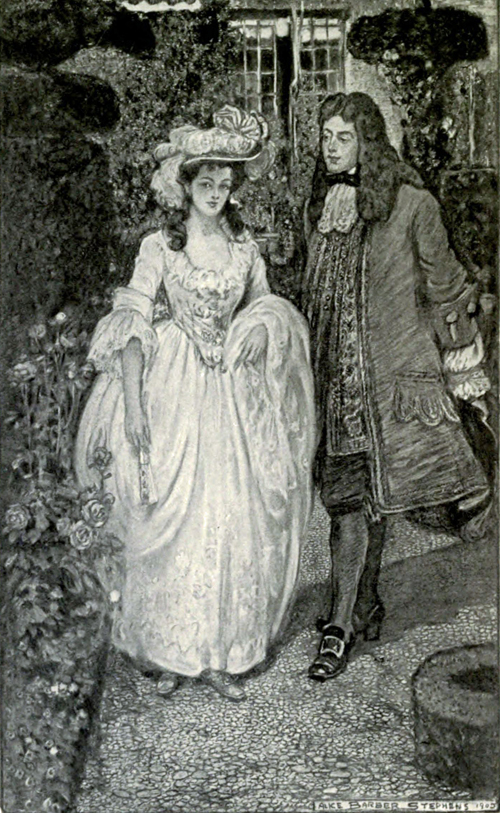
“I will wear the pink flowered brocade,
Alice,” she said.
Alice opened her eyes. “Oh, my lady,”
she remonstrated, “it is too lovely; I thought
you meant it only for the king’s levees.”
Her mistress smiled. “May not the king
come here—if he chooses?” she said mischievously.
“The brocade, Alice.”
Unconvinced, Alice brought the garment,
a beautiful and costly thing frosted with rare
lace, and as she helped Lady Betty put it on
she was more and more impressed with its
charms.
“Oh, my lady,” she murmured, “you do
look lovely in it—’tis too fine by half.”
Betty craned her neck backward, looking
over her shoulder into the glass; the folds of
the sheeny satin fell about her, the bodice
fitted like a glove, displaying every curve of
her well-rounded form, and it was low cut,
revealing a neck and shoulders like snow.
The beauty smiled.
“Bring me my string of pearls,” she said.
Alice brought them without a word and
helped her fasten them about her throat.
Betty looked into the mirror again and then
fell to fingering the bracelet on one round arm.
“Alice,” she said, half laughing, “he is here.”
The handmaid started, looking at her in
wonder.
“Who, my lady?—not Lord Clancarty?”
“The stranger we met in the woods at
Althorpe,” her mistress replied, “who would
have kissed me for a milkmaid.”
“Indeed, madam, I think he would as lief
kiss you as a queen,” Alice said blushing,
“the bold gallant! He is here—and who
is he?”
Lady Clancarty clasped and unclasped her
bracelet while the roses deepened in her cheeks.
“He is called Richard Trevor,” she said
softly; “a pretty name, Alice, Richard—rich-hearted,
lion-hearted—like our great
Plantagenet.”
Alice looked at her in bewilderment. Lady
Betty had as many moods as April: did she
mean to fall in love, at last, after all her loyalty
to that unknown and terrible exile? Alice
wondered. But saying nothing she stooped
down, instead, to smooth the shining folds of
the beautiful gown.
“Go fix the candles, Alice,” Lady Clancarty
said, with a soft little sigh, “and place a
table for cards—and the lute and guitar—place
them there also. Presently my guests
will be here.”
The handmaid obeyed, too perplexed by
this new mood of my lady’s to venture on the
smallest observation. She had arranged the
room with simple taste when Lady Betty
entered it a few moments later. It was not as
large a room as her mother’s, but it was furnished,
too, with an open fireplace where a
single log burned, for the nights were chilly.
Candles were set on the mantel and the table,
while through the open door came the buzz
of conversation, for Lady Sunderland was
deep in a game of basset with Lady Dacres
and his Grace of Bedford. Betty did not disturb
them but observed them from a distance,
noticing her mother’s rouged face and nodding
headdress, and Lady Dacres’s pinched and
eager features. The old dame was as keen
as any gamester. The mother and daughter
had so little in common that they seemed like
strangers, and the younger countess stood
looking at the log in deep thought when
Richard Trevor was announced. As she
courtesied, she gave him a quick, keen glance,
but made nothing of that bold handsome face
of his, though quick to note the distinction
of his appearance and bearing, those of a man
used to courts as well as camps. She saw it
all at a glance, as she had seen it at first, but
she chose to receive him with cool politeness.
“You play basset, of course, sir?” she said
demurely.
But he saw the pitfall.
“I’m too poor, madam,” he replied smiling.
“I can remember hearing an old courtier tell
how he lost his fortune to King Charles at
basset.”
“I trust the king gave it back to him,” she
said quickly.
“He made him a lottery cavalier,” rejoined
Mr. Trevor calmly.
Betty smiled scornfully. “And for such
a king men have died!” she said significantly.
“Ingratitude is only human at the worst,”
he replied, laughing softly, “and you know,
‘the king can do no wrong!’”
Lady Betty put her finger on her lip, with a
glance toward the card-players.
“You are right,” he said, regardless of her
caution, “’tis quite useless to die for any
king. There is only one thing worth dying
for, and that—is supremely worth living for,
too.”
“And it is not a king?” she commented
thoughtfully, “or a queen?”
“A queen, yes,” he admitted, “but the
queen of hearts. The only thing worth living
for,” he said, and his voice grew deep and
tender, “and dying for, my Lady Clancarty,
is—Love.”
She blushed and her eyes fell. He had the
most compelling glance she had ever encountered.
Those eyes of his would enthrall hers,
and she looked away.
“I never heard of any man dying of it,”
she remarked, with a bitter little laugh.
“That’s because a wise man would rather
live for it,” he said; “what exquisite torment
for a man to die and leave it behind him—in
the shape of a lovely widow.”
“Ah,” said Lady Betty, with a roguish
smile, “therein lies the sting!”
“Precisely,” admitted the Irishman; “if
there’s one thing that could bring me back to
this vale of tears it is my successor!”
“I have heard that in India the widows are
burnt on the funeral pyres,” she remarked, a
glow of amusement in her eyes; “you might
arrange it so for the future Mrs. Trevor.”
He shook his head disconsolate. “She’s
sure to be a woman of spirit,” he said; “I
couldn’t get her consent.”
Betty shrugged her shoulders. “After all
you have said of love you can’t find a woman
to die for it?”
“I would rather she lived for it,” he said,
with his daring smile, “and for me!”
“Men are purely selfish,” she retorted
with fine indifference, “it’s always ‘for
me’; hadn’t you better dream of living for
her?”
“I do!” he replied promptly; “faith, if I
didn’t dream of her I should immediately
expire—she’s the star of my life.”
“Oh!” said Lady Betty, in a strange voice,
“it has gone as far as that?—she is French,
I suppose?” she added with polite interest
and elevated brows.
“I never inquire into the nationality of
divinities,” he said coolly; “she’s an angel,
and that’s enough for her humble adorer.”
“You Papists are fond of saints,” remarked
my lady, tapping the floor with her foot.
“And sinners,” he admitted.
Betty turned her shoulder toward him.
“What color are her eyes?” she asked,
playing with her fan.
“I can’t look into them at this moment,”
he replied with audacity, “but I hope to tell
you later.”
She flashed a withering glance at him.
“They are brown,” he announced coolly.
Anger and amusement struggled for a
moment on Lady Betty’s face, and then she
laughed and dropped her fan.
He stooped to pick it up and something
green and shrivelled fell before her. Lady
Betty put her foot on it. He handed her
the fan with a bow. The voices in the other
room rose a little in a dispute.
“What are they saying?” she asked, swaying
her fan before her face.
He listened and smiled. “They are talking
of Lady Horne’s divorce,” he said; “what is
your ladyship’s view of it?”
She hesitated—and there is a proverb!
“You are a Papist,” she said, “do you believe
that a marriage—even a foolish one—is
indissoluble?”
“Certainly I do,” he replied piously; “perish
the thought of severing the tie!”
She reddened.
“So, ’tis ‘for better or for worse’!” she
said bitterly, “and usually for worse.”
“‘Until death us do part,’” he quoted
piously again.
Lady Betty started and turned from red to
white.
“’Tis a horrible idea,” she said, with a
shudder,—Lord Sunderland would have heard
her with amazement,—“no escape for a poor
woman who has been ensnared into a wretched
union!”
“A wretched union,” he repeated slowly, a
change coming over his face, “a wretched
union; are all marriages so wretched, my
lady?”
“A great many of them,” she retorted tartly,
and he could only see the curve of her white
shoulder and the back of her head.
He knelt on one knee and began to look
around on the floor with an anxious face.
After a moment she looked at him over her
shoulder.
“What is it?” she asked, blushing and biting
her lip.
“My shamrock,” he said, peeping under the
table with an air of perplexity.
“Do you always carry vegetables with you?”
she asked witheringly.
“I have—since last night,” he retorted,
still searching.
“And you dropped it here?” she asked
innocently.
He passed his sword under a chair and drew
it back slowly over the floor.
“Yes,” he replied, in a tone of deep anxiety,
“’twas here.”
She moved to the other side of the fireplace.
“Is that it?” she asked, coolly pointing.
He pounced upon the withered sprig and
kissed it, and rising stood looking at her.
“But,” he said, and a daring smile played
about his mouth; he took a step nearer, “but
some marriages are made—in heaven.”
“And others—” Lady Clancarty pointed
downward with a wicked smile.
“Ah,” he answered, “those are of earth,
earthy; but when love steps in, then, my
lady, then—”
“There comes my Lord Savile,” she said,
and smiled sweetly.
“Damn him!” he muttered beneath his
breath.
The door opened to admit Lord Savile and
Mr. Benham, and her greeting was cordiality
itself.
“Here’s a gentleman who has staked all his
fortune on his gray mare and lost it!” Mr.
Benham said, his hand on Savile’s shoulder,
“and he has done nothing but weep for
it.”
“Saint Thomas!” exclaimed that nobleman,
“I’m not the first to stake all on a woman and
lose.”
“Leave the saint out of it, my lord, when
you put the sinner in,” said Lady Betty.
“Oh, Saint Mary, there goes my last
crown!” came from the other room in the
shrill lament of Lady Dacres.
Both Savile and Trevor laughed.
“Change the sex of your saint and you have
an honorable example,” remarked Trevor, as
he picked up the countess’ guitar and began to
finger it lightly.
“I’m a ruined man,” said Savile recklessly,
“unless that fickle dame—Fortune—smiles
on me to-morrow.”
“You ought to call her a fickle mare, my
lord,” suggested Lady Betty artlessly; “when
Fortune runs upon four legs it must needs be
more fleet than upon two.”
Lord Savile looked into her eyes with a
smile.
“If love were kind, fortune might fly, my
lady,” he said daringly, but very low.
Lady Clancarty flushed hotly as she turned
to greet a newcomer, Sir Edward Mackie, one
of Devonshire’s gentlemen; a young fellow
with a round, boyish face, who had worn his
heart upon his sleeve until he lost it to Lady
Betty. But so ingenuous was he, so frankly
generous and devoted, that she gave him now
her sweetest smile.
Meanwhile, Mr. Trevor still tuned the
guitar, but he had heard Savile’s whisper to my
lady and had watched her face with keen and
searching eyes. Young Mackie brought news
for Lady Clancarty.
“Your brother has come,” he said eagerly,
“my Lord Spencer; I have just had the honor
to wait upon him. Very proud I am too, my
lady, for is he not one of the new lights of the
party, and one of the most learned young men
in Britain?”
She shrugged her white shoulders laughing.
“He is all that, Sir Edward,” she said, “and
more—much more,” she added with a droll
expression of despair.
“Much learning doth make him mad,” said
Mr. Trevor smiling. “I have known such
cases on the Continent.”
“’Tis instructive,” Betty admitted, smiling
at Sir Edward’s boyish face, “but ’tis
dry.”
“Give me a fine horse, a fine woman, and
fine music, and all the books in England might
burn,” said Benham.
“Oh!” said Lady Betty, and she lifted her
brows with a contemptuous glance.
“In sequence, according to your valuation
of them, sir,” remarked Mr. Trevor, with a
cool smile, “a poor compliment to the sex.
But music expresses something—something
only—of the beauty and charm of a fair
woman.”
“Sing to us, do!” interposed the countess,
“I despise comparisons.”
“To hear is to obey, my lady,” he replied,
beginning at once to play the sad wild air that
made her start and change color.
Would he dare to sing that here? she
thought, her heart beating hard; would he dare?
How little she knew him! In a moment his rich
tenor voice, a voice of peculiar charm and
timbre, filled the room and even startled the
card-players.
“’Tis you shall reign alone,
My dark Rosaleen!
My own Rosaleen!
’Tis you shall have the golden throne,
’Tis you shall reign, and reign alone,
My dark Rosaleen!”
He sang the wild ballad through to the end,
and as he ceased, Lady Betty turned to him
and smiled, applauding softly. But she said
nothing, although young Mackie was openly
delighted, and Lady Sunderland exclaimed that
it was a marvellous fine performance of a poor
song.
“’Tis an old ballad, madam,” Mr. Trevor
replied courteously, “and perhaps a poor one,
but dear to the Irish heart.”
“Sing an English one next time, sir, or a
Dutch—la—yes, your Grace of Bedford, we
grow to love everything Dutch.”
Lord Savile meanwhile, with his hands
thrust into his pockets and his face flushed,
lounged nearer to the singer.
“A very pretty performance,” he said, with
an insolent drawl, “worthy a tavern musician.
By Jove, sir, the tune is pestiferous here; an
Irishman and a cow-stealer are synonymous.”
Richard Trevor smiled, his gray eyes flashing
dangerously.
“And English noblemen are often cowards,
and liars to boot, sir,” he said in an undertone,
his hand still on the guitar.
“I am at your service,” said Savile, in a
passionate voice.
Trevor glanced warningly at Lady Clancarty.
“Elsewhere, my lord, with pleasure,” he
said, still smiling, “I might add with joy.”
Lady Sunderland came in now with her
guests; she had won at basset and was in high
good humor.
“A song,” she cried, “another song.”
Her eyes sought Trevor and he bowed
gravely.
“At another time, my lady,” he said; “now
I must wait on a friend, who has the first
claim upon me. My ladies all, good-night,”
and he bowed gracefully, a certain merry defiance
in his glance.
Lady Betty held out her hand involuntarily.
“I thank you for the ballad,” she said and
smiled.
He carried her hand to his lips and, it may
be, kissed it with more fervor than courtesy
required, for the rosy tide swept over her
white neck and her cheeks and brow.
As he went out, Lady Sunderland tapped
her fan upon her lips. “Don’t tell it,” she
said, with the coquetry of a girl of sixteen,
“don’t tell it, but la!—he has the finest
figure I ever saw, and the legs of an Apollo.”
“’Pon my soul, madam, that’s a compliment
that’s worth dying for,” Mr. Benham
said, with a peculiar smile at Savile.
Betty seeing it, went over and stood staring
into the embers on the hearth, though she
pretended to be talking to young Mackie.