Our slide down the Knoll proved very popular, and, with occasional repairs,
lasted all winter, making a welcome addition to our outdoor diversions during
the season when these were necessarily limited. Living in the open was one of
the salutary customs of the community, a custom faithfully followed even in
comparatively bad weather. Rain or shine, snow or blow, save only in real
storms, every one spent a good many of the twenty-four hours under the broad
skies. There was always some work to be done, cutting wood, digging
peat—the main reliance for fuel—mending stone walls, and attending
to the tree-nurseries. Then for fun, there was coasting, skating, sleigh-riding
and taking long tramps over the place or to some distant point of interest.
Exposure to the elements seemed to harm no one, and coughs, influenzas and
rheumatics were unknown.
Withal, however, indoor pleasures took the most prominent place, during the
winter months. After the reorganization of the Association as a Phalanx, Mr.
John Dwight was the Chief of the Festal Series, and as he was, first of all, a
musician, it followed that music formed the principal feature of our
entertainments. Vocal and instrumental music was thoroughly taught in the
school, and, as nearly all the members of the community were music lovers, and
many were singers and players, the place was melodious from morning until
night. There was always some new song or perhaps some very old one to be tried,
some local composition to be heard, or some preparation for future musical
events to enlist attention. Selections from the operas then known and now
forgotten, were given in the dining room; parts, with all the characters and
choruses, from “Zampa,” “Norma” and the “Caliph
of Bagdad” recur to my mind. Two public concerts were given to pay for a
new piano, and as the proceeds did not quite fill the bill, we all gave up
butter, selling the entire product of the dairy for three months to make up the
deficit. That was just like Brook Farm. The most ambitious performance in my
time was the rendition of the Oratorio of Saint Paul, which was given twice by
request, but this was in the summer when we had ample room and verge enough in
the pine-grove amphitheater.
We had another theater, a very little one, please, where light plays, tableaux,
readings and recitations and similar entertainments were offered by the
Dramatic Group during the winter. One member of this group, Mr. John Glover
Drew, was ambitious, and urged the presentation of something more serious and
edifying than merely amusing trifles, and, accordingly, an excursion was made
into the realm of the melodrama. Glover, as he was called, was intensely
Byronic, after the fashion of the times, and he prepared a succession of
thrilling scenes from Byron’s sensational poem, “The
Corsair,” for presentation by his fellow players. This melodramatic
production was staged with all the pasteboard pomp and secondhand circumstance
the little workshop theater could afford and was given with all the fire the
high-toned author could impart to his company. The result was disastrous.
Glover was a very genial, jolly young man, a fellow of infinite jest, and
always full of fun, but his play was distinctly dismal. The spirit of Brook
Farm being as distinctly joyous, the melancholy drama went against the grain,
and the performance fell dolefully flat. It was the one failure among the many
successful entertainments offered by the Festal series, and the members of the
cast including the author, were greatly depressed when the curtain went down
with the auditorium already nearly empty. Glover undoubtedly had his bad
quarter-of-an-hour that night, but the next morning he regained his usual
equipoise, and cast off his chagrin with a characteristic gibe, at his own
expense. A sympathetic friend ventured to ask if the fiasco was caused,
perhaps, by too much blood and thunder in the piece.
“Not blood and thunder, but thud and blunder,” was Glover’s
quick come-back.
We had two or three other plays in the shop, that season, in one of which my
father took a small part. This was “The Rent Day,” by Douglas
Jerrold, I think. The play opens with a tableau reproducing Wilkies’
picture of “The Rent Day,” and the most important thing my father
had to do was to sit at the head of the table in the character of Master
Crumbs, the steward. Peter Baldwin, who succeeded Mr. Hecker as
baker-general—being therefore given the title of General—usually
did the first old man business, but as he was suddenly called to Boston, my
father, who happened to be visiting us at the moment, was asked to fill the
role of Master Crumbs, which he consented to do, on short notice. There never
was such a thing as a theater in the Old Colonie and I can imagine the
disturbed feelings of the good Dutch burghers could they have known that their
respected fellow citizen, Charles Sears, Esq., of the pier, was actually
appearing on the stage as a play actor.
One play was given by the boys and girls, or rather by two boys and one girl,
Dolly Hosmer, Craze Barlow and myself. We did Box and Cox, a short farce,
produced to piece out a vaudeville program.
The first hour of our winter evenings at the Hive was, by common consent,
assigned to the younger generation, and story-telling was regularly made its
most attractive feature. Mr. Dana was one of our best story tellers, and his
narrations were instructive as well as interesting. In an extended series he
gave us accounts, partly imaginary, of the beginnings of things, of the
discovery and the first use of iron, the evolutions of the boat, of primitive
pottery, of glass, etc.
I was never in Mr. Dana’s classes, Greek and German being beyond my
reach, but I saw something of him in the tree-nursery and the orchard where I
worked under him, he being Chief of the Orchard Group. I cannot do better in
trying to give an idea of him at Brook Farm than to quote from Mr. John Thomas
Codman’s Memoirs, as follows:
“Charles Anderson Dana, when, from Harvard College he presented himself
at the farm, was a young man of education, culture and marked ability. He was
strong of purpose and lithe of frame and it was not long before Mr. Ripley
found it out and gave him a place at the front. He was about four and twenty
years of age, and he took to books, language and literature. Social,
good-natured and animated, he readily pleased all with whom he came in contact.
He was above the medium height, his complexion was light and his beard, which
he wore full but well trimmed, was vigorous and of auburn hue, and his thick
head of hair was well cut to moderate shortness. His features were quite
regular, his forehead high and full, and his head large. His face was pleasant
and animated and he had a genial smile and greeting for all. His voice was
clear and musical and his language remarkably correct. He loved to spend a
portion of his time in work on the farm and in the tree nursery, and you might
be sure of finding him there when not otherwise occupied. Enjoying fun and
social life, there was always a dignity remaining which gave him influence and
commanded respect.”
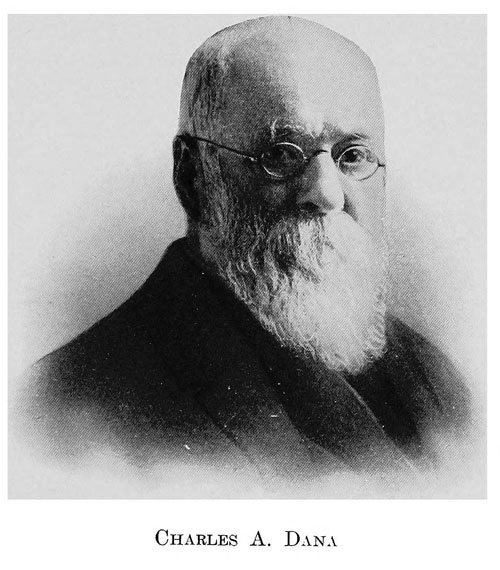
Later in life, as all the world knows, Mr. Dana attained high rank among the
great editors of this country, and that at a period when personality counted
for much more in the conduct of a newspaper than it does to-day. He served this
nation during the Rebellion as Assistant Secretary of War, and was one of the
counselors implicitly trusted by President Lincoln in that trying time.
Charles Hosmer was another first class raconteur, his musical delivery in
reciting apt bits of poetry and other quotations adding to the pleasure of
hearing his accounts rendered. He gave us modern versions of the Greek myths
and hero legends, of Cadmus and Thebes, of Jason and the Golden Fleece, of the
Trojan epic, of the Delphic Oracle, etc.
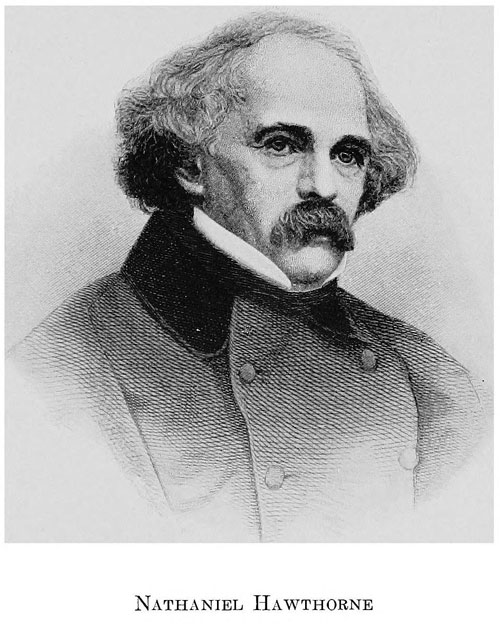
Several years after leaving Brook Farm I was presented with a copy of Nathaniel
Hawthorne’s “Wonder Book,” and was surprised and indignant to
find the author had actually taken our Brook Farm stories, told us by Charles
Hosmer and printed them, and that, too, without a word of credit. Of course
familiar renditions of the Greek legends have been common property with English
speaking people, for ages, but the ignorant youngster who heard them at Brook
Farm firmly believed the copyright belonged to Charles Hosmer.
The young folk and children were not only told stories but were encouraged to
exercise their own talents in the same direction. Manuel Portales gave an
interesting account of native life in Luzon; and Angus Cameron told us about
the French habitants and their narrow little strips of farms fronting on the
Canadian streams, every farmer wanting a littoral right, if only a few yards
wide.
Our evening talks were often monologues, anyone with a word to say having
attentive hearers, if interesting, otherwise—not. A young lady,
distinguished as a public speaker, came to us with what was doubtless an
eloquent discourse on Woman’s Rights, and was much put out, after orating
awhile, to note that her glowing periods were falling on dull ears. Our
women-folk had all the rights of our men-folk. They had an equal voice in our
public affairs, voted for our officers, filled responsible positions, and stood
on exactly the same footing as their brethren. If women were not so well off in
the outer-world, they had only to join our community or to form others like
ours.
A leading temperance advocate undertook to lecture us on the terrible evils of
rum drinking and the crying need of promoting the great cause of total
abstinence. We were all total abstainers. There was not a drop of rum on the
Farm. In the exhilarating life of our community there was no call for
stimulants. We had none and wanted none. Rum was a curse in civilized society
but that was because society was disorganized. Let reformers come and help us
reform society and this evil with many others would be remedied. So it was that
the popular lecturer after an hour’s earnest discourse came to the
conclusion that these Brook Farmers were very impolite indeed as they were all
talking together about plans for the new Phalanstery or some other equally
important subject.
Lectures were not on the list of our favorite pastimes. This indifference to
the attractions of the Lyceum was all the more noticeable as there were several
lecturers of repute among our own members. In the decade 1840-1850 a wave of
interest in what was then known as Social Reform swept over Europe and America,
and in the public discussions of the time the teachings of Brook Farm practical
reformers were in constant demand. Dr. Ripley, John Dwight, John Allen, Ephraim
Chapin, Charles A. Dana and others were called out on lecturing tours extending
all over the Northern states, and, as most of this service was gratuitous, the
cost to the community was a heavy tax on our limited resources. The socialistic
propaganda was an educational movement of unquestionable value, and, while the
immediate objects contemplated were never realized and are now lost to sight,
yet the agitation had a permanent influence in awakening intelligence, giving
an impetus to thought and enlarging the liberality of the public mind.
Oftentimes the long dining room was promptly cleared after supper for some
minor entertainment, a dance, in which everyone took part, being always in
order when nothing else demanded more immediate attention. Miss Russell was a
most efficient teacher of dancing and we all took lessons, from the gaunt and
grizzled old General to the little ones just able to learn their steps. It was
a marked characteristic of the Farmers that they all joined hands in whatever
was going on. With unfailing unanimity they all moved together, flocking like
birds in whatever direction happened to be taken at the moment, even those of
the most pronounced individuality preferring to go the way of the others rather
than go his own way alone. The lovers of solitude, self centered folk, egoists
and searchers into the mysteries of their own souls—Emerson, Hawthorne,
Hecker and Margaret Fuller were out of place in this united association where
each person wanted, first of all, to be in harmony with the common mind.
The dance was so much a matter of course that no preparations were needed save
the putting away of the tables and benches. The music was always ready, a dozen
or more players of the violin and piano relieving each other in rendering sets
of cotillons, waltzes and polkas, the latter dance being then just in fashion.
Next to the dance, some form of musical diversion was in favor. After the
reorganization Mr. Dwight was Chief of the Festal Series, and as he and his
fiancee, Mary Bullard, were, in a way, professionals there was always a musical
programe in reserve that could be brought forward at a moment’s notice.
We often had musicians of distinction visiting the place, and these gave us of
their best, knowing their virtuosity would be recognized and appreciated. Carlo
Bassini, an eminent violinist, played for us with great acceptance. His
daughter, Frances Ostinelli, who boarded at the Farm several weeks, sang most
delightfully. She had a glorious voice and, as Madame Biscacianti, subsequently
attained fame as a cantatrice.
The Hutchinson Family, once widely known at home and abroad, but now pretty
much forgotten, made a one-night-stand with us; and a company of Swiss Bell
Ringers also favored us in the same way.
The star artist who pleased us youngsters more than any other was Christopher
P. Cranch. He was not a professional, at that time, having just completed his
course of study for the ministry, but he was certainly a most successful
entertainer. There was nothing he could not do. He was a painter of more than
fair ability, a sweet singer, a poet, a mighty good story-teller—and we
knew a good story-teller when we heard one—and he could play on any
instrument from an organ to a jewsharp. Whatever he undertook he did well, and
his range of accomplishment was amazing. As Miss Russell remarked his
versatility amounted to universatility. We liked and admired Mr. Cranch very
much, and with all his superficial levity he possessed sterling qualities that
commanded our respect. As an old school song says:
“True winter joys are many
With many a dear delight
We frolic in the snowdrift,
And then the Winter night.”
The many winter joys were all that such joys could be, and young folk, not
afraid of the weather, made the most of them. The winter nights at the Hive
were fairly filled with dear delights, and the youngest of the young folk had
their due share of the evening pleasures until nine o’clock when they
went to bed, except on special occasions like the giving of a play, or a
concert with some celebrity from Boston as a star attraction. The winter had
its pleasures, but it was summer that was the real joyous season. There was a
dear delight then, in just living in the open air, as most of us did the
greater part of every day. Work in the fields with interesting companions, was
an exemplification of the socialistic doctrine of attractive industry. Men and
women, boys and girls, drawn together in groups by special likings for the work
to be done, made labor not only light but really pleasant.
Our entertainments, too, were in these happy days almost exclusively free from
the limitations of four walls and a ceiling. Rambles in the woods and fields,
excursions to Chestnut Hill or Cow Island, rowing parties on Charles River,
ball-games, athletic contests, swimming matches, everything the Greeks ever did
and more than they ever thought of. Even our meals conveniently simple as they
were, frequently took the form of impromptu picnics on the Knoll.
The center of summer festivities was a natural amphitheater in the beautiful
pine-woods. Here was a little hollow, clear of trees which served admirably
well as an auditorium, and a bank at one end, leveled down with very little
artifice, made a spacious stage, or, if required, a suitable rostrum. Here we
had plays worth seeing and concerts worth hearing. Here, too, Sunday services
were sometimes held, to the scandalizing of our Puritan neighbors, though when
Dr. Channing preached a saintly sermon and Mr. Dwight’s quartet rendered
the Gregorian chants, the service was an appropriate and impressive expression
of sincere religious sentiment.
Some of our Puritan neighbors called us heretics because we did not believe in
infant damnation or some equally profitable and comforting doctrine of the
orthodox faith, and, furthermore, we actually sang hymns in Latin. All that was
very bad to be sure, but then we kept the commandments, eleven of them, ten in
the old testament and one in the new, and we dealt fairly with all men. We went
to church too, either having Sunday services at home or attending Theodore
Parker’s church in Brookline. However, both Theodore Parker and Dr.
Ripley were Unitarians, so that did not help us very much in the opinion of our
critics.
It may almost be said that Brook Farm was as much an outgrowth of Unitarianism
as of Transcendentalism. Nearly all the first members were Unitarians and many
of the later comers were of the same faith. The congregation of the Unitarian
church at Brookline usually contained a considerable percentage of Brook
Farmers, and at times a Unitarian minister from the Farm officiated in that
sacred edifice. Rev. Dr. Ripley, Rev. John S. Dwight, Rev. George P. Bradford,
Rev. Warren Burton, Rev. John Allen and Rev. Ephraim Chapin were resident
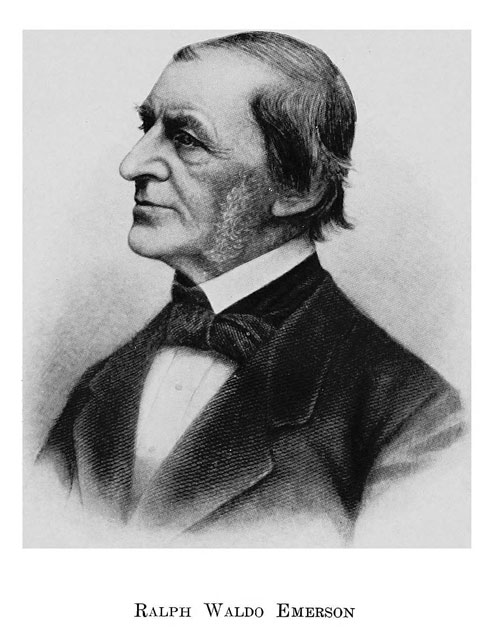
ministers, and Rev. Ralph Waldo Emerson, Rev. William H. Channing and Rev.
James Freeman Clarke were warmly interested in the Association. Charles K.
Newcomb and Christopher P. Cranch also immediate friends, were educated for the
Unitarian ministry. Dr. Codman in his “Recollections” speaks of
seeing five Unitarian clergymen dancing in the pine-grove at once.
One of the features of our holiday doings was the procession which
spontaneously came into order, after dinner, when there was anything to the
fore in the pine-woods. Then a parade took place like unto the wedding march of
the villagers in an old fashioned opera. There was always some display of
decoration on such occasions, usually floral, the girls, wearing garlands and
wreaths or sprays of vine and chaplets of leaves. Headed, perhaps by the boys
with fife and drum, or by the members of the cast if a play was to be given,
the whole community, young men and maidens, old men and children, went singing
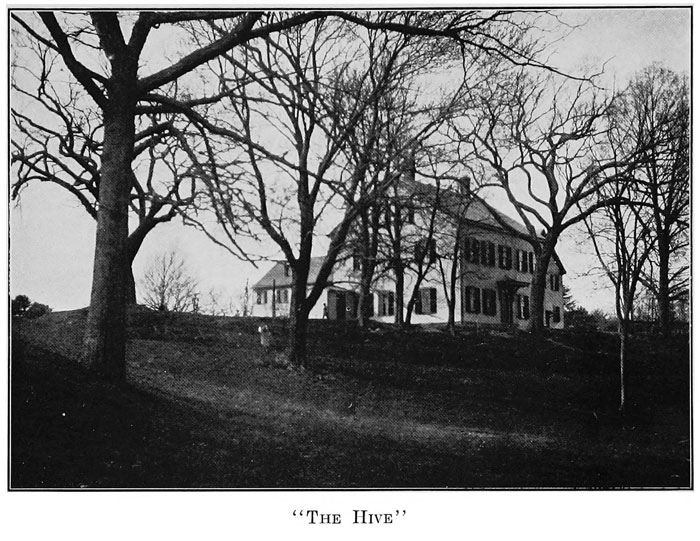
from one end of the place to the other, that is from the Hive near the entrance
to the Amphitheater near the far side of the grove.
When a high festival was to be celebrated, the procession took on the
picturesque dignity of a pageant. A real pageant we dearly loved, but the show
was too expensive to be offered more than once or twice annually. We had to
hire musicians as our own were too busy to serve. Then the costumes and banners
and hangings took a good bit of money, though artistic ingenuity helped out
amazingly. Where all the magnificence came from was a mystery, the splendors of
purple and gold, of rich draperies, fine furbelows, shining garments and
glittering adornments being really splendid. Bonico and I, as Heralds, for
example, once were superbly arrayed in white tabards emblazoned with red
dragons and gold embroidery, cut from paper and pasted on white muslin. There
was a deal of real, genuine, sumptuous finery brought out from family wardrobes
for the pageant, but the hint as to the Heralds indicated how an effect could
be produced at small cost.
The finest pageant we ever had was arranged by the Festal Series, after the
reorganization. It was historic in design, illustrating the Elizabethan period
in England. Dr. Ripley personated Shakespeare; Miss Ripley, Queen Elizabeth, in
a tissue paper ruff, which I helped to make; Mr. Dana, Sir Walter Raleigh; Mary
Bullard, the most beautiful of our young women, Mary Queen of Scots, and
Charles Hosmer, Sir Philip Sidney. The programme sent home to mother, at the
time, gives a list of the characters represented but it need not be further
quoted here.
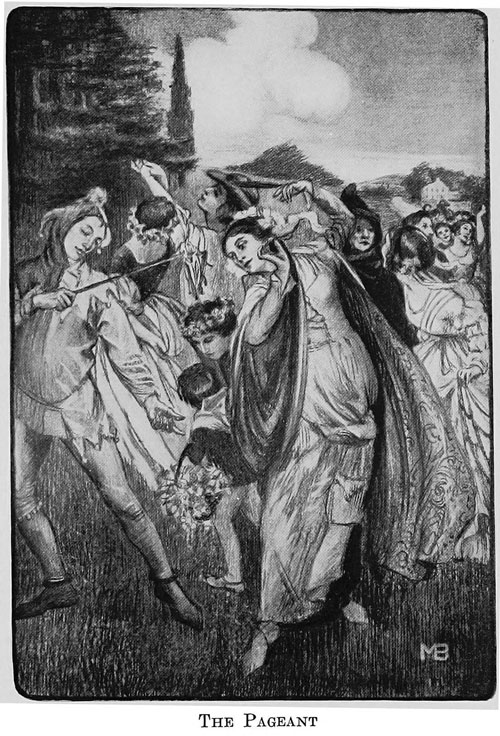
The parade was formed on the Knoll and the line of march was up the road to
Pilgrim Hall, over to the Cottage, around the Eyrie, and down the woodland way
to the theater. The whole course was lined with spectators, coming from Boston
and from all the neighboring towns. At the grove a series of historic tableaux
presented the principal personages in significant pictures, and these were
accompanied by Old English ballads and Shakespearian songs. The finale was a
stately minuet, beautifully danced by four couples. They had been drilled for
weeks by Miss Russell and as she was more than satisfied with the performance,
it was, no doubt, nearly perfect. The audience seemed to be of that mind as
they refused to disperse until the minuet had been repeated.
The following season we had a smaller pageant, the costumed personages being
the characters in Shakespeare’s comedy “A Midsummer Night’s
Dream.” This was the most important play ever given in the grove, and as
an out-door production, it antedated any similar performance in America. I have
seen “A Midsummer Night’s Dream” given in the open several
times since, but the magic of the first impression has never again been felt.
With all our love of recreation, there were no sedentary games in our
repertoire. Cards were unknown. The General was said to like a quiet game of
whist in his own room, but if he had a pack of cards, it was probably the only
one on the Farm. There was no prejudice against cards or chess or any other
game so far as I know, but no one cared for any form of amusement that
separated two or four from all the others. I imagine that even courting, the
divine solitude of two, must have been handicapped by this persistent penchant
for all being together.
The spell that drew these sympathetic associates like a magnet was in great
part that charm of the general conversation, the memory of which still lingers
wherever traditions of Brook Farm are cherished. The never failing succession
of entertainments especially in summer were enjoyed to the full by the happy
Farmers, but it was conversation, the mutual exchange of bright ideas that
afforded their chiefest enjoyment. Not literature, not the drama, not the
dance, but the fascination of human speech in its best employ attracted and
held their enthralled attention. It is impossible to report in writing even the
heads of this discourse, pervading as it did the atmosphere of Brook Farm as
currents of electricity pervade the air in breaths. In a
college-student’s ditty is a strain conveying some hint of such parley:
“We’ll sing to-night with hearts as light
And joys as gay and fleeting
As the bubbles that swim on the beaker’s brim
And break on the lips at meeting.”
The bubbles that break on the lips are past mending. The effervescence and
sparkle of wine can only be known as the glass is filled. The fine art of
conversation can be perfected only by choice spirits whose hearts are light,
whose sprightly wit, gay good humor and alert intelligence make their
utterances almost intoxicating.
Some attempts have been made to chronicle famous Brook Farm conversations but
the best record could hardly be more than a jest book. The alert sallies and
quick retorts, the pat allusions and apt quotations, the exaggerations, the
absurdities, the shrewd witticisms, the searching satires, the puns and
improvised nonsense verses might possibly have been registered on paper, but
the spirit of merriment, of good fellowship and mutual understanding that made
thoughts to live and words to sing—the spirit of Brook Farm—no
snap-shot camera could ever have caught.
These talks were not all for fun, either. Happy and blithesome, the Farmers
were, at heart, earnestly devoted to purposes held sacred. They were inspired
by high ideals. Noble conceptions and beautiful beliefs found expression in
fitting phrase. Rippling mirth flowed in an undercurrent of serious, sincere
faith and hope and love.
One more matter may be referred to in connection with our recreations, namely,
there was no hunting over our acres. The woods became a refuge for birds and
small game. No gun was ever heard there, and the shyest creatures learned they
were safe, among friends who loved them. Rabbits excepted. Under Mr.
Hosmer’s direction we boys trapped rabbits industriously, not for sport
but to prevent them overrunning the place. From the traps they were transferred
to the warren and thence either to the kitchen or to market.
Gray squirrels troubled us some by raiding the cornfield next the woods but
their depredations were not very extensive. Ex-president Jefferson had the same
trouble at Monticello, the squirrels destroying the outside rows of his
cornfield. His feeble-minded brother conceived the brilliant idea of
checkmating the little robbers by not planting any outside rows. The Farmers
improved on this plan by planting an extra outside row for the gray thieves to
feed on.