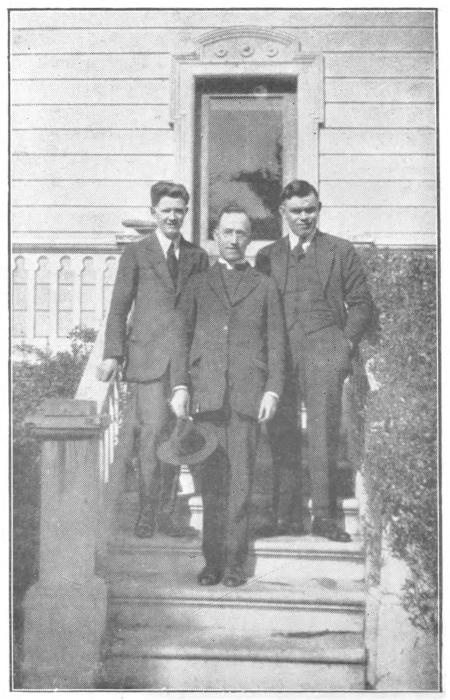
With an Introduction by
JOSEPH McGARRITY (Philadelphia)
DUBLIN
THE TALBOT PRESS LIMITED 85 TALBOT STREET
1924
First Published, August, 1924.
Second Edition, September, 1924.
Third Edition, October, 1924.
Printed in Ireland at The Talbot Press, Dublin.
TO
SEAN TREACY
J. J. HOGAN AND
SEUMAS ROBINSON
INTRODUCTION
My Fight for Irish Freedom, by Commandant
General Dan Breen, of the Third Tipperary
Brigade, is a story written in the plain unaffected
language of one of Ireland’s bravest and most
devoted sons. Many of Ireland’s great champions
passed from this world without leaving any authentic
record of the battles in which they took part, save
that which tradition handed on from generation to
generation.
As time passed, many of the most important
phases of the stories thus transmitted were forgotten,
and in some cases additions were made
which gave certain of the tales a mythical rather
than an historical character.
An authentic historical record by Cuchulainn
himself, if discovered to-day, would create a greater
world interest than has the discovery of the tomb
of the Pharaohs.
The author and principal actor in this dramatic
story was born and reared in Tipperary. He had
no military knowledge whatever until he joined the
Irish Volunteers. Gallant young Irishmen of the
type of Dan Breen had been, for generations, drifting
away from their native land. Their natural
military genius and daring found outlet in the armies
of France and Spain, where
“On far foreign fields, from Dunkirk to Belgrade
Lie the soldiers and chiefs of the Irish Brigade.”
Washington appreciated in full the valour of his
Irish emigrant soldiers, as he afterwards proved by
conceding to them equal status with the native-born
Americans. He placed unbounded confidence in the
patriotism and loyalty of his Irish generals and
soldiers who comprised almost one-half of the entire
Revolutionary Army.
With the outbreak of the World War in 1914 the
manhood of the world was being rolled up into two
opposing mighty war machines—preparing to annihilate
each other. The catch-cry “to fight in
defence of small nations” was broad-casted. Under
this, and other specious pretexts, hundreds of Irishmen
were induced to join up in England’s Imperial
armies, and they endured the horrors of France,
Flanders and the Dardanelles.
While these newly-recruited Irish regiments were
being drafted to the various war fronts in Europe,
great minds were busy at home planning Ireland’s
regeneration. For two years the Irish Volunteer
movement, directed by Pearse, Connolly, Casement,
Clarke and the other leaders, had been
spreading like a prairie fire through the country!
Alas! because they dared to put forth the claim of
their own small nation to be master in its own house
the firing squad and the scaffold extinguished the
brave lives of sixteen noble Irish leaders.
Dan Breen and his few comrades had definitely
reached the conclusion that while a foreign flag
floated over public buildings in Ireland, and while
a foreign army was garrisoned in the land, there
was one place—and one place only—for Irishmen
to fight—and that place was Ireland.
He did not wait for an army to grow up, or for
some great captain to come from foreign lands to
lead his countrymen to victory. As a matter of fact
at one time our soldier-author was, with a few
comrades, practically the only force in the field
engaged in active hostilities against the enemy.
Such a stirring drama has seldom if ever been
acted on the stage of Irish life. It is doubtful if any
other individual in Irish history received a like
number of near-fatal wounds, fighting in defence of
his country—and survived to tell the story of the
engagements in which the wounds were inflicted.
Fired with a burning love of country and a fixed
determination to achieve her independence, Dan
Breen with a handful of men declared war on
England on their own account, convinced that their
countrymen would follow their example. In this he
was not disappointed.
The engagements described follow each other in
such quick succession, and are of such a thrilling
character, that from the opening of the first chapter
to the close of the last, the reader is in momentary
expectation of the story ending with the dramatic
death of the author.
The author’s graphic descriptions of localities,
his giving of accurate distances between one location
and another, his recording of place-names and
family names gives the story a distinct and particular
historical value.
Great as was the physical suffering he endured,
having been literally riddled by bullets, it was as
nothing compared to the mental torture he must
have endured later on seeing his former comrades
turn their arms against each other after the signing
of the “Treaty” in 1921.
In giving to his countrymen this authentic
written record of the engagements in which he took
part, Dan Breen has rendered a service to Ireland
second only to the services rendered to her in the
engagements he describes.
Let us hope that some competent Celtic scholar
will translate the story into the language of Ireland’s
ancient champions whom she had gathered to her
bosom centuries before this gallant son of Tipperary
was ready to render to his beloved country the
splendid services he has so willingly given.
MY FIGHT FOR IRISH FREEDOM — CHAPTER I. A VOLUNTEER’S TRAINING
“A soldier’s life is the life for me,
A soldier’s death, so Ireland’s free.”
—Davis.
It was in 1914 that I first joined the Irish
Volunteers in the village of Donohill, some four
miles from Tipperary town. At that time I was
about twenty years of age. I soon became known
to the local police as the “Sinn Feiner,” then a
very rare sort of animal. At a later stage in my
career the same people, I believe, conferred upon
me the still higher title of “Prince of the
Assassins”! But I must beg the reader’s patience
while I briefly outline the position in Ireland the
year the Great War began.
The British Parliament had passed its Home
Rule Bill for Ireland. The Orange minority in the
North of Ireland declared it would resist any attempt
to enforce that Bill or to set up a Parliament in
Dublin. Supported financially and morally by the
wealthiest section of the English Tory Party, the
Orangemen openly organised, drilled and armed a
Volunteer Army to defy the British Parliament.
At this time Sinn Fein as a political policy was
little known outside of Dublin City. The spokesmen
of the great majority of the Irish people were
the Parliamentarians led by John Redmond. But
a few of the intellectual leaders, such as Pearse and
MacNeill, whose political influence then counted for
little, saw in the action of the Orange Volunteers an
excellent example to the rest of Ireland. They
called on the Nationalists to form a Volunteer Army.
The tradition of the Fenians still lived. Many who
cared little for the Home Rule Bill saw that we now
had got the opportunity for which they wished.
Ireland answered the call, and when the Great
War broke out there were in Ireland three armies,
though very different in equipment and in outlook.
One was the British Army of Occupation; the other
was the Orange Volunteer Army in the North; and
the third was the Irish Volunteer Force. Consequently,
when the Great War broke out Redmond
and his followers threw in their lot with the British,
and appealed for recruits for the British Army. The
Orange Volunteers, too, were in whole-hearted
sympathy with the British cause. The Irish
Volunteers for a time were split and disorganised;
thousands joined the British Army; but a small
number remained doggedly neutral and loyal to
Ireland alone. That small number was not deceived
by England’s cant of “fighting for small nations,”
and “for the sanctity of treaties.” They were
those who believed in an Independent Ireland; and
as their best speakers were supporters of the political
programme of Sinn Fein, they all gradually became
known as “Sinn Fein Volunteers.”
Our little band at Donohill was part of this small
minority. We did not give much heed to John
Redmond’s call to join the British Army. We
continued to drill and train openly, in the hope that
the time would come when we might get our chance
to strike a blow at the only enemy we recognised—England.
As the war developed we were closely watched
by the police. We were known as “pro-Germans.”
The majority of the people, carried away by the
campaign of lies and calumny in the Press, were in
favour of England as against Germany in the war.
The aristocracy and the wealthiest merchants and
farmers generally supported the movements that
were started to provide comforts for the British
soldiers in the trenches. But we of the Irish
Volunteers—henceforth in using that term I must
be understood to mean those who declined to take
England’s side in the war—stood aloof. It was
then that I came into disfavour with the police for
my refusal to support their funds for providing
comforts for soldiers. I was an employee of the
Great Southern and Western Railway, and I have
no doubt that they acquainted my superiors with
what they regarded as my disloyal tendencies.
It is necessary to explain the nature of this police
force. The Royal Irish Constabulary—a body that
has now passed into history—was not a police force
in the sense understood in other countries. It was
a semi-military force, trained to the use of arms,
and provided with carbines and rifles. As crime in
the ordinary sense was practically unknown in
Ireland, the main duty of these men was to spy
upon Volunteers and others working for an Independent
Ireland. They were known to report even
sermons delivered by Irish priests. In all there
were then about ten thousand of these police in the
country, scattered in small garrisons of two to ten
or twenty men, according to the size of the village
or town in which they were located. Sprung as they
were for the most part from Irish Nationalist
families, they were the brain of England’s garrison
in Ireland; for they knew the people and they got
the information without which England’s 40,000
troops—ignorant alike of the country, its people
and its history—would have been of little use.
I now resume my narrative. From the outbreak
of the Great War I still continued my daily work,
and took no more active part than any ordinary
private in the local company of the Irish Volunteers.
We met and drilled a few times a week, and tried to
pick up a rifle or a revolver now and again; for the
Volunteers generally had very few arms at that
time.
Thus we continued our routine through 1915,
and up to April, 1916. With the Insurrection of
1916 I do not propose to deal here, except to say
that owing to the confusion of orders and counter-orders
the men of Tipperary got no chance of having
their mettle tested. I must, however, remark upon
a coincidence in connection with our plans. Part
of the duty of the Volunteers of my district was to
have been the destroying of an important line of
railway communications. For that purpose we were
to have seized a quantity of gelignite, then stored
by the County Council for blasting purposes in a
neighbouring quarry. That quarry was Soloheadbeg,
where three years later my comrades and I
received our baptism of fire.
The Rising of 1916 changed our whole outlook.
The people who had scoffed and sneered at the
Sinn Feiners before now swung round to our side.
But our military organisation had collapsed.
Thousands of our men all over the country were
seized and deported to England. The British forces,
both police and military, seized what arms they
could lay hands upon. We could no longer drill and
parade in public; our organisation had been solemnly
proclaimed by the British to be an illegal body. For
a time we were in confusion and despair. It was
only for a very short time, however, for within a
few months those who had escaped the meshes of
the English military net after the Rising had
actually held two secret Conventions in Dublin to
re-organise the Volunteers.
After a few months we set to work again. My
neighbour and comrade, Sean Treacy, and I decided
to make a fresh start, and to put our Volunteer
company at work once more. This time, of course,
we could not do it openly; we had to work on a
secret basis. As it was now considered dangerous
to have anything to do with the Irish Volunteers,
our numbers were small; but we had better and
more determined men. For a while, indeed, there
were only three of us.
We met in a little wood after our work twice
every week. So we struggled on until May, 1917,
when our company had grown to be thirteen strong.
Not a man of us possessed any military knowledge,
and those in the neighbourhood who could instruct
us had either joined the British Army, or could
not be trusted to take the risks. Still we got on
very well at physical drill, scouting, signalling,
revolver practice, close-order drill, and such work.
We had to rely mainly on book-work; and by a
strange irony the books we found most handy were
the official texts supplied to the British troops, the
men we were preparing to meet.
Of course, we made mistakes now and again, but
our earnestness surmounted many difficulties.
Besides, we were often innocent spectators of British
drill manœuvres in the locality, and I can assure
you we kept our eyes and ears open for tips. If the
chance of picking up an odd revolver came our way,
we managed to find the money somehow, and added
to our little supply of munitions.
The best tribute to our success in the art of
military education was paid by the officials of the
British Government, who, at a later stage, described
our little band as the “crack shots of the I.R.A.”
In passing it is well to observe that we ourselves
learned that anything in the nature of official statements
issued from the British military headquarters
at Parkgate Street, Dublin, or from the civil
authorities at Dublin Castle, should always be
digested with a considerable quantity of salt.
It was in August, 1917, that our little handful
of men made its first public parade. By that time
the men who had been deported after the Easter
Week Insurrection had been released, and all over
the country were beginning to do what we had been
doing on our own account for nearly a year. In the
political arena two bye-elections which had occurred
in Roscommon and Longford, resulted in a triumph
for candidates standing for the Republican cause.
A few months later still Eamon de Valera, on his
release from Lewes Jail, had been invited to contest
a Parliamentary vacancy in East Clare. Standing
for a Republic, and for declining to attend England’s
Parliament, he was elected by a huge majority.
Shortly after his election he addressed an enormous
meeting in Tipperary town, and we, in the dark
green uniforms of the Irish Volunteers, acted as a
bodyguard of the man who was shortly afterwards
elected President of the Irish Republic. Tipperary
was then occupied by a garrison of over one thousand
British soldiers, and as our meeting was held
almost under the shadow of their barracks we did
not carry rifles. Instead we carried hurleys. Now,
we were thus, to the amazement of all peaceful
people, committing a treble act of defiance against
England. In the first place, it was a crime to march
in military formation; secondly, it was an even more
serious offence to wear uniform; and thirdly, it
was violating a special proclamation just issued
against the carrying of hurleys.
That proclamation came about in this way. A
meeting was being held in Beresford Place, Dublin,
one Sunday afternoon to protest against the treatment
of Irish prisoners detained by England. The
meeting was being addressed by Count Plunkett
and Cathal Brugha, when Inspector Mills, of the
Dublin Metropolitan Police, with some of his men
attempted to prevent the holding of this peaceful
meeting of citizens. The meeting included many
young men going to or returning from a game of
hurling—Ireland’s national pastime. In the melee,
which followed the attempt to break up the meeting
and to arrest the speakers, the Inspector was struck
with a hurley, and received injuries from which he
died. Thereupon, Sir Bryan Mahon, then Commander-in-Chief
of the British troops in Ireland,
issued a proclamation making it illegal to carry
hurleys in public. To realise the absurdity of this
proclamation one has only to imagine a civilised
Government declaring it illegal to carry a walking-stick.
The result was what anybody knowing
Ireland might expect—hurleys for a time were
carried in places where their use was scarcely
known, and the British Government became a
laughing-stock.
This first military display of ours in Tipperary
was not a bigger shock to the enemy than it was
to the local Sinn Feiners; for you must understand
that by this time public opinion had swung round
almost completely in favour of Sinn Fein, and we
were burdened with thousands of recruits, who were
not in their hearts in favour of any stronger weapons
than resolutions. On this occasion many of the
local Sinn Feiners were shocked by our audacity in
taking the step we did without a solemn discussion,
a formal proposition to the meeting, and a long-winded
resolution. Such poor souls often hampered
us later on, but we didn’t mind. The purely political
wing of Sinn Fein criticised us severely, I believe,
but we kept silent, just listened to all, and judged
our men.
CHAPTER II. PREPARING FOR THE FRAY.
The local police duly informed their headquarters
of this open defiance of British law in Tipperary.
They were ordered to arrest the culprits. But, as
we had no desire to enjoy the hospitality of His
Britannic Majesty’s jails, Sean Treacy and I went
“on the run,” that is to say, in order to evade our
pursuers we had to leave our homes, and keep
moving from the house of one trusty friend to another.
But on the Friday following our public
parade, Sean was arrested by the “Peelers.”
Members of the R.I.C. were better known in Ireland
for generations as “Peelers,” a term of contempt
coined from the name of Sir Robert Peel, who, in
the early part of the nineteenth century first
organised the force.
Sean was taken to Cork Jail where he first met
the brothers Brennan, of Meelick, County Clare,
who were also unwilling guests of the British jailers.
The three brothers Brennan—Austin, Paddy and
Michael—afterwards became famous officers in the
Southern Command of the Irish Republican Army,
and at present hold high ranks in the Free State
Army. In passing I should say that in throwing
men into prison at that time England was really
giving them an excellent opportunity of exchanging
views, discussing plans for the future and generally
turning the prison into a “University for Rebels.”
Many indeed learned more about drill, and the
methods of making explosives, while they were in
prison than they had ever before known.
Sean was eventually tried by court-martial, and
sentenced to two years imprisonment, but sixteen
months of the term were remitted. These trials
were, of course, a mere formality, for our men
never put up any legal defence, but declined to
recognise the right of any British tribunal to try
them. Very often in the early stages our men turned
the proceedings into a farce by reading a newspaper
or singing while the evidence was being taken.
With a number of his comrades Sean went on
hunger-strike as a protest against their treatment.
It was the first time that Irish political prisoners
used this weapon, which later became so common.
They were removed to Mountjoy Prison, Dublin,
where they continued their hunger-strike until one
of their number, Commandant Tom Ashe, who had
taken a leading part in one of the most successful
exploits in the 1916 Insurrection—died as a result
of the attempts made by the prison doctor and
officials to feed him forcibly. The tragedy raised
the whole Irish nation to fury, and the British
Government realised for the first time that our men
were in earnest, and ready to die for their principles.
An agreement was entered into whereby they were
to be treated as prisoners of war, or as political
prisoners, and forcible feeding was never again tried.
Meantime I had been busy during my comrade’s
imprisonment. I organised sections of Volunteers
in all the surrounding parishes, and as similar efforts
were being made all over the country our military
organisation soon became even more perfect than it
had been in 1916. The British Government, true
to its traditions, broke the agreement made with the
prisoners, and Sean and his fellow Volunteers, who
had now been removed to Dundalk Jail, went on
hunger-strike again, and secured their release.
All this time the organisation and drilling of the
Volunteers had been done secretly. Now and again
the British surprised bodies of men here and there,
and captured them. But when Sean came home
he brought back the word that we were to come out
in the open to drill, even if the British Government
attempted to arrest every man of us. It was felt
that if England carried out the policy of wholesale
arrests she would soon have tens of thousands of
Irishmen in jail, and would again make herself a
laughing-stock to the nations.
This was in the early part of 1918. By this time
we had been getting a fair supply of arms and ammunition
by channels which may not yet be disclosed.
It must be remembered that for several years before
this no firearms were allowed into the country, no
shops could sell any they had on hands, and even
sporting cartridges could only be bought by special
permission of the British military authorities. The
enemy scented another Insurrection.
They became more alert, and once more Sean
Treacy was arrested. From the moment of his
capture he again went on hunger-strike, and was
joined by Michael Brennan, of Meelick, and by
Seumas O’Neill, a teacher in Rockwell College,
both of whom had been arrested three days after
Sean.
During Sean’s first term of imprisonment I had
been elected company captain; and now during his
second term I was further promoted to be
Commandant of the Battalion, and later still I
became Brigade Commandant. At that period each
company elected its own captain, each man having
a vote, and each man being eligible. The various
company officers in a battalion area then met, and
in their turn elected the officers for the battalion,
and so with the brigade. Truly, it was a democratic
army.
This was the time when things were going badly
with England in the war. In March, 1918, began
the great German offensive, when the British lines
were broken through. In their despair the English
cried, “Conscript the Irish.” Within a few weeks
the necessary Act was passed in the British
Parliament, and all preparations made to force
Irishmen to fight England’s battle. Sir John
French, later Lord French, himself an Irishman by
birth, was British Viceroy in Dublin.
The Irish people were roused to action. Never
before was there such a fierce determination to
resist the British plans. Bishops, priests and
political leaders of all shades of opinion met together
to face the threat. In the moment of common
danger all turned instinctively to the Irish Volunteers.
If resistance was to come it would only come
from their ranks; for England and Ireland well
knew that the Irish Volunteers would be wiped out
to the last man before they would allow a single
Irishman to be forced into the British Army.
Our trouble was the shortage of arms; of men
we now had too many. At that time I was Brigade
Commandant, and we decided to make raids for
arms. We knew there were plenty of shot-guns,
revolvers, bayonets, swords, and an occasional rifle
here and there in private houses, especially in the
houses of the element loyal to England.
We had very little trouble in collecting the arms.
Our men in every district had compiled exact information
regarding every house in which there was
a weapon. We generally went at night and asked
for the arms. Those who would have liked to refuse
knew they dare not. Many others gave them
willingly, and some even sent us word to call for
them. In no case had we to fire a shot during the
few weeks we were on this job. We had to do the
thing as quickly as possible, for as soon as the
British got wind of it they immediately issued an
order that all arms should be handed to them for
safe keeping. We generally got there first, and
more than once our visit to a house was only a few
minutes before that of the peelers.
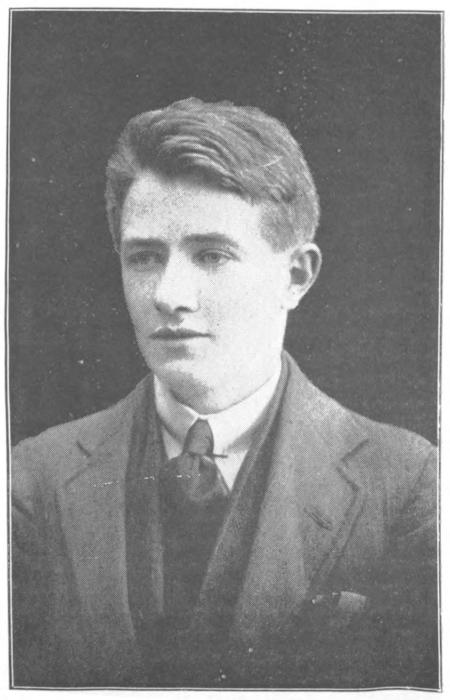
SEAN TREACY.
CHAPTER III. OUR FIRST MUNITION FACTORY.
During the summer of 1918 the threat of
Conscription hung over the land, and young and old
flocked to the ranks of the Volunteers. It is safe to
estimate that at that time nine-tenths of all able-bodied
Irishmen between the ages of sixteen and
fifty were Volunteers of a kind; while the women
had their association—Cumann na mBan—and the
boys had theirs, the Fianna or Boy Scouts, all
preparing to be our auxiliaries. As most of our
officers were in jail on one charge or another, we
who were out were kept working day and night.
All the time I felt enthusiastic, for I saw in Conscription
a glorious chance of uniting our own
people. Though poorly armed we were determined
to fight; and I believed that if the fight came the
survivors would be united in their purpose, and to
me a united Ireland of two million people would be
preferable to an Ireland of four and a half million
divided into three or four different factions.
Meantime, though the Conscription Act had
become law, England, realising our determination,
postponed its enforcement for a few months, in
order to give us an opportunity of enlisting voluntarily.
We went on with our preparations, and
became all the more daring. Sometimes it was both
bewildering and amusing to the public to witness
our manœuvres.
More than once, for example, in sham battles we
attacked or defended Tipperary town, and actually
proclaimed certain roads or streets as “military
areas,” where British soldiers or police, as well as
civilians were forbidden to enter during the “operations.”
These operations were carried out by a few
hundred Volunteers, while the town was occupied
by a garrison of over a thousand British soldiers. On
such occasions we had no display of arms, though
a few of our number might for special reasons have
their revolvers in their pockets.
It soon became evident that England was wiser
than to try conscripting us. The threat gradually
faded away, and so too did our great army! But
the small number that remained was of more use.
They meant to fight for Independence. The others
had been only thinking of saving themselves from
the trenches of France, and believed with the old
political leaders that Ireland’s freedom was not
worth the shedding of a drop of blood. As my
subsequent actions showed, I held a different view.
At this time, as I have already explained, Sean
Treacy was enjoying the luxury of a hunger-strike
in Dundalk Jail. He had been thirteen days without
food, and we feared they intended to let him
die. We who were outside felt that we should do
something without delay. I got a brain wave. Why
not capture a Peeler, bring him off to a safe hiding-place,
and put him on forcible hunger-strike, and
keep him as a hostage for Sean’s safety? I discussed
the plan with some of the others: they were
favourably disposed; and as we knew that a few
policemen regularly patrolled the railway line near
the Limerick Junction every evening, we decided
they should be our hostages. All preparations
were made, and our hiding-place up in the mountainous
district on the Limerick-Tipperary border
was selected. Forty men were mobilised to carry
out the job; but for once the policemen failed to
patrol the line. Later I found out that the scheme
had been turned down by the Irish Republican
Brotherhood, a secret organisation which included
the most reliable of the Volunteers, and which
practically controlled the Volunteer Army. After
that I severed my connection with the I.R.B.
Sean Treacy was released in July, 1918. When
he came home he was full of plans for organising.
I had had an overdose of it in the months that he
was away, and from my experience I was more in
favour of starting a fight at once than of trifling
further with organising. Sean would have his way,
and we agreed to differ. I at once started a
“munition factory” in partnership with my friend
Patrick Keogh. Many a lively dispute we had on
various points, some important, some otherwise,
but as soon as Sean appeared he always poured oil
on the troubled waters.
I must give you a description of our factory, lest
the reader be picturing an Irish replica of the Krupp
works at Essen. The building itself was a small
rural cottage owned by Tom O’Dwyer, of the Boghole.
Three rooms were let to Denis O’Dwyer, of
Dervice. Both he and the owner were well-known
characters in Tipperary. Our equipment was of the
crudest kind, for we had no machinery. But it was
a simple matter to make ordinary black gunpowder.
We also turned out crude hand grenades, which,
by the way, had to be ignited by a match before
being thrown, so you can imagine the risks if these
had to be brought into action on a windy or a rainy
night. At this time, too, we collected every available
cartridge, including sporting cartridges for shot
guns, and these were refilled with buckshot. Keogh
and I always quarrelled as to whether it was better
to put four or eight grains of lead to the cartridge.
The reader can easily imagine the effect on a poor
devil who might get the full charge of one of these
refilled sporting cartridges.
Though most of our raids for arms had been
carried out by this time, we still found occasion for
an expedition of the kind from time to time. My
first encounter with the enemy was one night while
I was returning from a raid.
A small number of us, including Sean Treacy,
were cycling home from Tipperary, when my
bicycle went flat, and I had to dismount to pump it
up. I ordered the others to go ahead, saying I
would overtake them. On their way they passed
the police barrack on the outskirts of the town. It
would seem that the police heard them passing the
barrack, and came out to have a look round; or
else they were actually on the road when the men
passed, and, with their usual courage, were afraid
to confront the six Volunteers. Anyhow, I neither
heard nor saw anybody when I had pumped up my
bicycle, until I was suddenly pulled off by a burly
Peeler. In my left hand I carried a small iron bar
for forcing locks, so I tried its effect on his head.
The bar got the better of the argument. I then
drew my revolver, and covered the group of
peelers. “Surrender, or I shoot,” shouted their
officer. “Put up your hands, or I’ll shoot the lot
of you,” I replied. They complied with my order.
I then stepped backwards, rolling my bicycle,
and still keeping my gun levelled at the peelers,
until I reached a laneway. I dashed up the lane,
mounted my bicycle, and escaped from the town
not a moment too soon. The alarm was quickly
raised, and the whole town was surrounded, and
every street and lane searched. But I was safe in
my factory with my comrades.
CHAPTER IV. OUR FACTORY BLOWN UP.
My most exciting experience was to see our
munition factory blown into the sky. I had a narrow
escape, for I was within fifty yards of the door; but
my partner, Paddy Keogh, had an even more
wonderful escape, for he was actually on the
premises when the explosion occurred.
We never knew what brought about the havoc.
I had gone out to a well to fetch a can of water,
for necessity compelled us to do all our own cooking
and cleaning. As I was returning to the cottage, I
saw the roof leaving it, and simultaneously came the
roar of the bursting grenades. In a moment the
house was in flames. It was a desperate situation.
My one thought was to save my comrade, if indeed
he was not already beyond human aid.
I dropped the can of water and rushed to the
house. I dashed up the stairs and found Paddy
lying in the room either dead or unconscious. I
raised him in my arms and carried him with a heavy
heart through the rain of shrapnel down the stairs
and out of the house, and away to the banks of the
Multeen, a little stream not far away from the house.
My heart was wrung with anguish as I laid him by
the stream and rushed for my can to throw some
of the fresh clean water over his pale countenance.
Before I had time to try the effects of a second
supply, Paddy was on his feet and rushing for me—very
much alive!
“You damn fool, do you want to drown me?”
he shouted. And then he added a lot more that I
prefer not to repeat.
The destruction of our house was a heavy blow,
and for a while we mourned the loss of our little
factory and its contents.
My little capital was gone now, and the
O’Dwyers had to be compensated for the loss of
their home. I thought out my plans, and gathered
together all the tradesmen in our little army, and
put them to work. In a few days the cottage was
repaired, and looked none the worse.
By the way, the Black and Tans, at a later stage
wreaked vengeance on it more effectively than the
explosion of the grenades.
O’Dwyer’s house was now out of bounds for my
work, but in a very short time I got another house
from a good typical Tipperary man, Jer. O’Connell.
Here I was more successful, because I took greater
precautions with my work. I guarded against
another explosion; but other circumstances compelled
us to evacuate it within a few months.
During our stay in this house our condition was
far from happy. Of bodily comforts we had none.
We had neither bed nor bed coverings, and worse
still, we had no money wherewith to buy them. We
got a loan of a couple of blankets from neighbours,
and we commandeered some straw from the nearest
farmer. First we spread out the straw on the ground
and covered it over with one blanket. We then
spread over us a lot of old newspapers (which we
carefully collected every day), and over these we
placed our second blanket. The paper was excellent
for keeping us warm, and by not turning out of one
position we usually got about three hours’ sleep.
As soon as we moved, the paper tore and the cold
quickly worked its way through. Still greater discomfort
than our bed was caused by the presence
of mice! The little beggars were very numerous
and very daring. Many a night we were wakened
by their nibbling at our hair. Whenever I
protested, in action as well as in words, Sean Treacy
would plead—“Ah, the poor little creatures! They
might as well be happy when we can’t. Don’t be
vexed with them, Dan, even if they take a little of
your black hair.” I argued that it was enough to
have the peelers after us, and that if the mice had
any decency they ought to leave us alone.
For some time things went on smoothly, and our
work progressed pleasantly. Then my partner,
Keogh, left me, and I was joined by Sean Hogan—whose
life for the next five years was to be very
closely linked up with mine.
The two Seans and myself seemed to have but
one mind—I have never had any difference with
Hogan up to the present day, and never had an
angry word with my dear old comrade—Sean
Treacy—up to the day of his death.
It was during our sojourn in O’Connell’s house
that we were joined by Seumas Robinson, later
elected Deputy for East Tipperary and Waterford.
Robinson, who had lived a good part of his life in
Glasgow, at once became a fast friend. The four
of us—Treacy, Hogan, Robinson and I—seemed
perfectly balanced in temperament, age, outlook
and hopes. Many an ambitious plan we made, and
many a dream we dreamed of the Free Ireland for
which alone we now lived and worked.
After a few months Jer. O’Connell gave us notice
to quit. We had no tenant’s rights, no protecting
Act of Parliament, and no alternative but to depart.
Being “on the run” we dare not go looking for
lodgings in the ordinary way, even if we had money
to pay. The peelers knew every hole and corner
in their district, and were ever on the prowl for
Irishmen known to have little love for English rule.
But good luck came to our rescue.
Some cousins of Sean Hogan’s had a little dairy
or outhouse, which they generally placed at our
disposal. Here we enjoyed the luxury of bed,
clothing and other little comforts, but our meals
were few and far between. I myself lived for two
weeks in the “Dairy” on rice boiled in water,
without either sugar or milk. This abstemious life
was not new to me. For months while I was
organising I used to fast from breakfast to breakfast,
and many a night I walked twenty miles for a
bed, or even a shake-down.
The “Dairy” did not escape the attention of
the enemy, who subsequently gave it the name of
“The Tin House.”
We were terribly handicapped for want of money;
not indeed for personal comforts, which seldom
troubled us, but to get round.
On one occasion Sean Treacy and I cycled to
Dublin to get some arms. We had no money for
train fares, and it was essential that we should reach
Dublin by 6 o’clock on a particular Monday evening.
There was a Brigade Council meeting fixed for
Sunday night—at which we were bound to attend.
That meant that we could not leave Tipperary till
about 8 o’clock on Monday morning. We covered
the 110 miles, and we reached Dublin in good time.
Of course we were very hungry, but once we
reached the house of our good friend Phil Shanahan—himself
a Tipperary man, and later a Republican
Deputy for Dublin—all our troubles disappeared.
Then and after we never wanted for anything while
Phil was about.
We had to remain in Dublin until the following
Saturday before we could conclude our business.
Here another difficulty arose. We were due back
in Tipperary at an officers’ meeting the same
Saturday at 6 p.m. We left Phil Shanahan’s house
at 8.30 in the morning. We carried six revolvers,
five hundred rounds of .303 (rifle) ammunition, and
half a dozen grenades, and we were the only two
who were punctual at the meeting.
CHAPTER V. THE POLITICAL LANDSLIDE.
In December, 1918, came the event which gave
the Irish Volunteers the moral sanction for their
subsequent activities—the General Election.
It is important to bear in mind the position at
that time. No General Election had been held in
Ireland for seven years. In that interval the vast
majority of the people had completely changed their
views. They no longer had any faith in England,
or in the efficacy of sending their hundred representatives
to the British Parliament, where they were
in a helpless minority, and where their voices were
scarcely heard. England’s treachery on the Home
Rule question and her threat of Conscription had
cost her dearly. But the greatest force of all in the
awakening was the Rising of 1916. That episode
had put new life and heart into the people. The
bye-elections, to which I have already referred had
given the people their only opportunity, so far, to
indicate the growing desire for liberty, complete and
untrammelled.
On November 11th, 1918, the Great War
virtually ended with the Armistice. A week later
it was announced that the long delayed General
Election was fixed for the 14th December. Sinn
Fein got its opportunity, for that election was to be
the first ever held under the British Constitution on
the basis of manhood suffrage, and we knew well
that the young men of Ireland would vote overwhelmingly
for our cause.
But we had to educate and organise. The name
and policy of Sinn Fein were still grossly misunderstood.
The public did not clearly realise the
difference between the political body, Sinn Fein,
and the military organisation—the Irish Volunteers.
The Insurrection of 1916 was commonly called the
“Sinn Fein Rising,” and our Volunteers were
spoken of as the “Sinn Fein Volunteers.” Even
the Republican Tricolour—the Green, White and
Orange of the Young Ireland Party of 1848, and
of the Fenians of the next generation—was called
the “Sinn Fein Flag.” But misnomers did not
trouble us very much, for the Sinn Fein body had
been adjusting its programme to suit Republican
ideals. And now when Sinn Fein clubs were springing
up in every parish, it was quite usual to find
that the President or the Secretary of the club was
also captain of the local Volunteer corps. The
majority of the younger men in the Sinn Fein
Political Organisation were also Volunteers; and the
Volunteers were also members of the Sinn Fein
club.
During the period of the Election the people went
Sinn Fein mad. We had most of the clergy with us,
and the earnestness and enthusiasm of our speakers
and organisers swept the country. The political
wing of the Republican cause spread like wild-fire;
but our army was gradually dwindling. While we
lamented this decay on the military side, we saw
the necessity of making an enormous success of the
elections, hoping to restore our army to its proper
strength when the election was over. So we threw
ourselves heart and soul into the contest, and
worked night and day for the Republican candidates.
We didn’t leave a dead wall or a cross-roads
in the country that we did not decorate with
appeals to “Rally to Sinn Fein,” “Vote for the
Republic,” “Stand by the men of 1916.” Such
were the rallying calls addressed to the people
during those few critical weeks. No secret was
made of our policy. Every Republican was pledged
never to take his seat in the British Parliament, but
to work at home in Ireland for the establishment and
recognition of the Republic.
We knocked plenty of fun out of the election.
Alas! many of those who worked hardest in those
days have passed under the sod since. Our workers
in Tipperary included Dinny Lacy, killed during the
Civil War in his native county; Sean Duffy and
Paddy Maloney (whose father was our successful
candidate), later killed in an encounter with the
British not far from Soloheadbeg; Sean Allen, who
was executed by the British in Cork Jail; “Sparkie”
Breen, also killed in the Civil War. But these
memories only serve to remind one of the fine fellows
we have lost. Anyhow we won every seat in
Munster, except Waterford City. Leinster and
Connaught did equally well, and in Ulster we won
several seats. The net result was that of the one
hundred and five constituencies, seventy-three had
repudiated British rule and plumped for an Irish
Republic.
A month later, on January 21st, 1919, these
elected representatives of the vast majority of the
Irish people met in public session in Dublin;
formally proclaimed the Republic, and established
a Government. The same day, and almost at the
same hour, our little handful of Volunteers were
striking the first blow since the formal repudiation
of British authority by the people. But let me
explain how it came about.
SCENE OF SOLOHEADBEG AMBUSH.
After the election we had more time to review
our position. The results had cleared the air; the
people had by an overwhelming verdict given us
moral sanction to drive the British forces out of
Ireland. But the election work had had a serious
effect on our army. Many had ceased to be soldiers
and had become politicians. There was danger of
disintegration, a danger which had been growing
since the threat of Conscription disappeared a few
months earlier. I was convinced that some sort of
action was absolutely necessary. Over and over
again I discussed the matter with Sean Treacy. I
knew that if we once showed them the way, there
were plenty of fine fellows on whom we could rely.
Sooner than we expected the opportunity came.
Let me introduce my readers to the first authentic
account of the affair known as “The Soloheadbeg
Outbreak,” or, as the hostile Press persistently
titled it, “The Soloheadbeg Murders”; for those
who read the newspaper versions of our struggle
with England must bear in mind that every newspaper
in Ireland was hostile to our policy, and so
remained to the end, though a few of them lost
their bitterness towards us as the campaign
progressed. It must also be remembered that even
when the “Great War” ended the British Press
Censorship was continued in Ireland for over a
year.
CHAPTER VI. SOLOHEADBEG.
At the beginning of January, 1919, we received
information to the effect that a quantity of explosives
was to be conveyed to Soloheadbeg Quarry
for blasting purposes. The consignment, we knew,
would be guarded by armed policemen, as was
always the rule at that time.
I spoke to Sean about it. “Here is our chance,”
I said, “let us start the war soon, or the army will
lose heart.” I knew we had but a very small
number of men with determination enough for such
a job, but I knew too that the number would
increase with time; and, in any case, it is quality,
not quantity, that counts in guerilla warfare.
We discussed the proposal for a long time.
Finally we decided to disarm the guard and seize
the explosives, for, as Sean said, there was nothing
we needed more at that time than guns and explosives.
We made a careful survey of the locality.
We selected the spot for our first ambush. We
knew every inch of the ground, we had been
born and reared in the vicinity, and Sean’s own
farmhouse was not a stone’s throw from the
quarry.
Soloheadbeg is a small townland about two and
a half miles from Tipperary town, and less than a
mile from the Limerick Junction. The quarry
stands on an eminence on a little by-road. Farmhouses
and cottages are dotted here and there in
the neighbourhood, though there is no village
nearer than Donohill, a mile and a half distant. It
was in this plain, overshadowed by the gigantic
figure of Galteemore away to the south, that Brian
Boru and his brother Mahon fought their first great
battle with the Danes in 968, when Brian with his
gallant army of Tipperary men and Clare men
routed the invaders, and never ceased from the
pursuit till he reached Limerick twenty miles away
and burned the town over their heads. The right
wing of his army swept across the hills where the
quarry now stands, as the defeated Danes fled to
their stronghold.
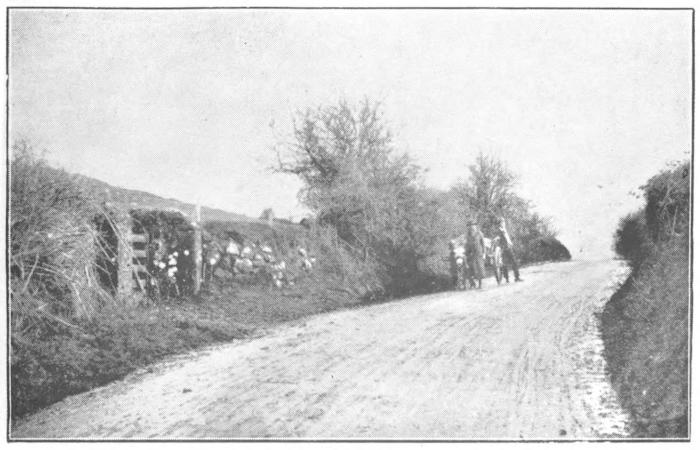
The quarry itself stands on the right, down the
little by-road. There is a high ditch on each side
of the road by which it is approached from
Tipperary, and here and there is the further cover
afforded by thick whitethorn bushes. I should
explain that what we call a “ditch” in Tipperary
is really a bank, or dike.
Unfortunately our information regarding the date
of the arrival of the explosives was not quite
correct. We expected it on January 16th, but it
did not come till five days later. During these five
days we waited in readiness for the attempt. Our
men had left their homes without giving any indication
of their plans. After three days I had to
send all home except eight. We had neither provisions
to feed them nor money to purchase the
provisions.
And so the nine of us who remained were
watching and waiting. The men who were with me
were—Sean Treacy, Seumas Robinson, Sean
Hogan, Tim Crowe, Patrick O’Dwyer, of Hollyford;
Michael Ryan, of Grange (Donohill); Patrick
McCormick, and Jack O’Meara, Tipperary.
Our chief concern during these days of waiting
was to avoid attracting attention. We did not want
to be seen by any of the people in the locality.
Those were nearly all employed at the quarry, and
as the times were then disturbed enough any report
that strangers were hanging around the neighbourhood
might have completely upset our plans. Every
morning before daybreak we went as noiselessly as
possible to our hiding place, there to remain under
cover, but ever on the alert, while one of our
number acted as scout from the by-road to the
main road from Tipperary, along which the peelers
were bound to approach. There we waited in
silence until 2 o’clock in the afternoon, and then
we abandoned our position, knowing they would not
come later, as they liked to be back in town before
darkness set in. We spent the night at my own
home, where my mother prepared breakfast each
morning about 4 o’clock. On the fifth morning she
declared, “If you don’t do something to-day you
can get your own breakfast to-morrow.”
At last came the fateful morning of January 21st,
1919, the day that was to see our country rejoice
at the first meeting of the Parliament of Ireland,
the first Dail Eireann setting up the Government of
the Republic, and sending its message to the free
nations of the earth.
We had taken our place behind the ditch, and
had spent many weary hours waiting and watching.
We were quietly discussing the great event that
was to take place in Dublin that day. Our scout
was away with his eyes fixed on the Tipperary road.
Suddenly our conversation was interrupted by our
scout. Dashing towards us from his look-out, his
eyes sparkling with the light of battle, and a grim
smile on his countenance, he whispered the word
of warning—“They’re coming, they’re coming!”
Every man knew his post. For days we had
thought of nothing but the position we were now in.
If any of our number felt nervous or excited he
showed little outward sign of it. Like a flash every
soldier manned his post. Our hour of trial was at
hand; we were to face the enemy, with life or death
in the balance. And incidentally we were to open
another phase in the long fight for the freedom of
our country.
Our scout was again on the alert, and again he
returned to report. This time he gave us the actual
distance, and he told us their number.
Nearer and nearer they come. In the still clear
air we hear the sound of the horses’ hoofs, and the
rumbling of a heavy cart over the rough hilly road.
That day I did not feel the same coolness that I
afterwards strove to develop. My nerves were
highly strung; I realised what we were doing, and
I foresaw the consequences whether our plans
succeeded or failed.
We were facing men trained to the use of firearms,
especially disciplined for such emergencies as
this. In all probability they had but just completed
the special course in bomb-throwing, which had
lately been added to the accomplishments of the
R.I.C. My little squad had little experience in
the practical use of firearms. We had never been
in a position to fire one round of ball-cartridge for
the sake of practice. We had often chaffed one
another about this want of experience, and jokingly
referred to the probable consequences if our nerves
got jumpy when the real time came. But we always
brushed aside these idle fears, and maintained a
calm and cheerful exterior, consoling ourselves with
the thought, “We’re Irish anyhow, and all Irishmen
are fighters by nature.”
But now the hour had come. From my point of
vantage I shot a hurried glance down the road as
the party approached. The driver and the County
Council employee who was to take over the explosives
walked beside the horses. Two policemen
in their black uniforms were also on foot carrying
rifles in their hands. They were a little distance
behind the cart.
Only a moment before the blood was rushing
madly through my veins; now when I saw them
actually at hand all my nervousness disappeared,
and I felt cool and strong again. I believed I could
fight a dozen of these enemy forces all by
myself. For the men who were now approaching
had deserted their country, and were the spies and
hirelings of her enemy. Nearer still they come.
They talk in low tones. They are almost under the
shadow of our revolvers.
“Hands up!” The cry comes from our men as
with one voice. “Hands up!” But no! They
seize their rifles, and with the best military movement
bring them to the ready. They were Irishmen,
too, and would rather die than surrender.
Again and again we called upon them to put up
their hands. We would have preferred that they
should surrender without bloodshed, but they were
dogged and stubborn, and now ’twas our lives or
theirs.
Their fingers were on the triggers. Another
appeal on our side would be useless—perhaps too
late for ourselves.
Quick and sure our volleys rang out. The aim
was true. The two policemen were dead.
CHAPTER VII. OUR ESCAPE.
Now began our career of real excitement. If
we had disarmed the police without firing a shot the
thing would not have been so serious. But the
shots had alarmed the countryside. In a moment
men and women would appear at every doorway.
On the roadside were the two terrified civilians,
James Godfrey, the driver of the cart, and Patrick
Flynn, the County Council employee. Within an
hour hundreds of police and military would be
scouring the countryside for us. Henceforth I
realised we were to be outlawed rapparees with a
price on our heads.
But it was a time for action. We seized the rifles
and equipment of the police, mounted the cart, and
drove away with our booty. The cart contained
more than a hundred-weight of gelignite, but thirty
electric detonators which Flynn had in his pocket
escaped us, as we learned a week later.
Never was a poor horse called upon to give such
gallant service in a dash for life and liberty. Sean
Hogan held the reins; Sean Treacy and I sat
behind. The others of the party had been ordered
to escape in different directions, and all got clear
away.
On we sped, urging our poor horse to greater
speed, while school children and farmworkers
watched us in amazement as we went by.
We were heading for Donaskeigh. For a great
part of our journey not a word was spoken. Treacy
was the first to break the silence. He spoke in the
same cool tones that he might have used if he were
sitting round a fire discussing a game of cards.
“Do you remember, Dan, when we were
reading about explosives? The book says that they
are dangerous if frozen, or if they get jolted?”
This reminder did not add to our peace of mind,
for if ever explosives got a jolting ours did. The
road was rough and uneven; heaps of loose stones
were scattered along the way; the cart was one of
the ordinary farmyard type, heavily and roughly
built, and without springs.
But on we had to go until we reached the spot
where we had decided to hide our booty. There we
quickly deposited the gelignite, all except two sticks
which I kept for a decoy. These I threw on the
roadside at the spot where we eventually abandoned
the horse. For months later, day after day, police
and soldiers actually walked over our dug-out, but
never discovered it. They had been deceived by the
two loose sticks, and kept themselves warm by
digging trenches all over the country, but their
search was in vain.
When we had hidden the booty our trouble began.
The poor old horse could go no further. Besides
we had no desire to keep him much longer, for he
would only furnish the enemy with a clue to getting
on our track later. We left him on the roadside and
went our way. A few hours later that district was
spotted with khaki figures, for the horse was found
that evening at Aileen Bridge, about four miles from
Tipperary town on the main road to Thurles.
Difficulties were now looming up before our eyes.
Tipperary was no longer safe. The weather was
against us. We were tired with the excitement of
the day, and the suspense of the days before, but
we could not think of rest for a long while yet. The
weather was intensely cold, and, to make things
worse, it started to snow. That not only added to
our difficulties, but there was the danger that if the
snow lodged we might easily be traced.
At Ryan’s Cross, near Aileen Bridge, we
abandoned the horse. Then we turned to the right.
Previously we had been going north, but now we
went south-east, and gradually south towards where
the Galtee mountains towered above us. We walked
forty miles over these mountains and valleys, for
like many before us we felt that they would give us
hope and shelter. All through the ages since
Geoffrey Keating penned his famous History when
there was a price on his head, the Galtee mountains
and the Glen of Aherlow have been the first refuge
of the Tipperary felon.
We had travelled four miles after leaving the
horse when we took our first rest at Mrs.
Fitzgerald’s, of Rathclogheen, near Thomastown.
There we had our first square meal since my mother
gave us breakfast early that morning, and right
heartily we enjoyed the ham and eggs and tea our
hostess set before us. It was in that house that our
famous countryman, Father Mathew, was born.
But we could spare no time for lingering; we had
yet to put many more miles between us and Soloheadbeg.
We resumed our journey towards the
mountains. At Keville’s Cross we crossed the Cahir
and Tipperary Road. The cold was bitter, and the
wind was piercing. The only other living things we
saw out in the open were two mountain goats,
spancelled together near the cross-roads. Several
times we lost our way after that. We dare not call
to a strange wayside farmhouse, for at that time the
people had not learned to keep a shut mouth. At
one point Sean Treacy fell into a drain about twenty
feet deep, and we thought he was killed. When
we got him out we found he was little the worse for
his fall, and he assured us he would fire another shot
before handing in his gun. We continued our
journey towards the summit. Once when we had
traversed the Glen and climbed Galteemore’s
rugged slopes from the Tipperary side, we lost our
bearings on the top. In the height of the summer
you will find it chilly enough on Galteemore. You
can imagine how we felt that evening in the heart
of winter. It had taken us three hours to climb, but
after all our exertions we wandered back to the
two goats—back to our starting-point. In despair
we abandoned all hope of crossing the mountain.
As Sean Hogan said then, “’tis all very well for
poets sitting in easy chairs at the fireside to write
about the beauties of mountains, but if they had to
climb them as we had, hungry and cold, they would
be in no mood to appreciate the beauties of nature.”
When we returned to Keville’s Cross we decided
on a new plan. We crossed on to the railway line,
and determined to face for Cahir. It was lucky we
did so. We had not gone many miles along the line
when we saw the lights of the military lorries that
were scouring the roads in search of us. Had we
been down on the road we could never have avoided
them.
A railway is a tiresome road to travel, even at
ordinary times. For us in our condition that night
it was cruel. Yet we had to keep on. Once in the
thick darkness I saw a black figure a few paces
ahead. I was walking in front and promptly levelled
my revolver, with the order “hands up!” The
figure remained motionless, having apparently
halted at my command. I advanced, with my gun
still levelled, and walked into a railway signpost
with the warning, “Trespassers will be prosecuted.”
Unhappy though our plight was, the boys laughed
at my mistake, and I had to laugh myself with
them.
A little farther on Sean Hogan asked us to stop
for a moment, as his boot was feeling loose. Sean
Treacy tied the lace, but he did not travel much
farther till he again complained that it was loose.
Sean stopped to examine it, and found that the
whole boot was practically worn away by the
rocks and boulders. Only a bit of a sole and the
laced portion of the upper remained.
All the time Sean Treacy tried to keep our spirits
from drooping. Several times we asked him how
far more was it to Cahir, and always got the reply,
“the next turn of the road.” He was right, of
course; but as the road and the railway which runs
parallel to it are an almost perfect straight line for
three miles, the next turn was a long way off. Now
and again we were so exhausted that we used to
stand and rest our heads against the ditch by the
railway side to take a sleep—or what we persuaded
ourselves was a sleep—for five minutes.
At last we reached Cahir. We were now as near
to absolute collapse as men could be. We were
becoming desperate. For the first time we had to
assume that outward coolness, and take that risk
which later became almost part of our daily routine.
We walked right through the town of Cahir, a
garrison town on the main road from Limerick to
Clonmel and Waterford, and only fifteen miles from
Soloheadbeg. But we had to take the risk. Our
blood was almost congealed with cold, we were
ravenously hungry, and there was little life left in
us. But we knew one good friend on whom we
could rely for a night’s shelter. That friend was
Mrs. Tobin, of Tincurry House, near Cahir. I
shall never forget her kindness to us that night and
to others of the boys later. The British
afterwards bombed and destroyed the house in daylight
as an “official reprisal” for the shooting of
District-Inspector Potter, an incident to which I
shall refer in a later chapter.
We got to bed the first time for a week. The
three of us were in the same plight. Excitement,
cold and exhaustion all combined to make sleep
impossible for us. But we lay limp for four hours,
and in this way we got some rest for our weary
limbs.
We got up full of anxiety to hear the news.
Since we left Soloheadbeg we had spoken to nobody
and had not seen a newspaper. Sure enough, there
were the big splash headings, just as we anticipated,
announcing this “Tipperary Outrage,” “Fearful
Crime,” “Murder of Two Policemen,” and such
like. We saw, too, an account of the inquest on the
dead men, Constable McDonnell and O’Connell.
Most of the news of the incident was absolutely
wrong, as it often was later on. We learned, too,
that two young men had been arrested on suspicion,
but neither had anything to do with the affair, and
they were released in a few days. Two schoolboys
from the locality, Matthew Hogan, aged fifteen,
a brother of Sean’s; and Timothy Connors, aged
eleven, were also arrested by the British, as they
were supposed to have seen us. The father of the
boy Connors had been a workman employed on the
farm of Sean Treacy’s mother. Both boys were
detained for months in an effort to get them to
give information, and, in the case of Connors, a
great legal action ensued, which resulted in a verdict
against the Commandant of the R.I.C. Headquarters
for illegal detention.
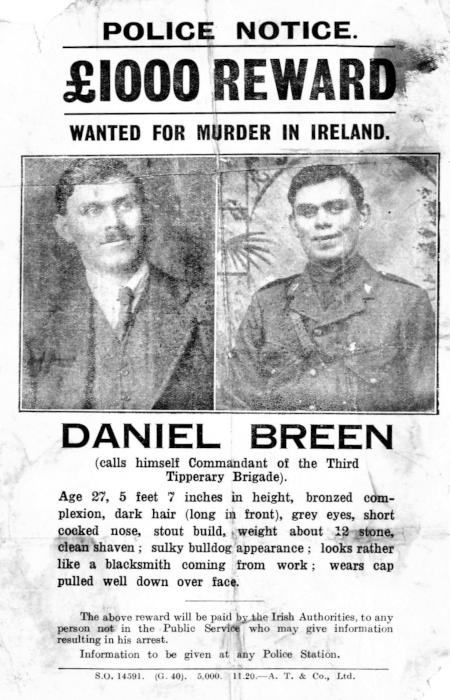
POLICE NOTICE.
£1000 REWARD
WANTED FOR MURDER IN IRELAND.
DANIEL BREEN
(calls himself Commandant of the Third
Tipperary Brigade).
Age 27, 5 feet 7 inches in height, bronzed complexion,
dark hair (long in front), grey eyes, short
cocked nose, stout build, weight about 12 stone,
clean shaven; sulky bulldog appearance; looks rather
like a blacksmith coming from work; wears cap
pulled well down over face.
The above reward will be paid by the Irish Authorities, to any
person not in the Public Service who may give information
resulting in his arrest.
Information to be given at any Police Station.
S.O. 14591. (G. 40). 5,000. 11.20.—A. T. & Co., Ltd.
Meantime our episode at Soloheadbeg had had
its first effects. South Tipperary, that is half the
county, had been proclaimed a “military area.”
That, for all practical purposes, meant martial law.
Fairs, markets and meetings were prohibited;
military reinforcements were rushed into the district
and garrisons were established at villages which had
never before sheltered a British soldier. Night and
day they patrolled the roads and scoured the fields.
Our little band had unmasked England. She had
now to come out in the open and let the world see
that she held Ireland by naked force, and by force
alone.
We also learned that a reward of £1,000 was
offered for any information that would lead to our
capture. A few months later this offer was increased
to £10,000. Nobody earned it nor indeed tried to
earn it, except a few members of the R.I.C. They
failed, and most of them never tried a second time.
These are the plain, unvarnished facts concerning
the first shots fired after the Insurrection of 1916.
These shots were the first of a series that were to
bring Ireland’s name once more before the world,
and to make the nations look on in admiration at
Ireland’s fight for freedom.
CHAPTER VIII. HELPED BY THE BRITISH.
We spent two nights in Mrs. Tobin’s house.
Then we went to Ned McGrath’s, of Tincurry, and
from there we were taken by Ned to Gorman’s, of
Burncourt Castle. We then arranged to go to
Ryan’s of Tubrid, and sent on word that they might
expect us. But after sending word we changed our
minds and did not go to Tubrid; and lucky it was
for us—or for somebody else. Just at the time we
had expected to be there the house was surrounded
by eight peelers, and Ryan himself was arrested.
We decided to go on to Mitchelstown in County
Cork, at the other end of the Galtees. We spent
a night in O’Brien’s, of Ballagh, and while we were
there a strange thing occurred. We were sleeping
upstairs when strange voices aroused us. We looked
out and saw several peelers just entering the house.
We at once got ready for a fight, expecting to see
them mounting the stairs at any moment. But they
never came. In a few minutes they took their
departure. Then we learned that the object of their
visit was to ascertain if the owner of the house had
paid the licence for his dogs.
Finally we reached Mitchelstown where we met
Christie Ryan, who welcomed us and gave us the
shelter of his house. While we were there we saw
eight armed policemen pass the door. They
were guarding a little packet of blasting powder.
Evidently the Soloheadbeg affair had taught them
to take no chances, and now they had quadrupled
the escort.
Later we came across into East Limerick, where
Ned O’Brien, of Galbally, put us up, and then we
travelled farther to the Maloneys, of Lackelly,
the scene of a great battle with the British two
years later. At Lackelly we stayed about a week.
But you must understand our position all this
time since the affair at Soloheadbeg. We were still
within a radius of ten miles of the scene. Police and
military were scouring the countryside for us,
searching houses, ditches and woods. The clergy,
the public and the press had all condemned our
action. Our only consoling thought was that so
were the men of ’98, and the Fenians of ’67, and
then the men of 1916 condemned in their day, and
we knew that as the cause of these men had been
vindicated, so too would our cause when the scales
fell from the people’s eyes. At this time, however,
scarce a word would be heard in our defence. Our
point of view was not even to be listened to. The
people had voted for a Republic, but now they
seemed to have abandoned us who tried to bring
that Republic nearer, and who had taken them at
their word.
Our former friends shunned us. They preferred
the drawing-room as their battle ground, and the
political resolution rather than the gun as their
weapon. We had heard the gospel of freedom
preached to us; we believed in it, we wanted to be
free, and we were prepared to give our lives as proof
of the faith that was in us. But those who preached
the gospel were not prepared to practise it.
Even from the Irish Volunteers or the Irish
Republican Army, as it has now come to be called,
we got no support. Ned O’Brien and James Scanlan
of Galbally, Paddy Ryan of Doon, and Davy Burke
of Emly, certainly stood by us; but they were the
exceptions.
When the news of the Soloheadbeg affair became
public, a meeting was actually summoned in
Tipperary town by a man who should have been
our friend. His purpose was to dissociate Sinn
Fein from the incident, and to denounce us for our
action. The meeting was, however, called off by
another prominent man. A local clergyman in a
sermon, in which he denounced us as murderers,
said that it used to be the custom to say, “Where
Tipperary leads Ireland follows,” but he hoped this
would not be so in the case of Soloheadbeg, the
men responsible for which would, he said, go to
their graves with the brand of Cain on their foreheads.
Such were the things said about us, but we
kept on our course.
In many places we were refused shelter on a
night that one would not put out a dog. I remember
on one occasion we were sitting in a farmhouse by
the fireside when a loud knock was made at the
door. It was dark, and the farmer did not care to
open without knowing who was outside.
“Who’s there?” he demanded.
“Police!” came the prompt reply.
Simultaneously we drew our revolvers. The door
was opened, and a young neighbouring farmer
entered, laughing heartily at his attempted joke.
Before we could put away our guns the owner of
the house observed them. At once his attitude
towards us changed. He informed us point blank
that he would not permit men with guns to stay
under his roof. It was bitterly cold, but we had to
go out into one of the outhouses for the night. So
chilled were we there that we had to drive in some
of the cows to keep us warm.
We had to keep tramping from parish to parish
without a penny in our pockets. Our clothes and
boots were almost worn out, and we had no changes.
Many whom we thought we could trust would not
let us sleep even in their cattle byres.
When we reached the village of Dono, in County
Limerick—still only seven miles from Soloheadbeg—we
again met with Seumas Robinson, and I
need hardly say that our joy at the reunion was unbounded.
Although it was only a few weeks since
we parted after the fight at Soloheadbeg, we all
felt like brothers meeting after years of separation.
When we met we continued our night’s march linked
arm in arm.
While we were in this neighbourhood Paddy
Ryan, a well-known local merchant and an old
worker in the cause of freedom, proved a staunch
friend to us. With Seumas again one of our band
we discussed the outlook and the chances of winning
over the people to engage in “one good stand-up
fight” against the old enemy. We then drafted a
proclamation ordering all the enemy forces out of
South Tipperary. We sent it on to Dublin, but both
An Dail and General Headquarters refused their
consent to let us go ahead. We never found out
their reason for doing so. Ours was the only
logical position.
Withholding their support was a bad blow
enough—but what was our horror when we found
that someone had actually worked up a plan to ship
us away to America! We were not consulted at
all, but calmly told to be ready to sail in a couple
of days. It was surely a sugar-coated pill! A
deportation order in disguise, issued from the very
source that should, if consistent, get behind us in
the war. We refused to leave Ireland. We told
them that we were not afraid to die, but would prefer
to live for Ireland. To leave Ireland would be like
an admission that we were criminals, or that we were
cowards. Now, more than ever we declared that our
place was in Ireland, and Ireland’s fight would have
to be made by Irishmen on the hills and at the cross-roads
in Ireland, not with printer’s ink in America,
or in any other country. This was apparently
regarded as a breach of discipline. We were
members of an organised body and should obey our
superior officers. They persisted in their plan of
sending us away, and we, just as obstinately,
refused to leave. At length we won, but only on
condition that we should remain away in some
remote part of the country. We felt that we could
very soon overcome that difficulty too.
While these little quibbles were going on between
G.H.Q. and ourselves we were suffering intensely.
The cold weather and the weary, aimless travelling
around were very trying on us. We could not get
a horse to carry us even a journey of a few miles.
We had to trudge from field to field, sometimes in
one direction, sometimes in another. At last human
nature began to assert itself. Why should we be
treated so? Was not the sky as fair in one place as
in another?
From Doon we went to Upperchurch, in the north
of Tipperary. There we spent a few days with
Patrick Kinnane, one of a family of famous Irish
athletes; our next resting-place we decided would
be Meagher’s of Annfield. We sent on word that
they might expect us to arrive at half-past seven
in the evening, when it would be quite dark. The
four of us, accompanied by Patrick Kinnane, walked
along the road, chatting and enjoying the cool
spring air. We must have taken our time along the
way, for Treacy looked at his watch and reminded
us that we were overdue, as it was now nearly eight
o’clock. Suddenly in the distance we saw something
white fluttering in the darkness. We halted. It
was a signal by a girl who was trying to attract our
attention.
The four of us dropped into a place of concealment
behind a thick hedge. The girl saw us and
approached along the road. As she passed the spot
in which she had seen us hide she whispered the
words:—
“The peelers are inside, raiding!”
She was one of the Misses Meagher who had
slipped out unnoticed by the police to give warning,
knowing the road by which we would come.
From our point of vantage we waited until we
saw the forces of the British law depart to their
barracks. Then we proceeded on our way, and
entered the house they had been raiding, where we
enjoyed a pleasant tea.
From Meagher’s we came south again to Leahy’s
of Boherlahan, the famous family of Tipperary
hurlers. After that we went to Donnelly’s, of
Nodstown, in the same district, where we held a
meeting of our Brigade Council on a Sunday
evening. With our colleagues we discussed plans
for more active operations, and produced the
proclamation we had drawn up ordering all British
armed forces to leave South Tipperary under
penalty of death. Although Headquarters had
refused their sanction we decided to publish it.
About the end of February it was posted up in
several parts of the county. The newspapers
published it with mocking headlines. It seemed a
tall order no doubt at the time, but subsequent
events showed that we saw further ahead than
either the newspapers or our own Headquarters
gave us credit for.
After that meeting we decided to return northwards
towards Creany, sending word ahead as we
always did. We sent a message to Patrick Kinnane
to meet us with a car, and started our long tramp
in the dismal night.
At Upperchurch we were met by Kinnane,
Doherty and Patrick Dwyer, and we headed for
Murphy’s house at Creany. It was three o’clock in
the morning when we reached our destination.
Seldom did we suffer more than that night from
cold and exposure. The weather was harsh, even
for February, and the district was wild and mountainous.
When we arrived at Murphy’s house we were
ravenously hungry. Murphy was a great character.
He was locally known as “the Stationmaster”—why,
I don’t know, for the nearest railway station
was fifteen miles from his house. He was preparing
a great meal of smoked ham and eggs for us. So
hungry was Hogan that instinctively, and half
unconsciously, he began to eat the raw ham as it
was being put on the frying pan. In a few minutes
he was seriously ill, and we thought he was going
to die. He soon revived, but for weeks afterwards
he was far from well. His illness at this time was
very unfortunate for us, because we had made up
our minds, in spite of Headquarters’ orders, that we
would try to get to Dublin, as we could no longer
endure the misery of our existence.
With that purpose we went from Creany to the
Falls of Donass, that most glorious and picturesque
spot on the Shannon just across the Limerick
border from North Tipperary. Then we parted with
Robinson and Treacy, who started on their perilous
journey to Dublin, while I remained behind with
Hogan until he would be himself again. They arrived
in Dublin safely, and were welcomed by a few
sympathetic friends. A full and accurate description
of each one of us, with the reward offered for information
that might lead to our capture, appeared
every week in the Hue and Cry, the official police
gazette, and so it was no easy thing for them either
to travel to the city, or to get about when they had
arrived there.
Meantime Hogan and I could not stay long in
the district round the Keeper Mountains. But
Tommy McInerney came out from Limerick
with a motor car, accompanied by Tim Ryan.
McInerney was the man who drove the ill-fated
motor car which went to meet Roger Casement on
Good Friday of 1916, when the car ran over a cliff
in Kerry, and two of the occupants were drowned,
McInerney himself escaping.
Tim Ryan knew of a friendly priest in West
Limerick who would give us shelter, and we started
on our journey to meet one of the truest friends we
ever made—a certain sagairt whose praises I should
like to sound here, but who does not wish his name
to be made known. Sean Hogan sat in front with
McInerney, who was driving, Ryan and I being in
the back.
For a time our journey was uneventful until we
approached Limerick City. We were suddenly confronted
by lorry loads of soldiers dashing along in
the direction of Tipperary. We knew they were on
some big round up. We did not know then, though
we found out later, that they had received information
that we were lying in a certain hiding place, and
scores of troops with armoured cars were being
rushed to the scene.
Never since we left Soloheadbeg did we feel in
such a tight corner. One flash of suspicion on the
part of a single officer of the party would have ruined
us. At that time we knew that more than one
British soldier, even privates, had fond hopes of
earning the reward for our capture, and many of
them had been at great pains to study our descriptions.
Besides, it was comparatively easy for them
then, in the spring of 1919, for we were then the
only “much wanted men,” as the newspapers
described us.
An apparently endless line of lorries approached
us—every soldier armed to the teeth, every lorry
equipped with a machine gun. The smallest show
of concern on our part meant our death warrant:
the slightest sign of fear or anxiety would betray us.
And there was no turning back. To attempt such
a thing would be an open challenge by three men
to several hundred soldiers. Coolness and bluff were
our only hope.
We passed the first twenty lorries without turning
a hair. We just looked at the troops with that gaze
of curiosity mingled with admiration that one might
expect from any loyal citizen watching his gallant
protectors go by. We had passed the greater part
of the convoy, and were beginning to feel more at
our ease, when suddenly rounding a corner we were
confronted by a sentry with rifle upraised and
called on to “’alt.” Our driver at once put on the
brakes and pulled up.
We now realised why the other braves had
allowed us to pass unchallenged. We had been led
into an ambush—permitted to get right into the
middle of the convoy, so that we had not a dog’s
chance of escaping. It was a cunning trap, but we
would show them how Irishmen can die rather than
surrender. It was all up with us, but we would sell
our lives as dearly as we could.
I pulled my gun. For a fraction of a second I
fingered it fondly under the rug rapidly deciding
where I should send my bullets with best effect. I
had my finger on the trigger ready to raise my
arm to fire when an officer dashed up.
“Sorry for delaying you, gentlemen,” he
shouted.
This did not look like an ambush. I gently
lowered my gun from view, and waited for his next
words.
He was the captain in charge of the party.
“Two of the ‘beastly’ cars, you know, have
broken down,” he explained, “and ’twas awfully
unfortunate, don’t you know, but the traffic was
almost completely blocked.” He apologised profusely
for the delay, but he feared there was not
enough room for our car to pass. “’twas jolly
rotten,” but he thought we should have to get out
and walk.
By this time I had quite recovered my composure.
I told him politely but firmly that we had an
important business appointment to keep, and that
any further delay might mean serious loss to us.
Besides, I said, we had travelled far, and a long
motor journey was not good for rheumatics, and we
were far too tired to walk.
I think he was really impressed by my protest.
At that stage British officers regarded an Irishman
who could travel in a motor car as a person of
importance who might get a “question raised in
the House,” if treated rudely. A year or two later
I know what he would have said to any Irishman
met on the road.
He suddenly turned to his men, ordered three or
four of them to drop their rifles and push us in our
car for about two hundred yards till we had passed
the broken-down lorries, and could take the middle
of the road again.
Never did I feel more inclined to laugh. Here
was a section of the British Army actually going
out of its way to save us the trouble of walking,
while the same army was day and night searching
the countryside for us. What a pretty heading it
would have been for the Morning Post—“Wanted
Gunmen aided and abetted by the British Army!”
We were more profuse in our thanks to the
soldiers, assured them they need not push our car
any further, and were very sorry to have them put
to so much trouble. A moment later we waved them
good-bye, and were dashing along the road to
Foynes. I can assure you that the speed of our car
was tested for the next quarter of an hour in case
by any chance the obliging soldiers might get
suspicious, and come after us to make enquiries.
But Sean and I laughed heartily when we had left
them behind. It was the first time since we had
become outlaws that the British helped us to
escape; it was not the last, for more than once I
had reason to feel grateful to their stupidity in
helping me out of difficulties when they little knew
who I was.
CHAPTER IX. OUR RETURN TO SOLOHEADBEG.
That evening we reached our destination—the
house of the priest to whom I have already referred.
Here we got a right hearty welcome. No trouble
was spared to make us feel happy and cheerful.
The housekeeper—Molly—was like a mother to
us. She was a bit of a dictator, too, where dictation
was for our good. When she had given us a good
hearty meal she ordered both of us to bed, where
we remained for two whole days. Can you wonder
that we felt loth to leave the blankets, with memories
of newspapers, dirty straw and damp hay still fresh
in our minds?
After two days’ rest I felt fit and active again,
but Hogan was still far from well. We can never
forget Molly’s kindness during this time. No
trouble was too great for her to make us comfortable.
I believe it was her kindness and good cookery
that really brought us to. And she was always
good-humoured and cheerful. It was a tonic to
hear her merry laugh, her banter and her bright
homely talk. It was all so different to what we had
been accustomed to for months. Up to this the
people who spoke to us at all never raised their
voices above a whisper. Sometimes we had to laugh
when we saw the caution they exercised before
giving any sign that they recognised us. Whenever
we met an acquaintance on the road he looked
behind, to the right and to the left, before saluting
us. Many of them, I suppose, were afraid that if
we were caught soon after meeting them they might
lie under suspicion, and there is nothing an Irishman
fears more than to be thought an informer.
It was amusing to observe the frightened look
that came into people’s eyes when they recognised
us. Of course, there was often a good reason for
their fright, for we were often several weeks without
making the acquaintance of a razor. But one is
not particular about personal beauty when there is
an army at one’s heels, and ten thousand pounds on
one’s head.
No wonder then that Molly’s good nature and
good humour were such a tonic to us. And she was
brave as well as kind. She would inspire us with
hope when everything looked black. She was
unshaken in her conviction that no harm would come
to us; that God, as she said, would save us from
our enemies. She always kept a lamp burning before
the image of the Sacred Heart, in intercession for
our welfare, and I am sure that many a decade of
her beads she said for us too.
But if Molly was a brick the priest was a thousand
bricks. Like Molly, he never counted the cost of
“harbouring outlaws.” We were welcome to his
roof and to his table as long as we cared to stay,
and everything that his house held, or that he could
command, was at our service. We certainly enjoyed
our stay at ⸺, and would have liked to prolong
it, but it was not safe to stay over-long in the same
district, and we felt it was not fair to our host.
Moreover, we wanted to be on the move to try what
we could be doing to put more life into the cause.
After a stay of a few weeks in this place we went
on to Rathkeale.
Here for the first time I met Sean Finn—as fine
a type of brave and chivalrous Irishman as ever
lived. He was then but a mere youth, but he had
been elected Commandant of his Battalion. Imbued
with a passionate desire to strike a blow for the old
land he was brave almost to rashness. But, alas!
for Ireland, he fell in his first battle with the enemy
about a year and a half later. My highest tribute
to the memory of this gallant soldier of Ireland!
We did not stay long in Rathkeale. We were
restless, and longing for action. We were anxious,
too, to know how Sean Treacy and Seumas
Robinson were faring in Dublin. At this time we
saw the newspapers every day, and we knew that
they had so far escaped. At last, we got into
communication with them and arranged to meet
them again. We felt that the fates would have the
four of us joined hands again, and stand or fall
together. So Sean Hogan and I worked our way
from West Limerick back towards the eastern end
of the county, to the borders of South Tipperary.
Once more we found ourselves in a place where we
had already received shelter and hospitality—at
Lackelly, near Emly. We were thus within six or
seven miles of Soloheadbeg again, and within a few
miles of the spot where a few weeks later we were
to have our next most exciting and dramatic adventure—Knocklong.
At Lackelly we met Treacy and Robinson once
more. We felt like a group of schoolboys on a
holiday. Somehow when the four of us were
together all the dark clouds seemed to scatter. We
forgot we were hunted outlaws with a heavy price on
our heads, and when we met we talked and joked
long into the night, and exchanged our experiences
and our adventures since we had parted. Treacy
and Robinson had gone about Dublin freely and
openly, and had quite a pleasant time. We, on our
part, tried to make them jealous by telling them of
our great time at the priest’s house, and were able
to boast of being helped by the British soldiers on
our way to that place.
Seumas was able to retort with an equally
amusing experience. It seems that on their way
from Tipperary to Dublin the car broke down just
at Maryboro’ Jail, and immediately several soldiers
rushed to their assistance to get it started again. In
Dublin, too, they had many adventures, but these
I cannot go into.
Meantime, the police and military were still busy
searching the whole county of Tipperary for us,
and digging up gardens and bogs in search of the
missing explosives. They watched our haunts, and
raided every place we were ever known to frequent.
In spite of the difficulties this state of things created,
the four of us determined that it was useless to
remain inactive. The encounter at Soloheadbeg
stirred the country, and showed the Volunteers what
could be done, but our absence might nullify these
effects. The three months that had passed since
then seemed to us to have been wasted. The I.R.A.
was still only a name. In theory there was a fairly
good organisation. Every county had its Brigade
and its Battalions, and arms were not altogether
lacking, but of what use, we asked ourselves, are
men who are soldiers only in name, and of guns that
are oiled and cleaned but never fired? The men
were not wanting in courage, but they needed more
initiative. At that time all they could do was go to
jail. All over the country men were allowing themselves
to be arrested and imprisoned for drilling or
carrying arms, but they never seemed to think of
using the arms rather than go to jail.
We made up our minds when we met at Lackelly
that this business of going to jail and becoming
cheap heroes must stop. We wanted a real army,
not a hollow mockery. Even if such an army numbered
a few score only, it would be far better than
the present organisation. We thought Soloheadbeg
would have been followed by active operations all
over the country, but now it was becoming a mere
memory.
In this frame of mind, and with these resolutions
we procured four bicycles and headed straight for
Donohill—back to the very scene of our first battle,
back into the middle of the military net that martial
law had drawn round the whole county. Donohill is
about two miles north of the Soloheadbeg quarry,
and our route took us by the very road where we
waited so long for the enemy, and where we at last
met them. It was our first journey past the scene
since January 21st, and you can picture our feelings
as we saw the familiar hill once more and the turn
of the road where the peelers appeared. We dismounted
and lingered for a while in the neighbourhood.
I am sure many of the people around never
expected to lay eyes on us again, for in the old days
the usual thing for men in our position to do was to
clear away to America. But our work was in Ireland,
and we were going to see it through to the end.
At Donohill we appeared to the Horan family
like men who had come back from the grave. When
they realised we were not ghosts, they gave us a
typical Irish welcome, and we joked and laughed
long into the night. They didn’t forget to keep
somebody on the look-out by the road to make sure
we would not be surprised. With the Horans we
stayed till the following night.
My own house was only half a mile away, and,
needless to remark, I took the opportunity to see
my mother. It was a great surprise for her, but a
very welcome one. During my period on the run I
dare not even send her a card, for it would bring her
endless annoyance from the enemy, and probably
give them useful information, for they never scrupled
to open letters going through the post. Poor
woman! She was very brave and in the best of
spirits, in spite of the fact that her little home was
often raided and ransacked three times in twenty-four
hours, in the early dawn, and in the dead of
night. It gave me great courage to see her and to
talk to her again. But I should not delay long, and
I bade her good-bye again, taking with me her warm
blessing as I left.
The dear old soul has suffered much for the crime
of having taught her sons their duty to their country.
Even the house over her head was looted and
burned, and her hens and chickens had to pay the
price of English hate, for they were bayoneted by
the Black and Tans. Through all her trials she
never lost heart, and would always have her jibe at
the enemy. Once when the British came and asked
if her son was in, she sarcastically asked them if
they would venture under the same roof with him.
On another occasion in reply to the same question
she told them I was upstairs, and invited them to
enter. Their response to the invitation was a precipitate
retreat to seek cover.
CHAPTER X. SEAN HOGAN CAPTURED.
From Donohill we went to Rossmore, and then
on to Rosegreen, and finally into Clonmel—the
Headquarters of the R.I.C. for South Tipperary,
and a large garrison town. We spent several days in
that district, and were not idle. We met the local
officers of the I.R.A.—they belonged to our
brigade—and found out what plans they had. We
did our best to induce them to get things moving
more rapidly, and to get on with the real serious
work.
One morning while in Clonmel district I had an
unusual adventure, not very exciting in its own
way, but one that I feared was going to prove more
than exciting for me. As I was cycling up Mockler’s
Hill at 2 o’clock in the morning, when it was still
pitch dark, a cyclist coming in the opposite direction
rode right into me. I got the full force of his handle-bars
over the heart. I was thrown helplessly to the
ground, and vomited a quantity of blood. I thought
I was going to die. The prospect of such an inglorious
end did not improve me, nor hasten my
recovery. To be killed in action by an enemy bullet
was a fate I did not at all dread; but I strongly
objected to being killed by the handle-bars of an
ordinary, inoffensive push-bicycle, and, to make
things worse, I pictured myself being identified by
the R.I.C. and kicked into an even worse condition
than that in which the cyclist left me. However,
my recovery was more rapid than I hoped for. I
have always had a bad habit of pulling myself together
very quickly. In a short time I was able to
mount my bicycle again, and ride to my destination.
On the 10th of May, 1919, we retraced our steps
to the village of Rossmore. It was now almost four
months since the affair at Soloheadbeg. During that
time we had been sleeping where and when we got
the chance; sometimes in a barn, sometimes in a
cattle-shed, and very seldom in bed. Our health
was not any the worse of our hardships. I suppose
with time one grows hardened. Even this night
when we got to Rossmore we were feeling fit and
game, although we had been four nights without
any rest. Still, we could do with a few hours’ sleep.
Somebody we met mentioned casually to us that
there was a dance that night in Eamon O’Duibhir’s
house in Ballagh, only a short distance away. We
forgot about our weariness; we forgot about our
danger. We were young, and had grown
accustomed by now to taking risks, and it was long
since we had had the pleasure of a dance or a
ceilidhe.
Without a second thought we faced for Ballagh.
Soon we were in the thick of the night’s fun. It
felt glorious to be back again, even for one night,
in the atmosphere of light-hearted gaiety. For
nearly two years I had not mingled with a crowd,
and here I was now in the midst of a typical
Tipperary party. The music was great, and the
supper and refreshments were even better. For
once we forgot the dark clouds over us; we laughed
and talked and danced in the reels and in the sets
with the lads and the lassies—in the middle of the
Martial Law area, and at a time when probably a
dozen British raiding parties were breaking in doors
in cottages and farmhouses looking for us.
Of course, the boys and girls all knew us. They,
like so many others before and after, had only to
slip out, any one of them, go to the nearest police
barracks, not two miles away, and earn a thousand
pounds by saying where we were. But they never
dreamed of such a thing. Neither did we ever dream
of suspecting any one in the party, or in any other
party of Irish-Irelanders. Every one of them would
cut off his hand before he would touch that Saxon
gold. Irishmen have many faults, but very, very
few informers are bred amongst them.
We danced all through the night, and in the early
hours of the morning I returned with a few of the
boys to Rossmore. The other three did not come
with me; they stayed on for a few more dances, but
we had arranged to meet at O’Keeffe’s, of
Glenough, where we would have a right good sleep.
Shortly after I arrived there Sean Treacy and
Seamus Robinson put in an appearance. Sean
Hogan did not come with them, but none of us felt
a bit uneasy. He had two days to go before he
reached his eighteenth birthday, but we knew he
was well able to look after himself.
The three of us were about as tired as we could
be. What with our five nights without sleep, and
the fatigue of a night’s dancing, we could have
slept, as Sean said, on a bed of briars. The sight
of the cosy bed that had been made ready for us
almost made us sleep before we turned into it.
I think Sean Treacy had not finished his rosary
before I fell asleep. The next sound I heard was
the voice of Patrick Kinnane. It seemed very far
off. He was speaking to me I knew, but my eyes
refused to open. Then I was brought to my senses.
His words lifted me clean out of the bed; I realised
the full meaning of his early intrusion: Hogan had
been captured by the Peelers!
It would have been very easy for us to believe
that “J.J.,” as we called him—his name was John
Joseph—had been shot. But to think he was
arrested! I would not believe it. Was Kinnane
joking? I turned to Sean Treacy, for he too was
on his feet by now, and I read the truth in his face.
I would have given a fortune for a few hours more
of sleep. I never felt so tired and weary in my life.
Robinson and Treacy were just as bad. But the
thought of “J.J.” in the enemy’s clutches brought
us quickly to our senses. Without a moment’s
hesitation we made our decision. Our faces rather
than our words conveyed to one another what was
in our minds. We must rescue Hogan, or die in
the attempt, and we knew that had any one of us
been in Hogan’s position his decision would have
been the same.
Quickly we got what information there was of his
capture. He left the dance soon after us. Before
he had gone far he was surrounded by ten stalwart
policemen. He carried his gun, of course, as we
all did, but he never got a chance to use it. It was
not until a year later that the British invented the
happy trick of shooting prisoners “while attempting
to escape.” If that fashion had then existed “J.J.”
would not be with us to-day, nor would there
have been much use in planning to rescue him that
night.
Our first trouble was to locate him. At that time
murders of innocent people had not yet come into
fashion, but Martial Law made people more careful,
and few ventured out late at night or early in the
morning because of the certainty of being held up
and questioned and probably arrested by the
British, who patrolled the roads at all hours of the
night and day. Hence we found on our first enquiry
that no one had seen whither Hogan’s escort had
departed. They might have faced for any one of
half a dozen garrisons—Thurles, Tipperary, or
Cashel, for instance. To be thus left in ignorance
of where to lay our plans was almost maddening,
and we knew that every hour that passed made the
danger greater, and that he would soon be removed
to a place beyond our reach. Gladly, I believe,
would any one of the three of us have taken the
place of our youngest comrade. Now that he was
gone from us we suddenly discovered all his excellent
points of character, though we were never in
the habit of paying him compliments while he was
with us.
We searched and enquired everywhere. We sent
messengers on bicycles in all likely directions to
endeavour to pick up a trail. But his captors had
got too big a start. We were almost in despair when
at last we got on the scent: we traced him to
Thurles police barracks.
To attempt to rescue him from that place
would have been worse than madness. It would
have been as easy to storm the gates of hell.
Thurles is a fairly large town, and had a big garrison
of both police and military. The barrack was
strongly fortified, and the peelers were always on
the alert. Their positions made alertness essential.
They were in the middle of an area that was soon
to become the centre of active warfare, and they
were on the main road from Dublin to Cork. There
was never the slightest hope of rushing the barracks
or of effecting an entrance by a ruse, and besides,
we knew that the presence of Sean Hogan in their
stronghold would make them all the more careful,
for they knew he was one of the four men
wanted for the attack at Soloheadbeg. The bits of
information they had picked up, and our disappearance
from the locality made it certain to them from
the first day that we were in that adventure.
But there was one gleam of hope. We knew he
would not be kept long in Thurles. Prisoners were
only kept in these local stations for a day or two
while the preliminary enquiries and remands were
being gone through. Then they were transferred
to one of the largest prisons—Mountjoy, Cork,
Maryboro’, Dundalk or Belfast. In the case of
Tipperary men, and indeed men from all over
Munster, Cork was generally the destination. The
odds were ten to one that in a day or two Sean
Hogan would be taken by train from Thurles to
Cork.
Our plans were quickly completed. We would
go to Emly, intercept the escort, hold up the train
and rescue our comrade. We chose Emly for many
reasons. It was a small station, and there were no
soldiers convenient; the police we did not
particularly mind. It was in the heart of a district
with which we were familiar, and in which we had
many friends. It almost touched the borders of
three counties, and consequently increased our
chances of evading pursuit, since the enemy would
not easily discover whether we retreated to the
mountains, to North Cork, to South Tipperary,
or to East Limerick. Above all, we had faith in
many of the boys from the neighbouring village of
Galbally.
But holding up a train and making arrangements
for the removal of our rescued companion, and for
our own escape, are not operations that can be
carried out by three men. We needed help; we
must get reinforcements. We at once secured the
services of a special Volunteer despatch-rider; for,
naturally, neither telegrams nor telephones were to
be thought of. To trust these means of communication
would be the same as to send the British word
of our plans. Our first care was to send full details
of our plans to the Acting Commandant of the
Tipperary town Battalion, with orders to send us
the reinforcements. Emly would be only seven
miles, less than an hour’s cycle run, from Tipperary
town.
Hurriedly we decided on our course of action,
and made our preparations. Ned Reilly and the
O’Keeffe brothers gave us every help in laying our
plans before we left Thurles.
Having completed these arrangements we left the
town of Thurles at 11 o’clock on the morning of
May 12th, 1919. Our hearts were sad, but we
still had hopes, and our blood was boiling with anger,
anxiety and excitement.
J. J. HOGAN.
Mounted on our bicycles the three of us faced
for Emly. Except for the hour’s sleep after the
dance we had now been five nights without a rest.
In the ordinary course Emly would have been only
some thirty miles from us, but for obvious reasons
we had to avoid the main roads, and could not pass
near Tipperary town. We covered nearly fifty miles
on that journey, over rough and uneven roads. It
was one of the toughest rides we ever did. The
journeys that Sean Treacy and I had done to and
from Dublin were less wearisome. As we approached
Donohill, Seumas Robinson’s bicycle was put out of
action. We had neither the time nor the means to
try to repair it on the roadside, but we had faithful
friends. Patrick O’Dwyer, of Donohill, whose
wife was a first cousin of Sean Hogan’s, put a new
bicycle at our disposal, and we resumed our journey.
Our fatigue was telling on us. We could have fallen
off the bicycles and slept by the roadside, but the
excitement and our sense of loyalty to our comrade
kept up our strength. At Oola we actually fell
asleep on our bicycles, but again we bestirred ourselves,
and on we went doggedly, up hill and down
dale with our teeth set and our minds fixed on rescue
or death. We made a detour to the right, through
the Martial Law area, and over the border into
County Limerick, through the historic village of
Cullen, and on to Ballyneety, past the ruins of
the old castle, on the very same road that Patrick
Sarsfield took on that moonlight night three hundred
and thirty years before, when his sabre brought
terror to Dutch William’s troops. It was a strange
coincidence that we who now rode on a similar
errand of death or glory were Tipperary outlaws,
just as was Galloping Hogan, the man who made
Sarsfield’s exploit possible that night. And we were
going to rescue another Tipperary outlaw of the
same name and clan.
While Sean Treacy was reminding us of these
pages of history—for he loved his Irish history—we
were interrupted by a dull thud, and looking round
we saw that poor Robinson had fallen off his bicycle
and was fast asleep by the roadside. We had to
keep moving, time was precious, and the three of
us mounted again and reached Emly at half-past
three on the morning of May 13th. On the way we
had stopped once or twice to complete our plans,
and to perfect our intelligence arrangements. Once
we got a rude shock when a bomb dropped from
Robinson’s pocket, and for a moment we thought
we were being attacked.
At Lackelly we called upon our old friends, the
Maloneys, and right heartily we were welcomed.
When we were discussing our plans, while enjoying
a warm and much needed breakfast, May Maloney
offered her services in any way she could help, and
gladly we accepted her offer. She became our
despatch rider for the occasion, and I do not know
how we could have got along without her help. It
was she who went to Thurles that morning, and
sent us word that Hogan was still there. The
Maloneys’ house, by the way, was later destroyed
by the Black and Tans, and both May Maloney and
her brother Dan were imprisoned during the recent
war.
By 10 o’clock on the morning of May 13th, we
had completed all arrangements for the rescue of
Sean Hogan.
CHAPTER XI. THE RESCUE AT KNOCKLONG.
As I have said, we arrived at Emly at 3.30 a.m.
The first train on which the prisoner might come
was not due till noon. When all was in readiness a
few hours before noon we waited eagerly for the
arrival of the men from Tipperary town in response
to our request. As the hour approached we grew
anxious and restive. The minutes grew into hours.
Eagerly our eyes scanned the road from Tipperary,
but no cyclist appeared. What had happened? We
could not let ourselves believe that the help we
needed so badly was not at hand. Eleven o’clock—still
no reinforcements. The minutes travelled all
too fast now. Half-past eleven came, and still no
sign. And the train was due at 12!
But we were not going to let Sean Hogan be
taken away without a fight. We knew that the
escort, armed with rifles, bayonets and revolvers,
would consist of four to eight policemen, but it was
possible that other policemen or soldiers would be
on the same train. We could only fail. At 12
o’clock the three of us rushed up to the station just
as the engine steamed into the platform.
In my hurry I dashed right into an old woman at
the entrance. To save her I had to throw my arms
around her. The two of us were swung round and
round by the force of the collision, and I finished
what must have looked like a dance by falling
heavily to the ground. Unfortunately, there was no
time for explanations or apologies, and I don’t know
whether the poor woman ever heard yet the
explanation of the collision. Before she could even
see my face, I was up again and racing along the
platform with my finger all the time on the trigger
of the revolver.
But there was no prisoner! We were sadly disappointed.
In a sense, too, we felt a little relieved
for there would be still time to seek help before the
next train was due. But waiting is always the
hardest part of any fight; suspense is more severe
than action.
As we returned crestfallen to our resting-place,
after scanning every carriage, our pill was made
more bitter by the thought that the Tipperary men
had failed us. Our minds searched for other help.
We thought of the old Galtee Battalion, the boys
from the mountain districts, from Galbally and
Ballylanders. Their Battalion we knew had lately
been suspended by Headquarters. But we knew,
too, that their hearts were right, and their hands
strong and daring. They would not turn a deaf ear
to a call like ours.
The next train was not due from Thurles till
7 o’clock in the evening. We sent word to the boys
of the Galtee Battalion, told them our errand and
the danger of the work that was to be tackled.
Within an hour the reply came. Five of their men
would join us at 5 o’clock. Never before had we got
such a heartening message.
The men were as good as their word, and they
came before their time. At 4.45 p.m. they arrived,
Eamon (Ned) O’Brien, James Scanlon, J. J.
O’Brien, Sean Lynch, and poor Martin Foley, who
was hanged in Mountjoy Jail exactly two years later
for his part in the rescue. With him was hanged
poor Maher, who knew nothing in the world about
the incident for which he was hanged. But they
gave their lives gladly for Ireland, and the brave
words of their last message from the foot of the
gallows will keep their memory for ever fresh in the
hearts of Irish patriots. May they rest in peace!
We were now eight strong, five of us armed with
revolvers and three unarmed. After a consultation
we decided on a slight change of plan. Sean Treacy,
Seumas Robinson, Ned O’Brien and myself cycled
on to Knocklong, the next station, about three
miles south of Emly. We selected Knocklong because,
except Emly, all the other stations were
held by strong British forces, but this being only a
wayside one, and a couple of miles distant from a
police barrack, was comparatively safe for us. If
this attempt failed we had plans to motor to Blarney,
where we could again intercept the escort party.
The other four men we sent to Emly station with
instructions to board the train without arousing
suspicion, to find out what carriage our comrade was
in. In that way they could give us the hint as soon
as Knocklong was reached, and no time need be
lost in getting to the rescue.
We reached Knocklong just as the train’s
departure from Emly was signalled. We walked up
the platform looking as cool and unconcerned as we
could, but with our guns gripped tightly in our
hands. Little did the people who awaited the train
that evening think that they were soon to be
witnesses of a drama for which a film-producer
would have given a fortune. In the distance we saw
the smoke of the engine rise into the sky. Another
minute and the train was pulling into the platform.
At the same moment another train on the opposite
platform came in from Cork direction. It was only
the next day we learned that the second train contained
a company of armed British troops for
Dublin. There they remained within a few feet of
the struggle for life or death that ensued. I never
learned why they took no part in the struggle.
Perhaps it was too late when they realised what was
afoot.
Our train had not yet come to a standstill when
the signal for which we waited was given us by two
different parties. In accordance with the arrangements
made in Thurles the previous day a member
of the I.R.A. Secret Service boarded the train after
the prisoner, and was at the window to give us the
signal. Our men were at their window, too, not
knowing about the other man.
There was not a moment to be lost. The train
would delay only a minute, and we had not thought
it necessary to hold up the driver. A slight motion
of the hand from our colleagues indicated the
carriage where we would find our man.
It was a long corridor carriage divided into about
a dozen small compartments, each shut off from
the others, and a passage running alongside the
whole way. Our Galtee men were in the passage.
In one of the compartments we saw Sean Hogan.
He sat in the middle of the seat handcuffed, and
facing the engine. Beside him sat a sergeant of
the police, on the other side a constable. On the
opposite seat were two other constables—all four
fully armed.
Sean Treacy was, by arrangement, to take
charge of the attack. He gave the word. Within
five seconds of the arrival of the train we were
rushing along the corridor and bursting into the
prisoner’s compartment with our guns drawn, and
with the order, “Hands up!” “Hands up!”
Only a moment before, as we heard later, Sergeant
Wallace had viciously struck his prisoner with the
sarcastic query, “Where are Breen and Treacy
now?” His query was answered; Breen and Treacy
were at his service.
As we burst in the door of the compartment, the
police quickly realised our purpose. Constable
Enright had his revolver drawn and pointed at the
prisoner’s ear. Orders had been given the escort to
shoot the prisoner dead if any attempt were made
to rescue him. A fraction of a second saved Sean
Hogan. It was his life or the Constable’s. The
policeman was in the act of pulling his trigger when
he was himself shot through the heart—death being
instantaneous.
And now ensued an episode in comparison with
which a Wild West show would grow pale. The
passengers realised our object. In a moment panic
reigned. My most vivid recollection of that scene
is the figure of a soldier-passenger, dressed in
England’s khaki uniform; but under that uniform
there beat an Irish heart. I shall never forget the
triumphant smile on his face as he waved his hat
and shouted, “Up the Republic!”
I had little time for studying the passengers.
That first shot prevented the escort from murdering
their prisoner, and it was the first shot in a grim
battle that was to end in the death of two and the
wounding of four. With the first shot one of the
policemen literally dashed himself through the
window of the train, roaring like a wild bull. We
never saw him again, but I heard that he ran
through the country like a maniac and reported the
fight in a very incoherent manner at Emly police
barrack next morning.
Constable Enright was dead, so that there
remained Sergeant Wallace and Constable Reilly.
A fierce and rapid exchange of shots followed.
Constable Reilly lay stiff on the floor. We thought
he was dead, but we soon found he was only shamming.
Sergeant Wallace fought to the end. A braver
man I have never seen in the ranks of the enemy.
Several times we called on him to surrender, but
he never answered, even when deserted by his men.
The confusion and panic were indescribable.
Cramped as we were for space, we were in danger
not only from the bullets of the police, but also from
those of our own men. And all the time we were
struggling to push out our handcuffed comrade.
We handed out our comrade in safety. Meanwhile
Sergeant Wallace had also struggled on to
the platform. I looked around me. I knew I was
wounded, but, in the excitement, I could not know
where or how seriously, though I knew it was in
the region of the lung.
Suddenly I realised that Treacy, Ned O’Brien
and Scanlon were also wounded, and we were the
only four with arms. Blood was streaming from all
of us. The other three had lost their guns in the
fight. I alone was in a position to fight, and I had
more than the plucky sergeant to face, for Constable
Reilly, who had shammed death a moment ago,
was now out on the platform firing continuously from
his rifle. A second bullet now found its mark in
me. I was shot in the right arm. If Constable
Reilly had been as cool as the old sergeant one of
us would never have escaped alive. He saw my
revolver drop from my wounded hand—and he saw
me pick it up again. If he had been quick he
would have dashed my brains out before I got the
chance to do so. I had always prepared for such an
emergency as this. I had practised so that I was
as good a marksman with my left hand as with my
right. I fired again, and at Reilly, and when he saw
me level my gun he turned and fled down the platform.
Meantime the Sergeant had collapsed on the
platform, and victory was ours. Reilly escaped
because I was blinded with blood and unable to
take steady aim; but I made sure that he would
not turn again, while the rest of my comrades carried
Hogan off in safety.
We left the dead Constable and the dying
Sergeant at Knocklong Station. The people had
fled in terror from the platform, and many of the
passengers had jumped wildly from the train. Even
the engine driver, who did not apparently hear the
first shots, was about to start the train after the
usual delay while the battle was still in progress,
when a girl told him there was a battle going on.
The same girl also states that she later saw Reilly
praying near the station.
Late that evening the dead body of Enright was
taken in the train to Kilmallock, as was also
Sergeant Wallace who lived until the following
afternoon.
At the inquest afterwards there was of course
nobody but Reilly to give his version of the fight.
One of the jurors boldly remarked to the police:
“You are simply trying to paint your own story in
your own way.” The police witnesses were not
allowed by their superiors to answer any important
questions calculated to show that we would not have
shot their men if they had surrendered.
The inquest was also noteworthy for the fact that
the jury not only refused to bring in a verdict of
murder, but spoke out. I quote the newspaper of
22nd May:—“Condemning the arrest of respectable
persons, and exasperating the people, and
called for Self-Determination for Ireland, and
blamed the Government for exposing the police to
danger.” Our efforts were having their effect. The
plain people were realising that ours was a fight for
Irish Freedom. They realised too that we had no
enmity against the police as such, if they confined
themselves to the work of ordinary police; but when
they became spies and soldiers in the pay of
England we had to treat them accordingly.
This is the true story of Knocklong, condemned
as it was at the time by archbishop, priests and
press—the same people who, two years later,
would have treated us as heroes and loudly boasted
of “the freedom we had won.” Time works
wonders!
The heroes of the fight were Sean Treacy and
the two O’Briens. In the next chapter I must tell
of our equally exciting escape from the scene, and
the story our rescued comrade had to tell when we
clasped his hand again.
CHAPTER XII. OUR ESCAPE FROM KNOCKLONG.
Before describing our escape from Knocklong
and the adventures which ensued, I must pause to
outline the experiences of our comrade, Sean
Hogan, since his arrest a few days before. They
throw an interesting sidelight on the methods of
the Peelers, though at that period these methods
were not so cold-blooded and barbarous as they
became within a year.
When the dance concluded that morning at
Ballagh, and when the rest of us had gone on to
O’Keeffe’s for a sleep, Sean Hogan went up the
road with Brigid O’Keeffe to Meagher’s, of Annfield.
This was the same Meagher family at whose
house we had had such a narrow escape a few
months before, when the girl’s waving handkerchief
warned us of danger. Miss O’Keeffe was a cousin
of the Meaghers, and she had decided to go up to
their house for breakfast.
So sleepy was Sean that he actually fell asleep
at the table. When breakfast was finished he took
off his belt and revolver and lay down for a rest on
a sofa. Mr. Meagher and his two daughters were
at this time busy about the farmyard preparing to
send the milk to the creamery.
Sean was suddenly roused from his sleep by the
warning shout: “The police are coming up the
road!” He jumped to his feet, put on his belt, and
went to the door, revolver in hand.
The police had been seen a good distance off by
the Meaghers, but Sean could not see them from
the house. Assuming that they were coming from
the north side he ran from the house in the opposite
direction, along a field which is much lower than
the level of the road. When he had got to the end
of the field he thought he was now out of danger,
put away his revolver, and jumped on to the road—into
the arms of six policemen. They had, as a
matter of fact, been coming from the south, and
had got a full view of him as he ran along the field
from the house.
Sean was at once handcuffed and his revolver
seized. His captors marched him back the road to
Meagher’s, just as another section of the police
raiders came out the door, having hurriedly searched
the house. They did not recognise Sean, and he refused
to give his name. Just as he was being removed
Miss O’Keeffe came and shook hands with him,
saying, “Goodbye, Sean.” That was the only
part of his name they knew. They apparently took
her to be one of the Meagher family, for had they
recognised her as one of the O’Keeffes they would
probably have come down the road to search her
own house, where we were at the time.
Sergeant Wallace was in charge of the police
party, and with him were Reilly and Ring amongst
the others. They marched their prisoner to Roskeen
Barracks, and at once sent word to Thurles that
they had captured an armed man whose Christian
name was Sean. A police van from Thurles soon
arrived to escort their prisoner to that town, and
one of the party recognised him as one of the much-wanted
Soloheadbeg men.
After his arrest one of the Meaghers ran down
the road to Patrick Kinnane’s house, between
Meagher’s and O’Keeffe’s, and asked him to
convey word to the rest of us of Sean’s arrest.
When Sean Hogan fell into their hands the
Peelers adopted every subterfuge to get him to
divulge information. First they tried to coax the
information from him, for they saw he was but a
mere boy. They failed in their efforts, and then
their tactics changed. They struck him, and beat
him unmercifully, but again they failed in their
purpose; for if Sean Hogan was but a boy in years,
he was a man in strength of character and loyalty
to his comrades. Not a word would he tell even
though they were to torture him to death.
Then they tried still another plan. One of the
policemen, pretending to be his friend and adviser,
told him quietly that he had been betrayed by Breen
and Treacy, who, they said, were then on their way
to London, having been granted a free pardon and
a huge sum of money for the information they had
given. This was followed by a straight hint that if
Hogan would supplement the information by whatever
knowledge he had of the organisation and its
plans, he, too, would be well rewarded, and would
find himself helped to leave the country instead of
finding himself on the way to the gallows. But
J. J. knew his old comrades too well to think for a
moment that they had betrayed or deserted him.
All the threats and cajolery of the Peelers were in
vain. He refused to answer their question, and in
the end, did not pretend to hear them.
At last he was put on board the train for Cork
Jail on the evening of the 13th May. Thurles is
only about 30 miles from Knocklong, and by the
time that station was reached history was once more
to repeat itself. The night before when I rode by
Ballyneety my mind had gone back to the days of
Sarsfield; to the historic episode of the destruction
of King William’s troop train. There was no story
I loved more as a boy. It was a tale of daring and
of dramatic triumph, and I pictured the dismay of
the English troops whose password was “Sarsfield,”
when in response to their challenge came
the grim reply, “Sarsfield—and Sarsfield is the
man!” Often when I was a boy I dreamed of how
proud I would have been, were I with Sarsfield’s
little band that night riding out from Limerick to
strike terror into the hearts of the invaders.
RAILWAY STATION, KNOCKLONG.
On the train from Thurles to Knocklong Sergeant
Wallace never ceased taunting Hogan with his
plight. Repeatedly on the way he asked with savage
mockery, “Where is Breen now?” and to add to
the unhappiness of his helpless prisoner he accompanied
each question with a prick of his bayonet.
These are some of the things the world did not
know, when it looked upon us for a long time as
cold-blooded murderers. Many of our men can tell
such tales, and produce their own bodies as the
evidence, just as poor Hogan’s condition testified
to us when we rescued him.
Even as the train steamed into Knocklong,
Wallace once more repeated his derisive question—“Where
are Breen and Treacy now? They sold
you to get you hanged.” Ere he had finished his
question Breen and Treacy supplied him with the
answer—an answer which he did not expect, and
one which debarred him from further promotion in
this world.
And now to resume my narrative. When the last
shot had been fired, and when Constable Reilly had
fled from the scene, we moved from the platform.
The people were terror-stricken. Many had fled in
terror from the station. Others had taken shelter
by the walls and the gatepiers. A few who were too
dumfounded to take flight looked at us in amazement.
None dared to approach us, and I am not
surprised, for never before had old Galteemore
looked down on such a strange party at a hitherto
quiet and peaceful country station. There were
nine of us all told, one a handcuffed prisoner and
four of us wounded and bespattered with the
blood of ourselves and our enemies.
I was no longer able to walk, and I realised now
that my last shot had been fired from my revolver,
and that it might at any moment be found highly
desirable to have it reloaded, but my right arm was
dead and I could not reload. I looked around me.
Outside the station I saw a motor car evidently
waiting for somebody who was to come from the
train. With my empty revolver raised in my left
hand I held up the car. I think my appearance was
enough to inspire any Christian with terror, not to
speak of levelling my gun. A fit of dizziness,
probably the effects of my wounds and loss of blood,
had come over me on the platform, as I made for
the gate, and I had fallen heavily against the wall,
and blood was gushing from my head. I could
scarcely walk. I groped my way along. The people
around me ran at the very sight of me, many of
them shrieking. At last somebody came to my
assistance. He was dressed in khaki—an Irishman
in England’s army! The very irony of it makes me
smile to-day. I think he was the same man who had
shouted “Up the Republic” on the train, though
I am not sure, for some people told me afterwards
that there was an American soldier also in khaki at
the station that evening—I believe, too, that the
soldier who cheered for the Republic was afterwards
courtmartialled by his officers—but whoever he was
that helped me, if his eyes catch these words, let
him accept my thanks; I forgot to show him my
gratitude at the time.
Leaning on his arm I struggled from the station
premises on to the road. He half linked and half
carried me for I was now growing weaker every
moment. Probably I was loosing my senses too, for
I forgot all about using the motor car I had held
up, and I left it behind.
The rest of the party were outside on the road.
With a butcher’s knife, procured from a man named
Walsh, they broke the handcuffs that bound Sean
Hogan, and he was once more a free man. The
unwounded men took charge of him and brought
him to a place of safety.
The other four of us—Ned O’Brien, Treacy,
Scanlon and I—faced for Shanahan’s. I scarcely
remember that journey; it was growing dark, and
we did not know the road well. I was losing blood
all the time. It must have taken us hours to get to
the house. We were all weak. In a field on the way
we met some lads from the neighbourhood. They
came to our assistance and helped us to reach our
destination.
I was at once put to bed, and the priest and
doctor were sent for. Both soon arrived. Dr.
Hennessy, of Galbally, was very kind to me, but
both priest and doctor regarded my case as hopeless.
I was told that I had only about twenty-four
hours to live, as the bullet had gone right through
my body piercing the lung, and I had lost an
enormous quantity of blood. That news was
cheerless enough, but I was not even to get the
twenty-four hours to die in peace.
When I arrived at Shanahan’s my comrades had
at once mobilised an armed guard under a chap
named Clancy, of Cush, Knocklong. I was not to
be permitted to fall into the hands of the British
alive. Scouts were sent out to watch all the
approaches to the house. We knew that the country
would be swept with columns of troops and police.
All through the night—as I learned later—reinforcements
were rushed to the neighbourhood, and the
police garrisons were strengthened at Doon, Oola,
Galbally, and all the local villages and towns. For
days afterwards a house to house search was made
in that part of East Limerick and South Tipperary,
and even the graveyards were inspected for fresh
graves, as the newspapers reported that “two of
the attackers were believed to have been mortally
wounded.”
Nor can I help recalling at this stage an incident
that happened on that memorable evening. I was
told afterwards on the best authority. Four policemen
from Elton, a few miles from Knocklong, heard
the firing at the station, and took to their heels back
to their barracks. There they remained, and with
the door locked, until County Inspector Egan
arrived in a motor car and broke it in, shouting,
“You cowards! Here you are hiding, while four
of our men are shot, and the murderers at large!”
But a few hours after my arrival at Shanahan’s,
when the priest and doctor had attended me, our
scouts rushed in with word that the enemy raiding
parties were hot on our heels. A hurried council of
war was held. My comrades procured a motor car
and carried me off once more, without even taking
time to say a prayer for the man who was to die
next day. They drove me right through the town
of Kilmallock, and I did not know till the next
afternoon that we had actually passed the R.I.C.
barracks where the dead Constable Enright and the
dying sergeant had been removed from Knocklong.
But there was no other means of escape—we had
to get out of the net that was closing round Knocklong.
We took our chance, and luck favoured us.
My comrades fully realised the seriousness of the
situation and the risks they were taking in motoring
through the town of Kilmallock, but I was blissfully
unconscious of everything save the fact that I was
soon to “cross the Jordan.” Our boys always believed
that he who puts his hand to the plough must
not turn back. They never knew what “going back”
meant. Their guiding spirit was “On, always on.”
That was the spirit that carried them through the
most glorious fight in Irish history. It is the spirit
that will carry them to the end.
When I woke up next day I was once more in
West Limerick, under the care of Sean Finn.
Let me pause again to tell you the sequel to the
Knocklong rescue. All of us who took part were
either already on the run, or had to get on the
run henceforth, except Sean Lynch and J. J.
O’Brien, who returned to their business. Both of
them afterwards joined Dinny Lacy’s famous South
Tipperary column and fought all through the Black
and Tan war. Ned O’Brien and Scanlon had shortly
afterwards to escape to America, as their health
was affected. They are now back in Ireland.
A year later a brother of Scanlon’s was shot dead
by the British in Limerick City while a prisoner in
their hands. After the rescue several arrests were
made by the British on suspicion. All, except three,
were eventually released; but poor Martin Foley
and Maher, after being held in prison for nearly
two years, were hanged in Dublin, on June 6th,
1921—a month before the truce. The third
prisoner, an ex-soldier (British), was tried but
acquitted.
In West Limerick my comrades and I received
refuge and hospitality. Sean Finn was kindness
personified, and indeed all around him were equally
good to us. Especially kind and good-natured
were the Sheehans, Keanes, Longs, Duffys and
Kennedys; but our good times were not to last long.
The enemy was once more on our track. We learned
of all his movements from our Secret Service, for
you must understand that no matter where we went
it was necessary for us to keep in touch with our
Intelligence Department.
We moved farther west, on towards the Kerry
border. Even here we found the trail was too hot,
and we had to cross the border into Kerry itself.
By this time I was well on the road to recovery.
Then, as at a later stage, I acquired the habit of
breaking all medical precedents, and insisting on
living when, according to all the rules of the game,
I should have died. By the time I got to Kerry I
was even able to walk a little, though I needed
some support. But I could not walk far. This was
a greater drawback to us, because the English
troops were so busy scouring the countryside for us,
day and night, that we dare not think of using
motor cars or vehicles of any kind, the roads being
out of bounds to us.
One bright feature always lightened our load.
It was Sean Treacy’s sense of humour. No matter
how dark the outlook Sean would have his little
joke, and we had to laugh with him. At Knocklong
he had been shot through the teeth and mouth, and
for a long time afterwards his mouth was very
painful. At the time I was still suffering severely
from my wound through the lung and body. Hence
the difficulties for both of us for satisfying our
appetites. “Dan,” said Sean to me, “I wish I
had your big head for half an hour. I am frightfully
hungry, but I can’t eat. You can eat all right, but
you won’t.” Another night on a different occasion
we were cycling through Cullen to Tipperary. This
was a very dangerous district for us, because it was
in the Martial Law area, and was only a few miles
either from Soloheadbeg or Knocklong. Besides,
being near our native district, we always ran the risk
of being seen and known by too many people.
Suddenly while we were riding with all speed Sean
asked us to pull up. We were somewhat surprised,
because we knew how much any delay might mean
for all of us, but we dismounted. It was raining like
the very deluge at the same time. Sean turned to
each one of us in turn and asked us solemnly for a
pin. Each of us said we had no such commodity,
the truth being that nobody wished to open his coat
on such a night.
“What do you want a pin for?” I asked him.
“Well,” he replied, “I’m afraid my tie isn’t
hanging straight!”
I never felt so much inclined to give my old
comrade a punch. I am sure it was the same with
the others; but we had to laugh as we mounted and
rode ahead making remarks which were none too
complimentary about some people’s conceit. Such
little incidents helped us on our road, and often
helped to scatter the gloom that surrounded us.
But to resume our story. In Kerry we remained
for some days, occasionally amusing ourselves by
reading the many grotesque accounts that were
printed of the Knocklong rescue. Day after day too
we read of the denunciation of our terrible crime (of
saving our young comrade), by priests, bishops and
politicians. We read the King’s message of sympathy
to the relatives of his poor hirelings, and
also Lord French’s. Most of the Kerry people with
whom we came in contact were very kind to us;
above all, we can never forget the O’Connors, the
Hickeys and the Ahearns.
After our stay in Kerry we returned to County
Limerick, keeping along the banks of the Shannon
all the time. Our wounds were by this time healing
rapidly, and we were feeling strong again. We
used to go in for a dip nearly every day, and we
fished quite a good deal. We had to be doing
something. None of us could ever stand a day of
inactivity.
CHAPTER XIII. MANY CLOSE SHAVES.
One day while we were still in West Limerick we
had what was probably our narrowest escape after
the Knocklong affair. In was in June, 1919. Sheer
luck drove us half a mile outside a great encircling
movement made to capture us.
This was the sixth great attempt by the enemy
to net us, and each time they engaged thousands of
troops—to catch four of us. They knew well by
now that each of the four of us would offer armed
resistance, and that if luck was at all favourable
many of them would fall never to rise, before they
got us dead or alive. Liberal rewards were now
offered publicly and privately for any information
concerning our movements. Our descriptions
were published broadcast, and even dropped from
military aeroplanes, with the promise of British gold
for anyone that would inform on us. It was a special
duty for every policeman in Ireland, and every
intelligence officer in the British army of occupation
to learn our description. About this time, too, the
British Government was perfecting its Secret
Service machinery in Ireland. There had always
been a costly Secret Service organisation maintained
for generations; but it was not dangerous
work, relating mainly to the activities of harmless
politicians. Now, however, the work was getting
more dangerous. Besides, our Secret Service was
now becoming a thing to be reckoned with; Dublin
Castle had to bestir itself. As we well knew, the
officials there were time and again severely
reprimanded for their failure to catch us. They
always replied that the people would give no information,
that informers were very few and very
cautious, and that Scotland Yard might be asked to
give some help. They hinted at the same time that
a few Irishmen living in England might be
approached to undertake Secret Service work, as
very few could now be got in Ireland.
It was in the summer of this year that the British
Government therefore reorganised its Secret Service
in Ireland, relying mainly on ex-soldiers of Irish
birth. The newspapers of the time can tell how
many score of them paid the price of their treachery
during the ensuing two years. We found them all
out in one way or another. If one reason more than
another accounts for the success of the I.R.A., it
is that we met and broke their Secret Service at
every move, until in the end there was no such thing
in practice as a British Intelligence Corps.
One word more on this subject. I know that
many people at the time were surprised at the
number of men who were found with the label on
their dead bodies—“Spies beware—executed by
the I.R.A.” Some people wondered if any mistakes
were made, if any of these men were executed
without sufficient evidence. I can say that of the
cases that came under my knowledge there was
always evidence enough to convince the most
scrupulous. We made no mistakes, unless indeed
we allowed many to escape against whom there was
ample evidence, though we gave them the benefit
of the slightest doubt.
But the “Knocklong Gang,” as I believe we
were sometimes called, always outwitted the spies
and the battalions sent to round them up. Often, I
know, they got fairly good information about us. At
this time to which I have referred—June, 1919—for
instance, it is probably true that they knew we
were sometimes in West Limerick or North Kerry,
near the mouth of the Shannon. After that big raid,
which we so narrowly missed, we deemed it wise to
change our quarters once more—and we crossed
into East Clare, still hugging the banks of the
Shannon. We kept ourselves fit by plenty of
exercise, mostly swimming, for we had an idea that
a good stroke in the water might at some time or
other help us in getting out of a tight corner. Nobody
could say that we did not live the healthy life
of primitive men at this time. Many a day we enjoyed
ten or twelve hours of a glorious summer sunbath.
One day while in Clare we were basking
beside the Shannon when a boat manned by police
passed right beside us. We took no particular
notice of it at the time, thinking the whole thing but
a mere coincidence. When we got back to the
house in which we were staying that evening we
learned to our surprise that the boat was part of a
search party that had got on our trail once more.
They never suspected who we were, so that once
more our recklessness had saved us—or them?
Probably the police had their eyes searching
round the corners of rocks, or peering under bushes
where they expected we should be hiding. It would
amaze them to know we were often within earshot
of their own barracks. It is a positive fact that often
a single brick alone separated us from a police
garrison, and more than once we were interested
spectators watching from a window lorries laden
with troops going out in search of us.
There is another possible explanation of such
incidents as that on the Shannon. I am sure that
more than one policeman whom we met on a
country road suspected who we were; but these
Peelers often considered discretion the better part
of valour. We were never asked to produce visiting
cards. Many a policeman in such circumstances
would feel convinced that he would not be serving
his wife and family by attempting to arrest us. I’m
not saying he was wrong either.
In a short time Clare became too hot for us. The
Brennan Brothers were not on the best of terms
with the British garrisons in that county, and finally
relations became so strained that the British proclaimed
Martial Law there too. Martial Law and
ourselves were never very good friends; perhaps it
was that we knew each other too well. Anyhow, we
crossed the Shannon once more, and this time found
ourselves in North Tipperary.
It was at the house of a family called Whelehan
that I first came in contact with Ernie O’Malley.
Whelehans were very kind to us. While I was there
“Widger” Meagher and Frank McGrath—both
famous athletes, and the latter Brigade Commandant
of the I.R.A. in North Tipperary—visited
us.
We spent a while in Mid. and South Tipperary
too. At this time money was one of our great needs.
Many, we knew, would gladly give it to us, but it
was not easy to get in touch with the right people.
The people we met most were, like ourselves, on
the run and on the rocks.
Eamon O Duibhir, of Ballagh, in whose house,
you will remember, the dance was the night Sean
Hogan was captured, was a good friend to us, and
supplied us with money. Once we had to sleep in
an old castle—Castle Blake, near Rockwell College.
This old ruined castle was later a good friend to
many of the boys on the run, as it had a kind of
a secret apartment. At an early stage in the Civil
War it was the scene of a sad tragedy when two
Republicans—Theo English, of Tipperary, and
Mick Summers—were surprised by Free State
troops, and killed in the encounter which followed.
At last we got restive again. The country showed
signs of following our example, but at this time the
signs were few—an odd attack on a police barrack
and the capture of a rifle or two from a soldier here
and there. We felt the time had come for more
energetic and general action. We knew we could
not remain any way safe within Tipperary or over
the border of Offaly. We discussed our position
time and again, and always agreed we could not
continue the life we were now living. To escape
being shipped or exiled to America by those who
should have stood by us, we had to avoid Dublin,
and to remain in some remote part of the country.
We were no longer content to accept this condition.
We wanted to know how exactly the country stood,
how we stood, and how the whole Volunteer Army
stood. At last Sean Treacy and I, leaving
Robinson and Hogan in North Tipperary, cycled
straight into Dublin. We had no adventure on the
way. At Maynooth we called on Donal Buckley,
a member of Dail Eireann, and a man who had
walked to Dublin to take part in the Rising of 1916.
He proved as good as his record. His house was
put at our disposal, and we stayed three or four
days there, though he tried to keep us longer.
In Dublin we headed for Phil Shanahan’s again.
Every Tipperary man who was on the run, or who
wanted a good dinner, faced for Phil’s. Later we
met Mick Collins, then Adjutant-General of the
Irish Volunteers. We had a long discussion and we
spoke plainly. Finally Mick undertook to arrange
that we should stay in Dublin. With this assurance
we mounted our bicycles again, and rode back to
the country for Seumas Robinson and Sean Hogan.
At this time I was dressed as a priest. That was
not an uncommon disguise at the time. The Peelers
and soldiers probably suspected that a good many
of the priests they saw travelling knew more about
guns than Theology, but seldom held any of them
up. They were not then at open war with men and
women, priests and children. There would be too
much of a National uproar if a priest was arrested,
and as the old Peelers were still overwhelmingly
Catholic they gave suspicious-looking priests the
benefit of the doubt. Next year they not only
arrested priests, but imprisoned several, and murdered
three of them.
SEAMUS ROBINSON.
On this occasion when I reached Maynooth I
discovered my back tyre was badly punctured. I
did not think it becoming my clerical dignity to
mend the puncture myself, and besides I had no
patience with that kind of work; so I wheeled my
machine to a local cycle mechanic’s shop and asked
him to repair it at once. Apparently he was a man
who believed in making every customer take his
turn, for he told me he could not do the job for
a few hours. I pointed out to him that I was going
on urgent business, but it was all no use. Finally
he advised me to go to the College—Maynooth
College, the world’s greatest college for the training
of Catholic priests—where they would easily
get someone to repair it. In my rage at this refusal
I forgot for a moment that I was in the garb of a
minister of peace and goodwill. I told that cycle
mechanic what I thought of him in language more
forcible than priestly, and I am sure the poor man
was amazed and shocked at the liberties which
present-day clerics take with the English language.
He was still staring at me in amazement when I
wheeled my wounded bicycle from the door.
I had no desire to visit the College. Amongst
the students I would find many friends willing to
help me, but I was afraid the President and the
Professors might not be too well pleased to find
a gunman masquerading as a clergyman, and I
doubted if I would be able to play the part and
pretend I was a priest. I need hardly say I was no
master of Latin, and I always associated priests
with that language.
Still, I had to get the puncture mended. In a
fit of bravado I turned towards the police barracks.
At the door I met a policeman who raised his hat
to me, and with a show of dignity that would have
done credit to an archbishop I acknowledged his
sign of respect.
I told him my difficulties. Could he help me with
the puncture? “To be sure, Father,” he replied,
“I can get you all that you want in no time; and
if your Reverence won’t mind I’ll give you a hand
at the job.”
In two minutes the whole garrison were out
tripping over one another in their eagerness to get
solution and patches and the other necessaries.
Inside the door I could see dozens of printed notices
and official documents pasted on the walls.
Amongst them, I have no doubt, was an elaborate
description of Dan Breen, and a promise of a huge
reward for his capture.
When the job was finished I thanked the Peelers
most profusely for their kindness and rode away.
I suppose it was discourteous of me not to have left
my card with the sergeant.
That night I reached the borders of Tipperary
and Offaly and met the others. A few days later
all four of us were safely settled in Dublin, which
was to be our new headquarters for months to come.
Within a few weeks we were planning to arouse the
world by shooting the very head of the British
Government in Ireland.
CHAPTER XIV. ON THE TRAIL OF LORD FRENCH.
When we got to Dublin in the Autumn of 1919,
there were many signs that the war with the British
was soon to develop. Any good judge of the
situation at the time could have foreseen the intensive
guerilla struggle that was to ensue for a
year and a half. Raids for arms were becoming
more numerous, and attacks on police patrols were
by no means rare. But open warfare had not yet
developed. British soldiers and police could go
about with comparative safety. Our great danger
while in Dublin was from the “G” men, Dublin’s
Scotland Yard. These were the detective branch
of the Dublin Metropolitan Police, paid by the ratepayers
of Dublin to track down criminals, but now
mainly employed on political or military work. So
far from devoting their attentions to the criminal
classes we knew that many of them actually made
use of criminals as “touts” or “spotters” to
shadow men, or to get information. In the Autumn
of 1919 the “G” men, of whom there were a few
score all told, were principally engaged in assisting
and guiding the British military in midnight raids on
the homes of Sinn Feiners, or in raids to seize Sinn
Fein literature. They even made their way into
Sinn Fein gatherings to take a note of the speeches,
and though many of them were known by appearance
to almost every person in Dublin they were not
afraid, for at that time they seldom got more than
a hiding if identified. Day after day one read in
the papers of raids on the houses of inoffensive
people who never handled firearms in their lives.
It was this form of petty tyranny that goaded many
into action. Boys and girls, not to speak of men
and women, were imprisoned for such offences as
having a copy of an Irish song. It was more than
flesh and blood could stand.
Towards the end of the year several notoriously
obnoxious “G” men were shot dead or wounded
in the streets, and in every case their assailants got
safely away. Every other means of bringing these
men to their senses, or making them realise that
they were playing the part of spies and traitors had
been tried but failed. As a result of the wholesale
attacks made upon them it was in the end found
impossible for them to live in their homes, or even
to venture on the streets, and they took up their
abode in Dublin Castle, whence they issued forth
now and again to accompany raiding parties of
armed troops. Many of them too resigned when
things became too hot for them. I must say, however
that a small number who did not resign were
never molested, because they confined themselves
solely to their ordinary work of arresting criminals.
These men had an understanding with our side that
they could go about their work provided they never
indulged in political activities, or assisted the
military. A few others, who remained in the force,
afterwards joined our Secret Service, and gave invaluable
assistance in the way of official documents
and information that they were in a position to
obtain. For obvious reasons I cannot go into details
on these matters.
When the four of us from Tipperary had become
almost settled down in Dublin, and knew the city
well, we were soon kept busy, as we wanted to be.
Now and again a “G” man got on our track,
but we soon dealt with him. We walked about
Dublin quite freely and without any disguise. It
was a common trick on the part of the R.I.C. to
send a man who knew us up from County Tipperary
for a few days in the hope of seeing us. These men
soon learned sense. They returned home as quickly
as they could, for it would not serve their health to
get too close on our heels. Probably too a few of
them who may have chanced to see us from time
to time had wisdom enough not to know us.
We had many good friends in Dublin. Phil
Shanahan’s was a great haunt of ours, and one of
the most amusing recollections I have of that time
is a conversation I had there one evening with a
D.M.P. man who, of course, had no notion who I
was. He discussed the political situation with me
very confidentially, even the Soloheadbeg and
Knocklong affairs. He was in complete agreement
with the Sinn Feiners—he guessed I was one—but
he couldn’t agree to the taking of life. I think I
gave the poor man the impression that my views
were the same as his own.
Ryan’s, of the Monument Creamery, in Parnell
street, and Seumas Kirwan’s were also open houses
to us, besides many others that I will mention in
the course of my narrative. Of course we frequently
met kindred spirits like Dick McKee and Peadar
Clancy and Tom Keogh, for at that time the
number of active gunmen ready for any risk in the
country’s cause was small. Many of those who later
proved their mettle did not get the chance at that
time, principally because those who were in favour
of active measures were few and far between. The
attitude of the Headquarters’ Staff of the I.R.A.
I shall have occasion to refer to very soon.
In the autumn my comrades and I had long and
serious discussions about the policy of shooting
policemen and soldiers. We felt it was not enough
in itself. They, we argued, were but the tools of
higher men. Their loss did not trouble England
very much, for she could always get more dupes.
Why, we asked ourselves, should we not strike at
the very heads of the British Government in
Ireland? It would arouse the world more to take
an interest in Ireland’s case; it would strike terror
into the hearts of English statesmen, and it would
prove more effective in helping to make British Rule
in Ireland impossible. England could carry on all
right with a few policemen less; it would be more
difficult to carry on without a Lord Lieutenant.
Besides, there were thousands of policemen; but
there were only a few who might become Lord
Lieutenant, and they would think twice of taking
the job if they had to risk being shot.
As a result of these discussions we finally decided
to make preparations for an attack on Lord French,
the Lord Lieutenant himself. Brave and trusted
men to whom we communicated our plans readily
agreed.
For three long months we watched, planned and
waited for him. We suffered many bitter disappointments
waiting. He was very rarely seen about now
and was always accompanied by a heavy escort.
Great secrecy was observed about his movements,
though our Secret Service kept us well posted.
Even the public functions usually patronised by
Viceroys were rarely attended by Lord French.
There were many reasons for that, which do not
concern my story.
He little knew what narrow escapes he had
during these three months. Twice or three times
we missed him by a street—the altering of his route
by one corner. That, by the way, was a frequent
plan of his—to change his journey from the original
programme. It was a trick to upset any plans made
against him on the strength of information supplied
from inside. It showed what little trust he had in
those around him. On one occasion we missed him
by barely one minute.
During those three months, the last months of
1919, we had no less than twelve different ambushes
planned to intercept him. But on each one of the
twelve occasions he either failed to come or arrived
too late or too early for our purpose. These plans
were connected with affairs of the city—public
functions, or visits to private houses. We were
naturally hampered, because we could not afford to
hang around a particular spot too long—our movements
would lead to suspicion, and probably to a
sudden swoop by the military.
The first occasion that we were lying in wait
Mick Collins was with us. So was Tom MacCurtain,
Commandant of the 1st Cork (City) Brigade, who,
in March of the following year, when he was Lord
Mayor of Cork, was murdered in his own home
by the police. Poor Dick McKee was also there.
He was then Commandant of the Dublin Brigade,
and never believed in asking his men to take risks
he was not prepared to take himself. Dick was
murdered together with Peadar Clancy, while a
prisoner in the hands of the British a year later.
On another occasion I remember vainly waiting
with Peadar Clancy for two hours outside the door
of a Merrion Square doctor whom French
occasionally visited. On November 11th, the
Anniversary of the Armistice, the Lord Lieutenant
was to attend a banquet in Trinity College. We
had every hope of intercepting him that night. Our
plan was to bomb his car as he passed Grattan
Bridge, for we knew the very hour he was due to
travel along the quays from the Viceregal Lodge to
the College.
So certain were we that everything would work
out according to plan that some of our men in the
vicinity of the Bridge, within a hundred yards of
Dublin Castle, had actually drawn and thrown away
the pins from their bombs. It was a bitterly cold
night, and there they stood with their fingers
pressed on the springs of the cold metal ready to
release the bombs. But he never came. For almost
two hours our men had to endure the agony of
holding the springs of the bombs, and in the end
they had to make their escape as best they could,
still gripping the cold bombs.
A fortnight later French was expected at the
Castle, and of course his journey would take him
across the same bridge. We knew of the arrangements,
and again took up our positions. The
weather was bitterly cold. It was in the
early forenoon, and suddenly snow began to
fall. But we did not mind the snow. The
job we were bent upon was too serious to be
interfered with by such trifles. Some of us paced
the bridge in the blinding snow, and wondered were
we to be disappointed again, for the hour fixed for
his arrival had passed. While we were on the bridge
a friend who recognised us passed, and, evidently
realising that we were on some job remarked with
pointed sarcasm, “That’s a most convenient spot
you are taking shelter from the snow!” His words
brought us to a sense of our position. Anybody in
the shops round the bridge would have suspected
us at once. As there seemed no use in waiting any
longer we went off. Five minutes later lorry loads
of military swooped down on the bridge, and held
up and searched everyone in the neighbourhood.
Detectives who had been posted near the entrance
to Dublin Castle had seen us on the bridge, and at
once telephoned to the Viceregal Lodge, with the
result that French cancelled his appointment, and
the troops came instead. We had just got away in
time. Another instance of our luck!
On all these occasions our information about
Lord French’s arrangements was absolutely reliable.
No doubt he often changed his plans at the
last moment, fearing that our sources of knowledge
were as sound as indeed they always proved.
Personal reasons, which do not concern me, also
often caused his plans to be altered, while of course
the advice of touts and spies had its effect. It
certainly was an eloquent commentary on British
rule in Ireland that the head of the Government
carried his life in his hands whenever he ventured
through the streets of the capital. As everybody
knew, he was wise enough to venture out only as
seldom as he could, even when accompanied by a
huge escort; though I have no reason to think that
personally he was not a brave man.
At last when our patience was almost exhausted,
we got information that gave us hope of achieving
our purpose. It was in December, 1919. The
newspapers of these days seldom gave any information
at all regarding the Viceroy’s movements.
Even when he crossed to England occasionally the
newspapers were not informed until he was safely
back in Phoenix Park. They were not encouraged
to trace his movements. Sometimes, however, the
newspapers were supplied with information intended
deliberately to mislead the public in general, and
the I.R.A. in particular. At the time of which I
speak the Irish newspapers had informed their
readers that Lord French was away out of the
country. I think they actually stated that he was
cruising somewhere in the North Sea.
We knew better. He was, as a matter of fact,
enjoying himself with a select house party of male
and female intimates, at his country residence,
French Park, Co. Roscommon. We knew a good
deal more about Lord French’s life than the public
ever suspected; but my purpose is not to give a
history of the Viceroy’s private affairs, except in
so far as they concern my narrative. Sufficient to
say that on this occasion we knew every member of
the select few at French Park, Boyle.
Frenchpark is a remote country district. While
the Lord Lieutenant was in occupation the house
was garrisoned by a strong force. But that garrison
we felt we could easily overpower did we so desire.
The situation of the house too would favour our
escape when we had accomplished our object. We
would have no difficulty in covering the journey
from Dublin to Roscommon, and we believed we
would get back almost as easily. We could readily
go by roads which would avoid the towns, for it
is a much easier matter for wanted men to go from
Dublin to the West than it would be, say, to go
South or North.
Why, then, it may be asked, with all the circumstances
in our favour did we not attempt to shoot
Lord French when he was in Roscommon?
The answer is simple. We knew he would be
returning to Dublin on a particular date, and we
decided to attack him almost at his own door, and
beside the city. Why? Because what we had in
mind was the effect such an incident would create.
Against the old soldier himself we had no personal
spite, but he was the head of the alien Government
that held our country in bondage, and we knew that
his death would arouse the world to interest itself
in our fight for freedom. His name was known
throughout the world. The Phoenix Park was as
well known to the world as Hyde Park. Think then
of the sensation that would be created when this
man, a Field Marshal of the British Army, and
head of the Government in Ireland, was shot dead
at the gate of the Phoenix Park, in the capital
of the country he was supposed to rule, and within
a stone’s throw of half a dozen of England’s military
garrisons—at a spot where within five minutes
could be mustered twenty thousand British troops,
with every implement of modern warfare. The risk
to ourselves was greater, but the moral effect
would be worth the price. The world would sit up
and say: “The men who have done this are no
cowards; their country must have a grievance;
what is it?” That is the result on which we
reckoned, and our reasons for finally deciding to
plan our coup for Ashtown. I shall describe (in
the next chapter) our attack, and its many sequels.
CHAPTER XV. THE BATTLE OF ASHTOWN.
Lord French was due to arrive back in the
Viceregal Lodge on Friday, 19th December, 1919.
That arrangement was kept a dead secret, and even
the higher officials in the Lodge and in Dublin
Castle were unaware of his plans. But we were
well aware of the arrangement. The time has not
yet come when the source of our information may
be disclosed.
We not only knew the day but the hour. Further,
we knew that when Lord French returned by the
Midland Railway he would not travel into the
terminus of that line (Broadstone Station) in the
city, but would alight at the little wayside station
of Ash town. So we laid our plans.
Ashtown is about four English miles from the
centre of the city, but only about two miles from the
northern residential quarter. You travel to it along
the main road that leads from Dublin to the Northwest
of Ireland, one of the best trunk roads in the
country, passing in a straight line into the heart of
Meath, through Navan, Kells, Cavan, and on to
Enniskillen. About two and a half miles after you
leave the tramway line you come to Ashtown. The
station itself is not on the main road—it is about
two hundred yards down on a little by-road to the
right. There is no village of Ashtown; the district
has fewer houses than probably any other place so
near the city. There seems to have been no reason
for making a station there except, perhaps, for
loading and unloading horses for racing and hunting.
To most people Ashtown simply means one
house—Kelly’s publichouse, commonly known as
the “Half-way House.” It stands just at the
cross-roads where you turn to your right off the
main road to go to the station. That little by-road,
which, as I have said, leads on the right hand side
to the railway, cuts across the main road almost at
right angles and leads on the left to the Phoenix
Park and to Castleknock. Thus when one travels
out from the city and stands at the cross-roads
beside the Half-way House one is within two
hundred yards of the station on the right, and within
one hundred yards of the Phoenix Park gate on the
left. At this gate there then stood a Police Barrack,
where three or four D.M.P. men used to be
stationed, but the barrack was closed a few days
before our adventure. A quarter of a mile inside
the gate was the Viceregal Lodge.
Of houses there were very few in the vicinity.
The only one near the Half-way House was the
residence of Mr. Peard, the owner of the Park
Racecourse which adjoins the main road. On the
city side of Ashtown there were several institutions—such
as orphanages and convents—the nearest
being the famous Deaf and Dumb Institute kept
by the Christian Brothers. Away to the right of
the railway is the famous Dunsink Observatory.
I have thought it necessary to describe the spot
in this detail, because even to Dublin people the
Ashtown district is comparatively unfamiliar.
The special train in which the Viceroy was to
return was due to arrive at Ashtown at 11.40 a.m.
Half an hour before that our party had arrived on
the scene. We had started from Fleming’s, in
Drumcondra, that morning, and at Mrs. Martin
Conlan’s, of Phibsboro’, I had stopped for a cup
of tea. There were eleven of us all told in the
exploit—namely, Mick McDonnell, Tom Keogh
(later a Free State Officer killed in the Civil War);
Martin Savage (killed that day); Sean Treacy
(killed in action in Talbot Street, Dublin, ten months
later); Seumas Robinson, Sean Hogan, Paddy
Daly (later a Major-General in the Free State
Army); Vincent Byrne, Tom Kilkoyne, Joe
Leonard and myself.
MARTIN SAVAGE.
We cycled out the main road—the Cabra Road—going
in pairs at different intervals so as not to
arouse suspicion. We left our bicycles outside
Kelly’s, for at any hour of the day it was not unusual
to see a dozen bicycles outside that tavern
while the owners are refreshing themselves within.
We knew every inch of the locality, every bush and
turn, every nook and corner. As a further advantage
we knew the exact order in which Lord French
and his escort always travelled.
We knew we would arouse suspicion were we to
wait on the roadside, so according as our men
arrived they entered the tavern. Inside were a few
of the local labourers and farmhands. Our appearance
in pairs did not seem to create any suspicion,
especially as the local people were not at all aware
that Lord French was to pass the spot in a short
time. In the publichouse while drinking our bottles
of minerals we indicated to any who might be
listening that our meeting was purely accidental.
We talked about cattle and paddocks and grazing
and many things except politics. But even in this
fictitious conversation we had to be careful, for the
men who were in the shop knew farming from A to
Z, while some of our men knew very little about that
industry.
While we were talking about all these things for
the benefit of our audience we were beginning to
get anxious now that the time was drawing near.
More than one of us glanced at his watch from time
to time, and our eyes were busy all the time watching
the cross-road, for from the shop we had a clear
view of everyone who passed either on the main
road or on the road to the Park. The first sign
of activity we saw was a large D.M.P. man coming
from the direction of the Park Gate. He evidently
knew who was to arrive, for he took up a position
near the cross-road to control any traffic that might
come that way. His spear-pointed helmet, his
shining buttons and his spotless boots, not to speak
of the care with which he pulled down his tunic
under his belt, all indicated that he felt called upon
to make an impressive display. We did not trouble
very much about the poor man, though he had a
revolver holster by his side and no doubt it was not
empty.
A few minutes before the arrival of the train four
military lorries, with troops armed with rifles, drove
down from the Park Gate, passed the Half-way
House and pulled up to take their positions near the
station. In addition we knew that several armed
D.M.P. men would be lining the route from the
Park Gate to the Viceregal Lodge.
Now we had of course made all our arrangements
days in advance. Nothing was left to the last
moment. Our plan was to concentrate our principal
attack on the second car in the convoy. That was
the car in which Lord French always travelled. Outside
Kelly’s there was a heavy farm cart lying.
Tom Keogh, Martin Savage and I were to push
this at the last moment right across the road, thus
blocking the passage of French’s car, for the road
is too narrow to allow two cars to travel abreast,
and the heavy farm cart would compel them to slow
down. At the same moment the other members of
our party were to open their deadly attack on the
Lord Lieutenant’s car with bombs and grenades,
and then rely on their revolvers to deal with the
military guard.
Sharp to time we heard the whistle of the railway
engine as the train steamed into Ashtown. But we
never moved. We had two or three minutes more,
and a false step half a second too soon might upset
our whole plan. Then we heard the motor engines
throbbing. The party was about to move off from
the station. We stepped out to the cross-road. Our
men quietly took up their positions. Tom Keogh,
Martin Savage and I were beside the farm cart that
we were to use as an obstruction. It was time to get
it in motion.
I caught hold of the cart and began to push it
round the corner. It was a heavy cart, far heavier
than we thought, for, needless to say, we had not
had a rehearsal of the act, nor had we judged the
weight of the cart otherwise than with our eyes.
I pushed it round the corner on to the narrow
road leading from the station. Suddenly I heard
a voice addressing me. It was the voice of the
D.M.P. man whose presence we had ignored.
“You cannot go down there for a while,” he
remarked. “His Excellency is to pass along here
in a few seconds.”
Now, I knew that His Excellency was due, much
better than the Constable did. However, I could
not explain to him that I had an appointment with
His Excellency. Time was pressing. I tried to
ignore the policeman. He evidently thought I was
too stupid for this world. He went on protesting
to me and explaining how necessary it was to have
the road clear for His Excellency’s cars.
The amazing thing, when I afterwards came to
think of it, was that he was apparently too dense to
notice that I had two guns in my hands. If he did
I’m sure he would have taken out his notebook and
asked me for my name and address, for it was
illegal to carry arms.
I did not want to use my gun so soon. In the
first place I had no wish to hurt the poor man, and
secondly, I knew that to fire a shot now would be
fatal to our plans, as it would at once attract the
attention and suspicion of the escort, who were now
in their cars a hundred paces from us.
I did the only thing I could in the circumstances.
I shouted at him—I threatened him and finally told
him if he didn’t clear out of our way I would smash
him up. But it was no use. Even then the policeman
did not realise the position. He still kept on
talking.
And while we stood there, wasting moments that
were precious, our comrades were wondering what
was wrong. One of our men who had been allotted a
position on the ditch that ran along the road apparently
realised the situation. Without considering
how he was threatening our whole scheme, not to
speak of endangering the lives of three of us who
were standing by the cart, he drew the pin from
his grenade and hurled the missile straight at the
policeman’s head. Now any one of the three of us
could easily have settled with the obstructionist with
perfect safety to ourselves, but we had no desire
to kill the poor man, and in any case we feared
that a single shot would prevent Lord French from
coming up to us from the station. He could, for
instance, if he suspected an ambush have sent his
escort ahead to clear the road, or he could have
gone right into Broadstone Station, in the city, and
so upset everything.
The policeman was struck on the head with the
bomb and the weapon burst at my side without
doing serious injury to any of us beyond the fact
that the force of the explosion threw us violently
to the ground. McLoughlin, the policeman, was
not seriously injured. The rest of us quickly recovered
from our shock, and we had no time now
to bother about the policeman, for at that moment
the motor cycle despatch rider (or scout, as he
really was) who always rode forty or fifty yards
ahead of the Viceroy’s party dashed by us from the
station. A second later comes the first motor and
we dash right in front of it opening fire on the
occupants. Our fire is at once returned, and so
close are we to the enemy that a new hat I had
just bought is shot right off my head. It was a
close shave, but my usual luck was with me that
day. So fast was the car travelling that we had no
time even to glance at the occupants, nor indeed
were we greatly concerned with them, for our real
object was to frighten that car into such speed that
it would quickly seek safety in flight while we would
hurl all our force against the second car, the one
in which we knew Lord French always travelled.
Our cart had not completely blocked the road
when the first motor sped by—we did not intend it
to. Another dash to pull the cart right across the
road and the second car is upon us. From every
position held by our little party our concentrated
attack opens and the air is rent with rapid revolver
fire and bursting bombs and hand grenades. But
it is by no means a one-sided battle. The enemy
has his machine-gun and rifles in action, and there
we stand a target for him on the roadside while we
still pour volley after volley into car No. 2. The
three of us near the cart are now in a double peril.
The enemy’s bullets whistle round us and his
grenades burst at our feet, but so close are we to
our objective that we must also run the gauntlet
from the bombs which our own men are hurling
from the ditch.
With our smoking guns still spitting fire at the
occupants of the car we back behind the cart,
seeking what little cover it affords from the enemy’s
hail of bullets. Another second and the cart is
being riddled and the splinters from its shafts are
flying round us. But our work must be accomplished
and the fight must be kept up. Suddenly
to our dismay another enemy car is rushing towards
us from the opposite direction. We are now in
greater danger than ever for we are trapped between
two fires. I felt a bullet pierce my left leg, but I
had no time to examine the wound though I
reckoned the bullet had passed through. The
British had by this time about a dozen rifles and a
machine gun in action; but the marksmen’s nerves
must have failed them, otherwise we could never
have stood up so long against them. One man,
however, gets his mark and poor Martin Savage
falls into my arms, shot through the body. Poor
chap! How light-heartedly he had been singing
and reciting poems about Ireland and the glory of
dying for one’s country, as we rode out to Ashtown
only an hour ago. And he is breathing his last in
my arms, dying as he would have wished to die—by
an English bullet.
All the time the bullets were whizzing by and the
enemy’s fire seemed to be growing more intense.
I laid my dying comrade down on the roadside.
His lips were moving as if he had a last message to
give me. I stooped and put my ear to his face and
catch the words spoken slowly and painfully but
distinctly: “I’m done, Dan, but carry on!”
Never can I forget that picture of my bleeding
pallid comrade as he lay on the road at Ashtown
that December day while bullets hopped around like
hailstones striking everything but me at whom they
were aimed.
But it was no time for weeping over the dead.
Martin Savage had given his life in the cause for
which he had lived—the cause for which he had
shouldered his gun three years before when as a
lad of eighteen he had done his bit in Easter Week,
1916. But for the rest of us the duty was to live
for Ireland—to carry on.
Tom Keogh had now got back to cover. I
looked around to see where were my chances of
escape. There seemed none. The blood is
streaming from my wounded leg and the enemy’s
fire is fierce and rapid whilst ours has eased off,
because our grenades are gone, many of our revolvers
are empty and one of our men is dead.
Amidst a hail of bullets I dashed for shelter of
Kelly’s house round the corner and got there in
safety.
My gun speaks again. The enemy is silent. The
khaki warriors have suddenly fled for the safety of
the Park, followed by the whole Viceregal party.
We were now left in possession of the field of
battle and with us were the wreck of the second
car, its driver McEvoy whom we had wounded and
captured in the fray, the wounded D.M.P. man,
Constable O’Loughlin, and the dead body of our
gallant comrade Martin Savage. We released our
prisoner McEvoy. By a strange irony of fate his
path crossed mine three years later, in April, 1923.
I was then a prisoner in the hands of the Free State
troops in Limerick Jail. McEvoy was there, an
officer in the prison.
That December day in 1919, as we hurriedly
surveyed the ground at Ashtown we were convinced
we had achieved our purpose and had shot Lord
French. Now our next and most urgent concern
was to return to the city, for we knew that within
half an hour Ashtown and the country for miles
around it would be swarming with British troops.
CHAPTER XVI. OUR ESCAPE FROM ASHTOWN.
The ten of us now held a hurried Council of War
at the cross-road of Ashtown. Nine of our party
had escaped without a scratch: Martin Savage was
dead and I was wounded and bleeding profusely.
We had routed the whole body of British soldiers
with their rifles, their machine gun, and their
armour-plated car, and we had killed the Lord
Lieutenant.
We carried poor Martin’s body into Kelly’s
shop. It was all we could do. We knew the enemy
would soon return with reinforcements and take
possession of all that was left of that gallant soldier,
but it would be suicidal to attempt to remove it to
the city. The terror-stricken occupants of the
Half-way House looked on in amazement and in
silence.
With a prayer for the soul of our departed
comrade we mounted our bicycles and faced for
the city. We had scarcely started when Seumas
Robinson found that his bicycle was broken and
useless for the journey. Jumping on the back of
Sean Treacy’s machine he balanced himself with
one foot on the step and held on to Sean’s broad
shoulders. But with two men on a bicycle speed
is slow, and never were we in greater need of a
speedy return to safety. In our dilemma we espied
a cyclist approaching us from the city. He was
walking and wheeling his bicycle, evidently having
alighted when he heard the battle in progress. In
war most things are fair and the temporary seizure
of his machine was not against our rules. Robinson
had his gun still in his hand. Jumping from the step
he presented his revolver at the stranger and ordered
him to hand over his bicycle. The order was
complied with. We always liked to cause as little
trouble as possible to civilians and even in our haste
that afternoon Seumas did not forget his duty to
the owner of the bicycle. He assured him that if he
called to the Gresham Hotel that evening his
machine would be forthcoming. I do not know
whether the man ever got his bicycle; I hope he
did. Anyhow it was left near the door of the hotel
that same evening as Seumas had promised.
We returned to the city safely. I was now feeling
weak from the loss of blood, and went at once to
Mrs. Toomey’s house on Phibsboro’ Road, on the
north side of the city, and one of the first streets
one meets in the city when returning straight from
Ashtown. I believe the police and military later
that day traced my blood-stains from Ashtown along
the Cabra Road, but fortunately they lost the trail
near the city. Mrs. Toomey was very kind to me.
I was at once put to bed and a doctor was sent for.
I was attended by Dr. J. M. Ryan, then famous as
the Captain of an All-Ireland hurling team. A
doctor from the Mater Hospital, which was only
a few hundred yards from my resting-place also
attended me.
That evening Dublin rang with the newsboys’
cry of “Attack on the Lord Lieutenant—Sensational
fight at Ashtown—One of the Attackers shot
dead!” And then I got a shock that almost drove
me mad. Lord French had escaped unhurt!
It was true. We had failed. For the first time
the Viceroy had travelled not in the second car but
in the first. The car which we had scarcely bothered
about and which we had only wanted to frighten off
actually bore safely away the man we wanted. The
news made my wound worse. I never liked half
done jobs, and here we had not even half done our
work. Sean Treacy took the disappointment
philosophically. His motto was always to make
the best of things. His consolation to me was,
“You can’t always have Knocklongs, Dan.”
We never got another chance of shooting Lord
French. He retired completely from public life. He
scarcely ever appeared in public afterwards. Even
when he went to England armoured cars patrolled
the roads to the mail boat, and armed detectives
surrounded him, even to London. His movements
were kept a close secret and disclosed to the Press
many days later.
Had we been in a position to use rifles that day
we could easily have made sure of shooting him
from Kelly’s house, but at that time our only means
of travelling to the spot was by bicycle, for
practically no motor cars were in use. This was
due to the fact that a few months previously the
British had made an order that every motor-driver
should have a special permit from the military,
bearing not only his name but his description and a
photograph, like a passport. The order was to
prevent the I.R.A. from using motor cars for
getting about, especially for night attacks.
Naturally, the only men likely to get permits from
the British would be those who could prove their
“loyalty” and were therefore not likely to assist
us or to run the risk of giving us a car. The Motor
Drivers’ Union resenting this degrading condition
met the order by refusing to apply for permits and
by declaring a general strike all over the country.
Hence as we could not get motors to travel to
Ashtown we had no means of concealing rifles as
we naturally could not strap them on bicycles.
However, I must say I am glad now that Lord
French escaped. He was only doing his duty by
his adopted country, the Nation or the Empire
which had given him wealth, title and honours.
Let me pause to recount some sequels to the
Ashtown attack. Church and Press denounced us
in unmeasured terms, but the public were more
guarded in their condemnation; slowly the country
was beginning to realise that we meant war with
England until, to quote the words of O’Donovan
Rossa, “she was stricken to her knees or we were
stricken to our graves.” For the most part then,
while the press and the clergy uttered bitter denunciations
the public remained silent. It was the
turning point. They were judging the situation. In
private discussions many defended our standpoint.
In public there was, of course, no means of doing
so. The great majority of our countrymen were
taking their bearings; they were perhaps shocked
at the daring force tactics, but they were beginning
to realise that we meant business, and that it was
their duty to stand by us.
The morning following the attack the Irish
Independent published a leading article in which we
were all referred to as “assassins.” The article
was plentifully sprinkled with such terms as
“criminal folly,” “outrage,” “murder,” and so
on, and this was the very paper which depended for
its whole income on the support of the people who
had voted for the establishment of an Irish
Republic. It had not even the sense of fair play,
not to speak of decency, to wait until the inquest
had been held and until Martin Savage had been
laid to rest, to express its views. The other Dublin
papers we did not mind. The Irish Times was
openly and avowedly a British organ, and the
Freeman’s Journal was beneath the contempt of
any decent Irishman. But we could not allow a
paper that pretended to be Irish and independent
to stab our dead comrade in the back.
At the time I was, of course, confined to bed as
the result of my wounds and had no direct part in
what followed. I believe some of the boys favoured
the shooting of the Editor. Finally, another course
was adopted. It was decided to suppress the paper.
At 9 o’clock on Sunday night twenty or thirty of
our men in charge of Peadar Clancy entered the
building and held up the staff with revolvers. They
then informed the Editor that his machinery was
to be dismantled, and proceeding to the works department
they smashed the linotypes with sledges,
leaving the place in such a condition that it was
hoped no paper would appear for some time. With
the assistance of the other Dublin printing offices,
however, the Independent was able to get a paper
out as usual next day. However, we had taught
the paper a lesson, and in a way we were glad that
nobody was thrown out of work as many of the
staff were I.R.A. men. Never afterwards did the
Independent, or any other Dublin newspaper, refer
to any I.R.A. men as murderers or assassins, and
I must say that soon afterwards the Independent
was of much service in exposing British atrocities,
even though it never supported our fighting policy.
The proprietors got £16,000 compensation for the
raid.
After the inquest on Martin Savage his body was
handed over to his relatives. The clergy refused to
have his body allowed into any church in Dublin,
and the night before its removal to his native
Ballisodare, County Sligo, it lay all night at the
Broadstone Station attended only by a faithful
few. But the funeral the next day was the greatest
tribute ever paid to an Irishman in the West. The
cortege was several miles long, and the Parish
Priest attended and recited the last prayers, while
the R.I.C., with the chivalry characteristic of them,
surrounded the graveyard with their guns and
bayonets. However, I suppose that was the best
tribute they could pay to a gallant soldier, even
though they did not intend it.
One other matter I must refer to here and then
I proceed with my narrative:
It may be asked why Martin Savage’s body was
allowed to leave Dublin without receiving from the
capital the last mark of respect which his sacrifice
deserved. The answer is simple. The Government
of the Republic, Dail Eireann, did not wish to
associate itself directly with our actions. Without
going into details which might involve the names of
many prominent men, some living, some dead, I
wish to emphasise here and now that neither then
nor at any later stage did Dail Eireann accept
responsibility for the war against the British.
Why, I do not know, nor do I wish to enter into
any controversy on the attitude of the Dail. I can
only say what was later publicly admitted both in
the second Republican Dail and in the Free State
Dail (General Mulcahy, December, 1923), that
the I.R.A. was left to carry on the war on its own
initiative, on its own resources, without either
approval or disapproval from the Government of
the Republic. It is well that this fact should be
known to future generations.
GENERAL LIAM LYNCH.
It was amusing to read the newspaper versions
of the Ashtown attack for days afterwards. At the
inquest on Martin Savage it was stated that the
“assailants fled and were pursued.” I almost
roared laughing when I read this and pictured the
British soldiers’ precipitate flight for the cover of
the Phoenix Park wall. It was very strange indeed
that we managed to reach Dublin on our bicycles if
we were pursued by men provided not only with
rifles and machine guns but with motor cars. Another
imaginative writer described a tree by the
roadside which had been specially clipped to form
a look-out point for one of our men. Just imagine
the military genius of anyone who would send a
man up on a tree to see a train that he could see
from the road, or to become a sure target for enemy
rifles!
At the inquest too the Crown Counsel refused to
disclose the name of the lady who was in the car
with Lord French.
Lord French, by the way, travelled in mufti that
day—so it was stated at the inquest. Perhaps that
is why we did not recognise him in the first car. I
also learned from the inquest story that Detective
Sergeant Hally, who was wounded by our fire, was
a countryman of my own, hailing from Carrick-on-Suir.
After a few days in the house of Mrs. Toomey
at Phibsboro’, I was taken across to the south side
of the city to No. 13 Grantham Street—the house
of Mrs. Malone. Three months previously I had
paid my first visit to this house. It happened in
this way:
On 8th September, 1919, Seumas Robinson and
I were in difficulties to find a place to sleep; we
went to Phil Shanahan’s, where we had met Sam
Fahy, brother of Frank Fahy, T.D. We had
known Sam well in Tipperary, where he spent some
years, though at this time he was on the run like
ourselves. We told him our trouble, and he at
once gave us the latchkey of a friend’s house in
Grantham Street and told us the number, assuring
us that men on the run need never want for shelter
while that house was there. Mrs. Malone, he said,
was the woman’s name, and she could be trusted
with any secret. She had lost a son, Michael, in
the Insurrection of Easter Week.
Seumas and myself then went from Phibsboro on
our way to Grantham Street. To make matters
worse we had forgotten the number of the house.
Fortunately it is not a large street, and at the first
house we knocked we were directed to Mrs.
Malone’s. We were made feel quite at home
immediately. They were all very kind to us—Mr.
and Mrs. Malone and the Misses Malone. We
stayed for the night, and next morning we learned
that the family had only four days previously suffered
the loss of one of their daughters.
From that day we became close friends with the
Malone family. We brought Treacy and Hogan
there soon afterwards and introduced them to the
family. Both of the girls—Brighid and Aine—were
active members of the Cumann na mBan, and were
always anxious to help us. They carried all our
despatches and messages and even helped in removing
munitions to Kingsbridge Station. You
must understand that we were always in search of
revolvers or rifles or ammunition to buy or to
capture. Any that fell into our hands we always
sent to our Brigade in South Tipperary. The
stuff was needed very badly there, and there were
far less chances of getting it than there were in
Dublin. Very often we sent on munitions by train,
in boxes labelled “Tea” or “Wines,” or some
other commodity that the person to whom they were
addressed was accustomed to receive. Of course,
we always had our arrangements made at the other
end so that the goods would be received by a
merchant who was himself an I.R.A. man or by
one of his assistants.
Only a few days before the Ashtown fight I had
been joking with Aine Malone and telling her they
would have to nurse me if I was wounded. I little
thought that my joke of December, 1919, would
come true, and that I would be installed in
Grantham Street in the care of the Malones. The
wound in my leg proved more serious than I expected,
and my head too was painful. For three
whole months I was laid up, scarcely able to move
about at all. I am not so sure that I felt any way
anxious to get away from my surroundings. Everyone
was kind to me. Peadar Clancy came to see
me and gave me the news nearly every day. I have
fond, if sad, memories of pleasant hours spent with
Peadar as he chatted or read for me. Dick McKee
and Sean Treacy and Hogan were all kind too, and
came to see me regularly. Peadar and Dick and
Sean Treacy alas were not to see another Christmas.
But I know they died smiling and happy.
Apart from my good and thoughtful comrades
there was an even stronger reason which made me
think little of the pain and the indoor confinement.
That was my kindest and ever attentive nurse—then
Brighid Malone—now my wife. Few people
have the good fortune to be nursed through sickness
by their future wives whose presence counts for
more than all that medical skill can give. But the
story of our marriage a year and a half later, in
circumstances that a fiction writer would discredit
as too far-fetched for any Wild West novel, I
must reserve for its proper place in a later chapter.
CHAPTER XVII. FROM TARA TO TIPPERARY.
At the opening of 1920 I had plenty of leisure,
while my wound was healing, to review the year
that had passed.
Soloheadbeg had borne fruit. The best tribute
was that contained in the official statistics that
were now issued from time to time by the British
Government regarding “Crime in Ireland.”
Crime as such was, of course, almost unknown in
Ireland until the arrival of the Black and Tans.
When the British Government used the word
“crime” in reference to Ireland it generally meant
active operations against the Army of Occupation.
So it was solemnly announced to the world at the
beginning of 1920 that during 1919 scores of
attacks had been made on British troops or police,
hundreds of raids for arms had been carried out and
a dozen policemen (that is, armed spies) had been
shot dead. If the British Government thought the
publication of these statistics would make us repent
of our actions and shed our patriotism it had miscalculated.
The only effect was to make us more
determined that there would be a much bigger
record of such “crimes” to be compiled at the
end of 1920. And we kept our resolution!
In these statistics England took good care not
to record her own acts of warfare against the civilian
population in the same period. She did not tell
that Dail Eireann, the elected representative
Government of Ireland, had been proclaimed an
illegal assembly, and its schemes for developing the
country’s industries declared criminal activities.
She did not tell the world that the Gaelic League,
Cumann na mBan, the Irish Volunteers and Fianna
Eireann (the Irish Boy Scouts) had been similarly
declared illegal bodies. Nor did she tell of the
midnight raids and robberies officially carried out
against peaceable citizens by her troops. In a word,
to quote an expression used by Arthur Griffith at
the time, she had “proclaimed the whole Irish
nation as an illegal assembly.”
But lest I should give an unfair picture of the
time to the reader unacquainted with Irish events,
I must in fairness mention a few things that the
English forces in Ireland had not yet done. They
had not imposed curfew; they had not murdered
men in their beds; they had not burned and bombed
towns and villages; they had not shot prisoners
“for attempting to escape”; they had not
executed prisoners of war, murdered priests and
outraged women.
I emphasise the fact that they had not done these
things in 1919, because they were guilty of every
one of these crimes during the year that was now
beginning. In order to follow my narrative it is well
to bear this fact in mind, for I may not have occasion
to mention these developments of British policy
unless they directly bear upon my story.
Indeed while I was yet in Dublin in the home of
the Malones, the first Curfew Order was issued.
In an encounter with a few I.R.A. men after midnight
in February, 1920, a policeman was shot dead
in Grafton Street. The British at once issued an
order making it a criminal offence for any civilian
to be out-of-doors between midnight and 5 a.m.
Within a few months that Order was extended to
most towns and cities in the south of Ireland; not
only extended but made more severe. For instance
at one time no one was allowed to leave his house
in Limerick after 7 p.m. In Cork the hour was 4
p.m. for a while. It then became customary for the
British to clear the streets with volley after volley
of rifle fire, scores of men, women and children
being murdered in this way during 1920 and 1921.
Incidently these curfew regulations gave the
Government’s murder gang a free field, for no
civilian would be about to see them shooting or
looting during the Curfew hours.
In the early spring of 1920 I dragged myself
away from my pleasant surroundings in Grantham
Street, and traversing the fair plains of Fingal. I
went to spend a month in royal Meath, at the foot
of the Hill of Tara. It was my first stay in royal
Meath, the garden of Ireland’s kings in the days
of her greatness. The first day I climbed the hill—I
stayed for an hour on its summit, living in the
past, in spiritual association with the warriors of
old, and wondering if ever again our land would
see the day when her sons and daughters would have
shaken the shackles of slavery from their limbs and
have flung their flag proudly to the breeze, defiant
and free. There is little now on the Hill to tell of
those days of our greatness. No men crowd its
summit; tradition says that the curse of a saint
from my own county brought about the ruin and
decay of Tara. But the great Banquet Hall could
still be traced where the High Kings received
homage from their vassals and bestowed hospitality
upon their subjects. But a little cross on the
summit marks the “Croppies’ Grave,” where
“many a Saxon foeman fell, and many an Irish
soldier true”—the last resting place of the dauntless
few who struck a blow for Ireland in ’98, and
fell with their face to the enemy. And I knelt on
the green sward of the deserted palace and prayed
that the Croppies’ sacrifice might not be in vain;
that their dream might come true even in our
generation, and that I might be given strength and
courage to speed the day.
There on the sod hallowed by the footsteps of
Ireland’s warrior saints and kings of peace I
realised for the first time the full meaning of that
little poem of Moore’s, with its pathetic appeal
that always grips the Irish heart and dims the
patriot’s eye.
“Let Erin remember the days of old
Ere her faithless sons betrayed her!”
And then my eyes wandered over the plains at
my feet—richer than my own Golden Vale. Here
and there I saw a stately mansion or a castle; but
I knew that these were not the homes of the clansmen
of our kings, but the fortresses of those who
had deprived them of their heritage. Of farm houses
there were none; a labourer’s cottage here and
there marked the home of the Gaels who had
survived—to be the hewers of wood and drawers of
water. I searched the countryside for the men that
this fair land should have raised; but the roads were
deserted; the bullock had replaced the king and the
peasant. And I asked myself did Providence ordain
that Meath should be the home of the bullock to
feed the conquering Saxon. No! It could not be.
It was the old curse, the old blight of the foreigner.
Many a day afterwards I wandered along the
plains of Meath, thinking and planning and
dreaming of the happy land it might be if only
we were allowed to work out our own destiny as
God would have us. I often walked for three or
four hours without meeting a human being. Here
and there a lovely mansion; around it the gatelodge
of the serf, the winding avenue, the silent
trees and the green fields with the bullock as their
ruler. Landlordism, worked as the willing instrument
of English rule, had wrought this desolation.
And I renewed my resolve to do my share in
bringing about the change that must come.
I spent pleasant, if uneventful days, with Joseph
Dardis and with Dr. Lynch and Tom Carton, of
Stamullen, and also with Vincent Purfield, of
Balbriggan. From them all I received the same
genial hospitality that so many had already shown
me. Thank God, England has not yet deprived us
of our spirit of kindness and hospitality.
The summer was now approaching. I was feeling
strong and fit again. I was anxious to be doing
something. The war was developing and I could
not be idle. I felt I had no right to remain any
longer out of the fray. Some of the things I had
read in the papers had made my blood boil again.
Tom MacCurtain, Lord Mayor of Cork, who had
been with us but five or six months previously lying
in wait for Lord French, had been murdered in his
home in the presence of his wife. In Thurles two
or three similar murders had been committed by
the British. They were but the first of a hundred
such murders to be committed within a year by
British forces, all connived at or directly inspired
by the highest officials in the land.
I resolved to be up and doing. I returned to
Dublin. There I met some of the boys and urged
an intensive guerilla campaign. Dick McKee and
Peadar Clancy enthusiastically supported my views
and favoured my “on with the war” policy.
As I have already explained, our own policy was
all the time “unofficial.” Neither Dail Eireann
nor General Headquarters of the I.R.A. had sanctioned
it or accepted responsibility. Mick Collins,
I must say, seemed to favour it. He always
promised to continue to push our war policy in the
“proper quarters,” and it must be remembered that
he was then not only on the G.H.Q. staff but was
Finance Minister in Dail Eireann. I have already
recounted how he was with us on one occasion
towards the end of 1919, when we had prepared to
ambush Lord French, but the Lord Lieutenant disappointed
us.
The truth is that our war policy was not popular.
The military authorities did not seem to want it.
The political wing certainly did not want it, and
more than one T.D. strongly denounced it in
private; though it was part of our good fortune to
be able always to conceal our differences from the
enemy—until after the Truce. The Press, of
course, denounced our campaign, though since a
lesson had been taught the Independent the newspapers
had learned that “discretion was the better
part of valour,” especially in the use of certain
words like “murder,” and “outrage.” The words
“shootings” and “tragedies” became very
popular with the newspapers after the attack on the
Independent.
The public did not want the war. They forgot
that it was their vote at the 1918 General Election
that had led to the formal establishment of the
Republic. They only knew that attacks on police
meant more severe martial law, worse curfew, more
arrests and compensation for policemen’s widows.
Evidently many thought at that time that liberty
was a thing to be got for nothing. I must say,
however, that as the war developed in intensity
towards the end of 1920 and the beginning of 1921
the vast majority of the people stood with us, and
cheerfully took their share of the risks and hardships.
I did not intend to stay long in Dublin. I wanted
to get back to Tipperary. I felt that things were
too quiet there. The boys were all right, they were
game for anything; all they wanted was to be told
what to do. So Sean Treacy and I once more cycled
that hundred miles journey, and I found myself
back in Tipperary after an absence of nearly twelve
months.
This time we had a new plan. We decided to
embark upon a campaign of a kind then scarcely
known in the struggle, but one that was soon to
show the world that there was no longer any doubt
that Ireland was in a state of open war.
(In the next chapter I shall describe that new
campaign.)
Before dealing with the events which followed
my return to Tipperary I must tell of an incident
that almost ended my career as a gunman.
Seumas Robinson and I had been spending a few
days with Vincent Purfield at Balbriggan, where I
had often had such a happy time. That was during
Holy Week, 1920, and we decided to go to Dublin
for Easter. We started from Balbriggan in a motor
driven by Vincent himself on Good Friday, April
2nd, 1920.
Now the British authorities in Ireland were always
under the impression that the Sinn Feiners would
always do something every Easter to celebrate the
anniversary of the 1916 Insurrection. As a matter
of fact we usually did, but we were always disobliging
enough to do just the thing they never expected,
and at that time they were taken most by surprise.
Anyhow, in preparation for the “annual rising,”
as people sarcastically spoke of the thing which the
Government expected, the military always let us
know that they were not to be taken by surprise.
For years they used to erect barricades at all the
roads leading into Dublin, and place military outposts
who searched every car and pedestrian passing
in or out of the city during the few days before and
after Easter. Having thus done their duty by the
Empire they usually removed their barricades after
a few days.
When we left Balbriggan that morning we forgot
all about this annual manœuvre of the British,
otherwise I need hardly say we should have spent
Easter with Vincent in Balbriggan. We had a
pleasant journey until we arrived within a few miles
of the city, about half a mile beyond the tram
terminus at Whitehall. On rounding a corner we
suddenly came face to face with a military lorry
travelling towards us. The lorry slowed down
apparently to pull up and search our car, but we
looked so innocent and harmless that the officer
ordered his car to proceed. We proceeded on our
way and laughed heartily, while congratulating
ourselves on our good luck. But our good fortune
was short-lived. The noise of the military lorry had
scarcely died away when half a mile further on
towards the city we heard a sharp order to “Halt!”
Straight ahead of us, just at the tramway
terminus was a military barricade, a score of
soldiers, with their rifles gripped in a business-like
way, while an officer was stepping towards us,
dangling his revolver. Now, I thought, my hour
had come. There is no escape this time.
Vincent kept as cool as a cucumber; not one of
us betrayed the slightest concern and the car drove
right to the barricade before it slowed down.
I stepped out of the car and walked straight to
the officer with an angry scowl and demanded the
meaning of this.
“I must search your car,” was the curt reply.
Then I thought it was better to try civility. I
told him we had no objection to being searched,
but assured him that any delay would be serious to
us, as we were in a hurry to reach the city on
important business. He hesitated for a moment.
Then he waved to the soldiers to clear the way.
“Very well!” he said, “you may go ahead.”
“Thank you,” I nodded to him, entered the car
and we drove on.
I could not have afforded to allow either the car
or ourselves to be searched. Had he attempted to
do so, it would have been his last piece of military
activity. Probably we would never have escaped
ourselves had he forced me to pull my gun, but
there was no other way out of it.
Our motor car was the only vehicle that entered
or left Dublin without being searched during those
five days.
The same bluff as had carried Sean Hogan and
myself out of a similar difficulty near Limerick a
year before now proved successful at Whitehall,
within a few hundred yards of the house where,
seven months later, I was to have my biggest
fight for life—at Drumcondra.
CHAPTER XVIII. THE BARRACK ATTACKS
Our new plan for more active operations against
the British was, in short, to attack them in their
strongholds—the police barracks throughout the
country. The peelers were now far too cautious to
patrol the roads. They seldom if ever ventured any
distance from their barracks. We could not meet
them in the open. But if the mountain would not
come to Mohammed, there was only the other thing
to be done. We had got to go to the police and
attack them on their own grounds.
At this time, in the spring of 1920, they were
rapidly evacuating all outlying barracks in small
places where there was a danger that the garrison
could be cut off or surprised. They were concentrating
on the larger barracks where the garrisons
were strengthened and the buildings strongly
fortified with steel shutters and barbed wire
entanglements. It was at this time that the I.R.A.
carried out its most intensive simultaneous series of
operations. In one night no less than about a
thousand vacated police barracks were burned to
the ground—the operations extending to every
county in Ireland. In this way we prevented any
possibility that those barracks would ever again be
occupied by the enemy. A thousand links of the
British military chain had been severed.
At this time the peelers had abandoned all
pretence of being a police force. They were openly
and avowedly a military force not attempting to
suppress crime but holding the country by brute
force for England. When the R.I.C. uniforms disappeared
from a village our I.R.A. police promptly
took over the duties that they should have
discharged, and right well they did it. The robber
and the housebreaker soon learned to have for the
I.R.A. a wholesome respect he never had for the
R.I.C.
If any reader unacquainted with events in Ireland
at that time thinks it incredible that a police force
like the R.I.C. should have been so shameless as to
allow criminals a free hand I hope I shall convince
him by two simple facts. The first is that in cases
where our men were found to have arrested men for
robbery or other forms of crime, the practice of the
British was to have the criminal released and protected
and to have the I.R.A. men sent to jail.
The newspaper files with accounts of courts-martial
on our men on such charges bear out my statement.
The second fact, though never revealed in the
newspapers, did not come under my personal
notice, but I have it from I.R.A. men concerned.
In County Meath a most cold-blooded murder was
committed by an ex-British soldier. The R.I.C.
had clear evidence that he was guilty. They arrested
him, but did they try him? No! They released
him and advised him to leave the country before he
fell into the hands of the I.R.A. But he was
arrested by the I.R.A. men within five minutes of
his release, and later paid the penalty of his crime.
At this time too the Black and Tans appeared on
the scene. A great many are still in doubt as to
how they got this name, so it is as well to explain.
The force was recruited by Sir Hamar Greenwood’s
instructions early in 1920 to swell the ranks
of the R.I.C. and to replace the Irishmen who had
resigned from that force in disgust. Greenwood
wanted thousands of recruits for carrying out the
policy of terrorism which had been decided upon.
He could not get them in Ireland. Even in England
he found it hard to get any decent men to come
on such work. Hence his force was recruited mainly
from the lower classes of English ex-soldiers, many
of them being known criminals or ex-convicts.
They arrived in Ireland in such numbers that the
R.I.C. could not possibly equip half of them in the
recognised dark blue uniform. There were some
black tunics to be had and some black trousers, also
some black caps. The military came to their assistance
with a supply of khaki. Every man was given
some portion of the black uniform to show he was
nominally a policeman, but the main portion of the
outfit was khaki. When these irregular forces first
took up duty in the South you can imagine their
grotesque appearance—one man being all in khaki
except for a black cap, another all in khaki except
for black trousers, and so on, none of them being
either completely in black or completely in khaki.
Our Irish people have a sense of humour, and they
have always been noted for their happy knack of
giving appropriate nick-names. In the district which
surrounds Knocklong—South Tipperary and East
Limerick the name Black and Tan was born. For
generations there had been in that district a famous
pack of hounds known as the “Black and Tans.” Is
it surprising that the people soon saw how like the
new force was to their hounds, not only in colour
but in other respects? Such is the origin of a name
that will survive in all languages for terrorism, loot
and murder.
These changes to which I have referred had
taken place in our native county during our
absence. We decided at once to open a series of
attacks on police barracks.
Attacks on police barracks had been going on in
various parts of the South on a small scale for
months. The first case in which the garrison was
captured was at Araglen, on the borders of Cork
and Limerick, near the southern end of the Galtees.
The attack was carried out by Liam Lynch, who
was killed during the Civil War early in 1923, while
he was Chief of Staff of the I.R.A.
Liam Lynch, as the struggle developed in
intensity proved himself the finest officer in Ireland
to control and handle a brigade or division. He
and Sean Moylan made an admirable combination
and their successes against the British were amazing.
Tom Barry was, I think, the best leader of a
flying column.
I first met Liam Lynch at the Autumn of 1919.
We were introduced by Tom Hunter, then
Republican Deputy for Cork and Peadar Clancy’s
partner in business in Dublin. Lynch was at that
time very much on the run, like myself. On September
7th, he had carried out a daring coup in
Fermoy, disarming twelve soldiers who were going
to church. In the struggle one of the British soldiers
was killed and Liam himself was wounded. That
incident is of historic importance by reason of the
fact that it led to the first case of “reprisals”; for
the night of the attack the British soldiers, led by
some of their officers, wrecked and looted the
principal shops in Fermoy.
Liam Lynch was a soldier to his finger tips. He
stood six feet in height and in his eye you read that
he was born to be a leader of men. As gentle as a
child he was a dauntless soldier, and commanded
one of the best brigades in Ireland against the
British.
Shortly after the capture of Araglen Barracks by
Liam Lynch, the next victory of the kind was gained
by Michael Brennan, who seized all the arms and
ammunition in a barrack in Clare. In this case the
barrack was surrendered by Constable Buckley,
who afterwards fought with the I.R.A. through the
war, and was killed in Kerry while a prisoner during
the Civil War. The next barracks that was captured
by the I.R.A. was Ballylanders on the 28th April,
1920, when three policemen were wounded and the
barrack burned to the ground after the garrison had
surrendered their arms to Sean Malone (alias
“Forde”), who commanded in the attack.
On our return to Tipperary we very soon carried
out three attacks on police barracks, one of which
surrendered to us after a five hours’ fight.
The first barrack in Tipperary to surrender to
the I.R.A. was Drangan. That was on June 4th,
1920. Drangan is situated in the eastern end of the
county, near the Kilkenny side. It is seven miles
from Killenaule.
Our usual procedure in these attacks—which
always took place at night—was to mobilise 30 or
40 I.R.A. men, and have trees felled across all the
roads leading to the position. In that way we
prevented, or at least delayed, assistance from
arriving to help the besieged garrison. This blocking
of the roads was carried out often for a five or ten
mile radius. Often, too, we felled trees across the
roads when we had no intention of attacking a
position—merely to annoy and confuse the enemy.
Having taken these precautions to ensure that
no assistance could arrive to the garrison we also
cut the telegraph and telephone wires. Then we
quietly occupied a few houses in the front or rear
of the barracks and opened our attack, while some
of our men perhaps attempted to fire the building
by means of petrol. Very often too the first hint we
gave of our presence was the exploding of a mine
at the door or the gable of the barrack in order to
blow up the building or to make a breach. Sometimes
these plans succeeded, sometimes they failed.
The fight at Drangan was a prolonged affair.
The officers who took part in the attack were Sean
Treacy, Seumas Robinson, Ernie O’Malley, Sean
Hogan and myself. Having first taken the usual
steps of blocking the roads and cutting all wires,
we quietly occupied a vacant house right in front
of the barrack—why the police were so stupid as
to leave it unguarded I cannot imagine. More of
our men went to the back and took up positions for
opening fire, while on the street in front we erected
a small barricade. About midnight we opened the
attack. After the first volley we ceased fire, and
called on the defenders to surrender. We always
did that, not only to spare their lives if possible, but
also to spare our own supplies of ammunition which
were never plentiful. But they refused to come out.
We renewed the attack, with rifles, bombs, revolvers
and shot-guns—our munitions were always
necessarily of an assorted kind. The enemy replied
hotly to our fire, but with no effect. Suddenly the
sky was lighted up with Verey lights—rockets
discharged by the garrison as a signal to
neighbouring posts that they needed help. But we
knew it would be long before assistance could pass
our barriers. We continued the onslaught with
renewed vigour from front and rear, and some of
our men actually tore off the slates on the roof of
the barrack. Daylight was breaking amidst cracking
of rifles and the bursting of bombs when there was
a sudden lull in the replying fire from the enemy.
A moment later appeared from one of the windows
a sharp blast of a whistle, and our men ceased fire.
The order was shouted to the garrison to advance
into the open. A minute later they were disarmed
prisoners. We prepared for our return to safety
before military reinforcements cut their way
through. We marched our prisoners—two sergeants
and six constables—to the outskirts of the
village, released them and departed with our booty,
not one of our men being wounded.
The same night Cappawhite police barrack, also
in Tipperary, was attacked by another party of
I.R.A. men, but the garrison held their own.
It was sometimes amusing to read the accounts
of these attacks in the newspapers next day.
Naturally none of our men ever told the true story,
and the newspaper men had to rely mainly on the
police version. The police, of course, had to make
the best show possible in the eyes of their own
superiors, and the newspaper men had to take their
version, because they would need the information
that friendly policemen could give them later on,
and also because they might get a surprise midnight
visit from the Black and Tan torturers if
anything derogatory to the police was said. Hence
it was that often when we had only 30 or 40 men
on a job, with perhaps half a dozen rifles in all, the
police would tell the public that the “number of
attackers was estimated at 300, with several
machine guns.” And often when not one of our
men got a scratch it was reported that “several of
the attackers were seen to fall, and it is believed
three were shot dead.” There were times when we
did suffer losses, but they never suspected it.
Our next operation of the kind was away on the
north-western side of the county in the mountainous
districts of Hollyford. This also was a complete
success, the same body of us being in charge of the
operation. It must be remembered that at this
time the number of men on the run was comparatively
small, and we often had to rely upon men
who were never suspected of taking part in these
attacks, and who returned to their work before
morning.
Our next attack was not far from the same
district—Rear Cross. Here we had a desperate
battle, and were forced to retire without capturing
the position. In this fight we had the assistance of
some men from East Limerick Brigade, and the
North Tipperary Brigade, but the South Tipperary
boys carried out the main offensive under Sean
Treacy and myself. The garrison, I must say, put
up a brave defence, and used their hand-grenades
with effect, Ernie O’Malley, Jim Gorman, Treacy
and myself all being wounded by shrapnel. We
succeeded in setting the building on fire, and I
believe that several of the enemy were burned to
death, while two others were shot.
It was about this time—to be exact, on the night
of May 27th—that the famous Kilmallock attack
took place. I was not engaged on the occasion.
This attack, carried out by Sean Malone (alias
“Forde”) created a big sensation at the time. It
was a prolonged battle lasting from midnight until
7 o’clock in the morning. The barrack, which was
regarded as being impregnable, was situated in the
very heart of the town, and was occupied by one of
the largest R.I.C. garrisons in the south. The
I.R.A. occupied a hotel and several houses on the
principal street, and actually pumped petrol from a
hose on to the building. The barrack was burned
to the ground, but our men had to cease the attack
before the garrison was forced to surrender. One
I.R.A. officer—Scully, of Kerry—was killed, two
of the enemy were killed, and six of them wounded.
The two policemen were burned to death in a room
where they had been locked because they advised
a surrender. The sergeant who commanded the
garrison was promoted to the rank of District
Inspector for his defence. He was shot dead in
Listowel a few months later.
The next big engagement in which we took part
was the famous fight at Oola, the day Brigadier-General
Lucas escaped. This sensational incident
I must relate in the next chapter.
CHAPTER XIX. CAPTURE AND ESCAPE OF GENERAL LUCAS.
The capture of Brigadier-General Lucas was
effected on June 26th, 1920, by Liam Lynch,
George Power, and a few more of Lynch’s staff.
General Lucas, who was stationed at Fermoy and
commanded in that district, was accompanied by
Colonel Danford, R.E., and Colonel Tyrell. Lynch
and his comrades drove up in a motor car and surprised
the three British officers at a place called
Conna, near Castlelyons, seven or eight miles from
Fermoy, where General Lucas had taken a fishing
lodge. They were taken completely by surprise
and removed to a waiting motor car. The original
idea was to hold the General as a hostage to be
exchanged for Bob Barton, T.D., who was then
being treated as a criminal in an English prison,
where he was undergoing a 10 years’ sentence for
“sedition.”
When Lynch had driven his prisoners for some
distance they were conversing amongst themselves
in Arabic. The purport of their conversation was
made clear when, half an hour later, they suddenly
attacked their captors. In a sharp melee which
ensued Colonel Danford was wounded. Lynch
thereupon sent a motor back to Fermoy military
barracks by Tyrell, whom he also released, while
Lucas was removed to a place of safety in the
keeping of the I.R.A. The manner in which the
English soldiers at Fermoy showed their appreciation
of a generous foe who had released a wounded
officer was to wreck the town next night—the
second time within twelve months that Fermoy had
been wrecked because of a successful exploit by
Liam Lynch.
Lucas himself was every inch a gentleman and
a soldier. For five weeks he was a prisoner of the
I.R.A., and during that time he was treated with
the courtesy and kindness befitting his rank and
character. Every facility was given him for communicating
with his relatives, and he had every
comfort that his captors—themselves “on the
run” with their prisoner—could provide. To his
credit be it said he acknowledged this later, though
I believe he got into trouble with the British War
Office.
His last place of detention was a house in East
Limerick. From there he made his escape on the
night of July 29th, in circumstances which it is not
in my province to narrate.
Now, on the morning of July 30th, Sean Treacy
and the rest of us had planned an ambush on the
road between Limerick and Tipperary. At that
time our men were creating much trouble for the
enemy by holding up trains and mail cars to censor
letters for information. In this way we got much
valuable information from time to time, including
evidence against local spies here and there. So
serious a problem did we create for the British that
they had to take special precautions to prevent
military mails and despatches falling into our hands.
For instance, the Limerick garrison adopted the
plan of sending a special military escort by road to
the Limerick Junction every morning to take the
mails off the train there, and thus avoid possible
raids on the 20 miles of the branch line from
Limerick Junction to Limerick.
We determined to ambush this party. The spot
we selected was half a mile on the Tipperary side
of the village of Oola. That would be about six
miles from Tipperary town, fifteen from Limerick
city and four from Soloheadbeg. Although we were
on the main road from Limerick to Waterford we
had a great stretch of country by which we could
escape southwards, getting back towards East
Limerick. The country is comparatively flat with
good thick hedges of whitethorn as cover along the
roadside.
We expected the military car to arrive from
Limerick about 10.30 a.m. A few minutes before
that time we felled a tree across the road to block
their path. Then we took up our positions, still
well out of view, for it must be remembered that in
the village of Oola itself, almost in view of our
selected spot, there was a strong garrison of peelers,
and on the other side of us, two miles away at the
Limerick Junction, was another R.I.C. garrison.
Sharp to time the military car came tearing along
from Limerick. Just when they turned a corner
and drove almost into the barracks we opened fire.
Like a shot every man jumped from the car and
took cover to reply to our men.
A fierce encounter followed for half an hour. In
the first minute two of the British dropped their
rifles and rolled over dead, but the others continued
to pour volley after volley in the direction from which
our fire came. But we were in a difficulty. There
were only seven of us there, and we had only ten
rounds of ammunition per man.
To add to our troubles we suddenly saw another
military car arrive on the scene from the Limerick
direction also. We had not calculated on that.
These reinforcements must have arrived by accident,
but with our limited supplies we could not continue
to engage the whole party. We decided to retire.
As we were retiring, still checking the enemy with
an odd volley from the fields we saw a half a dozen
R.I.C. men with rifles coming up from the village
to give further help to the military. If we had had
enough men or enough ammunition in the first
instance we could, of course, have detailed a few
men to feign an attack on the barracks so as to
keep these fellows indoors; but we could not afford
that, and so our plans miscarried.
THE FLYING COLUMN IN TIPPERARY.
We retired without losing a man or receiving a
wound. The enemy had three dead and three
wounded.
Next morning we learned more than we knew
while engaged in the attack. Brigadier-General
Lucas was actually with the enemy forces. He had,
as I said, escaped the previous night. He wandered
all through the night through the fields not knowing
exactly where he was and endeavouring in the first
place to avoid any of our men who might have been
sent in pursuit of him, and in the second place trying
to get in touch with some of his own forces, police
or military. On the morning of the ambush he
arrived at the village of Pallas, three miles on the
Limerick side of Oola, and evidently was picked up
by the passing car.
We, of course, did not recognise him. As a
matter of fact we were not even aware of his escape.
The whole thing was a mere coincidence, though the
English newspapers next day splashed the story as
an “attempt to recapture the General.” Perhaps
it is as well we did not recognise him. Anyhow, we
wish him luck, now that all is past.
A few days after this engagement at Oola I
returned to Dublin. For some time I was kept busy
with minor activities. It was only then, too, that
I found an opportunity of having removed from my
body some of the bits of hand grenades with which
I had been wounded at the attack on Rear Cross
police barracks.
This was in the autumn of 1920. We had now
been a year and a half on the run with a price on
our heads. But I was becoming more reckless.
The war was going on with greater intensity every
day. I saw that the struggle of the Irish people was
taking the shape I had always hoped. The British
soldiers and police, particularly the Black and Tans
and the Auxiliaries—the latter were all ex-officers
of the British Army, and were the garrison’s
gentlemen murderers—were day and night looting
shops, burning private houses, and murdering
prisoners and torturing youths. But the more
savage became their methods of repression the more
determined the Irish people became to fight to the
bitter end. Practically the whole country was now
on our side, helping us with food and information
when they could not give us more active assistance.
Men who had not the same views as we had on
active warfare were being driven into our ranks
because if they stayed at home in their beds they
would be murdered by the British in the dead of
night. In fact, their only hope of safety was to
get “on the run.”
If anybody not intimately acquainted with the
events of that period thinks I am accusing the
British too much I can only refer him to the Irish
newspapers of the time. These newspapers were
bitterly opposed to our policy and our methods, so
they were not likely to exaggerate on our behalf.
Moreover if they dared to suggest any charge that
could not be sustained against the British they knew
they would be at once suppressed. Yet, day after
day for a year and a half these papers reported the
murder of scores of prisoners, the shooting of men
in their beds, the looting of towns and the burning
of whole streets.
The historian will yet calculate the millions of
pounds worth of damage they committed and the
hundreds of murders they perpetrated. It is a
well-known fact that dozens of these Black and
Tans have since committed suicide or gone mad
because of the horrors for which they were responsible.
And all this time the I.R.A. was every day
becoming a vaster and more perfect military
machine. My prophecy to Sean Treacy of 1918
was being fulfilled. Once the fight for freedom
started in earnest, as I had said, it was being kept
up with renewed vigour.
During this visit to Dublin I put a novel proposal
before Headquarters, the adoption of which changed
the whole nature of the struggle. I shall outline my
proposal in the next chapter.
Meantime I must here refer to my ever trusty
friends, at whose houses my companions and I were
ever welcome while in Dublin, even though torture
and imprisonment would have been the fate of any
under whose roof we might be known to shelter. I
cannot recall them all now, but some I can never forget—Seumas
Ryan, of The Monument Creamery;
the Bolands, of Clontarf (Harry’s people); Seumas
Kirwan, of Parnell Street (a Tipperary man); the
Delaneys, of Heytesbury Street (now Seumas
Robinson’s people-in-law); the Flemings, of Drumcondra;
Mr. and Mrs. Duncan, of Irishtown;
Seumas and Mrs. O’Doherty, of Connaught Street,
(later my good friends in America); Martin Conlon
and, of course, Phil Shanahan.
CHAPTER XX. ADVENTURES WITH THE MURDER GANG.
The plan I put before Headquarters was the establishment
of Flying Columns in every county, starting
of course with Tipperary. My experience of
ambushes and barrack attacks had convinced me
that such a scheme would prove an immense
success.
Hitherto we had been relying very much on help
from men who would take part in a barrack attack
at night and be at their work in the shops next
morning. That was awkward for many reasons. It
meant first of all, that they could only help at night.
Secondly it often meant that business might often
prevent them from coming and so we could not rely
upon them very much. The disappointment we
suffered from the Tipperary town men at Knocklong
showed what serious risks there were in counting on
men you had not actually at hand. Besides, these
part-time volunteers could not possibly have the
training that was wanted; they could not go far
from home and they lived in an atmosphere of peace
rather than of war.
We wanted full-time soldiers, to fight night or
day, to be always at hand ready for any adventure
and to devote proper time to training. They would
be a mobile force striking at the enemy to-day in
one district and next morning surprising him twenty
or thirty miles away. Could we get this? We could.
In addition to those few men who were permanently
on the run—and that number was growing every day—there
were scores ready to volunteer for whole-time
active service in every county. Further, the
tactics of the British in murdering men whom they
suspected of being volunteers was making it
impossible for any I.R.A. men to remain at home
or at their ordinary work. We were being encumbered
with hundreds of fellows who would only be
in the way unless organised in proper military units
acting under officers with discipline and daring.
By such arguments we convinced the Headquarters
Staff. The Flying Columns were organised
and on them fell the brunt of the war for the
remaining twelve months. Perhaps the most
successful aspect of this system was that it enabled
active counties like Tipperary and Cork to send
columns from time to time into places like Kilkenny
and Waterford, where, owing to the apathy of the
locals, the British were having too quiet a time.
During these autumn days of 1920 poor Dinny
Lacy was constantly with me in Dublin, and many
an exciting adventure we had together, dodging
or defying “G” men, or spies who got on our
trail.
Dinny, whose name figured prominently in the
events of 1920 to 1922, was born in Goldengarden,
in the heart of Tipperary. He was educated in
Donaskeigh School in the parish of the patriotic
Father Matt Ryan, the “General of the Land
War.” Dinny was a great sprinter and footballer;
in fact he was an all-round man. His home was
only about a mile from mine, and we knew each
other from boyhood. He went to Tipperary town
as a boy, and soon became his employer’s most
trusted man as manager of a big coal and provision
premises. He never smoked or drank and he was
always extremely religious, and could be seen at
Mass every morning in Tipperary. He was always
a keen student of the Irish language and he became
an enthusiastic Volunteer from the very start of that
force. In Easter Week of 1916 he was one of the
small band who answered the call to mobilise for
action at Galbally, six miles from Tipperary, but
the countermand sent him home, and like the rest
of the men of Tipperary, he was given no chance
of striking a blow that week.
In the summer of 1916 he was one of the most
enthusiastic in favouring the reorganisation of the
Irish Volunteers as a fighting force. Modest and
unassuming he was always on the look-out for a
rifle or a revolver, and he spent all his own money
in making such purchases. He gave everything,
even his life, in the cause of freedom.
During 1917 and 1918 I came into frequent contact
with him again. He took part in the big fight at
Kilmallock in May, 1920, and shortly afterwards
he had to go on the run. Henceforth he became one
of the most daring and successful fighters against
the British. So much was he hated by the Black
and Tans that they actually burned down the house
in which he had lodged in Tipperary. Poor Dinny!
He escaped the bullets of the English only to be
killed by the Free Staters in an encounter in the
Glen of Aherlow early in 1923.
However, I must resume my story. I knew my
days were numbered if I remained in Dublin. The
British had spies and “touts” and “spotters”
everywhere. They had promised liberal rewards
for information, and were at this time making
desperate efforts to restore their Secret Service and
to match it against ours. Everywhere one saw the
khaki and the guns and the lorries. It was quite a
common thing for an ordinary pedestrian to be held
up and searched by troops on the streets six or seven
times in the one day. They jumped off lorries and
searched and questioned passers-by. They boarded
tramcars and searched every passenger. They
surrounded whole blocks of buildings and remained
for days with a cordon drawn around while every
house was being searched from cellar to attic. All
these things were not rare, but daily occurrences.
At the same time people were brought to the
Castle and tortured for information. Letters were
opened in the post; hotel servants were bribed, and
an elaborate and speedy system of telephonic code
was arranged for the touts and spotters. Is it
surprising that in such circumstances I was often
hard-pressed to escape? I was being shadowed at
every step and I knew it, but I always carried my
gun strapped to my wrist, and concealed by the
sleeve of my coat, ready to meet whoever challenged
me.
At last came an adventure which I thought would
prove my last. I was standing one Friday night
alone at the Henry Street corner of Nelson’s Pillar.
I had arranged to spend the night at Carolan’s,
between Drumcondra and Whitehall. The Whitehall
car came along and I jumped on board, going
on top. At once five men sprang on to the same
car and came up the stairs at my heels. Two of
them I immediately recognised as members of the
Castle murder gang which had recently been
organised by General Tudor, Commander of the
notorious Auxiliaries. This murder gang consisted
of a number of Irishmen and Englishmen who were
instructed to shoot any prominent I.R.A. officer
whenever they got the chance, whether he was a
prisoner in their hands or in whatever way they got
the chance. This, of course, was known to Sir
Hamar Greenwood and had his approval, the members
of the gang being not only specially paid, but
assured that no matter what evidence was brought
against them they would never even be tried. They
did, as a matter of fact, succeed in murdering a
good number of our men here and there through the
country. One of the leaders of the gang was a
Head Constable, who had served as an ordinary
constable a few years previously in my own part
of the country round Tipperary.
The organisation of this murder gang was kept
a close secret, even from military and police
officials. We, of course, knew all about it from our
own Secret Service. We knew most of the
members’ names and the murders in which they
had taken part. In addition, Headquarters had
supplied photographs of some of them to our
Brigades.
So when I recognised two of the gang on the
tramcar that night I did not need to be a Sherlock
Holmes to make up my mind that their three companions
were also of the same ilk. But it was not
the history of the murder gang I was recounting
when I realised my predicament. I was in a tight
corner. To attempt to retreat from the car would
be a plain invitation to them to open fire. Besides
there was the bare possibility that their presence on
the car was a mere coincidence. Perhaps they did
not recognise me at all. Perhaps they were really
on some other job.
All these thoughts flashed through my mind in
a mere fraction of the time they take to relate. I
had to keep cool, to avoid betraying by the slightest
sign that I was excited or panicky. There was
nothing for it but the old game of coolness and
bluff that had served me so well on the road to
Foynes and at Whitehall a few months before.
I sat down on the three-seater bench at the rear
of the car, just at the top of the steps. Then I
pulled out a packet of cigarettes and lit one.
Immediately two of the gang sat on the same bench,
one on each side of me. A third remained standing
right opposite me gripping the railings. The other
two went along the centre passage right to the front
of the car. I never felt less comfortable in my life.
I realised my danger, but saw no way out of it.
Neither they nor I made any move. The car
started on its journey, crowded with passengers who
little realised the drama that was being played
beside them. It was after 11 o’clock and everybody
was hurrying home, for curfew was at 12, and no
one dared to be out after that hour to become a
target for a dozen bullets.
As the car passed up Parnell Square I began to
feel a little reassured. Often before I had had a
pleasant journey with detectives and policemen who
never recognised me. Perhaps my luck was not out
yet.
Suddenly both the man on my right and his
companion on my left made a simultaneous move.
Their right hands went back to their hip-pockets.
They were pulling something out.
Another second and I had pulled my gun. I had
drawn first. They realised my purpose. In another
second my three would-be murderers were rushing
headlong down the stairs. I was at their heels with
my revolver levelled. They sprang from the car on
to the street and I jumped at their heels. Now
came another moment of hesitation. Would they
open fire?
It was not a favourable spot to select for a duel.
The streets were crowded with hurrying pedestrians.
Soldiers or Auxiliaries might appear at any
moment. If the three murder-men fired I had no
alternative but to return. If they didn’t, I would
not fire. But I could not afford to lose much time.
There was only one more tram to pass to Whitehall
and I had to get that or run the risk of being picked
up by a curfew patrol.
We were in the middle of Dorset Street, almost
facing Gardiner Street Church. I tried a little ruse.
I stepped on to the footpath and suddenly ran
towards St. Joseph’s Terrace. But I ran only three
or four paces. Then I stamped my feet on the
pavement, making a noise as if I was on the double
At my first move the three men who were a few
yards ahead of me ran too. They turned quickly
into the little avenue which runs parallel to St.
Joseph’s Terrace. They had been deceived by my
ruse and evidently ran to intercept me at the other
end.
While their running footsteps were still resounding
on the pavement the last tram from the city
appeared. I jumped on the platform as it passed,
and left the murder gang behind, probably
searching the side streets for me. What I can never
understand is why their two companions who had
come on the tram with them did not come in pursuit
of me when I chased the other three from the car.
Possibly loyalty to comrades was not part of their
creed, if it involved danger.
It was one of these five men, I found out, who
later tracked us to “Fernside,” the night of the
terrible fight there. I slept that night at Fleming’s,
of Drumcondra. Next morning I told Sean Treacy
of my adventure and he laughed heartily, consoling
me with the remark that I could hardly escape much
longer. However he regarded the incident in a
more serious light later on when we discussed it.
Finally we made up our minds that never again
would either of us go out alone; that we would both
go out together or both remain indoors. It seemed
the natural compact to make now that the trail was
getting hot, and since we had passed through so
many dangers together.
That Saturday morning we went out to Mrs.
Fitzgerald’s in Hollybank Road, almost beside
Fleming’s. Mrs. Fitzgerald was herself a Tipperary
woman, and we had often before enjoyed the hospitality
of her home. We were tired and sleepy that
day so we spent most of the time in bed.
The following day we went to Croke Park, the
headquarters of the Gaelic Athletic Association,
and only seven minutes’ walk from Hollybank
Road. It had been our custom for many Sundays
before that to visit Croke Park when we had nothing
else to do. We generally had a game of cards—our
favourite was “Forty-five”—with officials of the
G.A.A. who might happen to be present, particularly
Luke O’Toole (the Secretary of the
Association), Andy Harty, and D. P. Walsh (both
countymen of our own) and Alderman Nowlan,
the President. They were all good friends of ours,
and gave us many pleasant evenings in Luke’s
house when the matches of the day had finished.
I remember this Sunday well, because it indirectly
led up to the fight at Drumcondra, strange though
that may seem.
The stakes were never high, but to men in the
position of Sean and myself at the time a few
shillings seemed like riches. The evening I speak
of the game proved unusually exciting; the “kitty”
or pool gradually grew to a nice sum, and I don’t
mind admitting that I eyed it jealously as it grew.
Luck favoured me—even in gambling! I won the
pool, and seldom was money more welcome to my
pocket.
Now at this time our plans were not very definite.
They were not altogether in our own making.
Dinny Lacey had returned to Tipperary about a
fortnight before, and we had promised to join him
within a week. Contrary to our usual habit we had
failed to keep our appointment, but the fault was
not ours. It was due to the action of Headquarters.
I have already referred plainly to the attitude
Headquarters had adopted towards us and our
campaign from the beginning, but at this time—the
early Autumn of 1920—a change was noticeable.
The war was going on even better than we
expected. Our men were meeting and beating the
British all through the south. The world was looking
on in admiration at our struggle, and in spite of
torture, burnings and lootings the people were
standing by us. It was death for the man who dared
to “harbour a rebel,” but hundreds of men and
women were every night sheltering our Flying
Columns. In spite of an Anglicised Press the people
had realised that we were right, that their cause
was ours, that Ireland could never have peace or
prosperity until we had driven the British out of
Ireland. In our delight at the change, Sean and I
were becoming almost reckless. The hotter the
fighting the better and more perfect the I.R.A.
became as an organisation. Headquarters apparently
realised that the rank and file were getting
too far ahead of them, and they gradually began
to take a kind of semi-official responsibility for our
actions.
In pursuance of this new policy, Headquarters
had now actually planned a certain operation for us
in Dublin, and it was for that reason we were unable
to return to Tipperary as soon as we had arranged.
But the plans never matured and we were still
kept dallying round Dublin. Still we had something
to cheer us up. I got a tip for a race—a “dead
cert” that was to come off at a meeting in the
Phoenix Park. Luckier still, I had now got the
money I won at Croke Park, to make use of the
information.
All our worldly wealth went on the horse. And
he won!
Now for a little of the pleasures of lite that we
could still enjoy. The money we now had, meant
wealth to us. Of course I did not regard it as my
personal property—it belonged to our little
“Soviet.” Whatever we had we shared, and never
were there more real communists than we. Before
we could return to Tipperary we had now to spend
this money. Any day might be our last in this world.
A couple of bullets might make us depart at any
moment without having made our wills, and the
thought that annoyed us was the possibility that our
few pounds might provide the Black and Tans with
the wherewithal to drink our health when we were
dead.
DINNY LACEY.
But we knew we had to be careful and more
cautious than usual. The net was drawing round
us. An incident that occurred at this time on the
night of the 10th October, 1920, shows the dangers
which surrounded us. Sean Treacy and I had
decided to stay that night at the house of Seumas
Kirwan, 49 Parnell Street. We had often stayed
there before and had held several meetings there.
Seumas was a Tipperary man himself and gave us
the full run of his house. All his assistants and
employees were I.R.A. men, and whenever we
stayed there for the night they were fully armed.
On this particular night we had just entered when
a man rushed in at our heels and told Seumas that
“the two men who had just come into the shop
were shadowed by a spy.”
Sean and I at once rushed into the street and the
tout, who was standing near the door, ran for his
life when he saw us. He was a good judge.
We changed our plans and went elsewhere that
night. Henceforth we knew that Kirwan’s would
be a marked house, and I never stayed there again
until the Truce period.
The manner in which we were warned that night
illustrates how loyal the people were to us. It was
quite common to get friendly warnings from newsboys
and orange-sellers who saw touts hanging
about.
Only a few days previously I had met a group
of the Dublin Castle murder gang face to face in
Talbot Street. We recognised each other simultaneously
and drew our guns. They did not fire.
I don’t know why. As I had no desire to engage a
whole group unless forced into it I didn’t fire, but
walked quietly away unmolested.
But to return to the spending of our winnings on
the horse. Our first little dissipation was to go to
the pictures at La Scala Theatre, which had just
been opened in O’Connell Street. That was on the
afternoon of the 11th October, 1920. In the theatre
we met the two Misses Fleming, of Drumcondra,
with them was Mrs. O’Brien, wife of Eamon
O’Brien, of Galbally, one of the men who had taken
part in the rescue at Knocklong with us, and who
was now in America. Mrs. O’Brien was not only
delighted but astonished to meet us. I suppose it
was somewhat of a surprise to her to meet in a
picture house two men whom all the troops and
police in Ireland had instructions to shoot at sight.
We had grown used to taking these risks now, even
though it was quite probable that not one in that
audience that evening would get home without being
held up and searched at the door, or in the street
or in the tram.
We left the theatre together. Just as we stepped
into the street the first man I saw was one of the
murder gang who had boarded the tram with me
only a few nights before. I could make no mistake
about him, for he was one of the two who sat on
either side of me on the tram. I saw him first.
Standing on the path and scrutinising the picture-goers
as they emerged he was evidently pretending
to be looking for a friend, but I guessed he was
looking for me. It is quite possible, though I do
not think it probable, that either he or some tout
had seen Sean and myself.
For a moment I felt tempted to draw my gun
and shoot him on the spot. But I was between two
of the girls and I did not want to alarm them.
Besides if he had a confederate about, the return of
fire might place the girls in danger. The five of
us were facing for the Nelson Pillar to get a tram
to Fleming’s house in Drumcondra, and as the
Pillar is less than a hundred yards from the theatre
I felt it safe enough to walk on. I said nothing to
the others, nor did I look a second time at the
Castle man. I knew he must have seen me, too,
and I felt pretty certain that he was following us
up in the crowd.
Just as we approached the tram I stepped back
to let the others get a few yards in advance of me.
As I did so Kitty Fleming whispered, “there is a
friend following.” Evidently she had seen him too.
The girls were well trained to use their eyes in those
days.
Sean and the three girls stepped into the tram. I
was at their heels. As I mounted the footboard I
wheeled round sharply and faced my enemy. He
read the message in my eye. Had he attempted to
board the tram I would have riddled him on the
spot. But he was quick to see my move, and he
quietly slunk back from the tram and lost himself in
the crowd as our car started for Drumcondra.
At Fleming’s we discussed the incident over a
cup of coffee. At times I was half sorry I had
allowed him to escape with his life. Had I known
as much when I stood on the footboard as I do
now the Crown Forces would be one man the less
that evening; for, as the sequel will show, that
man or one of his touts must have boarded the
next tram to Drumcondra, and got on our trail
again that night.
CHAPTER XXI. THE DRUMCONDRA FIGHT.
That night we left Fleming’s about 11 o’clock.
In case we had been seen entering and were still
being shadowed we left by the back. It was a bright
moonlight night. From the back of the house we
got out to Botanic Avenue. There Sean and I
debated for a few minutes whether we should go
round to our friend Mrs. Fitzgerald, in Hollybank
Road, or go on to Professor Carolan’s, and we
turned to the right and came up to the bridge over
the Tolka. Curfew was at 12 o’clock, and the
streets were already deserted. As we stood for a
moment on the bridge to look round and listen we
heard the rumbling in the distance of military lorries
preparing to go on curfew patrol.
From the bridge to Carolan’s is about seven
minutes’ walk. It is the main road to Belfast, and
a well-to-do residential quarter. On the left is the
great Training College for National Teachers, and
on the right, some distance back from the road, is
another well-known institution—All Hallows Ecclesiastical
College.
We had a latchkey of Professor Carolan’s house,
“Fernside.” It was one of the many latchkeys
we had at the time, all given us by friends to whose
houses we were welcome whenever we might wish
to call at any hour.
I had already stayed a few nights at “Fernside,”
having been introduced to the family by Peter
Fleming. I well remember how heartily I was
received on that first occasion by the family, and
how thoughtfully Mr. Carolan himself showed me
over the whole house, and especially the back
garden. He pointed out a low wall to me as the
best means of escape in case of a raid. “I don’t
expect you’ll need it,” he said, “but it is no harm
to know your way about.” He was a kindly,
lovable man whose clear earnest eyes would inspire
one with confidence.
The house is one of a type common enough in
middle-class suburban districts in Dublin. It is a
two-storeyed brick building of eight or nine apartments.
There is a small plot in front facing the
road, and on the left, as one enters, is a tradesman’s
side door, leading to the back. Over this door it
would be easily possible for an active man to climb
into the yard.
At the back there is a long garden, separated
from the adjoining garden by a wall about seven
feet high. Close up to the house, and almost under
the window was a conservatory.
Every time that we had availed ourselves of Mr.
Carolan’s hospitality we had reached the house
before 11 o’clock at night. On this occasion we did
not arrive until about 11.30 p.m., and as there was
no light to be seen we concluded the family had
retired, and we let ourselves in as noiselessly as
possible, making our way to the bedroom which
had been reserved for us on the second floor at the
back, overlooking the conservatory. It is certain,
of course, that no member of the family was aware
of our presence in the house that night.
We went to bed almost at once, both of us sleeping
together. Still we did not feel very sleepy and
for a while we chatted about our plans for the future
and our return to Tipperary. Then our conversation
lagged. My mind became possessed of a strange
presentiment. Perhaps it was the after-effects of
my few recent adventures with the murder gang.
I tried to sleep, but for once sleep would not come.
Sean, too, was still awake, though not inclined to
talk.
I felt half inclined to tell him of the queer feeling
that had come over me, but he was himself the
first to speak:
“Dan,” he said, “do you find any queer feeling
coming over you? I can’t sleep. Can you?”
He had, in fact, put the very questions I was
trying to frame. I told him so and we both laughed.
“We may have a raid to-night, Sean,” I said,
half joking. “I wonder is there any danger we were
shadowed to-night coming here? If we were surrounded
in this place we’d have a very poor chance
of escaping.”
Sean did not reply for a minute. “Somehow I
wouldn’t mind if we were killed now, Dan,” he said.
“The war is going to go on whatever happens,
and if we’re killed I hope we will die together.”
Another moment’s silence and we both dozed
off.
Suddenly we sat up in the bed. Outside in the
street was the heavy tramp of marching men.
Voices were whispering in the back. Through our
window came the flare of a dazzling searchlight.
It was about 1 a.m. We had been over an hour in
the house.
There was a crash of glass in the front. A door
opened. From the stairs came the sound of rushing
footsteps.
We sprang out of bed together. Simultaneously
our hands gripped our revolvers. I took a gun in
each hand. A hand was groping on our door outside.
I never spoke. Sean pressed my arm and
whispered “Goodbye, Dan, we’ll meet above.”
Crack! crack! Two bullets came whizzing
through the door. Crack! crack! My German
Mauser pistol was replying.
There was no light save the flash of the shots.
Outside on the landing an English voice was
shouting, “Where is Ryan? Where is Ryan?”
Bullets were now flying on all sides, our door
was partly open. I blazed away on to the landing.
Blood was flowing freely from my right thumb where
a flying bullet struck me, but I felt no pain. Outside
I heard a thud as if a man had fallen on the carpet.
Suddenly I realised that Sean’s gun had missed
fire. With my Mauser still raking the landing and
the stairs I shouted to Sean to get back to the
window. He stepped back, just as another bullet
from outside buried itself in the wardrobe. The
firing from the stairs had momentarily ceased.
There was a hurried rush of retreating footsteps
down towards the hall. In the back I could hear
rifle shots ringing out.
I dashed out of the room on to the landing and
saw half a dozen soldiers making another attempt
to come up the stairs, their electric torches making
me an almost certain target for their bullets. Into
that khaki group my pistol poured bullet after
bullet. I knew now that the house was surrounded
and that there was little hope of escape for me.
But the rage of battle had taken possession of me.
I was going to be killed; but I would sell my life
dearly.
As I blazed into the soldiers there was a hurried
rush for safety. They had now evacuated the top
landing and I was pursuing them down the stairs.
When I got to the first floor they had all disappeared—some
had taken shelter in the rooms
underneath, others had retreated headlong into the
street. There was no other target for my bullets,
but now and again I heard the sharp report of a
rifle from the back, mingled with occasional groans
and cries.
I rushed back to my room. At the door I tripped
over two dead officers and a wounded Tommy. I
had to pull each of them out of the way before I
could close my door. I don’t know how I had missed
tripping over them when I had first rushed out of
the room. In the heat of the battle one does not
see everything.
Once back in my room I banged the door and
turned the lock. I knew I had not a moment to
spare; for with the hundreds of troops they had
apparently brought on the raid they were bound to
make another attack. I sprang to the window. A
searchlight played for a moment on the back of
the house and a shower of bullets came whizzing
through the glass. A few of them struck me, but
a couple of wounds more or less did not matter very
much, for I had already been hit more than once in
the exchange.
The lower half of the window was already open.
Sean had got out that way. I stepped on to the
window-sill, and dropped into the roof of the conservatory.
In the clear moonlight I could discern
countless steel helmets all round the house. The
Tommies were blazing at me. Before I could drop
from the conservatory I saw I would have to get
away through them.
With the revolver which I held in my left hand
I smashed a hole in the roof of the conservatory.
Then I gripped a beam and swung down, my
German pistol still seeking a mark on the enemy.
Right well did it accomplish its task, for within a
minute there was not a soldier to be seen—they had
disappeared.
I was still dangling from the roof of the glass-house.
When I had silenced the enemy I swung
back on the roof and then jumped to the ground.
I looked around for my comrade. There was
no sign of him. I called out his name, but got no
reply. I lay flat on the ground to avoid offering a
target to any venturesome Tommy who might put
his head over the garden wall. I continued to call
out for Sean.
“Sean! Sean! Where are you?” But there
was no reply. I thought he might have been struck
getting through the window and might have been
lying wounded in the conservatory. Now I began
to fear he had fallen into their hands. Then I
consoled myself with the thought that after all he
had got away, though the chance was a poor one.
I knew I had been fighting on the landing and stairs
for nearly half an hour, and when I did not return
to the room Sean may have concluded I was killed
while he was trying to settle his revolver.
As I lay on the ground I realised I was getting
weak. I had neither hat, boots nor overcoat. I
had only barely time to slip on trousers and coat.
I saw that I was wounded in five or six places and
was bleeding from head to foot, but I had to move
quickly. Strangely enough, I was beginning to feel
that I would escape after all.
While I was still rapidly thinking what course to
take the enemy returned to the attack. Several
grenades burst around me near the conservatory.
I made another effort and rose to move. A short
distance from me I saw that low dividing wall that
my host had been so careful to point out on my
first visit. Now I appreciated his foresight as I
made for the wall. A little distance beyond the
conservatory in the garden I found the dead bodies
of two soldiers. Then I knew Sean had passed
that way.
He might have escaped, I thought; but there
was still the danger that he had been shot further
down the garden.
Just as I reached the wall a soldier’s head
appeared outside. He saw me and levelled his rifle,
at the same time shouting “Halt! halt!” He
fired and missed me. I fired too. When I dropped
over the wall, clear of Carolan’s garden, I
stumbled over his body. I don’t know whether he
was dead or wounded.
Another group of soldiers close at hand opened
fire on me, and I blazed at them in return as I rushed
for the nearest wall. I got over but did not recognise
my surroundings. All I knew was that I was
on the road. Suddenly I ran right into an armoured
car. There was nothing for it but to get in the
first shot. I hit one of their men before the
occupants of the car had time to take aim, and I
rushed by as their bullets knocked splinters out of
the roadway and the walls around me, but never
once struck me. By this time I had recognised my
surroundings. I was out on the main road between
Carolan’s house and Drumcondra Bridge. It would
be madness to keep on along the road, for if the
armoured car did not pursue me I was almost certain
to run into some of their outposts near the bridge.
On my right as I ran towards the city was the
limestone wall surrounding St. Patrick’s Training
College. Could I once scale that and get into the
college grounds my chances of escape were good.
But it was about 18 feet high. I had neither boots
nor socks; one toe on my right foot was broken and
giving me terrible pain; I had at least five bullet
holes in my side, from my hip to my foot, besides
several less serious wounds. But when a man is
fighting for his life he gets strength that he has not
at ordinary times. I scrambled to the top of that
wall. How I did it I often wondered afterwards as
I passed it by. When I got to the top I felt almost
happy. My hopes grew stronger, though my body
grew weaker from the terrible excitement and the
loss of blood. I slid down carefully on the inside and
faced for the west, leading towards Glasnevin or
Finglas direction. But I was still within a few
hundred yards of “Fernside,” and at any moment
I might again run into a group of soldiers. I crawled
along as noiselessly as I could. At this stage I
think it was instinct that was guiding me. I was
dazed and as near to unconsciousness as a man can
be while he still has the power to walk. I lost all
sense of time and distance.
At last I found myself on the banks of a river.
I knew it must be the Tolka. I had no place to seek
shelter. My one aim was to put some distance
between me and my pursuers. I could not go out
on the road to seek a bridge. I had to cross the
river, and there was only one way of doing it.
Fortunately it was not deep and as I waded through
the cold piercing water I could feel it trickling
through my leg where some of the bullets had made
a clear passage through my flesh. I cannot say
that I felt the cold too keenly. I suppose there are
times when nature is dead to minor feelings.
When I got to the other side of the river I saw
that I was close to some houses. I knew they must
be the houses in Botanic Avenue and that I was at
the back. I could struggle no further. Blood was
pouring from me all the time. My only hope, if I
was not to drop down and die of exhaustion and
exposure, was to seek the shelter of some one of
these roofs.
I do not know what instinct impelled me, but I
selected one particular back door. It was as if an
angel whispered that that door and that only held
out hope to me.
I knocked. I realised well enough what a
spectacle I must present now, at 3 or 4 o’clock in
the morning, half-clad, dishevelled and covered
with blood.
A second time I knocked. A man opened the
door. My appearance was sufficient explanation,
but I mumbled a few words to say that I needed
shelter.
He did not ask me who I was, or how I had
received my wounds. He simply said, “Come in.
Whatever we can do for you we’ll do it.”
He and his wife took me in. The latter quickly
summoned Nurse Long, who lived nearby. They
dressed my wounds and gave me some stimulant,
which the nurse procured from my friends, the
Flemings, at imminent danger to her own life,
having to pass twice through the excited cordon of
soldiers in the small hours of that morning.
Then I learned who my good Samaritan was.
He was Mr. Fred Holmes, whose sympathies, I
believe, were on the other side.
But he and his wife tended me that morning with
care and attention that they might have bestowed
upon a son or brother. There was no need to tell
them how I had come to be in that plight. Yet
they took me in and saved my life.
Gratitude is but a poor word to express my
feelings towards that family. In the morning I told
them who I was. They assured me that everything
in their power would be done to enable me to
recover and to get to a place of safety, for I knew
I could not stay long in a house which was not half
a mile from the scene of the battle.
CHAPTER XXII. MISSED BY INCHES.
Early in the morning—still October 12th, 1920—Mrs.
Holmes at my request took a note to Phil
Shanahan’s, with a message for Dick McKee. I
wanted to be removed as soon as possible. I also
wanted to report to Headquarters that Sean Treacy
had been killed in the same engagement.
While I was waiting the reply I learned from the
people of the house that in each of the houses on
either side a Black and Tan was lodging, both
houses being the property of members of the Dublin
Police. You can imagine how lucky I was to select
the particular back gate I did.
In a short time a motor car arrived at the door.
In it were Joe Lawless, Maurice Brennan and Tom
Kelly. They had been sent by Dick McKee to take
me away to the Mater Hospital where he had
already made arrangements that I was to be received
and treated.
I was provided with an outfit and placed in the
car. My keenest regret was not the suit I had
been compelled to leave behind in Carolan’s, but
the six pound notes and the watch that were in the
pockets. Probably some enterprising officer had a
good night out of the discovery, for I need hardly
say that my losses did not form the subject of
compensation awards when the Truce came.
I was driven up Botanic Road on through
Phibsboro’ towards the Mater Hospital. At
Phibsboro’ corner a D.M.P. man motioned us to
stop as we approached. For a moment we feared
there was something wrong. But relief came in a
few moments. We were simply being asked to
slow down while a convoy of Auxiliaries passed,
probably to raid some houses in the locality for me.
We continued our journey, and as we approached
the entrance to the hospital in Eccles Street I saw
Dick McKee—himself a very much wanted man at
the time, walking slowly along the path. With
a slight wave of his hand he motioned to us to pass
the hospital. A little further down he crossed to us
to tell us we could not go into the hospital for some
time as there were two D.M.P. Inspectors, with
some military and police actually raiding the
hospital at that moment searching for wounded
men.
“Dan,” he said, as he gripped my hand for a
moment, “ye got the very men we would have had
to give the next two years looking for.”
Our car crossed Dorset Street into Mountjoy
Square, and finally drove into an old stable in Great
Charles Street. It was one of the best known
dumping grounds used for concealing the arms of
the Dublin Brigade, though it was shortly afterwards
discovered by the enemy.
It is easy to imagine how sick and tired of life I
was as I drove into this old stable, but picture my
delight at seeing Sean Treacy waiting to welcome
me.
He had escaped without as much as a scratch.
Briefly—for he had not long to spare—he told me
of his adventures. He got safely away through the
back, convinced that I was killed. For hours he
had wandered almost naked through the country,
scarcely knowing where he was until as dawn broke
he knocked at a door in a last effort to gain shelter.
He did not even know in what district he was until
the door was opened by his own cousin Phil Ryan,
of Finglas! Truly, the fates were on our side that
morning.
In our joy at meeting once more we almost forgot
our perils; for the streets of Dublin were being
searched that day by hundreds of troops as never
before. But our scouts reported that the way to
the Mater was now clear as the enemy had left
the hospital. The boys were anxious that no time
should be lost until I was in skilled hands, and we
moved on at once towards the Mater. They took
me on a stretcher into the hospital, and as I lay
on that stretcher I shook hands with Sean Treacy—for
the last time.
Little did I think that evening that never again
on this earth would I lay eyes on my faithful
comrade—one who was dearer to me than a brother.
Had I known then that it was to be our last meeting
in this world I would have little heart to battle with
my wounds. Poor Sean! the comrade of my
adventures, the sharer of my hopes. His face is
always before me, and until my last hour his
memory will make me struggle against blinding
tears.
When I arrived in the hospital Surgeon Barnaville
took me into his skilled hands, and I believe I
owe my life and my rapid recovery to his unceasing
care and devotion.
Next day a friend who visited me gave me a full
story of the Drumcondra fight, or at least that
portion of it which I did not know myself. Some
he had learned from the newspapers, more from
our Intelligence Department.
It seems that in spite of our precautions we were
shadowed to Fleming’s that night, and later to
Carolan’s by the very man we had seen outside the
theatre. Their Secret Service was able to report
that “Breen and ‘Lacey’ had gone to ‘Fernside.’”
I have never since discovered whether Sean Treacy
was actually mistaken for Dinny Lacey, or whether
the similarity of the surnames had confused the spy.
At once every “G” man in the Castle was
mobilised for the raid, but they refused point blank
to go on the job. At this display of cowardice and
mutiny the enemy chiefs were incensed; but they
could not afford to betray their weakness by letting
the news leak out that their whole detective force
had refused to go on a raid. So the detectives were
not punished for their indiscipline, and to cover up
the mutiny the “G” men were ordered out the
same morning on a raid on the shop owned by Mr.
J. J. Walsh (now the Free State Postmaster-General).
Meanwhile the military chiefs had been communicated
with and informed of the position. They
asked “what kind of a job” it would be, and were
told they might expect “plenty of gunplay.”
The military had the men willing to take the risk.
Foremost amongst those who volunteered for the
raid was Major G. O. S. Smyth, a native of Banbridge,
and formerly a District Inspector in the
R.I.C. This man had been serving in Egypt until
he got word that his brother—also a Major—a
Divisional Commissioner of the R.I.C. had been
shot dead in Cork. This Commissioner was a
notorious official who addressed the police in Kerry,
and told them to shoot any person suspected of
being a Sinn Feiner, adding “the more the
merrier.” This cold-blooded incitement to murder
even ordinary civilians led first to a mutiny of the
R.I.C. in Listowel, and secondly to the death of
Smyth himself within a month. He was shot dead
in the County Club, in the heart of Cork city.
His brother, who had been serving in the British
Army in Egypt, at once volunteered for service in
Ireland, with the avowed intention of avenging his
brother’s death. With him he brought a chosen
band of men inspired with similar motives.
He was the first to be killed that night. With
him fell another officer, Captain A. D. White. A
corporal was also wounded. These casualties the
British officially admitted, but we knew their losses
were heavier. It was quite usual at that time for
the British to conceal their real casualties.
But what saddened me most of all was the news
that our faithful friend, Professor Carolan, had been
fatally wounded too. The official report issued at
the time stated that the Professor was shot by the
first bullet that came through our door. This was
the report of a secret military inquiry condemning
the shooting of the officers, for it must be remembered
that long before this the British had forbidden
the holding of coroner’s inquests. Ordinary jurors
were honest men and would insist upon having the
truth, and would thus expose the whole Murder
Campaign of the English.
Poor Mr. Carolan survived for several weeks.
He was actually in the Mater Hospital at the same
time as myself, though in a different part of the
institution. At one time there were high hopes of
his recovery. During that period he made a statement
in the presence of witnesses which will be
found published in the Dublin newspapers of
October 21st and 22nd of 1920. That was the
death-bed statement of an honourable man and a
pious Catholic. If further proof of its accuracy be
needed it is the fact that the newspapers which
published it were not suppressed, as they would
have been within half an hour were the report inaccurate.
In that statement Mr. Carolan made it quite
clear and emphatic that the time he was shot we
had escaped. We had been a quarter of an
hour out of the house, he declared, before he was
put standing with his face to the wall, and deliberately
shot by a British officer. When he first opened
the door for the raiders they asked him who was
in the house, and the faithful man said he thought
Ryan was the name—giving a name common in
that part of the country from which our accents
would tell we came. That accounted for the shouts
we heard, “Where is Ryan? Where is Ryan?”
A revolver was kept pressed to the poor man’s
temple all the time, and when the British saw their
leaders killed they murdered him as a reprisal.
Generous, noble and patriotic he dared to shelter
us when few of our pretended friends would have
done so. I shall always think of him and his family’s
kindness to us, and regret from the bottom of my
heart that he met such a sad death. May he rest
in peace.
On the evening of the 13th October, while I was
being taken into the Mater, the village of Finglas,
where Sean had found shelter, and only a mile from
the house where I had been befriended, was invested
by hundreds of British troops in full war kit.
Evidently they had either traced Sean to the
district or had suspected that I got farther than I
actually did.
Every house in the village and district was
searched, but without avail.
One other sequel to the Drumcondra fight I
must relate before I proceed with my own story.
Every male member of the Fleming family was
arrested next day. That is the best proof we got
that our footsteps were dogged all that night.
Michael Fleming was sentenced to six months
imprisonment for refusing to give information about
me.
Thursday, 14th October, 1920, is a date I shall
never forget. That was my third day in the hospital.
Early in the afternoon one of the Sisters came
running into my room. Before she spoke I could
read that she had serious news. A few hours before
I had heard some firing in the neighbourhood, but
that, I had been told, had been an encounter at
Phibsboro’ corner where an attempt to capture an
armoured car proved unsuccessful—one I.R.A. man
giving his life in the effort. That occurred only three
hundred yards from where I was lying.
But the Sister had more serious news than that
for me. The hospital was surrounded by troops and
armoured cars, and the hospital was being searched
for me.
My bed was beside the window. I raised myself
on my elbow and looked out. Below I saw the
burly figures and the Glengarry caps of a dozen
Auxiliaries on guard outside.
“It is all up this time, Dan,” I remarked to
myself, “and you can’t even pull a gun!”
Somehow I felt resigned to it. For the music of
the shots I had heard that morning told me that the
fight was going to go on.
Still, I cannot say that I was not excited. Now
and again I heard the engines of the military cars
throbbing. Perhaps they would go without finding
me. But they were only driving up and down to
keep back the crowds. When I looked out the
Auxiliaries were still there. The minutes grew into
hours. Would the raid ever end? When would the
door open to admit the searchers to my room?
Luck favoured me once more. After a two hours’
stay the raiders departed without even coming near
my part of the house.
When they had gone I learned the reason of their
swoop. Early that morning a young I.R.A. man
named Furlong had been wounded in an explosion
which occurred near Dunboyne, ten miles outside
the city, where he had been testing some bombs.
His comrades at once rushed him in a dying condition
to the Mater. The British got to hear of this.
He was not unlike me in appearance. The poor
fellow died while the raid was in progress, and I
believe some of the Black and Tans thought they
had seen the last of Dan Breen.
This raid had for me personally the saddest
sequel that could come to pass. In the next
chapter I shall relate what I afterwards learned.
CHAPTER XXIII. EXECUTIONS AND REPRISALS.
While I was lying in the Mater my faithful
comrade, Sean Treacy, was never idle. His main
concern during this time was to be ever on the
watch for my safety. And that Thursday evening,
14th October, 1920, he learned that the hospital
was surrounded.
Without a moment’s delay he went to Headquarters
to seek a rescue party of which he himself
would be one. His request was granted, and within
an hour he and other trusty comrades were busy
mobilising their men. In his zeal to undertake a
desperate task for my safety he forgot about himself.
He went openly through the principal streets—and
was shadowed. I cannot say for certain,
but I have a firm conviction that the man who
traced him was the same man who, three days
before, had traced us to Drumcondra.
Sean had almost completed the arrangements for
the rescue when he went to the “Republican
Outfitters,” in Talbot Street, where he was to have
a few final details settled. That place was a
drapery establishment owned by Tom Hunter,
T.D., and Peadar Clancy. It was perhaps the best
known centre in which I.R.A. men met from time
to time, or delivered messages, though it was so
closely watched that it was never advisable to delay
there long.
When Sean arrived in the shop he found George
and Jack Plunkett, sons of Count Plunkett, T.D.,
and both members of the Headquarters Staff. With
them were Joe Vyse and Leo Henderson, officers
of the Dublin Brigade, who had been holding a
hurried meeting.
Peadar Clancy, who left the shop, accompanied
by a lady friend, had only reached the Nelson Pillar,
two hundred yards away, when he saw a military
raiding party dash from O’Connell Street into
Talbot Street, and at once suspected that the shop
was going to be raided. But he had no chance of
giving word to the boys. It would take the military
less than two minutes to reach the shop. Sean, who
was standing near the door, was the first to see the
enemy approach. Two or three others had to face
the front and take their chances of evading the
British.
The lorries pulled up at the door. One of those
in the shop immediately ran from the door to the
street. A soldier sprang from the lorry to intercept
him. Just at the same time an Auxiliary Intelligence
officer, whose name was given as “Christian,” and
who was in civilian clothes, jumped from the first
lorry and shouted “That is not he. Here is the
man we want”—rushing towards Sean Treacy,
who was in the act of throwing his leg across the
bicycle which he had left outside the door.
Sean saw he was cornered and pulled his gun. It
was a hopeless fight from the first, but like the
man that he was Sean Treacy fought till he was
riddled.
The whole contingent of British troops and
Auxiliaries, regardless even of their own comrade
who was in grips with Sean, turned their rifles and
machine gun on the man they feared. They killed
Sean and three civilians who came in the line of fire,
but Sean had left “Christian” dangerously wounded
before he fell himself.
Thus died the greatest Irishman of our
generation. He gave his life to save his comrades.
It was not the first time he had offered to do it.
I have no hesitation in declaring that Sean Treacy
was not only the noblest patriot of our time, but
the greatest military genius of our race. It is a big
claim to make for a man who died before he was
28 years of age, and who had had none of the
training that we associate with military leaders of
fame and reputation. The world has since acknowledged
that the tactics adopted by the I.R.A. in
its guerilla warfare with the British were inspired
by genius of the highest order. I assert now for
my dead comrade that the most brilliant of these
tactics for which others were given credit, were the
product of Sean Treacy’s active brain. He gave
the hints; others elaborated them. He died with
a smile on his countenance—the noblest patriot, the
bravest man, and the cleanest and most honourable
soldier I have ever known.
I knew nothing of the fight in Talbot Street for
days afterwards. I am not given either to superstition
or to flights of imagination, but so sure as
I pen these lines so sure am I that I knew that
Thursday afternoon that Sean Treacy was dead.
He stood at the foot of my bed, with a calm smile
on his countenance.
That evening Mick Collins came to see me. My
first question was: “Where is Sean?” I was yet
too ill to be told the bitter truth. Mick turned his
eyes from mine and replied: “He is out in the
country.”
Not for ten days did I hear the full story. From
Ship Street Barracks, whither his body had been
taken by the British, the remains of Sean Treacy
were taken to his native Tipperary, where they were
received with honour and reverence that no king
could claim. From Soloheadbeg Church, where
he had knelt in prayer as a child, the body of
Tipperary’s pride was taken through the town of
Kilfeacle. Never before had such honours been
given to a dead Tipperaryman. The British seemed
to fear him in death, for their armed ghouls sought
to interfere with the funeral. The day was observed
as a day of general mourning in South Tipperary,
and the funeral procession was several miles long.
Scarce an eye was dry that day.
The country will not soon forget Sean Treacy.
His grave at Kilfeacle has become a place of
pilgrimage, and his name will rank with those who
stand highest in the roll of our people’s soldiers and
patriots.
The following Friday night I was removed from
the Mater Hospital by Gearoid O’Sullivan and
Rory O’Connor. Gearoid O’Sullivan was later
Adjutant-General of the Free State Army. Rory
O’Connor, with his comrades Liam Mellows, Dick
Barrett and Joe McKelvey, was executed in
Mountjoy Jail on the 8th December, 1922, by order
of the Free State Government, as a reprisal for the
shooting of Sean Hales.
These two accompanied me in a motor to the
house of a lady doctor on the south side of the city.
It was felt that the Mater was no longer a safe
place for me, though I shall always think with
gratitude of the devoted care I received from every
member of the staff, particularly Surgeon Barnaville
and the nuns. It must not be forgotten that
at this time the British had issued orders that any
doctor or nurse who attended a patient for gunshot
wounds was at once to report the case to the Castle.
The object was to trace men who were in a position
similar to mine. To their credit be it said that the
members of the medical profession, irrespective of
their personal political views, absolutely declined to
carry out these orders.
At my new resting-place I was again carefully
tended, and my wounds began to heal rapidly. After
a few days I was able to get out of bed for a short
time every day.
A week after my arrival at this house another
exciting incident took place. The whole block in
which my hostess lived was surrounded. Once
more, I thought, they were on my trail. From my
window I saw the troops taking up their positions.
I rushed to the skylight—for skylights had often
before proved useful to me. Just as I got to the
skylight I saw an Auxiliary outside on the roof
with a rifle in his hand.
This time, I concluded, there was no chance for
me. I was to be caught like a rat in a trap. I
went to the front window again. Outside was a line
of khaki and steel. Beyond that was a throng of
curious sightseers. Some, I suppose, were full of
anxiety and fear lest any soldier of Ireland should
be caught in the trap. Others no doubt were proud
of the Empire’s Army, and hoping it would gain
another little laurel.
As my eyes travelled along the line of spectators
I saw the figure of Mick Collins. Later I learned
why he was there. He had seen the troops moving
in the direction of the district in which I was being
nursed, and had actually collected a few of the boys
to be ready to attempt a rescue.
Their services were not needed. The soldiers
raided almost every house in the locality, including
the house next door, but never came into the place
where I was. All the same I felt grateful to Mick.
As I have already explained, he was the only
member of G.H.Q. who stood by us consistently.
It was considered advisable to remove me again.
I was taken to Dun Laoghaire to the house of Mrs.
Barry early in November, 1920. Miss O’Connor
and Miss Mason were both constant nurses of mine
while I was there and my recovery became rapid. I
had been there only three or four days when almost
every house in the avenue was raided, except that
of Mrs. Barry. Evidently the British spies were
hitting the trail but losing the scent.
I was in Dun Laoghaire on “Bloody Sunday,”
November 21st. On that morning fourteen British
Intelligence officers were shot dead in their lodgings
in Dublin by our men. These officers, living the
lives of ordinary civilians in private houses, were
really spies, and the brains of the British Intelligence
Department at that time. In every land spies pay
the death penalty during war, and even the British
Ministers of the time justified all their actions by
saying they were “at war with Ireland.” But
there could not be one set of war rules for their
men and another for ours.
The operation was one of the most successful
carried out in Dublin. The I.R.A., however,
suffered some losses. Frank Teeling was captured
and sentenced to death, but escaped from Kilmainham
Jail before the sentence was carried out. Paddy
Moran was later captured and tried for taking part
in one of these executions although he was four
miles from the scene. He was hanged in Mountjoy
early in 1921. I knew poor Paddy well. I first
met him at the home of my friend Mrs. O’Doherty
in Connaught Street, Dublin. He was a lovable
character, and a faithful soldier of Ireland.
There were two terrible reprisals that day for the
execution of the fourteen spies.
In broad daylight the same afternoon hundreds of
soldiers and Black and Tans drove to Croke Park
where 10,000 people, who had not even heard of
the shootings that morning, were witnessing a football
match between Tipperary and Dublin.
Surrounding the grounds the British without
warning poured volley after volley into the crowd,
killing seventeen people and wounding about fifty.
That crime was, perhaps, the most diabolical of
which England had been guilty.
Another incident of “Bloody Sunday” had,
however, a sadder personal touch for me. That
was the murder of Peadar Clancy and Dick McKee.
They had been captured by the enemy shortly
before, and were murdered in Dublin Castle as a
reprisal for the shooting of the officers. Of course,
Sir Hamar Greenwood, or his chief manufacturer
of lies at the Castle, invented one of their usual
explanations that they attacked the guard and
attempted to escape. Fancy two highly intelligent
officers attempting to attack an armed guard in the
heart of a fortress from which a mouse could not
escape! An independent medical examination
showed that the two I.R.A. men were subjected to
the most incredible tortures before they were done
to death.
Mick Collins and Tom Cullen (later A.D.C. to
the new Free State Governor-General) arranged
for this medical examination, and also for the lying-in-state
of the two bodies at the Pro-Cathedral. I
mention this to their credit, for few members of
G.H.Q. staff would have ventured so much in public
at that time of danger and uncertainty.
Poor Dick and Peadar! They were two of our
bravest officers and two of our staunchest supporters
of the intensive war policy. They lived only
five weeks after Sean, and did not even get a chance
of dying fighting like him. A County Clare Volunteer
named Conor Clune was murdered on the same
occasion in the Castle.
CHAPTER XXIV. MY RETURN TO TIPPERARY.
From Dun Laoghaire I was taken in a motor car
by Eamonn Fleming across the mountains into
Wicklow. At one place Eamonn introduced me
under an assumed name, but the man of the house
laughed heartily and assured him that he knew me
well as Dan Breen, for he was a patient in the same
part of the Mater Hospital when I was there some
weeks before.
At this time I had to keep moving from place to
place more rapidly, as England was now pouring
troops into the country by thousands. The jails
and penal settlements of Britain were being scoured
for recruits for the Black and Tans, who were given
every assurance by their chiefs that they need have
no fears they would ever suffer for letting themselves
loose on a campaign of murder, loot and arson.
And they took the hint.
I spent a few days at the lovely home of Bob
Barton, T.D., in the Glen of Wicklow. Later I
went farther south again, and finally, a few days
before Christmas of 1920, I found myself back
again in my own brigade area in South Tipperary.
Here I met all the old comrades again—Seumas
Robinson, Dinny Lacey, Sean Hogan, Sean
O’Meara and many others. I was feeling strong
again, but by doctor’s orders I was not allowed to
walk any considerable distance.
The war was now at its height. Our columns
were moving about in broad daylight with their
rifles on their shoulders, welcomed everywhere by
the people, whose offence in harbouring us was
punishment by death. The enemy now only ventured
from their strongholds in the towns when they
were in hundreds, accompanied by dozens of
armoured cars. The British machinery of Government
was completely wrecked. British courts were
deserted while litigants flocked to the Republican
Courts to get justice, even though a long term of
imprisonment was the penalty for anyone found in
one of our courts. The orders of the English
Government Departments were ignored by all our
public bodies. In a word, England’s only claim to
rule Ireland at this time was that she had about one
hundred thousand armed criminals in the country
dressed as soldiers and police.
I spent a while in the neighbourhood of Solohead,
and later went on towards Cahir and Rosegreen.
Most of the remaining period of the war I passed
in that part of the county, round Fethard, Cahir
and Rosegreen direction. Our columns were now
busy fighting every day, and about this time we
put into practice the idea of having elaborate dugouts
for sleeping accommodation and for concealing
arms. These underground resting places had very
narrow entrances, barely large enough to admit a
man’s body.
In April, 1921, we were in Cahir district when
our Brigade Intelligence officer reported that it had
become usual for a convoy of British troops to pass
between Clogheen and Cahir every Wednesday
morning. We decided to ambush this convoy on
22nd April. Word was sent to the columns to
mobilise at the spot chosen for the attack. Con
Moloney (who became Deputy Chief of the I.R.A.
Staff during the Civil War) and I arrived in the
neighbourhood the previous night and fell in with
our columns. At this time we travelled about in a
motor car, so the reader will appreciate the change
that had taken place. In 1919 when the war had
not started I dare not stay in my own county, and
now in 1921, when the war was at its height, I
could use a motor car with comparative safety.
At 5 a.m. on the morning of the 22nd all our
men rose to prepare for the ambush. It was about
midway between Clogheen and Cahir. When all
was ready Moloney, Lacey, Hogan and myself
visited the positions.
The enemy party was expected to pass about 10
o’clock in the morning, and before that hour our
men were on the alert with their guns in their
hands. It was approaching 11 o’clock when we
began to fear that the soldiers would not follow
their usual custom; still we remained in readiness
until 1 o’clock, when Con Moloney and I decided
to return to Brigade Headquarters—“somewhere
in South Tipperary.”
We had left the position only half an hour when
the convoy came along. Our men at once called
upon the enemy to surrender, but they replied by
opening fire. A sharp encounter followed, in the
course of which one soldier was killed and two
wounded. The remainder of the party then
surrendered to the I.R.A., who disarmed them,
destroyed their convoy, and then released their
prisoners.
Our men lost no time in retiring from the position,
for the firing had probably been heard in Clogheen
and Cahir, both occupied by strong British
garrisons who would at once rush reinforcements
into the districts. The I.R.A. were marching off
with their booty, in column formation, when a single
motor car, rounding a corner at a place called
Curraghclooney, almost ran into the rear guard.
The car was halted. Our men asked the occupant
his name and got the reply, “District Inspector
Potter, of the R.I.C., Cahir.”
He was at once taken prisoner, and his car
seized. Our columns had not proceeded much
farther on their way when they suddenly found
themselves being ambushed by a strong party of
enemy troops. A brisk engagement developed, but
although out-numbered three to one, our boys not
only fought their way through without losses on
their side, but carried their prisoner with them.
Their success was due to the able leadership of
Dinny Lacey and Sean Hogan.
Now at this time an I.R.A. man named Traynor
was under sentence of death in Dublin. Already the
British had hanged several of our soldiers who had
fallen into their hands, but our side firmly set its
face against reprisals. On many a day that I.R.A.
men were hanged as criminals British soldiers and
police fell into our hands, but they were always
released on handing up their arms. If England
would not play the game we would.
Traynor’s was a particularly sad case. He was
the father of a helpless young family. His execution
was fixed for April 25th.
With Potter a prisoner in our hands we at once
decided upon a course of action which might save
Traynor’s life. We sent a special courier at once
to Dublin, with a message to be delivered at the
enemy headquarters to the effect that we were
prepared to exchange our prisoner for Traynor, and
failing this, that Potter would be executed by us.
The message was delivered in Dublin Castle two
days before the time fixed for the execution. We
got no reply. I believe the Castle officials never
let the offer go beyond their own secret circle. After
all, Potter was in their eyes but one of the mere
Irish whom they had used as a tool.
On the 26th we received word that Traynor had
been executed the previous day. We felt it would
show weakness on our part if we did not carry out
our threat. We thought, too, it would have a good
effect if we had to make similar offers in the future.
And besides Potter was, in our eyes, not an English
soldier but an Irish traitor.
We informed him he was to be executed. We
gave him every facility for communicating with his
wife and children, and for writing any messages he
wished.
I never felt more sorry in my life at having to
carry out such an unpleasant task. We discussed
the matter from every aspect and agreed we had
no alternative. Potter was a kind and cultured
gentleman, and a brave officer. Before he was
executed he gave us a diary, a signet ring and a
gold watch with the request that we should return
them to his wife. We fulfilled his request.
As an official reprisal for his death the British
military authorities blew up ten farmhouses in South
Tipperary. Amongst them was Mrs. Tobin’s, of
Tincurry, where Sean Treacy, Hogan and I had
sheltered the night after the Soloheadbeg affair.
CHAPTER XXV. MARRIED IN THE BATTLE LINE.
On the 12th June, 1921, just one month before
the Truce with the English forces, I was married
in circumstances as strange as they were romantic.
In an earlier chapter I have already told how I
first met my future wife, Brighid Malone, in September,
1919, and how she and her sister served
us and our cause when sympathisers were few.
From the day of our first visit to the home of the
Malone’s, our friendship began and soon developed
into a deeper feeling. I knew it was to Brighid’s
constant care and nursing that I owed my speedy
recovery from the wounds I received at Ashtown.
During the months that I spent in her mother’s
house after that encounter our attachment became
stronger, and in 1920 we became formally engaged.
After the fight at Drumcondra in October, 1920,
Brighid came to see me whenever it was safe. We
decided to get married as soon as I would be completely
recovered. I knew well the risks I was
asking her to take for my sake; but she never
hesitated in taking them. To be known as a friend
of mine involved all the petty tyranny and torture
of which the British were capable. What then
would it mean for the girl against whom the terrible
crime could be laid that she was my fiancee or my
wife?
I knew that spies would forever after dog her
steps, that her home would be raided night and day,
and she herself insulted, and perhaps tortured for
information. But she never flinched. She was
willing to take her chance, and I, for my part, felt
I could be still as good a soldier of Ireland.
Early in 1921 we agreed that the marriage would
take place in June. Brighid would have her holidays
at that time, and therefore her journey to the
country, if noticed, might not arouse so much
suspicion.
At the end of May we had completed all arrangements.
To have the ceremony in a church was out
of the question. Churches were constantly being
raided and searched, and even sacrilege was of
little concern to the Auxiliaries. Besides, a
marriage ceremony in a local church arouses the
curiosity of the neighbourhood.
We decided to have the marriage at Michael
Purcell’s, of Glenagat House. Glenagat is six
miles from Clonmel, and four miles from each of the
towns of Cahir, Cashel and Fethard. All of these
towns were held by strong enemy forces who every
day and night sent out heavy columns to scour the
district in search of our units. Our chosen spot
was, therefore, in the midst of the enemy.
The Purcells were a great family, and did everything
in their power to help in completing the
arrangements. They had a long record of service
in the country’s cause, and both Mr. Purcell and
his wife had seen the inside of a prison cell during the
“Land War” of the last generation. They had
been ruthlessly evicted from their homestead, but
at this time they had won back their farm.
The fight was now more intense than ever. Each
side was suffering heavy casualties every day, and
the crimes of the Black and Tans were daily
becoming more fiendish and revolting.
Brighid arrived in the district on the Sunday
before the wedding. It was seven months since we
had seen each other, so that our reunion was not
only romantic but delightful. It is not easy to
appreciate the risk she had taken.
Meantime I had sent word from Brigade Headquarters
to all our columns, telling them of the
event that was coming off. During the early
morning of 12th June all our columns converged on
Glenagat, felled trees across the roads, and posted
armed guards at all the approaches. Glenagat that
day was as impregnable as the South Tipperary
Brigade could make it, and if the British forces
attempted to visit the area they would get a reception
such as they had never before experienced.
Never were our men so eager, so determined, or so
excited. The night before Sean Hogan, Dinny
Lacey, Mick Sheehan, Con Moloney, Sean Fitzpatrick
and several other officers slept with me in
a tent near by. I think I should have said spent
the night, for we slept very little, much to my
regret. The boys would insist on talking all through
the night and giving me all the advice that
bachelors usually give to one who is going to
become a benedict. If ever I was the target for
rapid and sustained fire it was that night—though
fortunately it was not of a dangerous kind.
Early in the morning we arrived at Glenagat
House. Father Murphy, of New Inn, Cashel, who
was to perform the ceremony, had already arrived,
and Brighid was there too. Father Murphy said
Mass in the house, and both Brighid and myself
received Holy Communion. Sean Hogan was my
“best man,” and Miss Annie Malone was bridesmaid.
When the ceremony was over we sat down to
breakfast, and a right merry party we were. Father
Ferdinand O’Leary, Sean Cooney and Miss Cooney
arrived on the scene just as the breakfast began.
At Jack Luby’s, of Milltown House, we had a
real country wedding. All through the evening
and night the boys and girls of the neighbourhood
danced and sang and enjoyed themselves as if
there was no war on. All the time our outposts were
on the alert, though each party was relieved from
time to time to have their share in the merriment.
And even while the boys danced and laughed their
guns were ever at hand in case of need. We had
grown used to the war. No terrorism could ever
kill the spirit of the people.
From Glenagat district we went across to
Donohill, back to my native parish, beside Soloheadbeg.
Larry Power, who was Captain of my
old company, saw that we had nothing to fear, and
I knew my old comrades could be trusted to the
death.
Here we spent our honeymoon, moving from the
house of one friend to another, for they were all
anxious to entertain us. John Quirke, Paddy
O’Dwyer, James Ryan and Jack O’Brien, of
Ballinvassa, were each in turn our host, and spared
no pains to make us happy and safe.
Truly, it was a strange wedding and a strange
honeymoon. No wedding marches, crossed swords,
confetti or rice or trips to the continent, but the
love and welcome of trusted friends with generous
warm hearts. And I do not believe that either my
wife or I would have it otherwise, if we had our
choice again.
CHAPTER XXVI. THE TRUCE.
Early in June, 1921, I learned that a movement
was on foot to effect a compromise with England.
It did not surprise me then to hear that a Truce had
been arranged as from July 11th, 1921.
In many respects we welcomed the respite,
though we never thought it would end as it did.
For some time our area had been running short
of munitions, and just before the Truce we had sent
some of our men to the continent in the hope of
negotiating for a cargo which would attempt to run
the blockade. At the time of the Truce I was
Quartermaster of the Second Southern Division of
the I.R.A., but I resigned for reasons I do not wish
to state here. It was just about the time of the
Truce that our Brigades all over Ireland were being
grouped into Divisions.
It was like a new life to us to return from the
columns to the towns and cities again. Everywhere
we were welcomed and acclaimed as heroes, even
by the people who, two years before, had been
describing us as murderers and assassins. But all
this time we were still short of money. During the
months of the Truce I went about almost every day
to race meetings and made scores of friends
amongst the racing fraternity whose information—especially
that of the owners—enabled Hogan and
myself to make some very profitable investments.
It was the only way we could obtain money, for the
I.R.A. were still an unpaid Volunteer Army.
In Tipperary and Dublin I visited all my old
friends, and was welcomed everywhere. In August
I decided to give up racing. At that time the I.R.A.
was devoting special attention to the Northern
areas, endeavouring to equip and train the units
there so that when the fight would be renewed they
would play a more active part and relieve some of
the pressure from the Southern counties. I was
anxious to give a hand in this work and went to the
north, where I met Charlie Daly, who was since
executed by the Free State during the Civil War.
Daly, who was a Kerry man, was one of the
finest and ablest soldiers I ever met. I spent five
weeks with Charlie training the Northern boys in
the use of the gun and the bomb. It was hard work
for all of us, but I enjoyed it as I saw much of
Ulster in our long walks and pleasure drives. To
make it more exciting we went into Belfast itself
on a few occasions.
I returned to Dublin about the end of September.
While I was in the capital the Dublin Guards presented
me with a gold watch and chain, and Paddy
Daly and others, who were later officers of high
command in the Free State Army, said some very
nice things about me. Here I must observe that
the watch I received on that occasion was looted
from my house in Carrick-on-Suir ten or eleven
months later by the Free State troops who entered
that town.
I remained in Dublin until a few days before the
signing of the Treaty. Then I discovered that a
compromise was being made, and I went to the
south once more. I was convinced that if we could
show that the Army was standing solid for what it
had fought to achieve the Dail would not betray the
Army. The soldiers, I felt, would keep the politicians
on the straight track. I could not bring myself
to believe that the Dail would take upon itself the
responsibility of making a compromise, when it had
never taken responsibility for the Anglo-Irish War.
In this I was sadly mistaken. The very men who
were most bitterly opposed to the few who began
the war were now the strongest supporters of the
Treaty.
I came to Dublin on December 7th, the day the
terms of the Treaty were made public, and I met
Liam Lynch, Sean Hogan, and several I.R.A.
officers. I urged Liam Lynch, who was then in
command of the 1st Southern Division, to end the
Truce right away and resume the war. In that way
we might have kept the Army united once the
common enemy was again in action against any
section of us. Nobody favoured my plan. Some
held out the vain hope that even if the Treaty were
accepted by the Dail it would be rejected by the
people at the polls. I laughed at the hope, knowing
that in any country which has wearied of war the
masses of the people will always accept a compromise.
Disheartened at the failure of my efforts to get
the boys united once more against the enemy, I
made up my mind to leave Ireland. I intended to
go to India and strike a blow against the old enemy
there and help those who were fighting the same
battle as we had been fighting in Ireland. But
when Sean Hogan and I got in touch with Indian
leaders in London they asked how could Irishmen
be trusted to fight for India when they had deserted
their own country?
In despair I decided to go to America. In the
middle of December I acted as “best man” for
Seumas Robinson when he was married in Dublin.
That evening I left for London.
As I left Dun Laoghaire I felt completely broken
in spirit. I had seen all our efforts in vain, and the
men we trusted had told the world that the freedom
we fought for was the freedom to have our country
cut in twain, and the freedom to take an oath of
allegiance to a foreign king.
J. J. HOGAN. FATHER DAN KELLY. DAN BREEN.
Before I left Dublin I had asked several I.R.A.
officers to stand with me in resuming the war, but
they would not accept my views. Had they agreed
I would never have left Ireland, and I warned them
that within twelve months they would be fighting a
Civil War.
On the 19th of December, before leaving Ireland,
I addressed an open letter to Commandant Sean
McKeon, T.D. In this letter I made my attitude
towards the Treaty perfectly clear. These were my
exact words:—
“I wish to point out to you that you are reported
to have stated in An Dail to-day, that this Treaty
brings the freedom that is necessary and for which
we are all ready to die. You also are reported to
have previously stated that this Treaty gives you
what you and your comrades fought for.
“As one of your comrades I say that I would
never have handled a gun or fired a shot, nor would
I have asked any of my comrades, living or dead, to
raise a hand to obtain this Treaty.
“Let me remind you that to-day is the second
anniversary of Martin Savage’s death. Do you
suppose that he sacrificed his life in attempting to
kill one British Governor-General in order to make
room for another British Governor-General?
“I take no party’s side, but I still stand by our
old principle of Complete Separation and entire
Independence.”
In London I met Sean Hogan who had crossed
before me. It was the first time I had ever been
out of my own country, and for a time the novelty
of life in London and my strange surroundings
helped to keep my mind from the great tragedy of
Ireland. We stayed in London for about a fortnight.
During my stay I met Mr. P. L. Smyth,
the well-known Dublin Commission Agent, and he
proved a kind friend to us.
Our next trouble was how to get to America. We
decided to attempt to cross from Canada, but we
had two great obstacles to overcome.
In the first place we had very little money, and
in the second place we had no passports. How we
overcame the passport difficulty I cannot explain
here.
Anyhow, after a three weeks’ journey we landed
safely in Canada. From Canada we successfully
crossed into the States, and made our way to
Chicago. Here we were met by my two brothers,
John and Pat, and my sister, Mary, all of whom
had been in the United States for some years. I
soon found that in this far away city we were almost
at home. We met fellow-countrymen and fellow-countrywomen
everywhere. One of the first we
met was Ned O’Brien, of Galbally, whose health
had broken down because of the wounds he received
in the rescue at Knocklong. Other friends we made
included Mrs. McWhorter, a great worker in the
Irish cause, Michael Mulryan, Jim Delaney and
Colonel O’Reilly. They all helped to make it a real
holiday for us by showing us everything of note in
that great city. Above all, I marvelled at the great
meat-curing factories, most of which are owned and
worked by Irishmen.
We went from Chicago to Philadelphia where a
host of friends again greeted us. Joe McGarrity,
that veteran worker for Ireland, was one of the first
to welcome us, and we spent a while in his house
where so many before us—Sean McDermott,
Padraig Pearse, Roger Casement, and Eamon de
Valera—had been honoured and entertained. Luke
Dillon, too, welcomed us, and our old friends
Seumas O’Doherty and Mrs. O’Doherty, whom we
had known in the old days in Dublin. The kindness
of the O’Doherty family to us I shall always remember
with gratitude.
From Philadelphia we travelled to California.
There I again met many Irish friends, including
Father Peter Scanlon, Father Dan Kelly, Senior;
and Father Dan Kelly, Junior, all from my own part
of the country. I was delighted to meet Mick
McDonnell too, our old comrade of the Ashtown
fight, who had been out there for quite a good
while.
California is a delightful place. Although it was
mid-winter when I got there the weather was like
the weather we get in Ireland in the summer-time.
Meantime I was far from being out of touch with
affairs in Ireland. The American papers gave much
prominence to the development of events at home
following the acceptance of the Treaty. It was
plain that our old comrades were irrevocably divided
and heading for Civil War. Every day brought
fresh stories of new differences and minor conflicts
that showed the situation could end only in one
way. In America our countrymen were divided in
the same way as our people at home.
Early in March came the news that Limerick was
on the verge of an outbreak. Different posts in the
city were held by the rival sections of the Volunteers—some
supporters of the Treaty and some against
it. Ultimatums had actually passed between the
rival commanders there, and it looked as if at any
moment a single shot might begin a conflict that
would soon spread throughout the land.
I was staying with Father Dan Kelly, Senior, at
Menlo Park, when a cable reached me from Ireland
asking me to return at once. This message was
the outcome of an agreement made between the
rival sections in Limerick, an agreement which
averted a conflict.
Within two days of the receipt of this cablegram
I had left California for Chicago. There I again
stayed for a few days with my relatives and friends.
From Chicago I went to Philadelphia where I got
the same warm greeting from Joe McGarrity, Luke
Dillon and the O’Dohertys.
We had decided that New York would be the best
place from which to attempt a passage to Ireland,
for of course Hogan and I were still confronted with
the same difficulties regarding money and passports
as we had experienced on our outward journey. We
could easily have got passports from the British
Consulate if we had asked them as British subjects,
but we would rather have rotted in America. While
in New York we visited the Carmelite Fathers’ place
in 39th Street, and also the Irish Offices in 5th
Avenue, where I met Liam Pedlar.
At last, through the help of some Irish friends,
both of us got taken on a vessel that was sailing for
Cobh. We were working our way as stokers. Sean
and I set to our work with a will, and had done four
hours at a task which was novel to us. The vessel
was to sail within an hour, when somebody got
suspicious of Hogan. He was questioned as to his
nationality, his experience on other vessels, and the
result was that he was ordered to leave the ship on
the spot.
Now this was a nice dilemma for me. I saw our
four hours’ hard work and all our efforts to secure
the jobs gone for nothing; but I could not think of
leaving Hogan alone in New York without a cent,
in his pocket. I made up my mind that I would
not sail without him.
But it was no easy matter to escape from the
ship. The crew were marshalled for the voyage,
and to attempt to return to land was a serious
offence, for which I might find myself in irons.
The risk had to be taken. I made a bold bid. I
walked straight to the gangway, but was held up
by an officer. I explained to him that I had important
business to do on shore but would not be
detained longer than a few minutes. He must have
taken me to be a simple harmless poor worker, for
he accepted my word and allowed me to land. I
never saw him or his ship afterwards.
The loss was not all on his side. All the money
we had the night before we intended to sail had been
invested in guns, and these were on the ship. It
would be madness to try to bring them with me,
so I had to suffer the loss. My comrade was more
to me than Krupp’s factory.
We had a few more bitter disappointments before
we could again get on a liner. Finally we found
ourselves on the high seas once more, sailing for
Cobh.
We landed in Ireland early in April. A friend
to whom my wife had wired to meet me at Cobh
brought me the happy news that not only my wife
but a son was waiting my arrival in Dublin.
CHAPTER XXVII. EFFORTS TO AVERT CIVIL WAR.
When I arrived in Dublin I found that the situation
was even more critical that I had expected. The
old Republican Army had definitely split into two
sections—one the new Free State Army, and the
other the I.R.A. The British troops had evacuated
Beggar’s Bush Barracks and Wellington Barracks,
and handed them over to the Free State troops.
The Republicans had seized and fortified the Four
Courts as their Headquarters. Similar divisions
existed all over the country, though the south was
overwhelmingly Republican so far as the Army
was concerned. It was clear that at any moment
a civil war might ensue. War was in the air. At
night there was constant firing, and armoured cars
rushed through the streets.
I felt almost broken-hearted. Had we stood so
loyally together in the past only to turn our arms
against each other now? I decided that I at least
would not be to blame if fighting broke out.
I visited the strongholds of each party in turn
to explore the possibilities. I called meetings of the
old fighting crowd on each side, but there seemed
no chance of any agreement.
I then met Sean O’Hegarty (Commandant of
the 1st Cork Brigade), Florrie O’Donoghue (Adjutant
of the 1st Southern Division), Humphrey
Murphy, of Kerry; Tom Hales, of Cork; and
Sean Moylan, T.D., all of whom were opposed to
the Treaty. After some discussion we decided to
meet some officers on the other side in a last effort
to find a way out. We met Mick Collins, Dick
Mulcahy, Owen O’Duffy, Gearoid O’Sullivan, and
Sean Boylan.
After a long exchange of views we agreed upon
a certain basis of settlement. This we put in writing,
and each of us signed it except Sean Moylan. This
document was published in the Press on 1st May.
I give it here in full:—
“We, the undersigned officers of the I.R.A.,
realising the gravity of the position in Ireland, and
appreciating the fact that if the present drift is
maintained a conflict of comrades is inevitable,
declare that this would be the greatest calamity in
Irish history and would leave Ireland broken for
generations.
“To avert this catastrophe we believe that a
closing of the ranks all round is necessary.
“We suggest to all leaders, Army and Political,
and all citizens and soldiers of Ireland, the advisability
of a union of forces on the basis of the
acceptance and utilisation of our present national
position in the best interests of Ireland, and we
require that nothing shall be done that would
prejudice our position or dissipate our forces.
“We feel that on this basis alone can the
situation best be faced, viz.:—
“(1) The acceptance of the Pact—admitted
by all sides—that the majority of the
people of Ireland are willing to accept the
Treaty.
“(2) An agreed election with a view to
“(3) Forming a Government which will have
the confidence of the whole country.
“(4) Army unification on above basis.”
That was signed by Tom Hales, Humphrey
Murphy, Sean O’Hegarty, Florrie O’Donoghue,
Sean Boylan, Dick Mulcahy, Owen O’Duffy,
Gearoid O’Sullivan, Mick Collins and myself. That
is, five of us who opposed the Treaty and five who
favoured it. In the Civil War which followed both
Florrie O’Donoghue and Sean O’Hegarty remained
neutral.
These proposals came in for severe criticism.
The Republican Headquarters in the Four Courts
at once issued a statement repudiating the terms,
and suggesting the whole thing was an attempt to
split their ranks. I myself received my full share of
adverse criticism. One Republican Journal, The
Plain People, described me as a “Judas—with
perhaps the difference that I had not got the thirty
pieces of silver.” I do not to this day know who
the editor of this paper was. Perhaps he believed
what he wrote. I paid no heed to these observations.
My duty I believed was to strain every nerve to
avoid civil war.
On May 3rd, those who had signed this suggested
basis of peace were received by the Dail, and Sean
O’Hegarty addressed the House. The result was
the appointment of a Committee representing both
sides in the Dail to discuss the proposals.
The next step was to see what could be done to
bring about a reunion in the Army. A conference
was arranged between the chiefs on both sides, and
several meetings were held. But neither the Army
chiefs nor the political chiefs could come to any
lasting agreement. The one result of all the
negotiations was the Pact between Eamon de
Valera and Michael Collins agreeing to contest
the coming elections as a United Sinn Fein Party,
both Free Staters and Republicans standing on the
same ticket and not opposing each other. In that
way all the outgoing members of the Dail were
again nominated, and the agreement was that after
the election there was to be a Coalition Ministry.
When the election came there was some difficulty
about a vacancy which had been created in East
Tipperary by the resignation of Alderman Frank
Drohan, of Clonmel. He had resigned before the
division on the Treaty, and a dispute arose as to
whether the Republicans or the Free Staters were
to nominate his successor. Finally, I was selected
as being more or less neutral. I was not consulted
on the matter and I knew nothing about the arrangement
until I saw the announcement in the Press. I
protested against the proposal, but for the sake of
harmony I agreed to allow my name to go forward.
I had no ambition to enter politics. I was a soldier
above all things, and I made it quite plain that I
would take no part in the election campaign. However,
both sides nominated me and I was defeated
at the polls.
I had hoped that as a result of the Pact between
Collins and de Valera we would have an uncontested
election, which would result in preserving a united
front against England. However, both the Labour
Party and the Farmers prepared to send forward
candidates of their own to oppose Republicans and
Free Staters. Before the polling, Mick Collins
delivered a speech in Cork urging Labour and other
parties to carry on their campaign. This was, of
course, a flagrant violation of the agreement which
he had entered.
In North, Mid. and South Tipperary I succeeded
in inducing the Farmers’ candidates to withdraw
from the contest. If all parties were as patriotic as
the farmers of Tipperary civil war might have been
avoided. They had suffered more than any other
section of the community from the Black and Tan
terror. They had had martial law preventing the
holding of the fairs and markets for three years.
Their farmhouses and creameries had been wrecked
in scores, and they had stood loyally by us all
through the war. Their self-sacrifice in retiring
from the 1922 election deserves to be remembered.
The Labour candidate in Tipperary would listen
to no argument. He cared nothing about presenting
a united front to the enemy. He was ambitious for
power and he insisted upon going forward. He afterwards,
I believe, boasted that he was not afraid of
Dan Breen even when a gun was put up to his
breast. Even in election campaigns such slanders
are hardly playing the game. However, I hope my
countrymen know me well enough not to believe
that I would ever put a gun up to an unarmed
opponent.
All this time I still felt anxious for the future.
Mick Collins’ violation of the Pact made me
suspicious. I felt too that England would never
permit a Coalition Ministry of Free Staters and
Republicans, but my hope all the time was that if
a crisis came the Free Staters would throw the
Treaty back in her teeth rather than cause brother
to fight against brother.
CHAPTER XXVIII. HOW I WAS CAPTURED.
I have no intention of giving here a story of the
Civil War. I can only say that I claim to have done
my part to avoid it. But when I learned to my
amazement that the Free Staters had in the dead
of night placed British guns in position to shell the
Republicans in the Four Courts I felt there was only
one course open to me—to throw in my lot with
my old comrades and carry on the fight for the
Republic.
In the course of that fight I lost nearly all my
old brothers-in-arms. Even in the war against the
Black and Tans Tipperary suffered less heavily.
Dinny Lacey gave his life for Ireland; so too did
Jerry Kiely, “Sparkie” Breen, Paddy Dalton,
Paddy McDonough, Mick Sadlier, D. Ryan, Liam
Lynch, and several others with whom I had
campaigned in the old days. They were noble and
courageous soldiers, true and unselfish comrades.
Ireland will miss such men as these. They might be
with us still if the agreement made in Limerick between
Liam Lynch and Mick Brennan had been kept
by the Free Staters. That agreement might have
saved the soldiers of the south from turning their
guns on one another. No one can say that the
Republicans have a particle of responsibility for the
breaking of the 1922 Treaty of Limerick.
I shall conclude my story with an account of the
circumstances that led to my capture.
When Liam Lynch was killed in County
Waterford in the early spring of 1923, Austin
Stack, Frank Barrett, David Kent, Sean Gaynor,
Maurice Walsh, George Power, and several others
of us who were together in the neighbourhood
decided to make our way to the Nire Valley to
attend an important meeting that had been called
to discuss certain peace proposals. We reached
Melleray at 1 o’clock next morning, and had a
much needed rest and some food. At 5 o’clock we
resumed our journey towards Cappoquin, and after
an hour’s march we crossed the road, for we were
anxious to keep to the fields as much as possible.
Just after we had crossed the road, and were
advancing up a hill heavy fire was opened on us
from three sides. We at once took cover, but as the
firing became more intense we decided to get away
as best we could. In the confusion we became
scattered. I never met Austin Stack from that day
until I met him four months later in Mountjoy,
where we were both prisoners.
I fell in with Maurice Walsh and Andy Kennedy,
and we decided to face for Newcastle, near Clonmel.
When we arrived there we found to our amazement
that the place was held by a strong party of Free
Staters.
We had to remain for two days on the hills, as the
Free State troops had brought up huge reinforcements
to sweep the district. There was heavy snow
on the ground, but we could not venture into any
place of shelter.
After two days we slipped through the lines, and
I headed for my old haunt, the Glen of Aherlow. I
reached a dug-out on the Glen and almost collapsed
from exhaustion and hunger. I slept almost as soon
as I lay down.
From that sleep I was wakened by the heavy
tramp of marching men above. I jumped out and
looked into the barrels of several Free State rifles.
I had no option but to surrender.
I am not a soft-hearted man. I have gone
through too much to feel it an easy job to weep;
but my pride alone kept me from crying like a child
that day.
For five years I had defied England’s garrison
in Ireland. Everything I had suffered willingly for
my country and my countrymen. And now in my
native county I was a prisoner in the hands of my
own countrymen.
I was first taken to Galbally where I met my old
friend of Knocklong, Ned O’Brien, his brother John
Joe, and James Scanlan. I think they felt the
situation as keenly as I did, but they tried to cheer
me up.
From Galbally I was taken under escort to my
native town, Tipperary, where I was put through
some form of trial. Next day I was taken from the
Free State Headquarters, the Abbey School, and
marched to the railway station. The humiliation
and agony I endured during that short march I
shall never forget. May the reader never know
what it is to be marched a prisoner through his
native town for doing what he believed to be his
duty and serving his country.
I was taken by rail to Limerick where I was
detained for two months. I have already related
how I met, as one of the military officers in charge
of me, Lord French’s driver whom we had wounded
at Ashtown.
From Limerick I was taken to Mountjoy, and
because of my treatment there I went on hunger-strike.
After twelve days of hunger-strike and six
of thirst strike, I was released.
During my imprisonment the people of Tipperary
had elected me as their senior Republican Deputy.