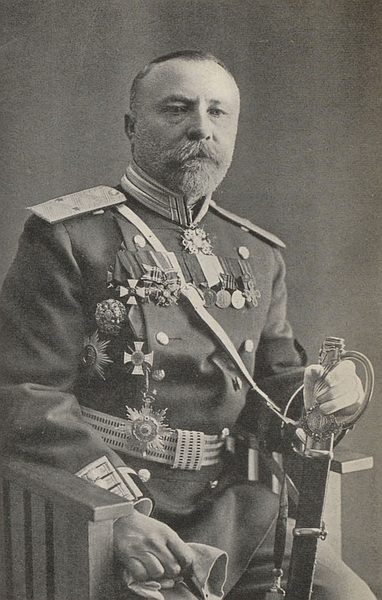
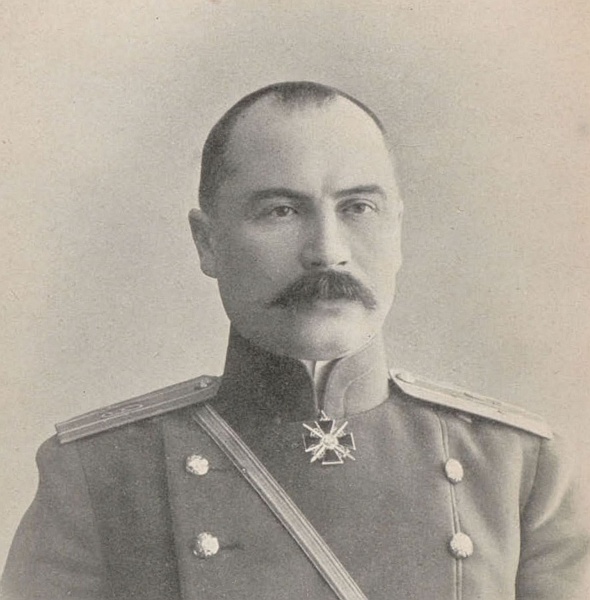
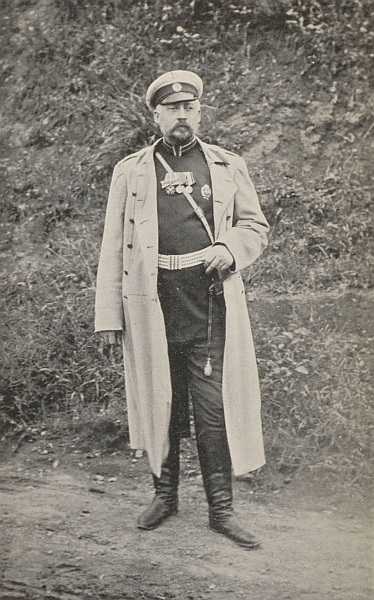
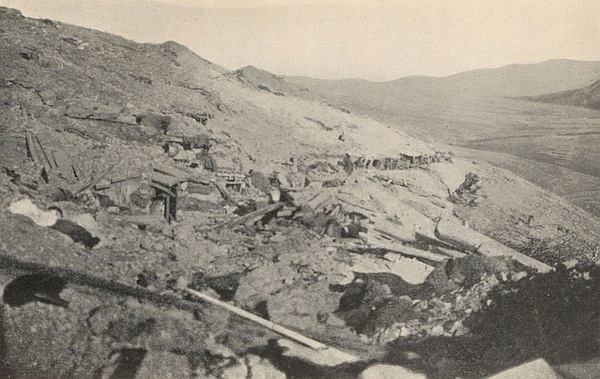
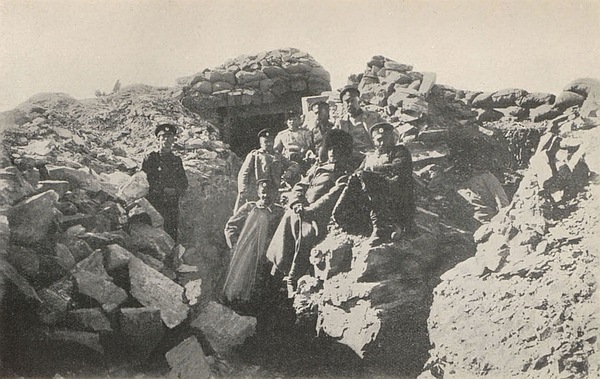
The author severely wounded—Final assault and capture of 203 Metre
Hill on December 5—The hospitals—Death of General Kondratenko,
December 15—Retreat from Interval Hill, December 25—Evacuation
of Fort Erh-lung and part of the Chinese Wall,
December 28—Japanese attack on the Chinese Wall, December 30—Destruction
of Fort Sung-shu, December 31—Capture of Wang-tai,
December 31—Surrender of the fortress, January 2, 1905.
Having finished tea and exhausted our conversation,
we decided to have a rest, but shouting and
firing quickly brought us out of the bomb-proof.
It turned out to be a false alarm. I climbed into
the connecting trench and made sure that all was
right, though the men seemed to be in a restless
condition and were obviously anticipating serious
fighting. I went back to the road and joined a
group of officers there.
We all of us noticed how the Japanese batteries
at Shui-shih-ying were sweeping the whole of our
rear. Just as I was ruminating over this ominous
fact there was a tremendous roar.... I felt a fearful
blow on the left side of my head, and was thrown
into the ditch.
Dazed and all but unconscious, I was unable to
struggle to my feet again. However, I was happy
in the thought that I had not been killed outright.
Some one assisted me to my feet and held me
up, and I then saw Major Veselovski and several
other officers lying dead near me, the former having
half his head blown away. To my left, most of the
men of the dressing station were lying piled one
on another, and the remainder were already at
work among their fallen comrades. Lieutenant
Rofalovski, a very brave fellow, who had formerly
been my orderly officer, suddenly appeared on the
scene and helped to carry me below. I thought
that I could walk, but was hardly in a fit state to
judge.
So I was carried down to the lower dressing station,
feeling a stream of warm blood trickling down my
neck, and on arrival there my head was bandaged.
Of what happened after that, I have not much
recollection, but I remember people talking from
time to time as I lay in a semi-conscious condition.
Finally I lost all consciousness, until I heard some
one say: “That is Colonel Tretyakov.” I then
opened my eyes, and at the same moment felt a
sharp, stabbing pain on the left side of my face and
head. I was being carried along on a stretcher. Some
one was riding behind me, and the sound of hoofs
on the hard road beat painfully into my head. “Who
is riding?” I asked. They told me I heard my
own chargers, which were always kept under shelter
near the kitchens when I was on the hill. By the
time we reached the town, consciousness had completely
returned, but the pain in my head and neck
increased, and one of my eyes throbbed badly. I
thought that it must have been put out, and
touched it with my hand, but it seemed to be
all right. I could not see with it, because my
head and that side of my face were covered with
bandages.
A few minutes afterwards, my stretcher was put
down, and a doctor bent over me. “How do you
feel?” he asked. “My head is very painful.” The
doctor examined me and said that I was going on
well. Feeling somewhat encouraged by this, I sat
up on the stretcher, but my head ached terribly
and I felt dizzy. I heard some one say in a
whisper: “Well, there’s no hope; the brain is
severely lacerated.”
I involuntarily felt my head, but it seemed to me
to be all right. Then it dawned upon me that they
were referring to the unfortunate commandant,
Veselovski. Soon afterwards, I was taken to the
Red Cross Hospital and comfortably installed
there.
On examination the surgeons found a number of
small splinters in my head and neck, as well as a
very large one in my eye, which they removed
at once. There was one big splinter in my neck,
which had lodged near the spinal column and prevented
me from turning my head. I could even
feel it with my hand. Then they applied the
X-rays and extracted it, but a bit of splintered
bone was left, which I can feel even now.
For three days I lay racked with pain, but after
that the pain grew less and I began to take an
interest in what was going on around me.
But I am going on too fast.
Lieutenant-Colonel Saifoolin took my place on
the hill, but he was wounded in the same arm,
and almost in the same part, in which, during
the battle of Nan Shan, he had been wounded
before.
On the evening of December 6 I heard a rumour
that 203 Metre Hill had been captured, and on the
7th my adjutant arrived and confirmed this disastrous
intelligence.
On the fall of 203 Metre Hill we abandoned Akasaka
Yama, as well as Division and False Hills. Division
Hill was an irreparable loss to us, as it was not only
capable of being defended step by step, but, moreover,
it protected Ta-an-tzu Shan Fort. Without
doubt, the defenders could have held out for some
time longer. Colonel Irman himself tried to recapture
it, but was unable to collect sufficient men
for the purpose. I also heard that the following
men remained in the commandant’s bomb-proof:
Lossev, a telephonist, Second-Lieutenant Goudkov,
the wounded commander of our 6th Company, and
part of our 1st Scout Detachment, who refused to
leave the hill and remained at their post in the
right breastwork.
With these men in the work it might have been
possible to drive out the Japanese once again, but
apparently General Kondratenko considered it inexpedient
to continue holding the hill at a possible
cost of 500 men per day, and this, perhaps, was a
sufficient reason for evacuating it. Colonel Irman
had to send several men to the breastwork with
direct orders to the 1st Scout Detachment to
leave the hill, before they would forsake their post.
The following is the account of the final struggle
for 203 Metre Hill as I heard it from Captain
Sirotko.
About 1 p.m. on December 5 the 9th Company[122]
was moved from the staff headquarters to 203
Metre Hill. Thirty-six men of the Medical Corps
had just been added to it, so that it now consisted
of one company officer, two acting ensigns, and
102 rank and file. General Kondratenko in person
gave the company an order to reach the hill as quickly
as possible.
Under a heavy rifle fire, which caused several
casualties, the company reached the foot of 203 Metre
Hill about 2 p.m. Just as it reached the hill,
the Japanese captured the whole of the crest-line
and began sweeping the road in rear with rifle fire
and throwing down stones and hand grenades. Our
6th Company, posted on the reverse slopes, suffered
heavily from these missiles.
The trench above the road was full of riflemen of
various companies and units, but they could not be
induced to leave their cover.
Therefore, Lieutenant-Colonel Saifoolin ordered the
9th Company to advance across the open to the left
of the trench. Under a hail of bullets, stones, and
grenades, the company charged up with the bayonet
and drove the enemy out of the ruined trench on
the crest-line. Then the remainder of the men,
encouraged by their comrades’ success, made a rush
for the summit.
The company, with Captain Sirotko, Acting Ensigns
Lesenkov and Grouzdev, and the squad and section
commanders at its head, then rushed out of the
position it had just taken, and charged over the crest,
supported on its right flank by the 6th Company
under Captain Sazonov and Second-Lieutenant
Goudkov. They were, however, met by such a
storm of bullets, shrapnel, and grenades, that in a
few moments they lost half their men, Second-Lieutenant
Goudkov being very severely wounded.
Captain Sirotko was badly wounded in the head
and arm, and, losing consciousness, fell backwards
down the hill. When he came to himself, all the
men had again retreated into the trench, which
was wreathed in flames on its left flank where the
telephone bomb-proof stood. All the officers were
now hors de combat, except on the right flank, where
Lieutenant-Colonel Pokrovski, who had replaced
Lieutenant-Colonel Saifoolin, badly wounded while
commandant of the hill, was still unhurt. Two more
attacks—one led by Lieutenant-Colonel Pokrovski,
the other by Colonel Irman—were equally unsuccessful,
and cost us dear. Nevertheless, our men
still clung to the rear slopes of the hill.
About midnight, when Captain Sirotko had been
attended to and had somewhat recovered, General
Kondratenko, who was at the staff headquarters,
sent him four midshipmen and an acting ensign of
the 27th Regiment, under whom another attack on
the Japanese above might be made. By this time,
however, the enemy had succeeded in dragging some
machine guns to the top of the hill, which was now
strongly held. Realizing this, and that enormous
losses would be incurred in any further attacks,
Colonel Irman decided to evacuate the hill, and gave
the order for a general retreat.
It is a pity that we did not adopt the Japanese
tactics, of overwhelming the enemy with gun fire
and then seizing the hill without loss.
* * * * *
During this fighting the 9th Company lost all its
officers, and 60 per cent. of its men were killed or
wounded. From September 6 to December 22 this
company lost 253 men killed and wounded, i.e.
60 per cent. in excess of its actual war strength of
155 men. It had performed the following duties:
covering the retreat from Namako Yama; three
bayonet attacks on the enemy occupying the trenches
on the left flank of Akasaka Yama—all of them
successful; the repulse of numerous attacks on the
left flank of Akasaka Yama; and the three last
gallant, though unsuccessful, attempts to recapture
203 Metre Hill.
* * * * *
The Red Cross Hospital was abundantly supplied
with everything necessary for such an institution in
a besieged fortress.
Thanks to the number of nurses, and their tender
care of the wounded, the hospital was more or less
like one’s own home, and the patients felt themselves
very comfortable there after life in the trenches.
In the evening numbers of officers came in from
the fighting lines to have their wounds dressed, and
they had much interesting news to tell us. The
stories I heard from them, and from those who were
lying there wounded, were so interesting and so
detailed, that if it had been possible to write them
down, I could have compiled a full and instructive
account of the whole siege. But, as it was, I was
too weak to attempt the task.
What depressed me and every one else was the
thought that we were being beaten without being
able to defend ourselves.
Taking into consideration the enormous superiority
of the enemy in guns, and the scurvy that was
raging in the fortress, one could almost with certainty
fix the period within which the final stand
must be made. In my own mind I allowed about
two months. News from the Manchurian Army
was far from reassuring, and gave us no hope of
relief.
For three days after the fall of 203 Metre Hill the
Japanese bombarded our ships. The naval men
who came in said that the fleet was now doomed.
It would soon be at the bottom of the sea, and
without it the squadron coming from home would
be useless in view of the enemy’s strength.
I cannot understand how any of us could have
buoyed ourselves up with the hope that our Far
Eastern Fleet was a match for the Japanese.
Was it, indeed, impossible to have foreseen that
they would sooner or later protect their own
interests? Had we realized the situation and
sent three or four more battleships[123] to the Far
East, there would have been no war and above all
no triumph for the Japanese.
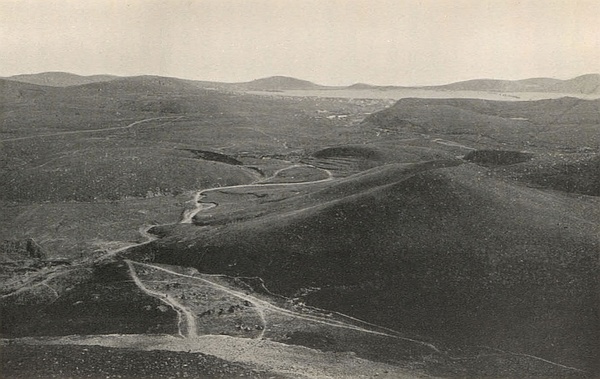
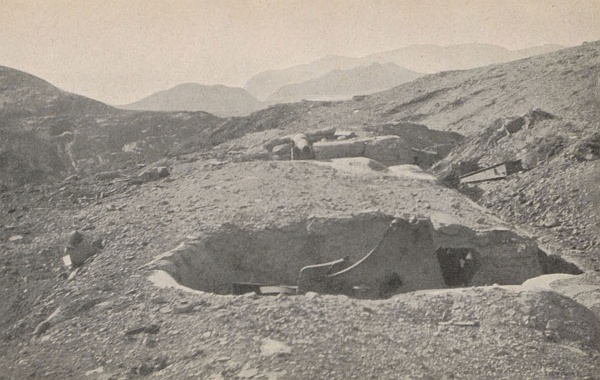
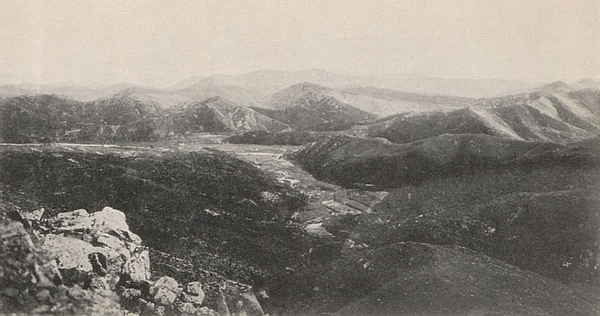
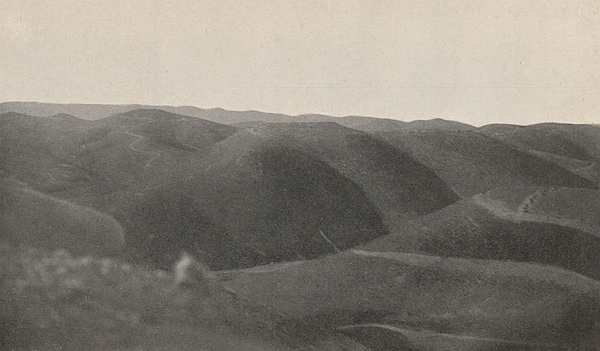
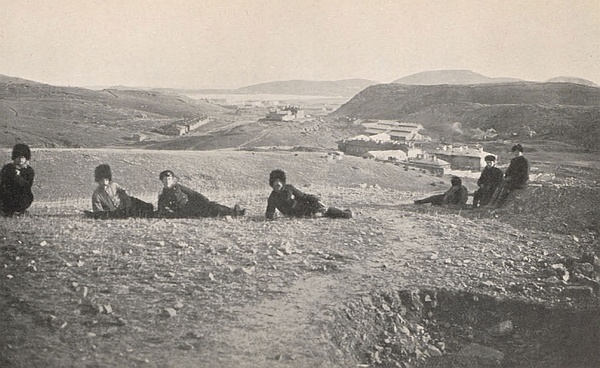
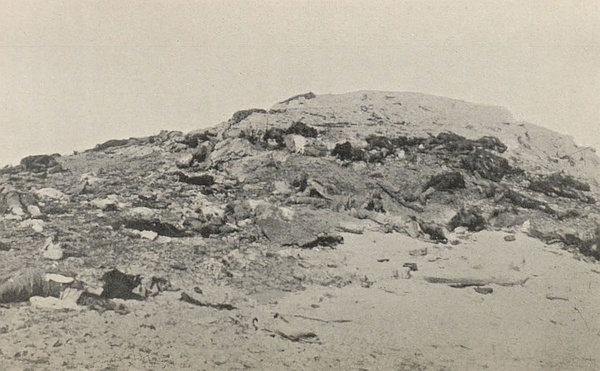
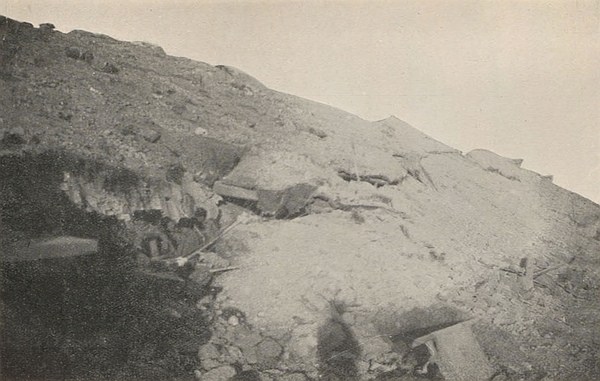
GENERAL VIEW LOOKING SOUTH FROM 203 METRE HILL, SHOWING THE NEW TOWN AND THE HARBOUR.
p. 286]
To our own mistakes, to our own blindness, and
not to the enemy’s valour, I attribute our débâcle.
When we have made good our shortcomings, victory
will be ours. Of this I am assured, for I know
the characteristics of the Japanese, I know their
army, and I know their men.
I did not notice any despondency among our
officers, but good ones were becoming scarce.
An officer from Fort Chi-kuan told us that the
Japanese had for some time been masters of the
ditch, but, fearing to attack us, remained on that
side of the parapet.
Our men were rolling 10-lb. naval mines into the
ditch, and I can imagine the effect of the explosion
of these implements of destruction. The Japanese
tried to drive us out of the caponier of this fort by
burning in it material soaked in arsenic. Our men
were stifled by the fumes, and the sentries in the
casemates had to be relieved every few minutes.
Fort Erh-lung was in a similar plight.
On the evening of December 16 a report reached
us that General Kondratenko had been killed. I
refused to believe it, but a few minutes afterwards
some wounded eye-witnesses were carried in—a
young artillery officer, and an ensign of a Reserve
Engineer Company, named Schmidt—who verified
the rumour.
It seems that about 8 p.m. on the 15th, General
Kondratenko went to Fort Chi-kuan, nearly all the
senior officers of that section of the defence being
already there, amongst others Lieutenant-Colonel
Rashevski, Major Zedginidzi, and Lieutenant-Colonel
Naoomenko. They had been summoned to
discuss the question of further defensive measures
at that point, as the defenders were in desperate
straits from the poisonous gases they encountered
during mining operations.
The casemate where the conference took place
having been struck more than once by 11-inch
shells, the ruined part had been shut off by a stout
partition made of baulks, and a hole, made by a
shell, in the vaulted roof had been filled up with
loose stones, resting on a pile of mortar and heavy
fragments of beams, with which the interior of
the casemate was strewn. This I had myself
noticed during occasional visits to this ill-omened
fort.
General Kondratenko sat at the table with his
back to the partition, while other officers were
seated on forms. The rest were standing near the
entrance to the casemate. Suddenly there was a
terrific explosion, and the latter, who were the only
ones that escaped alive, were blown through the
entrance, while the whole of the interior fell in.
When they recovered their senses, soldiers were
already in the casemate removing the dead. With
the General perished the flower of the officers of
that section.[124]
The death of General Kondratenko made a
lasting impression on the garrison; every one lost
heart, since we knew there was none to take his
place.
A few days afterwards, our fleet ceased to exist,
and although the ships’ companies went to swell
the numbers of our reserves, from that moment
misfortune dogged us.
On December 18 the Japanese exploded a mine
under the parapet of Fort Chi-kuan. It did not
make a very large breach, and the garrison retreated
from the parapet to the retrenchment behind, and
thus prevented the enemy from seizing the former;
but in spite of this, at 11 p.m. we evacuated the
fort. Captain Kvatz, the commandant, told me
when he came into hospital that he had withdrawn
his men in pursuance of General Fock’s orders, and
that he himself considered that further resistance
was not justified. Although, according to him, 100
lives were sacrificed daily in the effort to hold this
position, nevertheless I could not accept his conclusion,
since there was still one casemate in the
fort which was absolutely untouched. However, the
loss of this fort was not so very serious, because
it was on a very low site, and behind and above it
was the Chinese Wall, which had already rendered
us great service during innumerable attacks.
By December 24 I had quite recovered, and my
eye no longer pained me. Dr. Mirotvoretz had
operated successfully, and removed a splinter from
my neck.
Everything had been quiet in my section during
my illness, as the Japanese were concentrating
against the eastern front and taking no further
action against us.
I was discharged from hospital on December 25.
On reaching my section, I found that the staff headquarters
had been moved, and was now placed
behind the crest of a hill, near Battery No. 4, where
it was completely protected. With Colonel Irman’s
staff I found many of the town officials, among them
Colonel Vershinin, the head of the Kuan-tung
Peninsula district. Messing arrangements had been
made, and there was plenty of everything, but as the
charges were exceedingly high, our officers preferred to
dine separately. I felt very well during the evening,
but the wound in my neck became so painful that
night, that in the morning I had fever, and had to
return to hospital for three days.
Having had my wound disinfected, I again rejoined
my regiment.
During this time the Japanese had attacked Interval
Hill, where our 2nd and 3rd Companies,
under Lieutenant Ivanov, were posted. The attacks
began at 2 a.m. on December 25, but they were all
repulsed by our fire from the trenches and from a
lunette occupied by the 7th Company. About ten of
the enemy, however, succeeded in climbing up a hill
somewhere in rear, where they dug themselves in.
Lieutenant Ivanov reported this to Colonel Irman,
and said that he would turn them out. This was
quite unnecessary, as they would probably have
retreated later of their own accord; nevertheless,
Colonel Irman ordered the companies to leave Interval
Hill and take up a position behind our line,
in touch with our 11th Company.
On December 26 we evacuated Solovev Hill, near
Pigeon Bay.
The 5th Regiment was now concentrated on
our main inner position and occupied the space
between two permanent forts, presenting a considerably
stronger front than before; it had also been
brought up, for the third time, to its full complement.
The Japanese were now faced with a problem
similar to that previously presented by 174 Metre
Hill, but rendered additionally difficult by the existence
of permanent fortifications.
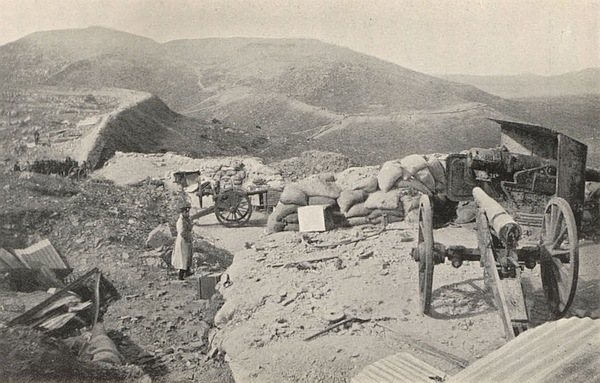
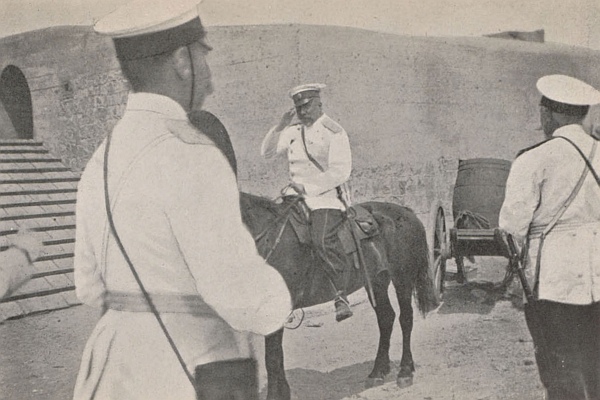
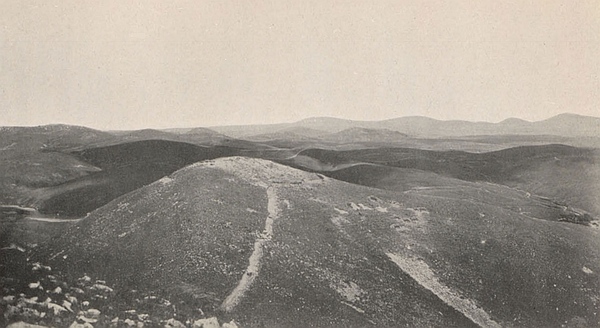
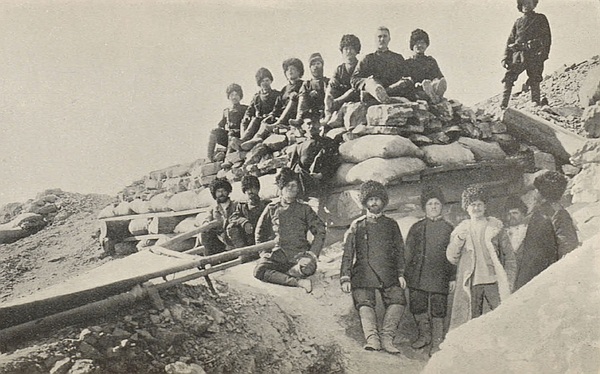
KUROPATKIN’S LUNETTE.
p. 290]
They wisely decided not to repeat their rash
attacks of the past, and contented themselves with
remaining in the positions they had occupied. Thus
everything was fairly peaceful, and I availed myself
fully of this interval of quiet, feeling that it was
safe to leave the staff headquarters occasionally.
First of all, I went to see Colonel Grigorenko, but,
being unable to find his house, I went on to the
commandant’s. There I met Colonel Khvostov, who
had just arrived with a report. We had a long
talk about the situation, and I carried away with me
the impression that no disaster was threatening us
for some time to come.
* * * * *
It seemed that, in the event of the capture of Fort
Erh-lung, the commandant had a second line of
defence, which we could hope to hold against the
enemy for a considerable time.
One would have thought that the rocky ground
would have prevented the enemy from mining
beneath Forts Erh-lung and Sung-shu, but nevertheless
by now they were making rapid progress there.
We could not make a very stubborn resistance at
these points because we had no miners, and, consequently,
no system of counter-mining. The counterscarp
galleries were merely blocked with stones and
cement, which became so solid that it would have
taken about three days to destroy, as proved to be
the case at Fort Chi-kuan.
Some time before this, General Kondratenko had
asked me to come and make an investigation. One
night (I do not remember the date) I went with
Colonel Grigorenko to Fort Erh-lung, where I found
General Kondratenko in the counterscarp gallery.
After listening attentively to the Japanese working
on the other side, we came to the conclusion that
they were tunnelling in three separate parts of
the outside wall of the gallery. They evidently
wished to make breaches in this wall by exploding
several small charges, and thus get through into
the gallery. As we could only offer a passive
resistance, we determined to block the gallery
with a large boulder and cement it hard against
those portions of the wall where the Japanese was
working. This plan was carried into effect at
once.
All this took place some time before, and the
enemy were now right under the breastwork of the
fort and ready to explode several charges. In
anticipation of this the fort was evacuated except
for sentries on the parapets. Imagine the frame
of mind of a sentry who knows that at any moment
he may be blown to atoms! The commandant,
having made arrangements for further resistance
in case of the destruction of the fort and subsequent
Japanese attack, was quietly awaiting events.
* * * * *
Having breakfasted with the commandant, and
heard a full account of the state of our defences,
I returned to the headquarters of the regiment.
The Japanese were directing a somewhat heavy
fire towards the road along the shore, but the
shells mostly fell into the water beyond.
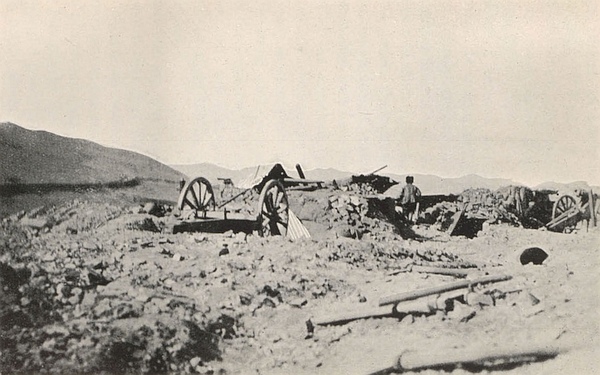
KUROPATKIN’S LUNETTE.
p. 292]
On December 28 I again rode into the town.
While crossing the bridge over the Lun-ho, I felt
the earth tremble slightly and then heard a loud
rumble in the distance. Looking up, I saw a
huge column of black smoke hanging over Fort
Erh-lung. “Well,” I thought to myself, “the
fort is blown up, and possibly taken, but there
is not much harm done, as the Chinese Wall is
behind it.”
When I reached the staff, all the details were
known. It turned out that the explosion had not
been entirely successful, as we were still masters of
the retrenchment, but we had lost heavily owing to
the rain of shells into the fort. Rumour said that
the Japanese themselves had suffered heavy losses
from the explosion, that the whole of the trench
nearest the fort had been wrecked, and that the
men of the attacking party, who were waiting in
it, had perished in the ruins.[125]
In my section everything was quiet, and we spent
the evening quite happily, congratulating ourselves
that the Japanese had not broken down the defence
of the fort, which they could have done if they had
exploded their 150-lb. pyroxylin charges under the
parapets.
But our joy was premature. The following day
we learnt that Fort Ehr-lung had been evacuated in
the night; all matériel, cartridges, and shells had
been removed beforehand. Besides the fort, we had
also abandoned that part of the Chinese Wall which
ran straight to the rear from both flanks, and had
occupied a position on a rocky crest-line behind, and
on a height to the left of it.
Our perilous situation in the centre of the line,
the deadly artillery fire, the constantly repeated
attacks, and the endless vigil wore out our men,
and their spirits began to flag in a marked degree.
In a great battle, soldiers may make a stubborn
fight, especially if victory may yet be snatched or
some great prize won for the Fatherland. But if
after constant fighting there is no apparent gain; if
they are, each moment, exposed to deadly peril;
if from each individual heroic effort is demanded,
not for one soul-stirring moment alone, but ceaselessly,
with certain death the only reward,—it is
pardonable if hearts grow faint, if men are at times
found wanting in energy and slow to carry out orders.
Then is the time for reliefs; but for us there were
none available.
Scurvy, moreover, claimed its victims, bringing in
its train suffering and weakness. Nourishing diet
was necessary, and I do not know why we spared
the artillery horses. Long ago we had lost all hope
of any offensive action, so ere this the gun horses
might well have furnished the men with meat once
a day. They may perhaps have been utilized in
other ways, though the fact remains that by this
means we might have kept, fit and well in the
trenches, more than another thousand men!
On December 30 we were dining peacefully, when
suddenly tremendous firing burst forth from all
our batteries, and the rattle of musketry along the
front told us that the Japanese were making a
determined attack.
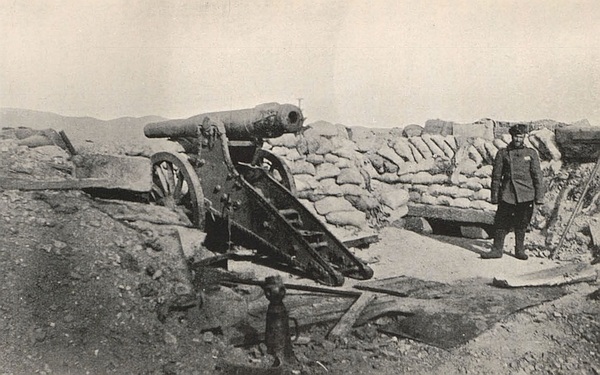
GUN IN KUROPATKIN’S LUNETTE.
p. 294]
We all rushed up on to the hill, but nothing was
visible save the smoke from our own batteries and from
bursting shrapnel. All our forts were smothered with
shell, though we could not see the enemy’s infantry.
I tried to get some news through the telephone, but
it was already overtaxed and continuously in use.
Only in the evening did we learn that the Japanese
had made a fierce attack on the Chinese Wall and
Naval Ridge beyond. This attack had been repulsed
with enormous loss to the enemy, who had,
however, succeeded in fortifying themselves at the
foot of Naval Ridge, and thus enfiladed the Chinese
Wall. Still, even that was not of supreme importance,
since the Chinese Wall had a number of
traverses and splinter-proofs along it.
In my section all was quiet. We had not a single
man in reserve, but even so we believed we could
beat back every attack. This was not the case,
however, on Lao-tieh Shan, where Major Romanovski
had practically only our mounted Scout Detachments.
The enemy constantly attacked them, and captured
another hill near Pigeon Bay. This was decidedly
serious, as now the Japanese had nothing but these
scouts between them and the other half of the
western front, where there was but a remnant of the
27th Regiment, the main portion of it being required
on the front attacked, which was held by only a
few men.
Fortunately, the Japanese seemed content with
the success already gained, and settled down for their
usual long rest, or, possibly, their men were also
required on the front of attack.
On December 31, after tea, we received news of a
further disaster. Yet once again in this disastrous
war had fortune favoured the Japanese. Fort
Sung-shu had been blown up, and, what was worse,
in one stroke the whole garrison had been annihilated.
This is what had happened: About a thousand
hand grenades had been stored in an excavation
which the garrison also used as a shelter. A
Japanese shell burst, detonating these grenades, and
the whole place collapsed on the garrison. This
was a fearful blow to us, and we deeply lamented
the death of our gallant comrades and their commandant.[126]
Fate had indeed played us a sorry trick!
We were all dispirited, and few cared to partake of
dinner that night.
On the evening of the 31st we evacuated the
Chinese Wall[127] and took up positions at Wang-tai
and on the Mitrofanievski, Vladimirski, and Laperovski
Hills.[128] It now became very difficult for us to
hold out on the front exposed to attack. We ought
to have begun fortifying the New Town on the side
facing the Old Town, but no orders were received
to that effect. What were our commanders doing?

SHELL BURSTING IN KUROPATKIN’s LUNETTE.
p. 296]
That night we were all very depressed. Every
one discussed plans for continuing the defence, if
only till the new year.[129] This was the universal wish,
and could certainly have been realized. We dispersed
at a late hour, to be aroused in the morning
by heavy firing. On climbing the hill, we saw
Wang-tai literally swept with shell, and so covered
with smoke that it was impossible to see its summit.
The bombardment continued for a long time. We
could not follow exactly what was taking place, but
learnt in the evening that the Japanese had captured
it. Our reserves had at first quickly driven
back the enemy, afterwards repulsing five further
attacks, but towards evening, when there were only
three or four of the defenders left, the sixth assault
was successful.
That evening, by General Fock’s order, the whole
of our front from Wang-tai to Chi-kuan Battery was
evacuated.
The same night the Japanese attacked Signal
Hill, near Takhe Bay, but were repulsed.
On January 2, 1905, the majority of the officers
were collected at the staff headquarters to hear the
latest reports. Suddenly an officer came galloping
out of the town and informed us that he had
himself seen two officers riding out beyond our
lines with a white flag.
My heart froze at this news. We all remained
silent for some time, seeking to hide our discomfiture.
“Can that mean surrender?” said some one at
last.
“Doubtless,” answered another.
After a full minute’s silence conversation broke
out noisily on all sides. Every one asked what was
to be done under the circumstances, and as they were
all talking at once, it was impossible to understand
anything. But general indignation against General
Fock was apparent, and every kind of accusation
was heaped upon his head. I do not remember how
long this continued, but I know that we had not yet
sat down to dinner, when we received the fateful news
by telephone: “Arthur surrendered. The officers are
allowed to keep their swords and return to Russia
after giving their parole not to take any further part
in the present war.”
There was a tremendous commotion at the receipt
of this news. The majority had no wish to surrender,
and vehemently attacked our seniors for surrendering
the fortress without the consent of all the
officers. Some of them wanted to set out immediately
for Lao-tieh Shan and continue the defence
there; others proposed to hire Chinese junks and
leave the fortress, so as not to become prisoners
of war; only a few decided to bow to the will of
their commanders. As each one insisted on his
opinion being accepted, the discussion soon became
very heated, and there was a danger of untoward
results.
Eventually those who wished to defend themselves
on Lao-tieh Shan gave up the idea, as owing
to the lack of water and fortifications of any kind
it would be impossible to hold that position. Those
who had thought of escaping in junks could not do
so, owing to contrary winds.
How long this stormy scene lasted I do not
remember, but at its very height some one rode
up and told us that the senior officers had sent a
telegram to the Tsar asking whether the exemptions
obtained by the authorities for the officers were to
be accepted or not. This news seemed to have a
quieting effect, but with one accord every one determined
to express his disapproval of the action of
the authorities by an absolute refusal of all exemptions
that had been granted as the price of the
capitulation of the fortress. All were resolved to
share the fate of the men and endure with them the
humiliation of becoming prisoners of war. It was
a praiseworthy decision, and I expressed my approval,
but at the same time several arguments against it
presented themselves. Many of these were unheard,
as there was much loud discussion. The two chief
points advanced were:
(1) As prisoners of war, the rank and file would
be separated from their officers and distributed in
various places throughout Japan, hence the presence
of the latter would be of no help to them, nor would
it lessen their hardships.
(2) As an enormous number of officers had been
withdrawn from Russia in order to make good the
losses sustained in Manchuria, the need of them at
home was a very urgent one, and in the event of
war in Turkestan, which was more than probable, we
should find ourselves in a most critical position.
Even without war the want of officers would
jeopardize the efficiency of those regiments and reserve
battalions that were left. Some 500 officers
were in question, and these in Japanese prisons
could render no service to their country in her hour
of need.
Besides all this I added: “Gentlemen, people in
Russia might think that we officers became prisoners
of war in order to spend a pleasant time in beautiful
Japan, free from all duty and hardship, at a time
when disturbances are taking place in the centre
of our own country, and she has great need of all
those who are anxious for her welfare.”
The officers of my regiment agreed with me and
decided to return to Russia, and I can add now that
they were far from being of no use here at home, as
the regiments in the south were almost without officers,
a deficiency which led, as is well known, to serious
disorders in the reserve battalions; so that their
arrival was most timely.
When the surrender of Port Arthur became an
acknowledged fact, we had great difficulty in preserving
order in the fortress.
The soldiers felt that something beyond belief had
happened, something savouring of disgrace to the
brave Russian Army and the Russian Empire as
a whole.
“Have we got to surrender, sir?” cried my men
when I inspected the companies for the last time.
“Yes, my lads,” I answered. “We have been
ordered to surrender; but no blame attaches to the
5th Regiment, and you can with a clear conscience
tell each and every one that the 5th Regiment has
always looked death bravely in the face and has been
ready to die without question for its Tsar and its
Country. Every one knows this, and no one will
dare to cast a word of reproach at you. As you
have always been, so you remain, true heroes, known
to the Japanese, to our great and dear Fatherland,
and to the whole world. Your conscience is as clear
as the sky above you.”
Many of them burst into tears, and I could hardly
speak for the sobs that choked me.
A wrinkled old man who was standing near me,
and was the sole witness of our emotion, snatched his
cap off his head, and, waving it triumphantly in the
air, shouted: “To the honour of the 5th Regiment,
hurrah!” But there was no one to follow his
lead.
Even now I feel overcome as I recall these sorrowful
moments, and I can dwell no longer on a scene
so heartbreaking.
No. 1
ORGANIZATION OF AN EAST SIBERIAN RIFLE REGIMENT
Each regiment consists nominally of four battalions.
Each battalion consists of four companies, the war strength of each of which is 240 N.C.O.’s and men.
The war strength of a rifle regiment of four battalions is:
| Officers |
79 |
|
| Officials |
7 |
|
| N.C.O.’s and men (combatant) |
3,855 |
|
| Non-combatants |
442 |
|
| |
—— |
|
| Total |
4,383 |
all ranks. |
| |
—— |
|
No. 2
GENERAL REFERENCE OF NAMES OF COMMANDERS
AT THE BATTLE OF NAN SHAN (pp. 41–61)
Commanding 5th Regiment: Col. Tretyakov.
„1st Battalion: Lieut.-Col. Saifoolin.
„2nd Battalion: Lieut.-Col. Bielozor (killed); replaced by Major Stempnevski (jun.).
„3rd Battalion: Lieut.-Col. Dounin.
Company Commanders
No.4. Capt. Shastin.
„6. Major Gomsiakov (killed); Capt. Sichev (superseded); Lieut. Popov.
„7. Major Stempnevski (jun.).
„8. Capt. Makoveiev (killed); Capt. Sakarov.
„9. Major Sokolov.
„10. Major Goosov; Half-Company, Second-Lieut. Merkoulev.
„11. Capt. Boochatski.
Scout Detachments
No. 1. Lieut. Vaseeliev.
„3. Capt. Koudriavtsev and Lieut. Choulkov.
Mounted Detachment: Capt. Andreievski and Lieut. Sietchko.
Guns
Field Batteries: Lieut.-Cols. Romanovski and Petrov.
Machine Guns: Second-Lieut. Lobyrev.
Naval Guns: Midshipmen Shimanski and Doudkin.
Mountain Guns: Lieut. Naoomov.
Bullock Battery: Second-Lieut. Sadykov.
13th Regiment
1 Company (not numbered): Capt. Lubeemov; Capt. Teemoshenko.
No. 2 Company: Capt. Rotaiski.
Scout Detachment: Lieut. Bandaletov.
14th Regiment
No. 3 Company: Capt. Ushakov.
1 Company (not numbered): Capt. Kousmin.
Scout Detachment: Lieut. Roosoi.
No. 3
According to our Official History none of the Japanese divisions
landed near Terminal Point itself, but in the first place made
use of Pi-tzu-wo and Hou-ta-shih, and afterwards Dalny. There
are two Ta-scha rivers, 15 miles apart, the most northerly one
being that indicated in the text.
No. 4
The Japanese went down into the water on the right flank as
the tide receded, and sat or lay there until ready for their final
attack. Their opponents apparently thought them dead, and
later were surprised by an attack from that quarter.
To see detail, click on map to display a larger version.
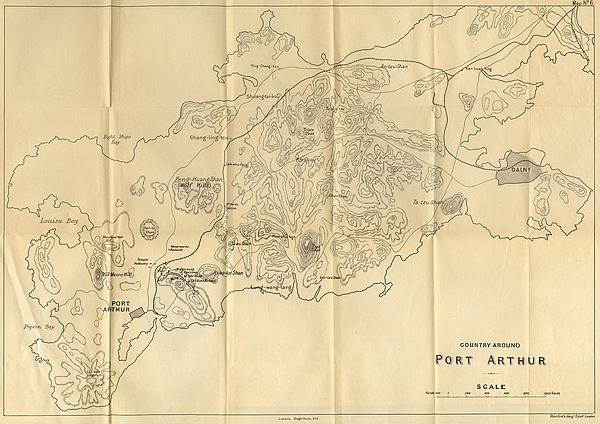
COUNTRY AROUND PORT ARTHURMap No. 6.
London: Hugh Rees, Ltd.
Stanford’s Geogl. Estabt., London.
Afanaisev, Lieutenant, 5th Regt., 94, 110, 136
Agapov, Acting Ensign, 5th Regt., 128
Akasaka Yama, defences of, 135;
condition of works, 156, 157;
events on, Nov. 28, 1904, 235;
account of fighting round, 273 et seq.
Alalikin, Naval Lieutenant, 129
Alander, Captain, 5th Regt., 186
Ammunition, false economy in expenditure of, 210, 211
Andreiev, Artillery Captain, 117 (wounded)
Andreiev, 2nd Lieutenant, 5th Regt., 109, 110 (wounded)
Andreievski, Captain, 5th Regt., 22
Anikin, Acting Ensign, 27th Regt., 172
Artillery, destructive effect of Japanese, 35, 48, 49, 72, 73, 97, 98, 99, 100, 101, 109, 117, 120, 134, 180, 223, 226, 236, 238, 270, 288, 297
Artouk, Naval Artificer, 259
Astafiev, Major, 5th Regt., 120
Balashov, Surgeon-General, 130, 132
Balloon, use of, by Japanese, 212
Bandaletov, Lieutenant, 13th Regt., 46, 57
Baranovski, guns, 109
Bashchenko, Sergeant-Major, 5th Regt., 85
Baum, Captain, Staff Officer, 188
Bayonet fighting, 80, 240, 274
Beedenko, Major, 27th Regt., 136
Bereznouk, Able Seaman, 260
Bieli, General, Commander of Fortress Artillery, 115
Bielozerov, Captain, 5th Regt., 124, 129 (wounded), 239, 240
Bielozor, Lieutenant-Colonel, 5th Regt., 25, 43, 45, 51, 58, 59 (wounded and taken prisoner)
Bitzouk, 2nd Lieutenant, 5th Regt., 128 (wounded)
Bobirev, 2nd Lieutenant, 5th Regt., 200 (wounded)
Bobr, Russian gunboat, in action during battle of Nan Shan, 44
Bogdanovitch, Lieutenant, 5th Regt., 154
Boochatski, Captain, 5th Regt., 40 (severely wounded)
Boudarev, Seaman, 260
Boudiarnski, Lieutenant-Colonel, 27th Regt., 273
Butorin, Rifleman, gallantry of, 192
Cattle driven into Port Arthur from Chin-chou, 66
Chang-chia-tun, eye-witness’s account of reconnaissance in direction of, 34;
Russian losses, 37
Chi-kuan, Fort, evacuated by Fock’s orders, 289
Chin-chou, occupied as an advanced post, 9;
measures for its defence, 38;
attack on, 39;
assault and capture by Japanese, 42
Chinese workmen, employment of, by Russians at Nan Shan, 12
Choulkov, Lieutenant, 5th Regt., 79, 80, 81, 107
Churbanov, Captain, 27th Regt., 176
Concealment, Japanese skill in, 33, 97, 117
Connecting Ridge, works on, 114;
evacuated, 133
Co-operation between army and navy, 18, 44, 49, 93
Dalny Bay, its suitability for landing operations, 20
Danger, psychological effect of, 144
Dead, Russian form of address to, 49 and note
Decorations, prompt award of Russian, 260
Defeat, causes of Russian, 286
Deitchman, Naval Ensign, 233, 234 (killed)
Diantrougov, Ensign, 28th Regt., 182 (killed)
Ditchmann, Naval Lieutenant, 18;
sinks a Japanese ship, 20
Division Hill, condition of works on, 157
Dmetrevski, Lieutenant-Colonel, Chief of Staff, 4th Division, 63
Dostovalov, Major, Intendance Dept., 228, 229
Doubeedi, Colonel, Naval Construction Dept., 201
Doudkin, Midshipman, 67, 85, 109, 185
Dounin, Lieutenant-Colonel, 5th Regt., 29, 77, 78;
skilful conduct of retreat from the Position of the Passes, 81, 82
Ehr-lung, Fort, bombardment of, 232;
evacuation of, 293 et seq.
Elechevski, Acting Ensign, 5th Regt., 107, 209
Eremeiev, Lieutenant-Colonel, 5th Regt., 11
Evlanov, Sergeant-Major, 5th Regt., 80 (wounded)
Evstratov, Lieutenant, 5th Regt., 142, 143 (mortally wounded)
Extension, danger of undue, 17
Extinct Volcano, capture of, by Japanese, 136 et seq.
Felitzin, Captain, 158 (wounded), 200 (wounded)
Feng-huang Shan, retreat from, and description of works on, 85, 86;
eye-witness’s account of retirement from, 87, 88
Fenster, Lieutenant of Engineers, 238, 244, 246
Fetter, Lieutenant of Engineers, 203
Field works, necessity of infantry being expert in construction of, 146
15th Regiment, 17, 23, 28, 63, 76
5th Regiment, arrival of 1st Battalion at Chin-chou, 1;
reinforced by 3rd Battalion, 7;
initial distribution, 11;
casualties at Nan Shan, 54;
posted to Port Arthur defences, 67;
losses in the Position of the Passes, 77;
disposition after retreat from Feng-huang Shan, 85;
casualties on 174 Metre Hill, 133;
passim
Fock, General, plans for defence of Nan Shan, 15 et seq.;
directness of his orders, 27;
makes reconnaissance in force, 28;
his “Notes,” 217 and note;
orders evacuation of Fort Chi-kuan, 289;
directs withdrawal from Wang-tai, 297;
passim
Fofanov, Major, 5th Regt., 213
Fomeenitch, Seaman, gallantry of, 192
Fortification, field, criticism of General Fock’s methods, 86, 88
Fougasses, employment of, 153
14th Regiment, 17, 34, 42, 46, 47, 51, 52, 53, 55, 56, 57, 60, 63, 64, 82, 88, 187, 217, 274
14th Reserve Battalion, 94
4th Reserve Battalion, 102, 108, 111
Frantz, Major, 28th Regt., 120, 122
Frost, Lieutenant, Paymaster of 5th Regt., 158 (wounded), 200 (wounded)
Galileiev, 2nd Lieutenant, 5th Regt., 128
Gavreelov, Major, 13th Regt., 121
Gemmelmann, Major of Engineers, 148, 196, 203
Glieb-Koshanski, Lieutenant, 5th Regt., 56
Glinski, General, 4, 5
Gobiato, Major of Artillery, 190, 214
Golden Hill, fire from, on Japanese ships, 227
Golenko, Lieutenant, 5th Regt., 11
Golitsinski, Lieutenant-Colonel, 14th Regt., 60
Gomsiakov, Major, 5th Regt., 36, 37 (taken prisoner and died of wounds)
Goosakov, Lieutenant-Colonel on Staff, 73 (killed on Yu-pi-la-tzu Hill)
Goosakovski, Major, 13th Regt., 121, 122, 127
Goosov, Major, 5th Regt., 11, 42, 57
Gorbatovski, General, 226, 230, 242
Goudkov, 2nd Lieutenant, 5th Regiment, 282, 284 (severely wounded)
Grigorenko, Colonel, 68, 220, 223, 224, 225, 227, 291
Ground, failure of Russian soldiers to take advantage of, 26
Grouzdev, Acting Ensign, 5th Regt., 283
Guides, Russian neglect to post, at cross-roads, 25
Guns, Russian, faulty position of, 113;
a danger to their own troops, 139, 208;
naval, for use on land, 162
Hand grenades, mechanical means of ignition required, 204, 205
Hand grenades, Russian manufacture of, 260 note
Hand grenades, use of, by Japanese and Russians, 171, 177, 222, 234, 237, 238, 239, 240, 247, 249, 251, 253, 256, 260, 261, 267, 268, 270, 273, 277, 283, 296
Headquarter Hill, the fight for, 96 et seq.;
detailed account of fighting round, 105 et seq.;
Russian losses, 111
Height, 426, detailed description of fighting on, 108 et seq.
Horses, carcasses of, used for food, 159, 212, 265
Hospitals, Russian, 285
Howitzers, Japanese 11-inch, damage done by, 215
Hsiao-ku Shan, capture of, by Japanese, 92
Hunhutzes, depredations committed by, 2, 3, 6, 22
Initiative, absence of, in Russian soldier, 27
Iolshin, Captain, General Staff, 102
Irman, Colonel, in command of western section of Port Arthur defences, 96 et seq.;
wounded, 205;
passim
Ivanov, Major, 5th Regt., 94, 98, 100, 103
Ivanov, 2nd Lieutenant, 5th Regt., 129, 131, 157 (wounded), 290
Japanese, the author’s estimate of the, 264
Jeltkevitch, Major, 27th Regt., 176, 181 (killed)
Jerebtsov, Lieutenant-Colonel of Engineers, 74
Kaminar, Ensign, 5th Regt., 55
Kan-ta Shan, capture of, by Japanese, 93
Kao-liang, obstruction due to, 86, 87, 89, 93, 104, 190
Kashtalinski, General, 4
Kasuga, armoured cruiser, 4, 14
Katishev, Major, 5th Regt., 104, 111 (wounded)
Khaidoulin, Lance-Corporal, gallant conduct of, 107
Kholodenko, Seaman, 260
Kholodovski, General, 7, 10
Khvostov, Colonel, 291
Kites, uselessness of, 41
Kobrintsev, Lance-Corporal, left in command on Height 426, 110
Kolmakov, Lieutenant of Artillery, 163
Kondratenko, General, killed, 287;
tribute to value of, 288;
passim
Kornilovitch, Lieutenant of Artillery, 151 (killed)
Kostoushko, Lieutenant, 5th Regt., gallant conduct of, at Yu-pi-la-tzu Hill, 72, 188, 209, 252
Koudriavtsev, Captain, 5th Regt., 11, 34, 71, 79, 80 (killed)
Kourelov, Mr., in charge of kite, 41
Kournosov, Sergeant-Major, 12th Regt., 254
Kousmin, Captain, 14th Regt., 51
Kragelski, Lieutenant, 5th Regt., heroic conduct of, at Nan Shan, 55
Kramorenko, Captain, 5th Regt., 192, 193
Krjivetz, Dr., 257
Kuropatkin, General, 22
Kvatz, Captain, in command of Fort Chi-kuan, 289
Kvitkin, Captain, 5th Regt., 74, 77 (killed)
Landings, difficulties of opposing, 20
Lao-tso Shan, fighting round, 72 et seq.;
detailed description, 77
Lavrov, Naval Lieutenant, 258
Leesaevski, Lieutenant-Colonel, 5th Regiment, 118, 121, 123 (wounded)
Lesenkov, Acting Ensign, 5th Regt., 283
Levitski, Captain, 13th Regt., 99
Linder, Major of Engineers, 224
Lobyrev, 2nd Lieutenant, 5th Regt., 43, 104
Losev, Naval Ensign, 252;
coolness displayed by, 272, 273
Lossev, Telephone Clerk, 282
Lubeemov, Captain, 13th Regt., 50, 51
Machabeli, Prince, Colonel, blamed for his action on Feng-huang Shan, 88;
killed on West Pan-lung Redoubt, 89, 90
Machine guns, employment of, at Nan Shan, 47
Makoveiev, Captain, 5th Regt., distinguishes himself at Nan Shan, 55, 58
Makurin, Acting Ensign, 5th Regt., gallant conduct of, on 203 Metre Hill, 213;
wounded, ibid.
Maps, indifferent quality of Russian, 23
Marines, Russian, lacking in foresight, 136
Melik-Porsadanov, Lieutenant, 204, 260
Melinkov, Naval Lieutenant, 174
Merkoulev, 2nd Lieutenant, 5th Regt., 42, 55, 111 (killed)
Mines, naval, use of on land, 181, 191, 287
Mirotvoretz, Dr., 289
Mixed units, unreliable character of, 67
Molchanov, Rifleman, gallant conduct of, 108
Moosalevski, 2nd Lieutenant, 56
Morosov, Naval Ensign, 234, 252
Mortars, Japanese 11-inch, 200, 201
Moskvin, Acting Ensign, 5th Regt., 271, 272
Moskvin, Major, 5th Regt., 158, 165, 166, 169, 173
Moukin, Ensign, 5th Regt., 111 (killed)
Mt. Sampson, 15;
fighting round, 29, 30
Mousious, Major, 5th Regt., 196, 216
Music, reassuring effect of, 62, 76
Nadyein, General, 17, 19, 31 (wounded);
passim
Namako Yama, works and armament on, 135, 147, 148, 156, 157, 163, 164, 166;
night attacks on, repulsed, 165, 166;
the struggle for, 167 et seq.;
abandonment of, 174
Nan-kuan-ling, retreat to, 62 et seq.
Nan Shan, vulnerability of position of, 9;
armament, 21, 43;
battle of, 43 et seq.;
inquiry into conduct of battle, 56 et seq.;
rewards given, 65
Naoomenko, Lieutenant-Colonel, 102, 104, 287
Naoomov, Lieutenant of Artillery, 18, 19, 29, 78, 81
Navy, Japanese, its value at first underrated by Russians, 14;
its co-operation in the battle of Nan Shan, 44, 49
Navy, Russian, optimism regarding, 4, 5;
discipline, 13;
its doom, 286, 288
Nazarov, N.C.O., 5th Regt., 106
Nefedov, Seaman, 259
Nejentsev, Lieutenant, 5th Regt., 239
Nikizhin, General, 149, 220
Nikoladtse, Prince, Captain, 258
Nisshin, armoured cruiser, 4, 14
Non-combatant companies, Russian, 232 and note
Noskov, Lance-Corporal, 5th Regt., 109
Obstructions, various forms of, 153, 156, 218
Officers, qualities requisite to make good, 262, 263
174 Metre Hill
work on its fortification, 92;
works and armament, 114;
capture of, 116 et seq.;
Russian casualties, 134;
distribution of troops after loss of, 135
Optimism, Russian, at beginning of war, 13;
for the future, 265
Orders, indefinite nature of Russian, 23;
directness of General Fock’s, 27;
conflicting, 36, 53
Organov, 2nd Lieutenant, 5th Regt., 257
Osmanov, Captain, 122
Passes, Position of the, fighting for, 71 et seq.;
withdrawal of Russians from, 75
Pavlovski, Major, 5th Regt., 6, 21
Petrov, Lieutenant-Colonel of Artillery, 99, 101 (mortally wounded), 107
Pilshchikov, Seaman, 259
Pi-tzu-wo, 3, 10, 16;
landing of Japanese at, 22
Platonov, Sergeant-Major, 5th Regt., 274
Podgourski, Naval Lieutenant, 181, 183, 184, 186, 191, 192, 246
Pogdanovitch, 2nd Lieutenant, 5th Regt., 183 (killed)
Pokrovski, Lieutenant-Colonel, 284
Popov, Lieutenant, 5th Regt., 71
Port Arthur, fall of first shell in, 92;
shortness of means of transport, 148;
surrender, 298 et seq.
Preegorovski, Captain, 5, 66
Protasevitch, 2nd Lieutenant, 28th Regt., 176
Ptooski, Bombardier, 44
Radetski, Lieutenant-Colonel, 5th Regt., killed at Nan Shan, 46
Rashevski, Lieutenant-Colonel, 224, 287
Ravinski, Peter, 149 (wounded), 257
Reconnaissances in force, Russian, 22, 28
Reinbott, Lieutenant of Engineers, 244
Reishetov, Acting Ensign, 5th Regt., 248 (wounded)
Reiss, Colonel, 220, 221
Reserves, proper use of, 60
Responsibility, divided, 61
Rifles, clamping down of, for night firing, 208
Rofalovski, Lieutenant, 5th Regt., 280
Romanovski, Lieutenant-Colonel of Artillery, 25, 29, 30, 31, 35 (wounded), 36, 86, 97, 99, 190
Romanovski, Major, 295
Roosoi, Lieutenant, 14th Regt., 46, 56
Rotaiski, Captain, 13th Regt., 47, 50, 52, 56, 57, 99, 110
Sadykov, Second-Lieutenant, 5th Regt., commanding bullock battery, 31, 52
Saifoolin, Lieutenant-Colonel, 34, 43, 281 (wounded), 283, 302
Saliarski, Major, 5th Regt., 54
Saltovski, Captain, 5th Regt., 168 (killed)
Sappers, excellent work of, 241
Saratski, Major, 5th Regt., 85
Schiller, Major, 138
Schwartz, Major of Engineers, 7
Shakovskoi, Second-Lieutenant, 5th Regt., 262
Shchenakin, Acting Ensign, 5th Regt., bravery of, 132
Shcherbachev, Naval Lieutenant, 136
Shimanski, Midshipman, 43
Shishkin, Acting Ensign, 80, 81, 182 (killed)
Shui-shih-ying, village of, Japanese field artillery massed at, 259, 264, 266, 268, 279
Sichev, Captain, 5th Regt., 37 (superseded), 101 (wounded), 188, 191
Siedelnitski, Lieutenant, 5th Regt., 94, 136
Sietchko, Lieutenant, 5th Regt., 18
Singing on the march, Russian practice of, 27
Siromiatnikov, Lieutenant, 5th Regt., 238
Sirotko, Captain, Frontier Guard 170, 172, 173, 174, 273, 275, 276, 277;
account of fighting on 203 Metre Hill, 282 et seq.;
wounded, 284
Slounin, Father Vasili, 158 (wounded), 200 (wounded), 235
Smirnov, General, passim
Soimonov, Midshipman, 253, 254, 255, 256
Sokkatski, Major, 28th Regt., 136
Sokolov, Major, 5th Regt., 38, 42;
heroic conduct at Nan Shan, 55
Soldiers, Russian, form of address of, by officers, 258 and note
Soloveiev, Major, 239
Solovev Hill, abandonment of, by Russians, 290
Star-rockets, use of, 95, 96, 98, 106, 118, 126, 188
Stempnevski (jun.), Major, 5th Regt., 18, 71
Stempnevski (sen.), Major, 5th Regt., 43, 71, 163, 176, 178, 186, 187, 188, 192, 245, 248 (wounded)
Stessel, General, passim
Stoliarov, Rifleman, distinguished conduct of, 213
Stone-throwing between combatants, 140
Strength, importance of husbanding, 145
Sung-shu, Fort, bombardment of, 232;
blown up, 296
Suvorov, Captain, 14th Regt., 34
Ta-an-tzu Shan, condition of Fort, 154
Ta-fang-shen, demolition of railway station of, 54
Ta-ku Shan, capture of, by Japanese, 92
Ta-scha River, reported Japanese landing at mouth of, 21
Ta-yang-ku North, condition of Fort, 155, 160
Terminal Point, 11;
Japanese squadron reported near, 21
Teemoshenko, Captain, 50, 51
13th Regiment, 17, 42, 43, 46, 50, 55, 57, 63, 82, 87, 88, 99, 111, 115, 121, 136, 169, 174, 187, 232
Tiddeman, Russian Consul at Chi-fu, 229
Tordan, Medical Dept., 130, 132
Trajectory, flat, false application of a principle, 87, 88
Transport service in Port Arthur, deficiencies in, 148
Tretyakov, Colonel (the author), 248 (wounded), 279 (severely wounded);
passim
Troitski, Theodore, Medical Dept., 152, 257
Trufanov, Rifleman, gallant conduct of, 192
Trusov, Corporal, 5th Regt., bravery of, 108
Tsvietkov, Lieutenant, 115
28th Regiment, 115, 119, 120, 122, 134, 136, 137, 167, 171, 172, 173, 176, 181, 183, 187, 188, 200, 232
25th Regiment, 218
27th Regiment, 77, 78, 79, 82, 136, 140, 172, 176, 177, 181, 182, 198, 206, 217, 235, 273, 274, 275, 284
26th Regiment, 82, 85
203 Metre Hill, description of works on, 134, 174;
first assault on, 174 et seq.;
garrison and armament, 176;
Japanese losses, 177, 193;
Russian losses 181;
strengthening of position, 195 et seq.;
second assault, 238 et seq.
Japanese losses, 266;
Russian losses, 271, 272, 285;
account of final struggle, 282 et seq.
Ushakov, Captain, 14th Regt., 47, 50, 51
Vagin, Corporal, 5th Regt., fine work of, 106
Vanikovski, Lieutenant, 14th Regt., 217
Vaseeliev, Lieutenant, 5th Regt., 11, 128;
Captain, 249, 250, 251 (severely wounded)
Vershinin, Colonel, Commandant of Kuan-tung District, 289
Versi, Captain, Naval Construction Dept., 161
Veselevski, Major, 5th Regt., 262
Veselovski, Major, 25th Regt., 218, 280 (killed), 281
Visoki, Major, 47
Vlassev, Midshipman, 213, 214, 260
Yarsevitch, Captain, 14th Regt., 74, 187, 189
Yasinski, Lieutenant of Artillery, 190
Yermakov, Ensign of Engineers, 196, 203, 216, 234, 237, 244, 245, 246
Yermeiev, Lieutenant-Colonel, 5th Regt., 41
Yermolov, Acting Ensign of Engineers, 265
Yi-tzu Shan, Fort, condition of, 154
Yu-pi-la-tzu Hill, struggle for, 72 et seq.
Zakrejevski, Acting Ensign, 5th Regt., 106 (wounded)
Zedginidzi, Major, 287
Zimmermann, Major, gallantry of, 137 (wounded)
Zmoushko, Sergeant, 5th Regt., alertness of, 107
Zoobov, Colonel, 4th Reserve Battalion, 102, 104