BEHIND WALLS AND BARBED WIRE
THE English officer reassured me.
“Be assured,” he said, “that you
will be able to interview your
Swiss Consul at Gibraltar to-day. You will
be free the moment he confirms that your
passport is in order.”
I was only too soon to learn how matters
stood in regard to this. The steam-launch
churned its way through the water, and soon
we disembarked in the inner part of the war
harbour.
Ten soldiers with fixed bayonets stood
ready at the landing-stage. A few curt
orders and, with our few belongings on our
backs, we had to fall in in two files. The
ten soldiers took us into their midst, and
at the word “Quick march” the sad procession
set out on its way. Everything
around me seemed part of a dream. I was
so horribly downcast that I was hardly
able to think. A prisoner! Was it true?
Was it possible?
It was horrible, incomprehensible! We
were being led along like malefactors, and
the population seemed to regard us as such.
The soldiers told us to hurry up. I was so
weak that I could hardly move, as the fever
still held me in its grip and I had taken
nothing except quinine for the last three
days. The sun beat down on our backs, and
I had never felt more desolate or more
hopeless.
We climbed higher and higher, through
narrow, hot streets. Soon the houses
gave place to bare rocks on either side.
After an hour we had reached the highest
summit of Gibraltar. Orders rang out,
barbed-wire fences and iron doors opened
and clanged to, chains and bolts rattled.
A prisoner!
We were first brought to the police-station,
and there subjected to an examination. I
protested with energy and demanded to be
taken at once to my Consul, as I had
definitely been promised this by the English
officer. But they laughed regretfully. We
were not the first, alas, that had been
brought before them and had made this
same request! How many had probably
stood in the same place and been obliged
to bury their hopes in the same way!
After that examination we had to submit
to being searched.
“Have any of the prisoners got money?”
Of course no one answered. We were
ordered to undress, and every garment was
closely searched for money, cameras and
especially letters and papers. I came third,
and was allowed to keep my shirt on.
“Have you got any money?”
“No.”
The sergeant-major passed his hands all
over my body. Suddenly something chinked
in the left-hand pocket of my shirt.
“What is this?”
“I don’t know.”
He now plunged his paw right in, and
what did he extract? A beautiful twenty-dollar
piece of the best American gold, and
also a small mother-of-pearl button, which
had betrayed me by knocking against the
coin. This comes of being too tidy! Had
I thrown it away two days before, instead
of hoarding it carefully, this would not have
happened. The English soldier rejoiced, for
such finds did not occur every day. But
now he examined me more thoroughly.
And to my distress he extracted from my
other breast-pocket, as well as from each of
the two trouser-pockets, a lovely golden
piece and my small Browning revolver,
which had been my faithful companion
all these months.
When I had been completely despoiled
I was allowed to dress again and to rejoin
my comrades in misfortune in the prison
yard. After that we took possession of our
quarters. About fifty German civilian
prisoners greeted us uproariously. They
had been in captivity ever since the beginning
of the war, and seemed to have recovered their
sense of humour. Our new friends invited
us at once to share their meal. We threw
ourselves like savages on the bread pudding
which they had prepared for themselves.
Then we started on our work.
In the first place, we were made to carry
coal and water. We were detailed according
to height, and accidentally I fell in with
the dirty Swiss whom I had already regarded
with such repulsion on the ship.
In the meanwhile we went on dragging
sacks of coal, and we were careful not to fill
the bins to their full capacity. Were we
not too weak to do so properly? After
we had carried on this job for some time
we were allotted our soldiers’ mattresses,
consisting of three parts, and as hard as
stone; also two blankets. We were allowed
to rest that evening. But the first thing
was to get a wash. I well recall the scene.
My filthy colleague placed his basin near
mine, and stripped with the utmost placidity.
Hang it all! I had not expected so much
cleanliness, and inspected him critically. A
perfectly shaped body and clean—spotlessly
clean! But head, neck and hands! I
shuddered. And then I stopped in the
midst of my ablutions. My eyes opened
wide in astonishment. The water of my
colleague was coal-black; but he was completely
metamorphosed. His black, oily hair
had turned into shining blonde, his face
looked fresh and white, and showed delicate
features, the hands were slim and elegant.
And was it possible? Across the cheek
and the temple ran the honourable scars of
students’ duels—real German scars! Such
an explosion of joy! Such a cross-fire of
questions and answers! My comrade had
been a real German student, was now at the
head of a good motor-car business in America,
and had left it all to serve his country as
an officer in the Reserve. We chummed up
quickly, and remained faithful, inseparable
friends through all the weeks of our captivity,
until fate separated us once more.
The last post sounded at ten—lights out
followed.
I had placed my mattress near a French
window, so that I could easily look through
it whilst lying on the floor. The day had
brought many changes, and only now was I
able to reflect on them.
The barracks in which we were quartered
lay at the very top of Gibraltar, on the
south, where the rocks drop straight into
the sea.
Through the window I saw, deep below
me, the wonderfully blue waters of the
Straits of Gibraltar; quite far away on the
horizon, the coast of Africa, a fine and
shining strip of land. Down below was
Liberty, ships wended their way to and
fro, carrying men, free and unfettered, who
could travel where they liked and—who
did not appreciate how marvellous and
precious it was to be free!
But that way madness lay!
The thoughts and events of the day raced
through my brain, and when I remembered
that, with luck, I might have been on one
of these boats I nearly burst with rage.
And it was my birthday too! Well, I had
planned it otherwise.
Like a madman I rolled about on my
couch. When I thought of how different
things might have been, of all I had hoped
for, and how I had pictured my future, I
gave way to utter despair, and helpless fury
brought the tears coursing down my cheeks
without my being able to check them.
Oh, longing for home—dreadful longing!
But during that night I was not the only
sufferer.
Pale faces with wide-open eyes stared at
the ceiling, and suppressed sobbing was
smothered in the blankets. The next morning,
at four o’clock, we were suddenly
awakened. The English non-commissioned
officers went through the rooms and yelled
out an order that all German prisoners had
to get ready to march off in twenty minutes’
time to sail by the next boat to England.
To England! But that was impossible!
Were we not Swiss? Had we not to see our
Consul on that very day? All our efforts
broke against the stolid, imperturbable calm
of the English. We quickly collected our
property and, exactly half an hour later,
the civilian prisoners, numbering fifty-six,
surrounded by a hundred heavily armed
English soldiers, were marched out into the
bright morning.
But we wanted to prove to the English
that our pride was unbroken. With a clear
and ringing sound, intensified by the anger
that was burning within us, we poured
forth “The Watch on the Rhine,” flinging its
notes up to the skies.
A huge transport, filled to overflowing
with English troops, awaited us below. We
had to run the gauntlet through a narrow
passage that was formed for us in the great
crowd of travellers and those who had
come to see them off. But I must admit
that nobody molested us, and that no word
of disparagement reached our ears. Room
for us was made in silence, in silence we
were allowed to pass, even here and there
we encountered a look of commiseration and
regret. On board, in the front part of the
cargo deck, a space had been partitioned off
and sparsely furnished with benches, tables
and hammocks.
There stood two sentries with fixed
bayonets; there was another couple near
the hatch over our heads. When the latter
was closed down from outside, we sat as in
a trap. The portholes of our habitation
were blinded by iron shutters, so that none
of us should be able to look out or flash
signals. After a short time a slight tremor
ran through the ship, the engines started,
and our swimming prison, rising and sinking
slightly, drifted out into the open sea.
The journey lasted for days. We sat,
closely guarded, shut up in our room. Once
a day we were allowed on deck to get
a breath of fresh air. A most primitive
lavatory had been erected on the fore-deck
with a few boards, and whoever wanted to
use it had to report himself to the sentry.
Only one person at a time was allowed to
appear on deck for this purpose. The food
was good—real sailors’ rations—especially
the bread, the butter and the abundant
supply of excellent jam. We beguiled the
time away by reading, story-telling; above
all, we discussed our future from all points
of view, and what lay in store for us in
England. The two sentries, who always kept
watch below, soon became quite friendly, and
we often frightened the poor Tommies into
fits by tales of what happened on the Western
Front.
Rough weather greeted us in the Bay of
Biscay. It was a dreadful state of affairs
for the fifty-six of us shut up in that restricted
space, without light or air, and the
majority sea-sick. The sentries, and the
English soldiers who brought us our food,
however, suffered most, and presented a
pitiful spectacle. But when we got into the
Channel the crew was seized with general
nervousness and agitation. Drills with life-belts
were held daily, our recreation-hour on
deck was suspended, and the English soldiers
never stopped questioning us fearfully in
regard to our U-boats! And didn’t we
make it hot for them!
At last, after ten days, we landed at
Plymouth. When the chain cable rattlingly
uncoiled itself, and we knew that we were
safe in port and had escaped U-boats, we
watched through the bulkhead the English
soldiers falling on their knees and singing
hymns of praise and gratitude for their
salvation from the German submarines.
Immediately after our arrival a tender
came alongside and conveyed us to terra
firma—of course under imposing escort.
The English authorities were evidently
unprepared for such a large consignment of
prisoners. They simply lost their heads.
No one knew what to do with us, no one
what to advise.
At last we were packed into a train. I
got a compartment to myself, flanked on
either side by a non-commissioned officer,
and with another one sitting opposite me,
with fixed bayonets. They had been given
strict injunctions to watch me carefully,
for the following reason: when I saw that
it was quite impossible that I should be set
free or recognized as a Swiss, I had reported
myself to my Commanding Officer in my true
colours, the others doing likewise. He
assured me that he would transfer me at
once to the first class, if I would give him
my parole never to try to escape or to fight
again in the war. As I naturally rejected this
demand with the utmost indignation, I was
sent back to the cargo-deck, the only result
being a stricter surveillance.
In the evening, at dusk, we reached Portsmouth.
At the station and elsewhere this
huge quantity of prisoners (we were fifty-six
in all) seemed to bewilder everybody
completely.
At last we were marched off to the lock-up.
There also we found great bewilderment
and confusion. The lock-up usually affords
a temporary domicile to drunken soldiers
and sailors who are picked up in the streets,
and who have an opportunity of sleeping off
their intoxication until the next day, when
they are sent back to their platoon after a
sound thrashing [sic]. An old, obnoxious
jailer, and two elderly but jovial and kindly
soldiers, were in charge. We were disposed
of in three rooms. They were totally
empty, and lit by a miserable gas jet. The
window-panes were mostly broken, it was
bitterly cold, and there was, of course, no
fire. We had eaten nothing all day, and
were looking forward to our supper, but
there was no supper. Thereupon we approached
our two old soldiers and promptly
sealed our pact of friendship. A small tip
acted miraculously—the old fogies simply
scampered off on our errands. We gave
them money, and in half an hour they returned,
groaning under a load of bread,
butter and cold meat. Two huge pots of
tea, mixed with milk and sugar, made their
appearance. We got some charcoal ourselves,
and soon the three fireplaces were
ablaze. The provisions were excellent, and
so abundant that even we, famished as
we were, could not deal with the lot.
Our spirits reached their zenith when the
soldiers slipped us in a few English newspapers.
Our mental hunger had been
greater than our physical needs, as for weeks
we had heard nothing whatsoever about the
happenings of the outer world. We did not
mind reading exclusively of English, French
and Russian victories, as long as we at
least knew something of what was going
on.
Alcohol was forbidden; but even in
England rules seemed made only to be
broken. One of our warders belonged to a
masonic lodge, members of which were
widely distributed over England and
America. My colleague, the locksmith,
happened to be Master. When the soldier
saw the Freemasons’ sign in my friend’s
buttonhole, their pact was sealed. A small
canteen flourished in the basement of our
prison, and one after another we were led
down by the kindly brother, and returned
thence fortified, with pockets bulging with
beer bottles.
The joke was that our sentries, who
stood on guard before our door, allowed us
to go away quietly, and even begged us to
bring them up a few bottles of beer. At
9 p.m. our sentries had become so chummy
that we practised rifle exercises together,
and at 11 p.m. one sentry dropped his rifle
altogether and tumbled backwards, with the
coal-box, on which he had been sitting,
atop of him.
If I had possessed the experience which
was mine after five months’ captivity, I
should have escaped even then.
In this prison, as well as in all other camps
where we foregathered with the English
Tommies, their first request, after we had
become better acquainted, was for a little
note with our address and possibly the
address of friends in Germany, and an
attestation that the English soldier So-and-so
had treated us well. These notes were
treasured by them as relics, to be produced
at the Front, or in case of capture by the
Germans.
We were given tiny camp palliasses, which
were so short that our legs projected from
the calves downwards, and so narrow that
it would have taken an ingenious circus
performer to balance his back on it. We
also had two blankets each. We slept like
logs, though, it is true, the next morning
found us all on the floor alongside the
mattresses.
On the following morning—it was Sunday—we
received the visit of an Army officer
of high rank. He inquired after our wishes.
I pointed out repeatedly that I was an
officer, and had the right to be treated as
a prisoner of war. He was most charming,
and promised me many things when we
should arrive at our destination—but kept
none of them.
At last, on the Monday, we were allowed
to leave our prison. As usual, closely
guarded by our escort, we were marched to
the harbour, where we boarded a small
steamer, and after an hour’s journey reached
a huge ship which was used as a prisoners’
camp. After a long palaver we were
obliged to put out to sea again, for the
Commandant declared that he had no information
about us, and no room either.
Though this comedy was re-enacted on the
next steamer, the Cunard liner Andania, the
fluency of our Major’s vituperations probably
surpassed that of the Camp Commandant’s;
anyway, we went on board after half an
hour’s delay. A fat, bumptious, English
Lieutenant, who filled the post of Camp
Commandant and interpreter on this boat,
received us.
When my turn came to be inspected I
politely presented my request, and forcibly
demanded that, according to regulations, I
should be taken to an officers’ camp. The
answer of this gentleman was quite unprecedented,
and showed up his vulgarity.
“I shall treat you with special severity,
as I have already heard about you. You
bolted from Kiao-Chow, and have several
times broken your parole. If I hear another
word, I shall lock you up, and will
keep you on short rations until you are
unable to talk at all. Our English officers
are being so badly treated in Germany that
I will make you pay for it.”
It was a happy prospect. What could I
do?
There were more than one thousand
prisoners on board ship. The accommodation
was the most appalling that I have
ever witnessed. Without light or air the
men sat huddled together under hatches,
and their only physical exercise consisted
in running up and down the narrow fore-deck.
When we were led into the room
which had been prepared for us, I was
horror-struck. I think I should have gone
mad had I been obliged to stay there for
long. Our English non-commissioned officer
seemed a sensible man. Through his kind
offices I was able to secure for my friend,
the locksmith, and myself a small cabin
which even boasted of a porthole. Life
on board was very monotonous. We rose
at 6 a.m., and lights went out at 10 p.m.
In the mornings and the afternoons we had
to stand about for two hours on the upper
deck, and roll-call was at noon. We took
our meals in the huge dining-rooms of the
steamer. Twelve sat at one table, and I had
to take my turn at waiting, fetch the food
from the caboose for the mess, and wash
the dirty crockery with the others.
M——, our Commandant, as a civilian,
had travelled for a whisky firm, and had
made so much money in this capacity
that he was able to buy a commission.
One circumstance had especially enraged
him; as soon as we arrived we were
asked which of us wished to pay 2.50
marks daily, for which consideration we
would be allowed to take our meals separately,
get better food, and be excused from
washing our crockery. Of course we all
saw through this rank swindle, and it made
M—— specially mad that we did not
accept. On the second day I finished my
report for the English Government, and
presented myself with it to Mr. M——.
He burst into offensive sniggering.
“You know very well that I will not
pass on your petition, and you can imagine
what I shall do to it. In Germany our
English Generals are forced to drag ploughs
over the fields; you are going to pay for it.”
It was hopeless to persuade him of the
absurdity of his allegations. Every evening,
when making the rounds at bedtime, he
made a special point of entering my room
as well, turned on the light and said: “Still
here?” Too childish!
One day fifty civilian prisoners were
ordered by Mr. M—— to scour the first-class
deck and clean the portholes. Of
course we went on strike. When we persisted
in our refusal we were punished by
being twice deprived of our dinner and
having to go to bed at 9 p.m. Moreover,
M—— was such a coward that he did not
dare muster us and order our punishment
himself, but remained at a safe distance and
sent his non-commissioned officer as official
delegate.
M—— foamed with rage.
“Of course,” he said, “it is again the
fault of this ‘flying-man’; he is at the root
of the whole trouble, and one of these fine
days he will incite the whole crew to mutiny.
But I will teach him a lesson, and bring
him before a court martial.”
I got fed up with this state of affairs, for
I was totally innocent, so I wrote M——
a very energetic letter, in which I expressed
a hope that he was only a “temporary Lieutenant,”
not a “temporary gentleman.”
M—— declared that he would have
nothing further to do with the “flying-man,”
and as early as the next day a steamer
came alongside and took me and some of
my companions in misfortune from the
Andania and its vulgar jailer.
How relieved I felt! The train carried
us westwards for many hours. Of course
I was again alone in my compartment,
accompanied not only by three non-commissioned
officers, but by an officer as
well.
In the evening we reached Dorchester,
where I was greeted by a totally different
atmosphere. An English Captain (whose
name was Mitchell) from the prisoners’ camp
approached me and asked politely whether
I was an officer.
“Yes.”
“In this case I am surprised that you
should have been brought to a soldiers’
camp. Please forgive me if I cannot have
you escorted by an officer. But my senior
sergeant-major will come with you. Will
you kindly walk alone behind the other
prisoners.”
I was speechless.
As we were marching through this delightful,
clean little town, I suddenly heard
“The Watch on the Rhine” being sung
behind us loudly, gaily, and with zest,
followed by the most beautiful soldier songs,
and then “O Germany, high in honours!”
We thought we were dreaming, but when
we looked round with amazement we saw a
troop of about fifty German soldiers who
had been commandeered from the camp to
the station to fetch our luggage.
Oh, how our hearts beat! In the midst
of enemies, in spite of wounds and captivity,
this flaming enthusiasm, this rapturous
singing! I must confess that the English
were extraordinarily tolerant, and the
population always behaved in exemplary
fashion. Silently, closely pressed together,
they stood on both sides of the street.
From all the windows fair little heads
peeped at us, but not one contemptuous
gesture, not one abusive word. They even
seemed to enjoy listening to the old German
melodies.
In camp thirty civilian prisoners were
allotted a small wooden hut, which combined
our bed, dining and sitting-room. A
tiny palliasse, which lay on the floor, and
two blankets made up our sleeping accommodation.
My Captain begged me to put
up with existing conditions, as he was unfortunately
unable to give me a special room
to myself.
The camp at Dorchester contained 2000
to 3000 prisoners and consisted partly of old
race-horse stables and of wooden barracks.
A hundred years ago German Hussars had
been quartered in these same barracks, on
the occasion of the visit of Field-Marshal
Blücher!
The prisoners were extremely comfortable,
as the food was good and plentiful, the
treatment irreproachable, and there were
many opportunities for sport.
Captain Mitchell and Major Owen especially
deserved praise for the treatment of
our men. Both were true old regulars, had
been through many campaigns and battles,
and knew how to handle troops. These
two and the English Medical Officer presented
the men with games, gymnastic outfits
and a band, and did whatever they
could for them. Special praise is due to the
senior German prisoner, a Warrant Officer,
from Munich. He was a merchant, and spoke
English fluently. A most remarkable personality.
He was really the soul and veritable
guardian angel of the camp. Nothing
was done without his approval and directions.
He was the English Camp Commandant’s
right-hand man, and without
him I do not know what would have become
of the English, who did not possess the
slightest vestige of talent for organization.
It was simply extraordinary how this Warrant
Officer looked after our people and acted as
go-between with the English. The English
officers knew full well what a help he was to
them. By the way, after my arrival in
Dorchester, I had already sent in my petition
to be transferred to an officers’ camp,
for I knew that Mr. M—— had kept back
my former one. After a fortnight it was
returned from the War Office with the
remark that the name of some one in England
who knew me must be given. This was
most unwelcome; but finally I wrote to my
English acquaintances, and in as soon as
three days I received their answer that they
would willingly vouch for my identity. The
papers again went to the War Office, and I
patiently waited for my transfer.
But time passed, and I still remained at
Dorchester, and when, a fortnight after our
arrival, the other civilian prisoners were
again moved to another destination, I was
able to arrange that I should remain in the
soldiers’ camp at Dorchester. However, I
left my hut and moved into a small room
over the stables, where I was warmly
received by Sergeant-Major N.
Life in this small room was unique and
full of intimate comradeship. My colleagues
were, apart from N., a huge Bavarian
infantry soldier of the Body Guards Regiment,
whose nickname was “Schorsch,” and
who acted as our cook; a nimble and clever
private in the Hussars from Lorraine, a
policeman by profession; and also two
splendid rifle guards of gigantic stature,
genuine blond Frisians. After a week we
received a seventh guest. This was the
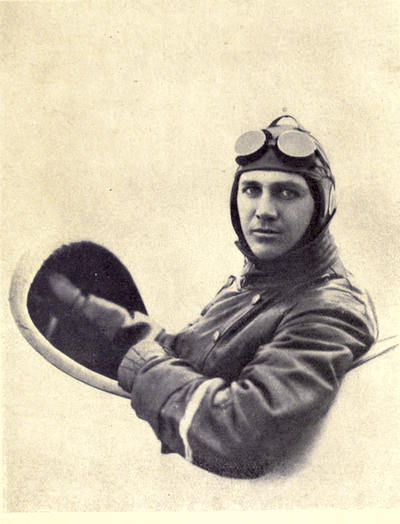
sub-lieutenant H., the observer whom the
English had fished out of the North Sea with
his pilot, after they had been drifting about
on the wrecked machine for over forty hours.
The comradeship in this room was ideal.
The men had all been taken prisoners at the
great retreat of the Marne, and, as was
to be expected, these splendid fellows
had only fallen into the enemy’s hands
when severely wounded. They were of such
fine disposition, and showed such burning
love for their country, that my heart filled
with pride and satisfaction. The evenings
were especially pleasant. We contrived a
rough game with a board and some pieces
of cork, and gambled on petits chevaux regularly
every night with childish delight.
But the real fun began when we started
exchanging experiences. Everything was
new to me, and I was happy to learn at last
from first-hand information of our splendid
battle and triumphs.
Every afternoon 300 to 400 prisoners,
of course closely guarded by English soldiers,
were led out for their exercise, which took
them into the lovely open country. I
often accompanied them. All the time our
soldier songs were sung; but with particular
force and ecstasy when we marched through
the town, going and returning, “The Watch
on the Rhine” and “O Germany, high
in honours!” Imagine 300 or 400 of our
picked men, our victorious troops under
General von Kluck! The English population
behaved even then with the utmost
restraint, and never uttered a word of
abuse or a threat. The sergeant-major
told me of a very nice episode. When
Major Owen and Captain Mitchell were
appointed to the camp, their wives implored
them not to go among the “Huns” without
escort and without being heavily armed.
The two old soldiers, however, kept their own
counsel, and were—not devoured! After
a time they suggested to their wives that
they should visit the camp and convince
themselves that the German soldiers were
quite normal people and not monsters as
portrayed by the press. Naturally, at first
the ladies fainted away. But after much
persuasion, and being assured of a bodyguard,
they ventured upon entering their
husbands’ offices and watched the doings of
the German soldiers. The news of the visit
got about, and silently our male choir
assembled under the windows and warbled
forth its finest songs. I am told that the
ladies were so deeply moved that they were
unable to speak, and could not hold back
bitter tears. From thence onwards they
often came and showed much kindness to
our men.
Another story also is very typical.
A new Colonel came to the camp. On his
first round he was armed to the teeth, and
walked about between two soldiers with
fixed bayonets, one in front and the other
behind him. When he met the Major and
the Captain, absolutely unarmed and unaccompanied,
he reproached them severely
for their carelessness.
But he soon improved.
One day this new Commandant sent for
these two gentlemen, and said to them in a
tone full of horror:
“Can you imagine this? We have been
sent some new prisoners, and it has been
reported that they are full of lice! Such
dreadful things can only happen to the
Germans.”
Captain Mitchell turned calmly to the
Major:
“Do you remember, Owen, that we were
so covered with lice during our last campaign
that we simply could not move?”
The Colonel was aghast. I must point
out that though the Colonel was a Colonel
he had never in his life had anything to do
with military affairs. But that can only
happen in England!
About the end of March I at last received
news from my people. It was nearly nine
months since I had heard from them. It
is easy to picture my feelings when I held
in my hands my first letter from home,
hesitating to open it, for all my brothers and
male relatives had been at the Front since
July 1914. It informed me that they were
still safe; but, on the other hand, my beloved
little sister, my best pal, had died from the
effects of the war.
Towards the end of March the order came
that I should be recognized as an officer, and
transferred to an officers’ camp. My small
bundle and my hockey-stick were soon
collected, and after a warm farewell to my
comrades I marched to the station with
Major Owen.
I found the fine tact of the old gentleman
a very particular blessing. After a journey
that lasted several hours we reached Maidenhead,
near London, where I was received
by another English officer. And here, oh,
miracle, I also met dear old friends. Five
shining gold coins which had been taken
from the locksmith, Ernst Suse, were handed
over to my new companion, and the latter
was able to return them at once to me, as I
was an officer once more. Oh, the joy of
our reunion! A motor-car took us to the
Officers’ Camp, Holyport. The sentries presented
arms, the wire fences were opened,
and I found myself in the midst of a joyous
crowd of comrades. Who could have
imagined this change!
I again met those I had last seen at
Kiao-Chow—the victors of Coronel, the few
gallant survivors of the Falkland Islands.
It is impossible to imagine our joy. The
questions and answers! the excitement!
And then the miraculous happened, for I
was conducted to my dormitory, and there
I actually saw six or eight beds, made up
with white, clean sheets. I had been a
prisoner for eight weeks, and these were the
first beds I beheld. Can one understand
the shy reverence with which I laid myself
to rest that night?
In the beginning, I thought myself in
Paradise, the more so as I was again being
treated as a human being. I was once more
amongst my comrades, and found my old
friends, and was greatly stimulated thereby.
The treatment in the camp was good.
The English Commandant was a sensible
man, who tried to ease our existence. The
building was an old military school, and
100 officers were imprisoned in the camp—eight
to ten shared a dormitory, which was
at the same time a sitting-room. Apart
from this, there was a number of mess,
reading and dining-rooms, in which we
spent most of our time when we were
not in the fresh air. The food was purely
English, therefore hardly palatable to the
majority of the Germans, but more than
sufficient and of good quality. At the
beginning we managed our own mess; but
this, unfortunately, was forbidden later on
by the War Office. During the day we
were left comparatively alone. We were
allowed to move freely among the buildings,
and in the garden. At ten in the morning
there was roll-call, and at ten in the evening
“lights out” and rounds.
Of course we were not allowed to approach
the barbed-wire entanglements which surrounded
the whole place, and which were
strictly guarded and illuminated night and
day. Twice a day the gates were opened,
and we passed between a lane of English
soldiers to the sports ground, which lay
about 200 yards away. Our games were
wonderfully organized. Two splendid football,
and, above all, some perfect hockey-fields,
stood at our disposal, and we displayed
such amazing form that even the English
were impressed. It is superfluous to add
that these fields were also surrounded by
barbed wire and sentries.
A very pleasant feature was the bi-weekly
appearance of an excellent tailor, and also
of a haberdasher, who provided us with
excellent hosiery and gave us the opportunity
of renewing our wardrobe.
Our monthly pay amounted to 120 marks,
of which sixty was put aside for our keep.
We were permitted to spend the rest; also to
receive money from home. The post worked
without a hitch. Letters from Germany,
as well as parcels, took from six to eight
days, and arrived regularly. Conditions
were less fortunate in regard to our own
correspondence. Our weekly allowance consisted
of two short notes, and how gladly
would we have filled reams to our dearest
at home! The post was the Alpha and
Omega of our existence. We divided our
whole day according to its delivery, and the
temper of the camp was regulated by it.
Every morning saw the same spectacle.
When the interpreter arrived with the letters
everything was abandoned and forgotten.
The English officer was surrounded by a
silent crowd of waiting people. Each one’s
heart was filled with the burning wish to
receive some token, some loving message
from home. What joy when one’s hopes
were fulfilled, how great the sorrow and
disappointment when they were shattered.
In the latter case, we always said: “One
more day lost.” When, two months afterwards,
I was back in Germany, and was
asked on many sides what one could do to
give pleasure to the prisoners, I always said:
“Write, write as much as you can. What
the prisoner longs for most are letters.”
We lived in very close comradeship. In
the evenings we sat in groups round the
beautiful, large fireplaces, in which burned
huge logs of wood. The conversation touched
upon battles and victories, sorrow and death,
and wild, adventurous happenings. We had
many good books, and a string quartette as
well as a choir added much to our entertainment.
We played many a joke, and when we had
had a jolly good laugh we felt relieved for
a time from the terrible oppression which
captivity exercised on our spirits.
At the end of April our quiet existence
was suddenly broken up.
One evening the order was received to
transfer fifty officers to the Officers’ Camp
at Donington Hall. Excitement ran high,
for no one wanted to leave; but neither
entreaties nor opposition prevailed. We
had to pack our trunks and march off. I
was the only naval officer of the party, and
that, unfortunately, because the English
Commandant of the camp considered the
proximity of London too dangerous a temptation
for me. My devoted friend, Siebel, an
army flying-officer, followed me, so at least
we two of the same service remained
together.
On the 1st of May, therefore, we moved off
again. Motor-cars took us to Maidenhead
Station, where two reserved carriages were
waiting for us. We remained undisturbed
in our compartments; but the carriages
themselves were strictly guarded.
For many hours we rolled northwards.
At the stations people looked into our
windows curiously, but preserved a quiet
demeanour. Sometimes an old woman,
probably a suffragette, put out her unlovely
tongue at us. At last in the afternoon we
reached the station, Donington Castle, near
Derby, where we had to fall in in squads.
Guarded by sixty or seventy soldiers, we
were marched off on the order “Quick
march.”
Outside the station we were greeted by a
howling mob, composed of women and undersized
lads and children, but few men. In
France many of us had been accustomed to
this undignified behaviour of the populace,
but in England it was a new experience.
The women and the girls, belonging to the
lower classes, behaved like savages. Yelling
and whistling, they ran alongside and behind
us, and occasionally a stone or a lump of
dirt hurtled through the air. But the
majority were splitting with laughter and
seemed to enjoy their antics tremendously.
At the first turning a car came hooting
behind us. At the wheel sat our Interpreter-officer,
Mr. M——, a fat and supercilious
individual, whom we were to know exhaustively
later on. Mr. M—— was out
to create an impression, and he at once
proceeded to do so by running over one of
his own soldiers, who belonged to our
escort. General uproar followed, in which
every one took part. Lastly, two of our
“Huns” sprang forward and rescued the
unfortunate Tommy from under the wheels.
Thereupon the fury of the women turned
upon Mr. M——, who would have had a
poor time of it if he had not speedily driven
off. It is most regrettable that he was able
to do so! However, this incident was
quickly forgotten, and the crowd went on
yelling. It became more and more unruly
and dirt more and more plentiful, when
suddenly four or five cows, placidly chewing,
came ambling along and tried to pass us on
both sides. What followed was so comical
that we, as well as our Tommies, stood still
and roared with laughter. On beholding
the peaceful cows the brave Amazons
shrieked despairingly, gathered up their
skirts and ran! Ruthlessly the strong
trampled on the weak, and in the twinkling
of an eye a confused mass of women lay
screaming and kicking in the ditches on
both sides of the road.
After that we were left in peace and were
allowed to proceed rapidly on our way.
All the time I sharply scrutinized our
surroundings and noted different landmarks,
which might possibly prove useful some day.
The sun burned down on us unmercifully,
and we were bathed in perspiration when we
at last reached our new home—Donington
Hall.
Discipline held sway there.
The portals and wire fences opened before
us; the whole guard turned out and presented
arms; the Officer in Command and
two Lieutenants stood at the right wing,
their hands raised in salute.
After we had been received by the Camp
Commandant, we were distributed over the
rooms, and I was lucky enough to secure,
with four other comrades, amongst whom
was my fidus Achates Siebel, a very nice
little den.
Here, also, I met a large number of
old friends. Some of the survivors of the
Blücher, some from torpedo-boat destroyers
and small cruisers, and several flying-men
from the Army and Navy.
Donington Hall was the model prisoners’
camp of England. To go by all we had read
about it for weeks in English papers it
should have been Paradise. Daily, long-winded
columns abused the Government for
the luxury with which the German officers
were housed. As usually happens, the
strongest attacks were launched by women,
and they even turned our ejection from
Donington Hall into a feminist issue. Even
Parliament had to take up this matter repeatedly.
It was rumoured that the place
was lavishly furnished, that we had several
entertainment and billiard rooms, a private
deer park; and even indulged in fox hunts,
especially got up for our benefit.
None of this was true. Donington Hall
was a large, old castle dating from the
seventeenth century, surrounded by a lovely
old park; but its rooms were completely
bare, and its accommodation as primitive
and scanty as possible. There was no trace
of the other items—entertainment-rooms or
hunting. After our arrival the inmates
numbered 120, and we were packed together
like pickled herrings. One cannot imagine
what would have happened if the camp had
held its full complement—400 to 500 officers—as
our mess, kitchens and bathrooms, etc.,
were far from sufficient even as it was.
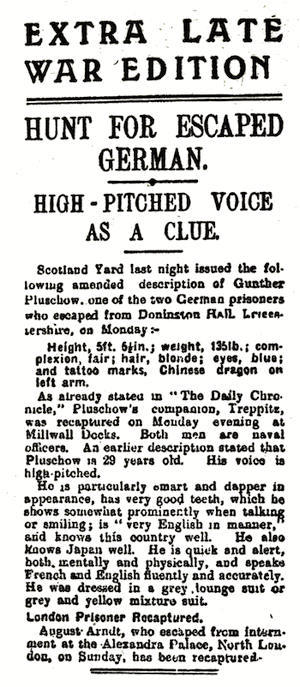
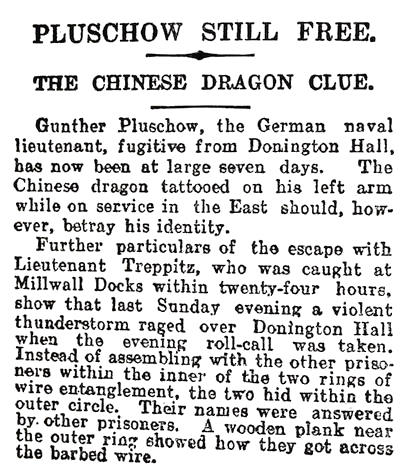
We loved the beautiful park most. Our
residence was divided into two zones—i.e.
in the so-called day and night boundaries.
These areas were marked off by huge erections
of barbed wire, which were partly
charged with electricity, illuminated at night
by powerful arc-lamps, and guarded sharply
by sentries both day and night.
At six in the evening, after the principal
roll-call, the day-boundary was closed, and
only reopened the next day at eight. Life
at Donington Hall was practically the same
as at Holyport, with the difference that,
thanks to the park, we had greater liberty
of movement, could indulge in more sport,
and had three tennis-courts. The food here
also was English, so that many did not like
it; but it was very good. The English
Colonel was reasonable, and, although he
often grumbled, and was at times rather
inclined to make us feel his authority, he
was a distinguished, intelligent man, and a
perfect soldier, and that was the principal
thing. He did all that lay in his power to
lighten our hard lot, and took a special
interest in our sports—which was all to the
good.
He had a most obnoxious substitute in the
person of the interpreter, Lieutenant M——,
the motorist, who was a worthy counterpart
of my friend M—— of the Andania—not
only “temporary Lieutenant,” but also
“temporary gentleman.” His family came
from Frankfurt-on-the-Main; he was director
of a strolling troupe before the war, and he
did nothing to disguise his base disposition.
I believe the English Colonel regarded him
with the utmost contempt, and the English
sergeants, with whom we occasionally exchanged
a few words in the canteen, begged
us to believe that all English officers were
not like this Mr. M——.
One evening, towards the end of June, we
had a delightful adventure. Outside the
barbed wire a herd of wild deer—roebucks
and fawns—used to assemble in their
hundreds, and ran about as tame as goats.
That evening, a darling little fawn, which
had lost its mother, ran past the wire fence,
and, attracted by our alluring calls, it cleverly
wriggled through the defences into the camp.
The fawn was surrounded and petted (the
huntsmen growled), and lastly it was carried
in triumph in the arms of a Lieutenant into
the batmen’s room, where we intended to
rear it.
God knows how M—— heard of it. At
any rate he sent for the German Camp
Adjutant, and said in a voice that shook
with anxiety:
“Lieutenant S., is it true that there is
an animal in the camp?”
“Yes, sir; an animal.”
“Has it come in through the wire entanglements?”
“Yes; it simply crept through.”
“Oh, this is dreadful!” remarked Mr.
M——, and he seemed to lose his voice
altogether. “I must at once see the hole
through which the big beast has crawled. I
am convinced that the German officers have
cut the wire in order to escape. The animal
must also be at once removed.”
And so it happened.
And—this is no joke—twenty men from
the guard with fixed bayonets were sent for.
The solitary German soldier with the innocent
tiny fawn was taken into their midst. On
the order “Quick march” the whole procession
moved to the inside door of the
fence. The latter was opened, the twenty
men with the German soldier and the fawn
stepped into the intervening space, the so-called
“lock,” the inner portal, was carefully
shut. Only then was the outer one opened,
the soldier liberated the fawn, and after that
the whole procession wended its way back.
Oh, Mr. M—— what a laughing stock you
made of yourself!
After that all the entanglements were
carefully examined, and, though it was impossible
to find the smallest cleft through
which a man could have crept, M—— could
not quiet down for days.
Apart from the post, the arrival of newspapers
represented the chief interest of the
day. We were allowed to receive the Times
and the Morning Post, and, though they
were nearly exclusively filled with Entente
victories, we knew them so well after a
short time that we could read between the
lines, and were able to conjecture the real
state of affairs with approximate correctness.
But what rage in the newspapers at the
sinking of the Lusitania, and what anger
when the Russians had to retire—of course
only for strategic reasons! We had manufactured
for ourselves several huge maps of
the theatres of war, which were correct
even to the slightest details, and each
morning at eleven our “General Staff
Officers” were hard at work moving the
little flags. Often the English Colonel himself
stood in front of them and thoughtfully
shook his head.