ILLUSTRATIONS — MY EMPRESS — CHAPTER I — CHAPTER II — CHAPTER III — CHAPTER IV — CHAPTER V — CHAPTER VI — CHAPTER VII — CHAPTER VIII — CHAPTER IX — CHAPTER X — CHAPTER XI — CHAPTER XII — CHAPTER XIII — CHAPTER XIV — CHAPTER XV — CHAPTER XVI — CHAPTER XVII — CHAPTER XVIII — CHAPTER XIX — CHAPTER XX — CHAPTER XXI — Transcriber’s Notes
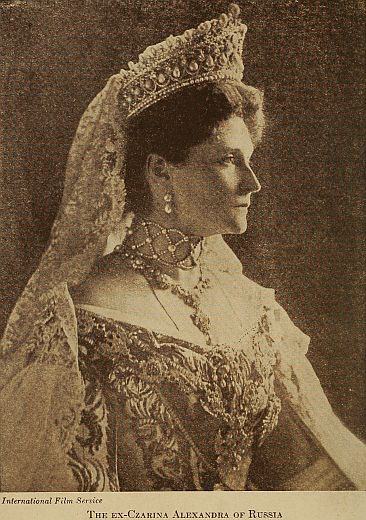
| The ex-Czarina Alexandra of Russia |
Frontispiece |
| |
FACING PAGE |
| The ex-Czar Nicholas II of Russia |
20 |
| Winter Palace, Petrograd |
34 |
| Alexander Hall in the Kremlin at Moscow |
44 |
| Throne Room in the Kremlin at Moscow |
52 |
| Old Banquet Hall of the Czars |
70 |
| Rasputin |
80 |
| The ex-Czarina of Russia and her Four Daughters |
102 |
| Grounds of the Imperial Palace at Tzarskoié Sélo |
122 |
| Grand Duke Michael |
132 |
| Grand Duchess Olga |
144 |
| The ex-Czarevitch |
156 |
| The ex-Czarina and her Son |
168 |
| The Grand Staircase, Winter Palace, Petrograd |
178 |
| Grand Duchess Elizabeth |
188 |
| Grand Duchess Anastasia |
220 |
MY APPOINTMENT
It is the custom, or rather it was the custom, at the Russian Court,
not to allow any Princess marrying into the Imperial family to bring
with her maids from her own country. I believe that this custom was
also observed at Foreign Courts, at least in former times. Therefore,
when it became known that the heir to the Russian Throne, as Nicholas
II. still was when he became the affianced husband of the lovely
Princess Alix of Hesse, was about to bring a bride to his parents’
home, speculations became rife, and much heart burning resulted among
people who considered themselves entitled to the honour of becoming
attendants on the future Empress of All the Russias.
Of course the choice of the maids destined to wait upon her was to
a certain measure dependent on the will of the Reigning Empress, and
the latter felt that it would not do to surround her daughter-in-law
with women unable to talk any other language than Russian. A list was
submitted to her of ladies who were supposed to be eligible for the
position, and, unknown to myself, my name was placed upon it.
The functions of first maid to a Czarina were far from being purely
honorific. Of course she was not supposed to do any menial work,
but, on the other hand, she had to show herself most discreet, to
avoid gossip of any kind, to have no intimate friends or relatives in
whom she might feel tempted to confide, and, moreover, considerable
responsibility rested on her shoulders, as she had under her care not
only the personal jewels of her Imperial mistress, but also those
belonging to the Crown (when these happened to be used), the control of
everything that was connected with the toilet and personal adornment
of the Princess in whose service she stood, the paying of her private
bills, and so forth. She had under her eight other maids, whose duties
consisted in attending to the wants of the Princess, but these took
no initiative, and were entirely dependent upon her, having to obey
her and to listen to all her instructions. One had to have a certain
rank or Tschin, as it is called in Russian, to be able to obtain
such an appointment, and probably the fact that my husband, who had
died a short time before the marriage of Nicholas II. and Alexandra
Feodorovna, had been a Colonel, had something to do with the fact that
my name figured on the list of the women considered eligible for the
position which I was to obtain.
As is well known, the arrival of the Princess Alix in Russia was
hurried on account of the illness of the Czar Alexander III., who knew
himself to be dying, and who wished to see his future daughter-in-law
before he breathed his last. The Grand Duchess Elizabeth of Russia,
the wife of the Grand Duke Sergius, who was the eldest sister of the
Princess, went to meet her at Warsaw, and brought her to Livadia,
in the Crimea, which she reached about three days before the demise
of the Emperor. She was met on her arrival with all the honours
pertaining to the bride of the heir apparent, but the circumstances
which accompanied her journey were such sad ones, that they could not
help painfully impressing her and adding to the natural melancholy of
her character, which was already at that time sufficiently pronounced
to cause anxiety to the people who surrounded her.
The mortal remains of Alexander III. were
brought back with much pomp to St. Petersburg,
where instead of making the solemn entry which
Russian Imperial brides generally do in the capital,
in golden coaches surrounded with elaborate
ceremonies, the Princess Alix arrived in a mourning
carriage, smothered in the folds of her crêpe
veil. No one noticed her, and the general interest
of the public was concentrated on the Empress
Dowager, whose grief was pitiable to witness.
The young girl about to take the latter’s place on
the throne of Russia felt quite lost and lonely
amidst her new surroundings, and no one seemed
to care for her, or to trouble as to what was going
to befall her. At that time many people believed
that her marriage would be postponed until after
the mourning for Alexander III. was over, and
hoped that something might yet occur to prevent
its ever taking place. The alliance was not popular,
and neither Court society nor the nation felt
pleased at the idea of a German Princess coming
to share the throne of their new Sovereign. He
was known already to be absolutely lacking in
character, and many persons feared that through
the influence which his wife might come to acquire
over his mind, the Grand Duke Sergius, who was
married, as I have already related, to the sister of
the Princess Alix, would become paramount at
the Russian Court. And the Grand Duke was the
most hated and the most unpopular personage in
the whole country.
Family intervention, however, decided otherwise, and, partly thanks
to the efforts of the Prince and Princess of Wales, who had arrived in
St. Petersburg to be with the Empress Marie in her hour of sorrow, it
was decided to solemnise the nuptials of the new Czar as quickly as
possible; therefore the twenty-sixth of November, 1894, the birthday
anniversary of the widow of Alexander III., was chosen for it.
All this time I had not seen my new mistress.
She was supposed to be too busy to have leisure to
become acquainted with her future household, and
it was only some three days before the one selected
for the wedding that I was at last presented to her
in the Palace of the Grand Duke Sergius, where
she had resided since her arrival in St. Petersburg.
My first impression was that of a tall, slight girl, with
straight long features, a classical profile, and a lovely figure, which
gave no indications of the tendency to stoutness that was to spoil it
later on. She had fair hair that shone like gold in the sun, whilst
at times it appeared quite dark, according to the light which played
upon it. The mouth was the most defective feature in an otherwise
almost perfectly beautiful face. It had a determined expression, which
even then could be unpleasant, and the chin was decidedly heavy. But
the general impression she produced was that of a superb woman. The
deep mourning which she wore suited her, and heightened the natural
whiteness of her lovely complexion, and I remember thinking that I had
never yet seen any one more beautiful than this girl about to become my
Empress.
She said very little to me, and what she did say
was uttered in a low, constrained voice. She
seemed to have a nervous dread at the idea of being
compelled to have strangers about her, and she
asked me to ascertain from the maid from whom
she was about to part her customs and habits, so as
to be able to direct the women who were to attend
on her in the future. But when I asked her to allow
me to begin my duties at once, she objected,
saying that it would be time enough on her wedding
day.
This proved inconvenient in many respects, because
it was most difficult to attend to the many details
connected with a complicated toilet, such as a
bridal one invariably is, let alone an Imperial one,
and to make decisions for an utter stranger. According
to etiquette the Grand Duchess (the Princess
Alix had been given this title on the day she
had entered the Greek Church) had to dress in the
Winter Palace, where not only her eight maids, but
all the ladies in waiting on the Empress Dowager,
those of her own future household, and the jewels
she was to wear, were awaiting her. To a room
set aside for the purpose by etiquette had been
brought the gold toilet service of the Empress
Anne, which is always taken out for such occasions
and for such only, and it was spread on a table before
which the Princess was asked to sit. The diamond
Crown used for Imperial weddings was then
brought to the Empress Dowager, who, according
to the rules of the ceremony, had to put it on the
head of the bride. But an unforeseen incident occurred.
The hairdresser, who was to adjust the
crown and the bridal veil, could not be found; no
one knew where he was, nor could any one take his
place. At last it was discovered that an over-zealous
police official, believing his ticket of admission
invalid, had refused to let him enter the Winter
Palace. A whole hour went by before this was
discovered, and the marriage was delayed for that
length of time, to the wonder of the thousands of
people assembled to witness it, in the various rooms
and halls of the Imperial residence.
During this weary hour the Princess sat motionless
before her looking glass, hardly saying a word,
but with tears in her eyes which, however, she
bravely tried to conceal. People buzzed around
her, trying to attract her attention, but she did not
seem to heed them, and merely waited and waited,
with that patience which, as I discovered later on,
was a distinctive feature in her character. At last
the hairdresser was brought in, hot and excited, and
he quickly fastened the diamond diadem on the
head of the young bride, whom we proceeded to
array in the long mantle of cloth of gold, lined with
ermine, which she was to wear over her white gown.
When she was ready and stood before us, previous
to the starting of the procession for the chapel, we
all uttered an exclamation. None among us had
ever gazed at anything more lovely than she appeared
to our eyes, and indeed I have never, in the
years that followed, seen Alexandra Feodorovna
look so splendid as on that grey November morning
which saw her married to the Czar of All the
Russias.
THE FIRST MONTHS OF THE CZARINA’S MARRIED LIFE
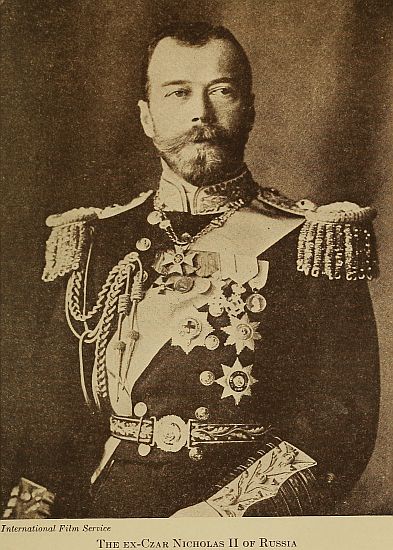
International Film Service
The ex-Czar Nicholas II of Russia
Owing to the haste with which the royal wedding was celebrated there
was no time to prepare in advance suitable apartments for the Czar and
his bride in any of the Imperial palaces either in St. Petersburg or
in Czarskoi Selo. The latter residence had from the very first been
spoken of as the future abode of the young couple, being a favourite
one with the new Sovereign. But the Alexander Palace, the only one
which was more or less adapted to the exigencies of modern life, had
not been inhabited since the death of the Empress Marie Alexandrovna,
the Consort of Alexander II., and required to be entirely overhauled.
The Winter Palace, too, was in want of renovation, and particularly
unsuitable, as the young Empress had expressed a wish to have the
apartments which she was to occupy newly furnished, according to her
own tastes and ideas. The result of this state of
things was that the newly married couple spent the
first months of their wedded life in the Anitschkoff Palace, the
residence of the Dowager Empress, in the small rooms which had been
occupied by Nicholas II. as a bachelor, rooms that were anything
but comfortable, and where there was not even sufficient place for
the wardrobe of the bride, who, besides, found herself without a
sitting-room of her own, and had to borrow that of her mother-in-law
whenever she wished to receive any one.
Of course this was not pleasant for her, and I
will add that it put her from the very outset in a
false position which she felt acutely. She was being
treated like a child, and she would not have
been human had she been pleased with the situation.
During the first weeks of her marriage,
when the whole court was still in deep mourning
for the late Czar, it did not perhaps matter as
much as it would have done later on, or under different
circumstances, but still it was disagreeable.
The Dowager Empress was, in her way, just such
an authoritative character as was her daughter-in-law,
therefore the two ladies soon found themselves
in strong opposition, and, though they did not own
to it, became heartily tired of each other. Six
weeks after the wedding Alexandra Feodorovna
persuaded her husband to go for one week to
Czarskoi Selo, and when she returned to St.
Petersburg I found that a considerable change had
taken place in her manners and bearing, much of
her former diffidence and shyness having disappeared.
She began to decide for herself certain
things she would not have dreamt of doing before
without having consulted her mother-in-law, and
she organised her personal existence after her own
heart. The first changes which she introduced
concerned her maids’ attendance upon her, and she
called me into her presence one morning to discuss
them at length, refusing to listen to some observations
which I thought it my duty to make to her.
In my opinion it would have been better to have
waited until we had moved out of the Anitschkoff
Palace before altering the rules which presided
over the dressing-room and wardrobe paraphernalia
of the young Empress, but my observations
were not kindly received, and I was told most peremptorily
to obey the instructions given to me,
which of course I did, but not without misgivings
as to the opportuneness of the changes introduced
in the routine of my Imperial mistress’ existence.
Amongst others was the disposal of the cast-off
dresses of the young Empress. These were legion,
as she had been presented with a trousseau
of unusual abundance. But they were all of them,
or nearly all, mourning or half-mourning gowns,
and Alexandra seemed in haste to get rid of them.
She had her own ideas in the matter of her toilets,
and generally sketched, herself, the clothes which
she ordered. She had not good taste, this much
must be admitted, but she cared for dresses, and
liked to see hers renewed as often as possible.
Sometimes she had three or four garments laid out
and displayed before her eyes before she finally
made a choice. She had the idea that as a Sovereign
she ought to dress with great magnificence
from the very first hours of the morning, and she
disdained the simple tailor costumes which, on the
contrary, were so much liked by her mother-in-law.
The latter had been the best dressed woman in her
empire, but she had never fussed about her clothes,
and had affected a great simplicity in her every day
attire, reserving for state occasions the many Paris
creations that were being constantly sent over to
her. In a small house like the Anitschkoff Palace
the servants knew, of course, everything that was
going on, and much gossip passed between the
maids of the two Empresses, those of the young
one complaining to the attendants of the Dowager
of the fussiness of their mistress in regard to her
toilet. This gossip reached higher than the housekeeper’s
room, and contributed to the reputation
for caprice that Alexandra Feodorovna acquired
almost immediately after her marriage, a reputation
that was to cling to her and to harm her so
much in public opinion later on.
Now I feel persuaded that if the Emperor and Empress had had from
the very first days of their married life a home of their own, this
would have been avoided, because there would have been no opportunity
for gossip between servants. As it was, the Dowager once or twice
made remarks to her daughter-in-law concerning the manner in which
she worried her attendants by too much fuss about her clothes, and
these were, of course, very badly received. And Alexandra Feodorovna
bitterly resented an allusion that was made to the fact that when she
was at Darmstadt she would not have dared to display such a capricious
temper. All these things were but trifles, but nevertheless they
were to exercise considerable influence on the afterlife of my
mistress.
The Empress was inordinately fond of beautiful
furs and used to spend considerable sums in acquiring
continually new and most costly ones. For
this, too, she was reproached, and told that her
trousseau had contained sufficient fur garments, so
that there was no necessity to be always buying new
ones. She was reported to be extravagant, with reason
perhaps, though there was nothing inordinate
about her love for pretty things; certainly the bills
which she ran at Worth’s and Paquin’s, and other
dressmakers of repute, were not half so large as
those which her mother-in-law had incurred formerly.
But then the latter had always been a favourite,
and St. Petersburg society had smiled on
everything she had ever done or said.
One of my duties was to take care of the Empress’s
jewels. She had received some splendid
and costly wedding presents from her relatives
in England and Russia, and especially from the
Emperor, who, among other things, had presented
her with an all round crown of pearls and diamonds
which, together with some wonderful sapphires, he
had bought in London when he had paid her a visit
there during their betrothal. She loved to wear
them, and at first had not given a thought to the
possibility of having to lay them aside for far more
splendid parures and ornaments. But very soon
after her marriage there arose a question concerning
the Crown jewels, which were supposed to be devoted
to the use of the reigning Empress. During the
reign of Alexander III., the Empress Marie had
had them in her own keeping, and by his will the
Emperor had given her the use of them for her lifetime.
Now it seems that he had not the power to
dispose of them, and very naturally the treasury
claimed them after the demise of the Czar. His
widow, however, stoutly refused to give them up,
and painful scenes ensued, which assumed such
proportions that at last Alexandra Feodorovna declared
that, for her part, she would never consent
to wear the ornaments in dispute, that her mother-in-law
was welcome to them, and could keep them
as long as she liked. This, however, could not
be done, and at last the jewels were returned
to the treasury whence they were sometimes
taken and handed over to me, with great ceremony,
for the use of my mistress on state occasions.
But the Empress never liked them, and
avoided putting them on, preferring her own
jewels. She declared that the big pearl and diamond
tiara, which, since the days of Catherine II.,
had graced the head of all the Russian Empresses,
was far too heavy. I do not think I have seen her
wear more than four or five times the famous necklace
valued at twenty millions of roubles, which,
on the contrary, had been one of the favourite ornaments
of the Dowager Empress. The last time
this historical jewel was seen in public was at the
ball given by the nobility of St. Petersburg on the
occasion of the three hundredth anniversary of the
accession of the dynasty of Romanoff to the throne
of the Ruriks, in February, 1915, which was also
the last time that the Empress Alexandra ever appeared
at any save a religious festivity.
Whenever she decided to put on any of those
Crown jewels I had to send a note announcing her
intention to the head treasurer in charge of the
strong room where the diamonds and precious
stones of the Czar were kept. He then summoned
an escort of three soldiers out of the guard on duty
in the Winter Palace, and, surrounded by them,
brought me the articles I had requested him to deliver.
I had to give a receipt for them, and as soon
as the Empress had taken them off I had to advise
that same treasurer of the fact, then he immediately
came with another escort to reclaim them, returning
to me at the same time the receipt I had
signed a few hours previous. The complications
associated with this procedure were one of the reasons
that made the Empress averse to using those
ornaments, about which she did not care. She
much preferred adding constantly to her private
jewel boxes, and soon she became possessed of one
of the most remarkable collections of precious
stones in Europe. Pearls were her special favourites,
and the Emperor, who was aware of the fact,
was constantly presenting her with additions to her
various necklaces, and other pearl ornaments, and
the two Court jewellers, Bolin and Faberge, had a
standing order to bring to Czarskoi Selo every
fine specimen they could get hold of, before showing
it to any one else among their customers.
This passion of the Empress for constantly acquiring
new ornaments was also a cause of bitter
reproach, and one of her aunts, the Grand Duchess
Marie Pavlovna, who was anything but kind and
charitable, once characterised it as “un gout de parvenue.”
In those early days of her married life there
arose another cause of friction between the Empress
and her mother-in-law. It was connected
with the manner of praying in church for the two
ladies. The Dowager insisted that her name ought
to come first, immediately after that of her son, the
Sovereign. But the ministers, and even the Holy
Synod, objected and declared that, according to
custom, the mother ought to rank after the wife.
Finally it was the opinion of the Synod that prevailed.
But Alexandra Feodorovna, who had interested
herself deeply in the matter, was not wise
enough to hide her joy at the turn things had taken,
and this of course contributed to the strained relations
that soon established themselves between her
and the widow of Alexander III.
No harmony reigned at the Anitschkoff Palace
during those early days of my mistress’ married
life, and it is no wonder that the latter became more
and more embittered as time went on. She felt
herself neglected, and did nothing to please those
whom she suspected of wilfully slighting her. She
had a morbid desire to please, combined with a natural
haughtiness, which made her not only sensible
to a rebuff, but also desirous of avenging it. She
did not care to be brushed aside by her relatives,
and yet she was herself contributing to the cause of
their actions, by her aloofness from all those who
might have been of use to her. She did not understand
St. Petersburg society; she considered it immoral
and fast, and she made no secret of the fact,
snubbing unnecessarily people strong enough to do
her serious harm by their judgments and appreciations
of her conduct and personality. The misunderstandings
which caused her future unpopularity
began from the very first hours of her arrival in
Russia.
With her attendants, however, she was always
kind and gracious, though distant in her manner.
It was only after many years that she grew to have
confidence in me, but then it was a complete one,
and sometimes she would allow herself to give way
in my presence to fits of despondency such as over-took
her from time to time, during which I feel
perfectly convinced she was not entirely responsible
for her actions. Her mind, always prone to
melancholy, made her look at things on their blackest
side, and this partly accounts for the tendency
towards mysticism which she was to develop later
on, and which contributed, more than anything else,
to the catastrophe that was to send her an exile to
the solitudes of Siberia. She was never well balanced,
and, when judging her, one must not forget
that insanity was hereditary in the House of Hesse,
a fact of which many people in Russia were aware,
but of which it seems that the Imperial family were
left in ignorance. Sensitive to a degree, she could
not get rid of prejudices which she was inclined to
adopt without any reason other than caprice, and
prejudices are among the things which sovereigns
ought never to entertain in regard to those whom
they may happen to meet, or with whom they are
surrounded. But with it all she was sweet and
gentle, and good, and conscientious; a perfect
mother, a most devoted wife, a staunch friend, incapable
of meanness or of treachery, but destined
by her very qualities to be always misunderstood,
and never appreciated as she ought to have been.
Amidst the pomp and splendour that surrounded
her she was lonely; she felt isolated, and though
she had found on her arrival in her new country
hosts of relatives and courtiers, she had not met one
single disinterested friend whom she could trust,
or towards whom she could turn for advice and
protection. The grandeur of her position put her,
as it were, outside of the world, and, unfortunately,
she was so overpowered by this grandeur that she
did not even attempt to break through the barriers
it had erected around her, and which divided
her from the rest of mankind.
BIRTH OF GRAND DUCHESS OLGA
The uncomfortable winter which followed upon
the marriage of the Czar came at last to an end
without his young bride having been much seen in
public. The ladies prominent in St. Petersburg
society were presented to her during a great reception
which she held in the Winter Palace, but this
presentation consisted simply in their passing before
her with a curtsey, whilst her Mistress of the
Robes, the Princess Galitzyne, whispered their
names into her ear. She spoke to no one, and of
course no one spoke to her, and for the influence
that this reception had upon her relations with that
society over which she had to preside, it might just
as well never have taken place. There were, it is
true, a few old ladies whose husbands either had
been, or still were, in high official positions, who
were received by the Empress in private audience,
but these interviews were generally of short duration,
and consisted in the exchange of a few banalities
in the way of conversation. The Empress did
not speak French well, and English at that time
was not the fashionable language of the upper
class, as is the case at present. Ill-natured people
commented on the mistakes made by the young
Sovereign in her use of the French idiom, and ridiculed
them. She became aware of the fact, and it
hurt her deeply, and added to the natural diffidence
of her character. In those early days of her
married life, Alexandra Feodorovna was striving
still for popularity, but doing it in a clumsy, mistaken
manner. She felt afraid of being called pro-German,
and exaggerated in consequence her manifestations
of amiability in regard to everybody and
everything that was connected with France, to
such an extent that she was accused of want of
frankness, not to use a more emphatic word. It
was the same thing with her sympathies for the
autocratic régime. At the time of her marriage,
people hoped that her influence over her husband
would result in his granting to Russia that constitution
which everybody had been sighing for, for
years. But the Imperial family, from the very
first hour of her arrival in the country, had repeated
to her that it was her duty to uphold the principles
of that autocracy which Alexander III. had so successfully
maintained during the whole time of his
reign. She accepted this bad advice, and, in her
dread of being thought adverse to it, she applied
herself to persuade the Czar that he ought to make
some public declaration of his intentions to govern
according to the principles that had inspired his
deceased father. She partly succeeded, but the attempt
was not a happy one, because the famous
speech of Nicholas II. to the zemstvos, where he
affirmed his resolve to govern despotically, and
characterised as senseless dreams the aspirations
of his people, contributed more than anything else
to make him, together with his consort, the most
hated and unpopular Sovereign Russia had ever
known.
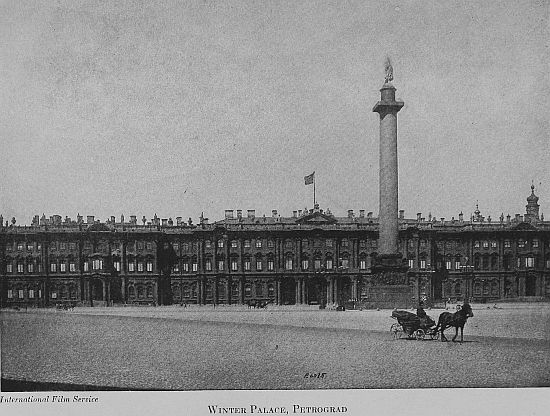
International Film Service
Winter Palace, Petrograd
The first winter which saw the Princess Alix
transformed into the Empress of All the Russias
was, therefore, not precisely what can be called a
happy one. In summer the Court went as usual
to Peterhof, and the alterations which by this time
had begun to be made in the Czarskoi Selo Palace
were hastened, because the first accouchement of
the young Empress was expected in November,
and it had been decided that the expected family
event, so anxiously looked forward to, should take
place there.
Alexander Feodorovna herself superintended
these alterations. Under her care the old building
which had been the favourite residence of Alexander
II. and of his consort, that other Hessian
Princess who, however, had been both liked and respected
by her subjects, was completely transformed.
Splendour was banished from it, but the
whole place was furnished and arranged in the
style of an English cottage, with chintz hangings,
plenty of flowers of which the Empress was inordinately
fond, and a lot of nick-nacks and photographs
that gave it quite a homelike look. Alexandra
had admirable taste in all that concerned the
inner arrangements of her apartments, and she
transformed the old residence of the Russian Czars
into a lovely country house, such as one finds in old
England or in France. But her ideas in regard to
furniture and curtains and general interior ornamentation
of the rooms destined for her private use
differed so entirely from the accepted Russian notions
on the subject that they came to be discussed,
not only ill-naturedly, but also disagreeably. She
had consulted no one, and had made no secret of
her disapproval of certain things that had been
done without her consent, speaking about them with
an acrimony she would have done better, for her
future peace, to have avoided.
The Emperor, however, was charmed with all
that she had done, and delighted at the way in
which she had arranged their new residence, to
which they moved early in the month of October,
1895. The Empress at once organised her existence
upon lines to which she remained more or less
faithful all through her reign. She used to rise
early, and never failed to breakfast with the Emperor
and to accompany him in the walk which he
liked to take every morning before settling down
to the business of the day. They used to go, in all
kinds of weather, for long rambles in the park
which surrounded the Palace of Czarskoi Selo, Alexandra
Feodorovna dressed in a short sable jacket
and a velvet skirt, which she changed for a more
elaborate garment when she returned home. She
disliked dressing gowns, and the first one I ever
saw her wear was during an illness which attacked
the Grand Duchess Olga, in the latter’s early childhood,
when her mother sat up with her at night,
and was persuaded to exchange her tight garments
for more comfortable ones.
At eleven o’clock, the Empress’ private secretary
made his appearance, and brought to her the
numerous correspondence that had to be handled.
They worked together for an hour or so, and Alexandra
more than once tried to interest herself in
public charities and to gather knowledge in regard
to the various educational establishments in the
Empire. These, however, were under the special
patronage of the Empress Dowager, who did not
brook any interference in the matter, and who applied
herself to keep her daughter-in-law quite outside
of it. This was a great misfortune because it
deprived the latter of considerable interest in her
existence, and almost compelled her to spend her
time in frivolous occupations for which she did not
care. Lunch was served at two o’clock, and was
generally a simple meal, though an abundant one,
to which guests were seldom invited. After it was
over the Emperor remained for an hour with his
wife, chatting about the various news of the day,
and then they both went out for another walk. Tea
was brought to the Empress at five o’clock on a
tray in her own room, and she generally swallowed
it in a gulp, without even looking at the cup in
which it was contained. She was fond of needlework,
and amused herself by making lovely little
lace garments for her expected baby. She did not
care for the society of her ladies in waiting, whom
sometimes she did not see for weeks at a time, during
those early days of her marriage. Later on,
however, on account of the reproaches that were
showered upon her for this neglect of her personal
attendants, she had them dine with her and the Emperor
on Sundays, and this custom lasted until the
Revolution, when it fell into disuse, together with
so many other things.
After dinner the Empress used to ensconce herself
in a large armchair by the open fire, and again
take up her needlework, whilst the Emperor read
aloud to her. He was very fond of reading, and
read extremely well. He liked historical books
better than any others, and followed with considerable
interest the different English and French reviews
which were regularly sent to him. This
lasted until eleven o’clock or thereabouts, when
Nicholas II. repaired to his study for a couple of
hours’ work, whilst the Empress began to undress.
I was generally present at this operation,
which was performed by the two maids on duty,
who were changed every day. Alexandra had a
profusion of beautiful, silky hair, and though she
was not so capricious about its treatment as the
poor Empress Elizabeth of Austria, yet she liked
to have it brushed for half an hour or so, after
which it was tightly plaited, and bound with silk
ribbon matching the one which trimmed her nightgowns.
These were of the finest linen or batiste,
profusely ornamented with Valenciennes or Mechlin
lace. The dressing jackets and peignoirs of
the Empress were generally made out of muslin
over silk, with insertions of Brussels net. She was
excessively fond of beautiful lingerie, and owned
to me one day that one of her greatest pleasures
after her marriage had been the possibility of being
at last able to indulge in her weakness for it.
Her bed sheets were absolutely magnificent, and
changed every day, the lace which trimmed them
being carefully selected to match that on her night
dresses. Madame Barrauld, the great French
lingère, who had made the trousseaux of all the
smart young girls of St. Petersburg society, was
summoned about once a week to Czarskoi Selo, to
receive the orders of the Empress in regard to her
lingerie, and that of her daughters when these were
born.
In regard to dresses, Alexandra Feodorovna had
about fifty for each season, without counting the extras.
She was very fond of white gowns, notwithstanding
the fact that these did not suit her. But
she had been told that it was a Russian custom to
wear white garments for every great festival, and
she had exaggerated it to such an extent that St.
Petersburg society, always on the alert to criticise
its new Sovereign, had made fun of it, and its smart
leaders of fashion had affected to put on coloured,
and even dark dresses, on occasions when previously
they would never have thought of so doing.
She was supposed to have no taste in her manner
of attiring herself, and consequently it was considered
the thing to do exactly the contrary of what
she was doing, in that matter at least.
The Imperial family did not often come to
Czarskoi Selo. At first, the Grand Duchesses,
aunts of the Empress, had attempted to see her,
without being summoned to her presence; but they
had soon found out that between them and her
there existed a barrier which it was out of their
power to remove. Alexandra Feodorovna was always
civil to them, always received them with a
smile, but she nevertheless contrived to make them
feel that they bored her, and that she did not care
for their visits. The Empress Dowager also had
tried to break through her daughter-in-law’s reserve,
but though the latter had avoided hurting her
by showing too openly her dislike to having her
solitude intruded upon, yet her stiffness had not
encouraged Marie Feodorovna to repeat the attempt
of considering her son’s home as her own,
and of coming and going in and out of it at her will
and pleasure.
All this caused the conduct of the young wife of
Nicholas II. to be severely criticised from almost
the first days of her arrival in Russia. Unfortunately
for her the choice that had been made of the
members of her household had not been a happy
one. Her Mistress of the Robes, the Princess
Galitzyne, was an intriguing woman, who thought
only of her own advantages and the possibility of
turning to her use and benefit the high position in
which she found herself placed. Her maids of honour
were very nice girls, but mostly nonentities,
and, if the truth need be told, her husband was not
the man capable of being for her the guide she required
during those first days of her married life.
The only person whom she saw intimately, and who
came in time to acquire a considerable influence
over her, was her sister, the Grand Duchess Elizabeth,
of whom she had stood more or less in awe
during her girlish days, and who abused the privileges
due to her as the Empress’ senior. And the
Grand Duchess was not a wise mentor for the impressionable,
impulsive woman who had been
raised by destiny to the throne of All the Russias.
With her servants Alexandra Feodorovna never
spoke, except in reference to questions concerning
their duties. She used to have half an hour’s conversation
with me in the morning and evening, in
regard to matters concerning her dresses or jewels,
and gave me her instructions as to what she required
to be done in regard to them. But it was
only after a number of years, and after I had
helped her nurse the young Princesses during an
attack of scarlet fever, that the Empress began to
talk with me of domestic matters, and of different
other things which worried her. She hated familiarity,
and firmly believed that it was part of her
duties to keep people at a distance. And yet what
a kind heart she had! It was sufficient for her to
know that any misfortune had befallen one of her
attendants or servants, to show them all the sympathy
with which her soul was full. But in normal
times she maintained an attitude of reserve
that was always misunderstood, and for which she
was more than once bitterly reproached.
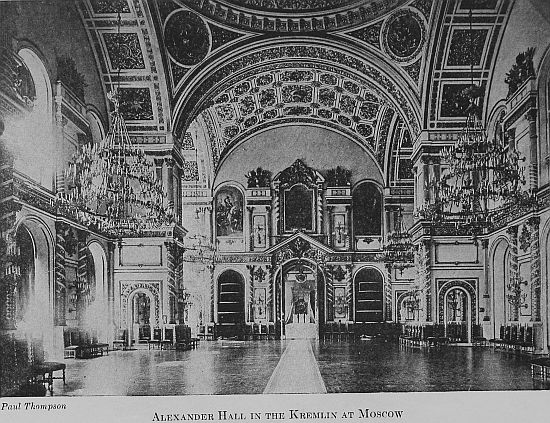
Paul Thompson
Alexander Hall in the Kremlin at Moscow
During that month of November which saw the
first anniversary of the Czar’s marriage the Court
was expecting the birth of the first child of the Imperial
pair. All had made up their minds that it
was going to be a son, an heir to the vast estates
and to the throne of the Romanoffs. The thought
that it might be a girl had never crossed the mind
either of the nation or of the sovereigns themselves.
Preparations without number had been made for
the arrival into the world of that much-longed-for
boy, and for some days no one had slept in the
Palace of Czarskoi Selo. At last the doctors, who
for weeks had not left the Imperial residence,
were summoned to the bedside of Alexandra Feodorovna.
The poor woman had a very hard time,
and for long hours her life trembled in the balance,
whilst every hope of seeing the child born alive
had almost disappeared. Great was the joy, therefore,
when its cry was heard for the first time, a joy,
however, that was turned into an intense disappointment
when it was announced that the baby
was nothing but a poor little girl, tiny and delicate;
a little girl whom no one wanted, and whom no one
was prepared to like, except the mother, who took
it to her heart with all the tenderness which, though
restrained, formed one of the bases of her strange,
perhaps not lovable, but altogether admirable character.
THE CORONATION
The christening of the Grand Duchess Olga
Nicolaievna was solemnised with great pomp at
Czarskoi Selo, after which the Court moved to St.
Petersburg, and the young Empress took possession
of her new apartments in the Winter Palace.
These had been gorgeously fitted up with magnificent
silk hangings manufactured in Lyons, and
copied from those which adorn the rooms occupied
by Marie Antoinette in the Royal Palace of Fontainebleau
in France. This had been a surprise of
the Czar to his wife, but the latter, instead of being
pleased, was superstitiously affected by this remembrance
of the unfortunate Queen of France.
It has never yet been told that when the Empress
was quite a child in London an old gipsy woman
whom she had met when walking with her sisters in
Richmond Park, had prophesied misfortune to her
and to her sister Elizabeth, saying that they would
both marry in a distant country, where nothing but
tears and sorrow awaited them. This fact, which
she had never forgotten, had more to do than one
imagined with that weight of sadness which seemed
to be always pressing on Alexandra Feodorovna,
though of course she avoided mentioning it.
Nevertheless she tried to shake off the premonitions
with which her soul became filled, when she
saw the rooms which had been prepared for her,
and she applied herself to give them that touch of
intimacy which she invariably communicated to all
the places where she lived. Big palms were
brought in, and put in different corners, and a few
valuable pictures were hung on the walls. But the
Empress did not care for paintings, and when she
was asked whether she would not have a few of
those in the Ermitage collection brought to her, as
was done in the case of her husband’s grandmother,
the Empress Marie Alexandrovna, she refused,
saying that she did not care to deprive the public
of the sight of them. In general, art did not appeal
to her, but she read a good deal, and played on
the piano with considerable pleasure, without, however,
having the talent for music which distinguished
her eldest daughter, the Grand Duchess
Olga, who became quite an artist later on. It was
the Empress’ custom before she began to play to
take off her rings, of which she possessed some
beautiful specimens, and to throw them on the piece
of furniture nearest at hand, forgetting afterwards
where she had put them. This sometimes
caused considerable annoyance, as they could not
always be found immediately, and a frantic search
was made all over the Palace, until at last they
turned up in some impossible place or other.
Among these rings was one containing a beautiful
pink diamond, the Empress’ engagement ring,
which she preferred to all others, and which she
constantly wore. Nevertheless she could not, even
in the case of this favourite jewel, divest herself of
the curious habit of taking it off her finger now
and then, and playing with it, as a child might have
done, sometimes quite unconscious that she was
so doing.
The Empress’ piano was a splendid instrument
by Erard, and had been a wedding present from
her mother-in-law. She preferred it to all the
others that she possessed, and when the Court settled
at Czarskoi Selo definitely, not returning to
the Winter Palace more than for a few hours, she
had it removed there, and played on it up to the
time she was sent into that Siberian exile whence
perhaps she will never return.
The baptism of the Grand Duchess Olga was
the signal for Court festivities to be resumed after
the period of mourning for Alexander III. was
over. Balls were again given in the Winter Palace,
though its young mistress did not much care
for dancing, but they were of shorter duration, and
not half so lively as those of past times. For one
thing the Empress was herself nursing her little
daughter, much to the indignation of her relatives,
who considered that it was not a befitting thing to
do in her position, and she liked to retire early. At
all these receptions she was lovely in appearance,
and was gorgeously dressed, perhaps too gorgeously,
and she certainly made a splendid apparition
when she entered a ballroom. But people thought
her dull, and found her devoid of that kind of conversation
which goes by the name of “small talk.”
She was far too frank to hide her feelings, and
could not bring herself to show herself amused
whilst in reality she felt bored. This was noticed,
and of course resented. People expect one to be
interested in their doings and sayings, and an Empress
who hardly ever smiled did not tally with
their estimate of what she ought to have been, so
that with one thing and another, the winter season,
generally so brilliant in St. Petersburg, and to
which one had looked forward eagerly after the
sad one which had preceded it, did not prove the
success that was expected. Alexandra Feodorovna
was fast becoming unpopular, simply because
she would not lower herself to the level of those
who criticised her so openly and so persistently.
Already in those early days there existed a party
against her, which never missed an opportunity to
compare her with her mother-in-law, and this not
to her advantage. The Dowager had been immensely
liked, partly because she had always made
it a point to appear to like every one she knew or
met. She had not perhaps been more talkative
than her daughter-in-law, but she had smiled sweetly
and nodded kindly to all her acquaintances, and
she had never noticed the shortcomings of her
neighbour. Alexandra Feodorovna, on the contrary,
was inclined to be satirical, and had a keen
sense of humour, that was not destined to add to the
pleasures of her existence. She drew most clever
caricatures, and was fond of showing them. One
day she produced a wonderfully clever sketch of
the Czar, sitting in a baby chair, whilst his mother
was scolding him for refusing to take a plate of
soup she was handing to him. The drawing passed
from hand to hand, and did not contribute towards
establishing harmonious relations between the two
Empresses, whilst the public was scandalised to see
the Czar made fun of by his own wife, who ought
to have been the first person to show him respect
and deference. All these were but small things,
but they constituted the drop of water which ends
by wearing away the hardest rock. Many times I
wished to warn my mistress of the criticisms to
which she willingly lent herself by her manners and
conduct, but I never dared; and those who could
have done so, like her Mistress of the Robes and
her ladies in waiting, did not sufficiently consider
her interests to bring to her observation these small
matters, which in reality were important ones, in
regard to her future comfort and happiness.
What with one thing and another, the unpopularity
of the young Sovereign was already an established
fact when the Coronation took place at
Moscow. It appeared quite plainly on the day
she made her public entry into the ancient city,
when the crowds greeted her with absolute silence,
whilst they vociferously cheered the Dowager Empress.
Alexandra felt this deeply, and when she
was alone in her rooms she wept profusely over this
manifestation of the displeasure of the nation in
regard to her person. It was the first time that I
had seen her giving way to grief of any kind, and it
affected me very much, especially in view of what
was to follow. I had already learnt to love this
sweet, gentle lady, who seemed to be pursued with
such persistent bad luck, and whose actions were
misunderstood by the very people who ought to
have appreciated the real motives which guided her.
The Empress had a high sense of duty, but a mistaken
idea of what it consisted. She was far too
desirous of winning the approval of her subjects
to set herself to do it in the right way, and besides,
she had no one to point out to her the various idiosyncrasies
of the Russian nation and of Russian
society. She did not wish to go against what she
considered to be the national feelings of the people
over whom she reigned, and yet she contrived to
wound these feelings at almost every step she took.
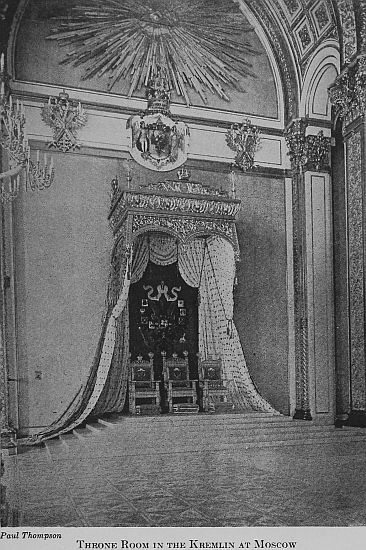
Paul Thompson
Throne Room in the Kremlin at Moscow
A terrible example of this occurred during this
same Coronation I am talking about. Every one
knows the sad accident which was to mar it, and
which offered an analogy with the one that occurred
in Paris during the wedding festivities of
Louis XVI. and Marie Antoinette. Thanks to
the negligence and carelessness of those who ought
to have known better, a popular festival which was
one of the distinctive features of the whole pageant
of the Coronation, ended in dire disaster, and something
like twenty thousand people were crushed to
death on the Khodinka Field near Moscow. That
same night a ball was to take place at the French
Embassy. The Ambassador, the Count de Montebello,
sent one of his attachés to the Master of the
Ceremonies, asking whether he was to postpone it
in view of the catastrophe which had taken place in
the morning. This official who, with others, had
applied himself to keep the Czar in ignorance of
the magnitude of the disaster, took it upon himself
to reply that there was no reason for this
change in the programme, and the Court accordingly
repaired to the French Embassy. The
young Empress, who had heard from one of her
ladies the truth as to what had taken place, was
most unhappy at the necessity of appearing in public
on the day when such a terrible calamity had
overtaken so many people, but she felt afraid to
say what she thought, out of dread that one might
think she had seized hold of the first pretext she
could find in order to avoid showing herself at the
Montebellos. It was already at that time suspected
that her sympathies were with the Germans, and
she was quite aware of the opinion concerning them
and herself. She did not wish to give any further
ground for this belief and thus did not follow the
instincts of her heart, which would have carried her
to the different hospitals where the victims of the
morning had been taken. So with sorrow in her
soul, and anxiety in her mind, she went to that fatal
ball and danced the whole night, though her
thoughts were absent from the gay scene of which
she was such an unwilling participator.
On her return to the Kremlin she dropped into
an easy-chair beside her bed and burst into loud
sobs, not heeding my presence or that of her other
maids. Not caring for them to witness this explosion
of sorrow, I sent them away, and tried to
comfort my mistress to the best of my ability, entreating
her to control herself, and not to distress
the Emperor with the sight of her grief. But Alexandra
Feodorovna kept weeping until at last I
induced her to repair to the nursery, where the sight
of her little girl sleeping in her cot brought back her
composure.
And this was the woman who was represented to
be cold and unfeeling, and who was reproached for
her utter indifference in presence of a catastrophe
of unusual magnitude! Had she but listened to
the cry of her own heart, and not always lived in
dread of making mistakes and of going against the
sympathies of her surroundings, she would certainly
have fared much better, and most probably
would have been far more liked.
The Coronation was far from the success that
had been expected, and the Court returned to Peterhof
with a feeling of relief that it was over. A
few quiet weeks followed, perhaps the happiest in
the whole life of Alexandra Feodorovna, who
started then to organise what afterwards turned
out to be quite an institution—sewing classes at
which she presided, where ladies of society made
garments for the poor which were distributed to
the latter at Christmas, something like Queen
Mary of England’s Needlework Guild. This was
her first venture in the charitable line, and for
some time it proved a successful one, because many
ladies entered into the spirit of it, unfortunately
out of interested motives, and because they expected
that it would bring them to the Sovereign’s
notice and thus contribute to the success of their
worldly career. But here again the Empress did
not realise what lay at the bottom of the willingness
with which her appeal was responded to, and
she did not show any special favour to the women
who had entered into its spirit. These were very
soon disgusted at what they called Imperial ingratitude,
and at last the sewing classes of Czarskoi
Selo came to an end, at least so far as the
fashionable world was concerned, because they continued
to be frequented by the wives and daughters
of the small tradesmen of the Imperial borough,
eager to be brought into personal contact
with their Czar’s wife, and with this new element
they prospered and contrived to do a great
deal of good. Later on, during the Japanese war,
they were transported to the Winter Palace in St.
Petersburg, where they remained installed until
the Revolution, the present war having given them
a new stimulant.
It was during the weeks which immediately followed
upon the Coronation that the plans for a
series of visits abroad to the different capitals of
Europe were at last settled. It was also then that
it was finally decided these visits should include
one to the President of the French Republic, an
event which, as can be imagined, gave rise to many
an animated discussion, and which caused much ink
to be spilt in the chanceries and newspaper offices
of the whole world, particularly of Europe. The
Empress looked forward with apprehension to
this journey, but nevertheless prepared herself for
it with unusual care. I had never before seen her
so interested in regard to the clothes she was to
wear, and she sent minute directions to Worth of
rue de la Paix fame, who was to be entrusted with
the task of making the gowns required for this momentous
occasion. Much against her will, however,
it was decided that some of the Crown jewels
were to be taken along, as it was deemed necessary
to display unusual splendour during this trip.
This did not please the Empress, in view of the disputes
which had arisen between her and her mother-in-law
in regard to these same jewels, but she was
not allowed to interfere, and both the historic necklace
and the tiara of Catherine II. were duly packed
and taken. Events proved that the instinct of
Alexandra Feodorovna had been a true one, because
St. Petersburg society bitterly reproached
her for this infraction of the old Romanoff traditions,
which required that the Crown diamonds
should not be taken out of Russia, and even the
Imperial family criticised this innovation in ancient
customs, and made her responsible for it. In
reality it was the then Foreign Minister, Prince
Lobanoff, who had insisted on the Empress appearing
in London, Paris and Vienna, in the full
pomp of her Imperial position, and who had raised
this question with which Alexandra Feodorovna
herself had had nothing to do, beyond submitting
to the arrangements which others had made on
her behalf. It is thus that history is written.
VISITS ABROAD
The beginning of the visits of the young Emperor
and Empress to foreign courts was marked
by one of those misfortunes which seemed to dog
their footsteps wherever they went. The Minister
for Foreign Affairs, Prince Lobanoff, died suddenly
at a railway station where the Imperial train
had stopped for a few minutes. He was a man of
great ability and wide diplomatic experience, and,
moreover, was a staunch friend of the young Empress,
who mourned him with all her heart. He
would undoubtedly have given her good advice
later on, which she often needed, and might have
put her on her guard against the insidious counsel
which she so often received from people interested
in seeing her commit blunder after blunder. His
successor, Count Mouravieff, was a protégé as
well as a favourite of the Empress’s mother, who
was responsible for his appointment. He was also
a man of unusual ability, but one who knew very
well on which side his bread was buttered, and who
was far too worldly wise to attach himself to a
woman who, he knew but too well, would never
succeed in making herself popular in the country
on whose throne she sat.
One of the first visits paid by Nicholas II. and
his Consort abroad was to the German Emperor
and Empress in the town of Breslau, which had
been chosen in order to give a more intimate look
to the interview, and to divest it from the more official
character it would have had, had it taken place
in Berlin. They were received with great pomp.
William II. assumed his best manners and tried
by all means in his power to make his guests feel
comfortable. He was the first cousin of Alexandra
Feodorovna and at one time had imagined that he
would find in her a staunch ally in his various
schemes. But during those first months of her married
life the Czarina had learnt another lesson, and
that was that she had better avoid meddling with
politics. She therefore confined herself to the
exchange of banalities with her German cousins,
so that the Empress Augusta Victoria afterwards
remarked that she had never expected to find
“Alix” so very frivolous. The fact is that the young
Czarina had taken great care to be splendidly
dressed for the occasion. Worth had sent a special
messenger to St. Petersburg to confer with her as
to the clothes she would require for this great event:
her first appearance as the Empress of All the
Russias at Foreign Courts. For the great State
dinner which took place in Breslau my mistress
wore a gown the tissue of which had been specially
woven in Lyons for her, a lustrous white satin brocaded
with golden lilies and feathers, the low bodice
profusely trimmed with gold lace. In her hair
was a diadem of sapphires and brilliants, and on
her neck reposed priceless sapphires and pearls,
the longest row of which fell down to the bottom of
her skirt. She looked truly magnificent, but this
splendour was bitterly criticised by the German
people, who declared she wanted to impress them
with her riches. Another thing which also displeased
her hosts was the fact that she had brought
her gold toilet service, and caused to be put aside
the silver one that had been prepared for her, which
out of compliment for her had been specially
brought from the Royal Treasury in Berlin. This
silver toilet set had belonged to the famous Queen
Louise, the mother of William I., and the Kaiser
had imagined that by allowing it to be used by his
Russian guest he was paying her a great compliment.
When he heard it had been discarded by
her he was mortally offended, and even made a
cutting remark to that effect, which in her turn she
bitterly resented, saying that it seemed to her that
her cousin William still thought her the little Hessian
Princess of as little importance as she had been
before her marriage. All these things might have
been avoided with a little tact, and often did I deplore
this habit the Czarina had, of impulsively saying
things that hurt. I had tried to dissuade her
from dragging along with her this heavy toilet set,
which, in fact, got her into trouble wherever she
went, but she would not listen, and told me that it
did not concern me what she had decided, and that
I had only to execute the commands given to me, so
perforce I had to remain silent. Another whim of
the Empress was to carry with her the beautiful
lace trimmings of her dressing table. Wherever we
went they had to be taken out and adjusted to the
table before which she sat to have her hair dressed,
and sometimes this caused unnecessary work which
exasperated her maids, because all tables were not
of the same size, and the lace had to be adjusted under
difficulties, as of course it could not be cut. It
was point d’Angleterre and Brussels lace, and one
of the sets was composed of old Argenton, valued
at twenty thousand francs. The set had to be
changed every day, and was further ornamented
with satin ribbons of different colours, that added
to its impression of richness.
Strange to say, the Czarina enjoyed far more her
visit to the Vienna Court than the one she had paid
to her Berlin cousins. She had always felt curious
to know the Empress Elizabeth, and the fact that
the latter had consented to come out of her retirement,
and to be present at her reception in Vienna,
could not but flatter her. Moreover, she felt attracted
by the personality of the beautiful Bavarian
Princess, whom a sad fate had transformed into a
Mater Dolorosa, and the two ladies were from the
first sympathetic to each other. By a delicate attention,
which I fear no one appreciated, the Czarina
had selected a white dress for the State dinner
which was given in the Hofburg, and during the
whole time she stayed in Vienna, she made it a point
not to appear in colours, out of respect for the feelings
of the Empress Elizabeth, who never, as long
as she lived, left off her mourning for the Archduke
Rudolph.
We also, during this tour, went to Balmoral,
where the Empress met her grandmother, Queen
Victoria. The old Sovereign had been very kind
to this grandchild of hers, ever since the untimely
death of her mother, the Princess Alice, and had
had her often with her. But this stay at Balmoral
was not a success. Perhaps it was hardly possible
it could be one, because my mistress’ disposition was
not one which brooked interference, and Queen Victoria,
who had heard, as she generally did all that
concerned her immediate family, of the growing unpopularity
of the young Czarina, took her to task
for it and began advising her as to what she ought
to do. The Empress, however, did not accept any
advice, thinking that no one outside of Russia could
appreciate the growing difficulties of her situation,
and, besides, not caring to initiate her grandmother
into the various intrigues rampant in the Russian
Imperial family. So she received coolly the exhortations
of the Queen, and when the two ladies
parted it was not as warmly as might have been expected.
Of course the culminating point of the foreign
visits of the Emperor and Empress was Paris. It
awaited them with an enthusiasm the like of which
the French capital had probably never before seen.
From every side one heard cries of “Vive l’Impératrice!”
resounding in the air, and the appreciations
of the newspapers and of the public were all of
them warm and full of sincere admiration. But
the Empress, who was in a delicate state of health,
did not seem to care for the elaborate programme
of festivities which had been planned in her honour,
and showed herself more than usually listless
and indifferent. She was tired, and besides felt
embarrassed at what she considered to be exaggerated
expressions of admiration with which she was
greeted. She showed it so plainly that somehow the
Parisians felt that she did not quite appreciate their
efforts to please her, and they began in their turn
to criticise her, together with her manners and her
dresses. Though Worth had surpassed himself,
yet the clothes which he had made for this occasion
lacked the true Parisian chic which is required by
the gay city. And it began to be whispered that
the Czarina did not know how to dress herself, a
grave reproach in French eyes. There occurred
also another incident which illustrates the want of
tact which so often interfered with the conduct of
my Imperial mistress, and which characterised all
her entourage and court. The Russian Ambassador,
Baron Mohrenheim, gave a luncheon party at
the Embassy to which he invited the leaders of that
part of French society called the Faubourg St.
Germain. Among those who responded to his appeal
were the Duchesses de Luynes and d’Uzes, the
Countess Aimery de la Rochefoucauld, and the
Duchesse de Doudeauville. The Czarina had been
told that these ladies were not in favour in Republican
circles, and she felt afraid to show them any
attention which might be interpreted as a desire to
please the enemies of the Régime which was welcoming
her. She consequently allowed them to be
presented to her, but spoke but a few words to
them, and showed herself so cool in regard to them
that of course she gave grave offence, and Baron
Mohrenheim was told that his “Impératrice n’était
pas aimable.”
Of course a woman with a little experience of the
world might have known how to conciliate the different
elements with which she was brought in contact.
But Alexandra Feodorovna was not a diplomat,
and, moreover, never could hide her feelings.
She thus contrived to wound those whom, perhaps,
in her secret heart she was most anxious to please.
The little Grand Duchess Olga had accompanied
her parents during these visits, and notwithstanding
the many things she had to do, and the numerous
calls upon her time, my mistress never forgot
to be present at her child’s undressing in the evening,
and had her brought to her room the first
thing in the morning. I generally wakened the
Czarina at eight o’clock, when I would hand her a
lace and silk morning jacket, which was brought to
me by the maid on duty, and then she would ask
for her daughter, with whom she played for half an
hour or so before glancing at the morning’s papers
and taking the cup of tea which she liked in the
morning. It had to be very strong and bitter, and
she never took sugar or cream with it. When she
was dressed she used to partake, with the Emperor,
of an English breakfast, which, after having been
fixed for half-past nine o’clock, was, later on, partaken
of much earlier, so as not to interfere with
the children’s lessons. The Empress was fond of
eggs, and of a certain crisp kind of bacon, such as
was generally found at Windsor or Balmoral, or
any of the residences of Queen Victoria. She was,
in general, very English in her tastes, and English
was the only language used in the Russian Imperial
family circle. This attention of Alexandra Feodorovna
to her daughter was of course praised in
Paris as well as in London, but not appreciated as
it ought to have been in St. Petersburg, where it
was said that she would have done better to have
been less of a good mother, and more of an Empress.
The Imperial family especially criticised
it freely, and called her a Mere Gigogne in derision.
When one daughter after another was born
to her, these criticisms became even more acute, and
it was said that she wasted all her time looking after
little girls whose existence was of no interest at all
to the Russian Empire.
I must here relate a fact that, so far as I know,
has never been made public. After the Coronation
the Empress, owing to over-fatigue, had an accident
which destroyed some hopes of maternity she
was nursing. She had not spoken of her condition
in her family, and she told me that she felt very
glad she had not done so, because most probably she
would have been accused of some imprudence or
other, the more so that her doctor said that the expected
child would, in all probability, have been a
boy. Nevertheless the thing somehow came to the
knowledge of the public in the sense that it was suspected,
though no one knew for a certainty whether
it was true or not, that such an accident had taken
place, and with the usual wickedness of humanity,
it was rumoured that the Sovereign had had reasons
to hide the condition she found herself in, and that
the accident in itself had been brought on more
voluntarily than accidentally. I was one day asked
whether these sayings which circulated freely in St.
Petersburg were true or not. Imagine my indignation
and anger on hearing my beloved mistress accused
of so terrible a thing, the accusation having
not the slightest foundation to justify it. When
later on my Imperial mistress began to honour me
with her confidence, I implored her whenever she
thought she had reasons to suppose that she was
about to become again a mother, to mention the
fact at once, and give it as much publicity as possible.
But she was so persistently pursued by bad
luck that this also proved later on a source of much
trouble to her, when she happened to be attacked by
an illness which was at first attributed to a condition
that in reality did not exist.
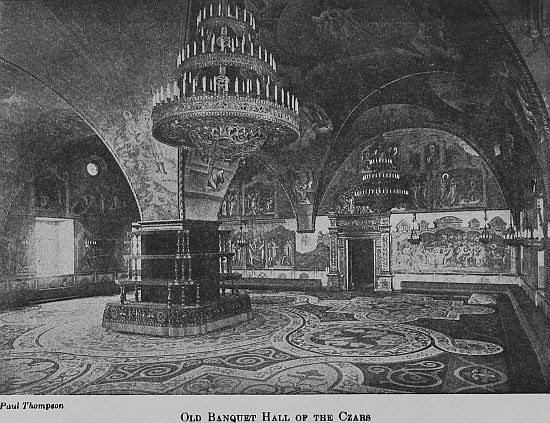
Paul Thompson
Old Banquet Hall of the Czars
When we returned to St. Petersburg after this
triumphant (for such it was considered to have
been) journey abroad, we were welcomed there
with more effusion than had been even expected.
The French alliance was becoming very popular,
and the Russian nation moreover felt flattered at
the idea that its Sovereigns had been made so much
of wherever they had been. We went at first to
Czarskoi Selo and then moved for the winter season
to the capital, where the Empress, as usual, received
the ladies of society after mass on New
Year’s day, after which began the usual round of
gaieties that made St. Petersburg such an attractive
town at the time I am writing about. But instead
of the seven or eight balls generally given
during the winter, the Empress arranged to give
only four, varied with four theatrical performances
in the little theatre of the Ermitage Palace, which
had been built by the Empress Catherine. These
performances, which were always composed of classical
pieces, were declared to be dull, and people
found one excuse or another to absent themselves
from them, thus beginning the system of boycotting
which, later on, was extended to all the Empress’
entertainments. She was voted a bore and no criticism
could have been worse, considering the existing
state, together with the habits and customs, of the
society of the Russian capital.
THE GRAND DUCHESS ELIZABETH
At the risk of rousing a storm of indignation
against me, I must say that one of the misfortunes
of the Czarina was to have in Russia an elder sister
already married to a Russian Grand Duke. I
know that it is an established legend that the Grand
Duchess Elizabeth is a saint, who ought to have
been canonised in her lifetime. But, in reality,
things were not as represented. The Grand Duchess
was a very ambitious woman, and moreover one
who cared for nothing and for nobody in the world
with the exception of her own self. In spite of the
report that her marriage was a very miserable one,
she was on the contrary perfectly happy with her
husband, who was quite content to let her live her
own life, and who never interfered with anything it
might please her to do. When he was appointed
Governor General of Moscow, she hastened to go
over to the Greek Church, in order to win for herself
popularity in the ancient capital of the Russian
Czars, and to a certain extent she succeeded in
doing so. She took advantage of her position as
eldest sister of the young Czarina to try to influence
her, and to prejudice her against those people
of whom she thought she had personally reason to
complain. The weakness of the character of Nicholas
II. was well known to his family, long before he
ever ascended the throne, and both the Grand Duke
Sergius, who, let it be said by the way, was an exceedingly
clever man, and his wife made up their
minds to rule Russia through the influence of its
new Empress, and to become the only really important
personages in the State. They partly succeeded,
and this was the cause of most of the misfortunes
which were later on to assail the unfortunate
Czarina.
The latter, in spite of her impetuous and, if the
truth need be said, haughty disposition, stood in
awe of her eldest sister, a feeling out of which the
Grand Duchess Elizabeth knew very well how to
make capital. She set herself to persuade her sister
that it was indispensable she should affect a far
stronger attachment to the orthodox faith than she
really professed, and that if only the orthodox clergy
should think they had found in her an energetic
support, she would rapidly become popular. It
must not be forgotten that at that time the influence
of priests in general was fast waning, and
that they were aware of the fact. It is not surprising,
therefore, that they tried to find a ally among
the Imperial family, and that the Grand Duchess
Elizabeth, who made a profession of being absorbed
in the practices of a narrow devotion, became the
object of their pet affection. She was quite conscious
of this fact, and being a far cleverer woman
than she looked, she used it to her own advantage
and to the detriment of her sister.
Elizabeth Feodorovna had the reputation of being
a semi-saint. In reality she was nothing of the
kind, for she liked the bad as well as the good things
of this world to an inordinate degree. Fond of admiration,
she had not been insensible to the one
which she inspired, and her admirers had been
many, to begin with her own husband’s brother, the
Grand Duke Paul. But she had carried all her intrigues
in a grand manner, and had never allowed
them to interfere with the general comfort of her
existence. Worldly to her finger tips, she yet affected
the manners of an unworldly woman, and
she “took in” most of those with whom she came
into contact by her hypocrisy, for it could hardly be
called anything else.
At heart she was jealous of her sister, just as she
had been jealous of the Empress Marie Feodorovna,
during the latter’s reign. It was for this reason
principally that she had been so glad to go to
Moscow, where she knew she would be the first lady
in the town, and would enjoy a semi-Imperial position.
She did not care to see any one put before
her, and she applied herself to render the young
Czarina unpopular by every means in her power.
Of course the unfortunate Alexandra Feodorovna,
who knew nothing about Russia and still less
about Russian society when she married, believed
all that her sister told her, and the latter gave her a
totally false opinion as to most of the people whom
she saw, or with whom she was thrown into contact—the
Empress Dowager to begin with, and all
the other members of the Imperial family.
Among the latter the young Czarina might have
found friends but too happy to guide her, such for
instance as her own sister-in-law, the Grand Duchess
Xenia, who was about her own age, and who
would have been only too glad to be of use to her.
But the latter’s husband, the Grand Duke Alexander
Michaylovitsch, was credited with ambitious
designs, and was moreover one of the most intelligent
men of his day. This was more than sufficient
to eliminate him from the number of the people
whom it was deemed expedient for Alexandra Feodorovna
to see much of.
I shall quote one instance of the kind of influence
which the Grand Duchess Elizabeth exercised
over her sister. One day the Empress came to me
and told me (this happened during the war) that
her sister had sent her some relics of a famous saint
in the Orthodox Church, who was buried in the cathedral
of Rostoff on the Don, telling her at the
same time that she ought to have them dissolved in
water and then drink this water early in the morning
before she had partaken of any other food.
Should she do so, success would come to the Russian
arms without fail. The poor Empress was
torn asunder between her conviction that her duty
required her to obey her sister and her distaste for
the abominable beverage she was expected to swallow.
I tried my best to persuade her that the
whole thing was nonsense, but then Rasputin, who
was one of the instruments of the Grand Duchess
Elizabeth, interfered, and, after much hesitation,
the unfortunate Czarina at last made up her mind
to drink the dirty relics as she had been ordered,
and, as a consequence, was abominably sick.
It was also Elizabeth Feodorovna who was responsible
for the introduction of Rasputin into the
immediate circle of the Imperial family. Before
that she had presented to her sister a Frenchman,
called Philippe, who was supposed to be one of the
first mediums in Europe, and for a short time this
Philippe was quite an important personage at
Court. It was about the time the Japanese war
broke out, and the intriguing Frenchman did his
best to consolidate his influence and power, by making
all kinds of prophecies as to the course the struggle
was about to take. Events, however, gave the
lie to his predictions, because instead of the brilliant
successes which he had prophesied, defeat attended
the course of the campaign, and the Russian
armies were routed. This shook the reputation
of the medium, and, finally, after another failure of
a private nature (he had promised the Empress
she would give birth to a son in the course of the
next six months, which did not happen) he was dismissed,
principally at the request of the Grand
Duke Nicholas, who called upon the Czar and revealed
to the latter the many intrigues of which
Philippe had been guilty. When he was gone the
Empress spent her time turning tables alone or
with a few chosen friends, and she at last got her
nervous system into such a condition that it is no
wonder she fell an easy prey to Rasputin when the
latter was presented to her by her sister, with the
assurance that he was one of the greatest saints the
Russian Orthodox Church had ever known.
This influence of the Grand Duchess Elizabeth
was exercised not only in religious and political
matters, but also in purely frivolous ones. For instance,
she introduced into the Imperial Palace a
dressmaker from Moscow who used to make her
own gowns, and to whom she had promised she
would procure the Empress as a client. This dressmaker,
who, I have always felt convinced was a
German spy, became quite an important personage
at Court, and soon my mistress did not dare to
order a gown from any one else but this woman.
This of course caused great dissatisfaction among
her former modistes, both in Petrograd and in
Paris, who, after having enjoyed her patronage for
a number of years, found it hard to be set aside for
a newcomer. I tried more than once to remonstrate
and to urge the expediency of not offending
former friends, if such an expression can be used in
the like case, but I was immediately silenced, with
the result that the Empress spent twice as much
on her clothes as she had done during the first years
of her marriage and was dressed with much less
taste. Under the pretext that she ought to wear
Russian silks, gowns of inferior materials were
made for her, and made abominably into the bargain.
This was the more shameful that Moscow
possesses silk manufactories, the produce of which
is not a bit inferior to the loveliest French silks, but
my poor mistress never got the chance to have them,
and the cheapest and most vile satin and velvets
were those which her famous Moscow dressmaker
selected for her. Worth, who for years had had
the privilege of making the dresses of the Russian
Empresses, became very angry at the neglect with
which his offers were treated, and soon the Empress
came to be called stingy, not only in St. Petersburg
but also in Paris, where proprietors of the many establishments
where she had formerly got her clothes
became her enemies, and took to calling her German,
for the only reason that she did not any longer
buy her dresses and other things from them. It
would have been easy to avoid all this had one been
possessed of a strong and independent will and not
set trembling, as my poor mistress was, whenever
her sister swept down upon her with a complaint or
in an excitement of some kind or another. When the
little Grand Duchesses grew up, their aunt also interfered
with their education. She believed herself
to be an excellent pedagogue, and was convinced
that she had brought up admirably the two motherless
children of her brother-in-law, the Grand Duke
Paul, Dmitry and Marie, who was later on to become
the wife of a Swedish Prince from whom she
was divorced a short time afterwards. In reality
she had done nothing of the kind, and neither the
nephew nor the niece over whose childhood she was
supposed to have watched with such care, did her
any honour, nor proved in any way the excellence
of the training which she was supposed to have
given them. In regard to the children of the Czar
and of the Czarina, her influence proved quite mischievous,
and might have become even dangerous
if the strong common sense of the two eldest girls
had not saved them from the danger of the superstitious
atmosphere with which their aunt wanted
to surround them.
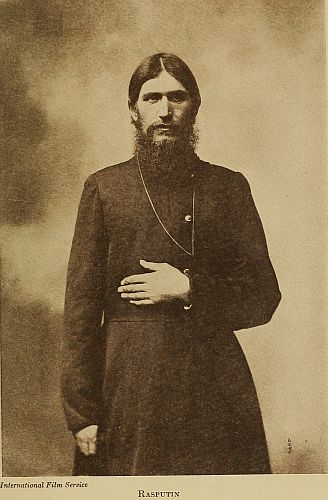
International Film Service
Rasputin
The Empress was the best and most tender of
mothers. Indeed her affection for her children was
almost too fervent, for she was always anxious on
their account and would hardly ever allow them to
mix with other people for fear of anything evil befalling
them. She thought, quite naturally, that
she could trust her sister and share with her the
responsibilities of the education of her family. In
reality she could not have made a worse choice, because
between ambition and superstition the Grand
Duchess Elizabeth was about the last person who
ought to have been permitted free access to girls
of the impressionable temperament of the young
daughters of Nicholas II.
THE CZARINA’S FAMILY RELATIONS
The Empress, like all German Princesses, had
been brought up in a family atmosphere which had
a great deal of the bourgeois about it. Her father
had been comparatively a poor man, and his household
had been conducted on most modest lines, as
can be seen from the letters of the Czarina’s mother,
the Grand Duchess Alice of Hesse, addressed to
her own mother, Queen Victoria. Neither pomp
nor magnificence had presided over the rearing of
the young Princesses left motherless so soon, and
it was only at Windsor and at Balmoral that Princess
Alix had seen what a Sovereign’s existence
meant. But on the other hand she had been very
happy with her sisters and with her brother to
whom she was particularly attached. For some
years after their father’s death she had been practically
the mistress of his household, and she had
felt bitterly his marriage with their cousin, the Princess
Victoria Melita of Saxe-Coburg. The latter,
whose mother was a Russian Grand Duchess, had,
in her own way, just as imperious a character as her
sister-in-law, and soon relations between the two
girls became more than strained. As is well known,
the marriage of the Grand Duke of Hesse turned
out a most unhappy one and ended with a divorce
in which the Princess Alix sided with her brother,
and allowed the latter’s wife to see that such was
the case. This brought about a family quarrel,
which was further accentuated by the re-marriage
of Victoria Melita with her other cousin, the Grand
Duke Cyril of Russia, which incensed the Empress
to such a degree that she used all her influence over
the Czar to persuade the latter to exile Cyril and
his bride, and to deprive them of their fortune and
rank at the Russian Court. This was a most unfortunate
action, because it roused against the Czarina
the wrath of all her relatives, who already did not
like her, and who in consequence went over to swell
the ranks of her enemies, alas, already too numerous.
I have always regretted that my Imperial mistress
was not able to make for herself friends among
her own relatives. This partiality which she always
exhibited in regard to her Hessian connections was
a very unfortunate one, and added certainly to her
unpopularity. Had she been wise, she might easily
have found a warm support in the Czar’s sister, the
Grand Duchess Xenia, and the latter’s husband,
whose kind feelings in regard to her would have secured
for her the allegiance of all the sons of the
Grand Duke Michael, the great uncle of the Czar,
and the most respected member of the Romanoff
family, as well as the oldest. Unfortunately she
did not see the necessity for doing so, and she feared
the influence undoubtedly exercised at one time over
the Czar’s mind by Xenia, his favourite sister. Consequently
she kept her at arm’s length, and avoided
inviting her to Czarskoi Selo. The Imperial family,
finding itself snubbed at every step, boycotted
in its turn their Empress, with the result that the
latter drifted every day a little farther from those
who ought to have been her natural friends and
supporters.
The Grand Duchess Vladimir, herself a German
Princess and by birth a Duchess of Mecklenburg,
had at one time been the one to whom Alexandra
Feodorovna had been the most attracted, and a certain
intimacy had even established itself between
them. Then one day the Princess, when calling on
her niece, had found established in her room one of
the numerous nuns with whom the latter liked to
surround herself and who had been presented to
her by her sister Elizabeth. She had made a few
remarks as to inadvisability of an Empress of Russia
admitting into such close intimacy an uneducated
woman, who, moreover, was probably like
all Russian nuns, devoted to gossip. These remarks
were very badly received and put an end to
a friendship that, in spite of the many inconveniences
it presented (the Grand Duchess Vladimir
being an active supporter of the Kaiser and of the
German party at Court), would still have been preferable
to the one which continued to persist between
Alexandra Feodorovna and any amount of
ignorant monks and nuns whose society she grew at
last to prefer to that of everybody else. This, however,
was not saying much, because as time went on
my mistress developed more and more this unfortunate
love for solitude for which she was so often,
and not unjustly, reproached. She had a great defect
for a woman in her high position—that of taking
life too seriously, in the sense that she would
never admit that any one had the right to seek
amusement or relaxation from the duties of one’s
daily existence. Indeed she looked out for duties,
and found some where none existed. She hated
balls, and society she thoroughly despised, believing
that it was composed of frivolous and ill-natured
people. She did not care for innocent pleasures,
not because she had any preference for others, but
because she was convinced that every single hour
of any man’s or woman’s existence ought to be consecrated
to duty or occupation of some kind.
When she was compelled to appear at a ball or
State function, she did so with such a bored look
that it could not fail to be noticed and of course
was resented. Her greatest happiness would have
been to lead an out-of-doors life, to take long walks,
and to play tennis or golf as a relaxation. Even
her readings were always serious ones, and such a
thing as a novel was never seen in her apartments.
Sometimes her sisters-in-law would urge upon her
the necessity of reading such or such a book, whose
publication had created some kind of stir in the
world. But she invariably refused, or if she consented
did so under protest, and would later on
make scathing remarks as to her aversion for such
kind of literature. The Czar, on the other hand,
liked to peruse a good novel, and sometimes attempted
to read the contents of one aloud to his
wife, when she would listen with a bored look on
her face, but would not, however, express in any
other way her disapproval. She was very considerate
for her husband, though in the early days of
their marriage she had been inclined to show too
much her influence and power over his mind, which
was also one of the things Russian society had not
forgiven her. One incident in particular had
aroused the ire of the Empress Dowager, who had
made no secret of her indignation against her young
daughter-in-law on the subject. The Czar and his
wife had accepted an invitation to dine and spend
the evening at the barracks of the Hussar regiment,
of which the Emperor, when heir to the throne,
had been in command. Nicholas II. was enjoying
himself, as he invariably did when amidst his old
comrades of former times, but the Empress was
far from doing so, therefore, when eleven o’clock
struck, she determined she had had quite enough
of it, and, calling to her husband, said loudly and
distinctly in English: “Now come, my boy, it is
time to go to bed!” One may imagine the horror
of the assistants on hearing the autocrat of All the
Russias addressed in public as “my boy” by his
imprudent wife. The incident was widely commented
upon and discussed, and Marie Feodorovna
thought it her duty to remonstrate with her daughter-in-law
on the subject, saying that she had never
ventured to address Alexander III. in presence of
others, let alone in an official occasion such as this
one had been, otherwise than as “Sir” or “Your
Majesty.” My mistress took these remonstrances
in very bad part, and the relations between the two
ladies did not improve after this affair.
Had Alexandra Feodorovna been surrounded by
people who wished her well, they would have tried
to educate her mind, and to bring to her notice the
necessity of observing certain details pertaining to
etiquette of which she had never been taught the
necessity in her small Darmstadt, but which she
could not neglect in her position as Empress of
Russia. Kindness would have done wonders with
her, and no one would have appreciated it more
than herself, but opposition of any kind had the
effect of exasperating her and of driving her to do
precisely what she ought not to have done. She had
the idea that as the wife of an autocratic ruler she
was placed above every kind of criticism, and that
no one dared to make any remark concerning her
conduct or manners. Of course this was a mistaken
idea, but it had so thoroughly taken hold of her
mind that nothing could ever drive it away, and it
has certainly contributed to the misfortunes which
have assailed her later on. Alas! alas! how often
have I not regretted that this sweet Princess, so
attractive in many ways, could not be brought to
look upon the world with other eyes than those of
an enemy. If only she had believed those who sincerely
loved her, how different her life might have
been!
During the summer of 1898, the Grand Duchess
Olga caught the scarlet fever. The English
nurse who was in charge of the Imperial nursery
was left with the second little girl who had
been born to the Czar and Czarina, the Grand
Duchess Tatiana, and the Empress took it upon
herself to nurse the sick child unaided. I begged
permission to share with her the care of the invalid,
and it was after this that my mistress began
to confide in me to a certain degree, and to
speak to me about some of her many anxieties and
sorrows. I can remember her so well during these
days and nights sitting by the cot in which her
small daughter slept, clad in a dressing gown of
white flannel which I had almost compelled her to
buy for the occasion, her fair head resting on her
hand, absorbed in her thoughts, and with that sweet
but anxious expression on her beautiful face, which
already at that time had begun to settle on her features.
She complained to me once that she had
been reproached by her relatives for exposing herself
to the danger of contagion. “As if that mattered,”
she said, “even if I died, for the Emperor
would always find another wife who perhaps would
be luckier than I have been, and able to give him
an heir. No one would miss me, with the exception
perhaps of these children,” and she started weeping
bitter tears. I tried to comfort her, saying that
she must not talk in that way, because no woman
had ever been more loved by her husband than she
was by the Emperor. “Ah, my dear,” retorted the
Empress, “what good does it do me to be loved
by my husband when all the world is against me?
It is the nation’s love I would wish to win, and how
can I hope to do so, so long as I have not given an
heir to Russia!” Poor woman, she really imagined
that the cause of her unpopularity was the fact that
she had no son!
This reminds me of the state of mind into which my poor
mistress was thrown at the birth of her second daughter, Tatiana.
She had been worrying the whole time of her pregnancy at the idea
that she might have another girl, until at last the thought of it had
become quite an obsession, and her nervous system had been absolutely
shattered as a consequence. When the child came into the world there
was a profound silence in the room, and the doctor informed the Czar,
by a previously arranged sign, of the sex of the infant, which it was
deemed necessary to conceal from the mother at first. But the Empress
saw the anxious and troubled faces around her when she had recovered
from the effects of the chloroform which had been administered to her,
and her first words were: “My God, it is again a daughter. What will
the nation say, what will the nation say?” and she burst into loud
hysterics.
Nevertheless, the wee, wee maidens who came
one after the other to enliven the family circle of
the Czar and Czarina, though they were very badly
received, became in time the objects of their parents’
most affectionate love, and were cared for just
as much as if their births had not constituted a severe
disappointment for their father and mother.
But the fact that for something like ten years Russia
had no direct heir, shook the position of Alexandra
Feodorovna, who began to be considered as
a person of no consequence. People looked up to
the Grand Duke Michael, in whom every one saw
the future Czar, and who not only was immensely
popular, but whose features and character reminded
one more than those of any of his other children of
the late Alexander III. The Empress was quite
aware of this fact, and it did not contribute to her
liking for her brother-in-law. In general, she was
not upon good terms with any members of the Russian
Imperial family, with the exception of her sister
of course, and of the latter’s husband, the Grand
Duke Sergius, and she clung more than ever to her
German relations, and to her brother in particular.
She was always looking forward to the short sojourns
which from time to time she was allowed to
make in Darmstadt, where she felt more at her ease
than anywhere else, with the exception of Livadia,
in the Crimea, where she built for herself a kind of
fairy palace, in place of the small cottage which had
been found sufficient for the Empress Marie Alexandrovna,
and where Alexander III. had breathed
his last. The construction of this palace was also
one of the things for which my mistress was reproached.
People said that it was not seemly to
have pulled down the house where the late Czar had
died, and they had criticised the large amount of
money which had been wasted, as was said, on the
erection of this new residence. When this was repeated
to the Empress, she became quite furious,
and swore that not one of those who had thus allowed
themselves to be dissatisfied with what she
had done would ever enter the gates of her Crimean
home. She kept her promise, and not even her
mother-in-law was ever invited to look upon the
new castle which Alexandra Feodorovna had built
for herself on the shores of the Black Sea, and
which she had made so beautiful.
LIFE AT CZARSKOI SELO
I have often been asked details about the kind
of existence by the Imperial family in the interior
of their home. So long as I was in their service
I never spoke of what I saw, and in general
avoided mentioning anything connected with the
family life of my masters. It seems to me now that
I am not committing an indiscretion if I do so, because
I have nothing to say but good of the unfortunate
Czar and Czarina.
They were a most affectionate couple, and to look
at them and to hear them converse with one another
one could almost have believed them to be little
“bourgeois” of the type dear to French authors,
rather than powerful sovereigns. They used often
to jest together, and to tease each other in a quiet
way, and both were full of fun when left to themselves.
Later on, of course, things changed, and
as the political horizon became darker and darker,
the old merry laugh with which the Emperor and
his wife used to make the halls and corridors of the
Czarskoi Selo Palace echo was hushed and could
be heard very seldom. But the sense of humour of
Nicholas II. and of his Consort never deserted
them, and they were inclined to look at the joyful
side of things rather than to indulge in pessimism,
in all matters that did not pertain to the administration
of their vast Empire. This was the tragic part
of their life, and, being both highly conscientious
people, they suffered cruelly to find that all their
efforts to ameliorate the condition of their people
were misunderstood. Of course it is idle to deny
that the weakness of character of the Emperor was
greatly to blame in the series of disasters which
finally overpowered him and his family, but it must
also be acknowledged that he never met with any
sincere and disinterested help in the responsibilities
of his arduous task. During the first years of her
marriage the Empress kept, or rather was kept,
aloof from everything connected with politics,
which was a great pity, because at that time she
might have made herself useful in many ways. But
all the ministers and the advisers of Nicholas II.
were of opinion that his wife had to be relegated to
a subordinate position, and he himself had no desire
to initiate her into the complicated details connected
with the government of Russia. It was only after
she had given birth to an heir that the position of
Alexandra Feodorovna became an important one,
and that she was consulted by her husband. By
that time the reputation for weakness of character
of the Emperor had become an established fact, and
those who hitherto had ruled him, furious at finding
themselves evicted, started the report that the Empress
was abusing her influence over the Czar, and
obliging him to conform himself to her own political
views, which were supposed to be entirely German.
So far as I have been able to judge, this was an
error, at least in some details. The Czarina was
very fond of the land of her birth, this cannot be
denied, but she was too affectionate a mother not
to see that it would have been impossible to carry
on a purely German policy in Russia, and the thing
to which she clung the most was her throne and the
possibility of seeing her own son occupy it in time.
She was ambitious for him as well as for herself,
and though this may be deplored, yet there is nothing
astonishing in the fact.
She did not care for St. Petersburg and the luxury
of her apartments in the Winter Palace, and
after the Japanese war and the Revolution she persuaded
the Czar to give up residing there and to
make his permanent home at Czarskoi Selo, or in
Livadia in the Crimea. They used to come sometimes
to the capital for some military festivity or
other, but their sojourn there was always of short
duration, and never extended beyond a few hours.
The only time they resided in it again, and this only
for three days, was on the occasion of the celebration
of the jubilee of three hundred years of the accession
of the Romanoff dynasty to the throne of
Russia. After they left it then, they were
never more to sleep under its roof, though their
rooms were always kept ready for them. Sometimes
the Empress stopped there for a cup of tea,
when on one of her rare visits to St. Petersburg, to
inspect some charitable institution, but she never
liked them, though she had furnished them with
such care and she never felt at home in those immense
halls which could not be made homely or
comfortable, in the sense generally attached to this
word.
At Czarskoi Selo existence ran very smoothly.
The Empress rose early and, after partaking of a
cup of tea in bed, threw a dressing gown over her
shoulders, and repaired to her children’s rooms.
She was always present when they said their prayers,
and she used to read to them a chapter of the
Bible, or the Gospel for the day. It was only after
the performance of this duty that she began her
own toilet, which was always an elaborate affair,
and this to the last day of my stay with her, even
after she had discarded most of her ornaments and
fine gowns and assumed the garb of the sister of
charity she declared she had become. But she was
particular in the care she used to take of her own
person and would spend a longer time than any one
else would have done in her bath and in the general
occupation of her dressing and undressing. After
her hair had been arranged and she had assumed the
gown she chose out of the three or four which were
brought for her inspection, she would go to the
small apartment where breakfast was served, and
where her children were generally already awaiting
her. A servant would then inform the Emperor
that his wife was in the dining room, and he would
join her there almost immediately. The meal never
began without him, and was a simple though an
abundant one. Eggs, cold meat, and a variety of
cakes and biscuits with hot rolls, generally composed
it. Nicholas II. was a gourmet, and though
he cared most for Russian cooking, yet he insisted
on everything that was served him being of the
very best. Lunch was the meal of which he partook
most freely, and it consisted always of some
five or six courses, beginning with caviar and other
relishes, and ending with fresh fruit, no matter what
the season of the year might be, and very strong coffee.
The Czar was a most sober man in his family
circle, contrary to what has been said of him, and his
only drink was Crimean wine from his own vintages,
which was very good indeed. Sometimes,
when he went to supper at the mess of his former
regiment of Hussars, of which he had remained very
fond, he partook freely of champagne, which started
the legend that he was an inordinate drunkard,
but these occasions were rare, and certainly never
gave rise to any outward manifestation on his part
which might have accredited this malicious report.
Strong drinks never appeared on the Imperial table.
Nicholas II. drank a small glass of vodka before
his meals, as every Russian does, but this was all.
As for the Empress, she seldom touched anything
but mineral water, and the children were brought
up on strictly abstemious lines. During dinner,
which was served at eight o’clock, Madeira and
sherry appeared, also red and white wine, but
this was for the benefit of the guests invited.
There were always some at this meal, but these comprised
the ladies in waiting on the Empress, and
the personal attendants on the Emperor, rarely any
one else. Sometimes a military band played some
of the Czarina’s favourite airs, when she would
listen with attention, but this seldom occurred except
on Sundays. The dinner was an elaborate affair,
composed principally of Russian dishes, for
Nicholas II. disliked French sauces and French
menus, and used to say that what he preferred was
plain and excellent Russian fare. The kind of fish
called Sterlet was a favourite of his, also a pudding
which went by the name of Gourieswkaya Kacha,
or gruel, and which was really very good. The Empress
was absolutely indifferent to what she ate or
drank, and would have been perfectly satisfied to
exist on oatmeal and eggs. The only thing she was
particular about was her tea, which she wanted to
be made very strong, and the brand she preferred
was one in which green tea was mixed with black;
she utterly repudiated Indian or Ceylon tea, giving
her preference to Chinese caravan.
As the Imperial children grew up, their mother
adopted the custom of spending most of her time
with them when the state of her health so allowed.
She had always been very delicate, and developed
violent nervous headaches which totally prostrated
her and confined her to her bed in a dark room,
sometimes for two or three days at a time. These
attacks left her terribly weak, and she would require
care and quiet to get over them. Sometimes
another attack would overpower her before the effects
of the first one had passed away. This was
the origin of the rumour that she was an unnatural
mother who for days did not allow her
daughters to approach her. Nothing of the
kind ever took place, but when my poor mistress
was laid up her sufferings were so intense that
sometimes the sound of a footstep in the next room
would add to the agony which she endured, and of
course she had to be left alone at such periods. But
the world, always cruel and unjust in regard to
her, would have it that she confined herself in her
apartments because she could not bear her children,
and it pitied them in consequence.
But when she was in good health, the Czarina
gave up every minute of her time to her family.
She took upon herself the religious instruction of
her son and daughters, and she tried to rear them
in the strong principles which she herself professed.
Both the Czar and herself observed with extreme
punctuality the rites of the Greek Orthodox Church.
During the whole six weeks of Lent, no meat appeared
on the Imperial table, and at festivals as
well as on Sundays, the whole family attended all
the morning and afternoon services which were celebrated
in the chapel of the Palace. Afterwards the
Empress built a church in Czarskoi Selo, which became
one of the most beautiful shrines in the whole
of Russia, and she regularly went to it, forsaking
the private chapel of her own residence. She had
arranged for herself an oratory in one corner of
the building, from which she could, unseen herself,
follow the religious services. This eccentricity,
which proceeded from the fact that the Czarina did
not care to be the object of the attention of the congregation,
was also made the cause of violent and
unseemly attacks upon her person and character.
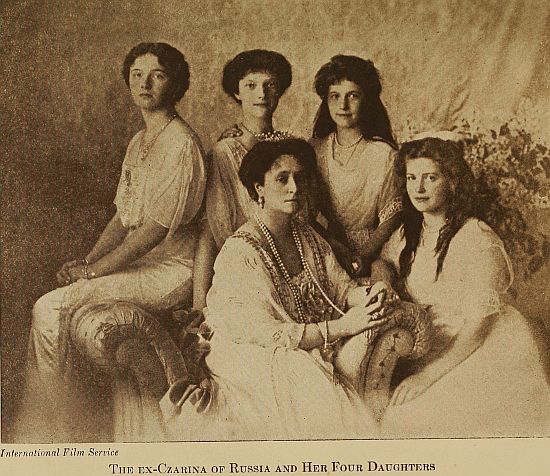
International Film Service
The ex-Czarina of Russia and Her Four Daughters
When the state of her health allowed her to do
so, Alexandra Feodorovna went for long walks in
the park surrounding the Palace, with the Emperor
and her children. She was inordinately fond of the
open air, and was never so happy as in the Crimea,
where she could indulge in her taste for it. There
she spent hours arranging her rose garden and generally
beautifying this lovely place, to which she
hoped she would one day be able to retire. It is not
generally known, but a fact, that both the Emperor
and herself nursed the idea of abdicating in favour
of their son as soon as the latter should be old
enough to assume the government of the country,
and of retiring to Livadia for the rest of their days.
Neither Nicholas II. nor his Consort ever dreamt
that this abdication would be imposed upon them by
events the magnitude of which no one in the whole
of Russia could have been able to foresee.
Very few visitors ever came to enliven the solitude
of Czarskoi Selo, but at Livadia the Empress
would make a point of inviting to dinner and to
small dances given for her daughters, all the people
living in the neighbourhood, or staying in the various
hotels on the Crimean coast, who had been presented
to her. The officers of the Imperial yacht,
the Standard, were also bidden to these parties, and
they were almost the only persons with whom the
Empress ever conversed freely. She was very fond
of the sea, and during the cruises which she took
every summer in the Finnish waters she grew
to know by name all the crew of the vessel on which
she found herself, and she took pleasure in talking
with the officers and men, the former of whom were
afterwards always welcomed by her wherever she
was.
But in general she did not care for society. Her
Mistress of the Robes was about the only woman
admitted to her intimacy as long the post was occupied
by the Princess Galitzyne, but after the
death of the latter and the appointment of Madame
Narischkine, the relations of the Empress with the
head of her household became purely formal, and
the only real confidante she possessed during
the last six or seven years which preceded the war
and the Revolution was a woman who was destined
to do her an infinity of harm and whom she would
have done much better to have kept at arm’s length—the
too famous Madame Wyroubieva, about
whom I shall have something to say later on.
THE COURT AND ATTENDANTS OF
THE CZARINA
When the Empress married, her household was
formed in a hurry, which was a great pity, because
it was not composed entirely of the best people from
an intellectual point of view. The Empress Dowager
was so absorbed by her grief that she could
not give to the subject the attention she otherwise
would have done. The Emperor, on the other hand,
knew very little about St. Petersburg society, and
especially about its gossip. When the name of the
Princess Galitzyne was mentioned to him as that
of the best lady for the difficult position of Mistress
of the Robes, and chief adviser of his young wife,
he accepted it as a matter of course, having only in
mind the great name and the prominent position of
the Princess.
She was a woman with a past in which had figured
most of the jeunesse dorée of St. Petersburg.
She had been married when quite a girl to a man
much older than herself, and had very rapidly found
a number of people willing to console her for the
great difference of age which existed between her
and her spouse. He had made her an indulgent husband,
and by reason of his great standing, riches,
and other worldly advantages, had constantly sheltered
her from the evil effects of the gossip which
was but too often busy with her name. When she
had become a widow, she had mourned him quite sincerely,
but had pretended a grief greater than she
had really experienced. It was discovered that he
had left his business affairs in an entangled condition,
and the Princess had retired to her country estates,
to try to bring some kind of order into their
management. She had an only daughter, already
married, who became the object of her greatest care
and affection. When the post of chief adviser to
the young bride of Nicholas II. was offered to her
by one of her former admirers, Baron Fredericks,
then already Minister of the Imperial Household,
she had snatched at the chance with alacrity, seeing
in it a possibility of re-establishing, quicker than by
a strict economy, her shattered finances.
She was a haughty, selfish, self-centred woman
who soon made for herself numerous enemies,
thanks to the offhand manner with which she
treated all those with whom she found herself
thrown in contact. She never applied herself to
the task of teaching her young mistress the difficult
lesson of trying to make herself popular, but on
the contrary tried to inspire within her the same
prejudices in regard to the people she disliked that
she herself entertained. She was about the worst
adviser a newly married Sovereign could have had,
and one can only wonder why this fact was not
recognised earlier than it was; for it ultimately
became a question as to who was the more disliked, the
Empress or her Mistress of the Robes.
The Princess Galitzyne, nevertheless, soon became
a power at Court. She contrived to obtain
large grants of money which the successive ministers
of finance who took over the succession of
Count Witte, were but too happy to arrange for
her, in return for her protection. She was greedy
and avaricious, cruel and cold hearted, and utterly
devoid of scruples. In the Palace she was heartily
disliked, yet no one dared to say a word against
her, because it was well known that eventually she
could become a terrible enemy of those of whom
she thought she had reason to complain.
The Princess died a year or two before the great
war, and for some time her place remained empty,
until at last it was offered to Madame Narischkine,
an intimate friend of the Empress Dowager, and
one of the most respected women in St. Petersburg
society.
Madame Narischkine was quite a different woman
from her predecessor. She was kind, polite,
amiable, and highly principled, as well as conscientious.
She would never have hurt a fly, and she had
always applied herself to smooth the path in life
of all the people in whom she had happened to be interested.
Unfortunately she was not sympathetic with the
Empress Alexandra, and the latter could never
bring herself to treat her with the same familiarity
as she had done the Princess Galitzyne. Then
Madame Narischkine objected to Rasputin, and of
course this was sufficient to prevent her being a
persona grata. The Grand Duchess Elizabeth also
did not care for her; perhaps because she felt that
the new Mistress of the Robes had never quite approved
of her. Madame Narischkine was a very
discreet woman, but at the same time she could very
well convey to persons whom she did not think fit
to be upon terms of intimacy with her what she
thought of them. The Empress never took to her,
which was a great pity, and sometimes treated her
with great rudeness and with an astonishing lack
of consideration. But in spite of these difficulties
with which her path was beset, Madame Narischkine
behaved magnificently when the hour of danger
sounded. When the Revolution broke out, she
immediately repaired to Czarskoi Selo and never
left the Empress through those days of sorrow and
anxiety which saw the latter taken prisoner in her
own palace. She volunteered, in spite of her advanced
age (she is over seventy) to accompany her
mistress into exile, but the request was declined by
the provisional government, and Madame Narischkine
had perforce to submit, but she was the
last one to bid good-bye to the Empress and to the
young Grand Duchesses before they entered the
train which was to carry them away to the solitudes
of Siberia. It is likely that if Madame Narischkine
had, from the outset, been with the Czarina,
many of the mistakes committed by the latter would
have been avoided. As it was she followed the advice
given her by the Princess Galitzyne, and this
was never wise advice, because the Princess, who
was a born flatterer, was most careful never to say
to Alexandra Feodorovna anything which she knew
or feared might displease her. Under her guidance
the unfortunate Empress had not a chance to
succeed in winning the affections of her subjects.
Besides the Princess, there were four maids of honour
attached to the person of the young Czarina.
The first was the Countess Lamsdorff, with whom
the Sovereign could not get on and to whom she
took a violent dislike. Then came the Princess
Bariatinsky, who also resigned her functions with
a certain amount of “fracas,” and who made no
mystery of the fact that she could not stand the
lack of consideration with which she was being
treated. A Caucasian lady, the Princess Orbeliani,
took her place, and succeeded in retaining her
difficult position until her death. Then there was
a Princess Obolensky, who had much unpleasantness
to bear, but who accepted everything with wonderful
patience, thanks, it was said, to her attachment
to the young Grand Duchesses, the daughters
of Nicholas II. She is still with the Imperial family,
and has accompanied them to Tobolsk, in spite
of the opposition of her family, who would have
liked her to leave the Empress. There was also
another personage in the household who held there
quite a privileged situation; this was Mademoiselle
Schneider, whose duties consisted in reading to the
Czarina, and who was the only attendant she had
brought over with her from Darmstadt. Mademoiselle
Schneider could enter the apartments of
her mistress whenever she liked. She was the medium
through whom Alexandra Feodorovna communicated
with her relatives in Germany, to whom
she always felt afraid to write by post, and she was
also the one and only person with whom the Empress
spoke German. We all liked her, because
she was a quiet, unassuming person; but I shall not
take it upon myself to say whether or not she gave
to the German government information it would
have been better to have withheld. Then again
there was a private secretary, whose business it was
to attend to the correspondence of the Empress,
and who used to make reports to her every morning.
The post was first filled by Count Lamsdorff,
then by Count Rostavtsoff, and neither of these
gentlemen was quite up to the task. They did not
know how to interest the Czarina in their work,
which they accomplished in a methodical manner
devoid of any initiative. Among their duties was
the administration of Alexandra’s private purse
and the control of her charities until the time when
she assumed it herself at the period of the Japanese
war. It was part of the privileges of the private
secretary to pay out the bills of the Empress or at
least to give out their amount to the head maid, that
is, to myself. Count Lamsdorff paid whatever I
asked, without the slightest demur, but his successor
used to ask for explanations, and to make his
comments, which sometimes was most annoying.
The private accounts of the Czarina were settled
on the 22nd day of every month, when the expenses
of the thirty preceding days had to be balanced and
adjusted. She was most particular about this, and
hated being in debt to any one. But at the same
time she absolutely ignored the meaning of the word
economy, bought and ordered whatever she liked
without a thought as to how her expenses were to
be met, and more than once I have had to appeal,
unknown to her, to the Czar, and to ask him to give
orders to settle his wife’s bills without her being
worried about the matter.
Every spring and autumn the coming fashions
were brought to the Empress, so that she might
make her choice. She usually had about fifty
dresses for each season, as I have had already occasion
to explain, but whenever any unlooked
for event occurred she would order special gowns
to meet it. Her hats were generally made by Bertrand,
a French firm in St. Petersburg; she ordered
about twenty-five or thirty for the summer
season and several fur toques for the winter. She
liked white hats, which she often wore, and for a
long time remained faithful to the small bonnets affected
by Queen Alexandra of England in her
youth. Later on she took to large hats, which were
generally trimmed profusely with ostrich feathers.
About these feathers the Empress was most fussy.
The St. Petersburg climate is so very damp that it
is almost next to impossible to keep feathers curled
in summer, especially in Peterhof, on the Baltic
shore, where the Court, as a rule, spent July and
August. We had, therefore, to have the trimmings
of the Empress’s hats seen to every day, and messengers
used to go daily to St. Petersburg to carry
to Madame Bertrand the different millinery as well
as the feather boas of Alexandra Feodorovna to
be freshened and rearranged.
As a rule, the Czarina used to spend something
like ten thousand roubles a month on her toilet, and
sometimes even more than that. She was extravagant,—there
is no doubt about it,—but then she was
the Empress of Russia, and considered it part of
her duties to appear magnificently attired. The
Emperor, too, liked to see her well dressed, and especially
richly dressed. The latter was easy, but
the former more difficult, because of the peculiar
ideas of my Imperial mistress in regard to her
clothes.
When her household was organised she was given
eight maids to attend upon her, of whom there
were to be always two on duty during the day, and
two during the night, when they had to sit in a
room in the near vicinity of the Imperial bedchamber,
ready to be called in case of emergency. In
the usual order of things they would have had to
dress the Czarina’s hair morning and evening, but
the latter hated to have different hands perform
this task, so she arranged to have a hairdresser come
each day to arrange her coiffure, which was never
very elaborate except upon official occasions, when
a diadem had to be fixed in her hair. I was always
present when she dressed and undressed. It
was part of my business to see that everything connected
with her toilet was in order and that nothing
she required was missing. She never twice wore
the same pair of gloves, but liked old shoes and
slippers. As for her stockings they were of the
finest silk, and manufactured specially for her by
the firm of Swears and Wells in London.
This system of having eight maids was continued
for about ten years or so, then one of them died,
and another one asked to be relieved from her duties,
and they were never replaced. The Czarina
thought that it was quite sufficient for her to have
six attendants, and she abolished the night waiting,
which had always been so irksome to the people
concerned in it. She used to dismiss her maids at
eleven o’clock and then retire to her bedroom, where
she read or worked alone, but did not require any
more attendance, except in case she felt ill or one
of her children was indisposed. She was exacting,
but never unjust or cruel, and she hated to be
the cause of inconvenience to other people. At
first she had never dared to alter anything in the
customs of the Russian Court, but later on she asserted
herself and made many changes in the interior
arrangements of the Palace, all of which were
practical and tended to the amelioration of the condition
of her numerous servants, who nevertheless
did not show themselves grateful to her for her
anxiety about their welfare, and who in the hour
of her misfortune mostly abandoned her, or turned
with alacrity against her.
THE CZARINA AND ST. PETERSBURG
SOCIETY
At the time of her marriage St. Petersburg society
was well disposed toward my unfortunate mistress,
and it would have been easy for her to have
made herself popular. Unfortunately she had, as
I have said, a sarcastic tongue, and made no secret
of her likes and dislikes; nor did she hesitate to
ridicule certain customs to which old and important
dowagers clung with persistency. She always
feared to be thought too familiar, owing to the fact
that the Imperial family, from the very first day
of her arrival in Russia, had drilled into her ears
the caution that St. Petersburg was not Darmstadt,
and that the free and easy manners of a little
German town would be out of place at the
Court of the mighty Czar of All the Russias. She
had therefore fallen into the other extreme, and
disciplined herself to be as stiff as possible. The
Empress Marie had been in the habit of receiving
in her own private boudoir the ladies who craved
an audience from her, and of asking them to sit beside
her. Her daughter-in-law made it a point to
give her audience standing, and to converse for a
few minutes without ever offering a chair to the
old women who had applied for the honour of an
introduction to her. She coldly extended to them
her hand to kiss, which further incensed them, and
her natural shyness, added to this stiff reception, of
course made her many enemies. She began to be
criticized, and that in no friendly spirit. Unfortunately
she became aware of this, and it set her from
the very first against the people she ought to have
tried to make her friends. Then gossip, and that
mostly ill natured, too, did its work, and all kinds
of anecdotes were put into circulation concerning
the want of kindness of the young Empress. She
was accused of being sarcastic and of making fun
of old people whom age and past service ought to
have preserved from the ridicule she was supposed
to shower upon them. Then, again, the Czarina
had the imprudence to express in public her disgust
at what she called the loose manners of St. Petersburg
society. She tried to become acquainted with
all the gossip going about town, and declared that
she was going to reform the morals of her empire,
proceeding by striking off the list of invitations for
a Court ball the names of all the women supposed
rightly or wrongly to have had a flirtation of some
kind. The result was that hardly any ladies appeared
at this particular ball, with the exception of
mothers with girls to bring out, and the whole of
St. Petersburg rose up in arms against its Empress.
It was decided to boycott her, which was
done, and the Empress Mother was asked to interfere
and to explain to her daughter-in-law that
it was not her business to brand with any kind of
stigma the names of ladies in regard to whom no
open scandal had ever taken place. The incident
assumed such proportions that the Czar was asked
to interfere, and he decided that in future the list
of invitations for Court festivities was to be submitted
to his mother and not to his wife, who was
still too great a stranger in Russia to know who
ought or ought not to be invited to the Winter Palace.
As may be imagined, the little incident I have
just narrated did not tend to improve the relations
between the young Czarina and the Dowager, and
the former’s popularity suffered from it to a considerable
extent. On the New Year following
upon this memorable tempest in a tea-cup, St.
Petersburg ladies made up their minds not to put in
an appearance at the great reception which followed
upon divine service in the Winter Palace, a
reception during which Court society offered its
New Year’s wishes to the sovereigns. So about
four of them, who by virtue of the official position
of their husbands could not absent themselves, were
the only ones who attended the function. This absence,
en masse, could not but be noticed, and of
course the Czarina was offended. But she was
powerless to retort otherwise than passively, which
she did by avoiding in the future showing herself
in public, also by discontinuing her audiences and
even the ball which had been considered as an indispensable
feature of every winter season in the
Russian capital. This manner of manifesting her
displeasure only added to the bitterness of the feelings
which she had inspired, as was to be expected,
and soon fashionable ladies deserted St. Petersburg
for the Riviera or Paris, where they felt happier and
more at their ease than in their own country. One
after another the big houses, which used to rival
the Court itself by the splendour of their entertainments,
closed their doors, and the “Palmyra of the
North,” as the capital of the Czars used to be
called, became one of the dullest cities in the whole
world.
There were people who attempted to remonstrate
with my mistress for this retirement in which
she persisted in living. She was told that it would
be relatively easy for her to regain some of her lost
popularity if she would only allow people to eat,
drink, and be merry in her presence. Alexander
III., too, had hated society, and preferred his beloved
Gatschina to all his other residences, but he
had fulfilled the social duties he was expected to
fulfill, and during his reign there had not existed
in the whole of Europe a more brilliant Court than
that of Russia. His daughter-in-law was advised
to follow his example in this respect. But she
would not do so.
I remember that one day whilst we were discussing
the question of what kind of new clothes she
would want for the coming winter, I remarked that
she ought to order more evening dresses than she
had done. The Empress interrupted me with the
remark that she did not mean to have any more,
because there would be no necessity for her to have
them. I then observed that it would be a great disappointment
to the many young girls about to make their appearance
in society for the first time if no Court balls were
given. Alexandra Feodorovna got quite angry, and,
getting up with impatience, exclaimed, “I cannot understand
why it is expected of me to amuse all the silly children
their parents are bringing out.”
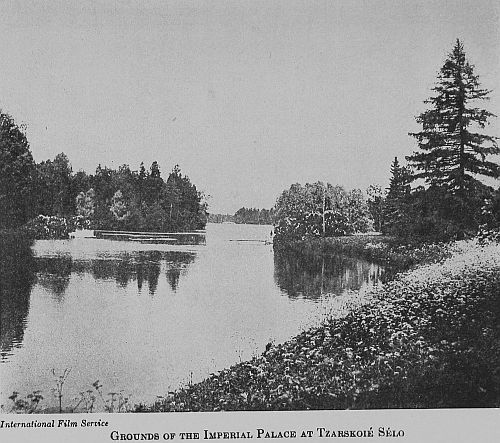
International Film Service
Grounds of the Imperial Palace at Tzarskoié Sélo
Happily for her no one was present when she
gave way to this fit of temper, but one may imagine
how it would have been commented upon by any
of her numerous enemies had they chanced to overhear
it. This state of antagonism (for it can
hardly be called by any other name) which existed
between Alexandra Feodorovna and the
smart set of her capital was not extended to other
places. In the Crimea she liked to have people
about her, as I have already related, and she even
gave dances for her daughters. But though the
Grand Duchess Olga had attained her eighteenth
year during the winter which preceded the outbreak
of the great war, her mother did not attempt to
invite any one to the Palace of Czarskoi Selo to
amuse her. The Empress Dowager had to arrange
some entertainments in her own Anitschkoff
Palace for her granddaughter’s benefit, but each
time they were invited to attend them there was an
explosion of grief on the part of their mother which
completely spoilt their pleasure. The Czarina had
a morbid fear of the sharp tongues of the ladies
of the capital, and she was always expecting that
her daughters would be subjected to the same kind
of criticism which had been applied so liberally to
her own self. This she wished to guard them
against. The idea was a mistaken one, because
everybody admired and liked the graceful girls,
who had always an amiable word for those they
met, and who seemed so happy and so delighted
whenever they had an opportunity of enjoying
themselves like all other girls of their age.
The only person who at one time was in possession
of the confidence of the Czarina to a limited degree,
the Grand Duchess Anastasia, wife of the
Grand Duke Nicholas, tried, without success, to
get her to look upon people with more indulgence,
and not in such a morbid way. My mistress would
not hear reason, and at last declared that it was
useless to be an Empress of Russia if one could not
do what one liked, and that all she craved was the
privilege to be left alone and allowed to enjoy, unrestrained,
her taste for solitude.
In that respect the Empress was certainly not
quite normal, and at times she most undoubtedly
suffered from what is called the mania of persecution.
People abroad have attributed this abnormal
condition of hers to the dread of revolution,
the spectre of which was supposed to haunt her constantly.
This, however, was not at all the case, because
long before any one had an idea that revolution
might break out, my mistress was already
affected by that strange fear of seeing strangers
approach her. The fact is that she had become
morbid, thanks to the latent dislike which she knew
but too well was felt in regard to her, and which
worried her to the extent that she felt disgusted
with the world in general and had come to the conclusion
that it was not worth while to try to conciliate
it, but that the best thing to do was to avoid
seeing too much of it.
People have spoken at length of her tastes for
occultism and spiritism, and said that she looked for
consolation for imaginary woes to the practices of
turning tables and other rubbish of the same kind.
Unfortunately this was true to a certain extent, because
it is a sad fact that the Empress liked to sit
at tables for hours in the hope that they would
begin turning, and she firmly believed that people
could come back from the other world and
manifest themselves to their friends. But what is
not so generally known is that it was the Grand
Duke Nicholas, the future generalissimo of the
Russian armies, who first set her to do so. He it
was who brought to the Palace of Czarskoi Selo a
man called Philippe, who professed to be a powerful
medium, and who certainly inspired the Czarina
with great confidence. For a year or two he remained
in favour, then was dismissed quite suddenly
because he had been found out by accident,
but so completely that even Alexandra Feodorovna
could not defend him.
Some people have said that it was not without
malicious intention that the Grand Duke Nicholas
introduced this dangerous person to Czarskoi Selo.
It has been reported that he wanted to bring about
a scandal to the effect that the Empress should be
declared, if not quite insane, at least afflicted with
melancholia, and put under restraint. She was already
at that time suspected of German leanings
and sympathies, and supposed to influence her husband
in favour of Germany and a German alliance.
The Grand Duke Nicholas was a strong partisan
of a close union with France, and of course he considered
that my poor mistress was an obstacle to
his views, so he would have been delighted had any
circumstance arisen which would have put her
aside. Certainly he was the means through which
the Empress acquired her strange tastes for all
things connected with occultism, and he was also
the first person to draw the attention of the public
and of the Imperial family to this peculiarity, and
to insist on the dangers which it presented. The
fact was that the Czarina was the only obstacle
which the Grand Dukes and their party encountered
in the realisation of their plans to take under
their protection and to keep in their power the
weak-minded Nicholas II., who, it was known but
too well, always adopted the opinion of the last
person who spoke with him, and was incapable of
making any decision of his own accord. The Empress,
thanks to the fact that she was always with
him, had the best chance to make herself heard and
listened to, and consequently she represented a formidable
danger to the ambitions of those haughty
Romanoffs who aspired, if not to dethrone, at least
to keep in their own hands this feeble nephew, so
devoid of initiative.
During the last two or three years which preceded
the war, these different intrigues had assumed
quite a dangerous character, and when the
Rasputin incident occurred, they only grew in intensity.
The Empress became the one great
enemy, to the destruction of whom many applied
themselves with the more energy that she began to
do what she had carefully avoided before—to interest
herself in politics, and to study them carefully,
in view to being able to advise her husband amidst
the growing difficulties of the international political
position in general. The Grand Duke Nicholas,
who headed the faction having for aim the removal
of Alexandra Feodorovna, spared no means to destroy
her influence, and to ruin her reputation as a
Sovereign and as a woman. He partly succeeded,
as we have seen, but at the same time he contributed
to the fall of his own dynasty, and to the ruin of
his country. It is a sad but certain fact that the
Russian Imperial family never understood the
meaning of the word “solidarity,” and perhaps it
is thanks to this defect of theirs that the head of
the House of Romanoff has been sent into exile
and his race deprived of the throne which Peter
the Great and Catherine II. had so gloriously occupied.
THE CZARINA AND HER MOTHER-IN-LAW
I have heard that many different tales have
been circulated concerning the relations of my mistress
with the Dowager Empress. It is useless to
pretend that they were pleasant, but, on the other
hand, neither of the two ladies gave vent to open
manifestations of hostility, whatever they may have
thought in the interior of their hearts. During the
first months following the marriage of the Czar
things went smoothly, because it was impossible
to show more deference to any one than Alexandra
Feodorovna displayed in regard to her mother-in-law.
But the latter was still too young to care to
be suddenly called upon to play second fiddle, and
she missed the power which she had exercised over
Alexander III., who used to consult her in regard
to everything he did. She had had enormous influence
over him, and, if the truth be told, over the
whole course of affairs in Russia, but she had exercised
it with such tact, and so secretly, that it
had never been suspected; on the contrary, the Empress
had been described as a frivolous woman who
cared only for dress, dances and parties. In regard
to the Consort of Nicholas II. things were very
different. She arrived in Russia with the reputation
of being a clever woman, with strong opinions,
and of course found the public prepared either to
accept them or else to start up opposition against
her. German princesses were not liked, and it had
been hoped that the heir to the throne would avoid
choosing a wife in a German court. The Dowager
Empress was Danish by birth, a fact that had
contributed most certainly to the great popularity
she had immediately acquired. There was a powerful
party behind her, quite ready to back her up
against her daughter-in-law, and, unfortunately,
the latter was apprised of it, which had the effect
of setting her against any advice she received from
quarters which she suspected of intriguing against
her. As I have said before, if the Emperor and his
young bride had been able from the beginning to set
up an establishment of their own, perhaps things
would not have fared so badly, and I have often
wondered why this was not done. With the immense
Winter Palace standing empty, or almost so, it
would not have been difficult to arrange some apartments
for the newly married pair, until those they
were to occupy definitely had been got ready. There
were the rooms which had been occupied by the Empress
Marie Alexandrovna, which, with small expense,
might have been made habitable in a few
days. They at least would have made a fitting establishment
for a Sovereign, whilst the two small
closets (for they can hardly be called anything else)
which were assigned to Nicholas II. and his wife in
the ground floor of the Anitschkoff Palace, were so
inappropriate, so ugly and so uncomfortable that
it is no wonder the latter felt depressed the whole
time she was compelled to occupy them. Then, as I
have said, the servants gossiped, and repeated to the
Dowager Empress everything that her daughter-in-law
was doing, a fact of which the latter became
aware through remarks made to her by the elder
lady, and the result was most disastrous. The arrival
of the children, whose advent obliged Alexandra
Feodorovna to set up a nursery, which she tried to
model after those she had seen in England, did not
improve conditions that already had become
strained, because, as one daughter after another appeared,
Marie Feodorovna grew to think that her
daughter-in-law would never give an heir to the
throne and to look up towards her second son
Michael as the future Emperor. This was gall and
wormwood to my mistress, who often lamented the
fact, and, when she had taken me into her confidence,
complained of the want of consideration with
which her mother-in-law made her feel that she was
a nobody and had not fulfilled the duty which was
expected of her, that of providing future Emperors
for Russia. Other reasons also contrived to
add to this state of latent irritation which had established
itself in the bosom of the Imperial family.
There was the question of the crown jewels;
of the order in which the names of the two Empresses
were to be introduced into the church liturgy;
and many others, small and great. The
Dowager was far too tactful to complain about the
domestic relations of her son, but she contrived to
let people guess her sentiments on the subject, and
took to spending more and more of her time in
Denmark, which after all was perhaps the best
thing she could have done.
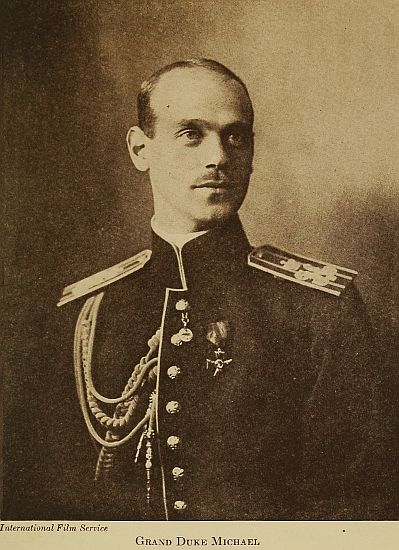
International Film Service
Grand Duke Michael
The Japanese war, however, brought her back
to Russia, and it was during its course that there
happened the one great event in the life of Alexandra
Feodorovna—the birth of her only son.
Great were the rejoicings when this small boy
made his appearance in a world which was not to
prove too kind to him, as we all know. His advent,
however, disturbed the equanimity of several
people, whilst it raised the hopes of others. For
one thing, the Grand Duke Michael, the only
brother of the Czar, lost all the importance with
which he had been endowed in the eyes of the public
as the eventual heir to the Russian throne. It
also took away some of that of his mother, who was
supposed to exercise considerable control over him,
and of course the feelings of the latter on the subject
were very much mixed, because though on the
one hand she could not but rejoice at seeing the succession
secured in the direct line, yet, on the other
hand, she had accustomed herself, as had many
others, to the idea that her eldest son would never
become father to a boy, and it required a certain
time before she could get accustomed to the changes
which the birth of the little Alexis had brought
about.
Furthermore, the young Empress, feeling at last
secure of her own position, began to assert herself
far more than she had ever done before, and she
tried to win for herself partisans. Unfortunately
she looked for them among people who turned out
afterwards to be her worst foes, and the liberty
which she imagined she had acquired to live her
own life without any regard to the trammels of
etiquette or other consideration, transformed the
dislike she had hitherto inspired into something
very much akin to hatred.
Her boy proved a delicate child, and when the
fact became known it awakened the hopes of the
party antagonistic to Alexandra and raised those
of the people attached to the fortunes of the Grand
Duke Michael. His sister-in-law, when she found
this out (and there were but too many people eager
to inform her of it), grew in her turn to dislike the
Grand Duke, and to think how she could get rid
of him. According to the family statute of the
Romanoffs, he would have been Regent of the
Empire in case the Czar had died before his heir
had reached his majority, and the Empress, in that
case, would have been more or less subjected to him
and to any commands he would have deemed it
necessary to issue to her. Most likely the first
thing he would have done would have been to deprive
her of the custody of her son and to surround
the latter with men of his own choice. The very
thought of such a contingency made Alexandra
Feodorovna wild, so when the Grand Duke contracted
the morganatic marriage which brought
upon him the wrath of his brother she seized upon
the occasion to try to get rid once and forever of
a personage whom she considered her worst enemy.
If the truth be told, poor Michael had never been
her enemy, however much he may have disapproved
of some of her actions. The only thing he
asked was to be left alone with the wife whom he
had chosen and married against the opposition of
the whole world and of his entire family, beginning
with his mother. She was a lady by birth, the wife
of one of his brother officers in a Cuirassier regiment
quartered at Gatchina. The Grand Duke
had become attracted by her principally on account
of her sympathetic appearance and the patience
with which she had listened to the tale of his affection
for one of his sister Olga’s maids of honour
with whom he had been passionately in love and
whom he had wished to marry. The romance was
quickly nipped in the bud by the interference of
the Dowager Empress and the young lady packed
away abroad with strict injunctions not to return
to Russia until further notice. The Grand Duke
had been very unhappy, but had submitted, and
poured the story of his wrongs into the ears of
Madame Wulfert. The latter was a charming
woman, but she had had a first husband, from whom
she had been divorced before marrying her present
one. This alone would have made her undesirable
as a wife for the only brother of the Czar,
and when her union with Captain Wulfert was also
dissolved, thanks to the relations which had established
themselves between her and the young
Grand Duke, this undesirableness was still further
accentuated. But she had given birth to a son, and
was moreover a person of considerable attraction
and of unusual cleverness. Michael found out that
he could not live without her, and married her in
Vienna, without asking any one’s permission to do
so, thereby bringing upon his head the wrath of
all his relatives.
The Emperor, however, would have felt inclined
to let the whole matter pass, or at least to make as
if he ignored it. But neither his mother nor his
wife would hear of it. The former wished some
kind of punishment to be inflicted on her rebellious
son, and the latter decided that this punishment
should be a most rigorous one. She prevailed upon
the weak-minded Czar to put his brother under restraint
and to make him what is called in England
a ward in chancery, assuming himself his guardianship
and depriving him of the management of the
large fortune he had inherited from the Czar Alexander
III. This made him of course ineligible as
a Regent should the Emperor die, and that was
what the Czarina was aiming at. Of course she
was wrong, and respectful as I was towards her, I
could not help one evening, when she had broached
the subject of her own accord, telling her that I
thought she had made a great mistake in taking
such a decided part in the chastisement of her
brother-in-law, and that it would have been more
politic on her part to keep outside the matter and
to allow it to be settled between the Czar and the
Dowager Empress, who, after all, were the only
persons concerned in it. My mistress listened in
silence to my words, then suddenly exclaimed with
unusual violence: “I had to do it; I had to do it;
he wanted to part me from my son; he had to be
put out of the way!” There was nothing to reply
to this outburst, but I could not help regretting
that the Empress had allowed herself to be influenced
by false reports, and that her common sense
had not prevailed and stopped her from compromising
herself so openly in this matter. My forebodings,
alas, turned out to have been true ones,
because the first person who was furious with the
Czarina for the part she had played in this whole
story was the Empress Dowager, who had not
wished things to go so far, and who guessed at
once the real reasons which had actuated her daughter-in-law.
The breach between the two ladies was
in consequence considerably widened, and as my
mistress grew more and more addicted to those
superstitious practices which proved her bane,
Marie Feodorovna found real grounds for criticising
her, so that it became at last a recognised fact
that the worst adversary of the Empress was her
own mother-in-law.
I am sure that the latter would have felt sorry
had she known to what extent the strained relations
which existed between her and her son’s wife were
talked of in public. She possessed far more sense
of dignity than Alexandra Feodorovna, and had
moreover been reared in old Imperial traditions unknown
to her daughter-in-law. But she did not
like her, and on the other hand, this sense of dignity
to which I have just alluded suffered in seeing
the domestic life of her child, a child who was
also her Sovereign, turned into ridicule by everybody,
and causing him to be despised even more
than disliked. Finding that the war did not allow
her to go to her beloved Denmark, she finally retired
to Kieff, where the Revolution found her, and
whence she went to Livadia in the Crimea, where
she still is to-day. When I think over these things,
it seems to me that all these frictions, which turned
out ultimately to have been far more important
than they appeared at first, might have been avoided,
at least in part, if the young Empress had restrained
herself in the expression of her feelings.
But she was too frank, too honest, too true, to be
able to play a comedy, and diplomacy was an art
utterly unknown to her. She had not been trained
in dissimulation, and she despised this atmosphere
of the Court where a curb on one’s thoughts and
words was indispensable. In certain respects she
was a child, with all a child’s impulsiveness and
beautiful indifference to the judgments and appreciations
of the world, and this innocence of her
mind and heart made her no match against the intrigues
that surrounded her. She had no one to
love her except her children, and a husband who
was not strong enough to protect her against attack,
and whom in the bottom of her heart she must
have secretly despised, as indeed he deserved to be,
because, whilst an amiable and kind man, he was
not suited for a Sovereign, and could no more control
his own conduct than he could the destiny of
the nation over which fate had set him to rule. He
had absolutely no initiative and no strength of
character. No efforts of his parents or of his tutors
in his young days had been able to change his
natural indolence and readiness to accept and to
endorse as his own the ideas and opinions of every
one he talked to, even if they differed diametrically
from those he had himself expressed previously.
THE CZARINA’S DAILY OCCUPATIONS
I have often been asked what the Czarina used
to do with her days and whether it was true that
she spent them in absolute idleness. And just as
often I have wondered what could have given rise
to such an opinion. The Empress was, on the contrary,
one of those industrious women whose hands
are never at rest, and who require to be always
occupied in some way or another, either mentally
or with some manual work which keeps their attention
concentrated on its intricacies. At Darmstadt
the Princesses were trained to make their
own clothes and to wait upon themselves, and one
of the great pleasures of my mistress was to embroider,
cut, and make the different objects composing
the layette and the wardrobe of her children.
As I have already related, she had tried to arrange
in Czarskoi Selo a Needlework Guild, but she did
not meet with any enthusiastic response to her efforts
in that direction. Nevertheless, until she left
it, there was in the Palace where she had made her
home a room set apart for the use of the ladies
who used to come and work on certain days and
hours on clothes for the poor which were distributed
to the indigent of Czarskoi Selo and St. Petersburg
at Christmas time. When the Japanese war occurred,
a regular working room was established in
the Winter Palace and never closed, because it became
the centre of the Empress’s activity in the
way of making garments for the poor. No Sovereign
had ever thought of anything of the kind in
Russia, and of course the action of Alexandra Feodorovna
in that respect was discussed far and wide,
and whilst many people applauded her for the initiative
she had taken, others thought it was not dignified
for a Russian Empress to cut flannels and
knit stockings, even for the poor. They would have
liked her to depend for her charities on other
people, as her predecessors had done. In fact, in
this as in so many other things, she was ignoring
the traditions which governed all that went on in
the Palaces of the Czars, and of course this was
resented. But the poor population of the capital
learnt to bless the Empress’s name, and for a time
was grateful to her, until the days of the first Revolution,
when everything that was connected with
her became tinged with that unpopularity which
had become attached to her name.
The Empress was a great reader, but only of serious
books, and scientific ones were her favourites.
She did not care for history, which she frankly
owned bored her, because she could not interest
herself in the sayings and doings of people long
dead. But science held her enthralled, and every
work which was published in English, French and
German on astronomy, mathematics, and natural
history was perused by her with avidity. She admired
immensely Darwin’s “Origin of Species,”
and had one day a furious battle with her Father
Confessor, who remonstrated with her for keeping
such a dangerous work in her rooms. Astronomy
was also one of her hobbies, and she expounded it to
her children whenever she found an occasion or
opportunity to do so.
She embroidered wonderfully, and made some
church ornaments which would easily have won a
prize at any exhibition. But her great amusement
was the drawing of caricatures which she executed
with an incredible talent, having the knack of
seizing the funny side of each thing or person
she tried her pencil upon. This talent, however,
caused her much annoyance, because the
people whose ridiculous points she seized upon became
aware of it and were deeply offended, as a
matter of course, especially the members of the
Imperial family, who, more than any others, had
the misfortune to fall under her satirical pencil.
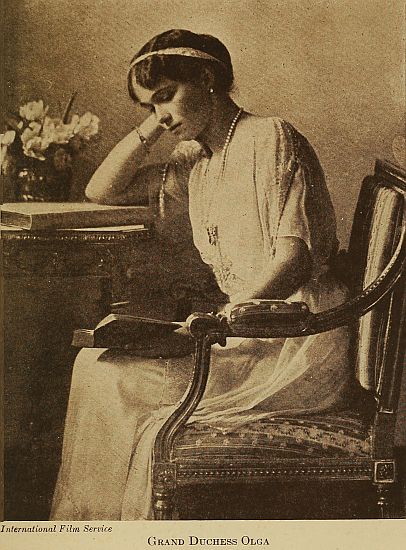
International Film Service
Grand Duchess Olga
Had she been prudent enough not to show her
sketches to friends it would not have been so bad,
but she was, on the contrary, fond of exhibiting
them, and did so without the least discrimination,
with the result that she gained for herself the reputation
of being an unkind and malicious woman,
which was far from the case. The Empress tried to
develop a love for music in her children, and greatly
succeeded with her eldest daughter, the Grand
Duchess Olga, who had a really wonderful talent
for the piano. She could compose wild, melodious
airs, imbued with that Russian and Slav sadness
which is latent in all Northern characters. I remember
one day last May when, entering unexpectedly
the apartment where the young Grand
Duchesses were sitting, I was entranced by the
playing of Olga, who seemed to put into her music
all the agony and anxiety of her soul. Things were
dark then. The possibility of seeing exchanged the
prison of Czarskoi Selo for another was already
looming on the horizon, and the young and blooming
girl who was to be sent to the horrors and solitude
of a terrible exile was giving vent to her feelings in
the weird accents which she gave to the music with
which she tried to ease her troubled feelings.
In spite of her taste for music, the Empress
rarely went to the Opera. She hated showing herself
in the big box where etiquette compelled her
to sit, and she disliked the one that was common to
all the members of the Imperial family. So that
even during the early years of her marriage, when
she used to spend a few weeks each winter in St.
Petersburg, she rarely showed herself in any theatre,
not even at the French play, which it had been
almost a matter of obligation, from times immemorial,
for the sovereigns to visit every Saturday.
She had made it a point to study the Russian
language, but had never really learned to speak it,
and had never divested herself of a very strong
German accent that had a harsh sound, which
added to its general unpleasantness. The Empress
had not a pleasant nor a harmonious voice, and as
she was aware of the fact she tried to overcome this
disadvantage by talking in very low tones, so low
indeed that sometimes it was difficult to hear her.
She would then get impatient and break off the
conversation, to the dismay of her interlocutors.
During the last years she had grown slightly deaf,
which added to the difficulty.
Her inability to talk Russian naturally displeased
people, but I have always wondered why
she was so sharply taken to account for it, considering
the fact that her mother-in-law had never
learnt it either, which had not prevented her from
becoming popular. It was again a case of “give
a dog a bad name and hang him.”
The Empress kept up a vast correspondence
with her relatives all over Europe. In England,
where she had been brought up, she had also friends
with whom she liked to exchange her impressions
and thoughts, and to her brother she wrote daily.
She had a very distinct handwriting, plain and legible,
and her signature was exceptionally large.
Except in official documents she always used the
name “Alix,” instead of Alexandra, and the Emperor
in the privacy of their family life called her
“Alice.” She generally occupied herself with her
correspondence in the afternoon after her daily
walk with the Emperor, and as soon as her cup of
tea was brought to her at five o’clock she stopped
writing, even if she was in the midst of a letter.
In that respect she was quite extraordinary.
Things had to be done at a certain hour, and if not,
had to be put off until the next day. She would not
for anything in the world have sacrificed five minutes
of the time appointed for something else to
finish what she was doing at the moment.
In Czarskoi Selo she had a lovely room full of
flowers where she had her writing table, a wonderful
specimen of French art of the time of Louis
XV. Next to it stood a smaller table, where she
used to throw the sheets she had just finished writing
upon, until all her letters were finished, when
she would pick them up and put them in their envelopes.
This led her sometimes to mix up one
letter with another, and brought her into trouble
through people getting missives which were not
meant for them. While Queen Victoria was alive
the Empress wrote to her regularly every week,
but she did not much care for so doing, and used
to say that it was a duty she would rather not have
had imposed upon her. At Christmas and the New
Year, she regularly sent her best wishes to the
other European sovereigns whom she knew personally.
In this room I have just described, which was
hung up with light and bright chintz, reminding
one of an English room, and which contained comfortable
and at the same time costly furniture, the
Empress transacted only her private correspondence.
All her official writing was done in a small
library opening out of her sitting-room, where stood
a large, ugly and practical writing table with innumerable
pigeonholes, at which she used to sit
when her private secretary presented to her his
daily reports. It was at this table she made up
her accounts and attended to all her business, and
it was also here that she made out the programme
for her public work, receptions, visits to charitable
institutions, and so forth. She was most orderly
and neat in her habits, and could tell at once where
she had put such or such a paper. I do not think
that she could have tolerated disorder in any shape
or form around her, and she used to go through
her numerous drawers and wardrobes every month,
when she expected to find every single thing in the
place where she had ordered it to be put. All her
laces, of which she had a wonderful collection, were
kept in a separate cupboard, of which I was the
only person to have a key. The Empress herself
possessed a duplicate one, as she did of all her
trunks, wardrobes, and cupboards, and she clung
to them like a real German housewife, and sometimes
would unexpectedly open one or the other of
these receptacles to assure herself that they were
kept in order. I remember an amusing instance of
this mania. When the Empress married, she received
among her wedding presents a beautiful
writing table set in crystal and gold with her monogram
and the Russian Eagle on the top of the
inkstand. For some years she always used it, until
at last one day the Emperor noticed that there was
some inaccuracy in the coat of arms of the Romanoffs
which was ornamenting the blotting book, and
he instantly presented his wife with another and
far handsomer writing table set, a masterpiece of
the skill of Faberge, the great Court jeweller in
St. Petersburg, which was made out of platinum
and crystal, with big turquoises as ornaments. The
pen was of solid gold and had a turquoise as a finish
to the handle. Of course the Empress hastened to
put away the old set which had displeased her
spouse, and we stored it up in one of the cupboards
in which were kept the innumerable possessions of
the Czarina. One day she opened the said cupboard
when no one else was present and was highly
displeased to find that some parts of this writing
table set were put on a different shelf from the
others. This had been done because we had thought
that it would suit better the amount of room which
we had at our disposal, but the Empress would not
enter into considerations of that kind, and gave
us a good scolding for keeping her things “in such
disorder,” as she expressed it.
Twice a year she went over her whole wardrobe,
at the time when she ordered the new dresses which
she required for each season. She then looked over
the different articles in it with care, and either made
a present of the things which she thought she would
not want any longer, or sent them to her sister the
Grand Duchess Elizabeth in Moscow, where the
latter disposed of them among the poor girls of the
Moscow nobility about to be married. She would
be very careful to have every bit of real lace unpicked
from these dresses, and then this lace was
consigned to the cupboard set apart for that purpose,
and entered in a catalogue, which was entirely
written in the Empress’s own hand.
As may be imagined, all this kept my mistress
busy; and indeed there was hardly one hour in the
day when she was not occupied with one thing or
another. Her children’s wardrobes were looked
after by her with the same care that she applied to
her own things. And at Czarskoi Selo and Livadia
she herself used to look over the housekeeping
books of the Imperial household, much to the dismay
of the head of it, who often complained that
the Empress did not in the least understand the
intricacies of the management which she sometimes
so freely criticised. But though she frankly owned
that she did not know how much an egg or a potato
cost, yet, as she declared, she liked to be aware of
the price of the potatoes which she consumed. It
was an innocent mania, and would have been considered
as such if there had not existed malicious
people ready to make fun of it, and to laugh at the
“German Housekeeper,” as they derisively called
my poor mistress, who in view of this fact would
have done much better not to have meddled in matters
in which after all she had no need to enter, and
which so many people would have been but too
happy not to have to think about.
THE JAPANESE WAR AND THE BIRTH OF THE CZAREVITSCH
The first really great sorrow and anxiety which
fell on my beloved mistress was the Japanese war.
I am not writing here a political book, and indeed
understand nothing about politics, but what I do
know is that no one could have been more affected
by the disasters which destroyed the Russian army
and fleet than was the Empress. She used to
spend hours weeping in her room, where she allowed
no one, not even her children, to enter, and
it was from that time that dated the terrible headaches
which later on were to prostrate her so utterly.
She was then in a delicate state of health,
and the Emperor wanted to spare her as much as
possible the news which was brought of one sad
event after another concerning all that went on in
this distant Manchuria, where Russian soldiers
were fighting such a hard battle. The whole country
was exasperated at the lamentable organisation,
or rather want of organisation, which was revealed
so unexpectedly, and it was dating from
Mukden and Tsushima that the Revolutionary
elements in the country raised their heads and began
to threaten the throne which they were to destroy
twelve years later. The whole of Russia was
in the throes of an insurrectional movement, and
perhaps the only persons who were not aware of
its strength and magnitude were the sovereigns
themselves. Nicholas II. had not realised the
possibility of the fall of his dynasty and seriously
believed that he could stop the torrent that was
flooding the country. The Empress was ignorant
of the details of the convulsions which were fast
destroying the old legends and traditions which had
presided at the government of the Empire for such
a long time. She had a few illusions left still, and
one of them was in regard to the strength and the
spirit of devotion of the army. It was therefore a
terrible shock to her to find that this army which
she had believed to be invincible had allowed itself
to be beaten by the troops of the Mikado whom
she had regarded as savages. She felt cruelly the
loss of prestige which this disastrous campaign entailed,
and she also felt humiliated in her pride
as a Sovereign and as a woman. Added to this
weight of anxieties was another—the dread that
the child whose birth she was expecting would
prove another daughter, whose advent into the
world would add to the unpopularity of its mother.
Sometimes my heart used to ache for her, when I
saw her dragging herself through the park of Peterhof,
looking so ill that one wondered whether
she would be able to stand the trial which was
awaiting her. In her cruel anxiety she found no
one to encourage her or to whisper words of encouragement
in her ear. Her husband was himself
absorbed by the saddest of preoccupations and
she did not care to add to them by speaking to him
of her own personal griefs and sorrows. So the
time went on, bringing every day new subjects for
alarm, and new causes for discouragement. At
last one morning I was called to the bedside of the
Empress, together with all her other attendants,
and with trembling hearts we awaited the verdict
of the doctors as to her safety and the sex of the
infant for whose advent we were watching with
such intense interest. It was noon, and the great
clock of the castle of Peterhof had just been heard
striking the twelve strokes announcing it, when a
child’s cry broke the silence of the room where the
Empress was lying, and then Doctor Ott, her physician,
turned towards the Czar, standing pale and
worried beside his Consort, with the word: “I congratulate
Your Majesty on the birth of a Czarevitsch.”
Nicholas II. did not reply. He stood as if dazed
by the unexpected news. No one spoke or interrupted
his meditation, but all devoted themselves
to the Empress, who was still under the effects of
the chloroform that had been administered to her.
When she opened her eyes she looked so weak that
no one dared to tell her the good news, but she
seemed to read it in the face of her husband, because
she suddenly exclaimed: “Oh, it cannot be true; it
cannot be true. Is it really a boy?”
Nicholas II. fell on his knees beside her and
burst into tears, the first and only ones I had ever
seen him shed.
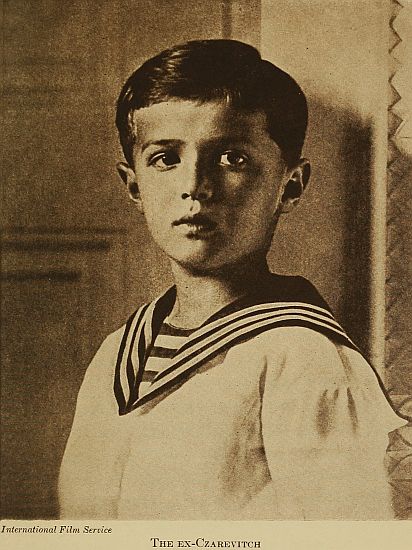
International Film Service
The ex-Czarevitch
The birth of an heir to the throne was an event
of such magnitude that it absorbed for some time
the whole attention of the public, and diverted it
from all that was taking place in the Far East.
For his parents it came as a consolation after long
years of waiting, and seemed to have been destined
to comfort them for the disasters which were taking
place at the front. The Czar could not restrain
his joy, and at every moment he used to
speak of “his son,” and to look out for occasions to
pronounce the magic words, “My Boy.” The Empress’s
happiness was less buoyant but just as intense,
perhaps even more so, for this opportune
arrival of the little man whom one had already left
off expecting improved considerably her own position,
and gave her an importance which had been
denied to her before. She became passionately attached
to this child of promise, and almost painfully
and morbidly devoted to him. Unfortunately he
proved a most delicate little mortal, and for the
first years that followed upon his birth the doctors
who attended him hardly hoped they would be able
to save his life. He was born with an organic disease,
or rather defect, a weakness of the blood vessels
which ruptured on the slightest provocation,
causing hemorrhages that sometimes could not
be stopped for hours. For a long time his condition
was hidden from the public, but at last concealment
became impossible, especially after an attack
which occurred about two years before the
great war, which was of so serious a nature that the
child’s life was absolutely despaired of. A few
months before this he had been obliged to undergo
an operation for hernia and had hardly recovered
from the effects of it when an accident brought
about the hemhorrhage which for weeks resisted
every remedy employed to stop it. These were
anxious times for the parents, and the Empress’s
hair changed colour and showed streaks of grey before
her son was at last pronounced out of danger.
I have spoken at length of this serious illness of
the little Alexis because so many ridiculous tales
were put into circulation concerning it, tales which
were as malicious as they were foundationless.
The small heir of Nicholas II. was never the object
of any attack of nihilists, and all the detailed
circumstances which some newspapers related concerning
him were all of them pure invention. It
is sufficient to say that when he became ill the Imperial
family were not on their yacht, but were
staying at one of the Czar’s shooting boxes at Spala
in Poland. I have often wondered who could have
had an interest in giving publicity to the ridiculous
and distressing tale which is to this day firmly believed
by many people outside of Russia.
When the Grand Duke was able to be moved his
parents returned to Czarskoi Selo, whence they
went for many months to the Crimea, the mild climate
of which was considered to be necessary for
his convalescence. But for more than two years
after this attack the boy was not allowed to walk,
and was constantly carried about in the arms of
a sailor from the Imperial yacht whom he had taken
into his affection, and who to this day is with him,
having chosen to accompany him to Siberia. This
necessity of having to exhibit, so to say, a sick
child, was most painful to the feelings of the Empress,
whose maternal pride was hurt by the knowledge
that the whole of Russia was commenting on
it and pitying the Emperor for having an heir in
such a sad state of health. She was also continually
subjected to the railleries of her husband’s family
that reproached her for having, as one of the
Grand Duchesses once expressed it, “contaminated
the Romanoffs with the diseases of her own
race.” There was some truth in the accusation, because
the illness from which the boy suffered was
hereditary in the Saxe-Coburg family, and had been
brought into the House of Hesse by the Princess
Alice, the mother of the Empress, whose own
brother, the Duke of Albany, had died from the
effects of it at Cannes. The worst thing about it
was that one could never know when it was going
to break out afresh. The slightest knock was sufficient
to bring on an attack, and one can imagine
how far from easy it was to watch over every movement
of a lively boy full of fun and high spirited,
such as Alexis proved to be. On the other hand
this physical infirmity (for it could hardly be called
anything else) had this result that the child got to
be inordinately spoiled. The mother was afraid to
contradict him or to refuse to submit to any of his
caprices, because she had been told that it was dangerous
for him even to cry, as any exertion of his
lungs or throat might bring about the rupture of
some blood vessel. One may therefore form an
idea of the system of education to which Alexis was
subjected, and perhaps one will feel indulgent in
regard to the Empress when thinking of the perpetual
dread and anxiety in which her days and
nights were spent, and forgive her for the weakness
which made her yield to every whim or caprice
of the boy who seemed to have been born
to add to her cup of sorrow, and not for the purpose
of bringing joy into her life.
I will now relate an incident which deeply impressed
the Czarina at the time when it occurred.
It was a few days before the birth of her son. We
were at Peterhof and she was dressing for dinner.
Suddenly we heard a crash behind us, and were
dismayed to see that a heavy looking glass which
hung upon the wall behind Alexandra Feodorovna
had fallen to the floor, where it had been shattered
into a thousand fragments. The Empress cried
aloud in her emotion, and for one moment I believed
that she was about to faint, so white did her
features become. I applied myself to reassure her,
but she would not be comforted, and declared that
it was an ill omen and that probably she would die
in childbirth. When everything was over, and on
the day of the christening of the Grand Duke
Alexis, I ventured to remind his mother of her
fright of a few weeks before, and added that it was
a clear proof how wrong it was to be superstitious,
because certainly nothing happier could have occurred
than the event which had just taken place,
notwithstanding the bad omen of the broken looking
glass. The Empress smiled sadly, and replied:
“My good Marfa, we do not know yet what is going
to befall my baby, and whether his will be a
happy life or not. Perhaps the bad omen was for
him and not for me.”
A curious thing is that exactly ten years later,
in July, 1914, just before the war, we were again
at Peterhof, and the Czarina was dressing for dinner
in the same room, when that identical looking
glass, which had been rehung, fell with the same
noise and just as unexpectedly, terrifying her as it
had done before. Alas, alas, we could afford then
to laugh at omens, but now that so many tragic
things have occurred I wonder sometimes whether
these accidents (for one can hardly call them anything
else) were a kind of warning of the calamities
about to follow. Certainly they could not fail
to impress a woman as superstitious as the Empress
grew in time to be.
When I say “grew,” it is not quite exact. She
had always believed in good and bad omens, and
she had brought with her from her German home a
quantity of beliefs in all kinds of uncanny things.
She would not have sat down thirteen at dinner for
anything, and the sight of three candles on a table
made her frantic. She would not have put on a
green dress for fear it would bring her bad luck,
and she was always careful to look at a new moon
from the right side. She never began anything on
a Friday, and she was firmly convinced that one
could, if only one were strong enough as a medium,
summon people from another world into one’s presence.
She believed also in miracles, and would
worship any dirty relic which hundreds of unwashed
peasants had kissed, without feeling the
least disgust, which was the more strange in that
generally she was almost meticulously careful not
to touch anything that had not been thoroughly
cleansed. The influence which Rasputin grew to acquire
over her mind proceeded only from this weakness
of hers, which was continually fomented and
encouraged by her sister, the Grand Duchess Elizabeth,
herself a most devout person who combined
bigotry with an utter unscrupulousness as to the
means with which she could realise the many ambitions
that she entertained.
If the Emperor had been a man of strong character
he might have prevented his young wife from
falling under the influence of the many people who
merely used her as a pawn in their game. But in
his way he was just as superstitious as she, and
they both were so absorbed by their love and anxiety
for their only son, that they clung to all those
whom they thought could be of use to him. Thus
when they saw Rasputin, whom they considered
to be a saint, prostrate himself on the ground and
implore the Almighty to cure the boy, and when
after this they noticed that the boy was getting
stronger, they felt more and more tempted to think
that it was not the doctors (who had told them that
the child could never be permanently cured) who
had made him better, but the will of the Almighty,
and that it was to the Almighty alone they had to
look for the conservation of the life of that much
cherished son.
THE CZARINA, HER CHILDREN AND HER CHARITIES
It would be difficult to find a better mother than
the Empress Alexandra. She entered into the
smallest details of the training of her daughters
and her son, and she tried before everything else
to imbue them with the same serious points of
view with which she looked upon life and its numerous
duties. She insisted on her children always
speaking the truth, and the only time I ever saw
her really angry with the little Alexis was one
morning when he was caught by her telling a
falsehood. She had suffered so much through the
insincerity which continually dogged her footsteps
that she made up her mind to save her children
from this misery, and she applied herself to
make out of them sincere people. She had been
very lucky in the choice of the lady who was appointed
to superintend the education of the young
Grand Duchesses. Mademoiselle Toutscheff was
a person of the highest moral character, who gave
herself up to her duties of governess to the daughters
of Nicholas II. with a complete devotion.
People said that she had been the whole time in
variance with the Empress, and that she had left
at last because her advice had been disregarded.
But this was not quite correct. It is true that she
objected to the introduction of Rasputin to her pupils,
but that was principally because she feared the
influence which this illiterate peasant might come
to exercise over the impressionable minds of the
young girls entrusted to her care, whom she did not
wish to see afflicted with the superstitious religious
exaggerations to which their mother unfortunately
succumbed. This led to friction between her and
Alexandra Feodorovna, and she preferred to resign
her functions rather than to remain at her post
after having lost the confidence of the mother of
her pupils. There may also have been another reason
for her going. The Grand Duchess Olga was
already twenty years of age, and she had developed
an independent character which had made the position
of Mademoiselle Toutscheff extremely difficult.
She thought that it would be to the advantage
of everybody if she severed her connection with
the Imperial family before she had spoilt it by unseemly
quarrels.
In a certain sense she was right, because it was
unfortunately an undoubted fact that the Empress
had become quite fanatical in her allegiance to the
Greek Orthodox Church, and that she tried to induce
her daughters to follow her example. Happily
for them the girls had a great deal of common
sense, and they managed to keep themselves free
from the religious excesses into which their mother
had fallen. They loved her tenderly, and would
have given their life for her, and she on her side
doted on these girls. When they were babies she
spent most of her spare time with them in their
nursery or schoolroom, and later on she shared
with them all her occupations and associated them
with her life as much as she could. She never
parted from them or from their brother, and there
was not a thing which concerned their well-being,
down to the smallest details, into which she did not
enter. When the war broke out she with her two
eldest daughters followed a course of training as
sisters of charity, and in the hospital which she
opened in Czarskoi Selo she nursed the wounded
soldiers with them.
In regard to the little boy whose advent had been
such a source of joy to his parents, the Empress
was also full of solicitude. She had taken upon
herself his religious training, and every morning
had him brought to her room for an hour, when she
would read to him the gospel and teach him the
catechism. She was a fond, but by no means a
foolish mother, and what she aspired after was to
make out of her children honest men and women
and worthy members of society. But at the same
time she had very determined opinions in the matter
of education, and there were things which she
could not understand, as, for instance, the necessity
for her girls to have some amusements in their lives.
She imagined that it was quite enough for them to
live with their parents, in possession of all that
their hearts could desire in the matter of material
satisfactions, and would not hear of the necessity
of marriage for them. She could not bring herself
to look upon them as upon grown-up women, and
considered them always in the light of babies in
need of her care. She is not the only mother who
may be reproached for this failing, and she was
more reproached for it than she deserved to be.
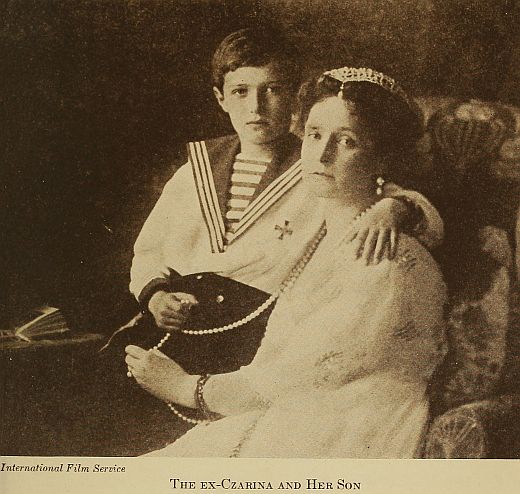
International Film Service
The ex-Czarina and Her Son
The little Grand Duke Alexis had a tutor, an
Englishman, whom he liked very much, and also a
French master. His mother wanted him to have a
complete command of foreign languages, knowing
by experience how difficult it is for people placed
in high positions to get on without it. The boy was
a bright and intelligent child, and if he had only
had good health, he might have made greater progress
in his studies. But half of his time was spent
in bed, and naturally this interfered with the course
of his lessons. His sisters also were not in possession
of the best of health, and this extreme delicacy
of her children was a source of perpetual anxiety
to the Czarina. She also objected to what she declared
was a tendency towards frivolity on the part
of her girls. Tatiana especially was extremely fond
of nice clothes and of jewellery, and her mother
was continually trying to subdue her extravagances
in that direction, notwithstanding the fact that she
very well knew the like reproach might be applied
to her own self. She was continually drawing the
attention of her daughters towards the sufferings
of others, and her instructions bore fruit, because
when the war broke out the Grand Duchesses displayed
wonderful qualities of self-abnegation and
devotion to the cause of suffering humanity. Tatiana
in particular was quite marvellous, and
worked indefatigably in the relief committee at
the head of which she stood, which proved the only
one that did any good, and where malversations did
not take place. She renounced any pleasures she
might have obtained in the way of buying this or
that thing that attracted her fancy, and at last
when money became scarce she sold a beautiful pearl
necklace which her father had given to her on her
eighteenth birthday, to relieve some of the distress
which was being constantly brought before her notice.
The lessons of her mother had borne fruit.
The Czarina was naturally extremely charitable,
and moreover she had very sane ideas in regard to
the relief of suffering and misery. She had especially
at heart the fate of small children, and the
society which she and the Emperor founded, which
was destined to encourage poor women in their
aspirations after maternity by teaching them how
to take care of their offspring, was an elaborate
and most intelligent affair. She would certainly
have brought it to an excellent result if the Revolution
had not interfered and destroyed her plans
in that respect, as it destroyed so many other things.
My mistress has been reproached at different
times for having shown herself indifferent to the
cause of national education, and for not having considered
that problem with the attention it deserved.
But this was also an unreasonable reproach. The
Empress could not, even if she had so wished, have
interfered with the conduct of the different educational
establishments for women in the Empire.
These were all of them placed under the patronage
of the Empress Dowager, who was far too jealous
of her privileges in that respect to have consented
to share them with her daughter-in-law. The same
thing might have been said in regard to the work
of the Red Cross, which was entirely controlled
by Marie Feodorovna, who brought to it great
knowledge and considerable ability. But at the
same time she would not allow the young Czarina
to interfere with it, and when the latter tried
in her various visits to the Front to suggest this or
that improvement in the management of the different
hospitals she inspected, her mother-in-law
instantly protested and declared herself affronted
by what she considered to be a criticism on her management.
The young Empress had to devote herself
to the care of the wounded in the different hospitals
which she had organised at Czarskoi Selo,
and her work remained confined to the great committee
for relief of the refugees from the invaded
countries and other victims of the war, which the
Emperor had founded at the beginning of the
campaign, and the care and patronage of which he
had placed under the management of his wife. It
was an interesting but at the same time a most
disheartening work, because it was impossible to
follow its execution, and one had perforce to depend
on people more or less reliable. My mistress
often regretted that she was debarred from putting
her experience and her great love for her neighbour
at the service of the army. This, however, was
denied her, perhaps not without reason, because by
that time she had already become most unpopular
among the troops, who had taken to calling her “the
German.” One day when she was inspecting a
field ambulance, she heard the expression in reference
to herself and was so overcome by it that
she could not restrain her tears. The poor woman,
though she knew that she was regarded with anything
but affection by her husband’s subjects, yet
had believed that the army at least appreciated her
care and her desire for its welfare. The discovery
that such was far from being the case was a great
blow to her. As time went on, carrying away with it
all her hopes of winning the love of the Russian
nation, she became hardened and ceased to conceal
the contempt which she felt for a world that had
failed to realise and to believe in her good intentions.
But through it all she applied herself to
hide from her children the intensity of her disillusions,
and she went on instilling into them those
high principles to which she had tried to remain
faithful herself. Her great misfortune was that
she lived in great times, and that she had no greatness
in her to meet them. This was a calamity, but
by no means caused by her own fault.
Sometimes she was touching in the attention she
gave to the smallest detail connected with the training
and the welfare of her children. One may say
that even before the great catastrophe which fell
upon her, her attention had been entirely concentrated
on her babes. She liked to be present at all
the daily routine of their existences, and whenever
her daughters were to be produced before some of
their relatives, she made it a point to superintend
their toilet, and to brush their long hair. The girls
were generally dressed in white, winter and summer,
and it was only when they had reached their
twelfth year that she consented to dress them in
dark colours during their school hours. But even
then they had to change for dinner and to appear
before their parents in the light gowns their mother
was so fond of. Their clothes were always made in
the best houses, and their linen just as dainty and
magnificent as their mother’s. In summer and on
board the Imperial yacht, they were generally attired
in sailor hats and blouses, and were allowed
to run about as much as they liked, and to talk to
the officers and sailors. They shared their mother’s
love for the sea, and the six weeks or so that
these annual excursions in the Finnish waters lasted
were the real holidays of the children as well as of
the Empress.
The latter has also been accused of not showing
any amiability in regard to the foreign guests who
from time to time visited the Court of Czarskoi
Selo. In this there may have been a certain amount
of truth, but the apparent coldness of the young
Czarina proceeded from the everlasting fear which
haunted her that she might be compromised by
showing herself too effusive towards strangers.
She knew that any attention she showed to her
visitors would be widely commented upon, and as
these with few exceptions were German princes,
this circumstance added to her embarrassment, because
she was very well aware that she was supposed
to harbour strong Teuton sympathies. In
regard to her English relatives she was handicapped,
because the Queen of Great Britain was
the sister of the Empress Dowager, and when she
came to Rewal with King Edward, she was naturally
more with Marie Feodorovna than with the
niece with whom she had so very little in common,
and who had done nothing whatever to win her sympathies.
From time to time the sister of the Czarina,
Princess Henry of Prussia, put in an appearance
at Czarskoi Selo, and her brother, the Grand Duke
of Hesse, was also a frequent visitor there. But
these visits were never official ones, and mostly
passed unnoticed by the general public that had
left off troubling about what went on in the home
of the Sovereign. The members of the Imperial
family were also rare visitors at Czarskoi Selo, and
avoided putting in an appearance there unless
absolutely compelled to do so. Alexandra Feodorovna
knew so perfectly well how to convey to her
guests the knowledge that they bored her that it
was no wonder they did not care to court this knowledge
and that they preferred not to annoy her with
their presence. The Empress Dowager used to appear
on the family anniversaries, such as birthdays,
name days, and others of the kind to offer her congratulations
to her son and daughter-in-law, and
every winter the young Czarina used to come to
St. Petersburg from Czarskoi Selo to pay her
mother-in-law one solemn visit of ceremony; after
which the two ladies did not see each other for a
long time. All this was abnormal, but once these
relations had been established it was next to impossible
to change them, and so the breach which
separated my mistress from the world as well as
from her husband’s family widened and widened,
until at last she found herself alone in presence of
danger, of sorrow, and of one of the greatest catastrophes
which history will ever record. Whether
the fault was wholly hers or was shared by others,
is a point upon which I shall not attempt to give an
opinion.
THE FIRST REVOLUTION
I often wondered whether the Empress had
quite appreciated the magnitude of the first revolutionary
movement which took place in Russia during
and after the Japanese war. She had been repeatedly
told that it was a mutiny of no importance,
bound to be crushed by the government. The
Czar as well as his ministers had purposely left
her in the dark, the former because he did not wish
to alarm her, and the latter because they feared
that she might try, in presence of the danger which
threatened the dynasty, to persuade her husband to
adopt a more liberal form of administration, and to
grant to Russia this Constitution for which everybody
was clamouring, especially after the war had
plainly proved that the autocratic régime was at
an end. She could, however, sometimes hear echoes
of the general dissatisfaction, and indeed the first
person who pointed out to her its extent was the
Empress Dowager, who knew very well all that was
going on, and who had made it a point to become
as well-informed as possible of all that was taking
place in the Empire. For once Marie Feodorovna
appealed to her daughter-in-law to open the eyes
of Nicholas II as to the perils of the political situation,
but she refused to do so, thinking that the
request covered an intrigue of which she was to
become the victim. And so time went on until
Count Witte, who still enjoyed some popularity,
spoke to the Emperor, and persuaded him to promulgate
the famous Manifesto of the 17th October,
and to call together a Representative Assembly.
In a certain sense this was a victory for
the Empress, for she had at that period more than
once expressed her conviction that it would be to
the advantage of the Russian nation to establish
a constitutional form of government, as near as
possible to the one which had proved so successful
in England. But strange as it may appear to say
so, she was at that very moment changing her opinions
and rallying to those of the people who thought
that every concession to the demands of the populace
would bring about the ruin of the monarchy,
just as the calling together of the States General in
France in 1789 had brought about the fall of the
Bourbons and sent Louis XVI. finally to the scaffold.
She had always compared her fate to that
of Marie Antoinette, and had more than once expressed
to her friends her conviction that she also
was destined for some horrible fate. On the day
when the first Duma was opened by the Emperor
in the big ballroom of the Winter Palace, she cried
the whole time that she was dressing, and it was
almost with a feeling of horror that she allowed her
maids to place on her head the big diadem of diamonds
which formed part of the Crown jewels,
and to hang about her neck the many rows of
pearls and precious stones which lay in readiness
for her. She was dreading the future and wondering
what it would bring with it.
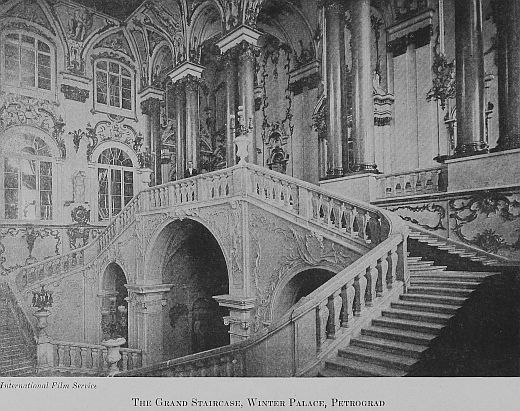
International Film Service
The Grand Staircase, Winter Palace, Petrograd
There is one incident concerning these momentous
days which I must relate. When the population
of St. Petersburg, headed by the notorious
Gapone, repaired to the Winter Palace and asked
to see the Sovereign, in order to lay their grievances
before him, the Czarina was of the opinion that he
ought to have received them and spoken with them.
Her mother-in-law thought the same thing. But
the ministers, and especially Count, then still Baron,
Fredericks opposed it, and it was their advice
which prevailed, instead of that of the two Empresses.
To tell the truth, Nicholas was not of a
courageous nature, and but too ready to listen to
those who told him that he ought not to expose his
person to any danger.
But in presence of this new load of calamity that
threatened her and her children my mistress more
than ever put her trust in God, and prayed, prayed
with more fervour than she had ever done before.
Several times she interceded in favour of revolutionaries
who had been sentenced to death for some
political crime or other. This happened particularly
in the case of a woman, Sophy Konoplianinova,
who had murdered General Minn, the commander
of the Semenovsky regiment, who had repressed
with ruthless cruelty the Moscow Rebellion.
The Empress wished to have her pardoned,
but the Czar would not listen to her, and all her
pleadings for mercy were in vain.
Is it to be wondered that racked as she was with
cruel anxieties, and bred in an atmosphere of superstition,
she set her belief more than ever in
spiritism and consulted fortunetellers, and monks
and priests who predicted to her a future devoid
of cares, and one where worries would be unknown
to her? She listened to them, and with a blind faith
in their many and varied predictions she proceeded
to absorb herself more and more in practices of a
religious devotion which finally mastered all her
thoughts and left no room in them for anything
else. She had fitted up in her bedroom an oratory
full of sacred images, to which every day was added
another icon. No Russian was ever a firmer believer
in the different dogmas of the Orthodox
Church than was this daughter of a German house,
whose mother had been an intimate friend of the
famous Strauss, and had allowed the latter to dedicate
to her his life of Jesus which had caused such
a profound sensation in literary, religious and philosophical
circles all over the world.
The Revolution was finally mastered, and though
the Duma always continued to show itself criticising
and even rebellious, things began to settle
down. Russia prepared to celebrate the anniversary
of the Three Hundredth Year of the accession
of the Romanoff dynasty to the throne, and
great rejoicings were planned for the occasion.
The Imperial family came to St. Petersburg for
the first time since the Japanese war, and remained
in the capital for four days. A solemn service of
thanksgiving was celebrated in the Kazan Cathedral,
to which representatives of all the classes of the
Empire were invited, and the nobility of St. Petersburg
gave a big ball at which the whole Imperial
family was present. I remember it so well, because
it was the last occasion on which the Empress
appeared in full state and wore the Crown Jewels.
She had chosen a white satin dress all embroidered
in silver, and had consented to put on what she did
but rarely—the famous necklace of diamonds together
with the tiara that had belonged to the Empress
Catherine. She was still beautiful, but the
slight figure that had been so conspicuous in her
young days, and the beautiful complexion which
had been unrivalled, had disappeared. She looked
a middle aged, haggard woman, racked with cares
and anxieties, and though the splendid, sharp profile
could never change, the mouth had altered, and
its expression was almost tragic. She only remained
for an hour at the ball, and retired before
supper, leaving her daughters to the care of the
Dowager Empress, who declared herself delighted
at the thought of chaperoning them.
It was the girls’ first appearance in society, and
those who saw them then will never forget how
they looked. They were both dressed in pink, soft
clouds of tulle, which suited them to perfection.
Not regularly pretty, they had sweet faces, and
such charming manners that one could not help
being attracted by them. Rumours of their approaching
marriages with the Crown Prince of
Servia and the future heir to the Roumanian
throne were afloat at the time, and added to the
interest which they excited. Alas, alas, all these
hopes were to prove fallacious, and St. Petersburg
society, which had been so much attracted by these
two Princesses, was never to see them again, at
least as the daughters of a reigning Sovereign.
Dark rumours were already coursing at the time
concerning the Empress and her affection for the
terrible Rasputin who was to do her so much harm.
In general she was unfortunate in her friendships,
because the one which she formed for Madame
Wyroubieva caused also much scandal. The Czarina
with all her cleverness (and she was clever)
had no judgment and did not possess the slightest
knowledge of the world or of humanity. She believed
all that she was told, and, if the truth be
said, she was so anxious to please and to be liked
that she accepted with joy and an amazing credulity
the protestations of affection she met with.
If she had only had a really good friend, so many
of the mistakes which she made might have been
avoided.
One of the people who did her the most harm was
her own sister, the Grand Duchess Elizabeth. The
latter was an ambitious person who conceived the
plan to rule Russia through the Empress. She
had entered a convent not at all out of any vocation
for the religious life, but because she thought that
it would give her prestige in the country, and that
she might acquire there a position which it would
have been impossible for her to obtain as the widow
of a Grand Duke who had been murdered on account
of his unpopularity and the hatred with which
he was looked upon in the whole of Russia. She
posed as a victim and she absolutely abused the
privileges which this attitude conferred upon her.
She used to worry the Czarina greatly, and whenever
the latter objected to anything that she told
her, or refused to comply with any of the continual
requests she put forth, she threatened her with the
punishment of Heaven, and told her that God
would chastise her and take away from her her
idolised son. She spent her time going about from
one convent to another, and in that way contrived
to travel all over Russia and to win for herself a
considerable number of adherents everywhere.
Her plan was to force the Czar to rescind the Constitution
which he had granted to his subjects and
to return to the old forms of autocracy. It was she
who had recommended Mr. Protopopoff and Mr.
Sturmer to the Emperor, and she had managed to
secure for herself, as well as for all the people who
had sworn their allegiance to her, a prominent
place in the administration of the State.
The Empress feared her and knew beforehand
that she would in the long run be compelled to do
whatever her sister required of her. Sometimes,
however, she showed some impatience at the manner
in which the latter “bossed” her, to use a vulgar
expression, and then she would sulk and lock
herself up in her room, refusing to see any one,
upon which Elizabeth would sigh and make discreet
allusions to the sad mental condition of the
unfortunate Czarina. She certainly was the one
who contributed the most to the popular belief that
the Consort of Nicholas II. was not quite right in
her mind.
The only person who would fight the Grand
Duchess, and not give in to her caprices, was Madame
Wyroubieva, and perhaps this was one of the
reasons why Alexandra Feodorovna grew so fond
of her. The poor Empress wanted some one to
fight her battles for her and felt grateful to any
person capable of doing so. She had encountered
so few willing to do it.
The Emperor Nicholas was very fond of his sister-in-law.
She represented to him what he called
the only real Russian element in the Imperial family,
in the sense that he thought her so infeodated
to the old Muscovite traditions which his uncles and
cousins, and even his own brother and sisters, had
renounced, and he fancied she would be better able
than any one else to understand the wants as well as
the idiosyncrasies of the Russian nation. He always
listened to her with deference, and, bigoted
as he was himself, felt ready to believe her when
she assured him that the Almighty would always
protect him, provided he kept faithful to the principles
of that Orthodox Church which required from
him the destruction of everything and every one
that showed any antagonism to this autocracy of
which he was the chosen representative. The
Czar belonged to that class of people who only
listen to those who agree with them, and he had
never learned anything, or profited by the lessons
that one had tried to teach to him, no matter in
what direction. He was a tyrant by character and
by temper, whilst weak and irresolute, and this is
a combination which is more often to be found than
one would imagine.
At the time I am talking about my mistress was
very unhappy. For one thing, she had very little
hope left of the recovery of her son, and apart
from the exaggerated love which she bore him, she
felt that the difficulty of her own position would increase
should the boy die. She had an almost morbid
wish to hear people assure her that such a misfortune
was not going to overtake her, and she
eagerly caught at the assurances which Rasputin
used to give her that so long as he remained at her
side no harm could happen to little Alexis. She
sincerely thought that this common peasant, by
reason of his ignorance, would be better able than
a more cultured person to come into touch with
the Almighty, founding her belief on the words
of the Gospel, that He “revealed himself to simple
and ignorant people.” The fact was that she had
grown tired of all the false protestations with which
her ears were saturated, and she thought that perhaps
a humble Russian mougik would at least show
himself faithful to her as well as to her dynasty.
How terrible was her mistake the future was to
prove.
THE CZARINA’S FRIENDS
Alexandra Feodorovna did not make any real
friends during the first years that followed upon
her marriage. Indeed it was only after the Japanese
war that she started the intimacies for which she
was so much reproached by her subjects. The most
notorious was that for Rasputin, but there were two
others just as nefarious—that with Madame
Wyroubieva and with the Princess Dondoukoff.
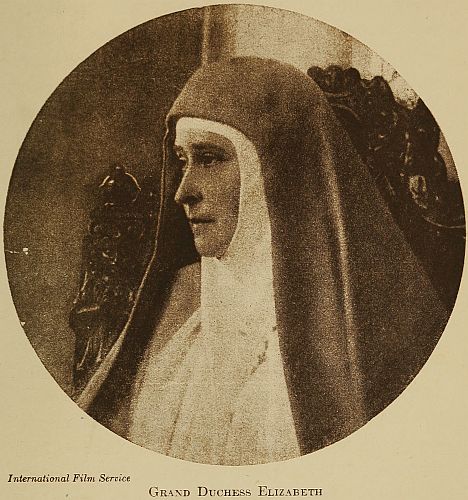
International Film Service
Grand Duchess Elizabeth
The latter was a lady of considerable intelligence
and a physician of no mean skill whom the Empress
had put at the head of the private hospital
she had organised at Czarskoi Selo long before the
war broke out. Later on when other lazarets and
ambulances, the number of which increased every
day as the terrific struggle went on, were organised
in the Imperial residence, the Princess Dondoukoff
was appointed general superintendent of all
these establishments, and it was she who coached
the Czarina as well as her daughters in the duties
of a Red Cross nurse. She was of a pushing temperament,
had the reputation of being loose
in her morals, though personally I saw nothing that
could have justified it, and was also gifted with a
remarkable propensity for intrigue. No one liked
her, but everybody feared her. She insinuated herself
thoroughly into the confidence of the Empress,
who referred to her in everything, and willingly
listened to her. She was of course among the followers
of Rasputin, and with him and Madame
Wyroubieva formed a trio which it would have been
difficult not only for the general public but also
for the immediate attendants of the Russian Sovereign
to fight against.
The Princess Dondoukoff used to give drugs to
Alexandra Feodorovna which the latter used to
take unknown to her medical attendants and which
were declared by them, when they discovered the
fact, to have had a good deal to do with her shattered
nerves. This may or may not have been true,—I
shall not venture an opinion upon the subject,—but
certainly my mistress was far too fond of the
Princess, and would have done better to have seen
less of her, if only from the point of view that
the weight which she laid on her opinions considerably
incensed the doctors who were in regular attendance
upon her, who objected to the manner in
which their own prescriptions were neglected.
The Princess introduced at Court a quack medical
man from Thibet called Bachmanoff, who, she
pretended, had brought with him from his country
all kinds of secret remedies which she advised the
Czarina to try on the little Grand Duke Alexis.
The fond mother believed her, and Bachmanoff
became one of her favourites. It is impossible to
say whether he would have cured the child, because
the latter’s nurse, a sailor called Derewenko, of
whom he was inordinately fond, and whom I have
already had occasion to mention, threw out of the
windows all the powders and potions which Alexandra
Feodorovna asked him to give to her son, and
took great care the boy should not get anything but
what his own doctor had ordered him to take. Ultimately
the Grand Duke got better and stronger,
and last year he might have been pronounced cured,
at least in so far as the chronic ailment from which
he was suffering could be cured. But the Empress
in her joy at this unexpected recovery was persuaded
that it had taken place, thanks to the Thibetan,
in whom she believed more than ever.
The friendship for Madame Wyroubieva was
perhaps even worse than the attachment of the
foolish Sovereign to the Princess Dondoukoff.
Madame Wyroubieva was the daughter not of the
Emperor’s private secretary, as she represented
herself to be, but of a State Secretary (which is
quite a different thing, being a purely honorific position)
called Tanieieff. She had been married to
a navy officer with whom she could not agree, and
they were divorced, not because he had grown mad,
as she declared (divorce for insanity is not allowed
in Russia), but because he had found reason to object
to her conduct. The Empress, for reasons no
one ever understood, took her part and invited her
once or twice to the Palace of Czarskoi Selo. Madame
Wyroubieva made the most of her opportunities
and soon became quite indispensable to Alexandra
Feodorovna. She it was who, with the
Grand Duchess Elizabeth, introduced Rasputin into
the Imperial household, and with him she established
such control of the Czarina’s actions that
soon the latter became simply a tool in their hands.
Madame Wyroubieva was, above everything else,
a grabbing woman. She fully meant to make a
fortune out of the position of trust she was supposed
to occupy. Both she and Rasputin were in
their turn in the hands of a gang of adventurers
who used them for their own ends, and they set up
a shameful exploitation of the public exchequer for
which unfortunately the Empress was made responsible.
The latter only looked upon Rasputin
as a saintly personage, a kind of orthodox yogi
whose prayers were sure to be taken into account
by the Almighty. Terrible things have been hinted
at in regard to her relations with him, but all that
I can say is that to my knowledge, at least, she was
never alone with him for one single moment, and
that except in regard to the health of the heir to
the throne, my mistress never spoke with him of
anything else but religious subjects. The public
said that he was all powerful at Court, but I feel
convinced that these rumours arose from certain
unscrupulous persons who had an interest in
spreading them because they managed (thanks to
the intimacy of which they boasted with a personage
who, as they related, could turn and twist the
sovereigns at his will and pleasure) to obtain army
contracts and other things they desired. Among
them were Protopopoff and Sturmer, and the notorious
Manassevitsch Maniuloff, whose blackmailing
propensities caused him to be arrested and sentenced
to several years’ hard labour from which he
was released by order of the present Russian government.
Rasputin in reality was treated in the
Palace as a kind of jester who was allowed to do
as he wished—a sort of fool, after the pattern of
Chicot in Dumas’ novels, and neither Nicholas II.,
who liked him even better than did the Empress,
nor the latter ever thought of him as of anything
else than a holy pilgrim (for that was what he proclaimed
himself to be) whose vocation was to go
about preaching the gospel to the world. One
must not forget that there have been many such in
Russia, and that the natural tendency to mysticism,
which is one of the characteristics of the Russian
character, has always welcomed them with effusion.
The Empress, who, though a German, was more
superstitious than any Russian, fully believed that
the presence of Rasputin at her side was a shield
against all possible dangers. She therefore refused
to be parted from him, and whenever anything
happened of a nature to cause her worry she used
to send for him, when he would prostrate himself
on the ground and invoke the powers of Heaven
to deliver him and his friends from evil. He was
a thorough fanatic, or at least professed to affect
the ways of a fanatic, and he used to force the Empress
to prostrate herself before holy images beside
him, and to remain with her face pressed to
the floor for hours in earnest supplication to a God
whom, he averred, he was the only one to honour
as he ought to be honoured. It is difficult to realise
that an Empress of Russia, and one of the
haughty temperament of Alexandra Feodorovna,
could lend herself to such ridiculous practices, but
so it was, and I can only say what I have seen
without attempting to explain it. But it was not
surprising that when the Imperial family came
to hear of all this, it should have been indignant
and tried to oust from the Palace a man whose
presence in it tended to discredit royalty at a time
when, on the contrary, every possible means should
have been resorted to in order to raise its prestige.
The Empress Dowager, when she heard all that
was going on, raised her voice, and, disliking
though she did to meddle in what she considered did
not concern her, she made representations to the
Czar when the latter paid her a visit in Kieff,
whither she had transferred her residence. Nicholas
listened to her, but did nothing. Others followed
the example of Marie Feodorovna, and the
Grand Dukes individually and collectively tried to
open the eyes of the head of their dynasty to the
evils caused by the presence of Rasputin. Everything
proved useless, because the Emperor just as
much as his wife was under the spell of the clever
comedian whose strong will had completely mastered
his own weak intellect. I have often witnessed
the prayer meetings which were organised
in the Czarina’s private oratory, at which Rasputin
presided. Few people were admitted to them, and
the congregation generally consisted of Madame
Wyroubieva, the Princess Dondoukoff, the Czar
and his Consort. The Imperial children were sometimes
told to attend them but not often. Rasputin
used to pray aloud, and then preach, touching in
his sermons on subjects of every kind that had
not the remotest claim to be considered religious.
And then he assured his audience that the Lord
had revealed himself to him and ordered him to acquaint
the Czar with such and such a thing, choosing
the one he had at heart at that particular moment.
The Empress generally went into hysterics
whilst listening to him, and it was on that account
I was asked to remain in the vicinity of the room,
so as to be able to come to her help. I had often to
unlace her or else she would have choked, and for
this purpose I took her into another apartment.
The fact that one or other of her maids saw me
carrying away some part of her clothes gave rise
to the most malicious rumours. The most curious
thing about it all was that the Emperor looked on
unmoved whilst his wife was almost writhing in
strong convulsions and extended no help whatever
to her, because Rasputin assured him that these
convulsions were a manifestation of the good spirits,
and a proof that the prayers of the Czarina had
been accepted by the Almighty.
I know that all this sounds incredible and yet it
is but the truth. The unfortunate woman whom
the world has slandered in the most cruel manner
possible was after all nothing but a miserable being
whose mental balance was unstrung, to say the
least. It would have been more sensible to have
put her in an asylum than to have accused her of
immoral practices of which she was incapable. Of
course others who were witnesses of the daily actions
of Alexandra Feodorovna in Czarskoi Selo
could not be expected to look at things with the
same eyes as I did and I do not feel any surprise at
the disgust which filled all the good and devoted
servants of the dynasty when they heard about
these mysterious meetings during which the Holy
Ghost was supposed to descend in person on the
heads of Nicholas II. and his wife. There were
some still in existence, among others the Princess
Wassiltschikoff, one of the most prominent women
in St. Petersburg society, who took it upon herself
to write to my mistress to warn her of the manner
in which she was discrediting herself and the dynasty.
The Czarina was terribly offended on receiving
this letter, and fell into one of her rare fits
of passion. She complained to the Emperor, and
the author of this epistle that had aroused her anger
was forthwith ordered to leave St. Petersburg
and to retire in disgrace to one of her estates in the
country. Alexandra Feodorovna clenched her
teeth and could hardly restrain her tears when
speaking about what she called “this infamous letter.”
At that moment of rage I believe she could
have killed the lady who had thus ventured to tell
her things which she considered the most insolent
she had ever heard in her whole life. She was destined
to feel still more offended a few days later
when the Grand Duke Nicholas Michaylovitsch,
a cousin of the Czar, presented to the latter a
memorandum in which he adjured him not to listen
any longer to the advice he received from his
wife, and to dismiss the gang of adventurers whose
presence at his side was discrediting him. He also
was repaid by being sent into exile for the audacity
with which he had dared to criticise the conduct of
Alexandra Feodorovna.
There is, therefore, nothing surprising if those
who had come to look upon Rasputin as upon a national
danger should at last have made up their
minds to remove him by fair means or foul. Of
course what lay behind his assassination was the desire
to put an end to the influence of the Empress
over her Consort, and to pave the way towards her
internment in a private asylum or in a convent
where it was felt that she would be happier than anywhere
else. So long as Rasputin existed such a thing
was not to be thought of, but it was secretly hoped
that if he were finally put out of the way the mind
of the Czarina would snap altogether and it would
then become a relatively easy matter to persuade
Nicholas II. to separate himself from her, when it
was hoped that the dynasty would recover some of
the prestige which it had lost. This, so far as I
know, is the real key to the murder of the adventurer
whose career constitutes a unique episode
even in the annals of Russian history that has recorded
so many queer things. In describing it I
have anticipated events, and must now return a few
years back and speak of the outbreak of the great
war, even if superficially, because its declaration
sounded the knell of the Romanoff dynasty and,
in a certain way, sealed the fate of the illustrious
lady at whose side I spent so many years before
misfortune overwhelmed her.
THE GREAT WAR
It is useless to repeat that when the great war
broke out no one in Russia expected it, the Czar
least of all. I shall not touch upon the serious part
of this awful drama; I only mention it in so far as
it has to do with the unhappy Empress. She was
quite overpowered by it, and thought it the culminating
point of her misfortunes. Apart from
her apprehensions for that Russia whose Sovereign
she was, she felt deeply the fact that she was going
to be at war with her own kith and kin, and with
her beloved brother of whom she was so fond. No
one doubted among her surroundings that France
and Russia united together would surely and
quickly beat the Germans, but the Czarina knew
very well that whatever the outcome of the struggle
she would become one of its principal victims.
She was perfectly aware that the nation which disliked
her so intensely called her the “German”
quite openly, and that she would probably be suspected
of favouring the land of her birth in preference
to that of her adoption; she chafed beforehand
at the injustice of the accusation. Everybody
noticed her intense emotion on the day which
followed the declaration of hostilities, when, during
the religious ceremony which took place in the
Winter Palace, she stood beside the Czar, and listened
to the reading of the manifesto announcing
to the nation that Germany had challenged it to
mortal combat. Before she left Peterhof (where
the Court was spending the summer) for St.
Petersburg, I ventured to express to her my hope
that she would have sufficient strength to bear the
fatigue and emotions of the trying day. “I can
bear anything now,” she replied. “Since I did not
die yesterday, it seems to me that nothing will ever
kill me.” Momentous words which I was to remember
more than once as time went on and one
disaster followed upon another.
When the war broke out the Empress Dowager
was in England. She telegraphed to her daughter-in-law
to take her place at the head of the Red
Cross until her return to Russia, and to take the
first measures necessary to ensure its activity. The
Czarina was but too willing to do so, but she encountered
unusual opposition and even hostility on
the part of the officials interested in the society, who
criticised all the improvements which she suggested,
and even refused to follow the instructions which
she gave them. This, of course, was a source of
bitter mortification to her, and she was but too glad
to retire altogether from the management of the
whole affair as soon as her mother-in-law returned.
But this was wrongly interpreted by the public
that said the Sovereign was not interested in the
cause of the wounded, because she disapproved altogether
of the war, and would have liked to see
Russia come to an agreement with Germany.
The position of my unfortunate mistress grew
more and more difficult as time went on. At first
the triumphant (for so it was called) march of the
Russian troops into Galicia and the capture of
Lemberg seemed to point to a successful campaign,
but then came the first reverses, followed by the
great retreat which meant abandoning to the enemy
some of the most fertile provinces of the Russian
Empire and the whole of Poland. The loss of the
whole line of fortresses which defended the Vistula
was also an awful blow dealt both to Russia’s might
and to Russia’s welfare as well as prestige. Of
course the whole country waxed indignant at this
unexpected series of disasters, and of course the
government was made responsible for them.
The want of foresight on the part of the War
Office was attributed to the general corruption
which existed in all Russian administrative
spheres, and also to the partiality of the Czar for
certain favourites, against whom he would never
listen to any criticisms and whom he continued to
employ though the whole country had recognised
their utter incapacity.
The Empress knew all these things: she had even
been asked more than once to interfere and to
bring them to the notice of the Czar, but she had
always refused to meddle in questions which she
felt were so important that any false step might
be accompanied by terrible consequences. Once
during one of the flying visits which the Commander
in Chief, the Grand Duke Nicholas, paid
to St. Petersburg from the front, he had tried to
enlist her sympathies in favour of a vast plan of
reform he wanted to bring through, but she was so
mistrustful of him that she had thought it better
to do nothing but to declare to him that she did not
think herself competent to offer advice in view of the
general difficulties presented by the situation. She
felt frightened at the persistence with which certain
people who were not over well disposed in her
favour wanted to get her mixed up in matters
where the smallest blunder might bring upon her
head the wrath of the whole nation. But at the
same time she attempted to do what she had never
tried before, that is, to discuss with her husband
the events of the day and give him the benefit of
her opinions, which, though always moderate, were
distinctly in favour of the continuance of the autocratic
system. She once told me that she thought
it would be far more advantageous to the nation if
the Duma were permanently prorogued, at least
for as long as hostilities lasted, because she feared
for one thing that its criticisms would destroy the
faith of the nation in its government, and for another,
that it would prevent by the discussions it
would be sure to raise the conclusion of a peace favorable
to Russian interests. This peace the
Czarina called for with all her heart, and she would
have sacrificed much to see it concluded. This got
to be known, the more so that she never even tried
to hide it, and the rumour arose that she was negotiating
the conditions of such a peace with her German
relations. This I do not believe for one moment
she had ever done or wanted to do, but those
intent on her destruction naturally accused her of
intriguing in a sense favourable to German interests.
She had unfortunately antagonised every
single party in the country, the aristocracy to begin
with, and also the extreme radicals and socialists
who made her responsible for all the measures
of repression which the government had begun to
take against them. The poor woman had become
the scapegoat of all the sins of Israel.
Nevertheless she fought bravely against these
terrible odds, and she applied herself to give to the
Czar some of the energy which he lacked, and of
which perhaps she possessed too much. It was
then that she paid different visits to the Front, a
thing which she had never been allowed to do whilst
the Grand Duke Nicholas was commander in chief,
and she tried to cheer up her husband, and to encourage
him in the new responsibilities which he
had assumed when he had dismissed his uncle and
taken upon himself the functions of Commander in
Chief of the Army. He had been forced into his
decision by the general wish of the public, who were
dissatisfied with the Grand Duke Nicholas, and
hoped that the presence of the Sovereign at the
head of his troops would infuse courage into the
hearts of the latter and induce them to make every
effort against the foe. But the troops were not to
blame for the reverses which had overtaken them;
the lack of ammunitions was the cause of the evil,
and this could not be remedied by any commander
in chief, but would have required a thorough and
radical reform in the whole administration of the
War Office.
There existed no one in Russia powerful enough
to enforce this reform. In the circumstances in
which the country found itself placed, it would have
required the energy and the iron will of a Peter the
Great to overcome the obstacles standing in the
way of any reforms of a sweeping nature, and Russia
had for sovereign Nicholas II., the weakest that
had ever carried the sceptre of the Romanoffs.
During these anxious days the Empress took to
confiding in me and sometimes called me to her
side, generally during the night when she could not
sleep and was haunted by all kinds of fears in regard
to the future. She told me then that she felt
persuaded a revolution would follow upon the war,
and that this time it would be a serious one which
would require considerable energy before it would
be suppressed. The idea that it might eventually
prove successful never entered her mind, and I have
often wondered at her utter blindness in this matter.
But she felt so convinced that the greater
part of Russia was still attached to the principles
embodied in an all-powerful autocracy that no one
was taken more unawares than herself by the
promptitude with which the Russian nation accepted
the overthrow of the dynasty. And yet she
had been told often enough that this dynasty was
in danger if it did not decide to make concession to
public opinion that clamoured for a change. She
still nursed illusions, and she honestly believed that
her personal efforts in favour of wounded and disabled
soldiers had made her popular with the army,
that it felt grateful to her and to the Czar, and that
it would not allow them to be harmed. She liked
to relate anecdotes tending to prove this, and whenever
she returned to Czarskoi Selo from one of the
frequent visits she made to the Front, after the
Emperor had assumed the supreme command, she
liked to call me to her side and relate to me all that
she had seen whilst there, and how the wounded
whom she had visited had thanked her for her kindness
towards them, not knowing that their thanks
had been uttered in obedience of a command and
had never proceeded from the heart of those who
had uttered them. There had come, however, one
fatal day when, instead of the cheers to which she
had been used, the Empress was received with a
dead silence by the troops when she accompanied
her husband to a review of regiments about to be
sent to the fighting Front. This was the first
time that such a thing had happened to her, and
the poor Czarina was so upset by this proof that
she had lost the affection of her soldiers that she
declared she would no longer show herself among
them. Of course her friends tried to cheer her up,
and to explain to her that this had been a pure accident,
but the impression had been produced, and
its effects were to be lasting ones. The first two
years of the war dragged on, and sometimes I wondered
whether my beloved mistress would ever live
to see the end of this awful conflict. She was getting
weaker and weaker and her nerves were so entirely
destroyed that all those who still cared for her were
getting quite alarmed on her account. The Emperor
alone seemed quite unconcerned and failed to notice
the great change that had come over his wife. He
imagined that she was anxious about the war, but
did not dream that her health was getting worse
every day and that she had lost the energy she had
been endowed with before, in the hopeless struggle
she was fighting against forces which were bound
to overcome her in the long run. All her former
vivacity had left her. She had become sweeter
than she had ever been, even during her first years
of married life, and she accepted with gratitude
every small service one rendered her. The
haughty pride with which she had in former times
met any unpleasantness that occurred to her had
disappeared. She had become resigned to everything
that might befall her, but her great anxiety
was for her husband and children, especially the
former, against whom she dreaded an attempt at
assassination whenever he was at the Front. During
the sleepless nights which had become her portion
she fancied all kinds of evils, and then she
would proceed to the telephone which put her in
direct communication with head-quarters and speak
with the aide-de-camp on duty, asking for news of
the Emperor. I do not think that she ever obtained
more than an hour or two of repose in the
twenty-four, and sometimes, when considering this,
I did not, as I had previously, blame the Princess
Dondoukoff for administering to her opiates destined
to give her some rest. All this constituted a
terrible state of things, but still it was nothing in
comparison with what was to follow, and the unfortunate
Czarina was soon to drink to the very
dregs the cup of sorrow that had been destined for
her.
DISASTERS AND THE SECOND REVOLUTION
The last days of the year 1916 were sad ones
for my poor Empress. First came the assassination
of Rasputin, which was a terrible source of
grief for her, because she firmly believed that so
long as he was at her side no harm could befall her,
and certainly as events turned out she had not
been so far wrong in her superstitious fears. During
the first days which followed upon the murder
of her favourite she would sit motionless for hours
in her boudoir, doing nothing, absorbed in thoughts
which must have been most painful. Christmas—the
last to be passed by the Imperial family in
their beloved Czarskoi Selo—was a sad one, and
the Czarina did not even attempt to shake off the
melancholy forebodings with which she was troubled.
She was preoccupied with the idea of avenging
the destruction of the man whose existence
she had considered in the light of a fetich. It
is a well-known fact that she caused the young
Grand Duke Dmitry to be exiled in Persia, as a
punishment for his share in the conspiracy that had
deprived her of her favourite. She who had always
been so kind turned cruel and merciless, and
I once heard her exclaim that henceforward she
would no longer listen to her heart, but follow only
the dictates of her reason.
There was one man who had obtained her favour
on account of the ardour with which he had
espoused all her views; this was the Minister of the
Interior, Mr. Protopopoff. He had been one of
the most intimate friends of Rasputin, and he was
continually urging upon the Czarina the necessity
of being firm, and of refusing mercy to those who
had shown themselves so entirely merciless in regard
to a man who had been a holy creature. Alexandra
Feodorovna found some consolation in her
grief by talking it over with Protopopoff, who finally
won her adhesion to the plans which he had
formed to establish once more in Russia an absolute
government.
Christmas had come and gone and a New Year
had begun. The difficulties of the military and
economical condition of the country had increased
to an alarming degree. We did not perceive it at
Czarskoi Selo, but in Petrograd, as St. Petersburg
now was called, everybody was complaining of the
high cost of living and the impossibility of procuring
for oneself the indispensable necessities of existence.
The population was getting impatient,
and dissatisfaction was spreading. Those who
could see the signs of the approaching storm tried
to persuade the Czar that he had better remain in
the vicinity of the capital, and not go to the Front
where, after all, his presence was not absolutely
needed. But Nicholas II. would not listen, perhaps
because both his wife and Mr. Protopopoff
persuaded him that there existed no reason for
alarm. The Empress had implicit confidence in
the Minister and was convinced that a small display
of energy on the part of the government would
very quickly do away with the impatience of the
population. She wished to get her husband out of
the way, not at all, as has been said, because she
wanted to make a coup d’état, but because she did
not wish the Czar to be worried by his family, who
were making frantic efforts to get the Grand Duke
Dmitry recalled from exile. At first her intention
had been to accompany Nicholas II. to head-quarters,
but then her children had fallen ill with
what had been considered at first an attack of influenza,
but subsequently turned out to be measles,
and she would not leave them. The Emperor departed,
promising to return immediately if any serious
trouble occurred, and keeping meanwhile in
close touch with his wife and the commander of the
garrison of Czarskoi Selo. During his absence
the Revolution took place, brought about by a revolt
of the troops entrusted with the defence of
Petrograd. They went over to the Duma as soon
as they heard that it had taken upon itself to institute
a new government.
The Czar had been surrounded by traitors, therefore
he had not even been apprised of all that was
taking place in Petrograd. Two urgent telegrams
which were despatched to him by the President
of the Duma, Mr. Rodzianko, never reached
him, as we heard later on. Had he received them
it is likely he would have hastened back, and perhaps
his presence in the capital might have averted
the catastrophe. But his attendants were mostly
won over to the cause of the Revolution and purposely
left him in ignorance of the gravity of the
events which were taking place, until it was too late.
The Empress also was not informed of the extent
of the revolt, and it was through an indiscretion of
one of her servants that she got at last an inkling
of the truth. She sent for Count Benckendorff,
the head of the household, and asked him to get her
all the information possible concerning the extent
of the rebellion. The Count, who throughout this
sad story behaved with the greatest loyalty to the
cause of the sovereigns whose confidence he had
won by his long and faithful services, tried to go
to Petrograd, where he hoped to learn some details
as to what had taken place during the two preceding
days, but found it impossible because the
railway line was already in the hands of the revolutionaries,
and no train from Czarskoi Selo was
allowed to proceed. He had perforce to content
himself with the news which he could obtain by
telephone, and soon this means of communicating
with the people likely to keep him informed as to
what was going on was stopped.
The Empress, almost mad with anxiety, walked
to and fro in her apartments, wringing her hands,
and saying the whole time that she knew the Czar
had been killed and the news was being kept from
her. It was with the greatest difficulty that she
could be prevailed upon to send a telegram to General
Roussky, who was then supposed to be loyal,
enquiring after the Emperor. In about two hours
she received a reply saying that Nicholas II. was
on his way to Pskoff and expected to arrive there
that same night.
This somewhat allayed the anxieties of the Empress,
and just about then the condition of the
Grand Duchess Olga, who had taken the measles
in a more serious form than her sisters, became suddenly
worse, and she was thought to be in danger,
as pneumonia had declared itself and complicated
her condition. And then Alexis, who had been removed
to another wing of the palace in the hopes
that he might escape the contagion, sickened in his
turn, so that the unfortunate Czarina had another
anxiety to fight, which after all was perhaps the
best thing that could have happened to her, because
the necessity of attending to her children prevented
her from brooding on what was happening
to her husband, which otherwise she would have
done the whole of the time.
The next thing we heard was that the Duma had
sent two delegates to confer with the Czar; we
hoped that from this conference something good
might result, and that Nicholas II. would be
induced to call together a responsible ministry.
The Empress herself was persuaded he would do
so, and remarked that if Prince Lvoff accepted
the position of Premier, things would not be so bad,
because at heart he was a loyal monarchist and
would not lend himself to any aggression against
the person of his Sovereign. She seemed more
cheerful than she had been for the last two or three
days, and showed herself pleased that it was Mr.
Gutchkoff, whom she knew personally and had
always liked, who had been despatched to Pskoff.
“Perhaps, after all, we shall weather this storm,”
she remarked, and she further observed that in the
grave circumstances which resulted from the unfavourable
course the war had taken, it was perhaps
just as well if the sole responsibility for what
was to follow did not rest upon the Sovereign
alone. Neither she nor any of us had the faintest
idea of what was actually taking place at
Pskoff. About midnight I left the Empress. She
had been persuaded to retire to bed, the Princess
Dondoukoff having promised to watch by the children
and to call her at once should any change take
place in their condition. She was thoroughly exhausted
and we were all glad to see her at last take
some rest, I had lain down also in a room adjoining
the bedchamber of my mistress when at about
three o’clock in the morning I was awakened by a
soft knock at my door. Thinking that one of the
children was worse, I got up instantly and went to
hear what had happened before disturbing the Empress.
Standing on the threshold I found the
Czarina’s old groom of the chamber with a pale and
frightened countenance. He pulled me aside and
in a terrified voice exclaimed: “Something dreadful
has happened: the Emperor has abdicated!”
“What?” I exclaimed, not believing my ears,
and inclined to think that the man had gone mad.
“The Emperor has abdicated,” he repeated, and
forthwith began to sob.
I dropped down in a chair, and thought that the
end of the world had come, and so indeed it had—of
a certain world at least.
“Who told you?” I enquired. “How did you come
to hear it?”
The man replied that the new ministry had advised
the commander of the town of Czarskoi Selo
by telephone that the Czar had abdicated in favour
of his brother, and that the troops had to be advised
of the fact immediately.
“How shall we tell the Empress?” was my first
thought.
Of course neither my informer nor myself could
undertake the painful task of apprising her of the
new misfortune which had overtaken her. We decided
that the only thing to do was to inform Count
Benckendorff and to ask him to perform the sad
mission. But as we were proceeding to his apartments
we met him coming to those of the Empress.
He had also been informed of what had taken
place at Pskoff a few hours before, and he was
about to communicate them to my unfortunate
mistress. I went back and aroused her. She was
not sleeping, and got up immediately. She had
been bracing herself all the time for some new
calamity, and when told that Count Benckendorff
wished to speak with her had felt convinced that
he wanted to apprise her that her husband had been
murdered. In comparison with such a catastrophe,
the loss of her throne seemed a small thing,
and perhaps her first feeling was one of relief at
finding that her apprehensions had been groundless.
But what she could not bring herself to understand
was the fact that it had not been in favour
of his son that the Czar had abdicated.
“There must be a mistake. It is impossible that
Niky has sacrificed our boy’s claims!” she kept repeating.
But when at last compelled to believe
that such had been the case, she gave vent to an expression
of rage which showed how thoroughly she
despised the weak-minded man to whom she was
bound, and exclaimed: “He might at least in his
fright have remembered his son!”
I think that these words are the most cruel condemnation
that the cowardice of Nicholas II. ever
obtained, and deserved.
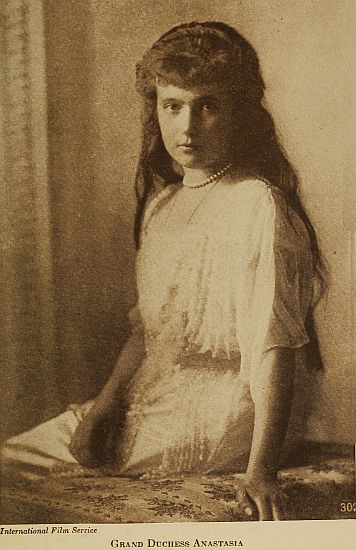
International Film Service
Grand Duchess Anastasia
As may be imagined, there was no sleep for any
of us after this. When dawn appeared at last it
found the Empress entirely dressed, already calm
and resigned, kneeling before the sacred icons in
her oratory, and invoking the protection of God
for her children. Then she went up to her daughters’
room and acquainted the two younger ones,
who had not yet been attacked by measles, of the
change which had taken place in their destinies.
The girls were stunned, as may easily be imagined,
and Anastasia, the youngest, began to cry. The
Empress watched her tears and then in a hard voice
remarked, “It is too early to cry yet; keep your
sorrow for another occasion,” and she went out of
the room without adding another word.
But though she was told that her son’s condition
was serious, she did not approach his sick-bed that
whole day. It seemed as if she could not bring
herself to look upon the child whose advent into
the world had been such a source of joy to her, and
who had been despoiled of the great heritage to
which he had been born. It was evident to all
those who knew her well that some time would
have to elapse before she could bring herself to forgive
her husband for the injury he had done their
only son, and perhaps she would never have forgiven
it had it not been for all the other misfortunes
which were to follow upon this hasty abdication.
HOW THE CZARINA WAS ARRESTED
A few dreadful days followed upon the one
which had brought us the news of the abdication of
the Czar. The Empress tried to get into communication
with him, but though she contrived to
speak with him over the wire, it was from the first
evident that every word was listened to, and she
gave up any attempt at confidential conversation.
What worried her was that instead of returning to
Czarskoi Selo, Nicholas II. had elected to go to
Mohilew. My mistress, who had had absolute confidence
in General Roussky, did not trust General
Alexieieff, whom she considered as quite capable of
betraying the Czar out of ambition. Events
proved that she had not been wrong in her appreciation
as to the General, and what she did not
know, but was to learn much later, was that he had
practically made it impossible for the Emperor to
return to Czarskoi Selo, and almost compelled him
to go to Headquarters, where he intended to keep
him until the Provisional Government at Petrograd
had made up its mind whether it ought or
ought not to arrest the former Sovereign. We all of
us remained in utter ignorance of what was happening
at the Front, or in Petrograd itself. The
Czarina on the evening of the day following the abdication,
when it had become already known that
the Grand Duke Michael had refused to accept the
throne relinquished to him by his brother, and when
no one knew what was going to happen further, the
Czarina called me to her room, and asked me to
try to go to Petrograd and find out what people
there were thinking about the whole situation. She
gave orders for a carriage to be put at my disposal,
as the railway trains did not run regularly,
but I declined it, thinking that it would only attract
attention and invite the rebels to stop me if
any among them met me. I repaired alone and on
foot to the railway station, where I boarded the
first train that was leaving for the capital. No
one noticed me, and I made my way undisturbed
to the house of a friend, who, I knew, was likely to
be well informed as to what was going on. Great
was my surprise to find that she did not care at all
to receive me, and almost ordered me out of her
apartment, saying that it was as much as her life
was worth to talk with a personal attendant of the
Empress. She absolutely refused to answer any
of my questions, and I had perforce to beat a hasty
retreat. Other people whom I sought did exactly
the same thing, and I found all my acquaintances
echoing the general opinion which, I discovered,
was prevalent in the capital, that it was the Czarina
who, by her betrayal of Russia to the Germans, had
been the cause of a Revolution which all the sane
and reasonable members of society were deploring.
The one subject of lamentation was the want of
character, as they called it, of the Grand Duke
Michael, who, according to the general opinion,
ought not to have played into the hands of the
Revolutionaries and refused his brother’s succession.
At that time the idea of a Republic, which
now has become a familiar one, had not yet taken
hold of the public mind, and people were only desirous
of seeing established a constitutional monarchy.
What made me quite aghast was to find
that the rumour had been spread that this refusal
of the Grand Duke was due to an intrigue of the
Empress, who had, so it was related to me, caused
to be conveyed to him a message to the effect that
should he dare to accept the throne she would put
herself at the head of a movement against him. The
very thought that my poor mistress could have
done such a thing was ridiculous, but in times of
crisis like the one we were going through, the wildest
tales are believed, and in the case of Alexandra
Feodorovna it was but too easy to make Petrograd
accept the idea that she was planning to bring forward
the rights of her son, even against the desire
of her husband. As I proceeded along the Nevsky
Prospect I met sandwich men carrying large placards
with seditious inscriptions concerning the
Czarina, and on one of them her immediate imprisonment,
trial for high treason and execution were
put forward and claimed. Cries of “Down with
Alexandra Feodorovna!” were heard everywhere,
and my heart sank within me at the thought that
perhaps my beloved mistress would fall a victim to
the fury of the mob. The remembrance of the
French Revolution and of Marie Antoinette, to
whom the Empress was so fond of comparing herself,
came back to me, and without waiting for further
news (which I did not know where to obtain,
because no one in Petrograd seemed to know anything)
I made my way back to Czarskoi Selo, and
before presenting myself to the Czarina, I sought
Count Benckendorff, to whom I related my experiences
in the capital. The Count listened to me,
and looked very grave when I mentioned to him
the exasperation, for it could hardly be called
otherwise, of the rough elements of the population
of Petrograd against Alexandra Feodorovna.
We discussed for a few minutes the possibility of
removing her from the Palace to some other place
where she would be in comparative safety, but gave
up the idea as impracticable, because, for one thing,
the Empress would never have consented to abandon
her sick children, and then, there was already
such a close watch established around the Palace
of Czarskoi Selo and its inmates, that it would have
been next to impossible for any one to get out without
the fact being at once reported to the Revolutionary
Government. Besides, it was necessary to
learn what the Emperor himself meant to do, and
what were his plans for the future. The situation
was therefore extremely serious, but all that one
could do in the present circumstances was to wait.
The Count enquired of me the names of the servants
among the personal attendants of the Czarina
whom I thought quite trustworthy, and I mentioned
a few. He considered it necessary to establish
a kind of secret guard around her for fear
that an assassin might find his way to her apartments,
and indeed for three days and nights he remained
himself outside her door, not caring to trust
her safety to any one else. If ever there was one
faithful man in the world it was Count Benckendorff.
When, after my conversation with him, I entered
the presence of my mistress I found her in
a violent state of agitation. The news had reached
her that the Empress Dowager had gone to Mohilev
to see her son, and Alexandra Feodorovna
felt persuaded that the journey had been undertaken
for the purpose of persuading Nicholas II.
to separate himself from his wife. It was quite
useless to point out to the distressed Princess that
such a thing would not have had any motive at the
present time, when the Czar had resigned the
throne. She would not listen to me, but cried and
sobbed, declaring that nothing in the world would
ever part her from her children and that she would
rather kill herself than give them up. She could
not understand how it was that her husband, of
whose affection she had felt so sure, had not already
returned to her, especially in view of the fact
that all her children were so dangerously ill. The
idea that Nicholas was no longer a free agent, or
able to do what he liked, had not occurred to her,
and when I pointed out to her that such might be
the case, she would not listen to me, exclaiming,
“Who could dare to stop him? After all, he is always
the Czar.” The magnitude of the catastrophe
which had just taken place she had not yet
appreciated.
But the same night rumours that the Revolutionary
Government had decided to arrest the former
Sovereign reached Czarskoi Selo. None among
us would credit them in the beginning, so utterly
impossible did the whole thing seem. But Count
Benckendorff, who perhaps had at his disposal
sources of information others did not possess, told
us that unfortunately the news was but too true
and that delegates had been sent to Mohilev with
instructions to take captive Nicholas II. What
they meant to do with him he could not tell, and
for the matter of that no one knew. The question
arose as to how the Empress was to be made acquainted
with this new misfortune, and it had not
yet been decided by the Count, who wished to wait
for an official confirmation of the rumour, when he
was called to the telephone and told that the new
commander of the military district of Petrograd,
General Korniloff, wanted to speak with him.
The General told Count Benckendorff that he
had been commissioned by the new government to
deliver a certain message to the Empress, whom he
affected to call Alexandra Feodorovna, and that
he wished to see her immediately about it. To the
reply that Her Majesty was sitting beside the bed
of her sick children and could not be disturbed,
Korniloff declared that it was imperative he should
execute his commission, and that unless the Empress
complied with his request he should use force
to obtain admittance.
There remained nothing to do but to ask him to
wait for a few minutes until the Czarina had been
communicated with. Count Benckendorff repaired
to her apartments, and communicated to her
the curt request of the Commander in Chief. She
said at once that she would be ready for him in half
an hour, and declared that she was sure he had some
bad news for her concerning the Emperor.
“Perhaps they have killed him!” she exclaimed,
“and then they will kill me, and what will become
of these poor children?”
Korniloff arrived at the Palace accompanied by
all of the officers of his staff. He was escorted
also by an infantry battalion, which he caused to be
stationed in the big square in front of the Palace.
Received by Count Benckendorff, he was conducted
to the large drawing-room in which the Empress
used to give her audiences in the days gone
by, and in a few minutes the Sovereign entered the
apartment, dressed all in black, with no other ornaments
but one row of pearls round her neck. She
bowed stiffly and, having sat down, motioned to the
General to do the same, asking him at the same
time to what she was indebted for the honour of his
visit. There was a ring of irony in her voice which,
as I was told afterwards, struck all the listeners
painfully and must have offended the General. He
rose and in rude accents said: “I must request
you, Madam, to stand up, and to listen with attention
to the commands I am about to impose
upon you.”
Alexandra Feodorovna raised her eyes in mute
surprise, but without protesting rose up from her
seat, a thing which, by the way, I never understood
how she could have done. Korniloff then proceeded
to read to her an order signed by all the
ministers, which declared that she was to consider
herself under arrest, that she was forbidden to receive
or to send any letters without the permission
of the officer in charge of the Palace of Czarskoi
Selo, that she was not to walk out alone in the park
or grounds, and that she was to consider herself
obliged to execute any further orders that might
be given to her. He announced to her at the same
time that he was about to change the guard at the
Palace and that she would be strictly watched.
A dead silence reigned in the room after these
words of the old soldier. Count Benckendorff,
who was present, felt as if the earth had opened under
his feet, but he deemed it inadvisable to say
anything. The Empress simply bowed her head,
then asked Korniloff not to remove her children’s
attendants until they were recovered from their illness,
and especially to allow the sailor who for
years had taken care of little Alexis to remain with
him. The General said that he had no objection
to this; then she simply turned her back upon him
and without saying anything further left the room.
Korniloff then gave his instructions to Count
Benckendorff, who, when he was left alone with
him, entreated not to be dismissed, declaring
that he meant to share the fate of his masters in
any case. The Commander made him then responsible
for all the interior arrangements of the
Palace, and advised him that for the future he
should have to apply to the State Treasury and not
to the administration of the former Sovereign’s private
fortune for the money necessary for current
expenses, and he requested him to be as economical
as possible in the matter of these expenses.
The Empress, as if dazed, went to her bedroom.
There I was waiting for her. One look at her face
was sufficient to make me realise that something
absolutely dreadful had taken place. Alexandra
Feodorovna threw herself face downwards on a
sofa placed at the foot of her bed, and exclaimed
between the most heartrending sobs: “We are
lost, we are lost! What will become now of these
unfortunate children; what will become of them?”
And for a long time she sobbed on, and would not
be comforted by anything that I could say.
News of the arrest of the unfortunate Sovereign
spread like lightning through the whole Palace,
and, as if she had been stricken with the plague,
nearly all her attendants left her in the space of a
few hours. Out of her six maids, only one remained
“true to her salt,” as they say in the East,
and even the women who had waited on the Grand
Duchesses hastened to pack their things and to run
away, in spite of the fact that the young Princesses
were known to be desperately ill. The Princess
Dondoukoff was removed by order of Korniloff,
and for two days the sick children were attended
only by their mother and myself. The Empress
was experiencing in the most cruel way imaginable
the ingratitude of mankind. If Count Benckendorff
had not had his own cook prepare her meals,
she would have been exposed to death from hunger
amidst all the splendours of her magnificent Palace.
At last the Count had to apply to the Revolutionary
Government, and servants were sent to
replace those who had abandoned us, and to ensure
the regular service of the prisoners. All through
these dreadful days none of us knew what had happened
to the Czar, and this incertitude was, as can
easily be imagined, adding to the misery and anguish
of his wife. At last Count Benckendorff received a
wire from Prince Dolgoroukoff (not Dolgorouky,
as the foreign papers have printed; they are two
distinct families), one of the attendants of Nicholas
II., that the deposed Sovereign was being
brought back to Czarskoi Selo, where the Revolutionary
Government had decided he was for the
present to be interned.
The news was immediately communicated to the
Empress and proved a consolation to her in her
sorrows. We all of us, the few who were left of
the splendid retinue of servants of former days,
wondered how our master would look, and braced
ourselves for the painful task of receiving him, a
prisoner of state, in the Palace where he had ruled
as an all-powerful autocrat. It was on a dark and
dreary March morning that he returned to us.
Strict orders had been given to the soldiers composing
the guard in charge of the Palace gates not
to treat him otherwise than they would a colonel,
(he had persisted all through his reign in wearing
a Colonel’s epaulettes), because he was henceforward
to be known as plain Nicholas Alexandrovitsch
Romanoff, and though we had been apprised of
the fact, yet we were not prepared for what was to
follow, and we were horrified to see, from the window
at which we watched, the officer on duty give
orders to salute Prince Dolgoroukoff, who sat beside
the Emperor in the automobile that brought
them home, with the honours due to his rank as general,
whilst the deposed Sovereign was treated as
his inferior. The meaning of the Revolution had
never been made so plain to us as by this significant
incident.
At the top of the staircase of the Palace, Count
Benckendorff, dressed in full uniform, was awaiting
Nicholas II., whom he received with the same
ceremonial as in the time when he was still on the
throne. The noble-hearted gentleman showed in
those days of adversity of what stuff he was made,
and did all that lay within the limits of his power
to atone for the neglect and ingratitude of others.
The Emperor hardly greeted him. He rushed
up the stairs, taking two steps at a time, towards
the apartments of the Empress. Alexandra Feodorovna
was standing on the threshold, pale and
lovely, with a hectic bloom on her cheeks which reminded
one of the glory of her past beauty and
youth. Neither husband nor wife could speak as
they fell into each other’s arms.
LIFE IN PRISON
It was only on the first day which followed upon
the return of Nicholas II. at Czarskoi Selo that he
was allowed to see his wife without witnesses. The
very next morning Korniloff again appeared at the
Palace and delivered the following instructions to
the gaolers (one can hardly call them otherwise)
who were to watch over the deposed monarch and
his family:
I. The Emperor was not to be allowed to communicate
with his Consort, except during mealtimes,
when of course conversation could touch
only upon indifferent subjects. When he wanted
to visit his children, with whom he was allowed to
remain as long as he liked, the Empress was to
leave the room immediately he had entered it.
II. Neither the Sovereign nor his Consort were
allowed to walk out alone and unattended in the
park and grounds, but were always to be escorted
by a non-commissioned officer and three soldiers
with armed rifles.
III. When they went to church they were to
be brought to the private chapel of the Palace by
the same escort, and not permitted to converse with
each other.
IV. Every time one of their attendants had to
see them he or she had to be thoroughly searched
by the officer on duty and a woman specially appointed
for the purpose.
The young Grand Duchesses, when they had recovered,
were not put under the severe control to
which their parents were subjected; they could stay
with their parents, and especially with the Emperor,
as much and as long as they liked. Olga made
use of this permission more than her sisters, and
she used to spend hours with her father, to whom
she was particularly attached. But at the same
time a strict though not so apparent watch was
kept over their actions, and they were not permitted
to leave the Palace grounds for the town
of Czarskoi Selo, not even to visit the numerous
hospitals where they had hitherto worked as sisters
of charity.
None of the numerous members of the Imperial
family, who were nearly all in Petrograd, manifested
a desire to see the chief of their race; on the
contrary, in many cases they went over to the cause
of the Revolution, as, for instance, the Grand Duke
Cyrill, who was the first to lead the troops of which
he had the command to the Duma, to swear allegiance
to the new government. But several
members of the former household of the unfortunate
sovereigns came to put themselves at their
disposal, among others old Madame Narischkine,
the Mistress of the Robes of the Empress, who,
though she had never been liked by the latter, remained
faithful to her to the end, and even petitioned
to be allowed to go to Siberia with her, a request
which was refused her by the government.
The Czar accepted all these irksome regulations
with complete indifference. He used to take long
walks with Count Benckendorff and Prince Dolgoroukoff,
with whom he chatted the whole of the
time with the most complete unconcern. He did
not seem to mind in the very least the presence of
the men deputed to escort him during these walks,
but on the contrary made it a point to thank them
when they had brought him home, and to exchange
a few words with them. He used to read the
papers very regularly, and seemed always anxious
to learn what was going on at the Front. The
Empress, on the contrary, refused absolutely to
submit to the irritating restrictions imposed upon
her, and during the whole time that she was kept
at Czarskoi Selo never once went out of the Palace,
not caring to take her walks under the watchful
eyes of an escort. She treated everybody with
complete disdain. When the Czar entered the
room where she generally sat with her children, she
made him a deep and respectful curtsey, and immediately
quitted the apartment, before the officer
on duty had an opportunity to request her to do so.
She had never got over the fact of Korniloff having
ordered her to stand up whilst he had read to her
the orders of the new government, and more than
once in her conversations with me had referred
to this cruel humiliation, repeating, “Can you
imagine! He made me stand up, me, the Empress
of Russia,” and she did not care to incur a similar
humiliation a second time. Though she was repeatedly
told that her health required her to be
in the open air, especially when spring arrived,
she would not listen to any remonstrances on the
subject, but kept strictly indoors, snatching only
breaths of fresh air from her window which she
used to keep wide open, and beside which she sat
working at garments and bandages for soldiers,
which she asked me to forward to the Red Cross.
She never opened a book or glanced at a paper, and
except needlework her only occupations consisted
in going to church and giving lessons to her youngest
children. She refused every kind of sympathy
and remained silent and forlorn in her misery until
the day when she was told that she was about to
exchange her present prison for another, far worse
in every respect.
A few days after the one which had seen her confined
in captivity a commission sent by the Government
had arrived at Czarskoi Selo to ask the Empress
to deliver to its keeping the crown jewels, as
well as her private ones. She had consented to receive
the members of this commission and told them
that so far as the crown jewels were concerned
they had never been in her charge and could be
found in the Winter Palace; but her own diamonds
and pearls belonged to her personally and she was
not going to give them up unless compelled by
force to do so, when she would solemnly protest
against an act which she considered in the light of
a robbery pure and simple. Her attitude was so
firm that the commissioners withdrew without having
achieved their mission, and afterwards Kerensky,
to whom the matter was referred, gave up the
point and allowed my mistress to retain possession
of the ornaments she had clung to with such
determination and energy.
But the silver which adorned the Imperial dining
table was all seized by the Government, under
the pretext that it was State property, until eventually
Nicholas II. found himself without one fork
or knife with which to eat. At last Count Benckendorff
made an arrangement wherewith part of this
confiscated silver was bought back by him and the
money handed over to the treasury. But as the
private fortune of the Czar had been confiscated,
it was the young Grand Duchesses, Olga and
Tatiana, who out of their own funds redeemed
these things.
In general it became extremely difficult to meet
the expenses of the Imperial household, because
the government refused to supply the means to do
so, and the treasury grumbled at every request
made by Count Benckendorff for funds. Every
day saw something disappear of the former luxury
which had presided at the daily existence of the
Czar and of his family, until at last life at Czarskoi
Selo became almost ascetic in its simplicity. Meals
consisted only of three courses, and the favourite,
Zakuska, or relishes with which every Russian dinner
or lunch begins, were suppressed. Wine disappeared
altogether from the table, and several
automobiles were sold, whilst the chauffeurs were
dismissed. I even had to beg the Empress not to
use as much linen as she had been in the habit of
doing formerly, because we lacked the means to
wash it, and these were but small miseries among
the more important ones which assailed us.
Among the many annoyances and indignities put
upon the Emperor and Empress was the order
given by the Revolutionary Government not to address
them any more as Your Majesty, but to call
them Colonel and Mrs. Romanoff. The Czar took
it good-humouredly, or, rather, contemptuously,
but the Empress was extremely affected by this insolence.
“We have been crowned in Moscow,” she
used to say, “and nothing can change this now.
The Czar is always the Czar. No one can rob him
of this dignity, even if he has renounced it of his
own accord.”
Of course when we were alone with her we addressed
her in the old style. Beginning with
Count Benckendorff, and ending with the last of
the few servants who had voluntarily elected to remain
in the service of the former sovereigns, we
were very careful not to make them feel more than
could be helped the change that had taken place in
their destinies. But when one of the officers on
guard was present it was more difficult, because he
used to reprove us quite aloud if we ventured to
speak with our master and mistress in the old respectful
way to which we had been used. The government
was so particular in the matter of the title
allowed to Nicholas II., that all the newspapers
which were addressed to him bore the superscription
of “Colonel Nicholas Alexandrovitsch Romanoff.”
And on the letters which the Empress
received, the appellation of “Her Majesty the Empress”
was scratched out, and replaced by “Alexandra
Feodorovna Romanoff.” It was the repetition
of what had taken place with Louis XVI.
when he was designated by the name of Capet by
his gaolers, and, strange as it may appear, it was
among all her misfortunes the one which, outwardly
at least, seemed most to affect the unhappy
Empress.
Of course correspondence was a forbidden thing
for all of us. Letters were strictly censored and
even the smallest parcel brought to the Palace was
examined two or three times before being handed
over to the person to whom it belonged. Books
were equally the object of suspicion, and at last the
Empress and Emperor gave orders that new ones
were no longer to be forwarded to them, as had been
done previously.
Of course all these vexatious measures depended
a good deal on the personality of the officer in
charge of the interior arrangements and guard of
the Palace. If he were a humane man things
would not be so bad, but if he happened to belong
to the ranks of the rabid republicans or anarchists
there was not an obstacle that he did not put in our
way or an unpleasantness that he spared us. I remember
one of the latter who, one morning when
I was expecting a parcel containing a new blouse
from the Empress’s dressmaker, absolutely refused
to let it pass until I had unpicked the lining to
prove to him that no letter or message had been
concealed between it and the stuff itself. It was
the young Grand Duchesses who were most to be
pitied among the prisoners of Czarskoi Selo. The
girls were the sweetest things imaginable, and their
beautiful characters came out in a splendid light
during that trying time when, at an age where girls
generally know only the sunny side of life, they
had to become acquainted and to be actors in one
of the greatest tragedies history has ever had to
chronicle. And yet they realised perhaps even
better than did their father and mother, the full extent
of the drama which was being played around
them. Olga, in particular, seemed to have a forewarning
that it was only beginning and that it
might end in blood just as it had begun in tears.
She was a clever, thoughtful woman, with a considerable
amount of common sense, and sometimes
she used to confide to me her apprehensions in regard
to the future. “If the Germans get near to
Petrograd, or if a new revolution breaks out there,”
she often said, “we shall be its first victims, and
either the mob or the Government will put us to
death.”
Tatiana was not so resigned as her sister. She
revolted against the terrible injustice of which she
was the victim, and she could not understand how
after all the care she had taken of wounded soldiers
and miserable refugees whom her committee had
helped, her good intentions had been misunderstood,
and how she could have been put aside at a
moment’s notice and deprived of the possibility of
going on further with the work to which she had
given all her energy, and with which she had been
so successful. She had an impetuous nature, more
like her mother’s than like the placid temperament
of her father, and she would have liked to be able
to express aloud the contempt which she felt for
all those whose victim and prisoner she was. The
two youngest daughters of the Czar and Czarina
were still too much in the schoolroom to be able to
do aught else but be astonished at the change which
had taken place in their existence. They looked
at all that was occurring with big, surprised eyes,
and were more ready to weep than to attempt to
fight against a fate which had proved too strong
for them. They clung to their mother more than
did Olga or Tatiana, and hardly left her protection.
The Empress, who had never been a fond
mother in the sense of caresses, had changed in that
respect since the misfortunes that had fallen upon
her, and she now hugged her girls and drew them
to her breast with a passionate earnestness which
made the children exclaim that now they were happier
than they had ever been before, because their
mother embraced them just as much as if they had
been poor little waifs, with a mamma ignorant of
what etiquette meant. The remark had something
touching about it, and I think that the Empress
realised this as well as did others, because she
showed herself more affectionate towards her
daughters than she had been used to do, and was
no longer absorbed by her exclusive tenderness for
her son. She seemed indeed to have lost her interest
in the latter since the day she had realised
that he was no longer the heir to one of the greatest
thrones in the world.
The child himself understood it, and he was perhaps
the one who suffered most from the consequences
of the change which had transformed him
into an ordinary little boy, after he had been the
most important personage in his family. He fretted
over this change, and I fancy that at times he felt
resentful against his father and mother for having
so easily acquiesced in their own degradation. He
would have liked to see his father make a stand
against the Revolution, and at least refuse to surrender
the rights of his son and heir. One day he
betrayed something of his feelings when he told
Count Benckendorff that if he had not been ill but
with the Czar at Headquarters, as he generally was,
he would never have allowed him to abdicate. The
Count did not reply, but I imagine that he regretted
such had not been the case. Indeed to this day
it is incomprehensible to me how Nicholas II. could
have been induced to sacrifice the rights of his son,
and not to have insisted on the latter being proclaimed
Emperor in his stead.
In the meantime the days dragged on, and we
were all wondering whither all this was to lead.
The feeling that a change of some kind was bound
to take place floated in the air, but no one could
guess of what nature this change was to be. At
times the fear would seize us that the Government
would remove the Czar and his Consort to the fortress,
which would have meant that they would be
tried, and perhaps condemned to terrible penalties
for their imaginary crimes, but hard as we all tried
to penetrate the secret of the future, we did not succeed
in doing so, and when this future was revealed
to us, it surpassed in horror all that we had ever
imagined or dreaded.
EXILE—I AM DISMISSED
Towards the middle of the summer vague rumours
reached us that in consequence of the agitation
which was already shaking the country to a
considerable degree, the Government had decided
to remove Nicholas II. to another and safer residence
than Czarskoi Selo. It was feared that if
an insurrectionary movement took place at Petrograd,
the mob might proceed to the Imperial Borough
and murder the former Czar. At least this
was the pretext put forward by the ministers, to explain
the reasons which had induced them to put
out of the way the unfortunate Emperor and his
family. Of course no one believed them, because
it would have been relatively easy to have controlled
the populace in case it had tried to attack the Palace
where the prisoners were confined. And if
this had been thought impossible, surely there were
other places than Siberia where they could have
been sent.
I am not here, however, to blame or to excuse
anybody. I wish merely to relate facts such as I
have known them, and nothing else. So I shall proceed
with my story, which is now drawing to an end.
It was in the course of a July afternoon that we
were summoned before the military commander of
Czarskoi Selo. By we I mean the household, or
what was left of it, of the deposed sovereigns. We
were informed that the latter were about to leave
their present residence and that only a few persons
would be allowed to accompany them. I was told
that I would not be permitted to do so, as my presence
was not considered necessary to the Empress,
who, it was ironically remarked, would not require
any longer two maids, especially one who like myself
had purely academic functions. I pleaded
hard to be exempted from this ordeal of being removed
with others from the service of the gracious
lady at whose side and in whose service I had remained
twenty-five years, but my request and protestations
were not taken into account. I was told
to prepare myself to leave the Palace at a moment’s
notice and to have both my own things and those
belonging to the Empress packed and ready to be
taken away.
Count Benckendorff and Prince Dolgoroukoff,
who declared that nothing but sheer force would
part them from their former Sovereign, and two
ladies in waiting on the Empress, the Princess
Obolensky, and Mademoiselle von Butzov, who
was specially attached to the service of the young
Grand Duchesses, were allowed to travel with the
prisoners, as well as some servants who had found
favour in the eyes of the Government probably because
they had consented to take upon themselves
the duty of spying upon their master and mistress.
But the suite was to be very limited, and to the last
minute we were left in ignorance as to the real destination
of Nicholas II. Count Benckendorff was
the only exception to this measure and he was
sworn to secrecy.
When I returned to the Palace, I could not help
seeking the Empress and relating to her all that I
had heard. She raised her hands to Heaven with
the exclamation, “They will put us in the fortress,
and then murder us like they did Louis XVI.” But
she showed no fear, and remained as calm and composed
as ever, not caring to let her children be
troubled sooner than was necessary with the news
of what was awaiting them in the near future.
Three days later an officer sent by the government
asked to see the young Grand Duchesses. He
communicated to them the news that their parents
were to be transported to Tobolsk in Siberia and
that they were left entirely free to accompany
them there or to remain at Czarskoi Selo, in which
case they would be permitted to remain in the Palace
and to occupy their present apartments. The
girls did not hesitate one single moment and replied
that they would not think of abandoning their
father and mother, but would go with them wherever
it pleased the government to send them. It
is a curious thing that no one thought for one moment
of suggesting that the little Alexis should be
left in Europe, and the delicate child was not given
a thought, but on the contrary despatched with
alacrity to an exile which might easily kill him, as
he was hardly strong enough to be able to withstand
the rigour of the terrible climate to which he
was being consigned. It was only after the Grand
Duchesses had been called upon to make their decision
that the Czar and his Consort were officially
informed that they were about to be removed to
Tobolsk. The place is about one of the worst in
the whole of Siberia, both as regards temperature
and resources. Half village and half town, its
population consists of political exiles and prisoners,
and of Yakoutes, a savage, nomad folk, that
spends its time in the unexplored forests which surround
the town, whence they emerge from time to
time to sell the furs which they have gathered together
in the winter. The thermometer falls below
freezing point for months at a stretch, and altogether
it is one of the dreariest spots in the whole
world. It is to this living death and to this awful
solitude that were to be consigned the man and the
woman whom the world had known as the Emperor
and Empress of All the Russias, together with
their innocent children. The Tour du Temple,
where Louis XVI. was confined, was not half so
awful as this.
And yet the Empress accepted the news if not
with resignation at least with composure. To tell
the truth she was weary of Czarskoi Selo, where
everything reminded her of former and happier
times, and perhaps she was not sorry to have at last
a complete change of surroundings. She declared
herself ready to start as soon as ordered to do so
and busied herself with the preparations for her approaching
departure just as if it had been a holiday
excursion. The only thing which she asked for
was to see her sister, the Grand Duchess Elizabeth,
but though the latter was informed that she could
if she wished proceed to Czarskoi Selo, she refused
to do so, and contented herself with writing
a very short and formal note to the Empress, who
felt this want of heart far more than she admitted.
These were indeed sad days that preceded the sad
departure. None among us had the faintest hope
of ever again seeing the kind masters we were parting
from, and the prisoners themselves thought
that they would never come back to this Russia
that was behaving so harshly towards them. On
the last evening the Emperor called us to his presence
and thanked us for our faithful services. He
was pale but otherwise unmoved. The whole
thing seemed, to judge from his appearance, to
constitute an episode that did not concern him.
The Empress was agitated, but also resigned, and
she tried to put on a gaiety which she did not feel.
She had since the Revolution always worn black
dresses, but on that evening she ordered me to prepare
her for the morrow a dark blue costume. She
did not wish strangers to think that she wore
mourning for her misfortunes. No one slept that
night in the Palace, and when the hour for departure
sounded there was not one dry eye amongst
us. I obtained permission to accompany my mistress
to the railway station and part of the way.
My heart was bursting with despair.
They started—that unfortunate family—with
an air of cheerful courage, on this momentous and
awful journey. Without a sigh the Czarina bade
good-bye to that Palace which had seen her greatness
and her downfall. Probably she had, as
Queen Elizabeth of Austria had once said, “died
inwardly” long before that day, and nothing more
could hurt her now. Without a tear she entered
the train, such a shabby one when compared with
the sumptuous cars in which she had been used to
travel, and she did not even turn her head to look
back on the theatre of her former splendour and
misery. The whistle sounded, the engine began
to move, and with it disappeared into space the
haughty autocracy which had ruled over Russia—Holy
Russia—since Peter the Great had organised
it as an Empire, and which though no longer
great, yet had remained an immense thing until the
Revolution, with the mistakes and faults of its representatives,
had finally destroyed it....
I have nothing more to say. This is not a political
work and I have purposely avoided any mention
of my personal opinions in regard to the catastrophe
which has sent my former masters into
that Siberia which has witnessed already so many
tragedies. Personally they have always been kind
to me. I would be an ungrateful person if I did
not acknowledge it, and if I forgot to shed tears
over their fate.
Page 38— o’colck changed to o’clock.
Page 181— conspicious changed to conspicuous.
Page 222— communciation changed to communication.
Have left the spellings of Mohilev and Mohilew as printed.